EP3428155A1 - Retinoid compound, preparation method therefor, intermediates thereof and application thereof - Google Patents
Retinoid compound, preparation method therefor, intermediates thereof and application thereof Download PDFInfo
- Publication number
- EP3428155A1 EP3428155A1 EP17762411.1A EP17762411A EP3428155A1 EP 3428155 A1 EP3428155 A1 EP 3428155A1 EP 17762411 A EP17762411 A EP 17762411A EP 3428155 A1 EP3428155 A1 EP 3428155A1
- Authority
- EP
- European Patent Office
- Prior art keywords
- wyc
- reaction
- compound
- independently
- alkyl
- Prior art date
- Legal status (The legal status is an assumption and is not a legal conclusion. Google has not performed a legal analysis and makes no representation as to the accuracy of the status listed.)
- Withdrawn
Links
- 0 *C1(*)C(*)=C(*)C(*)(*)CC1 Chemical compound *C1(*)C(*)=C(*)C(*)(*)CC1 0.000 description 16
- FTXNULQLNCWHJE-UHFFFAOYSA-N CC1(C)c(cc(cc2)C#Cc(cc3)cc(N)c3C(O)=O)c2SCC1 Chemical compound CC1(C)c(cc(cc2)C#Cc(cc3)cc(N)c3C(O)=O)c2SCC1 FTXNULQLNCWHJE-UHFFFAOYSA-N 0.000 description 2
- OJIXFVYORZFULP-UHFFFAOYSA-N CCOC(c(c(N)c1)ccc1C#Cc(cc1)cc2c1SCCC2(C)C)=O Chemical compound CCOC(c(c(N)c1)ccc1C#Cc(cc1)cc2c1SCCC2(C)C)=O OJIXFVYORZFULP-UHFFFAOYSA-N 0.000 description 2
- IULULPSYECTXOP-UHFFFAOYSA-N CC(C)(CC1)c(cc(cc2)C#Cc(c(NC(C)=O)c3)ccc3C(OC)=O)c2S1=O Chemical compound CC(C)(CC1)c(cc(cc2)C#Cc(c(NC(C)=O)c3)ccc3C(OC)=O)c2S1=O IULULPSYECTXOP-UHFFFAOYSA-N 0.000 description 1
- BNBCIGJDRIDPHZ-UHFFFAOYSA-N CC(C)(CC1)c(cc(cc2)C#Cc3ccc(C(OC)=O)c(N)c3)c2S1=O Chemical compound CC(C)(CC1)c(cc(cc2)C#Cc3ccc(C(OC)=O)c(N)c3)c2S1=O BNBCIGJDRIDPHZ-UHFFFAOYSA-N 0.000 description 1
- VFVCSACFZSWKBZ-UHFFFAOYSA-N CC(C)(CCC(C)(C)c1c2)c1ccc2C#Cc(c(O)c1)ccc1C(OC)=O Chemical compound CC(C)(CCC(C)(C)c1c2)c1ccc2C#Cc(c(O)c1)ccc1C(OC)=O VFVCSACFZSWKBZ-UHFFFAOYSA-N 0.000 description 1
- BIISVOJNJYILTC-UHFFFAOYSA-N CC(C)(CCC(C)(C)c1c2)c1ccc2C#Cc1ccc(C(O)=O)c(NC(C)=O)c1 Chemical compound CC(C)(CCC(C)(C)c1c2)c1ccc2C#Cc1ccc(C(O)=O)c(NC(C)=O)c1 BIISVOJNJYILTC-UHFFFAOYSA-N 0.000 description 1
- HVIGYCIUKMITSW-UHFFFAOYSA-N CC(C)(CCC(C)(C)c1c2)c1ccc2C#Cc1ccc(C(O)=O)c(O)c1 Chemical compound CC(C)(CCC(C)(C)c1c2)c1ccc2C#Cc1ccc(C(O)=O)c(O)c1 HVIGYCIUKMITSW-UHFFFAOYSA-N 0.000 description 1
- GNVZVFDOKLHEHX-UHFFFAOYSA-N CC(C)(CCC(C)(C)c1c2)c1ccc2C#Cc1ccc(C(OC)=O)c(O)c1 Chemical compound CC(C)(CCC(C)(C)c1c2)c1ccc2C#Cc1ccc(C(OC)=O)c(O)c1 GNVZVFDOKLHEHX-UHFFFAOYSA-N 0.000 description 1
- IRXMXUFFHMBZRI-OEYDDBPKSA-N CC/C(/C(OCC)=O)=N\C=C(\C#CC(C1)C=CC2=C1C(C)(C)CCS2)/N Chemical compound CC/C(/C(OCC)=O)=N\C=C(\C#CC(C1)C=CC2=C1C(C)(C)CCS2)/N IRXMXUFFHMBZRI-OEYDDBPKSA-N 0.000 description 1
- AXJJYWPCDUMTAR-UHFFFAOYSA-N CC1(C)c(cc(cc2)C#Cc(c(NC(C)=O)c3)ccc3C(O)=O)c2SCC1 Chemical compound CC1(C)c(cc(cc2)C#Cc(c(NC(C)=O)c3)ccc3C(O)=O)c2SCC1 AXJJYWPCDUMTAR-UHFFFAOYSA-N 0.000 description 1
- ATVNAXCYVYTSPH-UHFFFAOYSA-N CC1(C)c(cc(cc2)C#Cc(c(NC(C)=O)c3)ccc3C(OC)=O)c2SCC1 Chemical compound CC1(C)c(cc(cc2)C#Cc(c(NC(C)=O)c3)ccc3C(OC)=O)c2SCC1 ATVNAXCYVYTSPH-UHFFFAOYSA-N 0.000 description 1
- BYKLXUIODMFERW-UHFFFAOYSA-N CC1(C)c(cc(cc2)C#Cc(c(O)c3)ccc3C(O)=O)c2SCC1 Chemical compound CC1(C)c(cc(cc2)C#Cc(c(O)c3)ccc3C(O)=O)c2SCC1 BYKLXUIODMFERW-UHFFFAOYSA-N 0.000 description 1
- NBSWAOFLCBICRK-UHFFFAOYSA-N CC1(C)c(cc(cc2)C#Cc(c(O)c3)ccc3C(OC)=O)c2SCC1 Chemical compound CC1(C)c(cc(cc2)C#Cc(c(O)c3)ccc3C(OC)=O)c2SCC1 NBSWAOFLCBICRK-UHFFFAOYSA-N 0.000 description 1
- CYAWJNKAXFUEIT-UHFFFAOYSA-N CC1(C)c(cc(cc2)C#Cc(c(OC)c3)ccc3C(O)=O)c2SCC1 Chemical compound CC1(C)c(cc(cc2)C#Cc(c(OC)c3)ccc3C(O)=O)c2SCC1 CYAWJNKAXFUEIT-UHFFFAOYSA-N 0.000 description 1
- ZFCZQFSKFLTHBG-UHFFFAOYSA-N CC1(C)c(cc(cc2)C#Cc(c([N+]([O-])=O)c3)ccc3C(O)=O)c2SCC1 Chemical compound CC1(C)c(cc(cc2)C#Cc(c([N+]([O-])=O)c3)ccc3C(O)=O)c2SCC1 ZFCZQFSKFLTHBG-UHFFFAOYSA-N 0.000 description 1
- UVROHJCPZRALME-UHFFFAOYSA-N CC1(C)c(cc(cc2)C#Cc(ccc(C(OC)=O)c3)c3OC)c2SCC1 Chemical compound CC1(C)c(cc(cc2)C#Cc(ccc(C(OC)=O)c3)c3OC)c2SCC1 UVROHJCPZRALME-UHFFFAOYSA-N 0.000 description 1
- ZXXLDAODCMYMCL-UHFFFAOYSA-N CC1(C)c(cc(cc2)C#Cc3ccc(C(O)=O)c(NC(C)=O)c3)c2SCC1 Chemical compound CC1(C)c(cc(cc2)C#Cc3ccc(C(O)=O)c(NC(C)=O)c3)c2SCC1 ZXXLDAODCMYMCL-UHFFFAOYSA-N 0.000 description 1
- AAQDACIABCWKNR-UHFFFAOYSA-N CC1(C)c(cc(cc2)C#Cc3ncc(C(O)=O)nc3)c2SCC1 Chemical compound CC1(C)c(cc(cc2)C#Cc3ncc(C(O)=O)nc3)c2SCC1 AAQDACIABCWKNR-UHFFFAOYSA-N 0.000 description 1
- JHZWYJXFNPEPEY-UHFFFAOYSA-N CCOC(c(c(F)c1)ccc1C#Cc1ccc(C(C)(C)CC=C2c3ccccc3)c2c1)=O Chemical compound CCOC(c(c(F)c1)ccc1C#Cc1ccc(C(C)(C)CC=C2c3ccccc3)c2c1)=O JHZWYJXFNPEPEY-UHFFFAOYSA-N 0.000 description 1
- ZXUWYQWFYLDBII-UHFFFAOYSA-N CCOC(c(c(F)c1)ccc1I)=O Chemical compound CCOC(c(c(F)c1)ccc1I)=O ZXUWYQWFYLDBII-UHFFFAOYSA-N 0.000 description 1
- PWMGEIZWOFGWIZ-UHFFFAOYSA-N CCOC(c(c(NC(C)=O)c1)ccc1C#Cc(cc1)cc2c1SCCC2(C)C)=O Chemical compound CCOC(c(c(NC(C)=O)c1)ccc1C#Cc(cc1)cc2c1SCCC2(C)C)=O PWMGEIZWOFGWIZ-UHFFFAOYSA-N 0.000 description 1
- WHTRSNDONUAQKK-UHFFFAOYSA-N CCOC(c(c(O)c1)ccc1C#Cc(cc1)cc2c1SCCC2(C)C)=O Chemical compound CCOC(c(c(O)c1)ccc1C#Cc(cc1)cc2c1SCCC2(C)C)=O WHTRSNDONUAQKK-UHFFFAOYSA-N 0.000 description 1
- UYMUQKBTBLXLLR-UHFFFAOYSA-N CCOC(c(cc1NC(C)=O)ccc1C#Cc(cc1)cc(C(C)(C)CC2)c1S2=O)=O Chemical compound CCOC(c(cc1NC(C)=O)ccc1C#Cc(cc1)cc(C(C)(C)CC2)c1S2=O)=O UYMUQKBTBLXLLR-UHFFFAOYSA-N 0.000 description 1
- ISEWFAXTDKWSAU-UHFFFAOYSA-N CCOC(c(cc1NC(C)=O)ccc1C#Cc(cc1)cc2c1SCCC2(C)C)=O Chemical compound CCOC(c(cc1NC(C)=O)ccc1C#Cc(cc1)cc2c1SCCC2(C)C)=O ISEWFAXTDKWSAU-UHFFFAOYSA-N 0.000 description 1
- XPQAKAURSPHYJL-UHFFFAOYSA-N CCOC(c(cc1O)ccc1C#Cc(cc1)cc2c1SCCC2(C)C)=O Chemical compound CCOC(c(cc1O)ccc1C#Cc(cc1)cc2c1SCCC2(C)C)=O XPQAKAURSPHYJL-UHFFFAOYSA-N 0.000 description 1
- WJMFWXJEJXLCNY-UHFFFAOYSA-N CCOC(c(cc1OC)ccc1C#Cc(cc1)cc2c1SCCC2(C)C)=O Chemical compound CCOC(c(cc1OC)ccc1C#Cc(cc1)cc2c1SCCC2(C)C)=O WJMFWXJEJXLCNY-UHFFFAOYSA-N 0.000 description 1
- WOQAYDACWAIJSG-UHFFFAOYSA-N CCOC(c(cc1[N+]([O-])=O)ccc1C#Cc(cc1)cc2c1SCCC2(C)C)=O Chemical compound CCOC(c(cc1[N+]([O-])=O)ccc1C#Cc(cc1)cc2c1SCCC2(C)C)=O WOQAYDACWAIJSG-UHFFFAOYSA-N 0.000 description 1
- QABFSRANYBCWPK-UHFFFAOYSA-N CCOC(c(ccc(C)c1)c1O)=O Chemical compound CCOC(c(ccc(C)c1)c1O)=O QABFSRANYBCWPK-UHFFFAOYSA-N 0.000 description 1
- WBKNEIRFIVTHJA-UHFFFAOYSA-N CCOC(c1cnc(C#Cc(cc2)cc(C(C)(C)CC3)c2/S3=C/C)nc1)=O Chemical compound CCOC(c1cnc(C#Cc(cc2)cc(C(C)(C)CC3)c2/S3=C/C)nc1)=O WBKNEIRFIVTHJA-UHFFFAOYSA-N 0.000 description 1
- LRFCNYLIRNZTLY-UHFFFAOYSA-N CCOC(c1cnc(C#Cc(cc2)cc(C(C)(C)CC3)c2S3O)nc1)=O Chemical compound CCOC(c1cnc(C#Cc(cc2)cc(C(C)(C)CC3)c2S3O)nc1)=O LRFCNYLIRNZTLY-UHFFFAOYSA-N 0.000 description 1
- OTDYFHRAPUPOGP-UHFFFAOYSA-N CCOC(c1cnc(C#Cc(cc2)cc3c2SCCC3(C)C)nc1)=O Chemical compound CCOC(c1cnc(C#Cc(cc2)cc3c2SCCC3(C)C)nc1)=O OTDYFHRAPUPOGP-UHFFFAOYSA-N 0.000 description 1
- WUFUURSWOJROKY-UHFFFAOYSA-N COC(c(c(O)c1)ccc1I)=O Chemical compound COC(c(c(O)c1)ccc1I)=O WUFUURSWOJROKY-UHFFFAOYSA-N 0.000 description 1
Images





Classifications
-
- C—CHEMISTRY; METALLURGY
- C07—ORGANIC CHEMISTRY
- C07D—HETEROCYCLIC COMPOUNDS
- C07D335/00—Heterocyclic compounds containing six-membered rings having one sulfur atom as the only ring hetero atom
- C07D335/04—Heterocyclic compounds containing six-membered rings having one sulfur atom as the only ring hetero atom condensed with carbocyclic rings or ring systems
- C07D335/06—Benzothiopyrans; Hydrogenated benzothiopyrans
-
- A—HUMAN NECESSITIES
- A61—MEDICAL OR VETERINARY SCIENCE; HYGIENE
- A61P—SPECIFIC THERAPEUTIC ACTIVITY OF CHEMICAL COMPOUNDS OR MEDICINAL PREPARATIONS
- A61P35/00—Antineoplastic agents
-
- A—HUMAN NECESSITIES
- A61—MEDICAL OR VETERINARY SCIENCE; HYGIENE
- A61P—SPECIFIC THERAPEUTIC ACTIVITY OF CHEMICAL COMPOUNDS OR MEDICINAL PREPARATIONS
- A61P35/00—Antineoplastic agents
- A61P35/02—Antineoplastic agents specific for leukemia
-
- A—HUMAN NECESSITIES
- A61—MEDICAL OR VETERINARY SCIENCE; HYGIENE
- A61P—SPECIFIC THERAPEUTIC ACTIVITY OF CHEMICAL COMPOUNDS OR MEDICINAL PREPARATIONS
- A61P35/00—Antineoplastic agents
- A61P35/04—Antineoplastic agents specific for metastasis
-
- C—CHEMISTRY; METALLURGY
- C07—ORGANIC CHEMISTRY
- C07C—ACYCLIC OR CARBOCYCLIC COMPOUNDS
- C07C229/00—Compounds containing amino and carboxyl groups bound to the same carbon skeleton
- C07C229/52—Compounds containing amino and carboxyl groups bound to the same carbon skeleton having amino and carboxyl groups bound to carbon atoms of six-membered aromatic rings of the same carbon skeleton
- C07C229/54—Compounds containing amino and carboxyl groups bound to the same carbon skeleton having amino and carboxyl groups bound to carbon atoms of six-membered aromatic rings of the same carbon skeleton with amino and carboxyl groups bound to carbon atoms of the same non-condensed six-membered aromatic ring
- C07C229/56—Compounds containing amino and carboxyl groups bound to the same carbon skeleton having amino and carboxyl groups bound to carbon atoms of six-membered aromatic rings of the same carbon skeleton with amino and carboxyl groups bound to carbon atoms of the same non-condensed six-membered aromatic ring with amino and carboxyl groups bound in ortho-position
-
- C—CHEMISTRY; METALLURGY
- C07—ORGANIC CHEMISTRY
- C07C—ACYCLIC OR CARBOCYCLIC COMPOUNDS
- C07C233/00—Carboxylic acid amides
- C07C233/01—Carboxylic acid amides having carbon atoms of carboxamide groups bound to hydrogen atoms or to acyclic carbon atoms
- C07C233/45—Carboxylic acid amides having carbon atoms of carboxamide groups bound to hydrogen atoms or to acyclic carbon atoms having the nitrogen atom of at least one of the carboxamide groups bound to a carbon atom of a hydrocarbon radical substituted by carboxyl groups
- C07C233/53—Carboxylic acid amides having carbon atoms of carboxamide groups bound to hydrogen atoms or to acyclic carbon atoms having the nitrogen atom of at least one of the carboxamide groups bound to a carbon atom of a hydrocarbon radical substituted by carboxyl groups with the substituted hydrocarbon radical bound to the nitrogen atom of the carboxamide group by a carbon atom of a six-membered aromatic ring
- C07C233/54—Carboxylic acid amides having carbon atoms of carboxamide groups bound to hydrogen atoms or to acyclic carbon atoms having the nitrogen atom of at least one of the carboxamide groups bound to a carbon atom of a hydrocarbon radical substituted by carboxyl groups with the substituted hydrocarbon radical bound to the nitrogen atom of the carboxamide group by a carbon atom of a six-membered aromatic ring having the carbon atom of the carboxamide group bound to a hydrogen atom or to a carbon atom of a saturated carbon skeleton
-
- C—CHEMISTRY; METALLURGY
- C07—ORGANIC CHEMISTRY
- C07C—ACYCLIC OR CARBOCYCLIC COMPOUNDS
- C07C63/00—Compounds having carboxyl groups bound to a carbon atoms of six-membered aromatic rings
- C07C63/68—Compounds having carboxyl groups bound to a carbon atoms of six-membered aromatic rings containing halogen
- C07C63/70—Monocarboxylic acids
-
- C—CHEMISTRY; METALLURGY
- C07—ORGANIC CHEMISTRY
- C07C—ACYCLIC OR CARBOCYCLIC COMPOUNDS
- C07C63/00—Compounds having carboxyl groups bound to a carbon atoms of six-membered aromatic rings
- C07C63/68—Compounds having carboxyl groups bound to a carbon atoms of six-membered aromatic rings containing halogen
- C07C63/74—Compounds having carboxyl groups bound to a carbon atoms of six-membered aromatic rings containing halogen having unsaturation outside the aromatic rings
-
- C—CHEMISTRY; METALLURGY
- C07—ORGANIC CHEMISTRY
- C07C—ACYCLIC OR CARBOCYCLIC COMPOUNDS
- C07C65/00—Compounds having carboxyl groups bound to carbon atoms of six—membered aromatic rings and containing any of the groups OH, O—metal, —CHO, keto, ether, groups, groups, or groups
- C07C65/01—Compounds having carboxyl groups bound to carbon atoms of six—membered aromatic rings and containing any of the groups OH, O—metal, —CHO, keto, ether, groups, groups, or groups containing hydroxy or O-metal groups
- C07C65/19—Compounds having carboxyl groups bound to carbon atoms of six—membered aromatic rings and containing any of the groups OH, O—metal, —CHO, keto, ether, groups, groups, or groups containing hydroxy or O-metal groups having unsaturation outside the aromatic ring
-
- C—CHEMISTRY; METALLURGY
- C07—ORGANIC CHEMISTRY
- C07C—ACYCLIC OR CARBOCYCLIC COMPOUNDS
- C07C67/00—Preparation of carboxylic acid esters
- C07C67/30—Preparation of carboxylic acid esters by modifying the acid moiety of the ester, such modification not being an introduction of an ester group
- C07C67/333—Preparation of carboxylic acid esters by modifying the acid moiety of the ester, such modification not being an introduction of an ester group by isomerisation; by change of size of the carbon skeleton
- C07C67/343—Preparation of carboxylic acid esters by modifying the acid moiety of the ester, such modification not being an introduction of an ester group by isomerisation; by change of size of the carbon skeleton by increase in the number of carbon atoms
-
- C—CHEMISTRY; METALLURGY
- C07—ORGANIC CHEMISTRY
- C07C—ACYCLIC OR CARBOCYCLIC COMPOUNDS
- C07C69/00—Esters of carboxylic acids; Esters of carbonic or haloformic acids
- C07C69/76—Esters of carboxylic acids having a carboxyl group bound to a carbon atom of a six-membered aromatic ring
-
- C—CHEMISTRY; METALLURGY
- C07—ORGANIC CHEMISTRY
- C07C—ACYCLIC OR CARBOCYCLIC COMPOUNDS
- C07C69/00—Esters of carboxylic acids; Esters of carbonic or haloformic acids
- C07C69/76—Esters of carboxylic acids having a carboxyl group bound to a carbon atom of a six-membered aromatic ring
- C07C69/78—Benzoic acid esters
-
- C—CHEMISTRY; METALLURGY
- C07—ORGANIC CHEMISTRY
- C07C—ACYCLIC OR CARBOCYCLIC COMPOUNDS
- C07C69/00—Esters of carboxylic acids; Esters of carbonic or haloformic acids
- C07C69/76—Esters of carboxylic acids having a carboxyl group bound to a carbon atom of a six-membered aromatic ring
- C07C69/84—Esters of carboxylic acids having a carboxyl group bound to a carbon atom of a six-membered aromatic ring of monocyclic hydroxy carboxylic acids, the hydroxy groups and the carboxyl groups of which are bound to carbon atoms of a six-membered aromatic ring
-
- C—CHEMISTRY; METALLURGY
- C07—ORGANIC CHEMISTRY
- C07D—HETEROCYCLIC COMPOUNDS
- C07D213/00—Heterocyclic compounds containing six-membered rings, not condensed with other rings, with one nitrogen atom as the only ring hetero atom and three or more double bonds between ring members or between ring members and non-ring members
- C07D213/02—Heterocyclic compounds containing six-membered rings, not condensed with other rings, with one nitrogen atom as the only ring hetero atom and three or more double bonds between ring members or between ring members and non-ring members having three double bonds between ring members or between ring members and non-ring members
- C07D213/04—Heterocyclic compounds containing six-membered rings, not condensed with other rings, with one nitrogen atom as the only ring hetero atom and three or more double bonds between ring members or between ring members and non-ring members having three double bonds between ring members or between ring members and non-ring members having no bond between the ring nitrogen atom and a non-ring member or having only hydrogen or carbon atoms directly attached to the ring nitrogen atom
- C07D213/60—Heterocyclic compounds containing six-membered rings, not condensed with other rings, with one nitrogen atom as the only ring hetero atom and three or more double bonds between ring members or between ring members and non-ring members having three double bonds between ring members or between ring members and non-ring members having no bond between the ring nitrogen atom and a non-ring member or having only hydrogen or carbon atoms directly attached to the ring nitrogen atom with hetero atoms or with carbon atoms having three bonds to hetero atoms with at the most one bond to halogen, e.g. ester or nitrile radicals, directly attached to ring carbon atoms
- C07D213/78—Carbon atoms having three bonds to hetero atoms, with at the most one bond to halogen, e.g. ester or nitrile radicals
- C07D213/79—Acids; Esters
-
- C—CHEMISTRY; METALLURGY
- C07—ORGANIC CHEMISTRY
- C07D—HETEROCYCLIC COMPOUNDS
- C07D213/00—Heterocyclic compounds containing six-membered rings, not condensed with other rings, with one nitrogen atom as the only ring hetero atom and three or more double bonds between ring members or between ring members and non-ring members
- C07D213/02—Heterocyclic compounds containing six-membered rings, not condensed with other rings, with one nitrogen atom as the only ring hetero atom and three or more double bonds between ring members or between ring members and non-ring members having three double bonds between ring members or between ring members and non-ring members
- C07D213/04—Heterocyclic compounds containing six-membered rings, not condensed with other rings, with one nitrogen atom as the only ring hetero atom and three or more double bonds between ring members or between ring members and non-ring members having three double bonds between ring members or between ring members and non-ring members having no bond between the ring nitrogen atom and a non-ring member or having only hydrogen or carbon atoms directly attached to the ring nitrogen atom
- C07D213/60—Heterocyclic compounds containing six-membered rings, not condensed with other rings, with one nitrogen atom as the only ring hetero atom and three or more double bonds between ring members or between ring members and non-ring members having three double bonds between ring members or between ring members and non-ring members having no bond between the ring nitrogen atom and a non-ring member or having only hydrogen or carbon atoms directly attached to the ring nitrogen atom with hetero atoms or with carbon atoms having three bonds to hetero atoms with at the most one bond to halogen, e.g. ester or nitrile radicals, directly attached to ring carbon atoms
- C07D213/78—Carbon atoms having three bonds to hetero atoms, with at the most one bond to halogen, e.g. ester or nitrile radicals
- C07D213/84—Nitriles
-
- C—CHEMISTRY; METALLURGY
- C07—ORGANIC CHEMISTRY
- C07D—HETEROCYCLIC COMPOUNDS
- C07D213/00—Heterocyclic compounds containing six-membered rings, not condensed with other rings, with one nitrogen atom as the only ring hetero atom and three or more double bonds between ring members or between ring members and non-ring members
- C07D213/02—Heterocyclic compounds containing six-membered rings, not condensed with other rings, with one nitrogen atom as the only ring hetero atom and three or more double bonds between ring members or between ring members and non-ring members having three double bonds between ring members or between ring members and non-ring members
- C07D213/04—Heterocyclic compounds containing six-membered rings, not condensed with other rings, with one nitrogen atom as the only ring hetero atom and three or more double bonds between ring members or between ring members and non-ring members having three double bonds between ring members or between ring members and non-ring members having no bond between the ring nitrogen atom and a non-ring member or having only hydrogen or carbon atoms directly attached to the ring nitrogen atom
- C07D213/60—Heterocyclic compounds containing six-membered rings, not condensed with other rings, with one nitrogen atom as the only ring hetero atom and three or more double bonds between ring members or between ring members and non-ring members having three double bonds between ring members or between ring members and non-ring members having no bond between the ring nitrogen atom and a non-ring member or having only hydrogen or carbon atoms directly attached to the ring nitrogen atom with hetero atoms or with carbon atoms having three bonds to hetero atoms with at the most one bond to halogen, e.g. ester or nitrile radicals, directly attached to ring carbon atoms
- C07D213/78—Carbon atoms having three bonds to hetero atoms, with at the most one bond to halogen, e.g. ester or nitrile radicals
- C07D213/84—Nitriles
- C07D213/85—Nitriles in position 3
-
- C—CHEMISTRY; METALLURGY
- C07—ORGANIC CHEMISTRY
- C07D—HETEROCYCLIC COMPOUNDS
- C07D239/00—Heterocyclic compounds containing 1,3-diazine or hydrogenated 1,3-diazine rings
- C07D239/02—Heterocyclic compounds containing 1,3-diazine or hydrogenated 1,3-diazine rings not condensed with other rings
- C07D239/24—Heterocyclic compounds containing 1,3-diazine or hydrogenated 1,3-diazine rings not condensed with other rings having three or more double bonds between ring members or between ring members and non-ring members
- C07D239/28—Heterocyclic compounds containing 1,3-diazine or hydrogenated 1,3-diazine rings not condensed with other rings having three or more double bonds between ring members or between ring members and non-ring members with hetero atoms or with carbon atoms having three bonds to hetero atoms with at the most one bond to halogen, directly attached to ring carbon atoms
-
- C—CHEMISTRY; METALLURGY
- C07—ORGANIC CHEMISTRY
- C07D—HETEROCYCLIC COMPOUNDS
- C07D241/00—Heterocyclic compounds containing 1,4-diazine or hydrogenated 1,4-diazine rings
- C07D241/02—Heterocyclic compounds containing 1,4-diazine or hydrogenated 1,4-diazine rings not condensed with other rings
- C07D241/10—Heterocyclic compounds containing 1,4-diazine or hydrogenated 1,4-diazine rings not condensed with other rings having three double bonds between ring members or between ring members and non-ring members
- C07D241/14—Heterocyclic compounds containing 1,4-diazine or hydrogenated 1,4-diazine rings not condensed with other rings having three double bonds between ring members or between ring members and non-ring members with hetero atoms or with carbon atoms having three bonds to hetero atoms with at the most one bond to halogen, e.g. ester or nitrile radicals, directly attached to ring carbon atoms
- C07D241/24—Carbon atoms having three bonds to hetero atoms with at the most one bond to halogen, e.g. ester or nitrile radicals
-
- C—CHEMISTRY; METALLURGY
- C07—ORGANIC CHEMISTRY
- C07D—HETEROCYCLIC COMPOUNDS
- C07D409/00—Heterocyclic compounds containing two or more hetero rings, at least one ring having sulfur atoms as the only ring hetero atoms
- C07D409/02—Heterocyclic compounds containing two or more hetero rings, at least one ring having sulfur atoms as the only ring hetero atoms containing two hetero rings
- C07D409/06—Heterocyclic compounds containing two or more hetero rings, at least one ring having sulfur atoms as the only ring hetero atoms containing two hetero rings linked by a carbon chain containing only aliphatic carbon atoms
-
- C—CHEMISTRY; METALLURGY
- C07—ORGANIC CHEMISTRY
- C07D—HETEROCYCLIC COMPOUNDS
- C07D409/00—Heterocyclic compounds containing two or more hetero rings, at least one ring having sulfur atoms as the only ring hetero atoms
- C07D409/02—Heterocyclic compounds containing two or more hetero rings, at least one ring having sulfur atoms as the only ring hetero atoms containing two hetero rings
- C07D409/10—Heterocyclic compounds containing two or more hetero rings, at least one ring having sulfur atoms as the only ring hetero atoms containing two hetero rings linked by a carbon chain containing aromatic rings
-
- C—CHEMISTRY; METALLURGY
- C07—ORGANIC CHEMISTRY
- C07C—ACYCLIC OR CARBOCYCLIC COMPOUNDS
- C07C2602/00—Systems containing two condensed rings
- C07C2602/02—Systems containing two condensed rings the rings having only two atoms in common
- C07C2602/04—One of the condensed rings being a six-membered aromatic ring
- C07C2602/10—One of the condensed rings being a six-membered aromatic ring the other ring being six-membered, e.g. tetraline
Definitions
- the present invention relates to a retinoid compound, a preparation method, an intermediate and a use thereof.
- Tazarotene is a retinoid drug with RAR subtype selectivity ( J Am Acad Dermatol. 1997, 37, S12 ) , mainly used for the treatment of topical epithelial hyperplasia skin (psoriasis, psoriasis, acne, etc.).
- Tazarotene is an ethyl ester prodrug, which is metabolized by enzyme to Tazarotenic acid as the carboxyl-type active metabolite in vivo.
- Tazarotenic acid can selectively interact with RAR ⁇ and RAR ⁇ receptors, and has a certain effect on RAR ⁇ , but has a weak effect on RXR.
- the technical problem to be solved in the present invention is to overcome the poor inhibition rate of Tazarotene on tumor cells, thus the present invention provides a retinoid compound, a preparation method, an intermediate and a use thereof.
- the compound of the present invention exhibits a better inhibition rate on tumor cells.
- the present invention provides a compound represented by formula I, an enantiomer, a diastereomer or a pharmaceutically acceptable salt thereof,
- A, E, G together with Z can form the ring selected from the group consisting of and R 2 , R 3 and R 5 are defined as above.
- At least one (e.g. one, two, three or four) of U, V, X and W is N atom.
- the compound represented by formula I when two of U, V, X and W are N atoms, the compound represented by formula I can be selected from the group consisting of and wherein, A, E, G, Z, R 1 , m, Y, R 9a , R 9b , R 9c and R 9d are defined as above.
- R 15 is hydrogen or ethyl.
- R 15 is methyl or ethyl.
- R 15 is hydrogen or ethyl.
- the compound represented by formula I when one of U, V, X and W is N atom, the compound represented by formula I can be selected from wherein, A, E, G, Z, R 1 , m, Y, R 9a , R 9b , R 9c and R 9d are defined as above.
- R 15 is hydrogen or ethyl.
- Z is -(CR 2 R 3 )-; more preferably, A, E, G together with Z form R 2 and R 3 are defined as above.
- Y is CN
- Z is -(CR 2 R 3 )-; more preferably, A, E, G together with Z form
- R 2 and R 3 are defined as above.
- the compound represented by formula I when U is CR 9a , V is CR 9b , X is CR 9c , and W is CR 9d , the compound represented by formula I is as compound F: wherein, A, E, G, Z, R 1 , m, Y, R 9a , R 9b , R 9c and R 9d are defined as above.
- At least one (e.g. one, two, three or four) of R 9a , R 9b , R 9c and R 9d is not hydrogen.
- R 15 is hydrogen, methyl or ethyl.
- the compound represented by formula I is selected from the group consisting of
- the present invention also provides a preparation method for the compound represented by formula I, which comprises conducting a coupling reaction with compound II and III to give compound I; wherein, X 1 is halogen (e.g. fluorine, chlorine, bromine or iodine).
- halogen e.g. fluorine, chlorine, bromine or iodine
- the condition of the coupling reaction can be conventional conditions in the art, preferably that under an atmosphere of a protective gas (e.g. argon), in an organic solvent (e.g. DMF), in the presence of a catalyst (e.g. Pd/Cu catalyst; the "Pd/Cu catalyst” such as Pd(PPh 3 ) 2 Cl 2 and CuI) and a base (e.g. diisopropylamine or triethylamine), conducting a coupling reaction with compound II and III to give compound I.
- a protective gas e.g. argon
- organic solvent e.g. DMF
- a catalyst e.g. Pd/Cu catalyst; the "Pd/Cu catalyst” such as Pd(PPh 3 ) 2 Cl 2 and CuI
- a base e.g. diisopropylamine or triethylamine
- the compound represented by formula I can be converted to analogue with a different functional group by flexible functional group conversion and adjustment (including but not limited to esterification, ester hydrolysis, reduction, acylation, oxidation, etc.).
- the preparation method for the compound represented by formula I can further comprise conducting a deprotection reaction of compound IV to give compound III ;
- the condition of the deprotection reaction can be conventional conditions in the art, preferably that in an organic solvent (e.g. tetrahydrofuran), in the presence of a base (e.g. tetra- n- butylammonium fluoride), conducting a deprotection reaction of compound IV to give compound III .
- an organic solvent e.g. tetrahydrofuran
- a base e.g. tetra- n- butylammonium fluoride
- the preparation method for the compound represented by formula I can further comprise conducting a coupling reaction with compound V and trimethylethynyl silane to give compound IV; wherein, X 2 is halogen (e.g. bromine or iodine).
- halogen e.g. bromine or iodine
- the condition of the coupling reaction can be conventional conditions in the art, preferably that under an atmosphere of a protective gas (e.g. argon), in an organic solvent (e.g. DMF), in the presence of a catalyst (e.g. Pd/Cu catalyst; the "Pd/Cu catalyst” such as Pd(PPh 3 ) 2 Cl 2 and CuI) and a base (e.g. diisopropylamine or triethylamine), conducting a coupling reaction of compound V with trimethylethynyl silane to give compound IV.
- a protective gas e.g. argon
- organic solvent e.g. DMF
- a catalyst e.g. Pd/Cu catalyst; the "Pd/Cu catalyst” such as Pd(PPh 3 ) 2 Cl 2 and CuI
- a base e.g. diisopropylamine or triethylamine
- the present invention also provides a compound represented by formula II, III , IV or V, wherein, A, E, G, Z, R 1 , m, X 1 , Y, U, V, X and W are defined as above.
- the present invention further provides a use of the compound represented by formula I, the enantiomer, the diastereomer or the pharmaceutically acceptable salt thereof in manufacturing a medicament for the treatment of a primary tumor.
- the tumor includes, but is not limited to, melanoma, esophageal cancer, gastric cancer, lung cancer, liver cancer, ovarian cancer, colon cancer, kidney cancer, cholangiocarcinoma, breast cancer or prostate cancer.
- the present invention also provides a use of the compound represented by formula I, the enantiomer, the diastereomer or the pharmaceutically acceptable salt thereof in manufacturing a medicament for the prevention and/or the treatment of a metastatic tumor.
- the tumor includes, but is not limited to, melanoma, esophageal cancer, gastric cancer, lung cancer, liver cancer, ovarian cancer, colon cancer, kidney cancer, cholangiocarcinoma, breast cancer or prostate cancer.
- the present invention also provides a use of the compound represented by formula I, the enantiomer, the diastereomer or the pharmaceutically acceptable salt thereof in manufacturing a medicament for the prevention and/or the treatment of leukemia and/or lymphoma.
- the present invention also provides a use of the compound represented by formula I, the enantiomer, the diastereomer or the pharmaceutically acceptable salt thereof in manufacturing a medicament for the use selected from the group consisting of animal fetal growth, internal environment stability, vision, morphogenesis, skin aging and cell differentiation control.
- the present invention also provides a use of the compound represented by formula I, the enantiomer, the diastereomer or the pharmaceutically acceptable salt thereof in manufacturing a medicament for the treatment of psoriasis.
- the present invention also provides a use of the compound represented by formula I, the enantiomer, the diastereomer or the pharmaceutically acceptable salt thereof in manufacturing a medicament for the treatment of acne.
- the present invention also provides a pharmaceutical composition, which comprises the compound represented by formula I, the enantiomer, the diastereomer or the pharmaceutically acceptable salt thereof, and a pharmaceutically carrier.
- the route of administration of the pharmaceutical composition can be oral administration, injection and topical administration.
- the dosage form of the composition includes, but is not limited to, tablets, capsules, suspensions, solutions, emulsions, microspheres, nanosphere suspensions, controlled release niosomes or polymer niosomes.
- the dosage form of the composition solutions or suspensions for infusion or injection are daily administered at a dose of about 0.01 mg/kg to 100 mg/kg based on the body weight, the dose is divided into 1-3 part for administration.
- the concentration of the compounds of the present invention used systemically is generally 0.01% to 10% (weight), preferably 0.01% to 1% (weight) based on the weight of the composition.
- the pharmaceutical composition is especially used for the treatment of skin and mucosal diseases, can be used in the form of liquid, paste or solid, especially ointments, creams, solutions, gels, sprays, suspensions and adhesives.
- the form can also be microspheres, nanosphere suspensions, controlled release niosomes, polymer niosomes, gel patch or polymer patch.
- the concentration of the compounds which are administered by topical administration is usually 0.001% to 10% (weight), preferably 0.01% to 1% (weight) based on the total weight of the composition.
- the pharmaceutical composition can also comprise inert additives, or a pharmaceutically active ingredient that is positively associated with the pharmaceutical composition, or a mixture of such ingredients.
- inert additives or a pharmaceutically active ingredient that is positively associated with the pharmaceutical composition, or a mixture of such ingredients.
- C 1 -C 6 acyl refers to an alkyl acyl group having 1 to 6 carbon atoms, for example the acyl group having 1 carbon atom refers to HC(O)-(i.e. formyl), the acyl group having 2 carbon atoms refers to CH 3 C(O)- (i.e. acetyl); propionyl, butyryl or valeryl.
- alkyl refers to a saturated linier or branched monovalent hydrocarbon group having one to twenty carbon atoms.
- alkyl include, but are not limited to, methyl, ethyl, 1-propyl, 2-propyl, 1-butyl, 2-methyl-1-butyl, 2-butyl, 2-methyl-2-propyl, 1-pentyl, 2-pentyl, 3-pentyl, 2-methyl-2-butyl, 3-methyl-2-butyl, 3-methyl-1-butyl, 2-methyl-1-butyl, 1-hexyl, 2-hexyl, 3-hexyl, 2-methyl-2-pentyl, 3-methyl-2-pentyl, 4-methyl-2-pentyl , 3-methyl-3-pentyl, 2-methyl-3-pentyl, 2,3-dimethyl-2-butyl, 3,3-dimethyl-2-butyl, 1-heptyl, 1-octyl.
- alkenyl refers to a linier, branched or cyclic non-aromatic hydrocarbon group having a specified number of carbon atoms and at least one carbon-carbon double bond. Alkenyl is preferably having one carbon-carbon double bond, and up to four non-aromatic carbon-carbon double bonds can be present.
- C 2-12 alkenyl refers to an alkenyl group having 2 to 12 carbon atoms.
- C 2-6 alkenyl refers to an alkenyl group having 2 to 6 carbon atoms, including vinyl, propenyl, butenyl, 2-methylbutenyl and cyclohexenyl.
- aryl refers to any stable monocyclic or bicyclic carbon ring which can have up to 7 atoms in each ring, wherein at least one ring is aromatic.
- examples of the above aryl include phenyl, naphthyl, tetrahydronaphthyl, 2,3-dihydroindenyl, biphenyl, phenanthryl, anthryl or acenaphthyl. It is to be understood that when the aryl is a bicyclic substituent and one of the rings is non-aromatic, the linkage is through the aromatic ring.
- aromatic hetero group or “heteroaryl” (used alone or included in other groups) refers to a stable monocyclic ring or bicyclic ring which can have up to 7 atoms in each ring, and at least one of the rings is an aromatic ring having 1 to 4 heteroatoms independently selected from O, N and S.
- the heteroaryl defined herein includes but not limited to acridinyl, carbazolyl, cinnolinyl, quinoxalinyl, pyrazolyl, indolyl, benzotriazolyl, furanyl, thienyl, benzothienyl, benzofuranyl, quinolinyl, isoquinolyl, oxazolyl, isoxazolyl, indolyl, pyrazinyl, pyridazinyl, pyridinyl, pyrimidyl, pyrryl, tetrahydroquinoline.
- heteroaryl can also be understood to include the N-oxide derivative of any nitrogenous heteroaryl.
- heteroaryl is a bicyclic substituent and one of the rings is non-aromatic or without any heteroatom, it can be understood, the linkage is through the aromatic ring or the heteroatom on the ring.
- halogen includes F, Cl, Br, I.
- the term "pharmaceutically acceptable salt” refers to a conventional acid addition or a base addition salt which retains the biological activity and the property of compound I and is formed from a suitable non-toxic organic acid, inorganic acid, organic base or inorganic base.
- the acid addition salt include the salt derived from an inorganic acid and an organic acid, the inorganic acid such as hydrochloric acid, hydrobromic acid, hydroiodic acid, sulfuric acid, sulfamic acid, phosphorous acid, phosphorothioic acid, phosphoric acid and nitric acid, the organic acid such as formic acid, acetic acid, propionic acid, p -toluenesulfonic acid, salicylic acid, methanesulfonic acid, oxalic acid, succinic acid, citric acid, maleic acid, lactic acid, tartaric acid, succinic acid, fumaric acid, mandelic acid, malic acid, camphorsulfonic acid, etc.
- the base addition salt examples include the salt derived from ammonium, potassium, sodium, calcium, and quaternary ammonium hydroxide (e.g. tetramethylammonium hydroxide).
- quaternary ammonium hydroxide e.g. tetramethylammonium hydroxide
- pharmaceutically acceptable contained in the term “pharmaceutically acceptable carrier” refers to the compound is pharmaceutically acceptable and basically non-toxic when administered to a specific subject.
- the reagents and raw materials used in the present invention are commercially available.
- the positive and progressive effect of the present invention is that the compounds of the present invention exhibit a better inhibition rate on tumor cells.
- 6-ethynyl-4,4-dimethylbenzothiopyran (202.8mg, 1mmol) and methyl 2-hydroxy-4-iodobenzoate (292. 1mg, 1mmol) used as raw material were added to a flask, followed by addition of Pd(PPh 3 ) 2 Cl 2 (14mg, 0.02mmol) and CuI (7.6mg, 0.04mmol).
- Pd(PPh 3 ) 2 Cl 2 14mg, 0.02mmol
- CuI 7.6mg, 0.04mmol
- 6-Ethynyl-4,4-dimethylbenzothiopyran (202.8mg, 1mmol) and methyl 2-hydroxymethyl-4-iodobenzoate (292mg, 1mmol) were added to a flask, followed by addition of Pd(PPh 3 ) 2 Cl 2 (14mg, 0.02mmol) and CuI (7.6mg, 0.04mmol).
- Pd(PPh 3 ) 2 Cl 2 14mg, 0.02mmol
- CuI 7.6mg, 0.04mmol
- 6-Ethynyl-4,4-dimethylbenzothiopyran (202.8mg, 1mmol) and ethyl 2-hydroxy-4-iodobenzoate (292mg, 1mmol) were added to a flask, followed by addition of Pd(PPh 3 ) 2 Cl 2 (14mg, 0.02mmol) and CuI (7.6mg, 0.04mmol).
- Pd(PPh 3 ) 2 Cl 2 14mg, 0.02mmol
- CuI 7.6mg, 0.04mmol
- 6-Ethynyl-4,4-dimethylbenzothiopyran (202.8mg, 1mmol) and ethyl 2-hydroxymethyl-4-iodobenzoate (306mg, 1mmol) were added to a flask, followed by addition of Pd(PPh 3 ) 2 Cl 2 (14mg, 0.02mmol) and CuI (7.6mg, 0.04mmol).
- Pd(PPh 3 ) 2 Cl 2 14mg, 0.02mmol
- CuI 7.6mg, 0.04mmol
- 6-Ethynyl-4,4-dimethylbenzothiopyran (202.8mg, 1mmol) and methyl 3-hydroxy-4-iodobenzoate (278.1mg, 1mmol) were added to a flask, followed by addition of Pd(PPh 3 ) 2 Cl 2 (14mg, 0.02mmol) and CuI (7.6mg, 0.04mmol).
- Pd(PPh 3 ) 2 Cl 2 14mg, 0.02mmol
- CuI 7.6mg, 0.04mmol
- 6-Ethynyl-4,4-dimethylbenzothiopyran (202.8mg, 1mmol) and methyl 3-hydroxymethyl-4-iodobenzoate (292.1mg, 1mmol) were added to a flask, followed by addition of Pd(PPh 3 ) 2 Cl 2 (14mg, 0.02mmol) and CuI (7.6mg, 0.04mmol).
- Pd(PPh 3 ) 2 Cl 2 14mg, 0.02mmol
- CuI 7.6mg, 0.04mmol
- reaction solution was cooled to room temperature and the reaction was quenched with saturated ammonium chloride solution.
- the mixture was diluted with ethyl acetate, washed with saturated ammonium chloride solution and saturated sodium chloride solution.
- WYC-202 (30mg, 0.098mmol) was added to a flask, followed by addition of 2mL dry dichloromethane. After the mixture was cooled to 0°C under an ice bath, mCPBA (24mg, 0.098mmol) was added. Then the reaction was continued for 1 hour under an ice bath and another 2 h at room temperature, meanwhile TLC was used to monitor the reaction. After completion of the reaction, the reaction was quenched with sodium thiosulfate solution, the mixture was diluted with ethyl acetate, washed with saturated sodium bicarbonate solution and saturated sodium chloride solution.
- WYC-205 (70mg, 0.2mmol) was added to a flask, followed by addition of 3mL dry dichloromethane. After the mixture was cooled to 0°C under an ice bath, mCPBA (49mg, 0.2mmol) was added. Then the reaction was continued for 1 hour under the ice bath and another 2 h at room temperature, meanwhile TLC was used to monitor the reaction. After completion of the reaction, the reaction was quenched with sodium thiosulfate solution, the mixture was diluted with ethyl acetate, washed with saturated sodium bicarbonate solution and saturated sodium chloride solution.
- WYC-203 (48mg, 0.14mmol) was added to a flask, followed by addition of 3mL dry dichloromethane. After the mixture was cooled to 0°C under an ice bath, mCPBA (34mg, 0.14mmol) was added. Then the reaction was continued for 1 hour under the ice bath and another 2 h at room temperature, meanwhile TLC was used to monitor the reaction. After completion of the reaction, the reaction was quenched with sodium thiosulfate solution, the mixture was diluted with ethyl acetate, washed with saturated sodium bicarbonate solution and saturated sodium chloride solution.
- WYC-209A ethyl 2-((4,4-dimethyl-1 S -oxothiochroman-6-yl)ethynyl)pyrimidin-5-carboxylate
- Diethyl D-tartrate (82.7mg, 0.4mmol) was dissolved in anhydrous CH 2 Cl 2 (1mL), and Ti(iso-PrO) 4 (0.2mmol, 58 ⁇ L) was quickly added at 16°C. After the mixture was stirred for 3 minutes, water (3.6 ⁇ L, 0.2mmol) was slowly added dropwise, and the mixture was stirred for another 20 minutes. The mixture was cooled to -20°C, then WYC-203 (69mg, 0.2mmol) and cumene hydroperoxide (74 ⁇ L, 0.4mmol) were quickly added, and the reaction was stopped after 3 hours.
- reaction solution was poured into 10mL mixed solution of ferrous sulfate (0.2g) and citric acid (67mg) in water, dioxane and diethyl ether (2:1:2), and the mixture was stirred for 15 minutes.
- WYC-209B ethyl 2-((4,4-dimethyl-1 R -oxothiochroman-6-yl)ethynyl)pyrimidin-5-carboxylate
- Diethyl L-tartrate (82.7mg, 0.4mmol) was dissolved in anhydrous CH 2 Cl 2 (1mL), and Ti(iso-PrO) 4 (0.2mmol, 58 ⁇ L) was quickly added at 16°C. After the mixture was stirred for 3 minutes, water (3.6 ⁇ L, 0.2mmol) was slowly added dropwise and the mixture was stirred for another 20 minutes. The mixture was cooled to -20°C, then WYC-203 (69mg, 0.2mmol) and cumene hydroperoxide (74 ⁇ L, 0.4mmol) were quickly added, and the reaction was stopped after 3 hours.
- reaction solution was poured into 10mL mixed solution of ferrous sulfate (0.2g) and citric acid (67mg) in water, dioxane and diethyl ether (2:1:2), and the mixture was stirred for 15 minutes.
- the single crystal structure diagrams of WYC-209A and WYC-209B were shown in Figure 17 and Figure 18 respectively.
- WYC-206 (34mg, 0.105mmol) was added to a flask, followed by addition of 1.5mL dry dichloromethane. After the mixture was cooled to 0°C under an ice bath, mCPBA (26mg, 0.105mmol) was added. Then the reaction was continued for 1 hour under the ice bath and another 2 h at room temperature, meanwhile TLC was used to monitor the reaction. After completion of the reaction, the reaction was quenched with sodium thiosulfate solution, the mixture was diluted with ethyl acetate, washed with saturated sodium bicarbonate solution and saturated sodium chloride solution.
- 6-Ethynyl-4,4-dimethylbenzothiopyran 405.6mg, 2mmol
- 2-amino-4-iodobenzoic acid (263mg, 1mmol) were added to a flask, followed by addition of Pd(PPh 3 ) 2 Cl 2 (42mg, 0.06mmol) and CuI (23mg, 0.12mmol).
- Pd(PPh 3 ) 2 Cl 2 42mg, 0.06mmol
- CuI 23mg, 0.12mmol
- reaction solution was cooled to room temperature and the reaction was quenched with saturated ammonium chloride solution.
- the mixture was diluted with ethyl acetate, washed with saturated ammonium chloride solution and saturated sodium chloride solution.
- WYC-212 (200mg, 0.3mmol) was added to a flask, followed by addition of 10mg DMAP, then 5mL dry pyridine was added under argon atmosphere. The mixture was cooled to 0°C under an ice bath, and 43 ⁇ L acetyl chloride was added dropwise. The reaction was continued for 10 min under the ice bath and another 5h at room temperature, meanwhile TLC was used to monitor the reaction. After completion of the reaction, the reaction was quenched with methanol. The mixture was diluted with ethyl acetate, washed with 1mol/L hydrochloric acid to remove pyridine, then washed with saturated sodium chloride solution.
- 6-Ethynyl-4,4-dimethylbenzothiopyran (2.03g, 10mmol) was added to a flask, followed by addition of 27mL dry dichloromethane. After the mixture was cooled to 0°C under an ice bath, mCPBA (1.73g, 10mmol) was added. Then the reaction was continued for 1 h under the ice bath and another 2 h at room temperature, meanwhile TLC was used to monitor the reaction. After completion of the reaction, the reaction was quenched with sodium thiosulfate solution, the mixture was diluted with ethyl acetate, washed with saturated sodium bicarbonate solution and saturated sodium chloride solution.
- reaction solution was cooled to room temperature and the reaction was quenched with saturated ammonium chloride solution.
- the mixture was diluted with ethyl acetate, washed with saturated ammonium chloride solution and saturated sodium chloride solution.
- WYC-214 (150mg, 0.425mmol) was added to a flask, followed by addition of sodium carbonate (176mg, 1.275mmol), then 3mL dry DMF and iodomethane (40 ⁇ L, 0.637mmol) were added under argon atmosphere. The mixture was slowly heated to 100°C, then the reaction was continued for 6h and monitored by TLC. After completion of the reaction, the reaction solution was cooled to room temperature, diluted with ethyl acetate, washed with saturated sodium bicarbonate solution and saturated sodium chloride solution.
- WYC-212 (50mg, 0.15mmol) was added to a flask, followed by addition of 2mL anhydrous ethanol under argon atmosphere. The mixture was cooled to 0°C under an ice bath, then 0.15mL concentrated sulfuric acid was added dropwise. After completion of the dropwise addition, the reaction solution was heated to reflux and stirred for 4 h, meanwhile TLC was used to monitor the reaction. After completion of the reaction, the reaction solution was cooled to room temperature, treated with 2mol/L sodium hydroxide to neutralize sulfuric acid to make a neutral solution, then washed with saturated sodium chloride solution.
- WYC-216 (80mg, 0.22mmol) was added to a flask, and 6mg DMAP was added. The flask was purged with argon, then 2mL dry pyridine was added. Then the mixture was cooled to 0°C under an ice bath, and acetyl chloride (31 ⁇ L, 0.44mmol) was added dropwise. The reaction was continued for 10 min under the ice bath and another 9h at room temperature, meanwhile TLC was used to monitor the reaction. After completion of the reaction, the reaction was quenched with methanol.
- reaction solution was cooled to room temperature and the reaction was quenched with saturated ammonium chloride solution.
- the mixture was diluted with ethyl acetate, washed with saturated ammonium chloride solution and saturated sodium chloride solution.
- WYC-212 (100mg, 0.3mmol) was added to a flask, followed by addition of sodium carbonate (125mg, 0.9mmol). Then 3mL dry DMF and iodomethane (28 ⁇ L, 0.445mmol) were added under argon atmosphere, the reaction solution was slowly heated to 100°C and stirred for 4 h, meanwhile TLC was used to monitor the reaction. After completion of the reaction, the reaction solution was cooled to room temperature, diluted with ethyl acetate, washed with saturated sodium bicarbonate solution and saturated sodium chloride solution.
- WYC-212 (100mg, 0.3mmol) was added to a flask, followed by addition of potassium carbonate (125mg, 0.9mmol).
- Dry DMF (3mL) was added under dry argon atmosphere, and MeI (28 ⁇ L, 0.445mmol) was added dropwise. The reaction was continued at 100°C for 8 h. After completion of the reaction, the reaction solution was cooled to room temperature, diluted with ethyl acetate, successively washed with 1moL/L HCl solution, saturated sodium bicarbonate solution and saturated sodium chloride solution.
- WYC-214 (152mg, 0.42mmol) was added to a flask, followed by addition of 10mg DMAP. 5mL dry dichloromethane and 0.212mL triethylamine were added under argon atmosphere. After the reaction solution was cooled to 0°C under an ice bath, acetyl chloride (67 ⁇ L, 0.84mmol) was added dropwise, and the reaction was continued for 10 min under the ice bath and another 12 h at room temperature, meanwhile TLC was used to monitor the reaction. After completion of the reaction, the reaction was quenched with methanol.
- 2-(3-Bromophenyl)ethanol (676 ⁇ L, 5mmol) was added to a flask, followed by addition of 10mL dry dichloromethane, then DMP (2.5g, 6mmol) was added under an ice bath. The reaction was continued for 2 h under the ice bath and another 0.5 h at room temperature, meanwhile TLC was used to monitor the reaction. After completion of the reaction, the reaction solution was cooled to 0°C and the reaction was quenched with sodium thiosulfate solution. The mixture was diluted with ethyl acetate and washed with saturated sodium chloride solution.
- 6-Bromo-1,1-dimethyl-4-phenyl-1,2-dihydronaphthalene (310mg, 1.0mmol) and trimethylethynylsilane (0.28 ⁇ L, 2mmol) was added to a flask, followed by addition of Pd(PPh 3 ) 2 Cl 2 (21mg, 0.03mmol) and CuI (11mg, 0.06mmol).
- Pd(PPh 3 ) 2 Cl 2 21mg, 0.03mmol
- CuI 11mg, 0.06mmol
- 6-Ethynyl-1,1-dimethyl-4-phenyl-1,2-dihydronaphthalene (116mg, 0.45mmol) and methyl 2-hydroxy-4-iodobenzoate (250m ⁇ L 0.9mmol) was added to a flask, followed by addition of Pd(PPh 3 ) 2 Cl 2 (9.5mg, 0.0135mmol) and CuI (5.1mg, 0.027mmol). After the flask was purged with argon for 3 times to remove oxygen, 3mL dry DMF and 0.2mL dry Et 3 N were added via syringe. The reaction was continued at room temperature for 8 h and monitored by TLC.
- 2-Fluoro-4-iodobenzoic acid (1.0g, 3.76mmol) was added to a flask, followed by addition of 10mL anhydrous ethanol under argon atmosphere. The mixture was cooled to 0°C under an ice bath, then 0.5mL concentrated sulfuric acid was added dropwise. After completion of the dropwise addition, the reaction solution was heated to reflux and stirred for 4 h, meanwhile TLC was used to monitor the reaction. After completion of the reaction, the reaction solution was cooled to room temperature, treated with 1mol/L sodium hydroxide to neutralize sulfuric acid to make a neutral solution, then washed with saturated sodium bicarbonate solution and saturated sodium chloride solution.
- 6-Ethynyl-4,4-dimethylbenzothiopyran (275mg, 1.36mmol) and ethyl 2-fluoro-4-iodobenzoate (200mg, 0.68mmol) were added to a flask, followed by addition of Pd(PPh 3 ) 2 Cl 2 (28.6mg, 0.0408mmol) and CuI (15.5mg, 0.0816mmol).
- Pd(PPh 3 ) 2 Cl 2 28.6mg, 0.0408mmol
- CuI (15.5mg, 0.0816mmol
- 6-Ethynyl-1,1-dimethyl-4-phenyl-1,2-dihydronaphthalene (180mg, 0.7mmol) and ethyl 2-fluoro-4-iodo-benzoate (410mg, 1.4mmol) were added to a flask, followed by addition of Pd(PPh 3 ) 2 Cl 2 (30mg, 0.042mmol) and CuI (16.0mg, 0.084mmol). After the flask was purged with argon for 3 times to remove oxygen, 5mL dry DMF and 0.5mL dry Et 3 N were added via syringe. The reaction was continued at 70°C for 8 h and monitored by TLC.
- PE:EtOAc 2:1
- 6-Ethynyl-4,4-dimethylbenzothiopyran 405.6mg, 2mmol
- ethyl 3-nitro-4-iodobenzoate 303mg, 1.0mmol
- Pd(PPh 3 ) 2 Cl 2 84mg, 0.12mmol
- CuI 46.0mg, 0.24mmol
- the flask was purged with argon for 3 times to remove oxygen
- 5mL dry DMF and 0.5mL dry Et 3 N were added via syringe.
- the reaction was continued at 70°C for 8 h and monitored by TLC. After completion of the reaction, the reaction was quenched with saturated ammonium chloride solution.
- WYC-308 (100mg, 0.25mmol) was added to a flask, followed by addition of 5mL dry dichloromethane. After the mixture was cooled to 0°C under an ice bath, mCPBA (60mg, 0.25mmol) was added. Then the reaction was continued for 1 h under the ice bath and another 2 h at room temperature, meanwhile TLC was used to monitor the reaction. After completion of the reaction, the reaction was quenched with sodium thiosulfate solution, the mixture was diluted with ethyl acetate, washed with saturated sodium bicarbonate solution and saturated sodium chloride solution.
- reaction solution was cooled to room temperature and the reaction was quenched with saturated ammonium chloride solution.
- the mixture was diluted with ethyl acetate, washed with saturated ammonium chloride solution and saturated sodium chloride solution.
- 2,3-Difluoro-4-iodobenzoic acid (0.5g, 1.76mmol) was added to a flask, followed by addition of 4mL anhydrous ethanol under argon atmosphere. The mixture was cooled to 0°C under an ice bath, then 0.3mL concentrated sulfuric acid was added dropwise. After completion of the dropwise addition, the reaction solution was heated to reflux and stirred for 6 h, meanwhile TLC was used to monitor the reaction. After completion of the reaction, the reaction solution was cooled to room temperature, treated with 1mol/L sodium hydroxide to neutralize sulfuric acid to make a neutral solution, then washed with saturated sodium bicarbonate solution and saturated sodium chloride solution.
- reaction solution was cooled to room temperature and the reaction was quenched with saturated ammonium chloride solution.
- the mixture was diluted with ethyl acetate, washed with saturated ammonium chloride solution and saturated sodium chloride solution.
- WYC-313 (90mg, 0.233mmol) was added to a flask, followed by addition of 5mL dry dichloromethane. After the mixture was cooled to 0°C under an ice bath, mCPBA (58mg, 0.233mmol) was added. Then the reaction was continued for 1 h under the ice bath and another 2 h at room temperature, meanwhile TLC was used to monitor the reaction. After completion of the reaction, the reaction was quenched with sodium thiosulfate solution, the mixture was diluted with ethyl acetate, washed with saturated sodium bicarbonate solution and saturated sodium chloride solution.
- Methyl 3-amino-4-iodobenzoate (1.5g, 5.43mmol) was added to a flask, followed by addition of 20mL dry dichloromethane and 4.5mL dry triethylamine, then 0.77mL acetyl chloride was added dropwise under an ice bath. The reaction was continued at room temperature overnight and monitored by TLC. After completion of the reaction, the reaction was quenched with methanol. The mixture was diluted with ethyl acetate, washed with saturated sodium bicarbonate solution and saturated sodium chloride solution.
- WYC-317 (86mg, 0.211mmol) was added to a flask, followed by addition of 2mL dry dichloromethane. After the mixture was cooled to 0°C under an ice bath, mCPBA (37mg, 0.211mmol) was added. Then the reaction was continued for 1 h under the ice bath and another 2 h at room temperature, meanwhile TLC was used to monitor the reaction. After completion of the reaction, the reaction was quenched with sodium thiosulfate solution, the mixture was diluted with ethyl acetate, washed with saturated sodium bicarbonate solution and saturated sodium chloride solution.
- 5-Bromopyridazin-2-carboxylic acid (1.0g, 5mmol) was added to a flask, followed by addition of 5mL anhydrous ethanol under argon atmosphere. The mixture was cooled to 0°C under an ice bath, then 0.3mL concentrated sulfuric acid was added dropwise. After completion of the dropwise addition, the reaction solution was heated to reflux and stirred for 6 h, meanwhile TLC was used to monitor the reaction. After completion of the reaction, the reaction solution was cooled to room temperature, treated with 1mol/L sodium hydroxide to neutralize sulfuric acid to make a neutral solution, then washed with saturated sodium bicarbonate solution and saturated sodium chloride solution.
- WYC-209 (1.1g, 3mmol) was added to a flask, followed by addition of 20mL dry dichloromethane. After the mixture was cooled to 0°C under an ice bath, mCPBA (0.663g, 3.6mmol) was added. Then the reaction was continued for 10 min under the ice bath and another 3 h at room temperature, meanwhile TLC was used to monitor the reaction. After completion of the reaction, the reaction was quenched with sodium thiosulfate solution, the mixture was diluted with ethyl acetate, washed with saturated sodium bicarbonate solution and saturated sodium chloride solution.
- WYC-316 (107mg, 0.272mmol) was added to a flask, followed by addition of 3.5mL dry dichloromethane. After the mixture was cooled to 0°C under an ice bath, mCPBA (67.3mg, 0.272mmol) was added. Then the reaction was continued for 1 h under the ice bath and another 2 h at room temperature, meanwhile TLC was used to monitor the reaction. After completion of the reaction, the reaction was quenched with sodium thiosulfate solution, the mixture was diluted with ethyl acetate, washed with saturated sodium bicarbonate solution and saturated sodium chloride solution.
- DCM:MeOH 15:1
- WYC-322 (100mg, 0.284mmol) was added to a flask, followed by addition of 3.5mL dry dichloromethane. After the mixture was cooled to 0°C under an ice bath, mCPBA (49mg, 0.284mmol) was added. Then the reaction was continued for 1 h under the ice bath and another 2 h at room temperature, meanwhile TLC was used to monitor the reaction. After completion of the reaction, the reaction was quenched with sodium thiosulfate solution, the mixture was diluted with ethyl acetate, washed with saturated sodium bicarbonate solution and saturated sodium chloride solution.
- WYC-325 (100mg, 0.26mmol) was added to a flask, followed by addition of 3mL dry dichloromethane. After the mixture was cooled to 0°C under an ice bath, mCPBA (60mg, 0.26mmol) was added. Then the reaction was continued for 1 h under the ice bath and another 2 h at room temperature, meanwhile TLC was used to monitor the reaction. After completion of the reaction, the reaction was quenched with sodium thiosulfate solution, the mixture was diluted with ethyl acetate, washed with saturated sodium bicarbonate solution and saturated sodium chloride solution.
- 6-Ethynyl-1,1,4,4-tetramethyl-1,2,3,4-tetrahydronaphthalene (100mg, 0.47mmol) and 2-amino-4-iodobenzoic acid (141.8mg, 0.54mmol) were added to a flask, followed by addition of Pd(PPh 3 ) 2 Cl 2 (28mg, 0.04mmol) and CuI (11.2mg, 0.059mmol). After the flask was purged with argon for 3 times to remove oxygen, 2mL dry DMF and 0.28mL dry Et 3 N were added via syringe. Then the reaction was continued at 50°C for 8 h and monitored by TLC.
- reaction solution was cooled to room temperature and the reaction was quenched with saturated ammonium chloride solution.
- the mixture was diluted with ethyl acetate, washed with saturated ammonium chloride solution and saturated sodium chloride solution.
- 6-Ethynyl-1,1,4,4-tetramethyl-1,2,3,4-tetrahydronaphthalene 50mg, 0.235mmol
- ethyl 2-chloropyrimidin-4-carboxylate 50.3mg, 0.27mmol
- Pd(PPh 3 ) 2 Cl 2 14mg, 0.02mmol
- CuI 5.25mg, 0.03mmol
- the flask was purged with argon for 3 times to remove oxygen, 1mL dry DMF and 0.14mL dry Et 3 N were added via syringe. Then the reaction was continued at 70°C for 8 h and monitored by TLC.
- reaction solution was cooled to room temperature and the reaction was quenched with saturated ammonium chloride solution.
- the mixture was diluted with ethyl acetate, washed with saturated ammonium chloride solution and saturated sodium chloride solution.
- 6-Ethynyl-1,1,4,4-tetramethyl-1,2,3,4-tetrahydronaphthalene 60mg, 0.283mmol
- 2-chloro-5-cyanopyridine 59.5mg, 0.325mmol
- Pd(PPh 3 ) 2 Cl 2 16.8mg, 0.024mmol
- CuI 6.8mg, 0.036mmol
- the flask was purged with argon for 3 times to remove oxygen, 2mL dry DMF and 0.17mL dry Et 3 N were added via syringe. Then the reaction was continued at 70°C for 8 h and monitored by TLC.
- reaction solution was cooled to room temperature and the reaction was quenched with saturated ammonium chloride solution.
- the mixture was diluted with ethyl acetate, washed with saturated ammonium chloride solution and saturated sodium chloride solution.
- the organic phase was dried over anhydrous sodium sulfate, filtered, concentrated and purified by flash column chromatography (PE) to give the product (45.2mg, 61%).
- WYC-330 (52mg, 0.15mmol) was added to a flask, followed by addition of 1mg DMAP, then 3mL dry pyridine was added under argon atmosphere. After the mixture was cooled to 0°C under an ice bath, 7.8 ⁇ L acetyl chloride was added dropwise, and the reaction was continued for 5 min under the ice bath and another 5 h at room temperature, meanwhile TLC was used to monitor the reaction. After completion of the reaction, the reaction was quenched with methanol. The mixture was diluted with ethyl acetate, washed with 1mol/L hydrochloric acid to remove pyridine, then washed with saturated sodium bicarbonate solution and saturated sodium chloride solution.
- 6-Ethynyl-1,1,4,4-tetramethyl-1,2,3,4-tetrahydronaphthalene 60mg, 0.283mmol
- methyl 5-bromo-pyridin-2-carboxylate 70mg, 0.325mmol
- Pd(PPh 3 ) 2 Cl 2 16.8mg, 0.024mmol
- CuI 6.8mg, 0.036mmol
- reaction solution was cooled to room temperature and the reaction was quenched with saturated ammonium chloride solution.
- the mixture was diluted with ethyl acetate, washed with saturated ammonium chloride solution and saturated sodium chloride solution.
- WYC-335 (15mg, 0.043mmol) was added to a flask, followed by addition of 0.8mL anhydrous ethanol under argon atmosphere. The mixture was cooled to 0°C under an ice bath, then 3 ⁇ L concentrated sulfuric acid was added dropwise. After completion of the dropwise addition, the reaction solution was heated to reflux and stirred for 4 h, meanwhile TLC was used to monitor the reaction. After completion of the reaction, the reaction solution was cooled to room temperature, treated with 1mol/L sodium hydroxide to neutralize sulfuric acid to make a neutral solution, then washed with saturated sodium bicarbonate solution and saturated sodium chloride solution.
- the corresponding carboxylic acid (25mg, 0.072mmol) was added to a flask, followed by addition of 1.5mL anhydrous ethanol under argon atmosphere. After the mixture was cooled to 0°C under an ice bath, 5 ⁇ L concentrated sulfuric acid was added dropwise. After completion of the dropwise addition, the reaction solution was heated to reflux and stirred for 4 h, meanwhile TLC was used to monitor the reaction. After completion of the reaction, the reaction solution was cooled to room temperature, treated with 1mol/L sodium hydroxide to neutralize sulfuric acid to make a neutral solution, then washed with saturated sodium bicarbonate solution and saturated sodium chloride solution.
- WYC-337 (25mg, 0.075mmol) was added to a flask, followed by addition of 1.5mL anhydrous ethanol under argon atmosphere. After the mixture was cooled to 0°C under an ice bath, 5 ⁇ L concentrated sulfuric acid was added dropwise. After completion of the dropwise addition, the reaction solution was heated to reflux and stirred for 4 h, meanwhile TLC was used to monitor the reaction. After completion of the reaction, the reaction solution was cooled to room temperature, treated with 1mol/L sodium hydroxide to neutralize sulfuric acid to make a neutral solution, then washed with saturated sodium bicarbonate solution and saturated sodium chloride solution.
- 6-Ethynyl-1,1,4,4-tetramethyl-1,2,3,4-tetrahydronaphthalene 60mg, 0.283mmol
- methyl 2-chloropyridazin-4-carboxylate 56mg, 0.325mmol
- Pd(PPh 3 ) 2 Cl 2 16.8mg, 0.024mmol
- CuI 6.8mg, 0.036mmol
- reaction solution was cooled to room temperature and the reaction was quenched with saturated ammonium chloride solution.
- the mixture was diluted with ethyl acetate, washed with saturated ammonium chloride solution and saturated sodium chloride solution.
- the corresponding carboxylic acid (25mg, 0.075mmol) was added to a flask, followed by addition of 1.5mL anhydrous ethanol under argon atmosphere. After the mixture was cooled to 0°C under an ice bath, 5 ⁇ L concentrated sulfuric acid was added dropwise. After completion of the dropwise addition, the reaction solution was heated to reflux and stirred for 4 h, meanwhile TLC was used to monitor the reaction. After completion of the reaction, the reaction solution was cooled to room temperature, treated with 1mol/L sodium hydroxide to neutralize sulfuric acid to make a neutral solution, then washed with saturated sodium bicarbonate solution and saturated sodium chloride solution.
- B16-F1 Melanoma cells were incubated with 3D fibrin gel medium (90-Pa) for 5 days, and the desired tumor-repopulating cells of melanoma were screened ( Nat. Mater. 2012, 11, 734 ). Subsequently, the culture medium was respectively treated with collagenase and neutral protease II, and the tumor-repopulating cells of B16-F1 melanoma were released, then the obtained repopulating cells were transferred to a freshly prepared medium to be resuspended and maintained at single-cell state.
- 3D fibrin gel medium 90-Pa
- the tumor-repopulating cells of B16-F1 melanoma were inoculated in 3D fibrin gel medium (90-Pa) for 5 days, with 0.1% DMSO as the negative control group, Tazarotene and Bexarotene as the positive control drugs respectively, the drug was added at a concentration of 10 ⁇ M and the cells were incubated for 5 days.
- the cloning tumor size was measured and calculated, and the inhibition rate of each drug on the tumor-repopulating cells of B16-F1 melanoma was calculated.
- the results of inhibitory activity of the compound of the present invention on the proliferation of tumor-repopulating cells of B16-F1 melanoma were shown in Table 2 below.
- Table 2 Inhibitory activity on the proliferation of tumor-repopulating cells of B16-F1 melanoma Compound number Inhibition rate on TRCs of B16-F1 melanoma at a concentration of 10 ⁇ M (%) Compound number Inhibition rate on TRCs of B16-F1 melanoma at a concentration of 10 ⁇ M (%) WYC-101 76.0 WYC-309 56.8 WYC-102 59.1 WYC-310 76.8 WYC-103 86.8 WYC-311 80.2 WYC-105 64.1 WYC-312 71.0 WYC-106 72.4 WYC-313 62.2 WYC-107 75.0 WYC-314 70.1 WYC-202 85.3 WYC-315 70.1 WYC-203 90.5 WYC-316 76.2 WYC-204 25.6 WYC-317 86.4 WYC-205 91.5 WYC-318 60.0 WYC-206 77.2 WYC-319 65.8
- the test result of inhibition rate on tumor-repopulating cells of B16-F1 melanoma showed that most compounds showed significant inhibitory activity on tumor growth at a concentration of 10 ⁇ M, such as compound WYC-103 (86.8%), WYC-207 (92.5%), WYC-209 (98.8%), WYC-209A (98.9%), WYC-209B (98.7%), WYC-212 (93.2%), WYC-217 (90.3%), WYC-218 (90.4%), WYC -329 (94.5%), WYC-331 (96.0%) etc., the corresponding cloning tumor basically not grew or grew very slowly. The results were not only in sharp contrast to the negative control group, but also reached or exceeded the inhibitory activity of the positive drugs of Tazarotene (67.6%) and Bexarotene (63.3%) on cloning tumor growth.
- a dose-response curve study of the inhibition on tumor growth was then performed on the compounds which exhibited significant inhibitory activity on tumor growth in the primary screening test.
- the cloning tumor which was administered at an equivalent gradient was fixed, the nuclear was stained with DAPI, the volume was measured, the inhibition rate was calculated and regression of the dose-response curve was performed, it had been confirmed that the compounds with better activity included WYC-103, WYC-209, WYC-320, WYC- 329, WYC-331, the IC 50 values of which were shown in Table 3 below.
- Table 3 IC 50 of the compound against tumor-repopulating cells of B16-F1 melanoma Compound number Inhibition rate on TRCs of B16-F1 melanoma at a concentration of 10 ⁇ M /% IC 50 of inhibition on TRCs of B16-F1 melanoma/ ⁇ M WYC-103 86.8 1.50 WYC-107 75.0 2.12 WYC-207 92.5 3.3 WYC-209 98.8 0.19 WYC-209A 98.9 0.15 WYC-209B 98.7 0.22 WYC-212 93.2 2.28 WYC-320 92.6 1.65 WYC-329 94.5 0.5 WYC-331 96.0 0.017
- the above cancer cells were incubated with 3D fibrin gel medium (90-Pa) for 5 days, and the desired tumor-repopulating cells were screened. Subsequently, the culture medium was respectively treated with collagenase and neutral protease II, and the tumor-repopulating cells of B16-F1 melanoma were released, then the obtained repopulating cells were transferred to a freshly prepared medium to be resuspended and maintained at single-cell state.
- 3D fibrin gel medium 90-Pa
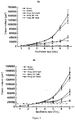
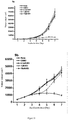
- the tumor-repopulating cells of individual tumor were inoculated in 3D fibrin gel medium (90-Pa) for 5 days, with 0.1% DMSO as the negative control group (represented by DMSO group in Figures 3-8 ), the drug-free group as vehicle control group (represented by None group in Figures 3-8 ), and the study was performed by beginning administrating on the day 0 and the 3rd day respectively, and the cloning tumor volume was measured and calculated.
- WYC-331 exhibited excellent inhibitory activity on the proliferation of tumor-repopulating cells of B16-F1 melanoma.
- the above human tumor cells were incubated with 3D fibrin gel medium (90-Pa) for 5 days, and the desired tumor-repopulating cells were screened. Subsequently, the culture medium was respectively treated with collagenase and neutral protease II, and the tumor-repopulating cells of B16-F1 melanoma were released, then the obtained repopulating cells were transferred to a freshly prepared medium to be resuspended and maintained at single-cell state.
- 3D fibrin gel medium 90-Pa
- the tumor-repopulating cells of B16-F1 melanoma were inoculated in 3D fibrin gel medium (90-Pa) for 5 days, with 0.1% DMSO as the negative control group (represented by DMSO group in Figure 9 ), the drug-free group as vehicle control group (represented by None group in Figures 3-8 ), and the study was performed by beginning administrating on the day 0 and the 3rd day respectively, and the cloning tumor volume was measured and calculated, beginning administrating from the 3rd day at a concentration of 0.1 ⁇ M, 1.0 ⁇ M, and 10 ⁇ M respectively, the cloning tumor volume was measured and calculated.
- the 3T3 mouse embryonic fibroblast cells and B16-F1 melanoma cells were used as the model to study in vitro toxicity of WYC-209 and WYC-331 respectively.
- the effect of compound WYC-209 and WYC-331 on the proliferation of 3T3 mouse embryonic fibroblast cells and B16-F1 melanoma cells were studied at a concentration of 10 ⁇ M.
- the results showed that WYC-209 did not affect the proliferation of 3T3 mouse embryonic fibroblast cells, and did not induce apoptosis of this cells; meanwhile, WYC-209 could significantly block the growth of cloning tumor cells of melanoma, and significant cell apoptosis appeared within 6-48 hours.
- WYC-331 strongly inhibited the proliferation of B16-F1 melanoma cells, but did not exhibit significant apoptosis-inducing effect on 3T3 mouse embryonic fibroblasts cells and B16-F1 melanoma cells.
- the results showed that WYC-331 also had a certain specificity for tumor-repopulating cells of melanoma, and obvious cytotoxicity had not been observed, but the mechanism of action thereof might be different from WYC-209 ( Figure 11 ).
- a subcutaneous implantation model of B16-F1 melanoma in immunocompetent mice (C57BL/6, female, 6-8 weeks) was established to study the inhibitory activity of compound WYC-103 on the tumor in situ.
- B16-F1 cells were incubated with 3D fibrin gel medium (90-Pa) for 5 days, and the desired tumor-repopulating cells were screened.
- the culture medium was respectively treated with collagenase and neutral protease II, and the tumor-repopulating cells of B16-F1 melanoma were released, then the obtained repopulating cells were transferred to a freshly prepared medium to be resuspended and maintained at single-cell state.
- mice Six immunocompetent mice were randomly divided into two groups which were respectively the treatment group and the DMSO negative control group. Mice were subcutaneously injected with 30000 tumor-repopulating cells of melanoma to establish a subcutaneous implantation model of melanoma. Subsequently, Mice were administered via tail vein injection based on the body weight and the blood volume of the mice. From day 0, mice in the treatment group were administrated with WYC-103 once every 2 days at a blood concentration of 10 ⁇ M and fed normally, observing the survival of the mice. The results were shown below. After 19 days experiment, the volume of the subcutaneous melanoma in the treatment group was significantly smaller than that of the DMSO control group. According to the statistical analysis, the tumor volume in the treatment group was only 50% of the control group ( Figure 12 ).
- mice were randomly divided into three groups which were respectively the treatment group, the positive control group (BMS-453 was used as the positive drug) and the DMSO negative control group. Subsequently, Mice were administered via tail vein injection based on the body weight and the blood volume of the mice.
- mice in the treatment group were administrated with WYC-103 once every 2 days at a blood concentration of 10 ⁇ M; mice in the positive control group were administered with BMS-453 (WYC-114) as the positive drug in the same route of administration; mice in the negative control group was administered with 0.1% DMSO in a same route of administration.
- mice in the positive control group were significantly reduced, which indicated that there was a greater toxic side effect in the individual; while the body weight of the mice in the negative control group had a significant increase due to large tumor volume ( Figure 14 ).
- Further dissection experiment of the mice in each group showed that a large number of abnormal foamy structure appeared in the peritoneal cavity of the dead mice in the positive control group, which might be the cause of death in this group. No abnormalities were found in the abdominal cavity of the mice in the treatment group and the negative control group. This experiment showed that WYC-103 was much better than BMS-453 in terms of the efficacy and overall toxic side effects of the inhibition on the melanoma in situ.
- a metastatic melanoma model in the mouse was established to study whether WYC-103 could inhibit metastatic melanoma in the lung thus prevent secondary tumorigenesis.
- 12 normally immunocompetent mice C57BL/6, female, 6-8 weeks
- the model mice were randomly divided into two groups which were respectively the treatment group and the negative control group.
- the mice were administered with WYC-103 (the treatment group) and DMSO (the negative control group) via tail vein injection once every 2 days at a blood concentration of 10 ⁇ M based on the body weight and the blood volume of the mice.
- This experiment was performed to study whether WYC-209 could inhibit the metastasis of melanoma to the lung thus prevent secondary tumorigenesis.
- the B16-F1 cells were incubated with 3D fibrin gel medium (90-Pa) for 5 days, and the desired tumor-repopulating cells were screened. Subsequently, the culture medium was respectively treated with collagenase and neutral protease II, and the tumor-repopulating cells were released, then the obtained repopulating cells were transferred to a freshly prepared medium to be resuspended and maintained at single-cell state.
- mice C57BL/6, female, 6-8 weeks were randomly selected and divided into three groups which were respectively low-dose group (1.0 ⁇ M), high-dose group (10 ⁇ M) and DMSO negative control group, with 8 mice per group. Subsequently, the mice were injected via the tail vein with 30000 tumor-repopulating cells of melanoma to establish a B16-F1 metastatic melanoma model in the mouse. Subsequently, Mice were administered via tail vein injection based on the body weight and the blood volume of the mice.
- mice in the treatment group were administrated with WYC-209 once every 2 days at a blood concentration of 1.0 ⁇ M and 10 ⁇ M; mice in the DMSO group was administered with 0.1% DMSO in a same route of administration as negative control. At this time, there was no significant difference in the body weight between the groups, the mice were fed normally, observing the survival of the mice.
- WYC-209 could prevent repopulating cells of melanoma from metastasizing to the lung to form secondary lung tumor with 50% efficiency at a blood concentration of 1.0 ⁇ M, and with 87.5% efficiency at a blood concentration of 10.0 ⁇ M.
- the DMSO group showed 75% mortality rate of metastatic melanoma in the lung.
- WYC-209 exhibited an excellent activity of inhibiting and even healing secondary tumorigenesis in the immunocompetent mice in vivo. Meanwhile, there was no obvious toxic side effects accompanied with WYC-209 during the whole experiment, so WYC-209 was expected to be further used for the prevention and treatment of various primary or metastatic cancers.
- WYC-103, WYC-209 and WYC-331 had strong inhibitory activity against tumor-repopulating cells of melanoma, the IC 50 reached 0.45 ⁇ M, 0.25 ⁇ M and 0.017 ⁇ M respectively.
- WYC-209 had strong inhibitory activity against A549 lung cancer cells, MCF-7 breast cancer cells, MDA-MB-435S melanoma cells, A2780 ovarian cancer cells, Hs-746T gastric cancer cells, MDA-MB-231 breast cancer cell.
- WYC-103 had a strong inhibitory activity on subcutaneous transplantation tumor of melanoma in mice, the tumor volume was only 50% of the control group at a concentration of 10 ⁇ M.
- WYC-103 and WYC-209 inhibited the metastasis of repopulating cells of melanoma to the lung with 100% and 87% efficiency at a concentration of 10 ⁇ M respectively, which could bring new treatment for prevention and treatment of metastasis of human tumor.
- the compounds of the present invention provided new possibilities for the prevention and treatment of leukemia, lymphoma, primary solid tumors and metastatic tumors.
Landscapes
- Chemical & Material Sciences (AREA)
- Organic Chemistry (AREA)
- Health & Medical Sciences (AREA)
- Animal Behavior & Ethology (AREA)
- Public Health (AREA)
- General Chemical & Material Sciences (AREA)
- Medicinal Chemistry (AREA)
- Nuclear Medicine, Radiotherapy & Molecular Imaging (AREA)
- Pharmacology & Pharmacy (AREA)
- Life Sciences & Earth Sciences (AREA)
- Veterinary Medicine (AREA)
- General Health & Medical Sciences (AREA)
- Chemical Kinetics & Catalysis (AREA)
- Oncology (AREA)
- Hematology (AREA)
- Pharmaceuticals Containing Other Organic And Inorganic Compounds (AREA)
- Acyclic And Carbocyclic Compounds In Medicinal Compositions (AREA)
- Organic Low-Molecular-Weight Compounds And Preparation Thereof (AREA)
- Low-Molecular Organic Synthesis Reactions Using Catalysts (AREA)
- Heterocyclic Compounds Containing Sulfur Atoms (AREA)
- Pyridine Compounds (AREA)
- Plural Heterocyclic Compounds (AREA)
Abstract
Description
- The present application claims the benefit of the Chinese Patent Application No.
CN201610141143.3 filed on March 11, 2016 CN201610310944.8 filed on May 11, 2016 - The present invention relates to a retinoid compound, a preparation method, an intermediate and a use thereof.
-

- Tazarotene is a retinoid drug with RAR subtype selectivity (J Am Acad Dermatol. 1997, 37, S12), mainly used for the treatment of topical epithelial hyperplasia skin (psoriasis, psoriasis, acne, etc.). Tazarotene is an ethyl ester prodrug, which is metabolized by enzyme to Tazarotenic acid as the carboxyl-type active metabolite in vivo. Tazarotenic acid can selectively interact with RARβ and RARγ receptors, and has a certain effect on RARβ, but has a weak effect on RXR.
- The technical problem to be solved in the present invention is to overcome the poor inhibition rate of Tazarotene on tumor cells, thus the present invention provides a retinoid compound, a preparation method, an intermediate and a use thereof. The compound of the present invention exhibits a better inhibition rate on tumor cells.
- The present invention provides a compound represented by formula I, an enantiomer, a diastereomer or a pharmaceutically acceptable salt thereof,

- wherein, U is CR9a or N; V is CR9b or N; X is CR9c or N; W is CR9d or N;
- in the definition of U, V, X and W, each of R9a, R9b, R9c and R9d is independently hydrogen, hydroxy, nitro, cyano, halogen (e.g. fluorine, chlorine, bromine or iodine), C1-C6 alkyl (e.g. methyl, ethyl, n-propyl, isopropyl, n-butyl, isobutyl, tert-butyl, pentyl or hexyl), C1-C6 alkyl substituted with halogen (the halogen can be fluorine, chlorine, bromine or iodine; the C1-C6 alkyl can be methyl, ethyl, n-propyl, isopropyl, n-butyl, isobutyl, tert-butyl, pentyl or hexyl; the "C1-C6 alkyl substituted with halogen" such as trifluoromethyl), C1-C6 alkoxy (e.g. methoxy, ethoxy, n-propoxy, isopropoxy, n-butox, isobutoxy, tert-butoxy, pentoxy or hexoxy), -NR10R11,

- each of R10, R11, R12, R13 and R14 is independently hydrogen or C1-C6 alkyl (e.g. methyl, ethyl, n-propyl, isopropyl, n-butyl, isobutyl, tert-butyl, pentyl or hexyl);
- the bond connecting AE, EG or GZ is independently a single bond or a double bond; when A, E, G or Z connects to two single bonds, the corresponding A, E, G and Z are independently -(CR2R3)-, -C(=O)-, -(NR4)-, -(N→O)-, -O-, -S-, -S(=O)- or -SO2-; when A, E, G or Z connects to a single bond and a double bond, the corresponding A, E, G and Z are independently -(CR5)= or -N=;
- each of R2, R3, R4 and R5 is independently hydrogen, hydroxy, halogen (e.g. fluorine, chlorine, bromine or iodine), C1-C6 alkyl (e.g. methyl, ethyl, n-propyl, isopropyl, n-butyl, isobutyl, tert-butyl, pentyl or hexyl), C2-C6 alkenyl (e.g. vinyl or propenyl), C1-C6 alkyl substituted with halogen (the halogen can be fluorine, chlorine, bromine or iodine; the C1-C6 alkyl can be methyl, ethyl, n-propyl, isopropyl, n-butyl, isobutyl, tert-butyl, pentyl or hexyl; the "C1-C6 alkyl substituted with halogen" such as trifluoromethyl), C1-C6 alkoxy (e.g. methoxy, ethoxy, n-propoxy, isopropoxy, n-butoxy, isobutoxy, tert-butoxy, pentoxy or hexoxy), C1-C6 acyl (e.g. acetyl or formyl), C6-C10 aryl (e.g. phenyl) or "C3-C6 heteroaryl having 1 to 2 heteroatoms selected from the group consisting of oxygen, sulfur and nitrogen" (e.g. pyridinyl or pyrimidinyl);
- m is 0, 1, 2 or 3;
- when there are more than one substituents of R1, the substituents are identical or different; R1 is hydrogen, hydroxy, nitro, cyano, halogen (e.g. fluorine, chlorine, bromine or iodine), C1-C6 alkyl (e.g. methyl, ethyl, n-propyl, isopropyl, n-butyl, isobutyl, tert-butyl, pentyl or hexyl), C1-C6 alkyl substituted with halogen (the halogen can be fluorine, chlorine, bromine or iodine; the C1-C6 alkyl can be methyl, ethyl, n-propyl, isopropyl, n-butyl, isobutyl, tert-butyl, pentyl or hexyl; the "C1-C6 alkyl substituted with halogen" is for example trifluoromethyl), C1-C6 alkoxy (e.g. methoxy, ethoxy, n-propoxy, isopropoxy, n-butoxy, isobutoxy, tert-butoxy, pentoxy or hexoxy), - NR6R7 or -COOR8;
- each of R6, R7 and R8 is independently hydrogen or C1-C6 alkyl (e.g. methyl, ethyl, n-propyl, isopropyl, n-butyl, isobutyl, tert-butyl, pentyl or hexyl);
- Y is -CN, -COOR15 or -CO2NHR16;
- each of R15 and R16 is independently hydrogen, C1-C6 alkyl (e.g. methyl, ethyl, n-propyl, isopropyl, n-butyl, isobutyl, tert-butyl, pentyl or hexyl), C2-C6 alkenyl (e.g. vinyl or propenyl) or C1-C6 acyl (e.g. formyl or acetyl);
- the compound represented by formula I is not

- Preferably, A, E, G together with Z can form the ring selected from the group consisting of


- Preferably, in compound I, at least one (e.g. one, two, three or four) of U, V, X and W is N atom.
- More preferably, in compound represented by formula I, when two of U, V, X and W are N atoms, the compound represented by formula I can be selected from the group consisting of


- Preferably, in compound A, when Y is -COOR15, R15 is hydrogen or ethyl.
- Preferably, in compound A, Z is -(CR2R3)-, -S-, -S(=O)- or -SO2-; more preferably, A, E, G together with Z form the ring selected from the group consisting of

- More preferably, in compound A, when Y is COOH, Z is -S-.
- More preferably, in compound A, when Y is COOEt, Z is -(CR2R3)-, -S(=O)- or -SO2-.
- Preferably, in compound B, when Y is -COOR15, R15 is methyl or ethyl.
- Preferably, in compound B, Z is -(CR2R3)-, -S- or -S(=O)-; more preferably, A, E, G together with Z form the ring selected from the group consisting of


- More preferably, in compound B, when Y is COOMe, Z is -(CR2R3)-, R2 and R3 are defined as above.
- More preferably, in compound B, when Y is COOEt, Z is -(CR2R3)- or -S-, R2 and R3 are defined as above.
- More preferably, in compound B, when Y is CN, Z is -(CR2R3)-, -S- or -S(=O)-, R2 and R3 are defined as above.
- Preferably, in compound C, when Y is -COOR15, R15 is hydrogen or ethyl.
- Preferably, in compound C, Z is -(CR2R3)-, -S- or -S(=O)-; more preferably, A, E, G together with Z form the ring selected from the group consisting of


- More preferably, in compound C, when Y is COOH, Z is -S-.
- More preferably, in compound C, when Y is COOEt, Z is -(CR2R3)-, -S- or - S(=O)-, R2 and R3 are defined as above.
- Preferably, in compound presented by formula I, when one of U, V, X and W is N atom, the compound represented by formula I can be selected from

- Preferably, in compound D, when Y is -COOR15, R15 is hydrogen or ethyl.
- Preferably, in compound D, Z is -(CR2R3)-; more preferably, A, E, G together with Z form

- Preferably, in compound E, Y is CN.
- Preferably, in compound E, Z is -(CR2R3)-; more preferably, A, E, G together with Z form

- R2 and R3 are defined as above.
- Preferably, in compound represented by formula I, when U is CR9a, V is CR9b, X is CR9c, and W is CR9d, the compound represented by formula I is as compound F:

- Preferably, in compound F, at least one (e.g. one, two, three or four) of R9a, R9b, R9c and R9d is not hydrogen.
- Preferably, in compound F, when Y is -COOR15, R15 is hydrogen, methyl or ethyl.
- Preferably, in compound F, Z is -(CR2R3)-, -S-, -S(=O)- or -SO2-; more preferably, A, E, G together with Z form the ring selected from the group consisting of

- More preferably, the compound represented by formula I is selected from the group consisting of


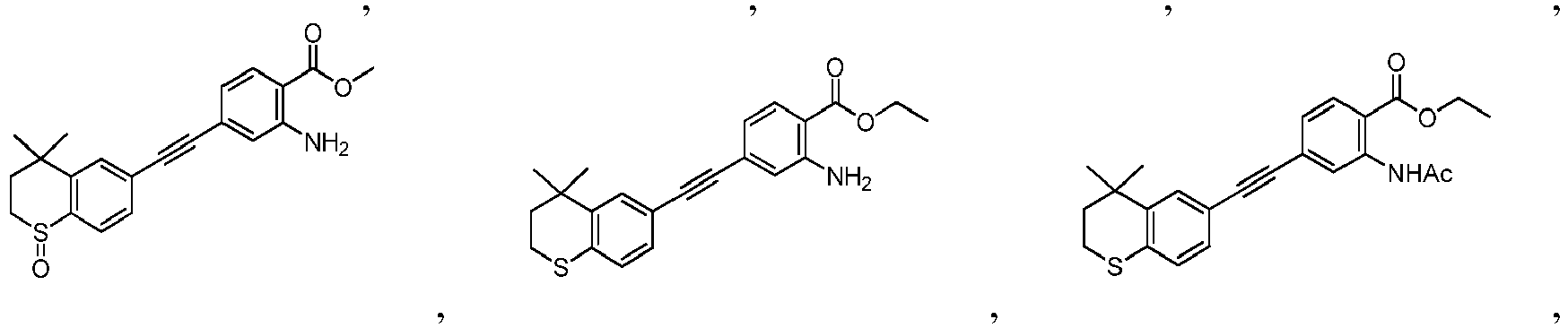


- The present invention also provides a preparation method for the compound represented by formula I, which comprises conducting a coupling reaction with compound II and III to give compound I;

- In the preparation method for the compound represented by formula I, the condition of the coupling reaction can be conventional conditions in the art, preferably that under an atmosphere of a protective gas (e.g. argon), in an organic solvent (e.g. DMF), in the presence of a catalyst (e.g. Pd/Cu catalyst; the "Pd/Cu catalyst" such as Pd(PPh3)2Cl2 and CuI) and a base (e.g. diisopropylamine or triethylamine), conducting a coupling reaction with compound II and III to give compound I.
- The compound represented by formula I can be converted to analogue with a different functional group by flexible functional group conversion and adjustment (including but not limited to esterification, ester hydrolysis, reduction, acylation, oxidation, etc.).
- The preparation method for the compound represented by formula I can further comprise conducting a deprotection reaction of compound IV to give compound III;

- In the preparation method for the compound III, the condition of the deprotection reaction can be conventional conditions in the art, preferably that in an organic solvent (e.g. tetrahydrofuran), in the presence of a base (e.g. tetra-n-butylammonium fluoride), conducting a deprotection reaction of compound IV to give compound III.
- The preparation method for the compound represented by formula I can further comprise conducting a coupling reaction with compound V and trimethylethynyl silane to give compound IV;
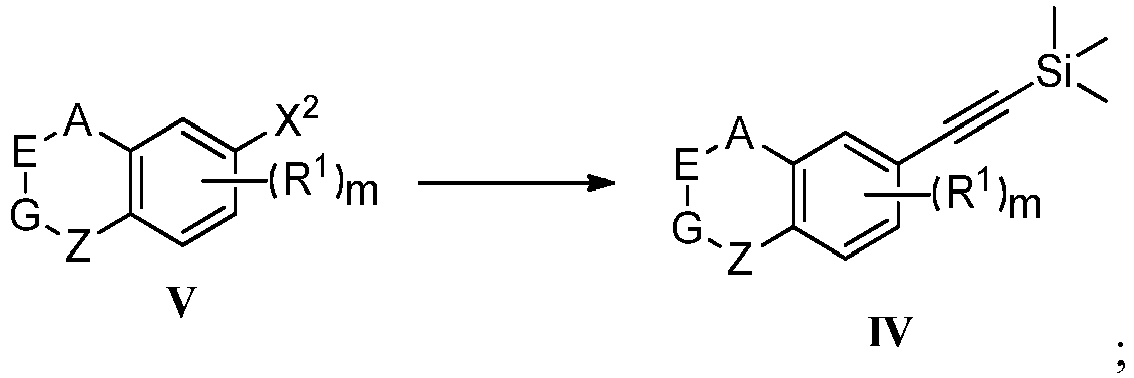
- In the preparation method for the compound represented by formula I, the condition of the coupling reaction can be conventional conditions in the art, preferably that under an atmosphere of a protective gas (e.g. argon), in an organic solvent (e.g. DMF), in the presence of a catalyst (e.g. Pd/Cu catalyst; the "Pd/Cu catalyst" such as Pd(PPh3)2Cl2 and CuI) and a base (e.g. diisopropylamine or triethylamine), conducting a coupling reaction of compound V with trimethylethynyl silane to give compound IV.
- The present invention also provides a compound represented by formula II, III, IV or V,


- The present invention further provides a use of the compound represented by formula I, the enantiomer, the diastereomer or the pharmaceutically acceptable salt thereof in manufacturing a medicament for the treatment of a primary tumor. The tumor includes, but is not limited to, melanoma, esophageal cancer, gastric cancer, lung cancer, liver cancer, ovarian cancer, colon cancer, kidney cancer, cholangiocarcinoma, breast cancer or prostate cancer.
- The present invention also provides a use of the compound represented by formula I, the enantiomer, the diastereomer or the pharmaceutically acceptable salt thereof in manufacturing a medicament for the prevention and/or the treatment of a metastatic tumor. The tumor includes, but is not limited to, melanoma, esophageal cancer, gastric cancer, lung cancer, liver cancer, ovarian cancer, colon cancer, kidney cancer, cholangiocarcinoma, breast cancer or prostate cancer.
- The present invention also provides a use of the compound represented by formula I, the enantiomer, the diastereomer or the pharmaceutically acceptable salt thereof in manufacturing a medicament for the prevention and/or the treatment of leukemia and/or lymphoma.
- The present invention also provides a use of the compound represented by formula I, the enantiomer, the diastereomer or the pharmaceutically acceptable salt thereof in manufacturing a medicament for the use selected from the group consisting of animal fetal growth, internal environment stability, vision, morphogenesis, skin aging and cell differentiation control.
- The present invention also provides a use of the compound represented by formula I, the enantiomer, the diastereomer or the pharmaceutically acceptable salt thereof in manufacturing a medicament for the treatment of psoriasis.
- The present invention also provides a use of the compound represented by formula I, the enantiomer, the diastereomer or the pharmaceutically acceptable salt thereof in manufacturing a medicament for the treatment of acne.
- The present invention also provides a pharmaceutical composition, which comprises the compound represented by formula I, the enantiomer, the diastereomer or the pharmaceutically acceptable salt thereof, and a pharmaceutically carrier.
- The route of administration of the pharmaceutical composition can be oral administration, injection and topical administration. When the pharmaceutical composition is administered by oral administration, the dosage form of the composition includes, but is not limited to, tablets, capsules, suspensions, solutions, emulsions, microspheres, nanosphere suspensions, controlled release niosomes or polymer niosomes. When the pharmaceutical composition is administered by injection, the dosage form of the composition solutions or suspensions for infusion or injection. Generally, the compounds of the present invention are daily administered at a dose of about 0.01 mg/kg to 100 mg/kg based on the body weight, the dose is divided into 1-3 part for administration. The concentration of the compounds of the present invention used systemically is generally 0.01% to 10% (weight), preferably 0.01% to 1% (weight) based on the weight of the composition. When the pharmaceutical composition is administered by topical administration, the pharmaceutical composition is especially used for the treatment of skin and mucosal diseases, can be used in the form of liquid, paste or solid, especially ointments, creams, solutions, gels, sprays, suspensions and adhesives. The form can also be microspheres, nanosphere suspensions, controlled release niosomes, polymer niosomes, gel patch or polymer patch. The concentration of the compounds which are administered by topical administration is usually 0.001% to 10% (weight), preferably 0.01% to 1% (weight) based on the total weight of the composition.
- The pharmaceutical composition can also comprise inert additives, or a pharmaceutically active ingredient that is positively associated with the pharmaceutical composition, or a mixture of such ingredients. Of course, the person skilled in the art will be careful to select the above optional compound to be added into the above composition, ensuring that the advantage of the present invention is not or basicly not affected by the predetermined additive.
- In the present invention, the "C1-C6 acyl" refers to an alkyl acyl group having 1 to 6 carbon atoms, for example the acyl group having 1 carbon atom refers to HC(O)-(i.e. formyl), the acyl group having 2 carbon atoms refers to CH3C(O)- (i.e. acetyl); propionyl, butyryl or valeryl.
- In the present invention, unless otherwise specified, the following terms in the description and the claims of the invention have the following meanings:
- The term "alkyl" refers to a saturated linier or branched monovalent hydrocarbon group having one to twenty carbon atoms. Examples of alkyl include, but are not limited to, methyl, ethyl, 1-propyl, 2-propyl, 1-butyl, 2-methyl-1-butyl, 2-butyl, 2-methyl-2-propyl, 1-pentyl, 2-pentyl, 3-pentyl, 2-methyl-2-butyl, 3-methyl-2-butyl, 3-methyl-1-butyl, 2-methyl-1-butyl, 1-hexyl, 2-hexyl, 3-hexyl, 2-methyl-2-pentyl, 3-methyl-2-pentyl, 4-methyl-2-pentyl , 3-methyl-3-pentyl, 2-methyl-3-pentyl, 2,3-dimethyl-2-butyl, 3,3-dimethyl-2-butyl, 1-heptyl, 1-octyl.
- The term "alkenyl" refers to a linier, branched or cyclic non-aromatic hydrocarbon group having a specified number of carbon atoms and at least one carbon-carbon double bond. Alkenyl is preferably having one carbon-carbon double bond, and up to four non-aromatic carbon-carbon double bonds can be present. Thus, "C2-12 alkenyl" refers to an alkenyl group having 2 to 12 carbon atoms. "C2-6 alkenyl" refers to an alkenyl group having 2 to 6 carbon atoms, including vinyl, propenyl, butenyl, 2-methylbutenyl and cyclohexenyl.
- The term "aryl" (used alone or included in other groups) refers to any stable monocyclic or bicyclic carbon ring which can have up to 7 atoms in each ring, wherein at least one ring is aromatic. Examples of the above aryl include phenyl, naphthyl, tetrahydronaphthyl, 2,3-dihydroindenyl, biphenyl, phenanthryl, anthryl or acenaphthyl. It is to be understood that when the aryl is a bicyclic substituent and one of the rings is non-aromatic, the linkage is through the aromatic ring.
- The term "aromatic hetero group" or "heteroaryl" (used alone or included in other groups) refers to a stable monocyclic ring or bicyclic ring which can have up to 7 atoms in each ring, and at least one of the rings is an aromatic ring having 1 to 4 heteroatoms independently selected from O, N and S. The heteroaryl defined herein includes but not limited to acridinyl, carbazolyl, cinnolinyl, quinoxalinyl, pyrazolyl, indolyl, benzotriazolyl, furanyl, thienyl, benzothienyl, benzofuranyl, quinolinyl, isoquinolyl, oxazolyl, isoxazolyl, indolyl, pyrazinyl, pyridazinyl, pyridinyl, pyrimidyl, pyrryl, tetrahydroquinoline. As defined in the "heterocycloalkyl", "heteroaryl" can also be understood to include the N-oxide derivative of any nitrogenous heteroaryl. When the heteroaryl is a bicyclic substituent and one of the rings is non-aromatic or without any heteroatom, it can be understood, the linkage is through the aromatic ring or the heteroatom on the ring.
- The term "halogen" includes F, Cl, Br, I.
- The term "pharmaceutically acceptable salt" refers to a conventional acid addition or a base addition salt which retains the biological activity and the property of compound I and is formed from a suitable non-toxic organic acid, inorganic acid, organic base or inorganic base. Examples of the acid addition salt include the salt derived from an inorganic acid and an organic acid, the inorganic acid such as hydrochloric acid, hydrobromic acid, hydroiodic acid, sulfuric acid, sulfamic acid, phosphorous acid, phosphorothioic acid, phosphoric acid and nitric acid, the organic acid such as formic acid, acetic acid, propionic acid, p-toluenesulfonic acid, salicylic acid, methanesulfonic acid, oxalic acid, succinic acid, citric acid, maleic acid, lactic acid, tartaric acid, succinic acid, fumaric acid, mandelic acid, malic acid, camphorsulfonic acid, etc. Examples of the base addition salt include the salt derived from ammonium, potassium, sodium, calcium, and quaternary ammonium hydroxide (e.g. tetramethylammonium hydroxide). Modification of a pharmaceutical compound (i.e. drug) into a salt in order to obtain a compound with improved physical and chemical stability, hygroscopicity, flowability, and solubility is a conventional method well known to the pharmacists.
- The "pharmaceutically acceptable" contained in the term "pharmaceutically acceptable carrier" refers to the compound is pharmaceutically acceptable and basically non-toxic when administered to a specific subject.
- Without violating the common sense in the art, the above preferred conditions can be arbitrarily combined, then preferred embodiments of the present invention are obtained.
- The reagents and raw materials used in the present invention are commercially available.
- The positive and progressive effect of the present invention is that the compounds of the present invention exhibit a better inhibition rate on tumor cells.
-
-
Figure 1 shows the study of the effect of WYC-103 on the differentiation and apoptosis of TRC cells of B16-F1 melanoma. -
Figure 2 shows the study of the effect of WYC-209 on the differentiation and apoptosis of TRC cells of B16-F1 melanoma. -
Figure 3 shows the study of the inhibitory activity of WYC-209 on the tumor-repopulating cells of lung cancer, whereinFigure 3a shows the inhibitory activity of WYC-209 on A549 lung cancer when beginning administrating on theday 0;Figure 3b shows the inhibitory activity of WYC-209 on A549 lung cancer when beginning administrating on the 3rd day. -
Figure 4 shows the study of the inhibitory activity of WYC-209 on the tumor-repopulating cells of MCF-7 breast cancer, whereinFigure 4a shows the inhibitory activity of WYC-209 on MCF-7 breast cancer when beginning administrating on theday 0;Figure 4b shows the inhibitory activity of WYC-209 on MCF-7 breast cancer when beginning administrating on the 3rd day. -
Figure 5 shows the study of the inhibitory activity of WYC-209 on the tumor-repopulating cells of MDA-MB-435S melanoma, whereinFigure 5a shows the inhibitory activity of WYC-209 on MDA-MB-435S melanoma when beginning administrating on theday 0;Figure 5b shows the inhibitory activity of WYC-209 on MDA-MB-435S melanoma when beginning administrating on the 3rd day. -
Figure 6 shows the study of the inhibitory activity of WYC-209 on the tumor-repopulating cells of A2780 ovarian cancer, whereinFigure 6a shows the inhibitory activity of WYC-209 on A2780 ovarian cancer when beginning administrating on theday 0;Figure 6b shows the inhibitory activity of WYC-209 on A2780 ovarian cancer when beginning administrating on the 3rd day. -
Figure 7 shows the study of the inhibitory activity of WYC-209 on the tumor-repopulating cells of Hs-746T gastric cancer, whereinFigure 7a shows the inhibitory activity of WYC-209 on Hs-746T gastric cancer when beginning administrating on theday 0;Figure 7b shows the inhibitory activity of WYC-209 on Hs-746T gastric cancer when beginning administrating on the 3rd day. -
Figure 8 shows the study of the inhibitory activity of WYC-209 on the tumor-repopulating cells of MDA-MB-231 breast cancer, whereinFigure 8a shows the inhibitory activity of WYC-209 on MDA-MB-231 breast cancer when beginning administrating on theday 0;Figure 8b shows the inhibitory activity of WYC-209 on MDA-MB-231 breast cancer when beginning administrating on the 3rd day. -
Figure 9 shows the study of the inhibitory activity of WYC-331 on the tumor-repopulating cells of A2780 ovarian cancer and MDA-MB-231 breast cancer, whereinFigure 9a shows the inhibitory activity of WYC-331 on A2780 ovarian cancer when beginning administrating on the 3rd day;Figure 9b shows the inhibitory activity of WYC-331 on MDA-MB-231 breast cancer when beginning administrating on the 3rd day. -
Figure 10 shows the study of the toxicity of WYC-209 (WYC-209 inhibits the proliferation of B16 cells, but has no significant effect on 3T3 cells); wherein,Figure 10a shows treating 3T3 cells with 10µM WYC-209 for 18 hours;Figure 10b shows treating B16 cells with no WYC-209 or 10µM WYC-209 for 48 hours. -
Figure 11 shows the study of the toxicity of WYC-331; wherein,Figure 11a shows treating 3T3 cells with 1µM or 10µM WYC-331 for 24 hours;Figure 11b shows treating B16 cells with 1µM or 10µM WYC-331 for 24 hours. -
Figure 12 shows the tumor volume on the 19th day of the experiment in the study of the inhibitory activity of WYC-103 on subcutaneous melanoma. -
Figure 13 shows the study of the inhibitory activity and in vivo toxicity of WYC-103 on subcutaneous melanoma. -
Figure 14 shows the tumor volume on the 26th day of the experiment in the study of the inhibitory activity of WYC-103 on subcutaneous melanoma. -
Figure 15 shows the study of the inhibitory activity of WYC-103 on metastatic melanoma in the lung; wherein,Figure 15a shows the lung tissue on the 29th day of the experiment where injecting 3000 tumor-repopulating cells of melanoma and administrating WYC-103;Figure 15b shows the lung tissue on the 29th day of the experiment where injecting 3000 tumor-repopulating cells of melanoma and administrating DMSO;Figure 15c shows the lung tissue on the 35th day of the experiment where injecting 3000 tumor-repopulating cells of melanoma and administrating WYC-103;Figure 15d shows the lung tissue on the 35th day of the experiment where injecting 3000 tumor-repopulating cells of melanoma and administrating DMSO;Figure 15e shows the lung tissue on the 37th day of the experiment where administrating WYC-103;Figure 15f shows the lung tissue on the 37th day of the experiment where administrating DMSO. -
Figure 16 shows the study of the inhibitory activity of WYC-209 on metastatic melanoma in the lung, wherein,Figure 16a shows the lung tissue in the experiment where administrating DMSO;Figure 16b shows the lung tissue in the experiment where administrating 1.0µM WYC-209;Figure 16c shows the lung tissue in the experiment where administrating 10µM WYC-209. -
Figure 17 shows the single crystal structure of WYC-209A. -
Figure 18 shows the single crystal structure of WYC-209B. - The following embodiments further illustrate the present invention, but the present invention is not limited thereto. The experimental methods that do not specify the specific conditions in the following embodiments are selected according to conventional methods and conditions, or according to the description of the product.
-

- Commercially available 6-ethynyl-4,4-dimethylbenzothiopyran (202.8mg, 1mmol) and methyl 2-hydroxy-4-iodobenzoate (292. 1mg, 1mmol) used as raw material were added to a flask, followed by addition of Pd(PPh3)2Cl2 (14mg, 0.02mmol) and CuI (7.6mg, 0.04mmol). After the flask was purged with argon for 3 times to remove oxygen, 2mL dry DMF and 0.2mL dry iPr2NH were added via syringe. The reaction was continued at room temperature for 8 h and monitored by TLC. After completion of the reaction, the reaction was quenched with saturated ammonium chloride solution, and the mixture was diluted with ethyl acetate, washed with saturated ammonium chloride solution and saturated sodium chloride solution. The organic phase was dried over anhydrous sodium sulfate, filtered, concentrated and purified by flash column chromatography (PE:EtOAc = 100:1 to 20:1) to give WYC-101 (296mg, 81%). 1H NMR (400 MHz, CDCl3) δ 7.79 (d, 1H), 7.53 (d, 1H), 7.18-7.20 (dd, 1H), 7.12 (d, 1H), 7.06-7.07 (d, 1H), 7.00-7.02 (dd, 1H), 3.95 (s, 3H), 3.03-3.06 (m, 2H), 1.94-1.97 (m, 1H), 1.34 (s, 6H); 13C NMR (101 MHz, CDCl3) δ 170.09, 161.38, 161.12, 153.37, 142.25, 134.10, 130.91, 130.00, 129.85, 129.24, 126.73, 122.45, 120.25, 117.90, 111.95, 93.23, 88.03, 77.48, 77.16, 76.84, 52.52, 37.27, 32.54, 29.99, 23.43; ESI(+)-MS: 353.3 [M+1]+.
-

- 6-Ethynyl-4,4-dimethylbenzothiopyran (202.8mg, 1mmol) and methyl 2-hydroxymethyl-4-iodobenzoate (292mg, 1mmol) were added to a flask, followed by addition of Pd(PPh3)2Cl2 (14mg, 0.02mmol) and CuI (7.6mg, 0.04mmol). After the flask was purged with argon for 3 times to remove oxygen, 2mL dry DMF and 0.2mL dry iPr2NH were added via syringe. The reaction was continued at room temperature for 8 h and monitored by TLC. After completion of the reaction, the reaction was quenched with saturated ammonium chloride solution, and the mixture was diluted with ethyl acetate, washed with saturated ammonium chloride solution and saturated sodium chloride solution. The organic phase was dried over anhydrous sodium sulfate, filtered, concentrated and purified by flash column chromatography (PE:EtOAc = 100:1 to 50:1) to give WYC-102 (300mg, 82%). 1H NMR (400 MHz, CDCl3) δ 7.78 (d, 1H), 7.53 (d, 1H), 7.18-7.20 (dd, 1H), 7.11-7.13 (dd, 1H), 7.11 (d, 1H), 7.07 (d, 1H), 3.98 (s, 3H), 3.89 (s, 3H), 3.03-3.06 (m, 1H), 1.94-1.97 (m, 1H), 1.34 (s, 6H); 13C NMR (101 MHz, CDCl3) δ 166.25, 159.05, 142.07, 133.98, 133.58, 131.89, 129.90, 129.13, 128.85, 126.70, 123.39, 119.42, 117.88, 114.84, 92.50, 88.07, 77.48, 77.16, 76.84, 56.18, 52.18, 37.23, 33.06, 30.06, 23.31; ESI(+)-MS: 367.4 [M+1]+.
-

- 6-Ethynyl-4,4-dimethylbenzothiopyran (202.8mg, 1mmol) and ethyl 2-hydroxy-4-iodobenzoate (292mg, 1mmol) were added to a flask, followed by addition of Pd(PPh3)2Cl2 (14mg, 0.02mmol) and CuI (7.6mg, 0.04mmol). After the flask was purged with argon for 3 times to remove oxygen, 2mL dry DMF and 0.2mL dry iPr2NH were added via syringe. The reaction was continued at room temperature for 8 h and monitored by TLC. After completion of the reaction, the reaction was quenched with saturated ammonium chloride solution, and the mixture was diluted with ethyl acetate, washed with saturated ammonium chloride solution and saturated sodium chloride solution. The organic phase was dried over anhydrous sodium sulfate, filtered, concentrated and purified by flash column chromatography (PE:EtOAc = 100:1 to 50:1) to give WYC-103 (300mg, 82%). 1H NMR (400 MHz, CDCl3) δ 7.80 (d, 1H), 7.52 (s, 1H), 7.18-7.20 (d, 1H), 7.12 (s, 1H), 7.06-7.07 (s, 1H), 7.00-7.02 (s, 1H), 4.39-4.44 (q, 2H), 3.04-3.06 (t, 2H), 1.95-1.97 (t, 2H), 1.44 (t, 3H), 1.35 (s, 6H); 13C NMR (101 MHz, CDCl3) 6 169.97, 161.45, 142.27, 134.07, 130.80, 130.02, 129.91, 129.26, 126.74, 122.37, 120.25, 117.94, 112.22, 93.19, 88.02, 77.48, 77.36, 77.16, 76.84, 61.71, 37.30, 33.12, 30.11, 29.85, 23.37, 14.34; ESI(+)-MS: 367.5 [M+1]+.
-
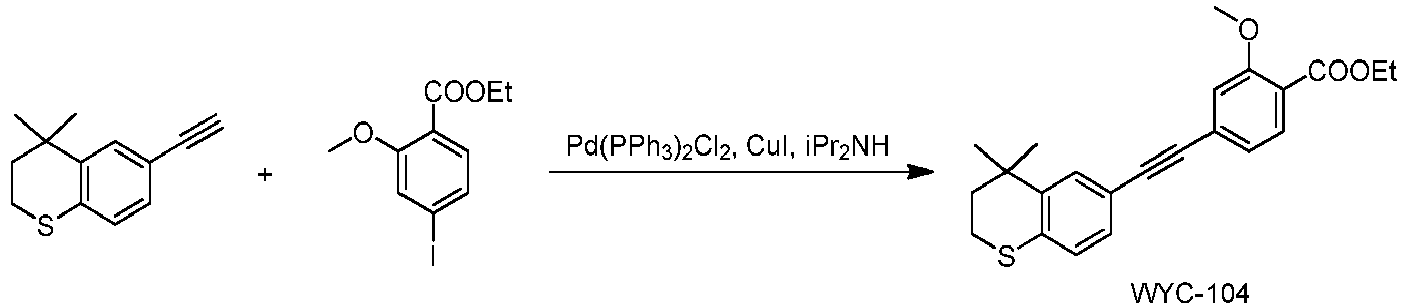
- 6-Ethynyl-4,4-dimethylbenzothiopyran (202.8mg, 1mmol) and ethyl 2-hydroxymethyl-4-iodobenzoate (306mg, 1mmol) were added to a flask, followed by addition of Pd(PPh3)2Cl2 (14mg, 0.02mmol) and CuI (7.6mg, 0.04mmol). After the flask was purged with argon for 3 times to remove oxygen, 2mL dry DMF and 0.2mL dry iPr2NH were added via syringe. The reaction was continued at room temperature for 8 h and monitored by TLC. After completion of the reaction, the reaction was quenched with saturated ammonium chloride solution, and the mixture was diluted with ethyl acetate, washed with saturated ammonium chloride solution and saturated sodium chloride solution. The organic phase was dried over anhydrous sodium sulfate, filtered, concentrated and purified by flash column chromatography (PE:EtOAc = 100:1 to 50:1) to give WYC-104 (293mg, 77%). 1H NMR (400 MHz, CDCl3) δ 7.77 (d, J = 7.9 Hz, 1H), 7.53 (d, J = 1.7 Hz, 1H), 7.20 (dd, J = 8.2, 1.7 Hz, 1H), 7.14 - 7.11 (m, 1H), 7.11 - 7.05 (m, 2H), 4.36 (q, J = 7.1 Hz, 2H), 3.93 (s, 3H), 3.07 - 3.04 (m, 2H), 1.95 - 1.98 (m, 2H), 1.39 (t, 3H), 1.35 (s, 6H); 13C NMR (101 MHz, CDCl3) δ 165.81,159.12,142.28,133.97,131.77,129.96,129.19,128.70,126.76,123.42,119.93, 117.98, 114.94, 92.39, 77.48, 77.37, 77.16, 76.85, 61.07, 56.25, 37.31, 33.13, 30.14, 29.85, 23.37, 14.46; ESI(+)-MS: 381.4 [M+1]+.
-

- WYC-103 (183mg, 0.5mmol) was dissolved in 5mL THF, then 1mL 0.5M NaOH solution was added dropwise. The reaction was continued at room temperature for 8 hours and monitored by TLC. After completion of the reaction, the reaction solution was neutralized to
pH 7 with 0.5M HCl solution, diluted with ethyl acetate, washed with saturated ammonium chloride solution and saturated sodium chloride solution. The organic phase was dried over anhydrous sodium sulfate, filtered, concentrated and purified by flash column chromatography (PE:EtOAc = 10:1 to 1:1) to give WYC-105 (144mg, 85%). 1H NMR (500 MHz, cdcl3) δ 10.50 (s,1H), 7.86-7.84 (d, 1H), 7.53 (d, 1H), 7.21-7.19 (dd, 1H), 7.14 (d, 1H), 7.08-7.06 (d, 1H), 7.05-7.04 (dd, 1H), 3.07-3.04 (m, 1H), 1.98-1.95 (m, 1H), 1.35 (s, 6H); 13C NMR (125 MHz, CDCl3) δ 171.84, 161.46, 142.17, 131.83, 130.58, 129.91, 129.16, 126.63, 120.24, 117.56, 110.03, 89.85, 37.15, 32.99, 29.97, 29.70, 23.24; ESI(-)-MS: 337.1 [M-1]-. -

- WYC-104 (190mg, 0.5mmol) was dissolved in 5mL THF, then 1mL 0.5M NaOH solution was added dropwise. The reaction was continued at room temperature for 8 hours and monitored by TLC. After completion of the reaction, the reaction solution was neutralized to
pH 7 with 0.5M HCl solution, diluted with ethyl acetate, washed with saturated ammonium chloride solution and saturated sodium chloride solution. The organic phase was dried over anhydrous sodium sulfate, filtered, concentrated and purified by flash column chromatography (PE:EtOAc = 10:1 to 4:1) to give WYC-106 (151mg, 86%). 1H NMR (500 MHz, CDCl3) δ 10.60 (s, 1H), 8.14 (d, J = 7.9 Hz, 1H), 7.54 (s, 1H), 7.28 (m, 2H), 7.22 (m, 1H), 7.08 (d, J = 7.9 Hz, 1H), 4.12 (s, 3H), 3.06 (m, 2H), 1.96 (m, 2H), 1.35 (s, 6H); 13C NMR (101 MHz, CDCl3) δ 165.02, 157.85, 142.36, 134.56, 133.90, 130.59, 130.00, 129.21, 126.81, 125.42, 117.51, 116.99, 114.42, 94.06, 87.56, 77.48, 77.36, 77.16, 76.84, 56.98, 37.22, 33.12, 30.10, 29.83, 23.37; ESI(-)-MS: 351.2 [M-1]-. -

- 6-Ethynyl-4,4-dimethylbenzothiopyran (202.8mg, 1mmol) and methyl 3-hydroxy-4-iodobenzoate (278.1mg, 1mmol) were added to a flask, followed by addition of Pd(PPh3)2Cl2 (14mg, 0.02mmol) and CuI (7.6mg, 0.04mmol). After the flask was purged with argon for 3 times to remove oxygen, 2mL dry DMF and 0.2mL dry iPr2NH were added via syringe. The reaction was continued at room temperature for 8 h and monitored by TLC. After completion of the reaction, the reaction was quenched with saturated ammonium chloride solution, and the mixture was diluted with ethyl acetate, washed with saturated ammonium chloride solution and saturated sodium chloride solution. The organic phase was dried over anhydrous sodium sulfate, filtered, concentrated and purified by flash column chromatography (PE:EtOAc = 100:1 to 10:1) to give WYC-107 (245mg, 71%). 1H NMR (500 MHz, CDCl3) δ 7.64 (d, J = 1.5 Hz, 1H), 7.58 (dd, J = 8.0, 1.6 Hz, 1H), 7.52 (d, J = 1.7 Hz, 1H), 7.46 (d, J = 8.0 Hz, 1H), 7.19 (dd, J = 8.2, 1.7 Hz, 1H), 7.08 (d, J = 8.1 Hz, 1H), 6.02 (s, 1H), 3.91 (s, 3H), 3.06 -3.04 (m, 2H), 1.94 -1.97 (m, 2H), 1.34 (s, 6H); 13C NMR (101 MHz, CDCl3) δ 166.45, 156.21,142.31,134.62,131.53,131.43,129.70,128.97,126.73,121.48,117.03,115.72, 114.61, 99.27, 81.86, 77.37, 77.05, 76.74, 52.33, 37.06, 32.99, 29.94, 23.24; ESI(+)-MS: 353.4 [M+1]+.
-

- 6-Ethynyl-4,4-dimethylbenzothiopyran (202.8mg, 1mmol) and methyl 3-hydroxymethyl-4-iodobenzoate (292.1mg, 1mmol) were added to a flask, followed by addition of Pd(PPh3)2Cl2 (14mg, 0.02mmol) and CuI (7.6mg, 0.04mmol). After the flask was purged with argon for 3 times to remove oxygen, 2mL dry DMF and 0.2mL dry iPr2NH were added via syringe. The reaction was continued at room temperature for 8 h and monitored by TLC. After completion of the reaction, the reaction was quenched with saturated ammonium chloride solution, and the mixture was diluted with ethyl acetate, washed with saturated ammonium chloride solution and saturated sodium chloride solution. The organic phase was dried over anhydrous sodium sulfate, filtered, concentrated and purified by flash column chromatography (PE:EtOAc = 100:1 to 10:1) to give WYC-108 (275mg, 75%). 1H NMR (500 MHz, CDCl3) δ 7.61-7.63 (d, 1H), 7.52-7.56 (m, 3H), 7.21-7.23 (dd, 1H), 7.05-7.07 (d, 1H), 3.97 (s, 3H), 3.93 (s, 3H), 3.03-3.06 (m, 1H), 1.94-1.97 (m, 1H), 1.34 (s, 6H); 13C NMR (126 MHz, cdcl3) δ 166.59, 159.56, 141.99, 133.50, 133.19, 130.64, 129.80, 129.14, 126.49, 121.75, 118.27, 111.25, 96.82, 84.38, 77.26, 77.01, 76.76, 56.07, 52.29, 37.24, 32.97, 29.98, 23.22; ESI(+)-MS: 367.3 [M+1]+.
-

- WYC-108 (190mg, 0.5mmol) was dissolved in 5mL THF, and 1mL 0.5M NaOH solution was added dropwise. The reaction was continued at room temperature for 8 hours and monitored by TLC. After completion of the reaction, the reaction solution was neutralized to
pH 7 with 0.5M HCl solution, diluted with ethyl acetate, washed with saturated ammonium chloride solution and saturated sodium chloride solution. The organic phase was dried over anhydrous sodium sulfate, filtered, concentrated and purified by flash column chromatography (PE:EtOAc = 10:1 to 2:1) to give WYC-110 (1541mg, 80%). 1H NMR (500 MHz, CDCl3) δ 7.69 (dd, 1H), 7.61 (s, 1H), 7.58 - 7.55 (m, 2H), 7.23 (dd, 1H), 7.07 (d, 1H), 3.99 (s, 3H), 3.06 - 3.04 (m, 2H), 1.97 - 1.95 (m, 2H), 1.34 (s, 6H); ESI(+)-MS: 339.3 [M+1]+. -

- Commercially available 4,4-dimethyl-6-ethynylthiochroman (202.8mg, 1.0mmol) and 2-cyano-5-chloropyrimidine (93mg, 0.67mmol) used as raw material were added to a flask, followed by addition of Pd(PPh3)2Cl2 (23mg, 0.03mmol) and CuI (19mg, 0.1mmol). After the flask was purged with argon for 3 times to remove oxygen, 2mL dry DMF and 0.25mL dry Et3N were added via syringe. The reaction was continued at 50°C for 22 h and monitored by TLC. After completion of the reaction, the reaction solution was cooled to room temperature and the reaction was quenched with saturated ammonium chloride solution. The mixture was diluted with ethyl acetate, washed with saturated ammonium chloride solution and saturated sodium chloride solution. The organic phase was dried over anhydrous sodium sulfate, filtered, concentrated and purified by flash column chromatography (PE:EtOAc = 30:1) to give WYC-202 (133mg, 65%). 1H NMR (400 MHz, CDCl3) δ 8.89 (s, 2H), 7.55 (d, J = 1.6 Hz, 1H), 7.21 (dd, J = 8.2, 1.7 Hz, 1H), 7.11 (d, J = 8.2 Hz, 1H), 3.11 - 3.03 (m, 2H), 2.01 - 1.93 (m, 2H), 1.35 (s, 6H); 13C NMR (126 MHz, CDCl3) δ 159.21, 142.59, 141.79, 136.33, 130.15, 129.31, 126.98, 122.88, 116.13, 115.70, 101.85, 81.24, 37.02, 33.15, 30.02, 23.42. ESI(+)-MS: 306.3 [M+1]+.
-

- 4,4-Dimethyl-6-ethynylthiochroman (202.8mg, 1.0mmol) and ethyl 2-chloropyrimidin-carboxylate (156mg, 0.83mmol) used as raw material were added to a flask, followed by addition of Pd(PPh3)2Cl2 (42mg, 0.06mmol) and CuI (19mg, 0.1mmol). After the flask was purged with argon for 3 times to remove oxygen, 2mL dry DMF and 0.3mL dry Et3N were added via syringe. The reaction was continued at 80°C for 22 h and monitored by TLC. After completion of the reaction, the reaction solution was cooled to room temperature and the reaction was quenched with saturated ammonium chloride solution. The mixture was diluted with ethyl acetate, washed with saturated ammonium chloride solution and saturated sodium chloride solution. The organic phase was dried over anhydrous sodium sulfate, filtered, concentrated and purified by flash column chromatography (PE:EtOAc = 15:1) to give WYC-203(257mg, 73%). 1H NMR (500 MHz, CDCl3) δ 9.24 (s, 2H), 7.69 (d, J = 1.7 Hz, 1H), 7.33 (dd, J = 8.2, 1.8 Hz, 1H), 7.09 (d, J = 8.2 Hz, 1H), 4.45 (q, J = 7.1 Hz, 1H), 3.11 - 2.99 (m, 2H), 1.99 - 1.92 (m, 2H), 1.43 (t, J = 7.1 Hz, 3H), 1.33 (s, 6H); 13C NMR (126 MHz, CDCl3) δ 163.52, 158.44, 155.85, 142.39, 136.48, 131.36, 130.15, 126.83, 121.88, 115.96, 92.65, 87.97, 62.14, 37.09, 33.14, 30.05, 23.43, 14.38. ESI(+)-MS: 353.2 [M+1]+.
-

- WYC-202 (50mg, 0.164mmol) was added to a flask, followed by addition of a solution of NaOH (20mg, 0.491mmol) in 0.5mL water and 0.5mL methanol. Then the reaction was continued at 60°C for 5 h and monitored by TLC. After completion of the reaction, the reaction solution was neutralized to
pH 7 with 1M HCl solution, diluted with ethyl acetate, washed with saturated sodium bicarbonate solution and saturated sodium chloride solution. The organic phase was dried over anhydrous sodium sulfate, filtered, concentrated and purified by flash column chromatography (PE:EtOAc = 15:1) to give WYC-204 (39mg, 74%). 1H NMR (500 MHz, CDCl3) δ 8.63 (s, 2H), 7.51 (d, J = 0.7 Hz, 1H), 7.17 (dd, J = 8.1, 0.9 Hz, 1H), 7.07 (d, J = 8.2 Hz, 1H), 4.04 (s, 3H), 3.11- 2.91 (m, 2H), 2.04 - 1.90 (m, 2H), 1.34 (s, 6H); 13C NMR (126 MHz, CDCl3) δ 164.02, 161.24, 142.32, 134.10, 129.72, 128.97, 126.77, 117.65, 113.33, 94.71, 81.81, 55.37, 37.28, 33.12, 30.11, 23.36. ESI(+)-MS: 339.2 [M+1]+. -

- WYC-202 (50mg, 0.164mmol) was added to a flask, followed by addition of sodium ethoxide (34mg, 0.492mmol) and 5mL ethanol. Then the reaction was continued at 45°C overnight and monitored by TLC. After completion of the reaction, the reaction solution was neutralized to neutral with acid resin and filtered, the filtrate was diluted with ethyl acetate, washed with saturated sodium bicarbonate solution and saturated sodium chloride solution. The organic phase was dried over anhydrous sodium sulfate, filtered, concentrated and purified by flash column chromatography (PE:EtOAc = 8:1) to give WYC-205 (36mg, 62%). 1H NMR (500 MHz, CDCl3) δ 8.62 (s, 2H), 7.51 (s, 1H), 7.17 (dd, J = 8.1, 0.8 Hz, 1H), 7.07 (d, J = 8.1 Hz, 1H), 4.45 (q, J = 7.1 Hz, 2H), 3.09 - 3.00 (m, 2H), 2.00 - 1.92 (m, 2H), 1.45 (t, J = 7.1 Hz, 3H), 1.34 (s, 6H); 13C NMR (126 MHz, CDCl3) δ 163.61, 161.23, 142.32, 134.05, 129.72, 128.97, 126.77, 117.71, 113.13, 94.60, 81.91, 64.11, 37.30, 33.13, 30.11, 23.36, 14.55. ESI(+)-MS: 353.5 [M+1]+.
-

- WYC-203 (50mg, 0.142mmol) was added to a flask, followed by addition of 2mL 2.0mol/L NaOH solution and 2mL methanol. Then the reaction was continued at 45°C for 5 h and monitored by TLC. After completion of the reaction, the reaction solution was neutralized to weak acidic with 1mol/L HCl solution, diluted with ethyl acetate, extracted, washed with saturated sodium chloride solution. The organic phase was dried over anhydrous sodium sulfate, filtered, concentrated and purified by flash column chromatography (dichloromethane : methanol = 15:1) to give WYC-206 (41mg, 89%). 1H NMR (400 MHz, CD3OD) δ 9.21 (s, 2H), 7.71 (d, J = 1.6 Hz, 1H), 7.29 (dd, J = 8.2, 1.8 Hz, 1H), 7.11 (d, J = 8.2 Hz, 1H), 3.14 - 3.06 (m, 2H), 2.05 - 1.92 (m, 2H), 1.36 (s, 6H); 13C NMR (101 MHz, CD3OD) δ 167.13, 159.54, 155.24, 143.92, 137.92, 131.86, 130.67, 127.84, 117.11, 111.42, 92.11, 88.26, 49.64, 49.43, 49.21, 49.00, 48.79, 48.57, 48.36, 38.12, 33.99, 30.18, 23.98. ESI(+)-MS: 325.3 [M+1]+.
-

- WYC-202 (30mg, 0.098mmol) was added to a flask, followed by addition of 2mL dry dichloromethane. After the mixture was cooled to 0°C under an ice bath, mCPBA (24mg, 0.098mmol) was added. Then the reaction was continued for 1 hour under an ice bath and another 2 h at room temperature, meanwhile TLC was used to monitor the reaction. After completion of the reaction, the reaction was quenched with sodium thiosulfate solution, the mixture was diluted with ethyl acetate, washed with saturated sodium bicarbonate solution and saturated sodium chloride solution. The organic phase was dried over anhydrous sodium sulfate, filtered, concentrated and purified by flash column chromatography (PE:EtOAc = 1:2) to give WYC-207 (27mg, 86%). 1H NMR (500 MHz, CDCl3) δ 8.95 (s, 2H), 7.82 (d, J = 8.1 Hz, 1H), 7.64 (d, J = 1.5 Hz, 1H), 7.55 (dd, J = 8.0, 1.5 Hz, 1H), 3.30 - 3.08 (m, 2H), 2.44 (ddd, J = 15.0, 10.1, 2.0 Hz, 1H), 1.93 (ddd, J = 15.1, 9.2, 2.1 Hz, 1H), 1.49 (s, 3H), 1.36 (s, 3H); 13C NMR (126 MHz, CDCl3) δ 159.64, 145.41, 142.59, 131.57, 130.38, 130.36, 124.24, 121.99, 115.52, 99.38, 83.14, 43.53, 34.76, 31.38, 31.31, 29.96. ESI(+)-MS: 322.3 [M+1]+.
-

- WYC-205 (70mg, 0.2mmol) was added to a flask, followed by addition of 3mL dry dichloromethane. After the mixture was cooled to 0°C under an ice bath, mCPBA (49mg, 0.2mmol) was added. Then the reaction was continued for 1 hour under the ice bath and another 2 h at room temperature, meanwhile TLC was used to monitor the reaction. After completion of the reaction, the reaction was quenched with sodium thiosulfate solution, the mixture was diluted with ethyl acetate, washed with saturated sodium bicarbonate solution and saturated sodium chloride solution. The organic phase was dried over anhydrous sodium sulfate, filtered, concentrated and purified by flash column chromatography (PE:EtOAc = 1:2) to give WYC-208 (68mg, 93%). 1H NMR (500 MHz, CDCl3) δ 8.66 (s, 2H), 7.75 (d, J = 8.0 Hz, 1H), 7.59 (s, 1H), 7.49 (d, J = 7.7 Hz, 1H), 4.47 (q, J = 7.1 Hz, 2H), 3.16 (dt, J = 20.8, 11.7 Hz, 2H), 2.46 (dd, J = 14.5, 10.3 Hz, 1H), 1.90 (dd, J = 14.6, 8.0 Hz, 2H), 1.48 (s, 3H), 1.45 (t, J = 7.1 Hz, 3H), 1.34 (s, 3H); 13C NMR (126 MHz, CDCl3) δ 163.95, 161.56, 145.06, 131.11, 130.39, 129.99, 125.91, 112.28, 93.14, 84.74, 64.30, 43.37, 34.61, 31.36, 31.23, 29.76, 14.52. ESI(+)-MS: 369.4 [M+1]+.
-

- WYC-203 (48mg, 0.14mmol) was added to a flask, followed by addition of 3mL dry dichloromethane. After the mixture was cooled to 0°C under an ice bath, mCPBA (34mg, 0.14mmol) was added. Then the reaction was continued for 1 hour under the ice bath and another 2 h at room temperature, meanwhile TLC was used to monitor the reaction. After completion of the reaction, the reaction was quenched with sodium thiosulfate solution, the mixture was diluted with ethyl acetate, washed with saturated sodium bicarbonate solution and saturated sodium chloride solution. The organic phase was dried over anhydrous sodium sulfate, filtered, concentrated and purified by flash column chromatography (PE:EtOAc = 1:2) to give WYC-209 (43 mg, 84%). 1H NMR (500 MHz, CDCl3) δ 9.29 (s, 2H), 7.82 - 7.75 (m, 2H), 7.66 (d, J = 7.9 Hz, 1H), 4.47 (q, J = 7.1 Hz, 2H), 3.24 (t, J = 11.1 Hz, 1H), 3.15 - 3.07 (m, 1H), 2.43 (dd, J = 14.0, 10.4 Hz, 1H), 1.92 (dd, J = 14.9, 8.8 Hz, 1H), 1.47 (s, 3H), 1.44 (t, J = 7.2 Hz, 3H), 1.34 (s, 3H); 13C NMR (126 MHz, CDCl3) δ 163.33, 158.54, 155.32, 145.19, 132.61, 131.06, 130.22, 124.22, 122.62, 89.60, 89.35, 62.32, 34.75, 31.36, 31.25, 29.93, 14.39. ESI(+)-MS: 369.4 [M+1]+; HRMS-ESI (m/z) calculated C20H21N2O3S, 369.1273 [M+1]+, found 369.1267.
- WYC-209A: ethyl 2-((4,4-dimethyl-1S-oxothiochroman-6-yl)ethynyl)pyrimidin-5-carboxylate

- Diethyl D-tartrate (82.7mg, 0.4mmol) was dissolved in anhydrous CH2Cl2 (1mL), and Ti(iso-PrO)4 (0.2mmol, 58µL) was quickly added at 16°C. After the mixture was stirred for 3 minutes, water (3.6µL, 0.2mmol) was slowly added dropwise, and the mixture was stirred for another 20 minutes. The mixture was cooled to -20°C, then WYC-203 (69mg, 0.2mmol) and cumene hydroperoxide (74µL, 0.4mmol) were quickly added, and the reaction was stopped after 3 hours. The reaction solution was poured into 10mL mixed solution of ferrous sulfate (0.2g) and citric acid (67mg) in water, dioxane and diethyl ether (2:1:2), and the mixture was stirred for 15 minutes. The aqueous phase was extracted with diethyl ether, the organic layers were combined, washed with 0.5M K2CO3 and saturated sodium chloride solution, dried over anhydrous sodium sulfate, filtered, concentrated and purified by flash column chromatography (PE:EtOAc = 1:2) to give WYC-209A (43mg, 84%, ee% = 90%). The product was recrystallized with diethyl ether to give WYC-209A (25mg, ee% = 99%). 1H NMR (500 MHz, CDCl3) δ 9.29 (s, 2H), 7.82 - 7.75 (m, 2H), 7.66 (d, J = 7.9 Hz, 1H), 4.47 (q, J = 7.1 Hz, 2H), 3.24 (t, J = 11.1 Hz, 1H), 3.15 - 3.07 (m, 1H), 2.43 (dd, J = 14.0, 10.4 Hz, 1H), 1.92 (dd, J = 14.9, 8.8 Hz, 1H), 1.47 (s, 3H), 1.44 (t, J = 7.2 Hz, 3H), 1.34 (s, 3H); 13C NMR (126 MHz, CDCl3) δ 163.33, 158.54, 155.32, 145.19, 132.61, 131.06, 130.22, 124.22, 122.62, 89.60, 89.35, 62.32, 34.75, 31.36, 31.25, 29.93, 14.39. ESI(+)-MS: 369.4 [M+1]+. ee% was determined by chiral HPLC as follows: Agilent 1260 infinity liquid chromatograph, column Lux Cellulose-1 250*4.6mm, mobile phase: acetonitrile/H2O=80:20, 20°C, 0.7mL/min; the retention time was 8.592 min.
- WYC-209B: ethyl 2-((4,4-dimethyl-1R-oxothiochroman-6-yl)ethynyl)pyrimidin-5-carboxylate

- Diethyl L-tartrate (82.7mg, 0.4mmol) was dissolved in anhydrous CH2Cl2 (1mL), and Ti(iso-PrO)4 (0.2mmol, 58µL) was quickly added at 16°C. After the mixture was stirred for 3 minutes, water (3.6µL, 0.2mmol) was slowly added dropwise and the mixture was stirred for another 20 minutes. The mixture was cooled to -20°C, then WYC-203 (69mg, 0.2mmol) and cumene hydroperoxide (74µL, 0.4mmol) were quickly added, and the reaction was stopped after 3 hours. The reaction solution was poured into 10mL mixed solution of ferrous sulfate (0.2g) and citric acid (67mg) in water, dioxane and diethyl ether (2:1:2), and the mixture was stirred for 15 minutes. The aqueous phase was extracted with diethyl ether, the organic layers were combined, washed with 0.5M K2CO3 and saturated sodium chloride solution, dried over anhydrous sodium sulfate, filtered, concentrated and purified by flash column chromatography (PE:EtOAc = 1:2) to give WYC-209B (43mg, 84%, ee% = 90%). The product was recrystallized with diethyl ether to give WYC-209B (25mg, ee% = 99%). 1H NMR (500 MHz, CDCl3) δ 9.29 (s, 2H), 7.82 - 7.75 (m, 2H), 7.66 (d, J = 7.9 Hz, 1H), 4.47 (q, J = 7.1 Hz, 2H), 3.24 (t, J = 11.1 Hz, 1H), 3.15 - 3.07 (m, 1H), 2.43 (dd, J = 14.0, 10.4 Hz, 1H), 1.92 (dd, J = 14.9, 8.8 Hz, 1H), 1.47 (s, 3H), 1.44 (t, J = 7.2 Hz, 3H), 1.34 (s, 3H); 13C NMR (126 MHz, CDCl3) δ 163.33, 158.54, 155.32, 145.19, 132.61, 131.06, 130.22, 124.22, 122.62, 89.60, 89.35, 62.32, 34.75, 31.36, 31.25, 29.93, 14.39. ESI(+)-MS: 369.4 [M+1]+. ee% was determined by chiral HPLC as follows: Agilent 1260 infinity liquid chromatograph, column Lux Cellulose-1 250*4.6mm, mobile phase: acetonitrile/H2O=80:20, 20°C, 0.7mL/min; the retention time was 9.147 min.
- The single crystal structure diagrams of WYC-209A and WYC-209B were shown in
Figure 17 and Figure 18 respectively. The crystal belonged to monoclinic crystal system, the space group was P21, and the unit cell parameters were as follows: a=7.9718(11) Å, b=22.980(3) Å, c= 10.4356(15 Å, α=90°, β=103.010(3)°, γ=90°, the unit cell volume was 1862.7(5) Å3, the asymmetric unit number in unit cell Z=4, the density was 1.314 Mg/m3.Table 1 Atomic coordinates (x104) and isotropic displacement parameters (Å2x10³) x y z U(eq) S(1) -4896(2) 5378(1) 9438(2) 64(1) S(2) 9768(2) 9738(1) 5287(2) 60(1) N(1) 1166(9) 7867(3) 5358(7) 68(2) N(2) 3322(10) 7134(3) 5625(7) 70(2) N(3) 1503(9) 8087(3) 9298(6) 60(2) N(4) 3711(8) 7376(3) 9624(7) 63(2) O(1) -5859(9) 5779(3) 10024(8) 114(3) O(2) 3797(11) 8790(3) 3055(8) 115(3) O(3) 5939(11) 8134(4) 3481(9) 131(3) O(4) 11314(7) 9798(4) 6315(6) 115(3) O(5) 1038(10) 6474(3) 11962(9) 121(3) O(6) -1155(8) 7052(3) 11353(7) 97(2) C(1) -3530(11) 4926(3) 10594(7) 65(2) C(2) -2367(10) 4602(3) 9909(7) 64(2) C(3) -944(9) 4969(3) 9545(6) 48(2) C(4) -1618(8) 5549(3) 8933(5) 39(1) C(5) -3243(8) 5771(3) 8896(6) 40(1) C(6) -3757(9) 6307(3) 8344(6) 50(2) C(7) -2673(9) 6630(3) 7800(6) 50(2) C(8) -1059(9) 6425(3) 7787(6) 46(2) C(9) -526(9) 5892(3) 8371(6) 46(2) C(10) 60(10) 6751(3) 7154(7) 53(2) C(11) 913(11) 7023(3) 6582(7) 59(2) C(12) 1867(9) 7364(3) 5806(6) 48(2) C(13) 2019(10) 8163(3) 4650(8) 62(2) C(14) 3524(10) 7974(3) 4364(7) 56(2) C(15) 4120(12) 7454(3) 4910(9) 70(2) C(16) 4393(13) 8342(4) 3535(9) 74(2) C(17) 7143(16) 8549(6) 2894(10) 109(4) C(18) 6503(17) 8410(6) 1579(12) 131(5) C(19) 510(11) 5085(4) 10778(7) 74(2) C(20) -240(12) 4602(4) 8538(9) 74(2) C(21) 8964(12) 10485(4) 5260(10) 55(2) C(22) 7109(12) 10483(5) 4503(10) 52(2) C(23) 5908(9) 10236(3) 5340(7) 50(2) C(24) 6529(7) 9648(3) 5968(5) 37(1) C(25) 8142(8) 9413(3) 6009(6) 42(2) C(26) 8650(9) 8878(3) 6594(7) 55(2) C(27) 7552(10) 8576(3) 7197(7) 57(2) C(28) 5936(8) 8802(3) 7184(6) 41(1) C(29) 5458(8) 9327(3) 6566(6) 41(1) C(30) 4800(10) 8488(3) 7839(6) 51(2) C(31) 3955(10) 8211(3) 8418(7) 52(2) C(32) 2989(9) 7879(3) 9141(6) 48(2) C(33) 2812(10) 7071(3) 10342(8) 63(2) C(34) 1310(9) 7251(3) 10593(7) 49(2) C(35) 662(11) 7776(3) 10023(8) 62(2) C(36) 405(11) 6883(4) 11401(8) 66(2) C(37) -2274(14) 6657(6) 12000(11) 107(4) C(38) -1890(19) 6799(6) 13361(13) 130(5) C(39) 4275(12) 10156(4) 4320(7) 72(2) C(40) 5551(13) 10640(4) 6396(8) 74(2) -

- WYC-206 (34mg, 0.105mmol) was added to a flask, followed by addition of 1.5mL dry dichloromethane. After the mixture was cooled to 0°C under an ice bath, mCPBA (26mg, 0.105mmol) was added. Then the reaction was continued for 1 hour under the ice bath and another 2 h at room temperature, meanwhile TLC was used to monitor the reaction. After completion of the reaction, the reaction was quenched with sodium thiosulfate solution, the mixture was diluted with ethyl acetate, washed with saturated sodium bicarbonate solution and saturated sodium chloride solution. The organic phase was dried over anhydrous sodium sulfate, filtered, concentrated and purified by flash column chromatography (DCM : MeOH = 12:1) to give WYC-210 (23 mg, 68%). 1H NMR (500 MHz, pyridine) δ 9.66 (s, 2H), 7.99 - 7.85 (m, 2H), 7.65 (d, J = 7.8 Hz, 1H), 3.20 (t, J = 10.7 Hz, 1H), 3.14 - 3.02 (m, 1H), 2.32 (dd, J = 12.9, 10.4 Hz, 1H), 1.72 (dd, J = 13.2, 9.4 Hz, 1H), 1.25 (s, 3H), 1.18 (s, 3H). 13C NMR (126 MHz, pyridine) δ 166.30, 159.03, 155.15, 145.73, 142.20, 132.56, 130.90, 130.31, 125.00, 124.29, 90.65, 88.52, 43.70, 34.73, 30.89, 30.62, 29.97. ESI(+)-MS: 341.1 [M+1]+.
-

- 6-Ethynyl-4,4-dimethylbenzothiopyran (405.6mg, 2mmol) and 2-amino-4-iodobenzoic acid (263mg, 1mmol) were added to a flask, followed by addition of Pd(PPh3)2Cl2 (42mg, 0.06mmol) and CuI (23mg, 0.12mmol). After the flask was purged with argon for 3 times to remove oxygen, 10mL dry DMF and 0.2mL dry Et3N were added via syringe. Then the reaction was continued at 75°C for 12 h and monitored by TLC. After completion of the reaction, the reaction solution was cooled to room temperature and the reaction was quenched with saturated ammonium chloride solution. The mixture was diluted with ethyl acetate, washed with saturated ammonium chloride solution and saturated sodium chloride solution. The organic phase was dried over anhydrous sodium sulfate, filtered, concentrated and purified by flash column chromatography (PE:EtOAc = 5:1) to give WYC-212 (286mg, 85%). 1H NMR (500 MHz, CDCl3) δ 7.88 (d, J = 8.3 Hz, 1H), 7.52 (d, J = 1.7 Hz, 1H), 7.18 (dd, J = 8.1, 1.8 Hz, 1H), 7.06 (d, J = 8.1 Hz, 1H), 6.84 (d, J = 1.3 Hz, 1H), 6.81 (dd, J = 8.3, 1.5 Hz, 1H), 3.08 - 3.02 (m, 3H), 1.99 - 1.94 (m, 2H), 1.35 (s, 6H); 13C NMR (126 MHz, CDCl3) δ 165.25, 165.23, 163.21, 161.20, 142.29, 134.42, 133.26, 133.25, 131.70, 131.64, 129.97, 129.27, 126.75, 125.15, 125.12, 117.73, 117.05, 116.92, 116.66, 116.47, 98.04, 98.02, 81.71, 61.62, 37.29, 33.13, 30.09, 23.38, 14.42. ESI(+)-MS: 338.3 [M+1]+.
-

- WYC-212 (200mg, 0.3mmol) was added to a flask, followed by addition of 10mg DMAP, then 5mL dry pyridine was added under argon atmosphere. The mixture was cooled to 0°C under an ice bath, and 43µL acetyl chloride was added dropwise. The reaction was continued for 10 min under the ice bath and another 5h at room temperature, meanwhile TLC was used to monitor the reaction. After completion of the reaction, the reaction was quenched with methanol. The mixture was diluted with ethyl acetate, washed with 1mol/L hydrochloric acid to remove pyridine, then washed with saturated sodium chloride solution. The organic phase was dried over anhydrous sodium sulfate, filtered, concentrated and purified by flash column chromatography (PE:EtOAc = 20:1) to give WYC-213 (195 mg, 87%). 1H NMR (500 MHz, CDCl3) δ 8.13 (d, J = 8.1 Hz, 1H), 7.64 (d, J = 1.3 Hz, 1H), 7.58 (dd, J = 8.1, 1.5 Hz, 1H), 7.55 (d, J = 1.7 Hz, 1H), 7.21 (dd, J = 8.1, 1.8 Hz, 1H), 7.09 (d, J = 8.1 Hz, 1H), 3.09 - 3.03 (m, 2H), 2.47 (s, 3H), 1.99 - 1.92 (m, 2H), 1.35 (s, 6H). 13C NMR (126 MHz, CDCl3) δ 160.95, 159.37, 146.56, 142.37, 134.76, 132.31, 131.05, 130.06, 129.32, 128.95, 128.49, 126.82, 117.47, 115.64, 95.32, 87.52, 37.23, 33.13, 30.09, 23.39, 21.54. ESI(+)-MS: 380.4 [M+1]+.
-

- 6-Ethynyl-4,4-dimethylbenzothiopyran (2.03g, 10mmol) was added to a flask, followed by addition of 27mL dry dichloromethane. After the mixture was cooled to 0°C under an ice bath, mCPBA (1.73g, 10mmol) was added. Then the reaction was continued for 1 h under the ice bath and another 2 h at room temperature, meanwhile TLC was used to monitor the reaction. After completion of the reaction, the reaction was quenched with sodium thiosulfate solution, the mixture was diluted with ethyl acetate, washed with saturated sodium bicarbonate solution and saturated sodium chloride solution. The organic phase was dried over anhydrous sodium sulfate, filtered, concentrated and purified by flash column chromatography (PE:EtOAc = 3:1) to give 1-oxo-6-ethynyl-4,4-dimethylbenzothiopyran (1.43g, 72%). 1H NMR (500 MHz, CDCl3) δ 7.41 (d, J = 8.0 Hz, 1H), 7.26 (s, 1H), 7.15 (d, J = 8.0 Hz, 1H), 2.93 - 2.74 (m, 3H), 2.14 (ddd, J = 14.6, 10.5, 1.7 Hz, 1H), 1.58 (ddd, J = 15.0, 8.7, 1.8 Hz, 1H), 1.14 (s, 3H), 1.01 (s, 3H); 13C NMR (126 MHz, CDCl3) δ 144.82,138.91,131.70, 130.53, 130.17, 125.60, 82.69, 79.39, 43.23, 34.47, 31.27, 31.13, 29.67. ESI(+)-MS: 219.3 [M+1]+.
-

- 1-oxo-6-ethynyl-4,4-dimethylbenzothiopyran (263mg, 1.0mmol) and 2-amino-4-iodobenzoic acid (262mg, 1.2mmol) were added to a flask, followed by addition of Pd(PPh3)2Cl2 (42mg, 0.06mmol) and CuI (23mg, 0.0412mmol). After the flask was purged with argon for 3 times to remove oxygen, 4mL dry DMF and 0.2mL dry Et3N were added via syringe. Then the reaction was continued at 70°C for 8 h and monitored by TLC. After completion of the reaction, the reaction solution was cooled to room temperature and the reaction was quenched with saturated ammonium chloride solution. The mixture was diluted with ethyl acetate, washed with saturated ammonium chloride solution and saturated sodium chloride solution. The organic phase was dried over anhydrous sodium sulfate, filtered, concentrated and purified by flash column chromatography (PE:EtOAc = 50:1) to give the product (275 mg, 78%). 1H NMR (500 MHz, pyridine) δ 8.37 (d, J = 8.1 Hz, 1H), 7.92 (d, J = 8.0 Hz, 1H), 7.86 (s, 1H), 7.59 (s, 1H), 7.36 (s, 1H), 7.03 (d, J = 8.1 Hz, 1H), 5.67 (s, 1H), 3.20 - 3.14 (m, 1H), 3.11 - 3.05 (m, 1H), 2.38 (ddd, J = 14.2, 10.3, 1.7 Hz, 1H), 1.74 - 1.68 (m, 1H), 1.26 (s, 3H), 1.17 (s, 3H); 13C NMR (126 MHz, pyridine) δ 171.06, 152.34, 145.52, 140.46, 132.80, 131.65, 130.43, 130.20, 127.92, 126.32, 119.79, 118.58, 112.43, 91.82, 90.33, 55.01, 43.59, 34.63, 30.93, 30.63, 29.80. ESI(+)-MS: 354.3 [M+1]+.
-
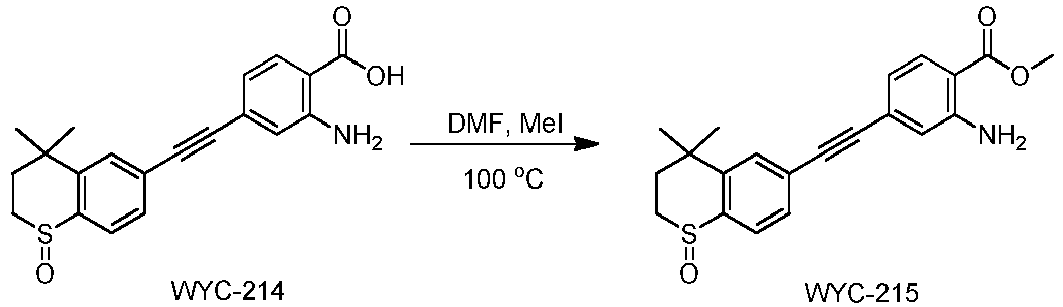
- WYC-214 (150mg, 0.425mmol) was added to a flask, followed by addition of sodium carbonate (176mg, 1.275mmol), then 3mL dry DMF and iodomethane (40µL, 0.637mmol) were added under argon atmosphere. The mixture was slowly heated to 100°C, then the reaction was continued for 6h and monitored by TLC. After completion of the reaction, the reaction solution was cooled to room temperature, diluted with ethyl acetate, washed with saturated sodium bicarbonate solution and saturated sodium chloride solution. The organic phase was dried over anhydrous sodium sulfate, filtered, concentrated and purified by flash column chromatography (PE:EtOAc = 20:1) to give WYC-215 (143mg, 92%). 1H NMR (500 MHz, CDCl3) δ 7.84 (d, J = 8.3 Hz, 1H), 7.73 (d, J = 8.1 Hz, 1H), 7.58 (d, J = 1.5 Hz, 1H), 7.48 (dd, J = 8.0, 1.6 Hz, 1H), 6.87 (d, J = 1.3 Hz, 1H), 6.81 (dd, J = 8.3, 1.5 Hz, 1H), 3.88 (s, 3H), 3.20 (ddd, J = 12.9, 10.6, 2.2 Hz, 1H), 3.10 (ddd, J = 13.1, 8.7, 2.3 Hz, 1H), 2.46 (ddd, J = 14.9, 10.5, 2.2 Hz, 1H), 1.89 (ddd, J = 15.1, 8.7, 2.2 Hz, 3H), 1.47 (s, 3H), 1.33 (s, 3H); 13C NMR (126 MHz, CDCl3) δ 168.19, 150.04, 144.92, 138.59, 131.48, 131.30, 130.34, 130.18, 128.13, 126.44, 119.72, 119.64, 111.06, 90.93, 90.26, 51.84, 43.28, 34.57, 31.36, 31.21, 29.73. ESI(+)-MS: 368.4 [M+1]+.
-

- WYC-212 (50mg, 0.15mmol) was added to a flask, followed by addition of 2mL anhydrous ethanol under argon atmosphere. The mixture was cooled to 0°C under an ice bath, then 0.15mL concentrated sulfuric acid was added dropwise. After completion of the dropwise addition, the reaction solution was heated to reflux and stirred for 4 h, meanwhile TLC was used to monitor the reaction. After completion of the reaction, the reaction solution was cooled to room temperature, treated with 2mol/L sodium hydroxide to neutralize sulfuric acid to make a neutral solution, then washed with saturated sodium chloride solution. The organic phase was dried over anhydrous sodium sulfate, filtered, dried, and purified by flash column chromatography (PE: EtOAc = 10:1) to give WYC-216 (14mg, 25%). 1H NMR (500 MHz, CDCl3) δ 7.84 (d, J = 8.3 Hz, 1H), 7.51 (d, J = 1.6 Hz, 1H), 7.17 (dd, J = 8.1, 1.7 Hz, 1H), 7.06 (d, J = 8.1 Hz, 1H), 6.83 (d, J = 1.3 Hz, 1H), 6.79 (dd, J = 8.3, 1.4 Hz, 1H), 4.33 (q, J = 7.1 Hz, 2H), 3.06 - 3.03 (m, 2H), 1.97 - 1.94 (m, 2H), 1.39 (t, J = 7.1 Hz, 3H), 1.34 (s, 6H). 13C NMR (126 MHz, CDCl3) δ 167.92, 150.10, 142.22, 133.72, 131.35, 129.95, 129.19, 129.02, 126.70, 119.55, 119.39, 118.23, 110.80, 91.99, 88.37, 60.61, 37.36, 33.12, 30.13, 23.37, 14.50. ESI(+)-MS: 366.4 [M+1]+.
-

- WYC-216 (80mg, 0.22mmol) was added to a flask, and 6mg DMAP was added. The flask was purged with argon, then 2mL dry pyridine was added. Then the mixture was cooled to 0°C under an ice bath, and acetyl chloride (31µL, 0.44mmol) was added dropwise. The reaction was continued for 10 min under the ice bath and another 9h at room temperature, meanwhile TLC was used to monitor the reaction. After completion of the reaction, the reaction was quenched with methanol. The mixture was diluted with ethyl acetate, washed with 1mol/L hydrochloric acid to remove pyridine, then washed with saturated sodium bicarbonate solution and saturated sodium chloride solution. The organic phase was dried over anhydrous sodium sulfate, filtered, concentrated and purified by flash column chromatography (PE:EtOAc = 10:1) to give WYC-217 (71mg, 79%). 1H NMR (500 MHz, CDCl3) δ 11.12 (s, 1H), 8.88 (d, J = 1.4 Hz, 1H), 7.99 (d, J = 8.3 Hz, 1H), 7.55 (d, J = 1.7 Hz, 1H), 7.20 (dd, J = 3.6, 1.7 Hz, 1H), 7.18 (dd, J = 3.8, 1.7 Hz, 1H), 7.06 (d, J = 8.1 Hz, 1H), 4.38 (q, J = 7.1 Hz, 2H), 3.06 - 3.03 (m, 2H), 2.24 (s, 3H), 1.97 - 1.94 (m, 2H), 1.42 (t, J = 7.1 Hz, 3H), 1.35 (s, 6H). 13C NMR (126 MHz, CDCl3) δ 169.17, 168.11, 142.25, 141.59, 133.98, 130.81, 130.17, 130.04, 129.24, 126.70, 125.26, 122.97, 118.06, 114.16, 93.43, 88.37, 61.65, 37.36, 33.13, 30.13, 25.68, 23.38, 14.34. ESI(+)-MS: 408.4 [M+1]+.
-

- Ethyl 2-amino-4-iodobenzoate (262.0mg, 1.2mmol) and 1-oxo-6-ethynyl-4,4-dimethylbenzothiopyran (263.0mg, 1mmol) were added to a flask, followed by addition of Pd(PPh3)2Cl2 (42mg, 0.06mmol) and CuI (23mg, 0.12mmol). After the flask was purged with argon for 3 times to remove oxygen, 15mL dry DMF and 0.2mL dry Et3N were added via syringe. The reaction was continued at 75°C for 12 h and monitored by TLC. After completion of the reaction, the reaction solution was cooled to room temperature and the reaction was quenched with saturated ammonium chloride solution. The mixture was diluted with ethyl acetate, washed with saturated ammonium chloride solution and saturated sodium chloride solution. The organic phase was dried over anhydrous sodium sulfate, filtered, concentrated and purified by flash column chromatography (DCM : MeOH = 40:1) to give WYC-218 (275mg, 78%). 1H NMR (500 MHz, pyridine) δ 8.39 (d, J = 8.1 Hz, 1H), 7.97 - 7.82 (m, 2H), 7.61 (s, 1H), 7.38 (s, 1H), 7.05 (d, J = 8.1 Hz, 1H), 3.25 - 3.01 (m, 2H), 2.40 (ddd, J = 14.2, 10.3, 1.7 Hz, 1H), 1.73 (ddd, J = 14.8, 8.8, 1.5 Hz, 1H), 1.28 (s, 3H), 1.19 (s, 3H). 13C NMR (126 MHz, pyridine) δ171.75, 153.03, 150.76, 150.74, 150.55, 150.53, 150.33, 150.31, 146.21, 141.15, 133.49, 132.34, 131.12, 130.89, 128.61, 127.01, 120.48, 119.27, 113.12, 92.51, 91.02, 44.28, 35.32, 31.62, 31.32, 30.49. ESI(+)-MS: 382.4 [M+1]+.
-

- WYC-212 (100mg, 0.3mmol) was added to a flask, followed by addition of sodium carbonate (125mg, 0.9mmol). Then 3mL dry DMF and iodomethane (28µL, 0.445mmol) were added under argon atmosphere, the reaction solution was slowly heated to 100°C and stirred for 4 h, meanwhile TLC was used to monitor the reaction. After completion of the reaction, the reaction solution was cooled to room temperature, diluted with ethyl acetate, washed with saturated sodium bicarbonate solution and saturated sodium chloride solution. The organic phase was dried over anhydrous sodium sulfate, filtered, concentrated and purified by flash column chromatography (PE:EtOAc = 20:1) to give WYC-219 (43mg, 39%) and 3-69-2-2 (45mg, 43%). 1H NMR (500 MHz, CDCl3) δ 7.87 (d, J = 8.2 Hz, 1H), 7.54 (s, 1H), 7.20 (d, J = 8.1 Hz, 1H), 7.06 (d, J = 8.1 Hz, 1H), 6.88 (s, 1H), 6.78 (d, J = 8.2 Hz, 1H), 3.86 (s, 3H), 3.08 - 3.02 (m, 2H), 2.95 (s, 3H), 1.99 - 1.94 (m, 2H), 1.35 (s, 6H). 13C NMR (126 MHz, CDCl3) δ 168.77, 151.15, 142.24, 133.75, 131.64, 130.02, 129.68, 129.24, 126.71, 118.37, 118.24, 114.31, 110.05, 92.11, 88.89, 51.79, 37.38, 33.14, 30.15, 23.39. ESI(+)-MS: 366.2 [M+1]+.
-

- WYC-212 (100mg, 0.3mmol) was added to a flask, followed by addition of potassium carbonate (125mg, 0.9mmol). Dry DMF (3mL) was added under dry argon atmosphere, and MeI (28µL, 0.445mmol) was added dropwise. The reaction was continued at 100°C for 8 h. After completion of the reaction, the reaction solution was cooled to room temperature, diluted with ethyl acetate, successively washed with 1moL/L HCl solution, saturated sodium bicarbonate solution and saturated sodium chloride solution. The organic phase was dried over anhydrous sodium sulfate, filtered, concentrated and purified by flash column chromatography (PE:EtOAc = 20:1) to give WYC-220(45 mg, 44%). 1H NMR (500 MHz, cdcl3) δ 7.83 (d, J = 8.3 Hz, 1H), 7.52 (d, J = 1.7 Hz, 1H), 7.18 (dd, J = 8.1, 1.8 Hz, 1H), 7.07 (d, J = 8.1 Hz, 1H), 6.86 (d, J = 1.4 Hz, 1H), 6.81 (dd, J = 8.3, 1.5 Hz, 1H), 3.88 (s, 3H), 3.08 - 3.02 (m, 2H), 2.00 - 1.93 (m, 2H), 1.35 (s, 6H). 13C NMR (126 MHz, cdcl3) δ 168.25, 149.81, 142.19, 133.74, 131.31, 129.92, 129.16, 129.15, 126.67, 119.74, 119.47, 118.15, 110.58, 92.12, 88.28, 51.75, 37.32, 33.08, 30.09, 23.34. ESI(+)-MS: 352.4 [M+1]+.
-

- WYC-214 (152mg, 0.42mmol) was added to a flask, followed by addition of 10mg DMAP. 5mL dry dichloromethane and 0.212mL triethylamine were added under argon atmosphere. After the reaction solution was cooled to 0°C under an ice bath, acetyl chloride (67µL, 0.84mmol) was added dropwise, and the reaction was continued for 10 min under the ice bath and another 12 h at room temperature, meanwhile TLC was used to monitor the reaction. After completion of the reaction, the reaction was quenched with methanol. The mixture was diluted with ethyl acetate, washed with 1mol/L hydrochloric acid to remove pyridine, then washed with saturated sodium bicarbonate solution and saturated sodium chloride solution. The organic phase was dried over anhydrous sodium sulfate, filtered, concentrated and purified by flash column chromatography (PE:EtOAc = 1:3) to give WYC-221(147mg, 89%). 1H NMR (500 MHz, CDCl3) δ 8.12 (d, J = 8.3 Hz, 1H), 7.63 (d, J = 1.3 Hz, 1H), 7.57 (dd, J = 8.1, 1.5 Hz, 1H), 7.54 (d, J = 1.7 Hz, 1H), 7.21 (dd, J = 8.1, 1.8 Hz, 1H), 7.08 (d, J = 8.1 Hz, 1H), 3.07 - 3.03 (m, 2H), 2.46 (s, 3H), 1.99 - 1.94 (m, 2H), 1.35 (s, 6H). 13C NMR (126 MHz, CDCl3) δ 160.87, 159.36, 146.58, 142.34, 134.73, 132.26, 131.01, 130.04, 129.30, 128.95, 128.45, 126.80, 117.45, 115.64, 95.28, 87.51, 37.21, 33.11, 30.07, 23.38, 21.54. ESI(+)-MS: 396.2 [M+1]+.
-

- 2-(3-Bromophenyl)ethanol (676µL, 5mmol) was added to a flask, followed by addition of 10mL dry dichloromethane, then DMP (2.5g, 6mmol) was added under an ice bath. The reaction was continued for 2 h under the ice bath and another 0.5 h at room temperature, meanwhile TLC was used to monitor the reaction. After completion of the reaction, the reaction solution was cooled to 0°C and the reaction was quenched with sodium thiosulfate solution. The mixture was diluted with ethyl acetate and washed with saturated sodium chloride solution. The organic phase was dried over anhydrous sodium sulfate, filtered, concentrated and purified by flash column chromatography (PE:EtOAc = 15:1) to give 2-(3-bromophenyl)acetaldehyde (0.86g, 87%). 1H NMR (300 MHz, CDCl3) δ 9.74 (1H, t, J = 2.0), 7.46 - 7.37 (2H, m), 7.30 - 7.14 (2H, m), 3.67 (2H, d, J = 2.0). 13C NMR (75 MHz, CDCl3) δ 198.9, 134.5, 133.0, 131.0, 130.9, 128.7, 123.3, 60.8. ESI(+)-MS: 199.1 [M+1]+.
-

- 2-(3-bromophenyl)acetaldehyde (400mg, 2.02mmol) and Ph3PCH=CO2Et (703mg, 2.02mmol) were added to a flask, followed by addition of 10mL dry toluene under argon atmosphere. The reaction was continued at 90° for 8 h and monitored by TLC. After completion of the reaction, the reaction solution was cooled to 0°C, diluted with ethyl acetate, washed with saturated sodium chloride solution. The organic phase was dried over anhydrous sodium sulfate, filtered, concentrated and purified by flash column chromatography (PE:EtOAc = 250:1) to give ethyl 4-(3-bromophenyl)-2-butenoate (514mg, 96%). E-configuration: 1H NMR (500 MHz, CDCl3) δ 7.36 (d, J = 8.0 Hz, 1H), 7.31 (s, 1H), 7.17 (t, J = 7.8 Hz, 1H), 7.11 - 6.99 (m, 2H), 5.80 (dt, J = 15.6, 1.6 Hz, 1H), 4.17 (q, J = 7.1 Hz, 2H), 3.47 (dd, J = 6.8, 1.0 Hz, 2H), 1.27 (t, J = 7.1 Hz, 3H). 13C NMR (126 MHz, CDCl3) δ 166.29, 146.15, 140.06, 131.88, 130.29, 129.90, 127.53, 123.02, 122.77, 77.41, 77.16, 76.91, 60.44, 38.00, 14.32. Z-configuration: 1H NMR (500 MHz, CDCl3) δ 7.38 (s, 1H), 7.36 - 7.33 (m, 1H), 7.16 (dd, J = 4.1, 1.4 Hz, 2H), 6.30 (dt, J = 11.4, 7.6 Hz, 1H), 5.88 (dt, J = 11.4, 1.7 Hz, 1H), 4.22 (q, J = 7.1 Hz, 2H), 4.00 (dd, J = 7.6, 1.4 Hz, 2H), 1.31 (t, J = 7.1 Hz, 3H). 13C NMR (126 MHz, CDCl3) δ 166.33, 146.76, 141.84, 131.76, 130.25, 129.60, 127.41, 122.74, 120.73, 60.23, 34.73, 14.39.
-

- Ethyl 4-(3-bromophenyl)-2-butenoate (1.05g, 3.92mmol) was added to a flask, followed by addition of (10% wt) dry Pd/C (220mg, 0.194mmol), then 20mL ethyl acetate was added under argon atmosphere. After the flask was purged with hydrogen for 3 times, the reaction was continued at room temperature under normal pressure for 24 h and monitored by TLC. After completion of the reaction, the reaction solution was filtered, concentrated and purified by flash column chromatography (PE:EtOAc = 15:1) to give ethyl 4-(3-bromophenyl)butanoate (1.04g, 98%). 1H NMR (500 MHz, CDCl3) δ 7.32 (dd, J = 9.5, 1.3 Hz, 2H), 7.16 - 7.08 (m, 2H), 4.12 (q, J = 7.1 Hz, 2H), 2.64 - 2.59 (m, 2H), 2.30 (t, J = 7.4 Hz, 2H), 1.96 - 1.90 (m, 2H), 1.25 (t, J = 7.1 Hz, 3H). 13C NMR (126 MHz, CDCl3) δ 173.27, 143.87, 131.59, 130.01, 129.18, 127.22, 122.51, 60.40, 34.82, 33.57, 26.36, 14.33. ESI(+)-MS: 271.2 [M+1]+.
-

- Ethyl 4-(3-bromophenyl)butanoate (0.53g, 1.96mmol) was added to a flask, followed by addition of 15mL tetrahydrofuran under argon atmosphere. After the mixture was cooled to 0°C under an ice bath, methylmagnesium bromide (2mL, 5.89mmol) was added dropwise. The reaction was continued for 3 h at 0°C and another 1 h at room temperature, meanwhile TLC was used to monitor the reaction. After completion of the reaction, the reaction solution was cooled to 0°C and the reaction was quenched with ice water. The mixture was diluted with ethyl acetate, neutralized with 1mol/L hydrochloric acid, washed with saturated sodium carbonate solution and saturated sodium chloride solution. The organic phase was dried over anhydrous sodium sulfate, filtered, concentrated and purified by flash column chromatography (PE:EtOAc = 15:1) to give 5-(3-bromophenyl)-2-methyl-2-pentanol(466mg, 93%). 1H NMR (400 MHz, CDCl3) δ 7.37 - 7.26 (m, 2H), 7.22 - 7.10 (m, 2H), 2.62 (dt, J = 15.0, 7.7 Hz, 2H), 1.76 - 1.64 (m, 2H), 1.56 - 1.47 (m, 2H), 1.22 (s, 6H). 13C NMR (126 MHz, CDCl3) δ 144.81, 131.40, 129.84, 128.81, 127.05, 122.33, 70.73, 43.29, 35.95, 29.22, 26.00. ESI(+)-MS: 257.1 [M+1]+.
-

- 5-(3-Bromophenyl)-2-methyl-2-pentanol (340mg, 1.33mmol) was added to a flask, followed by addition of 2mL dry dichloromethane under argon atmosphere. After the mixture was cooled to 0°C under an ice bath, 0.2mL concentrated sulfuric acid was added dropwise, and the reaction was continued at room temperature for 4 h and monitored by TLC. After completion of the reaction, the reaction solution was diluted with water, neutralized with 1mol/L sodium hydroxide to neutralize sulfuric acid, diluted with ethyl acetate, washed with saturated sodium carbonate solution and saturated sodium chloride solution. The organic phase was dried over anhydrous sodium sulfate, filtered and evaporated to give 320mg white solid, which was added to a flask, followed by addition of 4.3mL. 71mg chromium trioxide was dissolved in a mixed solution of 0.648mL acetic acid and 0.342mL acetic anhydride, which was added to the flask under an ice bath. The reaction was continued for 2 h and monitored by TLC. After completion of the reaction, the reaction solution was diluted with EtOAc, washed three times with water, then washed with saturated sodium carbonate solution and saturated sodium chloride solution. The organic phase was dried over anhydrous sodium sulfate, filtered, concentrated and purified by flash column chromatography (PE:EtOAc = 10:1) to give 7-bromo-4,4-dimethyl-3,4-dihydronaphth-1-(2H)-one (268mg, 80%). 1H NMR (400 MHz, CDCl3) δ 7.37 (dd, J= 8.5, 1.6 Hz, 1H), 7.33 - 7.21 (m, 2H), 2.24 - 2.05 (m, 2H), 1.87 - 1.77 (m, 1H), 1.58 - 1.49 (m, 1H), 1.35 (s, 3H), 1.30 (s, 3H). 13C NMR (126 MHz, CDCl3) δ 197.03, 151.09, 136.63, 132.77, 130.15, 128.04, 120.57, 36.86, 35.04, 33.89, 29.65. ESI(+)-MS: 253.1 [M+1]+.
-

- 7-Bromo-4,4-dimethyl-3,4-dihydronaphth-1-(2H)-one (340mg, 1.35mmol) was added to a flask, followed by addition of 3mL tetrahydrofuran under argon atmosphere. After the mixture was cooled to 0°C under an ice bath, phenylmagnesium bromide (2.7mL, 2.7mmol) was added dropwise. The reaction was continued for 0.5 h at 0°C and another 18 h at room temperature, meanwhile TLC was used to monitor the reaction. After completion of the reaction, the reaction solution was cooled to 0°C and the reaction was quenched with ice water. The mixture was diluted with ethyl acetate, neutralized with 1mol/L hydrochloric acid, washed with saturated sodium carbonate solution and saturated sodium chloride solution. The organic phase was dried over anhydrous sodium sulfate, filtered, concentrated and purified by flash column chromatography (PE:EtOAc = 100:1) to give 7-bromo-4,4-dimethyl-1-phenyl-1,2,3,4-tetrahydronaphth-1-ol (280mg, 63%). 1H NMR (400 MHz, CDCl3) δ 7.39 - 7.08 (m, 8H), 2.24 - 2.05 (m, 2H), 1.87 - 1.77 (m, 1H), 1.58 - 1.49 (m, 1H), 1.35 (s, 3H), 1.30 (s, 3H). 13C NMR (126 MHz, CDCl3) δ 148.11, 145.41, 143.32, 131.50, 131.18, 128.46, 128.08, 127.15, 126.59, 119.96, 75.87, 37.69, 34.77, 34.09, 31.56, 31.45. ESI(+)-MS: 331.1 [M+1]+.
-

- 7-Bromo-4,4-dimethyl-1-phenyl-1,2,3,4-tetrahydronaphthalen-1-ol (260mg, 0.79mmol) was added to a flask, followed by addition of p-toluenesulfonic acid (27mg, 0.16mmol), then 2mL dry toluene was added under argon atmosphere. The reaction was continued at 75°C for 0.5 h and monitored by TLC. After completion of the reaction, the reaction solution was cooled to room temperature and the reaction was quenched with ice water. The mixture was diluted with ethyl acetate, washed with saturated sodium carbonate solution and saturated sodium chloride solution. The organic phase was dried over anhydrous sodium sulfate, filtered, concentrated and purified by flash column chromatography (PE:EtOAc = 250:1) to give 6-bromo-1,1-dimethyl-4-phenyl-1,2-dihydronaphthalene (224 mg, 91%). 1H NMR (500 MHz, CDCl3) δ 7.44 - 7.40 (m, 2H), 7.39 - 7.33 (m, 4H), 7.24 (d, J = 8.3 Hz, 1H), 7.17 (d, J = 2.1 Hz, 1H), 6.03 (t, J = 4.7 Hz, 1H), 2.36 (d, J = 4.7 Hz, 2H), 1.34 (s, 6H). 13C NMR (126 MHz, CDCl3) δ 145.59, 144.16, 140.35, 138.75, 136.15, 133.57, 131.80, 130.41, 128.72, 128.56, 127.87, 127.46, 127.02, 125.79, 119.96, 63.05, 38.87, 33.65, 28.18. ESI(+)-MS: 312.1 [M+1]+.
-

- 6-Bromo-1,1-dimethyl-4-phenyl-1,2-dihydronaphthalene (310mg, 1.0mmol) and trimethylethynylsilane (0.28µL, 2mmol) was added to a flask, followed by addition of Pd(PPh3)2Cl2 (21mg, 0.03mmol) and CuI (11mg, 0.06mmol). After the flask was purged with argon for 3 times to remove oxygen, 5mL dry DMF and 0.2mL dry Et3N were added via syringe. The reaction was continued at room temperature over night and monitored by TLC. After completion of the reaction, the reaction was quenched with saturated ammonium chloride solution. The mixture was diluted with ethyl acetate, washed with saturated ammonium chloride solution and saturated sodium chloride solution. The organic phase was dried over anhydrous sodium sulfate, filtered, concentrated and purified by flash column chromatography (petroleum ether) to give ((5,5-dimethyl-8-phenyl-5,6-dihydronaphth-2-yl)ethynyl)trimethylsilane (275mg, 83%). 1H NMR (500 MHz, CDCl3) δ 7.44 - 7.38 (m, 2H), 7.36 - 7.32 (m, 4H), 7.28 (d, J = 7.9 Hz, 10H), 7.11 (d, J = 1.6 Hz, 1H), 5.97 (t, J = 4.7 Hz, 1H), 2.33 (d, J = 4.7 Hz, 2H), 1.31 (s, 6H), 0.19 (s, 9H). 13C NMR (126 MHz, CDCl3) δ 146.01, 140.79, 139.09, 133.98, 131.51, 129.25, 128.83, 128.49, 127.29, 127.27, 123.92, 120.66, 105.45, 93.41, 38.88, 33.90, 28.19, 0.16. ESI(+)-MS: 331.2 [M+1]+.
-

- ((5,5-dimethyl-8-phenyl-5,6-dihydronaphth-2-yl)ethynyl)trimethylsilane (300mg, 0.91mmol) was added to a flask, followed by addition of TBAF (30Mg, 0.115mmol) and 2mL dry tetrahydrofuran. The reaction was continued for 4 h and monitored by TLC. After completion of the reaction, the reaction solution was diluted with ethyl acetate, washed with saturated ammonium chloride solution and saturated sodium chloride solution. The organic phase was dried over anhydrous sodium sulfate, filtered, concentrated and purified by flash column chromatography (PE:EA=1000:1) to give 6-ethynyl-1,1-dimethyl-4-phenyl-1,2-dihydronaphthalene (225mg, 96.6%). 1H NMR (500 MHz, CDCl3) δ 77.47 - 77.34 (m, 7H), 77.22 (d, J = 1.6 Hz, 1H), 76.04 (t, J = 4.7 Hz, 1H), 72.98 (s, 1H), 72.39 (d, J = 4.7 Hz, 2H), 71.38 (s, 6H). 13C NMR (126 MHz, CDCl3) δ 146.23, 140.58, 138.97, 134.13, 131.41, 129.62, 128.77, 128.49, 127.34, 127.27, 124.04, 119.59, 83.98, 76.59, 38.83, 33.85, 28.18. ESI(+)-MS: 259.2 [M+1]+.
-

- 6-Ethynyl-1,1-dimethyl-4-phenyl-1,2-dihydronaphthalene (116mg, 0.45mmol) and methyl 2-hydroxy-4-iodobenzoate (250mµL 0.9mmol) was added to a flask, followed by addition of Pd(PPh3)2Cl2 (9.5mg, 0.0135mmol) and CuI (5.1mg, 0.027mmol). After the flask was purged with argon for 3 times to remove oxygen, 3mL dry DMF and 0.2mL dry Et3N were added via syringe. The reaction was continued at room temperature for 8 h and monitored by TLC. After completion of the reaction, the reaction was quenched with saturated ammonium chloride solution. The mixture was diluted with ethyl acetate, washed with saturated ammonium chloride solution and saturated sodium chloride solution. The organic phase was dried over anhydrous sodium sulfate, filtered, concentrated and purified by flash column chromatography (PE:EA = 500:1) to give WYC-301 (155mg, 79%). 1H NMR (500 MHz, CDCl3) δ 10.75 (s, 1H), 7.76 (d, J = 8.2 Hz, 1H), 7.43 (dd, J = 7.7, 7.1 Hz, 7H), 7.37 (dd, J = 9.3, 3.7 Hz, 4H), 7.21 (d, J = 1.3 Hz, 1H), 7.09 (d, J = 1.2 Hz, 1H), 6.97 (dd, J = 8.2, 1.2 Hz, 1H), 6.02 (t, J = 4.6 Hz, 1H), 3.94 (s, 3H), 2.37 (d, J = 4.7 Hz, 2H), 1.36 (s, 6H). 13C NMR (126 MHz, CDCl3) δ 170.27, 161.31, 146.42, 140.63, 138.99, 134.24, 131.17, 130.83, 129.82, 129.20, 128.80, 128.54, 127.41, 127.38, 124.18, 122.47, 120.36, 120.07, 111.98, 92.99, 87.93, 52.47, 38.85, 33.94, 28.19. ESI(+)-MS: 409.3 [M+1]+.
-

- WYC-301 (250mg, 0.613mmol) was added to a flask, followed by addition of sodium ethoxide (125mg, 1.83mmol) and 5mL ethanol. Then the reaction was continued at room temperature overnight and monitored by TLC. After completion of the reaction, the reaction solution was neutralized to neutral with acid resin and filtered, the filtrate was diluted with ethyl acetate, washed with saturated sodium bicarbonate solution and saturated sodium chloride solution. The organic phase was dried over anhydrous sodium sulfate, filtered, concentrated and purified by flash column chromatography (PE:EtOAc = 100:1) to give WYC-302 (230 mg, 92%). 1H NMR (500 MHz, CDCl3) δ 10.82 (s, 1H), 7.77 (d, J = 8.2 Hz, 1H), 7.45 - 7.39 (m, 3H), 7.38 - 7.34 (m, 4H), 7.19 (d, J = 1.5 Hz, 1H), 7.07 (d, J = 1.4 Hz, 1H), 6.95 (dd, J = 8.2, 1.5 Hz, 1H), 6.01 (t, J = 4.7 Hz, 1H), 4.40 (q, J = 7.1 Hz, 2H), 2.37 (d, J = 4.7 Hz, 2H), 1.41 (t, J = 7.1 Hz, 3H), 1.35 (s, 6H). 13C NMR (126 MHz, CDCl3) δ 169.92, 161.39, 146.40, 140.65, 139.01, 134.25, 131.18, 130.70, 129.83, 129.20, 128.82, 128.55, 127.42, 127.39, 124.19, 122.39, 120.37, 120.11, 112.25, 92.89, 87.99, 61.68, 38.86, 33.96, 28.21, 14.32. ESI(+)-MS: 423.4 [M+1]+.
-

- 2-Fluoro-4-iodobenzoic acid (1.0g, 3.76mmol) was added to a flask, followed by addition of 10mL anhydrous ethanol under argon atmosphere. The mixture was cooled to 0°C under an ice bath, then 0.5mL concentrated sulfuric acid was added dropwise. After completion of the dropwise addition, the reaction solution was heated to reflux and stirred for 4 h, meanwhile TLC was used to monitor the reaction. After completion of the reaction, the reaction solution was cooled to room temperature, treated with 1mol/L sodium hydroxide to neutralize sulfuric acid to make a neutral solution, then washed with saturated sodium bicarbonate solution and saturated sodium chloride solution. The organic phase was dried over anhydrous sodium sulfate, filtered, dried, and purified by flash column chromatography (PE:EtOAc = 15:1) to give ethyl 2-fluoro-4-iodobenzoate (990mg, 90%). 1H NMR (500 MHz, CDCl3) δ 7.62 - 7.57 (m, 1H), 7.52 (dd, J = 8.3, 1.6 Hz, 1H), 7.49 (dd, J = 9.9, 1.5 Hz, 1H), 4.36 (q, J = 7.1 Hz, 2H), 1.36 (t, J = 7.1 Hz, 3H). 13C NMR (126 MHz, CDCl3) δ 163.87, 163.84, 162.18, 160.06, 133.48, 133.45, 133.05, 133.04, 126.54, 126.34, 118.76, 118.68, 99.59, 99.52, 61.59, 14.29. ESI(+)-MS: 294.1 [M+1]+.
-

- 6-Ethynyl-4,4-dimethylbenzothiopyran (275mg, 1.36mmol) and ethyl 2-fluoro-4-iodobenzoate (200mg, 0.68mmol) were added to a flask, followed by addition of Pd(PPh3)2Cl2 (28.6mg, 0.0408mmol) and CuI (15.5mg, 0.0816mmol). After the flask was purged with argon for 3 times to remove oxygen, 3mL dry DMF and 0.3mL dry Et3N were added via syringe. The reaction was continued at 80°C for 6 h and monitored by TLC. After completion of the reaction, the reaction was quenched with saturated ammonium chloride solution. The mixture was diluted with ethyl acetate, washed with saturated ammonium chloride solution and saturated sodium chloride solution. The organic phase was dried over anhydrous sodium sulfate, filtered, concentrated and purified by flash column chromatography (PE:EA = 200:1) to give WYC-303 (215mg, 86%). 1H NMR (500 MHz, CDCl3) δ 7.90 (t, J = 7.8 Hz, 1H), 7.52 (d, J = 1.7 Hz, 1H), 7.32 (dd, J = 8.1, 1.4 Hz, 1H), 7.28 (d, J = 1.4 Hz, 1H), 7.25 (d, J = 1.4 Hz, 1H), 7.19 (dd, J = 8.2, 1.7 Hz, 1H), 7.07 (d, J = 8.1 Hz, 1H), 4.40 (q, J = 7.1 Hz, 2H), 3.07 - 3.03 (m, 2H), 1.98 - 1.94 (m, 2H), 1.40 (t, J = 7.1 Hz, 3H), 1.35 (s, 6H). 13C NMR (126 MHz, CDCl3) δ 164.12, 164.09, 162.75, 160.68, 142.32, 134.45, 132.15, 132.14, 129.98, 129.20, 127.08, 127.05, 126.78, 119.79, 119.60, 117.57, 93.98, 87.00, 86.98, 61.55, 37.25, 33.12, 30.09, 23.37, 14.40. ESI(+)-MS: 369.4 [M+1]+.
-

- WYC-303 (15mg, 0.04mmol) was added to a flask, followed by addition of sodium ethoxide (8.3mg, 0.12mmol) and 1mL tetrahydrofuran. Then the reaction was continued at room temperature overnight and monitored by TLC. After completion of the reaction, the reaction solution was neutralized to neutral with acid resin and filtered, the filtrate was diluted with ethyl acetate, washed with saturated sodium bicarbonate solution and saturated sodium chloride solution. The organic phase was dried over anhydrous sodium sulfate, filtered, concentrated and purified by flash column chromatography (PE:EtOAc = 1:1) to give WYC-304 (11mg, 80%). 1H NMR (500 MHz, CDCl3) δ 7.99 (t, J = 7.9 Hz, 1H), 7.53 (d, J = 1.7 Hz, 1H), 7.35 (dd, J = 8.1, 1.5 Hz, 1H), 7.30 (dd, J = 11.3, 1.4 Hz, 1H), 7.19 (dd, J = 8.1, 1.8 Hz, 1H), 7.08 (d, J = 8.1 Hz, 1H), 3.07 - 3.04 (m, 3H), 1.98 - 1.95 (m, 2H), 1.35 (s, 6H). 13C NMR (126 MHz, CDCl3) δ 167.53, 163.34, 161.26, 142.36, 134.65, 132.80, 131.19, 131.11, 130.04, 129.25, 127.25, 127.22, 126.81, 119.89, 119.70, 117.45, 116.98, 94.69, 86.92, 37.24, 33.14, 30.09, 23.39. ESI(+)-MS: 339.3 [M+1]+.
-

- 6-Ethynyl-1,1-dimethyl-4-phenyl-1,2-dihydronaphthalene (180mg, 0.7mmol) and ethyl 2-fluoro-4-iodo-benzoate (410mg, 1.4mmol) were added to a flask, followed by addition of Pd(PPh3)2Cl2 (30mg, 0.042mmol) and CuI (16.0mg, 0.084mmol). After the flask was purged with argon for 3 times to remove oxygen, 5mL dry DMF and 0.5mL dry Et3N were added via syringe. The reaction was continued at 70°C for 8 h and monitored by TLC. After completion of the reaction, the reaction was quenched with saturated ammonium chloride solution. The mixture was diluted with ethyl acetate, washed with saturated ammonium chloride solution and saturated sodium chloride solution. The organic phase was dried over anhydrous sodium sulfate, filtered, concentrated and purified by flash column chromatography (PE:EA = 200:1) to give WYC-305 (215mg, 72%). 1H NMR (500 MHz, CDCl3) δ 7.87 (t, J = 7.8 Hz, 1H), 7.44 - 7.39 (m, 7H), 7.37 (ddd, J = 6.3, 3.4, 1.5 Hz, 4H), 7.29 - 7.26 (m, 1H), 7.24 - 7.18 (m, 2H), 6.02 (t, J = 4.7 Hz, 1H), 4.39 (q, J = 7.1 Hz, 2H), 2.37 (d, J = 4.7 Hz, 2H), 1.39 (t, J = 7.1 Hz, 3H), 1.35 (s, 6H). 13C NMR (126 MHz, CDCl3) δ 164.12, 164.09, 162.70, 160.63, 146.67, 140.62, 138.95, 134.33, 132.08, 132.07, 131.17, 129.92, 129.84, 129.20, 128.82, 128.57, 127.53, 127.41, 127.17, 127.14, 124.25, 119.91, 119.77, 119.72, 118.51, 118.43, 93.66, 86.96, 86.94, 61.55, 38.84, 33.98, 28.20, 14.39. ESI(+)-MS: 425.5 [M+1]+.
-

- WYC-305 (70mg, 0.19mmol) was added to a flask, followed by addition of sodium ethoxide (26mg, 0.38mmol) and 2mL tetrahydrofuran. Then the reaction was continued at room temperature overnight and monitored by TLC. After completion of the reaction, the reaction solution was neutralized to neutral with acid resin and filtered, the filtrate was diluted with ethyl acetate, washed with saturated sodium bicarbonate solution and saturated sodium chloride solution. The organic phase was dried over anhydrous sodium sulfate, filtered, concentrated and purified by flash column chromatography (PE:EtOAc = 2:1) to give WYC-306 (53mg, 75%). 1H NMR (500 MHz, CDCl3) δ 7.95 (t, J = 7.9 Hz, 1H), 7.44 - 7.39 (m, 7H), 7.39 - 7.35 (m, 4H), 7.30 (dd, J = 8.2, 1.4 Hz, 1H), 7.24 (d, J = 1.3 Hz, 1H), 7.19 (d, J = 1.5 Hz, 1H), 6.02 (t, J = 4.7 Hz, 1H), 2.37 (d, J = 4.7 Hz, 2H), 1.35 (s, 6H). 13C NMR (126 MHz, CDCl3) δ 167.97, 163.32, 161.23, 146.83, 140.60, 138.92, 134.36, 132.74, 131.22, 129.24, 128.83, 128.58, 127.57, 127.43, 127.36, 127.33, 124.29, 120.02, 119.83, 119.64, 116.90, 94.43, 86.86, 38.84, 34.00, 28.20. ESI(+)-MS: 395.4 [M+1]+.
-

- 3-Fluoro-4-iodobenzoic acid (0.95g, 3.57mmol) was added to a flask, followed by addition of 5mL anhydrous ethanol under argon atmosphere. The mixture was cooled to 0°C under an ice bath, then 0.3mL concentrated sulfuric acid was added dropwise. After completion of the dropwise addition, the reaction solution was heated to reflux and stirred for 4 h, meanwhile TLC was used to monitor the reaction. After completion of the reaction, the reaction solution was cooled to room temperature, treated with 1mol/L sodium hydroxide to neutralize sulfuric acid to make a neutral solution, then washed with saturated sodium bicarbonate solution and saturated sodium chloride solution. The organic phase was dried over anhydrous sodium sulfate, filtered, dried, and purified by flash column chromatography (PE:EtOAc = 15:1) to give ethyl 3-fluoro-4-iodobenzoate (920mg, 88%). 1H NMR (500 MHz, CDCl3) δ 7.80 (dd, J = 8.2, 6.2 Hz, 1H), 7.65 (dd, J = 8.4, 1.8 Hz, 1H), 7.53 (dd, J = 8.2, 1.8 Hz, 1H), 4.36 (q, J = 7.1 Hz, 2H), 1.37 (t, J = 7.2 Hz, 3H). 13C NMR (126 MHz, CDCl3) δ 164.99, 164.97, 162.64, 160.67, 139.61, 139.59, 132.94, 132.89, 126.51, 126.48, 116.46, 116.26, 87.88, 87.67, 61.65, 14.33. ESI(+)-MS: 295.1 [M+1]+.
-

- 4-Iodo-3-nitrobenzoic acid (1.9g, 6.48mmol) was added to a flask, followed by addition of 10mL anhydrous ethanol under argon atmosphere. The mixture was cooled to 0°C under an ice bath, then 0.6mL concentrated sulfuric acid was added dropwise. After completion of the dropwise addition, the reaction solution was heated to reflux and stirred for 6 h, meanwhile TLC was used to monitor the reaction. After completion of the reaction, the reaction solution was cooled to room temperature, treated with 1mol/L sodium hydroxide to neutralize sulfuric acid to make a neutral solution, then washed with saturated sodium bicarbonate solution and saturated sodium chloride solution. The organic phase was dried over anhydrous sodium sulfate, filtered, dried, and purified by flash column chromatography (PE:EtOAc = 10:1) to give ethyl 4-iodo-3-nitrobenzoate (1.88g, 90.5%). 1H NMR (500 MHz, CDCl3) δ 8.39 (d, J = 2.0 Hz, 1H), 8.10 (d, J = 8.2 Hz, 1H), 7.85 (dd, J = 8.2, 2.0 Hz, 1H), 4.39 (q, J = 7.1 Hz, 2H), 1.39 (t, J = 7.1 Hz,3H). 13C NMR (126 MHz, CDCl3) δ 164.03, 153.15, 142.33, 133.47, 131.96, 125.98, 92.02, 62.16, 14.29. ESI(+)-MS: 322.1 [M+1]+.
-

- 6-Ethynyl-4,4-dimethylbenzothiopyran (405.6mg, 2mmol) and ethyl 3-fluoro-4-iodobenzoate (294mg, 1.0mmol) were added to a flask, followed by addition of Pd(PPh3)2Cl2 (84mg, 0.12mmol) and CuI (46.0mg, 0.24mmol). After the flask was purged with argon for 3 times to remove oxygen, 5mL dry DMF and 0.5mL dry Et3N were added via syringe. The reaction was continued at 70°C for 8 h and monitored by TLC. After completion of the reaction, the reaction was quenched with saturated ammonium chloride solution. The mixture was diluted with ethyl acetate, washed with saturated ammonium chloride solution and saturated sodium chloride solution. The organic phase was dried over anhydrous sodium sulfate, filtered, concentrated and purified by flash column chromatography (PE:EA = 500:3) to give WYC-307(250mg, 68%). 1H NMR (500 MHz, CDCl3) δ 7.81 (dd, J = 8.0, 1.3 Hz, 1H), 7.76 (dd, J = 9.8, 1.3 Hz, 1H), 7.56 (dd, J = 11.1, 4.2 Hz, 2H), 7.22 (dd, J = 8.1, 1.6 Hz, 1H), 7.08 (d, J = 8.1 Hz, 1H), 4.39 (q, J = 7.1 Hz, 2H), 3.05 (dd, J = 7.1, 5.1 Hz, 2H), 1.98 - 1.94 (m, 2H), 1.40 (t, J = 7.1 Hz, 3H), 1.35 (s, 6H). 13C NMR (126 MHz, CDCl3) δ 165.25, 165.23, 163.21, 161.20, 142.29, 134.42, 133.26, 133.25, 131.70, 131.64, 129.97, 129.27, 126.75, 125.15, 125.12, 117.73, 117.05, 116.92, 116.66, 116.47, 98.04, 98.02, 81.71, 61.62, 37.29, 33.13, 30.09, 23.38, 14.42. ESI(+)-MS: 369.3 [M+1]+.
-

- 6-Ethynyl-4,4-dimethylbenzothiopyran (405.6mg, 2mmol) and ethyl 3-nitro-4-iodobenzoate (303mg, 1.0mmol) were added to a flask, followed by addition of Pd(PPh3)2Cl2 (84mg, 0.12mmol) and CuI (46.0mg, 0.24mmol). After the flask was purged with argon for 3 times to remove oxygen, 5mL dry DMF and 0.5mL dry Et3N were added via syringe. The reaction was continued at 70°C for 8 h and monitored by TLC. After completion of the reaction, the reaction was quenched with saturated ammonium chloride solution. The mixture was diluted with ethyl acetate, washed with saturated ammonium chloride solution and saturated sodium chloride solution. The organic phase was dried over anhydrous sodium sulfate, filtered, concentrated and purified by flash column chromatography (PE:EA = 50:1) to give WYC-308 (384mg, 97%). 1H NMR (400 MHz, CDCl3) δ 8.69 (d, J= 1.2 Hz, 1H), 8.20 (dd, J= 8.1, 1.6 Hz, 1H), 7.74 (d, J = 8.1 Hz, 1H), 7.57 (s, 1H), 7.23- 7.25 (m, 1H), 7.08 (d, J = 8.2 Hz, 1H), 4.42 (q, J = 7.1 Hz, 2H), 3.04 (dd, J = 7.2, 4.9 Hz, 2H), 1.98 - 1.85 (m, 2H), 1.41 (t, J = 7.1 Hz, 3H), 1.34 (s, 6H). 13C NMR (126 MHz, CDCl3) δ 164.34, 149.33, 142.43, 135.66, 134.63, 133.24, 130.35, 130.30, 129.65, 126.86, 126.01, 123.20, 117.23, 101.65, 84.50, 62.11, 37.16, 33.12, 30.04, 23.43, 14.43. ESI(+)-MS: 396.2 [M+1]+.
-

- WYC-308 (100mg, 0.25mmol) was added to a flask, followed by addition of sodium ethoxide (35mg, 0.5mmol) and 2mL ethanol. Then the reaction was continued at room temperature overnight and monitored by TLC. After completion of the reaction, the reaction solution was neutralized to neutral with acid resin and filtered, the filtrate was diluted with ethyl acetate, washed with saturated sodium bicarbonate solution and saturated sodium chloride solution. The organic phase was dried over anhydrous sodium sulfate, filtered, concentrated and purified by flash column chromatography (DCM:MeOH = 20:1) to give WYC-309 (83 mg, 90.4%). 1H NMR (400 MHz, CDCl3) δ 8.78 (s, 1H), 8.26 (d, J = 8.1 Hz, 1H), 7.78 (d, J = 8.0 Hz, 1H), 7.58 (s, 1H), 7.24 (s, 1H), 7.09 (d, J = 8.1 Hz, 1H), 3.10 - 3.04 (m, 2H), 2.00 - 1.93 (m, 2H), 1.36 (s, 6H). 13C NMR (101 MHz, CDCl3) δ 168.58, 149.36, 142.46, 135.91, 134.83, 133.69, 130.42, 129.73, 126.89, 126.73, 124.17, 117.12, 102.51, 84.56, 37.14, 33.13, 30.11, 30.04, 23.45. ESI(+)-MS: 3 [M+1]+.
-

- WYC-307 (332mg, 0.9mmol) was added to a flask, followed by addition of sodium ethoxide (83mg, 1.2mmol) and 7mL ethanol. Then the reaction was continued at room temperature overnight and monitored by TLC. After completion of the reaction, the reaction solution was neutralized to neutral with acid resin and filtered, the filtrate was diluted with ethyl acetate, washed with saturated sodium bicarbonate solution and saturated sodium chloride solution. The organic phase was dried over anhydrous sodium sulfate, filtered, concentrated and purified by flash column chromatography (PE:EA= 1:1) to give WYC-310 (303mg, 99%). 1H NMR (400 MHz, CDCl3) δ 7.85 (dd, J = 8.1, 1.2 Hz, 1H), 7.80 (dd, J = 9.7, 1.1 Hz, 1H), 7.61 - 7.56 (m, 1H), 7.54 (d, J = 1.5 Hz, 1H), 7.21 (d, J = 8.2 Hz, 1H), 7.07 (d, J = 8.2 Hz, 1H), 3.11 - 2.99 (m, 2H), 1.99 - 1.90 (m, 2H), 1.34 (s, 6H). 13C NMR (101 MHz, CDCl3) δ 169.23, 163.46, 160.95, 142.34, 134.64, 133.45, 130.03, 129.32, 126.79, 125.79, 117.62, 117.27, 117.04, 110.16, 98.73, 81.63, 37.28, 33.15, 30.10, 23.40. ESI(+)-MS: 341.2 [M+1]+.
-

- WYC-308(100mg, 0.25mmol) was added to a flask, followed by addition of 5mL dry dichloromethane. After the mixture was cooled to 0°C under an ice bath, mCPBA (60mg, 0.25mmol) was added. Then the reaction was continued for 1 h under the ice bath and another 2 h at room temperature, meanwhile TLC was used to monitor the reaction. After completion of the reaction, the reaction was quenched with sodium thiosulfate solution, the mixture was diluted with ethyl acetate, washed with saturated sodium bicarbonate solution and saturated sodium chloride solution. The organic phase was dried over anhydrous sodium sulfate, filtered, concentrated and purified by flash column chromatography (PE:EtOAc = 3:1) to give WYC-311 (92mg, 88%). 1H NMR (500 MHz, CDCl3) δ 8.73 (d, J = 1.6 Hz, 1H), 8.26 (dd, J = 8.1, 1.7 Hz, 1H), 7.80 (dd, J = 13.0, 8.1 Hz, 2H), 7.66 (d, J = 1.5 Hz, 1H), 7.57 (dd, J = 8.0, 1.6 Hz, 1H), 4.44 (q, J = 7.1 Hz, 2H), 3.23 (ddd, J = 12.8, 10.3, 2.3 Hz, 1H), 3.12 (ddd, J = 13.1, 9.1, 2.3 Hz, 1H), 2.44 (ddd, J = 15.1, 10.3, 2.3 Hz, 1H), 1.91 (ddd, J = 15.1, 9.0, 2.3 Hz, 1H), 1.48 (s, 3H), 1.43 (t, J = 7.1 Hz, 3H), 1.35 (s, 3H). 13C NMR (126 MHz, CDCl3) δ 164.10, 149.65, 145.16, 139.98, 134.95, 133.42, 131.67, 131.30, 130.53, 130.26, 126.01, 125.35, 122.13, 98.90, 86.27, 62.24, 43.39, 34.67, 31.36, 31.24, 29.89, 14.40. ESI(+)-MS: 412.2 [M+1]+.
-

- 1-oxo-6-ethynyl-4,4-dimethylbenzothiopyran (223mg, 1.2mmol) and ethyl 3-fluoro-4-iodobenzoate (200mg, 0.8mmol) were added to a flask, followed by addition of Pd(PPh3)2Cl2 (32mg, 0.0459mmol) and CuI (17.5mg, 0.0918mmol). After the flask was purged with argon for 3 times to remove oxygen, 3mL dry DMF and 0.3mL dry Et3N were added via syringe. Then the reaction was continued at 75°C for 8 h and monitored by TLC. After completion of the reaction, the reaction solution was cooled to room temperature and the reaction was quenched with saturated ammonium chloride solution. The mixture was diluted with ethyl acetate, washed with saturated ammonium chloride solution and saturated sodium chloride solution. The organic phase was dried over anhydrous sodium sulfate, filtered, concentrated and purified by flash column chromatography (PE:EtOAc = 3:2) to give WYC-312 (254mg, 82.5%). 1H NMR (500 MHz, CDCl3) δ 7.84 (dd, J = 8.0, 1.5 Hz, 1H), 7.81 - 7.75 (m, 2H), 7.63 - 7.58 (m, 2H), 7.54 (dd, J = 8.0, 1.6 Hz, 1H), 4.40 (q, J = 7.1 Hz, 2H), 3.22 (ddd, J = 12.9, 10.4, 2.3 Hz, 1H), 3.11 (ddd, J = 13.1, 8.9, 2.4 Hz, 1H), 2.46 (ddd, J = 15.1, 10.4, 2.3 Hz, 1H), 1.91 (ddd, J = 15.1, 8.9, 2.3 Hz, 1H), 1.49 (s, 3H), 1.41 (t, J = 7.1 Hz, 4H), 1.35 (s, 4H). 13C NMR (126 MHz, CDCl33) δ 165.04, 163.42, 161.41, 145.01, 139.21, 133.49, 132.58, 132.52, 132.26, 132.18, 131.33, 130.29, 130.27, 128.67, 128.57, 125.87, 125.22, 125.19, 116.78, 116.60, 116.06, 115.93, 96.03, 96.00, 84.16, 61.73, 43.34, 34.62, 31.36, 31.22, 29.81, 14.40. ESI(+)-MS: 385.2 [M+1]+.
-

- 2,3-Difluoro-4-iodobenzoic acid (0.5g, 1.76mmol) was added to a flask, followed by addition of 4mL anhydrous ethanol under argon atmosphere. The mixture was cooled to 0°C under an ice bath, then 0.3mL concentrated sulfuric acid was added dropwise. After completion of the dropwise addition, the reaction solution was heated to reflux and stirred for 6 h, meanwhile TLC was used to monitor the reaction. After completion of the reaction, the reaction solution was cooled to room temperature, treated with 1mol/L sodium hydroxide to neutralize sulfuric acid to make a neutral solution, then washed with saturated sodium bicarbonate solution and saturated sodium chloride solution. The organic phase was dried over anhydrous sodium sulfate, filtered, dried, and purified by flash column chromatography (PE:EtOAc = 10:1) to give
ethyl 2,3-difluoro-4-iodobenzoate (0.48g, 87%). 1H NMR (500 MHz, CDCl3) δ 7.55 (ddd, J = 8.4, 5.2, 1.8 Hz, 1H), 7.44 (ddd, J = 8.4, 6.3, 1.8 Hz, 1H), 4.38 (q, J = 7.1 Hz, 2H), 1.38 (t, J = 7.1 Hz, 3H). 13C NMR (126 MHz, CDCl3) δ 163.13, 163.10, 163.08, 152.43, 152.31, 150.69, 150.56, 150.46, 150.35, 148.56, 148.44, 133.21, 133.17, 127.48, 127.44, 121.24, 121.18, 88.19, 88.01, 61.98, 14.27. ESI(+)-MS: 313.1 [M+1]+. -

-
Ethyl 2,3-difluoro-4-iodobenzoate (200mg, 0.64mmol) and 6-ethynyl-4,4-dimethylbenzothiopyran (195mg, 0.96mmol) were added to a flask, followed by addition of Pd(PPh3)2Cl2 (20mg, 0.0288mmol) and CuI (11mg, 0.0576mmol). After the flask was purged with argon for 3 times to remove oxygen, 2mL dry DMF and 0.2mL dry Et3N were added via syringe. Then the reaction was continued at 75°C for 8 h and monitored by TLC. After completion of the reaction, the reaction solution was cooled to room temperature and the reaction was quenched with saturated ammonium chloride solution. The mixture was diluted with ethyl acetate, washed with saturated ammonium chloride solution and saturated sodium chloride solution. The organic phase was dried over anhydrous sodium sulfate, filtered, concentrated and purified by flash column chromatography (PE:EtOAc = 100:1) to give WYC-313 (215mg, 82%). 1H NMR (500 MHz, CDCl3) δ 7.65 (ddd, J = 8.3, 6.5, 1.8 Hz, 1H), 7.54 (d, J = 1.7 Hz, 1H), 7.28 (ddd, J = 8.0, 4.9, 1.9 Hz, 1H), 7.21 (dd, J = 8.2, 1.8 Hz, 1H), 7.08 (d, J = 8.2 Hz, 1H), 4.41 (q, J = 7.1 Hz, 2H), 3.07 - 3.03 (m, 2H), 1.97 - 1.93 (m, 2H), 1.40 (t, J = 7.1 Hz, 3H), 1.34 (s, 6H). 13C NMR (126 MHz, CDCl3) δ 163.34, 152.40, 152.29, 151.69, 151.58, 150.38, 150.27, 149.60, 149.49, 142.32, 134.92, 129.98, 129.27, 127.01, 126.98, 126.76, 126.01, 125.97, 120.13, 120.07, 118.59, 118.51, 117.25, 99.26, 99.23, 80.63, 80.60, 61.87, 37.18, 33.09, 30.02, 23.35, 14.33. ESI(+)-MS: 387.2 [M+1]+. -

- WYC-313 (84mg, 0.218mmol) was added to a flask, followed by addition of sodium ethoxide (44.4mg, 0.653mmol) and 2mL ethanol. Then the reaction was continued at room temperature overnight and monitored by TLC. After completion of the reaction, the reaction solution was neutralized to neutral with acid resin and filtered, the filtrate was diluted with ethyl acetate, washed with saturated sodium bicarbonate solution and saturated sodium chloride solution. The organic phase was dried over anhydrous sodium sulfate, filtered, concentrated and purified by flash column chromatography (PE:EA = 1:1) to give WYC-314 (68mg, 87.5%). 1H NMR (500 MHz, pyridine) δ 8.01 (t, J = 7.4 Hz, 1H), 7.82 (s, 1H), 7.45 (t, J = 7.2 Hz, 1H), 7.40 (d, J = 8.1 Hz, 1H), 7.24 (d, J = 8.1 Hz, 1H), 2.95 - 2.89 (m, 2H), 1.78 - 1.71 (m, 2H), 1.19 (s, 6H). ESI(-)-MS: 357.2 [M-1]-.
-

- WYC-313 (90mg, 0.233mmol) was added to a flask, followed by addition of 5mL dry dichloromethane. After the mixture was cooled to 0°C under an ice bath, mCPBA (58mg, 0.233mmol) was added. Then the reaction was continued for 1 h under the ice bath and another 2 h at room temperature, meanwhile TLC was used to monitor the reaction. After completion of the reaction, the reaction was quenched with sodium thiosulfate solution, the mixture was diluted with ethyl acetate, washed with saturated sodium bicarbonate solution and saturated sodium chloride solution. The organic phase was dried over anhydrous sodium sulfate, filtered, concentrated and purified by flash column chromatography (PE:EtOAc = 3:1) to give WYC-315 (76 mg, 78%). 1H NMR (500 MHz, CDCl3) δ 7.76 (d, J = 8.0 Hz, 1H), 7.71 - 7.65 (m, 1H), 7.62 (s, 1H), 7.53 (dd, J = 8.0, 0.8 Hz, 1H), 7.32 (dd, J = 10.4, 3.9 Hz, 1H), 4.41 (q, J = 7.1 Hz, 2H), 3.26 - 3.18 (m, 1H), 3.15 - 3.07 (m, 1H), 2.44 (ddd, J = 14.8, 10.3, 2.0 Hz, 1H), 1.90 (ddd, J = 15.1, 8.9, 2.0 Hz, 1H), 1.47 (s, 3H), 1.40 (t, J = 7.1 Hz, 3H), 1.34 (s, 3H). 13C NMR (126 MHz, CDCl3) δ 163.22, 163.20, 163.17, 152.69, 152.58, 151.65, 151.54, 150.66, 150.55, 149.55, 145.10, 139.57, 131.40, 130.30, 130.27, 127.25, 127.22, 126.15, 126.12, 125.41, 121.05, 120.99, 117.60, 117.59, 117.50, 117.48, 97.09, 97.05, 82.93, 82.90, 62.02, 43.34, 34.63, 31.34, 31.21, 29.82, 14.32. ESI(+)-MS: 403.1 [M+1]+.
-

- Methyl 3-amino-4-iodobenzoate (1.5g, 5.43mmol) was added to a flask, followed by addition of 20mL dry dichloromethane and 4.5mL dry triethylamine, then 0.77mL acetyl chloride was added dropwise under an ice bath. The reaction was continued at room temperature overnight and monitored by TLC. After completion of the reaction, the reaction was quenched with methanol. The mixture was diluted with ethyl acetate, washed with saturated sodium bicarbonate solution and saturated sodium chloride solution. The organic phase was dried over anhydrous sodium sulfate, filtered, concentrated and purified by flash column chromatography (PE:EtOAc = 10:1) to give methyl 3-acetamido-4-iodobenzoate (1.34g, 77.5%). 1H NMR (500 MHz, CDCl3) δ 8.75 (s, 1H), 7.86 (d, J = 8.3 Hz, 1H), 7.54 - 7.39 (m, 2H), 3.90 (s, 3H), 2.25 (s, 3H). 13C NMR (126 MHz, CDCl3) δ 168.29, 166.28, 138.97, 138.54, 131.46, 126.74, 122.89, 96.10, 52.44, 24.78. ESI(+)-MS: 320.1 [M+1]+.
-

- Methyl 3-acetamido-4-iodobenzoate (319mg, 1mmol) and 6-ethynyl-4,4-dimethylbenzothiopyran (304mg, 1.5mmol) were added to a flask, followed by addition of Pd(PPh3)2Cl2 (47mg, 0.0675mmol) and CuI (26mg, 0.135mmol). After the flask was purged with argon for 3 times to remove oxygen, 5mL dry DMF and 0.3mL dry Et3N were added via syringe. Then the reaction was continued at 70°C for 8 h and monitored by TLC. After completion of the reaction, the reaction was quenched with saturated ammonium chloride solution. The mixture was diluted with ethyl acetate, washed with saturated ammonium chloride solution and saturated sodium chloride solution. The organic phase was dried over anhydrous sodium sulfate, filtered, concentrated and purified by flash column chromatography (PE:EtOAc = 10:1) to give WYC-316 (298mg, 76%). 1H NMR (500 MHz, CDCl3) δ 9.00 (s, 1H), 7.97 (s, 1H), 7.74 (dd, J = 8.1, 1.2 Hz, 1H), 7.57 - 7.50 (m, 2H), 7.18 (dd, J = 8.1, 1.7 Hz, 1H), 7.10 (d, J = 8.1 Hz, 1H), 3.91 (s, 3H), 3.10 - 3.02 (m, 2H), 2.26 (s, 3H), 1.98 - 1.93 (m, 2H), 1.35 (s, 6H). 13C NMR (126 MHz, CDCl3) δ 168.23, 166.55, 142.53, 138.77, 135.02, 131.51, 130.80, 129.71, 128.90, 126.92, 124.65, 120.35, 117.03, 110.11, 99.62, 83.25, 52.42, 37.09, 33.11, 30.02, 25.03, 23.36. ESI(+)-MS: 394.2 [M+1]+.
-

- WYC-316 (56mg, 0.142mmol) was added to a flask, followed by addition of sodium ethoxide (29mg, 0.426mmol) and 2mL ethanol. Then the reaction was continued at room temperature overnight and monitored by TLC. After completion of the reaction, the reaction solution was neutralized to neutral with acid resin and filtered, the filtrate was diluted with ethyl acetate, washed with saturated sodium bicarbonate solution and saturated sodium chloride solution. The organic phase was dried over anhydrous sodium sulfate, filtered, concentrated and purified by flash column chromatography (PE:EA = 20:1) to give WYC-317 (48mg, 83%). 1H NMR (500 MHz, CDCl3) δ 9.00 (s, 1H), 7.97 (s, 1H), 7.75 (d, J = 8.0 Hz, 1H), 7.53 (d, J = 7.2 Hz, 2H), 7.18 (dd, J = 8.1, 1.3 Hz, 1H), 7.10 (d, J = 8.1 Hz, 1H), 4.38 (q, J = 7.1 Hz, 2H), 3.09 - 3.02 (m, 2H), 2.26 (s, 3H), 1.98 - 1.94 (m, 2H), 1.39 (t, J = 7.1 Hz, 3H), 1.35 (s, 6H). 13C NMR (126 MHz, CDCl3) δ 168.22, 166.08, 142.53, 138.76, 135.00, 131.47, 131.21, 129.72, 128.91, 126.93, 124.64, 120.38, 117.07, 110.12, 99.54, 83.31, 61.39, 37.11, 33.12, 30.04, 25.03, 23.36, 14.44. ESI(+)-MS: 408.2 [M+1]+.
-

- WYC-317 (86mg, 0.211mmol) was added to a flask, followed by addition of 2mL dry dichloromethane. After the mixture was cooled to 0°C under an ice bath, mCPBA (37mg, 0.211mmol) was added. Then the reaction was continued for 1 h under the ice bath and another 2 h at room temperature, meanwhile TLC was used to monitor the reaction. After completion of the reaction, the reaction was quenched with sodium thiosulfate solution, the mixture was diluted with ethyl acetate, washed with saturated sodium bicarbonate solution and saturated sodium chloride solution. The organic phase was dried over anhydrous sodium sulfate, filtered, concentrated and purified by flash column chromatography (PE:EtOAc = 1:1) to give WYC-318 (80mg, 98.6%). 1H NMR (500 MHz, CDCl33) δ 8.98 (s, 1H), 7.93 (s, 1H), 7.78 (d, J = 8.0 Hz, 2H), 7.61 (d, J = 1.3 Hz, 1H), 7.57 (d, J = 8.1 Hz, 1H), 7.50 (dd, J = 8.0, 1.3 Hz, 1H), 4.38 (q, J = 7.1 Hz, 2H), 3.24 (dd, J = 17.2, 6.3 Hz, 1H), 3.17 - 3.09 (m, 1H), 2.45 (ddd, J = 14.8, 10.3, 1.9 Hz, 1H), 2.27 (s, 3H), 1.91 (ddd, J = 15.1, 8.9, 2.0 Hz, 1H), 1.48 (s, 3H), 1.39 (t, J = 7.1 Hz, 3H), 1.35 (s, 3H). 13C NMR (126 MHz, CDCl3) δ 168.29, 165.92, 145.31, 139.07, 131.97, 131.91, 131.19, 130.44, 129.98, 125.33, 124.80, 124.76, 120.86, 115.83, 97.48, 85.94, 61.51, 43.40, 34.66, 31.36, 31.27, 29.79, 14.43. ESI(+)-MS: 424.1 [M+1]+.
-

- WYC-316 (63mg, 0.16mmol) was added to a flask, followed by addition of sodium ethoxide (14mg, 0.2mmol), 2mL tetrahydrofuran and 0.2mL water. Then the reaction was continued at room temperature overnight and monitored by TLC. After completion of the reaction, the reaction solution was neutralized to neutral with acid resin and filtered, the filtrate was diluted with ethyl acetate, washed with saturated sodium bicarbonate solution and saturated sodium chloride solution. The organic phase was dried over anhydrous sodium sulfate, filtered, concentrated and purified by flash column chromatography (PE:EtOAc = 1:4) to give WYC-319 (34mg, 56%). ESI(+)-MS: 380.2 [M+1]+.
-

- 5-Bromopyridazin-2-carboxylic acid (1.0g, 5mmol) was added to a flask, followed by addition of 5mL anhydrous ethanol under argon atmosphere. The mixture was cooled to 0°C under an ice bath, then 0.3mL concentrated sulfuric acid was added dropwise. After completion of the dropwise addition, the reaction solution was heated to reflux and stirred for 6 h, meanwhile TLC was used to monitor the reaction. After completion of the reaction, the reaction solution was cooled to room temperature, treated with 1mol/L sodium hydroxide to neutralize sulfuric acid to make a neutral solution, then washed with saturated sodium bicarbonate solution and saturated sodium chloride solution. The organic phase was dried over anhydrous sodium sulfate, filtered, dried, and purified by flash column chromatography (PE:EtOAc = 50:1) to give ethyl 5-bromopyridazin-2-carboxylate (0.42g, 37%). 1H NMR (500 MHz, CDCl3) δ 9.01 (d, J = 1.3 Hz, 1H), 8.76 (d, J = 1.3 Hz, 1H), 4.47 (q, J = 7.1 Hz, 2H), 1.41 (t, J = 7.1 Hz, 3H). 13C NMR (126 MHz, CDCl3) δ 163.39, 147.30, 146.31, 144.65, 141.89, 62.67, 14.30. ESI(+)-MS: 231.2 [M+1]+.
-

- WYC-209 (1.1g, 3mmol) was added to a flask, followed by addition of 20mL dry dichloromethane. After the mixture was cooled to 0°C under an ice bath, mCPBA (0.663g, 3.6mmol) was added. Then the reaction was continued for 10 min under the ice bath and another 3 h at room temperature, meanwhile TLC was used to monitor the reaction. After completion of the reaction, the reaction was quenched with sodium thiosulfate solution, the mixture was diluted with ethyl acetate, washed with saturated sodium bicarbonate solution and saturated sodium chloride solution. The organic phase was dried over anhydrous sodium sulfate, filtered, concentrated and purified by flash column chromatography (PE:EtOAc = 1:5) to give WYC-320 (0.99 g, 89%). 1H NMR (500 MHz, CDCl3) δ 9.29 (s, 2H), 7.94 (d, J = 8.2 Hz, 1H), 7.76 (d, J = 1.3 Hz, 1H), 7.68 (dd, J = 8.2, 1.5 Hz, 1H), 4.47 (q, J = 7.1 Hz, 2H), 3.46 - 3.37 (m, 2H), 2.45 - 2.39 (m, 2H), 1.44 (s, 6H). 13C NMR (126 MHz, CDCl3) δ 163.22, 158.51, 155.10, 145.17, 138.59, 132.27, 131.31, 125.41, 124.24, 122.74, 89.85, 88.71, 62.32, 47.06, 35.49, 34.47, 30.71, 14.35. ESI(+)-MS: 385.4 [M+1]+.
-

- WYC-316 (107mg, 0.272mmol) was added to a flask, followed by addition of 3.5mL dry dichloromethane. After the mixture was cooled to 0°C under an ice bath, mCPBA (67.3mg, 0.272mmol) was added. Then the reaction was continued for 1 h under the ice bath and another 2 h at room temperature, meanwhile TLC was used to monitor the reaction. After completion of the reaction, the reaction was quenched with sodium thiosulfate solution, the mixture was diluted with ethyl acetate, washed with saturated sodium bicarbonate solution and saturated sodium chloride solution. The organic phase was dried over anhydrous sodium sulfate, filtered, concentrated and purified by flash column chromatography (PE:EtOAc = 1:1) to give WYC-321 (84mg, 78%). 1H NMR (500 MHz, CDCl3) δ 8.97 (s, 1H), 7.96 (s, 1H), 7.80 - 7.72 (m, 2H), 7.60 (d, J = 1.4 Hz, 1H), 7.56 (d, J = 8.1 Hz, 1H), 7.49 (dd, J = 8.0, 1.3 Hz, 1H), 3.90 (s, 3H), 3.14 (ddt, J = 12.9, 8.9, 6.4 Hz, 2H), 2.45 (ddd, J = 14.8, 10.3, 1.7 Hz, 1H), 2.26 (s, 3H), 1.90 (ddd, J = 15.0, 8.9, 1.9 Hz, 1H), 1.47 (s, 3H), 1.34 (s, 3H). 13C NMR (126 MHz, CDCl3) δ 168.28, 166.37, 145.28, 139.65, 139.09, 131.94, 131.52, 131.18, 130.41, 129.95, 125.29, 124.74, 120.91, 115.97, 97.52, 85.89, 52.49, 43.37, 34.63, 31.32, 31.25, 29.76, 24.99. ESI(+)-MS: 410.3 [M+1]+.
-

- ethyl 5-bromopyridazin-2-carboxylate (600mg, 2.61mmol) and 6-ethynyl-4,4-dimethylbenzothiopyran (635mg, 3.13mmol) were added to a flask, followed by addition of Pd(PPh3)2Cl2 (66mg, 0.094mmol) and CuI (36mg, 0.188mmol). After the flask was purged with argon for 3 times to remove oxygen, 6mL dry DMF and 0.4mL dry Et3N were added via syringe. Then the reaction was continued at 80°C for 8 h and monitored by TLC. After completion of the reaction, the reaction was quenched with saturated ammonium chloride solution. The mixture was diluted with ethyl acetate, washed with saturated ammonium chloride solution and saturated sodium chloride solution. The organic phase was dried over anhydrous sodium sulfate, filtered, concentrated and purified by flash column chromatography (PE:EtOAc = 50:1) to give WYC-322 (656mg, 71.5%). 1H NMR (500 MHz, CDCl3) δ 9.20 (d, J = 1.4 Hz, 1H), 8.76 (d, J = 1.4 Hz, 1H), 7.58 (d, J = 1.7 Hz, 1H), 7.23 (dd, J = 8.2, 1.8 Hz, 1H), 7.04 (d, J = 8.2 Hz, 1H), 4.46 (q, J = 7.1 Hz, 2H), 3.02 - 2.97 (m, 2H), 1.92 - 1.87 (m, 2H), 1.41 (t, J = 7.1 Hz, 3H), 1.29 (s, 6H). 13C NMR (126 MHz,CDCl3) δ 163.65, 146.68, 145.70, 143.08, 142.31, 140.30, 136.14, 130.54, 129.51, 126.74, 116.00, 97.55, 85.68, 62.37, 36.91, 32.99, 29.89, 23.27, 14.31. ESI(+)-MS: 353.5 [M+1]+.
-

- WYC-322 (50mg, 0.14mmol) was added to a flask, followed by addition of sodium ethoxide (29mg, 0.426mmol) and 2mL ethanol. Then the reaction was continued at room temperature overnight and monitored by TLC. After completion of the reaction, the reaction solution was neutralized to neutral with acid resin and filtered, the filtrate was diluted with ethyl acetate, washed with saturated sodium bicarbonate solution and saturated sodium chloride solution. The organic phase was dried over anhydrous sodium sulfate, filtered, concentrated and purified by flash column chromatography (DCM:MeOH = 15:1) to give WYC-323 (43mg, 95%). 1H NMR (500 MHz, pyridine) δ 9.65 (s, 1H), 9.05 (s, 1H), 7.84 (d, J = 1.4 Hz, 1H), 7.41 (dd, J = 8.1, 1.4 Hz, 1H), 7.23 (d, J = 8.1 Hz, 1H), 2.98 - 2.88 (m, 2H), 1.81- 1.72 (m, 2H), 1.19 (s, 6H). 13C NMR (126 MHz, pyridine) δ 166.73, 147.26, 146.43, 143.36, 142.96, 142.56, 136.52, 130.88, 129.89, 127.24, 116.79, 96.42, 86.89, 36.94, 33.05, 29.59, 23.30. ESI(+)-MS: 325.2 [M+1]+.
-

- WYC-322 (100mg, 0.284mmol) was added to a flask, followed by addition of 3.5mL dry dichloromethane. After the mixture was cooled to 0°C under an ice bath, mCPBA (49mg, 0.284mmol) was added. Then the reaction was continued for 1 h under the ice bath and another 2 h at room temperature, meanwhile TLC was used to monitor the reaction. After completion of the reaction, the reaction was quenched with sodium thiosulfate solution, the mixture was diluted with ethyl acetate, washed with saturated sodium bicarbonate solution and saturated sodium chloride solution. The organic phase was dried over anhydrous sodium sulfate, filtered, concentrated and purified by flash column chromatography (PE:EtOAc = 1:2) to give WYC-324 (78mg, 75%). 1H NMR (500 MHz, CDCl33) δ 9.29 (d, J = 1.4 Hz, 1H), 8.87 (d, J = 1.4 Hz, 1H), 7.80 (d, J = 8.1 Hz, 1H), 7.71 (d, J = 1.5 Hz, 1H), 7.61 (dd, J = 8.1, 1.6 Hz, 1H), 4.52 (q, J = 7.1 Hz, 2H), 3.29 - 3.06 (m, 2H), 2.43 (ddd, J = 15.1, 10.2, 2.3 Hz, 1H), 1.91 (ddd, J = 15.1, 9.2, 2.3 Hz, 1H), 1.47 (dd, J = 8.8, 5.5 Hz, 6H), 1.34 (s, 3H). 13C NMR (126 MHz, CDCl3) δ 163.62, 147.07, 145.93, 145.25, 142.41, 141.29, 140.60, 132.05, 130.63, 130.25, 124.32, 94.92, 87.36, 62.70, 43.44, 34.73, 31.35, 31.25, 29.91, 14.41. ESI(+)-MS: 396.2 [M+1]+.
-

- 2-Chloro-4-iodobenzoic acid (1.0g, 3.55mmol) was added to a flask, followed by addition of 7mL anhydrous ethanol under argon atmosphere. The mixture was cooled to 0°C under an ice bath, then 0.4mL concentrated sulfuric acid was added dropwise. After completion of the dropwise addition, the reaction solution was heated to reflux and stirred for 5 h, meanwhile TLC was used to monitor the reaction. After completion of the reaction, the reaction solution was cooled to room temperature, treated with 1mol/L sodium hydroxide to neutralize sulfuric acid to make a neutral solution, then washed with saturated sodium bicarbonate solution and saturated sodium chloride solution. The organic phase was dried over anhydrous sodium sulfate, filtered, dried, and purified by flash column chromatography (PE:EtOAc = 7:1) to give ethyl 2-chloro-4-iodobenzoate (0.98g, 89%). 1H NMR (500 MHz, CDCl3) δ 7.82 (d, J = 1.6 Hz, 1H), 7.65 (dd, J = 8.2, 1.6 Hz, 1H), 7.52 (d, J = 8.2 Hz, 1H), 4.38 (q, J = 7.1 Hz, 2H), 1.39 (t, J = 7.2 Hz, 3H). 13C NMR (126 MHz, CDCl3) δ 165.22, 139.57, 135.95, 134.63, 132.47, 129.91, 98.35, 61.87, 14.32. ESI(+)-MS: 311.3 [M+1]+.
-
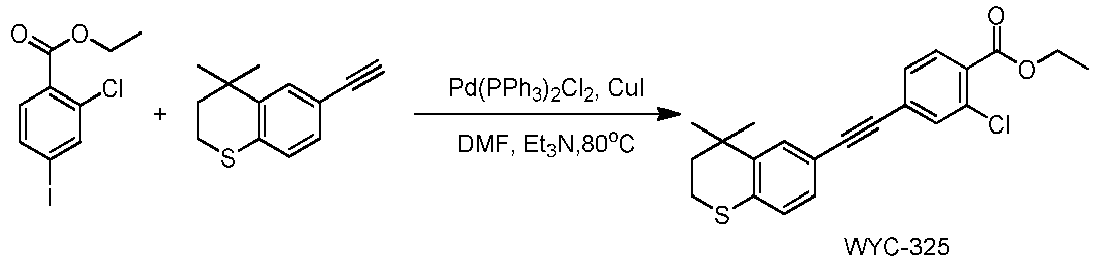
- Ethyl 2-chloro-4-iodobenzoate (310mg, 1mmol) and 6-ethynyl-4,4-dimethylbenzothiopyran (244mg, 1.2mmol) were added to a flask, followed by addition of Pd(PPh3)2Cl2 (28mg, 0.04mmol) and CuI (11.4mg, 0.06mmol). After the flask was purged with argon for 3 times to remove oxygen, 3mL dry DMF and 0.3mL dry Et3N were added via syringe. Then the reaction was continued at 80°C for 8 h and monitored by TLC. After completion of the reaction, the reaction was quenched with saturated ammonium chloride solution. The mixture was diluted with ethyl acetate, washed with saturated ammonium chloride solution and saturated sodium chloride solution. The organic phase was dried over anhydrous sodium sulfate, filtered, concentrated and purified by flash column chromatography (PE:EtOAc = 50:1) to give WYC-325 (365mg, 95%). 1H NMR (500 MHz, CDCl3) δ 7.81 (d, J = 8.1 Hz, 1H), 7.59 (d, J = 1.5 Hz, 1H), 7.52 (d, J = 1.7 Hz, 1H), 7.42 (dd, J = 8.1, 1.5 Hz, 1H), 7.18 (dd, J = 8.2, 1.8 Hz, 1H), 7.07 (d, J = 8.1 Hz, 1H), 4.40 (q, J = 7.1 Hz, 2H), 3.06 - 3.02 (m, 2H), 1.97 - 1.93 (m, 2H), 1.40 (t, J = 7.1 Hz, 3H), 1.34 (s, 6H). 13C NMR (126 MHz, CDCl3) δ 165.27, 142.26, 134.37, 133.89, 133.65, 131.41, 129.92, 129.38, 129.30, 129.14, 128.27, 126.72, 117.56, 93.73, 86.76, 61.71, 37.21, 33.06, 30.04, 23.32, 14.33. ESI(+)-MS: 385.2 [M+1]+.
-

- WYC-325 (100mg, 0.26mmol) was added to a flask, followed by addition of 3mL dry dichloromethane. After the mixture was cooled to 0°C under an ice bath, mCPBA (60mg, 0.26mmol) was added. Then the reaction was continued for 1 h under the ice bath and another 2 h at room temperature, meanwhile TLC was used to monitor the reaction. After completion of the reaction, the reaction was quenched with sodium thiosulfate solution, the mixture was diluted with ethyl acetate, washed with saturated sodium bicarbonate solution and saturated sodium chloride solution. The organic phase was dried over anhydrous sodium sulfate, filtered, concentrated and purified by flash column chromatography (PE:EtOAc = 1:3) to give WYC-326 (86mg, 83%). 1H NMR (500 MHz, CDCl3) δ 7.79 (d, J = 8.1 Hz, 1H), 7.71 (d, J = 8.1 Hz, 1H), 7.59 (d, J = 1.5 Hz, 1H), 7.57 (d, J = 1.5 Hz, 1H), 7.46 (dd, J = 8.0, 1.5 Hz, 1H), 7.42 (dd, J = 8.1, 1.6 Hz, 1H), 4.36 (q, J = 7.1 Hz, 2H), 3.17 (ddd, J = 12.7, 10.5, 2.1 Hz, 1H), 3.06 (ddd, J = 13.1, 8.8, 2.2 Hz, 1H), 2.41 (ddd, J = 14.9, 10.4, 2.1 Hz, 1H), 1.85 (ddd, J = 15.1, 8.8, 2.2 Hz, 1H), 1.43 (s, 3H), 1.36 (t, J = 7.1 Hz, 3H), 1.30 (s, 3H). 13C NMR (126 MHz, CDCl3) δ 165.05, 144.93, 138.96, 133.81, 133.81, 131.36, 131.23, 130.19, 130.08, 130.05, 129.58, 127.12, 125.66, 91.67, 89.03, 61.74, 43.16, 34.45, 31.20, 31.06, 29.59, 14.22. ESI(+)-MS: 401.2 [M+1]+.
-

- WYC-325 (100mg, 0.26mmol) was added to a flask, followed by addition of sodium ethoxide (29mg, 0.426mmol) and 2mL ethanol. Then the reaction was continued at room temperature overnight and monitored by TLC. After completion of the reaction, the reaction solution was neutralized to neutral with acid resin and filtered, the filtrate was diluted with ethyl acetate, washed with saturated sodium bicarbonate solution and saturated sodium chloride solution. The organic phase was dried over anhydrous sodium sulfate, filtered, concentrated and purified by flash column chromatography (PE:EA = 1:2) to give WYC-327 (89mg, 94%). 1H NMR (500 MHz, CDCl3) δ 7.98 (d, J = 8.1 Hz, 1H), 7.61 (s, 1H), 7.52 (d, J = 1.6 Hz, 1H), 7.44 (d, J = 7.9 Hz, 1H), 7.18 (dd, J = 8.2, 1.6 Hz, 1H), 7.07 (d, J = 8.1 Hz, 1H), 3.07 - 3.04 (m, 2H), 1.98 - 1.94 (m, 2H), 1.35 (s, 6H). 13C NMR (126 MHz, CDCl3) δ 170.29, 142.32, 134.90, 134.53, 134.00, 132.52, 130.02, 129.51, 129.36, 129.25, 127.76, 126.79, 117.54, 94.44, 86.79, 37.25, 33.12, 30.09, 23.39. ESI(+)-MS: 355.2 [M+1]+.
-

- 6-Ethynyl-1,1,4,4-tetramethyl-1,2,3,4-tetrahydronaphthalene (50mg, 0.235mmol) and 2-cyano-5-bromopyrimidine (49.9mg, 0.271mmol) were added to a flask, followed by addition of Pd(PPh3)2Cl2 (14mg, 0.02mmol) and CuI (5.6mg, 0.03mmol). After the flask was purged with argon for 3 times to remove oxygen, 2mL dry DMF and 0.14mL dry Et3N were added via syringe. Then the reaction was continued at 70°C for 8 h and monitored by TLC. After completion of the reaction, the reaction solution was cooled to room temperature and the reaction was quenched with saturated ammonium chloride solution. The mixture was diluted with ethyl acetate, washed with saturated ammonium chloride solution and saturated sodium chloride solution. The organic phase was dried over anhydrous sodium sulfate, filtered, concentrated and purified by flash column chromatography (PE: EtOAc = 10:0 to 10:1) to give WYC-329 (75mg, 77%). 1H NMR (400 MHz, CDCl3) δ 8.90 (s, 2H), 7.52 (d, J = 1.4 Hz, 1H), 7.38 - 7.29 (m, 2H), 1.70 (s, 4H), 1.31 (s, 6H), 1.29 (s, 6H). 13C NMR (101 MHz, CDCl3) δ 159.24, 147.92, 145.68, 141.75, 130.54, 129.00, 127.11, 122.82, 117.86, 115.58, 101.75, 80.64, 77.35, 77.04, 76.72, 34.78, 34.73, 34.59, 34.31, 31.77,31.64. ESI(+)-MS: 338.4 [M+1]+. ESI(+)-MS: 3 [M+1]+.
-

- 6-Ethynyl-1,1,4,4-tetramethyl-1,2,3,4-tetrahydronaphthalene (100mg, 0.47mmol) and 2-amino-4-iodobenzoic acid (141.8mg, 0.54mmol) were added to a flask, followed by addition of Pd(PPh3)2Cl2 (28mg, 0.04mmol) and CuI (11.2mg, 0.059mmol). After the flask was purged with argon for 3 times to remove oxygen, 2mL dry DMF and 0.28mL dry Et3N were added via syringe. Then the reaction was continued at 50°C for 8 h and monitored by TLC. After completion of the reaction, the reaction solution was cooled to room temperature and the reaction was quenched with saturated ammonium chloride solution. The mixture was diluted with ethyl acetate, washed with saturated ammonium chloride solution and saturated sodium chloride solution. The organic phase was dried over anhydrous sodium sulfate, filtered, concentrated and purified by flash column chromatography (PE:EtOAc = 50:1 to 10:1) to give WYC-330 (97mg, 60%). 1H NMR (400 MHz, MeOD) δ 7.81 (s, 1H), 7.46 (s, 1H), 7.33 (d, J = 8.2 Hz, 1H), 7.24 (d, J = 8.2 Hz, 1H), 6.88 (s, 1H), 6.68 (s, 1H), 1.72 (s, 4H), 1.30 (s, 6H), 1.29 (s, 6H). ESI(+)-MS: 348.3 [M+1]+.
-

- 6-Ethynyl-1,1,4,4-tetramethyl-1,2,3,4-tetrahydronaphthalene (50mg, 0.235mmol) and ethyl 2-chloropyrimidin-4-carboxylate (50.3mg, 0.27mmol) were added to a flask, followed by addition of Pd(PPh3)2Cl2 (14mg, 0.02mmol) and CuI (5.6mg, 0.03mmol). After the flask was purged with argon for 3 times to remove oxygen, 1mL dry DMF and 0.14mL dry Et3N were added via syringe. Then the reaction was continued at 70°C for 8 h and monitored by TLC. After completion of the reaction, the reaction solution was cooled to room temperature and the reaction was quenched with saturated ammonium chloride solution. The mixture was diluted with ethyl acetate, washed with saturated ammonium chloride solution and saturated sodium chloride solution. The organic phase was dried over anhydrous sodium sulfate, filtered, concentrated and purified by flash column chromatography (PE:EtOAc = 100:1 to 50:1) to give WYC-331 (67.2mg, 79%). 1H NMR (500 MHz, CDCl3) δ 9.26 (s, 2H), 7.67 (d, J = 1.7 Hz, 1H), 7.45 (dd, J = 8.2, 1.8 Hz, 1H), 7.33 (d, J = 8.2 Hz, 1H), 4.46 (q, J = 7.1 Hz, 2H), 1.69 (s, 4H), 1.44 (t, J = 7.1 Hz, 3H), 1.29 (s, 6H), 1.28 (s, 6H). 13C NMR (101 MHz, CDCl3) δ 163.42, 158.33, 155.80, 148.01, 145.46, 131.77, 129.86, 126.94, 121.83, 117.66, 92.54, 87.31, 62.02, 34.81, 34.77, 34.58, 34.31, 31.72, 31.60. ESI(+)-MS: 363.3 [M+1]+.
-

- 6-Ethynyl-1,1,4,4-tetramethyl-1,2,3,4-tetrahydronaphthalene (120mg, 0.566mmol) and methyl 3-hydroxy-4-iodobenzoate (180.7mg, 0.65mmol) were added to a flask, followed by addition of Pd(PPh3)2Cl2 (33.7mg, 0.048mmol) and CuI (13.5mg, 0.072mmol). After the flask was purged with argon for 3 times to remove oxygen, 3mL dry DMF and 0.338mL dry Et3N were added via syringe. Then the reaction was continued at 70°C for 8 h and monitored by TLC. After completion of the reaction, the reaction was quenched with saturated ammonium chloride solution. The mixture was diluted with ethyl acetate, washed with saturated ammonium chloride solution and saturated sodium chloride solution. The organic phase was dried over anhydrous sodium sulfate, filtered, concentrated and purified by flash column chromatography (PE:EtOAc = 50:1 to 10:1) to give WYC-332 (118mg, 58%). 1H NMR (400 MHz, CDCl3) δ 8.23 (s, 1H), 7.95 (dd, J = 8.2, 1.4 Hz, 1H), 7.85 (d, J = 1.9 Hz, 1H), 7.63 (dd, J = 8.3, 1.9 Hz, 1H), 7.58 (d, J = 8.1 Hz, 1H), 7.41 (d, J = 8.3 Hz, 1H), 7.01 (d, J = 0.8 Hz, 1H), 3.96 (s, 3H), 1.74 (s, 4H), 1.38 (s, 6H), 1.33 (d, J = 4.9 Hz, 6H). 13C NMR (126 MHz, cdcl3) δ 167.34, 159.55, 154.18, 146.62, 145.60, 133.81, 127.20, 127.09, 125.67, 124.35, 123.49, 122.72, 120.13, 112.70, 100.54, 77.25, 76.99, 76.74, 52.10, 35.01, 34.90, 34.43, 34.42, 31.84, 31.72. ESI(+)-MS: 363.2 [M+1]+.
-

- 6-Ethynyl-1,1,4,4-tetramethyl-1,2,3,4-tetrahydronaphthalene (60mg, 0.283mmol) and 2-chloro-5-cyanopyridine (59.5mg, 0.325mmol) were added to a flask, followed by addition of Pd(PPh3)2Cl2 (16.8mg, 0.024mmol) and CuI (6.8mg, 0.036mmol). After the flask was purged with argon for 3 times to remove oxygen, 2mL dry DMF and 0.17mL dry Et3N were added via syringe. Then the reaction was continued at 70°C for 8 h and monitored by TLC. After completion of the reaction, the reaction was quenched with saturated ammonium chloride solution. The mixture was diluted with ethyl acetate, washed with saturated ammonium chloride solution and saturated sodium chloride solution. The organic phase was dried over anhydrous sodium sulfate, filtered, concentrated and purified by flash column chromatography (PE:EtOAc = 100:1 to 20:1) to give WYC-333(59mg,67%). 1H NMR (500 MHz, CDCl3) δ 8.86 (dd, J = 2.1, 0.8 Hz, 1H), 7.93 (dd, J = 8.2, 2.2 Hz, 1H), 7.60 (dd, J = 8.2, 0.8 Hz, 1H), 7.58 (d, J = 1.7 Hz, 1H), 7.36 (dd, J = 8.2, 1.7 Hz, 1H), 7.32 (d, J = 8.2 Hz, 1H), 1.69 (s, 4H), 1.29 (s, 6H), 1.29 (s, 6H). 13C NMR (126 MHz, CDCl3) δ 152.56, 147.56, 147.09, 145.45, 139.13, 130.99, 129.26, 126.92, 126.59, 118.07, 116.52, 107.95, 95.22, 86.91, 77.25, 76.99, 76.74, 34.81, 34.76, 34.52, 34.28, 31.73, 31.61. ESI(+)-MS: 315.6 [M+1]+.
-

- WYC-329 (15mg, 0.0475mmol) was dissolved in 2mL ethanol, followed by addition of sodium ethoxide (9.7mg, 0.143mmol). The reaction was continued at room temperature overnight. After completion of the reaction, the reaction solution was neutralized to weak acidic with 1mol/L HCl, diluted with ethyl acetate, washed with saturated sodium bicarbonate solution and saturated sodium chloride solution. The organic phase was dried over anhydrous sodium sulfate, filtered, concentrated and purified by flash column chromatography (PE:EA = 1000:1 to 20:1) to give WYC-334 (15mg, 88%). 1H NMR (400 MHz, CDCl3) δ 8.63 (s, 2H), 7.47 (d, J = 1.2 Hz, 1H), 7.33 - 7.24 (m, 2H), 4.45 (q, J = 7.1 Hz, 2H), 1.69 (s, 4H), 1.45 (t, J = 7.1 Hz, 3H), 1.30 (s, 6H), 1.28 (s, 6H). 13C NMR (101 MHz, CDCl3) δ 163.53, 161.19, 146.22, 145.28, 129.93, 128.61, 126.82, 119.29, 113.07, 94.57, 81.42, 77.35, 77.04, 76.72, 63.94, 34.91, 34.85, 34.41, 34.25, 31.77, 31.68, 14.42. ESI(+)-MS: 362.3 [M+1]+.
-

- 6-Ethynyl-1,1,4,4-tetramethyl-1,2,3,4-tetrahydronaphthalene (50mg, 0.205mmol) and Compound c (75.3mg, 0.271mmol) were added to a flask, followed by addition of Pd(PPh3)2Cl2 (14mg, 0.02mmol) and CuI (5.6mg, 0.03mmol). After the flask was purged with argon for 3 times to remove oxygen, 2mL dry DMF and 0.14mL dry Et3N were added via syringe. Then the reaction was continued at 70°C for 8 h and monitored by TLC. After completion of the reaction, the reaction solution was cooled to room temperature and the reaction was quenched with saturated ammonium chloride solution. The mixture was diluted with ethyl acetate, washed with saturated ammonium chloride solution and saturated sodium chloride solution. The organic phase was dried over anhydrous sodium sulfate, filtered, concentrated and purified by flash column chromatography (PE) to give the product (45.2mg, 61%). 1H NMR (400 MHz, CDCl3) δ 10.76 (s, 1H), 7.80 (d, J = 8.2 Hz, 1H), 7.48 (s, 1H), 7.29 (d, J = 0.8 Hz, 2H), 7.13 (d, J = 1.4 Hz, 1H), 7.03 (dd, J = 8.2, 1.5 Hz, 1H), 3.96 (s, 3H), 1.69 (s, 4H), 1.30 (s, 6H), 1.28 (s, 6H). ESI(+)-MS: 363.3 [M+1]+.
-

- The product (30mg, 0.082mmol) obtained in the previous step was added to a flask, followed by addition of 2mL 2.0mol/L NaOH and 2mL methanol. The reaction was continued at 55°C overnight. After completion of the reaction, the reaction solution was neutralized to pH 5-6 with 1mol/L HCl, diluted with ethyl acetate, extracted, washed with saturated sodium chloride solution. The organic phase was dried over anhydrous sodium sulfate, filtered, concentrated and purified by flash column chromatography (PE:EA = 100:0 to 10:1) to give WYC-335 (26.3mg, 93%). 1H NMR (400 MHz, DMSO) δ 7.80 (d, J = 8.1 Hz, 1H), 7.53 (d, J = 1.6 Hz, 1H), 7.39 (d, J = 8.2 Hz, 1H), 7.31 (dd, J = 8.2, 1.6 Hz, 1H), 7.12 - 7.04 (m, 2H), 1.65 (s, 4H), 1.26 (s, 6H), 1.25 (s, 6H). 13C NMR (101 MHz, DMSO) δ 171.27, 160.85, 146.07, 145.05, 130.58, 129.74, 129.16, 128.67, 126.98, 122.01, 119.29, 118.76, 92.56, 87.48, 40.12, 39.91, 39.70, 39.49, 39.29, 39.08, 38.87, 34.36, 34.25, 34.08, 33.89, 31.39, 31.32. ESI(-)-MS: 347.3 [M-1]-.
-

- WYC-330 (52mg, 0.15mmol) was added to a flask, followed by addition of 1mg DMAP, then 3mL dry pyridine was added under argon atmosphere. After the mixture was cooled to 0°C under an ice bath, 7.8 µL acetyl chloride was added dropwise, and the reaction was continued for 5 min under the ice bath and another 5 h at room temperature, meanwhile TLC was used to monitor the reaction. After completion of the reaction, the reaction was quenched with methanol. The mixture was diluted with ethyl acetate, washed with 1mol/L hydrochloric acid to remove pyridine, then washed with saturated sodium bicarbonate solution and saturated sodium chloride solution. The organic phase was dried over anhydrous sodium sulfate, filtered, concentrated and purified by flash column chromatography (PE:EtOAc = 20:1) to give WYC-336 (39.5mg, 85%). 1H NMR (400 MHz, CDCl3) δ 8.13 (d, J = 8.1 Hz, 1H), 7.66 (d, J = 1.2 Hz, 1H), 7.60 (dd, J = 8.1, 1.5 Hz, 1H), 7.51 (s, 1H), 7.32 (d, J = 1.0 Hz, 2H), 2.47 (s, 3H), 1.69 (d, J = 5.7 Hz, 4H), 1.31 (s, 6H), 1.29 (s, 6H). ESI(-)-MS: 388.4 [M-1]-.
-

- 6-Ethynyl-1,1,4,4-tetramethyl-1,2,3,4-tetrahydronaphthalene (60mg, 0.283mmol) and methyl 5-bromo-pyridin-2-carboxylate (70mg, 0.325mmol) were added to a flask, followed by addition of Pd(PPh3)2Cl2 (16.8mg, 0.024mmol) and CuI (6.8mg, 0.036mmol). After the flask was purged with argon for 3 times to remove oxygen, 2mL dry DMF and 0.17mL dry Et3N were added via syringe. Then the reaction was continued at 70°C for 8 h and monitored by TLC. After completion of the reaction, the reaction solution was cooled to room temperature and the reaction was quenched with saturated ammonium chloride solution. The mixture was diluted with ethyl acetate, washed with saturated ammonium chloride solution and saturated sodium chloride solution. The organic phase was dried over anhydrous sodium sulfate, filtered, concentrated and purified by flash column chromatography (PE:EA = 100:1 to 20:1) to give the product (68.7mg, 70%). 1H NMR (400 MHz, CDCl3) δ 8.85 (dd, J = 2.0, 0.7 Hz, 1H), 8.12 (dd, J = 8.1, 0.7 Hz, 1H), 7.94 (dd, J = 8.1, 2.1 Hz, 1H), 7.51 (s, 1H), 7.32 (d, J = 1.0 Hz, 2H), 4.02 (d, J = 4.5 Hz, 3H), 1.69 (d, J = 5.5 Hz, 4H), 1.31 (s, 6H), 1.29 (s, 6H). ESI(+)-MS: 348.2 [M+1]+.
-

- The product (50mg, 0.143mmol) obtained in the previous step was added to a flask, followed by addition of 2mL 2.0mol/L NaOH and 2mL methanol. The reaction was continued at 55°C overnight. After completion of the reaction, the reaction solution was neutralized to pH 5-6 with 1mol/L HCl, diluted with ethyl acetate, extracted, washed with saturated sodium chloride solution. The organic phase was dried over anhydrous sodium sulfate, filtered, concentrated and purified by flash column chromatography (PE:EA = 20:1 to 5:1) to give WYC-337 (42.2mg, 88%). 1H NMR (400 MHz, MeOD) δ 8.67 (s, 1H), 8.00 (d, J = 7.9 Hz, 1H), 7.94 (dd, J = 8.1, 2.0 Hz, 1H), 7.52 (d, J = 1.6 Hz, 1H), 7.36 (d, J = 8.2 Hz, 1H), 7.30 (dd, J = 8.2, 1.7 Hz, 1H), 1.73 (s, 4H), 1.31 (s, 6H), 1.29 (s, 6H). ESI(+)-MS: 334.4 [M+1]+.
-

- WYC-329 (15mg, 0.0475mmol) was dissolved in 2mL methanol, followed by addition of sodium methoxide (7.7mg, 0.143mmol). The reaction solution was stirred at room temperature overnight. After completion of the reaction, the reaction solution was neutralized to weak acidic with 1mol/L HCl, diluted with ethyl acetate, washed with saturated sodium bicarbonate solution and saturated sodium chloride solution. The organic phase was dried over anhydrous sodium sulfate, filtered, concentrated and purified by flash column chromatography (PE: EtOAc = 100:1 to 20:1) to give WYC-338 (14.9 mg, 90%). 1H NMR (500 MHz, CDCl3) δ 8.64 (s, 2H), 7.47 (d, J = 1.2 Hz, 1H), 7.34 - 7.27 (m, 2H), 4.05 (s, 3H), 1.69 (s, 4H), 1.30 (s, 6H), 1.28 (s, 6H). ESI(+)-MS: 348.4 [M+1]+.
-

- WYC-335 (15mg, 0.043mmol) was added to a flask, followed by addition of 0.8mL anhydrous ethanol under argon atmosphere. The mixture was cooled to 0°C under an ice bath, then 3µL concentrated sulfuric acid was added dropwise. After completion of the dropwise addition, the reaction solution was heated to reflux and stirred for 4 h, meanwhile TLC was used to monitor the reaction. After completion of the reaction, the reaction solution was cooled to room temperature, treated with 1mol/L sodium hydroxide to neutralize sulfuric acid to make a neutral solution, then washed with saturated sodium bicarbonate solution and saturated sodium chloride solution. The organic phase was dried over anhydrous sodium sulfate, filtered, dried, and purified by flash column chromatography (PE: EtOAc = 100: 1 to 10:1) to give WYC-339 (14mg, 87%). ESI(+)-MS: 377.3 [M+1]+.
-

- WYC-332 (50mg, 0.143mmol) was added to a flask, followed by addition of 2mL 2.0mol/L NaOH and 2mL methanol. The reaction was continued at 55°C overnight. After completion of the reaction, the reaction solution was neutralized to pH 5-6 with 1mol/L HCl, diluted with ethyl acetate, extracted, washed with saturated sodium chloride solution. The organic phase was dried over anhydrous sodium sulfate, filtered, concentrated and purified by flash column chromatography (PE:EA = 20:1 to 5:1) to give the corresponding carboxylic acid (47mg, 87%). The corresponding carboxylic acid (25mg, 0.072mmol) was added to a flask, followed by addition of 1.5mL anhydrous ethanol under argon atmosphere. After the mixture was cooled to 0°C under an ice bath, 5µL concentrated sulfuric acid was added dropwise. After completion of the dropwise addition, the reaction solution was heated to reflux and stirred for 4 h, meanwhile TLC was used to monitor the reaction. After completion of the reaction, the reaction solution was cooled to room temperature, treated with 1mol/L sodium hydroxide to neutralize sulfuric acid to make a neutral solution, then washed with saturated sodium bicarbonate solution and saturated sodium chloride solution. The organic phase was dried over anhydrous sodium sulfate, filtered, dried, and purified by flash column chromatography (PE: EtOAc = 50: 1 to 10:1) to give WYC-340 (24mg, 90%). 1H NMR (400 MHz, CDCl3) δ 8.24 (s, 1H), 7.95 (dd, J = 8.2, 1.4 Hz, 1H), 7.84 (d, J = 1.9 Hz, 1H), 7.63 (dd, J = 8.3, 1.9 Hz, 1H), 7.58 (d, J = 8.2 Hz, 1H), 7.41 (d, J = 8.3 Hz, 1H), 7.01 (d, J = 0.8 Hz, 1H), 4.42 (q, J = 7.1 Hz, 2H), 1.73 (s, 4H), 1.43 (t, J = 7.1 Hz, 3H), 1.37 (s, 6H), 1.32 (s, 6H); 13C NMR (101 MHz, CDCl3) δ 166.91, 159.50, 154.23, 146.62, 145.62, 133.74, 127.23, 127.15, 126.07, 124.37, 123.49, 122.73, 120.12, 112.68, 100.57, 60.95, 35.03, 34.92, 34.44, 31.86, 31.74; ESI(+)-MS: 377.4 [M+1]+.
-

- WYC-337 (25mg, 0.075mmol) was added to a flask, followed by addition of 1.5mL anhydrous ethanol under argon atmosphere. After the mixture was cooled to 0°C under an ice bath, 5µL concentrated sulfuric acid was added dropwise. After completion of the dropwise addition, the reaction solution was heated to reflux and stirred for 4 h, meanwhile TLC was used to monitor the reaction. After completion of the reaction, the reaction solution was cooled to room temperature, treated with 1mol/L sodium hydroxide to neutralize sulfuric acid to make a neutral solution, then washed with saturated sodium bicarbonate solution and saturated sodium chloride solution. The organic phase was dried over anhydrous sodium sulfate, filtered, dried, and purified by flash column chromatography (PE: EtOAc = 50: 1 to 10:1) to give WYC-341 (24mg, 90%). 1H NMR (400 MHz, CDCl3) δ 8.85 (dd, J = 2.0, 0.6 Hz, 1H), 8.11 (dd, J = 8.1, 0.7 Hz, 1H), 7.92 (dd, J = 8.1, 2.1 Hz, 1H), 7.50 (t, J = 1.2, 1H), 7.34 (d, J = 2.5 Hz, 1H), 7.26 (dd, J = 8.4, 2.1 Hz, 3H), 4.49 (q, J = 7.2 Hz, 2H), 1.69 (s, 4H), 1.45 (t, J = 6.8 Hz, 3H), 1.30 (s, 6H), 1.28 (s, 6H). ESI(+)-MS: 362.7 [M+1]+.
-

- 6-Ethynyl-1,1,4,4-tetramethyl-1,2,3,4-tetrahydronaphthalene (60mg, 0.283mmol) and methyl 2-chloropyridazin-4-carboxylate (56mg, 0.325mmol) were added to a flask, followed by addition of Pd(PPh3)2Cl2 (16.8mg, 0.024mmol) and CuI (6.8mg, 0.036mmol). After the flask was purged with argon for 3 times to remove oxygen, 2mL dry DMF and 0.17mL dry Et3N were added via syringe. Then the reaction was continued at 70°C for 8 h and monitored by TLC. After completion of the reaction, the reaction solution was cooled to room temperature and the reaction was quenched with saturated ammonium chloride solution. The mixture was diluted with ethyl acetate, washed with saturated ammonium chloride solution and saturated sodium chloride solution. The organic phase was dried over anhydrous sodium sulfate, filtered, concentrated and purified by flash column chromatography (PE:EA = 100:1 to 20:1) to give the product (55mg, 56%). 1H NMR (400 MHz, CDCl3) δ 9.28 (d, J = 1.4 Hz, 1H), 8.83 (d, J = 1.4 Hz, 1H), 7.61 (d, J = 1.7 Hz, 1H), 7.40 (dd, J = 8.2, 1.7 Hz, 1H), 7.34 (d, J = 8.2 Hz, 1H), 4.06 (s, 3H), 1.70 (s, 4H), 1.30 (s, 6H), 1.29 (s, 6H). 13C NMR (101 MHz, CDCl3) δ 164.18, 147.91, 146.83, 145.74, 145.57, 143.39, 140.07, 131.12, 129.38, 127.01, 117.83, 97.82, 85.11, 77.34, 77.23, 77.02, 76.70, 53.19, 34.80, 34.76, 34.58, 34.31, 31.75, 31.62. ESI(+)-MS: 349.2 [M+1]+.
-

- The product (35mg, 0.1mmol) obtained in the previous step was added to a flask, followed by addition of 1.5mL 2.0mol/L NaOH and 1.5mL methanol. The reaction was continued at 55°C overnight. After completion of the reaction, the reaction solution was neutralized to pH 5-6 with 1mol/LHCl, diluted with ethyl acetate, extracted, washed with saturated sodium chloride solution. The organic phase was dried over anhydrous sodium sulfate, filtered, concentrated and purified by flash column chromatography (PE:EA = 20:1 to 5:1) to give the corresponding carboxylic acid (28.3mg, 85%). The corresponding carboxylic acid (25mg, 0.075mmol) was added to a flask, followed by addition of 1.5mL anhydrous ethanol under argon atmosphere. After the mixture was cooled to 0°C under an ice bath, 5µL concentrated sulfuric acid was added dropwise. After completion of the dropwise addition, the reaction solution was heated to reflux and stirred for 4 h, meanwhile TLC was used to monitor the reaction. After completion of the reaction, the reaction solution was cooled to room temperature, treated with 1mol/L sodium hydroxide to neutralize sulfuric acid to make a neutral solution, then washed with saturated sodium bicarbonate solution and saturated sodium chloride solution. The organic phase was dried over anhydrous sodium sulfate, filtered, dried, and purified by flash column chromatography (PE: EtOAc = 50: 1 to 10:1) to give WYC-342 (20mg, 75%). 1H NMR (400 MHz, CDCl3) δ 9.26 (d, J = 1.4 Hz, 1H), 8.82 (d, J = 1.4 Hz, 1H), 7.60 (d, J = 1.6 Hz, 1H), 7.38 (dd, J = 8.2, 1.7 Hz, 1H), 7.32 (d, J = 8.2 Hz, 1H), 4.51 (q, J = 7.1 Hz, 2H), 1.68 (s, 4H), 1.45 (t, J = 7.1 Hz, 3H), 1.29 (s, 6H), 1.27 (s, 6H). 13C NMR (101 MHz, CDCl3) δ 163.72, 147.84, 146.83, 145.72, 145.53, 143.21, 140.41, 131.09, 129.37, 127.00, 117.87, 97.61, 85.15, 77.38, 77.07, 76.75, 62.42, 34.81, 34.76, 34.56, 34.30, 31.75, 31.62. ESI(+)-MS: 363.6 [M+1]+.
- B16-F1 Melanoma cells were incubated with 3D fibrin gel medium (90-Pa) for 5 days, and the desired tumor-repopulating cells of melanoma were screened (Nat. Mater. 2012, 11, 734). Subsequently, the culture medium was respectively treated with collagenase and neutral protease II, and the tumor-repopulating cells of B16-F1 melanoma were released, then the obtained repopulating cells were transferred to a freshly prepared medium to be resuspended and maintained at single-cell state. The tumor-repopulating cells of B16-F1 melanoma were inoculated in 3D fibrin gel medium (90-Pa) for 5 days, with 0.1% DMSO as the negative control group, Tazarotene and Bexarotene as the positive control drugs respectively, the drug was added at a concentration of 10µM and the cells were incubated for 5 days. The cloning tumor size was measured and calculated, and the inhibition rate of each drug on the tumor-repopulating cells of B16-F1 melanoma was calculated. The results of inhibitory activity of the compound of the present invention on the proliferation of tumor-repopulating cells of B16-F1 melanoma were shown in Table 2 below.
Table 2: Inhibitory activity on the proliferation of tumor-repopulating cells of B16-F1 melanoma Compound number Inhibition rate on TRCs of B16-F1 melanoma at a concentration of 10µM (%) Compound number Inhibition rate on TRCs of B16-F1 melanoma at a concentration of 10µM (%) WYC-101 76.0 WYC-309 56.8 WYC-102 59.1 WYC-310 76.8 WYC-103 86.8 WYC-311 80.2 WYC-105 64.1 WYC-312 71.0 WYC-106 72.4 WYC-313 62.2 WYC-107 75.0 WYC-314 70.1 WYC-202 85.3 WYC-315 70.1 WYC-203 90.5 WYC-316 76.2 WYC-204 25.6 WYC-317 86.4 WYC-205 91.5 WYC-318 60.0 WYC-206 77.2 WYC-319 65.8 WYC-207 92.5 WYC-320 92.6 WYC-208 27.7 WYC-321 78.2 WYC-209 98.8 WYC-322 78.8 WYC-209A 98.9 WYC-323 76.0 WYC-209B 98.7 WYC-324 85.1 WYC-210 18.1 WYC-325 74.2 WYC-212 93.2 WYC-326 73.4 WYC-213 71.1 WYC-327 75.7 WYC-214 51.6 WYC-329 94.5 WYC-215 80.2 WYC-330 79.0 WYC-216 84.0 WYC-331 96.0 WYC-217 90.3 WYC-332 55.9 WYC-218 90.4 WYC-333 69.1 WYC-219 64.8 WYC-334 80.6 WYC-220 65.5 WYC-335 86.9 WYC-301 34.4 WYC-336 86.7 WYC-302 21.9 WYC-337 87.5 WYC-303 71.1 WYC-338 69.0 WYC-304 75.8 WYC-341 87.0 WYC-305 26.0 WYC-342 77.6 WYC-306 15.2 Tazarotene 67.6 WYC-307 70.3 Bexarotene 63.3 WYC-308 71.9 - The test result of inhibition rate on tumor-repopulating cells of B16-F1 melanoma showed that most compounds showed significant inhibitory activity on tumor growth at a concentration of 10µM, such as compound WYC-103 (86.8%), WYC-207 (92.5%), WYC-209 (98.8%), WYC-209A (98.9%), WYC-209B (98.7%), WYC-212 (93.2%), WYC-217 (90.3%), WYC-218 (90.4%), WYC -329 (94.5%), WYC-331 (96.0%) etc., the corresponding cloning tumor basically not grew or grew very slowly. The results were not only in sharp contrast to the negative control group, but also reached or exceeded the inhibitory activity of the positive drugs of Tazarotene (67.6%) and Bexarotene (63.3%) on cloning tumor growth.
- A dose-response curve study of the inhibition on tumor growth was then performed on the compounds which exhibited significant inhibitory activity on tumor growth in the primary screening test. The cloning tumor which was administered at an equivalent gradient was fixed, the nuclear was stained with DAPI, the volume was measured, the inhibition rate was calculated and regression of the dose-response curve was performed, it had been confirmed that the compounds with better activity included WYC-103, WYC-209, WYC-320, WYC- 329, WYC-331, the IC50 values of which were shown in Table 3 below.
Table 3: IC50 of the compound against tumor-repopulating cells of B16-F1 melanoma Compound number Inhibition rate on TRCs of B16-F1 melanoma at a concentration of 10µM /% IC50 of inhibition on TRCs of B16-F1 melanoma/µM WYC-103 86.8 1.50 WYC-107 75.0 2.12 WYC-207 92.5 3.3 WYC-209 98.8 0.19 WYC-209A 98.9 0.15 WYC-209B 98.7 0.22 WYC-212 93.2 2.28 WYC-320 92.6 1.65 WYC-329 94.5 0.5 WYC-331 96.0 0.017 - Wherein, the inhibition and differentiation of WYC-103 and WYC-209 on tumor-repopulating cells of B16-F1 melanoma were shown in the electron micrograph (
Figure 1 ,Figure 2 ), InFigure 1 andFigure 2 , cell survival was shown by DAPI staining, apoptosis was shown by PI staining, and merge showed superposition of DAPI and PI staining images. - Many of the above compounds exhibited excellent inhibitory activity on the proliferation of tumor-repopulating cells of B16-F1 melanoma, wherein the activity WYC-209 was particularly excellent. Therefore, we further studied the inhibitory activity of this compound against tumor-repopulating cells of six other kinds of human tumor, including A549 lung cancer cell, MCF-7 breast cancer cell, MDA-MB-435S melanoma cell, A2780 ovarian cancer cell, Hs-746T gastric cancer cell, MDA-MB-231 breast cancer cell.
- The above cancer cells were incubated with 3D fibrin gel medium (90-Pa) for 5 days, and the desired tumor-repopulating cells were screened. Subsequently, the culture medium was respectively treated with collagenase and neutral protease II, and the tumor-repopulating cells of B16-F1 melanoma were released, then the obtained repopulating cells were transferred to a freshly prepared medium to be resuspended and maintained at single-cell state. The tumor-repopulating cells of individual tumor were inoculated in 3D fibrin gel medium (90-Pa) for 5 days, with 0.1% DMSO as the negative control group (represented by DMSO group in
Figures 3-8 ), the drug-free group as vehicle control group (represented by None group inFigures 3-8 ), and the study was performed by beginning administrating on theday 0 and the 3rd day respectively, and the cloning tumor volume was measured and calculated. - The results showed that WYC-209 could effectively inhibit the proliferation of various tumor-repopulating cells at a concentration of 1.0µM compared with None group, which greatly blocked the growth of cloning tumor volume, the volume of cloning tumor of WYC-209 was only 25-30% of None group (
Figures 3-8 , drug9# inFigures 3-8 refers to WYC-209). When the concentration of WYC-209 was increased to 10µM, the proliferation of the above six kinds of tumor-repopulating cells was inhibited at a higher level, and the volume of cloning tumor was even less than 10% of the volume of None group. Especially for Hs-746T, WYC-209 could even reverse the growth trend of cloning tumor. - WYC-331 exhibited excellent inhibitory activity on the proliferation of tumor-repopulating cells of B16-F1 melanoma. Next, we studied the inhibitory activity of this compound against tumor-repopulating cells of A2780 ovarian cancer and MDA-MB-231 breast cancer.
- The above human tumor cells were incubated with 3D fibrin gel medium (90-Pa) for 5 days, and the desired tumor-repopulating cells were screened. Subsequently, the culture medium was respectively treated with collagenase and neutral protease II, and the tumor-repopulating cells of B16-F1 melanoma were released, then the obtained repopulating cells were transferred to a freshly prepared medium to be resuspended and maintained at single-cell state. The tumor-repopulating cells of B16-F1 melanoma were inoculated in 3D fibrin gel medium (90-Pa) for 5 days, with 0.1% DMSO as the negative control group (represented by DMSO group in
Figure 9 ), the drug-free group as vehicle control group (represented by None group inFigures 3-8 ), and the study was performed by beginning administrating on theday 0 and the 3rd day respectively, and the cloning tumor volume was measured and calculated, beginning administrating from the 3rd day at a concentration of 0.1µM, 1.0µM, and 10µM respectively, the cloning tumor volume was measured and calculated. - The results showed that WYC-331 could completely inhibit the proliferation of tumor-repopulating cells of A2780 ovarian cancer and MDA-MB-231 breast cancer at a concentration of 10µM, which greatly blocked the growth of cloning tumor volume, the volume of cloning tumor of WYC-331 was only 10-15% of None group. As for tumor-repopulating cells of MDA-MB-231 breast cancer, WYC-331 could even reverse the growth trend of cloning tumor (
Figures 9 , wherein #31 refers to WYC-331). Meanwhile, it had been found from cell staining study that cloning tumor cells inhibited by WYC-331 remained survival, and cell apoptosis appeared among only a few cells. - The 3T3 mouse embryonic fibroblast cells and B16-F1 melanoma cells were used as the model to study in vitro toxicity of WYC-209 and WYC-331 respectively. The effect of compound WYC-209 and WYC-331 on the proliferation of 3T3 mouse embryonic fibroblast cells and B16-F1 melanoma cells were studied at a concentration of 10µM. The results showed that WYC-209 did not affect the proliferation of 3T3 mouse embryonic fibroblast cells, and did not induce apoptosis of this cells; meanwhile, WYC-209 could significantly block the growth of cloning tumor cells of melanoma, and significant cell apoptosis appeared within 6-48 hours. The results showed that WYC-209 had a certain specificity for tumor-repopulating cells of melanoma, a weak effect on normal cells and less cytotoxicity (
Figure 10 ). - Under the same condition, WYC-331 strongly inhibited the proliferation of B16-F1 melanoma cells, but did not exhibit significant apoptosis-inducing effect on 3T3 mouse embryonic fibroblasts cells and B16-F1 melanoma cells. The results showed that WYC-331 also had a certain specificity for tumor-repopulating cells of melanoma, and obvious cytotoxicity had not been observed, but the mechanism of action thereof might be different from WYC-209 (
Figure 11 ). - A subcutaneous implantation model of B16-F1 melanoma in immunocompetent mice (C57BL/6, female, 6-8 weeks) was established to study the inhibitory activity of compound WYC-103 on the tumor in situ. Firstly, B16-F1 cells were incubated with 3D fibrin gel medium (90-Pa) for 5 days, and the desired tumor-repopulating cells were screened. Subsequently, the culture medium was respectively treated with collagenase and neutral protease II, and the tumor-repopulating cells of B16-F1 melanoma were released, then the obtained repopulating cells were transferred to a freshly prepared medium to be resuspended and maintained at single-cell state.
- Six immunocompetent mice were randomly divided into two groups which were respectively the treatment group and the DMSO negative control group. Mice were subcutaneously injected with 30000 tumor-repopulating cells of melanoma to establish a subcutaneous implantation model of melanoma. Subsequently, Mice were administered via tail vein injection based on the body weight and the blood volume of the mice. From
day 0, mice in the treatment group were administrated with WYC-103 once every 2 days at a blood concentration of 10µM and fed normally, observing the survival of the mice. The results were shown below. After 19 days experiment, the volume of the subcutaneous melanoma in the treatment group was significantly smaller than that of the DMSO control group. According to the statistical analysis, the tumor volume in the treatment group was only 50% of the control group (Figure 12 ). - This experiment was repeated in order to further confirm the inhibitory activity of WYC-103 on subcutaneous implantation tumor of B16-F1 melanoma. In the present experiment, 18 immunocompetent mice (C57BL/6, female, 6-8 weeks) were randomly divided into three groups which were respectively the treatment group, the positive control group (BMS-453 was used as the positive drug) and the DMSO negative control group. Subsequently, Mice were administered via tail vein injection based on the body weight and the blood volume of the mice. From
day 0, mice in the treatment group were administrated with WYC-103 once every 2 days at a blood concentration of 10µM; mice in the positive control group were administered with BMS-453 (WYC-114) as the positive drug in the same route of administration; mice in the negative control group was administered with 0.1% DMSO in a same route of administration. - On the 20th day from the beginning of the experiment, all the mice in the positive control group died. On the 26th day from the beginning of the experiment, 50% of the mice in the treatment group and the negative control group died. According to the statistical analysis, the tumor volume of the mice in the treatment group was only 50% of the negative control group, and the growth of the subcutaneous implantation tumor of the mice in the treatment group was significantly inhibited. The study of the body weight of the mice showed that the body weight of the mice in the treatment group was stable and balanced, and there was no obvious toxic side effects (
Figure 13 , wherein drug3# refers to WYC-103, drug14# refers to BMS-453). The body weight of the mice in the positive control group was significantly reduced, which indicated that there was a greater toxic side effect in the individual; while the body weight of the mice in the negative control group had a significant increase due to large tumor volume (Figure 14 ). Further dissection experiment of the mice in each group showed that a large number of abnormal foamy structure appeared in the peritoneal cavity of the dead mice in the positive control group, which might be the cause of death in this group. No abnormalities were found in the abdominal cavity of the mice in the treatment group and the negative control group. This experiment showed that WYC-103 was much better than BMS-453 in terms of the efficacy and overall toxic side effects of the inhibition on the melanoma in situ. - A metastatic melanoma model in the mouse was established to study whether WYC-103 could inhibit metastatic melanoma in the lung thus prevent secondary tumorigenesis. Firstly, 12 normally immunocompetent mice (C57BL/6, female, 6-8 weeks) were randomly selected and injected via the tail vein with 3000 tumor-repopulating cells of melanoma to establish a metastatic melanoma model in the mouse. The model mice were randomly divided into two groups which were respectively the treatment group and the negative control group. The mice were administered with WYC-103 (the treatment group) and DMSO (the negative control group) via tail vein injection once every 2 days at a blood concentration of 10µM based on the body weight and the blood volume of the mice.
- On the 29th day of the experiment, the first dead mouse in the negative control group appeared. For the convenience of comparison, killing one mouse in the treatment group, the dissection showed that obvious tissue of metastatic melanoma in the lung appeared in the dead mouse in the negative control group, while the lung tissue of the mouse in the treatment was normal. On the 35th day of the experiment, the second dead mouse in the negative control group appeared, and a large number of tissue of metastatic melanoma in the lung appeared in the mouse in the negative control group, while the lung tissues of the corresponding mouse in the treatment group was normal. On the 37th day of the experiment, 3 mice died in the negative control group, and only 1 mouse remained alive in the negative control group, then killing and dissect all the mice in both groups. According to the dissection result, severe tissue of metastatic melanoma in the lung appeared in 3 mice in the negative control group, while the lung tissue of all the mice in the treatment group was normal.
- According to the statistics analysis, obvious tissue of metastatic melanoma in the lung appeared in 5 mice among the 6 mice in the negative control group, which were all dead, only one mouse remained alive healthily; while the lung tissue of all the 6 mice in the treatment group was healthy and intact and there was no sign of metastatic melanoma, indicating preventing the occurrence of metastatic melanoma with 100% efficiency. Meanwhile, according to statistical analysis, the average lung weight of the mice in the treatment group was only 1/3 of the negative control group (
Figure 15 , "+" inFigure 15e and 15f refers to metastasis, and "-" refers to no metastasis). - This experiment showed that WYC-103 could effectively prevent repopulating cells of melanoma from metastasizing to the lung to form secondary lung tumor at a blood concentration of 10µM, and there was no obvious toxic side effects accompanied with WYC-103 during the whole experiment. So WYC-103 was expected to be further used for the prevention and treatment of human metastatic cancer.
- This experiment was performed to study whether WYC-209 could inhibit the metastasis of melanoma to the lung thus prevent secondary tumorigenesis. The B16-F1 cells were incubated with 3D fibrin gel medium (90-Pa) for 5 days, and the desired tumor-repopulating cells were screened. Subsequently, the culture medium was respectively treated with collagenase and neutral protease II, and the tumor-repopulating cells were released, then the obtained repopulating cells were transferred to a freshly prepared medium to be resuspended and maintained at single-cell state. Then 24 immunocompetent mice (C57BL/6, female, 6-8 weeks) were randomly selected and divided into three groups which were respectively low-dose group (1.0µM), high-dose group (10µM) and DMSO negative control group, with 8 mice per group. Subsequently, the mice were injected via the tail vein with 30000 tumor-repopulating cells of melanoma to establish a B16-F1 metastatic melanoma model in the mouse. Subsequently, Mice were administered via tail vein injection based on the body weight and the blood volume of the mice. From the 5th day, mice in the treatment group were administrated with WYC-209 once every 2 days at a blood concentration of 1.0µM and 10µM; mice in the DMSO group was administered with 0.1% DMSO in a same route of administration as negative control. At this time, there was no significant difference in the body weight between the groups, the mice were fed normally, observing the survival of the mice.
- On the 23th day of the experiment, the first dead mouse (the lung tissue thereof was shown in
Figure 16a , No.8) in the DMSO group appeared. On the 30th day, all the remaining mice were killed. Obvious tissue of metastatic melanoma appeared in the lung of 6 mice among the 8 mice in the DMSO group, and there was no abnormalities found in the liver and stomach (referring toFigure 16a , No. 1-7). During the same period (the night of the 29th day), one mouse died in the 1.0µM treatment group (the lung tissue refers toFigure 16b , No.8); the tissue of metastatic melanoma appeared in the lung of 4 mice among the 8 mice in the 1.0µM treatment group, and there was no abnormalities found in the liver and stomach (Figure 16b , No.1-7 showed the lung tissue on the 30th day). During the same period, the tissue of metastatic melanoma appeared in the lung of only one mouse among the 8 mice in the 10µM treatment group, and there was no abnormalities found in the liver and stomach. On the 30th day, 6 mice (75%) in the DMSO group suffered pulmonary metastatic melanoma, 4 mice (50%) in the 1.0µM treatment group suffered pulmonary metastatic melanoma, and 1 mouse (12.5%) suffered pulmonary metastatic melanoma in the 10µM treatment group only (referring toFigure 16c , wherein No.1-5 showed the lung tissue on the 30th day, and No.6-8 showed the lung tissue on the 29th, 24th, 20th day respectively). There was a statistically significant difference among the lung tissue weight of the mice in each group, the DMSO group > 1.0µM treatment group > 10µM treatment group ("+" refers to metastasis, "-" refers to no metastasis inFigure 16 ). - This experiment showed that WYC-209 could prevent repopulating cells of melanoma from metastasizing to the lung to form secondary lung tumor with 50% efficiency at a blood concentration of 1.0µM, and with 87.5% efficiency at a blood concentration of 10.0µM. The DMSO group showed 75% mortality rate of metastatic melanoma in the lung. WYC-209 exhibited an excellent activity of inhibiting and even healing secondary tumorigenesis in the immunocompetent mice in vivo. Meanwhile, there was no obvious toxic side effects accompanied with WYC-209 during the whole experiment, so WYC-209 was expected to be further used for the prevention and treatment of various primary or metastatic cancers.
- In summary, the above in vitro activity experiments showed that WYC-103, WYC-209 and WYC-331 had strong inhibitory activity against tumor-repopulating cells of melanoma, the IC50 reached 0.45µM, 0.25µM and 0.017µM respectively. WYC-209 had strong inhibitory activity against A549 lung cancer cells, MCF-7 breast cancer cells, MDA-MB-435S melanoma cells, A2780 ovarian cancer cells, Hs-746T gastric cancer cells, MDA-MB-231 breast cancer cell.
- In vivo activity experiments showed that WYC-103 had a strong inhibitory activity on subcutaneous transplantation tumor of melanoma in mice, the tumor volume was only 50% of the control group at a concentration of 10µM. WYC-103 and WYC-209 inhibited the metastasis of repopulating cells of melanoma to the lung with 100% and 87% efficiency at a concentration of 10µM respectively, which could bring new treatment for prevention and treatment of metastasis of human tumor.
- It had been confirmed from In vitro experiment that WYC-209 and WYC-331 had no effect on the growth of 3T3 cell clones and could not induce apoptosis of 3T3 cells. Meanwhile, WYC-103 and WYC-209 exhibited highly safety in the in vitro and in vivo experiments. From the above biological study embodiments, the compounds of the present invention provided new possibilities for the prevention and treatment of leukemia, lymphoma, primary solid tumors and metastatic tumors.
- It is to be understood that the foregoing description of two preferred embodiments is intended to be purely illustrative of the principles of the invention, rather than exhaustive thereof, and that changes and variations will be apparent to those skilled in the art, and that the present invention is not intended to be limited other than expressly set forth in the following claims.
Claims (14)
- A compound represented by formula I, an enantiomer, a diastereomer or a pharmaceutically acceptable salt thereof,
 wherein, U is CR9a or N; V is CR9b or N; X is CR9c or N; W is CR9d or N;in the definition of U, V, X and W, each of R9a, R9b, R9c and R9d is independently hydrogen, hydroxy, nitro, cyano, halogen, C1-C6 alkyl, C1-C6 alkyl substituted with halogen, C1-C6 alkoxy, -NR10R11,
 each of R10, R11, R12, R13 and R14 is independently hydrogen or C1-C6 alkyl;the bond connecting AE, EG or GZ is independently a single bond or a double bond; when A, E, G or Z connects to two single bonds, the corresponding A, E, G and Z are independently -(CR2R3)-, -C(=O)-, -(NR4)-, -(N→O)-, -O-, -S-, -S(=O)- or -SO2-; when A, E, G or Z connects to a single bond and a double bond, the corresponding A, E, G and Z are independently -(CR5)= or -N=;each of R2, R3, R4 and R5 is independently hydrogen, hydroxy, halogen, C1-C6 alkyl, C2-C6 alkenyl, C1-C6 alkyl substituted with halogen, C1-C6 alkoxy, C1-C6 acyl, C6-C10 aryl or "C3-C6 heteroaryl having 1 to 2 heteroatoms selected from the group consisting of oxygen, sulfur and nitrogen";m is 0, 1, 2 or 3;when there are more than one substituents of R1, the substituents are identical or different; R1 is hydrogen, hydroxy, nitro, cyano, halogen, C1-C6 alkyl, C1-C6 alkyl substituted with halogen, C1-C6 alkoxy, -NR6R7 or -COOR8;each of R6, R7 and R8 is independently hydrogen or C1-C6 alkyl;Y is -CN, -COOR15 or -CO2NHR16;each of R15 and R16 is independently hydrogen, C1-C6 alkyl, C2-C6 alkenyl or C1-C6 alkylacyl;the compound represented by formula I is not
- The compound represented by formula I as defined in claim 1, wherein,
when each of R2, R3, R4 and R5 is independently halogen, the "halogen" is fluorine, chlorine, bromine or iodine;
and/or, when each of R2, R3, R4 and R5 is independently "C1-C6 alkyl", the "C1-C6 alkyl" is methyl, ethyl, n-propyl, isopropyl, n-butyl, isobutyl, tert-butyl, pentyl or hexyl;
and/or, when each of R2, R3, R4 and R5 is independently "C2-C6 alkenyl", the "C2-C6 alkenyl" is vinyl or propenyl;
and/or, when each of R2, R3, R4 and R5 is independently "C1-C6 alkyl substituted with halogen", the "C1-C6 alkyl substituted with halogen" is trifluoromethyl;
and/or, when each of R2, R3, R4 and R5 is independently "C1-C6 alkoxy", the "C1-C6 alkoxy" is methoxy, ethoxy, n-propoxy, isopropoxy, n-butoxy, isobutoxy, tert-butoxy, pentoxy or hexoxy;
and/or, when each of R2, R3, R4 and R5 is independently "C1-C6 acyl", the "C1-C6 acyl" is acetyl or formyl;
and/or, when each of R2, R3, R4 and R5 is independently "C6-C10 aryl", the "C6-C10 aryl" is phenyl;
and/or, when each of R2, R3, R4 and R5 is independently "C3-C6 heteroaryl having 1 to 2 heteroatoms selected from the group consisting of oxygen, sulfur and nitrogen", the "C3-C6 heteroaryl having 1 to 2 heteroatoms selected from the group consisting of oxygen, sulfur and nitrogen" is pyridinyl or pyrimidinyl;
and/or, when R1 is "halogen", the "halogen" is fluorine, chlorine, bromine or iodine;
and/or, when R1 is "C1-C6 alkyl", the "C1-C6 alkyl" is methyl, ethyl, n-propyl, isopropyl, n-butyl, isobutyl, tert-butyl, pentyl or hexyl;
and/or, when R1 is "C1-C6 alkyl substituted with halogen", the "C1-C6 alkyl substituted with halogen" is trifluoromethyl;
and/or, when R1 is "C1-C6 alkoxy", the "C1-C6 alkoxy" is methoxy, ethoxy, n-propoxy, isopropoxy, n-butoxy, isobutoxy, tert-butoxy, pentoxy or hexoxy;
and/or, when each of R6, R7 and R8 is independently "C1-C6 alkyl", the "C1-C6 alkyl" is methyl, ethyl, n-propyl, isopropyl, n-butyl, isobutyl, tert-butyl, pentyl or hexyl;
and/or, when each of R9a, R9b, R9c and R9d is independently "halogen", the "halogen" is fluorine, chlorine, bromine or iodine;
and/or, when each of R9a, R9b, R9c and R9d is independently "C1-C6 alkyl", the "C1-C6 alkyl" is methyl, ethyl, n-propyl, isopropyl, n-butyl, isobutyl, tert-butyl, pentyl or hexyl;
and/or, when each of R9a, R9b, R9c and R9d is independently "C1-C6 alkyl substituted with halogen", the "C1-C6 alkyl substituted with halogen" is trifluoromethyl;
and/or, when each of R9a, R9b, R9c and R9d is independently "C1-C6 alkoxy", the "C1-C6 alkoxy" is methoxy, ethoxy, n-propoxy, isopropoxy, n-butoxy, isobutoxy, tert-butoxy, pentoxy or hexoxy;
and/or, when each of R10, R11, R12, R13 and R14 is independently "C1-C6 alkyl", the "C1-C6 alkyl" is methyl, ethyl, n-propyl, isopropyl, n-butyl, isobutyl, tert-butyl, pentyl or hexyl;
and/or, when each of R15 and R16 is independently "C1-C6 alkyl", the "C1-C6 alkyl" is methyl, ethyl, n-propyl, isopropyl, n-butyl, isobutyl, tert-butyl, pentyl or hexyl;
and/or, when each of R15 and R16 is independently "C2-C6 alkenyl", the "C2-C6 alkenyl" is vinyl or propenyl;
and/or, when each of R15 and R16 is independently "C1-C6 acyl", the "C1-C6 acyl" is formyl or acetyl. - The compound represented by formula I as defined in claim 1 or 2, wherein,
one, two, three, or four of U, V, X and W is N atom, or U is CR9a, V is CR9b, X is CR9c, and W is CR9d;
and/or, A, E, G together with Z form the ring selected from the group consisting of
- The compound represented by formula I as defined in claim 3, wherein,
when two of U, V, X and W are N atoms, the compound represented by formula I is selected from the group consisting of
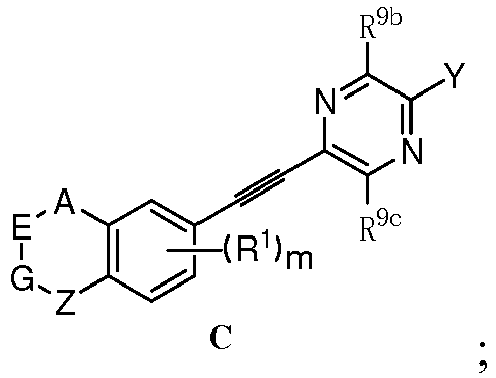


- The compound represented by formula I as defined in claim 4, wherein,
in compound A, when Y is -COOR15, R15 is hydrogen or ethyl;
and/or, in compound A, Z is -(CR2R3)-, -S-, -S(=O)- or -SO2-; preferably, A, E, G together with Z form the ring selected from the group consisting of

and/or, in compound B, Z is -(CR2R3)-, -S- or -S(=O)-; preferably, A, E, G together with Z form the ring selected from the group consisting of

and/or, in compound C, Z is -(CR2R3)-, -S- or -S(=O)-; preferably, A, E, G together with Z form the ring selected from the group consisting of

and/or, in compound D, Z is -(CR2R3)-; preferably, A, E, G together with Z form
and/or, in compound E, Z is -(CR2R3)-; preferably, A, E, G together with Z form
and/or, in compound F, Z is -(CR2R3)-, -S-, -S(=O)- or -SO2-; preferably, A, E, G together with Z form the ring selected from the group consisting of

- The compound represented by formula I as defined in claim 5, wherein, in compound A, when Y is COOH, Z is -S-;
and/or, in compound A, when Y is COOEt, Z is -(CR2R3)-, -S(=O)- or -SO2-;
and/or, in compound B, when Y is COOMe, Z is -(CR2R3)-;
and/or, in compound B, when Y is COOEt, Z is -(CR2R3)- or -S-;
and/or, in compound B, when Y is COOEt, Z is -(CR2R3)- or -S-;
and/or, in compound B, when Y is CN, Z is -(CR2R3)-, -S- or -S(=O)-;
and/or, in compound C, when Y is COOH, Z is -S-;
and/or, in compound C, when Y is COOEt, Z is -(CR2R3)-, -S- or -S(=O)-. - The compound represented by formula I as defined in claim 1, wherein, the compound represented by formula I is selected from the group consisting of











- A preparation method for the compound represented by formula I as defined in any one of claims 1-7, which comprises conducting a coupling reaction with compound II and III to give compound I;

- A compound represented by formula II, III, IV or V,

- A use of the compound represented by formula I, the enantiomer, the diastereomer or the pharmaceutically acceptable salt thereof as defined in any one of claims 1-7 in manufacturing a medicament for the treatment of a primary tumor.
- A use of the compound represented by formula I, the enantiomer, the diastereomer or the pharmaceutically acceptable salt thereof as defined in any one of claims 1-7 in manufacturing a medicament for the prevention and/or the treatment of a metastatic tumor.
- A use of the compound represented by formula I, the enantiomer, the diastereomer or the pharmaceutically acceptable salt thereof as defined in any one of claims 1-7 in manufacturing a medicament for the prevention and/or the treatment of leukemia and/or lymphoma.
- A use of the compound represented by formula I, the enantiomer, the diastereomer or the pharmaceutically acceptable salt thereof as defined in any one of claims 1-7 in manufacturing a medicament for the use selected from the group consisting of animal fetal growth, internal environment stability, vision, morphogenesis, skin aging and cell differentiation control.
- A pharmaceutical composition, which comprises the compound represented by formula I, the enantiomer, the diastereomer or the pharmaceutically acceptable salt thereof as defined in any one of claims 1-7, and a pharmaceutically acceptable carrier.
Applications Claiming Priority (3)
| Application Number | Priority Date | Filing Date | Title |
|---|---|---|---|
| CN201610141143 | 2016-03-11 | ||
| CN201610310944.8A CN107176945B (en) | 2016-03-11 | 2016-05-11 | A kind of retinoic acid compound, its preparation method, intermediate and application |
| PCT/CN2017/071922 WO2017152725A1 (en) | 2016-03-11 | 2017-01-20 | Retinoid compound, preparation method therefor, intermediates thereof and application thereof |
Publications (2)
| Publication Number | Publication Date |
|---|---|
| EP3428155A1 true EP3428155A1 (en) | 2019-01-16 |
| EP3428155A4 EP3428155A4 (en) | 2019-04-03 |
Family
ID=59830169
Family Applications (1)
| Application Number | Title | Priority Date | Filing Date |
|---|---|---|---|
| EP17762411.1A Withdrawn EP3428155A4 (en) | 2016-03-11 | 2017-01-20 | RETINOID COMPOUND, PROCESS FOR PREPARING SAME, INTERMEDIATES THEREOF, AND CORRESPONDING APPLICATION |
Country Status (5)
| Country | Link |
|---|---|
| US (2) | US10556879B2 (en) |
| EP (1) | EP3428155A4 (en) |
| JP (1) | JP2019509295A (en) |
| CN (1) | CN107176945B (en) |
| CA (1) | CA3017395A1 (en) |
Cited By (1)
| Publication number | Priority date | Publication date | Assignee | Title |
|---|---|---|---|---|
| US12344587B2 (en) | 2019-03-11 | 2025-07-01 | University Of Durham | Synthetic retinoids for use in RAR activation |
Families Citing this family (4)
| Publication number | Priority date | Publication date | Assignee | Title |
|---|---|---|---|---|
| CN107176945B (en) | 2016-03-11 | 2021-06-08 | 中国科学院上海有机化学研究所 | A kind of retinoic acid compound, its preparation method, intermediate and application |
| CN112755033A (en) * | 2021-01-21 | 2021-05-07 | 复旦大学附属中山医院 | Application of retinoic acid compound in preparation of anti-liver cancer medicine |
| CN113069457B (en) * | 2021-04-07 | 2021-12-31 | 暨南大学 | Combination drug for treating KRAS mutation and simultaneously myOCD dysfunction lung cancer |
| CN115974860B (en) * | 2022-12-15 | 2024-09-24 | 复旦大学附属中山医院 | Retinoic acid compound, preparation method and use thereof, and pharmaceutical composition containing the compound |
Family Cites Families (43)
| Publication number | Priority date | Publication date | Assignee | Title |
|---|---|---|---|---|
| US2089809A (en) | 1934-10-29 | 1937-08-10 | Penclite Corp | Plastic compositions and method of making same |
| US5256694A (en) * | 1984-09-22 | 1993-10-26 | Basf Aktiengesellschaft | Diarylacetylenes, their preparation and their use |
| DE3434946A1 (en) * | 1984-09-22 | 1986-04-03 | Basf Ag, 6700 Ludwigshafen | DIARYLACETYLENE, THEIR PRODUCTION AND USE |
| US4792561A (en) * | 1986-05-29 | 1988-12-20 | Syntex (U.S.A.) Inc. | Carbostyril derivatives as combined thromboxane synthetase and cyclic-AMP phosphodiesterase inhibitors |
| US5149705A (en) * | 1987-03-13 | 1992-09-22 | Allergan, Inc. | Acetylenes disubstituted with a heteroaromatic group and a tetralin group and having retinoid like activity |
| CA1305480C (en) * | 1987-03-20 | 1992-07-21 | Roshantha A.S. Chandraratna | Disubstituted acetylenes bearing heteroaromatic and heterobicyclic groups having retinoid like activity |
| US5089509A (en) * | 1988-09-15 | 1992-02-18 | Allergan, Inc. | Disubstituted acetylenes bearing heteroaromatic and heterobicyclic groups having retinoid like activity |
| US5602130A (en) * | 1987-03-20 | 1997-02-11 | Allergan | Disubstituted acetylenes bearing heteroaromatic and heterobicyclic groups having retinoid like activity |
| US5264578A (en) * | 1987-03-20 | 1993-11-23 | Allergan, Inc. | Disubstituted acetylenes bearing heterobicyclic groups and heteroaromatic or phenyl groups having retinoid like activity |
| US4810804A (en) * | 1987-03-26 | 1989-03-07 | Allergan, Inc. | Acetylenes disubstituted with a phenyl group and a heterobicyclic group having retinoid-like activity |
| US5399561A (en) * | 1989-09-19 | 1995-03-21 | Allergan, Inc. | Acetylenes disubstituted with a phenyl or heteroaryl group and a 2-oxochromanyl, 2-oxothiochromanyl or 2-oxo-1,2,3,4-tetrahydro-quinolinyl group having retinoid-like biological activity |
| US5023341A (en) * | 1989-09-19 | 1991-06-11 | Allergan, Inc. | Compounds having a disubstituted acetylene moiety and retinoic acid-like biological activity |
| IT1238084B (en) * | 1990-02-07 | 1993-07-05 | Enichem Sintesi | AROMATIC NITRILE PREPARATION PROCEDURE |
| EP0553156A4 (en) * | 1990-10-09 | 1993-11-18 | Allergan, Inc. | Chromans and thiochromans with retinoid-like activity |
| PL168075B1 (en) * | 1990-10-09 | 1995-12-30 | Allergan Inc | and 2-substituted chromanyl or thiochromanyl group with activity similar to that of retinoids PL |
| CA2138000A1 (en) * | 1994-01-03 | 1995-07-04 | John E. Starrett, Jr. | Retinoid-like compounds |
| US5616712A (en) * | 1995-05-16 | 1997-04-01 | Allergan | Acetylenes disubstituted with a phenyl or heteroaryl group and a 2-thio-1,2,3,4-tetrahdroquinolinyl, 2-alkylthio-3,4-dihydroquinolinyl or 2-alkoxy-3,4-dihydroquinolinyl group having retinoid-like biological activity |
| US5958954A (en) * | 1995-09-01 | 1999-09-28 | Allergan Sales, Inc. | Synthesis and use of retinoid compounds having negative hormone and/or antagonist activities |
| US5776699A (en) | 1995-09-01 | 1998-07-07 | Allergan, Inc. | Method of identifying negative hormone and/or antagonist activities |
| US6218128B1 (en) * | 1997-09-12 | 2001-04-17 | Allergan Sales, Inc. | Methods of identifying compounds having nuclear receptor negative hormone and/or antagonist activities |
| US5877207A (en) * | 1996-03-11 | 1999-03-02 | Allergan Sales, Inc. | Synthesis and use of retinoid compounds having negative hormone and/or antagonist activities |
| FR2752734B1 (en) * | 1996-09-02 | 1998-11-06 | Cird Galderma | USE OF RETINOIDS FOR THE PREPARATION OF A MEDICAMENT FOR TREATING CONDITIONS RELATED TO VEGF OVEREXPRESSION |
| US6083973A (en) * | 1998-03-09 | 2000-07-04 | Syntex (U.S.A.) Inc. | Methods for inhibiting mucin secretion using RAR α selective antagonists |
| JP2000019990A (en) * | 1998-06-30 | 2000-01-21 | Toshiba Lighting & Technology Corp | Backlight unit and liquid crystal display device |
| CA2346687A1 (en) * | 1998-10-08 | 2000-04-13 | Allergan Sales, Inc. | Use of rar antagonists or inverse agonists as male anit-fertility agents |
| US6479670B1 (en) * | 1999-08-25 | 2002-11-12 | Hoffmann-La Roche Inc. | Selective retinoid acid receptor agonists |
| US6252090B1 (en) * | 2000-08-29 | 2001-06-26 | Allergan Sales, Inc. | Compounds having activity as inhibitors of cytochrome P450RAI |
| US6313107B1 (en) * | 2000-08-29 | 2001-11-06 | Allergan Sales, Inc. | Methods of providing and using compounds having activity as inhibitors of cytochrome P450RAI |
| US6291677B1 (en) * | 2000-08-29 | 2001-09-18 | Allergan Sales, Inc. | Compounds having activity as inhibitors of cytochrome P450RAI |
| US6303785B1 (en) * | 2000-08-29 | 2001-10-16 | Allergan Sales, Inc. | Compounds having activity as inhibitors of cytochrome P450RAI |
| IL152904A0 (en) * | 2002-01-24 | 2003-06-24 | Gamida Cell Ltd | Utilization of retinoid and vitamin d receptor antagonists for expansion of renewable stem cell populations |
| US20050026950A1 (en) * | 2003-07-30 | 2005-02-03 | Allergan, Inc. | Methods of therapeutic treatment using retinoids to achieve consistent bioavailability |
| CA2550010A1 (en) * | 2003-12-17 | 2005-06-30 | Allergan, Inc. | Methods for treating retinoid responsive disorders using selective inhibitors of cyp26a and cyp26b |
| US9206084B2 (en) * | 2004-01-29 | 2015-12-08 | Halliburton Energy Services, Inc. | Composition and method for dissipating heat underground |
| WO2006040644A2 (en) * | 2004-10-11 | 2006-04-20 | Ranbaxy Laboratories Limited | Processes for the preparation of substituted thiochroman derivatives |
| ITMI20050357A1 (en) * | 2005-03-08 | 2006-09-09 | Solmag S P A | TAZAROTENE PREPARATION PROCEDURE |
| JP2007036571A (en) | 2005-07-26 | 2007-02-08 | Shinko Electric Ind Co Ltd | Semiconductor device and manufacturing method thereof |
| US20070238881A1 (en) * | 2006-04-07 | 2007-10-11 | Glenmark Pharmaceuticals Limited | Process for the preparation of tazarotene intermediates and use thereof for the preparation of tazarotene |
| WO2008025965A2 (en) * | 2006-08-29 | 2008-03-06 | Reinnervate Limited | Retinoid compounds and their use |
| EA022322B1 (en) * | 2009-07-16 | 2015-12-30 | Стифел Лэборетриз, Инк. | DERIVATIVES OF TAZAROTENE, PHARMACEUTICAL COMPOSITION INCLUDING THEM, AND THEIR APPLICATION FOR THE MANUFACTURE OF A MEDICINE FOR THE TREATMENT OF SKIN DISEASES |
| US10759762B2 (en) * | 2014-10-10 | 2020-09-01 | High Force Research Limited | Fluorescent synthetic retinoids |
| WO2016066662A1 (en) * | 2014-10-31 | 2016-05-06 | F. Hoffmann-La Roche Ag | New dihydroquinoline pyrazolyl compounds as aldosterone synthase inhibitors |
| CN107176945B (en) | 2016-03-11 | 2021-06-08 | 中国科学院上海有机化学研究所 | A kind of retinoic acid compound, its preparation method, intermediate and application |
-
2016
- 2016-05-11 CN CN201610310944.8A patent/CN107176945B/en active Active
-
2017
- 2017-01-20 CA CA3017395A patent/CA3017395A1/en not_active Abandoned
- 2017-01-20 US US16/083,879 patent/US10556879B2/en active Active
- 2017-01-20 JP JP2018548077A patent/JP2019509295A/en active Pending
- 2017-01-20 EP EP17762411.1A patent/EP3428155A4/en not_active Withdrawn
-
2020
- 2020-01-02 US US16/733,089 patent/US20200216407A1/en not_active Abandoned
Cited By (1)
| Publication number | Priority date | Publication date | Assignee | Title |
|---|---|---|---|---|
| US12344587B2 (en) | 2019-03-11 | 2025-07-01 | University Of Durham | Synthetic retinoids for use in RAR activation |
Also Published As
| Publication number | Publication date |
|---|---|
| EP3428155A4 (en) | 2019-04-03 |
| US20190092744A1 (en) | 2019-03-28 |
| CN107176945A (en) | 2017-09-19 |
| US10556879B2 (en) | 2020-02-11 |
| CA3017395A1 (en) | 2017-09-14 |
| JP2019509295A (en) | 2019-04-04 |
| US20200216407A1 (en) | 2020-07-09 |
| CN107176945B (en) | 2021-06-08 |
Similar Documents
| Publication | Publication Date | Title |
|---|---|---|
| TWI899252B (en) | Cyclopropyl dihydroquinoline sulfonamide compounds | |
| US20200216407A1 (en) | Retinoid compound, preparation method therefor, intermediates thereof and application thereof | |
| JP6437060B2 (en) | Antifibrotic agents of fused ring analogues | |
| WO2021169963A1 (en) | Aromatic compound and use thereof in preparing antineoplastic drugs | |
| CN101679273B (en) | 1-substituted tetrahydroisoquinoline compound | |
| US10398689B2 (en) | Benzopiperidine derivative, preparation method thereof and medical use thereof | |
| CA2931111C (en) | Anti-cancer agents and preparation thereof | |
| KR20040017227A (en) | N-arylphenylacetamide derivatives and medicinal compositions containing the same | |
| TW201402537A (en) | Kynurenine-3-monooxygenase inhibitors, pharmaceutical compositions, and methods of use thereof | |
| UA72611C2 (en) | Derivatives of substituted pyrrolopyridinone useful as phosphodiesterase inhibitors | |
| KR20220066290A (en) | PERK inhibitory pyrrolopyrimidine compounds | |
| WO2001021206A1 (en) | PREVENTIVES OR REMEDIES FOR MYOCARDITIS, DILATED CARDIOMYOPATHY AND CARDIAC INSUFFICIENCY CONTAINING NF-λB INHIBITORS AS THE ACTIVE INGREDIENT | |
| WO2014031755A1 (en) | Fendiline derivatives and methods of use thereof | |
| WO2017152725A1 (en) | Retinoid compound, preparation method therefor, intermediates thereof and application thereof | |
| TW201625614A (en) | Novel heterocyclic derivatives | |
| CN104583203B (en) | SCHWEINFURTHIN analogs | |
| EP3079687B1 (en) | Sulfamate derivative compounds for use in treating or alleviating pain | |
| JP6626001B2 (en) | Pyridine derivatives | |
| WO2025118148A1 (en) | Antioxidant drug-conjugate modulators of fpr1, compositions comprising the modulator, and methods of using the same | |
| CN104529833B (en) | Cyclobutane-carboxylic acid compounds replaced and uses thereof | |
| CN117551097B (en) | Sophoridine tricyclic derivatives and their application in the preparation of drugs for treating liver fibrosis or hepatocellular carcinoma. | |
| WO2023235929A1 (en) | Functionalised benzopyran compounds and uses thereof | |
| WO2026056936A1 (en) | Heterocyclic compounds and use thereof | |
| WO2025162115A1 (en) | Heterocyclic compound and pharmaceutical use thereof | |
| KR20250128346A (en) | Pyridazinone-based PARP inhibitors and their preparation methods, pharmaceutical compositions, and applications |
Legal Events
| Date | Code | Title | Description |
|---|---|---|---|
| STAA | Information on the status of an ep patent application or granted ep patent |
Free format text: STATUS: THE INTERNATIONAL PUBLICATION HAS BEEN MADE |
|
| PUAI | Public reference made under article 153(3) epc to a published international application that has entered the european phase |
Free format text: ORIGINAL CODE: 0009012 |
|
| STAA | Information on the status of an ep patent application or granted ep patent |
Free format text: STATUS: REQUEST FOR EXAMINATION WAS MADE |
|
| 17P | Request for examination filed |
Effective date: 20181009 |
|
| AK | Designated contracting states |
Kind code of ref document: A1 Designated state(s): AL AT BE BG CH CY CZ DE DK EE ES FI FR GB GR HR HU IE IS IT LI LT LU LV MC MK MT NL NO PL PT RO RS SE SI SK SM TR |
|
| AX | Request for extension of the european patent |
Extension state: BA ME |
|
| A4 | Supplementary search report drawn up and despatched |
Effective date: 20190306 |
|
| RIC1 | Information provided on ipc code assigned before grant |
Ipc: C07D 213/85 20060101ALI20190227BHEP Ipc: A61K 31/382 20060101ALI20190227BHEP Ipc: A61K 31/235 20060101ALI20190227BHEP Ipc: C07D 239/28 20060101ALI20190227BHEP Ipc: A61P 35/02 20060101ALI20190227BHEP Ipc: C07D 335/06 20060101AFI20190227BHEP Ipc: A61K 31/506 20060101ALI20190227BHEP Ipc: A61P 35/00 20060101ALI20190227BHEP Ipc: C07D 409/06 20060101ALI20190227BHEP Ipc: C07C 69/84 20060101ALI20190227BHEP Ipc: A61P 17/10 20060101ALI20190227BHEP |
|
| DAV | Request for validation of the european patent (deleted) | ||
| DAX | Request for extension of the european patent (deleted) | ||
| STAA | Information on the status of an ep patent application or granted ep patent |
Free format text: STATUS: EXAMINATION IS IN PROGRESS |
|
| 17Q | First examination report despatched |
Effective date: 20200102 |
|
| STAA | Information on the status of an ep patent application or granted ep patent |
Free format text: STATUS: THE APPLICATION IS DEEMED TO BE WITHDRAWN |
|
| 18D | Application deemed to be withdrawn |
Effective date: 20200603 |