EP3426720B1 - Artificial turf infill and method for making it - Google Patents
Artificial turf infill and method for making it Download PDFInfo
- Publication number
- EP3426720B1 EP3426720B1 EP17707359.0A EP17707359A EP3426720B1 EP 3426720 B1 EP3426720 B1 EP 3426720B1 EP 17707359 A EP17707359 A EP 17707359A EP 3426720 B1 EP3426720 B1 EP 3426720B1
- Authority
- EP
- European Patent Office
- Prior art keywords
- granulate
- artificial turf
- type
- pigment
- binding agent
- Prior art date
- Legal status (The legal status is an assumption and is not a legal conclusion. Google has not performed a legal analysis and makes no representation as to the accuracy of the status listed.)
- Active
Links
Images





Classifications
-
- C—CHEMISTRY; METALLURGY
- C08—ORGANIC MACROMOLECULAR COMPOUNDS; THEIR PREPARATION OR CHEMICAL WORKING-UP; COMPOSITIONS BASED THEREON
- C08J—WORKING-UP; GENERAL PROCESSES OF COMPOUNDING; AFTER-TREATMENT NOT COVERED BY SUBCLASSES C08B, C08C, C08F, C08G or C08H
- C08J3/00—Processes of treating or compounding macromolecular substances
- C08J3/20—Compounding polymers with additives, e.g. colouring
-
- B—PERFORMING OPERATIONS; TRANSPORTING
- B01—PHYSICAL OR CHEMICAL PROCESSES OR APPARATUS IN GENERAL
- B01J—CHEMICAL OR PHYSICAL PROCESSES, e.g. CATALYSIS OR COLLOID CHEMISTRY; THEIR RELEVANT APPARATUS
- B01J2/00—Processes or devices for granulating materials, e.g. fertilisers in general; Rendering particulate materials free flowing in general, e.g. making them hydrophobic
- B01J2/006—Coating of the granules without description of the process or the device by which the granules are obtained
-
- B—PERFORMING OPERATIONS; TRANSPORTING
- B01—PHYSICAL OR CHEMICAL PROCESSES OR APPARATUS IN GENERAL
- B01J—CHEMICAL OR PHYSICAL PROCESSES, e.g. CATALYSIS OR COLLOID CHEMISTRY; THEIR RELEVANT APPARATUS
- B01J2/00—Processes or devices for granulating materials, e.g. fertilisers in general; Rendering particulate materials free flowing in general, e.g. making them hydrophobic
- B01J2/28—Processes or devices for granulating materials, e.g. fertilisers in general; Rendering particulate materials free flowing in general, e.g. making them hydrophobic using special binding agents
-
- C—CHEMISTRY; METALLURGY
- C08—ORGANIC MACROMOLECULAR COMPOUNDS; THEIR PREPARATION OR CHEMICAL WORKING-UP; COMPOSITIONS BASED THEREON
- C08G—MACROMOLECULAR COMPOUNDS OBTAINED OTHERWISE THAN BY REACTIONS ONLY INVOLVING UNSATURATED CARBON-TO-CARBON BONDS
- C08G18/00—Polymeric products of isocyanates or isothiocyanates
- C08G18/06—Polymeric products of isocyanates or isothiocyanates with compounds having active hydrogen
- C08G18/08—Processes
- C08G18/10—Prepolymer processes involving reaction of isocyanates or isothiocyanates with compounds having active hydrogen in a first reaction step
-
- C—CHEMISTRY; METALLURGY
- C08—ORGANIC MACROMOLECULAR COMPOUNDS; THEIR PREPARATION OR CHEMICAL WORKING-UP; COMPOSITIONS BASED THEREON
- C08G—MACROMOLECULAR COMPOUNDS OBTAINED OTHERWISE THAN BY REACTIONS ONLY INVOLVING UNSATURATED CARBON-TO-CARBON BONDS
- C08G18/00—Polymeric products of isocyanates or isothiocyanates
- C08G18/06—Polymeric products of isocyanates or isothiocyanates with compounds having active hydrogen
- C08G18/08—Processes
- C08G18/16—Catalysts
- C08G18/161—Catalysts containing two or more components to be covered by at least two of the groups C08G18/166, C08G18/18 or C08G18/22
- C08G18/163—Catalysts containing two or more components to be covered by at least two of the groups C08G18/166, C08G18/18 or C08G18/22 covered by C08G18/18 and C08G18/22
-
- C—CHEMISTRY; METALLURGY
- C08—ORGANIC MACROMOLECULAR COMPOUNDS; THEIR PREPARATION OR CHEMICAL WORKING-UP; COMPOSITIONS BASED THEREON
- C08G—MACROMOLECULAR COMPOUNDS OBTAINED OTHERWISE THAN BY REACTIONS ONLY INVOLVING UNSATURATED CARBON-TO-CARBON BONDS
- C08G18/00—Polymeric products of isocyanates or isothiocyanates
- C08G18/06—Polymeric products of isocyanates or isothiocyanates with compounds having active hydrogen
- C08G18/28—Polymeric products of isocyanates or isothiocyanates with compounds having active hydrogen characterised by the compounds used containing active hydrogen
- C08G18/40—High-molecular-weight compounds
- C08G18/42—Polycondensates having carboxylic or carbonic ester groups in the main chain
-
- C—CHEMISTRY; METALLURGY
- C08—ORGANIC MACROMOLECULAR COMPOUNDS; THEIR PREPARATION OR CHEMICAL WORKING-UP; COMPOSITIONS BASED THEREON
- C08G—MACROMOLECULAR COMPOUNDS OBTAINED OTHERWISE THAN BY REACTIONS ONLY INVOLVING UNSATURATED CARBON-TO-CARBON BONDS
- C08G18/00—Polymeric products of isocyanates or isothiocyanates
- C08G18/06—Polymeric products of isocyanates or isothiocyanates with compounds having active hydrogen
- C08G18/28—Polymeric products of isocyanates or isothiocyanates with compounds having active hydrogen characterised by the compounds used containing active hydrogen
- C08G18/40—High-molecular-weight compounds
- C08G18/48—Polyethers
-
- C—CHEMISTRY; METALLURGY
- C08—ORGANIC MACROMOLECULAR COMPOUNDS; THEIR PREPARATION OR CHEMICAL WORKING-UP; COMPOSITIONS BASED THEREON
- C08G—MACROMOLECULAR COMPOUNDS OBTAINED OTHERWISE THAN BY REACTIONS ONLY INVOLVING UNSATURATED CARBON-TO-CARBON BONDS
- C08G18/00—Polymeric products of isocyanates or isothiocyanates
- C08G18/06—Polymeric products of isocyanates or isothiocyanates with compounds having active hydrogen
- C08G18/70—Polymeric products of isocyanates or isothiocyanates with compounds having active hydrogen characterised by the isocyanates or isothiocyanates used
- C08G18/72—Polyisocyanates or polyisothiocyanates
- C08G18/73—Polyisocyanates or polyisothiocyanates acyclic
-
- C—CHEMISTRY; METALLURGY
- C08—ORGANIC MACROMOLECULAR COMPOUNDS; THEIR PREPARATION OR CHEMICAL WORKING-UP; COMPOSITIONS BASED THEREON
- C08G—MACROMOLECULAR COMPOUNDS OBTAINED OTHERWISE THAN BY REACTIONS ONLY INVOLVING UNSATURATED CARBON-TO-CARBON BONDS
- C08G18/00—Polymeric products of isocyanates or isothiocyanates
- C08G18/06—Polymeric products of isocyanates or isothiocyanates with compounds having active hydrogen
- C08G18/70—Polymeric products of isocyanates or isothiocyanates with compounds having active hydrogen characterised by the isocyanates or isothiocyanates used
- C08G18/72—Polyisocyanates or polyisothiocyanates
- C08G18/74—Polyisocyanates or polyisothiocyanates cyclic
-
- C—CHEMISTRY; METALLURGY
- C08—ORGANIC MACROMOLECULAR COMPOUNDS; THEIR PREPARATION OR CHEMICAL WORKING-UP; COMPOSITIONS BASED THEREON
- C08G—MACROMOLECULAR COMPOUNDS OBTAINED OTHERWISE THAN BY REACTIONS ONLY INVOLVING UNSATURATED CARBON-TO-CARBON BONDS
- C08G18/00—Polymeric products of isocyanates or isothiocyanates
- C08G18/06—Polymeric products of isocyanates or isothiocyanates with compounds having active hydrogen
- C08G18/70—Polymeric products of isocyanates or isothiocyanates with compounds having active hydrogen characterised by the isocyanates or isothiocyanates used
- C08G18/72—Polyisocyanates or polyisothiocyanates
- C08G18/74—Polyisocyanates or polyisothiocyanates cyclic
- C08G18/76—Polyisocyanates or polyisothiocyanates cyclic aromatic
- C08G18/7657—Polyisocyanates or polyisothiocyanates cyclic aromatic containing two or more aromatic rings
- C08G18/7664—Polyisocyanates or polyisothiocyanates cyclic aromatic containing two or more aromatic rings containing alkylene polyphenyl groups
- C08G18/7671—Polyisocyanates or polyisothiocyanates cyclic aromatic containing two or more aromatic rings containing alkylene polyphenyl groups containing only one alkylene bisphenyl group
-
- C—CHEMISTRY; METALLURGY
- C08—ORGANIC MACROMOLECULAR COMPOUNDS; THEIR PREPARATION OR CHEMICAL WORKING-UP; COMPOSITIONS BASED THEREON
- C08J—WORKING-UP; GENERAL PROCESSES OF COMPOUNDING; AFTER-TREATMENT NOT COVERED BY SUBCLASSES C08B, C08C, C08F, C08G or C08H
- C08J3/00—Processes of treating or compounding macromolecular substances
- C08J3/005—Processes for mixing polymers
-
- C—CHEMISTRY; METALLURGY
- C08—ORGANIC MACROMOLECULAR COMPOUNDS; THEIR PREPARATION OR CHEMICAL WORKING-UP; COMPOSITIONS BASED THEREON
- C08J—WORKING-UP; GENERAL PROCESSES OF COMPOUNDING; AFTER-TREATMENT NOT COVERED BY SUBCLASSES C08B, C08C, C08F, C08G or C08H
- C08J3/00—Processes of treating or compounding macromolecular substances
- C08J3/12—Powdering or granulating
- C08J3/126—Polymer particles coated by polymer, e.g. core shell structures
-
- C—CHEMISTRY; METALLURGY
- C08—ORGANIC MACROMOLECULAR COMPOUNDS; THEIR PREPARATION OR CHEMICAL WORKING-UP; COMPOSITIONS BASED THEREON
- C08J—WORKING-UP; GENERAL PROCESSES OF COMPOUNDING; AFTER-TREATMENT NOT COVERED BY SUBCLASSES C08B, C08C, C08F, C08G or C08H
- C08J9/00—Working-up of macromolecular substances to porous or cellular articles or materials; After-treatment thereof
- C08J9/04—Working-up of macromolecular substances to porous or cellular articles or materials; After-treatment thereof using blowing gases generated by a previously added blowing agent
- C08J9/12—Working-up of macromolecular substances to porous or cellular articles or materials; After-treatment thereof using blowing gases generated by a previously added blowing agent by a physical blowing agent
- C08J9/125—Water, e.g. hydrated salts
-
- C—CHEMISTRY; METALLURGY
- C08—ORGANIC MACROMOLECULAR COMPOUNDS; THEIR PREPARATION OR CHEMICAL WORKING-UP; COMPOSITIONS BASED THEREON
- C08K—Use of inorganic or non-macromolecular organic substances as compounding ingredients
- C08K3/00—Use of inorganic substances as compounding ingredients
- C08K3/01—Use of inorganic substances as compounding ingredients characterized by their specific function
- C08K3/013—Fillers, pigments or reinforcing additives
-
- C—CHEMISTRY; METALLURGY
- C08—ORGANIC MACROMOLECULAR COMPOUNDS; THEIR PREPARATION OR CHEMICAL WORKING-UP; COMPOSITIONS BASED THEREON
- C08K—Use of inorganic or non-macromolecular organic substances as compounding ingredients
- C08K5/00—Use of organic ingredients
- C08K5/0008—Organic ingredients according to more than one of the "one dot" groups of C08K5/01 - C08K5/59
- C08K5/0041—Optical brightening agents, organic pigments
-
- E—FIXED CONSTRUCTIONS
- E01—CONSTRUCTION OF ROADS, RAILWAYS, OR BRIDGES
- E01C—CONSTRUCTION OF, OR SURFACES FOR, ROADS, SPORTS GROUNDS, OR THE LIKE; MACHINES OR AUXILIARY TOOLS FOR CONSTRUCTION OR REPAIR
- E01C13/00—Pavings or foundations specially adapted for playgrounds or sports grounds; Drainage, irrigation or heating of sports grounds
- E01C13/08—Surfaces simulating grass ; Grass-grown sports grounds
-
- C—CHEMISTRY; METALLURGY
- C08—ORGANIC MACROMOLECULAR COMPOUNDS; THEIR PREPARATION OR CHEMICAL WORKING-UP; COMPOSITIONS BASED THEREON
- C08J—WORKING-UP; GENERAL PROCESSES OF COMPOUNDING; AFTER-TREATMENT NOT COVERED BY SUBCLASSES C08B, C08C, C08F, C08G or C08H
- C08J2475/00—Characterised by the use of polyureas or polyurethanes; Derivatives of such polymers
- C08J2475/04—Polyurethanes
Definitions
- the invention relates to artificial turf and methods for the manufacture of artificial turf infill.
- Artificial turf or artificial grass is surface that is made up of fibers which is used to replace grass.
- the structure of the artificial turf is designed such that the artificial turf has an appearance which resembles grass.
- artificial turf is used as a surface for sports such as soccer, American football, rugby, tennis, golf, for playing fields, or exercise fields.
- artificial turf is frequently used for landscaping applications.
- Artificial turf may be manufactured using techniques for manufacturing carpets. For example artificial turf fibers which have the appearance of grass blades may be tufted or attached to a backing. Often times artificial turf infill is placed between the artificial turf fibers. Artificial turf infill is a granular material that covers the bottom portion of the artificial turf fibers. The use of artificial turf infill may have a number of advantages. For example, artificial turf infill may help the artificial turf fibers stand up straight. Artificial turf infill may also absorb impact from walking or running and provide an experience similar to being on real turf. The artificial turf infill may also help to keep the artificial turf carpet flat and in place by weighting it down.
- European patent application EP 1 416 009 B1 describes a loose, free flowing rubber particles as litter material for artificial turf.
- the particles have an average size between 0.4 mm and 4.0 mm and their complete surface is covered with a permanently elastic and pigmenting coating.
- European patent application EP1201388 B1 discloses a method of manufacturing colored rubber chips: To 100 parts by weight of crushued rubber chips having a particle size of from 1 to 10 mm or fibrous rubber chips having a fibrous length of 30 mm or below are added a film forming material, which contains a pigment and 10 to 100 parts by weight of a one-pack type or two-pack type polyurethane resin which gels at least from a liquid state in 60 seconds or more and cures through the gelling process, and they are stirred for mixing. When the polyurethane resin starts to gel and the rubber chips start to aggregate, stirring is further continued for mixing in spite of heavy load on the mixer so to loosen the aggregation of the rubber chips.
- a manufacturing method which can form a thick colored film without requiring a complex procedure and can inexpensively obtain colored rubber chips which have a remarkable color keeping property and a pyramid shape with edges similar to those formed when crushed is provided.
- the particle size is desired to have almost the same size as the thickness of the film. And if it is excessively larger or smaller than that size it does not meet the objective of completely covering the rubber chips.
- the film thickness in the present invention is about 0.8 mm maximum and the particle sizes is also about the same accordingly.
- the invention provides for a method of manufacturing artificial turf infill, a method of manufacturing artificial turf, artificial turf infill, and artificial turf. Embodiments are given in the dependent claims.
- the invention provides for a method of manufacturing artificial turf infill.
- Artificial turf infill as used herein, encompasses a granular material that is spread out on an artificial turf carpet in between the fibers.
- Artificial turf infill may be used to modify an artificial turf carpet to have more earth like properties.
- the artificial turf infill may provide a surface which is able to absorb impacts in a manner similar to real turf.
- the method comprises providing an initial composition comprising a granulate, at least one first type of pigment, and a fluid binding agent.
- the fluid binding agent comprises at least one type of polymer component.
- the method further comprises mixing the initial composition.
- the method further comprises adding water and a catalyst to the initial composition during the mixing of the initial composition to cure the fluid binding agent and the at least one type of pigment into an initial coating of the granulate.
- the method further comprises providing a subsequent composition comprising the granulate with the initial coating, the at least one second type of pigment and the fluid binding agent.
- the method further comprises mixing the subsequent composition.
- the method further comprises adding water and the catalyst to the subsequent composition during the mixing of the subsequent composition to cure the fluid binding agent and the at least one type of pigment into a subsequent coating of the granulate.
- the at least one second type of pigment and the at least one first type of pigment may be identical or they may be different. If they are the same then the coating of the granulate will be of a uniform color. If the at least one second type of pigment and the at least one first type of pigments are different colors then the two colors can be chosen so that the resulting artificial turf infill has a more natural and earth like appearance.
- the method further comprises providing the granulate with the subsequent coating as artificial turf infill.
- the coating of the granulate in at least two steps as described above, may be beneficial because it may provide for better coating of the granulate
- individual grains of the granulate will touch and interact with each other as the initial coating on each of the grains forms.
- the physical contact between different grains will however cause defects.
- By coating the granulate particles a second time with the subsequent coating much higher coverage of the granulate can be achieved.
- the coverage is each only 90% of the surface of the granulate.
- roughly 10% of each granule of the granulate would be uncoated. There would be small surface defects.
- Deposition of the subsequent coating would then also cover 90% of the surface.
- the result of doing two coatings is then an artificial turf infill that is 99% coated with only minor amounts of defects, where the granulate is not coated with either the initial coating or the subsequent coating.
- Improving the coverage of the granulate may be beneficial in several different situations. For example, it may be desirable to color the artificial turf infill the same or a similar color as fibers or tufts, which are used to manufacture an artificial turf carpet. This may provide a more realistic-looking play surface or playfield. Another advantage is that the elastomeric granulate may be better coated and may therefore have superior wear qualities or may even be better isolated from the environment.
- the granulate comprises an elastomeric or elastic granulate.
- the granulate is an elastomeric material based on elastomers like synthetic rubbers as e.g. styrene butadiene rubber, polybutadiene rubber, styrene- ethylene-butadiene-styrene copolymer (SEBS), ethylenepropylene-diene monomer rubber (EPDM), acryl nitrile butadiene rubber.
- SEBS styrene- ethylene-butadiene-styrene copolymer
- EPDM ethylenepropylene-diene monomer rubber
- a cis- 1,4 -polyisoprene, as natural rubber and trans 1,4 - polyisoprene as gutta-percha based granulate can be used.
- the granulate comprises a compression resistant granulate or a rigid granulate.
- the granulate comprises any one of the following: natural latex, cork, linoleum, composites made from solidified vegetable oils and wood flour or a hydrogel of methyl-cellulose.
- the curing of the initial coating and the curing of the subsequent coating is a polymerization process.
- the term 'cure' or 'curing' may be replaced with polymerization.
- the subsequent coating at least partially covers the initial coating.
- the initial coating only partially covers the granulate.
- the subsequent coating only partially covers the initial coating.
- the initial coating and the subsequent coating each have a thickness of less than any one of the following: 0.1 mm, 0.075 mm, 0.05 mm, and 0.01 mm.
- This embodiment may be beneficial because it may provide a means of reducing the amount of fluid binding agent necessary to coating the granulate.
- the initial coating comprises gaps.
- the subsequent coating also comprises gaps.
- the gaps in the initial and subsequent coatings may be distributed randomly on the surface of the granulate. As the gaps in both coatings are distributed randomly, it is unlikely that the gaps will line up. The result will be that there will be few if any portions of the underlying granulate exposed.
- the granulate with the initial coating and the subsequent coating is re-coated at least one time by performing the following sequence.
- the first step in the sequence is provide a subsequent composition by adding at least one additive and the fluid binding agent to the granulate that has already been coated with the initial coating and the subsequent coating.
- the next step in the sequence is to mix the subsequent composition.
- the next step in the sequence is to add water and the catalyst to the subsequent composition during the mixing of the subsequent composition to cure the fluid binding agent and the at least one additive into a further coating.
- the granulate with the further coating is provided then as the artificial turf infill. This embodiment may be beneficial because an additional coating or layer may be put on the granulate.
- the granulate may be coated a third or more times to improve the coverage and the coating of the granulate.
- This embodiment may also be beneficial because it may enable the deposition of so-called functional layers or additives, which may add to the utility or wear or usefulness of the artificial turf infill.
- the further coating has a thickness of less than any one of the following: 0.1 mm, 0.075 mm, 0.05 mm, and 0.01 mm.
- This embodiment may be beneficial because it may provide a means of reducing the amount of fluid binding agent necessary for coating the granulate.
- the PU catalyst is partially or completely water soluble and is of the group: secondary amine, tertiary amine, a metal organo cytalyst.
- the liquid PU component is based on an NCO terminal polymer which might be a pre-polymer, a polymeric isocyanate, an oligomeric isocyanate , a monomer and a mixture hereof.
- liquid PU component is based on an aromatic diisocyanate of the group toluene diisocyanate or methylene- 2,2 -diisocyanate,
- liquid PU component is based on an aliphatic diisocyanate of the group hexamethylene disiocyanate, isophorone diisocyanate and 1,4-cyclohexyldisiocyanate.
- liquid PU component is based on methylenediphenyl-isocyanate isomer mixture.
- the hydroxyl component for the production of the PU is out of the group polyether polyol or polyester polyol.
- the hydroxyl component is based on a polyetherpolyol of the molecular weight 500 to 10000.
- the polyetherpolyol has a molecular weight of 1500- 6000. In a very preferred embodiment the molecular weight is in the range of 2000- 4000.
- the at least one additive comprises the at least one first and/or second type of pigment.
- the at least one additive further comprises a flame retardant like aluminum trihydrate, magnesium hydroxide turning a by itself burnable or flammable elastomeric material into a flame retardant infill material.
- this flame retardant additives creates an intumescent coating and is based on intumescent component comprising ammonium polyphosphate or exfoliated graphite or a mixture hereof.
- the at least one additive further comprises zeolite.
- zeolite may be beneficial because then the surface of the artificial turf infill may be able to absorb or de-absorb water. For example before a football game, which is scheduled to be held in the sun or in hot conditions, water may be sprayed onto the artificial turf and the zeolite may absorb an amount of water. As the sun or hot air heats the artificial turf infill during the game, the evaporation of water may cool the playing surface for the players and make the use of the artificial turf more pleasant.
- the at least one additive further comprises methylcellulose, which may be beneficial in a similar way like zeolite for absorbing and desorbing of water, rendering a cooling effect at hot climatic conditions.
- the at least one additive further comprises an antibacterial agent.
- the at least one additive further comprises silver.
- Silver may be beneficial as an antibacterial agent.
- the at least one additive further comprises chitosan, showing natural antibacterial properties.
- the at least one additive further comprises an IR reflective pigment.
- the use of the IR reflective pigments as mixed metal oxides may be beneficial because it may reflect infrared light. This may reduce the heating of the artificial turf infill.
- a specific advantage may be that in this case the comparably expensive and precious pigments are merely on the surface of the infill granulates, where they are fully effective and not in the complete core of the elastic material
- the elastomeric granulate is a rubber granulate.
- the elastomeric granulate comprises any one of the following: rubber, an elastomeric polymer, Metallocene Butadiene Rubber, nitrile rubber granulate, natural rubber granulate, styrene-butadiene rubber granulate, ethylene propylene diene monomer rubber granulate, black crumb rubber granulate, acrylonitrile butadiene rubber, a thermoplastic polymer, Styrene Ethylene Butylene Styrene , Styrene Block Copolymers, and combinations thereof.
- the granulate is an elastic foam.
- the granulate is an elastic PU foam.
- the granulate has an average diameter between 0.1 mm and 3.0 mm.
- the granulate has a maximum diameter of less than 5.0 mm.
- the at least one first and/or second type of pigment comprises an inorganic pigment, an organic pigment or mixtures hereof.
- the at least one first and/or second type of pigment comprises any one of the following: iron oxide, iron oxide hydroxide, chromium(III) oxide, a copper phythalocyanine pigment, a nickel azopigment, titanium oxide and combinations thereof.
- the at least one type of additive is hindered amine light stabilizer (HALS) which is able to protect the PU coating as well as the elastic and/ or compression resilient granulate against UV degradation.
- HALS hindered amine light stabilizer
- the at least one type of additive is a thermostabilizing agent, protecting the elastic and/ or compression resilient granulate against thermal degradation.
- the at least one type of additive is an anti-freeze/ deicing additive of the group: sodium chloride, potassium chloride, calcium chloride, sodium formiate, potassium formiate or a mixture hereof.
- the additive is migrating into the neighborhood of the granulate and by this inhibits the formation of ice by freezing humidity between the infill granulate particles.
- the fluid binding agent further comprises any one of the following: a surfactant, a polyurethane aliphatic isocyanate, a polyurethane aromatic isocyanate, zeolite, an antibacterial agent, silver, IR reflective pigment, and combinations thereof.
- the polymer component comprises any one of the following: at least one type of monomer, at least one type of partially polymerized polymer, and combinations thereof.
- the polymer component is cured into at least one type of polyurethane by the water and the catalyst.
- the polymer component could be methylene diphenyl diisocyanate.
- the polymer component could also comprise polyols.
- the catalyst comprises any one of the following: an amine catalyst and a metal organic catalyst.
- the method further comprises drying the subsequent composition before providing the granulate as the artificial turf infill.
- the initial composition may also be possible to dry the initial composition after coating the granulate with the initial coating; however, it is not necessary.
- the water, which is leftover from the formation of the initial coating on the elastic and /or compression resilient granulate may be used in the reaction of the subsequent composition.
- the method is at least partially performed in a flow reactor.
- the granulate is slowly moved along a linear sequential path, where the granulates are generally mixed and moved along.
- the benefit of using a flow reactor is that the artificial turf infill may be produced on a continuous basis.
- the method is at least partially performed as a batch process.
- the initial coating is formed on the granulate during an initial batch and the subsequent coating is formed on the granulate during a subsequent batch. Forming the initial coating and the subsequent coating in separate batches may be beneficial because it may enable precise control over the formation of the initial and subsequent coatings.
- the invention provides for a method of manufacturing artificial turf.
- the method comprises installing an artificial turf carpet.
- the artificial turf carpet comprises multiple artificial turf fiber tufts.
- the artificial turf carpet may be a tufted artificial turf carpet.
- There may be a backing which has tufts of artificial grass fibers tufted into it.
- the method further comprises providing the artificial turf by spreading a layer of artificial turf infill between the multiple artificial turf fiber tufts.
- the artificial turf infill comprises a granulate.
- the granulate comprises at least two outer coatings.
- Each of the two outer coatings comprises at least one first and/or second type of pigment and a binding agent.
- the binding agent comprises at least one type of polyurethane polymer.
- This method may be beneficial because the artificial turf infill may be more completely covered with the two outer coatings. This may for instance provide superior optical appearance of the artificial turf infill. It may also provide better wear and longevity of the artificial turf infill.
- the two outer coatings each have a thickness of less than any one of the following: 0.1 mm, 0.075 mm, 0.05 mm, and 0.01 mm.
- This embodiment may be beneficial because it may provide a means of reducing the amount of fluid binding agent necessary for coating the granulate.
- the at least two outer coatings each comprise gaps.
- the at least two outer coatings each incompletely covers the granulate and each of the two outer coatings has gaps.
- the gaps in the at least two outer coatings may be distributed randomly on the surface of the granulate. Some of the gaps in the at lesat two outer coatings may line up. However, many of the gaps in the at least two outer coatings will be at different locations on the surface of the granulate. The result is that there will likely be a few places where the underlying granulate is exposed. However the majority of the surface of the granulate will be coated. Using the double coating may greatly reduce the amount of fluid biniding agent necessary to coat the granulate.
- the method further comprises manufacturing the artificial turf infill according to an embodiment.
- the granulate comprises at least two outer coatings.
- Each of the two outer coatings comprises at least one first and/or second type of pigment and a binding agent.
- the binding agent comprises at least one type of polyurethane polymer.
- the invention provides for an artificial turf.
- the artificial turf comprises an artificial turf carpet.
- the artificial turf carpet comprises multiple artificial turf fiber tufts.
- the artificial turf further comprises artificial turf infills spread between the multiple artificial fiber tufts.
- the artificial turf infill comprises a granulate.
- the granulate comprises at least two outer coatings. Each of the two outer coatings comprises at least one first and/or second type of pigment and a binding agent.
- the binding agent comprises at least one type of polyurethane polymer.
- the use of the artificial turf infill with the two outer coatings may provide superior wear or longevity of the artificial turf. It may also provide superior optical appearance as the artificial turf infill may be more uniformly pigmented if the pigments in the two layers are identical. The pigments can also be selected so that the artificial turf infill has a patch work of different colors. This may make the artificial turf infill look more natural and earth-like.
- the two outer coatings each have a thickness of less than any one of the following: 0.1 mm, 0.075 mm, 0.05 mm, and 0.01 mm.
- This embodiment may be beneficial because it may provide a means of reducing the amount of fluid binding agent necessary to coating the granulate.
- the at least two outer coatings each comprise gaps.
- the at least two outer coatings each incompletely covers the granulate and each of the two outer coatings has gaps.
- the gaps in the at least two outer coatings may be distributed randomly on the surface of the granulate. Some of the gaps in the at lesat two outer coatings may line up. However, many of the gaps in the at least two outer coatings will be at different locations on the surface of the granulate. The result is that there will likely be a few places where the underlying granulate is exposed. However the majority of the surface of the granulate will be coated. Using the double coating may greatly reduce the amount of fluid biniding agent necessary to coat the granulate.
- the granulate has an average diameter between 0.45 mm and 2.0 mm.
- the granulate has a maximum diameter of less than 4 mm.
- the artificial turf fiber tufts are arranged in rows.
- the artificial turf fibers have a row of space in between 0.5 cm and 1.95 cm. This corresponds approximately to 3/8" to 3/4".
- the artificial turf covering has a pile height between 2.5 cm and 7.5 cm.
- the pile height is the length of the artificial turf fibers above the backing or base of the artificial turf carpet.
- Figs. 1-4 illustrate the manufacture of artificial turf infill by examining a single grain or granule 100.
- the granule 100 could for example be made from an elastomeric compound, a rigid compound, a semi-rigid compound, and/or a compression resilient compound.
- Fig. 1 shows a grain or granule.
- the grain 100 could be a grain or granule of rubber or a compression, a rigid compound, a semi-rigid compound, or resilient compound.
- the view shown in Figs. 1-4 is a cross-sectional view.
- Fig. 2 shows the same grain 100 or granule after it has been coated with an initial coating 200.
- the initial coating 200 was formed by providing an initial composition of a granulate, which is made up of a large number of grains or granules 100.
- the initial composition comprised at least one first type of pigment and a fluid binding agent also.
- the fluid binding agent comprises at least one type of polymer component.
- the initial composition was then mixed.
- water and a catalyst were added to the initial composition during the mixing process to cure the fluid binding agent and the at least one first type of pigment into the initial coating 200.
- As a large number of these granules 100 or grains are mixed they interact with each other and bump into each other occasionally during the process. For this reason there may be holes or defects in the initial coating 200.
- Fig. 2 it can be seen that there are a number of gaps 202 in the initial coating 200. These are regions where the grain 100 or granule is coated or is insufficiently coated by the initial coating 200.
- Fig. 3 shows the same grain 100 or granule after it has been coated with a subsequent coating 300.
- the subsequent coating 300 does not completely cover all portions of the grain 100 or granule. However, due to the two-step process almost the entire grain 100 or granule 100 is coated. In this example there can only be seen one gap 202.
- the subsequent coating 300 was formed by providing a subsequent composition comprising the granulate with the initial coating as is shown in Fig. 2 and then combining it with the at least one first type of pigment or at least one second type of pigment and the fluid binding agent. This subsequent composition was then mixed. During the mixing process additional water and a catalyst were added to the subsequent composition to cure the fluid binding agent and the at least one type of pigment into the subsequent coating 300.
- Fig. 3 illustrates how a two-step coating process may be used to improve the coverage or quality of the coating on a granule that makes up a larger granulate.
- Granules manufactured such as is shown in Fig. 3 , may be provided as a group to form an artificial turf infill.
- Fig. 4 shows the grain 100 after a further coating 400 has been applied.
- This further coating 400 may for example be formed by recoating the granulate, which comprises the grain 100, by adding at least one additive and the fluid binding agent to the granulate.
- a combination of the granulate and the at least one additive in the fluid binding agent form a subsequent composition.
- This subsequent composition is then mixed and again, water and a catalyst can be added to cure the fluid binding agent and at least one additive into the further coating 400.
- the at least one additive could take different forms.
- the at least one pigment could be used again.
- additional additives may be added to form a functional further coating 400.
- a flame retardant such as polyurethane oliphatic isocyanates could be added.
- a zeolite could be added to provide for the absorption and de-absorption of water, to cool the carpet.
- various antibacterial or antifungal agents could be added too.
- an infrared reflection agent such as EPDM may be used to reduce the amount of heat absorbed by the artificial turf infill and/or also to help protect it from sunlight.
- FIGs. 5 and 6 illustrate the manufacture of an artificial turf using an artificial turf carpet and artificial turf infill.
- an artificial turf carpet 500 can be seen.
- the artificial turf carpet 500 comprises a backing 502.
- the artificial turf carpet 500 shown in Fig. 5 is a tufted artificial turf carpet in this example.
- the artificial turf carpet is formed by artificial turf fiber tufts 504 that are tufted into the backing 502.
- the artificial turf fiber tufts 504 are tufted in rows.
- the artificial turf fiber tufts 504 also extent a distance above the backing 502. The distance that the fibers 504 extend above the backing 502 is the pile height 508.
- the artificial turf carpet 500 has been installed by placing or attaching it to the ground 510 or a floor.
- the artificial turf infill made up of grains or granules such as is shown in Figs. 3 or 4 are spread out on the surface and distributed between the artificial turf fiber tufts 504.
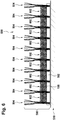
- Fig. 6 shows the artificial turf carpet 500 after the artificial turf infill 602 has been spread out and distributed between the artificial turf fiber tufts 504.
- the artificial turf infill 602 is a granulate made up of individual grains 100 or granules such as is depicted in Figs. 3 or 4 .
- Fig. 7 shows a flowchart which illustrates a method of manufacturing artificial turf infill 602 such as is depicted in Figs. 1-3 in the coating of the single grain 100 or granule.
- the initial composition comprises a granulate, at least one first type of pigment, and a fluid binding agent.
- the fluid binding agent comprises at least one type of polymer component.
- the initial composition is mixed.
- step 704 during the mixing water and catalyst are added to the initial composition to cure the fluid binding agent and the at least one type of pigment into an initial coating 200 of the granulate.
- a subsequent composition is provided.
- the subsequent composition comprises the granulate with the initial coating 200, the at least one second type of pigment, and the fluid binding agent.
- step 708 the subsequent composition is mixed.
- step 710 water and the catalyst are added to the subsequent composition during the mixing of the subsequent composition to cure the fluid binding agent and the at least one second type of pigment into a subsequent coating 300 of the granulate.
- step 712 the granulate with the subsequent coating 300 is provided as the artificial turf infill 602.
- Fig. 8 shows a flowchart, which illustrates an alternate method of manufacturing artificial turf infill.
- the method depicted in Fig. 8 is similar to the method depicted in Fig. 7 with several additional steps.
- the method in Fig. 8 is identical to Fig. 7 in steps 700-710.
- step 800 is performed.
- Steps 802 and then 804 are performed before step 712 is performed.
- Steps 800, 802 and 804 are the steps of recoating the granulate after it has been coated with the subsequent coating.
- a subsequent composition is provided by adding at least one additive and a fluid binding agent to the granulate.
- the subsequent composition is mixed.
- step 804 during the mixing in step 802, water and catalyst are added to the subsequent composition during mixing of the subsequent composition to cure the fluid binding agent and at least one additive into the further coating 400.
- step 712 the granulate that has been coated with the initial coating, the subsequent coating, and the further coating 400, is provided as the artificial turf infill 602.
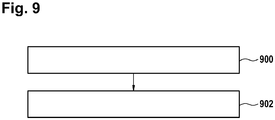
- Fig. 9 shows a flowchart, which illustrates a method of manufacturing artificial turf 600 such as depicted in Fig. 6 .
- an artificial turf carpet 500 is installed.
- the artificial turf carpet comprises multiple artificial turf fiber tufts 504.
- the artificial turf 600 is provided by spreading a layer of artificial turf infill 602 between the multiple artificial turf fiber tufts 504.
- the artificial turf infill comprises the granulate.
- the granulate comprises at least two outer coatings 200, 300, 400.
- Each of the at least two outer coatings 200, 300, 400 comprises at least one type of pigment and a binding agent.
- the pigments in each of the coatings may be identical or different.
- the binding agent comprises at least one type of polyurethane polymer.
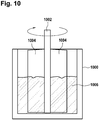
- Fig. 10 illustrates some equipment which may be used for manufacturing the artificial turf infill 602 and for coating grain or granules 100, such as is illustrated in Figs. 1-4 .
- Fig. 10 depicts a mixing vat 1000.
- the mixing vat has a rotatable shaft 1002 that is connected to a number of mixing paddles 1004.
- the mixing vat 1000 is filled with the granulate 1006.
- the elastomeric granulate can then be manufactured into artificial turf infill by following the methods illustrated in Figs. 7 or 8 . Since water is added with the catalyst for forming each of the initial coating 200, the subsequent coating 300 or the further coating 400 it is not necessary to dry the granulate 1006 between the coating of each of the coatings.
- the granulate 1006 can be added to the mixing vat 1000 and then at different times the different materials can be added while the rotatable shaft 1002 is turned.
- the apparatus depicted in Fig. 10 may be used for manufacturing the artificial turf infill as batches. It is also possible to manufacture the artificial turf infill as a continuous process using a flow reactor.
- Fig. 11 illustrates an example of a flow reactor 1100.
- the example shown in Fig. 11 is illustrative and is not drawn to scale.
- the flow reactor 1100 comprises a rotatable shaft 1102 that is connected to a screw conveyor 1104.
- the screw conveyor 1104 is similar to an Archimedes screw, which is mounted horizontally.
- the flow reactor 1100 can be shown as being filled with granulate 1006.
- the granulate 1006 comprises grains or particles 100 such as is shown in Figs. 1-4 .
- As the rotatable shaft 1102 is turned, it causes the granulate 1006 to move through the flow reactor 1100. It also causes the granulate 1006 to be mixed.
- the at least one pigment and the fluid binding agent are added to the granulate 1006 and become mixed with it as the shaft 1102 is rotated.
- the granulate 1006 and the at least one pigment and the fluid binding agent form an initial composition 1120.
- This initial composition 1120 is then transported beneath a first inlet for water and catalyst 1112. The water and catalyst may be added on a continual or intermittent basis at this inlet 1112.
- the initial composition 1120 As the initial composition 1120 is transported further along the flow reactor 1100 fluid binding agent and at least one pigment cure into the initial coating 200 such as depicted in Fig. 2 . After the initial coating 200 is formed, the initial composition 1120 is transported underneath the second inlet for at least one pigment and fluid binding agent. At this point more of the pigment and fluid binding agent are added and the initial composition 1120 becomes the subsequent composition 1122.
- the pigments used for the initial composition and the subsequent composition may be identical or they may be different.
- the subsequent composition 1122 is mixed and transported underneath the second inlet for water and catalyst 1116.
- the water and catalyst are then mixed with the subsequent composition 1122 and over time are further transported to the end of the flow reactor 1100.
- the subsequent coating 300 has formed on the grains or particles of the granulate 1006 such as depicted in Fig. 3 .
- the granulate 1006 exits the flow reactor 1100 at an outlet 1117.
- the granulate 1006 at this point is then artificial turf infill 602.
- the artificial turf infill 602 is then shown as entering into an optional dryer 1118.
- the flow reactor may also be extended. For example if it is desired to put a third or fourth or even more coatings, the number of inlets in the flow reactor 1100 can simply be increased. This may involve moving the granulate at a different rotational rate or possibly even making the flow reactor 1100 longer.
Landscapes
- Chemical & Material Sciences (AREA)
- Chemical Kinetics & Catalysis (AREA)
- Organic Chemistry (AREA)
- Health & Medical Sciences (AREA)
- Medicinal Chemistry (AREA)
- Polymers & Plastics (AREA)
- Engineering & Computer Science (AREA)
- Crystallography & Structural Chemistry (AREA)
- Civil Engineering (AREA)
- Structural Engineering (AREA)
- Architecture (AREA)
- Materials Engineering (AREA)
- Road Paving Structures (AREA)
- Processes Of Treating Macromolecular Substances (AREA)
- Application Of Or Painting With Fluid Materials (AREA)
- Paints Or Removers (AREA)
- Glanulating (AREA)
- Polyurethanes Or Polyureas (AREA)
Description
- The invention relates to artificial turf and methods for the manufacture of artificial turf infill.
- Artificial turf or artificial grass is surface that is made up of fibers which is used to replace grass. The structure of the artificial turf is designed such that the artificial turf has an appearance which resembles grass. Typically artificial turf is used as a surface for sports such as soccer, American football, rugby, tennis, golf, for playing fields, or exercise fields. Furthermore artificial turf is frequently used for landscaping applications.
- Artificial turf may be manufactured using techniques for manufacturing carpets. For example artificial turf fibers which have the appearance of grass blades may be tufted or attached to a backing. Often times artificial turf infill is placed between the artificial turf fibers. Artificial turf infill is a granular material that covers the bottom portion of the artificial turf fibers. The use of artificial turf infill may have a number of advantages. For example, artificial turf infill may help the artificial turf fibers stand up straight. Artificial turf infill may also absorb impact from walking or running and provide an experience similar to being on real turf. The artificial turf infill may also help to keep the artificial turf carpet flat and in place by weighting it down.
- European patent application
EP 1 416 009 B1 describes a loose, free flowing rubber particles as litter material for artificial turf. The particles have an average size between 0.4 mm and 4.0 mm and their complete surface is covered with a permanently elastic and pigmenting coating. - European patent application
EP1201388 B1 discloses a method of manufacturing colored rubber chips: To 100 parts by weight of crushued rubber chips having a particle size of from 1 to 10 mm or fibrous rubber chips having a fibrous length of 30 mm or below are added a film forming material, which contains a pigment and 10 to 100 parts by weight of a one-pack type or two-pack type polyurethane resin which gels at least from a liquid state in 60 seconds or more and cures through the gelling process, and they are stirred for mixing. When the polyurethane resin starts to gel and the rubber chips start to aggregate, stirring is further continued for mixing in spite of heavy load on the mixer so to loosen the aggregation of the rubber chips. By configuring as described above, A manufacturing method which can form a thick colored film without requiring a complex procedure and can inexpensively obtain colored rubber chips which have a remarkable color keeping property and a pyramid shape with edges similar to those formed when crushed is provided. The particle size is desired to have almost the same size as the thickness of the film. And if it is excessively larger or smaller than that size it does not meet the objective of completely covering the rubber chips. The film thickness in the present invention is about 0.8 mm maximum and the particle sizes is also about the same accordingly. - International patent application
WO 2010/081632 A1 discloses a method for producing coated particles made of rubber granulate, the coating, the particles coated with said coating, and the uses of the coated particles. The coating contains no solvents. - The invention provides for a method of manufacturing artificial turf infill, a method of manufacturing artificial turf, artificial turf infill, and artificial turf. Embodiments are given in the dependent claims.
- In one aspect the invention provides for a method of manufacturing artificial turf infill. Artificial turf infill as used herein, encompasses a granular material that is spread out on an artificial turf carpet in between the fibers. Artificial turf infill may be used to modify an artificial turf carpet to have more earth like properties. For example the artificial turf infill may provide a surface which is able to absorb impacts in a manner similar to real turf.
- The method comprises providing an initial composition comprising a granulate, at least one first type of pigment, and a fluid binding agent. The fluid binding agent comprises at least one type of polymer component. The method further comprises mixing the initial composition. The method further comprises adding water and a catalyst to the initial composition during the mixing of the initial composition to cure the fluid binding agent and the at least one type of pigment into an initial coating of the granulate.
- The method further comprises providing a subsequent composition comprising the granulate with the initial coating, the at least one second type of pigment and the fluid binding agent. The method further comprises mixing the subsequent composition. The method further comprises adding water and the catalyst to the subsequent composition during the mixing of the subsequent composition to cure the fluid binding agent and the at least one type of pigment into a subsequent coating of the granulate.
- The at least one second type of pigment and the at least one first type of pigment may be identical or they may be different. If they are the same then the coating of the granulate will be of a uniform color. If the at least one second type of pigment and the at least one first type of pigments are different colors then the two colors can be chosen so that the resulting artificial turf infill has a more natural and earth like appearance.
- The method further comprises providing the granulate with the subsequent coating as artificial turf infill.
- The coating of the granulate in at least two steps as described above, may be beneficial because it may provide for better coating of the granulate For example, during the mixing of the initial composition individual grains of the granulate will touch and interact with each other as the initial coating on each of the grains forms. The physical contact between different grains will however cause defects. By coating the granulate particles a second time with the subsequent coating, much higher coverage of the granulate can be achieved.
- As a hypothetical example, during the formation of the initial coating or the subsequent coating the coverage is each only 90% of the surface of the granulate. After the initial coating has been deposited, roughly 10% of each granule of the granulate would be uncoated. There would be small surface defects. Deposition of the subsequent coating would then also cover 90% of the surface. As the interaction between the grains or particles of the granulate is essentially a random process, one can expect that 90% of the defects that were exposed after the deposition of the initial coating are coated in this case. The result of doing two coatings is then an artificial turf infill that is 99% coated with only minor amounts of defects, where the granulate is not coated with either the initial coating or the subsequent coating.
- Improving the coverage of the granulate may be beneficial in several different situations. For example, it may be desirable to color the artificial turf infill the same or a similar color as fibers or tufts, which are used to manufacture an artificial turf carpet. This may provide a more realistic-looking play surface or playfield. Another advantage is that the elastomeric granulate may be better coated and may therefore have superior wear qualities or may even be better isolated from the environment.
- In an embodiment, the granulate comprises an elastomeric or elastic granulate.
- In different embodiments the granulate is an elastomeric material based on elastomers like synthetic rubbers as e.g. styrene butadiene rubber, polybutadiene rubber, styrene- ethylene-butadiene-styrene copolymer (SEBS), ethylenepropylene-diene monomer rubber (EPDM), acryl nitrile butadiene rubber. In other embodiments a cis- 1,4 -polyisoprene, as natural rubber and trans 1,4 - polyisoprene as gutta-percha based granulate can be used.
- In another embodiment the granulate comprises a compression resistant granulate or a rigid granulate.
- In another embodiment the granulate comprises any one of the following: natural latex, cork, linoleum, composites made from solidified vegetable oils and wood flour or a hydrogel of methyl-cellulose.
- In another embodiment the curing of the initial coating and the curing of the subsequent coating is a polymerization process. Within the claims, the term 'cure' or 'curing' may be replaced with polymerization.
- In another embodiment the subsequent coating at least partially covers the initial coating.
- In another embodiment the initial coating only partially covers the granulate.
- In another embodiment the subsequent coating only partially covers the initial coating.
- In another embodiment, the initial coating and the subsequent coating each have a thickness of less than any one of the following: 0.1 mm, 0.075 mm, 0.05 mm, and 0.01 mm. This embodiment may be beneficial because it may provide a means of reducing the amount of fluid binding agent necessary to coating the granulate.
- The initial coating comprises gaps. The subsequent coating also comprises gaps. The gaps in the initial and subsequent coatings may be distributed randomly on the surface of the granulate. As the gaps in both coatings are distributed randomly, it is unlikely that the gaps will line up. The result will be that there will be few if any portions of the underlying granulate exposed.
- It is possible that some of the gaps in the intial and subsequent coatings may line up. However, all or the vast majority of the surface of the granulate will be coated. Using the double coating may greatly reduce the amount of fluid binding agent necessary to coat the granulate.
- In another embodiment, the granulate with the initial coating and the subsequent coating is re-coated at least one time by performing the following sequence. The first step in the sequence is provide a subsequent composition by adding at least one additive and the fluid binding agent to the granulate that has already been coated with the initial coating and the subsequent coating. The next step in the sequence is to mix the subsequent composition. The next step in the sequence is to add water and the catalyst to the subsequent composition during the mixing of the subsequent composition to cure the fluid binding agent and the at least one additive into a further coating. The granulate with the further coating is provided then as the artificial turf infill. This embodiment may be beneficial because an additional coating or layer may be put on the granulate. If the at least one first and/or second type of pigment is used again then the granulate may be coated a third or more times to improve the coverage and the coating of the granulate. This embodiment may also be beneficial because it may enable the deposition of so-called functional layers or additives, which may add to the utility or wear or usefulness of the artificial turf infill.
- In another embodiment, the further coating has a thickness of less than any one of the following: 0.1 mm, 0.075 mm, 0.05 mm, and 0.01 mm. This embodiment may be beneficial because it may provide a means of reducing the amount of fluid binding agent necessary for coating the granulate.
- In another embodiment the PU catalyst is partially or completely water soluble and is of the group: secondary amine, tertiary amine, a metal organo cytalyst.
- In another embodiment the liquid PU component is based on an NCO terminal polymer which might be a pre-polymer, a polymeric isocyanate, an oligomeric isocyanate , a monomer and a mixture hereof.
- In another embodiment the liquid PU component is based on an aromatic diisocyanate of the group toluene diisocyanate or methylene- 2,2 -diisocyanate,
- In another embodiment the liquid PU component is based on an aliphatic diisocyanate of the group hexamethylene disiocyanate, isophorone diisocyanate and 1,4-cyclohexyldisiocyanate.
- In preferred embodiment the liquid PU component is based on methylenediphenyl-isocyanate isomer mixture.
- In another embodiment the hydroxyl component for the production of the PU is out of the group polyether polyol or polyester polyol.
- In another embodiment the hydroxyl component is based on a polyetherpolyol of the
molecular weight 500 to 10000. In a preferred embodiment the polyetherpolyol has a molecular weight of 1500- 6000. In a very preferred embodiment the molecular weight is in the range of 2000- 4000. - In another embodiment the at least one additive comprises the at least one first and/or second type of pigment.
- In another embodiment the at least one additive further comprises a flame retardant like aluminum trihydrate, magnesium hydroxide turning a by itself burnable or flammable elastomeric material into a flame retardant infill material.
- In another embodiment this flame retardant additives creates an intumescent coating and is based on intumescent component comprising ammonium polyphosphate or exfoliated graphite or a mixture hereof.
- In another embodiment the at least one additive further comprises zeolite. The addition of zeolite may be beneficial because then the surface of the artificial turf infill may be able to absorb or de-absorb water. For example before a football game, which is scheduled to be held in the sun or in hot conditions, water may be sprayed onto the artificial turf and the zeolite may absorb an amount of water. As the sun or hot air heats the artificial turf infill during the game, the evaporation of water may cool the playing surface for the players and make the use of the artificial turf more pleasant.
- In another embodiment the at least one additive further comprises methylcellulose, which may be beneficial in a similar way like zeolite for absorbing and desorbing of water, rendering a cooling effect at hot climatic conditions.
- In another embodiment the at least one additive further comprises an antibacterial agent.
- In another embodiment the at least one additive further comprises silver. Silver may be beneficial as an antibacterial agent.
- In another embodiment the at least one additive further comprises chitosan, showing natural antibacterial properties.
- In another embodiment the at least one additive further comprises an IR reflective pigment. The use of the IR reflective pigments as mixed metal oxides may be beneficial because it may reflect infrared light. This may reduce the heating of the artificial turf infill. A specific advantage may be that in this case the comparably expensive and precious pigments are merely on the surface of the infill granulates, where they are fully effective and not in the complete core of the elastic material In another embodiment the elastomeric granulate is a rubber granulate.
- In another embodiment the elastomeric granulate comprises any one of the following: rubber, an elastomeric polymer, Metallocene Butadiene Rubber, nitrile rubber granulate, natural rubber granulate, styrene-butadiene rubber granulate, ethylene propylene diene monomer rubber granulate, black crumb rubber granulate, acrylonitrile butadiene rubber, a thermoplastic polymer, Styrene Ethylene Butylene Styrene , Styrene Block Copolymers, and combinations thereof.
- In a further embodiment the granulate is an elastic foam.
- In a further embodiment the granulate is an elastic PU foam.
- In another embodiment the granulate has an average diameter between 0.1 mm and 3.0 mm.
- In another embodiment the granulate has a maximum diameter of less than 5.0 mm.
- In another embodiment the at least one first and/or second type of pigment comprises an inorganic pigment, an organic pigment or mixtures hereof.
- In another embodiment the at least one first and/or second type of pigment comprises any one of the following: iron oxide, iron oxide hydroxide, chromium(III) oxide, a copper phythalocyanine pigment, a nickel azopigment, titanium oxide and combinations thereof.
- In another embodiment the at least one type of additive is hindered amine light stabilizer (HALS) which is able to protect the PU coating as well as the elastic and/ or compression resilient granulate against UV degradation.
- In another embodiment the at least one type of additive is a thermostabilizing agent, protecting the elastic and/ or compression resilient granulate against thermal degradation.
- In another embodiment the at least one type of additive is an anti-freeze/ deicing additive of the group: sodium chloride, potassium chloride, calcium chloride, sodium formiate, potassium formiate or a mixture hereof. The additive is migrating into the neighborhood of the granulate and by this inhibits the formation of ice by freezing humidity between the infill granulate particles.
- In another embodiment the fluid binding agent further comprises any one of the following: a surfactant, a polyurethane aliphatic isocyanate, a polyurethane aromatic isocyanate, zeolite, an antibacterial agent, silver, IR reflective pigment, and combinations thereof.
- In another embodiment the polymer component comprises any one of the following: at least one type of monomer, at least one type of partially polymerized polymer, and combinations thereof.
- In another embodiment the polymer component is cured into at least one type of polyurethane by the water and the catalyst.
- For example the polymer component could be methylene diphenyl diisocyanate. The polymer component could also comprise polyols.
- In another embodiment the catalyst comprises any one of the following: an amine catalyst and a metal organic catalyst.
- In another embodiment the method further comprises drying the subsequent composition before providing the granulate as the artificial turf infill.
- It may also be possible to dry the initial composition after coating the granulate with the initial coating; however, it is not necessary. The water, which is leftover from the formation of the initial coating on the elastic and /or compression resilient granulate may be used in the reaction of the subsequent composition.
- In another embodiment the method is at least partially performed in a flow reactor. In the flow reactor the granulate is slowly moved along a linear sequential path, where the granulates are generally mixed and moved along. The benefit of using a flow reactor is that the artificial turf infill may be produced on a continuous basis.
- In another embodiment the method is at least partially performed as a batch process. The initial coating is formed on the granulate during an initial batch and the subsequent coating is formed on the granulate during a subsequent batch. Forming the initial coating and the subsequent coating in separate batches may be beneficial because it may enable precise control over the formation of the initial and subsequent coatings.
- In another aspect the invention provides for a method of manufacturing artificial turf. The method comprises installing an artificial turf carpet. The artificial turf carpet comprises multiple artificial turf fiber tufts. For example, the artificial turf carpet may be a tufted artificial turf carpet. There may be a backing which has tufts of artificial grass fibers tufted into it. The method further comprises providing the artificial turf by spreading a layer of artificial turf infill between the multiple artificial turf fiber tufts. The artificial turf infill comprises a granulate. The granulate comprises at least two outer coatings. Each of the two outer coatings comprises at least one first and/or second type of pigment and a binding agent. The binding agent comprises at least one type of polyurethane polymer. This method may be beneficial because the artificial turf infill may be more completely covered with the two outer coatings. This may for instance provide superior optical appearance of the artificial turf infill. It may also provide better wear and longevity of the artificial turf infill.
- In another embodiment, the two outer coatings each have a thickness of less than any one of the following: 0.1 mm, 0.075 mm, 0.05 mm, and 0.01 mm. This embodiment may be beneficial because it may provide a means of reducing the amount of fluid binding agent necessary for coating the granulate.
- In another embodiment, the at least two outer coatings each comprise gaps. In other words the at least two outer coatings each incompletely covers the granulate and each of the two outer coatings has gaps.
- The gaps in the at least two outer coatings may be distributed randomly on the surface of the granulate. Some of the gaps in the at lesat two outer coatings may line up. However, many of the gaps in the at least two outer coatings will be at different locations on the surface of the granulate. The result is that there will likely be a few places where the underlying granulate is exposed. However the majority of the surface of the granulate will be coated. Using the double coating may greatly reduce the amount of fluid biniding agent necessary to coat the granulate.
- In another embodiment the method further comprises manufacturing the artificial turf infill according to an embodiment.
- In another embodiment the granulate comprises at least two outer coatings. Each of the two outer coatings comprises at least one first and/or second type of pigment and a binding agent. The binding agent comprises at least one type of polyurethane polymer. This artificial turf infill may have the benefit that the use of the two outer coatings enables more complete coverage of the grains or particles of the artificial turf infill.
- In another aspect, the invention provides for an artificial turf. The artificial turf comprises an artificial turf carpet. The artificial turf carpet comprises multiple artificial turf fiber tufts. The artificial turf further comprises artificial turf infills spread between the multiple artificial fiber tufts. The artificial turf infill comprises a granulate. The granulate comprises at least two outer coatings. Each of the two outer coatings comprises at least one first and/or second type of pigment and a binding agent. The binding agent comprises at least one type of polyurethane polymer.
- The use of the artificial turf infill with the two outer coatings may provide superior wear or longevity of the artificial turf. It may also provide superior optical appearance as the artificial turf infill may be more uniformly pigmented if the pigments in the two layers are identical. The pigments can also be selected so that the artificial turf infill has a patch work of different colors. This may make the artificial turf infill look more natural and earth-like.
- In another embodiment, the two outer coatings each have a thickness of less than any one of the following: 0.1 mm, 0.075 mm, 0.05 mm, and 0.01 mm. This embodiment may be beneficial because it may provide a means of reducing the amount of fluid binding agent necessary to coating the granulate.
- In another embodiment, the at least two outer coatings each comprise gaps. In other words the at least two outer coatings each incompletely covers the granulate and each of the two outer coatings has gaps.
- The gaps in the at least two outer coatings may be distributed randomly on the surface of the granulate. Some of the gaps in the at lesat two outer coatings may line up. However, many of the gaps in the at least two outer coatings will be at different locations on the surface of the granulate. The result is that there will likely be a few places where the underlying granulate is exposed. However the majority of the surface of the granulate will be coated. Using the double coating may greatly reduce the amount of fluid biniding agent necessary to coat the granulate.
- In another embodiment the granulate has an average diameter between 0.45 mm and 2.0 mm.
- In another embodiment the granulate has a maximum diameter of less than 4 mm.
- In another embodiment, the artificial turf fiber tufts are arranged in rows. The artificial turf fibers have a row of space in between 0.5 cm and 1.95 cm. This corresponds approximately to 3/8" to 3/4".
- In another embodiment the artificial turf covering has a pile height between 2.5 cm and 7.5 cm. The pile height is the length of the artificial turf fibers above the backing or base of the artificial turf carpet.
- It is understood that one or more of the aforementioned embodiments of the invention may be combined as long as the combined embodiments are not mutually exclusive.
- In the following embodiments of the invention are explained in greater detail, by way of example only, making reference to the drawings in which:
- Fig. 1
- illustrates a cross sectional coating of a grain of a granulate;
- Fig. 2
- illustrates the granule of
Fig. 1 after being partially coated with an initial coating; - Fig. 3
- illustrates the granule of
Fig. 2 after being partially coated with a subsequent coating; - Fig. 4
- illustrates the granule of
Fig. 3 after being partially coated with a subsequent coating; - Fig. 5
- illustrates an example of an artificial turf carpet;
- Fig. 6
- illustrates an example of artificial turf;
- Fig. 7
- shows a flow chart which illustrates a method of manufacturing artificial turf infill;
- Fig. 8
- shows a flow chart which illustrates a further method of manufacturing artificial turf infill;
- Fig. 9
- shows a flow chart which illustrates a method of manufacturing artificial turf;
- Fig. 10
- illustrates an example of a batch reactor; and
- Fig. 11
- illustrates an example of a flow reactor.
- Like numbered elements in these figures are either equivalent elements or perform the same function. Elements which have been discussed previously will not necessarily be discussed in later figures if the function is equivalent.
-
Figs. 1-4 illustrate the manufacture of artificial turf infill by examining a single grain orgranule 100. Thegranule 100 could for example be made from an elastomeric compound, a rigid compound, a semi-rigid compound, and/or a compression resilient compound.Fig. 1 shows a grain or granule. For example thegrain 100 could be a grain or granule of rubber or a compression, a rigid compound, a semi-rigid compound, or resilient compound. The view shown inFigs. 1-4 is a cross-sectional view. -
Fig. 2 shows thesame grain 100 or granule after it has been coated with aninitial coating 200. Theinitial coating 200 was formed by providing an initial composition of a granulate, which is made up of a large number of grains orgranules 100. The initial composition comprised at least one first type of pigment and a fluid binding agent also. The fluid binding agent comprises at least one type of polymer component. The initial composition was then mixed. Next, water and a catalyst were added to the initial composition during the mixing process to cure the fluid binding agent and the at least one first type of pigment into theinitial coating 200. As a large number of thesegranules 100 or grains are mixed they interact with each other and bump into each other occasionally during the process. For this reason there may be holes or defects in theinitial coating 200. InFig. 2 it can be seen that there are a number ofgaps 202 in theinitial coating 200. These are regions where thegrain 100 or granule is coated or is insufficiently coated by theinitial coating 200. -
Fig. 3 shows thesame grain 100 or granule after it has been coated with asubsequent coating 300. As with theinitial coating 200 thesubsequent coating 300 does not completely cover all portions of thegrain 100 or granule. However, due to the two-step process almost theentire grain 100 orgranule 100 is coated. In this example there can only be seen onegap 202. Thesubsequent coating 300 was formed by providing a subsequent composition comprising the granulate with the initial coating as is shown inFig. 2 and then combining it with the at least one first type of pigment or at least one second type of pigment and the fluid binding agent. This subsequent composition was then mixed. During the mixing process additional water and a catalyst were added to the subsequent composition to cure the fluid binding agent and the at least one type of pigment into thesubsequent coating 300.Fig. 3 illustrates how a two-step coating process may be used to improve the coverage or quality of the coating on a granule that makes up a larger granulate. Granules manufactured, such as is shown inFig. 3 , may be provided as a group to form an artificial turf infill. - It is also possible to perform further coatings on the
grain 100 orgranule 100.Fig. 4 shows thegrain 100 after afurther coating 400 has been applied. Thisfurther coating 400 may for example be formed by recoating the granulate, which comprises thegrain 100, by adding at least one additive and the fluid binding agent to the granulate. Next, a combination of the granulate and the at least one additive in the fluid binding agent form a subsequent composition. This subsequent composition is then mixed and again, water and a catalyst can be added to cure the fluid binding agent and at least one additive into thefurther coating 400. It can be seen now that the coverage of thegrain 100 or granule is sufficient that there are no longer any gaps visible in this cross-section. The at least one additive could take different forms. - If it were desired to ensure that there are no gaps in the coatings the at least one pigment could be used again. In other cases additional additives may be added to form a functional
further coating 400. For example a flame retardant such as polyurethane oliphatic isocyanates could be added. To provide for the absorption and de-absorption of water, to cool the carpet a zeolite could be added. Also various antibacterial or antifungal agents could be added too. In other examples an infrared reflection agent such as EPDM may be used to reduce the amount of heat absorbed by the artificial turf infill and/or also to help protect it from sunlight. -
Figs. 5 and6 illustrate the manufacture of an artificial turf using an artificial turf carpet and artificial turf infill. InFig. 5 anartificial turf carpet 500 can be seen. Theartificial turf carpet 500 comprises abacking 502. Theartificial turf carpet 500 shown inFig. 5 is a tufted artificial turf carpet in this example. The artificial turf carpet is formed by artificialturf fiber tufts 504 that are tufted into thebacking 502. The artificialturf fiber tufts 504 are tufted in rows. There is row spacing 506 between adjacent rows of tufts. The artificialturf fiber tufts 504 also extent a distance above thebacking 502. The distance that thefibers 504 extend above thebacking 502 is thepile height 508. InFig. 5 it can be seen that theartificial turf carpet 500 has been installed by placing or attaching it to theground 510 or a floor. To manufacture the artificial turf the artificial turf infill made up of grains or granules such as is shown inFigs. 3 or 4 are spread out on the surface and distributed between the artificialturf fiber tufts 504.Fig. 6 shows theartificial turf carpet 500 after theartificial turf infill 602 has been spread out and distributed between the artificialturf fiber tufts 504. It can be seen that theartificial turf infill 602 is a granulate made up ofindividual grains 100 or granules such as is depicted inFigs. 3 or 4 . -
Fig. 7 shows a flowchart which illustrates a method of manufacturingartificial turf infill 602 such as is depicted inFigs. 1-3 in the coating of thesingle grain 100 or granule. First instep 700 an initial composition is provided. The initial composition comprises a granulate, at least one first type of pigment, and a fluid binding agent. The fluid binding agent comprises at least one type of polymer component. Next instep 702 the initial composition is mixed. Next instep 704 during the mixing water and catalyst are added to the initial composition to cure the fluid binding agent and the at least one type of pigment into aninitial coating 200 of the granulate. In step 706 a subsequent composition is provided. The subsequent composition comprises the granulate with theinitial coating 200, the at least one second type of pigment, and the fluid binding agent. Next instep 708 the subsequent composition is mixed. Next instep 710 water and the catalyst are added to the subsequent composition during the mixing of the subsequent composition to cure the fluid binding agent and the at least one second type of pigment into asubsequent coating 300 of the granulate. Finally instep 712 the granulate with thesubsequent coating 300 is provided as theartificial turf infill 602. -
Fig. 8 shows a flowchart, which illustrates an alternate method of manufacturing artificial turf infill. The method depicted inFig. 8 is similar to the method depicted inFig. 7 with several additional steps. The method inFig. 8 is identical toFig. 7 in steps 700-710. Afterstep 710 has been performed,step 800 is performed.Steps 802 and then 804 are performed beforestep 712 is performed.Steps step 802, the subsequent composition is mixed. Finally, instep 804, during the mixing instep 802, water and catalyst are added to the subsequent composition during mixing of the subsequent composition to cure the fluid binding agent and at least one additive into thefurther coating 400. Finally, instep 712, the granulate that has been coated with the initial coating, the subsequent coating, and thefurther coating 400, is provided as theartificial turf infill 602. -
Fig. 9 shows a flowchart, which illustrates a method of manufacturingartificial turf 600 such as depicted inFig. 6 . First instep 900 anartificial turf carpet 500 is installed. The artificial turf carpet comprises multiple artificialturf fiber tufts 504. Next instep 902, theartificial turf 600 is provided by spreading a layer ofartificial turf infill 602 between the multiple artificialturf fiber tufts 504. The artificial turf infill comprises the granulate. The granulate comprises at least twoouter coatings outer coatings -
Fig. 10 illustrates some equipment which may be used for manufacturing theartificial turf infill 602 and for coating grain orgranules 100, such as is illustrated inFigs. 1-4 .Fig. 10 depicts a mixingvat 1000. The mixing vat has arotatable shaft 1002 that is connected to a number of mixing paddles 1004. The mixingvat 1000 is filled with thegranulate 1006. The elastomeric granulate can then be manufactured into artificial turf infill by following the methods illustrated inFigs. 7 or8 . Since water is added with the catalyst for forming each of theinitial coating 200, thesubsequent coating 300 or thefurther coating 400 it is not necessary to dry the granulate 1006 between the coating of each of the coatings. The granulate 1006 can be added to themixing vat 1000 and then at different times the different materials can be added while therotatable shaft 1002 is turned. - The apparatus depicted in
Fig. 10 may be used for manufacturing the artificial turf infill as batches. It is also possible to manufacture the artificial turf infill as a continuous process using a flow reactor. -
Fig. 11 illustrates an example of aflow reactor 1100. The example shown inFig. 11 is illustrative and is not drawn to scale. Theflow reactor 1100 comprises arotatable shaft 1102 that is connected to ascrew conveyor 1104. Thescrew conveyor 1104 is similar to an Archimedes screw, which is mounted horizontally. Theflow reactor 1100 can be shown as being filled withgranulate 1006. Thegranulate 1006 comprises grains orparticles 100 such as is shown inFigs. 1-4 . As therotatable shaft 1102 is turned, it causes thegranulate 1006 to move through theflow reactor 1100. It also causes thegranulate 1006 to be mixed. At an entrance there is aninlet 1108 for addinggranulate 1006. This may be done on a continual basis as theshaft 1102 is rotated. This causes the granulate to go to a first inlet for at least one pigment and fluid binding agent. At thisfirst inlet 1110 the at least one pigment and the fluid binding agent are added to thegranulate 1006 and become mixed with it as theshaft 1102 is rotated. When they are thoroughly mixed, thegranulate 1006 and the at least one pigment and the fluid binding agent form aninitial composition 1120. Thisinitial composition 1120 is then transported beneath a first inlet for water andcatalyst 1112. The water and catalyst may be added on a continual or intermittent basis at thisinlet 1112. - As the
initial composition 1120 is transported further along theflow reactor 1100 fluid binding agent and at least one pigment cure into theinitial coating 200 such as depicted inFig. 2 . After theinitial coating 200 is formed, theinitial composition 1120 is transported underneath the second inlet for at least one pigment and fluid binding agent. At this point more of the pigment and fluid binding agent are added and theinitial composition 1120 becomes thesubsequent composition 1122. The pigments used for the initial composition and the subsequent composition may be identical or they may be different. - The
subsequent composition 1122 is mixed and transported underneath the second inlet for water andcatalyst 1116. The water and catalyst are then mixed with thesubsequent composition 1122 and over time are further transported to the end of theflow reactor 1100. By the time thesubsequent composition 1122 has reached the end of theflow reactor 1100 thesubsequent coating 300 has formed on the grains or particles of the granulate 1006 such as depicted inFig. 3 . At the very end, then the granulate 1006 exits theflow reactor 1100 at anoutlet 1117. The granulate 1006 at this point is thenartificial turf infill 602. Theartificial turf infill 602 is then shown as entering into anoptional dryer 1118. - It is clear from
Fig. 11 that the flow reactor may also be extended. For example if it is desired to put a third or fourth or even more coatings, the number of inlets in theflow reactor 1100 can simply be increased. This may involve moving the granulate at a different rotational rate or possibly even making theflow reactor 1100 longer. -
- 100
- grain or granule
- 200
- initial coating
- 202
- gap
- 300
- subsequent coating
- 400
- further coating
- 500
- artificial turf carpet
- 502
- backing
- 504
- artificial turf fiber tufts
- 506
- row spacing
- 508
- pile height
- 510
- ground or floor
- 600
- artificial turf
- 602
- artificial turf infill
- 700
- providing an initial composition comprising a granulate
- 702
- mixing the initial composition
- 704
- adding water and a catalyst to the initial composition during the mixing of the initial composition to cure the fluid binding agent and the at least one first type of pigment into an initial coating of the granulate
- 706
- providing a subsequent composition comprising the granulate with the initial coating
- 708
- mixing the subsequent composition
- 710
- adding water and the catalyst to the subsequent composition during the mixing of the subsequent composition to cure the fluid binding agent and the at least one second type of pigment into a subsequent coating of the granulate
- 712
- providing the granulate with the subsequent coating as artificial turf infill
- 800
- providing a subsequent composition by adding at least one additive and the fluid binding agent to the granulate
- 802
- mixing the subsequent composition
- 804
- adding water and the catalyst to the subsequent composition during the mixing of the subsequent composition to cure the fluid binding agent and the at least one additive into a further coating
- 900
- installing an artificial turf carpet with multiple artificial turf fiber tufts
- 902
- providing the artificial turf by spreading a layer of artificial turf infill between the multiple artificial turf fiber tufts
- 1000
- mixing vat
- 1002
- rotatable shaft
- 1004
- mixing paddles
- 1006
- granulate
- 1100
- flow reactor
- 1102
- rotatable shaft
- 1104
- screw conveyor
- 1108
- inlet for granulate
- 1110
- first inlet for at least one pigment and fluid binding agent
- 1112
- first inlet for water and catalyst
- 1114
- second inlet for at least one pigment and fluid binding agent
- 1116
- first inlet for water and catalyst
- 1117
- outlet
- 1118
- dryer
- 1120
- initial composition
- 1122
- subsequent composition
Claims (27)
- A method manufacturing artificial turf infill (602), wherein the method comprises:- providing (700) an initial composition (1120) comprising a granulate (1006), at least one first type of pigment, and a fluid binding agent, wherein the fluid binding agent comprises at least one type of polymer component;- mixing (702) the initial composition;- adding (704) water and a catalyst to the initial composition during the mixing of the initial composition to cure the fluid binding agent and the at least one type of pigment into an initial coating (200) of the granulate;- providing (706) a subsequent composition (1122) comprising the granulate with the initial coating, at least one second type of pigment, and the fluid binding agent;- mixing (708) the subsequent composition;- adding (710) water and the catalyst to the subsequent composition during the mixing of the subsequent composition to cure the fluid binding agent and the at least one type of pigment into a subsequent coating (300) of the granulate, wherein the initial coating comprises gaps (202), wherein the subsequent coating comprises gaps (202); and- providing (712) the granulate with the subsequent coating as artificial turf infill.
- The method of claim 1, wherein the granulate with the initial coating and the subsequent coating is re-coated at least one time by performing the following sequence:- providing (800) a subsequent composition by adding at least one additive and the fluid binding agent to the granulate;- mixing (802) the subsequent composition; and- adding (804) water and the catalyst to the subsequent composition during the mixing of the subsequent composition to cure the fluid binding agent and the at least one additive into a further coating (400), wherein the granulate with the further coating is provided as the artificial turf infill.
- The method of claim 2, wherein the at least one additive further comprises any one of the following: the at least one first type of pigment, the at least one second type of pigment, a flame retardant, aluminum trihydrate, magnesium hydroxide, an intumescent component, ammonium polyphosphate, exfoliated graphite, methylcellulose, zeolite, an antibacterial agent, silver, chitosan, an IR reflective pigment, a hindered amine light stabilizer, an anti-freeze additive, a deicing additive, sodium chloride, potassium chloride, sodium formiate, potassium formiate, and combinations thereof.
- The method of any one of the preceding claims, wherein the granulate comprises an elastomeric granulate.
- The method of any one of the preceding claims, wherein the granulate comprises any one of the following: rubber, an elastomeric polymer, Metallocene Butadiene Rubber, nitrile rubber granulate, natural rubber granulate, styrene-butadiene rubber granulate, ethylene propylene diene monomer rubber granulate, black crumb rubber granulate, acrylonitrile butadiene rubber, a thermoplastic polymer, Styrene Ethylene Butylene Styrene , Styrene Block Copolymers, an elastic foam, elastic polyurethane foam, and combinations thereof.
- The method of any one of claims 1 through 3, wherein the granulate comprises a compression resilient granulate.
- The method of any one of claims, 1, 2, 3, or 6, wherein the granulate is any one of the following: natural latex, cork, linoleum, a composite formed from one or more type of solidified vegetable oil and wood flour, a hydrogel of methyl-cellulose, and combinations thereof.
- The method of any one of the preceding claims, wherein the granulate has an average diameter between 0.1 mm and 3.0 mm and/or wherein the granulate has a maximum diameter less than 5.0 mm.
- The method of any one of the preceding claims, wherein the at least one first type of pigment and/or the at least one second type of pigment comprises any one of the following: an inorganic pigment, an organic pigment, iron oxide, thalo green, Chromium(III) oxide, a Copper phythalocyanie pigment, a nickel azopigment, titanium oxide, and combinations thereof.
- The method of any one of the preceding claims, wherein the polymer component comprises any one of the following: at least one type of monomer, at least one type of partially polymerized polymer, and combinations thereof.
- The method of any one of the preceding claims, wherein the polymer component is cured into at least one type of polyurethane by the water and catalyst.
- The method of any one of the preceding claims, wherein the fluid binding agent comprises a liquid polyurethane component.
- The method of claim 12, wherein the liquid polyurethane component comprises an NCO terminal polymer, which may comprise a pre-polymer, a polymeric isocyanate, an oligomeric isocyanate, a monomer, and a mixture thereof.
- The method of claim 12 or 13, wherein the liquid polyurethane component comprises an aromatic diisocyanate of the group of toluene diisocyanate and/or methylene- 2,2 -diisocyanate.
- The method of claim 12, 13, or 14, wherein the liquid polyurethane component comprises an aliphatic diisocyanate of the group hexamethylene disiocyanate, isophorone diisocyanate, and/or 1,4-cyclohexyldisiocyanate.
- The method of any one of claims 12 through 15, wherein the liquid polyurethane component comprises an methylenediphenyl-isocyanate isomer mixture.
- The method of any one of claims 12 through 16, wherein the liquid polyurethane component comprises a hydroxyl component, wherein the hydroxyl component is selected from the group of polyether polyol or polyester polyol.
- The method of claim 17, wherein the hydroxyl component is based on a polyetherpolyol with a molecular weight between 500 and 10000, preferably the molecular weight is between 1500 and 6000, and more preferably the molecular weight is between 2000 and 4000.
- The method of any one of the preceding claims, wherein the catalyst belongs to any one of the following groups: a secondary amine catalyst, a tertiary amine catalyst, and a metal organic catalyst.
- The method of any one of the preceding claims, wherein the method further comprises drying the subsequent composition before providing the granulate as the artificial turf infill.
- The method of any one of the preceding claims, wherein the method is at least partially performed in a flow reactor (1100).
- The method of any one of claims 1 through 9, wherein the method is at least partially performed as a batch process (1000), wherein the initial coating is formed on the granulate during an initial batch, and wherein the subsequent coating is formed on the granulate during a subsequent batch.
- The method of any one of the preceding claims, wherein any one of the following:- the at least one first type of pigment is identical with the at least one second type of pigment, and- the at least one first type of pigment is a different color from the at least one second type of pigment.
- The method of any one of the preceding claims, wherein the initial coating and the subsequent coating each have a thickness of less than any one of the following: 0.1 mm, 0.075 mm, 0.05 mm, and 0.01 mm.
- A method of manufacturing artificial turf (600), wherein the method comprises:- installing (900) an artificial turf carpet (500), wherein the artificial turf carpet comprises multiple artificial turf fiber tufts (504); and- providing (902) the artificial turf by spreading a layer of artificial turf infill (602) between the multiple artificial turf fiber tufts, wherein the artificial turf infill comprises granulate, wherein the granulate comprises at least two outer coatings (200, 300, 400), wherein one of the at least two outer coatings comprises at least one first type of pigment and a binding agent, wherein the other of the at least two outer coatings comprises at least one second type of pigment and the binding agent, wherein the binding agent comprises at least one type of polyurethane polymer, and wherein the at least two outer coatings each comprise gaps (202) .
- Artificial turf infill (602), wherein the artificial turf infill comprises granulate, wherein the granulate comprises at least two outer coatings (200, 300, 400), wherein one of the at least two outer coatings comprises at least one first type of pigment and a binding agent, wherein the other of the at least two outer coatings comprises at least one second type of pigment and the binding agent, wherein the binding agent comprises at least one type of polyurethane polymer, wherein the at least two outer coatings each comprise gaps (202).
- An artificial turf (600), wherein the artificial turf comprises:- an artificial turf carpet (500), wherein the artificial turf carpet comprises multiple artificial turf fiber tufts (504); and- artificial turf infill (602) spread between the multiple artificial fiber tufts, wherein the artificial turf infill comprises a granulate (602), wherein the granulate comprises at least two outer coatings (200, 300, 400), wherein one of the at least two outer coatings comprises at least one first type of pigment and a binding agent, wherein the other of the at least two outer coatings comprises at least one second type of pigment and the binding agent, wherein the binding agent comprises at least one type of polyurethane polymer, and wherein the at least two outer coatings each comprise gaps (202).
Priority Applications (1)
| Application Number | Priority Date | Filing Date | Title |
|---|---|---|---|
| PL17707359T PL3426720T3 (en) | 2016-03-11 | 2017-03-02 | Artificial turf infill and method for making it |
Applications Claiming Priority (2)
| Application Number | Priority Date | Filing Date | Title |
|---|---|---|---|
| EP16159975.8A EP3216821A1 (en) | 2016-03-11 | 2016-03-11 | Artificial turf infill |
| PCT/EP2017/054964 WO2017153261A1 (en) | 2016-03-11 | 2017-03-02 | Artificial turf infill and method for making it |
Publications (2)
| Publication Number | Publication Date |
|---|---|
| EP3426720A1 EP3426720A1 (en) | 2019-01-16 |
| EP3426720B1 true EP3426720B1 (en) | 2020-01-29 |
Family
ID=55755304
Family Applications (2)
| Application Number | Title | Priority Date | Filing Date |
|---|---|---|---|
| EP16159975.8A Withdrawn EP3216821A1 (en) | 2016-03-11 | 2016-03-11 | Artificial turf infill |
| EP17707359.0A Active EP3426720B1 (en) | 2016-03-11 | 2017-03-02 | Artificial turf infill and method for making it |
Family Applications Before (1)
| Application Number | Title | Priority Date | Filing Date |
|---|---|---|---|
| EP16159975.8A Withdrawn EP3216821A1 (en) | 2016-03-11 | 2016-03-11 | Artificial turf infill |
Country Status (10)
| Country | Link |
|---|---|
| US (1) | US20190071546A1 (en) |
| EP (2) | EP3216821A1 (en) |
| JP (1) | JP6505957B1 (en) |
| KR (1) | KR20180124036A (en) |
| CN (1) | CN108779259A (en) |
| AU (1) | AU2017229156B2 (en) |
| CA (1) | CA3010760A1 (en) |
| ES (1) | ES2785669T3 (en) |
| PL (1) | PL3426720T3 (en) |
| WO (1) | WO2017153261A1 (en) |
Families Citing this family (17)
| Publication number | Priority date | Publication date | Assignee | Title |
|---|---|---|---|---|
| KR20190015558A (en) * | 2016-07-27 | 2019-02-13 | 메로스 게엠베하 | Artificial grass filler using natural fiber and rubber granules |
| EP3536856A1 (en) * | 2018-03-09 | 2019-09-11 | Melos GmbH | A flooring composition and manufacture thereof |
| EP3604676A1 (en) | 2018-07-30 | 2020-02-05 | Polytex Sportbeläge Produktions-GmbH | Artificial turf infill with pu-coated walnut shell granulate |
| EP3604677A1 (en) | 2018-07-30 | 2020-02-05 | Polytex Sportbeläge Produktions-GmbH | Artificial turf infill with pu-coated corn cob granulate |
| KR102409869B1 (en) | 2018-08-10 | 2022-06-16 | 버슘머트리얼즈 유에스, 엘엘씨 | Silicon compounds and methods for depositing films using same |
| US20210348022A1 (en) * | 2018-11-02 | 2021-11-11 | Dow Global Technologies Llc | Coated infill and artificial turf with the coated infill |
| EP3666975A1 (en) * | 2018-12-14 | 2020-06-17 | Polytex Sportbeläge Produktions-GmbH | Artificial turf and artificial turf infill |
| EP3666976B1 (en) * | 2018-12-14 | 2022-12-28 | Pintat, Benoit | Artificial turf infill and artificial turf |
| CA3118800A1 (en) * | 2018-12-14 | 2020-06-18 | Pintat, Benoit | Artificial turf infill and artificial turf |
| EA202192502A1 (en) * | 2019-03-20 | 2021-12-28 | Роберто НУСКА | METHOD AND DEVICE FOR TREATMENT OF VEGETABLE MATERIALS FOR USE AS FILLING MATERIAL FOR SYNTHETIC AND/OR NATURAL TURF |
| KR102085005B1 (en) * | 2019-07-11 | 2020-03-05 | 에코텍 주식회사 | Artificial turf and filler improved stain resistance comprising amphiphatic material, manufacturing method thereof, and artificial turf ground including the same |
| US20240301632A1 (en) * | 2021-02-12 | 2024-09-12 | Mondo S.P.A. | Turf infill material and related turf |
| KR102770523B1 (en) * | 2021-09-10 | 2025-02-18 | 이광호 | The extrusion chip composition for the artificial turf filling providing various functionality |
| EP4339368A1 (en) * | 2022-09-09 | 2024-03-20 | Polytex Sportbeläge Produktions-GmbH | Method for making artificial turf infill with rounded olive pit fragments |
| US20240200282A1 (en) | 2022-12-16 | 2024-06-20 | Astro Turf Corporation | Artificial turf with shielded water absorber layer |
| US20250263894A1 (en) | 2022-12-16 | 2025-08-21 | Astroturf Corporation | Artificial turf with shielded water absorber layer |
| US20250163655A1 (en) * | 2023-11-22 | 2025-05-22 | Tarkett Sports Canada Inc. | Artificial turf treatment system and method |
Family Cites Families (6)
| Publication number | Priority date | Publication date | Assignee | Title |
|---|---|---|---|---|
| JP3588591B2 (en) * | 2000-10-24 | 2004-11-10 | 壽弥 村山 | Manufacturing method of colored rubber chips |
| US20030228465A1 (en) * | 2000-12-21 | 2003-12-11 | Coffey Gerald P. | Unconsolidated surface material and method of making same |
| CN1247376C (en) * | 2002-04-12 | 2006-03-29 | 村山寿弥 | Method for mfg. colored rubber sheet |
| DE10251818B4 (en) | 2002-11-04 | 2006-06-08 | Mülsener Recycling- und Handelsgesellschaft mbH | Loose, free-flowing rubber particles, process for their preparation and their use |
| DE20317731U1 (en) * | 2003-10-02 | 2004-02-12 | Hans-Joachim Weitzel Gmbh & Co Kg | granules |
| DE102009000178A1 (en) * | 2009-01-13 | 2010-07-15 | Evonik Degussa Gmbh | Process for the preparation of multilayer coated rubber particles and multilayer coated rubber particles |
-
2016
- 2016-03-11 EP EP16159975.8A patent/EP3216821A1/en not_active Withdrawn
-
2017
- 2017-03-02 AU AU2017229156A patent/AU2017229156B2/en not_active Ceased
- 2017-03-02 KR KR1020187025406A patent/KR20180124036A/en not_active Ceased
- 2017-03-02 JP JP2018544320A patent/JP6505957B1/en active Active
- 2017-03-02 US US16/080,522 patent/US20190071546A1/en not_active Abandoned
- 2017-03-02 PL PL17707359T patent/PL3426720T3/en unknown
- 2017-03-02 EP EP17707359.0A patent/EP3426720B1/en active Active
- 2017-03-02 WO PCT/EP2017/054964 patent/WO2017153261A1/en not_active Ceased
- 2017-03-02 CA CA3010760A patent/CA3010760A1/en not_active Abandoned
- 2017-03-02 CN CN201780016484.0A patent/CN108779259A/en active Pending
- 2017-03-02 ES ES17707359T patent/ES2785669T3/en active Active
Non-Patent Citations (1)
| Title |
|---|
| None * |
Also Published As
| Publication number | Publication date |
|---|---|
| KR20180124036A (en) | 2018-11-20 |
| ES2785669T3 (en) | 2020-10-07 |
| CN108779259A (en) | 2018-11-09 |
| CA3010760A1 (en) | 2017-09-14 |
| AU2017229156B2 (en) | 2018-11-08 |
| JP6505957B1 (en) | 2019-04-24 |
| PL3426720T3 (en) | 2020-09-21 |
| WO2017153261A1 (en) | 2017-09-14 |
| EP3216821A1 (en) | 2017-09-13 |
| EP3426720A1 (en) | 2019-01-16 |
| US20190071546A1 (en) | 2019-03-07 |
| JP2019512562A (en) | 2019-05-16 |
| AU2017229156A1 (en) | 2018-07-26 |
Similar Documents
| Publication | Publication Date | Title |
|---|---|---|
| AU2017229156B2 (en) | Artificial turf infill and method for making it | |
| US20240060248A1 (en) | Artificial turf infill with natural fiber and rubber granulate | |
| AU2017304474B2 (en) | Artificial turf infill with coated natural fiber | |
| EP3604677A1 (en) | Artificial turf infill with pu-coated corn cob granulate | |
| US6896964B2 (en) | Treated rubber and products made therefrom | |
| US20220042252A1 (en) | Artificial turf infill and artificial turf | |
| EP3336251A1 (en) | Artificial turf infill with natural fiber and rubber granulate | |
| EP3604676A1 (en) | Artificial turf infill with pu-coated walnut shell granulate | |
| EP3666976B1 (en) | Artificial turf infill and artificial turf | |
| HK1256352A1 (en) | Artificial turf infill and method for making it | |
| HK40000256A (en) | Artificial turf infill with natural fiber and rubber granulate | |
| HK40005775A (en) | Natural fiber coated artificial turf infill | |
| HK40005776A (en) | Artificial turf comprising an agglomerate infill |
Legal Events
| Date | Code | Title | Description |
|---|---|---|---|
| STAA | Information on the status of an ep patent application or granted ep patent |
Free format text: STATUS: UNKNOWN |
|
| STAA | Information on the status of an ep patent application or granted ep patent |
Free format text: STATUS: THE INTERNATIONAL PUBLICATION HAS BEEN MADE |
|
| PUAI | Public reference made under article 153(3) epc to a published international application that has entered the european phase |
Free format text: ORIGINAL CODE: 0009012 |
|
| STAA | Information on the status of an ep patent application or granted ep patent |
Free format text: STATUS: REQUEST FOR EXAMINATION WAS MADE |
|
| 17P | Request for examination filed |
Effective date: 20181011 |
|
| AK | Designated contracting states |
Kind code of ref document: A1 Designated state(s): AL AT BE BG CH CY CZ DE DK EE ES FI FR GB GR HR HU IE IS IT LI LT LU LV MC MK MT NL NO PL PT RO RS SE SI SK SM TR |
|
| AX | Request for extension of the european patent |
Extension state: BA ME |
|
| DAX | Request for extension of the european patent (deleted) | ||
| RAV | Requested validation state of the european patent: fee paid |
Extension state: MA Effective date: 20181011 |
|
| GRAP | Despatch of communication of intention to grant a patent |
Free format text: ORIGINAL CODE: EPIDOSNIGR1 |
|
| STAA | Information on the status of an ep patent application or granted ep patent |
Free format text: STATUS: GRANT OF PATENT IS INTENDED |
|
| RIC1 | Information provided on ipc code assigned before grant |
Ipc: E01C 13/08 20060101ALI20190917BHEP Ipc: B01J 2/00 20060101ALI20190917BHEP Ipc: C08J 3/20 20060101ALI20190917BHEP Ipc: C08J 3/12 20060101AFI20190917BHEP |
|
| INTG | Intention to grant announced |
Effective date: 20191002 |
|
| GRAS | Grant fee paid |
Free format text: ORIGINAL CODE: EPIDOSNIGR3 |
|
| GRAA | (expected) grant |
Free format text: ORIGINAL CODE: 0009210 |
|
| STAA | Information on the status of an ep patent application or granted ep patent |
Free format text: STATUS: THE PATENT HAS BEEN GRANTED |
|
| AK | Designated contracting states |
Kind code of ref document: B1 Designated state(s): AL AT BE BG CH CY CZ DE DK EE ES FI FR GB GR HR HU IE IS IT LI LT LU LV MC MK MT NL NO PL PT RO RS SE SI SK SM TR |
|
| REG | Reference to a national code |
Ref country code: GB Ref legal event code: FG4D |
|
| REG | Reference to a national code |
Ref country code: CH Ref legal event code: EP |
|
| REG | Reference to a national code |
Ref country code: AT Ref legal event code: REF Ref document number: 1228471 Country of ref document: AT Kind code of ref document: T Effective date: 20200215 |
|
| REG | Reference to a national code |
Ref country code: IE Ref legal event code: FG4D |
|
| REG | Reference to a national code |
Ref country code: DE Ref legal event code: R096 Ref document number: 602017011193 Country of ref document: DE |
|
| REG | Reference to a national code |
Ref country code: NL Ref legal event code: FP |
|
| PG25 | Lapsed in a contracting state [announced via postgrant information from national office to epo] |
Ref country code: NO Free format text: LAPSE BECAUSE OF FAILURE TO SUBMIT A TRANSLATION OF THE DESCRIPTION OR TO PAY THE FEE WITHIN THE PRESCRIBED TIME-LIMIT Effective date: 20200429 Ref country code: PT Free format text: LAPSE BECAUSE OF FAILURE TO SUBMIT A TRANSLATION OF THE DESCRIPTION OR TO PAY THE FEE WITHIN THE PRESCRIBED TIME-LIMIT Effective date: 20200621 Ref country code: FI Free format text: LAPSE BECAUSE OF FAILURE TO SUBMIT A TRANSLATION OF THE DESCRIPTION OR TO PAY THE FEE WITHIN THE PRESCRIBED TIME-LIMIT Effective date: 20200129 Ref country code: RS Free format text: LAPSE BECAUSE OF FAILURE TO SUBMIT A TRANSLATION OF THE DESCRIPTION OR TO PAY THE FEE WITHIN THE PRESCRIBED TIME-LIMIT Effective date: 20200129 |
|
| REG | Reference to a national code |
Ref country code: LT Ref legal event code: MG4D |
|
| PG25 | Lapsed in a contracting state [announced via postgrant information from national office to epo] |
Ref country code: HR Free format text: LAPSE BECAUSE OF FAILURE TO SUBMIT A TRANSLATION OF THE DESCRIPTION OR TO PAY THE FEE WITHIN THE PRESCRIBED TIME-LIMIT Effective date: 20200129 Ref country code: LV Free format text: LAPSE BECAUSE OF FAILURE TO SUBMIT A TRANSLATION OF THE DESCRIPTION OR TO PAY THE FEE WITHIN THE PRESCRIBED TIME-LIMIT Effective date: 20200129 Ref country code: SE Free format text: LAPSE BECAUSE OF FAILURE TO SUBMIT A TRANSLATION OF THE DESCRIPTION OR TO PAY THE FEE WITHIN THE PRESCRIBED TIME-LIMIT Effective date: 20200129 Ref country code: IS Free format text: LAPSE BECAUSE OF FAILURE TO SUBMIT A TRANSLATION OF THE DESCRIPTION OR TO PAY THE FEE WITHIN THE PRESCRIBED TIME-LIMIT Effective date: 20200529 Ref country code: GR Free format text: LAPSE BECAUSE OF FAILURE TO SUBMIT A TRANSLATION OF THE DESCRIPTION OR TO PAY THE FEE WITHIN THE PRESCRIBED TIME-LIMIT Effective date: 20200430 Ref country code: BG Free format text: LAPSE BECAUSE OF FAILURE TO SUBMIT A TRANSLATION OF THE DESCRIPTION OR TO PAY THE FEE WITHIN THE PRESCRIBED TIME-LIMIT Effective date: 20200429 |
|
| REG | Reference to a national code |
Ref country code: ES Ref legal event code: FG2A Ref document number: 2785669 Country of ref document: ES Kind code of ref document: T3 Effective date: 20201007 |
|
| PG25 | Lapsed in a contracting state [announced via postgrant information from national office to epo] |
Ref country code: LT Free format text: LAPSE BECAUSE OF FAILURE TO SUBMIT A TRANSLATION OF THE DESCRIPTION OR TO PAY THE FEE WITHIN THE PRESCRIBED TIME-LIMIT Effective date: 20200129 Ref country code: CZ Free format text: LAPSE BECAUSE OF FAILURE TO SUBMIT A TRANSLATION OF THE DESCRIPTION OR TO PAY THE FEE WITHIN THE PRESCRIBED TIME-LIMIT Effective date: 20200129 Ref country code: RO Free format text: LAPSE BECAUSE OF FAILURE TO SUBMIT A TRANSLATION OF THE DESCRIPTION OR TO PAY THE FEE WITHIN THE PRESCRIBED TIME-LIMIT Effective date: 20200129 Ref country code: DK Free format text: LAPSE BECAUSE OF FAILURE TO SUBMIT A TRANSLATION OF THE DESCRIPTION OR TO PAY THE FEE WITHIN THE PRESCRIBED TIME-LIMIT Effective date: 20200129 Ref country code: EE Free format text: LAPSE BECAUSE OF FAILURE TO SUBMIT A TRANSLATION OF THE DESCRIPTION OR TO PAY THE FEE WITHIN THE PRESCRIBED TIME-LIMIT Effective date: 20200129 Ref country code: SM Free format text: LAPSE BECAUSE OF FAILURE TO SUBMIT A TRANSLATION OF THE DESCRIPTION OR TO PAY THE FEE WITHIN THE PRESCRIBED TIME-LIMIT Effective date: 20200129 Ref country code: MC Free format text: LAPSE BECAUSE OF FAILURE TO SUBMIT A TRANSLATION OF THE DESCRIPTION OR TO PAY THE FEE WITHIN THE PRESCRIBED TIME-LIMIT Effective date: 20200129 Ref country code: SK Free format text: LAPSE BECAUSE OF FAILURE TO SUBMIT A TRANSLATION OF THE DESCRIPTION OR TO PAY THE FEE WITHIN THE PRESCRIBED TIME-LIMIT Effective date: 20200129 |
|
| REG | Reference to a national code |
Ref country code: CH Ref legal event code: PL Ref country code: DE Ref legal event code: R097 Ref document number: 602017011193 Country of ref document: DE |
|
| REG | Reference to a national code |
Ref country code: AT Ref legal event code: MK05 Ref document number: 1228471 Country of ref document: AT Kind code of ref document: T Effective date: 20200129 |
|
| PLBE | No opposition filed within time limit |
Free format text: ORIGINAL CODE: 0009261 |
|
| STAA | Information on the status of an ep patent application or granted ep patent |
Free format text: STATUS: NO OPPOSITION FILED WITHIN TIME LIMIT |
|
| REG | Reference to a national code |
Ref country code: BE Ref legal event code: MM Effective date: 20200331 |
|
| PG25 | Lapsed in a contracting state [announced via postgrant information from national office to epo] |
Ref country code: LU Free format text: LAPSE BECAUSE OF NON-PAYMENT OF DUE FEES Effective date: 20200302 |
|
| 26N | No opposition filed |
Effective date: 20201030 |
|
| PG25 | Lapsed in a contracting state [announced via postgrant information from national office to epo] |
Ref country code: AT Free format text: LAPSE BECAUSE OF FAILURE TO SUBMIT A TRANSLATION OF THE DESCRIPTION OR TO PAY THE FEE WITHIN THE PRESCRIBED TIME-LIMIT Effective date: 20200129 Ref country code: IE Free format text: LAPSE BECAUSE OF NON-PAYMENT OF DUE FEES Effective date: 20200302 Ref country code: CH Free format text: LAPSE BECAUSE OF NON-PAYMENT OF DUE FEES Effective date: 20200331 Ref country code: LI Free format text: LAPSE BECAUSE OF NON-PAYMENT OF DUE FEES Effective date: 20200331 |
|
| PG25 | Lapsed in a contracting state [announced via postgrant information from national office to epo] |
Ref country code: BE Free format text: LAPSE BECAUSE OF NON-PAYMENT OF DUE FEES Effective date: 20200331 Ref country code: SI Free format text: LAPSE BECAUSE OF FAILURE TO SUBMIT A TRANSLATION OF THE DESCRIPTION OR TO PAY THE FEE WITHIN THE PRESCRIBED TIME-LIMIT Effective date: 20200129 |
|
| VS25 | Lapsed in a validation state [announced via postgrant information from nat. office to epo] |
Ref country code: MA Free format text: LAPSE BECAUSE OF FAILURE TO SUBMIT A TRANSLATION OF THE DESCRIPTION OR TO PAY THE FEE WITHIN THE PRESCRIBED TIME-LIMIT Effective date: 20200129 |
|
| PG25 | Lapsed in a contracting state [announced via postgrant information from national office to epo] |
Ref country code: TR Free format text: LAPSE BECAUSE OF FAILURE TO SUBMIT A TRANSLATION OF THE DESCRIPTION OR TO PAY THE FEE WITHIN THE PRESCRIBED TIME-LIMIT Effective date: 20200129 Ref country code: MT Free format text: LAPSE BECAUSE OF FAILURE TO SUBMIT A TRANSLATION OF THE DESCRIPTION OR TO PAY THE FEE WITHIN THE PRESCRIBED TIME-LIMIT Effective date: 20200129 Ref country code: CY Free format text: LAPSE BECAUSE OF FAILURE TO SUBMIT A TRANSLATION OF THE DESCRIPTION OR TO PAY THE FEE WITHIN THE PRESCRIBED TIME-LIMIT Effective date: 20200129 |
|
| PG25 | Lapsed in a contracting state [announced via postgrant information from national office to epo] |
Ref country code: MK Free format text: LAPSE BECAUSE OF FAILURE TO SUBMIT A TRANSLATION OF THE DESCRIPTION OR TO PAY THE FEE WITHIN THE PRESCRIBED TIME-LIMIT Effective date: 20200129 Ref country code: AL Free format text: LAPSE BECAUSE OF FAILURE TO SUBMIT A TRANSLATION OF THE DESCRIPTION OR TO PAY THE FEE WITHIN THE PRESCRIBED TIME-LIMIT Effective date: 20200129 |
|
| PGFP | Annual fee paid to national office [announced via postgrant information from national office to epo] |
Ref country code: FR Payment date: 20230327 Year of fee payment: 7 |
|
| PGFP | Annual fee paid to national office [announced via postgrant information from national office to epo] |
Ref country code: PL Payment date: 20230220 Year of fee payment: 7 Ref country code: IT Payment date: 20230328 Year of fee payment: 7 Ref country code: GB Payment date: 20230322 Year of fee payment: 7 Ref country code: DE Payment date: 20230321 Year of fee payment: 7 |
|
| PGFP | Annual fee paid to national office [announced via postgrant information from national office to epo] |
Ref country code: NL Payment date: 20230321 Year of fee payment: 7 |
|
| PGFP | Annual fee paid to national office [announced via postgrant information from national office to epo] |
Ref country code: ES Payment date: 20230529 Year of fee payment: 7 |
|
| REG | Reference to a national code |
Ref country code: DE Ref legal event code: R119 Ref document number: 602017011193 Country of ref document: DE |
|
| REG | Reference to a national code |
Ref country code: NL Ref legal event code: MM Effective date: 20240401 |
|
| GBPC | Gb: european patent ceased through non-payment of renewal fee |
Effective date: 20240302 |
|
| PG25 | Lapsed in a contracting state [announced via postgrant information from national office to epo] |
Ref country code: NL Free format text: LAPSE BECAUSE OF NON-PAYMENT OF DUE FEES Effective date: 20240401 |
|
| PG25 | Lapsed in a contracting state [announced via postgrant information from national office to epo] |
Ref country code: NL Free format text: LAPSE BECAUSE OF NON-PAYMENT OF DUE FEES Effective date: 20240401 |
|
| PG25 | Lapsed in a contracting state [announced via postgrant information from national office to epo] |
Ref country code: DE Free format text: LAPSE BECAUSE OF NON-PAYMENT OF DUE FEES Effective date: 20241001 |
|
| PG25 | Lapsed in a contracting state [announced via postgrant information from national office to epo] |
Ref country code: GB Free format text: LAPSE BECAUSE OF NON-PAYMENT OF DUE FEES Effective date: 20240302 |
|
| PG25 | Lapsed in a contracting state [announced via postgrant information from national office to epo] |
Ref country code: FR Free format text: LAPSE BECAUSE OF NON-PAYMENT OF DUE FEES Effective date: 20240331 |
|
| PG25 | Lapsed in a contracting state [announced via postgrant information from national office to epo] |
Ref country code: GB Free format text: LAPSE BECAUSE OF NON-PAYMENT OF DUE FEES Effective date: 20240302 Ref country code: FR Free format text: LAPSE BECAUSE OF NON-PAYMENT OF DUE FEES Effective date: 20240331 Ref country code: DE Free format text: LAPSE BECAUSE OF NON-PAYMENT OF DUE FEES Effective date: 20241001 |
|
| PG25 | Lapsed in a contracting state [announced via postgrant information from national office to epo] |
Ref country code: PL Free format text: LAPSE BECAUSE OF NON-PAYMENT OF DUE FEES Effective date: 20240302 |
|
| REG | Reference to a national code |
Ref country code: ES Ref legal event code: FD2A Effective date: 20250425 |
|
| PG25 | Lapsed in a contracting state [announced via postgrant information from national office to epo] |
Ref country code: IT Free format text: LAPSE BECAUSE OF NON-PAYMENT OF DUE FEES Effective date: 20240302 |
|
| PG25 | Lapsed in a contracting state [announced via postgrant information from national office to epo] |
Ref country code: ES Free format text: LAPSE BECAUSE OF NON-PAYMENT OF DUE FEES Effective date: 20240303 |