EP3425758A1 - Power apparatus operating method, power apparatus, and power apparatus management system - Google Patents
Power apparatus operating method, power apparatus, and power apparatus management system Download PDFInfo
- Publication number
- EP3425758A1 EP3425758A1 EP18176448.1A EP18176448A EP3425758A1 EP 3425758 A1 EP3425758 A1 EP 3425758A1 EP 18176448 A EP18176448 A EP 18176448A EP 3425758 A1 EP3425758 A1 EP 3425758A1
- Authority
- EP
- European Patent Office
- Prior art keywords
- power apparatus
- switch
- current
- enable
- mode
- Prior art date
- Legal status (The legal status is an assumption and is not a legal conclusion. Google has not performed a legal analysis and makes no representation as to the accuracy of the status listed.)
- Granted
Links
Images


Classifications
-
- H—ELECTRICITY
- H02—GENERATION; CONVERSION OR DISTRIBUTION OF ELECTRIC POWER
- H02J—ELECTRIC POWER NETWORKS; CIRCUIT ARRANGEMENTS OR SYSTEMS FOR SUPPLYING OR DISTRIBUTING ELECTRIC POWER; SYSTEMS FOR STORING ELECTRIC ENERGY
- H02J1/00—Circuit arrangements for DC mains or DC distribution networks
- H02J1/04—Current-controlled supply systems, e.g. constant-current supply systems
-
- H—ELECTRICITY
- H02—GENERATION; CONVERSION OR DISTRIBUTION OF ELECTRIC POWER
- H02J—ELECTRIC POWER NETWORKS; CIRCUIT ARRANGEMENTS OR SYSTEMS FOR SUPPLYING OR DISTRIBUTING ELECTRIC POWER; SYSTEMS FOR STORING ELECTRIC ENERGY
- H02J7/00—Circuit arrangements for charging or discharging batteries or for supplying loads from batteries
- H02J7/36—Arrangements using end-cell switching
-
- H—ELECTRICITY
- H02—GENERATION; CONVERSION OR DISTRIBUTION OF ELECTRIC POWER
- H02J—ELECTRIC POWER NETWORKS; CIRCUIT ARRANGEMENTS OR SYSTEMS FOR SUPPLYING OR DISTRIBUTING ELECTRIC POWER; SYSTEMS FOR STORING ELECTRIC ENERGY
- H02J3/00—Circuit arrangements for AC mains or AC distribution networks
- H02J3/10—Current-controlled supply systems, e.g. constant-current supply systems
-
- H—ELECTRICITY
- H02—GENERATION; CONVERSION OR DISTRIBUTION OF ELECTRIC POWER
- H02J—ELECTRIC POWER NETWORKS; CIRCUIT ARRANGEMENTS OR SYSTEMS FOR SUPPLYING OR DISTRIBUTING ELECTRIC POWER; SYSTEMS FOR STORING ELECTRIC ENERGY
- H02J7/00—Circuit arrangements for charging or discharging batteries or for supplying loads from batteries
- H02J7/855—Circuit arrangements for charging or discharging batteries or for supplying loads from batteries with circuits adapted for supplying loads from the battery
-
- H—ELECTRICITY
- H02—GENERATION; CONVERSION OR DISTRIBUTION OF ELECTRIC POWER
- H02J—ELECTRIC POWER NETWORKS; CIRCUIT ARRANGEMENTS OR SYSTEMS FOR SUPPLYING OR DISTRIBUTING ELECTRIC POWER; SYSTEMS FOR STORING ELECTRIC ENERGY
- H02J9/00—Circuit arrangements for emergency or stand-by power supply, e.g. for emergency lighting
- H02J9/04—Circuit arrangements for emergency or stand-by power supply, e.g. for emergency lighting in which the distribution system is disconnected from the normal source and connected to a standby source
- H02J9/06—Circuit arrangements for emergency or stand-by power supply, e.g. for emergency lighting in which the distribution system is disconnected from the normal source and connected to a standby source with automatic change-over, e.g. UPS systems
-
- H—ELECTRICITY
- H02—GENERATION; CONVERSION OR DISTRIBUTION OF ELECTRIC POWER
- H02J—ELECTRIC POWER NETWORKS; CIRCUIT ARRANGEMENTS OR SYSTEMS FOR SUPPLYING OR DISTRIBUTING ELECTRIC POWER; SYSTEMS FOR STORING ELECTRIC ENERGY
- H02J7/00—Circuit arrangements for charging or discharging batteries or for supplying loads from batteries
- H02J7/50—Circuit arrangements for charging or discharging batteries or for supplying loads from batteries acting upon multiple batteries simultaneously or sequentially
- H02J7/585—Sequential battery discharge in systems with a plurality of batteries
Definitions
- the technical field relates to a power apparatus operating method, a power apparatus and a power apparatus management system.
- the power supply array can thus be switched or reconfigured.
- the power system needs an additional energy storage unit to help fulfill energy demand of the system load when reconfiguring the power device or power modules. This may lower the power transfer efficiency. In reality, it's not easy to reconfigure the power or battery modules during the long-term uninterrupted dynamic load requirements for driving the electric vehicle on the road.
- a power apparatus management system comprising at least one control module configured to transmit at least one control signal to manage operations of at least one of one or more power apparatuses, and a power apparatus module configured to provide and/or receive a preconfigured load of a preconfigured device.
- the power apparatus module including the one or more power apparatuses, with each power apparatus comprises: a positive terminal and a negative terminal; a battery module comprising one or more batteries, and configured to electrically couple to the negative terminal; a battery module controller configured to electrically couple to the battery module; a first switch and a second switch, wherein each of the first switch and the second switch has a first end, a second end and a third end, with the first end and the second end be respectively electrically coupled to the battery module controller and the positive terminal. The third end of the first switch electrically coupled to the battery module, and the third end of the second switch electrically coupled to the negative terminal.
- the battery module controller is configured to: sense an enable route current flowing through the enable route and a bypass route current flowing through the bypass route; and control a driving of the first switch and a driving of the second switch by using a negative feedback control and an open loop control, to perform a current switching between an enable mode and a bypass mode of the at least one of the one or more power apparatuses, based on a mode switching signal of said at least one control signal that received, the enable route current and the bypass route current, wherein the enable mode uses the at least one of the one or more power apparatuses and the bypass mode bypasses the at least one of the one or more power apparatuses.
- a power apparatus configured to provide and/or receive a preconfigured load and comprises a positive terminal, a negative terminal, a battery module, a battery module controller, a first switch and a second switch.
- the battery module comprises one or more batteries and is configured to electrically couple to the negative terminal.
- the battery module controller is configured to electrically couple to the battery module.
- Each of the first and the second switches has a first end, a second end and a third end with the first end and the second end be respectively electrically coupled to the battery module controller and the positive terminal The third end of the first switch electrically coupled to the battery module, and the third end of the second switch electrically coupled to the negative terminal.
- the battery module controller is configured to: sense an enable route current flowing through the enable route and a bypass route current flowing through the bypass route; and control a driving of the first switch and a driving of the second switch by using a negative feedback control and an open loop control, to perform a current switching between an enable mode and a bypass mode of the power apparatus, based on a mode switching signal that received, the enable route current and the bypass route current, wherein the enable mode uses the power apparatus and the bypass mode bypasses the power apparatus.
- a power apparatus operating method includes: receiving a mode switching signal to control an operating of a power apparatus to provide and/or receive a preconfigured load; sensing an enable route current of an enable route, and a bypass route current of a bypass route, wherein the enable route current flows through a battery module including one or more batteries, and the bypass route current does not flow through the battery module; and controlling a driving of a first switch and a driving of a second switch by using a negative feedback control and an open loop control, to perform a current switching between an enable mode and a bypass mode of the power apparatus, based on the mode switching signal, the enable route current and the bypass route current, wherein the enable mode uses the power apparatus and the bypass mode bypasses the power apparatus.
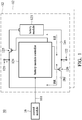
- Fig. 1 shows a schematic diagram of a power apparatus management system 10 in accordance with an embodiment of the application.
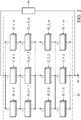
- Fig. 2 shows a schematic diagram of a power apparatus module 12 in accordance with an embodiment of the application
- Fig. 3 shows a schematic diagram of a power apparatus 12_ij in accordance with an embodiment of the application.
- the power apparatus management system 10 includes a power apparatus module 12.
- the power apparatus module 12 is configured to provide a preconfigured load to a preconfigured device 14 and/or receive a preconfigured load of the preconfigured device 14.
- the preconfigured device 14 is a load device.
- the preconfigured device 14 is a source device.
- the power apparatus management system 10 further includes at least one control module 16, and at least one of said at least one control module 16 is configured to transmit at least one control signal to manage at least one of the one or more power apparatuses 12_i_j.
- a control module 16 could be implemented with hardware circuit, firmware, software, or any combination thereof, and a processor of any kind (not shown) may be included in the power apparatus management system 10 for performing management of the operations/operating of the power apparatus.
- Each of the power apparatus 12_ij includes a positive terminal 121 and a negative terminal 122.
- the power apparatus 12_i_j further includes a battery module 123 and a battery module controller 124.
- the battery module 123 includes one or more batteries, and when the battery module 123 includes a plurality of batteries, the batteries may be configured to electrically couple to each other in serial, in parallel, or in a combination of serial and parallel (not shown). That is, the plurality of batteries could be coupled in serial and/or parallel.
- the battery module controller 124 is configured to electrically couple to the battery module 123.
- the power apparatus 12_i_j further includes a first switch 125 and a second switch 126. Each of the two switches includes three ends, the first end is a control end which determines the on or off status of the switch. When the switch is on, the second end and the third end are short circuits, and when the switch is off, the second end and the third end are open circuits.
- the first end of the first switch 125 is electrically coupled to the battery module controller 124, the second end of the first switch 125 is electrically coupled to the positive terminal 121, and the third end of the first switch 125 is electrically coupled to the battery module 123.
- the first end of the second switch 126 is electrically coupled to the battery module controller 124, the second end of the second switch 126 is electrically coupled to the positive terminal 121, and the third end of the second switch 126 is electrically coupled to the negative terminal 122.
- the power apparatus 12_i_j Under the normal use, only one switch is on and the other switch is off. Under the situation that the switch of the enable route ER is on and the switch of the bypass route BR is off, the power apparatus 12_i_j is in the enable mode that could provide energy (preconfigured load) to the preconfigured device 14 or could receive energy (preconfigured load) from the preconfigured device 14. On the other hand, when the switch of the bypass route BR is on and the switch of the enable route ER is off, then the power apparatus 12_i_j is in the bypass mode that is unable to provide energy (preconfigured load) to the preconfigured device 14 or unable to receive energy (preconfigured load) from the preconfigured device 14.
- the battery module controller 124 is configured to sense an enable route current Ien that flows through the enable route ER and a bypass route current Iby that flows through the bypass route BR, and control a driving of the first switch 125 and a driving of the second switch 126 by using hybrid control mechanism which combines a negative feedback control and an open loop control.
- the battery module controller 124 performs a current switching between an enable mode and a bypass mode of the power apparatus, based on a mode switching signal of said at least one control signal that received, the enable route current and the bypass route current.
- the enable mode uses the power apparatus 12_i_j and the bypass mode bypasses the power apparatus 12_i_j.
- the current switching between the enable mode and the bypass mode of the power apparatus 12_i_j may be performed in a continuous and progressive manner. It is understood, in the embodiments in accordance with the application, the control module 16 may be implemented by hardware circuit, or be implemented by firmware or software.
- the one or more power apparatuses 12_i_j may be configured to be reconfigurable and when the power apparatus management system having a plurality of power apparatuses, the plurality of power apparatuses may be configured to electrically couple to each other in serial and/or in parallel into a reconfigurable battery module array.
- the first switch 125 and the second switch 126 may be implemented but is not limited to using at least one transistor, such as Metal-Oxide-Semiconductor Field-Effect Transistor (i.e. MOSFET), or Insulated Gate Bipolar Transistor (i.e. IGBT), etc..
- the switches 125 and 126 may be implemented by using a power MOS.
- the power apparatus module 12 includes a plurality of power apparatuses 12_i_j that are electrically coupled in serial and/or in parallel with each other
- the negative terminals 122 of the power apparatuses 12_1_1, 12_1_2, ... and 12_1_m are configured to electrically couple in serial and/or in parallel with a ground 18
- the positive terminals 121 of the power apparatuses 12_n_l, 12_n_2, ... and 12_n_m are configured to electrically couple in serial and/or in parallel with the preconfigured device 14, to provide and/or receive a preconfigured load .
- the positive terminals 121 of the power apparatuses 12_1_1, 12_1_2, ..., 12_1_m, ⁇ , 12_n-1_1, 12_n-1_2, ..., 12_n-1_m are configured to electrically couple in serial and/or in parallel with the negative terminal 122 of at least one of another power apparatus
- the negative terminals 122 of the power apparatuses 12_n_1, 12_n_2, ..., 12_n_m, ⁇ , 12_2_1, 12_2_2, ..., 12_2_m are configured to electrically couple in serial and/or in parallel with the positive terminal 121 of at least one other in serial and/or in parallel to the preconfigured device 14
- the negative terminals 122 of a first portion of the plurality of power apparatuses are configured to electrically couple in serial and/or in parallel to the positive terminals of a second portion of the plurality power apparatus.
- the positive terminals 12 of the first portion of the plurality of power apparatuses are configured to electrically couple of power apparatuses
- the negative terminals 122 of the second portion of the plurality of power apparatuses are configured to electrically couple in serial and/or in parallel to the positive terminals 121 of a third portion of the plurality of power apparatuses
- the negative terminals 122 of the third portion of the plurality of power apparatuses are configured to electrically couple in serial and/or in parallel to a ground 18.
- the embodiment of the power apparatus module 12 including a single power apparatus 12_i_j is taken as an example to further explain possible implementations.
- the voltage difference between positive terminal 121 and negative terminal 122 is Vmodule (we called the voltage of the power apparatus), and the current flows through the power apparatus 12 is Imodule.
- the power apparatus 12_i_j includes a positive terminal 121, a negative terminal 122, a battery module 123, a battery module controller 124, a first switch 125 and a second switch 126.
- the exemplary embodiments of electrical coupling relationship of the aforesaid elements have been described in the preceding paragraph, and it is not repeated again.
- the positive terminal 121 is configured to provide and/or receive the preconfigured load.
- the negative terminal 122 is configured to electrically couple to a ground.
- the positive terminal 121 is configured to electrically couple to the negative terminal 122 of at least one of another power apparatus.
- the negative terminal 122 is configured to electrically couple to the positive terminal 121 of at least one of another power apparatus.
- the battery module controller 124 is configured to sense the enable route current Ien flowing through the enable route ER and the bypass route current Iby flowing through the bypass route BR.
- the battery module controller 124 controls a driving of the first switch 121 and a driving of the second switch 122 by using hybrid control mechanism which combines a negative feedback control and an open loop control, to perform a current switching between an enable route and a bypass route of the single power apparatus 12_i_j, based on a mode switching signal of a control signal that received.
- a mode switching signal 161 i.e. Im flows from ER to BR or flows from BR to ER
- the current switching scheme make sure that since Im flows in ER initially, but will flow in BR in the end, and vice versa, meanwhile the Vmodule is change from the battery module voltage to zero and vice versa.
- the battery module controller 124 may include a sensing unit 1241 configured to sense the enable route current Ien and the bypass route current Iby, and generate the power apparatus load current Im to be stored in the storage unit 1245 by adding the enable route current Ien and the bypass route current Iby. In an embodiment in accordance with the application, a detection may be performed periodically and/or upon receiving a mode switching signal 161.
- the battery module controller 124 may further include a signal processing circuit 1242 with the gain Rfb, which is configured to determine a negative feedback control signal Vfb, based on the power apparatus load current Im detected by the sensing unit 1241, the enable route current Ien and the bypass route current Iby.
- the battery module controller 124 further includes an open loop control circuit 1243, a switch driving circuit (switch driver) 1244, and a pull high/pull low circuit 1247.
- the open loop control circuit 1243 is configured to determine an open loop control signal Vop based on a gain Rop and the power apparatus load current Im.
- the negative feedback control signal Vfb and the open loop control signal Vop Combined the Vop and the Vfb, the hybrid control input Vop+Vfb of the switch driving unit 1244 and having the Im current switching from ER to BR (or from BR to ER) continuously and gradually.
- the output of the switch driving circuit 1244 generate a first switch driving voltage Vdrive,en for the driving of the first switch 125 and generate a second switch driving voltage Vdrive,by for the driving of the second switch 126.
- Vdrive first switch driving voltage
- Vdrive second switch driving voltage
- Vfb is the strength of negative feedback-control.
- the Vmoudle initially is equal to battery module voltage now will be zero voltage.
- the reconfigure procedure of the power apparatus 12_i_j from the bypass mode to enable mode is much the same as above as long as we exchange the role of Iby and Ien in the current switching scheme and the role of battery module voltage and zero voltage in the voltage switching scheme.
- a mathematical polynomial function of the negative feedback control signal Vfb and the open loop control signal Vop could be used to generate the first switch driving voltage Vdrive,en and the second switch driving voltage Vdrive,by.
- different negative constant(s) and open loop constant(s) may be preconfigured, depending on the application and the type of the switch elements.
- the signal processing circuit 1242 subtracts the bypass route current Iby from the power apparatus load current Im to output the feedback control signal Vfb, when the mode switching signal 161 indicates a switching from the enable mode to the bypass mode. While, the signal processing circuit 1242 subtracts the enable route current Ien from the power apparatus load current Im to output the feedback control signal Vfb, when the mode switching signal 161 indicates switching from the bypass mode to the enable mode.
- the open loop control unit 1243 may obtain the stored value Im from a storage unit 1245, and after the process of the gain Rop, the open loop control unit 1243 may generate the open loop control signal Vop.
- the equivalent resistance of the first switch 125 on the enable route ER is Ren
- the equivalent resistance of the second switch 126 on the bypass route BR is Rby
- the voltage of the power apparatus 12_i_j is Vmodule as mentioned before.
- Fig. 4 which shows a schematic diagram of the transient variation of current and the transient variation of voltage during a power apparatus performs the switching between the enable mode and the bypass mode according to an embodiment of the application, wherein the left drawing of Fig. 4 shows the transient variation of current, while the right drawing of Fig. 4 shows the transient variation of voltage.
- the power apparatus performs the switching from the enable mode to the bypass mode
- the transferring of current and the transferring of voltage may be seen from the Fig. 4 in a direction from left to right.
- the power apparatus performs the switching from the bypass mode to the enable mode
- the transferring of current and the transferring of voltage may be seen from the Fig. 4 in a direction from right to left.
- the operation voltage Vdrive,en of the first switch 125 is the maximum operation voltage Vmax
- the operation voltage Vdrive.by of the second switch 126 is the minimum operation voltage Vmin.
- the power apparatus when the power apparatus performs the switching from the enable mode to the bypass mode, it may control the resistance Ren getting bigger progressively and the resistance Rby getting smaller progressively.
- the current split principle of Iby Im ⁇ Ren Rby + Ren
- due to the resistance Ren is getting bigger, consequently the current Iby is getting bigger
- the current Iby is getting bigger
- the current Iby is getting smaller
- the power apparatus current Imodule may be controlled to flow slowly from Ien to Iby. The current switching between the modes is accomplished when the current Ien all flows into the current Iby.
- the operation voltage Vdrive,by of the second switch 126 is the maximum voltage Vmax
- the operation voltage Vdrive,en of the first switch 125 is the minimum voltage Vmin.
- the power apparatus when it performs the switching from the bypass mode to the enable mode, it may control the resistance Rby getting bigger progressively and the resistance Ron getting smaller progressively.
- Ien Im ⁇ Rby Rby + Ren
- the resistance Rby due to the resistance Rby is getting bigger, consequently the current Ien is getting bigger
- the current split principle of Iby Im ⁇ Ren Rby + Ren
- due to the resistance Ren is getting smaller, consequently the current Iby is getting smaller.
- the power apparatus current Imodule may be controlled to flow slowly from Iby to Ien.
- the current switching between the modes is accomplished when the current Iby all flows into the current Ien.
- the current switching transient in between the enable mode and the bypass mode of the power apparatus may be performed in a continuous and progressive manner.
- the sensing unit 1241 may further include a sensing module 1246 configured to sense and/or monitor the enable route current Ien and the bypass route current Iby. When sensing the current switching between the modes is accomplished, the sensing module 1246 transmits at least one signal to a pull high/pull low circuit 1247.
- the switch driving circuit 1244 is configured to electrically coupled to the pull high/pull low circuit 1247, which controls the switch driving circuit 1244, to drive the first switch to fully off and the second switch to fully on, or to drive the first switch to fully on and the second switch to fully off, until the voltage switching between the modes is accomplished.
- the sensing unit 1241 may further store the power apparatus load current Im by a storage unit 1245, and the open loop control circuit 1243 may be configured to receive the power apparatus load current Im from the storage unit.
- the battery module controller 124 may be configured to include a processing unit (not shown), which triggering all related operation(s) for the aforementioned mode switching of the power apparatus described in the preceding paragraphs, while receiving the mode switching signal 161.
- the mode switching signal may be transmitted to units 1241, 1243 and 245 and circuits 1242, 1244 and 1247 to trigger the aforementioned mode switching of the power apparatus described in the preceding paragraphs. While the scope of the application is not limited thereto.
- the sensing unit 1241 may also be configured to actively monitor and sensing the enable route current Ien and the bypass route current Iby.
- each of the elements or modules in the presented embodiments may be a device having a corresponding function, which may have the appropriate hardware circuits or elements to perform the corresponding function, however, the device is not limited to an entity device, which may also be a device having capabilities for processing and running the program codes and software(s) with respective functions.
- entity device which may also be a device having capabilities for processing and running the program codes and software(s) with respective functions.
- the manner of operations of the respective elements may further refer to the following description of the methods.
- Figs. 5-7 show flowcharts of a power apparatus operating method according to embodiments of the application.
- a power apparatus operating method will be described in detail with reference to the block 52 and the block 54.
- the method receives a mode switching signal to control the operating of the power apparatus to provide and/or receive a preconfigured load.
- the method senses an enable route current of an enable route flowing through a battery module that includes one or more batteries and a bypass route current of a bypass route not flowing through the battery module.
- the method controls a driving of a first switch and a driving of a second switch by the hybrid control mechanism which combines a negative feedback control and an open loop control, to perform a current switching between an enable mode and a bypass mode of the power apparatus, based on the mode switching signal, the enable route current and the bypass route current, wherein the enable mode uses the power apparatus, while the bypass mode bypasses the power apparatus.
- the current switching transient in between the enable mode and the bypass mode of the power apparatus may be performed in a continuous and progressive manner.
- the power apparatus operating method may further perform operations shown in blocks 541, and 543 ⁇ 545.
- the method generates a power apparatus load current by adding the enable route current with the bypass route current (as shown in block 541).
- the method determines a negative feedback control signal based on the power apparatus load current, the enable route current and the bypass route current.
- the method determines an open loop control signal based on a gain and the power apparatus load current.
- the method generates a first switch driving voltage for driving the first switch and generates a second switch driving voltage for driving the second switch, based on the negative feedback control signal and the open loop control signal.
- the method may selectively store the power apparatus load current, as shown in block 542.
- the method may drive the first switch to fully off and the second switch to fully on, or drive the first switch to fully on and the second switch to fully off.
- the method determine the negative feedback control signal when it determine the negative feedback control signal, it may subtract the bypass route current from the power apparatus load current to form the feedback control signal, when the mode switch signal indicates switching from the enable mode to the bypass mode; and subtract the enable route current from the power apparatus load current to form the feedback control signal, when the mode switch signal indicates switching from the bypass mode to the enable mode.
Landscapes
- Engineering & Computer Science (AREA)
- Power Engineering (AREA)
- Business, Economics & Management (AREA)
- Emergency Management (AREA)
- Charge And Discharge Circuits For Batteries Or The Like (AREA)
Abstract
Description
- The technical field relates to a power apparatus operating method, a power apparatus and a power apparatus management system.
- Nowadays the trend of environmental protection and energy conservation makes the green energy industry, especially the electric vehicle industry continues to flourish. The demand of the power module(s) in the electric vehicle is enormous, of course, in use of the operation of power system must be safe. The reconfiguration of the power supply array, according to the condition of the application and the control of the system, is achieved by the physical switch to connect the power devices in series and parallel, to fulfill the needs for the actual system environment.
- In general when reconfiguring the power supply modules, which has to be operated under the condition that the system load doesn't directly charge or discharge the power supply modules (that is, in the situation of "zero current" operation). Obviously it's very inconvenient that the reconfigurable power system is under the condition of dynamics loading, for example, driving electric vehicle on the roads. As mentioned above, for the safety reason, when switching the power switch to reconfigure the power system, it usually needs to break the connection between the system load and the power device first. A ┌ dead-time ┘ control strategy is necessary. Firstly turn the enable (or bypass) switch that previously on from on status to off, and then turn the bypass (or enable) switch that previously off from off status to on. This may prevent the shoot-through current being generated, and the power supply array can thus be switched or reconfigured. To be safe and sound, the power system needs an additional energy storage unit to help fulfill energy demand of the system load when reconfiguring the power device or power modules. This may lower the power transfer efficiency. In reality, it's not easy to reconfigure the power or battery modules during the long-term uninterrupted dynamic load requirements for driving the electric vehicle on the road.
- Therefore, it is one of the recent rise research topic on how to solve the practical issues when using the power device or not (that is, turn on/off the enable/bypass switch), and reconfiguring the serial-parallel reassembly of the power device can be carried out easily under various dynamic loads as time goes by.
- In an exemplary embodiment in accordance with the application, a power apparatus management system is provided. The system comprises at least one control module configured to transmit at least one control signal to manage operations of at least one of one or more power apparatuses, and a power apparatus module configured to provide and/or receive a preconfigured load of a preconfigured device. The power apparatus module including the one or more power apparatuses, with each power apparatus comprises: a positive terminal and a negative terminal; a battery module comprising one or more batteries, and configured to electrically couple to the negative terminal; a battery module controller configured to electrically couple to the battery module; a first switch and a second switch, wherein each of the first switch and the second switch has a first end, a second end and a third end, with the first end and the second end be respectively electrically coupled to the battery module controller and the positive terminal. The third end of the first switch electrically coupled to the battery module, and the third end of the second switch electrically coupled to the negative terminal. Wherein between the positive and the negative terminals, there are an enable route flowing through the battery module and a bypass route not flowing through the battery module, and the battery module controller is configured to: sense an enable route current flowing through the enable route and a bypass route current flowing through the bypass route; and control a driving of the first switch and a driving of the second switch by using a negative feedback control and an open loop control, to perform a current switching between an enable mode and a bypass mode of the at least one of the one or more power apparatuses, based on a mode switching signal of said at least one control signal that received, the enable route current and the bypass route current, wherein the enable mode uses the at least one of the one or more power apparatuses and the bypass mode bypasses the at least one of the one or more power apparatuses.
- In another exemplary embodiment in accordance with the application, a power apparatus is provided. The power apparatus is configured to provide and/or receive a preconfigured load and comprises a positive terminal, a negative terminal, a battery module, a battery module controller, a first switch and a second switch. The battery module comprises one or more batteries and is configured to electrically couple to the negative terminal. The battery module controller is configured to electrically couple to the battery module. Each of the first and the second switches has a first end, a second end and a third end with the first end and the second end be respectively electrically coupled to the battery module controller and the positive terminal The third end of the first switch electrically coupled to the battery module, and the third end of the second switch electrically coupled to the negative terminal. Wherein between the positive and the negative terminals, there are an enable route flowing through the battery module and a bypass route not flowing through the battery module, and the battery module controller is configured to: sense an enable route current flowing through the enable route and a bypass route current flowing through the bypass route; and control a driving of the first switch and a driving of the second switch by using a negative feedback control and an open loop control, to perform a current switching between an enable mode and a bypass mode of the power apparatus, based on a mode switching signal that received, the enable route current and the bypass route current, wherein the enable mode uses the power apparatus and the bypass mode bypasses the power apparatus.
- In another exemplary embodiment in accordance with the application, a power apparatus operating method is provided. The power apparatus operating method includes: receiving a mode switching signal to control an operating of a power apparatus to provide and/or receive a preconfigured load; sensing an enable route current of an enable route, and a bypass route current of a bypass route, wherein the enable route current flows through a battery module including one or more batteries, and the bypass route current does not flow through the battery module; and controlling a driving of a first switch and a driving of a second switch by using a negative feedback control and an open loop control, to perform a current switching between an enable mode and a bypass mode of the power apparatus, based on the mode switching signal, the enable route current and the bypass route current, wherein the enable mode uses the power apparatus and the bypass mode bypasses the power apparatus.
- The application will become more fully understood by referring to the following detailed description with reference to the accompanying drawings.
-
-
Fig. 1 shows a schematic diagram of a power apparatus management system according to an embodiment of the application. -
Fig. 2 shows a schematic diagram of a power apparatus module according to an embodiment of the application. -
Fig. 3 shows a schematic diagram of a power apparatus according to an embodiment of the application. -
Fig. 4 shows a schematic diagram of the transient variation of current and the transient variation of voltage when a power apparatus is switching between the enable and the bypass modes according to an embodiment of the application. -
Figs. 5-7 show flowcharts of a power apparatus operating method according to embodiments of the application. - Below, exemplary embodiments will be described in detail with reference to accompanying drawings so as to be easily realized by a person having ordinary knowledge in the art. The inventive concept may be embodied in various forms without being limited to the exemplary embodiments set forth herein. Descriptions of well-known parts are omitted for clarity, and like reference numerals refer to like elements throughout.
-
Fig. 1 shows a schematic diagram of a powerapparatus management system 10 in accordance with an embodiment of the application.Fig. 2 shows a schematic diagram of apower apparatus module 12 in accordance with an embodiment of the application, andFig. 3 shows a schematic diagram of a power apparatus 12_ij in accordance with an embodiment of the application. Referring toFig. 1 andFig. 2 , the powerapparatus management system 10 includes apower apparatus module 12. As shown in the embodiment ofFig. 2 , thepower apparatus module 12 includes one or more power apparatuses 12_i_j, i=1, ..., n, j=1, ..., m, where both n and m are positive integers greater than or equal to 1. Thepower apparatus module 12 is configured to provide a preconfigured load to a preconfigureddevice 14 and/or receive a preconfigured load of the preconfigureddevice 14. When the power apparatus module provides the energy, thepreconfigured device 14 is a load device. While when power apparatus module receives the energy, the preconfigureddevice 14 is a source device. The powerapparatus management system 10 further includes at least onecontrol module 16, and at least one of said at least onecontrol module 16 is configured to transmit at least one control signal to manage at least one of the one or more power apparatuses 12_i_j. In embodiments in accordance with the application, acontrol module 16 could be implemented with hardware circuit, firmware, software, or any combination thereof, and a processor of any kind (not shown) may be included in the powerapparatus management system 10 for performing management of the operations/operating of the power apparatus. - Each of the power apparatus 12_ij includes a
positive terminal 121 and anegative terminal 122. The power apparatus 12_i_j further includes abattery module 123 and abattery module controller 124. Thebattery module 123 includes one or more batteries, and when thebattery module 123 includes a plurality of batteries, the batteries may be configured to electrically couple to each other in serial, in parallel, or in a combination of serial and parallel (not shown). That is, the plurality of batteries could be coupled in serial and/or parallel. - An end of the
battery module 123 is electrically coupled to thenegative terminal 122. Thebattery module controller 124 is configured to electrically couple to thebattery module 123. The power apparatus 12_i_j further includes afirst switch 125 and asecond switch 126. Each of the two switches includes three ends, the first end is a control end which determines the on or off status of the switch. When the switch is on, the second end and the third end are short circuits, and when the switch is off, the second end and the third end are open circuits. The first end of thefirst switch 125 is electrically coupled to thebattery module controller 124, the second end of thefirst switch 125 is electrically coupled to thepositive terminal 121, and the third end of thefirst switch 125 is electrically coupled to thebattery module 123. The first end of thesecond switch 126 is electrically coupled to thebattery module controller 124, the second end of thesecond switch 126 is electrically coupled to thepositive terminal 121, and the third end of thesecond switch 126 is electrically coupled to thenegative terminal 122. Wherein there are two electric routes between the positive terminal (the first node) and the negative terminal (the second node) of the power apparatus 12_i_j. One is the enable route ER that flows through thebattery module 123, the other is the bypass route BR that does not flow through thebattery module 123. - Under the normal use, only one switch is on and the other switch is off. Under the situation that the switch of the enable route ER is on and the switch of the bypass route BR is off, the power apparatus 12_i_j is in the enable mode that could provide energy (preconfigured load) to the preconfigured
device 14 or could receive energy (preconfigured load) from thepreconfigured device 14. On the other hand, when the switch of the bypass route BR is on and the switch of the enable route ER is off, then the power apparatus 12_i_j is in the bypass mode that is unable to provide energy (preconfigured load) to the preconfigureddevice 14 or unable to receive energy (preconfigured load) from the preconfigureddevice 14. - Please refer to
Fig. 1 andFig. 3 , thebattery module controller 124 is configured to sense an enable route current Ien that flows through the enable route ER and a bypass route current Iby that flows through the bypass route BR, and control a driving of thefirst switch 125 and a driving of thesecond switch 126 by using hybrid control mechanism which combines a negative feedback control and an open loop control. Thebattery module controller 124 performs a current switching between an enable mode and a bypass mode of the power apparatus, based on a mode switching signal of said at least one control signal that received, the enable route current and the bypass route current. The enable mode uses the power apparatus 12_i_j and the bypass mode bypasses the power apparatus 12_i_j. In an embodiment in accordance with the application, the current switching between the enable mode and the bypass mode of the power apparatus 12_i_j may be performed in a continuous and progressive manner. It is understood, in the embodiments in accordance with the application, thecontrol module 16 may be implemented by hardware circuit, or be implemented by firmware or software. - When the power
apparatus management system 10 determines to switch the operation of the power apparatus 12_i_j from the enable mode to the bypass mode. The switch of enable route ER, that is thefirst switch 125, will be finally operated from on to off status, and the switch of bypass route BR, that is thesecond switch 126, will be finally operated from off to on status. The process of the switching could be called the "transient of bypass-to-enable mode". While when the powerapparatus management system 10 determines to switch the operation of the power apparatus 12_i_j from the bypass mode to the enable mode. The switch of bypass route BR, that is thesecond switch 126, will be finally operated from on to off status, and the switch of enable route ER, that is thefirst switch 125, will be finally operated from off to on status. The process of the switching could be called the "transient of bypass-to-enable mode". - In an embodiment in accordance with the application, the one or more power apparatuses 12_i_j may be configured to be reconfigurable and when the power apparatus management system having a plurality of power apparatuses, the plurality of power apparatuses may be configured to electrically couple to each other in serial and/or in parallel into a reconfigurable battery module array. In the presented embodiments, the
first switch 125 and thesecond switch 126 may be implemented but is not limited to using at least one transistor, such as Metal-Oxide-Semiconductor Field-Effect Transistor (i.e. MOSFET), or Insulated Gate Bipolar Transistor (i.e. IGBT), etc.. In an embodiment in accordance with the application, theswitches - Take the embodiment of
Fig. 2 as an example, when thepower apparatus module 12 includes a plurality of power apparatuses 12_i_j that are electrically coupled in serial and/or in parallel with each other, thenegative terminals 122 of the power apparatuses 12_1_1, 12_1_2, ... and 12_1_m are configured to electrically couple in serial and/or in parallel with aground 18, and thepositive terminals 121 of the power apparatuses 12_n_l, 12_n_2, ... and 12_n_m are configured to electrically couple in serial and/or in parallel with the preconfigureddevice 14, to provide and/or receive a preconfigured load . And thepositive terminals 121 of the power apparatuses 12_1_1, 12_1_2, ..., 12_1_m, ··· , 12_n-1_1, 12_n-1_2, ..., 12_n-1_m are configured to electrically couple in serial and/or in parallel with thenegative terminal 122 of at least one of another power apparatus, and thenegative terminals 122 of the power apparatuses 12_n_1, 12_n_2, ..., 12_n_m, ···, 12_2_1, 12_2_2, ..., 12_2_m are configured to electrically couple in serial and/or in parallel with thepositive terminal 121 of at least one other in serial and/or in parallel to the preconfigureddevice 14, thenegative terminals 122 of a first portion of the plurality of power apparatuses are configured to electrically couple in serial and/or in parallel to the positive terminals of a second portion of the plurality power apparatus. It is understood from the aforementioned embodiments, thepositive terminals 12 of the first portion of the plurality of power apparatuses are configured to electrically couple of power apparatuses, and wherein thenegative terminals 122 of the second portion of the plurality of power apparatuses are configured to electrically couple in serial and/or in parallel to thepositive terminals 121 of a third portion of the plurality of power apparatuses, thenegative terminals 122 of the third portion of the plurality of power apparatuses are configured to electrically couple in serial and/or in parallel to aground 18. - Referring back to
Fig. 3 , for simplifying the description, the embodiment of thepower apparatus module 12 including a single power apparatus 12_i_j is taken as an example to further explain possible implementations. The voltage difference between positive terminal 121 andnegative terminal 122 is Vmodule (we called the voltage of the power apparatus), and the current flows through thepower apparatus 12 is Imodule. The power apparatus 12_i_j includes apositive terminal 121, anegative terminal 122, abattery module 123, abattery module controller 124, afirst switch 125 and asecond switch 126. The exemplary embodiments of electrical coupling relationship of the aforesaid elements have been described in the preceding paragraph, and it is not repeated again. - In an embodiment in accordance with the application, the
positive terminal 121 is configured to provide and/or receive the preconfigured load. In another embodiment, thenegative terminal 122 is configured to electrically couple to a ground. In an embodiment of the application, thepositive terminal 121 is configured to electrically couple to thenegative terminal 122 of at least one of another power apparatus. In a further embodiment, thenegative terminal 122 is configured to electrically couple to thepositive terminal 121 of at least one of another power apparatus. - The
battery module controller 124 is configured to sense the enable route current Ien flowing through the enable route ER and the bypass route current Iby flowing through the bypass route BR. Thebattery module controller 124 controls a driving of thefirst switch 121 and a driving of thesecond switch 122 by using hybrid control mechanism which combines a negative feedback control and an open loop control, to perform a current switching between an enable route and a bypass route of the single power apparatus 12_i_j, based on a mode switching signal of a control signal that received. In an embodiment, when thebattery module controller 124 receives a mode switching signal 161 (i.e. Im flows from ER to BR or flows from BR to ER), knows it's time to reconfigure the power apparatus 12_i_j. For example, when thesignal 161 indicates to reconfigure power apparatus 12_i_j from enable mode to bypass mode, the current switching scheme make sure that since Im flows in ER initially, but will flow in BR in the end, and vice versa, meanwhile the Vmodule is change from the battery module voltage to zero and vice versa. - In an embodiment of the application, the
battery module controller 124 may include asensing unit 1241 configured to sense the enable route current Ien and the bypass route current Iby, and generate the power apparatus load current Im to be stored in thestorage unit 1245 by adding the enable route current Ien and the bypass route current Iby. In an embodiment in accordance with the application, a detection may be performed periodically and/or upon receiving amode switching signal 161. Thebattery module controller 124 may further include asignal processing circuit 1242 with the gain Rfb, which is configured to determine a negative feedback control signal Vfb, based on the power apparatus load current Im detected by thesensing unit 1241, the enable route current Ien and the bypass route current Iby. - The
battery module controller 124 further includes an openloop control circuit 1243, a switch driving circuit (switch driver) 1244, and a pull high/pulllow circuit 1247. The openloop control circuit 1243 is configured to determine an open loop control signal Vop based on a gain Rop and the power apparatus load current Im. The negative feedback control signal Vfb and the open loop control signal Vop, Combined the Vop and the Vfb, the hybrid control input Vop+Vfb of theswitch driving unit 1244 and having the Im current switching from ER to BR (or from BR to ER) continuously and gradually. The output of theswitch driving circuit 1244, generate a first switch driving voltage Vdrive,en for the driving of thefirst switch 125 and generate a second switch driving voltage Vdrive,by for the driving of thesecond switch 126. Thus the driving of the first switch and the second switch is based on the negative feedback control signal and the open loop control signal at the same time. - For example, now we want to reconfigure
power apparatus 12 from enable mode to bypass mode, as mentions before, the current switching scheme is based on the hybrid control mechanism which combines the negative feedback control and the open loop control. Then thebattery module controller 124 senses the Ien , Iby and add them to get the strength of the Imodule, i.e. Im, then stores Im in thestorage unit 1245. Firstly, according to the Im, which is the input of open-loop control unit 1243, the output of openloop control circuit 1243 is the gain product of Im*Rop=Vop. Vop is the strength of open-loop control. Secondly, since we know the Ien, Iby and Im separately from thesensing module 1246, which feeds the output of (Im-Iby) to thesignal processing circuit 1242, the output of thesignal processing circuit 1242 is the gain product of (Im-Iby)*Rfb=Vfb. Vfb is the strength of negative feedback-control. Combined the Vop and the Vfb, the hybrid control input Vop+Vfb of theswitch driving circuit 1244 make sure the Im current switching from ER to BR continuously and gradually. After the completion of the current switching, the pull-high/pull-low circuit 1247 will fully turn off the ER path switch, thefirst switch 125 and fully turn on the BR path switch, thesecond switch 124. The Vmoudle initially is equal to battery module voltage now will be zero voltage. The reconfigure procedure of the power apparatus 12_i_j from the bypass mode to enable mode is much the same as above as long as we exchange the role of Iby and Ien in the current switching scheme and the role of battery module voltage and zero voltage in the voltage switching scheme. - In an embodiment in accordance with the application, a mathematical polynomial function of the negative feedback control signal Vfb and the open loop control signal Vop could be used to generate the first switch driving voltage Vdrive,en and the second switch driving voltage Vdrive,by. In the mathematical function, different negative constant(s) and open loop constant(s) may be preconfigured, depending on the application and the type of the switch elements.
- In an embodiment in accordance with the application, the
signal processing circuit 1242 subtracts the bypass route current Iby from the power apparatus load current Im to output the feedback control signal Vfb, when themode switching signal 161 indicates a switching from the enable mode to the bypass mode. While, thesignal processing circuit 1242 subtracts the enable route current Ien from the power apparatus load current Im to output the feedback control signal Vfb, when themode switching signal 161 indicates switching from the bypass mode to the enable mode. In an embodiment of the application, the openloop control unit 1243 may obtain the stored value Im from astorage unit 1245, and after the process of the gain Rop, the openloop control unit 1243 may generate the open loop control signal Vop. - The equivalent resistance of the
first switch 125 on the enable route ER is Ren, the equivalent resistance of thesecond switch 126 on the bypass route BR is Rby, and the voltage of the power apparatus 12_i_j is Vmodule as mentioned before. Refer to theFig. 4 , which shows a schematic diagram of the transient variation of current and the transient variation of voltage during a power apparatus performs the switching between the enable mode and the bypass mode according to an embodiment of the application, wherein the left drawing ofFig. 4 shows the transient variation of current, while the right drawing ofFig. 4 shows the transient variation of voltage. When the power apparatus performs the switching from the enable mode to the bypass mode, the transferring of current and the transferring of voltage may be seen from theFig. 4 in a direction from left to right. On the contrary, when the power apparatus performs the switching from the bypass mode to the enable mode, the transferring of current and the transferring of voltage may be seen from theFig. 4 in a direction from right to left. - In the enable mode, the operation voltage Vdrive,en of the
first switch 125 is the maximum operation voltage Vmax, and the operation voltage Vdrive.by of thesecond switch 126 is the minimum operation voltage Vmin. In an embodiment of the application, when the power apparatus performs the switching from the enable mode to the bypass mode, it may control the resistance Ren getting bigger progressively and the resistance Rby getting smaller progressively. In accordance with the current split principle of Iby = Im ×

- In the bypass mode, the operation voltage Vdrive,by of the
second switch 126 is the maximum voltage Vmax, the operation voltage Vdrive,en of thefirst switch 125 is the minimum voltage Vmin. In an embodiment of the application, when the power apparatus performs the switching from the bypass mode to the enable mode, it may control the resistance Rby getting bigger progressively and the resistance Ron getting smaller progressively. In accordance with the current split principle of

- In an embodiment of the application, the
sensing unit 1241 may further include asensing module 1246 configured to sense and/or monitor the enable route current Ien and the bypass route current Iby. When sensing the current switching between the modes is accomplished, thesensing module 1246 transmits at least one signal to a pull high/pulllow circuit 1247. Theswitch driving circuit 1244 is configured to electrically coupled to the pull high/pulllow circuit 1247, which controls theswitch driving circuit 1244, to drive the first switch to fully off and the second switch to fully on, or to drive the first switch to fully on and the second switch to fully off, until the voltage switching between the modes is accomplished. - In an embodiment of the application, the
sensing unit 1241 may further store the power apparatus load current Im by astorage unit 1245, and the openloop control circuit 1243 may be configured to receive the power apparatus load current Im from the storage unit. - The application will become more understood. In an embodiment of the application, the
battery module controller 124 may be configured to include a processing unit (not shown), which triggering all related operation(s) for the aforementioned mode switching of the power apparatus described in the preceding paragraphs, while receiving themode switching signal 161. In another embodiment of the application, such as shown in theFig. 3 , the mode switching signal may be transmitted tounits circuits sensing unit 1241 may also be configured to actively monitor and sensing the enable route current Ien and the bypass route current Iby. - It could be understood that each of the elements or modules in the presented embodiments may be a device having a corresponding function, which may have the appropriate hardware circuits or elements to perform the corresponding function, however, the device is not limited to an entity device, which may also be a device having capabilities for processing and running the program codes and software(s) with respective functions. The manner of operations of the respective elements may further refer to the following description of the methods.
-
Figs. 5-7 show flowcharts of a power apparatus operating method according to embodiments of the application. As shown inFig. 5 , a power apparatus operating method will be described in detail with reference to theblock 52 and theblock 54. The method, as shown inblock 52, receives a mode switching signal to control the operating of the power apparatus to provide and/or receive a preconfigured load. As shown inblock 54, the method senses an enable route current of an enable route flowing through a battery module that includes one or more batteries and a bypass route current of a bypass route not flowing through the battery module. The method controls a driving of a first switch and a driving of a second switch by the hybrid control mechanism which combines a negative feedback control and an open loop control, to perform a current switching between an enable mode and a bypass mode of the power apparatus, based on the mode switching signal, the enable route current and the bypass route current, wherein the enable mode uses the power apparatus, while the bypass mode bypasses the power apparatus. In an embodiment of the application, the current switching transient in between the enable mode and the bypass mode of the power apparatus may be performed in a continuous and progressive manner. - In an embodiment of the application, as shown in
Fig. 6 , the power apparatus operating method may further perform operations shown inblocks block 543, determines a negative feedback control signal based on the power apparatus load current, the enable route current and the bypass route current. As shown in theblock 544, the method determines an open loop control signal based on a gain and the power apparatus load current. And as shown in theblock 545, the method generates a first switch driving voltage for driving the first switch and generates a second switch driving voltage for driving the second switch, based on the negative feedback control signal and the open loop control signal. Furthermore, in an embodiment of the application, the method may selectively store the power apparatus load current, as shown inblock 542. In another embodiment of the application, as shown inblock 546, the method may drive the first switch to fully off and the second switch to fully on, or drive the first switch to fully on and the second switch to fully off. - As shown in
block 5431, refer toFig. 7 , another embodiment of the application, when the method determine the negative feedback control signal, it may subtract the bypass route current from the power apparatus load current to form the feedback control signal, when the mode switch signal indicates switching from the enable mode to the bypass mode; and subtract the enable route current from the power apparatus load current to form the feedback control signal, when the mode switch signal indicates switching from the bypass mode to the enable mode. - While the application has been described by way of example and in terms of exemplary embodiments, it is to be understood that the application is not limited thereto. Those who are skilled in this technology may still make various alterations and modifications without departing from the scope and spirit of this application. Therefore, the scope of the present application shall be defined and protected by the following claims and their equivalents.
Claims (15)
- A power apparatus (12), configured to provide and/or receive a preconfigured load, comprising:a positive terminal (121) and a negative terminal (122);a battery module (123), comprising one or more batteries, and being configured to electrically couple to the negative terminal (122);a battery module controller (124), configured to electrically couple to the battery module (123);a first switch (125) and a second switch (126), wherein each of the first switch (125) and the second switch has a first end, a second end and a third end, with the first end and the second end be respectively electrically coupled to the battery module controller (124) and the positive terminal (121), the third end of the first switch electrically coupled to the battery module (123) and the third end of the second switch (126) electrically coupled to the negative terminal (122);wherein between the positive terminal (121) and the negative terminal (122), there are an enable route (ER) that flows through the battery module (123) and a bypass route (BR) that does not flow through the battery module (123), andthe battery module controller (124) is configured to:sense an enable route current (Ien) flowing through the enable route (ER) and a bypass route current (Iby) flowing through the bypass route (BR); andcontrol a driving of the first switch (125) and a driving of the second switch (126) by using a negative feedback control and an open loop control, to perform a current switching between an enable mode and a bypass mode of the power apparatus, based on a mode switching signal (161) that received, the enable route current (Ien) and the bypass route current (Iby), wherein the enable mode uses the power apparatus and the bypass mode bypasses the power apparatus.
- The power apparatus of claim 1, wherein the positive terminal (121) is configured to provide and/or receive the preconfigured load, and the negative terminal is configured to electrically couple to a ground (18).
- The power apparatus of claim 1 or 2, wherein the positive terminal (121) is configured to electrically couple to a negative terminal of at least one of another power apparatus, and/or wherein the negative terminal (122) is configured to electrically couple to a positive terminal of at least one of another power apparatuses.
- The power apparatus of any of claims 1 to 3, wherein the current switching between the enable mode and the bypass mode in a continuous and progressive manner.
- The power apparatus of any of claims 1 to 4, wherein the battery module controller (124) further comprises:a sensing unit (1241), configured to sense the enable route current (Ien) and the bypass route current (Iby), and output a power apparatus load current (Im) by adding the enable route current (Ien) with the bypass route current (Iby);a signal processing circuit (1242), configured to determine a negative feedback control signal (Vfb) based on the power apparatus load current (Im), the enable route current (Ien) and the bypass route current (Iby);an open loop control circuit (1243), configured to determine an open loop control signal (Vop) based on a gain (Rop) and the power apparatus load current (Im); anda switch driving circuit (1244), configured to generate a first switch driving voltage (Vdrive,en) for the driving of the first switch (125) and generate a second switch driving voltage (Vdrive,by) for the driving of the second switch (126), based on the negative feedback control signal (Vfb) and the open loop control signal (Vop).
- The power apparatus of claim 5, wherein the sensing unit (1241) further stores the power apparatus load current (Im) by a storage unit (1245), and the open loop control circuit (1243) is configured to receive the power apparatus load current (Im) from the storage unit (1245).
- The power apparatus of claim 5 or 6, wherein the signal processing circuit (1242) subtracts the bypass route current (Iby) from the power apparatus load current (Im) to output the feedback control signal, when the mode switch signal indicates switching from the enable mode to the bypass mode, while the signal processing circuit (1242) subtracts the enable route current (Ien) from the power apparatus load current (Im) to output the feedback control signal, when the mode switch signal indicates switching from the bypass mode to the enable mode.
- The power apparatus of any of claims 5 to 7, wherein the battery module controller (124) further comprises a pull high/pull low circuit which controls the switch driving circuit (1244), to drive the first switch (125) to fully off and the second switch (126) to fully on, or to drive the first switch (125) to fully on and the second switch (126) to fully off.
- A power apparatus management system (10), comprising:a power apparatus module (12), including one or more power apparatuses (12_i_j), and being configured to provide and/or receive a preconfigured load of a preconfigured device (14); andat least one control module (16), configured to transmit at least one control signal to manage operations of at least one of the one or more power apparatuses (12_ij), with each power apparatus comprising any one of claims 1 to 8.
- The power apparatus management system of claim 9, wherein each of the one or more power apparatuses (12_ij) is configured to be a reconfigurable power apparatus, and wherein when the power apparatus management system (10 includes a plurality of power apparatuses (12_ij), the plurality of power apparatuses (12_i_j) are configured to electrically couple to each other in serial, in parallel, or a combination of in serial and in parallel.
- The power apparatus management system of claim 9 or 10, wherein the positive terminals (121) of a first portion of the plurality of power apparatuses (12_i_j) are configured to electrically couple in serial and/or in parallel to the preconfigured device (14), the negative terminals (122) of the first portion of the plurality of power apparatuses (12_ij) are configured to electrically couple in serial and/or in parallel to the positive terminals (121) of a second portion of the plurality of power apparatuses (12_ij), and wherein the negative terminals (122) of the second portion of the plurality of power apparatuses (12_ij) are configured to electrically couple in serial and/or in parallel to the positive terminals (121) of a third portion of the plurality of power apparatuses (12_ij), the negative terminals (122) of the third portion of the plurality of power apparatuses (12_ij) are configured to electrically couple in serial and/or in parallel to a ground (18).
- A power apparatus operating method, comprising:receiving a mode switching signal (161) to control an operating of a power apparatus (12) to provide and/or receive a preconfigured load of the power;sensing an enable route current (Ien) of an enable route (ER), and a bypass route current (Iby) of a bypass route (BR), wherein the enable route current (Ien) flowing through a battery module (123) that includes one or more batteries, and the bypass route current (Iby) does not flowing through the battery module (123); andcontrolling a driving of a first switch (125) and a driving of a second switch (126) by using a negative feedback control and an open loop control, to perform a current switching between an enable mode and a bypass mode of the power apparatus, based on the mode switching signal (161), the enable route current (Ien) and the bypass route current (Iby), wherein the enable mode uses the power apparatus and the bypass mode bypasses the power apparatus.
- The power apparatus operating method of claim 12, further comprising:generating a power apparatus load current (Im) by adding the enable route current (Ien) with the bypass route current (Iby);determining a negative feedback control signal (Vfb) based on the power apparatus load current (Im), the enable route current (Ien) and the bypass route current (Iby);determining an open loop control signal (Vop) based on a gain (Rop) and the power apparatus load current (Im); andgenerating a first switch driving voltage (Vdrive,en) for the driving of the first switch (125) and generating a second switch driving voltage (Vdrive,by) for the driving of the second switch (126), based on the negative feedback control signal (Vfb) and the open loop control signal (Vop).
- The power apparatus operating method of claim 13, further comprising:subtracting the bypass route current (Iby) from the power apparatus load current (Im) to form the feedback control signal, when the mode switch signal indicates switching from the enable mode to the bypass mode; andsubtracting the enable route current (Ien) from the power apparatus load current (Im) to form the feedback control signal, when the mode switch signal indicates switching from the bypass mode to the enable mode, and/or, further comprising:
driving the first switch (125) to fully on and the second switch (126) to fully off, or driving the first switch (125) to fully off and the second switch (126) to fully on, or, further comprising:
storing the power apparatus load current (Im). - The power apparatus operating method of claims 13 or 14, wherein the current switching between the enable mode and the bypass mode in a continuous and progressive manner.
Applications Claiming Priority (1)
| Application Number | Priority Date | Filing Date | Title |
|---|---|---|---|
| TW106122831A TWI649939B (en) | 2017-07-07 | 2017-07-07 | Power supply device operation method, power supply device and power supply device management system |
Publications (2)
| Publication Number | Publication Date |
|---|---|
| EP3425758A1 true EP3425758A1 (en) | 2019-01-09 |
| EP3425758B1 EP3425758B1 (en) | 2020-05-13 |
Family
ID=62563058
Family Applications (1)
| Application Number | Title | Priority Date | Filing Date |
|---|---|---|---|
| EP18176448.1A Active EP3425758B1 (en) | 2017-07-07 | 2018-06-07 | Power apparatus operating method, power apparatus, and power apparatus management system |
Country Status (5)
| Country | Link |
|---|---|
| US (1) | US10693313B2 (en) |
| EP (1) | EP3425758B1 (en) |
| JP (1) | JP6600718B2 (en) |
| CN (1) | CN109217449B (en) |
| TW (1) | TWI649939B (en) |
Families Citing this family (2)
| Publication number | Priority date | Publication date | Assignee | Title |
|---|---|---|---|---|
| TWI689152B (en) * | 2018-03-09 | 2020-03-21 | 華碩電腦股份有限公司 | Battery management device |
| US20210242692A1 (en) * | 2018-05-09 | 2021-08-05 | Byton Limied | Flexibly configurable traction battery |
Citations (2)
| Publication number | Priority date | Publication date | Assignee | Title |
|---|---|---|---|---|
| US20120256568A1 (en) * | 2009-07-02 | 2012-10-11 | Chong Uk Lee | Multi-port reconfigurable battery |
| US20150115736A1 (en) * | 2013-10-25 | 2015-04-30 | Saft S.A. | Bypassable battery modules |
Family Cites Families (53)
| Publication number | Priority date | Publication date | Assignee | Title |
|---|---|---|---|---|
| US6864644B2 (en) * | 2002-11-14 | 2005-03-08 | Fyre Storm, Inc. | Method of tuning a circuit for energizing a cold cathode fluorescent lamp |
| US20070257642A1 (en) | 2003-06-19 | 2007-11-08 | Sean Xiao | Battery cell monitoring and balancing circuit |
| US7075194B2 (en) | 2003-07-31 | 2006-07-11 | The Titan Corporation | Electronically reconfigurable battery |
| US7893561B2 (en) | 2003-07-31 | 2011-02-22 | L-3 Communications Titan Corporation | Modular electronically reconfigurable battery system |
| TWI228340B (en) * | 2003-08-08 | 2005-02-21 | Ind Tech Res Inst | Voltage balance circuit for rechargeable batteries |
| US7339347B2 (en) | 2003-08-11 | 2008-03-04 | Reserve Power Cell, Llc | Apparatus and method for reliably supplying electrical energy to an electrical system |
| US7598706B2 (en) | 2007-01-26 | 2009-10-06 | General Electric Company | Cell balancing battery pack and method of balancing the cells of a battery |
| TW200913433A (en) | 2007-09-10 | 2009-03-16 | J Tek Inc | Scattered energy storage control system |
| US20090085553A1 (en) | 2007-09-28 | 2009-04-02 | Pavan Kumar | Reconfigurable battery pack |
| US7948211B2 (en) | 2008-04-18 | 2011-05-24 | International Business Machines Corporation | System and methods to extend the service life of portable devices |
| US20090286149A1 (en) | 2008-05-13 | 2009-11-19 | Board Of Regents Of The University Of Nebraska | Adaptive reconfigurable battery |
| ITMI20082356A1 (en) * | 2008-12-30 | 2010-06-30 | St Microelectronics Srl | CONTROL OF A RESONATING SWITCHING SYSTEM WITH WORKING CURRENT MONITORING IN A OBSERVATION WINDOW |
| JP5722875B2 (en) | 2009-04-10 | 2015-05-27 | ザ リージェンツ オブ ザ ユニバーシティ オブ ミシガン | Dynamically reconfigurable structure for large battery systems |
| US8816613B2 (en) | 2009-07-02 | 2014-08-26 | Chong Uk Lee | Reconfigurable battery |
| FR2951320B1 (en) | 2009-10-08 | 2011-12-30 | Vehicules Electr Soc D | ELECTRIC BATTERY COMPRISING A PLURALITY OF ELECTRIC POWER GENERATING ELEMENTS |
| EP2355229A1 (en) | 2010-02-08 | 2011-08-10 | Fortu Intellectual Property AG | High voltage battery system and method for controlling same |
| JP5521795B2 (en) | 2010-06-04 | 2014-06-18 | 日産自動車株式会社 | Battery control device |
| TWI404644B (en) | 2010-09-16 | 2013-08-11 | O2Micro Int Ltd | Battery management system and method for controlling a vehicle |
| WO2012042401A2 (en) | 2010-09-29 | 2012-04-05 | Sendyne Corp. | Charge balancing system |
| US9099871B2 (en) | 2010-10-06 | 2015-08-04 | Southwest Electronic Energy Corporation | Module bypass switch for balancing battery pack system modules |
| US8470464B2 (en) | 2010-10-14 | 2013-06-25 | Alliant Techsystems Inc. | Methods and apparatuses for electrochemical cell monitoring and control |
| US9229510B2 (en) | 2010-11-25 | 2016-01-05 | Industrial Technology Research Institute | Power management method for electro-chemical batteries in low capacity state |
| TWI428622B (en) | 2010-11-25 | 2014-03-01 | Ind Tech Res Inst | Method for checking and modulating battery capacity and power based on battery charging/discharging characteristics |
| JP5287844B2 (en) | 2010-12-27 | 2013-09-11 | 株式会社デンソー | Secondary battery remaining capacity calculation device |
| EP2720344B1 (en) | 2011-06-07 | 2020-06-17 | Toyota Jidosha Kabushiki Kaisha | Battery system, and method for controlling battery system |
| JP5687340B2 (en) * | 2011-06-10 | 2015-03-18 | 日立オートモティブシステムズ株式会社 | Battery control device, battery system |
| US9190855B2 (en) | 2011-06-17 | 2015-11-17 | Southwest Electronic Energy Corporation | Module bypass switch with bypass current monitoring |
| US9099271B2 (en) | 2011-08-02 | 2015-08-04 | The Board Of Trustees Of The Leland Stanford Junior University | Method and system for operating electron guns in magnetic fields |
| JP5807842B2 (en) | 2011-09-27 | 2015-11-10 | ブラザー工業株式会社 | Electronics |
| WO2013056409A1 (en) * | 2011-10-18 | 2013-04-25 | Dien Ghing-Hsin | Charging and discharging management device |
| CN103123992B (en) | 2011-11-17 | 2015-07-29 | 财团法人工业技术研究院 | Battery pack and method for controlling charging and discharging of the battery pack using its thermoelectric characteristics |
| US20130179103A1 (en) * | 2012-01-06 | 2013-07-11 | Industrial Technology Research Institute | Battery analysis device and method thereof |
| US10084331B2 (en) | 2012-03-25 | 2018-09-25 | Gbatteries Energy Canada Inc. | Systems and methods for enhancing the performance and utilization of battery systems |
| TWI492480B (en) | 2012-06-18 | 2015-07-11 | Univ Nat Changhua Education | Both high power, high efficiency and battery balance of the battery charge and discharge devices and methods |
| EP2696465B1 (en) | 2012-08-09 | 2016-12-21 | Samsung SDI Co., Ltd. | Battery management system and cell balancing method |
| TWI556539B (en) * | 2012-09-21 | 2016-11-01 | Battery pack series and parallel matrix connection application module | |
| KR101459539B1 (en) | 2012-12-27 | 2014-11-07 | 현대모비스 주식회사 | Apparatus and method for uniform energy of battery cell |
| US20140266228A1 (en) | 2013-03-15 | 2014-09-18 | Qualcomm Incorporated | Active measurement of battery equivalent series resistance |
| KR101830248B1 (en) | 2013-04-16 | 2018-02-21 | 한국전자통신연구원 | Apparatus for controlling LED lighting and LED lighting control system using thereof |
| CN104124726B (en) | 2013-04-25 | 2016-08-31 | 财团法人工业技术研究院 | Charging device and charging method |
| KR20150004035A (en) | 2013-07-02 | 2015-01-12 | 현대자동차주식회사 | Method and system for balancing battery cell |
| US9559543B2 (en) | 2013-07-19 | 2017-01-31 | Apple Inc. | Adaptive effective C-rate charging of batteries |
| US9520613B2 (en) | 2013-07-23 | 2016-12-13 | Infineon Technologies Ag | Battery control with block selection |
| TWI476415B (en) | 2013-08-16 | 2015-03-11 | Ind Tech Res Inst | Impedance analyzing apparatus and method |
| JP6370137B2 (en) * | 2014-07-09 | 2018-08-08 | エイブリック株式会社 | Charge / discharge control circuit and battery device |
| US10003194B2 (en) | 2014-10-24 | 2018-06-19 | Enphase Energy, Inc. | Parallel battery system |
| TWI517521B (en) | 2014-12-08 | 2016-01-11 | 財團法人工業技術研究院 | Programmable battery source architecture and method thereof |
| US20160241026A1 (en) | 2015-02-15 | 2016-08-18 | Skyworks Solutions, Inc. | Reconfigurable power supply cell for efficient boost and buck-boost applications |
| US9748765B2 (en) | 2015-02-26 | 2017-08-29 | Microsoft Technology Licensing, Llc | Load allocation for multi-battery devices |
| DE102015212403B4 (en) | 2015-07-02 | 2021-03-25 | Dialog Semiconductor (Uk) Limited | BATTERY CHARGING SYSTEM WITH CONTROL LOOP |
| TWI568122B (en) | 2015-11-09 | 2017-01-21 | 財團法人工業技術研究院 | Battery system and its control method |
| TWM521294U (en) * | 2016-01-08 | 2016-05-01 | Reduce Carbon Energy Develop Co Ltd | Active balancing battery |
| CN106685219B (en) * | 2017-02-28 | 2019-10-01 | 华为技术有限公司 | Voltage converter, its control method and voltage conversion system |
-
2017
- 2017-07-07 TW TW106122831A patent/TWI649939B/en active
- 2017-08-31 CN CN201710770283.1A patent/CN109217449B/en active Active
-
2018
- 2018-04-16 US US15/953,849 patent/US10693313B2/en active Active
- 2018-06-07 EP EP18176448.1A patent/EP3425758B1/en active Active
- 2018-07-05 JP JP2018128570A patent/JP6600718B2/en active Active
Patent Citations (2)
| Publication number | Priority date | Publication date | Assignee | Title |
|---|---|---|---|---|
| US20120256568A1 (en) * | 2009-07-02 | 2012-10-11 | Chong Uk Lee | Multi-port reconfigurable battery |
| US20150115736A1 (en) * | 2013-10-25 | 2015-04-30 | Saft S.A. | Bypassable battery modules |
Also Published As
| Publication number | Publication date |
|---|---|
| CN109217449A (en) | 2019-01-15 |
| US20190013693A1 (en) | 2019-01-10 |
| US10693313B2 (en) | 2020-06-23 |
| JP2019017242A (en) | 2019-01-31 |
| TW201907636A (en) | 2019-02-16 |
| EP3425758B1 (en) | 2020-05-13 |
| TWI649939B (en) | 2019-02-01 |
| CN109217449B (en) | 2020-12-18 |
| JP6600718B2 (en) | 2019-10-30 |
Similar Documents
| Publication | Publication Date | Title |
|---|---|---|
| CN110224455B (en) | Series-parallel switching device and battery pack including the same | |
| CN101471599B (en) | Drive circuit, power management device for MOS tube and method for driving MOS tube | |
| US20180166750A1 (en) | Apparatus for Controlling the Charging of Electric Vehicle | |
| US20130026992A1 (en) | Rechargeable battery device, and power supplying system incorporating the same | |
| WO2013112429A1 (en) | Uninterruptible power supply control in distributed power architecture | |
| CN110994744A (en) | A multi-battery charge and discharge control device and system | |
| JP2014082152A (en) | Voltage detection device | |
| US9027483B2 (en) | Flow battery power converter | |
| CN107612054B (en) | Battery system for supplying electric energy to an electric network | |
| CN102496923A (en) | Input circuit with reverse connection preventing protection | |
| KR101989492B1 (en) | Appratus and method for wake-up sleep mode mcu | |
| CN115699500A (en) | Circuits and electronics for controlling cells | |
| US10693313B2 (en) | Power apparatus operating method, power apparatus, and power apparatus management system | |
| JP2024059968A5 (en) | ||
| US20140354060A1 (en) | Power supply apparatus and electronic apparatus having the same | |
| KR20210007554A (en) | Power system | |
| EP4068555A1 (en) | Multiple-battery switching control circuit, apparatus and system, and control method | |
| JP5781456B2 (en) | Power supply system | |
| CN115428289A (en) | Overlapping circuit for power system | |
| KR20210137640A (en) | Power control unit | |
| CN221126941U (en) | Standby battery pack power supply circuit capable of automatically switching power supply modes and power supply system | |
| KR20210012224A (en) | Power system | |
| EP3226378B1 (en) | Apparatus and method for supplying differential voltage, and dc-dc converter | |
| CN107291204B (en) | Power supply control method and device and electronic equipment | |
| CN118017832A (en) | Photovoltaic boost circuit and control method thereof |
Legal Events
| Date | Code | Title | Description |
|---|---|---|---|
| PUAI | Public reference made under article 153(3) epc to a published international application that has entered the european phase |
Free format text: ORIGINAL CODE: 0009012 |
|
| STAA | Information on the status of an ep patent application or granted ep patent |
Free format text: STATUS: THE APPLICATION HAS BEEN PUBLISHED |
|
| AK | Designated contracting states |
Kind code of ref document: A1 Designated state(s): AL AT BE BG CH CY CZ DE DK EE ES FI FR GB GR HR HU IE IS IT LI LT LU LV MC MK MT NL NO PL PT RO RS SE SI SK SM TR |
|
| AX | Request for extension of the european patent |
Extension state: BA ME |
|
| STAA | Information on the status of an ep patent application or granted ep patent |
Free format text: STATUS: REQUEST FOR EXAMINATION WAS MADE |
|
| 17P | Request for examination filed |
Effective date: 20190628 |
|
| RBV | Designated contracting states (corrected) |
Designated state(s): AL AT BE BG CH CY CZ DE DK EE ES FI FR GB GR HR HU IE IS IT LI LT LU LV MC MK MT NL NO PL PT RO RS SE SI SK SM TR |
|
| GRAP | Despatch of communication of intention to grant a patent |
Free format text: ORIGINAL CODE: EPIDOSNIGR1 |
|
| STAA | Information on the status of an ep patent application or granted ep patent |
Free format text: STATUS: GRANT OF PATENT IS INTENDED |
|
| RIC1 | Information provided on ipc code assigned before grant |
Ipc: H02J 1/04 20060101ALI20191205BHEP Ipc: H02J 3/10 20060101AFI20191205BHEP |
|
| INTG | Intention to grant announced |
Effective date: 20191220 |
|
| GRAS | Grant fee paid |
Free format text: ORIGINAL CODE: EPIDOSNIGR3 |
|
| GRAA | (expected) grant |
Free format text: ORIGINAL CODE: 0009210 |
|
| STAA | Information on the status of an ep patent application or granted ep patent |
Free format text: STATUS: THE PATENT HAS BEEN GRANTED |
|
| AK | Designated contracting states |
Kind code of ref document: B1 Designated state(s): AL AT BE BG CH CY CZ DE DK EE ES FI FR GB GR HR HU IE IS IT LI LT LU LV MC MK MT NL NO PL PT RO RS SE SI SK SM TR |
|
| REG | Reference to a national code |
Ref country code: GB Ref legal event code: FG4D |
|
| REG | Reference to a national code |
Ref country code: CH Ref legal event code: EP |
|
| REG | Reference to a national code |
Ref country code: DE Ref legal event code: R096 Ref document number: 602018004415 Country of ref document: DE |
|
| REG | Reference to a national code |
Ref country code: AT Ref legal event code: REF Ref document number: 1271511 Country of ref document: AT Kind code of ref document: T Effective date: 20200615 |
|
| REG | Reference to a national code |
Ref country code: LT Ref legal event code: MG4D |
|
| REG | Reference to a national code |
Ref country code: NL Ref legal event code: MP Effective date: 20200513 |
|
| PG25 | Lapsed in a contracting state [announced via postgrant information from national office to epo] |
Ref country code: LT Free format text: LAPSE BECAUSE OF FAILURE TO SUBMIT A TRANSLATION OF THE DESCRIPTION OR TO PAY THE FEE WITHIN THE PRESCRIBED TIME-LIMIT Effective date: 20200513 Ref country code: PT Free format text: LAPSE BECAUSE OF FAILURE TO SUBMIT A TRANSLATION OF THE DESCRIPTION OR TO PAY THE FEE WITHIN THE PRESCRIBED TIME-LIMIT Effective date: 20200914 Ref country code: FI Free format text: LAPSE BECAUSE OF FAILURE TO SUBMIT A TRANSLATION OF THE DESCRIPTION OR TO PAY THE FEE WITHIN THE PRESCRIBED TIME-LIMIT Effective date: 20200513 Ref country code: SE Free format text: LAPSE BECAUSE OF FAILURE TO SUBMIT A TRANSLATION OF THE DESCRIPTION OR TO PAY THE FEE WITHIN THE PRESCRIBED TIME-LIMIT Effective date: 20200513 Ref country code: IS Free format text: LAPSE BECAUSE OF FAILURE TO SUBMIT A TRANSLATION OF THE DESCRIPTION OR TO PAY THE FEE WITHIN THE PRESCRIBED TIME-LIMIT Effective date: 20200913 Ref country code: GR Free format text: LAPSE BECAUSE OF FAILURE TO SUBMIT A TRANSLATION OF THE DESCRIPTION OR TO PAY THE FEE WITHIN THE PRESCRIBED TIME-LIMIT Effective date: 20200814 Ref country code: NO Free format text: LAPSE BECAUSE OF FAILURE TO SUBMIT A TRANSLATION OF THE DESCRIPTION OR TO PAY THE FEE WITHIN THE PRESCRIBED TIME-LIMIT Effective date: 20200813 |
|
| PG25 | Lapsed in a contracting state [announced via postgrant information from national office to epo] |
Ref country code: HR Free format text: LAPSE BECAUSE OF FAILURE TO SUBMIT A TRANSLATION OF THE DESCRIPTION OR TO PAY THE FEE WITHIN THE PRESCRIBED TIME-LIMIT Effective date: 20200513 Ref country code: RS Free format text: LAPSE BECAUSE OF FAILURE TO SUBMIT A TRANSLATION OF THE DESCRIPTION OR TO PAY THE FEE WITHIN THE PRESCRIBED TIME-LIMIT Effective date: 20200513 Ref country code: BG Free format text: LAPSE BECAUSE OF FAILURE TO SUBMIT A TRANSLATION OF THE DESCRIPTION OR TO PAY THE FEE WITHIN THE PRESCRIBED TIME-LIMIT Effective date: 20200813 Ref country code: LV Free format text: LAPSE BECAUSE OF FAILURE TO SUBMIT A TRANSLATION OF THE DESCRIPTION OR TO PAY THE FEE WITHIN THE PRESCRIBED TIME-LIMIT Effective date: 20200513 |
|
| REG | Reference to a national code |
Ref country code: AT Ref legal event code: MK05 Ref document number: 1271511 Country of ref document: AT Kind code of ref document: T Effective date: 20200513 |
|
| PG25 | Lapsed in a contracting state [announced via postgrant information from national office to epo] |
Ref country code: AL Free format text: LAPSE BECAUSE OF FAILURE TO SUBMIT A TRANSLATION OF THE DESCRIPTION OR TO PAY THE FEE WITHIN THE PRESCRIBED TIME-LIMIT Effective date: 20200513 Ref country code: NL Free format text: LAPSE BECAUSE OF FAILURE TO SUBMIT A TRANSLATION OF THE DESCRIPTION OR TO PAY THE FEE WITHIN THE PRESCRIBED TIME-LIMIT Effective date: 20200513 |
|
| PG25 | Lapsed in a contracting state [announced via postgrant information from national office to epo] |
Ref country code: IT Free format text: LAPSE BECAUSE OF FAILURE TO SUBMIT A TRANSLATION OF THE DESCRIPTION OR TO PAY THE FEE WITHIN THE PRESCRIBED TIME-LIMIT Effective date: 20200513 Ref country code: ES Free format text: LAPSE BECAUSE OF FAILURE TO SUBMIT A TRANSLATION OF THE DESCRIPTION OR TO PAY THE FEE WITHIN THE PRESCRIBED TIME-LIMIT Effective date: 20200513 Ref country code: CZ Free format text: LAPSE BECAUSE OF FAILURE TO SUBMIT A TRANSLATION OF THE DESCRIPTION OR TO PAY THE FEE WITHIN THE PRESCRIBED TIME-LIMIT Effective date: 20200513 Ref country code: RO Free format text: LAPSE BECAUSE OF FAILURE TO SUBMIT A TRANSLATION OF THE DESCRIPTION OR TO PAY THE FEE WITHIN THE PRESCRIBED TIME-LIMIT Effective date: 20200513 Ref country code: EE Free format text: LAPSE BECAUSE OF FAILURE TO SUBMIT A TRANSLATION OF THE DESCRIPTION OR TO PAY THE FEE WITHIN THE PRESCRIBED TIME-LIMIT Effective date: 20200513 Ref country code: AT Free format text: LAPSE BECAUSE OF FAILURE TO SUBMIT A TRANSLATION OF THE DESCRIPTION OR TO PAY THE FEE WITHIN THE PRESCRIBED TIME-LIMIT Effective date: 20200513 Ref country code: SM Free format text: LAPSE BECAUSE OF FAILURE TO SUBMIT A TRANSLATION OF THE DESCRIPTION OR TO PAY THE FEE WITHIN THE PRESCRIBED TIME-LIMIT Effective date: 20200513 Ref country code: DK Free format text: LAPSE BECAUSE OF FAILURE TO SUBMIT A TRANSLATION OF THE DESCRIPTION OR TO PAY THE FEE WITHIN THE PRESCRIBED TIME-LIMIT Effective date: 20200513 |
|
| REG | Reference to a national code |
Ref country code: DE Ref legal event code: R097 Ref document number: 602018004415 Country of ref document: DE |
|
| PG25 | Lapsed in a contracting state [announced via postgrant information from national office to epo] |
Ref country code: SK Free format text: LAPSE BECAUSE OF FAILURE TO SUBMIT A TRANSLATION OF THE DESCRIPTION OR TO PAY THE FEE WITHIN THE PRESCRIBED TIME-LIMIT Effective date: 20200513 Ref country code: MC Free format text: LAPSE BECAUSE OF FAILURE TO SUBMIT A TRANSLATION OF THE DESCRIPTION OR TO PAY THE FEE WITHIN THE PRESCRIBED TIME-LIMIT Effective date: 20200513 Ref country code: PL Free format text: LAPSE BECAUSE OF FAILURE TO SUBMIT A TRANSLATION OF THE DESCRIPTION OR TO PAY THE FEE WITHIN THE PRESCRIBED TIME-LIMIT Effective date: 20200513 |
|
| PLBE | No opposition filed within time limit |
Free format text: ORIGINAL CODE: 0009261 |
|
| STAA | Information on the status of an ep patent application or granted ep patent |
Free format text: STATUS: NO OPPOSITION FILED WITHIN TIME LIMIT |
|
| PG25 | Lapsed in a contracting state [announced via postgrant information from national office to epo] |
Ref country code: LU Free format text: LAPSE BECAUSE OF NON-PAYMENT OF DUE FEES Effective date: 20200607 |
|
| REG | Reference to a national code |
Ref country code: BE Ref legal event code: MM Effective date: 20200630 |
|
| 26N | No opposition filed |
Effective date: 20210216 |
|
| PG25 | Lapsed in a contracting state [announced via postgrant information from national office to epo] |
Ref country code: IE Free format text: LAPSE BECAUSE OF NON-PAYMENT OF DUE FEES Effective date: 20200607 |
|
| PG25 | Lapsed in a contracting state [announced via postgrant information from national office to epo] |
Ref country code: BE Free format text: LAPSE BECAUSE OF NON-PAYMENT OF DUE FEES Effective date: 20200630 Ref country code: SI Free format text: LAPSE BECAUSE OF FAILURE TO SUBMIT A TRANSLATION OF THE DESCRIPTION OR TO PAY THE FEE WITHIN THE PRESCRIBED TIME-LIMIT Effective date: 20200513 |
|
| REG | Reference to a national code |
Ref country code: CH Ref legal event code: PL |
|
| PG25 | Lapsed in a contracting state [announced via postgrant information from national office to epo] |
Ref country code: LI Free format text: LAPSE BECAUSE OF NON-PAYMENT OF DUE FEES Effective date: 20210630 Ref country code: CH Free format text: LAPSE BECAUSE OF NON-PAYMENT OF DUE FEES Effective date: 20210630 |
|
| PG25 | Lapsed in a contracting state [announced via postgrant information from national office to epo] |
Ref country code: TR Free format text: LAPSE BECAUSE OF FAILURE TO SUBMIT A TRANSLATION OF THE DESCRIPTION OR TO PAY THE FEE WITHIN THE PRESCRIBED TIME-LIMIT Effective date: 20200513 Ref country code: MT Free format text: LAPSE BECAUSE OF FAILURE TO SUBMIT A TRANSLATION OF THE DESCRIPTION OR TO PAY THE FEE WITHIN THE PRESCRIBED TIME-LIMIT Effective date: 20200513 Ref country code: CY Free format text: LAPSE BECAUSE OF FAILURE TO SUBMIT A TRANSLATION OF THE DESCRIPTION OR TO PAY THE FEE WITHIN THE PRESCRIBED TIME-LIMIT Effective date: 20200513 |
|
| PG25 | Lapsed in a contracting state [announced via postgrant information from national office to epo] |
Ref country code: MK Free format text: LAPSE BECAUSE OF FAILURE TO SUBMIT A TRANSLATION OF THE DESCRIPTION OR TO PAY THE FEE WITHIN THE PRESCRIBED TIME-LIMIT Effective date: 20200513 |
|
| PGFP | Annual fee paid to national office [announced via postgrant information from national office to epo] |
Ref country code: DE Payment date: 20250627 Year of fee payment: 8 |
|
| PGFP | Annual fee paid to national office [announced via postgrant information from national office to epo] |
Ref country code: GB Payment date: 20250627 Year of fee payment: 8 |
|
| PGFP | Annual fee paid to national office [announced via postgrant information from national office to epo] |
Ref country code: FR Payment date: 20250625 Year of fee payment: 8 |