EP3425556A1 - Vital sign information determination method, identity authentication method and device - Google Patents
Vital sign information determination method, identity authentication method and device Download PDFInfo
- Publication number
- EP3425556A1 EP3425556A1 EP17783694.7A EP17783694A EP3425556A1 EP 3425556 A1 EP3425556 A1 EP 3425556A1 EP 17783694 A EP17783694 A EP 17783694A EP 3425556 A1 EP3425556 A1 EP 3425556A1
- Authority
- EP
- European Patent Office
- Prior art keywords
- biological feature
- feature data
- pieces
- vital sign
- biological
- Prior art date
- Legal status (The legal status is an assumption and is not a legal conclusion. Google has not performed a legal analysis and makes no representation as to the accuracy of the status listed.)
- Withdrawn
Links
Images


Classifications
-
- G—PHYSICS
- G06—COMPUTING OR CALCULATING; COUNTING
- G06F—ELECTRIC DIGITAL DATA PROCESSING
- G06F21/00—Security arrangements for protecting computers, components thereof, programs or data against unauthorised activity
- G06F21/30—Authentication, i.e. establishing the identity or authorisation of security principals
- G06F21/31—User authentication
- G06F21/32—User authentication using biometric data, e.g. fingerprints, iris scans or voiceprints
-
- A—HUMAN NECESSITIES
- A61—MEDICAL OR VETERINARY SCIENCE; HYGIENE
- A61B—DIAGNOSIS; SURGERY; IDENTIFICATION
- A61B5/00—Measuring for diagnostic purposes; Identification of persons
- A61B5/0059—Measuring for diagnostic purposes; Identification of persons using light, e.g. diagnosis by transillumination, diascopy, fluorescence
-
- A—HUMAN NECESSITIES
- A61—MEDICAL OR VETERINARY SCIENCE; HYGIENE
- A61B—DIAGNOSIS; SURGERY; IDENTIFICATION
- A61B5/00—Measuring for diagnostic purposes; Identification of persons
- A61B5/02—Detecting, measuring or recording for evaluating the cardiovascular system, e.g. pulse, heart rate, blood pressure or blood flow
- A61B5/024—Measuring pulse rate or heart rate
-
- A—HUMAN NECESSITIES
- A61—MEDICAL OR VETERINARY SCIENCE; HYGIENE
- A61B—DIAGNOSIS; SURGERY; IDENTIFICATION
- A61B5/00—Measuring for diagnostic purposes; Identification of persons
- A61B5/117—Identification of persons
-
- A—HUMAN NECESSITIES
- A61—MEDICAL OR VETERINARY SCIENCE; HYGIENE
- A61B—DIAGNOSIS; SURGERY; IDENTIFICATION
- A61B5/00—Measuring for diagnostic purposes; Identification of persons
- A61B5/117—Identification of persons
- A61B5/1171—Identification of persons based on the shapes or appearances of their bodies or parts thereof
- A61B5/1172—Identification of persons based on the shapes or appearances of their bodies or parts thereof using fingerprinting
-
- A—HUMAN NECESSITIES
- A61—MEDICAL OR VETERINARY SCIENCE; HYGIENE
- A61B—DIAGNOSIS; SURGERY; IDENTIFICATION
- A61B5/00—Measuring for diagnostic purposes; Identification of persons
- A61B5/24—Detecting, measuring or recording bioelectric or biomagnetic signals of the body or parts thereof
- A61B5/316—Modalities, i.e. specific diagnostic methods
- A61B5/318—Heart-related electrical modalities, e.g. electrocardiography [ECG]
-
- A—HUMAN NECESSITIES
- A61—MEDICAL OR VETERINARY SCIENCE; HYGIENE
- A61B—DIAGNOSIS; SURGERY; IDENTIFICATION
- A61B5/00—Measuring for diagnostic purposes; Identification of persons
- A61B5/68—Arrangements of detecting, measuring or recording means, e.g. sensors, in relation to patient
-
- G—PHYSICS
- G06—COMPUTING OR CALCULATING; COUNTING
- G06V—IMAGE OR VIDEO RECOGNITION OR UNDERSTANDING
- G06V40/00—Recognition of biometric, human-related or animal-related patterns in image or video data
- G06V40/10—Human or animal bodies, e.g. vehicle occupants or pedestrians; Body parts, e.g. hands
- G06V40/12—Fingerprints or palmprints
-
- G—PHYSICS
- G06—COMPUTING OR CALCULATING; COUNTING
- G06V—IMAGE OR VIDEO RECOGNITION OR UNDERSTANDING
- G06V40/00—Recognition of biometric, human-related or animal-related patterns in image or video data
- G06V40/10—Human or animal bodies, e.g. vehicle occupants or pedestrians; Body parts, e.g. hands
- G06V40/12—Fingerprints or palmprints
- G06V40/1382—Detecting the live character of the finger, i.e. distinguishing from a fake or cadaver finger
-
- G—PHYSICS
- G06—COMPUTING OR CALCULATING; COUNTING
- G06V—IMAGE OR VIDEO RECOGNITION OR UNDERSTANDING
- G06V40/00—Recognition of biometric, human-related or animal-related patterns in image or video data
- G06V40/10—Human or animal bodies, e.g. vehicle occupants or pedestrians; Body parts, e.g. hands
- G06V40/12—Fingerprints or palmprints
- G06V40/1382—Detecting the live character of the finger, i.e. distinguishing from a fake or cadaver finger
- G06V40/1388—Detecting the live character of the finger, i.e. distinguishing from a fake or cadaver finger using image processing
-
- G—PHYSICS
- G06—COMPUTING OR CALCULATING; COUNTING
- G06V—IMAGE OR VIDEO RECOGNITION OR UNDERSTANDING
- G06V40/00—Recognition of biometric, human-related or animal-related patterns in image or video data
- G06V40/40—Spoof detection, e.g. liveness detection
- G06V40/45—Detection of the body part being alive
-
- H—ELECTRICITY
- H04—ELECTRIC COMMUNICATION TECHNIQUE
- H04M—TELEPHONIC COMMUNICATION
- H04M1/00—Substation equipment, e.g. for use by subscribers
- H04M1/66—Substation equipment, e.g. for use by subscribers with means for preventing unauthorised or fraudulent calling
- H04M1/667—Preventing unauthorised calls from a telephone set
- H04M1/67—Preventing unauthorised calls from a telephone set by electronic means
-
- H—ELECTRICITY
- H04—ELECTRIC COMMUNICATION TECHNIQUE
- H04M—TELEPHONIC COMMUNICATION
- H04M1/00—Substation equipment, e.g. for use by subscribers
- H04M1/72—Mobile telephones; Cordless telephones, i.e. devices for establishing wireless links to base stations without route selection
- H04M1/724—User interfaces specially adapted for cordless or mobile telephones
-
- H—ELECTRICITY
- H04—ELECTRIC COMMUNICATION TECHNIQUE
- H04M—TELEPHONIC COMMUNICATION
- H04M1/00—Substation equipment, e.g. for use by subscribers
- H04M1/72—Mobile telephones; Cordless telephones, i.e. devices for establishing wireless links to base stations without route selection
- H04M1/724—User interfaces specially adapted for cordless or mobile telephones
- H04M1/72448—User interfaces specially adapted for cordless or mobile telephones with means for adapting the functionality of the device according to specific conditions
- H04M1/72463—User interfaces specially adapted for cordless or mobile telephones with means for adapting the functionality of the device according to specific conditions to restrict the functionality of the device
-
- G—PHYSICS
- G06—COMPUTING OR CALCULATING; COUNTING
- G06V—IMAGE OR VIDEO RECOGNITION OR UNDERSTANDING
- G06V40/00—Recognition of biometric, human-related or animal-related patterns in image or video data
- G06V40/10—Human or animal bodies, e.g. vehicle occupants or pedestrians; Body parts, e.g. hands
- G06V40/12—Fingerprints or palmprints
- G06V40/1365—Matching; Classification
-
- G—PHYSICS
- G06—COMPUTING OR CALCULATING; COUNTING
- G06V—IMAGE OR VIDEO RECOGNITION OR UNDERSTANDING
- G06V40/00—Recognition of biometric, human-related or animal-related patterns in image or video data
- G06V40/10—Human or animal bodies, e.g. vehicle occupants or pedestrians; Body parts, e.g. hands
- G06V40/15—Biometric patterns based on physiological signals, e.g. heartbeat, blood flow
Definitions
- Embodiments of the present application relate to the technical field of identity authentication, and in particular, relate to a method for determining vital sign information, an identity authentication method and apparatus.
- fingerprint-based unlocking has replaced password-based unlocking, slide-unlocking and the like. In this way, unlocking does not need other operations, but may be simply implemented by a finger in contact with a sensor. This greatly improves use convenience of the mobile terminals while ensuring security of the mobile terminals.
- mobile terminals generally store a large amount of personal information, which involves security of properties and privacies of users.
- fingerprint identification unauthorized users may steal fingerprints of the users to fabricate spoof fingerprints, and crack security systems of the users to obtain user information in the mobile terminals. This adversely increases the probability that the fingerprint passwords of the mobile terminals are cracked, and causes greater threatens to information security of the mobile terminals.
- aliveness identification is performed by configuring an independent aliveness identification sensor, that is, the aliveness identification sensor is provided in addition to the fingerprint sensor.
- the aliveness identification sensor is provided in addition to the fingerprint sensor.
- this solution needs two independent sensors, which increases the implementation cost.
- Embodiments of the present application are intended to provide a vital sign information determination method, an identity authentication method and apparatus, to at least solve the above technical problem in the prior art.
- Embodiments of the present application provide a vital sign information determination method.
- the method includes:
- Embodiments of the present application provide an identity authentication method.
- the method includes:
- Embodiments of the present application provide a biological feature sensor.
- the biological feature sensor includes: a light source, a sensing array, a biological feature chip. Light emitted by the light source is reflected by an object and received by the sensing array to generate first biological feature data; the biological feature chip is configured to acquire the first biological feature data collected when the object presses on the biological feature sensor; the first biological feature data is parsed to determine vital signal information of a body of the object; where the first biological feature data is used to reflect a body texture feature of the object, and the second biological feature data is used to reflect a vital sign of the body of the object.
- Embodiments of the present application provide an electronic terminal.
- the electronic terminal includes the biological feature sensor as described in any of the above embodiments.
- first biological feature data collected when an object presses on a biological feature sensor is acquired, where the first biological feature data is used to reflect a body texture feature of the object; a plurality of pieces of first biological feature data of the object is parsed to acquire second biological feature data, where the second biological feature data is used to reflect a vital sign of a body of the object; and vital sign information of the body of the object is determined according to the second biological feature data.
- the vital sign information may be conveniently identified by using the same biological feature sensor, which solves the problem that the implementation cost is high due to additional configuration of the aliveness identification sensor when the aliveness identification function is added, and further implements identity authentication based on aliveness identification.
- a biological feature sensor is a fingerprint feature sensor for collecting fingerprint feature data
- second biological feature data is heart rate data
- vital sign information is heart rate information as an example.
- the vital sign information may also be other biological feature data, such as blood oxygen, blood pressure, or the like.
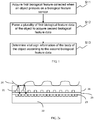
- FIG. 1 is a schematic flowchart of a method for determining vital sign information according to an embodiment of the present application. As illustrated in FIG. 1 , the method includes the following steps: S11: First biological feature data, which is collected when an object presses on a biological feature sensor, is acquired, where the first biological feature data is used to reflect a body texture feature of the object.
- the object may be specifically a finger, a palm or the like.
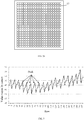
- the biological feature sensor may be a sensor which operates based on light reflection principle. As illustrated in FIG. 2a and FIG. 2b , the biological feature sensor may specifically includes a light source 21, a sensing array (not illustrated in the drawings) and a biological feature chip 22; the sensing array may include a plurality of sensing units 23.
- the object presses on the biological feature sensor light emitted by the light source is reflected by the object (for example, a finger 24) and then received by the sensing units 23 in the sensing array.
- Each sensing unit in the sensing array may generate a piece of first biological feature data, and thus a plurality of pieces of first biological feature data are generated.
- the biological feature chip acquires the plurality of pieces of first biological feature data of the object, which are collected when the object presses on the biological feature sensor, and parses the plurality of pieces of first biological feature data of the object to determine vital sign information of the object.
- the biological feature sensor may further include an optical filter 25.
- the optical filter has a filter function, for example, a function of filtering interference light contained in the light reflected by the object.
- the light emitted by the light source is irradiated on the object, reflected by the object and then received by the sensing array; the sensing array converts a reflected optical signal into an electrical signal.
- Valley and ridge textures of a fingerprint or a palmprint result in different reflections for the light. For example, an optical signal reflected by the valley has a greater strength and the corresponding electrical signal is also greater, and an optical reflected by the ridge has a smaller strength and the corresponding electrical signal is also smaller. Therefore, based on formation of such differentiated electrical signals, the plurality of pieces of first biological feature data, which reflects a texture feature of the object, may be acquired.
- the light source may share an organic light-emitting diode (OLED) light source of an OLED display screen 26, such that the biological feature sensor may be directly applied to the OLED display screen, thereby forming an in-display structure.
- OLED organic light-emitting diode
- the light source may also be an independent light source.
- the sensing array may be arranged below the OLED display screen to form an under-display structure.
- the plurality of pieces of first biological feature data collected when the object presses on the biological feature sensor which reflects a texture feature of the object
- the size of the predetermined region may be flexibly defined according to actual needs.
- the position of the predetermined region may be defined in a setting option of an electronic terminal.
- the acquiring the plurality of pieces of first biological feature data collected when the object presses on the biological feature sensor, which reflects the texture feature of the object may specifically include: when the object presses on the biological feature sensor, acquiring the plurality of pieces of first biological feature data that are collected according to a predetermined collection rule.
- the predetermined collection rule may be determined according to an arrangement manner of sensing arrays on the biological feature sensor. For example, as illustrated in FIG. 2b , if the sensing array includes a plurality of sensing units that are arranged in row and column directions, the predetermined collection rule may be scanning the sensing units in the row direction or in the column direction to collect the plurality of pieces of first biological feature data.
- S12 The plurality of pieces of first biological feature data of the object are parsed to acquire second biological feature data, where the second biological feature data is used to reflect a vital sign of a body of the object.
- a plurality of first biological feature data may be generated.
- the object is a live body
- the light emitted by the light source when the light emitted by the light source is irradiated on the object, a portion of the emitted light may be directly reflected, and another portion of the emitted light may be transmitted through the skin tissue and then be reflected. Therefore, in this course, some light may be absorbed by the skin tissue, thus the optical signal obtained upon reflection may be subjected to attenuation. Absorption of the light by the muscles, bones and the like in the skin tissue is fixed, and absorption of the light by the blood is variable due to blood flowing.
- the optical signal obtained via reflection after the optical signal is transmitted through the skin tissue is subjected to different attenuations, and the optical signals received by the sensing array are also subjected to different attenuations, such that the plurality of pieces of first biological feature data not only includes information reflecting blood flow volume variations, but also includes the texture information reflecting the object. Therefore, the second biological feature data reflecting the vital sign of the body of the object may be determined by parsing the plurality of pieces of first biological feature data of the object, for example, heartbeat data (that is, the heart rate data) affecting the blood flow volume may be determined.
- heartbeat data that is, the heart rate data
- the plurality of pieces of first biological feature data of the object may be parsed to remove the texture information therefrom, such that the second biological feature data of the body of the object is obtained and the vital signal information of the body of the object is acquired.
- the plurality of pieces of first biological feature data of the object may be grouped according to the predetermined collection rule, and then the grouped pieces of first biological feature data are parsed to acquire the second biological feature data of the body of the object.
- the biological feature sensor includes m rows*n columns of sensing units.
- the sensing units may be scanned according to a predetermined scanning rule to acquire a plurality of pieces of fingerprint feature data of the finger. For example, the sensing units are scanned in the row direction or in the column direction to collect the fingerprint feature data.
- the fingerprint feature data may be grouped according to the predetermined collection rule in the row direction or column direction.
- grouping the fingerprint feature data of the finger according to the predetermined collection rule includes: grouping the fingerprint feature data of the finger according to a collection rule predetermined within one cycle.
- the fingerprint feature data is grouped into m groups (grouping based on row) or n groups (grouping based on column), that is, a plurality of pieces of first biological feature data obtained by performing one row scanning cycle for the sensing array or performing one column scanning cycle for the sensing array are used as a group of first biological feature data.
- grouping the fingerprint feature data includes: using one frame of fingerprint feature data as a group of fingerprint feature data.
- the accuracy of the heart rate data determined in the multi-frame circumstance is higher.
- step S12 includes the predetermined collection rule; if the first biological feature data is fingerprint feature data, in this step, the fingerprint feature data is parsed upon grouping to remove the texture information from the fingerprint feature data to acquire the heart rate data, which may specifically include: calculating an average value of the plurality of pieces of fingerprint feature data in different groups to remove the texture information therefrom respectively, to acquire a plurality of pieces of heart rate data. Each group of fingerprint feature data corresponds to a respective piece of heart rate data.
- the fingerprint feature data may be collected by scanning the sensing units in the row direction.
- the obtained plurality of pieces of fingerprint feature data may be grouped according to rows, and the plurality of pieces of fingerprint feature data obtained by performing one scanning cycle for the sensing array are used as a group of fingerprint feature data. That is, upon grouping, m groups of fingerprint feature data in total may be obtained, and each group of fingerprint feature data includes n pieces of fingerprint feature data.
- D r,e represents fingerprint feature data in the r th row and the e th column
- n represents the total number of columns in the sensing array
- a r represents an average value of the fingerprint feature data in the r th row, 1 ⁇ r ⁇ m, 1 ⁇ e ⁇ n.
- the method for calculating an average is the same as the method for calculating the average of the fingerprint feature data upon grouping according to rows, which is not described herein any further.
- each frame of fingerprint feature data is formed after the a rows and b columns of sensing array are scanned, and c frames of fingerprint feature data are obtained by performing scanning for multiple times for the a rows and b columns of sensing units.
- each frame of first biological feature data may be used as a respective group of first biological feature data, and upon grouping c groups of fingerprint feature data in total may be obtained.
- Each group of fingerprint feature data includes a*b pieces of fingerprint feature data.
- D r,e represents fingerprint feature data in the r th row and the e th column
- g and g+a respectively represent a starting row and an ending row in the predetermined region
- h and h+b respectively represent a starting column and an ending column in the predetermined region (corresponding to a portion of or all of the sensing arrays)
- a f represents an average value of the f th frame of fingerprint feature data, g ⁇ r ⁇ g+a, h ⁇ e ⁇ h+b, 1 ⁇ f ⁇ c.
- the predetermined region may correspond to a portion of the sensing array, or may correspond to the entire sensing array.
- step S13 further includes filtering the heart rate data, and then determining the heart rate information of the body of the finger according to the heart rate data upon filtering.
- the filtering may include average value filtering, Gaussian filtering and the like, and the method for filtering the heart rate data to remove noise included in the data may be specifically referenced to other known methods.
- a waveform peak statistical collection or spectrum analysis may be performed for the heart rate data of the body of the finger to determine the heart rate information of the body of the finger.
- the waveform peak value statistical collection or spectrum analysis may be performed for average values of the different groups of fingerprint feature data, to determine the heart rate information of the body of the finger.
- performing the waveform peak statistical collection or spectrum analysis for the data to determine the heart rate information of the body of the finger includes: performing the waveform peak statistical collection or spectrum analysis for a plurality of pieces of heart rate data, which are obtained by respectively parsing several groups of fingerprint feature data formed by grouping one frame of fingerprint feature data, to determine the heart rate information of the body of the finger.
- performing waveform peak statistical collection or spectrum analysis for the heart rate data to determine the heart rate information of the body of the finger includes: performing the waveform peak statistical collection or spectrum analysis for a plurality of pieces of heart rate data, which are obtained by respectively parsing several groups of fingerprint feature data formed by grouping multiple frames of fingerprint feature data, to determine the heart rate information of the body of the finger.
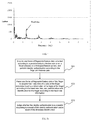
- FIG. 3 is a waveform obtained by processing the fingerprint feature data after one frame of fingerprint feature is collected by scanning in the row direction.
- FIG. 5 is a schematic flowchart of an identity authentication method according to an embodiment of the present application.
- the object is a finger
- the first biological feature data is fingerprint feature data
- the biological feature sensor is an optical fingerprint sensor
- the second biological feature data is heart rate data
- the vital sign information is heart rate information as an example.
- identity authentication is implemented using one frame of fingerprint feature data
- the vital sign information is acquired, which specifically includes the following steps.
- S51 One frame of fingerprint feature data collected according to a predetermined collection rule when a finger press on a biological feature sensor is acquired, and identity authentication is performed according to the fingerprint feature data.
- the predetermined collection rule may be scanning all the sensing units according to rows (which may also be based on columns). As illustrated in FIG. 5b , the sensor firstly scans row 1, then scans row 2,..., and finally scans row m.
- the frequency for scanning the sensing units is a predetermined scanning frequency, such that any two neighboring rows are scanned with a same time interval. This time interval may be flexibly defined. Specifically, assuming that the heart rate has a maximum value of 2.6 Hz, , the predetermined scanning frequency is greater than 2*2.6 Hz according to the sampling theory; that is, the time interval is less than 1/(2*2.6 Hz)s. Therefore, the less the time interval is, the more accurate the obtained data is.
- the obtained fingerprint feature data is processed to obtain texture information of the fingerprint, and thus the identity authentication may be performed according to the texture information of the fingerprint.
- the specific method for performing identity authentication according to the texture information of the fingerprint may be referenced to other known methods.
- One frame of fingerprint feature data of the finger is parsed to acquire heart rate data of a body of the finger, heart rate information of the body of the finger is determined according to the heart rate data, and hence aliveness identification is performed for the finger according to the heart rate information.
- the specific heart rate information determination method may be referenced to the above embodiment, which is not described herein any further.
- the heart rate information may be compared with pre-stored reference heart rate information to perform aliveness identification to the object.
- the determined heart rate information is not within the range of the pre-stored reference heart rate information.
- the comparison of the determined heart rate information and the pre-stored reference heart rate information by the comparison of the determined heart rate information and the pre-stored reference heart rate information, if the determined heart rate information is within the range of the pre-stored reference heart rate information, it may be determined that the collected fingerprint feature data is from a live body, and otherwise, it may be determined that the fingerprint feature data is not collected from a live body.
- the range of the pre-stored reference heart rate information may be customized according to individual differences.
- S53 Whether the identity authentication is successful is judged according to a result of the identity authentication and a result of the aliveness identification.
- the identity authentication is successful, that is, the texture information included in the collected fingerprint feature data is consistent with pre-stored texture information, and in addition, if the aliveness identification is successful, that is, the heart rate information included in the collected fingerprint feature data is within the range of the pre-stored reference heart information, it may be determined that the identity authentication is successful, and otherwise, it may be determined that the identity authentication is unsuccessful.
- a requirement of the accuracy of the vital sign information is low, and it is only required that the vital sign information is within the range of pre-stored reference vital sign information. Therefore, in this embodiment, a sample amount of the fingerprint feature data obtained by scanning one frame of fingerprint feature data is small, and thus the speed of collecting fingerprint feature data may be improved. In addition, it is not required that the finger is in contact with and pressed on the optical fingerprint sensor for long time. In this way, on the prerequisite of not affecting user experience, an aliveness identification function is added to the conventional biological feature sensor, and security of the identity authentication is improved.
- performing identity authentication according to the fingerprint feature data and performing aliveness identification according to the heart rate information are not subjected to a fixed sequence, and the sequence of performing identity authentication and performing aliveness identification is not limited in this embodiment.
- the identity authentication may be performed for the finger according to all or a part of the fingerprint feature data when the heart rate data of the body of the finger is acquired.
- multiple frames of fingerprint feature data may be collected by scanning all the sensing units, for example, m rows and n columns of sensing units, of the optical sensor.
- the heart rate information may be determined according to the collected multiple frames of fingerprint feature data
- the identity authentication may be performed for the object according to all or a part of the fingerprint feature data collected when the object presses on the biological feature sensor.
- the identity authentication is performed according to one frame of fingerprint feature data in the collected multiple frames of fingerprint feature data; or the identity authentication is performed according to the collected multiple frames of fingerprint feature data. If it is determined that the heart rate information uses the multiple frames of fingerprint feature data, as compared with collecting only one frame of fingerprint feature data, the sample amount of the fingerprint feature data is increased, and thus the determined heart rate information is more accurate.
- FIG. 6a is a schematic flowchart of a method for determining heart rate information according to an embodiment of the present application.
- the method includes the following steps:
- the sensing units corresponding to the predetermined region are a portion of all the sensing units.
- the sensing units in the predetermined region are scanned, rather than all the sensing units in the sensing array, such that a sample amount of the acquired first biological feature data is reduced.
- the predetermined region may be a small region in the middle of the sensing array.
- the sensing units may be scanned at a predetermined scanning frequency, such that any two neighboring frames are scanned with a same time interval. This time interval may be defined. Specifically, assuming that the heart rate has a maximum value of 2.6 Hz, the predetermined scanning frequency is greater than 2*2.6 Hz based on the sampling theory; that is, the time interval between scannings of two neighboring frames is less than 1/(2*2.6 Hz)s.
- the heart rate data is determined according to the multiple frames of fingerprint feature data corresponding to the predetermined region, and the heart rate information is determined according to the heart rate data.
- an average value of the each frame of fingerprint feature data may be firstly calculated to obtain the heart rate data, then a filtering operation is performed on the obtained heart rate data to remove noise, and finally the heart rate information is determined according to the heart rate data upon filtering.
- this embodiment may be incorporated with the above embodiment.
- all the sensing units of the sensing array may be firstly scanned to collect one frame of fingerprint feature data for identity authentication, and then the sensing units in the predetermined region of the sensing array are scanned for multiple times to quickly collect multiple frames of fingerprint feature data for determination of accurate heart rate information.
- the heart rate information is only described as an example, and when the vital sign information is other feature information, for example, blood oxygen or the like, adaptive modifications may be made to the specific calculation method in the embodiments of the present application to achieve the corresponding objective.
- Embodiments of the present application further provide an electronic terminal.
- the electronic terminal includes the biological feature sensor as described above.
- the electronic terminal may be a mobile phone, a tablet computer, a computer or the like having the above biological feature sensor.
- the apparatus according to the embodiments of the present application may be practiced by a computer program.
- a person skilled in the art should understand the above division of units and modules is only an exemplary one, and if the apparatus is divided into other units or modules or not divided, the technical solution shall also fall within the protection scope of the present application as long as the information object has the above functions.
- the embodiments of the present application may be described to illustrate methods, apparatuses (devices), or computer program products. Therefore, hardware embodiments, software embodiments, or hardware-plus-software embodiments may be used to illustrate the present application.
- the present application may further employ a computer program product which may be implemented by at least one non-transitory computer-readable storage medium with an executable program code stored thereon.
- the non-transitory computer-readable storage medium comprises but not limited to a disk memory, a CD-ROM, and an optical memory.
- the present invention is described based on the flowcharts and/or block diagrams of the method, apparatus (device), and computer program product. It should be understood that each process and/or block in the flowcharts and/or block diagrams, and any combination of the processes and/or blocks in the flowcharts and/or block diagrams may be implemented using computer program instructions. These computer program instructions may be issued to a computer, a dedicated computer, an embedded processor, or processors of other programmable data processing device to generate a machine, which enables the computer or the processors of other programmable data processing devices to execute the instructions to implement an apparatus for implementing specific functions in at least one process in the flowcharts and/or at least one block in the block diagrams.
- These computer program instructions may also be stored a non-transitory computer-readable memory capable of causing a computer or other programmable data processing devices to work in a specific mode, such that the instructions stored on the non-transitory computer-readable memory implement a product comprising an instruction apparatus, where the instruction apparatus implements specific functions in at least one process in the flowcharts and/or at least one block in the block diagrams.
- These computer program instructions may also be stored on a computer or other programmable data processing devices, such that the computer or the other programmable data processing devices execute a series of operations or steps to implement processing of the computer.
- the instructions when executed on the computer or the other programmable data processing devices, implement the specific functions in at least one process in the flowcharts and/or at least one block in the block diagrams.
Landscapes
- Engineering & Computer Science (AREA)
- Health & Medical Sciences (AREA)
- Life Sciences & Earth Sciences (AREA)
- Physics & Mathematics (AREA)
- Theoretical Computer Science (AREA)
- Pathology (AREA)
- Biophysics (AREA)
- Biomedical Technology (AREA)
- Heart & Thoracic Surgery (AREA)
- Medical Informatics (AREA)
- Molecular Biology (AREA)
- Surgery (AREA)
- Animal Behavior & Ethology (AREA)
- General Health & Medical Sciences (AREA)
- Public Health (AREA)
- Veterinary Medicine (AREA)
- General Physics & Mathematics (AREA)
- Human Computer Interaction (AREA)
- Computer Security & Cryptography (AREA)
- Multimedia (AREA)
- Cardiology (AREA)
- Signal Processing (AREA)
- Software Systems (AREA)
- General Engineering & Computer Science (AREA)
- Computer Hardware Design (AREA)
- Computer Vision & Pattern Recognition (AREA)
- Computer Networks & Wireless Communication (AREA)
- Physiology (AREA)
- Measurement Of The Respiration, Hearing Ability, Form, And Blood Characteristics Of Living Organisms (AREA)
- Collating Specific Patterns (AREA)
Abstract
Description
- Embodiments of the present application relate to the technical field of identity authentication, and in particular, relate to a method for determining vital sign information, an identity authentication method and apparatus.
- With introduction of the fingerprint identification technology to mobile terminals, fingerprint-based unlocking has replaced password-based unlocking, slide-unlocking and the like. In this way, unlocking does not need other operations, but may be simply implemented by a finger in contact with a sensor. This greatly improves use convenience of the mobile terminals while ensuring security of the mobile terminals.
- However, mobile terminals generally store a large amount of personal information, which involves security of properties and privacies of users. After the mobile terminals employ fingerprint identification, unauthorized users may steal fingerprints of the users to fabricate spoof fingerprints, and crack security systems of the users to obtain user information in the mobile terminals. This adversely increases the probability that the fingerprint passwords of the mobile terminals are cracked, and causes greater threatens to information security of the mobile terminals.
- Accordingly, in the prior art, aliveness identification is performed by configuring an independent aliveness identification sensor, that is, the aliveness identification sensor is provided in addition to the fingerprint sensor. However, this solution needs two independent sensors, which increases the implementation cost.
- Embodiments of the present application are intended to provide a vital sign information determination method, an identity authentication method and apparatus, to at least solve the above technical problem in the prior art.
- Embodiments of the present application provide a vital sign information determination method. The method includes:
- acquiring first biological feature data collected when an object presses on a biological feature sensor, the first biological feature data being used to reflect a body texture feature of the object;
- parsing a plurality of pieces of first biological feature data of the object to acquire second biological feature data, the second biological feature data being used to reflect a vital sign of a body of the object; and
- determining vital sign information of the body of the object according to the second biological feature data.
- Embodiments of the present application provide an identity authentication method. The method includes:
- acquiring first biological feature data collected when an object presses on a biological feature sensor, and performing identity authentication for the object according to the first biological feature data, the first biological feature data being used to reflect a body texture feature of the object;
- parsing a plurality of pieces of first biological feature data of the object to acquire second biological feature data, determining vital sign information of the body of the object according to the second biological feature data, and performing aliveness identification for the object according to the vital sign information, the second biological feature data being used to reflect a vital sign of a body of the object; and
- judging whether the identity authentication is successful according to a result of the identity authentication and a result of the aliveness identification.
- Embodiments of the present application provide a biological feature sensor. The biological feature sensor includes: a light source, a sensing array, a biological feature chip. Light emitted by the light source is reflected by an object and received by the sensing array to generate first biological feature data; the biological feature chip is configured to acquire the first biological feature data collected when the object presses on the biological feature sensor; the first biological feature data is parsed to determine vital signal information of a body of the object; where the first biological feature data is used to reflect a body texture feature of the object, and the second biological feature data is used to reflect a vital sign of the body of the object.
- Embodiments of the present application provide an electronic terminal. The electronic terminal includes the biological feature sensor as described in any of the above embodiments.
- In embodiments of the present application, first biological feature data collected when an object presses on a biological feature sensor is acquired, where the first biological feature data is used to reflect a body texture feature of the object; a plurality of pieces of first biological feature data of the object is parsed to acquire second biological feature data, where the second biological feature data is used to reflect a vital sign of a body of the object; and vital sign information of the body of the object is determined according to the second biological feature data. On the prerequisite of not changing the structure of a conventional biological feature sensor and configuring an additional aliveness identification sensor, the vital sign information may be conveniently identified by using the same biological feature sensor, which solves the problem that the implementation cost is high due to additional configuration of the aliveness identification sensor when the aliveness identification function is added, and further implements identity authentication based on aliveness identification.
-
-
FIG. 1 is a schematic flowchart of a method for determining vital sign information according to an embodiment of the present application; -
FIG. 2a is a schematic structural diagram of a biological feature sensor according to an embodiment of the present application; -
FIG. 2b is a schematic structural diagram of a sensing unit in the biological feature sensor inFIG. 2a ; -
FIG. 3 is a waveform diagram obtained according to fingerprint feature data according to an embodiment of the present application; -
FIG. 4 is a waveform diagram obtained according to fingerprint feature data according to an embodiment of the present application; -
FIG. 5a is a schematic flowchart of an identity authentication method according to an embodiment of the present application; -
FIG. 5b is a schematic diagram of a sequence of scanning sensing units in the identity authentication method inFIG. 5a ; -
FIG. 6a is a schematic flowchart of a method for determining heart rate information according to an embodiment of the present application; and -
FIG. 6b is a schematic diagram of a scanning region of sensing units in the heart rate information determination method inFIG. 6a . - Practice of the present application is described in detail with reference to drawings and specific embodiments, such that the practice of addressing the technical problem using the technical means according to the present application and achieving the technical effects may be better understood and conducted.
- In the embodiments of the present application hereinafter, description is given using a case that a biological feature sensor is a fingerprint feature sensor for collecting fingerprint feature data, second biological feature data is heart rate data and vital sign information is heart rate information as an example. It should be noted that, in other embodiments, the vital sign information may also be other biological feature data, such as blood oxygen, blood pressure, or the like.
-
FIG. 1 is a schematic flowchart of a method for determining vital sign information according to an embodiment of the present application. As illustrated inFIG. 1 , the method includes the following steps:
S11: First biological feature data, which is collected when an object presses on a biological feature sensor, is acquired, where the first biological feature data is used to reflect a body texture feature of the object. - In this embodiment, the object may be specifically a finger, a palm or the like. The biological feature sensor may be a sensor which operates based on light reflection principle. As illustrated in
FIG. 2a andFIG. 2b , the biological feature sensor may specifically includes alight source 21, a sensing array (not illustrated in the drawings) and abiological feature chip 22; the sensing array may include a plurality ofsensing units 23. When the object presses on the biological feature sensor, light emitted by the light source is reflected by the object (for example, a finger 24) and then received by thesensing units 23 in the sensing array. Each sensing unit in the sensing array may generate a piece of first biological feature data, and thus a plurality of pieces of first biological feature data are generated. The biological feature chip acquires the plurality of pieces of first biological feature data of the object, which are collected when the object presses on the biological feature sensor, and parses the plurality of pieces of first biological feature data of the object to determine vital sign information of the object. As illustrated inFIG. 2a , the biological feature sensor may further include anoptical filter 25. The optical filter has a filter function, for example, a function of filtering interference light contained in the light reflected by the object. - Specifically, the light emitted by the light source is irradiated on the object, reflected by the object and then received by the sensing array; the sensing array converts a reflected optical signal into an electrical signal. Valley and ridge textures of a fingerprint or a palmprint result in different reflections for the light. For example, an optical signal reflected by the valley has a greater strength and the corresponding electrical signal is also greater, and an optical reflected by the ridge has a smaller strength and the corresponding electrical signal is also smaller. Therefore, based on formation of such differentiated electrical signals, the plurality of pieces of first biological feature data, which reflects a texture feature of the object, may be acquired.
- In this embodiment, specifically, the light source may share an organic light-emitting diode (OLED) light source of an
OLED display screen 26, such that the biological feature sensor may be directly applied to the OLED display screen, thereby forming an in-display structure. In other embodiments, the light source may also be an independent light source. - In addition, the sensing array may be arranged below the OLED display screen to form an under-display structure.
- In this embodiment, the plurality of pieces of first biological feature data collected when the object presses on the biological feature sensor, which reflects a texture feature of the object, may be specifically a plurality of pieces of first biological feature data of the object that are collected when the object presses on a predetermined region of the biological feature sensor. The size of the predetermined region may be flexibly defined according to actual needs. For example, the position of the predetermined region may be defined in a setting option of an electronic terminal.
- In this embodiment, the acquiring the plurality of pieces of first biological feature data collected when the object presses on the biological feature sensor, which reflects the texture feature of the object, may specifically include: when the object presses on the biological feature sensor, acquiring the plurality of pieces of first biological feature data that are collected according to a predetermined collection rule.
- In this embodiment, the predetermined collection rule may be determined according to an arrangement manner of sensing arrays on the biological feature sensor. For example, as illustrated in
FIG. 2b , if the sensing array includes a plurality of sensing units that are arranged in row and column directions, the predetermined collection rule may be scanning the sensing units in the row direction or in the column direction to collect the plurality of pieces of first biological feature data. - S12: The plurality of pieces of first biological feature data of the object are parsed to acquire second biological feature data, where the second biological feature data is used to reflect a vital sign of a body of the object.
- In this embodiment, as described above, if an object presses on the sensing array, a plurality of first biological feature data may be generated. However, if the object is a live body, when the light emitted by the light source is irradiated on the object, a portion of the emitted light may be directly reflected, and another portion of the emitted light may be transmitted through the skin tissue and then be reflected. Therefore, in this course, some light may be absorbed by the skin tissue, thus the optical signal obtained upon reflection may be subjected to attenuation. Absorption of the light by the muscles, bones and the like in the skin tissue is fixed, and absorption of the light by the blood is variable due to blood flowing. Specifically, different flowing speeds of the blood cause different flow volumes of the blood tissue, and thus absorption of the light by the blood is variable. As such, the optical signal obtained via reflection after the optical signal is transmitted through the skin tissue is subjected to different attenuations, and the optical signals received by the sensing array are also subjected to different attenuations, such that the plurality of pieces of first biological feature data not only includes information reflecting blood flow volume variations, but also includes the texture information reflecting the object. Therefore, the second biological feature data reflecting the vital sign of the body of the object may be determined by parsing the plurality of pieces of first biological feature data of the object, for example, heartbeat data (that is, the heart rate data) affecting the blood flow volume may be determined.
- Specifically, in this embodiment, the plurality of pieces of first biological feature data of the object may be parsed to remove the texture information therefrom, such that the second biological feature data of the body of the object is obtained and the vital signal information of the body of the object is acquired.
- In this embodiment, when the plurality of pieces of first biological feature data are acquired, the plurality of pieces of first biological feature data of the object may be grouped according to the predetermined collection rule, and then the grouped pieces of first biological feature data are parsed to acquire the second biological feature data of the body of the object.
- Exemplarily, as described above, assume that the object is a finger, the first biological feature data is fingerprint data, the second biological feature data is heart rate data, and the vital sign information is heart rate information; the biological feature sensor includes m rows*n columns of sensing units. During data collection, the sensing units may be scanned according to a predetermined scanning rule to acquire a plurality of pieces of fingerprint feature data of the finger. For example, the sensing units are scanned in the row direction or in the column direction to collect the fingerprint feature data. During grouping, the fingerprint feature data may be grouped according to the predetermined collection rule in the row direction or column direction.
- Exemplary grouping is described as follow. if the fingerprint feature data is one frame of fingerprint feature data collected within one cycle on the sensing array of the biological feature sensor, grouping the fingerprint feature data of the finger according to the predetermined collection rule (for example, scanning in the row direction or in the column direction) includes: grouping the fingerprint feature data of the finger according to a collection rule predetermined within one cycle. For example, the fingerprint feature data is grouped into m groups (grouping based on row) or n groups (grouping based on column), that is, a plurality of pieces of first biological feature data obtained by performing one row scanning cycle for the sensing array or performing one column scanning cycle for the sensing array are used as a group of first biological feature data.
- In another embodiment, if the fingerprint feature data is multiple frames of fingerprint feature data collected within multiple cycles on the sensing array of the biological feature sensor, grouping the fingerprint feature data includes: using one frame of fingerprint feature data as a group of fingerprint feature data.
- As compared with the one-frame circumstance, in the multi-frame circumstance, since the sample amount of the fingerprint feature data is great, the accuracy of the heart rate data determined in the multi-frame circumstance is higher.
- Specifically, step S12 includes the predetermined collection rule; if the first biological feature data is fingerprint feature data, in this step, the fingerprint feature data is parsed upon grouping to remove the texture information from the fingerprint feature data to acquire the heart rate data, which may specifically include: calculating an average value of the plurality of pieces of fingerprint feature data in different groups to remove the texture information therefrom respectively, to acquire a plurality of pieces of heart rate data. Each group of fingerprint feature data corresponds to a respective piece of heart rate data.
- Specifically, in this embodiment or other embodiments, if the sensing array includes m rows * n columns of sensing units, the fingerprint feature data may be collected by scanning the sensing units in the row direction. In this case, the obtained plurality of pieces of fingerprint feature data may be grouped according to rows, and the plurality of pieces of fingerprint feature data obtained by performing one scanning cycle for the sensing array are used as a group of fingerprint feature data. That is, upon grouping, m groups of fingerprint feature data in total may be obtained, and each group of fingerprint feature data includes n pieces of fingerprint feature data. An average value of each group of fingerprint feature data may be calculated using the method shown in formula (1) as follows:

- Dr,e represents fingerprint feature data in the rth row and the eth column, n represents the total number of columns in the sensing array, and Ar represents an average value of the fingerprint feature data in the rth row, 1≤r≤m, 1≤e≤n.
- In other embodiments, if the fingerprint feature data is grouped according to columns, the method for calculating an average is the same as the method for calculating the average of the fingerprint feature data upon grouping according to rows, which is not described herein any further.
- Alternatively, in this embodiment or other embodiments, if data collection is performed for the predetermined region of the sensing array, assuming that the predetermined region includes a rows and b columns of sensing units of the sensing array, one frame of fingerprint feature data is formed after the a rows and b columns of sensing array are scanned, and c frames of fingerprint feature data are obtained by performing scanning for multiple times for the a rows and b columns of sensing units. In this case, each frame of first biological feature data may be used as a respective group of first biological feature data, and upon grouping c groups of fingerprint feature data in total may be obtained. Each group of fingerprint feature data includes a*b pieces of fingerprint feature data. An average value of each group of fingerprint feature data is calculated using the method shown in formula (2) as follows:

- Dr,e represents fingerprint feature data in the rth row and the eth column, g and g+a respectively represent a starting row and an ending row in the predetermined region, h and h+b respectively represent a starting column and an ending column in the predetermined region (corresponding to a portion of or all of the sensing arrays), and Af represents an average value of the fth frame of fingerprint feature data, g≤r≤g+a, h≤e≤h+b, 1≤f≤c.
- It should be noted that the predetermined region may correspond to a portion of the sensing array, or may correspond to the entire sensing array.
- S13: Vital sign information of the body of the object is determined according to the second biological feature data.
- In this embodiment, considering that the acquired heart rate data may include noise, step S13 further includes filtering the heart rate data, and then determining the heart rate information of the body of the finger according to the heart rate data upon filtering. Specifically, the filtering may include average value filtering, Gaussian filtering and the like, and the method for filtering the heart rate data to remove noise included in the data may be specifically referenced to other known methods.
- In this embodiment, when the heart rate information of the body of the finger is determined according to the heart rate data, a waveform peak statistical collection or spectrum analysis may be performed for the heart rate data of the body of the finger to determine the heart rate information of the body of the finger. Specifically, in case that the fingerprint feature data is grouped, the waveform peak value statistical collection or spectrum analysis may be performed for average values of the different groups of fingerprint feature data, to determine the heart rate information of the body of the finger.
- Specifically, when the fingerprint feature data is one frame of fingerprint feature data collected within one cycle on the sensing array of the biological feature sensor, performing the waveform peak statistical collection or spectrum analysis for the data to determine the heart rate information of the body of the finger includes: performing the waveform peak statistical collection or spectrum analysis for a plurality of pieces of heart rate data, which are obtained by respectively parsing several groups of fingerprint feature data formed by grouping one frame of fingerprint feature data, to determine the heart rate information of the body of the finger.
- Alternatively, in other embodiments, when the fingerprint feature data of the finger is multiple frames of fingerprint feature data collected within multiple cycles on the sensing array of the biological feature sensor, performing waveform peak statistical collection or spectrum analysis for the heart rate data to determine the heart rate information of the body of the finger includes: performing the waveform peak statistical collection or spectrum analysis for a plurality of pieces of heart rate data, which are obtained by respectively parsing several groups of fingerprint feature data formed by grouping multiple frames of fingerprint feature data, to determine the heart rate information of the body of the finger.
- Specifically, hereinafter performing the waveform peak statistical collection for the heart rate data to determine the heart rate information of the body of the finger is described. Firstly, a schematic waveform is drawn according to the average value of each group of fingerprint feature data, and then the heart rate information (that is, the heart rate value) is determined according to formula (3) as follows:

- M represents the number of peaks in the waveform, T represents a total scanning time elapsed when one frame or multiple frames of fingerprint feature data are obtained, H represents a frequency corresponding to the peak, that is, the heart rate information (the heart rate value). A schematic waveform is as illustrated in
FIG. 3. FIG. 3 is a waveform obtained by processing the fingerprint feature data after one frame of fingerprint feature is collected by scanning in the row direction. - Hereinafter description is given using performing spectrum analysis to determine heart rate information of a body of the finger as an example. An average value of each group of fingerprint feature data is subjected to a Fourier transformation to obtain the corresponding spectrum data. In combination with the fact that in normal circumstances the heart rate range of the human body is 60 to 100 beats/minute (which may be approximately equal to 1 Hz), the frequency corresponding to a maximum amplitude in the vicinity of the frequency of 1 Hz in the spectrum data is determined as the heart rate information. An exemplary waveform is as illustrated in
FIG. 4 . -
FIG. 5 is a schematic flowchart of an identity authentication method according to an embodiment of the present application. As illustrated inFIG. 5 , in this embodiment, description is given hereinafter still using the case that the object is a finger, the first biological feature data is fingerprint feature data, the biological feature sensor is an optical fingerprint sensor, the second biological feature data is heart rate data, and the vital sign information is heart rate information as an example. After identity authentication is implemented using one frame of fingerprint feature data, the vital sign information is acquired, which specifically includes the following steps. - S51: One frame of fingerprint feature data collected according to a predetermined collection rule when a finger press on a biological feature sensor is acquired, and identity authentication is performed according to the fingerprint feature data.
- The predetermined collection rule may be scanning all the sensing units according to rows (which may also be based on columns). As illustrated in
FIG. 5b , the sensor firstly scansrow 1, then scansrow 2,..., and finally scans row m. The frequency for scanning the sensing units is a predetermined scanning frequency, such that any two neighboring rows are scanned with a same time interval. This time interval may be flexibly defined. Specifically, assuming that the heart rate has a maximum value of 2.6 Hz, , the predetermined scanning frequency is greater than 2*2.6 Hz according to the sampling theory; that is, the time interval is less than 1/(2*2.6 Hz)s. Therefore, the less the time interval is, the more accurate the obtained data is. - Upon completion of data collection, the obtained fingerprint feature data is processed to obtain texture information of the fingerprint, and thus the identity authentication may be performed according to the texture information of the fingerprint. The specific method for performing identity authentication according to the texture information of the fingerprint may be referenced to other known methods.
- S52: One frame of fingerprint feature data of the finger is parsed to acquire heart rate data of a body of the finger, heart rate information of the body of the finger is determined according to the heart rate data, and hence aliveness identification is performed for the finger according to the heart rate information.
- The specific heart rate information determination method may be referenced to the above embodiment, which is not described herein any further.
- Specifically, after the heart rate information is determined, the heart rate information may be compared with pre-stored reference heart rate information to perform aliveness identification to the object.
- Specifically, in a specific application environment, when the finger with a fingerprint glove is contact with and pressed on the biological feature sensor, since the fingerprint glove between the finger and the biological feature sensor may hinder transmission of the light, the light transmitted to skin tissue and the light reflected by the skin tissue are both reduced, such that data corresponding to the vital sign information in the obtained fingerprint feature data of the finger is less. As a result, the determined heart rate information is not within the range of the pre-stored reference heart rate information. Therefore, in this step, by the comparison of the determined heart rate information and the pre-stored reference heart rate information, if the determined heart rate information is within the range of the pre-stored reference heart rate information, it may be determined that the collected fingerprint feature data is from a live body, and otherwise, it may be determined that the fingerprint feature data is not collected from a live body. The range of the pre-stored reference heart rate information may be customized according to individual differences.
- S53: Whether the identity authentication is successful is judged according to a result of the identity authentication and a result of the aliveness identification.
- Specifically, if the identity authentication is successful, that is, the texture information included in the collected fingerprint feature data is consistent with pre-stored texture information, and in addition, if the aliveness identification is successful, that is, the heart rate information included in the collected fingerprint feature data is within the range of the pre-stored reference heart information, it may be determined that the identity authentication is successful, and otherwise, it may be determined that the identity authentication is unsuccessful.
- During the aliveness identification, a requirement of the accuracy of the vital sign information is low, and it is only required that the vital sign information is within the range of pre-stored reference vital sign information. Therefore, in this embodiment, a sample amount of the fingerprint feature data obtained by scanning one frame of fingerprint feature data is small, and thus the speed of collecting fingerprint feature data may be improved. In addition, it is not required that the finger is in contact with and pressed on the optical fingerprint sensor for long time. In this way, on the prerequisite of not affecting user experience, an aliveness identification function is added to the conventional biological feature sensor, and security of the identity authentication is improved.
- It may be understood that, in the embodiment of the present application, performing identity authentication according to the fingerprint feature data and performing aliveness identification according to the heart rate information are not subjected to a fixed sequence, and the sequence of performing identity authentication and performing aliveness identification is not limited in this embodiment.
- In another practice of this embodiment, the identity authentication may be performed for the finger according to all or a part of the fingerprint feature data when the heart rate data of the body of the finger is acquired. Specifically, multiple frames of fingerprint feature data may be collected by scanning all the sensing units, for example, m rows and n columns of sensing units, of the optical sensor. In this case, the heart rate information may be determined according to the collected multiple frames of fingerprint feature data, and the identity authentication may be performed for the object according to all or a part of the fingerprint feature data collected when the object presses on the biological feature sensor. For example, the identity authentication is performed according to one frame of fingerprint feature data in the collected multiple frames of fingerprint feature data; or the identity authentication is performed according to the collected multiple frames of fingerprint feature data. If it is determined that the heart rate information uses the multiple frames of fingerprint feature data, as compared with collecting only one frame of fingerprint feature data, the sample amount of the fingerprint feature data is increased, and thus the determined heart rate information is more accurate.
-
FIG. 6a is a schematic flowchart of a method for determining heart rate information according to an embodiment of the present application. In this embodiment, as illustrated inFIG. 6a , the method includes the following steps: - S61: A finger under test press on a fingerprint identification region of an optical fingerprint sensor.
- S62: A predetermined region of an optical fingerprint sensor array is scanned for multiple times for data collection in multiple cycles, to acquire multiple frames of fingerprint feature data corresponding to a plurality of sensing units in the predetermined region.
- In this embodiment, the sensing units corresponding to the predetermined region are a portion of all the sensing units. The sensing units in the predetermined region are scanned, rather than all the sensing units in the sensing array, such that a sample amount of the acquired first biological feature data is reduced.
- Specifically, in this embodiment, as illustrated in
FIG. 6b , the predetermined region may be a small region in the middle of the sensing array. During scanning of the sensing array, to ensure accuracy of the heart rate information, the sensing units may be scanned at a predetermined scanning frequency, such that any two neighboring frames are scanned with a same time interval. This time interval may be defined. Specifically, assuming that the heart rate has a maximum value of 2.6 Hz, the predetermined scanning frequency is greater than 2*2.6 Hz based on the sampling theory; that is, the time interval between scannings of two neighboring frames is less than 1/(2*2.6 Hz)s. - S63: The heart rate data is determined according to the multiple frames of fingerprint feature data corresponding to the predetermined region, and the heart rate information is determined according to the heart rate data.
- Specifically, an average value of the each frame of fingerprint feature data may be firstly calculated to obtain the heart rate data, then a filtering operation is performed on the obtained heart rate data to remove noise, and finally the heart rate information is determined according to the heart rate data upon filtering. The details may be referenced to related disclosure in the above embodiment.
- In addition, this embodiment may be incorporated with the above embodiment. For example, all the sensing units of the sensing array may be firstly scanned to collect one frame of fingerprint feature data for identity authentication, and then the sensing units in the predetermined region of the sensing array are scanned for multiple times to quickly collect multiple frames of fingerprint feature data for determination of accurate heart rate information.
- It should be noted that, in the embodiments of the present application, the heart rate information is only described as an example, and when the vital sign information is other feature information, for example, blood oxygen or the like, adaptive modifications may be made to the specific calculation method in the embodiments of the present application to achieve the corresponding objective.
- Embodiments of the present application further provide an electronic terminal. The electronic terminal includes the biological feature sensor as described above. The electronic terminal may be a mobile phone, a tablet computer, a computer or the like having the above biological feature sensor.
- The apparatus according to the embodiments of the present application may be practiced by a computer program. A person skilled in the art should understand the above division of units and modules is only an exemplary one, and if the apparatus is divided into other units or modules or not divided, the technical solution shall also fall within the protection scope of the present application as long as the information object has the above functions.
- A person skilled in the art shall understand that the embodiments of the present application may be described to illustrate methods, apparatuses (devices), or computer program products. Therefore, hardware embodiments, software embodiments, or hardware-plus-software embodiments may be used to illustrate the present application. In addition, the present application may further employ a computer program product which may be implemented by at least one non-transitory computer-readable storage medium with an executable program code stored thereon. The non-transitory computer-readable storage medium comprises but not limited to a disk memory, a CD-ROM, and an optical memory.
- The present invention is described based on the flowcharts and/or block diagrams of the method, apparatus (device), and computer program product. It should be understood that each process and/or block in the flowcharts and/or block diagrams, and any combination of the processes and/or blocks in the flowcharts and/or block diagrams may be implemented using computer program instructions. These computer program instructions may be issued to a computer, a dedicated computer, an embedded processor, or processors of other programmable data processing device to generate a machine, which enables the computer or the processors of other programmable data processing devices to execute the instructions to implement an apparatus for implementing specific functions in at least one process in the flowcharts and/or at least one block in the block diagrams.
- These computer program instructions may also be stored a non-transitory computer-readable memory capable of causing a computer or other programmable data processing devices to work in a specific mode, such that the instructions stored on the non-transitory computer-readable memory implement a product comprising an instruction apparatus, where the instruction apparatus implements specific functions in at least one process in the flowcharts and/or at least one block in the block diagrams.
- These computer program instructions may also be stored on a computer or other programmable data processing devices, such that the computer or the other programmable data processing devices execute a series of operations or steps to implement processing of the computer. In this way, the instructions, when executed on the computer or the other programmable data processing devices, implement the specific functions in at least one process in the flowcharts and/or at least one block in the block diagrams.
- Although the preferred embodiments of the present application are described above, once knowing the basic creative concept, a person skilled in the art can make other modifications and variations to these embodiments. Therefore, the appended claims are intended to be construed as covering the preferred embodiments and all the modifications and variations falling within the scope of the present application. Obviously, a person skilled in the art can make various modifications and variations to the present application without departing from the spirit and scope of the present application. In this way, the present application is intended to cover the modifications and variations if they fall within the scope of the appended claims of the present application and equivalent technologies thereof.
Claims (19)
- A vital sign information determination method, comprising:acquiring first biological feature data collected when an object presses on a biological feature sensor, the first biological feature data being used to reflect a body texture feature of the object;parsing a plurality of pieces of first biological feature data of the object to acquire second biological feature data, the second biological feature data being used to reflect a vital sign of a body of the object; anddetermining vital sign information of the body of the object according to the second biological feature data.
- The method according to claim 1, wherein the acquiring first biological feature data collected when an object presses on a biological feature sensor comprises:
acquiring the first biological feature data collected according to a predetermined collection rule when the object presses on the biological feature sensor, the predetermined collection rule being determined according to an arrangement manner of sensing arrays on the biological feature sensor. - The method according to claim 1, wherein the parsing a plurality of pieces of first biological feature data of the object to acquire second biological feature data comprises:
parsing the plurality of pieces of first biological feature data to remove texture information therefrom and acquire the second biological feature data. - The method according to claim 3, further comprising:grouping the plurality of pieces of first biological feature data according to a predetermined collection rule to obtain several groups of first biological feature data; and correspondingly, the parsing the plurality of pieces of first biological feature data to remove texture information therefrom and acquire the second biological feature data comprises:averaging a plurality of pieces of first biological feature data in different groups to remove the texture information therefrom and acquire a plurality of second biological feature data, wherein one group of first biological feature data corresponds to one second biological feature data.
- The method according to claim 4, wherein the first biological feature data is one frame of the first biological feature data collected by performing collection for the sensing arrays on the biological feature sensor; the grouping the plurality of pieces of first biological feature data according to the predetermined collection rule comprises: using a plurality of pieces of first biological feature data obtained by performing a row scanning or a column scanning for the sensing arrays as a group of first biological feature data; or
when first biological feature data is multiple frames of the first biological feature data collected by performing scanning for the sensing arrays on the biological feature sensor, the grouping the plurality of pieces of first biological feature data comprises: using one frame of first biological feature data as a group of first biological feature data. - The method according to claim 5, wherein the determining vital sign information of the body of the object according to the second biological feature data comprises:
performing waveform peak statistical collection or spectrum analysis for a plurality of pieces of second biological feature data to determine the vital sign information of the body of the object. - The method according to claim 6, wherein the performing waveform peak statistical collection or spectrum analysis for a plurality of pieces of second biological feature data to determine the vital sign information of the body of the object comprises:parsing the several groups of first biological feature data obtained by grouping one frame of the first biological feature data respectively to acquire the plurality of pieces of second biological feature data, and performing the waveform peak statistical collection or the spectrum analysis for the plurality of pieces of second biological feature data to determine the vital sign information of the body of the object; orparsing the several groups of first biological feature data obtained by grouping multiple frames of the first biological feature data respectively to acquire the plurality of pieces of second biological feature data, and performing the waveform peak statistical collection or the spectrum analysis for the plurality of pieces of second biological feature data to determine the vital sign information of the body of the object
- The method according to any one of claims 1 to 7, wherein the determining vital sign information of the body of the object according to the second biological feature data comprises:
performing filtering for the second biological feature data, and determine the vital sign information of the body of the object according to the second biological feature data upon the filtering. - The method according to claim 8, wherein the object is a finger or a palm, the first biological feature data is correspondingly fingerprint feature data or palmprint feature data, and the vital sign information is heart rate information.
- The method according to claim 9, wherein the biological feature sensor comprises a light source, the light source shares an OLED light source in an OLED display screen of an electronic terminal where the biological feature sensor is configured.
- An identity authentication method, comprising:acquiring first biological feature data collected when an object presses on a biological feature sensor, and performing identity authentication for the object according to the first biological feature data, the first biological feature data being used to reflect a body texture feature of the object;parsing a plurality of pieces of first biological feature data of the object to acquire second biological feature data, determining vital sign information of the body of the object according to the second biological feature data, and performing aliveness identification for the object according to the vital sign information, the second biological feature data being used to reflect a vital sign of a body of the object; andjudging whether the identity authentication is successful according to a result of the identity authentication and a result of the aliveness identification.
- The method according to claim 11, wherein the performing aliveness identification for the object according to the vital sign information comprises:
comparing the vital sign information with reference vital sign information to perform aliveness identification for the object. - The method according to claim 11, wherein the parsing a plurality of pieces of first biological feature data of the object to acquire second biological feature data comprises:
parsing the plurality of pieces of first biological feature data to remove texture information therefrom and acquire the second biological feature data. - The method according to claim 13, further comprising:
grouping the plurality of pieces of first biological feature data according to a predetermined collection rule to obtain several groups of first biological feature data; and correspondingly, the parsing the plurality of pieces of first biological feature data to remove texture information therefrom and acquire the second biological feature data comprises:
averaging a plurality of pieces of first biological feature data in different groups to remove the texture information therefrom and acquire a plurality of second biological feature data, wherein one group of the first biological feature data corresponds to one second biological feature data. - The method according to claim 14, wherein the first biological feature data is one frame of the first biological feature data collected from the sensing arrays on the biological feature sensor; the grouping the plurality of pieces of first biological feature data according to the predetermined collection rule comprises: using a plurality of pieces of first biological feature data obtained by performing a row scanning or a column scanning for the sensing arrays as a group of first biological feature data; or
the first biological feature data is multiple frames of the first biological feature data collected by performing scanning for the sensing arrays on the biological feature sensor, the grouping the plurality of pieces of first biological feature data comprises: using one frame of the biological feature data as a group of first biological feature data. - The method according to claim 15, wherein the determining vital sign information of the body of the object according to the second biological feature data comprises:
performing waveform peak statistical collection or spectrum analysis for a plurality of pieces of second biological feature data to determine the vital sign information of the body of the object. - A biological feature sensor, comprising: a light source, a sensing array, a biological feature chip; wherein light emitted by the light source is reflected by an object and received by the sensing array to generate first biological feature data; the biological feature chip is configured to acquire the first biological feature data collected when the object presses on the biological feature sensor; the first biological feature data is parsed to determine vital signal information of a body of the object; wherein the first biological feature data is used to reflect a body texture feature of the object, and the second biological feature data is used to reflect a vital sign of the body of the object.
- The biological feature sensor according to claim 17, wherein the light source shares an OLED light source of an OLED display screen of an electronic terminal where the biological feature sensor is configured, and/or the sensing array is arranged below the OLED display screen.
- An electronic terminal, comprising a biological feature sensor as defined in claim 17 or 18.
Applications Claiming Priority (1)
| Application Number | Priority Date | Filing Date | Title |
|---|---|---|---|
| PCT/CN2017/082917 WO2018201350A1 (en) | 2017-05-03 | 2017-05-03 | Vital sign information determination method, identity authentication method and device |
Publications (2)
| Publication Number | Publication Date |
|---|---|
| EP3425556A4 EP3425556A4 (en) | 2019-01-09 |
| EP3425556A1 true EP3425556A1 (en) | 2019-01-09 |
Family
ID=59955209
Family Applications (1)
| Application Number | Title | Priority Date | Filing Date |
|---|---|---|---|
| EP17783694.7A Withdrawn EP3425556A1 (en) | 2017-05-03 | 2017-05-03 | Vital sign information determination method, identity authentication method and device |
Country Status (5)
| Country | Link |
|---|---|
| US (1) | US20180322328A1 (en) |
| EP (1) | EP3425556A1 (en) |
| KR (1) | KR102028269B1 (en) |
| CN (1) | CN107223251A (en) |
| WO (1) | WO2018201350A1 (en) |
Families Citing this family (14)
| Publication number | Priority date | Publication date | Assignee | Title |
|---|---|---|---|---|
| US11171951B2 (en) * | 2018-06-07 | 2021-11-09 | Paypal, Inc. | Device interface output based on biometric input orientation and captured proximate data |
| CN111291592A (en) * | 2018-12-07 | 2020-06-16 | 上海耕岩智能科技有限公司 | Fingerprint identification method and device, storage medium and terminal |
| CN113384255B (en) | 2019-01-30 | 2024-03-15 | 深圳市汇顶科技股份有限公司 | Heart rate detection methods, devices and electronic equipment |
| CN109923593B (en) * | 2019-02-01 | 2021-11-02 | 深圳市汇顶科技股份有限公司 | Fingerprint module, fingerprint identification system, control method and smart lock |
| CN110235142B (en) * | 2019-04-29 | 2023-09-12 | 深圳市汇顶科技股份有限公司 | Biometric identification devices, methods and electronic equipment |
| EP3799785B1 (en) * | 2019-05-22 | 2023-07-26 | Shenzhen Goodix Technology Co., Ltd. | Method for biometric recognition, fingerprint recognition apparatus, and electronic device |
| CN111274890A (en) * | 2020-01-14 | 2020-06-12 | 北京集创北方科技股份有限公司 | Detection method, apparatus, equipment and storage medium |
| CN113807151A (en) * | 2020-06-17 | 2021-12-17 | 北京小米移动软件有限公司 | Information generation method/information acquisition method based on light ray signals |
| TWI792017B (en) * | 2020-07-01 | 2023-02-11 | 義隆電子股份有限公司 | Biometric identification system and identification method thereof |
| CN113971818A (en) * | 2020-07-24 | 2022-01-25 | 北京小米移动软件有限公司 | Fingerprint identification method, fingerprint identification device and storage medium |
| CN116601627B (en) * | 2020-12-25 | 2026-02-27 | 三菱电机株式会社 | Authentication device, authentication method, and computer-readable storage medium |
| US11551472B1 (en) * | 2021-09-27 | 2023-01-10 | Novatek Microelectronics Corp. | Method of fingerprint recognition and related fingerprint sensing circuit |
| CN114398187B (en) * | 2021-12-24 | 2026-02-03 | 新浪技术(中国)有限公司 | Data storage method and device |
| CN121504505A (en) * | 2025-11-04 | 2026-02-10 | 全拓科技(杭州)股份有限公司 | A data processing method and system for smart cities based on big data. |
Family Cites Families (13)
| Publication number | Priority date | Publication date | Assignee | Title |
|---|---|---|---|---|
| JP2002056383A (en) * | 2000-08-11 | 2002-02-20 | Mitsubishi Electric Building Techno Service Co Ltd | Fingerprint collation device |
| EP1988489B1 (en) * | 2007-05-04 | 2021-02-17 | STMicroelectronics (Research & Development) Limited | Biometric sensor apparatus and method |
| WO2011072284A1 (en) * | 2009-12-11 | 2011-06-16 | Sonavation, Inc. | Pulse-rate detection using a fingerprint sensor |
| CN104102925A (en) * | 2014-07-31 | 2014-10-15 | 中山市品汇创新专利技术开发有限公司 | Computer operating system login verification method based on fingerprint identification technology |
| US10732771B2 (en) * | 2014-11-12 | 2020-08-04 | Shenzhen GOODIX Technology Co., Ltd. | Fingerprint sensors having in-pixel optical sensors |
| CN107004130B (en) * | 2015-06-18 | 2020-08-28 | 深圳市汇顶科技股份有限公司 | Optical sensor module under screen for sensing fingerprint on screen |
| CN106473711A (en) * | 2015-08-28 | 2017-03-08 | 联想移动通信科技有限公司 | A kind of heartbeat acquisition method and device |
| CN105205464A (en) * | 2015-09-18 | 2015-12-30 | 宇龙计算机通信科技(深圳)有限公司 | Fingerprint identification method, fingerprint identification device and terminal |
| CN105635359B (en) * | 2015-12-31 | 2018-10-26 | 宇龙计算机通信科技(深圳)有限公司 | Method for measuring heart rate and device, terminal |
| CN105608445A (en) * | 2016-01-29 | 2016-05-25 | 上海箩箕技术有限公司 | Optical fingerprint sensor, and manufacturing method and fingerprint acquisition method thereof |
| CN206097129U (en) * | 2016-06-20 | 2017-04-12 | 比亚迪股份有限公司 | Fingerprint identification module and mobile terminal |
| CN106169074A (en) * | 2016-07-08 | 2016-11-30 | 深圳市金立通信设备有限公司 | A kind of fingerprint method for authenticating, device and terminal |
| CN206039564U (en) * | 2016-07-20 | 2017-03-22 | 比亚迪股份有限公司 | Fingerprint identification module and mobile terminal |
-
2017
- 2017-05-03 EP EP17783694.7A patent/EP3425556A1/en not_active Withdrawn
- 2017-05-03 CN CN201780000288.4A patent/CN107223251A/en active Pending
- 2017-05-03 KR KR1020177031637A patent/KR102028269B1/en active Active
- 2017-05-03 WO PCT/CN2017/082917 patent/WO2018201350A1/en not_active Ceased
- 2017-10-25 US US15/793,966 patent/US20180322328A1/en not_active Abandoned
Also Published As
| Publication number | Publication date |
|---|---|
| KR20180133776A (en) | 2018-12-17 |
| EP3425556A4 (en) | 2019-01-09 |
| WO2018201350A1 (en) | 2018-11-08 |
| US20180322328A1 (en) | 2018-11-08 |
| CN107223251A (en) | 2017-09-29 |
| KR102028269B1 (en) | 2019-11-04 |
Similar Documents
| Publication | Publication Date | Title |
|---|---|---|
| US20180322328A1 (en) | Method for determining vital sign information, identity authentication method and apparatus | |
| US12033423B2 (en) | Interactive biometric touch scanner | |
| US10354118B2 (en) | Fingerprint recognition method and fingerprint recognition apparatus | |
| US10304267B2 (en) | Systems, apparatus, and methods for continuous authentication | |
| US9946942B2 (en) | Method, apparatus and system for biometric identification | |
| US11132430B2 (en) | Login method and apparatus and electronic device | |
| EP3627365A1 (en) | Unlocking control method and related product | |
| US20150126875A1 (en) | Method and system for screening of atrial fibrillation | |
| CN109784174A (en) | A kind of login method and equipment of user account | |
| US20170311815A1 (en) | Heart rate detection method and apparatus | |
| Chamatidis et al. | Using deep learning neural networks for ECG based authentication | |
| US20180011532A1 (en) | Methods and apparatuses for determining head movement | |
| US20230293145A1 (en) | Information processing apparatus, ultrasound diagnostic apparatus, information processing method, and information processing program | |
| CN108664956B (en) | Living body identification method and device in human vein biological characteristic information acquisition process | |
| CN112957018A (en) | Heart state detection method and device based on artificial intelligence | |
| CN105078472A (en) | Physiological feature image acquisition device and method | |
| Progonov et al. | Heartbeat-based authentication on smartwatches in various usage contexts | |
| CN112971749A (en) | Fatigue detection method and device based on artificial intelligence | |
| Caputo et al. | Biometric authentication in galvanic coupling communications: A physical layer approach for secure wearable medical systems | |
| CN118177781B (en) | Quality evaluation method and device for ballistocardiogram signals and computer equipment | |
| EP3451226A1 (en) | Method for determining optical sensing correction parameters, biometric detection apparatus and electronic terminal | |
| CN105608361B (en) | Method for realizing pressing operation by utilizing biological characteristic acquisition device and electronic equipment | |
| CN120036745A (en) | Health detection method and system based on fingertip touch | |
| WO2019134965A1 (en) | Methods and apparatuses for signal detection |
Legal Events
| Date | Code | Title | Description |
|---|---|---|---|
| STAA | Information on the status of an ep patent application or granted ep patent |
Free format text: STATUS: UNKNOWN |
|
| STAA | Information on the status of an ep patent application or granted ep patent |
Free format text: STATUS: THE INTERNATIONAL PUBLICATION HAS BEEN MADE |
|
| PUAI | Public reference made under article 153(3) epc to a published international application that has entered the european phase |
Free format text: ORIGINAL CODE: 0009012 |
|
| STAA | Information on the status of an ep patent application or granted ep patent |
Free format text: STATUS: REQUEST FOR EXAMINATION WAS MADE |
|
| 17P | Request for examination filed |
Effective date: 20171024 |
|
| A4 | Supplementary search report drawn up and despatched |
Effective date: 20180927 |
|
| AK | Designated contracting states |
Kind code of ref document: A1 Designated state(s): AL AT BE BG CH CY CZ DE DK EE ES FI FR GB GR HR HU IE IS IT LI LT LU LV MC MK MT NL NO PL PT RO RS SE SI SK SM TR |
|
| AX | Request for extension of the european patent |
Extension state: BA ME |
|
| STAA | Information on the status of an ep patent application or granted ep patent |
Free format text: STATUS: EXAMINATION IS IN PROGRESS |
|
| 17Q | First examination report despatched |
Effective date: 20190722 |
|
| STAA | Information on the status of an ep patent application or granted ep patent |
Free format text: STATUS: THE APPLICATION HAS BEEN WITHDRAWN |
|
| 18W | Application withdrawn |
Effective date: 20191009 |