EP3423591B1 - Nad(p)-dependent responsive enzymes, electrodes and sensors, and methods for making and using the same - Google Patents
Nad(p)-dependent responsive enzymes, electrodes and sensors, and methods for making and using the same Download PDFInfo
- Publication number
- EP3423591B1 EP3423591B1 EP17760843.7A EP17760843A EP3423591B1 EP 3423591 B1 EP3423591 B1 EP 3423591B1 EP 17760843 A EP17760843 A EP 17760843A EP 3423591 B1 EP3423591 B1 EP 3423591B1
- Authority
- EP
- European Patent Office
- Prior art keywords
- nad
- analyte sensor
- sensor according
- sensor
- phosphate
- Prior art date
- Legal status (The legal status is an assumption and is not a legal conclusion. Google has not performed a legal analysis and makes no representation as to the accuracy of the status listed.)
- Revoked
Links
Images


Classifications
-
- C—CHEMISTRY; METALLURGY
- C12—BIOCHEMISTRY; BEER; SPIRITS; WINE; VINEGAR; MICROBIOLOGY; ENZYMOLOGY; MUTATION OR GENETIC ENGINEERING
- C12Q—MEASURING OR TESTING PROCESSES INVOLVING ENZYMES, NUCLEIC ACIDS OR MICROORGANISMS; COMPOSITIONS OR TEST PAPERS THEREFOR; PROCESSES OF PREPARING SUCH COMPOSITIONS; CONDITION-RESPONSIVE CONTROL IN MICROBIOLOGICAL OR ENZYMOLOGICAL PROCESSES
- C12Q1/00—Measuring or testing processes involving enzymes, nucleic acids or microorganisms; Compositions therefor; Processes of preparing such compositions
- C12Q1/001—Enzyme electrodes
-
- A—HUMAN NECESSITIES
- A61—MEDICAL OR VETERINARY SCIENCE; HYGIENE
- A61B—DIAGNOSIS; SURGERY; IDENTIFICATION
- A61B5/00—Measuring for diagnostic purposes; Identification of persons
- A61B5/145—Measuring characteristics of blood in vivo, e.g. gas concentration or pH-value ; Measuring characteristics of body fluids or tissues, e.g. interstitial fluid or cerebral tissue
- A61B5/1468—Measuring characteristics of blood in vivo, e.g. gas concentration or pH-value ; Measuring characteristics of body fluids or tissues, e.g. interstitial fluid or cerebral tissue using chemical or electrochemical methods, e.g. by polarographic means
- A61B5/1486—Measuring characteristics of blood in vivo, e.g. gas concentration or pH-value ; Measuring characteristics of body fluids or tissues, e.g. interstitial fluid or cerebral tissue using chemical or electrochemical methods, e.g. by polarographic means using enzyme electrodes, e.g. with immobilised oxidase
- A61B5/14865—Measuring characteristics of blood in vivo, e.g. gas concentration or pH-value ; Measuring characteristics of body fluids or tissues, e.g. interstitial fluid or cerebral tissue using chemical or electrochemical methods, e.g. by polarographic means using enzyme electrodes, e.g. with immobilised oxidase invasive, e.g. introduced into the body by a catheter or needle or using implanted sensors
-
- C—CHEMISTRY; METALLURGY
- C12—BIOCHEMISTRY; BEER; SPIRITS; WINE; VINEGAR; MICROBIOLOGY; ENZYMOLOGY; MUTATION OR GENETIC ENGINEERING
- C12N—MICROORGANISMS OR ENZYMES; COMPOSITIONS THEREOF; PROPAGATING, PRESERVING, OR MAINTAINING MICROORGANISMS; MUTATION OR GENETIC ENGINEERING; CULTURE MEDIA
- C12N11/00—Carrier-bound or immobilised enzymes; Carrier-bound or immobilised microbial cells; Preparation thereof
- C12N11/02—Enzymes or microbial cells immobilised on or in an organic carrier
- C12N11/08—Enzymes or microbial cells immobilised on or in an organic carrier the carrier being a synthetic polymer
- C12N11/082—Enzymes or microbial cells immobilised on or in an organic carrier the carrier being a synthetic polymer obtained by reactions only involving carbon-to-carbon unsaturated bonds
-
- C—CHEMISTRY; METALLURGY
- C12—BIOCHEMISTRY; BEER; SPIRITS; WINE; VINEGAR; MICROBIOLOGY; ENZYMOLOGY; MUTATION OR GENETIC ENGINEERING
- C12Q—MEASURING OR TESTING PROCESSES INVOLVING ENZYMES, NUCLEIC ACIDS OR MICROORGANISMS; COMPOSITIONS OR TEST PAPERS THEREFOR; PROCESSES OF PREPARING SUCH COMPOSITIONS; CONDITION-RESPONSIVE CONTROL IN MICROBIOLOGICAL OR ENZYMOLOGICAL PROCESSES
- C12Q1/00—Measuring or testing processes involving enzymes, nucleic acids or microorganisms; Compositions therefor; Processes of preparing such compositions
- C12Q1/001—Enzyme electrodes
- C12Q1/004—Enzyme electrodes mediator-assisted
-
- C—CHEMISTRY; METALLURGY
- C12—BIOCHEMISTRY; BEER; SPIRITS; WINE; VINEGAR; MICROBIOLOGY; ENZYMOLOGY; MUTATION OR GENETIC ENGINEERING
- C12Q—MEASURING OR TESTING PROCESSES INVOLVING ENZYMES, NUCLEIC ACIDS OR MICROORGANISMS; COMPOSITIONS OR TEST PAPERS THEREFOR; PROCESSES OF PREPARING SUCH COMPOSITIONS; CONDITION-RESPONSIVE CONTROL IN MICROBIOLOGICAL OR ENZYMOLOGICAL PROCESSES
- C12Q1/00—Measuring or testing processes involving enzymes, nucleic acids or microorganisms; Compositions therefor; Processes of preparing such compositions
- C12Q1/001—Enzyme electrodes
- C12Q1/005—Enzyme electrodes involving specific analytes or enzymes
-
- C—CHEMISTRY; METALLURGY
- C12—BIOCHEMISTRY; BEER; SPIRITS; WINE; VINEGAR; MICROBIOLOGY; ENZYMOLOGY; MUTATION OR GENETIC ENGINEERING
- C12Q—MEASURING OR TESTING PROCESSES INVOLVING ENZYMES, NUCLEIC ACIDS OR MICROORGANISMS; COMPOSITIONS OR TEST PAPERS THEREFOR; PROCESSES OF PREPARING SUCH COMPOSITIONS; CONDITION-RESPONSIVE CONTROL IN MICROBIOLOGICAL OR ENZYMOLOGICAL PROCESSES
- C12Q1/00—Measuring or testing processes involving enzymes, nucleic acids or microorganisms; Compositions therefor; Processes of preparing such compositions
- C12Q1/001—Enzyme electrodes
- C12Q1/005—Enzyme electrodes involving specific analytes or enzymes
- C12Q1/006—Enzyme electrodes involving specific analytes or enzymes for glucose
-
- C—CHEMISTRY; METALLURGY
- C12—BIOCHEMISTRY; BEER; SPIRITS; WINE; VINEGAR; MICROBIOLOGY; ENZYMOLOGY; MUTATION OR GENETIC ENGINEERING
- C12Q—MEASURING OR TESTING PROCESSES INVOLVING ENZYMES, NUCLEIC ACIDS OR MICROORGANISMS; COMPOSITIONS OR TEST PAPERS THEREFOR; PROCESSES OF PREPARING SUCH COMPOSITIONS; CONDITION-RESPONSIVE CONTROL IN MICROBIOLOGICAL OR ENZYMOLOGICAL PROCESSES
- C12Q1/00—Measuring or testing processes involving enzymes, nucleic acids or microorganisms; Compositions therefor; Processes of preparing such compositions
- C12Q1/26—Measuring or testing processes involving enzymes, nucleic acids or microorganisms; Compositions therefor; Processes of preparing such compositions involving oxidoreductase
-
- G—PHYSICS
- G01—MEASURING; TESTING
- G01N—INVESTIGATING OR ANALYSING MATERIALS BY DETERMINING THEIR CHEMICAL OR PHYSICAL PROPERTIES
- G01N27/00—Investigating or analysing materials by the use of electric, electrochemical, or magnetic means
- G01N27/26—Investigating or analysing materials by the use of electric, electrochemical, or magnetic means by investigating electrochemical variables; by using electrolysis or electrophoresis
- G01N27/28—Electrolytic cell components
- G01N27/30—Electrodes, e.g. test electrodes; Half-cells
- G01N27/327—Biochemical electrodes, e.g. electrical or mechanical details for in vitro measurements
- G01N27/3275—Sensing specific biomolecules, e.g. nucleic acid strands, based on an electrode surface reaction
-
- G—PHYSICS
- G01—MEASURING; TESTING
- G01N—INVESTIGATING OR ANALYSING MATERIALS BY DETERMINING THEIR CHEMICAL OR PHYSICAL PROPERTIES
- G01N33/00—Investigating or analysing materials by specific methods not covered by groups G01N1/00 - G01N31/00
- G01N33/48—Biological material, e.g. blood, urine; Haemocytometers
- G01N33/50—Chemical analysis of biological material, e.g. blood, urine; Testing involving biospecific ligand binding methods; Immunological testing
- G01N33/53—Immunoassay; Biospecific binding assay; Materials therefor
- G01N33/573—Immunoassay; Biospecific binding assay; Materials therefor for enzymes or isoenzymes
- G01N33/5735—Immunoassay; Biospecific binding assay; Materials therefor for enzymes or isoenzymes co-enzymes or co-factors, e.g. NAD or ATP
-
- G—PHYSICS
- G01—MEASURING; TESTING
- G01N—INVESTIGATING OR ANALYSING MATERIALS BY DETERMINING THEIR CHEMICAL OR PHYSICAL PROPERTIES
- G01N33/00—Investigating or analysing materials by specific methods not covered by groups G01N1/00 - G01N31/00
- G01N33/48—Biological material, e.g. blood, urine; Haemocytometers
- G01N33/50—Chemical analysis of biological material, e.g. blood, urine; Testing involving biospecific ligand binding methods; Immunological testing
- G01N33/66—Chemical analysis of biological material, e.g. blood, urine; Testing involving biospecific ligand binding methods; Immunological testing involving blood sugars, e.g. galactose
-
- C—CHEMISTRY; METALLURGY
- C12—BIOCHEMISTRY; BEER; SPIRITS; WINE; VINEGAR; MICROBIOLOGY; ENZYMOLOGY; MUTATION OR GENETIC ENGINEERING
- C12Y—ENZYMES
- C12Y106/00—Oxidoreductases acting on NADH or NADPH (1.6)
- C12Y106/05—Oxidoreductases acting on NADH or NADPH (1.6) with a quinone or similar compound as acceptor (1.6.5)
- C12Y106/05002—NAD(P)H dehydrogenase (quinone) (1.6.5.2)
-
- G—PHYSICS
- G01—MEASURING; TESTING
- G01N—INVESTIGATING OR ANALYSING MATERIALS BY DETERMINING THEIR CHEMICAL OR PHYSICAL PROPERTIES
- G01N27/00—Investigating or analysing materials by the use of electric, electrochemical, or magnetic means
- G01N27/26—Investigating or analysing materials by the use of electric, electrochemical, or magnetic means by investigating electrochemical variables; by using electrolysis or electrophoresis
- G01N27/27—Association of two or more measuring systems or cells, each measuring a different parameter, where the measurement results may be either used independently, the systems or cells being physically associated, or combined to produce a value for a further parameter
Definitions
- analyte detection protocol and devices for laboratory, clinical and at-home use have been developed.
- Nicotinamide adenine dinucleotide (phosphate) (NAD( P) + ) is a coenzyme found in all living cells.
- NAD(P) + phosphate
- glucose can be oxidized by NAD-dependent glucose dehydrogenase
- alcohol can be oxidized by NAD-dependent alcohol dehydrogenase
- ⁇ -Hydroxybutyrate can be oxidized by NAD - dependent D-3-Hydroxybutyrate dehydrogenase, etc.
- Development of improved sensors for measuring analytes that are oxidized by a variety of different enzymes having a high degree of stability and sensitivity is desirable.
- US 2011/0039165 describes a fuel cell whose current density and maintenance ratio can be improved when at least glucose dehydrogenase and diaphorase are immobilized on an anode using an immobilizing material composed of poly-L-lysine and glutaraldehyde. An electron mediator and a coenzyme may also be immobilized on the anode. Nicotinamide adenine dinucleotide (NAD+) may be used as the coenzyme, and diaphorase as an oxidase of the coenzyme.
- NAD+ Nicotinamide adenine dinucleotide
- the fuel cell comprises a cathode; an anode disposed opposite to the cathode; and a proton conductor sandwiched between the anode and the cathode, wherein each of the anode and the cathode comprises: an electrode substrate; an enzyme fixing film for fixedly providing an enzyme to the electrode substrate; and a current collector provided with a convex portion higher than a thickness of the enzyme film, wherein the current collector comes in contact with the electrode substrate by the convex portion.
- the present invention relates to an analyte sensor comprising: a working electrode comprising an enzyme layer disposed on the working electrode, the enzyme layer comprising: nicotinamide adenine dinucleotide (phosphate) (NAD(P)+) or a derivative thereof, wherein the derivative is a compound of Formula I described herein; an NAD(P)+-dependent dehydrogenase, wherein the NAD(P)+-dependent dehydrogenase is D-3-hydroxybutyrate dehydrogenase; an NAD(P)H oxidoreductase; and an electron transfer agent comprising a transition metal complex; and a counter electrode.
- a working electrode comprising an enzyme layer disposed on the working electrode, the enzyme layer comprising: nicotinamide adenine dinucleotide (phosphate) (NAD(P)+) or a derivative thereof, wherein the derivative is a compound of Formula I described herein; an NAD(P)+-dependent dehydr
- enzyme compositions that include one or more of nicotinamide adenine dinucleotide (phosphate) (NAD(P) + ) or derivative thereof as described herein, an NAD(P) + -dependent dehydrogenase which is D-3-hydroxybutyrate dehydrogenase, an NAD(P)H oxidoreductase and an electron transfer agent having a transition metal complex.
- phosphate phosphate
- NAD(P) + nicotinamide adenine dinucleotide
- NAD(P) + nicotinamide adenine dinucleotide
- an NAD(P) + -dependent dehydrogenase which is D-3-hydroxybutyrate dehydrogenase
- an NAD(P)H oxidoreductase an electron transfer agent having a transition metal complex.
- the subject enzyme compositions may also include a polymer, such as a heterocycle-containing polymer, and a crosslinker for immobilizing the enzyme composition onto a surface (e.g., on the surface of an electrode).
- a polymer such as a heterocycle-containing polymer
- a crosslinker for immobilizing the enzyme composition onto a surface (e.g., on the surface of an electrode).
- Some or all of these components may be unbound or unconnected, or two or more of these components may be bound or connected together.
- one or more of the nicotinamide adenine dinucleotide (phosphate) (NAD(P) + ) or derivative thereof as described herein, NAD(P) + -dependent dehydrogenase, NAD(P)H oxidoreductase and redox mediator are covalently bonded to the polymer.
- the NAD(P) + -dependent dehydrogenase is D-3-hydroxybutyrate dehydrogenase.
- the NAD(P)H oxidoreductase may be diaphorase.
- the present invention provides analyte sensors having the subject enzyme compositions described herein comprised in an enzyme layer disposed on the working electrode for monitoring an analyte level in a subject.
- any of the possible candidates or alternatives listed for that component may generally be used individually or in combination with one another, unless implicitly or explicitly understood or stated otherwise. Additionally, it will be understood that any list of such candidates or alternatives is merely illustrative, not limiting, unless implicitly or explicitly understood or stated otherwise.
- the subject enzyme compositions include nicotinamide adenine dinucleotide (phosphate) (NAD(P)+) or derivative thereof as described herein and an electron transfer agent having a transition metal complex.
- the subject enzyme compositions include nicotinamide adenine dinucleotide (phosphate) (NAD(P)+) or derivative thereof as described herein, an NAD(P)+-dependent dehydrogenase, wherein the NAD(P) + -dependent dehydrogenase is D-3-hydroxybutyrate dehydrogenase, an NAD(P)H oxidoreductase and an electron transfer agent having a transition metal complex.
- the analyte sensors may have enzyme layers that include immobilized NAD(P)+ or derivative thereof as described herein and an electron transfer agent comprising a transition metal complex.
- the present disclosure describes enzyme compositions for analyte sensing including where the subject compositions provide for monitoring of an analyte in vivo over an extended period of time. Where the subject enzyme compositions include D-3-hydroxybutyrate dehydrogenase, analyte sensors described herein provide for clinically accurate electrochemical measurement of analytes that are catalyzed by D-3-hydroxybutyrate dehydrogenase.
- the subject enzyme compositions provide for clinically accurate electrochemical measurement of analytes as measured by Clark error grid analysis and/or MARD analysis and/or MAD analysis.
- the subject enzyme compositions provide for measurement by an analyte sensor incorporating the subject compositions to produce a signal that increases linearly as a function of analyte concentration.
- the subject enzyme compositions provide for clinically accurate electrochemical measurement of analytes that are catalyzed by D-3-hydroxybutyrate dehydrogenase within 30 seconds of contacting a fluidic sample (e.g., interstitial fluid when the sensor is positioned beneath the surface of a subject's skin) with the sensor.
- the subject enzyme compositions provide for clinically accurate electrochemical measurements of analytes that are catalyzed by D-3-hydroxybutyrate dehydrogenase immediately after contacting the fluidic sample with the sensor.
- the subject enzyme compositions include an NAD(P)+-dependent dehydrogenase, which is D-3-hydroxybutyrate dehydrogenase.
- the NAD(P)+-dependent dehydrogenase may be present in the subject compositions in an amount that varies, such as from 0.05 ⁇ g to 5 ⁇ g, such as from 0.1 ⁇ g to 4 ⁇ g, such as from 0.2 ⁇ g to 3 ⁇ g and including from 0.5 ⁇ g to 2 ⁇ g.
- the amount of NAD(P)+-dependent dehydrogenase is from 0.01% to 10% by weight of the total enzyme composition, such as from 0.05% to 9.5% by weight, such as from 0.1% to 9% by weight, such as 0.5% to 8.5% by weight, such as from 1% to 8% by weight and including from 2% to 7% by weight of the total enzyme composition.
- the subject enzyme compositions also include nicotinamide adenine dinucleotide (phosphate) (NAD(P)+) or derivative thereof as described herein.
- the subject enzyme compositions may include nicotinamide adenine dinucleotide (phosphate) (NAD(P)+).
- the subject enzyme compositions may include a derivative of nicotinamide adenine dinucleotide (phosphate) (NAD(P)+), wherein the derivative is a compound of Formula I: where X is alkyl, substituted alkyl, aryl, substituted aryl, acyl, and aminoacyl.
- X may be an aminoacyl substituted alkyl.
- X may be CH 2 C(O)NH(CH 2 ) y NH 2 where y is an integer from 1 to 10, such as 2 to 9, such as 3 to 8 and including where y is 6.
- X may be CH 2 C(O)NH(CH 2 ) 6 NH 2 such that the derivative of nicotinamide adenine dinucleotide (phosphate) (NAD(P) + ) in the subject enzyme composition is:
- the subject enzyme composition also includes an NAD(P)H oxidoreductase.
- the subject enzyme composition may include diaphorase.
- the amount of NAD(P)H oxidoreductase (e.g., diaphorase) present in the subject compositions ranges from 0.01 ⁇ g to 10 ⁇ g, such as from 0.02 ⁇ g to 9 ⁇ g, such as from 0.03 ⁇ g to 8 ⁇ g, such as from 0.04 ⁇ g to 7 ⁇ g, such as from 0.05 ⁇ g to 5 ⁇ g, such as from 0.1 ⁇ g to 4 ⁇ g, such as from 0.2 ⁇ g to 3 ⁇ g and including from 0.5 ⁇ g to 2 ⁇ g.
- the amount of NAD(P)H oxidoreductase is from 0.01% to 10% by weight of the total enzyme composition, such as from 0.05% to 9.5% by weight, such as from 0.1% to 9% by weight, such as 0.5% to 8.5% by weight, such as from 1% to 8% by weight and including from 2% to 7% by weight of the total enzyme composition.
- the weight ratio of NAD(P)+-dependent dehydrogenase to NAD(P)H oxidoreductase may range from 1 to 10 NAD(P)+-dependent dehydrogenase to NAD(P)H oxidoreductase, such as from 1 to 8, such as from 1 to 5, such as from 1 to 2 and including from 1 to 1 NAD(P)+-dependent dehydrogenase to NAD(P)H oxidoreductase.
- the weight ratio of NAD(P)+-dependent dehydrogenase to NAD(P)H oxidoreductase may range from 10 to 1 NAD(P)+-dependent dehydrogenase to NAD(P)H oxidoreductase, such as from 8 to 1, such as from 5 to 1 and including from 2 to 1 NAD(P)+-dependent dehydrogenase to NAD(P)H oxidoreductase.
- the subject enzyme compositions of interest also include an electron transfer agent having an transition metal complex. They may be electroreducible and electrooxidizable ions or molecules having redox potentials that are a few hundred millivolts above or below the redox potential of the standard calomel electrode (SCE).
- transition metal complexes include metallocenes including ferrocene, hexacyanoferrate (III), ruthenium hexamine, etc. Additional examples include those described in U.S. Patent Nos. 6,736,957 , 7,501,053 and 7,754,093 .
- Electron transfer agents may be osmium transition metal complexes with one or more ligands, each ligand having a nitrogen-containing heterocycle such as 2,2'-bipyridine, 1,10-phenanthroline, 1-methyl, 2-pyridyl biimidazole, or derivatives thereof.
- the electron transfer agents may also have one or more ligands covalently bound in a polymer, each ligand having at least one nitrogen-containing heterocycle, such as pyridine, imidazole, or derivatives thereof.
- an electron transfer agent includes (a) a polymer or copolymer having pyridine or imidazole functional groups and (b) osmium cations complexed with two ligands, each ligand containing 2,2'-bipyridine, 1,10-phenanthroline, or derivatives thereof, the two ligands not necessarily being the same.
- Some derivatives of 2,2'-bipyridine for complexation with the osmium cation include but are not limited to 4,4'-dimethyl-2,2'-bipyridine and mono-, di-, and polyalkoxy-2,2'-bipyridines, including 4,4'-dimethoxy-2,2'-bipyridine.
- 1,10-phenanthroline for complexation with the osmium cation include but are not limited to 4,7-dimethyl-1,10-phenanthroline and mono, di-, and polyalkoxy-1,10-phenanthrolines, such as 4,7-dimethoxy-1,10-phenanthroline.
- Polymers for complexation with the osmium cation include but are not limited to polymers and copolymers of poly(1-vinyl imidazole) (referred to as "PVI”) and poly(4-vinyl pyridine) (referred to as "PVP").
- Suitable copolymer substituents of poly(1-vinyl imidazole) include acrylonitrile, acrylamide, and substituted or quaternized N-vinyl imidazole, e.g., electron transfer agents with osmium complexed to a polymer or copolymer of poly(1-vinyl imidazole).
- the subject enzyme compositions may be heterogeneous or homogenous.
- Each component i.e., nicotinamide adenine dinucleotide (phosphate) (NAD(P)+) or derivative thereof as described herein, NAD(P)+-dependent dehydrogenase, an NAD(P)H oxidoreductase and an electron transfer agent having a transition metal complex
- NAD(P)+ nicotinamide adenine dinucleotide
- NAD(P)+-dependent dehydrogenase i.e., NAD(P)H oxidoreductase
- an electron transfer agent having a transition metal complex i.e., nicotinamide adenine dinucleotide (phosphate) (NAD(P)+) or derivative thereof as described herein, NAD(P)+-dependent dehydrogenase, an NAD(P)H oxidoreductase and an electron transfer agent having
- each of nicotinamide adenine dinucleotide (phosphate) (NAD(P)+) or derivative thereof as described herein, NAD(P)+-dependent dehydrogenase, an NAD(P)H oxidoreductase and an electron transfer agent having a transition metal complex may be distributed uniformly throughout the composition, such that the concentration of each component is the same throughout.
- the subject enzyme compositions described herein may be polymeric. Polymers that may be used may be branched or unbranched and may be homopolymers formed from the polymerization of a single type of monomer or heteropolymers that include two or more different types of monomers. Heteropolymers may be copolymers where the copolymer has alternating monomer subunits, or in some cases, may be block copolymers, which include two or more homopolymer subunits linked by covalent bonds (e.g, diblock or triblock copolymers).
- the subject enzyme compositions may include a heterocycle-containing polymer.
- heterocycle also referred to as “heterocyclcyl”
- heterocyclcyl is used herein in its conventional sense to refer to any cyclic moiety which includes one or more heteroatoms (i.e., atoms other than carbon) and may include, but are not limited to N, P, O, S, Si, etc.
- Heterocycle-containing polymers may be heteroalkyl, heteroalkanyl, heteroalkenyl and heteroalkynyl as well as heteroaryl or heteroarylalkyl.
- Heteroalkyl, Heteroalkanyl, Heteroalkenyl and Heteroalkynyl by themselves or as part of another substituent refer to alkyl, alkanyl, alkenyl and alkynyl groups, respectively, in which one or more of the carbon atoms (and any associated hydrogen atoms) are independently replaced with the same or different heteroatomic groups.
- Heteroaryl by itself or as part of another substituent, refers to a monovalent heteroaromatic radical derived by the removal of one hydrogen atom from a single atom of a heteroaromatic ring system.
- Typical heteroaryl groups include, but are not limited to, groups derived from acridine, arsindole, carbazole, ⁇ -carboline, chromane, chromene, cinnoline, furan, imidazole, indazole, indole, indoline, indolizine, isobenzofuran, isochromene, isoindole, isoindoline, isoquinoline, isothiazole, isoxazole, naphthyridine, oxadiazole, oxazole, perimidine, phenanthridine, phenanthroline, phenazine, phthalazine, pteridine, purine, pyran, pyrazine,
- the heteroaryl group may be from 5-20 membered heteroaryl.
- the heteroaryl group may be from 5-10 membered heteroaryl.
- Heteroaryl groups may be those derived from thiophene, pyrrole, benzothiophene, benzofuran, indole, pyridine, quinoline, imidazole, oxazole and pyrazine.
- Heteroarylalkyl by itself or as part of another substituent, refers to an acyclic alkyl radical in which one of the hydrogen atoms bonded to a carbon atom, typically a terminal or sp3 carbon atom, is replaced with a heteroaryl group. Where specific alkyl moieties are intended, the nomenclature heteroarylalkanyl, heteroarylalkenyl and/or heterorylalkynyl is used.
- the heteroarylalkyl group may be a 6-30 membered heteroarylalkyl, e.g., the alkanyl, alkenyl or alkynyl moiety of the heteroarylalkyl is 1-10 membered and the heteroaryl moiety is a 5-20-membered heteroaryl.
- the heteroarylalkyl group may be 6-20 membered heteroarylalkyl, e.g., the alkanyl, alkenyl or alkynyl moiety of the heteroarylalkyl is 1-8 membered and the heteroaryl moiety is a 5-12-membered heteroaryl.
- the heterocycle-containing component may be an aromatic ring system.
- "Aromatic Ring System” by itself or as part of another substituent, refers to an unsaturated cyclic or polycyclic ring system having a conjugated ⁇ electron system.
- aromatic ring system Specifically included within the definition of "aromatic ring system” are fused ring systems in which one or more of the rings are aromatic and one or more of the rings are saturated or unsaturated, such as, for example, fluorene, indane, indene, phenalene, etc.
- Typical aromatic ring systems include, but are not limited to, aceanthrylene, acenaphthylene, acephenanthrylene, anthracene, azulene, benzene, chrysene, coronene, fluoranthene, fluorene, hexacene, hexaphene, hexalene, as-indacene, s-indacene, indane, indene, naphthalene, octacene, octaphene, octalene, ovalene, penta-2,4-diene, pentacene, pentalene, pentaphene, perylene, phenalene, phenanthrene, picene, pleiadene, pyrene, pyranthrene, rubicene, triphenylene, trinaphthalene and the like.
- Heteroaromatic Ring System by itself or as part of another substituent, refers to an aromatic ring system in which one or more carbon atoms (and any associated hydrogen atoms) are independently replaced with the same or different heteroatom. Typical heteroatoms to replace the carbon atoms include, but are not limited to, N, P, O, S, Si, etc. Specifically included within the definition of "heteroaromatic ring systems” are fused ring systems in which one or more of the rings are aromatic and one or more of the rings are saturated or unsaturated, such as, for example, arsindole, benzodioxan, benzofuran, chromane, chromene, indole, indoline, xanthene, etc.
- Typical heteroaromatic ring systems include, but are not limited to, arsindole, carbazole, ⁇ -carboline, chromane, chromene, cinnoline, furan, imidazole, indazole, indole, indoline, indolizine, isobenzofuran, isochromene, isoindole, isoindoline, isoquinoline, isothiazole, isoxazole, naphthyridine, oxadiazole, oxazole, perimidine, phenanthridine, phenanthroline, phenazine, phthalazine, pteridine, purine, pyran, pyrazine, pyrazole, pyridazine, pyridine, pyrimidine, pyrrole, pyrrolizine, quinazoline, quinoline, quinolizine, quinoxaline, tetrazole, thiadia
- compositions of interest may include a heterocyclic nitrogen containing component, such as polymers of polyvinylpyridine (PVP) and polyvinylimidazole.
- a heterocyclic nitrogen containing component such as polymers of polyvinylpyridine (PVP) and polyvinylimidazole.
- the polymeric enzyme compositions may also include one or more crosslinkers (crosslinking agent) such that the polymeric backbone enzyme composition is crosslinked.
- crosslinkers crosslinking agent
- crosslinkers may be capable of both intermolecular and intramolecular crosslinkings at the same time.
- Suitable crosslinkers may be bifunctional, trifunctional or tetrafunctional, each having straight chain or branched structures.
- Crosslinkers having branched structures include a multi-arm branching component, such as a 3-arm branching component, a 4-arm branching component, a 5-arm branching component, a 6-arm branching component or a larger number arm branching component, such as having 7 arms or more, such as 8 arms or more, such as 9 arms or more, such as 10 arms or more and including 15 arms or more.
- the multi-arm branching component is a multi-arm epoxide, such as 3-arm epoxide or a 4-arm epoxide.
- the multi-arm branching component may be a polyethylene glycol (PEG) multi-arm epoxide or a non-polyethylene glycol (non-PEG) multi-arm epoxide.
- the multi-arm branching component may be a non-PEG multi-arm epoxide.
- the multi-arm branching component may be a PEG multi-arm epoxide.
- the multi-arm branching component may be a 3-arm PEG epoxide or a 4-arm PEG epoxide.
- crosslinkers include but are not limited to polyethylene glycol diglycidyl ether, N,N-diglycidyl-4-glycidyloxyaniline as well as nitrogen-containing multifunctional crosslinkers having the structures:
- bonds with the one or more components of the enzyme composition may be formed such as between one or more of the nicotinamide adenine dinucleotide (phosphate) (NAD(P)+) or derivative thereof as described herein, NAD(P)+-dependent dehydrogenase, NAD(P)H oxidoreductase and electron transfer agent.
- bonds is meant any type of an interaction between atoms or molecules that allows chemical compounds to form associations with each other, such as, but not limited to, covalent bonds, ionic bonds, dipole-dipole interactions, hydrogen bonds, London dispersion forces, and the like.
- in situ polymerization of the enzyme compositions can form crosslinks between the polymers of the composition and the NAD(P)+-dependent dehydrogenase, nicotinamide adenine dinucleotide (phosphate) (NAD(P)+) or derivative thereof as described herein, the NAD(P)H oxidoreductase and the electron transfer agent.
- NAD(P)+-dependent dehydrogenase nicotinamide adenine dinucleotide (phosphate) (NAD(P)+) or derivative thereof as described herein, the NAD(P)H oxidoreductase and the electron transfer agent.
- Crosslinking of the polymer to the one or more of the NAD(P)+-dependent dehydrogenase, nicotinamide adenine dinucleotide (phosphate) (NAD(P)+) or derivative thereof as described herein, the NAD(P)H oxidoreductase and the electron transfer agent may facilitate a reduction in the occurrence of delamination of the enzyme compositions from an electrode.
- the subject enzyme is used in an analyte sensor to monitor the concentration of an NAD(P)+-dependent dehydrogenase analyte, which is D-3-hydroxybutyrate, and the sensor may have one or more electrodes with the enzyme composition.
- the analyte sensor includes: a working electrode having a conductive material the subject enzyme composition disposed on and in contact with the conductive material.
- a counter electrode is included, and other electrodes may be included such as more counter electrodes, one or more reference electrodes and/or one or more counter/reference electrodes.
- analyte sensors are in vivo wholly positioned analyte sensors or transcutaneously positioned analyte sensors configured for in vivo positioning in a subject.
- at least a portion of the sensor may be positioned in the dermal tissue for testing analyte concentration in dermal fluid.
- one or more of the subject enzyme compositions is positioned proximate to (e.g., disposed on) the surface of a working electrode.
- a plurality of enzyme compositions are positioned proximate to the surface of working electrode (e.g., in the form of spots).
- a discontinuous or continuous perimeter is formed around each of the plurality of enzyme compositions positioned proximate to the surface of the working electrode. Examples of depositing a plurality of reagent compositions to the surface of an electrode as well as forming a discontinuous or continuous perimeter around each reagent composition is described in U.S. Patent Publication No. 2012/0150005 and in co-pending U.S. Patent Application No. 62/067,813 .
- the subject enzyme compositions having nicotinamide adenine dinucleotide (phosphate) (NAD(P)+) or derivative thereof as described herein, NAD(P)+-dependent dehydrogenase, NAD(P)H oxidoreductase and electron transfer agent may be deposited onto the surface of the working electrode as one large application which covers the desired portion of the working electrode or in the form of an array of a plurality of enzyme compositions, e.g., spaced apart from each other. Depending upon use, any or all of the enzyme compositions in the array may be the same or different from one another.
- an array may include two or more, 5 or more enzyme composition array features containing nicotinamide adenine dinucleotide (phosphate) (NAD(P)+) or derivative thereof as described herein, NAD(P)+-dependent dehydrogenase, NAD(P)H oxidoreductase and electron transfer agent, 10 or more, 25 or more, 50 or more, 100 or more, or even 1000 or more, in an area of 100 mm2 or less, such as 75 mm2 or less, or 50 mm2 or less, for instance 25 mm2 or less, or 10 mm2 or less, or 5 mm2 or less, such as 2 mm2 or less, or 1 mm2 or less, 0.5 mm2 or less, or 0.1 mm2 or less.
- phosphate phosphate
- NAD(P)+ nicotinamide adenine dinucleotide
- NAD(P)H oxidoreductase and electron transfer agent 10 or more, 25 or
- the shape of deposited enzyme composition may vary within or between sensors.
- the deposited membrane is circular.
- the shape will be of a triangle, square, rectangle, circle, ellipse, or other regular or irregular polygonal shape (e.g., when viewed from above) as well as other two-dimensional shapes such as a circle, half circle or crescent shape.
- All or a portion of the electrode may be covered by the enzyme composition, such as 5% or more, such as 25% or more, such as 50% or more, such as 75% or more and including 90% or more.
- the entire electrode surface is covered by the enzyme composition (i.e., 100%).
- the sensing composition includes nicotinamide adenine dinucleotide (phosphate) (NAD(P)+) or derivative thereof as described herein and an electron transfer agent.
- phosphate nicotinamide adenine dinucleotide
- NAD(P)+ nicotinamide adenine dinucleotide
- deposited enzyme compositions containing nicotinamide adenine dinucleotide (phosphate) (NAD(P)+) or derivative thereof as described herein, NAD(P)+-dependent dehydrogenase, NAD(P)H oxidoreductase and electron transfer agent show no deviation from one another and are identical.
- Methods of preparing the analyte sensor further include drying the enzyme composition deposited on the electrode. Drying may be performed at room temperature, at an elevated temperature, as desired, such as at a temperature ranging from 25 °C to 100 °C, such as from 30 °C to 80 °C and including from 40 °C to 60 °C.
- Examples of configurations for the subject analyte sensors and methods for fabricating them may include, but are not limited to, those described in United States Patent Nos. 6,175,752 , 6,134,461 , 6,579,690 , 6,605,200 , 6,605,201 , 6,654,625 , 6,746,582 , 6,932,894 , 7,090,756 , 5,356,786 , 6,560,471 , 5,262,035 , 6,881,551 , 6,121,009 , 6,071,391 , 6,377,894 , 6,600,997 , 6,514,460 , 5,820,551 , 6,736,957 , 6,503,381 , 6,676,816 , 6,514,718 , 5,593,852 , 6,284,478 , 7,299,082 , 7,811,231 , 7,822,557 8,106,780 , and 8,435,682 ; U.S.
- in vivo sensors may include an insertion tip positionable below the surface of the skin, e.g., penetrating through the skin and into, e.g., the subcutaneous space, in contact with the user's biological fluid such as interstitial fluid.
- Contact portions of working electrode, a reference electrode and a counter electrode are positioned on the first portion of the sensor situated above the skin surface.
- a working electrode, a reference electrode and a counter electrode are positioned at the inserted portion of the sensor. Traces may be provided from the electrodes at the tip to a contact configured for connection with sensor electronics.
- the working electrode and counter electrode of the sensor as well as dielectric material of are layered.
- the sensor may include a non-conductive material layer, and a first conductive layer such as conductive polymer, carbon, platinum-carbon, gold, etc., disposed on at least a portion of the non-conductive material layer (as described above).
- the enzyme composition is positioned on one or more surfaces of the working electrode, or may otherwise be directly or indirectly contacted to the working electrode.
- a first insulation layer, such as a first dielectric layer may disposed or layered on at least a portion of a first conductive layer and a second conductive layer may be positioned or stacked on top of at least a portion of a first insulation layer (or dielectric layer).
- the second conductive layer may be a reference electrode.
- a second insulation layer such as a second dielectric layer may be positioned or layered on at least a portion of the second conductive layer.
- a third conductive layer may be positioned on at least a portion of the second insulation layer and may be a counter electrode.
- a third insulation layer may be disposed or layered on at least a portion of the third conductive layer. In this manner, the sensor may be layered such that at least a portion of each of the conductive layers is separated by a respective insulation layer (for example, a dielectric layer).
- some or all of the electrodes may be provided in a co-planar manner such that two or more electrodes may be positioned on the same plane (e.g., side-by side (e.g., parallel) or angled relative to each other) on the material.
- co-planar electrodes may include a suitable spacing there between and/or include a dielectric material or insulation material disposed between the conductive layers/electrodes.
- one or more of the electrodes may be disposed on opposing sides of the non-conductive material. In such embodiments, electrical contact may be on the same or different sides of the non-conductive material.
- an electrode may be on a first side and its respective contact may be on a second side, e.g., a trace connecting the electrode and the contact may traverse through the material.
- a via provides an avenue through which an electrical trace is brought to an opposing side of a sensor.
- the subject analyte sensors may be configured for monitoring the level of an analyte over a time period which may range from seconds, minutes, hours, days, weeks, to months, or longer.
- the analyte sensor includes a mass transport limiting layer, e.g., an analyte flux modulating layer, to act as a diffusion-limiting barrier to reduce the rate of mass transport of the analyte, when the sensor is in use.
- the mass transport limiting layers limit the flux of an analyte to the electrode in an electrochemical sensor so that the sensor is linearly responsive over a large range of analyte concentrations.
- Mass transport limiting layers may include polymers and may be biocompatible.
- a mass transport limiting layer may provide many functions, e.g., biocompatibility and/or interferent-eliminating functions, etc., or functions may be provided by various membrane layers.
- a mass transport limiting layer is a membrane composed of crosslinked polymers containing heterocyclic nitrogen groups, such as polymers of polyvinylpyridine and polyvinylimidazole.
- Embodiments also include membranes that are made of a polyurethane, or polyether urethane, or chemically related material, or membranes that are made of silicone, and the like.
- the membrane may be formed by crosslinking in situ a polymer, modified with a zwitterionic moiety, a non-pyridine copolymer component, and optionally another moiety that is either hydrophilic or hydrophobic, and/or has other desirable properties, in an alcohol-buffer solution.
- the modified polymer may be made from a precursor polymer containing heterocyclic nitrogen groups.
- a precursor polymer may be polyvinylpyridine or polyvinylimidazole.
- hydrophilic or hydrophobic modifiers may be used to "fine-tune" the permeability of the resulting membrane to an analyte of interest.
- hydrophilic modifiers such as poly(ethylene glycol), hydroxyl or polyhydroxyl modifiers, may be used to enhance the biocompatibility of the polymer or the resulting membrane.
- Suitable mass transport limiting membranes in the subject analyte sensors may include, but are not limited to those described in U.S. Patent No. 6,932,894 .
- the mass transport limiting membrane is a SMART membrane that is temperature independent.
- Suitable temperature independent membranes may include, but are not limited to those described in U.S. Patent Publication No. 2012/0296186 and copending U.S. Patent Application No. 14/737,082 .
- Analyte sensors may be configured to operate at low oxygen concentration.
- low oxygen concentration is meant the concentration of oxygen is 1.5 mg/L or less, such as 1.0 mg/L or less, such as 0.75 mg/L or less, such as 0.6 mg/L or less, such as 0.3 mg/L or less, such as 0.25 mg/L or less, such as 0.15 mg/L or less, such as 0.1 mg/L or less and including 0.05 mg/L or less.
- the analyte sensors of the present invention are useful in methods for in vivo monitoring analyte levels over time with analyte sensors incorporating an enzyme composition containing nicotinamide adenine dinucleotide (phosphate) (NAD(P)+) or derivative thereof as described herein, D-3-hydroxybutyrate dehydrogenase, NAD(P)H oxidoreductase and electron transfer agent.
- phosphate nicotinamide adenine dinucleotide
- NAD(P)+ nicotinamide adenine dinucleotide
- D-3-hydroxybutyrate dehydrogenase D-3-hydroxybutyrate dehydrogenase
- NAD(P)H oxidoreductase
- in vivo monitoring the concentration of analyte in a fluid of the body of a subject includes inserting at least partially under a skin surface an in vivo analyte sensor as disclosed herein, contacting the monitored fluid (interstitial, blood, dermal, and the like) with the inserted sensor, and generating a sensor signal at the working electrode.
- the presence and/or concentration of analyte detected by the analyte sensor may be displayed, stored, forwarded, and/or otherwise processed.
- An electrochemical analyte concentration monitoring approach may be used. For example, monitoring the concentration of analyte using the sensor signal may be performed by coulometric, amperometric, voltammetric, potentiometric, or any other convenient electrochemical detection technique.
- a device that is used to detect and/or measure another analyte, including glucose, oxygen, carbon dioxide, electrolytes, or other moieties of interest, for example, or any combination thereof, found in a bodily fluid, including subcutaneous e.g., interstitial fluid, dermal fluid, blood or other bodily fluid of interest or any combination thereof.
- another analyte including glucose, oxygen, carbon dioxide, electrolytes, or other moieties of interest, for example, or any combination thereof, found in a bodily fluid, including subcutaneous e.g., interstitial fluid, dermal fluid, blood or other bodily fluid of interest or any combination thereof.
- the analyte sensors of the present invention are useful in a method further including attaching an electronics unit to the skin of the patient, coupling conductive contacts of the electronics unit to contacts of the sensor, collecting data using the electronics unit regarding a level of analyte from signals generated by the sensor, and forwarding the collected data from electronics unit to a receiver unit, e.g., by RF.
- the receiver unit may be a mobile telephone.
- the mobile telephone may include a application related to the monitored analyte. Analyte information may be forwarded by RFID protocol, Bluetooth, and the like.
- the analyte sensor may be positionable in a user for automatic analyte sensing, either continuously or periodically.
- the analyte sensors of the present invention are useful in a method including monitoring the level of the analyte over a time period which may range from seconds, minutes, hours, days, weeks, to months, or longer. Future analyte levels may be predicted based on information obtained.
- the sensor electronics unit may automatically forward data from the sensor/electronics unit to one or more receiver units.
- the sensor data may be communicated automatically and periodically, such as at a certain frequency as data is obtained or after a certain time period of sensor data stored in memory.
- sensor electronics coupled to an in vivo positioned sensor may collect the sensor data for a predetermined period of time and transmit the collected data periodically (e.g., every minute, five minutes, or other predetermined period) to a monitoring device that is positioned in range from the sensor electronics.
- the sensor electronics coupled to the in vivo positioned sensor may communicate with the receiving device non automatically manner and not set to any specific schedule.
- the sensor data may be communicated from the sensor electronics to the receiving device using RFID technology, and communicated whenever the sensor electronics are brought into communication range of the analyte monitoring device.
- the in vivo positioned sensor may collect sensor data in memory until the monitoring device (e.g., receiver unit) is brought into communication range of the sensor electronics unit-e.g., by the patient or user.
- the device establishes communication with the analyte sensor electronics and uploads the sensor data that has been collected since the last transfer of sensor data, for instance.
- the patient does not have to maintain close proximity to the receiving device at all times, and instead, can upload sensor data when desired by bringing the receiving device into range of the analyte sensor.
- a combination of automatic and non-automatic transfers of sensor data may be implemented. For example, transfers of sensor data may be initiated when brought into communication range, and then continued on an automatic basis if continued to remain in communication range.
- the sensors were prepared by depositing onto the surface of an electrode an enzyme composition containing nicotinamide adenine dinucleotide (phosphate), D-3-hydroxybutyrate dehydrogenase, diaphorase and a polymer bound osmium-transition metal catalyst and a difunctional crosslinker, as shown by the scheme (also referred to as a polymeric redox mediator in further examples):
- FIG. 1 shows the signal output over the course of 2.3 hours at varying concentrations of D-3-hydroxybutyrate (80 ⁇ M, 160 ⁇ M and 240 ⁇ M).
- FIG. 2 depicts the linearity of the sensor signal as a function of D-3-hydroxybutyrate concentration. As shown in FIGS. 1 and 2 , the sensor gives a linear and persistent response to D-3-hydroxybutyrate.
- Table 2 Formulation Table Sensing Layer Solution BD161212 Mixing Final 10mM Hepes Vendor Cat mg/mL uL mg/mL D-3-Hydroxybutyrate Dehydrogenase (HBD) Toyobo HBD-301 40 20 8.89 Diaphorase Toyobo DAD-311 40 20 8.89 NAD Sigma N0632 20 10 2.22 Polymeric redox mediator 40 20 8.89 Peg400 40 20 8.89 Total 90
- Table 3 Membrane Coating Membrane Solution Solution A Vendor Cat MW Mixing Poly(4-vinylpyridine) Sigma 472352 160K 120 mg Ethanol/Hepe (10mM pH 8.0) 1 mL Solution B Vendor Cat Mixing Polyethylene glycol) diglycidyl ether (PEGDGE 400) Polysciences 8210 100 mg Ethanol/Hepe (10mM pH 8.0) 1 mL Final membrane solution Mixing (mL) Solution A 4 Solution B 0.4
- FIG. 3 shows the signal output over the course of 3.6 hours at varying concentrations of D-3-hydroxybutyrate (ketone).
- FIG. 4 depicts the linearity of the sensor signal as a function of D-3-hydroxybutyrate concentration.
- FIG. 5 shows sensor calibration at 10mM. As shown in FIGS. 3-5 , the sensor gives a linear and persistent response to D-3-hydroxybutyrate (ketone).
- Table 4 also shows the free NAD Ketone Sensor Beaker Calibration and Stability Summary. Table 4: Slope 2.55 R ⁇ 2 0.9996 Decay in 45 hours -8%
- ketone sensors having a working electrode that contains free NAD versus immobilized NAD.
- the sensors were prepared by depositing onto the surface of an electrode an enzyme composition containing the free NAD (A) or the immobilixed NAD (B).
- Sensing layer formulation is described in Table 5.
- the sensing layer solutions was deposit on carbon electrodes, and cured at 25C/60H overnight, prior to addition of membrane.
- the membrane formulation is provided in Table 6.
- the sensor was dipped (Table 7) from above solution 3x5mm/sec, and the sensor was cured at 25C/60H overnight, 56C for two days.
- FIG.6 shows that both the free and immobilized NAD versions of the ketone sensor show similar stabilities and signals.
Landscapes
- Chemical & Material Sciences (AREA)
- Life Sciences & Earth Sciences (AREA)
- Health & Medical Sciences (AREA)
- Organic Chemistry (AREA)
- Engineering & Computer Science (AREA)
- Wood Science & Technology (AREA)
- Zoology (AREA)
- Molecular Biology (AREA)
- Proteomics, Peptides & Aminoacids (AREA)
- Physics & Mathematics (AREA)
- Immunology (AREA)
- General Health & Medical Sciences (AREA)
- Biochemistry (AREA)
- Microbiology (AREA)
- Biotechnology (AREA)
- Analytical Chemistry (AREA)
- Genetics & Genomics (AREA)
- Bioinformatics & Cheminformatics (AREA)
- General Engineering & Computer Science (AREA)
- Biophysics (AREA)
- Biomedical Technology (AREA)
- Hematology (AREA)
- Pathology (AREA)
- Urology & Nephrology (AREA)
- General Physics & Mathematics (AREA)
- Chemical Kinetics & Catalysis (AREA)
- Cell Biology (AREA)
- Food Science & Technology (AREA)
- Medicinal Chemistry (AREA)
- Electrochemistry (AREA)
- Spectroscopy & Molecular Physics (AREA)
- Emergency Medicine (AREA)
- Diabetes (AREA)
- Veterinary Medicine (AREA)
- Public Health (AREA)
- Animal Behavior & Ethology (AREA)
- Surgery (AREA)
- Medical Informatics (AREA)
- Optics & Photonics (AREA)
- Heart & Thoracic Surgery (AREA)
Description
- The characterization of analytes in biological fluids has become an integral part of medical diagnoses and assessments of overall health and wellness of a patient. Regularly monitoring the concentration of particular analytes in body fluid of a subject is becoming increasingly important where the results may play a prominent role in the treatment protocol of a patient in a variety of disease conditions. A number of systems are available that analyze an analyte in a bodily fluid, such as blood, plasma, serum, interstitial fluid, urine, tears, and saliva. Such systems monitor the level of particular medically relevant analytes, such as, blood sugars, e.g., glucose, cholesterol, ketones, vitamins, proteins, and various metabolites. In response to this growing importance of analyte monitoring, a variety of analyte detection protocols and devices for laboratory, clinical and at-home use have been developed.
- Nicotinamide adenine dinucleotide (phosphate) (NAD( P)+) is a coenzyme found in all living cells. There are many biological molecules that are oxidized by NAD(P)+-dependent dehydrogenases. For example, glucose can be oxidized by NAD-dependent glucose dehydrogenase, alcohol can be oxidized by NAD-dependent alcohol dehydrogenase, β-Hydroxybutyrate can be oxidized by NAD-dependent D-3-Hydroxybutyrate dehydrogenase, etc. Development of improved sensors for measuring analytes that are oxidized by a variety of different enzymes having a high degree of stability and sensitivity is desirable.
-
US 2011/0039165 describes a fuel cell whose current density and maintenance ratio can be improved when at least glucose dehydrogenase and diaphorase are immobilized on an anode using an immobilizing material composed of poly-L-lysine and glutaraldehyde. An electron mediator and a coenzyme may also be immobilized on the anode. Nicotinamide adenine dinucleotide (NAD+) may be used as the coenzyme, and diaphorase as an oxidase of the coenzyme. In this case, through the action of diaphorase, electrons are generated when the coenzyme is converted back into an oxidant, and the electrons are transferred from the coenzyme oxidase to the electrode through the electron mediator.US 8,911,908 describes a fuel cell that is high in performance capabilities of initial power generation and in volume power density, and produces a stable power. The fuel cell comprises a cathode; an anode disposed opposite to the cathode; and a proton conductor sandwiched between the anode and the cathode, wherein each of the anode and the cathode comprises: an electrode substrate; an enzyme fixing film for fixedly providing an enzyme to the electrode substrate; and a current collector provided with a convex portion higher than a thickness of the enzyme film, wherein the current collector comes in contact with the electrode substrate by the convex portion. - The present invention relates to an analyte sensor comprising: a working electrode comprising an enzyme layer disposed on the working electrode, the enzyme layer comprising: nicotinamide adenine dinucleotide (phosphate) (NAD(P)+) or a derivative thereof, wherein the derivative is a compound of Formula I described herein; an NAD(P)+-dependent dehydrogenase, wherein the NAD(P)+-dependent dehydrogenase is D-3-hydroxybutyrate dehydrogenase; an NAD(P)H oxidoreductase; and an electron transfer agent comprising a transition metal complex; and a counter electrode. Disclosed herein are enzyme compositions that include one or more of nicotinamide adenine dinucleotide (phosphate) (NAD(P)+) or derivative thereof as described herein, an NAD(P)+-dependent dehydrogenase which is D-3-hydroxybutyrate dehydrogenase, an NAD(P)H oxidoreductase and an electron transfer agent having a transition metal complex. The enzyme compositions disclosed herein are not claimed, but are useful in the enzyme layer of the claimed analyte sensors. Also disclosed herein, but not specifically claimed, are methods of using and methods for preparing the analyte sensor of the present invention. The subject enzyme compositions may also include a polymer, such as a heterocycle-containing polymer, and a crosslinker for immobilizing the enzyme composition onto a surface (e.g., on the surface of an electrode). Some or all of these components may be unbound or unconnected, or two or more of these components may be bound or connected together. For example, one or more of the nicotinamide adenine dinucleotide (phosphate) (NAD(P)+) or derivative thereof as described herein, NAD(P)+-dependent dehydrogenase, NAD(P)H oxidoreductase and redox mediator are immobilized on the surface by the polymer. In certain instances, one or more of the nicotinamide adenine dinucleotide (phosphate) (NAD(P)+) or derivative thereof as described herein, NAD(P)+-dependent dehydrogenase, NAD(P)H oxidoreductase and redox mediator are covalently bonded to the polymer. The NAD(P)+-dependent dehydrogenase is D-3-hydroxybutyrate dehydrogenase. The NAD(P)H oxidoreductase may be diaphorase. The present invention provides analyte sensors having the subject enzyme compositions described herein comprised in an enzyme layer disposed on the working electrode for monitoring an analyte level in a subject.
- A detailed description of various embodiments of the present invention is provided herein with reference to the accompanying drawings, which are briefly described below. The drawings are illustrative and are not necessarily drawn to scale. The drawings illustrate various embodiments of the present disclosure and may illustrate one or more embodiment(s) or example(s) of the present disclosure in whole or in part. A reference numeral, letter, and/or symbol that is used in one drawing to refer to a particular element may be used in another drawing to refer to a like element.
-
FIG. 1 shows the signal output for a D-3-hydroxybutyrate dehydrogenase sensor over the course of 2.3 hours at varying concentrations of D-3-hydroxybutyrate according to certain embodiments. -
FIG. 2 depicts the linearity of the sensor signal of a D-3-hydroxybutyrate dehydrogenase sensor as a function of D-3-hydroxybutyrate concentration. -
FIG. 3 shows the signal output for a D-3-hydroxybutyrate dehydrogenase sensor using free NAD over the course of 3.6 hours at varying concentrations of D-3-hydroxybutyrate according to certain embodiments. -
FIG. 4 depicts the linearity of the sensor signal of a D-3-hydroxybutyrate dehydrogenase sensor as a function of D-3-hydroxybutyrate concentration (Ketone). -
FIG. 5 depicts the stability of the sensor signal of a D-3-hydroxybutyrate dehydrogenase sensor. -
FIG. 6 depicts the stability of the sensor signal of a free NAD and immobilized NAD sensor. - Where a range of values is provided, it is understood that each intervening value, to the tenth of the unit of the lower limit unless the context clearly dictates otherwise, between the upper and lower limits of that range is also specifically disclosed. Each smaller range between any stated value or intervening value in a stated range and any other stated or intervening value in that stated range is encompassed within the invention. The upper and lower limits of these smaller ranges may independently be included or excluded in the range, and each range where either, neither or both limits are included in the smaller ranges is also encompassed within the invention, subject to any specifically excluded limit in the stated range. Where the stated range includes one or both of the limits, ranges excluding either or both of those included limits are also included in the invention.
- In the description of the invention herein, it will be understood that a word appearing in the singular encompasses its plural counterpart, and a word appearing in the plural encompasses its singular counterpart, unless implicitly or explicitly understood or stated otherwise. Merely by way of example, reference to "an" or "the" "enzymes" encompasses a single enzyme, as well as a combination and/or mixture of two or more different enzymes, reference to "a" or "the" "concentration value" encompasses a single concentration value, as well as two or more concentration values, and the like, unless implicitly or explicitly understood or stated otherwise. Further, it will be understood that for any given component described herein, any of the possible candidates or alternatives listed for that component, may generally be used individually or in combination with one another, unless implicitly or explicitly understood or stated otherwise. Additionally, it will be understood that any list of such candidates or alternatives is merely illustrative, not limiting, unless implicitly or explicitly understood or stated otherwise.
- Various terms are described below to facilitate an understanding of the invention. It will be understood that a corresponding description of these various terms applies to corresponding linguistic or grammatical variations or forms of these various terms. It will also be understood that the invention is not limited to the terminology used herein, or the descriptions thereof, for the description of particular embodiments. Merely by way of example, the invention is not limited to particular bodily or tissue fluids, blood or capillary blood, or sensor constructs or usages, unless implicitly or explicitly understood or stated otherwise, as such may vary.
- The publications discussed herein are provided solely for their disclosure prior to the filing date of the application. Nothing herein is to be construed as an admission that the embodiments of the invention are not entitled to antedate such publication by virtue of prior invention. Further, the dates of publication provided may be different from the actual publication dates which may need to be independently confirmed.
- The subject enzyme compositions include nicotinamide adenine dinucleotide (phosphate) (NAD(P)+) or derivative thereof as described herein and an electron transfer agent having a transition metal complex. The subject enzyme compositions include nicotinamide adenine dinucleotide (phosphate) (NAD(P)+) or derivative thereof as described herein, an NAD(P)+-dependent dehydrogenase, wherein the NAD(P)+-dependent dehydrogenase is D-3-hydroxybutyrate dehydrogenase, an NAD(P)H oxidoreductase and an electron transfer agent having a transition metal complex. The analyte sensors may have enzyme layers that include immobilized NAD(P)+ or derivative thereof as described herein and an electron transfer agent comprising a transition metal complex. The present disclosure describes enzyme compositions for analyte sensing including where the subject compositions provide for monitoring of an analyte in vivo over an extended period of time. Where the subject enzyme compositions include D-3-hydroxybutyrate dehydrogenase, analyte sensors described herein provide for clinically accurate electrochemical measurement of analytes that are catalyzed by D-3-hydroxybutyrate dehydrogenase. As described in greater detail below, the subject enzyme compositions provide for clinically accurate electrochemical measurement of analytes as measured by Clark error grid analysis and/or MARD analysis and/or MAD analysis. In particular, the subject enzyme compositions provide for measurement by an analyte sensor incorporating the subject compositions to produce a signal that increases linearly as a function of analyte concentration. In addition, the subject enzyme compositions provide for clinically accurate electrochemical measurement of analytes that are catalyzed by D-3-hydroxybutyrate dehydrogenase within 30 seconds of contacting a fluidic sample (e.g., interstitial fluid when the sensor is positioned beneath the surface of a subject's skin) with the sensor. In certain instances, the subject enzyme compositions provide for clinically accurate electrochemical measurements of analytes that are catalyzed by D-3-hydroxybutyrate dehydrogenase immediately after contacting the fluidic sample with the sensor.
- The subject enzyme compositions include an NAD(P)+-dependent dehydrogenase, which is D-3-hydroxybutyrate dehydrogenase.
- The NAD(P)+-dependent dehydrogenase may be present in the subject compositions in an amount that varies, such as from 0.05 □g to 5 □g, such as from 0.1 □g to 4 □g, such as from 0.2 □g to 3 □g and including from 0.5 □g to 2 □g. As such, the amount of NAD(P)+-dependent dehydrogenase is from 0.01% to 10% by weight of the total enzyme composition, such as from 0.05% to 9.5% by weight, such as from 0.1% to 9% by weight, such as 0.5% to 8.5% by weight, such as from 1% to 8% by weight and including from 2% to 7% by weight of the total enzyme composition.
- The subject enzyme compositions also include nicotinamide adenine dinucleotide (phosphate) (NAD(P)+) or derivative thereof as described herein. The subject enzyme compositions may include nicotinamide adenine dinucleotide (phosphate) (NAD(P)+). The subject enzyme compositions may include a derivative of nicotinamide adenine dinucleotide (phosphate) (NAD(P)+), wherein the derivative is a compound of Formula I:
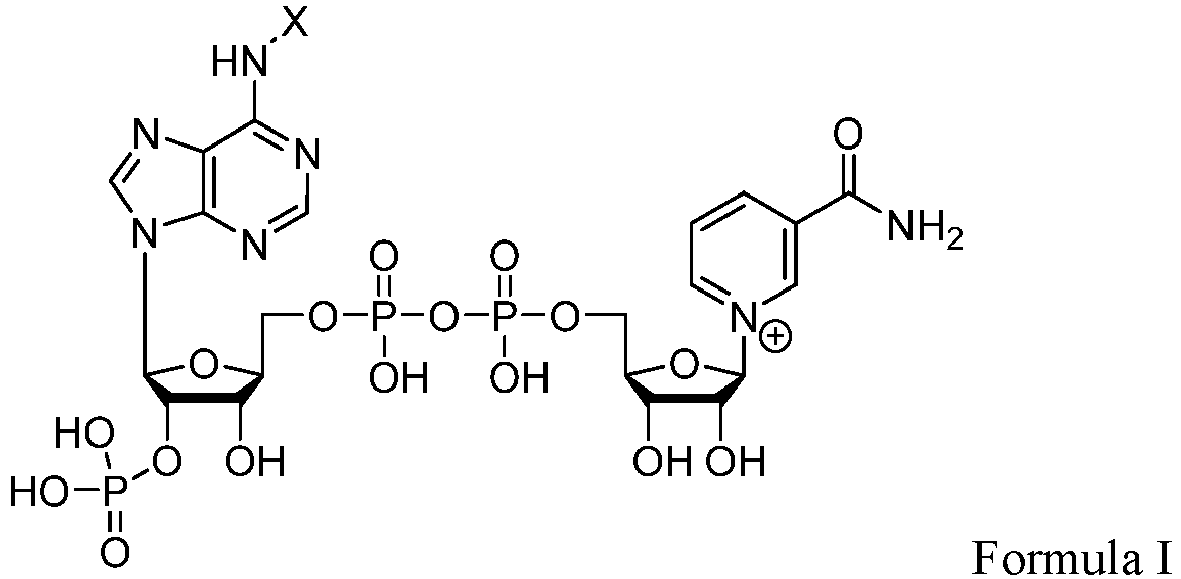
- X may be an aminoacyl substituted alkyl. X may be CH2C(O)NH(CH2)yNH2 where y is an integer from 1 to 10, such as 2 to 9, such as 3 to 8 and including where y is 6. X may be CH2C(O)NH(CH2)6NH2 such that the derivative of nicotinamide adenine dinucleotide (phosphate) (NAD(P)+) in the subject enzyme composition is:

- The subject enzyme composition also includes an NAD(P)H oxidoreductase. The subject enzyme composition may include diaphorase. The amount of NAD(P)H oxidoreductase (e.g., diaphorase) present in the subject compositions ranges from 0.01 □g to 10 □g, such as from 0.02 □g to 9 □g, such as from 0.03 □g to 8 □g, such as from 0.04 □g to 7 □g, such as from 0.05 □g to 5 □g, such as from 0.1 □g to 4 □g, such as from 0.2 □g to 3 □g and including from 0.5 □g to 2 □g. As such, the amount of NAD(P)H oxidoreductase (e.g., diaphorase) is from 0.01% to 10% by weight of the total enzyme composition, such as from 0.05% to 9.5% by weight, such as from 0.1% to 9% by weight, such as 0.5% to 8.5% by weight, such as from 1% to 8% by weight and including from 2% to 7% by weight of the total enzyme composition.
- The weight ratio of NAD(P)+-dependent dehydrogenase to NAD(P)H oxidoreductase (e.g., diaphorase) may range from 1 to 10 NAD(P)+-dependent dehydrogenase to NAD(P)H oxidoreductase, such as from 1 to 8, such as from 1 to 5, such as from 1 to 2 and including from 1 to 1 NAD(P)+-dependent dehydrogenase to NAD(P)H oxidoreductase. The weight ratio of NAD(P)+-dependent dehydrogenase to NAD(P)H oxidoreductase may range from 10 to 1 NAD(P)+-dependent dehydrogenase to NAD(P)H oxidoreductase, such as from 8 to 1, such as from 5 to 1 and including from 2 to 1 NAD(P)+-dependent dehydrogenase to NAD(P)H oxidoreductase.
- The subject enzyme compositions of interest also include an electron transfer agent having an transition metal complex. They may be electroreducible and electrooxidizable ions or molecules having redox potentials that are a few hundred millivolts above or below the redox potential of the standard calomel electrode (SCE). Examples of transition metal complexes include metallocenes including ferrocene, hexacyanoferrate (III), ruthenium hexamine, etc. Additional examples include those described in
U.S. Patent Nos. 6,736,957 ,7,501,053 and7,754,093 . - Electron transfer agents may be osmium transition metal complexes with one or more ligands, each ligand having a nitrogen-containing heterocycle such as 2,2'-bipyridine, 1,10-phenanthroline, 1-methyl, 2-pyridyl biimidazole, or derivatives thereof. The electron transfer agents may also have one or more ligands covalently bound in a polymer, each ligand having at least one nitrogen-containing heterocycle, such as pyridine, imidazole, or derivatives thereof. One example of an electron transfer agent includes (a) a polymer or copolymer having pyridine or imidazole functional groups and (b) osmium cations complexed with two ligands, each ligand containing 2,2'-bipyridine, 1,10-phenanthroline, or derivatives thereof, the two ligands not necessarily being the same. Some derivatives of 2,2'-bipyridine for complexation with the osmium cation include but are not limited to 4,4'-dimethyl-2,2'-bipyridine and mono-, di-, and polyalkoxy-2,2'-bipyridines, including 4,4'-dimethoxy-2,2'-bipyridine. Derivatives of 1,10-phenanthroline for complexation with the osmium cation include but are not limited to 4,7-dimethyl-1,10-phenanthroline and mono, di-, and polyalkoxy-1,10-phenanthrolines, such as 4,7-dimethoxy-1,10-phenanthroline. Polymers for complexation with the osmium cation include but are not limited to polymers and copolymers of poly(1-vinyl imidazole) (referred to as "PVI") and poly(4-vinyl pyridine) (referred to as "PVP"). Suitable copolymer substituents of poly(1-vinyl imidazole) include acrylonitrile, acrylamide, and substituted or quaternized N-vinyl imidazole, e.g., electron transfer agents with osmium complexed to a polymer or copolymer of poly(1-vinyl imidazole).
- The subject enzyme compositions may be heterogeneous or homogenous. Each component (i.e., nicotinamide adenine dinucleotide (phosphate) (NAD(P)+) or derivative thereof as described herein, NAD(P)+-dependent dehydrogenase, an NAD(P)H oxidoreductase and an electron transfer agent having a transition metal complex) may be uniformly distributed throughout the composition, e.g., when applied to an electrode, as described in greater detail below. For example, each of nicotinamide adenine dinucleotide (phosphate) (NAD(P)+) or derivative thereof as described herein, NAD(P)+-dependent dehydrogenase, an NAD(P)H oxidoreductase and an electron transfer agent having a transition metal complex may be distributed uniformly throughout the composition, such that the concentration of each component is the same throughout.
- The subject enzyme compositions described herein may be polymeric. Polymers that may be used may be branched or unbranched and may be homopolymers formed from the polymerization of a single type of monomer or heteropolymers that include two or more different types of monomers. Heteropolymers may be copolymers where the copolymer has alternating monomer subunits, or in some cases, may be block copolymers, which include two or more homopolymer subunits linked by covalent bonds (e.g, diblock or triblock copolymers). The subject enzyme compositions may include a heterocycle-containing polymer. The term heterocycle (also referred to as "heterocyclcyl") is used herein in its conventional sense to refer to any cyclic moiety which includes one or more heteroatoms (i.e., atoms other than carbon) and may include, but are not limited to N, P, O, S, Si, etc. Heterocycle-containing polymers may be heteroalkyl, heteroalkanyl, heteroalkenyl and heteroalkynyl as well as heteroaryl or heteroarylalkyl.
- "Heteroalkyl, Heteroalkanyl, Heteroalkenyl and Heteroalkynyl" by themselves or as part of another substituent refer to alkyl, alkanyl, alkenyl and alkynyl groups, respectively, in which one or more of the carbon atoms (and any associated hydrogen atoms) are independently replaced with the same or different heteroatomic groups. Typical heteroatomic groups which can be included in these groups include, but are not limited to, -O-, -S-, -S-S-, -O-S-, -NR37R38-, .=N-N=, -N=N-, -N=N-NR39R40, -PR41-, -P(O)2-, -POR42-, -O-P(O)2-, -S-O-, -S-(O)-, - SO2-, -SnR43R44- and the like, where R37, R38, R39, R40, R41, R42, R43 and R44 are independently hydrogen, alkyl, substituted alkyl, aryl, substituted aryl, arylalkyl, substituted arylalkyl, cycloalkyl, substituted cycloalkyl, cycloheteroalkyl, substituted cycloheteroalkyl, heteroalkyl, substituted heteroalkyl, heteroaryl, substituted heteroaryl, heteroarylalkyl or substituted heteroarylalkyl.
- "Heteroaryl" by itself or as part of another substituent, refers to a monovalent heteroaromatic radical derived by the removal of one hydrogen atom from a single atom of a heteroaromatic ring system. Typical heteroaryl groups include, but are not limited to, groups derived from acridine, arsindole, carbazole, β-carboline, chromane, chromene, cinnoline, furan, imidazole, indazole, indole, indoline, indolizine, isobenzofuran, isochromene, isoindole, isoindoline, isoquinoline, isothiazole, isoxazole, naphthyridine, oxadiazole, oxazole, perimidine, phenanthridine, phenanthroline, phenazine, phthalazine, pteridine, purine, pyran, pyrazine, pyrazole, pyridazine, pyridine, pyrimidine, pyrrole, pyrrolizine, quinazoline, quinoline, quinolizine, quinoxaline, tetrazole, thiadiazole, thiazole, thiophene, triazole, xanthene, benzodioxole and the like. The heteroaryl group may be from 5-20 membered heteroaryl. The heteroaryl group may be from 5-10 membered heteroaryl. Heteroaryl groups may be those derived from thiophene, pyrrole, benzothiophene, benzofuran, indole, pyridine, quinoline, imidazole, oxazole and pyrazine.
- "Heteroarylalkyl" by itself or as part of another substituent, refers to an acyclic alkyl radical in which one of the hydrogen atoms bonded to a carbon atom, typically a terminal or sp3 carbon atom, is replaced with a heteroaryl group. Where specific alkyl moieties are intended, the nomenclature heteroarylalkanyl, heteroarylalkenyl and/or heterorylalkynyl is used. The heteroarylalkyl group may be a 6-30 membered heteroarylalkyl, e.g., the alkanyl, alkenyl or alkynyl moiety of the heteroarylalkyl is 1-10 membered and the heteroaryl moiety is a 5-20-membered heteroaryl. The heteroarylalkyl group may be 6-20 membered heteroarylalkyl, e.g., the alkanyl, alkenyl or alkynyl moiety of the heteroarylalkyl is 1-8 membered and the heteroaryl moiety is a 5-12-membered heteroaryl.
- The heterocycle-containing component may be an aromatic ring system. "Aromatic Ring System" by itself or as part of another substituent, refers to an unsaturated cyclic or polycyclic ring system having a conjugated π electron system. Specifically included within the definition of "aromatic ring system" are fused ring systems in which one or more of the rings are aromatic and one or more of the rings are saturated or unsaturated, such as, for example, fluorene, indane, indene, phenalene, etc. Typical aromatic ring systems include, but are not limited to, aceanthrylene, acenaphthylene, acephenanthrylene, anthracene, azulene, benzene, chrysene, coronene, fluoranthene, fluorene, hexacene, hexaphene, hexalene, as-indacene, s-indacene, indane, indene, naphthalene, octacene, octaphene, octalene, ovalene, penta-2,4-diene, pentacene, pentalene, pentaphene, perylene, phenalene, phenanthrene, picene, pleiadene, pyrene, pyranthrene, rubicene, triphenylene, trinaphthalene and the like.
- "Heteroaromatic Ring System" by itself or as part of another substituent, refers to an aromatic ring system in which one or more carbon atoms (and any associated hydrogen atoms) are independently replaced with the same or different heteroatom. Typical heteroatoms to replace the carbon atoms include, but are not limited to, N, P, O, S, Si, etc. Specifically included within the definition of "heteroaromatic ring systems" are fused ring systems in which one or more of the rings are aromatic and one or more of the rings are saturated or unsaturated, such as, for example, arsindole, benzodioxan, benzofuran, chromane, chromene, indole, indoline, xanthene, etc. Typical heteroaromatic ring systems include, but are not limited to, arsindole, carbazole, β-carboline, chromane, chromene, cinnoline, furan, imidazole, indazole, indole, indoline, indolizine, isobenzofuran, isochromene, isoindole, isoindoline, isoquinoline, isothiazole, isoxazole, naphthyridine, oxadiazole, oxazole, perimidine, phenanthridine, phenanthroline, phenazine, phthalazine, pteridine, purine, pyran, pyrazine, pyrazole, pyridazine, pyridine, pyrimidine, pyrrole, pyrrolizine, quinazoline, quinoline, quinolizine, quinoxaline, tetrazole, thiadiazole, thiazole, thiophene, triazole, xanthene and the like.
- The subject enzyme compositions of interest may include a heterocyclic nitrogen containing component, such as polymers of polyvinylpyridine (PVP) and polyvinylimidazole.
- The polymeric enzyme compositions may also include one or more crosslinkers (crosslinking agent) such that the polymeric backbone enzyme composition is crosslinked. As described herein, reference to linking two or more different polymers together is intermolecular crosslinking, whereas linking two more portions of the same polymer is intramolecular crosslinking. Crosslinkers may be capable of both intermolecular and intramolecular crosslinkings at the same time.
- Suitable crosslinkers may be bifunctional, trifunctional or tetrafunctional, each having straight chain or branched structures. Crosslinkers having branched structures include a multi-arm branching component, such as a 3-arm branching component, a 4-arm branching component, a 5-arm branching component, a 6-arm branching component or a larger number arm branching component, such as having 7 arms or more, such as 8 arms or more, such as 9 arms or more, such as 10 arms or more and including 15 arms or more. In certain instances, the multi-arm branching component is a multi-arm epoxide, such as 3-arm epoxide or a 4-arm epoxide. Where the multi-arm branching component is a multi-arm epoxide, the multi-arm branching component may be a polyethylene glycol (PEG) multi-arm epoxide or a non-polyethylene glycol (non-PEG) multi-arm epoxide. The multi-arm branching component may be a non-PEG multi-arm epoxide. The multi-arm branching component may be a PEG multi-arm epoxide. The multi-arm branching component may be a 3-arm PEG epoxide or a 4-arm PEG epoxide.
- Examples of crosslinkers include but are not limited to polyethylene glycol diglycidyl ether, N,N-diglycidyl-4-glycidyloxyaniline as well as nitrogen-containing multifunctional crosslinkers having the structures:


- One or more bonds with the one or more components of the enzyme composition may be formed such as between one or more of the nicotinamide adenine dinucleotide (phosphate) (NAD(P)+) or derivative thereof as described herein, NAD(P)+-dependent dehydrogenase, NAD(P)H oxidoreductase and electron transfer agent. By bonds is meant any type of an interaction between atoms or molecules that allows chemical compounds to form associations with each other, such as, but not limited to, covalent bonds, ionic bonds, dipole-dipole interactions, hydrogen bonds, London dispersion forces, and the like. For example, in situ polymerization of the enzyme compositions can form crosslinks between the polymers of the composition and the NAD(P)+-dependent dehydrogenase, nicotinamide adenine dinucleotide (phosphate) (NAD(P)+) or derivative thereof as described herein, the NAD(P)H oxidoreductase and the electron transfer agent. Crosslinking of the polymer to the one or more of the NAD(P)+-dependent dehydrogenase, nicotinamide adenine dinucleotide (phosphate) (NAD(P)+) or derivative thereof as described herein, the NAD(P)H oxidoreductase and the electron transfer agent may facilitate a reduction in the occurrence of delamination of the enzyme compositions from an electrode.
- As described herein, the subject enzyme is used in an analyte sensor to monitor the concentration of an NAD(P)+-dependent dehydrogenase analyte, which is D-3-hydroxybutyrate, and the sensor may have one or more electrodes with the enzyme composition. The analyte sensor includes: a working electrode having a conductive material the subject enzyme composition disposed on and in contact with the conductive material. A counter electrode is included, and other electrodes may be included such as more counter electrodes, one or more reference electrodes and/or one or more counter/reference electrodes.
- The particular configuration of electrochemical sensors may depend on the use for which the analyte sensor is intended and the conditions under which the analyte sensor will operate. In certain embodiments of the present disclosure, analyte sensors are in vivo wholly positioned analyte sensors or transcutaneously positioned analyte sensors configured for in vivo positioning in a subject. In another example, at least a portion of the sensor may be positioned in the dermal tissue for testing analyte concentration in dermal fluid.
- In embodiments, one or more of the subject enzyme compositions is positioned proximate to (e.g., disposed on) the surface of a working electrode. In some instances, a plurality of enzyme compositions are positioned proximate to the surface of working electrode (e.g., in the form of spots). In certain cases, a discontinuous or continuous perimeter is formed around each of the plurality of enzyme compositions positioned proximate to the surface of the working electrode. Examples of depositing a plurality of reagent compositions to the surface of an electrode as well as forming a discontinuous or continuous perimeter around each reagent composition is described in
U.S. Patent Publication No. 2012/0150005 and in co-pendingU.S. Patent Application No. 62/067,813 - The subject enzyme compositions having nicotinamide adenine dinucleotide (phosphate) (NAD(P)+) or derivative thereof as described herein, NAD(P)+-dependent dehydrogenase, NAD(P)H oxidoreductase and electron transfer agent may be deposited onto the surface of the working electrode as one large application which covers the desired portion of the working electrode or in the form of an array of a plurality of enzyme compositions, e.g., spaced apart from each other. Depending upon use, any or all of the enzyme compositions in the array may be the same or different from one another. For example, an array may include two or more, 5 or more enzyme composition array features containing nicotinamide adenine dinucleotide (phosphate) (NAD(P)+) or derivative thereof as described herein, NAD(P)+-dependent dehydrogenase, NAD(P)H oxidoreductase and electron transfer agent, 10 or more, 25 or more, 50 or more, 100 or more, or even 1000 or more, in an area of 100 mm2 or less, such as 75 mm2 or less, or 50 mm2 or less, for
instance 25 mm2 or less, or 10 mm2 or less, or 5 mm2 or less, such as 2 mm2 or less, or 1 mm2 or less, 0.5 mm2 or less, or 0.1 mm2 or less. - The shape of deposited enzyme composition may vary within or between sensors. For example, in certain embodiments, the deposited membrane is circular. In other embodiments, the shape will be of a triangle, square, rectangle, circle, ellipse, or other regular or irregular polygonal shape (e.g., when viewed from above) as well as other two-dimensional shapes such as a circle, half circle or crescent shape. All or a portion of the electrode may be covered by the enzyme composition, such as 5% or more, such as 25% or more, such as 50% or more, such as 75% or more and including 90% or more. In certain instances, the entire electrode surface is covered by the enzyme composition (i.e., 100%).
- Fabricating an electrode and/or sensor according to embodiments of the present disclosure produces a reproducible enzyme composition deposited on the surface of the electrode. For example, enzyme compositions provided herein may deviate from each other by 5% or less, such as by 4% or less, such as by 3% or less, such as by 2% or less, such as by 1% or less and including by 0.5% or less. The sensing composition includes nicotinamide adenine dinucleotide (phosphate) (NAD(P)+) or derivative thereof as described herein and an electron transfer agent. In certain embodiments, deposited enzyme compositions containing nicotinamide adenine dinucleotide (phosphate) (NAD(P)+) or derivative thereof as described herein, NAD(P)+-dependent dehydrogenase, NAD(P)H oxidoreductase and electron transfer agent show no deviation from one another and are identical.
- Methods of preparing the analyte sensor further include drying the enzyme composition deposited on the electrode. Drying may be performed at room temperature, at an elevated temperature, as desired, such as at a temperature ranging from 25 °C to 100 °C, such as from 30 °C to 80 °C and including from 40 °C to 60 °C.
- Examples of configurations for the subject analyte sensors and methods for fabricating them may include, but are not limited to, those described in
United States Patent Nos. 6,175,752 ,6,134,461 ,6,579,690 ,6,605,200 ,6,605,201 ,6,654,625 ,6,746,582 ,6,932,894 ,7,090,756 ,5,356,786 ,6,560,471 ,5,262,035 ,6,881,551 ,6,121,009 ,6,071,391 ,6,377,894 ,6,600,997 ,6,514,460 ,5,820,551 ,6,736,957 ,6,503,381 ,6,676,816 ,6,514,718 ,5,593,852 ,6,284,478 ,7,299,082 ,7,811,231 ,7,822,557 8,106,780 , and8,435,682 ;U.S. Patent Application Publication Nos. 2010/0198034 ,2010/0324392 ,2010/0326842 ,2007/0095661 ,2010/0213057 ,2011/0120865 ,2011/0124994 ,2011/0124993 ,2010/0213057 ,2011/0213225 ,2011/0126188 ,2011/0256024 ,2011/0257495 ,2012/0157801 ,2012/0245447 ,2012/0157801 ,2012/0323098 , and20130116524 . - In some embodiments, in vivo sensors may include an insertion tip positionable below the surface of the skin, e.g., penetrating through the skin and into, e.g., the subcutaneous space, in contact with the user's biological fluid such as interstitial fluid. Contact portions of working electrode, a reference electrode and a counter electrode are positioned on the first portion of the sensor situated above the skin surface. A working electrode, a reference electrode and a counter electrode are positioned at the inserted portion of the sensor. Traces may be provided from the electrodes at the tip to a contact configured for connection with sensor electronics.
- In certain embodiments, the working electrode and counter electrode of the sensor as well as dielectric material of are layered. For example, the sensor may include a non-conductive material layer, and a first conductive layer such as conductive polymer, carbon, platinum-carbon, gold, etc., disposed on at least a portion of the non-conductive material layer (as described above). The enzyme composition is positioned on one or more surfaces of the working electrode, or may otherwise be directly or indirectly contacted to the working electrode. A first insulation layer, such as a first dielectric layer may disposed or layered on at least a portion of a first conductive layer and a second conductive layer may be positioned or stacked on top of at least a portion of a first insulation layer (or dielectric layer). The second conductive layer may be a reference electrode. A second insulation layer, such as a second dielectric layer may be positioned or layered on at least a portion of the second conductive layer. Further, a third conductive layer may be positioned on at least a portion of the second insulation layer and may be a counter electrode. Finally, a third insulation layer may be disposed or layered on at least a portion of the third conductive layer. In this manner, the sensor may be layered such that at least a portion of each of the conductive layers is separated by a respective insulation layer (for example, a dielectric layer).
- In other embodiments, some or all of the electrodes may be provided in a co-planar manner such that two or more electrodes may be positioned on the same plane (e.g., side-by side (e.g., parallel) or angled relative to each other) on the material. For example, co-planar electrodes may include a suitable spacing there between and/or include a dielectric material or insulation material disposed between the conductive layers/electrodes. Furthermore, in certain embodiments one or more of the electrodes may be disposed on opposing sides of the non-conductive material. In such embodiments, electrical contact may be on the same or different sides of the non-conductive material. For example, an electrode may be on a first side and its respective contact may be on a second side, e.g., a trace connecting the electrode and the contact may traverse through the material. A via provides an avenue through which an electrical trace is brought to an opposing side of a sensor.
- The subject analyte sensors may be configured for monitoring the level of an analyte over a time period which may range from seconds, minutes, hours, days, weeks, to months, or longer.
- In certain embodiments, the analyte sensor includes a mass transport limiting layer, e.g., an analyte flux modulating layer, to act as a diffusion-limiting barrier to reduce the rate of mass transport of the analyte, when the sensor is in use. The mass transport limiting layers limit the flux of an analyte to the electrode in an electrochemical sensor so that the sensor is linearly responsive over a large range of analyte concentrations. Mass transport limiting layers may include polymers and may be biocompatible. A mass transport limiting layer may provide many functions, e.g., biocompatibility and/or interferent-eliminating functions, etc., or functions may be provided by various membrane layers.
- In certain embodiments, a mass transport limiting layer is a membrane composed of crosslinked polymers containing heterocyclic nitrogen groups, such as polymers of polyvinylpyridine and polyvinylimidazole. Embodiments also include membranes that are made of a polyurethane, or polyether urethane, or chemically related material, or membranes that are made of silicone, and the like.
- The membrane may be formed by crosslinking in situ a polymer, modified with a zwitterionic moiety, a non-pyridine copolymer component, and optionally another moiety that is either hydrophilic or hydrophobic, and/or has other desirable properties, in an alcohol-buffer solution. The modified polymer may be made from a precursor polymer containing heterocyclic nitrogen groups. For example, a precursor polymer may be polyvinylpyridine or polyvinylimidazole. Optionally, hydrophilic or hydrophobic modifiers may be used to "fine-tune" the permeability of the resulting membrane to an analyte of interest. Optional hydrophilic modifiers, such as poly(ethylene glycol), hydroxyl or polyhydroxyl modifiers, may be used to enhance the biocompatibility of the polymer or the resulting membrane.
- Suitable mass transport limiting membranes in the subject analyte sensors may include, but are not limited to those described in
U.S. Patent No. 6,932,894 . In certain embodiments, the mass transport limiting membrane is a SMART membrane that is temperature independent. Suitable temperature independent membranes may include, but are not limited to those described inU.S. Patent Publication No. 2012/0296186 and copendingU.S. Patent Application No. 14/737,082 . - Analyte sensors according to certain embodiments may be configured to operate at low oxygen concentration. By low oxygen concentration is meant the concentration of oxygen is 1.5 mg/L or less, such as 1.0 mg/L or less, such as 0.75 mg/L or less, such as 0.6 mg/L or less, such as 0.3 mg/L or less, such as 0.25 mg/L or less, such as 0.15 mg/L or less, such as 0.1 mg/L or less and including 0.05 mg/L or less.
- The analyte sensors of the present invention are useful in methods for in vivo monitoring analyte levels over time with analyte sensors incorporating an enzyme composition containing nicotinamide adenine dinucleotide (phosphate) (NAD(P)+) or derivative thereof as described herein, D-3-hydroxybutyrate dehydrogenase, NAD(P)H oxidoreductase and electron transfer agent. Generally, in vivo monitoring the concentration of analyte in a fluid of the body of a subject includes inserting at least partially under a skin surface an in vivo analyte sensor as disclosed herein, contacting the monitored fluid (interstitial, blood, dermal, and the like) with the inserted sensor, and generating a sensor signal at the working electrode. The presence and/or concentration of analyte detected by the analyte sensor may be displayed, stored, forwarded, and/or otherwise processed. A variety of approaches may be employed to determine the concentration of analyte with the subject sensors. An electrochemical analyte concentration monitoring approach may be used. For example, monitoring the concentration of analyte using the sensor signal may be performed by coulometric, amperometric, voltammetric, potentiometric, or any other convenient electrochemical detection technique.
- These methods may also be used in connection with a device that is used to detect and/or measure another analyte, including glucose, oxygen, carbon dioxide, electrolytes, or other moieties of interest, for example, or any combination thereof, found in a bodily fluid, including subcutaneous e.g., interstitial fluid, dermal fluid, blood or other bodily fluid of interest or any combination thereof.
- The analyte sensors of the present invention are useful in a method further including attaching an electronics unit to the skin of the patient, coupling conductive contacts of the electronics unit to contacts of the sensor, collecting data using the electronics unit regarding a level of analyte from signals generated by the sensor, and forwarding the collected data from electronics unit to a receiver unit, e.g., by RF. The receiver unit may be a mobile telephone. The mobile telephone may include a application related to the monitored analyte. Analyte information may be forwarded by RFID protocol, Bluetooth, and the like.
- The analyte sensor may be positionable in a user for automatic analyte sensing, either continuously or periodically. The analyte sensors of the present invention are useful in a method including monitoring the level of the analyte over a time period which may range from seconds, minutes, hours, days, weeks, to months, or longer. Future analyte levels may be predicted based on information obtained.
- The sensor electronics unit may automatically forward data from the sensor/electronics unit to one or more receiver units. The sensor data may be communicated automatically and periodically, such as at a certain frequency as data is obtained or after a certain time period of sensor data stored in memory. For example, sensor electronics coupled to an in vivo positioned sensor may collect the sensor data for a predetermined period of time and transmit the collected data periodically (e.g., every minute, five minutes, or other predetermined period) to a monitoring device that is positioned in range from the sensor electronics.
- Optionally, the sensor electronics coupled to the in vivo positioned sensor may communicate with the receiving device non automatically manner and not set to any specific schedule. For example, the sensor data may be communicated from the sensor electronics to the receiving device using RFID technology, and communicated whenever the sensor electronics are brought into communication range of the analyte monitoring device. For example, the in vivo positioned sensor may collect sensor data in memory until the monitoring device (e.g., receiver unit) is brought into communication range of the sensor electronics unit-e.g., by the patient or user. When the in vivo positioned sensor is detected by the monitoring device, the device establishes communication with the analyte sensor electronics and uploads the sensor data that has been collected since the last transfer of sensor data, for instance. In this way, the patient does not have to maintain close proximity to the receiving device at all times, and instead, can upload sensor data when desired by bringing the receiving device into range of the analyte sensor. A combination of automatic and non-automatic transfers of sensor data may be implemented. For example, transfers of sensor data may be initiated when brought into communication range, and then continued on an automatic basis if continued to remain in communication range.
- The following examples are put forth so as to provide those of ordinary skill in the art with a complete disclosure and description of how to make and use the embodiments of the invention, and are not intended to limit the scope of what the inventors regard as their invention nor are they intended to represent that the experiments below are all or the only experiments performed. Efforts have been made to ensure accuracy with respect to numbers used (e.g., amounts, temperature, etc.) but some experimental errors and deviations should be accounted for. Unless indicated otherwise, parts are parts by weight, molecular weight is weight average molecular weight, temperature is in degrees Centigrade, and pressure is at or near atmospheric.
- Experiments were performed to demonstrate the performance of analyte sensors having a working electrode that contains nicotinamide adenine dinucleotide (phosphate) (NAD(P)+) or derivative thereof as described herein, NAD(P)+-dependent dehydrogenase, NAD(P)H oxidoreductase and electron transfer agent. The sensors were prepared by depositing onto the surface of an electrode an enzyme composition containing nicotinamide adenine dinucleotide (phosphate), D-3-hydroxybutyrate dehydrogenase, diaphorase and a polymer bound osmium-transition metal catalyst and a difunctional crosslinker, as shown by the scheme (also referred to as a polymeric redox mediator in further examples):

- The sensors were tested in phosphate buffer containing varying concentrations of D-3-hydroxybutyrate. Table 1 summarizes beaker calibration and linearity of data signal from the prepared sensors.
Table 1: D-3-Hydroxybutyrate Sensor Slope 0.0163 R2 0.9982 -
FIG. 1 shows the signal output over the course of 2.3 hours at varying concentrations of D-3-hydroxybutyrate (80 µM, 160 µM and 240 µM).FIG. 2 depicts the linearity of the sensor signal as a function of D-3-hydroxybutyrate concentration. As shown inFIGS. 1 and 2 , the sensor gives a linear and persistent response to D-3-hydroxybutyrate. - Experiments were performed to demonstrate the performance of analyte sensors having a working electrode that contains free NAD. The sensor was prepared by depositing onto the surface of an electrode an enzyme composition containing the free NAD. Sensing layer formulation is described in Table 2. The sensing layer solutions was deposit on carbon electrodes, and cured at 25C/60H overnight, prior to addition of membrane. The membrane formulation is provided in Table 3. The sensor was dipped from above solution 3x5mm/sec, and the sensor was cured at 25C/60H overnight, 56C for two days.
Table 2: Formulation Table Sensing Layer Solution BD161212 Mixing Final 10mM Hepes Vendor Cat mg/mL uL mg/mL D-3-Hydroxybutyrate Dehydrogenase (HBD) Toyobo HBD-301 40 20 8.89 Diaphorase Toyobo DAD-311 40 20 8.89 NAD Sigma N0632 20 10 2.22 Polymeric redox mediator 40 20 8.89 Peg400 40 20 8.89 Total 90 Table 3: Membrane Coating Membrane Solution Solution A Vendor Cat MW Mixing Poly(4-vinylpyridine) Sigma 472352 160K 120 mg Ethanol/Hepe (10mM pH 8.0) 1 mL Solution B Vendor Cat Mixing Polyethylene glycol) diglycidyl ether (PEGDGE 400) Polysciences 8210 100 mg Ethanol/Hepe (10mM pH 8.0) 1 mL Final membrane solution Mixing (mL) Solution A 4 Solution B 0.4 -
FIG. 3 shows the signal output over the course of 3.6 hours at varying concentrations of D-3-hydroxybutyrate (ketone).FIG. 4 depicts the linearity of the sensor signal as a function of D-3-hydroxybutyrate concentration.FIG. 5 shows sensor calibration at 10mM. As shown inFIGS. 3-5 , the sensor gives a linear and persistent response to D-3-hydroxybutyrate (ketone). Table 4 also shows the free NAD Ketone Sensor Beaker Calibration and Stability Summary.Table 4: Slope 2.55 R^2 0.9996 Decay in 45 hours -8% - Experiments were also performed to demonstrate the performance of ketone sensors having a working electrode that contains free NAD versus immobilized NAD. The sensors were prepared by depositing onto the surface of an electrode an enzyme composition containing the free NAD (A) or the immobilixed NAD (B). Sensing layer formulation is described in Table 5. The sensing layer solutions was deposit on carbon electrodes, and cured at 25C/60H overnight, prior to addition of membrane. The membrane formulation is provided in Table 6. The sensor was dipped (Table 7) from above solution 3x5mm/sec, and the sensor was cured at 25C/60H overnight, 56C for two days.
FIG.6 shows that both the free and immobilized NAD versions of the ketone sensor show similar stabilities and signals.Table 5: Sensing Layer Solution BD161116 Mixing uL Final mg/mL 10mM Hepes Vendor Cat mg/mL A B A B D-3-Hydroxybutyrate Dehydrogenase (HBD) Toyobo HBD-301 40 20 20 8.89 8.89 Diaphorase Toyobo DAD-311 40 20 20 8.89 8.89 NAD Sigma N0632 20 10 2.22 0.00 NAD- NH2 Biotium 40 10 0.00 4.44 Glutaraldehyde 10 0 5 0.00 0.56 Polymeric redox mediator 40 20 20 8.89 8.89 Peg400 40 20 20 8.89 8.89 ToTal 90 95 Table 6: Membrane Coating Membrane Solution Solution A Vendor MW Mixing Smart Membrane ADC 160K 120 mg Ethanol/Hepe (10mM pH 8.0) 1 mL Solution B Vendor Cat Mixing Polyethylene glycol) diglycidyl ether (PEGDGE 400) Polysciences 8210 100 mg Ethanol/Hepe (10mM pH 8.0) 1 mL Final membrane solution Mixing (mL) Solution A 4 Solution B 0.35 Table 7: Membrane Dipping Condition (Free NAD sensor was coated thicker membrane than Immobilized NAD sensor) SL Solution Dipping A (Free NAD) 4x5 B (Immobilized NAD) 3x5
Claims (14)
- An analyte sensor comprising:a working electrode comprising an enzyme layer disposed on the working electrode, the enzyme layer comprising:nicotinamide adenine dinucleotide (phosphate) (NAD(P)+) or a derivative thereof, wherein the derivative is a compound of Formula I;
 an NAD(P)+-dependent dehydrogenase, wherein the NAD(P)+-dependent dehydrogenase is D-3-hydroxybutyrate dehydrogenase;an NAD(P)H oxidoreductase; andan electron transfer agent comprising a transition metal complex; anda counter electrode.
 - The analyte sensor according to claim 1, wherein the enzyme composition is fixed to the working electrode.
- The analyte sensor according to claim 1, further comprising a membrane disposed proximate to the enzyme layer.
- The analyte sensor according to claim 3, wherein the membrane comprises a polymer comprising a heterocycle-containing component and a crosslinker.
- The analyte sensor according to claim 4, wherein the heterocycle-containing component is a heterocyclic nitrogen containing component.
- The analyte sensor according to claim 5, wherein the heterocyclic nitrogen containing component is a poly(4-vinylpyridine-co-styrene) polymer.
- The analyte sensor according to claim 1, wherein the enzyme layer comprises nicotinamide adenine dinucleotide (phosphate) (NAD(P)+).
- The analyte sensor according to claim 1, wherein the enzyme layer comprises a derivative of nicotinamide adenine dinucleotide (phosphate) of Formula I.
- The analyte sensor according to claim 8, wherein the derivative of nicotinamide adenine dinucleotide (phosphate) is

- The analyte sensor according to claim 1, wherein the NAD(P)H oxidoreductase is diaphorase.
- The analyte sensor according to claim 1, wherein electron transfer agent comprises an osmium-containing complex; preferably wherein the osmium-containing complex comprises three heterocyclic nitrogen-containing bidentate ligands; more preferably wherein the osmium-containing complex comprises two biimidazole and one imidazole-pyridine bidentate ligands.
- The analyte sensor according to claim 1, wherein the enzyme layer comprises a heterocycle-containing polymer and a crosslinker; preferably wherein the heterocycle-containing polymer comprises polyvinylpyridine.
- The analyte sensor according to claim 12, wherein one or more of the nicotinamide adenine dinucleotide (phosphate) (NAD(P)+) or derivative thereof, NAD(P)+-dependent dehydrogenase, NAD(P)H oxidoreductase and electron transfer agent are immobilized by the polymer.
- The analyte sensor according to claim 13, wherein one or more of the nicotinamide adenine dinucleotide (phosphate) (NAD(P)+) or derivative thereof, NAD(P)+-dependent dehydrogenase, NAD(P)H oxidoreductase and electron transfer agent are covalently bonded to the polymer; preferably wherein the electron transfer agent is covalently bonded to the polymer.
Priority Applications (2)
| Application Number | Priority Date | Filing Date | Title |
|---|---|---|---|
| EP23205506.1A EP4325222A3 (en) | 2016-03-04 | 2017-03-02 | Nad(p)-dependent responsive enzymes, electrodes and sensors, and methods for making and using the same |
| SI201731479T SI3423591T1 (en) | 2016-03-04 | 2017-03-02 | Nad(p)-dependent responsive enzymes, electrodes and sensors, and methods for making and using the same |
Applications Claiming Priority (2)
| Application Number | Priority Date | Filing Date | Title |
|---|---|---|---|
| US201662303626P | 2016-03-04 | 2016-03-04 | |
| PCT/US2017/020495 WO2017151952A1 (en) | 2016-03-04 | 2017-03-02 | Nad(p)-dependent responsive enzymes, electrodes and sensors, and methods for making and using the same |
Related Child Applications (1)
| Application Number | Title | Priority Date | Filing Date |
|---|---|---|---|
| EP23205506.1A Division EP4325222A3 (en) | 2016-03-04 | 2017-03-02 | Nad(p)-dependent responsive enzymes, electrodes and sensors, and methods for making and using the same |
Publications (3)
| Publication Number | Publication Date |
|---|---|
| EP3423591A1 EP3423591A1 (en) | 2019-01-09 |
| EP3423591A4 EP3423591A4 (en) | 2019-11-27 |
| EP3423591B1 true EP3423591B1 (en) | 2023-11-01 |
Family
ID=59744462
Family Applications (2)
| Application Number | Title | Priority Date | Filing Date |
|---|---|---|---|
| EP23205506.1A Pending EP4325222A3 (en) | 2016-03-04 | 2017-03-02 | Nad(p)-dependent responsive enzymes, electrodes and sensors, and methods for making and using the same |
| EP17760843.7A Revoked EP3423591B1 (en) | 2016-03-04 | 2017-03-02 | Nad(p)-dependent responsive enzymes, electrodes and sensors, and methods for making and using the same |
Family Applications Before (1)
| Application Number | Title | Priority Date | Filing Date |
|---|---|---|---|
| EP23205506.1A Pending EP4325222A3 (en) | 2016-03-04 | 2017-03-02 | Nad(p)-dependent responsive enzymes, electrodes and sensors, and methods for making and using the same |
Country Status (8)
| Country | Link |
|---|---|
| US (14) | US11091788B2 (en) |
| EP (2) | EP4325222A3 (en) |
| DK (1) | DK3423591T3 (en) |
| ES (1) | ES2974312T3 (en) |
| FI (1) | FI3423591T3 (en) |
| PL (1) | PL3423591T3 (en) |
| SI (1) | SI3423591T1 (en) |
| WO (1) | WO2017151952A1 (en) |
Families Citing this family (21)
| Publication number | Priority date | Publication date | Assignee | Title |
|---|---|---|---|---|
| EP4325222A3 (en) | 2016-03-04 | 2024-05-01 | Abbott Diabetes Care Inc. | Nad(p)-dependent responsive enzymes, electrodes and sensors, and methods for making and using the same |
| WO2019146788A1 (en) * | 2018-01-29 | 2019-08-01 | Phcホールディングス株式会社 | Protective film material for biosensor probe |
| CN110938667A (en) * | 2018-09-21 | 2020-03-31 | 中国科学院天津工业生物技术研究所 | Enzyme electrode, biosensor, and preparation method and use thereof |
| AU2020214230B2 (en) | 2019-01-28 | 2023-03-02 | Abbott Diabetes Care Inc. | Analyte sensors employing multiple enzymes and methods associated therewith |
| EP4574038A3 (en) | 2019-01-28 | 2025-08-27 | Abbott Diabetes Care, Inc. | Analyte sensors and sensing methods featuring dual detection of glucose and ketones |
| CN113518584B (en) | 2019-01-28 | 2024-11-08 | 美国雅培糖尿病护理公司 | Analyte sensor and sensing method for detecting creatinine |
| CN114554955B (en) * | 2019-08-30 | 2024-12-03 | 美国雅培糖尿病护理公司 | Analyte sensor and sensing method for detecting alcohol |
| JP7522196B2 (en) * | 2019-12-23 | 2024-07-24 | アボット ダイアベティス ケア インコーポレイテッド | Analyte sensor and detection method featuring low potential detection |
| US12064243B2 (en) * | 2020-01-21 | 2024-08-20 | Nova Biomedical Corporation | Disposable electrochemical biosensor based on NAD(P)-dependent dehydrogenase and diaphorase |
| IL273038B (en) | 2020-03-03 | 2022-02-01 | Ben Zion Karmon | Bone implant |
| CN115768349B (en) * | 2020-05-29 | 2026-06-19 | 美国雅培糖尿病护理公司 | Analyte sensor and sensing method for detecting a diaphorase inhibitor |
| CN122182027A (en) | 2020-12-15 | 2026-06-12 | 美国雅培糖尿病护理公司 | NAD(P) reservoir based on NAD(P)-dependent enzyme sensor |
| US20220192553A1 (en) * | 2020-12-23 | 2022-06-23 | Abbott Diabetes Care Inc. | Analyte sensors for sensing glutamate and methods of using the same |
| AU2022212954B2 (en) * | 2021-01-26 | 2025-04-24 | Abbott Diabetes Care Inc. | Systems, devices, and methods related to ketone sensors |
| WO2022182344A1 (en) * | 2021-02-25 | 2022-09-01 | Nova Biomedical Corporation | Disposable electrochemical biosensor based on nad(p)-dependent dehydrogenase and diaphorase |
| CA3230906A1 (en) | 2021-09-15 | 2023-03-23 | Abbott Diabetes Care Inc. | Systems, devices, and methods for applications for communication with ketone sensors |
| EP4382611A1 (en) | 2022-08-31 | 2024-06-12 | Medtronic MiniMed, Inc. | Sensors for 3-hydroxybutyrate detection |
| US20240065585A1 (en) * | 2022-08-31 | 2024-02-29 | Medtronic Minimed, Inc. | Sensors for 3-hydroxybutyrate detection |
| EP4780327A2 (en) | 2023-09-22 | 2026-07-29 | Abbott Diabetes Care Inc. | Decision support for glucose-ketone sensor |
| US20250299818A1 (en) | 2024-03-25 | 2025-09-25 | Abbott Diabetes Care Inc. | Deployment and use of a continuous analyte monitoring system for improved home monitoring and readmission optimization |
| CN119224087A (en) * | 2024-09-30 | 2024-12-31 | 深圳津合生物有限公司 | An enzyme electrode, sensor and application thereof for glucose detection |
Citations (18)
| Publication number | Priority date | Publication date | Assignee | Title |
|---|---|---|---|---|
| WO2001046457A2 (en) | 1999-12-22 | 2001-06-28 | Roche Diagnostics Corporation | Amperometric biosensor test strip |
| US20070131547A1 (en) | 2005-12-13 | 2007-06-14 | Canon Kabushiki Kaisha | Enzyme electrode |
| JP2007225305A (en) | 2006-02-21 | 2007-09-06 | Denso Corp | Enzyme electrode |
| US20080248354A1 (en) | 2004-07-23 | 2008-10-09 | Canon Kabushiki Kaisha | Enzyme Electrode, and Device, Sensor, Fuel Cell and Electrochemical Reactor Employing the Enzyme Electrode |
| WO2010030912A1 (en) * | 2008-09-15 | 2010-03-18 | Abbott Diabetes Care Inc. | Cationic polymer based wired enzyme formulations for use in analyte sensors |
| US20100206748A1 (en) | 2007-08-01 | 2010-08-19 | Nipro Corporation | Stress Measurement Kit and Stress Measurement Method |
| WO2010097619A1 (en) | 2009-02-25 | 2010-09-02 | The University Of Hull | Immobilized enzymes and co-factors |
| US20100270175A1 (en) | 2009-04-22 | 2010-10-28 | Nova Biomedical Corporation | Electrochemical biosensors based on NAD(P)-dependent dehydrogenase enzymes |
| US8262874B2 (en) | 2008-04-14 | 2012-09-11 | Abbott Diabetes Care Inc. | Biosensor coating composition and methods thereof |
| US8268143B2 (en) | 1999-11-15 | 2012-09-18 | Abbott Diabetes Care Inc. | Oxygen-effect free analyte sensor |
| US20130059212A1 (en) | 2010-05-17 | 2013-03-07 | Toyota Jidosha Kabushiki Kaisha | Enzyme electrode, and bio fuel cell equipped therewith |
| US20140054171A1 (en) | 2012-02-21 | 2014-02-27 | Abbott Diabetes Care Inc. | Analyte Sensor Utilizing Oxygen as Oxidant |
| US8920628B2 (en) | 2012-11-02 | 2014-12-30 | Roche Diagnostics Operations, Inc. | Systems and methods for multiple analyte analysis |
| WO2015150263A1 (en) | 2014-03-31 | 2015-10-08 | Roche Diagnostics Gmbh | High load enzyme immobilisation by crosslinking |
| US20150313520A1 (en) | 2010-07-28 | 2015-11-05 | Abbott Diabetes Care Inc. | Analyte Sensors Having Temperature Independent Membranes |
| WO2015195352A1 (en) | 2014-06-20 | 2015-12-23 | Abbott Diabetes Care Inc. | Test strip, meter, and method for assaying enzyme activity |
| WO2016174459A1 (en) | 2015-04-30 | 2016-11-03 | Inside Biometrics Limited | Electrochemical test device |
| WO2017151952A1 (en) | 2016-03-04 | 2017-09-08 | Abbott Diabetes Care Inc. | Nad(p)-dependent responsive enzymes, electrodes and sensors, and methods for making and using the same |
Family Cites Families (145)
| Publication number | Priority date | Publication date | Assignee | Title |
|---|---|---|---|---|
| US4321123A (en) * | 1978-04-21 | 1982-03-23 | Matsushita Electric Industrial Co., Ltd. | Coenzyme immobilized electrode |
| GB2067764B (en) | 1980-01-09 | 1984-01-25 | Nat Res Dev | Transcutaneous gas sensor |
| US5682884A (en) | 1983-05-05 | 1997-11-04 | Medisense, Inc. | Strip electrode with screen printing |
| US4680268A (en) | 1985-09-18 | 1987-07-14 | Children's Hospital Medical Center | Implantable gas-containing biosensor and method for measuring an analyte such as glucose |
| US5262035A (en) | 1989-08-02 | 1993-11-16 | E. Heller And Company | Enzyme electrodes |
| US5264105A (en) | 1989-08-02 | 1993-11-23 | Gregg Brian A | Enzyme electrodes |
| US5593852A (en) | 1993-12-02 | 1997-01-14 | Heller; Adam | Subcutaneous glucose electrode |
| CA2050057A1 (en) | 1991-03-04 | 1992-09-05 | Adam Heller | Interferant eliminating biosensors |
| US5322063A (en) | 1991-10-04 | 1994-06-21 | Eli Lilly And Company | Hydrophilic polyurethane membranes for electrochemical glucose sensors |
| US5965106A (en) * | 1992-03-04 | 1999-10-12 | Perimmune Holdings, Inc. | In vivo binding pair pretargeting |
| DE4442253A1 (en) * | 1994-11-28 | 1996-05-30 | Bayer Corp N D Ges D Staates I | Electrochemical enzyme biosensor |
| US5792621A (en) | 1995-06-28 | 1998-08-11 | The United States Of America As Represented By The Administrator Of The National Aeronautics And Space Administration | Fiber-optic chemiluminescent biosensors for monitoring aqueous alcohols and other water quality parameters |
| JP2900876B2 (en) | 1996-03-19 | 1999-06-02 | サンケン電気株式会社 | Display power supply |
| US5696314A (en) | 1996-07-12 | 1997-12-09 | Chiron Diagnostics Corporation | Multilayer enzyme electrode membranes and methods of making same |
| US6071391A (en) | 1997-09-12 | 2000-06-06 | Nok Corporation | Enzyme electrode structure |
| US6736957B1 (en) | 1997-10-16 | 2004-05-18 | Abbott Laboratories | Biosensor electrode mediators for regeneration of cofactors and process for using |
| US6579690B1 (en) | 1997-12-05 | 2003-06-17 | Therasense, Inc. | Blood analyte monitoring through subcutaneous measurement |
| US6030827A (en) | 1998-01-23 | 2000-02-29 | I-Stat Corporation | Microfabricated aperture-based sensor |
| US6134461A (en) | 1998-03-04 | 2000-10-17 | E. Heller & Company | Electrochemical analyte |
| US6241863B1 (en) | 1998-04-27 | 2001-06-05 | Harold G. Monbouquette | Amperometric biosensors based on redox enzymes |
| US8688188B2 (en) | 1998-04-30 | 2014-04-01 | Abbott Diabetes Care Inc. | Analyte monitoring device and methods of use |
| US6175752B1 (en) | 1998-04-30 | 2001-01-16 | Therasense, Inc. | Analyte monitoring device and methods of use |
| GB2337122B (en) | 1998-05-08 | 2002-11-13 | Medisense Inc | Test strip |
| US5965105A (en) | 1998-06-12 | 1999-10-12 | Council Of Scientific And Industrial Research | Process for the synthesis of flyash based Zeolite-A |
| US6294281B1 (en) | 1998-06-17 | 2001-09-25 | Therasense, Inc. | Biological fuel cell and method |
| US5902731A (en) * | 1998-09-28 | 1999-05-11 | Lifescan, Inc. | Diagnostics based on tetrazolium compounds |
| BR9915778A (en) | 1998-11-30 | 2001-08-14 | Abbott Lab | Processes to calibrate and operate an analyte test instrument, to determine the actual date and time of events on an analyte test instrument, and to control the operation of an analyte test instrument |
| WO2000078992A2 (en) | 1999-06-18 | 2000-12-28 | Therasense, Inc. | Mass transport limited in vivo analyte sensor |
| US6514460B1 (en) | 1999-07-28 | 2003-02-04 | Abbott Laboratories | Luminous glucose monitoring device |
| US8444834B2 (en) | 1999-11-15 | 2013-05-21 | Abbott Diabetes Care Inc. | Redox polymers for use in analyte monitoring |
| US6605201B1 (en) | 1999-11-15 | 2003-08-12 | Therasense, Inc. | Transition metal complexes with bidentate ligand having an imidazole ring and sensor constructed therewith |
| WO2001088524A1 (en) | 2000-05-12 | 2001-11-22 | Therasense, Inc. | Electrodes with multilayer membranes and methods of using and making the electrodes |
| US6560471B1 (en) | 2001-01-02 | 2003-05-06 | Therasense, Inc. | Analyte monitoring device and methods of use |
| US6676816B2 (en) | 2001-05-11 | 2004-01-13 | Therasense, Inc. | Transition metal complexes with (pyridyl)imidazole ligands and sensors using said complexes |
| US6932894B2 (en) | 2001-05-15 | 2005-08-23 | Therasense, Inc. | Biosensor membranes composed of polymers containing heterocyclic nitrogens |
| US6915147B2 (en) | 2001-09-07 | 2005-07-05 | Medtronic Minimed, Inc. | Sensing apparatus and process |
| US6984307B2 (en) * | 2001-10-05 | 2006-01-10 | Stephen Eliot Zweig | Dual glucose-hydroxybutyrate analytical sensors |
| GB0130684D0 (en) | 2001-12-21 | 2002-02-06 | Oxford Biosensors Ltd | Micro-band electrode |
| US8364229B2 (en) * | 2003-07-25 | 2013-01-29 | Dexcom, Inc. | Analyte sensors having a signal-to-noise ratio substantially unaffected by non-constant noise |
| US6946299B2 (en) | 2002-04-25 | 2005-09-20 | Home Diagnostics, Inc. | Systems and methods for blood glucose sensing |
| US20040061232A1 (en) | 2002-09-27 | 2004-04-01 | Medtronic Minimed, Inc. | Multilayer substrate |
| US7501053B2 (en) | 2002-10-23 | 2009-03-10 | Abbott Laboratories | Biosensor having improved hematocrit and oxygen biases |
| US7811231B2 (en) | 2002-12-31 | 2010-10-12 | Abbott Diabetes Care Inc. | Continuous glucose monitoring system and methods of use |
| JP4839569B2 (en) | 2003-06-05 | 2011-12-21 | ソニー株式会社 | Enzyme-immobilized electrode and manufacturing method thereof, electrode reaction utilization apparatus and manufacturing method thereof |
| US9763609B2 (en) | 2003-07-25 | 2017-09-19 | Dexcom, Inc. | Analyte sensors having a signal-to-noise ratio substantially unaffected by non-constant noise |
| US7460898B2 (en) | 2003-12-05 | 2008-12-02 | Dexcom, Inc. | Dual electrode system for a continuous analyte sensor |
| US7761130B2 (en) | 2003-07-25 | 2010-07-20 | Dexcom, Inc. | Dual electrode system for a continuous analyte sensor |
| US20050067277A1 (en) | 2003-09-30 | 2005-03-31 | Pierce Robin D. | Low volume electrochemical biosensor |
| EP1685258A4 (en) | 2003-10-29 | 2007-08-29 | Agency Science Tech & Res | BIOSENSOR |
| US7299082B2 (en) | 2003-10-31 | 2007-11-20 | Abbott Diabetes Care, Inc. | Method of calibrating an analyte-measurement device, and associated methods, devices and systems |
| WO2005048834A1 (en) | 2003-11-13 | 2005-06-02 | Medtronic Minimed, Inc. | Long term analyte sensor array |
| US8414489B2 (en) | 2003-11-13 | 2013-04-09 | Medtronic Minimed, Inc. | Fabrication of multi-sensor arrays |
| DE602004029092D1 (en) | 2003-12-05 | 2010-10-21 | Dexcom Inc | CALIBRATION METHODS FOR A CONTINUOUSLY WORKING ANALYTIC SENSOR |
| US8423114B2 (en) | 2006-10-04 | 2013-04-16 | Dexcom, Inc. | Dual electrode system for a continuous analyte sensor |
| US8948836B2 (en) | 2003-12-26 | 2015-02-03 | Medtronic Minimed, Inc. | Implantable apparatus for sensing multiple parameters |
| US8165651B2 (en) | 2004-02-09 | 2012-04-24 | Abbott Diabetes Care Inc. | Analyte sensor, and associated system and method employing a catalytic agent |
| CN101091114A (en) | 2004-08-31 | 2007-12-19 | 生命扫描苏格兰有限公司 | Method for making self-calibrating sensors |
| US8211038B2 (en) | 2004-09-17 | 2012-07-03 | Abbott Diabetes Care Inc. | Multiple-biosensor article |
| US7545272B2 (en) | 2005-02-08 | 2009-06-09 | Therasense, Inc. | RF tag on test strips, test strip vials and boxes |
| US8060174B2 (en) | 2005-04-15 | 2011-11-15 | Dexcom, Inc. | Analyte sensing biointerface |
| US20070095661A1 (en) | 2005-10-31 | 2007-05-03 | Yi Wang | Method of making, and, analyte sensor |
| AU2007221172A1 (en) | 2006-02-27 | 2007-09-07 | Edwards Lifesciences Corporation | Flux limiting membrane for intravenous amperometric biosensor |
| JP4802842B2 (en) | 2006-04-24 | 2011-10-26 | 株式会社デンソー | Health management support device and health management system |
| US9700252B2 (en) | 2006-06-19 | 2017-07-11 | Roche Diabetes Care, Inc. | Amperometric sensor and method for its manufacturing |
| US7822557B2 (en) | 2006-10-31 | 2010-10-26 | Abbott Diabetes Care Inc. | Analyte sensors and methods |
| US8808515B2 (en) | 2007-01-31 | 2014-08-19 | Abbott Diabetes Care Inc. | Heterocyclic nitrogen containing polymers coated analyte monitoring device and methods of use |
| WO2008157820A1 (en) | 2007-06-21 | 2008-12-24 | Abbott Diabetes Care, Inc. | Health management devices and methods |
| MX2010003205A (en) | 2007-09-24 | 2010-04-09 | Bayer Healthcare Llc | Multi-electrode test sensors. |
| WO2009060432A1 (en) | 2007-11-07 | 2009-05-14 | Medingo Ltd. | Device and method for preventing diabetic complications |
| JP2011511665A (en) | 2008-02-04 | 2011-04-14 | バイエル・ヘルスケア・エルエルシー | Analyte sensor and method using semiconductors |
| WO2009105337A2 (en) | 2008-02-20 | 2009-08-27 | Dexcom, Inc. | Continuous medicament sensor system for in vivo use |
| JP2009245930A (en) | 2008-03-12 | 2009-10-22 | Sony Corp | Fuel cell and method of manufacturing the same, enzyme fixed electrode and method of manufacturing the same, and electronic device |
| US8396528B2 (en) | 2008-03-25 | 2013-03-12 | Dexcom, Inc. | Analyte sensor |
| CN102047101A (en) | 2008-03-28 | 2011-05-04 | 德克斯康公司 | Polymer membranes for continuous analyte sensors |
| JP2009272179A (en) | 2008-05-08 | 2009-11-19 | Sony Corp | New enzyme electrode and fuel cell using the same |
| US8620398B2 (en) | 2008-06-02 | 2013-12-31 | Abbott Diabetes Care Inc. | Reference electrodes having an extended lifetime for use in long term amperometric sensors |
| WO2010027771A1 (en) | 2008-08-27 | 2010-03-11 | Edwards Lifesciences Corporation | Analyte sensor |
| WO2010041511A1 (en) | 2008-10-06 | 2010-04-15 | ソニー株式会社 | Fuel cell and enzyme electrode |
| US20100198034A1 (en) | 2009-02-03 | 2010-08-05 | Abbott Diabetes Care Inc. | Compact On-Body Physiological Monitoring Devices and Methods Thereof |
| US20100213057A1 (en) | 2009-02-26 | 2010-08-26 | Benjamin Feldman | Self-Powered Analyte Sensor |
| FI3714788T3 (en) | 2009-02-26 | 2023-04-25 | Abbott Diabetes Care Inc | Method of making improved analyte sensors |
| US8298158B2 (en) | 2009-06-30 | 2012-10-30 | Abbott Diabetes Care Inc. | Integrated devices having extruded electrode structures and methods of using same |
| US9351677B2 (en) | 2009-07-02 | 2016-05-31 | Dexcom, Inc. | Analyte sensor with increased reference capacity |
| JP5795584B2 (en) | 2009-08-31 | 2015-10-14 | アボット ダイアベティス ケア インコーポレイテッドAbbott Diabetes Care Inc. | Medical device |
| US20110048972A1 (en) | 2009-08-31 | 2011-03-03 | Lifescan Scotland Limited | Multi-analyte test strip with shared counter/reference electrode and inline electrode configuration |
| RU2606769C2 (en) | 2009-09-04 | 2017-01-10 | Лайфскэн Скотлэнд Лимитед | Glucose measurement method and system |
| CN102474443B (en) | 2009-09-08 | 2015-05-13 | 艾伯特糖尿病护理公司 | Method and article of manufacture for housing safety-critical applications on uncontrolled data processing equipment |
| WO2011037702A1 (en) | 2009-09-24 | 2011-03-31 | Fresenius Medical Care Holdings, Inc. | Amperometric creatinine biosensor with immobilized enzyme-polymer composition and systems using same, and methods |
| US8545693B2 (en) | 2009-09-29 | 2013-10-01 | Lifescan Scotland Limited | Analyte measurment method and system |
| US8323467B2 (en) | 2009-10-27 | 2012-12-04 | Lifescan Scotland Limited | Dual chamber, multi-analyte test strip with opposing electrodes |
| WO2011053715A2 (en) | 2009-10-30 | 2011-05-05 | Edwards Lifesciences Corporation | Analyte sensor layers and methods |
| US9042954B2 (en) | 2009-11-24 | 2015-05-26 | Abbott Diabetes Care Inc. | Analyte sensors comprising hydrogel membranes |
| US8354013B2 (en) | 2009-11-24 | 2013-01-15 | Abbott Diabetes Care Inc. | Analyte sensors comprising high-boiling point solvents |
| US20110124993A1 (en) | 2009-11-24 | 2011-05-26 | Abbott Diabetes Care Inc. | Analyte Sensors Comprising Self-Polymerizing Hydrogels |
| US8497359B2 (en) | 2010-02-26 | 2013-07-30 | Ppg Industries Ohio, Inc. | Cationic electrodepositable coating composition comprising lignin |
| JP2013524888A (en) | 2010-04-16 | 2013-06-20 | アボット ダイアベティス ケア インコーポレイテッド | Analytical monitoring apparatus and method |
| US20110256024A1 (en) | 2010-04-16 | 2011-10-20 | Abbott Diabetes Care Inc. | Modular Analyte Monitoring Device |
| US9402574B2 (en) | 2010-06-25 | 2016-08-02 | The University Of Connecticut | Sensors for analyte detection and methods of manufacture thereof |
| ES2592175T3 (en) | 2010-08-24 | 2016-11-28 | Microchips Biotech, Inc. | Implantable biodetection device and methods of use thereof |
| WO2012068393A1 (en) | 2010-11-18 | 2012-05-24 | Abbott Diabetes Care Inc. | Adaptor for on-body analyte monitoring system |
| US9468402B2 (en) | 2010-12-01 | 2016-10-18 | Pinnacle Technology, Inc. | Tissue implantable microbiosensor |
| US20120138484A1 (en) * | 2010-12-03 | 2012-06-07 | Abbott Diabetes Care Inc. | Analyte Sensors Comprising Thickeners, Enzyme Stabilizers and Osmium Boronates |
| CN107961016B (en) | 2010-12-09 | 2021-06-15 | 雅培糖尿病护理股份有限公司 | Analyte sensor with sensing surface including small sensing spots |
| US8608921B2 (en) | 2011-01-20 | 2013-12-17 | Medtronic Minimed, Inc. | Layered enzyme compositions for use with analyte sensors |
| CA2827196C (en) | 2011-02-28 | 2025-10-07 | Abbott Diabetes Care Inc. | Devices, systems, and methods associated with analyte monitoring devices and devices incorporating the same |
| US9380965B2 (en) | 2011-05-20 | 2016-07-05 | Abbott Diabetes Care Inc. | Analyte sensors having a membrane with low temperature sensitivity |
| CN103687535B (en) | 2011-06-17 | 2017-03-22 | 雅培糖尿病护理股份有限公司 | Connectors for making connections between analyte sensors and other devices |
| WO2013070794A2 (en) | 2011-11-07 | 2013-05-16 | Abbott Diabetes Care Inc. | Analyte monitoring device and methods |
| US9535027B2 (en) | 2012-07-25 | 2017-01-03 | Abbott Diabetes Care Inc. | Analyte sensors and methods of using same |
| US9743871B2 (en) | 2012-09-24 | 2017-08-29 | Dexcom, Inc. | Multiple electrode system for a continuous analyte sensor, and related methods |
| US8921061B2 (en) | 2012-11-02 | 2014-12-30 | Roche Diagnostics Operations, Inc. | Reagent materials and associated test elements |
| US9344777B2 (en) | 2012-12-20 | 2016-05-17 | Abbott Diabetes Care Inc. | Wireless communication authentication for medical monitoring device |
| JP2014160024A (en) * | 2013-02-20 | 2014-09-04 | Jnc Corp | Enzyme modified electrode, manufacturing method of enzyme modified electrode, electrochemical reaction device using the same, and manufacturing method of chemical substance using the same |
| US9487811B2 (en) | 2013-03-15 | 2016-11-08 | Abbott Point Of Care Inc. | Biosensor structures for improved point of care testing and methods of manufacture thereof |
| US9562874B2 (en) | 2013-03-15 | 2017-02-07 | Abbott Point Of Care Inc. | Biosensor with improved interference characteristics |
| DE202014011530U1 (en) | 2013-12-27 | 2022-01-27 | Abbott Diabetes Care, Inc. | Systems and devices for authentication in an analyte monitoring environment |
| CA2957676A1 (en) | 2014-08-15 | 2016-02-18 | Abbott Diabetes Care Inc. | Temperature insensitive in vivo analyte devices, methods and systems |
| JP6639479B2 (en) | 2014-08-25 | 2020-02-05 | エフ.ホフマン−ラ ロシュ アーゲーF. Hoffmann−La Roche Aktiengesellschaft | Interference-compensated two-electrode test strip |
| WO2016033204A2 (en) | 2014-08-26 | 2016-03-03 | Echo Therapeutics, Inc. | Differential biosensor system |
| JP6584821B2 (en) | 2015-04-30 | 2019-10-02 | 株式会社東芝 | Measurement cell, detection device and analysis device |
| GB201507506D0 (en) | 2015-04-30 | 2015-06-17 | Inside Biometrics Ltd | Electrochemical test device |
| GB201507508D0 (en) | 2015-04-30 | 2015-06-17 | Inside Biometrics Ltd | Electrochemical Test Device |
| US10424219B2 (en) | 2015-05-07 | 2019-09-24 | Dexcom, Inc. | System and method for educating users, including responding to patterns |
| US10780222B2 (en) * | 2015-06-03 | 2020-09-22 | Pacific Diabetes Technologies Inc | Measurement of glucose in an insulin delivery catheter by minimizing the adverse effects of insulin preservatives |
| WO2016196993A2 (en) * | 2015-06-04 | 2016-12-08 | Omni Biomedical, Inc. | Multi-mediator reagent formulations for use in electrochemical detection |
| EP3967227B1 (en) | 2015-06-15 | 2025-07-30 | Abbott Diabetes Care Inc. | Stabilized lactate responsive enzymes, electrodes and sensors, and methods for making and using the same |
| US10238346B2 (en) | 2015-09-25 | 2019-03-26 | Sanmina Corporation | System and method for a biosensor integrated in a vehicle |
| WO2017109003A1 (en) | 2015-12-21 | 2017-06-29 | F. Hoffmann-La Roche Ag | Mutant 3-hydroxybutyrate dehydrogenase from alcaligenes faecalis as well as methods and uses involving the same |
| WO2017137491A1 (en) | 2016-02-09 | 2017-08-17 | Roche Diabetes Care Gmbh | Mutant 3-hydroxybutyrate dehydrogenase from rhodobacter sphaeroides as well as methods and uses involving the same |
| US10324058B2 (en) | 2016-04-28 | 2019-06-18 | Medtronic Minimed, Inc. | In-situ chemistry stack for continuous glucose sensors |
| JP2020502478A (en) | 2016-10-05 | 2020-01-23 | アボット・ラボラトリーズAbbott Laboratories | Device and method for sample analysis |
| JP2019529935A (en) | 2016-10-05 | 2019-10-17 | エフ ホフマン−ラ ロッシュ アクチェン ゲゼルシャフト | Detection reagents and electrode arrangements for multi-sample diagnostic test elements and methods of using them |
| EP3531120A4 (en) | 2016-10-24 | 2020-06-10 | PHC Holdings Corporation | ELECTRON MEDIATOR OXIDIZING AGENT |
| ES3074709T3 (en) | 2017-06-30 | 2026-07-22 | Abbott Diabetes Care Inc | Method and apparatus for analyte detection using an electrochemical biosensor |
| FI3668400T3 (en) | 2017-08-18 | 2023-08-29 | Abbott Diabetes Care Inc | Method for the individualized calibration of analyte sensors |
| WO2019089476A1 (en) | 2017-10-30 | 2019-05-09 | Abbott Diabetes Care Inc. | Transcutaneous sensor with dual electrodes and methods of detecting and compensating for withdrawal of a transcutaneous sensor from a patient |
| US12076145B2 (en) | 2018-04-19 | 2024-09-03 | Abbott Diabetes Care Inc. | Lactate sensors and associated methods |
| US11744492B2 (en) | 2018-08-29 | 2023-09-05 | Medtronic, Inc. | Electrochemical sensor including multiple work electrodes and common reference electrode |
| WO2020117918A1 (en) | 2018-12-07 | 2020-06-11 | Biolinq, Inc. | Determining the rising levels of circulating ketone bodies in a physiological fluid |
| AU2020214230B2 (en) | 2019-01-28 | 2023-03-02 | Abbott Diabetes Care Inc. | Analyte sensors employing multiple enzymes and methods associated therewith |
| US12220235B2 (en) | 2019-01-28 | 2025-02-11 | Abbott Diabetes Care Inc. | Analyte sensors and sensing methods for dual detection of glucose and ethanol |
| CN113518584B (en) | 2019-01-28 | 2024-11-08 | 美国雅培糖尿病护理公司 | Analyte sensor and sensing method for detecting creatinine |
| EP4574038A3 (en) | 2019-01-28 | 2025-08-27 | Abbott Diabetes Care, Inc. | Analyte sensors and sensing methods featuring dual detection of glucose and ketones |
| EP3948249A4 (en) | 2019-03-24 | 2023-11-22 | Baldwa, Mehul | Biosensor for detection of analytes in a fluid |
| JP7590439B2 (en) | 2020-01-03 | 2024-11-26 | アボット ダイアベティス ケア インコーポレイテッド | SENSOR ARRAY SYSTEM AND METHOD FOR DETECTING MULTIPLE ANALYTES - Patent application |
-
2017
- 2017-03-02 EP EP23205506.1A patent/EP4325222A3/en active Pending
- 2017-03-02 PL PL17760843.7T patent/PL3423591T3/en unknown
- 2017-03-02 US US16/081,162 patent/US11091788B2/en active Active
- 2017-03-02 ES ES17760843T patent/ES2974312T3/en active Active
- 2017-03-02 WO PCT/US2017/020495 patent/WO2017151952A1/en not_active Ceased
- 2017-03-02 DK DK17760843.7T patent/DK3423591T3/en active
- 2017-03-02 SI SI201731479T patent/SI3423591T1/en unknown
- 2017-03-02 EP EP17760843.7A patent/EP3423591B1/en not_active Revoked
- 2017-03-02 FI FIEP17760843.7T patent/FI3423591T3/en active
-
2021
- 2021-08-16 US US17/403,258 patent/US12385077B2/en active Active
-
2022
- 2022-08-08 US US17/818,143 patent/US12577603B2/en active Active
- 2022-08-10 US US17/818,912 patent/US20220389475A1/en not_active Abandoned
- 2022-08-10 US US17/818,770 patent/US20220396820A1/en not_active Abandoned
- 2022-08-11 US US17/819,151 patent/US12234498B2/en active Active
- 2022-08-11 US US17/819,038 patent/US12398413B2/en active Active
-
2024
- 2024-03-06 US US18/597,704 patent/US12577604B2/en active Active
-
2025
- 2025-09-05 US US19/320,176 patent/US12686882B2/en active Active
- 2025-09-05 US US19/320,180 patent/US20260002191A1/en active Pending
- 2025-09-05 US US19/320,172 patent/US12698517B2/en active Active
- 2025-09-05 US US19/320,168 patent/US12686881B2/en active Active
- 2025-09-08 US US19/321,781 patent/US20260002193A1/en active Pending
- 2025-09-08 US US19/321,772 patent/US20260002192A1/en active Pending
Patent Citations (19)
| Publication number | Priority date | Publication date | Assignee | Title |
|---|---|---|---|---|
| US8268143B2 (en) | 1999-11-15 | 2012-09-18 | Abbott Diabetes Care Inc. | Oxygen-effect free analyte sensor |
| US6541216B1 (en) | 1999-12-22 | 2003-04-01 | Roche Diagnostics Corporation | Amperometric biosensor test strip |
| WO2001046457A2 (en) | 1999-12-22 | 2001-06-28 | Roche Diagnostics Corporation | Amperometric biosensor test strip |
| US20080248354A1 (en) | 2004-07-23 | 2008-10-09 | Canon Kabushiki Kaisha | Enzyme Electrode, and Device, Sensor, Fuel Cell and Electrochemical Reactor Employing the Enzyme Electrode |
| US20070131547A1 (en) | 2005-12-13 | 2007-06-14 | Canon Kabushiki Kaisha | Enzyme electrode |
| JP2007225305A (en) | 2006-02-21 | 2007-09-06 | Denso Corp | Enzyme electrode |
| US20100206748A1 (en) | 2007-08-01 | 2010-08-19 | Nipro Corporation | Stress Measurement Kit and Stress Measurement Method |
| US8262874B2 (en) | 2008-04-14 | 2012-09-11 | Abbott Diabetes Care Inc. | Biosensor coating composition and methods thereof |
| WO2010030912A1 (en) * | 2008-09-15 | 2010-03-18 | Abbott Diabetes Care Inc. | Cationic polymer based wired enzyme formulations for use in analyte sensors |
| WO2010097619A1 (en) | 2009-02-25 | 2010-09-02 | The University Of Hull | Immobilized enzymes and co-factors |
| US20100270175A1 (en) | 2009-04-22 | 2010-10-28 | Nova Biomedical Corporation | Electrochemical biosensors based on NAD(P)-dependent dehydrogenase enzymes |
| US20130059212A1 (en) | 2010-05-17 | 2013-03-07 | Toyota Jidosha Kabushiki Kaisha | Enzyme electrode, and bio fuel cell equipped therewith |
| US20150313520A1 (en) | 2010-07-28 | 2015-11-05 | Abbott Diabetes Care Inc. | Analyte Sensors Having Temperature Independent Membranes |
| US20140054171A1 (en) | 2012-02-21 | 2014-02-27 | Abbott Diabetes Care Inc. | Analyte Sensor Utilizing Oxygen as Oxidant |
| US8920628B2 (en) | 2012-11-02 | 2014-12-30 | Roche Diagnostics Operations, Inc. | Systems and methods for multiple analyte analysis |
| WO2015150263A1 (en) | 2014-03-31 | 2015-10-08 | Roche Diagnostics Gmbh | High load enzyme immobilisation by crosslinking |
| WO2015195352A1 (en) | 2014-06-20 | 2015-12-23 | Abbott Diabetes Care Inc. | Test strip, meter, and method for assaying enzyme activity |
| WO2016174459A1 (en) | 2015-04-30 | 2016-11-03 | Inside Biometrics Limited | Electrochemical test device |
| WO2017151952A1 (en) | 2016-03-04 | 2017-09-08 | Abbott Diabetes Care Inc. | Nad(p)-dependent responsive enzymes, electrodes and sensors, and methods for making and using the same |
Non-Patent Citations (8)
| Title |
|---|
| "Dehydrogenases", 14 November 2012, INTECH , ISBN: 978-953-30-7019-3, article MARCO CARDOSI, ZUIFANG LIU: "Amperometric Glucose Sensors for Whole Blood Measurement Based on Dehydrogenase Enzymes", XP055282439, DOI: 10.5772/48491 |
| ANONYMOUS: "3-hydroxybutyrate dehydrogenase", WIKIPEDIA, 31 December 2015 (2015-12-31), XP093201441, Retrieved from the Internet <URL:https://en.wikipedia.org/w/index.php?title=3-Hydroxybutyrate_dehydrogenase&oldid=697561723> |
| ANONYMOUS: "Enzyme entry; EC 1.1.1.30.", EXPASY, 3 May 2024 (2024-05-03), XP093201444 |
| HOQUE MD MOMINUL, SHIMIZU SATORU, JUAN ELLA CZARINA MAGAT, SATO YOSHITERU, HOSSAIN MD TOFAZZAL, YAMAMOTO TAMOTSU, IMAMURA SHIGEYUK: "Structure of D-3-hydroxybutyrate dehydrogenase prepared in the presence of the substrate D-3-hydroxybutyrate and NAD+", ACTA CRYSTALLOGRAPHICA. SECTION F: STRUCTURAL BIOLOGY AND CRYSTALLIZATION COMMUNICATIONS, WILEY-BLACKWELL PUBLISHING, INC., US, vol. 65, no. 4, 1 April 2009 (2009-04-01), US , pages 331 - 335, XP093201435, ISSN: 1744-3091, DOI: 10.1107/S1744309109008537 |
| LOWE CHRISTOPHER R., MOSBACH KLAUS: "The Synthesis of Adenine‐Substituted Derivatives of NADP + and Their Potential as Active Coenzymes and Affinity Adsorbents", EUROPEAN JOURNAL OF BIOCHEMISTRY, PUBLISHED BY SPRINGER-VERLAG ON BEHALF OF THE FEDERATION OF EUROPEAN BIOCHEMICAL SOCIETIES, HOBOKEN, USA, vol. 49, no. 3, 1 December 1974 (1974-12-01), Hoboken, USA, pages 511 - 520, XP093201438, ISSN: 0014-2956, DOI: 10.1111/j.1432-1033.1974.tb03855.x |
| NAKABAYASHI N ET AL: "EVALUATION OF OSMIUM(II) COMPLEXES AS ELECTRON TRANSFER MEDIATORS ACCESSIBLE FOR AMPEROMETRIC GLUCOSE SENSORS", ANALYTICAL SCIENCES, THE JAPAN SOCIETY FOR ANALYTICAL CHEMISTRY, JP, vol. 17, no. 8, 1 August 2001 (2001-08-01), pages 945 - 950, XP001205992, ISSN: 0910-6340, DOI: 10.2116/ANALSCI.17.945 * |
| NIKITINA, O. SHLEEV, S. GAYDA, G. DEMKIV, O. GONCHAR, M. GORTON, L. CSOREGI, E. NISTOR, M.: "Bi-enzyme biosensor based on NAD^+- and glutathione-dependent recombinant formaldehyde dehydrogenase and diaphorase for formaldehyde assay", SENSORS AND ACTUATORS B: CHEMICAL, ELSEVIER BV, NL, vol. 125, no. 1, 5 July 2007 (2007-07-05), NL , pages 1 - 9, XP022143803, ISSN: 0925-4005, DOI: 10.1016/j.snb.2007.01.025 |
| SELLéS VIDAL LARA; KELLY CIARáN L.; MORDAKA PAWEł M.; HEAP JOHN T.: "Review of NAD(P)H-dependent oxidoreductases: Properties, engineering and application", BIOCHIMICA ET BIOPHYSICA ACTA (BBA) - PROTEINS & PROTEOMICS, ELSEVIER, NETHERLANDS, vol. 1866, no. 2, 10 November 2017 (2017-11-10), Netherlands , pages 327 - 347, XP085313577, ISSN: 1570-9639, DOI: 10.1016/j.bbapap.2017.11.005 |
Also Published As
Similar Documents
| Publication | Publication Date | Title |
|---|---|---|
| US12577604B2 (en) | NAD(P)-dependent responsive enzymes, electrodes and sensors, and methods for making and using the same | |
| AU2022201057B2 (en) | Stabilized lactate responsive enzymes, electrodes and sensors, and methods for making and using the same | |
| EP2401390B1 (en) | Self-powered analyte sensor | |
| US20120138484A1 (en) | Analyte Sensors Comprising Thickeners, Enzyme Stabilizers and Osmium Boronates | |
| US20250194963A1 (en) | Stabilization of nad(p)-dependent sensor with negatively charged membrane | |
| US20250213152A1 (en) | Background interference mitigation for high sensitivity ketone sensing | |
| US20240324917A1 (en) | Ascorbate blocking membrane |
Legal Events
| Date | Code | Title | Description |
|---|---|---|---|
| STAA | Information on the status of an ep patent application or granted ep patent |
Free format text: STATUS: THE INTERNATIONAL PUBLICATION HAS BEEN MADE |
|
| PUAI | Public reference made under article 153(3) epc to a published international application that has entered the european phase |
Free format text: ORIGINAL CODE: 0009012 |
|
| STAA | Information on the status of an ep patent application or granted ep patent |
Free format text: STATUS: REQUEST FOR EXAMINATION WAS MADE |
|
| 17P | Request for examination filed |
Effective date: 20181004 |
|
| AK | Designated contracting states |
Kind code of ref document: A1 Designated state(s): AL AT BE BG CH CY CZ DE DK EE ES FI FR GB GR HR HU IE IS IT LI LT LU LV MC MK MT NL NO PL PT RO RS SE SI SK SM TR |
|
| AX | Request for extension of the european patent |
Extension state: BA ME |
|
| DAV | Request for validation of the european patent (deleted) | ||
| DAX | Request for extension of the european patent (deleted) | ||
| A4 | Supplementary search report drawn up and despatched |
Effective date: 20191024 |
|
| RIC1 | Information provided on ipc code assigned before grant |
Ipc: G01N 33/66 20060101ALI20191018BHEP Ipc: C12Q 1/00 20060101ALI20191018BHEP Ipc: G01N 27/327 20060101ALI20191018BHEP Ipc: C12Q 1/26 20060101AFI20191018BHEP Ipc: G01N 27/27 20060101ALI20191018BHEP |
|
| RIC1 | Information provided on ipc code assigned before grant |
Ipc: G01N 27/327 20060101ALI20200302BHEP Ipc: G01N 27/27 20060101ALI20200302BHEP Ipc: G01N 33/66 20060101ALI20200302BHEP Ipc: C12Q 1/26 20060101AFI20200302BHEP Ipc: C12Q 1/00 20060101ALI20200302BHEP |
|
| STAA | Information on the status of an ep patent application or granted ep patent |
Free format text: STATUS: EXAMINATION IS IN PROGRESS |
|
| 17Q | First examination report despatched |
Effective date: 20210310 |
|
| GRAP | Despatch of communication of intention to grant a patent |
Free format text: ORIGINAL CODE: EPIDOSNIGR1 |
|
| STAA | Information on the status of an ep patent application or granted ep patent |
Free format text: STATUS: GRANT OF PATENT IS INTENDED |
|
| INTG | Intention to grant announced |
Effective date: 20230515 |
|
| P01 | Opt-out of the competence of the unified patent court (upc) registered |
Effective date: 20230530 |
|
| GRAS | Grant fee paid |
Free format text: ORIGINAL CODE: EPIDOSNIGR3 |
|
| GRAA | (expected) grant |
Free format text: ORIGINAL CODE: 0009210 |
|
| STAA | Information on the status of an ep patent application or granted ep patent |
Free format text: STATUS: THE PATENT HAS BEEN GRANTED |
|
| AK | Designated contracting states |
Kind code of ref document: B1 Designated state(s): AL AT BE BG CH CY CZ DE DK EE ES FI FR GB GR HR HU IE IS IT LI LT LU LV MC MK MT NL NO PL PT RO RS SE SI SK SM TR |
|
| REG | Reference to a national code |
Ref country code: GB Ref legal event code: FG4D |
|
| REG | Reference to a national code |
Ref country code: CH Ref legal event code: EP |
|
| REG | Reference to a national code |
Ref country code: DE Ref legal event code: R096 Ref document number: 602017076000 Country of ref document: DE |
|
| REG | Reference to a national code |
Ref country code: IE Ref legal event code: FG4D |
|
| REG | Reference to a national code |
Ref country code: DK Ref legal event code: T3 Effective date: 20240125 |
|
| REG | Reference to a national code |
Ref country code: FI Ref legal event code: FGE |
|
| REG | Reference to a national code |
Ref country code: NL Ref legal event code: FP |
|
| REG | Reference to a national code |
Ref country code: SE Ref legal event code: TRGR |
|
| REG | Reference to a national code |
Ref country code: LT Ref legal event code: MG9D |
|
| REG | Reference to a national code |
Ref country code: GR Ref legal event code: EP Ref document number: 20240400238 Country of ref document: GR Effective date: 20240312 |
|
| PGFP | Annual fee paid to national office [announced via postgrant information from national office to epo] |
Ref country code: LU Payment date: 20240212 Year of fee payment: 8 |
|
| PGFP | Annual fee paid to national office [announced via postgrant information from national office to epo] |
Ref country code: GR Payment date: 20240226 Year of fee payment: 8 |
|
| PG25 | Lapsed in a contracting state [announced via postgrant information from national office to epo] |
Ref country code: IS Free format text: LAPSE BECAUSE OF FAILURE TO SUBMIT A TRANSLATION OF THE DESCRIPTION OR TO PAY THE FEE WITHIN THE PRESCRIBED TIME-LIMIT Effective date: 20240301 |
|
| PG25 | Lapsed in a contracting state [announced via postgrant information from national office to epo] |
Ref country code: LT Free format text: LAPSE BECAUSE OF FAILURE TO SUBMIT A TRANSLATION OF THE DESCRIPTION OR TO PAY THE FEE WITHIN THE PRESCRIBED TIME-LIMIT Effective date: 20231101 |
|
| PGFP | Annual fee paid to national office [announced via postgrant information from national office to epo] |
Ref country code: NL Payment date: 20240212 Year of fee payment: 8 Ref country code: IE Payment date: 20240226 Year of fee payment: 8 |
|
| PGFP | Annual fee paid to national office [announced via postgrant information from national office to epo] |
Ref country code: AT Payment date: 20240226 Year of fee payment: 8 |
|
| PG25 | Lapsed in a contracting state [announced via postgrant information from national office to epo] |
Ref country code: LT Free format text: LAPSE BECAUSE OF FAILURE TO SUBMIT A TRANSLATION OF THE DESCRIPTION OR TO PAY THE FEE WITHIN THE PRESCRIBED TIME-LIMIT Effective date: 20231101 Ref country code: IS Free format text: LAPSE BECAUSE OF FAILURE TO SUBMIT A TRANSLATION OF THE DESCRIPTION OR TO PAY THE FEE WITHIN THE PRESCRIBED TIME-LIMIT Effective date: 20240301 Ref country code: BG Free format text: LAPSE BECAUSE OF FAILURE TO SUBMIT A TRANSLATION OF THE DESCRIPTION OR TO PAY THE FEE WITHIN THE PRESCRIBED TIME-LIMIT Effective date: 20240201 Ref country code: PT Free format text: LAPSE BECAUSE OF FAILURE TO SUBMIT A TRANSLATION OF THE DESCRIPTION OR TO PAY THE FEE WITHIN THE PRESCRIBED TIME-LIMIT Effective date: 20240301 |
|
| PGFP | Annual fee paid to national office [announced via postgrant information from national office to epo] |
Ref country code: FI Payment date: 20240226 Year of fee payment: 8 Ref country code: DE Payment date: 20240209 Year of fee payment: 8 Ref country code: GB Payment date: 20240208 Year of fee payment: 8 |
|
| PGFP | Annual fee paid to national office [announced via postgrant information from national office to epo] |
Ref country code: SI Payment date: 20240216 Year of fee payment: 8 |
|
| PG25 | Lapsed in a contracting state [announced via postgrant information from national office to epo] |
Ref country code: RS Free format text: LAPSE BECAUSE OF FAILURE TO SUBMIT A TRANSLATION OF THE DESCRIPTION OR TO PAY THE FEE WITHIN THE PRESCRIBED TIME-LIMIT Effective date: 20231101 Ref country code: LV Free format text: LAPSE BECAUSE OF FAILURE TO SUBMIT A TRANSLATION OF THE DESCRIPTION OR TO PAY THE FEE WITHIN THE PRESCRIBED TIME-LIMIT Effective date: 20231101 Ref country code: HR Free format text: LAPSE BECAUSE OF FAILURE TO SUBMIT A TRANSLATION OF THE DESCRIPTION OR TO PAY THE FEE WITHIN THE PRESCRIBED TIME-LIMIT Effective date: 20231101 |
|
| PGFP | Annual fee paid to national office [announced via postgrant information from national office to epo] |
Ref country code: SE Payment date: 20240208 Year of fee payment: 8 Ref country code: NO Payment date: 20240226 Year of fee payment: 8 Ref country code: FR Payment date: 20240209 Year of fee payment: 8 Ref country code: DK Payment date: 20240227 Year of fee payment: 8 Ref country code: BE Payment date: 20240212 Year of fee payment: 8 |
|
| REG | Reference to a national code |
Ref country code: ES Ref legal event code: FG2A Ref document number: 2974312 Country of ref document: ES Kind code of ref document: T3 Effective date: 20240626 |
|
| PGFP | Annual fee paid to national office [announced via postgrant information from national office to epo] |
Ref country code: CH Payment date: 20240401 Year of fee payment: 8 |
|
| PGFP | Annual fee paid to national office [announced via postgrant information from national office to epo] |
Ref country code: ES Payment date: 20240408 Year of fee payment: 8 |
|
| PG25 | Lapsed in a contracting state [announced via postgrant information from national office to epo] |
Ref country code: CZ Free format text: LAPSE BECAUSE OF FAILURE TO SUBMIT A TRANSLATION OF THE DESCRIPTION OR TO PAY THE FEE WITHIN THE PRESCRIBED TIME-LIMIT Effective date: 20231101 |
|
| PG25 | Lapsed in a contracting state [announced via postgrant information from national office to epo] |
Ref country code: SK Free format text: LAPSE BECAUSE OF FAILURE TO SUBMIT A TRANSLATION OF THE DESCRIPTION OR TO PAY THE FEE WITHIN THE PRESCRIBED TIME-LIMIT Effective date: 20231101 |
|
| PG25 | Lapsed in a contracting state [announced via postgrant information from national office to epo] |
Ref country code: SM Free format text: LAPSE BECAUSE OF FAILURE TO SUBMIT A TRANSLATION OF THE DESCRIPTION OR TO PAY THE FEE WITHIN THE PRESCRIBED TIME-LIMIT Effective date: 20231101 Ref country code: SK Free format text: LAPSE BECAUSE OF FAILURE TO SUBMIT A TRANSLATION OF THE DESCRIPTION OR TO PAY THE FEE WITHIN THE PRESCRIBED TIME-LIMIT Effective date: 20231101 Ref country code: EE Free format text: LAPSE BECAUSE OF FAILURE TO SUBMIT A TRANSLATION OF THE DESCRIPTION OR TO PAY THE FEE WITHIN THE PRESCRIBED TIME-LIMIT Effective date: 20231101 Ref country code: CZ Free format text: LAPSE BECAUSE OF FAILURE TO SUBMIT A TRANSLATION OF THE DESCRIPTION OR TO PAY THE FEE WITHIN THE PRESCRIBED TIME-LIMIT Effective date: 20231101 |
|
| REG | Reference to a national code |
Ref country code: DE Ref legal event code: R026 Ref document number: 602017076000 Country of ref document: DE |
|
| PLBI | Opposition filed |
Free format text: ORIGINAL CODE: 0009260 |
|
| PLAX | Notice of opposition and request to file observation + time limit sent |
Free format text: ORIGINAL CODE: EPIDOSNOBS2 |
|
| 26 | Opposition filed |
Opponent name: DEXCOM, INC. Effective date: 20240731 |
|
| PG25 | Lapsed in a contracting state [announced via postgrant information from national office to epo] |
Ref country code: MC Free format text: LAPSE BECAUSE OF FAILURE TO SUBMIT A TRANSLATION OF THE DESCRIPTION OR TO PAY THE FEE WITHIN THE PRESCRIBED TIME-LIMIT Effective date: 20231101 |
|
| PG25 | Lapsed in a contracting state [announced via postgrant information from national office to epo] |
Ref country code: MC Free format text: LAPSE BECAUSE OF FAILURE TO SUBMIT A TRANSLATION OF THE DESCRIPTION OR TO PAY THE FEE WITHIN THE PRESCRIBED TIME-LIMIT Effective date: 20231101 |
|
| PLBB | Reply of patent proprietor to notice(s) of opposition received |
Free format text: ORIGINAL CODE: EPIDOSNOBS3 |
|
| PLBP | Opposition withdrawn |
Free format text: ORIGINAL CODE: 0009264 |
|
| PGFP | Annual fee paid to national office [announced via postgrant information from national office to epo] |
Ref country code: PL Payment date: 20241223 Year of fee payment: 9 |
|
| RDAF | Communication despatched that patent is revoked |
Free format text: ORIGINAL CODE: EPIDOSNREV1 |
|
| REG | Reference to a national code |
Ref country code: FI Ref legal event code: FGE |
|
| REG | Reference to a national code |
Ref country code: DE Ref legal event code: R103 Ref document number: 602017076000 Country of ref document: DE Ref country code: DE Ref legal event code: R064 Ref document number: 602017076000 Country of ref document: DE |
|
| PGFP | Annual fee paid to national office [announced via postgrant information from national office to epo] |
Ref country code: IT Payment date: 20250312 Year of fee payment: 9 |
|
| RDAG | Patent revoked |
Free format text: ORIGINAL CODE: 0009271 |
|
| STAA | Information on the status of an ep patent application or granted ep patent |
Free format text: STATUS: PATENT REVOKED |
|
| REG | Reference to a national code |
Ref country code: CH Ref legal event code: PL |
|
| 27W | Patent revoked |
Effective date: 20250215 |
|
| GBPR | Gb: patent revoked under art. 102 of the ep convention designating the uk as contracting state |
Effective date: 20250215 |
|
| PG25 | Lapsed in a contracting state [announced via postgrant information from national office to epo] |
Ref country code: RO Free format text: LAPSE BECAUSE OF FAILURE TO SUBMIT A TRANSLATION OF THE DESCRIPTION OR TO PAY THE FEE WITHIN THE PRESCRIBED TIME-LIMIT Effective date: 20231101 |
|
| PG25 | Lapsed in a contracting state [announced via postgrant information from national office to epo] |
Ref country code: GR Free format text: THE PATENT HAS BEEN ANNULLED BY A DECISION OF A NATIONAL AUTHORITY Effective date: 20250530 |
|
| PG25 | Lapsed in a contracting state [announced via postgrant information from national office to epo] |
Ref country code: CY Free format text: LAPSE BECAUSE OF FAILURE TO SUBMIT A TRANSLATION OF THE DESCRIPTION OR TO PAY THE FEE WITHIN THE PRESCRIBED TIME-LIMIT; INVALID AB INITIO Effective date: 20170302 |
|
| REG | Reference to a national code |
Ref country code: AT Ref legal event code: MA03 Ref document number: 1627278 Country of ref document: AT Kind code of ref document: T Effective date: 20250215 |
|
| REG | Reference to a national code |
Ref country code: GR Ref legal event code: NF Ref document number: 20240400238 Country of ref document: GR Effective date: 20250613 |
|
| PG25 | Lapsed in a contracting state [announced via postgrant information from national office to epo] |
Ref country code: HU Free format text: LAPSE BECAUSE OF FAILURE TO SUBMIT A TRANSLATION OF THE DESCRIPTION OR TO PAY THE FEE WITHIN THE PRESCRIBED TIME-LIMIT; INVALID AB INITIO Effective date: 20170302 |
|
| REG | Reference to a national code |
Ref country code: SE Ref legal event code: ECNC |
|
| REG | Reference to a national code |
Ref country code: AT Ref legal event code: UEP Ref document number: 1627278 Country of ref document: AT Kind code of ref document: T Effective date: 20231101 |
|
| PG25 | Lapsed in a contracting state [announced via postgrant information from national office to epo] |
Ref country code: TR Free format text: LAPSE BECAUSE OF FAILURE TO SUBMIT A TRANSLATION OF THE DESCRIPTION OR TO PAY THE FEE WITHIN THE PRESCRIBED TIME-LIMIT Effective date: 20231101 |
|
| PG25 | Lapsed in a contracting state [announced via postgrant information from national office to epo] |
Ref country code: GR Free format text: LAPSE BECAUSE OF NON-PAYMENT OF DUE FEES Effective date: 20240331 |