EP3422317A2 - Method and device for seeking help and smart footwear - Google Patents
Method and device for seeking help and smart footwear Download PDFInfo
- Publication number
- EP3422317A2 EP3422317A2 EP18178815.9A EP18178815A EP3422317A2 EP 3422317 A2 EP3422317 A2 EP 3422317A2 EP 18178815 A EP18178815 A EP 18178815A EP 3422317 A2 EP3422317 A2 EP 3422317A2
- Authority
- EP
- European Patent Office
- Prior art keywords
- smart footwear
- information
- predefined
- audio
- user
- Prior art date
- Legal status (The legal status is an assumption and is not a legal conclusion. Google has not performed a legal analysis and makes no representation as to the accuracy of the status listed.)
- Granted
Links
Images




Classifications
-
- G—PHYSICS
- G08—SIGNALLING
- G08B—SIGNALLING SYSTEMS, e.g. PERSONAL CALLING SYSTEMS; ORDER TELEGRAPHS; ALARM SYSTEMS
- G08B25/00—Alarm systems in which the location of the alarm condition is signalled to a central station, e.g. fire or police telegraphic systems
- G08B25/01—Alarm systems in which the location of the alarm condition is signalled to a central station, e.g. fire or police telegraphic systems characterised by the transmission medium
- G08B25/016—Personal emergency signalling and security systems
-
- A—HUMAN NECESSITIES
- A43—FOOTWEAR
- A43B—CHARACTERISTIC FEATURES OF FOOTWEAR; PARTS OF FOOTWEAR
- A43B3/00—Footwear characterised by the shape or the use
- A43B3/34—Footwear characterised by the shape or the use with electrical or electronic arrangements
-
- G—PHYSICS
- G06—COMPUTING OR CALCULATING; COUNTING
- G06F—ELECTRIC DIGITAL DATA PROCESSING
- G06F3/00—Input arrangements for transferring data to be processed into a form capable of being handled by the computer; Output arrangements for transferring data from processing unit to output unit, e.g. interface arrangements
- G06F3/01—Input arrangements or combined input and output arrangements for interaction between user and computer
- G06F3/011—Arrangements for interaction with the human body, e.g. for user immersion in virtual reality
-
- G—PHYSICS
- G06—COMPUTING OR CALCULATING; COUNTING
- G06F—ELECTRIC DIGITAL DATA PROCESSING
- G06F3/00—Input arrangements for transferring data to be processed into a form capable of being handled by the computer; Output arrangements for transferring data from processing unit to output unit, e.g. interface arrangements
- G06F3/01—Input arrangements or combined input and output arrangements for interaction between user and computer
- G06F3/017—Gesture based interaction, e.g. based on a set of recognized hand gestures
-
- G—PHYSICS
- G06—COMPUTING OR CALCULATING; COUNTING
- G06F—ELECTRIC DIGITAL DATA PROCESSING
- G06F3/00—Input arrangements for transferring data to be processed into a form capable of being handled by the computer; Output arrangements for transferring data from processing unit to output unit, e.g. interface arrangements
- G06F3/16—Sound input; Sound output
-
- G—PHYSICS
- G06—COMPUTING OR CALCULATING; COUNTING
- G06F—ELECTRIC DIGITAL DATA PROCESSING
- G06F3/00—Input arrangements for transferring data to be processed into a form capable of being handled by the computer; Output arrangements for transferring data from processing unit to output unit, e.g. interface arrangements
- G06F3/16—Sound input; Sound output
- G06F3/167—Audio in a user interface, e.g. using voice commands for navigating, audio feedback
-
- G—PHYSICS
- G06—COMPUTING OR CALCULATING; COUNTING
- G06F—ELECTRIC DIGITAL DATA PROCESSING
- G06F2203/00—Indexing scheme relating to G06F3/00 - G06F3/048
- G06F2203/038—Indexing scheme relating to G06F3/038
- G06F2203/0381—Multimodal input, i.e. interface arrangements enabling the user to issue commands by simultaneous use of input devices of different nature, e.g. voice plus gesture on digitizer
Definitions
- the present disclosure relates to the technical field of electronic devices, and more particularly, to a method and a device for seeking help, and a smart footwear.
- Electronic devices such as smart watches or smart phones are usually equipped with a help seeking device to protect the user's personal safety.
- the help seeking device may issue distress information when it determines that the user is in danger, thus the user's personal safety is protected.
- help seeking device requires manual user operations to start, and the problem arises when the user may be unable to start the help seeking device while he/she is in danger.
- a method for seeking help is provided, the method is applied in a smart footwear and may include: detecting a user operation with respect to the smart footwear; executing a help seeking operation when the user operation matches a predefined alarm operation.
- detecting the user operation with respect to the smart footwear may include: receiving an audio message at the smart footwear; and when the audio message matches a predefined alarm audio, determining that the user operation matches the predefined alarm operation.
- receiving the audio message at the smart footwear may include at least one of: acquiring the audio message by a first audio reception submodule in the smart footwear; transmitting an audio acquisition request to an electronic device associated with the smart footwear such that the electronic device acquires the audio message by a second audio reception submodule in the electronic device.
- detecting the user operation with respect to the smart footwear may include: detecting an action on the smart footwear; and when the action matches a predefined alarm action, determining that the user operation matches the predefined alarm operation.
- detecting the action on the smart footwear may include at least one of: acquiring space attitude information of the smart footwear, where the space attitude information describes the action; and acquiring pressure information of the smart footwear, where the pressure information describes the action.
- executing the help seeking operation when the user operation matches the predefined alarm operation may include: executing the help seeking operation when the user operation matches the predefined alarm operation and a number of the user operations executed reaches a preset number.
- executing the help seeking operation when the user operation matches the predefined alarm operation comprises: determining the predefined alarm operation that matches the user operation; and selecting the help seeking operation corresponding to the predefined alarm operation that matches the user operation, and executing the selected help seeking operation.
- executing the help seeking operation may include at least one of: issuing an alarm or transmitting distress information to a predefined rescue object by an electronic device associated with the smart footwear; and issuing the alarm or transmitting the distress information to the predefined rescue object by the smart footwear.
- transmitting the distress information to the predefined rescue object may include: transmitting a near field message to the vicinity of the smart footwear, wherein the predefined rescue object comprises devices in the vicinity of the smart footwear.
- transmitting the distress information to the predefined rescue object may include: transmitting the distress information continuously until it is determined that the predefined rescue object receives the distress information successfully.
- the distress information may include at least one of: location information, distress situation information, audio information, video information and picture information.
- a device for seeking help is provided, the device is applied in a smart footwear and may include: a detection module configured to detect a user operation with respect to the smart footwear; an execution module configured to execute a help seeking operation when the user operation matches a predefined alarm operation.
- the detection module may include: an audio reception submodule configured to receive audio messages sent to the smart footwear, wherein the user operation is determined to match the predefined alarm operation when the audio message matches a predefined alarm audio.
- the audio reception submodule may include: a first audio reception submodule configured to receive audio messages sent to the smart footwear; and/or a second transmission submodule and a third audio reception submodule, wherein the second transmission submodule is configured to transmit an audio acquisition request to an electronic device associated with the smart footwear, and the third audio reception submodule is configured to receive the audio message returned from the electronic device.
- the detection module may include: an action acquisition submodule configured to detect an action on the smart footwear, wherein the user operation is determined to match the predefined alarm operation when the action matches a predefined alarm action.
- the action acquisition submodule may include: a space attitude information acquisition submodule, configured to acquire space attitude information of the smart footwear, the space attitude information describing the action; and/or a pressure information acquisition submodule, configured to acquire pressure information of the smart footwear, the pressure information describing the action.
- the execution module may include: a counter submodule configured to count a number of the user operations executed when the user operation matches the predefined alarm operation, so as to execute the help seeking operation when a number of the user operations executed reaches a preset number.
- the execution module may include: a first determination submodule configured to determine the predefined alarm operation that matches the user operation; a selection submodule configured to select the help seeking operation corresponding to the predefined alarm operation that matches the user operation, and executing the selected help seeking operation.
- the execution module may include: a first issuing submodule configured to issue an alarm or transmit distress information to a predefined rescue object by the smart footwear or an electronic device associated with the smart footwear.
- the execution module may further include: a broadcasting submodule configured to transmit a near field message to the icinity of the smart footwear, wherein the predefined rescue object comprises devices in the vicinity of the smart footwear.
- the execution module may further include: a second determination submodule configured to determine that the predefined rescue object receives the distress information successfully when the first transmission submodule continuously transmits the distress information.
- the distress information may include at least one of: location information, distress situation information, audio information, video information and picture information.
- a smart footwear comprises a processor configured to implement the method for seeking help described above.
- a computer-readable storage medium has stored thereon computer instructions that, when executed by a processor, cause the processor to implement steps of the method described above.
- Embodiments of the present disclosure may provide at least some of the following beneficial effects.
- the present disclosure provides a method for seeking help with respect to a smart footwear.
- the help seeking operation may be performed via the smart footwear in a fast and secret way, which may improve the user's safety and security.
- first information may be referred to as second information
- second information may be referred to as first information, without departing from the scope of the claims.
- “if' as used herein, depending on the context, may be explained as “when" or "in response to a determination that".
- FIG. 1 is an application scenario diagram of a method for seeking help. As shown in Fig. 1 , user 1 is robbed by criminal 2 on the way home at night. If user 1 wants to send out distress information at the moment, the first thing is to find his smart phone in the leather bag 11, and then call for help through the smart phone or send the distress information through other programs. However, due to the emergency situation, it will take a long time for user 1 to make a call or start a program; these operations are more likely to be found by criminal 2. Therefore, the user cannot timely and effectively send out the distress information, thereby endangering his safety.
- Fig.2 is a flow diagram illustrating a method for seeking help according to some exemplary embodiments, and the method may be applied in a smart footwear. As shown in Fig. 2 , the method may include the following steps.
- step 201 a user operation with respect to the smart footwear is detected.
- the smart footwear may receive an audio message sent to the smart footwear.
- the audio message maybe acquired by a first audio reception submodule in the smart footwear.
- the smart footwear may further transmit an audio acquisition request to an electronic device associated with the smart footwear, such that the audio message may be acquired by a second audio reception submodule in the electronic device, and then the smart footwear can receive the audio message returned by the electronic device.
- an action on the smart footwear may be detected.
- the smart footwear may acquire space attitude information that describes the action of the smart footwear.
- the smart footwear may also acquire pressure information that describes the action of the smart footwear.
- step 202 a help seeking operation is executed when the user operation matches a predefined alarm operation.
- the user operation is determined to match the predefined alarm operation when the audio or action matches a predefined alarm audio or action.
- the smart footwear may include a plurality of predefined alarm operations for use by the user in different conditions. Specifically, the smart footwear may first determine the predefined alarm operation that matches the user operation, then select the help seeking operation corresponding to the predefined alarm operation that matches the user operation, and execute the selected help seeking operation.
- the help seeking operation may include issuing an alarm or transmitting distress information to a predefined rescue object by the smart footwear or by an electronic device associated with the smart footwear.
- the help seeking operation may be executed when the user operation matches the predefined alarm operation and a number of the user operations executed reaches a preset number.
- the predefined alarm operation is foot stamping by the user. The user may inadvertently stamp his foot during a normal motion, but in fact there is no an alarm requirement. The above described method can avoid false alarms caused by a wrong determination and improve the practicability of the smart footwear.
- the predefined rescue object may be devices near the smart footwear, a family member, a friend of the user or a police officer, which is not limited in the present disclosure.
- a near field message may be transmitted to the nearby electronic devices via Bluetooth, ZigBee or the like, so that the nearby electronic devices can respond and rescue as soon as possible after receiving the near field message.
- the time for rescue arrival can be reduced and user's safety can be enhanced.
- the distress information or the near field message may include location information, distress situation information, audio information, video information, and picture information and the like, which is not limited in the present disclosure.
- the distress situation may contain the information about the situation the user encounters and the help the user needs and other information.
- the above method for seeking help enables the smart footwear to transmit the distress information through an audio message and action and the like with respect to the smart footwear, and the operation is quick and secret, which is favorable for the user to send out the distress information quickly and effectively under an emergency situation.
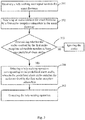
- Fig.3 is a flow diagram illustrating a method for seeking help according to some exemplary embodiments of the present disclosure, and the method is applied in a smart footwear. As shown in Fig. 3 , the method may include the following steps.
- step 301 a help seeking start signal sent to the smart footwear is received.
- the user can send a simple signal to the smart footwear to start the device for seeking help in the smart footwear.
- the audio reception submodule in the smart footwear may be started by foot stamping.
- step 302 an audio message sent towards the smart footwear is received by a first audio reception submodule in the smart footwear.
- the first audio reception submodule receives the audio instruction of "calling the police”.
- step 303 whether the audio message received by the first audio reception submodule matches at least one predefined alarm audio is determined.
- step 304 is performed; and when the audio message does not match the predefined alarm audio, the audio message is ignored.
- step 304 a help seeking operation corresponding to the predefined alarm audio is selected, wherein the predefined alarm audio matches the audio message received by the first audio reception submodule.
- step 305 the help seeking operation is executed.
- the smart footwear may include one or more predefined alarm audio messages, the plurality of predefined alarm audio messages may be used by the user in different situations, and each of the predefined alarm audio messages may include a corresponding help seeking operation.
- the predefined alarm audio message may include calling the police, seeking help from friend A and seeking help from family member B, and the like.
- Each predefined alarm audio message may have a corresponding help seeking operation. in the situation of foot sprained, after the user making an audio message of "seeking help from family member B", matching the audio message with the predefined alarm audio "seeking help from family member B", and the help seeking operation corresponding to the predefined alarm audio message "seeking help from family member B" is to transmit the distress information to family member B though the smart footwear.
- the help seeking operation corresponding to the predefined alarm audio message may be to transmit the distress information to the predefined rescue object or directly issuing an alarm by the smart footwear. Transmitting the distress information to the predefined rescue object or directly issuing an alarm by the smart footwear can reduce the processes of information interaction, shorten the time for sending out the distress information or alarms, and avoid help seeking failure due to disconnection with electronic devices.
- the help seeking operation corresponding to the predefined alarm audio message may be to transmit an alarm signal to an electronic device associated with the smart footwear, such that the electronic device transmits the distress information to the predefined rescue object or directly issues an alarm. Transmitting the distress information to a predefined distress object or issuing an alarm by the electronic device associated with the smart footwear can reduce the technical difficulty of the help seeking device and also make the transmitting mode and content of the distress information more specific by utilizing the functions of the existing electronic device. For example, when transmitting the distress information through a smart phone associated with the smart footwear, audio and video information of the emergency scene may be sent to a preset friend in the cell phone address book or a police officer by using audio recording and video recording functions of the phone, so as to facilitate the implementation of rescuers.
- the help seeking operation corresponding to the predefined alarm audio message may be to transmit the distress information continuously until the rescue object responds to the distress information, and returns an acknowledgment signal.
- the help seeking operation may be executed when the user operation matches the predefined alarm operation and a number of the user operations executed reaches a preset number. For example, if the predefined alarm audio message is "seeking help from family member B", the help seeking operation is executed when the smart footwear detected the audio "seeking help from family member B" for two times in the case of user seeking help.
- the predefined rescue object may be a family member, a friend of the user or a police officer, which is not limited in the present disclosure.
- the distress information may include: location information, distress situation information, audio information, video information, and picture information, which are not limited in the present disclosure.
- the distress situation may contain the information about the situation the user encounters and the help the user needs and other information.
- a method for acquiring a help seeking signal assisted by an electronic device associated with a smart footwear is further provided.
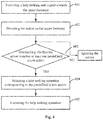
- the method is applied in a smart footwear. As shown in Fig. 4 , the method includes the following steps.
- step 401 a help seeking start signal sent towards the smart footwear is received.
- the user can send a simple signal to the smart footwear to start the device for seeking help in the smart footwear.
- a second transmission submodule in the smart footwear may be started by foot stamping.
- step 402 whether there is an electronic device associated with the smart footwear is determined, and if yes, step 403 is performed.
- the smart footwear can be determined to be associated with the electronic device when their distance is within 10 meters (the specific distance value can be preset as required) by obtaining the GPS location information of the smart footwear and the electrical device.
- the smart footwear is associated with the electronic device via Bluetooth.
- the smart footwear and the electronic device are connected to the same WIFI, the smart footwear can be determined to be associated with the electronic device.
- steps 302-305 may be performed if there is no electronic device associated with the smart footwear.
- step 403 an audio acquisition request is transmitted to the associated electronic device by the second transmission submodule in the smart footwear.
- the second transmission submodule is started after user stamping feet, and it transmits an audio acquisition instruction to the associated electronic device, such that the electronic device acquires the audio.
- a third audio reception submodule in the smart footwear receives the audio returned by the associated electronic device.
- the audio is acquired by the electronic device associated with the smart footwear
- the audio is acquired by a second audio reception submodule in the associated electronic device, which can simplify the structure of the help seeking device in the smart footwear, increase product stability and reduce costs.
- step 405 whether the audio message received by the third audio reception submodule matches at least one predefined alarm audio message is determined.
- step 406 is performed; and when the audio message does not match the predefined alarm audio, the audio message is ignored.
- step 406 a help seeking operation corresponding to the predefined alarm audio is selected, wherein the predefined alarm audio message matches the audio message received by the third audio reception submodule.
- step 407 the help seeking operation is executed.
- the help seeking operation corresponding to the predefined alarm audio message is the same as the help seeking operation involved in the embodiment shown in Fig. 3 , which will not be repeated herein.
- the predefined rescue object may be a family member, a friend of the user or a police officer, which is not limited in the present disclosure.
- the distress information may include: location information, distress situation information, audio information, video information, and picture information and the like, which are not limited in the present disclosure.
- the distress situation may contain the information about the situation the user encounters and the help the user needs and other information.
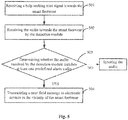
- the present disclosure further provides a method for seeking help, which is applied in a smart footwear. As shown in Fig. 5 , the method may include the following steps.
- step 501 a help seeking start signal sent towards the smart footwear is received.
- the user can send a simple signal to the smart footwear to start the device for seeking help in the smart footwear.
- the device for seeking help in the smart footwear may be started by foot stamping.
- step 502 an audio message sent towards the smart footwear is received.
- the audio message may be acquired by the first audio reception submodule in the smart footwear in step 302 or may be acquired by the electronic device associated with the smart footwear in step 402, which is not limited in the present disclosure.
- the smart footwear receives the audio instruction of "calling the police".
- step 503 whether the received audio message matches at least one predefined alarm audio message is determined.
- step 504 is performed; and when the audio message does not match the predefined alarm audio, the audio message is ignored.
- step 504 a near field message is transmitted to electronic devices in the vicinity of the smart footwear.
- the near field message may be transmitted to the nearby electronic devices via Bluetooth, ZigBee or the like, so that the nearby electronic devices can respond and rescue as soon as possible after receiving the near field message, which can reduce the time for rescue arrival and enhance user's safety.
- the near field message may include location information, distress situation information, audio information, video information, and picture information and the like, which is not limited in the present disclosure.
- the distress situation may contain the information about the situation the user encounters and the help the user needs and other information.
- the present disclosure further provides a method for seeking help, which is applied in a smart footwear. As shown in Fig. 6 , the method may include the following steps.
- step 601 a help seeking start signal towards the smart footwear is received.
- the user can send a simple signal to the smart footwear to start the device for seeking help in the smart footwear.
- an action detection submodule in the smart footwear may be started by foot stamping.
- step 602 an action on the smart footwear is detected.
- space attitude information describing the action of the smart footwear may be acquired, and pressure information describing the action of the smart footwear may also be acquired.
- the space attitude information may include a planar path and a space attitude change drawn for the smart footwear, which is not limited in the present disclosure.
- the pressure information may include the pressure values on the smart footwear or the number of sudden changes in the pressure values, which is not limited in the present disclosure.
- step 603 whether the action matches at least one predefined alarm action is determined.
- step 604 is performed; and when the action does not match the predefined alarm action, the action is ignored.
- step 604 a help seeking operation corresponding to the predefined alarm action is selected, wherein the predefined alarm action matches the action detected on the smart footwear.
- step 605 the help seeking operation is executed.
- the smart footwear may include a plurality of predefined alarm actions for use by the user in different situations.
- the predefined alarm actions include: drawing a triangular path with feet, stamping feet, etc.
- Each predefined alarm action has a corresponding operation for sending distress information.
- a corresponding operation of calling the police is performed.
- the help seeking operation corresponding to the predefined alarm action is the same as the help seeking operation involved in the embodiment shown in Fig. 3 , which will not be repeated herein.
- the predefined rescue object may be a family member, a friend of the user or a police officer, which is not limited in the present disclosure.
- the distress information may include: location information, distress situation information, audio information, video information, and picture information, which are not limited in the present disclosure.
- the distress situation may contain the information about the situation the user encounters and the help the user needs and other information.
- the method of acquiring audio messages in the embodiment shown in Fig. 5 may be replaced by detecting actions, which can also shorten the rescue time and improve the rescue efficiency.
- Fig. 7 is a block diagram of a device for seeking help according to an exemplary embodiment of the present disclosure.
- the device for seeking help may include a detection module and an execution module, wherein the detection module is configured to detect a user operation with respect to the smart footwear and the execution module is configured to execute a help seeking operation when the user operation matches a predefined alarm operation.
- the detection module may comprise a first audio reception submodule configured to receive audio messages sent towards the smart footwear; and/or a second transmission submodule and a third audio reception submodule, wherein the second transmission submodule is configured to transmit an audio acquisition request to an electronic device associated with the smart footwear, and the third audio reception submodule is configured to receive the audio message returned by the electronic device.
- the detection module may comprise an action acquisition submodule configured to detect an action on the smart footwear.
- the action acquisition submodule may comprise a space attitude information acquisition submodule, configured to acquire space attitude information of the smart footwear.
- the action acquisition submodule may comprise a pressure information acquisition submodule, configured to acquire pressure information of the smart footwear.
- the space attitude information may include a planar path and a space attitude change drawn for the smart footwear, which is not limited in the present disclosure.
- the pressure information may include the pressure values on the smart footwear or the number of sudden changes in the pressure values, which is not limited in the present disclosure.
- the execution module may include a first determination submodule and a selection submodule.
- the smart footwear may include a plurality of predefined alarm operations for use by users in different situations.
- the first determination submodule is configured to determine the predefined alarm operation that matches the user operation and the selection submodule is configured to select the help seeking operation corresponding to the predefined alarm operation that matches the user operation, and execute the selected help seeking operation.
- the execution module may include a first transmission submodule configured to issue an alarm or transmit distress information to a predefined rescue object by the smart footwear, or transmit the distress information to an electronic device associated with the smart footwear, such that the electronic device issues an alarm or transmits the distress information to a predefined rescue object.
- the execution module may further include a second determination submodule configured to determine that the predefined rescue object receives the distress information successfully when the first transmission submodule continuously transmits the distress information.
- the execution module may further include a broadcasting submodule configured to transmit a near field message to the vicinity of the smart footwear via Bluetooth, ZigBee or the like; wherein the predefined rescue object comprises devices in the vicinity of the smart footwear.
- the predefined rescue object comprises devices in the vicinity of the smart footwear.
- the execution module may include a counter submodule configured to count a number of the user operations executed when the user operation matches the predefined alarm operation, so as to execute the help seeking operation when a number of the user operations executed reaches a preset number.
- the predefined rescue object may be a family member, a friend of the user or a police officer, which is not limited in the present disclosure.
- the distress information may include: location information, distress situation information, audio information, video information, and picture information and the like, which are not limited in the present disclosure.
- the distress situation information may contain the information about the situation the user encounters and the help the user needs and other information.
- Fig. 8 is a block diagram of a device for seeking help according to an exemplary embodiment of the present disclosure.
- the device for seeking help may include a first audio reception submodule, a first determination submodule, a selection submodule, and a first transmission submodule.
- the first audio reception submodule is configured to receive audio towards the smart footwear.
- the smart footwear may contain multiple predefined alarm audio messages for use by the user in different situations.
- the first determination submodule is configured to determine whether the audio message received by the first audio reception submodule matches at least one predefined alarm audio message. The audio message is ignored when it does not match a predefined alarm audio message, and the function of the selection submodule is performed when the audio message received by the first audio reception submodule matches at least one predefined alarm audio message.
- the selection submodule is configured to select a help seeking operation corresponding to the predefined alarm audio message that matches the audio message.
- the first transmission submodule is configured to execute the selected help seeking operation. Specifically, in some embodiments, the first transmission submodule is configured to issue an alarm, and transmit distress information to a predefined rescue object. In some embodiments, the first transmission submodule is configured to send an alarm signal to an electronic device associated therewith, so that the electronic device can issue an alarm or transmits the distress information to a predefined rescue object.
- the device for seeking help may include a second determination submodule, to determine that the predefined rescue object receives the distress information successfully when the first transmission submodule continuously transmits the distress information.
- the device for seeking help may include a counter submodule to count a number of the user operations executed when the user operation matches the predefined alarm operations, so as to execute the help seeking operation when a number of the user operation executed reaches a preset number.
- the predefined rescue object may be a family member, a friend of the user or a police officer, which is not limited in the present disclosure.
- the distress information may include: location information, distress situation information, audio information, video information, and picture information, which are not limited in the present disclosure.
- the distress situation may contain the information about the situation the user encounters and the help the user needs and other information.
- a device for seeking help is provided, wherein the help seeking operations are assisted by an electronic device associated with a smart footwear.
- the device for seeking help shown in Fig. 9 may include a second transmission submodule, a third audio reception submodule, a first determination submodule, a selection submodule, and a first transmission submodule.
- the second transmission submodule is configured to transmit an audio acquisition request to the electronic device associated with the smart footwear; and the third audio reception submodule is configured to receive the audio message returned by the electronic device.
- the audio message is acquired by the electronic device associated with the smart footwear
- the audio message is acquired by a second audio reception submodule in the electronic device, which can simplify the structure of the help seeking device in the smart footwear, increase product stability and reduce costs.
- the functions of the first determination submodule, the selection submodule, and the first transmission submodule are the same as those in the embodiment shown in Fig. 8 , which will not be repeated herein.
- the device for seeking help may further include the first audio reception submodule and the first transmission submodule in the embodiment shown in Fig. 8 , and the operations of steps 302-305 may be performed if there is no electronic device associated with the smart footwear.
- the present disclosure further provides a device for seeking help, as shown in Fig.10 , the device for seeking help may include a detection module and a broadcasting submodule, and the broadcasting submodule is configured to transmit a near field message to vicinity of the smart footwear; wherein the predefined rescue object comprises devices in the vicinity of the smart footwear.
- the predefined rescue object comprises devices in the vicinity of the smart footwear.
- Fig. 11 is a block diagram of a device for seeking help according to an exemplary embodiment of the present disclosure.
- the device for seeking help may include an action acquisition submodule, a first determination submodule, a selection submodule, and a first transmission submodule.
- the action acquisition submodule may include a space gesture information acquisition submodule configured to acquire the space gesture information of the smart footwear.
- the action acquisition submodule may include a pressure information acquisition submodule configured to acquire the pressure information of the smart footwear.
- the space attitude information may include a planar path and a space attitude change drawn for the smart footwear, which is not limited in the present disclosure.
- the pressure information may include the pressure values on the smart footwear or the number of sudden changes in the pressure values, which is not limited in the present disclosure.
- the smart footwear may contain multiple predefined alarm operations for use by the user in different situations.
- the first determination submodule is configured to determine whether the action detected by the action acquisition submodule matches at least one predefined alarm action. The action is ignored when it does not match a predefined alarm action, and the function of the selection submodule is performed when the action detected by the action acquisition submodule matches at least one predefined alarm action.
- the selection submodule is configured to select a help seeking operation corresponding to the predefined alarm action that matches the action.
- the first transmission submodule is configured to execute the selected help seeking operation. Specifically, in some embodiments, the first transmission submodule is configured to issue an alarm, and transmit the distress information to a predefined rescue object. In some embodiments, the first transmission submodule is configured to send an alarm signal to an associated electronic device, so that the electronic device can issue an alarm or transmit the distress information to a predefined rescue object.
- the device for seeking help may include a second determination submodule, to determine that the predefined rescue object receives the distress information successfully when the first transmission submodule continuously transmits the distress information.
- the device for seeking help may include a counter submodule to count a number of the user actions executed when the user action matches the predefined alarm action, so as to execute the help seeking operation when a number of the user actions executed reaches a preset number of times.
- the predefined rescue object may be devices in the vicinity of the smart footwear, a family member, a friend of the user or a police officer, which is not limited in the present disclosure.
- the execution module may include a broadcasting submodule to transmit a near field message to the vicinity of the smart footwear via Bluetooth, ZigBee or the like.
- the distress information may include: location information, distress situation information, audio information, video information, and picture information, which are not limited in the present disclosure.
- the distress situation may contain the information about the situation the user encounters and the help the user needs and other information.
- the present disclosure further provides a smart footwear according to some embodiments, and the smart footwear may include a processor configured to implement the method for seeking help described above.
- the disclosure further provides a non-transitory computer-readable storage medium comprising instructions, for example, a memory that includes instructions, the instructions when executed by a processor of a device for seeking help, cause the device to implement the method for seeking help described above in the present disclosure.
- the non-transitory computer-readable storage medium may be a ROM, a random access memory (RAM), a CD-ROM, a magnetic tape, a floppy disk, an optical data storage, or the like.
Landscapes
- Engineering & Computer Science (AREA)
- Theoretical Computer Science (AREA)
- General Engineering & Computer Science (AREA)
- Physics & Mathematics (AREA)
- General Physics & Mathematics (AREA)
- Human Computer Interaction (AREA)
- Health & Medical Sciences (AREA)
- General Health & Medical Sciences (AREA)
- Audiology, Speech & Language Pathology (AREA)
- Emergency Management (AREA)
- Business, Economics & Management (AREA)
- Computer Security & Cryptography (AREA)
- Microelectronics & Electronic Packaging (AREA)
- Multimedia (AREA)
- Alarm Systems (AREA)
- Measurement Of The Respiration, Hearing Ability, Form, And Blood Characteristics Of Living Organisms (AREA)
Abstract
Description
- The present disclosure relates to the technical field of electronic devices, and more particularly, to a method and a device for seeking help, and a smart footwear.
- Electronic devices such as smart watches or smart phones are usually equipped with a help seeking device to protect the user's personal safety. The help seeking device may issue distress information when it determines that the user is in danger, thus the user's personal safety is protected.
- However, such a help seeking device requires manual user operations to start, and the problem arises when the user may be unable to start the help seeking device while he/she is in danger.
- According to a first aspect of the present disclosure, a method for seeking help is provided, the method is applied in a smart footwear and may include: detecting a user operation with respect to the smart footwear; executing a help seeking operation when the user operation matches a predefined alarm operation.
- In some embodiments, detecting the user operation with respect to the smart footwear may include: receiving an audio message at the smart footwear; and when the audio message matches a predefined alarm audio, determining that the user operation matches the predefined alarm operation.
- In some embodiments, receiving the audio message at the smart footwear may include at least one of: acquiring the audio message by a first audio reception submodule in the smart footwear; transmitting an audio acquisition request to an electronic device associated with the smart footwear such that the electronic device acquires the audio message by a second audio reception submodule in the electronic device.
- In some embodiments , detecting the user operation with respect to the smart footwear may include: detecting an action on the smart footwear; and when the action matches a predefined alarm action, determining that the user operation matches the predefined alarm operation.
- In some embodiments, detecting the action on the smart footwear may include at least one of: acquiring space attitude information of the smart footwear, where the space attitude information describes the action; and acquiring pressure information of the smart footwear, where the pressure information describes the action.
- In some embodiments, executing the help seeking operation when the user operation matches the predefined alarm operation may include: executing the help seeking operation when the user operation matches the predefined alarm operation and a number of the user operations executed reaches a preset number.
- In some embodiments, executing the help seeking operation when the user operation matches the predefined alarm operation comprises: determining the predefined alarm operation that matches the user operation; and selecting the help seeking operation corresponding to the predefined alarm operation that matches the user operation, and executing the selected help seeking operation.
- In some embodiments, executing the help seeking operation may include at least one of: issuing an alarm or transmitting distress information to a predefined rescue object by an electronic device associated with the smart footwear; and issuing the alarm or transmitting the distress information to the predefined rescue object by the smart footwear.
- In some embodiments, transmitting the distress information to the predefined rescue object may include: transmitting a near field message to the vicinity of the smart footwear, wherein the predefined rescue object comprises devices in the vicinity of the smart footwear.
- In some embodiments, transmitting the distress information to the predefined rescue object may include: transmitting the distress information continuously until it is determined that the predefined rescue object receives the distress information successfully.
- In some embodiments, the distress information may include at least one of: location information, distress situation information, audio information, video information and picture information.
- According to a second aspect of the present disclosure, a device for seeking help is provided, the device is applied in a smart footwear and may include: a detection module configured to detect a user operation with respect to the smart footwear; an execution module configured to execute a help seeking operation when the user operation matches a predefined alarm operation.
- In some embodiments, the detection module may include: an audio reception submodule configured to receive audio messages sent to the smart footwear, wherein the user operation is determined to match the predefined alarm operation when the audio message matches a predefined alarm audio.
- In some embodiments, the audio reception submodule may include: a first audio reception submodule configured to receive audio messages sent to the smart footwear; and/or a second transmission submodule and a third audio reception submodule, wherein the second transmission submodule is configured to transmit an audio acquisition request to an electronic device associated with the smart footwear, and the third audio reception submodule is configured to receive the audio message returned from the electronic device.
- In some embodiments, the detection module may include: an action acquisition submodule configured to detect an action on the smart footwear, wherein the user operation is determined to match the predefined alarm operation when the action matches a predefined alarm action.
- In some embodiments, the action acquisition submodule may include: a space attitude information acquisition submodule, configured to acquire space attitude information of the smart footwear, the space attitude information describing the action; and/or a pressure information acquisition submodule, configured to acquire pressure information of the smart footwear, the pressure information describing the action.
- In some embodiments, the execution module may include: a counter submodule configured to count a number of the user operations executed when the user operation matches the predefined alarm operation, so as to execute the help seeking operation when a number of the user operations executed reaches a preset number.
- In some embodiments, the execution module may include: a first determination submodule configured to determine the predefined alarm operation that matches the user operation; a selection submodule configured to select the help seeking operation corresponding to the predefined alarm operation that matches the user operation, and executing the selected help seeking operation.
- In some embodiments, the execution module may include: a first issuing submodule configured to issue an alarm or transmit distress information to a predefined rescue object by the smart footwear or an electronic device associated with the smart footwear.
- In some embodiments, the execution module may further include: a broadcasting submodule configured to transmit a near field message to the icinity of the smart footwear, wherein the predefined rescue object comprises devices in the vicinity of the smart footwear.
- In some embodiments, the execution module may further include: a second determination submodule configured to determine that the predefined rescue object receives the distress information successfully when the first transmission submodule continuously transmits the distress information.
- In some embodiments, the distress information may include at least one of: location information, distress situation information, audio information, video information and picture information.
- According to a third aspect of the present disclosure, a smart footwear is provided, the smart footwear comprises a processor configured to implement the method for seeking help described above.
- According to a fourth aspect of the present disclosure, a computer-readable storage medium is provided, the computer-readable storage medium has stored thereon computer instructions that, when executed by a processor, cause the processor to implement steps of the method described above.
- Embodiments of the present disclosure may provide at least some of the following beneficial effects.
- As can be seen from the embodiments described above, the present disclosure provides a method for seeking help with respect to a smart footwear. By detecting a user operation with respect to the smart footwear, and executing a help seeking operation when the user operation matches a predefined alarm operation, the help seeking operation may be performed via the smart footwear in a fast and secret way, which may improve the user's safety and security.
- It is to be understood that the above general description and the following detailed description are merely for the purpose of illustration and explanation, and are not intended to limit the scope of the protection of the invention.
- The accompanying drawings, which are incorporated in and constitute a part of this specification, illustrate embodiments consistent with the invention and, together with the description, serve to explain the principles of the invention.
-
Fig. 1 is an application scenario diagram of a method for seeking help according to some exemplary embodiments; -
Fig.2 is a flow diagram illustrating a method for seeking help according to some exemplary embodiments; -
Fig.3 is a flow diagram illustrating a method for seeking help according to some exemplary embodiments; -
Fig.4 is a flow diagram illustrating a method for seeking help according to some exemplary embodiments; -
Fig.5 is a flow diagram illustrating a method for seeking help according to some exemplary embodiments; -
Fig.6 is a flow diagram illustrating a method for seeking help according to some exemplary embodiments; -
Fig. 7 is a structure diagram illustrating a device for seeking help according to some exemplary embodiments; -
Fig. 8 is a structure diagram illustrating a device for seeking help according to some exemplary embodiments; -
Fig. 9 is a structure diagram illustrating a device for seeking help according to some exemplary embodiments; -
Fig. 10 is a structure diagram illustrating a device for seeking help according to some exemplary embodiments; -
Fig. 11 is a structure diagram illustrating a device for seeking help according to some exemplary embodiments; - Hereinafter, exemplary embodiments will be described in detail, examples of which are shown in the drawings. In the following descriptions when referring to the drawings, the same numerals in the different drawings denote the same or similar elements unless otherwise indicated. The embodiments described in the following exemplary embodiments are not representative of all embodiments consistent with the present disclosure. Rather, they are merely examples of devices and methods consistent with some aspects of the present invention as detailed in the appended claims.
- Terms used in the disclosure are only for description of particular embodiments, rather than intend to limit the disclosure. Singular form "a", "said" and "the" used in the disclosure and the appended claims also intend to include plural form, unless otherwise described distinctly in context. It is to be understood that the term "and/or" used in the disclosure refers to and includes any or all of possible combinations of one or more associated items listed.
- It is to be understood that, although various information may be described using terms "first", "second", "third" and the like, the information is not limited to these terms. These terms are only used to distinguish the same kind of information from each other. For example, first information may be referred to as second information, and similarly, second information may be referred to as first information, without departing from the scope of the claims. For example, "if' as used herein, depending on the context, may be explained as "when..." or "in response to a determination that...".
- When people are in emergency or in danger, the spread of danger may be avoided to a certain extent and people's safety may be ensured if distress information can be sent out for help through smart watches, smart phones and other electronic devices.
Fig. 1 is an application scenario diagram of a method for seeking help. As shown inFig. 1 ,user 1 is robbed bycriminal 2 on the way home at night. Ifuser 1 wants to send out distress information at the moment, the first thing is to find his smart phone in theleather bag 11, and then call for help through the smart phone or send the distress information through other programs. However, due to the emergency situation, it will take a long time foruser 1 to make a call or start a program; these operations are more likely to be found bycriminal 2. Therefore, the user cannot timely and effectively send out the distress information, thereby endangering his safety. -
Fig.2 is a flow diagram illustrating a method for seeking help according to some exemplary embodiments, and the method may be applied in a smart footwear. As shown inFig. 2 , the method may include the following steps. - In
step 201, a user operation with respect to the smart footwear is detected. - In some embodiments, the smart footwear may receive an audio message sent to the smart footwear. In one case, the audio message maybe acquired by a first audio reception submodule in the smart footwear. In another case, the smart footwear may further transmit an audio acquisition request to an electronic device associated with the smart footwear, such that the audio message may be acquired by a second audio reception submodule in the electronic device, and then the smart footwear can receive the audio message returned by the electronic device.
- In some embodiments, an action on the smart footwear may be detected. In one case, the smart footwear may acquire space attitude information that describes the action of the smart footwear. In another case, the smart footwear may also acquire pressure information that describes the action of the smart footwear. In this embodiment, since the smart footwear is worn on a user's foot, the user operation with respect to the smart footwear can be completed by the user's foot, which is more secretive and convenient than the manual operation, and is helpful to send out the distress information effectively to protect the user's safety.
- In
step 202, a help seeking operation is executed when the user operation matches a predefined alarm operation. - In some embodiments, the user operation is determined to match the predefined alarm operation when the audio or action matches a predefined alarm audio or action. The smart footwear may include a plurality of predefined alarm operations for use by the user in different conditions. Specifically, the smart footwear may first determine the predefined alarm operation that matches the user operation, then select the help seeking operation corresponding to the predefined alarm operation that matches the user operation, and execute the selected help seeking operation. In some embodiments, the help seeking operation may include issuing an alarm or transmitting distress information to a predefined rescue object by the smart footwear or by an electronic device associated with the smart footwear.
- In some embodiments, in order to prevent the smart footwear from transmitting wrong distress information due to a wrong determination, the help seeking operation may be executed when the user operation matches the predefined alarm operation and a number of the user operations executed reaches a preset number. For example, the predefined alarm operation is foot stamping by the user. The user may inadvertently stamp his foot during a normal motion, but in fact there is no an alarm requirement. The above described method can avoid false alarms caused by a wrong determination and improve the practicability of the smart footwear.
- The predefined rescue object may be devices near the smart footwear, a family member, a friend of the user or a police officer, which is not limited in the present disclosure. When the predefined rescue object is the devices in the vicinity of the smart footwear, a near field message may be transmitted to the nearby electronic devices via Bluetooth, ZigBee or the like, so that the nearby electronic devices can respond and rescue as soon as possible after receiving the near field message. In the above described method, due to the predefined rescue object in the vicinity of the user, the time for rescue arrival can be reduced and user's safety can be enhanced.
- In some embodiments, the distress information or the near field message may include location information, distress situation information, audio information, video information, and picture information and the like, which is not limited in the present disclosure. The distress situation may contain the information about the situation the user encounters and the help the user needs and other information.
- In summary, the above method for seeking help enables the smart footwear to transmit the distress information through an audio message and action and the like with respect to the smart footwear, and the operation is quick and secret, which is favorable for the user to send out the distress information quickly and effectively under an emergency situation.
-
Fig.3 is a flow diagram illustrating a method for seeking help according to some exemplary embodiments of the present disclosure, and the method is applied in a smart footwear. As shown inFig. 3 , the method may include the following steps. - In
step 301, a help seeking start signal sent to the smart footwear is received. - The user can send a simple signal to the smart footwear to start the device for seeking help in the smart footwear. For example, the audio reception submodule in the smart footwear may be started by foot stamping.
- In
step 302, an audio message sent towards the smart footwear is received by a first audio reception submodule in the smart footwear. - For example, after the user making an audio instruction of "calling the police" after foot stamping, the first audio reception submodule receives the audio instruction of "calling the police".
- In
step 303, whether the audio message received by the first audio reception submodule matches at least one predefined alarm audio is determined. When the audio message received by the first audio reception submodule matches at least one predefined alarm audio,step 304 is performed; and when the audio message does not match the predefined alarm audio, the audio message is ignored. - In
step 304, a help seeking operation corresponding to the predefined alarm audio is selected, wherein the predefined alarm audio matches the audio message received by the first audio reception submodule. - In
step 305, the help seeking operation is executed. - In some embodiments, the smart footwear may include one or more predefined alarm audio messages, the plurality of predefined alarm audio messages may be used by the user in different situations, and each of the predefined alarm audio messages may include a corresponding help seeking operation. For example, the predefined alarm audio message may include calling the police, seeking help from friend A and seeking help from family member B, and the like. Each predefined alarm audio message may have a corresponding help seeking operation. in the situation of foot sprained, after the user making an audio message of "seeking help from family member B", matching the audio message with the predefined alarm audio "seeking help from family member B", and the help seeking operation corresponding to the predefined alarm audio message "seeking help from family member B" is to transmit the distress information to family member B though the smart footwear.
- In some embodiments, the help seeking operation corresponding to the predefined alarm audio message may be to transmit the distress information to the predefined rescue object or directly issuing an alarm by the smart footwear. Transmitting the distress information to the predefined rescue object or directly issuing an alarm by the smart footwear can reduce the processes of information interaction, shorten the time for sending out the distress information or alarms, and avoid help seeking failure due to disconnection with electronic devices.
- In some embodiments, the help seeking operation corresponding to the predefined alarm audio message may be to transmit an alarm signal to an electronic device associated with the smart footwear, such that the electronic device transmits the distress information to the predefined rescue object or directly issues an alarm. Transmitting the distress information to a predefined distress object or issuing an alarm by the electronic device associated with the smart footwear can reduce the technical difficulty of the help seeking device and also make the transmitting mode and content of the distress information more specific by utilizing the functions of the existing electronic device. For example, when transmitting the distress information through a smart phone associated with the smart footwear, audio and video information of the emergency scene may be sent to a preset friend in the cell phone address book or a police officer by using audio recording and video recording functions of the phone, so as to facilitate the implementation of rescuers.
- In some embodiments, in order to avoid the rescue object misunderstanding or ignoring the distress information, the help seeking operation corresponding to the predefined alarm audio message may be to transmit the distress information continuously until the rescue object responds to the distress information, and returns an acknowledgment signal. In some embodiments, in order to prevent the smart footwear from transmitting wrong distress information due to a wrong determination, the help seeking operation may be executed when the user operation matches the predefined alarm operation and a number of the user operations executed reaches a preset number. For example, if the predefined alarm audio message is "seeking help from family member B", the help seeking operation is executed when the smart footwear detected the audio "seeking help from family member B" for two times in the case of user seeking help.
- In some embodiments, the predefined rescue object may be a family member, a friend of the user or a police officer, which is not limited in the present disclosure. The distress information may include: location information, distress situation information, audio information, video information, and picture information, which are not limited in the present disclosure. The distress situation may contain the information about the situation the user encounters and the help the user needs and other information.
- In order to improve the degree of intelligence of the method for seeking help in the present disclosure, a method for acquiring a help seeking signal assisted by an electronic device associated with a smart footwear is further provided. The method is applied in a smart footwear. As shown in
Fig. 4 , the method includes the following steps. - In
step 401, a help seeking start signal sent towards the smart footwear is received. - The user can send a simple signal to the smart footwear to start the device for seeking help in the smart footwear. For example, a second transmission submodule in the smart footwear may be started by foot stamping.
- In
step 402, whether there is an electronic device associated with the smart footwear is determined, and if yes, step 403 is performed. - The smart footwear can be determined to be associated with the electronic device when their distance is within 10 meters (the specific distance value can be preset as required) by obtaining the GPS location information of the smart footwear and the electrical device. Alternatively, the smart footwear is associated with the electronic device via Bluetooth. Or, in the case that the smart footwear and the electronic device are connected to the same WIFI, the smart footwear can be determined to be associated with the electronic device.
- In some embodiments, the operations of steps 302-305 may be performed if there is no electronic device associated with the smart footwear.
- In
step 403, an audio acquisition request is transmitted to the associated electronic device by the second transmission submodule in the smart footwear. - For example, the second transmission submodule is started after user stamping feet, and it transmits an audio acquisition instruction to the associated electronic device, such that the electronic device acquires the audio.
- In
step 404, a third audio reception submodule in the smart footwear receives the audio returned by the associated electronic device. - When the audio is acquired by the electronic device associated with the smart footwear, the audio is acquired by a second audio reception submodule in the associated electronic device, which can simplify the structure of the help seeking device in the smart footwear, increase product stability and reduce costs.
- In
step 405, whether the audio message received by the third audio reception submodule matches at least one predefined alarm audio message is determined. When the audio message received by the third audio reception submodule matches at least one predefined alarm audio message,step 406 is performed; and when the audio message does not match the predefined alarm audio, the audio message is ignored. - In
step 406, a help seeking operation corresponding to the predefined alarm audio is selected, wherein the predefined alarm audio message matches the audio message received by the third audio reception submodule. - In
step 407, the help seeking operation is executed. - In some embodiments, the help seeking operation corresponding to the predefined alarm audio message is the same as the help seeking operation involved in the embodiment shown in
Fig. 3 , which will not be repeated herein. - In some embodiments, the predefined rescue object may be a family member, a friend of the user or a police officer, which is not limited in the present disclosure. The distress information may include: location information, distress situation information, audio information, video information, and picture information and the like, which are not limited in the present disclosure. The distress situation may contain the information about the situation the user encounters and the help the user needs and other information.
- In order to shorten the rescue time and improve the rescue efficiency, the present disclosure further provides a method for seeking help, which is applied in a smart footwear. As shown in
Fig. 5 , the method may include the following steps. - In
step 501, a help seeking start signal sent towards the smart footwear is received. - The user can send a simple signal to the smart footwear to start the device for seeking help in the smart footwear. For example, the device for seeking help in the smart footwear may be started by foot stamping.
- In
step 502, an audio message sent towards the smart footwear is received. - The audio message may be acquired by the first audio reception submodule in the smart footwear in
step 302 or may be acquired by the electronic device associated with the smart footwear instep 402, which is not limited in the present disclosure. For example, after the user making an audio instruction of "calling the police" after foot stamping, the smart footwear receives the audio instruction of "calling the police". - In
step 503, whether the received audio message matches at least one predefined alarm audio message is determined. When the received audio message matches at least one predefined alarm audio message,step 504 is performed; and when the audio message does not match the predefined alarm audio, the audio message is ignored. - In
step 504, a near field message is transmitted to electronic devices in the vicinity of the smart footwear. - In the above described method, because the predefined rescue object is the devices in the vicinity of the smart footwear, the near field message may be transmitted to the nearby electronic devices via Bluetooth, ZigBee or the like, so that the nearby electronic devices can respond and rescue as soon as possible after receiving the near field message, which can reduce the time for rescue arrival and enhance user's safety. The near field message may include location information, distress situation information, audio information, video information, and picture information and the like, which is not limited in the present disclosure. The distress situation may contain the information about the situation the user encounters and the help the user needs and other information.
- In order to increase the timeliness and secrecy of seeking help, the present disclosure further provides a method for seeking help, which is applied in a smart footwear. As shown in
Fig. 6 , the method may include the following steps. - In
step 601, a help seeking start signal towards the smart footwear is received. - The user can send a simple signal to the smart footwear to start the device for seeking help in the smart footwear. For example, an action detection submodule in the smart footwear may be started by foot stamping.
- In step 602, an action on the smart footwear is detected.
- In some embodiments, space attitude information describing the action of the smart footwear may be acquired, and pressure information describing the action of the smart footwear may also be acquired. The space attitude information may include a planar path and a space attitude change drawn for the smart footwear, which is not limited in the present disclosure. The pressure information may include the pressure values on the smart footwear or the number of sudden changes in the pressure values, which is not limited in the present disclosure.
- In
step 603, whether the action matches at least one predefined alarm action is determined. When the action matches at least one predefined alarm action, step 604 is performed; and when the action does not match the predefined alarm action, the action is ignored. - In step 604, a help seeking operation corresponding to the predefined alarm action is selected, wherein the predefined alarm action matches the action detected on the smart footwear.
- In
step 605, the help seeking operation is executed. - In some embodiments, the smart footwear may include a plurality of predefined alarm actions for use by the user in different situations. For example, the predefined alarm actions include: drawing a triangular path with feet, stamping feet, etc. Each predefined alarm action has a corresponding operation for sending distress information. In the case of robbery by criminals, when the user draws a triangle path with a foot and the triangle path matches the predefined triangle path, a corresponding operation of calling the police is performed.
- In some embodiments, the help seeking operation corresponding to the predefined alarm action is the same as the help seeking operation involved in the embodiment shown in
Fig. 3 , which will not be repeated herein. In some embodiments, the predefined rescue object may be a family member, a friend of the user or a police officer, which is not limited in the present disclosure. The distress information may include: location information, distress situation information, audio information, video information, and picture information, which are not limited in the present disclosure. The distress situation may contain the information about the situation the user encounters and the help the user needs and other information. - In some embodiments, the method of acquiring audio messages in the embodiment shown in
Fig. 5 may be replaced by detecting actions, which can also shorten the rescue time and improve the rescue efficiency. -
Fig. 7 is a block diagram of a device for seeking help according to an exemplary embodiment of the present disclosure. As shown inFig. 7 , the device for seeking help may include a detection module and an execution module, wherein the detection module is configured to detect a user operation with respect to the smart footwear and the execution module is configured to execute a help seeking operation when the user operation matches a predefined alarm operation. - In some embodiments, the detection module may comprise a first audio reception submodule configured to receive audio messages sent towards the smart footwear; and/or a second transmission submodule and a third audio reception submodule, wherein the second transmission submodule is configured to transmit an audio acquisition request to an electronic device associated with the smart footwear, and the third audio reception submodule is configured to receive the audio message returned by the electronic device.
- In some embodiments, the detection module may comprise an action acquisition submodule configured to detect an action on the smart footwear. The action acquisition submodule may comprise a space attitude information acquisition submodule, configured to acquire space attitude information of the smart footwear. Alternatively, the action acquisition submodule may comprise a pressure information acquisition submodule, configured to acquire pressure information of the smart footwear. The space attitude information may include a planar path and a space attitude change drawn for the smart footwear, which is not limited in the present disclosure. The pressure information may include the pressure values on the smart footwear or the number of sudden changes in the pressure values, which is not limited in the present disclosure.
- In some embodiments, the execution module may include a first determination submodule and a selection submodule. The smart footwear may include a plurality of predefined alarm operations for use by users in different situations. The first determination submodule is configured to determine the predefined alarm operation that matches the user operation and the selection submodule is configured to select the help seeking operation corresponding to the predefined alarm operation that matches the user operation, and execute the selected help seeking operation.
- Insome embodiments, the execution module may include a first transmission submodule configured to issue an alarm or transmit distress information to a predefined rescue object by the smart footwear, or transmit the distress information to an electronic device associated with the smart footwear, such that the electronic device issues an alarm or transmits the distress information to a predefined rescue object. In addition, the execution module may further include a second determination submodule configured to determine that the predefined rescue object receives the distress information successfully when the first transmission submodule continuously transmits the distress information.
- In some embodiments, the execution module may further include a broadcasting submodule configured to transmit a near field message to the vicinity of the smart footwear via Bluetooth, ZigBee or the like; wherein the predefined rescue object comprises devices in the vicinity of the smart footwear. In this case, due to the predefined rescue object in the vicinity of the user, the time for rescue arrival can be reduced and user's safety can be enhanced.
- In some embodiments, in order to prevent the smart footwear from transmitting wrong distress information due to a wrong determination, the execution module may include a counter submodule configured to count a number of the user operations executed when the user operation matches the predefined alarm operation, so as to execute the help seeking operation when a number of the user operations executed reaches a preset number.
- In some embodiments, the predefined rescue object may be a family member, a friend of the user or a police officer, which is not limited in the present disclosure. The distress information may include: location information, distress situation information, audio information, video information, and picture information and the like, which are not limited in the present disclosure. The distress situation information may contain the information about the situation the user encounters and the help the user needs and other information.
-
Fig. 8 is a block diagram of a device for seeking help according to an exemplary embodiment of the present disclosure. As shown inFig.8 , the device for seeking help may include a first audio reception submodule, a first determination submodule, a selection submodule, and a first transmission submodule. The first audio reception submodule is configured to receive audio towards the smart footwear. - The smart footwear may contain multiple predefined alarm audio messages for use by the user in different situations. The first determination submodule is configured to determine whether the audio message received by the first audio reception submodule matches at least one predefined alarm audio message. The audio message is ignored when it does not match a predefined alarm audio message, and the function of the selection submodule is performed when the audio message received by the first audio reception submodule matches at least one predefined alarm audio message.
- The selection submodule is configured to select a help seeking operation corresponding to the predefined alarm audio message that matches the audio message.
- The first transmission submodule is configured to execute the selected help seeking operation. Specifically, in some embodiments, the first transmission submodule is configured to issue an alarm, and transmit distress information to a predefined rescue object. In some embodiments, the first transmission submodule is configured to send an alarm signal to an electronic device associated therewith, so that the electronic device can issue an alarm or transmits the distress information to a predefined rescue object.
- In order to avoid the rescue object misunderstanding or ignoring the distress information, the device for seeking help may include a second determination submodule, to determine that the predefined rescue object receives the distress information successfully when the first transmission submodule continuously transmits the distress information. In some embodiments, in order to prevent the smart footwear from transmitting wrong distress information due to a wrong determination, the device for seeking help may include a counter submodule to count a number of the user operations executed when the user operation matches the predefined alarm operations, so as to execute the help seeking operation when a number of the user operation executed reaches a preset number.
- In some embodiments, the predefined rescue object may be a family member, a friend of the user or a police officer, which is not limited in the present disclosure. The distress information may include: location information, distress situation information, audio information, video information, and picture information, which are not limited in the present disclosure. The distress situation may contain the information about the situation the user encounters and the help the user needs and other information.
- In order to improve the degree of intelligence of the method for seeking help in the present disclosure, a device for seeking help is provided, wherein the help seeking operations are assisted by an electronic device associated with a smart footwear. The device for seeking help shown in
Fig. 9 may include a second transmission submodule, a third audio reception submodule, a first determination submodule, a selection submodule, and a first transmission submodule. The second transmission submodule is configured to transmit an audio acquisition request to the electronic device associated with the smart footwear; and the third audio reception submodule is configured to receive the audio message returned by the electronic device. When the audio message is acquired by the electronic device associated with the smart footwear, the audio message is acquired by a second audio reception submodule in the electronic device, which can simplify the structure of the help seeking device in the smart footwear, increase product stability and reduce costs. In this embodiment, the functions of the first determination submodule, the selection submodule, and the first transmission submodule are the same as those in the embodiment shown inFig. 8 , which will not be repeated herein. - In some embodiments, the device for seeking help may further include the first audio reception submodule and the first transmission submodule in the embodiment shown in
Fig. 8 , and the operations of steps 302-305 may be performed if there is no electronic device associated with the smart footwear. - In order to shorten the rescue time and improve the rescue efficiency, the present disclosure further provides a device for seeking help, as shown in
Fig.10 , the device for seeking help may include a detection module and a broadcasting submodule, and the broadcasting submodule is configured to transmit a near field message to vicinity of the smart footwear; wherein the predefined rescue object comprises devices in the vicinity of the smart footwear. In this case, due to the predefined rescue object in the vicinity of the user, the time for rescue arrival can be reduced and user's safety can be enhanced. -
Fig. 11 is a block diagram of a device for seeking help according to an exemplary embodiment of the present disclosure. As shown inFig. 11 , the device for seeking help may include an action acquisition submodule, a first determination submodule, a selection submodule, and a first transmission submodule. The action acquisition submodule may include a space gesture information acquisition submodule configured to acquire the space gesture information of the smart footwear. Alternatively, the action acquisition submodule may include a pressure information acquisition submodule configured to acquire the pressure information of the smart footwear. The space attitude information may include a planar path and a space attitude change drawn for the smart footwear, which is not limited in the present disclosure. The pressure information may include the pressure values on the smart footwear or the number of sudden changes in the pressure values, which is not limited in the present disclosure. - The smart footwear may contain multiple predefined alarm operations for use by the user in different situations. The first determination submodule is configured to determine whether the action detected by the action acquisition submodule matches at least one predefined alarm action. The action is ignored when it does not match a predefined alarm action, and the function of the selection submodule is performed when the action detected by the action acquisition submodule matches at least one predefined alarm action.
- The selection submodule is configured to select a help seeking operation corresponding to the predefined alarm action that matches the action.
- The first transmission submodule is configured to execute the selected help seeking operation. Specifically, in some embodiments, the first transmission submodule is configured to issue an alarm, and transmit the distress information to a predefined rescue object. In some embodiments, the first transmission submodule is configured to send an alarm signal to an associated electronic device, so that the electronic device can issue an alarm or transmit the distress information to a predefined rescue object.
- In order to avoid the rescue object misunderstanding or ignoring the distress information, the device for seeking help may include a second determination submodule, to determine that the predefined rescue object receives the distress information successfully when the first transmission submodule continuously transmits the distress information. In some embodiments, in order to prevent the smart footwear from transmitting wrong distress information due to a wrong determination, the device for seeking help may include a counter submodule to count a number of the user actions executed when the user action matches the predefined alarm action, so as to execute the help seeking operation when a number of the user actions executed reaches a preset number of times.
- In some embodiments, the predefined rescue object may be devices in the vicinity of the smart footwear, a family member, a friend of the user or a police officer, which is not limited in the present disclosure. When the predefined rescue object is the devices in the vicinity of the smart footwear, the execution module may include a broadcasting submodule to transmit a near field message to the vicinity of the smart footwear via Bluetooth, ZigBee or the like. In this case, due to the predefined rescue object in the vicinity of the user, the time for rescue arrival can be reduced and user's safety can be enhanced. The distress information may include: location information, distress situation information, audio information, video information, and picture information, which are not limited in the present disclosure. The distress situation may contain the information about the situation the user encounters and the help the user needs and other information.
- The present disclosure further provides a smart footwear according to some embodiments, and the smart footwear may include a processor configured to implement the method for seeking help described above.
- In some exemplary embodiments, the disclosure further provides a non-transitory computer-readable storage medium comprising instructions, for example, a memory that includes instructions, the instructions when executed by a processor of a device for seeking help, cause the device to implement the method for seeking help described above in the present disclosure. The non-transitory computer-readable storage medium may be a ROM, a random access memory (RAM), a CD-ROM, a magnetic tape, a floppy disk, an optical data storage, or the like.
- Other embodiments of the invention will be apparent to those skilled in the art from consideration of the specification and practice of the invention disclosed here. This application is intended to cover any variations, uses, or adaptations of the invention following the general principles thereof and including such departures from the present disclosure as come within known or customary practice in the art. The specification and embodiments are merely considered to be exemplary and the substantive scope of the invention is limited only by the appended claims.
- It should be understood that the disclosure is not limited to the precise structure as described above and shown in the figures, but can have various modification and alternations without departing from the scope of the invention. The scope of the invention is limited only by the appended claims.
Claims (15)
- A method for seeking help, which is applied in a smart footwear, characterized by comprising:detecting (201) a user operation with respect to the smart footwear; andexecuting (202) a help seeking operation when the user operation matches a predefined alarm operation.
- The method of claim 1, wherein detecting (201) the user operation with respect to the smart footwear comprises:receiving an audio message sent towards the smart footwear; andwhen the audio message matches a predefined alarm audio message, determining that the user operation matches the predefined alarm operation.
- The method of claim 2, wherein receiving the audio message sent towards the smart footwear comprises at least one of:acquiring (302) the audio message by a first audio reception submodule in the smart footwear; andtransmitting (402) an audio acquisition request to an electronic device associated with the smart footwear such that the electronic device acquires the audio message by a second audio reception submodule in the electronic device.
- The method of any one of claims 1-3, wherein detecting (201) the user operation with respect to the smart footwear comprises:detecting (602) an action on the smart footwear; andwhen the action matches a predefined alarm action, determining (603) that the user operation matches the predefined alarm operation.
- The method of claim 4, wherein detecting (602) the action on the smart footwear comprises at least one of:acquiring space attitude information of the smart footwear, wherein the space attitude information describes the action; andacquiring pressure information of the smart footwear, the pressure information describing the action.
- The method of any one of claims 1-5, wherein executing (202) the help seeking operation when the user operation matches the predefined alarm operation comprises:
executing the help seeking operation when the user operation matches the predefined alarm operation and a number of the user operations executed reaches a preset number. - The method of any one of claims 1-6, wherein executing (202) the help seeking operation when the user operation matches the predefined alarm operation comprises:determining the predefined alarm operation that matches the user operation; andselecting the help seeking operation corresponding to the predefined alarm operation that matches the user operation, and executing the selected help seeking operation.
- The method of any one of claims 1-7, wherein executing (202) the help seeking operation comprises at least one of:issuing an alarm or transmitting distress information to a predefined rescue object by using an electronic device associated with the smart footwear; andissuing the alarm or transmitting the distress information to the predefined rescue object by using the smart footwear.
- The method of claim 8, wherein transmitting the distress information to the predefined rescue object comprises:
transmitting a near field message to vicinity of the smart footwear, wherein the predefined rescue object comprises devices in the vicinity of the smart footwear. - The method of claim 8, wherein transmitting the distress information to the predefined rescue object comprises:
transmitting the distress information continuously until it is determined that the predefined rescue object receives the distress information successfully. - The method of any one of claims 8-10, wherein the distress information comprises at least one of:
location information, distress situation information, audio information, video information and picture information. - A device for seeking help, which is applied in a smart footwear, characterized by comprising:a detection module configured to detect a user operation with respect to the smart footwear; andan execution module configured to execute a help seeking operation when the user operation matches a predefined alarm operation.
- The device of claim 12, wherein the detection module comprises:an audio reception submodule configured to receive an audio message sent towards the smart footwear, wherein the user operation is determined to match the predefined alarm operation when the audio message matches a predefined alarm audio message; oran action acquisition submodule configured to detect an action on the smart footwear, wherein the user operation is determined to match the predefined alarm operation when the action matches a predefined alarm action.
- The device of claim 13, wherein the audio reception submodule comprises:a first audio reception submodule configured to receive an audio message sent towards the smart footwear; and/ora second transmission submodule and a third audio reception submodule, wherein the second transmission submodule is configured to transmit an audio acquisition request to an electronic device associated with the smart footwear, and the third audio reception submodule is configured to receive the audio message returned from the electronic device.
- A computer-readable storage medium having stored thereon computer instructions that, when executed by a processor, cause the processor to implement steps of the method according to any one of claims 1-11.
Applications Claiming Priority (1)
| Application Number | Priority Date | Filing Date | Title |
|---|---|---|---|
| CN201710502533.3A CN107331130A (en) | 2017-06-27 | 2017-06-27 | Method for seeking help, emergency device and intelligent article of footwear |
Publications (3)
| Publication Number | Publication Date |
|---|---|
| EP3422317A2 true EP3422317A2 (en) | 2019-01-02 |
| EP3422317A3 EP3422317A3 (en) | 2019-04-24 |
| EP3422317B1 EP3422317B1 (en) | 2020-08-05 |
Family
ID=60198177
Family Applications (1)
| Application Number | Title | Priority Date | Filing Date |
|---|---|---|---|
| EP18178815.9A Active EP3422317B1 (en) | 2017-06-27 | 2018-06-20 | Method and device for seeking help and smart footwear |
Country Status (3)
| Country | Link |
|---|---|
| US (1) | US10522028B2 (en) |
| EP (1) | EP3422317B1 (en) |
| CN (1) | CN107331130A (en) |
Families Citing this family (3)
| Publication number | Priority date | Publication date | Assignee | Title |
|---|---|---|---|---|
| CN108122385A (en) * | 2017-12-19 | 2018-06-05 | 广东小天才科技有限公司 | Help seeking method, device, equipment and storage medium for wearable equipment |
| CN110675607A (en) * | 2019-10-21 | 2020-01-10 | 珠海优特物联科技有限公司 | Information prompting method and device based on seal |
| CN111986460A (en) * | 2020-07-30 | 2020-11-24 | 华北电力大学(保定) | Intelligent alarm insole based on acceleration sensor |
Family Cites Families (37)
| Publication number | Priority date | Publication date | Assignee | Title |
|---|---|---|---|---|
| US3777086A (en) | 1972-10-12 | 1973-12-04 | O Riedo | Equipment on the human body for giving signals, especially in connection with alarm systems |
| US4138678A (en) * | 1977-08-31 | 1979-02-06 | The Bendix Corporation | Integrity monitoring system for an aircraft navigation system |
| US5500635A (en) * | 1990-02-20 | 1996-03-19 | Mott; Jonathan C. | Products incorporating piezoelectric material |
| US5269081A (en) * | 1992-05-01 | 1993-12-14 | Gray Frank B | Force monitoring shoe |
| US5471405A (en) * | 1992-11-13 | 1995-11-28 | Marsh; Stephen A. | Apparatus for measurement of forces and pressures applied to a garment |
| GB2352551A (en) | 1999-07-23 | 2001-01-31 | Bbc Internat | Sound generating electronic shoes with alarm |
| US6430843B1 (en) * | 2000-04-18 | 2002-08-13 | Nike, Inc. | Dynamically-controlled cushioning system for an article of footwear |
| US7376565B2 (en) * | 2003-12-15 | 2008-05-20 | International Business Machines Corporation | Method, system, and apparatus for monitoring security events using speech recognition |
| US7034675B2 (en) * | 2004-04-16 | 2006-04-25 | Robert Bosch Gmbh | Intrusion detection system including over-under passive infrared optics and a microwave transceiver |
| US7265666B2 (en) * | 2004-11-01 | 2007-09-04 | Sayo Isaac Daniel | Footwear covert alarm and locator apparatus |
| US7714711B1 (en) | 2004-11-01 | 2010-05-11 | Sayo Isaac Daniel | Emergency reporting initiated by covert alarm locator apparatus |
| US7724132B1 (en) | 2004-11-01 | 2010-05-25 | Sayo Isaac Daniel | Covert alarm and locator apparatus for miners |
| JP2006255279A (en) | 2005-03-18 | 2006-09-28 | Sonomi Nishizawa | Shoe with alarm device and wearing device for shoe with alarm device |
| US20060248750A1 (en) * | 2005-05-06 | 2006-11-09 | Outland Research, Llc | Variable support footwear using electrorheological or magnetorheological fluids |
| US20070057798A1 (en) * | 2005-09-09 | 2007-03-15 | Li Joy Y | Vocalife line: a voice-operated device and system for saving lives in medical emergency |
| US7607243B2 (en) * | 2006-05-03 | 2009-10-27 | Nike, Inc. | Athletic or other performance sensing systems |
| US7726206B2 (en) * | 2006-11-02 | 2010-06-01 | The Regents Of The University Of California | Foot pressure alert and sensing system |
| US8384551B2 (en) * | 2008-05-28 | 2013-02-26 | MedHab, LLC | Sensor device and method for monitoring physical stresses placed on a user |
| US9286911B2 (en) * | 2008-12-15 | 2016-03-15 | Audio Analytic Ltd | Sound identification systems |
| JP5395451B2 (en) * | 2009-02-10 | 2014-01-22 | サーパス工業株式会社 | Flow controller |
| WO2010096691A2 (en) * | 2009-02-20 | 2010-08-26 | The Regents Of The University Of Colorado, A Body Corporate | Footwear-based body weight monitor and postural allocation, physical activity classification, and energy expenditure calculator |
| US20130312288A1 (en) * | 2010-01-12 | 2013-11-28 | James Richard Colthurst | Sports shoe and a ground plate device |
| DE202010008949U1 (en) | 2010-11-03 | 2011-01-20 | Euromobile Gmbh | Emergency Shoe |
| US20140123838A1 (en) * | 2011-11-16 | 2014-05-08 | John Robert D'Amours | Audio effects controller for musicians |
| DK177485B1 (en) * | 2012-10-05 | 2013-07-15 | Designit As | DEVICE FOR PEOPLE WITH DISABLED SENSE OR DISABLED PEOPLE |
| KR20140060164A (en) * | 2012-11-09 | 2014-05-19 | 주식회사 한림포스텍 | Wireless chargable shoes which enables to transmit bio-information, method for managing health in wireless communication system, and wireless communication system used therein |
| US9747781B2 (en) * | 2014-09-26 | 2017-08-29 | Intel Corporation | Shoe-based wearable interaction system |
| CN204409732U (en) * | 2015-01-12 | 2015-06-24 | 宁波市中迪鞋业有限公司 | A kind of concealed alarm functional shoe |
| US10222283B2 (en) * | 2015-04-08 | 2019-03-05 | Smart Skin Technologies Inc. | Systems and methods of providing automated feedback to a user using a shoe insole assembly |
| CN105118228A (en) * | 2015-07-11 | 2015-12-02 | 深圳市前海安测信息技术有限公司 | Automatic alarm system and method used for monitoring children safety |
| CN204791426U (en) * | 2015-07-11 | 2015-11-18 | 深圳市易特科信息技术有限公司 | A communication alarm device for to prevent children from loses |
| KR101730315B1 (en) * | 2015-11-05 | 2017-04-27 | 엘지전자 주식회사 | Electronic device and method for image sharing |
| TWI585555B (en) * | 2015-11-06 | 2017-06-01 | Princo Corp | Watch, wear device, emergency method and quick dial law |
| US20170257934A1 (en) * | 2016-03-05 | 2017-09-07 | Brian Jon Garvey | Wireless signal light systems for vehicles including wireless illuminated gear and clothing |
| KR102759365B1 (en) * | 2016-05-24 | 2025-01-24 | 삼성전자주식회사 | Electronic device having speech recognition function and operating method of Electronic device |
| CN206213381U (en) * | 2016-08-11 | 2017-06-06 | 深圳市科迈爱康科技有限公司 | Multifunctional intelligent shoe |
| CN106562508A (en) * | 2016-10-19 | 2017-04-19 | 泉州迪特工业产品设计有限公司 | Intelligent shoes for child and realization method therefor |
-
2017
- 2017-06-27 CN CN201710502533.3A patent/CN107331130A/en active Pending
-
2018
- 2018-06-15 US US16/010,137 patent/US10522028B2/en active Active
- 2018-06-20 EP EP18178815.9A patent/EP3422317B1/en active Active
Non-Patent Citations (1)
| Title |
|---|
| None |
Also Published As
| Publication number | Publication date |
|---|---|
| CN107331130A (en) | 2017-11-07 |
| EP3422317A3 (en) | 2019-04-24 |
| US10522028B2 (en) | 2019-12-31 |
| US20180374334A1 (en) | 2018-12-27 |
| EP3422317B1 (en) | 2020-08-05 |
Similar Documents
| Publication | Publication Date | Title |
|---|---|---|
| KR101433179B1 (en) | Smart phone for containing abuse urgent call button | |
| CN104735615A (en) | Mobile terminal positioning method and device, information transmitting method and device, mobile terminal and device | |
| EP3422317A2 (en) | Method and device for seeking help and smart footwear | |
| US20120083292A1 (en) | Mobile phone comprising antitheft function and antitheft method thereof | |
| JP2019531565A (en) | Wearable transponder, warning and monitoring system | |
| WO2013154588A1 (en) | Autonomous aggregated search platform and methods using the same | |
| EP3282681A1 (en) | Method and device for alarming with terminal, and storage medium | |
| CA2983316A1 (en) | Monitoring system having personal information protection function and method thereof | |
| US20150031325A1 (en) | Emergency call apparatus of mobile terminal and method thereof | |
| US20140176329A1 (en) | System for emergency rescue | |
| US10049561B2 (en) | Distress signal device | |
| JP6388018B2 (en) | Safety confirmation device, safety confirmation system, safety confirmation method, and safety confirmation program | |
| KR101792047B1 (en) | A method of providing an emergency alert function using smartphone and earphone | |
| KR101358354B1 (en) | Smart phone for containing abuse urgent call button | |
| EP4131198B1 (en) | Systems and methods for reducing false alarms using the gps location of a mobile device | |
| KR101927755B1 (en) | Personal protection system, and method thereof for protection | |
| US8610568B2 (en) | Emergency response system and method | |
| WO2017054486A1 (en) | Alarm processing method and device | |
| KR20140078063A (en) | Method and system for safety returning-home navigation service | |
| WO2019049182A4 (en) | Electronic system for personal security | |
| AU2016404516B2 (en) | Method and device for incident situation prediction | |
| KR101605746B1 (en) | Report system based on application | |
| KR101634547B1 (en) | System and method for transmitting alarm message based on beacon | |
| KR20230012329A (en) | System monitoring user location using tag attached shoes | |
| AU2021103522A4 (en) | Hope app (women safety application) |
Legal Events
| Date | Code | Title | Description |
|---|---|---|---|
| PUAI | Public reference made under article 153(3) epc to a published international application that has entered the european phase |
Free format text: ORIGINAL CODE: 0009012 |
|
| STAA | Information on the status of an ep patent application or granted ep patent |
Free format text: STATUS: THE APPLICATION HAS BEEN PUBLISHED |
|
| AK | Designated contracting states |
Kind code of ref document: A2 Designated state(s): AL AT BE BG CH CY CZ DE DK EE ES FI FR GB GR HR HU IE IS IT LI LT LU LV MC MK MT NL NO PL PT RO RS SE SI SK SM TR |
|
| AX | Request for extension of the european patent |
Extension state: BA ME |
|
| PUAL | Search report despatched |
Free format text: ORIGINAL CODE: 0009013 |
|
| AK | Designated contracting states |
Kind code of ref document: A3 Designated state(s): AL AT BE BG CH CY CZ DE DK EE ES FI FR GB GR HR HU IE IS IT LI LT LU LV MC MK MT NL NO PL PT RO RS SE SI SK SM TR |
|
| AX | Request for extension of the european patent |
Extension state: BA ME |
|
| RIC1 | Information provided on ipc code assigned before grant |
Ipc: A43B 3/00 20060101ALI20190321BHEP Ipc: G08B 25/01 20060101AFI20190321BHEP |
|
| STAA | Information on the status of an ep patent application or granted ep patent |
Free format text: STATUS: REQUEST FOR EXAMINATION WAS MADE |
|
| 17P | Request for examination filed |
Effective date: 20190909 |
|
| RBV | Designated contracting states (corrected) |
Designated state(s): AL AT BE BG CH CY CZ DE DK EE ES FI FR GB GR HR HU IE IS IT LI LT LU LV MC MK MT NL NO PL PT RO RS SE SI SK SM TR |
|
| STAA | Information on the status of an ep patent application or granted ep patent |
Free format text: STATUS: EXAMINATION IS IN PROGRESS |
|
| 17Q | First examination report despatched |
Effective date: 20191017 |
|
| REG | Reference to a national code |
Ref country code: DE Ref legal event code: R079 Ref document number: 602018006588 Country of ref document: DE Free format text: PREVIOUS MAIN CLASS: G08B0025010000 Ipc: G06F0003160000 |
|
| RIC1 | Information provided on ipc code assigned before grant |
Ipc: G06F 3/16 20060101AFI20200220BHEP Ipc: G08B 25/01 20060101ALI20200220BHEP Ipc: G06F 3/01 20060101ALI20200220BHEP |
|
| GRAP | Despatch of communication of intention to grant a patent |
Free format text: ORIGINAL CODE: EPIDOSNIGR1 |
|
| STAA | Information on the status of an ep patent application or granted ep patent |
Free format text: STATUS: GRANT OF PATENT IS INTENDED |
|
| GRAS | Grant fee paid |
Free format text: ORIGINAL CODE: EPIDOSNIGR3 |
|
| INTG | Intention to grant announced |
Effective date: 20200507 |
|
| GRAA | (expected) grant |
Free format text: ORIGINAL CODE: 0009210 |
|
| STAA | Information on the status of an ep patent application or granted ep patent |
Free format text: STATUS: THE PATENT HAS BEEN GRANTED |
|
| AK | Designated contracting states |
Kind code of ref document: B1 Designated state(s): AL AT BE BG CH CY CZ DE DK EE ES FI FR GB GR HR HU IE IS IT LI LT LU LV MC MK MT NL NO PL PT RO RS SE SI SK SM TR |
|
| REG | Reference to a national code |
Ref country code: GB Ref legal event code: FG4D |
|
| REG | Reference to a national code |
Ref country code: CH Ref legal event code: EP |
|
| REG | Reference to a national code |
Ref country code: AT Ref legal event code: REF Ref document number: 1299654 Country of ref document: AT Kind code of ref document: T Effective date: 20200815 |
|
| REG | Reference to a national code |
Ref country code: DE Ref legal event code: R096 Ref document number: 602018006588 Country of ref document: DE |
|
| REG | Reference to a national code |
Ref country code: IE Ref legal event code: FG4D |
|
| REG | Reference to a national code |
Ref country code: LT Ref legal event code: MG4D |
|
| REG | Reference to a national code |
Ref country code: NL Ref legal event code: MP Effective date: 20200805 |
|
| REG | Reference to a national code |
Ref country code: AT Ref legal event code: MK05 Ref document number: 1299654 Country of ref document: AT Kind code of ref document: T Effective date: 20200805 |
|
| PG25 | Lapsed in a contracting state [announced via postgrant information from national office to epo] |
Ref country code: ES Free format text: LAPSE BECAUSE OF FAILURE TO SUBMIT A TRANSLATION OF THE DESCRIPTION OR TO PAY THE FEE WITHIN THE PRESCRIBED TIME-LIMIT Effective date: 20200805 Ref country code: PT Free format text: LAPSE BECAUSE OF FAILURE TO SUBMIT A TRANSLATION OF THE DESCRIPTION OR TO PAY THE FEE WITHIN THE PRESCRIBED TIME-LIMIT Effective date: 20201207 Ref country code: BG Free format text: LAPSE BECAUSE OF FAILURE TO SUBMIT A TRANSLATION OF THE DESCRIPTION OR TO PAY THE FEE WITHIN THE PRESCRIBED TIME-LIMIT Effective date: 20201105 Ref country code: SE Free format text: LAPSE BECAUSE OF FAILURE TO SUBMIT A TRANSLATION OF THE DESCRIPTION OR TO PAY THE FEE WITHIN THE PRESCRIBED TIME-LIMIT Effective date: 20200805 Ref country code: AT Free format text: LAPSE BECAUSE OF FAILURE TO SUBMIT A TRANSLATION OF THE DESCRIPTION OR TO PAY THE FEE WITHIN THE PRESCRIBED TIME-LIMIT Effective date: 20200805 Ref country code: NO Free format text: LAPSE BECAUSE OF FAILURE TO SUBMIT A TRANSLATION OF THE DESCRIPTION OR TO PAY THE FEE WITHIN THE PRESCRIBED TIME-LIMIT Effective date: 20201105 Ref country code: GR Free format text: LAPSE BECAUSE OF FAILURE TO SUBMIT A TRANSLATION OF THE DESCRIPTION OR TO PAY THE FEE WITHIN THE PRESCRIBED TIME-LIMIT Effective date: 20201106 Ref country code: FI Free format text: LAPSE BECAUSE OF FAILURE TO SUBMIT A TRANSLATION OF THE DESCRIPTION OR TO PAY THE FEE WITHIN THE PRESCRIBED TIME-LIMIT Effective date: 20200805 Ref country code: LT Free format text: LAPSE BECAUSE OF FAILURE TO SUBMIT A TRANSLATION OF THE DESCRIPTION OR TO PAY THE FEE WITHIN THE PRESCRIBED TIME-LIMIT Effective date: 20200805 Ref country code: HR Free format text: LAPSE BECAUSE OF FAILURE TO SUBMIT A TRANSLATION OF THE DESCRIPTION OR TO PAY THE FEE WITHIN THE PRESCRIBED TIME-LIMIT Effective date: 20200805 |
|
| PG25 | Lapsed in a contracting state [announced via postgrant information from national office to epo] |
Ref country code: LV Free format text: LAPSE BECAUSE OF FAILURE TO SUBMIT A TRANSLATION OF THE DESCRIPTION OR TO PAY THE FEE WITHIN THE PRESCRIBED TIME-LIMIT Effective date: 20200805 Ref country code: PL Free format text: LAPSE BECAUSE OF FAILURE TO SUBMIT A TRANSLATION OF THE DESCRIPTION OR TO PAY THE FEE WITHIN THE PRESCRIBED TIME-LIMIT Effective date: 20200805 Ref country code: RS Free format text: LAPSE BECAUSE OF FAILURE TO SUBMIT A TRANSLATION OF THE DESCRIPTION OR TO PAY THE FEE WITHIN THE PRESCRIBED TIME-LIMIT Effective date: 20200805 Ref country code: NL Free format text: LAPSE BECAUSE OF FAILURE TO SUBMIT A TRANSLATION OF THE DESCRIPTION OR TO PAY THE FEE WITHIN THE PRESCRIBED TIME-LIMIT Effective date: 20200805 Ref country code: IS Free format text: LAPSE BECAUSE OF FAILURE TO SUBMIT A TRANSLATION OF THE DESCRIPTION OR TO PAY THE FEE WITHIN THE PRESCRIBED TIME-LIMIT Effective date: 20201205 |
|
| PG25 | Lapsed in a contracting state [announced via postgrant information from national office to epo] |
Ref country code: SM Free format text: LAPSE BECAUSE OF FAILURE TO SUBMIT A TRANSLATION OF THE DESCRIPTION OR TO PAY THE FEE WITHIN THE PRESCRIBED TIME-LIMIT Effective date: 20200805 Ref country code: RO Free format text: LAPSE BECAUSE OF FAILURE TO SUBMIT A TRANSLATION OF THE DESCRIPTION OR TO PAY THE FEE WITHIN THE PRESCRIBED TIME-LIMIT Effective date: 20200805 Ref country code: CZ Free format text: LAPSE BECAUSE OF FAILURE TO SUBMIT A TRANSLATION OF THE DESCRIPTION OR TO PAY THE FEE WITHIN THE PRESCRIBED TIME-LIMIT Effective date: 20200805 Ref country code: DK Free format text: LAPSE BECAUSE OF FAILURE TO SUBMIT A TRANSLATION OF THE DESCRIPTION OR TO PAY THE FEE WITHIN THE PRESCRIBED TIME-LIMIT Effective date: 20200805 Ref country code: EE Free format text: LAPSE BECAUSE OF FAILURE TO SUBMIT A TRANSLATION OF THE DESCRIPTION OR TO PAY THE FEE WITHIN THE PRESCRIBED TIME-LIMIT Effective date: 20200805 |
|
| REG | Reference to a national code |
Ref country code: DE Ref legal event code: R097 Ref document number: 602018006588 Country of ref document: DE |
|
| PG25 | Lapsed in a contracting state [announced via postgrant information from national office to epo] |
Ref country code: AL Free format text: LAPSE BECAUSE OF FAILURE TO SUBMIT A TRANSLATION OF THE DESCRIPTION OR TO PAY THE FEE WITHIN THE PRESCRIBED TIME-LIMIT Effective date: 20200805 |
|
| PLBE | No opposition filed within time limit |
Free format text: ORIGINAL CODE: 0009261 |
|
| STAA | Information on the status of an ep patent application or granted ep patent |
Free format text: STATUS: NO OPPOSITION FILED WITHIN TIME LIMIT |
|
| PG25 | Lapsed in a contracting state [announced via postgrant information from national office to epo] |
Ref country code: SK Free format text: LAPSE BECAUSE OF FAILURE TO SUBMIT A TRANSLATION OF THE DESCRIPTION OR TO PAY THE FEE WITHIN THE PRESCRIBED TIME-LIMIT Effective date: 20200805 |
|
| 26N | No opposition filed |
Effective date: 20210507 |
|
| PG25 | Lapsed in a contracting state [announced via postgrant information from national office to epo] |
Ref country code: IT Free format text: LAPSE BECAUSE OF FAILURE TO SUBMIT A TRANSLATION OF THE DESCRIPTION OR TO PAY THE FEE WITHIN THE PRESCRIBED TIME-LIMIT Effective date: 20200805 |
|
| PG25 | Lapsed in a contracting state [announced via postgrant information from national office to epo] |
Ref country code: SI Free format text: LAPSE BECAUSE OF FAILURE TO SUBMIT A TRANSLATION OF THE DESCRIPTION OR TO PAY THE FEE WITHIN THE PRESCRIBED TIME-LIMIT Effective date: 20200805 |
|
| PG25 | Lapsed in a contracting state [announced via postgrant information from national office to epo] |
Ref country code: MC Free format text: LAPSE BECAUSE OF FAILURE TO SUBMIT A TRANSLATION OF THE DESCRIPTION OR TO PAY THE FEE WITHIN THE PRESCRIBED TIME-LIMIT Effective date: 20200805 |
|
| REG | Reference to a national code |
Ref country code: CH Ref legal event code: PL |
|
| REG | Reference to a national code |
Ref country code: BE Ref legal event code: MM Effective date: 20210630 |
|
| PG25 | Lapsed in a contracting state [announced via postgrant information from national office to epo] |
Ref country code: LU Free format text: LAPSE BECAUSE OF NON-PAYMENT OF DUE FEES Effective date: 20210620 |
|
| PG25 | Lapsed in a contracting state [announced via postgrant information from national office to epo] |
Ref country code: LI Free format text: LAPSE BECAUSE OF NON-PAYMENT OF DUE FEES Effective date: 20210630 Ref country code: IE Free format text: LAPSE BECAUSE OF NON-PAYMENT OF DUE FEES Effective date: 20210620 Ref country code: CH Free format text: LAPSE BECAUSE OF NON-PAYMENT OF DUE FEES Effective date: 20210630 |
|
| PG25 | Lapsed in a contracting state [announced via postgrant information from national office to epo] |
Ref country code: BE Free format text: LAPSE BECAUSE OF NON-PAYMENT OF DUE FEES Effective date: 20210630 |
|
| P01 | Opt-out of the competence of the unified patent court (upc) registered |
Effective date: 20230523 |
|
| PG25 | Lapsed in a contracting state [announced via postgrant information from national office to epo] |
Ref country code: CY Free format text: LAPSE BECAUSE OF FAILURE TO SUBMIT A TRANSLATION OF THE DESCRIPTION OR TO PAY THE FEE WITHIN THE PRESCRIBED TIME-LIMIT Effective date: 20200805 |
|
| PG25 | Lapsed in a contracting state [announced via postgrant information from national office to epo] |
Ref country code: HU Free format text: LAPSE BECAUSE OF FAILURE TO SUBMIT A TRANSLATION OF THE DESCRIPTION OR TO PAY THE FEE WITHIN THE PRESCRIBED TIME-LIMIT; INVALID AB INITIO Effective date: 20180620 |
|
| PG25 | Lapsed in a contracting state [announced via postgrant information from national office to epo] |
Ref country code: MK Free format text: LAPSE BECAUSE OF FAILURE TO SUBMIT A TRANSLATION OF THE DESCRIPTION OR TO PAY THE FEE WITHIN THE PRESCRIBED TIME-LIMIT Effective date: 20200805 |
|
| PG25 | Lapsed in a contracting state [announced via postgrant information from national office to epo] |
Ref country code: MT Free format text: LAPSE BECAUSE OF FAILURE TO SUBMIT A TRANSLATION OF THE DESCRIPTION OR TO PAY THE FEE WITHIN THE PRESCRIBED TIME-LIMIT Effective date: 20200805 |
|
| PGFP | Annual fee paid to national office [announced via postgrant information from national office to epo] |
Ref country code: DE Payment date: 20250618 Year of fee payment: 8 |
|
| PGFP | Annual fee paid to national office [announced via postgrant information from national office to epo] |
Ref country code: GB Payment date: 20250618 Year of fee payment: 8 |
|
| PGFP | Annual fee paid to national office [announced via postgrant information from national office to epo] |
Ref country code: FR Payment date: 20250625 Year of fee payment: 8 |
|
| PG25 | Lapsed in a contracting state [announced via postgrant information from national office to epo] |
Ref country code: TR Free format text: LAPSE BECAUSE OF FAILURE TO SUBMIT A TRANSLATION OF THE DESCRIPTION OR TO PAY THE FEE WITHIN THE PRESCRIBED TIME-LIMIT Effective date: 20200805 |