EP3421524A1 - Films for printing - Google Patents
Films for printing Download PDFInfo
- Publication number
- EP3421524A1 EP3421524A1 EP18189236.5A EP18189236A EP3421524A1 EP 3421524 A1 EP3421524 A1 EP 3421524A1 EP 18189236 A EP18189236 A EP 18189236A EP 3421524 A1 EP3421524 A1 EP 3421524A1
- Authority
- EP
- European Patent Office
- Prior art keywords
- film
- layer
- ethylene
- styrene
- Prior art date
- Legal status (The legal status is an assumption and is not a legal conclusion. Google has not performed a legal analysis and makes no representation as to the accuracy of the status listed.)
- Granted
Links
Images

Classifications
-
- B—PERFORMING OPERATIONS; TRANSPORTING
- B41—PRINTING; LINING MACHINES; TYPEWRITERS; STAMPS
- B41M—PRINTING, DUPLICATING, MARKING, OR COPYING PROCESSES; COLOUR PRINTING
- B41M5/00—Duplicating or marking methods; Sheet materials for use therein
- B41M5/50—Recording sheets characterised by the coating used to improve ink, dye or pigment receptivity, e.g. for ink-jet or thermal dye transfer recording
- B41M5/52—Macromolecular coatings
-
- C—CHEMISTRY; METALLURGY
- C08—ORGANIC MACROMOLECULAR COMPOUNDS; THEIR PREPARATION OR CHEMICAL WORKING-UP; COMPOSITIONS BASED THEREON
- C08J—WORKING-UP; GENERAL PROCESSES OF COMPOUNDING; AFTER-TREATMENT NOT COVERED BY SUBCLASSES C08B, C08C, C08F, C08G or C08H
- C08J5/00—Manufacture of articles or shaped materials containing macromolecular substances
- C08J5/18—Manufacture of films or sheets
-
- B—PERFORMING OPERATIONS; TRANSPORTING
- B41—PRINTING; LINING MACHINES; TYPEWRITERS; STAMPS
- B41M—PRINTING, DUPLICATING, MARKING, OR COPYING PROCESSES; COLOUR PRINTING
- B41M5/00—Duplicating or marking methods; Sheet materials for use therein
- B41M5/50—Recording sheets characterised by the coating used to improve ink, dye or pigment receptivity, e.g. for ink-jet or thermal dye transfer recording
- B41M5/502—Recording sheets characterised by the coating used to improve ink, dye or pigment receptivity, e.g. for ink-jet or thermal dye transfer recording characterised by structural details, e.g. multilayer materials
-
- B—PERFORMING OPERATIONS; TRANSPORTING
- B41—PRINTING; LINING MACHINES; TYPEWRITERS; STAMPS
- B41M—PRINTING, DUPLICATING, MARKING, OR COPYING PROCESSES; COLOUR PRINTING
- B41M5/00—Duplicating or marking methods; Sheet materials for use therein
- B41M5/50—Recording sheets characterised by the coating used to improve ink, dye or pigment receptivity, e.g. for ink-jet or thermal dye transfer recording
- B41M5/502—Recording sheets characterised by the coating used to improve ink, dye or pigment receptivity, e.g. for ink-jet or thermal dye transfer recording characterised by structural details, e.g. multilayer materials
- B41M5/504—Backcoats
-
- B—PERFORMING OPERATIONS; TRANSPORTING
- B41—PRINTING; LINING MACHINES; TYPEWRITERS; STAMPS
- B41M—PRINTING, DUPLICATING, MARKING, OR COPYING PROCESSES; COLOUR PRINTING
- B41M5/00—Duplicating or marking methods; Sheet materials for use therein
- B41M5/50—Recording sheets characterised by the coating used to improve ink, dye or pigment receptivity, e.g. for ink-jet or thermal dye transfer recording
- B41M5/502—Recording sheets characterised by the coating used to improve ink, dye or pigment receptivity, e.g. for ink-jet or thermal dye transfer recording characterised by structural details, e.g. multilayer materials
- B41M5/506—Intermediate layers
-
- B—PERFORMING OPERATIONS; TRANSPORTING
- B41—PRINTING; LINING MACHINES; TYPEWRITERS; STAMPS
- B41M—PRINTING, DUPLICATING, MARKING, OR COPYING PROCESSES; COLOUR PRINTING
- B41M5/00—Duplicating or marking methods; Sheet materials for use therein
- B41M5/50—Recording sheets characterised by the coating used to improve ink, dye or pigment receptivity, e.g. for ink-jet or thermal dye transfer recording
- B41M5/502—Recording sheets characterised by the coating used to improve ink, dye or pigment receptivity, e.g. for ink-jet or thermal dye transfer recording characterised by structural details, e.g. multilayer materials
- B41M5/508—Supports
-
- B—PERFORMING OPERATIONS; TRANSPORTING
- B41—PRINTING; LINING MACHINES; TYPEWRITERS; STAMPS
- B41M—PRINTING, DUPLICATING, MARKING, OR COPYING PROCESSES; COLOUR PRINTING
- B41M5/00—Duplicating or marking methods; Sheet materials for use therein
- B41M5/50—Recording sheets characterised by the coating used to improve ink, dye or pigment receptivity, e.g. for ink-jet or thermal dye transfer recording
- B41M5/52—Macromolecular coatings
- B41M5/5218—Macromolecular coatings characterised by inorganic additives, e.g. pigments, clays
-
- B—PERFORMING OPERATIONS; TRANSPORTING
- B41—PRINTING; LINING MACHINES; TYPEWRITERS; STAMPS
- B41M—PRINTING, DUPLICATING, MARKING, OR COPYING PROCESSES; COLOUR PRINTING
- B41M5/00—Duplicating or marking methods; Sheet materials for use therein
- B41M5/50—Recording sheets characterised by the coating used to improve ink, dye or pigment receptivity, e.g. for ink-jet or thermal dye transfer recording
- B41M5/52—Macromolecular coatings
- B41M5/5227—Macromolecular coatings characterised by organic non-macromolecular additives, e.g. UV-absorbers, plasticisers, surfactants
-
- B—PERFORMING OPERATIONS; TRANSPORTING
- B41—PRINTING; LINING MACHINES; TYPEWRITERS; STAMPS
- B41M—PRINTING, DUPLICATING, MARKING, OR COPYING PROCESSES; COLOUR PRINTING
- B41M5/00—Duplicating or marking methods; Sheet materials for use therein
- B41M5/50—Recording sheets characterised by the coating used to improve ink, dye or pigment receptivity, e.g. for ink-jet or thermal dye transfer recording
- B41M5/52—Macromolecular coatings
- B41M5/5254—Macromolecular coatings characterised by the use of polymers obtained by reactions only involving carbon-to-carbon unsaturated bonds, e.g. vinyl polymers
-
- B—PERFORMING OPERATIONS; TRANSPORTING
- B41—PRINTING; LINING MACHINES; TYPEWRITERS; STAMPS
- B41M—PRINTING, DUPLICATING, MARKING, OR COPYING PROCESSES; COLOUR PRINTING
- B41M5/00—Duplicating or marking methods; Sheet materials for use therein
- B41M5/50—Recording sheets characterised by the coating used to improve ink, dye or pigment receptivity, e.g. for ink-jet or thermal dye transfer recording
- B41M5/52—Macromolecular coatings
- B41M5/5263—Macromolecular coatings characterised by the use of polymers obtained otherwise than by reactions only involving carbon-to-carbon unsaturated bonds
- B41M5/5272—Polyesters; Polycarbonates
-
- B—PERFORMING OPERATIONS; TRANSPORTING
- B41—PRINTING; LINING MACHINES; TYPEWRITERS; STAMPS
- B41M—PRINTING, DUPLICATING, MARKING, OR COPYING PROCESSES; COLOUR PRINTING
- B41M2205/00—Printing methods or features related to printing methods; Location or type of the layers
- B41M2205/36—Backcoats; Back layers
-
- B—PERFORMING OPERATIONS; TRANSPORTING
- B41—PRINTING; LINING MACHINES; TYPEWRITERS; STAMPS
- B41M—PRINTING, DUPLICATING, MARKING, OR COPYING PROCESSES; COLOUR PRINTING
- B41M2205/00—Printing methods or features related to printing methods; Location or type of the layers
- B41M2205/42—Multiple imaging layers
-
- C—CHEMISTRY; METALLURGY
- C08—ORGANIC MACROMOLECULAR COMPOUNDS; THEIR PREPARATION OR CHEMICAL WORKING-UP; COMPOSITIONS BASED THEREON
- C08J—WORKING-UP; GENERAL PROCESSES OF COMPOUNDING; AFTER-TREATMENT NOT COVERED BY SUBCLASSES C08B, C08C, C08F, C08G or C08H
- C08J2325/00—Characterised by the use of homopolymers or copolymers of compounds having one or more unsaturated aliphatic radicals, each having only one carbon-to-carbon double bond, and at least one being terminated by an aromatic carbocyclic ring; Derivatives of such polymers
- C08J2325/02—Homopolymers or copolymers of hydrocarbons
- C08J2325/04—Homopolymers or copolymers of styrene
- C08J2325/06—Polystyrene
-
- C—CHEMISTRY; METALLURGY
- C08—ORGANIC MACROMOLECULAR COMPOUNDS; THEIR PREPARATION OR CHEMICAL WORKING-UP; COMPOSITIONS BASED THEREON
- C08J—WORKING-UP; GENERAL PROCESSES OF COMPOUNDING; AFTER-TREATMENT NOT COVERED BY SUBCLASSES C08B, C08C, C08F, C08G or C08H
- C08J2423/00—Characterised by the use of homopolymers or copolymers of unsaturated aliphatic hydrocarbons having only one carbon-to-carbon double bond; Derivatives of such polymers
- C08J2423/02—Characterised by the use of homopolymers or copolymers of unsaturated aliphatic hydrocarbons having only one carbon-to-carbon double bond; Derivatives of such polymers not modified by chemical after treatment
- C08J2423/04—Homopolymers or copolymers of ethene
- C08J2423/06—Polyethene
Definitions
- Films may be used for printing materials, such as signs and banners.
- Inkjet printers may be used to print upon such materials using solvent, eco-solvent, mild solvent, latex, and/or ultraviolet ("UV") inks.
- UV ultraviolet
- the present invention includes films for printing and methods of their manufacture.
- the invention includes a printing layer of a film comprising a blend of at least one high absorption capacity material and at least one low absorption capacity material.
- a film for printing in another embodiment, includes a print layer, a core layer, and an adhesive layer, and the core layer is between the print layer and the adhesive layer.
- the printing layer includes a blend of at least one high absorption capacity material and at least one low absorption capacity material.
- the present invention includes films and other materials for printing or marking with ink.
- materials of the present invention may include a print layer (also interchangeably referenced as a printing layer herein), an optional tie layer, a core layer, and an adhesive layer. In other embodiments, such materials may exclude certain layers.
- the total film thickness may be from about 2.5 mils to about 3.2 mils.
- Print layers of the present invention may include a blend of at least one high absorption capacity material, such as poly(methyl methacrylate) ("PMMA"), polystyrene, polyethylene terephthalate glycol-modified (PETG), and styrene-based copolymers, impact modified polystyrene, styrene acrylic copolymer, styrene-olefin copolymer, styrene-acrylic-olefin copolymer, acrylonitrile butadinene styrene polymer, styrene acrylonitrile polymer, and copolyester polymer, and at least one low absorption capacity material, such as an olefin polymer, including random copolymers and/or block copolymers.
- PMMA poly(methyl methacrylate)
- PETG polyethylene terephthalate glycol-modified
- styrene-based copolymers impact modified polyst
- suitable olefin copolymers may include, without limitation, ethylene acrylate coplomers, such as ethylene acrylic acid (EAA), ethylene methyl acrylate (EMA), and ethylene butyl acrylate (EBA), ethylene vinyl acetate (EVA), and/or ethylene acrylic ester terpolymer.
- EAA ethylene acrylic acid
- EMA ethylene methyl acrylate
- EBA ethylene butyl acrylate
- EVA ethylene vinyl acetate
- the term copolymers may also reference terpolymers.
- the print layer includes PMMA and an olefin polymer, including random copolymers and/or block copolymers.
- any suitable formulation may be used.
- at least 10% low absorption capacity material may be present in the formulation.
- at least 17% low absorption capacity material may be present in the formulation.
- at least 20% high absorption capacity material may be present in the formulation.
- about 20% to about 83% high absorption capacity material may be present.
- less than 83% high absorption capacity material may be present.
- neither PMMA nor olefin copolymers were observed during testing to independently provide suitable materials for ink printing.
- a print layer may have any thickness suitable for a particular embodiment.
- a print layer may have a thickness greater than about 0.38 mils.
- a print layer may have a thickness in the range of about 0.6 mils to about 1.0 mils, including each intermittent value therein.
- a print layer may have a thickness in the range of about 0.6 mils to about 3.0 mils.
- a print layer may have thickness up to about 6.0 mils. Any remaining layers of the film may be of any suitable thickness for a particular embodiment.
- the print layer may include multiple adjacent layers.
- a print layer may include two adjacent layers, wherein each layer includes the same blend of at least one high absorption capacity material and at least one low absorption capacity material.
- at least one layer of the two adjacent layers further includes absorbing particles, such as silica, alumina silicate, nano clay, calcium carbonate, zinc oxide, titanium dioxide, and/or other absorbing particles or other suitable absorbing particles or resins.
- the particle sizes may be in the range of about 0.1 to about 10 microns, including each intermittent value therein.
- multiple particle sizes may be present in some embodiments.
- various particle sizes may be present in a single print layer in some embodiments.
- embodiments having multiple print layers may each have either the same or distinct particle sizes.
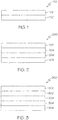
- Fig. 1 depicts an embodiment of print layer 100 having layer 102, which includes at least one high absorption capacity material and at least one low absorption capacity material, and layer 102', which includes the same composition as layer 102 but further includes absorbing particles.
- adhesive such as a pressure sensitive adhesive, may be disposed upon an outer face of the film and a release liner (not shown) may optionally be in contact with the adhesive such that the adhesive is between the release liner and the outer face of the film.
- a film of the present invention may be a single layer consisting of only the printing layer.
- an adhesive such as a pressure sensitive adhesive, may be applied directly upon that layer.
- Each layer of a multilayer print layer may be of the same thickness or may have varying thicknesses.
- a multilayer print layer may have a morphological gradient.
- a print layer may include a first layer in which PMMA is the major component of the blend in the layer and a second layer having the same blend components as the first layer but in which PMMA is the minor component. This may create different absorption capacity between the two adjacent layers forming the image receptive layer.
- the print layer may be formulated to include an ultraviolet stabilizer package in some embodiments, particularly when the materials are intended to be used for outdoor display.
- a suitable ultraviolet stabilizer may include the ultraviolet light stabilizer Ampacet UV 10561, available from Ampacet Corporation.
- the ultraviolet stabilizer package may include free radical scavengers and an ultraviolet light stabilizer. Free radical scavengers, such as hindered amine light stabilizer (HALS), may be present, alone or in addition to UV light stabilizers, in an amount of about 0.05 to about two weight percent per layer, and the UV light stabilizers, such as benzophenone, can be present in amounts ranging from 0.1 to about 5 weight percent per layer.
- HALS hindered amine light stabilizer
- Such ultraviolet stabilizer packages may be included in the print layer. In multilayer print layers, such ultraviolet packages may be included in some or all of the layers of the print layer.
- print layers of the present invention may also or alternatively include heat stabilizers.
- Heat stabilizers may include Ferro 1237, Ferro 1720, and Synpron 1163, all available from Ferro Corporation Polymer Additives Division, and Mark V 1923, available from Witco Corp.
- heat stabilizers may be present in an amount from about 0.2 to about 0.15 percent by total weight of a print layer, including each intermittent value therein. In multilayer print layers, such heat stabilizers may be included in some or all of the layers of the print layer.
- a print layer may also include a compatibilizer.
- a suitable compatibilizer may include a block copolymer.
- styrene-ethylene-butylene-styrene may be included as a compatibilizer in a print layer, such as in a print layer having a blend of PMMA and ethylene copolymer.
- a compatibilizer also may improve the gloss of the print layer in some embodiments. In multilayer print layers, such compatibilizers may be included in some or all of the layers of the print layer.
- print layers of the present invention may also include one or more process aids, such as Ampacet 10919, which is available from Ampacet Corporation.
- some print layer embodiments may include a flame retardant compound.
- some embodiments may include FR-2005 (which is a flame retardant and ultraviolet stabilizer and available from Polyfil Corporation).
- the print layer may also include one or more pigments, antiblock agents, and/or matting agents.
- materials of the present invention may also include a tie layer.
- a tie layer may be located between a print layer and a core layer of the film.
- a tie layer may be comprised of any suitable material for a particular embodiment.
- a tie layer may improve the interlayer adhesion between the print layer and the core layer.
- a tie layer may be included if the blend of the print layer includes more than 50% by weight of PMMA.
- Suitable tie layer resins may include, by way of example, ethylene vinyl acetate, such as those sold by Celanese under the Ateva trade name, Elvax resins sold by ExxonMobil, Bynel resins sold by Dupont Corporation, and Evatane resins sold by Arkema.
- other resins suitable for a tie layer may include random terpolymer of ethylene, vinyl acetate and maleic anhydride, such as OREVAC-T9304 sold by Arkema, and materials of similar structure.
- Embodiments of the present invention may also include a core layer.
- core layers may be comprised of any material to provide suitable mechanical strength and a desired opacity to the film.
- any suitable olefin polymer or combination of olefin polymers may be included in the core layer.
- a core layer may be comprised of any suitable olefin polymer.
- a core layer may comprise polyethylene, such as low density polyethylene and/or linear low density polyethylene may be present in the core layer. In other embodiments medium density and/or high density polyethylene may be present in the core layer.
- the core layer may optionally include color pigments.
- the present invention may also include an adhesive layer.
- the adhesive layer may include ethylene vinyl acetate.
- the adhesive layer may also include polyethylene, such as low density polyethylene and/or linear low density polyethylene.
- An adhesive layer may also have one or more ultraviolet stabilizers, process aids, and/or flame retardants.
- a suitable adhesive may be applied to the adhesive layer, optionally with a release liner, in some embodiments.
- Fig. 2 provides an exemplary embodiment of a film of the present invention. As shown, Fig. 2 depicts a film 200 having a print layer 202, a tie layer 204, a core layer 206, and an adhesive layer 208.
- the layers of this example may have the compositions as described above.
- Fig. 3 provides another exemplary embodiment of a film of the present invention.
- Fig. 3 depicts a film 300 having a multilayer print layer including layer 302 and layer 302', a tie layer 304, a core layer 306, and an adhesive layer 308.
- the layers of this example may have the compositions as described above.
- the multilayer print layer may optionally create a morphological gradient.
- films of the present invention may also include a pressure sensitive adhesive layer and a releasable liner.
- the adhesive may be applied upon any suitable layer of the film, such as, for example, an adhesive layer. In single layer embodiments, the adhesive may be applied directly upon that single layer.
- the release liner may be position adjacent the adhesive such that the adhesive is disposed between the release liner and the film.
- films of the present invention may be prepared using any suitable process.
- films of the present invention may be prepared using cast film processes, blown film processes, and extrusion and coextrusion processes.
- Films of the present invention may be configured to provide suitable qualities for printing, such as receiving ink from a printer, including ink jet printers.
- the ink absorption capacity and the absorption speed of the film, and specifically the print layer of a film provide a suitable printing surface for good quality printing.
- films of the present invention may dry suitably such that the ink does not remain wet for an undesirable period of time, and such films may also dry without significant cracking in the ink.
- films having a total thickness of 2.5 to 3.2 mils were prepared.
- the films were tested using a core layer comprised of 57% low density polyethylene (such as available from Flint Hills Resources (“FHR")) and 43 % TiO 2 (such as available from Ampacet Corporation) and an adhesive layer of 60% low density polyethylene, 30% Ampacet 111712, and 10% ethylene vinyl acetate.
- FHR Flint Hills Resources
- TiO 2 such as available from Ampacet Corporation
- Kraton FG1924G A linear triblock copolymer based on styrene and ethylene/butylene with a polystyrene content of 13% available from Kraton Polymers. Primacor 1321 An ethylene acrylic acid copolymer available from Dow Chemical. Kraton G 2832 A styrene-ethylene/butylenes-styrene (SEBS) block copolymer available from Kraton Polymers. Denka TH-11 A styrene butadiene PMMA copolymer available from Denka Corporation. LA 2250 Methyl methacrylate-butyl acrylate triblock copolymers available from Kuraray Co., Ltd.
- Cadence GS2 PETG copolyester available from Eastman Chemicals EA3400 General purpose crystal polystyrene available from Americas styrenics Ateva 1821
- Multilayer films were produced using a conventional 4-layer cast film co-extrusion process.
- Each of the four extruders A, B, C, D supplied a melt formulation to a feedblock where the melts were combined to form a single molten stream consisting of four different layers.
- both extruders A and B were fed with the print layer formulation as indicated in the following table.
- Extruders C was fed with molten layer of linear low density polyethylene for forming the core layer of the film and linear low density polyethylene and ethylene vinyl acetate for forming the adhesive layer were fed through extruder D.
- the extrudate from the die was cooled on a matte chill roll having a surface roughness average (Ra) of 40.
- the print layer contacted the chill roll during the cooling process with a chill roll temperature set at 90° F and an airknife speed of 60 Hz.
- Table I shows the formulations used in the different extruders. In some variations in Example I, no tie layer was included in the film.
- the films were tested for printability using eco-sol and latex inkjet systems.
- printing of a multicolor test image was performed using a Roland Soljet Pro II XC-540 printer (available from Roland Company) equipped with eco-sol Max inkjet inks, and an HP Designjet L25500 printer (available from HP) equipped with HP 789 latex inks.
- print qualities were observed and recorded as reported in Table I below.
- "NM" designates that the value was not measured.
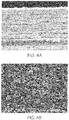
- Figs. 4A-4B scanning electron microscope images were obtained for some of the examples in Table I.
- Fig. 4A is a scanning electronic microscope image of the film having a print layer of 83% Arkeman HIF-7 and 17% Lotryl 29MA03
- Fig. 4B is an image of a film having a print layer of 30% Arkema HFI-7 and 70% Lotryl 29MA03.
- the blend forming the print layer shows discrete domains, which indicates an incompatible blend.
- This incompatable blend is further confirmed by the DMA profile, which is shown in Fig. 4C .
- This profile depicts distinct glass transition temperatures (Tg) for the separate components of the blend.
- Tg glass transition temperatures
- a comparison shows that the modulus of the blend lies between the modulus of each of the two components used to form the blend.
- a multilayer film was prepared similar to Example I except the print layer included two layers comprised a blend of Plexiglas HFI-7 with different polymers at different ratios in the adjacent layers such that the absorption capacities of the two adjacent layers were different.
- the two adjacent layers collectively form the print layer of the film, and the print layer (including all layers in the print layer) was about 0.6 to about 1 mil thick.
- Table II shows the formulations used in the two adjacent layers.
- the core layer and the adhesive layers were the same as in Example I.
- the films of this example were then tested in the same manner described above for Example I, and the results are recorded below in Table II.
- a morphological gradient is created in the print layer resulting in a print layer with varying absorption capacities across the print layer thickness.
- Multilayer films similarto Example I were created by co-extruding the layers as described in Example I but using a PMMA copolymer.
- the core layer and the adhesive layers were the same as in Example I.
- the copolymers of PMMA used in the blends are provided in Table III below. Films indicated with an asterisk (*) were nipped to a matte roll during the extrusion process. The films of this example were then tested in the same manner described above for Example I, and the results are recorded below in Table III.
- Example V was a multilayer film produced similar to the Example I except that the print layer included a blend of PMMA and an ethylene-based copolymer and a block copolymer to improve the phase compatibility and, consequently, the gloss of the print surface.
- the components for the print layer were first compounded using a twin screw extruder equipped with a pelletizer. The compounded pellets were then fed into the single screw extruder as described in Example I. Printability was tested with Roland eco-sol system described above, which had been established in previous testing as the most difficult solvent to print, and HP Patex L25500 printers. The copolymers and layers are listed in Table IV.
- Example V was a multilayer film formed similar to Example III above but using PMMA from three different sources.
- the Parapet TNA was sourced from Kuraray America and the nanostrength polymers were obtained from Arkema.
- the print layer formulation was pre-compounded using a twin screw extruder as described in Example IV.
- the preformed pellet was fed into a screw extruder and co-extruded into a multilayer film.
- the resulting multilayer films were evaluated using the same Roland eco solvent printer discussed above and a Mimaki JV33 (mild solvent) inkjet printer available form Mimaki, USA.
- the addition of block copolymer to the blend as a compatibilizer may improve the print quality of the image as well as the structural compatibility with ethylene methacrylate.
- Nanostrength E21 which has polybutadiene midblock, shows better gloss and print characteristics than Nanostrength M52, which has poly(butyl acrylate) midblock.
- multilayer films were formed similar to Example III.
- the print layer formulation was pre-compounded into a pellet before being fed into a single screw extruder.
- extrudate from the die was cooled onto a chrome roll and nipped with a rubber roll to improve the surface gloss of the incompatible blend layer.
- Table VI The formulations are listed in Table VI below.
- the films were tested for printability and gloss by printing the image using a variety of inkjet systems.
- the gloss of the film was tested before and after printing the image.
- a Mimaki UJF 3042 (UV inkjet) printer available from Mimaki USA was also used in this testing. The testing results are provided in Table VI below.
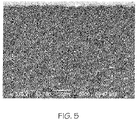
- Fig. 5 is a scanning electron microscope cross-section image of a print layer formulation having 30% Plexiglas HFI-7, 60% Lotryl 29MA03, and 10% Kraton G1657 (Sample 2 in Table VI). It was observed in this image that the copolymer formulation in the print layer reduced the size of the domains of the incompatible blend.
- the print images obtained from the Roland XC-540 (eco-sol) printer, HP L25500 (latex) printer, and Mimaki JV33 (mild solvent) printers were further analyzed using a QEA PIAS-II meter to determine the dot size and ink bleeding characteristics of the print quality obtained from the multilayer films of the present invention against Truelmpact ("TMP") 7000 (sustainable print media sold by Avery Dennison Corporation) and the standard vinyl products under the trade name MPI2105 and MPI 2900 also sold by Avery Dennison Corporation.
- TMP Truelmpact
- both the dot sizes and the bleed characteristics of the multilayer films of the present invention are similar in quality to known vinyl products in the market.
- the print quality between the multilayer films of the present invention are similar to the accepted print quality of the known vinyl media.
- Multilayer films were formed similar to Example III.
- the print layer formulation of 60% Lotryl 29MA03 and 40% Plexiglas HFI-7 was pre-compounded using a twin screw extruder into a pellet before being fed into a single screw extruder.
- the extruder RPM values were changed to create three different samples with different print layer thicknesses.
- a minimum thickness of the print layer should be greater than 0.38 mils to achieve drying of the image.
- films of the present invention may be used for any suitable purpose.
- films of the present invention may be printed to create signs, posters, banners, and other printed materials. Films of the present invention may be printed upon using a selection of one or more inks from a variety of inks.
- films of the present invention may be suitable for inkjet printing. Generally in inkjet printing, ink is deposited onto the film surface as dots, which then spread and join together to provide, ideally, a substantially uniform appearance. As demonstrated by the examples above, films of the present invention do not, in some embodiments, require a specific type of ink but may be suitably printed with one or more of a variety of suitable inks for inkjet printing.
- the present invention further relates to the following items:
Landscapes
- Chemical & Material Sciences (AREA)
- Chemical Kinetics & Catalysis (AREA)
- Manufacturing & Machinery (AREA)
- Engineering & Computer Science (AREA)
- Medicinal Chemistry (AREA)
- Health & Medical Sciences (AREA)
- Materials Engineering (AREA)
- Polymers & Plastics (AREA)
- Organic Chemistry (AREA)
- Inorganic Chemistry (AREA)
- Laminated Bodies (AREA)
- Ink Jet Recording Methods And Recording Media Thereof (AREA)
- Adhesives Or Adhesive Processes (AREA)
- Tents Or Canopies (AREA)
- Lining Or Joining Of Plastics Or The Like (AREA)
Abstract
Description
- The present application claims the benefit of
U.S. Provisional Application No. 61/921,641 filed December 30, 2013 - Films may be used for printing materials, such as signs and banners. Inkjet printers may be used to print upon such materials using solvent, eco-solvent, mild solvent, latex, and/or ultraviolet ("UV") inks. The present invention includes films for printing and methods of their manufacture.
- In one embodiment, the invention includes a printing layer of a film comprising a blend of at least one high absorption capacity material and at least one low absorption capacity material.
- In another embodiment, a film for printing. The film includes a print layer, a core layer, and an adhesive layer, and the core layer is between the print layer and the adhesive layer. In addition, the printing layer includes a blend of at least one high absorption capacity material and at least one low absorption capacity material.
- The following description illustrates one or more embodiments of the invention and serves to explain the principles and exemplary embodiment of the invention.
-
-
Fig. 1 depicts an exemplary embodiment of a film of the present invention; -
Fig. 2 depicts an additional exemplary embodiment of a film of the present invention; -
Fig. 3 depicts an additional exemplary embodiment of a film of the present invention; -
Fig. 4A is an electron scanning microscope image of a printing layer embodiment; -
Fig. 4B is an electron scanning microscope image of an additional printing layer embodiment; -
Fig. 4C is a DMA profile for the printing layers ofFig. 4A andFig. 4C ; and -
Fig. 5 is an electron scanning microscope image of an additional printing layer embodiment. - Reference will now be made in detail to exemplary embodiments of the present invention, one or more examples of which are illustrated in the accompanying drawings. Each example is provided by way of explanation of the invention and not by limitation of the invention. It will be apparent to those skilled in the art that modifications and variations can be made in the present invention without departing from the scope or spirit thereof. For instance, features illustrated or described as part of one embodiment may be used on another embodiment to yield a still further embodiment. Thus, it is intended that the present invention covers such modifications and variations as come within the scope of the appended claims and their equivalents. In addition, the use of reference characters with the same two ending digits as other reference characters to indicate structure in the present specification and drawings, without a specific discussion of such structure, is intended to represent the same or analogous structure in different embodiments. Unless otherwise indicated herein, all percentages used for a component refer to the percentage by weight.
- In some embodiments, the present invention includes films and other materials for printing or marking with ink. In some embodiments, materials of the present invention may include a print layer (also interchangeably referenced as a printing layer herein), an optional tie layer, a core layer, and an adhesive layer. In other embodiments, such materials may exclude certain layers. In some embodiments, the total film thickness may be from about 2.5 mils to about 3.2 mils.
- Print layers of the present invention may include a blend of at least one high absorption capacity material, such as poly(methyl methacrylate) ("PMMA"), polystyrene, polyethylene terephthalate glycol-modified (PETG), and styrene-based copolymers, impact modified polystyrene, styrene acrylic copolymer, styrene-olefin copolymer, styrene-acrylic-olefin copolymer, acrylonitrile butadinene styrene polymer, styrene acrylonitrile polymer, and copolyester polymer, and at least one low absorption capacity material, such as an olefin polymer, including random copolymers and/or block copolymers. By way of example, suitable olefin copolymers may include, without limitation, ethylene acrylate coplomers, such as ethylene acrylic acid (EAA), ethylene methyl acrylate (EMA), and ethylene butyl acrylate (EBA), ethylene vinyl acetate (EVA), and/or ethylene acrylic ester terpolymer. As used herein, unless the context dictates otherwise, the term copolymers may also reference terpolymers. In one particular embodiment of the present invention, the print layer includes PMMA and an olefin polymer, including random copolymers and/or block copolymers.
- Any suitable formulation may be used. In some embodiments, at least 10% low absorption capacity material may be present in the formulation. In other embodiments, at least 17% low absorption capacity material may be present in the formulation. In addition, in some embodiments at least 20% high absorption capacity material may be present in the formulation. In some embodiments, about 20% to about 83% high absorption capacity material may be present. In still some embodiments, less than 83% high absorption capacity material may be present. Notably, neither PMMA nor olefin copolymers were observed during testing to independently provide suitable materials for ink printing.
- A print layer may have any thickness suitable for a particular embodiment. In some embodiments, a print layer may have a thickness greater than about 0.38 mils. In some embodiments, a print layer may have a thickness in the range of about 0.6 mils to about 1.0 mils, including each intermittent value therein. In other embodiments, a print layer may have a thickness in the range of about 0.6 mils to about 3.0 mils. In still other embodiments, a print layer may have thickness up to about 6.0 mils. Any remaining layers of the film may be of any suitable thickness for a particular embodiment.
- In some embodiments, the print layer may include multiple adjacent layers. For example, in some embodiments, a print layer may include two adjacent layers, wherein each layer includes the same blend of at least one high absorption capacity material and at least one low absorption capacity material. In addition, in some embodiments at least one layer of the two adjacent layers further includes absorbing particles, such as silica, alumina silicate, nano clay, calcium carbonate, zinc oxide, titanium dioxide, and/or other absorbing particles or other suitable absorbing particles or resins. In some embodiments, the particle sizes may be in the range of about 0.1 to about 10 microns, including each intermittent value therein. In addition, multiple particle sizes may be present in some embodiments. For example, various particle sizes may be present in a single print layer in some embodiments. In addition, embodiments having multiple print layers may each have either the same or distinct particle sizes.
- By way of example,
Fig. 1 depicts an embodiment ofprint layer 100 havinglayer 102, which includes at least one high absorption capacity material and at least one low absorption capacity material, and layer 102', which includes the same composition aslayer 102 but further includes absorbing particles. Although not shown, adhesive, such as a pressure sensitive adhesive, may be disposed upon an outer face of the film and a release liner (not shown) may optionally be in contact with the adhesive such that the adhesive is between the release liner and the outer face of the film. - In some other embodiments, additional layers having either the same or different compositions may be included in a multilayer print layer. In still other embodiments, a film of the present invention may be a single layer consisting of only the printing layer. In such embodiments, an adhesive, such as a pressure sensitive adhesive, may be applied directly upon that layer. Each layer of a multilayer print layer may be of the same thickness or may have varying thicknesses.
- In some embodiments of the present invention, a multilayer print layer may have a morphological gradient. In such embodiments, a print layer may include a first layer in which PMMA is the major component of the blend in the layer and a second layer having the same blend components as the first layer but in which PMMA is the minor component. This may create different absorption capacity between the two adjacent layers forming the image receptive layer.
- The print layer may be formulated to include an ultraviolet stabilizer package in some embodiments, particularly when the materials are intended to be used for outdoor display. In some embodiments, a suitable ultraviolet stabilizer may include the ultraviolet light stabilizer Ampacet UV 10561, available from Ampacet Corporation. By way of further example, the ultraviolet stabilizer package may include free radical scavengers and an ultraviolet light stabilizer. Free radical scavengers, such as hindered amine light stabilizer (HALS), may be present, alone or in addition to UV light stabilizers, in an amount of about 0.05 to about two weight percent per layer, and the UV light stabilizers, such as benzophenone, can be present in amounts ranging from 0.1 to about 5 weight percent per layer. Such ultraviolet stabilizer packages may be included in the print layer. In multilayer print layers, such ultraviolet packages may be included in some or all of the layers of the print layer.
- Similarly, print layers of the present invention may also or alternatively include heat stabilizers. Heat stabilizers may include Ferro 1237, Ferro 1720, and Synpron 1163, all available from Ferro Corporation Polymer Additives Division, and Mark V 1923, available from Witco Corp. By way of example, heat stabilizers may be present in an amount from about 0.2 to about 0.15 percent by total weight of a print layer, including each intermittent value therein. In multilayer print layers, such heat stabilizers may be included in some or all of the layers of the print layer.
- In some embodiments, a print layer may also include a compatibilizer. By way of example, a suitable compatibilizer may include a block copolymer. In some particular embodiments, styrene-ethylene-butylene-styrene may be included as a compatibilizer in a print layer, such as in a print layer having a blend of PMMA and ethylene copolymer. A compatibilizer also may improve the gloss of the print layer in some embodiments. In multilayer print layers, such compatibilizers may be included in some or all of the layers of the print layer.
- Some embodiments of print layers of the present invention may also include one or more process aids, such as Ampacet 10919, which is available from Ampacet Corporation. In addition, some print layer embodiments may include a flame retardant compound. By way of example, some embodiments may include
FR-2005 - As indicated, materials of the present invention may also include a tie layer. When present, a tie layer may be located between a print layer and a core layer of the film. A tie layer may be comprised of any suitable material for a particular embodiment. In some embodiments, a tie layer may improve the interlayer adhesion between the print layer and the core layer. In some embodiments, a tie layer may be included if the blend of the print layer includes more than 50% by weight of PMMA.
- Suitable tie layer resins may include, by way of example, ethylene vinyl acetate, such as those sold by Celanese under the Ateva trade name, Elvax resins sold by ExxonMobil, Bynel resins sold by Dupont Corporation, and Evatane resins sold by Arkema. In addition, other resins suitable for a tie layer may include random terpolymer of ethylene, vinyl acetate and maleic anhydride, such as OREVAC-T9304 sold by Arkema, and materials of similar structure.
- Embodiments of the present invention may also include a core layer. Such core layers may be comprised of any material to provide suitable mechanical strength and a desired opacity to the film. In some embodiments, any suitable olefin polymer or combination of olefin polymers may be included in the core layer. By way of example, a core layer may be comprised of any suitable olefin polymer. In some embodiments, a core layer may comprise polyethylene, such as low density polyethylene and/or linear low density polyethylene may be present in the core layer. In other embodiments medium density and/or high density polyethylene may be present in the core layer. In addition, the core layer may optionally include color pigments.
- In some embodiments, the present invention may also include an adhesive layer. The adhesive layer may include ethylene vinyl acetate. In some embodiments, the adhesive layer may also include polyethylene, such as low density polyethylene and/or linear low density polyethylene. An adhesive layer may also have one or more ultraviolet stabilizers, process aids, and/or flame retardants. A suitable adhesive may be applied to the adhesive layer, optionally with a release liner, in some embodiments.
-
Fig. 2 provides an exemplary embodiment of a film of the present invention. As shown,Fig. 2 depicts afilm 200 having aprint layer 202, atie layer 204, acore layer 206, and anadhesive layer 208. The layers of this example may have the compositions as described above. -
Fig. 3 provides another exemplary embodiment of a film of the present invention. As shown,Fig. 3 depicts afilm 300 having a multilayer printlayer including layer 302 and layer 302', a tie layer 304, acore layer 306, and anadhesive layer 308. The layers of this example may have the compositions as described above. In this embodiment, the multilayer print layer may optionally create a morphological gradient. - In some embodiments, as indicated above, films of the present invention may also include a pressure sensitive adhesive layer and a releasable liner. The adhesive may be applied upon any suitable layer of the film, such as, for example, an adhesive layer. In single layer embodiments, the adhesive may be applied directly upon that single layer. The release liner may be position adjacent the adhesive such that the adhesive is disposed between the release liner and the film.
- Films of the present invention may be prepared using any suitable process. By way of example, films of the present invention may be prepared using cast film processes, blown film processes, and extrusion and coextrusion processes.
- Films of the present invention may be configured to provide suitable qualities for printing, such as receiving ink from a printer, including ink jet printers. In such embodiments, the ink absorption capacity and the absorption speed of the film, and specifically the print layer of a film, provide a suitable printing surface for good quality printing. In such embodiments, films of the present invention may dry suitably such that the ink does not remain wet for an undesirable period of time, and such films may also dry without significant cracking in the ink. The following examples provide additional details of exemplary embodiments of films of the present invention.
- In the following examples, films having a total thickness of 2.5 to 3.2 mils were prepared. In addition, the films were tested using a core layer comprised of 57% low density polyethylene (such as available from Flint Hills Resources ("FHR")) and 43 % TiO2 (such as available from Ampacet Corporation) and an adhesive layer of 60% low density polyethylene, 30
% Ampacet 111712, and 10% ethylene vinyl acetate. For all examples, the gloss was measured using a BYK Gardner gloss meter, and the gloss reported is the average of the gloss measured in the machine direction (MD) and the cross direction (CD). The reference table below provides an index to materials referenced in the following examples:Material Description and Supplier PLEXIGLAS HFI-7 PMMA resin available from Arkema Lotryl 29MA03 Random copolymer of ethylene and methyl acrylate available from Arkema under the brand name Lotryl Lotader AX 8900 Random terpolymer of ethylene, methyl acrylate, and glycidyl methacrylate available from Arkema under the brand name Lotader Lotader 4700 Random terpolymer of ethylene, ethyl acrylate, and maleic anhydride available from Arkema under the brand name Lotader Elvaloy 4924 An ethylene/vinyl acetate/carbon monoxide (E/VA/CO) copolymer available from DuPont. Kraton FG1924G A linear triblock copolymer based on styrene and ethylene/butylene with a polystyrene content of 13% available from Kraton Polymers. Primacor 1321 An ethylene acrylic acid copolymer available from Dow Chemical. Kraton G 2832 A styrene-ethylene/butylenes-styrene (SEBS) block copolymer available from Kraton Polymers. Denka TH-11 A styrene butadiene PMMA copolymer available from Denka Corporation. LA 2250 Methyl methacrylate-butyl acrylate triblock copolymers available from Kuraray Co., Ltd. K resin KR 53 Styrene-Butadiene Copolymer available from Cheveron Phillips Chemical Company LP. Styrenics 5410 High impact polystyrene available from Ineos Styrenics LA 4285 (meth) acrylic thermoplastic elastomer from Kuraray Co Ltd. Septon Q Thermoplastic elastomer from Kuraray Co Ltd. Levepren 400 Ethylene vinyl acetate (40 % VA content) from Lanxess Krystalgran PN03-221 Thermoplastic polyurethane from Huntsman Co. Denka TH-11 Styrene-butadiene-PMMA available from Denka Corporation. Denka TX-100S Styrene-PMMA available from Denka Corporation. Nanostrength M51 PMMA polybutylacrylate-PMMA available from Arkema. Cadence GS2 PETG copolyester available from Eastman Chemicals EA3400 General purpose crystal polystyrene available from Americas styrenics Ateva 1821 A EVA copolymer with 18% VA content available from AT Plastics Inc. Zylar 960 impact modified styrene acrylic copolymer available from Ineos styrenics - Multilayer films were produced using a conventional 4-layer cast film co-extrusion process. Each of the four extruders A, B, C, D supplied a melt formulation to a feedblock where the melts were combined to form a single molten stream consisting of four different layers. To achieve a print layer thickness of about 0.6 to about 1.0 mils, both extruders A and B were fed with the print layer formulation as indicated in the following table. Extruders C was fed with molten layer of linear low density polyethylene for forming the core layer of the film and linear low density polyethylene and ethylene vinyl acetate for forming the adhesive layer were fed through extruder D. The extruder zone temperatures were Z1=390°F, Z2=420° F, and Z3=420° F and the die temperature was 420° F. The extrudate from the die was cooled on a matte chill roll having a surface roughness average (Ra) of 40. The print layer contacted the chill roll during the cooling process with a chill roll temperature set at 90° F and an airknife speed of 60 Hz. Table I shows the formulations used in the different extruders. In some variations in Example I, no tie layer was included in the film.
- The films were tested for printability using eco-sol and latex inkjet systems. In the particular examples, printing of a multicolor test image was performed using a Roland Soljet Pro II XC-540 printer (available from Roland Company) equipped with eco-sol Max inkjet inks, and an HP Designjet L25500 printer (available from HP) equipped with HP 789 latex inks. In addition, print qualities were observed and recorded as reported in Table I below. As used below and in subsequent charts, "NM" designates that the value was not measured.
Table I Print Layer Blend Unprinted Print Layer 60° Gloss Roland Soljet Pro II XC-540 Quality Roland Soljet Pro II XC-540 Printed Image 60° Gloss HP Printer (L25500) Quality 100 % PLEXIGLAS HFI-7 58 Cracks in image NM Dry, image is good 83 % PLEXIGLAS HFI-7 51 Dry to touch, no cracks 55 NM 17 % Lotryl 29MA03 75 % PLEXIGLAS HFI-7 34 Dry to touch, no cracks 49 NM 25 % Lotryl 29MA03 75 % PLEXIGLAS HFI-7 15 Dry to touch, no cracks 39 NM 25 % Lotader AX 8900 75 % PLEXIGLAS HFI-7 19 Dry to touch, no cracks 41 NM 25 % Lotader 4700 40 % PLEXIGLAS HFI-7 17 Dry to touch, no cracks, 62 Dry, no cracks, good image 40 % Ethylene vinyl acetate (18 % VA) 20 % Ethylene vinyl acetate (26 % VA) 75 % PLEXIGLAS HFI-7 34 Dry to touch, no cracks 52 NM 25 % Ethylene vinyl acetate 70 % PLEXIGLAS HFI-7 23 Dry to touch, no cracks 45 NM 30 % Elvaloy 4924 17 % PLEXIGLAS HFI-7 19 Image is wet NM NM 83 % Lotryl 29MA03 50 % PLEXIGLAS HFI-7 12 Dry to touch, no cracks 20 NM 50 % Lotader AX 8900 70 % PLEXIGLAS HFI-7 32 Dry to touch, racks in image NM No cracks 30 % Kraton FG1924G 70 % PLEXIGLAS HFI-7 NM Dry to touch, coalescence 37 NM 30 % Primacor 1321 50 % PLEXIGLAS HFI-7 Dry to touch, no cracks 12 NM 50 % Lotader 4700 30 % PLEXIGLAS HFI-7 70 % Lotryl 29MA03 16 Dry to touch, no cracks NM NM 30 % PLEXIGLAS HFI-7 20 Dry to touch, no cracks 55 Image is good, no cracks 20 % Ethylene vinyl acetate (26 % VA) 30 % Ethylene vinyl acetate (18 % VA) 20 % Kraton G 2832 30 % PLEXIGLAS HFI-7 17 Dry to touch, no cracks 61 Image is good, no cracks 30 % Ethylene vinyl acetate (26 %) 40 % Ethylene vinyl acetate (18 %) 80 % PLEXIGLAS HFI-7 76 Dry to touch, Cracks NM Image is good, no cracks 20 % Denka TH-11 (Styrene butadiene PMMA copolymer) 50 % Plexiglas HFI-7 NM Dry, image is slightly washed (poor color density) NM Good image 50 % LA 2250 50 % Plexiglas HFI-7 NM Good image NM Good image 25 % LA 2250 25 % Lotryl 29MA03 50 % Styrenics 5410 NM Good image NM Good image 50 % Kraton G 2832 50 % LA 4285 NM Good image NM Good image 50 % Lotryl 29MA03 50 % Plexiglas HFI-7 NM Good image NM Good image 50 % Septon Q 50 % Plexiglas HFI-7 NM Good image NM Good image 50 % Levepren 400 100% EA3400 NM Very light color density; film surface dissolved by the ink drops locally and, as result, it lots of tiny dents formed on the surface NM Good image 100% Ateva 1812A NM print is very wet, severe ink bleeding NM Good image 70% Styrenic NM Dry to touch, good image NM NM 5410+30% Kraton G2832 30% EA3400+70% NM Dry to touch, NM Good image Ateva 1821A good image 50% EA3400+50% NM Dry to touch, good image NM Good image Ateva 1821A 60% EA3400+40% NM Dry to touch, good image NM Good image Ateva 1821A 60% EA3400+30% NM Dry to touch, good image NM Good image Ateva 1821A+10% Kraton G2832 70% EA3400+30% NM Dry to touch, good image NM Good image Ateva 1821A 50% Zylar 960+50% NM Dry to touch, good image NM Good image Ateva 1821A 50 % Cadence GS2 NM Dry to touch, good image NM Good image 50 % Lortyl 29MA03 - Thus, it was observed that a suitable blend of high absorption material and low absorption material in a print layer resulted in suitable and improved print quality. Although ink cracking had been observed in films having over 83% PMMA without olefin copolymer in the print layer, such cracking was not shown for blends with 83% or less PMMA when blended with at least 10% by weight of olefin copolymer. In the Eco-sol inkjet printing, crystal polystyrene, impact modified styrene, and acrylic styrene copolymer themselves have high ink absorption and may be partially dissolved by an ink solvent at high ink loading, which may result in light color density and appearance of micro ink drop dents on a surface after printing. However, after blending such materials in the print layer with low ink absorption material(s) such as EVA or SEBS, it was observed in testing that the print quality was improved.
- In addition, as shown in
Figs. 4A-4B , scanning electron microscope images were obtained for some of the examples in Table I. In particular,Fig. 4A is a scanning electronic microscope image of the film having a print layer of 83% Arkeman HIF-7 and 17% Lotryl 29MA03 andFig. 4B is an image of a film having a print layer of 30% Arkema HFI-7 and 70% Lotryl 29MA03. As shown in those figures, the blend forming the print layer shows discrete domains, which indicates an incompatible blend. This incompatable blend is further confirmed by the DMA profile, which is shown inFig. 4C . This profile depicts distinct glass transition temperatures (Tg) for the separate components of the blend. Furthermore, as shown in the profile, a comparison shows that the modulus of the blend lies between the modulus of each of the two components used to form the blend. - A multilayer film was prepared similar to Example I except the print layer included two layers comprised a blend of Plexiglas HFI-7 with different polymers at different ratios in the adjacent layers such that the absorption capacities of the two adjacent layers were different. The two adjacent layers collectively form the print layer of the film, and the print layer (including all layers in the print layer) was about 0.6 to about 1 mil thick. Table II shows the formulations used in the two adjacent layers. The core layer and the adhesive layers were the same as in Example I. The films of this example were then tested in the same manner described above for Example I, and the results are recorded below in Table II.
Table II Print Layer I Print layer II Roland Soljet Pro II XC-540 Printed Image 60° Gloss Roland Soljet Pro II XC-540 Quality HP Printer (L25500) Quality 100 % Lotryl 29MA03 30 % PLEXIGLAS HFI-7 NM Image is wet Image good 70 % Lotryl 29MA03 100 % PLEXIGLAS HFI-7 100 % Lotryl29MA03 NM Image is dry, cracks NM 70 % PLEXIGLAS VM-100 50 % PLEXIGLAS VM-100 35 Dry to touch, no cracks Dry, image good 30 % Lotader 4700 50 % Lotader 4700 60 % PLEXIGLAS VM-100 50 % PLEXIGLAS VM-100 17 Dry to touch, no cracks Dry, image good 40 % Lotader 4700 50 % Lotader 4700 70 % PLEXIGLAS HFI-7 50 % PLEXIGLAS HFI-7 37 Dry, coalesce, ink bleed Dry, no cracks, image good 30 % Primacor 1321 50 % Primacor 1321 50 % PLEXIGLAS HFI-7 30 % PLEXIGLAS HFI-7 NM Dry to touch, image good Dry to touch, good image 50 % Lotader 4700 70 % Lotader 4700 40 % PLEXIGLAS HFI-7 50 % PLEXIGLAS HFI-7 23 Dry to touch, image good Dry to touch, image good 60 % Lotader AX 8900 50 % Lotader AX 8900 30 % PLEXIGLAS HFI 10-101 70 % PLEXIGLAS HFI 10-101 32 Dry to touch, image good Dry to touch, image good 70 % Lotader AX8900 30 % Lotader AX 8900 50 % Krystalgran PN03-221 60 % PLEXIGLAS HFI-7 18 Dry to touch, no cracks Dry to touch, image good 50 % PLEXIGLAS HFI-7 40 % Lotader 4603 70 % Krystalgran PN03-221 60 % PLEXIGLAS HFI-7 14 Dry to touch, cracks Dry to touch, image good 30 % PLEXIGLAS HFI-7 40 % Lotader 4603 30 % Krystalgran PN03-221 60 % PLEXIGLAS HFI-7 18 Dry to touch, no cracks Dry to touch, image good 70 % PLEXIGLAS HFI-7 40 % Lotader 4603 50 % PLEXIGLAS HFI-7 30 % PLEXIGLAS HFI-7 13 NM Print is dry, cracks in image 50 % LA2250 70 % Lotryl 29MA03 50 % PLEXIGLAS HFI-7 50 % PLEXIGLAS HFI-7 10 Print is dry, no cracks Print is dry, no cracks 50 % Krystalgran PN03-221 50 % Krystalgran PN03-221 - By using different blend ratios in adjacent layers to form the print layer, a morphological gradient is created in the print layer resulting in a print layer with varying absorption capacities across the print layer thickness.
- Multilayer films similarto Example I were created by co-extruding the layers as described in Example I but using a PMMA copolymer. The core layer and the adhesive layers were the same as in Example I. The copolymers of PMMA used in the blends are provided in Table III below. Films indicated with an asterisk (*) were nipped to a matte roll during the extrusion process. The films of this example were then tested in the same manner described above for Example I, and the results are recorded below in Table III.
Table III Print Layer Formulation Unprinted Film 60° Gloss Roland XC-540 Soljet Pro II Eco-sol max Quality Eco-sol Printed Image 60° Gloss HP Designjet L25500, HP 789 latex ink Quality HP Printed Image 60° Gloss 100 % Denka TH-11 48 Cracks, Washed out image(poor color density) NM Image is good, no cracks 53 50 % Denka TH-11 15 * Dry / no cracks 46 NM NM 50 % Lotryl 29MA03 40 % Denka TH-11 18 * Dry / no cracks 49 Image is good, dry no cracks 20 60 % Lotryl 29MA03 50 % Plexiglas HFI-7 10 Dry to touch, cracks in image NM NM NM 50 % LA 2250 30 % Plexiglas HFI-7 13 Print is wet NM NM NM 70 % LA2250 20 % Denka TX-100S 76 Dry to touch / cracks NM Image is good, no cracks 52 80 % Plexiglas HFI-7 50 % Plexiglas HFI-7 66 Dry to touch, cracks in image NM NM NM 50 % Denka TH-11 40 % SAN 91 Severe cracks, image washed out (poor color density) NM No cracks, dry to touch, image washed out (poor color density) NM 60 % Plexiglas HFI-7 - As shown in Table III, the addition of ethylene acrylic copolymer content in the blend of PMMA or copolymer of PMMA eliminates the cracks that are observed in the image when printed with eco-sol ink.
- Example V was a multilayer film produced similar to the Example I except that the print layer included a blend of PMMA and an ethylene-based copolymer and a block copolymer to improve the phase compatibility and, consequently, the gloss of the print surface. The components for the print layer were first compounded using a twin screw extruder equipped with a pelletizer. The compounded pellets were then fed into the single screw extruder as described in Example I. Printability was tested with Roland eco-sol system described above, which had been established in previous testing as the most difficult solvent to print, and HP Patex L25500 printers. The copolymers and layers are listed in Table IV. The surface gloss of the films were measured using Gardner Glossmeter and are reported below, wherein the data represents the average of the gloss measured in MD and CD. The following materials are also reference in this example:
Trade Name Copolymer Manufacturer Xiran SE 700 Styrene maleic anhydride (15% maleic anhydride) Polyscope Xiran SZ23110 Styrene maleic anhydride (23% maleic anhydride) Polyscope Xiran SZ1570 Styrene maleic anhydride (15% maleic anhydride) Polyscope Kraton G 1726 Styrene-butylene (diblock) Kraton Polymers Kraton G 1657 Styrene-butylene-Styrene (triblock) Kraton Polymers Blendex 6201 Styrene acrylonitrile / Maleic anhydride Galata Chemicals Royaltuf 373P20 50 % Styrene acrylonitrile / 50 % Ethylene propylene diene monomer (EPDM) Chemtura Corporation Nanostrength MAM-M52 PMMA-Poly(butyl acrylate)-PMMA (triblock) Arkema Elvaloy 4926 Ethylene vinylacetate carbon monoxide Dupont Table IV Blend Formulation Unprinted Film 60° Gloss % Eco-sol Eco-Sol Printed Image 60° Gloss HP Latex HP Printed Image 60° Gloss 30% PLEXIGLAS HFI-7 17 Dry, image good 40 Image is good, no cracks 27 50% Lotryl 29MA03 20% Kraton G 1726 25% PLEXIGLAS HFI-7 16 Dry, image good 36 NM NM 55% Lotryl 29MA03 10% Kraton G 1657 10% Xiran SZ15170 25% PLEXIGLAS HFI-7 13 Dry, image good 40 NM NM 65% Lotryl 29MA03 10% Xiran SE 700 30% PLEXIGLAS HFI-7 16 Dry, image good 42 Image is good, no cracks 32 60% Lotryl 29MA03 10% Blendex 6201 30% PLEXIGLAS HFI-7 6 Dry, image good 20 Image is good, no cracks 15 60% Lotryl 29MA03 10% Royaltuf 373P20 30% PLEXIGLAS HFI-7 16 Dry, image good NM Image is good, no cracks 28 50% Lotryl 29MA03 10% Xiran SZ 15170 10% Kraton G 1726 30% PLEXIGLAS HFI-7 16 Dry, image good 39 NM NM 60% Lotryl 29MA03 10% Denka TH-11 30% PLEXIGLAS HFI-7 10 Dry, image good 30 Image is good, no cracks 20 60% Lotryl 29MA03 10% Xiran SZ23110 30% PLEXIGLAS HFI-7 12 Dry, image good 34 NM NM 60% Lotryl 29MA03 10% Xiran SZ15170 53% PLEXIGLAS HFI-7 17 Dry, image good 40 NM NM 37% Lotryl 29MA03 10% Kraton G 2832 65% PLEXIGLAS HFI-7 21 Dry, image good 44 NM NM 25% Lotryl 29MA03 10% Elvaloy 4926 30% PLEXIGLAS HFI-7 16 Dry, image good 42 Image is good, dry, no cracks 39 50% Etylene Vinyl acetate 10% Xiran SZ15170 10% Kraton G 1726 - Example V was a multilayer film formed similar to Example III above but using PMMA from three different sources. With reference to Table V below, the Parapet TNA was sourced from Kuraray America and the nanostrength polymers were obtained from Arkema. The print layer formulation was pre-compounded using a twin screw extruder as described in Example IV. The preformed pellet was fed into a screw extruder and co-extruded into a multilayer film. The resulting multilayer films were evaluated using the same Roland eco solvent printer discussed above and a Mimaki JV33 (mild solvent) inkjet printer available form Mimaki, USA.
Table V Blend Formulation (Print layer) Core Layer Formulation Adhesive Layer Formulation 60° Gloss Roland Eco-sol Printer (Comments / 60° Gloss) Mimaki Mild solvent Printer (Comments/ 60° Gloss) 30 % Parapet TNA 57 % FHR LDPE 60 % LDPE 9 Dry to touch, good image Dry to touch, good image 60 % Lotryl 29MA03 43 % Ampacet TiO2 30 % Ampacet 111712 10 % Kraton G 1657 10 % EVA 40 26 40 % Parapet TNA 57 % FHR LDPE 60 % LDPE 9 Dry to touch, good image Dry to touch, good image 52 % Lotryl 29MA03 43 % Ampacet TiO2 30 % Ampacet 111712 8 % Kraton G 1657 10 % EVA 38 24 40 % Parapet TNA 57 % FHR LDPE 60 % LDPE 8 Dry to touch, poor color density Dry to touch, poor color density 52 % Lotryl 29MA03 43 % Ampacet TiO2 30 % Ampacet 111712 8 % Xiran SE700 10 % EVA 17 17 40 % Plexiglas 57 % FHR LDPE 60 % LDPE 25 Dry to touch, good image Dry to touch, good image HFI-7 52 % Lotryl 43 % Ampacet TiO2 30 % Ampacet 111712 29MA03 8 % Kraton G 1657 10 % EVA 47 50 % 57 % FHR LDPE 60 % LDPE 28 Dry to touch, very good image Dry to touch, very good image Nanostrength E21 50 % Lotryl 43 % Ampacet TiO2 30 % Ampacet 111712 29MA03 10 % EVA 49 57 50% 57 % FHR LDPE 60 % LDPE 17 Dry to touch Dry to touch Nanostrength MAM-M52 43 % Ampacet TiO2 30 % Ampacet 111712 25 30 50 % Lotryl 29MA03 10 % EVA 100 % 57 % FHR LDPE 60 % LDPE N/A Dry, washed out image (poor color density) N/A Nanostregth MAM-M52 43 % Ampacet TiO2 30 % Ampacet 111712 10 % EVA - As demonstrated by the results above, the addition of block copolymer to the blend as a compatibilizer may improve the print quality of the image as well as the structural compatibility with ethylene methacrylate. In some embodiments, it was also observed that Nanostrength E21, which has polybutadiene midblock, shows better gloss and print characteristics than Nanostrength M52, which has poly(butyl acrylate) midblock.
- In this example, multilayer films were formed similar to Example III. The print layer formulation was pre-compounded into a pellet before being fed into a single screw extruder. In addition, extrudate from the die was cooled onto a chrome roll and nipped with a rubber roll to improve the surface gloss of the incompatible blend layer. The formulations are listed in Table VI below.
- The films were tested for printability and gloss by printing the image using a variety of inkjet systems. The gloss of the film was tested before and after printing the image. In addition to the previously-described printers, a Mimaki UJF 3042 (UV inkjet) printer available from Mimaki USA was also used in this testing. The testing results are provided in Table VI below.
Table VI Sample Print Layer Formulation Print Layer Thickness (mils) Unprinted Film 60° Gloss Roland XC-540 (Eco-sol) Inkjet Printer 60° Gloss HP L25550 (Latex ink) Inkjet 60° Gloss Mimaki UJF 3042 (UV ink) Inkjet Printer 60° Gloss Mimaki JV33 (Mild solvent) Inkjet Printer 60° Gloss 1 60 % Lotryl 29MA03 1.2 52 55 59 20 73 40 % Denka TH-11 2 30 % Plexiglas HFI-7 1.25 60 64 67 20 74 60 % Lotryl 29MA03 10 % Kraton G 1657 3 30 % Plexiglas HFI-7 1.08 63 56 54 21 69 60 % Lotryl 29MA03 10 % Denka TH-11 4 25 % Plexiglas HFI-7 1.5 62 61 60 NM 74 50 % Lotryl 29MA03 15 % Denka TH-11 10 % Kraton G 1726 5 30 % Plexiglas HFI-7 1.23 54 62 51 NM 71 60 % Lotryl 29MA03 10 % Polyscope SE700 6 25 % Plexiglas HFI-7 1.40 59 58 59 NM 71 50 % Lotryl 29MA03 15 % Polyscope SE 700 10 % Kraton G 1726 - From the results above, it was observed that the use of a chrome casting roll resulted in improved gloss of the film. For reference, it was observed that the gloss of the films tested above were generally comparable to the gloss of the Truelmpact ("TMP") 7000 series product sold commercially by Avery Dennison Corporation, which is a gloss in the range of about 50 to about 70.
- Scanning electron microscope images were also obtained for some of the films in Table IV. For example,
Fig. 5 is a scanning electron microscope cross-section image of a print layer formulation having 30% Plexiglas HFI-7, 60% Lotryl 29MA03, and 10% Kraton G1657 (Sample 2 in Table VI). It was observed in this image that the copolymer formulation in the print layer reduced the size of the domains of the incompatible blend. - In addition, the films from Table VI were tested for printability on each printer described in Table Vi. Upon review, the print image from each printer was of good and suitable quality. In addition, no image showed any print defects.
- The print images obtained from the Roland XC-540 (eco-sol) printer, HP L25500 (latex) printer, and Mimaki JV33 (mild solvent) printers were further analyzed using a QEA PIAS-II meter to determine the dot size and ink bleeding characteristics of the print quality obtained from the multilayer films of the present invention against Truelmpact ("TMP") 7000 (sustainable print media sold by Avery Dennison Corporation) and the standard vinyl products under the trade name MPI2105 and MPI 2900 also sold by Avery Dennison Corporation. The following results were recorded:
Table VII: Dot Size Results Print Media Roland XC-540 Eco-sol Mean Dot Size (Micron) HP L25500 Latex Mean Dot Size (Micron) Mimaki Mild Solvent Mean Dot Size (Micron) TrueImpact (TMP 7000) 39.5 41.7 N/A MPI2105 40.4 48 N/A MPI2900 54.2 45 45.5 Sample 1 47.5 N/A 34.3 Sample 2 46.8 N/A 38.6 Sample 3 44.4 39.3 35.5 Sample 4 47.1 38.9 36.4 Sample 5 42.7 N/A 34.5 Sample 6 47.9 N/A 35.5 Table VIII: Color Bleeding Measurements Print Media Roland XC- 540 Width of black line in magenta area (micron) Roland XC- 540 Width of magenta line in black area (micron) HP L2550 Width of black line in magenta area (micron) HP L2550 Width of magenta line in black area (micron) Mimaki Width of black line in magenta area (micron) Mimaki Width of magenta line in black area (micron) TrueImpact (TMP 7000) 1113.0 859.0 1085.0 869.0 N/A N/A MPI2105 1120.7 871.7 1079.3 894.7 N/A N/A MPI 2950 1097.7 904.1 1106.0 898.7 1458.6 1143.9 Sample 1 1113.4 888.3 N/A N/A 1499.3 1148.3 Sample 2 N/A N/A N/A N/A N/A N/A Sample 3 1094.1 869.9 1108.6 872.2 1529.1 1108.7 Sample 4 1141.9 841.9 1141.1 832.3 1567.4 1070.2 Sample 5 1118.0 864.7 N/A N/A 1436.3 1094.5 Sample 6 1149.8 826.1 N/A N/A 1544.6 1065.3 - As shown above, both the dot sizes and the bleed characteristics of the multilayer films of the present invention are similar in quality to known vinyl products in the market. In addition, the print quality between the multilayer films of the present invention are similar to the accepted print quality of the known vinyl media.
- In this example, a Truelmpact overlaminate film sold by AveryDennison Corporation as TOL 7000 series was laminated with the S8072 adhesive, available from Avery Dennison, to the print surface of some of the samples of Example VI. The 60-degree gloss of the TOL 7000 series was measured to be between 80-90. As provided in the results below, it was observed that the gloss of the film with the laminate may be significantly increased with a laminate relative to the original film.
Sample ID Unprinted film gloss Gloss of laminated film Sample 2 67 84 Sample 5 61 85 Sample 6 65 85 - Multilayer films were formed similar to Example III. The print layer formulation of 60% Lotryl 29MA03 and 40% Plexiglas HFI-7 was pre-compounded using a twin screw extruder into a pellet before being fed into a single screw extruder. The extruder RPM values were changed to create three different samples with different print layer thicknesses. The formulations, thicknesses (determined from scanning electron microscope measurements), and results were as follows:
Formulation Print Layer Thickness Eco-sol Printing Comments 40 % Plexiglas HFI-7 1.2 mils Dry to touch, good image 60 % Lotryl 29MA03 40 % Plexiglas HFI-7 0.73 mils Dry to touch, good image 60 % Lotryl 29MA03 40 % Plexiglas HFI-7 0.38 mils Wet in the dark colors 60 % Lotryl 29MA03 - These results suggest that a minimum thickness of the print layer should be greater than 0.38 mils to achieve drying of the image.
- Embodiments of the present invention may be used for any suitable purpose. In some embodiments, films of the present invention may be printed to create signs, posters, banners, and other printed materials. Films of the present invention may be printed upon using a selection of one or more inks from a variety of inks. In specific embodiments, films of the present invention may be suitable for inkjet printing. Generally in inkjet printing, ink is deposited onto the film surface as dots, which then spread and join together to provide, ideally, a substantially uniform appearance. As demonstrated by the examples above, films of the present invention do not, in some embodiments, require a specific type of ink but may be suitably printed with one or more of a variety of suitable inks for inkjet printing.
- These and other modifications and variations to the present invention may be practiced by those of ordinary skill in the art without departing from the spirit and scope of the present invention, which is more particularly set forth in the appended claims. In addition, it should be understood that aspects of the various embodiments may be interchanged in whole or in part. Furthermore, those of ordinary skill in the art will appreciate that the foregoing description is by way of example only, and it is not intended to limit the invention as further described in such appended claims. Therefore, the spirit and scope of the appended claims should not be limited to the exemplary description of the versions contained herein.
- The present invention further relates to the following items:
- 1. A printing layer comprising a blend of at least one high absorption capacity material and at least one low absorption capacity material.
- 2. The printing layer of
item 1 wherein the at least one high absorption capacity material comprises one or more of poly(methyl methacrylate) and modified poly(methyl methacrylate). - 3. The printing layer of any one of items 1-2 wherein the at least one low absorption capacity material comprises an olefin polymer.
- 4. The printing layer of item 3 wherein the olefin polymer is one or more of ethylene acrylate coplomers, such as ethylene acrylic acid, ethylene methyl acrylate, and ethylene butyl acrylate, ethylene vinyl acetate, ethylene acrylic ester terpolymer, styrene-ethylene/butylenes-styrene (SEBS) block copolymer.
- 5. The printing layer of item 3 wherein the olefin polymer is selected from the group consisting of random copolymers and block copolymers.
- 6. The printing layer of any one of items 1-5 wherein the printing layer comprise a plurality of layers.
- 7. The printing layer of item 6 wherein the printing layer consists of two layers.
- 8. The printing layer of any one of items 6-7 wherein the printing layer comprises a first layer having a blend of at least one high absorption capacity material and at least one low absorption capacity material, and a second layer having a blend of at least one high absorption capacity material and at least one low absorption capacity material.
- 9. The printing layer of item 8 wherein the second layer further comprises absorbing particles.
- 10. The printing layer of item 9 wherein the absorbing particles are one or more particles selected from the ground consisting of silica, alumina silicate, nano clay, calcium carbonate, zinc oxide, and titanium dioxide.
- 11. The printing layer of any one of items 6-10 wherein morphological gradient is present between at least two adjacent layers within the printing layer.
- 12. The printing layer of any one of items 6-11 wherein at least one layer of the print layer comprises from about 20% to about 83% by weight poly(methyl methacrylate).
- 13. The printing layer of any one of items 1-12 further comprising a compatibilizer.
- 14. The printing layer of item 13 wherein the compatibilizer is a block copolymer.
- 15. The printing layer of item 14 wherein the compatibilizer is selected from the group consisting of styrene-ethylene-butylene-styrene copolymer.
- 16. The printing layer of item 14 wherein the compatibilizer is a polybutadiene midblock polymer.
- 17. The printing layer of any one of items 1-16 further comprising an ultraviolet stabilizer package, wherein the ultraviolet stabilizer package comprises free radical scavengers and an ultraviolet light stabilizer.
- 18. The printing layer of item 17 wherein the free radical scavengers comprise hindered amine light stabilizer (HALS) in an amount of about 0.05 to about 2 percent by weight.
- 19. The printing layer of any one of items 17-18 wherein the ultraviolet light stabilizers comprise benzophenone in amounts ranging from about 0.1 to about 5 percent by weight.
- 20. A film for printing comprising a print layer, a core layer, and an adhesive layer, wherein the core layer is between the printing layer and the adhesive layer, and wherein the printing layer comprises a blend of at least one high absorption capacity material and at least one low absorption capacity material.
- 21. The film of item 20 further comprising a tie layer located between the printing layer and the core layer.
- 22. The film of item 21 wherein the tie layer comprises ethylene vinyl acetate.
- 23. The film of item 21 wherein the tie layer comprises one or more compounds selected from the group consisting of random terpolymers of ethylene, vinyl acetate and maleic anhydride.
- 24. The film of any one of items 20-23 wherein the core layer comprises one or more polyolefins.
- 25. The film of any one of items 20-23 wherein the core layer comprises one or more of polyethylene, polypropylene, and olefin copolymer.
- 26. The film of item 24 wherein the core layer further comprises color pigments.
- 27. The film of any one of items 20-24 wherein the adhesive layer comprises ethylene vinyl acetate.
- 28. The film of any one of items 20-27 further comprising an overlaminate adhered to the printing layer.
- 29. The printing layer of any one of items 1-19 wherein the printing layer has a thickness greater than 0.38 mils.
- 30. The film of any one of items 20-28 wherein the printing layer has a thickness greater than 0.38 mils.
- 31. The printing layer of any one of items 1-19 wherein the printing layer comprises at least about 20% by weight of high absorption capacity material.
- 32. The printing layer of any one of items 1-19 and 29 wherein the printing layer comprises at least about 10% low absorption capacity material.
- 33. The printing layer of any one of items 1-19 and 29 wherein the printing layer comprises at least about 17% low absorption capacity material.
- 34. The printing layer of any one of items 1-19 wherein the printing layer has a total thickness of about 0.6 to about 1.0 mils.
- 35. The film of any one of items 20-28 and 30 wherein the printing layer has a total thickness of about 0.6 to about 1.0 mils.
- 36. The film of item 20 wherein the at least one high absorption capacity material comprises poly(methyl methacrylate).
- 37. The film of any one of items 20-28, and 35-36 wherein the at least one low absorption capacity material comprises an olefin polymer.
- 38. The film of item 37 wherein the olefin polymer is one or more of ethylene acrylate coplomers, such as ethylene acrylic acid, ethylene methyl acrylate, and ethylene butyl acrylate, ethylene vinyl acetate, and ethylene acrylic ester terpolymer.
- 39. The film of item 38 wherein the olefin polymer is selected from the group consisting of random copolymers and block copolymers.
- 40. The film of any one of items 20-28 and 35-39 wherein the printing layer comprises a plurality of layers.
- 41. The film of item 40 wherein the printing layer consists of two layers.
- 42. The film of any one of items 40-41 wherein the printing layer comprises a first layer having a blend of at least one high absorption capacity material and at least one low absorption capacity material, and a second layer having a blend of at least one high absorption capacity material and at least one low absorption capacity material.
- 43. The film of item 42 wherein the second layer further comprises absorbing particles.
- 44. The film of item 43 wherein the absorbing particles are one or more particles selected from the ground consisting of silica, alumina silicate, nano clay, calcium carbonate, and zinc oxide.
- 45. The film of any one of items 41-44 wherein morphological gradient is present between at least two adjacent layers within the printing layer.
- 46. The film of any one of items 41-44 wherein at least one layer of the print layer comprises poly(methyl methacrylate) as at least 50% by weight of the layer and wherein at least one layer of the printing layer comprises less than 50% by weight of poly(methyl methacrylate).
- 47. The film of any one of items 20-28 and 35-46 further comprising a compatibilizer.
- 48. The film layer of item 47 wherein the compatibilizer is a block copolymer.
- 49. The film of item 47 wherein the compatibilizer is selected from the group consisting of styrene-ethylene-butylene-styrene copolymer.
- 50. The film of claim 47 wherein the compatibilizer is a polybutadiene midblock polymer.
- 51. The film of any one of items 20-28 and 35-50 further comprising an ultraviolet stabilizer package, wherein the ultraviolet stabilizer package comprises free radical scavengers and an ultraviolet light stabilizer.
- 52. The film of item 51 wherein the free radical scavengers comprise hindered amine light stabilizer (HALS) in an amount of about 0.05 to about 2 percent by weight.
- 53. The film of any one of items 51-52 wherein the ultraviolet light stabilizers comprise benzophenone in amounts ranging from about 0.1 to about 5 percent by weight.
- 54. The printing layer of
item 1 wherein the at least one high absorption capacity material comprises polymers selected from group comprising impact modified polystyrene, styrene acrylic copolymer, styrene-olefine copolymer, styrene-acrylic-olefin copolymer, acrylonitrile butadinene styrene polymer, styrene acrylonitrile polymer, copolyester polymer. - 55. The printing layer of item 54 wherein the at least one high absorption capacity material comprises impact modified polystyrene.
- 56. The printing layer of any of items 1-19 wherein the at least one high absorption capacity material comprises polystyrene.
- 57. The printing layer of any of items 1-19 wherein the at least one high absorption capacity material comprises polystyrene, modified polystyrene, or styrene acrylic copolymer.
- 58. The film of any one of items 20-33 and 35-53 wherein the at least one high absorption capacity material comprises polystyrene.
- 59. The film of any one of items 20-33, 35-53, and 58 wherein the at least one high absorption capacity comprises polymers selected from group comprising impact modified polystyrene, styrene acrylic copolymer, styrene-olefine copolymer, styrene-acrylic-olefin copolymer, acrylonitrile butadinene styrene polymer, styrene acrylonitrile polymer, copolyester polymer.
- 60. The printing layer of any one of items 1-19, 29, 31-34, and 54-57 wherein the printing layer comprises the print layer may also include one or more pigments, antiblock agents, and/or matting agents.
- 61. The film of any one of items 20-28, 30, 35-53, and 58-59 wherein the printing layer comprises the print layer may also include one or more pigments, antiblock agents, and/or matting agents.
- 62. The printing layer of any one of items 1-19, 29, 31-34, and 54-57 wherein the printing layer comprises a flame retardant.
- 63. The film of any one of items 20-28, 30, 35-53, and 58-59 wherein one or more layers of the film comprises a flame retardant.
- 64. The film of any one of items 20-28, 30, 35-53, and 58-59 wherein each layer of the film comprises a flame retardant.
- 65. The film of item 28 wherein the film further comprises a removable release liner and a pressure sensitive adhesive, wherein the pressure sensitive adhesive is disposed upon the adhesive layer and the release liner is adjacent to the pressure sensitive, such that the pressure sensitive is disposed between the adhesive layer and the release liner.
- 66. The printing layer of
item 1 wherein the at least one high absorption capacity material comprises polyethylene terephthalate glycol-modified. - 67. The film of item 20 wherein the at least one high absorption capacity material comprises polyethylene terephthalate glycol-modified.
- 68. The printing layer of any one of items 1-19, 29, 31-34, 54-57, 60, and 66 wherein the printing layer comprises at least about 20% by weight high absorption capacity material.
- 69. The printing layer of any one of items 1-19, 29, 31-34, 54-57, 60, and 66 wherein the printing layer comprises from about 20% to about 83% by weight high absorption capacity material.
- 70. The printing layer of any one of items 1-19, 29, 31-34, 54-57, 60, 66, and 68-69 wherein the printing layer comprises at least about 10% by weight low absorption capacity material.
- 71. The printing layer of any one of items 1-19, 29, 31-34, 54-57, 60, 66, and 68-69 wherein the printing layer comprises at least about 17% by weight low absorption capacity material.
- 72. The film of any one of items 20-28, 30, 35-53, and 58-59, 61, 63-65, and 67 wherein the printing layer comprises at least about 20% by weight high absorption capacity material.
- 73. The film of any one of items 20-28, 30, 35-53, and 58-59, 61, 63-65, and 67 wherein the printing layer comprises from about 20% to about 83% by weight high absorption capacity material.
- 74. The film of any one of items 20-28, 30, 35-53, and 58-59, 61, 63-65, 67, and 72-73 wherein the printing layer comprises at least about 10% by weight low absorption capacity material.
- 75. The film of any one of items 20-28, 30, 35-53, and 58-59, 61, 63-65, 67, and 72-73 wherein the printing layer comprises at least about 10% by weight low absorption capacity material.
- 76. The printing layer of
item 1 wherein the printing layer has a thickness greater than about 0.38 mils. - 77. The printing layer of
item 1 wherein the printing layer has a thickness in the range of about 0.6 mils to about 1.0 mils. - 78. The printing layer of
item 1 wherein the printing layer has a thickness in the range of about 0.6 mils to about 3.0 mils. - 79. The printing layer of
item 1 wherein the printing layer has a thickness in the range of less than about 6 mils. - 80. The film of item 20 wherein the printing layer has a thickness greater than about 0.38 mils.
- 81. The film of item 20 wherein the printing layer has a thickness in the range of about 0.6 mils to about 1.0 mils.
- 82. The film of item 20 wherein the printing layer has a thickness in the range of about 0.6 mils to about 3.0 mils.
- 83. The film of item 20 wherein the printing layer has a thickness in the range of less than about 6 mils.
Claims (15)
- A film for printing comprising:a print layer;a core layer;an adhesive layer;wherein the core layer is between the print layer and the adhesive layer, and wherein the print layer comprises a blend of at least one high absorption capacity material and at least one low absorption capacity material;wherein the core layer comprises one or more polyolefins.
- The film of claim 1 further comprising a tie layer located between the printing layer and the core layer.
- The film of claim 2 wherein the tie layer comprises ethylene vinyl acetate.
- The film of claim 2 wherein the tie layer comprises one or more compounds selected from the group consisting of random terpolymers of ethylene, vinyl acetate and maleic anhydride.
- The film of claim 1 wherein the polyolefin is polyethylene.
- The film of claim 5 wherein the polyethylene is selected from the group consisting of low density polyethylene, medium density polyethylene, and high density polyethylene.
- The film of claim 6 wherein the low density polyethylene is linear low density polyethylene.
- The film of claim 1 wherein the core layer comprises color pigments.
- The film of claim 1 wherein the core layer comprises 57% low density polyethylene and 43% TiO2.
- The film of claim 1 wherein the at least one high absorption capacity material comprises poly(methyl methacrylate).
- The film of claim 1 wherein the at least one low absorption capacity material comprises an olefin polymer.
- The film of claim 11 wherein the olefin polymer is one or more of ethylene acrylate copolymers, such as ethylene acrylic acid, ethylene methyl acrylate, and ethylene butyl acrylate, ethylene vinyl acetate, and ethylene acrylic ester terpolymer.
- The film of any one of claims 1 to 12 further comprising a compatibilizer, wherein the compatibilizer is preferably a block copolymer, more preferably a styrene-ethylene-butylene-styrene copolymer or a polybutadiene midblock polymer.
- The film of any one of claims 1 to 13 further comprising an ultraviolet stabilizer package, wherein the ultraviolet stabilizer package comprises free radical scavengers and an ultraviolet light stabilizer.
- The film of any one of claims 1 to 14 wherein the at least one high absorption capacity material comprises polymers selected from group comprising impact modified polystyrene, styrene acrylic copolymer, styrene-olefin copolymer, styrene-acrylic-olefin copolymer, acrylonitrile butadiene styrene polymer, styrene acrylonitrile polymer, copolyester polymer, or polyethylene terephthalate glycol-modified.
Applications Claiming Priority (3)
| Application Number | Priority Date | Filing Date | Title |
|---|---|---|---|
| US201361921641P | 2013-12-30 | 2013-12-30 | |
| PCT/US2014/069452 WO2015102829A1 (en) | 2013-12-30 | 2014-12-10 | Films for printing |
| EP14824992.3A EP3090012B1 (en) | 2013-12-30 | 2014-12-10 | Films for printing |
Related Parent Applications (1)
| Application Number | Title | Priority Date | Filing Date |
|---|---|---|---|
| EP14824992.3A Division EP3090012B1 (en) | 2013-12-30 | 2014-12-10 | Films for printing |
Publications (2)
| Publication Number | Publication Date |
|---|---|
| EP3421524A1 true EP3421524A1 (en) | 2019-01-02 |
| EP3421524B1 EP3421524B1 (en) | 2021-11-17 |
Family
ID=52302335
Family Applications (2)
| Application Number | Title | Priority Date | Filing Date |
|---|---|---|---|
| EP18189236.5A Active EP3421524B1 (en) | 2013-12-30 | 2014-12-10 | Films for printing |
| EP14824992.3A Active EP3090012B1 (en) | 2013-12-30 | 2014-12-10 | Films for printing |
Family Applications After (1)
| Application Number | Title | Priority Date | Filing Date |
|---|---|---|---|
| EP14824992.3A Active EP3090012B1 (en) | 2013-12-30 | 2014-12-10 | Films for printing |
Country Status (11)
| Country | Link |
|---|---|
| US (2) | US9636938B2 (en) |
| EP (2) | EP3421524B1 (en) |
| CN (1) | CN105980458A (en) |
| AU (1) | AU2014374262B2 (en) |
| BR (1) | BR112016015409A2 (en) |
| CA (1) | CA2935294A1 (en) |
| CL (1) | CL2016001690A1 (en) |
| ES (1) | ES2694373T3 (en) |
| MX (1) | MX2016008689A (en) |
| PL (1) | PL3090012T3 (en) |
| WO (1) | WO2015102829A1 (en) |
Cited By (1)
| Publication number | Priority date | Publication date | Assignee | Title |
|---|---|---|---|---|
| WO2022108678A1 (en) * | 2020-11-17 | 2022-05-27 | Avery Dennison Corporation | Printable films |
Families Citing this family (8)
| Publication number | Priority date | Publication date | Assignee | Title |
|---|---|---|---|---|
| PL2542409T3 (en) | 2010-03-04 | 2019-05-31 | Avery Dennison Corp | Non-pvc film and non-pvc film laminate |
| US20150183544A1 (en) | 2013-12-30 | 2015-07-02 | Avery Dennison Corporation | Label Application System |
| WO2017018284A1 (en) * | 2015-07-24 | 2017-02-02 | Dic株式会社 | Multilayer film and packaging material |
| CN107603008B (en) * | 2017-08-25 | 2020-08-25 | 江苏精良高分子材料有限公司 | Semi-dull material for BOPP semi-dull transfer base film and preparation method and application thereof |
| US11214666B2 (en) | 2020-04-15 | 2022-01-04 | Prc-Desoto International, Inc. | Controlling cure rate with wetted filler |
| JP7687021B2 (en) * | 2021-03-29 | 2025-06-03 | セイコーエプソン株式会社 | Ink set and recording method |
| WO2025099008A1 (en) | 2023-11-06 | 2025-05-15 | Loparex Germany Gmbh & Co. Kg | Polymer film for printing |
| IL319878B2 (en) * | 2025-03-26 | 2025-12-01 | G13 Innovation In Production Ltd | Polyolefin-based sheet and methods for producing same |
Citations (6)
| Publication number | Priority date | Publication date | Assignee | Title |
|---|---|---|---|---|
| US5466519A (en) * | 1993-04-28 | 1995-11-14 | Fuji Photo Film Co., Ltd. | Support for a photographic printing paper and a manufacturing process therefor |
| WO1996026840A1 (en) * | 1995-02-28 | 1996-09-06 | Minnesota Mining And Manufacturing Company | Ink-receptive absorbent coating |
| EP0757284A1 (en) * | 1995-08-04 | 1997-02-05 | Fuji Photo Film Co., Ltd. | Support for photographic printing paper |
| WO1999029512A1 (en) * | 1997-12-05 | 1999-06-17 | Minnesota Mining And Manufacturing Company | Ink-receptive sheet |
| WO2013033484A2 (en) * | 2011-08-31 | 2013-03-07 | Avery Dennison Corporation | Self adhesive film and method to minimize or eliminate print defects in such film |
| WO2013126452A2 (en) * | 2012-02-20 | 2013-08-29 | Avery Dennison Corporation | Multilayer film for multi-purpose inkjet systems |
Family Cites Families (23)
| Publication number | Priority date | Publication date | Assignee | Title |
|---|---|---|---|---|
| JPH0662001B2 (en) | 1985-01-28 | 1994-08-17 | キヤノン株式会社 | Recording material for inkjet |
| GB2189699A (en) | 1986-04-30 | 1987-11-04 | Haessle Ab | Coated acid-labile medicaments |
| JPH0312795A (en) | 1989-06-09 | 1991-01-21 | Tokyo Electric Co Ltd | Commodity sales data processor |
| US5897941A (en) | 1996-04-12 | 1999-04-27 | Cryovac, Inc. | High modulus film |
| US5942326A (en) | 1996-06-07 | 1999-08-24 | Cryovac, Inc. | Shrink film with good ink adhesion |
| JPH1178222A (en) | 1997-09-11 | 1999-03-23 | Toyobo Co Ltd | Ink jet recording medium |
| US6106982A (en) * | 1998-05-11 | 2000-08-22 | Avery Dennison Corporation | Imaged receptor laminate and process for making same |
| US6605337B1 (en) | 1999-04-28 | 2003-08-12 | Toyo Boseki Kabushiki Kaisha | Recording material |
| JP2000335082A (en) | 1999-05-31 | 2000-12-05 | Toyobo Co Ltd | Recording material |
| JP3077694B1 (en) | 1999-07-12 | 2000-08-14 | 凸版印刷株式会社 | Color image duplication method and image using the same |
| CN1489522A (en) * | 2000-12-22 | 2004-04-14 | 艾弗里・丹尼森公司 | Compliant films and articles made therefrom |
| US6589636B2 (en) | 2001-06-29 | 2003-07-08 | 3M Innovative Properties Company | Solvent inkjet ink receptive films |
| US20030041962A1 (en) * | 2001-09-05 | 2003-03-06 | John R. Johnson | Digitally printed products and process |
| US6857737B2 (en) | 2002-12-23 | 2005-02-22 | 3M Innovative Properties Company | UV ink printed graphic article |
| EP1829017B1 (en) * | 2004-11-10 | 2012-02-08 | Avery Dennison Corporation | In-mold labels and uses thereof |
| US8003176B2 (en) | 2006-10-04 | 2011-08-23 | 3M Innovative Properties Company | Ink receptive article |
| US7935398B2 (en) | 2007-01-04 | 2011-05-03 | Hewlett-Packard Development Company, L.P. | Inkjet recording medium |
| US8247063B2 (en) * | 2008-03-27 | 2012-08-21 | Avery Dennison Corporation | Multilayer material and related methods |
| EP2163570A1 (en) | 2008-09-10 | 2010-03-17 | Rohm and Haas France SA | Urethane Arcrylic Blends |
| US8184928B2 (en) | 2009-10-20 | 2012-05-22 | Eastman Kodak Company | Combining seam carving an image resizing |
| CN103732416B (en) | 2011-08-02 | 2018-01-26 | 3M创新有限公司 | Graphics |
| US20150183544A1 (en) | 2013-12-30 | 2015-07-02 | Avery Dennison Corporation | Label Application System |
| CA2935295A1 (en) | 2013-12-30 | 2015-07-09 | Avery Dennison Corporation | Overlaminate films |
-
2014
- 2014-12-10 BR BR112016015409A patent/BR112016015409A2/en not_active Application Discontinuation
- 2014-12-10 EP EP18189236.5A patent/EP3421524B1/en active Active
- 2014-12-10 CN CN201480075312.7A patent/CN105980458A/en active Pending
- 2014-12-10 AU AU2014374262A patent/AU2014374262B2/en not_active Ceased
- 2014-12-10 CA CA2935294A patent/CA2935294A1/en not_active Abandoned
- 2014-12-10 ES ES14824992.3T patent/ES2694373T3/en active Active
- 2014-12-10 US US14/565,658 patent/US9636938B2/en active Active
- 2014-12-10 WO PCT/US2014/069452 patent/WO2015102829A1/en not_active Ceased
- 2014-12-10 MX MX2016008689A patent/MX2016008689A/en unknown
- 2014-12-10 EP EP14824992.3A patent/EP3090012B1/en active Active
- 2014-12-10 PL PL14824992T patent/PL3090012T3/en unknown
-
2016
- 2016-06-30 CL CL2016001690A patent/CL2016001690A1/en unknown
-
2017
- 2017-04-04 US US15/478,548 patent/US10350928B2/en active Active
Patent Citations (6)
| Publication number | Priority date | Publication date | Assignee | Title |
|---|---|---|---|---|
| US5466519A (en) * | 1993-04-28 | 1995-11-14 | Fuji Photo Film Co., Ltd. | Support for a photographic printing paper and a manufacturing process therefor |
| WO1996026840A1 (en) * | 1995-02-28 | 1996-09-06 | Minnesota Mining And Manufacturing Company | Ink-receptive absorbent coating |
| EP0757284A1 (en) * | 1995-08-04 | 1997-02-05 | Fuji Photo Film Co., Ltd. | Support for photographic printing paper |
| WO1999029512A1 (en) * | 1997-12-05 | 1999-06-17 | Minnesota Mining And Manufacturing Company | Ink-receptive sheet |
| WO2013033484A2 (en) * | 2011-08-31 | 2013-03-07 | Avery Dennison Corporation | Self adhesive film and method to minimize or eliminate print defects in such film |
| WO2013126452A2 (en) * | 2012-02-20 | 2013-08-29 | Avery Dennison Corporation | Multilayer film for multi-purpose inkjet systems |
Cited By (2)
| Publication number | Priority date | Publication date | Assignee | Title |
|---|---|---|---|---|
| WO2022108678A1 (en) * | 2020-11-17 | 2022-05-27 | Avery Dennison Corporation | Printable films |
| JP2023550733A (en) * | 2020-11-17 | 2023-12-05 | アベリー・デニソン・コーポレイション | printable film |
Also Published As
| Publication number | Publication date |
|---|---|
| US20170203598A1 (en) | 2017-07-20 |
| EP3421524B1 (en) | 2021-11-17 |
| WO2015102829A1 (en) | 2015-07-09 |
| US20150183253A1 (en) | 2015-07-02 |
| CA2935294A1 (en) | 2015-07-09 |
| EP3090012B1 (en) | 2018-08-22 |
| AU2014374262A1 (en) | 2016-08-04 |
| CN105980458A (en) | 2016-09-28 |
| US10350928B2 (en) | 2019-07-16 |
| EP3090012A1 (en) | 2016-11-09 |
| AU2014374262B2 (en) | 2017-11-23 |
| BR112016015409A2 (en) | 2017-08-08 |
| CL2016001690A1 (en) | 2017-05-19 |
| MX2016008689A (en) | 2016-09-06 |
| PL3090012T3 (en) | 2019-01-31 |
| WO2015102829A9 (en) | 2015-09-11 |
| ES2694373T3 (en) | 2018-12-20 |
| US9636938B2 (en) | 2017-05-02 |
Similar Documents
| Publication | Publication Date | Title |
|---|---|---|
| EP3090012B1 (en) | Films for printing | |
| US9308773B2 (en) | Graphic article | |
| CA2843641C (en) | Graphic article | |
| EP2739474B1 (en) | Graphic article | |
| EP1399317B1 (en) | Solvent inkjet ink receptive medium, method of printing thereon, and method of making the same | |
| EP2739485B1 (en) | Graphic article | |
| CN104245343B (en) | Multilayer film for multi-purpose inkjet systems | |
| AU2002256264A1 (en) | Solvent inkjet ink receptive films | |
| CN107960082A (en) | Non-PVC label film for printing | |
| EP2094482B1 (en) | Labels | |
| US10166804B2 (en) | Printable recording media | |
| US20160257153A1 (en) | A printable media with self adhering printable compositions |
Legal Events
| Date | Code | Title | Description |
|---|---|---|---|
| PUAI | Public reference made under article 153(3) epc to a published international application that has entered the european phase |
Free format text: ORIGINAL CODE: 0009012 |
|
| STAA | Information on the status of an ep patent application or granted ep patent |
Free format text: STATUS: THE APPLICATION HAS BEEN PUBLISHED |
|
| AC | Divisional application: reference to earlier application |
Ref document number: 3090012 Country of ref document: EP Kind code of ref document: P |
|
| AK | Designated contracting states |
Kind code of ref document: A1 Designated state(s): AL AT BE BG CH CY CZ DE DK EE ES FI FR GB GR HR HU IE IS IT LI LT LU LV MC MK MT NL NO PL PT RO RS SE SI SK SM TR |
|
| RIN1 | Information on inventor provided before grant (corrected) |
Inventor name: RAMSAY, MICHAEL Inventor name: WANG, SHANSHAN Inventor name: OWUSU, OSEI Inventor name: CHEN, WEN-LI A. Inventor name: CHEN, CHIEH-WEN Inventor name: ZAIKOV, VADIM |
|
| STAA | Information on the status of an ep patent application or granted ep patent |
Free format text: STATUS: REQUEST FOR EXAMINATION WAS MADE |
|
| 17P | Request for examination filed |
Effective date: 20190523 |
|
| RBV | Designated contracting states (corrected) |
Designated state(s): AL AT BE BG CH CY CZ DE DK EE ES FI FR GB GR HR HU IE IS IT LI LT LU LV MC MK MT NL NO PL PT RO RS SE SI SK SM TR |
|
| STAA | Information on the status of an ep patent application or granted ep patent |
Free format text: STATUS: EXAMINATION IS IN PROGRESS |
|
| 17Q | First examination report despatched |
Effective date: 20201215 |
|
| GRAP | Despatch of communication of intention to grant a patent |
Free format text: ORIGINAL CODE: EPIDOSNIGR1 |
|
| STAA | Information on the status of an ep patent application or granted ep patent |
Free format text: STATUS: GRANT OF PATENT IS INTENDED |
|
| INTG | Intention to grant announced |
Effective date: 20210707 |
|
| RIN1 | Information on inventor provided before grant (corrected) |
Inventor name: OWUSU, OSEI Inventor name: WANG, SHANSHAN Inventor name: ZAIKOV, VADIM Inventor name: CHEN, CHIEH-WEN Inventor name: RAMSAY, MICHAEL Inventor name: CHEN, WEN-LI A. |
|
| GRAS | Grant fee paid |
Free format text: ORIGINAL CODE: EPIDOSNIGR3 |
|
| GRAA | (expected) grant |
Free format text: ORIGINAL CODE: 0009210 |
|
| STAA | Information on the status of an ep patent application or granted ep patent |
Free format text: STATUS: THE PATENT HAS BEEN GRANTED |
|
| AC | Divisional application: reference to earlier application |
Ref document number: 3090012 Country of ref document: EP Kind code of ref document: P |
|
| AK | Designated contracting states |
Kind code of ref document: B1 Designated state(s): AL AT BE BG CH CY CZ DE DK EE ES FI FR GB GR HR HU IE IS IT LI LT LU LV MC MK MT NL NO PL PT RO RS SE SI SK SM TR |
|
| REG | Reference to a national code |
Ref country code: GB Ref legal event code: FG4D |
|
| REG | Reference to a national code |
Ref country code: IE Ref legal event code: FG4D |
|
| REG | Reference to a national code |
Ref country code: DE Ref legal event code: R096 Ref document number: 602014081363 Country of ref document: DE |
|
| REG | Reference to a national code |
Ref country code: AT Ref legal event code: REF Ref document number: 1448024 Country of ref document: AT Kind code of ref document: T Effective date: 20211215 |
|
| REG | Reference to a national code |
Ref country code: LT Ref legal event code: MG9D |
|
| REG | Reference to a national code |
Ref country code: NL Ref legal event code: MP Effective date: 20211117 |
|
| REG | Reference to a national code |
Ref country code: AT Ref legal event code: MK05 Ref document number: 1448024 Country of ref document: AT Kind code of ref document: T Effective date: 20211117 |
|
| PG25 | Lapsed in a contracting state [announced via postgrant information from national office to epo] |
Ref country code: RS Free format text: LAPSE BECAUSE OF FAILURE TO SUBMIT A TRANSLATION OF THE DESCRIPTION OR TO PAY THE FEE WITHIN THE PRESCRIBED TIME-LIMIT Effective date: 20211117 Ref country code: LT Free format text: LAPSE BECAUSE OF FAILURE TO SUBMIT A TRANSLATION OF THE DESCRIPTION OR TO PAY THE FEE WITHIN THE PRESCRIBED TIME-LIMIT Effective date: 20211117 Ref country code: FI Free format text: LAPSE BECAUSE OF FAILURE TO SUBMIT A TRANSLATION OF THE DESCRIPTION OR TO PAY THE FEE WITHIN THE PRESCRIBED TIME-LIMIT Effective date: 20211117 Ref country code: BG Free format text: LAPSE BECAUSE OF FAILURE TO SUBMIT A TRANSLATION OF THE DESCRIPTION OR TO PAY THE FEE WITHIN THE PRESCRIBED TIME-LIMIT Effective date: 20220217 Ref country code: AT Free format text: LAPSE BECAUSE OF FAILURE TO SUBMIT A TRANSLATION OF THE DESCRIPTION OR TO PAY THE FEE WITHIN THE PRESCRIBED TIME-LIMIT Effective date: 20211117 |
|
| PG25 | Lapsed in a contracting state [announced via postgrant information from national office to epo] |
Ref country code: IS Free format text: LAPSE BECAUSE OF FAILURE TO SUBMIT A TRANSLATION OF THE DESCRIPTION OR TO PAY THE FEE WITHIN THE PRESCRIBED TIME-LIMIT Effective date: 20220317 Ref country code: SE Free format text: LAPSE BECAUSE OF FAILURE TO SUBMIT A TRANSLATION OF THE DESCRIPTION OR TO PAY THE FEE WITHIN THE PRESCRIBED TIME-LIMIT Effective date: 20211117 Ref country code: PT Free format text: LAPSE BECAUSE OF FAILURE TO SUBMIT A TRANSLATION OF THE DESCRIPTION OR TO PAY THE FEE WITHIN THE PRESCRIBED TIME-LIMIT Effective date: 20220317 Ref country code: PL Free format text: LAPSE BECAUSE OF FAILURE TO SUBMIT A TRANSLATION OF THE DESCRIPTION OR TO PAY THE FEE WITHIN THE PRESCRIBED TIME-LIMIT Effective date: 20211117 Ref country code: NO Free format text: LAPSE BECAUSE OF FAILURE TO SUBMIT A TRANSLATION OF THE DESCRIPTION OR TO PAY THE FEE WITHIN THE PRESCRIBED TIME-LIMIT Effective date: 20220217 Ref country code: NL Free format text: LAPSE BECAUSE OF FAILURE TO SUBMIT A TRANSLATION OF THE DESCRIPTION OR TO PAY THE FEE WITHIN THE PRESCRIBED TIME-LIMIT Effective date: 20211117 Ref country code: LV Free format text: LAPSE BECAUSE OF FAILURE TO SUBMIT A TRANSLATION OF THE DESCRIPTION OR TO PAY THE FEE WITHIN THE PRESCRIBED TIME-LIMIT Effective date: 20211117 Ref country code: HR Free format text: LAPSE BECAUSE OF FAILURE TO SUBMIT A TRANSLATION OF THE DESCRIPTION OR TO PAY THE FEE WITHIN THE PRESCRIBED TIME-LIMIT Effective date: 20211117 Ref country code: GR Free format text: LAPSE BECAUSE OF FAILURE TO SUBMIT A TRANSLATION OF THE DESCRIPTION OR TO PAY THE FEE WITHIN THE PRESCRIBED TIME-LIMIT Effective date: 20220218 Ref country code: ES Free format text: LAPSE BECAUSE OF FAILURE TO SUBMIT A TRANSLATION OF THE DESCRIPTION OR TO PAY THE FEE WITHIN THE PRESCRIBED TIME-LIMIT Effective date: 20211117 |
|
| REG | Reference to a national code |
Ref country code: DE Ref legal event code: R081 Ref document number: 602014081363 Country of ref document: DE Owner name: AVERY DENNISON CORPORATION, MENTOR, US Free format text: FORMER OWNER: AVERY DENNISON CORP., GLENDALE, CA, US |
|
| PG25 | Lapsed in a contracting state [announced via postgrant information from national office to epo] |
Ref country code: SM Free format text: LAPSE BECAUSE OF FAILURE TO SUBMIT A TRANSLATION OF THE DESCRIPTION OR TO PAY THE FEE WITHIN THE PRESCRIBED TIME-LIMIT Effective date: 20211117 Ref country code: SK Free format text: LAPSE BECAUSE OF FAILURE TO SUBMIT A TRANSLATION OF THE DESCRIPTION OR TO PAY THE FEE WITHIN THE PRESCRIBED TIME-LIMIT Effective date: 20211117 Ref country code: RO Free format text: LAPSE BECAUSE OF FAILURE TO SUBMIT A TRANSLATION OF THE DESCRIPTION OR TO PAY THE FEE WITHIN THE PRESCRIBED TIME-LIMIT Effective date: 20211117 Ref country code: EE Free format text: LAPSE BECAUSE OF FAILURE TO SUBMIT A TRANSLATION OF THE DESCRIPTION OR TO PAY THE FEE WITHIN THE PRESCRIBED TIME-LIMIT Effective date: 20211117 Ref country code: DK Free format text: LAPSE BECAUSE OF FAILURE TO SUBMIT A TRANSLATION OF THE DESCRIPTION OR TO PAY THE FEE WITHIN THE PRESCRIBED TIME-LIMIT Effective date: 20211117 Ref country code: CZ Free format text: LAPSE BECAUSE OF FAILURE TO SUBMIT A TRANSLATION OF THE DESCRIPTION OR TO PAY THE FEE WITHIN THE PRESCRIBED TIME-LIMIT Effective date: 20211117 |
|
| REG | Reference to a national code |
Ref country code: CH Ref legal event code: PL |
|
| RAP4 | Party data changed (patent owner data changed or rights of a patent transferred) |
Owner name: AVERY DENNISON CORPORATION |
|
| REG | Reference to a national code |
Ref country code: DE Ref legal event code: R097 Ref document number: 602014081363 Country of ref document: DE |
|
| PG25 | Lapsed in a contracting state [announced via postgrant information from national office to epo] |
Ref country code: MC Free format text: LAPSE BECAUSE OF FAILURE TO SUBMIT A TRANSLATION OF THE DESCRIPTION OR TO PAY THE FEE WITHIN THE PRESCRIBED TIME-LIMIT Effective date: 20211117 |
|
| PLBE | No opposition filed within time limit |
Free format text: ORIGINAL CODE: 0009261 |
|
| STAA | Information on the status of an ep patent application or granted ep patent |
Free format text: STATUS: NO OPPOSITION FILED WITHIN TIME LIMIT |
|
| REG | Reference to a national code |
Ref country code: BE Ref legal event code: MM Effective date: 20211231 |
|
| 26N | No opposition filed |
Effective date: 20220818 |
|
| PG25 | Lapsed in a contracting state [announced via postgrant information from national office to epo] |
Ref country code: LU Free format text: LAPSE BECAUSE OF NON-PAYMENT OF DUE FEES Effective date: 20211210 Ref country code: IE Free format text: LAPSE BECAUSE OF NON-PAYMENT OF DUE FEES Effective date: 20211210 Ref country code: AL Free format text: LAPSE BECAUSE OF FAILURE TO SUBMIT A TRANSLATION OF THE DESCRIPTION OR TO PAY THE FEE WITHIN THE PRESCRIBED TIME-LIMIT Effective date: 20211117 |
|
| PG25 | Lapsed in a contracting state [announced via postgrant information from national office to epo] |
Ref country code: SI Free format text: LAPSE BECAUSE OF FAILURE TO SUBMIT A TRANSLATION OF THE DESCRIPTION OR TO PAY THE FEE WITHIN THE PRESCRIBED TIME-LIMIT Effective date: 20211117 Ref country code: BE Free format text: LAPSE BECAUSE OF NON-PAYMENT OF DUE FEES Effective date: 20211231 |
|
| PG25 | Lapsed in a contracting state [announced via postgrant information from national office to epo] |
Ref country code: LI Free format text: LAPSE BECAUSE OF NON-PAYMENT OF DUE FEES Effective date: 20211231 Ref country code: CH Free format text: LAPSE BECAUSE OF NON-PAYMENT OF DUE FEES Effective date: 20211231 |
|
| PG25 | Lapsed in a contracting state [announced via postgrant information from national office to epo] |
Ref country code: IT Free format text: LAPSE BECAUSE OF FAILURE TO SUBMIT A TRANSLATION OF THE DESCRIPTION OR TO PAY THE FEE WITHIN THE PRESCRIBED TIME-LIMIT Effective date: 20211117 |
|
| PG25 | Lapsed in a contracting state [announced via postgrant information from national office to epo] |
Ref country code: CY Free format text: LAPSE BECAUSE OF FAILURE TO SUBMIT A TRANSLATION OF THE DESCRIPTION OR TO PAY THE FEE WITHIN THE PRESCRIBED TIME-LIMIT Effective date: 20211117 |
|
| P01 | Opt-out of the competence of the unified patent court (upc) registered |
Effective date: 20230526 |
|
| PG25 | Lapsed in a contracting state [announced via postgrant information from national office to epo] |
Ref country code: HU Free format text: LAPSE BECAUSE OF FAILURE TO SUBMIT A TRANSLATION OF THE DESCRIPTION OR TO PAY THE FEE WITHIN THE PRESCRIBED TIME-LIMIT; INVALID AB INITIO Effective date: 20141210 |
|
| PG25 | Lapsed in a contracting state [announced via postgrant information from national office to epo] |
Ref country code: MK Free format text: LAPSE BECAUSE OF FAILURE TO SUBMIT A TRANSLATION OF THE DESCRIPTION OR TO PAY THE FEE WITHIN THE PRESCRIBED TIME-LIMIT Effective date: 20211117 |
|
| PG25 | Lapsed in a contracting state [announced via postgrant information from national office to epo] |
Ref country code: TR Free format text: LAPSE BECAUSE OF FAILURE TO SUBMIT A TRANSLATION OF THE DESCRIPTION OR TO PAY THE FEE WITHIN THE PRESCRIBED TIME-LIMIT Effective date: 20211117 |
|
| PG25 | Lapsed in a contracting state [announced via postgrant information from national office to epo] |
Ref country code: MT Free format text: LAPSE BECAUSE OF FAILURE TO SUBMIT A TRANSLATION OF THE DESCRIPTION OR TO PAY THE FEE WITHIN THE PRESCRIBED TIME-LIMIT Effective date: 20211117 |
|
| PGFP | Annual fee paid to national office [announced via postgrant information from national office to epo] |
Ref country code: DE Payment date: 20251118 Year of fee payment: 12 |
|
| PGFP | Annual fee paid to national office [announced via postgrant information from national office to epo] |
Ref country code: GB Payment date: 20251113 Year of fee payment: 12 |
|
| PGFP | Annual fee paid to national office [announced via postgrant information from national office to epo] |
Ref country code: FR Payment date: 20251111 Year of fee payment: 12 |