EP3420003B1 - Monolithic composition for dual-rate release with high drug loading - Google Patents
Monolithic composition for dual-rate release with high drug loading Download PDFInfo
- Publication number
- EP3420003B1 EP3420003B1 EP17755676.8A EP17755676A EP3420003B1 EP 3420003 B1 EP3420003 B1 EP 3420003B1 EP 17755676 A EP17755676 A EP 17755676A EP 3420003 B1 EP3420003 B1 EP 3420003B1
- Authority
- EP
- European Patent Office
- Prior art keywords
- starch
- water
- functionalized
- alcohol
- solvent mixture
- Prior art date
- Legal status (The legal status is an assumption and is not a legal conclusion. Google has not performed a legal analysis and makes no representation as to the accuracy of the status listed.)
- Not-in-force
Links
Images

Classifications
-
- A—HUMAN NECESSITIES
- A61—MEDICAL OR VETERINARY SCIENCE; HYGIENE
- A61K—PREPARATIONS FOR MEDICAL, DENTAL OR TOILETRY PURPOSES
- A61K47/00—Medicinal preparations characterised by the non-active ingredients used, e.g. carriers or inert additives; Targeting or modifying agents chemically bound to the active ingredient
- A61K47/30—Macromolecular organic or inorganic compounds, e.g. inorganic polyphosphates
- A61K47/36—Polysaccharides; Derivatives thereof, e.g. gums, starch, alginate, dextrin, hyaluronic acid, chitosan, inulin, agar or pectin
-
- C—CHEMISTRY; METALLURGY
- C08—ORGANIC MACROMOLECULAR COMPOUNDS; THEIR PREPARATION OR CHEMICAL WORKING-UP; COMPOSITIONS BASED THEREON
- C08B—POLYSACCHARIDES; DERIVATIVES THEREOF
- C08B11/00—Preparation of cellulose ethers
- C08B11/02—Alkyl or cycloalkyl ethers
- C08B11/04—Alkyl or cycloalkyl ethers with substituted hydrocarbon radicals
- C08B11/10—Alkyl or cycloalkyl ethers with substituted hydrocarbon radicals substituted with acid radicals
- C08B11/12—Alkyl or cycloalkyl ethers with substituted hydrocarbon radicals substituted with acid radicals substituted with carboxylic radicals, e.g. carboxymethylcellulose [CMC]
-
- A—HUMAN NECESSITIES
- A61—MEDICAL OR VETERINARY SCIENCE; HYGIENE
- A61K—PREPARATIONS FOR MEDICAL, DENTAL OR TOILETRY PURPOSES
- A61K31/00—Medicinal preparations containing organic active ingredients
- A61K31/16—Amides, e.g. hydroxamic acids
- A61K31/165—Amides, e.g. hydroxamic acids having aromatic rings, e.g. colchicine, atenolol, progabide
- A61K31/167—Amides, e.g. hydroxamic acids having aromatic rings, e.g. colchicine, atenolol, progabide having the nitrogen of a carboxamide group directly attached to the aromatic ring, e.g. lidocaine, paracetamol
-
- A—HUMAN NECESSITIES
- A61—MEDICAL OR VETERINARY SCIENCE; HYGIENE
- A61K—PREPARATIONS FOR MEDICAL, DENTAL OR TOILETRY PURPOSES
- A61K31/00—Medicinal preparations containing organic active ingredients
- A61K31/33—Heterocyclic compounds
- A61K31/395—Heterocyclic compounds having nitrogen as a ring hetero atom, e.g. guanethidine or rifamycins
- A61K31/495—Heterocyclic compounds having nitrogen as a ring hetero atom, e.g. guanethidine or rifamycins having six-membered rings with two or more nitrogen atoms as the only ring heteroatoms, e.g. piperazine or tetrazines
- A61K31/505—Pyrimidines; Hydrogenated pyrimidines, e.g. trimethoprim
- A61K31/519—Pyrimidines; Hydrogenated pyrimidines, e.g. trimethoprim ortho- or peri-condensed with heterocyclic rings
- A61K31/52—Purines, e.g. adenine
- A61K31/522—Purines, e.g. adenine having oxo groups directly attached to the heterocyclic ring, e.g. hypoxanthine, guanine, acyclovir
-
- A—HUMAN NECESSITIES
- A61—MEDICAL OR VETERINARY SCIENCE; HYGIENE
- A61K—PREPARATIONS FOR MEDICAL, DENTAL OR TOILETRY PURPOSES
- A61K47/00—Medicinal preparations characterised by the non-active ingredients used, e.g. carriers or inert additives; Targeting or modifying agents chemically bound to the active ingredient
- A61K47/30—Macromolecular organic or inorganic compounds, e.g. inorganic polyphosphates
- A61K47/36—Polysaccharides; Derivatives thereof, e.g. gums, starch, alginate, dextrin, hyaluronic acid, chitosan, inulin, agar or pectin
- A61K47/38—Cellulose; Derivatives thereof
-
- A—HUMAN NECESSITIES
- A61—MEDICAL OR VETERINARY SCIENCE; HYGIENE
- A61K—PREPARATIONS FOR MEDICAL, DENTAL OR TOILETRY PURPOSES
- A61K9/00—Medicinal preparations characterised by special physical form
- A61K9/20—Pills, tablets, discs, rods
- A61K9/2004—Excipients; Inactive ingredients
- A61K9/2022—Organic macromolecular compounds
- A61K9/2027—Organic macromolecular compounds obtained by reactions only involving carbon-to-carbon unsaturated bonds, e.g. polyvinyl pyrrolidone, poly(meth)acrylates
-
- A—HUMAN NECESSITIES
- A61—MEDICAL OR VETERINARY SCIENCE; HYGIENE
- A61K—PREPARATIONS FOR MEDICAL, DENTAL OR TOILETRY PURPOSES
- A61K9/00—Medicinal preparations characterised by special physical form
- A61K9/20—Pills, tablets, discs, rods
- A61K9/2004—Excipients; Inactive ingredients
- A61K9/2022—Organic macromolecular compounds
- A61K9/205—Polysaccharides, e.g. alginate, gums; Cyclodextrin
-
- A—HUMAN NECESSITIES
- A61—MEDICAL OR VETERINARY SCIENCE; HYGIENE
- A61K—PREPARATIONS FOR MEDICAL, DENTAL OR TOILETRY PURPOSES
- A61K9/00—Medicinal preparations characterised by special physical form
- A61K9/20—Pills, tablets, discs, rods
- A61K9/2004—Excipients; Inactive ingredients
- A61K9/2022—Organic macromolecular compounds
- A61K9/205—Polysaccharides, e.g. alginate, gums; Cyclodextrin
- A61K9/2054—Cellulose; Cellulose derivatives, e.g. hydroxypropyl methylcellulose
-
- C—CHEMISTRY; METALLURGY
- C08—ORGANIC MACROMOLECULAR COMPOUNDS; THEIR PREPARATION OR CHEMICAL WORKING-UP; COMPOSITIONS BASED THEREON
- C08B—POLYSACCHARIDES; DERIVATIVES THEREOF
- C08B31/00—Preparation of derivatives of starch
- C08B31/08—Ethers
- C08B31/12—Ethers having alkyl or cycloalkyl radicals substituted by heteroatoms, e.g. hydroxyalkyl or carboxyalkyl starch
-
- C—CHEMISTRY; METALLURGY
- C08—ORGANIC MACROMOLECULAR COMPOUNDS; THEIR PREPARATION OR CHEMICAL WORKING-UP; COMPOSITIONS BASED THEREON
- C08B—POLYSACCHARIDES; DERIVATIVES THEREOF
- C08B37/00—Preparation of polysaccharides not provided for in groups C08B1/00 - C08B35/00; Derivatives thereof
- C08B37/0006—Homoglycans, i.e. polysaccharides having a main chain consisting of one single sugar, e.g. colominic acid
- C08B37/0024—Homoglycans, i.e. polysaccharides having a main chain consisting of one single sugar, e.g. colominic acid beta-D-Glucans; (beta-1,3)-D-Glucans, e.g. paramylon, coriolan, sclerotan, pachyman, callose, scleroglucan, schizophyllan, laminaran, lentinan or curdlan; (beta-1,6)-D-Glucans, e.g. pustulan; (beta-1,4)-D-Glucans; (beta-1,3)(beta-1,4)-D-Glucans, e.g. lichenan; Derivatives thereof
- C08B37/0033—Xanthan, i.e. D-glucose, D-mannose and D-glucuronic acid units, saubstituted with acetate and pyruvate, with a main chain of (beta-1,4)-D-glucose units; Derivatives thereof
-
- C—CHEMISTRY; METALLURGY
- C08—ORGANIC MACROMOLECULAR COMPOUNDS; THEIR PREPARATION OR CHEMICAL WORKING-UP; COMPOSITIONS BASED THEREON
- C08B—POLYSACCHARIDES; DERIVATIVES THEREOF
- C08B37/00—Preparation of polysaccharides not provided for in groups C08B1/00 - C08B35/00; Derivatives thereof
- C08B37/0006—Homoglycans, i.e. polysaccharides having a main chain consisting of one single sugar, e.g. colominic acid
- C08B37/0045—Homoglycans, i.e. polysaccharides having a main chain consisting of one single sugar, e.g. colominic acid alpha-D-Galacturonans, e.g. methyl ester of (alpha-1,4)-linked D-galacturonic acid units, i.e. pectin, or hydrolysis product of methyl ester of alpha-1,4-linked D-galacturonic acid units, i.e. pectinic acid; Derivatives thereof
-
- C—CHEMISTRY; METALLURGY
- C08—ORGANIC MACROMOLECULAR COMPOUNDS; THEIR PREPARATION OR CHEMICAL WORKING-UP; COMPOSITIONS BASED THEREON
- C08B—POLYSACCHARIDES; DERIVATIVES THEREOF
- C08B37/00—Preparation of polysaccharides not provided for in groups C08B1/00 - C08B35/00; Derivatives thereof
- C08B37/006—Heteroglycans, i.e. polysaccharides having more than one sugar residue in the main chain in either alternating or less regular sequence; Gellans; Succinoglycans; Arabinogalactans; Tragacanth or gum tragacanth or traganth from Astragalus; Gum Karaya from Sterculia urens; Gum Ghatti from Anogeissus latifolia; Derivatives thereof
- C08B37/0084—Guluromannuronans, e.g. alginic acid, i.e. D-mannuronic acid and D-guluronic acid units linked with alternating alpha- and beta-1,4-glycosidic bonds; Derivatives thereof, e.g. alginates
Definitions
- the subject matter disclosed generally relates to a process to functionalize starch, using binary or ternary solvent mixtures.
- the obtained functionalized polysaccharide can be used as an excipient, under monolithic tablet dosage form, for controlled release, preferably for dual-rate release (DRR), with high loading of active pharmaceutical ingredient (API).
- DRR dual-rate release
- API active pharmaceutical ingredient
- Polysaccharides such as starch, cellulose, pectin, and others can be functionalized and used as excipient for dual rate release (DRR).
- starch is preferably used due to its low cost, biocompatibility and its non-toxicity.
- the functionalization of starch or other polysaccharides is preferably carboxylation, but it is also possible to functionalize them with hydroxypropylation, succinylation, ethylation, etc.
- the process in the prior art is performed in an aqueous medium by etherification of the polysaccharide with sodium monochloroacetate, under alkaline conditions.
- the functionalization was carried out in solvents such as methanol or ethanol in order to increase the degree of substitution (DS) of the polysaccharide.
- DS degree of substitution
- the obtained powder granules are fine and when compressed into tablets, they often break due to a lack of the cohesion.
- these excipients are used as disintegrating agents and they cannot be used for DRR with high active pharmaceutical ingredient (API) loading.
- a process for the preparation of a low functionalization starch having carboxyl groups comprising:
- the functionalized starch may have a degree of substitution of from about 0.2.
- the starch may be chosen from a hydroxypropyl starch, hydroxypropyl methyl starch, succinyl starch, octenyl starch and combinations thereof.
- the polyol may be from ethylene glycol, propylene glycol, glycerol, sorbitol or combinations thereof.
- the alkaline solvent mixture of water and alcohol may be a binary solvent mixture of water and alcohol or ternary solvent mixture of water, alcohol and polyol.
- the binary solvent mixture of water and alcohol comprises water and at least one of ethanol, methanol, isopropanol, or combinations thereof.
- the ternary solvent mixture of water and alcohol comprises water, ethanol or methanol and propylene glycol or glycerol or propanol or combination thereof.
- the water may be from about 5% to about 50% v/v of the binary or ternary solvent mixture.
- the alcohol may be from about 5% to about 50% v/v of the ternary solvent mixture.
- the polyol may be from about 50% to about 95% v/v of the binary or ternary solvent mixture.
- the functionalizing agent may be sodium chloroacetate, succinic anhydride, n-Octenyl succinic anhydride, acrylic acid, and combinations thereof.
- the functionalizing agent may be sodium chloroacetate.
- the process may further comprise step c') after step c): c') complexation of the functionalized polysaccharide with a divalent cation chosen from calcium, magnesium, zinc, aluminum, copper, or combinations thereof.
- the process may further comprise step d): d) filtration of the functionalized polysaccharide and resuspension in alcohol, to obtain a resuspended functionalized polysaccharide.
- the process may further comprise step e): e) neutralization of the resuspended functionalized polysaccharide, to obtain a neutralized functionalized polysaccharide.
- the process may further comprise step f): f) washing of the neutralized functionalized polysaccharide, to obtain a precipitated functionalized polysaccharide.
- the process may further comprise step g): g) drying of the precipitated functionalized polysaccharide, to obtain a dried functionalized polysaccharide.
- the functionalization may be carboxymethylation.
- a low functionalization starch prepared by the process of the present invention, having a degree of substitution of from about 0.1 to about 0.3.
- the low functionalization starch may have a degree of substitution of about 0.2.
- a monolithic solid dosage form for dual rate release of an active pharmaceutical ingredient comprising a low functionalization starch prepared by the process of the present invention, an anionic polysaccharide complexed with a divalent cation, a disintegrating agent and the active pharmaceutical ingredient.
- the disintegrating agent may be cross-linked povidone, cross-linked carmelose, starch glycolate, or combinations thereof.
- the monolithic solid dosage form may further comprise a sustained release agent.
- the sustained release agent may be an amino acid combination.
- the amino acid combination may be a combination of arginine and/or lysine.
- the anionic polysaccharide complexed with a divalent cation may have a degree of substitution of from about 0.5 to about 1.5
- the divalent cation may be chosen from calcium, magnesium, zinc, aluminum, copper, or combinations thereof.
- the divalent cation may be calcium.
- amino acid is intended to mean the organic compounds which contain amine (-NH2) and carboxylic acid (-COOH) functional groups, usually along with a side-chain specific to each amino acid.
- This include the 21 proteogenic alpha amino acids, alanine, valine, isoleucine, leucine, methionine, phenylalanine, tyrosine, tryptophan, serine, threonine, asparagine, glutamine, cysteine, selenocysteine, glycine, proline, arginine, histidine, lysine, aspartic acid, glutamic acid.
- This also includes beta, gamma, or delta amino acids suitable for the present invention.
- the term «functionalizing starch» or «functionalized starch» is intended to mean functionalization that is not limited to the conversion of the native or modified starch by carboxylation, but also includes possible functionalization of other starch derivatives such as carboxylation of starch succinate (succinyl starch), carboxylation of hydroxypropyl starch, carboxylation of acetyl starch, carboxylation of hydroxypropyl methyl starch, carboxylation of acid modified starch, carboxylation of octenyl starch, carboxylation ofpregelatinized starch or mixture thereof.
- starch succinate succinyl starch
- carboxylation of hydroxypropyl starch carboxylation of acetyl starch
- carboxylation of hydroxypropyl methyl starch carboxylation of acid modified starch
- carboxylation of octenyl starch carboxylation ofpregelatinized starch or mixture thereof.
- the term «functionalization» as used herein is intended to mean the addition by covalent bonds of carboxyl groups (or its derivatives) onto the starch chains.
- the functionalization can be (but is not limited to) the carboxylation (addition of carboxylate groups), at the same time of the carboxylation, the amination (addition of amine groups), alkylation (addition of alkyl groups) or acylation (addition of acyl groups).
- the functionalization may be low functionalization, referring to degrees of substitutions of between about 0.1 to about 0.3. In other embodiments, the functionalization may be higher, for example referring to degrees of substitutions of between about 0.5 to about 1.5.
- carboxylation as used herein is intended to mean the addition of carboxyl groups onto the polysaccharide macromolecule.
- Possible carboxylation includes but not limited to the carboxymethylation, carboxyethylation, succinylation, octenyl succinylation, acrylation,etc.
- the carboxylation is a «carboxymethylation».
- degree of substitution is intended to mean the average number of substituents per glucose unit (GU), the monomer unit of starch/polysaccharide. Since each GU contains three hydroxyl groups, a low degree of substitution may refer to DS varying between about 0.10 - 0.3, or about 0.1 - 0.2, or about 0.2 - 0.3. According to an embodiment of the present invention, the DS may be equal to or greater than 0.10. In other embodiments, the degrees of substitutions may be higher (e.g. a high degree of substitution) and be between about 0.5 to about 1.5
- complexation is intended to mean the process by which two or more ingredients are made with an anionic (i.e. carboxylate) polymer to form a complex.
- composition » is intended to encompass a product comprising the specified ingredients in the specified amounts, as well as any product which results, directly or indirectly, from combination of the specified ingredients in the specified amounts.
- Such term in relation to pharmaceutical composition or other compositions in general is intended to encompass a product comprising the active ingredient(s) and the inert ingredient(s) that make up the carrier, as well as any product which results, directly or indirectly, from combination, complexation or aggregation of any two or more of the ingredients, or from dissociation of one or more of the ingredients, or from other types of reactions or interactions of one or more of the ingredients.
- compositions or other compositions in general of the present invention encompass any composition made by admixing a compound of the present invention and a pharmaceutically acceptable carrier.
- pharmaceutically acceptable or “acceptable” it is meant the carrier, diluent or excipient must be compatible with the other ingredients of the formulation and not deleterious to the recipient thereof.
- the term “substantially” is utilized herein to represent the inherent degree of uncertainty that can be attributed to any quantitative comparison, value, measurement, or other representation.
- the term “substantially” is also utilized herein to represent the degree by which a quantitative representation can vary from a stated reference without resulting in a change in the basic function of the subject matter at issue.
- the present application describes a new process of functionalization, in particular carboxylation, of polysaccharides, preferably starch, by using binary or ternary solvent mixtures which provide powder granules possessing more cohesion and high stability under tablet form.
- the functionalized polysaccharide of the present invention can release the API in two different rates: immediate release and slow release.
- a process to functionalize starch with carboxyl groups such as carboxylation, succinylation, acrylation, and the likes, preferably starch using binary or ternary solvent mixtures.
- the obtained functionalized starch can be used as excipient, under monolithic tablet dosage form, for controlled release, preferably for dual-rate release (DRR), with high loading of active pharmaceutical ingredient (API) which can reach, for example up to 1000 mg.
- DRR dual-rate release
- API active pharmaceutical ingredient
- the process for functionalization of polysaccharides of the present invention generally comprised three steps:
- the functionalized polysaccharide is filtered and the precipitate is resuspended in alcohol, preferably ethanol 80 % v/v and neutralized with an organic acid (e.g. acetic acid) at pH value of about 6.8.
- an organic acid e.g. acetic acid
- the precipitate is washed twice in ethanol 80 % v/v to remove all the by-products and non-reacted functionalizing agent and finally with ethanol 95 % v/v before drying by incubation at 40°C overnight in an oven.
- the functionalization is carboxymethylation.
- the polysaccharide is a starch, hydroxypropyl starch, hydroxypropyl methyl starch, succinyl starch, octenyl starch and combinations thereof.
- the process for functionalization of polysaccharides of the present invention generally comprised following three steps when the functionalization is carboxymethylation and the polysaccharide is starch:
- the carboxymethyl starch is filtered and the precipitate is resuspended in alcohol, preferably ethanol 80 % v/v and neutralized with an organic acid (e.g. acetic acid) at pH value of about 6.8.
- an organic acid e.g. acetic acid
- the precipitate is washed twice in ethanol 80 % v/v to remove all the by-products and non-reacted sodium chloroacetate and finally with ethanol 95 % v/v before being incubated at 40°C overnight in an oven.
- the present invention also includes functionalized starches prepared by the process of the present invention.
- functionalized polysaccharides such as carboxymethyl starch can be complexed with bivalent cations, preferably calcium ion.
- These complexed anionic polysaccharides can be combined with the low functionalization polysaccharide obtained by the process of the present invention, for example in dosage forms.
- the process of complexation can operate in the same solvent, binary or ternary solvent mixtures used for the preparation of the low functionalization polysaccharide of the present invention.
- functionalized polysaccharides such as carboxymethyl starch may be suspended in the binary or ternary solvent mixture containing an excess of calcium, previously dispersed therein.
- the functionalized polysaccharide and divalent cations e.g. carboxymethyl starch/calcium
- the drying process is carried out in the same conditions as described previously for drying of the functionalized polysaccharide.
- anionic polysaccharides complexed with divalent cations may have degrees of substitution higher than the low functionalization polysaccharide produced by the process of the present invention. Indeed, they may have degrees of substitutions of from about 0.5 to about 1.5, or about 0.6 to about 1.5, or about 0.7 to about 1.5, or about 0.8 to about 1.5, or about 0.9 to about 1.5, or about 1.0 to about 1.5, or about 1.1 to about 1.5, or about 1.2 to about 1.5, or about 1.3 to about 1.5, or about 1.4 to about 1.5, or 0.5 to about 1.4, or about 0.6 to about 1.4, or about 0.7 to about 1.4, or about 0.8 to about 1.4, or about 0.9 to about 1.4, or about 1.0 to about 1.4, or about 1.1 to about 1.4, or about 1.2 to about 1.4, or about 1.3 to about 1.4, or 0.5 to about 1.3, or about 0.6 to about 1.3, or about 0.7 to about 1.3, or about 0.8 to about 1.3, or about 0.9 to about 1.3
- At least 30% of the carboxyl groups may be complexed with a divalent cation. According to an embodiment, at least 40%, or 50%, or 60%, or 70%, or 80%, or 90% of the carboxyl groups being complexed with a divalent cation.
- the divalent cation may be chosen from calcium, magnesium, zinc, aluminum, copper, or combinations thereof.
- a dual release rate formulation which may comprise:
- the formulation may contain:
- starch preferably high amylose corn starch
- An amount of 150 g of starch, preferably high amylose corn starch is introduced in 2 L of boiling water for 30 minutes under mild stirring.
- the stirring is stopped and the reaction mixture is left to stand for at least 1 h to favor the precipitation of starch.
- the water is removed by decantation or by filtration.
- an amount of 150 g of starch, preferably high amylose corn starch is introduced in 2 L of boiling water/glycerol for 30 minutes under mild stirring.
- the stirring is stopped and the reaction mixture is left to stand for at least 1 h to favor the precipitation of starch.
- the water is removed by decantation or by filtration.
- starch After the swelling of starch as described above, starch is partially gelatinized by adding 1 L of binary (water/ethanol, 20:80 v/v) solvent mixture for 10 minutes at room temperature. Then, an amount of 110 g of NaOH is added in the solvent mixture under vigorous stirring for at least 15 minutes or until obtaining a homogenous suspension.
- binary water/ethanol, 20:80 v/v
- the carboxymethylation is performed by introducing an amount of 150 g of sodium chloroacetate directly in the suspension, always under vigorous stirring.
- the reaction is continued for at least 16 h at 40°C, and it may also be performed at the room temperature for 24h.
- the precipitate is separated by filtration (or by decantation) and washed with 2 L of ethanol 80 % v/v, under strong stirring to remove a maximum of the alkaline medium and by-products.
- the precipitate is resuspended in ethanol 80 % v/v and the neutralization is performed by using acetic acid until a pH value between 6.5 and 7.0 is reached.
- the precipitate is collected and washed with 2 L of ethanol (80 % v/v) followed one more time in ethanol 95 % v/v before drying at 40°C overnight to obtain the carboxymethyl starch powders.
- the carboxymethylation of starch using ternary solvent mixture can be conducted under similar conditions for binary solvent mixture, as described previously in Example 1, except that the ternary solvent mixture can be composed of water/ethanol/propylene glycol (10/80/10, v/v/v) or water/ethanol/isopropanol (20/40/40, v/v/v) have been used instead of binary solvent.
- the ternary solvent mixture can be composed of water/ethanol/propylene glycol (10/80/10, v/v/v) or water/ethanol/isopropanol (20/40/40, v/v/v) have been used instead of binary solvent.
- carboxymethyl starches from example 1 and 2 possess a degree of substitution (DS) between 0.20-0.25
- CMC carboxymethyl cellulose
- DS 0.7 a volume of absolute ethanol.
- a volume of 80 ml of calcium solution 7.5% w/w is added in the suspension, under strong stirring.
- the carboxymethyl cellulose/calcium complex is separated by decantation or by filtration and the complex is washed in ethanol 80 % for 30 minutes.
- the complex powder is collected and dried in ethanol 95 % before incubation in the oven for at least 24 h at 40°C.
- Acetaminophen/Excipient Ratio is about of 75:25.
- the Carboxymethyl starch is prepared according to the process of the present invention.
- Monolithic tablets using carboxymethyl starch synthesized as described above and containing 1000 mg ( ⁇ 75 %) of acetaminophen as a tracer were obtained by direct compression of powders (2.3 T/cm 2 ) in a Carver hydraulic press.
- the dissolution kinetic assay is followed with a DistekTM apparatus according to the paddle method from USP-32, with slight modification. Indeed, the monolithic tablets are placed in 750 mL of simulated gastric fluid (SGF, pH 1.5) during 30 minutes, at 37°C. Thereafter, a volume of 250 mL of sodium tripolyphosphate 0.20 M is added directly in SGF to neutralize the gastric acidity for pH values of about 6.8-7.0 which constituted the pH of simulated intestinal fluid (SIF).
- SGF simulated gastric fluid
- an aliquot of 1 mL of dissolution fluid is withdrawn from dissolution media, filtered and properly diluted (approximately 1/50).
- the absorbency is measured with an UV spectrometer (Lambda-40 Spectrometer, Perkin Elmer) at 247 nm.
- Fig. 2 data analysis shows that the immediate release of Acetaminophen is about of 60 % (600 mg of Acetaminophen) after 45 minutes (30 minutes in SGF and 15 minutes in SIF). The remaining quantity of Acetaminophen is slowly released in SIF for a period approximately 5 h or more.
- the Carboxymethyl starch is prepared according to the process of the present invention.
- the preparation of monolithic tablet and dissolution assay are conducted under similar conditions as described previously in the Example 4, section 4-1 and 4-2.
- For acetaminophen the absorbency of samples is measured with an UV spectrometer at 247 nm.
- the dosage is carried out by HPLC according to method described by Hassouna et al. ( Hassouna, M.E.M, Issa, Y.M. and Zayed, A.G. 2012. J. Appl. Pharm. Sci., 02, 52-59 )
- Acetaminophen is about of 35 % (350 mg) of Acetaminophen and about of 25 % (25 mg) of caffeine after 30 minutes in SGF.
- the remaining quantities of Acetaminophen and caffeine are slowly released in SIF for a period approximately 5 h or more.
Landscapes
- Health & Medical Sciences (AREA)
- Chemical & Material Sciences (AREA)
- Life Sciences & Earth Sciences (AREA)
- Medicinal Chemistry (AREA)
- General Health & Medical Sciences (AREA)
- Animal Behavior & Ethology (AREA)
- Veterinary Medicine (AREA)
- Pharmacology & Pharmacy (AREA)
- Epidemiology (AREA)
- Public Health (AREA)
- Materials Engineering (AREA)
- Polymers & Plastics (AREA)
- Organic Chemistry (AREA)
- Chemical Kinetics & Catalysis (AREA)
- Biochemistry (AREA)
- Engineering & Computer Science (AREA)
- Molecular Biology (AREA)
- Inorganic Chemistry (AREA)
- Pain & Pain Management (AREA)
- Emergency Medicine (AREA)
- Medicinal Preparation (AREA)
- Acyclic And Carbocyclic Compounds In Medicinal Compositions (AREA)
Description
- The subject matter disclosed generally relates to a process to functionalize starch, using binary or ternary solvent mixtures. The obtained functionalized polysaccharide can be used as an excipient, under monolithic tablet dosage form, for controlled release, preferably for dual-rate release (DRR), with high loading of active pharmaceutical ingredient (API).
- Polysaccharides such as starch, cellulose, pectin, and others can be functionalized and used as excipient for dual rate release (DRR). However, starch is preferably used due to its low cost, biocompatibility and its non-toxicity. The functionalization of starch or other polysaccharides is preferably carboxylation, but it is also possible to functionalize them with hydroxypropylation, succinylation, ethylation, etc.
- Generally, the process in the prior art is performed in an aqueous medium by etherification of the polysaccharide with sodium monochloroacetate, under alkaline conditions. In other processes, the functionalization was carried out in solvents such as methanol or ethanol in order to increase the degree of substitution (DS) of the polysaccharide. However, the obtained powder granules are fine and when compressed into tablets, they often break due to a lack of the cohesion. Furthermore, these excipients are used as disintegrating agents and they cannot be used for DRR with high active pharmaceutical ingredient (API) loading.
- Therefore, there is a need for additional excipients to mitigate the disadvantages of the excipients of the prior art.
- According to an embodiment, there is provided a process for the preparation of a low functionalization starch having carboxyl groups, comprising:
- a) swelling of a starch granule in boiling water or a water/polyol mixture, to obtain a swollen starch;
- b) partial gelatinization of the swollen starch in an alkaline solvent mixture of water and alcohol and/or polyol, to obtain a partially gelatinized polysaccharide;
- c) low functionalization of the partially gelatinized starch with a functionalizing agent under alkaline conditions, to obtain the functionalized starch, wherein the functionalized starch may have a degree of substitution of from about 0.1 to about 0.3.
- The functionalized starch may have a degree of substitution of from about 0.2.
- The starch may be chosen from a hydroxypropyl starch, hydroxypropyl methyl starch, succinyl starch, octenyl starch and combinations thereof.
- The polyol may be from ethylene glycol, propylene glycol, glycerol, sorbitol or combinations thereof.
- The alkaline solvent mixture of water and alcohol may be a binary solvent mixture of water and alcohol or ternary solvent mixture of water, alcohol and polyol.
- The binary solvent mixture of water and alcohol comprises water and at least one of ethanol, methanol, isopropanol, or combinations thereof.
- The ternary solvent mixture of water and alcohol comprises water, ethanol or methanol and propylene glycol or glycerol or propanol or combination thereof.
- The water may be from about 5% to about 50% v/v of the binary or ternary solvent mixture.
- The alcohol may be from about 5% to about 50% v/v of the ternary solvent mixture.
- The polyol may be from about 50% to about 95% v/v of the binary or ternary solvent mixture.
- The functionalizing agent may be sodium chloroacetate, succinic anhydride, n-Octenyl succinic anhydride, acrylic acid, and combinations thereof.
- The functionalizing agent may be sodium chloroacetate.
- The process may further comprise step c') after step c):
c') complexation of the functionalized polysaccharide with a divalent cation chosen from calcium, magnesium, zinc, aluminum, copper, or combinations thereof. - The process may further comprise step d):
d) filtration of the functionalized polysaccharide and resuspension in alcohol, to obtain a resuspended functionalized polysaccharide. - The process may further comprise step e):
e) neutralization of the resuspended functionalized polysaccharide, to obtain a neutralized functionalized polysaccharide. - The process may further comprise step f):
f) washing of the neutralized functionalized polysaccharide, to obtain a precipitated functionalized polysaccharide. - The process may further comprise step g):
g) drying of the precipitated functionalized polysaccharide, to obtain a dried functionalized polysaccharide. - The functionalization may be carboxymethylation.
- According to another embodiment, there is provided a low functionalization starch prepared by the process of the present invention, having a degree of substitution of from about 0.1 to about 0.3.
- The low functionalization starch may have a degree of substitution of about 0.2.
- According to another embodiment, there is provided a monolithic solid dosage form for dual rate release of an active pharmaceutical ingredient, comprising a low functionalization starch prepared by the process of the present invention, an anionic polysaccharide complexed with a divalent cation, a disintegrating agent and the active pharmaceutical ingredient.
- The disintegrating agent may be cross-linked povidone, cross-linked carmelose, starch glycolate, or combinations thereof.
- The monolithic solid dosage form may further comprise a sustained release agent.
- The sustained release agent may be an amino acid combination.
- The amino acid combination may be a combination of arginine and/or lysine.
- The anionic polysaccharide complexed with a divalent cation may have a degree of substitution of from about 0.5 to about 1.5
- The divalent cation may be chosen from calcium, magnesium, zinc, aluminum, copper, or combinations thereof.
- The divalent cation may be calcium.
- The following terms are defined below.
- The term "amino acid" is intended to mean the organic compounds which contain amine (-NH2) and carboxylic acid (-COOH) functional groups, usually along with a side-chain specific to each amino acid. This include the 21 proteogenic alpha amino acids, alanine, valine, isoleucine, leucine, methionine, phenylalanine, tyrosine, tryptophan, serine, threonine, asparagine, glutamine, cysteine, selenocysteine, glycine, proline, arginine, histidine, lysine, aspartic acid, glutamic acid. This also includes beta, gamma, or delta amino acids suitable for the present invention.
- As used herein, the term «functionalizing starch» or «functionalized starch» is intended to mean functionalization that is not limited to the conversion of the native or modified starch by carboxylation, but also includes possible functionalization of other starch derivatives such as carboxylation of starch succinate (succinyl starch), carboxylation of hydroxypropyl starch, carboxylation of acetyl starch, carboxylation of hydroxypropyl methyl starch, carboxylation of acid modified starch, carboxylation of octenyl starch, carboxylation ofpregelatinized starch or mixture thereof.
- The term «functionalization» as used herein is intended to mean the addition by covalent bonds of carboxyl groups (or its derivatives) onto the starch chains. The functionalization can be (but is not limited to) the carboxylation (addition of carboxylate groups), at the same time of the carboxylation, the amination (addition of amine groups), alkylation (addition of alkyl groups) or acylation (addition of acyl groups). In some embodiments, the functionalization may be low functionalization, referring to degrees of substitutions of between about 0.1 to about 0.3. In other embodiments, the functionalization may be higher, for example referring to degrees of substitutions of between about 0.5 to about 1.5.
- The term «carboxylation» as used herein is intended to mean the addition of carboxyl groups onto the polysaccharide macromolecule. Possible carboxylation includes but not limited to the carboxymethylation, carboxyethylation, succinylation, octenyl succinylation, acrylation,etc. According to a preferred embodiment, the carboxylation is a «carboxymethylation».
- The term «degree of substitution» is intended to mean the average number of substituents per glucose unit (GU), the monomer unit of starch/polysaccharide. Since each GU contains three hydroxyl groups, a low degree of substitution may refer to DS varying between about 0.10 - 0.3, or about 0.1 - 0.2, or about 0.2 - 0.3. According to an embodiment of the present invention, the DS may be equal to or greater than 0.10. In other embodiments, the degrees of substitutions may be higher (e.g. a high degree of substitution) and be between about 0.5 to about 1.5
- The term "complexation" is intended to mean the process by which two or more ingredients are made with an anionic (i.e. carboxylate) polymer to form a complex.
- The term « composition » as used herein is intended to encompass a product comprising the specified ingredients in the specified amounts, as well as any product which results, directly or indirectly, from combination of the specified ingredients in the specified amounts. Such term in relation to pharmaceutical composition or other compositions in general, is intended to encompass a product comprising the active ingredient(s) and the inert ingredient(s) that make up the carrier, as well as any product which results, directly or indirectly, from combination, complexation or aggregation of any two or more of the ingredients, or from dissociation of one or more of the ingredients, or from other types of reactions or interactions of one or more of the ingredients. Accordingly, the pharmaceutical compositions or other compositions in general of the present invention encompass any composition made by admixing a compound of the present invention and a pharmaceutically acceptable carrier. By "pharmaceutically acceptable" or "acceptable" it is meant the carrier, diluent or excipient must be compatible with the other ingredients of the formulation and not deleterious to the recipient thereof.
- Before describing the present invention in detail, a number of terms will be defined. As used herein, the singular forms "a", "an", and "the" include plural referents unless the context clearly dictates otherwise.
- It is noted that terms like "preferably", "commonly", and "typically" are not utilized herein to limit the scope of the claimed invention or to imply that certain features are critical, essential, or even important to the structure or function of the claimed invention. Rather, these terms are merely intended to highlight alternative or additional features that can or cannot be utilized in a particular embodiment of the present invention.
- For the purposes of describing and defining the present invention it is noted that the term "substantially" is utilized herein to represent the inherent degree of uncertainty that can be attributed to any quantitative comparison, value, measurement, or other representation. The term "substantially" is also utilized herein to represent the degree by which a quantitative representation can vary from a stated reference without resulting in a change in the basic function of the subject matter at issue.
- Features and advantages of the subject matter hereof will become more apparent in light of the following detailed description of selected embodiments, as illustrated in the accompanying figures. As will be realized, the subject matter disclosed and claimed is capable of modifications in various respects, all without departing from the scope of the claims. Accordingly, the drawings and the description are to be regarded as illustrative in nature, and not as restrictive and the full scope of the subject matter is set forth in the claims.
- Further features and advantages of the present disclosure will become apparent from the following detailed description, taken in combination with the appended drawings, in which:
-
Fig. 1 illustrates a FTIR spectra of carboxymethyl cellulose and carboxymethyl cellulose/calcium complexes -
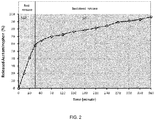
Fig. 2 illustrates the release kinetic profile of acetaminophen (1000 mg) from a tablet prepared with a carboxymethyl starch prepared by the process of the present invention. -
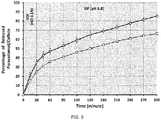
Fig. 3 illustrates the release kinetic profile of acetaminophen (900 mg) and caffeine (100 mg) from a tablet formulated with a carboxymethyl starch and Carboxymethyl cellulose/Calcium complex prepared by the process of the present invention. - The present application describes a new process of functionalization, in particular carboxylation, of polysaccharides, preferably starch, by using binary or ternary solvent mixtures which provide powder granules possessing more cohesion and high stability under tablet form. In addition, when formulated with a disintegrating agent, the functionalized polysaccharide of the present invention can release the API in two different rates: immediate release and slow release.
- In embodiments there is disclosed a process to functionalize starch with carboxyl groups such as carboxylation, succinylation, acrylation, and the likes, preferably starch using binary or ternary solvent mixtures. The obtained functionalized starch can be used as excipient, under monolithic tablet dosage form, for controlled release, preferably for dual-rate release (DRR), with high loading of active pharmaceutical ingredient (API) which can reach, for example up to 1000 mg.
- The process for functionalization of polysaccharides of the present invention generally comprised three steps:
- 1) Swell the polysaccharide granules by incubation of starch during 30 minutes in a bath containing boiling water, and/or mixtures of water with for example ethylene glycol, propylene glycol and/or glycerol. This step is important to promote the granule surface contact with functionalizing agent and to favor the penetration of functionalizing agent inside the granules;
- 2) Partially gelatinize the polysaccharide in a binary (e.g. water/ethanol, water/methanol; water/isopropanol, and the likes) or a ternary (i.e. water/methanol/propylene glycol, water/methanol/ethanol; water/methanol/isopropanol; water/ethanol/isopropanol; water/ethanol/ethylene glycol; water/ethanol/propylene glycol; water/ethanol/glycerol, etc.) solvent mixtures under alkaline condition; In these mixtures, water may be present at about 5% to 50% v/v, or from about 10% to about 50%, or from about 15% to about 50%, or from about 20% to about 50%, or from about 25% to about 50%, or from about 30% to about 50%, or from about 35% to about 50%, or from about 40% to about 50%, or from about 45% to about 50%, or about 5% to about 45% v/v, or from about 10% to about 45%, or from about 15% to about 45%, or from about 20% to about 45%, or from about 25% to about 45%, or from about 30% to about 45%, or from about 35% to about 45%, or from about 40% to about 45%,or about 5% to about 40% v/v, or from about 10% to about 40%, or from about 15% to about 40%, or from about 20% to about 40%, or from about 25% to about 40%, or from about 30% to about 40%, or from about 35% to about 40%, or 5% to 35% v/v, or from about 10% to about 35%, or from about 15% to about 35%, or from about 20% to about 35%, or from about 25% to about 35%, or from about 30% to about 35%, or 5% to 30% v/v, or from about 10% to about 30%, or from about 15% to about 30%, or from about 20% to about 30%, or from about 25% to about 30%, or 5% to 25% v/v, or from about 10% to about 25%, or from about 15% to about 25%, or from about 20% to about 25%,or about 5% to about 20% v/v, or from about 10% to about 20%, or from about 15% to about 20%, or about 5% to about 15% v/v, or from about 10% to about 15%,or about 5% to about 10% v/v of the mixture, and the alcohols may be present from about 50% to about 95%, or about 55% to about 95%, or about 60% to about 95%, or about 65% to about 95%, or about 70% to about 95%, or about 75% to about 95%, or about 80% to about 95%, or about 85% to about 95%, or about 90% to about 95%,or about 50% to about 90%, or about 55% to about 90%, or about 60% to about 90%, or about 65% to about 90%, or about 70% to about 90%, or about 75% to about 90%, or about 80% to about 90%, or about 85% to about 90%,or about 50% to about 85%, or about 55% to about 85%, or about 60% to about 85%, or about 65% to about 85%, or about 70% to about 85%, or about 75% to about 85%, or about 80% to about 85%,or about 50% to about 80%, or about 55% to about 80%, or about 60% to about 80%, or about 65% to about 80%, or about 70% to about 80%, or about 75% to about 80%, or about 50% to about 75%, or about 55% to about 75%, or about 60% to about 75%, or about 65% to about 75%, or about 70% to about 75%,or about 50% to about 70%, or about 55% to about 70%, or about 60% to about 70%, or about 65% to about 70%, or about 50% to about 65%, or about 55% to about 65%, or about 60% to about 65%,or about 50% to about 60%, or about 55% to about 60%, or about 50% to about 55% v/v the mixture. Polyols (ethylene glycol, propylene glycol and/or glycerol) may be present at about 5 to 50% v/v, or from about 10% to about 50%, or from about 15% to about 50%, or from about 20% to about 50%, or from about 25% to about 50%, or from about 30% to about 50%, or from about 35% to about 50%, or from about 40% to about 50%, or from about 45% to about 50%, or about 5% to about 45% v/v, or from about 10% to about 45%, or from about 15% to about 45%, or from about 20% to about 45%, or from about 25% to about 45%, or from about 30% to about 45%, or from about 35% to about 45%, or from about 40% to about 45%, or about 5% to about 40% v/v, or from about 10% to about 40%, or from about 15% to about 40%, or from about 20% to about 40%, or from about 25% to about 40%, or from about 30% to about 40%, or from about 35% to about 40%, or 5% to 35% v/v, or from about 10% to about 35%, or from about 15% to about 35%, or from about 20% to about 35%, or from about 25% to about 35%, or from about 30% to about 35%, or 5% to 30% v/v, or from about 10% to about 30%, or from about 15% to about 30%, or from about 20% to about 30%, or from about 25% to about 30%, or 5% to 25% v/v, or from about 10% to about 25%, or from about 15% to about 25%, or from about 20% to about 25%, or about 5% to about 20% v/v, or from about 10% to about 20%, or from about 15% to about 20%, or about 5% to about 15% v/v, or from about 10% to about 15%, or about 5% to about 10% v/v of the mixture. The binary solvent system contains water and alcohol. As alcohol (e.g. methanol) may dehydrate and are often used in large amount (e.g. 80% v/v), they can dehydrate the granules of the starch during the reaction. The addition of propylene glycol or glycerol or ethylene glycol allows reducing the dehydration property, such as glycols agents can stabilize with starch or alcohol thereby preventing the phenomenon of dehydration.
- 3) Functionalize the polysaccharide by adding functionalizing agent and the reaction is carried out at ambient temperature (23 ±0.5 °C) for at least 18 h. The functionalization is partial, yielding a polysaccharide that has a low degree of substitution (i.e. a low functionalization polysaccharide), from about 0.1 to 0.3, or about 0.15 to 0.3, or 0.2 to 0.3. or about 0.25 to 0.3, or about 0.1 to 0.25, or about 0.15 to 0.25, or about 0.2 to 0.25, or about 0.1 to 0.2, or about 0.15 to 0.2, or about 0.1 to 0.15, or about 0.1, 0.15, 0.2, 0.25, 0.3. Functionalizing agents include but are not limited to sodium chloroacetate, succinic anhydride (for succinyl polysaccharide), n-Octenyl succinic anhydride (for octenyl succinyl polysaccharide), acrylic acid (for carboxyethyl polysaccharide).
- At the end of the reaction, the functionalized polysaccharide is filtered and the precipitate is resuspended in alcohol, preferably
ethanol 80 % v/v and neutralized with an organic acid (e.g. acetic acid) at pH value of about 6.8. To obtain powders, the precipitate is washed twice inethanol 80 % v/v to remove all the by-products and non-reacted functionalizing agent and finally with ethanol 95 % v/v before drying by incubation at 40°C overnight in an oven. - According to an embodiment, the functionalization is carboxymethylation.
- According to another embodiment, the polysaccharide is a starch, hydroxypropyl starch, hydroxypropyl methyl starch, succinyl starch, octenyl starch and combinations thereof.
- According to another embodiment, the process for functionalization of polysaccharides of the present invention generally comprised following three steps when the functionalization is carboxymethylation and the polysaccharide is starch:
- 1) Swell starch granules by incubation of starch during 30 minutes in a bath containing boiling water and/or mixtures of water with for example ethylene glycol, propylene glycol and/or glycerol. This step is important to promote the granule surface contact with functionalizing agent and to favor the penetration of functionalizing agent inside the starch granules;
- 2) Partially gelatinize starch in binary (i.e. water/ethanol, water/methanol; water/isopropanol, and the likes) or a ternary (i.e. water/methanol/propylene glycol, water/methanol/ethanol; water/methanol/isopropanol; water/ethanol/isopropanol; water/ethanol/ethylene glycol; water/ethanol/propylene glycol; water/ethanol/glycerol, etc.) solvent mixtures under alkaline condition; In these mixtures, water may be present at about 5 to 50% v/v of the mixture, and the alcohols may be present from about 50 to 95% v/v of the mixture. Polyols (ethylene glycol, propylene glycol and/or glycerol) may be present at about 5 to 50% v/v of the mixture. The binary solvent system contains water and alcohol. As alcohol (i.e. methanol) may dehydrate and are often used in large amount (e.g. 80% v/v), they can dehydrate the granules of the starch during the reaction. The addition of propylene glycol or glycerol or ethylene glycol allows to reduce the dehydration property (such glycols agents can stabilize with starch or alcohol thereby preventing the phenomenon of dehydration;
- 3) Carboxylate the starch by adding a functionalizing agent (e.g. sodium chloroacetate) and the reaction is carried out at ambient (room, about 24°C) temperature for at least 12 h.
- At the end of the reaction, the carboxymethyl starch is filtered and the precipitate is resuspended in alcohol, preferably
ethanol 80 % v/v and neutralized with an organic acid (e.g. acetic acid) at pH value of about 6.8. To obtain powders, the precipitate is washed twice inethanol 80 % v/v to remove all the by-products and non-reacted sodium chloroacetate and finally with ethanol 95 % v/v before being incubated at 40°C overnight in an oven. - According to another embodiment, the present invention also includes functionalized starches prepared by the process of the present invention.
- For certain applications, functionalized polysaccharides such as carboxymethyl starch can be complexed with bivalent cations, preferably calcium ion. These complexed anionic polysaccharides can be combined with the low functionalization polysaccharide obtained by the process of the present invention, for example in dosage forms. The process of complexation can operate in the same solvent, binary or ternary solvent mixtures used for the preparation of the low functionalization polysaccharide of the present invention. Indeed, functionalized polysaccharides such as carboxymethyl starch may be suspended in the binary or ternary solvent mixture containing an excess of calcium, previously dispersed therein. After homogenous stirring during 30 minutes, the functionalized polysaccharide and divalent cations (e.g. carboxymethyl starch/calcium) complex is recovered by decantation or filtration. To obtain the complex powders, the drying process is carried out in the same conditions as described previously for drying of the functionalized polysaccharide.
- These anionic polysaccharides complexed with divalent cations may have degrees of substitution higher than the low functionalization polysaccharide produced by the process of the present invention. Indeed, they may have degrees of substitutions of from about 0.5 to about 1.5, or about 0.6 to about 1.5, or about 0.7 to about 1.5, or about 0.8 to about 1.5, or about 0.9 to about 1.5, or about 1.0 to about 1.5, or about 1.1 to about 1.5, or about 1.2 to about 1.5, or about 1.3 to about 1.5, or about 1.4 to about 1.5, or 0.5 to about 1.4, or about 0.6 to about 1.4, or about 0.7 to about 1.4, or about 0.8 to about 1.4, or about 0.9 to about 1.4, or about 1.0 to about 1.4, or about 1.1 to about 1.4, or about 1.2 to about 1.4, or about 1.3 to about 1.4, or 0.5 to about 1.3, or about 0.6 to about 1.3, or about 0.7 to about 1.3, or about 0.8 to about 1.3, or about 0.9 to about 1.3, or about 1.0 to about 1.3, or about 1.1 to about 1.3, or about 1.2 to about 1.3, or 0.5 to about 1.2, or about 0.6 to about 1.2, or about 0.7 to about 1.2, or about 0.8 to about 1.2, or about 0.9 to about 1.2, or about 1.0 to about 1.2, or about 1.1 to about 1.2, or 0.5 to about 1.1, or about 0.6 to about 1.1, or about 0.7 to about 1.1, or about 0.8 to about 1.1, or about 0.9 to about 1.1, or about 1.0 to about 1.1, 0.5 to about 1.0, or about 0.6 to about 1.0, or about 0.7 to about 1.0, or about 0.8 to about 1.0, or about 0.9 to about 1.0, or 0.5 to about 0.9, or about 0.6 to about 0.9, or about 0.7 to about 0.9, or about 0.8 to about 0.9, or 0.5 to about 0.8, or about 0.6 to about 0.8, or about 0.7 to about 0.8, or 0.5 to about 0.7, or about 0.6 to about 0.7, or 0.5 to about 0.6.
- According to an embodiment, at least 30% of the carboxyl groups may be complexed with a divalent cation. According to an embodiment, at least 40%, or 50%, or 60%, or 70%, or 80%, or 90% of the carboxyl groups being complexed with a divalent cation. The divalent cation may be chosen from calcium, magnesium, zinc, aluminum, copper, or combinations thereof.
- According to an embodiment, there is disclosed a dual release rate formulation which may comprise:
- a) a low functionalization polysaccharide of the present invention;
- b) a disintegrating agent;
- c) an amino acid;
- d) an active pharmaceutical ingredient.
- The formulation may contain:
- 1) Low functionalization polysaccharide used as excipient to stabilize tablet, preferably carboxymethyl starch or carboxymethyl cellulose, or carboxymethyl cellulose/calcium complex, or carboxymethyl starch/calcium complex, or mixture thereof;
- 2) An anionic polysaccharide complexed with a divalent cation;
- 3) A disintegrating agent such as crospovidone, croscarmelose and/or starch glycolate, preferably crospovidone to favor the immediate release;
- 4) In some embodiments, an amino acid or a combination of amino acid, preferably arginine and lysine, for sustained release;
- 5) An API which could be reached up to at least 1000 mg.
- The combination of the low functionalization polysaccharide synthesized in a solvent, according to the process of the present invention, combined with the anionic polysaccharide complexed with a divalent cation, and a disintegrating agent results in a DRR. The present invention will be more readily understood by referring to the following examples which are given to illustrate the invention rather than to limit its scope.
- An amount of 150 g of starch, preferably high amylose corn starch is introduced in 2 L of boiling water for 30 minutes under mild stirring. When the temperature is cooled down to room temperature, the stirring is stopped and the reaction mixture is left to stand for at least 1 h to favor the precipitation of starch. The water is removed by decantation or by filtration.
- Alternatively, an amount of 150 g of starch, preferably high amylose corn starch is introduced in 2 L of boiling water/glycerol for 30 minutes under mild stirring. When the temperature is cooled down to room temperature, the stirring is stopped and the reaction mixture is left to stand for at least 1 h to favor the precipitation of starch. The water is removed by decantation or by filtration.
- After the swelling of starch as described above, starch is partially gelatinized by adding 1 L of binary (water/ethanol, 20:80 v/v) solvent mixture for 10 minutes at room temperature. Then, an amount of 110 g of NaOH is added in the solvent mixture under vigorous stirring for at least 15 minutes or until obtaining a homogenous suspension.
- After gelatinization of starch, the carboxymethylation is performed by introducing an amount of 150 g of sodium chloroacetate directly in the suspension, always under vigorous stirring. The reaction is continued for at least 16 h at 40°C, and it may also be performed at the room temperature for 24h.
- At the end of the reaction, the precipitate is separated by filtration (or by decantation) and washed with 2 L of
ethanol 80 % v/v, under strong stirring to remove a maximum of the alkaline medium and by-products. After filtration, the precipitate is resuspended inethanol 80 % v/v and the neutralization is performed by using acetic acid until a pH value between 6.5 and 7.0 is reached. Finally, the precipitate is collected and washed with 2 L of ethanol (80 % v/v) followed one more time in ethanol 95 % v/v before drying at 40°C overnight to obtain the carboxymethyl starch powders. - The carboxymethylation of starch using ternary solvent mixture can be conducted under similar conditions for binary solvent mixture, as described previously in Example 1, except that the ternary solvent mixture can be composed of water/ethanol/propylene glycol (10/80/10, v/v/v) or water/ethanol/isopropanol (20/40/40, v/v/v) have been used instead of binary solvent.
- These carboxymethyl starches from example 1 and 2 possess a degree of substitution (DS) between 0.20-0.25
- An amount of 20 g of carboxymethyl cellulose (CMC,
MW 150 kDa, DS 0.7) is introduced in 120 mL of absolute ethanol. Thereafter, a volume of 80 ml of calcium solution 7.5% w/w is added in the suspension, under strong stirring. After 1 h, the carboxymethyl cellulose/calcium complex is separated by decantation or by filtration and the complex is washed inethanol 80 % for 30 minutes. Finally, the complex powder is collected and dried in ethanol 95 % before incubation in the oven for at least 24 h at 40°C. - FTIR Analysis shows that CMC possesses absorption bands at 1580 and 1410 cm-1 assigned to carboxylate anions (asymmetric and symmetric stretching vibrations). When CMC complexed with calcium, a moderate decrease of the intensities for absorption bands at 1587 and 1410 cm-1 is observed due to complexion of carboxylate groups with calcium which cause a new absorption band appearance at 1720 cm-1.
-
- Acetaminophen 1000 mg - Carboxymethyl starch 150 mg - Carboxymethylcellulose/ Ca 40 mg - Crospovidone 35 mg - Arginine 35 mg - Lysine 65 mg - Magnesium stearate 15 mg Total 1340 mg - In this case, the Acetaminophen/Excipient Ratio is about of 75:25. The Carboxymethyl starch is prepared according to the process of the present invention.
- Monolithic tablets using carboxymethyl starch synthesized as described above and containing 1000 mg (∼75 %) of acetaminophen as a tracer were obtained by direct compression of powders (2.3 T/cm2) in a Carver hydraulic press.
- The dissolution kinetic assay is followed with a Distek™ apparatus according to the paddle method from USP-32, with slight modification. Indeed, the monolithic tablets are placed in 750 mL of simulated gastric fluid (SGF, pH 1.5) during 30 minutes, at 37°C. Thereafter, a volume of 250 mL of sodium tripolyphosphate 0.20 M is added directly in SGF to neutralize the gastric acidity for pH values of about 6.8-7.0 which constituted the pH of simulated intestinal fluid (SIF).
- At different intervals of 30 minutes, an aliquot of 1 mL of dissolution fluid is withdrawn from dissolution media, filtered and properly diluted (approximately 1/50). The absorbency is measured with an UV spectrometer (Lambda-40 Spectrometer, Perkin Elmer) at 247 nm.
- Now referring to
Fig. 2 , data analysis shows that the immediate release of Acetaminophen is about of 60 % (600 mg of Acetaminophen) after 45 minutes (30 minutes in SGF and 15 minutes in SIF). The remaining quantity of Acetaminophen is slowly released in SIF for a period approximately 5 h or more. -
- Acetaminophen 900 mg - Caffeine 100 mg - Carboxymethyl starch 130 mg - Carboxymethylcellulose/ Calcium 30 mg - Hydroxypropylmethyl cellulose (E5) 60 mg - Arginine 20 mg - Magnesium stearate 20 mg Total 1260 mg - The Carboxymethyl starch is prepared according to the process of the present invention. The preparation of monolithic tablet and dissolution assay are conducted under similar conditions as described previously in the Example 4, section 4-1 and 4-2. For acetaminophen, the absorbency of samples is measured with an UV spectrometer at 247 nm. For caffeine, the dosage is carried out by HPLC according to method described by Hassouna et al. (Hassouna, M.E.M, Issa, Y.M. and Zayed, A.G. 2012. J. Appl. Pharm. Sci., 02, 52-59)
- Data analysis shows that the immediate release of Acetaminophen is about of 35 % (350 mg) of Acetaminophen and about of 25 % (25 mg) of caffeine after 30 minutes in SGF. The remaining quantities of Acetaminophen and caffeine are slowly released in SIF for a period approximately 5 h or more.
- While preferred embodiments have been described above and illustrated in the accompanying drawings, it will be evident to those skilled in the art that modifications may be made.
Claims (14)
- A process for the preparation of a low functionalization starch having carboxyl groups, comprising:a) swotting of a starch granule in boiling water or a water/polyol mixture, to obtain a swollen starch;b) partial gelatinization of said swollen starch in an alkaline solvent mixture of water and alcohol and/or polyol, to obtain a partially gelatinized starch;c) low functionalization of said partially gelatinized starch with a functionalizing agent under alkaline conditions, to obtain said functionalized starch, Wherein said functionalized starch has a degree of substitution of from about 0.1 to about 0.3, preferably 0.2,wherein said polyol is chosen from ethylene glycol, propylene glycol, glycerol, sorbitol or combinations thereof.
- The process of claim 1, wherein said starch is chosen from a native starch, a hydroxypropyl starch, a hydroxypropyl methyl starch, a succinyl starch, an octenyl starch and combinations thereof.
- The process of any one of claims 1 - 2, wherein said an alkaline solvent mixture of water and alcohol is a binary solvent mixture of water and alcohol or ternary solvent mixture of water, alcohol and polyol.
- The process of claim 3, wherein said binary solvent mixture of water and alcohol comprises water and at least one of ethanol, methanol, isopropanol, or combinations thereof, and said ternary solvent mixture of water, alcohol, and polyol comprises water, ethanol or methanol and propylene glycol or glycerol or propanol or combination thereof.
- The process of any one of claims 3 - 4, wherein said water or said alcohol is from about 5% to about 50% v/v of said binary or ternary solvent mixture.
- The process of any one of claims 3 to 5, wherein said polyol is from about 50% to about 95% v/v of said binary or ternary solvent mixture.
- The process of any one of claims 1 to 6, wherein said functionalizing agent is sodium chloroacetate, succinic anhydride, n-Octenyl succinic anhydride, acrylic acid, and combinations thereof.
- The process of any one of claims 1 to 7, further comprising step c') after step c):
c') complexation of said functionalized starch with a divalent cation chosen from calcium, magnesium, zinc, aluminum, copper, or combinations thereof. - The process of any one of claims 1 to 8, further comprising step d):
d) filtration of said functionalized starch and resuspension in alcohol, to obtain a resuspended functionalized starch. - The process of claim 9, further comprising step e):
e) neutralization of said resuspended functionalized starch, to obtain a neutralized functionalized starch. - The process of claim 10, further comprising step f):
f) washing of said neutralized functionalized starch, to obtain a precipitated functionalized starch. - The process of claim 11, further comprising step g):
g) drying of said precipitated functionalized starch, to obtain a dried functionalized starch. - The process of any one of claims 1 to 12, wherein said functionalization is carboxymethylation.
- A monolithic solid dosage form for dual rate release of an active pharmaceutical ingredient, comprising a low functionalization starch prepared by the process of any one of claims 1 to 13, an anionic polysaccharide complexed with a divalent cation, a disintegrating agent and said active pharmaceutical ingredient.
Applications Claiming Priority (2)
| Application Number | Priority Date | Filing Date | Title |
|---|---|---|---|
| US201662298755P | 2016-02-23 | 2016-02-23 | |
| PCT/CA2017/050225 WO2017143439A1 (en) | 2016-02-23 | 2017-02-23 | Monolithic composition for dual-rate release with high drug loading |
Publications (3)
| Publication Number | Publication Date |
|---|---|
| EP3420003A1 EP3420003A1 (en) | 2019-01-02 |
| EP3420003A4 EP3420003A4 (en) | 2019-10-23 |
| EP3420003B1 true EP3420003B1 (en) | 2021-09-15 |
Family
ID=59685874
Family Applications (1)
| Application Number | Title | Priority Date | Filing Date |
|---|---|---|---|
| EP17755676.8A Not-in-force EP3420003B1 (en) | 2016-02-23 | 2017-02-23 | Monolithic composition for dual-rate release with high drug loading |
Country Status (5)
| Country | Link |
|---|---|
| US (3) | US20190060466A1 (en) |
| EP (1) | EP3420003B1 (en) |
| CA (1) | CA3015405C (en) |
| WO (1) | WO2017143439A1 (en) |
| ZA (1) | ZA201806238B (en) |
Families Citing this family (2)
| Publication number | Priority date | Publication date | Assignee | Title |
|---|---|---|---|---|
| CN109942727A (en) * | 2019-04-23 | 2019-06-28 | 福建省绿麒食品胶体有限公司 | A kind of preparation method and applications with pH responsiveness agar |
| CN113735653A (en) * | 2021-09-09 | 2021-12-03 | 苏农(广德)生物科技有限公司 | Slow-release fertilizer capable of preventing and treating plant diseases and processing technology thereof |
Family Cites Families (8)
| Publication number | Priority date | Publication date | Assignee | Title |
|---|---|---|---|---|
| US4097606A (en) * | 1975-10-08 | 1978-06-27 | Bristol-Myers Company | APAP Tablet containing an alkali metal carboxymethylated starch and processes for manufacturing same |
| US4167621A (en) * | 1978-06-26 | 1979-09-11 | National Starch And Chemical Corporation | Method for preparing starch ether derivatives |
| US6602994B1 (en) * | 1999-02-10 | 2003-08-05 | Hercules Incorporated | Derivatized microfibrillar polysaccharide |
| US6933380B2 (en) * | 2001-10-19 | 2005-08-23 | Yung-Zip Chemical Ind. Co., Ltd. | Excipients containing low residual solvent and method for producing the same |
| RU2334762C2 (en) * | 2002-11-26 | 2008-09-27 | Геркулес Инкорпорейтед | Soluble, associative carboxymethylcellulose, compositions containing thereof, method of production and application |
| CA2865917C (en) * | 2011-03-01 | 2020-09-29 | 4413261 Canada Inc. (Spencer Canada) | Two speed monolithic system for controlled release of drugs |
| CN105143273A (en) * | 2012-05-09 | 2015-12-09 | 瓦勒股份有限公司 | Process for obtaining carboxymethyl cellulose from agro-industrial residues and carboxymethyl cellulose and use thereof |
| CA2984434C (en) * | 2014-04-29 | 2024-01-02 | Matripharm Inc. | Monolithic tablets based on carboxyl polymeric complexes for controlled drug release |
-
2017
- 2017-02-23 EP EP17755676.8A patent/EP3420003B1/en not_active Not-in-force
- 2017-02-23 WO PCT/CA2017/050225 patent/WO2017143439A1/en not_active Ceased
- 2017-02-23 CA CA3015405A patent/CA3015405C/en active Active
- 2017-02-23 US US16/079,004 patent/US20190060466A1/en not_active Abandoned
-
2018
- 2018-09-17 ZA ZA2018/06238A patent/ZA201806238B/en unknown
-
2021
- 2021-08-18 US US17/405,610 patent/US11793879B2/en active Active
-
2023
- 2023-09-21 US US18/471,421 patent/US20240009313A1/en not_active Abandoned
Also Published As
| Publication number | Publication date |
|---|---|
| WO2017143439A1 (en) | 2017-08-31 |
| US20190060466A1 (en) | 2019-02-28 |
| US20240009313A1 (en) | 2024-01-11 |
| CA3015405A1 (en) | 2017-08-31 |
| EP3420003A1 (en) | 2019-01-02 |
| ZA201806238B (en) | 2019-07-31 |
| US20210379187A1 (en) | 2021-12-09 |
| US11793879B2 (en) | 2023-10-24 |
| EP3420003A4 (en) | 2019-10-23 |
| CA3015405C (en) | 2024-03-26 |
Similar Documents
| Publication | Publication Date | Title |
|---|---|---|
| US20240009313A1 (en) | Monolithic composition for dual-rate release with high drug loading | |
| KR102194967B1 (en) | Novel esterified cellulose ethers of very high molecular weight | |
| Dong et al. | Amphiphilic hydroxyalkyl cellulose derivatives for amorphous solid dispersion prepared by olefin cross-metathesis | |
| JP6371483B2 (en) | Gelation of esterified cellulose ether | |
| KR102138546B1 (en) | Partially cross-linked esterified cellulose ethers | |
| JP5809379B2 (en) | New sustained release dosage form | |
| JP2018507306A (en) | Water-soluble esterified cellulose ether with low degree of neutralization | |
| WO2014137789A1 (en) | Novel esterified cellulose ethers of low viscosity and high molecular weight | |
| KR102362913B1 (en) | Novel esterified cellulose ethers of high molecular weight and homogeneity | |
| US20250222111A1 (en) | Dual-rate release formulation with high drug loading | |
| EP3271404B1 (en) | Water-soluble esterified cellulose ethers | |
| JP6371482B2 (en) | Aqueous solution of esterified cellulose ether | |
| EP2997046B1 (en) | Cellulose ethers esterified with dicarboxylic acids |
Legal Events
| Date | Code | Title | Description |
|---|---|---|---|
| STAA | Information on the status of an ep patent application or granted ep patent |
Free format text: STATUS: THE INTERNATIONAL PUBLICATION HAS BEEN MADE |
|
| PUAI | Public reference made under article 153(3) epc to a published international application that has entered the european phase |
Free format text: ORIGINAL CODE: 0009012 |
|
| STAA | Information on the status of an ep patent application or granted ep patent |
Free format text: STATUS: REQUEST FOR EXAMINATION WAS MADE |
|
| 17P | Request for examination filed |
Effective date: 20180914 |
|
| AK | Designated contracting states |
Kind code of ref document: A1 Designated state(s): AL AT BE BG CH CY CZ DE DK EE ES FI FR GB GR HR HU IE IS IT LI LT LU LV MC MK MT NL NO PL PT RO RS SE SI SK SM TR |
|
| AX | Request for extension of the european patent |
Extension state: BA ME |
|
| DAV | Request for validation of the european patent (deleted) | ||
| DAX | Request for extension of the european patent (deleted) | ||
| A4 | Supplementary search report drawn up and despatched |
Effective date: 20190920 |
|
| RIC1 | Information provided on ipc code assigned before grant |
Ipc: C08B 37/06 20060101ALI20190916BHEP Ipc: C08J 3/075 20060101ALI20190916BHEP Ipc: C08B 11/12 20060101AFI20190916BHEP Ipc: A61K 9/22 20060101ALI20190916BHEP Ipc: A61K 47/18 20170101ALI20190916BHEP Ipc: A61K 47/02 20060101ALI20190916BHEP Ipc: C08B 37/04 20060101ALI20190916BHEP Ipc: A61K 9/00 20060101ALI20190916BHEP Ipc: A61K 47/36 20060101ALI20190916BHEP Ipc: C08B 37/00 20060101ALI20190916BHEP |
|
| GRAP | Despatch of communication of intention to grant a patent |
Free format text: ORIGINAL CODE: EPIDOSNIGR1 |
|
| STAA | Information on the status of an ep patent application or granted ep patent |
Free format text: STATUS: GRANT OF PATENT IS INTENDED |
|
| GRAJ | Information related to disapproval of communication of intention to grant by the applicant or resumption of examination proceedings by the epo deleted |
Free format text: ORIGINAL CODE: EPIDOSDIGR1 |
|
| GRAP | Despatch of communication of intention to grant a patent |
Free format text: ORIGINAL CODE: EPIDOSNIGR1 |
|
| INTG | Intention to grant announced |
Effective date: 20201222 |
|
| GRAJ | Information related to disapproval of communication of intention to grant by the applicant or resumption of examination proceedings by the epo deleted |
Free format text: ORIGINAL CODE: EPIDOSDIGR1 |
|
| STAA | Information on the status of an ep patent application or granted ep patent |
Free format text: STATUS: REQUEST FOR EXAMINATION WAS MADE |
|
| INTG | Intention to grant announced |
Effective date: 20210118 |
|
| INTG | Intention to grant announced |
Effective date: 20210118 |
|
| INTC | Intention to grant announced (deleted) | ||
| GRAP | Despatch of communication of intention to grant a patent |
Free format text: ORIGINAL CODE: EPIDOSNIGR1 |
|
| STAA | Information on the status of an ep patent application or granted ep patent |
Free format text: STATUS: GRANT OF PATENT IS INTENDED |
|
| INTG | Intention to grant announced |
Effective date: 20210309 |
|
| GRAJ | Information related to disapproval of communication of intention to grant by the applicant or resumption of examination proceedings by the epo deleted |
Free format text: ORIGINAL CODE: EPIDOSDIGR1 |
|
| STAA | Information on the status of an ep patent application or granted ep patent |
Free format text: STATUS: REQUEST FOR EXAMINATION WAS MADE |
|
| GRAP | Despatch of communication of intention to grant a patent |
Free format text: ORIGINAL CODE: EPIDOSNIGR1 |
|
| STAA | Information on the status of an ep patent application or granted ep patent |
Free format text: STATUS: GRANT OF PATENT IS INTENDED |
|
| GRAS | Grant fee paid |
Free format text: ORIGINAL CODE: EPIDOSNIGR3 |
|
| INTC | Intention to grant announced (deleted) | ||
| GRAA | (expected) grant |
Free format text: ORIGINAL CODE: 0009210 |
|
| STAA | Information on the status of an ep patent application or granted ep patent |
Free format text: STATUS: THE PATENT HAS BEEN GRANTED |
|
| INTG | Intention to grant announced |
Effective date: 20210729 |
|
| AK | Designated contracting states |
Kind code of ref document: B1 Designated state(s): AL AT BE BG CH CY CZ DE DK EE ES FI FR GB GR HR HU IE IS IT LI LT LU LV MC MK MT NL NO PL PT RO RS SE SI SK SM TR |
|
| REG | Reference to a national code |
Ref country code: CH Ref legal event code: EP |
|
| REG | Reference to a national code |
Ref country code: DE Ref legal event code: R096 Ref document number: 602017046074 Country of ref document: DE |
|
| REG | Reference to a national code |
Ref country code: IE Ref legal event code: FG4D |
|
| REG | Reference to a national code |
Ref country code: AT Ref legal event code: REF Ref document number: 1430485 Country of ref document: AT Kind code of ref document: T Effective date: 20211015 |
|
| REG | Reference to a national code |
Ref country code: LT Ref legal event code: MG9D |
|
| REG | Reference to a national code |
Ref country code: NL Ref legal event code: MP Effective date: 20210915 |
|
| PG25 | Lapsed in a contracting state [announced via postgrant information from national office to epo] |
Ref country code: RS Free format text: LAPSE BECAUSE OF FAILURE TO SUBMIT A TRANSLATION OF THE DESCRIPTION OR TO PAY THE FEE WITHIN THE PRESCRIBED TIME-LIMIT Effective date: 20210915 Ref country code: SE Free format text: LAPSE BECAUSE OF FAILURE TO SUBMIT A TRANSLATION OF THE DESCRIPTION OR TO PAY THE FEE WITHIN THE PRESCRIBED TIME-LIMIT Effective date: 20210915 Ref country code: HR Free format text: LAPSE BECAUSE OF FAILURE TO SUBMIT A TRANSLATION OF THE DESCRIPTION OR TO PAY THE FEE WITHIN THE PRESCRIBED TIME-LIMIT Effective date: 20210915 Ref country code: LT Free format text: LAPSE BECAUSE OF FAILURE TO SUBMIT A TRANSLATION OF THE DESCRIPTION OR TO PAY THE FEE WITHIN THE PRESCRIBED TIME-LIMIT Effective date: 20210915 Ref country code: BG Free format text: LAPSE BECAUSE OF FAILURE TO SUBMIT A TRANSLATION OF THE DESCRIPTION OR TO PAY THE FEE WITHIN THE PRESCRIBED TIME-LIMIT Effective date: 20211215 Ref country code: NO Free format text: LAPSE BECAUSE OF FAILURE TO SUBMIT A TRANSLATION OF THE DESCRIPTION OR TO PAY THE FEE WITHIN THE PRESCRIBED TIME-LIMIT Effective date: 20211215 Ref country code: FI Free format text: LAPSE BECAUSE OF FAILURE TO SUBMIT A TRANSLATION OF THE DESCRIPTION OR TO PAY THE FEE WITHIN THE PRESCRIBED TIME-LIMIT Effective date: 20210915 |
|
| REG | Reference to a national code |
Ref country code: AT Ref legal event code: MK05 Ref document number: 1430485 Country of ref document: AT Kind code of ref document: T Effective date: 20210915 |
|
| PG25 | Lapsed in a contracting state [announced via postgrant information from national office to epo] |
Ref country code: LV Free format text: LAPSE BECAUSE OF FAILURE TO SUBMIT A TRANSLATION OF THE DESCRIPTION OR TO PAY THE FEE WITHIN THE PRESCRIBED TIME-LIMIT Effective date: 20210915 Ref country code: GR Free format text: LAPSE BECAUSE OF FAILURE TO SUBMIT A TRANSLATION OF THE DESCRIPTION OR TO PAY THE FEE WITHIN THE PRESCRIBED TIME-LIMIT Effective date: 20211216 |
|
| PG25 | Lapsed in a contracting state [announced via postgrant information from national office to epo] |
Ref country code: AT Free format text: LAPSE BECAUSE OF FAILURE TO SUBMIT A TRANSLATION OF THE DESCRIPTION OR TO PAY THE FEE WITHIN THE PRESCRIBED TIME-LIMIT Effective date: 20210915 |
|
| PG25 | Lapsed in a contracting state [announced via postgrant information from national office to epo] |
Ref country code: IS Free format text: LAPSE BECAUSE OF FAILURE TO SUBMIT A TRANSLATION OF THE DESCRIPTION OR TO PAY THE FEE WITHIN THE PRESCRIBED TIME-LIMIT Effective date: 20220115 Ref country code: SM Free format text: LAPSE BECAUSE OF FAILURE TO SUBMIT A TRANSLATION OF THE DESCRIPTION OR TO PAY THE FEE WITHIN THE PRESCRIBED TIME-LIMIT Effective date: 20210915 Ref country code: SK Free format text: LAPSE BECAUSE OF FAILURE TO SUBMIT A TRANSLATION OF THE DESCRIPTION OR TO PAY THE FEE WITHIN THE PRESCRIBED TIME-LIMIT Effective date: 20210915 Ref country code: RO Free format text: LAPSE BECAUSE OF FAILURE TO SUBMIT A TRANSLATION OF THE DESCRIPTION OR TO PAY THE FEE WITHIN THE PRESCRIBED TIME-LIMIT Effective date: 20210915 Ref country code: PT Free format text: LAPSE BECAUSE OF FAILURE TO SUBMIT A TRANSLATION OF THE DESCRIPTION OR TO PAY THE FEE WITHIN THE PRESCRIBED TIME-LIMIT Effective date: 20220117 Ref country code: PL Free format text: LAPSE BECAUSE OF FAILURE TO SUBMIT A TRANSLATION OF THE DESCRIPTION OR TO PAY THE FEE WITHIN THE PRESCRIBED TIME-LIMIT Effective date: 20210915 Ref country code: NL Free format text: LAPSE BECAUSE OF FAILURE TO SUBMIT A TRANSLATION OF THE DESCRIPTION OR TO PAY THE FEE WITHIN THE PRESCRIBED TIME-LIMIT Effective date: 20210915 Ref country code: ES Free format text: LAPSE BECAUSE OF FAILURE TO SUBMIT A TRANSLATION OF THE DESCRIPTION OR TO PAY THE FEE WITHIN THE PRESCRIBED TIME-LIMIT Effective date: 20210915 Ref country code: EE Free format text: LAPSE BECAUSE OF FAILURE TO SUBMIT A TRANSLATION OF THE DESCRIPTION OR TO PAY THE FEE WITHIN THE PRESCRIBED TIME-LIMIT Effective date: 20210915 Ref country code: CZ Free format text: LAPSE BECAUSE OF FAILURE TO SUBMIT A TRANSLATION OF THE DESCRIPTION OR TO PAY THE FEE WITHIN THE PRESCRIBED TIME-LIMIT Effective date: 20210915 Ref country code: AL Free format text: LAPSE BECAUSE OF FAILURE TO SUBMIT A TRANSLATION OF THE DESCRIPTION OR TO PAY THE FEE WITHIN THE PRESCRIBED TIME-LIMIT Effective date: 20210915 |
|
| REG | Reference to a national code |
Ref country code: DE Ref legal event code: R097 Ref document number: 602017046074 Country of ref document: DE |
|
| PLBE | No opposition filed within time limit |
Free format text: ORIGINAL CODE: 0009261 |
|
| STAA | Information on the status of an ep patent application or granted ep patent |
Free format text: STATUS: NO OPPOSITION FILED WITHIN TIME LIMIT |
|
| PG25 | Lapsed in a contracting state [announced via postgrant information from national office to epo] |
Ref country code: DK Free format text: LAPSE BECAUSE OF FAILURE TO SUBMIT A TRANSLATION OF THE DESCRIPTION OR TO PAY THE FEE WITHIN THE PRESCRIBED TIME-LIMIT Effective date: 20210915 |
|
| 26N | No opposition filed |
Effective date: 20220616 |
|
| PG25 | Lapsed in a contracting state [announced via postgrant information from national office to epo] |
Ref country code: SI Free format text: LAPSE BECAUSE OF FAILURE TO SUBMIT A TRANSLATION OF THE DESCRIPTION OR TO PAY THE FEE WITHIN THE PRESCRIBED TIME-LIMIT Effective date: 20210915 |
|
| PG25 | Lapsed in a contracting state [announced via postgrant information from national office to epo] |
Ref country code: MC Free format text: LAPSE BECAUSE OF FAILURE TO SUBMIT A TRANSLATION OF THE DESCRIPTION OR TO PAY THE FEE WITHIN THE PRESCRIBED TIME-LIMIT Effective date: 20210915 |
|
| REG | Reference to a national code |
Ref country code: CH Ref legal event code: PL |
|
| REG | Reference to a national code |
Ref country code: BE Ref legal event code: MM Effective date: 20220228 |
|
| PG25 | Lapsed in a contracting state [announced via postgrant information from national office to epo] |
Ref country code: LU Free format text: LAPSE BECAUSE OF NON-PAYMENT OF DUE FEES Effective date: 20220223 |
|
| PG25 | Lapsed in a contracting state [announced via postgrant information from national office to epo] |
Ref country code: LI Free format text: LAPSE BECAUSE OF NON-PAYMENT OF DUE FEES Effective date: 20220228 Ref country code: IE Free format text: LAPSE BECAUSE OF NON-PAYMENT OF DUE FEES Effective date: 20220223 Ref country code: CH Free format text: LAPSE BECAUSE OF NON-PAYMENT OF DUE FEES Effective date: 20220228 |
|
| PG25 | Lapsed in a contracting state [announced via postgrant information from national office to epo] |
Ref country code: BE Free format text: LAPSE BECAUSE OF NON-PAYMENT OF DUE FEES Effective date: 20220228 |
|
| PG25 | Lapsed in a contracting state [announced via postgrant information from national office to epo] |
Ref country code: HU Free format text: LAPSE BECAUSE OF FAILURE TO SUBMIT A TRANSLATION OF THE DESCRIPTION OR TO PAY THE FEE WITHIN THE PRESCRIBED TIME-LIMIT; INVALID AB INITIO Effective date: 20170223 |
|
| PG25 | Lapsed in a contracting state [announced via postgrant information from national office to epo] |
Ref country code: MK Free format text: LAPSE BECAUSE OF FAILURE TO SUBMIT A TRANSLATION OF THE DESCRIPTION OR TO PAY THE FEE WITHIN THE PRESCRIBED TIME-LIMIT Effective date: 20210915 Ref country code: CY Free format text: LAPSE BECAUSE OF FAILURE TO SUBMIT A TRANSLATION OF THE DESCRIPTION OR TO PAY THE FEE WITHIN THE PRESCRIBED TIME-LIMIT Effective date: 20210915 |
|
| PGFP | Annual fee paid to national office [announced via postgrant information from national office to epo] |
Ref country code: DE Payment date: 20240219 Year of fee payment: 8 Ref country code: GB Payment date: 20240219 Year of fee payment: 8 |
|
| PGFP | Annual fee paid to national office [announced via postgrant information from national office to epo] |
Ref country code: IT Payment date: 20240228 Year of fee payment: 8 Ref country code: FR Payment date: 20240221 Year of fee payment: 8 |
|
| PG25 | Lapsed in a contracting state [announced via postgrant information from national office to epo] |
Ref country code: TR Free format text: LAPSE BECAUSE OF FAILURE TO SUBMIT A TRANSLATION OF THE DESCRIPTION OR TO PAY THE FEE WITHIN THE PRESCRIBED TIME-LIMIT Effective date: 20210915 |
|
| PG25 | Lapsed in a contracting state [announced via postgrant information from national office to epo] |
Ref country code: MT Free format text: LAPSE BECAUSE OF FAILURE TO SUBMIT A TRANSLATION OF THE DESCRIPTION OR TO PAY THE FEE WITHIN THE PRESCRIBED TIME-LIMIT Effective date: 20210915 |
|
| REG | Reference to a national code |
Ref country code: DE Ref legal event code: R119 Ref document number: 602017046074 Country of ref document: DE |
|
| GBPC | Gb: european patent ceased through non-payment of renewal fee |
Effective date: 20250223 |
|
| PG25 | Lapsed in a contracting state [announced via postgrant information from national office to epo] |
Ref country code: DE Free format text: LAPSE BECAUSE OF NON-PAYMENT OF DUE FEES Effective date: 20250902 |
|
| PG25 | Lapsed in a contracting state [announced via postgrant information from national office to epo] |
Ref country code: GB Free format text: LAPSE BECAUSE OF NON-PAYMENT OF DUE FEES Effective date: 20250223 |
|
| PG25 | Lapsed in a contracting state [announced via postgrant information from national office to epo] |
Ref country code: FR Free format text: LAPSE BECAUSE OF NON-PAYMENT OF DUE FEES Effective date: 20250228 Ref country code: IT Free format text: LAPSE BECAUSE OF NON-PAYMENT OF DUE FEES Effective date: 20250223 |