EP3418727A1 - Analysis device, analysis method, and analysis program - Google Patents
Analysis device, analysis method, and analysis program Download PDFInfo
- Publication number
- EP3418727A1 EP3418727A1 EP17753229.8A EP17753229A EP3418727A1 EP 3418727 A1 EP3418727 A1 EP 3418727A1 EP 17753229 A EP17753229 A EP 17753229A EP 3418727 A1 EP3418727 A1 EP 3418727A1
- Authority
- EP
- European Patent Office
- Prior art keywords
- analysis
- cement
- content
- cement sample
- rietveld
- Prior art date
- Legal status (The legal status is an assumption and is not a legal conclusion. Google has not performed a legal analysis and makes no representation as to the accuracy of the status listed.)
- Granted
Links
Images




Classifications
-
- G—PHYSICS
- G01—MEASURING; TESTING
- G01N—INVESTIGATING OR ANALYSING MATERIALS BY DETERMINING THEIR CHEMICAL OR PHYSICAL PROPERTIES
- G01N23/00—Investigating or analysing materials by the use of wave or particle radiation, e.g. X-rays or neutrons, not covered by groups G01N3/00 – G01N17/00, G01N21/00 or G01N22/00
- G01N23/20—Investigating or analysing materials by the use of wave or particle radiation, e.g. X-rays or neutrons, not covered by groups G01N3/00 – G01N17/00, G01N21/00 or G01N22/00 by using diffraction of the radiation by the materials, e.g. for investigating crystal structure; by using scattering of the radiation by the materials, e.g. for investigating non-crystalline materials; by using reflection of the radiation by the materials
- G01N23/207—Diffractometry using detectors, e.g. using a probe in a central position and one or more displaceable detectors in circumferential positions
-
- G—PHYSICS
- G01—MEASURING; TESTING
- G01N—INVESTIGATING OR ANALYSING MATERIALS BY DETERMINING THEIR CHEMICAL OR PHYSICAL PROPERTIES
- G01N23/00—Investigating or analysing materials by the use of wave or particle radiation, e.g. X-rays or neutrons, not covered by groups G01N3/00 – G01N17/00, G01N21/00 or G01N22/00
- G01N23/20—Investigating or analysing materials by the use of wave or particle radiation, e.g. X-rays or neutrons, not covered by groups G01N3/00 – G01N17/00, G01N21/00 or G01N22/00 by using diffraction of the radiation by the materials, e.g. for investigating crystal structure; by using scattering of the radiation by the materials, e.g. for investigating non-crystalline materials; by using reflection of the radiation by the materials
-
- G—PHYSICS
- G01—MEASURING; TESTING
- G01N—INVESTIGATING OR ANALYSING MATERIALS BY DETERMINING THEIR CHEMICAL OR PHYSICAL PROPERTIES
- G01N23/00—Investigating or analysing materials by the use of wave or particle radiation, e.g. X-rays or neutrons, not covered by groups G01N3/00 – G01N17/00, G01N21/00 or G01N22/00
- G01N23/22—Investigating or analysing materials by the use of wave or particle radiation, e.g. X-rays or neutrons, not covered by groups G01N3/00 – G01N17/00, G01N21/00 or G01N22/00 by measuring secondary emission from the material
- G01N23/223—Investigating or analysing materials by the use of wave or particle radiation, e.g. X-rays or neutrons, not covered by groups G01N3/00 – G01N17/00, G01N21/00 or G01N22/00 by measuring secondary emission from the material by irradiating the sample with X-rays or gamma-rays and by measuring X-ray fluorescence
-
- G—PHYSICS
- G01—MEASURING; TESTING
- G01N—INVESTIGATING OR ANALYSING MATERIALS BY DETERMINING THEIR CHEMICAL OR PHYSICAL PROPERTIES
- G01N33/00—Investigating or analysing materials by specific methods not covered by groups G01N1/00 - G01N31/00
- G01N33/38—Concrete; Lime; Mortar; Gypsum; Bricks; Ceramics; Glass
- G01N33/383—Concrete or cement
-
- C—CHEMISTRY; METALLURGY
- C04—CEMENTS; CONCRETE; ARTIFICIAL STONE; CERAMICS; REFRACTORIES
- C04B—LIME, MAGNESIA; SLAG; CEMENTS; COMPOSITIONS THEREOF, e.g. MORTARS, CONCRETE OR LIKE BUILDING MATERIALS; ARTIFICIAL STONE; CERAMICS; REFRACTORIES; TREATMENT OF NATURAL STONE
- C04B2111/00—Mortars, concrete or artificial stone or mixtures to prepare them, characterised by specific function, property or use
- C04B2111/00034—Physico-chemical characteristics of the mixtures
- C04B2111/00189—Compositions or ingredients of the compositions characterised by analysis-spectra, e.g. NMR
-
- G—PHYSICS
- G01—MEASURING; TESTING
- G01N—INVESTIGATING OR ANALYSING MATERIALS BY DETERMINING THEIR CHEMICAL OR PHYSICAL PROPERTIES
- G01N2223/00—Investigating materials by wave or particle radiation
- G01N2223/045—Investigating materials by wave or particle radiation combination of at least 2 measurements (transmission and scatter)
-
- G—PHYSICS
- G01—MEASURING; TESTING
- G01N—INVESTIGATING OR ANALYSING MATERIALS BY DETERMINING THEIR CHEMICAL OR PHYSICAL PROPERTIES
- G01N2223/00—Investigating materials by wave or particle radiation
- G01N2223/05—Investigating materials by wave or particle radiation by diffraction, scatter or reflection
- G01N2223/056—Investigating materials by wave or particle radiation by diffraction, scatter or reflection diffraction
-
- G—PHYSICS
- G01—MEASURING; TESTING
- G01N—INVESTIGATING OR ANALYSING MATERIALS BY DETERMINING THEIR CHEMICAL OR PHYSICAL PROPERTIES
- G01N2223/00—Investigating materials by wave or particle radiation
- G01N2223/60—Specific applications or type of materials
- G01N2223/605—Specific applications or type of materials phases
Definitions
- the present invention relates to an analysis apparatus, an analysis method and an analysis program for performing quantitative analysis of components of cement.
- the Rietveld method (Rietveld H. M., (1969) "A profile refinement method for nuclear and magnetic structure", J. Applied Cryst., 2, 65 - 71 ) is a method of superimposing an actually measured diffraction pattern and a diffraction pattern calculated from crystal structure information, and performing profile fitting to thereby obtain crystal structure information of an actual sample.
- profile fitting it is possible to calculate a theoretical profile from known crystal structure information and to refine a crystal structure parameter by the least squares method. According to the Rietveld method, even when equal to or more than two crystal phases are contained, quantitative analysis of each phase is possible.
- the Bogue method is frequently used for quality control of cement.
- the Bogue method that uses predetermined formulae is unsuitable for analyzing a composition of various crystal phases.
- the Rietveld method with respect to a scale factor that is one of parameters, a user has to set it or to adjust one that has been set by software. Consequently, an analysis result according to the Rietveld method depends on an initial value, and, therefore, different analysis values are obtained depending on a user. Accordingly, for appropriate analysis, a certain degree of skill is required.
- the present invention has been done in view of circumstances, and is for providing an analysis apparatus, an analysis method and an analysis program by which even an unskilled person can perform quantitative analysis of composition of high-performance cement with high precision.
- Fig. 1 illustrates a schematic view showing an analysis apparatus 100.
- the analysis apparatus 100 is, for example, a PC on which an analysis program has been installed, to calculate content percentages of respective components of a cement sample.
- exact quality control of a cement product may be performed.
- the analysis apparatus 100 analyzes a cement sample by combining a formula derived on the basis of a theory such as the Bogue formula with the Rietveld analysis. That is, analysis values of respective crystal phases obtained according to formulae are converted to scale factors for use in the Rietveld analysis, while relative values thereof are kept, and these are used as initial values of the analysis. As the result, the scale factor obtained according to the formula is the same irrespective of who the analyst is, and, even when a person not having sufficient knowledge performs the Rietveld analysis, highly quantitative precision can be actualized with respect to cement components.
- Fig. 2 illustrates a block diagram showing the functional configuration of the analysis apparatus 100.
- the analysis apparatus 100 includes a storage unit 110, a content percentage conversion unit 120, a crystal phase identification unit 130, a scale factor estimation unit 140, and a Rietveld analysis unit 150.
- the storage unit 110 stores an elemental analysis result and an X-ray diffraction measurement result of a cement sample, having been taken in.
- the elemental analysis result means content percentages of major elements in the cement sample, which is preferably obtained by X-ray fluorescence analysis.
- the X-ray diffraction measurement result means a diffraction intensity profile by respective crystal phases.
- the content percentage conversion unit 120 converts content percentages of major elements in the cement sample to content ratios of main crystal phases composing the cement sample by prescribed formulae.
- the prescribed formula is preferably the Bogue formula or Taylor formula that is a deformed formula of the Bogue formula.
- content ratios of respective phases of the cement can be analyzed stably with high precision. Note that, details of the formula are described later.
- C 3 S Alite
- C 2 S Belite
- C 3 A Alluminate
- C 4 AF Ferite
- the crystal phase identification unit 130 identifies crystal phases contained in the cement sample from the X-ray diffraction measurement result. As the result, for example, the above-described major four components and other minor components can be identified.
- the scale factor estimation unit 140 estimates an initial value of a scale factor of the Rietveld analysis from each of the content ratios of the main crystal phases having been obtained by the conversion.
- quantitative analysis of components of various types of high-performance cement which has been difficult according to the Bogue formula alone, can be performed with high precision.
- stable and highly precise analysis can be performed with respect to the Rietveld analysis that depends on the initial value, without generating different results due to degrees of skill of persons. Users do not have to perform trial and error for setting the initial value, and a workload is reduced.
- the scale factor estimation unit 140 preferably estimates the initial value of scale factor with respect to the previously identified crystal phase on the basis of the content ratios of the main crystal phases having been obtained by conversion, while keeping content ratios of main crystal phases.
- appropriate setting of the initial value of scale factor becomes easy, which makes highly precise and efficient calculation of content percentages capable. Details of mathematical formulae and processing for use in the estimation are described later.
- the Rietveld analysis unit 150 performs the Rietveld analysis with respect to the X-ray diffraction measurement result of the cement sample, using the estimated initial value of scale factor.
- the Rietveld analysis unit 150 preferably practices the Rietveld analysis, with fixing crystal structure parameters (atomic coordinate, site occupancy rate, atomic displacement parameter). By assuming the crystal structure to be constant in this way, the Rietveld analysis can be performed efficiently. Details of the Rietveld analysis are described later.
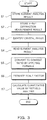
- Fig. 3 illustrates a flow chart showing operation of the analysis apparatus 100.
- the analysis apparatus 100 takes in and stores the elemental analysis result (Step S1).
- the elemental analysis result is obtained as content percentages of elements of the cement sample, which can be obtained by X-ray fluorescence analysis.
- the elemental analysis result is obtained, for example, as a CSV file, which is easily utilized as data.
- the analysis apparatus 100 takes in and stores an X-ray diffraction measurement result (Step S2).
- the X-ray diffraction measurement result is, for example, a diffraction intensity profile obtained from a powder sample.
- Step S3 the diffraction intensity profile is read, and, from peak positions thereof, crystal phases of the cement sample are identified.
- the elemental analysis result is read (Step S4), to which predetermined formulae are applied to convert content percentages of major elements in the cement sample to content ratios of major crystal phases (Step S5).
- Taylor formulae (deformed Bogue formulae) shown below can also be used.
- a scale factor s can be determined using the following formula.
- a content percentage of a crystal phase can be determined when an RIR value is given.
- the RIR value is an abbreviation of a Reference Intensity Ratio, and is an intensity ratio when a sample to be tested and aluminum oxide are mixed in the equivalent amount.
- content percentages of respective crystal phases in cement may be calculated even when a crystal structure is unidentified.
- Step S7 the Rietveld analysis is performed with respect to the X-ray diffraction measurement result of the cement sample using the estimated initial value of the scale factor, to calculate quantitative values.
- a calculation profile of a following formula can be fitted for the measurement profile.
- Fig. 4 illustrates a view showing a profile fitting example in the Rietveld analysis.
- the NIST2688 standard sample is set as an analysis object.
- Rwp which is the most general R factor in the Rietveld analysis
- Rwp shows weighted degree of concordance including background.
- S is 2.05.
- Re a statistically expected ideal limit value of Rwp
- Re a statistically expected ideal limit value of Rwp
- S 1
- it means that refinement is perfect In the profile fitting in the Rietveld analysis, fitting up to this degree is performed.
- a formula for use in cement analysis may be incorporated in X-ray diffraction software, content ratios of respective crystal phases in a cement sample may be determined from an elemental analysis result having been read according to the formula, and the content ratios may be converted to scale factors of the Rietveld analysis, which may be used as initial values of the Rietveld analysis.
- Fig. 5 illustrates a table showing analysis results.
- An obtained analysis result nearer to the standard value represents higher precision of the analysis.
- quantitative precision of ordinary ⁇ 2% or less for respective crystal phases is accomplished with respect to any component.
- analysis results in (2) - (4) at least one component deviates largely from the standard value. As described above, it has been proved that results with sufficient precision are obtained in the analysis method of the present invention.
Landscapes
- Chemical & Material Sciences (AREA)
- Health & Medical Sciences (AREA)
- Life Sciences & Earth Sciences (AREA)
- General Physics & Mathematics (AREA)
- Physics & Mathematics (AREA)
- Analytical Chemistry (AREA)
- Biochemistry (AREA)
- General Health & Medical Sciences (AREA)
- Immunology (AREA)
- Pathology (AREA)
- Crystallography & Structural Chemistry (AREA)
- Engineering & Computer Science (AREA)
- Ceramic Engineering (AREA)
- Food Science & Technology (AREA)
- Medicinal Chemistry (AREA)
- Analysing Materials By The Use Of Radiation (AREA)
Abstract
Description
- The present invention relates to an analysis apparatus, an analysis method and an analysis program for performing quantitative analysis of components of cement.
- For quality control of cement, it is necessary to analysis a composition of the cement. For that purpose, either the Bogue method, in which calculation is performed from an elemental analysis result, or the Rietveld analysis method, which is a quantitative analysis method of crystal phases, is used (see
Patent Literatures 1 and 2). The Bogue method (Bogue R. H., (1929) "Calculation of the compounds in Portland Cement", Ind. Eng. Chem., 1, 192 - 197) is one of composition analysis methods of cement and was announced by Bogue in 1929. In the Bogue method, the composition of major mineral components is calculated using formulae based on a theory from an elemental analysis result. - The Rietveld method (Rietveld H. M., (1969) "A profile refinement method for nuclear and magnetic structure", J. Applied Cryst., 2, 65 - 71) is a method of superimposing an actually measured diffraction pattern and a diffraction pattern calculated from crystal structure information, and performing profile fitting to thereby obtain crystal structure information of an actual sample. In the profile fitting, it is possible to calculate a theoretical profile from known crystal structure information and to refine a crystal structure parameter by the least squares method. According to the Rietveld method, even when equal to or more than two crystal phases are contained, quantitative analysis of each phase is possible.
- Presently, the Bogue method is frequently used for quality control of cement. However, the Bogue method that uses predetermined formulae is unsuitable for analyzing a composition of various crystal phases. On the other hand, in the Rietveld method, with respect to a scale factor that is one of parameters, a user has to set it or to adjust one that has been set by software. Consequently, an analysis result according to the Rietveld method depends on an initial value, and, therefore, different analysis values are obtained depending on a user. Accordingly, for appropriate analysis, a certain degree of skill is required.
- Moreover, there are many reports as analysis examples of cement by the Rietveld analysis. However, in these reports, there is no specific reference to treatment of parameters. In the Rietveld analysis, the analysis method, in particular the treatment of respective parameters lies in the hands of a user.
-
- PTL 1:
US Patent No. 8520802 - PTL 2:
US Patent Application No. 2012/0298358 - When quantitative analysis of cement components (C3S, C2S, C3A, C4AF) is performed using individually each of the known Bogue method or the Rietveld method, there is such a problem in the analysis by the Bogue method that difference appears between analysis values and actual composition values. In particular, the Bogue method cannot fully cover an analysis of current high-performance cement and analysis by the Rietveld method is required eagerly. However, an analysis value obtained by the Rietveld analysis depends on an initial value of a scale factor for use in the analysis, and, therefore, there is such a problem that a different analyst gives a different result, to degrade the precision of the quantitative value. In particular, for a component included in a small content percentage, this problem appears notably.
- The present invention has been done in view of circumstances, and is for providing an analysis apparatus, an analysis method and an analysis program by which even an unskilled person can perform quantitative analysis of composition of high-performance cement with high precision.
-
- (1) In order to accomplish the above-described purpose, the analysis apparatus of the present invention is an analysis apparatus performing quantitative analysis of components of cement, including: a content percentage conversion unit for converting content percentages of major elements of a cement sample to content ratios of main crystal phases composing the cement sample by predetermined formulae, the content percentages being obtained as an elemental analysis result; a scale factor estimation unit for estimating initial values of scale factors of Rietveld analysis from the content ratios of main crystal phases obtained in the conversion; and a Rietveld analysis unit for performing Rietveld analysis with respect to an X-ray diffraction measurement result of the cement sample using the initial values of scale factors having been estimated to calculate content percentages of respective phases of the cement sample.
Hereby, quantitative analysis of components of various types of high-performance cement, which has been difficult by the Bogue formula alone, can be performed with high precision. In addition, with respect to the Rietveld analysis that depends on an initial value, analysis can be performed stably with high precision, without generating difference in results due to degrees of skill of persons. Users do not have to perform trial and error for setting an initial value and the workload is reduced. - (2) Moreover, in the analysis apparatus of the present invention, the main crystal phases are four phases of C3S, C2S, C3A and C4AF. Hereby, content percentages of main components forming the basis of cement products can be determined efficiently and exact quality control in accordance with the type of cement becomes capable.
- (3) Further, in the analysis apparatus of the present invention, the Rietveld analysis unit is for practicing Rietveld analysis while keeping at least crystal structure parameters constant. By assuming crystal structure parameters to be constant in this way, the Rietveld analysis can be performed efficiently.
- (4) Furthermore, in the analysis apparatus of the present invention, the predetermined formula is a Bogue formula or a deformed formula based on the Bogue formula. Hereby, content percentages of respective phases of cement can be analyzed stably with high precision.
- (5) Still further, in the analysis apparatus of the present invention, the elemental analysis result is a result obtained by X-ray fluorescence analysis of the cement sample. Hereby, the elemental analysis result can be obtained easily and rapidly in a broad range without being influenced by a chemical state.
- (6) Still furthermore, in the analysis apparatus of the present invention, the scale factor estimation unit is for specifying an initial value of the scale factor with respect to each of phases previously identified on the basis of the content ratios of main crystal phases obtained by the conversion. Hereby, appropriate setting of the initial value of the scale factor becomes easy, and efficient and highly precise calculation of content percentages becomes capable.
- (7) The analysis method of the present invention is an analysis method performing quantitative analysis of components of cement, including the steps of: converting content percentages of major elements in a cement sample to content ratios of main crystal phases composing the cement sample by predetermined formulae, the content percentages being obtained as an elemental analysis result; estimating initial values of scale factors of Rietveld analysis from the content ratios of main crystal phases obtained by the conversion; and performing Rietveld analysis with respect to an X-ray diffraction measurement result of the cement sample using the estimated initial values of scale factors to calculate content percentages of respective phases of the cement sample. Hereby, quantitative analysis of components of various types of high-performance cement can be performed with high precision, irrespective of a degree of skill of a user.
- (8) In addition, the analysis program of the present invention is an analysis program performing quantitative analysis of components of cement, including: processing of converting content percentages of major elements in a cement sample to content ratios of main crystal phases composing the cement sample by predetermined formulae, the content percentages being obtained as an elemental analysis result; processing of estimating initial values of scale factors of Rietveld analysis from the content ratios of main crystal phases obtained by the conversion; and processing of performing Rietveld analysis with respect to an X-ray diffraction measurement result of the cement sample using the estimated initial values of scale factors to calculate content percentages of respective phases of the cement sample. Hereby, quantitative analysis of components of various types of high-performance cement can be performed with high precision, irrespective of a degree of skill of a user.
- According to the present invention, even when an unskilled person analyses a composition of high-performance cement, quantitative analysis can be performed with high precision.
-
-
Fig. 1 illustrates a schematic view showing the analysis apparatus of the present invention. -
Fig. 2 illustrates a block diagram showing a functional configuration of the analysis apparatus of the present invention. -
Fig. 3 illustrates a flow chart showing operations of the analysis apparatus of the present invention. -
Fig. 4 illustrates a view showing a profile fitting example in the Rietveld analysis. -
Fig. 5 illustrates a table showing analysis results. - Next, embodiments of the present invention are explained with reference to the drawings. To make the explanation be understood easily, the same reference number is given to the same constituent component in respective drawings, and explanations overlapping with each other are omitted.
-
Fig. 1 illustrates a schematic view showing ananalysis apparatus 100. Theanalysis apparatus 100 is, for example, a PC on which an analysis program has been installed, to calculate content percentages of respective components of a cement sample. By performing feedback from the obtained respective components of the cement sample and adjusting an input amount of a raw material, exact quality control of a cement product may be performed. - The
analysis apparatus 100 analyzes a cement sample by combining a formula derived on the basis of a theory such as the Bogue formula with the Rietveld analysis. That is, analysis values of respective crystal phases obtained according to formulae are converted to scale factors for use in the Rietveld analysis, while relative values thereof are kept, and these are used as initial values of the analysis. As the result, the scale factor obtained according to the formula is the same irrespective of who the analyst is, and, even when a person not having sufficient knowledge performs the Rietveld analysis, highly quantitative precision can be actualized with respect to cement components. -
Fig. 2 illustrates a block diagram showing the functional configuration of theanalysis apparatus 100. Theanalysis apparatus 100 includes astorage unit 110, a contentpercentage conversion unit 120, a crystalphase identification unit 130, a scalefactor estimation unit 140, and aRietveld analysis unit 150. - The
storage unit 110 stores an elemental analysis result and an X-ray diffraction measurement result of a cement sample, having been taken in. The elemental analysis result means content percentages of major elements in the cement sample, which is preferably obtained by X-ray fluorescence analysis. Hereby, the elemental analysis result can be obtained easily and rapidly in a broad range without being influenced by a chemical state. The X-ray diffraction measurement result means a diffraction intensity profile by respective crystal phases. - The content
percentage conversion unit 120 converts content percentages of major elements in the cement sample to content ratios of main crystal phases composing the cement sample by prescribed formulae. The prescribed formula is preferably the Bogue formula or Taylor formula that is a deformed formula of the Bogue formula. Hereby, content ratios of respective phases of the cement can be analyzed stably with high precision. Note that, details of the formula are described later. - As the main crystal phases, selection of C3S (Alite), C2S (Belite), C3A (Aluminate) and C4AF (Ferrite) is preferable, which are major four phases of mineral species. Hereby, content percentages of main components of a cement product can be determined efficiently, which makes it possible to perform exact quality control in accordance with a type of cement.
- The crystal
phase identification unit 130 identifies crystal phases contained in the cement sample from the X-ray diffraction measurement result. As the result, for example, the above-described major four components and other minor components can be identified. - The scale
factor estimation unit 140 estimates an initial value of a scale factor of the Rietveld analysis from each of the content ratios of the main crystal phases having been obtained by the conversion. Hereby, quantitative analysis of components of various types of high-performance cement, which has been difficult according to the Bogue formula alone, can be performed with high precision. Moreover, stable and highly precise analysis can be performed with respect to the Rietveld analysis that depends on the initial value, without generating different results due to degrees of skill of persons. Users do not have to perform trial and error for setting the initial value, and a workload is reduced. - The scale
factor estimation unit 140 preferably estimates the initial value of scale factor with respect to the previously identified crystal phase on the basis of the content ratios of the main crystal phases having been obtained by conversion, while keeping content ratios of main crystal phases. Hereby, appropriate setting of the initial value of scale factor becomes easy, which makes highly precise and efficient calculation of content percentages capable. Details of mathematical formulae and processing for use in the estimation are described later. - The
Rietveld analysis unit 150 performs the Rietveld analysis with respect to the X-ray diffraction measurement result of the cement sample, using the estimated initial value of scale factor. TheRietveld analysis unit 150 preferably practices the Rietveld analysis, with fixing crystal structure parameters (atomic coordinate, site occupancy rate, atomic displacement parameter). By assuming the crystal structure to be constant in this way, the Rietveld analysis can be performed efficiently. Details of the Rietveld analysis are described later. - Next, operations of the
analysis apparatus 100 configured as described above are explained.Fig. 3 illustrates a flow chart showing operation of theanalysis apparatus 100. First, theanalysis apparatus 100 takes in and stores the elemental analysis result (Step S1). The elemental analysis result is obtained as content percentages of elements of the cement sample, which can be obtained by X-ray fluorescence analysis. The elemental analysis result is obtained, for example, as a CSV file, which is easily utilized as data. On the other hand, theanalysis apparatus 100 takes in and stores an X-ray diffraction measurement result (Step S2). The X-ray diffraction measurement result is, for example, a diffraction intensity profile obtained from a powder sample. - Next, the diffraction intensity profile is read, and, from peak positions thereof, crystal phases of the cement sample are identified (Step S3). Subsequently, the elemental analysis result is read (Step S4), to which predetermined formulae are applied to convert content percentages of major elements in the cement sample to content ratios of major crystal phases (Step S5).
- For example, quantitative values of respective crystal phases can be calculated, following the Bogue formulae below. Each of the formulae represents the composition with compounds represented by respective chemical formulae of major crystal phases.
-

-

-

-

- In place of the Bogue formulae, Taylor formulae (deformed Bogue formulae) shown below can also be used.
-

-

-

-

- From content ratios of main crystal phases obtained by the conversion in this way, initial values of scale factors of the Rietveld analysis are estimated (Step S6). For example, a scale factor s can be determined using the following formula.
-

- W: a mass fraction of a crystal phase
- s: a scale factor
- Z: the number of molecules within a unit cell
- M: molecular weight
- V: the volume of a unit cell
- i: an i-th crystal phase
- Note that, even in a case where structure information is not known, a content percentage of a crystal phase can be determined when an RIR value is given. The RIR value is an abbreviation of a Reference Intensity Ratio, and is an intensity ratio when a sample to be tested and aluminum oxide are mixed in the equivalent amount. By using the RIR value, content percentages of respective crystal phases in cement may be calculated even when a crystal structure is unidentified.
- Subsequently, the Rietveld analysis is performed with respect to the X-ray diffraction measurement result of the cement sample using the estimated initial value of the scale factor, to calculate quantitative values (Step S7). For example, a calculation profile of a following formula can be fitted for the measurement profile.
-

- sn: a scale factor
- 2θh: a Bragg angle
- A(2θi): intensity correction of absorption, irradiation area
- Pn,h: orientation correction
- In,h: integrated intensity
- φn: profile function
- T(2θi): angle correction
- yb(2θi): background function
- n: sum with respect to respective crystal phases
- h: sum with respect to Miller index
-
Fig. 4 illustrates a view showing a profile fitting example in the Rietveld analysis. In the example shown inFig. 4 , the NIST2688 standard sample is set as an analysis object. In the example shown inFig. 4 , Rwp, which is the most general R factor in the Rietveld analysis, is 3.88%. Rwp shows weighted degree of concordance including background. On one hand, S is 2.05. When a statistically expected ideal limit value of Rwp is represented by Re, S is defined by Rwp/Re, and, when S = 1, it means that refinement is perfect. In the profile fitting in the Rietveld analysis, fitting up to this degree is performed. - As described above, by applying the scale factor having been estimated using a predetermined formula to the Rietveld analysis of cement, a sufficiently converged analysis result can be obtained without estimation of the initial value of the scale factor by a user. Further, with respect to a component having a small content percentage, too, an analysis result having high precision can be obtained, irrespective of who is the user.
- Above described operations are performed by executing a program on the
analysis apparatus 100. Specifically, a formula for use in cement analysis may be incorporated in X-ray diffraction software, content ratios of respective crystal phases in a cement sample may be determined from an elemental analysis result having been read according to the formula, and the content ratios may be converted to scale factors of the Rietveld analysis, which may be used as initial values of the Rietveld analysis. - Using the above-described
analysis apparatus 100, actually a cement sample of Portland cement was analyzed. For a same cement sample, X-ray fluorescence analysis and X-ray diffraction measurement were performed. Then, with respect to an obtained elemental analysis result and X-ray diffraction measurement result, each of following (1) - (4), that is, (1) Rietveld analysis using an initial value obtained from the Bogue formula, (2) Rietveld analysis on the basis of an initial value set by software, (3) Rietveld analysis on the basis of an initial value set by a user, and (4) analysis by the Bogue formula alone, was performed to determine corresponding content percentages of crystal phases. -
Fig. 5 illustrates a table showing analysis results. An obtained analysis result nearer to the standard value represents higher precision of the analysis. As shown inFig. 5 , in the analysis in the above-described (1), quantitative precision of ordinary ±2% or less for respective crystal phases is accomplished with respect to any component. In contrast, analysis results in (2) - (4), at least one component deviates largely from the standard value. As described above, it has been proved that results with sufficient precision are obtained in the analysis method of the present invention. -
- 100
- analysis apparatus
- 110
- storage unit
- 120
- content percentage conversion unit
- 130
- crystal phase identification unit
- 140
- scale factor estimation unit
- 150
- Rietveld analysis unit
Claims (8)
- An analysis apparatus for performing quantitative analysis of components of cement, comprising:a content percentage conversion unit for converting content percentages of major elements of a cement sample to content ratios of main crystal phases composing the cement sample by predetermined formulae, the content percentages being obtained as an elemental analysis result;a scale factor estimation unit for estimating initial values of scale factors of Rietveld analysis from the content ratios of main crystal phases obtained in the conversion; anda Rietveld analysis unit for performing Rietveld analysis with respect to an X-ray diffraction measurement result of the cement sample using the initial values of scale factors having been estimated to calculate content percentages of respective phases of the cement sample.
- The analysis apparatus according to claim 1, wherein the main crystal phases are four phases of C3S, C2S, C3A and C4AF.
- The analysis apparatus according to claim 1 or 2, wherein the Rietveld analysis unit for practicing Rietveld analysis with keeping at least crystal structure parameters constant.
- The analysis apparatus according to any of claims 1 to 3, wherein the predetermined formula is a Bogue formula or a deformed formula based on the Bogue formula.
- The analysis apparatus according to any of claims 1 to 4, wherein the elemental analysis result is a result obtained by X-ray fluorescence analysis of the cement sample.
- The analysis apparatus according to any of claims 1 to 5, wherein the scale factor estimation unit for specifying an initial value of the scale factor with respect to each of phases previously identified on the basis of the content ratios of main crystal phases obtained by the conversion.
- An analysis method for performing quantitative analysis of components of cement, comprising the steps of:converting content percentages of major elements in a cement sample to content ratios of main crystal phases composing the cement sample by predetermined formulae, the content percentages being obtained as an elemental analysis result;estimating initial values of scale factors of Rietveld analysis from the content ratios of main crystal phases obtained by the conversion; andperforming Rietveld analysis with respect to an X-ray diffraction measurement result of the cement sample using the estimated initial values of scale factors to calculate content percentages of respective phases of the cement sample.
- An analysis program for performing quantitative analysis of components of cement, comprising:processing of converting content percentages of major elements in a cement sample to content ratios of main crystal phases composing the cement sample by predetermined formulae, the content percentages being obtained as an elemental analysis result;processing of estimating initial values of scale factors of Rietveld analysis from the content ratios of main crystal phases obtained by the conversion; andprocessing of performing Rietveld analysis with respect to an X-ray diffraction measurement result of the cement sample using the estimated initial values of scale factors to calculate content percentages of respective phases of the cement sample.
Applications Claiming Priority (2)
| Application Number | Priority Date | Filing Date | Title |
|---|---|---|---|
| JP2016027965 | 2016-02-17 | ||
| PCT/JP2017/005543 WO2017141973A1 (en) | 2016-02-17 | 2017-02-15 | Analysis device, analysis method, and analysis program |
Publications (3)
| Publication Number | Publication Date |
|---|---|
| EP3418727A1 true EP3418727A1 (en) | 2018-12-26 |
| EP3418727A4 EP3418727A4 (en) | 2019-11-27 |
| EP3418727B1 EP3418727B1 (en) | 2022-05-11 |
Family
ID=59625946
Family Applications (1)
| Application Number | Title | Priority Date | Filing Date |
|---|---|---|---|
| EP17753229.8A Active EP3418727B1 (en) | 2016-02-17 | 2017-02-15 | Analysis apparatus, analysis method, and analysis program |
Country Status (6)
| Country | Link |
|---|---|
| US (1) | US11300529B2 (en) |
| EP (1) | EP3418727B1 (en) |
| JP (1) | JP6845405B2 (en) |
| KR (1) | KR102453706B1 (en) |
| CN (1) | CN108770365B (en) |
| WO (1) | WO2017141973A1 (en) |
Families Citing this family (4)
| Publication number | Priority date | Publication date | Assignee | Title |
|---|---|---|---|---|
| CN110530911A (en) * | 2019-09-29 | 2019-12-03 | 浙江省产品质量安全检测研究院 | The method for measuring the silicate mineral in portland slag cement and slag content |
| JP7414280B2 (en) * | 2020-12-11 | 2024-01-16 | 株式会社リガク | Mixture diffraction pattern analysis method, device, program and information storage medium |
| KR102675956B1 (en) * | 2022-06-16 | 2024-06-17 | 서울대학교산학협력단 | the Methodology for determining curing optimization for cement composites |
| JP7805901B2 (en) * | 2022-09-15 | 2026-01-26 | 株式会社Niterra Materials | Crystalline phase information extraction device, method, and program |
Family Cites Families (16)
| Publication number | Priority date | Publication date | Assignee | Title |
|---|---|---|---|---|
| DE10346433B4 (en) * | 2003-10-07 | 2006-05-11 | Bruker Axs Gmbh | Analytical method for determining crystallographic phases of a measurement sample |
| JP2008070331A (en) * | 2006-09-15 | 2008-03-27 | Mazda Motor Corp | Method and apparatus for analyzing sample having a plurality of crystal phases |
| JP4811534B1 (en) * | 2010-06-01 | 2011-11-09 | 宇部興産株式会社 | CEMENT COMPOSITION AND METHOD FOR PRODUCING CEMENT COMPOSITION |
| FR2961505B1 (en) * | 2010-06-18 | 2013-08-02 | Cemex Res Group Ag | CLINKER AND METHOD FOR PREPARING HYDRAULIC CEMENT WITH LOW CO2 EMISSION AND HIGH STRENGTH |
| DE102010030939B3 (en) | 2010-07-05 | 2012-01-05 | Bruker Axs Gmbh | Method for determining the quantitative composition of a powder sample |
| JP2012025635A (en) * | 2010-07-26 | 2012-02-09 | Sumitomo Osaka Cement Co Ltd | Cement clinker and cement composition |
| CA2809511A1 (en) * | 2010-08-31 | 2012-03-08 | Toda Kogyo Corporation | Lithium titanate particles and process for producing the lithium titanate particles, mg-containing lithium titanate particles and process for producing the mg-containing lithium titanate particles, negative electrode active substance particles for non-aqueous electrolyte secondary batteries, and non-aqueous electrolyte secondary battery |
| US8887806B2 (en) | 2011-05-26 | 2014-11-18 | Halliburton Energy Services, Inc. | Method for quantifying cement blend components |
| US9433929B2 (en) * | 2011-09-21 | 2016-09-06 | Ineos Europe Ag | Mixed metal oxide catalysts |
| JP2014162696A (en) * | 2013-02-27 | 2014-09-08 | Taiheiyo Cement Corp | Cement-based solidifying material |
| WO2015123431A1 (en) * | 2014-02-14 | 2015-08-20 | Chevron U.S.A. Inc. | System and method for identifying hydrocarbon potential in a rock formation using x-ray fluorescence |
| JP2016060845A (en) * | 2014-09-18 | 2016-04-25 | 株式会社東芝 | Phosphor, phosphor manufacturing method, and light emitting device using the same |
| JP6755068B2 (en) * | 2015-03-03 | 2020-09-16 | 太平洋セメント株式会社 | Quantitative analysis method for multi-component mixed cement and manufacturing control system for multi-component mixed cement |
| US9851313B2 (en) * | 2015-03-03 | 2017-12-26 | Panalytical B.V. | Quantitative X-ray analysis—ratio correction |
| JP6090401B2 (en) * | 2015-09-28 | 2017-03-08 | 住友大阪セメント株式会社 | Method for producing cement composition |
| CN105675636B (en) * | 2016-01-21 | 2018-06-26 | 济南大学 | A kind of XRD quantitative analysis methods based on gypsoide in cement-based material |
-
2017
- 2017-02-15 JP JP2018500161A patent/JP6845405B2/en active Active
- 2017-02-15 CN CN201780011596.7A patent/CN108770365B/en active Active
- 2017-02-15 WO PCT/JP2017/005543 patent/WO2017141973A1/en not_active Ceased
- 2017-02-15 EP EP17753229.8A patent/EP3418727B1/en active Active
- 2017-02-15 KR KR1020187020513A patent/KR102453706B1/en active Active
- 2017-02-15 US US16/074,967 patent/US11300529B2/en active Active
Also Published As
| Publication number | Publication date |
|---|---|
| US20190041342A1 (en) | 2019-02-07 |
| EP3418727A4 (en) | 2019-11-27 |
| CN108770365A (en) | 2018-11-06 |
| KR102453706B1 (en) | 2022-10-14 |
| EP3418727B1 (en) | 2022-05-11 |
| JPWO2017141973A1 (en) | 2018-12-06 |
| WO2017141973A1 (en) | 2017-08-24 |
| US11300529B2 (en) | 2022-04-12 |
| JP6845405B2 (en) | 2021-03-17 |
| KR20180112772A (en) | 2018-10-12 |
| CN108770365B (en) | 2021-04-16 |
Similar Documents
| Publication | Publication Date | Title |
|---|---|---|
| EP3418727A1 (en) | Analysis device, analysis method, and analysis program | |
| Scholtzová et al. | Structural and spectroscopic characterization of ettringite mineral–combined DFT and experimental study | |
| Antao et al. | State-of-the-art high-resolution powder X-ray diffraction (HRPXRD) illustrated with Rietveld structure refinement of quartz, sodalite, tremolite, and meionite | |
| CN109073574B (en) | Crystal phase quantitative analysis device, crystal phase quantitative analysis method, and crystal phase quantitative analysis program | |
| Vaillant et al. | Multichannel quantum defect theory of strontium bound Rydberg states | |
| US20200173938A1 (en) | Quantitative phase analysis device, quantitative phase analysis method, and non-transitory computer-readable storage medium storing quantitative phase analysis program | |
| CN112041670A (en) | Quantitative analysis device, analysis method, and analysis program for amorphous phase | |
| CN103808743A (en) | Method for measuring austenite content in steel by using X-ray diffraction technology | |
| Puzzarini et al. | Rotational spectra of rare isotopic species of fluoroiodomethane: Determination of the equilibrium structure from rotational spectroscopy and quantum-chemical calculations | |
| Bodnar et al. | Evaluation of uncertainty in the adjustment of fundamental constants | |
| Inada et al. | Librational, vibrational, and exchange motions of water molecules in aqueous Ni (II) solution: classical and QM/MM molecular dynamics simulations | |
| Doménech-Carbó et al. | ATR-FTIR and XRD quantification of solid mixtures using the asymptotic constant ratio (ACR) methods. Application to geological samples of sodium and potassium feldspars | |
| Chen et al. | Electron paramagnetic resonance spectroscopic study of synthetic fluorapatite: Part I. Local structural environment and substitution mechanism of Gd3+ at the Ca2 site | |
| Tlamsamania et al. | Quantitative phase analysis of anhydrous clinker Portland using Rietveld method | |
| French et al. | Resonances, chaos, and short-term interactions among the inner Uranian satellites | |
| Ferrari et al. | Quantum-mechanical ab initio simulation of the Raman and IR spectra of Fe3Al2Si3O12 almandine | |
| Kelsey et al. | Cation order/disorder behavior and crystal chemistry of pyrope-grossular garnets: An 17O 3QMAS and 27Al MAS NMR spectroscopic study | |
| Driscall et al. | Cation ordering in synthetic low-calcium actinolite | |
| Allanach et al. | SUSY parameter analysis at TeV and Planck scales | |
| JP2013134169A (en) | Crystal phase quantitative method using x-ray diffraction | |
| Dickenson et al. | The D1Π u state of HD and the mass scaling relation of its predissociation widths | |
| Barmaki et al. | Investigation of the doubly excited 1 P o resonance series of the O6+ ion under the N= 3 threshold of O7+ | |
| Dufresne et al. | How to derive tight-binding spd potentials? Application to zirconium | |
| Perrin et al. | First analysis of the 3ν9− ν9 hot band of difluoroboric acid (BF2OH). Further evidence of large amplitude effects for the OH torsion | |
| Stanton et al. | Gas-phase infrared spectrum of methyl nitrate |
Legal Events
| Date | Code | Title | Description |
|---|---|---|---|
| STAA | Information on the status of an ep patent application or granted ep patent |
Free format text: STATUS: THE INTERNATIONAL PUBLICATION HAS BEEN MADE |
|
| PUAI | Public reference made under article 153(3) epc to a published international application that has entered the european phase |
Free format text: ORIGINAL CODE: 0009012 |
|
| STAA | Information on the status of an ep patent application or granted ep patent |
Free format text: STATUS: REQUEST FOR EXAMINATION WAS MADE |
|
| 17P | Request for examination filed |
Effective date: 20180808 |
|
| AK | Designated contracting states |
Kind code of ref document: A1 Designated state(s): AL AT BE BG CH CY CZ DE DK EE ES FI FR GB GR HR HU IE IS IT LI LT LU LV MC MK MT NL NO PL PT RO RS SE SI SK SM TR |
|
| AX | Request for extension of the european patent |
Extension state: BA ME |
|
| RIN1 | Information on inventor provided before grant (corrected) |
Inventor name: OHBUCHI, ATSUSHI Inventor name: FUJINAWA, GO Inventor name: KONYA, TAKAYUKI Inventor name: HIMEDA, AKIHIRO |
|
| DAV | Request for validation of the european patent (deleted) | ||
| DAX | Request for extension of the european patent (deleted) | ||
| REG | Reference to a national code |
Ref country code: DE Ref legal event code: R079 Ref document number: 602017057333 Country of ref document: DE Free format text: PREVIOUS MAIN CLASS: G01N0023207000 Ipc: G01N0023200000 |
|
| A4 | Supplementary search report drawn up and despatched |
Effective date: 20191024 |
|
| RIC1 | Information provided on ipc code assigned before grant |
Ipc: G01N 33/38 20060101ALI20191018BHEP Ipc: G01N 23/20 20180101AFI20191018BHEP |
|
| GRAP | Despatch of communication of intention to grant a patent |
Free format text: ORIGINAL CODE: EPIDOSNIGR1 |
|
| STAA | Information on the status of an ep patent application or granted ep patent |
Free format text: STATUS: GRANT OF PATENT IS INTENDED |
|
| INTG | Intention to grant announced |
Effective date: 20220204 |
|
| GRAS | Grant fee paid |
Free format text: ORIGINAL CODE: EPIDOSNIGR3 |
|
| GRAA | (expected) grant |
Free format text: ORIGINAL CODE: 0009210 |
|
| STAA | Information on the status of an ep patent application or granted ep patent |
Free format text: STATUS: THE PATENT HAS BEEN GRANTED |
|
| AK | Designated contracting states |
Kind code of ref document: B1 Designated state(s): AL AT BE BG CH CY CZ DE DK EE ES FI FR GB GR HR HU IE IS IT LI LT LU LV MC MK MT NL NO PL PT RO RS SE SI SK SM TR |
|
| REG | Reference to a national code |
Ref country code: GB Ref legal event code: FG4D |
|
| REG | Reference to a national code |
Ref country code: CH Ref legal event code: EP |
|
| REG | Reference to a national code |
Ref country code: AT Ref legal event code: REF Ref document number: 1491830 Country of ref document: AT Kind code of ref document: T Effective date: 20220515 |
|
| REG | Reference to a national code |
Ref country code: DE Ref legal event code: R096 Ref document number: 602017057333 Country of ref document: DE |
|
| REG | Reference to a national code |
Ref country code: IE Ref legal event code: FG4D Ref country code: NL Ref legal event code: FP |
|
| REG | Reference to a national code |
Ref country code: LT Ref legal event code: MG9D |
|
| REG | Reference to a national code |
Ref country code: AT Ref legal event code: MK05 Ref document number: 1491830 Country of ref document: AT Kind code of ref document: T Effective date: 20220511 |
|
| PG25 | Lapsed in a contracting state [announced via postgrant information from national office to epo] |
Ref country code: SE Free format text: LAPSE BECAUSE OF FAILURE TO SUBMIT A TRANSLATION OF THE DESCRIPTION OR TO PAY THE FEE WITHIN THE PRESCRIBED TIME-LIMIT Effective date: 20220511 Ref country code: PT Free format text: LAPSE BECAUSE OF FAILURE TO SUBMIT A TRANSLATION OF THE DESCRIPTION OR TO PAY THE FEE WITHIN THE PRESCRIBED TIME-LIMIT Effective date: 20220912 Ref country code: NO Free format text: LAPSE BECAUSE OF FAILURE TO SUBMIT A TRANSLATION OF THE DESCRIPTION OR TO PAY THE FEE WITHIN THE PRESCRIBED TIME-LIMIT Effective date: 20220811 Ref country code: LT Free format text: LAPSE BECAUSE OF FAILURE TO SUBMIT A TRANSLATION OF THE DESCRIPTION OR TO PAY THE FEE WITHIN THE PRESCRIBED TIME-LIMIT Effective date: 20220511 Ref country code: HR Free format text: LAPSE BECAUSE OF FAILURE TO SUBMIT A TRANSLATION OF THE DESCRIPTION OR TO PAY THE FEE WITHIN THE PRESCRIBED TIME-LIMIT Effective date: 20220511 Ref country code: GR Free format text: LAPSE BECAUSE OF FAILURE TO SUBMIT A TRANSLATION OF THE DESCRIPTION OR TO PAY THE FEE WITHIN THE PRESCRIBED TIME-LIMIT Effective date: 20220812 Ref country code: FI Free format text: LAPSE BECAUSE OF FAILURE TO SUBMIT A TRANSLATION OF THE DESCRIPTION OR TO PAY THE FEE WITHIN THE PRESCRIBED TIME-LIMIT Effective date: 20220511 Ref country code: ES Free format text: LAPSE BECAUSE OF FAILURE TO SUBMIT A TRANSLATION OF THE DESCRIPTION OR TO PAY THE FEE WITHIN THE PRESCRIBED TIME-LIMIT Effective date: 20220511 Ref country code: BG Free format text: LAPSE BECAUSE OF FAILURE TO SUBMIT A TRANSLATION OF THE DESCRIPTION OR TO PAY THE FEE WITHIN THE PRESCRIBED TIME-LIMIT Effective date: 20220811 Ref country code: AT Free format text: LAPSE BECAUSE OF FAILURE TO SUBMIT A TRANSLATION OF THE DESCRIPTION OR TO PAY THE FEE WITHIN THE PRESCRIBED TIME-LIMIT Effective date: 20220511 |
|
| PG25 | Lapsed in a contracting state [announced via postgrant information from national office to epo] |
Ref country code: RS Free format text: LAPSE BECAUSE OF FAILURE TO SUBMIT A TRANSLATION OF THE DESCRIPTION OR TO PAY THE FEE WITHIN THE PRESCRIBED TIME-LIMIT Effective date: 20220511 Ref country code: PL Free format text: LAPSE BECAUSE OF FAILURE TO SUBMIT A TRANSLATION OF THE DESCRIPTION OR TO PAY THE FEE WITHIN THE PRESCRIBED TIME-LIMIT Effective date: 20220511 Ref country code: LV Free format text: LAPSE BECAUSE OF FAILURE TO SUBMIT A TRANSLATION OF THE DESCRIPTION OR TO PAY THE FEE WITHIN THE PRESCRIBED TIME-LIMIT Effective date: 20220511 Ref country code: IS Free format text: LAPSE BECAUSE OF FAILURE TO SUBMIT A TRANSLATION OF THE DESCRIPTION OR TO PAY THE FEE WITHIN THE PRESCRIBED TIME-LIMIT Effective date: 20220911 |
|
| PG25 | Lapsed in a contracting state [announced via postgrant information from national office to epo] |
Ref country code: SM Free format text: LAPSE BECAUSE OF FAILURE TO SUBMIT A TRANSLATION OF THE DESCRIPTION OR TO PAY THE FEE WITHIN THE PRESCRIBED TIME-LIMIT Effective date: 20220511 Ref country code: SK Free format text: LAPSE BECAUSE OF FAILURE TO SUBMIT A TRANSLATION OF THE DESCRIPTION OR TO PAY THE FEE WITHIN THE PRESCRIBED TIME-LIMIT Effective date: 20220511 Ref country code: RO Free format text: LAPSE BECAUSE OF FAILURE TO SUBMIT A TRANSLATION OF THE DESCRIPTION OR TO PAY THE FEE WITHIN THE PRESCRIBED TIME-LIMIT Effective date: 20220511 Ref country code: EE Free format text: LAPSE BECAUSE OF FAILURE TO SUBMIT A TRANSLATION OF THE DESCRIPTION OR TO PAY THE FEE WITHIN THE PRESCRIBED TIME-LIMIT Effective date: 20220511 Ref country code: DK Free format text: LAPSE BECAUSE OF FAILURE TO SUBMIT A TRANSLATION OF THE DESCRIPTION OR TO PAY THE FEE WITHIN THE PRESCRIBED TIME-LIMIT Effective date: 20220511 Ref country code: CZ Free format text: LAPSE BECAUSE OF FAILURE TO SUBMIT A TRANSLATION OF THE DESCRIPTION OR TO PAY THE FEE WITHIN THE PRESCRIBED TIME-LIMIT Effective date: 20220511 |
|
| REG | Reference to a national code |
Ref country code: DE Ref legal event code: R097 Ref document number: 602017057333 Country of ref document: DE |
|
| PLBE | No opposition filed within time limit |
Free format text: ORIGINAL CODE: 0009261 |
|
| STAA | Information on the status of an ep patent application or granted ep patent |
Free format text: STATUS: NO OPPOSITION FILED WITHIN TIME LIMIT |
|
| PG25 | Lapsed in a contracting state [announced via postgrant information from national office to epo] |
Ref country code: AL Free format text: LAPSE BECAUSE OF FAILURE TO SUBMIT A TRANSLATION OF THE DESCRIPTION OR TO PAY THE FEE WITHIN THE PRESCRIBED TIME-LIMIT Effective date: 20220511 |
|
| 26N | No opposition filed |
Effective date: 20230214 |
|
| PG25 | Lapsed in a contracting state [announced via postgrant information from national office to epo] |
Ref country code: SI Free format text: LAPSE BECAUSE OF FAILURE TO SUBMIT A TRANSLATION OF THE DESCRIPTION OR TO PAY THE FEE WITHIN THE PRESCRIBED TIME-LIMIT Effective date: 20220511 |
|
| PG25 | Lapsed in a contracting state [announced via postgrant information from national office to epo] |
Ref country code: MC Free format text: LAPSE BECAUSE OF FAILURE TO SUBMIT A TRANSLATION OF THE DESCRIPTION OR TO PAY THE FEE WITHIN THE PRESCRIBED TIME-LIMIT Effective date: 20220511 |
|
| REG | Reference to a national code |
Ref country code: CH Ref legal event code: PL |
|
| REG | Reference to a national code |
Ref country code: BE Ref legal event code: MM Effective date: 20230228 |
|
| GBPC | Gb: european patent ceased through non-payment of renewal fee |
Effective date: 20230215 |
|
| PG25 | Lapsed in a contracting state [announced via postgrant information from national office to epo] |
Ref country code: LU Free format text: LAPSE BECAUSE OF NON-PAYMENT OF DUE FEES Effective date: 20230215 Ref country code: LI Free format text: LAPSE BECAUSE OF NON-PAYMENT OF DUE FEES Effective date: 20230228 Ref country code: CH Free format text: LAPSE BECAUSE OF NON-PAYMENT OF DUE FEES Effective date: 20230228 |
|
| REG | Reference to a national code |
Ref country code: IE Ref legal event code: MM4A |
|
| PG25 | Lapsed in a contracting state [announced via postgrant information from national office to epo] |
Ref country code: GB Free format text: LAPSE BECAUSE OF NON-PAYMENT OF DUE FEES Effective date: 20230215 |
|
| PG25 | Lapsed in a contracting state [announced via postgrant information from national office to epo] |
Ref country code: IT Free format text: LAPSE BECAUSE OF FAILURE TO SUBMIT A TRANSLATION OF THE DESCRIPTION OR TO PAY THE FEE WITHIN THE PRESCRIBED TIME-LIMIT Effective date: 20220511 Ref country code: IE Free format text: LAPSE BECAUSE OF NON-PAYMENT OF DUE FEES Effective date: 20230215 Ref country code: GB Free format text: LAPSE BECAUSE OF NON-PAYMENT OF DUE FEES Effective date: 20230215 Ref country code: FR Free format text: LAPSE BECAUSE OF NON-PAYMENT OF DUE FEES Effective date: 20230228 |
|
| PG25 | Lapsed in a contracting state [announced via postgrant information from national office to epo] |
Ref country code: BE Free format text: LAPSE BECAUSE OF NON-PAYMENT OF DUE FEES Effective date: 20230228 |
|
| PG25 | Lapsed in a contracting state [announced via postgrant information from national office to epo] |
Ref country code: BG Free format text: LAPSE BECAUSE OF FAILURE TO SUBMIT A TRANSLATION OF THE DESCRIPTION OR TO PAY THE FEE WITHIN THE PRESCRIBED TIME-LIMIT Effective date: 20220511 |
|
| PG25 | Lapsed in a contracting state [announced via postgrant information from national office to epo] |
Ref country code: BG Free format text: LAPSE BECAUSE OF FAILURE TO SUBMIT A TRANSLATION OF THE DESCRIPTION OR TO PAY THE FEE WITHIN THE PRESCRIBED TIME-LIMIT Effective date: 20220511 |
|
| PG25 | Lapsed in a contracting state [announced via postgrant information from national office to epo] |
Ref country code: CY Free format text: LAPSE BECAUSE OF FAILURE TO SUBMIT A TRANSLATION OF THE DESCRIPTION OR TO PAY THE FEE WITHIN THE PRESCRIBED TIME-LIMIT; INVALID AB INITIO Effective date: 20170215 |
|
| PG25 | Lapsed in a contracting state [announced via postgrant information from national office to epo] |
Ref country code: HU Free format text: LAPSE BECAUSE OF FAILURE TO SUBMIT A TRANSLATION OF THE DESCRIPTION OR TO PAY THE FEE WITHIN THE PRESCRIBED TIME-LIMIT; INVALID AB INITIO Effective date: 20170215 |
|
| PG25 | Lapsed in a contracting state [announced via postgrant information from national office to epo] |
Ref country code: TR Free format text: LAPSE BECAUSE OF FAILURE TO SUBMIT A TRANSLATION OF THE DESCRIPTION OR TO PAY THE FEE WITHIN THE PRESCRIBED TIME-LIMIT Effective date: 20220511 |
|
| PGFP | Annual fee paid to national office [announced via postgrant information from national office to epo] |
Ref country code: NL Payment date: 20260218 Year of fee payment: 10 |
|
| PGFP | Annual fee paid to national office [announced via postgrant information from national office to epo] |
Ref country code: DE Payment date: 20260218 Year of fee payment: 10 |