EP3416969B1 - Fused 1,4-oxazepines and related analogs as bet bromodomain inhibitors - Google Patents
Fused 1,4-oxazepines and related analogs as bet bromodomain inhibitors Download PDFInfo
- Publication number
- EP3416969B1 EP3416969B1 EP17708046.2A EP17708046A EP3416969B1 EP 3416969 B1 EP3416969 B1 EP 3416969B1 EP 17708046 A EP17708046 A EP 17708046A EP 3416969 B1 EP3416969 B1 EP 3416969B1
- Authority
- EP
- European Patent Office
- Prior art keywords
- triazolo
- oxazepine
- thieno
- methyl
- benzyl
- Prior art date
- Legal status (The legal status is an assumption and is not a legal conclusion. Google has not performed a legal analysis and makes no representation as to the accuracy of the status listed.)
- Active
Links
- 0 C[C@@]1c2nnc(C)[n]2-c2ccc(C)c(*)c2C*1 Chemical compound C[C@@]1c2nnc(C)[n]2-c2ccc(C)c(*)c2C*1 0.000 description 9
- MIDZBDABQBLNCQ-UHFFFAOYSA-N Cc1nnc(COC2)[n]1-c1c2c(Br)ccc1 Chemical compound Cc1nnc(COC2)[n]1-c1c2c(Br)ccc1 MIDZBDABQBLNCQ-UHFFFAOYSA-N 0.000 description 3
- VSJGDQUMYFYEFZ-NSHDSACASA-N C[C@@H](c1nnc(C)[n]1-1)NCc2c-1[s]c(C)c2Cc1ccccc1 Chemical compound C[C@@H](c1nnc(C)[n]1-1)NCc2c-1[s]c(C)c2Cc1ccccc1 VSJGDQUMYFYEFZ-NSHDSACASA-N 0.000 description 2
- BQTFTZBVKPCCCE-UHFFFAOYSA-N Cc([s]c-1c2COCc3nnc(C)[n]-13)c2Br Chemical compound Cc([s]c-1c2COCc3nnc(C)[n]-13)c2Br BQTFTZBVKPCCCE-UHFFFAOYSA-N 0.000 description 2
- DABURAQKYZVXAH-UHFFFAOYSA-N Cc([s]c-1c2COCc3nnc(C)[n]-13)c2Nc1ccccc1 Chemical compound Cc([s]c-1c2COCc3nnc(C)[n]-13)c2Nc1ccccc1 DABURAQKYZVXAH-UHFFFAOYSA-N 0.000 description 2
- NHPVFXIZRXOANP-UHFFFAOYSA-N Cc1c(Cc2ccccc2)c(CN(Cc2nnc(C)[n]2-2)C(OCc3ccccc3)=O)c-2[s]1 Chemical compound Cc1c(Cc2ccccc2)c(CN(Cc2nnc(C)[n]2-2)C(OCc3ccccc3)=O)c-2[s]1 NHPVFXIZRXOANP-UHFFFAOYSA-N 0.000 description 2
- YSYWWYBBKDZALJ-UHFFFAOYSA-N Cc1nnc(COC2)[n]1-c(cc1)c2c(C2=CCCc3ccccc23)c1Cl Chemical compound Cc1nnc(COC2)[n]1-c(cc1)c2c(C2=CCCc3ccccc23)c1Cl YSYWWYBBKDZALJ-UHFFFAOYSA-N 0.000 description 2
- KGIBNYCWRUMQMO-UHFFFAOYSA-N Cc1nnc(COC2)[n]1-c(cc1)c2c(Cc2ccccc2)c1C#C Chemical compound Cc1nnc(COC2)[n]1-c(cc1)c2c(Cc2ccccc2)c1C#C KGIBNYCWRUMQMO-UHFFFAOYSA-N 0.000 description 2
- WYDOYCPZAWEVFI-UHFFFAOYSA-N CC(c1c(Cc2ccccc2)c(COCc2nnc(C)[n]2-2)c-2[s]1)=C Chemical compound CC(c1c(Cc2ccccc2)c(COCc2nnc(C)[n]2-2)c-2[s]1)=C WYDOYCPZAWEVFI-UHFFFAOYSA-N 0.000 description 1
- OKDZNTQUDFDVMT-UHFFFAOYSA-N CC(c1nnc(C)[n]1-1)OCc2c-1[s]c(C)c2Br Chemical compound CC(c1nnc(C)[n]1-1)OCc2c-1[s]c(C)c2Br OKDZNTQUDFDVMT-UHFFFAOYSA-N 0.000 description 1
- SVSUYEJKNSMKKW-UHFFFAOYSA-N CC1(C)OB(C(C)=C)OC1(C)C Chemical compound CC1(C)OB(C(C)=C)OC1(C)C SVSUYEJKNSMKKW-UHFFFAOYSA-N 0.000 description 1
- IGZGIVIFDQWFSI-UHFFFAOYSA-N CC1(C)OB(C2=CCCc3c2cccc3)OC1(C)C Chemical compound CC1(C)OB(C2=CCCc3c2cccc3)OC1(C)C IGZGIVIFDQWFSI-UHFFFAOYSA-N 0.000 description 1
- CQXXCBRJJSMFRZ-UHFFFAOYSA-N CC1(C)OB(Cc(cc2)ccc2OC(F)(F)F)OC1(C)C Chemical compound CC1(C)OB(Cc(cc2)ccc2OC(F)(F)F)OC1(C)C CQXXCBRJJSMFRZ-UHFFFAOYSA-N 0.000 description 1
- TXIOGJHPPVXTOY-UHFFFAOYSA-N CCN1CCN(C)CC1 Chemical compound CCN1CCN(C)CC1 TXIOGJHPPVXTOY-UHFFFAOYSA-N 0.000 description 1
- WGCYRFWNGRMRJA-UHFFFAOYSA-N CCN1CCNCC1 Chemical compound CCN1CCNCC1 WGCYRFWNGRMRJA-UHFFFAOYSA-N 0.000 description 1
- HVCNXQOWACZAFN-UHFFFAOYSA-N CCN1CCOCC1 Chemical compound CCN1CCOCC1 HVCNXQOWACZAFN-UHFFFAOYSA-N 0.000 description 1
- SEYQNXJAINYRKA-ZDUSSCGKSA-N CCOC(N(C1)[C@@H](C)c2nnc(C)[n]2-c2c1c(Cc1ccccc1)c(C)[s]2)=O Chemical compound CCOC(N(C1)[C@@H](C)c2nnc(C)[n]2-c2c1c(Cc1ccccc1)c(C)[s]2)=O SEYQNXJAINYRKA-ZDUSSCGKSA-N 0.000 description 1
- RXYPXQSKLGGKOL-UHFFFAOYSA-N CN1CCN(C)CC1 Chemical compound CN1CCN(C)CC1 RXYPXQSKLGGKOL-UHFFFAOYSA-N 0.000 description 1
- CKMCYZOQUXIVDX-UHFFFAOYSA-N COC(c1c(N)[s]cc1Cl)=O Chemical compound COC(c1c(N)[s]cc1Cl)=O CKMCYZOQUXIVDX-UHFFFAOYSA-N 0.000 description 1
- UCSFLKQYBDBBKD-AWEZNQCLSA-N C[C@@H](c1nnc(C)[n]1-1)N(CC2CC2)Cc2c-1[s]c(C)c2Cc1ccccc1 Chemical compound C[C@@H](c1nnc(C)[n]1-1)N(CC2CC2)Cc2c-1[s]c(C)c2Cc1ccccc1 UCSFLKQYBDBBKD-AWEZNQCLSA-N 0.000 description 1
- TUTOMWTVZFSCDP-VIFPVBQESA-N C[C@@H](c1nnc(C)[n]1-1)OCc2c-1[s]c(Br)c2Cc(cc1)ccc1F Chemical compound C[C@@H](c1nnc(C)[n]1-1)OCc2c-1[s]c(Br)c2Cc(cc1)ccc1F TUTOMWTVZFSCDP-VIFPVBQESA-N 0.000 description 1
- WKOOCBNYIUQIKN-JTQLQIEISA-N C[C@@H](c1nnc(C)[n]1-1)OCc2c-1[s]c(Br)c2Cc1ccccc1 Chemical compound C[C@@H](c1nnc(C)[n]1-1)OCc2c-1[s]c(Br)c2Cc1ccccc1 WKOOCBNYIUQIKN-JTQLQIEISA-N 0.000 description 1
- XWUPXWCTZVIFPC-HNNXBMFYSA-N C[C@@H](c1nnc(C)[n]1-1)OCc2c-1[s]c(C#Cc1cnc[n]1C)c2Cc1ccccc1 Chemical compound C[C@@H](c1nnc(C)[n]1-1)OCc2c-1[s]c(C#Cc1cnc[n]1C)c2Cc1ccccc1 XWUPXWCTZVIFPC-HNNXBMFYSA-N 0.000 description 1
- IJQWBCPVPYZKKB-MRVPVSSYSA-N C[C@H](CCCc1c2)c1ccc2F Chemical compound C[C@H](CCCc1c2)c1ccc2F IJQWBCPVPYZKKB-MRVPVSSYSA-N 0.000 description 1
- AQEAZZOFRKDLFK-GFCCVEGCSA-N C[C@H](c1nnc(C)[n]1-1)N(C)Cc2c-1[s]c(C)c2Cc1ccccc1 Chemical compound C[C@H](c1nnc(C)[n]1-1)N(C)Cc2c-1[s]c(C)c2Cc1ccccc1 AQEAZZOFRKDLFK-GFCCVEGCSA-N 0.000 description 1
- VSJGDQUMYFYEFZ-LLVKDONJSA-N C[C@H](c1nnc(C)[n]1-1)NCc2c-1[s]c(C)c2Cc1ccccc1 Chemical compound C[C@H](c1nnc(C)[n]1-1)NCc2c-1[s]c(C)c2Cc1ccccc1 VSJGDQUMYFYEFZ-LLVKDONJSA-N 0.000 description 1
- JFOSWQQRTHDTGG-UHFFFAOYSA-N C[n]1c(C#C)cnc1 Chemical compound C[n]1c(C#C)cnc1 JFOSWQQRTHDTGG-UHFFFAOYSA-N 0.000 description 1
- CPHIXENWVAKGHK-UHFFFAOYSA-N Cc([s]c-1c2COC3(CC3)c3nnc(C)[n]-13)c2Br Chemical compound Cc([s]c-1c2COC3(CC3)c3nnc(C)[n]-13)c2Br CPHIXENWVAKGHK-UHFFFAOYSA-N 0.000 description 1
- ZGRVTJQERLQTQJ-UHFFFAOYSA-N Cc([s]c-1c2COCc3nnc(C)[n]-13)c2C1=CCCCc2ccccc12 Chemical compound Cc([s]c-1c2COCc3nnc(C)[n]-13)c2C1=CCCCc2ccccc12 ZGRVTJQERLQTQJ-UHFFFAOYSA-N 0.000 description 1
- DSRLXSSJMGAKKE-UHFFFAOYSA-N Cc([s]c-1c2COCc3nnc(C)[n]-13)c2C1=CCCc(cc2)c1cc2F Chemical compound Cc([s]c-1c2COCc3nnc(C)[n]-13)c2C1=CCCc(cc2)c1cc2F DSRLXSSJMGAKKE-UHFFFAOYSA-N 0.000 description 1
- REVKWWQIZZJJEX-UHFFFAOYSA-N Cc1c(C[n]2cccc2)c(COCc2nnc(C)[n]2-2)c-2[s]1 Chemical compound Cc1c(C[n]2cccc2)c(COCc2nnc(C)[n]2-2)c-2[s]1 REVKWWQIZZJJEX-UHFFFAOYSA-N 0.000 description 1
- RILGSMOQVIGMRC-UHFFFAOYSA-N Cc1c(Cc2cc(C#N)ccc2)c(COCc2nnc(C)[n]2-2)c-2[s]1 Chemical compound Cc1c(Cc2cc(C#N)ccc2)c(COCc2nnc(C)[n]2-2)c-2[s]1 RILGSMOQVIGMRC-UHFFFAOYSA-N 0.000 description 1
- IDSWMFYTNLOBAO-UHFFFAOYSA-N Cc1c(Cc2ccccc2)c(CNCc2nnc(C)[n]2-2)c-2[s]1 Chemical compound Cc1c(Cc2ccccc2)c(CNCc2nnc(C)[n]2-2)c-2[s]1 IDSWMFYTNLOBAO-UHFFFAOYSA-N 0.000 description 1
- BBQOZISZHYDRQE-UHFFFAOYSA-N Cc1nnc(COC2)[n]1-c([s]1)c2c(Cc(cc2)ccc2F)c1Br Chemical compound Cc1nnc(COC2)[n]1-c([s]1)c2c(Cc(cc2)ccc2F)c1Br BBQOZISZHYDRQE-UHFFFAOYSA-N 0.000 description 1
- XGWXDMJKXOJAPJ-UHFFFAOYSA-N Cc1nnc(COC2)[n]1-c([s]1)c2c(Cc2ccccc2)c1Br Chemical compound Cc1nnc(COC2)[n]1-c([s]1)c2c(Cc2ccccc2)c1Br XGWXDMJKXOJAPJ-UHFFFAOYSA-N 0.000 description 1
- ZJNUYMPGSFGAAJ-UHFFFAOYSA-N Cc1nnc(COC2)[n]1-c(cc1)c2c(Br)c1Cl Chemical compound Cc1nnc(COC2)[n]1-c(cc1)c2c(Br)c1Cl ZJNUYMPGSFGAAJ-UHFFFAOYSA-N 0.000 description 1
- CBDRNJCDJCGNCU-UHFFFAOYSA-N Cc1nnc(COC2)[n]1-c(cc1)c2c(Cc2ccccc2)c1-c1c[n](CC(N)=O)nc1 Chemical compound Cc1nnc(COC2)[n]1-c(cc1)c2c(Cc2ccccc2)c1-c1c[n](CC(N)=O)nc1 CBDRNJCDJCGNCU-UHFFFAOYSA-N 0.000 description 1
- KSXWAYJDFBFFJA-UHFFFAOYSA-N Cc1nnc(COC2)[n]1-c(cc1)c2c(Cc2ccccc2)c1-c1ccc(N)nc1 Chemical compound Cc1nnc(COC2)[n]1-c(cc1)c2c(Cc2ccccc2)c1-c1ccc(N)nc1 KSXWAYJDFBFFJA-UHFFFAOYSA-N 0.000 description 1
- SWWUVUOTVYPIAE-UHFFFAOYSA-N Cc1nnc(COC2)[n]1-c(cc1)c2c(Cc2ccccc2)c1C#C[Si](C)(C)C Chemical compound Cc1nnc(COC2)[n]1-c(cc1)c2c(Cc2ccccc2)c1C#C[Si](C)(C)C SWWUVUOTVYPIAE-UHFFFAOYSA-N 0.000 description 1
- FIOROBMUTNMDSI-UHFFFAOYSA-N Cc1nnc(COC2)[n]1-c1c2c(C2(CC2)c2ccccc2)ccc1 Chemical compound Cc1nnc(COC2)[n]1-c1c2c(C2(CC2)c2ccccc2)ccc1 FIOROBMUTNMDSI-UHFFFAOYSA-N 0.000 description 1
- BQEWSPDJNIKZCA-UHFFFAOYSA-N Cc1nnc(COC2)[n]1-c1c2c(Cc(cc2)ccc2OC(F)(F)F)ccc1 Chemical compound Cc1nnc(COC2)[n]1-c1c2c(Cc(cc2)ccc2OC(F)(F)F)ccc1 BQEWSPDJNIKZCA-UHFFFAOYSA-N 0.000 description 1
- HVYLOKVISLKQDM-UHFFFAOYSA-N Cc1nnc(COC2)[n]1-c1c2c(Cc2ccccc2)c(C#Cc2ccncc2)[s]1 Chemical compound Cc1nnc(COC2)[n]1-c1c2c(Cc2ccccc2)c(C#Cc2ccncc2)[s]1 HVYLOKVISLKQDM-UHFFFAOYSA-N 0.000 description 1
- VGXPECPSONVTEW-UHFFFAOYSA-N Cc1nnc(COC2)[n]1-c1c2c(Cc2ccccc2)c(C2CCOCC2)cc1 Chemical compound Cc1nnc(COC2)[n]1-c1c2c(Cc2ccccc2)c(C2CCOCC2)cc1 VGXPECPSONVTEW-UHFFFAOYSA-N 0.000 description 1
- WIHIOLUOOOFSAF-UHFFFAOYSA-N Cc1nnc(COC2)[n]1-c1c2c(Cc2ccccc2)c(C2COCC2)cc1 Chemical compound Cc1nnc(COC2)[n]1-c1c2c(Cc2ccccc2)c(C2COCC2)cc1 WIHIOLUOOOFSAF-UHFFFAOYSA-N 0.000 description 1
- NDCDZLWWGGGUPB-UHFFFAOYSA-N Cc1nnc(COC2)[n]1-c1c2c(Nc2ccccc2)ccc1 Chemical compound Cc1nnc(COC2)[n]1-c1c2c(Nc2ccccc2)ccc1 NDCDZLWWGGGUPB-UHFFFAOYSA-N 0.000 description 1
- OELSNWQCXTZJTG-UHFFFAOYSA-N Cc1nnc(COC2)[n]1-c1c2c(Oc2ccccc2)ccc1 Chemical compound Cc1nnc(COC2)[n]1-c1c2c(Oc2ccccc2)ccc1 OELSNWQCXTZJTG-UHFFFAOYSA-N 0.000 description 1
- VINVQQFDCLOPMA-UHFFFAOYSA-N Cc1nnc(COC2)[n]1-c1c2c(Sc2ccccc2)ccc1 Chemical compound Cc1nnc(COC2)[n]1-c1c2c(Sc2ccccc2)ccc1 VINVQQFDCLOPMA-UHFFFAOYSA-N 0.000 description 1
- PAYRUJLWNCNPSJ-UHFFFAOYSA-N Nc1ccccc1 Chemical compound Nc1ccccc1 PAYRUJLWNCNPSJ-UHFFFAOYSA-N 0.000 description 1
Images
Classifications
-
- C—CHEMISTRY; METALLURGY
- C07—ORGANIC CHEMISTRY
- C07D—HETEROCYCLIC COMPOUNDS
- C07D495/00—Heterocyclic compounds containing in the condensed system at least one hetero ring having sulfur atoms as the only ring hetero atoms
- C07D495/12—Heterocyclic compounds containing in the condensed system at least one hetero ring having sulfur atoms as the only ring hetero atoms in which the condensed system contains three hetero rings
- C07D495/14—Ortho-condensed systems
-
- A—HUMAN NECESSITIES
- A61—MEDICAL OR VETERINARY SCIENCE; HYGIENE
- A61K—PREPARATIONS FOR MEDICAL, DENTAL OR TOILETRY PURPOSES
- A61K45/00—Medicinal preparations containing active ingredients not provided for in groups A61K31/00 - A61K41/00
- A61K45/06—Mixtures of active ingredients without chemical characterisation, e.g. antiphlogistics and cardiaca
-
- A—HUMAN NECESSITIES
- A61—MEDICAL OR VETERINARY SCIENCE; HYGIENE
- A61P—SPECIFIC THERAPEUTIC ACTIVITY OF CHEMICAL COMPOUNDS OR MEDICINAL PREPARATIONS
- A61P29/00—Non-central analgesic, antipyretic or antiinflammatory agents, e.g. antirheumatic agents; Non-steroidal antiinflammatory drugs [NSAID]
-
- A—HUMAN NECESSITIES
- A61—MEDICAL OR VETERINARY SCIENCE; HYGIENE
- A61P—SPECIFIC THERAPEUTIC ACTIVITY OF CHEMICAL COMPOUNDS OR MEDICINAL PREPARATIONS
- A61P31/00—Antiinfectives, i.e. antibiotics, antiseptics, chemotherapeutics
- A61P31/04—Antibacterial agents
-
- A—HUMAN NECESSITIES
- A61—MEDICAL OR VETERINARY SCIENCE; HYGIENE
- A61P—SPECIFIC THERAPEUTIC ACTIVITY OF CHEMICAL COMPOUNDS OR MEDICINAL PREPARATIONS
- A61P31/00—Antiinfectives, i.e. antibiotics, antiseptics, chemotherapeutics
- A61P31/12—Antivirals
-
- A—HUMAN NECESSITIES
- A61—MEDICAL OR VETERINARY SCIENCE; HYGIENE
- A61P—SPECIFIC THERAPEUTIC ACTIVITY OF CHEMICAL COMPOUNDS OR MEDICINAL PREPARATIONS
- A61P35/00—Antineoplastic agents
-
- A—HUMAN NECESSITIES
- A61—MEDICAL OR VETERINARY SCIENCE; HYGIENE
- A61P—SPECIFIC THERAPEUTIC ACTIVITY OF CHEMICAL COMPOUNDS OR MEDICINAL PREPARATIONS
- A61P35/00—Antineoplastic agents
- A61P35/02—Antineoplastic agents specific for leukemia
-
- A—HUMAN NECESSITIES
- A61—MEDICAL OR VETERINARY SCIENCE; HYGIENE
- A61P—SPECIFIC THERAPEUTIC ACTIVITY OF CHEMICAL COMPOUNDS OR MEDICINAL PREPARATIONS
- A61P35/00—Antineoplastic agents
- A61P35/04—Antineoplastic agents specific for metastasis
-
- A—HUMAN NECESSITIES
- A61—MEDICAL OR VETERINARY SCIENCE; HYGIENE
- A61P—SPECIFIC THERAPEUTIC ACTIVITY OF CHEMICAL COMPOUNDS OR MEDICINAL PREPARATIONS
- A61P37/00—Drugs for immunological or allergic disorders
-
- A—HUMAN NECESSITIES
- A61—MEDICAL OR VETERINARY SCIENCE; HYGIENE
- A61P—SPECIFIC THERAPEUTIC ACTIVITY OF CHEMICAL COMPOUNDS OR MEDICINAL PREPARATIONS
- A61P37/00—Drugs for immunological or allergic disorders
- A61P37/02—Immunomodulators
- A61P37/06—Immunosuppressants, e.g. drugs for graft rejection
-
- A—HUMAN NECESSITIES
- A61—MEDICAL OR VETERINARY SCIENCE; HYGIENE
- A61P—SPECIFIC THERAPEUTIC ACTIVITY OF CHEMICAL COMPOUNDS OR MEDICINAL PREPARATIONS
- A61P43/00—Drugs for specific purposes, not provided for in groups A61P1/00-A61P41/00
-
- C—CHEMISTRY; METALLURGY
- C07—ORGANIC CHEMISTRY
- C07D—HETEROCYCLIC COMPOUNDS
- C07D498/00—Heterocyclic compounds containing in the condensed system at least one hetero ring having nitrogen and oxygen atoms as the only ring hetero atoms
- C07D498/02—Heterocyclic compounds containing in the condensed system at least one hetero ring having nitrogen and oxygen atoms as the only ring hetero atoms in which the condensed system contains two hetero rings
- C07D498/04—Ortho-condensed systems
-
- C—CHEMISTRY; METALLURGY
- C07—ORGANIC CHEMISTRY
- C07D—HETEROCYCLIC COMPOUNDS
- C07D498/00—Heterocyclic compounds containing in the condensed system at least one hetero ring having nitrogen and oxygen atoms as the only ring hetero atoms
- C07D498/12—Heterocyclic compounds containing in the condensed system at least one hetero ring having nitrogen and oxygen atoms as the only ring hetero atoms in which the condensed system contains three hetero rings
- C07D498/14—Ortho-condensed systems
Definitions
- the present disclosure provides BET bromodomain inhibitors and therapeutic methods of treating conditions and diseases wherein inhibition of one or more BET bromodomains provides a benefit.
- the genomes of eukaryotic organisms are highly organized within the nucleus of the cell.
- the long strands of duplex DNA are wrapped around an octamer of histone proteins (usually comprising two copies of histones H2A, H2B, H3, and H4) to form a nucleosome, which then is further compressed to form a highly condensed chromatin structure.
- a range of different condensation states are possible, and the tightness of this structure varies during the cell cycle.
- the chromatin structure plays a critical role in regulating gene transcription, which cannot occur efficiently from highly condensed chromatin.
- the chromatin structure is controlled by a series of post translational modifications to histone proteins, notably histones H3 and H4. These modifications include acetylation, methylation, phosphorylation, ubiquitinylation, and SUMOylation.
- Histone acetylation usually is associated with the activation of gene transcription, as the modification loosens the interaction of the DNA and the histone octamer by changing the electrostatics.
- specific proteins bind to acetylated lysine residues within histones to read the epigenetic code.
- Bromodomains are small (about 110 amino acid) distinct domains within proteins that bind to acetylated lysine resides commonly, but not exclusively, in the context of histones. There is a family of about 50 proteins known to contain bromodomains, which have a range of functions within the cell.
- BET bromodomains The BET family of bromodomain-containing proteins (“BET bromodomains”) includes four proteins, i.e., BRD2, BRD3, BRD4, and BRD-t, which contain tandem bromodomains capable of binding to two acetylated lysine residues in close proximity, thereby increasing the specificity of the interaction.
- BRD2 and BRD3 associate with histones along actively transcribed genes and may be involved in facilitating transcriptional elongation, while BRD4 may be involved in the recruitment of the pTEF- ⁇ complex to inducible genes, resulting in phosphorylation of RNA polymerase and increased transcriptional output.
- BRD4 or BRD3 also may fuse with NUT (nuclear protein in testis) forming novel fusion oncogenes, BRD4-NUT or BRD3-NUT, in a highly malignant form of epithelial neoplasia.
- NUT nuclear protein in testis
- BRD-NUT fusion proteins contribute to carcinogenesis.
- BRD-t is uniquely expressed in the testes and ovary. All family members have been reported to have some function in controlling or executing aspects of the cell cycle, and have been shown to remain in complex with chromosomes during cell division, which suggests a role in the maintenance of epigenetic memory.
- some viruses make use of these proteins to tether their genomes to the host cell chromatin as part of the process of viral replication.
- BET bromodomain inhibitors e.g., I-BET-151 and I-BET-762
- Delmore et al. Cell 146:904-917 (2011 )
- Seal et al. Bioorg. Med. Chem. Lett. 22:2968-2972 (2012 ).
- Small molecule inhibitors of BET bromodomains have therapeutic potential for the treatment of many diseases and conditions in which BET bromodomains have a role, including cancer.
- BET bromodomain inhibitors are disclosed in the following U.S.
- the present disclosure provides fused 1,4-oxazepines and related analogs represented by any one of Formulae I-XII, below, and the pharmaceutically acceptable salts, hydrates, and solvates thereof, collectively referred to herein as "Compounds of the Disclosure.”
- Compounds of the Disclosure are inhibitors of BET bromodomains that bind to BET bromodomains and function as antagonists of BET bromodomains and/or synthetic intermediates that can be used to prepare inhibitors of BET bromodomains.
- BET bromodomains are useful in treating diseases or conditions wherein inhibition of BET bromodomains, e.g., BRD2, BRD3, BRD4, BRD-t, or an isoform or mutant thereof, provides a benefit.
- BET bromodomains e.g., BRD2, BRD3, BRD4, BRD-t, or an isoform or mutant thereof.
- the present disclosure provides methods of treating a condition or disease by administering a therapeutically effective amount of a Compound of the Disclosure to an individual, e.g., a human, in need thereof.
- the disease or condition of interest is treatable by inhibition of BET bromodomains, for example, a cancer, a chronic autoimmune disorder, an inflammatory condition, a proliferative disorder, sepsis, or a viral infection.
- methods of preventing the proliferation of unwanted proliferating cells, such as cancer, in a subject comprising administering a therapeutically effective amount of a Compound of the Disclosure to a subject at risk of developing a condition characterized by unwanted proliferating cells.
- the Compounds of the Disclosure reduce the proliferation of unwanted cells by inducing apoptosis in those cells.
- the present disclosure provides a method of inhibiting BET bromodomains in an individual, comprising administering to the individual an effective amount of at least one Compound of the Disclosure.
- the present disclosure provides a pharmaceutical composition
- a pharmaceutical composition comprising a Compound of the Disclosure and an excipient and/or pharmaceutically acceptable carrier.
- the present disclosure provides a composition comprising a Compound of the Disclosure and an excipient and/or pharmaceutically acceptable carrier for use treating diseases or conditions wherein inhibition of BET bromodomains provides a benefit, e.g., cancer.
- the present disclosure provides a composition
- a composition comprising: (a) a Compound of the Disclosure; (b) a second therapeutically active agent; and (c) optionally an excipient and/or pharmaceutically acceptable carrier.
- the present disclosure provides a Compound of the Disclosure for use in treatment of a disease or condition of interest, e.g., cancer.
- the present disclosure provides a use of a Compound of the Disclosure for the manufacture of a medicament for treating a disease or condition of interest, e.g., cancer.
- the present disclosure provides a kit comprising a Compound of the Disclosure, and, optionally, a packaged composition comprising a second therapeutic agent useful in the treatment of a disease or condition of interest, and a package insert containing directions for use in the treatment of a disease or condition, e.g., cancer.
- the present disclosure provides methods of preparing Compounds of the Disclosure, e.g., compounds having any one of Formulae I-XII.
- Compounds of the Disclosure are inhibitors of BET bromodomain proteins and/or synthetic intermediates used to prepare inhibitors of BET bromodomain proteins.
- Compounds of the Disclosure are compounds represented by Formula I: and the pharmaceutically acceptable salts, hydrates, and solvates thereof, wherein:
- Compounds of the Disclosure are compounds represented by Formula II: and the pharmaceutically acceptable salts, hydrates, and solvates thereof, wherein R 1 , R 2a , R 2b , R 3a , R 3b , R 4 , R 5 , and Y are as defined in connection with Formula I.
- Compounds of the Disclosure are compounds represented by Formula III: and the pharmaceutically acceptable salts, hydrates, and solvates thereof, wherein R 1 , R 2a , R 2b , R 3a , R 3b , R 4 , R 5 , R 15 , and Y are as defined in connection with Formula I.
- R 15 is hydrogen.
- Compounds of the Disclosure are compounds represented by any one of Formulae I-III, and the pharmaceutically acceptable salts, hydrates, and solvates thereof, wherein R 3a and R 3b are hydrogen.
- Compounds of the Disclosure are compounds represented by any one of Formulae I-III, and the pharmaceutically acceptable salts, hydrates, and solvates thereof, wherein R 2a and R 2b are taken with the carbon atom to which they are attached form a 3- to 6-membered cycloalkyl, and R 3a and R 3b are hydrogen. In another embodiment, R 2a and R 2b are taken with the carbon atom to which they are attached form a cyclopropyl group.
- Compounds of the Disclosure are compounds represented by any one of Formulae I-III, and the pharmaceutically acceptable salts, hydrates, and solvates thereof, wherein R 2a and R 2b are each independently selected from the group consisting of hydrogen and C 1-4 alkyl, and R 3a and R 3b are hydrogen. In another embodiment, R 2a and R 2b are hydrogen.
- Compounds of the Disclosure are compounds represented by any one of Formulae I-III, and the pharmaceutically acceptable salts, hydrates, and solvates thereof, wherein R 1 is C 1-4 alkyl. In another embodiment, R 1 is methyl.
- Compounds of the Disclosure are compounds represented by Formula IV and the pharmaceutically acceptable salts, hydrates, and solvates thereof, wherein R 2a is selected from the group consisting of C 1-4 alkyl and (alkoxycarbonyl)alkyl; and R 4 , R 5 , and Y are as defined in connection with Formula I.
- R 2a is C 1-4 alkyl.
- R 2a is methyl.
- Compounds of the Disclosure are compounds represented by Formula V: and the pharmaceutically acceptable salts, hydrates, and solvates thereof, wherein R 2a is selected from the group consisting of C 1-4 alkyl and (alkoxycarbonyl)alkyl; and R 4 , R 5 , and Y are as defined in connection with Formula I.
- R 2a is C 1-4 alkyl.
- R 2a is methyl.
- Compounds of the Disclosure are compounds represented by Formula VI: and the pharmaceutically acceptable salts, hydrates, and solvates thereof, wherein R 2a is selected from the group consisting of C 1-4 alkyl and (alkoxycarbonyl)alkyl; and R 4 , R 5 , R 15 , and Y are as defined in connection with Formula I.
- R 2a is C 1-4 alkyl.
- R 2a is methyl.
- R 15 is hydrogen.
- Compounds of the Disclosure are compounds represented by Formula VII: and the pharmaceutically acceptable salts, hydrates, and solvates thereof, wherein R 2a is selected from the group consisting of C 1-4 alkyl and (alkoxycarbonyl)alkyl; and R 4 , R 5 , R 15 , and Y are as defined in connection with Formula I.
- R 2a is C 1-4 alkyl.
- R 2a is methyl.
- R 15 is hydrogen.
- Compounds of the Disclosure are compounds represented by any one of Formulae I-VII, and the pharmaceutically acceptable salts, hydrates, and solvates thereof, wherein R 5 is selected from the group consisting of hydrogen, halogen, C 1-4 alkyl, optionally substituted C 2-4 alkynyl, and substituted 5- to 14-membered heteroaryl. In another embodiment, R 5 is selected from the group consisting of hydrogen, halogen, and C 1-4 alkyl.
- R 4 is selected from the group consisting of halogen, C 1-4 alkyl, optionally C 2-4 alkenyl, optionally
- R 4 is -NR 6a R 6b .
- R 6a is selected from the group consisting of optionally substituted C 6-14 aryl and optionally substituted 5- to 14-membered heteroaryl
- R 6b is hydrogen.
- R 4 is -OR 7 .
- R 7 is selected from the group consisting of hydrogen and optionally substituted C 6-14 aryl.
- R 8c is optionally substituted C 6-14 aryl.
- R 9 is optionally substituted C 6-14 aryl.
- R 4 is optionally substituted C 3-7 cycloalkyl. In another embodiment, R 4 is optionally substituted C 3-7 cycloalkyl selected from the group consisting of: In another embodiment, R 4 is optionally substituted C 3-7 cycloalkyl selected from the group consisting of: In another embodiment, R 4 is aralkyl.
- Compounds of the Disclosure are compounds represented by any one of Formulae I-VII, and the pharmaceutically acceptable salts, hydrates, and solvates thereof, wherein Y is -NR 10 .
- R 10 is hydrogen.
- R 10 is methyl.
- Compounds of the Disclosure are compounds represented by any one of Formulae I-VII, and the pharmaceutically acceptable salts, hydrates, and solvates thereof, wherein Y is -O-.
- Compounds of the Disclosure are compounds represented by Formula VIII: and the pharmaceutically acceptable salts, hydrates, and solvates thereof, wherein:
- Compounds of the Disclosure are compounds represented by Formula VIII, or a pharmaceutically acceptable salt or hydrate thereof, wherein:
- Compounds of the Disclosure are compounds represented by Formula VIII, or a pharmaceutically acceptable salt or hydrate thereof, wherein:
- Compounds of the Disclosure are compounds represented by Formula IX: and the pharmaceutically acceptable salts, hydrates, and solvates thereof, wherein R 4 is optionally substituted cycloalkyl.
- Compounds of the Disclosure are compounds represented by Formula X: and the pharmaceutically acceptable salts, hydrates, and solvates thereof, wherein:
- Compounds of the Disclosure are compounds represented by Formula XI: and the pharmaceutically acceptable salts, hydrates, and solvates thereof, wherein:
- Compounds of the Disclosure are compounds represented by Formula XI, and the pharmaceutically acceptable salts, hydrates, and solvates thereof, wherein R 18 is -CHO. In another embodiment, Compounds of the Disclosure are compounds represented by Formula XI, and the pharmaceutically acceptable salts, hydrates, and solvates thereof, wherein R 18 is -C ⁇ CH.
- Compounds of the Disclosure are compounds represented by Formula XII: and the pharmaceutically acceptable salts, hydrates, and solvates thereof, wherein:
- Compounds of the Disclosure are compounds represented by Formula XII, and the pharmaceutically acceptable salts, hydrates, and solvates thereof, wherein R 18 is -CHO. In another embodiment, Compounds of the Disclosure are compounds represented by Formula XII, and the pharmaceutically acceptable salts, hydrates, and solvates thereof, wherein R 18 is -C ⁇ CH. In another embodiment, Compounds of the Disclosure are compounds represented by Formula XII, and the pharmaceutically acceptable salts, hydrates, and solvates thereof, wherein Q is -O-. In another embodiment, Compounds of the Disclosure are compounds represented by Formula XII, and the pharmaceutically acceptable salts, hydrates, and solvates thereof, wherein Q is -N(H)-.
- Compounds of the Disclosure are compounds of Table 1, and the pharmaceutically acceptable salts, hydrates, and solvates thereof.
- Table 1 Cpd No. Structure Name 1 2,9-dimethyl-4H,6H-thieno[2,3-e][1,2,4]triazolo[3,4-c][1,4]oxazepine 2 3-bromo-2,9-dimethyl-4H,6H-thieno[2,3-e][1,2,4]triazolo[3,4-c][1,4]oxazepine 3 2,9-dimethyl-3-phenyl-4H,6H-thieno[2,3-e][1,2,4]triazolo[3,4-c][1,4]oxazepine 4 3-benzyl-2,9-dimethyl-4H,6H-thieno[2,3-e][1,2,4]triazolo[3,4-c][1,4]oxazepine 5 2,9-dimethyl-3
- Compounds of the Disclosure inhibit BET bromodomains and are useful in the treatment of a variety of diseases and conditions.
- Compounds of the Disclosure are useful in methods of treating a disease or condition wherein inhibition of BET bromodomains provides a benefit, for example, cancers and proliferative diseases.
- Methods of the disclosure comprise administering a therapeutically effective amount of a Compound of the Disclosure to an individual in need thereof.
- the present methods also encompass administering a second therapeutic agent to the individual in addition to the Compound of the Disclosure.
- the second therapeutic agent is selected from drugs known as useful in treating the disease or condition afflicting the individual in need thereof, e.g., a chemotherapeutic agent and/or radiation known as useful in treating a particular cancer.
- Salts, hydrates, and solvates of the Compounds of the Disclosure can also be used in the methods disclosed herein.
- the present disclosure further includes all possible stereoisomers and geometric isomers of Compounds of the Disclosure to include both racemic compounds and optically active isomers.
- a Compound of the Disclosure When a Compound of the Disclosure is desired as a single enantiomer, it can be obtained either by resolution of the final product or by stereospecific synthesis from either isomerically pure starting material or use of a chiral auxiliary reagent, for example, see Z. Ma et al., Tetrahedron: Asymmetry, 8(6), pages 883-888 (1997 ). Resolution of the final product, an intermediate, or a starting material can be achieved by any suitable method known in the art. Additionally, in situations where tautomers of the Compounds of the Disclosure are possible, the present disclosure is intended to include all tautomeric forms of the compounds.
- the present disclosure encompasses the preparation and use of salts of Compounds of the Disclosure.
- the pharmaceutical "pharmaceutically acceptable salt” refers to salts or zwitterionic forms of Compounds of the Disclosure. Salts of Compounds of the Disclosure can be prepared during the final isolation and purification of the compounds or separately by reacting the compound with an acid having a suitable cation.
- the pharmaceutically acceptable salts of Compounds of the Disclosure can be acid addition salts formed with pharmaceutically acceptable acids. Examples of acids which can be employed to form pharmaceutically acceptable salts include inorganic acids such as nitric, boric, hydrochloric, hydrobromic, sulfuric, and phosphoric, and organic acids such as oxalic, maleic, succinic, and citric.
- Nonlimiting examples of salts of compounds of the disclosure include, but are not limited to, the hydrochloride, hydrobromide, hydroiodide, sulfate, bisulfate, 2-hydroxyethansulfonate, phosphate, hydrogen phosphate, acetate, adipate, alginate, aspartate, benzoate, bisulfate, butyrate, camphorate, camphorsulfonate, digluconate, glycerolphsphate, hemisulfate, heptanoate, hexanoate, formate, succinate, fumarate, maleate, ascorbate, isethionate, salicylate, methanesulfonate, mesitylenesulfonate, naphthylenesulfonate, nicotinate, 2-naphthalenesulfonate, oxalate, pamoate, pectinate, persulfate, 3-phenylproprionate, picrate, pi
- available amino groups present in the compounds of the disclosure can be quaternized with methyl, ethyl, propyl, and butyl chlorides, bromides, and iodides; dimethyl, diethyl, dibutyl, and diamyl sulfates; decyl, lauryl, myristyl, and steryl chlorides, bromides, and iodides; and benzyl and phenethyl bromides.
- any reference Compounds of the Disclosure appearing herein is intended to include compounds of Compounds of the Disclosure as well as pharmaceutically acceptable salts, hydrates, or solvates thereof.
- solvates typically do not significantly alter the physiological activity or toxicity of the compounds, and as such may function as pharmacological equivalents.
- solvate as used herein is a combination, physical association and/or solvation of a compound of the present disclosure with a solvent molecule such as, e.g. a disolvate, monosolvate or hemisolvate, where the ratio of solvent molecule to compound of the present disclosure is about 2:1, about 1:1 or about 1:2, respectively.
- This physical association involves varying degrees of ionic and covalent bonding, including hydrogen bonding.
- solvate can be isolated, such as when one or more solvent molecules are incorporated into the crystal lattice of a crystalline solid.
- solvate encompasses both solution-phase and isolatable solvates.
- Compounds of the Disclosure can be present as solvated forms with a pharmaceutically acceptable solvent, such as water, methanol, and ethanol, and it is intended that the disclosure includes both solvated and unsolvated forms of Compounds of the Disclosure.
- a pharmaceutically acceptable solvent such as water, methanol, and ethanol
- solvate is a hydrate.
- a "hydrate” relates to a particular subgroup of solvates where the solvent molecule is water.
- Solvates typically can function as pharmacological equivalents. Preparation of solvates is known in the art. See, for example, M.
- a typical, non-limiting, process of preparing a solvate would involve dissolving a Compound of the Disclosure in a desired solvent (organic, water, or a mixture thereof) at temperatures above 20°C to about 25°C, then cooling the solution at a rate sufficient to form crystals, and isolating the crystals by known methods, e.g., filtration.
- Analytical techniques such as infrared spectroscopy can be used to confirm the presence of the solvent in a crystal of the solvate.
- the present disclosure provides Compounds of the Disclosure as BET bromodomain inhibitors for the treatment of a variety of diseases and conditions wherein inhibition of BET bromodomains has a beneficial effect.
- Compounds of the Disclosure typically have a binding affinity (IC 50 ) to BET bromodomains of less than 100 ⁇ M, e.g., less than 50 ⁇ M, less than 25 ⁇ M, and less than 5 ⁇ M, less than about 1 ⁇ M, less than about 0.5 ⁇ M, or less than about 0.1 ⁇ M.
- the present disclosure relates to a method of treating an individual suffering from a disease or condition wherein inhibition of the BET bromodomains provides a benefit comprising administering a therapeutically effective amount of a Compound of the Disclosure to an individual in need thereof.
- Compounds of the Disclosure are inhibitors of one or more BET bromodomains, a number of diseases and conditions mediated by BET bromodomain proteins can be treated by employing these compounds.
- the present disclosure is thus directed generally to a method for treating a condition or disorder responsive to inhibition of BRD2, BRD3, BRD4, BRD-t, or an isoform or mutant thereof, in an animal, e.g., a human, suffering from, or at risk of suffering from, the condition or disorder, the method comprising administering to the animal an effective amount of one or more Compounds of the Disclosure.
- the present disclosure is further directed to a method of inhibiting BET bromodomains in an animal in need thereof, said method comprising administering to the animal an effective amount of at least one Compound of the Disclosure.
- the disclosure is directed to a method of treating a patient, comprising administering to the patient a therapeutically effective amount of a Compound of the Disclosure, or a pharmaceutically acceptable salt or hydrate thereof, wherein the patient has cancer, a chronic autoimmune disorder, an inflammatory condition, a proliferative disorder, sepsis, or a viral infection.
- the methods of the present disclosure can be accomplished by administering a Compound of the Disclosure as the neat compound or as a pharmaceutical composition.
- Administration of a pharmaceutical composition, or neat compound of a Compound of the Disclosure can be performed during or after the onset of the disease or condition of interest.
- the pharmaceutical compositions are sterile, and contain no toxic, carcinogenic, or mutagenic compounds that would cause an adverse reaction when administered.
- kits comprising a Compound of the Disclosure and, optionally, a second therapeutic agent useful in the treatment of diseases and conditions wherein inhibition of BET bromodomains provides a benefit, packaged separately or together, and an insert having instructions for using these active agents.
- a Compound of the Disclosure is administered in conjunction with a second therapeutic agent useful in the treatment of a disease or condition wherein inhibition of BET bromodomains provides a benefit.
- the second therapeutic agent is different from the Compound of the Disclosure.
- a Compound of the Disclosure and the second therapeutic agent can be administered simultaneously or sequentially to achieve the desired effect.
- the Compound of the Disclosure and second therapeutic agent can be administered from a single composition or two separate compositions.
- the second therapeutic agent is administered in an amount to provide its desired therapeutic effect.
- the effective dosage range for each second therapeutic agent is known in the art, and the second therapeutic agent is administered to an individual in need thereof within such established ranges.
- a Compound of the Disclosure and the second therapeutic agent can be administered together as a single-unit dose or separately as multi-unit doses, wherein the Compound of the Disclosure is administered before the second therapeutic agent or vice versa.
- One or more doses of the Compound of the Disclosure and/or one or more dose of the second therapeutic agent can be administered.
- the Compound of the Disclosure therefore can be used in conjunction with one or more second therapeutic agents, for example, but not limited to, anticancer agents.
- Diseases and conditions treatable by the methods of the present disclosure include, but are not limited to, cancer and other proliferative disorders, inflammatory diseases, sepsis, autoimmune disease, and viral infection.
- a human patient is treated with a Compound of the Disclosure, or a pharmaceutical composition comprising a Compound of the Disclosure, wherein the compound is administered in an amount sufficient to inhibit BET bromodomain activity in the patient.
- the disease to be treated by the Compound of the Disclosure is cancer.
- treatable cancers include, but are not limited to, adrenal cancer, acinic cell carcinoma, acoustic neuroma, acral lentigious melanoma, acrospiroma, acute eosinophilic leukemia, acute erythroid leukemia, acute lymphoblastic leukemia, acute megakaryoblastic leukemia, acute monocytic leukemia, acute promyelocytic leukemia, adenocarcinoma, adenoid cystic carcinoma, adenoma, adenomatoid odontogenic tumor, adenosquamous carcinoma, adipose tissue neoplasm, adrenocortical carcinoma, adult T-cell leukemia/lymphoma, aggressive NK-cell leukemia, AIDS-related lymphoma, alveolar rhabdomyosarcoma, alveolar soft part s
- the cancer is a leukaemia, for example a leukaemia selected from acute monocytic leukemia, acute myelogenous leukemia, chronic myelogenous leukemia, chronic lymphocytic leukemia and mixed lineage leukaemia (MLL).
- the cancer is NUT-midline carcinoma.
- the cancer is multiple myeloma.
- the cancer is a lung cancer such as small cell lung cancer (SCLC).
- SCLC small cell lung cancer
- the cancer is a neuroblastoma.
- the cancer is Burkitt's lymphoma.
- the cancer is cervical cancer.
- the cancer is esophageal cancer.
- the cancer is ovarian cancer.
- the cancer is colorectal cancer.
- the cancer is prostate cancer.
- the cancer is breast cancer.
- the present disclosure provides a method of treating a benign proliferative disorder, such as, but are not limited to, benign soft tissue tumors, bone tumors, brain and spinal tumors, eyelid and orbital tumors, granuloma, lipoma, meningioma, multiple endocrine neoplasia, nasal polyps, pituitary tumors, prolactinoma, pseudotumor cerebri, seborrheic keratoses, stomach polyps, thyroid nodules, cystic neoplasms of the pancreas, hemangiomas, vocal cord nodules, polyps, and cysts, Castleman disease, chronic pilonidal disease, dermatofibroma, pilar cyst, pyogenic granuloma, and juvenile polyposis syndrome.
- a benign proliferative disorder such as, but are not limited to, benign soft tissue tumors, bone tumors, brain and spinal tumors, eyelid and orbital tumors, granul
- Compounds of the Disclosure can also treat infectious and noninfectious inflammatory events and autoimmune and other inflammatory diseases by administration of an effective amount of a present compound to a mammal, in particular a human in need of such treatment.
- autoimmune and inflammatory diseases, disorders, and syndromes treated using the compounds and methods described herein include inflammatory pelvic disease, urethritis, skin sunburn, sinusitis, pneumonitis, encephalitis, meningitis, myocarditis, nephritis, osteomyelitis, myositis, hepatitis, gastritis, enteritis, dermatitis, gingivitis, appendictitis, pancreatitis, cholocystitus, agammaglobulinemia, psoriasis, allergy, Crohn's disease, irritable bowel syndrome, ulcerative colitis, Sjogren's disease, tissue graft rejection, hyperacute rejection of transplanted organs, asthma, allergic rhinitis,
- the present disclosure provides a method of treating systemic inflammatory response syndromes, such as LPS-induced endotoxic shock and/or bacteria-induced sepsis by administration of an effective amount of a Compound of the Disclosure to a mammal, in particular a human in need of such treatment.
- systemic inflammatory response syndromes such as LPS-induced endotoxic shock and/or bacteria-induced sepsis
- the present disclosure provides a method for treating viral infections and diseases.
- viral infections and diseases treated using the compounds and methods described herein include episome-based DNA viruses including, but not limited to, human papillomavirus, Herpesvirus, Epstein-Barr virus, human immunodeficiency virus, hepatis B virus, and hepatitis C virus.
- the present disclosure provides therapeutic method of modulating protein methylation, gene expression, cell proliferation, cell differentiation and/or apoptosis in vivo in diseases mentioned above, in particular cancer, inflammatory disease, and/or viral disease is provided by administering a therapeutically effective amount of a Compound of the Disclosure to a subject in need of such therapy.
- the present disclosure provides a method of regulating endogenous or heterologous promoter activity by contacting a cell with a Compound of the Disclosure.
- a therapeutically effective amount of a Compound of the Disclosure is administered to a human being in need thereof. Whether such a treatment is indicated depends on the individual case and is subject to medical assessment (diagnosis) that takes into consideration signs, symptoms, and/or malfunctions that are present, the risks of developing particular signs, symptoms and/or malfunctions, and other factors.
- a Compound of the Disclosure can be administered by any suitable route, for example by oral, buccal, inhalation, sublingual, rectal, vaginal, intracisternal or intrathecal through lumbar puncture, transurethral, nasal, percutaneous, i.e., transdermal, or parenteral (including intravenous, intramuscular, subcutaneous, intracoronary, intradermal, intramammary, intraperitoneal, intraarticular, intrathecal, retrobulbar, intrapulmonary injection and/or surgical implantation at a particular site) administration.
- Parenteral administration can be accomplished using a needle and syringe or using a high pressure technique.
- compositions include those wherein a Compound of the Disclosure is administered in an effective amount to achieve its intended purpose.
- the exact formulation, route of administration, and dosage is determined by an individual physician in view of the diagnosed condition or disease. Dosage amount and interval can be adjusted individually to provide levels of a Compound of the Disclosure that is sufficient to maintain therapeutic effects.
- Toxicity and therapeutic efficacy of the Compounds of the Disclosure can be determined by standard pharmaceutical procedures in cell cultures or experimental animals, e.g., for determining the maximum tolerated dose (MTD) of a compound, which defines as the highest dose that causes no toxicity in animals.
- MTD maximum tolerated dose
- the dose ratio between the maximum tolerated dose and therapeutic effects (e.g. inhibiting of tumor growth) is the therapeutic index.
- the dosage can vary within this range depending upon the dosage form employed, and the route of administration utilized. Determination of a therapeutically effective amount is well within the capability of those skilled in the art, especially in light of the detailed disclosure provided herein.
- a therapeutically effective amount of a Compound of the Disclosure required for use in therapy varies with the nature of the condition being treated, the length of time that activity is desired, and the age and the condition of the patient, and ultimately is determined by the attendant physician. Dosage amounts and intervals can be adjusted individually to provide plasma levels of the BET bromodomain inhibitor that are sufficient to maintain the desired therapeutic effects.
- the desired dose conveniently can be administered in a single dose, or as multiple doses administered at appropriate intervals, for example as one, two, three, four or more subdoses per day. Multiple doses often are desired, or required.
- a Compound of the Disclosure can be administered at a frequency of: four doses delivered as one dose per day at four-day intervals (q4d x 4); four doses delivered as one dose per day at three-day intervals (q3d x 4); one dose delivered per day at five-day intervals (qd x 5); one dose per week for three weeks (qwk3); five daily doses, with two days rest, and another five daily doses (5/2/5); or, any dose regimen determined to be appropriate for the circumstance.
- a Compound of the Disclosure used in a method of the present disclosure can be administered in an amount of about 0.005 to about 500 milligrams per dose, about 0.05 to about 250 milligrams per dose, or about 0.5 to about 100 milligrams per dose.
- a Compound of the Disclosure can be administered, per dose, in an amount of about 0.005, 0.05, 0.5, 5, 10, 20, 30, 40, 50, 100, 150, 200, 250, 300, 350, 400, 450, or 500 milligrams, including all doses between 0.005 and 500 milligrams.
- the dosage of a composition containing a Compound of the Disclosure, or a composition containing the same can be from about 1 ng/kg to about 200 mg/kg, about 1 ⁇ g/kg to about 100 mg/kg, or about 1 mg/kg to about 50 mg/kg.
- the dosage of a composition can be at any dosage including, but not limited to, about 1 ⁇ g/kg.
- the dosage of a composition may be at any dosage including, but not limited to, about 1 ⁇ g/kg, about 10 ⁇ g/kg, about 25 ⁇ g/kg, about 50 ⁇ g/kg, about 75 ⁇ g/kg, about 100 ⁇ g/kg, about 125 ⁇ g/kg, about 150 ⁇ g/kg, about 175 ⁇ g/kg, about 200 ⁇ g/kg, about 225 ⁇ g/kg, about 250 ⁇ g/kg, about 275 ⁇ g/kg, about 300 ⁇ g/kg, about 325 ⁇ g/kg, about 350 ⁇ g/kg, about 375 ⁇ g/kg, about 400 ⁇ g/kg, about 425 ⁇ g/kg, about 450 ⁇ g/kg, about 475 ⁇ g/kg, about 500 ⁇ g/kg, about 525 ⁇ g/kg, about 550 ⁇ g/kg, about 575 ⁇ g/kg, about 600 ⁇ g/kg, about 625 ⁇ g/kg, about 650 ⁇ g/
- the above dosages are exemplary of the average case, but there can be individual instances in which higher or lower dosages are merited, and such are within the scope of this disclosure.
- the physician determines the actual dosing regimen that is most suitable for an individual patient, which can vary with the age, weight, and response of the particular patient.
- a Compound of the Disclosure can be administered in combination with a second therapeutically active agent.
- the second therapeutic agent is an epigenetic drug.
- epigenetic drug refers to a therapeutic agent that targets an epigenetic regulator.
- epigenetic regulators include the histone lysine methyltransferases, histone arginine methyl transferases, histone demethylases, histone deacetylases, histone acetylases, and DNA methyltransferases.
- Histone deacetylase inhibitors include, but are not limited to, vorinostat.
- chemotherapeutic agents or other anti-proliferative agents can be combined with Compound of the Disclosure to treat proliferative diseases and cancer.
- therapies and anticancer agents that can be used in combination with Compounds of the Disclosure include surgery, radiotherapy (e.g., gamma-radiation, neutron beam radiotherapy, electron beam radiotherapy, proton therapy, brachytherapy, and systemic radioactive isotopes), endocrine therapy, a biologic response modifier (e.g., an interferon, an interleukin, tumor necrosis factor (TNF), hyperthermia and cryotherapy, an agent to attenuate any adverse effect (e.g., an antiemetic), and any other approved chemotherapeutic drug.
- radiotherapy e.g., gamma-radiation, neutron beam radiotherapy, electron beam radiotherapy, proton therapy, brachytherapy, and systemic radioactive isotopes
- endocrine therapy e.g., a biologic response modifier (e.g
- antiproliferative compounds include, but are not limited to, an aromatase inhibitor; an anti-estrogen; an anti-androgen; a gonadorelin agonist; a topoisomerase I inhibitor; a topoisomerase II inhibitor; a microtubule active agent; an alkylating agent; a retinoid, a carontenoid, or a tocopherol; a cyclooxygenase inhibitor; an MMP inhibitor; an mTOR inhibitor; an antimetabolite; a platin compound; a methionine aminopeptidase inhibitor; a bisphosphonate; an antiproliferative antibody; a heparanase inhibitor; an inhibitor of Ras oncogenic isoforms; a telomerase inhibitor; a proteasome inhibitor; a compound used in the treatment of hematologic malignancies; a Flt-3 inhibitor; an Hsp90 inhibitor; a kinesin spindle protein inhibitor; a MEK inhibitor
- Nonlimiting exemplary aromatase inhibitors include, but are not limited to, steroids, such as atamestane, exemestane, and formestane, and non-steroids, such as aminoglutethimide, roglethimide, pyridoglutethimide, trilostane, testolactone, ketokonazole, vorozole, fadrozole, anastrozole, and letrozole.
- steroids such as atamestane, exemestane, and formestane
- non-steroids such as aminoglutethimide, roglethimide, pyridoglutethimide, trilostane, testolactone, ketokonazole, vorozole, fadrozole, anastrozole, and letrozole.
- Nonlimiting anti-estrogens include, but are not limited to, tamoxifen, fulvestrant, raloxifene, and raloxifene hydrochloride.
- Anti-androgens include, but are not limited to, bicalutamide.
- Gonadorelin agonists include, but are not limited to, abarelix, goserelin, and goserelin acetate.
- topoisomerase I inhibitors include, but are not limited to, topotecan, gimatecan, irinotecan, camptothecin and its analogues, 9-nitrocamptothecin, and the macromolecular camptothecin conjugate PNU-166148.
- Topoisomerase II inhibitors include, but are not limited to, anthracyclines, such as doxorubicin, daunorubicin, epirubicin, idarubicin, and nemorubicin; anthraquinones, such as mitoxantrone and losoxantrone; and podophillotoxines, such as etoposide and teniposide.
- Microtubule active agents include microtubule stabilizing, microtubule destabilizing compounds, and microtubulin polymerization inhibitors including, but not limited to, taxanes, such as paclitaxel and docetaxel; vinca alkaloids, such as vinblastine, vinblastine sulfate, vincristine, and vincristine sulfate, and vinorelbine; discodermolides; cochicine and epothilones and derivatives thereof.
- taxanes such as paclitaxel and docetaxel
- vinca alkaloids such as vinblastine, vinblastine sulfate, vincristine, and vincristine sulfate, and vinorelbine
- discodermolides such as cochicine and epothilones and derivatives thereof.
- Exemplary nonlimiting alkylating agents include cyclophosphamide, ifosfamide, melphalan, and nitrosoureas, such as carmustine and lomustine.
- Exemplary nonlimiting cyclooxygenase inhibitors include Cox-2 inhibitors, 5-alkyl substituted 2-arylaminophenylacetic acid and derivatives, such as celecoxib, rofecoxib, etoricoxib, valdecoxib, or a 5-alkyl-2-arylaminophenylacetic acid, such as lumiracoxib.
- MMP inhibitors include collagen peptidomimetic and nonpeptidomimetic inhibitors, tetracycline derivatives, batimastat, marimastat, prinomastat, metastat, BMS-279251, BAY 12-9566, TAA211, MMI270B, and AAJ996.
- Exemplary nonlimiting mTOR inhibitors include compounds that inhibit the mammalian target of rapamycin (mTOR) and possess antiproliferative activity such as sirolimus, everolimus, CCI-779, and ABT578.
- mTOR mammalian target of rapamycin
- Exemplary nonlimiting antimetabolites include 5-fluorouracil (5-FU), capecitabine, gemcitabine, DNA demethylating compounds, such as 5-azacytidine and decitabine, methotrexate and edatrexate, and folic acid antagonists, such as pemetrexed.
- 5-fluorouracil 5-FU
- capecitabine gemcitabine
- DNA demethylating compounds such as 5-azacytidine and decitabine
- methotrexate and edatrexate methotrexate and edatrexate
- folic acid antagonists such as pemetrexed.
- Exemplary nonlimiting platin compounds include carboplatin, cis-platin, cisplatinum, and oxaliplatin.
- Exemplary nonlimiting methionine aminopeptidase inhibitors include bengamide or a derivative thereof and PPI-2458.
- Exemplary nonlimiting bisphosphonates include etridonic acid, clodronic acid, tiludronic acid, pamidronic acid, alendronic acid, ibandronic acid, risedronic acid, and zoledronic acid.
- antiproliferative antibodies include trastuzumab, trastuzumab-DMl, cetuximab, bevacizumab, rituximab, PR064553, and 2C4.
- antibody includes intact monoclonal antibodies, polyclonal antibodies, multispecific antibodies formed from at least two intact antibodies, and antibody fragments, so long as they exhibit the desired biological activity.
- Exemplary nonlimiting heparanase inhibitors include compounds that target, decrease, or inhibit heparin sulfate degradation, such as PI-88 and OGT2115.
- an inhibitor of Ras oncogenic isoforms such as H-Ras, K-Ras, or N-Ras, as used herein refers to a compound which targets, decreases, or inhibits the oncogenic activity of Ras, for example, a farnesyl transferase inhibitor, such as L-744832, DK8G557, tipifarnib, and lonafarnib.
- telomerase inhibitors include compounds that target, decrease, or inhibit the activity of telomerase, such as compounds that inhibit the telomerase receptor, such as telomestatin.
- Exemplary nonlimiting proteasome inhibitors include compounds that target, decrease, or inhibit the activity of the proteasome including, but not limited to, bortezomid.
- FMS-like tyrosine kinase inhibitors which are compounds targeting, decreasing or inhibiting the activity of FMS-like tyrosine kinase receptors (Flt-3R); interferon, I- ⁇ -D-arabinofuransylcytosine (ara-c), and bisulfan; and ALK inhibitors, which are compounds which target, decrease, or inhibit anaplastic lymphoma kinase.
- Exemplary nonlimiting Flt-3 inhibitors include PKC412, midostaurin, a staurosporine derivative, SU11248, and MLN518.
- Exemplary nonlimiting HSP90 inhibitors include compounds targeting, decreasing, or inhibiting the intrinsic ATPase activity of HSP90; or degrading, targeting, decreasing or inhibiting the HSP90 client proteins via the ubiquitin proteosome pathway.
- Compounds targeting, decreasing or inhibiting the intrinsic ATPase activity of HSP90 are especially compounds, proteins, or antibodies that inhibit the ATPase activity of HSP90, such as 17-allylamino,17-demethoxygeldanamycin (17AAG), a geldanamycin derivative; other geldanamycin related compounds; radicicol and HDAC inhibitors.
- a compound targeting/decreasing a protein or lipid kinase activity; or a protein or lipid phosphatase activity; or any further anti-angiogenic compound includes a protein tyrosine kinase and/or serine and/or threonine kinase inhibitor or lipid kinase inhibitor, such as a) a compound targeting, decreasing, or inhibiting the activity of the platelet- derived growth factor-receptors (PDGFR), such as a compound that targets, decreases, or inhibits the activity of PDGFR, such as an N-phenyl-2-pyrimidine-amine derivatives, such as imatinib, SUlOl, SU6668, and GFB-111; b) a compound targeting, decreasing, or inhibiting the activity of the fibroblast growth factor-receptors (FGFR); c) a compound targeting, decreasing, or inhibiting the activity of the insulin-like growth factor receptor I (IGF-
- Bcr-Abl kinase and mutants, such as an N-phenyl-2-pyrimidine-amine derivative, such as imatinib or nilotinib; PD180970; AG957; NSC 680410; PD173955; or dasatinib; j) a compound targeting, decreasing, or inhibiting the activity of members of the protein kinase C (PKC) and Raf family of serine/threonine kinases, members of the MEK, SRC, JAK, FAK, PDK1, PKB/Akt, and Ras/MAPK family members, and/or members of the cyclin-dependent kinase family (CDK), such as a staurosporine derivative disclosed in U.S.
- PKC protein kinase C
- Raf family of serine/threonine kinases members of the MEK, SRC, JAK, FAK, PDK1, PKB/Akt, and Ras/MAPK family members,
- Patent No. 5,093,330 such as midostaurin
- examples of further compounds include UCN-01, safingol, BAY 43-9006, bryostatin 1, perifosine; ilmofosine; RO 318220 and RO 320432; GO 6976; Isis 3521 ; LY333531/LY379196; a isochinoline compound; a farnesyl transferase inhibitor; PD184352 or QAN697, or AT7519; k) a compound targeting, decreasing or inhibiting the activity of a protein-tyrosine kinase, such as imatinib mesylate or a tyrphostin, such as Tyrphostin A23/RG-50810; AG 99; Tyrphostin AG 213; Tyrphostin AG 1748; Tyrphostin AG 490; Tyrphostin B44; Tyrphostin B44 (+) enantiomer; Tyrphostin AG 555; AG 494; Tyr
- Exemplary compounds that target, decrease, or inhibit the activity of a protein or lipid phosphatase include inhibitors of phosphatase 1, phosphatase 2A, or CDC25, such as okadaic acid or a derivative thereof.
- anti-angiogenic compounds include compounds having another mechanism for their activity unrelated to protein or lipid kinase inhibition, e.g., thalidomide and TNP-470.
- chemotherapeutic compounds include: daunorubicin, adriamycin, Ara-C, VP-16, teniposide, mitoxantrone, idarubicin, carboplatinum, PKC412, 6-mercaptopurine (6-MP), fludarabine phosphate, octreotide, SOM230, FTY720, 6-thioguanine, cladribine, 6-mercaptopurine, pentostatin, hydroxyurea, 2-hydroxy-1H-isoindole-1,3-dione derivatives, 1-(4-chloroanilino)-4-(4-pyridylmethyl)phthalazine or a pharmaceutically acceptable salt thereof, 1-(4-chloroanilino)-4-(4-pyridylmethyl)phthalazine succinate, angiostatin, endostatin,
- second therapeutic agents include, but are not limited to: a treatment for Alzheimer's Disease, such as donepezil and rivastigmine; a treatment for Parkinson's Disease, such as L-DOPA/carbidopa, entacapone, ropinrole, pramipexole, bromocriptine, pergolide, trihexephendyl, and amantadine; an agent for treating multiple sclerosis (MS) such as beta interferon (e.g., AVONEX® and REBIF®), glatiramer acetate, and mitoxantrone; a treatment for asthma, such as albuterol and montelukast; an agent for treating schizophrenia, such as zyprexa, risperdal, seroquel, and haloperidol; an anti-inflammatory agent, such as a corticosteroid, a TNF blocker, IL-1 RA,
- compositions for use in accordance with the present disclosure are formulated in a conventional manner using one or more physiologically acceptable carriers comprising excipients and/or auxiliaries that facilitate processing of Compound of the Disclosure.
- compositions can be manufactured, for example, by conventional mixing, dissolving, granulating, dragee-making, emulsifying, encapsulating, entrapping, or lyophilizing processes. Proper formulation is dependent upon the route of administration chosen.
- a therapeutically effective amount of the Compound of the Disclosure is administered orally, the composition typically is in the form of a tablet, capsule, powder, solution, or elixir.
- the composition additionally can contain a solid carrier, such as a gelatin or an adjuvant.
- the tablet, capsule, and powder contain about 0.01% to about 95%, and preferably from about 1% to about 50%, of a Compound of the Disclosure.
- a liquid carrier such as water, petroleum, or oils of animal or plant origin
- the liquid form of the composition can further contain physiological saline solution, dextrose or other saccharide solutions, or glycols.
- the composition When administered in liquid form, the composition contains about 0.1% to about 90%, and preferably about 1% to about 50%, by weight, of a Compound of the Disclosure.
- composition When a therapeutically effective amount of a Compound of the Disclosure is administered by intravenous, cutaneous, or subcutaneous injection, the composition is in the form of a pyrogen-free, parenterally acceptable aqueous solution.
- parenterally acceptable aqueous solution having due regard to pH, isotonicity, stability, and the like, is within the skill in the art.
- a preferred composition for intravenous, cutaneous, or subcutaneous injection typically contains, an isotonic vehicle.
- Compounds of the Disclosure can be readily combined with pharmaceutically acceptable carriers well-known in the art. Standard pharmaceutical carriers are described in Remington's Pharmaceutical Sciences, Mack Publishing Co., Easton, PA, 19th ed. 1995 . Such carriers enable the active agents to be formulated as tablets, pills, dragees, capsules, liquids, gels, syrups, slurries, suspensions and the like, for oral ingestion by a patient to be treated.
- Pharmaceutical preparations for oral use can be obtained by adding the Compound of the Disclosure to a solid excipient, optionally grinding the resulting mixture, and processing the mixture of granules, after adding suitable auxiliaries, if desired, to obtain tablets or dragee cores. Suitable excipients include, for example, fillers and cellulose preparations. If desired, disintegrating agents can be added.
- Compound of the Disclosure can be formulated for parenteral administration by injection, e.g., by bolus injection or continuous infusion.
- Formulations for injection can be presented in unit dosage form, e.g., in ampules or in multidose containers, with an added preservative.
- the compositions can take such forms as suspensions, solutions, or emulsions in oily or aqueous vehicles, and can contain formulatory agents such as suspending, stabilizing, and/or dispersing agents.
- compositions for parenteral administration include aqueous solutions of the active agent in water-soluble form.
- suspensions of a Compound of the Disclosure can be prepared as appropriate oily injection suspensions.
- Suitable lipophilic solvents or vehicles include fatty oils or synthetic fatty acid esters.
- Aqueous injection suspensions can contain substances which increase the viscosity of the suspension.
- the suspension also can contain suitable stabilizers or agents that increase the solubility of the compounds and allow for the preparation of highly concentrated solutions.
- a present composition can be in powder form for constitution with a suitable vehicle, e.g., sterile pyrogen-free water, before use.
- Compounds of the Disclosure also can be formulated in rectal compositions, such as suppositories or retention enemas, e.g., containing conventional suppository bases.
- the Compound of the Disclosure also can be formulated as a depot preparation.
- Such long-acting formulations can be administered by implantation (for example, subcutaneously or intramuscularly) or by intramuscular injection.
- the Compound of the Disclosure can be formulated with suitable polymeric or hydrophobic materials (for example, as an emulsion in an acceptable oil) or ion exchange resins.
- the Compounds of the Disclosure can be administered orally, buccally, or sublingually in the form of tablets containing excipients, such as starch or lactose, or in capsules or ovules, either alone or in admixture with excipients, or in the form of elixirs or suspensions containing flavoring or coloring agents.
- excipients such as starch or lactose
- capsules or ovules either alone or in admixture with excipients, or in the form of elixirs or suspensions containing flavoring or coloring agents.
- Such liquid preparations can be prepared with pharmaceutically acceptable additives, such as suspending agents.
- Compound of the Disclosure also can be injected parenterally, for example, intravenously, intramuscularly, subcutaneously, or intracoronarily.
- the Compound of the Disclosure are typically used in the form of a sterile aqueous solution which can contain other substances, for example, salts or monosaccharides, such as mannitol or glucose, to make the solution isotonic with blood.
- a sterile aqueous solution which can contain other substances, for example, salts or monosaccharides, such as mannitol or glucose, to make the solution isotonic with blood.
- kits which comprise a Compound of the Disclosure (or a composition comprising a Compound of the Disclosure) packaged in a manner that facilitates their use to practice methods of the present disclosure.
- the kit includes a Compound of the Disclosure (or a composition comprising a Compound of the Disclosure) packaged in a container, such as a sealed bottle or vessel, with a label affixed to the container or included in the kit that describes use of the compound or composition to practice the method of the disclosure.
- the compound or composition is packaged in a unit dosage form.
- the kit further can include a device suitable for administering the composition according to the intended route of administration.
- BET bromodomain means one or more of BRD2, BRD3, BRD4, and BRD-t, or an isoform or mutant thereof.
- a disease or condition wherein inhibition of BET bromodomains provides a benefit pertains to a condition in which at least one of BRD2, BRD3, BRD4, and BRD-t, and/or an action of at least one of BRD2, BRD3, BRD4, and BRD-t, is important or necessary, e.g., for the onset, progress, expression of that disease or condition, or a disease or a condition which is known to be treated by a BET bromodomain inhibitor.
- examples of such conditions include, but are not limited to, a cancer, a chronic autoimmune disease, an inflammatory disease, a proliferative disease, sepsis, and a viral infection.
- One of ordinary skill in the art is readily able to determine whether a compound treats a disease or condition mediated by a BET bromodomain for any particular cell type, for example, by assays which conveniently can be used to assess the activity of particular compounds.
- second therapeutic agent refers to a therapeutic agent different from a Compound of the Disclosure and that is known to treat the disease or condition of interest.
- the second therapeutic agent can be a known chemotherapeutic drug, like taxol, or radiation, for example.
- disease or “condition” denotes disturbances and/or anomalies that as a rule are regarded as being pathological conditions or functions, and that can manifest themselves in the form of particular signs, symptoms, and/or malfunctions.
- a Compound of the Disclosure is a potent inhibitor of BET bromodomains and can be used in treating diseases and conditions wherein inhibition of BET bromodomains provides a benefit.
- the terms “treat,” “treating,” “treatment,” refer to eliminating, reducing, or ameliorating a disease or condition, and/or symptoms associated therewith. Although not precluded, treating a disease or condition does not require that the disease, condition, or symptoms associated therewith be completely eliminated.
- the terms “treat,” “treating,” “treatment,” may include “prophylactic treatment,” which refers to reducing the probability of redeveloping a disease or condition, or of a recurrence of a previously-controlled disease or condition, in a subject who does not have, but is at risk of or is susceptible to, redeveloping a disease or condition or a recurrence of the disease or condition.
- the term “treat” and synonyms contemplate administering a therapeutically effective amount of a Compound of the Disclosure to an individual in need of such treatment.
- treatment also includes relapse prophylaxis or phase prophylaxis, as well as the treatment of acute or chronic signs, symptoms and/or malfunctions.
- the treatment can be orientated symptomatically, for example, to suppress symptoms. It can be effected over a short period, be oriented over a medium term, or can be a long-term treatment, for example within the context of a maintenance therapy.
- terapéuticaally effective amount refers to an amount of the active ingredient(s) that is(are) sufficient, when administered by a method of the disclosure, to efficaciously deliver the active ingredient(s) for the treatment of condition or disease of interest to an individual in need thereof.
- the therapeutically effective amount of the agent may reduce (i.e., retard to some extent and preferably stop) unwanted cellular proliferation; reduce the number of cancer cells; reduce the tumor size; inhibit (i.e., retard to some extent and preferably stop) cancer cell infiltration into peripheral organs; inhibit (i.e., retard to some extent and preferably stop) tumor metastasis; inhibit, to some extent, tumor growth; reduce BET bromodomain signaling in the target cells; and/or relieve, to some extent, one or more of the symptoms associated with the cancer.
- the administered compound or composition prevents growth and/or kills existing cancer cells, it may be cytostatic and/or cytotoxic.
- tainer means any receptacle and closure therefore suitable for storing, shipping, dispensing, and/or handling a pharmaceutical product.
- insert means information accompanying a pharmaceutical product that provides a description of how to administer the product, along with the safety and efficacy data required to allow the physician, pharmacist, and patient to make an informed decision regarding use of the product.
- the package insert generally is regarded as the "label" for a pharmaceutical product.
- Constant administration means that two or more agents are administered concurrently to the subject being treated.
- concurrently it is meant that each agent is administered either simultaneously or sequentially in any order at different points in time. However, if not administered simultaneously, it is meant that they are administered to an individual in a sequence and sufficiently close in time so as to provide the desired therapeutic effect and can act in concert.
- a Compound of the Disclosure can be administered at the same time or sequentially in any order at different points in time as a second therapeutic agent.
- a Compound of the Disclosure and the second therapeutic agent can be administered separately, in any appropriate form and by any suitable route.
- a Compound of the Disclosure and the second therapeutic agent are not administered concurrently, it is understood that they can be administered in any order to a subject in need thereof.
- a Compound of the Disclosure can be administered prior to (e.g., 5 minutes, 15 minutes, 30 minutes, 45 minutes, 1 hour, 2 hours, 4 hours, 6 hours, 12 hours, 24 hours, 48 hours, 72 hours, 96 hours, 1 week, 2 weeks, 3 weeks, 4 weeks, 5 weeks, 6 weeks, 8 weeks, or 12 weeks before), concomitantly with, or subsequent to (e.g., 5 minutes, 15 minutes, 30 minutes, 45 minutes, 1 hour, 2 hours, 4 hours, 6 hours, 12 hours, 24 hours, 48 hours, 72 hours, 96 hours, 1 week, 2 weeks, 3 weeks, 4 weeks, 5 weeks, 6 weeks, 8 weeks, or 12 weeks after) the administration of a second therapeutic agent treatment modality (e.g., radiotherapy), to an individual in need thereof.
- a second therapeutic agent treatment modality e.g., radiotherapy
- a Compound of the Disclosure and the second therapeutic agent are administered 1 minute apart, 10 minutes apart, 30 minutes apart, less than 1 hour apart, 1 hour apart, 1 hour to 2 hours apart, 2 hours to 3 hours apart, 3 hours to 4 hours apart, 4 hours to 5 hours apart, 5 hours to 6 hours apart, 6 hours to 7 hours apart, 7 hours to 8 hours apart, 8 hours to 9 hours apart, 9 hours to 10 hours apart, 10 hours to 11 hours apart, 11 hours to 12 hours apart, no more than 24 hours apart or no more than 48 hours apart.
- the components of the combination therapies are administered at about 1 minute to about 24 hours apart.
- the term "leaving group” refers to an atom or group of atoms that becomes detached from an atom or group of atoms in what is considered to be the residual or main part of the molecule in a specified reaction.
- Non-limiting exemplary leaving groups include -Cl, -I, -Br, -OTf, -OMs, and -OTs.
- halo as used by itself or as part of another group refers to -Cl, -F, -Br, or -I.
- nitro as used by itself or as part of another group refers to -NO 2 .
- cyano as used by itself or as part of another group refers to -CN.
- hydroxy as used by itself or as part of another group refers to -OH.
- alkyl refers to unsubstituted straight- or branched-chain aliphatic hydrocarbons containing one to twelve carbon atoms, i.e., C 1-12 alkyl, or the number of carbon atoms designated, e.g., a C 1 alkyl such as methyl, a C 2 alkyl such as ethyl, a C 3 alkyl such as propyl or isopropyl, and so on.
- the alkyl group is a straight chain C 1-10 alkyl.
- the alkyl group is a branched chain C 3-10 alkyl.
- the alkyl group is a straight chain C 1-6 alkyl. In another embodiment, the alkyl group is a branched chain C 3-6 alkyl. In another embodiment, the alkyl group is a straight chain C 1-4 alkyl. In another embodiment, the alkyl group is a branched chain C 3-4 alkyl group. In another embodiment, the alkyl group is a straight or branched chain C 3-4 alkyl group.
- Non-limiting exemplary C 1-10 alkyl groups include methyl, ethyl, propyl, isopropyl, butyl, sec -butyl, tert -butyl, iso -butyl, 3-pentyl, hexyl, heptyl, octyl, nonyl, and decyl.
- Non-limiting exemplary C 1-4 alkyl groups include methyl, ethyl, propyl, isopropyl, butyl, sec -butyl, tert- butyl, and iso -butyl.
- the term "optionally substituted alkyl” as used by itself or as part of another group refers to an alkyl that is either unsubstituted or substituted with one, two, or three substituents independently chosen from nitro, haloalkoxy, aryloxy, aralkyloxy, alkylthio, sulfonamido, alkylcarbonyl, arylcarbonyl, alkylsulfonyl, arylsulfonyl, carboxy, carboxyalkyl, and cycloalkyl.
- the optionally substituted alkyl is substituted with one, two, or three substituents independently chosen from nitro, haloalkoxy, aryloxy, aralkyloxy, alkylthio, sulfonamido, alkylcarbonyl, arylcarbonyl, alkylsulfonyl, arylsulfonyl, carboxy, carboxyalkyl, cycloalkyl, and -CHO.
- the optionally substituted alkyl is substituted with two substituents.
- the optionally substituted alkyl is substituted with one substituent.
- Non-limiting exemplary substituted alkyl groups include -CH 2 CH 2 NO 2 , -CH 2 SO 2 CH 3 CH 2 CH 2 CO 2 H, -CH 2 CH 2 SO 2 CH 3 , -CH 2 CH 2 COPh, and -CH 2 C 6 H 11 .
- Non-limiting exemplary substituted alkyl groups also include -CH 2 CH 2 CHO, -CH 2 CH 2 CH 2 CHO, and -CH 2 CH 2 CH 2 CH 2 CHO.
- cycloalkyl refers to unsubstituted saturated and partially unsaturated, e.g., containing one or two double bonds, cyclic aliphatic hydrocarbons containing one to three rings having from three to twelve carbon atoms, i.e., C 3-12 cycloalkyl, or the number of carbons designated.
- the cycloalkyl group has two rings.
- the cycloalkyl group has one ring.
- the cycloalkyl is saturated.
- the cycloalkyl is unsaturated.
- the cycloalkyl group is a C 3-8 cycloalkyl group. In another embodiment, the cycloalkyl group is a C 3-7 cycloalkyl group. In another embodiment, the cycloalkyl group is a C 5-7 cycloalkyl group. In another embodiment, the cycloalkyl group is a C 3-6 cycloalkyl group.
- Non-limiting exemplary cycloalkyl groups include cyclopropyl, cyclobutyl, cyclopentyl, cyclohexyl, cycloheptyl, cyclooctyl, norbornyl, decalin, adamantyl, cyclohexenyl, cyclopentenyl, cyclohexenyl, and cyclopentanone.
- the term "optionally substituted cycloalkyl” as used by itself or as part of another group refers to a cycloalkyl that is either unsubstituted or substituted with one, two, or three substituents independently chosen from halo, nitro, cyano, hydroxy, amino, haloalkyl, hydroxyalkyl, alkoxy, haloalkoxy, aryloxy, aralkyloxy, alkylthio, carboxamido, sulfonamido, alkylcarbonyl, arylcarbonyl, alkylsulfonyl, arylsulfonyl, carboxy, carboxyalkyl, optionally substituted alkyl, optionally substituted cycloalkyl, alkenyl, alkynyl, optionally substituted aryl, optionally substituted heteroaryl, optionally substituted heterocyclo, alkoxyalkyl, (amino)alkyl, (carboxa
- the optionally substituted cycloalkyl is substituted with two substituents. In another embodiment, the optionally substituted cycloalkyl is substituted with one substituent. In another embodiment, the optionally substituted cycloalkyl is substituted with one optionally susbstituted phenyl, e.g.,
- optionally substituted cycloalkyl includes cycloalkyl groups having a fused optionally substituted aryl, e.g., phenyl, or fused optionally substituted heteroaryl, e.g., pyridyl.
- An optionally substituted cycloalkyl having a fused optionally substituted aryl or fused optionally substituted heteroaryl group may be attached to the remainder of the molecule at any available carbon atom on the cycloalkyl ring.
- the optionally substituted cycloalkyl group is a 5-, 6-, or 7-membered cycloalkyl group having a fused phenyl group, wherein the the phenyl optionally substituted with one two or three substituents.
- Non-limiting examples include:
- alkenyl refers to an alkyl containing one, two or three carbon-to-carbon double bonds.
- the alkenyl group is a C 2-6 alkenyl group.
- the alkenyl group is a C 2-4 alkenyl group.
- Non-limiting exemplary alkenyl groups include ethenyl, propenyl, isopropenyl, butenyl, sec-butenyl, pentenyl, and hexenyl.
- the term "optionally substituted alkenyl” as used herein by itself or as part of another group refers to an alkenyl that is either unsubstituted or substituted with one, two or three substituents independently selected from the group consisting of halo, nitro, cyano, hydroxy, amino, alkylamino, dialkylamino, haloalkyl, hydroxyalkyl, alkoxy, haloalkoxy, aryloxy, aralkyloxy, alkylthio, carboxamido, sulfonamido, alkylcarbonyl, arylcarbonyl, alkylsulfonyl, arylsulfonyl, carboxy, carboxyalkyl, alkyl, optionally substituted cycloalkyl, alkenyl, alkynyl, optionally substituted aryl, heteroaryl, and optionally substituted heterocyclo.
- alkynyl refers to an alkyl containing one to three carbon-to-carbon triple bonds. In one embodiment, the alkynyl has one carbon-to-carbon triple bond. In one embodiment, the alkynyl group is a C 2-6 alkynyl group. In another embodiment, the alkynyl group is a C 2-4 alkynyl group.
- Non-limiting exemplary alkynyl groups include ethynyl, propynyl, butynyl, 2-butynyl, pentynyl, and hexynyl groups.
- alkynyl refers to an alkynyl that is either unsubstituted or substituted with one, two or three substituents independently selected from the group consisting of halo, nitro, cyano, hydroxy, amino, alkylamino, dialkylamino, haloalkyl, hydroxyalkyl, alkoxy, haloalkoxy, aryloxy, aralkyloxy, alkylthio, carboxamido, sulfonamido, alkylcarbonyl, arylcarbonyl, alkylsulfonyl, arylsulfonyl, carboxy, carboxyalkyl, alkyl, cycloalkyl, alkenyl, alkynyl, optionally substituted aryl, optionally substituted heteroaryl, heterocyclo, and -Si(R) 3 , wherein R is selected from
- haloalkyl refers to an alkyl substituted by one or more fluorine, chlorine, bromine and/or iodine atoms.
- the alkyl group is substituted by one, two, or three fluorine and/or chlorine atoms.
- the haloalkyl group is a C 1-4 haloalkyl group.
- Non-limiting exemplary haloalkyl groups include fluoromethyl, 2-fluoroethyl, difluoromethyl, trifluoromethyl, pentafluoroethyl, 1,1-difluoroethyl, 2,2-difluoroethyl, 2,2,2-trifluoroethyl, 3,3,3-trifluoropropyl, 4,4,4-trifluorobutyl, and trichloromethyl groups.
- hydroxyalkyl refers to an alkyl substituted with one two, or three, hydroxy groups.
- the hydroxyalkyl group is a monohydroxyalkyl group, i.e., substituted with one hydroxy group.
- the hydroxyalkyl group is a dihydroxyalkyl group, i.e., substituted with two hydroxy groups, e.g.,
- the hydroxyalkyl group is a C 1-4 hydroxyalkyl group.
- Non-limiting exemplary hydroxyalkyl groups include hydroxymethyl, hydroxyethyl, hydroxypropyl and hydroxybutyl groups, such as 1-hydroxyethyl, 2-hydroxyethyl, 1,2-dihydroxyethyl, 2-hydroxypropyl, 3-hydroxypropyl, 3-hydroxybutyl, 4-hydroxybutyl, 2-hydroxy-1-methylpropyl, and 1,3-dihydroxyprop-2-yl.
- (cycloalkyl)alkyl refers to an alkyl substituted with an optionally substituted cycloalkyl group.
- the (cycloalkyl) alkyl is a "(C 3 - 6 cycloalkyl)C 1-4 alkyl,” i.e., a C 1-4 alkyl substituted with an unsubstituted or substituted C 3-6 cycloalkyl.
- Non-limiting exemplary (cycloalkyl) alkyl groups include
- alkoxy refers to an optionally substituted alkyl, optionally substituted cycloalkyl, optionally substituted alkenyl, or optionally substituted alkynyl attached to a terminal oxygen atom.
- the alkoxy group is a C 1-6 alkyl attached to a terminal oxygen atom.
- the alkoxy group is chosen from a C 1-4 alkyl attached to a terminal oxygen atom, e.g., methoxy, ethoxy, tert-butoxy, -OCH 2 CH 2 C ⁇ CH, and -OCH 2 CH 2 CH 2 C ⁇ CH.
- alkylthio refers to a sulfur atom substituted by an optionally substituted alkyl group.
- the alkylthio group is a C 1-4 alkylthio group.
- Non-limiting exemplary alkylthio groups include -SCH 3 , and -SCH 2 CH 3 .
- alkoxyalkyl refers to an alkyl group substituted with an alkoxy group.
- Non-limiting exemplary alkoxyalkyl groups include methoxymethyl, methoxyethyl, methoxypropyl, methoxybutyl, ethoxymethyl, ethoxyethyl, ethoxypropyl, ethoxybutyl, propoxymethyl, iso-propoxymethyl, propoxyethyl, propoxypropyl, butoxymethyl, tert-butoxymethyl, isobutoxymethyl, sec-butoxymethyl, and pentyloxymethyl.
- haloalkoxy as used by itself or as part of another group refers to a haloalkyl attached to a terminal oxygen atom.
- Non-limiting exemplary haloalkoxy groups include fluoromethoxy, difluoromethoxy, trifluoromethoxy, and 2,2,2-trifluoroethoxy.
- aryl refers to unsubstituted monocyclic or bicyclic aromatic ring systems having from six to fourteen carbon atoms, i.e., a C 6-14 aryl.
- Non-limiting exemplary aryl groups include phenyl (abbreviated as "Ph"), naphthyl, phenanthryl, anthracyl, indenyl, azulenyl, biphenyl, biphenylenyl, and fluorenyl groups.
- the aryl group is a phenyl or naphthyl.
- the term "optionally substituted aryl" as used herein by itself or as part of another group refers to an aryl that is either unsubstituted or substituted with one to five substituents independently selected from the group consisting of halo, nitro, cyano, hydroxy, amino, alkylamino, dialkylamino, haloalkyl, hydroxyalkyl, alkoxy, haloalkoxy, aryloxy, aralkyloxy, alkylthio, carboxamido, sulfonamido, alkylcarbonyl, arylcarbonyl, alkylsulfonyl, arylsulfonyl, carboxy, carboxyalkyl, optionally substituted alkyl, optionally substituted cycloalkyl, alkenyl, alkynyl, optionally substituted aryl, optionally substituted heteroaryl, optionally substituted heterocyclo, alkoxyalkyl, (amino
- the optionally substituted aryl is an optionally substituted phenyl. In one embodiment, the optionally substituted phenyl has four substituents. In another embodiment, the optionally substituted phenyl has three substituents. In another embodiment, the optionally substituted phenyl has two substituents. In another embodiment, the optionally substituted phenyl has one substituent.
- Non-limiting exemplary substituted aryl groups include 2-methylphenyl, 2-methoxyphenyl, 2-fluorophenyl, 2-chlorophenyl, 2-bromophenyl, 3-methylphenyl, 3-methoxyphenyl, 3-fluorophenyl, 3-chlorophenyl, 4-methylphenyl, 4-ethylphenyl, 4-methoxyphenyl, 4-fluorophenyl, 4-chlorophenyl, 2,6-di-fluorophenyl, 2,6-di-chlorophenyl, 2-methyl, 3-methoxyphenyl, 2-ethyl, 3-methoxyphenyl, 3,4-di-methoxyphenyl, 3,5-di-fluorophenyl 3,5-di-methylphenyl, 3,5-dimethoxy, 4-methylphenyl, 2-fluoro-3-chlorophenyl, and 3-chloro-4-fluorophenyl.
- optionally substituted aryl includes phenyl groups having fused optionally substituted cycloalkyl and fused optionally substituted heterocyclo rings.
- An optionally substituted aryl having a fused optionally substituted cycloalkyl and fused optionally substituted heterocyclo is attached to to the remainder of the molecule at any available carbon atom on the aryl ring.
- Non-limiting examples include:
- aryloxy as used by itself or as part of another group refers to an optionally substituted aryl attached to a terminal oxygen atom.
- a non-limiting exemplary aryloxy group is PhO-.
- aralkyloxy as used by itself or as part of another group refers to an aralkyl group attached to a terminal oxygen atom.
- a non-limiting exemplary aralkyloxy group is PhCH 2 O-.
- heteroalkyl refers to stable straight or branched chain hydrocarbon radicals containing 1 to 10 carbon atoms and at least two heteroatoms, which can be the same or different, selected from O, N, or S, wherein: 1) the nitrogen atom(s) and sulfur atom(s) can optionally be oxidized; and/or 2) the nitrogen atom(s) can optionally be quaternized.
- the heteroatoms can be placed at any interior position of the heteroalkyl group or at a position at which the heteroalkyl group is attached to the remainder of the molecule.
- the heteroalkyl group contains two oxygen atoms.
- the heteroalkyl contains one oxygen and one nitrogen atom. In one embodiment, the heteroalkyl contains two nitrogen atoms.
- Non-limiting exemplary heteroalkyl groups include -CH 2 OCH 2 CH 2 OCH 3 , -OCH 2 CH 2 OCH 2 CH 2 OCH 3 , - CH 2 NHCH 2 CH 2 OCH 2 , -OCH 2 CH 2 NH 2 , -NHCH 2 CH 2 N(H)CH 3 , -NHCH 2 CH 2 OCH 3 and -OCH 2 CH 2 OCH 3 .
- heteroaryl refers to unsubstituted monocyclic and bicyclic aromatic ring systems having 5 to 14 ring atoms, i.e., a 5- to 14-membered heteroaryl, wherein at least one carbon atom of one of the rings is replaced with a heteroatom independently selected from the group consisting of oxygen, nitrogen and sulfur.
- the heteroaryl contains 1, 2, 3, or 4 heteroatoms independently selected from the group consisting of oxygen, nitrogen and sulfur.
- the heteroaryl has three heteroatoms.
- the heteroaryl has two heteroatoms.
- the heteroaryl has one heteroatom.
- the heteroaryl is a 5- to 10-membered heteroaryl. In another embodiment, the heteroaryl is a 5- or 6-membered heteroaryl. In another embodiment, the heteroaryl has 5 ring atoms, e.g., thienyl, a 5-membered heteroaryl having four carbon atoms and one sulfur atom. In another embodiment, the heteroaryl has 6 ring atoms, e.g., pyridyl, a 6-membered heteroaryl having five carbon atoms and one nitrogen atom.
- Non-limiting exemplary heteroaryl groups include thienyl, benzo[b]thienyl, naphtho[2,3-b]thienyl, thianthrenyl, furyl, benzofuryl, pyranyl, isobenzofuranyl, benzooxazonyl, chromenyl, xanthenyl, 2 H- pyrrolyl, pyrrolyl, imidazolyl, pyrazolyl, pyridyl, pyrazinyl, pyrimidinyl, pyridazinyl, isoindolyl, 3 H -indolyl, indolyl, indazolyl, purinyl, isoquinolyl, quinolyl, phthalazinyl, naphthyridinyl, cinnolinyl, quinazolinyl, pteridinyl, 4a H -carbazolyl, carbazolyl, ⁇ -car
- the heteroaryl is thienyl (e.g., thien-2-yl and thien-3-yl), furyl (e.g., 2-furyl and 3-furyl), pyrrolyl (e.g., 1H-pyrrol-2-yl and 1H-pyrrol-3-yl), imidazolyl (e.g., 2H-imidazol-2-yl and 2H-imidazol-4-yl), pyrazolyl (e.g., 1H-pyrazol-3-yl, 1H-pyrazol-4-yl, and 1H-pyrazol-5-yl), pyridyl (e.g., pyridin-2-yl, pyridin-3-yl, and pyridin-4-yl), pyrimidinyl (e.g., pyrimidin-2-yl, pyrimidin-4-yl, and pyrimidin-5-yl), thiazolyl (e.g.
- the heteroaryl is a 5- or 6-membered heteroaryl.
- the heteroaryl is a 5-membered heteroaryl, i.e., the heteroaryl is a monocyclic aromatic ring system having 5 ring atoms wherein at least one carbon atom of the ring is replaced with a heteroatom independently selected from nitrogen, oxygen, and sulfur.
- Non-limiting exemplary 5-membered heteroaryl groups include thienyl, furyl, pyrrolyl, oxazolyl, pyrazolyl, imidazolyl, thiazolyl, isothiazolyl, and isoxazolyl.
- the heteroaryl is a 6-membered heteroaryl, e.g., the heteroaryl is a monocyclic aromatic ring system having 6 ring atoms wherein at least one carbon atom of the ring is replaced with a nitrogen atom.
- Non-limiting exemplary 6-membered heteroaryl groups include pyridyl, pyrazinyl, pyrimidinyl, and pyridazinyl.
- the term "optionally substituted heteroaryl” as used by itself or as part of another group refers to a heteroaryl that is either unsubstituted or substituted with one to four substituents, e.g., one or two substituents, independently selected from the group consisting of halo, nitro, cyano, hydroxy, amino, alkylamino, dialkylamino, haloalkyl, hydroxyalkyl, alkoxy, haloalkoxy, aryloxy, aralkyloxy, alkylthio, carboxamido, sulfonamido, alkylcarbonyl, arylcarbonyl, alkylsulfonyl, arylsulfonyl, carboxy, carboxyalkyl, optionally substituted alkyl, optionally substituted cycloalkyl, alkenyl, alkynyl, optionally substituted aryl, optionally substituted heteroaryl, optionally substituted heterocycl
- optionally substituted heteroaryl includes heteroaryl groups having a fused optionally substituted cycloalkyl or fused optionally substituted heterocyclo group.
- An optionally substituted heteroaryl having a fused optionally substituted cycloalkyl or fused optionally substituted heterocyclo group may be attached to the remainder of the molecule at any available carbon atom on the heteroaryl ring.
- Non-limiting examples include:
- heteroarylenyl refers to a divalent form of an optionally substituted heteroaryl group.
- the heteroarylenyl is a 5-membered heteroarylenyl.
- Non-limiting examples of a 5-membered heteroarylenyl include:
- the heteroarylenyl is a 6-membered heteroarylenyl.
- Non-limiting examples of a 6-membered heteroarylenyl include:
- heterocycle or “heterocyclo” as used by itself or as part of another group refers to unsubstituted saturated and partially unsaturated, e.g., containing one or two double bonds, cyclic groups containing one, two, or three rings having from three to fourteen ring members, i.e., a 3- to 14-membered heterocyclo, wherein at least one carbon atom of one of the rings is replaced with a heteroatom.
- Each heteroatom is independently selected from the group consisting of oxygen, sulfur, including sulfoxide and sulfone, and/or nitrogen atoms, which can be oxidized or quaternized.
- heterocyclo also includea groups having fused optionally substituted aryl groups, e.g., indolinyl, chroman-4-yl.
- the heterocyclo group is chosen from a 5- or 6-membered cyclic group containing one ring and one or two oxygen and/or nitrogen atoms.
- heterocyclo can be optionally linked to the rest of the molecule through any available carbon or nitrogen atom.
- Non-limiting exemplary heterocyclo groups include dioxanyl, tetrahydropyranyl, 2-oxopyrrolidin-3-yl, piperazin-2-one, piperazine-2,6-dione, 2-imidazolidinone, piperidinyl, morpholinyl, piperazinyl, pyrrolidinyl, and indolinyl.
- amino refers to -NR 7a R 7b , wherein R 7a and R 7b are each independently hydrogen, optionally substituted alkyl, alkynyl, haloalkyl, hydroxyalkyl, optionally substituted cycloalkyl, optionally substituted aryl, optionally substituted heterocyclo, or optionally substituted heteroaryl, or R 7a and R 7b are taken together to form a 3- to 8-membered optionally substituted heterocyclo.
- Non-limiting exemplary amino groups include -NH 2 and -N(H)(CH 3 ).
- (amino)alkyl refers to an alkyl group substituted with an amino group.
- Non-limiting exemplary amino alkyl groups include -CH 2 CH 2 NH 2 , and -CH 2 CH 2 N(H)CH- 3 , -CH 2 CH 2 N(CH 3 ) 2 , and -CH 2 N(H)cyclopropyl.
- R 9a and R 9b are taken together to taken together with the nitrogen to which they are attached form a 3- to 8-membered optionally substituted heterocyclo group.
- Non-limiting exemplary carboxamido groups include, but are not limited to, -CONH 2 , -CON(H)CH 3 , -CON(CH 3 ) 2 , -CON(H)Ph,
- sulfonamido refers to a radical of the formula -SO 2 NR 8a R 8b , wherein R 8a and R 8b are each independently hydrogen, optionally substituted alkyl, or optionally substituted aryl, or R 8a and R 8b taken together with the nitrogen to which they are attached from a 3- to 8-membered heterocyclo group.
- Non-limiting exemplary sulfonamido groups include -SO 2 NH 2 , -SO 2 N(H)CH 3 , and -SO 2 N(H)Ph.
- a non-limiting exemplary alkylcarbonyl group is -COCH 3 .
- a non-limiting exemplary arylcarbonyl group is -COPh.
- the alkoxy is a C 1-4 alkoxy.
- (alkoxycarbonyl)alkyl refers to an alkyl group substituted by an alkoxycarbonyl group.
- alkylsulfonyl as used by itself or as part of another group refers to a sulfonyl group, i.e., -SO 2 -, substituted by any of the above-mentioned optionally substituted alkyl groups.
- a non-limiting exemplary alkylsulfonyl group is -SO 2 CH 3 .
- arylsulfonyl as used by itself or as part of another group refers to a sulfonyl group, i.e., -SO 2 -, substituted by any of the above-mentioned optionally substituted aryl groups.
- a non-limiting exemplary arylsulfonyl group is -SO 2 Ph.
- mercaptoalkyl as used by itself or as part of another group refers to any of the above-mentioned alkyl groups substituted by a -SH group.
- carboxy as used by itself or as part of another group refers to a radical of the formula -COOH.
- carboxyalkyl as used by itself or as part of another group refers to any of the above-mentioned alkyl groups substituted with a - COOH.
- a non-limiting exemplary carboxyalkyl group is -CH 2 CO 2 H.
- the terms "aralkyl” or “arylalkyl” as used by themselves or as part of another group refers to an alkyl substituted with one, two, or three optionally substituted aryl groups.
- the optionally substituted aralkyl group is a C 1-4 alkyl substituted with one optionally substituted C 5 or C 6 aryl group.
- the optionally substituted aralkyl group is a C 1 or C 2 alkyl substituted with one optionally substituted aryl group.
- the optionally substituted aralkyl group is a C 1 or C 2 alkyl substituted with one optionally substituted phenyl group.
- Non-limiting exemplary optionally substituted aralkyl groups include benzyl, phenethyl, -CHPh 2 , -CH 2 (4-F-Ph), -CH 2 (4-Me-Ph), -CH 2 (4-CF 3 -Ph), and -CH(4-F-Ph) 2 .
- the terms "(heterocyclo)alkyl” as used by itself or part of another group refers to an alkyl substituted with an optionally substituted heterocyclo group.
- the (heterocyclo)alkyl is a C 1-4 alkyl substituted with one optionally substituted heterocyclo group.
- Non-limiting exemplary (heterocyclo)alkyl groups include:
- the term "(carboxamido)alkyl” as used by itself or as part of another group refers to an alkyl substituted with one or two carboxamido groups.
- the (carboxamido)alkyl is a C 1-4 alkyl substituted with one carboxamido group, i.e., a (carboxamido)C 1-4 alkyl.
- the (carboxamido)alkyl is a C 1-4 alkyl substituted with two carboxamido groups.
- Non-limiting exemplary (carboxamido)alkyl groups include -CH 2 CONH 2 , -C(H)CH 3 -CONH 2 , -CH 2 CON(H)CH 3 , and -CH(CO 2 NH 2 )CH- 2 CH 2 CO 2 NH 2 .
- the term "(heteroaryl)alkyl” as used by itself or part of another group refers to an alkyl substituted with an optionally substituted heteroaryl group.
- the (heteroaryl)alkyl is a C 1-4 alkyl substituted with one optionally substituted heteroaryl group.
- the (heteroaryl)alkyl is a C 1 alkyl substituted with one optionally substituted heteroaryl group
- Non-limiting exemplary (heteroaryl)alkyl groups include:
- HYC-276 (1.23 g, 4.5 mmol), Pd(OAc) 2 (56 mg, 0.25 mmol), Xantphos (289 mg, 0.5 mmol), Cs 2 CO 3 (3.2g, 10 mmol), and dioxane (25 mL).
- the reaction mixture was stirred at 100 °C overnight.
- the reaction mixture was cooled, quenched with water, extracted with EtOAc.
- the combined organic layer was washed with brine, dried (Na 2 SO 4 ), filtered and concentrated.
- the oil was chromatographed on silica gel (1:2 ethyl acetate /hexanes) to give HYC-280 as a solid. (140 mg, 16%).
- the HYB-271 (100 mg, 0.3 mmol) was dissolved in a mixture of AcOH/DCM (4 mL/4 mL). NBS (50 mg, 0.9 eq) was added and the reaction was stirred for 10 minute prior to being poured into the ice/water. The mixture was extracted with EtOAc, washed with NaOH (1 M, 10 mL), NaHCO 3 solution (10 mL), and brine. The organic layer was separated, dried, and concentrated. The residue was purified by chromatography on silica gel (1:2 ethyl acetate/hexanes) to give HYB-272 (110 mg, 93% yield). ESI-MS: 395.03.
Landscapes
- Health & Medical Sciences (AREA)
- Chemical & Material Sciences (AREA)
- Organic Chemistry (AREA)
- Life Sciences & Earth Sciences (AREA)
- Veterinary Medicine (AREA)
- Public Health (AREA)
- General Health & Medical Sciences (AREA)
- Medicinal Chemistry (AREA)
- Animal Behavior & Ethology (AREA)
- Pharmacology & Pharmacy (AREA)
- Nuclear Medicine, Radiotherapy & Molecular Imaging (AREA)
- General Chemical & Material Sciences (AREA)
- Chemical Kinetics & Catalysis (AREA)
- Oncology (AREA)
- Bioinformatics & Cheminformatics (AREA)
- Immunology (AREA)
- Engineering & Computer Science (AREA)
- Communicable Diseases (AREA)
- Epidemiology (AREA)
- Virology (AREA)
- Rheumatology (AREA)
- Pain & Pain Management (AREA)
- Hematology (AREA)
- Transplantation (AREA)
- Pharmaceuticals Containing Other Organic And Inorganic Compounds (AREA)
- Heterocyclic Carbon Compounds Containing A Hetero Ring Having Oxygen Or Sulfur (AREA)
- Nitrogen And Oxygen Or Sulfur-Condensed Heterocyclic Ring Systems (AREA)
- Medicines That Contain Protein Lipid Enzymes And Other Medicines (AREA)
Description
- The present disclosure provides BET bromodomain inhibitors and therapeutic methods of treating conditions and diseases wherein inhibition of one or more BET bromodomains provides a benefit.
- The genomes of eukaryotic organisms are highly organized within the nucleus of the cell. The long strands of duplex DNA are wrapped around an octamer of histone proteins (usually comprising two copies of histones H2A, H2B, H3, and H4) to form a nucleosome, which then is further compressed to form a highly condensed chromatin structure. A range of different condensation states are possible, and the tightness of this structure varies during the cell cycle. The chromatin structure plays a critical role in regulating gene transcription, which cannot occur efficiently from highly condensed chromatin. The chromatin structure is controlled by a series of post translational modifications to histone proteins, notably histones H3 and H4. These modifications include acetylation, methylation, phosphorylation, ubiquitinylation, and SUMOylation.
- Histone acetylation usually is associated with the activation of gene transcription, as the modification loosens the interaction of the DNA and the histone octamer by changing the electrostatics. In addition to this physical change, specific proteins bind to acetylated lysine residues within histones to read the epigenetic code. Bromodomains are small (about 110 amino acid) distinct domains within proteins that bind to acetylated lysine resides commonly, but not exclusively, in the context of histones. There is a family of about 50 proteins known to contain bromodomains, which have a range of functions within the cell.
- The BET family of bromodomain-containing proteins ("BET bromodomains") includes four proteins, i.e., BRD2, BRD3, BRD4, and BRD-t, which contain tandem bromodomains capable of binding to two acetylated lysine residues in close proximity, thereby increasing the specificity of the interaction. BRD2 and BRD3 associate with histones along actively transcribed genes and may be involved in facilitating transcriptional elongation, while BRD4 may be involved in the recruitment of the pTEF-β complex to inducible genes, resulting in phosphorylation of RNA polymerase and increased transcriptional output. BRD4 or BRD3 also may fuse with NUT (nuclear protein in testis) forming novel fusion oncogenes, BRD4-NUT or BRD3-NUT, in a highly malignant form of epithelial neoplasia. Data suggests that BRD-NUT fusion proteins contribute to carcinogenesis. BRD-t is uniquely expressed in the testes and ovary. All family members have been reported to have some function in controlling or executing aspects of the cell cycle, and have been shown to remain in complex with chromosomes during cell division, which suggests a role in the maintenance of epigenetic memory. In addition, some viruses make use of these proteins to tether their genomes to the host cell chromatin as part of the process of viral replication.
- A discussion of BET proteins can be found in
WO 2012/075456 ,WO 2012/075383 , andWO 2011/054864 . A discussion of BET bromodomain inhibitors, e.g., I-BET-151 and I-BET-762, can be found in Delmore et al., Cell 146:904-917 (2011) and Seal et al., Bioorg. Med. Chem. Lett. 22:2968-2972 (2012). Small molecule inhibitors of BET bromodomains have therapeutic potential for the treatment of many diseases and conditions in which BET bromodomains have a role, including cancer. BET bromodomain inhibitors are disclosed in the following U.S. patents:US 8044042 ,US 8476260 ,US 8114995 ,US 8557984 , andUS 8580957 ; the following U.S. patent application publications:US 20120059002 ,US 20120208800 ,US 2012202799 ,US 2012252781 ,US 20130252331 ,US 20140011862 ,US 20130184264 ,US 2013079335 ,US 20140011862 ,US 20140005169 ,US 20130331382 ,US 20130281450 ,US 20130281399 ,US 20120157428 ,US 20100286127 , andUS 20140256706 ; and the following international applications:WO 1998011111 ,WO 2006129623 ,WO 2008092231 ,WO 2009084693 ,WO 2009158404 ,WO 2010123975 ,WO 2011054843 ,WO 2011054844 ,WO 2011054845 ,WO 2011054846 ,WO 2011054848 ,WO 2011143651 ,WO 2011143660 ,WO 2011143669 ,WO 2011161031 ,WO 2012075383 ,WO 2012116170 ,WO 2012151512 ,WO 2012174487 ,WO 2013024104 ,WO 2013027168 ,WO 2013030150 ,WO 2013033268 ,WO 2013097601 , andWO 2014164596 . - In one aspect, the present disclosure provides fused 1,4-oxazepines and related analogs represented by any one of Formulae I-XII, below, and the pharmaceutically acceptable salts, hydrates, and solvates thereof, collectively referred to herein as "Compounds of the Disclosure." Compounds of the Disclosure are inhibitors of BET bromodomains that bind to BET bromodomains and function as antagonists of BET bromodomains and/or synthetic intermediates that can be used to prepare inhibitors of BET bromodomains. Compounds of the Disclosure that inhibit BET bromodomains are useful in treating diseases or conditions wherein inhibition of BET bromodomains, e.g., BRD2, BRD3, BRD4, BRD-t, or an isoform or mutant thereof, provides a benefit.
- In another aspect, the present disclosure provides methods of treating a condition or disease by administering a therapeutically effective amount of a Compound of the Disclosure to an individual, e.g., a human, in need thereof. The disease or condition of interest is treatable by inhibition of BET bromodomains, for example, a cancer, a chronic autoimmune disorder, an inflammatory condition, a proliferative disorder, sepsis, or a viral infection. Also provided are methods of preventing the proliferation of unwanted proliferating cells, such as cancer, in a subject comprising administering a therapeutically effective amount of a Compound of the Disclosure to a subject at risk of developing a condition characterized by unwanted proliferating cells. In some embodiments, the Compounds of the Disclosure reduce the proliferation of unwanted cells by inducing apoptosis in those cells.
- In another aspect, the present disclosure provides a method of inhibiting BET bromodomains in an individual, comprising administering to the individual an effective amount of at least one Compound of the Disclosure.
- In another aspect, the present disclosure provides a pharmaceutical composition comprising a Compound of the Disclosure and an excipient and/or pharmaceutically acceptable carrier.
- In another aspect, the present disclosure provides a composition comprising a Compound of the Disclosure and an excipient and/or pharmaceutically acceptable carrier for use treating diseases or conditions wherein inhibition of BET bromodomains provides a benefit, e.g., cancer.
- In another aspect, the present disclosure provides a composition comprising:
(a) a Compound of the Disclosure; (b) a second therapeutically active agent; and (c) optionally an excipient and/or pharmaceutically acceptable carrier. - In another aspect, the present disclosure provides a Compound of the Disclosure for use in treatment of a disease or condition of interest, e.g., cancer.
- In another aspect, the present disclosure provides a use of a Compound of the Disclosure for the manufacture of a medicament for treating a disease or condition of interest, e.g., cancer.
- In another aspect, the present disclosure provides a kit comprising a Compound of the Disclosure, and, optionally, a packaged composition comprising a second therapeutic agent useful in the treatment of a disease or condition of interest, and a package insert containing directions for use in the treatment of a disease or condition, e.g., cancer.
- In another aspect, the present disclosure provides methods of preparing Compounds of the Disclosure, e.g., compounds having any one of Formulae I-XII.
- Additional embodiments and advantages of the disclosure will be set forth, in part, in the description that follows, and will flow from the description, or can be learned by practice of the disclosure. The embodiments and advantages of the disclosure will be realized and attained by means of the elements and combinations particularly pointed out in the appended claims.
- It is to be understood that both the foregoing summary and the following detailed description are exemplary and explanatory only, and are not restrictive of the invention as claimed.
-
-
Fig. 1 is a line graph showing in vivo antitumor activity of Cpd. No. 85 in the MDA-MB-231 xenograft tumor growth model in mice. -
Fig. 2 is a line graph showing animal weight following administration of Cpd. No. 85 in mice. - Compounds of the Disclosure are inhibitors of BET bromodomain proteins and/or synthetic intermediates used to prepare inhibitors of BET bromodomain proteins.
- The invention itself is defined in the appended claims. Certain embodiments in the following and foregoing disclosure are for illustrative purpose only.
- In one embodiment, Compounds of the Disclosure are compounds represented by Formula I:

- R1 is selected from the group consisting of hydrogen and optionally substituted C1-4 alkyl;
- R2a and R2b are each independently selected from the group consisting of hydrogen, optionally substituted C1-4 alkyl, and (alkoxycarbonyl)alkyl, or
- R2a and R2b together with the carbon atom to which they are attached form a 3- to 6-membered cycloalkyl;
- R3a and R3b are each independently selected from the group consisting of hydrogen and optionally substituted C1-4 alkyl; or
- R3a and R3b together with the carbon atom to which they are attached form an optionally substituted 3- to 6-membered cycloalkyl;
- R4 and R5 are each independently selected from the group consisting of hydrogen, halogen, optionally substituted C1-4 alkyl, optionally substituted C2-4 alkenyl, optionally substituted C2-4 alkynyl, aralkyl, optionally substituted C6-14 aryl, optionally substituted C3-12 cycloalkyl, optionally substituted 3- to 14-membered heterocyclo, optionally substituted 5- to 14-membered heteroaryl, -NR6aR6b, -OR7, -SR8a, -S(=O)R8b, -S(=O)2R8c, -C(=O)R9, (heteroaryl)alkyl, and alkoxyalkyl;
- R6a and R6b are each independently selected from the group consisting of hydrogen, optionally substituted C1-6 alkyl, aralkyl, optionally substituted C6-14 aryl, optionally substituted C3-12 cycloalkyl, optionally substituted 3- to 14-membered heterocyclo, optionally substituted 5- to 14-membered heteroaryl, alkylcarbonyl, arylcarbonyl, alkoxycarbonyl, alkylsulfonyl, arylsulfonyl, and carboxamido; or
- R6a and R6b taken together with the nitrogen atom to which they are attached form an optionally substituted 4- to 8-membered heterocyclo;
- R7 is selected from the group consisting of hydrogen, optionally substituted C1-4 alkyl, aralkyl, optionally substituted C6-14 aryl, optionally substituted C3-12 cycloalkyl, optionally substituted 3- to 14-membered heterocyclo, and optionally substituted 5- to 14-membered heteroaryl, alkylcarbonyl, and carboxamido;
- R8a is selected from the group consisting of optionally substituted C1-4 alkyl, aralkyl, optionally substituted C6-14 aryl, optionally substituted C3-12 cycloalkyl, optionally substituted 3- to 14-membered heterocyclo, and optionally substituted 5- to 14-membered heteroaryl;
- R8b is selected from the group consisting of optionally substituted C1-4 alkyl, aralkyl, optionally substituted C6-14 aryl, optionally substituted C3-12 cycloalkyl, optionally substituted 3- to 14-membered heterocyclo, and optionally substituted 5- to 14-membered heteroaryl;
- R8c is selected from the group consisting of optionally substituted C1-4 alkyl, aralkyl, optionally substituted C6-14 aryl, optionally substituted C3-12 cycloalkyl, optionally substituted 3- to 14-membered heterocyclo, optionally substituted 5- to 14-membered heteroaryl, and amino;
- R9 selected from the group consisting of hydrogen, optionally substituted C1-4 alkyl, aralkyl, optionally substituted C6-14 aryl, optionally substituted C3-12 cycloalkyl, optionally substituted 3- to 14-membered heterocyclo, optionally substituted 5- to 14-membered heteroaryl, alkoxy, and amino;
- Y is selected from the group consisting of -O-, -S-, and -NR10-;
- R10 is selected from the group consisting of hydrogen, optionally substituted C1-6 alkyl, optionally substituted C6-14 aryl, optionally substituted C3-12 cycloalkyl, optionally substituted 3- to 14-membered heterocyclo, optionally substituted 5- to 14-membered heteroaryl, (C3-6 cycloalkyl)C1-4 alkyl, aralkyl, (alkoxycarbonyl)alkyl, -C(=O)R11, -SO2R12, -C(=O)-OR13, and -C(=O)-NR14aR14b;
- R11 is selected from the group consisting of optionally substituted C1-6 alkyl, optionally substituted C6-14 aryl, optionally substituted C3-12 cycloalkyl, optionally substituted 3- to 14-membered heterocyclo, optionally substituted 5- to 14-membered heteroaryl, and aralkyl;
- R12 is selected from the group consisting of optionally substituted C1-6 alkyl, optionally substituted C6-14 aryl, optionally substituted C3-12 cycloalkyl, optionally substituted 3- to 14-membered heterocyclo, optionally substituted 5- to 14-membered heteroaryl, and aralkyl;
- R13 is selected from the group consisting of optionally substituted C1-6 alkyl, optionally substituted C6-14 aryl, optionally substituted C3-12 cycloalkyl, optionally substituted 3- to 14-membered heterocyclo, optionally substituted 5- to 14-membered heteroaryl, and aralkyl;
- R14a and R14b are each independently selected from the group consisting of hydrogen, optionally substituted C1-6 alkyl, optionally substituted C6-14 aryl, optionally substituted C3-12 cycloalkyl, 3- to 14-membered heterocyclo, optionally substituted 5- to 14-membered heteroaryl, and aralkyl; or
- R14a and R14b taken together with the nitrogen atom to which they are attached form an optionally substituted 4- to 8-membered heterocyclo;
-

- R15 is selected from the group consisting of hydrogen, halogen, optionally substituted C1-4 alkyl, and alkoxy.
- In another embodiment, Compounds of the Disclosure are compounds represented by Formula I, and the pharmaceutically acceptable salts, hydrates, and solvates thereof, wherein R4 is selected from the group consisting of halogen, optionally substituted C1-4 alkyl, optionally substituted C2-4 alkenyl, optionally substituted C2-4 alkynyl, aralkyl, optionally substituted C6-14 aryl, optionally substituted C3-12 cycloalkyl, optionally substituted 3- to 14-membered heterocyclo, optionally substituted 5- to 14-membered heteroaryl, -NR6aR6b, -OR7, -SR8a, -S(=O)R8b, - S(=O)2R8c, -C(=O)R9, (heteroaryl)alkyl, and alkoxyalkyl; and R5 is selected from the group consisting of hydrogen, halogen, and optionally substituted C1-4 alkyl.
- In another embodiment, Compounds of the Disclosure are compounds represented by Formula I, and the pharmaceutically acceptable salts, hydrates, and solvates thereof, wherein R4 is selected from the group consisting of hydrogen, halogen, and optionally substituted C1-4 alkyl; and R5 is selected from the group consisting of halogen, optionally substituted C1-4 alkyl, optionally substituted C2-4 alkenyl, optionally substituted C2-4 alkynyl, aralkyl, optionally substituted C6-14 aryl, optionally substituted C3-12 cycloalkyl, optionally substituted 3- to 14-membered heterocyclo, optionally substituted 5- to 14-membered heteroaryl, -NR6aR6b, -OR7, -SR8a, -S(=O)R8b, -S(=O)2R8c, -C(=O)R9, (heteroaryl)alkyl, and alkoxyalkyl.
- In another embodiment, Compounds of the Disclosure are compounds represented by Formula II:

- In another embodiment, Compounds of the Disclosure are compounds represented by Formula III:

- In another embodiment, Compounds of the Disclosure are compounds represented by any one of Formulae I-III, and the pharmaceutically acceptable salts, hydrates, and solvates thereof, wherein R3a and R3b are hydrogen.
- In another embodiment, Compounds of the Disclosure are compounds represented by any one of Formulae I-III, and the pharmaceutically acceptable salts, hydrates, and solvates thereof, wherein R2a and R2b are taken with the carbon atom to which they are attached form a 3- to 6-membered cycloalkyl, and R3a and R3b are hydrogen. In another embodiment, R2a and R2b are taken with the carbon atom to which they are attached form a cyclopropyl group.
- In another embodiment, Compounds of the Disclosure are compounds represented by any one of Formulae I-III, and the pharmaceutically acceptable salts, hydrates, and solvates thereof, wherein R2a and R2b are each independently selected from the group consisting of hydrogen and C1-4 alkyl, and R3a and R3b are hydrogen. In another embodiment, R2a and R2b are hydrogen.
- In another embodiment, Compounds of the Disclosure are compounds represented by any one of Formulae I-III, and the pharmaceutically acceptable salts, hydrates, and solvates thereof, wherein R1 is C1-4 alkyl. In another embodiment, R1 is methyl.
- In another embodiment, Compounds of the Disclosure are compounds represented by Formula IV

- In another embodiment, Compounds of the Disclosure are compounds represented by Formula V:

- In another embodiment, Compounds of the Disclosure are compounds represented by Formula VI:

- In another embodiment, Compounds of the Disclosure are compounds represented by Formula VII:

- In another embodiment, Compounds of the Disclosure are compounds represented by any one of Formulae I-VII, and the pharmaceutically acceptable salts, hydrates, and solvates thereof, wherein R5 is selected from the group consisting of hydrogen, halogen, C1-4 alkyl, optionally substituted C2-4 alkynyl, and substituted 5- to 14-membered heteroaryl. In another embodiment, R5 is selected from the group consisting of hydrogen, halogen, and C1-4 alkyl.
- In another embodiment, Compounds of the Disclosure are compounds represented by any one of Formulae I-VII, and the pharmaceutically acceptable salts, hydrates, and solvates thereof, wherein R4 is selected from the group consisting of halogen, C1-4 alkyl, optionally C2-4 alkenyl, optionally substituted C2-4 alkynyl, aralkyl, optionally substituted C6-14 aryl, optionally substituted C3-12 cycloalkyl, 3- to 14-membered heterocyclo, optionally substituted 5- to 14-membered heteroaryl, -NR6aR6b, -OR7, -SR8a, -S(=O)R8b, -S(=O)2R8c, -C(=O)R9, (heteroaryl)alkyl, and alkoxyalkyl. In another embodiment, R4 is -NR6aR6b. In another embodiment, R6a is selected from the group consisting of optionally substituted C6-14 aryl and optionally substituted 5- to 14-membered heteroaryl, and R6b is hydrogen. In another embodiment, R4 is -OR7. In another embodiment, R7 is selected from the group consisting of hydrogen and optionally substituted C6-14 aryl. In another embodiment, R4 is -S(=O)2R8c. In another embodiment, R8c is optionally substituted C6-14 aryl. In another embodiment, R4 is -C(=O)R9. In another embodiment, R9 is optionally substituted C6-14 aryl. In another embodiment, R4 is optionally substituted C3-7 cycloalkyl. In another embodiment, R4 is optionally substituted C3-7 cycloalkyl selected from the group consisting of:




- In another embodiment, Compounds of the Disclosure are compounds represented by any one of Formulae I-VII, and the pharmaceutically acceptable salts, hydrates, and solvates thereof, wherein Y is -NR10. In another embodiment, R10 is selected from the group consisting of hydrogen, C1-6 alkyl, optionally substituted C3-12 cycloalkyl, (C3-6 cycloalkyl)C1-4 alkyl, (alkoxycarbonyl)alkyl -C(=O)R11, -SO2R12, -C(=O)-OR13, and -C(=O)-NR14aR14b. In another embodiment, R10 is hydrogen. In another embodiment, R10 is methyl.
- In another embodiment, Compounds of the Disclosure are compounds represented by any one of Formulae I-VII, and the pharmaceutically acceptable salts, hydrates, and solvates thereof, wherein Y is -O-.
- In another embodiment, Compounds of the Disclosure are compounds represented by Formula VIII:

- R2a is selected from the group consisting of hydrogen and C1-3 alkyl;
- R16 is selected from the group consiting of hydroxyalkyl, optionally substituted aryl, and optionally substituted heteroaryl; and
- R17a is selected from the group consisting of hydrogen and halo.
- In another embodiment, Compounds of the Disclosure are compounds represented by Formula VIII, or a pharmaceutically acceptable salt or hydrate thereof, wherein:
- R2a is selected from the group consisting of hydrogen and C1-3 alkyl;
- R16 is selected from the group consition of optionally substituted alkyl, optionally substituted aryl, and optionally substituted heteroaryl; and
- R17a is selected from the group consisting of hydrogen and halo.
- In another embodiment, Compounds of the Disclosure are compounds represented by Formula VIII, or a pharmaceutically acceptable salt or hydrate thereof, wherein:
- R2a is selected from the group consisting of hydrogen and C1-3 alkyl;
- R16 is optionally substituted heteroaryl; and
- R17a is selected from the group consisting of hydrogen and halo.
- In another embodiment, Compounds of the Disclosure are compounds represented by Formula IX:

- In another embodiment, Compounds of the Disclosure are compounds represented by Formula X:

- R2a is selected from the group consisting of hydrogen and C1-3 alkyl;
- R5 is selected from the group consisting of hydrogen and C1-3 alkyl;
- R10 is selected from the group consisting of hydrogen and C1-3 alkyl; and
- R17b is selected from the group consisting of hydrogen and halo.
- In another embodiment, Compounds of the Disclosure are compounds represented by Formula XI:

- R2a is selected from the group consisting of hydrogen and C1-3 alkyl;
- Z is heteroarylenyl;
- R17a is selected from the group consisting of hydrogen and halo;
- R18 is selected from the group consisting of -C≡CH, -CHO, -CO2H, -OH, and halo; and
- n is 0, 1, 2, 3, 4, 5, or 6.
- In another embodiment, Compounds of the Disclosure are compounds represented by Formula XI, and the pharmaceutically acceptable salts, hydrates, and solvates thereof, wherein R18 is -CHO. In another embodiment, Compounds of the Disclosure are compounds represented by Formula XI, and the pharmaceutically acceptable salts, hydrates, and solvates thereof, wherein R18 is -C≡CH.
- In another embodiment, Compounds of the Disclosure are compounds represented by Formula XII:

- R2a is selected from the group consisting of hydrogen and C1-3 alkyl;
- Z is heteroarylenyl;
- Q is selected from the group consisting of -O- and -N(R2c)-;
- R2c is selected from the group consisting of hydrogen and C1-3 alkyl;
- R17a is selected from the group consisting of hydrogen and halo;
- R18 is selected from the group consisting of -C≡CH, -CHO, -CO2H, -OH, and halo; and
- n is 2, 3, 4, 5, or 6.
- In another embodiment, Compounds of the Disclosure are compounds represented by Formula XII, and the pharmaceutically acceptable salts, hydrates, and solvates thereof, wherein R18 is -CHO. In another embodiment, Compounds of the Disclosure are compounds represented by Formula XII, and the pharmaceutically acceptable salts, hydrates, and solvates thereof, wherein R18 is -C≡CH. In another embodiment, Compounds of the Disclosure are compounds represented by Formula XII, and the pharmaceutically acceptable salts, hydrates, and solvates thereof, wherein Q is -O-. In another embodiment, Compounds of the Disclosure are compounds represented by Formula XII, and the pharmaceutically acceptable salts, hydrates, and solvates thereof, wherein Q is -N(H)-.
- In another embodiment, Compounds of the Disclosure are compounds of Table 1, and the pharmaceutically acceptable salts, hydrates, and solvates thereof.
Table 1 Cpd. No. Structure Name 1 
2,9-dimethyl-4H,6H-thieno[2,3-e][1,2,4]triazolo[3,4-c][1,4]oxazepine 2 
3-bromo-2,9-dimethyl-4H,6H-thieno[2,3-e][1,2,4]triazolo[3,4-c][1,4]oxazepine 3 
2,9-dimethyl-3-phenyl-4H,6H-thieno[2,3-e][1,2,4]triazolo[3,4-c][1,4]oxazepine 4 
3-benzyl-2,9-dimethyl-4H,6H-thieno[2,3-e][1,2,4]triazolo[3,4-c][1,4]oxazepine 5 
2,9-dimethyl-3-(quinolin-4-yl)-4H,6H-thieno[2,3-e][1,2,4]triazolo[3,4-c][1,4]oxazepine 6 
2,9-dimethyl-N-phenyl-4H,6H-thieno[2,3-e][1,2,4]triazolo[3,4-c][1,4]oxazepin-3-amine 7 
N-(3-cyclopropyl-1-methyl-1H-pyrazol-5-yl)-2,9-dimethyl-4H,6H-thieno[2,3-e][1,2,4]triazolo[3,4-c][1,4]oxazepin-3-amine 8 
3-(3-chlorobenzyl)-2,9-dimethyl-4H,6H-thieno[2,3-e][1,2,4]triazolo[3,4-c][1,4]oxazepine 9 
3-(4-chlorobenzyl)-2,9-dimethyl-4H,6H-thieno[2,3-e][1,2,4]triazolo[3,4-c][1,4]oxazepine 10 
3-(2-chlorobenzyl)-2,9-dimethyl-4H,6H-thieno[2,3-e][1,2,4]triazolo[3,4-c][1,4]oxazepine 12 
benzyl (S)-3-benzyl-2,6,9-trimethyl-4H-thieno[3,2-f][1,2,4]triazolo[4,3-a][1,4]diazepine-5(6H)-carboxylate 13 
(S)-3-benzyl-2,6,9-trimethyl-5,6-dihydro-4H-thieno[3,2-f] [1,2,4]triazolo[4,3-a][1,4]diazepine 14 
benzyl 3-benzyl-2,9-dimethyl-4H-thieno[3,2-f][1,2,4]triazolo[4,3-a][1,4]diazepine-5(6H)-carboxylate 15 
3-benzyl-2,9-dimethyl-5,6-dihydro-4H-thieno[3,2-f][1,2,4]triazolo[4,3-a][1,4]diazepine 16 
benzyl (R)-3-benzyl-2,6,9-trimethyl-4H-thieno[3,2-f][1,2,4]triazolo[4,3-a][1,4]diazepine-5(6H)-carboxylate 17 
(R)-3-benzyl-2,6,9-trimethyl-5,6-dihydro-4H-thieno[3,2-f][1,2,4]triazolo[4,3-a][1,4]diazepine 18 
ethyl (S)-3-benzyl-2,6,9-trimethyl-4H-thieno[3,2-f][1,2,4]tnazolo[4,3-a][1,4]diazepine-5(6H)-carboxylate 19 
(S)-1-(3-benzyl-2,6,9-trimethyl-4H-thieno[3,2-f][1,2,4]triazolo[4,3-a] [1,4]diazepin-5(6H)-yl)propan-1-one 20 
(S)-3-benzyl-2,5,6,9-tetramethyl-5,6-dihydro-4H-thieno[3,2-f][1,2,4]triazolo[4,3-a][1,4]diazepine 21 
benzyl (S)-3-benzyl-6-(2-methoxy-2-oxoethyl)-2,9-dimethyl-4H-thieno[3,2-f][1,2,4]triazolo[4,3-a][1,4]diazepine-5(6H)-carboxylate 22 
(S)-3-benzyl-N-ethyl-2,6,9-trimethyl-4H-thieno[3,2-f][1,2,4]triazolo[4,3-a][1,4]diazepine-5(6H)-carboxamide 23 
methyl (S)-2-(3-benzyl-2,9-dimethyl-5,6-dihydro-4H-thieno[3,2-f][1,2,4]triazolo[4,3-a][1,4]diazepin-6-yl)acetate 24 
2,9-dimethyl-3-(1-phenylvinyl)-4H,6H-thieno[2,3-e][1,2,4]triazolo[3,4-c][1,4]oxazepine 25 
ethyl (S)-2-(3-benzyl-2,6,9-trimethyl-4H-thieno[3,2-f][1,2,4]triazolo[4,3-a][1,4]diazepin-5(6H)-yl)acetate 26 
(S)-3-benzyl-2,6,9-trimethyl-5-(phenethylsulfonyl)-5,6-dihydro-4H-thieno[3,2-f][1,2,4]triazolo[4,3-a][1,4]diazepine 27 
(S)-3-benzyl-5-(cyclopropylmethyl)- 2,6,9-trimethyl-5,6-dihydro-4H-thieno[3,2-f][1,2,4]triazolo[4,3-a][1,4]diazepine 28 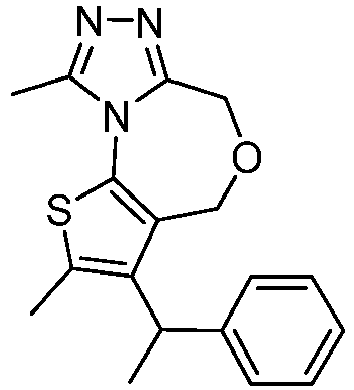
2,9-dimethyl-3-(1-phenylethyl)-4H,6H-thieno[2,3-e][1,2,4]triazolo[3,4-c][1,4]oxazepine 29 
(S)-3-benzyl-5-cyclobutyl-2,6,9-trimethyl-5,6-dihydro-4H-thieno[3,2-f][1,2,4]triazolo[4,3-a][1,4]diazepine 30 
3-benzyl-9-methyl-4H,6H-thieno[2,3-e][1,2,4]triazolo[3,4-c][1,4]oxazepine 31 
3-benzyl-2-bromo-9-methyl-4H,6H-thieno[2,3-e][1,2,4]triazolo[3,4-c][1,4]oxazepine 32 
5-(3-benzyl-9-methyl-4H,6H-thieno[2,3-e][1,2,4]triazolo[3,4-c][1,4]oxazepin-2-yl)pyridin-2-amine 33 
3-benzyl-2-ethynyl-9-methyl-4H,6H-thieno[2,3-e][1,2,4] triazolo[3,4-c][1,4]oxazepine 34 
(R)-3-benzyl-2,5,6,9-tetramethyl-5,6-dihydro-4H-thieno[3,2-f][1,2,4]triazolo[4,3-a][1,4]diazepine 35 
3-benzyl-2,5,9-trimethyl-5,6-dihydro-4H-thieno[3,2-f][1,2,4]triazolo[4,3-a][1,4]diazepine 36 
7-bromo-1-methyl-4H,6H-benzo[e][1,2,4]triazolo[3,4-c][1,4]oxazepine 37 
1-methyl-N-phenyl-4H,6H-benzo[e][1,2,4]triazolo[3,4-c][1,4]oxazepin-7-amine 38 
7-benzyl-1-methyl-4H,6H-benzo[e][1,2,4]triazolo[3,4-c][1,4]oxazepine 39 
1-methyl-7-(phenylthio)-4H,6H-benzo[e][1,2,4]triazolo[3,4-c][1,4]oxazepine 40 
1-methyl-7-phenoxy-4H,6H-benzo[e][1,2,4]triazolo[3,4-c][1,4]oxazepine 41 
7-((λ1-oxidanyl)(phenyl)-λ3-sulfanyl)-1-methyl-4H,6H-benzo[e][1,2,4]triazolo[3,4-c][1,4]oxazepine 42 
1-methyl-7-(phenylsulfonyl)-4H,6H-benzo[e][1,2,4]triazolo[3,4-c][1,4]oxazepine 43 
1-methyl-7-(1-phenylvinyl)-4H,6H-benzo[e][1,2,4]triazolo[3,4-c][1,4]oxazepine 44 
7-(1H-inden-3-yl)-1-methyl-4H,6H-benzo[e][1,2,4]triazolo[3,4-c][1,4]oxazepine 45 
1-methyl-7-(4-(trifluoromethoxy)benzyl)-4H,6H-benzo[e][1,2,4]triazolo[3,4-c][1,4]oxazepine 46 
1-methyl-7-(1-phenylethyl)-4H,6H-benzo[e][1,2,4]triazolo[3,4-c][1,4]oxazepine 47 
7-(2,3-dihydro-1H-inden-1-yl)-1-methyl-4H,6H-benzo[e][1,2,4]triazolo[3,4-c][1,4]oxazepine 48 
1-methyl-7-(1-phenylcyclopropyl)-4H,6H-benzo[e][1,2,4]triazolo[3,4-c][1,4]oxazepine 49 
7-(3,4-dihydronaphthalen-1-yl)-1-methyl-4H,6H-benzo[e][1,2,4]triazolo[3,4-c][1,4]oxazepine 50 
1-methyl-7-(1,2,3,4-tetrahydronaphthalen-1-yl)-4H,6H-benzo[e][1,2,4]triazolo[3,4-c][1,4]oxazepine 51 
3-(3,4-dihydronaphthalen-1-yl)-2,9-dimethyl-4H,6H-thieno[2,3-e][1,2,4]triazolo[3,4-c][1,4]oxazepine 52 
(1-methyl-4H,6H-benzo[e][1,2,4]triazolo[3,4-c][1,4]oxazepin-7-yl)(phenyl)methanone 53 
3-(1H-inden-3-yl)-2,9-dimethyl-4H,6H-thieno[2,3-e][1,2,4]triazolo[3,4-c][1,4]oxazepine 54 
2,9-dimethyl-3-(1,2,3,4-tetrahydronaphthalen-1-yl)-4H,6H-thieno[2,3-e][1,2,4]triazolo[3,4-c][1,4]oxazepine 55 
3-(2,3-dihydro-1H-inden-1-yl)-2,9-dimethyl-4H,6H-thieno[2,3-e][1,2,4]triazolo[3,4-c][1,4]oxazepine 56 
3-(6,7-dihydro-5H-benzo[7]annulen-9-yl)-2,9-dimethyl-4H,6H-thieno[2,3-e][1,2,4]triazolo[3,4-c][1,4]oxazepine 57 
3-(6-fluoro-3,4-dihydronaphthalen-1-yl)-2,9-dimethyl-4H,6H-thieno[2,3-e][1,2,4]triazolo[3,4-c][1,4]oxazepine 58 
3-(7-fluoro-3,4-dihydronaphthalen-1-yl)-2,9-dimethyl-4H,6H-thieno[2,3-e][1,2,4]triazolo[3,4-c][1,4]oxazepine 59 
7-(6,7-dihydro-5H-benzo[7]annulen-9-yl)-1-methyl-4H,6H-benzo[e][1,2,4]triazolo[3,4-c][1,4]oxazepine 60 
1-methyl-7-(6,7,8,9-tetrahydro-5H-benzo[7]annulen-5-yl)-4H,6H-benzo[e][1,2,4]triazolo[3,4-c][1,4]oxazepine 61 
7-(6-fluoro-1,2,3,4-tetrahydronaphthalen-1-yl)-1-methyl-4H,6H-benzo[e][1,2,4]triazolo[3,4-c][1,4]oxazepine 62 
7-(7-fluoro-1,2,3,4-tetrahydronaphthalen-1-yl)-1-methyl-4H,6H-benzo[e][1,2,4]triazolo[3,4-c][1,4]oxazepine 63 
2,9-dimethyl-3-(6,7,8,9-tetrahydro-5H-benzo[7]annulen-5-yl)-4H,6H-thieno[2,3-e][1,2,4]triazolo[3,4-c][1,4]oxazepine 64 
3-(6-fluoro-1,2,3,4-tetrahydronaphthalen-1-yl)-2,9-dimethyl-4H,6H-thieno[2,3-e][1,2,4]triazolo[3,4-c][1,4]oxazepine 65 
3-(7-fluoro-1,2,3,4-tetrahydronaphthalen-1-yl)-2,9-dimethyl-4H,6H-thieno[2,3-e][1,2,4]triazolo[3,4-c][1,4]oxazepine 66 
2',9'-dimethyl-3'-(1,2,3,4-tetrahydronaphthalen-1-yl)-4'H-spiro[cyclopropane-1,6'-thieno[2,3-e][1,2,4]triazolo[3,4-c][1,4]oxazepine] 67 
8-chloro-1-methyl-7-(1,2,3,4-tetrahydronaphthalen-1-yl)-4H,6H-benzo[e][1,2,4]triazolo[3,4-c][1,4]oxazepine 68 
1-methyl-8-(1-methyl-1H-pyrazol-4-yl)-7-(1,2,3,4-tetrahydronaphthalen-1-yl)-4H,6H-benzo[e][1,2,4]triazolo[3,4-c][1,4]oxazepine 69 
5-(1-methyl-7-(1,2,3,4-tetrahydronaphthalen-1-yl)-4H,6H-benzo[e][1,2,4]triazolo[3,4-c][1,4]oxazepin-8-yl)pyridin-2-amine 70 
7-bromo-8-chloro-1-methyl-4H,6H-benzo[e][1,2,4]triazolo[3,4-c][1,4]oxazepine 71 
7-benzyl-8-chloro-1-methyl-4H,6H-benzo[e][1,2,4]triazolo[3,4-c][1,4]oxazepine 72 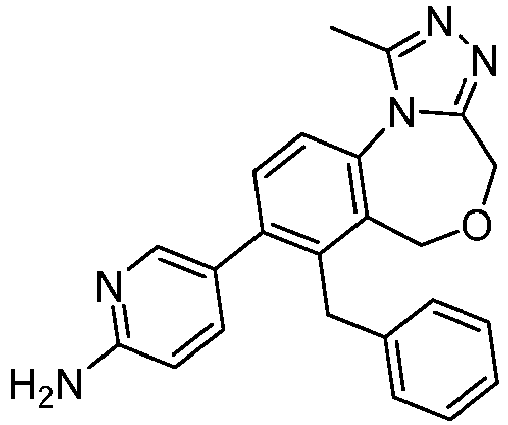
5-(7-benzyl-1-methyl-4H,6H-benzo[e][1,2,4]triazolo[3,4-c][1,4]oxazepin-8-yl)pyridin-2-amine 73 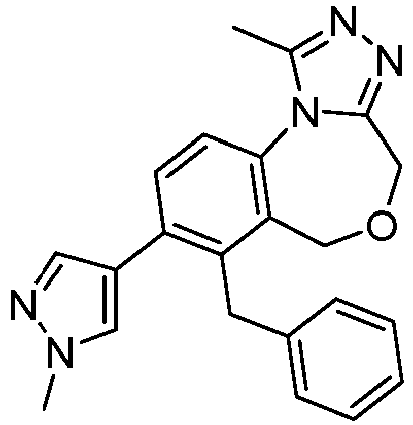
7-benzyl-1-methyl-8-(1-methyl-1H-pyrazol-4-yl)-4H,6H-benzo[e][1,2,4]triazolo[3,4-c][1,4]oxazepine 74 
8-chloro-7-(3,4-dihydronaphthalen-1-yl)-1-methyl-4H,6H-benzo[e][1,2,4]triazolo[3,4-c][1,4]oxazepine 75 
7-benzyl-1-methyl-8-(1H-pyrazol-4-yl)-4H,6H-benzo[e][1,2,4]triazolo[3,4-c][1,4]oxazepine 76 
2-(4-(7-benzyl-1-methyl-4H,6H-benzo[e][1,2,4]triazolo[3,4-c][1,4]oxazepin-8-yl)-1H-pyrazol-1-yl)acetamide 77 
7-benzyl-8-(3,6-dihydro-2H-pyran-4-yl)-1-methyl-4H,6H-benzo[e][1,2,4]triazolo[3,4-c][1,4]oxazepine 78 
7-benzyl-8-(4,5-dihydrofuran-3-yl)-1-methyl-4H,6H-benzo[e][1,2,4]triazolo[3,4-c][1,4]oxazepine 79 
7-benzyl-1-methyl-8-(tetrahydro-2H-pyran-4-yl)-4H,6H-benzo[e][1,2,4]triazolo[3,4-c][1,4]oxazepine 80 
7-benzyl-8-(furan-3-yl)-1-methyl-4H,6H-benzo[e][1,2,4]triazolo[3,4-c][1,4]oxazepine 81 
7-benzyl-1-methyl-8-(tetrahydrofuran-3-yl)-4H,6H-benzo[e][1,2,4]triazolo[3,4-c][1,4]oxazepine 82 
7-benzyl-1-methyl-8-((trimethylsilyl)ethynyl)-4H,6H-benzo[e][1,2,4]triazolo[3,4-c][1,4]oxazepine 83 
7-benzyl-8-ethynyl-1-methyl-4H,6H-benzo[e][1,2,4]triazolo[3,4-c][1,4]oxazepine 84 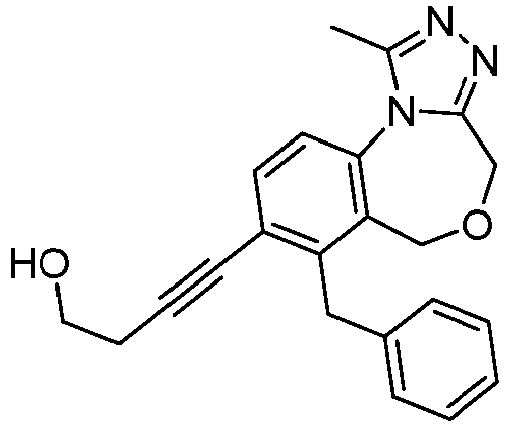
4-(7-benzyl-1-methyl-4H,6H-benzo[e][1,2,4]triazolo[3,4-c][1,4]oxazepin-8-yl)but-3-yn-1-ol 85 
(S)-3-benzyl-6,9-dimethyl-2-((1-methyl-1H-pyrazol-4-yl)ethynyl)-4H,6H-thieno[2,3-e][1,2,4]triazolo[3,4-c][1,4]oxazepine 86 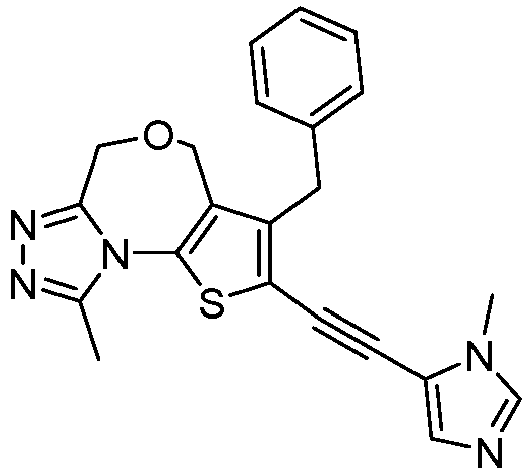
3-benzyl-9-methyl-2-((1-methyl-1H-imidazol-5-yl)ethynyl)-4H,6H-thieno[2,3-e][1,2,4]triazolo[3,4-c][1,4]oxazepine 87 
3-benzyl-9-methyl-2-(pyridin-4-ylethynyl)-4H,6H-thieno[2,3-e][1,2,4]triazolo[3,4-c][1,4]oxazepine 88 
3-benzyl-9-methyl-2-(pyridin-3-ylethynyl)-4H,6H-thieno[2,3-e][1,2,4 ]triazolo[3,4-c][1,4]oxazepine 89 
5-((3-benzyl-9-methyl-4H,6H-thieno[2,3-e][1,2,4]triazolo[3,4-c][1,4]oxazepin-2-yl)ethynyl)pyridin-2-amine 90 
3-benzyl-9-methyl-2-(morpholinomethyl)-4H,6H-thieno[2,3-e][1,2,4]triazolo[3,4-c][1,4]oxazepine 91 
3-benzyl-9-methyl-2-(1H-pyrazol-4-yl)-4H,6H-thieno[2,3-e][1,2,4]triazolo[3,4-c][1,4]oxazepine 92 
3-benzyl-9-methyl-2-(1-methyl-1H-pyrazol-4-yl)-4H,6H-thieno[2,3-e][1,2,4]triazolo[3,4-c][1,4]oxazepine 93 
3-benzyl-2-cyclopropyl-9-methyl-4H,6H-thieno[2,3-e][1,2,4]triazolo[3,4-c][1,4]oxazepine 94 
3-benzyl-9-methyl-2-(prop-1-en-2-yl)-4H,6H-thieno[2,3-e][1,2,4]triazolo[3,4-c][1,4]oxazepine 95 
3-benzyl-2-(3,6-dihydro-2H-pyran-4-yl)-9-methyl-4H,6H-thieno[2,3-e][1,2,4]triazolo[3,4-c][1,4]oxazepine 96 
4-(3-benzyl-9-methyl-4H,6H-thieno[2,3-e][1,2,4]triazolo[3,4-c][1,4]oxazepin-2-yl)but-3-yn-1-ol 97 
3-benzyl-9-methyl-2-(tetrahydro-2H-pyran-4-yl)-4H,6H-thieno[2,3-e][1,2,4]triazolo[3,4-c][1,4]oxazepine 98 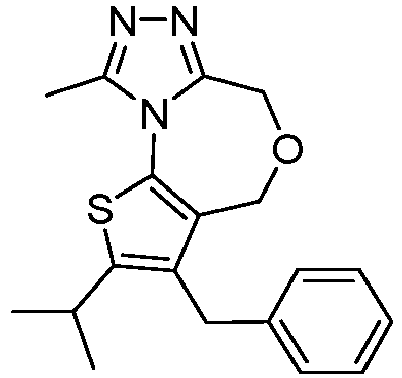
3-benzyl-2-isopropyl-9-methyl-4H,6H-thieno[2,3-e][1,2,4]triazolo[3,4-c][1,4]oxazepine 99 
4-(3-benzyl-9-methyl-4H,6H-thieno[2,3-e][1,2,4]triazolo[3,4-c][1,4]oxazepin-2-yl)butan-1-ol 100 
3-(3-fluorobenzyl)-2,9-dimethyl-4H,6H-thieno[2,3-e][1,2,4]triazolo[3,4-c][1,4]oxazepine 101 
3-((2,9-dimethyl-4H,6H-thieno[2,3-e][1,2,4]triazolo[3,4-c][1,4]oxazepin-3-yl)methyl)benzonitrile 102 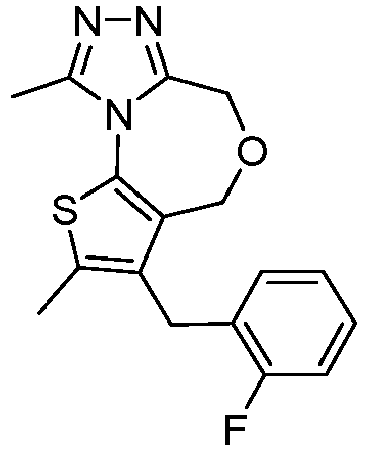
3-(2-fluorobenzyl)-2,9-dimethyl-4H,6H-thieno[2,3-e][1,2,4]triazolo[3,4-c][1,4]oxazepine 103 
3-(4-fluorobenzyl)-2,9-dimethyl-4H,6H-thieno[2,3-e][1,2,4]triazolo[3,4-c][1,4]oxazepine 104 
3-(3,5-difluorobenzyl)-2,9-dimethyl-4H,6H-thieno[2,3-e][1,2,4]triazolo[3,4-c][1,4]oxazepine 105 
3-(3,4-difluorobenzyl)-2,9-dimethyl-4H,6H-thieno[2,3-e][1,2,4]triazolo[3,4-c][1,4]oxazepine 106 
3-((1H-indol-1-yl)methyl)-2,9-dimethyl-4H,6H-thieno[2,3-e][1,2,4]triazolo[3,4-c][1,4]oxazepine 107 
3-((1H-pyrrol-1-yl)methyl)-2,9-dimethyl-4H,6H-thieno[2,3-e][1,2,4]triazolo[3,4-c][1,4]oxazepine 108 
3-(tert-butoxymethyl)-2,9-dimethyl-4H,6H-thieno[2,3-e][1,2,4]triazolo[3,4-c][1,4]oxazepine 109 
3-benzyl-2,6,9-trimethyl-4H,6H-thieno[2,3-e][1,2,4]triazolo[3,4-c][1,4]oxazepine 110 
3-benzyl-9-methyl-4H,6H-thieno[2,3-e][1,2,4]triazolo[3,4-c][1,4]oxazepine-2-carbonitrile 111 
3-(4-fluorobenzyl)-9-methyl-2-((1-methyl-1H-pyrazol-4-yl)ethynyl)-4H,6H-thieno[2,3-e][1,2,4]triazolo[3,4-c][1,4]oxazepine 112 
3-((1H-pyrazol-1-yl)methyl)-2,9-dimethyl-4H,6H-thieno[2,3-e][1,2,4]triazolo[3,4-c][1,4]oxazepine 113 
(S)-4-(3-benzyl-6,9-dimethyl-4H,6H-thieno[2,3-e][1,2,4]triazolo[3,4-c][1,4]oxazepin-2-yl)but-3-yn-1-ol 114 
(R)-3-benzyl-2,6,9-trimethyl-4H,6H-thieno[2,3-e][1,2,4]triazolo[3,4-c][1,4]oxazepine 115 
tert-butyl 2-(3-benzyl-2,9-dimethyl-4H,6H-thieno[2,3-e][1,2,4]triazolo[3,4-c][1,4]oxazepin-6-yl)acetate 116 
1-(1-methyl-4H,6H-benzo[e][1,2,4]triazolo[3,4-c][1,4]oxazepin-7-yl)-1-phenylethane-1,2-diol 117 
(S)-3-bromo-6,9-dimethyl-4H,6H-thieno[2,3-e][1,2,4]triazolo[3,4-c][1,4]oxazepine 118 
(S)-3-benzyl-6,9-dimethyl-4 H,6H-thieno[2,3-e][1,2,4]triazolo[3,4-c][1,4]oxazepine 119 
(S)-3-benzyl-2-bromo-6,9-dimethyl-4H,6H-thieno[2,3-e][1,2,4]triazolo[3,4-c][1,4]oxazepine 120 
(S)-3-benzyl-6,9-dimethyl-2-((1-methyl-1H-imidazol-5-yl)ethynyl)-4H,6H-thieno[2,3-e][1,2,4]triazolo[3,4-c][1,4]oxazepine 121 
(S)-3-benzyl-6,9-dimethyl-2-(pyridin-4-ylethynyl)-4H,6H-thieno[2,3-e][1,2,4]triazolo[3,4-c][1,4]oxazepine 122 
(S)-3-benzyl-6,9-dimethyl-2-(pyridin-3-ylethynyl)-4H,6H-thieno[2,3-e][1,2,4]triazolo[3,4-c][1,4]oxazepine 123 
(S)-5-((3-benzyl-6,9-dimethyl-4H,6H-thieno[2,3-e][1,2,4]triazolo[3,4-c][1,4]oxazepin-2-yl)ethynyl)pyridin-2-amine 124 
(S)-3-(4-fluorobenzyl)-6,9-dimethyl-4H,6H-thieno[2,3-e][1,2,4]triazolo[3,4-c][1,4]oxazepine 125 
(S)-2-bromo-3-(4-fluorobenzyl)-6,9-dimethyl-4H,6H-thieno[2,3-e][1,2,4]triazolo[3,4-c][1,4]oxazepine 126 
(S)-3-(4-fluorobenzyl)-6,9-dimethyl-2-((1-methyl-1H-pyrazol-4-yl)ethynyl)-4H,6H-thieno[2,3-e][1,2,4]triazolo[3,4-c][1,4]oxazepine 127 
2,9-dimethyl-3-((1-methyl-1H-pyrazol-4-yl)methyl)-4H,6H-thieno[2,3-e][1,2,4]triazolo[3,4-c][1,4]oxazepine 128 
2,3,9-trimethyl-4H,6H-thieno[2,3-e][1,2,4]triazolo[3,4-c][1,4]oxazepine 129 
2,6,9-trimethyl-4H,6H-thieno[2,3-e][1,2,4]triazolo[3,4-c][1,4]oxazepine 130 
3-bromo-2,6,9-trimethyl-4H,6H-thieno[2,3-e][1,2,4]triazolo[3,4-c][1,4]oxazepine 131 
tert-butyl 2-(2,9-dimethyl-4H,6H-thieno[2,3-e][1,2,4]triazolo[3,4-c][1,4]oxazepin-6-yl)acetate 132 
tert-butyl 2-(3-bromo-2,9-dimethyl-4H,6H-thieno[2,3-e][1,2,4]triazolo[3,4-c][1,4]oxazepin-6-yl)acetate 133 
2'-bromo-9'-methyl-4'H-spiro[cyclopropane-1,6'-thieno[2,3-e][1,2,4]triazolo[3,4-c][1,4]oxazepine] 134 
2',9'-dimethyl-4'H-spiro[cyclopropane-1,6'-thieno[2,3-e][1,2,4]triazolo[3,4-c][1,4]oxazepine] 135 
3'-bromo-2',9'-dimethyl-4'H-spiro[cyclopropane-1,6'-thieno[2,3-e][1,2,4]triazolo[3,4-c][1,4]oxazepine] 136 
3'-benzyl-2',9'-dimethyl-4'H-spiro[cyclopropane-1,6'-thieno[2,3-e][1,2,4]triazolo[3,4-c][1,4]oxazepine] 137 
3-bromo-9-methyl-4H,6H-thieno[2,3-e][1,2,4]triazolo[3,4-c][1,4]oxazepine 138 
3-chloro-9-methyl-4H,6H-thieno[2,3-e][1,2,4]triazolo[3,4-c][1,4]oxazepine 139 
3-(4-fluorobenzyl)-9-methyl-4H,6H-thieno[2,3-e][1,2,4]triazolo[3,4-c][1,4]oxazepine 140 
2-bromo-3-(4-fluorobenzyl)-9-methyl-4H,6H-thieno[2,3-e][1,2,4]triazolo[3,4-c][1,4]oxazepine 141 
(S)-3-chloro-6,9-dimethyl-4H,6H-thieno[2,3-e][1,2,4]triazolo[3,4-c][1,4]oxazepine 144 
(S)-3-(3-benzyl-6,9-dimethyl-4H,6H-thieno[2,3-e][1,2,4]triazolo[3,4-c][1,4]oxazepin-2-yl)-N,N-dimethylprop-2-yn-1-amine 145 
(S)-3-benzyl-2-(3-methoxyprop-1-yn-1-yl)-6,9-dimethyl-4H,6H-thieno[2,3-e][1,2,4]triazolo[3,4-c][1,4]oxazepine 146 
benzyl3-bromo-2,9-dimethyl-4H-thieno[3,2-f][1,2,4]triazolo[4,3-a][1,4]diazepine-5(6H)-carboxylate 147 
benzyl (S)-3-bromo-2,6,9-trimethyl-4H-thieno[3,2-f][1,2,4]triazolo[4,3-a][1,4]diazepine-5(6H)-carboxylate 148 
benzyl (S)-3-bromo-6-(2-methoxy-2-oxoethyl)-2,9-dimethyl-4H-thieno[3,2-f][1,2,4]triazolo[4,3-a][1,4]diazepine-5(6H)-carboxylate 149 
3-benzyl-9-methyl-2-(pyridin-2-ylethynyl)-4H,6H-thieno[2,3-e][1,2,4]triazolo[3,4-c][1,4]oxazepine 150 
(S)-3-benzyl-6,9-dimethyl-2-(pyridin- 2-ylethynyl)-4H,6H-thieno[2,3-e][1,2,4]triazolo[3,4-c][1,4]oxazepine 151 
4-(5-((3-benzyl-9-methyl-4H,6H-thieno[2,3-e][1,2,4]triazolo[3,4-c][1,4]oxazepin-2-yl)ethynyl)pyridin-2-yl)butanal 152 
3-benzyl-9-methyl-2-((1-methyl-1H-pyrazol-4-yl)ethynyl)-4H,6H-thieno[2,3-e][1,2,4]triazolo[3,4-c][1,4]oxazepine 153 
2-((1H-pyrazol-4-yl)ethynyl)-3-benzyl-9-methyl-4H,6H-thieno[2,3-e][1,2,4]triazolo[3,4-c][1,4]oxazepine 154 
(S)-3-benzyl-2,6,9-trimethyl-4H,6H-thieno[2,3-e][1,2,4]triazolo[3,4-c][1,4]oxazepine - Compounds of the Disclosure inhibit BET bromodomains and are useful in the treatment of a variety of diseases and conditions. In particular, Compounds of the Disclosure are useful in methods of treating a disease or condition wherein inhibition of BET bromodomains provides a benefit, for example, cancers and proliferative diseases. Methods of the disclosure comprise administering a therapeutically effective amount of a Compound of the Disclosure to an individual in need thereof. The present methods also encompass administering a second therapeutic agent to the individual in addition to the Compound of the Disclosure. The second therapeutic agent is selected from drugs known as useful in treating the disease or condition afflicting the individual in need thereof, e.g., a chemotherapeutic agent and/or radiation known as useful in treating a particular cancer.
- Salts, hydrates, and solvates of the Compounds of the Disclosure can also be used in the methods disclosed herein. The present disclosure further includes all possible stereoisomers and geometric isomers of Compounds of the Disclosure to include both racemic compounds and optically active isomers. When a Compound of the Disclosure is desired as a single enantiomer, it can be obtained either by resolution of the final product or by stereospecific synthesis from either isomerically pure starting material or use of a chiral auxiliary reagent, for example, see Z. Ma et al., Tetrahedron: Asymmetry, 8(6), pages 883-888 (1997). Resolution of the final product, an intermediate, or a starting material can be achieved by any suitable method known in the art. Additionally, in situations where tautomers of the Compounds of the Disclosure are possible, the present disclosure is intended to include all tautomeric forms of the compounds.
- The present disclosure encompasses the preparation and use of salts of Compounds of the Disclosure. As used herein, the pharmaceutical "pharmaceutically acceptable salt" refers to salts or zwitterionic forms of Compounds of the Disclosure. Salts of Compounds of the Disclosure can be prepared during the final isolation and purification of the compounds or separately by reacting the compound with an acid having a suitable cation. The pharmaceutically acceptable salts of Compounds of the Disclosure can be acid addition salts formed with pharmaceutically acceptable acids. Examples of acids which can be employed to form pharmaceutically acceptable salts include inorganic acids such as nitric, boric, hydrochloric, hydrobromic, sulfuric, and phosphoric, and organic acids such as oxalic, maleic, succinic, and citric. Nonlimiting examples of salts of compounds of the disclosure include, but are not limited to, the hydrochloride, hydrobromide, hydroiodide, sulfate, bisulfate, 2-hydroxyethansulfonate, phosphate, hydrogen phosphate, acetate, adipate, alginate, aspartate, benzoate, bisulfate, butyrate, camphorate, camphorsulfonate, digluconate, glycerolphsphate, hemisulfate, heptanoate, hexanoate, formate, succinate, fumarate, maleate, ascorbate, isethionate, salicylate, methanesulfonate, mesitylenesulfonate, naphthylenesulfonate, nicotinate, 2-naphthalenesulfonate, oxalate, pamoate, pectinate, persulfate, 3-phenylproprionate, picrate, pivalate, propionate, trichloroacetate, trifluoroacetate, phosphate, glutamate, bicarbonate, paratoluenesulfonate, undecanoate, lactate, citrate, tartrate, gluconate, methanesulfonate, ethanedisulfonate, benzene sulfonate, and p-toluenesulfonate salts. In addition, available amino groups present in the compounds of the disclosure can be quaternized with methyl, ethyl, propyl, and butyl chlorides, bromides, and iodides; dimethyl, diethyl, dibutyl, and diamyl sulfates; decyl, lauryl, myristyl, and steryl chlorides, bromides, and iodides; and benzyl and phenethyl bromides. In light of the foregoing, any reference Compounds of the Disclosure appearing herein is intended to include compounds of Compounds of the Disclosure as well as pharmaceutically acceptable salts, hydrates, or solvates thereof.
- The present disclosure encompasses the preparation and use of solvates of Compounds of the Disclosure. Solvates typically do not significantly alter the physiological activity or toxicity of the compounds, and as such may function as pharmacological equivalents. The term "solvate" as used herein is a combination, physical association and/or solvation of a compound of the present disclosure with a solvent molecule such as, e.g. a disolvate, monosolvate or hemisolvate, where the ratio of solvent molecule to compound of the present disclosure is about 2:1, about 1:1 or about 1:2, respectively. This physical association involves varying degrees of ionic and covalent bonding, including hydrogen bonding. In certain instances, the solvate can be isolated, such as when one or more solvent molecules are incorporated into the crystal lattice of a crystalline solid. Thus, "solvate" encompasses both solution-phase and isolatable solvates. Compounds of the Disclosure can be present as solvated forms with a pharmaceutically acceptable solvent, such as water, methanol, and ethanol, and it is intended that the disclosure includes both solvated and unsolvated forms of Compounds of the Disclosure. One type of solvate is a hydrate. A "hydrate" relates to a particular subgroup of solvates where the solvent molecule is water. Solvates typically can function as pharmacological equivalents. Preparation of solvates is known in the art. See, for example, M. Caira et al, J. Pharmaceut. Sci., 93(3):601-611 (2004), which describes the preparation of solvates of fluconazole with ethyl acetate and with water. Similar preparation of solvates, hemisolvates, hydrates, and the like are described by E.C. van Tonder et al., AAPS Pharm. Sci. Tech., 5(1):Article 12 (2004), and A.L. Bingham et al., Chem. Commun. 603-604 (2001). A typical, non-limiting, process of preparing a solvate would involve dissolving a Compound of the Disclosure in a desired solvent (organic, water, or a mixture thereof) at temperatures above 20°C to about 25°C, then cooling the solution at a rate sufficient to form crystals, and isolating the crystals by known methods, e.g., filtration. Analytical techniques such as infrared spectroscopy can be used to confirm the presence of the solvent in a crystal of the solvate.
- The present disclosure provides Compounds of the Disclosure as BET bromodomain inhibitors for the treatment of a variety of diseases and conditions wherein inhibition of BET bromodomains has a beneficial effect. Compounds of the Disclosure typically have a binding affinity (IC50) to BET bromodomains of less than 100 µM, e.g., less than 50 µM, less than 25 µM, and less than 5 µM, less than about 1 µM, less than about 0.5 µM, or less than about 0.1 µM. In one embodiment, the present disclosure relates to a method of treating an individual suffering from a disease or condition wherein inhibition of the BET bromodomains provides a benefit comprising administering a therapeutically effective amount of a Compound of the Disclosure to an individual in need thereof.
- Since Compounds of the Disclosure are inhibitors of one or more BET bromodomains, a number of diseases and conditions mediated by BET bromodomain proteins can be treated by employing these compounds. The present disclosure is thus directed generally to a method for treating a condition or disorder responsive to inhibition of BRD2, BRD3, BRD4, BRD-t, or an isoform or mutant thereof, in an animal, e.g., a human, suffering from, or at risk of suffering from, the condition or disorder, the method comprising administering to the animal an effective amount of one or more Compounds of the Disclosure.
- The present disclosure is further directed to a method of inhibiting BET bromodomains in an animal in need thereof, said method comprising administering to the animal an effective amount of at least one Compound of the Disclosure.
- In another embodiment, the disclosure is directed to a method of treating a patient, comprising administering to the patient a therapeutically effective amount of a Compound of the Disclosure, or a pharmaceutically acceptable salt or hydrate thereof, wherein the patient has cancer, a chronic autoimmune disorder, an inflammatory condition, a proliferative disorder, sepsis, or a viral infection.
- The methods of the present disclosure can be accomplished by administering a Compound of the Disclosure as the neat compound or as a pharmaceutical composition. Administration of a pharmaceutical composition, or neat compound of a Compound of the Disclosure, can be performed during or after the onset of the disease or condition of interest. Typically, the pharmaceutical compositions are sterile, and contain no toxic, carcinogenic, or mutagenic compounds that would cause an adverse reaction when administered. Further provided are kits comprising a Compound of the Disclosure and, optionally, a second therapeutic agent useful in the treatment of diseases and conditions wherein inhibition of BET bromodomains provides a benefit, packaged separately or together, and an insert having instructions for using these active agents.
- In one embodiment, a Compound of the Disclosure is administered in conjunction with a second therapeutic agent useful in the treatment of a disease or condition wherein inhibition of BET bromodomains provides a benefit. The second therapeutic agent is different from the Compound of the Disclosure. A Compound of the Disclosure and the second therapeutic agent can be administered simultaneously or sequentially to achieve the desired effect. In addition, the Compound of the Disclosure and second therapeutic agent can be administered from a single composition or two separate compositions.
- The second therapeutic agent is administered in an amount to provide its desired therapeutic effect. The effective dosage range for each second therapeutic agent is known in the art, and the second therapeutic agent is administered to an individual in need thereof within such established ranges.
- A Compound of the Disclosure and the second therapeutic agent can be administered together as a single-unit dose or separately as multi-unit doses, wherein the Compound of the Disclosure is administered before the second therapeutic agent or vice versa. One or more doses of the Compound of the Disclosure and/or one or more dose of the second therapeutic agent can be administered. The Compound of the Disclosure therefore can be used in conjunction with one or more second therapeutic agents, for example, but not limited to, anticancer agents.
- Diseases and conditions treatable by the methods of the present disclosure include, but are not limited to, cancer and other proliferative disorders, inflammatory diseases, sepsis, autoimmune disease, and viral infection. In one embodiment, a human patient is treated with a Compound of the Disclosure, or a pharmaceutical composition comprising a Compound of the Disclosure, wherein the compound is administered in an amount sufficient to inhibit BET bromodomain activity in the patient.
- In one embodiment, the disease to be treated by the Compound of the Disclosure is cancer. Examples of treatable cancers include, but are not limited to, adrenal cancer, acinic cell carcinoma, acoustic neuroma, acral lentigious melanoma, acrospiroma, acute eosinophilic leukemia, acute erythroid leukemia, acute lymphoblastic leukemia, acute megakaryoblastic leukemia, acute monocytic leukemia, acute promyelocytic leukemia, adenocarcinoma, adenoid cystic carcinoma, adenoma, adenomatoid odontogenic tumor, adenosquamous carcinoma, adipose tissue neoplasm, adrenocortical carcinoma, adult T-cell leukemia/lymphoma, aggressive NK-cell leukemia, AIDS-related lymphoma, alveolar rhabdomyosarcoma, alveolar soft part sarcoma, ameloblastic fibroma, anaplastic large cell lymphoma, anaplastic thyroid cancer, angioimmunoblastic T-cell lymphoma, angiomyolipoma, angiosarcoma, astrocytoma, atypical teratoid rhabdoid tumor, B-cell chronic lymphocytic leukemia, B-cell prolymphocytic leukemia, B-cell lymphoma, basal cell carcinoma, biliary tract cancer, bladder cancer, blastoma, bone cancer, Brenner tumor, Brown tumor, Burkitt's lymphoma, breast cancer, brain cancer, carcinoma, carcinoma in situ, carcinosarcoma, cartilage tumor, cementoma, myeloid sarcoma, chondroma, chordoma, choriocarcinoma, choroid plexus papilloma, clear-cell sarcoma of the kidney, craniopharyngioma, cutaneous T-cell lymphoma, cervical cancer, colorectal cancer, Degos disease, desmoplastic small round cell tumor, diffuse large B-cell lymphoma, dysembryoplastic neuroepithelial tumor, dysgerminoma, embryonal carcinoma, endocrine gland neoplasm, endodermal sinus tumor, enteropathy-associated T-cell lymphoma, esophageal cancer, fetus in fetu, fibroma, fibrosarcoma, follicular lymphoma, follicular thyroid cancer, ganglioneuroma, gastrointestinal cancer, germ cell tumor, gestational choriocarcinoma, giant cell fibroblastoma, giant cell tumor of the bone, glial tumor, glioblastoma multiforme, glioma, gliomatosis cerebri, glucagonoma, gonadoblastoma, granulosa cell tumor, gynandroblastoma, gallbladder cancer, gastric cancer, hairy cell leukemia, hemangioblastoma, head and neck cancer, hemangiopericytoma, hematological malignancy, hepatoblastoma, hepatosplenic T-cell lymphoma, Hodgkin's lymphoma, non-Hodgkin's lymphoma, invasive lobular carcinoma, intestinal cancer, kidney cancer, laryngeal cancer, lentigo maligna, lethal midline carcinoma, leukemia, leydig cell tumor, liposarcoma, lung cancer, lymphangioma, lymphangiosarcoma, lymphoepithelioma, lymphoma, acute lymphocytic leukemia, acute myelogeous leukemia, chronic lymphocytic leukemia, liver cancer, small cell lung cancer, non-small cell lung cancer, MALT lymphoma, malignant fibrous histiocytoma, malignant peripheral nerve sheath tumor, malignant triton tumor, mantle cell lymphoma, marginal zone B-cell lymphoma, mast cell leukemia, mediastinal germ cell tumor, medullary carcinoma of the breast, medullary thyroid cancer, medulloblastoma, melanoma, meningioma, merkel cell cancer, mesothelioma, metastatic urothelial carcinoma, mixed Mullerian tumor, mucinous tumor, multiple myeloma, muscle tissue neoplasm, mycosis fungoides, myxoid liposarcoma, myxoma, myxosarcoma, nasopharyngeal carcinoma, neurinoma, neuroblastoma, neurofibroma, neuroma, nodular melanoma, ocular cancer, oligoastrocytoma, oligodendroglioma, oncocytoma, optic nerve sheath meningioma, optic nerve tumor, oral cancer, osteosarcoma, ovarian cancer, Pancoast tumor, papillary thyroid cancer, paraganglioma, pinealoblastoma, pineocytoma, pituicytoma, pituitary adenoma, pituitary tumor, plasmacytoma, polyembryoma, precursor T-lymphoblastic lymphoma, primary central nervous system lymphoma, primary effusion lymphoma, preimary peritoneal cancer, prostate cancer, pancreatic cancer, pharyngeal cancer, pseudomyxoma periotonei, renal cell carcinoma, renal medullary carcinoma, retinoblastoma, rhabdomyoma, rhabdomyosarcoma, Richter's transformation, rectal cancer, sarcoma, Schwannomatosis, seminoma, Sertoli cell tumor, sex cord-gonadal stromal tumor, signet ring cell carcinoma, skin cancer, small blue round cell tumors, small cell carcinoma, soft tissue sarcoma, somatostatinoma, soot wart, spinal tumor, splenic marginal zone lymphoma, squamous cell carcinoma, synovial sarcoma, Sezary's disease, small intestine cancer, squamous carcinoma, stomach cancer, T-cell lymphoma, testicular cancer, thecoma, thyroid cancer, transitional cell carcinoma, throat cancer, urachal cancer, urogenital cancer, urothelial carcinoma, uveal melanoma, uterine cancer, verrucous carcinoma, visual pathway glioma, vulvar cancer, vaginal cancer, Waldenstrom's macroglobulinemia, Warthin's tumor, and Wilms' tumor.
- In another embodiment, the cancer is a leukaemia, for example a leukaemia selected from acute monocytic leukemia, acute myelogenous leukemia, chronic myelogenous leukemia, chronic lymphocytic leukemia and mixed lineage leukaemia (MLL). In another embodiment the cancer is NUT-midline carcinoma. In another embodiment the cancer is multiple myeloma. In another embodiment the cancer is a lung cancer such as small cell lung cancer (SCLC). In another embodiment the cancer is a neuroblastoma. In another embodiment the cancer is Burkitt's lymphoma. In another embodiment the cancer is cervical cancer. In another embodiment the cancer is esophageal cancer. In another embodiment the cancer is ovarian cancer. In another embodiment the cancer is colorectal cancer. In another embodiment, the cancer is prostate cancer. In another embodiment, the cancer is breast cancer.
- In another embodiment, the present disclosure provides a method of treating a benign proliferative disorder, such as, but are not limited to, benign soft tissue tumors, bone tumors, brain and spinal tumors, eyelid and orbital tumors, granuloma, lipoma, meningioma, multiple endocrine neoplasia, nasal polyps, pituitary tumors, prolactinoma, pseudotumor cerebri, seborrheic keratoses, stomach polyps, thyroid nodules, cystic neoplasms of the pancreas, hemangiomas, vocal cord nodules, polyps, and cysts, Castleman disease, chronic pilonidal disease, dermatofibroma, pilar cyst, pyogenic granuloma, and juvenile polyposis syndrome.
- Compounds of the Disclosure can also treat infectious and noninfectious inflammatory events and autoimmune and other inflammatory diseases by administration of an effective amount of a present compound to a mammal, in particular a human in need of such treatment. Examples of autoimmune and inflammatory diseases, disorders, and syndromes treated using the compounds and methods described herein include inflammatory pelvic disease, urethritis, skin sunburn, sinusitis, pneumonitis, encephalitis, meningitis, myocarditis, nephritis, osteomyelitis, myositis, hepatitis, gastritis, enteritis, dermatitis, gingivitis, appendictitis, pancreatitis, cholocystitus, agammaglobulinemia, psoriasis, allergy, Crohn's disease, irritable bowel syndrome, ulcerative colitis, Sjogren's disease, tissue graft rejection, hyperacute rejection of transplanted organs, asthma, allergic rhinitis, chronic obstructive pulmonary disease (COPD), autoimmune polyglandular disease (also known as autoimmune polyglandular syndrome), autoimmune alopecia, pernicious anemia, glomerulonephritis, dermatomyositis, multiple sclerosis, scleroderma, vasculitis, autoimmune hemolytic and thrombocytopenic states, Goodpasture's syndrome, atherosclerosis, Addison's disease, Parkinson's disease, Alzheimer's disease, Type I diabetes, septic shock, systemic lupus erythematosus (SLE), rheumatoid arthritis, psoriatic arthritis, juvenile arthritis, osteoarthritis, chronic idiopathic thrombocytopenic purpura, Waldenstrom macroglobulinemia, myasthenia gravis, Hashimoto's thyroiditis, atopic dermatitis, degenerative joint disease, vitiligo, autoimmune hypopituatarism, Guillain-Barre syndrome, Behcet's disease, scleracierma, mycosis fungoides, acute inflammatory responses (such as acute respiratory distress syndrome and ischemia/reperfusion injury), and Graves' disease.
- In another embodiment, the present disclosure provides a method of treating systemic inflammatory response syndromes, such as LPS-induced endotoxic shock and/or bacteria-induced sepsis by administration of an effective amount of a Compound of the Disclosure to a mammal, in particular a human in need of such treatment.
- In another embodiment, the present disclosure provides a method for treating viral infections and diseases. Examples of viral infections and diseases treated using the compounds and methods described herein include episome-based DNA viruses including, but not limited to, human papillomavirus, Herpesvirus, Epstein-Barr virus, human immunodeficiency virus, hepatis B virus, and hepatitis C virus.
- In another embodiment, the present disclosure provides therapeutic method of modulating protein methylation, gene expression, cell proliferation, cell differentiation and/or apoptosis in vivo in diseases mentioned above, in particular cancer, inflammatory disease, and/or viral disease is provided by administering a therapeutically effective amount of a Compound of the Disclosure to a subject in need of such therapy.
- In another embodiment, the present disclosure provides a method of regulating endogenous or heterologous promoter activity by contacting a cell with a Compound of the Disclosure.
- In methods of the present disclosure, a therapeutically effective amount of a Compound of the Disclosure, typically formulated in accordance with pharmaceutical practice, is administered to a human being in need thereof. Whether such a treatment is indicated depends on the individual case and is subject to medical assessment (diagnosis) that takes into consideration signs, symptoms, and/or malfunctions that are present, the risks of developing particular signs, symptoms and/or malfunctions, and other factors.
- A Compound of the Disclosure can be administered by any suitable route, for example by oral, buccal, inhalation, sublingual, rectal, vaginal, intracisternal or intrathecal through lumbar puncture, transurethral, nasal, percutaneous, i.e., transdermal, or parenteral (including intravenous, intramuscular, subcutaneous, intracoronary, intradermal, intramammary, intraperitoneal, intraarticular, intrathecal, retrobulbar, intrapulmonary injection and/or surgical implantation at a particular site) administration. Parenteral administration can be accomplished using a needle and syringe or using a high pressure technique.
- Pharmaceutical compositions include those wherein a Compound of the Disclosure is administered in an effective amount to achieve its intended purpose. The exact formulation, route of administration, and dosage is determined by an individual physician in view of the diagnosed condition or disease. Dosage amount and interval can be adjusted individually to provide levels of a Compound of the Disclosure that is sufficient to maintain therapeutic effects.
- Toxicity and therapeutic efficacy of the Compounds of the Disclosure can be determined by standard pharmaceutical procedures in cell cultures or experimental animals, e.g., for determining the maximum tolerated dose (MTD) of a compound, which defines as the highest dose that causes no toxicity in animals. The dose ratio between the maximum tolerated dose and therapeutic effects (e.g. inhibiting of tumor growth) is the therapeutic index. The dosage can vary within this range depending upon the dosage form employed, and the route of administration utilized. Determination of a therapeutically effective amount is well within the capability of those skilled in the art, especially in light of the detailed disclosure provided herein.
- A therapeutically effective amount of a Compound of the Disclosure required for use in therapy varies with the nature of the condition being treated, the length of time that activity is desired, and the age and the condition of the patient, and ultimately is determined by the attendant physician. Dosage amounts and intervals can be adjusted individually to provide plasma levels of the BET bromodomain inhibitor that are sufficient to maintain the desired therapeutic effects. The desired dose conveniently can be administered in a single dose, or as multiple doses administered at appropriate intervals, for example as one, two, three, four or more subdoses per day. Multiple doses often are desired, or required. For example, a Compound of the Disclosure can be administered at a frequency of: four doses delivered as one dose per day at four-day intervals (q4d x 4); four doses delivered as one dose per day at three-day intervals (q3d x 4); one dose delivered per day at five-day intervals (qd x 5); one dose per week for three weeks (qwk3); five daily doses, with two days rest, and another five daily doses (5/2/5); or, any dose regimen determined to be appropriate for the circumstance.
- A Compound of the Disclosure used in a method of the present disclosure can be administered in an amount of about 0.005 to about 500 milligrams per dose, about 0.05 to about 250 milligrams per dose, or about 0.5 to about 100 milligrams per dose. For example, a Compound of the Disclosure can be administered, per dose, in an amount of about 0.005, 0.05, 0.5, 5, 10, 20, 30, 40, 50, 100, 150, 200, 250, 300, 350, 400, 450, or 500 milligrams, including all doses between 0.005 and 500 milligrams.
- The dosage of a composition containing a Compound of the Disclosure, or a composition containing the same, can be from about 1 ng/kg to about 200 mg/kg, about 1 µg/kg to about 100 mg/kg, or about 1 mg/kg to about 50 mg/kg. The dosage of a composition can be at any dosage including, but not limited to, about 1 µg/kg. The dosage of a composition may be at any dosage including, but not limited to, about 1 µg/kg, about 10 µg/kg, about 25 µg/kg, about 50 µg/kg, about 75 µg/kg, about 100 µg/kg, about 125 µg/kg, about 150 µg/kg, about 175 µg/kg, about 200 µg/kg, about 225 µg/kg, about 250 µg/kg, about 275 µg/kg, about 300 µg/kg, about 325 µg/kg, about 350 µg/kg, about 375 µg/kg, about 400 µg/kg, about 425 µg/kg, about 450 µg/kg, about 475 µg/kg, about 500 µg/kg, about 525 µg/kg, about 550 µg/kg, about 575 µg/kg, about 600 µg/kg, about 625 µg/kg, about 650 µg/kg, about 675 µg/kg, about 700 µg/kg, about 725 µg/kg, about 750 µg/kg, about 775 µg/kg, about 800 µg/kg, about 825 µg/kg, about 850 µg/kg, about 875 µg/kg, about 900 µg/kg, about 925 µg/kg, about 950 µg/kg, about 975 µg/kg, about 1 mg/kg, about 5 mg/kg, about 10 mg/kg, about 15 mg/kg, about 20 mg/kg, about 25 mg/kg, about 30 mg/kg, about 35 mg/kg, about 40 mg/kg, about 45 mg/kg, about 50 mg/kg, about 60 mg/kg, about 70 mg/kg, about 80 mg/kg, about 90 mg/kg, about 100 mg/kg, about 125 mg/kg, about 150 mg/kg, about 175 mg/kg, about 200 mg/kg, or more. The above dosages are exemplary of the average case, but there can be individual instances in which higher or lower dosages are merited, and such are within the scope of this disclosure. In practice, the physician determines the actual dosing regimen that is most suitable for an individual patient, which can vary with the age, weight, and response of the particular patient.
- As stated above, a Compound of the Disclosure can be administered in combination with a second therapeutically active agent. In some embodiments, the second therapeutic agent is an epigenetic drug. As used herein, the term "epigenetic drug" refers to a therapeutic agent that targets an epigenetic regulator. Examples of epigenetic regulators include the histone lysine methyltransferases, histone arginine methyl transferases, histone demethylases, histone deacetylases, histone acetylases, and DNA methyltransferases. Histone deacetylase inhibitors include, but are not limited to, vorinostat.
- In another embodiment, chemotherapeutic agents or other anti-proliferative agents can be combined with Compound of the Disclosure to treat proliferative diseases and cancer. Examples of therapies and anticancer agents that can be used in combination with Compounds of the Disclosure include surgery, radiotherapy (e.g., gamma-radiation, neutron beam radiotherapy, electron beam radiotherapy, proton therapy, brachytherapy, and systemic radioactive isotopes), endocrine therapy, a biologic response modifier (e.g., an interferon, an interleukin, tumor necrosis factor (TNF), hyperthermia and cryotherapy, an agent to attenuate any adverse effect (e.g., an antiemetic), and any other approved chemotherapeutic drug.
- Examples of antiproliferative compounds include, but are not limited to, an aromatase inhibitor; an anti-estrogen; an anti-androgen; a gonadorelin agonist; a topoisomerase I inhibitor; a topoisomerase II inhibitor; a microtubule active agent; an alkylating agent; a retinoid, a carontenoid, or a tocopherol; a cyclooxygenase inhibitor; an MMP inhibitor; an mTOR inhibitor; an antimetabolite; a platin compound; a methionine aminopeptidase inhibitor; a bisphosphonate; an antiproliferative antibody; a heparanase inhibitor; an inhibitor of Ras oncogenic isoforms; a telomerase inhibitor; a proteasome inhibitor; a compound used in the treatment of hematologic malignancies; a Flt-3 inhibitor; an Hsp90 inhibitor; a kinesin spindle protein inhibitor; a MEK inhibitor; an antitumor antibiotic; a nitrosourea; a compound targeting/decreasing protein or lipid kinase activity, a compound targeting/decreasing protein or lipid phosphatase activity, or any further anti-angiogenic compound.
- Nonlimiting exemplary aromatase inhibitors include, but are not limited to, steroids, such as atamestane, exemestane, and formestane, and non-steroids, such as aminoglutethimide, roglethimide, pyridoglutethimide, trilostane, testolactone, ketokonazole, vorozole, fadrozole, anastrozole, and letrozole.
- Nonlimiting anti-estrogens include, but are not limited to, tamoxifen, fulvestrant, raloxifene, and raloxifene hydrochloride. Anti-androgens include, but are not limited to, bicalutamide. Gonadorelin agonists include, but are not limited to, abarelix, goserelin, and goserelin acetate.
- Exemplary topoisomerase I inhibitors include, but are not limited to, topotecan, gimatecan, irinotecan, camptothecin and its analogues, 9-nitrocamptothecin, and the macromolecular camptothecin conjugate PNU-166148. Topoisomerase II inhibitors include, but are not limited to, anthracyclines, such as doxorubicin, daunorubicin, epirubicin, idarubicin, and nemorubicin; anthraquinones, such as mitoxantrone and losoxantrone; and podophillotoxines, such as etoposide and teniposide.
- Microtubule active agents include microtubule stabilizing, microtubule destabilizing compounds, and microtubulin polymerization inhibitors including, but not limited to, taxanes, such as paclitaxel and docetaxel; vinca alkaloids, such as vinblastine, vinblastine sulfate, vincristine, and vincristine sulfate, and vinorelbine; discodermolides; cochicine and epothilones and derivatives thereof.
- Exemplary nonlimiting alkylating agents include cyclophosphamide, ifosfamide, melphalan, and nitrosoureas, such as carmustine and lomustine.
- Exemplary nonlimiting cyclooxygenase inhibitors include Cox-2 inhibitors, 5-alkyl substituted 2-arylaminophenylacetic acid and derivatives, such as celecoxib, rofecoxib, etoricoxib, valdecoxib, or a 5-alkyl-2-arylaminophenylacetic acid, such as lumiracoxib.
- Exemplary nonlimiting matrix metalloproteinase inhibitors ("MMP inhibitors") include collagen peptidomimetic and nonpeptidomimetic inhibitors, tetracycline derivatives, batimastat, marimastat, prinomastat, metastat, BMS-279251, BAY 12-9566, TAA211, MMI270B, and AAJ996.
- Exemplary nonlimiting mTOR inhibitors include compounds that inhibit the mammalian target of rapamycin (mTOR) and possess antiproliferative activity such as sirolimus, everolimus, CCI-779, and ABT578.
- Exemplary nonlimiting antimetabolites include 5-fluorouracil (5-FU), capecitabine, gemcitabine, DNA demethylating compounds, such as 5-azacytidine and decitabine, methotrexate and edatrexate, and folic acid antagonists, such as pemetrexed.
- Exemplary nonlimiting platin compounds include carboplatin, cis-platin, cisplatinum, and oxaliplatin.
- Exemplary nonlimiting methionine aminopeptidase inhibitors include bengamide or a derivative thereof and PPI-2458.
- Exemplary nonlimiting bisphosphonates include etridonic acid, clodronic acid, tiludronic acid, pamidronic acid, alendronic acid, ibandronic acid, risedronic acid, and zoledronic acid.
- Exemplary nonlimiting antiproliferative antibodies include trastuzumab, trastuzumab-DMl, cetuximab, bevacizumab, rituximab, PR064553, and 2C4. The term "antibody" includes intact monoclonal antibodies, polyclonal antibodies, multispecific antibodies formed from at least two intact antibodies, and antibody fragments, so long as they exhibit the desired biological activity.
- Exemplary nonlimiting heparanase inhibitors include compounds that target, decrease, or inhibit heparin sulfate degradation, such as PI-88 and OGT2115.
- The term "an inhibitor of Ras oncogenic isoforms," such as H-Ras, K-Ras, or N-Ras, as used herein refers to a compound which targets, decreases, or inhibits the oncogenic activity of Ras, for example, a farnesyl transferase inhibitor, such as L-744832, DK8G557, tipifarnib, and lonafarnib.
- Exemplary nonlimiting telomerase inhibitors include compounds that target, decrease, or inhibit the activity of telomerase, such as compounds that inhibit the telomerase receptor, such as telomestatin.
- Exemplary nonlimiting proteasome inhibitors include compounds that target, decrease, or inhibit the activity of the proteasome including, but not limited to, bortezomid.
- The phrase "compounds used in the treatment of hematologic malignancies" as used herein includes FMS-like tyrosine kinase inhibitors, which are compounds targeting, decreasing or inhibiting the activity of FMS-like tyrosine kinase receptors (Flt-3R); interferon, I-β-D-arabinofuransylcytosine (ara-c), and bisulfan; and ALK inhibitors, which are compounds which target, decrease, or inhibit anaplastic lymphoma kinase.
- Exemplary nonlimiting Flt-3 inhibitors include PKC412, midostaurin, a staurosporine derivative, SU11248, and MLN518.
- Exemplary nonlimiting HSP90 inhibitors include compounds targeting, decreasing, or inhibiting the intrinsic ATPase activity of HSP90; or degrading, targeting, decreasing or inhibiting the HSP90 client proteins via the ubiquitin proteosome pathway. Compounds targeting, decreasing or inhibiting the intrinsic ATPase activity of HSP90 are especially compounds, proteins, or antibodies that inhibit the ATPase activity of HSP90, such as 17-allylamino,17-demethoxygeldanamycin (17AAG), a geldanamycin derivative; other geldanamycin related compounds; radicicol and HDAC inhibitors.
- The phrase "a compound targeting/decreasing a protein or lipid kinase activity; or a protein or lipid phosphatase activity; or any further anti-angiogenic compound" as used herein includes a protein tyrosine kinase and/or serine and/or threonine kinase inhibitor or lipid kinase inhibitor, such as a) a compound targeting, decreasing, or inhibiting the activity of the platelet- derived growth factor-receptors (PDGFR), such as a compound that targets, decreases, or inhibits the activity of PDGFR, such as an N-phenyl-2-pyrimidine-amine derivatives, such as imatinib, SUlOl, SU6668, and GFB-111; b) a compound targeting, decreasing, or inhibiting the activity of the fibroblast growth factor-receptors (FGFR); c) a compound targeting, decreasing, or inhibiting the activity of the insulin-like growth factor receptor I (IGF-IR), such as a compound that targets, decreases, or inhibits the activity of IGF-IR; d) a compound targeting, decreasing, or inhibiting the activity of the Trk receptor tyrosine kinase family, or ephrin B4 inhibitors; e) a compound targeting, decreasing, or inhibiting the activity of the Axl receptor tyrosine kinase family; f) a compound targeting, decreasing, or inhibiting the activity of the Ret receptor tyrosine kinase; g) a compound targeting, decreasing, or inhibiting the activity of the Kit/SCFR receptor tyrosine kinase, such as imatinib; h) a compound targeting, decreasing, or inhibiting the activity of the c-Kit receptor tyrosine kinases, such as imatinib; i) a compound targeting, decreasing, or inhibiting the activity of members of the c-Abl family, their gene-fusion products (e.g. Bcr-Abl kinase) and mutants, such as an N-phenyl-2-pyrimidine-amine derivative, such as imatinib or nilotinib; PD180970; AG957; NSC 680410; PD173955; or dasatinib; j) a compound targeting, decreasing, or inhibiting the activity of members of the protein kinase C (PKC) and Raf family of serine/threonine kinases, members of the MEK, SRC, JAK, FAK, PDK1, PKB/Akt, and Ras/MAPK family members, and/or members of the cyclin-dependent kinase family (CDK), such as a staurosporine derivative disclosed in
U.S. Patent No. 5,093,330 , such as midostaurin; examples of further compounds include UCN-01, safingol, BAY 43-9006, bryostatin 1, perifosine; ilmofosine; RO 318220 and RO 320432; GO 6976; Isis 3521 ; LY333531/LY379196; a isochinoline compound; a farnesyl transferase inhibitor; PD184352 or QAN697, or AT7519; k) a compound targeting, decreasing or inhibiting the activity of a protein-tyrosine kinase, such as imatinib mesylate or a tyrphostin, such as Tyrphostin A23/RG-50810; AG 99; Tyrphostin AG 213; Tyrphostin AG 1748; Tyrphostin AG 490; Tyrphostin B44; Tyrphostin B44 (+) enantiomer; Tyrphostin AG 555; AG 494; Tyrphostin AG 556, AG957 and adaphostin (4-{[(2,5-dihydroxyphenyl)methyl] amino}-benzoic acid adamantyl ester; NSC 680410, adaphostin); 1) a compound targeting, decreasing, or inhibiting the activity of the epidermal growth factor family of receptor tyrosine kinases (EGFR, ErbB2, ErbB3, ErbB4 as homo- or heterodimers) and their mutants, such as CP 358774, ZD 1839, ZM 105180; trastuzumab, cetuximab, gefitinib, erlotinib, OSI-774, C1-1033, EKB-569, GW-2016, antibodies E1.1, E2.4, E2.5, E6.2, E6.4, E2.11, E6.3 and E7.6.3, and 7H-pyrrolo-[2,3-d]pyrimidine derivatives; and m) a compound targeting, decreasing, or inhibiting the activity of the c-Met receptor. - Exemplary compounds that target, decrease, or inhibit the activity of a protein or lipid phosphatase include inhibitors of phosphatase 1, phosphatase 2A, or CDC25, such as okadaic acid or a derivative thereof.
- Further anti-angiogenic compounds include compounds having another mechanism for their activity unrelated to protein or lipid kinase inhibition, e.g., thalidomide and TNP-470.
- Additional, nonlimiting, exemplary chemotherapeutic compounds, one or more of which may be used in combination with a present BET bromodomain inhibitor, include: daunorubicin, adriamycin, Ara-C, VP-16, teniposide, mitoxantrone, idarubicin, carboplatinum, PKC412, 6-mercaptopurine (6-MP), fludarabine phosphate, octreotide, SOM230, FTY720, 6-thioguanine, cladribine, 6-mercaptopurine, pentostatin, hydroxyurea, 2-hydroxy-1H-isoindole-1,3-dione derivatives, 1-(4-chloroanilino)-4-(4-pyridylmethyl)phthalazine or a pharmaceutically acceptable salt thereof, 1-(4-chloroanilino)-4-(4-pyridylmethyl)phthalazine succinate, angiostatin, endostatin, anthranilic acid amides, ZD4190, ZD6474, SU5416, SU6668, bevacizumab, rhuMAb, rhuFab, macugon; FLT-4 inhibitors, FLT-3 inhibitors, VEGFR-2 IgGI antibody, RPI 4610, bevacizumab, porfimer sodium, anecortave, triamcinolone, hydrocortisone, 11 -a-epihydrocotisol, cortex olone, 17a-hydroxyprogesterone, corticosterone, desoxycorticosterone, testosterone, estrone, dexamethasone, fluocinolone, a plant alkaloid, a hormonal compound and/or antagonist, a biological response modifier, such as a lymphokine or interferon, an antisense oligonucleotide or oligonucleotide derivative, shRNA, and siRNA.
- Other examples of second therapeutic agents, one or more of which a present BET bromodomain inhibitor also can be combined, include, but are not limited to: a treatment for Alzheimer's Disease, such as donepezil and rivastigmine; a treatment for Parkinson's Disease, such as L-DOPA/carbidopa, entacapone, ropinrole, pramipexole, bromocriptine, pergolide, trihexephendyl, and amantadine; an agent for treating multiple sclerosis (MS) such as beta interferon (e.g., AVONEX® and REBIF®), glatiramer acetate, and mitoxantrone; a treatment for asthma, such as albuterol and montelukast; an agent for treating schizophrenia, such as zyprexa, risperdal, seroquel, and haloperidol; an anti-inflammatory agent, such as a corticosteroid, a TNF blocker, IL-1 RA, azathioprine, cyclophosphamide, and sulfasalazine; an immunomodulatory agent, including immunosuppressive agents, such as cyclosporin, tacrolimus, rapamycin, mycophenolate mofetil, an interferon, a corticosteroid, cyclophosphamide, azathioprine, and sulfasalazine; a neurotrophic factor, such as an acetylcholinesterase inhibitor, an MAO inhibitor, an interferon, an anti-convulsant, an ion channel blocker, riluzole, or an anti-Parkinson's agent; an agent for treating cardiovascular disease, such as a beta-blocker, an ACE inhibitor, a diuretic, a nitrate, a calcium channel blocker, or a statin; an agent for treating liver disease, such as a corticosteroid, cholestyramine, an interferon, and an anti-viral agent; an agent for treating blood disorders, such as a corticosteroid, an anti-leukemic agent, or a growth factor; or an agent for treating immunodeficiency disorders, such as gamma globulin.
- The above-mentioned second therapeutically active agents, one or more of which can be used in combination with a Compound of the Disclosure, are prepared and administered as described in the art.
- Compounds of the Disclosure typically are administered in admixture with a pharmaceutical carrier selected with regard to the intended route of administration and standard pharmaceutical practice. Pharmaceutical compositions for use in accordance with the present disclosure are formulated in a conventional manner using one or more physiologically acceptable carriers comprising excipients and/or auxiliaries that facilitate processing of Compound of the Disclosure.
- These pharmaceutical compositions can be manufactured, for example, by conventional mixing, dissolving, granulating, dragee-making, emulsifying, encapsulating, entrapping, or lyophilizing processes. Proper formulation is dependent upon the route of administration chosen. When a therapeutically effective amount of the Compound of the Disclosure is administered orally, the composition typically is in the form of a tablet, capsule, powder, solution, or elixir. When administered in tablet form, the composition additionally can contain a solid carrier, such as a gelatin or an adjuvant. The tablet, capsule, and powder contain about 0.01% to about 95%, and preferably from about 1% to about 50%, of a Compound of the Disclosure. When administered in liquid form, a liquid carrier, such as water, petroleum, or oils of animal or plant origin, can be added. The liquid form of the composition can further contain physiological saline solution, dextrose or other saccharide solutions, or glycols. When administered in liquid form, the composition contains about 0.1% to about 90%, and preferably about 1% to about 50%, by weight, of a Compound of the Disclosure.
- When a therapeutically effective amount of a Compound of the Disclosure is administered by intravenous, cutaneous, or subcutaneous injection, the composition is in the form of a pyrogen-free, parenterally acceptable aqueous solution. The preparation of such parenterally acceptable solutions, having due regard to pH, isotonicity, stability, and the like, is within the skill in the art. A preferred composition for intravenous, cutaneous, or subcutaneous injection typically contains, an isotonic vehicle.
- Compounds of the Disclosure can be readily combined with pharmaceutically acceptable carriers well-known in the art. Standard pharmaceutical carriers are described in Remington's Pharmaceutical Sciences, Mack Publishing Co., Easton, PA, 19th ed. 1995. Such carriers enable the active agents to be formulated as tablets, pills, dragees, capsules, liquids, gels, syrups, slurries, suspensions and the like, for oral ingestion by a patient to be treated. Pharmaceutical preparations for oral use can be obtained by adding the Compound of the Disclosure to a solid excipient, optionally grinding the resulting mixture, and processing the mixture of granules, after adding suitable auxiliaries, if desired, to obtain tablets or dragee cores. Suitable excipients include, for example, fillers and cellulose preparations. If desired, disintegrating agents can be added.
- Compound of the Disclosure can be formulated for parenteral administration by injection, e.g., by bolus injection or continuous infusion. Formulations for injection can be presented in unit dosage form, e.g., in ampules or in multidose containers, with an added preservative. The compositions can take such forms as suspensions, solutions, or emulsions in oily or aqueous vehicles, and can contain formulatory agents such as suspending, stabilizing, and/or dispersing agents.
- Pharmaceutical compositions for parenteral administration include aqueous solutions of the active agent in water-soluble form. Additionally, suspensions of a Compound of the Disclosure can be prepared as appropriate oily injection suspensions. Suitable lipophilic solvents or vehicles include fatty oils or synthetic fatty acid esters. Aqueous injection suspensions can contain substances which increase the viscosity of the suspension. Optionally, the suspension also can contain suitable stabilizers or agents that increase the solubility of the compounds and allow for the preparation of highly concentrated solutions. Alternatively, a present composition can be in powder form for constitution with a suitable vehicle, e.g., sterile pyrogen-free water, before use.
- Compounds of the Disclosure also can be formulated in rectal compositions, such as suppositories or retention enemas, e.g., containing conventional suppository bases. In addition to the formulations described previously, the Compound of the Disclosure also can be formulated as a depot preparation. Such long-acting formulations can be administered by implantation (for example, subcutaneously or intramuscularly) or by intramuscular injection. Thus, for example, the Compound of the Disclosure can be formulated with suitable polymeric or hydrophobic materials (for example, as an emulsion in an acceptable oil) or ion exchange resins.
- In particular, the Compounds of the Disclosure can be administered orally, buccally, or sublingually in the form of tablets containing excipients, such as starch or lactose, or in capsules or ovules, either alone or in admixture with excipients, or in the form of elixirs or suspensions containing flavoring or coloring agents. Such liquid preparations can be prepared with pharmaceutically acceptable additives, such as suspending agents. Compound of the Disclosure also can be injected parenterally, for example, intravenously, intramuscularly, subcutaneously, or intracoronarily. For parenteral administration, the Compound of the Disclosure are typically used in the form of a sterile aqueous solution which can contain other substances, for example, salts or monosaccharides, such as mannitol or glucose, to make the solution isotonic with blood.
- In another embodiment, the present disclosure provides kits which comprise a Compound of the Disclosure (or a composition comprising a Compound of the Disclosure) packaged in a manner that facilitates their use to practice methods of the present disclosure. In one embodiment, the kit includes a Compound of the Disclosure (or a composition comprising a Compound of the Disclosure) packaged in a container, such as a sealed bottle or vessel, with a label affixed to the container or included in the kit that describes use of the compound or composition to practice the method of the disclosure. In one embodiment, the compound or composition is packaged in a unit dosage form. The kit further can include a device suitable for administering the composition according to the intended route of administration.
- The term "BET bromodomain" as used herein means one or more of BRD2, BRD3, BRD4, and BRD-t, or an isoform or mutant thereof.
- The term "a disease or condition wherein inhibition of BET bromodomains provides a benefit" pertains to a condition in which at least one of BRD2, BRD3, BRD4, and BRD-t, and/or an action of at least one of BRD2, BRD3, BRD4, and BRD-t, is important or necessary, e.g., for the onset, progress, expression of that disease or condition, or a disease or a condition which is known to be treated by a BET bromodomain inhibitor. Examples of such conditions include, but are not limited to, a cancer, a chronic autoimmune disease, an inflammatory disease, a proliferative disease, sepsis, and a viral infection. One of ordinary skill in the art is readily able to determine whether a compound treats a disease or condition mediated by a BET bromodomain for any particular cell type, for example, by assays which conveniently can be used to assess the activity of particular compounds.
- The term "second therapeutic agent" refers to a therapeutic agent different from a Compound of the Disclosure and that is known to treat the disease or condition of interest. For example when a cancer is the disease or condition of interest, the second therapeutic agent can be a known chemotherapeutic drug, like taxol, or radiation, for example.
- The term "disease" or "condition" denotes disturbances and/or anomalies that as a rule are regarded as being pathological conditions or functions, and that can manifest themselves in the form of particular signs, symptoms, and/or malfunctions. As demonstrated below, a Compound of the Disclosure is a potent inhibitor of BET bromodomains and can be used in treating diseases and conditions wherein inhibition of BET bromodomains provides a benefit.
- As used herein, the terms "treat," "treating," "treatment," refer to eliminating, reducing, or ameliorating a disease or condition, and/or symptoms associated therewith. Although not precluded, treating a disease or condition does not require that the disease, condition, or symptoms associated therewith be completely eliminated. As used herein, the terms "treat," "treating," "treatment," may include "prophylactic treatment," which refers to reducing the probability of redeveloping a disease or condition, or of a recurrence of a previously-controlled disease or condition, in a subject who does not have, but is at risk of or is susceptible to, redeveloping a disease or condition or a recurrence of the disease or condition. The term "treat" and synonyms contemplate administering a therapeutically effective amount of a Compound of the Disclosure to an individual in need of such treatment.
- Within the meaning of the disclosure, "treatment" also includes relapse prophylaxis or phase prophylaxis, as well as the treatment of acute or chronic signs, symptoms and/or malfunctions. The treatment can be orientated symptomatically, for example, to suppress symptoms. It can be effected over a short period, be oriented over a medium term, or can be a long-term treatment, for example within the context of a maintenance therapy.
- The term "therapeutically effective amount" or "effective dose" as used herein refers to an amount of the active ingredient(s) that is(are) sufficient, when administered by a method of the disclosure, to efficaciously deliver the active ingredient(s) for the treatment of condition or disease of interest to an individual in need thereof. In the case of a cancer or other proliferation disorder, the therapeutically effective amount of the agent may reduce (i.e., retard to some extent and preferably stop) unwanted cellular proliferation; reduce the number of cancer cells; reduce the tumor size; inhibit (i.e., retard to some extent and preferably stop) cancer cell infiltration into peripheral organs; inhibit (i.e., retard to some extent and preferably stop) tumor metastasis; inhibit, to some extent, tumor growth; reduce BET bromodomain signaling in the target cells; and/or relieve, to some extent, one or more of the symptoms associated with the cancer. To the extent the administered compound or composition prevents growth and/or kills existing cancer cells, it may be cytostatic and/or cytotoxic.
- The term "container" means any receptacle and closure therefore suitable for storing, shipping, dispensing, and/or handling a pharmaceutical product.
- The term "insert" means information accompanying a pharmaceutical product that provides a description of how to administer the product, along with the safety and efficacy data required to allow the physician, pharmacist, and patient to make an informed decision regarding use of the product. The package insert generally is regarded as the "label" for a pharmaceutical product.
- "Concurrent administration," "administered in combination," "simultaneous administration," and similar phrases mean that two or more agents are administered concurrently to the subject being treated. By "concurrently," it is meant that each agent is administered either simultaneously or sequentially in any order at different points in time. However, if not administered simultaneously, it is meant that they are administered to an individual in a sequence and sufficiently close in time so as to provide the desired therapeutic effect and can act in concert. For example, a Compound of the Disclosure can be administered at the same time or sequentially in any order at different points in time as a second therapeutic agent. A Compound of the Disclosure and the second therapeutic agent can be administered separately, in any appropriate form and by any suitable route. When a Compound of the Disclosure and the second therapeutic agent are not administered concurrently, it is understood that they can be administered in any order to a subject in need thereof. For example, a Compound of the Disclosure can be administered prior to (e.g., 5 minutes, 15 minutes, 30 minutes, 45 minutes, 1 hour, 2 hours, 4 hours, 6 hours, 12 hours, 24 hours, 48 hours, 72 hours, 96 hours, 1 week, 2 weeks, 3 weeks, 4 weeks, 5 weeks, 6 weeks, 8 weeks, or 12 weeks before), concomitantly with, or subsequent to (e.g., 5 minutes, 15 minutes, 30 minutes, 45 minutes, 1 hour, 2 hours, 4 hours, 6 hours, 12 hours, 24 hours, 48 hours, 72 hours, 96 hours, 1 week, 2 weeks, 3 weeks, 4 weeks, 5 weeks, 6 weeks, 8 weeks, or 12 weeks after) the administration of a second therapeutic agent treatment modality (e.g., radiotherapy), to an individual in need thereof. In various embodiments, a Compound of the Disclosure and the second therapeutic agent are administered 1 minute apart, 10 minutes apart, 30 minutes apart, less than 1 hour apart, 1 hour apart, 1 hour to 2 hours apart, 2 hours to 3 hours apart, 3 hours to 4 hours apart, 4 hours to 5 hours apart, 5 hours to 6 hours apart, 6 hours to 7 hours apart, 7 hours to 8 hours apart, 8 hours to 9 hours apart, 9 hours to 10 hours apart, 10 hours to 11 hours apart, 11 hours to 12 hours apart, no more than 24 hours apart or no more than 48 hours apart. In one embodiment, the components of the combination therapies are administered at about 1 minute to about 24 hours apart.
- The use of the terms "a", "an", "the", and similar referents in the context of describing the disclosure (especially in the context of the claims) are to be construed to cover both the singular and the plural, unless otherwise indicated. Recitation of ranges of values herein merely are intended to serve as a shorthand method of referring individually to each separate value falling within the range, unless otherwise indicated herein, and each separate value is incorporated into the specification as if it were individually recited herein. The use of any and all examples, or exemplary language (e.g., "such as") provided herein, is intended to better illustrate the disclosure and is not a limitation on the scope of the disclosure unless otherwise claimed. No language in the specification should be construed as indicating any non-claimed element as essential to the practice of the disclosure.
- The term "about," as used herein, includes the recited number ± 10%. Thus, "about 10" means 9 to 11.
- In the present disclosure, the term "leaving group" refers to an atom or group of atoms that becomes detached from an atom or group of atoms in what is considered to be the residual or main part of the molecule in a specified reaction. Non-limiting exemplary leaving groups include -Cl, -I, -Br, -OTf, -OMs, and -OTs.
- In the present disclosure, the term "halo" as used by itself or as part of another group refers to -Cl, -F, -Br, or -I.
- In the present disclosure, the term "nitro" as used by itself or as part of another group refers to -NO2.
- In the present disclosure, the term "cyano" as used by itself or as part of another group refers to -CN.
- In the present disclosure, the term "hydroxy" as used by itself or as part of another group refers to -OH.
- In the present disclosure, the term "alkyl" as used by itself or as part of another group refers to unsubstituted straight- or branched-chain aliphatic hydrocarbons containing one to twelve carbon atoms, i.e., C1-12 alkyl, or the number of carbon atoms designated, e.g., a C1 alkyl such as methyl, a C2 alkyl such as ethyl, a C3 alkyl such as propyl or isopropyl, and so on. In one embodiment, the alkyl group is a straight chain C1-10 alkyl. In another embodiment, the alkyl group is a branched chain C3-10 alkyl. In another embodiment, the alkyl group is a straight chain C1-6 alkyl. In another embodiment, the alkyl group is a branched chain C3-6 alkyl. In another embodiment, the alkyl group is a straight chain C1-4 alkyl. In another embodiment, the alkyl group is a branched chain C3-4 alkyl group. In another embodiment, the alkyl group is a straight or branched chain C3-4 alkyl group. Non-limiting exemplary C1-10 alkyl groups include methyl, ethyl, propyl, isopropyl, butyl, sec-butyl, tert-butyl, iso-butyl, 3-pentyl, hexyl, heptyl, octyl, nonyl, and decyl. Non-limiting exemplary C1-4 alkyl groups include methyl, ethyl, propyl, isopropyl, butyl, sec-butyl, tert-butyl, and iso-butyl.
- In the present disclosure, the term "optionally substituted alkyl" as used by itself or as part of another group refers to an alkyl that is either unsubstituted or substituted with one, two, or three substituents independently chosen from nitro, haloalkoxy, aryloxy, aralkyloxy, alkylthio, sulfonamido, alkylcarbonyl, arylcarbonyl, alkylsulfonyl, arylsulfonyl, carboxy, carboxyalkyl, and cycloalkyl. In another embodiment, the optionally substituted alkyl is substituted with one, two, or three substituents independently chosen from nitro, haloalkoxy, aryloxy, aralkyloxy, alkylthio, sulfonamido, alkylcarbonyl, arylcarbonyl, alkylsulfonyl, arylsulfonyl, carboxy, carboxyalkyl, cycloalkyl, and -CHO. In one embodiment, the optionally substituted alkyl is substituted with two substituents. In another embodiment, the optionally substituted alkyl is substituted with one substituent. Non-limiting exemplary substituted alkyl groups include -CH2CH2NO2, -CH2SO2CH3 CH2CH2CO2H, -CH2CH2SO2CH3, -CH2CH2COPh, and -CH2C6H11. Non-limiting exemplary substituted alkyl groups also include -CH2CH2CHO, -CH2CH2CH2CHO, and -CH2CH2CH2CH2CHO.
- In the present disclosure, the term "cycloalkyl" as used by itself or as part of another group refers to unsubstituted saturated and partially unsaturated, e.g., containing one or two double bonds, cyclic aliphatic hydrocarbons containing one to three rings having from three to twelve carbon atoms, i.e., C3-12 cycloalkyl, or the number of carbons designated. In one embodiment, the cycloalkyl group has two rings. In one embodiment, the cycloalkyl group has one ring. In another embodiment, the cycloalkyl is saturated. In another embodiment, the cycloalkyl is unsaturated. In another embodiment, the cycloalkyl group is a C3-8 cycloalkyl group. In another embodiment, the cycloalkyl group is a C3-7 cycloalkyl group. In another embodiment, the cycloalkyl group is a C5-7 cycloalkyl group. In another embodiment, the cycloalkyl group is a C3-6 cycloalkyl group. The term "cycloalkyl" includes groups wherein a ring -CH2- is replaced with a -C(=O)-. Non-limiting exemplary cycloalkyl groups include cyclopropyl, cyclobutyl, cyclopentyl, cyclohexyl, cycloheptyl, cyclooctyl, norbornyl, decalin, adamantyl, cyclohexenyl, cyclopentenyl, cyclohexenyl, and cyclopentanone.
- In the present disclosure, the term "optionally substituted cycloalkyl" as used by itself or as part of another group refers to a cycloalkyl that is either unsubstituted or substituted with one, two, or three substituents independently chosen from halo, nitro, cyano, hydroxy, amino, haloalkyl, hydroxyalkyl, alkoxy, haloalkoxy, aryloxy, aralkyloxy, alkylthio, carboxamido, sulfonamido, alkylcarbonyl, arylcarbonyl, alkylsulfonyl, arylsulfonyl, carboxy, carboxyalkyl, optionally substituted alkyl, optionally substituted cycloalkyl, alkenyl, alkynyl, optionally substituted aryl, optionally substituted heteroaryl, optionally substituted heterocyclo, alkoxyalkyl, (amino)alkyl, (carboxamido)alkyl, mercaptoalkyl, and (heterocyclo)alkyl. In one embodiment, the optionally substituted cycloalkyl is substituted with two substituents. In another embodiment, the optionally substituted cycloalkyl is substituted with one substituent. In another embodiment, the optionally substituted cycloalkyl is substituted with one optionally susbstituted phenyl, e.g.,
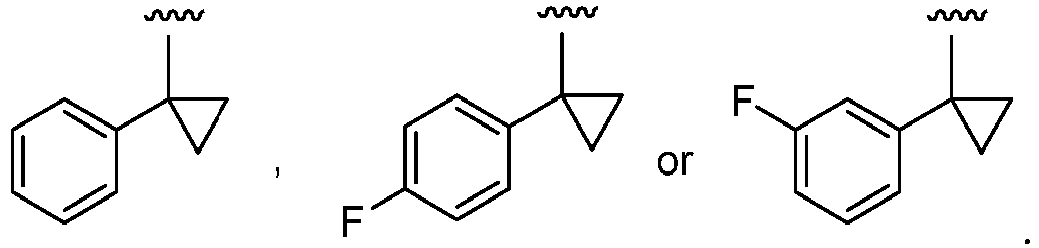
- The term optionally substituted cycloalkyl includes cycloalkyl groups having a fused optionally substituted aryl, e.g., phenyl, or fused optionally substituted heteroaryl, e.g., pyridyl. An optionally substituted cycloalkyl having a fused optionally substituted aryl or fused optionally substituted heteroaryl group may be attached to the remainder of the molecule at any available carbon atom on the cycloalkyl ring. In one embodiment, the optionally substituted cycloalkyl group is a 5-, 6-, or 7-membered cycloalkyl group having a fused phenyl group, wherein the the phenyl optionally substituted with one two or three substituents. Non-limiting examples include:


- In the present disclosure, the term "alkenyl" as used by itself or as part of another group refers to an alkyl containing one, two or three carbon-to-carbon double bonds. In one embodiment, the alkenyl group is a C2-6 alkenyl group. In another embodiment, the alkenyl group is a C2-4 alkenyl group. Non-limiting exemplary alkenyl groups include ethenyl, propenyl, isopropenyl, butenyl, sec-butenyl, pentenyl, and hexenyl.
- In the present disclosure, the term "optionally substituted alkenyl" as used herein by itself or as part of another group refers to an alkenyl that is either unsubstituted or substituted with one, two or three substituents independently selected from the group consisting of halo, nitro, cyano, hydroxy, amino, alkylamino, dialkylamino, haloalkyl, hydroxyalkyl, alkoxy, haloalkoxy, aryloxy, aralkyloxy, alkylthio, carboxamido, sulfonamido, alkylcarbonyl, arylcarbonyl, alkylsulfonyl, arylsulfonyl, carboxy, carboxyalkyl, alkyl, optionally substituted cycloalkyl, alkenyl, alkynyl, optionally substituted aryl, heteroaryl, and optionally substituted heterocyclo.
- In the present disclosure, the term "alkynyl" as used by itself or as part of another group refers to an alkyl containing one to three carbon-to-carbon triple bonds. In one embodiment, the alkynyl has one carbon-to-carbon triple bond. In one embodiment, the alkynyl group is a C2-6 alkynyl group. In another embodiment, the alkynyl group is a C2-4 alkynyl group. Non-limiting exemplary alkynyl groups include ethynyl, propynyl, butynyl, 2-butynyl, pentynyl, and hexynyl groups.
- In the present disclosure, the term "optionally substituted alkynyl" as used herein by itself or as part of another group refers to an alkynyl that is either unsubstituted or substituted with one, two or three substituents independently selected from the group consisting of halo, nitro, cyano, hydroxy, amino, alkylamino, dialkylamino, haloalkyl, hydroxyalkyl, alkoxy, haloalkoxy, aryloxy, aralkyloxy, alkylthio, carboxamido, sulfonamido, alkylcarbonyl, arylcarbonyl, alkylsulfonyl, arylsulfonyl, carboxy, carboxyalkyl, alkyl, cycloalkyl, alkenyl, alkynyl, optionally substituted aryl, optionally substituted heteroaryl, heterocyclo, and -Si(R)3, wherein R is selected from the group consisting of alkyl and aryl.
- In the present disclosure, the term "haloalkyl" as used by itself or as part of another group refers to an alkyl substituted by one or more fluorine, chlorine, bromine and/or iodine atoms. In one embodiment, the alkyl group is substituted by one, two, or three fluorine and/or chlorine atoms. In another embodiment, the haloalkyl group is a C1-4 haloalkyl group. Non-limiting exemplary haloalkyl groups include fluoromethyl, 2-fluoroethyl, difluoromethyl, trifluoromethyl, pentafluoroethyl, 1,1-difluoroethyl, 2,2-difluoroethyl, 2,2,2-trifluoroethyl, 3,3,3-trifluoropropyl, 4,4,4-trifluorobutyl, and trichloromethyl groups.
- In the present disclosure, the term "hydroxyalkyl" as used by itself or as part of another group refers to an alkyl substituted with one two, or three, hydroxy groups. In one embodiment, the hydroxyalkyl group is a monohydroxyalkyl group, i.e., substituted with one hydroxy group. In another embodiment, the hydroxyalkyl group is a dihydroxyalkyl group, i.e., substituted with two hydroxy groups, e.g.,

- In another embodiment, the hydroxyalkyl group is a C1-4 hydroxyalkyl group. Non-limiting exemplary hydroxyalkyl groups include hydroxymethyl, hydroxyethyl, hydroxypropyl and hydroxybutyl groups, such as 1-hydroxyethyl, 2-hydroxyethyl, 1,2-dihydroxyethyl, 2-hydroxypropyl, 3-hydroxypropyl, 3-hydroxybutyl, 4-hydroxybutyl, 2-hydroxy-1-methylpropyl, and 1,3-dihydroxyprop-2-yl.
- In the present disclosure, the term "(cycloalkyl)alkyl," as used by itself or as part of another group refers to an alkyl substituted with an optionally substituted cycloalkyl group. In one embodiment, the (cycloalkyl) alkyl, is a "(C3-6 cycloalkyl)C1-4 alkyl," i.e., a C1-4 alkyl substituted with an unsubstituted or substituted C3-6 cycloalkyl. Non-limiting exemplary (cycloalkyl) alkyl groups include

- In the present disclosure, the term "alkoxy" as used by itself or as part of another group refers to an optionally substituted alkyl, optionally substituted cycloalkyl, optionally substituted alkenyl, or optionally substituted alkynyl attached to a terminal oxygen atom. In one embodiment, the alkoxy group is a C1-6 alkyl attached to a terminal oxygen atom. In another embodiment, the alkoxy group is chosen from a C1-4 alkyl attached to a terminal oxygen atom, e.g., methoxy, ethoxy, tert-butoxy, -OCH2CH2C≡CH, and -OCH2CH2CH2C≡CH.
- In the present disclosure, the term "alkylthio" as used by itself or as part of another group refers to a sulfur atom substituted by an optionally substituted alkyl group. In one embodiment, the alkylthio group is a C1-4 alkylthio group. Non-limiting exemplary alkylthio groups include -SCH3, and -SCH2CH3.
- In the present disclosure, the term "alkoxyalkyl" as used by itself or as part of another group refers to an alkyl group substituted with an alkoxy group. Non-limiting exemplary alkoxyalkyl groups include methoxymethyl, methoxyethyl, methoxypropyl, methoxybutyl, ethoxymethyl, ethoxyethyl, ethoxypropyl, ethoxybutyl, propoxymethyl, iso-propoxymethyl, propoxyethyl, propoxypropyl, butoxymethyl, tert-butoxymethyl, isobutoxymethyl, sec-butoxymethyl, and pentyloxymethyl.
- In the present disclosure, the term "haloalkoxy" as used by itself or as part of another group refers to a haloalkyl attached to a terminal oxygen atom. Non-limiting exemplary haloalkoxy groups include fluoromethoxy, difluoromethoxy, trifluoromethoxy, and 2,2,2-trifluoroethoxy.
- In the present disclosure, the term "aryl" as used by itself or as part of another group refers to unsubstituted monocyclic or bicyclic aromatic ring systems having from six to fourteen carbon atoms, i.e., a C6-14 aryl. Non-limiting exemplary aryl groups include phenyl (abbreviated as "Ph"), naphthyl, phenanthryl, anthracyl, indenyl, azulenyl, biphenyl, biphenylenyl, and fluorenyl groups. In one embodiment, the aryl group is a phenyl or naphthyl.
- In the present disclosure, the term "optionally substituted aryl" as used herein by itself or as part of another group refers to an aryl that is either unsubstituted or substituted with one to five substituents independently selected from the group consisting of halo, nitro, cyano, hydroxy, amino, alkylamino, dialkylamino, haloalkyl, hydroxyalkyl, alkoxy, haloalkoxy, aryloxy, aralkyloxy, alkylthio, carboxamido, sulfonamido, alkylcarbonyl, arylcarbonyl, alkylsulfonyl, arylsulfonyl, carboxy, carboxyalkyl, optionally substituted alkyl, optionally substituted cycloalkyl, alkenyl, alkynyl, optionally substituted aryl, optionally substituted heteroaryl, optionally substituted heterocyclo, alkoxyalkyl, (amino)alkyl, (carboxamido)alkyl, mercaptoalkyl, and (heterocyclo)alkyl.
- In one embodiment, the optionally substituted aryl is an optionally substituted phenyl. In one embodiment, the optionally substituted phenyl has four substituents. In another embodiment, the optionally substituted phenyl has three substituents. In another embodiment, the optionally substituted phenyl has two substituents. In another embodiment, the optionally substituted phenyl has one substituent. Non-limiting exemplary substituted aryl groups include 2-methylphenyl, 2-methoxyphenyl, 2-fluorophenyl, 2-chlorophenyl, 2-bromophenyl, 3-methylphenyl, 3-methoxyphenyl, 3-fluorophenyl, 3-chlorophenyl, 4-methylphenyl, 4-ethylphenyl, 4-methoxyphenyl, 4-fluorophenyl, 4-chlorophenyl, 2,6-di-fluorophenyl, 2,6-di-chlorophenyl, 2-methyl, 3-methoxyphenyl, 2-ethyl, 3-methoxyphenyl, 3,4-di-methoxyphenyl, 3,5-di-fluorophenyl 3,5-di-methylphenyl, 3,5-dimethoxy, 4-methylphenyl, 2-fluoro-3-chlorophenyl, and 3-chloro-4-fluorophenyl. The term optionally substituted aryl includes phenyl groups having fused optionally substituted cycloalkyl and fused optionally substituted heterocyclo rings. An optionally substituted aryl having a fused optionally substituted cycloalkyl and fused optionally substituted heterocyclo is attached to to the remainder of the molecule at any available carbon atom on the aryl ring. Non-limiting examples include:

- In the present disclosure, the term "aryloxy" as used by itself or as part of another group refers to an optionally substituted aryl attached to a terminal oxygen atom. A non-limiting exemplary aryloxy group is PhO-.
- In the present disclosure, the term "aralkyloxy" as used by itself or as part of another group refers to an aralkyl group attached to a terminal oxygen atom. A non-limiting exemplary aralkyloxy group is PhCH2O-.
- In the present disclosure, the term "heteroalkyl" as used by itself or part of another group refers to stable straight or branched chain hydrocarbon radicals containing 1 to 10 carbon atoms and at least two heteroatoms, which can be the same or different, selected from O, N, or S, wherein: 1) the nitrogen atom(s) and sulfur atom(s) can optionally be oxidized; and/or 2) the nitrogen atom(s) can optionally be quaternized. The heteroatoms can be placed at any interior position of the heteroalkyl group or at a position at which the heteroalkyl group is attached to the remainder of the molecule. In one embodiment, the heteroalkyl group contains two oxygen atoms. In one embodiment, the heteroalkyl contains one oxygen and one nitrogen atom. In one embodiment, the heteroalkyl contains two nitrogen atoms. Non-limiting exemplary heteroalkyl groups include -CH2OCH2CH2OCH3, -OCH2CH2OCH2CH2OCH3, - CH2NHCH2CH2OCH2, -OCH2CH2NH2, -NHCH2CH2N(H)CH3, -NHCH2CH2OCH3 and -OCH2CH2OCH3.
- In the present disclosure, the term "heteroaryl" or "heteroaromatic" refers to unsubstituted monocyclic and bicyclic aromatic ring systems having 5 to 14 ring atoms, i.e., a 5- to 14-membered heteroaryl, wherein at least one carbon atom of one of the rings is replaced with a heteroatom independently selected from the group consisting of oxygen, nitrogen and sulfur. In one embodiment, the heteroaryl contains 1, 2, 3, or 4 heteroatoms independently selected from the group consisting of oxygen, nitrogen and sulfur. In one embodiment, the heteroaryl has three heteroatoms. In another embodiment, the heteroaryl has two heteroatoms. In another embodiment, the heteroaryl has one heteroatom. In another embodiment, the heteroaryl is a 5- to 10-membered heteroaryl. In another embodiment, the heteroaryl is a 5- or 6-membered heteroaryl. In another embodiment, the heteroaryl has 5 ring atoms, e.g., thienyl, a 5-membered heteroaryl having four carbon atoms and one sulfur atom. In another embodiment, the heteroaryl has 6 ring atoms, e.g., pyridyl, a 6-membered heteroaryl having five carbon atoms and one nitrogen atom. Non-limiting exemplary heteroaryl groups include thienyl, benzo[b]thienyl, naphtho[2,3-b]thienyl, thianthrenyl, furyl, benzofuryl, pyranyl, isobenzofuranyl, benzooxazonyl, chromenyl, xanthenyl, 2H-pyrrolyl, pyrrolyl, imidazolyl, pyrazolyl, pyridyl, pyrazinyl, pyrimidinyl, pyridazinyl, isoindolyl, 3H-indolyl, indolyl, indazolyl, purinyl, isoquinolyl, quinolyl, phthalazinyl, naphthyridinyl, cinnolinyl, quinazolinyl, pteridinyl, 4aH-carbazolyl, carbazolyl, β-carbolinyl, phenanthridinyl, acridinyl, pyrimidinyl, phenanthrolinyl, phenazinyl, thiazolyl, isothiazolyl, phenothiazolyl, isoxazolyl, furazanyl, and phenoxazinyl. In one embodiment, the heteroaryl is thienyl (e.g., thien-2-yl and thien-3-yl), furyl (e.g., 2-furyl and 3-furyl), pyrrolyl (e.g., 1H-pyrrol-2-yl and 1H-pyrrol-3-yl), imidazolyl (e.g., 2H-imidazol-2-yl and 2H-imidazol-4-yl), pyrazolyl (e.g., 1H-pyrazol-3-yl, 1H-pyrazol-4-yl, and 1H-pyrazol-5-yl), pyridyl (e.g., pyridin-2-yl, pyridin-3-yl, and pyridin-4-yl), pyrimidinyl (e.g., pyrimidin-2-yl, pyrimidin-4-yl, and pyrimidin-5-yl), thiazolyl (e.g., thiazol-2-yl, thiazol-4-yl, and thiazol-5-yl), isothiazolyl (e.g., isothiazol-3-yl, isothiazol-4-yl, and isothiazol-5-yl), oxazolyl (e.g., oxazol-2-yl, oxazol-4-yl, and oxazol-5-yl), isoxazolyl (e.g., isoxazol-3-yl, isoxazol-4-yl, and isoxazol-5-yl), or indazolyl (e.g., 1H-indazol-3-yl). The term "heteroaryl" also includes possible N-oxides. A non-limiting exemplary N-oxide is pyridyl N-oxide.
- In one embodiment, the heteroaryl is a 5- or 6-membered heteroaryl. In one embodiment, the heteroaryl is a 5-membered heteroaryl, i.e., the heteroaryl is a monocyclic aromatic ring system having 5 ring atoms wherein at least one carbon atom of the ring is replaced with a heteroatom independently selected from nitrogen, oxygen, and sulfur. Non-limiting exemplary 5-membered heteroaryl groups include thienyl, furyl, pyrrolyl, oxazolyl, pyrazolyl, imidazolyl, thiazolyl, isothiazolyl, and isoxazolyl.
- In another embodiment, the heteroaryl is a 6-membered heteroaryl, e.g., the heteroaryl is a monocyclic aromatic ring system having 6 ring atoms wherein at least one carbon atom of the ring is replaced with a nitrogen atom. Non-limiting exemplary 6-membered heteroaryl groups include pyridyl, pyrazinyl, pyrimidinyl, and pyridazinyl.
- In the present disclosure, the term "optionally substituted heteroaryl" as used by itself or as part of another group refers to a heteroaryl that is either unsubstituted or substituted with one to four substituents, e.g., one or two substituents, independently selected from the group consisting of halo, nitro, cyano, hydroxy, amino, alkylamino, dialkylamino, haloalkyl, hydroxyalkyl, alkoxy, haloalkoxy, aryloxy, aralkyloxy, alkylthio, carboxamido, sulfonamido, alkylcarbonyl, arylcarbonyl, alkylsulfonyl, arylsulfonyl, carboxy, carboxyalkyl, optionally substituted alkyl, optionally substituted cycloalkyl, alkenyl, alkynyl, optionally substituted aryl, optionally substituted heteroaryl, optionally substituted heterocyclo, alkoxyalkyl, (amino)alkyl, (carboxamido)alkyl, mercaptoalkyl, and (heterocyclo)alkyl. In one embodiment, the optionally substituted heteroaryl has one substituent. Any available carbon or nitrogen atom can be substituted. Non-limiting exemplary substituted 5-membered heteroaryl groups include, but are not limited to:


- The term optionally substituted heteroaryl includes heteroaryl groups having a fused optionally substituted cycloalkyl or fused optionally substituted heterocyclo group. An optionally substituted heteroaryl having a fused optionally substituted cycloalkyl or fused optionally substituted heterocyclo group may be attached to the remainder of the molecule at any available carbon atom on the heteroaryl ring. Non-limiting examples include:

- In the present disclosure, the term "heteroarylenyl" as used herein by itself or part of another group refers to a divalent form of an optionally substituted heteroaryl group. In one embodiment, the heteroarylenyl is a 5-membered heteroarylenyl. Non-limiting examples of a 5-membered heteroarylenyl include:


- In the present disclosure, the term "heterocycle" or "heterocyclo" as used by itself or as part of another group refers to unsubstituted saturated and partially unsaturated, e.g., containing one or two double bonds, cyclic groups containing one, two, or three rings having from three to fourteen ring members, i.e., a 3- to 14-membered heterocyclo, wherein at least one carbon atom of one of the rings is replaced with a heteroatom. Each heteroatom is independently selected from the group consisting of oxygen, sulfur, including sulfoxide and sulfone, and/or nitrogen atoms, which can be oxidized or quaternized. The term "heterocyclo" includes groups wherein a ring -CH2- is replaced with a -C(=O)-, for example, cyclic ureido groups such as 2-imidazolidinone and cyclic amide groups such as β-lactam, γ-lactam, δ-lactam, ε-lactam, and piperazin-2-one. The term "heterocyclo" also includea groups having fused optionally substituted aryl groups, e.g., indolinyl, chroman-4-yl. In one embodiment, the heterocyclo group is chosen from a 5- or 6-membered cyclic group containing one ring and one or two oxygen and/or nitrogen atoms. The heterocyclo can be optionally linked to the rest of the molecule through any available carbon or nitrogen atom. Non-limiting exemplary heterocyclo groups include dioxanyl, tetrahydropyranyl, 2-oxopyrrolidin-3-yl, piperazin-2-one, piperazine-2,6-dione, 2-imidazolidinone, piperidinyl, morpholinyl, piperazinyl, pyrrolidinyl, and indolinyl.
- In the present disclosure, the term "optionally substituted heterocyclo" as used herein by itself or part of another group refers to a heterocyclo that is either unsubstituted or substituted with one to four substituents independently selected from halo, nitro, cyano, hydroxy, amino, alkylamino, dialkylamino, haloalkyl, hydroxyalkyl, alkoxy, haloalkoxy, aryloxy, aralkyloxy, alkylthio, carboxamido, sulfonamido, alkylcarbonyl, alkoxycarbonyl, CF3C(=O)-, arylcarbonyl, alkylsulfonyl, arylsulfonyl, carboxy, carboxyalkyl, alkyl, optionally substituted cycloalkyl, alkenyl, alkynyl, optionally substituted aryl, optionally substituted heteroaryl, optionally substituted heterocyclo, alkoxyalkyl, (amino)alkyl, (carboxamido)alkyl, mercaptoalkyl, or (heterocyclo)alkyl. Substitution may occur on any available carbon or nitrogen atom, or both. Non-limiting exemplary substituted heterocyclo groups include:

- In the present disclosure, the term "amino" as used by itself or as part of another group refers to -NR7aR7b, wherein R7a and R7b are each independently hydrogen, optionally substituted alkyl, alkynyl, haloalkyl, hydroxyalkyl, optionally substituted cycloalkyl, optionally substituted aryl, optionally substituted heterocyclo, or optionally substituted heteroaryl, or R7a and R7b are taken together to form a 3- to 8-membered optionally substituted heterocyclo. Non-limiting exemplary amino groups include -NH2 and -N(H)(CH3).
- In the present disclosure, the term "(amino)alkyl" as used by itself or as part of another group refers to an alkyl group substituted with an amino group. Non-limiting exemplary amino alkyl groups include -CH2CH2NH2, and -CH2CH2N(H)CH-3, -CH2CH2N(CH3)2, and -CH2N(H)cyclopropyl.
- In the present disclosure, the term "carboxamido" as used by itself or as part of another group refers to a radical of formula -C(=O)NR9aR9b, wherein R9a and R9b are each independently hydrogen, optionally substituted alkyl, hydroxyalkyl, optionally substituted cycloalkyl, optionally substituted aryl, optionally substituted heterocyclo, or optionally substituted heteroaryl, or R9a and R9b taken together with the nitrogen to which they are attached form a 3- to 8-membered optionally substituted heterocyclo group. In one embodiment, R9a and R9b are each independently hydrogen or optionally substituted alkyl. In one embodiment, R9a and R9b are taken together to taken together with the nitrogen to which they are attached form a 3- to 8-membered optionally substituted heterocyclo group. Non-limiting exemplary carboxamido groups include, but are not limited to, -CONH2, -CON(H)CH3, -CON(CH3)2, -CON(H)Ph,

- In the present disclosure, the term "sulfonamido" as used by itself or as part of another group refers to a radical of the formula -SO2NR8aR8b, wherein R8a and R8b are each independently hydrogen, optionally substituted alkyl, or optionally substituted aryl, or R8a and R8b taken together with the nitrogen to which they are attached from a 3- to 8-membered heterocyclo group. Non-limiting exemplary sulfonamido groups include -SO2NH2, -SO2N(H)CH3, and -SO2N(H)Ph.
- In the present disclosure, the term "alkylcarbonyl" as used by itself or as part of another group refers to a carbonyl group, i.e., -C(=O)-, substituted by an alkyl group. A non-limiting exemplary alkylcarbonyl group is -COCH3.
- In the present disclosure, the term "arylcarbonyl" as used by itself or as part of another group refers to a carbonyl group, i.e., -C(=O)-, substituted by an optionally substituted aryl group. A non-limiting exemplary arylcarbonyl group is -COPh.
- In the present disclosure, the term "alkoxycarbonyl" as used by itself or as part of another group refers to a carbonyl group, i.e., -C(=O)-, substituted by an alkoxy group. In one embodiment, the alkoxy is a C1-4 alkoxy. Non-limiting exemplary alkoxycarbonyl groups include -C(=O)OMe, -C(=O)OEt, and -C(=O)OtBu.
- In the present disclosure, the term "(alkoxycarbonyl)alkyl" as used by itself or as part of another group refers to an alkyl group substituted by an alkoxycarbonyl group. Non-limiting exemplary (alkoxycarbonyl)alkyl groups include -CH2C(=O)OMe, -CH2C(=O)OEt, and -CH2C(=O)OtBu.
- In the present disclosure, the term "alkylsulfonyl" as used by itself or as part of another group refers to a sulfonyl group, i.e., -SO2-, substituted by any of the above-mentioned optionally substituted alkyl groups. A non-limiting exemplary alkylsulfonyl group is -SO2CH3.
- In the present disclosure, the term "arylsulfonyl" as used by itself or as part of another group refers to a sulfonyl group, i.e., -SO2-, substituted by any of the above-mentioned optionally substituted aryl groups. A non-limiting exemplary arylsulfonyl group is -SO2Ph.
- In the present disclosure, the term "mercaptoalkyl" as used by itself or as part of another group refers to any of the above-mentioned alkyl groups substituted by a -SH group.
- In the present disclosure, the term "carboxy" as used by itself or as part of another group refers to a radical of the formula -COOH.
- In the present disclosure, the term "carboxyalkyl" as used by itself or as part of another group refers to any of the above-mentioned alkyl groups substituted with a - COOH. A non-limiting exemplary carboxyalkyl group is -CH2CO2H.
- In the present disclosure, the terms "aralkyl" or "arylalkyl" as used by themselves or as part of another group refers to an alkyl substituted with one, two, or three optionally substituted aryl groups. In one embodiment, the optionally substituted aralkyl group is a C1-4 alkyl substituted with one optionally substituted C5 or C6 aryl group. In one embodiment, the optionally substituted aralkyl group is a C1 or C2 alkyl substituted with one optionally substituted aryl group. In one embodiment, the optionally substituted aralkyl group is a C1 or C2 alkyl substituted with one optionally substituted phenyl group. Non-limiting exemplary optionally substituted aralkyl groups include benzyl, phenethyl, -CHPh2, -CH2(4-F-Ph), -CH2(4-Me-Ph), -CH2(4-CF3-Ph), and -CH(4-F-Ph)2.
- In the present disclosure, the terms "(heterocyclo)alkyl" as used by itself or part of another group refers to an alkyl substituted with an optionally substituted heterocyclo group. In one embodiment, the (heterocyclo)alkyl is a C1-4 alkyl substituted with one optionally substituted heterocyclo group. Non-limiting exemplary (heterocyclo)alkyl groups include:

- In the present disclosure, the term "(carboxamido)alkyl" as used by itself or as part of another group refers to an alkyl substituted with one or two carboxamido groups. In one embodiment, the (carboxamido)alkyl is a C1-4 alkyl substituted with one carboxamido group, i.e., a (carboxamido)C1-4 alkyl. In another embodiment, the (carboxamido)alkyl is a C1-4 alkyl substituted with two carboxamido groups. Non-limiting exemplary (carboxamido)alkyl groups include -CH2CONH2, -C(H)CH3-CONH2, -CH2CON(H)CH3, and -CH(CO2NH2)CH-2CH2CO2NH2.
- In the present disclosure, the term "(heteroaryl)alkyl" as used by itself or part of another group refers to an alkyl substituted with an optionally substituted heteroaryl group. In one embodiment, the (heteroaryl)alkyl is a C1-4 alkyl substituted with one optionally substituted heteroaryl group. In another embodiment, the (heteroaryl)alkyl is a C1 alkyl substituted with one optionally substituted heteroaryl group Non-limiting exemplary (heteroaryl)alkyl groups include:

-

- A solution of 2-amino-6-bromobenzaldehyde (50 mg) in DCM (10 mL) was cooled to 0 °C and DIPEA (37 µL) was added slowly. Then 2-chloroacetyl chloride (17 µL) was added dropwise. After stirring at 0 °C for 30 min, the reaction was diluted with DCM, washed with brine, dried, and concentrated on a rotary evaporator. The remaining residues were purified by flash column chromatography on silica gel to afford ZBC43 in 42 mg. ESI-MS calculated for C9H8BrClNO2 [M+H]+ = 275.9; Observed: 276.0. 1H NMR (400 MHz, CDCl3) δ 12.32 (s, 1H), 10.51 (s, 1H), 8.78 - 8.70 (m, 1H), 7.49-7.40 (m, 2H), 4.22 (s, 2H).
-

- A solution of ZBC43 (600 mg) in methanol (30 mL) was cooled to 0 °C and NaBH4 (157 mg) was added slowly. After 30 min, the reaction was finished and the solvent was evaporated under vacuum. The remaining residues was dissolved in ethyl acetate and washed with saturated aqueous sodium bicarbonate. The aqueous layer was extracted with ethyl acetate. The organic layers were combined and washed with brine, dried over anhydrous sodium sulfate, and concentrated on a rotary evaporator. The remaining residues were purified by flash column chromatography on silica gel to afford ZBC44 in 560 mg.
-

- A suspension of NaOtBu (3 g) in tBuOH (50 mL) was heated at 80°C until it turns into a clear solution. Then ZBC44 (4.8 g) was added in one portion and the reaction is heated at 80°C for 15 min. The reaction mixture was cooled, poured into ice-water, and extracted with ethyl acetate. The organic layers were combined and washed with brine, dried over anhydrous sodium sulfate, and concentrated on a rotary evaporator. The remaining residues were purified by flash column chromatography on silica gel to afford ZBC45 in 3.7 g. ESI-MS calculated for C9H9BrNO2 [M+H]+ = 241.98; Observed: 242.14. 1H NMR (400 MHz, DMSO) δ 10.29 (s, 1H), 7.39 - 7.26 (m, 1H), 7.26-7.11 (m, 2H), 4.89 (s, 2H), 4.42 (s, 2H).
-

- A suspenstion of P4S10 (147 mg, 0.66 mmol) and NaHCO3 (70 mg, 0.66 mmol) in 1,2-DCE (5 mL) was stirred for 10 min prior to the addition of ZBC45 (85 mg). The reaction mixture was stirred at 65 °C for 4 h. The reaction was cooled, taken up with saturated NaHCO3, extracted with DCM. The organic layers were combined and washed with brine, dried over anhydrous sodium sulfate, and concentrated on a rotary evaporator. The remaining residues were dissolved in nBuOH (10 ml) and AcNHNH2 (100 mg) was added. The reaction mixture was stirred at 120 °C for 2 h. The reaction mixture was cooled, poured into ice-water, and extracted with ethyl acetate. The organic layers were combined and washed with brine, dried over anhydrous sodium sulfate, and concentrated on a rotary evaporator. The residues were purified by reverse phase HPLC. Cpd. No. 36 was isolated in 45 mg as a salt of CF3CO2H. ESI-MS calculated for C11H11BrN3O [M+H]+ = 280.00; Observed: 280.42. 1H NMR (400 MHz, MeOD) δ 7.93 (d, J = 8.0 Hz, 1H), 7.72 (d, J = 7.4 Hz, 1H), 7.62 (t, J = 8.1 Hz, 1H), 4.75 (s, 2H), 4.66 (s, 2H), 2.73 (s, 3H).
-

- Pd2(dba)3 (18 mg) and BINAP (26 mg) were mixed in anhydrous toluene. And the mixture was heated at reflux for 3-4 minutes. This mixture was transferred into a round-bottom flask containing Cpd. No. 36 (60 mg), PhNH2 (88 mg), tBuONa (60 mg), and toluene (2 mL). The mixture was heated at reflux for overnight before quenching with methanol. The reaction mixture was filtered and the mixture was purified by HPLC to yield Cpd. No. 37 as a CF3CO2H salt in 1.7 mg. ESI-MS calculated for C17H17N4O [M+H]+ = 293.14; Observed: 293.45. 1H NMR (400 MHz, MeOD) δ 7.52 (t, J = 8.1 Hz, 1H), 7.42 (d, J = 8.3 Hz, 1H), 7.28 (t, J = 7.6 Hz, 2H), 7.21 (d, J = 7.8 Hz, 1H), 7.06 (d, J = 8.5 Hz, 2H), 6.96 (td, J = 7.4, 1.0 Hz, 1H), 4.67 (s, 2H), 4.58 (s, 2H), 2.73 (s, 3H).
-

- To a round-bottom flask was charged with Cpd. No. 36 (28 mg, 0.1 mmol), potassium benzyltrifluoroborate (40 mg, 0.2 mmol), Pd(dppf)Cl2 (8 mg). Under N2 atmosphere, DME (3 mL) and a solution of Na2CO3 (2.0 M, 1 mL) was added. The reaction mixture was heated at 100 °C for 4 h. The reaction was cooled, taken up with saturated NaHCO3, extracted with DCM. The organic layers were combined and washed with brine, dried over anhydrous sodium sulfate, and concentrated on a rotary evaporator. The residues were purified by reverse phase HPLC. Cpd. No. 38 was isolated in 20 mg as a salt of CF3CO2H. ESI-MS calculated for C18H18N3O [M+H]+ = 292.14; Observed: 292.56. 1H NMR (400 MHz, MeOD) δ 7.69 - 7.65 (m, 1H), 7.62 - 7.54 (m, 2H), 7.29 (t, J = 7.3 Hz, 2H), 7.20 (m, 3H), 4.59 (brs, 4H), 4.28 (s, 2H), 2.77 (s, 3H).
-

- To a round-bottom flask containing Cpd. No. 36 (30 mg), DIPEA (56 µL), and 1,4-dioxane (4 mL) under N2, Pd2(dba)3 (10 mg), Xantphos (12 mg) and PhSH (14 mg) was added. And the mixture was heated at reflux for 4 hour. The reaction mixture was filtered and the mixture was purified by HPLC to yield Cpd. No. 39 as a CF3CO2H salt in 12 mg. ESI-MS calculated for C17H16N3OS [M+H]+ = 310.10; Observed: 310.44. 1H NMR (400 MHz, MeOD) δ 7.65 - 7.61 (m, 2H), 7.54 - 7.50 (m, 1H), 7.42 - 7.33 (m, 5H), 4.80 (s, 2H), 4.64 (s, 2H), 2.77 (s, 3H).
-

- To a round-bottom flask containing Cpd. No. 39 (30 mg) in DCM (4 mL) at -78 °C, mCPBA (16 mg) was added. The mixture was allowed to warm to room temperature and was stirred at rt for 2 hour. The reaction mixture was filtered and the mixture was purified by HPLC to yield Cpd. No. 41 as a CF3CO2H salt in 23 mg. ESI-MS calculated for C17H16N3O2S [M+H]+ = 326.09; Observed: 326.35. 1H NMR (400 MHz, MeOD) δ 8.22 (d, J = 8.0 Hz, 1H), 7.96 (td, J = 8.0, 1.1 Hz, 1H), 7.87 (d, J = 8.0 Hz, 1H), 7.78 (m, 2H), 7.60 - 7.53 (m, 3H), 4.98 (d, J = 13.3 Hz, 1H), 4.73 (d, J = 13.5 Hz, 1H), 4.64 (d, J= 13.4 Hz, 1H), 4.28 (d, J= 13.4 Hz, 1H), 2.72 (s, 3H).
-

- To a round-bottom flask containing Cpd. No. 41 (30 mg) in DCM (4 mL) at rt, mCPBA (32 mg) was added. The mixture was allowed to warm to room temperature and was stirred at rt for 5 hour. The reaction mixture was filtered and the mixture was purified by HPLC to yield Cpd. No. 42 as a CF3CO2H salt in 17 mg. ESI-MS calculated for C17H16N3O3S [M+H]+ = 342.09; Observed: 342.46.
-

- To a round-bottom flask containing Cpd. No. 36 (28 mg, 0.1 mmol), (1-phenylvinyl)boronic acid (30 mg), Pd(dppf)Cl2 (8 mg), under N2 atmosphere, dimethoxyethane (DME) (6 mL) and a solution of Na2CO3 (2.0 M, 2 mL) was added. The reaction mixture was heated at 100 °C for 4 h. The reaction was cooled, taken up with saturated NaHCO3, extracted with DCM. The organic layers were combined and washed with brine, dried over anhydrous sodium sulfate, and concentrated on a rotary evaporator. The residues were purified by reverse phase HPLC. Cpd. No. 43 was isolated in 17 mg as a salt of CF3CO2H. ESI-MS calculated for C19H18N3O [M+H]+ = 304.14; Observed: 304.45. 1H NMR (400 MHz, MeOD) δ 7.80 - 7.68 (m, 2H), 7.52 (dd, J = 6.8, 1.7 Hz, 1H), 7.42 - 7.25 (m, 5H), 6.01 (s, 1H), 5.36 (s, 1H), 4.63 (s, 2H), 4.44 (s, 2H), 2.79 (s, 3H).
-

- To a round-bottom flask containing Cpd. No. 36 (28 mg, 0.1 mmol), (1H-inden-3-yl)boronic acid (30 mg), Pd(dppf)Cl2 (8 mg), under N2 atmosphere, DME (6 mL) and a solution of Na2CO3 (2.0 M, 2 mL) was added. The reaction mixture was heated at 100 °C for 4 h. The reaction was cooled, taken up with saturated NaHCO3, extracted with DCM. The organic layers were combined and washed with brine, dried over anhydrous sodium sulfate, and concentrated on a rotary evaporator. The residues were purified by reverse phase HPLC. Cpd. No. 44 was isolated in 19 mg as a salt of CF3CO2H. ESI-MS calculated for C20H18N3O [M+H]+ = 316.14; Observed: 316.63. 1H NMR (400 MHz, MeOD) δ 7.84-7.71 (m, 3H), 7.61 - 7.56 (m, 1H), 7.34 - 7.19 (m, 3H), 6.68 (s, 1H), 4.76 (s, 2H), 4.48 (s, 2H), 3.65 (s, 2H), 2.82 (s, 3H).
-

- To a round-bottom flask containing Cpd. No. 36 (28 mg, 0.1 mmol), 4,4,5,5-tetramethyl-2-(4-(trifluoromethoxy)benzyl)-1,3,2-dioxaborolane (55 mg), Pd(dppf)Cl2 (8 mg) under N2 atmosphere, DME (6 mL) and a solution of Na2CO3 (2.0 M, 2 mL) was added. The reaction mixture was heated at 100 °C for 4 h. The reaction was cooled, taken up with saturated NaHCO3, extracted with DCM. The organic layers were combined and washed with brine, dried over anhydrous sodium sulfate, and concentrated on a rotary evaporator. The residues were purified by reverse phase HPLC. Cpd. No. 45 was isolated in 20 mg as a salt of CF3CO2H. ESI-MS calculated for C19H17F3N3O2 [M+H]+ = 376.12; Observed: 376.34. 1H NMR (400 MHz, MeOD) δ 7.69 (t, J = 7.8 Hz, 1H), 7.61 (t, J = 8.5 Hz, 2H), 7.30 (d, J = 8.5 Hz, 2H), 7.21 (d, J = 8.6 Hz, 2H), 4.59 (brs, 4H), 4.32 (s, 2H), 2.77 (s, 3H).
-

- Cpd. No. 43 (20 mg) was dissolved in a mixture of methanol (4.0 mL). Then 10% Pd/C (4 mg) was added and the reaction mixture was stirred under H2 (1 atm) at room temperature for 10 h. The mixture was filtered and the filtrate was concentrated on a rotary evaporator. The residues were purified by reverse phase HPLC. Cpd. No. 46 was isolated in 16 mg as a salt of CF3CO2H. ESI-MS calculated for C19H20N3O [M+H]+ = 306.16; Observed: 306.41. 1H NMR (400 MHz, MeOD) δ 7.64 (t, J = 7.8 Hz, 1H), 7.57 - 7.49 (m, 2H), 7.35 - 7.15 (m, 5H), 4.67 (q, J = 7.1 Hz, 1H), 4.53 (brs, 4H), 2.65 (s, 3H), 1.71 (d, J = 6.8 Hz, 3H).
-

- Cpd. No. 44 (20 mg) was dissolved in a mixture of methanol (4.0 mL). Then 10% Pd/C (4 mg) was added and the reaction mixture was stirred under H2 (1 atm) at room temperature for 10 h. The mixture was filtered and the filtrate was concentrated on a rotary evaporator. The residues were purified by reverse phase HPLC. Cpd. No. 47 was isolated in 14 mg as a salt of CF3CO2H. ESI-MS calculated for C20H20N30 [M+H]+ = 318.16; Observed: 318.24.
-

- To a solution of ZnEt2 (0.15 mL, 1 M in hexane) in DCM (2 mL) at -40 °C, was added CH2I2 (25 µL). The mixture was stirred at -40 °C for 1h. Then CC13COOH (1 mg) and DME (10 µL) was added. The mixture was stirred at -15 °C for 1 h, then Cpd. No. 43 (10mg) in DCM (2 mL) was added and the mixture was stirred at rt overnight. Then water (0.5 mL) was added to the mixture. The mixture was filtered and the filtrate was concentrated on a rotary evaporator. The residues were purified by reverse phase HPLC to yield Cpd. No. 48 in 1 mg as a salt of CF3CO2H. ESI-MS calculated for C20H20N3O [M+H]+ = 318.16; Observed: 318.44. 1H NMR (400 MHz, MeOD) δ 7.80 (dd, J = 7.7, 1.1 Hz, 1H), 7.72 (t, J = 7.9 Hz, 1H), 7.64 - 7.60 (m, 1H), 7.22 (t, J = 7.6 Hz, 2H), 7.12 (t, J = 7.3 Hz, 1H), 7.04 - 6.99 (m, 1H), 4.60 (s, 2H), 4.55 (s, 2H), 2.69 (s, 3H), 1.50 (m, 4H).
-

- To a round-bottom flask containing 3,4-dihydronaphthalen-1(2H)-one (3 g) in DCE (70 mL) under N2 atmosphere, Tf2O (4.1 mL) and 2,6-di-tert-butyl-4-methylpyridine (6.3 g) was added. The mixture was stirred at rt overnight. Then hexane (200 mL) was added. The mixture was filtered and the filtrate was concentrated on a rotary evaporator to give ZBC68. To a round-bottom flask containing Pd(dppf)Cl2 (1.7 g), dppf (1.2 g), KOAc (3.1 g), 4,4,4',4',5,5,5',5'-octamethyl-2,2'-bi(1,3,2-dioxaborolane) (5.4 g) in dioxane (100 mL) under N2 atmosphere, ZBC68 in dioxane (50 mL) was added. The reaction mixture was heated at 100 °C overnight. The mixture was filtered and the filtrate was concentrated on a rotary evaporator. The residues were purified by flash column chromatography on silica gel to afford ZBC71 in 2.1 g. ESI-MS calculated for C16H22BO2 [M+H]+ = 257.17; Observed: 257.32. 1H NMR (400 MHz, CDCl3) δ 7.78 (d, J = 7.6 Hz, 1H), 7.22 (td, J = 7.6, 1.4 Hz, 1H), 7.18 -7.09 (m, 2H), 6.98 (t, J = 4.5 Hz, 1H), 2.77 (t, J = 8.0 Hz, 2H), 2.34 (td, J = 8.0, 4.7 Hz, 2H), 1.37 (s, 12H).
-

- To a round-bottom flask containing Cpd. No. 36 (28 mg, 0.1 mmol), ZBC71 (55 mg), Pd(dppf)Cl2 (8 mg) under N2 atmosphere, DME (6 mL) and a solution of Na2CO3 (2.0 M, 2 mL) was added. The reaction mixture was heated at 100 °C for 4 h. The reaction was cooled, taken up with saturated NaHCO3, extracted with DCM. The organic layers were combined and washed with brine, dried over anhydrous sodium sulfate, and concentrated on a rotary evaporator. The residues were purified by reverse phase HPLC to yield Cpd. No. 49 in 18 mg as a salt of CF3CO2H. ESI-MS calculated for C21H20N3O [M+H]+ = 330.16; Observed: 330.43. 1H NMR (400 MHz, MeOD) δ 7.81 -7.69 (m, 2H), 7.55 (dd, J = 7.2, 1.3 Hz, 1H), 7.24 (d, J = 7.4 Hz, 1H), 7.17 (t, J = 7.4 Hz, 1H), 7.07 (t, J = 7.5 Hz, 1H), 6.60 (d, J = 7.6 Hz, 1H), 6.11 (t, J = 4.5 Hz, 1H), 4.75 (d, J = 13.3 Hz, 1H), 4.61 (d, J = 13.3 Hz, 1H), 4.41 (s, 2H), 2.93 (t, J = 8.0 Hz, 2H), 2.84 (s, 3H), 2.50 (m, 2H).
-

- Cpd. No. 49 (20 mg) was dissolved in a mixture of methanol (4.0 mL). Then 10% Pd/C (4 mg) was added and the reaction mixture was stirred under H2 (1 atm) at room temperature for 10 h. The mixture was filtered and the filtrate was concentrated on a rotary evaporator. The residues were purified by reverse phase HPLC to yield Cpd. No. 50 in 14 mg as a salt of CF3CO2H. ESI-MS calculated for C21H22N3O [M+H]+ = 332.17; Observed: 332.45. 1H NMR (400 MHz, MeOD) δ 7.60-7.54 (m, 2H), 7.25 - 7.11 (m, 3H), 7.04 (t, J = 7.2 Hz, 1H), 6.75 (d, J = 7.4 Hz, 1H), 4.80-4.55 (m, 5H), 3.00-2.88 (m, 2H), 2.77 (s, 3H), 2.30-2.20 (m, 1H), 2.07 - 1.76 (m, 3H).
-

- To a round-bottom flask containing Cpd. No. 43 (100 mg) in THF (6 mL), tBuOH (6 mL), and H2O (2 mL), NMO (58 mg) and a solution of OsO4 (2.5% wt in tBuOH, 0.4 mL) was added. The reaction mixture was heated at 100 °C for 8 h. The reaction was cooled, taken up with saturated NaHCO3, extracted with EtOAc. The organic layers were combined and washed with brine, dried over anhydrous sodium sulfate, and concentrated on a rotary evaporator. The residues were purified by reverse phase HPLC to yield Cpd. No. 116 in 60 mg as a salt of CF3CO2H. ESI-MS calculated for C19H20N3O3 [M+H]+ = 338.15; Observed: 338.43.
-

- To a round-bottom flask containing Cpd. No. 116 (80 mg) in THF (9 mL) and H2O (3 mL), NaIO4 (51 mg) was added. The reaction mixture was stirred at room temperature for 8 h. The reaction was cooled, taken up with saturated NaHCO3, extracted with EtOAc. The organic layers were combined and washed with brine, dried over anhydrous sodium sulfate, and concentrated on a rotary evaporator. The residues were purified by reverse phase HPLC to yield Cpd. No. 52 in 63 mg as a salt of CF3CO2H. ESI-MS calculated for C18H16N3O2 [M+H]+ = 306.12; Observed: 306.36. 1H NMR (400 MHz, MeOD) δ 7.95 - 7.83 (m, 4H), 7.75 - 7.68 (m, 2H), 7.57 (t, J = 7.6 Hz, 2H), 4.73 (s, 2H), 4.46 (s, 2H), 2.82 (s, 3H).
-
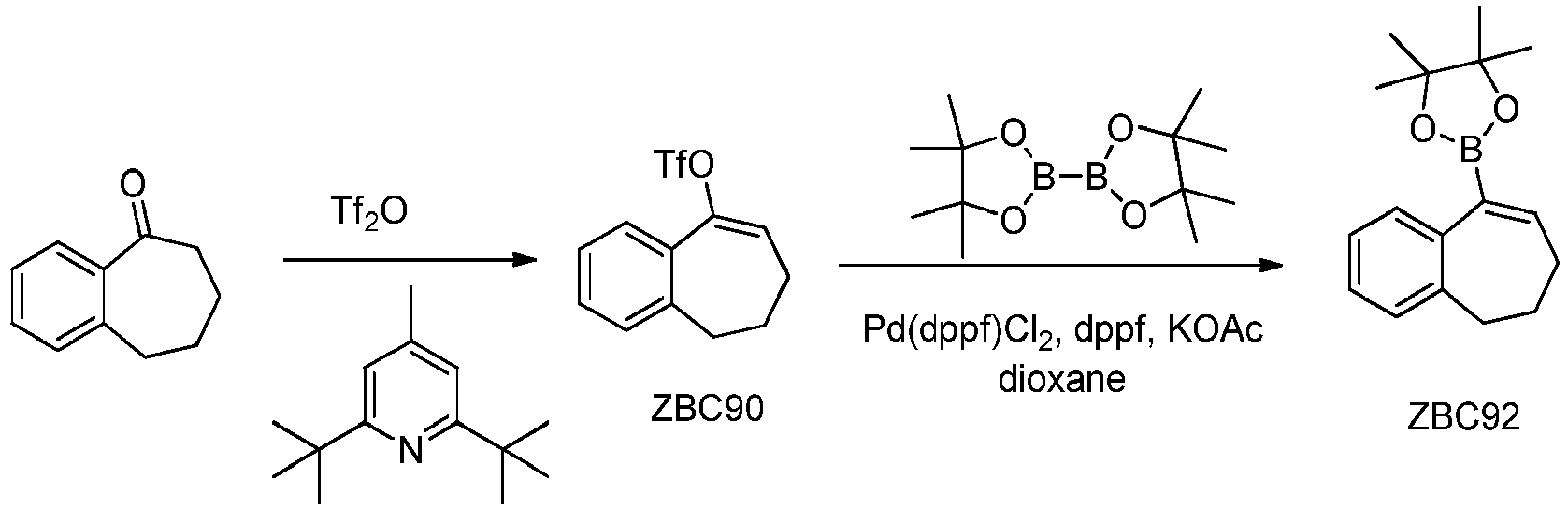
- To a round-bottom flask containing 6,7,8,9-tetrahydro-5H-benzo[7]annulen-5-one (3 g) in DCE (70 mL) under N2 atmosphere, Tf2O (4.1 mL) and 2,6-di-tert-butyl-4-methylpyridine (6.3 g) was added. The mixture was stirred at rt overnight. Then hexane (200 mL) was added. The mixture was filtered and the filtrate was concentrated on a rotary evaporator to give ZBC90. To a round-bottom flask containing Pd(dppf)Cl2 (1.7 g), dppf (1.2 g), KOAc (3.1 g), 4,4,4',4',5,5,5',5'-octamethyl-2,2'-bi(1,3,2-dioxaborolane) (5.4 g) in dioxane (100 mL) under N2 atmosphere, ZBC90 in dioxane (50 mL) was added. The reaction mixture was heated at 100 °C overnight. The mixture was filtered and the filtrate was concentrated on a rotary evaporator. The residues were purified by flash column chromatography on silica gel to afford ZBC92 in 1.3g. ESI-MS calculated for C17H24BO2 [M+H]+ = 271.18; Observed: 271.32.
-

- To a round-bottom flask containing Cpd. No. 36 (28 mg, 0.1 mmol), ZBC92 (55 mg), Pd(dppf)Cl2 (8 mg) under N2 atmosphere, DME (6 mL) and a solution of Na2CO3 in water (2.0 M, 2 mL) was added. The reaction mixture was heated at 100 °C for 4 h. The reaction was cooled, taken up with saturated NaHCO3, extracted with DCM. The organic layers were combined and washed with brine, dried over anhydrous sodium sulfate, and concentrated on a rotary evaporator. The residues were purified by reverse phase HPLC to yield Cpd. No. 59 in 10 mg as a salt of CF3CO2H. ESI-MS calculated for C22H22N3O [M+H]+ = 344.17; Observed: 344.45. 1H NMR (400 MHz, MeOD) 87.72 - 7.63 (m, 2H), 7.46 (dd, J = 7.1, 1.5 Hz, 1H), 7.33 (d, J = 7.5 Hz, 1H), 7.22 (td, J = 7.4, 1.3 Hz, 1H), 7.15 (td, J = 7.5, 1.3 Hz, 1H), 6.75 (d, J = 7.6 Hz, 1H), 6.38 (t, J = 6.9 Hz, 1H), 4.60 (s, 2H), 4.39 (s, 2H), 2.86 - 2.76 (m, 5H), 2.34 - 2.23 (m, 2H), 2.13 (m, 2H).
-

- Cpd. No. 59 (20 mg) was dissolved in a mixture of methanol (4.0 mL). Then 10% Pd/C (4 mg) was added and the reaction mixture was stirred under H2 (1 atm) at room temperature for 10 h. The mixture was filtered and the filtrate was concentrated on a rotary evaporator. The residues were purified by reverse phase HPLC to yield Cpd. No. 60 in 10 mg as a salt of CF3CO2H. ESI-MS calculated for C22H24N3O [M+H]+ = 346.19; Observed: 346.43. 1H NMR (400 MHz, MeOD) δ 7.76 (t, J = 7.9 Hz, 1H), 7.64 (dd, J = 16.4, 7.9 Hz, 2H), 7.18 (d, J = 7.4 Hz, 1H), 7.07 (t, J = 7.4 Hz, 1H), 6.93 (t, J = 7.6 Hz, 1H), 6.33 (d, J = 7.7 Hz, 1H), 4.74-4.66 (m, 2H), 4.42 (m, 2H), 4.19-4.07 (m, 1H), 3.16 (t, J = 12.7 Hz, 1H), 2.91 (dd, J = 14.0, 6.3 Hz, 1H), 2.71 (s, 3H), 2.37 - 1.89 (m, 5H), 1.45 (m, 1H).
-

- To a round-bottom flask containing Cpd. No. 2 (30 mg, 0.1 mmol), ZBC71 (55 mg), Pd(dppf)Cl2 (8 mg) under N2 atmosphere, DME (6 mL) and a solution of Na2CO3 in water (2.0 M, 2 mL) was added. The reaction mixture was heated at 100 °C for 4 h. The reaction was cooled, taken up with saturated NaHCO3, extracted with DCM. The organic layers were combined and washed with brine, dried over anhydrous sodium sulfate, and concentrated on a rotary evaporator. The residues were purified by reverse phase HPLC to yield Cpd. No. 51 in 20 mg as a salt of CF3CO2H. ESI-MS calculated for C20H20N3OS [M+H]+ = 350.13; Observed: 350.53.
-

- To a round-bottom flask containing Cpd. No. 2 (30 mg, 0.1 mmol), (1H-inden-3-yl)boronic acid (30 mg), Pd(dppf)Cl2 (8 mg), under N2 atmosphere, DME (6 mL) and a solution of Na2CO3 (2.0 M, 2 mL) was added. The reaction mixture was heated at 100 °C for 4 h. The reaction was cooled, taken up with saturated NaHCO3, extracted with DCM. The organic layers were combined and washed with brine, dried over anhydrous sodium sulfate, and concentrated on a rotary evaporator. The residues were purified by reverse phase HPLC. Cpd. No. 53 was isolated in 14 mg as a salt of CF3CO2H. ESI-MS calculated for C19H18N3OS [M+H]+ = 336.11; Observed: 336.48. 1H NMR (400 MHz, MeOD) δ 7.62 - 7.54 (m, 1H), 7.32 - 7.23 (m, 2H), 7.13 - 7.08 (m, 1H), 6.59 (s, 1H), 4.83 (s, 2H), 4.70 (d, J = 15.1 Hz, 1H), 4.60 (d, J = 15.1 Hz, 1H), 3.63 (s, 2H), 2.86 (s, 3H), 2.38 (s, 3H).
-

- Cpd. No. 51 (20 mg) was dissolved in a mixture of methanol (4.0 mL). Then 10% Pd/C (4 mg) was added and the reaction mixture was stirred under H2 (1 atm) at room temperature for 10 h. The mixture was filtered and the filtrate was concentrated on a rotary evaporator. The residues were purified by reverse phase HPLC to yield Cpd. No. 54 in 6 mg as a salt of CF3CO2H. ESI-MS calculated for C20H22N3OS [M+H]+ = 352.14; Observed: 352.33.
-

- Cpd. No. 53 (20 mg) was dissolved in a mixture of methanol (4.0 mL). Then 10% Pd/C (4 mg) was added and the reaction mixture was stirred under H2 (1 atm) at room temperature for 10 h. The mixture was filtered and the filtrate was concentrated on a rotary evaporator. The residues were purified by reverse phase HPLC to yield Cpd. No. 55 in 5 mg as a salt of CF3CO2H. ESI-MS calculated for C19H20N3OS [M+H]+ = 338.13; Observed: 338.54.
-

- To a round-bottom flask containing Cpd. No. 2 (30 mg, 0.1 mmol), ZBC92 (65 mg), Pd(dppf)Cl2 (8 mg) under N2 atmosphere, DME (6 mL) and a solution of Na2CO3 in water (2.0 M, 2 mL) was added. The reaction mixture was heated at 100 °C for 4 h. The reaction was cooled, taken up with saturated NaHCO3, extracted with DCM. The organic layers were combined and washed with brine, dried over anhydrous sodium sulfate, and concentrated on a rotary evaporator. The residues were purified by reverse phase HPLC to yield Cpd. No. 56 in 11 mg as a salt of CF3CO2H. ESI-MS calculated for C21H22N3OS [M+H]+ = 364.14; Observed: 364.43.
-

- To a round-bottom flask containing 6-fluoro-3,4-dihydronaphthalen-1(2H)-one (3 g) in DCE (70 mL)under N2 atmosphere, Tf2O (4.1 mL) and 2,6-di-tert-butyl-4-methylpyridine (6.3 g) was added. The mixture was stirred at rt overnight. Then hexane (200 mL) was added. The mixture was filtered and the filtrate was concentrated on a rotary evaporator to give ZBC91 which was used directly without purification. To a round-bottom flask containing Pd(dppf)Cl2 (1.7 g), dppf (1.2 g), KOAc (3.1 g), and 4,4,4',4',5,5,5',5'-octamethyl-2,2'-bi(1,3,2-dioxaborolane) (5.4 g) in dioxane (100 mL) under N2 atmosphere, ZBC91 in dioxane (50 mL) was added. The reaction mixture was heated at 100 °C overnight. The mixture was filtered and the filtrate was concentrated on a rotary evaporator. The residues were purified by flash column chromatography on silica gel to afford ZBC93 in 1.4g. ESI-MS calculated for C16H21BFO2 [M+H]+ = 275.16; Observed: 275.35. 1H NMR (400 MHz, CDCl3) δ 7.75 - 7.69 (m, 1H), 6.96 - 6.78 (m, 3H), 2.73 (t, J = 8.1 Hz, 2H), 2.31 (td, J = 8.0, 4.9 Hz, 2H), 1.35 (s, 12H).
-
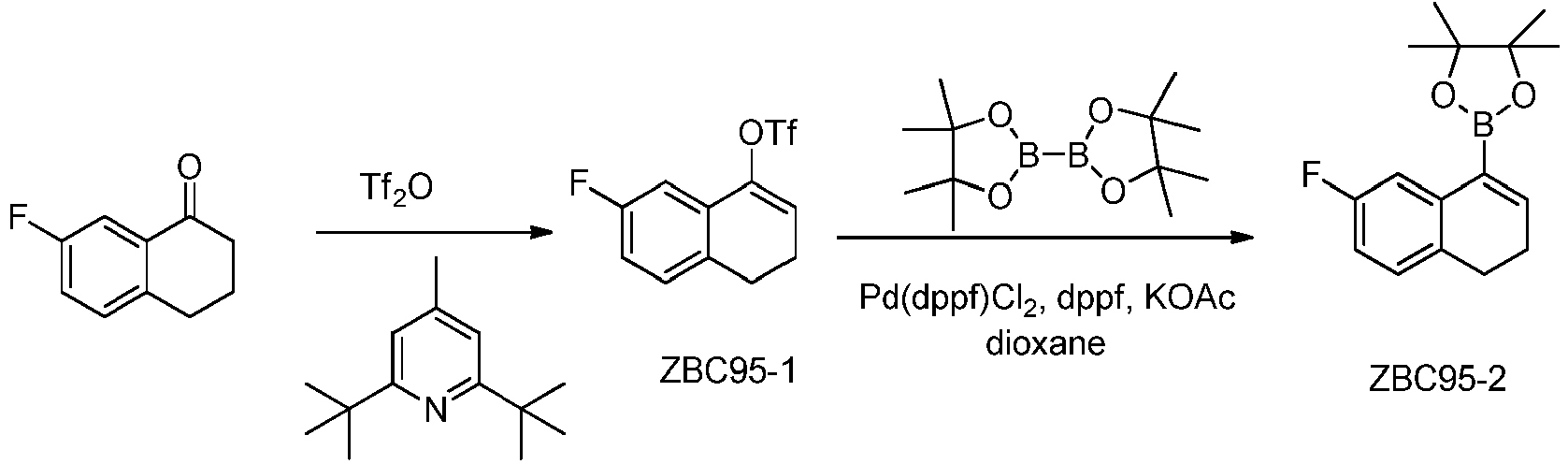
- To a round-bottom flask containing 7-fluoro-3,4-dihydronaphthalen-1(2H)-one (3 g) in DCE (70 mL)under N2 atmosphere, Tf2O (4.1 mL) and 2,6-di-tert-butyl-4-methylpyridine (6.3 g) was added. The mixture was stirred at rt overnight. Then hexane (200 mL) was added. The mixture was filtered and the filtrate was concentrated on a rotary evaporator to give ZBC95-1 which was used directly without purification. To a round-bottom flask containing Pd(dppf)Cl2 (1.7 g), dppf (1.2 g), KOAc (3.1 g), and 4,4,4',4',5,5,5',5'-octamethyl-2,2'-bi(1,3,2-dioxaborolane) (5.4 g) in dioxane (100 mL) under N2 atmosphere, ZBC95-1 in dioxane (50 mL) was added. The reaction mixture was heated at 100 °C overnight. The mixture was filtered and the filtrate was concentrated on a rotary evaporator. The residues were purified by flash column chromatography on silica gel to afford ZBC95-2 in 1.0 g. ESI-MS calculated for C16H21BF02 [M+H]+ = 275.16; Observed: 275.22.
-

- To a round-bottom flask containing Cpd. No. 2 (30 mg, 0.1 mmol), ZBC93 (70 mg), Pd(dppf)Cl2 (8 mg) under N2 atmosphere, DME (6 mL) and a solution of Na2CO3 in water (2.0 M, 2 mL) was added. The reaction mixture was heated at 100 °C for 4 h. The reaction was cooled, taken up with saturated NaHCO3, extracted with DCM. The organic layers were combined and washed with brine, dried over anhydrous sodium sulfate, and concentrated on a rotary evaporator. The residues were purified by reverse phase HPLC to yield Cpd. No. 57 in 20 mg as a salt of CF3CO2H. ESI-MS calculated for C20H19FN3OS [M+H]+ = 368.12; Observed: 368.44. 1H NMR (400 MHz, MeOD) δ 7.00 (dd, J = 9.2, 2.5 Hz, 1H), 6.83 (td, J = 8.6, 2.5 Hz, 1H), 6.69 (dd, J = 8.4, 5.8 Hz, 1H), 6.04 (t, J = 4.5 Hz, 1H), 4.80 (s, 2H), 4.71 (d, J = 15.3 Hz, 1H), 4.48 (d, J = 15.3 Hz, 1H), 2.92 (t, J = 8.0 Hz, 2H), 2.87 (s, 3H), 2.55 - 2.43 (m, 2H), 2.35 (s, 3H).
-

- To a round-bottom flask containing Cpd. No. 2 (30 mg, 0.1 mmol), ZBC95-2 (70 mg), Pd(dppf)Cl2 (8 mg) under N2 atmosphere, DME (6 mL) and a solution of Na2CO3 in water (2.0 M, 2 mL) was added. The reaction mixture was heated at 100 °C for 4 h. The reaction was cooled, taken up with saturated NaHCO3, extracted with DCM. The organic layers were combined and washed with brine, dried over anhydrous sodium sulfate, and concentrated on a rotary evaporator. The residues were purified by reverse phase HPLC to yield Cpd. No. 58 in 21 mg as a salt of CF3CO2H. ESI-MS calculated for C20H19FN3OS [M+H]+ = 368.12; Observed: 368.34. 1H NMR (400 MHz, MeOD) δ 7.28 - 7.22 (m, 1H), 6.91 (t, J = 8.5 Hz, 1H), 6.40 (d, J = 9.8 Hz, 1H), 6.17 (t, J = 4.4 Hz, 1H), 4.81 (s, 2H), 4.71 (d, J = 15.3 Hz, 1H), 4.49 (d, J = 15.3 Hz, 1H), 2.93 - 2.81 (m, 5H), 2.56 - 2.46 (m, 2H), 2.36 (d, J = 1.1 Hz, 3H).
-

- To a mixture of 4-bromoisatin (3 g) and trichloroisocyanuric acid (1.4 g) in an ice bath, 10 mL of conc. H2SO4 was added dropwise over a 5 minute period with magnetic stirring. The mixture was kept in an ice bath under stirring for 15 minutes. The mixture was then poured over cracked ice. The crystals were collected and washed with cold water to afford 3.1 g of ZBC103 as an orange solid.
-

- To a 250 mL round bottom flask, ZBC103 (3 g) and 2N NaOH (40 mL) were added and the reaction vessel was cooled to 0 °C. Then 30% hydrogen peroxide (4 mL) was slowly added. The reaction mixture was stirred at 0 °C for 3 h. Subsequently, the reaction mixture was acidified with 2N HCl at 0 °C to afford the solid compound. The solid material was collected by filtration and dried to obtain the title compound. ESI-MS calculated for C7H6BrCIN02 [M+H]+ = 249.9; Observed: 250.11.
-

- To a 250 mL round bottom flask, ZBC104 (170 mg) and THF (40 mL) were added and the reaction vessel was cooled to 0 °C. Then LiAlH4 (60 mg) was slowly added. The reaction mixture was stirred at 0 °C for 3 h. Then 2 N NaOH (15 mL) was added. After 30 min, the solvent was evaporated under vacuum. The remaining residues was dissolved in ethyl acetate and washed with saturated aqueous sodium bicarbonate. The aqueous layer was extracted with ethyl acetate. The organic layers were combined and washed with brine, dried over anhydrous sodium sulfate, and concentrated on a rotary evaporator. The remaining residues were purified by flash column chromatography on silica gel to afford ZBC105-1 in 120 mg. ESI-MS calculated for C7H8BrClNO [M+H]+ = 235.94; Observed: 236.05. 1H NMR (400 MHz, CDCl3) δ 7.21 (d, J = 8.6 Hz, 1H), 6.62 (d, J = 8.6 Hz, 1H), 4.97 (s, 2H).
-
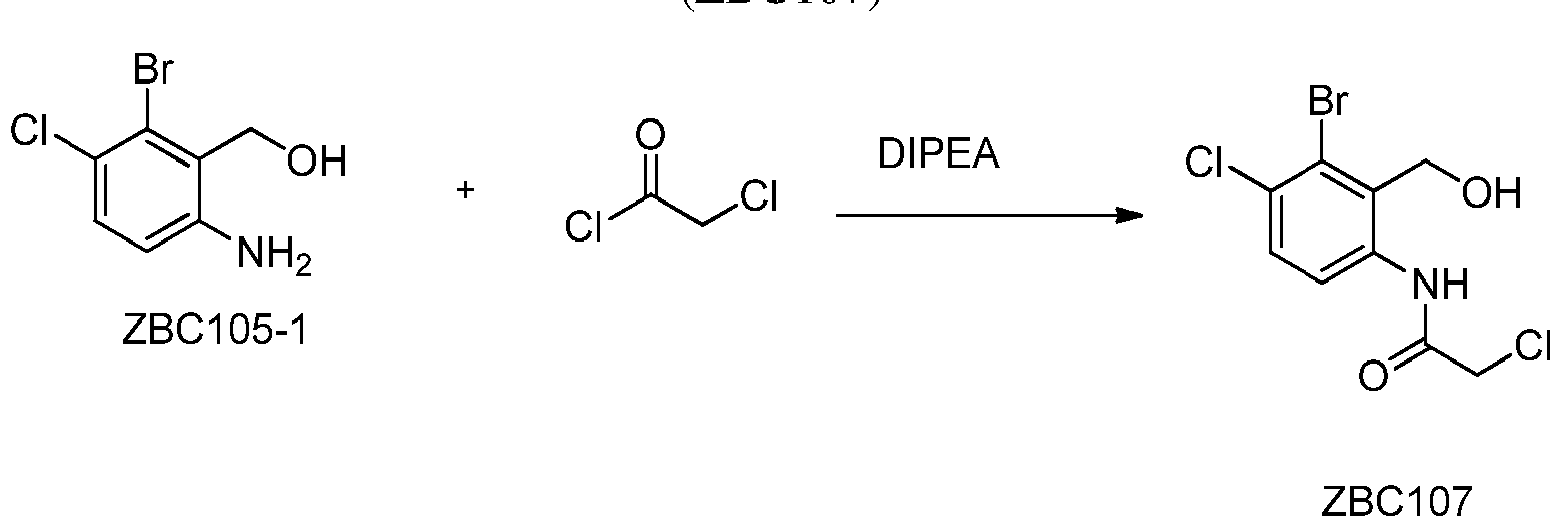
- A solution of ZBC105-1 (50 mg) in DCM (10 mL) was cooled to 0 °C and DIPEA (37 µL) was added slowly. Then 2-chloroacetyl chloride (17 µL) was added dropwise. After stirring at 0 °C for 30 min, the reaction was diluted with DCM, washed with brine, dried, and concentrated on a rotary evaporator. The remaining residues were purified by flash column chromatography on silica gel to afford ZBC107 in 44 mg. ESI-MS calculated for C9H9BrCl2NO2 [M+H]+ = 311.9; Observed: 312.1.
-

- A suspension of NaOtBu (1 g) in tBuOH (50 mL) was heated at 80 °C until it turns into a clear solution. Then ZBC107 (1.6 g) was added in one portion and the reaction is heated at 80 °C for 15 min. The reaction mixture was cooled, poured into ice-water, and extracted with ethyl acetate. The organic layers were combined and washed with brine, dried over anhydrous sodium sulfate, and concentrated on a rotary evaporator. The remaining residues were purified by flash column chromatography on silica gel to afford ZBC109 in 1.1 g. ESI-MS calculated for C9H8BrClNO2 [M+H]+ = 275.9; Observed: 276.1.
-

- A suspenstion of P4S10 (147 mg, 0.66 mmol) and NaHCO3 (70 mg, 0.66 mmol) in 1,2-DCE (5 mL) was stirred for 10 min prior to the addition of ZBC109 (85 mg). The reaction mixture was stirred at 65 °C for 4 h. The reaction was cooled, taken up with saturated NaHCO3, extracted with DCM. The organic layers were combined and washed with brine, dried over anhydrous sodium sulfate, and concentrated on a rotary evaporator. The remaining residues were dissolved in nBuOH (10 ml) and AcNHNH2 (135 mg) was added. The reaction mixture was stirred at 120 °C for 2 h. The reaction mixture was cooled, poured into ice-water, and extracted with ethyl acetate. The organic layers were combined and washed with brine, dried over anhydrous sodium sulfate, and concentrated on a rotary evaporator. The residues were purified by reverse phase HPLC to yield Cpd. No. 70 in 60 mg as a salt of CF3CO2H. ESI-MS calculated for C11H10BrClN3O [M+H]+ = 313.9; Observed: 314.3. 1H NMR (400 MHz, MeOD) δ 7.90 (d, J = 8.6 Hz, 1H), 7.72 (d, J = 8.6 Hz, 1H), 4.80 (s, 2H), 4.68 (s, 2H), 2.71 (s, 3H).
-

- To a round-bottom flask was charged with Cpd. No. 70 (31 mg, 0.1 mmol), boroate salt (40 mg, 0.2 mmol), Pd(dppf)Cl2 (8 mg). Under N2 atmosphere, DME (3 mL) and a solution of Na2CO3 (2.0 M, 1 mL) was added. The reaction mixture was heated at 100 °C for 4 h. The reaction was cooled, taken up with saturated NaHCO3, extracted with DCM. The organic layers were combined and washed with brine, dried over anhydrous sodium sulfate, and concentrated on a rotary evaporator. The residues were purified by reverse phase HPLC to yield Cpd. No. 71 in 21 mg as a salt of CF3CO2H. ESI-MS calculated for C18H17ClN3O [M+H]+ = 326.1; Observed: 326.4. 1H NMR (400 MHz, MeOD) δ 7.85 (d, J = 8.6 Hz, 1H), 7.67 (d, J = 8.6 Hz, 1H), 7.28 (t, J = 7.6 Hz, 2H), 7.20 (t, J = 7.0 Hz, 1H), 7.14 (d, J = 7.9 Hz, 2H), 4.64 (s, 2H), 4.57 (s, 2H), 4.47 (s, 2H), 2.80 (s, 3H).
-

- To a round-bottom flask containing Cpd. No. 71 (31 mg, 0.1 mmol), (6-aminopyridin-3-yl)boronic acid (43 mg), Pd2(dba)3 (20 mg), tritertbutylphosphine tetrafluoroborate (12 mg) and K3PO4 (60 mg), dioxane (5 mL) and water (100 µL) were added. The reaction mixture was heated at 100 °C for 10 h. The reaction was cooled, taken up with saturated NaHCO3, extracted with EtOAc. The organic layers were combined and washed with brine, dried over anhydrous sodium sulfate, and concentrated on a rotary evaporator. The residues were purified by reverse phase HPLC to yield Cpd. No. 72 in 10 mg as a salt of CF3CO2H. ESI-MS calculated for C23H22N5O [M+H]+ = 384.1; Observed: 384.3. 1H NMR (400 MHz, MeOD) δ 7.93 (t, J = 7.9 Hz, 1H), 7.81 (d, J = 8.5 Hz, 1H), 7.74 (d, J = 8.5 Hz, 1H), 7.60 (d, J = 6.4 Hz, 1H), 7.17 - 7.11 (m, 2H), 7.07 (t, J = 7.5 Hz, 2H), 7.01 (d, J = 8.4 Hz, 1H), 6.93 (t, J = 6.7 Hz, 1H), 4.73 (s, 2H), 4.70 (s, 2H), 4.33 (s, 2H), 2.73 (s, 3H).
-

- To a round-bottom flask containing Cpd. No. 71 (31 mg, 0.1 mmol), (1-methyl-1H-pyrazol-4-yl)boronic acid (46 mg), Pd2(dba)3 (20 mg), tritertbutylphosphine tetrafluoroborate (12 mg) and K3PO4 (60 mg), dioxane (5 mL) and water (100 µL) were added. The reaction mixture was heated at 100 °C for 10 h. The reaction was cooled, taken up with saturated NaHCO3, extracted with EtOAc. The organic layers were combined and washed with brine, dried over anhydrous sodium sulfate, and concentrated on a rotary evaporator. The residues were purified by reverse phase HPLC to yield Cpd. No. 73 in 8 mg as a salt of CF3CO2H. ESI-MS calculated for C22H22N5O [M+H]+ = 372.18; Observed: 372.4. 1H NMR (400 MHz, MeOD) δ 7.77 (d, J = 8.3 Hz, 1H), 7.69 (d, J = 8.4 Hz, 1H), 7.59 (s, 1H), 7.43 (s, 1H), 7.30 (t, J = 7.5 Hz, 2H), 7.22 (t, J = 7.2 Hz, 1H), 7.02 (d, J = 7.5 Hz, 2H), 4.65 (s, 2H), 4.52 (s, 2H), 4.38 (s, 2H), 3.90 (s, 3H), 2.85 (s, 3H).
-

- To a round-bottom flask was charged with Cpd. No. 70 (31 mg, 0.1 mmol), ZBC71 (60 mg), Pd(dppf)Cl2 (8 mg). Under N2 atmosphere, DME (6 mL) and a solution of Na2CO3 (2.0 M, 2 mL) was added. The reaction mixture was heated at 100 °C for 4 h. The reaction was cooled, taken up with saturated NaHCO3, extracted with DCM. The organic layers were combined and washed with brine, dried over anhydrous sodium sulfate, and concentrated on a rotary evaporator. The residues were purified by reverse phase HPLC to yield Cpd. No. 74 in 14 mg as a salt of CF3CO2H. ESI-MS calculated for C21H19C1N30 [M+H]+ = 364.1; Observed: 364.4. 1H NMR (400 MHz, MeOD) δ 7.84 (d, J = 8.6 Hz, 1H), 7.74 (d, J = 8.6 Hz, 1H), 7.25 (d, J = 7.3 Hz, 1H), 7.20 - 7.15 (m, 1H), 7.06 (t, J = 7.5 Hz, 1H), 6.49 (d, J = 7.6 Hz, 1H), 6.07 (t, J = 4.5 Hz, 1H), 4.77 (d, J = 13.4 Hz, 1H), 4.60 (d, J = 13.4 Hz, 1H), 4.41 (s, 2H), 3.05 - 2.88 (m, 2H), 2.79 (s, 3H), 2.58 - 2.48 (m, 2H).
-

- To a round-bottom flask containing Cpd. No. 71 (31 mg, 0.1 mmol), 4-(4,4,5,5-tetramethyl-1,3,2-dioxaborolan-2-yl)-1H-pyrazole (60 mg), Pd2(dba)3 (20 mg), tritertbutylphosphine tetrafluoroborate (12 mg) and K3PO4 (60 mg), dioxane (5 mL) and water (100 µL) were added. The reaction mixture was heated at 100 °C for 10 h. The reaction was cooled, taken up with saturated NaHCO3, extracted with EtOAc. The organic layers were combined and washed with brine, dried over anhydrous sodium sulfate, and concentrated on a rotary evaporator. The residues were purified by reverse phase HPLC to yield Cpd. No. 75 in 4 mg as a salt of CF3CO2H. ESI-MS calculated for C21H20N5O [M+H]+ = 358.1; Observed: 358.3. 1H NMR (400 MHz, MeOD) δ 7.75 (d, J = 8.2 Hz, 1H), 7.66 (d, J = 8.3 Hz, 1H), 7.57 (s, 2H), 7.30 (t, J = 7.6 Hz, 2H), 7.22 (t, J = 7.2 Hz, 1H), 7.02 (d, J = 7.8 Hz, 2H), 4.62 (s, 2H), 4.46 (s, 2H), 4.36 (s, 2H), 2.74 (s, 3H).
-

- To a round-bottom flask containing Cpd. No. 71 (31 mg, 0.1 mmol), 2-(4-(4,4,5,5-tetramethyl-1,3,2-dioxaborolan-2-yl)-1H-pyrazol-1-yl)acetamide (60 mg), Pd2(dba)3 (20 mg), tritertbutylphosphine tetrafluoroborate (12 mg) and K3PO4 (60 mg), dioxane (5 mL) and water (100 µL) were added. The reaction mixture was heated at 100 °C for 10 h. The reaction was cooled, taken up with saturated NaHCO3, extracted with EtOAc. The organic layers were combined and washed with brine, dried over anhydrous sodium sulfate, and concentrated on a rotary evaporator. The residues were purified by reverse phase HPLC to yield Cpd. No. 76 in 5 mg as a salt of CF3CO2H. ESI-MS calculated for C23H23N6O2 [M+H]+ = 415.18; Observed: 415.5.
-

- To a round-bottom flask containing Cpd. No. 71 (31 mg, 0.1 mmol), (3,6-dihydro-2H-pyran-4-yl)boronic acid (60 mg), Pd2(dba)3 (20 mg), tritertbutylphosphine tetrafluoroborate (12 mg) and K3PO4 (60 mg), dioxane (5 mL) and water (100 µL) were added. The reaction mixture was heated at 100 °C for 10 h. The reaction was cooled, taken up with saturated NaHCO3, extracted with EtOAc. The organic layers were combined and washed with brine, dried over anhydrous sodium sulfate, and concentrated on a rotary evaporator. The residues were purified by reverse phase HPLC to yield Cpd. No. 77 in 6 mg as a salt of CF3CO2H. ESI-MS calculated for C23H24N3O2 [M+H]+ = 374.18; Observed: 374.5.
-

- To a round-bottom flask containing Cpd. No. 71 (31 mg, 0.1 mmol), 2-(4,5-dihydrofuran-3-yl)-4,4,5,5-tetramethyl-1,3,2-dioxaborolane (60 mg), Pd2(dba)3 (20 mg), tritertbutylphosphine tetrafluoroborate (12 mg) and K3PO4 (60 mg), dioxane (5 mL) and water (100 µL) were added. The reaction mixture was heated at 100 °C for 10 h. The reaction was cooled, taken up with saturated NaHCO3, extracted with EtOAc. The organic layers were combined and washed with brine, dried over anhydrous sodium sulfate, and concentrated on a rotary evaporator. The residues were purified by reverse phase HPLC to yield Cpd. No. 78 in 8 mg as a salt of CF3CO2H. ESI-MS calculated for C22H22N3O2 [M+H]+ = 360.17; Observed: 360.4.
-

- Cpd. No. 77 (20 mg) was dissolved in a mixture of methanol (4.0 mL). Then 10% Pd/C (4 mg) was added and the reaction mixture was stirred under H2 (1 atm) at room temperature for 10 h. The mixture was filtered and the filtrate was concentrated on a rotary evaporator. The residues were purified by reverse phase HPLC to yield Cpd. No. 79 in 11 mg as a salt of CF3CO2H. ESI-MS calculated for C23H26N3O2 [M+H]+ = 376.20; Observed: 376.4.
-

- To a round-bottom flask containing Cpd. No. 71 (31 mg, 0.1 mmol), furan-3-ylboronic acid (60 mg), Pd2(dba)3 (20 mg), tritertbutylphosphine tetrafluoroborate (12 mg) and K3PO4 (60 mg), dioxane (5 mL) and water (100 µL) were added. The reaction mixture was heated at 100 °C for 10 h. The reaction was cooled, taken up with saturated NaHCO3, extracted with EtOAc. The organic layers were combined and washed with brine, dried over anhydrous sodium sulfate, and concentrated on a rotary evaporator. The residues were purified by reverse phase HPLC to yield Cpd. No. 80 in 15 mg as a salt of CF3CO2H. ESI-MS calculated for C22H20N3O2 [M+H]+ = 358.15; Observed: 358.5. 1H NMR (400 MHz, MeOD) δ 7.74 (d, J = 8.3 Hz, 1H), 7.67 (d, J = 8.3 Hz, 1H), 7.57 (t, J = 1.6 Hz, 1H), 7.47 (s, 1H), 7.29 (t, J = 7.4 Hz, 2H), 7.21 (t, J = 7.3 Hz, 1H), 7.01 (d, J = 7.5 Hz, 2H), 6.47 (s, 1H), 4.62 (s, 2H), 4.47 (s, 2H), 4.37 (s, 2H), 2.77 (s, 3H).
-

- Cpd. No. 80 (20 mg) was dissolved in a mixture of methanol (4.0 mL). Then 10% Pd/C (4 mg) was added and the reaction mixture was stirred under H2 (1 atm) at room temperature for 10 h. The mixture was filtered and the filtrate was concentrated on a rotary evaporator. The residues were purified by reverse phase HPLC to yield Cpd. No. 81 in 10 mg as a salt of CF3CO2H. ESI-MS calculated for C22H24N3O2 [M+H]+ = 362.18; Observed: 362.4. 1H NMR (400 MHz, MeOD) δ 7.74 (d, J = 8.5 Hz, 1H), 7.63 (d, J = 8.5 Hz, 1H), 7.29 (t, J = 7.4 Hz, 2H), 7.21 (t, J = 7.3 Hz, 1H), 7.07 (d, J = 7.1 Hz, 2H), 4.62 (s, 2H), 4.51 (s, 2H), 4.42 (s, 2H), 4.07 (td, J = 8.3, 4.9 Hz, 1H), 3.90 - 3.79 (m, 2H), 3.78 - 3.67 (m, 2H), 2.72 (s, 3H), 2.24 (m, 1H), 1.93 (m, 1H).
-

- To a round-bottom flask containing Cpd. No. 71 (15 mg, 0.05 mmol), ethynyltrimethylsilane (15 µL), Pd(PPh3)2Cl2 (10 mg), tritertbutylphosphine tetrafluoroborate (7 mg) and DIPEA (0.5 mL), DMF (0.5 mL) were added. The reaction mixture was heated at 80 °C for 10 h. The reaction was cooled, taken up with saturated NaHCO3, extracted with EtOAc. The organic layers were combined and washed with brine, dried over anhydrous sodium sulfate, and concentrated on a rotary evaporator. The residues were purified by reverse phase HPLC to yield Cpd. No. 82 in 4 mg as a salt of CF3CO2H. ESI-MS calculated for C23H26N3OSi [M+H]+ = 388.18; Observed: 388.3.
-

- To a round-bottom flask containing Cpd. No. 82 (15 mg), and K2CO3 (1 mg), MeOH (1 mL) were added. The reaction mixture was stirred at rt for 2 h. The mixture were purified by reverse phase HPLC to yield Cpd. No. 83 in 3 mg as a salt of CF3CO2H. ESI-MS calculated for C20H18N3O [M+H]+ = 316.14; Observed: 316.4.
-

- To a round-bottom flask containing Cpd. No. 71 (15 mg), (but-3-yn-1-yloxy)(tert-butyl)dimethylsilane (44 mg), Pd(PPh3)2Cl2 (12 mg), tri tert butylphosphine tetrafluoroborate (10 mg), Cs2CO3 (33 mg) and DIPEA (0.2 mL), DMF (0.3 mL) were added. The reaction mixture was heated at 100 °C for 4 h. The reaction was cooled, taken up with saturated NaHCO3, extracted with EtOAc. The organic layers were combined and washed with brine, dried over anhydrous sodium sulfate, and concentrated on a rotary evaporator. The residues were purified by reverse phase HPLC to yield the intermediate which was dissolved in THF (3 mL). Then TBAF (1 M/L in THF, 0.06 mL)was added and the mixture was stirred for 15 min at room temperature. The mixture was purified by reverse phase HPLC to yield Cpd. No. 84 in 4 mg as a salt of CF3CO2H. ESI-MS calculated for C22H22N3O2[M+H]+ = 360.17; Observed: 360.5.
-

- To a suspension of methyl 2-((((9H-fluoren-9-yl)methoxy)carbonyl)amino)-4-oxo-4,5-dihydrothiophene-3-carboxylate (3.1 g) in dioxane (20 mL) was added POBr3(2.7 g) and the reaction mixture was heated to reflux for 1 hour. The reaction mixture was cooled and poured into the mixture of ice-water. The reaction mixture was extracted with EtOAc (3×200 mL). The combined organic layers were washed with brine, dried over Na2SO4 and concentrated. The residue was dissolved in DCM (30 mL) and morpholine (5 g) was added and the reaction mixture was stirred overnight. The reaction mixture was filtered and rinsed with small amount of Et2O. The filtrate was evaporated under vacuum and the residue was chromatographed on silica gel (pure DCM) to afford 2-amino-4-bromothiophene-3-carboxylate as a white solid (0.9 g).
-

- A solution of 2-amino-4-bromothiophene-3-carboxylate (50 mg) in DCM (10 mL) was cooled to 0 °C and DIPEA (37 µL) was added slowly. Then (S)-2-((tert-butyldiphenylsilyl)oxy)propanoyl chloride (60 mg) was added. After stirring at 0 °C for 30 min, the reaction was diluted with DCM, washed with brine, dried, and concentrated on a rotary evaporator. The remaining residues were purified by flash column chromatography on silica gel to afford ZBC180 in 56 mg. ESI-MS calculated for C2sH29BrNO4SSi [M+H]+ = 546.07; Observed: 546.3.
-

- The mixture of ZBC180 (80 mg) and Lawesson's reagent (35 mg) in dioxane (10 mL) was heated at 80 °C overnight. Then the mixture was concentrated on a rotary evaporator and directly purified by flash column chromatography on silica gel to afford ZBC181 in 50 mg. ESI-MS calculated for C25H29BrNO3S2Si [M+H]+ = 562.05; Observed: 562.3.
-

- To a solution of ZBC181 (5.1 g, 9.2 mmol) in THF (10 mL) was added hydrazine monohydrate (0.89 mL, 18.4 mmol, 2 eq) at 0 °C and the reaction mixture was allowed to warm to r.t. The reaction mixture was stirred for 4 h prior to being concentrated in vacuum. The residue was taken up in DCM and washed with water and brine. The organic layer was separated, dried and concentrated. The residue was taken up in ethanol (10 mL) and triethyl orthoacetate (5 mL, 27.6 mmol, 3 eq) was added. The reaction mixture was heated at reflux for 1 h. All volatiles were removed under vacuum and the residue was dissolved in AcOH (10 mL). The solution was heated at reflux for 1h prior to the removal of the solvent under vacuum. The residue was chromatographed on silica gel to give ZBC183 in 2.3 g. ESI-MS calculated for C27H31BrN3O3SSi [M+H]+ = 584.10; Observed: 584.3.
-

- To a solution of ZBC183 (2.5 g, 4.3 mmol) in THF (30 mL) at 0 °C was added a solution of LiBH4 (2 M in THF, 3.3 mL, 6.5 mmol, 1.5 eq). MeOH (3 mL) was added and the reaction mixture was allowed to warm to r.t. and stirred for 12h. All volatiles were removed and the residue was taken up in EtOAc. The organic layer was washed with water and brine prior to being dried and concentrated. The residue was dissolved in DCM (20 mL) and cooled to 0 °C. Thionyl chloride (0.94 mL, 12.9 mmol, 3 eq) was added and the reaction mixture was allowed to warm to r.t. After 1 h, all the volatiles were removed and the residue was taken up in EtOAc and washed with 1 M Na2CO3. The organic layer was washed with brine, dried and concentrated. The residue was chromatographed on silica gel (ethyl acetate/triethylamine 25:1) to give title compound in 1.8 gram. ESI-MS calculated for C26H30BrClN3OSSi [M+H]+ = 574.07; Observed: 574.3.
-

- To a solution of ZBC184 (1.9 g, 3.3 mmol) in THF (10 mL) at 0 °C was added a solution of TBAF (3.6 mL, 3.6 mmol, 1M in THF). The solution was stirred for 1 h prior to being added to a hot solution of NaOtBu (634 mg, 6.6 mmol, 2 eq) in t BuOH (40 mL) at 80 °C. The reaction mixture was stirred for 5 min prior to the removal of the solvent under vacuum. The residue was taken up in EtOAc and water. The organic layer was washed with brine, dried and concentrated. The residue was purified through HPLC to afford TFA salt of Cpd. No. 117 (704 mg). ESI-MS calculated for C10H11BrN3OS [M+H]+ = 299.98; Observed: 300.3. 1H NMR (400 MHz, MeOD) δ 7.67 (s, 1H), 5.04 (d, J = 15.8 Hz, 1H), 4.88 (d, J = 15.8 Hz, 1H), 4.80 (q, J = 6.5 Hz, 1H), 2.81 (s, 3H), 1.72 (d, J = 6.5 Hz, 3H).
-

- To a round-bottom flask containing Cpd. No. 117 (30 mg, 0.1 mmol), potassium benzyltrifluoroborate (40 mg, 0.2 mmol), Pd(dppf)Cl2 (8 mg), DME (3 mL) and a solution of Na2CO3 in water (2.0 M, 1 mL) was added under N2 atmosphere. The reaction mixture was heated at 100 °C for 4 h. The reaction was cooled, taken up with saturated NaHCO3, extracted with DCM. The organic layers were combined and washed with brine, dried over anhydrous sodium sulfate, and concentrated on a rotary evaporator. The residues were purified by reverse phase HPLC. Cpd. No. 118 was isolated in 21 mg as a salt of CF3CO2H. ESI-MS calculated for C17H18N3OS [M+H]+ = 312.11; Observed: 312.4. 1H NMR (400 MHz, MeOD) δ 7.33 (t, J = 7.3 Hz, 2H), 7.28 - 7.21 (m, 3H), 7.18 (s, 1H), 4.98 (d, J = 15.6 Hz, 1H), 4.76-4.69 (m, 2H), 3.99 - 3.86 (m, 2H), 2.85 (s, 3H), 1.68 (d, J = 6.6 Hz, 3H).
-

- To a solution of Cpd. No. 118 (240 mg, 0.57 mmol) in AcOH (4 mL) was added NBS (101 mg, 0.57 mmol, 1 eq). The reaction mixture was stirred for 1 h prior to the addition of water (2 mL) and methanol (2 mL). All volatiles were removed under vacuum and the residue was purified by reverse phase HPLC to afford Cpd. No. 119 (240 mg) as a salt of CF3CO2H. ESI-MS calculated for C17H17BrN3OS [M+H]+ = 390.02; Observed: 390.3.
-

- To a round-bottom flask containing Cpd. No. 119 (25 mg), 4-ethynyl-1-methyl-1H-pyrazole (16 mg), Pd(PPh3)Cl2 (13.5 mg) and CuI (7.3 mg), Et3N (0.5 mL) and THF (1 mL) was added under N2 atmosphere. The reaction mixture was heated at 60 °C for 10 h. The reaction was cooled, taken up with saturated NaHCO3, extracted with EtOAc. The organic layers were combined and washed with brine, dried over anhydrous sodium sulfate, and concentrated on a rotary evaporator. The residues were purified by reverse phase HPLC. Cpd. No. 85 was isolated in 18 mg as a salt of CF3CO2H. ESI-MS calculated for C23H22N5OS [M+H]+ = 416.15; Observed: 416.2. 1H NMR (400 MHz, MeOD) δ 7.87 (s, 1H), 7.63 (s, 1H), 7.34 - 7.17 (m, 5H), 4.82 (d, J = 15.2 Hz, 1H), 4.65 - 4.51 (m, 2H), 4.16 - 3.99 (m, 2H), 3.90 (s, 3H), 2.72 (s, 3H), 1.63 (d, J = 6.5 Hz, 3H).
-
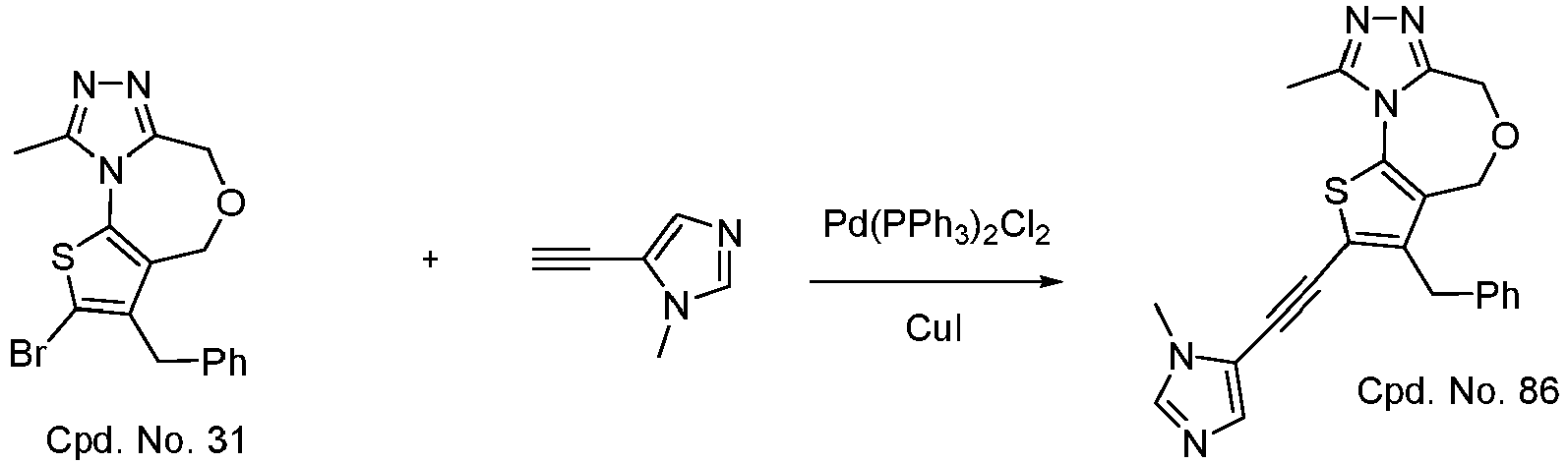
- To a round-bottom flask containing Cpd. No. 31 (25 mg), 5-ethynyl-1-methyl-1H-imidazole (16 mg), Pd(PPh3)Cl2 (13.5 mg) and CuI (7.3 mg), Et3N (0.5 mL) and THF (1 mL) was added under N2 atmosphere. The reaction mixture was heated at 60 °C for 10 h. The reaction was cooled, taken up with saturated NaHCO3, extracted with EtOAc. The organic layers were combined and washed with brine, dried over anhydrous sodium sulfate, and concentrated on a rotary evaporator. The residues were purified by reverse phase HPLC. Cpd. No. 86 was isolated in 10 mg as a salt of CF3CO2H. ESI-MS calculated for C22H20N5OS [M+H]+ = 402.13; Observed: 402.3. 1H NMR (400 MHz, MeOD) δ 8.97 (s, 1H), 7.93 (s, 1H), 7.37 - 7.28 (m, 2H), 7.27-7.21 (m, 3H), 4.77 (s, 2H), 4.75 (s, 2H), 4.19 (s, 2H), 3.88 (s, 3H), 2.79 (s, 3H).
-

- To a round-bottom flask containing Cpd. No. 31 (25 mg), 4-ethynylpyridine (16 mg), Pd(PPh3)Cl2 (13.5 mg) and CuI (7.3 mg), Et3N (0.5 mL) and THF (1 mL) was added under N2 atmosphere. The reaction mixture was heated at 60 °C for 10 h. The reaction was cooled, taken up with saturated NaHCO3, extracted with EtOAc. The organic layers were combined and washed with brine, dried over anhydrous sodium sulfate, and concentrated on a rotary evaporator. The residues were purified by reverse phase HPLC. Cpd. No. 87 was isolated in 10 mg as a salt of CF3CO2H. ESI-MS calculated for C23H19N4OS [M+H]+ = 399.12; Observed: 399.4. 1H NMR (400 MHz, MeOD) δ 8.83 (brs, 2H), 7.85 (brs, 2H), 7.46 - 7.16 (m, 5H), 4.77 (s, 4H), 4.23 (s, 2H), 2.79 (s, 3H).
-

- To a round-bottom flask containing Cpd. No. 31 (25 mg), 3-ethynylpyridine (16 mg), Pd(PPh3)Cl2 (13.5 mg) and CuI (7.3 mg), Et3N (0.5 mL) and THF (1 mL) was added under N2 atmosphere. The reaction mixture was heated at 60 °C for 10 h. The reaction was cooled, taken up with saturated NaHCO3, extracted with EtOAc. The organic layers were combined and washed with brine, dried over anhydrous sodium sulfate, and concentrated on a rotary evaporator. The residues were purified by reverse phase HPLC. Cpd. No. 88 was isolated in 16 mg as a salt of CF3CO2H. ESI-MS calculated for C23H19N4OS [M+H]+ = 399.12; Observed: 399.3.
-

- To a round-bottom flask containing Cpd. No. 31 (25 mg), 5-ethynylpyridin-2-amine (16 mg), Pd(PPh3)Cl2 (13.5 mg) and CuI (7.3 mg), Et3N (0.5 mL) and THF (1 mL) was added under N2 atmosphere. The reaction mixture was heated at 60 °C for 10 h. The reaction was cooled, taken up with saturated NaHCO3, extracted with EtOAc. The organic layers were combined and washed with brine, dried over anhydrous sodium sulfate, and concentrated on a rotary evaporator. The residues were purified by reverse phase HPLC. Cpd. No. 89 was isolated in 16 mg as a salt of CF3CO2H. ESI-MS calculated for C23H20N5OS [M+H]+ = 414.13; Observed: 414.3. 1H NMR (400 MHz, MeOD) δ 8.10 (d, J = 1.8 Hz, 1H), 7.96 (dd, J = 9.3, 2.0 Hz, 1H), 7.37 - 7.21 (m, 5H), 7.05 (d, J = 9.3 Hz, 1H), 4.75 (s, 2H), 4.73 (s, 2H), 4.16 (s, 2H), 2.78 (s, 3H).
-

- To a round-bottom flask containing Cpd. No. 119 (25 mg), 5-ethynyl-1-methyl-1H-imidazole (16 mg), Pd(PPh3)Cl2 (13.5 mg) and CuI (7.3 mg), Et3N (0.5 mL) and THF (1 mL) was added under N2 atmosphere. The reaction mixture was heated at 60 °C for 10 h. The reaction was cooled, taken up with saturated NaHCO3, extracted with EtOAc. The organic layers were combined and washed with brine, dried over anhydrous sodium sulfate, and concentrated on a rotary evaporator. The residues were purified by reverse phase HPLC. Cpd. No. 120 was isolated in 13 mg as a salt of CF3CO2H. ESI-MS calculated for C23H22N5OS [M+H]+ = 416.15; Observed: 416.4. 1H NMR (400 MHz, MeOD) δ 9.00 (s, 1H), 7.95 (s, 1H), 7.39 - 7.18 (m, 5H), 4.90 (d, J = 15.3 Hz, 1H), 4.75 - 4.59 (m, 2H), 4.19 (q, J = 15.9 Hz, 2H), 3.89 (s, 3H), 2.80 (s, 3H), 1.66 (d, J = 6.5 Hz, 3H).
-
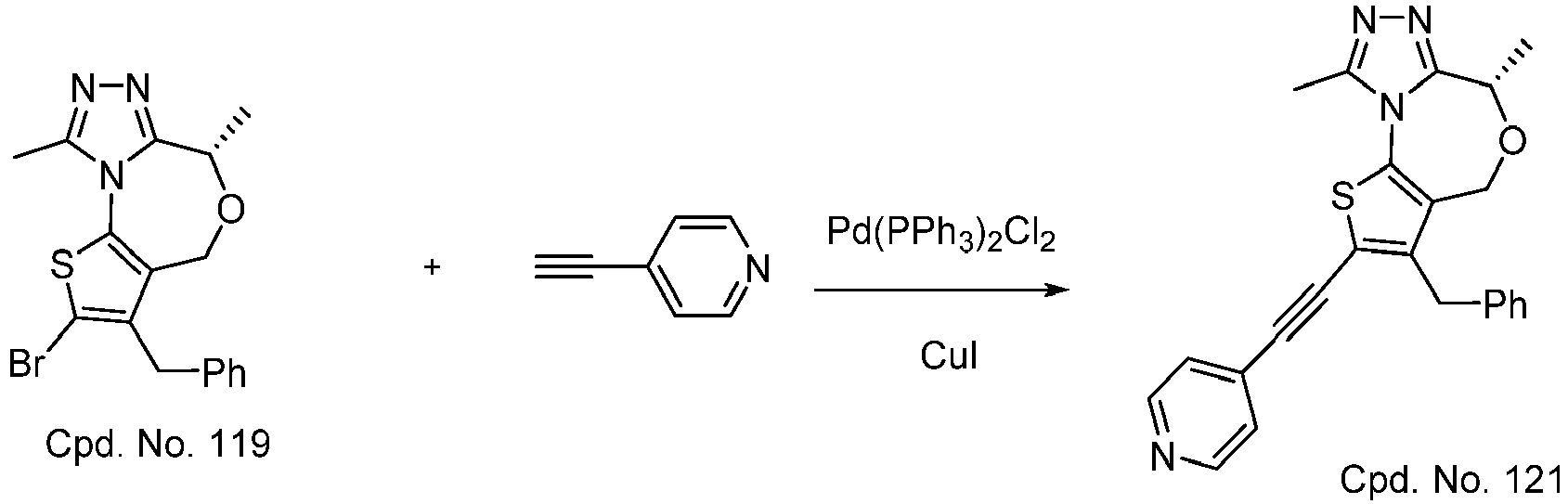
- To a round-bottom flask containing Cpd. No. 119 (25 mg), 4-ethynylpyridine (16 mg), Pd(PPh3)Cl2 (13.5 mg) and CuI (7.3 mg), Et3N (0.5 mL) and THF (1 mL) was added under N2 atmosphere. The reaction mixture was heated at 60 °C for 10 h. The reaction was cooled, taken up with saturated NaHCO3, extracted with EtOAc. The organic layers were combined and washed with brine, dried over anhydrous sodium sulfate, and concentrated on a rotary evaporator. The residues were purified by reverse phase HPLC. Cpd. No. 121 was isolated in 17 mg as a salt of CF3CO2H. ESI-MS calculated for C24H21N4OS [M+H]+ = 413.14; Observed: 413.2. 1H NMR (400 MHz, MeOD) δ 8.81 (brs, 2H), 8.02 (d, J = 5.6 Hz, 2H), 7.38 - 7.21 (m, 5H), 4.92 (d, J = 15.2 Hz, 1H), 4.73-4.65 (m, 2H), 4.25 (q, J = 15.7 Hz, 2H), 2.82 (s, 3H), 1.67 (d, J = 6.5 Hz, 3H).
-

- To a round-bottom flask containing Cpd. No. 119 (25 mg), 3-ethynylpyridine (16 mg), Pd(PPh3)Cl2 (13.5 mg) and CuI (7.3 mg), Et3N (0.5 mL) and THF (1 mL) was added under N2 atmosphere. The reaction mixture was heated at 60 °C for 10 h. The reaction was cooled, taken up with saturated NaHCO3, extracted with EtOAc. The organic layers were combined and washed with brine, dried over anhydrous sodium sulfate, and concentrated on a rotary evaporator. The residues were purified by reverse phase HPLC. Cpd. No. 122 was isolated in 17 mg as a salt of CF3CO2H. ESI-MS calculated for C24H21N4OS [M+H]+ = 413.14; Observed: 413.2. 1H NMR (400 MHz, MeOD) δ 8.88 (brs, 1H), 8.71 (brs, 1H), 8.31 (d, J = 8.1 Hz, 1H), 7.78 (dd, J = 7.9, 5.4 Hz, 1H), 7.36 - 7.20 (m, 5H), 4.91 (d, J = 15.6 Hz, 1H), 4.76 - 4.62 (m, 2H), 4.22 (q, J = 15.7 Hz, 2H), 2.84 (s, 3H), 1.66 (d, J = 6.5 Hz, 2H).
-

- To a round-bottom flask containing Cpd. No. 119 (25 mg), 5-ethynylpyridin-2-amine (16 mg), Pd(PPh3)Cl2 (13.5 mg) and CuI (7.3 mg), Et3N (0.5 mL) and THF (1 mL) was added under N2 atmosphere. The reaction mixture was heated at 60 °C for 10 h. The reaction was cooled, taken up with saturated NaHCO3, extracted with EtOAc. The organic layers were combined and washed with brine, dried over anhydrous sodium sulfate, and concentrated on a rotary evaporator. The residues were purified by reverse phase HPLC. Cpd. No. 123 was isolated in 10 mg as a salt of CF3CO2H. ESI-MS calculated for C24H22N5OS [M+H]+ = 428.15; Observed: 428.4. 1H NMR (400 MHz, MeOD) δ 8.10 (d, J = 2.0 Hz, 1H), 7.95 (dd, J = 9.2, 1.8 Hz, 1H), 7.36 - 7.19 (m, 5H), 7.05 (d, J = 9.3 Hz, 1H), 4.88 (d, J = 15.4 Hz, 1H), 4.71 - 4.59 (m, 2H), 4.15 (q, J = 15.8 Hz, 2H), 2.80 (s, 3H), 1.65 (d, J = 6.5 Hz, 3H).
-

- To a round-bottom flask containing Cpd. No. 117 (30 mg, 0.1 mmol), potassium 4-fluorobenzyltrifluoroborate (40 mg, 0.2 mmol), Pd(dppf)Cl2 (8 mg), DME (3 mL) and a solution of Na2CO3 in water (2.0 M, 1 mL) was added under N2 atmosphere. The reaction mixture was heated at 100 °C for 4 h. The reaction was cooled, taken up with saturated NaHCO3, extracted with DCM. The organic layers were combined and washed with brine, dried over anhydrous sodium sulfate, and concentrated on a rotary evaporator. The residues were purified by reverse phase HPLC. Cpd. No. 124 was isolated in 21 mg as a salt of CF3CO2H. ESI-MS calculated for C17H17FN3OS [M+H]+ = 330.10, Observed: 330.2. 1H NMR (400 MHz, MeOD) δ 7.28 - 7.22 (m, 2H), 7.15 (s, 1H), 7.10 - 7.03 (m, 2H), 4.95 (dd, J = 15.4 Hz, 1H), 4.75 - 4.66 (m, 2H), 4.00 - 3.85 (m, 2H), 2.81 (s, 3H), 1.68 (d, J = 6.5 Hz, 3H).
-

- To a solution of Cpd. No. 124 (240 mg, 0.57 mmol) in AcOH (4 mL) was added NBS (101 mg, 0.57 mmol, 1 eq). The reaction mixture was stirred for 1 h. All volatiles were removed under vacuum and the residue was purified by reverse phase HPLC to afford Cpd. No. 125 (180 mg) as a salt of CF3CO2H. ESI-MS calculated for C17H16BrFN3OS [M+H]+ = 408.01; Observed: 408.1.
-

- To a round-bottom flask containing Cpd. No. 125 (25 mg), 4-ethynyl-1-methyl-1H-pyrazole (16 mg), Pd(PPh3)Cl2 (13.5 mg) and CuI (7.3 mg), Et3N (0.5 mL) and THF (1 mL) was added under N2 atmosphere. The reaction mixture was heated at 60 °C for 10 h. The reaction was cooled, taken up with saturated NaHCO3, extracted with EtOAc. The organic layers were combined and washed with brine, dried over anhydrous sodium sulfate, and concentrated on a rotary evaporator. The residues were purified by reverse phase HPLC. Cpd. No. 126 was isolated in 18 mg as a salt of CF3CO2H. ESI-MS calculated for C23H21FN5OS [M+H]+ = 434.1; Observed: 434.3. 1H NMR (400 MHz, MeOD) δ 7.90 (s, 1H), 7.66 (s, 1H), 7.29-7.24 (m, 2H), 7.08-7.02 (m, 2H), 4.85 (d, J = 15.1 Hz, 1H), 4.64 (q, J = 6.3 Hz, 1H), 4.58 (d, J = 15.1 Hz, 1H), 4.08 (q, J = 15.6 Hz, 3H), 3.92 (s, 3H), 2.74 (s, 3H), 1.65 (d, J = 6.4 Hz, 3H).
-

-

- Step 1: 2-Amino-5-methyl-thiophene-3-carboxylic acid methyl ester (17.1 g, 100 mmol) was placed in a 1 L round-bottom flask equipped with a stir bar and dissolved in a mixture of THF (150 mL) and MeOH (100 mL). A solution of lithium hydroxide monohydrate (21 g, 500 mmol) in 250mL of water was added to the flask with stirring. The flask was equipped with a condenser and the mixture was heated at 85 °C for 12 h. After cooling, the THF and MeOH were evaporated. The remaining solution was cooled at 0 °C and acidified to pH 4 with slow addition of 6 M HCl (-83 mL). The precipitate were filtered and washed with water. The wet solid were dissolved in EtOAc, washed with brine, and the organic layer was dried (Na2SO4), filtered and concentrated to give 12.8 g (82%) of 2-amino-5-methyl thiophene-3-carboxylic acid which was used without further purification.
- Step 2: A round bottom flask containing a solution of 2-amino-5-methyl thiophene-3-carboxylic acid (12.8 g, 82 mmol, 1 equiv.) in dry THF (100 mL) was immersed into an oil bath. Triphosgene (8.2 g, 28 mmol, 0.34 equiv.) was added portionwise (exothermic reaction) and the reaction was heated at 40 - 50 °C for 3 hr. After cooling, hexanes (200 mL) was added. The precipitate was filtered to give the isatoic anhydride product (14.5 g, 97%).
- Step 3: To a solution of N,O-dimethylhydroxylamine hydrochloride (11.5 g, 119 mmol) in 90% aqueous ethanol (40 mL) was added triethylamine (16.5 mL, 119 mmol). after 10 min of stirring at 25 °C , isatoic anhydride product (14.5 g, 79 mmol) was added in portions. The reaction was then heated at reflux for 1.5 h and poured into an equal volume of ice and saturated sodium bicarbonate. The ethanol was then removed by rotary evaporation, the resulting aqueous mixture was extracted with ethyl acetate (3 X 150 mL) and the combined extract were washed with brine, dried, and concentrated to an oil. The oil was chromatographed on silica gel (1:2 ethyl acetate/hexanes) to give HYB-94 as a pale yellow oil: (9.5 g, 59%). 1H NMR (400 MHz, CDCl3) δ 6.83 (s, 1H), 6.14 (br, s, 2H), 3.68 (s, 3H), 3.29 (s, 3H), 2.29 (s, 3H).ESI-MS: 201.62.
-

- To a solution of HYB-94 (4.2 g, 21 mmol) in CH3CN (50 mL) was added Boc2O (7.3 g, 33.6 mmol, 1.6 eq) and DMAP (2.56 g, 21 mmol, 1 eq) and the mixture was stirred for 10 min during which time yellow precipitate was observed. Then tert-butanol (3.2 mL, 33.6 mmol, 1.6 eq) was added and the reaction mixture was heated at reflux overnight. The reaction mixture was cooled to 40 °C, N2H4·H2O (1 mL, 21 mmol, 1.0 eq) was added to the mixture and continued to stir at 40 °C for 3 h. The solvent was removed and the mixture was taken up in ethyl acetate (50 mL) and washed with water and then, dried (Na2SO4), filtered and then concentrated The oil was chromatographed on silica gel (1:4 ethyl acetate /hexanes) to give HYB-108 as a pale yellow oil: (6.4 g, 99%).1H NMR (400 MHz, CDCl3) δ 10.77(s, 1H), 7.03 (s, 1H), 3.68 (s, 3H), 3.34 (s, 3H), 2.38 (s, 3H), 1.52 (s, 9H).
-

- A solution of HYB-108 (6.4 g, 21 mmol) in Et2O (100 mL) was cooled to 0°C and LiAlH4 (718 mg, 19 mmol) was added slowly and the reaction mixture was allowed to warm to r.t. Then the mixture was cooled to 0 °C and quenched with Na-K tartrate solution. The mixture was taken up in ethyl acetate (50 mL)and washed with brine (20 mL), dried, filtered and then concentrated to an oil that was chromatographed on silica gel (1:8 ethyl acetate/hexanes) to give HYB-107 as a yellow solid: (3.0 g, 59%).1H NMR (400 MHz, CDCl3) δ 10.46 (s, 1H), 9.69 (s, 1H), 6.75 (s, 1H), 2.39 (s, 3H), 1.56 (s, 9H).
-

- Step 1: A solution of 33% HBr in acetic acid (7.3 mL) was cooled to 0 °C. A cold solution of HYB-107 (1 g, 4 mmol) in DCM (1 mL) was added and the reaction mixture turned red immediately. The reaction mixture was immediately poured into ice-water (50 g each) and was taken up in ethyl acetate. The organic layer was separated, washed successively with 10% NaOH (40 mL), NaHCO3 (40 mL), and brine (40 mL). After drying, the organic solution was passed through a short pad of silica gel, then concentrated. The residue was dissolved in dichloromethane for next step.
- Step 2: The solution prepared above was cooled to 0 °C, and 2-chloroacetic acid (1.5 eq) and EDCI (1.5 eq) were successively added. Then DMAP (0.1 eq) was added and the reaction mixture was allowed to warm to r.t. and stirred overnight. The reaction was diluted with DCM, washed with brine and dried. The residue was chromatographed on silica gel (1:4 ethyl acetate/hexanes) to give HYB-125 as a solid: (640 mg, 45% over two steps). 1H NMR (400 MHz, CDCl3) δ 12.18 (s, 1H), 9.81 (s, 1H), 6.88 (s, 1H), 4.29 (s, 2H), 2.45 (s, 3H).
-

- Step 1: A solution of HYB-125 (600 mg, 2.8 mmol) in methanol was cooled to 0 °C and NaBH4(157 mg, 4.1 mmol, 1.5 eq) was added slowly. After 30 min, the reaction was finished and the solvent was evaporated under vacuum. The residue was taken up in EtOAc, washed with water, brine, dried and concentrated. The solid was triturated with 1:2 ethyl acetate/hexanes, filtered to give a solid (400 mg, 64% yield).
- Step 2: A suspension of NaO t Bu (5.5 mmol, 3 eq) in t BuOH (10 mL) was heated at 80 °C until it turns into a clear solution. Then the solid prepared above (400 mg, 1.8 mmol) was added in one portion and the reaction is finished in 5 min. The reaction mixture was cooled and poured into ice-water, extracted with ethyl acetate. The organic layer was washed with brine (20 mL), dried, filtered and then concentrated to an oil that was chromatographed on silica gel (1:2 ethyl acetate/hexanes) to give HYB-139: 1H NMR (400 MHz, CDCl3) δ 8.00 (s, 1H), 6.23 s, 1H), 4.79 (s, 2H), 4.40 (s, 2H), 2.37 (s, 3H).
-

- To a solution of HYB-139 (130 mg, 0.7 mmol) in acetic acid (2 mL) was added NBS (126 mg, 0.7 mmol). The reaction was stirred for 2 h. The precipitate was filtered to give 85mg (60%) of HYB-213. 1H NMR (400 MHz, CDCl3) δ 8.22 (s, 1H), 4.75 (s, 2H), 4.40 (s, 2H), 2.32 (s, 3H).
-

- Step 1: A suspenstion of P4S10 (147 mg, 0.66 mmol, 2 eq) and Na2CO3(70 mg, 0.66 mmol, 2 eq) in 1,2-DCE (5 mL) was stirred for 10 min prior to the addition of HYB-213 (85 mg, 0.33 mmol). The reaction mixture was stirred at 65 °C for 4 h. The reaction was cooled, taken up with saturated NaHCO3, extracted with DCM. The organic layer was separated, dried, and concentrated to give a crude product.
- Step 2: To a solution of crude in THF was added hydrazine monohydrate (33 mg, 0.66 mmol) and the reaction turned yellow. After 1h, the solvent was removed and the residue was taken up with DCM, washed with water and brine, dried, and concentrated to give a crude product.
- Step 3: The above crude was taken up in ethanol, triethylorthoacetate (0.18 mL, 0.99 mmol, 3 eq) was added and the reaction was heated reflux until all starting material is consumed. After evaporation of the solvent, the residue solid was triturated with hexanes to give Cpd. No. 2 (40 mg, 40%). 1H NMR (400 MHz, CDCl3) δ 4.95 (s, 2H), 4.93 (s, 2H), 2.93 (s, 3H), 2.50 (s, 3H). ESI-MS: 300.11.
-

- To a round-bottom flask was charged with HYB-149 (0.1 mmol), potassium benzyltrifluoroborate (40 mg, 0.2 mmol), Pd(dppf)Cl2 (8 mg). Under N2 atmosphere, dioxane (2 mL) and a solution of Na2CO3 (2.0 M, 1 mL) was added. The reaction mixture was heated at 100 °C for 4 h prior to being taken up in EtOAc and water. The organic layer was separated, evaporated to give a crude mixture which was purified via HPLC. Major product Cpd No. 4 (70% yield): 1H NMR (400 MHz, CDCl3) δ 7.51 - 7.21 (m, 4H), 7.07 (d, J = 7.2 Hz, 2H), 4.82 (s, 2H), 4.72 (s, 2H), 3.88 (s, 2H), 2.96 (s, 3H), 2.52 (s, 3H). ESI-MS: 312.20. Minor side product Cpd. No. 1: 1H NMR (400 MHz, CDCl3) δ 6.55 (s, 1H), 4.93 (s, 2H), 4.87 (s, 2H), 2.84 (s, 3H), 2.53 (s, 3H).
-

- To a round-bottom flask was charged with Cpd. No. 2 (10 mg, 0.033 mmol), phenylboronic acid (8 mg, 2 eq), Pd(dppf)Cl2 (3 mg). Under N2 atmosphere, dioxane (1 mL) and a solution of Na2CO3 (2.0 M, 0.5 mL) was added. The reaction mixture was heated at 100 °C for 4 h prior to being taken up in EtOAc and water. The organic layer was separated, evaporated to give a crude mixture which was purified via HPLC to provide the TFA salt of Cpd. No. 3 (90% yield).1H NMR (400 MHz, CDCl3) δ 7.58 - 7.41 (m, 3H), 7.26 - 7.18 (m, 2H), 4.87 (s, 2H), 4.59 (s, 2H), 2.93 (s, 3H), 2.39 (s, 3H). ESI-MS: 298.17.
-

- To a round-bottom flask was charged with Cpd. No. 2 (10 mg, 0.033 mmol), quinolin-4-ylboronic acid (12 mg, 2 eq), Pd(dppf)Cl2 (3 mg). Under N2 atmosphere, dioxane (1 mL) and a solution of Na2CO3 (2.0 M, 0.5 mL) was added. The reaction mixture was heated at 100 °C for 4 h prior to being taken up in EtOAc and water. The organic layer was separated, evaporated to give a crude mixture which was purified via HPLC to provide the TFA salt of Cpd. No. 5 (80% yield).1H NMR (400 MHz, CDCl3) δ 9.39 (d, J = 5.2 Hz, 2H), 8.61 (d, J = 8.6 Hz, 1H), 8.12 (ddd, J = 8.5, 7.0, 1.3 Hz, 1H), 7.92 - 7.85 (m, 1H), 7.85 - 7.78 (m, 1H), 7.74 (d, J = 5.2 Hz, 1H), 4.95 (d, J = 14.3 Hz, 1H), 4.88 (d, J = 14.3 Hz, 1H), 4.47 (d, J = 15.2 Hz, 1H), 4.35 (d, J = 15.2 Hz, 1H), 2.94 (s, 2H), 2.32 (s, 3H). ESI-MS: 349.10.
-

- To a round-bottom flask was charged with Cpd. No. 2 (10 mg, 0.033 mmol), aniline (6 mg, 2 eq), Pd2(dba)3 (5.3 mg), a solution of p t Bu3 (0.2 eq) in toluene, and NaO t Bu (10 mg, 3 eq). Under N2 atmosphere, toluene (1 mL) was added. The reaction mixture was heated at 100 °C for 12 h prior to being taken up in EtOAc and water. The organic layer was separated, evaporated to give a crude mixture which was purified via HPLC to provide the TFA salt of Cpd. No. 6 (50% yield). 1H NMR (400 MHz, MeOD) δ 7.15 (t, J = 7.9 Hz, 2H), 6.72 (t, J = 7.3 Hz, 1H), 6.59 (d, J = 7.9 Hz, 2H), 4.80 (s, 2H), 4.74 (s, 2H), 2.83 (s, 3H), 2.33 (s, 3H). ESI-MS 313.22.
-

- To a round-bottom flask was charged with Cpd. No. 2 (10 mg, 0.033 mmol), 3-cyclopropyl-1-methyl-1H-pyrazol-5-amine (9 mg, 2 eq), Pd2(dba)3 (5.3 mg), a solution of P t Bu3(0.2 eq) in toluene, and NaO t Bu (10 mg, 3 eq). Under N2 atmosphere, toluene (1 mL) was added. The reaction mixture was heated at 100 °C for 12 h prior to being taken up in EtOAc and water. The organic layer was separated, evaporated to give a crude mixture which was purified via HPLC to provide the TFA salt of Cpd. No. 7 (40% yield).1H NMR (400 MHz, MeOD) δ 5.36 (s, 1H), 4.82 (s, 2H), 4.73 (s, 2H), 3.83 (s, 3H), 2.78 (s, 3H), 2.39 (s, 3H), 1.94 - 1.87 (m, 1H), 1.19 - 1.09 (m, 2H), 0.86 (dt, J = 6.9, 4.7 Hz, 2H). ESI-MS: 357.33.
-

- To a round-bottom flask was charged with Cpd. No. 2 (10 mg, 0.033 mmol), potassium (3-chlorobenzyl)trifluoroborate (14 mg, 2 eq), Pd(dppf)Cl2 (3 mg). Under N2 atmosphere, dioxane (1 mL) and a solution of Na2CO3 (2.0 M, 0.5 mL) was added. The reaction mixture was heated at 100 °C for 4 h prior to being taken up in EtOAc and water. The organic layer was separated, evaporated to give a crude mixture which was purified via HPLC to provide the TFA salt of Cpd. No. 8 (45% yield).1H NMR (400 MHz, MeOD) δ 7.30 (t, J = 7.8 Hz, 1H), 7.23 (d, J = 8.3 Hz, 1H), 7.14 (s, 1H), 7.08 (d, J = 7.3 Hz, 1H), 4.72 (s, 2H), 4.67 (s, 2H), 3.96 (s, 2H), 2.77 (s, 3H), 2.50 (s, 3H). ESI-MS: 346.17.
-

- To a round-bottom flask was charged with Cpd. No. 2 (10 mg, 0.033 mmol), potassium (4-chlorobenzyl)trifluoroborate (14 mg, 2 eq), Pd(dppf)Cl2 (3 mg). Under N2 atmosphere, dioxane (1 mL) and a solution of Na2CO3 (2.0 M, 0.5 mL) was added. The reaction mixture was heated at 100 °C for 4 h prior to being taken up in EtOAc and water. The organic layer was separated, evaporated to give a crude mixture which was purified via HPLC to provide the TFA salt of Cpd. No. 9 (50% yield).1H NMR (400 MHz, MeOD) δ 7.30 (d, J = 8.4 Hz, 3H), 7.13 (d, J = 8.3 Hz, 2H), 4.72 (s, 2H), 4.67 (s, 2H), 3.93 (s, 2H), 2.77 (s, 3H), 2.49 (s, 3H). ESI-MS: 346.22.
-

- To a round-bottom flask was charged with Cpd. No. 2 (10 mg, 0.033 mmol), potassium (2-chlorobenzyl)trifluoroborate (14 mg, 2 eq), Pd(dppf)Cl2 (3 mg). Under N2 atmosphere, dioxane (1 mL) and a solution of Na2CO3 (2.0 M, 0.5 mL) was added. The reaction mixture was heated at 100 °C for 4 h prior to being taken up in EtOAc and water. The organic layer was separated, evaporated to give a crude mixture which was purified via HPLC to provide the TFA salt of Cpd. No. 10 (20% yield).1H NMR (400 MHz, MeOD) δ 7.46 (d, J = 6.3 Hz, 1H), 7.27 - 7.19 (m, 2H), 6.90 (d, J = 6.3 Hz, 1H), 4.74 (s, 2H), 4.59 (s, 2H), 4.02 (s, 2H), 2.77 (s, 3H), 2.43 (s, 3H). ESI-MS: 346.21.
-

- To a round-bottom flask was charged with Cpd. No. 2 (10 mg, 0.033 mmol), potassium (3-fluorobenzyl)trifluoroborate (13 mg, 2 eq), Pd(dppf)Cl2 (6 mg). Under N2 atmosphere, dioxane (2 mL) and a solution of Na2CO3 (2.0 M, 1 mL) was added. The reaction mixture was heated at 100 °C for 4 h prior to being taken up in EtOAc and water. The organic layer was separated, evaporated to give a crude mixture which was purified via HPLC to provide the TFA salt of Cpd. No. 100 (70% yield). 1H NMR (400 MHz, MeOD) δ 7.37 - 7.25 (m, 1H), 7.03 - 6.90 (m, 2H), 6.86 (d, J = 10.1 Hz, 1H), 4.73 (s, 2H), 4.69 (s, 2H), 3.97 (s, 2H), 2.79 (s, 3H), 2.50 (s, 3H). ESI-MS: 330.11.
-

- To a round-bottom flask was charged with Cpd. No. 2 (10 mg, 0.033 mmol), potassium (3-cyanobenzyl)trifluoroborate (14 mg, 2 eq), Pd(dppf)Cl2(6 mg). Under N2 atmosphere, dioxane (2 mL) and a solution of Na2CO3 (2.0 M, 1 mL) was added. The reaction mixture was heated at 100 °C for 4 h prior to being taken up in EtOAc and water. The organic layer was separated, evaporated to give a crude mixture which was purified via HPLC to provide the TFA salt of Cpd. No. 101 (40% yield). 1H NMR (400 MHz, MeOD) δ 7.58 - 7.45 (m, 4H), 4.71 (s, 2H), 4.64 (s, 2H), 4.02 (s, 2H), 2.75 (s, 3H), 2.49 (s, 3H). ESI-MS: 337.12.
-

- To a round-bottom flask was charged with Cpd. No. 2 (10 mg, 0.033 mmol), potassium (2-fluorobenzyl)trifluoroborate (13 mg, 2 eq), Pd(dppf)Cl2 (6 mg). Under N2 atmosphere, dioxane (2 mL) and a solution of Na2CO3 (2.0 M, 1 mL) was added. The reaction mixture was heated at 100 °C for 4 h prior to being taken up in EtOAc and water. The organic layer was separated, evaporated to give a crude mixture which was purified via HPLC to provide the TFA salt of Cpd. No. 102 (20% yield). 1H NMR (400 MHz, MeOD) δ 7.34 - 7.20 (m, 1H), 7.15-7.05 (m, 2H), 7.02 (t, J = 7.6 Hz, 1H), 4.72 (s, 2H), 4.70 (s, 2H), 3.95 (s, 2H), 2.76 (s, 3H), 2.47 (s, 3H). ESI-MS: 330.04.
-

- To a round-bottom flask was charged with Cpd. No. 2 (10 mg, 0.033 mmol), potassium (4-fluorobenzyl)trifluoroborate (13 mg, 2 eq), Pd(dppf)Cl2 (6 mg). Under N2 atmosphere, dioxane (2 mL) and a solution of Na2CO3 (2.0 M, 1 mL) was added. The reaction mixture was heated at 100 °C for 4 h prior to being taken up in EtOAc and water. The organic layer was separated, evaporated to give a crude mixture which was purified via HPLC to provide the TFA salt of Cpd. No. 103 (50% yield). 1H NMR (400 MHz, MeOD) δ 7.15 (dd, J = 8.5, 5.5 Hz, 2H), 7.09 - 6.96 (m, 2H), 4.72 (s, 2H), 4.68 (s, 2H), 3.93 (s, 2H), 2.77 (s, 3H), 2.49 (s, 3H). ESI-MS: 330.06.
-

- To a round-bottom flask was charged with Cpd. No. 2 (10 mg, 0.033 mmol), potassium (3,5-difluorobenzyl)trifluoroborate (13 mg, 2 eq), Pd(dppf)Cl2 (6 mg). Under N2 atmosphere, dioxane (2 mL) and a solution of Na2CO3 (2.0 M, 1 mL) was added. The reaction mixture was heated at 100 °C for 4 h prior to being taken up in EtOAc and water. The organic layer was separated, evaporated to give a crude mixture which was purified via HPLC to provide the TFA salt of Cpd. No. 104 (20% yield). 1H NMR (400 MHz, MeOD) δ 7.64-7.44 (m, 3H), 4.74 (s, 2H), 4.63 (s, 2H), 3.98 (s, 2H), 2.77 (s, 3H), 2.49 (s, 3H). ESI-MS: 348.10.
-

- To a round-bottom flask was charged with Cpd. No. 2 (10 mg, 0.033 mmol), potassium (3,4-difluorobenzyl)trifluoroborate (13 mg, 2 eq), Pd(dppf)Cl2 (6 mg). Under N2 atmosphere, dioxane (2 mL) and a solution of Na2CO3 (2.0 M, 1 mL) was added. The reaction mixture was heated at 100 °C for 4 h prior to being taken up in EtOAc and water. The organic layer was separated, evaporated to give a crude mixture which was purified via HPLC to provide the TFA salt of Cpd. No. 105 (15% yield).1H NMR (400 MHz, MeOD) δ 7.20 (dd, J = 18.4, 8.9 Hz, 1H), 7.04 (d, J = 9.3 Hz, 1H), 6.98 (d, J = 18.7 Hz, 1H), 4.74 (s, 2H), 4.69 (s, 2H), 3.95 (s, 2H), 2.80 (s, 3H), 2.50 (s, 3H). ESI-MS: 348.02.
-

- To a round-bottom flask was charged with Cpd. No. 2 (10 mg, 0.033 mmol), (1-phenylvinyl)boronic acid (10 mg, 2 eq), Pd(dppf)Cl2 (3 mg). Under N2 atmosphere, dioxane (1 mL) and a solution of Na2CO3 (2.0 M, 0.5 mL) was added. The reaction mixture was heated at 100 °C for 4 h prior to being taken up in EtOAc and water. The organic layer was separated, evaporated to give a crude mixture which was purified via HPLC to provide the TFA salt of Cpd. No. 24 (90% yield).1H NMR (400 MHz, MeOD) δ 7.45-7.32 (m, 5H), 6.07 (s, 1H), 5.29 (s, 1H), 4.75 (s, 2H), 4.52 (s, 2H), 2.82 (s, 3H), 2.40 (s, 3H). ESI-MS: 324.23.
-

- To a solution of Cpd. No. 24 (10 mg) in methanol (2 mL) was added 10%Pd/C (10 mg) and H2 was bubbled into the solution for 20 min. The reaction was filtered and the crude was purified via HPLC to provide the TFA salt of Cpd. No. 28 (30% yield). 1H NMR (400 MHz, MeOD) δ 7.37 - 7.18 (m, 5H), 4.68 (d, J = 13.8 Hz, 1H), 4.58 (d, J = 13.8 Hz, 1H), 4.53 (d, J = 14.2 Hz, 1H), 4.46 (q, J = 7.3 Hz, 1H), 4.27 (d, J = 14.2 Hz, 1H), 2.71 (s, 3H), 2.43 (s, 3H), 1.70 (d, J = 7.3 Hz, 3H). ESI-MS: 326.20.
-

- To a round-bottom flask was charged with Cpd. No. 2 (10 mg, 0.033 mmol), potassium 1H-indol-1-yl)methyltrifluoroborate (14 mg, 2 eq), Pd(dppf)Cl2 (6 mg). Under N2 atmosphere, dioxane (2 mL) and a solution of Na2CO3 (2.0 M, 1 mL) was added. The reaction mixture was heated at 100 °C for 4 h prior to being taken up in EtOAc and water. The organic layer was separated, evaporated to give a crude mixture which was purified via HPLC to provide the TFA salt of Cpd. No. 106 (70% yield). 1H NMR (400 MHz, MeOD) δ 7.58 (d, J = 7.9 Hz, 1H), 7.43 (d, J = 8.2 Hz, 1H), 7.19 (t, J = 7.7 Hz, 1H), 7.13-7.05 (m, 2H), 6.50 (d, J = 3.2 Hz, 1H), 5.28 (s, 2H), 4.69 (s, 2H), 4.55 (s, 2H), 2.77 (s, 2H), 2.54 (s, 2H). ESI-MS: 351.02.
-

- To a round-bottom flask was charged with Cpd. No. 2 (10 mg, 0.033 mmol), potassium 1H-pyrrol-1-yl)methyltrifluoroborate (11 mg, 2 eq), Pd(dppf)Cl2 (6 mg). Under N2 atmosphere, dioxane (2 mL) and a solution of Na2CO3 (2.0 M, 1 mL) was added. The reaction mixture was heated at 100 °C for 4 h prior to being taken up in EtOAc and water. The organic layer was separated, evaporated to give a crude mixture which was purified via HPLC to provide the TFA salt of Cpd. No. 107 (65% yield). 1H NMR (400 MHz, MeOD) δ 6.65 (s, 2H), 6.09 (s, 2H), 5.04 (s, 2H), 4.72 (s, 2H), 4.64 (s, 2H), 2.74 (s, 3H), 2.55 (s, 3H). ESI-MS: 301.08.
-

- To a round-bottom flask was charged with Cpd. No. 2 (10 mg, 0.033 mmol), potassium 1H-pyrazol-1-yl)methyltrifluoroborate (11 mg, 2 eq), [PdCl(allyl)]2 (2 mg), S Sphos (3.4 mg), Cs2CO3 (32.6 mg, 3 eq). Under N2 atmosphere, CPME (2 mL) and water (0.5 mL) was added. The reaction mixture was heated at 100 °C for 4 h prior to being taken up in EtOAc and water. The organic layer was separated, evaporated to give a crude mixture which was purified via HPLC to provide the TFA salt of Cpd. No. 112 (20% yield). 1H NMR (400 MHz, MeOD) δ 7.64 (s, 1H), 7.51 (s, 1H), 6.33 (s, 1H), 5.28 (s, 2H), 4.78 (s, 2H), 4.75 (s, 2H), 2.75 (s, 3H), 2.57 (s, 3H). ESI-MS: 302.02.
-

- To a solution of diborylmethane (107 mg, 0.4 mmol, 2 eq), Cpd. No. 2 (60 mg, 0.2 mmol) and Pd[(P t Bu)3]2 (11 mg, 0.1 eq) in dioxane (2 mL) was added 8 N KOH (0.05 mL, 0.4 mmol, 2 eq) at r.t. The mixture was stirred for 3 h . Then 8 N KOH (0.075 mL, 0.6 mmol, 3 eq) and 4-bromo-1-methyl-1H-pyrazole (97 mg, 3 eq) was added. The mixture was stirred at 60 °C for 24 h. The mixture was cooled and taken up in EtOAc and water. The organic layer was separated, evaporated to give a crude mixture which was purified via HPLC to provide the TFA salt of Cpd. No. 127 (30% yield). Major product Cpd. No. 127: 1H NMR (400 MHz, MeOD) δ 7.40 (s, 1H), 7.30 (s, 1H), 4.82 (s, 2H), 4.79 (s, 2H), 3.84 (s, 3H), 3.75 (s, 2H), 2.85 (s, 3H), 2.51 (s, 3H). Minor side product Cpd. No. 128: 1H NMR (400 MHz, MeOD) δ 4.89 (s, 2H), 4.82 (s, 2H), 2.79 (s, 3H), 2.43 (s, 3H), 2.07 (s, 3H).
-

- To a round-bottom flask was charged with Cpd. No. 2 (10 mg, 0.033 mmol), potassium tert-butoxymethyltrifluoroborate (20 mg), Pd(dppf)Cl2 (6 mg). Under N2 atmosphere, dioxane (2 mL) and a solution of Na2CO3 (2.0 M, 1 mL) was added. The reaction mixture was heated at 100 °C for 4 h prior to being taken up in EtOAc and water. The organic layer was separated, evaporated to give a crude mixture which was purified via HPLC to provide the TFA salt of Cpd. No. 108 (60% yield). 1H NMR (400 MHz, MeOD) δ 4.99 (s, 2H), 4.81 (s, 2H), 4.36 (s, 2H), 2.77 (s, 3H), 2.51 (s, 3H), 1.32 (s, 9H). ESI-MS: 308.09.
-

-

- To a solution of 2-((tert-butyldiphenylsilyl)oxy)propanoic acid (3 g, 9 mmol) in DCM (10 mL) was added oxallyl chloride (1 mL, 1.3 eq) at 0 °C. A couple of drops of DMF were added and the reaction mixture was allowed to warm to r.t. and stirred for 1 h. Then all the volatiles were removed under vacuum and the residue was dissolved in DCM (4 mL). This solution was added dropwise at 0 °C to a solution of methyl 2-amino-thiophene-3-carboxylate (770 mg, 4.5 mmol) and DIPEA (2.35 mL, 13.5 mmol) in DCM (10 mL). The reaction mixture was allowed to warm to r.t. and stirred for 1 h prior to being quenched with saturated NaHCO3 and extracted with DCM (3×20 mL). The combined organic layer was washed with water and then, dried (Na2SO4), filtered and then concentrated The oil was chromatographed on silica gel (1:8 ethyl acetate /hexanes) to give title compound as an oil: (2.3 g, 99%).1H NMR (400 MHz, CDCl3) δ 11.81 (s, 1H), 7.84 - 7.59 (m, 4H), 7.45-7.35 (m, 6H), 6.90 (s, 1H), 4.48-4.40 (m, 1H), 3.85 (s, 3H), 2.41 (s, 3H), 1.57 (br, 3H), 1.19 (s, 9H).
-

- Step 1: To a solution of 2-(2-((tert-butyldiphenylsilyl)oxy)propanamido)-4-chlorothiophene-3-carboxylate (481 mg, 1 mmol) in dichloroethane (8 mL) was added Na2CO3 (212 mg, 2 mmol, 2 eq), P4S10 (444 mg, 2 mmol) and the reaction mixture was heated at reflux for 8 h. The reaction mixture was taken up in DCM and washed with saturated NaHCO3. The organic layer was washed with brine, dried, and concentrated. The residue was chromatographed on silica gel (1:16 ethyl acetate /hexanes) to give methyl 2-(2-((tert-butyldiphenylsilyl)oxy)propanethioamido)-4-chlorothiophene-3-carboxylate as a crude oil (360 mg, 72%).
- Step 2: To a solution of methyl 2-(2-((tert-butyldiphenylsilyl)oxy)propanethioamido)-4-chlorothiophene-3-carboxylate (360 mg, 0.72 mmol) in THF (4 mL) was added hydrazine monohydrate (0.07 mL, 1.44 mmol, 2 eq) at 0 °C and the reaction mixture was allowed to warm to r.t. The reaction mixture was stirred for 8 h prior to being concentrated in vacuum. The residue was taken up in DCM and washed with water and brine. The organic layer was separated, dried and concentrated. The residue was taken up in ethanol (8 mL) and triethyl orthoacetate (0.4 mL, 2 mmol, 3 eq) was added. The reaction mixture was heated at reflux for 12h. All volatiles were removed under vacuum and the residue was dissolved in AcOH (2 mL). The solution was heated at reflux for 1h prior to the removal of the solvent under vacuum. The residue was taken up in EtOAc and washed with 2 M Na2CO3. The organic layer was washed with brine, dried and concentrated. The residue was chromatographed on silica gel (ethyl acetate) to give title compound as a mixture of diastereoisomers (1:1 ratio by H-NMR): (130 mg, 35%). 1H NMR (400 MHz, CDCl3) δ 7.70 - 7.32 (m, 20H), 7.23 (s, 1H), 7.12 (s, 1H), 5.28-5.20 (m, 1H), 4.94 - 4.86 (m, 1H), 3.61 (s, 3H), 3.59 (s, 3H), 2.51 (s, 3H), 2.47 (s, 3H), 2.24 (br, 2H), 2.22 (br, 3H), 1.02 (s, 9H), 0.96 (s, 9H).
-

- To a solution of methyl 2-(3-(1-((tert-butyldiphenylsilyl)oxy)ethyl)-5-methyl-4H-1,2,4-triazol-4-yl)-5-methylthiophene-3-carboxylate (130 mg, 0.25 mmol) in THF (4 mL) at 0 °C was added a solution of LiBH4 (2 M in THF, 0.38 mL, 0.75 mmol, 3 eq). MeOH (0.4 mL) was added and the reaction mixture was allowed to warm to r.t. and stirred for 12h. All volatiles were removed and the residue was taken up in EtOAc. The organic layer was washed with water and brine prior to being dried and concentrated. The residue was dissolved in DCM and cooled to 0 °C. Thionyl chloride (0.07 mL, 1 mmol) was added and the reaction mixture was allowed to warm to r.t. After 1 h, all the volatiles were removed and the residue was taken up in EtOAc and washed with 2 M Na2CO3. The organic layer was washed with brine, dried and concentrated. The residue was chromatographed on silica gel (ethyl acetate) to give title compound as a mixture of diastereoisomers: (80 mg, 63%). 1H NMR (400 MHz, CDCl3) δ 7.64 - 7.32 (m, 20H), 6.81 (s, 1H), 6.75 (s, 1H), 5.10 (d, J = 6.6 Hz, 1H), 5.06 (d, J = 6.7 Hz, 1H), 3.96 (d, J = 12.2 Hz, 1H), 3.78 (d, J = 12.2 Hz, 1H), 2.50 (s, 3H), 2.49 (s, 3H), 2.30 (s, 3H), 2.30 (s, 3H), 1.40 (d, J = 6.7 Hz, 3H), 1.28 (d, J = 6.7 Hz, 3H), 1.03 (s, 9H), 1.02 (s, 9H).
-

- To a solution of 3-(1-((tert-butyldiphenylsilyl)oxy)ethyl)-4-(3-(chloromethyl)-5-methylthiophen-2-yl)-5-methyl-4H-1,2,4-triazole (160 mg, 0.3 mmol) in THF at 0 °C was added a solution of TBAF (0.3 mL, 0.3 mmol, 1M in THF). The solution was stirred for 1 h prior to being added to a solution of NaOtBu (86 mg, 0.9 mmol, 2 eq) in tBuOH (4 mL) at 80 °C. The reaction mixture was stirred for 5 min prior to the removal of the solvent under vacuum. The residue was taken up in EtOAc and water. The organic layer was washed with brine, dried and concentrated. The residue was purified through HPLC to afford Cpd. No. 129 as a solid. (60 mg, 85%). 1H NMR (400 MHz, CDCl3) δ 6.56 (s, 1H), 5.00 (d, J = 15.5 Hz, 1H), 4.93 (d, J = 15.6 Hz, 1H), 4.67 (q, J = 6.6 Hz, 1H), 2.91 (s, 3H), 2.54 (s, 3H), 1.84 - 1.74 (d, J = 6.6 Hz, 3H).ESI: M+H 236.24.
-

- To a solution of 2,6,9-trimethyl-4H,6H-thieno[2,3-e][1,2,4]triazolo[3,4-c][1,4]oxazepine TFA salt (60 mg, 0.2 mmol) in AcOH (2 mL) was added NBS (44 mg, 1 eq). The reaction mixture was stirred for 1 h prior to being quenched with water. The reaction mixture was extracted with EtOAc and the organic layer was washed with 1M NaOH, saturated NaHCO3 and brine. The residue was purified through HPLC to afford Cpd. No. 130 as a solid (16 mg, 25%). 1H NMR (400 MHz, MeOD) δ 5.01 (d, J = 15.9 Hz, 2H), 4.85 (d, J = 15.9 Hz, 1H), 4.80 (q, J = 6.6 Hz, 1H), 2.81 (s, 3H), 2.48 (s, 3H), 1.72 (d, J = 6.6 Hz, 3H). ESI: M+H 314.02.
-

- To a Shlenk tube was charged with 3-bromo-2,6,9-trimethyl-4H,6H-thieno[2,3-e][1,2,4]triazolo[3,4-c][1,4]oxazepine (16 mg, 0.05 mmol), potassium benzyltrifluoroborate (20 mg, 0.1 mmol), Pd(dppf)Cl2 (10 mg), dioxane (2 mL) and Na2CO3 solution (2 M, 1 mL) under N2. The tube was sealed and heated at 100 °C oil bath for 1 h. The reaction mixture was extracted with EtOAc and the organic layer was washed with brine, dried and concentrated. The residue was purified through HPLC to afford Cpd. No. 109 as a soiid.(10 mg, 62%).1H NMR (400 MHz, MeOD) δ 7.29-7.14 (m, 5H), 4.81 (d, J = 16.1 Hz, 1H), 4.65-4.57 (m, 2H), 3.98 (d, J = 16.1 Hz, 1H), 3.90 (d, J = 16.7 Hz, 1H), 2.79 (s, 3H), 2.50 (s, 3H), 1.65 (d, , J = 6.7 Hz 3H). ESI: M+H 326.10.
-

- Cpd. No. 114 was synthesized following the same synthetic procedures as compound Cpd. No. 109 except for starting from chiral (R)-2-((tert-butyldiphenylsilyl)oxy)propanoic acid. 1H NMR (400 MHz, MeOD) δ 7.29-7.14 (m, 5H), 4.81 (d, J = 16.1 Hz, 1H), 4.65-4.57 (m, 2H), 3.98 (d, J = 16.1 Hz, 1H), 3.90 (d, J = 16.7 Hz, 1H), 2.79 (s, 3H), 2.50 (s, 3H), 1.65 (d, J = 6.7 Hz 3H). ESI: M+H 326.08.
-

-

- To a solution of (S)-4-(tert-butoxy)-2-((tert-butyldimethylsilyl)oxy)-4-oxobutanoic acid (3 g, 10 mmol) in DCM (20 mL) was added oxallyl chloride (0.85 mL, 1.3 eq) at 0 °C. A couple of drops of DMF were added and the reaction mixture was allowed to warm to r.t. and stirred for 1 h. Then all the volatiles were removed under vacuum and the residue was dissolved in DCM (10 mL). This solution was added dropwise at 0 °C to a solution of methyl 2-amino-thiophene-3-carboxylate (850 mg, 5 mmol) and Et3N (2 mL, 15 mmol) in DCM (20 mL). The reaction mixture was allowed to warm to r.t. and stirred for 1 h prior to being quenched with saturated NaHCO3 and extracted with DCM (3×20 mL).The combined organic layer was washed with water and then, dried (Na2SO4), filtered and then concentrated. The oil was chromatographed on silica gel (1:8 ethyl acetate /hexanes) to give title compound as an oil: (1 g, 20%).
-

- Step 1: To a solution of HYC-238 (1 g, 2 mmol) in dioxane (20 mL) was added Lawesson's reagent (484 mg, 0.1.2 mmol, 0.6 eq) and the reaction mixture was heated at reflux for 8 h. Another batch of Lawesson's reagent (484 mg, 0.12 mmol, 0.6 eq) was added and refluxed for 4 h The The reaction was cooled, quenched with saturated solution of NaHCO3 , and extracted with EtOAc. The organic layers separated, dried, removed under vacuum and the residue was chromatographed on silica gel (1:16 ethyl acetate /hexanes) to give methyl (S)-2-(4-(tert-butoxy)-2-((tert-butyldimethylsilyl)oxy)-4-oxobutanethioamido)-5-methylthiophene-3-carboxylate as an oil: (530 mg, 60%).
- Step 2: To a solution of methyl (S)-2-(4-(tert-butoxy)-2-((tertbutyldimethylsilyl)oxy)-4-oxobutanethioamido)-5-methylthiophene-3-carboxylate (510 mg, 1.1 mmol) in THF (4 mL) was added hydrazine monohydrate (0.12 mL, 2.4 mmol, 2 eq) at 0 °C and the reaction mixture was allowed to warm to r.t. The reaction mixture was stirred for 1 h prior to being concentrated in vacuum. The residue was taken up in DCM and washed with water and brine. The organic layer was separated, dried and concentrated.
- Step 3: The residue was taken up in ethanol (4 mL) and triethyl orthoacetate (0.54 mL, 3.3 mmol, 3 eq) was added. The reaction mixture was heated at reflux for 12h.
- Step 4: All volatiles were removed under vacuum and the residue was dissolved in AcOH (4 mL). The solution was heated at reflux for 1h prior to the removal of the solvent under vacuum. The residue was taken up in EtOAc and washed with 2 M Na2CO3. The organic layer was washed with brine, dried and concentrated. The residue was chromatographed on silica gel (ethyl acetate) to give a pair of diastereoisomers (ratio 2:1), (260 mg, 56%).1H NMR (400 MHz, CDCl3) δ Major isomer: 7.21 (s, 1H), 5.51 - 5.40 (m, 1H), 3.69 (s, 3H), 2.65 (dd, J = 15.8, 4.8 Hz, 1H), 2.54 (s, 3H), 2.45 (dd, J = 15.8, 8.5 Hz, 1H), 2.22 (s, 3H), 1.42 (s, 9H), 0.83 (s, 9H), 0.11 (s, 3H), -0.13 (s, 3H)).: Minor 7.21 (s, 1H), 5.20 (t, J = 6.9 Hz, 1H), 3.67 (s, 3H), 2.90 - 2.85 (m, 2H), 2.54 (s, 3H), 2.26 (s, 3H), 1.41 (s, 9H), 0.80 (s, 9H), -0.04 (s, 3H), -0.05 (s, 3H).
-

- Step 1: To a solution of HYC-242 (300 mg, 0.6 mmol) in THF (10 mL) at 0 °C was added a solution of LiBH4 (2 M in THF, 0.45 mL, 0.9 mmol). MeOH (1 mL) was added and the reaction mixture was allowed to warm to r.t. and stirred for 12h. All volatiles were removed and the residue was taken up in EtOAc. The organic layer was washed with water and brine prior to being dried and concentrated.
- Step 2: The residue was dissolved in DCM and cooled to 0 °C. Thionyl chloride (0.13 mL, 1.8 mmol, 3 eq) was added and the reaction mixture was allowed to warm to r.t. After 1 h, all the volatiles were removed and the residue was taken up in EtOAc and washed with 2 M Na2CO3. The organic layer was washed with brine, dried and concentrated. The residue was chromatographed on silica gel (ethyl acetate) to give HYC-247 as a mixture of diastereoisomers: (229 mg, 64%). 1H NMR (400 MHz, CDCl3) δ 6.86 (s, 1H), 6.85 (s, 1H), 5.37 (t, J = 7.2 Hz, 1H), 5.18 (dd, J = 8.5, 6.3 Hz, 1H), 4.31 (dd, J = 12.1, 10.8 Hz, 1H), 4.21 (d, J = 12.2 Hz, 1H), 4.12 (d, J = 12.2 Hz, 1H), 3.03 (dd, J = 15.7, 8.5 Hz, 1H), 2.78-2.67 (m, 2H), 2.63 - 2.56 (m, 1H), 2.53 (s, 3H), 2.53 (s, 3H), 2.34 (s, 3H), 2.32 (s, 3H), 1.41 (s, 9H), 1.39 (s, 9H), 0.84 (s, 9H), 0.83 (s, 9H), 0.10 (s, 3H), 0.01 (s, 3H), -0.00 (s, 3H), -0.08 (s, 3H).
-

- To a solution of HYC-247 (57 mg, 0.1 mmol) in THF (2 mL) at 0 °C was added a solution of TBAF (0.1 mL, 0.1 mmol, 1M in THF). The solution was stirred for 1 h prior to being added to a hot solution of NaO t Bu (9.6 mg, 0.1 mmol, 1 eq) in t BuOH (2 mL) at 80 °C. The reaction mixture was stirred for 5 min prior to the removal of the solvent under vacuum. The residue was taken up in EtOAc and water. The organic layer was washed with brine, dried and concentrated. The residue was purified through HPLC to afford TFA salt of Cpd. No. 131 (8 mg, 20%). 1H NMR (400 MHz, MeOD) δ 6.68 (s, 1H), 5.05 (d, J = 15.7 Hz, 1H), 5.02 - 4.98 (m, 1H), 4.96 (d, J = 15.7 Hz, 1H), 3.20 (dd, J = 16.7, 4.2 Hz, 1H), 2.94 (dd, J = 16.7, 9.4 Hz, 1H), 2.76 (s, 3H), 2.53 (s, 3H), 1.50 (s, 9H). ESI-MS:336.06.
-

- To a solution of Cpd. No. 131 (23 mg, 0.05 mmol) in acetic acid (1 mL) was added NBS (9 mg, 0.05 mmol) and the reaction was stirred for 20 min. The mixture was purified through HPLC to afford TFA salt of Cpd. No. 132 (13 mg, 50%). 1H NMR (400 MHz, MeOD) δ 5.05 - 4.91 (m, 3H), 3.22 (dd, J = 16.8, 3.9 Hz, 1H), 2.95 (dd, J = 16.8, 9.6 Hz, 1H), 2.74 (s, 2H), 2.48 (s, 2H), 1.52 (s, 7H). ESI-MS:414.18.
-

- To a Shlenk tube was charged with Cpd. No. 132 (5 mg), potassium benzyltrifluoroborate (10 mg), Pd(dppf)Cl2 (5 mg), dioxane (1 mL) and Na2CO3 solution (2 M, 0.5 mL) under N2. The tube was sealed and heated at 100 °C oil bath for 1 h. The reaction mixture was extracted with EtOAc and the organic layer was washed with brine, dried and concentrated. The residue was purified through HPLC to afford Cpd. No. 115 (20% yield). 1H NMR (400 MHz, MeOD) δ 7.30 (t, J = 7.6 Hz, 2H), 7.21 (t, J = 7.0 Hz, 1H), 7.14 (d, J = 7.7 Hz, 2H), 4.93-4.88 (m, 1H), 4.82 (d, , J = 15.7 Hz, 1H), 4.67 (d, J = 15.7 Hz, 1H), 3.93 (s, 2H), 3.15 (dd, J = 16.3, 3.5 Hz, 1H), 2.88 (dd, J = 16.8, 9.2 Hz, 1H), 2.78 (s, 3H), 2.50 (s, 3H), 1.42 (d, J = 0.7 Hz, 9H). ESI-MS: 426.36.
-

-

- To a suspension of NaH (960 mg, 24 mmol) in THF (20 mL) at °C was added dropwise a solution of methyl 1-hydroxycyclopropane-1-carboxylate (2.32 g, 20 mmol, 1.25 eq) in THF (4 mL) and stirred for 10 min. Then 3-(bromomethyl)thiophene (2.83 g, 16 mmol) was added followed by the addition of TBAI (590 mg, 1.6 mmol).The reaction mixture was allowed to warm to r.t. and stirred for overnight. The reaction mixture was quenched by the addition of water and extracted with EtoAc (3×40 mL). The organic layer was washed with brine, dried over Na2SO4 and concentrated. The residue was purified on silica gel (1:8 ethyl acetate /hexanes) to give HYC-258 as colorless oil. (2.1 g, 63%). 1H NMR (400 MHz, CDCl3) δ 7.35-7.29 (m, 1H), 7.27 - 7.23 (m, 1H), 7.12 (d, J = 4.9 Hz, 1H), 4.68 (s, 2H), 3.80 (s, 3H), 1.40 - 1.33 (m, 2H), 1.28 - 1.21 (m, 2H).
-

- Step 1: To a solution of methyl 1-(thiophen-3-ylmethoxy)cyclopropane-1-carboxylate (1.65 g, 7.8 mmol) in DCM (5 mL) and AcOH (5 mL) was added NBS (1.38 g, 7.8 mmol) and the reaction mixture was stirred overnight. The reaction mixture was poured into mixture of ice-water and extracted with Et2O (3×20 mL). The combined organic layer was washed with 1 M NaOH (2×10 mL), saturated NaHCO3 (2×20mL), and brine, dried, filtered and then concentrated The oil was used directly in the next step without further purification.
- Step 2: To a solution of methyl 1-((2-bromothiophen-3-yl)methoxy)cyclopropane-1-carboxylate (2.24 g, 7.8 mmol) in THF (15.6 mL) and EtOH (15.6 mL) was added at 0 °C 1 M NaOH (15.6 mL, 2 eq). The mixture was allowed to warm to r.t. and stirred overnight. The volatiles are evaporated and the residue was added water and extracted with Et2O. The aqueous layer was separated and cooled to 0 °C prior to being neutralized with HCl (1 M, 16 mL). The solution was extracted with EtOAc, washed with brine, dried, and concentrated to provide the crude for the next step.
- Step 3: The above crude was dissolved in DCM and cooled to 0 °C. Oxallyl chloride (0.87 mL, 10 mmol, 1.3 eq) was added slowly followed by several drops of DMF. The reaction mixture was allowed to warm to rt. and stirred for 1 h prior to being concentrated under vacuum. The residue was dissolved in DCM and added slowly at 0 °C to a solution of NH3 in methanol (7 M, 5 mL). The reaction mixture was stirred overnight prior to being filtered over Celite. The filtrate was concentrated and the residue was chromatographed on silica gel (ethyl acetate) to give HYC-276 as a solid. (1.38 g, 64%.). 1H NMR (400 MHz, CDCl3) δ 7.29 (d, J = 5.6 Hz, 1H), 6.95 (d, J = 5.6 Hz, 1H), 6.68 (s, 1H), 6.12 (s, 1H), 4.53 (s, 2H), 1.45 - 1.34 (m, 2H), 1.26 - 1.15 (m, 2H).
-

- To a flask under N2 was charged with HYC-276 (1.23 g, 4.5 mmol), Pd(OAc)2 (56 mg, 0.25 mmol), Xantphos (289 mg, 0.5 mmol), Cs2CO3(3.2g, 10 mmol), and dioxane (25 mL). The reaction mixture was stirred at 100 °C overnight. The reaction mixture was cooled, quenched with water, extracted with EtOAc. The combined organic layer was washed with brine, dried (Na2SO4), filtered and concentrated. The oil was chromatographed on silica gel (1:2 ethyl acetate /hexanes) to give HYC-280 as a solid. (140 mg, 16%).
-

- To a solution of HYC-280 (140 mg, 0.72 mmol) in DCM (4 mL) and AcOH (1 mL) was added NBS (128 mg, 0.75 mmol) and the reaction mixture was stirred overnight. The reaction mixture was diluted with DCM and washed with brine. The combined organic layer was dried, filtered and then concentrated The oil was chromatographed on silica gel (1:15 ethyl acetate /DCM) to give HYC-283 as a solid. (140 mg, 73%). 1H NMR (400 MHz, CDCl3) δ 6.54 (s, 1H), 4.57 (s, 2H), 1.49 (s, 2H), 1.17 (s, 2H).
-

- Step 1: To a solution of HYC-283 (110 mg, 0.4 mmol)in dioxane (6 mL) was added Lawesson's reagent (97.7 mg, 0.24 mmol, 0.6 eq) and the reaction mixture was heated at 80°C for 4 h. The The reaction was cooled, quenched with saturated solution of NaHCO3 , and extracted with EtOAc. The organic layers separated, dried, removed under vacuum and the residue was chromatographed on silica gel (1:16 ethyl acetate /hexanes) to give Cpd. No. 133 as an oil.
- Step 2: To a solution of 7'-bromo-1',5'-dihydro-2'H-spiro[cyclopropane-1,3'-thieno[2,3-e][1,4]oxazepine]-2'-thione in THF (2 mL) was added hydrazine monohydrate (0.038 mL, 0.8 mmol, 2 eq) at 0 °C and the reaction mixture was allowed to warm to r.t. The reaction mixture was stirred for 1 h prior to being concentrated in vacuum. The residue was taken up in DCM and washed with water and brine. The organic layer was separated, dried and concentrated.
- Step 3: The residue was taken up in ethanol (2 mL) and triethyl orthoacetate (0.22 mL, 1.2 mmol, 3 eq) was added. The reaction mixture was heated at reflux for 12h.
- Step 4: All volatiles were removed under vacuum and the residue was dissolved in AcOH (1 mL). The solution was heated at reflux for 1h prior to being purified via HPLC to give Cpd. No. 133 (110 mg, 65%).1H NMR (400 MHz, CDCl3) δ 6.54 (s, 1H), 4.57 (s, 2H), 1.52-1.47 (m, 2H), 1.21-1.17 (m, 2H).
-

- A solution of Cpd. No. 133 (80 mg, 0.26 mmol) in THF (5 mL) was cooled to - 78 °C under N2. A solution of BuLi (1.6 M in THF, 0.16 mL, 0.26 mmol) was added dropwise and the reaction mixture was stirred for 20 min. Then MeI (0.024 mL, 0.4 mmol) was added and the reaction mixture was allowed to warm to r.t.. After stirring overnight, the reaction mixture was quenched with the addition of water. The mixture was extracted with EtOAc and the combined organic layer was washed with brine, dried (Na2SO4), filtered and concentrated. The oil was purified via HPLC to give Cpd. No. 134 as a solid. (47 mg, 50%). 1H NMR (400 MHz, MeOD) δ 6.68 (s, 1H), 4.91 (s, 2H), 2.81 (s, 3H), 2.52 (s, 3H), 1.37 (t, J = 6.8 Hz, 2H), 1.31 (t, J = 6.9 Hz, 2H). ESI-MS:248.15.
-

- To a solution of Cpd. No. 134 (45 mg, 0.125 mmol) in AcOH (1 mL) was added NBS (23 mg, 0.125 mmol) and the reaction mixture was stirred for 1 h. The reaction mixture was purified via HPLC to give Cpd. No. 135 as a solid. (13 mg, 30%). ESI-MS:326.02.
-

- To a Shlenk tube was charged with Cpd. No. 135 (13 mg), potassium benzyltrifluoroborate (16 mg), Pd(dppf)Cl2 (6 mg), dioxane (2 mL) and Na2CO3 solution (2 M, 1 mL) under N2. The tube was sealed and heated at 100 °C oil bath for 1 h. The reaction mixture was extracted with EtOAc and the organic layer was washed with brine, dried and concentrated. The residue was purified through HPLC to afford Cpd. No. 136 (90% yield).1H NMR (400 MHz, MeOD) δ 7.30 (t, J = 7.5 Hz, 2H), 7.21 (t, J = 7.2 Hz, 1H), 7.12 (d, J = 7.5 Hz, 2H), 4.65 (s, 2H), 3.95 (s, 2H), 2.79 (s, 3H), 2.50 (s, 3H), 1.28 - 1.17 (m, 2H), 1.17 - 1.09 (m, 2H).ESI-MS: 338.12.
-

-

- To a solution of 2-((tert-butyldiphenylsilyl)oxy)acetic acid (8 g, 25.4 mmol) in DCM (40 mL) was added oxallyl chloride (30 mmol, 2.6 mL, 1.2 eq) at 0 °C. A couple of drops of DMF were added and the reaction mixture was allowed to warm to r.t. and stirred for 1 h. Then all the volatiles were removed under vacuum and the residue was dissolved in DCM (10 mL). This solution was added dropwise at 0 °C to a solution of methyl 2-amino-4-bromothiophene-3-carboxylate (2.9 g, 12.7 mmol) and DIPEA (6.6 mL, 38 mmol) in DCM (40 mL). The reaction mixture was allowed to warm to r.t. and stirred for 1 h prior to being quenched with saturated NaHCO3 and extracted with DCM (3×40 mL). The combined organic layer was washed with water and then, dried (Na2SO4), filtered and then concentrated. The oil was chromatographed on silica gel (1:8 ethyl acetate /hexanes) to give title compound as an oil: (6.6 g, 90%.).1H NMR (400 MHz, CDCl3) δ 12.30 (s, 1H), 7.83 - 7.72 (m, 4H), 7.54 - 7.38 (m, 6H), 6.87 (s, 1H), 4.35 (s, 2H), 3.94 (s, 3H), 1.24 (s, 9H).
-

- Step 1: To a solution of HYC-85 (394 mg, 0.74 mmol) in dioxane (8 mL) was added Lawesson's reagent (300 mg, 0.74mmol, 1 eq) and the reaction mixture was heated at reflux for 8 h. The reaction was cooled, quenched with saturated solution of NaHCO3, and extracted with EtOAc. The organic layers separated, dried, removed under vacuum and the residue was chromatographed on silica gel (1:16 ethyl acetate /hexanes) to a crude oil (230 mg, 57%).
- Step 2: To a solution of the above crude in THF (4 mL) was added hydrazine monohydrate (42 mg, 0.84 mmol, 2 eq) at 0 °C and the reaction mixture was allowed to warm to r.t. The reaction mixture was stirred for 1 h prior to being concentrated in vacuum. The residue was taken up in DCM and washed with water and brine. The organic layer was separated, dried and concentrated.
- Step 3: The residue was taken up in ethanol (4 mL) and triethyl orthoacetate (0.23 mL, 1.26 mmol, 3 eq) was added. The reaction mixture was heated at reflux for 12h.
- Step 4: All volatiles were removed under vacuum and the residue was dissolved in AcOH (4 mL). The solution was heated at reflux for 1h prior to the removal of the solvent under vacuum. The residue was taken up in EtOAc and washed with 2 M Na2CO3. The organic layer was washed with brine, dried and concentrated. The residue was chromatographed on silica gel (ethyl acetate) to give title compound (175 mg, 42%).1H NMR (400 MHz, CDCl3) δ 7.57 - 7.32 (m, 10H), 4.78 (d, J = 12.8 Hz, 1H), 4.62 (d, J = 12.8 Hz, 1H), 3.64 (s, 3H), 2.36 (s, 3H), 0.96 (s, 9H).
-

- Step 1: To a solution of HYC-94 (56.9 mg, 0.1 mmol) in THF (4 mL) at 0 °C was added a solution of LiBH4 (2 M in THF, 0.075 mL, 0.15 mmol). MeOH (0.4 mL) was added and the reaction mixture was allowed to warm to r.t. and stirred for 12h. All volatiles were removed and the residue was taken up in EtOAc. The organic layer was washed with water and brine prior to being dried and concentrated.
- Step 2: The residue was dissolved in DCM and cooled to 0 °C. Thionyl chloride (0.3 mmol, 3 eq) was added and the reaction mixture was allowed to warm to r.t. After 1 h, all the volatiles were removed and the residue was taken up in EtOAc and washed with 2 M Na2CO3. The organic layer was washed with brine, dried and concentrated. The residue was chromatographed on silica gel (ethyl acetate) to give HYC-101 (90% yield). 1H NMR (400 MHz, CDCl3) δ 7.55 - 7.33 (m, 10H), 4.73 (d, J = 12.6 Hz, 1H), 4.66 (d, J = 12.6 Hz, 1H), 4.24 (s, 2H), 2.40 (s, 3H), 0.99 (s, 9H).
-

- To a solution of HYC-101 (800 mg, 1.6 mmol) in THF (8 mL) at 0 °C was added a solution of TBAF (1.6 mL, 1.6 mmol, 1M in THF). The solution was stirred for 1 h prior to being added to a hot solution of NaO t Bu (307 mg, 3.2 mmol, 2 eq) in t BuOH (30 mL) at 80 °C. The reaction mixture was stirred for 5 min prior to the removal of the solvent under vacuum. The residue was taken up in EtOAc and water. The organic layer was washed with brine, dried and concentrated. The residue was purified through HPLC to afford TFA salt of Cpd. No. 137 (210 mg, 46%).
-

- To a flask was charged with Cpd. No. 137 (210 mg, 0.74 mmol), potassium benzyltrifluoroborate (293 mg, 1.48 mmol), Pd(dppf)Cl2 (60 mg, 0.07 mmol), dioxane (6 mL) and Na2CO3 solution (2 M, 3 mL) under N2. The reaction mixture was heated at 100 °C oil bath for 1 h. The reaction mixture was extracted with EtOAc and the organic layer was washed with brine, dried and concentrated. The residue was purified through HPLC to afford Cpd. No. 30 (166 mg, 76% yield). 1H NMR (400 MHz, CDCl3) δ 7.40 - 7.30 (m, 3H), 7.20 (d, J = 7.2 Hz, 2H), 6.82 (s, 1H), 4.79 (s, 2H), 4.73 (s, 2H), 3.88 (s, 2H), 2.75 (s, 3H).
-

- To a solution of Cpd. No. 30 TFA salt (166 mg, 0.53 mmol) in DCM (4 mL) and AcOH (1 mL) was added NBS (94 mg, 0.6 mmol) and the reaction mixture was stirred for 1 h. The reaction mixture was purified via HPLC to give Cpd. No. 31 as a solid. (126 mg, 63%). ESI-MS:375.94.
-
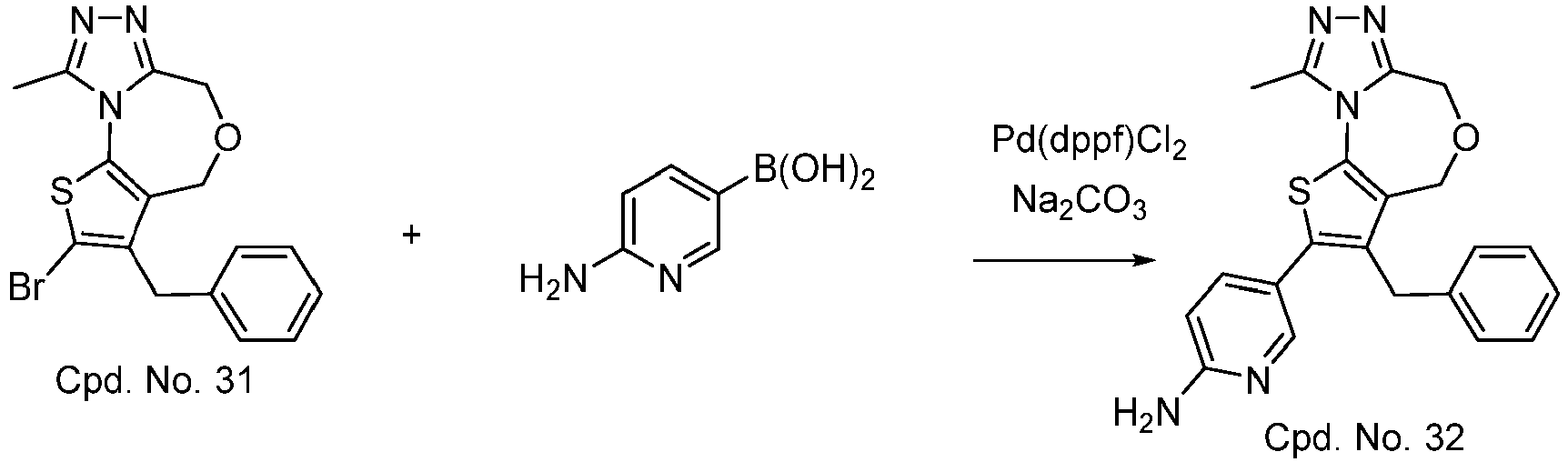
- To a flask was charged with Cpd. No. 31 (10 mg, 0.03 mmol), (6-aminopyridin-3-yl)boronic acid (10 mg, 2 eq), Pd(dppf)Cl2 (3 mg), dioxane (1 mL) and Na2CO3 solution (2 M, 0.5 mL) under N2. The reaction mixture was heated at 100 °C oil bath for 1 h. The reaction mixture was extracted with EtOAc and the organic layer was washed with brine, dried and concentrated. The residue was purified through HPLC to afford Cpd. No. 32 (40% yield). 1H NMR (400 MHz, MeOD) δ 7.94 (d, J = 9.2 Hz, 1H), 7.89 (s, 1H), 7.32 (t, J = 7.4 Hz, 2H), 7.24 (t, J = 7.3 Hz, 1H), 7.12 (d, J = 7.3 Hz, 2H), 7.05 (s, 1H), 4.78 (s, 2H), 4.71 (s, 2H), 4.02 (s, 2H), 2.79 (s, 3H).ESI-MS: 390.38.
-

- Step 1: To a flask was charged with Cpd. No. 31 (10 mg, 0.03 mmol), ethynyltrimethylsilane (6 mg, 2 eq), Pd(PPh3)2Cl2 (2.1 mg), CuI (1 mg), THF (1 mL) and Et3N (1 mL) under N2. The reaction mixture was stirred at r.t. for 18 h. The reaction mixture was extracted with EtOAc and the organic layer was washed with brine, dried and concentrated.
- Step 2: The residue was dissolved in MeOH (1 mL) and K2CO3 (13.8 mg) was added and stirred for 1 h. The reaction mixture was extracted with EtOAc and the organic layer was washed with brine, dried and concentrated. The residue was purified through HPLC to afford Cpd. No. 33 (20% yield). 1H NMR (400 MHz, MeOD) δ 7.37-7.16 (m, 5H), 4.72 (s, 2H), 4.69 (s, 2H), 4.22 (s, 1H), 4.10 (s, 2H), 2.76 (s, 3H).ESI-MS: 322.20.
-

- To a Shlenk tube was charged with Cpd. No. 31 (10 mg), 4-((4,4,5,5-tetramethyl-1,3,2-dioxaborolan-2-yl)methyl)morpholine (14 mg, 2 eq), Pd2(dba)3 (2.7 mg), PCy3 (1.7 mg), dioxane (1 mL) and Na2CO3 solution (2 M, 0.5 mL) under N2. The tube was sealed and heated at 100 °C oil bath for 4 h. The reaction mixture was extracted with EtOAc and the organic layer was washed with brine, dried and concentrated. The residue was purified through HPLC to afford Cpd. No. 90 (45% yield). 1H NMR (400 MHz, MeOD) δ 7.34 (t, J = 7.6 Hz, 2H), 7.26 (t, J = 7.2 Hz, 1H), 7.13 (d, J = 7.7 Hz, 2H), 4.74 (s, 2H), 4.72 (s, 2H), 4.67 (s, 2H), 4.17 (s, 2H), 3.92 (s, 4H), 3.36 (s, 4H), 2.80 (s, 3H). ESI-MS: M+H 397.10.
-

- To a flask was charged with Cpd. No. 31 (37.5 mg, 0.1 mmol), 4-(4,4,5,5-tetramethyl-1,3,2-dioxaborolan-2-yl)-1H-pyrazole (38.8 mg, 2 eq), Pd(dppf)Cl2 (8 mg), dioxane (4 mL) and Na2CO3 solution (2 M, 2 mL) under N2. The reaction mixture was heated at 100 °C oil bath for 1 h. The reaction mixture was extracted with EtOAc and the organic layer was washed with brine, dried and concentrated. The residue was purified through HPLC to afford Cpd. No. 91 (25% yield). 1H NMR (400 MHz, MeOD) δ 7.77 (s, 2H), 7.32 (t, J = 7.5 Hz, 2H), 7.23 (t, J = 7.3 Hz, 1H), 7.14 (d, J = 7.5 Hz, 2H), 4.78 (s, 2H), 4.73 (s, 2H), 4.05 (s, 2H), 2.85 (s, 3H). ESI-MS: M+H 364.09.
-

- To a flask was charged with Cpd. No. 91 (7 mg, 0.02 mmol), K2CO3 (27 mg), MeI (0.025 mL), acetonitrile (2 mL) and 18-crown-ether (10 mg). The reaction mixture was stirred for 4 h. The reaction mixture was extracted with EtOAc and the organic layer was washed with brine, dried and concentrated. The residue was purified through HPLC to afford Cpd. No. 92 (50% yield). 1H NMR (400 MHz, MeOD) δ 7.81 (s, 1H), 7.59 (s, 1H), 7.32 (t, J = 7.6 Hz, 2H), 7.23 (t, J = 7.0 Hz, 1H), 7.13 (d, J = 7.7 Hz, 2H), 4.77 (s, 2H), 4.70 (s, 2H), 4.05 (s, 2H), 3.93 (s, 3H), 2.83 (s, 3H). ESI-MS: M+H378.00.
-

- To a flask was charged with Cpd. No. 31 (10 mg, 0.03 mmol), cyclopropylboronic acid (5 mg, 2 eq), Pd(dppf)Cl2 (3 mg), dioxane (1 mL) and Na2CO3 solution (2 M, 0.5 mL) under N2. The reaction mixture was heated at 100 °C oil bath for 1 h. The reaction mixture was extracted with EtOAc and the organic layer was washed with brine, dried and concentrated. The residue was purified through HPLC to afford Cpd. No. 93 (30% yield). 1H NMR (400 MHz, MeOD) δ 7.30 (t, J = 7.6 Hz, 3H), 7.22 (d, J = 6.8 Hz, 1H), 7.18 (d, J = 7.7 Hz, 2H), 4.73 (s, 2H), 4.68 (s, 2H), 4.09 (s, 2H), 2.79 (d, J = 0.6 Hz, 3H), 2.22 - 2.10 (m, 1H), 1.11 (q, J = 5.0 Hz, 2H), 0.79 (q, J = 4.9 Hz, 2H). ESI-MS: M+H 338.18.
-

- To a Shlenk tube was charged with Cpd. No. 31 (20 mg), 4,4,5,5-tetramethyl-2-(prop-1-en-2-yl)-1,3,2-dioxaborolane (20 mg, 2 eq), Pd(dppf)Cl2 (6 mg), dioxane (2 mL) and Na2CO3 solution (2 M, 1 mL) under N2. The tube was sealed and heated at 100 °C oil bath for 1 h. The reaction mixture was extracted with EtOAc and the organic layer was washed with brine, dried and concentrated. The residue was purified through HPLC to afford Cpd. No. 94 (75% yield). 1H NMR (400 MHz, MeOD) δ 7.30 (t, J = 7.3 Hz, 2H), 7.21 (t, J = 7.1 Hz, 1H), 7.11 (d, J = 7.4 Hz, 2H), 5.36 (s, 1H), 5.20 (s, 1H), 4.73 (s, 2H), 4.63 (s, 2H), 4.07 (s, 2H), 2.80 (s, 3H), 2.17 (s, 3H). ESI-MS: M+H 338.05.
-

- To a Shlenk tube was charged with Cpd. No. 31 (20 mg), 2-(3,6-dihydro-2H-pyran-4-yl)-4,4,5,5-tetramethyl-1,3,2-dioxaborolane (25 mg, 2 eq), Pd(dppf)Cl2 (6 mg), dioxane (2 mL) and Na2CO3 solution (2 M, 1 mL) under N2. The tube was sealed and heated at 100 °C oil bath for 1 h. The reaction mixture was extracted with EtOAc and the organic layer was washed with brine, dried and concentrated. The residue was purified through HPLC to afford Cpd. No. 95 (95% yield). 1H NMR (400 MHz, MeOD) δ 7.31 (t, J = 7.4 Hz, 2H), 7.22 (t, J = 7.3 Hz, 1H), 7.12 (d, J = 7.2 Hz, 2H), 6.05 - 5.97 (m, 1H), 4.75 (s, 2H), 4.66 (s, 2H), 4.23 (dd, J = 5.5, 2.8 Hz, 2H), 4.06 (s, 2H), 3.87 (t, J = 5.4 Hz, 2H), 2.83 (s, 3H), 2.48-2.42 (m, 2H). ESI-MS: 380.10.
-

- To a flask was charged with Cpd. No. 31 (20 mg, 0.05 mmol), but-3-yn-1-ol (8.4 mg, 2 eq), Pd(PPh3)2Cl2 (4.2 mg), CuI (2.3 mg), THF (1 mL) and Et3N (1 mL) under N2. The reaction mixture was stirred at 60 °C for 18 h. The reaction mixture was extracted with EtOAc and the organic layer was washed with brine, dried and concentrated. The residue was purified through HPLC to afford Cpd. No. 96 (80% yield). 1H NMR (400 MHz, MeOD) δ 7.29 (t, J = 7.5 Hz, 2H), 7.25 - 7.15 (m, 3H), 4.72 (s, 2H), 4.69 (s, 2H), 4.06 (s, 2H), 3.75 (t, J = 6.5 Hz, 2H), 2.75-2.70 (m, 5H). ESI-MS: 366.11.
-

- To a flask was charged with Cpd. No. 31 (20 mg, 0.05 mmol), K3Fe(CN)6 (7 mg), CuI (2 mg), 1-methyl-1H-imidazole (0.5 mL) under N2. The reaction mixture was stirred at 140 °C for 18 h. The reaction mixture was extracted with EtOAc and the organic layer was washed with brine, dried and concentrated. The residue was purified through HPLC to afford Cpd. No. 110 (45% yield). 1H NMR (400 MHz, MeOD) δ 7.35 (t, J = 7.3 Hz, 2H), 7.28 (d, J = 7.3 Hz, 1H), 7.27 - 7.20 (m, 2H), 4.77 (s, 2H), 4.76 (s, 2H), 4.18 (s, 2H), 2.79 (s, 3H). ESI-MS: 323.20.
-

- To a solution of Cpd. No. 95 (20 mg) in methanol (4 mL) was added 10%Pd/C (20 mg) and H2 was bubbled into the solution for 20 min. The reaction was filtered and the crude was purified via HPLC to provide the TFA salt of Cpd. No. 97 (30% yield). 1H NMR (400 MHz, MeOD) δ 7.30 (t, J = 7.4 Hz, 2H), 7.22 (t, J = 7.3 Hz, 1H), 7.13 (d, J = 7.1 Hz, 2H), 4.71 (s, 2H), 4.66 (s, 2H), 4.03 (s, 2H), 4.01 - 3.95 (m, 1H), 3.65 - 3.42 (m, 3H), 3.40-3.35 (m, 1H), 2.78 (s, 3H), 1.97 - 1.69 (m, 4H). ESI-MS: 382.09.
-

- To a solution of Cpd. No. 94 (10 mg) in methanol (3 mL) was added 10%Pd/C (20 mg) and H2 was bubbled into the solution for 20 min. The reaction was filtered and the crude was purified via HPLC to provide the TFA salt of Cpd. No. 98 (50% yield). 1H NMR (400 MHz, MeOD) δ 7.30 (d, J = 7.4 Hz, 2H), 7.21 (t, J = 7.4 Hz, 1H), 7.13 (d, J = 7.1 Hz, 2H), 4.72 (s, 2H), 4.66 (s, 2H), 4.00 (s, 2H), 3.50-3.43 (m, 1H), 2.81 (s, 3H), 1.34 (d, J = 6.8 Hz, 6H). ESI-MS: 340.02.
-

- To a solution of Cpd. No. 96 (18 mg) in methanol (4 mL) was added 10%Pd/C (20 mg) and H2 was bubbled into the solution for 20 min. The reaction was filtered and the crude was purified via HPLC to provide the TFA salt of Cpd. No. 99 (60% yield). 1H NMR (400 MHz, MeOD) δ 7.30 (t, J = 7.4 Hz, 2H), 7.21 (t, J = 7.0 Hz, 1H), 7.13 (d, J = 7.6 Hz, 2H), 4.73 (s, 2H), 4.68 (s, 2H), 3.98 (s, 2H), 3.57 (t, J = 6.3 Hz, 2H), 2.93 (t, J = 6.3 Hz, 2H), 2.80 (s, 3H), 1.80 - 1.69 (m, 2H), 1.69 - 1.56 (m, 2H). ESI-MS: 370.11.
-

-

- Step 1: To a suspension of methyl 2-((((9H-fluoren-9-yl)methoxy)carbonyl)amino)-4-oxo-4,5-dihydrothiophene-3-carboxylate (36.6 g, 92 mmol) in dioxane (100 mL) was added POCl3(19 mL, 184 mmol, 2 eq) and the reaction mixture was heated to reflux for 1 hour. The reaction mixture was cooled and poured into the mixture of ice-water. The reaction mixture was extracted with EtOAc (3×200 mL). The combined organic layers were washed with brine, dried over Na2SO4 and concentrated. The crude was purified on silica gel (pure DCM to DCM/EtOAc 15: 1) to give methyl 2-((((9H-fluoren-9-yl)methoxy)carbonyl)amino)-4-chlorothiophene-3-carboxylate as white solid. (8 g, 22%).
- Step 2: To a solution of methyl 2-((((9H-fluoren-9-yl)methoxy)carbonyl)amino)-4-chlorothiophene-3-carboxylate (5.6 g, 13.5 mmol) in DCM (11.8 mL) was added morpholine (11.8 mL, 135 mmol) and the reaction mixture was stirred overnight. The reaction mixture was filtered and rinsed with small amount of Et2O. The filtrate was evaporated under vacuum and the residue was chromatographed on silica gel (pure DCM) to afford title compound as a white solid (2.6 g, 99%). 1H NMR (400 MHz, CDCl3) δ 6.22 (s, 2H), 6.12 (s, 1H), 3.87 (s, 3H).
-

- To a solution of 2-((tert-butyldiphenylsilyl)oxy)acetic acid (1.18 g, 3.6 mmol) in DCM (10 mL) was added oxallyl chloride (4.7 mmol, 0.4 mL, 1.3 eq) at 0 °C. A couple of drops of DMF were added and the reaction mixture was allowed to warm to r.t. and stirred for 1 h. Then all the volatiles were removed under vacuum and the residue was dissolved in DCM (4 mL). This solution was added dropwise at 0 °C to a solution of methyl 2-amino-4-chlorothiophene-3-carboxylate (360 mg, 1.8 mmol) and DIPEA (0.94 mL, 5.4 mmol) in DCM (8 mL). The reaction mixture was allowed to warm to r.t. and stirred for 1 h prior to being quenched with saturated NaHCO3 and extracted with DCM (3×20 mL). The combined organic layer was washed with water and then, dried (Na2SO4), filtered and then concentrated. The oil was chromatographed on silica gel (1:8 ethyl acetate /hexanes) to give title compound as an oil: (0.6 g, 68%).
-

- Step 1: To a solution of methyl 2-(2-((tert-butyldiphenylsilyl)oxy)acetamido)-4-chlorothiophene-3-carboxylate (0.6 g, 1.23 mmol)in dioxane (7 mL) was added Lawesson's reagent (299 mg, 0.74 mmol, 0.6 eq) and the reaction mixture was heated at reflux for 8 h. The volatiles were removed under vacuum and the residue was chromatographed on silica gel (1:16 ethyl acetate /hexanes) to give title compound as an oil: (480 mg, 80%).
- Step 2: To a solution of methyl 2-(2-((tert-butyldiphenylsilyl)oxy)ethanethioamido)-4-chlorothiophene-3-carboxylate (480 mg, 0.95 mmol) in THF (4 mL) was added hydrazine monohydrate (0.1 mL, 2 mmol, 2 eq) at 0 °C and the reaction mixture was allowed to warm to r.t. The reaction mixture was stirred for 1 h prior to being concentrated in vacuum. The residue was taken up in DCM and washed with water and brine. The organic layer was separated, dried and concentrated.
- Step 3: The residue was taken up in ethanol (4 mL) and triethyl orthoacetate (0.52 mL, 2.85 mmol, 3 eq) was added. The reaction mixture was heated at reflux for 12h.
- Step 4: All volatiles were removed under vacuum and the residue was dissolved in AcOH (2 mL). The solution was heated at reflux for 1h prior to the removal of the solvent under vacuum. The residue was taken up in EtOAc and washed with 2 M Na2CO3. The organic layer was washed with brine, dried and concentrated. The residue was chromatographed on silica gel (ethyl acetate) to give title compound as an oil: (360 mg, 72%.). 1H NMR (400 MHz, CDCl3) δ 7.64 - 7.36 (m, 10H), 7.33 (s, 1H), 4.78 (d, J = 12.8 Hz, 1H), 4.62 (d, J = 12.8 Hz, 1H), 3.64 (s, 3H), 2.33 (s, 3H), 0.96 (s, 9H).
-

- To a solution of methyl 2-(3-(((tert-butyldiphenylsilyl)oxy)methyl)-5-methyl-4H-1,2,4-triazol-4-yl)-4-chlorothiophene-3-carboxylate (360 mg, 0.68 mmol) in THF (10 mL) at 0 °C was added a solution of LiBH4 (2 M in THF, 1 mL, 2 mmol). MeOH (1 mL) was added and the reaction mixture was allowed to warm to r.t. and stirred for 12h. All volatiles were removed and the residue was taken up in EtOAc. The organic layer was washed with water and brine prior to being dried and concentrated. The residue was dissolved in DCM and cooled to 0 °C. Thionyl chloride (0.1 mL, 1.4 mmol, 2 eq) was added and the reaction mixture was allowed to warm to r.t. After 1 h, all the volatiles were removed and the residue was taken up in EtOAc and washed with 2 M Na2CO3. The organic layer was washed with brine, dried and concentrated. The residue was chromatographed on silica gel (ethyl acetate) to give title compound as an oil: (350 mg, 99%). 1H NMR (400 MHz, CDCl3) δ 7.58 - 7.33 (m, 10H), 4.73 (d, J = 12.6Hz, 1H), 4.67 (d, J = 12.6Hz, 1H), 4.22 (s, 2H), 2.40 (s, 3H), 0.99 (s, 9H).
-

- To a solution of 3-(((tert-butyldiphenylsilyl)oxy)methyl)-4-(4-chloro-3-(chloromethyl)thiophen-2-yl)-5-methyl-4H-1,2,4-triazole (350 mg, 0.68 mmol) in THF at 0 °C was added a solution of TBAF (0.7 mL, 0.7 mmol, 1M in THF). The solution was stirred for 1 h prior to being added to a solution of NaO t Bu (134 mg, 1.4 mmol, 2 eq) in tBuOH (6 mL) at 80 °C. The reaction mixture was stirred for 5 min prior to the removal of the solvent under vacuum. The residue was taken up in EtOAc and water. The organic layer was washed with brine, dried and concentrated. The residue was purified through HPLC to afford Cpd. No. 138 as a solid (100 mg, 61%). ESI: M+H 242.17.
-

- To a Shlenk tube was charged with 3-chloro-9-methyl-4H,6H-thieno[2,3-e][1,2,4]triazolo[3,4-c][1,4]oxazepine (100 mg, 0.4 mmol), potassium 4-fluorobenzyltrifluoroborate (250 mg, 1.1 mmol), [Pd(allyl)Cl]2 (22 mg, 0.058 mmol), sSphos (60 mg, 0.12 mmol), toluene (5 mL) and Na2CO3 solution (2 M, 5 mL) under N2. The tube was sealed and heated at 100 °C oil bath for 4 h. The reaction mixture was extracted with EtOAc and the organic layer was washed with brine, dried and concentrated. The residue was purified through HPLC to afford Cpd. No. 139 as a solid (70 mg, 56%). ESI: M+H 316.20.
-

- To a solution of 3-(4-fluorobenzyl)-9-methyl-4H,6H-thieno[2,3-e][1,2,4]triazolo[3,4-c][1,4]oxazepine (70 mg, 0.22 mmol) in AcOH (1 mL) was added NBS (39.5 mg, 1 eq). The reaction mixture was stirred for 1 h prior to being purified through HPLC to afford Cpd. No. 140 as a solid (25 mg, 29%). ESI: M+H 394.10.
-

- To a Shlenk tube was charged with 3-(4-fluorobenzyl-2-bromo-9-methyl-4H,6H-thieno[2,3-e][1,2,4]triazolo[3,4-c][1,4]oxazepine (10 mg, 0.03 mmol), 4-ethynyl-1-methyl-1H-pyrazole (6 mg, 0.06 mmol, 2 eq), [PdCl2(PPh3)2] (2.1 mg), CuI (1.1 mg), THF (1 mL) and Et2NH (0.5 mL) under N2. The tube was sealed and heated at 70 °C oil bath for 12 h. The reaction mixture was extracted with EtOAc and the organic layer was washed with brine, dried and concentrated. The residue was purified through HPLC to afford Cpd. No. 111 as a solid (7 mg, 56 %). 1H NMR (400 MHz, MeOD) δ 7.90 (s, 1H), 7.76-7.65 (m, 5H), 4.74 (s, 2H), 4.72 (s, 2H), 4.09 (s, 2H), 3.92 (s, 3H), 2.77 (s, 3H).ESI: M+H 420.16.
-

-

- (S)-2-((tert-butyldimethylsilyl)oxy)propanoyl chloride was prepared based on the modification of the reported procedure (Organic Letters, 16(9), 2322-2325; 2014). To a solution of lithium (S)-2-hydroxypropanoate (2.88 g, 30 mmol) in DMF (30 mL) at 0 °C under N2 was added TBSCl (9 g, 60 mmol) and imidazole (8.2 g, 120 mmol). The reaction mixture was allowed to warm to r.t. and stirred overnight. The reaction mixture was partitioned between hexanes (300 mL) and saturated NaHCO3 solution (300 mL). The organic layer was separated, washed with brine (30mL X 5). The organic layer was dried and concentrated to provide a crude oil (9.2g). The crude was dissolved in DCM (60 mL) and the solution was cooled to 0 °C under N2. DMF (0.43 mL) was added followed by the dropwise addition of a solution of oxalyl chloride (1.3 eq, 39 mmol, 3.3 mL) in DCM (10 mL). The reaction mixture was allowed to warm to r.t. and stirred for another. All the volatiles were removed under vacuum and the residue was dissolved in DCM (10 mL). This solution was added to a solution of HYC-162 (1.92 g, 10 mmol) in DCM (90 mL) and DIPEA (7 mL, 40 mmol) at 0 °C under N2 . The reaction mixture was allowed to warm to r.t. and stirred for 1 h prior to being quenched with saturated NaHCO3 and extracted with DCM (3×50 mL). The combined organic layer was washed with water and then, dried (Na2SO4), filtered and then concentrated The oil was chromatographed on silica gel (1:16 to 1:8 ethyl acetate /hexanes) to give title compound as an oil: (3.1 g, 82%.). 1H NMR (400 MHz, CDCl3) δ 11.99 (s, 1H), 6.68 (s, 1H), 4.47 (q, J = 6.7 Hz, 1H), 3.94 (s, 3H), 1.51 (d, J = 6.7, 3H), 1.00 (s, 9H), 0.20 (s, 6H).
-

- Step 1: To a solution of 6 (3 g, 8 mmol) in dioxane (20 mL) was added Lawesson's reagent (1.93 g, 4.8 mmol, 0.6 eq) and the reaction mixture was heated at reflux for 12 h. The volatiles were removed under vacuum and the residue was chromatographed on silica gel (1:16 ethyl acetate /hexanes) to Methyl (S)-2-(2-((tertbutyldimethylsilyl)oxy)propanethioamido)-4-chlorothiophene-3-carboxylate as an oil: (1.8 g, 57%).
- Step 2: To a solution of above compound (3.6 g, 9.2 mmol) in THF (10 mL) was added hydrazine monohydrate (0.89 mL, 18.4 mmol, 2 eq) at 0 °C and the reaction mixture was allowed to warm to r.t. The reaction mixture was stirred for 1 h prior to being concentrated in vacuum. The residue was taken up in DCM and washed with water and brine. The organic layer was separated, dried and concentrated.
- Step 3: The residue was taken up in ethanol (10 mL) and triethyl orthoacetate (5 mL, 27.6 mmol, 3 eq) was added. The reaction mixture was heated at reflux for 1 h.
- Step 4: All volatiles were removed under vacuum and the residue was dissolved in AcOH (10 mL). The solution was heated at reflux for 1h prior to the removal of the solvent under vacuum. The residue was chromatographed on silica gel (1:2 ethyl acetate /hexanes followed by ethyl acetate/triethylamine 25:1) to give title compound as a mixture of non-consequential diastereoisomers. (1.8 g, 47%). 1H NMR (400 MHz, CDCl3) Major isomer: δ 7.33 (s, 1H), 5.20 (q, J = 6.7 Hz, 1H), 3.67 (s, 3H), 2.22 (s, 3H), 1.29 (d, J = 6.7 Hz, 3H), 0.81 (s, 6H), 0.04 (s, 3H), -0.05 (s, 3H); Minor isomer: 7.31 (s, 1H), 5.07 (q, J = 6.7 Hz, 1H), 3.66 (s, 3H), 2.23 (d, J = 1.2 Hz, 3H), 1.57 (d, J = 6.7 Hz, 3H), 0.75 (s, 9H), 0.02 (s, 3H), -0.11 (s, 3H).
-

- To a solution of HYC-268 (1.8 g, 4.3 mmol) in THF (30 mL) at 0 °C was added a solution of LiBH4 (2 M in THF, 3.3 mL, 6.5 mmol, 1.5 eq). MeOH (3 mL) was added and the reaction mixture was allowed to warm to r.t. and stirred for 12h. All volatiles were removed and the residue was taken up in EtOAc. The organic layer was washed with water and brine prior to being dried and concentrated. The residue was dissolved in DCM (20 mL) and cooled to 0 °C. Thionyl chloride (0.94 mL, 12.9 mmol. 3 eq) was added and the reaction mixture was allowed to warm to r.t. After 1 h, all the volatiles were removed and the residue was taken up in EtOAc and washed with 1 M Na2CO3. The organic layer was washed with brine, dried and concentrated. The residue was chromatographed on silica gel (ethyl acetate/triethylamine 25:1) to give title compound as a mixture of diastereoisimers (1.34 g, 75%).
-

- To a solution of HYC-270 (1.34 g, 3.3 mmol) in THF (10 mL) at 0 °C was added a solution of TBAF (3.6 mL, 3.6 mmol, 1M in THF). The solution was stirred for 1 h prior to being added to a hot solution of NaO t Bu (634 mg, 6.6 mmol, 2 eq) in t BuOH (40 mL) at 80 °C. The reaction mixture was stirred for 5 min prior to the removal of the solvent under vacuum. The residue was taken up in EtOAc and water. The organic layer was washed with brine, dried and concentrated. The residue was purified through HPLC to afford TFA salt of Cpd. No. 141) (575 mg, 52%). 1H NMR (400 MHz, MeOD) δ 7.52 (s, 1H), 5.05 (d, J = 15.8 Hz, 2H), 4.89 (d, J = 15.8Hz, 2H), 4.79 (q, J = 6.7 Hz, 1H), 2.79 (s, 3H), 1.73 (d, J = 6.6 Hz, 3H). ESI: M+H 256.2.
-

- To a flask under N2 was charged with TFA salt of (S)-3-chloro-6,9-dimethyl-4H,6H-thieno[2,3-e][1,2,4]triazolo[3,4-c][1,4]oxazepine (152 mg, 0.4 mmol), potassium benzyltrifluoroborate (158 mg, 0.8 mmol, 2 eq), [Pd(allyl)Cl]2 (15 mg, 0.04 mmol), sSphos (41 mg, 0.08 mmol), toluene (5 mL) and Na2CO3 solution (2 M, 2 mL), water (2 mL). The reaction mixture was heated at 100-110 °C oil bath for 2h. The reaction mixture was extracted with EtOAc and the organic layer was washed with brine, dried and concentrated. The residue was purified through HPLC to afford Cpd. No. 118 as a solid (150 mg, 88%). ESI: M+H 312.08.
-

- To a solution TFA salt of (S)-3-benzyl-6,9-dimethyl-4H,6H-thieno[2,3-e][1,2,4]triazolo[3,4-c][1,4]oxazepine (240 mg, 0.57 mmol) in AcOH (4 mL) was added NBS (101 mg, 0.57 mmol, 1 eq). The reaction mixture was stirred for 1 h prior to the addition of water (2 mL) and methanol (2 mL). All volatiles were removed under vacuum and the residue was purified by HPLC to afford Cpd. No. 119 as a solid (240 mg, 84%). ESI: M+H 390.03.
-

- To a Shlenk tube was charged with (S)-3-benzyl-2-bromo-6,9-dimethyl-4H,6H-thieno[2,3-e][1,2,4]triazolo[3,4-c][1,4]oxazepine (36 mg, 0.09 mmol), but-3-yn-1-ol (14 mg, 0.2 mmol, 2 eq), [PdCl2(PPh3)2](8.4 mg, 0.01 mmol), CuI (4.6 mg, 0.02 mmol), THF (1 mL) and Et3N (1 mL) under N2. The tube was sealed and heated at 70 °C oil bath for 12 h. The reaction mixture was extracted with EtOAc and the organic layer was washed with brine, dried and concentrated. The residue was purified through HPLC to afford Cpd. No. 113 as a solid (21 mg, 62%). 1H NMR (400 MHz, MeOD) δ 7.34 - 7.27 (m, 2H), 7.27 - 7.16 (m, 3H), 4.83 (d, J = 15.2 Hz, 1H), 4.72-4.63 (m, 1H), 4.59 (d, J = 15.3 Hz, 1H), 4.11 (d, J = 15.6 Hz, 1H), 4.00 (d, J = 15.5 Hz, 1H), 3.74 (t, J = 6.6 Hz, 2H), 2.72 (t, J = 6.5 Hz, 4H), 1.64 (d, J = 5.8 Hz, 3H).ESI: M+H 312.08.
-

- To a Shlenk tube was charged with (S)-3-benzyl-2-bromo-6,9-dimethyl-4H,6H-thieno[2,3-e][1,2,4]triazolo[3,4-c][1,4]oxazepine (20 mg, 0.05 mmol), N,N-dimethylprop-2-yn-1-amine (8.3mg, 0.1 mmol, 2 eq), [PdCl2(PPh3)2] (7 mg), CuI (3.8), THF (2 mL) and Et3N (0.5 mL) under N2. The tube was sealed and heated at 70 °C oil bath for 12 h. The reaction mixture was extracted with EtOAc and the organic layer was washed with brine, dried and concentrated. The residue was purified through HPLC to afford Cpd. No. 144 as a solid (90%). 1H NMR (400 MHz, MeOD) δ 7.32 (t, J = 7.3 Hz, 2H), 7.24 (d, J = 7.3 Hz, 1H), 7.20 (d, J = 6.7 Hz, 2H), 4.86 (d, J = 15.4 Hz, 1H), 4.69 (q, J = 6.4 Hz, 1H), 4.63 (d, J = 15.4 Hz, 1H), 4.42 (s, 2H), 4.18 (d, J = 15.9 Hz, 1H), 4.09 (d, J = 15.9 Hz, 1H), 2.96 (s, 6H), 2.80 (s, 3H), 1.65 (d, J = 6.5 Hz, 3H). ESI: M+H 392.99.
-

- To a Shlenk tube was charged with (S)-3-benzyl-2-bromo-6,9-dimethyl-4H,6H-thieno[2,3-e][1,2,4]triazolo[3,4-c][1,4]oxazepine (20 mg, 0.05 mmol), 3-methoxyprop-1-yne (7 mg, 0.1 mmol, 2 eq), [PdCl2(PPh3)2] (7 mg), CuI (3.8), THF (2 mL) and Et3N (0.5 mL) under N2. The tube was sealed and heated at 70 °C oil bath for 12 h. The reaction mixture was extracted with EtOAc and the organic layer was washed with brine, dried and concentrated. The residue was purified through HPLC to afford Cpd. No. 145 as a solid (75%).1H NMR (400 MHz, MeOD) δ 7.35 - 7.27 (m, 2H), 7.26-7.15 (m, 3H), 4.84 (d, J = 15.4 Hz, 1H), 4.66 (q, J = 6.5 Hz, 1H), 4.60 (d, J = 15.4 Hz, 1H),4.40 (s, 2H), 4.13 (d, J = 15.6 Hz, 1H), 4.03 (d, J = 15.6 Hz, 1H), 3.41 (s, 3H), 2.78 (s, 3H), 1.64 (d, J = 6.5 Hz, 3H). ESI: M+H 380.33.
-

-

- Step 1: A solution of 33% HBr in acetic acid (7.3 mL) was cooled to 0 °C. A cold solution of HYB-107 (1 g, 4 mmol) in DCM (1 mL) was added and the reaction mixture turned red immediately. The reaction mixture was immediately poured into ice-water (50 g each) and was taken up in ethyl acetate. The organic layer was separated, washed successively with 10% NaOH (40 mL), NaHCO3 (40 mL), and brine (40 mL). After drying, the organic solution was passed through a short pad of silica gel, then concentrated. The residue was dissolved in dichloromethane for next step.
- Step 2: The above solution was cooled to 0 °C, and (((9H-fluoren-9-yl)methoxy)carbonyl)glycine (1.5 eq) and EDCI (1.5 eq) were successively added. The reaction mixture was allowed to warm to r.t. and stirred overnight. The reaction mixture was directly poured onto a pad of silica gel. Elution (1:15 ethyl acetate/DCM) to give HYB-252 (900 mg, 53%)as a crude red solid, which was triturated in Et2O to give yellow solid. 1H NMR (400 MHz, CDCl3) δ 11.70 (s, 1H), 9.66 (s, 1H), 7.76-7.65 (m, 4H), 7.39-7.28 (m, 4H), 6.75 (s, 1H), 5.87 (s, 1H), 4.48 (d, J = 6.9 Hz, 2H), 4.29-4.20 (m, 1H), 4.19-4.09 (m, 2H), 2.39 (s, 3H).
-

- To a solution of HYB-252 (900 mg, 2.1 mmol)) in THF (20 mL) was added Et3N (2 mL) and the reaction mixture was heated to 60 °C for 4 hours. The volatiles were removed under vacuum and the residue was dissolved in THF (20 mL) and NaBH(OAc)3 (1.7 g, 8 mmol) was added. The reaction mixture was stirred for 4 h prior to being quenched with Na2CO3 solution (2 M). The reaction mixture was extracted with EtOAc, washed with saturated NaHCO3 solution. The organic solvent was removed. The residue was dissolved in DCM (10 mL) and saturated NaHCO3(10 mL). CbzCl (2 mmol, 0.3 mL) was added and the reaction mixture was stirred for overnight. The organic layer was separated, dried, and concentrated. The residue was purified by chromatography on silica gel (1:2 ethyl acetate/hexanes) to give HYB-271 (200 mg, 30% yield). 1H NMR (400 MHz, DMSO) δ 10.26 (s, 1H), 7.35 (s, 5H), 6.41 (s, 1H), 5.12 (s, 2H), 4.56 (s, 2H), 4.23-4.15 (m, 2H), 2.28 (s, 3H). ESI-MS: 339.19.
-

- The HYB-271(100 mg, 0.3 mmol) was dissolved in a mixture of AcOH/DCM (4 mL/4 mL). NBS (50 mg, 0.9 eq) was added and the reaction was stirred for 10 minute prior to being poured into the ice/water. The mixture was extracted with EtOAc, washed with NaOH (1 M, 10 mL), NaHCO3 solution (10 mL), and brine. The organic layer was separated, dried, and concentrated. The residue was purified by chromatography on silica gel (1:2 ethyl acetate/hexanes) to give HYB-272 (110 mg, 93% yield). ESI-MS: 395.03.
-

- Step 1: To a suspension of P4S10 (124 mg, 0.56 mmol) and Na2CO3 (59 mg, 0.56 mmol) in 1,2-DCE (4 mL) was added HYB-272 (110 mg, 0.28 mmol). The reaction mixture was heated to 65 °C for 4 h until the reaction is completed. The reaction mixture was cooled, taken up in saturated NaHCO3, and extracted with DCM. The organic layer was washed with saturated NaHCO3 and brine prior to being dried.
- Step 2: The solvent was removed and the residue was dissolved in THF (4 mL). NH2NH2·H2O (27 µL, 0.56 mmol) was added and the reaction was stirred for 1 h. The volatiles were removed under vacuum and the residue was taken up in saturated NaHCO3, and extracted with DCM. The organic layer was separated and dried prior to being removed.
- Step 3:The residue was dissolved in ethanol (4 mL) and triethyl orthoacetate (0.9 mmol, 0.16 mL) was added. The reaction mixture was heated at 60 °C for 1 h. The volatile was removed to give a crude mixture which was purified via HPLC (30 mg, 25%). 1H NMR (400 MHz, CDCl3) δ 7.45-7.36 (m, 5H), 5.20 (s, 2H), 4.79 (s, 2H), 4.78 (s, 2H), 2.77 (s, 3H), 2.49 (s, 3H).ESI-MS: 433.22.
-

- To a Shlenk tube was charged with Cpd. No. 146 (30 mg, 0.07 mmol), potassium benzyltrifluoroborate (28 mg, 2 eq), Pd(dppf)Cl2 (8 mg), dioxane (2 mL) and Na2CO3 solution (2 M, 1 mL) under N2. The tube was sealed and heated at 100 °C oil bath for 1 h. The reaction mixture was extracted with EtOAc and the organic layer was washed with brine, dried and concentrated. The residue was purified through HPLC to afford Cpd. No. 14 (84% yield). ESI-MS: 445.21
-

- Cpd. No. 14 (26 mg) was dissolved in a mixture of TFA-thioanisole (2 mL-0.2 mL) and stirred at r.t. for 24h. The volatiles was evaporated to give a crude mixture which was purified via HPLC to give Cpd. No. 15 (12 mg, 67%). 1H NMR (400 MHz, MeOD) δ 7.30 (t, J = 7.5 Hz, 2H), 7.21 (t, J = 7.3 Hz, 1H), 7.13 (d, J = 7.5 Hz, 2H), 4.42 (s, 2H), 4.14 (s, 2H), 4.04 (s, 2H), 2.68 (s, 3H), 2.53 (s, 3H). ESI-MS: 311.07.
-

- Cpd. No. 15 (10 mg) was dissolved in THF and formaldehyde (37% solution, 10 mg) was added. NaBH(OAc)3 (25 mg) was added in one portion and the reaction was stirred at r.t. for 24h prior to being quenched with Na2CO3 solution (2 M). The reaction mixture was extracted with EtOAc, washed with saturated NaHCO3 solution. The organic solvent was removed. The residue was purified via HPLC to give Cpd. No. 35 (90%). 1H NMR (400 MHz, MeOD) δ 7.32 (t, J = 7.4 Hz, 2H), 7.23 (t, J = 7.3 Hz, 1H), 7.16 (d, J = 7.5 Hz, 2H), 4.45 (s, 2H), 4.15 (s, 2H), 4.12 (s, 2H), 2.84 (s, 3H), 2.69 (s, 3H), 2.54 (s, 3H).
-
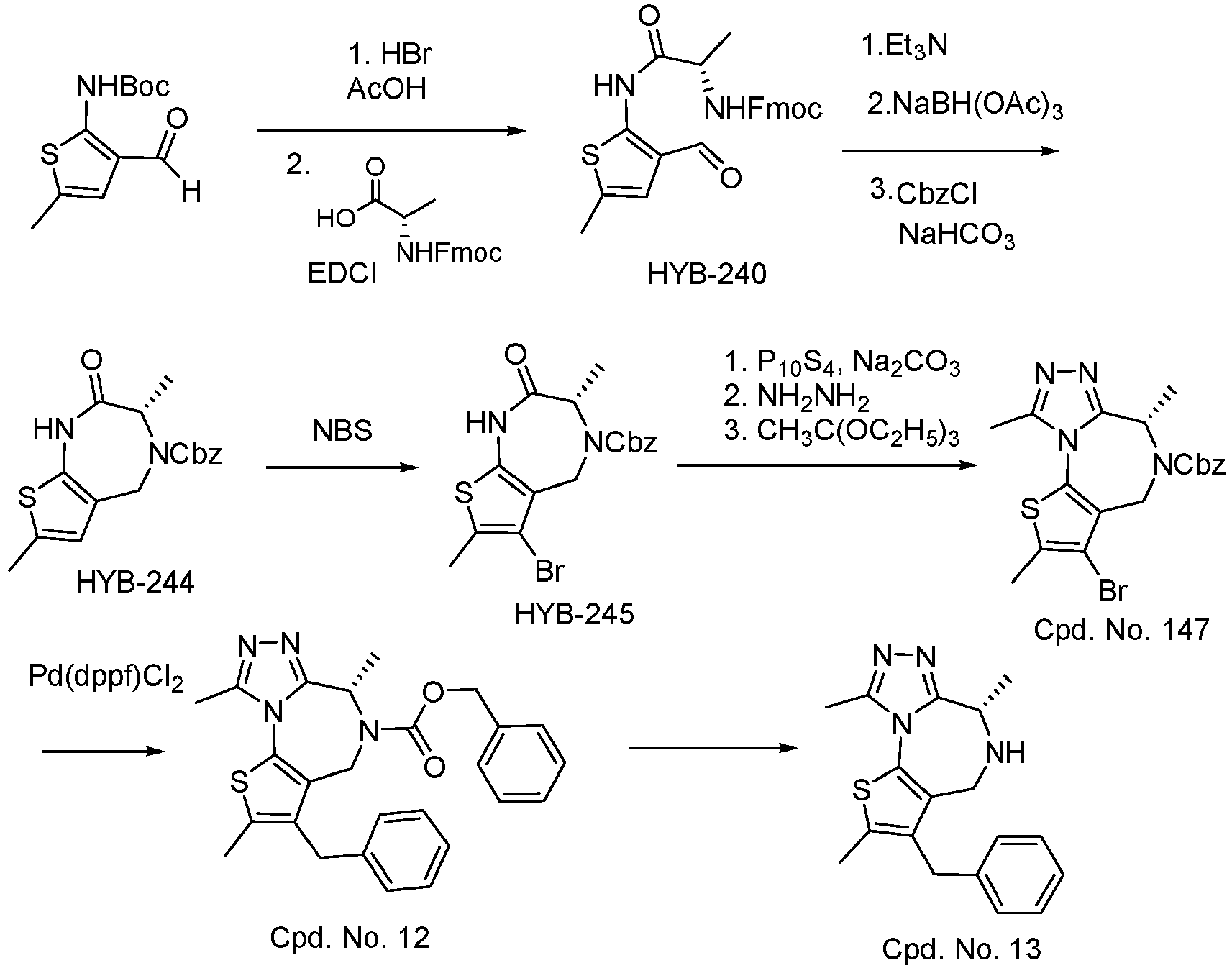
-

- Step 1: A solution of 33% HBr in acetic acid (7.3 mL) was cooled to 0 °C. A cold solution of HYB-107 (1 g, 4 mmol) in DCM (1 mL) was added and the reaction mixture turned red immediately. The reaction mixture was immediately poured into ice-water (50 g each) and was taken up in ethyl acetate. The organic layer was separated, washed successively with 10% NaOH (40 mL), NaHCO3 (40 mL), and brine (40 mL). After drying, the organic solution was passed through a short pad of silica gel, then concentrated. The residue was dissolved in dichloromethane for next step.
- Step 2: The above solution was cooled to 0 °C, and (((9H-fluoren-9-yl)methoxy)carbonyl)-L-alanine (2 g, 1.5 eq) and EDCI (1.15 g, 1.5 eq) were successively added. The reaction mixture was allowed to warm to r.t. and stirred overnight. The reaction mixture was take up in EtOAc and washed with water and brine. The organic layer was separated, dried, and evaporated to give a crude mixture which was purified on silica gel (elution 1:15 ethyl acetate/DCM) to give HYB-240 (580 mg, 33%). 1H NMR (400 MHz, CDCl3) δ 11.78 (s, 1H), 9.75 (s, 1H), 7.97 - 7.33 (m, 8H), 6.83 (s, 1H), 5.38 (s, 1H), 4.58-4.48 (m, 2H), 4.46-4.38 (m, 1H), 4.35-4.26 (m, 1H), 2.44 (s, 3H), 1.57 (br, 3H).
-

- To a solution of HYB-240 (1 g, 2.3 mmol) in THF (20 mL) was added Et3N (2 mL) and the reaction mixture was heated to 60 °C for 4 hours. Then another portion of Et3N (2 mL) was added and heated 4 more hours. The volatiles were removed under vacuum and the residue was dissolved in THF (40 mL) and NaBH(OAc)3 (1.95 g, 4 eq) was added. The reaction mixture was stirred for 4 h prior to being quenched with Na2CO3 solution (2 M). The reaction mixture was extracted with EtOAc, washed with saturated NaHCO3 solution. The organic solvent was removed. The residue was dissolved in DCM (10 mL) and saturated NaHCO3(10 mL). CbzCl (4.6 mmol, 0.65 mL) was added and the reaction mixture was stirred for overnight. The organic layer was separated, dried, and concentrated. The residue was purified by chromatography on silica gel (1:2 ethyl acetate/hexanes) to give HYB-244 (500 mg, 65% yield). 1H NMR (400 MHz, CDCl3) δ 8.46 (s, 1H), 7.67 - 7.30 (m, 5H), 6.30 (s, 1H), 5.20 (s, 2H), 5.02 - 4.69 (m, 2H), 4.44 (d, J = 17.2 Hz, 1H), 2.35 (s, 3H), 1.54 (d, J = 6.8 Hz, 3H). ESI-MS: 331.12.
-
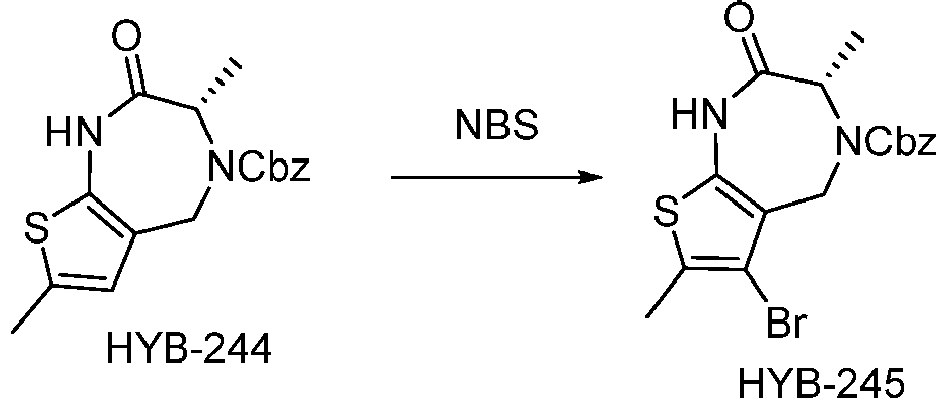
- HYB-244 (500 mg, 1.5 mmol) was dissolved in AcOH (6 mL). NBS (269 mg, 1.5 mmol) was added and the reaction mixture was stirred for 10 minute prior to being poured into the ice/water. The mixture was extracted with EtOAc, washed with NaOH (1 M, 10 mL), NaHCO3 solution (10 mL), and brine. The organic layer was separated, dried, and concentrated. The residue was purified by chromatography on silica gel (1:2 ethyl acetate/hexanes) to give HYB-245 (394 mg, 64% yield). 1H NMR (400 MHz, CDCl3) δ 7.49 - 7.32 (m, 5H), 5.20 (s, 2H), 4.93 (d, J = 18.0 Hz, 1H), 4.78-4.70 (m, 1H), 4.37 (d, J = 17.5 Hz, 1H), 2.31 (s, 3H), 1.55 (d, J = 6.1 Hz, 3H). (UPLC: 5.2 min, ESI-MS: 409.02).
-

- Step 1: To a suspension of P4S10 (444 mg, 2 mmol) and Na2CO3 (212 mg, 2 mmol) in 1,2-DCE (10 mL) was added HYB-245 (394 mg, 0.95 mmol). The reaction mixture was heated to 65 °C for 4 h until the reaction is completed. The reaction mixture was cooled, taken up in saturated NaHCO3, and extracted with DCM. The organic layer was washed with saturated NaHCO3 and brine prior to being dried.
- Step 2: The solvent was removed and the residue was dissolved in THF (4 mL). NH2NH2·H2O (0.1 mL, 2 mmol) was added and the reaction was stirred for 1 h. The volatiles were removed under vacuum and the residue was taken up in saturated NaHCO3, and extracted with DCM. The organic layer was separated and dried prior to being removed.
- Step 3: The residue was dissolved in ethanol (4 mL) and triethyl orthoacetate (3 mmol, 0.55 mL) was added. The reaction mixture was heated at 60 °C for 1 h. The volatile was removed to give a crude mixture which was purified via HPLC to give Cpd. No. 147 (270 mg, 60%). 1H NMR (400 MHz, CDCl3) δ 7.51 - 7.33 (m, 5H), 5.82-5.76 (m, 1H), 5.21 (s, 2H), 5.06 (d, J = 15.4 Hz, 1H), 4.24 (br, 1H), 2.65 (s, 3H), 2.49 (s, 3H), 1.27 (d, J = 7.0 Hz, 3H). ESI-MS: 447.10.
-

- To a Shlenk tube was charged with Cpd. No. 147 (270 mg, 0.6 mmol), potassium benzyltrifluoroborate (238 mg, 2 eq), Pd(dppf)Cl2 (49 mg), dioxane (4 mL) and Na2CO3 solution (2 M, 1 mL) under N2. The tube was sealed and heated at 100 °C oil bath for 1 h. The reaction mixture was extracted with EtOAc and the organic layer was washed with brine, dried and concentrated. The residue was purified through HPLC to afford Cpd. No. 12 (73% yield). 1H NMR (400 MHz, MeOD) δ 7.42-7.32 (m, 5H), 7.21-7.12 (m, 4H), 6.97 (br,s, 1H), 5.56 (br,s, 1H), 5.22-4.95 (m, 3H), 4.02-3.90 (m, 2H), 3.88 (d, J = 15.0 Hz, 1H), 2.67 (s, 3H), 2.53 (s, 3H), 1.12 (br,s, 3H). ESI-MS: 459.20.
-

- Cpd. No. 12 (50 mg) was dissolved in a mixture of TFA-thioanisole (2 mL-0.2 mL) and stirred at r.t. for 24h. The volatiles was evaporated to give a crude mixture which was purified via HPLC to give Cpd. No. 13. (25 mg, 77%).1H NMR (400 MHz, MeOD) δ 7.30 (t, J = 6.8 Hz, 2H), 7.22 (t, J = 7.4 Hz, 1H), 7.13 (d, J = 7.7 Hz, 2H), 4.44 - 4.36 (m, 1H), 4.21 (t, J = 14.3 Hz, 2H), 4.04 (d, J = 16.4 Hz, 1H), 3.82 (d, J = 14.4 Hz, 1H), 2.68 (s, 3H), 2.52 (s, 3H), 1.85 (d, J = 6.9 Hz, 3H). ESI-MS: 325.11.
-

- Cpd. No. 16 was synthesized following the same synthetic procedures as compound Cpd. No. 12 except for starting from chiral (((9H-fluoren-9-yl)methoxy)carbonyl)-D-alanine. ESI-MS: 459.11.
-

- Cpd. No. 17 was synthesized following the same synthetic procedure as compound Cpd. No. 13. ESI-MS: 325.10.
-

- To a solution of Cpd. No. 13 (14 mg, 0.043 mmol) in DCM (1 mL) at 0 °C was added Et3N (0.1 mL) and ethyl chloroformate (0.05 mL). The reaction mixture was extracted with EtOAc and the organic layer was washed with brine, dried and concentrated. The residue was purified through HPLC to afford Cpd. No. 18 (76% yield). 1H NMR (400 MHz, CDCl3) δ 7.02-7.35 (m, 5H), 5.69 (br, 1H), 4.84 (br, 1H), 4.10 (br, 2H), 4.01 (s, 2H), 3.96 (br, 1H), 2.78 (s, 3H), 2.53 (s, 3H), 1.25 (s, 3H), 1.16 (d, J = 6.7 Hz, 3H).
-

- To a solution of Cpd. No. 13 (30 mg) in DCM (1 mL) at 0 °C was added Et3N (0.1 mL) and propionic anhydride (0.05 mL). The reaction mixture was extracted with EtOAc and the organic layer was washed with brine, dried and concentrated. The residue was purified through HPLC to afford Cpd. No. 19 (90% yield).1H NMR (400 MHz, MeOD) δ 7.35 - 7.08 (m, 5H), 5.88 (q, J = 7.2 Hz, 1H), 4.59 (d, J = 15.0 Hz, 1H), 4.19 (d, J = 17.1 Hz, 1H), 4.10 (d, J = 17.0 Hz, 1H), 3.98 (d, J = 15.4 Hz, 1H), 2.70 (s, 3H), 2.55 (s, 2H), 2.18 - 2.04 (m, 1H), 1.71 - 1.56 (m, 1H), 1.10 (d, J = 7.2 Hz, 3H), 0.85 (t, J = 7.2 Hz, 3H).
-

- To a solution of Cpd. No. 18 (10 mg) in THF (1 mL) at 0 °C was added LiA1H4 (10 mg). The reaction mixture was extracted with EtOAc and the organic layer was washed with brine, dried and concentrated. The residue was purified through HPLC to afford Cpd. No. 20 (6 mg). 1H NMR (400 MHz, MeOD) δ 7.37 - 7.27 (m, 2H), 7.23 (t, J = 7.3 Hz, 1H), 7.16 (d, J = 7.1 Hz, 2H), 4.44 - 4.33 (m, 1H), 4.29 (d, J = 14.5 Hz, 1H), 4.19 (d, J = 17.0 Hz, 1H), 4.13 (d, J = 16.7 Hz, 1H), 3.98 (d, J = 14.4 Hz, 1H), 2.82 (s, 3H), 2.68 (s, 3H), 2.53 (s, 3H), 1.84 (d, J = 6.9 Hz, 3H).
-

- The Cpd. No. 17 (20 mg) was dissolved in THF and formaldehyde (37% solution, 10 mg) was added. NaBH(OAc)3 (51 mg) was added in one portion and the reaction was stirred at r.t. for 24h prior to being quenched with Na2CO3 solution (2 M). The reaction mixture was extracted with EtOAc, washed with saturated NaHCO3 solution. The organic solvent was removed. The residue was purified via HPLC to give Cpd. No. 34 (17 mg).
-

- To a solution of Cpd. No. 13 (10 mg) in DCM (1 mL) was added Et3N (20 mg) at 0 °C and ethyl isocyanate (3 eq). The volatiles were removed and the residue was purified through HPLC to afford Cpd. No. 22 (90% yield). 1H NMR (400 MHz, MeOD) δ 7.26 (t, J = 7.5 Hz, 2H), 7.23-7.13 (m, 3H), 5.55 (q, J = 7.1 Hz, 1H), 4.81 (d, J = 14.7 Hz, 1H), 4.10 (d, J = 16.2 Hz, 1H), 4.02 (d, J = 16.1 Hz, 1H), 3.86 (d, J = 14.7 Hz, 1H), 3.19 - 3.03 (m, 2H), 2.69 (s, 3H), 2.54 (s, 3H), 1.09 (t, J = 7.2 Hz, 3H), 1.03 (d, J = 7.0 Hz, 3H).
-

- To a solution of Cpd. No. 13 (32 mg, 0.1 mmol) in DCE (1 mL) was added AcOH (0.3 mL) and ethyl oxoacetate (102 mg, 0.5 mmol, 50% in toluene). After stirring for 30 min, NaBH(OAc)3 (212 mg) was added in one portion and the reaction was stirred for 2 h prior to being quenched with saturated NaHCO3 solution. The reaction mixture was extracted with EtOAc and the organic layer was washed with brine, dried and concentrated. The residue was purified via HPLC to give Cpd. No. 25) (3 mg). 1H NMR (400 MHz, MeOD) δ 7.28 (t, J = 7.6 Hz, 2H), 7.20 (t, J = 7.1 Hz, 1H), 7.14 (d, J = 7.8 Hz, 2H), 4.25-4.08 (m, 3H), 4.06 (d, J = 16.2 Hz, 1H), 3.98 (d, J = 11.4 Hz, 1H), 3.94 (d, J = 10.7 Hz, 1H), 3.73 (d, J = 15.0 Hz, 1H), 3.50 - 3.42 (m, 2H), 2.71 (d, J = 1.0 Hz, 3H), 2.51 (s, 3H), 1.43 (d, J = 7.0 Hz, 3H), 1.23 (t, J = 7.1, 3H).
-

- To a solution of Cpd. No. 13 (10 mg) in DCM (1 mL) at 0 °C was added 2-phenylethane-1-sulfonyl chloride (20 mg). The reaction mixture was extracted with EtOAc and the organic layer was washed with brine, dried and concentrated. The residue was purified through HPLC to afford Cpd. No. 26 (10 mg). 1H NMR (400 MHz, MeOD) δ 7.35-7.25 (m, 4H), 7.23-7.15 (m, 6H), 5.40 (q, J = 7.1 Hz, 1H), 4.56 (d, J = 14.1 Hz, 1H), 4.10 (d, J = 16.2 Hz, 1H), 3.98 (d, J = 16.1 Hz, 1H), 3.82 (d, J = 14.1Hz, 1H), 3.28 (t, J = 7.6 Hz, 1H), 3.09 - 2.91 (m, 2H), 2.65 (s, 3H), 2.54 (s, 3H), 1.14 (d, J = 7.1Hz, 3H).
-

- To a solution of Cpd. No. 13 (20 mg, 0.06 mmol) in THF (1 mL) was added cyclopropanecarbaldehyde (10 mg). After stirring for 10 min, NaBH(OAc)3 (51 mg) was added in one portion and the reaction was stirred for 2 h prior to being quenched with saturated NaHCO3 solution. The reaction mixture was extracted with EtOAc and the organic layer was washed with brine, dried and concentrated. The residue was purified via HPLC to give Cpd. No. 27 (24 mg). 1H NMR (400 MHz, MeOD) δ 7.33 (t, J = 7.6 Hz, 2H), 7.24 (t, J = 7.2 Hz, 1H), 7.17 (d, J = 7.8 Hz, 2H), 4.56 (q, J = 7.0 Hz, 1H), 4.39 (d, J = 14.5 Hz, 1H), 4.22 (s, 1H), 4.15 (d, J = 16.8 Hz, 1H), 3.98 (d, J = 14.6 Hz, 1H), 3.14 (dd, J = 13.3, 6.1 Hz, 1H), 2.82 (dd, J = 13.3, 8.5 Hz, 1H), 2.69 (d, J = 0.7 Hz, 3H), 2.57 (s, 3H), 1.78 (d, J = 6.9 Hz, 3H), 1.14 - 0.93 (m, 1H), 0.75-0.65 (m, 2H), 0.43 - 0.20 (m, 2H).
-

-

- Step 1: A solution of 33% HBr in acetic acid (7.3 mL) was cooled to 0 °C. A cold solution of HYB-107 (1 g, 4 mmol) in DCM (1 mL) was added and the reaction mixture turned red immediately. The reaction mixture was immediately poured into ice-water (50 g each) and was taken up in ethyl acetate. The organic layer was separated, washed successively with 10% NaOH (40 mL), NaHCO3 (40 mL), and brine (40 mL). After drying, the organic solution was passed through a short pad of silica gel, then concentrated. The residue was dissolved in dichloromethane for next step.
- Step 2: The above solution was cooled to 0 °C, (S)-2-((((9H-fluoren-9-yl)methoxy)carbonyl)amino)-4-methoxy-4-oxobutanoic acid (2.2 g, 1.5 eq) and EDCI (1.2 g, 1.5 eq) were successively added. The reaction mixture was allowed to warm to r.t. and stirred overnight. The reaction mixture was take up in EtOAc and washed with water and brine. The organic layer was separated, dried, and evaporated to give a crude mixture which was purified on silica gel (elution 1:15 ethyl acetate/DCM) to give HYB-189 (1.5 g, 76%). 1H NMR (400 MHz, CDCl3) δ 12.10 (s, 1H), 9.76 (s, 1H), 7.88 - 7.60 (m, 4H), 7.51 - 7.31 (m, 4H), 6.83 (s, 1H), 6.18-6.12 (m, 1H), 4.92-4.85 (m, 1H), 4.63 (dd, J = 10.3, 6.6 Hz, 1H), 4.42-4.36 (m, 2H), 3.75 (s, 3H), 3.32-3.25 (m, 1H), 2.88-2.82 (m, 1H), 2.43 (s, 3H).
-

- To a solution of HYB-295 (1.3 g, 2.6 mmol) in THF (20 mL) was added Et3N (2 mL) and the reaction mixture was heated to 60 °C for 8 hours. The volatiles were removed under vacuum and the residue was dissolved in THF (40 mL) and NaBH(OAc)3 (2.12 g, 4 eq) was added. The reaction mixture was stirred for 4 h prior to being quenched with Na2CO3 solution (2 M). The reaction mixture was extracted with EtOAc, washed with saturated NaHCO3 solution. The organic solvent was removed. The residue was dissolved in DCM (10 mL) and saturated NaHCO3(10 mL). CbzCl (5.2 mmol, 0.74 mL) was added and the reaction mixture was stirred for overnight. The organic layer was separated, dried, and concentrated. The residue was purified by chromatography on silica gel (1:2 ethyl acetate/hexanes) to give HYB-300 (270 mg, 27% yield).
-

- HYB-300 (270 mg, 0.7 mmol) was dissolved in AcOH (6 mL). NBS (124 mg) was added and the reaction mixture was stirred for 10 minute prior to being poured into the ice/water. The mixture was extracted with EtOAc, washed with NaOH (1 M, 10 mL), NaHCO3 solution (10 mL), and brine. The organic layer was separated, dried, and concentrated. The residue was purified by chromatography on silica gel (1:2 ethyl acetate/hexanes) to give HYB-301 (180 mg, 55% yield).
-

- Step 1: To a suspension of P4S10 (172 mg, 0.77 mmol) and Na2CO3 (81 mg, 0.77 mmol) in 1,2-DCE (10 mL) was added HYB-301 (180 mg, 0.38 mmol). The reaction mixture was heated to 65 °C for 4 h until the reaction is completed. The reaction mixture was cooled, taken up in saturated NaHCO3, and extracted with DCM. The organic layer was washed with saturated NaHCO3 and brine prior to being dried.
- Step 2: The solvent was removed and the residue was dissolved in THF (4 mL). NH2NH2·H2O (38 mg) was added and the reaction was stirred for 1 h. The volatiles were removed under vacuum and the residue was taken up in saturated NaHCO3, and extracted with DCM. The organic layer was separated and dried prior to being removed.
- Step 3: The residue was dissolved in ethanol (4 mL) and triethyl orthoacetate (1.2 mmol, 0.21 mL) was added. The reaction mixture was heated at 60 °C for 1 h. The volatile was removed to give a crude mixture which was purified via HPLC to give Cpd. No. 148 (20 mg). 1H NMR (400 MHz, MeOD) δ 7.45 - 7.27 (m, 5H), 5.72 (t, J = 7.3 Hz, 1H), 5.20 (d, J = 16.0 Hz, 1H), 5.16 (d, J = 16.0 Hz, 1H), 5.06 (d, J = 16.4 Hz, 1H), 4.41 (d, J = 16.3 Hz, 1H), 3.61 (s, 3H), 3.05 (dd, J = 15.9, 6.7 Hz, 1H), 2.74 (dd, J = 14.8, 8.7 Hz, 1H), 2.69 (s, 3H), 2.51 (s, 3H).
-

- To a Shlenk tube was charged with Cpd. No. 148 (20 mg, 0.04 mmol), potassium benzyltrifluoroborate (16 mg, 2 eq), Pd(dppf)Cl2 (3.3 mg), dioxane (1 mL) and Na2CO3 solution (2 M, 0.5 mL) under N2. The tube was sealed and heated at 100 °C oil bath for 1 h. The reaction mixture was extracted with EtOAc and the organic layer was washed with brine, dried and concentrated. The residue was purified through HPLC to afford Cpd. No. 21 (50% yield).1H NMR (400 MHz, MeOD) δ 7.46-7.30 (m, 5H), 7.26 - 7.10 (m, 4H), 7.00-6.95 (m, 1H), 5.77 (dd, J = 9.1, 5.5 Hz, 1H), 5.94-5.06 (m, 2H), 4.02-3.92 (m, 2H), 3.40-3.52 (m, 2H), 2.73-2.68 (m, 1H), 2.65 (s, 3H), 2.54 (s, 3H), 2.32-2.25 (m, 1H).
-

- Cpd. No. 21 (7 mg) was dissolved in a mixture of TFA-thioanisole (2 mL-0.2 mL) and stirred at r.t. for 24h. The volatiles was evaporated to give a crude mixture which was purified via HPLC to give HYB-312 (4 mg).1H NMR (400 MHz, MeOD) δ 7.31 (t, J = 7.4 Hz, 2H), 7.22 (t, J = 7.3 Hz, 1H), 7.13 (d, J = 7.2 Hz, 2H), 4.68 (t, J = 6.8 Hz, 1H), 4.24 (d, J = 4.5 Hz, 1H), 4.20 (d, J = 6.6 Hz, 1H), 4.10 (d, J = 16.6 Hz, 1H), 3.88 (d, J = 14.6 Hz, 1H), 3.77 (s, 3H), 3.55 - 3.49 (m, 1H), 3.30 - 3.22 (m, 1H), 2.69 (s, 3H), 2.54 (s, 3H).
-

- Cpd. No. 36 (28 mg), copper(1) chloride (2 mg), potassium carbonate (30 mg) , PhOH (14 mg), 13 µL 1-butylimidazole, and 1 mL of toluene were added to an Ace pressure tube under argon and heated to 120 °C for 16h. After cooling, water and EtOAc were added. The organic phase was washed with brine, dried over Na2SO4, and concentrated on a rotary evaporator. The residues were purified by reverse phase HPLC. Cpd. No. 40 was isolated in 0.4 mg as a salt of CF3CO2H. ESI-MS calculated for C17H16N3O2 [M+H]+ = 294.1; Observed: 294.3.
-

- To a solution of Cpd. No. 13 (20 mg, 0.06 mmol) in THF (1 mL) was added cyclobutanone (10 mg). After stirring for 10 min, NaBH(OAc)3 (51 mg) was added in one portion and the reaction was stirred for 2 h prior to being quenched with saturated NaHCO3 solution. The reaction mixture was extracted with EtOAc and the organic layer was washed with brine, dried and concentrated. The residue was purified via HPLC to give Cpd. No. 29 (18 mg, 80%). 1H NMR (400 MHz, MeOD) δ 7.33 (t, J = 7.5 Hz, 2H), 7.24 (t, J = 7.3 Hz, 1H), 7.15 (d, J = 7.3 Hz, 2H), 4.73 (q, J = 7.2 Hz, 1H), 4.22 - 4.11 (m, 2H), 3.97 (t, J = 15.1 Hz, 1H), 3.85 (d, J = 14.5 Hz, 1H), 3.81 - 3.68 (m, 1H), 2.71 (d, J = 15.4 Hz, 3H), 2.56 (d, J = 15.4 Hz, 3H), 2.32 (dt, J = 29.5, 10.2 Hz, 4H), 1.85 (dd, J = 20.0, 9.9 Hz, 1H), 1.73 - 1.65 (m, 1H), 1.62 (d, J = 7.2 Hz, 3H). ESI-MS: 379.02.
-
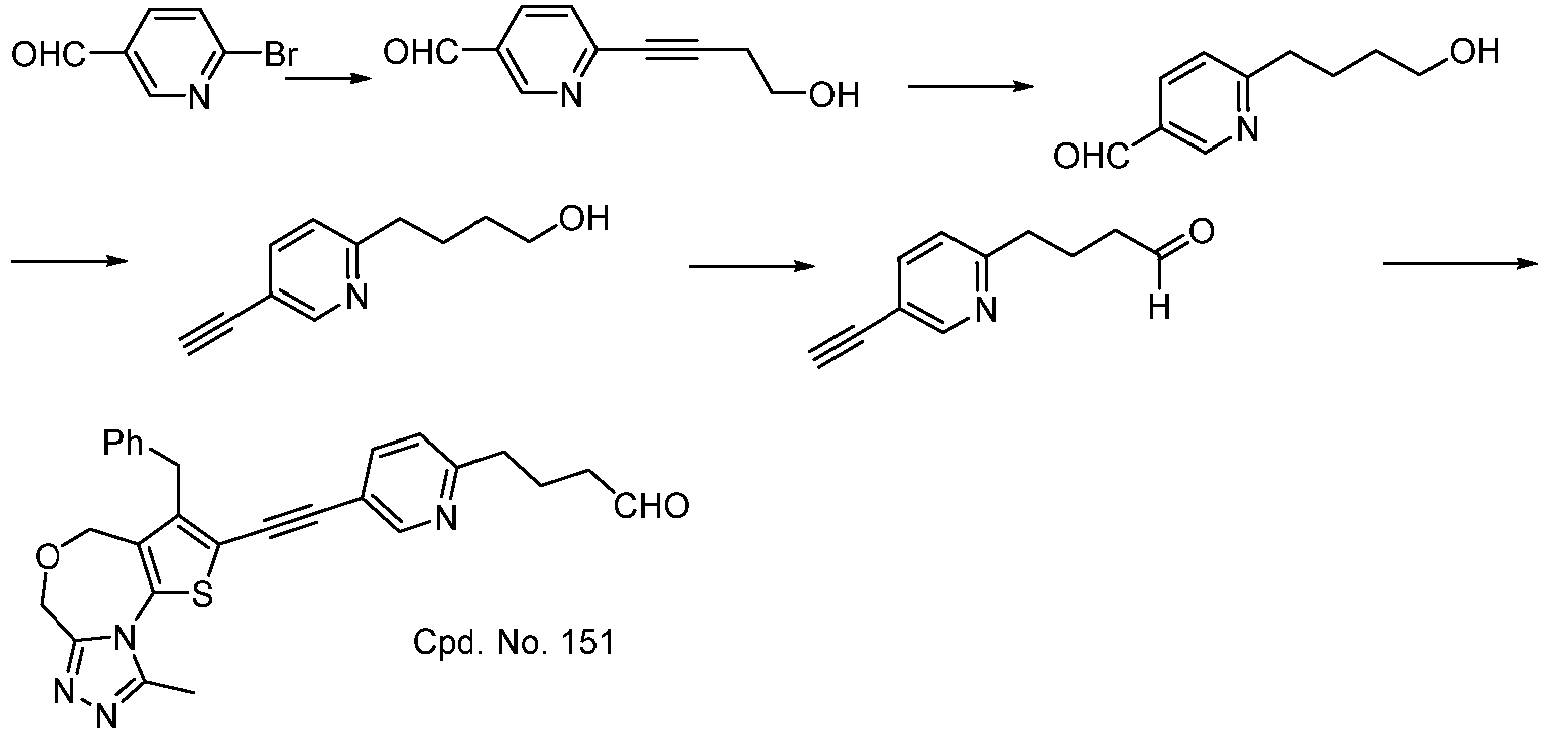
- Step 1: To a flask was added CuI (19 mg, 0.1 mmol), Pd(Ph3P)2Cl2 (70 mg, 0.1 mmol), 6-bromonicotinaldehyde (1.86g, 10 mmol), and but-3-yn-1-ol (1.1 mL, 15 mmol), THF(25 mL) and Et3N (3 mL). The reaction mixture was heated at 60 °C for 12 hours. The reaction mixture was cooled and treated with EtOAc and brine. The organic layer was separated, dried, and evaporated. The residue was purified by chromatography (EtOAc) to afford 6-(4-hydroxybut-1-yn-1-yl)nicotinaldehyde (1.7g, 99% yield).
- Step 2: To a solution of 6-(4-hydroxybut-1-yn-1-yl)nicotinaldehyde (1.7 g, 10 mmol) in MeOH (50 mL) was added 10% Pd/C (200 mg). The reaction was stirred under H2 balloon for 4 h prior to being filtered. The organic solvent was removed and the residue was purified by chromatography (EtOAc) to afford 6-(4-hydroxybutyl)nicotinaldehyde (927mg, 52%). 1H NMR (400 MHz, CDCl3) δ 10.04 (s, 1H), 8.93 (d, J = 1.9 Hz, 1H), 8.07 (dd, J = 8.0, 2.1 Hz, 1H), 7.33 (d, J = 8.0 Hz, 1H), 3.66 (t, J = 6.4 Hz, 2H), 3.02 - 2.63 (m, 4H), 1.93 - 1.73 (m, 2H), 1.68 - 1.52 (m, 2H).
- Step 3: To a solution of 6-(4-hydroxybutyl)nicotinaldehyde(627 mg, 3.5 mmol) and dimethyl (1-diazo-2-oxopropyl)phosphonate (807 mg, 4.2 mmol) in methanol (50 mL) was added K2CO3 (966 mg, 7 mmol). The reaction mixture was stirred for 12 hours. The reaction mixture was evaporated and treated with EtOAc and brine. The organic layer was separated, dried, and evaporated. The residue was purified by chromatography (Hexanes:EtOAc 2:1) to give 4-(5-ethynylpyridin-2-yl)butan-1-ol (500 mg, 80%). 1H NMR (400 MHz, CDCl3) δ 8.59 (s, 1H), 7.67 (dd, J = 8.0, 1.9 Hz, 1H), 7.12 (d, J = 7.9 Hz, 1H), 3.65 (t, J = 6.4 Hz, 2H), 3.18 (s, 1H), 2.87 (s, 1H), 2.84 - 2.68 (m, 2H), 1.80 (dt, J = 15.3, 7.5 Hz, 2H), 1.61 (dt, J = 13.4, 6.5 Hz, 2H).
- Step 4: 4-(5-ethynylpyridin-2-yl)butan-1-ol (400 mg, 2.3 mmol) was dissolved in DMSO (9 mL) and Et3N (6 mL). SO3·pyridine complex (1.08 g, 6.8 mmol) was then added. The reaction mixture was stirred for 3 h prior to being quenched with water. The reaction mixture was extracted with EtOAc. The organic layer was separated, washed with brine, dried, and evaporated. The residue was purified by chromatography (EtOAc/Hexanes: 1:2) to afford 4-(5-ethynylpyridin-2-yl)butanal. (350 mg, 87%). 1H NMR (400 MHz, CDCl3) δ 9.74 (s, 1H), 8.61 (d, J = 1.7 Hz, 1H), 7.67 (dd, J = 8.0, 2.2 Hz, 1H), 7.10 (d, J = 8.0 Hz, 1H), 3.18 (s, 1H), 2.81 (t, J = 7.2 Hz, 2H), 2.48 (t, J = 7.2 Hz, 2H), 2.03-1.98 (m, 2H).
- Step 5: To a Schlenk tube was added CuI (9.5 mg), Pd(Ph3P)2Cl2 (35 mg), 4-(5-ethynylpyridin-2-yl)butanal (170mg, 1 mmol), and L12 (180 mg, 0.5 mmol), THF (6 mL) and Et3N (1.5 mL). The reaction mixture was heated at 60°C for 12 hours. The reaction mixture was cooled and treated with EtOAc and brine. The organic layer was separated, dried, and evaporated. The residue was purified by HPLC to afford Cpd. No. 151 (231 mg, 92% yield). 1H NMR (400 MHz, MeOD) δ 9.14 (s, 1H), 8.80 (s, 1H), 8.48 (dd, J = 8.3, 1.8 Hz, 1H), 8.29 (td, J = 8.1, 2.0 Hz, 1H), 7.92 (d, J = 8.4 Hz, 1H), 7.74 (t, J = 7.6 Hz, 1H), 7.38 - 7.30 (m, 3H), 7.27-7.20 (m, 2H), 4.80 - 4.73 (m, 4H), 4.22 (s, 2H), 3.10 - 2.97 (m, 2H), 2.80 (s, 3H), 2.21 - 2.07 (m, 2H), 1.86-1.80 (m, 2H), 1.67-1.60 (m, 2H).ESI-MS: 468.92.
-

- To a round-bottom flask containing Cpd. No. 31 (25 mg), 4-ethynyl-1-methyl-1H-pyrazole (16 mg), Pd(PPh3)Cl2 (13.5 mg) and CuI (7.3 mg), Et3N (0.5 mL) and THF (1 mL) was added under N2 atmosphere. The reaction mixture was heated at 60 °C for 10 h. The reaction was cooled, taken up with saturated NaHCO3, and extracted with EtOAc. The organic layers were combined and washed with brine, dried over anhydrous sodium sulfate, and concentrated on a rotary evaporator. The residues were purified by reverse phase HPLC. Cpd. No. 152 was isolated (13 mg) as a salt of CF3CO2H. ESI-MS calculated for C23H19N4OS [M+H]+ = 402.14; Observed: 402.1.
-

- To a Shlenk tube was charged with Cpd. No. 119 (50 mg), 2,4,4,5,5-pentamethyl-1,3,2-dioxaborolane (36 mg, 2 eq), Pd2(dba)3 (13 mg), PCy3 (8.5 mg), dioxane (2 mL) and Na2CO3 solution (2 M, 1.0 mL) under N2. The tube was sealed and heated at 100 °C in an oil bath for 4 h. The reaction mixture was extracted with EtOAc and the organic layer was washed with brine, dried and concentrated. The residue was purified by HPLC to afford Cpd. No. 154 (30% yield). 1H NMR (400 MHz, MeOD) δ 7.33-7.10 (m, 5H), 4.79 (d, J = 16.0 Hz, 1H), 4.67-4.55 (m, 2H), 4.00 (d, J = 16.1 Hz, 1H), 3.89 (d, J = 16.6 Hz, 1H), 2.81 (s, 3H), 2.52 (s, 3H), 1.67 (d, , J = 6.7 Hz 3H). ESI: M+H 326.12.
- Fluorescence Polarization (FP) competitive binding studies were carried out using a FAM labeled fluorescent probe, see Cpd. No. 350 of
US 2014/0256706 , to determine binding affinities of representative Compounds of the Disclosure for recombinant BRD4 BD1 and BRD4 BD2 proteins. See Table 2. Equilibrium dissociation constants (Kd) values of the fluorescent probe to BRD4 BD1 and BD2 proteins were determined from protein saturation experiments by monitoring the total fluorescence polarization of mixtures composed with the fluorescent probe at a fixed concentration and proteins with increasing concentrations up to full saturation. Serial dilutions of testing proteins were mixed with the fluorescent probe to a final volume of 200 µ1 in the assay buffer (100 mM phosphate buffer, pH = 6.5, 0.01% Triton X-100 (Sigma, 282103) being added right before assays). Final fluorescent probe concentration was 1.5 nM for both proteins. Plates were incubated at room temperature for 30 minutes with gentle shaking to assure equilibrium. FP values in millipolarization units (mP) were measured using the Infinite M-1000 plate reader (Tecan U.S., Research Triangle Park, NC) in Microfluor 1 96-well, black, round-bottom plates (Thermo Scientific, Waltham, MA) at an excitation wavelength of 485 nm and an emission wavelength of 530 nm. Kd values of the fluorescent probe, which were calculated by fitting the sigmoidal dose-dependent FP increases as a function of protein concentrations using Graphpad Prism 6.0 software (Graphpad Software, San Diego, CA), are 5.5 and 3.0 nM to BDR4 BD1 and 2, respectively. - The IC50 and Ki values of compounds were determined in a competitive binding experiment. See
US 2014/0256706 . Mixtures of 10 µl of the tested compounds in assay buffer with 40% Ethylene Glycol and 190 µl of preincubated protein/probe complex solution in the assay buffer (100mM potassium phosphate, pH 6.5, 0.01% Triton X-100) were added into assay plates which were incubated at room temperature for 30 minutes with gentle shaking. Final concentrations of proteins were 10 and 6 nM in assays for BRD4 BD1 and BD2, respectively. Final probe concentration is 1.5 nM in both assays. Negative controls containing protein/probe complex only (equivalent to 0% inhibition), and positive controls containing only free probes (equivalent to 100% inhibition), were included in each assay plate. FP values were measured as described above. IC50 values were determined by nonlinear regression fitting of the competition curves. Instead of being calculated from IC50 values as described before. Ki values of competitive inhibitors were obtained directly by nonlinear regression fitting as well, based upon the Kd values of the probe to different proteins, and concentrations of the proteins and probes in the competitive assays (US 2014/0256706 ; Wang, FEBS Lett.360; 111 (1995); Zhang et al., Analytical Biochemistry, 331;138 (2004)).Table 2 Cpd. No. IC50 (nM) BRD4 BD1 BRD4 BD2 1 66880 2 23161 3 13335 4 84.9, 63.4, 90.2 133, 164, 134 5 1369 1067 6 317, 629 346, 457 7 171, 311 1162, 1262 8 311 285 9 88.4 271 10 263 312 12 371 328, 379 13 1073, 1203 1206, 1352 14 85, 112 118, 145 15 531, 751 102, 111 16 229 326 17 1084 622 18 532 601 19 2428 3212 20 235, 340 636, 1212 21 23763 17688 22 6061 5921 23 2498 9006 24 491 492 25 942 1103 26 9596 4457 27 611 2615 28 772 749 29 1465 5862 30 1390 31 209, 265, 352 32 294 33 74.6 35 602 36 > 10000 > 10000 37 14488 1457 38 1424, 1257 367 39 5451 1061 41 17957 16630 42 10315 5016 43 3525 328 44 4402 238 45 1546 1368 46 807 268 47 1197 303 48 454, 696 71.6, 137 49 2348, 1817 271, 175 50 425, 585 146, 247 51 256 207 52 > 10000 > 10000 53 244 54 210 127 55 288 56 134 57 198 58 289 59 966 60 1146 70 > 10000 71 864 72 2073, 1979 73 234,366 74 1784 75 923 76 937 77 13208 78 1322 79 18117 80 532 81 5419 82 500 83 150 85 7.3, 8.1 48.3, 60.3 86 14.4 111 87 11.6 174 88 11.0 105 89 8.7 315 90 6514 91 153 92 211 93 551 94 1053 95 1818 96 48.8, 37.8 232 97 6712 98 8999 99 367 100 208 101 832 102 222 103 115, 70.4 213 104 313 105 279 106 283 107 494 108 5000 109 99.6, 93.8 125, 120 110 634 2320 111 5.4, 10.5, 12.9 112, 142, 127 112 1373, 2615, 1764 3229, 3850, 3955 113 26.9, 40.0 146, 149 114 249 297 115 170 338 117 118 147 48560 83706 - Binding affinities to BRD2 BD1 and BD2, BRD3 BD1 and BD2, and BRD4 BD1 and BD2 can also be determined by a label free binding assay using the OctetRED label free biolayer interferometry (BLI) binding assay.
- The effect of representative Compounds of the Disclosure on cell viability was determined in a 4-day proliferation assay. See Table 3. Cells were maintained in the appropriate culture medium with 10% FBS at 37°C and an atmosphere of 5% CO2. All the cell lines were used within three months of thawing fresh vials.
- Cells were seeded in 96-well flat bottom (Corning COSTAR, Corning, NY, cat# 3595) or white opaque cell culture plates (BD Falcon, cat# 353296) at a density of 3,000-10,000 cells/well in 75 µl of culture medium. Compounds were serially diluted in the appropriate medium, and 75 µl of the diluted compounds were added to the appropriate wells of the cell plate. After the addition of compounds, the cells were incubated at 37°C in an atmosphere of 5% CO2 for 4 days. Cell viability was determined using the CellTiter-Glo® Luminescent Cell Viability Assay Kit (Promega, Madison, WI) for leukemia cells and WST (2-(2-methoxy-4-nitrophenyl)-3-(4-nitrophenyl)-5-(2,4-disulfophenyl)-2H-tetrazolium, monosodium salt) Cell Counting-8 Kit (Dojindo Molecular Technologies, Inc., Rockville, MD) for adhenrent cells according to the manufacturers' instructions.
- For WST assay (adherent cells), WST-8 reagent was added to each well at a final concentration of 10% (v/v), and then the plates were incubated at 37°C for 1-2 hours for color development. The absorbance was measured at 450 nm using a SPECTRAmax PLUS plate reader (Molecular Devices, Sunnyvale, CA). The readings were normalized to the DMSO-treated cells and the half maximal inhibitory concentration (IC50) was calculated by nonlinear regression (four parameters sigmoid fitted with variable slope, least squares fit, and no constraint) analysis using the GraphPad Prism 5 software (GraphPad Software, La Jolla, CA).
- For CellTiter-Glo assay (suspension cells), 100 µl of CellTiter-Glo® Reagent was added to each well, and then the plates were incubated at room temperature for 10-20 minutes. The luminescent signal was measured using a Tecan Infinite M1000 multimode microplate reader (Tecan, Morrisville, NC). The readings were normalized to the DMSO-treated cells and the IC50 was calculated by nonlinear regression (four parameters sigmoid fitted with variable slope, least squares fit, and no constraint) analysis using the GraphPad Prism 5 software. See
US 2014/0256706 .Table 3 Cpd No. Cell Viability (IC50, µM) RS4-11 MOLM-13 4 1.7 0.8, 0.9 5 >5 6 4.5 >5 7 4.2 2.8 8 2.5 9 1.0 10 3.4 12 4.7 4.0 14 2.4 1.9 15 2.7 2.0 16 2.8 18 4.3 20 1.3 24 3.4 27 >5 28 4.7 31 1.4, 1.7 32 1.9 33 1.0 34 1.0 35 2.2 46 2.9 48 1.4 49 >5 50 2.7 71 3.8 73 1.1 84 1.0 0.7 85 0.14, 0.12 0.16, 0.10 86 0.20 0.14 87 0.21 0.14 88 0.25 0.12 89 0.62 0.28 91 1.2 1.2 92 1.6 1.6 93 >5 >5 96 0.4, 0.34 0.3, 0.25 99 2.2 2.9 100 2.3 2.4 101 3.6 >5 102 2.6 3.9 103 1.0, 0.95 1.1,0.67 106 1.5 2.6 109 1.0, 1.0 1.1,0.81 110 3.5 3.8 111 0.18,0.25 0.15,0.38 113 0.24, 0.45 0.19, 0.67 - For in vivo efficacy experiments for MDA-MB-231, see
Fig. 1 , 5 × 10⁶ tumor cells with 50% Matrigel were subcutaneously injected on the dorsal side of SCID mice from Charles River, one tumor per mouse. When xenograft tumors reached a mean of 100-200 mm3, mice were randomized into groups of 6-8 mice. Vehicle Control (PEG200) or experimental compound was administered orally (p.o.) once per day for indicated dose and duration. Tumor sizes and animal weights were measured 2-3 times per week. Data are represented as mean tumor volumes. Tumor volume (mm3) = (A×B2)/2 where A and B are the tumor length and width (in mm), respectively. Statistical analyses were done by two-way ANOVA and unpaired two-tailed t test, using Prism (version 6.1, GraphPad). P < 0.05 was considered statistically significant. Animal weight was also measured. SeeFig. 2 . All animal experiments were performed under the guidelines of the University of Michigan Committee for Use and Care of Animals. - Having now fully described the methods, compounds, and compositions of matter provided herein, it will be understood by those of skill in the art that the same can be performed within a wide and equivalent range of conditions, formulations, and other parameters without affecting the scope of the methods, compounds, and compositions provided herein or any embodiment thereof.
Claims (15)
- A compound having Formula II:

wherein:R1 is C1-4 alkyl;R2a and R2b are each independently selected from the group consisting of hydrogen and C1-4 alkyl, orR2a and R2b together with the carbon atom to which they are attached form a 3- to 6-membered cycloalkyl;R3a and R3b are each independently selected from the group consisting of hydrogen and C1-4 alkyl;R4 is selected from the group consisting of alkyl substituted with one, two, or three optionally substituted aryl groups and optionally substituted C3-7 cycloalkyl;R5 is selected from the group consisting of hydrogen, halogen, C1-4 alkyl, optionally substituted C2-4 alkynyl, and substituted 5- to 14-membered heteroaryl; andY is -O-. - The compound of claim 1, wherein R2a and R2b are each independently selected from the group consisting of hydrogen and C1-4 alkyl, and R3a and R3b are hydrogen, or a pharmaceutically acceptable salt or hydrate thereof.
- The compound of claim 1 having Formula V:

- The compound of claim 3, wherein R2a is C1-4 alkyl, or a pharmaceutically acceptable salt or hydrate thereof
- The compound of claim 1, wherein R4 is optionally substituted C3-7 cycloalkyl selected from the group consisting of:


- The compound of any one of claims 1-4, wherein R4 is alkyl substituted with one, two, or three optionally substituted aryl groups or a pharmaceutically acceptable salt or hydrate thereof.
- The compound of claim 1 having Formula VIII:
 R2a is selected from the group consisting of hydrogen and C1-3 alkyl;R16 is selected from the group consisting of hydroxyalkyl, optionally substituted aryl, and optionally substituted heteroaryl; andR17a is selected from the group consisting of hydrogen and halo.
 - The compound of claim 7, or a pharmaceutically acceptable salt or hydrate thereof, wherein R16 is optionally substituted heteroaryl.
- A compound according to claim 1 having Formula XI:
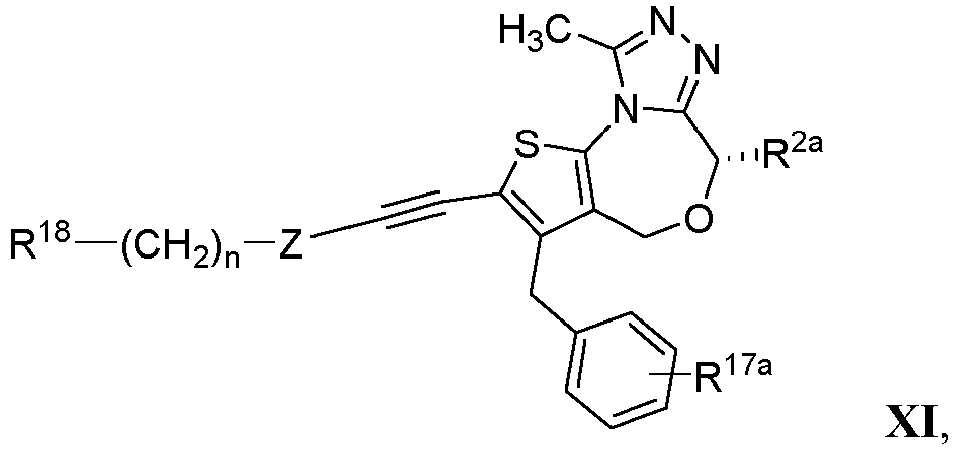 R2a is selected from the group consisting of hydrogen and C1-3 alkyl;Z is heteroarylenyl;R17a is selected from the group consisting of hydrogen and halo;R18 is selected from the group consisting of -CHO, -CO2H, -OH, and halo; andn is 0, 1, 2, 3, 4, 5, or 6.
 - A compound, or a pharmaceutically acceptable salt or hydrate thereof, selected from the group consisting of:2,9-dimethyl-4H,6H-thieno[2,3-e][1,2,4]triazolo[3,4-c][1,4]oxazepine;3-bromo-2,9-dimethyl-4H,6H-thieno[2,3-e][1,2,4]triazolo[3,4-c][1,4]oxazepine;2,9-dimethyl-3-phenyl-4H,6H-thieno[2,3-e][1,2,4]triazolo[3,4-c][1,4]oxazepine;3-benzyl-2,9-dimethyl-4H,6H-thieno[2,3-e][1,2,4]triazolo[3,4-c][1,4]oxazepine;2,9-dimethyl-3-(quinolin-4-yl)-4H,6H-thieno[2,3-e][1,2,4]triazolo[3,4-c][1,4]oxazepine;2,9-dimethyl-N-phenyl-4H,6H-thieno[2,3-e][1,2,4]triazolo[3,4-c][1,4]oxazepin-3-amine;N-(3-cyclopropyl-1-methyl-1H-pyrazol-5-yl)-2,9-dimethyl-4H,6H-thieno[2,3-e][1,2,4]triazolo[3,4-c][1,4]oxazepin-3-amine;3-(3-chlorobenzyl)-2,9-dimethyl-4H,6H-thieno[2,3-e][1,2,4]triazolo[3,4-c][1,4]oxazepine;3-(4-chlorobenzyl)-2,9-dimethyl-4H,6H-thieno[2,3-e][1,2,4]triazolo[3,4-c][1,4]oxazepine;3-(2-chlorobenzyl)-2,9-dimethyl-4H,6H-thieno[2,3-e][1,2,4]triazolo[3,4-c][1,4]oxazepine;2,9-dimethyl-3-(1-phenylethyl)-4H,6H-thieno[2,3-e][1,2,4]triazolo[3,4-c][1,4]oxazepine;3-benzyl-9-methyl-4H,6H-thieno[2,3-e][1,2,4]triazolo[3,4-c][1,4]oxazepine;3-benzyl-2-bromo-9-methyl-4H,6H-thieno[2,3-e][1,2,4]triazolo[3,4-c][1,4]oxazepine;5-(3-benzyl-9-methyl-4H,6H-thieno[2,3-e][1,2,4]triazolo[3,4-c][1,4]oxazepin-2-yl)pyridin-2-amine;3-benzyl-2-ethynyl-9-methyl-4H,6H-thieno[2,3-e][1,2,4]triazolo[3,4-c][1,4]oxazepine;7-bromo-1-methyl-4H,6H-benzo[e][1,2,4]triazolo[3,4-c][1,4]oxazepine;1-methyl-N-phenyl-4H,6H-benzo[e][1,2,4]triazolo[3,4-c][1,4]oxazepin-7-amine;7-benzyl-1-methyl-4H,6H-benzo[e][1,2,4]triazolo[3,4-c][1,4]oxazepine;1-methyl-7-(phenylthio)-4H,6H-benzo[e][1,2,4]triazolo[3,4-c][1,4]oxazepine;1-methyl-7-phenoxy-4H,6H-benzo[e][1,2,4]triazolo [3,4-c][1,4]oxazepine;7-((λ1-oxidanyl)(phenyl)-λ3-sulfanyl)-1-methyl-4H,6H-benzo[e][1,2,4]triazolo[3,4-c][1,4]oxazepine;1-methyl-7-(phenylsulfonyl)-4H,6H-benzo[e][1,2,4]triazolo[3,4-c][1,4]oxazepine;1-methyl-7-(1-phenylvinyl)-4H,6H-benzo[e][1,2,4]triazolo[3,4-c][1,4]oxazepine;7-(1H-inden-3-yl)-1-methyl-4H,6H-benzo[e][1,2,4]triazolo[3,4-c][1,4]oxazepine;1-methyl-7-(4-(trifluoromethoxy)benzyl)-4H,6H-benzo[e][1,2,4]triazolo[3,4-c][1,4]oxazepine;1-methyl-7-(1-phenylethyl)-4H,6H-benzo[e][1,2,4]triazolo[3,4-c][1,4]oxazepine;7-(2,3-dihydro-1H-inden-1-yl)-1-methyl-4H,6H-benzo[e][1,2,4]triazolo[3,4-c][1,4]oxazepine;1-methyl-7-(1-phenylcyclopropyl)-4H,6H-benzo[e][1,2,4]triazolo[3,4-c][1,4]oxazepine;7-(3,4-dihydronaphthalen-1-yl)-1-methyl-4H,6H-benzo[e][1,2,4]triazolo[3,4-c][1,4]oxazepine;1-methyl-7-(1,2,3,4-tetrahydronaphthalen-1-yl)-4H,6H-benzo[e][1,2,4]triazolo[3,4-c][1,4]oxazepine;3-(3,4-dihydronaphthalen-1-yl)-2,9-dimethyl-4H,6H-thieno[2,3-e][1,2,4]triazolo[3,4-c][1,4]oxazepine;(1-methyl-4H,6H-benzo[e][1,2,4]triazolo[3,4-c][1,4]oxazepin-7-yl)(phenyl)methanone;3-(1H-inden-3-yl)-2,9-dimethyl-4H,6H-thieno[2,3-e][1,2,4]triazolo[3,4-c][1,4]oxazepine;2,9-dimethyl-3-(1,2,3,4-tetrahydronaphthalen-1-yl)-4H,6H-thieno[2,3-e][1,2,4]triazolo[3,4-c][1,4]oxazepine;3-(2,3-dihydro-1H-inden-1-yl)-2,9-dimethyl-4H,6H-thieno[2,3-e][1,2,4]triazolo[3,4-c][1,4]oxazepine;3-(6,7-dihydro-5H-benzo[7]annulen-9-yl)-2,9-dimethyl-4H,6H-thieno[2,3-e][1,2,4]triazolo[3,4-c][1,4]oxazepine;3-(6-fluoro-3,4-dihydronaphthalen-1-yl)-2,9-dimethyl-4H,6H-thieno[2,3-e][1,2,4]triazolo[3,4-c][1,4]oxazepine;3-(7-fluoro-3,4-dihydronaphthalen-1-yl)-2,9-dimethyl-4H,6H-thieno[2,3-e][1,2,4]triazolo[3,4-c] [1,4]oxazepine;7-(6,7-dihydro-5H-benzo[7]annulen-9-yl)-1-methyl-4H,6H-benzo[e][1,2,4]triazolo[3,4-c][1,4]oxazepine;1-methyl-7-(6,7,8,9-tetrahydro-5H-benzo[7]annulen-5-yl)-4H,6H-benzo[e][1,2,4]triazolo[3,4-c][1,4]oxazepine;7-(6-fluoro-1,2,3,4-tetrahydronaphthalen-l-yl)-1-methyl-4H,6H-benzo[e][1,2,4]triazolo[3,4-c][1,4]oxazepine;7-(7-fluoro-1,2,3,4-tetrahydronaphthalen-l -yl)-1 -methyl-4H,6H-benzo[e][1,2,4]triazolo[3,4-c][1,4]oxazepine;2,9-dimethyl-3-(6,7,8,9-tetrahydro-5H-benzo[7]annulen-5-yl)-4H,6H-thieno[2,3-e][1,2,4]triazolo[3,4-c][1,4]oxazepine;3-(6-fluoro-1,2,3,4-tetrahydronaphthalen-1-yl)-2,9-dimethyl-4H,6H-thieno[2,3-e] [1,2,4]triazolo[3,4-c][1,4]oxazepine;3-(7-fluoro-1,2,3,4-tetrahydronaphthalen-1-yl)-2,9-dimethyl-4H,6H-thieno[2,3-e][1,2,4]triazolo[3,4-c][1,4]oxazepine;2',9'-dimethyl-3'-(1,2,3,4-tetrahydronaphthalen-1-yl)-4'H-spiro[cyclopropane-1,6'-thieno[2,3-e][1,2,4]triazolo[3,4-c][1,4]oxazepine;8-chloro-1-methyl-7-(1,2,3,4-tetrahydronaphthalen-1-yl)-4H,6H-benzo[e][1,2,4]triazolo[3,4-c][1,4]oxazepine;1-methyl-8-(1-methyl-1H-pyrazol-4-yl)-7-(1,2,3,4-tetrahydronaphthalen-1-yl)-4H,6H-benzo[e][1,2,4]triazolo[3,4-c][1,4]oxazepine;5-(1-methyl-7-(1,2,3,4-tetrahydronaphthalen-1-yl)-4H,6H-benzo[e][1,2,4]triazolo[3,4-c][1,4]oxazepin-8-yl)pyridin-2-amine;7-bromo-8-chloro-1-methyl-4H,6H-benzo[e][1,2,4]triazolo[3,4-c][1,4]oxazepine;7-benzyl-8-chloro-1-methyl-4H,6H-benzo[e][1,2,4]triazolo[3,4-c][1,4]oxazepine;5-(7-benzyl-1-methyl-4H,6H-benzo[e][1,2,4]triazolo[3,4-c][1,4]oxazepin-8-yl)pyridin-2-amine;7-benzyl-1-methyl-8-(1-methyl-1H-pyrazol-4-yl)-4H,6H-benzo[e][1,2,4]triazolo[3,4-c][1,4]oxazepine;8-chloro-7-(3,4-dihydronaphthalen-1-yl)-1-methyl-4H,6H-benzo[e][1,2,4]triazolo[3,4-c][1,4]oxazepine;7-benzyl-1-methyl-8-(1H-pyrazol-4-yl)-4H,6H-benzo[e][1,2,4]triazolo[3,4-c][1,4]oxazepine;2-(4-(7-benzyl-1-methyl-4H,6H-benzo[e][1,2,4]triazolo[3,4-c][1,4]oxazepin-8-yl)-1H-pyrazol-1-yl)acetamide;7-benzyl-8-(3,6-dihydro-2H-pyran-4-yl)-1-methyl-4H,6H-benzo[e][1,2,4]triazolo[3,4-c][1,4]oxazepine;7-benzyl-8-(4,5-dihydrofuran-3-yl)-1-methyl-4H,6H-benzo[e][1,2,4]triazolo[3,4-c][1,4]oxazepine;7-benzyl-1-methyl-8-(tetrahydro-2H-pyran-4-yl)-4H,6H-benzo[e][1,2,4]triazolo[3,4-c][1,4]oxazepine;7-benzyl-8-(furan-3-yl)-1-methyl-4H,6H-benzo[e][1,2,4]triazolo[3,4-c][1,4]oxazepine;7-benzyl-1-methyl-8-(tetrahydrofuran-3-yl)-4H,6H-benzo[e][1,2,4]triazolo[3,4-c][1,4]oxazepine;7-benzyl-1-methyl-8-((trimethylsilyl)ethynyl)-4H,6H-benzo[e][1,2,4]triazolo[3,4-c][1,4]oxazepine;7-benzyl-8-ethynyl-1-methyl-4H,6H-benzo[e][1,2,4]triazolo[3,4-c][1,4]oxazepine;4-(7-benzyl-1-methyl-4H,6H-benzo[e][1,2,4]triazolo[3,4-c][1,4]oxazepin-8-yl)but-3-yn-1-ol;(S)-3-benzyl-6,9-dimethyl-2-((1-methyl-1H-pyrazol-4-yl)ethynyl)-4H,6H-thieno[2,3-e][1,2,4]triazolo[3,4-c][1,4]oxazepine;3-benzyl-9-methyl-2-((1-methyl-1H-imidazol-5-yl)ethynyl)-4H,6H-thieno[2,3-e][1,2,4]triazolo[3,4-c][1,4]oxazepine;3-benzyl-9-methyl-2-(pyridin-4-ylethynyl)-4H,6H-thieno[2,3-e][1,2,4]triazolo[3,4-c][1,4]oxazepine;3-benzyl-9-methyl-2-(pyridin-3-ylethynyl)-4H,6H-thieno[2,3-e][1,2,4]triazolo[3,4-c][1,4]oxazepine;5-((3-benzyl-9-methyl-4H,6H-thieno[2,3-e][1,2,4]triazolo[3,4-c][1,4]oxazepin-2-yl)ethynyl)pyridin-2-amine;3-benzyl-9-methyl-2-(morpholinomethyl)-4H,6H-thieno[2,3-e][1,2,4]triazolo[3,4-c][1,4]oxazepine;3-benzyl-9-methyl-2-(1H-pyrazol-4-yl)-4H,6H-thieno[2,3-e][1,2,4]triazolo[3,4-c][1,4]oxazepine;3-benzyl-9-methyl-2-(1-methyl-1H-pyrazol-4-yl)-4H,6H-thieno[2,3-e][1,2,4]triazolo[3,4-c][1,4]oxazepine;3-benzyl-2-cyclopropyl-9-methyl-4H,6H-thieno[2,3-e][1,2,4]triazolo[3,4-c][1,4]oxazepine;3-benzyl-9-methyl-2-(prop-1-en-2-yl)-4H,6H-thieno[2,3-e][1,2,4]triazolo[3,4-c][1,4]oxazepine;3-benzyl-2-(3,6-dihydro-2H-pyran-4-yl)-9-methyl-4H,6H-thieno[2,3-e][1,2,4]triazolo[3,4-c][1,4]oxazepine;4-(3-benzyl-9-methyl-4H,6H-thieno[2,3-e][1,2,4]triazolo[3,4-c][1,4]oxazepin-2-yl)but-3-yn-1-ol;3-benzyl-9-methyl-2-(tetrahydro-2H-pyran-4-yl)-4H,6H-thieno[2,3-e][l,2,4]triazolo[3,4-c][1,4]oxazepine;3-benzyl-2-isopropyl-9-methyl-4H,6H-thieno[2,3-e][1,2,4]triazolo[3,4-c][1,4]oxazepine;4-(3-benzyl-9-methyl-4H,6H-thieno[2,3-e][1,2,4]triazolo[3,4-c][1,4]oxazepin-2-yl)butan-1-ol;3-(3-fluorobenzyl)-2,9-dimethyl-4H,6H-thieno[2,3-e][1,2,4]triazolo[3,4-c][1,4]oxazepine;3-((2,9-dimethyl-4H,6H-thieno[2,3-e][1,2,4]triazolo[3,4-c][1,4]oxazepin-3-yl)methyl) benzonitrile;3-(2-fluorobenzyl)-2,9-dimethyl-4H,6H-thieno[2,3-e][1,2,4]triazolo[3,4-c][1,4]oxazepine;3-(4-fluorobenzyl)-2,9-dimethyl-4H,6H-thieno[2,3-e][1,2,4]triazolo[3,4-c][1,4]oxazepine;3-(3,5-difluorobenzyl)-2,9-dimethyl-4H,6H-thieno[2,3-e][1,2,4]triazolo[3,4-c][1,4]oxazepine;3-(3,4-difluorobcnzyl)-2,9-dimethyl-4H,6H-thieno[2,3-e][1,2,4]triazolo[3,4-c][1,4]oxazepine;3-((1H-indol-1-yl)methyl)-2,9-dimethyl-4H,6H-thieno[2,3-e][1,2,4]triazolo[3,4-c][1,4]oxazepine;3-((1H-pyrrol-1-yl)methyl)-2,9-dimethyl-4H,6H-thieno[2,3-e][1,2,4]triazolo[3,4-c][1,4]oxazepine;3-(tert-butoxymethyl)-2,9-dimethyl-4H,6H-thieno[2,3-e][1,2,4]triazolo[3,4-c][1,4]oxazepine;3-benzyl-2,6,9-trimethyl-4H,6H-thieno[2,3-e][1,2,4]triazolo[3,4-c][1,4]oxazepine;3-benzyl-9-methyl-4H,6H-thieno[2,3-e][1,2,4]triazolo[3,4-c][1,4]oxazepine-2-carbonitrile;3-(4-fluorobenzyl)-9-methyl-2-((1-methyl-1H-pyrazol-4-yl)ethynyl)-4H,6H-thieno[2,3-e][1,2,4]triazolo[3,4-c][1,4]oxazepine;3-((1H-pyrazol-1-yl)methyl)-2,9-dimethyl-4H,6H-thieno[2,3-e][1,2,4]triazolo[3,4-c][1,4]oxazepine;(S)-4-(3-benzyl-6,9-dimethyl-4H,6H-thieno[2,3-e]1,2,4]triazolo[3,4-c]1,4]oxazepin-2-yl)but-3-yn-1-ol;(R)-3-benzyl-2,6,9-trimethyl-4H,6H-thieno[2,3-e][1,2,4]triazolo[3,4-c][1,4]oxazepine;tert-butyl 2-(3-benzyl-2,9-dimethyl-4H,6H-thieno[2,3-e][1,2,4]triazolo[3,4-c][1,4]oxazepin-6-yl)acetate;1-(1-methyl-4H,6H-benzo[e][1,2,4]triazolo[3,4-c][1,4]oxazepin-7-yl)-1-phenylethane-1,2-diol;(S)-3-bromo-6,9-dimethyl-4H,6H-thieno[2,3-e][1,2,4]triazolo[3,4-c][1,4]oxazepine;(S)-3-benzyl-6,9-dimethyl-4H,6H-thieno[2,3-e][1,2,4]triazolo[3,4-c][1,4]oxazepine;(S)-3-benzyl-2-bromo-6,9-dimethyl-4H,6H-thieno[2,3-e][1,2,4]triazolo[3,4-c][1,4]oxazepine;(S)-3-benzyl-6,9-dimethyl-2-((1-methyl-1H-imidazol-5-yl)ethynyl)-4H,6H-thieno[2,3-e][1,2,4]triazolo[3,4-c][1,4]oxazepine;(S)-3-benzyl-6,9-dimethyl-2-(pyridin-4-ylethynyl)-4H,6H-thieno[2,3-e] [1,2,4]triazolo[3,4-c][1,4]oxazepine;(S)-3-benzyl-6,9-dimethyl-2-(pyridin-3-ylethynyl)-4H,6H-thieno[2,3-e][1,2,4]triazolo[3,4-c][1,4]oxazepine;(S)-5-((3-benzyl-6,9-dimethyl-4H,6H-thieno[2,3-e][1,2,4]triazolo[3,4-c][1,4]oxazepin-2-yl)ethynyl)pyridin-2-amine;(S)-3-(4-fluorobcnzyl)-6,9-dimethyl-4H,6H-thieno[2,3-e][1,2,4]triazolo[3,4-c][1,4]oxazepine;(S)-2-bromo-3-(4-fluorobenzyl)-6,9-dimethyl-4H,6H-thieno[2,3-e][1,2,4]triazolo[3,4-c][1,4]oxazepine;(S)-3-(4-fluorobenzyl)-6,9-dimethyl-2-((1-methyl-1H-pyrazol-4-yl)ethynyl)-4H,6H-thieno[2,3-e][1,2,4]triazolo[3,4-c][1,4]oxazepine;2,9-dimethyl-3-((1-methyl-1H-pyrazol-4-yl)methyl)-4H,6H-thieno[2,3-e][1,2,4]triazolo[3,4-c][1,4]oxazepine;2,3,9-trimethyl-4H,6H-thieno[2,3-e][1,2,4]triazolo[3,4-c][1,4]oxazepine;2,6,9-trimethyl-4H,6H-thieno[2,3-e][1,2,4]triazolo[3,4-c][1,4]oxazepine;3-bromo-2,6,9-trimethyl-4H,6H-thieno[2,3-e][1,2,4]triazolo[3,4-c][1,4]oxazepine; tert-butyl 2-(2,9-dimethyl-4H,6H-thieno[2,3-e][1,2,4]triazolo[3,4-c][1,4]oxazepin-6-yl)acetate;tert-butyl 2-(3-bromo-2,9-dimethyl-4H,6H-thieno[2,3-e][1,2,4]triazolo[3,4-c][1,4]oxazepin-6-yl)acetate;2'-bromo-9'-methyl-4H-spiro[cyclopropane-1,6'-thieno[2,3-e][1,2,4]triazolo[3,4-c][1,4]oxazepine];2',9'-dimethyl-4'H-spiro[cyclopropane-1,6'-thieno[2,3-e][1,2,4]triazolo[3,4-c][1,4]oxazepine];3'-bromo-2',9'-dimethyl-4'H-spiro[cyclopropane-1,6'-thieno[2,3-e][1,2,4]triazolo[3,4-c][1,4]oxazepine];3'-benzyl-2',9'-dimethyl-4'H-spiro[cyclopropane-1,6'-thieno[2,3-e][1,2,4]triazolo[3,4-c][1,4]oxazepine];3-bromo-9-methyl-4H,6H-thieno[2,3-e][1,2,4]triazolo[3,4-c][1,4]oxazepine;3-chloro-9-methyl-4H,6H-thieno[2,3-e][1,2,4]triazolo[3,4-c][1,4]oxazepine;3-(4-fluorobenzyl)-9-methyl-4H,6H-thieno[2,3-e][1,2,4]triazolo[3,4-c][1,4]oxazepine;2-bromo-3-(4-fluorobenzyl)-9-methyl-4H,6H-thieno[2,3-e][1,2,4]triazolo[3,4-c][1,4]oxazepine;(S)-3-chloro-6,9-dimethyl-4H,6H-thieno[2,3-e][1,2,4]triazolo[3,4-c][1,4]oxazepine;(S)-3-(3-benzyl-6,9-dimethyl-4H,6H-thieno[2,3-e][1,2,4]triazolo[3,4-c][1,4]oxazepin-2-yl)-N,N-dimethylprop-2-yn-1-amine;(S)-3-benzyl-2-(3-methoxyprop-1-yn-1-yl)-6,9-dimethyl-4H,6H-thieno[2,3-e][1,2,4]triazolo[3,4-c][1,4]oxazepine;3-benzyl-9-methyl-2-(pyridin-2-ylethynyl)-4H,6H-thieno[2,3-e][1,2,4]triazolo[3,4-c][1,4]oxazepine; and(S)-3-benzyl-6,9-dimethyl-2-(pyridin-2-ylethynyl)-4H,6H-thieno[2,3-e][1,2,4]triazolo[3,4-c][1,4]oxazepine;4-(5-((3-benzyl-9-methyl-4H,6H-thieno[2,3-e][1,2,4]triazolo[3,4-c][1,4]oxazepin-2-yl)ethynyl)pyridin-2-yl)butanal;3-benzyl-9-methyl-2-((1-methyl-1H-pyrazol-4-yl)ethynyl)-4H,6H-thieno[2,3-e][1,2,4]triazolo[3,4-c][1,4]oxazepine;2-((1H-pyrazol-4-yl)ethynyl)-3-benzyl-9-methyl-4H,6H-thieno[2,3-e][1,2,4]triazolo[3,4-c][1,4]oxazepine; and(S)-3-benzyl-2,6,9-trimethyl-4H,6H-thieno[2,3-e][1,2,4]triazolo[3,4-c][l,4]oxazepine.
- A pharmaceutical composition comprising the compound of any one of claims 1-10, or a pharmaceutically acceptable salt or hydrate thereof, and a pharmaceutically acceptable carrier.
- A compound of any one of claims 1-10, or a pharmaceutically acceptable salt or hydrate thereof, for use in the treatment of cancer, a chronic autoimmune disorder, an inflammatory condition, a proliferative disorder, sepsis, or a viral infection.
- The compound for use of claim 12 wherein the use is in treating cancer.
- The compound for use of claim 13, wherein the cancer is selected from the group consisting of adrenal cancer, acinic cell carcinoma, acoustic neuroma, acral lentigious melanoma, acrospiroma, acute eosinophilic leukemia, acute erythroid leukemia, acute lymphoblastic leukemia, acute megakaryoblastic leukemia, acute monocytic leukemia, acute promyelocytic leukemia, adenocarcinoma, adenoid cystic carcinoma, adenoma, adenomatoid odontogenic tumor, adenosquamous carcinoma, adipose tissue neoplasm, adrenocortical carcinoma, adult T-cell leukemia/lymphoma, aggressive NK-cell leukemia, AIDS-related lymphoma, alveolar rhabdomyosarcoma, alveolar soft part sarcoma, ameloblastic fibroma, anaplastic large cell lymphoma, anaplastic thyroid cancer, angioimmunoblastic T-cell lymphoma, angiomyolipoma, angiosarcoma, astrocytoma, atypical teratoid rhabdoid tumor, B-cell chronic lymphocytic leukemia, B-cell prolymphocytic leukemia, B-cell lymphoma, basal cell carcinoma, biliary tract cancer, bladder cancer, blastoma, bone cancer, Brenner tumor, Brown tumor, Burkitt's lymphoma, breast cancer, brain cancer, carcinoma, carcinoma in situ, carcinosarcoma, cartilage tumor, cementoma, myeloid sarcoma, chondroma, chordoma, choriocarcinoma, choroid plexus papilloma, clear-cell sarcoma of the kidney, craniopharyngioma, cutaneous T-cell lymphoma, cervical cancer, colorectal cancer, Degos disease, desmoplastic small round cell tumor, diffuse large B-cell lymphoma, dysembryoplastic neuroepithelial tumor, dysgerminoma, embryonal carcinoma, endocrine gland neoplasm, endodermal sinus tumor, enteropathy-associated T-cell lymphoma, esophageal cancer, fetus in fetu, fibroma, fibrosarcoma, follicular lymphoma, follicular thyroid cancer, ganglioneuroma, gastrointestinal cancer, germ cell tumor, gestational choriocarcinoma, giant cell fibroblastoma, giant cell tumor of the bone, glial tumor, glioblastoma multiforme, glioma, gliomatosis cerebri, glucagonoma, gonadoblastoma, granulosa cell tumor, gynandroblastoma, gallbladder cancer, gastric cancer, hairy cell leukemia, hemangioblastoma, head and neck cancer, hemangiopericytoma, hematological malignancy, hepatoblastoma, hepatosplenic T-cell lymphoma, Hodgkin's lymphoma, non-Hodgkin's lymphoma, invasive lobular carcinoma, intestinal cancer, kidney cancer, laryngeal cancer, lentigo maligna, lethal midline carcinoma, leukemia, leydig cell tumor, liposarcoma, lung cancer, lymphangioma, lymphangiosarcoma, lymphoepithelioma, lymphoma, acute lymphocytic leukemia, acute myelogeous leukemia, chronic lymphocytic leukemia, liver cancer, small cell lung cancer, non-small cell lung cancer, MALT lymphoma, malignant fibrous histiocytoma, malignant peripheral nerve sheath tumor, malignant triton tumor, mantle cell lymphoma, marginal zone B-cell lymphoma, mast cell leukemia, mediastinal germ cell tumor, medullary carcinoma of the breast, medullary thyroid cancer, medulloblastoma, melanoma, meningioma, merkel cell cancer, mesothelioma, metastatic urothelial carcinoma, mixed Mullerian tumor, mucinous tumor, multiple myeloma, muscle tissue neoplasm, mycosis fungoides, myxoid liposarcoma, myxoma, myxosarcoma, nasopharyngeal carcinoma, neurinoma, neuroblastoma, neurofibroma, neuroma, nodular melanoma, ocular cancer, oligoastrocytoma, oligodendroglioma, oncocytoma, optic nerve sheath meningioma, optic nerve tumor, oral cancer, osteosarcoma, ovarian cancer, Pancoast tumor, papillary thyroid cancer, paraganglioma, pinealoblastoma, pineocytoma, pituicytoma, pituitary adenoma, pituitary tumor, plasmacytoma, polyembryoma, precursor T-lymphoblastic lymphoma, primary central nervous system lymphoma, primary effusion lymphoma, preimary peritoneal cancer, prostate cancer, pancreatic cancer, pharyngeal cancer, pseudomyxoma periotonei, renal cell carcinoma, renal medullary carcinoma, retinoblastoma, rhabdomyoma, rhabdomyosarcoma, Richter's transformation, rectal cancer, sarcoma, Schwannomatosis, seminoma, Sertoli cell tumor, sex cord-gonadal stromal tumor, signet ring cell carcinoma, skin cancer, small blue round cell tumors, small cell carcinoma, soft tissue sarcoma, somatostatinoma, soot wart, spinal tumor, splenic marginal zone lymphoma, squamous cell carcinoma, synovial sarcoma, Sezary's disease, small intestine cancer, squamous carcinoma, stomach cancer, T-cell lymphoma, testicular cancer, thecoma, thyroid cancer, transitional cell carcinoma, throat cancer, urachal cancer, urogenital cancer, urothelial carcinoma, uveal melanoma, uterine cancer, verrucous carcinoma, visual pathway glioma, vulvar cancer, vaginal cancer, Waldenstrom's macroglobulinemia, Warthin's tumor, and Wilms' tumor.
- A kit comprising the compound of any one of claims 1-10, or a pharmaceutically acceptable salt or hydrate thereof, and instructions for administering the compound, or a pharmaceutically acceptable salt, hydrate, or solvate thereof, to a patient having cancer, a chronic autoimmune disorder, an inflammatory condition, a proliferative disorder, sepsis, or a viral infection.
Applications Claiming Priority (3)
| Application Number | Priority Date | Filing Date | Title |
|---|---|---|---|
| US201662295271P | 2016-02-15 | 2016-02-15 | |
| US201662393897P | 2016-09-13 | 2016-09-13 | |
| PCT/US2017/017848 WO2017142881A1 (en) | 2016-02-15 | 2017-02-15 | Fused 1,4-oxazepines and related analogs as bet bromodomain inhibitors |
Publications (2)
| Publication Number | Publication Date |
|---|---|
| EP3416969A1 EP3416969A1 (en) | 2018-12-26 |
| EP3416969B1 true EP3416969B1 (en) | 2021-05-05 |
Family
ID=58191613
Family Applications (1)
| Application Number | Title | Priority Date | Filing Date |
|---|---|---|---|
| EP17708046.2A Active EP3416969B1 (en) | 2016-02-15 | 2017-02-15 | Fused 1,4-oxazepines and related analogs as bet bromodomain inhibitors |
Country Status (8)
| Country | Link |
|---|---|
| US (1) | US11548899B2 (en) |
| EP (1) | EP3416969B1 (en) |
| JP (1) | JP6967522B2 (en) |
| CN (1) | CN109071562B (en) |
| AU (1) | AU2017219627B2 (en) |
| CA (1) | CA3014644A1 (en) |
| ES (1) | ES2882066T3 (en) |
| WO (1) | WO2017142881A1 (en) |
Families Citing this family (21)
| Publication number | Priority date | Publication date | Assignee | Title |
|---|---|---|---|---|
| CN110062759B (en) * | 2016-09-13 | 2022-05-24 | 密执安大学评议会 | Fused 1,4-oxazepines as BET protein degraders |
| US11267822B2 (en) | 2017-09-13 | 2022-03-08 | The Regents Of The University Of Michigan | BET bromodomain protein degraders with cleavable linkers |
| CN115466315A (en) * | 2021-06-10 | 2022-12-13 | 首都医科大学 | 1-imidazole-beta-carboline-3-formyl-RGDS for inhibiting invasion, preparation, anti-cancer metastasis effect and application |
| CN116410205B (en) * | 2021-12-29 | 2024-07-05 | 上海皓元生物医药科技有限公司 | Preparation method of 3-substituted-9-methyl-thienotriazolooxazine compound |
| CN121712509A (en) | 2023-05-04 | 2026-03-20 | 锐新医药公司 | Combination therapy for RAS related diseases or conditions |
| US20250049810A1 (en) | 2023-08-07 | 2025-02-13 | Revolution Medicines, Inc. | Methods of treating a ras protein-related disease or disorder |
| IL327306A (en) | 2023-10-12 | 2026-05-01 | Revolution Medicines Inc | Macrocyclic ras inhibitors |
| WO2025171296A1 (en) | 2024-02-09 | 2025-08-14 | Revolution Medicines, Inc. | Ras inhibitors |
| WO2025240847A1 (en) | 2024-05-17 | 2025-11-20 | Revolution Medicines, Inc. | Ras inhibitors |
| WO2025255438A1 (en) | 2024-06-07 | 2025-12-11 | Revolution Medicines, Inc. | Methods of treating a ras protein-related disease or disorder |
| WO2025265060A1 (en) | 2024-06-21 | 2025-12-26 | Revolution Medicines, Inc. | Therapeutic compositions and methods for managing treatment-related effects |
| WO2026006747A1 (en) | 2024-06-28 | 2026-01-02 | Revolution Medicines, Inc. | Ras inhibitors |
| WO2026015796A1 (en) | 2024-07-12 | 2026-01-15 | Revolution Medicines, Inc. | Methods of treating a ras related disease or disorder |
| WO2026015801A1 (en) | 2024-07-12 | 2026-01-15 | Revolution Medicines, Inc. | Methods of treating a ras related disease or disorder |
| WO2026015825A1 (en) | 2024-07-12 | 2026-01-15 | Revolution Medicines, Inc. | Use of ras inhibitor for treating pancreatic cancer |
| WO2026015790A1 (en) | 2024-07-12 | 2026-01-15 | Revolution Medicines, Inc. | Methods of treating a ras related disease or disorder |
| WO2026050446A1 (en) | 2024-08-29 | 2026-03-05 | Revolution Medicines, Inc. | Ras inhibitors |
| WO2026072904A2 (en) | 2024-09-26 | 2026-04-02 | Revolution Medicines, Inc. | Compositions and methods for treating lung cancer |
| WO2026090116A2 (en) | 2024-10-21 | 2026-04-30 | Revolution Medicines, Inc. | Ras inhibitors |
| WO2026090245A1 (en) | 2024-10-22 | 2026-04-30 | Revolution Medicines, Inc. | Use of ras inhibitors for treating cancer |
| US20260108528A1 (en) | 2024-10-22 | 2026-04-23 | Revolution Medicines, Inc. | Methods of treating a ras protein-related disease or disorder |
Family Cites Families (45)
| Publication number | Priority date | Publication date | Assignee | Title |
|---|---|---|---|---|
| US5093330A (en) | 1987-06-15 | 1992-03-03 | Ciba-Geigy Corporation | Staurosporine derivatives substituted at methylamino nitrogen |
| DE69717160T2 (en) | 1996-09-13 | 2003-05-08 | Mitsubishi Pharma Corp., Osaka | THIENOTRIAZOLODIAZEPINE COMPOUNDS AND THEIR MEDICAL APPLICATIONS |
| WO2006129623A1 (en) | 2005-05-30 | 2006-12-07 | Mitsubishi Tanabe Pharma Corporation | Thienotriazolodiazepine compound and a medicinal use thereof |
| DK2118074T3 (en) | 2007-02-01 | 2014-03-10 | Resverlogix Corp | Compounds for the prevention and treatment of cardiovascular diseases |
| US8476260B2 (en) | 2007-12-28 | 2013-07-02 | Mitsubishi Tanabe Pharma Corporation | Antitumor agent |
| EA018612B1 (en) * | 2008-01-24 | 2013-09-30 | Панацеа Биотек Лимитед | Novel heterocyclic compounds |
| KR101629356B1 (en) | 2008-06-26 | 2016-06-13 | 리스버로직스 코퍼레이션 | Methods of preparing quinazolinone derivatives |
| EP2318391A1 (en) * | 2008-07-23 | 2011-05-11 | Schering Corporation | Tricyclic heterocycle derivatives as histamine h3 antagonists |
| US9757368B2 (en) | 2009-04-22 | 2017-09-12 | Resverlogix Corp. | Anti-inflammatory agents |
| DE102009051823A1 (en) | 2009-11-04 | 2011-05-05 | Fraunhofer-Gesellschaft zur Förderung der angewandten Forschung e.V. | Single-crystal welding of directionally solidified materials |
| SI2496582T1 (en) | 2009-11-05 | 2016-04-29 | Glaxosmithkline Llc Corporation Service Company | Benzodiazepine bromodomain inhibitor |
| GB0919434D0 (en) | 2009-11-05 | 2009-12-23 | Glaxosmithkline Llc | Novel compounds |
| GB0919426D0 (en) | 2009-11-05 | 2009-12-23 | Glaxosmithkline Llc | Novel compounds |
| GB0919432D0 (en) | 2009-11-05 | 2009-12-23 | Glaxosmithkline Llc | Use |
| GB0919423D0 (en) | 2009-11-05 | 2009-12-23 | Glaxosmithkline Llc | Novel compounds |
| MX373121B (en) | 2010-05-14 | 2020-04-30 | Dana Farber Cancer Inst Inc | COMPOSITIONS AND METHODS FOR THE TREATMENT OF LEUKEMIA. |
| MX384074B (en) | 2010-05-14 | 2025-03-12 | Dana Farber Cancer Inst Inc | COMPOSITIONS AND METHODS FOR TREATING NEOPLASMS, INFLAMMATORY DISEASES AND OTHER DISORDERS. |
| JP5715241B2 (en) * | 2010-05-14 | 2015-05-07 | ダナ−ファーバー キャンサー インスティテュート, インコーポレイテッド | Compositions and methods for treating neoplasms, inflammatory diseases, and other disorders |
| JP5913292B2 (en) | 2010-05-14 | 2016-04-27 | ダナ−ファーバー キャンサー インスティテュート, インコーポレイテッド | Compositions and methods for modulating metabolism |
| ES2526671T3 (en) | 2010-06-22 | 2015-01-14 | Glaxosmithkline Llc | Compounds of benzotriazoldiazepine bromodomain inhibitors |
| US9249161B2 (en) | 2010-12-02 | 2016-02-02 | Constellation Pharmaceuticals, Inc. | Bromodomain inhibitors and uses thereof |
| AR084070A1 (en) | 2010-12-02 | 2013-04-17 | Constellation Pharmaceuticals Inc | BROMODOMINIUM INHIBITORS AND USES OF THE SAME |
| CA2828212A1 (en) | 2011-02-23 | 2012-08-30 | Shiraz Mujtaba | Inhibitors of bromodomains as modulators of gene expression |
| EP2705039B1 (en) | 2011-05-04 | 2017-07-26 | Constellation Pharmaceuticals, Inc. | Bromodomain inhibitors and uses thereof |
| US9328117B2 (en) | 2011-06-17 | 2016-05-03 | Constellation Pharmaceuticals, Inc. | Bromodomain inhibitors and uses thereof |
| GB201114103D0 (en) | 2011-08-17 | 2011-09-28 | Glaxosmithkline Llc | Novel compounds |
| WO2013027168A1 (en) | 2011-08-22 | 2013-02-28 | Pfizer Inc. | Novel heterocyclic compounds as bromodomain inhibitors |
| WO2013033270A2 (en) | 2011-08-29 | 2013-03-07 | Coferon, Inc. | Bromodomain ligands capable of dimerizing in an aqueous solution, and methods of using same |
| DE102011082013A1 (en) | 2011-09-01 | 2013-03-07 | Bayer Pharma AG | 6H-thieno [3,2-f] [1,2,4] triazolo [4,3-a] [1,4] diazepines |
| WO2013064231A1 (en) | 2011-10-31 | 2013-05-10 | Phenex Pharmaceuticals Ag | SEVEN-MEMBERED SULFONAMIDES AS MODULATORS OF RAR-RELATED ORPHAN RECEPTOR-GAMMA (RORγ, NR1F3) |
| WO2013097052A1 (en) | 2011-12-30 | 2013-07-04 | Abbott Laboratories | Bromodomain inhibitors |
| US20130281399A1 (en) | 2012-04-19 | 2013-10-24 | Rvx Therapeutics Inc. | Treatment of diseases by epigenetic regulation |
| EP2838881B1 (en) | 2012-04-20 | 2018-08-08 | AbbVie Inc. | Isoindolone derivatives |
| WO2013185284A1 (en) | 2012-06-12 | 2013-12-19 | Abbott Laboratories | Pyridinone and pyridazinone derivatives |
| HK1212345A1 (en) * | 2013-02-22 | 2016-06-10 | Bayer Pharma Aktiengesellschaft | 4-substituted pyrrolo- and pyrazolo-diazepines |
| JP6401773B2 (en) | 2013-03-11 | 2018-10-10 | ザ リージェンツ オブ ザ ユニヴァシティ オブ ミシガン | BET bromodomain inhibitor and therapeutic method using the same |
| CN119591582A (en) | 2014-04-14 | 2025-03-11 | 阿尔维纳斯运营股份有限公司 | Imide-based proteolytic modulators and related methods of use |
| GB201504314D0 (en) | 2015-03-13 | 2015-04-29 | Univ Dundee | Small molecules |
| EP4483875A3 (en) | 2016-05-10 | 2025-04-02 | C4 Therapeutics, Inc. | Spirocyclic degronimers for target protein degradation |
| EP3700901A1 (en) | 2017-10-24 | 2020-09-02 | Genentech, Inc. | (4-hydroxypyrrolidin-2-yl)-heterocyclic compounds and methods of use thereof |
| WO2019246430A1 (en) | 2018-06-21 | 2019-12-26 | Foghorn Therapeutics Inc. | Methods of treating disorders |
| WO2020006262A1 (en) | 2018-06-29 | 2020-01-02 | Dana-Farber Cancer Institute, Inc. | New crbn modulators |
| AU2019294836B2 (en) | 2018-06-29 | 2024-06-20 | Dana-Farber Cancer Institute, Inc. | Bispecific degraders |
| WO2020009176A1 (en) | 2018-07-04 | 2020-01-09 | 田辺三菱製薬株式会社 | Amide compound having bet proteolysis-inducing action and medicinal application thereof |
| CA3102996A1 (en) | 2018-07-20 | 2020-01-23 | Dana-Farber Cancer Institute, Inc. | Degraders that target proteins via keap1 |
-
2017
- 2017-02-15 JP JP2018543139A patent/JP6967522B2/en not_active Expired - Fee Related
- 2017-02-15 WO PCT/US2017/017848 patent/WO2017142881A1/en not_active Ceased
- 2017-02-15 EP EP17708046.2A patent/EP3416969B1/en active Active
- 2017-02-15 ES ES17708046T patent/ES2882066T3/en active Active
- 2017-02-15 CN CN201780023735.8A patent/CN109071562B/en not_active Expired - Fee Related
- 2017-02-15 CA CA3014644A patent/CA3014644A1/en active Pending
- 2017-02-15 US US16/077,844 patent/US11548899B2/en active Active
- 2017-02-15 AU AU2017219627A patent/AU2017219627B2/en not_active Ceased
Also Published As
| Publication number | Publication date |
|---|---|
| JP2019507143A (en) | 2019-03-14 |
| CN109071562B (en) | 2022-03-22 |
| ES2882066T3 (en) | 2021-12-01 |
| US11548899B2 (en) | 2023-01-10 |
| AU2017219627B2 (en) | 2021-08-05 |
| EP3416969A1 (en) | 2018-12-26 |
| WO2017142881A1 (en) | 2017-08-24 |
| JP6967522B2 (en) | 2021-11-17 |
| CN109071562A (en) | 2018-12-21 |
| US20210188870A1 (en) | 2021-06-24 |
| AU2017219627A1 (en) | 2018-09-20 |
| CA3014644A1 (en) | 2017-08-24 |
Similar Documents
| Publication | Publication Date | Title |
|---|---|---|
| US11548899B2 (en) | Fused 1,4-oxazepines and related analogs as BET bromodomain inhibitors | |
| EP3512855B1 (en) | Fused 1,4-oxazepines as bet protein degraders | |
| US12319703B2 (en) | Macrocyclic fused pyrazoles as Mcl-1 inhibitors | |
| US11045448B2 (en) | Piperidines as covalent menin inhibitors | |
| EP3628044B1 (en) | Pyrrolo[2,3-c]pyridines and related analogs as lsd-1 inhibitors | |
| KR101871013B1 (en) | Bromodomain inhibitors and uses thereof | |
| US10307407B2 (en) | 9H-pyrimido [4,5-B] indoles as BET bromodomain inhibitors | |
| CA3036841A1 (en) | Fused 1,4-diazepines as bet protein degraders | |
| AU2014249192A1 (en) | BET bromodomain inhibitors and therapeutic methods using the same | |
| US11046709B2 (en) | Fused 1,4-diazepines as BET bromodomain inhibitors | |
| WO2019055444A1 (en) | Bet bromodomain protein degraders with cleavable linkers | |
| HK40026020B (en) | Pyrrolo[2,3-c]pyridines and related analogs as lsd-1 inhibitors | |
| HK40026020A (en) | Pyrrolo[2,3-c]pyridines and related analogs as lsd-1 inhibitors |
Legal Events
| Date | Code | Title | Description |
|---|---|---|---|
| STAA | Information on the status of an ep patent application or granted ep patent |
Free format text: STATUS: UNKNOWN |
|
| STAA | Information on the status of an ep patent application or granted ep patent |
Free format text: STATUS: THE INTERNATIONAL PUBLICATION HAS BEEN MADE |
|
| PUAI | Public reference made under article 153(3) epc to a published international application that has entered the european phase |
Free format text: ORIGINAL CODE: 0009012 |
|
| STAA | Information on the status of an ep patent application or granted ep patent |
Free format text: STATUS: REQUEST FOR EXAMINATION WAS MADE |
|
| 17P | Request for examination filed |
Effective date: 20180912 |
|
| AK | Designated contracting states |
Kind code of ref document: A1 Designated state(s): AL AT BE BG CH CY CZ DE DK EE ES FI FR GB GR HR HU IE IS IT LI LT LU LV MC MK MT NL NO PL PT RO RS SE SI SK SM TR |
|
| AX | Request for extension of the european patent |
Extension state: BA ME |
|
| DAV | Request for validation of the european patent (deleted) | ||
| DAX | Request for extension of the european patent (deleted) | ||
| REG | Reference to a national code |
Ref country code: HK Ref legal event code: DE Ref document number: 40002595 Country of ref document: HK |
|
| GRAP | Despatch of communication of intention to grant a patent |
Free format text: ORIGINAL CODE: EPIDOSNIGR1 |
|
| STAA | Information on the status of an ep patent application or granted ep patent |
Free format text: STATUS: GRANT OF PATENT IS INTENDED |
|
| INTG | Intention to grant announced |
Effective date: 20201204 |
|
| GRAS | Grant fee paid |
Free format text: ORIGINAL CODE: EPIDOSNIGR3 |
|
| GRAA | (expected) grant |
Free format text: ORIGINAL CODE: 0009210 |
|
| STAA | Information on the status of an ep patent application or granted ep patent |
Free format text: STATUS: THE PATENT HAS BEEN GRANTED |
|
| AK | Designated contracting states |
Kind code of ref document: B1 Designated state(s): AL AT BE BG CH CY CZ DE DK EE ES FI FR GB GR HR HU IE IS IT LI LT LU LV MC MK MT NL NO PL PT RO RS SE SI SK SM TR |
|
| REG | Reference to a national code |
Ref country code: GB Ref legal event code: FG4D |
|
| REG | Reference to a national code |
Ref country code: CH Ref legal event code: EP |
|
| REG | Reference to a national code |
Ref country code: AT Ref legal event code: REF Ref document number: 1389714 Country of ref document: AT Kind code of ref document: T Effective date: 20210515 |
|
| REG | Reference to a national code |
Ref country code: IE Ref legal event code: FG4D |
|
| REG | Reference to a national code |
Ref country code: DE Ref legal event code: R096 Ref document number: 602017038017 Country of ref document: DE |
|
| REG | Reference to a national code |
Ref country code: LT Ref legal event code: MG9D |
|
| REG | Reference to a national code |
Ref country code: AT Ref legal event code: MK05 Ref document number: 1389714 Country of ref document: AT Kind code of ref document: T Effective date: 20210505 |
|
| PG25 | Lapsed in a contracting state [announced via postgrant information from national office to epo] |
Ref country code: HR Free format text: LAPSE BECAUSE OF FAILURE TO SUBMIT A TRANSLATION OF THE DESCRIPTION OR TO PAY THE FEE WITHIN THE PRESCRIBED TIME-LIMIT Effective date: 20210505 Ref country code: BG Free format text: LAPSE BECAUSE OF FAILURE TO SUBMIT A TRANSLATION OF THE DESCRIPTION OR TO PAY THE FEE WITHIN THE PRESCRIBED TIME-LIMIT Effective date: 20210805 Ref country code: AT Free format text: LAPSE BECAUSE OF FAILURE TO SUBMIT A TRANSLATION OF THE DESCRIPTION OR TO PAY THE FEE WITHIN THE PRESCRIBED TIME-LIMIT Effective date: 20210505 Ref country code: FI Free format text: LAPSE BECAUSE OF FAILURE TO SUBMIT A TRANSLATION OF THE DESCRIPTION OR TO PAY THE FEE WITHIN THE PRESCRIBED TIME-LIMIT Effective date: 20210505 Ref country code: LT Free format text: LAPSE BECAUSE OF FAILURE TO SUBMIT A TRANSLATION OF THE DESCRIPTION OR TO PAY THE FEE WITHIN THE PRESCRIBED TIME-LIMIT Effective date: 20210505 |
|
| PG25 | Lapsed in a contracting state [announced via postgrant information from national office to epo] |
Ref country code: IS Free format text: LAPSE BECAUSE OF FAILURE TO SUBMIT A TRANSLATION OF THE DESCRIPTION OR TO PAY THE FEE WITHIN THE PRESCRIBED TIME-LIMIT Effective date: 20210905 Ref country code: GR Free format text: LAPSE BECAUSE OF FAILURE TO SUBMIT A TRANSLATION OF THE DESCRIPTION OR TO PAY THE FEE WITHIN THE PRESCRIBED TIME-LIMIT Effective date: 20210806 Ref country code: LV Free format text: LAPSE BECAUSE OF FAILURE TO SUBMIT A TRANSLATION OF THE DESCRIPTION OR TO PAY THE FEE WITHIN THE PRESCRIBED TIME-LIMIT Effective date: 20210505 Ref country code: PT Free format text: LAPSE BECAUSE OF FAILURE TO SUBMIT A TRANSLATION OF THE DESCRIPTION OR TO PAY THE FEE WITHIN THE PRESCRIBED TIME-LIMIT Effective date: 20210906 Ref country code: PL Free format text: LAPSE BECAUSE OF FAILURE TO SUBMIT A TRANSLATION OF THE DESCRIPTION OR TO PAY THE FEE WITHIN THE PRESCRIBED TIME-LIMIT Effective date: 20210505 Ref country code: NO Free format text: LAPSE BECAUSE OF FAILURE TO SUBMIT A TRANSLATION OF THE DESCRIPTION OR TO PAY THE FEE WITHIN THE PRESCRIBED TIME-LIMIT Effective date: 20210805 Ref country code: SE Free format text: LAPSE BECAUSE OF FAILURE TO SUBMIT A TRANSLATION OF THE DESCRIPTION OR TO PAY THE FEE WITHIN THE PRESCRIBED TIME-LIMIT Effective date: 20210505 Ref country code: RS Free format text: LAPSE BECAUSE OF FAILURE TO SUBMIT A TRANSLATION OF THE DESCRIPTION OR TO PAY THE FEE WITHIN THE PRESCRIBED TIME-LIMIT Effective date: 20210505 |
|
| REG | Reference to a national code |
Ref country code: ES Ref legal event code: FG2A Ref document number: 2882066 Country of ref document: ES Kind code of ref document: T3 Effective date: 20211201 |
|
| REG | Reference to a national code |
Ref country code: NL Ref legal event code: MP Effective date: 20210505 |
|
| PG25 | Lapsed in a contracting state [announced via postgrant information from national office to epo] |
Ref country code: NL Free format text: LAPSE BECAUSE OF FAILURE TO SUBMIT A TRANSLATION OF THE DESCRIPTION OR TO PAY THE FEE WITHIN THE PRESCRIBED TIME-LIMIT Effective date: 20210505 |
|
| PG25 | Lapsed in a contracting state [announced via postgrant information from national office to epo] |
Ref country code: RO Free format text: LAPSE BECAUSE OF FAILURE TO SUBMIT A TRANSLATION OF THE DESCRIPTION OR TO PAY THE FEE WITHIN THE PRESCRIBED TIME-LIMIT Effective date: 20210505 Ref country code: DK Free format text: LAPSE BECAUSE OF FAILURE TO SUBMIT A TRANSLATION OF THE DESCRIPTION OR TO PAY THE FEE WITHIN THE PRESCRIBED TIME-LIMIT Effective date: 20210505 Ref country code: EE Free format text: LAPSE BECAUSE OF FAILURE TO SUBMIT A TRANSLATION OF THE DESCRIPTION OR TO PAY THE FEE WITHIN THE PRESCRIBED TIME-LIMIT Effective date: 20210505 Ref country code: CZ Free format text: LAPSE BECAUSE OF FAILURE TO SUBMIT A TRANSLATION OF THE DESCRIPTION OR TO PAY THE FEE WITHIN THE PRESCRIBED TIME-LIMIT Effective date: 20210505 Ref country code: SM Free format text: LAPSE BECAUSE OF FAILURE TO SUBMIT A TRANSLATION OF THE DESCRIPTION OR TO PAY THE FEE WITHIN THE PRESCRIBED TIME-LIMIT Effective date: 20210505 Ref country code: SK Free format text: LAPSE BECAUSE OF FAILURE TO SUBMIT A TRANSLATION OF THE DESCRIPTION OR TO PAY THE FEE WITHIN THE PRESCRIBED TIME-LIMIT Effective date: 20210505 |
|
| REG | Reference to a national code |
Ref country code: DE Ref legal event code: R097 Ref document number: 602017038017 Country of ref document: DE |
|
| PLBE | No opposition filed within time limit |
Free format text: ORIGINAL CODE: 0009261 |
|
| STAA | Information on the status of an ep patent application or granted ep patent |
Free format text: STATUS: NO OPPOSITION FILED WITHIN TIME LIMIT |
|
| 26N | No opposition filed |
Effective date: 20220208 |
|
| PGFP | Annual fee paid to national office [announced via postgrant information from national office to epo] |
Ref country code: IE Payment date: 20220119 Year of fee payment: 6 Ref country code: GB Payment date: 20220203 Year of fee payment: 6 Ref country code: DE Payment date: 20220217 Year of fee payment: 6 |
|
| PG25 | Lapsed in a contracting state [announced via postgrant information from national office to epo] |
Ref country code: IS Free format text: LAPSE BECAUSE OF FAILURE TO SUBMIT A TRANSLATION OF THE DESCRIPTION OR TO PAY THE FEE WITHIN THE PRESCRIBED TIME-LIMIT Effective date: 20210905 Ref country code: AL Free format text: LAPSE BECAUSE OF FAILURE TO SUBMIT A TRANSLATION OF THE DESCRIPTION OR TO PAY THE FEE WITHIN THE PRESCRIBED TIME-LIMIT Effective date: 20210505 |
|
| PGFP | Annual fee paid to national office [announced via postgrant information from national office to epo] |
Ref country code: IT Payment date: 20220228 Year of fee payment: 6 Ref country code: FR Payment date: 20220221 Year of fee payment: 6 Ref country code: ES Payment date: 20220318 Year of fee payment: 6 |
|
| PG25 | Lapsed in a contracting state [announced via postgrant information from national office to epo] |
Ref country code: MC Free format text: LAPSE BECAUSE OF FAILURE TO SUBMIT A TRANSLATION OF THE DESCRIPTION OR TO PAY THE FEE WITHIN THE PRESCRIBED TIME-LIMIT Effective date: 20210505 |
|
| REG | Reference to a national code |
Ref country code: CH Ref legal event code: PL |
|
| REG | Reference to a national code |
Ref country code: BE Ref legal event code: MM Effective date: 20220228 |
|
| PG25 | Lapsed in a contracting state [announced via postgrant information from national office to epo] |
Ref country code: LU Free format text: LAPSE BECAUSE OF NON-PAYMENT OF DUE FEES Effective date: 20220215 |
|
| PG25 | Lapsed in a contracting state [announced via postgrant information from national office to epo] |
Ref country code: LI Free format text: LAPSE BECAUSE OF NON-PAYMENT OF DUE FEES Effective date: 20220228 Ref country code: CH Free format text: LAPSE BECAUSE OF NON-PAYMENT OF DUE FEES Effective date: 20220228 |
|
| PG25 | Lapsed in a contracting state [announced via postgrant information from national office to epo] |
Ref country code: BE Free format text: LAPSE BECAUSE OF NON-PAYMENT OF DUE FEES Effective date: 20220228 |
|
| REG | Reference to a national code |
Ref country code: DE Ref legal event code: R119 Ref document number: 602017038017 Country of ref document: DE |
|
| GBPC | Gb: european patent ceased through non-payment of renewal fee |
Effective date: 20230215 |
|
| REG | Reference to a national code |
Ref country code: IE Ref legal event code: MM4A |
|
| PG25 | Lapsed in a contracting state [announced via postgrant information from national office to epo] |
Ref country code: GB Free format text: LAPSE BECAUSE OF NON-PAYMENT OF DUE FEES Effective date: 20230215 |
|
| PG25 | Lapsed in a contracting state [announced via postgrant information from national office to epo] |
Ref country code: IT Free format text: LAPSE BECAUSE OF NON-PAYMENT OF DUE FEES Effective date: 20230215 Ref country code: IE Free format text: LAPSE BECAUSE OF NON-PAYMENT OF DUE FEES Effective date: 20230215 Ref country code: GB Free format text: LAPSE BECAUSE OF NON-PAYMENT OF DUE FEES Effective date: 20230215 Ref country code: FR Free format text: LAPSE BECAUSE OF NON-PAYMENT OF DUE FEES Effective date: 20230228 Ref country code: DE Free format text: LAPSE BECAUSE OF NON-PAYMENT OF DUE FEES Effective date: 20230901 |
|
| PG25 | Lapsed in a contracting state [announced via postgrant information from national office to epo] |
Ref country code: HU Free format text: LAPSE BECAUSE OF FAILURE TO SUBMIT A TRANSLATION OF THE DESCRIPTION OR TO PAY THE FEE WITHIN THE PRESCRIBED TIME-LIMIT; INVALID AB INITIO Effective date: 20170215 |
|
| REG | Reference to a national code |
Ref country code: ES Ref legal event code: FD2A Effective date: 20240404 |
|
| PG25 | Lapsed in a contracting state [announced via postgrant information from national office to epo] |
Ref country code: ES Free format text: LAPSE BECAUSE OF NON-PAYMENT OF DUE FEES Effective date: 20230216 |
|
| PG25 | Lapsed in a contracting state [announced via postgrant information from national office to epo] |
Ref country code: MK Free format text: LAPSE BECAUSE OF FAILURE TO SUBMIT A TRANSLATION OF THE DESCRIPTION OR TO PAY THE FEE WITHIN THE PRESCRIBED TIME-LIMIT Effective date: 20210505 Ref country code: ES Free format text: LAPSE BECAUSE OF NON-PAYMENT OF DUE FEES Effective date: 20230216 Ref country code: CY Free format text: LAPSE BECAUSE OF FAILURE TO SUBMIT A TRANSLATION OF THE DESCRIPTION OR TO PAY THE FEE WITHIN THE PRESCRIBED TIME-LIMIT Effective date: 20210505 |
|
| PG25 | Lapsed in a contracting state [announced via postgrant information from national office to epo] |
Ref country code: TR Free format text: LAPSE BECAUSE OF FAILURE TO SUBMIT A TRANSLATION OF THE DESCRIPTION OR TO PAY THE FEE WITHIN THE PRESCRIBED TIME-LIMIT Effective date: 20210505 |
|
| PG25 | Lapsed in a contracting state [announced via postgrant information from national office to epo] |
Ref country code: MT Free format text: LAPSE BECAUSE OF FAILURE TO SUBMIT A TRANSLATION OF THE DESCRIPTION OR TO PAY THE FEE WITHIN THE PRESCRIBED TIME-LIMIT Effective date: 20210505 |