EP3414467B2 - Friction assembly, brake caliper and manufacturing method - Google Patents
Friction assembly, brake caliper and manufacturing method Download PDFInfo
- Publication number
- EP3414467B2 EP3414467B2 EP17717218.6A EP17717218A EP3414467B2 EP 3414467 B2 EP3414467 B2 EP 3414467B2 EP 17717218 A EP17717218 A EP 17717218A EP 3414467 B2 EP3414467 B2 EP 3414467B2
- Authority
- EP
- European Patent Office
- Prior art keywords
- support plate
- reinforcing foil
- reinforcing
- foil
- fibres
- Prior art date
- Legal status (The legal status is an assumption and is not a legal conclusion. Google has not performed a legal analysis and makes no representation as to the accuracy of the status listed.)
- Active
Links
Images

Classifications
-
- F—MECHANICAL ENGINEERING; LIGHTING; HEATING; WEAPONS; BLASTING
- F16—ENGINEERING ELEMENTS AND UNITS; GENERAL MEASURES FOR PRODUCING AND MAINTAINING EFFECTIVE FUNCTIONING OF MACHINES OR INSTALLATIONS; THERMAL INSULATION IN GENERAL
- F16D—COUPLINGS FOR TRANSMITTING ROTATION; CLUTCHES; BRAKES
- F16D65/00—Parts or details
- F16D65/02—Braking members; Mounting thereof
- F16D65/04—Bands, shoes or pads; Pivots or supporting members therefor
- F16D65/092—Bands, shoes or pads; Pivots or supporting members therefor for axially-engaging brakes, e.g. disc brakes
-
- F—MECHANICAL ENGINEERING; LIGHTING; HEATING; WEAPONS; BLASTING
- F16—ENGINEERING ELEMENTS AND UNITS; GENERAL MEASURES FOR PRODUCING AND MAINTAINING EFFECTIVE FUNCTIONING OF MACHINES OR INSTALLATIONS; THERMAL INSULATION IN GENERAL
- F16D—COUPLINGS FOR TRANSMITTING ROTATION; CLUTCHES; BRAKES
- F16D65/00—Parts or details
- F16D65/02—Braking members; Mounting thereof
- F16D65/04—Bands, shoes or pads; Pivots or supporting members therefor
- F16D65/092—Bands, shoes or pads; Pivots or supporting members therefor for axially-engaging brakes, e.g. disc brakes
- F16D65/095—Pivots or supporting members therefor
- F16D65/097—Resilient means interposed between pads and supporting members or other brake parts
- F16D65/0971—Resilient means interposed between pads and supporting members or other brake parts transmitting brake actuation force, e.g. elements interposed between brake piston and pad
-
- F—MECHANICAL ENGINEERING; LIGHTING; HEATING; WEAPONS; BLASTING
- F16—ENGINEERING ELEMENTS AND UNITS; GENERAL MEASURES FOR PRODUCING AND MAINTAINING EFFECTIVE FUNCTIONING OF MACHINES OR INSTALLATIONS; THERMAL INSULATION IN GENERAL
- F16D—COUPLINGS FOR TRANSMITTING ROTATION; CLUTCHES; BRAKES
- F16D65/00—Parts or details
- F16D65/0006—Noise or vibration control
- F16D65/0018—Dynamic vibration dampers, e.g. mass-spring systems
-
- F—MECHANICAL ENGINEERING; LIGHTING; HEATING; WEAPONS; BLASTING
- F16—ENGINEERING ELEMENTS AND UNITS; GENERAL MEASURES FOR PRODUCING AND MAINTAINING EFFECTIVE FUNCTIONING OF MACHINES OR INSTALLATIONS; THERMAL INSULATION IN GENERAL
- F16D—COUPLINGS FOR TRANSMITTING ROTATION; CLUTCHES; BRAKES
- F16D65/00—Parts or details
- F16D65/005—Components of axially engaging brakes not otherwise provided for
- F16D65/0068—Brake calipers
-
- F—MECHANICAL ENGINEERING; LIGHTING; HEATING; WEAPONS; BLASTING
- F16—ENGINEERING ELEMENTS AND UNITS; GENERAL MEASURES FOR PRODUCING AND MAINTAINING EFFECTIVE FUNCTIONING OF MACHINES OR INSTALLATIONS; THERMAL INSULATION IN GENERAL
- F16D—COUPLINGS FOR TRANSMITTING ROTATION; CLUTCHES; BRAKES
- F16D69/00—Friction linings; Attachment thereof; Selection of coacting friction substances or surfaces
- F16D69/02—Composition of linings ; Methods of manufacturing
- F16D69/027—Compositions based on metals or inorganic oxides
-
- F—MECHANICAL ENGINEERING; LIGHTING; HEATING; WEAPONS; BLASTING
- F16—ENGINEERING ELEMENTS AND UNITS; GENERAL MEASURES FOR PRODUCING AND MAINTAINING EFFECTIVE FUNCTIONING OF MACHINES OR INSTALLATIONS; THERMAL INSULATION IN GENERAL
- F16D—COUPLINGS FOR TRANSMITTING ROTATION; CLUTCHES; BRAKES
- F16D69/00—Friction linings; Attachment thereof; Selection of coacting friction substances or surfaces
- F16D69/04—Attachment of linings
-
- F—MECHANICAL ENGINEERING; LIGHTING; HEATING; WEAPONS; BLASTING
- F16—ENGINEERING ELEMENTS AND UNITS; GENERAL MEASURES FOR PRODUCING AND MAINTAINING EFFECTIVE FUNCTIONING OF MACHINES OR INSTALLATIONS; THERMAL INSULATION IN GENERAL
- F16D—COUPLINGS FOR TRANSMITTING ROTATION; CLUTCHES; BRAKES
- F16D66/00—Arrangements for monitoring working conditions, e.g. wear, temperature
- F16D2066/001—Temperature
-
- F—MECHANICAL ENGINEERING; LIGHTING; HEATING; WEAPONS; BLASTING
- F16—ENGINEERING ELEMENTS AND UNITS; GENERAL MEASURES FOR PRODUCING AND MAINTAINING EFFECTIVE FUNCTIONING OF MACHINES OR INSTALLATIONS; THERMAL INSULATION IN GENERAL
- F16D—COUPLINGS FOR TRANSMITTING ROTATION; CLUTCHES; BRAKES
- F16D66/00—Arrangements for monitoring working conditions, e.g. wear, temperature
- F16D2066/005—Force, torque, stress or strain
-
- F—MECHANICAL ENGINEERING; LIGHTING; HEATING; WEAPONS; BLASTING
- F16—ENGINEERING ELEMENTS AND UNITS; GENERAL MEASURES FOR PRODUCING AND MAINTAINING EFFECTIVE FUNCTIONING OF MACHINES OR INSTALLATIONS; THERMAL INSULATION IN GENERAL
- F16D—COUPLINGS FOR TRANSMITTING ROTATION; CLUTCHES; BRAKES
- F16D69/00—Friction linings; Attachment thereof; Selection of coacting friction substances or surfaces
- F16D2069/001—Material of friction lining and support element of same or similar composition
-
- F—MECHANICAL ENGINEERING; LIGHTING; HEATING; WEAPONS; BLASTING
- F16—ENGINEERING ELEMENTS AND UNITS; GENERAL MEASURES FOR PRODUCING AND MAINTAINING EFFECTIVE FUNCTIONING OF MACHINES OR INSTALLATIONS; THERMAL INSULATION IN GENERAL
- F16D—COUPLINGS FOR TRANSMITTING ROTATION; CLUTCHES; BRAKES
- F16D69/00—Friction linings; Attachment thereof; Selection of coacting friction substances or surfaces
- F16D2069/002—Combination of different friction materials
-
- F—MECHANICAL ENGINEERING; LIGHTING; HEATING; WEAPONS; BLASTING
- F16—ENGINEERING ELEMENTS AND UNITS; GENERAL MEASURES FOR PRODUCING AND MAINTAINING EFFECTIVE FUNCTIONING OF MACHINES OR INSTALLATIONS; THERMAL INSULATION IN GENERAL
- F16D—COUPLINGS FOR TRANSMITTING ROTATION; CLUTCHES; BRAKES
- F16D69/00—Friction linings; Attachment thereof; Selection of coacting friction substances or surfaces
- F16D69/04—Attachment of linings
- F16D2069/0425—Attachment methods or devices
- F16D2069/0441—Mechanical interlocking, e.g. roughened lining carrier, mating profiles on friction material and lining carrier
-
- F—MECHANICAL ENGINEERING; LIGHTING; HEATING; WEAPONS; BLASTING
- F16—ENGINEERING ELEMENTS AND UNITS; GENERAL MEASURES FOR PRODUCING AND MAINTAINING EFFECTIVE FUNCTIONING OF MACHINES OR INSTALLATIONS; THERMAL INSULATION IN GENERAL
- F16D—COUPLINGS FOR TRANSMITTING ROTATION; CLUTCHES; BRAKES
- F16D69/00—Friction linings; Attachment thereof; Selection of coacting friction substances or surfaces
- F16D69/04—Attachment of linings
- F16D2069/0425—Attachment methods or devices
- F16D2069/0483—Lining or lining carrier material shaped in situ
-
- F—MECHANICAL ENGINEERING; LIGHTING; HEATING; WEAPONS; BLASTING
- F16—ENGINEERING ELEMENTS AND UNITS; GENERAL MEASURES FOR PRODUCING AND MAINTAINING EFFECTIVE FUNCTIONING OF MACHINES OR INSTALLATIONS; THERMAL INSULATION IN GENERAL
- F16D—COUPLINGS FOR TRANSMITTING ROTATION; CLUTCHES; BRAKES
- F16D2200/00—Materials; Production methods therefor
- F16D2200/0034—Materials; Production methods therefor non-metallic
- F16D2200/0039—Ceramics
-
- F—MECHANICAL ENGINEERING; LIGHTING; HEATING; WEAPONS; BLASTING
- F16—ENGINEERING ELEMENTS AND UNITS; GENERAL MEASURES FOR PRODUCING AND MAINTAINING EFFECTIVE FUNCTIONING OF MACHINES OR INSTALLATIONS; THERMAL INSULATION IN GENERAL
- F16D—COUPLINGS FOR TRANSMITTING ROTATION; CLUTCHES; BRAKES
- F16D2200/00—Materials; Production methods therefor
- F16D2200/0034—Materials; Production methods therefor non-metallic
- F16D2200/0039—Ceramics
- F16D2200/0043—Ceramic base, e.g. metal oxides or ceramic binder
-
- F—MECHANICAL ENGINEERING; LIGHTING; HEATING; WEAPONS; BLASTING
- F16—ENGINEERING ELEMENTS AND UNITS; GENERAL MEASURES FOR PRODUCING AND MAINTAINING EFFECTIVE FUNCTIONING OF MACHINES OR INSTALLATIONS; THERMAL INSULATION IN GENERAL
- F16D—COUPLINGS FOR TRANSMITTING ROTATION; CLUTCHES; BRAKES
- F16D2200/00—Materials; Production methods therefor
- F16D2200/0034—Materials; Production methods therefor non-metallic
- F16D2200/0052—Carbon
-
- F—MECHANICAL ENGINEERING; LIGHTING; HEATING; WEAPONS; BLASTING
- F16—ENGINEERING ELEMENTS AND UNITS; GENERAL MEASURES FOR PRODUCING AND MAINTAINING EFFECTIVE FUNCTIONING OF MACHINES OR INSTALLATIONS; THERMAL INSULATION IN GENERAL
- F16D—COUPLINGS FOR TRANSMITTING ROTATION; CLUTCHES; BRAKES
- F16D2200/00—Materials; Production methods therefor
- F16D2200/0082—Production methods therefor
- F16D2200/0086—Moulding materials together by application of heat and pressure
Definitions
- the present invention relates to a friction assembly, a method for the manufacture of a friction assembly, and a brake caliper mounting such assembly.
- Solution of this type are known from EP-2478252 ; WO-2015173768 ; GB-2311569 and US-2011198170 .
- the present invention falls within the above context, proposing to provide a friction assembly of at least comparable reliability to the prior systems, but modified to be usable in a much broader range of production lines.
- reference numeral 1 globally denotes a friction assembly comprising a support plate 2, at least one brake pad 4 and at least one reinforcing foil 6 of said plate 2.
- the reinforcing foil 6 has a maximum thickness of about 2 mm.
- the reinforcing foil 6 has a minimum thickness of about 0.5 mm.
- the reinforcing foil 6 is made of metal, such as steel or aluminium.
- the reinforcing foil 6 is made of a composite material, such as a carbon-based material.
- the support plate 2 identifies one or more holes 16 through its thickness suitable to be engaged in a movable manner by guides (not shown) of a brake-caliper, especially upon approaching (and moving away from) a corresponding disc to be braked.
- the reinforcing foil 6 may define lumina 22 at least partially aligned with the holes 16 of the support plate 2.
- the reinforcing foil 6 and support plate 2 extend in a contact plane C between them such that the reinforcing foil 6 remains confined in the profile of the support plate 2, in particular without projecting externally to said plate.
- the reinforcing foil 6 has an extension equal to or smaller than the extension of the support plate 2 in the same plane.
- the aforesaid assembly could comprise at least one protective layer, such as an anti-corrosive layer at least partially covering the reinforcing foil 6.
- the brake pad 4 and the support plate 2 are (preferably hot co-moulded) in at least one heat-resistant resin.
- the heat-resistant resin is a thermosetting resin.
- the heat-resistant resin is a phenolic resin, such as a novolac.
- the heat-resistant resin (or phenol resin) is the same for the support plate 2 and for the brake pads 4.
- the support plate 2 and the brake pad 4 are made from different heat-resistant resins, for example belonging to the same family of polymeric materials.
- the phenolic resin comprises or consists of the resin CAS no. 9003-35-4 .
- the resin is heat resistant at least up to the maximum operating temperature of the assembly 1.
- the heat resistant resin of the support plate 2 is loaded with reinforcing fibres, preferably non-metallic.
- the reinforcing fibres used could comprise carbon fibres, glass fibres, boron fibres, silica fibres, silicon carbide fibres, ceramic fibres and mixtures thereof.
- Glass fibres are a particularly preferred embodiment of this invention.
- the ratio between the weight of heat-resistant resin and the weight of the optional reinforcing fibres could be between 0.1 and 3.0, advantageously between 0.3 and 2.0, optionally between 0.4 and 1.8, for example between 0.7 and 1.5.
- the reinforcing fibres are of a mean length equal to or greater than about 12 mm (for example equal to or greater than 13 or 14 mm) to increase the mechanical strength of the support plate 2, at least compared to a heat-resistant resin plate devoid of the aforesaid fibres.
- the reinforcing fibres are of an average length equal to or greater than about 12 millimetres, for example comprised in the range of 4 - 11 millimetres.
- the reinforcing fibres are oriented mainly or exclusively in a transversal stress direction T of the brake pad 4 (referred to a configuration of correct use of the assembly 1 in a brake caliper for a disc brake).
- the brake pad 4 is instead devoid of reinforcing fibres.
- a preferred embodiment provides, however, that the heat resistant resin of the brake pad 4 comprises at least one friction modifier component.
- the friction modifier component could be selected from a powdered metal (such as copper, iron, aluminium, and/or zinc), an aluminium or silicon oxide, a flaking material (such as graphite or mica), or combinations thereof.
- the separation zone between the support plate 2 and the brake pad 4 has been schematically shown as a net division plane 18 of said components.
- the reinforcing foil 6 is fixed to the support plate 2 by means of anchoring projections 8, joined to and extending away from the foil 6, and are embedded in the aforesaid resin to prevent or limit deformations of the support plate in the use of the assembly 1.
- the anchoring projections 8 could be in the form of a pointed element, a pin, cylinder or hook. According to another embodiment, one or more anchoring projections may be in the form of a cordon or rib.
- the anchoring projections 8 may be shaped as a pyramid, cylinder, truncated cone, cone or truncated pyramid.
- the anchoring projections 8 are made in one piece with the reinforcing foil 6.
- the anchoring projections 8 project only from one surface 10 of the reinforcing foil 6, facing the support plate 2, the opposite surface 20 of such foil being instead without projections.
- the reinforcing foil 6 has no perforations (specifically: through its thickness) in the area superposing the brake pad 4.
- the anchoring projections 8 are distributed on the surface 10 of the reinforcing foil 6 with a density at least equal to, or greater than, about 1-40 projections/cm 2 (for example 1-20 projections/cm 2 ), to achieve a monolithic union between the reinforcing foil 6 and the support plate 2.
- the reinforcing foil in correspondence of the base of at least part of the anchoring projections, could delimit depressions of a substantially complementary shape to said projections.
- the anchoring projections can be generated from the thickness of the reinforcing foil - excavating it in part - thus generating the depressions and projections.
- the brake pad 4 is co-moulded to an opposite surface 12 of the support plate 2 with respect to the surface 14 to which the reinforcing foil 6 is anchored, to create a sandwich structure.
- the present invention also relates to a method of manufacturing a friction assembly.
- a preferred embodiment of the method provides for it to be used to produce a friction assembly 1 according to any one of the preceding embodiments
- preferred or advantageous variants of such method may comprise any step - even implicitly inferable - from the preceding description of the assembly.
- the method comprises the steps of:
- the co-moulding step and the fixing step take place at least partially simultaneously, for example during one or more steps of compression moulding.
- the present invention lastly relates to a brake caliper comprising a friction assembly 1 according to any one of the embodiments illustrated previously, or to an assembly manufactured according to the discussed method.
- a hot press is used with a mould modified so as to delimit two juxtaposed or superposed cavities: a first moulding cavity is intended to receive the heat-resistant resin of the support plate, a second moulding cavity housing instead the heat-resistant resin of the brake pad.
- the reinforcement foil is then placed in the first cavity, after which the heat resistant resin optionally loaded with reinforcing fibres is evenly distributed to fill such cavity.
- a similar or a different heat-resistant resin is placed in the second moulding cavity optionally in the presence of at least one friction modifier component.
- the moulding temperatures may vary between 130°C and 190°C depending on the resins used, while the operating pressures will be in the range 10-50 MPa. Depending on the size of the pad and the quantity of resins used, the moulding times may vary from one to about ten minutes, often 2-5 minutes.
- the moulding of the friction assembly When the moulding of the friction assembly is complete, it is placed in an oven at a temperature of about 220°C to complete the cross-linking of the resin/s.
- the assembly, the caliper and the method described allow the predetermined objectives to be achieved.
- the presence of the reinforcing foil allows an improvement of the thermomechanical resistance and the dimensional stability of the assembly, reducing the overall weight compared to conventional systems.
- the use of a metal reinforcing foil does not involve a drastic increase in weight of the assembly, since the foil utilised has a reduced thickness compared to the overall thickness of the prior metal plates.
- the assembly and the caliper of the present invention allow a substantial reduction in weight to be achieved compared to the traditionally used systems, of course for at least equivalent overall performance.
- the use of a single reinforcing foil allows a saving in weight of the assembly, a reduction of the production cost, and optimized warehouse management to be achieved.
- the method of the present invention allows all the essential components - that is to say the support plate, the brake-pad and the reinforcing foil - to be moulded in a single operation.
- the assembly and the caliper of the present invention are highly reliable, in that the materials of the plate and the brake pad are bonded together in an inseparable manner.
- the assembly and the caliper of the present invention allow the adhesive layer between the plate and the brake pad to be dispensed with, resulting in a favourable impact on production costs and on the reliability of the assembly.
- the assembly of the present invention allows a reduction of the deformations of the plate of about 30% to be achieved compared to the solutions without the reinforcing foil.
- the assembly and the caliper of the present invention are constructively simple and therefore producible at low cost and with repetitive and automated operations.
- the assembly of the present invention has a low heat conductivity, so that the probability of occurrence of vapour lock phenomena of the caliper-brake is reduced.
- the long fibres are much more difficult to form in the heat-resistant resin, they provide unexpected mechanical performance.
Landscapes
- Engineering & Computer Science (AREA)
- General Engineering & Computer Science (AREA)
- Mechanical Engineering (AREA)
- Chemical & Material Sciences (AREA)
- Inorganic Chemistry (AREA)
- Braking Arrangements (AREA)
Description
- The present invention relates to a friction assembly, a method for the manufacture of a friction assembly, and a brake caliper mounting such assembly. Solution of this type are known from
EP-2478252 ;WO-2015173768 ;GB-2311569 US-2011198170 . - Document
WO 2015/173768 A1 on behalf of the same applicant discloses a support plate and brake-pad for co-moulding in a resin, so as to make the assembly of such components lighter than the systems using a metal plate for the same performance. - Although such known solution is an improvement from a plurality of points of view, the field of application of the system discussed in document
WO/2015 173768 A1 is still very limited. - The present invention falls within the above context, proposing to provide a friction assembly of at least comparable reliability to the prior systems, but modified to be usable in a much broader range of production lines.
- Such objective is achieved by a friction assembly according to
claim 1, by a brake-caliper according to claim 13 and by a method according toclaim 12. The dependent claims show preferred embodiment variants. - The object of the present invention will now be described in detail, with the help of the appended described in detail, with the help of the appended drawings, wherein:
-
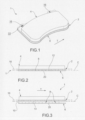
figures 1 and 2 respectively show a perspective and a side view in cross-section of an assembly of the present invention, according to one possible embodiment; -
figure 3 illustrates a view corresponding to that offigure 2 , but with partially separated parts; -
figures 4 and 5 are perspective views of the assembly infigure 1 wherein part of the support plate has been omitted to show the otherwise hidden anchoring projections, insofar as incorporated in the support plate. - With reference to the aforementioned drawings,
reference numeral 1 globally denotes a friction assembly comprising asupport plate 2, at least onebrake pad 4 and at least one reinforcingfoil 6 ofsaid plate 2. - According to one embodiment, the reinforcing
foil 6 has a maximum thickness of about 2 mm. - According to one embodiment, the reinforcing
foil 6 has a minimum thickness of about 0.5 mm. - According to a first variant, the reinforcing
foil 6 is made of metal, such as steel or aluminium. - According to a second variant, the reinforcing
foil 6 is made of a composite material, such as a carbon-based material. - According to a fourth variant, the
support plate 2 identifies one ormore holes 16 through its thickness suitable to be engaged in a movable manner by guides (not shown) of a brake-caliper, especially upon approaching (and moving away from) a corresponding disc to be braked. - Optionally, the reinforcing
foil 6 may definelumina 22 at least partially aligned with theholes 16 of thesupport plate 2. - According to the invention, the reinforcing
foil 6 andsupport plate 2 extend in a contact plane C between them such that the reinforcingfoil 6 remains confined in the profile of thesupport plate 2, in particular without projecting externally to said plate. - In other words, within the aforesaid plane C, the reinforcing
foil 6 has an extension equal to or smaller than the extension of thesupport plate 2 in the same plane. - Optionally, the aforesaid assembly could comprise at least one protective layer, such as an anti-corrosive layer at least partially covering the reinforcing
foil 6. - In
such assembly 1, thebrake pad 4 and thesupport plate 2 are (preferably hot co-moulded) in at least one heat-resistant resin. - Preferably, the heat-resistant resin is a thermosetting resin.
- Advantageously, the heat-resistant resin is a phenolic resin, such as a novolac.
- Preferably, the heat-resistant resin (or phenol resin) is the same for the
support plate 2 and for thebrake pads 4. - According to one embodiment, the
support plate 2 and thebrake pad 4 are made from different heat-resistant resins, for example belonging to the same family of polymeric materials. - According to a variant, the phenolic resin comprises or consists of the resin CAS no. 9003-35-4.
- According to a further variant, the resin is heat resistant at least up to the maximum operating temperature of the
assembly 1. - The heat resistant resin of the
support plate 2 is loaded with reinforcing fibres, preferably non-metallic. Purely by way of example, the reinforcing fibres used could comprise carbon fibres, glass fibres, boron fibres, silica fibres, silicon carbide fibres, ceramic fibres and mixtures thereof. - Glass fibres are a particularly preferred embodiment of this invention.
- For example, the ratio between the weight of heat-resistant resin and the weight of the optional reinforcing fibres could be between 0.1 and 3.0, advantageously between 0.3 and 2.0, optionally between 0.4 and 1.8, for example between 0.7 and 1.5.
- Preferably, the reinforcing fibres are of a mean length equal to or greater than about 12 mm (for example equal to or greater than 13 or 14 mm) to increase the mechanical strength of the
support plate 2, at least compared to a heat-resistant resin plate devoid of the aforesaid fibres. - According to one embodiment, the reinforcing fibres are of an average length equal to or greater than about 12 millimetres, for example comprised in the range of 4 - 11 millimetres.
- According to one advantageous embodiment, the reinforcing fibres are oriented mainly or exclusively in a transversal stress direction T of the brake pad 4 (referred to a configuration of correct use of the
assembly 1 in a brake caliper for a disc brake). - According to a further variant, the
brake pad 4 is instead devoid of reinforcing fibres. - A preferred embodiment provides, however, that the heat resistant resin of the
brake pad 4 comprises at least one friction modifier component. - Purely by way of example, the friction modifier component could be selected from a powdered metal (such as copper, iron, aluminium, and/or zinc), an aluminium or silicon oxide, a flaking material (such as graphite or mica), or combinations thereof.
- With reference to the variant in
figure 2 , the separation zone between thesupport plate 2 and thebrake pad 4 has been schematically shown as anet division plane 18 of said components. This represents however a graphical representation because, in actual fact, the separation zone could most probably be an uneven plane or even a volume inside which there is an intimate mixing of heat-resistant resin with optional reinforcing fibres (for the support plate), and heat-resistant resin - preferably free of such fibres and optionally loaded with a friction modifier-component - belonging to the brake pads. - The reinforcing
foil 6 is fixed to thesupport plate 2 by means ofanchoring projections 8, joined to and extending away from thefoil 6, and are embedded in the aforesaid resin to prevent or limit deformations of the support plate in the use of theassembly 1. - According to different embodiments, the
anchoring projections 8 could be in the form of a pointed element, a pin, cylinder or hook. According to another embodiment, one or more anchoring projections may be in the form of a cordon or rib. - For example, as shown schematically in
figures 4 or 5 , theanchoring projections 8 may be shaped as a pyramid, cylinder, truncated cone, cone or truncated pyramid. - According to a preferred variant, the
anchoring projections 8 are made in one piece with the reinforcingfoil 6. - According to a further variant, the
anchoring projections 8 project only from onesurface 10 of the reinforcingfoil 6, facing thesupport plate 2, theopposite surface 20 of such foil being instead without projections. - According to yet a further variant, the reinforcing
foil 6 has no perforations (specifically: through its thickness) in the area superposing thebrake pad 4. - According to the invention, the
anchoring projections 8 are distributed on thesurface 10 of the reinforcingfoil 6 with a density at least equal to, or greater than, about 1-40 projections/cm2 (for example 1-20 projections/cm2), to achieve a monolithic union between the reinforcingfoil 6 and thesupport plate 2. - According to a not shown embodiment, in correspondence of the base of at least part of the anchoring projections, the reinforcing foil could delimit depressions of a substantially complementary shape to said projections.
- In fact, a possible variant of the manufacturing method discussed below could provide that the anchoring projections can be generated from the thickness of the reinforcing foil - excavating it in part - thus generating the depressions and projections.
- With reference for example to the variant in
figure 3 , thebrake pad 4 is co-moulded to anopposite surface 12 of thesupport plate 2 with respect to thesurface 14 to which the reinforcingfoil 6 is anchored, to create a sandwich structure. - The present invention also relates to a method of manufacturing a friction assembly.
- Since a preferred embodiment of the method provides for it to be used to produce a
friction assembly 1 according to any one of the preceding embodiments, preferred or advantageous variants of such method may comprise any step - even implicitly inferable - from the preceding description of the assembly. - The method comprises the steps of:
- co-moulding a
support plate 2 and at least onebrake pad 4 from at least one heat-resistant resin; - fixing a reinforcing
foil 6 to thesupport plate 2 by embedding in the heat-resistantresin anchoring projections 8, joined to and which extend away from thefoil 6, to prevent or limit deformations of the support plate in the use of saidassembly 1. - The co-moulding step and the fixing step take place at least partially simultaneously, for example during one or more steps of compression moulding.
- The present invention lastly relates to a brake caliper comprising a
friction assembly 1 according to any one of the embodiments illustrated previously, or to an assembly manufactured according to the discussed method. - The purpose of the present invention will now be illustrated on the basis of a nonlimiting example.
- To co-mould the aforesaid assembly a hot press is used with a mould modified so as to delimit two juxtaposed or superposed cavities: a first moulding cavity is intended to receive the heat-resistant resin of the support plate, a second moulding cavity housing instead the heat-resistant resin of the brake pad.
- The reinforcement foil is then placed in the first cavity, after which the heat resistant resin optionally loaded with reinforcing fibres is evenly distributed to fill such cavity. A similar or a different heat-resistant resin is placed in the second moulding cavity optionally in the presence of at least one friction modifier component.
- The moulding temperatures may vary between 130°C and 190°C depending on the resins used, while the operating pressures will be in the range 10-50 MPa. Depending on the size of the pad and the quantity of resins used, the moulding times may vary from one to about ten minutes, often 2-5 minutes.
- When the moulding of the friction assembly is complete, it is placed in an oven at a temperature of about 220°C to complete the cross-linking of the resin/s.
- Innovatively, the assembly, the caliper and the method described allow the predetermined objectives to be achieved.
- In particular, the presence of the reinforcing foil allows an improvement of the thermomechanical resistance and the dimensional stability of the assembly, reducing the overall weight compared to conventional systems.
- Advantageously, the use of a metal reinforcing foil does not involve a drastic increase in weight of the assembly, since the foil utilised has a reduced thickness compared to the overall thickness of the prior metal plates.
- Advantageously, the assembly and the caliper of the present invention allow a substantial reduction in weight to be achieved compared to the traditionally used systems, of course for at least equivalent overall performance.
- Advantageously, the use of a single reinforcing foil allows a saving in weight of the assembly, a reduction of the production cost, and optimized warehouse management to be achieved.
- Advantageously, by virtue of the expedients described, the scope of application of the plate described is broadened.
- Advantageously, the method of the present invention allows all the essential components - that is to say the support plate, the brake-pad and the reinforcing foil - to be moulded in a single operation.
- Advantageously, the assembly and the caliper of the present invention are highly reliable, in that the materials of the plate and the brake pad are bonded together in an inseparable manner.
- Advantageously, the assembly and the caliper of the present invention allow the adhesive layer between the plate and the brake pad to be dispensed with, resulting in a favourable impact on production costs and on the reliability of the assembly.
- Advantageously, the assembly of the present invention allows a reduction of the deformations of the plate of about 30% to be achieved compared to the solutions without the reinforcing foil.
- Advantageously, the assembly and the caliper of the present invention are constructively simple and therefore producible at low cost and with repetitive and automated operations.
- Advantageously, the assembly of the present invention has a low heat conductivity, so that the probability of occurrence of vapour lock phenomena of the caliper-brake is reduced.
- Advantageously, although the long fibres are much more difficult to form in the heat-resistant resin, they provide unexpected mechanical performance.
- A person skilled in the art may make variations to the embodiments of the assembly, of the caliper brake and of the method described above so as to satisfy specific requirements, replacing elements with others functionally equivalent.
- Such variants are also contained within the scope of protection as defined by the following claims.
- In addition, each variant described as belonging to a possible embodiment may be realised independently of the other embodiments described.
Claims (13)
Priority Applications (1)
| Application Number | Priority Date | Filing Date | Title |
|---|---|---|---|
| PL17717218.6T PL3414467T5 (en) | 2016-02-08 | 2017-01-26 | Friction assembly, brake caliper and manufacturing method |
Applications Claiming Priority (2)
| Application Number | Priority Date | Filing Date | Title |
|---|---|---|---|
| ITUB2016A000550A ITUB20160550A1 (en) | 2016-02-08 | 2016-02-08 | CLUTCH ASSEMBLY, BRAKE CALIPER AND MANUFACTURING METHOD |
| PCT/IB2017/050403 WO2017137863A1 (en) | 2016-02-08 | 2017-01-26 | Friction assembly, brake caliper and manufacturing method |
Publications (4)
| Publication Number | Publication Date |
|---|---|
| EP3414467A1 EP3414467A1 (en) | 2018-12-19 |
| EP3414467B1 EP3414467B1 (en) | 2020-11-25 |
| EP3414467B8 EP3414467B8 (en) | 2021-09-01 |
| EP3414467B2 true EP3414467B2 (en) | 2024-04-03 |
Family
ID=55861046
Family Applications (1)
| Application Number | Title | Priority Date | Filing Date |
|---|---|---|---|
| EP17717218.6A Active EP3414467B2 (en) | 2016-02-08 | 2017-01-26 | Friction assembly, brake caliper and manufacturing method |
Country Status (9)
| Country | Link |
|---|---|
| US (1) | US11268583B2 (en) |
| EP (1) | EP3414467B2 (en) |
| JP (1) | JP6921090B2 (en) |
| KR (1) | KR102670119B1 (en) |
| ES (1) | ES2860770T5 (en) |
| IT (1) | ITUB20160550A1 (en) |
| MX (1) | MX2018009598A (en) |
| PL (1) | PL3414467T5 (en) |
| WO (1) | WO2017137863A1 (en) |
Citations (7)
| Publication number | Priority date | Publication date | Assignee | Title |
|---|---|---|---|---|
| US5376410A (en) † | 1991-10-02 | 1994-12-27 | Mackelvie; Winston R. | Material surface modification |
| DE29821482U1 (en) † | 1998-12-02 | 2000-04-13 | AlliedSignal Bremsbelag GmbH, 21509 Glinde | Brake pad for disc brakes |
| EP2204591A1 (en) † | 2009-01-06 | 2010-07-07 | Shin In Trading Co., Ltd. | Braking device with toothed backing plate. |
| WO2011033395A1 (en) † | 2009-09-17 | 2011-03-24 | Consulplast S.R.L. | Brake pad for vehicle disc brake |
| WO2014087236A1 (en) † | 2012-12-07 | 2014-06-12 | R.A Investment Management S.A.R.L. | Composite disc brake backing plate |
| WO2015010183A1 (en) † | 2013-07-26 | 2015-01-29 | R.A. Investment Management S.A.R.L | Metal and graphite laminate |
| WO2015173768A1 (en) † | 2014-05-16 | 2015-11-19 | Freni Brembo S.P.A. | Friction assembly, brake calliper and manufacturing method |
Family Cites Families (14)
| Publication number | Priority date | Publication date | Assignee | Title |
|---|---|---|---|---|
| FR2406128A1 (en) * | 1977-07-25 | 1979-05-11 | Abex Pagid Equip | METHOD FOR MANUFACTURING LININGS FOR DISC BRAKES |
| GB2311569B (en) * | 1996-03-27 | 2000-10-25 | Luk Lamellen & Kupplungsbau | Friction lining |
| US6022502A (en) * | 1997-09-30 | 2000-02-08 | Lockhart; Wayne | Composite friction assembly |
| JP2001165210A (en) * | 1999-12-14 | 2001-06-19 | Nisshinbo Ind Inc | Disc brake, disc brake pad, and back plate for the disc brake pad |
| US20030155193A1 (en) * | 2002-02-20 | 2003-08-21 | Hays William D. | Non-metallic brake plate |
| US20050161297A1 (en) * | 2004-01-23 | 2005-07-28 | Innovative Technologies, Llc | Brake pad backing plate and method of making the same |
| CN102138022B (en) * | 2008-08-08 | 2015-06-10 | 福乐尼·乐姆宝公开有限公司 | Method for making a ceramic matrix material for friction components of brakes and ceramic matrix material made by such method |
| EP2324263B1 (en) * | 2008-09-18 | 2021-10-27 | Carlisle Brake & Friction, Inc | CARBON FIBER REINFORCED CARBONaceous MATRIX COMPOSITE FOR BRAKE PAD BACK PLATE and method of manufacturing |
| EP2975287A4 (en) * | 2013-03-12 | 2016-12-28 | Sumitomo Bakelite Co | Brake pad and caliper device |
| US9689450B2 (en) * | 2014-09-26 | 2017-06-27 | R.A. Investment Management S.A.R.L. | Composite disc brake backing plate |
| US9360067B1 (en) * | 2015-02-05 | 2016-06-07 | R. A. Investment Management S.A.R.L. | Hybrid laminate |
| US10125836B2 (en) * | 2015-06-10 | 2018-11-13 | Nucap Industries Inc. | Brake pad with preformed multi-layer friction pad and shim |
| US10344817B2 (en) * | 2015-11-30 | 2019-07-09 | Hyundai Motor Company | Vehicle brake pad |
| WO2017177322A1 (en) * | 2016-04-14 | 2017-10-19 | Nucap Industries Inc. | Multilayer metal composite and brake pad including same |
-
2016
- 2016-02-08 IT ITUB2016A000550A patent/ITUB20160550A1/en unknown
-
2017
- 2017-01-26 WO PCT/IB2017/050403 patent/WO2017137863A1/en not_active Ceased
- 2017-01-26 PL PL17717218.6T patent/PL3414467T5/en unknown
- 2017-01-26 EP EP17717218.6A patent/EP3414467B2/en active Active
- 2017-01-26 JP JP2018538610A patent/JP6921090B2/en active Active
- 2017-01-26 MX MX2018009598A patent/MX2018009598A/en unknown
- 2017-01-26 US US16/076,075 patent/US11268583B2/en active Active
- 2017-01-26 KR KR1020187025133A patent/KR102670119B1/en active Active
- 2017-01-26 ES ES17717218T patent/ES2860770T5/en active Active
Patent Citations (8)
| Publication number | Priority date | Publication date | Assignee | Title |
|---|---|---|---|---|
| US5376410A (en) † | 1991-10-02 | 1994-12-27 | Mackelvie; Winston R. | Material surface modification |
| DE29821482U1 (en) † | 1998-12-02 | 2000-04-13 | AlliedSignal Bremsbelag GmbH, 21509 Glinde | Brake pad for disc brakes |
| EP1006289A2 (en) † | 1998-12-02 | 2000-06-07 | AlliedSignal Bremsbelag GmbH | Brake lining for disc brakes |
| EP2204591A1 (en) † | 2009-01-06 | 2010-07-07 | Shin In Trading Co., Ltd. | Braking device with toothed backing plate. |
| WO2011033395A1 (en) † | 2009-09-17 | 2011-03-24 | Consulplast S.R.L. | Brake pad for vehicle disc brake |
| WO2014087236A1 (en) † | 2012-12-07 | 2014-06-12 | R.A Investment Management S.A.R.L. | Composite disc brake backing plate |
| WO2015010183A1 (en) † | 2013-07-26 | 2015-01-29 | R.A. Investment Management S.A.R.L | Metal and graphite laminate |
| WO2015173768A1 (en) † | 2014-05-16 | 2015-11-19 | Freni Brembo S.P.A. | Friction assembly, brake calliper and manufacturing method |
Also Published As
| Publication number | Publication date |
|---|---|
| MX2018009598A (en) | 2018-12-17 |
| KR20180108765A (en) | 2018-10-04 |
| CA3012286A1 (en) | 2017-08-17 |
| US11268583B2 (en) | 2022-03-08 |
| KR102670119B1 (en) | 2024-05-28 |
| EP3414467B1 (en) | 2020-11-25 |
| PL3414467T3 (en) | 2021-06-28 |
| PL3414467T5 (en) | 2024-11-04 |
| EP3414467B8 (en) | 2021-09-01 |
| ES2860770T3 (en) | 2021-10-05 |
| JP2019504262A (en) | 2019-02-14 |
| EP3414467A1 (en) | 2018-12-19 |
| JP6921090B2 (en) | 2021-08-18 |
| US20190186570A1 (en) | 2019-06-20 |
| WO2017137863A1 (en) | 2017-08-17 |
| ES2860770T5 (en) | 2024-11-12 |
| ITUB20160550A1 (en) | 2017-08-08 |
Similar Documents
| Publication | Publication Date | Title |
|---|---|---|
| US10119583B2 (en) | Friction assembly, brake calliper and manufacturing method | |
| CN102575736B (en) | Brake pad for vehicle disc brake | |
| WO2005069972A3 (en) | Disc brake rotor assembly and method for producing same | |
| JP2013053687A (en) | Brake pad | |
| US3761231A (en) | Composite articles | |
| JP2012211675A (en) | Brake pad | |
| EP3414467B1 (en) | Friction assembly, brake caliper and manufacturing method | |
| JPH02271120A (en) | Disc brake pad and manufacture thereof | |
| US20180306261A1 (en) | High friction insulator | |
| CA3012286C (en) | Friction assembly, brake caliper and manufacturing method | |
| JP4766925B2 (en) | Friction material manufacturing method | |
| JP2013057337A (en) | Brake pad, and method of manufacturing the same | |
| KR101610131B1 (en) | Method for manufacturing motor vehicle brake disc | |
| WO2021123755A1 (en) | Brake disc, method of manufacturing the same, and an insert | |
| JP2013053688A (en) | Brake pad | |
| KR101258828B1 (en) | Carbon-ceramic brake disk and method for fabricating the same, and multifunctional core for being used in the same | |
| JP4338874B2 (en) | Friction pads for vehicle disc brakes | |
| KR102184578B1 (en) | Backplate for vehicle brake pads and its dedicated machining Fine-Blanking mold | |
| US8596429B2 (en) | Brake disk comprising a ceramic friction ring | |
| TWI896144B (en) | Brake pad and method for manufacturing the same | |
| CN217056099U (en) | Brake pad applied to disc brake | |
| JP2665624B2 (en) | Friction pads for vehicle disc brakes | |
| JP2019157925A (en) | Process of manufacture of disc brake pad, disc brake pad and die for friction member of disc brake pad | |
| CA2999300A1 (en) | Composite brake rotor | |
| JP2019504262A5 (en) |
Legal Events
| Date | Code | Title | Description |
|---|---|---|---|
| STAA | Information on the status of an ep patent application or granted ep patent |
Free format text: STATUS: UNKNOWN |
|
| STAA | Information on the status of an ep patent application or granted ep patent |
Free format text: STATUS: THE INTERNATIONAL PUBLICATION HAS BEEN MADE |
|
| PUAI | Public reference made under article 153(3) epc to a published international application that has entered the european phase |
Free format text: ORIGINAL CODE: 0009012 |
|
| STAA | Information on the status of an ep patent application or granted ep patent |
Free format text: STATUS: REQUEST FOR EXAMINATION WAS MADE |
|
| 17P | Request for examination filed |
Effective date: 20180802 |
|
| AK | Designated contracting states |
Kind code of ref document: A1 Designated state(s): AL AT BE BG CH CY CZ DE DK EE ES FI FR GB GR HR HU IE IS IT LI LT LU LV MC MK MT NL NO PL PT RO RS SE SI SK SM TR |
|
| AX | Request for extension of the european patent |
Extension state: BA ME |
|
| DAV | Request for validation of the european patent (deleted) | ||
| DAX | Request for extension of the european patent (deleted) | ||
| STAA | Information on the status of an ep patent application or granted ep patent |
Free format text: STATUS: EXAMINATION IS IN PROGRESS |
|
| 17Q | First examination report despatched |
Effective date: 20191122 |
|
| GRAP | Despatch of communication of intention to grant a patent |
Free format text: ORIGINAL CODE: EPIDOSNIGR1 |
|
| STAA | Information on the status of an ep patent application or granted ep patent |
Free format text: STATUS: GRANT OF PATENT IS INTENDED |
|
| INTG | Intention to grant announced |
Effective date: 20200707 |
|
| GRAS | Grant fee paid |
Free format text: ORIGINAL CODE: EPIDOSNIGR3 |
|
| GRAA | (expected) grant |
Free format text: ORIGINAL CODE: 0009210 |
|
| STAA | Information on the status of an ep patent application or granted ep patent |
Free format text: STATUS: THE PATENT HAS BEEN GRANTED |
|
| AK | Designated contracting states |
Kind code of ref document: B1 Designated state(s): AL AT BE BG CH CY CZ DE DK EE ES FI FR GB GR HR HU IE IS IT LI LT LU LV MC MK MT NL NO PL PT RO RS SE SI SK SM TR |
|
| REG | Reference to a national code |
Ref country code: GB Ref legal event code: FG4D |
|
| REG | Reference to a national code |
Ref country code: CH Ref legal event code: EP |
|
| REG | Reference to a national code |
Ref country code: AT Ref legal event code: REF Ref document number: 1338683 Country of ref document: AT Kind code of ref document: T Effective date: 20201215 |
|
| REG | Reference to a national code |
Ref country code: DE Ref legal event code: R096 Ref document number: 602017028230 Country of ref document: DE |
|
| REG | Reference to a national code |
Ref country code: IE Ref legal event code: FG4D |
|
| REG | Reference to a national code |
Ref country code: RO Ref legal event code: EPE |
|
| REG | Reference to a national code |
Ref country code: NL Ref legal event code: MP Effective date: 20201125 |
|
| PG25 | Lapsed in a contracting state [announced via postgrant information from national office to epo] |
Ref country code: NO Free format text: LAPSE BECAUSE OF FAILURE TO SUBMIT A TRANSLATION OF THE DESCRIPTION OR TO PAY THE FEE WITHIN THE PRESCRIBED TIME-LIMIT Effective date: 20210225 Ref country code: PT Free format text: LAPSE BECAUSE OF FAILURE TO SUBMIT A TRANSLATION OF THE DESCRIPTION OR TO PAY THE FEE WITHIN THE PRESCRIBED TIME-LIMIT Effective date: 20210325 Ref country code: RS Free format text: LAPSE BECAUSE OF FAILURE TO SUBMIT A TRANSLATION OF THE DESCRIPTION OR TO PAY THE FEE WITHIN THE PRESCRIBED TIME-LIMIT Effective date: 20201125 Ref country code: FI Free format text: LAPSE BECAUSE OF FAILURE TO SUBMIT A TRANSLATION OF THE DESCRIPTION OR TO PAY THE FEE WITHIN THE PRESCRIBED TIME-LIMIT Effective date: 20201125 Ref country code: GR Free format text: LAPSE BECAUSE OF FAILURE TO SUBMIT A TRANSLATION OF THE DESCRIPTION OR TO PAY THE FEE WITHIN THE PRESCRIBED TIME-LIMIT Effective date: 20210226 |
|
| PG25 | Lapsed in a contracting state [announced via postgrant information from national office to epo] |
Ref country code: SE Free format text: LAPSE BECAUSE OF FAILURE TO SUBMIT A TRANSLATION OF THE DESCRIPTION OR TO PAY THE FEE WITHIN THE PRESCRIBED TIME-LIMIT Effective date: 20201125 Ref country code: BG Free format text: LAPSE BECAUSE OF FAILURE TO SUBMIT A TRANSLATION OF THE DESCRIPTION OR TO PAY THE FEE WITHIN THE PRESCRIBED TIME-LIMIT Effective date: 20210225 Ref country code: IS Free format text: LAPSE BECAUSE OF FAILURE TO SUBMIT A TRANSLATION OF THE DESCRIPTION OR TO PAY THE FEE WITHIN THE PRESCRIBED TIME-LIMIT Effective date: 20210325 Ref country code: LV Free format text: LAPSE BECAUSE OF FAILURE TO SUBMIT A TRANSLATION OF THE DESCRIPTION OR TO PAY THE FEE WITHIN THE PRESCRIBED TIME-LIMIT Effective date: 20201125 |
|
| REG | Reference to a national code |
Ref country code: LT Ref legal event code: MG9D |
|
| PG25 | Lapsed in a contracting state [announced via postgrant information from national office to epo] |
Ref country code: HR Free format text: LAPSE BECAUSE OF FAILURE TO SUBMIT A TRANSLATION OF THE DESCRIPTION OR TO PAY THE FEE WITHIN THE PRESCRIBED TIME-LIMIT Effective date: 20201125 |
|
| RAP4 | Party data changed (patent owner data changed or rights of a patent transferred) |
Owner name: BREMBO S.P.A. |
|
| RIN2 | Information on inventor provided after grant (corrected) |
Inventor name: MAESTRINI, LUCA Inventor name: VAROTTO, PAOLO Inventor name: GAVAZZI, ANDREA |
|
| PG25 | Lapsed in a contracting state [announced via postgrant information from national office to epo] |
Ref country code: SM Free format text: LAPSE BECAUSE OF FAILURE TO SUBMIT A TRANSLATION OF THE DESCRIPTION OR TO PAY THE FEE WITHIN THE PRESCRIBED TIME-LIMIT Effective date: 20201125 Ref country code: LT Free format text: LAPSE BECAUSE OF FAILURE TO SUBMIT A TRANSLATION OF THE DESCRIPTION OR TO PAY THE FEE WITHIN THE PRESCRIBED TIME-LIMIT Effective date: 20201125 Ref country code: EE Free format text: LAPSE BECAUSE OF FAILURE TO SUBMIT A TRANSLATION OF THE DESCRIPTION OR TO PAY THE FEE WITHIN THE PRESCRIBED TIME-LIMIT Effective date: 20201125 Ref country code: CZ Free format text: LAPSE BECAUSE OF FAILURE TO SUBMIT A TRANSLATION OF THE DESCRIPTION OR TO PAY THE FEE WITHIN THE PRESCRIBED TIME-LIMIT Effective date: 20201125 Ref country code: SK Free format text: LAPSE BECAUSE OF FAILURE TO SUBMIT A TRANSLATION OF THE DESCRIPTION OR TO PAY THE FEE WITHIN THE PRESCRIBED TIME-LIMIT Effective date: 20201125 |
|
| REG | Reference to a national code |
Ref country code: CH Ref legal event code: PK Free format text: BERICHTIGUNGEN |
|
| REG | Reference to a national code |
Ref country code: CH Ref legal event code: PK Free format text: BERICHTIGUNG B8 |
|
| REG | Reference to a national code |
Ref country code: DE Ref legal event code: R026 Ref document number: 602017028230 Country of ref document: DE |
|
| RAP4 | Party data changed (patent owner data changed or rights of a patent transferred) |
Owner name: BREMBO S.P.A. |
|
| RIN2 | Information on inventor provided after grant (corrected) |
Inventor name: MAESTRINI, LUCA Inventor name: VAROTTO, PAOLO Inventor name: GAVAZZI, ANDREA |
|
| PLBI | Opposition filed |
Free format text: ORIGINAL CODE: 0009260 |
|
| PG25 | Lapsed in a contracting state [announced via postgrant information from national office to epo] |
Ref country code: MC Free format text: LAPSE BECAUSE OF FAILURE TO SUBMIT A TRANSLATION OF THE DESCRIPTION OR TO PAY THE FEE WITHIN THE PRESCRIBED TIME-LIMIT Effective date: 20201125 Ref country code: DK Free format text: LAPSE BECAUSE OF FAILURE TO SUBMIT A TRANSLATION OF THE DESCRIPTION OR TO PAY THE FEE WITHIN THE PRESCRIBED TIME-LIMIT Effective date: 20201125 |
|
| REG | Reference to a national code |
Ref country code: CH Ref legal event code: PL |
|
| PLAX | Notice of opposition and request to file observation + time limit sent |
Free format text: ORIGINAL CODE: EPIDOSNOBS2 |
|
| 26 | Opposition filed |
Opponent name: VRI-VERBAND DER REIBBELAGINDUSTRIE E.V. Effective date: 20210824 |
|
| PG25 | Lapsed in a contracting state [announced via postgrant information from national office to epo] |
Ref country code: LU Free format text: LAPSE BECAUSE OF NON-PAYMENT OF DUE FEES Effective date: 20210126 |
|
| GBPC | Gb: european patent ceased through non-payment of renewal fee |
Effective date: 20210225 |
|
| PG25 | Lapsed in a contracting state [announced via postgrant information from national office to epo] |
Ref country code: AL Free format text: LAPSE BECAUSE OF FAILURE TO SUBMIT A TRANSLATION OF THE DESCRIPTION OR TO PAY THE FEE WITHIN THE PRESCRIBED TIME-LIMIT Effective date: 20201125 Ref country code: NL Free format text: LAPSE BECAUSE OF FAILURE TO SUBMIT A TRANSLATION OF THE DESCRIPTION OR TO PAY THE FEE WITHIN THE PRESCRIBED TIME-LIMIT Effective date: 20201125 Ref country code: IT Free format text: LAPSE BECAUSE OF FAILURE TO SUBMIT A TRANSLATION OF THE DESCRIPTION OR TO PAY THE FEE WITHIN THE PRESCRIBED TIME-LIMIT Effective date: 20201125 |
|
| PG25 | Lapsed in a contracting state [announced via postgrant information from national office to epo] |
Ref country code: LI Free format text: LAPSE BECAUSE OF NON-PAYMENT OF DUE FEES Effective date: 20210131 Ref country code: SI Free format text: LAPSE BECAUSE OF FAILURE TO SUBMIT A TRANSLATION OF THE DESCRIPTION OR TO PAY THE FEE WITHIN THE PRESCRIBED TIME-LIMIT Effective date: 20201125 Ref country code: CH Free format text: LAPSE BECAUSE OF NON-PAYMENT OF DUE FEES Effective date: 20210131 |
|
| PLBB | Reply of patent proprietor to notice(s) of opposition received |
Free format text: ORIGINAL CODE: EPIDOSNOBS3 |
|
| PG25 | Lapsed in a contracting state [announced via postgrant information from national office to epo] |
Ref country code: GB Free format text: LAPSE BECAUSE OF NON-PAYMENT OF DUE FEES Effective date: 20210225 Ref country code: IE Free format text: LAPSE BECAUSE OF NON-PAYMENT OF DUE FEES Effective date: 20210126 |
|
| PG25 | Lapsed in a contracting state [announced via postgrant information from national office to epo] |
Ref country code: IS Free format text: LAPSE BECAUSE OF FAILURE TO SUBMIT A TRANSLATION OF THE DESCRIPTION OR TO PAY THE FEE WITHIN THE PRESCRIBED TIME-LIMIT Effective date: 20210325 |
|
| REG | Reference to a national code |
Ref country code: DE Ref legal event code: R081 Ref document number: 602017028230 Country of ref document: DE Owner name: BREMBO S.P.A., CURNO, IT Free format text: FORMER OWNER: FRENI BREMBO S.P.A., CURNO, BERGAMO, IT |
|
| PG25 | Lapsed in a contracting state [announced via postgrant information from national office to epo] |
Ref country code: CY Free format text: LAPSE BECAUSE OF FAILURE TO SUBMIT A TRANSLATION OF THE DESCRIPTION OR TO PAY THE FEE WITHIN THE PRESCRIBED TIME-LIMIT Effective date: 20201125 |
|
| P01 | Opt-out of the competence of the unified patent court (upc) registered |
Effective date: 20230526 |
|
| PG25 | Lapsed in a contracting state [announced via postgrant information from national office to epo] |
Ref country code: HU Free format text: LAPSE BECAUSE OF FAILURE TO SUBMIT A TRANSLATION OF THE DESCRIPTION OR TO PAY THE FEE WITHIN THE PRESCRIBED TIME-LIMIT; INVALID AB INITIO Effective date: 20170126 |
|
| PUAH | Patent maintained in amended form |
Free format text: ORIGINAL CODE: 0009272 |
|
| STAA | Information on the status of an ep patent application or granted ep patent |
Free format text: STATUS: PATENT MAINTAINED AS AMENDED |
|
| 27A | Patent maintained in amended form |
Effective date: 20240403 |
|
| AK | Designated contracting states |
Kind code of ref document: B2 Designated state(s): AL AT BE BG CH CY CZ DE DK EE ES FI FR GB GR HR HU IE IS IT LI LT LU LV MC MK MT NL NO PL PT RO RS SE SI SK SM TR |
|
| REG | Reference to a national code |
Ref country code: DE Ref legal event code: R102 Ref document number: 602017028230 Country of ref document: DE |
|
| PG25 | Lapsed in a contracting state [announced via postgrant information from national office to epo] |
Ref country code: MK Free format text: LAPSE BECAUSE OF FAILURE TO SUBMIT A TRANSLATION OF THE DESCRIPTION OR TO PAY THE FEE WITHIN THE PRESCRIBED TIME-LIMIT Effective date: 20201125 |
|
| REG | Reference to a national code |
Ref country code: AT Ref legal event code: UEP Ref document number: 1338683 Country of ref document: AT Kind code of ref document: T Effective date: 20201125 |
|
| PG25 | Lapsed in a contracting state [announced via postgrant information from national office to epo] |
Ref country code: MT Free format text: LAPSE BECAUSE OF FAILURE TO SUBMIT A TRANSLATION OF THE DESCRIPTION OR TO PAY THE FEE WITHIN THE PRESCRIBED TIME-LIMIT Effective date: 20201125 |
|
| REG | Reference to a national code |
Ref country code: ES Ref legal event code: DC2A Ref document number: 2860770 Country of ref document: ES Kind code of ref document: T5 Effective date: 20241112 |
|
| PG25 | Lapsed in a contracting state [announced via postgrant information from national office to epo] |
Ref country code: TR Free format text: LAPSE BECAUSE OF FAILURE TO SUBMIT A TRANSLATION OF THE DESCRIPTION OR TO PAY THE FEE WITHIN THE PRESCRIBED TIME-LIMIT Effective date: 20201125 |
|
| PGFP | Annual fee paid to national office [announced via postgrant information from national office to epo] |
Ref country code: ES Payment date: 20260202 Year of fee payment: 10 |
|
| PGFP | Annual fee paid to national office [announced via postgrant information from national office to epo] |
Ref country code: DE Payment date: 20260123 Year of fee payment: 10 |
|
| PGFP | Annual fee paid to national office [announced via postgrant information from national office to epo] |
Ref country code: AT Payment date: 20251223 Year of fee payment: 10 |
|
| PGFP | Annual fee paid to national office [announced via postgrant information from national office to epo] |
Ref country code: RO Payment date: 20260120 Year of fee payment: 10 Ref country code: BE Payment date: 20260121 Year of fee payment: 10 |
|
| PGFP | Annual fee paid to national office [announced via postgrant information from national office to epo] |
Ref country code: FR Payment date: 20260130 Year of fee payment: 10 |
|
| PGFP | Annual fee paid to national office [announced via postgrant information from national office to epo] |
Ref country code: PL Payment date: 20260114 Year of fee payment: 10 |