EP3413576A1 - Device for adapting a transport stream, visual display apparatus, and method of adapting a transport stream - Google Patents
Device for adapting a transport stream, visual display apparatus, and method of adapting a transport stream Download PDFInfo
- Publication number
- EP3413576A1 EP3413576A1 EP17174905.4A EP17174905A EP3413576A1 EP 3413576 A1 EP3413576 A1 EP 3413576A1 EP 17174905 A EP17174905 A EP 17174905A EP 3413576 A1 EP3413576 A1 EP 3413576A1
- Authority
- EP
- European Patent Office
- Prior art keywords
- mosaic
- video signal
- transport stream
- driving current
- phase shift
- Prior art date
- Legal status (The legal status is an assumption and is not a legal conclusion. Google has not performed a legal analysis and makes no representation as to the accuracy of the status listed.)
- Granted
Links
Images


Classifications
-
- H—ELECTRICITY
- H04—ELECTRIC COMMUNICATION TECHNIQUE
- H04N—PICTORIAL COMMUNICATION, e.g. TELEVISION
- H04N21/00—Selective content distribution, e.g. interactive television or video on demand [VOD]
- H04N21/40—Client devices specifically adapted for the reception of or interaction with content, e.g. set-top-box [STB]; Operations thereof
- H04N21/43—Processing of content or additional data, e.g. demultiplexing additional data from a digital video stream; Elementary client operations, e.g. monitoring of home network or synchronising decoder's clock; Client middleware
- H04N21/44—Processing of video elementary streams, e.g. splicing a video clip retrieved from local storage with an incoming video stream or rendering scenes according to encoded video stream scene graphs
- H04N21/44008—Processing of video elementary streams, e.g. splicing a video clip retrieved from local storage with an incoming video stream or rendering scenes according to encoded video stream scene graphs involving operations for analysing video streams, e.g. detecting features or characteristics in the video stream
-
- H—ELECTRICITY
- H04—ELECTRIC COMMUNICATION TECHNIQUE
- H04N—PICTORIAL COMMUNICATION, e.g. TELEVISION
- H04N21/00—Selective content distribution, e.g. interactive television or video on demand [VOD]
- H04N21/40—Client devices specifically adapted for the reception of or interaction with content, e.g. set-top-box [STB]; Operations thereof
- H04N21/43—Processing of content or additional data, e.g. demultiplexing additional data from a digital video stream; Elementary client operations, e.g. monitoring of home network or synchronising decoder's clock; Client middleware
- H04N21/436—Interfacing a local distribution network, e.g. communicating with another STB or one or more peripheral devices inside the home
- H04N21/43607—Interfacing a plurality of external cards, e.g. through a DVB Common Interface [DVB-CI]
Definitions
- the present invention relates to a device for adapting a transport stream according to claim 1, a visual display apparatus according to claim 6, and a method of adapting a transport stream according to claim 7.
- the common interface (CI), defined by European standard EN 50221-1997, allows the broadcast signal reception and transport stream decoding process to be separated out from the decryption or descrambling process.
- the signal reception and transport stream decoding process can be carried out by a host system, and a conditional access module (CAM) can be used to descramble the encrypted content.
- CAM conditional access module
- the common interface allows the host system and the CAM to talk to each other.
- a common interface can be integrated into a visual display apparatus, such as a television set, common interface equipment often takes the form of a separate set-top box with an interface, such as a slot, for receiving a smart card containing the CAM.
- the object of the invention is solved by a device for adapting a transport stream according to claim 1.
- the device at least comprises a video signal mosaic detector, a processor and a memory.
- the processor is operable, in response to detection of mosaic in a video signal by the mosaic detector, to instruct a demodulator of a common interface equipment in communication with the device to vary a driving current of the transport stream from which the video signal is derived.
- the memory is operable to save a value of the driving current of the transport stream for the common interface equipment with which the device is in communication.
- This solution is beneficial because instead of the manufacturer of a visual display apparatus, such as a television set, having to adapt the apparatus during manufacture to a wide variety of different types of common interface equipment, the device can be used to adapt the behaviour of the common interface equipment to suit the visual display apparatus. Moreover, the risk that there are any types of common interface equipment with which the display apparatus is incompatible is thereby greatly reduced and can possibly be eliminated. Even if the display apparatus is connected to an unknown common interface equipment, the risk that the common interface equipment will produce an undesirable mosaicking effect of the displayed content is thereby also greatly reduced or eliminated.
- the memory allows the device to recognize types of common interface equipment it has previously encountered, reducing the total number of different types of unknown common interface equipment as new types of common interface equipment are encountered and allowing a previously encountered type of common interface equipment to have its behaviour adapted to suit the visual display apparatus without the need to go through a process of calibration to find the best value of the driving current of the transport stream to use.
- the processor is also operable, in response to detection of mosaic in a video signal by the mosaic detector, to instruct a decoder of the common interface equipment to vary a phase shift of a clock signal of the transport stream, and the memory is operable to save a value of the phase shift of the clock signal for the common interface equipment with which the device is in communication.
- This solution is beneficial because even if variation of the drive current of the transport stream from which the video signal is derived cannot eliminate a mosaicking effect from the video signal entirely, additionally varying the phase shift of the clock signal of the transport stream can be used to reduce the mosaic still further and thereby eliminate it.
- this enables the device to be used to adapt the behaviour of the common interface equipment to suit the visual display apparatus, and obviates the need for the manufacturer of the apparatus to adapt the apparatus during manufacture to a wide variety of different types of common interface equipment. It also further reduces the risk that there are any types of common interface equipment with which the display apparatus is incompatible.
- the memory allows the device to recognize types of common interface equipment it has previously encountered, reducing the total number of different types of unknown common interface equipment as new types of common interface equipment are encountered and allowing a previously encountered type of common interface equipment to have its behaviour adapted to suit the visual display apparatus without the need to go through a process of calibration to find the best value of the phase shift of the transport stream clock signal to use.
- the processor is operable to instruct at least one of the demodulator to incrementally increase the driving current and the decoder to incrementally increase the phase shift
- the mosaic detector is operable to check for a mosaic in a video signal after each respective incremental increase in the driving current and/or the phase shift, and to report on the detection of any mosaic in the video signal to the processor after each such respective incremental increase.
- This solution is beneficial because it allows the device to search systematically for the best values of the driving current and/or the phase shift to reduce or eliminate any mosaic from the video signal.
- the mosaic detector is operable to detect the severity of any mosaicking effect in the video signal and to report that severity to the processor, and the processor is operable to instruct at least one of the demodulator to vary the driving current and the decoder to vary the phase shift according to the severity of the mosaicking effect reported to the processor by the mosaic detector.
- the mosaic detector does not just perform a yes/no test on the presence or absence of mosaic in the video signal, but also measures the amount of any mosaic present.
- This solution is beneficial because it allows the driving current and/or the phase shift, which produce the least amount of mosaic to be identified.
- the processor is operable to recognize the same type of common interface equipment put in communication with the device, recall at least one of the saved values of the driving current and of the phase shift from the memory for the same type of common interface equipment, and to instruct at least one of the demodulator and the decoder of the same type of common interface equipment to adjust the actual values of the driving current and of the phase shift to match the respective saved values of the driving current and/or the phase shift recalled from the memory.
- This solution is beneficial because if the device encounters the same type of common interface equipment it has encountered previously, it can quickly and automatically adapt the transport stream being processed by the common interface equipment to suit a visual display apparatus without the need to discover what the best values of the driving current and/or the phase shift to eliminate any mosaic are.
- the present invention also relates to a visual display apparatus as described herein.
- the visual display apparatus at least comprises a display screen and a device for adapting a transport stream as described herein which provides an output to the display screen.
- the visual display apparatus may further comprise a video scaling unit which receives an input from the device and provides an output to the display screen.
- the device for adapting a transport stream as described herein may be provided as a stand-alone unit for attachment to the video outlet of a common interface equipment, it is most advantageously incorporated into a visual display apparatus, such as a television set, thereby rendering the visual display apparatus compatible with a wide variety of different types of common interface equipment, without the need for a manufacturer of the visual display apparatus having laboriously to check the compatibility of the visual display apparatus with different types of common interface equipment during manufacture.
- the present invention also relates to a method of adapting a transport stream.
- the method at least comprises checking a video signal for mosaic. If no mosaic is detected in the video signal, the video signal is output, whereas if mosaic is detected in the video signal, the following additional steps are carried out.
- the phrase "for a common interface equipment which is processing the transport stream" means for a particular type of common interface equipment, as identified, for example, by its make and model number. This solution is beneficial because it allows the best value of the driving current which reduces or eliminates mosaic in the video signal for the particular type of common interface equipment to be found and saved for later use with the same type of common interface equipment.
- varying a driving current of the transport stream from which the video signal is derived comprises incrementally increasing the driving current, and rechecking the video signal for mosaic after varying the driving current comprises rechecking the video signal for mosaic after each incremental increase in the driving current.
- the video signal derived from the transport stream with the saved value of the driving current for which the least mosaic is detected can be output. This minimizes the amount of mosaic in the video signal.
- the method may further comprise varying a phase shift of the transport stream clock signal, rechecking the video signal for mosaic after varying the phase shift until no mosaic is detected in the video signal, saving the value of the phase shift for which no mosaic is detected for the common interface equipment, and outputting the video signal derived from the transport stream with the saved values of the driving current for which the least mosaic is detected and of the phase shift.
- the phrase "for the common interface equipment” again means for the particular type of common interface equipment, as identified, for example, by its make and model number.
- This solution is beneficial because it allows the best value of the phase shift, which eliminates mosaic in the video signal for the particular type of common interface equipment to be found, to be used to eliminate the mosaic, and also to be saved for later use if the same type of common interface equipment is encountered again.
- varying a phase shift of the transport stream clock signal comprises incrementally increasing a phase shift of the transport stream clock signal, and rechecking the video signal for mosaic after varying the phase shift until no mosaic is detected in the video signal comprises rechecking the video signal for mosaic after each incremental increase in the phase shift until no mosaic is detected in the video signal.
- the method further comprises detecting the severity of any mosaicking effect in the video signal; and varying at least one of the driving current and the phase shift according to the severity of the mosaicking effect.
- This solution is beneficial because it allows the driving current and/or the phase shift, which produce the least amount of mosaic to be identified, and for the mosaicking effect to be reduced, even if mosaic cannot be eliminated from the video signal completely.
- the method further comprises recognizing the same type of common interface equipment, recalling at least one of the saved values of the driving current and of the phase shift for the same type of common interface equipment, and adjusting at least one of the actual values of the driving current and of the phase shift to match the respective saved values of the driving current and/or the phase shift.
- This solution is beneficial because if the same type of common interface equipment as has been encountered previously is encountered again, the transport stream being processed by the newly encountered common interface equipment can be quickly and automatically adapted to suit a visual display apparatus without the need to discover what the best values of the driving current and/or the phase shift to eliminate any mosaic are.
- the method further comprises scaling the video signal, and displaying the scaled video signal on a display screen.
- This solution is beneficial because method of adapting a transport stream is thereby integrated into a method of displaying a video signal.
- the present invention further relates to a computer program product or a program code or system for executing one or more than one of the herein described methods.
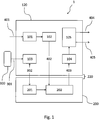
- Fig. 1 schematically shows a common interface equipment 1.
- the common interface equipment 1 comprises a host 120 and a conditional access module (CAM) 200 in communication with each other via a common interface 220.
- the host 120 comprises a broadcast television signal tuner 101, a demodulator 102, a microprocessor 103, a demultiplexer 104 and an MPEG decoder 105.
- the tuner 101, the demodulator 102, the demultiplexer 104 and the MPEG decoder 105 are under control of the microprocessor 103.
- the CAM 200 comprises a microprocessor 201 and a descrambler 202.
- the descrambler 202 is under control of the microprocessor 201.
- a remote control unit 300 is also associated with the common interface equipment 1.
- a broadcast television signal 401 is received by the tuner 101, and passed from there to the demodulator 102, where the received signal is demodulated into a scrambled transport stream 402.
- a user of the equipment 1 may send a remote control signal 301 to the microprocessor 103 of the host 120, for example to select a television channel to view, a viewing angle, an electronic programme guide, and so on.
- the scrambled transport stream 402 is passed across the common interface 220 to the descrambler 202 of the CAM 200, and control signals, for example containing data indicating which television channel the user has selected, are also passed from the microprocessor 103 of the host 120 to the microprocessor 201 of the CAM 200. Under control of the microprocessor 201, the descrambler 202 generates a descrambled transport stream 403 from the scrambled transport stream 402 and passes it back across the common interface 220 to the demultiplexer 104 of the host 120.
- the demultiplexer 104 then demultiplexes the descrambled transport stream 403 and passes it to MPEG decoder 105 for decoding into a video signal 404 and an audio signal 405 for output to a visual display device, such as a television set.
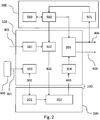
- Fig. 2 schematically shows an embodiment of a device 500 for adapting a transport stream in communication with the common interface equipment 1 shown in Fig. 1 .
- the device 500 for adapting a transport stream comprises a video signal mosaic detector 501, a microprocessor 502 and a memory 503.
- the video signal mosaic detector 501 is connectable to an output for the video signal 404 from the common interface equipment 1.
- the video signal mosaic detector 501 could, in principle, also be connected to an output for the audio signal 405 from the common interface equipment 1, this is unnecessary, since any correction of a mosaic in the video signal 404 will automatically result in simultaneous correction of any distortion present in the audio signal 405 as well.
- the memory 503 is under control of the microprocessor 502and the microprocessor 502 can save data to and recall data from the memory 503.
- the microprocessor 502 is also able to receive data from the video signal mosaic detector 501 and is further able to communicate with the microprocessor 103 of the host system 120 of the common interface equipment 1.
- the microprocessor 502 can extract information from the host system 120, for example concerning the identity of the common interface equipment 1, and can also instruct the host system 120 to perform certain operations on the transport stream being processed by the common interface equipment 1, in a manner to be described in greater detail below.
- the video signal mosaic detector 501 checks the video signal 404 output by the common interface equipment 1 for the presence of any mosaicking effect, and provides data to the microprocessor 502 on the presence or absence of any mosaic, as well as possibly also on the severity of any mosaicking effect. If the mosaic detector 501 detects any mosaicking effect in the video signal 404, the microprocessor 502 does several things based on the data it receives from the mosaic detector 501, as follows.
- the microprocessor 502 saves data in the memory 503 denoting the best values for the driving current of the transport stream, as well as possibly also for the phase shift of the transport stream clock signal, which minimize or eliminate any mosaicking effect for the particular type of common interface equipment 1 with which the device 500 is in communication.
- the microprocessor 502 also instructs the demodulator 102 to vary the driving current of the transport stream 402, as well as possibly also instructing the MPEG decoder 105 to vary a phase shift of a clock signal of the transport stream 403, in order to minimize or eliminate any mosaicking effect for the particular type of common interface equipment 1 with which the device 500 is in communication.
- Fig. 3 schematically shows a first embodiment of a method of adapting a transport stream.
- the descrambled transport stream 403 is forwarded to the mosaic detector 501 as a video signal 404, where the video signal 404 is checked 10 for mosaic. If no mosaic is detected in the video signal, the video signal is output 20 to a visual display device, such as to a video scaler of a television set. On the other hand, if mosaic is detected in the video signal, a driving current of the transport stream 402 from which the video signal 404 is derived is incrementally increased 30. The video signal 404 is rechecked 40 for mosaic after each incremental increase in the driving current.
- the value of the driving current for which no mosaic is first detected is saved 50 for whichever type of common interface equipment 1 is processing the transport stream.
- the microprocessor 502 saves in the memory 503 data which records that the common interface equipment 1 manufactured, for example, by company XYZ with model number 1234, requires a driving current of a particular value to eliminate any mosaic from the video signal.
- the video signal derived from the transport stream with the saved value of the driving current for which no mosaic is detected by the mosaic detector 501 is output 60 to a visual display device.
- the value of the driving current for which the least amount of mosaic is detected for the common interface equipment 1 is saved instead, and the phase shift of the transport stream clock signal is incrementally increased 70.
- the video signal 404 is rechecked 80 for mosaic by the mosaic detector 501 after each incremental increase in the phase shift until no mosaic is detected in the video signal 404.
- the value of the phase shift for which no mosaic is detected is also saved 90 for whichever type of common interface equipment 1 is processing the transport stream.
- the microprocessor 502 saves in the memory 503 data which records that the common interface equipment 1 manufactured, for example, by company XYZ with model number 1234, requires a particular value of the phase shift of the transport stream clock signal to eliminate any mosaic from the video signal.
- the video signal derived from the transport stream with the saved values of the driving current for which the least mosaic is detected and of the phase shift for which no mosaic is detected is output 100 to a visual display device.
- Fig. 4 schematically shows a second embodiment of a method of adapting a transport stream.
- the method of this second embodiment also comprises the same operations to adapt the transport stream which are therefore labelled in Fig. 4 with the same reference numerals 10 to 100 as they are in Fig. 3 .
- the method of Fig. 4 further comprises scaling 110 the output video signal 404, and displaying the scaled video signal on a display screen of a visual display apparatus.
- the second embodiment of the method schematically shown in Fig. 4 also comprises the following operations. If the same type of common interface equipment 1 is put in communication with the device 500, the type of common interface equipment 1 is recognized by the device 500 and the values of the driving current and of the phase shift saved in the memory 503 for this particular type of common interface equipment 1 are recalled 115 from the memory 503. These saved values of the driving current and of the phase shift are then used to adjusting the actual values of the driving current and of the phase shift to match the saved values of the driving current and the phase shift, so that any mosaicking effect is thereby eliminated from the video signal without any need for the device 500 to carry out a process of discovering the best values of the driving current and the phase shift to eliminate the mosaicking effect.
- the device 500 automatically adapts the transport stream being processed by the common interface equipment 1 to eliminate any mosaic without the need to repeat the calibration process described above in relation to Fig. 3 on another example of the same type of common interface equipment 1. This therefore saves time in eliminating the mosaic from the video signal 404.
- the present invention provides a device and method for use with a common interface (Cl) equipment, the latter of which is for receiving, decoding and decrypting scrambled television broadcast content, such as video, audio and data.
- the device is for adapting a transport stream being processed by the common interface equipment to make the transport stream compatible with a visual display apparatus, such as a television set.
- the device at least comprises a video signal mosaic detector, a processor and a memory.
- the processor is operable, in response to detection by the mosaic detector of mosaic in a video signal output from the common interface equipment, to instruct a demodulator of the common interface equipment to vary a driving current of the transport stream from which the video signal is derived.
- the phase shift of the transport stream clock signal can be varied as well.
- the memory is operable to save a value of the transport stream driving current, and possibly also of the phase shift of the transport stream clock signal, for the particular type of common interface equipment with which the device is in communication.
- the best value of the driving current, and possibly also of the phase shift, which reduce or eliminate mosaic from the video signal can be saved and recalled for later use if the device is put into communication with the same type of common interface equipment again.
- the device is most advantageously incorporated into a visual display apparatus, such as a television set.
- the visual display apparatus can be used to display broadcast content received by a wide range of different types of common interface equipment by adapting the behaviour of the Cl equipment to suit the visual display apparatus. This obviates the need for manufacturers of visual display apparatus to test their apparatuses with a wide variety of different types of Cl equipment during manufacture, and greatly reduces or eliminates the risk that the display apparatus will encounter a type of Cl equipment with which it is incompatible.
Landscapes
- Engineering & Computer Science (AREA)
- Multimedia (AREA)
- Signal Processing (AREA)
- Two-Way Televisions, Distribution Of Moving Picture Or The Like (AREA)
- Television Systems (AREA)
- Controls And Circuits For Display Device (AREA)
Abstract
Description
- The present invention relates to a device for adapting a transport stream according to
claim 1, a visual display apparatus according to claim 6, and a method of adapting a transport stream according to claim 7. - In digital television broadcasting, broadcasters often encrypt, or scramble, content before its transmission in order to make access to the broadcast content conditional on, for example, payment of a fee. When the broadcast content is received, it is converted into a transport stream, which must therefore be descrambled before it can be viewed. The common interface (CI), defined by European standard EN 50221-1997, allows the broadcast signal reception and transport stream decoding process to be separated out from the decryption or descrambling process. According to this standard, the signal reception and transport stream decoding process can be carried out by a host system, and a conditional access module (CAM) can be used to descramble the encrypted content. The common interface allows the host system and the CAM to talk to each other. Although a common interface can be integrated into a visual display apparatus, such as a television set, common interface equipment often takes the form of a separate set-top box with an interface, such as a slot, for receiving a smart card containing the CAM.
- There are a large number of different makes and types of Cl equipment available on the market, which therefore provide a wide variety of different output signals with different characteristics, such as signal frequency, strength and waveform. This has the disadvantage that at present, manufacturers of visual display apparatuses, such as television sets, must check the compatibility of their apparatus with known types of Cl equipment and adjust the settings of their apparatus at the manufacturing stage to suit the various different types of Cl equipment they known about. However, it may be that new types of Cl equipment are released on to the market, which provide output signals with characteristics which the manufacturer has not accounted for, or that there already exist types of Cl equipment which the manufacturer does not known about and which also provide output signals having characteristics incompatible with the visual display apparatus. In either case, connecting such an unaccounted-for type of Cl equipment to the visual display apparatus in order to display received content can result in an undesirable mosaicking effect of the displayed content, even if the content has been correctly descrambled by the CAM.
- It is therefore an object of the invention to provide a device for adapting a transport stream, a visual display apparatus, and a method of adapting a transport stream.
- The object of the invention is solved by a device for adapting a transport stream according to
claim 1. The device at least comprises a video signal mosaic detector, a processor and a memory. The processor is operable, in response to detection of mosaic in a video signal by the mosaic detector, to instruct a demodulator of a common interface equipment in communication with the device to vary a driving current of the transport stream from which the video signal is derived. The memory is operable to save a value of the driving current of the transport stream for the common interface equipment with which the device is in communication. - This solution is beneficial because instead of the manufacturer of a visual display apparatus, such as a television set, having to adapt the apparatus during manufacture to a wide variety of different types of common interface equipment, the device can be used to adapt the behaviour of the common interface equipment to suit the visual display apparatus. Moreover, the risk that there are any types of common interface equipment with which the display apparatus is incompatible is thereby greatly reduced and can possibly be eliminated. Even if the display apparatus is connected to an unknown common interface equipment, the risk that the common interface equipment will produce an undesirable mosaicking effect of the displayed content is thereby also greatly reduced or eliminated. The memory allows the device to recognize types of common interface equipment it has previously encountered, reducing the total number of different types of unknown common interface equipment as new types of common interface equipment are encountered and allowing a previously encountered type of common interface equipment to have its behaviour adapted to suit the visual display apparatus without the need to go through a process of calibration to find the best value of the driving current of the transport stream to use.
- Advantageous embodiments of the invention may be configured according to any claim and/or part of the following description.
- Preferably, the processor is also operable, in response to detection of mosaic in a video signal by the mosaic detector, to instruct a decoder of the common interface equipment to vary a phase shift of a clock signal of the transport stream, and the memory is operable to save a value of the phase shift of the clock signal for the common interface equipment with which the device is in communication.
- This solution is beneficial because even if variation of the drive current of the transport stream from which the video signal is derived cannot eliminate a mosaicking effect from the video signal entirely, additionally varying the phase shift of the clock signal of the transport stream can be used to reduce the mosaic still further and thereby eliminate it. Once again, this enables the device to be used to adapt the behaviour of the common interface equipment to suit the visual display apparatus, and obviates the need for the manufacturer of the apparatus to adapt the apparatus during manufacture to a wide variety of different types of common interface equipment. It also further reduces the risk that there are any types of common interface equipment with which the display apparatus is incompatible. The memory allows the device to recognize types of common interface equipment it has previously encountered, reducing the total number of different types of unknown common interface equipment as new types of common interface equipment are encountered and allowing a previously encountered type of common interface equipment to have its behaviour adapted to suit the visual display apparatus without the need to go through a process of calibration to find the best value of the phase shift of the transport stream clock signal to use.
- Preferably, the processor is operable to instruct at least one of the demodulator to incrementally increase the driving current and the decoder to incrementally increase the phase shift, and the mosaic detector is operable to check for a mosaic in a video signal after each respective incremental increase in the driving current and/or the phase shift, and to report on the detection of any mosaic in the video signal to the processor after each such respective incremental increase.
- This solution is beneficial because it allows the device to search systematically for the best values of the driving current and/or the phase shift to reduce or eliminate any mosaic from the video signal.
- Preferably, the mosaic detector is operable to detect the severity of any mosaicking effect in the video signal and to report that severity to the processor, and the processor is operable to instruct at least one of the demodulator to vary the driving current and the decoder to vary the phase shift according to the severity of the mosaicking effect reported to the processor by the mosaic detector.
- In other words, according to this embodiment, the mosaic detector does not just perform a yes/no test on the presence or absence of mosaic in the video signal, but also measures the amount of any mosaic present. This solution is beneficial because it allows the driving current and/or the phase shift, which produce the least amount of mosaic to be identified.
- Preferably, the processor is operable to recognize the same type of common interface equipment put in communication with the device, recall at least one of the saved values of the driving current and of the phase shift from the memory for the same type of common interface equipment, and to instruct at least one of the demodulator and the decoder of the same type of common interface equipment to adjust the actual values of the driving current and of the phase shift to match the respective saved values of the driving current and/or the phase shift recalled from the memory.
- This solution is beneficial because if the device encounters the same type of common interface equipment it has encountered previously, it can quickly and automatically adapt the transport stream being processed by the common interface equipment to suit a visual display apparatus without the need to discover what the best values of the driving current and/or the phase shift to eliminate any mosaic are.
- The present invention also relates to a visual display apparatus as described herein. The visual display apparatus at least comprises a display screen and a device for adapting a transport stream as described herein which provides an output to the display screen. The visual display apparatus may further comprise a video scaling unit which receives an input from the device and provides an output to the display screen.
- This solution is beneficial because although the device for adapting a transport stream as described herein may be provided as a stand-alone unit for attachment to the video outlet of a common interface equipment, it is most advantageously incorporated into a visual display apparatus, such as a television set, thereby rendering the visual display apparatus compatible with a wide variety of different types of common interface equipment, without the need for a manufacturer of the visual display apparatus having laboriously to check the compatibility of the visual display apparatus with different types of common interface equipment during manufacture.
- The present invention also relates to a method of adapting a transport stream. The method at least comprises checking a video signal for mosaic. If no mosaic is detected in the video signal, the video signal is output, whereas if mosaic is detected in the video signal, the following additional steps are carried out. Varying a driving current of the transport stream from which the video signal is derived, rechecking the video signal for mosaic after varying the driving current, and if no mosaic is detected in the video signal after varying the driving current, saving the value of the driving current for which no mosaic is detected for a common interface equipment which is processing the transport stream, and outputting the video signal derived from the transport stream with the saved value of the driving current for which no mosaic is detected, whereas if mosaic is still detected in the video signal after varying the driving current, saving the value of the driving current for which the least mosaic is detected for the common interface equipment.
- As used in the preceding paragraph, the phrase "for a common interface equipment which is processing the transport stream" means for a particular type of common interface equipment, as identified, for example, by its make and model number. This solution is beneficial because it allows the best value of the driving current which reduces or eliminates mosaic in the video signal for the particular type of common interface equipment to be found and saved for later use with the same type of common interface equipment.
- Preferably, varying a driving current of the transport stream from which the video signal is derived comprises incrementally increasing the driving current, and rechecking the video signal for mosaic after varying the driving current comprises rechecking the video signal for mosaic after each incremental increase in the driving current. This solution is beneficial because it allows the best value of the driving current to be found quickly and in a systematic fashion.
- If mosaic is still detected in the video signal after varying the driving current, two alternative options are available. In a first alternative, the video signal derived from the transport stream with the saved value of the driving current for which the least mosaic is detected can be output. This minimizes the amount of mosaic in the video signal. Preferably, however, in a second alternative, the method may further comprise varying a phase shift of the transport stream clock signal, rechecking the video signal for mosaic after varying the phase shift until no mosaic is detected in the video signal, saving the value of the phase shift for which no mosaic is detected for the common interface equipment, and outputting the video signal derived from the transport stream with the saved values of the driving current for which the least mosaic is detected and of the phase shift.
- As used in the preceding paragraph, the phrase "for the common interface equipment" again means for the particular type of common interface equipment, as identified, for example, by its make and model number. This solution is beneficial because it allows the best value of the phase shift, which eliminates mosaic in the video signal for the particular type of common interface equipment to be found, to be used to eliminate the mosaic, and also to be saved for later use if the same type of common interface equipment is encountered again.
- Preferably, varying a phase shift of the transport stream clock signal comprises incrementally increasing a phase shift of the transport stream clock signal, and rechecking the video signal for mosaic after varying the phase shift until no mosaic is detected in the video signal comprises rechecking the video signal for mosaic after each incremental increase in the phase shift until no mosaic is detected in the video signal. This solution is beneficial because it allows the best value of phase shift to be found quickly and in a systematic fashion.
- Preferably, the method further comprises detecting the severity of any mosaicking effect in the video signal; and varying at least one of the driving current and the phase shift according to the severity of the mosaicking effect. This solution is beneficial because it allows the driving current and/or the phase shift, which produce the least amount of mosaic to be identified, and for the mosaicking effect to be reduced, even if mosaic cannot be eliminated from the video signal completely.
- Preferably, the method further comprises recognizing the same type of common interface equipment, recalling at least one of the saved values of the driving current and of the phase shift for the same type of common interface equipment, and adjusting at least one of the actual values of the driving current and of the phase shift to match the respective saved values of the driving current and/or the phase shift.
- This solution is beneficial because if the same type of common interface equipment as has been encountered previously is encountered again, the transport stream being processed by the newly encountered common interface equipment can be quickly and automatically adapted to suit a visual display apparatus without the need to discover what the best values of the driving current and/or the phase shift to eliminate any mosaic are.
- Preferably, the method further comprises scaling the video signal, and displaying the scaled video signal on a display screen. This solution is beneficial because method of adapting a transport stream is thereby integrated into a method of displaying a video signal.
- The present invention further relates to a computer program product or a program code or system for executing one or more than one of the herein described methods.
- Further features, goals and advantages of the present invention will now be described in association with the accompanying drawings, in which exemplary components of the invention are illustrated. Components of the devices and methods according to the invention which are at least essentially equivalent to each other with respect to their function can be marked by the same reference numerals, wherein such components do not have to be marked or described in all of the drawings.
- In the following description, the invention is described by way of example only with respect to the accompanying drawings.
-
-
Fig. 1 is a schematic block diagram of a common interface equipment; -
Fig. 2 is a schematic block diagram of an embodiment of a device for adapting a transport stream in communication with the common interface equipment ofFig. 1 ; -
Fig. 3 is a flow diagram of a first embodiment of a method of adapting a transport stream; and -
Fig. 4 is a process diagram of a second embodiment of a method of adapting a transport stream. -
Fig. 1 schematically shows acommon interface equipment 1. InFig. 1 , blocks schematically represent functional units and may be embodied in a variety of different physical states as either hardware, software or a combination of both. Thecommon interface equipment 1 comprises ahost 120 and a conditional access module (CAM) 200 in communication with each other via acommon interface 220. Thehost 120 comprises a broadcasttelevision signal tuner 101, ademodulator 102, amicroprocessor 103, ademultiplexer 104 and anMPEG decoder 105. Thetuner 101, thedemodulator 102, thedemultiplexer 104 and theMPEG decoder 105 are under control of themicroprocessor 103. TheCAM 200 comprises amicroprocessor 201 and adescrambler 202. Thedescrambler 202 is under control of themicroprocessor 201. In this embodiment, aremote control unit 300 is also associated with thecommon interface equipment 1. - During operation of the
common interface equipment 1, abroadcast television signal 401 is received by thetuner 101, and passed from there to thedemodulator 102, where the received signal is demodulated into a scrambledtransport stream 402. By means of the associatedremote control unit 300, a user of theequipment 1 may send aremote control signal 301 to themicroprocessor 103 of thehost 120, for example to select a television channel to view, a viewing angle, an electronic programme guide, and so on. The scrambledtransport stream 402 is passed across thecommon interface 220 to thedescrambler 202 of theCAM 200, and control signals, for example containing data indicating which television channel the user has selected, are also passed from themicroprocessor 103 of thehost 120 to themicroprocessor 201 of theCAM 200. Under control of themicroprocessor 201, thedescrambler 202 generates a descrambledtransport stream 403 from the scrambledtransport stream 402 and passes it back across thecommon interface 220 to thedemultiplexer 104 of thehost 120. Thedemultiplexer 104 then demultiplexes the descrambledtransport stream 403 and passes it toMPEG decoder 105 for decoding into avideo signal 404 and anaudio signal 405 for output to a visual display device, such as a television set. -
Fig. 2 schematically shows an embodiment of adevice 500 for adapting a transport stream in communication with thecommon interface equipment 1 shown inFig. 1 . Once again, inFig. 2 , blocks schematically represent functional units and may be embodied in a variety of different physical states as either hardware, software or a combination of both. Thedevice 500 for adapting a transport stream comprises a videosignal mosaic detector 501, amicroprocessor 502 and amemory 503. The videosignal mosaic detector 501 is connectable to an output for thevideo signal 404 from thecommon interface equipment 1. Whereas the videosignal mosaic detector 501 could, in principle, also be connected to an output for theaudio signal 405 from thecommon interface equipment 1, this is unnecessary, since any correction of a mosaic in thevideo signal 404 will automatically result in simultaneous correction of any distortion present in theaudio signal 405 as well. - The
memory 503 is under control of the microprocessor 502and themicroprocessor 502 can save data to and recall data from thememory 503. Themicroprocessor 502 is also able to receive data from the videosignal mosaic detector 501 and is further able to communicate with themicroprocessor 103 of thehost system 120 of thecommon interface equipment 1. Thus themicroprocessor 502 can extract information from thehost system 120, for example concerning the identity of thecommon interface equipment 1, and can also instruct thehost system 120 to perform certain operations on the transport stream being processed by thecommon interface equipment 1, in a manner to be described in greater detail below. - During operation of the
device 500 for adapting a transport stream, the videosignal mosaic detector 501 checks thevideo signal 404 output by thecommon interface equipment 1 for the presence of any mosaicking effect, and provides data to themicroprocessor 502 on the presence or absence of any mosaic, as well as possibly also on the severity of any mosaicking effect. If themosaic detector 501 detects any mosaicking effect in thevideo signal 404, themicroprocessor 502 does several things based on the data it receives from themosaic detector 501, as follows. Firstly, themicroprocessor 502 saves data in thememory 503 denoting the best values for the driving current of the transport stream, as well as possibly also for the phase shift of the transport stream clock signal, which minimize or eliminate any mosaicking effect for the particular type ofcommon interface equipment 1 with which thedevice 500 is in communication. Secondly, themicroprocessor 502 also instructs thedemodulator 102 to vary the driving current of thetransport stream 402, as well as possibly also instructing theMPEG decoder 105 to vary a phase shift of a clock signal of thetransport stream 403, in order to minimize or eliminate any mosaicking effect for the particular type ofcommon interface equipment 1 with which thedevice 500 is in communication. These operations are carried out by themicroprocessor 502 according to a process which will now be described in greater detail with reference toFig. 3 . -
Fig. 3 schematically shows a first embodiment of a method of adapting a transport stream. Initially, the descrambledtransport stream 403 is forwarded to themosaic detector 501 as avideo signal 404, where thevideo signal 404 is checked 10 for mosaic. If no mosaic is detected in the video signal, the video signal isoutput 20 to a visual display device, such as to a video scaler of a television set. On the other hand, if mosaic is detected in the video signal, a driving current of thetransport stream 402 from which thevideo signal 404 is derived is incrementally increased 30. Thevideo signal 404 is rechecked 40 for mosaic after each incremental increase in the driving current. - After each incremental increase in the driving current, if no mosaic is detected in the
video signal 404, the value of the driving current for which no mosaic is first detected is saved 50 for whichever type ofcommon interface equipment 1 is processing the transport stream. In other words, themicroprocessor 502 saves in thememory 503 data which records that thecommon interface equipment 1 manufactured, for example, by company XYZ with model number 1234, requires a driving current of a particular value to eliminate any mosaic from the video signal. In addition, the video signal derived from the transport stream with the saved value of the driving current for which no mosaic is detected by themosaic detector 501 isoutput 60 to a visual display device. - On the other hand, if mosaic is still detected in the
video signal 404 by themosaic detector 501, even after the driving current has been incrementally increased to its maximum value, the value of the driving current for which the least amount of mosaic is detected for thecommon interface equipment 1 is saved instead, and the phase shift of the transport stream clock signal is incrementally increased 70. Thevideo signal 404 is rechecked 80 for mosaic by themosaic detector 501 after each incremental increase in the phase shift until no mosaic is detected in thevideo signal 404. - At this time, the value of the phase shift for which no mosaic is detected is also saved 90 for whichever type of
common interface equipment 1 is processing the transport stream. In other words, themicroprocessor 502 saves in thememory 503 data which records that thecommon interface equipment 1 manufactured, for example, by company XYZ with model number 1234, requires a particular value of the phase shift of the transport stream clock signal to eliminate any mosaic from the video signal. Additionally, the video signal derived from the transport stream with the saved values of the driving current for which the least mosaic is detected and of the phase shift for which no mosaic is detected isoutput 100 to a visual display device. -
Fig. 4 schematically shows a second embodiment of a method of adapting a transport stream. As with the first embodiment described above in relation toFig. 3 , the method of this second embodiment also comprises the same operations to adapt the transport stream which are therefore labelled inFig. 4 with thesame reference numerals 10 to 100 as they are inFig. 3 . However, in addition thereto, the method ofFig. 4 further comprises scaling 110 theoutput video signal 404, and displaying the scaled video signal on a display screen of a visual display apparatus. - Moreover, the second embodiment of the method schematically shown in
Fig. 4 also comprises the following operations. If the same type ofcommon interface equipment 1 is put in communication with thedevice 500, the type ofcommon interface equipment 1 is recognized by thedevice 500 and the values of the driving current and of the phase shift saved in thememory 503 for this particular type ofcommon interface equipment 1 are recalled 115 from thememory 503. These saved values of the driving current and of the phase shift are then used to adjusting the actual values of the driving current and of the phase shift to match the saved values of the driving current and the phase shift, so that any mosaicking effect is thereby eliminated from the video signal without any need for thedevice 500 to carry out a process of discovering the best values of the driving current and the phase shift to eliminate the mosaicking effect. In other words, thedevice 500 automatically adapts the transport stream being processed by thecommon interface equipment 1 to eliminate any mosaic without the need to repeat the calibration process described above in relation toFig. 3 on another example of the same type ofcommon interface equipment 1. This therefore saves time in eliminating the mosaic from thevideo signal 404. - In summary, therefore, the present invention provides a device and method for use with a common interface (Cl) equipment, the latter of which is for receiving, decoding and decrypting scrambled television broadcast content, such as video, audio and data. The device is for adapting a transport stream being processed by the common interface equipment to make the transport stream compatible with a visual display apparatus, such as a television set. The device at least comprises a video signal mosaic detector, a processor and a memory. The processor is operable, in response to detection by the mosaic detector of mosaic in a video signal output from the common interface equipment, to instruct a demodulator of the common interface equipment to vary a driving current of the transport stream from which the video signal is derived. If varying the driving current does not eliminate the mosaic completely, the phase shift of the transport stream clock signal can be varied as well. The memory is operable to save a value of the transport stream driving current, and possibly also of the phase shift of the transport stream clock signal, for the particular type of common interface equipment with which the device is in communication. Thus the best value of the driving current, and possibly also of the phase shift, which reduce or eliminate mosaic from the video signal can be saved and recalled for later use if the device is put into communication with the same type of common interface equipment again. The device is most advantageously incorporated into a visual display apparatus, such as a television set. In this way, the visual display apparatus can be used to display broadcast content received by a wide range of different types of common interface equipment by adapting the behaviour of the Cl equipment to suit the visual display apparatus. This obviates the need for manufacturers of visual display apparatus to test their apparatuses with a wide variety of different types of Cl equipment during manufacture, and greatly reduces or eliminates the risk that the display apparatus will encounter a type of Cl equipment with which it is incompatible.
Reference Numerals: 1 Common interface (CI) equipment 120 Host system 10 Check for mosaic 200 Conditional access module (CAM) 20 Output video signal 201 Microprocessor 30 Increase driving current 202 Descrambler 40 Recheck for mosaic 220 Common interface (CI) 50 Save value of driving current 300 Remote control unit 60 Output video signal 301 Remote control signals 70 Increase phase shift of clock signal 302 Control signals 80 Recheck for mosaic 401 Broadcast signal in 90 Save values of driving current and of phase shift 402 Scrambled transport stream 403 Descrambled transport stream 100 Output video signal 404 Video signal out 101 Tuner 405 Audio signal out 102 Demodulator 500 De-mosaicking module 103 Microprocessor 501 Mosaic detector 104 Demultiplexer 502 Microprocessor 105 MPEG Decoder 503 Memory 110 Scale video signal for display 115 Recall saved values of driving current and/or phase shift
Claims (15)
- A device (500) for adapting a transport stream (402, 403), wherein the device at least comprises:a video signal mosaic detector (501);a processor (502) operable in response to detection of mosaic in a video signal (404) by the mosaic detector (501) to instruct a demodulator (102) of a common interface equipment (1) in communication with the device (500) to vary a driving current of the transport stream (402) from which the video signal (404) is derived; anda memory (503) operable to save a value of the driving current of the transport stream (402) for the common interface equipment (1) with which the device (500) is in communication.
- A device for adapting a transport stream according to claim 1, wherein:the processor (502) is operable in response to detection of mosaic in a video signal (404) by the mosaic detector (501) to instruct a decoder (105) of the common interface equipment (1) to vary a phase shift of a clock signal of the transport stream (403); andthe memory (503) is operable to save a value of the phase shift of the clock signal for the common interface equipment (1) with which the device (500) is in communication.
- A device for adapting a transport stream according to claim 1 or claim 2, wherein:the processor (502) is operable to instruct at least one of the demodulator (102) to incrementally increase the driving current and the decoder (105) to incrementally increase the phase shift; andthe mosaic detector (501) is operable to check for a mosaic in a video signal (404) after each respective incremental increase in the driving current and/or the phase shift, and to report on the detection of any mosaic in the video signal (404) to the processor (502) after each such respective incremental increase.
- A device for adapting a transport stream according to any one of the preceding claims, wherein:the mosaic detector (501) is operable to detect the severity of any mosaicking effect in the video signal (404) and to report that severity to the processor (502); andthe processor (502) is operable to instruct at least one of the demodulator (102) to vary the driving current and the decoder (105) to vary the phase shift according to the severity of the mosaicking effect reported to the processor (502) by the mosaic detector (501).
- A device for adapting a transport stream according to any one of the preceding claims, wherein the processor (502) is operable to:recognize the same type of common interface equipment (1) put in communication with the device (500);recall at least one of the saved values of the driving current and of the phase shift from the memory (503) for the same type of common interface equipment (1); and toinstruct at least one of the demodulator (102) and the decoder (105) of the same type of common interface equipment (1) to adjust the actual values of the driving current and of the phase shift to match the respective saved values of the driving current and/or the phase shift recalled from the memory (503).
- A visual display apparatus at least comprising:a display screen; anda device (500) for adapting a transport stream according to any one of claims 1 to 5, providing an output to the display screen.
- A method of adapting a transport stream, the method at least comprising:checking (10) a video signal (404) for mosaic;if no mosaic is detected in the video signal, outputting (20) the video signal; whereasif mosaic is detected in the video signal:varying (30) a driving current of the transport stream (402) from which the video signal (404) is derived;rechecking (40) the video signal for mosaic after varying the driving current; andif no mosaic is detected in the video signal after varying the driving current, saving (50) the value of the driving current for which no mosaic is detected for a common interface equipment (1) which is processing the transport stream, and outputting (60) the video signal derived from the transport stream with the saved value of the driving current for which no mosaic is detected; whereasif mosaic is still detected in the video signal after varying the driving current, saving (90) the value of the driving current for which the least mosaic is detected for the common interface equipment (1).
- A method of adapting a transport stream according to claim 7, wherein:varying (30) a driving current of the transport stream (402) from which the video signal (404) is derived comprises incrementally increasing (30) the driving current; andrechecking (40) the video signal for mosaic after varying the driving current comprises rechecking (40) the video signal for mosaic after each incremental increase in the driving current.
- A method of adapting a transport stream according to claim 7 or claim 8, further comprising, if mosaic is still detected in the video signal after varying the driving current, outputting (60) the video signal derived from the transport stream with the saved value of the driving current for which the least mosaic is detected.
- A method of adapting a transport stream according to claim 7 or claim 8, further comprising, if mosaic is still detected in the video signal after varying the driving current:varying (70) a phase shift of the transport stream clock signal;rechecking (80) the video signal for mosaic after varying the phase shift until no mosaic is detected in the video signal;saving (90) the value of the phase shift for which no mosaic is detected for the common interface equipment (1); andoutputting (100) the video signal derived from the transport stream with the saved values of the driving current for which the least mosaic is detected and of the phase shift.
- A method of adapting a transport stream according to claim 10, wherein:varying (70) a phase shift of the transport stream clock signal comprises incrementally increasing (70) a phase shift of the transport stream clock signal; andrechecking (80) the video signal for mosaic after varying the phase shift until no mosaic is detected in the video signal comprises rechecking (80) the video signal for mosaic after each incremental increase in the phase shift until no mosaic is detected in the video signal.
- A method of adapting a transport stream according to any one of claims 7 to 11, the method further comprising:detecting the severity of any mosaicking effect in the video signal (404); andvarying at least one of the driving current and the phase shift according to the severity of the mosaicking effect.
- A method of adapting a transport stream according to any one of claims 7 to 12, the method further comprising:recognizing the same type of common interface equipment (1);recalling (115) at least one of the saved values of the driving current and of the phase shift for the same type of common interface equipment (1); andadjusting at least one of the actual values of the driving current and of the phase shift to match the respective saved values of the driving current and/or the phase shift.
- A method of adapting a transport stream according to any one of claims 7 to 13, the method further comprising:scaling (110) the video signal (404); anddisplaying the scaled video signal on a display screen.
- A computer program product or a program code or system for executing one or more than one of the methods according to any one of claims 7 to 14.
Priority Applications (2)
| Application Number | Priority Date | Filing Date | Title |
|---|---|---|---|
| EP17174905.4A EP3413576B1 (en) | 2017-06-08 | 2017-06-08 | Device for adapting a transport stream, visual display apparatus, and method of adapting a transport stream |
| TR2017/08969A TR201708969A2 (en) | 2017-06-08 | 2017-06-16 | DEVICE FOR ADAPTING A TRANSMISSION FLOW, VISUAL IMAGE DEVICE AND METHOD OF ADAPTING THE TRANSMISSION FLOW |
Applications Claiming Priority (1)
| Application Number | Priority Date | Filing Date | Title |
|---|---|---|---|
| EP17174905.4A EP3413576B1 (en) | 2017-06-08 | 2017-06-08 | Device for adapting a transport stream, visual display apparatus, and method of adapting a transport stream |
Publications (2)
| Publication Number | Publication Date |
|---|---|
| EP3413576A1 true EP3413576A1 (en) | 2018-12-12 |
| EP3413576B1 EP3413576B1 (en) | 2020-10-28 |
Family
ID=59053957
Family Applications (1)
| Application Number | Title | Priority Date | Filing Date |
|---|---|---|---|
| EP17174905.4A Active EP3413576B1 (en) | 2017-06-08 | 2017-06-08 | Device for adapting a transport stream, visual display apparatus, and method of adapting a transport stream |
Country Status (2)
| Country | Link |
|---|---|
| EP (1) | EP3413576B1 (en) |
| TR (1) | TR201708969A2 (en) |
Cited By (1)
| Publication number | Priority date | Publication date | Assignee | Title |
|---|---|---|---|---|
| CN114189724A (en) * | 2021-12-06 | 2022-03-15 | 国微集团(深圳)有限公司 | Technology upgrading module of condition receiving card |
Citations (1)
| Publication number | Priority date | Publication date | Assignee | Title |
|---|---|---|---|---|
| EP2571281A1 (en) * | 2011-09-16 | 2013-03-20 | Samsung Electronics Co., Ltd. | Image processing apparatus and control method thereof |
-
2017
- 2017-06-08 EP EP17174905.4A patent/EP3413576B1/en active Active
- 2017-06-16 TR TR2017/08969A patent/TR201708969A2/en unknown
Patent Citations (1)
| Publication number | Priority date | Publication date | Assignee | Title |
|---|---|---|---|---|
| EP2571281A1 (en) * | 2011-09-16 | 2013-03-20 | Samsung Electronics Co., Ltd. | Image processing apparatus and control method thereof |
Non-Patent Citations (3)
| Title |
|---|
| ANONYMOUS: "Common Interface Specification for Conditional Access and other Digital Video Broadcasting Decoder Applications (EN 50221)", EN 50221, 15 February 1997 (1997-02-15), pages 1 - 86, XP055372113, Retrieved from the Internet <URL:https://www.dvb.org/resources/public/standards/En50221.V1.pdf> [retrieved on 20170512] * |
| ANONYMOUS: "Guidelines for implementation and use of the common interface for DVB decoder applications", INTERNET CITATION, 1 January 1998 (1998-01-01), pages 1 - 52, XP003031182, Retrieved from the Internet <URL:http://www.dvb.org/technology/standards/R206-001.V1.pdf> [retrieved on 20130601] * |
| EBU/ETSI-JTC: "ETR211E", ITU-T DRAFT ; STUDY PERIOD 1997-2000, INTERNATIONAL TELECOMMUNICATION UNION, GENEVA ; CH, vol. Study Group 9, 19 February 2001 (2001-02-19), pages 1 - 33, XP017493213 * |
Cited By (2)
| Publication number | Priority date | Publication date | Assignee | Title |
|---|---|---|---|---|
| CN114189724A (en) * | 2021-12-06 | 2022-03-15 | 国微集团(深圳)有限公司 | Technology upgrading module of condition receiving card |
| CN114189724B (en) * | 2021-12-06 | 2024-06-04 | 国微集团(深圳)有限公司 | Technology upgrading module of conditional access card |
Also Published As
| Publication number | Publication date |
|---|---|
| TR201708969A2 (en) | 2018-12-21 |
| EP3413576B1 (en) | 2020-10-28 |
Similar Documents
| Publication | Publication Date | Title |
|---|---|---|
| US7324003B2 (en) | Emergency alert message data structure, emergency alert message processing method and broadcast receiver | |
| US7250987B2 (en) | Method and system for an integrated VSB/QAM/NTSC/OOB plug-and-play DTV receiver | |
| KR20010032204A (en) | Packet Filtering | |
| CN101083746A (en) | Broadcast receiver and method for providing diagnostic information | |
| JP4881726B2 (en) | System and method for processing digital television signals having multiple content ratings | |
| EP3413576B1 (en) | Device for adapting a transport stream, visual display apparatus, and method of adapting a transport stream | |
| EP1732252A2 (en) | Apparatuses and methods for resolving received channel information inconsistencies | |
| EP2079237A1 (en) | Conditional access system | |
| KR100339659B1 (en) | Apparatus for processing data of a supplementary service for a digital television | |
| EP2571281A1 (en) | Image processing apparatus and control method thereof | |
| US20050177743A1 (en) | Method and system for a consumer upgradeable decoder | |
| EP1197083B1 (en) | Method and apparatus for using a single password set in an integrated television system | |
| KR100988261B1 (en) | Conditional Access System and Method of Digital Broadcast Signal | |
| KR100774452B1 (en) | Multiple Digital Receivers | |
| EP2725813A2 (en) | Broadcasting signal receiving apparatus and control method thereof | |
| KR100565651B1 (en) | Apparatus and method for decoding video data of digital TV | |
| KR100745277B1 (en) | Conditional connection digital AQ system and conditional connection processing method | |
| JP7573217B2 (en) | Video signal processing device, video signal processing method, program, and signal processing circuit | |
| EP3644615A1 (en) | An interface device and method for a main receiver | |
| EP1480470B1 (en) | Signal television measuring equipment | |
| EP2693763A1 (en) | Method of content transaction and apparatus for content transaction | |
| KR100403236B1 (en) | Apparatus for conditional access in digital satellite broadcasting receiver | |
| KR100519354B1 (en) | Digital TV and method for confirmed scrambly A/V of multichannel using the same | |
| US9621942B2 (en) | Display apparatus, paid broadcast processing apparatus, and control method thereof | |
| US20090033797A1 (en) | Video display apparatus and noise removal method thereof |
Legal Events
| Date | Code | Title | Description |
|---|---|---|---|
| PUAI | Public reference made under article 153(3) epc to a published international application that has entered the european phase |
Free format text: ORIGINAL CODE: 0009012 |
|
| STAA | Information on the status of an ep patent application or granted ep patent |
Free format text: STATUS: THE APPLICATION HAS BEEN PUBLISHED |
|
| AK | Designated contracting states |
Kind code of ref document: A1 Designated state(s): AL AT BE BG CH CY CZ DE DK EE ES FI FR GB GR HR HU IE IS IT LI LT LU LV MC MK MT NL NO PL PT RO RS SE SI SK SM TR |
|
| AX | Request for extension of the european patent |
Extension state: BA ME |
|
| STAA | Information on the status of an ep patent application or granted ep patent |
Free format text: STATUS: REQUEST FOR EXAMINATION WAS MADE |
|
| STAA | Information on the status of an ep patent application or granted ep patent |
Free format text: STATUS: EXAMINATION IS IN PROGRESS |
|
| 17P | Request for examination filed |
Effective date: 20190606 |
|
| RBV | Designated contracting states (corrected) |
Designated state(s): AL AT BE BG CH CY CZ DE DK EE ES FI FR GB GR HR HU IE IS IT LI LT LU LV MC MK MT NL NO PL PT RO RS SE SI SK SM TR |
|
| 17Q | First examination report despatched |
Effective date: 20190701 |
|
| GRAP | Despatch of communication of intention to grant a patent |
Free format text: ORIGINAL CODE: EPIDOSNIGR1 |
|
| STAA | Information on the status of an ep patent application or granted ep patent |
Free format text: STATUS: GRANT OF PATENT IS INTENDED |
|
| INTG | Intention to grant announced |
Effective date: 20200514 |
|
| GRAS | Grant fee paid |
Free format text: ORIGINAL CODE: EPIDOSNIGR3 |
|
| GRAA | (expected) grant |
Free format text: ORIGINAL CODE: 0009210 |
|
| STAA | Information on the status of an ep patent application or granted ep patent |
Free format text: STATUS: THE PATENT HAS BEEN GRANTED |
|
| AK | Designated contracting states |
Kind code of ref document: B1 Designated state(s): AL AT BE BG CH CY CZ DE DK EE ES FI FR GB GR HR HU IE IS IT LI LT LU LV MC MK MT NL NO PL PT RO RS SE SI SK SM TR |
|
| REG | Reference to a national code |
Ref country code: GB Ref legal event code: FG4D |
|
| REG | Reference to a national code |
Ref country code: CH Ref legal event code: EP |
|
| REG | Reference to a national code |
Ref country code: AT Ref legal event code: REF Ref document number: 1329456 Country of ref document: AT Kind code of ref document: T Effective date: 20201115 |
|
| REG | Reference to a national code |
Ref country code: DE Ref legal event code: R096 Ref document number: 602017026185 Country of ref document: DE |
|
| REG | Reference to a national code |
Ref country code: IE Ref legal event code: FG4D |
|
| REG | Reference to a national code |
Ref country code: AT Ref legal event code: MK05 Ref document number: 1329456 Country of ref document: AT Kind code of ref document: T Effective date: 20201028 |
|
| REG | Reference to a national code |
Ref country code: NL Ref legal event code: MP Effective date: 20201028 |
|
| PG25 | Lapsed in a contracting state [announced via postgrant information from national office to epo] |
Ref country code: GR Free format text: LAPSE BECAUSE OF FAILURE TO SUBMIT A TRANSLATION OF THE DESCRIPTION OR TO PAY THE FEE WITHIN THE PRESCRIBED TIME-LIMIT Effective date: 20210129 Ref country code: FI Free format text: LAPSE BECAUSE OF FAILURE TO SUBMIT A TRANSLATION OF THE DESCRIPTION OR TO PAY THE FEE WITHIN THE PRESCRIBED TIME-LIMIT Effective date: 20201028 Ref country code: NO Free format text: LAPSE BECAUSE OF FAILURE TO SUBMIT A TRANSLATION OF THE DESCRIPTION OR TO PAY THE FEE WITHIN THE PRESCRIBED TIME-LIMIT Effective date: 20210128 Ref country code: RS Free format text: LAPSE BECAUSE OF FAILURE TO SUBMIT A TRANSLATION OF THE DESCRIPTION OR TO PAY THE FEE WITHIN THE PRESCRIBED TIME-LIMIT Effective date: 20201028 Ref country code: PT Free format text: LAPSE BECAUSE OF FAILURE TO SUBMIT A TRANSLATION OF THE DESCRIPTION OR TO PAY THE FEE WITHIN THE PRESCRIBED TIME-LIMIT Effective date: 20210301 |
|
| REG | Reference to a national code |
Ref country code: LT Ref legal event code: MG4D |
|
| PG25 | Lapsed in a contracting state [announced via postgrant information from national office to epo] |
Ref country code: SE Free format text: LAPSE BECAUSE OF FAILURE TO SUBMIT A TRANSLATION OF THE DESCRIPTION OR TO PAY THE FEE WITHIN THE PRESCRIBED TIME-LIMIT Effective date: 20201028 Ref country code: ES Free format text: LAPSE BECAUSE OF FAILURE TO SUBMIT A TRANSLATION OF THE DESCRIPTION OR TO PAY THE FEE WITHIN THE PRESCRIBED TIME-LIMIT Effective date: 20201028 Ref country code: AT Free format text: LAPSE BECAUSE OF FAILURE TO SUBMIT A TRANSLATION OF THE DESCRIPTION OR TO PAY THE FEE WITHIN THE PRESCRIBED TIME-LIMIT Effective date: 20201028 Ref country code: PL Free format text: LAPSE BECAUSE OF FAILURE TO SUBMIT A TRANSLATION OF THE DESCRIPTION OR TO PAY THE FEE WITHIN THE PRESCRIBED TIME-LIMIT Effective date: 20201028 Ref country code: IS Free format text: LAPSE BECAUSE OF FAILURE TO SUBMIT A TRANSLATION OF THE DESCRIPTION OR TO PAY THE FEE WITHIN THE PRESCRIBED TIME-LIMIT Effective date: 20210228 Ref country code: LV Free format text: LAPSE BECAUSE OF FAILURE TO SUBMIT A TRANSLATION OF THE DESCRIPTION OR TO PAY THE FEE WITHIN THE PRESCRIBED TIME-LIMIT Effective date: 20201028 Ref country code: BG Free format text: LAPSE BECAUSE OF FAILURE TO SUBMIT A TRANSLATION OF THE DESCRIPTION OR TO PAY THE FEE WITHIN THE PRESCRIBED TIME-LIMIT Effective date: 20210128 |
|
| PG25 | Lapsed in a contracting state [announced via postgrant information from national office to epo] |
Ref country code: NL Free format text: LAPSE BECAUSE OF FAILURE TO SUBMIT A TRANSLATION OF THE DESCRIPTION OR TO PAY THE FEE WITHIN THE PRESCRIBED TIME-LIMIT Effective date: 20201028 Ref country code: HR Free format text: LAPSE BECAUSE OF FAILURE TO SUBMIT A TRANSLATION OF THE DESCRIPTION OR TO PAY THE FEE WITHIN THE PRESCRIBED TIME-LIMIT Effective date: 20201028 |
|
| REG | Reference to a national code |
Ref country code: DE Ref legal event code: R097 Ref document number: 602017026185 Country of ref document: DE |
|
| PG25 | Lapsed in a contracting state [announced via postgrant information from national office to epo] |
Ref country code: LT Free format text: LAPSE BECAUSE OF FAILURE TO SUBMIT A TRANSLATION OF THE DESCRIPTION OR TO PAY THE FEE WITHIN THE PRESCRIBED TIME-LIMIT Effective date: 20201028 Ref country code: SM Free format text: LAPSE BECAUSE OF FAILURE TO SUBMIT A TRANSLATION OF THE DESCRIPTION OR TO PAY THE FEE WITHIN THE PRESCRIBED TIME-LIMIT Effective date: 20201028 Ref country code: CZ Free format text: LAPSE BECAUSE OF FAILURE TO SUBMIT A TRANSLATION OF THE DESCRIPTION OR TO PAY THE FEE WITHIN THE PRESCRIBED TIME-LIMIT Effective date: 20201028 Ref country code: EE Free format text: LAPSE BECAUSE OF FAILURE TO SUBMIT A TRANSLATION OF THE DESCRIPTION OR TO PAY THE FEE WITHIN THE PRESCRIBED TIME-LIMIT Effective date: 20201028 Ref country code: RO Free format text: LAPSE BECAUSE OF FAILURE TO SUBMIT A TRANSLATION OF THE DESCRIPTION OR TO PAY THE FEE WITHIN THE PRESCRIBED TIME-LIMIT Effective date: 20201028 Ref country code: SK Free format text: LAPSE BECAUSE OF FAILURE TO SUBMIT A TRANSLATION OF THE DESCRIPTION OR TO PAY THE FEE WITHIN THE PRESCRIBED TIME-LIMIT Effective date: 20201028 |
|
| PG25 | Lapsed in a contracting state [announced via postgrant information from national office to epo] |
Ref country code: DK Free format text: LAPSE BECAUSE OF FAILURE TO SUBMIT A TRANSLATION OF THE DESCRIPTION OR TO PAY THE FEE WITHIN THE PRESCRIBED TIME-LIMIT Effective date: 20201028 |
|
| PLBE | No opposition filed within time limit |
Free format text: ORIGINAL CODE: 0009261 |
|
| STAA | Information on the status of an ep patent application or granted ep patent |
Free format text: STATUS: NO OPPOSITION FILED WITHIN TIME LIMIT |
|
| 26N | No opposition filed |
Effective date: 20210729 |
|
| PG25 | Lapsed in a contracting state [announced via postgrant information from national office to epo] |
Ref country code: AL Free format text: LAPSE BECAUSE OF FAILURE TO SUBMIT A TRANSLATION OF THE DESCRIPTION OR TO PAY THE FEE WITHIN THE PRESCRIBED TIME-LIMIT Effective date: 20201028 |
|
| PG25 | Lapsed in a contracting state [announced via postgrant information from national office to epo] |
Ref country code: SI Free format text: LAPSE BECAUSE OF FAILURE TO SUBMIT A TRANSLATION OF THE DESCRIPTION OR TO PAY THE FEE WITHIN THE PRESCRIBED TIME-LIMIT Effective date: 20201028 |
|
| PG25 | Lapsed in a contracting state [announced via postgrant information from national office to epo] |
Ref country code: MC Free format text: LAPSE BECAUSE OF FAILURE TO SUBMIT A TRANSLATION OF THE DESCRIPTION OR TO PAY THE FEE WITHIN THE PRESCRIBED TIME-LIMIT Effective date: 20201028 |
|
| REG | Reference to a national code |
Ref country code: CH Ref legal event code: PL |
|
| REG | Reference to a national code |
Ref country code: BE Ref legal event code: MM Effective date: 20210630 |
|
| PG25 | Lapsed in a contracting state [announced via postgrant information from national office to epo] |
Ref country code: LU Free format text: LAPSE BECAUSE OF NON-PAYMENT OF DUE FEES Effective date: 20210608 |
|
| PG25 | Lapsed in a contracting state [announced via postgrant information from national office to epo] |
Ref country code: LI Free format text: LAPSE BECAUSE OF NON-PAYMENT OF DUE FEES Effective date: 20210630 Ref country code: IE Free format text: LAPSE BECAUSE OF NON-PAYMENT OF DUE FEES Effective date: 20210608 Ref country code: CH Free format text: LAPSE BECAUSE OF NON-PAYMENT OF DUE FEES Effective date: 20210630 |
|
| PG25 | Lapsed in a contracting state [announced via postgrant information from national office to epo] |
Ref country code: IS Free format text: LAPSE BECAUSE OF FAILURE TO SUBMIT A TRANSLATION OF THE DESCRIPTION OR TO PAY THE FEE WITHIN THE PRESCRIBED TIME-LIMIT Effective date: 20210228 |
|
| PG25 | Lapsed in a contracting state [announced via postgrant information from national office to epo] |
Ref country code: BE Free format text: LAPSE BECAUSE OF NON-PAYMENT OF DUE FEES Effective date: 20210630 |
|
| PG25 | Lapsed in a contracting state [announced via postgrant information from national office to epo] |
Ref country code: CY Free format text: LAPSE BECAUSE OF FAILURE TO SUBMIT A TRANSLATION OF THE DESCRIPTION OR TO PAY THE FEE WITHIN THE PRESCRIBED TIME-LIMIT Effective date: 20201028 |
|
| PG25 | Lapsed in a contracting state [announced via postgrant information from national office to epo] |
Ref country code: HU Free format text: LAPSE BECAUSE OF FAILURE TO SUBMIT A TRANSLATION OF THE DESCRIPTION OR TO PAY THE FEE WITHIN THE PRESCRIBED TIME-LIMIT; INVALID AB INITIO Effective date: 20170608 |
|
| PG25 | Lapsed in a contracting state [announced via postgrant information from national office to epo] |
Ref country code: MK Free format text: LAPSE BECAUSE OF FAILURE TO SUBMIT A TRANSLATION OF THE DESCRIPTION OR TO PAY THE FEE WITHIN THE PRESCRIBED TIME-LIMIT Effective date: 20201028 |
|
| PG25 | Lapsed in a contracting state [announced via postgrant information from national office to epo] |
Ref country code: MT Free format text: LAPSE BECAUSE OF FAILURE TO SUBMIT A TRANSLATION OF THE DESCRIPTION OR TO PAY THE FEE WITHIN THE PRESCRIBED TIME-LIMIT Effective date: 20201028 |
|
| PGFP | Annual fee paid to national office [announced via postgrant information from national office to epo] |
Ref country code: DE Payment date: 20250618 Year of fee payment: 9 |
|
| PGFP | Annual fee paid to national office [announced via postgrant information from national office to epo] |
Ref country code: IT Payment date: 20250624 Year of fee payment: 9 |
|
| PGFP | Annual fee paid to national office [announced via postgrant information from national office to epo] |
Ref country code: GB Payment date: 20260629 Year of fee payment: 10 |
|
| PGFP | Annual fee paid to national office [announced via postgrant information from national office to epo] |
Ref country code: TR Payment date: 20260605 Year of fee payment: 10 |
|
| PGFP | Annual fee paid to national office [announced via postgrant information from national office to epo] |
Ref country code: FR Payment date: 20260626 Year of fee payment: 10 |