EP3406665A1 - Rubber composition for coolant transport hose, and coolant transport hose - Google Patents
Rubber composition for coolant transport hose, and coolant transport hose Download PDFInfo
- Publication number
- EP3406665A1 EP3406665A1 EP17741459.6A EP17741459A EP3406665A1 EP 3406665 A1 EP3406665 A1 EP 3406665A1 EP 17741459 A EP17741459 A EP 17741459A EP 3406665 A1 EP3406665 A1 EP 3406665A1
- Authority
- EP
- European Patent Office
- Prior art keywords
- rubber
- refrigerant
- acrylonitrile butadiene
- rubber composition
- hose
- Prior art date
- Legal status (The legal status is an assumption and is not a legal conclusion. Google has not performed a legal analysis and makes no representation as to the accuracy of the status listed.)
- Withdrawn
Links
Images
Classifications
-
- C—CHEMISTRY; METALLURGY
- C08—ORGANIC MACROMOLECULAR COMPOUNDS; THEIR PREPARATION OR CHEMICAL WORKING-UP; COMPOSITIONS BASED THEREON
- C08L—COMPOSITIONS OF MACROMOLECULAR COMPOUNDS
- C08L9/00—Compositions of homopolymers or copolymers of conjugated diene hydrocarbons
- C08L9/02—Copolymers with acrylonitrile
-
- C—CHEMISTRY; METALLURGY
- C08—ORGANIC MACROMOLECULAR COMPOUNDS; THEIR PREPARATION OR CHEMICAL WORKING-UP; COMPOSITIONS BASED THEREON
- C08K—Use of inorganic or non-macromolecular organic substances as compounding ingredients
- C08K7/00—Use of ingredients characterised by shape
-
- C—CHEMISTRY; METALLURGY
- C08—ORGANIC MACROMOLECULAR COMPOUNDS; THEIR PREPARATION OR CHEMICAL WORKING-UP; COMPOSITIONS BASED THEREON
- C08K—Use of inorganic or non-macromolecular organic substances as compounding ingredients
- C08K9/00—Use of pretreated ingredients
- C08K9/04—Ingredients treated with organic substances
- C08K9/06—Ingredients treated with organic substances with silicon-containing compounds
-
- C—CHEMISTRY; METALLURGY
- C08—ORGANIC MACROMOLECULAR COMPOUNDS; THEIR PREPARATION OR CHEMICAL WORKING-UP; COMPOSITIONS BASED THEREON
- C08L—COMPOSITIONS OF MACROMOLECULAR COMPOUNDS
- C08L23/00—Compositions of homopolymers or copolymers of unsaturated aliphatic hydrocarbons having only one carbon-to-carbon double bond; Compositions of derivatives of such polymers
- C08L23/02—Compositions of homopolymers or copolymers of unsaturated aliphatic hydrocarbons having only one carbon-to-carbon double bond; Compositions of derivatives of such polymers not modified by chemical after-treatment
- C08L23/18—Homopolymers or copolymers of hydrocarbons having four or more carbon atoms
- C08L23/20—Homopolymers or copolymers of hydrocarbons having four or more carbon atoms having four to nine carbon atoms
- C08L23/22—Copolymers of isobutene; Butyl rubber; Homopolymers or copolymers of other iso-olefins
-
- C—CHEMISTRY; METALLURGY
- C08—ORGANIC MACROMOLECULAR COMPOUNDS; THEIR PREPARATION OR CHEMICAL WORKING-UP; COMPOSITIONS BASED THEREON
- C08L—COMPOSITIONS OF MACROMOLECULAR COMPOUNDS
- C08L27/00—Compositions of homopolymers or copolymers of compounds having one or more unsaturated aliphatic radicals, each having only one carbon-to-carbon double bond, and at least one being terminated by a halogen; Compositions of derivatives of such polymers
- C08L27/02—Compositions of homopolymers or copolymers of compounds having one or more unsaturated aliphatic radicals, each having only one carbon-to-carbon double bond, and at least one being terminated by a halogen; Compositions of derivatives of such polymers not modified by chemical after-treatment
- C08L27/04—Compositions of homopolymers or copolymers of compounds having one or more unsaturated aliphatic radicals, each having only one carbon-to-carbon double bond, and at least one being terminated by a halogen; Compositions of derivatives of such polymers not modified by chemical after-treatment containing chlorine atoms
- C08L27/06—Homopolymers or copolymers of vinyl chloride
-
- C—CHEMISTRY; METALLURGY
- C08—ORGANIC MACROMOLECULAR COMPOUNDS; THEIR PREPARATION OR CHEMICAL WORKING-UP; COMPOSITIONS BASED THEREON
- C08L—COMPOSITIONS OF MACROMOLECULAR COMPOUNDS
- C08L55/00—Compositions of homopolymers or copolymers, obtained by polymerisation reactions only involving carbon-to-carbon unsaturated bonds, not provided for in groups C08L23/00 - C08L53/00
- C08L55/02—ABS [Acrylonitrile-Butadiene-Styrene] polymers
-
- F—MECHANICAL ENGINEERING; LIGHTING; HEATING; WEAPONS; BLASTING
- F16—ENGINEERING ELEMENTS AND UNITS; GENERAL MEASURES FOR PRODUCING AND MAINTAINING EFFECTIVE FUNCTIONING OF MACHINES OR INSTALLATIONS; THERMAL INSULATION IN GENERAL
- F16L—PIPES; JOINTS OR FITTINGS FOR PIPES; SUPPORTS FOR PIPES, CABLES OR PROTECTIVE TUBING; MEANS FOR THERMAL INSULATION IN GENERAL
- F16L11/00—Hoses, i.e. flexible pipes
- F16L11/04—Hoses, i.e. flexible pipes made of rubber or flexible plastics
- F16L11/08—Hoses, i.e. flexible pipes made of rubber or flexible plastics with reinforcements embedded in the wall
-
- F—MECHANICAL ENGINEERING; LIGHTING; HEATING; WEAPONS; BLASTING
- F16—ENGINEERING ELEMENTS AND UNITS; GENERAL MEASURES FOR PRODUCING AND MAINTAINING EFFECTIVE FUNCTIONING OF MACHINES OR INSTALLATIONS; THERMAL INSULATION IN GENERAL
- F16L—PIPES; JOINTS OR FITTINGS FOR PIPES; SUPPORTS FOR PIPES, CABLES OR PROTECTIVE TUBING; MEANS FOR THERMAL INSULATION IN GENERAL
- F16L11/00—Hoses, i.e. flexible pipes
- F16L11/04—Hoses, i.e. flexible pipes made of rubber or flexible plastics
- F16L11/08—Hoses, i.e. flexible pipes made of rubber or flexible plastics with reinforcements embedded in the wall
- F16L11/085—Hoses, i.e. flexible pipes made of rubber or flexible plastics with reinforcements embedded in the wall comprising one or more braided layers
-
- F—MECHANICAL ENGINEERING; LIGHTING; HEATING; WEAPONS; BLASTING
- F25—REFRIGERATION OR COOLING; COMBINED HEATING AND REFRIGERATION SYSTEMS; HEAT PUMP SYSTEMS; MANUFACTURE OR STORAGE OF ICE; LIQUEFACTION SOLIDIFICATION OF GASES
- F25B—REFRIGERATION MACHINES, PLANTS OR SYSTEMS; COMBINED HEATING AND REFRIGERATION SYSTEMS; HEAT PUMP SYSTEMS
- F25B1/00—Compression machines, plants or systems with non-reversible cycle
-
- C—CHEMISTRY; METALLURGY
- C08—ORGANIC MACROMOLECULAR COMPOUNDS; THEIR PREPARATION OR CHEMICAL WORKING-UP; COMPOSITIONS BASED THEREON
- C08K—Use of inorganic or non-macromolecular organic substances as compounding ingredients
- C08K2201/00—Specific properties of additives
- C08K2201/016—Additives defined by their aspect ratio
-
- C—CHEMISTRY; METALLURGY
- C08—ORGANIC MACROMOLECULAR COMPOUNDS; THEIR PREPARATION OR CHEMICAL WORKING-UP; COMPOSITIONS BASED THEREON
- C08K—Use of inorganic or non-macromolecular organic substances as compounding ingredients
- C08K3/00—Use of inorganic substances as compounding ingredients
- C08K3/34—Silicon-containing compounds
Definitions
- the present invention relates to a rubber composition for refrigerant-transporting hoses and a refrigerant-transporting hose.
- hoses that use resin layers have been widely used as refrigerant-transporting hoses.
- use of resin layers results in a hard hose that is not flexible.
- the temperature of the hose itself does not increase when the hose is used at a low pressure, the hose is used while the hose remains hard and lacks flexibility, and thus problems of noise occur when the hose is vibrated. Therefore, demands for tube rubber having refrigerant permeation resistance without the use of a resin layer have been increasing.
- Patent Document 1 a hose that uses a composition containing a butyl rubber or the like and a filler has been proposed (e.g. Patent Document 1).
- Patent Document 1 describes a composite flexible hose having a three-layer structure, in which an inner surface rubber layer, a fiber reinforcing layer, and an outer surface rubber layer are laminated, the inner surface rubber layer containing from 5 to 30 parts by weight of layered inorganic substance that has surface-treated with an alkoxysilane compound and having an aspect ratio of 5 to 40 per 100 parts by weight of rubber component of the inner surface rubber layer, to provide a composite flexible hose having a three-layer structure, the composite flexible hose having enhanced flexibility and pliability, excellent gas barrier properties of a gas, especially an HFC-134a gas, and excellent productivity.
- Patent Document 1 JP 3372475 B
- the inventor found that, when the amount of a filler contained in the rubber composition is increased, the refrigerant permeation resistance is enhanced while the hose performance (e.g. hose breaking strength and settability of metal parts) is deteriorated, and it is thus difficult to achieve both the refrigerant permeation resistance and the hose properties.
- the hose performance e.g. hose breaking strength and settability of metal parts
- an object of the present invention is to provide a rubber composition for refrigerant-transporting hoses that can achieve both excellent refrigerant permeation resistance and excellent hose performance.
- Another object of the present invention is to provide a refrigerant-transporting hose.
- the inventor of the present invention found that, by allowing greater than 30 parts by mass but 180 parts by mass or less of a scale-like filler having at least one type selected from the group consisting of an amino group and an imino group to be contained in a surface per 100 parts by mass of a rubber component, predetermined effects can be achieved, and thus completed the present invention.
- the present invention is based on the findings described above and, specifically, solves the problem described above by the following features.
- the rubber composition for refrigerant-transporting hoses and the refrigerant-transporting hose of embodiments of the present invention can achieve both excellent refrigerant permeation resistance and excellent hose performance.
- the content of the component indicates the total content of the two or more types of substances.
- achieving superior effect of the present invention refers to the case where at least one of the refrigerant permeation resistance and the hose performance is superior.
- Rubber composition for refrigerant-transporting hose Rubber composition for refrigerant-transporting hose
- the rubber composition for refrigerant-transporting hoses of an embodiment of the present invention is a rubber composition for a refrigerant-transporting hose, the rubber composition including, per 100 parts by mass of a rubber component, greater than 30 parts by mass but 180 parts by mass or less of a scale-like filler having at least one type selected from the group consisting of an amino group and an imino group in a surface.
- the rubber composition of an embodiment of the present invention is thought to achieve desired effects as a result of having such a configuration. Although the reason is not clear, it is assumed to be as follows.
- a rubber component due to the interaction between a rubber component and at least one type selected from the group consisting of an amino group and an imino group (also referred to as "amino group or the like") in the surface of a scale-like filler, the affinity between the rubber component and the scale-like filler is enhanced, and thus a large amount of the scale-like filler relative to the amount of the rubber component can be used.
- the rubber composition of an embodiment of the present invention can achieve both excellent refrigerant permeation resistance and excellent hose performance.
- the rubber composition of an embodiment of the present invention contains a rubber component.
- An example of a preferable aspect is one in which the rubber component is a diene rubber.
- the diene rubber is not particularly limited as long as the diene rubber is used in a hose.
- examples thereof include butyl rubbers, such as butyl rubber (IIR) and halogenated butyl rubber; acrylonitrile butadiene copolymer rubber; natural rubber (NR), isoprene rubber (IR), chloroprene rubber (CR), styrene-butadiene rubber (SBR), ethylene propylene diene rubber (EPDM), and butadiene rubber (BR).
- the rubber component preferably contains a butyl rubber from the perspective of achieving superior effect of the present invention.
- the butyl rubber is not particularly limited as long as the butyl rubber is a polymer having repeating units formed from isobutylene and isoprene. Examples thereof include known butyl rubbers.
- a single butyl rubber can be used, or a combination of two or more types of butyl rubbers can be used.
- the method of producing butyl rubber is not particularly limited. Examples thereof include known methods.
- an example of a preferable aspect is one in which the rubber component further contains an acrylonitrile butadiene copolymer rubber besides the butyl rubber.
- the acrylonitrile butadiene copolymer rubber is not particularly limited as long as the acrylonitrile butadiene copolymer rubber contains a polymer having at least repeating units derived from acrylonitrile and butadiene.
- An example of a preferable aspect is one in which the acrylonitrile butadiene copolymer rubber contains at least an acrylonitrile butadiene rubber.
- the acrylonitrile butadiene copolymer rubber may be an acrylonitrile butadiene rubber; or a blended product of an acrylonitrile butadiene rubber and a polymer except the acrylonitrile butadiene rubber.
- the blended product corresponds to the rubber component.
- an example of a preferable aspect is one in which the polymer except the acrylonitrile butadiene rubber does not contain a butyl rubber.
- Examples of the polymer except the acrylonitrile butadiene rubber include polyvinyl chloride.
- acrylonitrile butadiene copolymer rubber contains at least one type selected from the group consisting of an acrylonitrile butadiene rubber (NBR) and a blended product of an acrylonitrile butadiene rubber and a polyvinyl chloride (hereinafter, also simply referred to as "NBR-PVC blended product").
- NBR acrylonitrile butadiene rubber
- NBR-PVC blended product a blended product of an acrylonitrile butadiene rubber and a polyvinyl chloride
- All of the acrylonitrile butadiene copolymer rubber may be an NBR or a blended product (e.g. NBR-PVC blended product).
- the acrylonitrile content (AN content) of the acrylonitrile butadiene rubber is preferably 25 mass% or greater, and more preferably from 32 to 50 mass%, of the acrylonitrile butadiene rubber from the perspective of achieving excellent oil resistance.
- the acrylonitrile content is an amount of repeating units derived from acrylonitrile in the acrylonitrile butadiene rubber.
- the acrylonitrile butadiene copolymer rubber contains at least an acrylonitrile butadiene rubber
- examples of the case where the acrylonitrile butadiene copolymer rubber contains at least an acrylonitrile butadiene rubber include the case where an acrylonitrile butadiene rubber is used as the acrylonitrile butadiene copolymer rubber, and the case where a blended product is used as the acrylonitrile butadiene copolymer rubber.
- the acrylonitrile content can be measured in accordance with JIS K 6384.
- the acrylonitrile butadiene rubber as the acrylonitrile butadiene copolymer rubber is not particularly limited as long as the acrylonitrile butadiene rubber is a polymer having repeating units derived from acrylonitrile and butadiene. Examples thereof include known acrylonitrile butadiene rubbers.
- the NBR-PVC blended product is not particularly limited as long as the NBR-PVC blended product is a mixture formed from at least an acrylonitrile butadiene rubber and a polyvinyl chloride.
- the acrylonitrile butadiene rubber constituting the NBR-PVC blended product is not particularly limited. Examples thereof include known acrylonitrile butadiene rubbers. A single acrylonitrile butadiene rubber can be used, or a combination of two or more types of acrylonitrile butadiene rubbers can be used.
- the polyvinyl chloride (PVC) constituting the NBR-PVC blended product is not particularly limited. Examples thereof include known polyvinyl chlorides. A single polyvinyl chloride can be used, or a combination of two or more types of polyvinyl chlorides can be used.
- the mass ratio of the polyvinyl chloride to the acrylonitrile butadiene rubber is preferably from 10/90 to 90/10, and more preferably from 20/80 to 70/30, from the perspective of achieving superior effect of the present invention and excellent mixability/processability.
- the content of the polyvinyl chloride is preferably from 0 to 80 parts by mass, and more preferably from 0 to 60 parts by mass, per 100 parts by mass of the rubber component from the perspective of excellent oil resistance.
- a single acrylonitrile butadiene copolymer rubber can be used, or a combination of two or more types of acrylonitrile butadiene copolymer rubbers can be used.
- the method of producing the acrylonitrile butadiene copolymer rubber is not particularly limited. Examples thereof include known acrylonitrile butadiene copolymer rubbers.
- the butyl rubber or the butyl rubber and the acrylonitrile butadiene copolymer rubber may be the main component of the rubber component.
- the main component indicates that the content of the butyl rubber or the total content of the butyl rubber and the acrylonitrile butadiene copolymer rubber is from 50 to 100 mass% of the rubber component described above. Note that, when the rubber component is a butyl rubber, the content of the butyl rubber is 100 mass% of the rubber component.
- an example of a preferable aspect is one in which the total content of the butyl rubber and the acrylonitrile butadiene copolymer rubber is 100 mass% or less of the rubber component from the perspective of achieving superior effect of the present invention.
- the mass ratio of the butyl rubber to the acrylonitrile butadiene copolymer rubber is preferably from 10/90 to 90/10, more preferably from 10/90 to 80/20, and even more preferably from 10/90 to 70/30, from the perspective of achieving superior effect of the present invention and excellent balance of the refrigerant permeation resistance, oil resistance, and low-temperature properties.
- the scale-like filler contained in the rubber composition of an embodiment of the present invention contains at least one type selected from the group consisting of an amino group (-NH 2 ) and an imino group in the surface and is a filler having a shape of scale.
- the shape of the scale-like filler is not particularly limited as long as the shape is scale-like.
- the periphery of the scale-like filler may be irregular.
- the amino group or the like can be bonded, directly or through organic group(s), to the surface of the scale-like filler.
- the organic group is not particularly limited.
- the average diameter of the scale-like filler is preferably from 0.1 to 700 ⁇ m, and more preferably from 1 to 100 ⁇ m, from the perspective of excellent balance between refrigerant permeation resistance and mixability/processability.
- the aspect ratio (average diameter/thickness) of the scale-like filler is preferably from 5 to 80, and more preferably from 15 to 70, from the perspective of excellent balance between refrigerant permeation resistance and mixability/processability.
- the average diameter of the scale-like filler is a volume average diameter by the laser diffraction method by using a laser diffraction particle size distribution measuring device.
- the thickness of the scale-like filler is an average value calculated based on measurement values obtained by observing scale-like fillers in a magnification of 10000 times by using a scanning electron microscope (SEM), selecting a plurality of scale-like fillers randomly from the observed field, and measuring the thicknesses thereof.
- SEM scanning electron microscope
- the scale-like filler is preferably at least one type selected from the group consisting of talc and mica, and more preferably talc, from the perspective of achieving superior effect of the present invention.
- the talc and mica are not particularly limited. Examples thereof include known talc and mica.
- the method of producing the scale-like filler is not particularly limited.
- production is possible by mixing a raw material filler having a scale-like shape, and a silane coupling agent having at least one type selected from the group consisting of an amino group and an imino group (hereinafter, also referred to as "aminosilane").
- the raw material filler used in the production of the scale-like filler is not particularly limited as long as the raw material filler is a scale-like filler. Examples thereof include talc and mica.
- the average diameter and the aspect ratio of the raw material filler are the same as those of the scale-like filler.
- the silane coupling agent used in the production of the scale-like filler is not particularly limited as long as the silane coupling agent is a compound having a hydrolyzable silyl group and at least one type selected from the group consisting of an amino group and an imino group.
- hydrolyzable silyl group examples include a substance to which one to three hydrolyzable groups are bonded to a silicon atom.
- hydrolyzable group examples include alkoxy groups.
- alkoxy group examples include a methoxy group and an ethoxy group.
- alkyl groups When one or two hydrolyzable groups are bonded to one silicon atom, other groups are not particularly limited. Examples thereof include alkyl groups. Examples of the alkyl group include a methyl group and an ethyl group.
- amino group or the like and the hydrolyzable silyl group can be bonded to each other directly or through organic group(s).
- silane coupling agent examples include a compound represented by Formula (1) below.
- OR 1 is an alkoxy group
- R 2 is an alkyl group
- R 3 is an organic group having at least one type selected from the group consisting of an amino group and an imino group.
- alkoxy group examples include a methoxy group and an ethoxy group.
- alkyl group examples include a methyl group and an ethyl group.
- the organic group having at least one type selected from the group consisting of an amino group and an imino group is not particularly limited.
- the organic group may have from 1 to 3 amino groups or the like.
- Examples of the organic group include hydrocarbon groups.
- Examples of the hydrocarbon group include aliphatic hydrocarbon groups (including straight-chain, branched chain, and alicyclic), aromatic hydrocarbon groups, and combinations thereof.
- the carbon atom constituting the aliphatic hydrocarbon group may form an imino group.
- an imino group such as N-2-(aminoethyl)-3-aminopropylmethyldimethoxy
- the silane coupling agent may be a salt, such as a hydrochloride, of the silane coupling agent described above.
- the used amount of the silane coupling agent may be from 0.5 to 20 parts by mass per 100 parts by mass of the raw material filler.
- the content of the scale-like filler is greater than 30 parts by mass but 180 parts by mass or less per 100 parts by mass of the rubber component.
- the content of the scale-like filler is preferably from 35 to 170 parts by mass, and more preferably from 40 to 150 parts by mass, per 100 parts by mass of the rubber component from the perspective of achieving superior effect of the present invention and excellent balance between refrigerant permeation resistance and mixability/processability.
- the rubber composition of an embodiment of the present invention may further contain additives as necessary.
- additives examples include resins, fillers except the scale-like filler, softeners such as paraffin oils, stearic acid, zinc oxide, anti-aging agents, antioxidants, antistatic agents, flame retardants, vulcanizing agents such as sulfur or resin vulcanizing agents, vulcanization accelerators, crosslinking agents such as peroxides, and adhesion aids.
- Each of the additives is not particularly limited. Examples thereof include known products.
- the content of each of the additives may be selected as desired.
- the rubber composition of an embodiment of the present invention further contains a resin vulcanizing agent
- the resin vulcanizing agent include alkylphenol-formaldehyde resins and brominated alkylphenol-formaldehyde resins.
- the content of the resin vulcanizing agent is preferably from 1 to 8 parts by mass, and more preferably from 2 to 6 parts by mass, per 100 parts by mass of the rubber component.
- the production of the rubber composition of an embodiment of the present invention is not particularly limited.
- the production method includes kneading the rubber component and the scale-like filler described above and additives that may be used as necessary, at 30 to 150°C by using a sealed mixer, such as Banbury mixer and kneader, or a roller kneader.
- Conditions for vulcanization or crosslinking of the rubber composition of an embodiment of the present invention are not particularly limited.
- the rubber composition of an embodiment of the present invention may be vulcanized or crosslinked in a condition at 140 to 160°C while pressure is being applied.
- the rubber composition of an embodiment of the present invention can be used as, for example, a rubber composition for a refrigerant-transporting hose (a hose which is used to transport a refrigerant).
- an example of a preferable aspect is one in which the rubber composition of an embodiment of the present invention is used to form an inner tube (in particular, the innermost layer) of a hose.
- the refrigerant that is passed through the hose is not particularly limited.
- fluorine-based compounds include fluorine-based compounds.
- a single refrigerant can be used, or a combination of two or more types of refrigerants can be used.
- the refrigerant-transporting hose of an embodiment of the present invention is a refrigerant-transporting hose having an inner tube formed from the rubber composition for refrigerant-transporting hoses of an embodiment of the present invention.
- the rubber composition used in the hose of an embodiment of the present invention is not particularly limited as long as it is the rubber composition of an embodiment of the present invention.
- An example of the hose of an embodiment of the present invention is a hose having an inner tube, a reinforcing layer, and an outer tube that are arranged in this order.
- the inner tube of the hose of an embodiment of the present invention is formed from the rubber composition of an embodiment of the present invention.
- the inner tube may have one layer or a plurality of layers.
- the innermost layer of the inner tube is preferably formed from the rubber composition of an embodiment of the present invention. Furthermore, an interlayer rubber layer or the like may be arranged in between adjacent inner tubes.
- An interlayer rubber layer or the like may be arranged in between an inner tube and a reinforcing layer adjacent to the inner tube.
- the reinforcing layer is not particularly limited as long as the reinforcing layer can be used in a hose.
- Examples of the material used in the reinforcing layer includes fiber materials such as polyester-based fiber, polyamide-based fiber, aramid fiber, vinylon fiber, rayon fiber, poly-p-phenylene-benzobisoxazole fiber, and polyketone fiber, polyarylate fiber; and metal materials such as hard steel wire, including brass-plated wire, zinc-plated wire, and the like.
- fiber materials such as polyester-based fiber, polyamide-based fiber, aramid fiber, vinylon fiber, rayon fiber, poly-p-phenylene-benzobisoxazole fiber, and polyketone fiber, polyarylate fiber
- metal materials such as hard steel wire, including brass-plated wire, zinc-plated wire, and the like.
- the shape of the reinforcing layer is not particularly limited. Examples thereof include braid wind shape and spiral wind shape.
- a single reinforcing layer can be used or a combination of two or more reinforcing layers can be used.
- the reinforcing layer may have one layer or a plurality of layers.
- an interlayer rubber layer or the like may be arranged in between adjacent reinforcing layers.
- the material constituting the outer tube is not particularly limited.
- a rubber composition can be used. Specific examples thereof include styrene butadiene rubber-based rubber compositions, chloroprene rubber-based rubber compositions, and ethylene propylene diene rubber-based rubber compositions.
- the outer tube may have one layer or a plurality of layers.
- an interlayer rubber layer or the like may be arranged in between adjacent outer tubes.
- An interlayer rubber layer or the like may be arranged in between an outer tube and a reinforcing layer adjacent to the outer tube.
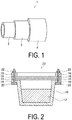
- FIG. 1 is a perspective view illustrating a cutaway of each layer of a hose of an embodiment of the present invention.
- a hose 1 has an inner tube 2, a reinforcing layer 3 arranged adjacent to the outer peripheral side of the inner tube 2, and an outer tube 4 arranged adjacent to the outer peripheral side of the reinforcing layer 3.
- the inner tube 2 is formed from the rubber composition of an embodiment of the present invention.
- the method of producing the hose of an embodiment of the present invention is not particularly limited. Examples thereof include the following method.
- the rubber composition of an embodiment of the present invention is extruded from a rubber extruder for inner tube rubber materials onto a mandrel to which a mold release agent has been applied, to form an inner tube.
- a reinforcing layer is then formed on an inner tube (in the case where an adhesive layer is present, on the adhesive layer).
- the method of forming a reinforcing layer is not particularly limited.
- an outer tube material e.g. material constituting an outer tube described above
- the reinforcing layer in the case where an adhesive layer is present, on the adhesive layer
- vulcanization methods include steam vulcanization, oven vulcanization (dry heat vulcanization), and hot water vulcanization.
- refrigerants that may be passed through the hose of an embodiment of the present invention are the same as those described above.
- the hose of an embodiment of the present invention can be used as, for example, a hose for air conditioners, such as air conditioners for vehicles.
- the hose of an embodiment of the present invention can be used for low pressure.
- an example of a preferable aspect is one in which the inner tube and the outer tube are formed from a rubber composition from the perspective of reducing noise.
- the rubber composition constituting the outer tube may be the rubber composition of an embodiment of the present invention or a rubber composition except the rubber composition of an embodiment of the present invention.
- the inner tube has a plurality of layers, at least one layer may be formed from the rubber composition of an embodiment of the present invention and the other layers may be formed from a rubber composition except the rubber composition of an embodiment of the present invention.
- an example of a preferable aspect is one in which greater than 50 mass% of the rubber component relative to the total amount of the polymer component is contained as the polymer component.
- the blended product is included in the rubber component.
- a hose does not contain resin layers refers to the case where the composition containing the polymer component used to form each layer of the hose does not contain a resin or the case where the content of the resin is less than 50 mass% of the total amount of the polymer component.
- Examples of the resin include polyolefin and polyamide.
- the resin described above does not include a blended product of the acrylonitrile butadiene copolymer rubber. Furthermore, the resin does not include a resin vulcanizing agent.
- the composition constituting the resin layer does not contain the rubber composition of an embodiment of the present invention.
- each component of the common components is shown in terms of an amount (part by mass) per 100 parts by mass of the rubber component shown in Table 1.
- the rubber composition produced as described above was vulcanized at 153°C for 45 minutes by using a press vulcanizing machine, and a sheet having a thickness of 0.5 mm was prepared.
- FIG. 2 is a cross-sectional view of a cup for evaluation that is used to evaluate refrigerant permeation resistance of a rubber composition of an embodiment of the present invention.
- a cup for evaluation 30 has a stainless steel cup 10 (hereinafter, cup 10), the sheet 14 produced as described above, a sintered metal plate 16, fixing members 18 and 19, bolts 20, and nuts 22.
- a refrigerant 12 is contained inside of the cup 10.
- the refrigerant 12 was poured into the cup 10 until the half of volume of the cup 10 was filled, the opening portion of the cup 10 was covered by the sheet 14, and the sintered metal plate 16 was placed on the upper portion of the sheet 14. Thereafter, the end portion of the cup 10, the sheet 14, and the sintered metal plate 16 were fixed through the fixing members 18 and 19 by using the bolts 20 and the nuts 22, thereby adhering the end portion of the cup 10 and the sheet 14 and the sintered metal plate 16, and thus the cup for evaluation 30 was prepared.
- HFC-134a available from Du Pont-Mitsui Fluorochemicals Company, Ltd.
- HFO-1234yf available from Du Pont-Mitsui Fluorochemicals Company, Ltd.
- the cup for evaluation prepared as described above was subjected to the refrigerant permeation test in which the cup was left in a condition at 100°C for 24 hours.
- the weight of the entire cup for evaluation was measured before and after the test to calculate the weight loss after the test.
- M is the weight loss (mg)
- t is the film thickness of the sheet (mm)
- T is the duration of the test (24 hr)
- A is the area of permeation (cm 2 ).
- a smaller gas permeation coefficient indicates superior refrigerant permeation resistance.
- the gas permeation coefficient is preferably 4.0 or less.
- the gas permeation coefficient is preferably 5.0 or less.
- the rubber composition produced as described above was vulcanized at 153°C for 45 minutes by using a press vulcanizing machine, and a large test piece (thickness: 12.5 mm) stipulated in JIS K 6262 was prepared.
- test piece prepared as described above was subjected to 25% compression and maintained in a condition at 70°C for 22 hours. Thereafter, after the applied pressure was removed, the test piece was left at room temperature for 30 minutes, and then the compression set was measured.
- a smaller minimum Mooney viscosity indicates superior processability of the rubber composition.
- a longer scorch time indicates superior processability of the rubber composition.
- the rubber composition produced as described above was vulcanized at 153°C for 45 minutes by using a press vulcanizing machine, and a sheet having a thickness of 2 mm was prepared.
- the tensile test was performed at a tensile test speed of 500 mm/min at 23°C in accordance with JIS K 6251 to measure each of the tensile strength (TB), the elongation at break (EB), and the 100% modulus (M100).
- the rubber composition produced as described above was vulcanized at 153°C for 45 minutes by using a press vulcanizing machine, and a sheet having a thickness of 2 mm was prepared.
- Comparative Examples 2 to 5 in which the predetermined scale-like filler was not contained but the untreated scale-like filler was contained in place of the predetermined scale-like filler, resulted in poor compression set resistances. Furthermore, Comparative Examples 2 and 3 resulted in low tensile strengths (TB).
- examples of the present invention achieved both excellent refrigerant permeation resistances and excellent hose performances.
Landscapes
- Chemical & Material Sciences (AREA)
- Chemical Kinetics & Catalysis (AREA)
- Medicinal Chemistry (AREA)
- Polymers & Plastics (AREA)
- Organic Chemistry (AREA)
- Health & Medical Sciences (AREA)
- Engineering & Computer Science (AREA)
- General Engineering & Computer Science (AREA)
- Mechanical Engineering (AREA)
- Physics & Mathematics (AREA)
- Thermal Sciences (AREA)
- Compositions Of Macromolecular Compounds (AREA)
- Rigid Pipes And Flexible Pipes (AREA)
Abstract
Description
- The present invention relates to a rubber composition for refrigerant-transporting hoses and a refrigerant-transporting hose.
- In the related art, to maintain refrigerant permeation resistance, hoses that use resin layers have been widely used as refrigerant-transporting hoses. However, use of resin layers results in a hard hose that is not flexible. In particular, since the temperature of the hose itself does not increase when the hose is used at a low pressure, the hose is used while the hose remains hard and lacks flexibility, and thus problems of noise occur when the hose is vibrated. Therefore, demands for tube rubber having refrigerant permeation resistance without the use of a resin layer have been increasing.
- Meanwhile, a hose that uses a composition containing a butyl rubber or the like and a filler has been proposed (e.g. Patent Document 1).
- Patent Document 1 describes a composite flexible hose having a three-layer structure, in which an inner surface rubber layer, a fiber reinforcing layer, and an outer surface rubber layer are laminated, the inner surface rubber layer containing from 5 to 30 parts by weight of layered inorganic substance that has surface-treated with an alkoxysilane compound and having an aspect ratio of 5 to 40 per 100 parts by weight of rubber component of the inner surface rubber layer, to provide a composite flexible hose having a three-layer structure, the composite flexible hose having enhanced flexibility and pliability, excellent gas barrier properties of a gas, especially an HFC-134a gas, and excellent productivity.
- Patent Document 1:
JP 3372475 B - When the inventor of the present invention prepared a rubber composition in accordance with Patent Document 1 and evaluated the rubber composition, it was found that refrigerant permeation resistance may be low.
- Furthermore, the inventor found that, when the amount of a filler contained in the rubber composition is increased, the refrigerant permeation resistance is enhanced while the hose performance (e.g. hose breaking strength and settability of metal parts) is deteriorated, and it is thus difficult to achieve both the refrigerant permeation resistance and the hose properties.
- Therefore, an object of the present invention is to provide a rubber composition for refrigerant-transporting hoses that can achieve both excellent refrigerant permeation resistance and excellent hose performance.
- Furthermore, another object of the present invention is to provide a refrigerant-transporting hose.
- As a result of diligent research to solve the problems described above, the inventor of the present invention found that, by allowing greater than 30 parts by mass but 180 parts by mass or less of a scale-like filler having at least one type selected from the group consisting of an amino group and an imino group to be contained in a surface per 100 parts by mass of a rubber component, predetermined effects can be achieved, and thus completed the present invention.
- The present invention is based on the findings described above and, specifically, solves the problem described above by the following features.
-
- 1. A rubber composition for a refrigerant-transporting hose, the rubber composition containing, per 100 parts by mass of a rubber component, greater than 30 parts by mass but 180 parts by mass or less of a scale-like filler having at least one type selected from the group consisting of an amino group and an imino group in a surface.
- 2. The rubber composition for a refrigerant-transporting hose according to 1 above, where the scale-like filler is at least one type selected from the group consisting of talc and mica.
- 3. The rubber composition for a refrigerant-transporting hose according to 1 or 2 above, where an aspect ratio of the scale-like filler is from 5 to 80.
- 4. The rubber composition for a refrigerant-transporting hose according to any one of 1 to 3 above, where the rubber component contains a butyl rubber.
- 5. The rubber composition for a refrigerant-transporting hose according to 4 above, where the rubber component further contains an acrylonitrile butadiene copolymer rubber.
- 6. The rubber composition for a refrigerant-transporting hose according to 5 above, where a mass ratio of the butyl rubber to the acrylonitrile butadiene copolymer rubber (butyl rubber/acrylonitrile butadiene copolymer rubber) is from 10/90 to 90/10.
- 7. The rubber composition for a refrigerant-transporting hose according to 5 or 6 above, where the acrylonitrile butadiene copolymer rubber contains at least an acrylonitrile butadiene rubber, and the acrylonitrile content of the acrylonitrile butadiene rubber is 25 mass% or greater of the acrylonitrile butadiene rubber.
- 8. The rubber composition for a refrigerant-transporting hose according to any one of 5 to 7 above, where the acrylonitrile butadiene copolymer rubber is at least one type selected from the group consisting of an acrylonitrile butadiene rubber and a blended product of an acrylonitrile butadiene rubber and a polyvinyl chloride.
- 9. The rubber composition for a refrigerant-transporting hose according to 8 above, where a mass ratio of the polyvinyl chloride to the acrylonitrile butadiene rubber (polyvinyl chloride/acrylonitrile butadiene rubber) in the blended product is from 10/90 to 90/10.
- 10. A refrigerant-transporting hose including an inner tube formed from the rubber composition for a refrigerant-transporting hose described in any one of 1 to 9 above.
- The rubber composition for refrigerant-transporting hoses and the refrigerant-transporting hose of embodiments of the present invention can achieve both excellent refrigerant permeation resistance and excellent hose performance.
-
-
FIG. 1 is a perspective view illustrating a cutaway of each layer of a hose of an embodiment of the present invention. -
FIG. 2 is a cross-sectional view of a cup for evaluation that is used to evaluate refrigerant permeation resistance of a rubber composition of an embodiment of the present invention. - Embodiments of the present invention are described in detail below.
- Note that in the present specification, numerical ranges indicated using "(from)... to..." include the former number as the lower limit value and the later number as the upper limit value.
- In the present specification, when a component contains two or more types of substances, the content of the component indicates the total content of the two or more types of substances.
- In the present specification, "achieving superior effect of the present invention" refers to the case where at least one of the refrigerant permeation resistance and the hose performance is superior.
- The rubber composition for refrigerant-transporting hoses of an embodiment of the present invention (rubber composition of an embodiment of the present invention) is
a rubber composition for a refrigerant-transporting hose, the rubber composition including, per 100 parts by mass of a rubber component, greater than 30 parts by mass but 180 parts by mass or less of a scale-like filler having at least one type selected from the group consisting of an amino group and an imino group in a surface. - The rubber composition of an embodiment of the present invention is thought to achieve desired effects as a result of having such a configuration. Although the reason is not clear, it is assumed to be as follows. In the present invention, due to the interaction between a rubber component and at least one type selected from the group consisting of an amino group and an imino group (also referred to as "amino group or the like") in the surface of a scale-like filler, the affinity between the rubber component and the scale-like filler is enhanced, and thus a large amount of the scale-like filler relative to the amount of the rubber component can be used. Furthermore, it is also considered that a bond is formed between the scale-like filler and the rubber component due to the interaction, and thus reinforcing effect of the rubber component by the scale-like filler is achieved by the bond. Therefore, it is presumed that the rubber composition of an embodiment of the present invention can achieve both excellent refrigerant permeation resistance and excellent hose performance.
- Each of the components contained in the rubber composition of an embodiment of the present invention will be described in detail below.
- The rubber composition of an embodiment of the present invention contains a rubber component.
- An example of a preferable aspect is one in which the rubber component is a diene rubber.
- The diene rubber is not particularly limited as long as the diene rubber is used in a hose. Examples thereof include butyl rubbers, such as butyl rubber (IIR) and halogenated butyl rubber; acrylonitrile butadiene copolymer rubber; natural rubber (NR), isoprene rubber (IR), chloroprene rubber (CR), styrene-butadiene rubber (SBR), ethylene propylene diene rubber (EPDM), and butadiene rubber (BR).
- Among these, the rubber component preferably contains a butyl rubber from the perspective of achieving superior effect of the present invention.
- The butyl rubber is not particularly limited as long as the butyl rubber is a polymer having repeating units formed from isobutylene and isoprene. Examples thereof include known butyl rubbers.
- A single butyl rubber can be used, or a combination of two or more types of butyl rubbers can be used. The method of producing butyl rubber is not particularly limited. Examples thereof include known methods.
- From the perspective of achieving superior effect of the present invention and excellent oil resistance, an example of a preferable aspect is one in which the rubber component further contains an acrylonitrile butadiene copolymer rubber besides the butyl rubber.
- The acrylonitrile butadiene copolymer rubber is not particularly limited as long as the acrylonitrile butadiene copolymer rubber contains a polymer having at least repeating units derived from acrylonitrile and butadiene. An example of a preferable aspect is one in which the acrylonitrile butadiene copolymer rubber contains at least an acrylonitrile butadiene rubber.
- For example, the acrylonitrile butadiene copolymer rubber may be an acrylonitrile butadiene rubber; or a blended product of an acrylonitrile butadiene rubber and a polymer except the acrylonitrile butadiene rubber. In an embodiment of the present invention, the blended product corresponds to the rubber component. Note that an example of a preferable aspect is one in which the polymer except the acrylonitrile butadiene rubber does not contain a butyl rubber.
- Examples of the polymer except the acrylonitrile butadiene rubber include polyvinyl chloride.
- An example of a preferable aspect is one in which the acrylonitrile butadiene copolymer rubber contains at least one type selected from the group consisting of an acrylonitrile butadiene rubber (NBR) and a blended product of an acrylonitrile butadiene rubber and a polyvinyl chloride (hereinafter, also simply referred to as "NBR-PVC blended product").
- All of the acrylonitrile butadiene copolymer rubber may be an NBR or a blended product (e.g. NBR-PVC blended product).
- When the acrylonitrile butadiene copolymer rubber contains at least an acrylonitrile butadiene rubber, the acrylonitrile content (AN content) of the acrylonitrile butadiene rubber is preferably 25 mass% or greater, and more preferably from 32 to 50 mass%, of the acrylonitrile butadiene rubber from the perspective of achieving excellent oil resistance. As described above, the acrylonitrile content is an amount of repeating units derived from acrylonitrile in the acrylonitrile butadiene rubber.
- Examples of the case where the acrylonitrile butadiene copolymer rubber contains at least an acrylonitrile butadiene rubber include the case where an acrylonitrile butadiene rubber is used as the acrylonitrile butadiene copolymer rubber, and the case where a blended product is used as the acrylonitrile butadiene copolymer rubber.
- The acrylonitrile content can be measured in accordance with JIS K 6384.
- The acrylonitrile butadiene rubber as the acrylonitrile butadiene copolymer rubber is not particularly limited as long as the acrylonitrile butadiene rubber is a polymer having repeating units derived from acrylonitrile and butadiene. Examples thereof include known acrylonitrile butadiene rubbers.
- The NBR-PVC blended product is not particularly limited as long as the NBR-PVC blended product is a mixture formed from at least an acrylonitrile butadiene rubber and a polyvinyl chloride.
- The acrylonitrile butadiene rubber constituting the NBR-PVC blended product is not particularly limited. Examples thereof include known acrylonitrile butadiene rubbers. A single acrylonitrile butadiene rubber can be used, or a combination of two or more types of acrylonitrile butadiene rubbers can be used.
- The polyvinyl chloride (PVC) constituting the NBR-PVC blended product is not particularly limited. Examples thereof include known polyvinyl chlorides. A single polyvinyl chloride can be used, or a combination of two or more types of polyvinyl chlorides can be used.
- In the blended product, the mass ratio of the polyvinyl chloride to the acrylonitrile butadiene rubber (polyvinyl chloride/acrylonitrile butadiene rubber) is preferably from 10/90 to 90/10, and more preferably from 20/80 to 70/30, from the perspective of achieving superior effect of the present invention and excellent mixability/processability.
- The content of the polyvinyl chloride is preferably from 0 to 80 parts by mass, and more preferably from 0 to 60 parts by mass, per 100 parts by mass of the rubber component from the perspective of excellent oil resistance.
- A single acrylonitrile butadiene copolymer rubber can be used, or a combination of two or more types of acrylonitrile butadiene copolymer rubbers can be used. The method of producing the acrylonitrile butadiene copolymer rubber is not particularly limited. Examples thereof include known acrylonitrile butadiene copolymer rubbers.
- In the rubber component, when the rubber component contains a butyl rubber or the rubber component further contains an acrylonitrile butadiene copolymer rubber, the butyl rubber or the butyl rubber and the acrylonitrile butadiene copolymer rubber may be the main component of the rubber component. In an embodiment of the present invention, the main component indicates that the content of the butyl rubber or the total content of the butyl rubber and the acrylonitrile butadiene copolymer rubber is from 50 to 100 mass% of the rubber component described above. Note that, when the rubber component is a butyl rubber, the content of the butyl rubber is 100 mass% of the rubber component.
- When the rubber component further contains an acrylonitrile butadiene copolymer rubber, an example of a preferable aspect is one in which the total content of the butyl rubber and the acrylonitrile butadiene copolymer rubber is 100 mass% or less of the rubber component from the perspective of achieving superior effect of the present invention.
- The mass ratio of the butyl rubber to the acrylonitrile butadiene copolymer rubber (butyl rubber/acrylonitrile butadiene copolymer rubber) is preferably from 10/90 to 90/10, more preferably from 10/90 to 80/20, and even more preferably from 10/90 to 70/30, from the perspective of achieving superior effect of the present invention and excellent balance of the refrigerant permeation resistance, oil resistance, and low-temperature properties.
- The scale-like filler contained in the rubber composition of an embodiment of the present invention contains at least one type selected from the group consisting of an amino group (-NH2) and an imino group in the surface and is a filler having a shape of scale.
- The shape of the scale-like filler is not particularly limited as long as the shape is scale-like. The periphery of the scale-like filler may be irregular.
- The imino group may be -N=C< or -NH-.
- The amino group or the like can be bonded, directly or through organic group(s), to the surface of the scale-like filler. The organic group is not particularly limited.
- The average diameter of the scale-like filler is preferably from 0.1 to 700 µm, and more preferably from 1 to 100 µm, from the perspective of excellent balance between refrigerant permeation resistance and mixability/processability.
- The aspect ratio (average diameter/thickness) of the scale-like filler is preferably from 5 to 80, and more preferably from 15 to 70, from the perspective of excellent balance between refrigerant permeation resistance and mixability/processability.
- In an embodiment of the present invention, the average diameter of the scale-like filler is a volume average diameter by the laser diffraction method by using a laser diffraction particle size distribution measuring device.
- In an embodiment of the present invention, the thickness of the scale-like filler is an average value calculated based on measurement values obtained by observing scale-like fillers in a magnification of 10000 times by using a scanning electron microscope (SEM), selecting a plurality of scale-like fillers randomly from the observed field, and measuring the thicknesses thereof.
- The scale-like filler is preferably at least one type selected from the group consisting of talc and mica, and more preferably talc, from the perspective of achieving superior effect of the present invention.
- The talc and mica are not particularly limited. Examples thereof include known talc and mica.
- The method of producing the scale-like filler is not particularly limited. For example, production is possible by mixing a raw material filler having a scale-like shape, and a silane coupling agent having at least one type selected from the group consisting of an amino group and an imino group (hereinafter, also referred to as "aminosilane").
- The raw material filler used in the production of the scale-like filler is not particularly limited as long as the raw material filler is a scale-like filler. Examples thereof include talc and mica.
- The average diameter and the aspect ratio of the raw material filler are the same as those of the scale-like filler.
- The silane coupling agent used in the production of the scale-like filler is not particularly limited as long as the silane coupling agent is a compound having a hydrolyzable silyl group and at least one type selected from the group consisting of an amino group and an imino group.
- Examples of the hydrolyzable silyl group include a substance to which one to three hydrolyzable groups are bonded to a silicon atom. Examples of the hydrolyzable group include alkoxy groups. Examples of the alkoxy group include a methoxy group and an ethoxy group.
- When one or two hydrolyzable groups are bonded to one silicon atom, other groups are not particularly limited. Examples thereof include alkyl groups. Examples of the alkyl group include a methyl group and an ethyl group.
- The amino group or the like and the hydrolyzable silyl group can be bonded to each other directly or through organic group(s).
- Examples of the silane coupling agent include a compound represented by Formula (1) below.

- In Formula (1), OR1 is an alkoxy group, R2 is an alkyl group, and R3 is an organic group having at least one type selected from the group consisting of an amino group and an imino group.
- Examples of the alkoxy group include a methoxy group and an ethoxy group.
- Examples of the alkyl group include a methyl group and an ethyl group.
- The organic group having at least one type selected from the group consisting of an amino group and an imino group is not particularly limited. The organic group may have from 1 to 3 amino groups or the like. Examples of the organic group include hydrocarbon groups. Examples of the hydrocarbon group include aliphatic hydrocarbon groups (including straight-chain, branched chain, and alicyclic), aromatic hydrocarbon groups, and combinations thereof. The carbon atom constituting the aliphatic hydrocarbon group may form an imino group.
- Specific examples of the silane coupling agent include
compounds having an amino group and an imino group, such as N-2-(aminoethyl)-3-aminopropylmethyldimethoxysilane and N-2-(aminoethyl)-3-aminopropyltrimethoxysilane;
compounds having an amino group, such as 3-aminopropyltrimethoxysilane and 3-aminopropyltriethoxysilane;
compounds having C=N, such as 3-triethoxysilyl-N-(1,3-dimethyl-butylidene)propylamine; and
compounds having -NH-, such as N-phenyl-3-aminopropyltrimethoxysilane and N-(vinylbenzyl)-2-aminoethyl-3-aminopropyltrimethoxysilane. - The silane coupling agent may be a salt, such as a hydrochloride, of the silane coupling agent described above.
- The used amount of the silane coupling agent may be from 0.5 to 20 parts by mass per 100 parts by mass of the raw material filler.
- In the present invention, the content of the scale-like filler is greater than 30 parts by mass but 180 parts by mass or less per 100 parts by mass of the rubber component. The content of the scale-like filler is preferably from 35 to 170 parts by mass, and more preferably from 40 to 150 parts by mass, per 100 parts by mass of the rubber component from the perspective of achieving superior effect of the present invention and excellent balance between refrigerant permeation resistance and mixability/processability.
- The rubber composition of an embodiment of the present invention may further contain additives as necessary.
- Examples of the additives include resins, fillers except the scale-like filler, softeners such as paraffin oils, stearic acid, zinc oxide, anti-aging agents, antioxidants, antistatic agents, flame retardants, vulcanizing agents such as sulfur or resin vulcanizing agents, vulcanization accelerators, crosslinking agents such as peroxides, and adhesion aids.
- Each of the additives is not particularly limited. Examples thereof include known products.
- The content of each of the additives may be selected as desired.
- When the rubber composition of an embodiment of the present invention further contains a resin vulcanizing agent, examples of the resin vulcanizing agent include alkylphenol-formaldehyde resins and brominated alkylphenol-formaldehyde resins.
- The content of the resin vulcanizing agent is preferably from 1 to 8 parts by mass, and more preferably from 2 to 6 parts by mass, per 100 parts by mass of the rubber component.
- The production of the rubber composition of an embodiment of the present invention is not particularly limited. The production method includes kneading the rubber component and the scale-like filler described above and additives that may be used as necessary, at 30 to 150°C by using a sealed mixer, such as Banbury mixer and kneader, or a roller kneader.
- Conditions for vulcanization or crosslinking of the rubber composition of an embodiment of the present invention are not particularly limited. For example, the rubber composition of an embodiment of the present invention may be vulcanized or crosslinked in a condition at 140 to 160°C while pressure is being applied.
- The rubber composition of an embodiment of the present invention can be used as, for example, a rubber composition for a refrigerant-transporting hose (a hose which is used to transport a refrigerant).
- There is no particular limitation on the part of the hose to which the rubber composition of an embodiment of the present invention is applied; however, an example of a preferable aspect is one in which the rubber composition of an embodiment of the present invention is used to form an inner tube (in particular, the innermost layer) of a hose.
- The refrigerant that is passed through the hose is not particularly limited. Examples thereof include fluorine-based compounds. Specific examples thereof include fluorine-based compounds having a double bond, such as 1,2,3,3,3-pentafluoropropene, 1,3,3,3-tetrafluoropropene, 2,3,3,3-tetrafluoropropene (structural formula: CF3-CF=CH2, HFO-1234yf), 1,2,3,3-tetrafluoropropene, and 3,3,3-trifluoropropene; and saturated hydrofluorocarbons, such as HFC-134a (structural formula: CF3-CFH2).
- A single refrigerant can be used, or a combination of two or more types of refrigerants can be used.
- The refrigerant-transporting hose of an embodiment of the present invention (hose of an embodiment of the present invention) is a refrigerant-transporting hose having an inner tube formed from the rubber composition for refrigerant-transporting hoses of an embodiment of the present invention.
- The rubber composition used in the hose of an embodiment of the present invention is not particularly limited as long as it is the rubber composition of an embodiment of the present invention.
- An example of the hose of an embodiment of the present invention is a hose having an inner tube, a reinforcing layer, and an outer tube that are arranged in this order.
- The inner tube of the hose of an embodiment of the present invention is formed from the rubber composition of an embodiment of the present invention.
- The inner tube may have one layer or a plurality of layers.
- When the inner tube has a plurality of layers, at least the innermost layer of the inner tube is preferably formed from the rubber composition of an embodiment of the present invention. Furthermore, an interlayer rubber layer or the like may be arranged in between adjacent inner tubes.
- An interlayer rubber layer or the like may be arranged in between an inner tube and a reinforcing layer adjacent to the inner tube.
- The reinforcing layer is not particularly limited as long as the reinforcing layer can be used in a hose.
- Examples of the material used in the reinforcing layer includes fiber materials such as polyester-based fiber, polyamide-based fiber, aramid fiber, vinylon fiber, rayon fiber, poly-p-phenylene-benzobisoxazole fiber, and polyketone fiber, polyarylate fiber; and metal materials such as hard steel wire, including brass-plated wire, zinc-plated wire, and the like.
- The shape of the reinforcing layer is not particularly limited. Examples thereof include braid wind shape and spiral wind shape.
- A single reinforcing layer can be used or a combination of two or more reinforcing layers can be used.
- The reinforcing layer may have one layer or a plurality of layers.
- When the reinforcing layer has a plurality of layers, an interlayer rubber layer or the like may be arranged in between adjacent reinforcing layers.
- The material constituting the outer tube is not particularly limited. For example, a rubber composition can be used. Specific examples thereof include styrene butadiene rubber-based rubber compositions, chloroprene rubber-based rubber compositions, and ethylene propylene diene rubber-based rubber compositions.
- The outer tube may have one layer or a plurality of layers.
- When the outer tube has a plurality of layers, an interlayer rubber layer or the like may be arranged in between adjacent outer tubes.
- An interlayer rubber layer or the like may be arranged in between an outer tube and a reinforcing layer adjacent to the outer tube.
- Hereinafter, a hose of an embodiment of the present invention will be described in detail with reference to the attached drawings. The hose of an embodiment of the present invention is not limited to the drawings.
-
FIG. 1 is a perspective view illustrating a cutaway of each layer of a hose of an embodiment of the present invention. - In
FIG. 1 , a hose 1 has aninner tube 2, a reinforcinglayer 3 arranged adjacent to the outer peripheral side of theinner tube 2, and an outer tube 4 arranged adjacent to the outer peripheral side of the reinforcinglayer 3. - The
inner tube 2 is formed from the rubber composition of an embodiment of the present invention. - The method of producing the hose of an embodiment of the present invention is not particularly limited. Examples thereof include the following method.
- First, the rubber composition of an embodiment of the present invention is extruded from a rubber extruder for inner tube rubber materials onto a mandrel to which a mold release agent has been applied, to form an inner tube.
- A reinforcing layer is then formed on an inner tube (in the case where an adhesive layer is present, on the adhesive layer). The method of forming a reinforcing layer is not particularly limited.
- Furthermore, an outer tube material (e.g. material constituting an outer tube described above) is extruded onto the reinforcing layer (in the case where an adhesive layer is present, on the adhesive layer) to form an outer tube.
- Thereafter, these layers are bonded by vulcanization in a condition at 130 to 190°C for 30 to 180 minutes, and thus a hose of an embodiment of the present invention can be produced. Examples of vulcanization methods include steam vulcanization, oven vulcanization (dry heat vulcanization), and hot water vulcanization.
- The refrigerants that may be passed through the hose of an embodiment of the present invention are the same as those described above.
- The hose of an embodiment of the present invention can be used as, for example, a hose for air conditioners, such as air conditioners for vehicles. The hose of an embodiment of the present invention can be used for low pressure.
- In the hose of an embodiment of the present invention, an example of a preferable aspect is one in which the inner tube and the outer tube are formed from a rubber composition from the perspective of reducing noise. In this case, the rubber composition constituting the outer tube may be the rubber composition of an embodiment of the present invention or a rubber composition except the rubber composition of an embodiment of the present invention. When the inner tube has a plurality of layers, at least one layer may be formed from the rubber composition of an embodiment of the present invention and the other layers may be formed from a rubber composition except the rubber composition of an embodiment of the present invention. In the rubber composition of an embodiment of the present invention or a rubber composition except the rubber composition of an embodiment of the present invention, an example of a preferable aspect is one in which greater than 50 mass% of the rubber component relative to the total amount of the polymer component is contained as the polymer component.
- Note that, when the rubber composition of an embodiment of the present invention contains the blended product described above, the blended product is included in the rubber component.
- An example of a preferable aspect of the hose of an embodiment of the present invention contains no resin layers from the perspective of reducing noise. In the present invention, "a hose does not contain resin layers" refers to the case where the composition containing the polymer component used to form each layer of the hose does not contain a resin or the case where the content of the resin is less than 50 mass% of the total amount of the polymer component.
- Examples of the resin include polyolefin and polyamide.
- Note that, in an embodiment of the present invention, the resin described above does not include a blended product of the acrylonitrile butadiene copolymer rubber. Furthermore, the resin does not include a resin vulcanizing agent. The composition constituting the resin layer does not contain the rubber composition of an embodiment of the present invention.
- The present invention is described below in detail using examples but the present invention is not limited to such examples.
- The components in Table 1 below (unit of content of each component: part by mass) and the common components described below were mixed by an agitator to produce a rubber composition.
- The content of each component of the common components is shown in terms of an amount (part by mass) per 100 parts by mass of the rubber component shown in Table 1.
- Carbon black 29 parts by mass: ISAF (trade name: Show Black N220, available from Cabot Japan K.K.)
- Stearic acid 1 part by mass: trade name: Industrial stearic acid N, available from Chiba Fatty Acid Co., Ltd.
- Resin vulcanizing agent 5 parts by mass: Brominated alkylphenol-formaldehyde resin, Tackirol 250-1, available from Taoka Chemical Co., Ltd.
- Paraffin oil 5 parts by mass:
Machine oil 22, available from Showa Shell Sekiyu K.K. - Zinc oxide 5 parts by mass: trade name: Zinc Oxide III, available from Seido Chemical Industry Co., Ltd.
- The following evaluations were performed by using the rubber composition produced as described above. The results are shown in Table 1.
- The rubber composition produced as described above was vulcanized at 153°C for 45 minutes by using a press vulcanizing machine, and a sheet having a thickness of 0.5 mm was prepared.
- The evaluation method of refrigerant permeation resistance will be described below with reference to the attached drawings.
-
FIG. 2 is a cross-sectional view of a cup for evaluation that is used to evaluate refrigerant permeation resistance of a rubber composition of an embodiment of the present invention. - In
FIG. 2 , a cup forevaluation 30 has a stainless steel cup 10 (hereinafter, cup 10), thesheet 14 produced as described above, asintered metal plate 16, fixingmembers bolts 20, and nuts 22. A refrigerant 12 is contained inside of thecup 10. - First, the refrigerant 12 was poured into the
cup 10 until the half of volume of thecup 10 was filled, the opening portion of thecup 10 was covered by thesheet 14, and thesintered metal plate 16 was placed on the upper portion of thesheet 14. Thereafter, the end portion of thecup 10, thesheet 14, and thesintered metal plate 16 were fixed through the fixingmembers bolts 20 and the nuts 22, thereby adhering the end portion of thecup 10 and thesheet 14 and thesintered metal plate 16, and thus the cup forevaluation 30 was prepared. - As a refrigerant in this example, HFC-134a (available from Du Pont-Mitsui Fluorochemicals Company, Ltd.) or HFO-1234yf (available from Du Pont-Mitsui Fluorochemicals Company, Ltd.) was used.
- The cup for evaluation prepared as described above was subjected to the refrigerant permeation test in which the cup was left in a condition at 100°C for 24 hours.
- The weight of the entire cup for evaluation was measured before and after the test to calculate the weight loss after the test.
- The weight loss after the test and the like were applied to the following mathematical expression to calculate the gas permeation coefficient.

- In the expression, M is the weight loss (mg), t is the film thickness of the sheet (mm), T is the duration of the test (24 hr), and A is the area of permeation (cm2).
- A smaller gas permeation coefficient indicates superior refrigerant permeation resistance.
- When the refrigerant is HFC-134a, the gas permeation coefficient is preferably 4.0 or less.
- When the refrigerant is HFO-1234yf, the gas permeation coefficient is preferably 5.0 or less.
- The rubber composition produced as described above was vulcanized at 153°C for 45 minutes by using a press vulcanizing machine, and a large test piece (thickness: 12.5 mm) stipulated in JIS K 6262 was prepared.
- In accordance with JIS K 6262, the test piece prepared as described above was subjected to 25% compression and maintained in a condition at 70°C for 22 hours. Thereafter, after the applied pressure was removed, the test piece was left at room temperature for 30 minutes, and then the compression set was measured.
- The case where the compression set was 40% or less was evaluated as achieving excellent compression set.
- In accordance with JIS K 6300-1, by using an L-shaped rotor, the minimum Mooney viscosity (Vm) and the scorch time (ts) of the rubber composition produced as described above were determined in a condition at 125°C.
- A smaller minimum Mooney viscosity indicates superior processability of the rubber composition.
- A longer scorch time indicates superior processability of the rubber composition.
- The rubber composition produced as described above was vulcanized at 153°C for 45 minutes by using a press vulcanizing machine, and a sheet having a thickness of 2 mm was prepared.
- By using the sheet prepared as described above, the tensile test was performed at a tensile test speed of 500 mm/min at 23°C in accordance with JIS K 6251 to measure each of the tensile strength (TB), the elongation at break (EB), and the 100% modulus (M100).
- The rubber composition produced as described above was vulcanized at 153°C for 45 minutes by using a press vulcanizing machine, and a sheet having a thickness of 2 mm was prepared.
- By stacking 3 pieces of sheets prepared as described above, the hardness measurement test was performed in a condition at 23°C by a type A durometer in accordance with JIS K 6253 to measure the hardness (HS) .
[Table 1] Table 1 Example Comparative Examples 1 2 3 4 5 6 1 2 3 4 5 Butyl rubber 1 100 100 100 70 100 80 100 100 100 70 100 Acrylonitrile butadiene copolymer rubber 1 30 30 Acrylonitrile butadiene copolymer rubber 2 (NBR-PVC blended product) 20 Butyl rubber 1/acrylonitrile butadiene copolymer rubber 1 or 2 (mass ratio) - - - 2.3 - 4 - - - 2.3 - Scale-like filler 1 Aminosilane-treated talc 100 130 170 130 130 30 Scale- like filler 2Aminosilane-treated mica 50 Comparative scale-like filler 1 Untreated talc 100 130 130 Comparative scale- like filler 2Untreated mica 50 Refrigerant permeation resistance (mg · mm/24h · cm2) HFC-134a 3.0 2.5 2.0 3.7 3.0 3.1 4.1 3.5 2.4 3.8 3.0 HFO-1234yf 4.6 3.6 3.0 4.0 4.5 4.7 6.9 5.3 4.2 4.0 4.5 Compression set resistance % 17 25 38 39 28 40 10 44 46 43 47 Physical properties of unvulcanized product Minimum Mooney viscosity (Vm) 55 60 75 70 51 88 48 51 55 60 40 Scorch time (t5) 12 12 13 9 14 7 11 10 11 7 15 Tensile properties TB % 10.9 10.8 12.0 11.6 13.4 11.7 10.6 10.3 8.7 11.0 11.8 EB MPa 158 129 100 144 128 105 207 269 274 115 285 M100 MPa 9.9 10.6 11.9 11.2 9.2 10.7 9.5 5.8 5.8 10.8 4.8 Hardness HS 79 81 88 87 74 92 77 77 79 84 72 - Details of the components described in Table 1 are as follows.
- Butyl rubber 1: trade name: BUTYL 301, available from LANXESS, weight average molecular weight: 600000
- Acrylonitrile butadiene copolymer rubber 1: acrylonitrile butadiene rubber, trade name: Nipol 1041, available from Zeon Corporation. The acrylonitrile content in the NBR: 41 mass%
- Acrylonitrile butadiene copolymer rubber 2 (NBR-PVC blended product): Nipol DN517, available from Zeon Corporation, blended product of acrylonitrile butadiene rubber and polyvinyl chloride PVC/NBR (mass ratio): 30/70 The acrylonitrile content of the NBR contained in the acrylonitrile butadiene copolymer rubber 2: 36 mass% of the NBR
-
- Scale-like filler 1 (aminosilane-treated talc): Mistron CB (trade name), available from Imerys Specialities Japan Co., Ltd. Talc that had at least one type selected from the group consisting of an amino group and an imino group on the surface and that had a scale-like shape. The scale-like filler 1 was surface treated with aminosilane. Average diameter: 6.1 µm, aspect ratio: 6
- Scale-like filler 2 (aminosilane-treated mica): trade name: Yamaguchi Mica S-21P, available from Yamaguchi Mica Co., Ltd. Mica that was surface treated with 3-aminopropyltriethoxysilane and that had a scale-like shape. An amino group was contained in the surface. Average diameter: 23 µm, aspect ratio: 70.
- Comparative scale-like filler 1 (untreated talc): MISTRON VAPOR (trade name), available from Imerys Specialities Japan Co., Ltd. Talc having a scale-like shape. No amino group and no imino group were contained in the surface. Surface treatment was not applied. Average diameter: 6.1 µm, aspect ratio: 6
- Comparative scale-like filler 2 (untreated mica): Yamaguchi Mica S-21, available from Yamaguchi Mica Co., Ltd. Mica having a scale-like shape. No amino group and no imino group were contained in the surface. Surface treatment was not applied. Average diameter: 23 µm, aspect ratio: 70.
- As is clear from the results shown in Table 1, Comparative Example 1, in which the content of the scale-like filler was outside the predetermined range, resulted in poor refrigerant permeation resistance.
- Comparative Examples 2 to 5, in which the predetermined scale-like filler was not contained but the untreated scale-like filler was contained in place of the predetermined scale-like filler, resulted in poor compression set resistances. Furthermore, Comparative Examples 2 and 3 resulted in low tensile strengths (TB).
- On the other hand, examples of the present invention achieved both excellent refrigerant permeation resistances and excellent hose performances.
-
- 1 Hose
- 2 Inner tube
- 3 Reinforcing layer
- 4 Outer tube
- 10 Cup
- 12 Refrigerant
- 14 Sheet
- 16 Sintered metal plate
- 18, 19 Fixing member
- 20 Bolt
- 22 Nut
- 30 Cup for evaluation
Claims (10)
- A rubber composition for a refrigerant-transporting hose, the rubber composition comprising, per 100 parts by mass of a rubber component, greater than 30 parts by mass but 180 parts by mass or less of a scale-like filler having at least one type selected from the group consisting of an amino group and an imino group in a surface.
- The rubber composition for a refrigerant-transporting hose according to claim 1, wherein the scale-like filler is at least one type selected from the group consisting of talc and mica.
- The rubber composition for a refrigerant-transporting hose according to claim 1 or 2, wherein an aspect ratio of the scale-like filler is from 5 to 80.
- The rubber composition for a refrigerant-transporting hose according to any one of claims 1 to 3, wherein the rubber component contains a butyl rubber.
- The rubber composition for a refrigerant-transporting hose according to claim 4, wherein the rubber component further contains an acrylonitrile butadiene copolymer rubber.
- The rubber composition for a refrigerant-transporting hose according to claim 5, wherein a mass ratio of the butyl rubber to the acrylonitrile butadiene copolymer rubber, butyl rubber/acrylonitrile butadiene copolymer rubber, is from 10/90 to 90/10.
- The rubber composition for a refrigerant-transporting hose according to claim 5 or 6, wherein the acrylonitrile butadiene copolymer rubber contains at least an acrylonitrile butadiene rubber, and the acrylonitrile content of the acrylonitrile butadiene rubber is 25 mass% or greater of the acrylonitrile butadiene rubber.
- The rubber composition for a refrigerant-transporting hose according to any one of claims 5 to 7, wherein the acrylonitrile butadiene copolymer rubber is at least one type selected from the group consisting of an acrylonitrile butadiene rubber and a blended product of an acrylonitrile butadiene rubber and a polyvinyl chloride.
- The rubber composition for a refrigerant-transporting hose according to claim 8, wherein a mass ratio of the polyvinyl chloride to the acrylonitrile butadiene rubber, polyvinyl chloride/acrylonitrile butadiene rubber, in the blended product is from 10/90 to 90/10.
- A refrigerant-transporting hose comprising an inner tube formed from the rubber composition for a refrigerant-transporting hose described in any one of claims 1 to 9.
Applications Claiming Priority (2)
| Application Number | Priority Date | Filing Date | Title |
|---|---|---|---|
| JP2016008063A JP6720548B2 (en) | 2016-01-19 | 2016-01-19 | Rubber composition for refrigerant transportation hose and refrigerant transportation hose |
| PCT/JP2017/001664 WO2017126582A1 (en) | 2016-01-19 | 2017-01-19 | Rubber composition for coolant transport hose, and coolant transport hose |
Publications (2)
| Publication Number | Publication Date |
|---|---|
| EP3406665A1 true EP3406665A1 (en) | 2018-11-28 |
| EP3406665A4 EP3406665A4 (en) | 2019-09-18 |
Family
ID=59362450
Family Applications (1)
| Application Number | Title | Priority Date | Filing Date |
|---|---|---|---|
| EP17741459.6A Withdrawn EP3406665A4 (en) | 2016-01-19 | 2017-01-19 | RUBBER COMPOSITION FOR REFRIGERATOR TRANSPORT PIPE, AND REFRIGERANT TRANSPORT PIPE |
Country Status (5)
| Country | Link |
|---|---|
| US (1) | US20190031862A1 (en) |
| EP (1) | EP3406665A4 (en) |
| JP (1) | JP6720548B2 (en) |
| CN (1) | CN108473728A (en) |
| WO (1) | WO2017126582A1 (en) |
Cited By (4)
| Publication number | Priority date | Publication date | Assignee | Title |
|---|---|---|---|---|
| EP3406667A4 (en) * | 2016-01-19 | 2019-09-18 | The Yokohama Rubber Co., Ltd. | RUBBER COMPOSITION, AND PIPE |
| EP3477177A4 (en) * | 2016-06-22 | 2020-02-19 | The Yokohama Rubber Co., Ltd. | RUBBER COMPOSITION FOR REFRIGERANT TRANSPORT HOSE AND REFRIGERANT TRANSPORT HOSE |
| EP3919263A4 (en) * | 2019-01-28 | 2022-11-23 | Mitsuboshi Belting Ltd. | RIBBED BELT AND METHOD OF MANUFACTURING IT |
| US12092188B2 (en) | 2019-01-28 | 2024-09-17 | Mitsuboshi Belting Ltd. | V-ribbed belt and method for producing same |
Families Citing this family (1)
| Publication number | Priority date | Publication date | Assignee | Title |
|---|---|---|---|---|
| JP6746818B1 (en) | 2019-04-16 | 2020-08-26 | 三ツ星ベルト株式会社 | V-ribbed belt, method for producing the same, and rubber composition |
Family Cites Families (12)
| Publication number | Priority date | Publication date | Assignee | Title |
|---|---|---|---|---|
| JP3324399B2 (en) * | 1995-07-14 | 2002-09-17 | 株式会社豊田中央研究所 | Clay composite rubber material and method for producing the same |
| JP3372475B2 (en) * | 1998-03-16 | 2003-02-04 | 株式会社ニチリン | Composite flexible hose |
| JP4208489B2 (en) * | 2002-06-10 | 2009-01-14 | 株式会社ブリヂストン | High pressure hose |
| JP4300000B2 (en) * | 2002-07-03 | 2009-07-22 | 株式会社ブリヂストン | Rubber composition and high-pressure hose |
| JP2005029768A (en) * | 2003-06-18 | 2005-02-03 | Bridgestone Corp | Rubber composition |
| CN1806003A (en) * | 2003-06-18 | 2006-07-19 | 普利司通股份有限公司 | Rubber composition |
| JP2005023246A (en) * | 2003-07-04 | 2005-01-27 | Bridgestone Corp | High-pressure hose |
| GB0608126D0 (en) * | 2006-04-24 | 2006-06-07 | Imerys Minerals Ltd | Barrier compositions |
| JP2010071418A (en) * | 2008-09-19 | 2010-04-02 | Tokai Rubber Ind Ltd | Refrigerant transportation hose |
| JP5622506B2 (en) * | 2010-09-29 | 2014-11-12 | 住友理工株式会社 | Resin composition for refrigerant transport hose and refrigerant transport hose obtained by using the same |
| JP2013228081A (en) * | 2012-03-29 | 2013-11-07 | Tokai Rubber Ind Ltd | Air conditioner hose |
| JP2013227480A (en) * | 2012-03-29 | 2013-11-07 | Tokai Rubber Ind Ltd | Rubber composition |
-
2016
- 2016-01-19 JP JP2016008063A patent/JP6720548B2/en active Active
-
2017
- 2017-01-19 CN CN201780007035.XA patent/CN108473728A/en active Pending
- 2017-01-19 US US16/071,469 patent/US20190031862A1/en not_active Abandoned
- 2017-01-19 EP EP17741459.6A patent/EP3406665A4/en not_active Withdrawn
- 2017-01-19 WO PCT/JP2017/001664 patent/WO2017126582A1/en not_active Ceased
Cited By (4)
| Publication number | Priority date | Publication date | Assignee | Title |
|---|---|---|---|---|
| EP3406667A4 (en) * | 2016-01-19 | 2019-09-18 | The Yokohama Rubber Co., Ltd. | RUBBER COMPOSITION, AND PIPE |
| EP3477177A4 (en) * | 2016-06-22 | 2020-02-19 | The Yokohama Rubber Co., Ltd. | RUBBER COMPOSITION FOR REFRIGERANT TRANSPORT HOSE AND REFRIGERANT TRANSPORT HOSE |
| EP3919263A4 (en) * | 2019-01-28 | 2022-11-23 | Mitsuboshi Belting Ltd. | RIBBED BELT AND METHOD OF MANUFACTURING IT |
| US12092188B2 (en) | 2019-01-28 | 2024-09-17 | Mitsuboshi Belting Ltd. | V-ribbed belt and method for producing same |
Also Published As
| Publication number | Publication date |
|---|---|
| US20190031862A1 (en) | 2019-01-31 |
| EP3406665A4 (en) | 2019-09-18 |
| JP6720548B2 (en) | 2020-07-08 |
| WO2017126582A1 (en) | 2017-07-27 |
| JP2017128641A (en) | 2017-07-27 |
| CN108473728A (en) | 2018-08-31 |
Similar Documents
| Publication | Publication Date | Title |
|---|---|---|
| US20190031862A1 (en) | Rubber Composition for Refrigerant-Transporting Hose, and Refrigerant-Transporting Hose | |
| EP3553120B1 (en) | Rubber composition for marine hose and marine hose | |
| EP3477177B1 (en) | Rubber composition for refrigerant transporting hoses, and refrigerant transporting hose | |
| EP3309209A1 (en) | Rubber composition for hose, and hose | |
| EP3309208A1 (en) | Rubber composition for hose, and hose | |
| US10590253B2 (en) | Rubber composition for flame-retardant hose, and flame-retardant hose | |
| JP4543685B2 (en) | Rubber composition for hose interlayer rubber and hose | |
| JP5313224B2 (en) | Seismic isolation / damping device | |
| EP3323852A1 (en) | Rubber composition and refrigerant-transporting hose | |
| EP3406667A1 (en) | Rubber composition and hose | |
| JP5172120B2 (en) | Predetermined cord coating rubber composition and tire having carcass and / or belt using the same | |
| TWI903253B (en) | Rubber composition, laminate, and hose | |
| JP2019210390A (en) | Rubber composition for hose, and hose | |
| JP7402028B2 (en) | Rubber composition for bead insulation or bead cover, and tire | |
| JP6230979B2 (en) | Rubber bearing | |
| JP5914993B2 (en) | Rubber composition for hose and hose | |
| WO2024142540A1 (en) | Rubber composition and hose | |
| JP5711891B2 (en) | Butyl rubber composition and vehicle flexible hose using the same | |
| JP4761416B2 (en) | Rubber hose for refrigerant transport | |
| JP2023019875A (en) | High damping rubber composition and base-isolation rubber | |
| JP5992156B2 (en) | Pneumatic tire | |
| JP2025009280A (en) | Rubber composition and refrigerant transport hose | |
| JP4680234B2 (en) | Rubber composition for covering carcass cord and tire having carcass using the same | |
| JPH04216837A (en) | Rubber composition, hose and hose manufacturing method |
Legal Events
| Date | Code | Title | Description |
|---|---|---|---|
| STAA | Information on the status of an ep patent application or granted ep patent |
Free format text: STATUS: THE INTERNATIONAL PUBLICATION HAS BEEN MADE |
|
| PUAI | Public reference made under article 153(3) epc to a published international application that has entered the european phase |
Free format text: ORIGINAL CODE: 0009012 |
|
| STAA | Information on the status of an ep patent application or granted ep patent |
Free format text: STATUS: REQUEST FOR EXAMINATION WAS MADE |
|
| 17P | Request for examination filed |
Effective date: 20180803 |
|
| AK | Designated contracting states |
Kind code of ref document: A1 Designated state(s): AL AT BE BG CH CY CZ DE DK EE ES FI FR GB GR HR HU IE IS IT LI LT LU LV MC MK MT NL NO PL PT RO RS SE SI SK SM TR |
|
| AX | Request for extension of the european patent |
Extension state: BA ME |
|
| DAV | Request for validation of the european patent (deleted) | ||
| DAX | Request for extension of the european patent (deleted) | ||
| RIC1 | Information provided on ipc code assigned before grant |
Ipc: C08L 27/06 20060101ALI20190807BHEP Ipc: C08K 7/00 20060101ALI20190807BHEP Ipc: F16L 11/08 20060101ALI20190807BHEP Ipc: C08K 3/34 20060101ALI20190807BHEP Ipc: C08K 9/06 20060101ALI20190807BHEP Ipc: C08K 9/04 20060101ALI20190807BHEP Ipc: C08L 55/02 20060101ALI20190807BHEP Ipc: C08L 9/02 20060101ALI20190807BHEP Ipc: C08L 21/00 20060101AFI20190807BHEP Ipc: C08L 23/22 20060101ALI20190807BHEP Ipc: F25B 1/00 20060101ALI20190807BHEP |
|
| A4 | Supplementary search report drawn up and despatched |
Effective date: 20190816 |
|
| STAA | Information on the status of an ep patent application or granted ep patent |
Free format text: STATUS: THE APPLICATION IS DEEMED TO BE WITHDRAWN |
|
| 18D | Application deemed to be withdrawn |
Effective date: 20220802 |