EP3405196B1 - New substituted cyanoindoline derivatives as nik inhibitors - Google Patents
New substituted cyanoindoline derivatives as nik inhibitors Download PDFInfo
- Publication number
- EP3405196B1 EP3405196B1 EP17701110.3A EP17701110A EP3405196B1 EP 3405196 B1 EP3405196 B1 EP 3405196B1 EP 17701110 A EP17701110 A EP 17701110A EP 3405196 B1 EP3405196 B1 EP 3405196B1
- Authority
- EP
- European Patent Office
- Prior art keywords
- alkyl
- het
- substituted
- optionally
- group
- Prior art date
- Legal status (The legal status is an assumption and is not a legal conclusion. Google has not performed a legal analysis and makes no representation as to the accuracy of the status listed.)
- Active
Links
- 0 CC(C)(C)OC(N(CC(C)(CO*)c1cc(-c2ccnc(Cl)n2)c2)c1c2C#N)=O Chemical compound CC(C)(C)OC(N(CC(C)(CO*)c1cc(-c2ccnc(Cl)n2)c2)c1c2C#N)=O 0.000 description 18
- HZIOUJPPUCIXBS-UHFFFAOYSA-N CN(C1)CC11CCNCC1 Chemical compound CN(C1)CC11CCNCC1 HZIOUJPPUCIXBS-UHFFFAOYSA-N 0.000 description 2
- LEBOUYWURDLFTD-UHFFFAOYSA-N N#Cc(cc1)cc([N+]([O-])=O)c1OC(CCNC1)C1F Chemical compound N#Cc(cc1)cc([N+]([O-])=O)c1OC(CCNC1)C1F LEBOUYWURDLFTD-UHFFFAOYSA-N 0.000 description 2
- VZALVNUAWPNQNS-UHFFFAOYSA-N CC(C)(C)OC(N(C(OC(C)(C)C)=O)c(c(C#N)cc(Br)c1)c1Br)=O Chemical compound CC(C)(C)OC(N(C(OC(C)(C)C)=O)c(c(C#N)cc(Br)c1)c1Br)=O VZALVNUAWPNQNS-UHFFFAOYSA-N 0.000 description 1
- SGXFMJVMEXWXAF-UHFFFAOYSA-N CC(C)(C)OC(N(CC(C)(C)c1cc(-c2ccnc(Nc(c(OC)c3)cc(Cl)c3C(N(C3)CC3O)=O)n2)c2)c1c2C#N)=O Chemical compound CC(C)(C)OC(N(CC(C)(C)c1cc(-c2ccnc(Nc(c(OC)c3)cc(Cl)c3C(N(C3)CC3O)=O)n2)c2)c1c2C#N)=O SGXFMJVMEXWXAF-UHFFFAOYSA-N 0.000 description 1
- CXJRKLRHTGQABM-UHFFFAOYSA-N CC(C)(C)OC(N(CC(C)(C)c1cc(-c2ccnc(Nc(c(OC)c3)cc(Cl)c3OCC(N(C)C)=O)n2)c2)c1c2C#N)=O Chemical compound CC(C)(C)OC(N(CC(C)(C)c1cc(-c2ccnc(Nc(c(OC)c3)cc(Cl)c3OCC(N(C)C)=O)n2)c2)c1c2C#N)=O CXJRKLRHTGQABM-UHFFFAOYSA-N 0.000 description 1
- FHTFIRGBAJKLIU-UHFFFAOYSA-N CC(C)(C)OC(N(CC(C)(C)c1cc(-c2ccnc(Nc(cc(c(N(CC3)CC3O)c3)Cl)c3OC)n2)c2)c1c2C#N)=O Chemical compound CC(C)(C)OC(N(CC(C)(C)c1cc(-c2ccnc(Nc(cc(c(N(CC3)CC3O)c3)Cl)c3OC)n2)c2)c1c2C#N)=O FHTFIRGBAJKLIU-UHFFFAOYSA-N 0.000 description 1
- ZDOHMNJBWXYKOT-UHFFFAOYSA-N CC(C)(C)OC(N(CC(C)(C)c1cc(-c2ccnc(Nc(cc(c(S(C)(=O)=O)c3)F)c3OC)n2)c2)c1c2C#N)=O Chemical compound CC(C)(C)OC(N(CC(C)(C)c1cc(-c2ccnc(Nc(cc(c(S(C)(=O)=O)c3)F)c3OC)n2)c2)c1c2C#N)=O ZDOHMNJBWXYKOT-UHFFFAOYSA-N 0.000 description 1
- APDVEQRHDWEYFH-UHFFFAOYSA-N CC(C)(C)OC(N(CC(C)(C)c1cc(-c2nc(Nc(cc(c(C(N3CC(C#N)NCC3)=O)c3)Cl)c3OC)ncc2)c2)c1c2C#N)=O Chemical compound CC(C)(C)OC(N(CC(C)(C)c1cc(-c2nc(Nc(cc(c(C(N3CC(C#N)NCC3)=O)c3)Cl)c3OC)ncc2)c2)c1c2C#N)=O APDVEQRHDWEYFH-UHFFFAOYSA-N 0.000 description 1
- JEZPIBQCWLNRFL-UHFFFAOYSA-N CC(C)(C)OC(N(CC(CO[Si](C)(C)C(C)(C)C)=C)c(c(C#N)cc(Br)c1)c1Br)=O Chemical compound CC(C)(C)OC(N(CC(CO[Si](C)(C)C(C)(C)C)=C)c(c(C#N)cc(Br)c1)c1Br)=O JEZPIBQCWLNRFL-UHFFFAOYSA-N 0.000 description 1
- BJMGUEHKJNYMRE-SSEXGKCCSA-N CC(C)(C)OC(N(C[C@](C)(CO)c1cc(-c2ccnc(Nc3c(CCCOC)ccc(Cl)c3)n2)c2)c1c2C#N)=O Chemical compound CC(C)(C)OC(N(C[C@](C)(CO)c1cc(-c2ccnc(Nc3c(CCCOC)ccc(Cl)c3)n2)c2)c1c2C#N)=O BJMGUEHKJNYMRE-SSEXGKCCSA-N 0.000 description 1
- USWCYKWAVFNOPO-UHFFFAOYSA-N CC(C)(C)OC(N1CC(c(cc(C)c([N+]([O-])=O)c2)c2C#N)=CCC1)=O Chemical compound CC(C)(C)OC(N1CC(c(cc(C)c([N+]([O-])=O)c2)c2C#N)=CCC1)=O USWCYKWAVFNOPO-UHFFFAOYSA-N 0.000 description 1
- ULMQPJCQGADJEG-MXSVSAQUSA-N CC(C)(C)[Si+](C)(C)OC[C@]1(C)c(cc(cc2C#N)-c3nc(Nc(cc4C(NC5CN(C)CC5)O)c(C)cc4F)ncc3)c2NC1 Chemical compound CC(C)(C)[Si+](C)(C)OC[C@]1(C)c(cc(cc2C#N)-c3nc(Nc(cc4C(NC5CN(C)CC5)O)c(C)cc4F)ncc3)c2NC1 ULMQPJCQGADJEG-MXSVSAQUSA-N 0.000 description 1
- CVGJNAAHSVMTLN-JGCGQSQUSA-N CC(C)(C)[Si+](C)(C)OC[C@]1(C)c2cc(-c3ccnc(Nc(c(F)c4)cc(C(NC)=O)c4OC4CC4)n3)cc(C#N)c2NC1 Chemical compound CC(C)(C)[Si+](C)(C)OC[C@]1(C)c2cc(-c3ccnc(Nc(c(F)c4)cc(C(NC)=O)c4OC4CC4)n3)cc(C#N)c2NC1 CVGJNAAHSVMTLN-JGCGQSQUSA-N 0.000 description 1
- HFWAJXKKJMRHPM-UHFFFAOYSA-N CC(C)N(CC1)CCN1c(c(Cl)c1)cc(OC)c1Nc1nc(-c2cc(C#N)c3NCC(C)(C)c3c2)ccn1 Chemical compound CC(C)N(CC1)CCN1c(c(Cl)c1)cc(OC)c1Nc1nc(-c2cc(C#N)c3NCC(C)(C)c3c2)ccn1 HFWAJXKKJMRHPM-UHFFFAOYSA-N 0.000 description 1
- OVRYGMBCMISUCI-UHFFFAOYSA-N CC(C)Oc(ccc(C#N)c1)c1N Chemical compound CC(C)Oc(ccc(C#N)c1)c1N OVRYGMBCMISUCI-UHFFFAOYSA-N 0.000 description 1
- FLJXDYDLAULLNV-UHFFFAOYSA-N CC(C)Oc(ccc(Cl)c1)c1Nc1nc(-c2cc(C#N)c3NCC(C)(C)c3c2)ccn1 Chemical compound CC(C)Oc(ccc(Cl)c1)c1Nc1nc(-c2cc(C#N)c3NCC(C)(C)c3c2)ccn1 FLJXDYDLAULLNV-UHFFFAOYSA-N 0.000 description 1
- OCGADHMDQCHMGT-UHFFFAOYSA-N CC(C)c1ccc(COc2cccc(Nc3nc(-c4cc(C#N)c5NCC(C)(CO)c5c4)ccn3)c2)cc1 Chemical compound CC(C)c1ccc(COc2cccc(Nc3nc(-c4cc(C#N)c5NCC(C)(CO)c5c4)ccn3)c2)cc1 OCGADHMDQCHMGT-UHFFFAOYSA-N 0.000 description 1
- LIDHFLHQNDXJKN-UHFFFAOYSA-N CC1(C)c2cc(-c3ccnc(Nc(cc(c(N(CC4)CCC4OC)c4)Cl)c4OC)n3)cc(C#N)c2NC1 Chemical compound CC1(C)c2cc(-c3ccnc(Nc(cc(c(N(CC4)CCC4OC)c4)Cl)c4OC)n3)cc(C#N)c2NC1 LIDHFLHQNDXJKN-UHFFFAOYSA-N 0.000 description 1
- RRHWGCKLYNBDPI-UHFFFAOYSA-N CC1(C)c2cc(-c3ccnc(Nc(cc(cc4)Cl)c4OC4CCOCC4)n3)cc(C#N)c2NC1 Chemical compound CC1(C)c2cc(-c3ccnc(Nc(cc(cc4)Cl)c4OC4CCOCC4)n3)cc(C#N)c2NC1 RRHWGCKLYNBDPI-UHFFFAOYSA-N 0.000 description 1
- YYSRGVVCCYOJDQ-UHFFFAOYSA-N CC1(C)c2cc(-c3nc(Nc(cc(c(C(N(C4)CC4O)=O)c4)Cl)c4OC)ncc3)cc(C#N)c2NC1 Chemical compound CC1(C)c2cc(-c3nc(Nc(cc(c(C(N(C4)CC4O)=O)c4)Cl)c4OC)ncc3)cc(C#N)c2NC1 YYSRGVVCCYOJDQ-UHFFFAOYSA-N 0.000 description 1
- JRQSGADMWJMWPJ-UHFFFAOYSA-N CC1(C)c2cc(-c3nc(Nc(cc(c(C(N(C4)CC5C4C5CO)=O)c4)Cl)c4OC)ncc3)cc(C#N)c2NC1 Chemical compound CC1(C)c2cc(-c3nc(Nc(cc(c(C(N(C4)CC5C4C5CO)=O)c4)Cl)c4OC)ncc3)cc(C#N)c2NC1 JRQSGADMWJMWPJ-UHFFFAOYSA-N 0.000 description 1
- RTJARWSJDYLKIJ-UHFFFAOYSA-N CC1(C)c2cc(-c3nc(Nc(cc(c(CO)c4)Cl)c4OC)ncc3)cc(C#N)c2NC1 Chemical compound CC1(C)c2cc(-c3nc(Nc(cc(c(CO)c4)Cl)c4OC)ncc3)cc(C#N)c2NC1 RTJARWSJDYLKIJ-UHFFFAOYSA-N 0.000 description 1
- UTEBUGNDFWGZFA-UHFFFAOYSA-N CC1(C)c2cc(-c3nc(Nc(cc(c(N(CC4)CC4O)c4)Cl)c4OC)ncc3)cc(C#N)c2NC1 Chemical compound CC1(C)c2cc(-c3nc(Nc(cc(c(N(CC4)CC4O)c4)Cl)c4OC)ncc3)cc(C#N)c2NC1 UTEBUGNDFWGZFA-UHFFFAOYSA-N 0.000 description 1
- HSMRVONIFVZHQO-UHFFFAOYSA-N CC1(CO)c2cc(-c3ccnc(Nc(cc(c(CO)c4)Cl)c4OC)n3)cc(C#N)c2NC1 Chemical compound CC1(CO)c2cc(-c3ccnc(Nc(cc(c(CO)c4)Cl)c4OC)n3)cc(C#N)c2NC1 HSMRVONIFVZHQO-UHFFFAOYSA-N 0.000 description 1
- OADCQPQMEBJBQL-UHFFFAOYSA-N CC1(CO)c2cc(-c3ccnc(Nc(cc(c(N(CC4)CCC4O)c4)Cl)c4OC)n3)cc(C#N)c2NC1 Chemical compound CC1(CO)c2cc(-c3ccnc(Nc(cc(c(N(CC4)CCC4O)c4)Cl)c4OC)n3)cc(C#N)c2NC1 OADCQPQMEBJBQL-UHFFFAOYSA-N 0.000 description 1
- HEFUJRAQUXESOZ-UHFFFAOYSA-N CC1(CO)c2cc(-c3ccnc(Nc4cc(Cl)ccc4C)n3)cc(C#N)c2NC1 Chemical compound CC1(CO)c2cc(-c3ccnc(Nc4cc(Cl)ccc4C)n3)cc(C#N)c2NC1 HEFUJRAQUXESOZ-UHFFFAOYSA-N 0.000 description 1
- WABQWLKPELJOPF-UHFFFAOYSA-N CC1(CO)c2cc(-c3nc(Nc(cc(cc4)Cl)c4C(N(C)C)=O)ncc3)cc(C#N)c2NC1 Chemical compound CC1(CO)c2cc(-c3nc(Nc(cc(cc4)Cl)c4C(N(C)C)=O)ncc3)cc(C#N)c2NC1 WABQWLKPELJOPF-UHFFFAOYSA-N 0.000 description 1
- AZLAULHUEAUCSF-UHFFFAOYSA-N CC1(CO)c2cc(-c3nc(Nc4c(C)ccc(C(NC)=O)c4)ncc3)cc(C#N)c2NC1 Chemical compound CC1(CO)c2cc(-c3nc(Nc4c(C)ccc(C(NC)=O)c4)ncc3)cc(C#N)c2NC1 AZLAULHUEAUCSF-UHFFFAOYSA-N 0.000 description 1
- FBFZQBVXRUKDAR-UHFFFAOYSA-N CCN(CC1)CCN1c(c(Cl)c1)cc(C)c1Nc1nc(-c2cc(C#N)c3NCC(C)(C)c3c2)ccn1 Chemical compound CCN(CC1)CCN1c(c(Cl)c1)cc(C)c1Nc1nc(-c2cc(C#N)c3NCC(C)(C)c3c2)ccn1 FBFZQBVXRUKDAR-UHFFFAOYSA-N 0.000 description 1
- ATLAMXOJTYMPGP-UHFFFAOYSA-N CCN(CC1)CCN1c(c(Cl)c1)cc(OC)c1Nc1nc(-c2cc(C#N)c3NCC(C)(C)c3c2)ccn1 Chemical compound CCN(CC1)CCN1c(c(Cl)c1)cc(OC)c1Nc1nc(-c2cc(C#N)c3NCC(C)(C)c3c2)ccn1 ATLAMXOJTYMPGP-UHFFFAOYSA-N 0.000 description 1
- LBFDEGUXHXTBAW-UHFFFAOYSA-N CN(C)C(Cc(ccc(Cl)c1)c1N)=O Chemical compound CN(C)C(Cc(ccc(Cl)c1)c1N)=O LBFDEGUXHXTBAW-UHFFFAOYSA-N 0.000 description 1
- UPTIQMLLFYHQPD-UHFFFAOYSA-N CN(C1)C2C1CCNC2 Chemical compound CN(C1)C2C1CCNC2 UPTIQMLLFYHQPD-UHFFFAOYSA-N 0.000 description 1
- XKPWQAUVZANBIU-UHFFFAOYSA-N CN(C1)C2C1CNCC2 Chemical compound CN(C1)C2C1CNCC2 XKPWQAUVZANBIU-UHFFFAOYSA-N 0.000 description 1
- UCWAUSRHBDLEGE-UHFFFAOYSA-N CN(C1)CC11CNCCC1 Chemical compound CN(C1)CC11CNCCC1 UCWAUSRHBDLEGE-UHFFFAOYSA-N 0.000 description 1
- MUSRZHIBUXVFRA-UHFFFAOYSA-N CN(CCC1)CC1Oc(ccc(Cl)c1)c1[N+]([O-])=O Chemical compound CN(CCC1)CC1Oc(ccc(Cl)c1)c1[N+]([O-])=O MUSRZHIBUXVFRA-UHFFFAOYSA-N 0.000 description 1
- XQZLRSUOAMDGIT-UHFFFAOYSA-N CNC(c(c(F)c1)cc([N+]([O-])=O)c1F)=O Chemical compound CNC(c(c(F)c1)cc([N+]([O-])=O)c1F)=O XQZLRSUOAMDGIT-UHFFFAOYSA-N 0.000 description 1
- QSGBFMGXQMDQRT-UHFFFAOYSA-N CNC(c(cc1)cc(N)c1OC1CC1)=O Chemical compound CNC(c(cc1)cc(N)c1OC1CC1)=O QSGBFMGXQMDQRT-UHFFFAOYSA-N 0.000 description 1
- DXXZLKSBKBBFGE-UHFFFAOYSA-N COCCCc(ccc(C#N)c1)c1N Chemical compound COCCCc(ccc(C#N)c1)c1N DXXZLKSBKBBFGE-UHFFFAOYSA-N 0.000 description 1
- YPPRIPFBDGUTDK-UHFFFAOYSA-N COCCCc(ccc(Cl)c1)c1N Chemical compound COCCCc(ccc(Cl)c1)c1N YPPRIPFBDGUTDK-UHFFFAOYSA-N 0.000 description 1
- UVZWJYTXBPEOKQ-UHFFFAOYSA-N COCCCc(cccc1)c1N Chemical compound COCCCc(cccc1)c1N UVZWJYTXBPEOKQ-UHFFFAOYSA-N 0.000 description 1
- OWVISGZAEXSWGB-UHFFFAOYSA-N COCc(c(Cl)c1)cc(OC)c1N Chemical compound COCc(c(Cl)c1)cc(OC)c1N OWVISGZAEXSWGB-UHFFFAOYSA-N 0.000 description 1
- SXNIMQIEUIJJIM-UHFFFAOYSA-N COCc(c(Cl)c1)cc(OC)c1[N+]([O-])=O Chemical compound COCc(c(Cl)c1)cc(OC)c1[N+]([O-])=O SXNIMQIEUIJJIM-UHFFFAOYSA-N 0.000 description 1
- WGZSTQPRYUSALF-UHFFFAOYSA-N COc(cc(c(Cl)c1)F)c1[N+]([O-])=O Chemical compound COc(cc(c(Cl)c1)F)c1[N+]([O-])=O WGZSTQPRYUSALF-UHFFFAOYSA-N 0.000 description 1
- HFKLTMZBAKAOQC-UHFFFAOYSA-N COc(cc(c(Cl)c1)N2CCOCC2)c1[N+]([O-])=O Chemical compound COc(cc(c(Cl)c1)N2CCOCC2)c1[N+]([O-])=O HFKLTMZBAKAOQC-UHFFFAOYSA-N 0.000 description 1
- AXRDFKVDYHBWGJ-UHFFFAOYSA-N COc(cc(c(Cl)c1)SC)c1[N+]([O-])=O Chemical compound COc(cc(c(Cl)c1)SC)c1[N+]([O-])=O AXRDFKVDYHBWGJ-UHFFFAOYSA-N 0.000 description 1
- KYINPWAJIVTFBW-YFKPBYRVSA-N C[C@@H]1CNCC1 Chemical compound C[C@@H]1CNCC1 KYINPWAJIVTFBW-YFKPBYRVSA-N 0.000 description 1
- JOMNTHCQHJPVAZ-YFKPBYRVSA-N C[C@@H]1NCCNC1 Chemical compound C[C@@H]1NCCNC1 JOMNTHCQHJPVAZ-YFKPBYRVSA-N 0.000 description 1
- KVXWJIGVOOQKBT-MKAWVKDUSA-N C[C@@]1(CO)c(cc(cc2C#N)-c3ccnc(Nc(c(C)c4)cc(C(NC5COCC5)=O)c4F)n3)c2NC1 Chemical compound C[C@@]1(CO)c(cc(cc2C#N)-c3ccnc(Nc(c(C)c4)cc(C(NC5COCC5)=O)c4F)n3)c2NC1 KVXWJIGVOOQKBT-MKAWVKDUSA-N 0.000 description 1
- PMCTUJMYXGFOLF-HHHXNRCGSA-N C[C@@]1(CO)c(cc(cc2C#N)-c3ccnc(Nc(cc(C)cc4)c4OCCNC4CC4)n3)c2NC1 Chemical compound C[C@@]1(CO)c(cc(cc2C#N)-c3ccnc(Nc(cc(C)cc4)c4OCCNC4CC4)n3)c2NC1 PMCTUJMYXGFOLF-HHHXNRCGSA-N 0.000 description 1
- BDVKBXYACIZIBU-HHHXNRCGSA-N C[C@@]1(CO)c2cc(-c3ccnc(Nc(c(C)c4)cc(F)c4C(NCC4COC4)=O)n3)cc(C#N)c2NC1 Chemical compound C[C@@]1(CO)c2cc(-c3ccnc(Nc(c(C)c4)cc(F)c4C(NCC4COC4)=O)n3)cc(C#N)c2NC1 BDVKBXYACIZIBU-HHHXNRCGSA-N 0.000 description 1
- WLCMCSHKIUOQHF-LGYSXGNESA-N C[C@@]1(CO)c2cc(-c3ccnc(Nc(cc(cc4)C#N)c4OC(CN(C)C4)C4F)n3)cc(C#N)c2NC1 Chemical compound C[C@@]1(CO)c2cc(-c3ccnc(Nc(cc(cc4)C#N)c4OC(CN(C)C4)C4F)n3)cc(C#N)c2NC1 WLCMCSHKIUOQHF-LGYSXGNESA-N 0.000 description 1
- QLWQDQDOEUNOJB-RUZDIDTESA-N C[C@@]1(CO)c2cc(-c3ccnc(Nc4c(C)c(C(OC)=O)cc(C#N)c4)n3)cc(C#N)c2NC1 Chemical compound C[C@@]1(CO)c2cc(-c3ccnc(Nc4c(C)c(C(OC)=O)cc(C#N)c4)n3)cc(C#N)c2NC1 QLWQDQDOEUNOJB-RUZDIDTESA-N 0.000 description 1
- UUURPTCUXCYVIV-AREMUKBSSA-N C[C@@]1(CO)c2cc(-c3ccnc(Nc4c(C)c(CN(C5)CC5(F)F)cc(C#N)c4)n3)cc(C#N)c2NC1 Chemical compound C[C@@]1(CO)c2cc(-c3ccnc(Nc4c(C)c(CN(C5)CC5(F)F)cc(C#N)c4)n3)cc(C#N)c2NC1 UUURPTCUXCYVIV-AREMUKBSSA-N 0.000 description 1
- ZHXITFMUFDDONY-HSZRJFAPSA-N C[C@@]1(CO)c2cc(-c3ccnc(Nc4c(C)ccc(C#N)c4)n3)cc(C#N)c2NC1 Chemical compound C[C@@]1(CO)c2cc(-c3ccnc(Nc4c(C)ccc(C#N)c4)n3)cc(C#N)c2NC1 ZHXITFMUFDDONY-HSZRJFAPSA-N 0.000 description 1
- YVAIPZOOLRZOAZ-AREMUKBSSA-N C[C@@]1(CO)c2cc(-c3ccnc(Nc4c(C)ccc(C(N(C)C)=O)c4)n3)cc(C#[I]=C)c2NC1 Chemical compound C[C@@]1(CO)c2cc(-c3ccnc(Nc4c(C)ccc(C(N(C)C)=O)c4)n3)cc(C#[I]=C)c2NC1 YVAIPZOOLRZOAZ-AREMUKBSSA-N 0.000 description 1
- XTDKPAMQWZSUKW-RUZDIDTESA-N C[C@@]1(CO)c2cc(-c3ccnc(Nc4c(CCCOC)ccc(Cl)c4)n3)cc(C#N)c2NC1 Chemical compound C[C@@]1(CO)c2cc(-c3ccnc(Nc4c(CCCOC)ccc(Cl)c4)n3)cc(C#N)c2NC1 XTDKPAMQWZSUKW-RUZDIDTESA-N 0.000 description 1
- VXWNKKYKAUGJJI-RUZDIDTESA-N C[C@@]1(CO)c2cc(-c3ccnc(Nc4cc(-c5ncc[nH]5)ccc4C)n3)cc(C#N)c2NC1 Chemical compound C[C@@]1(CO)c2cc(-c3ccnc(Nc4cc(-c5ncc[nH]5)ccc4C)n3)cc(C#N)c2NC1 VXWNKKYKAUGJJI-RUZDIDTESA-N 0.000 description 1
- BITMGEZOYWYVIT-WJOKGBTCSA-N C[C@@]1(CO)c2cc(-c3nc(Nc(cc(c(C4CCOCC4)c4)C#N)c4OCC4CC4)ncc3)cc(C#N)c2NC1 Chemical compound C[C@@]1(CO)c2cc(-c3nc(Nc(cc(c(C4CCOCC4)c4)C#N)c4OCC4CC4)ncc3)cc(C#N)c2NC1 BITMGEZOYWYVIT-WJOKGBTCSA-N 0.000 description 1
- ADSMKDJETCXYRU-UHFFFAOYSA-N Cc(c(C(N(C)C)=O)cc(Cl)c1)c1N Chemical compound Cc(c(C(N(C)C)=O)cc(Cl)c1)c1N ADSMKDJETCXYRU-UHFFFAOYSA-N 0.000 description 1
- YRWHCTKBSFIQHV-UHFFFAOYSA-N Cc(c([N+]([O-])=O)c1)cc(C2=CCCNC2)c1C#N Chemical compound Cc(c([N+]([O-])=O)c1)cc(C2=CCCNC2)c1C#N YRWHCTKBSFIQHV-UHFFFAOYSA-N 0.000 description 1
- RPZCEZMIBDSDGO-UHFFFAOYSA-N Cc(c([N+]([O-])=O)c1)cc(CCN(C2)CC2F)c1C#N Chemical compound Cc(c([N+]([O-])=O)c1)cc(CCN(C2)CC2F)c1C#N RPZCEZMIBDSDGO-UHFFFAOYSA-N 0.000 description 1
- OIBZPRCKDQBXBD-UHFFFAOYSA-N Cc(cc(C(O)=O)c(F)c1)c1N Chemical compound Cc(cc(C(O)=O)c(F)c1)c1N OIBZPRCKDQBXBD-UHFFFAOYSA-N 0.000 description 1
- WLWGJMFTWWHOOR-UHFFFAOYSA-N Cc(cc(C1CN(C)CCC1)c(C#N)c1)c1N Chemical compound Cc(cc(C1CN(C)CCC1)c(C#N)c1)c1N WLWGJMFTWWHOOR-UHFFFAOYSA-N 0.000 description 1
- SQUUGFCETPITLP-UHFFFAOYSA-N Cc(cc(c(C#N)c1)Br)c1[N+]([O-])=O Chemical compound Cc(cc(c(C#N)c1)Br)c1[N+]([O-])=O SQUUGFCETPITLP-UHFFFAOYSA-N 0.000 description 1
- GPWZGVIWTGDEMY-UHFFFAOYSA-N Cc(cc(c(C#N)c1)F)c1N Chemical compound Cc(cc(c(C#N)c1)F)c1N GPWZGVIWTGDEMY-UHFFFAOYSA-N 0.000 description 1
- UBAWHHHAAFFKGE-UHFFFAOYSA-N Cc(cc(c(C(O)=O)c1)F)c1[N+]([O-])=O Chemical compound Cc(cc(c(C(O)=O)c1)F)c1[N+]([O-])=O UBAWHHHAAFFKGE-UHFFFAOYSA-N 0.000 description 1
- FILHHUPHHGAEPK-UHFFFAOYSA-N Cc(cc1)cc(F)c1C(NC1COCC1)=O Chemical compound Cc(cc1)cc(F)c1C(NC1COCC1)=O FILHHUPHHGAEPK-UHFFFAOYSA-N 0.000 description 1
- HHSQUFYEJQLNMW-UHFFFAOYSA-N Cc(ccc(C(NC1CN(C)CC1)=O)c1)c1N Chemical compound Cc(ccc(C(NC1CN(C)CC1)=O)c1)c1N HHSQUFYEJQLNMW-UHFFFAOYSA-N 0.000 description 1
- FQPKRKPTJGMZFT-UHFFFAOYSA-N N#Cc(c(C1=CCOCC1)c1)cc([N+]([O-])=O)c1OCC1CC1 Chemical compound N#Cc(c(C1=CCOCC1)c1)cc([N+]([O-])=O)c1OCC1CC1 FQPKRKPTJGMZFT-UHFFFAOYSA-N 0.000 description 1
- ATGFCLZAANHPPP-UHFFFAOYSA-N N#Cc1cc([N+]([O-])=O)c(CCN(C2)CC2F)cc1 Chemical compound N#Cc1cc([N+]([O-])=O)c(CCN(C2)CC2F)cc1 ATGFCLZAANHPPP-UHFFFAOYSA-N 0.000 description 1
- QKFCZKSDIIXNBZ-UHFFFAOYSA-N [O-][N+](c1cc(C(F)(F)F)ccc1OCCO)=O Chemical compound [O-][N+](c1cc(C(F)(F)F)ccc1OCCO)=O QKFCZKSDIIXNBZ-UHFFFAOYSA-N 0.000 description 1
Classifications
-
- C—CHEMISTRY; METALLURGY
- C07—ORGANIC CHEMISTRY
- C07D—HETEROCYCLIC COMPOUNDS
- C07D403/00—Heterocyclic compounds containing two or more hetero rings, having nitrogen atoms as the only ring hetero atoms, not provided for by group C07D401/00
- C07D403/02—Heterocyclic compounds containing two or more hetero rings, having nitrogen atoms as the only ring hetero atoms, not provided for by group C07D401/00 containing two hetero rings
- C07D403/04—Heterocyclic compounds containing two or more hetero rings, having nitrogen atoms as the only ring hetero atoms, not provided for by group C07D401/00 containing two hetero rings directly linked by a ring-member-to-ring-member bond
-
- C—CHEMISTRY; METALLURGY
- C07—ORGANIC CHEMISTRY
- C07D—HETEROCYCLIC COMPOUNDS
- C07D405/00—Heterocyclic compounds containing both one or more hetero rings having oxygen atoms as the only ring hetero atoms, and one or more rings having nitrogen as the only ring hetero atom
- C07D405/14—Heterocyclic compounds containing both one or more hetero rings having oxygen atoms as the only ring hetero atoms, and one or more rings having nitrogen as the only ring hetero atom containing three or more hetero rings
-
- A—HUMAN NECESSITIES
- A61—MEDICAL OR VETERINARY SCIENCE; HYGIENE
- A61K—PREPARATIONS FOR MEDICAL, DENTAL OR TOILETRY PURPOSES
- A61K31/00—Medicinal preparations containing organic active ingredients
- A61K31/33—Heterocyclic compounds
- A61K31/395—Heterocyclic compounds having nitrogen as a ring hetero atom, e.g. guanethidine or rifamycins
- A61K31/495—Heterocyclic compounds having nitrogen as a ring hetero atom, e.g. guanethidine or rifamycins having six-membered rings with two or more nitrogen atoms as the only ring heteroatoms, e.g. piperazine or tetrazines
- A61K31/505—Pyrimidines; Hydrogenated pyrimidines, e.g. trimethoprim
- A61K31/506—Pyrimidines; Hydrogenated pyrimidines, e.g. trimethoprim not condensed and containing further heterocyclic rings
-
- A—HUMAN NECESSITIES
- A61—MEDICAL OR VETERINARY SCIENCE; HYGIENE
- A61K—PREPARATIONS FOR MEDICAL, DENTAL OR TOILETRY PURPOSES
- A61K31/00—Medicinal preparations containing organic active ingredients
- A61K31/33—Heterocyclic compounds
- A61K31/395—Heterocyclic compounds having nitrogen as a ring hetero atom, e.g. guanethidine or rifamycins
- A61K31/535—Heterocyclic compounds having nitrogen as a ring hetero atom, e.g. guanethidine or rifamycins having six-membered rings with at least one nitrogen and one oxygen as the ring hetero atoms, e.g. 1,2-oxazines
- A61K31/5375—1,4-Oxazines, e.g. morpholine
- A61K31/5377—1,4-Oxazines, e.g. morpholine not condensed and containing further heterocyclic rings, e.g. timolol
-
- A—HUMAN NECESSITIES
- A61—MEDICAL OR VETERINARY SCIENCE; HYGIENE
- A61P—SPECIFIC THERAPEUTIC ACTIVITY OF CHEMICAL COMPOUNDS OR MEDICINAL PREPARATIONS
- A61P29/00—Non-central analgesic, antipyretic or antiinflammatory agents, e.g. antirheumatic agents; Non-steroidal antiinflammatory drugs [NSAID]
-
- A—HUMAN NECESSITIES
- A61—MEDICAL OR VETERINARY SCIENCE; HYGIENE
- A61P—SPECIFIC THERAPEUTIC ACTIVITY OF CHEMICAL COMPOUNDS OR MEDICINAL PREPARATIONS
- A61P3/00—Drugs for disorders of the metabolism
-
- A—HUMAN NECESSITIES
- A61—MEDICAL OR VETERINARY SCIENCE; HYGIENE
- A61P—SPECIFIC THERAPEUTIC ACTIVITY OF CHEMICAL COMPOUNDS OR MEDICINAL PREPARATIONS
- A61P35/00—Antineoplastic agents
-
- A—HUMAN NECESSITIES
- A61—MEDICAL OR VETERINARY SCIENCE; HYGIENE
- A61P—SPECIFIC THERAPEUTIC ACTIVITY OF CHEMICAL COMPOUNDS OR MEDICINAL PREPARATIONS
- A61P37/00—Drugs for immunological or allergic disorders
-
- C—CHEMISTRY; METALLURGY
- C07—ORGANIC CHEMISTRY
- C07D—HETEROCYCLIC COMPOUNDS
- C07D401/00—Heterocyclic compounds containing two or more hetero rings, having nitrogen atoms as the only ring hetero atoms, at least one ring being a six-membered ring with only one nitrogen atom
- C07D401/14—Heterocyclic compounds containing two or more hetero rings, having nitrogen atoms as the only ring hetero atoms, at least one ring being a six-membered ring with only one nitrogen atom containing three or more hetero rings
-
- C—CHEMISTRY; METALLURGY
- C07—ORGANIC CHEMISTRY
- C07D—HETEROCYCLIC COMPOUNDS
- C07D403/00—Heterocyclic compounds containing two or more hetero rings, having nitrogen atoms as the only ring hetero atoms, not provided for by group C07D401/00
- C07D403/02—Heterocyclic compounds containing two or more hetero rings, having nitrogen atoms as the only ring hetero atoms, not provided for by group C07D401/00 containing two hetero rings
- C07D403/10—Heterocyclic compounds containing two or more hetero rings, having nitrogen atoms as the only ring hetero atoms, not provided for by group C07D401/00 containing two hetero rings linked by a carbon chain containing aromatic rings
-
- C—CHEMISTRY; METALLURGY
- C07—ORGANIC CHEMISTRY
- C07D—HETEROCYCLIC COMPOUNDS
- C07D403/00—Heterocyclic compounds containing two or more hetero rings, having nitrogen atoms as the only ring hetero atoms, not provided for by group C07D401/00
- C07D403/14—Heterocyclic compounds containing two or more hetero rings, having nitrogen atoms as the only ring hetero atoms, not provided for by group C07D401/00 containing three or more hetero rings
-
- C—CHEMISTRY; METALLURGY
- C07—ORGANIC CHEMISTRY
- C07D—HETEROCYCLIC COMPOUNDS
- C07D413/00—Heterocyclic compounds containing two or more hetero rings, at least one ring having nitrogen and oxygen atoms as the only ring hetero atoms
- C07D413/14—Heterocyclic compounds containing two or more hetero rings, at least one ring having nitrogen and oxygen atoms as the only ring hetero atoms containing three or more hetero rings
-
- C—CHEMISTRY; METALLURGY
- C07—ORGANIC CHEMISTRY
- C07F—ACYCLIC, CARBOCYCLIC OR HETEROCYCLIC COMPOUNDS CONTAINING ELEMENTS OTHER THAN CARBON, HYDROGEN, HALOGEN, OXYGEN, NITROGEN, SULFUR, SELENIUM OR TELLURIUM
- C07F9/00—Compounds containing elements of Groups 5 or 15 of the Periodic Table
- C07F9/02—Phosphorus compounds
- C07F9/28—Phosphorus compounds with one or more P—C bonds
- C07F9/535—Organo-phosphoranes
Definitions
- the present invention relates to pharmaceutical agents useful for therapy and/or prophylaxis in a mammal, and in particular to inhibitors of NF- ⁇ B-inducing kinase (NIK - also known as MAP3K14) useful for treating diseases such as cancer (in particular B-cell malignancies including leukemias, lymphomas and myeloma), inflammatory disorders, metabolic disorders including obesity and diabetes, and autoimmune disorders.
- NIK - also known as MAP3K14 NF- ⁇ B-inducing kinase
- the invention is also directed to pharmaceutical compositions comprising such compounds, and to the use of such compounds or pharmaceutical compositions for the prevention or treatment of diseases such as cancer, inflammatory disorders, metabolic disorders including obesity and diabetes, and autoimmune disorders.
- the present invention relates to pharmaceutical agents useful for therapy and/or prophylaxis in a mammal, and in particular to inhibitors of NF- ⁇ B-inducing kinase (NIK - also known as MAP3K14) useful for treating diseases such as cancer and inflammatory disorders.
- NIK Nuclear factor-kappa B
- NF- ⁇ B nuclear factor-kappa B
- NF- ⁇ B dependent transcriptional activation is a tightly controlled signaling pathway, through sequential events including phosphorylation and protein degradation.
- NIK is a serine/threonine kinase which regulates NF- ⁇ B pathway activation.
- NIK NF- ⁇ B signaling pathway
- NIK is indispensable for the non-canonical signaling pathway where it phosphorylates IKK ⁇ , leading to the partial proteolysis of p100; liberating p52 which then heterodimerizes with RelB, translocates to the nucleus and mediates gene expression.
- the non-canonical pathway is activated by only a handful of ligands such as CD40 ligands, B-cell activating factor (BAFF), lymphotoxin ⁇ receptor ligands and TNF-related weak inducer of apoptosis (TWEAK) and NIK has been shown to be required for activation of the pathway by these ligands.
- BAFF B-cell activating factor
- TWEAK TNF-related weak inducer of apoptosis
- NIK expression is tightly regulated. Under normal non-stimulated conditions NIK protein levels are very low, this is due to its interaction with a range of TNF receptor associated factors (TRAF2 and TRAF3), which are ubiquitin ligases and result in degradation of NIK. It is believed that when the non-canonical pathway is stimulated by ligands, the activated receptors now compete for TRAFs, dissociating the TRAF-NIK complexes and thereby increasing the levels of NIK. ( Thu and Richmond, Cytokine Growth F. R.
- the NF- ⁇ B pathway is dysregulated in multiple myeloma due to a range of diverse genetic abnormalities that lead to the engagement of the canonical and non-canonical pathways ( Annuziata et al. Cancer Cell 2007, 12, 115-130 ; Keats et al. Cancer Cell 2007, 12, 131-144 ; Demchenko et al. Blood 2010, 115, 3541-3552 ).
- Myeloma patient samples frequently have increased levels of NIK activity. This can be due to chromosomal amplification, translocations (that result in NIK proteins that have lost TRAF binding domains), mutations (in the TRAF binding domain of NIK) or TRAF loss of function mutations.
- NIK levels are also enhanced in adult T cell leukemia (ATL) cells and targeting NIK with shRNA reduced ATL growth in vivo ( Saitoh et al. Blood 2008, 111, 5118-5129 ). It has been demonstrated that the API2-MALT1 fusion oncoprotein created by the recurrent translocation t(11;18)(q21;q21) in mucosa-associated lymphoid tissue (MALT) lymphoma induces proteolytic cleavage of NF- ⁇ B-inducing kinase (NIK) at arginine 325.
- ATL adult T cell leukemia
- shRNA shRNA reduced ATL growth in vivo
- NIK cleavage generates a C-terminal NIK fragment that retains kinase activity and is resistant to proteasomal degradation (due to loss of TRAF binding region).
- the presence of this truncated NIK leads to constitutive non-canonical NF- ⁇ B signaling, enhanced B cell adhesion, and apoptosis resistance.
- NIK inhibitors could represent a new treatment approach for refractory t(11;18)-positive MALT lymphoma ( Rosebeck et al. Science 2011, 331, 468-472 ).
- BAFF B-cell activation factor
- B-S autochthonous B-lymphocyte stimulator
- NIK protein levels are stabilised in some pancreatic cancer cell lines and as seen in blood cells proliferation of these pancreatic cancer lines are susceptible to NIK siRNA treatment ( Nishina et al. Biochem. Bioph. Res. Co. 2009, 388, 96-101 ).
- Constitutive activation of NF- ⁇ B is preferentially involved in the proliferation of basal-like subtype breast cancer cell lines, including elevated NIK protein levels in specific lines ( Yamamoto et al. Cancer Sci. 2010, 101, 2391-2397 ).
- tissue microarray analysis of NIK expression revealed that there was a statistically significant elevation in NIK expression when compared with benign tissue.
- shRNA techniques were used to knock-down NIK, the resultant NIK-depleted melanoma cell lines exhibited decreased proliferation, increased apoptosis, delayed cell cycle progression and reduced tumor growth in a mouse xenograft model ( Thu et al. Oncogene 2012, 31(20), 2580-92 ).
- a wealth of evidence showed that NF- ⁇ B is often constitutively activated in non-small cell lung cancer tissue specimens and cell lines. Depletion of NIK by RNAi induced apoptosis and affected efficiency of anchorage-independent NSCLC cell growth.
- NF- ⁇ B controls the expression of many genes involved in inflammation and that NF- ⁇ B signalling is found to be chronically active in many inflammatory diseases, such as rheumatoid arthritis, inflammatory bowel disease, sepsis and others.
- pharmaceutical agents capable of inhibiting NIK and thereby reducing NF- ⁇ B signaling pathway can have a therapeutic benefit for the treatment of diseases and disorders for which over-activation of NF- ⁇ B signaling is observed.
- NF- ⁇ B activity is associated with colonic inflammation and cancer, and it has been shown that Nlrp12 deficient mice were highly susceptible to colitis and colitis-associated colon cancer.
- NLRP12 functions as a negative regulator of the NF- ⁇ B pathway through its interaction and regulation of NIK and TRAF3, and as a checkpoint of critical pathways associated with inflammation and inflammation-associated tumorigenesis ( Allen et al. Immunity 2012, 36, 742-754 ).
- Tumor necrosis factor (TNF)- ⁇ is secreted in response to inflammatory stimuli in diseases such as rheumatoid arthritis and inflammatory bowel disease.
- TNF- ⁇ mediates both apoptosis and inflammation, stimulating an inflammatory cascade through the non-canonical pathway of NF- ⁇ B activation, leading to increased nuclear RelB and p52.
- TNF- ⁇ induced the ubiquitination of TRAFs, which interacts with NIK, leading to increased levels of phospho-NIK ( Bhattacharyya et al. J Biol. Chem. 2011, 285, 39511-39522 ).
- COPD chronic obstructive pulmonary disease
- NIK plays a key role in exacerbating the disease following infection with the Gram-negative bacterium nontypeable Hemophilus influenza ( Shuto et al. PNAS 2001, 98, 8774-8779 ).
- CS cigarette smoke
- reactive oxygen/nitrogen species, reactive aldehydes, and quinones which are considered to be some of the most important causes of the pathogenesis of chronic inflammatory lung diseases, such as COPD and lung cancer.
- Increased levels of NIK and p-IKK ⁇ have been observed in peripheral lungs of smokers and patients with COPD.
- NIK oxidative stress induced cell death
- Diabetic individuals can be troubled by a range of additional manifestations associated with inflammation.
- One such complication is cardiovascular disease and it has been shown that there are elevated levels of p-NIK, p-IKK- ⁇ / ⁇ and p-I ⁇ B- ⁇ in diabetic aortic tissues ( Bitar et al. Life Sci. 2010, 86, 844-853 ).
- NIK has been shown to regulate proinflammatory responses of renal proximal tubular epithelial cells via mechanisms involving TRAF3. This suggests a role for NF- ⁇ B noncanonical pathway activation in modulating diabetes-induced inflammation in renal tubular epithelium ( Zhao et al. Exp. Diabetes Res. 2011, 1-9 ).
- NIK plays a critical role in noncanonical NF- ⁇ B pathway activation, induced skeletal muscle insulin resistance in vitro, suggesting that NIK could be an important therapeutic target for the treatment of insulin resistance associated with inflammation in obesity and type 2 diabetes ( Choudhary et al. Endocrinology 2011, 152, 3622-3627 ).
- NF- ⁇ B is an important component of both autoimmunity and bone destruction in rheumatoid arthritis (RA).
- Mice lacking functional NIK have no peripheral lymph nodes, defective B and T cells, and impaired receptor activator of NF- ⁇ B ligand-stimulated osteoclastogenesis.
- Aya et al. J. Clin. Invest. 2005, 115, 1848-1854 ) investigated the role of NIK in murine models of inflammatory arthritis using Nik-/- mice.
- the serum transfer arthritis model was initiated by preformed antibodies and required only intact neutrophil and complement systems in recipients. While Nik-/- mice had inflammation equivalent to that of Nik+/+ controls, they showed significantly less periarticular osteoclastogenesis and less bone erosion.
- Nik-/- mice were completely resistant to antigen-induced arthritis (AIA), which requires intact antigen presentation and lymphocyte function but not lymph nodes. Additionally, transfer of Nik+/+ splenocytes or T cells to Rag2-/- mice conferred susceptibility to AIA, while transfer of Nik-/- cells did not. Nik-/- mice were also resistant to a genetic, spontaneous form of arthritis, generated in mice expressing both the KRN T cell receptor and H-2g7.
- AIA antigen-induced arthritis
- NIK TRAF3 binding domain
- NIK neuropeptide kinase kinase
- T cells may have therapeutic value. Decreasing NIK activity in T cells might significantly ameliorate autoimmune responses and alloresponses, like GVHD (Graft Versus Host Disease) and transplant rejection, without crippling the immune system as severely as do inhibitors of canonical NF- ⁇ B activation.
- GVHD Gel Versus Host Disease
- WO2010042337 and WO2009158011 disclose NIK inhibitors.
- WO2003030909 describes the preparation of 2- and 4-aminopyrimidines N-substituted by a bicyclic ring for use as kinase inhibitors in the treatment of cancer.
- WO2002079197 describes 4-aryl-substituted 2-pyrimidinamines and 2-pyridinamines, useful as inhibitors of c-Jun N-terminal kinases (JNK) and other protein kinases.
- the present invention concerns novel compounds of Formula (I): tautomers and stereoisomeric forms thereof, wherein
- the present invention also relates to a pharmaceutical composition
- a pharmaceutical composition comprising a therapeutically effective amount of a compound of Formula (I), a pharmaceutically acceptable addition salt, or a solvate thereof, and a pharmaceutically acceptable carrier or excipient.
- the invention relates to a compound of Formula (I), a pharmaceutically acceptable addition salt, or a solvate thereof, for use as a medicament, and to a compound of Formula (I), a pharmaceutically acceptable addition salt, or a solvate thereof, for use in the treatment or in the prevention of cancer, inflammatory disorders, autoimmune disorders, and metabolic disorders such as diabetes and obesity.
- the invention relates to a compound of Formula (I), a pharmaceutically acceptable addition salt, or a solvate thereof, for use in the treatment or in the prevention of a haematological malignancy or solid tumour.
- said haematological malignancy is selected from the group consisting of multiple myeloma, Hodgkin lymphoma, T-cell leukaemia, mucosa-associated lymphoid tissue lymphoma, diffuse large B-cell lymphoma and mantle cell lymphoma.
- the solid tumour is selected from the group consisting of pancreatic cancer, breast cancer, melanoma and non-small cell lung cancer.
- the invention also relates to the use of a compound of Formula (I), a pharmaceutically acceptable addition salt, or a solvate thereof, in combination with an additional pharmaceutical agent for use in the treatment or prevention of cancer, inflammatory disorders, autoimmune disorders, and metabolic disorders such as diabetes and obesity. Furthermore, the invention relates to a process for preparing a pharmaceutical composition according to the invention, characterized in that a pharmaceutically acceptable carrier is intimately mixed with a therapeutically effective amount of a compound of Formula (I), a pharmaceutically acceptable addition salt, or a solvate thereof.
- the invention also relates to a product comprising a compound of Formula (I), a pharmaceutically acceptable addition salt, or a solvate thereof, and an additional pharmaceutical agent, as a combined preparation for simultaneous, separate or sequential use in the treatment or prevention of cancer, inflammatory disorders, autoimmune disorders, and metabolic disorders such as diabetes and obesity. Additionally, it is disclosed a method of treating or preventing a cell proliferative disease in a warm-blooded animal which comprises administering to the said animal an effective amount of a compound of Formula (I), a pharmaceutically acceptable addition salt, or a solvate thereof, as defined herein, or a pharmaceutical composition or combination as defined herein.
- Some of the compounds of the present invention may undergo metabolism to a more active form in vivo (prodrugs).
- 'halo' or 'halogen' represents fluoro, chloro, bromo and iodo.
- the prefix 'C x-y ' (where x and y are integers) as used herein refers to the number of carbon atoms in a given group.
- a C 1-6 alkyl group contains from 1 to 6 carbon atoms
- a C 3-6 cycloalkyl group contains from 3 to 6 carbon atoms, and so on.
- 'C 1-4 alkyl' as used herein as a group or part of a group represents a straight or branched chain saturated hydrocarbon radical having from 1 to 4 carbon atoms, such as methyl, ethyl, n -propyl, isopropyl, n -butyl, s -butyl, t -butyl and the like.
- 'C 1-6 alkyl' as used herein as a group or part of a group represents a straight or branched chain saturated hydrocarbon radical having from 1 to 6 carbon atoms such as the groups defined for C 1-4 alkyl and n -pentyl, n -hexyl, 2-methylbutyl and the like.
- C 2-6 alkenyl as used herein as a group or part of a group represents a straight or branched chain hydrocarbon group containing from 2 to 6 carbon atoms and containing a carbon carbon double bond such as, but not limited to, ethenyl, propenyl, butenyl, pentenyl, 1-propen-2-yl, hexenyl and the like.
- C 2-6 alkynyl as used herein as a group or part of a group represents a straight or branched chain hydrocarbon group having from 2 to 6 carbon atoms and containing a carbon carbon triple bond.
- 'C 3-6 cycloalkyl' as used herein as a group or part of a group represents cyclic saturated hydrocarbon radicals having from 3 to 6 carbon atoms such as cyclopropyl, cyclobutyl, cyclopentyl or cyclohexyl.
- substituted in general, whenever the term “substituted” is used in the present invention, it is meant, unless otherwise is indicated or is clear from the context, to indicate that one or more hydrogens, in particular from 1 to 4 hydrogens, more in particular from 1 to 3 hydrogens, preferably 1 or 2 hydrogens, more preferably 1 hydrogen, on the atom or radical indicated in the expression using "substituted” are replaced with a selection from the indicated group, provided that the normal valency is not exceeded, and that the substitution results in a chemically stable compound, i.e. a compound that is sufficiently robust to survive isolation to a useful degree of purity from a reaction mixture, and formulation into a therapeutic agent.
- substituents When two or more substituents are present on a moiety they may, where possible and unless otherwise is indicated or is clear from the context, replace hydrogens on the same atom or they may replace hydrogen atoms on different atoms in the moiety.
- a substituent on a heterocyclyl group may replace any hydrogen atom on a ring carbon atom or on a ring heteroatom (e.g. a hydrogen on a nitrogen atom may be replaced by a substituent), for example in saturated heterocyclyl groups or 5-membered aromatic rings as used in the definition of R 18 .
- Het 1a , Het 1c and Het 1d may be attached to the remainder of the molecule of Formula (I) through any available ring carbon or nitrogen atom as appropriate, if not otherwise specified.
- the 5-membered aromatic ring containing one, two or three N-atoms as referred to in the definition of R 18 may be attached to the remainder of the molecule of Formula (I) through any available ring carbon or nitrogen atom as, if not otherwise specified.
- bicyclic saturated heterocyclyl groups include fused, spiro and bridged saturated heterocycles.
- Fused bicyclic groups are two cycles that share two atoms and the bond between these atoms.
- Spiro bicyclic groups are two cycles that are joined at a single atom.
- Bridged bicyclic groups are two cycles that share more than two atoms.
- N-linked 6- to 11-membered fused bicyclic saturated heterocyclyl groups include, but are not limited to and the like.
- N-linked 6- to 11-membered spiro bicyclic saturated heterocyclyl groups include, but are not limited to and the like.
- N-linked 6- to 11-membered bridged bicyclic saturated heterocyclyl groups include, but are not limited to and the like.
- Het 1a , Het 1c and Het 1d also includes C-linked bicycles (attached to the remainder of the molecule of Formula (I) through any available ring carbon atom).
- bicyclic saturated heterocyclyl groups referred to above may optionally be substituted, where possible, on carbon and/or nitrogen atoms according to any of the embodiments.
- Non-limiting examples of 4- to 7-membered monocyclic saturated heterocyclyl moieties, attached to the remainder of the molecule of Formula (I) through any available ring carbon atom (C-linked), and containing one or two heteroatoms each independently selected from O, S, S( O) p and N (as in the definition of Het 1b , Het 1e , Het 1g ,Het 4 , Het 7 and Het 8 ) are shown below: and the like.
- Non-limiting examples of 5-membered aromatic ring containing one, two or three N-atoms as referred to in the definition of R 18 are shown below: and the like.
- each definition is independent.
- subject refers to an animal, preferably a mammal (e.g. cat, dog, primate or human), more preferably a human, who is or has been the object of treatment, observation or experiment.
- a mammal e.g. cat, dog, primate or human
- terapéuticaally effective amount means that amount of active compound or pharmaceutical agent that elicits the biological or medicinal response in a tissue system, animal or human that is being sought by a researcher, veterinarian, medicinal doctor or other clinician, which includes alleviation or reversal of the symptoms of the disease or disorder being treated.
- composition is intended to encompass a product comprising the specified ingredients in the specified amounts, as well as any product which results, directly or indirectly, from combinations of the specified ingredients in the specified amounts.
- treatment is intended to refer to all processes wherein there may be a slowing, interrupting, arresting or stopping of the progression of a disease, but does not necessarily indicate a total elimination of all symptoms.
- compound(s) of the (present) invention or “compound(s) according to the (present) invention” as used herein, is meant to include the compounds of Formula (I) and the pharmaceutically acceptable addition salts, and the solvates thereof.
- the invention includes all stereoisomers of the compounds of the invention either as a pure stereoisomer or as a mixture of two or more stereoisomers.
- Enantiomers are stereoisomers that are non-superimposable mirror images of each other.
- a 1: 1 mixture of a pair of enantiomers is a racemate or racemic mixture.
- Atropisomers are stereoisomers which have a particular spatial configuration, resulting from a restricted rotation about a single bond, due to large steric hindrance. All atropisomeric forms of the compounds of Formula (I) are intended to be included within the scope of the present invention.
- Diastereomers are stereoisomers that are not enantiomers, i.e. they are not related as mirror images. If a compound contains a double bond, the substituents may be in the E or the Z configuration.
- Substituents on bivalent cyclic saturated or partially saturated radicals may have either the cis- or trans-configuration; for example if a compound contains a disubstituted cycloalkyl group, the substituents may be in the cis or trans configuration.
- the invention includes enantiomers, atropisomers, diastereomers, racemates, E isomers, Z isomers, cis isomers, trans isomers and mixtures thereof, whenever chemically possible.
- the absolute configuration is specified according to the Cahn-Ingold-Prelog system.
- the configuration at an asymmetric atom is specified by either R or S.
- Resolved stereoisomers whose absolute configuration is not known can be designated by (+) or (-) depending on the direction in which they rotate plane polarized light.
- resolved enantiomers whose absolute configuration is not known can be designated by (+) or (-) depending on the direction in which they rotate plane polarized light.
- stereoisomer is substantially free, i.e. associated with less than 50%, preferably less than 20%, more preferably less than 10%, even more preferably less than 5%, in particular less than 2% and most preferably less than 1%, of the other stereoisomers.
- a compound of Formula (I) is for instance specified as ( R )
- a compound of Formula (I) is for instance specified as E
- this means that the compound is substantially free of the Z isomer
- a compound of Formula (I) is for instance specified as cis, this means that the compound is substantially free of the trans isomer.
- Pharmaceutically-acceptable addition salts include acid addition salts and base addition salts. Such salts may be formed by conventional means, for example by reaction of a free acid or a free base form with one or more equivalents of an appropriate acid or base, optionally in a solvent, or in a medium in which the salt is insoluble, followed by removal of said solvent, or said medium, using standard techniques (e.g. in vacuo, by freeze-drying or by filtration). Salts may also be prepared by exchanging a counter-ion of a compound of the invention in the form of a salt with another counter-ion, for example using a suitable ion exchange resin.
- compositions of Formula (I) and solvates thereof are able to form.
- Appropriate acids comprise, for example, inorganic acids such as hydrohalic acids, e.g. hydrochloric or hydrobromic acid, sulfuric, nitric, phosphoric and the like acids; or organic acids such as, for example, acetic, propanoic, hydroxyacetic, lactic, pyruvic, oxalic (i.e. ethanedioic), malonic, succinic (i.e.
- salt forms can be converted by treatment with an appropriate base into the free base form.
- the compounds of Formula (I) and solvates thereof containing an acidic proton may also be converted into their non-toxic metal or amine addition salt forms by treatment with appropriate organic and inorganic bases.
- Appropriate base salt forms comprise, for example, the ammonium salts, the alkali and earth alkaline metal salts, e.g. the lithium, sodium, potassium, magnesium, calcium salts and the like, salts with organic bases, e.g.
- primary, secondary and tertiary aliphatic and aromatic amines such as methylamine, ethylamine, propylamine, isopropylamine, the four butylamine isomers, dimethylamine, diethylamine, diethanolamine, dipropylamine, diisopropylamine, di-n-butylamine, pyrrolidine, piperidine, morpholine, trimethylamine, triethylamine, tripropylamine, quinuclidine, pyridine, quinoline and isoquinoline; the benzathine, N-methyl-D-glucamine, hydrabamine salts, and salts with amino acids such as, for example, arginine, lysine and the like.
- the salt form can be converted by treatment with acid into the free acid form.
- solvate comprises the solvent addition forms as well as the salts thereof, which the compounds of Formula (I) are able to form.
- solvent addition forms are e.g. hydrates, alcoholates and the like.
- the compounds of the invention as prepared in the processes described below may be synthesized in the form of mixtures of enantiomers, in particular racemic mixtures of enantiomers, that can be separated from one another following art-known resolution procedures.
- a manner of separating the enantiomeric forms of the compounds of Formula (I), and pharmaceutically acceptable addition salts, and solvates thereof involves liquid chromatography using a chiral stationary phase.
- Said pure stereochemically isomeric forms may also be derived from the corresponding pure stereochemically isomeric forms of the appropriate starting materials, provided that the reaction occurs stereospecifically.
- the present invention also embraces isotopically-labeled compounds of the present invention which are identical to those recited herein, but for the fact that one or more atoms are replaced by an atom having an atomic mass or mass number different from the atomic mass or mass number usually found in nature (or the most abundant one found in nature).
- isotopes and isotopic mixtures of any particular atom or element as specified herein are contemplated within the scope of the compounds of the invention, either naturally occurring or synthetically produced, either with natural abundance or in an isotopically enriched form.
- Exemplary isotopes that can be incorporated into compounds of the invention include isotopes of hydrogen, carbon, nitrogen, oxygen, phosphorus, sulfur, fluorine, chlorine and iodine, such as 2 H, 3 H, 11 C, 13 C, 14 C , 13 N, 15 O, 17 O, 18 O, 32 P, 33 P, 35 S, 18 F, 36 Cl, 122 I, 123 I, 125 I, 131 I, 75 Br, 76 Br, 77 Br and 82 Br.
- the radioactive isotope is selected from the group of 2 H, 3 H, 11 C and 18 F. More preferably, the radioactive isotope is 2 H.
- deuterated compounds are intended to be included within the scope of the present invention.
- Certain isotopically-labeled compounds of the present invention are useful in compound and for substrate tissue distribution assays.
- Tritiated ( 3 H) and carbon-14 ( 14 C) isotopes are useful for their ease of preparation and detectability. Further, substitution with heavier isotopes such as deuterium (i.e., 2 H may afford certain therapeutic advantages resulting from greater metabolic stability (e.g., increased in vivo half-life or reduced dosage requirements) and hence may be preferred in some circumstances.
- Positron emitting isotopes such as 15 O, 13 N, 11 C and 18 F are useful for positron emission tomography (PET) studies to examine substrate receptor occupancy.
- the present invention relates in particular to compounds of Formula (I) as defined herein, tautomers and stereoisomeric forms thereof, wherein
- the present invention relates in particular to compounds of Formula (I) as defined herein, tautomers and stereoisomeric forms thereof, wherein
- the present invention relates in particular to compounds of Formula (I) as defined herein, tautomers and stereoisomeric forms thereof, wherein
- the present invention relates in particular to compounds of Formula (I) as defined herein, tautomers and stereoisomeric forms thereof, wherein
- the present invention relates in particular to compounds of Formula (I) as defined herein, tautomers and stereoisomeric forms thereof, wherein
- the present invention relates in particular to compounds of Formula (I) as defined herein, tautomers and stereoisomeric forms thereof, wherein
- the present invention relates in particular to compounds of Formula (I) as defined herein, tautomers and stereoisomeric forms thereof, wherein
- the present invention relates in particular to compounds of Formula (I) as defined herein, tautomers and stereoisomeric forms thereof, wherein
- the present invention relates in particular to compounds of Formula (I) as defined herein, tautomers and stereoisomeric forms thereof, wherein
- the present invention relates in particular to compounds of Formula (I) as defined herein, tautomers and stereoisomeric forms thereof, wherein
- the present invention relates in particular to compounds of Formula (I) as defined herein, tautomers and stereoisomeric forms thereof, wherein
- the present invention relates in particular to compounds of Formula (I) as defined herein, tautomers and stereoisomeric forms thereof, wherein
- the present invention relates in particular to compounds of Formula (I) as defined herein, tautomers and stereoisomeric forms thereof, wherein
- the present invention relates in particular to compounds of Formula (I) as defined herein, tautomers and stereoisomeric forms thereof, wherein
- the present invention relates in particular to compounds of Formula (I) as defined herein, tautomers and stereoisomeric forms thereof, wherein
- the present invention relates in particular to compounds of Formula (I) as defined herein, tautomers and stereoisomeric forms thereof, wherein
- the present invention relates in particular to compounds of Formula (I) as defined herein, tautomers and stereoisomeric forms thereof, wherein
- the present invention relates in particular to compounds of Formula (I) as defined herein, tautomers and stereoisomeric forms thereof, wherein
- the present invention relates in particular to compounds of Formula (I) as defined herein, tautomers and stereoisomeric forms thereof, wherein
- the present invention relates in particular to compounds of Formula (I) as defined herein, tautomers and stereoisomeric forms thereof, wherein
- the present invention relates in particular to compounds of Formula (I) as defined herein, tautomers and stereoisomeric forms thereof, wherein
- the present invention relates to those compounds of Formula (I) and the pharmaceutically acceptable addition salts, and the solvates thereof, or any subgroup thereof as mentioned in any of the other embodiments, wherein
- Another embodiment of the present invention relates to those compounds of Formula (I) and the pharmaceutically acceptable addition salts, and the solvates thereof, or any subgroup thereof as mentioned in any of the other embodiments wherein Y represents CR 4 or N, in particular wherein Y represents CR 4 ; and wherein one or more of the following restrictions apply:
- Another embodiment of the present invention relates to those compounds of Formula (I) and the pharmaceutically acceptable addition salts, and the solvates thereof, or any subgroup thereof as mentioned in any of the other embodiments wherein Y represents CR 4 or N, in particular wherein Y represents CR 4 ; and wherein one or more of the following restrictions apply:
- the present invention relates to a subgroup of Formula (I), hereby named compounds of Formula (I'), and the pharmaceutically acceptable addition salts, and the solvates thereof:
- the present invention relates to a subgroup of Formula (I), hereby named compounds of Formula (I"), and the pharmaceutically acceptable addition salts, and the solvates thereof:
- the present invention relates to those compounds of Formula (I) and the pharmaceutically acceptable addition salts, and the solvates thereof, or any subgroup thereof as mentioned in any of the other embodiments, wherein
- the present invention relates to those compounds of Formula (I) and the pharmaceutically acceptable addition salts, and the solvates thereof, or any subgroup thereof as mentioned in any of the other embodiments, wherein R 1 represents methyl; R 2 represents -CH 2 -OH.
- the present invention relates to those compounds of Formula (I) and the pharmaceutically acceptable addition salts, and the solvates thereof, or any subgroup thereof as mentioned in any of the other embodiments, wherein R 3 represents phenyl which is substituted with one, two or three substituents according to any of the other embodiments.
- the present invention relates to those compounds of Formula (I) and the pharmaceutically acceptable addition salts, and the solvates thereof, or any subgroup thereof as mentioned in any of the other embodiments, wherein R 4 is hydrogen or fluoro.
- the present invention relates to those compounds of Formula (I) and the pharmaceutically acceptable addition salts, and the solvates thereof, or any subgroup thereof as mentioned in any of the other embodiments, wherein R 4 is hydrogen.
- the present invention relates to those compounds of Formula (I) and the pharmaceutically acceptable addition salts, and the solvates thereof, or any subgroup thereof as mentioned in any of the other embodiments, wherein R 7 represents hydrogen.
- the present invention relates to those compounds of Formula (I) and the pharmaceutically acceptable addition salts, and the solvates thereof, or any subgroup thereof as mentioned in any of the other embodiments, wherein
- the present invention relates to those compounds of Formula (I) and the pharmaceutically acceptable addition salts, and the solvates thereof, or any subgroup thereof as mentioned in any of the other embodiments, wherein R 9 represents C 1-4 alkyl, or C 1-4 alkyl substituted with one substituent selected from the group consisting of -NH 2 , -COOH, and Het 6 .
- the present invention relates to those compounds of Formula (I) and the pharmaceutically acceptable addition salts, and the solvates thereof, or any subgroup thereof as mentioned in any of the other embodiments, wherein R 18 is attached to the remainder of the molecule of Formula (I) via a carbon atom.
- the present invention relates to those compounds of Formula (I) and the pharmaceutically acceptable addition salts, and the solvates thereof, or any subgroup thereof as mentioned in any of the other embodiments, wherein R 18 represents in particular each optionally substituted on carbon and/or nitrogen atoms according to any of the other embodiments.
- the present invention relates to those compounds of Formula (I) and the pharmaceutically acceptable addition salts, and the solvates thereof, or any subgroup thereof as mentioned in any of the other embodiments, wherein R 18 represents in particular each substituted on the NH with C 1-4 alkyl.
- the present invention relates to those compounds of Formula (I) and the pharmaceutically acceptable addition salts, and the solvates thereof, or any subgroup thereof as mentioned in any of the other embodiments, wherein Het 1a , Het 1c and Het 1d each independently represents morpholinyl, piperidinyl, pyrrolidinyl, oxetanyl, azetidinyl, piperazinyl, tetrahydro-2H-pyranyl, tetrahydrofuranyl, or hexahydro-1,4-oxazepinyl, each optionally substituted on carbon and/or nitrogen atoms according to any of the other embodiments.
- Het 1a , Het 1c and Het 1d each independently represents morpholinyl, piperidinyl, pyrrolidinyl, oxetanyl, azetidinyl, piperazinyl, tetrahydro-2H-pyranyl, tetrahydro
- the present invention relates to those compounds of Formula (I) and the pharmaceutically acceptable addition salts, and the solvates thereof, or any subgroup thereof as mentioned in any of the other embodiments, wherein Het 1a , Het 1c and Het 1d each independently represents morpholinyl, piperidinyl, pyrrolidinyl, oxetanyl, azetidinyl, piperazinyl, tetrahydro-2H-pyranyl, or 1-exahydro-1,4-oxazepinyl, each optionally substituted on carbon and/or nitrogen atoms according to any of the other embodiments.
- Het 1a , Het 1c and Het 1d each independently represents morpholinyl, piperidinyl, pyrrolidinyl, oxetanyl, azetidinyl, piperazinyl, tetrahydro-2H-pyranyl, or 1-exahydro-1,4-oxazepinyl
- the present invention relates to those compounds of Formula (I) and the pharmaceutically acceptable addition salts, and the solvates thereof, or any subgroup thereof as mentioned in any of the other embodiments, wherein Het 1a , Het 1c and Het 1d each independently represents each optionally substituted on carbon and/or nitrogen atoms according to any of the other embodiments.
- the present invention relates to those compounds of Formula (I) and the pharmaceutically acceptable addition salts, and the solvates thereof, or any subgroup thereof as mentioned in any of the other embodiments, wherein Het 1a represents each optionally substituted on carbon and/or nitrogen atoms according to any of the other embodiments.
- the present invention relates to those compounds of Formula (I) and the pharmaceutically acceptable addition salts, and the solvates thereof, or any subgroup thereof as mentioned in any of the other embodiments, wherein Het 1c represents each optionally substituted on carbon and/or nitrogen atoms according to any of the other embodiments.
- the present invention relates to those compounds of Formula (I) and the pharmaceutically acceptable addition salts, and the solvates thereof, or any subgroup thereof as mentioned in any of the other embodiments, wherein Het 1d represents each optionally substituted on carbon and/or nitrogen atoms according to any of the other embodiments.
- the present invention relates to those compounds of Formula (I) and the pharmaceutically acceptable addition salts, and the solvates thereof, or any subgroup thereof as mentioned in any of the other embodiments, wherein Het 1b , Het 1e , Het 1g and Het 4 each independently represents morpholinyl, piperidinyl, pyrrolidinyl, oxetanyl, azetidinyl, piperazinyl, tetrahydro-2H-pyranyl, tetrahydrofuranyl, or hexahydro-1,4-oxazepinyl, attached to the remainder of the molecule of Formula (I) through any available ring carbon atom, each optionally substituted on carbon and/or nitrogen atoms according to any of the other embodiments.
- the present invention relates to those compounds of Formula (I) and the pharmaceutically acceptable addition salts, and the solvates thereof, or any subgroup thereof as mentioned in any of the other embodiments, wherein Het 1b , Het 1e , Het 1g and Het 4 each independently represents piperidinyl, tetrahydro-2H-pyranyl, or pyrrolidinyl, attached to the remainder of the molecule of Formula (I) through any available ring carbon atom, each optionally substituted on carbon and/or nitrogen atoms according to any of the other embodiments.
- the present invention relates to those compounds of Formula (I) and the pharmaceutically acceptable addition salts, and the solvates thereof, or any subgroup thereof as mentioned in any of the other embodiments, wherein Het 1b , Het 1e , Het 1g and Het 4 each independently represents each optionally substituted on carbon and/or nitrogen atoms according to any of the other embodiments.
- the present invention relates to those compounds of Formula (I) and the pharmaceutically acceptable addition salts, and the solvates thereof, or any subgroup thereof as mentioned in any of the other embodiments, wherein Het 1g represents optionally substituted on carbon and/or nitrogen atoms according to any of the other embodiments.
- the present invention relates to those compounds of Formula (I) and the pharmaceutically acceptable addition salts, and the solvates thereof, or any subgroup thereof as mentioned in any of the other embodiments, wherein Het 1e represents each optionally substituted on carbon and/or nitrogen atoms according to any of the other embodiments.
- the present invention relates to those compounds of Formula (I) and the pharmaceutically acceptable addition salts, and the solvates thereof, or any subgroup thereof as mentioned in any of the other embodiments, wherein Het 1b represents each optionally substituted on carbon and/or nitrogen atoms according to any of the other embodiments.
- the present invention relates to those compounds of Formula (I) and the pharmaceutically acceptable addition salts, and the solvates thereof, or any subgroup thereof as mentioned in any of the other embodiments, wherein Het 2 represents each optionally substituted on carbon and/or nitrogen atoms according to any of the other embodiments.
- the present invention relates to those compounds of Formula (I) and the pharmaceutically acceptable addition salts, and the solvates thereof, or any subgroup thereof as mentioned in any of the other embodiments, wherein Het 3a , Het 3b , Het 5 , Het 6 and Het 1f each independently represents each optionally substituted on carbon and/or nitrogen atoms according to any of the other embodiments.
- the present invention relates to those compounds of Formula (I) and the pharmaceutically acceptable addition salts, and the solvates thereof, or any subgroup thereof as mentioned in any of the other embodiments, wherein Het 4 represents pyrrolidinyl, piperidinyl, tetrahydropyranyl, azetidinyl, or 1,1-dioxidethiopyranyl; each optionally substituted on carbon and/or nitrogen atoms according to any of the other embodiments.
- the present invention relates to those compounds of Formula (I) and the pharmaceutically acceptable addition salts, and the solvates thereof, or any subgroup thereof as mentioned in any of the other embodiments, wherein Het 5 represents each optionally substituted according to any of the other embodiments.
- the present invention relates to those compounds of Formula (I) and the pharmaceutically acceptable addition salts, and the solvates thereof, or any subgroup thereof as mentioned in any of the other embodiments, wherein Het 6 represents each optionally substituted on carbon and/or nitrogen atoms according to any of the other embodiments.
- the present invention relates to those compounds of Formula (I) and the pharmaceutically acceptable addition salts, and the solvates thereof, or any subgroup thereof as mentioned in any of the other embodiments, wherein Het 1f represents each optionally substituted on carbon and/or nitrogen atoms according to any of the other embodiments.
- the present invention relates to those compounds of Formula (I) and the pharmaceutically acceptable addition salts, and the solvates thereof, or any subgroup thereof as mentioned in any of the other embodiments, wherein Het 7 and Het 8 each independently represent optionally substituted on carbon atoms according to any of the other embodiments.
- the present invention relates to those compounds of Formula (I) and the pharmaceutically acceptable addition salts, and the solvates thereof, or any subgroup thereof as mentioned in any of the other embodiments, wherein
- the present invention relates to those compounds of Formula (I) and the pharmaceutically acceptable addition salts, and the solvates thereof, or any subgroup thereof as mentioned in any of the other embodiments, wherein Het 2 represents a heterocyclyl of formula (b-1):
- the present invention relates to those compounds of Formula (I) and the pharmaceutically acceptable addition salts, and the solvates thereof, or any subgroup thereof as mentioned in any of the other embodiments, wherein Y represents CR 4 .
- the present invention relates to a subgroup of Formula (I), hereby named compounds of Formula (I-x), and the pharmaceutically acceptable addition salts, and the solvates thereof: wherein all variables are defined according to any of the other embodiments.
- the present invention relates to those compounds of Formula (I) and the pharmaceutically acceptable addition salts, and the solvates thereof, or any subgroup thereof as mentioned in any of the other embodiments, wherein Y represents N.
- the present invention relates to a subgroup of Formula (I), hereby named compounds of Formula (I-y), and the pharmaceutically acceptable addition salts, and the solvates thereof: wherein all variables are defined according to any of the other embodiments.
- the present invention relates to a subgroup of Formula (I) as defined in the general reaction schemes.
- the compound of Formula (I) is selected from the group consisting of compounds 1, 4, 45, 66, 68, 73, 74, 110, 125, 138, 155, 156 and 232, tautomers and stereoisomeric forms thereof, and the free bases, any pharmaceutically acceptable addition salts, and the solvates thereof.
- the compound of Formula (I) is selected from the group consisting of compounds 1, 4, 45, 66, 68, 73, 74, 110, 125, 138, 155, 156 and 232.
- the compound of Formula (I) is selected from the group consisting of compounds 1, 138, 155, 156 and 232, tautomers and stereoisomeric forms thereof, and the free bases, any pharmaceutically acceptable addition salts, and the solvates thereof.
- the compound of Formula (I) is selected from the group consisting of compounds 1, 138, 155, 156 and 232.
- the compound of Formula (I) is selected from the group consisting of compounds 1, 4, 45, 66, 68, 73, 74, 110, and 125, tautomers and stereoisomeric forms thereof, and the pharmaceutically acceptable addition salts, and the solvates thereof.
- the compound of Formula (I) is selected from the group consisting of compounds 1, 4, 45, 66, 68, 73, 74, 110, and 125.
- the compound of Formula (I) is selected from the group consisting of any of the exemplified compounds, tautomers and stereoisomeric forms thereof, and the free bases, any pharmaceutically acceptable addition salts, and the solvates thereof.
- the compound of Formula (I) is selected from the group consisting of tautomers and stereoisomeric forms thereof, and the pharmaceutically acceptable addition salts, and the solvates thereof.
- the compound of Formula (I) is selected from the group consisting of tautomers and stereoisomeric forms thereof, and the pharmaceutically acceptable addition salts, and the solvates thereof.
- references to Formula (I) also include all other sub-groups and examples thereof as defined herein.
- compounds of the present invention may also be prepared by analogous reaction protocols as described in the general schemes below, combined with standard synthetic processes commonly used by those skilled in the art of organic chemistry.
- reaction work-up refers to the series of manipulations required to isolate and purify the product(s) of a chemical reaction such as for example quenching, column chromatography, extraction).
- microwave heating may be used instead of conventional heating to shorten the overall reaction time.
- compounds of Formula (I) wherein R 2 is R 2a being C 1-6 alkyl, R 3 is phenyl substituted with -C( O)-R 10 and optionally substituted with other substituents according to the scope of the present invention, Y is CR 4 , and wherein all the other variables are as defined according to the scope of the present invention, hereby named compounds of Formula (Ib), can be prepared according to the following reaction Scheme 2.
- halo 1 is defined as Cl, Br or I
- PG 1 represents a suitable protecting group, such as for example tert -(butoxycarbonyl). All other variables in Scheme 2 are defined according to the scope of the present invention.
- PG 1 represents a suitable protecting group, such as for example tert -(butoxycarbonyl). All other variables in Scheme 5 are defined according to the scope of the present invention.
- PG 3 represents a suitable protecting group, such as for example a tert -(butoxycarbonyl), a tert -butyl or a benzyl. All other variables in Scheme 6 are defined according to the scope of the present invention.
- halo 1 is defined as Cl, Br or I;
- PG 1 represents a suitable protecting group, such as for example tert -(butoxycarbonyl) and PG 2 represents a suitable protecting group, such as for example tert -butyl-dimethylsilyl;
- W represents a leaving group, such as for example a methane sulfonate or toluene sulfonate or an halogen (Cl, Br or I). All other variables in Scheme 7 are defined according to the scope of the present invention.
- halo 1 is defined as Cl, Br or I;
- PG 1 represents a suitable protecting group, such as for example tert -(butoxycarbonyl);
- W 1 represents a leaving group, such as for example a methane sulfonate or toluene sulfonate or an halogen (Cl, Br or I);
- W 2 represents a leaving group, such as for example a mesyl or a tosyl. All other variables in Scheme 8 are defined according to the scope of the present invention.
- PG 1 represents a suitable protecting group, such as for example tert -(butoxycarbonyl). All other variables in Scheme 14 are defined according to the scope of the present invention.
- PG 1 represents a suitable protecting group, such as for example tert -(butoxycarbonyl). All other variables in Scheme 15 are defined according to the scope of the present invention.
- compounds of Formula (I) wherein R 2 is R 2b being C 1-6 alkyl substituted with one OH, R 3 is phenyl substituted with -C( O)-R 10 and optionally substituted with other substituents according to the scope of the present invention, Y is CR 4 , and wherein all the other variables are as defined according to the scope of the present invention, hereby named compounds of Formula (Ida), (Idb) and (Idc) can be prepared according to the following reaction Scheme 20.
- halo 1 is defined as Cl, Br or I;
- PG 1 represents a suitable protecting group, such as for example tert- (butoxycarbonyl) and PG 2 represents a suitable protecting group, such as for example tert -butyl-dimethylsilyl. All other variables in Scheme 20 are defined according to the scope of the present invention.
- the compounds of Formula (I) may be synthesized in the form of racemic mixtures of enantiomers which can be separated from one another following art-known resolution procedures.
- the racemic compounds of Formula (I) containing a basic nitrogen atom may be converted into the corresponding diastereomeric salt forms by reaction with a suitable chiral acid. Said diastereomeric salt forms are subsequently separated, for example, by selective or fractional crystallization and the enantiomers are liberated therefrom by alkali.
- An alternative manner of separating the enantiomeric forms of the compounds of Formula (I) involves liquid chromatography using a chiral stationary phase. Said pure stereochemically isomeric forms may also be derived from the corresponding pure stereochemically isomeric forms of the appropriate starting materials, provided that the reaction occurs stereospecifically.
- Suitable amino-protecting groups include acetyl, trifluoroacetyl, t-butoxycarbonyl (Boc), benzyloxycarbonyl (CBz) and 9-fluorenylmethyleneoxycarbonyl (Fmoc).
- the compounds of the present invention inhibit NF- ⁇ B-inducing kinase (NIK - also known as MAP3K14).
- NIK NF- ⁇ B-inducing kinase
- Some of the compounds of the present invention may undergo metabolism to a more active form in vivo (prodrugs). Therefore the compounds according to the invention and the pharmaceutical compositions comprising such compounds may be useful for treating or preventing diseases such as cancer, inflammatory disorders, metabolic disorders including obesity and diabetes, and autoimmune disorders.
- the compounds according to the present invention and the pharmaceutical compositions thereof may be useful in the treatment of a haematological malignancy or solid tumour.
- said haematological malignancy is selected from the group consisting of multiple myeloma, non-Hodgkin's lymphoma, Hodgkin lymphoma, T-cell leukaemia, mucosa-associated lymphoid tissue lymphoma, diffuse large B-cell lymphoma and mantle cell lymphoma, in a particular embodiment mantle cell lymphoma.
- the solid tumour is selected from the group consisting of pancreatic cancer, breast cancer, melanoma and non-small cell lung cancer.
- cancers which may be treated (or inhibited) include, but are not limited to, a carcinoma, for example a carcinoma of the bladder, breast, colon (e.g. colorectal carcinomas such as colon adenocarcinoma and colon adenoma), kidney, urothelial, uterus, epidermis, liver, lung (for example adenocarcinoma, small cell lung cancer and non-small cell lung carcinomas, squamous lung cancer), oesophagus, head and neck, gall bladder, ovary, pancreas (e.g. exocrine pancreatic carcinoma), stomach, gastrointestinal (also known as gastric) cancer (e.g.
- a carcinoma for example a carcinoma of the bladder, breast, colon (e.g. colorectal carcinomas such as colon adenocarcinoma and colon adenoma), kidney, urothelial, uterus, epidermis, liver, lung (for example adenocarcinoma, small cell
- gastrointestinal stromal tumours cervix, endometrium, thyroid, prostate, or skin (for example squamous cell carcinoma or dermatofibrosarcoma protuberans); pituitary cancer, a hematopoietic tumour of lymphoid lineage, for example leukemia, acute lymphocytic leukemia, chronic lymphocytic leukemia, B-cell lymphoma (e.g.
- B-cell lymphoma diffuse large B-cell lymphoma, mantle cell lymphoma), T-cell leukaemia/lymphoma, Hodgkin's lymphoma, non-Hodgkin's lymphoma, hairy cell lymphoma, or Burkett's lymphoma; a hematopoietic tumour of myeloid lineage, for example leukemias, acute and chronic myelogenous leukemias, chronic myelomonocytic leukemia (CMML), myeloproliferative disorder, myeloproliferative syndrome, myelodysplastic syndrome, or promyelocytic leukemia; multiple myeloma; thyroid follicular cancer; hepatocellular cancer, a tumour of mesenchymal origin (e.g.
- Ewing's sarcoma for example fibrosarcoma or rhabdomyosarcoma; a tumour of the central or peripheral nervous system, for example astrocytoma, neuroblastoma, glioma (such as glioblastoma multiforme) or schwannoma; melanoma; seminoma; teratocarcinoma; osteosarcoma; xeroderma pigmentosum; keratoctanthoma; thyroid follicular cancer; or Kaposi's sarcoma.
- astrocytoma neuroblastoma
- glioma such as glioblastoma multiforme
- schwannoma schwannoma
- melanoma seminoma
- osteosarcoma xeroderma pigmentosum
- keratoctanthoma thyroid follicular cancer
- Kaposi's sarcoma Kaposi'sarcoma.
- cancers which may be treated (or inhibited) include B-cell malignancies, such as multiple myeloma, hodgkins lymphoma, mantle cell lymphoma, diffuse large B-cell lymphoma or chronic lymphocytic leukemia, with mutations in the non-canonical NFkB signalling pathway (eg in NIK (MAP3K14), TRAF3, TRAF2, BIRC2 or BIRC3 genes).
- B-cell malignancies such as multiple myeloma, hodgkins lymphoma, mantle cell lymphoma, diffuse large B-cell lymphoma or chronic lymphocytic leukemia
- NFkB signalling pathway eg in NIK (MAP3K14), TRAF3, TRAF2, BIRC2 or BIRC3 genes.
- the invention relates to compounds of Formula (I), the tautomers and the stereoisomeric forms thereof, and the pharmaceutically acceptable addition salts, and the solvates thereof, for use as a medicament.
- the invention also relates to the use of a compound of Formula (I), a tautomer or a stereoisomeric form thereof, or a pharmaceutically acceptable addition salt, or a solvate thereof, or a pharmaceutical composition according to the invention, for the manufacture of a medicament.
- the present invention also relates to a compound of Formula (I), a tautomer or a stereoisomeric form thereof, or a pharmaceutically acceptable addition salt, or a solvate thereof, or a pharmaceutical composition according to the invention, for use in the treatment, prevention, amelioration, control or reduction of the risk of disorders associated with NF- ⁇ B-inducing kinase dysfunction in a mammal, including a human, the treatment or prevention of which is affected or facilitated by inhibition of NF- ⁇ B-inducing kinase.
- the present invention relates to the use of a compound of Formula (I), a tautomer or a stereoisomeric form thereof, or a pharmaceutically acceptable addition salt, or a solvate thereof, or a pharmaceutical composition according to the invention, for the manufacture of a medicament for treating, preventing, ameliorating, controlling or reducing the risk of disorders associated with NF- ⁇ B-inducing kinase dysfunction in a mammal, including a human, the treatment or prevention of which is affected or facilitated by inhibition of NF- ⁇ B-inducing kinase.
- the invention also relates to a compound of Formula (I), a tautomer or a stereoisomeric form thereof, or a pharmaceutically acceptable addition salt, or a solvate thereof, for use in the treatment or prevention of any one of the diseases mentioned hereinbefore.
- the invention also relates to a compound of Formula (I), a tautomer or a stereoisomeric form thereof, or a pharmaceutically acceptable addition salt, or a solvate thereof, for use in treating or preventing any one of the diseases mentioned hereinbefore.
- the invention also relates to the use of a compound of Formula (I), a tautomer or a stereoisomeric form thereof, or a pharmaceutically acceptable addition salt, or a solvate thereof, for the manufacture of a medicament for the treatment or prevention of any one of the disease conditions mentioned hereinbefore.
- the compounds of the present invention can be administered to mammals, preferably humans, for the treatment or prevention of any one of the diseases mentioned hereinbefore.
- Said method comprises the administration, i.e. the systemic or topical administration, preferably oral administration, of a therapeutically effective amount of a compound of Formula (I), a tautomer or a stereoisomeric form thereof, or a pharmaceutically acceptable addition salt, or a solvate thereof, to warm-blooded animals, including humans.
- administration i.e. the systemic or topical administration, preferably oral administration, of a therapeutically effective amount of a compound of Formula (I), a tautomer or a stereoisomeric form thereof, or a pharmaceutically acceptable addition salt, or a solvate thereof, to warm-blooded animals, including humans.
- a therapeutically effective amount of the compounds of the present invention is the amount sufficient to have therapeutic activity and that this amount varies inter alias, depending on the type of disease, the concentration of the compound in the therapeutic formulation, and the condition of the patient.
- the amount of a compound of the present invention to be administered as a therapeutic agent for treating the disorders referred to herein will be determined on a case by case by an attending physician.
- An effective therapeutic daily amount would be from about 0.005 mg/kg to 50 mg/kg, in particular 0.01 mg/kg to 50 mg/kg body weight, more in particular from 0.01 mg/kg to 25 mg/kg body weight, preferably from about 0.01 mg/kg to about 15 mg/kg, more preferably from about 0.01 mg/kg to about 10 mg/kg, even more preferably from about 0.01 mg/kg to about 1 mg/kg, most preferably from about 0.05 mg/kg to about 1 mg/kg body weight.
- a particular effective therapeutic daily amount might be from about 10 mg/kg body weight to 40 mg/kg body weight.
- a particular effective therapeutic daily amount might be 1 mg/kg body weight, 2 mg/kg body weight, 4 mg/kg body weigth, or 8 mg/kg body weight.
- the amount of a compound according to the present invention, also referred to here as the active ingredient, which is required to achieve a therapeutically effect may vary on case-by-case basis, for example with the particular compound, the route of administration, the age and condition of the recipient, and the particular disorder or disease being treated.
- a method of treatment may also include administering the active ingredient on a regimen of between one and four intakes per day.
- the compounds according to the invention are preferably formulated prior to administration.
- suitable pharmaceutical formulations are prepared by known procedures using well known and readily available ingredients.
- compositions for preventing or treating the disorders referred to herein comprising a therapeutically effective amount of a compound of Formula (I), a tautomer or a stereoisomeric form thereof, or a pharmaceutically acceptable addition salt, or a solvate thereof, and a pharmaceutically acceptable carrier or diluent.
- the present invention further provides a pharmaceutical composition comprising a compound according to the present invention, together with a pharmaceutically acceptable carrier or diluent.
- a pharmaceutically acceptable carrier or diluent must be "acceptable" in the sense of being compatible with the other ingredients of the composition and not deleterious to the recipients thereof.
- compositions of this invention may be prepared by any methods well known in the art of pharmacy, for example, using methods such as those described in Gennaro et al. Remington's Pharmaceutical Sciences (18th ed., Mack Publishing Company, 1990 , see especially Part 8 : Pharmaceutical preparations and their Manufacture).
- a therapeutically effective amount of the particular compound, in base form or addition salt form, as the active ingredient is combined in intimate admixture with a pharmaceutically acceptable carrier, which may take a wide variety of forms depending on the form of preparation desired for administration.
- compositions are desirably in unitary dosage form suitable, preferably, for systemic administration such as oral, percutaneous or parenteral administration; or topical administration such as via inhalation, a nose spray, eye drops or via a cream, gel, shampoo or the like.
- systemic administration such as oral, percutaneous or parenteral administration; or topical administration such as via inhalation, a nose spray, eye drops or via a cream, gel, shampoo or the like.
- topical administration such as via inhalation, a nose spray, eye drops or via a cream, gel, shampoo or the like.
- any of the usual pharmaceutical media may be employed, such as, for example, water, glycols, oils, alcohols and the like in the case of oral liquid preparations such as suspensions, syrups, elixirs and solutions: or solid carriers such as starches, sugars, kaolin, lubricants, binders, disintegrating agents and the like in the case of powders, pills, capsules and tablets.
- tablets and capsules represent the most advantageous oral dosage unit form, in which case solid pharmaceutical carriers are obviously employed.
- the carrier will usually comprise sterile water, at least in large part, though other ingredients, for example, to aid solubility, may be included.
- injectable solutions for example, may be prepared in which the carrier comprises saline solution, glucose solution or a mixture of saline and glucose solution.
- injectable suspensions may also be prepared in which case appropriate liquid carriers, suspending agents and the like may be employed.
- the carrier optionally comprises a penetration enhancing agent and/or a suitable wettable agent, optionally combined with suitable additives of any nature in minor proportions, which additives do not cause any significant deleterious effects on the skin. Said additives may facilitate the administration to the skin and/or may be helpful for preparing the desired compositions.
- These compositions may be administered in various ways, e.g., as a transdermal patch, as a spot-on or as an ointment.
- Dosage unit form as used in the specification and claims herein refers to physically discrete units suitable as unitary dosages, each unit containing a predetermined quantity of active ingredient calculated to produce the desired therapeutic effect in association with the required pharmaceutical carrier.
- dosage unit forms are tablets (including scored or coated tablets), capsules, pills, powder packets, wafers, injectable solutions or suspensions, teaspoonfuls, tablespoonfuls and the like, and segregated multiples thereof.
- the present compounds can be used for systemic administration such as oral, percutaneous or parenteral administration; or topical administration such as via inhalation, a nose spray, eye drops or via a cream, gel, shampoo or the like.
- the compounds are preferably orally administered.
- the exact dosage and frequency of administration depends on the particular compound of Formula (I) used, the particular condition being treated, the severity of the condition being treated, the age, weight, sex, extent of disorder and general physical condition of the particular patient as well as other medication the individual may be taking, as is well known to those skilled in the art.
- said effective daily amount may be lowered or increased depending on the response of the treated subject and/or depending on the evaluation of the physician prescribing the compounds of the instant invention.
- the compounds of the present invention may be administered alone or in combination with one or more additional therapeutic agents.
- Combination therapy includes administration of a single pharmaceutical dosage formulation which contains a compound according to the present invention and one or more additional therapeutic agents, as well as administration of the compound according to the present invention and each additional therapeutic agent in its own separate pharmaceutical dosage formulation.
- a compound according to the present invention and a therapeutic agent may be administered to the patient together in a single oral dosage composition such as a tablet or capsule, or each agent may be administered in separate oral dosage formulations.
- an embodiment of the present invention relates to a product containing as first active ingredient a compound according to the invention and as further active ingredient one or more medicinal agent, more particularly, with one or more anticancer agent or adjuvant, as a combined preparation for simultaneous, separate or sequential use in the treatment of patients suffering from cancer.
- the compounds of the invention may be advantageously employed in combination with one or more other medicinal agents (also referred to as therapeutic agents), more particularly, with other anti-cancer agents or adjuvants in cancer therapy.
- other medicinal agents also referred to as therapeutic agents
- anti-cancer agents or adjuvants include but are not limited to:
- the one or more other medicinal agents and the compound according to the present invention may be administered simultaneously (e.g. in separate or unitary compositions) or sequentially in either order. In the latter case, the two or more compounds will be administered within a period and in an amount and manner that is sufficient to ensure that an advantageous or synergistic effect is achieved.
- the preferred method and order of administration and the respective dosage amounts and regimes for each component of the combination will depend on the particular other medicinal agent and compound of the present invention being administered, their route of administration, the particular tumour being treated and the particular host being treated.
- the optimum method and order of administration and the dosage amounts and regime can be readily determined by those skilled in the art using conventional methods and in view of the information set out herein.
- the weight ratio of the compound according to the present invention and the one or more other anticancer agent(s) when given as a combination may be determined by the person skilled in the art. Said ratio and the exact dosage and frequency of administration depends on the particular compound according to the invention and the other anticancer agent(s) used, the particular condition being treated, the severity of the condition being treated, the age, weight, gender, diet, time of administration and general physical condition of the particular patient, the mode of administration as well as other medication the individual may be taking, as is well known to those skilled in the art. Furthermore, it is evident that the effective daily amount may be lowered or increased depending on the response of the treated subject and/or depending on the evaluation of the physician prescribing the compounds of the instant invention. A particular weight ratio for the present compound of Formula (I) and another anticancer agent may range from 1/10 to 10/1, more in particular from 1/5 to 5/1, even more in particular from 1/3 to 3/1.
- the platinum coordination compound is advantageously administered in a dosage of 1 to 500 mg per square meter (mg/m2) of body surface area, for example 50 to 400 mg/m2, particularly for cisplatin in a dosage of about 75 mg/m2 and for carboplatin in about 300 mg/m2 per course of treatment.
- the taxane compound is advantageously administered in a dosage of 50 to 400 mg per square meter (mg/m2) of body surface area, for example 75 to 250 mg/m2, particularly for paclitaxel in a dosage of about 175 to 250 mg/m2 and for docetaxel in about 75 to 150 mg/m2 per course of treatment.
- the camptothecin compound is advantageously administered in a dosage of 0.1 to 400 mg per square meter (mg/m2) of body surface area, for example 1 to 300 mg/m2, particularly for irinotecan in a dosage of about 100 to 350 mg/m2 and for topotecan in about 1 to 2 mg/m2 per course of treatment.
- the anti-tumour podophyllotoxin derivative is advantageously administered in a dosage of 30 to 300 mg per square meter (mg/m2) of body surface area, for example 50 to 250 mg/m2, particularly for etoposide in a dosage of about 35 to 100 mg/m2 and for teniposide in about 50 to 250 mg/m2 per course of treatment.
- the anti-tumour vinca alkaloid is advantageously administered in a dosage of 2 to 30 mg per square meter (mg/m2) of body surface area, particularly for vinblastine in a dosage of about 3 to 12 mg/m2, for vincristine in a dosage of about 1 to 2 mg/m2, and for vinorelbine in dosage of about 10 to 30 mg/m2 per course of treatment.
- the anti-tumour nucleoside derivative is advantageously administered in a dosage of 200 to 2500 mg per square meter (mg/m2) of body surface area, for example 700 to 1500 mg/m2, particularly for 5-FU in a dosage of 200 to 500mg/m2, for gemcitabine in a dosage of about 800 to 1200 mg/m2 and for capecitabine in about 1000 to 2500 mg/m2 per course of treatment.
- the alkylating agents such as nitrogen mustard or nitrosourea is advantageously administered in a dosage of 100 to 500 mg per square meter (mg/m2) of body surface area, for example 120 to 200 mg/m2, particularly for cyclophosphamide in a dosage of about 100 to 500 mg/m2, for chlorambucil in a dosage of about 0.1 to 0.2 mg/kg, for carmustine in a dosage of about 150 to 200 mg/m2, and for lomustine in a dosage of about 100 to 150 mg/m2 per course of treatment.
- mg/m2 body surface area
- cyclophosphamide in a dosage of about 100 to 500 mg/m2
- chlorambucil in a dosage of about 0.1 to 0.2 mg/kg
- carmustine in a dosage of about 150 to 200 mg/m2
- lomustine in a dosage of about 100 to 150 mg/m2 per course of treatment.
- the anti-tumour anthracycline derivative is advantageously administered in a dosage of 10 to 75 mg per square meter (mg/m2) of body surface area, for example 15 to 60 mg/m2, particularly for doxorubicin in a dosage of about 40 to 75 mg/m2, for daunorubicin in a dosage of about 25 to 45mg/m2, and for idarubicin in a dosage of about 10 to 15 mg/m2 per course of treatment.
- the antiestrogen agent is advantageously administered in a dosage of about 1 to 100 mg daily depending on the particular agent and the condition being treated.
- Tamoxifen is advantageously administered orally in a dosage of 5 to 50 mg, preferably 10 to 20 mg twice a day, continuing the therapy for sufficient time to achieve and maintain a therapeutic effect.
- Toremifene is advantageously administered orally in a dosage of about 60 mg once a day, continuing the therapy for sufficient time to achieve and maintain a therapeutic effect.
- Anastrozole is advantageously administered orally in a dosage of about 1mg once a day.
- Droloxifene is advantageously administered orally in a dosage of about 20-100 mg once a day.
- Raloxifene is advantageously administered orally in a dosage of about 60 mg once a day.
- Exemestane is advantageously administered orally in a dosage of about 25 mg once a day.
- Antibodies are advantageously administered in a dosage of about 1 to 5 mg per square meter (mg/m2) of body surface area, or as known in the art, if different.
- Trastuzumab is advantageously administered in a dosage of 1 to 5 mg per square meter (mg/m2) of body surface area, particularly 2 to 4 mg/m2 per course of treatment. These dosages may be administered for example once, twice or more per course of treatment, which may be repeated for example every 7, 14, 21 or 28 days.
- 'ACN' means acetonitrile
- 'AcOH' means acetic acid
- 'AcCl' means acetyl chloride
- 'Ar' means argon
- 'BINAP' means 2,2'-bis(diphenylphosphino)-1,1'-binaphthyl
- 'BOC' or 'Boc' means tert-butyloxycarbonyl
- 'Boc 2 O' means di-tert-butyl dicarbonate
- 'celite®' means diatomaceous earth
- 'DCM' means dichloromethane
- 'DIEA' or 'DIPEA' means diisopropylethylamine
- 'DiPE' means diisopropylether
- 'h' means hours(s)
- 'min' means minute(s)
- 'DMAP' means dimethylaminopyridine
- 'DMF' means dimethyl
- protecting groups such as TBDMS can routinely be removed with TBAF in a variety of solvents such as for example THF.
- conditions for removal of BOC protecting groups are well known to one skilled in the art, commonly including for example TFA in a solvent such as for example DCM, or HCl in a solvent such as for example dioxane.
- TFA in a solvent such as for example DCM
- HCl in a solvent such as for example dioxane.
- Triethylamine (196.3 mL; 1.408 mol) was added to a solution of 2-((( tert -butyldimethyl-silanyl)oxy) methyl) prop-2-en-1-ol (114 g, 563.3 mmol) in DCM (1L) at 0 °C.
- Methanesulfonylchloride (56.0 mL; 704.2 mmol) was added slowly to the mixture and this mixture was stirred for 2 h at 0 °C.
- the reaction was quenched with saturated aqueous solution of NaHCO 3 (100 ml) and extracted with DCM (500ml*2).
- the organic layer was dried over MgSO 4 , filtered, and concentrated under vacuum.
- the residue was purified by silica gel chromatography (Petroleum ether/ethyl acetate from 0/100 to 5/1) to give 50g (32%; light yellow oil) of intermediate 3a.
- Intermediates 4'R was obtained from a chiral chromatography separation of intermediate 4' (column CHIRALPAK IC 5cm *25 cm; mobile phase: hexane/EtOH:80/20; Flow rate: 60.0mL/min; Wavelenght: UV 254 nm; Temperature: 35°C).
- Intermediate 4 (500 g) was purified via Normal Phase Chiral separation (Stationary phase: Daicel Chiralpak IC 2000 gram 10 microhm, mobile phase: heptane/EtOH, Isocratic 80% heptane, 20% EtOH). The fractions containing the products were mixed and concentrated to afford 266 g of intermediate 4R (53% yield, ee> 98 %) and 225 g of intermediate 4S (45% yield, ee > 98 %).
- Alternative preparation of intermediate 4R To a solution of intermediate 4'R (10.0 g) in ACN (100 mL) 1,3-dibromo-5,5-dimethylhydantoin (0.75 eq.) was added and the mixture was stirred at 20 °C for 24-28 hours, monitoring the conversion by HPLC.
- Intermediate 6 (52.00 g) was purified by chiral SFC (stationary phase: CHIRALPAK IC 5 ⁇ m 250 x 30 mm, mobile phase: 60% CO 2 , 40% MeOH). The desired fractions were collected and the solvent was concentrated to dryness under vacuum to give 25 g of intermediate 6R containing small impurities (48% yield) and 25.1 g of intermediate 6S (48% yield).
- Intermediate 392 was prepared by using an analogous reaction protocol as the procedure described above to get intermediate 7R, but starting from intermediate 391 (310 mg; 98%).
- the reaction mixture was poured onto a 10% aqueous solution of K 2 CO 3 and extracted with DCM.
- the organic layer was decanted, dried over MgSO 4 , filtered and evaporated to dryness.
- the residue (20 g) was taken up with heptane and the insoluble material was removed by filtration.
- the filtrate was concentrated to 20 mL and purified by column chromatography on silica gel (irregular SiOH, 80 g, mobile phase: heptane/EtOAc, gradient from 100:0 to 88:12). The pure fractions were collected and evaporated to dryness to give 10.80 g of intermediate 271 (94% yield).
- Method A In a sealed vessel, a solution of intermediate 7R (14.75 g, 35.54 mmol) in 1.4-dioxane (285 mL) was purged with N 2 . 3-amino-4-methylbenzonitrile (7 g, 53.312 mmol) and Cs 2 CO 3 (23.16 g, 71.083 mmol) were successively added and the suspension was degassed after each addition. Then, Pd(OAc) 2 (798.00 mg, 3.55 mmol) and BINAP (2.21 g, 3.55 mmol) were added. The reaction mixture was degassed with N 2 and stirred at 120 °C (pre-heated bath) for 3 h.
- SiO 2 35-70 ⁇ m 25 g was added to a solution of intermediate 9R (6.10 g, 10.00 mmol) in toluene (75 mL) at rt.
- the reaction mixture was refluxed (bath temperature 125°C) for 6 h under vigorous agitation. Then, SiO 2 35-70 ⁇ m was filtered off, washed successively with THF and EtOAc and the filtrate was evaporated to dryness. The residue was taken up with Et 2 O and the precipitate was filtered and dried to give 4.34 g of intermediate 8R (85% yield).
- intermediate 274 (0.10 g, 0.24 mmol), intermediate 276 (56.70 mg, 0.24 mmol), BINAP (14.90 mg, 0.024 mmol), Cs 2 CO 3 (237.00 mg, 0.73 mmol) in 1,4-dioxane (3 mL) was added Pd(OAc) 2 (5.39 mg, 0.024 mmol) and the reaction mixture was heated for 30 min at 95 °C. The reaction mixture was diluted with EtOAc, washed with water and brine. The organic layer was dried over Na 2 SO 4 , and concentrated in vacuo to give 227 mg of intermediate 277 (65% purity based on LC/MS, yellow oil) and used as it is in the next step.
- TBAF on silica gel 1.5 mmol/g (1.08 g, 1.62 mmol) was added to a solution of intermediate 224 (329.00 mg, 0.54 mmol) in Me-THF (13.5 mL) and the reaction mixture was stirred at rt for 18 h. The following day, the reaction was checked and it was finished. The reaction mixture was diluted with EtOAc, twice with water and NaCl. The layers were separated and the organic layer was dried over MgSO 4 , filtered and the solvent was removed under reduced pressure. The residue (300 mg) was gathered with another batch (400 mg) for purification.
- intermediate 352 (0.10 g, 0.18 mmol) was diluted in a mixture of THF (1 mL) and water (1 mL). Then, LiOH (37.90 mg, 0.89 mmol) was added and the reaction mixture was stirred at 70 °C for 5 h 30 min. The reaction mixture was diluted with DCM and acidified with aqueous HCl 1M. The organic layer was separated quickly (to avoid any boc cleavage), dried over MgSO 4 and concentrated to afford 98 mg of intermediate 354 (quant. yield). Intermediate 354 was directly engaged in the next step without any further purification.
- intermediate 354 (98.00 mg, 0.18 mmol) and 4-aminotetrahydropyran (18.60 mg, 0.18 mmol) were diluted in DMF (2.5 mL) at rt. Then, HATU (135.00 mg, 0.36 mmol) and DIEA (92.10 ⁇ L, 0.53 mmol) were added and the reaction mixture was stirred at rt for 12 h. Then, the reaction mixture was partitioned between water and EtOAc, and the organic layer was washed with water, brine, dried over MgSO 4 , filtered and concentrated.
- intermediate 354 (0.10 g, 0.17 mmol) and amino-2-propanol (14.60 ⁇ L, 0.19 mmol) were mixed in DMF (2.33 mL). Then, EDC-HCl (53.1 mg, 0.34 mmol) and DIEA (147.00 ⁇ L, 0.85 mmol) were added and the reaction mixture was stirred for 3 h. As the conversion was very low, HATU (0.13 g, 0.34 mmol) and DIEA (2 equiv.) were added and the reaction mixture was stirred for 48 h. The reaction mixture was partitioned between water and EtOAc.
- the residue (1.16 g; yellow solid) was purified by chromatography over silica gel (SiO 2 , 40 g, eluent: from 98% DCM, 2% MeOH, 0.2% NH 4 OH to 95% DCM, 5% MeOH, 0.5% NH 4 OH). The fractions containing the products were collected and the solvent was evaporated to give 486 mg of yellow solid racemic trans product (37%).
- the racemic trans product was purified by chiral SFC (Chiralpak AD-H 5 ⁇ m 250 ⁇ 30 mm, mobile phase: 95.7% CO 2 , 4.3% MeOH (0.3% iPrNH 2 )).
- Formaldehyde (10.6 mL; 141.3 mmol) was added to a mixture of trans-4-fluoro-3-hydroxypyrrolidine hydrochloride (1 g; 7.06 mmol) and acetic acid (809 ⁇ L; 14.13 mmol) in methanol (55 mL) at rt.
- the reaction mixture was stirred at rt for 30min, then sodium triacetoxyborohydride (3.74 g; 17.66 mmol) was added and the reaction mixture was stirred at rt for 3h.
- the mixture was basified with a saturated aqueous NaHCO 3 solution at 5°C.
- the mixture was diluted with diethylether and washed with saturated aqueous NaHCO 3 solution. Then, the aqueous layer was extracted with diethylether (3 times) but intermediate 614a was still in aqueous layer. Then, the aqueous layer was extracted with EtOAc (3 times) but intermediate 614a was still in aqueous layer. Then, the aqueous layer was extracted with DCM (3 times). The organic layers were combined, dried over MgSO 4 , filtered and the solvent was evaporated at room temperature to give 1.09 g of intermediate 614a as a colourless volatile oil used without any further purification in the next step.
- Intermediate 481 was prepared following an analogous method as the one used for the preparation of intermediate 397, starting from intermediate 480 (5.5g; 99%).
- reaction mixture was filtered through a pad of celite® and the filtrate was evaporated under vacuum to give a black solid.
- the residue was purified by column chromatography on silica gel (irregular SiOH, 15-40 ⁇ m, 80 g, liquid loading, mobile phase: heptane/EtOAc, gradient: from heptane 80%, EtOAc 20% to heptane 60%, EtOAc 40%).
- the desired fraction were collected and evaporated to dryness to give 610 mg of intermediate 44 (37% yield, pale yellow solid).
- the reaction mixture was stirred at 110 °C using one single mode microwave (Biotage Initiator EXP 60) with a power output ranging from 0 to 400 W for 10 min [fixed hold time].
- This procedure was made with three batches of 1 g of 1-bromo-2-chloro-4-nitrobenzene.
- the three reactions were combined and water was added.
- the aqueous layer was extracted twice with DCM, dried over MgSO 4 , filtered and evaporated to give.
- the residue (4.40 g) was purified by column chromatography on silica gel (Irregular SiOH, 40 ⁇ m, mobile phase: heptane/EtOAc, gradient from 60:40 to 50:50).
- the pure fractions were combined and the solvent was evaporated to afford 1.97 g of intermediate 147 (66% yield) used as it for the next step.
- the residue (60 g, black oil) was purified by column chromatography on silica gel (irregular SiOH, 15-40 ⁇ m, 12 g, liquid injection (DCM), mobile phase: DCM/MeOH, gradient from: 100:0 to 95:05 in 10 CV) to give 40 mg of a residue as a light yellow oil 2 containing intermediate 201 (66% purity). Further purification by achiral SFC (Stationary phase: CYANO 6 ⁇ m 150 x 21.2mm, mobile phase: 95% CO 2 , 5% MeOH) was achieved to give 17 mg of intermediate 201 (30% yield, white solid).
- DCM liquid injection
- DIAD (3.00 mL, 15.28 mmol) was added dropwise at 5 °C to a mixture of 5-fluoro-2-nitrophenol (1.60 g, 10.18 mmol), 2-methoxyethanol (807.00 ⁇ L, 10.18 mmol) and PPh 3 (1.4 mmol/g on polystyrene) (10.90 g, 15.28 mmol) in THF (30 mL).
- the mixture was stirred at rt for 2 h. Water was added and the reaction mixture was extracted with DCM. The organic layer was decanted, dried over MgSO 4 , filtered and evaporated to dryness.
- the filtrate was purified by column chromatography on silica gel (15-40 ⁇ m, 240 g, mobile phase: heptane/EtOAc, gradient from 100:0 to 50:50). The pure fractions were mixed and the solvent was evaporated to give 2.11 g of intermediate 249 (91% yield).
- reaction mixture was then diluted with DCM (20 mL) and directly purified by cation exchange chromatography (50 g Isolute SCX-2 cartridge, mobile phase: DCM/MeOH, gradient from 1:0 (100 mL), 1:1 (100 mL) to 0:1 (50 mL).
- the receiver flask was exchanged and the cartridge eluted with a solution of 2M ammonia in MeOH to release the product as a red solution.
- the solvents were evaporated and the crude product purified by column chromatography on silica gel (SiO 2 , 12 g, 15 ⁇ m SiO2 cartridge, mobile phase: DCM/MeOH, gradient from 100:0 to 95:5). Relevant fractions were combined and evaporated to give 461 mg of intermediate 318 (66% yield, pale yellow gum).
- intermediate 376 (1.01g, 5.58 mmol) was diluted in MeOH (50.8 mL). Then the solution was degassed with N 2 and Pd/C (10 wt. %, 0.50 g, 4.74 mmol) was added. The reaction mixture was then hydrogenated at 1 bar for 4 h. The reaction mixture was filtered over a pad of celite® and the filtrate was concentrated. Then, the residue was diluted in MeOH (50 mL) and degassed with N 2 . Pd/C (10 wt.
- intermediate 382 (0.18 g, 0.34 mmol) was diluted in THF (33 mL). Then, the solution was cooled to 0 °C and methylmagnesium bromide (0.42 mL, 1.36 mmol) was added dropwise. The solution was stirred allowing the temperature to raise rt. Additional methylmagnesium bromide (0.42 mL, 1.36 mmol) was added at rt and the reaction mixture was stirred for an additional 2 h. The mixture was poured into a saturated aqueous solution of NH 4 Cl and extracted with EtOAc. The organic layer was washed with brine, dried over MgSO 4 , filtered and the solvent was evaporated.
- intermediate 382 (164.00 mg, 0.30 mmol) was dissolved in THF (5.2 mL). Then, the reaction mixture was cooled down to 0 °C and lithium aluminium deuteride (34.72 mg, 0.61 mmol) was added. The mixture was stirred for 1 h at 0 °C. The reaction mixture was quenched with 10% aqueous NaHCO 3 and mixed with another batch (from 87 mg of intermediate 382). Then, the mixture was diluted with EtOAc. The organic layer was washed with brine, dried over MgSO 4 , filtered and the solvent was evaporated.
- Lithium aluminium deuteride (263 mg; 6.27 mmol) was added portionwise at 5°C to a solution of methyl-5-amino-2-fluoro-4-methylbenzoate (383 mg; 2.09 mmol) in THF (20 mL) and the reaction mixture was stirred at room temperature for 5h. The reaction mixture was quenched carefully by adding EtOAc and poured onto ice water. Then, more EtOAc was added and the organic layer was decanted, washed with brine, dried over MgSO 4 , filtered and the solvent was evaporated to give 337 mg (quant.) of a brown solid which was used without without purification in the next step.
- intermediate 401 (2g; 6.82 mmol) in deuterated methanol (50 mL) was added, slowly at 0°C, sodium borodeuteride (1.43g; 34.1 mmol). The mixture was stirred at room temperature for 30 min. The mixture was concentrated and the residue was purified by column chromatography on silica gel (eluent: petrol/ethyl acetate: from 100:0 to 0:100. The fractions containing the product were collected and the solvent was evaporated to afford 988 mg (80%) of intermediate 402 as a white solid.
- Intermediate 406 was prepared following a similar procedure than the one used for the preparation of intermediate 403, starting from intermediate 405 (490 mg; 89%; yellow solid).
- intermediate 417 (340mg; 0.41mmol) in DCM was added trifluoroacetic acid (0.8 mL; 10.45 mmol). The mixture was stirred for 2h at rt, then poured onto water (15 mL) and the pH was adjusted to 10 with a saturated aqueous Na 2 CO 3 . The mixture was extracted with DCM (30 mL ⁇ 3), dried over MgSO 4 , filtered and evaporated to give 420mg (59%) of intermediate 418 as yellow solid.
- Intermediate 469 was prepared using an analogous method as the one used for the preparation of intermediate 466, starting from intermediate 465 and 3-fluoroazetidine hydrochloride (247 mg; 67%).
- Intermediate 475 was synthesized by using the same method than the one used for the preparation of intermediate 472 starting from intermediate 455 and tert-butyl 3-(4,4,5,5-tetramethyl-1,3,2-dioxaborolan-2-yl)-5,6-dihydropyridine-1(2H)-carboxylate (1.45g; 93%).
- Formaldehyde (0.54 mL; 7.24 mmol) was added to a solution of intermediate 476 (0.873 g; 3.59 mmol) and sodium acetate (0.295 g; 3.6 mmol) in MeOH (30 ml) and DCM (15 ml) and the mixture stirred at room temperature for 5 minutes.
- Sodium triacetoxyborohydride (1.53 g; 7.19 mmol) was then added and the mixture was stirred for 1h.
- the mixture was poured into ice, basified with K 2 CO 3 and extracted with DCM. The organic layer was washed with brine, dried over MgSO 4 , filtered and the solvent was evaporated.
- Intermediate 478 was synthesized by using ananlogous method than the one used for the preparation of intermediate 473 starting from intermediate 477 (1.04g; 84% of purity based on LC/MS).
- intermediate 549 To a solution of intermediate 549 (50.0 g) in dry THF (500 mL) was added dimethylaminopyridine (0.5 eq.) and the temperature was adjusted to 65-70 °C. Di -tert- butyldicarbonate (2.2 eq.) was then added and the mixture was stirred for 2 hours monitoring the conversion by HPLC. Water (350 mL) was added and the mixture was concentrated to 350-400 mL. Heptane (500 mL) was added and the pH was adjusted by addition of 20% aqueous AcOH to 4-6. The layers were separated and water (350 mL) was added. After pH adjustment to 7-8 with aqueous 8% NaHCO 3 , the layers were separated and the organic layer was washed with water (350 mL) and concentrated to afford 64g (quantitative) of intermediate 550 .
- dimethylaminopyridine 0.5 eq.
- Di -tert- butyldicarbonate 2.2 eq.
- Intermediate 562 and intermediate 563 were prepared according to an analogous procedure as described for the synthesis of a mixture of intermediate 560 and intermediate 561, using a mixture of intermediate 553 and intermediate 554 and 3-fluoroazetidine hydrochloride as starting materials (289 mg; yellow oil mixture of intermediate 562 and intermediate 563).
- Intermediate 557 and intermediate 558 were prepared according to an analogous procedure as described for the synthesis of a mixture of intermediate 555 and intermediate 556, using a mixture of intermediate 553 and intermediate 554 and 2-methoxyethylamine as starting materials (485 mg).
- Intermediate 559 (145 mg; 10%) and intermediate 559bis (168 mg; 10%) was prepared according to an analogous procedure as described for the synthesis of a mixture of intermediate 555 and intermediate 556, using a mixture of intermediate 553 and intermediate 554 and cyclopropylamine as starting materials. The time of thre reaction was reduced to 5 min due to overpressure.
- Tetrahydro-1,4-oxazine (574 ⁇ L; 6.52 mmol) was added to intermediate 565 (500 mg; 2.17 mmol) in ACN (10 mL) and the solution was heated at 80°C for 1 h. The mixture was diluted with EtOAc and washed with aqueous NaHCO 3 and brine. The organic layer was dried over MgSO 4 , filtered and removed under reduced pressure to give 500 mg (97%) of intermediate 570.
- Et 3 N (1.71 mL; 12.20 mmol) was added to a solution of a mixture intermediate 578 and 3-nitro-p-tolunitrile (1.47 g; 6.10 mmol) and morpholine (0.8 mL; 9.15 mmol) in DCM (20 mL). The reaction was stirred at rt overnight. Water and DCM were added. The mixture was extracted with DCM (3X). The organic layer was dried over MgSO 4 , filtered and the solvent was evaporated to dryness. The residue (3.07 g) was taken up with DCM and the mixture was filtered off. The cake was washed with DCM (twice) and the filtrate was evaporated to dryness.
- Intermediate 624 was prepared following a similar protocole than the one used for the preparation of intermediate 570 starting from intermediate 623 and cyclopropylamine (600mg; 48%).
Landscapes
- Chemical & Material Sciences (AREA)
- Organic Chemistry (AREA)
- Health & Medical Sciences (AREA)
- General Health & Medical Sciences (AREA)
- Life Sciences & Earth Sciences (AREA)
- Veterinary Medicine (AREA)
- Pharmacology & Pharmacy (AREA)
- Medicinal Chemistry (AREA)
- Animal Behavior & Ethology (AREA)
- Public Health (AREA)
- Nuclear Medicine, Radiotherapy & Molecular Imaging (AREA)
- General Chemical & Material Sciences (AREA)
- Chemical Kinetics & Catalysis (AREA)
- Engineering & Computer Science (AREA)
- Bioinformatics & Cheminformatics (AREA)
- Epidemiology (AREA)
- Immunology (AREA)
- Diabetes (AREA)
- Hematology (AREA)
- Obesity (AREA)
- Pain & Pain Management (AREA)
- Rheumatology (AREA)
- Biochemistry (AREA)
- Molecular Biology (AREA)
- Pharmaceuticals Containing Other Organic And Inorganic Compounds (AREA)
- Nitrogen Condensed Heterocyclic Rings (AREA)
- Plural Heterocyclic Compounds (AREA)
Description
- The present invention relates to pharmaceutical agents useful for therapy and/or prophylaxis in a mammal, and in particular to inhibitors of NF-κB-inducing kinase (NIK - also known as MAP3K14) useful for treating diseases such as cancer (in particular B-cell malignancies including leukemias, lymphomas and myeloma), inflammatory disorders, metabolic disorders including obesity and diabetes, and autoimmune disorders. The invention is also directed to pharmaceutical compositions comprising such compounds, and to the use of such compounds or pharmaceutical compositions for the prevention or treatment of diseases such as cancer, inflammatory disorders, metabolic disorders including obesity and diabetes, and autoimmune disorders.
- The present invention relates to pharmaceutical agents useful for therapy and/or prophylaxis in a mammal, and in particular to inhibitors of NF-κB-inducing kinase (NIK - also known as MAP3K14) useful for treating diseases such as cancer and inflammatory disorders. Nuclear factor-kappa B (NF-κB) is a transcription factor regulating the expression of various genes involved in the immune response, cell proliferation, adhesion, apoptosis, and carcinogenesis. NF-κB dependent transcriptional activation is a tightly controlled signaling pathway, through sequential events including phosphorylation and protein degradation. NIK is a serine/threonine kinase which regulates NF-κB pathway activation. There are two NF-κB signaling pathways, the canonical and the non-canonical. NIK is indispensable for the non-canonical signaling pathway where it phosphorylates IKKα, leading to the partial proteolysis of p100; liberating p52 which then heterodimerizes with RelB, translocates to the nucleus and mediates gene expression. The non-canonical pathway is activated by only a handful of ligands such as CD40 ligands, B-cell activating factor (BAFF), lymphotoxin β receptor ligands and TNF-related weak inducer of apoptosis (TWEAK) and NIK has been shown to be required for activation of the pathway by these ligands. Because of its key role, NIK expression is tightly regulated. Under normal non-stimulated conditions NIK protein levels are very low, this is due to its interaction with a range of TNF receptor associated factors (TRAF2 and TRAF3), which are ubiquitin ligases and result in degradation of NIK. It is believed that when the non-canonical pathway is stimulated by ligands, the activated receptors now compete for TRAFs, dissociating the TRAF-NIK complexes and thereby increasing the levels of NIK. (Thu and Richmond, Cytokine Growth F. R. 2010, 21, 213-226)
Research has shown that blocking the NF-κB signaling pathway in cancer cells can cause cells to stop proliferating, to die and to become more sensitive to the action of other anti-cancer therapies. A role for NIK has been shown in the pathogenesis of both hematological malignancies and solid tumours. - The NF-κB pathway is dysregulated in multiple myeloma due to a range of diverse genetic abnormalities that lead to the engagement of the canonical and non-canonical pathways (Annuziata et al. Cancer Cell 2007, 12, 115-130; Keats et al. Cancer Cell 2007, 12, 131-144; Demchenko et al. Blood 2010, 115, 3541-3552). Myeloma patient samples frequently have increased levels of NIK activity. This can be due to chromosomal amplification, translocations (that result in NIK proteins that have lost TRAF binding domains), mutations (in the TRAF binding domain of NIK) or TRAF loss of function mutations. Researchers have shown that myeloma cell lines can be dependent on NIK for proliferation; in these cell lines if NIK activity is reduced by either shRNA or compound inhibition, this leads to a failure in NF-κB signaling and the induction of cell death (Annuziata 2007).
In a similar manner, mutations in TRAF and increased levels of NIK have also been seen in samples from Hodgkin lymphoma (HL) patients. Once again proliferation of cell lines derived from HL patients is susceptible to inhibition of NIK function by both shRNA and compounds (Ranuncolo et al. Blood First Edition Paper, 2012, DOI 10.1182/blood-2012-01-405951).
NIK levels are also enhanced in adult T cell leukemia (ATL) cells and targeting NIK with shRNA reduced ATL growth in vivo (Saitoh et al. Blood 2008, 111, 5118-5129). It has been demonstrated that the API2-MALT1 fusion oncoprotein created by the recurrent translocation t(11;18)(q21;q21) in mucosa-associated lymphoid tissue (MALT) lymphoma induces proteolytic cleavage of NF-κB-inducing kinase (NIK) at arginine 325. NIK cleavage generates a C-terminal NIK fragment that retains kinase activity and is resistant to proteasomal degradation (due to loss of TRAF binding region). The presence of this truncated NIK leads to constitutive non-canonical NF-κB signaling, enhanced B cell adhesion, and apoptosis resistance. Thus NIK inhibitors could represent a new treatment approach for refractory t(11;18)-positive MALT lymphoma (Rosebeck et al. Science 2011, 331, 468-472). - NIK aberrantly accumulates in diffuse large B-cell lymphoma (DLBCL) cells due to constitutive activation of B-cell activation factor (BAFF) through interaction with autochthonous B-lymphocyte stimulator (BLyS) ligand. NIK accumulation in human DLBCL cell lines and patient tumor samples suggested that constitutive NIK kinase activation is likely to be a key signaling mechanism involved in abnormal lymphoma tumor cell proliferation. Growth assays showed that using shRNA to inhibit NIK kinase protein expression in GCB- and ABC-like DLBCL cells decreased lymphoma cell growth in vitro, implicating NIK-induced NF-κB pathway activation as having a significant role in DLBCL proliferation (Pham et al. Blood 2011, 117, 200-210). More recently, also loss-of-function mutations in TRAF3 have been characterized in human and canine DLBCL (Bushell et al., Blood 2015, 125, 999-1005).
- Recently, similar mutations in the non-cannonical NFkB signaling pathway (TRAF2, TRAF3, NIK, BIRC3) were found in ibrutinib-refractory mantle cell lymphoma cell lines (Rahal et al., Nat Med 2014, 1, 87-92).
- As mentioned a role of NIK in tumour cell proliferation is not restricted to hematological cells, there are reports that NIK protein levels are stabilised in some pancreatic cancer cell lines and as seen in blood cells proliferation of these pancreatic cancer lines are susceptible to NIK siRNA treatment (Nishina et al. Biochem. Bioph. Res. Co. 2009, 388, 96-101). Constitutive activation of NF-κB, is preferentially involved in the proliferation of basal-like subtype breast cancer cell lines, including elevated NIK protein levels in specific lines (Yamamoto et al. Cancer Sci. 2010, 101, 2391-2397). In melanoma tumours, tissue microarray analysis of NIK expression revealed that there was a statistically significant elevation in NIK expression when compared with benign tissue. Moreover, shRNA techniques were used to knock-down NIK, the resultant NIK-depleted melanoma cell lines exhibited decreased proliferation, increased apoptosis, delayed cell cycle progression and reduced tumor growth in a mouse xenograft model (Thu et al. Oncogene 2012, 31(20), 2580-92). A wealth of evidence showed that NF-κB is often constitutively activated in non-small cell lung cancer tissue specimens and cell lines. Depletion of NIK by RNAi induced apoptosis and affected efficiency of anchorage-independent NSCLC cell growth.
- In addition research has shown that NF-κB controls the expression of many genes involved in inflammation and that NF-κB signalling is found to be chronically active in many inflammatory diseases, such as rheumatoid arthritis, inflammatory bowel disease, sepsis and others. Thus pharmaceutical agents capable of inhibiting NIK and thereby reducing NF-κB signaling pathway can have a therapeutic benefit for the treatment of diseases and disorders for which over-activation of NF-κB signaling is observed.
- Dysregulated NF-κB activity is associated with colonic inflammation and cancer, and it has been shown that Nlrp12 deficient mice were highly susceptible to colitis and colitis-associated colon cancer. In this context work showed that NLRP12 functions as a negative regulator of the NF-κB pathway through its interaction and regulation of NIK and TRAF3, and as a checkpoint of critical pathways associated with inflammation and inflammation-associated tumorigenesis (Allen et al. Immunity 2012, 36, 742-754).
Tumor necrosis factor (TNF)-α, is secreted in response to inflammatory stimuli in diseases such as rheumatoid arthritis and inflammatory bowel disease. In a series of experiments in colonic epithelial cells and mouse embryonic fibroblasts, TNF-α mediates both apoptosis and inflammation, stimulating an inflammatory cascade through the non-canonical pathway of NF-κB activation, leading to increased nuclear RelB and p52. TNF-α induced the ubiquitination of TRAFs, which interacts with NIK, leading to increased levels of phospho-NIK (Bhattacharyya et al. J Biol. Chem. 2011, 285, 39511-39522). - Inflammatory responses are a key component of chronic obstructive pulmonary disease (COPD) as such it has been shown that NIK plays a key role in exacerbating the disease following infection with the Gram-negative bacterium nontypeable Hemophilus influenza (Shuto et al. PNAS 2001, 98, 8774-8779). Likewise cigarette smoke (CS) contains numerous reactive oxygen/nitrogen species, reactive aldehydes, and quinones, which are considered to be some of the most important causes of the pathogenesis of chronic inflammatory lung diseases, such as COPD and lung cancer. Increased levels of NIK and p-IKKα have been observed in peripheral lungs of smokers and patients with COPD. In addition it has been shown that endogenous NIK is recruited to promoter sites of pro-inflammatory genes to induce post-translational modification of histones, thereby modifying gene expression profiles, in response to CS or TNFα (Chung et al. PLoS ONE 2011, 6(8): e23488. doi:10.1371/journal.pone.0023488). A shRNA screen was used in an in vitro model of oxidative stress induced cell death (as a model of COPD) to interrogate a human druggable genome siRNA library in order to identify genes that modulate the cellular response to stress. NIK was one of the genes identified in this screen as a potential new therapeutic target to modulate epithelial apoptosis in chronic lung diseases (Wixted et al. Toxicol. In Vitro 2010, 24, 310-318).
- Diabetic individuals can be troubled by a range of additional manifestations associated with inflammation. One such complication is cardiovascular disease and it has been shown that there are elevated levels of p-NIK, p-IKK-α/β and p-IκB-α in diabetic aortic tissues (Bitar et al. Life Sci. 2010, 86, 844-853). In a similar manner, NIK has been shown to regulate proinflammatory responses of renal proximal tubular epithelial cells via mechanisms involving TRAF3. This suggests a role for NF-κB noncanonical pathway activation in modulating diabetes-induced inflammation in renal tubular epithelium (Zhao et al. Exp. Diabetes Res. 2011, 1-9). The same group has shown that NIK plays a critical role in noncanonical NF-κB pathway activation, induced skeletal muscle insulin resistance in vitro, suggesting that NIK could be an important therapeutic target for the treatment of insulin resistance associated with inflammation in obesity and type 2 diabetes (Choudhary et al. Endocrinology 2011, 152, 3622-3627).
- NF-κB is an important component of both autoimmunity and bone destruction in rheumatoid arthritis (RA). Mice lacking functional NIK have no peripheral lymph nodes, defective B and T cells, and impaired receptor activator of NF-κB ligand-stimulated osteoclastogenesis. Aya et al. (J. Clin. Invest. 2005, 115, 1848-1854) investigated the role of NIK in murine models of inflammatory arthritis using Nik-/- mice. The serum transfer arthritis model was initiated by preformed antibodies and required only intact neutrophil and complement systems in recipients. While Nik-/- mice had inflammation equivalent to that of Nik+/+ controls, they showed significantly less periarticular osteoclastogenesis and less bone erosion. In contrast, Nik-/- mice were completely resistant to antigen-induced arthritis (AIA), which requires intact antigen presentation and lymphocyte function but not lymph nodes. Additionally, transfer of Nik+/+ splenocytes or T cells to Rag2-/- mice conferred susceptibility to AIA, while transfer of Nik-/- cells did not. Nik-/- mice were also resistant to a genetic, spontaneous form of arthritis, generated in mice expressing both the KRN T cell receptor and H-2g7. The same group used transgenic mice with OC-lineage expression of NIK lacking its TRAF3 binding domain (NT3), to demonstrate that constitutive activation of NIK drives enhanced osteoclastogenesis and bone resorption, both in basal conditions and in response to inflammatory stimuli (Yang et al. PLoS ONE 2010, 5(11): e15383. doi:10.1371/journal.pone.0015383). Thus this group concluded that NIK is important in the immune and bone-destructive components of inflammatory arthritis and represents a possible therapeutic target for these diseases.
- It has also been hypothesized that manipulating levels of NIK in T cells may have therapeutic value. Decreasing NIK activity in T cells might significantly ameliorate autoimmune responses and alloresponses, like GVHD (Graft Versus Host Disease) and transplant rejection, without crippling the immune system as severely as do inhibitors of canonical NF-κB activation.
-
WO2010042337 andWO2009158011 disclose NIK inhibitors. -
WO2003030909 describes the preparation of 2- and 4-aminopyrimidines N-substituted by a bicyclic ring for use as kinase inhibitors in the treatment of cancer.WO2002079197 describes 4-aryl-substituted 2-pyrimidinamines and 2-pyridinamines, useful as inhibitors of c-Jun N-terminal kinases (JNK) and other protein kinases. - The present invention concerns novel compounds of Formula (I):

- R1 represents C1-4alkyl;
- R2 represents C1-6alkyl, or C1-6alkyl substituted with one R5;
- Y represents CR4 or N;
- R4 represents hydrogen or halo;
- R5 represents halo, Het3a, -NR6aR6b, or -OR7;
- R6a represents hydrogen or C1-4alkyl;
- R6b represents hydrogen; C1-4alkyl; C3-6cycloalkyl; -C(=O)-C1-4alkyl; -C(=O)-Het4; -S(=O)2-C1-4alkyl; -C(=O)-C1-4alkyl substituted with one substituent selected from the group consisting of -OH and -NR16aR16b; or C1-4alkyl substituted with one substituent selected from the group consisting of -OH and -S(=O)2-C1-4alkyl;
- R7 represents hydrogen, C1-4alkyl, -C1-4alkyl-NR8aR8b, -C(=O)-R9, -S(=O)2-OH, -P(=O)2-OH, -(C=O)-CH(NH2)-C1-4alkyl-Ar1, or -C1-4alkyl-Het3b;
- R8a represents hydrogen or C1-4alkyl;
- R8b represents hydrogen, C1-4alkyl, or C3-6cycloalkyl;
- R9 represents C1-6alkyl, or C1-6alkyl substituted with one substituent selected from the group consisting of -NH2, -COOH, and Het6;
- R16a and R16b each independently represents hydrogen, C1-4alkyl or C3-6cycloalkyl;
- R3 represents phenyl optionally substituted with one, two or three substituents each independently selected from the group consisting of halo; cyano; C1-6alkyl; -O-C1-4alkyl; -C(=O)-R10; -S(=O)2-C1-4alkyl; -S(=O)(=N-R20a)-C1-4alkyl; -O-C1-4alkyl substituted with one, two or three halo atoms; -O-C1-4alkyl-R12; C3-6cycloalkyl; -O-C3-6cycloalkyl; Het1a; -O-Het1b; R18; R21; -P(=O)-(C1-4alkyl)2; -NH-C(=O)-C1-4alkyl; -NH-C(=O)-Het1g; -NR17aR17b; C1-4alkyl substituted with one, two or three halo atoms; C1-4alkyl substituted with one, two or three -OH substituents; C1-4alkyl substituted with one R13; C1-4alkyl substituted with one R18; C2-6alkenyl; C2-6alkenyl substituted with one R13; C2-6alkynyl; and C2-6alkynyl substituted with one R13;
- R10 represents -OH, -O-C1-4alkyl, -NR11aR11b or Het2;
- R18 represents a 5-membered aromatic ring containing one, two or three N-atoms; wherein said 5-membered aromatic ring may optionally be substituted with one substituent selected from the group consisting of C1-4alkyl and C3-6cycloalkyl;
- R21 represents 3,6-dihydro-2H-pyran-4-yl or 1,2,3,6-tetrahydro-4-pyridinyl, wherein 1,2,3,6-tetrahydro-4-pyridinyl may optionally be substituted on the N-atom with C1-4alkyl or C3-6cycloalkyl;
- Het1a, Het1c and Het1d each independently represents a 4- to 7-membered monocyclic saturated heterocyclyl containing one or two heteroatoms each independently selected from O, S, S(=O)p and N; or a 6- to 11-membered bicyclic saturated heterocyclyl, including fused, spiro and bridged cycles, containing one, two or three heteroatoms each independently selected from O, S, S(=O)p and N;
- wherein said 4- to 7-membered monocyclic saturated heterocyclyl or said 6- to 11-membered bicyclic saturated heterocyclyl may optionally be substituted, where possible, on one, two or three ring N-atoms with a substituent each independently selected from the group consisting of C1-4alkyl, C3-6cycloalkyl, and C1-4alkyl substituted with one substituent selected from the group consisting of -OH and -O-C1-4alkyl; and
- wherein said 4- to 7-membered monocyclic saturated heterocyclyl or said 6- to 11-membered bicyclic saturated heterocyclyl may optionally be substituted on one, two or three ring C-atoms with one or two substituents each independently selected from the group consisting of -OH, halo, C1-4alkyl, cyano, -C(=O)-C1-4alkyl, -O-C1-4alkyl, -NH2, -NH(C1-4alkyl), and -N(C1-4alkyl)2;
- Het1b, Het1e, Het1g, Het4, Het7 and Het8 each independently represents a 4- to 7-membered monocyclic saturated heterocyclyl, attached to the remainder of the molecule of Formula (I) through any available ring carbon atom, said Het1b, Het1e, Het1g, Het4, Het7 and Het8 containing one or two heteroatoms each independently selected from O, S, S(=O)p and N;
- wherein said 4- to 7-membered monocyclic saturated heterocyclyl may optionally be substituted, where possible, on one or two ring N-atoms with a substituent each independently selected from the group consisting of C1-4alkyl, C3-6cycloalkyl, and C1-4alkyl substituted with one substituent selected from the group consisting of -OH and -O-C1-4alkyl; and
- wherein said 4- to 7-membered monocyclic saturated heterocyclyl may optionally be substituted on one, two or three ring C-atoms with one or two substituents each independently selected from the group consisting of -OH, halo, C1-4alkyl, cyano, -C(=O)-C1-4alkyl, -O-C1-4alkyl, -NH2, -NH(C1-4alkyl), and -N(C1-4alkyl)2;
- Het2 represents a heterocyclyl of formula (b-1):

- (b-1) represents a N-linked 4- to 7-membered monocyclic saturated heterocyclyl optionally containing one additional heteroatom selected from O, S, S(=O)p and N, or a N-linked 6- to 11-membered bicyclic saturated heterocyclyl, including fused, spiro and bridged cycles, optionally containing one or two additional heteroatoms each independently selected from O, S, S(=O)p and N;
- wherein in case (b-1) contains one or two additional N-atoms, said one or two N-atoms may optionally be substituted with a substituent each independently selected from the group consisting of C1-4alkyl, C3-6cycloalkyl and Het7; and
- wherein (b-1) may optionally be substituted on one, two or three ring C-atoms with one or two substituents each independently selected from the group consisting of halo, -OH, cyano, C1-4alkyl, -O-C1-4alkyl, -NH2, -NH(C1-4alkyl), -N(C1-4alkyl)2, and C1-4alkyl-OH; R11b represents hydrogen; Het1e; C1-4alkyl; -C1-4alkyl-Het5; -C1-4alkyl-Het9; C1-4alkyl substituted with one, two or three substituents each independently selected from the group consisting of halo, -OH and -O-C1-4alkyl; C3-6cycloalkyl; or C3-6cycloalkyl substituted with one, two or three substituents each independently selected from the group consisting of halo, -OH and -O-C1-4alkyl;
- R13 represents -O-C1-4alkyl, -C(=O)NR15aR15b, -NR19aR19b, C3-6cycloalkyl, Het1d, or -C(=O)-Het1f,
- R12 represents -OH, -O-C1-4alkyl, -NR14aR14b, -C(=O)NR14cR14d, -S(=O)2-C1-4alkyl, -S(=O)(=N-R20b)-C1-4alkyl, C3-6cycloalkyl, Ar2, or Het1c;
- Ar1 represents phenyl optionally substituted with one hydroxy;
- Ar2 represents phenyl optionally substituted with one C1-4alkyl;
- Het3a, Het3b, Het5, Het6 and Het1f each independently represents a heterocyclyl of formula (c-1):

- (c-1) represents a N-linked 4- to 7-membered monocyclic saturated heterocyclyl optionally containing one additional heteroatom selected from O, S, S(=O)p and N; wherein in case (c-1) contains one additional N-atom, said additional N-atom may optionally be substituted with C1-4alkyl or C3-6cycloalkyl; and
- wherein (c-1) may optionally be substituted on one or two ring C-atoms atoms with one or two substituents each independently selected from the group consisting of halo, C1-4alkyl, and C3-6cycloalkyl;
- R11a, R14a, R14c, R15a, R17a and R19a each independently represents hydrogen or C1-4alkyl;
- R14b, R14d, R15b, R17b and R19b each independently represents hydrogen; C1-4alkyl; C3-6cycloalkyl; -C(=O)-C1-4alkyl; C1-4alkyl substituted with one substituent selected from the group consisting of halo, -OH and -O-C1-4alkyl; -C(=O)-C1-4alkyl substituted with one substituent selected from the group consisting of halo, -OH and -O-C1-4alkyl; or -S(=O)2-C1-4alkyl;
- R20a and R20b each independently represents hydrogen; C1-4alkyl; C3-6cycloalkyl; or C1-4alkyl substituted with one substituent selected from the group consisting of -OH and -O-C1-4alkyl;
- p represents 1 or 2;
- and the pharmaceutically acceptable addition salts, and the solvates thereof.
- The present invention also relates to a pharmaceutical composition comprising a therapeutically effective amount of a compound of Formula (I), a pharmaceutically acceptable addition salt, or a solvate thereof, and a pharmaceutically acceptable carrier or excipient.
Additionally, the invention relates to a compound of Formula (I), a pharmaceutically acceptable addition salt, or a solvate thereof, for use as a medicament, and to a compound of Formula (I), a pharmaceutically acceptable addition salt, or a solvate thereof, for use in the treatment or in the prevention of cancer, inflammatory disorders, autoimmune disorders, and metabolic disorders such as diabetes and obesity. - In a particular embodiment, the invention relates to a compound of Formula (I), a pharmaceutically acceptable addition salt, or a solvate thereof, for use in the treatment or in the prevention of a haematological malignancy or solid tumour.
- In a specific embodiment said haematological malignancy is selected from the group consisting of multiple myeloma, Hodgkin lymphoma, T-cell leukaemia, mucosa-associated lymphoid tissue lymphoma, diffuse large B-cell lymphoma and mantle cell lymphoma. In another specific embodiment of the present invention, the solid tumour is selected from the group consisting of pancreatic cancer, breast cancer, melanoma and non-small cell lung cancer.
- The invention also relates to the use of a compound of Formula (I), a pharmaceutically acceptable addition salt, or a solvate thereof, in combination with an additional pharmaceutical agent for use in the treatment or prevention of cancer, inflammatory disorders, autoimmune disorders, and metabolic disorders such as diabetes and obesity. Furthermore, the invention relates to a process for preparing a pharmaceutical composition according to the invention, characterized in that a pharmaceutically acceptable carrier is intimately mixed with a therapeutically effective amount of a compound of Formula (I), a pharmaceutically acceptable addition salt, or a solvate thereof.
- The invention also relates to a product comprising a compound of Formula (I), a pharmaceutically acceptable addition salt, or a solvate thereof, and an additional pharmaceutical agent, as a combined preparation for simultaneous, separate or sequential use in the treatment or prevention of cancer, inflammatory disorders, autoimmune disorders, and metabolic disorders such as diabetes and obesity. Additionally, it is disclosed a method of treating or preventing a cell proliferative disease in a warm-blooded animal which comprises administering to the said animal an effective amount of a compound of Formula (I), a pharmaceutically acceptable addition salt, or a solvate thereof, as defined herein, or a pharmaceutical composition or combination as defined herein.
- Some of the compounds of the present invention may undergo metabolism to a more active form in vivo (prodrugs).
- The term 'halo' or 'halogen' as used herein represents fluoro, chloro, bromo and iodo. The prefix 'Cx-y' (where x and y are integers) as used herein refers to the number of carbon atoms in a given group. Thus, a C1-6alkyl group contains from 1 to 6 carbon atoms, a C3-6cycloalkyl group contains from 3 to 6 carbon atoms, and so on.
- The term 'C1-4alkyl' as used herein as a group or part of a group represents a straight or branched chain saturated hydrocarbon radical having from 1 to 4 carbon atoms, such as methyl, ethyl, n-propyl, isopropyl, n-butyl, s-butyl, t-butyl and the like.
- The term 'C1-6alkyl' as used herein as a group or part of a group represents a straight or branched chain saturated hydrocarbon radical having from 1 to 6 carbon atoms such as the groups defined for C1-4alkyl and n-pentyl, n-hexyl, 2-methylbutyl and the like.
- The term "C2-6alkenyl" as used herein as a group or part of a group represents a straight or branched chain hydrocarbon group containing from 2 to 6 carbon atoms and containing a carbon carbon double bond such as, but not limited to, ethenyl, propenyl, butenyl, pentenyl, 1-propen-2-yl, hexenyl and the like.
- The term "C2-6alkynyl" as used herein as a group or part of a group represents a straight or branched chain hydrocarbon group having from 2 to 6 carbon atoms and containing a carbon carbon triple bond.
- The term 'C3-6cycloalkyl' as used herein as a group or part of a group represents cyclic saturated hydrocarbon radicals having from 3 to 6 carbon atoms such as cyclopropyl, cyclobutyl, cyclopentyl or cyclohexyl.
- In general, whenever the term "substituted" is used in the present invention, it is meant, unless otherwise is indicated or is clear from the context, to indicate that one or more hydrogens, in particular from 1 to 4 hydrogens, more in particular from 1 to 3 hydrogens, preferably 1 or 2 hydrogens, more preferably 1 hydrogen, on the atom or radical indicated in the expression using "substituted" are replaced with a selection from the indicated group, provided that the normal valency is not exceeded, and that the substitution results in a chemically stable compound, i.e. a compound that is sufficiently robust to survive isolation to a useful degree of purity from a reaction mixture, and formulation into a therapeutic agent.
- Combinations of substituents and/or variables are permissible only if such combinations result in chemically stable compounds. "Stable compound" is meant to indicate a compound that is sufficiently robust to survive isolation to a useful degree of purity from a reaction mixture, and formulation into a therapeutic agent.
- The skilled person will understand that the term "optionally substituted" means that the atom or radical indicated in the expression using "optionally substituted" may or may not be substituted (this means substituted or unsubstituted respectively).
- When two or more substituents are present on a moiety they may, where possible and unless otherwise is indicated or is clear from the context, replace hydrogens on the same atom or they may replace hydrogen atoms on different atoms in the moiety.
- It will be clear for the skilled person that, unless otherwise is indicated or is clear from the context, a substituent on a heterocyclyl group may replace any hydrogen atom on a ring carbon atom or on a ring heteroatom (e.g. a hydrogen on a nitrogen atom may be replaced by a substituent), for example in saturated heterocyclyl groups or 5-membered aromatic rings as used in the definition of R18.
- C(O) or C(=O) represents a carbonyl moiety.
- S(=O)2 or SO2 represents a sulfonyl moiety.
- The skilled person will understand that -S(=O)(=N-R20a)-C1-4alkyl corresponds with

- Within the context of this invention 'saturated' means 'fully saturated', if not otherwise specified.
- Het1a, Het1c and Het1d, may be attached to the remainder of the molecule of Formula (I) through any available ring carbon or nitrogen atom as appropriate, if not otherwise specified.
- The 5-membered aromatic ring containing one, two or three N-atoms as referred to in the definition of R18, may be attached to the remainder of the molecule of Formula (I) through any available ring carbon or nitrogen atom as, if not otherwise specified.
- It will be clear that in case a saturated cyclic moiety is substituted on two ring carbon atoms with one substituent, in total two carbon-linked substituents are present on the saturated cyclic moiety (one substituent on each carbon atom).
- It will be clear that in case a saturated cyclic moiety is substituted on two ring carbon atoms with two substituents, in total four carbon-linked substituents are present on the saturated cyclic moiety (two substituents on each carbon atom).
- It will be clear that in case a saturated cyclic moiety is substituted on three ring carbon atoms with two substituents, in total six carbon-linked substituents are present on the saturated cyclic moiety (two substituents on each carbon atom).
- It will be clear that in case a saturated cyclic moiety is substituted on two ring N-atoms with a substituent, in total two N-linked substituents are present on the saturated cyclic moiety (a substituent on each N-atom).
- It will be clear that a saturated cyclic moiety may, where possible, have substituents on both carbon and N-atoms, unless otherwise is indicated or is clear from the context.
- Within the context of this invention, bicyclic saturated heterocyclyl groups include fused, spiro and bridged saturated heterocycles.
- Fused bicyclic groups are two cycles that share two atoms and the bond between these atoms.
- Spiro bicyclic groups are two cycles that are joined at a single atom.
- Bridged bicyclic groups are two cycles that share more than two atoms.
- Examples of N-linked 6- to 11-membered fused bicyclic saturated heterocyclyl groups, include, but are not limited to


- Examples of N-linked 6- to 11-membered spiro bicyclic saturated heterocyclyl groups, include, but are not limited to


- Examples of N-linked 6- to 11-membered bridged bicyclic saturated heterocyclyl groups, include, but are not limited to

- The skilled person will realize that the definition of Het1a, Het1c and Het1d also includes C-linked bicycles (attached to the remainder of the molecule of Formula (I) through any available ring carbon atom).
- It should be understood that the exemplified bicyclic saturated heterocyclyl groups referred to above may optionally be substituted, where possible, on carbon and/or nitrogen atoms according to any of the embodiments.
- Non-limiting examples of 4- to 7-membered monocyclic saturated heterocyclyl moieties containing one or two heteroatoms each independently selected from O, S, S(=O)p and N (as in the definition of Het1a, Het1c, and Het1d) are shown below:


- Each of which may optionally be substituted, where possible, on carbon and/or nitrogen atoms according to any of the embodiments.
- Non-limiting examples of 4- to 7-membered monocyclic saturated heterocyclyl moieties, attached to the remainder of the molecule of Formula (I) through any available ring carbon atom (C-linked), and containing one or two heteroatoms each independently selected from O, S, S(=O)p and N (as in the definition of Het1b, Het1e, Het1g,Het4, Het7 and Het8) are shown below:


- Each of which may optionally be substituted, where possible, on carbon and/or nitrogen atoms according to any of the embodiments.
- Non-limiting examples of N-linked 4- to 7-membered monocyclic saturated heterocyclyl moieties optionally containing one additional heteroatom selected from O, S, S(=O)p and N (as in the definition of (b-1) and (c-1)) are shown below:


- Each of which may optionally be substituted, where possible, on carbon and/or nitrogen atoms according to any of the embodiments.
- Non-limiting examples of 5-membered aromatic ring containing one, two or three N-atoms as referred to in the definition of R18 are shown below:

- Each of which may optionally be substituted, where possible, on carbon and/or nitrogen atoms according to any of the embodiments.
- Whenever substituents are represented by chemical structure, "---" represents the bond of attachment to the remainder of the molecule of Formula (I).
- Lines (such as "---") drawn into ring systems indicate that the bond may be attached to any of the suitable ring atoms.
- When any variable occurs more than one time in any constituent, each definition is independent.
- When any variable occurs more than one time in any formula (e.g. Formula (I)), each definition is independent.
- The term "subject" as used herein, refers to an animal, preferably a mammal (e.g. cat, dog, primate or human), more preferably a human, who is or has been the object of treatment, observation or experiment.
- The term "therapeutically effective amount" as used herein, means that amount of active compound or pharmaceutical agent that elicits the biological or medicinal response in a tissue system, animal or human that is being sought by a researcher, veterinarian, medicinal doctor or other clinician, which includes alleviation or reversal of the symptoms of the disease or disorder being treated.
- The term "composition" is intended to encompass a product comprising the specified ingredients in the specified amounts, as well as any product which results, directly or indirectly, from combinations of the specified ingredients in the specified amounts.
- The term "treatment", as used herein, is intended to refer to all processes wherein there may be a slowing, interrupting, arresting or stopping of the progression of a disease, but does not necessarily indicate a total elimination of all symptoms.
- The term "compound(s) of the (present) invention" or "compound(s) according to the (present) invention" as used herein, is meant to include the compounds of Formula (I) and the pharmaceutically acceptable addition salts, and the solvates thereof.
- As used herein, any chemical formula with bonds shown only as solid lines and not as solid wedged or hashed wedged bonds, or otherwise indicated as having a particular configuration (e.g. R, S) around one or more atoms, contemplates each possible stereoisomer, or mixture of two or more stereoisomers.
- Hereinbefore and hereinafter, the term "compound(s) of Formula (I)" is meant to include the tautomers thereof and the stereoisomeric forms thereof.
- The terms "stereoisomers", "stereoisomeric forms" or "stereochemically isomeric forms" hereinbefore or hereinafter are used interchangeably.
- The invention includes all stereoisomers of the compounds of the invention either as a pure stereoisomer or as a mixture of two or more stereoisomers.
- Enantiomers are stereoisomers that are non-superimposable mirror images of each other. A 1: 1 mixture of a pair of enantiomers is a racemate or racemic mixture.
- Atropisomers (or atropoisomers) are stereoisomers which have a particular spatial configuration, resulting from a restricted rotation about a single bond, due to large steric hindrance. All atropisomeric forms of the compounds of Formula (I) are intended to be included within the scope of the present invention.
- Diastereomers (or diastereoisomers) are stereoisomers that are not enantiomers, i.e. they are not related as mirror images. If a compound contains a double bond, the substituents may be in the E or the Z configuration.
- Substituents on bivalent cyclic saturated or partially saturated radicals may have either the cis- or trans-configuration; for example if a compound contains a disubstituted cycloalkyl group, the substituents may be in the cis or trans configuration.
- Therefore, the invention includes enantiomers, atropisomers, diastereomers, racemates, E isomers, Z isomers, cis isomers, trans isomers and mixtures thereof, whenever chemically possible.
- The meaning of all those terms, i.e. enantiomers, atropisomers, diastereomers, racemates, E isomers, Z isomers, cis isomers, trans isomers and mixtures thereof are known to the skilled person.
- The absolute configuration is specified according to the Cahn-Ingold-Prelog system. The configuration at an asymmetric atom is specified by either R or S. Resolved stereoisomers whose absolute configuration is not known can be designated by (+) or (-) depending on the direction in which they rotate plane polarized light. For instance, resolved enantiomers whose absolute configuration is not known can be designated by (+) or (-) depending on the direction in which they rotate plane polarized light.
- When a specific stereoisomer is identified, this means that said stereoisomer is substantially free, i.e. associated with less than 50%, preferably less than 20%, more preferably less than 10%, even more preferably less than 5%, in particular less than 2% and most preferably less than 1%, of the other stereoisomers. Thus, when a compound of Formula (I) is for instance specified as (R), this means that the compound is substantially free of the (S) isomer; when a compound of Formula (I) is for instance specified as E, this means that the compound is substantially free of the Z isomer; when a compound of Formula (I) is for instance specified as cis, this means that the compound is substantially free of the trans isomer.
- Some of the compounds according to Formula (I) may also exist in their tautomeric form. Such forms in so far as they may exist, although not explicitly indicated in the above Formula (I) are intended to be included within the scope of the present invention. It follows that a single compound may exist in both stereoisomeric and tautomeric form.
- Pharmaceutically-acceptable addition salts include acid addition salts and base addition salts. Such salts may be formed by conventional means, for example by reaction of a free acid or a free base form with one or more equivalents of an appropriate acid or base, optionally in a solvent, or in a medium in which the salt is insoluble, followed by removal of said solvent, or said medium, using standard techniques (e.g. in vacuo, by freeze-drying or by filtration). Salts may also be prepared by exchanging a counter-ion of a compound of the invention in the form of a salt with another counter-ion, for example using a suitable ion exchange resin.
- The pharmaceutically acceptable addition salts as mentioned hereinabove or hereinafter are meant to comprise the therapeutically active non-toxic acid and base addition salt forms which the compounds of Formula (I) and solvates thereof, are able to form.
- Appropriate acids comprise, for example, inorganic acids such as hydrohalic acids, e.g. hydrochloric or hydrobromic acid, sulfuric, nitric, phosphoric and the like acids; or organic acids such as, for example, acetic, propanoic, hydroxyacetic, lactic, pyruvic, oxalic (i.e. ethanedioic), malonic, succinic (i.e. butanedioic acid), maleic, fumaric, malic, tartaric, citric, methanesulfonic, ethanesulfonic, benzenesulfonic, p-toluenesulfonic, cyclamic, salicylic, p-aminosalicylic, pamoic and the like acids. Conversely said salt forms can be converted by treatment with an appropriate base into the free base form.
- The compounds of Formula (I) and solvates thereof containing an acidic proton may also be converted into their non-toxic metal or amine addition salt forms by treatment with appropriate organic and inorganic bases.
- Appropriate base salt forms comprise, for example, the ammonium salts, the alkali and earth alkaline metal salts, e.g. the lithium, sodium, potassium, magnesium, calcium salts and the like, salts with organic bases, e.g. primary, secondary and tertiary aliphatic and aromatic amines such as methylamine, ethylamine, propylamine, isopropylamine, the four butylamine isomers, dimethylamine, diethylamine, diethanolamine, dipropylamine, diisopropylamine, di-n-butylamine, pyrrolidine, piperidine, morpholine, trimethylamine, triethylamine, tripropylamine, quinuclidine, pyridine, quinoline and isoquinoline; the benzathine, N-methyl-D-glucamine, hydrabamine salts, and salts with amino acids such as, for example, arginine, lysine and the like. Conversely the salt form can be converted by treatment with acid into the free acid form.
- The term solvate comprises the solvent addition forms as well as the salts thereof, which the compounds of Formula (I) are able to form. Examples of such solvent addition forms are e.g. hydrates, alcoholates and the like.
- The compounds of the invention as prepared in the processes described below may be synthesized in the form of mixtures of enantiomers, in particular racemic mixtures of enantiomers, that can be separated from one another following art-known resolution procedures. A manner of separating the enantiomeric forms of the compounds of Formula (I), and pharmaceutically acceptable addition salts, and solvates thereof, involves liquid chromatography using a chiral stationary phase. Said pure stereochemically isomeric forms may also be derived from the corresponding pure stereochemically isomeric forms of the appropriate starting materials, provided that the reaction occurs stereospecifically. Preferably if a specific stereoisomer is desired, said compound would be synthesized by stereospecific methods of preparation. These methods will advantageously employ enantiomerically pure starting materials.
- The present invention also embraces isotopically-labeled compounds of the present invention which are identical to those recited herein, but for the fact that one or more atoms are replaced by an atom having an atomic mass or mass number different from the atomic mass or mass number usually found in nature (or the most abundant one found in nature).
- All isotopes and isotopic mixtures of any particular atom or element as specified herein are contemplated within the scope of the compounds of the invention, either naturally occurring or synthetically produced, either with natural abundance or in an isotopically enriched form. Exemplary isotopes that can be incorporated into compounds of the invention include isotopes of hydrogen, carbon, nitrogen, oxygen, phosphorus, sulfur, fluorine, chlorine and iodine, such as 2H, 3H, 11C, 13C, 14C , 13N, 15O, 17O, 18O, 32P, 33P, 35S, 18F, 36Cl, 122I, 123I, 125I, 131I, 75Br, 76Br, 77Br and 82Br. Preferably, the radioactive isotope is selected from the group of 2H, 3H, 11C and 18F. More preferably, the radioactive isotope is 2H. In particular, deuterated compounds are intended to be included within the scope of the present invention.
- Certain isotopically-labeled compounds of the present invention (e.g., those labeled with 3H and 14C) are useful in compound and for substrate tissue distribution assays. Tritiated (3H) and carbon-14 (14C) isotopes are useful for their ease of preparation and detectability. Further, substitution with heavier isotopes such as deuterium (i.e., 2H may afford certain therapeutic advantages resulting from greater metabolic stability (e.g., increased in vivo half-life or reduced dosage requirements) and hence may be preferred in some circumstances. Positron emitting isotopes such as 15O, 13N, 11C and 18F are useful for positron emission tomography (PET) studies to examine substrate receptor occupancy.
- The present invention relates in particular to compounds of Formula (I) as defined herein, tautomers and stereoisomeric forms thereof, wherein
- R1 represents C1-4alkyl;
- R2 represents C1-6alkyl, or C1-6alkyl substituted with one R5;
- Y represents CR4;
- R4 represents hydrogen or halo;
- R5 represents Het3a, -NR6aR6b, or -OR7;
- R6a represents hydrogen or C1-4alkyl;
- R6b represents hydrogen; C1-4alkyl; C3-6cycloalkyl; -C(=O)-C1-4alkyl; -C(=O)-Het4; -S(=O)2-C1-4alkyl; -C(=O)-C1-4alkyl substituted with one substituent selected from the group consisting of -OH and -NR16aR16b; or C1-4alkyl substituted with one substituent selected from the group consisting of -OH and -S(=O)2-C1-4alkyl;
- R7 represents hydrogen, C1-4alkyl, -C1-4alkyl-NR8aR8b, -C(=O)-R9, -S(=O)2-OH, -P(=O)2-OH, -(C=O)-CH(NH2)-C1-4alkyl-Ar1, or -C1-4alkyl-Het3b;
- R8a represents hydrogen or C1-4alkyl;
- R8b represents hydrogen, C1-4alkyl, or C3-6cycloalkyl;
- R9 represents C1-6alkyl, or C1-6alkyl substituted with one substituent selected from the group consisting of -NH2, -COOH, and Het6;
- R16a and R16b each independently represents hydrogen, C1-4alkyl or C3-6cycloalkyl;
- R3 represents phenyl optionally substituted with one, two or three substituents each independently selected from the group consisting of halo; cyano; C1-6alkyl; -O-C1-4alkyl; -C(=O)-R10; -S(=O)2-C1-4alkyl; -S(=O)(=N-R20a)-C1-4alkyl; -O-C1-4alkyl substituted with one, two or three halo atoms; -O-C1-4alkyl-R12; C3-6cycloalkyl; -O-C3-6cycloalkyl; Het1a; -O-Het1b; R18; R21; -P(=O)-(C1-4alkyl)2; -NH-C(=O)-C1-4alkyl; -NH-C(=O)-Het1g; -NR17aR17b; C1-4alkyl substituted with one, two or three halo atoms; C1-4alkyl substituted with one, two or three -OH substituents; C1-4alkyl substituted with one R13; C1-4alkyl substituted with one R18; C2-6alkenyl; and C2-6alkenyl substituted with one R13;
- R10 represents -OH, -O-C1-4alkyl, -NR11aR11b or Het2;
- R18 represents a 5-membered aromatic ring containing one, two or three N-atoms; wherein said 5-membered aromatic ring may optionally be substituted with one substituent selected from the group consisting of C1-4alkyl and C3-6cycloalkyl;
- R21 represents 3,6-dihydro-2H-pyran-4-yl or 1,2,3,6-tetrahydro-4-pyridinyl, wherein 1,2,3,6-tetrahydro-4-pyridinyl may optionally be substituted on the N-atom with C1-4alkyl or C3-6cycloalkyl;
- Het1a, Het1c and Het1d each independently represents a 4- to 7-membered monocyclic saturated heterocyclyl containing one or two heteroatoms each independently selected from O, S, S(=O)p and N; or a 6- to 11-membered bicyclic saturated heterocyclyl, including fused, spiro and bridged cycles, containing one, two or three heteroatoms each independently selected from O, S, S(=O)p and N;
- wherein said 4- to 7-membered monocyclic saturated heterocyclyl or said 6- to 11-membered bicyclic saturated heterocyclyl may optionally be substituted, where possible, on one, two or three ring N-atoms with a substituent each independently selected from the group consisting of C1-4alkyl, C3-6cycloalkyl, and C1-4alkyl substituted with one substituent selected from the group consisting of -OH and -O-C1-4alkyl; and
- wherein said 4- to 7-membered monocyclic saturated heterocyclyl or said 6- to 11-membered bicyclic saturated heterocyclyl may optionally be substituted on one, two or three ring C-atoms with one or two substituents each independently selected from the group consisting of -OH, halo, C1-4alkyl, cyano, -C(=O)-C1-4alkyl, -O-C1-4alkyl, -NH2, -NH(C1-4alkyl), and -N(C1-4alkyl)2;
- Het1b, Het1e, Het1g and Het4 each independently represents a 4- to 7-membered monocyclic saturated heterocyclyl, attached to the remainder of the molecule of Formula (I) through any available ring carbon atom, said Het1b, Het1e, Het1g and Het4 containing one or two heteroatoms each independently selected from O, S, S(=O)p and N;
- wherein said 4- to 7-membered monocyclic saturated heterocyclyl may optionally be substituted, where possible, on one or two ring N-atoms with a substituent each independently selected from the group consisting of C1-4alkyl, C3-6cycloalkyl, and C1-4alkyl substituted with one substituent selected from the group consisting of -OH and -O-C1-4alkyl; and
- wherein said 4- to 7-membered monocyclic saturated heterocyclyl may optionally be substituted on one, two or three ring C-atoms with one or two substituents each independently selected from the group consisting of -OH, halo, C1-4alkyl, cyano, -C(=O)-C1-4alkyl, -O-C1-4alkyl, -NH2, -NH(C1-4alkyl), and -N(C1-4alkyl)2;
- Het2 represents a heterocyclyl of formula (b-1):

- (b-1) represents a N-linked 4- to 7-membered monocyclic saturated heterocyclyl optionally containing one additional heteroatom selected from O, S, S(=O)p and N, or a N-linked 6- to 11-membered bicyclic saturated heterocyclyl, including fused, spiro and bridged cycles, optionally containing one or two additional heteroatoms each independently selected from O, S, S(=O)p and N;
- wherein in case (b-1) contains one or two additional N-atoms, said one or two N-atoms may optionally be substituted with C1-4alkyl; and
- wherein (b-1) may optionally be substituted on one, two or three ring C-atoms with one or two substituents each independently selected from the group consisting of halo, -OH, cyano, C1-4alkyl, -O-C1-4alkyl, -NH2, -NH(C1-4alkyl), -N(C1-4alkyl)2, and C1-4alkyl-OH; R11b represents hydrogen; Het1e; C1-4alkyl; -C1-4alkyl-Het5; C1-4alkyl substituted with one, two or three substituents each independently selected from the group consisting of halo, -OH and -O-C1-4alkyl; C3-6cycloalkyl; or C3-6cycloalkyl substituted with one, two or three substituents each independently selected from the group consisting of halo, -OH and -O-C1-4alkyl;
- R13 represents -O-C1-4alkyl, -C(=O)NR15aR15b, -NR19aR19b, C3-6cycloalkyl, Het1d, or -C(=O)-Het1f,
- R12 represents -OH, -O-C1-4alkyl, -NR14aR14b, -C(=O)NR14cR14d, -S(=O)2-C1-4alkyl, -S(=O)(=N-R20b)-C1-4alkyl, C3-6cycloalkyl, Ar2, or Het1c;
- Ar1 represents phenyl optionally substituted with one hydroxy;
- Ar2 represents phenyl optionally substituted with one C1-4alkyl;
- Het3a, Het3b, Het5, Het6and Het1f each independently represents a heterocyclyl of formula (c-1):

- (c-1) represents a N-linked 4- to 7-membered monocyclic saturated heterocyclyl optionally containing one additional heteroatom selected from O, S, S(=O)p and N; wherein in case (c-1) contains one additional N-atom, said additional N-atom may optionally be substituted with C1-4alkyl or C3-6cycloalkyl; and
- wherein (c-1) may optionally be substituted on one or two ring C-atoms atoms with one or two substituents each independently selected from the group consisting of halo, C1-4alkyl, and C3-6cycloalkyl;
- R11a, R14a, R14c, R15a, R17a and R19a each independently represents hydrogen or C1-4alkyl;
- R14b, R14d, R15b, R17b and R19b each independently represents hydrogen; C1-4alkyl; C3-6cycloalkyl; or C1-4alkyl substituted with one substituent selected from the group consisting of halo, -OH and -O-C1-4alkyl;
- R20a and R20b each independently represents hydrogen; C1-4alkyl; C3-6cycloalkyl; or C1-4alkyl substituted with one substituent selected from the group consisting of -OH and -O-C1-4alkyl;
- p represents 1 or 2;
- and the pharmaceutically acceptable addition salts, and the solvates thereof.
- The present invention relates in particular to compounds of Formula (I) as defined herein, tautomers and stereoisomeric forms thereof, wherein
- R1 represents C1-4alkyl;
- R2 represents C1-6alkyl, or C1-6alkyl substituted with one R5;
- Y represents CR4 or N;
- R4 represents hydrogen or halo;
- R5 represents halo, Het3a, -NR6aR6b, or -OR7;
- R6a represents hydrogen or C1-4alkyl;
- R6b represents hydrogen; C1-4alkyl; C3-6cycloalkyl; -C(=O)-C1-4alkyl;
- -S(=O)2-C1-4alkyl; -C(=O)-C1-4alkyl substituted with one substituent selected from the group consisting of -OH and -NR16aR16b; or C1-4alkyl substituted with one substituent selected from the group consisting of -OH and -S(=O)2-C1-4alkyl;
- R7 represents hydrogen, C1-4alkyl, -C1-4alkyl-NR8aR8b, -C(=O)-R9, -S(=O)2-OH, -P(=O)2-OH, -(C=O)-CH(NH2)-C1-4alkyl-Ar1, or -C1-4alkyl-Het3b;
- R8a represents hydrogen or C1-4alkyl;
- R8b represents hydrogen, C1-4alkyl, or C3-6cycloalkyl;
- R9 represents C1-4alkyl, or C1-4alkyl substituted with one substituent selected from the group consisting of -NH2, -COOH, and Het6;
- R16a and R16b each independently represents hydrogen, C1-4alkyl or C3-6cycloalkyl;
- R3 represents phenyl optionally substituted with one, two or three substituents each independently selected from the group consisting of halo; cyano; C1-6alkyl; -O-C1-4alkyl; -C(=O)-R10; -S(=O)2-C1-4alkyl; -S(=O)(=N-R20a)-C1-4alkyl; -O-C1-4alkyl substituted with one, two or three halo atoms; -O-C1-4alkyl-R12; C3-6cycloalkyl; -O-C3-6cycloalkyl; Het1a; -O-Het1b; R18; R21; -P(=O)-(C1-4alkyl)2; -NH-C(=O)-C1-4alkyl; -NH-C(=O)-Het1g; -NR17aR17b; C1-4alkyl substituted with one, two or three halo atoms; C1-4alkyl substituted with one, two or three -OH substituents; C1-4alkyl substituted with one R13; C1-4alkyl substituted with one R18; C2-6alkenyl; C2-6alkenyl substituted with one R13; C2-6alkynyl; and C2-6alkynyl substituted with one R13;
- R10 represents -OH, -O-C1-4alkyl, -NR11aR11b or Het2;
- R18 represents a 5-membered aromatic ring containing one, two or three N-atoms; wherein said 5-membered aromatic ring may optionally be substituted with one substituent selected from the group consisting of C1-4alkyl and C3-6cycloalkyl;
- R21 represents 3,6-dihydro-2H-pyran-4-yl or 1,2,3,6-tetrahydro-4-pyridinyl, wherein 1,2,3,6-tetrahydro-4-pyridinyl may optionally be substituted on the N-atom with C1-4alkyl or C3-6cycloalkyl;
- Het1a, Het1c and Het1d each independently represents a 4- to 7-membered monocyclic saturated heterocyclyl containing one or two heteroatoms each independently selected from O, S, S(=O)p and N;
- wherein said 4- to 7-membered monocyclic saturated heterocyclyl may optionally be substituted, where possible, on one or two ring N-atoms with a substituent each independently selected from the group consisting of C1-4alkyl, C3-6cycloalkyl, and C1-4alkyl substituted with one substituent selected from the group consisting of -OH and - O-C1-4alkyl; and
- wherein said 4- to 7-membered monocyclic saturated heterocyclyl may optionally be substituted on one, two or three ring C-atoms with one or two substituents each independently selected from the group consisting of -OH, halo, C1-4alkyl, cyano, - C(=O)-C1-4alkyl, -O-C1-4alkyl, -NH2, -NH(C1-4alkyl), and -N(C1-4alkyl)2;
- Het1b, Het1e, Het1g, Het7 and Het8 each independently represents a 4- to 7-membered monocyclic saturated heterocyclyl, attached to the remainder of the molecule of Formula (I) through any available ring carbon atom, said Het1b, Het1e, Het1g, Het7 and Het8 containing one or two heteroatoms each independently selected from O, S, S(=O)p and N;
- wherein said 4- to 7-membered monocyclic saturated heterocyclyl may optionally be substituted, where possible, on one or two ring N-atoms with a substituent each independently selected from the group consisting of C1-4alkyl, C3-6cycloalkyl, and C1-4alkyl substituted with one substituent selected from the group consisting of -OH and-O-C1-4alkyl; and
- wherein said 4- to 7-membered monocyclic saturated heterocyclyl may optionally be substituted on one, two or three ring C-atoms with one or two substituents each independently selected from the group consisting of -OH, halo, C1-4alkyl, cyano, - C(=O)-C1-4alkyl, -O-C1-4alkyl, -NH2,
-NH(C1-4alkyl), and -N(C1-4alkyl)2; - Het2 represents a heterocyclyl of formula (b-1):

- (b-1) represents a N-linked 4- to 7-membered monocyclic saturated heterocyclyl optionally containing one additional heteroatom selected from O, S, S(=O)p and N, or a N-linked 6- to 11-membered bicyclic saturated heterocyclyl, including fused, spiro and bridged cycles, optionally containing one or two additional heteroatoms each independently selected from O, S, S(=O)p and N;
- wherein in case (b-1) contains one or two additional N-atoms, said one or two N-atoms may optionally be substituted with a substituent each independently selected from the group consisting of C1-4alkyl, C3-6cycloalkyl and Het7; and
- wherein (b-1) may optionally be substituted on one, two or three ring C-atoms with one or two substituents each independently selected from the group consisting of halo, -OH, cyano, C1-4alkyl, -O-C1-4alkyl, -NH2, -NH(C1-4alkyl), -N(C1-4alkyl)2, and -C1-4alkyl-OH;
- R11b represents hydrogen; Het1e; C1-4alkyl; -C1-4alkyl-Het5; -C1-4alkyl-Het8; C1-4alkyl substituted with one, two or three substituents each independently selected from the group consisting of halo, -OH and -O-C1-4alkyl; C3-6cycloalkyl; or C3-6cycloalkyl substituted with one, two or three substituents each independently selected from the group consisting of halo, -OH and -O-C1-4alkyl;
- R13 represents -O-C1-4alkyl, -C(=O)NR15aR15b, -NR19aR19b, C3-6cycloalkyl, Het1d, or -C(=O)-Het1f,
- R12 represents -OH, -O-C1-4alkyl, -NR14aR14b, -C(=O)NR14cR14d, -S(=O)2-C1-4alkyl, -S(=O)(=N-R21b)-C1-4alkyl, C3-6cycloalkyl, Ar2, or Het1c;
- Ar1 represents phenyl optionally substituted with one hydroxy;
- Ar2 represents phenyl optionally substituted with one C1-4alkyl;
- Het3a, Het3b, Het5, Het6and Het1f each independently represents a heterocyclyl of formula (c-1):

- (c-1) represents a N-linked 4- to 7-membered monocyclic saturated heterocyclyl optionally containing one additional heteroatom selected from O, S, S(=O)p and N; wherein in case (c-1) contains one additional N-atom, said additional N-atom may optionally be substituted with C1-4alkyl or C3-6cycloalkyl; and
- wherein (c-1) may optionally be substituted on one or two ring C-atoms atoms with one or two substituents each independently selected from the group consisting of halo, C1-4alkyl, and C3-6cycloalkyl;
- R11a, R14a, R14c, R15a, R17a and R19a each independently represents hydrogen or C1-4alkyl;
- R14b, R14d, R15b, R17b and R19b each independently represents hydrogen; C1-4alkyl; C3-6cycloalkyl; -C(=O)-C1-4alkyl; C1-4alkyl substituted with one substituent selected from the group consisting of halo, -OH and -O-C1-4alkyl; -C(=O)-C1-4alkyl substituted with one substituent selected from the group consisting of halo, -OH and -O-C1-4alkyl; or-S(=O)2-C1-4alkyl;
- R20a and R20b each independently represents hydrogen; C1-4alkyl; C3-6cycloalkyl; or C1-4alkyl substituted with one substituent selected from the group consisting of -OH and-O-C1-4alkyl;
- p represents 1 or 2;
- and the pharmaceutically acceptable addition salts, and the solvates thereof.
- The present invention relates in particular to compounds of Formula (I) as defined herein, tautomers and stereoisomeric forms thereof, wherein
- R1 represents C1-4alkyl;
- R2 represents C1-6alkyl, or C1-6alkyl substituted with one R5;
- Y represents CR4;
- R4 represents hydrogen or halo;
- R5 represents Het3a, -NR6aR6b, or -OR7;
- R6a represents hydrogen or C1-4alkyl;
- R6b represents hydrogen; C1-4alkyl; C3-6cycloalkyl; -C(=O)-C1-4alkyl;
- -S(=O)2-C1-4alkyl; -C(=O)-C1-4alkyl substituted with one substituent selected from the group consisting of -OH and -NR16aR16b; or C1-4alkyl substituted with one substituent selected from the group consisting of -OH and -S(=O)2-C1-4alkyl;
- R7 represents hydrogen, C1-4alkyl, -C1-4alkyl-NR8aR8b, -C(=O)-R9, -S(=O)2-OH, -P(=O)2-OH, -(C=O)-CH(NH2)-C1-4alkyl-Ar1, or -C1-4alkyl-Het3b;
- R8a represents hydrogen or C1-4alkyl;
- R8b represents hydrogen, C1-4alkyl, or C3-6cycloalkyl;
- R9 represents C1-4alkyl, or C1-4alkyl substituted with one substituent selected from the group consisting of -NH2, -COOH, and Het6;
- R16a and R16b each independently represents hydrogen, C1-4alkyl or C3-6cycloalkyl;
- R3 represents phenyl optionally substituted with one, two or three substituents each independently selected from the group consisting of halo; cyano; C1-6alkyl; -O-C1-4alkyl; -C(=O)-R10; -S(=O)2-C1-4alkyl; -S(=O)(=N-R20a)-C1-4alkyl; -O-C1-4alkyl substituted with one, two or three halo atoms; -O-C1-4alkyl-R12; C3-6cycloalkyl; -O-C3-6cycloalkyl; Het1a; -O-Het1b; R18; R21; -P(=O)-(C1-4alkyl)2; -NH-C(=O)-C1-4alkyl; -NH-C(=O)-Het1g; -NR17aR17b; C1-4alkyl substituted with one, two or three halo atoms; C1-4alkyl substituted with one, two or three -OH substituents; C1-4alkyl substituted with one R13; C1-4alkyl substituted with one R18; C2-6alkenyl; and C2-6alkenyl substituted with one R13;
- R10 represents -OH, -O-C1-4alkyl, -NR11aR11b or Het2;
- R18 represents a 5-membered aromatic ring containing one, two or three N-atoms; wherein said 5-membered aromatic ring may optionally be substituted with one substituent selected from the group consisting of C1-4alkyl and C3-6cycloalkyl;
- R21 represents 3,6-dihydro-2H-pyran-4-yl or 1,2,3,6-tetrahydro-4-pyridinyl, wherein 1,2,3,6-tetrahydro-4-pyridinyl may optionally be substituted on the N-atom with C1-4alkyl or C3-6cycloalkyl;
- Het1a, Het1c and Het1d each independently represents a 4- to 7-membered monocyclic saturated heterocyclyl containing one or two heteroatoms each independently selected from O, S, S(=O)p and N;
- wherein said 4- to 7-membered monocyclic saturated heterocyclyl may optionally be substituted, where possible, on one or two ring N-atoms with a substituent each independently selected from the group consisting of C1-4alkyl, C3-6cycloalkyl, and C1-4alkyl substituted with one substituent selected from the group consisting of -OH and - O-C1-4alkyl; and
- wherein said 4- to 7-membered monocyclic saturated heterocyclyl may optionally be substituted on one, two or three ring C-atoms with one or two substituents each independently selected from the group consisting of -OH, halo, C1-4alkyl, cyano, - C(=O)-C1-4alkyl, -O-C1-4alkyl, -NH2, -NH(C1-4alkyl), and -N(C1-4alkyl)2;
- Het1b, Het1e, and Het1g each independently represents a 4- to 7-membered monocyclic saturated heterocyclyl, attached to the remainder of the molecule of Formula (I) through any available ring carbon atom, said Het1b, Het1e, and Het1g containing one or two heteroatoms each independently selected from O, S, S(=O)p and N;
- wherein said 4- to 7-membered monocyclic saturated heterocyclyl may optionally be substituted, where possible, on one or two ring N-atoms with a substituent each independently selected from the group consisting of C1-4alkyl, C3-6cycloalkyl, and C1-4alkyl substituted with one substituent selected from the group consisting of -OH and-O-C1-4alkyl; and
- wherein said 4- to 7-membered monocyclic saturated heterocyclyl may optionally be substituted on one, two or three ring C-atoms with one or two substituents each independently selected from the group consisting of -OH, halo, C1-4alkyl, cyano, - C(=O)-C1-4alkyl, -O-C1-4alkyl, -NH2,
-NH(C1-4alkyl), and -N(C1-4alkyl)2; - Het2 represents a heterocyclyl of formula (b-1):

- (b-1) represents a N-linked 4- to 7-membered monocyclic saturated heterocyclyl optionally containing one additional heteroatom selected from O, S, S(=O)p and N, or a N-linked 6- to 11-membered bicyclic saturated heterocyclyl, including fused, spiro and bridged cycles, optionally containing one or two additional heteroatoms each independently selected from O, S, S(=O)p and N;
- wherein in case (b-1) contains one or two additional N-atoms, said one or two N-atoms may optionally be substituted with C1-4alkyl; and
- wherein (b-1) may optionally be substituted on one, two or three ring C-atoms with one or two substituents each independently selected from the group consisting of halo, -OH, cyano, C1-4alkyl, -O-C1-4alkyl, -NH2, -NH(C1-4alkyl), -N(C1-4alkyl)2, and C1-4alkyl-OH;
- R11b represents hydrogen; Het1e; C1-4alkyl; -C1-4alkyl-Het5; C1-4alkyl substituted with one, two or three substituents each independently selected from the group consisting of halo, -OH and -O-C1-4alkyl; C3-6cycloalkyl; or C3-6cycloalkyl substituted with one, two or three substituents each independently selected from the group consisting of halo, - OH and -O-C1-4alkyl;
- R13 represents -O-C1-4alkyl, -C(=O)NR15aR15b, -NR19aR19b, C3-6cycloalkyl, Het1d, or -C(=O)-Het1f,
- R12 represents -OH, -O-C1-4alkyl, -NR14aR14b, -C(=O)NR14cR14d, -S(=O)2-C1-4alkyl, -S(=O)(=N-R21b)-C1-4alkyl, C3-6cycloalkyl, Ar2, or Het1c;
- Ar1 represents phenyl optionally substituted with one hydroxy;
- Ar2 represents phenyl optionally substituted with one C1-4alkyl;
- Het3a, Het3b, Het5, Het6and Het1f each independently represents a heterocyclyl of formula (c-1):

- (c-1) represents a N-linked 4- to 7-membered monocyclic saturated heterocyclyl optionally containing one additional heteroatom selected from O, S, S(=O)p and N; wherein in case (c-1) contains one additional N-atom, said additional N-atom may optionally be substituted with C1-4alkyl or C3-6cycloalkyl; and
- wherein (c-1) may optionally be substituted on one or two ring C-atoms atoms with one or two substituents each independently selected from the group consisting of halo, C1-4alkyl, and C3-6cycloalkyl;
- R11a, R14a, R14c, R15a, R17a and R19a each independently represents hydrogen or C1-4alkyl;
- R14b, R14d, R15b, R17b and R19b each independently represents hydrogen; C1-4alkyl; C3-6cycloalkyl; or C1-4alkyl substituted with one substituent selected from the group consisting of halo, -OH and -O-C1-4alkyl;
- R20a and R20b each independently represents hydrogen; C1-4alkyl; C3-6cycloalkyl; or C1-4alkyl substituted with one substituent selected from the group consisting of -OH and - O-C1-4alkyl;
- p represents 1 or 2;
- and the pharmaceutically acceptable addition salts, and the solvates thereof.
- The present invention relates in particular to compounds of Formula (I) as defined herein, tautomers and stereoisomeric forms thereof, wherein
- R1 represents C1-4alkyl;
- R2 represents C1-6alkyl, or C1-6alkyl substituted with one R5;
- Y represents CR4 or N;
- R4 represents hydrogen or halo;
- R5 represents halo, Het3a, -NR6aR6b, or -OR7;
- R6a represents hydrogen or C1-4alkyl;
- R6b represents hydrogen; C1-4alkyl; C3-6cycloalkyl; -C(=O)-C1-4alkyl; -C(=O)-Het4; -S(=O)2-C1-4alkyl; -C(=O)-C1-4alkyl substituted with one substituent selected from the group consisting of -OH and -NR16aR16b; or C1-4alkyl substituted with one substituent selected from the group consisting of -OH and -S(=O)2-C1-4alkyl;
- R7 represents hydrogen, C1-4alkyl, -C1-4alkyl-NR8aR8b, -C(=O)-R9, -S(=O)2-OH, -P(=O)2-OH, -(C=O)-CH(NH2)-C1-4alkyl-Ar1, or -C1-4alkyl-Het3b;
- R8a represents hydrogen or C1-4alkyl;
- R8b represents hydrogen, C1-4alkyl, or C3-6cycloalkyl;
- R9 represents C1-4alkyl, or C1-4alkyl substituted with one substituent selected from the group consisting of -NH2, -COOH, and Het6;
- R16a and R16b each independently represents hydrogen, C1-4alkyl or C3-6cycloalkyl;
- R3 represents phenyl optionally substituted with one, two or three substituents each independently selected from the group consisting of halo; cyano; C1-6alkyl; -O-C1-4alkyl; -C(=O)-R10; -S(=O)2-C1-4alkyl; -S(=O)(=N-R20a)-C1-4alkyl; -O-C1-4alkyl substituted with one, two or three halo atoms; -O-C1-4alkyl-R12; C3-6cycloalkyl; -O-C3-6cycloalkyl; Het1a; -O-Het1b; R18; R21; -P(=O)-(C1-4alkyl)2; -NH-C(=O)-C1-4alkyl; -NH-C(=O)-Het1g; -NR17aR17b; C1-4alkyl substituted with one, two or three halo atoms; C1-4alkyl substituted with one, two or three -OH substituents; C1-4alkyl substituted with one R13; C1-4alkyl substituted with one R18; C2-6alkenyl; C2-6alkenyl substituted with one R13; C2-6alkynyl; and C2-6alkynyl substituted with one R13;
- R10 represents -OH, -O-C1-4alkyl, -NR11aR11b or Het2;
- R18 represents a 5-membered aromatic ring containing one, two or three N-atoms; wherein said 5-membered aromatic ring may optionally be substituted with one substituent selected from the group consisting of C1-4alkyl and C3-6cycloalkyl;
- R21 represents 3,6-dihydro-2H-pyran-4-yl or 1,2,3,6-tetrahydro-4-pyridinyl, wherein 1,2,3,6-tetrahydro-4-pyridinyl may optionally be substituted on the N-atom with C1-4alkyl or C3-6cycloalkyl;
- Het1a, Het1c and Het1d each independently represents a 4- to 7-membered monocyclic saturated heterocyclyl containing one or two heteroatoms each independently selected from O, S, S(=O)p and N; or a 6- to 11-membered bicyclic saturated heterocyclyl, including fused, spiro and bridged cycles, containing one, two or three heteroatoms each independently selected from O, S, S(=O)p and N;
- wherein said 4- to 7-membered monocyclic saturated heterocyclyl or said 6- to 11-membered bicyclic saturated heterocyclyl may optionally be substituted, where possible, on one, two or three ring N-atoms with a substituent each independently selected from the group consisting of C1-4alkyl, C3-6cycloalkyl, and C1-4alkyl substituted with one substituent selected from the group consisting of -OH and -O-C1-4alkyl; and
- wherein said 4- to 7-membered monocyclic saturated heterocyclyl or said 6- to 11-membered bicyclic saturated heterocyclyl may optionally be substituted on one, two or three ring C-atoms with one substituent each independently selected from the group consisting of -OH, halo, C1-4alkyl, cyano, -C(=O)-C1-4alkyl, -O-C1-4alkyl, -NH2, - NH(C1-4alkyl), and -N(C1-4alkyl)2;
- Het1b, Het1e, Het1g, Het4, Het7 and Het8 each independently represents a 4- to 7-membered monocyclic saturated heterocyclyl, attached to the remainder of the molecule of Formula (I) through any available ring carbon atom, said Het1b, Het1e, Het1g, Het4, Het7 and Het8 containing one or two heteroatoms each independently selected from O, S, S(=O)p and N;
- wherein said 4- to 7-membered monocyclic saturated heterocyclyl may optionally be substituted, where possible, on one or two ring N-atoms with a substituent each independently selected from the group consisting of C1-4alkyl, C3-6cycloalkyl, and C1-4alkyl substituted with one substituent selected from the group consisting of -OH and -O-C1-4alkyl; and
- wherein said 4- to 7-membered monocyclic saturated heterocyclyl may optionally be substituted on one, two or three ring C-atoms with one substituent each independently selected from the group consisting of -OH, halo, C1-4alkyl, cyano, -C(=O)-C1-4alkyl, -O-C1-4alkyl, -NH2, -NH(C1-4alkyl), and -N(C1-4alkyl)2;
- Het2 represents a heterocyclyl of formula (b-1):

- (b-1) represents a N-linked 4- to 7-membered monocyclic saturated heterocyclyl optionally containing one additional heteroatom selected from O, S, S(=O)p and N, or a N-linked 6- to 11-membered bicyclic saturated heterocyclyl, including fused, spiro and bridged cycles, optionally containing one or two additional heteroatoms each independently selected from O, S, S(=O)p and N;
- wherein in case (b-1) contains one or two additional N-atoms, said one or two N-atoms may optionally be substituted with a substituent each independently selected from the group consisting of C1-4alkyl, C3-6cycloalkyl and Het7; and
- wherein (b-1) may optionally be substituted on one, two or three ring C-atoms with one substituent each independently selected from the group consisting of halo, -OH, cyano, C1-4alkyl, -O-C1-4alkyl, -NH2, -NH(C1-4alkyl), -N(C1-4alkyl)2, and C1-4alkyl-OH;
- R11b represents hydrogen; Het1e; C1-4alkyl; -C1-4alkyl-Het5; -C1-4alkyl-Het8; C1-4alkyl substituted with one, two or three substituents each independently selected from the group consisting of halo, -OH and -O-C1-4alkyl; C3-6cycloalkyl; or C3-6cycloalkyl substituted with one, two or three substituents each independently selected from the group consisting of halo,
-OH and -O-C1-4alkyl; - R13 represents -O-C1-4alkyl, -C(=O)NR15aR15b, -NR19aR19b, C3-6cycloalkyl, Het1d, or -C(=O)-Het1f,
- R12 represents -OH, -O-C1-4alkyl, -NR14aR14b, -C(=O)NR14cR14d, -S(=O)2-C1-4alkyl, -S(=O)(=N-R21b)-C1-4alkyl, C3-6cycloalkyl, Ar2, or Het1c;
- Ar1 represents phenyl optionally substituted with one hydroxy;
- Ar2 represents phenyl optionally substituted with one C1-4alkyl;
- Het3a, Het3b, Het5, Het6 and Het1f each independently represents a heterocyclyl of formula (c-1):

- (c-1) represents a N-linked 4- to 7-membered monocyclic saturated heterocyclyl optionally containing one additional heteroatom selected from O, S, S(=O)p and N; wherein in case (c-1) contains one additional N-atom, said additional N-atom may optionally be substituted with C1-4alkyl or C3-6cycloalkyl; and
- wherein (c-1) may optionally be substituted on one or two ring C-atoms atoms with one substituent each independently selected from the group consisting of halo, C1-4alkyl, and C3-6cycloalkyl;
- R11a, R14a, R14c, R15a, R17a and R19a each independently represents hydrogen or C1-4alkyl;
- R14b, R14d, R15b, R17b and R19b each independently represents hydrogen; C1-4alkyl; C3-6cycloalkyl; -C(=O)-C1-4alkyl; C1-4alkyl substituted with one substituent selected from the group consisting of halo, -OH and -O-C1-4alkyl; -C(=O)-C1-4alkyl substituted with one substituent selected from the group consisting of halo, -OH and -O-C1-4alkyl; or -S(=O)2-C1-4alkyl;
- R20a and R20b each independently represents hydrogen; C1-4alkyl; C3-6cycloalkyl; or C1-4alkyl substituted with one substituent selected from the group consisting of -OH and -O-C1-4alkyl;
- p represents 1 or 2;
- and the pharmaceutically acceptable addition salts, and the solvates thereof.
- The present invention relates in particular to compounds of Formula (I) as defined herein, tautomers and stereoisomeric forms thereof, wherein
- R1 represents C1-4alkyl;
- R2 represents C1-6alkyl, or C1-6alkyl substituted with one R5;
- Y represents CR4;
- R4 represents hydrogen or halo;
- R5 represents Het3a, -NR6aR6b, or -OR7;
- R6a represents hydrogen or C1-4alkyl;
- R6b represents hydrogen; C1-4alkyl; C3-6cycloalkyl; -C(=O)-C1-4alkyl; -C(=O)-Het4; -S(=O)2-C1-4alkyl; -C(=O)-C1-4alkyl substituted with one substituent selected from the group consisting of -OH and -NR16aR16b; or C1-4alkyl substituted with one substituent selected from the group consisting of -OH and -S(=O)2-C1-4alkyl;
- R7 represents hydrogen, C1-4alkyl, -C1-4alkyl-NR8aR8b, -C(=O)-R9, -S(=O)2-OH, -P(=O)2-OH, -(C=O)-CH(NH2)-C1-4alkyl-Ar1, or -C1-4alkyl-Het3b;
- R8a represents hydrogen or C1-4alkyl;
- R8b represents hydrogen, C1-4alkyl, or C3-6cycloalkyl;
- R9 represents C1-4alkyl, or C1-4alkyl substituted with one substituent selected from the group consisting of -NH2, -COOH, and Het6 ;
- R16a and R16b each independently represents hydrogen, C1-4alkyl or C3-6cycloalkyl;
- R3 represents phenyl optionally substituted with one, two or three substituents each independently selected from the group consisting of halo; cyano; C1-6alkyl; -O-C1-4alkyl; -C(=O)-R10; -S(=O)2-C1-4alkyl; -S(=O)(=N-R20a)-C1-4alkyl; -O-C1-4alkyl substituted with one, two or three halo atoms; -O-C1-4alkyl-R12; C3-6cycloalkyl; -O-C3-6cycloalkyl; Het1a; -O-Het1b; R18; R21; -P(=O)-(C1-4alkyl)2; -NH-C(=O)-C1-4alkyl; -NH-C(=O)-Het1g; -NR17aR17b; C1-4alkyl substituted with one, two or three halo atoms; C1-4alkyl substituted with one, two or three -OH substituents; C1-4alkyl substituted with one R13; C1-4alkyl substituted with one R18; C2-6alkenyl; and C2-6alkenyl substituted with one R13;
- R10 represents -OH, -O-C1-4alkyl, -NR11aR11b or Het2;
- R18 represents a 5-membered aromatic ring containing one, two or three N-atoms; wherein said 5-membered aromatic ring may optionally be substituted with one substituent selected from the group consisting of C1-4alkyl and C3-6cycloalkyl;
- R21 represents 3,6-dihydro-2H-pyran-4-yl or 1,2,3,6-tetrahydro-4-pyridinyl, wherein 1,2,3,6-tetrahydro-4-pyridinyl may optionally be substituted on the N-atom with C1-4alkyl or C3-6cycloalkyl;
- Het1a, Het1c and Het1d each independently represents a 4- to 7-membered monocyclic saturated heterocyclyl containing one or two heteroatoms each independently selected from O, S, S(=O)p and N; or a 6- to 11-membered bicyclic saturated heterocyclyl, including fused, spiro and bridged cycles, containing one, two or three heteroatoms each independently selected from O, S, S(=O)p and N;
- wherein said 4- to 7-membered monocyclic saturated heterocyclyl or said 6- to 11-membered bicyclic saturated heterocyclyl may optionally be substituted, where possible, on one, two or three ring N-atoms with a substituent each independently selected from the group consisting of C1-4alkyl, C3-6cycloalkyl, and C1-4alkyl substituted with one substituent selected from the group consisting of -OH and -O-C1-4alkyl; and
- wherein said 4- to 7-membered monocyclic saturated heterocyclyl or said 6- to 11-membered bicyclic saturated heterocyclyl may optionally be substituted on one, two or three ring C-atoms with one substituent each independently selected from the group consisting of -OH, halo, C1-4alkyl, cyano, -C(=O)-C1-4alkyl, -O-C1-4alkyl, -NH2, - NH(C1-4alkyl), and -N(C1-4alkyl)2;
- Het1b, Het1e, Het1g and Het4 each independently represents a 4- to 7-membered monocyclic saturated heterocyclyl, attached to the remainder of the molecule of Formula (I) through any available ring carbon atom, said Het1b, Het1e, Het1g and Het4 containing one or two heteroatoms each independently selected from O, S, S(=O)p and N;
- wherein said 4- to 7-membered monocyclic saturated heterocyclyl may optionally be substituted, where possible, on one or two ring N-atoms with a substituent each independently selected from the group consisting of C1-4alkyl, C3-6cycloalkyl, and C1-4alkyl substituted with one substituent selected from the group consisting of -OH and -O-C1-4alkyl; and
- wherein said 4- to 7-membered monocyclic saturated heterocyclyl may optionally be substituted on one, two or three ring C-atoms with one substituent each independently selected from the group consisting of -OH, halo, C1-4alkyl, cyano, -C(=O)-C1-4alkyl, -O-C1-4alkyl, -NH2, -NH(C1-4alkyl), and -N(C1-4alkyl)2;
- Het2 represents a heterocyclyl of formula (b-1):

- (b-1) represents a N-linked 4- to 7-membered monocyclic saturated heterocyclyl optionally containing one additional heteroatom selected from O, S, S(=O)p and N, or a N-linked 6- to 11-membered bicyclic saturated heterocyclyl, including fused, spiro and bridged cycles, optionally containing one or two additional heteroatoms each independently selected from O, S, S(=O)p and N;
- wherein in case (b-1) contains one or two additional N-atoms, said one or two N-atoms may optionally be substituted with C1-4alkyl; and
- wherein (b-1) may optionally be substituted on one, two or three ring C-atoms with one substituent each independently selected from the group consisting of halo, -OH, cyano, C1-4alkyl, -O-C1-4alkyl, -NH2, -NH(C1-4alkyl), -N(C1-4alkyl)2, and C1-4alkyl-OH;
- R11b represents hydrogen; Het1e; C1-4alkyl; C1-4alkyl-Het5; C1-4alkyl substituted with one, two or three substituents each independently selected from the group consisting of halo, -OH and -O-C1-4alkyl; C3-6cycloalkyl; or C3-6cycloalkyl substituted with one, two or three substituents each independently selected from the group consisting of halo, -OH and -O-C1-4alkyl;
- R13 represents -O-C1-4alkyl, -C(=O)NR15aR15b, -NR19aR19b, C3-6cycloalkyl, Het1d, or -C(=O)-Het1f,
- R12 represents -OH, -O-C1-4alkyl, -NR14aR14b, -C(=O)NR14cR14d, -S(=O)2-C1-4alkyl, -S(=O)(=N-R20b)-C1-4alkyl, C3-6cycloalkyl, Ar2, or Het1c;
- Ar1 represents phenyl optionally substituted with one hydroxy;
- Ar2 represents phenyl optionally substituted with one C1-4alkyl;
- Het3a, Het3b, Het5, Het6 and Het1f each independently represents a heterocyclyl of formula (c-1):

- (c-1) represents a N-linked 4- to 7-membered monocyclic saturated heterocyclyl optionally containing one additional heteroatom selected from O, S, S(=O)p and N; wherein in case (c-1) contains one additional N-atom, said additional N-atom may optionally be substituted with C1-4alkyl or C3-6cycloalkyl; and
- wherein (c-1) may optionally be substituted on one or two ring C-atoms atoms with one substituent each independently selected from the group consisting of halo, C1-4alkyl, and C3-6cycloalkyl;
- R11a, R14a, R14c, R15a, R17a and R19a each independently represents hydrogen or C1-4alkyl;
- R14b, R14d, R15b, R17b and R19b each independently represents hydrogen; C1-4alkyl; C3-6cycloalkyl; or C1-4alkyl substituted with one substituent selected from the group consisting of halo, -OH and -O-C1-4alkyl;
- R20a and R20b each independently represents hydrogen; C1-4alkyl; C3-6cycloalkyl; or C1-4alkyl substituted with one substituent selected from the group consisting of -OH and -O-C1-4alkyl;
- p represents 1 or 2;
- and the pharmaceutically acceptable addition salts, and the solvates thereof.
- The present invention relates in particular to compounds of Formula (I) as defined herein, tautomers and stereoisomeric forms thereof, wherein
- R1 represents C1-4alkyl;
- R2 represents C1-6alkyl, or C1-6alkyl substituted with one R5;
- Y represents CR4 or N;
- R4 represents hydrogen or halo;
- R5 represents halo, -NR6aR6b, or -OR7;
- R6a represents hydrogen or C1-4alkyl;
- R6b represents hydrogen; C1-4alkyl; C3-6cycloalkyl; -C(=O)-C1-4alkyl; -S(=O)2-C1-4alkyl; -C(=O)-C1-4alkyl substituted with one substituent selected from the group consisting of -OH and -NR16aR16b; or C1-4alkyl substituted with one substituent selected from the group consisting of -OH and -S(=O)2-C1-4alkyl;
- R7 represents hydrogen, C1-4alkyl, -C1-4alkyl-NR8aR8b, -C(=O)-R9, -S(=O)2-OH, -P(=O)2-OH, or -(C=O)-CH(NH2)-C1-4alkyl-Ar1;
- R8a represents hydrogen or C1-4alkyl;
- R8b represents hydrogen, C1-4alkyl, or C3-6cycloalkyl;
- R9 represents C1-4alkyl, or C1-4alkyl substituted with one substituent selected from the group consisting of -NH2 and -COOH;
- R16a and R16b each independently represents hydrogen, C1-4alkyl or C3-6cycloalkyl;
- R3 represents phenyl optionally substituted with one, two or three substituents each independently selected from the group consisting of halo; cyano; C1-6alkyl; -O-C1-4alkyl; -C(=O)-R10; -S(=O)2-C1-4alkyl; -S(=O)(=N-R20a)-C1-4alkyl; -O-C1-4alkyl substituted with one, two or three halo atoms; -O-C1-4alkyl-R12; C3-6cycloalkyl; -O-C3-6cycloalkyl; -P(=O)-(C1-4alkyl)2; -NH-C(=O)-C1-4alkyl; -NR17aR17b; C1-4alkyl substituted with one, two or three halo atoms; C1-4alkyl substituted with one, two or three -OH substituents; C1-4alkyl substituted with one R13; C2-6alkenyl; C2-6alkenyl substituted with one R13; C2-6alkynyl; and C2-6alkynyl substituted with one R13;
- R10 represents -OH, -O-C1-4alkyl, or -NR11aR11b;
- R11b represents hydrogen; C1-4alkyl; C1-4alkyl substituted with one, two or three substituents each independently selected from the group consisting of halo, -OH and - O-C1-4alkyl; C3-6cycloalkyl; or C3-6cycloalkyl substituted with one, two or three substituents each independently selected from the group consisting of halo, -OH and - O-C1-4alkyl;
- R13 represents -O-C1-4alkyl, -C(=O)NR15aR15b, -NR19aR19b, or C3-6cycloalkyl;
- R12 represents -OH, -O-C1-4alkyl, -NR14aR14b, -C(=O)NR14cR14d, -S(=O)2-C1-4alkyl, -S(=O)(=N-R20b)-C1-4alkyl, C3-6cycloalkyl, or Ar2;
- Ar1 represents phenyl optionally substituted with one hydroxy;
- Ar2 represents phenyl optionally substituted with one C1-4alkyl;
- R11a, R14a, R14c, R15a, R17a and R19a each independently represents hydrogen or C1-4alkyl;
- R14b, R14d, R15b, R17b and R19b each independently represents hydrogen; C1-4alkyl; C3-6cycloalkyl; -C(=O)-C1-4alkyl;C1-4alkyl substituted with one substituent selected from the group consisting of halo, -OH and -O-C1-4alkyl; -C(=O)-C1-4alkyl substituted with one substituent selected from the group consisting of halo, -OH and -O-C1-4alkyl; or - S(=O)2-C1-4alkyl;
- R20a and R20b each independently represents hydrogen; C1-4alkyl; C3-6cycloalkyl; or C1-4alkyl substituted with one substituent selected from the group consisting of -OH and - O-C1-4alkyl;
- and the pharmaceutically acceptable addition salts, and the solvates thereof.
- The present invention relates in particular to compounds of Formula (I) as defined herein, tautomers and stereoisomeric forms thereof, wherein
- R1 represents C1-4alkyl;
- R2 represents C1-6alkyl, or C1-6alkyl substituted with one R5;
- Y represents CR4;
- R4 represents hydrogen or halo;
- R5 represents -NR6aR6b, or -OR7;
- R6a represents hydrogen or C1-4alkyl;
- R6b represents hydrogen; C1-4alkyl; C3-6cycloalkyl; -C(=O)-C1-4alkyl; -S(=O)2-C1-4alkyl; -C(=O)-C1-4alkyl substituted with one substituent selected from the group consisting of -OH and -NR16aR16b; or C1-4alkyl substituted with one substituent selected from the group consisting of -OH and -S(=O)2-C1-4alkyl;
- R7 represents hydrogen, C1-4alkyl, -C1-4alkyl-NR8aR8b, -C(=O)-R9, -S(=O)2-OH, -P(=O)2-OH, or -(C=O)-CH(NH2)-C1-4alkyl-Ar1;
- R8a represents hydrogen or C1-4alkyl;
- R8b represents hydrogen, C1-4alkyl, or C3-6cycloalkyl;
- R9 represents C1-4alkyl, or C1-4alkyl substituted with one substituent selected from the group consisting of -NH2 and -COOH;
- R16a and R16b each independently represents hydrogen, C1-4alkyl or C3-6cycloalkyl;
- R3 represents phenyl optionally substituted with one, two or three substituents each independently selected from the group consisting of halo; cyano; C1-6alkyl; -O-C1-4alkyl; -C(=O)-R10; -S(=O)2-C1-4alkyl; -S(=O)(=N-R20a)-C1-4alkyl; -O-C1-4alkyl substituted with one, two or three halo atoms; -O-C1-4alkyl-R12; C3-6cycloalkyl; -O-C3-6cycloalkyl; -P(=O)-(C1-4alkyl)2; -NH-C(=O)-C1-4alkyl; -NR17aR17b; C1-4alkyl substituted with one, two or three halo atoms; C1-4alkyl substituted with one, two or three -OH substituents; C1-4alkyl substituted with one R13; C2-6alkenyl; and C2-6alkenyl substituted with one R13;
- R10 represents -OH, -O-C1-4alkyl, or -NR11aR11b;
- R11b represents hydrogen; C1-4alkyl; C1-4alkyl substituted with one, two or three substituents each independently selected from the group consisting of halo, -OH and - O-C1-4alkyl; C3-6cycloalkyl; or C3-6cycloalkyl substituted with one, two or three substituents each independently selected from the group consisting of halo, -OH and - O-C1-4alkyl;
- R13 represents -O-C1-4alkyl, -C(=O)NR15aR15b, -NR19aR19b, or C3-6cycloalkyl;
- R12 represents -OH, -O-C1-4alkyl, -NR14aR14b, -C(=O)NR14cR14d, -S(=O)2-C1-4alkyl, -S(=O)(=N-R20b)-C1-4alkyl, C3-6cycloalkyl, or Ar2;
- Ar1 represents phenyl optionally substituted with one hydroxy;
- Ar2 represents phenyl optionally substituted with one C1-4alkyl;
- R11a, R14a, R14c, R15a, R17a and R19a each independently represents hydrogen or C1-4alkyl;
- R14b, R14d, R15b, R17b and R19b each independently represents hydrogen; C1-4alkyl; C3-6cycloalkyl; or
- C1-4alkyl substituted with one substituent selected from the group consisting of halo, - OH and -O-C1-4alkyl;
- R20a and R20b each independently represents hydrogen; C1-4alkyl; C3-6cycloalkyl; or C1-4alkyl substituted with one substituent selected from the group consisting of -OH and - O-C1-4alkyl;
- and the pharmaceutically acceptable addition salts, and the solvates thereof.
- The present invention relates in particular to compounds of Formula (I) as defined herein, tautomers and stereoisomeric forms thereof, wherein
- R1 represents C1-4alkyl;
- R2 represents C1-6alkyl, or C1-6alkyl substituted with one R5;
- Y represents CR4 or N;
- R4 represents hydrogen or halo;
- R5 represents halo, -NR6aR6b, or -OR7;
- R6a represents hydrogen;
- R6b represents -C(=O)-C1-4alkyl; or -S(=O)2-C1-4alkyl;
- R7 represents hydrogen, -C1-4alkyl-NR8aR8b , -C(=O)-R9, -S(=O)2-OH, or -(C=O)-CH(NH2)-C1-4alkyl-Ar1;
- R8a represents hydrogen;
- R8b represents C3-6cycloalkyl;
- R9 represents C1-6alkyl, or C1-6alkyl substituted with one substituent selected from the group consisting of -NH2, -COOH, and Het6 ;
- R3 represents phenyl optionally substituted with one, two or three substituents each independently selected from the group consisting of halo; cyano; C1-6alkyl; -O-C1-4alkyl; -C(=O)-R10; -S(=O)2-C1-4alkyl; -O-C1-4alkyl-R12; C3-6cycloalkyl; -O-C3-6cycloalkyl; Het1a; -O-Het1b; R18; -P(=O)-(C1-4alkyl)2, -NH-C(=O)-C1-4alkyl; -NH-C(=O)-Het1g; -NR17aR17b; C1-4alkyl substituted with one, two or three halo atoms; C1-4alkyl substituted with one, two or three -OH substituents; C1-4alkyl substituted with one R13; C2-6alkenyl substituted with one R13; and C2-6alkynyl substituted with one R13;
- R10 represents -OH, -O-C1-4alkyl, -NR11aR11b or Het2;
- R18 represents a 5-membered aromatic ring containing one, two or three N-atoms; wherein said 5-membered aromatic ring may optionally be substituted with one substituent selected from the group consisting of C1-4alkyl;
- Het1a, Het1c and Het1d each independently represents a 4- to 7-membered monocyclic saturated heterocyclyl containing one or two heteroatoms each independently selected from O and N;
- wherein said 4- to 7-membered monocyclic saturated heterocyclyl may optionally be substituted, where possible, on one or two ring N-atoms with a substituent each independently selected from the group consisting of C1-4alkyl, C3-6cycloalkyl, and C1-4alkyl substituted with one -O-C1-4alkyl; and
- wherein said 4- to 7-membered monocyclic saturated heterocyclyl may optionally be substituted on one, two or three ring C-atoms with one or two substituents each independently selected from the group consisting of -OH, halo, C1-4alkyl, -O-C1-4alkyl, and -N(C1-4alkyl)2;
- Het1b, Het1e, Het1g, Het7 and Het8 each independently represents a 4- to 7-membered monocyclic saturated heterocyclyl, attached to the remainder of the molecule of Formula (I) through any available ring carbon atom, said Het1b, Het1e, Het1g, Het7 and Het8 containing one or two heteroatoms each independently selected from O and N; wherein said 4- to 7-membered monocyclic saturated heterocyclyl may optionally be substituted, where possible, on one or two ring N-atoms with a substituent each independently selected from the group consisting of C1-4alkyl and C3-6cycloalkyl; and wherein said 4- to 7-membered monocyclic saturated heterocyclyl may optionally be substituted on one, two or three ring C-atoms with one or two substituents each independently selected from the group consisting of -OH, and halo;
- Het2 represents a heterocyclyl of formula (b-1):

- (b-1) represents a N-linked 4- to 7-membered monocyclic saturated heterocyclyl optionally containing one additional heteroatom selected from O and N, or a N-linked 6- to 11-membered bicyclic saturated heterocyclyl, including fused, spiro and bridged cycles, optionally containing one or two additional N-atoms;
- wherein in case (b-1) contains one or two additional N-atoms, said one or two N-atoms may optionally be substituted with a substituent each independently selected from the group consisting of C1-4alkyl, C3-6cycloalkyl and Het7; and
- wherein (b-1) may optionally be substituted on one, two or three ring C-atoms with one or two substituents each independently selected from the group consisting of -OH, cyano, C1-4alkyl, and C1-4alkyl-OH;
- R11b represents Het1e; C1-4alkyl; -C1-4alkyl-Het5; -C1-4alkyl-Het8, C1-4alkyl substituted with one, two or three OH substituents; or C3-6cycloalkyl substituted with one, two or three substituents each independently selected from the group consisting of halo and - OH;
- R13 represents -O-C1-4alkyl, -C(=O)NR15aR15b, -NR19aR19b, C3-6cycloalkyl, Het1d, or -C(=O)-Het1f,
- R12 represents -OH, -O-C1-4alkyl, -NR14aR14b, -C(=O)NR14cR14d, -S(=O)2-C1-4alkyl, C3-6cycloalkyl, Ar2, or Het1c;
- Ar1 represents phenyl;
- Ar2 represents phenyl optionally substituted with one C1-4alkyl;
- Het5, Het6 and Het1f each independently represents a heterocyclyl of formula (c-1):

- (c-1) represents a N-linked 4- to 7-membered monocyclic saturated heterocyclyl optionally containing one additional heteroatom selected from O and N;
- wherein in case (c-1) contains one additional N-atom, said additional N-atom may optionally be substituted with C1-4alkyl;
- R11a, R14a, R14c, R15a, R17a and R19a each independently represents hydrogen or C1-4alkyl;
- R14b, R14d, R15b, R17b and R19b each independently represents hydrogen; C1-4alkyl; C3-6cycloalkyl; -C(=O)-C1-4alkyl; C1-4alkyl substituted with one substituent selected from the group consisting of -OH and -O-C1-4alkyl; or -S(=O)2-C1-4alkyl;
- and the pharmaceutically acceptable addition salts, and the solvates thereof.
- The present invention relates in particular to compounds of Formula (I) as defined herein, tautomers and stereoisomeric forms thereof, wherein
- R1 represents C1-4alkyl;
- R2 represents C1-6alkyl, or C1-6alkyl substituted with one R5;
- Y represents CR4;
- R4 represents hydrogen or halo;
- R5 represents -NR6aR6b, or -OR7;
- R6a represents hydrogen;
- R6b represents -C(=O)-C1-4alkyl; or -S(=O)2-C1-4alkyl;
- R7 represents hydrogen,-C(=O)-R9, -S(=O)2-OH, or -(C=O)-CH(NH2)-C1-4alkyl-Ar1;
- R9 represents C1-4alkyl, or C1-4alkyl substituted with one substituent selected from the group consisting of -NH2, -COOH, and Het6 ;
- R3 represents phenyl optionally substituted with one, two or three substituents each independently selected from the group consisting of halo; cyano; C1-6alkyl; -O-C1-4alkyl; -C(=O)-R10; -S(=O)2-C1-4alkyl; -O-C1-4alkyl-R12; C3-6cycloalkyl; -O-C3-6cycloalkyl; Het1a; -O-Het1b; R18; -P(=O)-(C1-4alkyl)2; -NH-C(=O)-C1-4alkyl; -NH-C(=O)-Het1g; C1-4alkyl substituted with one, two or three halo atoms; C1-4alkyl substituted with one, two or three -OH substituents; and C1-4alkyl substituted with one R13
- R10 represents -OH, -O-C1-4alkyl, -NR11aR11b or Het2;
- R18 represents a 5-membered aromatic ring containing one, two or three N-atoms; wherein said 5-membered aromatic ring may optionally be substituted with one substituent selected from the group consisting of C1-4alkyl;
- Het1a, Het1c and Het1d each independently represents a 4- to 7-membered monocyclic saturated heterocyclyl containing one or two heteroatoms each independently selected from O and N;
- wherein said 4- to 7-membered monocyclic saturated heterocyclyl may optionally be substituted, where possible, on one or two ring N-atoms with a substituent each independently selected from the group consisting of C1-4alkyl, C3-6cycloalkyl, and C1-4alkyl substituted with one -O-C1-4alkyl; and
- wherein said 4- to 7-membered monocyclic saturated heterocyclyl may optionally be substituted on one, two or three ring C-atoms with one or two substituents each independently selected from the group consisting of -OH, halo, C1-4alkyl, -O-C1-4alkyl, and -N(C1-4alkyl)2;
- Het1b, Het1e, and Het1g each independently represents a 4- to 7-membered monocyclic saturated heterocyclyl, attached to the remainder of the molecule of Formula (I) through any available ring carbon atom, said Het1b, Het1e and Het1g containing one or two heteroatoms each independently selected from O and N;
- wherein said 4- to 7-membered monocyclic saturated heterocyclyl may optionally be substituted, where possible, on one or two ring N-atoms with a substituent each independently selected from the group consisting of C1-4alkyl and C3-6cycloalkyl; and wherein said 4- to 7-membered monocyclic saturated heterocyclyl may optionally be substituted on one, two or three ring C-atoms with one or two -OH substituents;
- Het2 represents a heterocyclyl of formula (b-1):

- (b-1) represents a N-linked 4- to 7-membered monocyclic saturated heterocyclyl optionally containing one additional N-atom, or a N-linked 6- to 11-membered bicyclic saturated heterocyclyl, including fused, spiro and bridged cycles, optionally containing one or two additional N-atoms;
- wherein in case (b-1) contains one or two additional N-atoms, said one or two N-atoms may optionally be substituted with C1-4alkyl; and
- wherein (b-1) may optionally be substituted on one, two or three ring C-atoms with one or two substituents each independently selected from the group consisting of -OH, cyano, and C1-4alkyl-OH;
- R11b represents Het1e; C1-4alkyl; -C1-4alkyl-Het5; C1-4alkyl substituted with one, two or three OH substituents; or C3-6cycloalkyl substituted with one, two or three substituents each independently selected from the group consisting of halo and -OH;
- R13 represents -O-C1-4alkyl, -C(=O)NR15aR15b, -NR19aR19b, C3-6cycloalkyl, Het1d, or -C(=O)-Het1f,
- R12 represents -OH, -O-C1-4alkyl, -NR14aR14b, -C(=O)NR14cR14d, -S(=O)2-C1-4alkyl, C3-6cycloalkyl, Ar2, or Het1c;
- Ar1 represents phenyl;
- Ar2 represents phenyl optionally substituted with one C1-4alkyl;
- Het5, Het6 and Het1f each independently represents a heterocyclyl of formula (c-1):

- (c-1) represents a N-linked 4- to 7-membered monocyclic saturated heterocyclyl optionally containing one additional heteroatom selected from O and N;
- wherein in case (c-1) contains one additional N-atom, said additional N-atom may optionally be substituted with C1-4alkyl;
- R11a, R14a, R14c, R15a, and R19a each independently represents hydrogen or C1-4alkyl;
- R14b, R14d, R15b, and R19b each independently represents hydrogen; C1-4alkyl; C3-6cycloalkyl; or C1-4alkyl substituted with one -O-C1-4alkyl;
- and the pharmaceutically acceptable addition salts, and the solvates thereof.
- The present invention relates in particular to compounds of Formula (I) as defined herein, tautomers and stereoisomeric forms thereof, wherein
- R1 represents C1-4alkyl;
- R2 represents C1-6alkyl, or C1-6alkyl substituted with one R5;
- Y represents CR4;
- R4 represents hydrogen or halo;
- R5 represents -OR7;
- R7 represents hydrogen or -C(=O)-R9;
- R9 represents C1-4alkyl;
- R3 represents phenyl optionally substituted with one, two or three substituents each independently selected from the group consisting of halo; cyano; C1-6alkyl; -O-C1-4alkyl; -C(=O)-R10; -S(=O)2-C1-4alkyl; -O-C1-4alkyl-R12; C3-6cycloalkyl; -O-C3-6cycloalkyl; Het1a; -O-Het1b; -P(=O)-(C1-4alkyl)2; -NH-C(=O)-C1-4alkyl; -NH-C(=O)-Het1g; C1-4alkyl substituted with one, two or three halo atoms; C1-4alkyl substituted with one, two or three -OH substituents; and C1-4alkyl substituted with one R13;
- R10 represents -O-C1-4alkyl, -NR11aR11b or Het2;
- Het1a, Het1c and Het1d each independently represents a 4- to 7-membered monocyclic saturated heterocyclyl containing one or two heteroatoms each independently selected from O and N;
- wherein said 4- to 7-membered monocyclic saturated heterocyclyl may optionally be substituted, where possible, on one or two ring N-atoms with a substituent each independently selected from the group consisting of C1-4alkyl, C3-6cycloalkyl, and C1-4alkyl substituted with one -O-C1-4alkyl; and
- wherein said 4- to 7-membered monocyclic saturated heterocyclyl may optionally be substituted on one, two or three ring C-atoms with one or two substituents each independently selected from the group consisting of -OH, C1-4alkyl, -O-C1-4alkyl, and - N(C1-4alkyl)2;
- Het1b, Het1e, and Het1g each independently represents a 4- to 7-membered monocyclic saturated heterocyclyl, attached to the remainder of the molecule of Formula (I) through any available ring carbon atom, said Het1b, Het1e and Het1g containing one or two heteroatoms each independently selected from O and N;
- wherein said 4- to 7-membered monocyclic saturated heterocyclyl may optionally be substituted, where possible, on one or two ring N-atoms with a substituent each independently selected from the group consisting of C1-4alkyl and C3-6cycloalkyl; and wherein said 4- to 7-membered monocyclic saturated heterocyclyl may optionally be substituted on one, two or three ring C-atoms with one or two -OH substituents;
- Het2 represents a heterocyclyl of formula (b-1):

- (b-1) represents a N-linked 4- to 7-membered monocyclic saturated heterocyclyl optionally containing one additional N-atom, or a N-linked 6- to 11-membered bicyclic saturated heterocyclyl, including fused, spiro and bridged cycles, optionally containing one or two additional N-atoms;
- wherein in case (b-1) contains one or two additional N-atoms, said one or two N-atoms may optionally be substituted with C1-4alkyl; and
- wherein (b-1) may optionally be substituted on one, two or three ring C-atoms with one or two substituents each independently selected from the group consisting of -OH, cyano, and C1-4alkyl-OH;
- R11b represents Het1e; C1-4alkyl; C1-4alkyl substituted with one, two or three OH substituents; or C3-6cycloalkyl substituted with one, two or three substituents each independently selected from the group consisting of halo and -OH;
- R13 represents -O-C1-4alkyl, -C(=O)NR15aR15b, C3-6cycloalkyl, Het1d, or -C(=O)-Het1f,
- R12 represents -OH, -O-C1-4alkyl, -NR14aR14b, -C(=O)NR14cR14d, -S(=O)2-C1-4alkyl, C3-6cycloalkyl, Ar2, or Het1c;
- Ar2 represents phenyl optionally substituted with one C1-4alkyl;
- Het1f represents a heterocyclyl of formula (c-1):

- (c-1) represents a N-linked 4- to 7-membered monocyclic saturated heterocyclyl optionally containing one additional heteroatom selected from O and N;
- wherein in case (c-1) contains one additional N-atom, said additional N-atom may optionally be substituted with C1-4alkyl;
- R11a, R14a, R14c, and R15a each independently represents hydrogen or C1-4alkyl;
- R14b, R14d, and R15b each independently represents hydrogen; C1-4alkyl; or C3-6cycloalkyl;
- and the pharmaceutically acceptable addition salts, and the solvates thereof.
- The present invention relates in particular to compounds of Formula (I) as defined herein, tautomers and stereoisomeric forms thereof, wherein
- R1 represents C1-4alkyl;
- R2 represents C1-6alkyl, or C1-6alkyl substituted with one R5;
- Y represents CR4;
- R4 represents hydrogen;
- R5 represents -OR7;
- R7 represents hydrogen or -C(=O)-R9;
- R9 represents C1-4alkyl; or C1-4alkyl substituted with one -NH2 substituent;
- R3 represents phenyl substituted with one, two or three substituents each independently selected from the group consisting of halo; cyano; C1-6alkyl; -O-C1-4alkyl; -C(=O)-R10; -S(=O)2-C1-4alkyl; -O-C1-4alkyl-R12; -O-C3-6cycloalkyl; -O-Het1b; -NH-C(=O)-Het1g; and C1-4alkyl substituted with one R13;
- R10 represents -NR11aR11b or Het2;
- Het1g represents a 4- to 7-membered monocyclic saturated heterocyclyl, attached to the remainder of the molecule of Formula (I) through any available ring carbon atom, said Het1g containing one or two N-atoms;
- wherein said 4- to 7-membered monocyclic saturated heterocyclyl may optionally be substituted, where possible, on one or two ring N-atoms with a C1-4alkyl substituent;
- Het1b represents a 4- to 7-membered monocyclic saturated heterocyclyl, attached to the remainder of the molecule of Formula (I) through any available ring carbon atom, said Het1b containing one or two N-atoms;
- wherein said 4- to 7-membered monocyclic saturated heterocyclyl may optionally be substituted, where possible, on one or two ring N-atoms with a C1-4alkyl substituent; and
- wherein said 4- to 7-membered monocyclic saturated heterocyclyl may optionally be substituted on one ring C-atom with one halo substituent;
- Het2 represents a heterocyclyl of formula (b-1):

- (b-1) represents a N-linked 4- to 7-membered monocyclic saturated heterocyclyl wherein (b-1) may optionally be substituted on one C-atom with one -OH substituent;
- R11b represents C1-4alkyl;
- R13 represents -O-C1-4alkyl;
- R12 represents -O-C1-4alkyl;
- R11a represents hydrogen;
- and the pharmaceutically acceptable addition salts, and the solvates thereof.
- The present invention relates in particular to compounds of Formula (I) as defined herein, tautomers and stereoisomeric forms thereof, wherein
- R1 represents C1-4alkyl;
- R2 represents C1-6alkyl, or C1-6alkyl substituted with one R5;
- Y represents CR4;
- R4 represents hydrogen;
- R5 represents -OR7;
- R7 represents hydrogen or -C(=O)-R9;
- R9 represents C1-4alkyl;
- R3 represents phenyl substituted with one, two or three substituents each independently selected from the group consisting of halo; cyano; C1-6alkyl; -O-C1-4alkyl; -C(=O)-R10; -S(=O)2-C1-4alkyl; -O-C1-4alkyl-R12; -NH-C(=O)-Het1g; and C1-4alkyl substituted with one R13;
- R10 represents -NR11aR11b or Het2;
- Het1g represents a 4- to 7-membered monocyclic saturated heterocyclyl, attached to the remainder of the molecule of Formula (I) through any available ring carbon atom, said Het1g containing one or two N-atoms;
- wherein said 4- to 7-membered monocyclic saturated heterocyclyl may optionally be substituted, where possible, on one or two ring N-atoms with a C1-4alkyl substituent;
- Het2 represents a heterocyclyl of formula (b-1):

- (b-1) represents a N-linked 4- to 7-membered monocyclic saturated heterocyclyl wherein (b-1) may optionally be substituted on one C-atom with one -OH substituent;
- R11b represents C1-4alkyl;
- R13 represents -O-C1-4alkyl;
- R12 represents -O-C1-4alkyl;
- R11a represents hydrogen;
- and the pharmaceutically acceptable addition salts, and the solvates thereof.
- The present invention relates in particular to compounds of Formula (I) as defined herein, tautomers and stereoisomeric forms thereof, wherein
- R1 represents C1-4alkyl;
- R2 represents C1-6alkyl, or C1-6alkyl substituted with one R5;
- Y represents CR4;
- R4 represents hydrogen;
- R5 represents -OR7;
- R7 represents hydrogen or -C(=O)-R9;
- R9 represents C1-4alkyl; or C1-4alkyl substituted with one -NH2 substituent;
- R3 represents phenyl substituted with one, two or three substituents each independently selected from the group consisting of halo; cyano; C1-6alkyl; -O-C1-4alkyl; -C(=O)-R10; -S(=O)2-C1-4alkyl; -O-C1-4alkyl-R12; -O-C3-6cycloalkyl; and C1-4alkyl substituted with one R13;
- R10 represents -NR11aR11b;
- R11b represents C1-4alkyl;
- R13 represents -O-C1-4alkyl;
- R12 represents -O-C1-4alkyl;
- R11a represents hydrogen;
- and the pharmaceutically acceptable addition salts, and the solvates thereof.
- The present invention relates in particular to compounds of Formula (I) as defined herein, tautomers and stereoisomeric forms thereof, wherein
- R1 represents C1-4alkyl;
- R2 represents C1-6alkyl, or C1-6alkyl substituted with one R5;
- Y represents CR4;
- R4 represents hydrogen;
- R5 represents -OR7;
- R7 represents hydrogen or -C(=O)-R9;
- R9 represents C1-4alkyl;
- R3 represents phenyl substituted with one, two or three substituents each independently selected from the group consisting of halo; cyano; C1-6alkyl; -O-C1-4alkyl; -C(=O)-R10; -S(=O)2-C1-4alkyl; -O-C1-4alkyl-R12; -O-C3-6cycloalkyl; and C1-4alkyl substituted with one R13;
- R10 represents -NR11aR11b;
- R11b represents C1-4alkyl;
- R13 represents -O-C1-4alkyl;
- R12 represents -O-C1-4alkyl;
- R11a represents hydrogen;
- and the pharmaceutically acceptable addition salts, and the solvates thereof.
- The present invention relates in particular to compounds of Formula (I) as defined herein, tautomers and stereoisomeric forms thereof, wherein
- R1 represents C1-4alkyl;
- R2 represents C1-6alkyl substituted with one R5;
- Y represents CR4;
- R4 represents hydrogen;
- R5 represents -OR7;
- R7 represents hydrogen or -C(=O)-R9;
- R9 represents C1-4alkyl; or C1-4alkyl substituted with one -NH2 substituent;
- R3 represents phenyl substituted with one, two or three substituents each independently selected from the group consisting of halo; cyano; C1-6alkyl; -O-C1-4alkyl; -C(=O)-R10; -O-C3-6cycloalkyl; and -O-Het1b;
- R10 represents -NR11aR11b;
- Het1b represents a 4- to 7-membered monocyclic saturated heterocyclyl, attached to the remainder of the molecule of Formula (I) through any available ring carbon atom, said Het1b containing one or two N-atoms;
- wherein said 4- to 7-membered monocyclic saturated heterocyclyl may optionally be substituted, where possible, on one or two ring N-atoms with a C1-4alkyl substituent; and
- wherein said 4- to 7-membered monocyclic saturated heterocyclyl may optionally be substituted on one ring C-atom with one halo substituent;
- R11b represents C1-4alkyl;
- R11a represents hydrogen;
- and the pharmaceutically acceptable addition salts, and the solvates thereof.
- The present invention relates in particular to compounds of Formula (I) as defined herein, tautomers and stereoisomeric forms thereof, wherein
- R1 represents C1-4alkyl;
- R2 represents C1-4alkyl substituted with one R5;
- Y represents CR4;
- R4 represents hydrogen;
- R5 represents -OR7;
- R7 represents hydrogen;
- R3 represents phenyl substituted with one, two or three substituents each independently selected from the group consisting of halo; cyano; C1-6alkyl; -O-C1-4alkyl; -C(=O)-R10; -S(=O)2-C1-4alkyl; -O-C1-4alkyl-R12; -O-C3-6cycloalkyl; -O-Het1b; -NH-C(=O)-Het1g; and C1-4alkyl substituted with one R13;
- R10 represents -NR11aR11b;
- Het1b represents a pyrrolidine attached to the remainder of the molecule of Formula (I) through any available ring carbon atom, wherein the N-atom is substituted with methyl and one ring C-atom is substitueted with one halo substituent;
- Het1g represents 4-piperidinyl wherein the N-atom is substituted with methyl;
- R11b represents C1-4alkyl;
- R13 represents -O-C1-4alkyl;
- R12 represents -O-C1-4alkyl;
- R11a represents hydrogen;
- and the pharmaceutically acceptable addition salts, and the solvates thereof.
- The present invention relates in particular to compounds of Formula (I) as defined herein, tautomers and stereoisomeric forms thereof, wherein
- R1 represents C1-4alkyl;
- R2 represents C1-4alkyl substituted with one R5;
- Y represents CR4;
- R4 represents hydrogen;
- R5 represents -OR7;
- R7 represents hydrogen;
- R3 represents phenyl substituted with one, two or three substituents each independently selected from the group consisting of halo; cyano; C1-6alkyl; -O-C1-4alkyl; -C(=O)-R10; -S(=O)2-C1-4alkyl; -O-C1-4alkyl-R12; -NH-C(=O)-Het1g; and C1-4alkyl substituted with one R13;
- in particular R3 represents phenyl substituted with one, two or three substituents each independently selected from the group consisting of halo; cyano; C1-6alkyl; -O-C1-4alkyl; -C(=O)-R10; -S(=O)2-C1-4alkyl; -O-C1-4alkyl-R12; and
- C1-4alkyl substituted with one R13;
- R10 represents -NR11aR11b;
- Het1g represents 4-piperidinyl wherein the N-atom is substituted with methyl;
- R11b represents C1-4alkyl;
- R13 represents -O-C1-4alkyl;
- R12 represents -O-C1-4alkyl;
- R11a represents hydrogen;
- and the pharmaceutically acceptable addition salts, and the solvates thereof.
- The present invention relates in particular to compounds of Formula (I) as defined herein, tautomers and stereoisomeric forms thereof, wherein
- R1 represents C1-4alkyl;
- R2 represents C1-6alkyl substituted with one R5;
- Y represents CR4;
- R4 represents hydrogen;
- R5 represents -OR7;
- R7 represents hydrogen or -C(=O)-R9;
- R9 represents C1-4alkyl; or C1-4alkyl substituted with oone substituent selected from the group consisting of -NH2 and -COOH;
- R3 represents phenyl substituted with one, two or three substituents each independently selected from the group consisting of halo; cyano; and C1-6alkyl;
- and the pharmaceutically acceptable addition salts, and the solvates thereof.
- The present invention relates in particular to compounds of Formula (I) as defined herein, tautomers and stereoisomeric forms thereof, wherein
- R1 represents C1-4alkyl;
- R2 represents C1-6alkyl substituted with one R5;
- Y represents CR4;
- R4 represents hydrogen;
- R5 represents -OR7;
- R7 represents hydrogen;
- R3 represents phenyl substituted with one, two or three substituents each independently selected from the group consisting of halo; cyano; and C1-6alkyl;
- and the pharmaceutically acceptable addition salts, and the solvates thereof.
- The present invention relates in particular to compounds of Formula (I) as defined herein, tautomers and stereoisomeric forms thereof, wherein
- R1 represents methyl;
- R2 represents methyl substituted with one R5;
- Y represents CR4;
- R4 represents hydrogen;
- R5 represents -OR7;
- R7 represents hydrogen or -C(=O)-R9;
- R9 represents C1-4alkyl substituted with one -NH2 substituent;
- R3 represents phenyl substituted with one, two or three substituents each independently selected from the group consisting of cyano; and C1-6alkyl;
- and the pharmaceutically acceptable addition salts, and the solvates thereof.
- The present invention relates in particular to compounds of Formula (I) as defined herein, tautomers and stereoisomeric forms thereof, wherein
- R1 represents methyl;
- R2 represents methyl substituted with one R5;
- Y represents CR4;
- R4 represents hydrogen;
- R5 represents -OR7;
- R7 represents hydrogen;
- R3 represents phenyl substituted with one, two or three substituents each independently selected from the group consisting of cyano; and C1-6alkyl;
- and the pharmaceutically acceptable addition salts, and the solvates thereof.
- In an embodiment, the present invention relates to those compounds of Formula (I) and the pharmaceutically acceptable addition salts, and the solvates thereof, or any subgroup thereof as mentioned in any of the other embodiments, wherein
- R5 represents -NR6aR6b, or -OR7;
- R6b represents hydrogen; C1-4alkyl; C3-6cycloalkyl; -C(=O)-C1-4alkyl; -S(=O)2-C1-4alkyl; -C(=O)-C1-4alkyl substituted with one substituent selected from the group consisting of -OH and -NR16aR16b; or C1-4alkyl substituted with one substituent selected from the group consisting of -OH and -S(=O)2-C1-4alkyl;
- R7 represents hydrogen, C1-4alkyl, -C1-4alkyl-NR8aR8b, -C(=O)-R9, -S(=O)2-OH, -P(=O)2-OH, or -(C=O)-CH(NH2)-C1-4alkyl-Ar1.
- Another embodiment of the present invention relates to those compounds of Formula (I) and the pharmaceutically acceptable addition salts, and the solvates thereof, or any subgroup thereof as mentioned in any of the other embodiments wherein Y represents CR4 or N, in particular wherein Y represents CR4; and wherein one or more of the following restrictions apply:
- (a) R5 represents halo, -NR6aR6b, or -OR7; in particular R5 represents -NR6aR6b, or - OR7;
- (b) R6a represents hydrogen;
- (c) R6b represents -C(=O)-C1-4alkyl; or -S(=O)2-C1-4alkyl;
- (d) R7 represents hydrogen, -C1-4alkyl-NR8aR8b, -C(=O)-R9, -S(=O)2-OH, or -(C=O)-CH(NH2)-C1-4alkyl-Ar1; in particular R7 represents hydrogen,-C(=O)-R9, - S(=O)2-OH, or -(C=O)-CH(NH2)-C1-4alkyl-Ar1;
- (e) R3 represents phenyl optionally substituted with one, two or three substituents each independently selected from the group consisting of halo; cyano; C1-6alkyl; -O-C1-4alkyl; -C(=O)-R10; -S(=O)2-C1-4alkyl; -O-C1-4alkyl-R12; C3-6cycloalkyl; -O-C3-6cycloalkyl; Het1a; -O-Het1b; R18; -P(=O)-(C1-4alkyl)2; -NH-C(=O)-C1-4alkyl; -NH-C(=O)-Het1g; -NR17aR17b; C1-4alkyl substituted with one, two or three halo atoms; C1-4alkyl substituted with one, two or three -OH substituents; C1-4alkyl substituted with one R13; C2-6alkenyl substituted with one R13; and C2-6alkynyl substituted with one R13; in particular R3 represents phenyl optionally substituted with one, two or three substituents each independently selected from the group consisting of halo; cyano; C1-6alkyl; -O-C1-4alkyl; -C(=O)-R10; -S(=O)2-C1-4alkyl; -O-C1-4alkyl-R12; C3-6cycloalkyl;-O-C3-6cycloalkyl; Het1a; -O-Het1b; R18; -P(=O)-(C1-4alkyl)2; -NH-C(=O)-C1-4alkyl;-NH-C(=O)-Het1g; C1-4alkyl substituted with one, two or three halo atoms; C1-4alkyl substituted with one, two or three -OH substituents; and C1-4alkyl substituted with one R13;
- (f) R18 represents a 5-membered aromatic ring containing one, two or three N-atoms; wherein said 5-membered aromatic ring may optionally be substituted with one substituent selected from the group consisting of C1-4alkyl;
- (g) Het1a, Het1c and Het1d each independently represents a 4- to 7-membered monocyclic saturated heterocyclyl containing one or two heteroatoms each independently selected from O and N;
wherein said 4- to 7-membered monocyclic saturated heterocyclyl may optionally be substituted, where possible, on one or two ring N-atoms with a substituent each independently selected from the group consisting of C1-4alkyl, C3-6cycloalkyl, and C1-4alkyl substituted with one -O-C1-4alkyl; and
wherein said 4- to 7-membered monocyclic saturated heterocyclyl may optionally be substituted on one, two or three ring C-atoms with one or two substituents each independently selected from the group consisting of -OH, halo, C1-4alkyl, -O-C1-4alkyl, and -N(C1-4alkyl)2; - (h) Het1b, Het1e, Het1g, Het7 and Het8 each independently represents a 4- to 7-membered monocyclic saturated heterocyclyl, attached to the remainder of the molecule of Formula (I) through any available ring carbon atom, said Het1b, Het1e, Het1g, Het7 and Het8 containing one or two heteroatoms each independently selected from O and N; wherein said 4- to 7-membered monocyclic saturated heterocyclyl may optionally be substituted, where possible, on one or two ring N-atoms with a substituent each independently selected from the group consisting of C1-4alkyl and C3-6cycloalkyl; and wherein said 4- to 7-membered monocyclic saturated heterocyclyl may optionally be substituted on one, two or three ring C-atoms with one or two substituents each independently selected from the group consisting of -OH, and halo; in particular Het1b, Het1e, and Het1g each independently represents a 4- to 7-membered monocyclic saturated heterocyclyl, attached to the remainder of the molecule of Formula (I) through any available ring carbon atom, said Het1b, Het1e and Het1g containing one or two heteroatoms each independently selected from O and N;
wherein said 4- to 7-membered monocyclic saturated heterocyclyl may optionally be substituted, where possible, on one or two ring N-atoms with a substituent each independently selected from the group consisting of C1-4alkyl and C3-6cycloalkyl; and wherein said 4- to 7-membered monocyclic saturated heterocyclyl may optionally be substituted on one, two or three ring C-atoms with one or two -OH substituents; - (i) Het2 represents a heterocyclyl of formula (b-1):
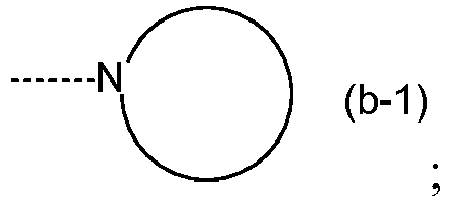
- (b-1) represents a N-linked 4- to 7-membered monocyclic saturated heterocyclyl optionally containing one additional heteroatom selected from O and N, or a N-linked 6- to 11-membered bicyclic saturated heterocyclyl, including fused, spiro and bridged cycles, optionally containing one or two additional N-atoms;
- wherein in case (b-1) contains one or two additional N-atoms, said one or two N-atoms may optionally be substituted with a substituent each independently selected from the group consisting of C1-4alkyl, C3-6cycloalkyl and Het7; and
- wherein (b-1) may optionally be substituted on one, two or three ring C-atoms with one or two substituents each independently selected from the group consisting of -OH, cyano, C1-4alkyl, and C1-4alkyl-OH;

- (b-1) represents a N-linked 4- to 7-membered monocyclic saturated heterocyclyl optionally containing one additional N-atom, or a N-linked 6- to 11-membered bicyclic saturated heterocyclyl, including fused, spiro and bridged cycles, optionally containing one or two additional N-atoms;
- wherein in case (b-1) contains one or two additional N-atoms, said one or two N-atoms may optionally be substituted with C1-4alkyl; and
- wherein (b-1) may optionally be substituted on one, two or three ring C-atoms with one or two substituents each independently selected from the group consisting of -OH, cyano, and C1-4alkyl-OH;
- (j) R11b represents Het1e; C1-4alkyl; -C1-4alkyl-Het5; -C1-4alkyl-Het8, C1-4alkyl substituted with one, two or three OH substituents; or C3-6cycloalkyl substituted with one, two or three substituents each independently selected from the group consisting of halo and -OH; in particular R11b represents Het1e; C1-4alkyl; -C1-4alkyl-Het5; C1-4alkyl substituted with one, two or three OH substituents; or C3-6cycloalkyl substituted with one, two or three substituents each independently selected from the group consisting of halo and -OH;
- (k) R13 represents -O-C1-4alkyl, -C(=O)NR15aR15b, -NR19aR19b, C3-6cycloalkyl, Het1d, or -C(=O)-Het1f,
- (l) R12 represents -OH, -O-C1-4alkyl, -NR14aR14b, -C(=)NR14cR14d, -S(=O)2-C1-4alkyl, C3-6cycloalkyl, Ar2, or Het1c;
- (m) Ar1 represents phenyl;
- (n) Het5, Het6 and Het1f each independently represents a heterocyclyl of formula (c-1):

- (o) R14b, R14d, R15b, R17b and R19b each independently represents hydrogen; C1-4alkyl; C3-6cycloalkyl; -C(=O)-C1-4alkyl; C1-4alkyl substituted with one substituent selected from the group consisting of -OH and -O-C1-4alkyl; or -S(=O)2-C1-4alkyl; in particular R14b, R14d, R15b, and R19b each independently represents hydrogen; C1-4alkyl; C3-6cycloalkyl; or C1-4alkyl substituted with one -O-C1-4alkyl.
- Another embodiment of the present invention relates to those compounds of Formula (I) and the pharmaceutically acceptable addition salts, and the solvates thereof, or any subgroup thereof as mentioned in any of the other embodiments wherein Y represents CR4 or N, in particular wherein Y represents CR4; and wherein one or more of the following restrictions apply:
- (a) R4 represents hydrogen;
- (b) R5 represents -OR7;
- (c) R7 represents hydrogen or -C(=O)-R9;
- (d) R9 represents C1-4alkyl;
- (e) R3 represents phenyl substituted with one, two or three substituents each independently selected from the group consisting of halo; cyano; C1-6alkyl; -O-C1-4alkyl; -C(=O)-R10; -S(=O)2-C1-4alkyl; -O-C1-4alkyl-R12; -NH-C(=O)-Het1g; and C1-4alkyl substituted with one R13;
- (f) R10 represents -NR11aR11b or Het2;
- (g) Het1g represents a 4- to 7-membered monocyclic saturated heterocyclyl, attached to the remainder of the molecule of Formula (I) through any available ring carbon atom, said Het1g containing one or two N-atoms;
wherein said 4- to 7-membered monocyclic saturated heterocyclyl may optionally be substituted, where possible, on one or two ring N-atoms with a C1-4alkyl substituent; - (h) Het2 represents a heterocyclyl of formula (b-1):

- (i) R11b represents C1-4alkyl;
- (j) R13 represents -O-C1-4alkyl;
- (k) R12 represents -O-C1-4alkyl;
- (l) R11a represents hydrogen.
- In an embodiment, the present invention relates to a subgroup of Formula (I), hereby named compounds of Formula (I'), and the pharmaceutically acceptable addition salts, and the solvates thereof:

- wherein R1 represents C1-4alkyl;
- R2 represents C1-6alkyl substituted with one R5;
- in particular wherein R1 represents C1-4alkyl;
- R2 represents C1-6alkyl substituted with one R5;
- R5 represents -OR7;
- more in particular wherein R1 represents C1-4alkyl;
- R2 represents C1-6alkyl substituted with one R5;
- R5 represents -OR7;
- R7 represents hydrogen;
- and wherein all other variables are defined according to any of the other embodiments.
- In an embodiment, the present invention relates to a subgroup of Formula (I), hereby named compounds of Formula (I"), and the pharmaceutically acceptable addition salts, and the solvates thereof:

- wherein R1 represents C1-4alkyl;
- R2 represents C1-6alkyl substituted with one R5;
- in particular wherein R1 represents C1-4alkyl;
- R2 represents C1-6alkyl substituted with one R5;
- R5 represents -OR7;
- more in particular wherein R1 represents C1-4alkyl;
- R2 represents C1-6alkyl substituted with one R5;
- R5 represents -OR7;
- R7 represents hydrogen;
- and wherein all other variables are defined according to any of the other embodiments.
- In an embodiment, the present invention relates to those compounds of Formula (I) and the pharmaceutically acceptable addition salts, and the solvates thereof, or any subgroup thereof as mentioned in any of the other embodiments, wherein
- R1 represents methyl;
- R2 represents methyl or -CH2-OH.
- In an embodiment, the present invention relates to those compounds of Formula (I) and the pharmaceutically acceptable addition salts, and the solvates thereof, or any subgroup thereof as mentioned in any of the other embodiments, wherein R1 represents methyl; R2 represents -CH2-OH.
In an embodiment, the present invention relates to those compounds of Formula (I) and the pharmaceutically acceptable addition salts, and the solvates thereof, or any subgroup thereof as mentioned in any of the other embodiments, wherein R3 represents phenyl which is substituted with one, two or three substituents according to any of the other embodiments. - In an embodiment, the present invention relates to those compounds of Formula (I) and the pharmaceutically acceptable addition salts, and the solvates thereof, or any subgroup thereof as mentioned in any of the other embodiments, wherein R3 represents phenyl optionally substituted with one, two or three substituents according to any of the other embodiments, provided however that the substituents are not selected from the group consisting of -S(=O)2-C1-4alkyl; -S(=O)(=N-R20a)-OC1-4alkyl; and -P(=O)-(C1-4alkyl)2.
- In an embodiment, the present invention relates to those compounds of Formula (I) and the pharmaceutically acceptable addition salts, and the solvates thereof, or any subgroup thereof as mentioned in any of the other embodiments, wherein R4 is hydrogen or fluoro.
- In an embodiment, the present invention relates to those compounds of Formula (I) and the pharmaceutically acceptable addition salts, and the solvates thereof, or any subgroup thereof as mentioned in any of the other embodiments, wherein R4 is hydrogen.
- In an embodiment, the present invention relates to those compounds of Formula (I) and the pharmaceutically acceptable addition salts, and the solvates thereof, or any subgroup thereof as mentioned in any of the other embodiments, wherein R7 represents hydrogen.
- In an embodiment, the present invention relates to those compounds of Formula (I) and the pharmaceutically acceptable addition salts, and the solvates thereof, or any subgroup thereof as mentioned in any of the other embodiments, wherein
- R5 represents -OR7; and
- R7 represents hydrogen.
- In an embodiment, the present invention relates to those compounds of Formula (I) and the pharmaceutically acceptable addition salts, and the solvates thereof, or any subgroup thereof as mentioned in any of the other embodiments, wherein R9 represents C1-4alkyl, or C1-4alkyl substituted with one substituent selected from the group consisting of -NH2, -COOH, and Het6.
- In an embodiment, the present invention relates to those compounds of Formula (I) and the pharmaceutically acceptable addition salts, and the solvates thereof, or any subgroup thereof as mentioned in any of the other embodiments, wherein R18 is attached to the remainder of the molecule of Formula (I) via a carbon atom.
- In an embodiment, the present invention relates to those compounds of Formula (I) and the pharmaceutically acceptable addition salts, and the solvates thereof, or any subgroup thereof as mentioned in any of the other embodiments, wherein R18 represents


- In an embodiment, the present invention relates to those compounds of Formula (I) and the pharmaceutically acceptable addition salts, and the solvates thereof, or any subgroup thereof as mentioned in any of the other embodiments, wherein R18 represents


- In an embodiment, the present invention relates to those compounds of Formula (I) and the pharmaceutically acceptable addition salts, and the solvates thereof, or any subgroup thereof as mentioned in any of the other embodiments, wherein Het1a, Het1c and Het1d each independently represents morpholinyl, piperidinyl, pyrrolidinyl, oxetanyl, azetidinyl, piperazinyl, tetrahydro-2H-pyranyl, tetrahydrofuranyl, or hexahydro-1,4-oxazepinyl,
each optionally substituted on carbon and/or nitrogen atoms according to any of the other embodiments. - In an embodiment, the present invention relates to those compounds of Formula (I) and the pharmaceutically acceptable addition salts, and the solvates thereof, or any subgroup thereof as mentioned in any of the other embodiments, wherein Het1a, Het1c and Het1d each independently represents morpholinyl, piperidinyl, pyrrolidinyl, oxetanyl, azetidinyl, piperazinyl, tetrahydro-2H-pyranyl, or 1-exahydro-1,4-oxazepinyl, each optionally substituted on carbon and/or nitrogen atoms according to any of the other embodiments.
- In an embodiment, the present invention relates to those compounds of Formula (I) and the pharmaceutically acceptable addition salts, and the solvates thereof, or any subgroup thereof as mentioned in any of the other embodiments, wherein Het1a, Het1c and Het1d each independently represents


- In an embodiment, the present invention relates to those compounds of Formula (I) and the pharmaceutically acceptable addition salts, and the solvates thereof, or any subgroup thereof as mentioned in any of the other embodiments, wherein Het1a represents


- In an embodiment, the present invention relates to those compounds of Formula (I) and the pharmaceutically acceptable addition salts, and the solvates thereof, or any subgroup thereof as mentioned in any of the other embodiments, wherein Het1c represents

- In an embodiment, the present invention relates to those compounds of Formula (I) and the pharmaceutically acceptable addition salts, and the solvates thereof, or any subgroup thereof as mentioned in any of the other embodiments, wherein Het1d represents

- In an embodiment, the present invention relates to those compounds of Formula (I) and the pharmaceutically acceptable addition salts, and the solvates thereof, or any subgroup thereof as mentioned in any of the other embodiments, wherein Het1b, Het1e, Het1g and Het4 each independently represents morpholinyl, piperidinyl, pyrrolidinyl, oxetanyl, azetidinyl, piperazinyl, tetrahydro-2H-pyranyl, tetrahydrofuranyl, or hexahydro-1,4-oxazepinyl, attached to the remainder of the molecule of Formula (I) through any available ring carbon atom,
each optionally substituted on carbon and/or nitrogen atoms according to any of the other embodiments. - In an embodiment, the present invention relates to those compounds of Formula (I) and the pharmaceutically acceptable addition salts, and the solvates thereof, or any subgroup thereof as mentioned in any of the other embodiments, wherein Het1b, Het1e, Het1g and Het4 each independently represents piperidinyl, tetrahydro-2H-pyranyl, or pyrrolidinyl, attached to the remainder of the molecule of Formula (I) through any available ring carbon atom,
each optionally substituted on carbon and/or nitrogen atoms according to any of the other embodiments. - In an embodiment, the present invention relates to those compounds of Formula (I) and the pharmaceutically acceptable addition salts, and the solvates thereof, or any subgroup thereof as mentioned in any of the other embodiments, wherein Het1b, Het1e, Het1g and Het4 each independently represents

- In an embodiment, the present invention relates to those compounds of Formula (I) and the pharmaceutically acceptable addition salts, and the solvates thereof, or any subgroup thereof as mentioned in any of the other embodiments, wherein Het1g represents

- In an embodiment, the present invention relates to those compounds of Formula (I) and the pharmaceutically acceptable addition salts, and the solvates thereof, or any subgroup thereof as mentioned in any of the other embodiments, wherein Het1e represents

- In an embodiment, the present invention relates to those compounds of Formula (I) and the pharmaceutically acceptable addition salts, and the solvates thereof, or any subgroup thereof as mentioned in any of the other embodiments, wherein Het1b represents

- In an embodiment, the present invention relates to those compounds of Formula (I) and the pharmaceutically acceptable addition salts, and the solvates thereof, or any subgroup thereof as mentioned in any of the other embodiments, wherein Het2 represents


- In an embodiment, the present invention relates to those compounds of Formula (I) and the pharmaceutically acceptable addition salts, and the solvates thereof, or any subgroup thereof as mentioned in any of the other embodiments, wherein Het3a, Het3b, Het5, Het6 and Het1f each independently represents

- In an embodiment, the present invention relates to those compounds of Formula (I) and the pharmaceutically acceptable addition salts, and the solvates thereof, or any subgroup thereof as mentioned in any of the other embodiments, wherein Het4 represents pyrrolidinyl, piperidinyl, tetrahydropyranyl, azetidinyl, or 1,1-dioxidethiopyranyl;
each optionally substituted on carbon and/or nitrogen atoms according to any of the other embodiments. - In an embodiment, the present invention relates to those compounds of Formula (I) and the pharmaceutically acceptable addition salts, and the solvates thereof, or any subgroup thereof as mentioned in any of the other embodiments, wherein Het5 represents

- In an embodiment, the present invention relates to those compounds of Formula (I) and the pharmaceutically acceptable addition salts, and the solvates thereof, or any subgroup thereof as mentioned in any of the other embodiments, wherein Het6 represents

- In an embodiment, the present invention relates to those compounds of Formula (I) and the pharmaceutically acceptable addition salts, and the solvates thereof, or any subgroup thereof as mentioned in any of the other embodiments, wherein Het1f represents

- In an embodiment, the present invention relates to those compounds of Formula (I) and the pharmaceutically acceptable addition salts, and the solvates thereof, or any subgroup thereof as mentioned in any of the other embodiments, wherein Het7 and Het8 each independently represent

- In an embodiment, the present invention relates to those compounds of Formula (I) and the pharmaceutically acceptable addition salts, and the solvates thereof, or any subgroup thereof as mentioned in any of the other embodiments, wherein
- Het1a, Het1c and Het1d each independently represents a 4- to 7-membered monocyclic saturated heterocyclyl containing one or two heteroatoms each independently selected from O, S, S(=O)p and N;
- wherein said 4- to 7-membered monocyclic saturated heterocyclyl may optionally be substituted, where possible, on one or two ring N-atoms with a substituent each independently selected from the group consisting of C1-4alkyl, C3-6cycloalkyl, and C1-4alkyl substituted with one substituent selected from the group consisting of -OH and - O-C1-4alkyl; and
- wherein said 4- to 7-membered monocyclic saturated heterocyclyl may optionally be substituted on one, two or three ring C-atoms with one or two substituents each independently selected from the group consisting of -OH, halo, C1-4alkyl, cyano, - C(=O)-C1-4alkyl, -O-C1-4alkyl, -NH2, -NH(C1-4alkyl), and -N(C1-4alkyl)2.
- In an embodiment, the present invention relates to those compounds of Formula (I) and the pharmaceutically acceptable addition salts, and the solvates thereof, or any subgroup thereof as mentioned in any of the other embodiments, wherein Het2 represents a heterocyclyl of formula (b-1):

- (b-1) represents a N-linked 4- to 7-membered monocyclic saturated heterocyclyl optionally containing one additional heteroatom selected from O, S, S(=O)p and N; wherein in case (b-1) contains one additional N-atom, said N-atom may optionally be substituted with C1-4alkyl; and
- wherein (b-1) may optionally be substituted on one, two or three ring C-atoms with one or two substituents each independently selected from the group consisting of halo, -OH, cyano, C1-4alkyl, -O-C1-4alkyl, -NH2, -NH(C1-4alkyl), -N(C1-4alkyl)2, and C1-4alkyl-OH. In an embodiment, the present invention relates to those compounds of Formula (I) and the pharmaceutically acceptable addition salts, and the solvates thereof, or any subgroup thereof as mentioned in any of the other embodiments, wherein
- Het1a represents a 4- to 7-membered monocyclic saturated heterocyclyl containing one or two heteroatoms each independently selected from O, S, S(=O)p and N; or a 6- to 11-membered bicyclic saturated heterocyclyl, including fused, spiro and bridged cycles, containing one, two or three heteroatoms each independently selected from O, S, S(=O)p and N;
- wherein said 4- to 7-membered monocyclic saturated heterocyclyl or said 6- to 11-membered bicyclic saturated heterocyclyl may optionally be substituted, where possible, on one or two ring N-atoms with a substituent each independently selected from the group consisting of C1-4alkyl, C3-6cycloalkyl, and C1-4alkyl substituted with one substituent selected from the group consisting of -OH and -O-C1-4alkyl; and wherein said 4- to 7-membered monocyclic saturated heterocyclyl or said 6- to 11-membered bicyclic saturated heterocyclyl may optionally be substituted on one, two or three ring C-atoms with one or two substituents each independently selected from the group consisting of -OH, halo, C1-4alkyl, cyano, -C(=O)-C1-4alkyl, -O-C1-4alkyl, -NH2, -NH(C1-4alkyl), and -N(C1-4alkyl)2;
- Het1c and Het1d each independently represents a 4- to 7-membered monocyclic saturated heterocyclyl containing one or two heteroatoms each independently selected from O, S, S(=O)p and N; or in case Het1c and Het1d are attached to the remainder of the molecule of Formula (I) through an N-atom, Het1c and Het1d may also represent a N-linked 6- to 11-membered bicyclic saturated heterocyclyl, including fused, spiro and bridged cycles, optionally containing one or two additional heteroatoms each independently selected from O, S, S(=O)p and N;
- wherein said 4- to 7-membered monocyclic saturated heterocyclyl or said N-linked 6-to 11-membered bicyclic saturated heterocyclyl may optionally be substituted, where possible, on one or two ring N-atoms with a substituent each independently selected from the group consisting of C1-4alkyl, C3-6cycloalkyl, and C1-4alkyl substituted with one substituent selected from the group consisting of -OH and -O-C1-4alkyl; and wherein said 4- to 7-membered monocyclic saturated heterocyclyl or said N-linked 6-to 11-membered bicyclic saturated heterocyclyl may optionally be substituted on one, two or three ring C-atoms with one or two substituents each independently selected from the group consisting of -OH, halo, C1-4alkyl, cyano, -C(=O)-C1-4alkyl, -O-C1-4alkyl, -NH2, -NH(C1-4alkyl), and -N(C1-4alkyl)2.
- In an embodiment, the present invention relates to those compounds of Formula (I) and the pharmaceutically acceptable addition salts, and the solvates thereof, or any subgroup thereof as mentioned in any of the other embodiments, wherein Y represents CR4.
- In an embodiment, the present invention relates to a subgroup of Formula (I), hereby named compounds of Formula (I-x), and the pharmaceutically acceptable addition salts, and the solvates thereof:

- In an embodiment, the present invention relates to those compounds of Formula (I) and the pharmaceutically acceptable addition salts, and the solvates thereof, or any subgroup thereof as mentioned in any of the other embodiments, wherein Y represents N.
- In an embodiment, the present invention relates to a subgroup of Formula (I), hereby named compounds of Formula (I-y), and the pharmaceutically acceptable addition salts, and the solvates thereof:

- In an embodiment, the present invention relates to a subgroup of Formula (I) as defined in the general reaction schemes.
- In an embodiment the compound of Formula (I) is selected from the group consisting of compounds 1, 4, 45, 66, 68, 73, 74, 110, 125, 138, 155, 156 and 232, tautomers and stereoisomeric forms thereof,
and the free bases, any pharmaceutically acceptable addition salts, and the solvates thereof. - In an embodiment the compound of Formula (I) is selected from the group consisting of compounds 1, 4, 45, 66, 68, 73, 74, 110, 125, 138, 155, 156 and 232.
- In an embodiment the compound of Formula (I) is selected from the group consisting of compounds 1, 138, 155, 156 and 232, tautomers and stereoisomeric forms thereof, and the free bases, any pharmaceutically acceptable addition salts, and the solvates thereof.
- In an embodiment the compound of Formula (I) is selected from the group consisting of compounds 1, 138, 155, 156 and 232.
- In an embodiment the compound of Formula (I) is selected from the group consisting of compounds 1, 4, 45, 66, 68, 73, 74, 110, and 125, tautomers and stereoisomeric forms thereof,
and the pharmaceutically acceptable addition salts, and the solvates thereof. - In an embodiment the compound of Formula (I) is selected from the group consisting of compounds 1, 4, 45, 66, 68, 73, 74, 110, and 125.
- In an embodiment the compound of Formula (I) is selected from the group consisting of any of the exemplified compounds,
tautomers and stereoisomeric forms thereof,
and the free bases, any pharmaceutically acceptable addition salts, and the solvates thereof. - In an embodiment the compound of Formula (I) is selected from the group consisting of


and the pharmaceutically acceptable addition salts, and the solvates thereof. - In an embodiment the compound of Formula (I) is selected from the group consisting of

and the pharmaceutically acceptable addition salts, and the solvates thereof. - All possible combinations of the above-indicated embodiments are considered to be embraced within the scope of this invention.
- In this section, as in all other sections unless the context indicates otherwise, references to Formula (I) also include all other sub-groups and examples thereof as defined herein.
- The general preparation of some typical examples of the compounds of Formula (I) is described hereunder and in the specific examples, and are generally prepared from starting materials which are either commercially available or prepared by standard synthetic processes commonly used by those skilled in the art. The following schemes are only meant to represent examples of the invention and are in no way meant to be a limit of the invention.
- Alternatively, compounds of the present invention may also be prepared by analogous reaction protocols as described in the general schemes below, combined with standard synthetic processes commonly used by those skilled in the art of organic chemistry.
- The skilled person will realise that functionalization reactions illustrated in the Schemes below for compounds of Formula (I) wherein Y is CR4, may also be carried out for compounds wherein Y is N. The skilled person will realise this applies, for example and without limitation, to steps 3 and 4 of scheme 2 and scheme 18.
- The skilled person will realize that in the reactions described in the Schemes, although this is not always explicitly shown, it may be necessary to protect reactive functional groups (for example hydroxy, amino, or carboxy groups) where these are desired in the final product, to avoid their unwanted participation in the reactions. For example in Scheme 6, the NH moiety on the pyrimidinyl can be protected with a t-butoxycarbonyl protecting group. In general, conventional protecting groups can be used in accordance with standard practice. The protecting groups may be removed at a convenient subsequent stage using methods known from the art. This is illustrated in the specific examples.
- The skilled person will realize that in the reactions described in the Schemes, it may be advisable or necessary to perform the reaction under an inert atmosphere, such as for example under N2-gas atmosphere.
- It will be apparent for the skilled person that it may be necessary to cool the reaction mixture before reaction work-up (refers to the series of manipulations required to isolate and purify the product(s) of a chemical reaction such as for example quenching, column chromatography, extraction).
- The skilled person will realize that heating the reaction mixture under stirring may enhance the reaction outcome. In some reactions microwave heating may be used instead of conventional heating to shorten the overall reaction time.
- The skilled person will realize that another sequence of the chemical reactions shown in the Schemes below, may also result in the desired compound of formula (I).
- The skilled person will realize that intermediates and final compounds shown in the schemes below may be further functionalized according to methods well-known by the person skilled in the art.
- In general, compounds of Formula (I) wherein R2 is R2a being C1-6alkyl, Y is CR4, and wherein all the other variables are defined according to the scope of the present invention, hereby named compounds of Formula (Ia), can be prepared according to the following reaction Scheme 1. In Scheme 1 halo1 is defined as Cl, Br or I; and PG1 represents a suitable protecting group, such as for example tert-(butoxycarbonyl). All other variables in Scheme 1 are defined according to the scope of the present invention.
- In Scheme 1, the following reaction conditions apply:

- 1: at a suitable temperature such as for example 80 °C, in the presence of a suitable ligand such as for example 4,4'-di-tert-butyl-2,2'-dipyridyl, a suitable catalyst such as for example bis(1,5-cyclooctadiene)di-µ-methoxydiiridium (I) ([Ir(OCH3)(C8H12)]2), and a suitable solvent such as for example heptane;
- 2: at a suitable temperature such as for example 85 °C, in the presence of a suitable catalyst such as for example [1,1'-bis(diphenylphosphino)ferrocene] dichloropalladium (II), optionally with dichloromethane complex, a suitable base such as for example potassium acetate and a suitable solvent such as for example 1,4-dioxane;
- 3: at a suitable temperature such as for example 85 °C, in the presence of a suitable catalyst such as for example palladium tetrakis (Pd(PPh3)4), a suitable base such as for example sodium carbonate, and a suitable solvent such as for example 1,4-dioxane;
- 4: at a suitable temperature such as for example room temperature, in presence of a suitable base such as for example sodium hydride, and a suitable solvent such as for example dimethylformamide;
- 5: at a suitable temperature such as for example 100 °C, in the presence of a suitable catalyst such as for example palladium acetate (Pd(OAc)2), a suitable ligand such as for example 2,2'-bis(diphenylphosphino)-1,1'-binaphthyl (BINAP), a suitable base such as for example cesium carbonate, and a suitable solvent such as for example 1,4-dioxane, optionally under microwave activation;
or alternatively at a suitable temperature such as for example 95 °C, in the presence of a suitable acid such as for example p-toluenesulfonic acid and a suitable solvent such as for example 1,4-dioxane; - 6: at a suitable temperature such as for example 0 °C or room temperature or reflux, in presence of a suitable acid such as for example trifluoroacetic acid or aqueous hydrochloric acid with a suitable solvent such as for example dichloromethane, methanol, ethyl acetate or 1,4-dioxane or alternatively in the presence of silica in a suitable solvent such as for example toluene at a suitable temperature such as for example 125°C, and a suitable time such as for example 3 hours.
- In general, compounds of Formula (I) wherein R2 is R2a being C1-6alkyl, R3 is phenyl substituted with -C(=O)-R10 and optionally substituted with other substituents according to the scope of the present invention, Y is CR4, and wherein all the other variables are as defined according to the scope of the present invention, hereby named compounds of Formula (Ib), can be prepared according to the following reaction Scheme 2. In Scheme 2 halo1 is defined as Cl, Br or I; PG1 represents a suitable protecting group, such as for example tert-(butoxycarbonyl). All other variables in Scheme 2 are defined according to the scope of the present invention.
- In Scheme 2, the following reaction conditions apply:

- 1: at a suitable temperature such as for example 100 °C, in the presence of a suitable catalyst such as for example palladium acetate (Pd(OAc)2), a suitable ligand such as for example 2,2'-bis(diphenylphosphino)-1,1'-binaphthyl (BINAP), a suitable base such as for example cesium carbonate, and a suitable solvent such as for example 1,4-dioxane, optionally under microwave activation;
- 2: at a suitable temperature such as for example 70 °C, in presence of a suitable base such as for example lithium hydroxide, and a suitable solvent such as for example a mixture of tetrahydrofuran and water;
- 3: at a suitable temperature such as for example room temperature, in presence of a suitable coupling reagent such as for example 1-[bis(dimethylamino)methylene]-1H-1,2,3-triazolo[4,5-b]pyridinium 3-oxid hexafluorophosphate (HATU), a suitable base such as for example N,N-diisopropylethylamine, and a suitable solvent such as for example dimethylformamide;
- 4: at a suitable temperature such as for example 0 °C or room temperature or reflux, in presence of a suitable acid such as for example trifluoroacetic acid or aqueous hydrochloric acid with a suitable solvent such as for example dichloromethane, methanol, ethylacetate, or 1,4-dioxane, and a suitable time such as for example 3 hours.
- In general, compounds of Formula (I) wherein R2 is R2b being C1-6alkyl substituted with one OH, Y is CR4, and wherein all the other variables are as defined according to the scope of the present invention, hereby named compounds of Formula (Ic), can be prepared according to the following reaction Scheme 3. In Scheme 3 halo1 is defined as Cl, Br or I; PG1 represents a suitable protecting group, such as for example tert-(butoxycarbonyl) and PG2 represents a suitable protecting group, such as for example tert-butyl-dimethylsilyl. All other variables in Scheme 3 are defined according to the scope of the present invention.
- In Scheme 3, the following reaction conditions apply:

- 1: at a suitable temperature such as for example 80 °C, in the presence of a suitable ligand such as for example 4,4'-di-tert-butyl-2,2'-dipyridyl, a suitable catalyst such as for example bis(1,5-cyclooctadiene)di-µ-methoxydiiridium (I) ([Ir(OCH3)(C8H12)]2), and a suitable solvent such as for example heptane;
- 2: at a suitable temperature such as for example 85 °C, in the presence of a suitable catalyst such as for example [1,1'-bis(diphenylphosphino)ferrocene] dichloropalladium (II), optionally with dichloromethane complex, a suitable base such as for example potassium acetate and a suitable solvent such as for example 1,4-dioxane;
- 3: at a suitable temperature such as for example 85 °C, in the presence of a suitable catalyst such as for example palladium tetrakis (Pd(PPh3)4), a suitable base such as for example sodium carbonate, and a suitable solvent such as for example 1,4-dioxane;
- 4: at a suitable temperature such as for example room temperature, in presence of a suitable base such as for example sodium hydride, and a suitable solvent such as for example dimethylformamide;
- 5: at a suitable temperature such as for example 100 °C, in the presence of a suitable catalyst such as for example palladium acetate (Pd(OAc)2), a suitable ligand such as for example 2,2'-bis(diphenylphosphino)-1,1'-binaphthyl (BINAP), a suitable base such as for example cesium carbonate, and a suitable solvent such as for example 1,4-dioxane, optionally under microwave activation;
- 6: at a suitable temperature such as for example 0 °C or room temperature or reflux, in presence of a suitable acid such as for example trifluoroacetic acid or aqueous hydrochloric acid with a suitable solvent such as for example dichloromethane, methanol, ethyl acetate or 1,4-dioxane or alternatively in the presence of silica in a suitable solvent such as for example toluene at a suitable temperature such as for example 125°C, and a suitable time such as for example 3 hours;
- 7: at a suitable temperature such as for example room temperature, in presence of a suitable desilylating agent such as for example tetra-n-butylammonium fluoride and a suitable solvent such as for example 2-methyltetrahydrofuran or tetrahydrofuran;
- 8: at a suitable temperature such as for example reflux, in presence of a suitable acid such as for example aqueous hydrochloric acid with a suitable solvent such as for example dichloromethane, methanol, ethyl acetate or 1,4-dioxane, and a suitable time such as for example 6 hours;
- 9: at a suitable temperature such as for example 95 °C, in the presence of a suitable acid such as for example p-toluenesulfonic acid and a suitable solvent such as for example 1,4-dioxane.
- In general, compounds of Formula (I) wherein R2 is R2b being C1-6alkyl substituted with one OH, R3 is phenyl substituted with -C(=O)-R10 and optionally substituted with other substituents according to the scope of the present invention, Y is CR4, and wherein all the other variables are as defined according to the scope of the present invention, hereby named compounds of Formula (Id), can be prepared according to the following reaction Scheme 4. In Scheme 4 halo1 is defined as Cl, Br or I; PG1 represents a suitable protecting group, such as for example tert-(butoxycarbonyl) and PG2 represents a suitable protecting group, such as for example tert-butyl-dimethylsilyl. All other variables in Scheme 4 are defined according to the scope of the present invention.
- In Scheme 4, the following reaction conditions apply:

- 1: at a suitable temperature such as for example 100 °C, in the presence of a suitable catalyst such as for example palladium acetate (Pd(OAc)2), a suitable ligand such as for example 2,2'-bis(diphenylphosphino)-1,1'-binaphthyl (BINAP), a suitable base such as for example cesium carbonate, and a suitable solvent such as for example 1,4-dioxane, optionally under microwave activation;
- 2: at a suitable temperature such as for example 70 °C, in presence of a suitable base such as for example lithium hydroxide, and a suitable solvent such as for example a mixture of tetrahydrofuran and water;
- 3: at a suitable temperature such as for example room temperature, in presence of a suitable coupling reagent such as for example 1-[bis(dimethylamino)methylene]-1H-1,2,3-triazolo[4,5-b]pyridinium 3-oxid hexafluorophosphate (HATU), a suitable base such as for example N,N-diisopropylethylamine, and a suitable solvent such as for example dimethylformamide;
- 4: at a suitable temperature such as for example room temperature, in presence of a suitable desilylating agent such as for example tetra-n-butylammonium fluoride and a suitable solvent such as for example 2-methyltetrahydrofuran or tetrahydrofuran;
- 5: at a suitable temperature such as for example 0 °C or room temperature or reflux, in presence of a suitable acid such as for example trifluoroacetic acid or aqueous hydrochloric acid with a suitable solvent such as for example dichloromethane, methanol, ethyl acetate or 1,4-dioxane or alternatively in the presence of silica in a suitable solvent such as for example toluene at a suitable temperature such as for example 125°C, and a suitable time such as for example 3 hours.
- 6: at a suitable temperature such as for example reflux, in presence of a suitable acid such as for example aqueous hydrochloric acid with a suitable solvent such as for example dichloromethane, methanol, ethyl acetate or 1,4-dioxane, and a suitable time such as for example 6 hours.
- In general, compounds of Formula (I) wherein R2 is R2c being C1-6alkyl substituted with one Het3a or -NR6aR6b, wherein R6b is R6ba being H, C1-4alkyl and C3-6cycloalkyl, Y is CR4, and wherein all the other variables are as defined according to the scope of the present invention, hereby named compounds of Formula (Ie) and Formula (If), can be prepared according to the following reaction Scheme 5. In Scheme 5 PG1 represents a suitable protecting group, such as for example tert-(butoxycarbonyl). All other variables in Scheme 5 are defined according to the scope of the present invention.
- In Scheme 5, the following reaction conditions apply:

- 1: at a suitable temperature such as for example -78 °C, in the presence of oxalyl chloride and dimethyl sulfoxide as reagents, a suitable base such as for example N,N-diisopropylethylamine, and a suitable solvent such as for example dichloromethane;
- 2: at a suitable temperature such as for example room temperature, in the presence of a suitable acid such as for example acetic acid, a suitable reducing agent such as for example sodium triacetoxyborohydride, and a suitable solvent such as for example dichloroethane;
- 3: at a suitable temperature such as for example 0 °C or room temperature or reflux, in presence of a suitable acid such as for example trifluoroacetic acid or aqueous hydrochloric acid with a suitable solvent such as for example dichloromethane, methanol, ethyl acetate or 1,4-dioxane or alternatively in the presence of silica in a suitable solvent such as for example toluene at a suitable temperature such as for example 125°C, and a suitable time such as for example 3 hours.
- In general, compounds of Formula (I) wherein R2 is C1-6alkyl substituted with one OR7a, R7a being -C(=O)-R9 or -(C=O)-CH(NH2)-C1-4alkyl-Ar1), Y is CR4, and wherein all the other variables are as defined according to the scope of the present invention, hereby named compounds of Formula (Ig), can be prepared according to the following reaction Scheme 6. In Scheme 6 PG3 represents a suitable protecting group, such as for example a tert-(butoxycarbonyl), a tert-butyl or a benzyl. All other variables in Scheme 6 are defined according to the scope of the present invention.
- In Scheme 6, the following reaction conditions apply:

- 1: at a suitable temperature such as for example room temperature, in the presence of a suitable coupling reagent such as for example 1-[bis(dimethylamino)methylene]-1H-1,2,3-triazolo[4,5-b]pyridinium 3-oxid hexafluorophosphate (HATU), in the presence of a suitable base as for example N,N-diisopropylethylamine, and a suitable solvent such as for example a mixture of tetrahydrofuran and dimethylformamide, and optionally followed by a deprotection step using a suitable acid such as for example hydrochloric acid in a suitable solvent such as for example 1,4-dioxane;
- 2: at a suitable temperature such as for example 0 °C or room temperature, in presence of a suitable acid such as for example trifluoroacetic acid or aqueous hydrochloric acid with a suitable solvent such as for example dichloromethane, methanol, ethyl acetate or 1,4-dioxane or alternatively in the presence of silica in a suitable solvent such as for example toluene at a suitable temperature such as for example 125°C, and a suitable time such as for example 3 hours.
- In general, compounds of Formula (I) wherein R2 is C1-6alkyl substituted with one OR7b, R7b being C1-4alkyl, Y is CR4, and wherein all the other variables are as defined according to the scope of the present invention, hereby named compounds of Formula (Ih), can be prepared according to the following reaction Scheme 7. In Scheme 7 halo1 is defined as Cl, Br or I; PG1 represents a suitable protecting group, such as for example tert-(butoxycarbonyl) and PG2 represents a suitable protecting group, such as for example tert-butyl-dimethylsilyl; W represents a leaving group, such as for example a methane sulfonate or toluene sulfonate or an halogen (Cl, Br or I). All other variables in Scheme 7 are defined according to the scope of the present invention.
- In Scheme 7, the following reaction conditions apply:

- 1: at a suitable temperature such as for example room temperature, in presence of a suitable desilylating agent such as for example tetra-n-butylammonium fluoride and a suitable solvent such as for example 2-methyltetrahydrofuran or tetrahydrofuran;
- 2: at a suitable temperature such as for example room temperature, in the presence of a suitable base as for example sodium hydride, and a suitable solvent such as for example dimethylformamide;
- 3: at a suitable temperature such as for example 85 °C, in the presence of a suitable catalyst such as for example [1,1'-bis(diphenylphosphino)ferrocene] dichloropalladium (II), optionally with dichloromethane complex, a suitable base such as for example potassium acetate and a suitable solvent such as for example 1,4-dioxane;
- 4: at a suitable temperature such as for example 80 °C, in the presence of a suitable catalyst such as for example palladium tetrakis (Pd(PPh3)4), a suitable base such as for example sodium carbonate, and a suitable solvent such as for example 1,4-dioxane;
- 5: at a suitable temperature such as for example 100 °C, in the presence of a suitable catalyst such as for example palladium acetate (Pd(OAc)2), a suitable ligand such as for example 2,2'-bis(diphenylphosphino)-1,1'-binaphthyl (BINAP), a suitable base such as for example cesium carbonate, and a suitable solvent such as for example 1,4-dioxane, optionally under microwave activation;
- 6: at a suitable temperature such as for example 0 °C or room temperature or reflux, in presence of a suitable acid such as for example trifluoroacetic acid or aqueous hydrochloric acid with a suitable solvent such as for example dichloromethane, methanol, ethyl acetate or 1,4-dioxane or alternatively in the presence of silica in a suitable solvent such as for example toluene at a suitable temperature such as for example 125°C, and a suitable time such as for example 3 hours.
- In general, compounds of Formula (I) wherein R2 is C1-6alkyl substituted with one OR7c, R7c being C1-4alkyl-NR8aR8b or C1-4alkyl-Het3b, Y is CR4, and wherein all the other variables are as defined according to the scope of the present invention, hereby named compounds of Formula (Ii) and Formula (Ij), can be prepared according to the following reaction Scheme 8. In Scheme 8 halo1 is defined as Cl, Br or I; PG1 represents a suitable protecting group, such as for example tert-(butoxycarbonyl); W1 represents a leaving group, such as for example a methane sulfonate or toluene sulfonate or an halogen (Cl, Br or I); W2 represents a leaving group, such as for example a mesyl or a tosyl. All other variables in Scheme 8 are defined according to the scope of the present invention.
- In Scheme 8, the following reaction conditions apply:

- 1: at a suitable temperature such as for example room temperature, in the presence of a suitable base as for example sodium hydride, and a suitable solvent such as for example dimethylformamide;
- 2: at a suitable temperature such as for example 55 °C, in presence of reducing agent such as for example sodium borohydride and a suitable solvent such as for example a mixture of tetrahydrofuran and methanol;
- 3: at a suitable temperature such as for example 100 °C, in the presence of a suitable catalyst such as for example [1,1'-bis(diphenylphosphino)ferrocene] dichloropalladium (II), optionally with dichloromethane complex, a suitable base such as for example potassium acetate and a suitable solvent such as for example 1,4-dioxane;
- 4: at a suitable temperature such as for example 85 °C, in the presence of a suitable catalyst such as for example palladium tetrakis (Pd(PPh3)4), a suitable base such as for example sodium carbonate, and a suitable solvent such as for example 1,4-dioxane;
- 5: at a suitable temperature such as for example 120 °C, in the presence of a suitable catalyst such as for example palladium acetate (Pd(OAc)2), a suitable ligand such as for example 2,2'-bis(diphenylphosphino)-1,1'-binaphthyl (BINAP), a suitable base such as for example cesium carbonate, and a suitable solvent such as for example 1,4-dioxane, optionally under microwave activation;
- 6: at a suitable temperature such as for example 5 °C, in the presence of a suitable base such as for example triethylamine, and a suitable solvent such as for example dichloromethane;
- 7: at a suitable temperature such as for example 80 °C, and a suitable solvent such as for example acetonitrile;
- 8: at a suitable temperature such as for example 0 °C or room temperature or reflux, in presence of a suitable acid such as for example trifluoroacetic acid or aqueous hydrochloric acid with a suitable solvent such as for example dichloromethane, methanol, ethyl acetate or 1,4-dioxane or alternatively in the presence of silica in a suitable solvent such as for example toluene at a suitable temperature such as for example 125°C, and a suitable time such as for example 3 hours.
- In general, intermediates of Formula (II) and (III) wherein R2 is R2a being C1-6alkyl, and wherein all the other variables are as defined according to the scope of the present invention, hereby named compounds of Formula (II) and (III), can be prepared according to the following reaction Scheme 9. In Scheme 9 halo1 is defined as Cl, Br, I; halo2 is defined as Cl, Br, I; PG1 represents a suitable protecting group, such as for example tert-(butoxycarbonyl); W1 represents a leaving group, such as for example a methane sulfonate or toluene sulfonate or an halogen (Cl, Br or I). All other variables in Scheme 9 are defined according to the scope of the present invention.
- In Scheme 9, the following reaction conditions apply:

- 1: at a suitable temperature such as for example 45 °C, in the presence of a suitable reagent such as for example di-tert-butyl dicarbonate, in the presence of a suitable catalyst such as for example 4-dimethylaminopyridine (DMAP), and a suitable solvent such as for example dichloromethane;
- 2: at a suitable temperature such as for example 65 °C and a suitable solvent such as for example methanol;
- 3: in case of (XLIXa), at a suitable temperature such as for example at room temperature, in the presence of tri-n-butylphosphine and 1,1'-(azodicarbonyl)piperidine and a suitable solvent such as for example 2-methyltetrahydrofuran;
In case of (XLIXb), at a suitable temperature such as for example 80°C, in the presence of a suitable base such as for example potassium carbonate, a suitable additive such as for example sodium iodide, in a suitable solvent such as for example acetonitrile; - 4: at a suitable temperature such as for example 85 °C, in the presence of sodium acetate, sodium formate and tetraethylammonium chloride, a suitable catalyst such as for example palladium acetate (Pd(OAc)2), and a suitable solvent such as for example dimethylformamide;
- 5: at a suitable temperature such as for example 60 °C, in the presence of sodium acetate, sodium formate dehydrate and tetraethylammonium chloride, a suitable catalyst such as for example [1,1'-bis(diphenylphosphino) ferrocene] palladium, (II) chloride optionally with dichloromethane complex, and a suitable solvent such as for example dimethylformamide;
- 6: at a suitable temperature such as for example 40 °C, in the presence of N-halogeno-succinimide, and a suitable solvent such as for example acetonitrile. Alternatively, in the presence of a suitable reagent such as for example 1,3-dibromo-5,5-dimethylhydantoin, in a suitable solvent such as for example acetonitrile.
- In general, intermediates of Formula (XII) and (XIII) wherein R2 is R2b being C1-6alkyl substituted with one OH, and wherein all the other variables are as defined according to the scope of the present invention, hereby named compounds of Formula (XII) and (XIII), can be prepared according to the following reaction Scheme 10. In Scheme 10 halo1 is defined as Cl, Br, I; halo2 is defined as Cl, Br, I; PG1 represents a suitable protecting group, such as for example tert-(butoxycarbonyl) and PG2 represents a suitable protecting group, such as for example tert-butyl-dimethylsilyl. All other variables in Scheme 10 are defined according to the scope of the present invention.
- In Scheme 10, the following reaction conditions apply:

- 1: in case of (XLIXc), at a suitable temperature such as for example at room temperature, in the presence of tri-n-butylphosphine and 1,1'-(azodicarbonyl)piperidine and a suitable solvent such as for example 2-methyltetrahydrofuran;
In case of (XLIXd), at a suitable temperature such as for example 80°C, in the presence of a suitable base such as for example potassium carbonate, a suitable additive such as for example sodium iodide, in a suitable solvent such as for example acetonitrile; - 2: at a suitable temperature such as for example 85 °C, in the presence of sodium acetate, sodium formate and tetraethylammonium chloride, a suitable catalyst such as for example palladium acetate (Pd(OAc)2), and a suitable solvent such as for example dimethylformamide;
- 3: at a suitable temperature such as for example 60 °C, in the presence of sodium acetate, sodium formate dehydrate and tetraethylammonium chloride, a suitable catalyst such as for example [1,1'-bis(diphenylphosphino) ferrocene] palladium, (II) chloride optionally with dichloromethane complex, and a suitable solvent such as for example dimethylformamide;
- 4: at a suitable temperature such as for example 40 °C, in the presence of N-halogeno-succinimide, and a suitable solvent such as for example acetonitrile. Alternatively, in the presence of a suitable reagent such as for example 1,3-dibromo-5,5-dimethylhydantoin, in a suitable solvent such as for example acetonitrile.
- In general, compounds of Formula (I) wherein R2 is as shown in the scheme 11, Y is CR4, and wherein all the other variables are as defined according to the scope of the present invention, hereby named compounds of Formula (Ik) can be prepared according to the following reaction Scheme 11. In Scheme 11 PG1 represents a suitable protecting group, such as for example tert-(butoxycarbonyl). All other variables in Scheme 11 are defined according to the scope of the present invention.
- In Scheme 11, the following reaction conditions apply:

- 1: at a suitable temperature such as for example at room temperature, and a suitable solvent such as for example tetrahydrofuran;
- 2: at a suitable temperature such as for example 0 °C or room temperature or reflux, in presence of a suitable acid such as for example trifluoroacetic acid or aqueous hydrochloric acid with a suitable solvent such as for example dichloromethane, methanol, ethyl acetate or 1,4-dioxane or alternatively in the presence of silica in a suitable solvent such as for example toluene at a suitable temperature such as for example 125°C and a suitable time such as for example 3 hours.
- In general, compounds of Formula (I) wherein R2 is as shown in the scheme 12, Y is CR4, and wherein all the other variables are as defined according to the scope of the present invention, hereby named compounds of Formula (II) can be prepared according to the following reaction Scheme 12. In Scheme 12 PG1 represents a suitable protecting group, such as for example tert-(butoxycarbonyl). All other variables in Scheme 12 are defined according to the scope of the present invention.
- In Scheme 12, the following reaction conditions apply:

- 1: at a suitable temperature such as for example at room temperature, in the presence of tert-butyl alcohol, 2-methyl-2-butene, sodium dihydrogenophosphate and distilled water;
- 2: at a suitable temperature such as for example at room temperature, in presence of 1-[bis(dimethylamino)methylene]-1H-1,2,3-triazolo[4,5-b]pyridinium 3-oxid hexafluorophosphate (HATU) and dimethyl aminopyridine (DMAP), a suitable base such as for example DIPEA and a suitable solvent such as for example dimethylformamide;
- 3: at a suitable temperature such as for example at room temperature, and a suitable solvent such as for example tetrahydrofuran;
- 4: at a suitable temperature such as for example 0 °C or room temperature or reflux, in presence of a suitable acid such as for example trifluoroacetic acid or aqueous hydrochloric acid with a suitable solvent such as for example dichloromethane, methanol, ethyl acetate or 1,4-dioxane or alternatively in the presence of silica in a suitable solvent such as for example toluene at a suitable temperature such as for example 125°C and a suitable time such as for example 3 hours.
- In general, compounds of Formula (I) wherein R2 is as shown in the scheme 13, Y is CR4, and wherein all the other variables are as defined according to the scope of the present invention, hereby named compounds of Formula (Im) can be prepared according to the following reaction Scheme 13. In Scheme 13 PG1 represents a suitable protecting group, such as for example tert-(butoxycarbonyl). All other variables in Scheme 13 are defined according to the scope of the present invention.
- In Scheme 13, the following reaction conditions apply:

- 1: at a suitable temperature such as for example at room temperature, in the presence of tert-butyl alcohol, 2-methyl-2-butene, sodium dihydrogenophosphate and distilled water;
- 2: at a suitable temperature such as for example at room temperature, in presence of 1-[bis(dimethylamino)methylene]-1H-1,2,3-triazolo[4,5-b]pyridinium 3-oxid hexafluorophosphate (HATU) and dimethyl aminopyridine (DMAP), a suitable base such as for example DIPEA and a suitable solvent such as for example dimethylformamide;
- 3: at a suitable temperature such as for example at 0 °C, and a suitable solvent such as for example tetrahydrofuran ("AlD4Li" means lithium aluminium deuteride);
- 4: at a suitable temperature such as for example 0 °C or room temperature or reflux, in presence of a suitable acid such as for example trifluoroacetic acid or aqueous hydrochloric acid with a suitable solvent such as for example dichloromethane, methanol, ethyl acetate or 1,4-dioxane or alternatively in the presence of silica in a suitable solvent such as for example toluene at a suitable temperature such as for example 125°C and a suitable time such as for example 3 hours.
- In general, compounds of Formula (I) wherein R2 is being C1-6alkyl substituted with one Het3a or -NR6aR6b, wherein R6a is being H, R6b is being -C(=O)-C1-4alkyl; -C(=O)-Het4; -S(=O)2-C1-4alkyl, Y is CR4, and wherein all the other variables are as defined according to the scope of the present invention, hereby named compounds of Formula (In), Formula (Io) and Formula (Ip), can be prepared according to the following reaction Scheme 14. In Scheme 14, PG1 represents a suitable protecting group, such as for example tert-(butoxycarbonyl). All other variables in Scheme 14 are defined according to the scope of the present invention.
- In Scheme 14, the following reaction conditions apply:

- 1: at a suitable temperature such as for example at room temperature, in the presence of a suitable acid such as for example acetic acid, in the presence of a suitable reducing agent such as for example sodium triacetoxyborohydride, in a suitable solvent such as for example dichloroethane;
- 2: at a suitable temperature such as for example at room temperature, in the presence of a suitable base such as for example triethylamine, in a suitable solvent such as for example tetrahydrofuran;
- 3: at a suitable temperature such as for example at room temperature, in the presence of a suitable acid such as for example trifluoroacetic acid, in a suitable solvent such as for example dichloromethane.
- In general, compounds of Formula (I) wherein R2 is being C1-6alkyl substituted with one Het3a or -NR6aR6b, wherein R6a is being C1-4alkyl, R6b is being -C(=O)-C1-4alkyl; - C(=O)-Het4; -S(=O)2-C1-4alkyl, Y is CR4, and wherein all the other variables are as defined according to the scope of the present invention, hereby named compounds of Formula (Iq), Formula (Ir) and Formula (Is), can be prepared according to the following reaction Scheme 15. In Scheme 15, PG1 represents a suitable protecting group, such as for example tert-(butoxycarbonyl). All other variables in Scheme 15 are defined according to the scope of the present invention.
- In Scheme 15, the following reaction conditions apply:

- 1: at a suitable temperature such as for example at room temperature, in the presence of a suitable acid such as for example acetic acid, in the presence of a suitable reducing agent such as for example sodium triacetoxyborohydride, in a suitable solvent such as for example dichloroethane;
- 2: at a suitable temperature such as for example at room temperature, in the presence of a suitable base such as for example triethylamine, , in a suitable solvent such as for example tetrahydrofuran;
- 3: at a suitable temperature such as for example at room temperature, in the presence of a suitable acid such as for example trifluoroacetic acid, in a suitable solvent such as for example dichloromethane.
- In general, compounds of Formula (I) wherein R2 is C1-6alkyl substituted with one OR7d, R7d being -S(=O)2-OH or -P(=O)-(OH)2, Y is CR4, and wherein all the other variables are as defined according to the scope of the present invention, hereby named compounds of Formula (It) and Formula (Iu), can be prepared according to the following reaction Scheme 16. All other variables in Scheme 16 are defined according to the scope of the present invention.
- In Scheme 16, the following reaction conditions apply:

- 1: at a suitable temperature such as for example at room temperature, in a suitable solvent such as for example tetrahydrofuran, in the presence of a suitable base such as for example sodium hydroxide;
- 2: in the presence of a suitable reagent such as for example tetrazole, in the presence of a suitable oxidizing agent such as for example meta-chloroperbenzoic acid, in a suitable solvent such as for example acetonitrile;
- 3: at a suitable temperature such as for example at room temperature, in the presence of a suitable acid such as for example hydrochloric acid, in a suitable solvent such as for example acetonitrile.
- In general, intermediates of Formula (XII) wherein all the variables are as defined according to the scope of the present invention can be prepared according to the following reaction Scheme 17.
- In Scheme 17, the following reaction conditions apply:

- 1: At a suitable temperature range between -5°C and 5°C, in the presence of a suitable base such as for example sodium tert-butoxide in a suitable solvent such as for example tetrahydrofuran;
- 2: at a suitable temperature ranged between 65 and 70 °C, in te presence of a suitable reagent such as for example di-tert-butyl dicarbonate, in the presence of a suitable catalyst such as for example 4-dimethylaminopyridine (DMAP), and a suitable solvent such as for example tetrhydrofuran;
- 3: at a suitable temperature ranged between 45 and 50 °C, in the presence of sodium acetate, sodium formate dehydrate and tetraethylammonium chloride, a suitable catalyst such as for example palladium acetate or [1,1'-bis(diphenylphosphino) ferrocene] palladium, (II) chloride optionally with dichloromethane complex, and a suitable solvent such as for example dimethylformamide.
- In general, compounds of Formula (I) wherein R2 is C1-6alkyl substituted with one R5, R5 being a fluorine, Y is CR4, and wherein all the other variables are as defined according to the scope of the present invention, hereby named compounds of Formula (Iv), can be prepared according to the following reaction Scheme 18. All other variables in Scheme 18 are defined according to the scope of the present invention.
- In Scheme 18, the following reaction conditions apply:

- 1: in the presence of a suitable fluorinating reagent such as for example diethylaminosulfur trifluoride, a suitable solvent such as for example dichloromethane, at a suitable temperature such as for example room temperature.
- In general, compounds of Formula (I) wherein R2 is R2b being C1-6alkyl substituted with one OH, Y is N, and wherein all the other variables are as defined according to the scope of the present invention, hereby named compounds of Formula (Iw), can be prepared according to the following reaction Scheme 19. In Scheme 19, halo1 is defined as Cl, Br or I; PG1 represents a suitable protecting group, such as for example tert-(butoxycarbonyl) and PG2 represents a suitable protecting group, such as for example tert-butyl-dimethylsilyl. All other variables in Scheme 19 are defined according to the scope of the present invention.
- In Scheme 19, the following reaction conditions apply:

- 1: in the presence of a suitable base such as for example diisopropylethylamine, in asuitable solvent such as for example acetonitrile;
- 2: in the presence of a suitable catalyst such as for example [1,1'-bis(diphenylphosphino)ferrocene] dichloropalladium (II), optionally with dichloromethane complex, a suitable base such as an aqueous solution of hydrogenocarbonate at a suitable temperature such as 80°C;
- 3: at a suitable temperature such as for example 0 °C or room temperature or reflux, in presence of a suitable acid such as for example trifluoroacetic acid or aqueous hydrochloric acid with a suitable solvent such as for example dichloromethane, methanol, ethyl acetate or 1,4-dioxane or alternatively in the presence of silica in a suitable solvent such as for example toluene at a suitable temperature such as for example 125°C, and a suitable time such as for example 3 hours;
- 4: at a suitable temperature such as for example room temperature, in presence of a suitable desilylating agent such as for example tetra-n-butylammonium fluoride and a suitable solvent such as for example 2-methyltetrahydrofuran or tetrahydrofuran.
- In general, compounds of Formula (I) wherein R2 is R2b being C1-6alkyl substituted with one OH, R3 is phenyl substituted with -C(=O)-R10 and optionally substituted with other substituents according to the scope of the present invention, Y is CR4, and wherein all the other variables are as defined according to the scope of the present invention, hereby named compounds of Formula (Ida), (Idb) and (Idc) can be prepared according to the following reaction Scheme 20. In Scheme 20, halo1 is defined as Cl, Br or I; PG1 represents a suitable protecting group, such as for example tert-(butoxycarbonyl) and PG2 represents a suitable protecting group, such as for example tert-butyl-dimethylsilyl. All other variables in Scheme 20 are defined according to the scope of the present invention.
- In Scheme 20, the following reaction conditions apply:

- 1: at a suitable temperature such as for example 120 °C, in the presence of a suitable catalyst such as for example palladium acetate (Pd(OAc)2), a suitable ligand such as for example 2,2'-bis(diphenylphosphino)-1,1'-binaphthyl (BINAP), a suitable base such as for example cesium carbonate, and a suitable solvent such as for example 1,4-dioxane, optionally under microwave activation;
- 2: at a suitable temperature such as for example 60 °C, in presence of a suitable base such as for example lithium hydroxide, and a suitable solvent such as for example a mixture of tetrahydrofuran and water;
- 3: at a suitable temperature such as for example room temperature, in presence of a suitable coupling reagent such as for example 1-[bis(dimethylamino)methylene]-1H-1,2,3-triazolo[4,5-b]pyridinium 3-oxid hexafluorophosphate (HATU), a suitable base such as for example N,N-diisopropylethylamine, and a suitable solvent such as for example dimethylformamide or dichloromethane.
- In general, compounds of Formula (I) wherein R2 is R2b being C1-6alkyl substituted with one OH, Y is CR4, and wherein all the other variables are as defined according to the scope of the present invention, hereby named compounds of Formula (Ic), can be prepared according to the following reaction Scheme 21. All other variables in Scheme 21 are defined according to the scope of the present invention or as above.
- In Scheme 21, the following reaction conditions apply:

- 1: at a suitable temperature such as for example 90 °C, in the presence of a suitable acid such as for example p-toluenesulfonic acid and a suitable solvent such as for example 1,4-dioxane.
- It will be appreciated that where appropriate functional groups exist, compounds of various formulae or any intermediates used in their preparation may be further derivatised by one or more standard synthetic methods employing condensation, substitution, oxidation, reduction, or cleavage reactions. Particular substitution approaches include conventional alkylation, arylation, heteroarylation, acylation, sulfonylation, halogenation, nitration, formylation and coupling procedures.
- The compounds of Formula (I) may be synthesized in the form of racemic mixtures of enantiomers which can be separated from one another following art-known resolution procedures. The racemic compounds of Formula (I) containing a basic nitrogen atom may be converted into the corresponding diastereomeric salt forms by reaction with a suitable chiral acid. Said diastereomeric salt forms are subsequently separated, for example, by selective or fractional crystallization and the enantiomers are liberated therefrom by alkali. An alternative manner of separating the enantiomeric forms of the compounds of Formula (I) involves liquid chromatography using a chiral stationary phase. Said pure stereochemically isomeric forms may also be derived from the corresponding pure stereochemically isomeric forms of the appropriate starting materials, provided that the reaction occurs stereospecifically.
- In the preparation of compounds of the present invention, protection of remote functionality (e.g., primary or secondary amine) of intermediates may be necessary. The need for such protection will vary depending on the nature of the remote functionality and the conditions of the preparation methods. Suitable amino-protecting groups (NH-Pg) include acetyl, trifluoroacetyl, t-butoxycarbonyl (Boc), benzyloxycarbonyl (CBz) and 9-fluorenylmethyleneoxycarbonyl (Fmoc). The need for such protection is readily determined by one skilled in the art. For a general description of protecting groups and their use, see T. W. Greene and P. G. M. Wuts, Protective Groups in Organic Synthesis, 4th ed., Wiley, Hoboken, New Jersey, 2007.
- It has been found that the compounds of the present invention inhibit NF-κB-inducing kinase (NIK - also known as MAP3K14). Some of the compounds of the present invention may undergo metabolism to a more active form in vivo (prodrugs). Therefore the compounds according to the invention and the pharmaceutical compositions comprising such compounds may be useful for treating or preventing diseases such as cancer, inflammatory disorders, metabolic disorders including obesity and diabetes, and autoimmune disorders. In particular, the compounds according to the present invention and the pharmaceutical compositions thereof may be useful in the treatment of a haematological malignancy or solid tumour. In a specific embodiment said haematological malignancy is selected from the group consisting of multiple myeloma, non-Hodgkin's lymphoma, Hodgkin lymphoma, T-cell leukaemia, mucosa-associated lymphoid tissue lymphoma, diffuse large B-cell lymphoma and mantle cell lymphoma, in a particular embodiment mantle cell lymphoma. In another specific embodiment of the present invention, the solid tumour is selected from the group consisting of pancreatic cancer, breast cancer, melanoma and non-small cell lung cancer.
- Examples of cancers which may be treated (or inhibited) include, but are not limited to, a carcinoma, for example a carcinoma of the bladder, breast, colon (e.g. colorectal carcinomas such as colon adenocarcinoma and colon adenoma), kidney, urothelial, uterus, epidermis, liver, lung (for example adenocarcinoma, small cell lung cancer and non-small cell lung carcinomas, squamous lung cancer), oesophagus, head and neck, gall bladder, ovary, pancreas (e.g. exocrine pancreatic carcinoma), stomach, gastrointestinal (also known as gastric) cancer (e.g. gastrointestinal stromal tumours), cervix, endometrium, thyroid, prostate, or skin (for example squamous cell carcinoma or dermatofibrosarcoma protuberans); pituitary cancer, a hematopoietic tumour of lymphoid lineage, for example leukemia, acute lymphocytic leukemia, chronic lymphocytic leukemia, B-cell lymphoma (e.g. diffuse large B-cell lymphoma, mantle cell lymphoma), T-cell leukaemia/lymphoma, Hodgkin's lymphoma, non-Hodgkin's lymphoma, hairy cell lymphoma, or Burkett's lymphoma; a hematopoietic tumour of myeloid lineage, for example leukemias, acute and chronic myelogenous leukemias, chronic myelomonocytic leukemia (CMML), myeloproliferative disorder, myeloproliferative syndrome, myelodysplastic syndrome, or promyelocytic leukemia; multiple myeloma; thyroid follicular cancer; hepatocellular cancer, a tumour of mesenchymal origin (e.g. Ewing's sarcoma), for example fibrosarcoma or rhabdomyosarcoma; a tumour of the central or peripheral nervous system, for example astrocytoma, neuroblastoma, glioma (such as glioblastoma multiforme) or schwannoma; melanoma; seminoma; teratocarcinoma; osteosarcoma; xeroderma pigmentosum; keratoctanthoma; thyroid follicular cancer; or Kaposi's sarcoma.
- Particular examples of cancers which may be treated (or inhibited) include B-cell malignancies, such as multiple myeloma, hodgkins lymphoma, mantle cell lymphoma, diffuse large B-cell lymphoma or chronic lymphocytic leukemia, with mutations in the non-canonical NFkB signalling pathway (eg in NIK (MAP3K14), TRAF3, TRAF2, BIRC2 or BIRC3 genes).
- Hence, the invention relates to compounds of Formula (I), the tautomers and the stereoisomeric forms thereof, and the pharmaceutically acceptable addition salts, and the solvates thereof, for use as a medicament.
- The invention also relates to the use of a compound of Formula (I), a tautomer or a stereoisomeric form thereof, or a pharmaceutically acceptable addition salt, or a solvate thereof, or a pharmaceutical composition according to the invention, for the manufacture of a medicament.
- The present invention also relates to a compound of Formula (I), a tautomer or a stereoisomeric form thereof, or a pharmaceutically acceptable addition salt, or a solvate thereof, or a pharmaceutical composition according to the invention, for use in the treatment, prevention, amelioration, control or reduction of the risk of disorders associated with NF-κB-inducing kinase dysfunction in a mammal, including a human, the treatment or prevention of which is affected or facilitated by inhibition of NF-κB-inducing kinase.
- Also, the present invention relates to the use of a compound of Formula (I), a tautomer or a stereoisomeric form thereof, or a pharmaceutically acceptable addition salt, or a solvate thereof, or a pharmaceutical composition according to the invention, for the manufacture of a medicament for treating, preventing, ameliorating, controlling or reducing the risk of disorders associated with NF-κB-inducing kinase dysfunction in a mammal, including a human, the treatment or prevention of which is affected or facilitated by inhibition of NF-κB-inducing kinase.
- The invention also relates to a compound of Formula (I), a tautomer or a stereoisomeric form thereof, or a pharmaceutically acceptable addition salt, or a solvate thereof, for use in the treatment or prevention of any one of the diseases mentioned hereinbefore. The invention also relates to a compound of Formula (I), a tautomer or a stereoisomeric form thereof, or a pharmaceutically acceptable addition salt, or a solvate thereof, for use in treating or preventing any one of the diseases mentioned hereinbefore.
- The invention also relates to the use of a compound of Formula (I), a tautomer or a stereoisomeric form thereof, or a pharmaceutically acceptable addition salt, or a solvate thereof, for the manufacture of a medicament for the treatment or prevention of any one of the disease conditions mentioned hereinbefore.
- The compounds of the present invention can be administered to mammals, preferably humans, for the treatment or prevention of any one of the diseases mentioned hereinbefore.
- In view of the utility of the compounds of Formula (I), a tautomer or a stereoisomeric form thereof, or a pharmaceutically acceptable addition salt, or a solvate thereof, there is provided a method of treating warm-blooded animals, including humans, suffering from any one of the diseases mentioned hereinbefore.
- Said method comprises the administration, i.e. the systemic or topical administration, preferably oral administration, of a therapeutically effective amount of a compound of Formula (I), a tautomer or a stereoisomeric form thereof, or a pharmaceutically acceptable addition salt, or a solvate thereof, to warm-blooded animals, including humans.
- It is disclosed a method for the treatment of any one of the diseases mentioned hereinbefore comprising administering a therapeutically effective amount of compound according to the invention to a patient in need thereof.
- One skilled in the art will recognize that a therapeutically effective amount of the compounds of the present invention is the amount sufficient to have therapeutic activity and that this amount varies inter alias, depending on the type of disease, the concentration of the compound in the therapeutic formulation, and the condition of the patient. Generally, the amount of a compound of the present invention to be administered as a therapeutic agent for treating the disorders referred to herein will be determined on a case by case by an attending physician.
- Those of skill in the treatment of such diseases could determine the effective therapeutic daily amount from the test results presented hereinafter. An effective therapeutic daily amount would be from about 0.005 mg/kg to 50 mg/kg, in particular 0.01 mg/kg to 50 mg/kg body weight, more in particular from 0.01 mg/kg to 25 mg/kg body weight, preferably from about 0.01 mg/kg to about 15 mg/kg, more preferably from about 0.01 mg/kg to about 10 mg/kg, even more preferably from about 0.01 mg/kg to about 1 mg/kg, most preferably from about 0.05 mg/kg to about 1 mg/kg body weight. A particular effective therapeutic daily amount might be from about 10 mg/kg body weight to 40 mg/kg body weight. A particular effective therapeutic daily amount might be 1 mg/kg body weight, 2 mg/kg body weight, 4 mg/kg body weigth, or 8 mg/kg body weight. The amount of a compound according to the present invention, also referred to here as the active ingredient, which is required to achieve a therapeutically effect may vary on case-by-case basis, for example with the particular compound, the route of administration, the age and condition of the recipient, and the particular disorder or disease being treated. A method of treatment may also include administering the active ingredient on a regimen of between one and four intakes per day. In these methods of treatment the compounds according to the invention are preferably formulated prior to administration. As described herein below, suitable pharmaceutical formulations are prepared by known procedures using well known and readily available ingredients.
- The present invention also provides compositions for preventing or treating the disorders referred to herein. Said compositions comprising a therapeutically effective amount of a compound of Formula (I), a tautomer or a stereoisomeric form thereof, or a pharmaceutically acceptable addition salt, or a solvate thereof, and a pharmaceutically acceptable carrier or diluent.
- While it is possible for the active ingredient to be administered alone, it is preferable to present it as a pharmaceutical composition. Accordingly, the present invention further provides a pharmaceutical composition comprising a compound according to the present invention, together with a pharmaceutically acceptable carrier or diluent. The carrier or diluent must be "acceptable" in the sense of being compatible with the other ingredients of the composition and not deleterious to the recipients thereof.
- The pharmaceutical compositions of this invention may be prepared by any methods well known in the art of pharmacy, for example, using methods such as those described in Gennaro et al. Remington's Pharmaceutical Sciences (18th ed., Mack Publishing Company, 1990, see especially Part 8 : Pharmaceutical preparations and their Manufacture). A therapeutically effective amount of the particular compound, in base form or addition salt form, as the active ingredient is combined in intimate admixture with a pharmaceutically acceptable carrier, which may take a wide variety of forms depending on the form of preparation desired for administration. These pharmaceutical compositions are desirably in unitary dosage form suitable, preferably, for systemic administration such as oral, percutaneous or parenteral administration; or topical administration such as via inhalation, a nose spray, eye drops or via a cream, gel, shampoo or the like. For example, in preparing the compositions in oral dosage form, any of the usual pharmaceutical media may be employed, such as, for example, water, glycols, oils, alcohols and the like in the case of oral liquid preparations such as suspensions, syrups, elixirs and solutions: or solid carriers such as starches, sugars, kaolin, lubricants, binders, disintegrating agents and the like in the case of powders, pills, capsules and tablets. Because of their ease in administration, tablets and capsules represent the most advantageous oral dosage unit form, in which case solid pharmaceutical carriers are obviously employed. For parenteral compositions, the carrier will usually comprise sterile water, at least in large part, though other ingredients, for example, to aid solubility, may be included. Injectable solutions, for example, may be prepared in which the carrier comprises saline solution, glucose solution or a mixture of saline and glucose solution. Injectable suspensions may also be prepared in which case appropriate liquid carriers, suspending agents and the like may be employed. In the compositions suitable for percutaneous administration, the carrier optionally comprises a penetration enhancing agent and/or a suitable wettable agent, optionally combined with suitable additives of any nature in minor proportions, which additives do not cause any significant deleterious effects on the skin. Said additives may facilitate the administration to the skin and/or may be helpful for preparing the desired compositions. These compositions may be administered in various ways, e.g., as a transdermal patch, as a spot-on or as an ointment.
- It is especially advantageous to formulate the aforementioned pharmaceutical compositions in dosage unit form for ease of administration and uniformity of dosage. Dosage unit form as used in the specification and claims herein refers to physically discrete units suitable as unitary dosages, each unit containing a predetermined quantity of active ingredient calculated to produce the desired therapeutic effect in association with the required pharmaceutical carrier. Examples of such dosage unit forms are tablets (including scored or coated tablets), capsules, pills, powder packets, wafers, injectable solutions or suspensions, teaspoonfuls, tablespoonfuls and the like, and segregated multiples thereof.
- The present compounds can be used for systemic administration such as oral, percutaneous or parenteral administration; or topical administration such as via inhalation, a nose spray, eye drops or via a cream, gel, shampoo or the like. The compounds are preferably orally administered. The exact dosage and frequency of administration depends on the particular compound of Formula (I) used, the particular condition being treated, the severity of the condition being treated, the age, weight, sex, extent of disorder and general physical condition of the particular patient as well as other medication the individual may be taking, as is well known to those skilled in the art. Furthermore, it is evident that said effective daily amount may be lowered or increased depending on the response of the treated subject and/or depending on the evaluation of the physician prescribing the compounds of the instant invention.
- The compounds of the present invention may be administered alone or in combination with one or more additional therapeutic agents. Combination therapy includes administration of a single pharmaceutical dosage formulation which contains a compound according to the present invention and one or more additional therapeutic agents, as well as administration of the compound according to the present invention and each additional therapeutic agent in its own separate pharmaceutical dosage formulation. For example, a compound according to the present invention and a therapeutic agent may be administered to the patient together in a single oral dosage composition such as a tablet or capsule, or each agent may be administered in separate oral dosage formulations.
- Therefore, an embodiment of the present invention relates to a product containing as first active ingredient a compound according to the invention and as further active ingredient one or more medicinal agent, more particularly, with one or more anticancer agent or adjuvant, as a combined preparation for simultaneous, separate or sequential use in the treatment of patients suffering from cancer.
- Accordingly, for the treatment of the conditions mentioned hereinbefore, the compounds of the invention may be advantageously employed in combination with one or more other medicinal agents (also referred to as therapeutic agents), more particularly, with other anti-cancer agents or adjuvants in cancer therapy. Examples of anti-cancer agents or adjuvants (supporting agents in the therapy) include but are not limited to:
- platinum coordination compounds for example cisplatin optionally combined with amifostine, carboplatin or oxaliplatin;
- taxane compounds for example paclitaxel, paclitaxel protein bound particles (AbraxaneTM) or docetaxel;
- topoisomerase I inhibitors such as camptothecin compounds for example irinotecan, SN-38, topotecan, topotecan hcl;
- topoisomerase II inhibitors such as anti-tumour epipodophyllotoxins or podophyllotoxin derivatives for example etoposide, etoposide phosphate or teniposide;
- anti-tumour vinca alkaloids for example vinblastine, vincristine or vinorelbine;
- anti-tumour nucleoside derivatives for example 5-fluorouracil, leucovorin, gemcitabine, gemcitabine hcl, capecitabine, cladribine, fludarabine, nelarabine;
- alkylating agents such as nitrogen mustard or nitrosourea for example cyclophosphamide, chlorambucil, carmustine, thiotepa, mephalan (melphalan), lomustine, altretamine, busulfan, dacarbazine, estramustine, ifosfamide optionally in combination with mesna, pipobroman, procarbazine, streptozocin, temozolomide, uracil;
- anti-tumour anthracycline derivatives for example daunorubicin, doxorubicin optionally in combination with dexrazoxane, doxil, idarubicin, mitoxantrone, epirubicin, epirubicin hcl, valrubicin;
- molecules that target the IGF-1 receptor for example picropodophilin;
- tetracarcin derivatives for example tetrocarcin A;
- glucocorticoïden for example prednisone;
- antibodies for example trastuzumab (HER2 antibody), rituximab (CD20 antibody), gemtuzumab, gemtuzumab ozogamicin, cetuximab, pertuzumab, bevacizumab, alemtuzumab, eculizumab, ibritumomab tiuxetan, nofetumomab, panitumumab, tositumomab, CNTO 328;
- estrogen receptor antagonists or selective estrogen receptor modulators or inhibitors of estrogen synthesis for example tamoxifen, fulvestrant, toremifene, droloxifene, faslodex, raloxifene or letrozole;
- aromatase inhibitors such as exemestane, anastrozole, letrazole, testolactone and vorozole;
- differentiating agents such as retinoids, vitamin D or retinoic acid and retinoic acid metabolism blocking agents (RAMBA) for example accutane;
- DNA methyl transferase inhibitors for example azacytidine or decitabine;
- antifolates for example premetrexed disodium;
- antibiotics for example antinomycin D, bleomycin, mitomycin C, dactinomycin, carminomycin, daunomycin, levamisole, plicamycin, mithramycin;
- antimetabolites for example clofarabine, aminopterin, cytosine arabinoside or methotrexate, azacytidine, cytarabine, floxuridine, pentostatin, thioguanine;
- apoptosis inducing agents and antiangiogenic agents such as Bcl-2 inhibitors for example YC 137, BH 312, ABT 737, gossypol, HA 14-1, TW 37 or decanoic acid;
- tubuline-binding agents for example combrestatin, colchicines or nocodazole;
- kinase inhibitors (e.g. EGFR (epithelial growth factor receptor) inhibitors, MTKI (multi target kinase inhibitors), mTOR inhibitors) for example flavoperidol, imatinib mesylate, erlotinib, gefitinib, dasatinib, lapatinib, lapatinib ditosylate, sorafenib, sunitinib, sunitinib maleate, temsirolimus;
- farnesyltransferase inhibitors for example tipifarnib;
- histone deacetylase (HDAC) inhibitors for example sodium butyrate, suberoylanilide hydroxamic acid (SAHA), depsipeptide (FR 901228), NVP-LAQ824, R306465, quisinostat, trichostatin A, vorinostat;
- Inhibitors of the ubiquitin-proteasome pathway for example PS-341, Velcade (MLN-341) or bortezomib;
- Yondelis;
- Telomerase inhibitors for example telomestatin;
- Matrix metalloproteinase inhibitors for example batimastat, marimastat, prinostat or metastat;
- Recombinant interleukins for example aldesleukin, denileukin diftitox, interferon alfa 2a, interferon alfa 2b, peginterferon alfa 2b;
- MAPK inhibitors;
- Retinoids for example alitretinoin, bexarotene, tretinoin;
- Arsenic trioxide;
- Asparaginase;
- Steroids for example dromostanolone propionate, megestrol acetate, nandrolone (decanoate, phenpropionate), dexamethasone;
- Gonadotropin releasing hormone agonists or antagonists for example abarelix, goserelin acetate, histrelin acetate, leuprolide acetate;
- Thalidomide, lenalidomide;
- Mercaptopurine, mitotane, pamidronate, pegademase, pegaspargase, rasburicase;
- BH3 mimetics for example ABT-199;
- MEK inhibitors for example PD98059, AZD6244, CI-1040;
- colony-stimulating factor analogs for example filgrastim, pegfilgrastim, sargramostim; erythropoietin or analogues thereof (e.g. darbepoetin alfa); interleukin 11; oprelvekin; zoledronate, zoledronic acid; fentanyl; bisphosphonate; palifermin;
- a steroidal cytochrome P450 17alpha-hydroxylase-17,20-lyase inhibitor (CYP17), e.g. abiraterone, abiraterone acetate.
- The one or more other medicinal agents and the compound according to the present invention may be administered simultaneously (e.g. in separate or unitary compositions) or sequentially in either order. In the latter case, the two or more compounds will be administered within a period and in an amount and manner that is sufficient to ensure that an advantageous or synergistic effect is achieved. It will be appreciated that the preferred method and order of administration and the respective dosage amounts and regimes for each component of the combination will depend on the particular other medicinal agent and compound of the present invention being administered, their route of administration, the particular tumour being treated and the particular host being treated. The optimum method and order of administration and the dosage amounts and regime can be readily determined by those skilled in the art using conventional methods and in view of the information set out herein.
- The weight ratio of the compound according to the present invention and the one or more other anticancer agent(s) when given as a combination may be determined by the person skilled in the art. Said ratio and the exact dosage and frequency of administration depends on the particular compound according to the invention and the other anticancer agent(s) used, the particular condition being treated, the severity of the condition being treated, the age, weight, gender, diet, time of administration and general physical condition of the particular patient, the mode of administration as well as other medication the individual may be taking, as is well known to those skilled in the art. Furthermore, it is evident that the effective daily amount may be lowered or increased depending on the response of the treated subject and/or depending on the evaluation of the physician prescribing the compounds of the instant invention. A particular weight ratio for the present compound of Formula (I) and another anticancer agent may range from 1/10 to 10/1, more in particular from 1/5 to 5/1, even more in particular from 1/3 to 3/1.
- The platinum coordination compound is advantageously administered in a dosage of 1 to 500 mg per square meter (mg/m2) of body surface area, for example 50 to 400 mg/m2, particularly for cisplatin in a dosage of about 75 mg/m2 and for carboplatin in about 300 mg/m2 per course of treatment.
- The taxane compound is advantageously administered in a dosage of 50 to 400 mg per square meter (mg/m2) of body surface area, for example 75 to 250 mg/m2, particularly for paclitaxel in a dosage of about 175 to 250 mg/m2 and for docetaxel in about 75 to 150 mg/m2 per course of treatment.
- The camptothecin compound is advantageously administered in a dosage of 0.1 to 400 mg per square meter (mg/m2) of body surface area, for example 1 to 300 mg/m2, particularly for irinotecan in a dosage of about 100 to 350 mg/m2 and for topotecan in about 1 to 2 mg/m2 per course of treatment.
- The anti-tumour podophyllotoxin derivative is advantageously administered in a dosage of 30 to 300 mg per square meter (mg/m2) of body surface area, for example 50 to 250 mg/m2, particularly for etoposide in a dosage of about 35 to 100 mg/m2 and for teniposide in about 50 to 250 mg/m2 per course of treatment.
- The anti-tumour vinca alkaloid is advantageously administered in a dosage of 2 to 30 mg per square meter (mg/m2) of body surface area, particularly for vinblastine in a dosage of about 3 to 12 mg/m2, for vincristine in a dosage of about 1 to 2 mg/m2, and for vinorelbine in dosage of about 10 to 30 mg/m2 per course of treatment.
- The anti-tumour nucleoside derivative is advantageously administered in a dosage of 200 to 2500 mg per square meter (mg/m2) of body surface area, for example 700 to 1500 mg/m2, particularly for 5-FU in a dosage of 200 to 500mg/m2, for gemcitabine in a dosage of about 800 to 1200 mg/m2 and for capecitabine in about 1000 to 2500 mg/m2 per course of treatment.
- The alkylating agents such as nitrogen mustard or nitrosourea is advantageously administered in a dosage of 100 to 500 mg per square meter (mg/m2) of body surface area, for example 120 to 200 mg/m2, particularly for cyclophosphamide in a dosage of about 100 to 500 mg/m2, for chlorambucil in a dosage of about 0.1 to 0.2 mg/kg, for carmustine in a dosage of about 150 to 200 mg/m2, and for lomustine in a dosage of about 100 to 150 mg/m2 per course of treatment.
- The anti-tumour anthracycline derivative is advantageously administered in a dosage of 10 to 75 mg per square meter (mg/m2) of body surface area, for example 15 to 60 mg/m2, particularly for doxorubicin in a dosage of about 40 to 75 mg/m2, for daunorubicin in a dosage of about 25 to 45mg/m2, and for idarubicin in a dosage of about 10 to 15 mg/m2 per course of treatment.
- The antiestrogen agent is advantageously administered in a dosage of about 1 to 100 mg daily depending on the particular agent and the condition being treated. Tamoxifen is advantageously administered orally in a dosage of 5 to 50 mg, preferably 10 to 20 mg twice a day, continuing the therapy for sufficient time to achieve and maintain a therapeutic effect. Toremifene is advantageously administered orally in a dosage of about 60 mg once a day, continuing the therapy for sufficient time to achieve and maintain a therapeutic effect. Anastrozole is advantageously administered orally in a dosage of about 1mg once a day. Droloxifene is advantageously administered orally in a dosage of about 20-100 mg once a day. Raloxifene is advantageously administered orally in a dosage of about 60 mg once a day. Exemestane is advantageously administered orally in a dosage of about 25 mg once a day.
- Antibodies are advantageously administered in a dosage of about 1 to 5 mg per square meter (mg/m2) of body surface area, or as known in the art, if different. Trastuzumab is advantageously administered in a dosage of 1 to 5 mg per square meter (mg/m2) of body surface area, particularly 2 to 4 mg/m2 per course of treatment.
These dosages may be administered for example once, twice or more per course of treatment, which may be repeated for example every 7, 14, 21 or 28 days. - The following examples further illustrate the present invention.
- Several methods for preparing the compounds of this invention are illustrated in the following examples. Unless otherwise noted, all starting materials were obtained from commercial suppliers and used without further purification.
- Hereinafter, the terms : 'ACN' means acetonitrile, 'AcOH' means acetic acid, 'AcCl' means acetyl chloride, 'Ar' means argon, 'BINAP' means 2,2'-bis(diphenylphosphino)-1,1'-binaphthyl, 'BOC' or 'Boc' means tert-butyloxycarbonyl, 'Boc2O' means di-tert-butyl dicarbonate, 'celite®' means diatomaceous earth, 'DCM' means dichloromethane, 'DIEA' or 'DIPEA' means diisopropylethylamine, 'DiPE' means diisopropylether, 'h' means hours(s), 'min' means minute(s), 'DMAP' means dimethylaminopyridine, 'DMF' means dimethylformamide, 'Et2O' means diethylether, 'EtOAc' or 'AcOEt' means ethyl acetate, 'HPLC' means High-performance Liquid Chromatography, 'IPrNH2' means isopropylamine, 'iPrOH' means isopropyl alcohol, 'KHMDS' means potassium bis(trimethylsilyl)amide, 'HATU' means 1-[bis(dimethylamino)methylene]-1H-[1,2,3]triazolo[4,5-b]pyridin-1-ium 3-oxide hexafluorophosphate, 'LC/MS' means Liquid Chromatography/Mass Spectrometry, 'LiHMDS' means Lithium bis(trimethylsilyl)amide, 'Me' means methyl, 'Me-THF' means 2-methyltetrahydrofuran, 'MeOH' means methanol, 'NBS' means N-bromosuccinimide, 'NCS' means N-chlorosuccinimide, 'NMR' means Nuclear Magnetic Resonance, 'Pd/C 10%' means palladium on carbon loading 10%, 'Pd(OAc)2' means palladium (II) acetate, 'Pd(PPh3)2Cl2' means bis(triphenylphosphine)palladium(II) chloride 'Pd(PPh3)4' means tetrakis(triphenylphosphine)palladium (0), 'Pd(dppf)Cl2' or 'PdCl2dppf' means [1,1'-Bis(diphenylphosphino)ferrocene]dichloropalladium(II), 'Pd(t-Bu3P)2' means bis(tri-tert-butyl-phosphine) palladium (0), 'rt' means room temperature, 'SFC' means supercritical fluid chromatography, 'ee' means enantiomeric excess, 'TBAF' means tetrabutylammonium fluoride, 'tBDMS', 'TBDMS' or 'SMDBT' means tertbutyldimethylsilyl, 'TEA' or 'Et3N' means triethylamine, 'TFA' means trifluoroacetic acid, 'THF' means tetrahydrofuran, 'CV' means column volumes, 'Quant.' means quantitative, 'o/n' means overnight, '@' means at, 'eq.' or 'equiv.' means equivalent(s), 'Psi' means Pounds per Square Inch (pressure), 'M.P.', 'MP' or 'm.p.' means melting point, 'OR' means optical rotation, 'DSC' means Differential Scanning Calorimetry.
- When a stereocenter is indicated with 'RS' this means that a racemic mixture was obtained. Compounds like compound 39 and compound 124 which have two stereocenters indicated with 'RS' were obtained as a mixture of diasteroisomers.
- It is well known to one skilled in the art that protecting groups such as TBDMS can routinely be removed with TBAF in a variety of solvents such as for example THF. Similarly, conditions for removal of BOC protecting groups are well known to one skilled in the art, commonly including for example TFA in a solvent such as for example DCM, or HCl in a solvent such as for example dioxane.
The skilled person will realize that in some cases where an organic layer was obtained at the end of an experimental protocol, it was necessary to dry the organic layer with a typical drying agent such as for example MgSO4, or by azeotropic distillation, and to evaporate the solvent before using the product as a starting material in the next reaction step. - Preparation of intermediate 1:

- To a solution of 2,4-dibromo-6-cyanoaniline (200.00 g, 724.82 mmol) and DMAP (17.71 g, 144.96 mmol) in DCM (3 L), Boc2O (474.58 g, 2.17 mol) was added and the reaction mixture was stirred at 45 °C for 4 h. The crude mixture was successively washed with saturated NaHCO3 (2 x 1 L) and brine (2 x 1 L), dried over MgSO4, filtered and concentrated under vacuum to give 323 g of intermediate 1 (56% yield, yellow solid, 86% purity evaluated by LC/MS). The product was used in the next step without any further purification.
- Preparation of intermediate 2:

- A mixture of intermediate 1 (620.00 g, 1.30 mol) and K2CO3 (539.02 g, 3.90 mol) in MeOH (6 L) was stirred at 65 °C for 3 h. The reaction mixture was cooled to 25 °C filtered and concentrated under vacuum. Then, the residue was dissolved in EtOAc (4 L) and the organic layer was washed with brine (2 L), dried over MgSO4, and filtered. The filtrate was evaporated under vacuum to 1/8 solvent, filtered to collect the solid and dried under reduced pressure to give 300 g of intermediate 2 (60% yield, yellow solid). The product was used in the next step without any further purification.
- Preparation of intermediate 3:

- Intermediate 2 (100.00 g, 265.93 mmol), 2-(((tert-butyl-dimethyl-silanyl)oxy) methyl) prop-2-en-1-ol (80.72 g, 398.90 mmol) and tributylphosphane (107.61 g, 531.86 mmol) were dissolved in THF (2 L) and cooled to 0 °C. A solution of 1,1'-(azodicarbonyl)-dipiperidine (147.61 g, 585.05 mmol) in THF (50 mL) was added dropwise under N2 and stirred at 0 °C for 1 h, then 25 °C for 12 h. The resulting mixture was triturated with petroleum ether (3 L), filtered and concentrated under vacuum. Then, the residue was dissolved in EtOAc (6 L), washed successively with water (2 x 2 L) and brine (2 x 2 L), dried over MgSO4, filtered and concentrated under vacuum. Three reactions (each 100 g) were carried out in parallel. The resulting residues were purified by column chromatography on silica gel (SiO2, mobile phase: petroleum ether/EtOAc, 10:1). The desired fractions were collected and the solvent was concentrated to dryness under vacuum to give 350 g of intermediate 3 (78% yield, yellow oil).
- Preparation of intermediate 3a:

- Triethylamine (196.3 mL; 1.408 mol) was added to a solution of 2-(((tert-butyldimethyl-silanyl)oxy) methyl) prop-2-en-1-ol (114 g, 563.3 mmol) in DCM (1L) at 0 °C. Methanesulfonylchloride (56.0 mL; 704.2 mmol) was added slowly to the mixture and this mixture was stirred for 2 h at 0 °C. The reaction was quenched with saturated aqueous solution of NaHCO3 (100 ml) and extracted with DCM (500ml*2). The organic layer was dried over MgSO4, filtered, and concentrated under vacuum. The residue was purified by silica gel chromatography (Petroleum ether/ethyl acetate from 0/100 to 5/1) to give 50g (32%; light yellow oil) of intermediate 3a.
- A solution of 1,3-Hydroxy-2-methylenepropane (100 g) in dry THF (200 mL) was added dropwise at 0 °C to a suspension of sodium hydride (0.95 eq.) in dry THF (600 mL). After 30 min a solution of tert-butyldimethylsilylchloride (0.95 eq.) in dry THF (200 mL) was added dropwise to the mixture. After approximately 18 hours at 0-5 °C the reaction was complete by GC and water (500 mL) was added slowly keeping the temperature between 0-5 °C. After phase separation, the aqueous layer was back-extracted with ethyl acetate (500 mL) and the combined organic layers were washed with water (500 mL). The organic phase was concentrated to a residue which was azeotropically dried by co-evaporation with THF affording 252.7 g of the crude monoTBDMS-protected diol. A portion of the crude monoTBDMS-protected diol (152.4 g) was dissolved in dry dichloromethane (610 mL) and triethylamine (1.4 eq.) was added. The mixture was then stirred at 0 °C for 30 min and methanesulfonic anhydride (1.2 eq.) was added as a solution in dichloromethane (950 mL) and the mixture was stirred for 1 h between -5 and 5 °C. An additional aliquot of methanesulfonic anhydride (0.1 eq.) and triethylamine (0.2 eq.) were added and, after 1 additional hour, water (500 mL) was added. After phase separation, the organic layer was washed twice with water (500 mL) and concentrated to a residue, which was re-diluted with THF and partially concentrated to obtain a solution of intermediate 3a (311.1 g, 57 weight % intermediate 3a in the solution).
- Intermediate 2 (140g; 372.3 mmol) was dissolved in acetonitrile (1.3L). Intermediate 3a (104.4g; 372.3 mmol), potassium carbonate (128.6 g; 930.7 mmol), and sodium iodide (5.58 g; 37.2 mmol) were added. The mixture was stirred at 80 °C for 12 h, cooled and concentrated under reduced pressure. The residue was dissolved in water (1 L) and extracted with ethyl acetate (1 L x2). The combined organic phase was washed with brine (1 L), dried over Na2SO4 and filtered. The filtrate was concentrated under vacuum to give a crude product. The residue was purified by silica gel chromatography (Petroleum ether/ethyl acetate from 100/0 to 40/1) to give 180g (86%; clear oil) of intermediate 3.
-

- A suspension of intermediate 3 (120.00 g, 214.14 mmol), sodium acetate (45.67 g, 556.76 mmol), sodium formate (37.86 g, 556.76 mmol), Pd(OAc)2 (4.81 g, 21.41 mmol) and tetraethylammonium chloride (44.35 g, 267.67 mmol) in DMF (1.26 L) was degassed under vacuum, purged with Ar three times, and stirred at 85 °C for 2 h. The resulting mixture was filtered through a pad of celite® and the solid was washed with DCM (2 L). The filtrate was concentrated under vacuum. The residue was dissolved in ethyl acetate (4 L), washed successively with water (2 x 2 L) and brine (2 x 2 L), dried over MgSO4, filtered and concentrated under vacuum. Then, the residue was purified by column chromatography on silica gel (SiO2, mobile phase: petroleum ether/EtOAc, 15:1). The desired fractions were collected and the solvent was concentrated to dryness under vacuum to give a mixture of intermediates 5 and 5'. Three reactions (each on 100-120 g of intermediate 3) were carried out in parallel which gave in total 160 g of a mixture of intermediates 4 and 4' containing 38% of intermediate 4 (evaluated by LC/MS).
- Alternative preparation of intermediate 4:

- To a mixture of intermediates 4 and 4' in CH3CN (1.60 L), 1-bromopyrrolidine-2,5-dione (212.20 g, 1.19 mol) was added and stirred at 40 °C for 16 h. The solvent was removed by evaporation under reduced pressure. The residue was dissolved in ethyl acetate (2 L), washed successively with NaHCO3 (2 x 1L) and brine (2 x 1L), dried over MgSO4 and filtered. The filtrate was evaporated under vacuum and purified by column chromatography on silica gel (SiO2, mobile phase: petroleum ether/EtOAc, 50:1). The desired fractions were collected and the solvent was concentrated to dryness under vacuum to give 110.00 g of intermediate 4 (56% yield, yellow oil, 97% purity evaluated by LC/MS).
- Alternative preparation A of intermediate 4':

- To a solution of intermediate 3 (295.00 g, 473.70 mmol), sodium acetate (101.05 g, 1.23 mol), sodium formate dihydrate (128.15 g, 1.23 mol) and [1,1'-bis(diphenylphosphino) ferrocene] palladium, (II) chloride complex with dichloromethane (19.34 g, 23.70 mmol) in DMF (2 L), tetra-N-butylammonium chloride (164.60 g, 592.20 mmol) was added under N2 at rt. The reaction mixture was stirred overnight at 60 °C, then, filtered through a pad of celite® and the solid was washed with DCM (400 mL). The filtrate was concentrated under vacuum. The resulting residue was dissolved in EtOAc (4 L) and the organic layer was washed successively with water (2 L) and brine (2 L), dried over Na2SO4, filtered and concentrated to give the crude product as black oil. This residue was purified by column chromatography on silica gel (SiO2, mobile phase: petroleum ether/EtOAc, gradient from 100:0 to 10:1). The desired fractions were collected and the solvent was concentrated to dryness under vacuum to give 155 g of intermediate 4' (70% yield, yellow oil).
- Alternative preparation B of intermediate 4':

- Intermediate 550 (50.0 g) was dissolved in DMF (250 mL). Sodium formate dehydrate (2.6 eq.), sodium acetate (2.6 eq.), tetraethylammonium chloride (1.25 eq.) and palladium acetate (0.05 eq.) were added. The mixture was degassed with nitrogen (3 times) and was then warmed at 45-50 °C until complete conversion (typically 24 hours monitored by HPLC). Water (350 mL) was then added followed by heptane (350 mL). The mixture was filtered and, after phase separation, the aqueous layer was extracted with heptane (350 mL). The combined organic layers were washed with water (250 mL) and then filtered on a diatomite pad (25 g; diatomaceous earth). The filtrate was concentrated to 100-150 mL, cooled to -10 to -5 °C for 2 hours and filtered to afford 37.6 g of intermediate 4'. An additional amount of intermediate 4' could be recovered by filtering the mother liquors on a silica gel pad to remove impurities, and subsequently cool down the filtrate to -10 °C to crystallize out an additional amount of intermediate 4'.
-

- Intermediates 4'R was obtained from a chiral chromatography separation of intermediate 4' (column CHIRALPAK IC 5cm *25 cm; mobile phase: hexane/EtOH:80/20; Flow rate: 60.0mL/min; Wavelenght: UV 254 nm; Temperature: 35°C).
-

- Intermediate 4 (500 g) was purified via Normal Phase Chiral separation (Stationary phase: Daicel Chiralpak IC 2000 gram 10 microhm, mobile phase: heptane/EtOH, Isocratic 80% heptane, 20% EtOH). The fractions containing the products were mixed and concentrated to afford 266 g of intermediate 4R (53% yield, ee> 98 %) and 225 g of intermediate 4S (45% yield, ee > 98 %).
- Alternatively, intermediate 4 (10 g) was purified by chiral SFC (Stationary phase: CHIRALPAK IC 5 µm 250 x 30 mm, mobile phase: 85% CO2, 15% iPrOH). The pure fractions were collected and evaporated to dryness yielding 4.3 g of intermediate 4R (43% yield, ee = 100%) and 4.5 g of intermediate 4S (45% yield, ee = 100%). Alternative preparation of intermediate 4R:
To a solution of intermediate 4'R (10.0 g) in ACN (100 mL) 1,3-dibromo-5,5-dimethylhydantoin (0.75 eq.) was added and the mixture was stirred at 20 °C for 24-28 hours, monitoring the conversion by HPLC. After complete conversion aqueous 5% NaHCO3 was added (250 mL) and the mixture was stirred for 30 minutes. Toluene (250 mL) was then added and, after 30 min stirring at room temperature, the mixture was allowed to settle and the layers were separated. The organic layer was washed twice with water (100 mL) and used directly in the next step (conversion 99.6%) . - Preparation of intermediate 5:

- To a solution of intermediate 4 (127.00 g, 234.70 mmol) in 1,4-dioxane (1.2 L), bis(pinacolato)diboron (74.50 g, 293.40 mmol) and potassium acetate (69.11 g, 704.24 mmol) were added. Then, [1,1'-bis(diphenylphosphino) ferrocene] palladium, (II) chloride (8.59 g, 11.74 mmol) was added and stirred for 4 h at 85 °C under N2 atmosphere. The mixture was cooled, partitioned between EtOAc (2 L) and water (500 mL) and filtered through a pad of celite®. The organic and aqueous layers were separated. The organic layer was washed successively with water (300 mL), brine (300 mL), dried over Na2SO4 and concentrated under vacuum. The residue was dissolved in a mixture of DCM/EtOAc (90:10, 600 mL), filtered through a plug of flash silica gel, washed with DCM/EtOAc (90:10, 3 L). The filtrate was evaporated to give 125 g of crude intermediate 5 (brown oil) which was directly engaged in the next step.
- Preparation of intermediate 5R:

- To a solution of intermediate 4R (20.00 g, 41.50 mmol) in 1,4-dioxane (200 mL), bis(pinacolato)diboron (13.20 g, 51.90 mmol) and potassium acetate (12.20 g, 124.60 mmol) were added. Then, [1,1'-bis(diphenylphosphino) ferrocene] palladium, (II) chloride complex with dichloromethane (1.70 g, 2.08 mmol) was added and stirred for 4 h at 85 °C under N2. The mixture was cooled, partitioned between EtOAc (200 mL) and water (100 mL), and filtered through a pad of celite®. The organic and aqueous layers were separated. The organic layer was washed successively with water (100 mL), brine (100 mL), dried over Na2SO4, and concentrated under vacuum. The residue was dissolved in a mixture of DCM/EtOAc (90:10, 200 mL), filtered through a plug of flash silica gel and washed with a mixture of DCM/EtOAc (90:10, 1 L). The filtrate was evaporated to give 25 g of crude intermediate 5R (brown oil) which was directly engaged in the next step.
- Preparation of intermediate 6:

- A solution of intermediate 5 (160.00 g, 302.70 mmol) in 1,4-dioxane (1.2 L) was treated with a solution of NaHCO3 (76.30 g, 908.10 mmol) in water (400 mL). Then, 2,4-dichloropyrimidine (67.64 g, 545.06 mmol) and Pd(PPh3)4 (17.50 g, 15.13 mmol) were added under N2. The reaction mixture was stirred at 80°C under N2. The mixture was cooled, partitioned between EtOAc (2 L) and water (800 mL), and the mixture was filtered through a pad of celite®. The organic and aqueous layers were separated. The organic layer was washed successively with water (800 mL) and brine (500 mL), dried over Na2SO4 and concentrated under vacuum. The residue was purified by flash column chromatography on silica gel (SiO2, mobile phase: petroleum ether/EtOAc, gradient from 100:0 to 10:1). The desired fractions were collected and the solvent was concentrated to dryness under vacuum to give 100 g of intermediate 6 (71% yield in 2 steps, yellow solid).
-

- Intermediate 6 (52.00 g) was purified by chiral SFC (stationary phase: CHIRALPAK IC 5 µm 250 x 30 mm, mobile phase: 60% CO2, 40% MeOH). The desired fractions were collected and the solvent was concentrated to dryness under vacuum to give 25 g of intermediate 6R containing small impurities (48% yield) and 25.1 g of intermediate 6S (48% yield).
- Several combined batches of Intermediate 6R (50.10 g in total) were further purified by chiral SFC (stationary phase: CHIRALPAK IA 5 µm 250 * 20 mm, mobile phase: 87.5% CO2, 12.5% MeOH). The pure fractions were mixed and the solvent was evaporated to afford 49.10 g of intermediate 6R.
- Alternative preparation of intermediate 6R:
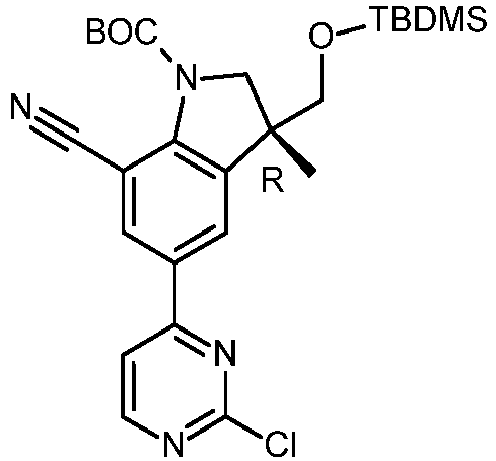
- A solution of intermediate 5R (25.00 g, 41.90 mmol) in 1,4-dioxane (1.2 L) was treated with a solution of NaHCO3 (10.50 g, 125.72 mmol) in water (80 mL). Then, 2,4-dichloropyrimidine (9.36 g, 62.86 mmol) and Pd(PPh3)4 (2.42 g, 2.09 mmol) were added under N2. The reaction mixture was stirred at 80 °C under N2. The mixture was cooled, partitioned between EtOAc (300 mL) and water (100 mL), and filtered through a pad of celite®. The organic layer was washed with water (100 mL), brine (100 mL), dried over Na2SO4 and concentrated under vacuum. The resulting residue was combined with 3 other batches coming from reactions performed on 25 g of intermediate 5R. The residue was purified by flash column chromatography on silica gel (SiO2, mobile phase: petroleum ether/EtOAc, gradient from 100:0 to 10:1). The desired fractions were collected and the solvent was concentrated to dryness under vacuum to give 63 g of intermediate 6R (70% yield over 2 steps, yellow solid).
- To a solution of intermediate 4R (50.0 g) in toluene (400 mL) was added bis(pinacolato)diboron (1.3 eq.), potassium acetate (3.0 eq.) and Pd(dppf)Cl2 (0.05 eq.). The mixture was degassed 3 times with nitrogen and heated to 90 °C for 12-14 hours. Subsequently, the mixture was cooled to room temperature and filtered on a celite pad which was washed with toluene (150 mL). The filtrate was washed with water (250 mL) and was then filtered on a silica pad (10 g) to afford a toluene solution containing 49g of intermediate 5R. To this solution was added 2,4-dichloropyrimidine (1.5 eq.), NaHCO3 (3.0 eq.), water (25 mL) and Pd(PPh3)4 (0.05 eq.). After degassing three times with nitrogen, the mixture was stirred at 90 °C monitoring the conversion by HPLC. After complete conversion (24-48 hours), the mixture was cooled to room temperature, filtered on a celite pad and washed with water (250 mL). To the organic layer was added silica thiol scavenging resin (10 g) and the mixture was stirred at 90 °C for 3 hours, then cooled to room temperature and filtered. The solvent was switched completely to isopropanol by repeated distillation until about 100 mL of isopropanol solution remained. The solution was warmed to 50°C and 250 mL of methanol were added. After stirring at 50 °C for 4 hours, the mixture was cooled to 0°C in 4h, held at the same temperature for 16 hours and finally filtered to obtain 26g of intermediate 6R.
- Preparation of intermediate 6a:

- To a solution of intermediate 5 (3.89 g, 4.92 mmol), 5-fluoro-2,4-dichloropyrimidine (1.07 g, 6.40 mmol) and Cs2CO3 (4.81 g, 14.80 mmol) in 1,4-dioxane (25 mL) and distilled water (2.5 mL), Pd(PPh3)4 (0.28 g, 0.25 mmol) was added and the reaction mixture was heated overnight at 95 °C. The mixture was poured into ice and extracted with EtOAc. The organic layer was washed with brine, dried over MgSO4, filtered and the solvent was evaporated. The residue was purified by column chromatography on silica gel (240 g, 15-40 µm, mobile phase: heptane/EtOAc, gradient from 1:0 to 0:1). The pure fractions were mixed and the solvent was evaporated to give 1.92 g of intermediate 6a (73% yield).
- The intermediates in the Table below were prepared by using an analogous starting from the respective starting materials.
Intermediate number Structure Mass (mg) Yield (%) Intermediate 6aR 
1820 83 From intermediate 5R and 5-fluoro-2,4-dichloropyrimidine - Preparation of intermediate 7R:

- In a three neck round bottom flask, SiO2 (35-70 µm) (200 g) was added to a solution of intermediate 6R (45.00 g, 87.36 mmol) in toluene (640 mL) at rt. The reaction mixture was reflux (bath temperature 125 °C) for 6 h under mechanical agitation. Then, SiO2 (35-70 µm) was filtered off, washed successively with THF and EtOAc, and the filtrate was evaporated to dryness to give 37.2 g of crude intermediate 7R which was directly engaged in the next steps.
- Preparation of intermediate 392:
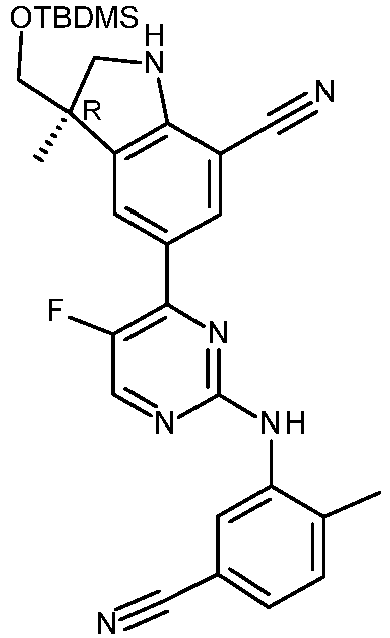
- Intermediate 392 was prepared by using an analogous reaction protocol as the procedure described above to get intermediate 7R, but starting from intermediate 391 (310 mg; 98%).
- Alternative preparation of intermediate 7R:

- TFA (135 mL, 1.76 mol) was added dropwise at -10 °C (over 50 min) to a solution of intermediate 6R (20.00 g, 38.82 mmol) in DCM (550 mL). The reaction mixture was stirred below 0 °C for 15 min more, then poured in a mixture of crushed ice and a saturated aqueous solution of K2CO3. After extraction with DCM (twice), the organic layers were combined, washed with an aqueous solution of K2CO3, dried over MgSO4 and evaporated to dryness. The residue (17.40 g) was purified by chromatography on silica gel (irregular SiOH, 80 g, mobile phase: NH4OH/MeOH/DCM, gradient from 0% NH4OH, 0% MeOH, 100% DCM to 0.2% NH4OH, 2% MeOH, 98% DCM). The desired fractions were collected and the solvent was concentrated to dryness under vacuum to give 12.1 g of intermediate 7R (75% yield).
- Preparation of intermediate 7:

- To a solution of intermediate 6 (1.50 g, 2.91 mmol) in DCM (30 mL), TFA (7 mL, 91.50 mmol) was added at 0-5 °C and stirred at 0-5 °C for 1 h, then rt for 1 h. The crude product was poured in a mixture of crushed ice and a saturated aqueous solution of NaHCO3. After extraction with DCM (twice), the organic layers were combined, washed with a saturated solution of NaHCO3, dried over MgSO4 and concentrated under vacuum. The residue was purified by column chromatography on silica gel (Irregular SiOH, 40µm, mobile phase: NH4OH/MeOH/DCM, gradient from 0% NH4OH, 0% MeOH, 100% DCM to 0.1% NH4OH, 2% MeOH, 98% DCM). The desired fractions were collected and the solvent was concentrated to dryness under vacuum to give 524 mg of intermediate 7 (65% yield).
- Preparation of intermediate 150:

- A solution of intermediate 6 (500.00 mg, 0.97 mmol) in THF (5.71 mL, 70.21 mmol) was treated with TBAF (1M in THF) (1.16 mL, 1.16 mmol) and stirred at rt for 12 h. The reaction mixture was poured in EtOAc. The organic layers were washed with water then brine, dried over MgSO4 and evaporated in vacuo. The residue (483 mg) was purified by column chromatography on silica gel (Irregular SiOH, 40 µm, 40 g, mobile phase: DCM/MeOH/NH4OH, gradient from 100% DCM to 98% DCM, 2% MeOH, 0.2% NH4OH). The pure fractions were combined and the solvent was evaporated to give 358 mg of intermediate 150 (92% yield).
- Preparation of intermediate 271:

- A solution of intermediate 2 (10.00 g, 26.59 mmol) and 2-methyl-2-propen-1-ol (4.50 mL, 53.69 mmol) in Me-THF (200 mL) was cooled with EtOH/ice bath under N2 to an internal temperature of -5 °C. Tri-n-butylphosphine (13.30 mL, 53.19 mmol) was added. Then a solution of 1,1'-(azodicarbonyl)piperidine (14.80 g, 58.62 mmol) in Me-THF (120 mL) was added dropwise over 25 min. The solution was stirred for 5 min more at this temperature then the cooling bath was removed and the solution stirred at rt for 18 h. The reaction mixture was poured onto a 10% aqueous solution of K2CO3 and extracted with DCM. The organic layer was decanted, dried over MgSO4, filtered and evaporated to dryness. The residue (20 g) was taken up with heptane and the insoluble material was removed by filtration. The filtrate was concentrated to 20 mL and purified by column chromatography on silica gel (irregular SiOH, 80 g, mobile phase: heptane/EtOAc, gradient from 100:0 to 88:12). The pure fractions were collected and evaporated to dryness to give 10.80 g of intermediate 271 (94% yield).
-

- A mixture of intermediate 271 (10.80 g, 25.11 mmol), sodium acetate (5.35 g, 65.28 mmol), sodium formate (4.44 g, 65.28 mmol) and tetraethylammonium chloride (5.20 g, 31.38 mmol) in DMF (100 mL) was de-gassed by sonication for 10 min under a stream of Ar. Pd(OAc)2 (563.00 mg, 2.51 mmol) was added and the resulting orange suspension was then stirred at 85 °C (block temperature) for 4 h. The residue was diluted with EtOAc and water, then filtered through a plug of celite®. The organic layer was decanted, washed successively with a saturated aqueous solution of NaHCO3 and brine, dried over MgSO4, filtered and evaporated to dryness. The residue (8.3 g, mixture of intermediates 272 and 272') was dissolved in CH3CN (230 mL) and NBS (4.47 g, 25.11 mmol) was added. The reaction mixture was heated at 55 °C (block temp) for 18 h. The reaction mixture was evaporated to dryness and the residue was taken up with heptane/DCM. The precipitate was filtered off (1 g derivative) and the filtrate (10 g) was purified by column chromatography on silica gel (irregular SiOH, 120 g, injection in DCM, mobile phase: heptane/EtOAc, gradient from 100:0 to 80:20). The pure fractions were collected and evaporated to dryness to give 4 g of intermediate 272 (45% yield).
- Preparation of intermediate 273:

- [1,1'-Bis(diphenylphosphino)ferrocene]dichloropalladium (II), complex with dichloromethane (243.00 mg, 0.30 mmol) was added to a solution of intermediate 272 (2.09 g, 5.95 mmol), bis(pinacolato)diboron (1.90 g, 7.44 mmol) and potassium acetate (1.75 g, 17.85 mmol) in 1,4-dioxane (45 mL) and the reaction mixture was heated for 18 h at 85 °C. The reaction mixture was diluted with EtOAc and filtered through a pad of celite®. The filtrate was washed with water, and the organic layer was decanted, dried over MgSO4, filtered and evaporated to dryness. The residue was crystallized from DiPE and the precipitate was filtered and dried to give 1.85 g of intermediate 273 (78% yield).
- Preparation of intermediate 274:

- A degassed suspension of intermediate 273 (1.12 g, 2.81 mmol), 2,4-dichloropyridine (502.00 mg, 3.37 mmol), Pd(PPh3)4 (162.00 mg, 0.14 mmol) and a solution of Na2CO3 2M (4.20 mL, 8.14 mmol) in 1,4-dioxane (24 mL) was heated to 85 °C for 18 h. The reaction mixture was partitioned between DCM and saturated aqueous NaHCO3. The organic layer was decanted, dried over MgSO4, filtered and evaporated to dryness. The residue (2 g) was purified by column chromatography on silica gel (irregular SiOH, 40 g, mobile phase: heptane/EtOAc, gradient from 70:30 to 50:50). The pure fractions were collected and evaporated to dryness to give 933 mg of intermediate 274 (86% yield, 85% purity based on LC/MS).
- Preparation of intermediate 361:

- TFA (6 mL) was added dropwise at 5 °C to a solution of intermediate 274 (3.00 g, 7.79 mmol) in DCM (60 mL) and the reaction mixture was stirred at 5 °C for 1 h. The reaction mixture was diluted with DCM and poured onto a mixture of ice and 10% aqueous K2CO3. The insoluble material was filtered, washed with water then Et2O and dried to give 1.93 g of intermediate 361 (87% yield). M.P. = 207 °C (K).
- Preparation of intermediate 8R:

- Method A: In a sealed vessel, a solution of intermediate 7R (14.75 g, 35.54 mmol) in 1.4-dioxane (285 mL) was purged with N2. 3-amino-4-methylbenzonitrile (7 g, 53.312 mmol) and Cs2CO3 (23.16 g, 71.083 mmol) were successively added and the suspension was degassed after each addition. Then, Pd(OAc)2 (798.00 mg, 3.55 mmol) and BINAP (2.21 g, 3.55 mmol) were added. The reaction mixture was degassed with N2 and stirred at 120 °C (pre-heated bath) for 3 h. The reaction mixture was cooled to rt, poured onto ice-water and extracted with EtOAc. The organic layer was decanted, washed with brine, dried over MgSO4, filtered over a pad of Celite® and concentrated to vacuum. The residue (30 g) was purified by column chromatography on silica gel (irregular SiOH, 400 g, mobile phase: DCM/EtOAc, gradient from 100:0 to 85:15 (12 x 200 mL)). The desired fractions were collected and the solvent was concentrated to dryness under vacuum to give 14.3 g of intermediate 8R (79% yield contaminated by 7% of 3-amino-4-methylbenzonitrile as evaluated by 1HNMR). This solid was suspended in Et2O/CH3CN and the mixture was sonicated at rt for 15 min. The precipitate was filtered, washed with CH3CN and dried to give 8.6 g of intermediate 8R (47% yield). The filtrate was evaporated and the residue was purified by column chromatography on silica gel (irregular SiOH, 80 g, mobile phase: DCM/EtOAc, gradient from 100:0 to 90:10). The fractions containing the product were collected and evaporated to dryness. The resulting solid was suspended in Et2O/CH3CN and the mixture was sonicated at rt for 15 min. The precipitate was filtered, washed with CH3CN and dried to give additional 2.6 g of intermediate 8R (14% yield). The global yield of this reaction was 62% (11.2 g).
- SiO2 35-70 µm (25 g) was added to a solution of intermediate 9R (6.10 g, 10.00 mmol) in toluene (75 mL) at rt. The reaction mixture was refluxed (bath temperature 125°C) for 6 h under vigorous agitation. Then, SiO2 35-70 µm was filtered off, washed successively with THF and EtOAc and the filtrate was evaporated to dryness. The residue was taken up with Et2O and the precipitate was filtered and dried to give 4.34 g of intermediate 8R (85% yield).
- The intermediates in the Table below were prepared by using an analogous method as described in Method A starting from the respective starting materials. The most relevant minor deviations from the initial method are indicated in the column 'Method'.
Intermediate number Structure Mass (mg) Yield (%) Method Intermediate 20 
247 (82% of purity based on LC/MS) 33 A From intermediate 7R and intermediate 24 Intermediate 21 
325 44 A From intermediate 7R and intermediate 27 Intermediate 42 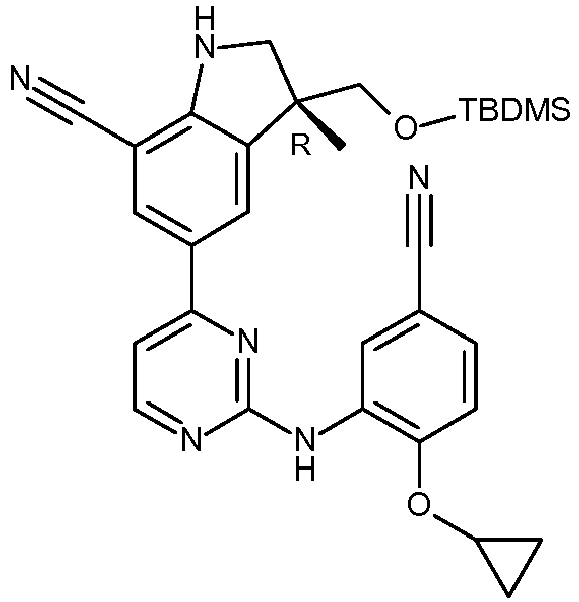
618 orange oil 32 A From intermediate 7R and intermediate 41 Intermediate 49 
292 (96% of purity based on LC/MS) 30 A From intermediate 7R and intermediate 48 365 mg (79% of purity based on LC/MS) 37 Intermediate 52 
843 (80% of purity based on LC/MS) orange oil 93 A From intermediate 7R and intermediate 51 Intermediate 55 
1293 (94% of purity based on LC/MS) yellow powder Quant. A From intermediate 7R and intermediate 54 Intermediate 57 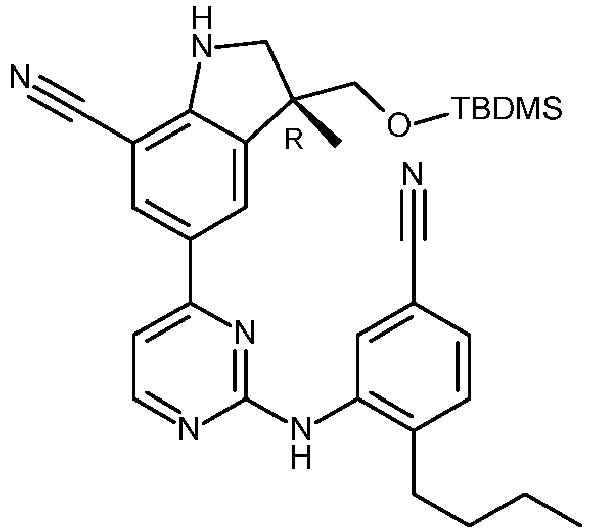
344 (98% of purity based on LC/MS) 63 A From intermediate 7R and intermediate 56 Intermediate 60 
1010 (73% of purity based on LC/MS) orange solid - A From intermediate 7 R and intermediate 59 Intermediate 104 
261 yellow solid 47 A with T = 95 °C From intermediate 7 and 3-amino-4-methylbenzonitrile Intermediate 195 
275 (94% of purity based on LC/MS) 66 A with T = 90 °C From intermediate 7 and 2-amino-4-chloro-N,N-dimethylbenzamide Intermediate 199 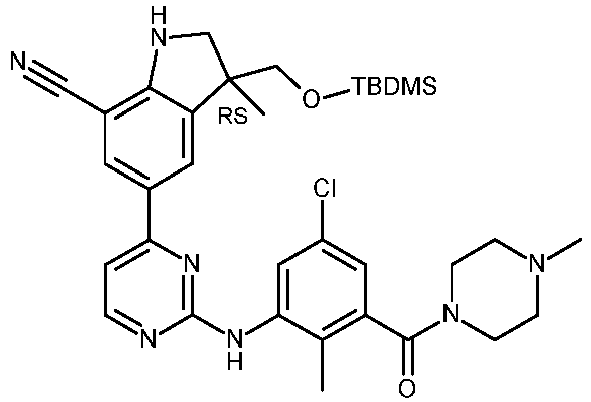
270 (80% of purity based on LC/MS) 74 A with T = 90 °C From intermediate 7 and intermediate 198 Intermediate 246 
423 65 A From intermediate 7R and intermediate 245 Intermediate 256 
1190 (94% of purity based on LC/MS) 87 A From intermediate 7R and intermediate 255 Intermediate 394 
3100 55 A From intermediate 7R and intermediate 393 Intermediate 398 
220 52 A With T = 80°C From intermediate 7R and intermediate 397 Intermediate 404 
167 31 A With T = 80°C From intermediate 7R and intermediate 403 Intermediate 407 
190 26% A With T = 80°C From intermediate 7R and intermediate 406 Intermediate 412 
185 36 A From intermediate 7R and 3-amino-4-(hydroxymethyl)benzonitrile Intermediate 433 
81 13 A From intermediate 432 and intermediate 7R Intermediate 435 
192 75 A From intermediate 434 and intermediate 7R Intermediate 437 
362 57 A From intermediate 436 and intermediate 7R Intermediate 439 
467 (70% of purity based on LC/MS) 67 A From intermediate 438 and intermediate 7R Intermediate 440 
597 ) 89 A from 3-amino-4-isopropoxy-N-methylbenzamide and intermediate 7R Intermediate 442 
366 (81% of purity based on LC/MS) 52 A From intermediate 441 and intermediate 7R Intermediate 444 
423 (100% of purity based on LC/MS) 80 A From intermediate 443 and intermediate 7R Intermediate 448 
180 30 A From intermediate 447 and intermediate 7R Intermediate 449 
377 (100% of purity based on LC/MS) 54 A From intermediate 447 and intermediate 7R Intermediate 453 
124 19 A From intermediate 452 and intermediate 7R Intermediate 454 
315 47 A From intermediate 452 and intermediate 7R. Intermediate 482 
690 (66% of purity based on LC/MS) 86 A From intermediate 481 and intermediate 7R . Intermediate 483 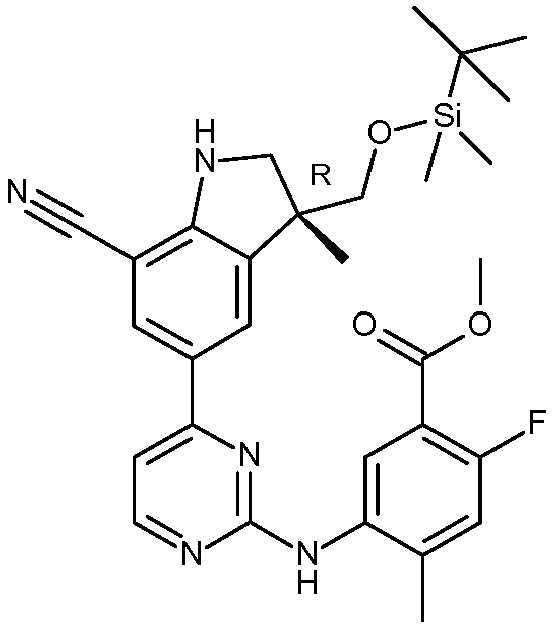
570 (79% of purity based on LC/MS) 84 A From intermediate 7R and methyl 5-amino-2-fluoro-4-methylbenzoate Intermediate 486 
572 (83% of purity based on LC/MS) 74 A From intermediate 7R and intermediate 485 Intermediate 491 
147 26 A From intermediate 490 Intermediate 496 
165 19 A From intermediate 7R and intermediate 495 Intermediate 502 
568 80% A (3h30@120°C) From intermediate 7R and intermediate 499 Intermediate 503 
88 29% Purity 82% (LCMS) A (3h30@120°C) From intermediate 7R and intermediate 500 Intermediate 504 
442 65% A (3h30@120°C) From intermediate 7R and intermediate 500B Intermediate 511 
233 49% A (3h@120°C) From intermediate 7R and intermediate 510 Intermediate 514 
591 77% Purity 54% (LCMS) A (5h@120°C) From intermediate 7R and intermediate 513 Intermediate 518 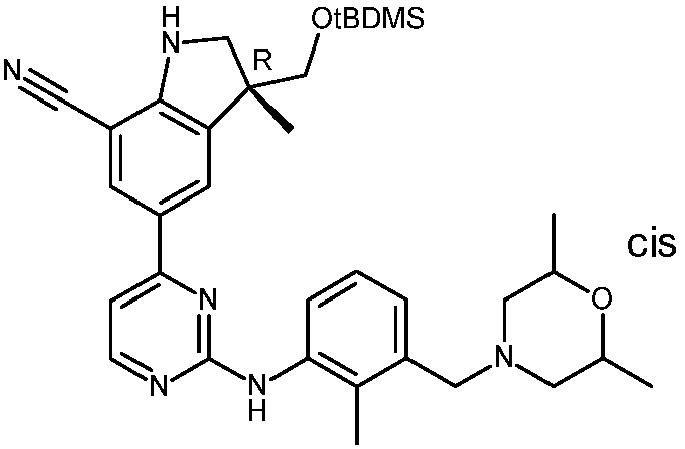
142 86% Purity 70% (LCMS) A (4h@120°C) From intermediate 7R and rel-3-[cis-2,6-dimethyl-4-morpholinyl] methyl]-2-methyl-benzenamine Intermediate 520 
221 61% A (4h@120°C) From intermediate 7R and intermediate 519 Intermediate 521 
282 54% A (4h@120°C) From intermediate 7R and intermediate 521b Intermediate 522 
1050 53% A (3h@120°C) From intermediate 7R and methyl 3-amino-2-methylbenzoate Intermediate 528 
306 43% A (4h@120°C) From intermediate 7R and intermediate 527 Intermediate 531 
527 77% A (4h@120°C) From intermediate 7R and intermediate 530 Intermediate 581 
215 Pale brown oil 65 A From intermediate 7R and intermediate 580 Intermediate 600 
500 Quant. A From intermediate 7R and intermediate 599 Intermediate 619 
226 88 A From intermediate 7R and intermediate 617 Intermediate 622 
70 Yellow solid 23 A From intermediate 7R and intermediate 621 Intermediate 637 
571 64 A From intermediate 7R and intermediate 636 - Preparation of intermediate 423:

- A mixture of intermediate 422 (8.68 g, 47.6 mmol), intermediate 7R (13.18 g, 31.8 mmol) and Cs2CO3 (20.7 g, 63.5 mmol) in 1,4-dioxane (260 mL) was purged with N2. Pd(OAc)2 (713 mg, 3.18 mmol) and BINAP (1.98 g, 3.18 mmol) were then added. The round bottom flask was sealed and the reaction mixture was purged with N2 and was stirred at 120 °C for 3 hours. The resulting mixture was poured onto water and DCM. Then, filtered over celite®, decanted and the organic layer was separated, dried over MgSO4, filtered and evaporated. The residue (22.5 g) was purified by column chromatography over silica gel (Irregular SiOH, 40 µm, 120 g, mobile phase: heptane/EtOAc/MeOH: 60/35/5). The pure fractions were combined and the solvent was evaporated to give 10.66 g (60%) of intermediate 423 as a pale orange foam.
- Preparation of intermediate 430


- In a sealed tube, a mixture of intermediate 7R (936 mg; 2.25 mmol) in 1,4-dioxane (25 mL) was purged with N2. A mixture of intermediates 428 and 429 (758 mg; 3.38 mmol) and cesium carbonate (1.47 g; 4.51 mmol) were successively added and the suspension was degassed after each addition. Then, Pd(OAc)2 (51 mg; 0.226 mmol) and BINAP (140 mg; 0.226 mmol) were added. The flask was sealed, the reaction mixture was degassed with N2 and stirred at 120°C (pre-heated bath) for 4 hours.
- The reaction mixture was cooled to room temperature, poured onto water and extracted with DCM. The organic layer was decanted, dried over MgSO4, filtered over celite® and evaporated to dryness. The residue was purified by chromatography over silica gel (irregular SiOH, 80g; mobile phase: gradient from 20% EtOAc, 80% heptane to 40% EtOAc, 60% heptane). The pure fractions were collected and evaporated to dryness yielding 451 mg (33%) of intermediate 430 (33%) and 530 mg (39%) of intermediate 431.
- Preparation of intermediate 618:

- In a sealed vessel, a mixture of intermediate 7R (184 mg; 0.443 mmol) in dioxane (11 mL) was purged with N2. Intermediate 616 (156 mg; 0.663 mmol) and cesium carbonate (289 mg; 0.886 mmol) were successively added and the suspension was degassed after each addition. Then Pd(OAc)2 (10 mg; 0.044 mmol) and BINAP (27 mg; 0.044 mmol) were added. The reaction mixture was degassed with N2 and stirred at 120°C (pre-heated bath) for 4 hours. The reaction mixture was cooled to room temperature, poured onto water and extracted with EtOAc. The organic layer was decanted, washed with water then brine, dried over MgSO4, filtered and evaporated to dryness. The residue was purified by chromatography over silica gel (irregular SiOH, 50g; mobile phase: gradient 0% MeOH, 100% DCM to 5% MeOH, 95% DCM). The fractions containing the product were collected and evaporated to dryness yielding 234 mg (86% yield, 87% purity evaluated by LCMS) of intermediate 618.
- The intermediates in the Table below were prepared by using an analogous method as described in Method B starting from the respective starting materials. The most relevant minor deviations from the referenced method are indicated in the column 'Method'.
Intermediate number Structure Mass (mg) Yield (%) Method Intermediate 552 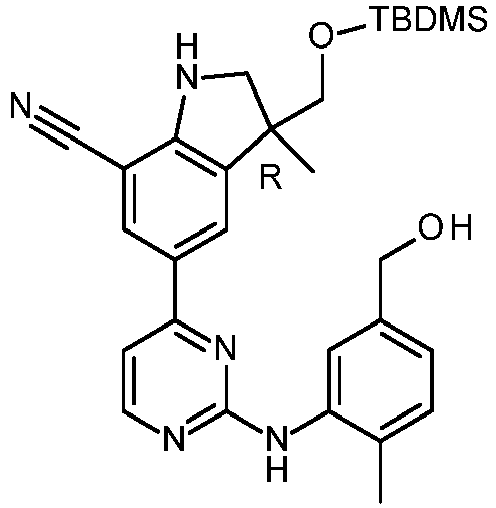
197 yellow oil 78 B From intermediate 551 Intermediate 556 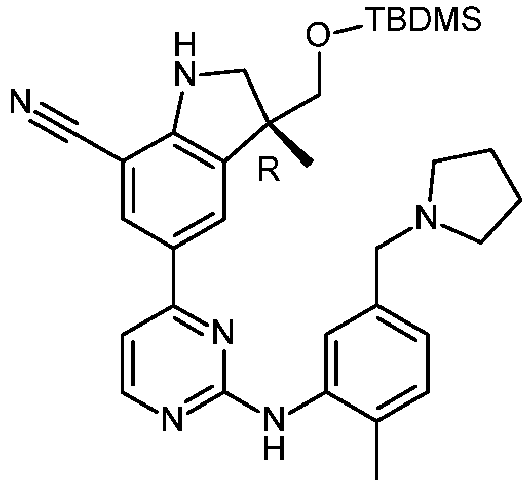
50 orange oil 60 B From a mixture of intermediate 555 and intermediate 556 Intermediate 558 
390 yellow oil 94 B From a mixture of intermediates 557 and intermediate 558 Intermediate 561 
419 yellow oil quant. B From a mixture of intermediates 560 and intermediate 561 Intermediate 563 
117 yellow oil 48 B From a mixture of intermediate 562 and intermediate 563 Intermediate 577 
363 Grey solid 69 B From intermediate 576 Intermediate 593 
240 93 B From intermediate 592 Intermediate 597 
170 100 B From intermediate 596 Intermediate 606 
260 (75% purity evaluated by LCMS) 97 B From intermediate 605 Intermediate 612 
90 87 B From intermediate 611 Intermediate 641 
106 63 B From intermediate 640 - Preparation of intermediate 9R:

- In a Sealed vessel, a mixture of 6R (5.15 g, 10.00 mmol) in 1,4-dioxane (80 mL) was purged with N2. 3-amino-4-methylbenzonitrile (2.00 g, 15.00 mmol) and Cs2CO3 (6.51 g, 20.00 mmol) were successively added and the suspension was degassed after each addition. Then Pd(OAc)2 (224.45 mg, 1.00 mmol) and BINAP (622.53 mg, 1.00 mmol) were added. The reaction mixture was degassed with N2 and stirred at 120 °C (pre-heated bath) for 3 h. The reaction mixture was cooled to rt, poured onto ice-water and extracted with EtOAc. The organic layer was decanted, washed with brine, dried over MgSO4, filtered over a pad of celite® and evaporated to dryness. The residue was purified by column chromatography on silica gel (irregular SiOH, 120 g, mobile phase: heptane/EtOAc, gradient from 85:15 to 70:30). The pure fractions were collected and evaporated to dryness to give 4.17 g of intermediate 9R (68% yield).
- NaH (60% dispersion in mineral oil) (0.90 g, 22.49 mmol) was added portionwise to a stirred solution of N-(5-cyano-2-methylphenyl)-formamide (2.40 g, 15.00 mmol) in DMF (100 mL) under a N2 atmosphere at rt and stirred for 30 min. Then, intermediate 6R (5.15 g, 1.00 mmol) was added and the reaction mixture was stirred at rt for 18 h. The resulting crude product was poured into water and extracted with EtOAc. The organic layer was decanted, washed successively with water and brine, dried over MgSO4, filtered and concentrated to dryness to give 7.8 g of crude intermediate 9R which was used without any further purification in the next step.
- The intermediates in the Table below were prepared by using an analogous method as described in Method C starting from the respective starting materials. The most relevant minor deviations from the referenced method are indicated in the column 'Method'.
Intermediate number Structure Mass (mg) Yield (%) Method Mixture of Intermediate 11 / Intermediate 12 
1210 mixture of intermediate 11 and intermediate 12 (74:14 based on LC/MS) - C 
from intermediate 6R and a mixture of intermediates 16 and 17 Intermediate 18 
477 off-white foam 76 C from intermediate 6R and 3-amino-N,4-dimethyl benzamide Intermediate 29 
337 (92% of purity based on LC/MS) 41 C from intermediate 6R and intermediate 28 Intermediate 33 and Intermediate 34 
387 (intermediate 33) (89% of purity based on LC/MS) orange oil 32 C 
474 (intermediate 34) (93% of purity based on LC/MS) orange oil 39 From intermediate 6R and intermediate 32 Intermediate 38 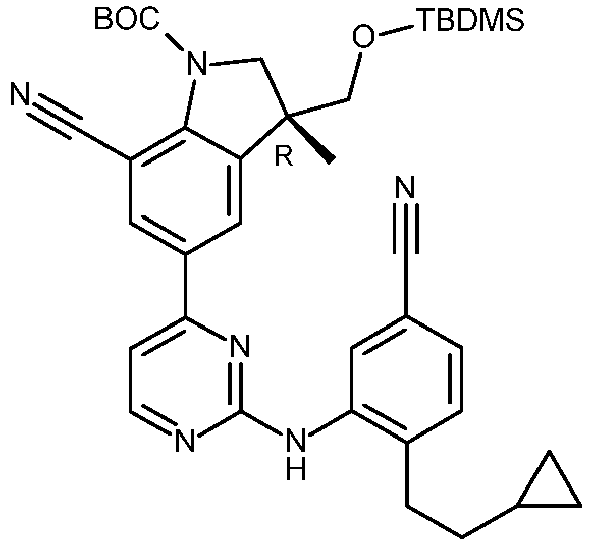
778 60 C From intermediate 6R and intermediate 37 Intermediate 45 
1090 (93% of purity based on LC/MS) beige solid 89 C From intermediate 6R and intermediate 44 Intermediate 61 
525 (93% of purity based on LC/MS) Light yellow powder 83 C From intermediate 6R and intermediate 59 Intermediate 63 
536 36 (46 % purity based on LC/MS) C From intermediate 6R and methyl-4-(methylsulfonyl) aniline Mixture of Intermediate 68/ Intermediate 69 
1210 (mixture of intermediates 68/69: 98.7/1.3) pale yellow foam 93 C with T = 80 °C + 
From intermediate 6R and intermediate 67 Intermediate 74 
2420 (73% of purity based on LC/MS) brown foam C with T = 90 °C From intermediate 6R and intermediate 73 Intermediate 77 
2500 (81% of purity based on LC/MS) brown solid C From intermediate 6R and intermediate 76 Intermediate 79 
919 (96% of purity based on LC/MS) orange powder 86 C From intermediate 6R and intermediate 51 Intermediate 85 
292 orange oil - C with T = 85 °C From intermediate 6 and intermediate 84 Intermediate 89 
247 dark black foam - C with T = 95 °C From intermediate 6 and intermediate 88 Intermediate 93 
698 68 (based on a purity of 70% by LC/MS) C with T = 95 °C From intermediate 6 and intermediate 92 Intermediate 96 
387 orange sticky oil - C From intermediate 6 and intermediate 95 Intermediate 100 
360 - C with T = 85 °C From intermediate 6 and intermediate 99 Intermediate 102 
356 brown solid - C with T = 95 °C From intermediate 6 and 3-amino-4-methylbenzonitrile Intermediate 105 
540 brown solid - C with T = 95 °C From intermediate 6 and 5-chloro- 2-methylaniline Intermediate 110 
249 (62% of purity based on LC/MS) dark black foam 98 C with T = 95 °C From intermediate 6 and intermediate 109 Intermediate 112 
530 (80% of purity based on LC/MS) Quant. C with T = 95 °C From intermediate 6 and 2,5-dichloroaniline Intermediate 114 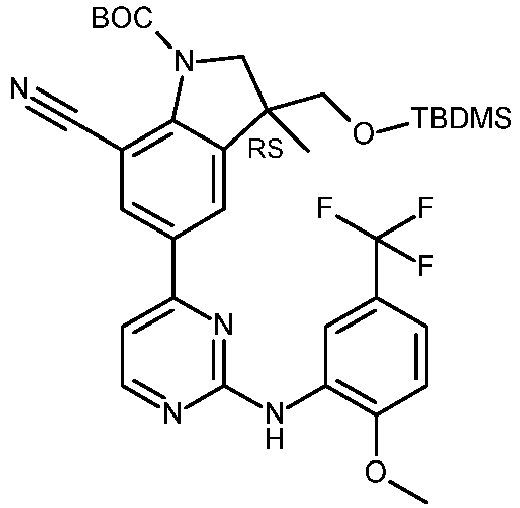
390 (55% of purity based on LC/MS) brown solid - C with T = 95 °C From intermediate 6 and 2-methoxy-5-(trifluoromethyl)aniline Intermediate 116 
365 brown oil - C with T = 95 °C From intermediate 6 and 3-amino-4-methoxybenzonitrile Intermediate 118 
504 (70% of purity based on NMR) white solid 82 C with T = 95 °C From intermediate 6 and 3-amino-4-chlorobenzonitrile Intermediate 120 
960 (64% of purity based on LC/MS) brown solid Quant. C with T = 95 °C From intermediate 6 and 5-chloro-2-methoxyaniline Intermediate 124 
308 (86% of purity based on LC/MS) 47 C with T = 95 °C From intermediate 6 and intermediate 123 Intermediate 128 
530 (68% of purity based on LC/MS) 85 C with T = 95 °C From intermediate 6 and intermediate 127 Intermediate 131 
530 M.P. (K) = 136 °C 75 C with T = 95 °C From intermediate 6 and intermediate 130 Intermediate 135 
268 M.P. (K) = 133 °C 37 C with T = 95 °C From intermediate 6 and intermediate 134 Intermediate 139 
308 45 C with T = 95 °C From intermediate 6 and intermediate 138 Intermediate 143 (mixture of 4 unseparated diastereoisomers) 
197 (87% of purity based on LC/MS) 25 C with T = 95 °C From intermediate 6 and intermediate 142 200 (95% of purity based on LC/MS) 27 Intermediate 146 
370 64 C with T = 95 °C From intermediate 6 and intermediate 145 Intermediate 151 
139 38 (based on 74 % of purity by LC/MS) C with T = 95 °C From intermediate 150 and intermediate 149 Intermediate 157 
119 (98% of purity based on LC/MS) 25 C with T = 95 °C From intermediate 150 and intermediate 156 Intermediate 161 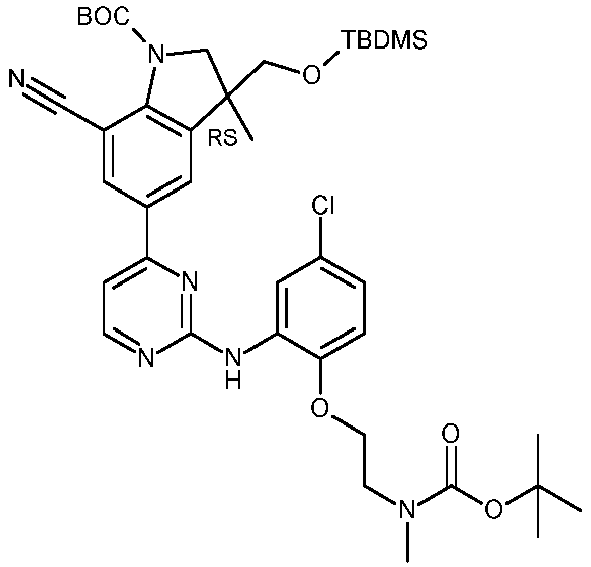
205 (95% of purity based on LC/MS) white powder 34 C From intermediate 6 and intermediate 160 80 (59% of purity based on LC/MS) yellow oil 13 Intermediate 164 
269 (71% of purity based on LC/MS) 41 C with T = 95 °C From intermediate 6R and intermediate 123 Intermediate 169 
411 (97% of purity based on LC/MS) 96 C From intermediate 6a and 5-chloro-2-methoxyaniline Intermediate 171 
418 (91% of purity based on LC/MS) 97 C From intermediate 6aR and 5-chloro- 2-methoxyaniline Intermediate 196 
269 41 C with T = 95 °C From intermediate 6S and intermediate 123 Intermediate 203 
582 (59% of purity based on LC/MS) yellow solid quant. C with T = 95 °C From intermediate 6R and intermediate 202 Intermediate 205 
190 27 C From intermediate 6R and 5-chloro-2-[2-methylsulfonyl] ethoxy]-benzamine Intermediate 210 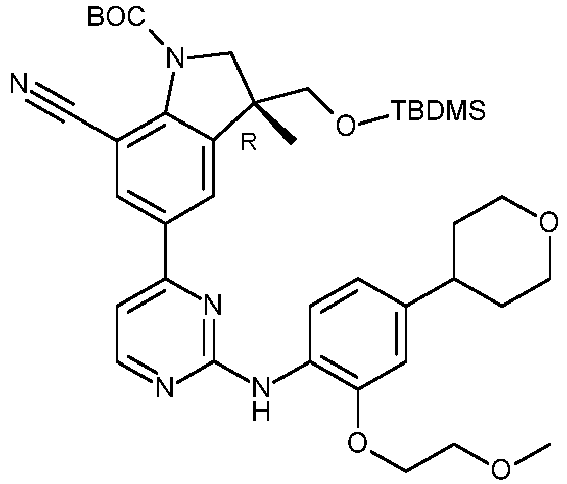
620 black foam Quant. C with T = 95 °C From intermediate 6R and intermediate 209 Intermediate 212 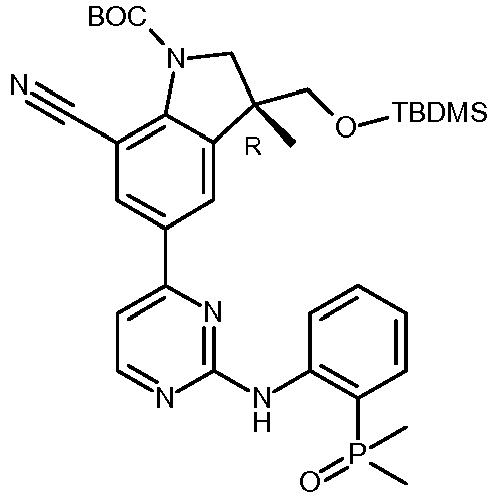
740 (59% of purity based on LC/MS) brown foam 99 C with T = 95 °C From intermediate 6R and 2-(aminophenyl)dimethylphosphi ne oxide Intermediate 222 
760 (66% purity evaluated by LC/MS) black foam Quant. C with T = 95 °C From intermediate 6R and intermediate 221 Intermediate 228 
400 (97% purity evaluated by LC/MS) 61 C From intermediate 6R and intermediate 227 Intermediate 232 
630 (85% purity evaluated by LC/MS) black foam quant. C with T = 90 °C From intermediate 6R and intermediate 231 Intermediate 240 
494 (93% purity evaluated by NMR) 77 C From intermediate 6R and intermediate 239 Intermediate 242 
613 95 C From intermediate 6R and 3-amino-4-(trifluoromethyl)benzonitrile Mixture of intermediate 247/intermediate 247' 
381 intermediate 247 (87% purity based on LC/MS) 48 C 
Intermediate 247' (11% purity based on LC/MS) From intermediate 6R and intermediate 377/378 Intermediate 252 
397 60 C From intermediate 6R and intermediate 251 Intermediate 261 
553 (84% purity evaluated by LC/MS) orange powder 82 C From intermediate 6R and intermediate 260 Intermediate 265 
502 (57% purity evaluated by LC/MS) 44 C From intermediate 6 and 2-isopropoxy-5 -(trifluoromethyl)aniline Intermediate 269 
372 (78% purity evaluated by LC/MS) 55 C with T = 90 °C From intermediate 6 and intermediate 268 Intermediate 391 
375 90 C From intermediate 6aR and 3-amino-4-methylbenzonitrile Intermediate 417 
340 45 C With T = 80°C From intermediate 6R and intermediate 416 Intermediate 505 
360 57% Purity 84% (LCMS) C (o/n@95°C) From intermediate 6R and intermediate 501 Intermediate 508 
100 17% C (o/n@80°C) From intermediate 6R and 2-methyl-5-(1-methyl-4-piperidinyl)-benzenamine Intermediate 537 
488 16% Purity 49% (LCMS) C (3h@95°C) From intermediate 6R and intermediate 536 Intermediate 551 
4690 yellow foam 78 C From intermediate 6R and 3-amino-4-methylbenzyl alcohol Intermediate 568 
540 80 C From intermediate 6R and intermediate 567 Intermediate 572 
850 98 C From intermediate 6R and intermediate 571 Intermediate 576 
633 Pale brown oil 82 C From intermediate 6R and intermediate 575 Intermediate 584 
180 56 C From intermediate 6R and intermediate 583 Intermediate 588 
315 (85% purity evaluated by LCMS) 77 C From intermediate 6R and intermediate 587 Intermediate 592 
300 74 C At 100°C for 1 hour From intermediate 6R and intermediate 591 Intermediate 596 
240 53 C At 100°C for 1 hour From intermediate 6R and intermediate 595 Intermediate 605 
310 (85% purity evaluated by LCMS) 73 C From intermediate 6R and intermediate 604 Intermediate 611 
121 (55% purity evaluated by LCMS) 70 C At 100°C for 1 hour From intermediate 6R and intermediate 610 Intermediate 627 
505 59 C From intermediate 6R and intermediate 626 Intermediate 633 
552 80 C @ 85°C overnight from intermediate 6R and intermediate 632 - Preparation of intermediate 154:

- A mixture of intermediate 150 (300.00 mg, 0.75 mmol), intermediate 153 (198.67 mg, 0.82 mmol) and Cs2CO3 (609.59 mg, 1.87 mmol) in 1,4-dioxane (12.77 mL) was purged with N2. A catalytic amount of Pd(OAc)2 (13.44 mg, 59.87 µmol) and BINAP (37.28 mg, 59.87 µmol) were then added in the sealed tube. The reaction mixture was purged with N2 and was stirred at 120 °C using one single mode microwave (Biotage Initiator EXP 60) with a power output ranging from 0 to 400 W for 30 min The resulting mixture was poured out onto water and DCM. Then, filtered over celite®, decanted and the organic layer was separated, dried over MgSO4, filtered and evaporated. The residue (948 mg) was purified by column chromatography on silica gel (Irregular SiOH, 40 µm, 40 g, mobile phase: heptane/EtOAc/MeOH/NH4OH, gradient from 50% heptane, 50% EtOAc to 40% Heptane, 10% MeOH, 50% EtOAc, 1% NH4OH). The pure fractions were combined and the solvent was evaporated to give 300 mg of intermediate 154 (66% yield).
- The intermediates in the Table below were prepared by using an analogous method as the one used for the preparation of intermediate 154 starting from the respective starting materials.
Intermediate number Structure Mass (mg) Yield (%) Intermediate 173 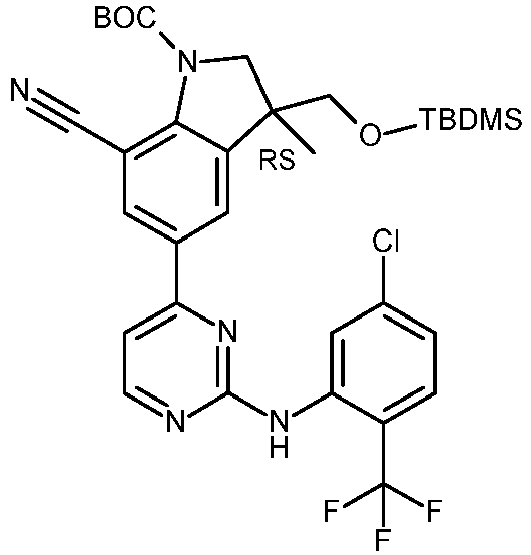
418 64 From intermediate 6 and 2-amino-4-chloro benzotrifluoride Intermediate 179 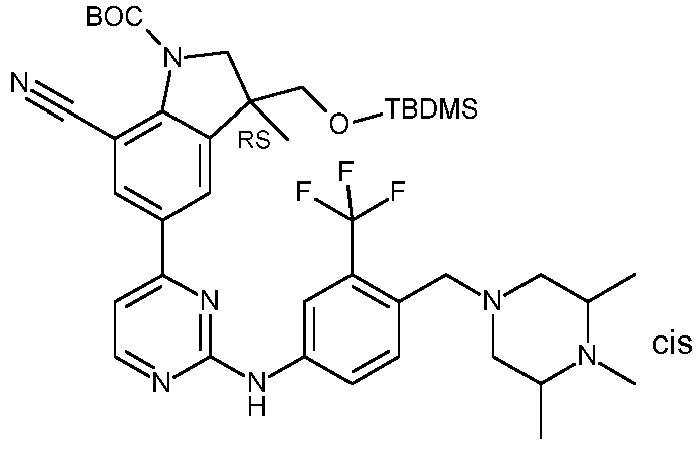
499 66 CIS From intermediate 6 and intermediate 178 Intermediate 181 
180 27 From intermediate 6 and 4-bromo-5-chloro-2-methylaniline intermediate 183 
600 76 From intermediate 6 and 5-chloro-2-(trifluoromethoxy)aniline intermediate 187 
600 (69% of purity based on LC/MS) 89 From intermediate 6 and intermediate 186 Intermediate 190 
600 89 From intermediate 6 and intermediate 189 Intermediate 193 
300 40 From intermediate 6 and intermediate 192 Intermediate 218 
387 59 From intermediate 6R and intermediate 217 Intermediate 224 
329 (82% purity evaluated by LC/MS) yellow powder 55 From intermediate 6S and 3-amino-4-methylbenzonitrile Intermediate 236 
207 (92% purity evaluated by LC/MS) 35 From intermediate 6R and intermediate 235 Intermediate 411 
610 95 From intermediate 7R and intermediate 410 Intermediate 458 
604 97 From intermediate 6R and intermediate 457 Intermediate 463 
629 78 From intermediate 7R and intermediate 462 Intermediate 468 
396 100 From intermediate 7R and intermediate 467 Intermediate 471 
261 (68% of purity based on LC/MS) 68 From intermediate 7R and intermediate 470 Intermediate 474 
137 52 From intermediate 473 and intermediate 7R. Intermediate 479 
377 54 From intermediate 478 and intermediate 7R. Intermediate 644 
298 (85% of purity based on LC/MS) 45 From intermediate 150 and intermediate 643 - Preparation of intermediate 277:

- To a solution of intermediate 274 (0.10 g, 0.24 mmol), intermediate 276 (56.70 mg, 0.24 mmol), BINAP (14.90 mg, 0.024 mmol), Cs2CO3 (237.00 mg, 0.73 mmol) in 1,4-dioxane (3 mL) was added Pd(OAc)2 (5.39 mg, 0.024 mmol) and the reaction mixture was heated for 30 min at 95 °C. The reaction mixture was diluted with EtOAc, washed with water and brine. The organic layer was dried over Na2SO4, and concentrated in vacuo to give 227 mg of intermediate 277 (65% purity based on LC/MS, yellow oil) and used as it is in the next step.
- The intermediates in the Table below were prepared by using an analogous method as the one used for the preparation of intermediate 277 starting from the respective starting materials.
Intermediate number Structure Mass (mg) Yield (%) Intermediate 280 
124 (69% based on LC/MS) - From intermediate 274 and intermediate 279 Intermediate 281 
153 (90% based on LC/MS) brown oil - From intermediate 274 and intermediate 99 Intermediate 282 
124 (95% based on LC/MS) brown oil Quant. From intermediate 274 and intermediate 109 Intermediate 286 
157 (90% based on LC/MS) brown oil Quant. From intermediate 274 and intermediate 285 Intermediate 287 
126 (90% based on LC/MS) brown oil Quant. From intermediate 274 and intermediate 88 Intermediate 288 
107 (89% based on LC/MS) brown oil Quant. From intermediate 274 and intermediate 95 Intermediate 292 
152 (87% based on LC/MS) brown oil Quant. From intermediate 274 and intermediate 291 Intermediate 298 
101 (87% based on LC/MS) brown oil Quant. From intermediate 274 and intermediate 297 Intermediate 301 
199 (36% based on LC/MS) brown solid - From intermediate 274 and intermediate 300 Intermediate 304 
84 (93% based on LC/MS) brown oil Quant. From intermediate 274 and intermediate 303 Intermediate 306 
143 (20% based on LC/MS) brown solid - From intermediate 274 and intermediate 305 Intermediate 309 
152 (47% based on LC/MS) - From intermediate 274 and intermediate 308 Intermediate 312 
111 (85% based on LC/MS) Quant. From intermediate 274 and intermediate 311 Intermediate 315 
114 brown oil (87% based on LC/MS) Quant. From intermediate 274 and intermediate 314 Intermediate 320 
113 brown oil (51% based on LC/MS) Quant. From intermediate 274 and intermediate 319 Intermediate 323 
159 brown solid (45% based on LC/MS) - From intermediate 274 and intermediate 322 Intermediate 327 
153 brown solid (63% based on LC/MS) - From intermediate 274 and intermediate 326 Intermediate 330 
106 brown solid (84% based on LC/MS) Quant. From intermediate 274 and intermediate 329 Intermediate 333 
81 brown oil (90% based on LC/MS) Quant. From intermediate 274 and intermediate 332 Intermediate 337 
210 (80% based on LC/MS) 75 From intermediate 274 and intermediate 127 Intermediate 338 
194 78 From intermediate 274 and intermediate 123 Intermediate 339 
182 (90% based on LC/MS) 70 From intermediate 274 and intermediate 142 Intermediate 342 
61 (66% based on LC/MS) 25 From intermediate 274 and intermediate 341 Intermediate 345 
505 (80% based on LC/MS) 59 From intermediate 274 and intermediate 344 Intermediate 346 
273 (91% based on LC/MS) 81 From intermediate 274 and 2-fluoro-3,5-dimethoxyaniline Intermediate 347 
559 (61% based on LC/MS) 62 From intermediate 274 and intermediate 92 Intermediate 352 
1306 84 From intermediate 274 and intermediate 351 Intermediate 353 
81 yellow powder (86% based on LC/MS) 22 From intermediate 274 and intermediate 145 Intermediate 356 
151 yellow oil (89% based on LC/MS) 27 From intermediate 274 and intermediate 160 112 yellow oil (58% based on LC/MS) 13 - Preparation of intermediate 362:

- In a sealed tube, Pd(OAc)2 (16.00 mg, 70.20 µmol) and BINAP (44.00 mg, 70.20 mmol) were added to a previously degassed solution of intermediate 361 (200.00 mg, 0.70 mmol), intermediate 360 (250.00 mg, 0.78 mmol) and Cs2CO3 (686.00 mg, 2.11 mmol) in 1,4-dioxane (10 mL) and the reaction mixture was heated at 120 °C using one single mode microwave (Biotage Initiator EXP 60) with a power output ranging from 0 to 400 W for 20 min. The reaction mixture was gathered with another batch (50.00 mg of intermediate 361) for the work up, diluted with EtOAc and poured onto water. The organic layer was decanted, washed with brine, dried over MgSO4, filtered and evaporated to dryness. The residue was purified by column chromatography on silica gel (irregular SiOH, 24 g, mobile phase: heptane/EtOAc, gradient from 80:20 to 60:40). The pure fractions were collected and evaporated to dryness to give 168 mg of intermediate 362 (34% yield)
- Preparation of intermediate 10R:

- A mixture of intermediate 9R (5.30 g, 8.68 mmol) and TBAF (1M in THF, 17.3 mL, 17.35 mmol) in Me-THF (90 mL) was stirred at rt for 3 h. The reaction mixture was poured onto a 10% aqueous solution of K2CO3, diluted with EtOAc and then with a saturated solution of NaCl (to help the decantation). The organic layer was decanted, washed again with 10% aqueous solution of K2CO3 (+ 100 mL of a saturated solution of NaCl), then with a saturated solution of NaCl. The organic layer was dried over MgSO4, filtered and concentrated under vacuum. The residue was taken up with CH3CN and the precipitate was filtered and dried to give 2.72 g of intermediate 10R (63% yield).
- The intermediates in the Table below were prepared by using an analogous method as described in Method E starting from the respective starting materials. The most relevant minor deviations from the referenced method are indicated in the column 'Method'.
Intermediate number Structure Mass (mg) Yield (%) Method Intermediate 30 
270 (95% of purity based on LC/MS) 98 E From intermediate 29 Intermediate 35 
560 (97% purity evaluated by LC/MS) yellow powder 84 E From intermediate 33 Intermediate 62 
373 (90% purity evaluated by LC/MS) yellow powder 93 E From intermediate 61 Intermediate 64 
267 Quant. E with 1.4 equiv. of TBAF From intermediate 63 Intermediate 70 
893 off-white foam 97 E with 1 equiv. of TBAF From Intermediate 68 Intermediate 75 
887 60 E with 1.7 equiv. of TBAF From Intermediate 74 Intermediate 78 
952 (90% purity evaluated by LC/MS) white foam 56 E with 1 equiv. of TBAF From Intermediate 77 Intermediate 80 
653 yellow powder 86 E From Intermediate 79 Intermediate 90 
182 brown oil - E with THF as solvent and 1 equiv of TBAF From intermediate 89 Intermediate 97 
272 orange solid - E with THF as solvent and 1 equiv of TBAF From intermediate 96 Intermediate 101 
302 yellow oil - E with THF as solvent and 1 equiv of TBAF From intermediate 100 Intermediate 103 
289 - E with THF as solvent and 1.1 equiv of TBAF From intermediate 102 Intermediate 106 
390 yellow solid - E with THF as solvent and 1.1 equiv of TBAF From intermediate 105 Intermediate 111 
246 (68% purity evaluated by LC/MS) dark oil Quant. E with THF as solvent and 1 equiv of TBAF From intermediate 110 Intermediate 113 
424 yellow solid - E with THF as solvent and 1.1 equiv of TBAF From intermediate 112 Intermediate 115 
323 (77% purity evaluated by LC/MS) Quant. E with THF as solvent and 1.1 equiv of TBAF From intermediate 114 Intermediate 117 
298 yellow solid Quant. E with THF as solvent and 1.2 equiv of TBAF From intermediate 116 Intermediate 132 
289 M.P. (K) = 203 °C 59 E with THF as solvent and 1.2 equiv of TBAF From intermediate 131 Intermediate 229 
3350 - E and 1.2 equiv of TBAF From intermediate 228 Intermediate 241 
406 99 E From intermediate 240 Intermediate 243 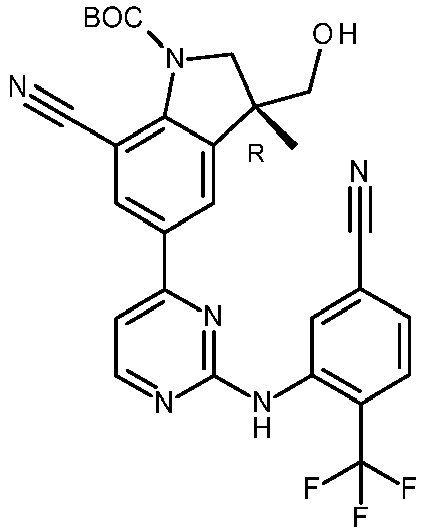
313 73 E From intermediate 242 Intermediate 248 
227 82 E with 1.2 equiv. of TBAF From intermediate 247 Intermediate 262 
373 yellow powder 81 E From intermediate 261 Intermediate 266 
234 56 E From intermediate 265 Intermediate 270 
230 46 E with THF and 1.9 equiv of TBAF From intermediate 269 Intermediate 461 
84 48 E with 1.1 equiv of TBAF From intermediate 459 Intermediate 464 
263 49 E with 1.1 equiv of TBAF From intermediate 463 Intermediate 482bis 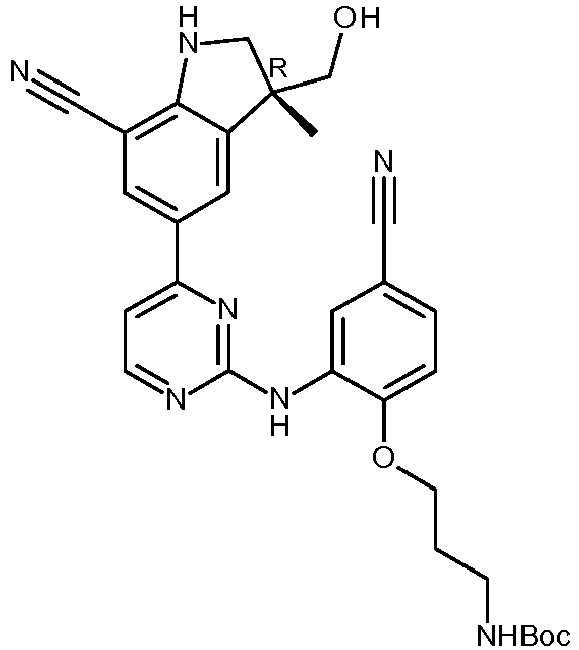
63 17 with 0.5 equiv of TBAF From intermediate 482 Intermediate 487 
460 100 From intermediate 486 - Preparation of intermediate 225:

- TBAF (on silica gel 1.5 mmol/g) (1.08 g, 1.62 mmol) was added to a solution of intermediate 224 (329.00 mg, 0.54 mmol) in Me-THF (13.5 mL) and the reaction mixture was stirred at rt for 18 h. The following day, the reaction was checked and it was finished. The reaction mixture was diluted with EtOAc, twice with water and NaCl. The layers were separated and the organic layer was dried over MgSO4, filtered and the solvent was removed under reduced pressure. The residue (300 mg) was gathered with another batch (400 mg) for purification. Both crudes were purified by column chromatography on silica gel (irregular SiOH, 40 g, mobile phaseDCM/MeOH, gradient from 100:0 to 96:4). The pure fractions were collected and evaporated to dryness to give 632 mg of intermediate 225 (light pink powder).
- The intermediates in the Table below were prepared by using an analogous method starting as the one used for the preparation of intermediate 225 from the respective starting materials. The most relevant minor deviations to the referenced method are indicated as additional information in the column 'Mass (mg)'.
Intermediate number Structure Mass (mg) Yield (%) Intermediate 39 
310 (94% purity evaluated by LC/MS) Procedure with 4 equiv. of TBAF 48 From intermediate 38 Intermediate 206 
91 Procedure with 6 equiv. of TBAF 58 From intermediate 205 Intermediate 229 
227 68 From intermediate 228 -

- To a solution of intermediate 11 and intermediate 12 (85/15) (1.11 g, 1.55 mmol) in DCM (35 mL), TFA (3.50 mL, 45.70 mmol) was added and stirred at rt for 30 min. The mixture was diluted with DCM and poured into an aqueous solution of NaHCO3. The organic and aqueous layers were separated. The aqueous layer was extracted with DCM. The combined organic layers were dried over MgSO4, filtered and evaporated under vacuum. The residue (960 mg) was purified by column chromatography on silica gel (irregular SiOH, 15-40 µm, 50 g, dry loading on celite®, mobile phase: heptane/EtOAc/MeOH, gradient from 85% heptane, 15% EtOAc/MeOH (9:1) to 60% heptane, 40% EtOAc/MeOH (9:1)). The desired fractions were collected and the solvent was concentrated to dryness under vacuum to give 695 mg of a mixture of intermediate 13 and intermediate 14 (85/15) (73% yield).
- The intermediates in the Table below were prepared by using an analogous method as described in Method F starting from the respective starting materials. The most relevant minor deviations from the referenced method are indicated in the column 'Method'.
Intermediate number Structure Mass (mg) Yield (%) Method Intermediate 19 
403 orange foam - F From intermediate 18 Intermediate 46 
500 (67% purity evaluated by LC/MS) pale yellow solid 67 F with DCM/TFA (6:1, v/v) From intermediate 45 Intermediate 107 
363 white solid 51 F with DCM/TFA (5:1, v/v) From intermediate 105 Intermediate 119 
251 (83% purity evaluated by LC/MS) yellow solid 63 F with DCM/TFA (7:1, v/v) From intermediate 118 Intermediate 121 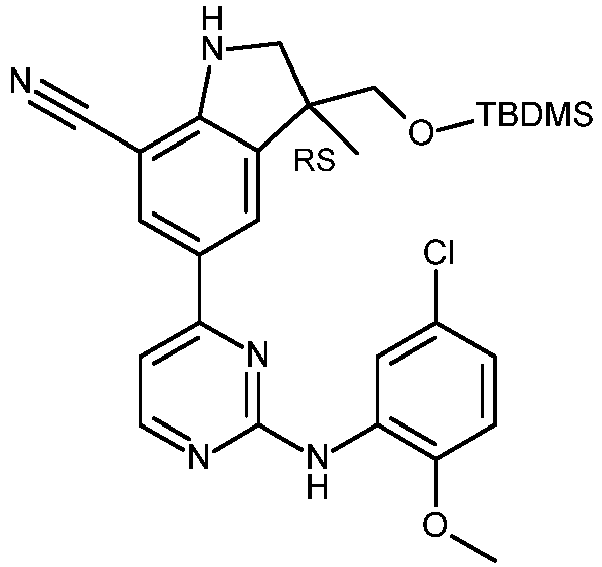
176 (34% purity evaluated by LC/MS) white foam 34 F with DCM/TFA (4:1, v/v) From intermediate 120 Intermediate 136 
97 M.P. (K) = 224 °C 66 F with DCM/TFA (4:1, v/v) From intermediate 135 Intermediate 140 
195 74 F with DCM/TFA (4:1, v/v) From intermediate 139 Intermediate 170 
145 (96% purity evaluated by LC/MS) 42 F with T = 5 °C with DCM/TFA (9:1, v/v) From intermediate 169 Intermediate 172 
133 38 F with T = 5 °C with DCM/TFA (9:1, v/v) From intermediate 171 Intermediate 174 
207 58 F with T = 5 °C with DCM/TFA (4:1, v/v) From intermediate 173 Intermediate 180 
231 - F with T=0- 5 °C with DCM/TFA (4:1, v/v) CIS From intermediate 179 Intermediate 182 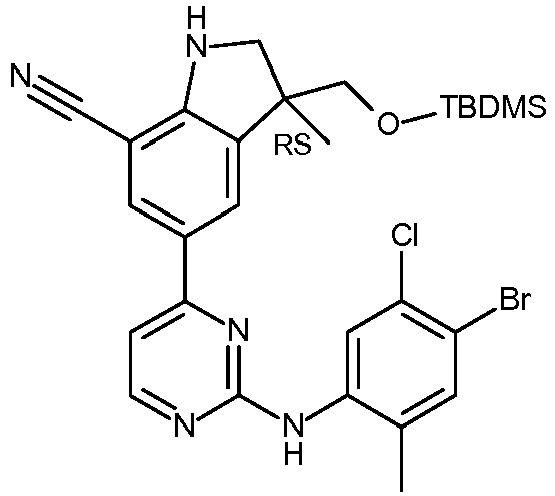
104 (70% purity evaluated by LC/MS) 67 F with T=0- 5 °C with DCM/TFA (4:1, v/v) From intermediate 181 Intermediate 184 
337 77 F with T =0- 5 °C with DCM/TFA (4:1, v/v) From intermediate 183 Intermediate 188 
213 60 F with T =0- 5 °C with DCM/TFA (4:1, v/v) From intermediate 187 Intermediate 191 
384 (65% purity evaluated by LC/MS) 49 F with T =0- 5 °C with DCM/TFA (4:1, v/v) From intermediate 190 Intermediate 194 
252 (97% purity evaluated by LC/MS) 96 F with T=0- 5 °C with DCM/TFA (4:1, v/v) From intermediate 193 Intermediate 204 
168 white solid 57 F with DCM/TFA (6:1, v/v) From intermediate 203 Intermediate 211 
207 white foam 48 F with DCM/TFA (7:1, v/v) From intermediate 210 Intermediate 213 
240 orange solid 65 F with DCM/TFA (4:1, v/v) From intermediate 212 Intermediate 219 
179 54 F with T = 0 °C with DCM/TFA (6:1, v/v) From intermediate 218 Intermediate 223 
324 76 F with DCM/TFA (4:1, v/v) From intermediate 222 Intermediate 233 
349 yellow solid 76 F with DCM/TFA (7:1, v/v) From intermediate 232 Intermediate 237 
132 (81% purity evaluated by LC/MS) 73 F with T = 0 °C with DCM/TFA (6:1, v/v) From intermediate 236 Intermediate 253 
221 65 F with DCM/TFA (17:1, v/v) From intermediate 252 Intermediate 459 
213 44 F With T = 5°C with DCM/TFA (7:1, v/v) From intermediate 458 Intermediate 460 
91 22 F With T = 5°C with DCM/TFA (7:1, v/v) From intermediate 458 Intermediate 506 
370 Quant. Purity 69% (LCMS) F with DCM/TFA (4:1, v/v) From intermediate 505 Intermediate 509 
85 83% Purity 81% (LCMS) F with DCM/TFA (4:1, v/v) From intermediate 508 Intermediate 538 
355 89% F with DCM/TFA (5:1, v/v) From intermediate 537 Intermediate 545 
1100 94% Purity 43% (LC/MS) F with DCM/TFA (9:1, v/v) From intermediate 544 Intermediate 548 
473 77% Purity 77% (LCMS) F with DCM/TFA (8:1, v/v) From intermediate 547 Intermediate 569 
260 56 F with T = 0°C and DCM/TFA (4:1, v/v) From intermediate 658 Intermediate 573 
210 58 F with T = 0°C and DCM/TFA (4:1, v/v) From intermediate 572 Intermediate 585 
98 89 F with T = 0°C and DCM/TFA (5:1, v/v) From intermediate 584 Intermediate 589 
270 100 F with T = 0°C and DCM/TFA (4:1, v/v) From intermediate 588 Intermediate 634 
166 61% purity based on LC/MS - F with DCM/TFA (18:1, v/v) during 15 hours From intermediate 633 - Preparation of intermediate 354:

- In a round bottom flask, intermediate 352 (0.10 g, 0.18 mmol) was diluted in a mixture of THF (1 mL) and water (1 mL). Then, LiOH (37.90 mg, 0.89 mmol) was added and the reaction mixture was stirred at 70 °C for 5 h 30 min. The reaction mixture was diluted with DCM and acidified with aqueous HCl 1M. The organic layer was separated quickly (to avoid any boc cleavage), dried over MgSO4 and concentrated to afford 98 mg of intermediate 354 (quant. yield). Intermediate 354 was directly engaged in the next step without any further purification.
- Preparation of intermediate 355:

- In a round bottom flask, intermediate 354 (98.00 mg, 0.18 mmol) and 4-aminotetrahydropyran (18.60 mg, 0.18 mmol) were diluted in DMF (2.5 mL) at rt. Then, HATU (135.00 mg, 0.36 mmol) and DIEA (92.10 µL, 0.53 mmol) were added and the reaction mixture was stirred at rt for 12 h. Then, the reaction mixture was partitioned between water and EtOAc, and the organic layer was washed with water, brine, dried over MgSO4, filtered and concentrated. The residue was purified by column chromatography on silica gel (Irregular SiO2, 24 g, mobile phase: DCM/MeoH, gradient from 100:0 to 95:5). The fraction containing the product were mixed and concentrated to afford 80 mg of intermediate 355 (71% yield).
- The intermediates in the Table below were prepared by using an analogous method as the one used for the preparation of intermediate 355 starting from the respective starting materials.
Intermediate number Structure Mass (mg) Yield (%) Intermediate 357 
160 (70% purity based on LC/MS) 68 From intermediate 354 and 3-hydroxyazetidine hydrochloride Intermediate 364 
126 65 From intermediate 354 and 6-Boc-2,6-diazaspiro[3.5]nonane oxalate Intermediate 365 
90 46 From intermediate 354 and tert-butyl 2,7-diazaspiro[3.5]nonane-7-carboxylate hydrochloride Intermediate 366 
120 (90% purity based on LC/MS) white solid 62 TRANS From intermediate 354 and (1S,3S)-3-aminocyclopentanol Intermediate 367 
140 (89% purity based on LC/MS) yellow oil 86 CIS From intermediate 354 and cis-3-aminocylcopentanol Intermediate 368 
150 (86% purity based on LC/MS) yellow solid 86 CIS From intermediate 354 and 3-azabicyclo[3.1.0]hexane-6-methanol Intermediate 369 
110 (97% purity based on LC/MS) 61 From intermediate 354 and 3,3-difluorocyclobutanamine hydrochloride Intermediate 370 
160 (94% purity based on LC/MS) 92 From intermediate 354 and 4-Hydroxyhexamethylenimine Intermediate 371 
150 (86% purity based on LC/MS) 79 TRANS From intermediate 354 and 3-Azabicyclo[3.1.1]heptan-6-ol hydrochloride Intermediate 372 
170 (43% purity based on LC/MS) 39 From intermediate 354 and 2-cyanopiperazine Intermediate 373 
130 (86% purity based on LC/MS) 68 CIS From intermediate 354 and cis pyrrolo[3,4-b] pyrrole-5(1H)-carboxylic acid, hexahydro-, 1,1-dimethylethyl ester Intermediate 374 
200 (38% purity based on LC/MS) 46 From intermediate 354 and 2-azaspiro[3.3]heptan-6-ol Intermediate 375 (mixture of 4 unseparated diastereoisomers) 
120 (96% purity based on LC/MS) yellow oil 58 From intermediate 354 and trans-3-amino-1-boc-4-hydroxypyrrolidine - Preparation of intermediate 363:

- In a round bottom flask, intermediate 354 (0.10 g, 0.17 mmol) and amino-2-propanol (14.60 µL, 0.19 mmol) were mixed in DMF (2.33 mL). Then, EDC-HCl (53.1 mg, 0.34 mmol) and DIEA (147.00 µL, 0.85 mmol) were added and the reaction mixture was stirred for 3 h. As the conversion was very low, HATU (0.13 g, 0.34 mmol) and DIEA (2 equiv.) were added and the reaction mixture was stirred for 48 h. The reaction mixture was partitioned between water and EtOAc. The organic layer was washed one with water, then with brine, dried over MgSO4, filtered and concentrated. The residue was purified by column chromatography on silica gel (irregular SiOH, 40 g, mobile phase DCM/MeOH, gradient from 100:0 to 96:4). The fractions containing the product were mixed and concentrated to afford 81 mg of intermediate 363 (78% yield).
- Preparation of intermediate 15:

- In a Schlenck reactor, a mixture of 2-bromo-4-(methylsulfonyl)aniline (2.00 g, 8.00 mmol), ethynylcyclopropane (1.06 g, 16.00 mmol) and TEA (5.56 mL, 40.00 mmol) in dry DMF (40 mL) was purged with N2. Then, Pd(PPh3)2Cl2 (281.00 mg, 0.40 mmol) and CuI (152.00 mg, 0.80 mmol) were added. The mixture was purged with N2 and stirred at 100 °C for 2 h. Then, additional ethynylcyclopropane (1.06 g, 16.00 mmol), Pd(PPh3)2Cl2 (281 mg, 0.4 mmol) and Cul (152.00 mg, 0.80 mmol) were added. The mixture was purged with N2 and stirred at 100 °C for 1 h. Then, additional ethynylcyclopropane (1.06 g, 16.00 mmol), Pd(PPh3)2Cl2 (281 mg, 0.4 mmol) and Cul (152.00 mg, 0.80 mmol) were added. The mixture was purged with N2 and stirred at 100 °C for 1 h. The resulting mixture was cooled down to rt and evaporated under vacuum. The residue (7 g) was purified by column chromatography on silica gel (irregular SiOH, 15-40 µm, 220 g, dry loading on celite®, mobile phase: DCM/EtOAC, gradient from 100:0 to 98:2). The desired fractions were collected and the solvent was concentrated to dryness under vacuum to give 1.59 g of intermediate 15 (84% yield, containing 21% 2-bromo-4-(methylsulfonyl)aniline according to 1H NMR, orange solid).
-

- In a sealed tube, a solution of intermediate 15 (930.00 mg, 3.95 mmol), ammonium formate (15.00 g, 237.14 mmol) and Pd/C (10 wt. %) (2.50 g, 2.37 mmol) in a mixture of iPrOH (32 mL) and Me-THF (16 mL) were added and stirred at 70 °C for 30 min. The crude product was filtered through a pad of celite® and the cake was washed with EtOAc and iPrOH. The filtrate was evaporated under vacuum and the residual oil was taken-up in DCM and washed with water. The organic layer was dried over MgSO4, filtered off and concentrated under vacuum. The residue (880 mg) was purified by column chromatography on silica gel (irregular SiOH, 15-40 µm, 50 g, dry loading on celite®, mobile phase: heptane/EtOAc/MeOH, gradient from 85% heptane, 13.5% EtOAc and 1.5% MeOH to 30% heptane, 63% EtOAc and 7% MeOH). The desired fractions were collected and the solvent was concentrated to dryness under vacuum to give 552 mg of a mixture of intermediate 16 and intermediate 17 (58% yield, pale yellow oil, 85/15 evaluating by 1H NMR).
- Preparation of intermediate 22:

- To a solution of 2-methoxyethanol (721.00 µL, 9.09 mmol) in THF (24 mL), LiHMDS (1.5 M in toluene, 6.06 mL, 9.09 mmol) was added dropwise at 5 °C. After 30 min, 4-Fluoro-3-nitrobromobenzene (1.11 mL, 9.09 mmol) was quickly added and the reaction mixture was allowed to warm to rt and stirred overnight. The reaction mixture was quenched with water and diluted with EtOAc. The organic layer was decanted, washed with brine, dried over MgSO4, filtered and concentrated under vacuum. The residue was purified by column chromatography on silica gel (SiO2, 120 g, 15-40 µm, mobile phase: heptane/EtOAc, gradient from 100:0 to 0:100). The desired fractions were collected and the solvent was concentrated to dryness under vacuum to give 1.923 g of intermediate 22 (77% yield).
- The intermediates in the Table below were prepared by using an analogous method as the one used for the preparation of intermediate 22 starting from the respective starting materials. The most relevant minor deviations to the referenced method are indicated as additional information in the column 'Mass (g)'.
Intermediate number Structure Mass (g) Yield (%) Intermediate 25 
2.02 82 From 4-fluoro-3-nitrobromo benzene Intermediate 50 
3.90 99 From 4-fluoro-3-nitro benzonitrile Intermediate 71 
2.35 brown solid Procedure with Me-THF 93 From 2-chloro-4-fluoro-5-nitrobenzonitrile Intermediate 226 
1.28 Procedure with Me-THF 96 From 4-fluoro-3-nitrobenzonitrile Intermediate 480 
10.67 Procedure with LiHMDS 1N in THF 40 From 3-(tert-butoxycarbonylamino)-1-propanol and 4-chloro-3-nitrobenzonitrile Intermediate 574 
0.425 Procedure with Me-THF 54 From 4-fluoro-3-nitrobenzonitrile and 4-hydroxy- 1 -methylpiperidine Intermediate 601 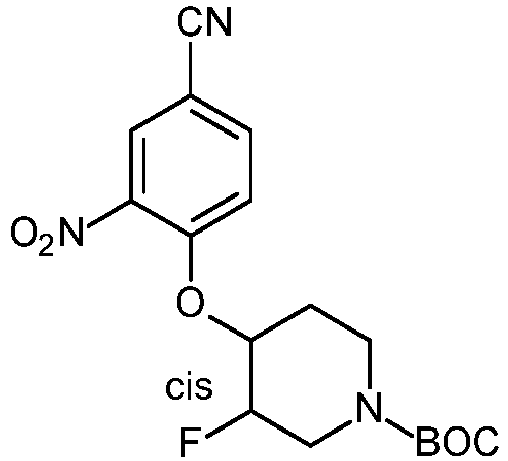
0.420 Procedure with LiHMDS (1M in THF) in Me-THF. 92 From 4-fluoro-3-nitrobenzonitrile and cis-1-boc-3-fluoro-4-hydroxypiperidine Intermediate 607 
0.200 Procedure with LiHMDS (1M in THF) in Me-THF 73 From 4-fluoro-3-nitrobenzonitrile and trans-1-boc-3-fluoro-4-hydroxypiperidine Intermediate 620 
0.273 Procedure in Me-THF 34 From 4-fluoro-3-nitrotoluene and 4-hydroxy-1-methylpiperidine - Preparation of intermediate 614 and intermediate 615
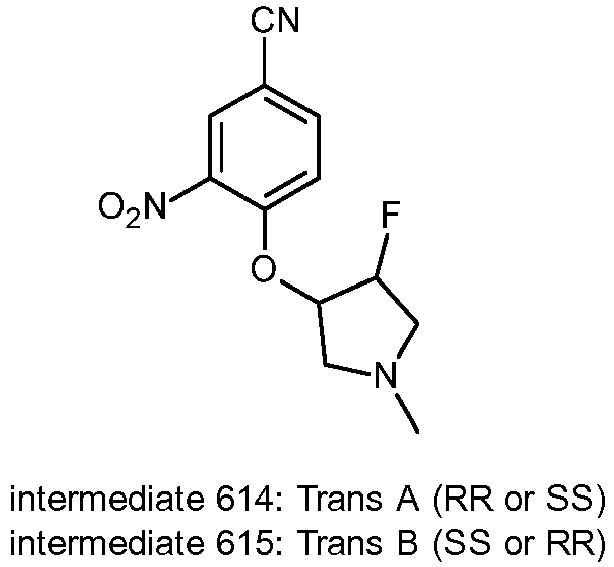
- A solution of LiHMDS 1.5M in THF (5.6 mL; 8.42 mmol) was added dropwise at 5°C to a solution of intermediate 614a (590 mg; 4.95 mmol) in Me-THF (18.4 mL). After 30 min, 4-fluoro-3-nitrobenzonitrile (823 mg; 4.95 mmol) was quickly added and the reaction mixture was allowed to warm to room temperature and stirred overnight. The reaction mixture was poured onto iced water, a 10% aqueous solution of K2CO3 and extracted with EtOAc. The organic layer was decanted, washed with brine, dried over MgSO4, filtered and evaporated to dryness. The residue (1.16 g; yellow solid) was purified by chromatography over silica gel (SiO2, 40 g, eluent: from 98% DCM, 2% MeOH, 0.2% NH4OH to 95% DCM, 5% MeOH, 0.5% NH4OH). The fractions containing the products were collected and the solvent was evaporated to give 486 mg of yellow solid racemic trans product (37%). The racemic trans product was purified by chiral SFC (Chiralpak AD-H 5 µm 250∗30 mm, mobile phase: 95.7% CO2, 4.3% MeOH (0.3% iPrNH2)). The pure fractions were collected and the solvent was evaporated to give 177 mg (13%) of intermediate 614 (Trans A; RR or SS; eluted first) and 174 mg (13%) of intermediate 615 (Trans B; SS or RR; eluted second).
- Preparation of intermediate 614a:

- Formaldehyde (10.6 mL; 141.3 mmol) was added to a mixture of trans-4-fluoro-3-hydroxypyrrolidine hydrochloride (1 g; 7.06 mmol) and acetic acid (809 µL; 14.13 mmol) in methanol (55 mL) at rt. The reaction mixture was stirred at rt for 30min, then sodium triacetoxyborohydride (3.74 g; 17.66 mmol) was added and the reaction mixture was stirred at rt for 3h. The mixture was basified with a saturated aqueous NaHCO3 solution at 5°C.
- The mixture was diluted with diethylether and washed with saturated aqueous NaHCO3 solution. Then, the aqueous layer was extracted with diethylether (3 times) but intermediate 614a was still in aqueous layer. Then, the aqueous layer was extracted with EtOAc (3 times) but intermediate 614a was still in aqueous layer. Then, the aqueous layer was extracted with DCM (3 times). The organic layers were combined, dried over MgSO4, filtered and the solvent was evaporated at room temperature to give 1.09 g of intermediate 614a as a colourless volatile oil used without any further purification in the next step.
- Preparation of intermediate 23:

- In a sealed tube, a solution of intermediate 22 (500.00 mg, 1.81 mmol), dimethylphosphine oxide (167.00 mg, 1.99 mmol) and K3PO4 (423.00 mg, 1.99 mmol) in dry DMF (7.5 mL) was purged with N2. Then, Pd(OAc)2 (40.70 mg, 0.18 mmol) and 4,5-bis(diphenylphosphino)-9,9-dimethylxanthene (105 mg, 0.18 mmol) were added. The mixture was purged with N2 and stirred at 130 °C for 3 h. The reaction was performed twice on the same quantity of intermediate 22. The 2 batches were combined. The resulting mixture was filtered on a pad of celite® and the cake was washed with EtOAc. The filtrate was evaporated under vacuum to give a brown oil. The residue was purified by column chromatography on silica gel (irregular SiOH, 15-40 µm, 80 g, dry loading on celite®, mobile phase: DCM/MeOH, gradient from 99.5:0.5 to 95:5). The desired fractions were collected and the solvent was concentrated to dryness under vacuum to give 0.895 g of intermediate 23 (90% yield, orange oil).
- The intermediates in the Table below were prepared by using an analogous method as the one used for the preparation of intermediate 23 starting from the respective starting materials. The most relevant minor deviations to the referenced method are indicated as additional information in the column 'Mass'.
Intermediate number Structure Mass Yield (%) Intermediate 26 
569 mg 58 From intermediate 25 Intermediate 66 
765 mg orange gum 74 From intermediate 65 Intermediate 76 
1 g white solid Procedure with reaction temperature = 150 °C 51 From 4-bromo-5-chloro-2-methylaniline Intermediate 220 
334 mg brown solid Procedure with reaction temperature = 150 °C 68 From 4-bromo-2-methoxy-1-nitrobenzene Intermediate 230 
552 mg red solid Procedure with reaction temperature = 150 °C 83 From intermediate 207 - Preparation of intermediate 24:

- To a solution of intermediate 23 (877.00 mg, 3.21 mmol) in MeOH (23 mL), Raney nickel (19.00 mg, 0.32 mmol) was added under N2. The mixture was stirred at rt under 1.5 bar of H2 for 3 h. The mixture was filtered on a pad of Celite® and the cake was washed with EtOH. The filtrate was evaporated under vacuum to give 726 mg of intermediate 24 (93% yield).
- The intermediates in the Table below were prepared by using an analogous starting as the one used for the preparation of intermediate 24 from the respective starting materials. The most relevant minor deviations to the referenced method are indicated as additional information in the column 'Mass'.
Intermediate number Structure Mass Yield (%) Intermediate 27 
490 mg 97 From intermediate 26 Intermediate 134 
1.37 g Procedure with 3 bars pressure of H2 94 From intermediate 133 Intermediate 156 
2.1 g Procedure with 3 bars pressure of H2 97 From intermediate 155 Intermediate 268 
16.7 g Procedure with 3 bars pressure of H2 100 From intermediate 267 - Preparation of intermediate 28:

- To a solution of 3-amino-4-iodobenzonitrile (0.50 g, 2.05 mmol) in THF (10 mL), a premixed degassed solution of Pd(t-Bu3P)2 (105 mg, 0.20 mmol) in a solution of n-propylzinc bromide in THF (0.5 M, 8.20 mL, 0.41 mmol) was added and stirred at rt for 2 h. The reaction mixture was poured onto a 10% aqueous solution of K2CO3 and EtOAc was added. The crude product was filtered through a pad of celite® and the organic layer was decanted, washed with water, dried over MgSO4, filtered and concentrated under vacuum. The residue was purified by column chromatography on silica gel (irregular SiOH, 24 g, mobile phase: heptane/EtOAc: gradient from 90% heptane, 10% EtOAc to 70% heptane, 30% EtOAc). The pure fractions were collected and evaporated to dryness to give 250 mg of intermediate 28 (76% yield).
- The intermediates in the Table below were prepared by using an analogous method as the one used for the preparation of intermediate 28 starting from the respective starting materials.
Intermediate number Structure Mass Yield (%) Intermediate 56 
212 mg 59 From 3-amino-4-iodobenzonitrile - Preparation of intermediate 31:

- 4-fluoro-3-nitrobenzonitrile (1.00 g, 6.02 mmol) and 2-(tert-butyldimethylsiloxy)ethanol (1.32 mL, 6.62 mmol) were dissolved in distilled THF (7 mL) (to give a 0.1 - 0.2 M solution) under Ar and cooled to 0 °C. KHMDS (6.62 mL, 6.62 mmol) dissolved in distilled THF (5.3 mL) (to give 0.5 M solution) was added dropwise, resulting in a color change from colorless to dark. This solution was stirred from 0 °C to rt over 3 h and the reaction mixture was then diluted with DCM and washed once with saturated aqueous NH4Cl. The aqueous layer was back-extracted once with DCM. The organic layers were combined, dried over MgSO4, concentrated. The residue (1.5 g, black oil) was purified by column chromatography on silica gel (irregular SiOH, 80 g, mobile phase: heptane/EtOAc, gradient from 100% heptane, 0% EtOAc to 70% heptane, 30% EtOAc). The desired fractions were collected and evaporated to dryness to give 0.30 g of intermediate 31 (15% yield, orange powder). However, apurified again by column chromatography on silica gel (irregular SiOH, 80g, deposit solid, mobile phase: heptane/EtOAc, gradient from 100:0 to 70:30). The desired fractions were collected and evaporated to dryness to give 0.659 g of intermediate 31 (34% yield, orange powder) with a global yield of 49%.
- The intermediates in the Table below were prepared by using an analogous method as the one used for the preparation of intermediate 31 starting from the respective starting materials.
Intermediate number Structure Mass (g) Yield (%) Intermediate 40 
1.354 44 From 4-fluoro-3-nitrobenzonitrile yellow powder Intermediate 47 
1.636 76 From 4-fluoro-3-nitrobenzonitrile yellow powder Intermediate 53 
0.922 62 From 4-fluoro-3-nitrobenzonitrile orange powder Intermediate 58 
0.305 34 From 4-fluoro-3-nitrobenzonitrile orange powder Intermediate 122 
0.514 78 From 5-chloro-2-fluoro-nitrobenzonitrile orange powder Intermediate 126 
0.515 61% From 5-chloro-2-fluoro-nitrobenzonitrile orange oil Intermediate 141 
0.578 75 From 5-chloro-2-fluoro-nitrobenzonitrile light yellow oil Intermediate 144 
1.159 64 From 5-chloro-2-fluoro-nitrobenzonitrile light yellow oil Intermediate 159 
0.999 51 From 5-chloro-2-fluoro-nitrobenzonitrile (95% purity evaluated by LC/MS) light yellow oil Intermediate 340 
0.545 89 From 5-chloro-2-fluoronitrobenzene orange oil Intermediate 343 
0.653 89 From 5-chloro-2-fluoronitro benzene colorless oil - Preparation of intermediate 32:

- Iron powder (0.83 g, 14.87 mmol) was added to a solution of intermediate 31 (0.96 g, 2.97 mmol), NH4Cl (0.64 g; 11.90 mmol) in EtOH (8.34 mL) and distilled water (4.19 mL). The reaction mixture was stirred at 75 °C for 3 h. The reaction mixture was filtered over a pad of celite® and washed with DCM. A saturated solution of NaHCO3 was added and the mixture was extracted with DCM. The organic layer was dried over MgSO4, filtered and evaporated to dryness to give 701 mg of intermediate 32 (81% yield, brown oil).
- Preparation of intermediate 422:

- A mixture of intermediate 421 (10.47 g; 49.35 mmol), iron powder (13.78 g; 246.72 mmol) and ammonium chloride (10.56 g; 197.38 mmol) in EtOH (350 mL) and water (118 mL) was heated at 80°C for 1hour. The reaction mixture was cooled down to room temperature, diluted with DCM, filtered over celite® and basified with a 10% aqueous solution of K2CO3. The organic layer was decanted, dried over MgSO4, filtered and the solvent was evaporated to give 8.68 g (97%) of intermediate 422 as an orange solid which was was used without any further purification in the next step.
- The intermediates in the Table below were prepared by using an analogous method starting from the respective starting materials as the one used for the preparation of intermediate 32. The most relevant minor deviations to the reference method are indicated as additional information in the column 'Mass (mg)'.
Intermediate number Structure Mass (mg) Yield (%) Intermediate 41 
981 (90% purity evaluated by NMR) white powder 84 From intermediate 40 Intermediate 48 
938 yellow powder 66 From intermediate 47 Intermediate 51 
2440 (95% purity evaluated by LC/MS) 65 From intermediate 50 Intermediate 54 
738 orange powder 91 From intermediate 53 Intermediate 59 
650 brown oil Procedure with reaction temperature = 85 °C 95 From intermediate 58 Intermediate 88 
414 dark red solid 86 From intermediate 87 Intermediate 92 
997 68 From intermediate 91 Intermediate 95 
351 pale yellow solid 89 From intermediate 94 Intermediate 99 
1280 off-white solid 85 From intermediate 98 Intermediate 109 
436 dark red solid 95 From intermediate 108 Intermediate 123 
580 yellow oil - From intermediate 122 Intermediate 127 
512 Procedure with reaction temperature = 85 °C yellow oil - From intermediate 126 Intermediate 142 
429 Procedure with reaction temperature = 85 °C orange powder 85 From intermediate 141 Intermediate 145 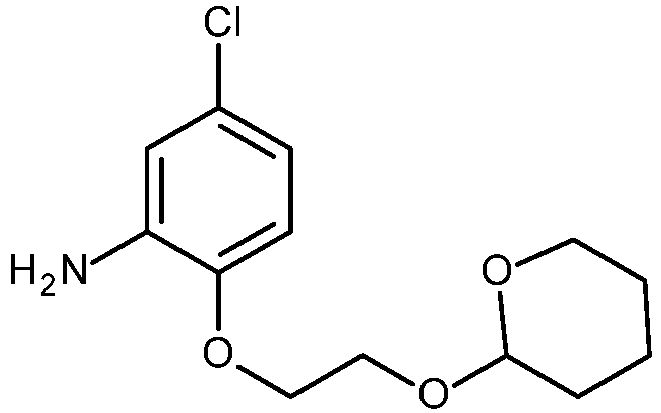
650 Procedure with reaction temperature = 85 °C yellow oil 62 From intermediate 144 Intermediate 160 
771 Procedure with reaction temperature = 85 °C yellow oil 85 From intermediate 159 Intermediate 186 
315 (92% purity evaluated by LC/MS) - From intermediate 185 Intermediate 198 
380 (96% purity evaluated by LC/MS) 95 From intermediate 197 Intermediate 227 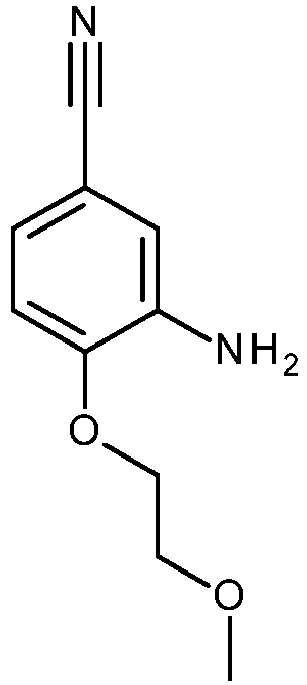
1.08 Procedure with reaction temperature = 100°C 97 From intermediate 226 Intermediate 239 
255 85 From intermediate 238 Intermediate 245 
264 57 From intermediate 244 Intermediate 251 
1360 96 From intermediate 250 Intermediate 279 
625 (83% based on LC/MS) - From intermediate 278 Intermediate 285 
158 light brown solid 28 From intermediate 284 Intermediate 291 
492 light brown solid 64 From intermediate 290 Intermediate 297 
313 pale yellow foam 82 From intermediate 296 Intermediate 300 
221 orange-brown syrup 96 From intermediate 299 Intermediate 303 
257 (58% purity evaluated by LC/MS) brown oil 97 From intermediate 302 Intermediate 305 
450 (83% purity based on LC/MS) brown syrup - From 4-chloro-1-methanesulfonyl-2-nitrobenzene Intermediate 308 
371 (40% purity based on LC/MS) brown solid 84 From intermediate 307 Intermediate 311 
246 brown oil 94 From intermediate 310 Intermediate 314 
255 brown oil 98 From intermediate 313 Intermediate 322 
143 (17% purity based on LC/MS) brown oil 92 From intermediate 321 Intermediate 329 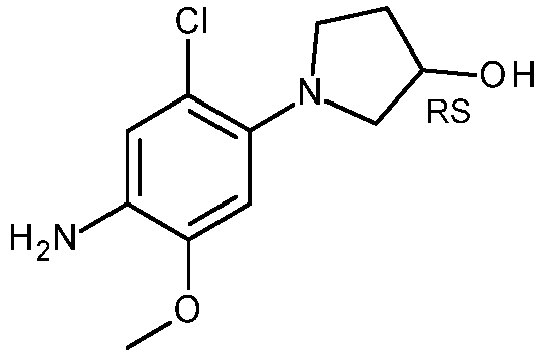
217 brown oil 93 From intermediate 328 Intermediate 332 
221 (90% purity based on LC/MS) brown oil 80 From intermediate 331 Intermediate 341 
370 yellow oil 79 From intermediate 340 Intermediate 344 
679 - From intermediate 343 Intermediate 351 
750 Quant. From intermediate 350 Intermediate 360 
720 87 From intermediate 359 Intermediate 410 
980 100 From intermediate 409 Intermediate 447 
481 84 From intermediate 446 Intermediate 452 
447 100 From intermediate 451 Intermediate 462 
522 87 From intermediate 456 Intermediate 467 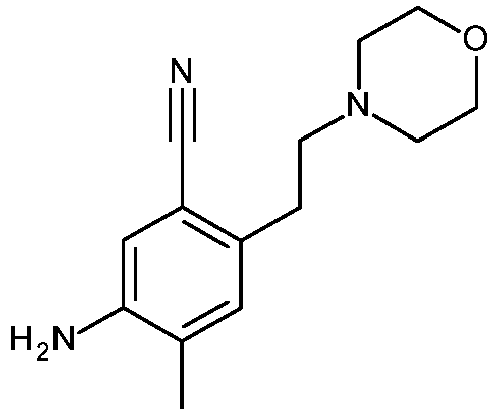
260 99 From intermediate 466 Intermediate 470 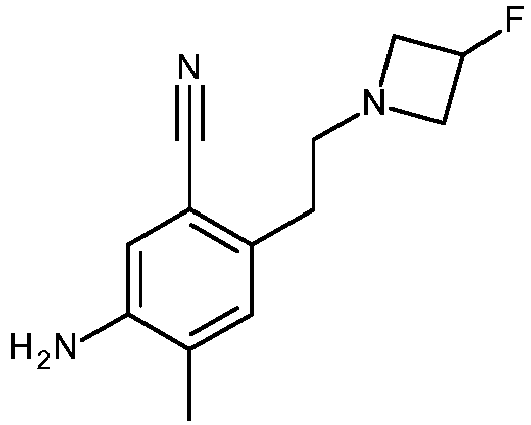
202 (74% of purity based on LC/MS) 92 From intermediate 469 Intermediate 490 
298 96 From intermediate 489 Intermediate 567 
320 73 From intermediate 566 Intermediate 571 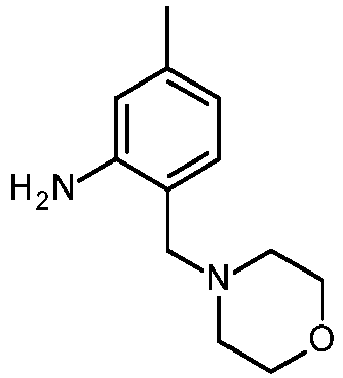
390 89 From intermediate 570 Intermediate 575 
376 100 From intermediate 574 Intermediate 580 
180 Yellow oil 93 From intermediate 579 Intermediate 587 
200 90 From intermediate 586 Intermediate 591 
150 43 From intermediate 590 Intermediate 595 
140 94 From intermediate 594 Intermediate 599 
375 99 From intermediate 598 Intermediate 604 
160 72 From intermediate 603 Intermediate 610 
64 72 From intermediate 609 Intermediate 617 
148 96 From intermediate 615 Intermediate 621 
173 73 From intermediate 620 Intermediate 521b 
836 quantitative From intermediate 521a - Preparation of intermediate 397:
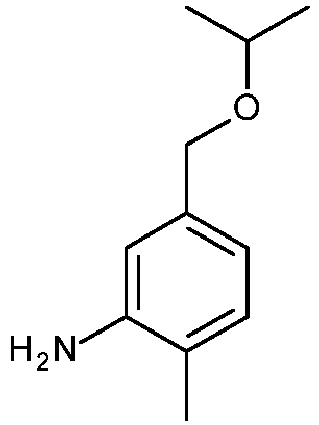
- Intermediate 396 (2.1g; 10 mmol) was dissolved in THF (40 mL), Methanol (20 mL) and water (20 mL). Iron (2.8g; 50.18 mmol) and NH4Cl (2.68g; 50.18 mmol) were added. The mixture was refluxed for 2 hours. The mixture was extracted with ethyl acetate (50 mL∗2). The organic phase was washed by water (20 mL), brine (20 mL), dried over Na2SO4, filtered, and evaporated in vacuum to give 1.75g (97%) of intermediate 397 as a brown oil.
- Preparation of intermediate 481:

- Intermediate 481 was prepared following an analogous method as the one used for the preparation of intermediate 397, starting from intermediate 480 (5.5g; 99%).
- Preparation of intermediate 616:

- A mixture of intermediate 614 (177 mg; 0.667 mmol), iron powder (186 mg; 3.337 mmol) and ammonium chloride (143 mg; 2.67 mmol) in ethanol (6 mL) and water (1 mL) was heated at 70°C for 1 hour. The reaction mixture was cooled down to room temperature, diluted with DCM, filtered over Celite® and basified with a 10% aqueous solution of K2CO3. The organic layer was decanted, dried over MgSO4, filtered and evaporated to dryness yielding 156 mg (99%) of intermediate 616.
- Preparation of intermediate 36:

- In a sealed tube, a solution of 3-amino-4-iodobenzonitrile (1.70 g, 6.97 mmol), cyclopropylacetylene (1.50 mL, 17.42 mmol) and TEA (3.00 mL, 20.90 mmol) in DMF (50 mL) was degassed (N2 bubbling). Pd(PPh3)2Cl2 (244.00 mg; 0.35 mmol) and Cul (267.00 mg; 1.39 mmol) were added and the reaction mixture was stirred at rt for 2 h. The reaction mixture was poured onto water and extracted with Et2O/EtOAc. The organic layer was decanted, washed with brine, dried over MgSO4, filtered and evaporated to dryness. The residue was purified by column chromatography on silica gel (irregular SiOH, 40 g, mobile phase: heptane/EtOAc, gradient from 80% heptane, 20% EtOAc to 60% heptane, 40% EtOAc). The pure fractions were collected and evaporated to dryness to give 1.13 g of intermediate 36 (89% yield).
- The intermediate in the Table below was prepared by using an analogous method as the one used for the preparation of intermediate 36 starting from the respective starting materials.
Intermediate number Structure Mass (mg) Yield (%) Intermediate 254 
745 99 From 3-amino-4-iodobenzonitrile Intermediate 484 
7600 81 From 3-amino-4-iodobenzonitrile and tert-butyl but-3-yn-1-ylcarbamate - Preparation of intermediate 37:

- A suspension of activated charcoal (one spoon) and intermediate 36 (1.10 g, 6.04 mmol) in MeOH (30 mL) was stirred at room temperature all over the week end. The solids were removed by filtration over celite® and the filtrate was evaporated to dryness. The residue was dissolved in MeOH (30 mL) and Pd/C (10 wt. %, 220 mg) was added. The suspension was hydrogenated under Atm pressure of H2 at rt for 3 h. The catalyst was removed by filtration and the filtrate was evaporated to dryness. The residue was purified by column chromatography on silica gel (irregular SiOH, 40g, mobile phase: heptane/EtOAc, gradient from 90% heptane, 10% EtOAc to 70% heptane, 30% EtOAc). The pure fractions were collected and evaporated to dryness to give 509 mg of intermediate 37 (45% yield).
- The intermediate in the Table below was prepared by using an analogous method as the one used for the preparation of intermediate 37 starting from the respective starting materials.
Intermediate number Structure Mass (mg) Yield (%) Intermediate 255 
577 91 From intermediate 254 Intermediate 485 
6300 81 From intermediate 484 - Preparation of intermediate 43:

- A solution of 2-fluoro-4-methylbenzonitrile (5.50 g, 40.70 mmol) in H2SO4 (45 mL) was cooled down at 0 °C. KNO3 (8.23 g, 81.40 mmol) was then added portionwise. After stirring at 0 °C for 2 h, the reaction mixture was poured into a stirred solution of NaHCO3 (103.00 g, 1.22 mol) in 1 L of ice water. The heterogeneous mixture was filtered on a glass frit. The precipitate was washed twice with water and collected. The solid was dried in vacuo at 50 °C for 12 h to give 6.68 g of intermediate 43 (91% yield, white solid).
- Preparation of intermediate 44:

- A solution of intermediate 43 (2.00 g, 11.10 mmol) in Me-THF (20 mL) and EtOH (20 mL) was hydrogenated at rt under 1 bar of H2 in presence of a catalytic amount of Pd/C (10 wt. %, 591.00 mg, 0.55 mmol) for 2 h. The reaction mixture was filtered through a pad of celite® and the filtrate was evaporated under vacuum. The residue was solubilized in Me-THF (20 mL) and EtOH (20 mL) was hydrogenated at rt under 1 bar of H2 in presence of a catalytic amount of Pd/C (10 wt. %, 591.00 mg, 0.55 mmol) for 2 h. The reaction mixture was filtered through a pad of celite® and the filtrate was evaporated under vacuum to give a black solid. The residue was purified by column chromatography on silica gel (irregular SiOH, 15-40 µm, 80 g, liquid loading, mobile phase: heptane/EtOAc, gradient: from heptane 80%, EtOAc 20% to heptane 60%, EtOAc 40%). The desired fraction were collected and evaporated to dryness to give 610 mg of intermediate 44 (37% yield, pale yellow solid).
- Preparation of intermediate 65:

- A mixture of 4-bromo-2-fluoro-1-nitrobenzene (3.00 g, 13.60 mmol) and CS2CO3 (13.50 g, 41.40 mmol) in iPrOH (30 mL) was stirred and refluxed for 2 h. The mixture was cooled down to rt and filtered on a pad of celite®. The cake was washed with iPrOH and the filtrate was evaporated in vacuo. The residue was taken-up in EtOAc and water. The layers were separated and the aqueous organic layer was washed with water, dried over MgSO4, filtered off and evaporated in vacuo to give an orange liquid. The residue (3.6 g) was purified by column chromatography on silica gel (irregular SiOH, 15-40 µm, 120 g, dry loading on celite®, mobile phase: heptane/DCM, gradient: from 80% heptane, 20%DCM to 50% heptane, 50% DCM). The desired fraction were collected and evaporated to dryness to give 3.12 g of intermediate 65 (88% yield, yellow liquid (which crystalized on standing)).
- Preparation of intermediate 67:

- Pd/C (10 wt. %, 310.00 mg, 0.29 mmol) was added to a solution of intermediate 66 (750.00 mg, 2.92 mmol) in EtOH (30 ml) under N2. The mixture was stirred at rt under H2 atmosphere (P atm) for 3 h. The mixture was filtered on a pad of celite® and the cake was washed with EtOH. The filtrate was evaporated in vacuo to give 630 mg of intermediate 67 (89% yield, dark green oil).
- The intermediate in the Table below was prepared by using an analogous method as the one used for the preparation of intermediate 67 starting from the respective starting materials.
Intermediate number Structure Mass (mg) Yield (%) Intermediate 326 
533 (94% purity based on LC/MS) 96 From intermediate 325 - Preparation of intermediate 72:
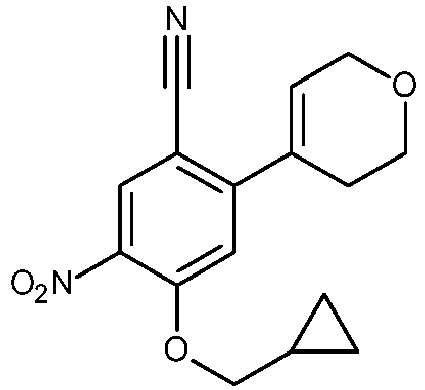
- A mixture of intermediate 71 (2.35 g, 9.30 mmol), 3,6-dihydro-2H-pyran-4-boronic acid pinacol ester (3.00 g, 14.30 mmol) and K2CO3 (1.64 g, 11.80 mmol) in a mixture of 1,4-dioxane (80 mL) and distilled water (15 mL) was purged with N2. 1,1-bis(di-tert-butylphosphino)ferrocene palladium dichloride (630.00 mg, 0.97 mmol) was added and the mixture was purged with N2 and stirred at 90 °C for 18 h. The mixture was partitioned between with EtOAc/water. The organic layer was washed with brine, dried over MgSO4, evaporated and purified by column chromatography on silica gel (irregular SiOH 15-40 µm, 120 g, liquid injection (DCM), mobile phase: DCM/MeOH, gradient from 100:0 to 95:05 in 10 CV) to give 1.86 g of intermediate 72 (66% yield, brown solid).
- The intermediates in the Table below were prepared by using an analogous method as the one used for the preparation of intermediate 72 starting from the respective starting materials. The most relevant minor deviations to the referenced method are indicated as additional information in the column 'Mass (mg)'.
Intermediate number Structure Mass (mg) Yield (%) Intermediate 200 
660 (70% purity evaluated by LC/MS) light brown oil reaction temperature = 60°C 86 From 4-chloro-3-iodoanisole Intermediate 208 
1130 pale brown solid reaction temperature = 60°C 99 From intermediate 207 - Preparation of intermediate 73:

- A mixture of intermediate 72 (0.80 g, 2.66 mmol) and Pd/C (10 wt. %, 140.00 mg, 0.13 mmol) in MeOH (25 mL) was stirred at rt under an atmosphere of H2 for 2 h 15 min. The mixture was filtred over a pad of celite® and rinced with MeOH to give 525 mg of intermediate 73 (72% yield, white solid). Then, the celite® was rinced again with a mixture of DCM/MeOH (80:20) to give 200 mg of a mixture of intermediates 72 and 73.
- The intermediate in the Table below was prepared by using an analogous method as the one used for the preparation of intermediate 73 starting from the respective starting materials.
Intermediate number Structure Mass Yield (%) Intermediate 209 
1 g pale brown oil 98 From intermediate 208 - Preparation of intermediate 83:

- To a solution of 3-methoxy-4-nitrobenzoic acid (0.50 g, 2.54 mmol), HATU (1.25 g, 3.30 mmol) and DIEA (1.32 mL, 7.61 mmol) in DCM (10mL), 4-aminotetrahydropyran (0.26 g, 2.54 mmol) was added and the reaction mixture was stirred at rt for 2 h. The reaction mixture was diluted with DCM, washed with water, dried over Na2SO4 and concentrated in vacuo. The residue was triturated in a minimum amount of DCM, the solid formed was recovered by filtration and dried in vacuo to give intermediate 83 (72% yield, pale yellow solid).
- The intermediate in the Table below was prepared by using an analogous method as the one used for the preparation of intermediate 83 starting from the respective starting materials.
Intermediate number Structure Mass Yield (%) Intermediate 275 
2.12 g yellow solid 81 From 3-methyl-4-nitrobenzoic acid - Preparation of intermediate 84:

- A suspension of intermediate 83 (0.51 g, 1.84 mmol), Pd/C (10 wt. %, 0.26 g) and ammonium formate (1.16 g, 18.37 mmol) in EtOH (50 mL) was stirred for 2 h at 80 °C. The reaction mixture was filtered through a pad of celite® and the solution was concentrated in vacuo. The residue was loaded onto an Isolute® SCX-2 cartridge (cation exchange chromatography) which was washed with MeOH and then the product was eluted with 2M ammonia in MeOH. The 2M ammonia in MeOH solution was concentrated in vacuo to give intermediate 84 (96% yield, white solid).
- The intermediate in the Table below was prepared by using an analogous method as the one used for the preparation of intermediate 84 starting from the respective starting materials.
Intermediate number Structure Mass Yield (%) Intermediate 276 
1.97 g off-white solid - From intermediate 275 - Preparation of intermediate 86:

- To a solution of 4-chloro-5-fluoro-2-nitrophenol (10.00 g, 52.21 mmol) in dry DMF (50 mL), K2CO3 was added (11.00, 79.60 mmol), followed by iodomethane (4.00 mL, 64.25 mmol) and the resulting suspension was stirred at rt for 2.5 days. The resulting dark orange suspension was concentrated in vacuo to remove the DMF solvent, and the residue partitioned between EtOAc (300 mL) and IN HCl (100 mL). The resulting was separated and the organic layer washed successively with 1M NaOH (100 mL), water (100 mL) and brine (100 mL), dried over Na2SO4, filtered and evaporated to give 10.34 g of intermediate 86 (96% yield, dark orange solid).
- Preparation of intermediate 87:

- A suspension of intermediate 86 (0.35 g, 1.70 mmol), 4-(dimethylamino)piperidine (0.41 g, 1.87 mmol) and CsCO3 (1.10 g, 3.41 mmol) in DMF (4 mL) was heated to 80 °C for 15 min. The reaction mixture was partitioned between EtOAc and a saturated solution of NaHCO3. The organic layer was washed with brine, dried over Na2SO4 and concentrated in vacuo to give the 553 mg of intermediate 87 (quant. yield, yellow oil).
- The intermediates in the Table below were prepared by using an analogous method as the one used for the preparation of intermediate 87 starting from the respective starting materials.
Intermediate number Structure Mass (mg) Yield (%) Intermediate 91 
1630 78 From intermediate 86 Intermediate 108 
510 yellow oil Quant. From intermediate 86 Intermediate 302 
294 yellow oil 92 From intermediate 86 Intermediate 307 
507 (46% purity evaluated by LC/MS) orange-brown solid 97 From 4-chloro-5-fluoro-2-nitrotoluene Intermediate 310 
292 (46% purity evaluated by LC/MS) yellow oil Quant. From intermediate 86 Intermediate 313 
290 (52% purity evaluated by LC/MS) yellow oil 95 From intermediate 86 Intermediate 328 
262 (47% purity evaluated by LC/MS) orange solid 99 From intermediate 86 Intermediate 331 
302 yellow oil Quant. From intermediate 86 - Preparation of intermediate 94:
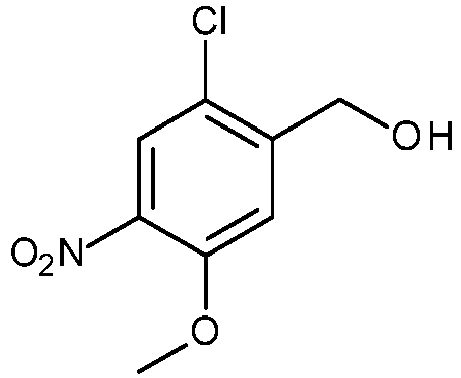
- A suspension of 3-methoxy-4-nitrobenzoic acid (0.50 g, 2.73 mmol) and NCS (0.41 g, 3.00 mmol) in CH3CN (5 mL) was heated to 80 °C for 2 h. The reaction mixture was concentrated in vacuo and the residue was purified by column chromatography on silica gel (Si-PPC, 40 g, mobile phase cyclohexane/EtOAc, gradient from 100:0 to 20:80). The desired fraction were collected and evaporated to dryness to give 460 mg of intermediate 94 (77% yield, yellow solid).
- Preparation of intermediate 98:

- NaH (60% disp. in mineral oil) (0.41 g, 10.19 mmol) was added to a solution of N-methyl-4-piperidinol (1.08 g, 9.34 mmol) in DMF (9 mL) at 0 °C and the mixture was warmed to rt for 15 min. 5-chloro-2-fluoronitrobenzene (1.49 g, 8.49 mmol) was added and the mixture was stirred at rt for a further 2 h. The reaction mixture was partitioned between EtOAc and a saturated solution of NaHCO3. The organic layer was washed with brine, and dried over Na2SO4 and concentrated in vacuo. The residue was purified by column chromatography on silica gel (Si-PPC, 40 g, mobile phase: DCM/2 M ammonia in MeOH, gradient from 100:0 to 90:10). The desired fraction were collected and evaporated to dryness to give 1.69 g of intermediate 94 (74% yield, yellow oil).
- The intermediates in the Table below were prepared by using an analogous method as the one used for the preparation of intermediate 98 starting from the respective starting materials. The most relevant minor deviations to the referenced method are indicated as additional information in the column 'Structure'.
Intermediate number Structure Mass Yield (%) Intermediate 133 
1.63 g 57 From 2-fluoro-5-nitrobenzotrifluoride Intermediate 137 
451 mg 47 From 4-fluoro-3-nitrobenzotrifluoride Intermediate 155 
2.4 g 81 From 2-fluoro-5-nitrobenzotrifluoride The reaction mixture was stirred at 100°C overnight after addition of all reagents - Preparation of intermediate 125:

- Sodium borohydride (0.54 g, 14.36 mmol) was added portion-wise to a solution of N-cyclopropyl-4-piperidinone (1.00 g, 7.18 mmol) in a mixture of DCM (33 mL) and MeOH (3.3 mL) at 0 °C under Ar. The mixture was stirred for 1 h and allowing to warm to rt. The pale yellow mixture was poured into 1M NaOH (20 mL). The layers were separated and the aqueous layer extracted with DCM (2 x 20 mL). The combined organic layers were passed through a phase separator and solvent evaporated under reduced pressure to obtain 1.25 g of intermediate 125 (yellow oil). The residue was used without further purification for the next step.
- Preparation of intermediate 129:

- A solution of 2-bromo-5-nitrobenzotrifluride (1.00 g, 3.704 mmol) and 3,6-dihydro-2H-pyran-4-boronic acid pinacol ester (1.01 g, 4.82 mmol) in a mixture of 1,4-dioxane (15.28 mL) and distilled water (2.59 mL) was treated with K2CO3 (2.36 g, 11.11 mmol) and purged with N2. Dichloro [1,1-bis(diphenylphosphino)ferrocene]palladium II, DCM adduct (303.20 mg, 370.36 µmol) was then added and the reaction mixture was purged again with N2 and stirred at 120 °C using one single mode microwave (Biotage Initiator EXP 60) with a power output ranging from 0 to 400 W for 10 minutes [fixed hold time]. Then, water was added. The aqueous layer was extracted twice with DCM, dried over MgSO4, filtered and evaporated. The residue was purified by column chromatography on silica gel (Irregular SiOH, 40µm, mobile phase DCM, 100% DCM). The pure fractions were combined and the solvent was evaporated to give 900 mg of intermediate 129.
- Preparation of intermediate 130:

- A solution of intermediate 129 (690.00 mg, 2.53 mmol) in MeOH (10.23 mL) was hydrogenated at 60 °C with Pd/C (10 wt. %, 71.64 mg, 67.30 µmol) as a catalyst under 8 bars pressure for 24 h. The catalyst was filtered off on a pad of Celite® and the filtrate was evaporated to give 609 mg of intermediate 130.
- Preparation of intermediate 138:

- A mixture of intermediate 137 (0.67 g, 2.65 mmol) was hydrogenated at rt in EtOAc (15.50 mL) and MeOH (15.60 mL) with Pd/C (10 wt. %, 0.12 g, 0.11 mmol) as a catalyst in a Parr® pressure vessel reactor under 4 bars of H2. After 4 h, the catalyst was filtered off on a pad of Celite®. The solvent was evaporated until dryness to give 535 mg of intermediate 138 (91% yield). This product was used without further purification for the next step.
- Preparation of intermediate 147:

- To a solution of 1-bromo-2-chloro-4-nitrobenzene (1.00 g, 4.42 mmol) and pyridine-4-boronic acid, pinacol ester (1.10 g, 5.36 mmol), K3PO4 (2.70 g, 12.72 mmol), dichloro [1,1'-bis(diphenylphosphino)ferrocene] palladium II, DCM adduct (0.350 g, 0.43 mmol) in a mixture of 1,4-dioxane (15.00 mL) and distilled water (2.50 mL) was purged again with N2. The reaction mixture was stirred at 110 °C using one single mode microwave (Biotage Initiator EXP 60) with a power output ranging from 0 to 400 W for 10 min [fixed hold time]. This procedure was made with three batches of 1 g of 1-bromo-2-chloro-4-nitrobenzene. The three reactions were combined and water was added. The aqueous layer was extracted twice with DCM, dried over MgSO4, filtered and evaporated to give. The residue (4.40 g) was purified by column chromatography on silica gel (Irregular SiOH, 40 µm, mobile phase: heptane/EtOAc, gradient from 60:40 to 50:50). The pure fractions were combined and the solvent was evaporated to afford 1.97 g of intermediate 147 (66% yield) used as it for the next step.
- Preparation of intermediate 148:

- Iodoethane (2.80 mL, 35.01 mmol) was added to a mixture of intermediate 147 (1.95 g, 8.31 mmol) in toluene (20 mL). This reaction was stirred in a sealed tube at reflux (115 °C) for 7 h. This reaction was cooled down to rt. Iodoethane (1.50 mL, 18.75 mmol) was added again and the mixture was stirred for further 5 h at reflux (120 °C). The solvent was concentrated to dryness to give 2.89 g of intermediate 148 (89% yield) used as it for the next step.
- Preparation of intermediate 149:

- A mixture of intermediate 148 (1.00 g, 2.56 mmol) was hydrogenated at rt in EtOH (35 mL) with platinium (IV) oxide (300 mg, 1.30 mmol) as a catalyst at 3 bars. After overnight, the catalyst was filtered off on a pad of Celite® and the solvent was concentrated until dryness. This residue was purified by column chromatography on silica gel (Irregular SiOH, 40 µm, 40 g, mobile phase: NH4OH/DCM/MeOH, gradient form: 0.5% NH4OH, 95% DCM, 5% MeOH to 1% NH4OH, 90% DCM, 10% MeOH). The pure fractions were collected and the solvent was concentrated until dryness to give 0.690 g of intermediate 149 (98% yield, purity = 84% determined by LC/MS) used as it for the next step.
- Preparation of intermediate 152:

- A mixture of 4-isopropylbenzyl bromide (4.18 g, 19.61 mmol), 3-nitrophenol (3.00 g, 21.57 mmol), K2CO3 (4.06 g, 29.41 mmol) in DMF was heated at 100 °C. After completion, water and EtOAc were added. The organic layer was washed with water, decanted, dried over MgSO4, filtered and evaporated to dryness. The residue was recristallyzed with DiPE to give 2.87 g of intermediate 152 (54% yield). M. P. = 88 °C (K).
- Preparation of intermediate 153:

- To a solution of intermediate 152 (2.80 g, 10.32 mmol) in a mixture of 1,4 dioxane (20 mL) and water (5 mL), Iron powder (5.80 g, 103.20 mmol) and iron(II) sulfate heptahydrate (6.30 g, 41.28 mmol) were added. The resulting solution was heated to reflux for overnight. The reaction mixture was filtered off on a pad of Celite® and washed with DCM. The organic layer was washed with water and K2CO3, dried over MgSO4, filtered and evaporated to give 2.35 g of intermediate 153 (94% yield).
- Preparation of intermediate 158:

- TEA (3.52 mL, 25.00 mmol) was added to a solution of Boc2O (3.00 g, 13.77 mmol) and 2-(methylamino)ethanol (1.00 mL, 12.52 mmol) in DCM (80 ml) and stirred at rt overnight. The mixture was washed with brine, dried on MgSO4, filtrated and concentrated to afford 2.40 g of intermediate 158 (colorless oil).
- Preparation of intermediate 175:

- To a suspension of 2-methyl-5-nitrobenzotrifluoride (14.00 g, 68.25 mmol) in AcOH (58.60 mL, 1.02 mol), NBS (12.75 g, 71.66 mmol) and benzoyl peroxide (1.65 g, 6.83 mmol) was added. The reaction mixture was heated at reflux overnight (120 °C). Upon cooling, the solvent was removed in vacuo, EtOAc and aqueous NaHCO3 were added, and the layers were separated. The organic layer was dried over MgSO4, filtered, and concentrated to afford 18 g of intermediate 175 (93% yield). It was used for the next step without further purification.
- Preparation of intermediate 176 (CIS):

- Cis-2,6-dimethylpiperazine (1.00 g, 8.49 mmol) were added to a stirred solution of intermediate 175 (3.62 g, 12.74 mmol) and TEA (4.72 mL, 33.98 mmol) in DCM (10.88 mL) at rt for 48 h. The reaction mixture was washed with a solution of 10 % K2CO3. The organic layer was dried over MgSO4, filtered and evaporated. The residue was purified by column chromatography on silica gel (irregular SiOH, 15-40 µm, 80 g, mobile phase: DCM/MeOH/NH4OH, gradient from DCM: 100% to DCM: 98%, MeOH: 2%, NH4OH: 0.1%) to give 1.82 g of intermediate 176 (68% yield).
- Preparation of intermediate 177 (CIS):
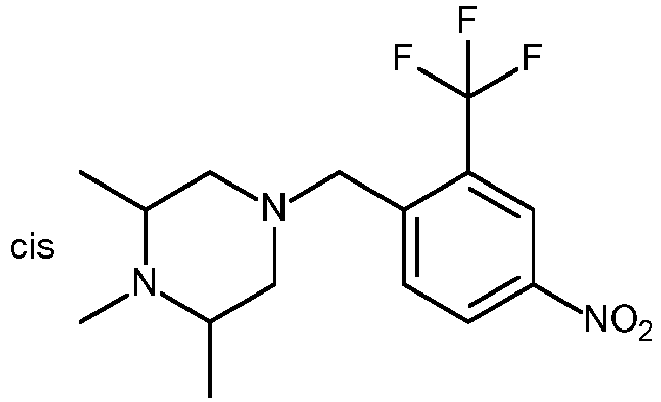
- Sodium cyanoborohydride (403.89 mg, 6.43 mmol) was added to a stirred a solution of intermediate 176 (1.70 g, 5.36 mmol) and formaldehyde (37 wt. % in water) (481.96 µL, 6.43 mmol) in a mixture of MeOH (6.39 mL, 157.64 mmol) and AcOH (756.69 µL, 13.22 mmol) at rt under N2 and stirred at rt for 2 h. Then, the reaction mixture was poured out onto water, made basic with K2CO3 powder, extracted with DCM, dried over MgSO4, filtered and evaporated to give intermediate 177 (96% yield). It was used for the next step without purification.
- Preparation of intermediate 178: (CIS)

- Intermediate 177 (500.00 mg, 1.51 mmol) in MeOH (12.41 mL) was hydrogenated with RaNi (329.95 mg, 5.62 mmol) as a catalyst at rt under 3 bars pressure for 12 h. The catalyst was filtered off on a pad of Celite® and the filtrate was evaporated to give 489 mg of intermediate 178.
- Preparation of intermediate 185:

- Under N2 at rt, a solution of dimethylamine in THF (2.0 M, 1,18 mL, 2.37 mmol) was added to a solution of 5-chloro-2-methyl-3-nitrobenzoic acid (340.00 mg, 1.58 mmol), HBTU (598.09 mg, 1.58 mmol) and DIPEA (679.42 µL, 3.94 mmol) in DMF (9.77 mL, 126.16 mmol). The solution was stirred at rt for 6 h. The solution was poured out into cooled water, and extracted with EtOAc. The organic layer was dried over MgSO4, filtered and evaporated to dryness. The residue (2.07 g) was purified by colonne chromatography on silica gel (SiO2, 40 g, mobile phase: DCM/MeOH/NH4OH, gradient form 100% DCM to 97% DCM, 3% MeOH, 0.3% NH4OH). The pure fractions were collected and the solvent was evaporated until dryness to give 315 mg of intermediate 185 (82% yield).
- The intermediates in the Table below were prepared by using an analogous method as the one used for the preparation of intermediate 185 starting from the respective starting materials.
Intermediate number Structure Mass Yield (%) Intermediate 189 
530 mg 66 From (2-amino-4-chlorophenyl) acetic acid Intermediate 192 
950 mg 85 From (2-amino-4-chlorophenyl) acetic acid Intermediate 197 
444 mg 80 5-chloro-2-methyl-3-nitrobenzoic acid - Preparation of intermediate 201:

- A mixture of intermediate 200 (68.00 mg, 0.21 mmol) and sodium nitrate (18.00 mg; 0.21 mmol) in TFA (0.70 mL) was stirred at rt for 6 h. The mixture was poured in a mixture of ice and aqueous NaHCO3, extracted with EtOAc, washed with brine, dried over MgSO4 and evaporated. The residue (60 g, black oil) was purified by column chromatography on silica gel (irregular SiOH, 15-40 µm, 12 g, liquid injection (DCM), mobile phase: DCM/MeOH, gradient from: 100:0 to 95:05 in 10 CV) to give 40 mg of a residue as a light yellow oil 2 containing intermediate 201 (66% purity). Further purification by achiral SFC (Stationary phase: CYANO 6 µm 150 x 21.2mm, mobile phase: 95% CO2, 5% MeOH) was achieved to give 17 mg of intermediate 201 (30% yield, white solid).
- Preparation of intermediate 202:

- A mixture of intermediate 201 (650.00 mg, 2.41 mmol) and platinium (IV) oxide (130.00 mg, 0.57 mmol) in a mixture of MeOH (20 mL) and THF (5 mL) was stirred at rt under an atmosphere of H2 for 20 min (purged with H2, 3 times (total time reaction: 1h)). The mixture was filtered over a pad of celite®. The organic layer was evaporated and purified by column chromatography on silica gel (irregular SiOH, 15-40 µm, 80 g, liquid injection (DCM), mobile phase: heptane/EtOAc, gradient from 100:0 to 0:100 in 10 CV). The pure fractions were collected and the solvent was evaporated until dryness to give 174 mg of intermediate 202 (30% yield, white solid).
- Preparation of intermediate 207:

- NaH (60% dispersion in mineral oil) (182.00 mg, 4.55 mmol) was added slowly at 0 °C to 2-methoxyethanol (0.36 mL, 4.55 mmol) in THF (20 mL). The mixture was stirred under N2 at 0 °C for 30 min. 4-bromo-2-fluoronitrobenzene (1.00 g, 4.55 mmol) was added and the mixture was stirred and heated slowly to rt for 5 h. The mixture was neutralized with HCl 1N (pH = 7) then extracted with a mixture of EtOAc/NaHCO3. The organic layer was washed with brine, dried over MgSO4, evaporated and purified by column chromatography on silica gel (irregular SiOH, 15-40 µm, 80 g, liquid injection (DCM), mobile phase; heptane/EtOAc, gradient from 100:0 to 50:50 in 10 CV) to give 1.13 g of intermediate 207 (90% yield, white solid).
- Preparation of intermediate 214:

- 5-chloro-2-methyl-3-nitrobenzoic acid (3.00 g, 13.91 mmol), diphenylphosphoryl azide (4.49 mL, 20.87 mmol) and TEA (2.71 mL, 19.48 mmol) in a mixture of Me-THF (3.75 mL, 37.44 mmol) and 2-methyl-2-propanol (3.91 mL, 41.74 mmol) were refluxed at 3 h. The mixture was poured into NH4Cl and the organic layer was extracted twice with EtOAc, dried over MgSO4 and the solvent was evaporated until dryness. The residue (5.08 g) was taken up into EtOAc and a precipitate was appeared and was filtered (impurities). The filtrate was evaporated until dryness. The residue (4.77 g) was taken up in CH3CN, and a precipitate was appeared and was filtered. The filtrate was evaporated until dryness and purified by colum chromatography on silica gel (Irregular SiOH and Si 60 15-40µm, 40 µm, 80 g, solid deposite, mobile phase: Heptane/EtOAc, 80:20). The pure fractions were combined and the solvent was evaporated to give 3.42 g of intermediate 214 (86% yield).
- Preparation of intermediate 215:

- To a stirred solution of intermediate 214 (200.00 mg, 0.70 mmol) in AcOH (8 mL), iron (389.56 mg, 6.98 mmol) was added and stirred at 70 °C for 2 h. The crude mixture was diluted with EtOAc, filtered over celite®, and the cake was washed with EtOAc. Water was added to the filtrate then K2CO3 powder until basic pH. The organic layer was washed with brine, dried over MgSO4, filtered and evaporated. The residue (180 mg) was purified by column chromatography on silica gel (Irregular SiOH, 40 µm, 24 g, mobile phase: heptane/EtOAc, 60:40).
- The pure fractions were combined and the solvent was evaporated to give 95 mg of intermediate 215 (53% yield).
- Preparation of intermediate 216:

- Intermediate 215 (1.00 g, 3.89 mmol), acetyl chloride (0.35 mL, 4.87 mmol) and TEA (3.25 mL, 23.37 mmol) in DCM (50 mL) were added at 0°C stirred at rt overnight. The mixture was poured into NH4Cl and the organic layer was extracted with DCM, washed with NaCl, and dried. The precipitate was filtered to give 483 mg of intermediate 216 (42% yield). The filtrate was evaporated until dryness and the residue (750 mg) was purified by column chromatography on silica gel (Irregular SiOH, 40 g, mobile phase: DCM/MeOH, gradient from 100:0 to 98:2). The pure fractions were combined and the solvent was evaporated to give 236 mg of intermediate 216 (20% yield). The two batches was gathered to give 719 mg of intermediate 216 (62% yield).
- Preparation of intermediate 217:

- At 0 °C, a solution of HCl 4M in dioxanne (2.76 mL, 11.04 mmol) was added to a stirred solution of intermediate 216 (660.00 mg, 2.21 mmol) in CH3CN (49.5 mL). The mixture was stirred at 0 °C for 30 min and at rt for 1h. The mixture was poured into cooled water and basified with NH4OH. The organic layer was extracted twice with EtOAc, washed with brine, dried over MgSO4, filtered and evaporated until dryness. The residue was taken up in DCM, washed with brine, evaporated and purified by column chromatography on silica gel (Irregular SiOH, 24 g, solid deposit, mobile phase: heptane/MeOH/EtOAc/NH4OH, 60:38:2:0.1). The pure fraction were combined and the solvent was evaporated to give 210 mg of intermediate 217 (48% yield).
- The intermediate in the Table below was prepared by using an analogous method as the one used for the preparation of intermediate 217 starting from the respective starting materials.
Intermediate number Structure Mass Yield (%) Intermediate 235 
251 mg Quant. From intermediate 234 - Preparation of intermediate 221:

- A mixture of intermediate 220 (334.00 mg, 1.46 mmol), zinc (953.00 mg, 14.60 mmol) and AcOH (0.83 mL, 14.60 mmol) in MeOH (8 mL) was stirred at rt for 2 h. The mixture was filtered on a pad of celite® then an extraction was performed with EtOAc and HCl 1N. The aqueous layer was basified with NaOH 1N and extracted with EtOAc (10 times). The organic layers were washed with brine, dried with MgSO4 and evaporated to give 226 mg of intermediate 221 (78% yield, brown oil).
- The intermediate in the Table below was prepared by using an analogous method starting from the respective starting materials.
Intermediate number Structure Mass Yield (%) Intermediate 231 
496 mg pale brown oil 97 From intermediate 230 - Preparation of intermediate 234:
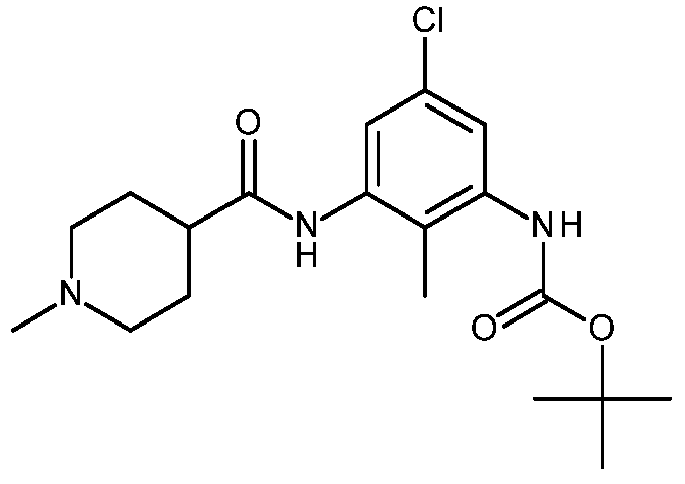
- A solution of HATU (2.02 g, 5.32 mmol), DIPEA (1.85 mL, 10.63 mmol) and ethyl 1-methyl-4-piperidine carboxylate, HCl salt (827.80 mg, 4.61 mmol) in Me-THF (9.10 mL, 90.86 mmol) were stirred at 70 °C for 2 h. Then, intermediate 215 (910.00 mg, 3.54 mmol) was added and the mixture was stirred at 70 °C overnight. The mixture was poured out onto water and the organic layer was extracted twice with DCM, dried over MgSO4, filtered and evaporated until dryness. The residue (776 mg) was taken up in MeOH and DCM, triturated and filtered. The precipitate was dried until dryness to give 315 mg of intermediate 234 (23% yield).
- Preparation of intermediate 238:

- DIAD (3.00 mL, 15.28 mmol) was added dropwise at 5 °C to a mixture of 5-fluoro-2-nitrophenol (1.60 g, 10.18 mmol), 2-methoxyethanol (807.00 µL, 10.18 mmol) and PPh3 (1.4 mmol/g on polystyrene) (10.90 g, 15.28 mmol) in THF (30 mL). The mixture was stirred at rt for 2 h. Water was added and the reaction mixture was extracted with DCM. The organic layer was decanted, dried over MgSO4, filtered and evaporated to dryness. The residue was purified by column chomatography on silica gel (irregular SiOH, 40 g, mobile phase: heptane/EtOAc, gradient from 80:20 to 60:40). The fractions were collected and evaporated to dryness to give 954 mg of intermediate 238 (43% yield).
- Preparation of intermediate 244:
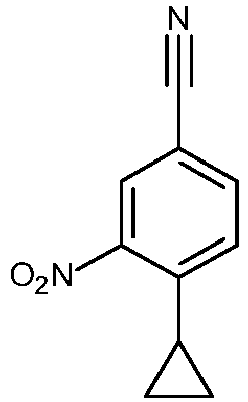
- Di(1-adamantyl)-N-butylphosphine (157.00 mg, 0.44 mmol) and Pd(OAc)2 (98.00 mg, 0.44 mmol) were added to a degassed N2 solution of 4-chloro-3-nitrobenzonitrile (800.00 mg, 4.38 mmol), potassiumcyclopropyltrifluoroborate (972.00 mg, 6.57 mmol) and CsCO3 (2.85 g, 8.76 mmol) in a mixture of 1,4-dioxane (18 mL) and distilled water (4 mL). The reaction mixture was stirred and heated at 100 °C for 18 h. Then, it was cooled to rt, diluted with DCM and poured onto water. The organic layer was decanted, dried over MgSO4, filtered over celite® and evaporated to dryness. The residue was purified by column chromatography on silica gel (irregular SiOH, 24 g, mobile phase: DCM/MeOH, gradient from 100:0 to 98:2). The pure fractions were collected and evaporated to dryness to give 546 mg of intermediate 244 (66% yield).
- Preparation of intermediate 249:

- To a solution of 4-fluoro-2-methoxy-1-nitrobenzene (2.00 g, 11.70 mmol) in MeOH (38 mL), a solution of sodium thiomethoxide (1.50 g, 21.00 mmol) was added dropwise in distilled water (6.5 ml) and MeOH (38 mL) and the resulting mixture was stirred at reflux under N2 overnight. The mixture was cooled to rt and concentrated in vacuo. The residue was triturated in a mixture of DCM and MeOH (1:1) and the solid was filtered off. The filtrate was purified by column chromatography on silica gel (15-40 µm, 240 g, mobile phase: heptane/EtOAc, gradient from 100:0 to 50:50). The pure fractions were mixed and the solvent was evaporated to give 2.11 g of intermediate 249 (91% yield).
- The intermediates in the Table below were prepared by using an analogous method as the one used for the preparation of intermediate 249 starting from the respective starting materials. The most relevant minor deviations to the referenced method are indicated as additional information in the column 'Mass (mg)'.
Intermediate number Structure Mass (mg) Yield (%) Intermediate 289 
1194 (Procedure with EtOH and distilled water) yellow solid Quant. From intermediate 86 Intermediate 324 
195 (Procedure with EtOH and distilled water) 8 From 3,4-difluoro-6-nitroanisole - Preparation of intermediate 250:

- A solution of intermediate 249 (2.11 g, 10.60 mmol) in DCM (106 ml) under an Ar atmosphere was treated with mCPBA (5.49 g, 31.80 mmol) and stirred at rt for 24 h. The mixture was filtered off. The filtrate was concentrated and purified by column chromatography on silica gel (SiO2, dry loading, mobile phase: heptane/EtOAc, gradient from 1:0 to 0:1). The pure fractions were combined and concentrated to dryness to afford 1.65 g of intermediate 250 (67% yield, pale yellow crystalline solid).
- The intermediates in the Table below were prepared by using an analogous method as the one used for the preparation of intermediate 250 starting from the respective starting materials.
Intermediate number Structure Mass (mg) Yield (%) Intermediate 290 
864 pale yellow crystaline solid 65 From intermediate 289 Intermediate 325 
629 white solid 62 From intermediate 324 - Preparation of intermediate 257:

- To a solution of 2-bromo-4-methylbenzonitrile (2.00 g, 10.20 mmol) in H2SO4 (7 mL) at 0 °C, a solution of KNO3 in H2SO4 (5 mL) was added (1.03 g, 10.20 mmol). After stirring at 0 °C for 1.5 h, the reaction mixture was poured into 500 mL of ice water. The precipitate was collected by filtration and washed with copious amounts of water. The precipitate was dried to provide 2.01 g of intermediate 257 (82% yield, white powder).
- Preparation of intermediate 258:
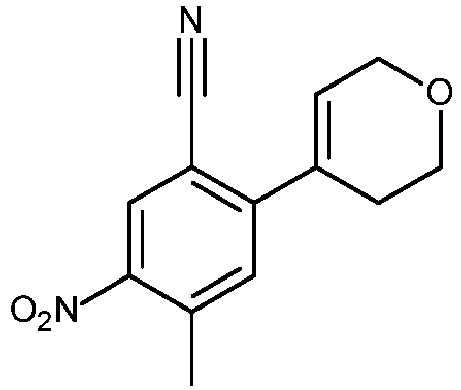
- In a sealed tube, a solution of intermediate 257 (1.00 g, 4.15 mmol), 3,6-dihydro-2H-pyran-4-boronic acid pinacol ester (1.05 g, 4.98 mmol) and K3PO4 (1.76 g, 8.30 mmol) in a mixture of 1,4-dioxane (29 mL) and distilled water (3.86 mL) was degassed under N2. [1,1'-bis(diphenylphosphino)ferrocene]dichloropalladium(II), complex with dichloromethane (340.00 mg, 0.41 mmol) was added and the reaction mixture was degassed again under N2 and heated at 80 °C for 5 h. The reaction mixture was cooled to rt, poured onto water and extracted with DCM. The organic layer was decanted, dried over MgSO4, filtered and evaporated to dryness. The residue (2g, black oil) was purified by column chromatography on silica gel (irregular SiOH, 80 g, mobile phase: heptane/EtOAc, gradient from 100:0 to 75:25). The pure fractions were collected and evaporated to dryness to give 0.787 g of intermediate 258 (78% yield, white powder).
- Preparation of intermediate 259:

- A mixture of intermediate 258 (0.79 g, 3.22 mmol) and Pd/C (10 wt. %, 72.00 mg, 0.067 mmol) in EtOAc (10 mL) was stirred at rt under an atmosphere of H2 overnight. The mixture was filtered over a pad of celite® and evaporated to dryness to give intermediate 259 (white solid). This residue was used as such in the next reaction step.
- Preparation of intermediate 260:

- A mixture of intermediate 259 (0.70 g, 3.27 mmol) and Pd/C (10 wt. %, 174.00 mg, 0.16 mmol) in EtOH (11.5 mL) was stirred at rt under an atmosphere of H2 overnight. The mixture was filtred over a pad of celite®. The organic layer was evaporated to give 512 mg of intermediate 260 (72% yield, 90% purity based on LC/MS, white solid).
- The intermediates in the Table below were prepared by using an analogous method as the one used for the preparation of intermediate 259 starting from the respective starting materials. The most relevant minor deviations from the original procedure are indicated in the column "Mass"
Intermediate number Structure Mass (mg) Yield (%) Intermediate 583 
225 93 From intermediate 582 Intermediate 626 
500 Procedure with EtOAc as solvent 78 From intermediate 625 - Preparation of intermediate 267:

- AcCl (19.5 mL) was added dropwise to a solution of 3-nitro-5-(trifluoromethyl)benzoic acid (19.50 g, 83.00 mmol) in MeOH (195 mL) at rt and stirred 18 h. The resulting mixture was concentrated under vacuum, washed with a solution of 10% of K2CO3, extracted twice with DCM, dried over MgSO4, filtrated and concentrated under vacuum to give 19 g of intermediate 267 (92% yield).
- Preparation of intermediate 278:

- A mixture of 1-bromo-2-chloro-5-methoxy-4-nitrobenzene (1.00 g, 3.75 mmol), morpholine (395.00 µL, 4.12 mmol), K2CO3 (1.04 g, 7.51 mmol) in DMF (10 mL) was stirred and heated at 80 °C for 18 h. Further morpholine (35.00 µL, 0.40 mmol) was added and the reaction mixture was stirred and heated at 80 °C for a further 23 h. The reaction mixture was added to ice/water and stirred to give a yellow precipitate. It was filtered off, washed with water and EtO2, dried over MgSO4 and concentrated in vacuo to give a yellow solid. The filtrate was further extracted with EtOAc (twice) and the combined organics were washed successively with water, and saturated brine, dried over anhydrous Na2SO4. Solvent was removed in vacuo to give a brown solid (100 mg) which was combined with the precipitate and purified by column chromatography on silica gel (80 g silica cartridge, mobile phase: cyclohexane/EtOAc containing 0-40% EtOAc) to give 703 mg of intermediate 278 (69% yield, yellow solid).
- Preparation of intermediate 283:

- Ethyl glycolate (0.91 mL, 9.61 mmol) was dissolved in dimethylamine (40% in water) (10 mL) and the resulting mixture was stirred at rt for 18 h. The reaction was evaporated under reduced pressure. The residue was taken up in EtOH and evaporated under reduced pressure (twice) to give a colorless oil. The residue (950 mg) was purified by column chromatography on silica gel (SiO2, 25 g, mobile phase DCM/MeOH, gradient from 100:0 to 95:5). The fractions containing the product were combined and evaporated under reduced pressure to give 576 mg of intermediate 283 (58 % yield, colorless oil).
- Preparation of intermediate 284:
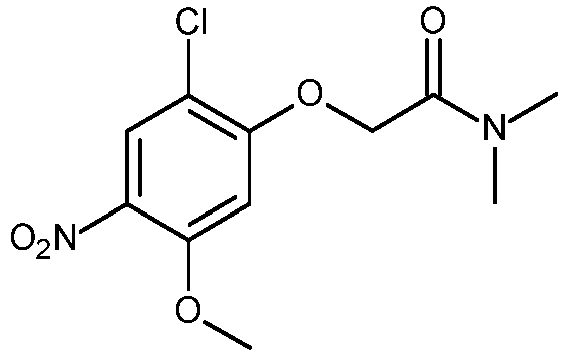
- To a solution of intermediate 283 (376.00 mg, 3.65 mmol) in THF (20 mL), NaH (60% dispersed in mineral oil) (145.92 mg, 3.65 mmol) was added portionwise and the resulting mixture was stirred at rt under N2 for 30 min. Intermediate 86 (0.50 g, 2.43 mmol) was added and the resulting mixture was stirred for 1 h. The reaction was quenched with 1M aqueous NH4Cl and extracted with thrice with EtOAc. The organic layer were separated, combined, dried over Na2SO4 and evaporated under reduced pressure. The residue was purified by column chromatography on silica gel (SiO2, 40 g, mobile phase: DCM/MeOH, gradient from 100:0 to 95:5). The fractions containing the product were combined and evaporated under reduced pressure to give 619 mg of intermediate 284 (88% yield, off-white solid).
- The intermediate in the Table below was prepared by using an analogous method as the one used for the preparation of intermediate 284 starting from the respective starting materials.
Intermediate number Structure Mass (mg) Yield (%) Intermediate 321 
344 (43% purity based on LC/MS) yellow solid 72 From intermediate 86 and 1-(2-hydroxyethyl)-4-methyl piperazine - Preparation of intermediate 294:

- A suspension of 3-methoxy-4-nitro-phenyl-methanol (1.00 g, 5.46 mmol) and NCS (1.14 g, 8.54 mmol) in CH3CN (10 mL) was heated to 80 °C for 2 h. The reaction mixture was concentrated in vacuo and the residue was purified by column chromatography on silica gel (SiO2, mobile phase: cyclohexane/EtOAc, gradient from 1:0 to 1:1). The desired fractions were collected to afford the 1.093 g of intermediate 294 (89% yield, yellow solid).
- Preparation of intermediate 295:

- A stirred mixture of intermediate 294 (0.60 g, 2.76 mmol), CBr4 (1.19 g, 3.59 mmol), PPh3 (0.94 g, 3.59 mmol) and THF (5.5 ml) under N2 atmosphere at 0 °C was warmed to rt and stirred for 30 min. The mixture was diluted with water and extracted with DCM. The organic phase was dried over MgSO4, filtered and the filtrate concentrated in vacuo. The residue was purified by column chromatography on silica gel (SiO2, mobile phase: cyclohexane/EtOAc, gradient from 1:0 to 0:1). The desired fractions were collected to afford 714 mg of intermediate 295 (95% yield, off-white solid).
- Preparation of intermediate 296:
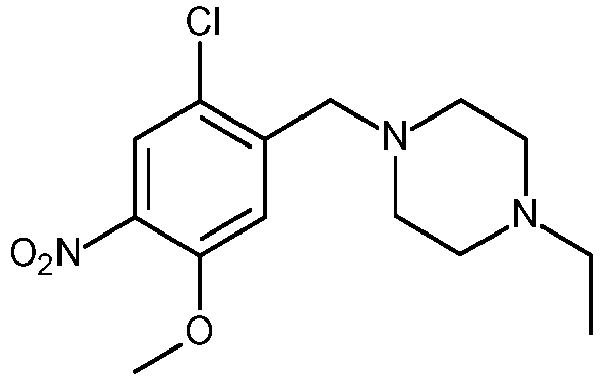
- A stirred mixture of intermediate 295 (0.41 g, 1.45 mmol), 1-ethylpiperazine (0.41 ml, 3.20 mmol), K2CO3 (0.44 g, 3.20 mmol) and DMF (6 ml) was heated at 80 °C for 30 min. The mixture was cooled to rt and partitioned between water and EtOAc. The organic phase was dried over Na2SO4, filtered and the filtrate concentrated in vacuo. The residue was purified by column chromatography on silica gel (SiO2, mobile phase: pentane and EtOAc (1:1 to 0:1) followed by DCM and MeOH (1:0 to 9:1)). The desired fractions were collected to afford 421 mg of intermediate 296 (92% yield, yellow oil).
- Preparation of intermediate 299:

- To a stirred suspension of of intermediate 294 (100.00 mg, 0.46 mmol) and CS2CO3 (0.450 g, 1.38 mmol) in a mixture of THF (0.5 mL) and DMF (0.5 mL) under an Ar atmosphere, was added iodomethane (286 µL, 4.60 mmol). The reaction mixture was stirred at rt for 18 h. The reaction mixture was partitioned between EtOAc and water. The aqueous layer was extracted with EtOAc. The combined organic extracts were washed with saturated brine, dried over Na2SO4, and concentrated under vacuum. The residue was purified by column chromatography on silica gel (SiO2, 12 g silica cartridge, mobile phase: cyclohexane/EtOAc, gradient from 100:0 to 70:30). The desired fractions were collected to give 39 mg of intermediate 299 (36% yield, very pale yellow solid).
- Preparation of intermediate 316:

- A solution of 5-bromo-4-methyl-2-nitroanisole (60.00 mg, 0.24 mmol) and N-Boc 1,2,5,6-tetrahydropyridine-4-boronic acid pinacol ester (202.00 mg, 0.65 mmol) in 1,4-dioxane (5 mL) was degassed by bubbling Ar through the stirred solution in a 10 mL screw-top reaction vial for 10 min. Freshly prepared 2M aqueous sodium carbonate (0.50 ml, 1.0 mmol), degassed by bubbling N2 through the stirred solution for 15 min, was added, followed by the catalyst [1,1'-bis(diphenylphosphino)ferrocene]dichloropalladium(II), complex with dichloromethane (20.00 mg, 0.027 mmol). The reaction vial was sealed under Ar and the mixture heated to 100 °C (block temperature) for 16 h. The mixture was cooled to rt and diluted with EtOAc (50 mL) and water (25 mL). The aqueous layer was separated and further extracted with EtOAc (25 mL). The combined organic layers were washed with water (25 mL), brine (10 mL), dried over Na2SO4, filtered through a plug of celite® and evaporated to give a red gum. This residue was purified by column chromatography on silica gel (SiO2, 4 g, 50 µm cartridge, mobile phase: cyclohexane/EtOAc, 1CV 100% cyclohexane, then linear gradient from 1:0 to 0:1). The desired fractions were combined and evaporated to give 94 mg of intermediate 316 (quant. yield, red glass).
- Preparation of intermediate 317:

- A solution of intermediate 316 (850.00 mg, 2.40 mmol) and TFA (1.90 mL, 24.80 mmol) in DCM (20 mL) was stirred at rt for 6 h. The reaction mixture was directly purified by cation exchange chromatography (50 g Isolute SCX-2 cartridge, mobile phase: DCM/MeOH, gradient from 1:0 (200 mL), 1:1 (100 mL) to 0:1 (50 mL). The receiver flask was exchanged and the product released from the cartridge with a solution of 2M ammonia in MeOH (150 mL). The resulting red product solution was evaporated to dryness to give 566 mg of intermediate 317 (93% yield, red coloured glass).
- Preparation of intermediate 318:

- A solution of intermediate 317 (566.00 mg, 2.28 mmol), 2-bromo-1-methoxyethane (520.00 µL, 2.77 mmol) and DIEA (1.20 mL, 7.01 mmol) in DMF (20 mL) was stirred at rt for 18 h. The reaction was not complete, also 260 µL (2.77 mmol) of 2-bromo-1-methoxyethane was added portionwise again and stirring continued for a further 7h. Then the mixture was stood at rt over the weekend. The reaction mixture was then diluted with DCM (20 mL) and directly purified by cation exchange chromatography (50 g Isolute SCX-2 cartridge, mobile phase: DCM/MeOH, gradient from 1:0 (100 mL), 1:1 (100 mL) to 0:1 (50 mL). The receiver flask was exchanged and the cartridge eluted with a solution of 2M ammonia in MeOH to release the product as a red solution. The solvents were evaporated and the crude product purified by column chromatography on silica gel (SiO2, 12 g, 15 µm SiO2 cartridge, mobile phase: DCM/MeOH, gradient from 100:0 to 95:5). Relevant fractions were combined and evaporated to give 461 mg of intermediate 318 (66% yield, pale yellow gum).
- Preparation of intermediate 319:

- A suspension of intermediate 318 (461.00 mg, 1.51 mmol), and Pd/C (10 wt. %, 100 mg) in DCM (15 ml) and MeOH (5 mL) was stirred at rt under an H2 atmosphere for 1 h. The reaction mixture was filtered through a pad of celite® and concentrated in vacuo. The residue was re-suspended in DCM (15 mL) and MeOH (5 mL) with Pd/C (10 wt. %, (100 mg) and stirred under an H2 atmosphere for a further 72 h. The reaction mixture was filtered through a pad of celite® and concentrated in vacuo to give 420 mg of intermediate 319 (quant. yield, yellow oil).
- Preparation of intermediate 334:

- NaBH4 (0.54 g, 14.36 mmol) was added portionwise to a solution of N-cyclopropyl-4-piperidine (1.00 g, 7.18 mmol) in a mixture of DCM (33 mL) and MeOH (3.3 mL) at 0 °C under Ar. The mixture was stirred for 1 h and allowing to warm to rt. The, the pale yellow mixture was poured into 1M NaOH (20 mL) and the phases were separated. The aqueous phase was extracted with dichloromethane (2 x 20 mL). The combined organic layers were passed through a phase separator and solvent evaporated under reduced pressure to obtain 1.25 g of intermediate 334 (yellow oil). The residue was used as it for the next step.
- Preparation of intermediate 348:
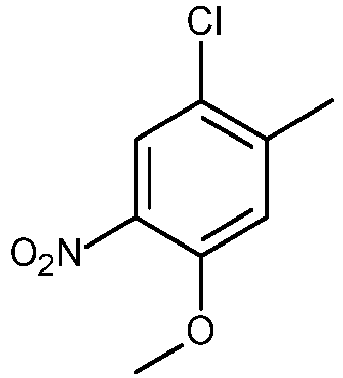
- NaH (60% dispersed in mineral oil) (1.28 g, 31.99 mmol) was added portionwise to a solution of 4-chloro-3-methyl-6-nitrophenol (5.00 g, 26.66 mmol) in DMF (60 mL) at 0 °C and the mixture was stirred for 15 min at this temperature. Iodomethane (1.83 mL, 29.33 mmol) was added and the mixture was warmed to rt and stirred for 24 h. The reaction mixture was partitioned between EtOAc and water. The organic layer was washed with brine, dried over Na2SO4 and concentrated in vacuo. The residue was purified by column chromatography on silica gel (Si-PPC, 80 g, mobile phase: cyclohexane/EtOAc, gradient from 1:0 to 4:1). The desired fraction were collected and concentrated under vacuum to give 4.09 g of intermediate 348 (76% yield, pale yellow solid).
- Preparation of intermediate 349:

- A suspension of intermediate 348 (4.00 g, 19.80 mmol) and KMnO4 (6.27 g, 39.70 mmol) in distilled water (400 mL) was heated at reflux for 24 h. A second portion of KMnO4 (6.27 g, 39.70 mmol) was added and heating was continued for a further 24 h. Then, the reaction mixture was cooled down to 0 °C and acidified to pH 2 with conc. HCl. The aqueous layer was extracted several times with EtOAc. The organic layer was dried over MgSO4 and concentrated under vacuum. The residue was taken up with DCM and the precipitate was filtered to afford 1.81 g of intermediate 349 (23 % yield based on a purity of 60% evaluated by 1H NMR). Intermediate 349 was directly engaged in the next step without any further purification.
- Preparation of intermediate 350:

- Intermediate 349 (1.81 g, 4.69 mmol) was dissolved in MeOH (90 mL). Then, conc. H2SO4 (1.81 mL) was added and the resulting mixture was heated under reflux for 18 h. Then, the reaction mixture was cooled down to rt, mixed with another batch (from 498 mg of intermediate 349) and partitioned between water and EtOAc. The organic layer was separated, dried over MgSO4, filtered and concentrated. The residue was purified by column chromatography on silica gel (irregular SiO2, 80 g, mobile phase: heptane/EtOAc, 80:20). The fractions containing the products were mixed and the solvent was concentrated to afford 830 mg of intermediate 350 (77% yield).
- Preparation of intermediate 358:

- A mixture of 2-nitrobenzoic acid (1.00 g, 5.98 mmol), 3-pyyrolidinol (727.00 µL, 8.97 mmol), HATU (3.40 g, 8.97 mmol) and TEA (2.50 mL, 17.95 mmol) in a mixture of DCM/THF (40 mL, 1:1, v/v) was stirred at rt for 2 h. The reaction mixture was diluted with DCM and poured onto a 10% aqueous solution of K2CO3. The organic layer was decanted, dried over MgSO4, filtered and evaporated to dryness. The residue (2.6 g) was purified by column chromatography on silica gel (irregular SiOH, 24 g, mobile phase: NH4OH/MeOH/DCM, gradient from 0% NH4OH, 0% MeOH, 100% DCM to 1% NH4OH, 10% MeOH, 90% DCM). The pure fractions were collected and evaporated to dryness to give 2 g of intermediate 358 used as it is for the next step.
- Preparation of intermediate 359:

- A solution of TBDMS-Cl (1.08 g, 7.18 mmol) in DCM (5 mL) was added to a mixture of intermediate 358 (1.41 g, 5.98 mmol) and imidazole (1.22 g, 17.95 mmol) in Me-THF (25 mL) and the reaction mixture was stirred overnight at rt. The reaction mixture was diluted with DCM and poured onto water. The organic layer was decanted, dried over MgSO4, filtered and evaporated to dryness. The residue was purified by column chroamtography on silica gel (irregular SiOH, 40 g, mobile phase: DCM/MeOH, gradient from 100:0 to 97:3). The pure fractions were collected and evaporated to dryness to give 921 mg of intermediate 359 (44% yield). Intermediate 359 was used as it is for the next step.
- Preparation of intermediate 376:

- In a round bottom flask, 5-chloro-2-iodoaniline (2.00 g, 7.89 mmol), methyl propargyl ether (1.00 mL, 11.84 mmol) and TEA (1.92 mL, 13.41 mmol) were diluted in DMF. The mixture was degassed (N2 bubbling) and Pd(PPh3)2Cl2 (0.28 g, 0.39 mmol) and Cul (0.30 g, 1.58 mmol) were added. The reaction mixture was stirred at rt for 4 h.The reaction mixture was aprtitionned between water and EtOAc. The organic layer was washed with brine, dried over MgSO4, filtered and concentrated. The crude was purified by column chromatography on silica gel (irregular SiO2, 40 g, mobile phase: heptane/EtOAc, gradient from 90:10 to 80:20). The product fractions were concentrated to afford 1.013 g of intermediate 376 (70% yield, orange liquid which solidify upon standing).
-

- In a round bottom flask, intermediate 376 (1.01g, 5.58 mmol) was diluted in MeOH (50.8 mL). Then the solution was degassed with N2 and Pd/C (10 wt. %, 0.50 g, 4.74 mmol) was added. The reaction mixture was then hydrogenated at 1 bar for 4 h. The reaction mixture was filtered over a pad of celite® and the filtrate was concentrated. Then, the residue was diluted in MeOH (50 mL) and degassed with N2. Pd/C (10 wt. %, 0.50 g, 4.74 mmol) was added and the reaction mixture was then hydrogenated at 1 bar for 4 h.The reaction mixture was filtered over a pad of celite® and the filtrate was concentrated. The residue was purified by column chromatography on silica gel (irregular SiOH, 80 g, mobile phase: heptane/EtOAc, gradient from 95:5 to 80:20). The fractions containing the product were mixed and concentrated to afford 336 mg of a mixture of intermediates 377 and 378 (21% yield, purity 70:30 based on NMR).
- Preparation of intermediate 380:

- DCM (30 mL) was cooled to -78 °C and oxalyl chloride (4.53 mL, 9.06 mmol) was added followed by dodecylmethyl sulfoxide (2.11 g, 9.06 mmol). After 30 min, a suspension of intermediate 10R (3.00 g, 6.04 mmol) in DCM (30 mL) was added dropwise. The reaction mixture was stirred for 30 min at -78 °C, then DIPEA (5.21 mL, 30.21 mmol) was added. The stirring was continued for 3 h at -78 °C and the reaction mixture was allowed to warm to rt and stirred for overnight. A diluted solution of NH4Cl was added and the aqueous layer was extracted twice with DCM. The combined layers were dried over MgSO4, filtered and evaporated to dryness. The residue was crystallized from Et2O and the precipitate was filtered, washed with DiPE and dried to give 2.62 g of intermediate 380 (87% yield).
- Preparation of intermediate 381:
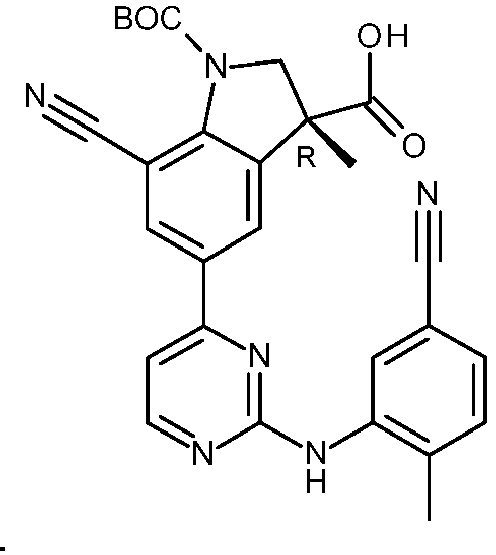
- Intermediate 380 (600.00 mg, 1.21 mmol) was dissolved in a mixture of tert-butyl alcohol (44 mL) and 2-methyl-2-butene (22 mL). Then, distilled water (44 mL) was added, followed by sodium dihydrogenophosphate (2.18 g, 18.20 mmol) and NaO2Cl (2.19 g, 24.26 mmol). The suspension was stirred vigorously at rt overnight. The mixture was poured into NH4Cl and extracted with EtOAc. The organic layer was dried over MgSO4, filtered and the solvent was evaporated to give 619 mg of intermediate 381 (100% yield).
- Preparation of intermediate 382:

- A mixture of EtOH (0.28 mL, 4.85 mmol), intermediate 381 (0.62 g, 1.21 mmol), HATU (0.51 mg, 1.33 mmol), DIPEA (0.52 mL, 3.03 mmol) and DMAP (14.80 mg, 0.12 mmol) in DMF (14.4 mL) was stirred at rt for 24 h. The solution was poured onto water and extracted with EtOAc. The organic layer was washed successively with water and brine, dried over MgSO4, filtered and evaporated to dryness. The residue was purified by column chromatography on silica gel (15-40 µm, 40 g, mobile phase: DCM/MeOH, gradient from 100:0 to 98:2). The pure fractions were combined and evaporated to dryness to give 239 mg of intermediate 382 (37% yield, 98% purity based on LC/MS).
- Preparation of intermediate 383:

- In a round bottom flask, intermediate 382 (0.18 g, 0.34 mmol) was diluted in THF (33 mL). Then, the solution was cooled to 0 °C and methylmagnesium bromide (0.42 mL, 1.36 mmol) was added dropwise. The solution was stirred allowing the temperature to raise rt. Additional methylmagnesium bromide (0.42 mL, 1.36 mmol) was added at rt and the reaction mixture was stirred for an additional 2 h. The mixture was poured into a saturated aqueous solution of NH4Cl and extracted with EtOAc. The organic layer was washed with brine, dried over MgSO4, filtered and the solvent was evaporated. The residue was purified by column chromatography on silica gel (15-40 µm, 24 g, mobile phase: DCM/MeOH, gradient from 100:0 to 95:5). The pure fractions were mixed and the solvent was evaporated to give 178 mg of intermediate 383 (100% yield, 90% purity based on LC/MS).
- Preparation of intermediate 384:

- In a round bottom flask, intermediate 382 (164.00 mg, 0.30 mmol) was dissolved in THF (5.2 mL). Then, the reaction mixture was cooled down to 0 °C and lithium aluminium deuteride (34.72 mg, 0.61 mmol) was added. The mixture was stirred for 1 h at 0 °C. The reaction mixture was quenched with 10% aqueous NaHCO3 and mixed with another batch (from 87 mg of intermediate 382). Then, the mixture was diluted with EtOAc. The organic layer was washed with brine, dried over MgSO4, filtered and the solvent was evaporated. The residue was purified by column chromatography on silica gel (irregular SiOH, 24 g, mobile phase: DCM/MeOH, gradient from 99:1 to 95:5). The fractions containing the product were mixed and concentrated to afford intermediate 384 (168 mg; 72% based on these two batches).
- Preparation of intermediate 385:

- A mixture of compound 1 (4 g; 10.1 mmol), Boc-Glycine (4.4 g; 25.22 mmol), HATU (9.6 g; 25.22 mmol), DIPEA (8.7 mL; 50.45 mmol) and DMAP (67 mg; 0.546 mmol) in DMF (120 mL) was stirred at room temperature for 18 hours. The solution was poured onto ice water. Then, the precipitate was filtered and washed with water. The solid was dissolved in EtOAc. The organic layer was washed with H2O, then brine, dried over MgSO4, filtered and evaporated to dryness. The residue was purified by chromatography over silica gel (irregular SiOH, 120g; mobile phase: 65% Heptane, 5% MeOH (+10% NH4OH), 35% AcOEt). The pure fractions were collected and evaporated to dryness yielding 3.57g (64%) of intermediate 385.
- Preparation of intermediate 386:

- A mixture of compound 1 (2.1 g; 5.30 mmol), Boc-L-Alanine (2.5 g; 13.24 mmol), HATU (5 g; 13.24 mmol), DIPEA (4.5 mL; 26.48 mmol) and DMAP (35 mg; 0.29 mmol) in DMF (63 mL) was stirred at room temperature for 18 hours. The solution was poured onto water and extracted with EtOAc. The organic layer was washed with H2O, then brine, dried over MgSO4, filtered and evaporated to dryness. The residue was purified by chromatography over silica gel (irregular SiOH, 150g; mobile phase: 65% Heptane, 5% MeOH (+10% NH4OH), 35% AcOEt). The pure fractions were collected and evaporated to dryness yielding 2.73g (91%) of intermediate 386.
- The intermediates in the Table below were prepared by using an analogous method as reported for the preparation of intermediates 385 and 386, starting from the respective starting materials.
Intermediate number Structure Mass (mg) Yield (%) Intermediate 387 
438 58 From compound 1 and Boc-L-Valine Intermediate 388 
800 98 From compound 1 and Boc-D-Phenylalanine Intermediate 389 
288 Quantitive From compound 1 and Boc-D-Alanine Intermediate 390 
364 54 From compound 1 and 3-tert-butoxypropanoic acid - Prepration of intermediate 393:

- Lithium aluminium deuteride (263 mg; 6.27 mmol) was added portionwise at 5°C to a solution of methyl-5-amino-2-fluoro-4-methylbenzoate (383 mg; 2.09 mmol) in THF (20 mL) and the reaction mixture was stirred at room temperature for 5h. The reaction mixture was quenched carefully by adding EtOAc and poured onto ice water. Then, more EtOAc was added and the organic layer was decanted, washed with brine, dried over MgSO4, filtered and the solvent was evaporated to give 337 mg (quant.) of a brown solid which was used without without purification in the next step.
- Prepration of intermediate 395:
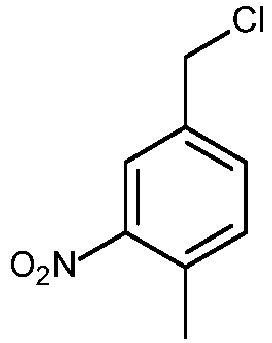
- A mixture of 4-Methyl-3-nitrobenzyl alcohol (2.5g; 14.95 mmol) and thionyle chloride (10 mL) in DCM (40 mL) was stirred at 80°C overnight. The mixture was evaporated in vacuum.
- The crude compound (3g) was purified by silica gel column chromatography (eluent: Petrol ether/ Ethyl acetate: 10/1). The fractions containing the product were evaporated in vacuum to give 2.7g (97%) of intermediate 395 as a yellow solid.
- Prepration of intermediate 396:

- A mixture of intermediate 395 (2.7g; 14.55 mmol) and sodium isopropoxide (8.63g; 105.14 mmol) in isopropanol was stirred at 100°C overnight. Water (100 mL) was added, and the aqueous layer was extracted with ethyl acetate (150 mL∗2). The organic layer was washed by brine (100 mL), dried over Na2SO4, filtered, and evaporated in vacuum.
- The crude compound (3g) was purified by column chromatography over silica gel (eluent: Petrol ether/ Ethyl acetate: 10/1).The fractionscontaining the product were evaporated in vacuum to give 2.1g (69%) of intermediate 396 as clear oil.
- Prepration of intermediate 399:

- To a solution of Methyl 3-amino-4-methylbenzoate (5g; 30.27 mmol) and triethylamaine (4.59g; 45.4 mmol) in DCM (50 mL) was added dropwise acetyl chloride (3.09g; 39.35 mmol) at 0°C. The reaction mixture was stirred at room temperature overnight. An aqueous saturated solution of NaHCO3 (100 mL) was added. The mixture was filtered and the filter cake was washed by water (30 mL∗2) and petroleum ether (30 mL∗2). The cake was dried in vacuum to give 5.6g (88%) of intermediate 399 as a white solid.
- Prepration of intermediate 400:

- To a solution of intermediate 399 (3.4g; 16.24 mmol) in a 1/2 mixture of THF/water (30 mL) was added sodium hydroxide (3.25g; 81.2 mmol) at room temperature.The mixture was stirred at room temperature for 24 hours and poured into a mixture of water (30mL) and ethyl acetate (30mL). The aqueous layer was separated and acidified by HCl (12M) until pH=2. The precipitated solid was filtered and dried to afford 2.7g (86%) of intermediate 400 as white solid.
- Prepration of intermediate 401:

- To a solution of intermediate 400 (2.7g; 13.97 mmol) in THF (20 mL) was added dropwise isobutyl chloroformate (2.3g; 16.8 mmol) at 0°C. Then, DIPEA (5.42g; 41.93 mmol) was added at 0°C. and the mixture was stirred at 0°C for 2 hours.
- The mixture was diluted with ethyl acetate (30mL) and the organic layer was washed with water (15mL∗3). The organic layer was dried (MgSO4), filtered and concentrated to afford 3.87g (94%) of intermediate 401 as a light yellow solid.
- Prepration of intermediate 402:

- To a solution of intermediate 401 (2g; 6.82 mmol) in deuterated methanol (50 mL) was added, slowly at 0°C, sodium borodeuteride (1.43g; 34.1 mmol). The mixture was stirred at room temperature for 30 min. The mixture was concentrated and the residue was purified by column chromatography on silica gel (eluent: petrol/ethyl acetate: from 100:0 to 0:100. The fractions containing the product were collected and the solvent was evaporated to afford 988 mg (80%) of intermediate 402 as a white solid.
- Prepration of intermediate 403:

- The mixture of intermediate 402 (980 mg; 5.41 mmol) and sodium hydroxide (18.2g; 324.45 mmol) in a 4/1 mixture of methanol/water (20 mL) was stirred at 90°C for 48 hours. The mixture was concentrated, diluted with water (20mL) and extracted with ethyl acetate (15mL∗3). The organic layer was dried (MgSO4), filtered and concentrated to afford 650 mg (86%) of intermediate 403 as a light yellow solid.
- Prepration of intermediate 405:

- To a solution of intermediate 399 (1g; 4.82 mmol) in THF (30 mL) was added, dropwise at -78°C under N2, methylmagnesium bromide (3M in Et2O; 8.04 mL; 24.13 mmol). The reaction mixture was stirred at room temperature overnight. A saturated solution of NH4Cl (60 mL) was added and, the reaction mixture was extracted with ethyl acetate (50 mL∗3). The organic layer was washed by brine (50 mL), dried over Na2SO4, filtered, and evaporated in vacuum to give the crude compound.
- The crude compound (0.9g) was purified by column chromatography over silica gel (eluent: Petroleum ether/ Ethyl acetate: 1/3). The fractions containing the product were evaporated in vacuum to give 700mg (70%) of intermediate 405 as white solid.
- Prepration of intermediate 406:

- Intermediate 406 was prepared following a similar procedure than the one used for the preparation of intermediate 403, starting from intermediate 405 (490 mg; 89%; yellow solid).
- Prepration of intermediate 408:

- To a solution of 2-fluoro-4-methylbenzoic acid (1 g; 6.5 mmol) in sulfuric acid (15 mL) was added, dropwise over 3 minutes at 0°C, a mixture of freshly prepared C (0.415 mL) and B (0.44 mL: 10.5 mmol). The mixture was stirred at 0°C for 3 hrs and added cautiously to 66 ml of ice/ice water. The resulting mixture was stirred for 1 hour. The obtained precipitate was filtered and dried under vacuum at 50°C to give 1.26g (98%) of intermediate 408 as a white solid.
- Prepration of intermediate 409:

- Intermediate 408 (1.26 g; 6.32 mmol) was dissolved in THF (15.7 mL). Borane-THF complex (1M; 19 mL; 19 mmol) was added dropwise at 0°C. The mixture was stirred overnight at 50°C. The mixture was quenched with 60 mL of a saturated aqueous NaHCO3 and extracted with ethyl acetate (80 mL∗3). The organic layer was washed with brine (100 mL), dried over MgSO4 and filtered. The solvent was removed under vacuum to give 1.17g (100%) of intermediate 409 as yellow solid.
- Prepration of intermediate 413
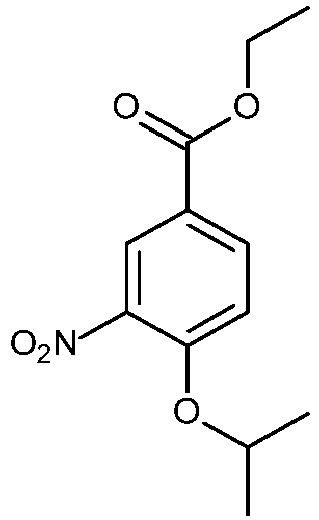

- The residue was purified by flash column chromatography over silica gel (eluent: petroleum ether/ethyl acetate from 100/0 to 60/40). The fractions containing the product were collected and the solvent was concentrated to dryness under vacuum to give 3.2g of an undetermined mixture of intermediates 413 and 414 as yellow solid.
- Prepration of intermediate 415:

- Lithium aluminium hydride (0.7g; 18.44 mmol) was added to a solution of intermediates 413 and 414 (3.2g) in THF (60 mL) at 0°C. The mixture was stirred overnight at rt. At 0°C, water (0.49 ml) was added followed by a 10% aqueous solution NaOH (0.49 ml) and additional water (1.47 ml). The mixture was dried over MgSO4, filtered and the filtrate was concentrated under vacuum. The residue was purified by flash column chromatography over silica gel (eluent: petroleum ether/ethyl acetate from 100/0 to 60/40). The fractions containing the product were collected and the solvent was concentrated to dryness under vacuum to give 420 mg (32%) of intermediate 415 as a yellow oil.
- Prepration of intermediate 416

- A mixture of intermediate 415 (500mg; 2.37 mmol) in methanol (10 mL) was hydrogenated at rt (15 Psi) with platinium on activated charcoal as a catalyst. After uptake of H2 (3 equiv), the mixture was stirred overnight at rt. The catalyst was filtered off and the filtrate was evaporated to give 400 mg (93%) of intermediate 416 as a brown oil.
- Preparation of intermediate 418:

- To a solution of intermediate 417 (340mg; 0.41mmol) in DCM was added trifluoroacetic acid (0.8 mL; 10.45 mmol). The mixture was stirred for 2h at rt, then poured onto water (15 mL) and the pH was adjusted to 10 with a saturated aqueous Na2CO3. The mixture was extracted with DCM (30 mL∗3), dried over MgSO4, filtered and evaporated to give 420mg (59%) of intermediate 418 as yellow solid.
- Preparation of intermediate 419:

- A mixture of intermediate 418 (400 mg; 0.36 mmol) and potassium carbonate (178.5 mg; 1.29 mmol) in methanol (5 mL) was stirred for 30 mn at 80°C. The suspension was filtered through a pad of Celite which was washed with EtOAc (10 mL∗3). The combined filtrates were concentrated to dryness to give 320 mg (95%) of intermediate 419 as a yellow oil.
- Prepration of intermediate 420:

- This reaction was made twice on 5 g of 2-fluoro-4-methylbenzoic acid. A mixture of 2-fluoro-4-methylbenzoic acid (5 g; 32.4 mmol), HATU (13.6 g; 35.7 mmol), and DIPEA (12.3 mL; 71.4 mmol) was stirred in DCM (129 mL) for 30 min and methylamine (17.8 mL g; 35.7 mmol) was added. The mixture was stirred at rt for 5h. The mixture was evaporated. The residue was purified by chromatography over silica gel (15-40 µm, 120 g, eluent: heptane/EtOAc: 80/20 to 10/90). The pure fractions were mixed and the solvent was evaporated to give 9.07 g (84%) of intermediate 420.
- The intermediates in the Table below were prepared by using an analogous method as reported for the preparation of intermediates 420, starting from the respective starting materials. The most relevant minor deviations from the existing procedure are indicated in the column "Mass"
Intermediate number Structure Mass (mg) Yield (%) Intermediate 432 
288 36 from 3-amino-4-methylbenzoic acid and 1-(2-aminoethyl)pyrrolidine Intermediate 434 
126 12 From 3-amino-4-methylbenzoic acid and 2-(4-morpholino)ethylamine Intermediate 436 
700 100 From 3-amino-4-methylbenzoic acid and dimethylamine Intermediate 438 
1530 100 From 3-amino-4-methylbenzoic acid and 2-(4-morpholino)ethylamine. Intermediate 441 
441 Procedure with 2.5 eq. of COMU instead of 1.1 eq. of HATU 53 From 3-amino-4-methylbenzoic acid and 1-methylpyrrolidin-3-amine Intermediate 443 
356 66 From 2-fluoro-4-methylbenzoic acid and methylamine Intermediate 445 
773 100 From 2-fluoro-4-methylbenzoic acid and 1-methylpyrrolidin-3-amine Intermediate 450 
554 77 From 2-fluoro-4-methylbenzoic acid and 3-aminotetrahydrofuran hydrochloride Intermediate 495 
900 76 From oxetan-3-ylmethanamine and intermediate 494 Intermediate 521a 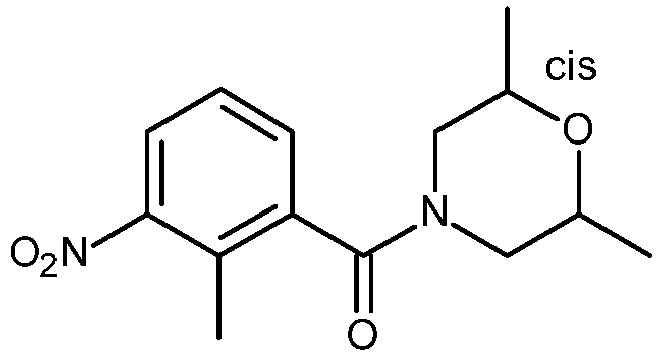
1500 98 From 2-methyl-3-nitrobenzoic acid and cis-2,6-dimethylmorpholine - Preparation of intermediate 421:

- A mixture of fuming nitric acid (3.3 mL; 79.28 mmol) in sulfuric acid (4 mL) was added dropwise at 5°C over 3 minutes (ice bath) to a solution of intermediate 420 (9 g; 53.83 mmol) in sulfuric acid (120 mL) [no exothermicity]. The reaction mixture was stirred at 5°C for 3 hours and quenched precautionously with ice/ice-water (500 mL) at 0-5°C. The mixture was vigorously stirred for 1h. The precipitate was filtered, washed with ice-water (3 x 300 mL) and dried. The obtained solid was solubilized with DCM and the organic layer was dried over MgSO4, filtered and the solvent was evaporated to give 10.47 g (92%) of intermediate 421 as a white solid.
- Prepration of intermediate 424:

- A mixture of 2,4-difluorobenzoic acid (2 g; 12.65 mmol), HATU (5.3 g; 13.915 mmol), and DIPEA (4.8 mL; 27.83 mmol) in DCM (50 mL) was stirred for 30 min and 2N methylamine in THF (7 mL; 13.915 mmol) was added. The reaction mixture was stirred at room temperature for 18 hours, poured onto water and extracted with DCM. The organic layer was decanted, filtered through chromabond® and evaporated to dryness. The residue was purified by chromatography over silica gel (irregular SiOH, 40g; gradient: 20% EtOAc, 80% heptane to 40% EtOAc, 60% heptane). The pure fractions were collected and evaporated to dryness yielding 1.68 g (77%) of intermediate 424.
- Prepration of intermediate 425:

- A mixture of fuming nitric acid (0.6 mL; 14.456 mmol) in concentrated sulphuric acid (1 mL) was added dropwise at 5°C to a solution of intermediate 424 (1.68 g; 9.816 mmol) in concentrated sulphuric acid (21 mL). The reaction mixture was stirred at 5°C for 4 hours and poured onto ice water. The suspension was stirred at room temperature for 30 min and the precipitate was filtered, washed with water and dried yielding 1.38 g (65%) of intermediate 425.
- The intermediates in the Table below were prepared by using an analogous method as reported for the preparation of intermediates 425, starting from the respective starting materials.
Intermediate number Structure Mass (mg) Yield (%) Intermediate 446 
638 70 From intermediate 445 Intermediate 451 
426 65 From intermediate 450 Intermediate 489 
354 53 From intermediate 488 - Prepration of intermediate 426


- Prepration of intermediate 428


- Preparation of intermediate 455:

- To a solution of 2-bromo-4-methylbenzonitrile (4.0 g; 20.40 mmol) in sulfuric acid (6 mL) at 0°C was added potassium nitrate (2.063 g; 20.40 mmol) in sulfuric acid (18 mL). After stirring at 0°C for 1.5 hour, the reaction mixture was poured into 500 mL of ice water. The precipitate was collected by filtration and washed with copious amounts of water. The precipate was dried to give 4.5 g (91%) of intermediate 455.
- Preparation of intermediate 456:

- A mixture of intermediate 455 (500 mg; 2.07 mmol), N-boc-propargylamine (483 mg; 3.11 mmol), tri-tert-butylphosphine (0.0287 mL; 0.122 mmol), diisopropylamine (0.33 mL; 2.41 mmol), copper (I) iodide (4.7 mg; 0.024 mmol) and dichlorobis(triphenylphosphine)palladium (57 mg; 0.081 mmol) in 1,4-dioxane (8.8 mL) was purged with N2 three times and was heated at 45°C for 1h. The mixture was poured into ice and extracted with EtOAc. The organic layer was washed with brine, dried over MgSO4, filtered and the solvent was evaporated. The residue was purified by chromatography over silica gel (80 g; 15-40 µm, eluent: heptane/EtOAc: 100/0 to 0/100). The pure fractions were mixed and the solvent was evaporated to give 0.594 g (91%) of intermediate 456.
- Preparation of intermediate 457:

- A mixture of intermediate 456 (555 mg; 1.76 mmol) and Pd (10%) on activated charcoal (187 mg) in EtOAc (11 mL) was hydrogenated at rt under 1 bar of H2 overnight. The mixture was filtered over celite and the filtrate was evaporated until dryness to give 0.352 g (69%) of intermediate 457.
- Preparation of intermediate 465:

- A mixture of intermediate 455 (0.5 g; 2.074 mmol), 2-vinyl-4,4,5,5-tetramethyl-1,3,2-dioxaborolane (0.528 mL; 3.11 mmol) and tetrakis(triphenylphosphine)palladium(0) (120 mg; 0.104 mmol) in 2N Na2CO3 (1.82 mL; 3.63 mmol) and 1,4-dioxane (5.2 mL) was degassed and then heated at 100°C overnight. The mixture was poured into ice and extracted with EtOAc. The organic layer was washed with brine, dried over MgSO4, filtered and the solvent was evaporated. The residue was purified by chromatography over silica gel (80 g, 15-40 µm, eluent: heptane/EtOAc: 100/0 to 0/100). The pure fractions were mixed and the solvent was evaporated to give 0.181 g (46%) of intermediate 465.
- Preparation of intermediate 466:

- A mixture of intermediate 465 (250 mg; 1.33 mmol) and morpholine (821 mg; 6.64 mmol) in MeOH (4.7 mL) was stirred at 60°C for 1 h in a sealed tube. The mixture was poured into ice and extracted with DCM. The organic layer was washed with brine, dried over MgSO4, filtered and the solvent was evaporated. The residue was purified by chromatography over silica gel (15-40 µm, 24 g, eluent: DCM/MeOH: 100/0 to 95/5). the pure fractions were mixed and the solvent was evaporated to give 0.329 g (90%) of intermediate 466.
- Preparation of intermediate 469:

- Intermediate 469 was prepared using an analogous method as the one used for the preparation of intermediate 466, starting from intermediate 465 and 3-fluoroazetidine hydrochloride (247 mg; 67%).
- Preparation of intermediate 472:

- A mixture of intermediate 455 (500 mg; 2.07 mmol), 1-methyl-1,2,3,6-tetrahydropyridine-4-boronic acid pinacol ester (509 mg; 2.28 mmol) and potassium phosphate (881 mg; 41.5 mmol) in 1,4-dioxane (7 mL) and water (4 mL) was degassed with N2. 1,1'-Bis (diphenylphosphino) ferrocene- palladium(ii) dichloride dichloromethane (17 mg; 0.0207 mmol) was added and the reaction mixture was heated at 120°C for 15 min using one single mode microwave (Biotage Initiator EXP 60) with a power output ranging from 0 to 400 W. The mixture was poured onto water and extracted with DCM. The organic layer was washed with brine, dried over MgSO4, filtered and evaporated to dryness. The residue was purified by chromatography over silica gel (irregular SiOH, 80 g; mobile phase: DCM/MeOH: 100/0 to 95/5). The fractions containing the product were collected and evaporated to dryness to give 0.515 g (96%) of intermediate 472.
- Preparation of intermediate 475:

- Intermediate 475 was synthesized by using the same method than the one used for the preparation of intermediate 472 starting from intermediate 455 and tert-butyl 3-(4,4,5,5-tetramethyl-1,3,2-dioxaborolan-2-yl)-5,6-dihydropyridine-1(2H)-carboxylate (1.45g; 93%).
- Preparation of intermediate 473:

- A solution of intermediate 472 (0.478 mg; 1.86 mmol) in MeOH (21.9 mL) was hydrogenated under 2 bars of H2 at rt in presence of 10% palladium on activated charcoal (54.8 mg) overnight. The mixture was filtrered off over celite and the filtrate was evaporated. The residue was purified by chromatography over silica gel (40 g, 15-40 µm, eluent: DCM/MeOH: 100/0 to 90/10). The fractions containing the product were mixed and the solvent was evaporated to give 0.155 g (36%) of intermediate 473.
- Preparation of intermediate 476:

- TFA (4.4 mL; 58 mmol) was added to a solution of intermediate 475 (1.45 g; 4.22 mmol) in DCM (22 ml) and the mixture stirred for 30 mins, then poured into ice, basified with K2CO3 and extracted with DCM. The organic layer was washed with brine, dried over MgSO4, filtered and the solvent was evaporated yielding 0.89g (87%) of intermediate 476.
- Preparation of intermediate 477:

- Formaldehyde (0.54 mL; 7.24 mmol) was added to a solution of intermediate 476 (0.873 g; 3.59 mmol) and sodium acetate (0.295 g; 3.6 mmol) in MeOH (30 ml) and DCM (15 ml) and the mixture stirred at room temperature for 5 minutes. Sodium triacetoxyborohydride (1.53 g; 7.19 mmol) was then added and the mixture was stirred for 1h. The mixture was poured into ice, basified with K2CO3 and extracted with DCM. The organic layer was washed with brine, dried over MgSO4, filtered and the solvent was evaporated. The residue was purified by chromatography over silica gel (15-40 µm, 80 g, eluent: DCM/MeOH: 100/0 to 90/10). The pure fractions were mixed and the solvent was evaporated to give 1.15 g (99%) of intermediate 477.
- Preparation of intermediate 478:

- Intermediate 478 was synthesized by using ananlogous method than the one used for the preparation of intermediate 473 starting from intermediate 477 (1.04g; 84% of purity based on LC/MS).
- Preparation of intermediate 488:

- A mixture of intermediate 40 (575 mg; 2.816 mmol) in concentrated HCl (11 mL) was heated at 100°C for 5 hours. The reaction mixture was cooled to room temperature, poured onto iced water and extracted with Et2O. The organic layer was decanted, dried over MgSO4, filtered and evaporated to dryness yielding 632 mg of intermediate 488.
- Preparation of intermediate 492:

- A solution of potassium nitrate (2.46g; 0.024 mol) in concentrated sulfuric acid (36 ml) was added dropwise at a temperature below 5°C to a solution of 3-bromo-4-fluorotoluene (2.52 mL; 0.02 mol) in concentrated sulfuric acid (4 ml). The mixture was stirred at 5°C for 2 hours, then, poured onto ice water. The obtained precipitate was filtered and dried yielding 3.94g (84%) of intermediate 492.
- Preparation of intermediate 493:

- Into an autoclave (300 mL) purged with N2 was added intermediate 492 (2.93 g; 12.5 mmol) in MeOH (117 mL). Triethylamine (3.58 mL; 25 mmol) was added then 1,1'-bis(diphenylphosphino)ferrocene]palladium(II) dichloride (0.615 g; 0.751 mmol). The autoclave was purged and the mixture was stirred overnight under 30 bars of carbon monoxyde at 90°C. The mixture was evaporated. The residue was purified by chromatography over silica gel (15-40 µm, 90 g, eluent: heptane/EtOAc: 100/0 to 0/100). The pure fractions were mixed and the solvent was evaporated to give 1.22 g (28%) of intermediate 493.
- Preparation of intermediate 494:

- A solution of lithium hydroxide (0.9 g; 21.4 mmol) in water (4.4 mL) was added to a solution of intermediate 494 (0.982 g; 5.36 mmol) in THF (47 mL). The reaction mixture was refluxed overnight. The mixture was poured into ice, acidified with aqueous 3N HCl and extracted with EtOAc. The organic layer was washed with brine, dried over MgSO4, filtered and the solvent was evaporated yielding 907 mg of intermediate 494 directly engaged in the next step.
- Preparation of intermediate 497:
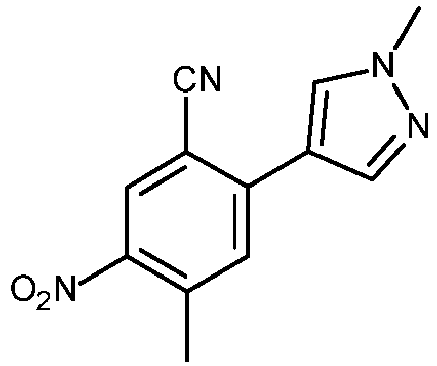
- In a sealed tube, a solution of 2-bromo-4-methyl-5-nitro-benzonitrile (1.0 g; 4.15 mmol), 1-methyl-4-(4,4,5,5-tetramethyl-1,3,2-dioxaborolan-2-yl)-1H-pyrazole (1.29 g; 6.22 mmol) and K3PO4 (2.64 g ; 12.44 mmol) in 1,4-dioxane (30.8 mL) and distilled water (9.7 mL) was purged with N2. PdCl2dppf (340 mg; 415 µmol) was added, the reaction mixture was purged again with N2 and heated at 80 °C for 18h.The reaction mixture was poured into an aqueous solution of K2CO3 and extracted with EtAOc. The organic layer was dried over MgSO4, filtered and evaporated until dryness. The residue was purified by chromatography over silica gel (irregular SiOH, 40g; mobile phase: gradient from 0% EtOAc, 100% heptane to 40% EtOAc, 60% heptane). The fractions were collected and evaporated to dryness yielding 800 mg (80%) of intermediate 497.
- The compounds in the table below were prepared using analogous method as described for intermediate 497 starting from the respective starting materials.
Intermediate number Structure Quantity Yield Intermediate 498 
170 mg 52% From 5-bromo-1-methyl-1H-imidazole and 4,4,5,5-tetramethyl-2-(4-methyl-3-nitrophenyl)-1,3,2-Dioxaborolane - Intermediate 499:

- A mixture of intermediate 497 (800 mg; 3.30 mmol) and Pd/C (10% wt; 176 mg) in MeOH (8.3 mL) was stirred at room temperature under 1 atm. of H2 overnight. The reaction mixture was filtered over celite® and the filtrate was evaporated to dryness yielding 700 mg of intermediate 499.
- The compounds in the table below were prepared using analogous method as described for the preparation of intermediate 499, starting from the respective starting materials.
Intermediate number Structure Quantity Yield Intermediate 500 
147 mg 100% From intermediate 498 Intermediate 500B 
700 mg 93% From intermediate 500A Intermediate 501 
1.4 g 87% From 2-(4-methyl-3-nitrophenyl)-1H-imidazole - Intermediate 500A:
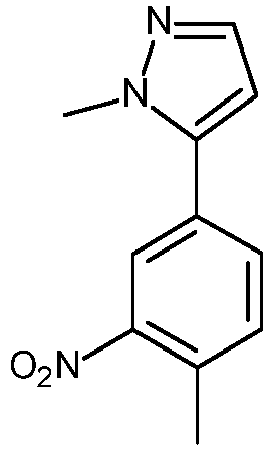
- A mixture of 2-nitro-4-bromo toluene (1g; 4.629 mmol), 1-Methyl-1H-pyrazole-5-boronic acid (874 mg; 6.94 mmol), K2CO3 (1.024 g; 7.406 mmol), PdCl2dppf (339 mg; 0.463 mmol) in DMF (19 mL) was stirred at 85 °C for 18 h. The reaction mixture was evaporated. The residue was dissolved with EtOAc. The organic layer was washed with water then brine, dried over MgSO4, filtered and evaporated to dryness.
- The residue was purified by chromatography over silica gel (mobile phase: gradient from 0% EtOAc, 100% heptane to 30% EtOAc, 70% heptane). The fractions were collected and evaporated to dryness yielding 870 mg (87%) of intermediate 500A.
- Intermediate 510:

- A solution of lithium aluminium hydride 1M in THF (1.5 mL; 1.56 mmol) was added drop wise at 0°C to a solution of 3-amino-5-cyano-2-methyl-benzoic acid methyl ester (297 mg; 1.56 mmol) in THF (10 mL) and the reaction mixture was stirred at room temperature for 3 hours. The reaction mixture was poured onto iced water and extracted with EtOAc. The organic layer was decanted, washed with brine, dried over MgSO4, filtered and evaporated to dryness yielding 216 mg (85%) of intermediate 510.
- Intermediate 512:

- A mixture of intermediate 510 (341 mg; 2.10 mmol) and manganese dioxide (913 mg; 10.51 mmol) in 1,4-dioxane (20 mL) was heated at 100°C for 6 hours. The reaction mixture was cooled to room temperature, diluted with DCM, filtered through a pad of celite® and evaporated to dryness yielding 300 mg (89%)of intermediate 512 which was directly engaged in the next step.
- The compounds in the table below were prepared using analogous method as described for the preparation of intermediate 512 starting from the respective starting materials. The most relevant minor deviations from the original method are indicated in the column "Quantity"
Intermediate number Structure Quantity Yield Intermediate 515 
120 mg Prodedure modification: 18h@100°C 42% From intermediate 511 - Preparation of intermediate 513:

- A mixture of intermediate 512 (551 mg; 3.44 mmol), cis-2,6-dimethylmorpholine (847 µL; 6.88 mmol) and AcOH (387 µL; 6.76 mmol) in DCM (20 mL) was stirred at room temperature for 1 hour. Then sodium triacetoxyborohydride (1.45 g; 6.88 mmol) was added. The reaction mixture was stirred at room temperature over the weekend. The reaction mixture was poured onto a 10% aqueous solution of K2CO3 and extracted with DCM. The organic layer was decanted, filtered through chromabond® and evaporated to dryness. The residue was purified by chromatography (irregular SiOH, 24g; mobile phase: gradient from 20% EtOAc, 80% heptane to 40% EtOAc, 60% heptane). The pure fractions were collected and evaporated to dryness yielding 632 mg (52%, purity 73% based on LC/MS) of intermediate 513 which was directly engaged in the next step.
- The compounds in the table below were prepared using analogous method as described for the preparation of intermediate 513, starting from the respective starting materials.
Intermediate number Structure Quantity Yield Intermediate 516 
100 mg 55% From intermediate 515 and 3-fluoroazetidine hydrochloride Intermediate 517 
106 mg Purity 81% (LCMS) 31% From intermediate 515 and 3,3-difluoroazetidine - Preparation of intermediate 519:

- Lithium aluminium deuteride (203 mg; 4.832 mmol) was added portion wise at 5°C to a solution of intermediate 521b (400 mg; 1.61 mmol) in THF (16 mL) and the reaction mixture was stirred at room temperature for 3 days. The reaction mixture was quenched carefully by adding EtOAc and poured onto ice water and more EtOAc was added. The organic layer was decanted, washed with brine, dried over MgSO4, filtered and evaporated to dryness. The residue was purified by chromatography over silica gel (irregular SiOH, 12g; mobile phase: gradient from 0% MeOH, 100% DCM to 5% MeOH, 95% DCM). The pure fractions were collected and evaporated to dryness yielding 286 mg (75%) of intermediate 519.
- Preparation of intermediate 523:

- A mixture of 1-Boc-piperazine (5 g; 26.845 mmol), iodomethane-D3 (1.7 mL; 26.845 mmol) and potassium carbonate (11 g; 80.54 mmol) in ACN (200 mL) was heated to 85°C for 18 h. The suspension was filtered and the insoluble material was washed with EtOAc. The combined filtrates were evaporated to dryness. The residue was taken up with DCM and the insoluble material was filtered. The filtrate was concentrated and purified by chromatography over silica gel (irregular SiOH, 40g; mobile phase: gradient from 5% MeOH, 95% DCM to 10% MeOH, 90% DCM). The pure fractions were collected and evaporated to dryness yielding 3.25 g (59%) of intermediate 523.
- Preparation of intermediate 524:

- A solution of HCl 4N in 1,4-dioxane (11 mL; 44.27 mmol) was added to a solution of intermediate 523 (3 g; 14.757 mmol) in ACN (70 mL) and the reaction mixture was stirred for 18 hours. The precipitate was filtered, washed with ACN, then Et2O and dried yielding 2.54 g (98%) of intermediate 524.
- Preparation of intermediate 525:

- A solution of chloro tert-butyldimethyl silane (391 mg; 2.59 mmol) in DCM (1.7 mL) was added drop wise at 5°C to a solution of 2,4-difluoro-5-nitro-benzenemethanol (490 mg; 2.59 mmol) and Et3N (720 µL; 5.18 mmol) in DCM (3 mL) and the reaction mixture was stirred at room temperature overnight.
- Alternativatively, the same reaction was perform using the same conditions starting from of 2,4-difluoro-5-nitro-benzenemethanol (500 mg; 2.644 mmol) and trifluoromethanesulfonic acid tert-butyldimethylsilyl ester (0.607 mL; 2.64 mmol) The two reaction mixtures were combined for the work-up:
DCM was added and the suspension was poured onto a saturated aqueous solution of NH4Cl. The organic layer was decanted, washed with water then with a 10% aqueous solution of K2CO3, dried over MgSO4, filtered and evaporated to dryness. The residue was purified by chromatography over silica gel (irregular SiOH, 40 g; mobile phase: gradient from 10% EtOAc, 90% heptane to 30% EtOAc, 70% heptane). The pure fractions were collected and evaporated to dryness yielding 858 mg of intermediate 525 (quantitative). - Preparation of intermediate 526:

- A mixture of intermediate 525 (858 mg; 2.83 mmol), cyclopropanol (717 µL; 11.3 mmol) and cesium carbonate (1.84 g; 5.66 mmol) in 1,4-dioxane (9.5 mL) was heated at 100°C for 2h. The reaction mixture was heated at 100°C overnight, cooled to room temperature and diluted with DCM. Water was added and the reaction mixture was extracted with DCM (three times). The combined organic layers were washed with water, dried over MgSO4, filtered and evaporated to dryness. The residue was purified by chromatography over silica gel (irregular SiOH, 40 g; mobile phase: gradient from 10% EtOAc, 90% heptane to 20% EtOAc, 80% heptane). The pure fractions were collected and evaporated to dryness yielding 581 mg (60%) of intermediate 526.
- The intermediate in the table below was prepared using analogous method as described for the preparation of intermediate 526 starting from the respective starting material. The most relevant minor deviation from the original procedure is indicated in the column "yield"
Intermediate number Structure Quantity Yield Intermediate 529 
790 mg 65% Proced ure modifi cation: 1h@80°C From 2,4-difluoro-5-nitrobenzonitrile - Preparation of intermediate 527:

- A mixture of intermediate 526 (527 mg; 1.543 mmol), iron powder (431 mg; 7.717 mmol) and NH4Cl (330 mg; 6.174 mmol) in EtOH (10 mL) and distilled water (2.5 mL) was heated at 70°C for 1 hour. The reaction mixture was cooled down to room temperature, diluted with DCM, filtered over celite® and basified with a 10% aqueous solution of K2CO3. The organic layer was decanted, dried over MgSO4, filtered and evaporated to dryness yielding 485 mg (quantitative) of intermediate 527 directly engaged in the next step without any further purification.
- The intermediate in the table below weas prepared using analogous method as described for the preparation of intermediate 527 starting from the respective starting material.
Intermediate number Structure Quantity Yield Intermediate 530 
670 mg 98% From intermediate 529 - Preparation of intermediate 532:

- In a dried flask, zinc (4.05g; 62 mmol) was suspended in dried dimethylacetamide (200 mL) under N2. The suspension was warmed to 65°C, and then dibromoethane (0.45g; 2.39mmol) and chlorotrimethylsilane (0.207g; 1.91mmol) were added, and then stirred at 65°C for 0.5 hour. 1-tert-Butoxycarbonyl-3-iodoazetidine (13.5g; 47.68mmol) in dimethylacetamide (100 mL) was added dropwise at 65°C and the reaction mixture was stirred at room temperature for 1 hour. The crude product was directly used without work-up and purification for the next reaction step.
- Preparation of intermediate 533:

- A mixture of 4-bromo-1-methyl-2-nitrobenzene (6.06g; 28.08 mmol), intermediate 532 (16.62g; 47.68 mmol), Pd(dppf)Cl2.DCM (703mg; 0.86 mmol) and copper (I) iodide (323.7mg; 1.7mmol) in dimethylacetamide (300 mL) was stirred at 90°C overnight under N2. Water (900 mL) was added and the reaction mixture was extracted with ethyl acetate (600 mL∗2). The organic layers wer combined, washed with water, brine, dried over Na2SO4, filtered, and evaporated in vacuum. The crude intermediate (8g) was purified by column chromatography over silica gel (eluent: Petrol ether/ Ethyl acetate=3/1). The fractions containing the product were mixed and evaporated in vacuum to give 5g of intermediate 533 (61%) as a yellow oil.
- Preparation of intermediate 534:

- A solution of intermediate 533 (5g; 17.1mmol) and HCl 4M in dioxane (50 mL; 200 mmol) in dioxane (20mL) was stirred at room temperature overnight. The mixture was evaporated in vacuum to give 3.91g of crude intermediate 534 which was directly engaged in the next reaction step without any further purification.
- Preparation of intermediate 535:
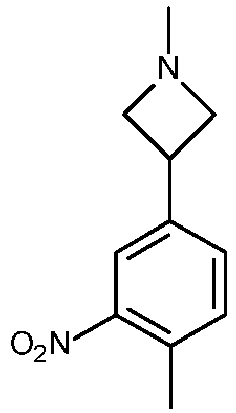
- A mixture of intermediate 534 (3.9 g; 17.10 mmol), paraformaldehyde (3 g; 102.62 mmol) and sodium acetate (1.4 g; 17.10 mmol) in MeOH (150 mL) was stirred at room temperature for 2 hours. Sodium triacetoxyborohydride (21.7 g; 102.62 mmol) was added and the reaction mixture was stirred at room temperature overnight. The reaction mixture was slowly basified with a saturated aqueous solution of NaHCO3 (400 mL) and extracted with DCM (2 X 300 mL). The organic layer was washed by brine, dried over Na2SO4, filtered, and evaporated to dryness. The residue was purified by chromatography over silica gel (mobile phase: petrol ether/ EtOAc (1/2)). The desired fractions were evaporated to dryness yielding 1.58g (45%) of intermediate 535.
- Preparation of intermediate 536:
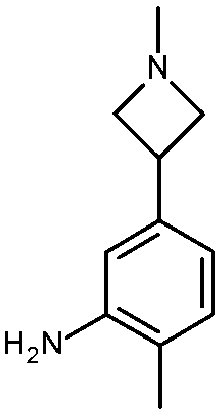
- Intermediate 535 (1.58g; 7.66 mmol) was dissolved in THF (20 mL), MeOH (10 mL) and distilled water (10 mL). Iron powder (2.1g; 38.35 mmol) and NH4Cl (2g; 38.30 mmol) were added. The reaction mixture was refluxed overnight, filtered through celite® and the filter cake was washed with 80 mL of a mixture EtOAc/MeOH (8/1). The filtrate was evaporated to dryness. The residue was purified by chromatography over silica gel (mobile phase: EtOAc/ MeOH (5/1)). The desired fractions were evaporated to dryness yielding 880 mg (65%) of intermediate 536.
- Alternative preparation of intermediate 380:

- DCM (5 mL) was cooled to -78°C and oxalyl chloride (3 mL; 6.04 mmol) was added followed by DMSO (865 µL; 12.1 mmol). After 30 min, a suspension of intermediate 10R (2 g; 4.03 mmol) in DCM (15 mL) was added drop wise. The reaction mixture was stirred for 30 min at -78°C, then DIPEA (4.1 mL; 24.17 mmol) was added. The stirring was continued for 3 hours at -78°C and the reaction mixture was allowed to warm to room temperature and stirred for 30 min. A diluted aqueous solution of NH4Cl was added and the aqueous layer was extracted with DCM (twice). The combined layers were dried over MgSO4, filtered and evaporated to dryness. The residue was crystallized from Et2O and the precipitate was filtered, washed with DiPE and dried yielding 2 g of intermediate 380.
- Preparation of intermediate 540:

- A solution of intermediate 380 (2 g; 4.044 mmol), 2,4-dimethoxybenzylamine (3.6 mL; 24.26 mmol) and AcOH (1.4 mL; 24.26 mmol) in DCE (100 mL) was stirred for 3 hours and NaBH(OAc)3 (8.5 g; 40.44 mmol) was added. The reaction mixture was stirred at room temperature overnight. A saturated aqueous solution of NaHCO3 was added and the aqueous layer was extracted with DCM. The organic layer was dried over MgSO4, filtered and evaporated to dryness. The residue was purified by chromatography over silica gel (irregular SiOH, 80g; mobile phase: gradient from 40% EtOAc, 60% heptane to 2% MeOH, 60% EtOAc, 40% heptane). The fractions containing the product were collected and evaporated to dryness yielding 1 g (38%) of intermediate 540 and 855 mg of intermediate 380.
- Preparation of intermediate 541:

- A mixture of intermediate 540 (500 mg; 0.77 mmol), acetyl chloride (66 µL; 0.93 mmol) and Et3N (215 µL; 1.55 mmol) in THF (10 mL) was stirred at room temperature for 18 hours. The reaction mixture was poured onto a 10% aqueous solution of K2CO3 and extracted with DCM. The organic layer was decanted, dried over MgSO4, filtered and evaporated to dryness. The residue was purified by chromatography over silica gel (irregular SiOH, 24g; mobile phase: gradient from 0% MeOH, 100% DCM to 6% MeOH, 94% DCM). The fractions containing the product were collected and evaporated to dryness yielding 540 mg (quantitative) of intermediate 541.
- Preparation of intermediate 542:

- A mixture of intermediate 540(415 mg; 0.64 mmol), methanesulfonyl chloride (74 µL; 0.96 mmol) and Et3N (223 µL; 1.61 mmol) in THF (8 mL) was stirred at room temperature for 18 hours. The reaction mixture was poured onto a 10% aqueous solution of K2CO3 and extracted with DCM. The organic layer was decanted, dried over MgSO4, filtered and evaporated to dryness. The residue was purified by chromatography over silica gel (irregular SiOH, 40g; mobile phase: 0.1% NH4OH, 99.5% DCM, 0.5% MeOH). The fractions containing the product were collected and evaporated to dryness yielding 318 mg (68%) of intermediate 542.
- Preparation of intermediate 543:
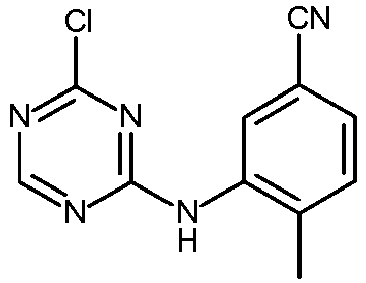
- DIPEA (1 mL; 5.8 mmol) was added to a solution of 3-amino-4-methylbenzonitrile (661 mg; 5 mmol) and 2,4-dichloro-1,3,5-triazine (750 mg; 5 mmol) in ACN (30 mL). The reaction mixture was stirred overnight at room temperature. The solvent was removed by evaporation and the residue was partionned between water and EtOAc. The organic layer was decanted, washed with water, then brine, dried over MgSO4, filtered and evaporated to dryness. The residue was purified by chromatography over silica gel (irregular SiOH; mobile phase: gradient from 0% EtOAc, 100% petroleum ether to 50% EtOAc, 50% petroleum ether). The fractions containing the product were collected and evaporated to dryness yielding 700 mg (57%) of intermediate 543.
- The intermediate in the table below was prepared using analogous method as described for the preparation of intermediate 243, starting from the respective starting materials. The most relevant minor deviation from the original method is indicated in the column "Quantity"
Intermediate number Structure Quantity Yield Intermediate 546 
740 mg Procedure with acetone as solvent in place of ACN 40% From 3-amino-N,4-dimethylbenzamide and 2,4-dichloro-1,3,5-triazine - Preparation of intermediate 544:

- A solution of intermediate 5R (1.58 g; 3 mmol), intermediate 243 (663 mg; 2.7 mmol) and aqueous 2M NaHCO3 (6 mL ; 12 mmol) in 1,4-dioxane (24 mL) was purged with N2. PdCl2dppf (219 mg; 0.3 mmol) was added, the reaction mixture was purged again with N2 and heated at 80°C for 10h. The reaction mixture was poured into water and extracted with EtOAc. The organic layer was dried over MgSO4, filtered and evaporated until dryness. The residue was purified by chromatography over silica gel (irregular SiOH; mobile phase: gradient from 0% EtOAc, 100% petroleum ether to 50% EtOAc, 50% petroleum ether). The fractions were collected and evaporated to dryness yielding 600 mg (32%) of intermediate 544.
- The intermediate in the table below was prepared using analogous method as described for the preparation of intermediate 544, starting from the respective starting materials.
Intermediate number Structure Quantity Yield Intermediate 547 
560 mg 46% From intermediate 5R and intermediate 546 - Preparation of intermediate 549:

- To a solution of 2-Amino-3-bromobenzonitrile (30.0 g) in THF (240 mL) was added sodium tert-butoxide (1.1 eq.) and the mixture was stirred at -5 to 5°C for 1 hour. A solution of intermediate 3a in THF (85.0 g) was then added dropwise and the mixture was stirred for 2-4 hours monitoring the conversion by High Performance Liquid Chromatography (HPLC). Water (210 mL) was then added dropwise and the mixture was concentrated to remove most of THF. Heptane (300 mL) was then added and the mixture was stirred for 30 min. After phase separation, the organic layer was washed with water (210 mL), concentrated to 2-3 volumes and filtered through a pad of silica gel (60 g), washing the pad with heptane (300 mL), affording 63.3g of intermediate 549.
- Preparation of intermediate 550:

- To a solution of intermediate 549 (50.0 g) in dry THF (500 mL) was added dimethylaminopyridine (0.5 eq.) and the temperature was adjusted to 65-70 °C. Di-tert-butyldicarbonate (2.2 eq.) was then added and the mixture was stirred for 2 hours monitoring the conversion by HPLC. Water (350 mL) was added and the mixture was concentrated to 350-400 mL. Heptane (500 mL) was added and the pH was adjusted by addition of 20% aqueous AcOH to 4-6. The layers were separated and water (350 mL) was added. After pH adjustment to 7-8 with aqueous 8% NaHCO3, the layers were separated and the organic layer was washed with water (350 mL) and concentrated to afford 64g (quantitative) of intermediate 550 .
- Preparation of intermediate 553


- Methanesulfonyl chloride (377 µL; 4.87 mmol) was added dropwise to a solution of intermediate 8 (1.5 g; 2.44 mmol) and Et3N (848 µL; 6.09 mmol) in DCM (24 mL) at 5°C under N2 flow. The reaction mixture was stirred at 5°C for 1 h, and then 2 h at room temperature. The reaction mixture was poured out into ice water and DCM was added. The organic layer was filtered through CHROMABOND® and the solvent was evaporated (30°C) to give 1.86 g of orange foam intermediate 553 and intermediate 554. The crude product was used without further purification in the next reation step.
- Preparation of intermediate 555

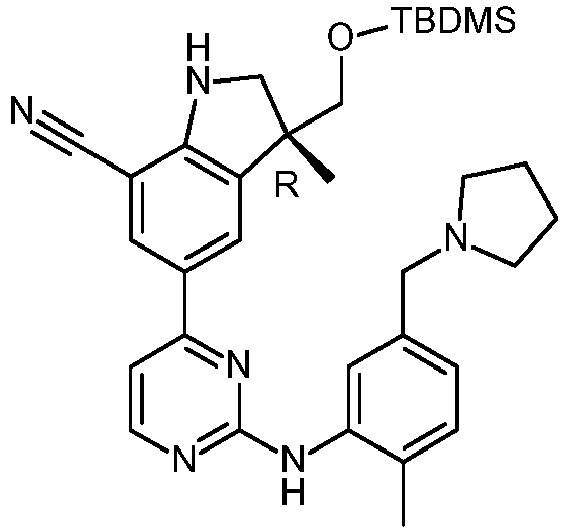
- In a sealed tube, a mixture of intermediate 553 and intermediate 554 (269 mg; 0.39 mmol), pyrolidine (0.32 mL; 3.88 mmol) in ACN (2 mL) was heated at 140°C using one single mode microwave (Anton Parr®) with a power output ranging from 0 to 400 W for 1 h. The mixture was poured into water and EtOAc. The organic layer was washed with water, brine, dried over MgSO4, filtered and evaporated to dryness. The residue (160 mg, yellow oil) was purified by chromatography over silica gel (irregular bare silica 40 g, mobile phase: 0.4% NH4OH, 96% DCM, 4% MeOH). The fractions containing the products were collected and the solvent was evaporated to give 59 mg of intermediate 555 (23%) and 39 mg of mixture of intermediate 555 and intermediate 556. The two fractions were combined for the next reaction step.
- Preparation of intermediate 560


- In a sealed tube, a mixture of intermediate 553 and intermediate 554 (850 mg; 1.23 mmol), 3,3-difluoroazetidine hydrochloride (476 mg; 3.68 mmol) and DIPEA (844 µL; 4.9 mmol) in ACN (10 mL) was heated at 140°C using one single mode microwave (Anton Parr) with a power output ranging from 0 to 400 W for 1h fixed hold time. The mixture was poured into water and EtOAc. The organic layer was washed with brine, dried over MgSO4, filtered and evaporated to dryness. The residue (1.05 g; orange oil) was purified by chromatography over silica gel (irregular bare silica 40 g; mobile phase: 99% DCM, 1% MeOH). The fractions containing the products were collected and the solvent was evaporated to give 555 mg of mixture of intermediate 560 and intermediate 561.
- Preparation of intermediate 562


- Intermediate 562 and intermediate 563 were prepared according to an analogous procedure as described for the synthesis of a mixture of intermediate 560 and intermediate 561, using a mixture of intermediate 553 and intermediate 554 and 3-fluoroazetidine hydrochloride as starting materials (289 mg; yellow oil mixture of intermediate 562 and intermediate 563).
- Preparation of intermediate 557


- Intermediate 557 and intermediate 558 were prepared according to an analogous procedure as described for the synthesis of a mixture of intermediate 555 and intermediate 556, using a mixture of intermediate 553 and intermediate 554 and 2-methoxyethylamine as starting materials (485 mg).
- Preparation of intermediate 559


- Intermediate 559 (145 mg; 10%) and intermediate 559bis (168 mg; 10%) was prepared according to an analogous procedure as described for the synthesis of a mixture of intermediate 555 and intermediate 556, using a mixture of intermediate 553 and intermediate 554 and cyclopropylamine as starting materials. The time of thre reaction was reduced to 5 min due to overpressure.
- Preparation of intermediate 564:

- Borane dimethyl sulfide complex (9.9 mL; 19.87 mmol) was added dropwise to a solution of 4-methyl-2-nitrobenzoic acid (3 g; 16.56 mmol) in THF (18 mL) and the mixture was stirred at 80°C overnight. The mixture was cooled down to rt and a 3M aqueous solution of HCl was added dropwise into the reaction system until effervescence was no longer observed.The mixture was extracted with EtOAc. The organic layer was washed with a saturated aqueous solution of Na2CO3 and brine, dried over MgSO4, filtered and removed under reduced pressure to give 2.46 g (89%) of intermediate 24.
- Preparation of intermediate 565:

- Phosphorus tribromide was added to a solution of intermediate 564 (2.46 g; 14.70 mmol) in diethylether (150 mL). The reaction was stirred at rt overnight. Then, a saturated aqueous solution of NaHCO3 was added dropwise to the reaction mixture until neutral pH was obtained. The mixture was extracted with diethyl ether and the organic layer was washed with brine. The resulting organic layer was dried over MgSO4, filtered and concentrated in vacuo to give 2.39 g (71%) of intermediate656.
- Preparation of intermediate 567:

- A mixture of intermediate 566 (1.17 g; 5.09 mmol), 4-hydroxypiperidine (1.03 g; 10.17 mmol) and Et3N (2.13 mL; 15.26 mmol) in ACN (25 mL) was stirred at reflux 1 h and then, stirred at rt overnight. The reaction mixture was diluted with EtOAc and washed with water and brine. The organic layer was removed under reduced pressure to yield 1g (78%) of intermediate 567 that was used in the next reaction step without further purification.
- Preparation of intermediate 570:

- Tetrahydro-1,4-oxazine (574 µL; 6.52 mmol) was added to intermediate 565 (500 mg; 2.17 mmol) in ACN (10 mL) and the solution was heated at 80°C for 1 h. The mixture was diluted with EtOAc and washed with aqueous NaHCO3 and brine. The organic layer was dried over MgSO4, filtered and removed under reduced pressure to give 500 mg (97%) of intermediate 570.
- Preparation of intermediate 578:

- A mixture of 3-nitro-p-tolunitrile (1.2 g; 7.40 mmol), N-bromosuccinimide (2.6 g; 14.80 mmol) and benzoyl peroxide (182 mg; 0.75 mmol) in acetic acid (15 mL) in a sealed tube was heated at 140°C using one single mode microwave (Biotage Initiator EXP 60®) with a power output ranging from 0 to 400 W for 40 min. The mixture was poured into ice-water, K2CO3 solid and EtOAc were added. The mixture was extracted with EtOAc (3x). The organic layer was dried over MgSO4, filtered and the solvent was evaporated. The residue was taken up with toluene and the solvent was evaporated to give 1.47 g of brown oil of a mixture of intermediate 578 and 3-nitro-p-tolunitrile which was used in the next reaction step without any further purification.
- Preparation of intermediate 579:

- Et3N (1.71 mL; 12.20 mmol) was added to a solution of a mixture intermediate 578 and 3-nitro-p-tolunitrile (1.47 g; 6.10 mmol) and morpholine (0.8 mL; 9.15 mmol) in DCM (20 mL). The reaction was stirred at rt overnight. Water and DCM were added. The mixture was extracted with DCM (3X). The organic layer was dried over MgSO4, filtered and the solvent was evaporated to dryness. The residue (3.07 g) was taken up with DCM and the mixture was filtered off. The cake was washed with DCM (twice) and the filtrate was evaporated to dryness. The residue (1.33 g; brown oil) was purified by chromatography over silica gel (SiO2; 40 g, eluent: from 90% heptane, 10% EtOAc to 80% heptane, 20% EtOAc). The fractions containing the product were collected and the solvent was evaporated to give 226 mg (15%) intermediate 579 as a yellow oil.
- Preparation of intermediate 582:

- Cyclopropylamine (367 µL; 5.29 mmol) was added to a mixture of intermediate 578 (500 mg; 1.76 mmol) in ACN (6 mL). The reaction mixture was stirred at room temperature for 1 h. The crude was diluted with EtOAc and washed with NaHCO3 and brine. The organic layer was dried over MgSO4 and removed under reduced pressure to give a crude that was purified by flash chromatography eluting with DCM-MeOH to give 350 mg (91%) of intermediate 582.
- Preparation of intermediate 586:

- Intermediate 578 (400 mg; 1.66 mmol) was added to a mixture of N-methylpiperazine (502 µL; 3.32 mmol) and Et3N (694 µL; 4.98 mmol) in ACN (5 mL). The reaction mixture stirred at room temperature overnight. The solvent was removed and the crude was dissolved in EtOAc and quenched with water. The organic layer was dried, filtered and concentrated. The crude was purified by flash chromathography use heptane and DCM. The pure fractions were collected and the solvent was evaporated to give 250 mg (58%) of intermediate 586.
- The compounds in the Table below were prepared by using an analogous method as the one used for the preparation of, starting from the respective starting materials.
Intermediate number Structure Mass (mg) Yield (%) Intermediate 590 
320 61 From intermediate 578 and 3,3-difluoroazetidine hydrochloride Intermediate 594 
125 (92% purity evaluated by LCMS) 64 From intermediate 578 and 3-fluoroazetidine hydrochloride - Preparation of intermediate 598:

- In a sealed tube, a mixture of 4-ethenyl-3-nitro-benzonitrile (353 mg; 2.03 mmol), 3-fluoroazetidine hydrochloride (678 mg; 6.08 mmol) and Et3N (1.1 mL; 8.11 mmol) in MeOH (9 mL) was refluxed for 1 h. The reaction mixture was poured onto water and extracted with DCM. The organic layer was decanted, dried over MgSO4, filtered and evaporated to dryness. The residue (519 mg) was purified by chromatography over silica gel (irregular SiOH, 24 g; mobile phase: gradient from 0.2% NH4OH, 2% MeOH, 98% DCM to 0.5% NH4OH, 5% MeOH, 95% DCM). The fractions containing the product were collected and evaporated to give 431 mg (85%) of intermediate 598.
- Preparation of intermediate 602:

- In a round bottom flask containing intermediate 601 (440 mg; 1.20 mmol) and 1,4-dioxane (7 mL) was added 4M solution of HCl in dioxane (7.5 mL; 30.11 mmol) and the reaction mixture was stirring to room temperature overnight. The crude was concentrated and was quenched with a saturated solution of NaHCO3 and extracted with DCM. The organic layer was dried over anhydrous sodium sulfate and concentrated under vacuum to give 300 mg of intermediate 602 (94%).
- The compound in the table below was prepared by using an analogous method as the one used for the preparation of intermediate 602, starting from the respective starting materials.
Intermediate number Structure Mass (mg) Yield (%) Intermediate 608 
130 90 From intermediate 607 - Preparation of intermediate 603:
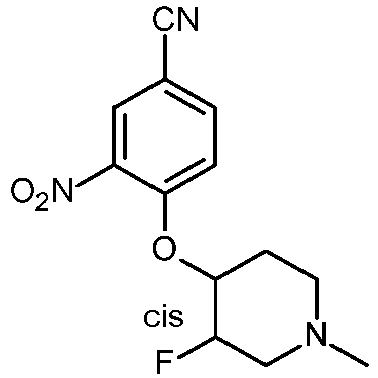
- To a solution of intermediate 602 (300 mg; 1.13 mmol) in MeOH (mL) was added formaldehyde (184 µL; 2.26 mmol) and then formic acid (427 µL; 0.01 mmol). The reaction mixture was stirred at room temperature 1 h. Then, sodium triacetoxyborohydride (300 mg; 1.41 mmol) was added and the stirring was continued for 1 h. Then, the reaction mixture was carefully quenched by addition of saturated solution of NaHCO3 and extracted with EtOAc. The organic layer was evaporated to dryness and loaded into a silica gel column (ethyl acetate 100%). The pure fractions were collected and the solvent was evaporated to give 250 mg (79%) of intermediate 603.
- The compound in the table below was prepared by using an analogous method as the one used for the preparation of intermediate 603 starting from the respective starting materials.
Intermediate number Structure Mass (mg) Yield (%) Intermediate 609 
99 72 From intermediate 608 - Preparation of intermediate 623:

- 4-Methyl-2-nitrophenol (1 g; 6.53 mmol) was dissolved in ACN (50 mL), producing a clear, bright yellow solution. K2CO3 (4.5 g; 32.65 mmol) was added, and the reaction was stirred until the color darkened to a deep red. 1,2-dibromoethane (2.8 mL; 32.65 mmol) was added and the reaction was refluxed 80°C overnight. The reaction mixture was filtered and the filtrate was evaporated. The crude (yellow oil) was purified on a silica gel column, eluting with 5% EtOAc/heptane to give 1.37 g (80%) of intermediate 623.
- Preparation of intermediate 624:
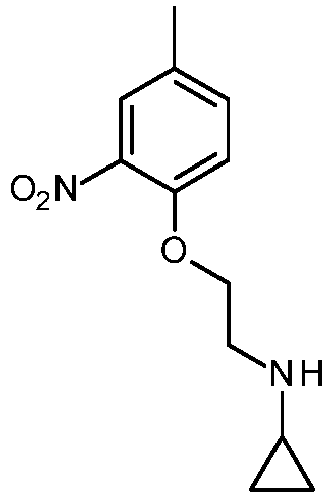
- Intermediate 624 was prepared following a similar protocole than the one used for the preparation of intermediate 570 starting from intermediate 623 and cyclopropylamine (600mg; 48%).
- Preparation of intermediate 625:

- A solution of intermediate 624 (550 mg; 2.33 mmol) in DCM (10 mL) at 0°C was added Boc2O (559 mg; 2.56 mmol). The mixture was stirred at rt for 2h. The crude was diluted with DCM and washed with water, dried over MgSO4 and removed under reduced pressure to give a crude that was purified by flash chromatography eluting with DCM-MeOH. The fractions containoing the product were collected and the solvent was evaporated to give 704 mg (90%) of intermediate 625.
- Preparation of intermediate 628:

- In a round bottom flask, 2-bromo-5-nitrobenzene carbaldehyde (29.17g , 0.127 mol), trimethyl orthoformate (21mL, 0.192 mol), p-toluenesulfonic acid monohydrate (2.4g , 12.6 mmol) were mixed in MeOH (600mL). Then, the reaction mixture was refluxed for 8 hours. The reaction was cooled down and the solvent was removed. The residue was taken up with water, K2CO3 and DCM. The organic layer was separated, dried over MgSO4, filtered and evaporated until dryness to give 34g (97%) of intermediate 628.
-

- A mixture of intermediate 628 (15g ; 54.33mmol), 1,2,3,6-Tetrahydropyran-4-boronic acid pinacol ester (13.8g ; 65.7mmol), potassium phosphate (34.8g; 0.164mol), PdCl2dppf.DCM (4.5g ; 5.5mmol) in dioxane (210mL) and water (60mL) was degassed with N2 in a sealed tube and heated at 80°C for 16 hours. The mixture was poured into a mixture of water and K2CO3 and extracted with EtOAc. The organic layer was dried over MgSO4, filtered and evaporated until dryness. The residue (25.5g) was purified by silica gel chromatography (330g of SiOH 35-40µm, gradient from 90% heptane 10% EtOAc to 60% heptane 40% EtOAc). The fractions were collected and evaporated until dryness to give 12.21 g (80%) of intermediate 629.
- Preparation of intermediate 630:

- HCl (3M in water; 58.28 mL; 0.175 mol) was added to a solution of intermediate 630 (12.21g ; 43.72 mmol) in 1,4-dioxane (233mL) at room temperature. The mixture was stirred for 2 hours. Water then EtOAc was added. The organic layer was separated, dried over MgSO4, filtered and evaporated until dryness to afford 8.97g (88%) of intermediate 630.
- Preparation of intermediate 631:

- A solution of intermediate 630 (8.97g ; 38.5mmol), dimethylamine (9.7mL ; 76.6mmol) in ACN (240mL) was stirred for 30min. Then, sodium triacetoxyborohydride (16.3g ; 76.9mmol) was added and stirred at room temperature for 15 hours. Water was added and the reaction mixture was basified with K2CO3 and extracted with EtOAc. The organic layer was dried over MgSO4, filtered and evaporated until dryness. A purification of the residue (8.24g) was performed by silica gel chromatography (Stationary phase: irregular SiOH 15-40µm 120g, Mobile phase: gradient from DCM 100% to DCM 95%, MeOH 5%, 0.1% NH4OH). The desired fractions were collected and solvent evaporated until dryness to give 2.15g of intermediate 631 and 4.22g of an impure fraction which was purified by silica gel chromatography (Stationary phase: irregular SiOH 15-40µm 80g, Mobile phase: gradient from DCM 100% to DCM 95%, MeOH 5%, 0.1% NH4OH). The desired fractions were collected and solvent evaporated until dryness to give additional 2.65g of intermediate 631. Global yield: 47%
- Preparation of intermediate 632:

- A mixture of intermediate 632 (2.15g ; 8.2 mmol), Pd/C 10% (0.43g) in MeOH (50mL) was hydrogenated with 3 bars of H2 at room temperature for 15 hours. The mixture was filtered through a celite® pad and the filtrate was evaporated until dryness to give 1.76g (92%) of intermediate 632.
- Preparation of intermediate 635:

- In a sealed glassware, a mixture of 1-bromo-2-nitrobenzene (800 mg; 3.96 mmol), N-Boc-2,3-dihydro-1H-pyrrole (938 mg; 5.54 mmol) and potassium carboante (1.6 g; 11.88 mmol) in DMF dry (30 mL) was bubbled with nitrogen (10 minutes). Then, triphenylphosphine (207 mg; 0.792 mmol) and Pd(OAc)2 (89 mg; 0.396 mmol) were added. The reaction mixture was heated to 100°C overnight, cooled to room temperature, poured onto water and extracted with EtOAc. The mixture was filtered through a pad of celite® and the organic layer was decanted, washed with brine, dried over MgSO4, filtered and evaporated to dryness. The residue was purified by chromatography over silica gel (irregular SiOH, 40g; mobile phase: gradient from 20% EtOAc, 80% heptane to 40% EtOAc, 60% heptane). The fractions containing the product were collected and evaporated to dryness yielding 482 mg (42%) of intermediate 635.
- Preparation of intermediate 636:

- A mixture of intermediate 635 (482 mg; 1.66 mmol) and Adam's catalyst (Platinum(IV) oxide) (75 mg; 0.332 mmol) in EtOH (40 mL) were hydrogenated under 2 bars of H2 for 2h. The catalyst was removed by filtration over celite® and the filtrate was evaporated to dryness yielding 437 mg of intermediate 636.
- Preparation of intermediate 638


- Intermediates 638 and 639 were obtained via a SFC separation performed on intermediate 637 (CHIRALPAK AD-H 5µm 250x20mm; mobile phase: 80% CO2, 20% iPrOH). The pure fractions were collected and evaporated to dryness yielding 169mg of intermediate 638 and 177mg of intermediate 639
- Preparation of intermediate 640:

- Sodium triacetoxyborohydride (133 mg; 0.63 mmol) was added to a mixture of intermediate 559bis (164 mg; 0.25 mmol), formaldehyde (375 µL; 5.01 mmol), acetic acid (28.7 µL; 0.50 mmol) in MeOH (2 mL) at rt. The reaction mixture was stirred at rt under N2 overnight. The mixture was basified with a saturated aqueous solution of NaHCO3 and the solvent was evaporated. The mixture was diluted with EtOAc and washed with a saturated aqueous solution of NaHCO3. The aqueous layer was extracted with EtOAc (2x). The organics layers were combined and washed with water, brine, dried over MgSO4, filtered and the solvent was evaporated.
- The residue (209 mg) was purified by chromatography over silica gel (SiO2, 4 g; eluent: from 99% DCM, 1% MeOH, 0.1% NH4OH to 99% DCM, 1% MeOH, 0.1% NH4OH). The fractions containing the product were collected and the solvent was evaporated to afford 106 mg (63%) of intermediate 640 as a yellow oil.
- Preparation of intermediate 642:

- Ethanesulfonyl chloride (1.28 mL; 13.5 mmol) was added into a solution of tert-butyl-(3-(methylamino)phenyl)carbamate (2 g, 9 mmol), triethymaine (3.79 mL, , 26.99 mmol) in ACN (100 mL) at room temperature. The solution was stirred at room temperature for 4h00. Water was added and the reaction mixture was extracted with DCM. The organic layer was separated and dried over MgSO4, filtered and the solvent was evaporated.
- The residue (3.2g) was purified by silica gel chromatography (Irregular SiOH, 40µm, 80g, Mobile phase: gradient from 90%: DCM, 10% Heptane to 97% DCM, 3% MeOH, 0.3% NH4OH. The fractions were combined and the solvent was evaporated to give 2.55g of an impure fraction which was repurified by silica gel chromatography (Irregular SiOH, 40µm, 80g, Mobile phase: gradient from 70%: DCM, 30% Heptane to 97% DCM, 3% MeOH, 0.3% NH4OH. The fractions were combined and the solvent was evaporated to give 1.24g (39%, 88% of purity based on LC/MS) of intermediate 642 (39% pure at 88%).
- Preparation of intermediate 643:
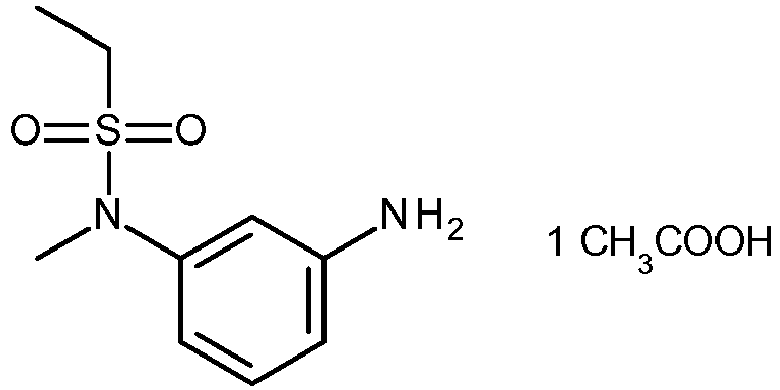
- A solution of intermediate 642 (1.24 g, 3.47 mmol) in TFA (2.66 mL, 34.71 mmol) and DCM (22.1 mL) was stirred at rt for 12h. The solvent was evaporated.
- The residue was purified by silica gel chromatography (irregular SiOH, 15-40 µm, 40g, mobile phase: from DCM: 100% to DCM: 97%, MeOH: 3%, NH4OH: 0.3%) to give 1.17g of intermediate 643.
- Preparation of compound 1:

- A mixture of intermediate 8R (36.00 g, 71.08 mmol) and TBAF (1M in THF, 142.15 mL, 142.15 mmol) in Me-THF (0.7 L) was stirred at rt for 3 h 30 min. The reaction mixture was poured onto a 10% aqueous solution of K2CO3 (700 mL), diluted with EtOAc (700 mL). Then, 100 mL of a saturated solution of NaCl was added (to help the decantation). The organic layer was decanted, washed again with 300 mL of a 10% aqueous solution of K2CO3 (+ 100 mL of a saturated solution of NaCl), then with a saturated solution of NaCl (200 mL). The organic layer was dried over MgSO4, filtered and concentrated under vacuum. The residue was taken up 3 times with 300 mL of EtOH and evaporated to dryness. The residue was taken up with CH3CN and stirred at 50 °C. Then, the precipitate was filtered and dried (50 °C under vacuum for 5 h) to give 27 g of compound 1 (96% yield). Then, different batches of compound 1 coming from different reactions (batch 1: 36.8 g, batch 2: 27 g, batch 3: 5.7 g, batch 4: 7.45 g and batch 5: 6.7 g) were mixed together in CH3N (250 mL) and the suspension was stirred for 15 min. The precipitate was filtered and dried at 50 °C overnight to give 81.1 g of compound 1 (97.1% yield). M.P.: 222°C (DSC).
- Preparation of compound 4:

- A solution of intermediate 19 (403.00 mg, 0.74 mmol) in Me-THF (8.9 mL) was treated with TBAF (1M in THF) (0.82 mL, 0.82 mmol) and stirred at rt for 17 h. Celite® was added and the crude mixture was evaporated in vacuo to give a dry load which was purified by column chromatography on silica gel (irregular SiOH 15-40 µm, 40 g, mobile phase:DCM/(MeOH containing 5% aq. NH3), gradient from 98:2 to 85:15). The fractions containing the product were combined and evaporated to dryness to give a solid. This solid was recrystallized from EtOH. After cooling down to rt, the mixture was filtered on a glass frit. The solid was washed with Et2O, collected and dried in vacuo to afford 191 mg of compound 4 (60% yield over 2 steps, pale yellow solid). M.P. = 193 °C (DSC).
- Preparation of compound 68:

- A mixture of intermediate 237 (132.00 mg, 0.20 mmol) and TBAF (1M in THF) (0.30 mL, 1 M, 0.30 mmol) in Me-THF (1.60 mL) was stirred at rt for 24 h. The mixture was poured out onto water and the organic layer was extracted with EtOAc, dried over MgSO4, filtered and evaporated until dryness (batch 1, 52 mg). The aqueous phase was extracted again with DCM and MeOH. The organic layer was dried over MgSO4, filtered and evaporated to dryness (batch 2, 770 mg). An insoluble product in the aqueous layer was filtered over celite®. The celite was washed successively with DCM and MeOH. This organic layer was dried over MgSO4, filtered and evaporated to dryness (batch 3, 300 mg). The batches were combined and purified by column chromatography on silica gel (Irregular SiOH, solid deposite, mobile phase: DCM/MeOH, gradient from 100:0 to 90:10). The pure fractions were collected and the solvent was evaporated. The residue (84 mg) was taken up in EtOH, triturated, filtered and dried to give 31 mg of compound 68 (28% yield).
- The compounds in the Table below were prepared by using an analogous method as the one reported for the preparation of compound 1, starting from the respective starting materials. The most relevant minor deviations to the reference method are indicated as additional information in the column 'Mass (mg)'.
Compound number Structure Mass (mg) Yield (%) Compound 2 
310 pale yellow foam Procedure with 1 equiv of TBAF 55 From a mixture of intermediate 13 and intermediate 14 Compound 3 
52 yellow fluffy solid Procedure with 1 equiv of TBAF 9 From a mixture of intermediate 13 and intermediate 14 Compound 5 
79 Procedure with 1 equiv of TBAF 39 From intermediate 20 Compound 6 
173 Procedure with 1 equiv of TBAF 65 From intermediate 21 Compound 10 
37 white powder 8 From intermediate 42 Compound 11 
228 off-white solid Procedure with 1 equiv of TBAF 87 From intermediate 46 Compound 12 
120 yellow powder 41 From intermediate 49 Compound 13 
319 white powder 47 From intermediate 52 Compound 14 
538 yellow powder 51 From intermediate 55 Compound 16 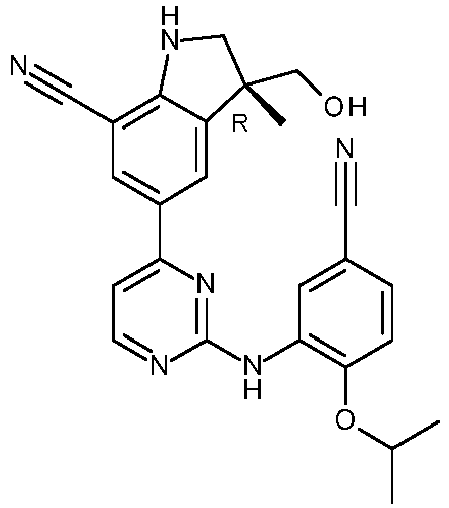
426 yellow powder 53 From intermediate 60 Compound 26 
121 yellow solid Procedure with 1 equiv of TBAF 60 From intermediate 104 Compound 27 
276 white solid Procedure with 1 equiv of TBAF 97 From intermediate 107 Compound 32 
68 white solid Procedure with 1 equiv of TBAF 35 From intermediate 119 Compound 33 
49 yellow solid Procedure with 1 equiv of TBAF 35 From intermediate 121 Compound 37 
44 Procedure with 1 equiv of TBAF 59 From intermediate 136 Compound 38 
102 Procedure with 1 equiv of TBAF 65 From intermediate 140 Compound 47 
70 Procedure with 1 equiv of TBAF 61 From intermediate 170 Compound 48 
62 Procedure with 1 equiv of TBAF 59 From intermediate 172 Compound 49 
69 Procedure with 1 equiv of TBAF 42 From intermediate 174 Compound 50 
94 Procedure with 1 equiv of TBAF 49 CIS From intermediate 180 Compound 51 
47 Procedure with 1 equiv of TBAF 80 From intermediate 182 Compound 52 
209 Procedure with 1.1 equiv of TBAF 78 From intermediate 184 Compound 53 
63 Procedure with 1 equiv of TBAF 37 From intermediate 188 Compound 54 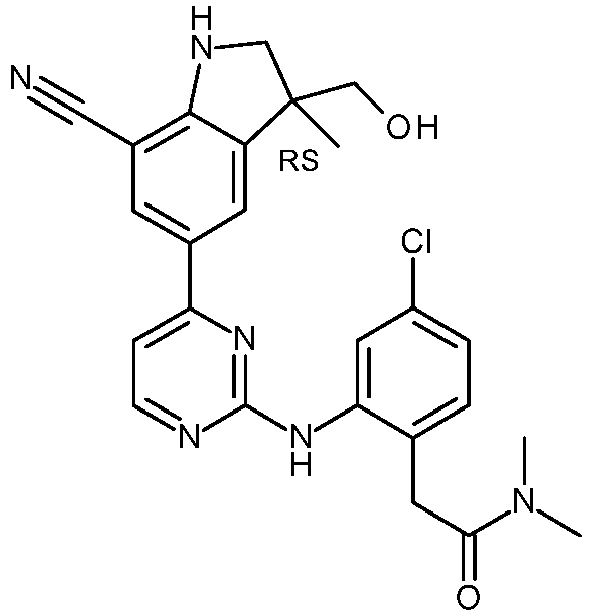
81 Procedure with 1 equiv of TBAF 40 From intermediate 191 Compound 55 
103 Procedure with 1 equiv of TBAF 49 From intermediate 194 Compound 56 
68 Procedure with 1 equiv of TBAF 31 From intermediate 195 Compound 58 
121 Procedure with 1 equiv of TBAF 54 From intermediate 199 Compound 59 
115 Procedure with 1.3 equiv of TBAF 84 From intermediate 204 Compound 61 
164 off-white solid Procedure with 1.5 equiv of TBAF 97 From intermediate 211 Compound 62 
175 yellow solid Procedure with 1.6 equiv of TBAF 92 From intermediate 213 Compound 63 
70 Procedure with 1.5 equiv of TBAF 49 From intermediate 219 Compound 64 
105 white solid Procedure with 1.8 equiv of TBAF 40 From intermediate 223 Compound 67 
184 white solid Procedure with 1.8 equiv of TBAF 65 From intermediate 233 Compound 147 
310 White morphous solid Procedure with 4 equiv of TBAF and THF as solvent 98 From intermediate 392 Compound 148 
1987 81 From intermediate 394 Compound 149 
45 Procedure with 1.2 equiv of TBAF and THF as solvent 25 From intermediate 398 Compound 150 
108 Procedure with 1.2 equiv of TBAF and THF as solvent 80 From intermediate 404 Compound 151 
24 Procedure with 1.2 equiv of TBAF and THF as solvent 32 From intermediate 407 Compound 152 
234 Procedure with 1.1 equiv of TBAF 49 From intermediate 411 Compound 153 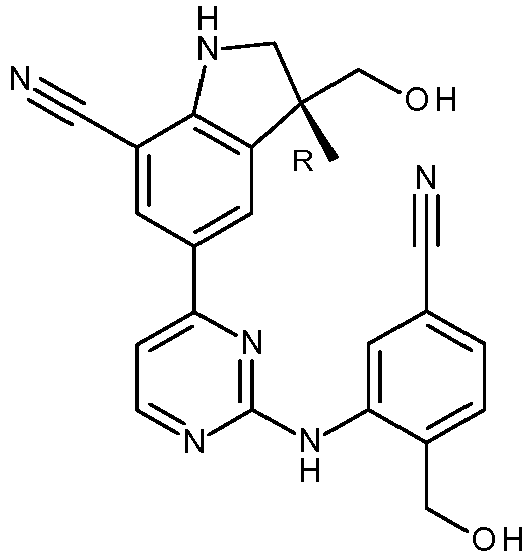
74 51 From intermediate 412 Compound 154 
45 Procedure with 1.2 equiv of TBAF and THF as solvent 26 From intermediate 419 Compound 157 
371 86 From intermediate 431 Compound 158 
14 Procedure with 1.1 equiv of TBAF 27 From intermediate 433 Compound 159 
75 Procedure with 1.1 equiv of TBAF 50 From intermediate 435 Compound 160 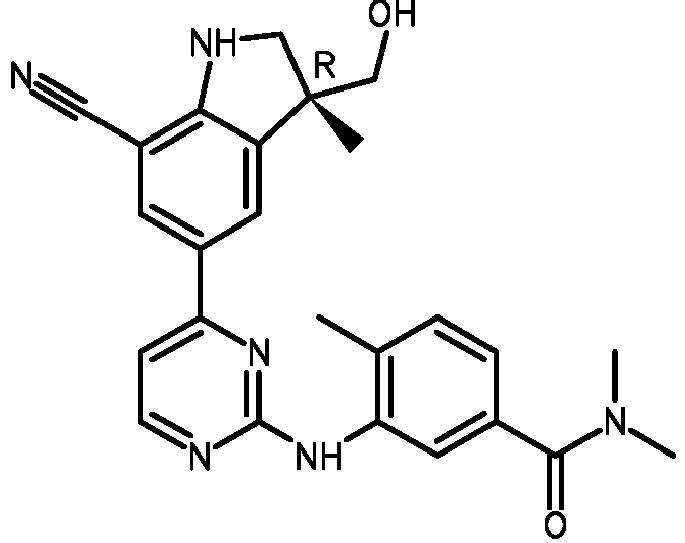
205 Procedure with 1.1 equiv of TBAF 73 From intermediate 437 Compound 161 
236 Procedure with 1.1 equiv of TBAF 66 From intermediate 439 Compound 162 
302 63 From intermediate 440 Compound 163 
148 50 From intermediate 442 Compound 165 
233 69 From intermediate 444 Compound 166 
100 68 From intermediate 448 Compound 167 
103 72 From intermediate 449 Compound 168 
72 71 From intermediate 453 Compound 169 
215 84 From intermediate 454 Compound 170 
41 Procedure with 1.1 equiv of TBAF 56 Compound 173 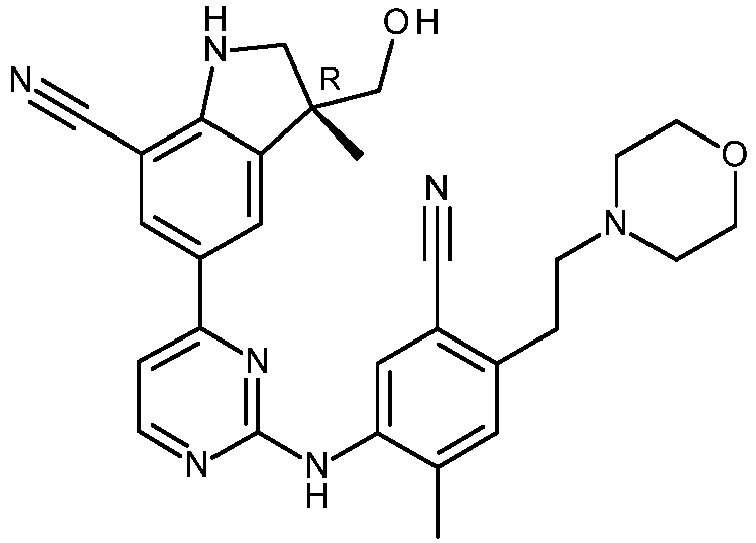
143 Procedure with 1.1 equiv of TBAF 44 From intermediate 468 Compound 174 
90 Procedure with 1.1 equiv of TBAF 42 From intermediate 471 Compound 175 
51 Procedure with 1.1 equiv of TBAF 46 From intermediate 474 Compound 177 
180 Procedure with 1.1 equiv of TBAF 61 From intermediate 479 Compound 186 
87 74 From intermediate 491 Compound 187 
89 66 From intermediate 496 Compound 188 
177 39 From intermediate 502 Compound 189 
29 41 From intermediate 503 Compound 190 
300 85 From intermediate 504 Compound 191 
152 Procedure with 1 equiv. of TBAF and THF as solvent 68 From intermediate 506 Compound 192 
25 Procedure with 1 equiv. of TBAF and THF as solvent 37 From intermediate 509 Compound 193 
52 28 From intermediate 511 Compound 194 
163 33 From intermediate 514 Compound 195 
62 76 From intermediate 516 Compound 196 
45 52 From intermediate 517 Compound 197 
51 43 From intermediate 518 Compound 198 
127 71 From intermediate 520 Compound 199 
65 28 From intermediate 521 Compound 208 
168 Procedure with 5 equiv. of TBAF 86 From intermediate 528 Compound 209 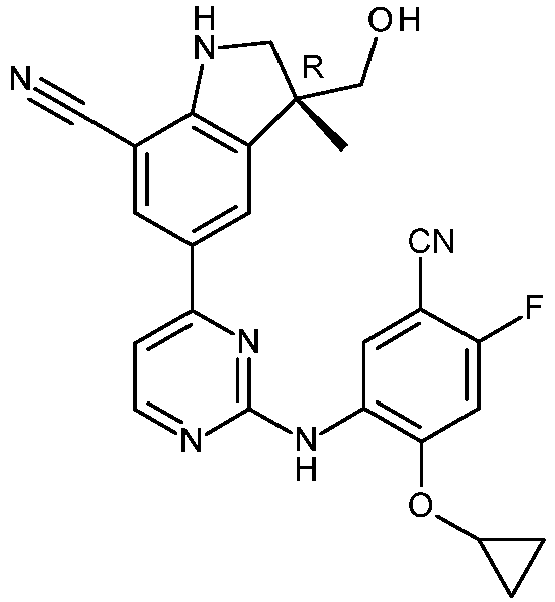
267 63 From intermediate 531 Compound 210 
57 Procedure with 3 equiv. of TBAF and THF as solvent 38 From intermediate 538 Compound 213 
170 Procedure with 4 equiv. of TBAF and THF as solvent 45 From intermediate 545 Compound 214 
150 Procedure with THF as solvent 51 From intermediate 548 Compound 215 
129 Off-white solid 48 From intermediate 552 Compound 216 
34 Yellow foam 85 From intermediate 556 Compound 217 
236 White solid 76 From intermediate 558 Compound 218 
25 Yellow solid 22 From intermediate 559 Compound 219 
262 Pale yellow solid 78 From intermediate 561 Compound 220 
38 Off-white solid 44 From intermediate 563 Compound 223 
243 Pale yellow solid Procedure with 3 equiv. of TBAF 82 From intermediate 577 Compound 224 
129 Orange solid 74 From intermediate 581 Compound 229 
270 67 From intermediate 600 Compound 233 
123 78 From intermediate 619 Compound 234 
38 Off-white solid Procedure with 3 equiv. of TBAF 67 From intermediate 622 Compound 236 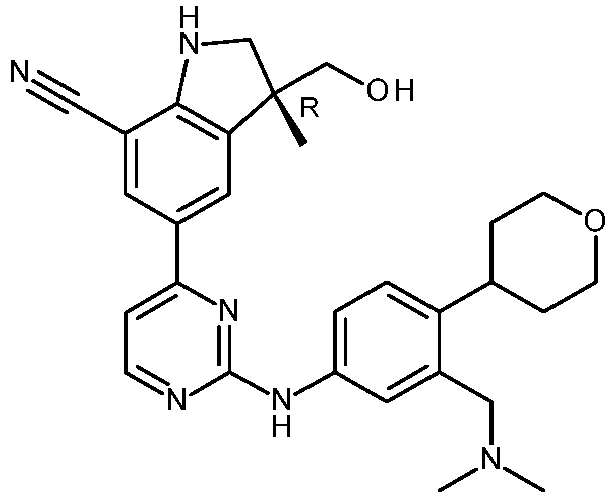
147 - From intermediate 634 Compound 239 
8 21 From intermediate 641 - Preparation of compound 155:

- A solution of intermediate 423 (10.66 g, 19 mmol) in Me-THF (210 mL) was treated with TBAF (1M in THF) (38 mL, 38 mmol) and stirred at rt for 3 h. The reaction mixture was poured onto a 10% aqueous solution of K2CO3 and concentrated. DCM/MeOH (9/1) was added and the mixture was washed with 10% aqueous K2CO3 (3 x 400 mL), water (2 x 200 mL) and with brine (2 x 400 mL). The organic layer was dried over MgSO4, filtered and the solvent was evaporated. The residue was dissolved under reflux in CH3CN (800 mL + 200 mL). The solution was allowed to cool to room temperature overnight. Then, the precipitate was filtered and dried to give 6.37 g of compound 155 (75%) as an off-white solid. M.P.: 218°C (DSC).
- Preparation of compound 156:

- TBAF (1M in THF) (1.5 mL; 1.5 mmol) was added dropwise to a solution of intermediate 430 (451 mg; 0.748 mmol) in Me-THF (15 mL) and the reaction mixture was stirred at room temperature for 3 hours. The reaction mixture was poured onto a 10% aqueous solution of K2CO3 and extracted with EtOAc. The organic layer was washed with 10% aqueous K2CO3 (2 X 30 mL), water (30 mL) and brine (30 mL), dried over MgSO4, filtered and evaporated to dryness. The residue was crystallized from ACN. The precipitate was filtered, washed with Et2O and dried yielding 295 mg (81%) of compound 156. M.P.: 206°C (DSC)
- Preparation of compound 232:

- TBAF (1M in THF; 0.65 mL; 0.65 mmol) was added dropwise to a solution of intermediate 618 (234 mg; 0.328 mmol) in Me-THF (10 mL) and the reaction mixture was stirred at room temperature for 3 hours. The reaction mixture was poured onto a 10% aqueous solution of K2CO3 and extracted with EtOAc. The organic layer was washed with 10% aqueous K2CO3 (2 x 30 mL), water (30 mL) and brine (30 mL), dried over MgSO4, filtered and evaporated to dryness. The residue was crystallized from ACN and the precipitate was filtered, washed with Et2O and dried yielding 133 mg of an intermediate compound which was suspended in MeOH at 50°C and stirred for 30 min. The precipitate was filtered and dried yielding 77 mg (47%) of compound 232. M.P.: 167°C (DSC)
- Preparation of compound 221:

- Tetrabutylammonium fluoride trihydrate (164.4 mg; 0.52 mmol) was added to a mixture of intermediate 569 (260 mg; 0.43 mmol) in Me-THF (2 mL) and stirred overnight. The reaction mixture was quenched by addition of saturated aqueous NaHCO3 and extracted with DCM. The organic layer was dried, filtered and concentrated under reduced pressure. The crude was purified with by silica gel chromatography heptane and ethyl acetate as eluent starting with heptane and increasing the proportion of EtOAc. The fractions containing the product were mixed and concentrated affording 170mg (81%) of compound 221. MP = 181°C (MP50).
- The compounds in the Table below were prepared by using an analogous method as the one reported for the preparation of compound 221, starting from the respective starting materials. The most relevant minor deviations to the reference method are indicated as additional information in the column 'Mass (mg)'.
Compound number Structure Mass (mg) Yield (%) Compound 222 
110 65 From intermediate 573 Compound 225 
42 55 From intermediate 585 Compound 226 
120 31 From intermediate 589 Compound 227 
140 72 From intermediate 593 Compound 228 
110 83 From intermediate 597 Compound 230 
130 61 From intermediate 606 Compound 231 
38 52 From intermediate 612 - Alternative preparation A of compound 1:

- To a solution of intermediate 7R (231 g, 0.556 mol) in 1,4-dioxane (2.3 L), p-toluenesulfonic acid monohydrate (179 g, 0.95 mol) and 3-amino-4-methylbenzonitrile (110 g, 0.83 mol) were added, purged three times with N2 and stirred at 95 °C for 12 h. Then, the reaction mixture was cooled down to 20 °C, and a solution of NaHCO3 was added to neutralize the mixture. The precipitated solid formed was filtrated and combined with another precipitate coming from a reaction performed on 179 g of intermediate 7R. The resulting solid was dissolved in Me-THF (5 L), washed with water three times (3 x 5 L). A silanethiol resin [from Shanghai Meryer CO.,LTD] (60 g) was added to the mixture and reflux for 1.5 h. Then, the resulting mixture was filtered through a pad of celite® and concentrated under vacuum. The residue was suspended in EtOH (5L) overnight, filtered and dissolved in THF (3L). Methyl tert-butylether (6 L) was added to THF and the solid was precipitated, filtered and dried to afford 243g of compound 1.
- A solution of intermediate 6R (10.0 g) and p-toluenesulfonic acid (3.0 eq) in dioxane (100 mL) was azeotropically dried until the content of water was <0.1% (determined by KF titration). 3-Amino-4-methylbenzonitrile (1.3 eq.) was then added and the mixture was azeotropically dried until the content of water was <0.3% (determined by KF titration) and the volume was approximately 50 mL. The mixture was then heated to 90 °C for 24 hours monitoring the conversion by HPLC. After complete conversion, the mixture was cooled to room temperature and water (50 mL) was added. After 1 hour of stirring, the layers were separated. The organic layer was concentrated to approximately 50 mL and methyl tert-butylether (100 mL) was added over 2 hours at 50 °C. The mixture was cooled to 10 °C over 4 hours, and then filtered affording after drying 5g (purity 98% evaluated by HPLC) of compound 1 .
- To a solution of compound 1 (270 g) in THF (1350 mL) at room temperature, methyl tert-butylether (2160 mL) was slowly added. The mixture was filtered and the product was dried under vacuum at 50 °C, to obtain 210 g (99.4% of purity evaluated by HPLC) of compound 1 as a yellow solid.
- Alternative preparation of compound 148:
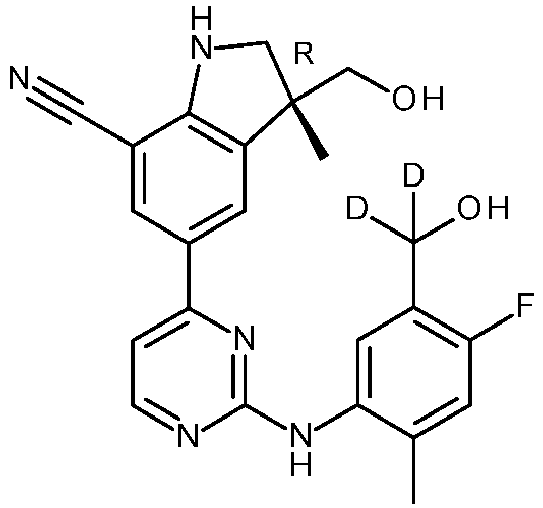
- Compound 148 was also prepared following a similar procedure than the alternative preparation A of compound 1 starting from intermediate 7R and intermediate 393 (151 mg; 24%)
- Alternative preparation of compound 152:

- Compound 152 was also prepared following a similar procedure than the alternative preparation A of compound 1 starting from intermediate 7R and intermediate 410.
- Preparation of compound 200:

- A mixture of intermediate 7R (415 mg; 1 mmol), 3-amino-5-cyano-2-methyl-benzoic acid methyl ester (285 mg; 1.5 mmol) and p-toluenesulfonic acid monohydrate (323 mg; 1.7 mmol) in 1,4-dioxane (5 mL) was heated at 95°C overnight. The reaction mixture was poured onto a 10% aqueous solution of K2CO3 and extracted with a mixture of DCM/MeOH. The organic layer was decanted, dried over MgSO4, filtered and evaporated to dryness. The residue was taken up with ACN and the precipitate was filtered and dried yielding 216 mg (47%) of compound 200. M.P.: 260°C (Kofler)
- Preparation of compound 15:

- TBAF (1.5 mmol/g on silica) (1.60 g, 2.46 mmol) was added at rt to a solution of intermediate 57 (340.00 mg, 0.61 mmol) in Me-THF (15 mL) and the reaction mixture was stirred at rt for 18 h. The reaction was not complete. Also, a solution of TBAF (1M in THF) (1.00 mL, 1.00 mmol) was added and the reaction mixture was stirred at rt for 1 h. The reaction mixture was diluted with EtOAc, filtered through paper and poured onto a 10% aqueous solution of K2CO3. The organic layer was decanted, washed with water, then brine, dried over MgSO4, filtered and evaporated to dryness. The residue was purified by column chromatography on silica gel (irregular SiOH, 40 g, mobile phase NH4OH/MeOH/EtOAc/heptane, 0.5% NH4OH, 10% MeOH, 50% EtOAc, 40% heptane). The pure fractions were collected and evaporated to dryness. The residue was taken up with Et2O and the precipitate was filtered and dried to give 134 mg of compound 15 (50% yield). M.P. (gum) = 110 °C (K).
- Preparation of compound 73:

- In a round bottom flask, intermediate 253 (221.00 mg, 0.38 mmol) was diluted in Me-THF (10.3 mL). Then, the solution was cooled to 0 °C and TBAF (on silica gel 1.5mmol/g, 1.52 mL, 2.29 mmol) was added. The reaction mixture was stirred for 3 h allowing the temperature to reach rt and then partitioned between a saturated solution of NaHCO3 and DCM. The layers were separated. The aqueous layer was extracted again with DCM. The organic layers were mixed, dried over MgSO4, filtered and concentrated. The residue (225 mg) was purified by column chromatography on silica gel (irregular SiOH, 40 g, mobile phase: NH4OH/DCM/MeOH, gradient from 0.2% NH4OH, 2% MeOH, 98% DCM to 1 % NH4OH, 10% MeOH, 90% DCM). The pure fractions were collected, evaporated to dryness. The residue (79 mg, 44%) was crystallized from Et2O. The precipitate was filtered and dried to give 54 mg of compound 73 (30% yield). M.P. = 201 °C (DSC).
- Preparation of compound 74:

- TBAF (on silica gel 1.5 mmol/g) (3.70 g, 5.57 mmol) was added to a solution of intermediate 256 (1.20 g, 1.39 mmol) in Me-THF (35 mL) and the reaction mixture was stirred at rt for 18 h. TBAF (1M in THF) (2.80 mL, 2.78 mmol) was added and the reaction mixture was stirred at rt for 2 additionnal hours. The reaction mixture was diluted with DCM, filtered through paper and poured onto a 10% aqueous solution of K2CO3. The organic layer was decanted, washed with water, dried over MgSO4, filtered and evaporated to dryness. The residue was purified by column chromatography on silica gel (irregular SiOH, 40 g, mobile phase DCM/MeOH/NH4OH, gradient from 0.3% NH4OH, 3% MeOH, 97% DCM to 1% NH4OH, 10% MeOH, 90% DCM). The fractions containing the product were collected and evaporated to dryness and the residue was purified a second time by column chromatography on silica gel (irregular SiOH, 40 g, mobile phase DCM/MeOH/NH4OH with 0.5% NH4OH, 5% MeOH, 95% DCM). The pure fractions were collected and evaporated to dryness. The residue (520 mg, 54%) was crystallized from CH3CN/Et2O and the precipitate was filtered and dried to give 443 mg of compound 74 (46% yield). M.P. = 124 °C (K).
- The compound in the Table below was prepared by using an analogous method starting from the respective starting materials. The most relevant minor deviations to the referenced method are indicated as additional information in the column 'Mass (mg)'.
Compound number Structure Mass (mg) Yield (%) Compound 71 
160 Procedure with 3 equiv. of TBAF (1.5 mmol/g on silica) 48 From intermediate 246 - Preparation of compound 7 :

- TFA (1.50 mL, 19.60 mmol) was added dropwise to a solution of intermediate 30 (270.00 mg, 0.51 mmol) in DCM (stab. with amylene 10 mL) at 5 °C and the reaction mixture was stirred for 1 h at this temperature. The reaction mixture was quenched with a 10% aqueous solution of K2CO3 and extracted with DCM. The organic layer was decanted, dried over MgSO4, filtered and evaporated to dryness. The residue was crystallized from CH3CN and the precipitate was filtered and dried to give 165 mg of compound 7 (75% yield). M.P.: 215°C (DSC).
- Alternative preparation of compound 1:
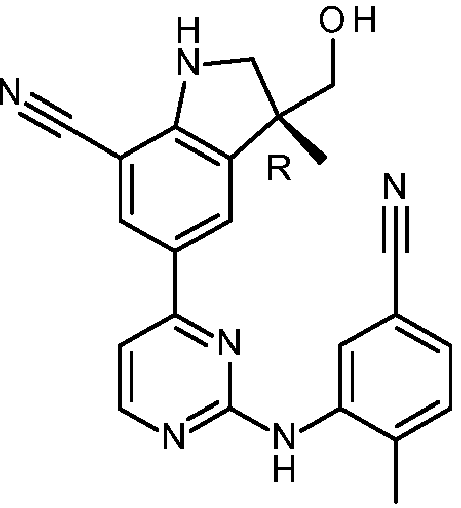
- TFA (3.93 mL, 51.35 mmol) was added at 5 °C to a solution of intermediate 10R (1.16 g, 2.33 mmol) in DCM (25.4 mL). The reaction mixture was stirred for 30 min. The reaction mixture was diluted with DCM and poured onto a 10% aqueous solution of K2CO3, dried over MgSO4, filtered and evaporated to dryness. The residue (1200 mg, yellow solid) was purified by column chromatography on silica gel (irregular SiOH, deposit solid, 30 g, mobile phase: NH4OH/DCM/MeOH, gradient from 100% DCM to 95% DCM 5% MeOH, 0.5% NH4OH). The fractions containing the products were collected and evaporated to dryness to give three batches (batch 1: 167 mg, batch 2: 568 mg and batch 3: 253 mg as yellow powder). The batches 2 and 3 were gathered and purified via chiral SFC (Stationary phase: CHIRALPAK IC 5 µm 250 x 30 mm, mobile phase: 60% CO2, 36% EtOH, 4% DCM). The fractions containing the product were combined and evaporated to dryness. The residue (388 mg) was combined with two other batches of compound 1 (517 mg and 200 mg) and taken up with CH3CN to provide 1.165 g of compound 1 (light yellow powder).
- Preparation of compound 66:

- TFA (0.47 mL, 6.12 mmol) was added at 5 °C to a solution of intermediate 229 (227.00 mg, 0.41 mmol) in DCM (10 mL, stabilized with amylene). The reaction mixture was stirred at 0 °C for 1 h, diluted with DCM and poured onto a 10% aqueous solution of K2CO3. The organic layer was decanted, washed with water, dried over MgSO4, filtered and evaporated to dryness. The residue was suspended in EtOH and the mixture was heated at 50 °C for 2 h. The precipitate was filtered and dried to give 114 mg of compound 66 (61% yield). M.P. = 165 °C (K).
- The compounds in the Table below were prepared by using an analogous method as the ones reported for the preparation of compounds 7, 1 or 66 starting from the respective starting materials. The most relevant minor deviations to the referenced method are indicated as additional information in the column 'Mass (mg)'.
Compound number Structure Mass (mg) Yield (%) Compound 8 
32 yellow powder Procedure with DCM/TFA (10:1, v/v) 7 From intermediate 35 Compound 9 
160 63 From intermediate 39 Compound 13 
188 yellow powder 35 From intermediate 80 Compound 16 
79 light yellow powder 24 From intermediate 62 Compound 17 
57 Procedure with DCM/TFA (5:1, v/v) 27 From intermediate 64 Compound 18 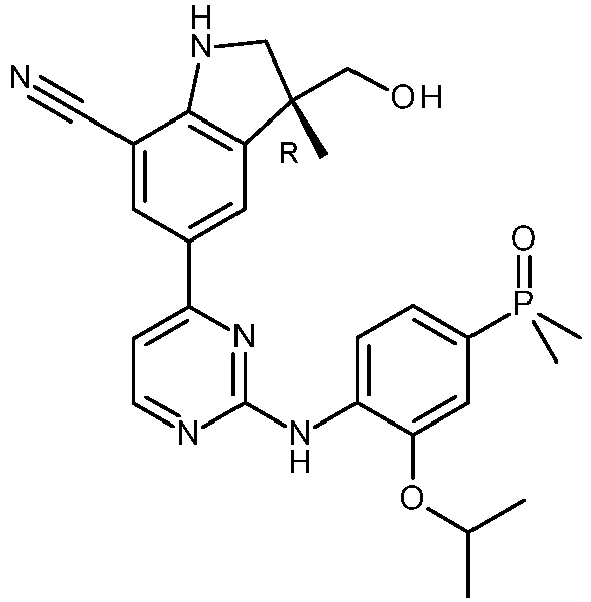
583 off-white solid Procedure with DCM/TFA (10:1, v/v) 79 From intermediate 70 Compound 19 
339 white solid Procedure with DCM/TFA (10:1, v/v) 45 From intermediate 75 Compound 20 
440 white solid Procedure with DCM/TFA (10:1, v/v) 58 From intermediate 78 Compound 22 
30 (98% purity based on LC/MS) off-white solid with DCM/TF A (1:1, v/v) 20 From intermediate 90 Compound 24 
17 off-white solid Procedure with DCM/TFA (1:1, v/v) 9 From intermediate 97 Compound 25 
139 pale yellow solid Procedure with DCM/TFA (1:1, v/v) 55 From intermediate 101 Compound 26 
52 white solid Procedure with DCM/TFA (5:2,v/v) 23 Compound 27 
38 white solid Procedure with DCM/TFA (5:2, v/v) 16 From intermediate 106 Compound 28 
32 off-white solid Procedure with DCM/TFA (1:1, v/v) 23 Compound 29 
60 white solid Procedure with DCM/TFA (5:2,v/v) 24 From intermediate 113 Compound 30 
116 beige solid Procedure with DCM/TFA (5:2,v/v) 44 From intermediate 115 Compound 31 
40 orange solid Procedure with DCM/TFA(5:2, v/v) 17 From intermediate 117 Compound 36 
71 Procedure with DCM/TFA (4:1,v/v) 29 From intermediate 132 Compound 41 
30 Procedure with DCM/TFA (4:1,v/v) 36 From intermediate 151 Compound 42 
55 Procedure with DCM/TFA (4:1,v/v) 22 From intermediate 154 Compound 43 
35 Procedure with DCM/TFA (4:1,v/v) 35 From intermediate 157 Compound 60 
15 Procedure with DCM/TFA (12:1, v/v) 20 From intermediate 206 Compound 65 
142 yellow powder Procedure with DCM/TFA (6:1, v/v) 28 From intermediate 225 Compound 69 
75 Procedure with DCM/TFA (6:1,v/v) 24 From intermediate 241 Compound 70 
117 Procedure with DCM/TFA (8:1,v/v) 46 From intermediate 243 Compound 72 
95 Procedure with DCM/TFA (15:1, v/v) 51 From intermediate 248 Compound 75 
118 white powder Procedure with DCM/TFA (6:1, v/v) 38 From intermediate 262 Compound 76 
65 Procedure with DCM/TFA (4:1,v/v) 34 From intermediate 266 Compound 77 
65 Procedure with DCM/TFA (5:1,v/v) 34 From intermediate 270 Compound 211 
113 Procedure with DCM/TFA (7.5:1,v/v) at room temperature 33% From intermediate 541 Compound 212 
88 Procedure with DCM/TFA (7.5:1,v/v) at room temperature 43% From intermediate 542 Compound 236 
198 with DCM/TFA(18:1,v/v) during15hours) 51 From intermediate 633 Compound 240 
85 40 Form intermediate 644 with DCM/TFA(4:1,v/v) - Preparation of compound 21:

- To a solution of intermediate 85 (0.28 g, 0.29 mmol) in DCM (3 mL), TFA (3 mL) was added and the reaction mixture was stirred at rt for 2 h. The solution was concentrated in vacuo and neat TFA (3 mL) was added, the reaction mixture was stirred for a further 4 h. The reaction mixture was stirred for a further 1 h and the solution was concentrated in vacuo. The residue was treated with K2CO3 (0.24 g, 1.75 mmol) in DMF (2 mL) for 2 h at 50 °C. The reaction mixture was partitioned between EtOAc and water, and the organic layer was dried over Na2SO4 and concentrated in vacuo. The residue was purified by mass triggered auto purification system.
- Preparation of compound 23:

- HCl (3M in H2O) (2.18mL, 6.55 mmol) was added to a solution of intermediate 93 (698.00 mg, 0.65 mmol) in MeOH (10 mL) and the reaction mixture was stirred 6 h at reflux. The reaction mixture was cooled down to rt, diluted with DCM and carefully neutralized with a saturated solution of NaHCO3. Then, few mL of MeOH were added to solubilize the precipitate. The reaction mixture was separated and the aqueous layer was extracted with DCM/MeOH (9/1). The organic layers were combined, dried over MgSO4, filtered and concentrated. The residue (620 mg) was taken up with DCM/MeOH (9/1). The precipitate was filtered and and taken up again with 15 mL DCM/MeOH (9/1). The resulting slurry suspension was stirred 30 min at rt. The precipitate was filtered, washed with Et2O and dried. The resulting residue (226 mg) was purified by column chromatography on silica (irregular SiOH, solid deposit, 40 g, mobile phase: DCM/MeOH, gradient from 98:2 to 94:6). The fractions containing the product were concentrated to give two batches of compound 23: batch A (131 mg, 38% yield) and batch B (23 mg, 6% yield). The batch A, containing some solvents, was solubilized in DCM/MeOH, concentrated and taken up with CH3CN. The precipitate was filtered to afford after drying a batch C of compound 23 (112 mg) but still containing some solvent. Finally, the batch C was dissolved in DCM/EtOH, concentrated and taken up with CH3CN. The precipitate was filtered and dried to afford additional 93 mg of compound 23 (27% yield). M.P.: > 260°C (K).
- The global yield was 33%.
- Preparation of compound 45:
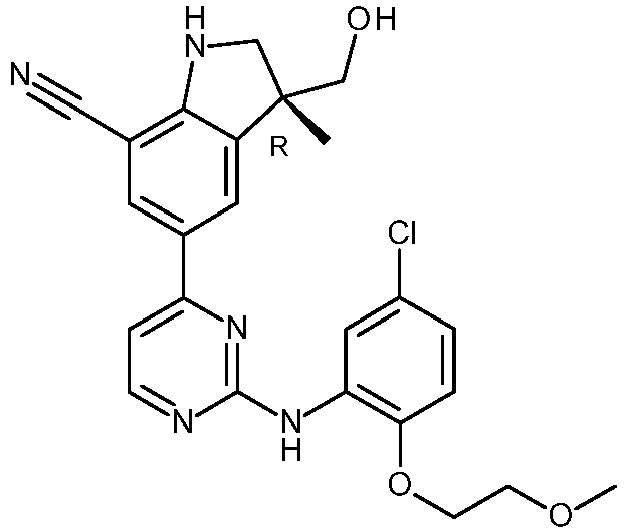
- HCl (3M in H2O) (1.32 mL, 3.95 mmol) was added to a solution of intermediate 164 (269.00 mg, 0.40 mmol) in MeOH (6.0 mL) and the reaction mixture was stirred 10 h at reflux. The reaction mixture was cooled to rt, poured onto a 10% aqueous solution of K2CO3 and extracted with DCM. The organic layer was decanted, dried over MgSO4, filtered and evaporated to dryness to provide an orange powder. The residue (220 mg) was purified by column chromatography on silica gel (Irregular SiOH, 25 g, solid deposit, mobile phase NH4OH/DCM/MeOH, gradient from 0% NH4OH, 0% MeOH, 100% DCM to 1% NH4OH, 10% MeOH, 90% DCM). The fractions containing the product were collected and evaporated to dryness to give 69 mg of a yellow solid. This solid was taken up in Et2O to provide 62 mg of compound 45 (34% yield, white powder).
M.P. = 169 °C (K). - The compounds in the Table below were prepared by using an analogous method as the ones reported for the preparation of compounds 23 or 45, starting from the respective starting materials.
Compound number Structure Mass (mg) Yield (%) Compound 23 
93 27 From intermediate 93 Compound 34 
96 white powder 47 From intermediate 124 Compound 35 
105 white powder 28 From intermediate 128 Compound 39 (mixture of 4 unseparated diastereoisom ers) 
77 white powder 61 From intermediate 143 Compound 40 
83 yellow powder 37 From intermediate 146 Compound 44 
37 white powder 31 From intermediate 161 Compound 57 
39 21 From intermediate 196 - Preparation of compound 170:

- 4 N HCl in 1,4-dioxane (0.19 mL; 0.759 mmol) was added at room temperature to a solution of intermediate 461 (84 mg; 0.152 mmol) in acetonitrile (2.4 mL) and the reaction mixture was stirred for 3 hours. The precipitate was filtered, washed with acetonitrile and dried at 50°C under vacuo to give 0.068 g (82%) of compound 170. MP = 207°C (kofler).
- Preparation of compound 171:

- Compound 171 was synthesized by using an analogous method than the one used for the preparation of compound 170, starting from intermediate 464 (235 mg; 99%; MP = 249°C, kofler).
- Preparation of compound 180:

- Compound 180 was synthesized by using an analogous method than the one used for the preparation of compound 170, starting from intermediate 482bis (162 mg; 81%; MP = gum at 194°C, kofler).
- Preparation of compound 184:

- Compound 184 was synthesized by using an analogous method (using HCl 3N in cyclopentylmethyl ether) than the one used for the preparation of compound 170, starting from intermediate 487 (223 mg; 60%; MP = gum at 134°C, kofler).
- Preparation of compound 235:

- In a round bottom flask containing intermediate 627 (500 mg; 0.64 mmol) and 1.4-dioxane (20 mL) was added HCl 4M/dioxane (3.5 mL; 14.01 mmol) and the reaction mixture was stirred at room temperature overnight. The crude was concentrated and was quenched with a saturated solution of NaHCO3 and extracted with DCM (2x50 mL). The organic layer was dried over anhydrous sodium sulfate and concentrated under vacuum to give a crude that was purified by flash chromatography eluting with DCM (75%):MeOH (25%). The fractions containing the product were collected and the solvent was evaporated to give 95 mg (32%) of compound 235.
- Preparation of compound 237:

- Compound 237 was synthesized by using an analogous method (using DCM as solvent) than the one used for the preparation of compound 235 starting from intermediate 639 (123mg; 86%).
- Preparation of compound 238:

- Compound 238 was synthesized by using an analogous method (using DCM as solvent) than the one used for the preparation of compound 235 starting from intermediate 638 (116mg; 88%).
- Preparation of compound 78:

- To a solution of intermediate 277 (227.00 mg, 0.242 mmol) in DCM (3mL), TFA (3 mL) was added and stirred at rt for 2 h. The solution was concentrated in vacuo to give an orange oil. The residue was purified by reverse phase semi-preparative HPLC (C18 column, Mobile phase: H2O + 0.1% HCO2H/CH3CN, gradient 30% to 80% in CH3CN). The desired fractions were combined and freeze-dried to give 32 mg of compound 78 (26%, yellow solid).
- Preparation of compound 110:

- Intermediate 357 (500 mg, 0.83 mmol) was stirred in DCM (37.5 mL). To this solution, TFA (12.5 ml) was added at 0 °C and stirred at rt for 1 h. To the resulting reaction mixture, NaHCO3 was added until pH = 8. Some solids precipitated and were filtered to give the crude product. The residue was purified by preparative high-performance liquid chromatography (Waters Xbridge Prep OBD C18 100 x 19 mm x 5 µm, mobile phase: CH3CN/H2O (10mM NH4HCO3) from 30% to 60% of CH3CN in 12 min, then 100% of CH3CN in 2 min, flow rate = 25 mL/min). The pure fractions were collected and the solvent was evaporated under vacuum. The aqueous layer was lyophilized to give 102 mg of compound 110 (24% yield, white solid).
- The compounds in the Table below were prepared by using an analogous method as the ones reported for the synthesis of compounds 78 or 110 starting from the respective starting materials. The most relevant minor deviations to the referenced method are indicated as additional information in the column 'Mass (mg)'.
Compound number Structure Mass (mg) Yield (%) Compound 79 
15 Procedure with DCM/TF A (5:2, v/v) white solid 15 From intermediate 280 Compound 80 
65 off-white solid Procedure with DCM/TF A (2:1, v/v) 51 From intermediate 281 Compound 81 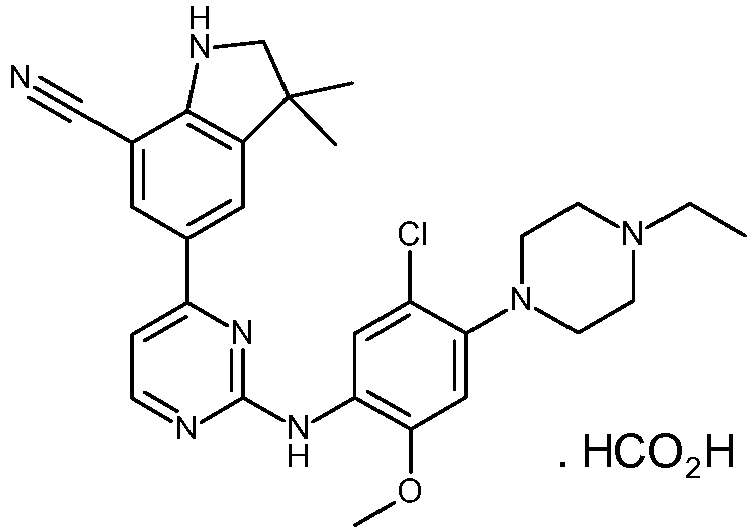
57 off-white solid Procedure with DCM/TF A (2:1, v/v) 50 From intermediate 282 Compound 82 
40 off-white solid 30 From intermediate 286 Compound 83 
12 Procedure with DCM/TF A (2:1, v/v) off-white solid 12 From intermediate 287 Compound 84 
31 Procedure with DCM/TF A (2:1, v/v) white solid 36 From intermediate 288 Compound 85 
35 off-white solid 28 From intermediate 282 Compound 87 
33 off-white solid 39 From intermediate 298 Compound 88 
8 Procedure with DCM/TF A (2:1, v/v) 10 From intermediate 301 Compound 89 
38 53 From intermediate 304 Compound 90 
9.2 off-white solid 11 From intermediate 306 Compound 91 
22 Procedure with DCM/TF A (2:1, v/v) 24 From intermediate 310 Compound 92 
51 pale yellow solid 54 From intermediate 312 Compound 93 
56 pale yellow solid 58 From intermediate 315 Compound 94 
26 pale yellow solid 27 From intermediate 320 Compound 95 
5 yellow solid Procedure with DCM/TF A (2:1, v/v) 5 From intermediate 323 Compound 96 
27 tan solid Procedure with DCM/TF A (2:1, v/v) 32 From intermediate 327 Compound 97 
42 pale yellow solid 47 From intermediate 330 Compound 98 
38 pale yellow solid 55 From intermediate 333 Compound 104 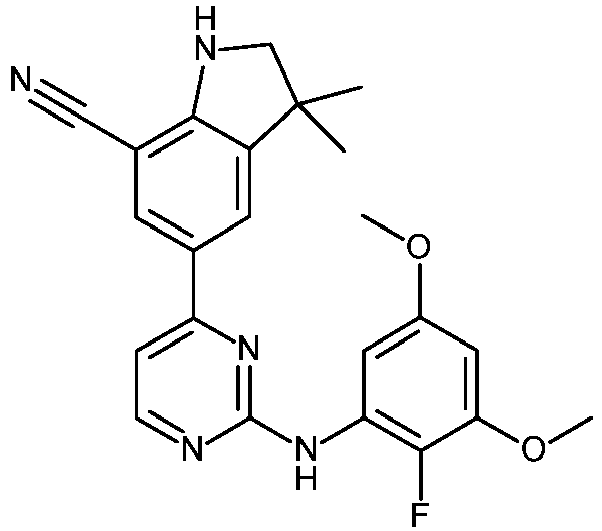
63 Procedure with DCM/TF A (10:3, v/v) 29 From intermediate 346 Compound 105 
113 Procedure with DCM/TF A (9:1, v/v) 24 From intermediate 347 Compound 106 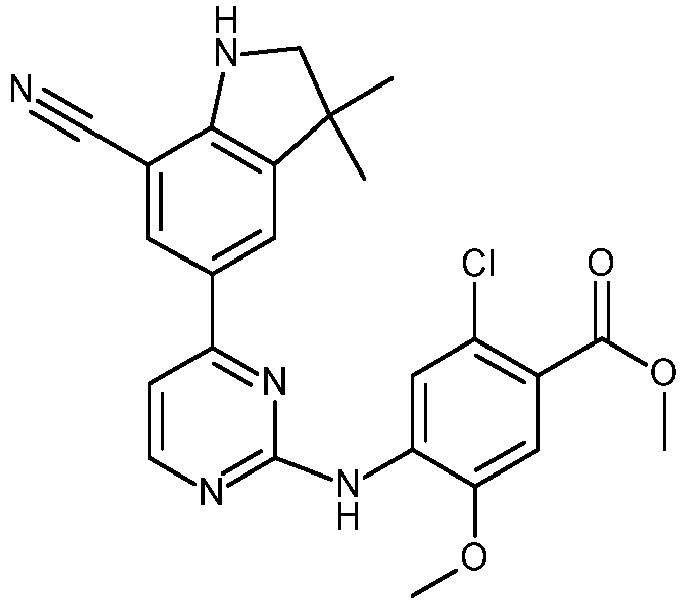
27 Procedure with DCM/TF A (10:1, v/v) 33 From intermediate 352 Compound 108 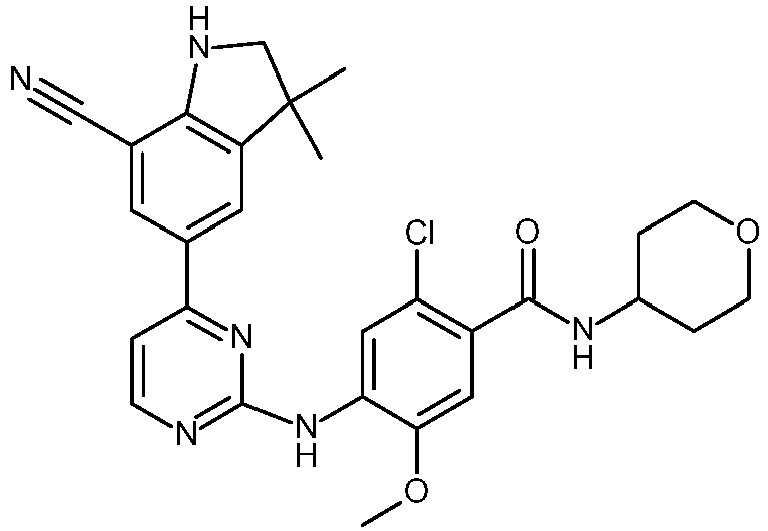
10 Procedure with DCM/TF A (10:1, v/v) 15 From intermediate 355 Compound 112 
16 Procedure with DCM/TF A (10:1, v/v) 23 From intermediate 363 Compound 113 
16 Procedure with DCM/TF A (5:1, v/v) 17 From intermediate 364 Compound 114 
10 Procedure with DCM/TF A (11:1, v/v) 15 From intermediate 365 Compound 115 
36.5 Procedure with DCM/TF A (5:1, v/v) white solid 40 TRANS; From intermediate 366 Compound 116 
6.8 Procedure with DCM/TF A (3:1, v/v) yellow solid 6 CIS; From intermediate 367 Compound 117 
45 white solid 53 CIS; From intermediate 368 Compound 118 
42 white solid Procedure with DCM/TF A (3:1, v/v) 45 From intermediate 369 Compound 119 
60 white solid 44 From intermediate 370 Compound 120 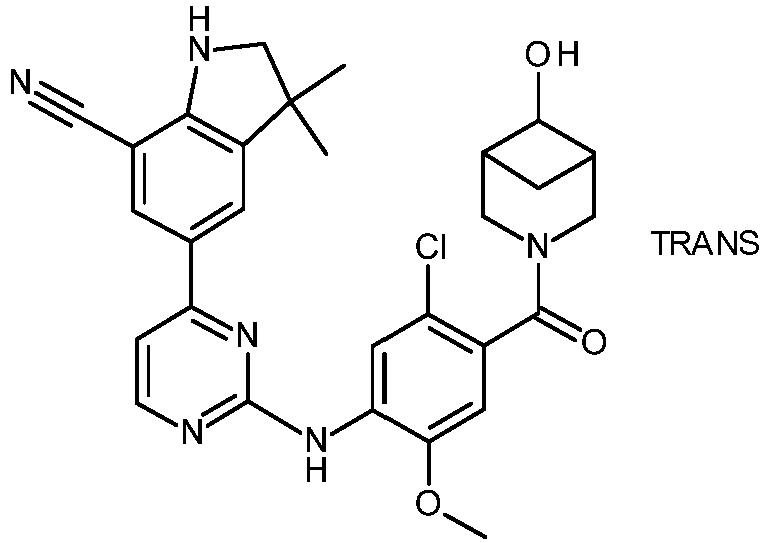
50 white solid 85 TRANS From intermediate 371 Compound 121 
20 39 From intermediate 372 Compound 122 
56 white solid 58 CIS; From intermediate 373 Compound 123 
16 white solid 19 From intermediate 374 Compound 124 (mixture of 4 unseparated diastereoisomers) 
40 white solid 54 From intermediate 375 - Preparation of compound 80:

- HCl (3M in H2O) (1.72 mL, 5.16 mmol) was added to a solution of intermediate 281 (304.00 mg, 0.52 mmol) in EtOAc (19.3 mL) and the reaction mixture was stirred 2 h at rt. The reaction was checked by LC/MS after 2 h but no conversion was observed. Also, the reaction was heated at 45 °C overnight. In order to speed the conversion, the temperature was elevated until 65°C for one more day. After completion of the reaction, the resulting mixture was cooled to rt, poured onto a 10% aqueous solution of K2CO3 and extracted with DCM. The organic layer was decanted, dried over MgSO4, filtered and evaporated to dryness. The residue (183 mg, yellow oil) was purified by column chromatography on silica gel (irregular SiOH, 24 g, mobile phase: NH4OH/MeOH/DCM, gradient from 0% NH4OH, 0% MeOH, 100% DCM to 1.5% NH4OH, 15% MeOH, 85% DCM). The fractions containing the product were evaporated. The residue (103 mg, yellow oil) was purified by reverse phase semi-preparative HPLC (Stationary phase: X-Bridge-C18, 5 µm 30 x 150 mm, mobile phase: gradient from 40% NH4HCO3 0.5%, 60% MeOH to 0% NH4HCO3 0.5%, 100% MeOH). The fractions containing the product were concentrated to give a colorless oil. The residue (60 mg) was precipitated with Et2O to give 54 mg of compound 78 (21% yield, white powder). M. P = 192 °C (K).
- The compounds in the Table below were prepared by using an analogous method as the one reported for the preparation of compound 80 starting from the respective starting materials. The most relevant minor deviations to the referenced method are indicated as additional information in the column 'Mass (mg)'.
Compound number Structure Mass (mg) Yield (%) compound 99 
63 white powder Procedure with MeOH as solvent 36 From intermediate 337 Compound 100 
18 white powder Procedure with MeOH as solvent 11 From intermediate 338 Compound 101 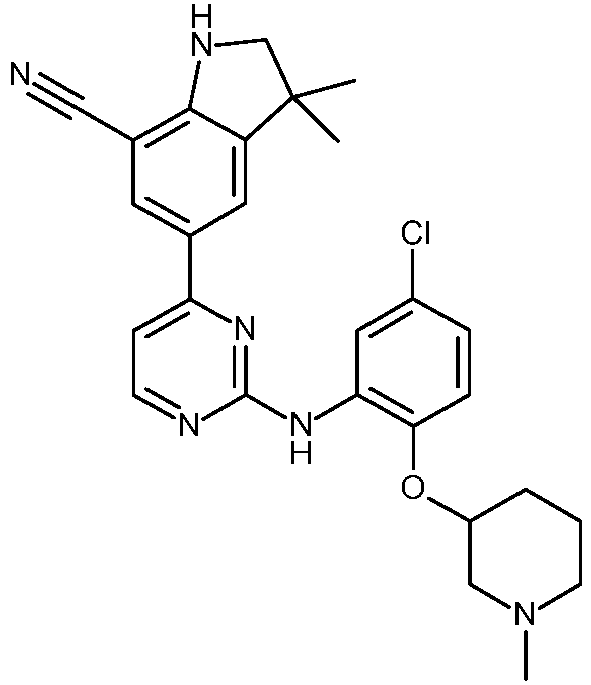
40 white powder Procedure with MeOH as solvent 26 From intermediate 339 Compound 102 
80 (100% purity based on LC/MS) Procedure with EtOAc as solvent white powder 23 From intermediate 342 22 Procedure with MeOH as solvent (100% purity based on LC/MS) white powder 44 Compound 103 
83 yellow powder 20 From intermediate 345 Compound 107 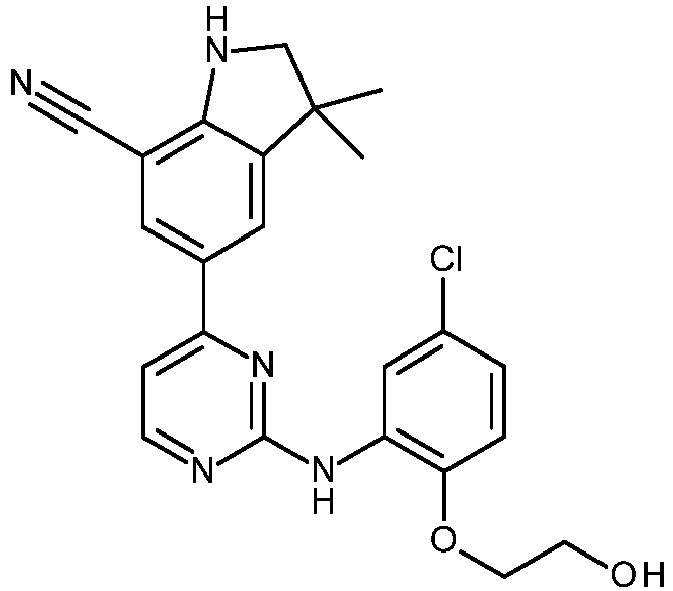
15 white powder Procedure with MeOH as solvent 26 From intermediate 353 Compound 109 
48 yellow powder Procedure with MeOH as solvent 63 From intermediate 356 - Preparation of compound 110:

- A mixture of intermediate 357 (160.00 mg, 0.26 mmol) in HCl/Dioxane (4M) was stirred at rt for 3 h. The mixture was evaporated under vacuo and purified by high-performance liquid chromatography (Column: Waters Xbridge Prep OBD C18 150 x 30, 5µm, mobile phase: water (0.05 % ammonia hydroxide v/v)/CH3CN, gradient from 33% to 63% of CH3CN in 10 min, then 100% of CH3CN in 3 min with a flow rate of 25 mL/min). The desired fractions were collected, and the solvent was concentrated in vacuum to give 38 mg of compound 110 (28% yield).
- Preparation of compound 111:

- TBAF (1M in THF) (0.59 mL, 0.59 mmol) was added to a solution of intermediate 362 (168.00 mg, 0.29 mmol) in Me-THF (5 mL) and the reaction mixture was stirred at rt for 4 h. The reaction mixture was diluted with EtOAc and poured onto a 10% aqueous solution of K2CO3. The organic layer was decanted, washed with brine, dried over MgSO4, filtered and evaporated to dryness. The residue was crystallized from CH3CN/DiPE and the precipitate was filtered and dried to give 102 mg of compound 111 (76% yield). M.P. = 219°C (K).
- Preparation of compound 135:

- TFA (0.88 mL, 11.50 mmol) was added dropwise to a solution of intermediate 383 (178.00 mg, 0.34 mmol) in DCM (stabilized with amylene) (6 mL) at 5 °C and the reaction mixture was stirred for 30 min at this temperature. The reaction mixture was quenched with a 10% aqueous solution of K2CO3 and extracted with DCM. The organic layer was decanted, dried over MgSO4, filtered and evaporated to dryness. The residue was purified by column chromatography on silica gel (irregular SiOH, 24 g, mobile phase: DCM/MeOH, gradient from 97:3 to 95:5). The pure fractions were collected and evaporated to dryness. The residue (98 mg) was purified by chromatography over silica gel by achiral SFC (Stationary phase: 2-ethylpyridine 6 µm 150 x 21.2 mm, mobile phase: 75% CO2, 25% MeOH (0.3% iPrNH2)). The pure fractions were mixed and the solvent was evaporated. The residue (52 mg) was crystallized from Et2O, filtered and dried to give 25 mg of compound 135 (17% yield).
- Preparation of compound 136:

- TFA (0.77 mL, 10.02 mmol) was added dropwise to a solution of intermediate 384 (147.00 mg, 0.29 mmol) in DCM (stabilized with amylene) (5 mL) at 5 °C and the reaction mixture was stirred for 1 h at this temperature. The reaction mixture was quenched with a 10% aqueous solution of K2CO3 and extracted with DCM. The organic layer was decanted, dried over MgSO4, filtered and evaporated to dryness. The residue was purified by column chromatography on silica gel (irregular SiOH, 24 g, mobile phase: DCM/MeOH, gradient from 97:3 to 95:5). The pure fractions were collected and evaporated to dryness. The residue (44 mg) was purified by reverse phase (stationary phase: YMC-actus Triart-C18, 10 µm, 30 x 150 mm, mobile phase: gradient from 60% NH4HCO3 0.2%, 40% MeOH to 0% NH4HCO3 0.2%, 100% MeOH). The mixture was taken up by CH3CN, filtered and dried to give 24 mg of compound 136 (20% yield).
- Preparation of compound 137:

- HCl (4M in dioxane) (8 mL; 32.24 mmol) was added at room temperature to a solution of intermediate 385 (3.57 g; 6.45 mmol) in ACN (95 mL) and the reaction mixture was stirred for 3 hours. The suspension was sonicated for 15 min and, then, the precipitate was filtered, washed with ACN and dried at 50°C under vacuo yielding 2.92g (86%) of compound 137, M.P.: 290°C (DSC).
- Preparation of compound 138:

- HCl (4M in dioxane) (35.2 mL; 140.93 mmol) was added at room temperature to a solution of intermediate 386 (16 g; 28.19 mmol) in ACN (400 mL) and the reaction mixture was stirred for 3 hours. Then, the suspension was sonicated for 30 minutes. The precipitate was filtered, washed with ACN and dried yielding 14.21g (93%) of compound 138.
- The compounds in the Table below were prepared by using an analogous method as reported for the preparation compounds 137 and 138, starting from the respective starting materials.
Intermediate number Structure Mass (mg) Yield (%) Compound 139 
230 54 From intermediate 387 Compound 140 
563 72 From intermediate 388 Compound 141 
241 88 From intermediate 389 Compound 142a 
80 24 From intermediate 390 Compound 142b 
200 47 From intermediate 390 - Preparation of compound 182:

- A solution of lithium hydroxide (213 mg; 5.074 mmol) in water (5 mL) was added to a solution of intermediate 483 (570 mg; 1.015 mmol) in THF (25 mL) and the reaction mixture was stirred for 18 hours. A solution of lithium hydroxide (213 mg; 5.074 mmol) in water (2 mL) was added again and the reaction mixture was stirred at room temperature for 24 hours more. The reaction mixture was heated at 60°C for 4 hours. The reaction mixture was acidified with 3N aqueous HCl, diluted with ACN and concentrated. The residue was crystallized from water. The precipitate was filtered and dried to give 402 mg (84%) of compound 182.
- Preparation of compound 202:

- Compound 202 was prepared following an analogous method than the one used for the preparation of compound 182 starting from intermediate 522 (491 mg; 84%).
- Preparation of compound 125:

- DIPEA (2.16 mL, 12.51 mmol) was added dropwise at 5 °C to a mixture of compound 1 (992.00 mg, 2.50 mmol), acetic acid (0.28 mL, 5.00 mmol) and HATU (3.80 g, 10.01 mmol) in a mixture of THF (4.07 mL) and DMF (3.88 mL). The mixture was stirred at rt overnight. Then, water was added and the reaction mixture was extracted with DCM. The organic layer was decanted, dried over MgSO4, filtered and evaporated to dryness. The residue (2 g, yellow oil) was purified by column chomatography on silica gel (irregular SiOH, 120 g, mobile phase: DCM/MeOH, gradient from 100:0 to 98:2). The fractions containing the product were collected and evaporated to dryness to give 566 mg of a first batch of compound 125 (58% purity based on LC/MS, yellow oil). The others fractions were collected and evaporated to dryness to give a second batch of compound 125 (800 mg, yellow oil). This batch was purified again by column chromatography on silica gel (irregular SiOH, 40 g, mobile phase: DCM, 100%). The fractions containing the products were gathered and evaporated. The residue (563 mg, yellow powder) was taken up with CH3CN to provide 393 mg of compound 125 (36% yield, yellow powder). M.P = 213 °C (K).
- The compounds in the Table below were prepared by using an analogous method as the one reported for the compound 125 starting from the respective starting materials. The most relevant minor deviations deviations to the referenced method are indicated as additional information in the column 'Mass (mg)'.
Compound number Structure Mass (mg) Yield (%) Compound 126 
30 white powder 6 From compound 1 Compound 127 
55 white powder 18 From compound 66 Compound 128 
40 white powder 32 From compound 13 - Preparation of compound 129:

- HCl (4M in dioxane) (126.00 µL, 0.50 mmol) was added dropwise at 5 °C to a suspension of compound 1 (200.00 mg, 0.50 mmol) in CH3CN (20 mL). The reaction mixture was allowed to warm to rt and stirred overnight. The precipitate was filtered, washed with CH3CN and dried at 50 °C under vacuum all over the week end to give 204 mg of compound 129 (93% yield). M.P. = 190 °C (K).
- Preparation of compound 130:

- Aqueous H2SO4 (3M) (168.00 µL, 0.50 mmol) was added dropwise at 5 °C to a suspension of compound 1 (200.00 mg, 0.50 mmol) in CH3CN (20 mL). The reaction mixture was allowed to warm to rt and stirred overnight. The precipitate was filtered, washed with CH3CN and dried at 50 °C under vacuum all over the week end to give 214 mg of compound 130 (83% yield). M.P. = 264 °C (K).
- Preparation of compound 131:

- Phosphoric acid (3M) (168.00 µL, 0.50 mmol) was added dropwise at 5 °C to a suspension of compound 1 (200.00 mg, 0.50 mmol) in CH3CN (20 mL). The reaction mixture was allowed to warm to rt and stirred overnight. The precipitate was filtered, washed with CH3CN and dried at 50 °C under vacuum all over the week end to give 228 mg of compound 131 (75% yield). M.P. = 174 °C (K).
- Preparation of compound 132:

- Methanesulfonic acid (33.00 µL, 0.50 mmol) was added dropwise to a suspension of compound 1 (200.00 mg, 0.50 mmol) in CH3CN (20 mL). The reaction mixture was stirred overnight. The precipitate was filtered, washed with Et2O and dried at 50 °C under vacuum to give 115 mg of compound 132 (46% yield). M.P. = 234 °C (K).
- Preparation of compound 133:

- A solution of p-toluenesulfonic acid, monohydrate (96.00 mg, 0.50 mmol) in water (0.5 mL) was added dropwise to a suspension of compound 1 (200.00 mg, 0.50 mmol) in CH3CN (20 mL). The reaction mixture was stirred overnight. The precipitate was filtered, washed with Et2O and dried at 50 °C under vacuum to give 229 mg of compound 133 (79% yield). M.P. = 262°C (K).
- Preparation of compound 134:
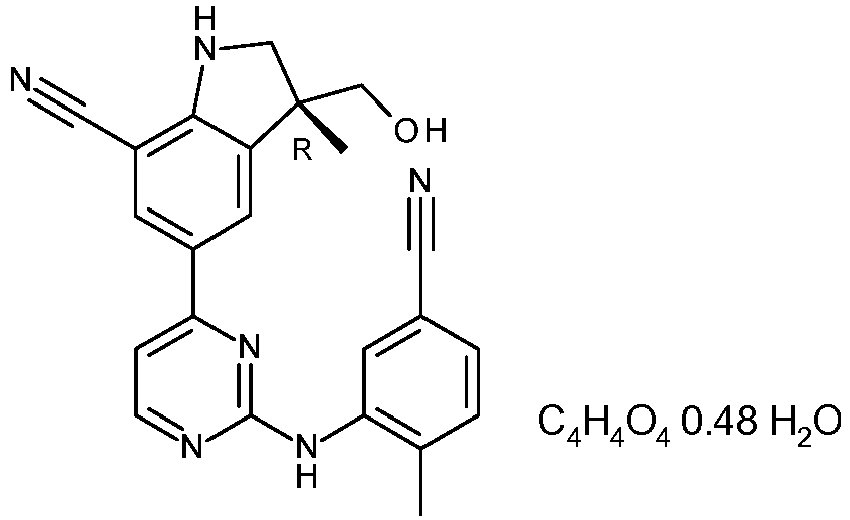
- A solution of maleic acid (58.56 mg, 0.50 mmol) in CH3CN (0.50 mL) and water (0.50 mL) was added dropwise to a suspension of compound 1 (200.00 mg, 0.50 mmol) in CH3CN (20 mL). The reaction mixture was allowed to warm to rt and stirred overnight. The precipitate was filtered, washed with Et2O and dried at 50 °C under vacuum to give 169 mg of compound 134 (65% yield). M.P. = 190°C (K).
- Preparation of compound 143:

- Compound 1 (200 mg; 0.504 mmol) was added to a suspension of pyridine sulfure trioxide (48-50%) (163 mg; 0.504 mmol) in THF (2 mL) and the reaction mixture was stirred at room temperature for 3 hours. A solution of potassium hydroxide (28 mg; 0.504 mmol) in water (0.5 mL) was added and the resulting solution was cooled to 5°C before acetone was added. The product precipitated under standing. Then, it was filtered and washed with acetone yielding 250 mg of Fraction A (>100%).
- Fraction A was taken up with toluene, then EtOH and the solvent was evaporated to dryness. The precipitate was taken up with ACN, filtered and dried yielding 233 mg of Fraction B (97%).
- Fraction B was suspended in water and stirred for 15 minutes, then filtered and dried yielding 159 mg (59%) of compound 143, M.P.: >270°C (Kofler).
- Preparation of compound 144:

- Compound 65 (200 mg; 0.504 mmol) was added to a suspension of pyridine sulfure trioxide (164 mg; 0.504 mmol) in THF (2 mL) and the reaction mixture was stirred at room temperature for 3 hours. A solution of potassium hydroxide (28 mg; 0.504 mmol) in wtare (0.5 mL) was added and the solution was cooled to 5°C before acetone was added. The product precipitated under standing. Then, it was filtered and washed with acetone yielding 249 mg of Fraction A (>100%).
- Fraction A was washed with water then acetone and dried yielding 127 mg (51%) of compound 144.
- Preparation of compound 145:

- A mixture of compound 1 (250 mg; 0.63 mmol), 4-methyl-1-piperazineacetic acid (249 mg; 1.58 mmol), HATU (599 mg; 1.58 mmol), DIPEA (543 µL; 3.15 mmol) and
- DMAP (4 mg; 0.034 mmol) in DMF (7.5 mL) was stirred at room temperature for 18 hours. The solution was poured onto water and extracted with EtOAc. The organic layer was washed with H2O, then brine, dried over MgSO4, filtered and evaporated to dryness. The residue was purified by chromatography over silica gel (irregular SiOH, 24g; mobile phase: 0.2% NH4OH, 2% MeOH, 98% DCM to 0.5% NH4OH, 5% MeOH, 95% DCM). The pure fractions were collected and evaporated to dryness yielding 395 mg of an intermediate fraction which was dissolved in ACN (15 mL). The solution was cooled to 5°C and HCl (4M indioxane) (473 µL; 1.89 mmol) was added. The suspension was stirred for 3 hours and the precipitate was filtered and dried yielding 203 mg (54%) compound 145, M.P.: gum at 216°C (Kofler).
- Preparation of compound 146:

- Compound 146 was prepared following a similar procedure than the one used for the preparation of compound 145 starting from compound 1 and 4-methyl-1-morpholine acetic acid. 86 mg (22%) of compound 146 were obtained, gum at 186°C (Kofler).
- Preparation of compound 164:

- Diethylaminosulfur trifluoride (0.247 mL; 2.02 mmol) was added to a solution of compound 1 (200 mg; 0.504 mmol) in THF (7 mL) at -78°C. After 2 hours, diethylaminosulfur trifluoride (0.247 mL; 2.02 mmol) was added again and the mixture was stirred at rt for 20 hours. The mixture was poured into ice. The obtained precipitate was filtered off. The mother layer were basified by potassium carbonate and extracted with EtOAc. The organic layer was washed with brine, dried over MgSO4, filetred and the solvent was evaporated. The residue was purified by chromatography over silica gel (50g, 15-40 µm, solid deposit, eluent: DCM/MeOH: 100/0 to 95/5). The pure fractions were mixed and the solvent was evaporated. The resulting residue (0.05g) was purified via achiral SFC (stationary phase: diethylaminopropyl 5µm150x21.2mm, mobile phase: 85% CO2, 15% MeOH). The pure fractions were mixed and the solvent was evaporated to give 0.02 g (10%) of compound 164. M.P.=194°C (Kofler).
- Preparation of compound 172:

- A mixture of compound 170 (39 mg; 0.086 mmol), propanooic acid (0.095 mL; 0.0946 mmol), HATU (36 mg; 0.0946 mmol) and DIPEA (0.0445 mL; 0.258 mmol) in DCM (0.8 mL) was stirred at room temperature for 18 hours. The solution was poured onto water and extracted with DCM. The organic layer was washed with brine, dried over MgSO4, filtered and evaporated to dryness. The residue was purified by chromatography over silica gel (irregular SiOH, 4 g; mobile phase: DCM/MeOH: 100/0 to 95/5). The pure fractions were collected and evaporated to dryness to give 20 mg (46%) of compound 172. MP = 193°C (Kofler).
- Preparation of compound 176:

- Compound 176 was synthesized by using an analogous method than the one used for the preparation of compound 172 above, starting from compound 171 (21 mg; 20%).
- Preparation of compound 181:
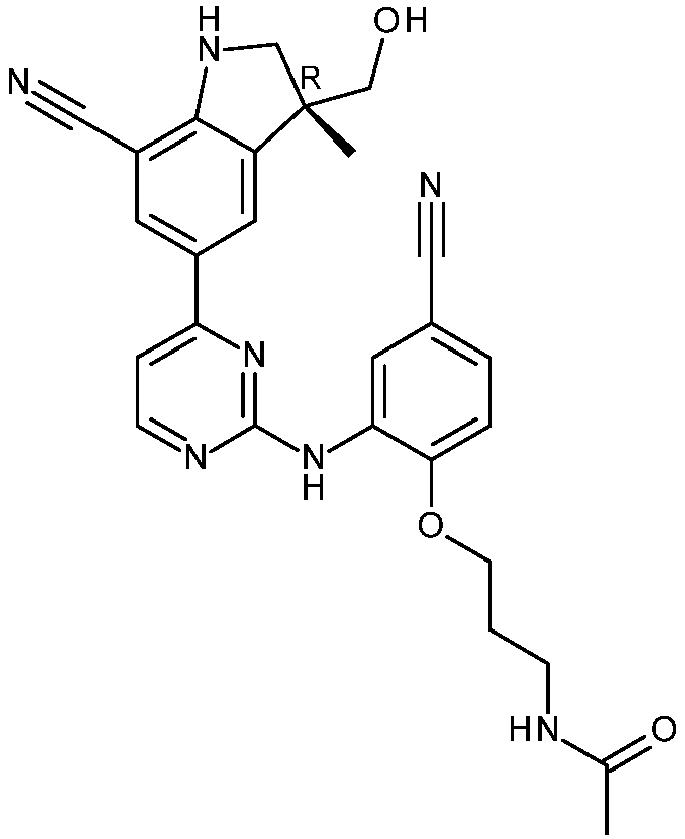
- Compound 181 was synthesized by using an analogous method as the one used for the preparation of compound 172, starting from compound 180 (4 mg; 18%).
- Preparation of compound 183:

- Compound 183 was synthesized by using an analogous method (solvent: DCM/THF/DMF: 50/50/5) as the one used for the preparation of compound 172, starting from compound 182 (280 mg; 65%; MP = 209°C; DSC).
- Preparation of compound 185:

- Compound 184 was synthesized by using an analogous method (solvent: DCM/THF) than the one used for the preparation of compound 172, starting from compound 184 (35 mg; 45%; MP = gum at 156°C; Kofler).
- Preparation of compound 203:

- A mixture of compound 201 (260 mg; 0.38 mmol), 1-methylpiperazine (63 µL; 0.57 mmol), HATU (159 mg; 0.42 mmol) and DIEA (265 µL; 1.52 mmol) in DCM (10 mL) was stirred at room temperature for 18 hours. Water was added and the reaction mixture was extracted with DCM. The organic layer was filtered through chromabond® and evaporated to dryness. The residue was purified (180 mg) by chromatography over silica gel (irregular SiOH, 10g; mobile phase: gradient from 0.3% NH4OH, 3% MeOH, 97% DCM to 1.5% NH4OH, 15% MeOH, 85% DCM). The pure fractions were collected and evaporated to dryness. The residue was taken up with ACN and the precipitate was filtered and dried yielding 72 mg (36%) of compound 203. M.P.: 294°C (DSC).
- The compounds in the table below were prepared using an analogous method as described for the preparation of compound 203, starting from the respective starting materials.
Compound number Structure Quantity Yield Compound 204 
78 mg 40% From compound 201 and intermediate 524 Compound 205 
331 mg 38% From compound 202 and morpholine-d8 Compound 206 
205 mg 71% From compound 202 and 1-cyclopropylpiperazine Compound 207 
200 mg 67% M.P.: 268°C (DSC) From compound 202 and 1-(oxetan-3-yl)piperazine - Preparation of compound 178


- Compound 178 and compound 179 were obtained from an achiral SFC purification (stationary phase: Chiralpak IC 5µm 250x20mm, mobile phase: 50% CO2, 50% EtOH (0.3% iPrNH2)). The fractions containing the products were mixed and the solvent was evaporated to afford respectively 47 mg of compound 178 and 43 mg of compound 179.
- Preparation of compound 201:

- A solution of LiOH.H2O (77 mg; 1.83 mmol) in distilled water (2 mL) was added to a solution of compound 8 (166 mg; 0.365 mmol) in THF (10 mL) and the reaction mixture was stirred for 18 hours. The reaction mixture was acidified with 6N aqueous HCl, diluted with ACN and concentrated. The residue was crystallized from water/ACN. The precipitate was filtered, washed with water and dried yielding 118 mg (72%) of compound 201. M.P.: 220°C (gum, Kofler).
- Preparation of compound 202:

- Compound 202 was prepared following an analogous method than the one used for the preparation of compound 501 starting from intermediate 522 (491 mg; 84%).
- The High Performance Liquid Chromatography (HPLC) measurement was performed using a LC pump, a diode-array (DAD) or a UV detector and a column as specified in the respective methods. If necessary, additional detectors were included (see table of methods below).
- Flow from the column was brought to the Mass Spectrometer (MS) which was configured with an atmospheric pressure ion source. It is within the knowledge of the skilled person to set the tune parameters (e.g. scanning range, dwell time...) in order to obtain ions allowing the identification of the compound's nominal monoisotopic molecular weight (MW). Data acquisition was performed with appropriate software. Compounds are described by their experimental retention times (Rt) and ions. If not specified differently in the table of data, the reported molecular ion corresponds to the [M+H]+ (protonated molecule) and/or [M-H]- (deprotonated molecule). In case the compound was not directly ionizable the type of adduct is specified (i.e. [M+NH4]+, [M+HCOO]-, etc...). For molecules with multiple isotopic patterns (Br, Cl..), the reported value is the one obtained for the lowest isotope mass. All results were obtained with experimental uncertainties that are commonly associated with the method used. Hereinafter, "SQD" means Single Quadrupole Detector, "RT" room temperature, "BEH" bridged ethylsiloxane/silica hybrid, "HSS" High Strength Silica, "DAD" Diode Array Detector.
Table: LCMS Method codes (Flow expressed in mL/min; column temperature (T) in °C: Run time in minutes). Method code Instrument Column Mobile phase gradient Flow Run time Column T Method 1 Waters: Acquity UPLC8 -DAD and Quattro Micro™ aters: BEH C18 (1.7 µm, 2.1 x 100 mm) A: 95% CH3COONH4 7 mM / 5% CH3CN, B: CH3CN 84.2% A for 0.49 min, to 10.5% A in 2.18 min, held for 1.94 min, back to 84.2% A in 0.73 min, held for 0.73 min. 0.343 6.2 40 Method 2 Waters: Acquity UPLC® H-Class - DAD and SQD 2 Waters: BEH C18 (1.7 µm, 2.1 x 100m m) A: 95% CH3COONH4 7 mM / 5% CH3CN, B: CH3CN From 84.2% A to 10.5% A in 2.18 min, held for 1.94 min, back to 84.2% A in 0.73 min, held for 0.73 min. 0.343 6.1 40 Method 3 Agilent 1200 equip with MSD 6110 Agilent TC-C18(5 µm, 2.1 x 50 mm) A: H2O (0.1% TFA), B: CH3CN (0.05% TFA) 90% A held for 0.80 min, then from 90% A to 20% A in 3.7 min, held for 3.00 min, back to 90% A in 2.00 min. 0.8 10 50 Method 4 Waters: Acquity UPLC® H-Class - DAD and QDa BEH®-C18 (1.7 µm, 2.1 x 1000 mm) A: 95% CH3COONH4 7 mM/5% CH3CN, B: CH3CN 95% A to 5% A in 1 min, held for 1.6 min, back to 95% A in 1.2 min, held for 0.5 min. 0.5 3.3 40 Method 5 Agilent 1200 equip with MSD 6110 XBridge ShieldRP18 (5 µm, 2.1x50 mm) A: H2O (0.05% NH3.H2O), B: CH3CN 100% A held for 1.00 min, then from 100% A to 40% A in 4.00 min, then from 40% A to 5% A in 2.50 min, back to 100% A in 2.00 min. 0.8 10 40 Method 6 Waters: Micromass ZQ2000 - Waters Acquity UPLC system equipped with PDA detector Acquity HST - C 18 (1.8 µM, 2.1 x 100 mm) A: 95% Water (with 0.1% CH3COOH), B: CH3CN (with 0.1% CH3COOH) 95% A held 0.4 min, then from 95% A to 5% A 5.2 min, held for 0.8 min. 0.4 6.4 40 Method 7 Agilent 1100 ACE C18 column (3 µM, 3.0 x 50 mm) A: 95% Water (with 0.05% TFA), B: CH3CN 95% A to 0% A 5.2 min 2.2 6.4 50 Method 8 Agilent 1200 equip with MSD 6110 Phenomene x Luna-C18, 50×2mm, 5µm A: H2O (0.1% TFA, B: CH3CN (0.05% TFA) 100% A held for 1 mn then 100% A to 40% A in 4 mn then 40% A to 15 % A in 2.5 mn then back to 100% A in 2 mn held for 0.5 min. 0.8 10 50 Method 9 Agilent 1200 equip with MSD 6110 Phenomene x Luna-C18, 50×2mm, 5µm A :H2O (0.1% TFA), B:CH3CN ( 0.05% TFA) 90% A held for 0.8 mn then 90% A to 20% A in 3.7 mn, held for 2mn, back to 90% A in 2 mn, held for 0.5 min. 0.8 10 50 Method 10 Agilent 1290 Infinity DAD LC/MS G6110A Phenomene x Kinetex C18 (50 x 2.1 mm, 1.7 µm) A: 0.1% HCOOH in H2O B: CH3CN From 90% A to 10% A in 1.5 min, held for 0.4 min, to 90% A in 0.1 min. 1.5 2.0 60 Method 11 Agilent 1100 series DAD LC/MS G1956A YMC ODS-AQ C18 (50 x 4.6 mm, 3.0 µm) A: 0.1% HCOOH in H2O B: CH3CN From 95% A to 5% A in 4.8 min, held for 1.0 min, to 90% A in 0.2 min. 2.6 6.0 35 Method 12 Agilent 1290 Infinity DAD TOF-LC/MS G6224A YMC-pack ODS-AQ C18 (50 x 4.6 mm, 3 µm) A: 0.1% HCOOH in H2O B: CH3CN From 95% A to 5% A in 4.8 min, held for 1.0 min, to 95% A in 0.2 min. 2.6 6.0 35 - For a number of compounds, melting points (MP) were determined with a DSC1 (Mettler-Toledo). Melting points were measured with a temperature gradient of 10 °C/minute. Maximum temperature was 350 °C. Values are peak values. Indicated in the table as DSC.
- For a number of compounds, melting points were obtained with a Kofler hot bench (indicated with (K) in the analytical table), consisting of a heated plate with linear temperature gradient, a sliding pointer and a temperature scale in degrees Celsius.
- For a number of compounds, melting points were obtained with an automatic Melting Point Apparatus WRS-2A (indicated with WRS-2A in the analytical table). Melting points were measured with a temperature gradient of 5°C per minute starting from room temperature to a maximum value of 320°C.
- For a number of compounds, melting points were obtained with a Mettler Toledo MP50 apparatus (indicated with MP50 in the analytical table). Melting points were measured with a temperature gradient of 10°C per minute starting from 50°C (waiting time 10 second) to a maximum value of 300°C.


- Optical Rotation is measured with a polarimeter such as e.g. 341 Perkin Elmer, an Autopol IV automatic polarimeter (Rodolph research analytical) or a P-2000 (Jasco).
- Specific rotation (OR):

α (measured rotation) is the angle through which plane polarized light is rotated by a solution of mass concentration c and path length 1. Concentration is in grams per 100 mL; path length 1 is in decimeters and is 1.000 decimeter. - θ is the temperature (°C) and λ the wavelength of the light used.
- Unless otherwise indicated, temperature is 20 °C, and the sodium D line is used (589 nanometer).
- OR data: Solvent: DMF (unless otherwise indicated); temperature : 20 °C (unless otherwise indicated); wavelength : 589 nm (unless otherwise indicated); 'Conc.' means concentration of the sample in grams per 100 mL; 'OR' means optical rotation (specific rotation); 'Co. No.' means compound number


- The SFC measurement was performed using an Analytical Supercritical fluid chromatography (SFC) system composed by a binary pump for delivering carbon dioxide (CO2) and modifier, an autosampler, a column oven, a diode array detector equipped with a high-pressure flow cell standing up to 400 bars. If configured with a Mass Spectrometer (MS) the flow from the column was brought to the (MS). It is within the knowledge of the skilled person to set the tune parameters (e.g. scanning range, dwell time...) in order to obtain ions allowing the identification of the compound's nominal monoisotopic molecular weight (MW). Data acquisition was performed with appropriate software.
Table: Analytical SFC-MS Methods (Flow expressed in mL/min; column temperature (T) in °C; Run time in minutes, Backpressure (BPR) in bars. Method number column mobile phase gradient 

1 Daicel Chiralpak® AD-3 column (3 µm, 100 x 4.6 mm) A:CO2 B: MeOH(0.3% iPrNH2) 35% B hold 6 min 

Table: Analytical SFC-MS data - Rt means retention time (in minutes), method refers to the method used for (SFC)MS analysis of enantiomerically pure compounds. Co. No. Rt Chiral purity UV Area% Method number 232 2.59 100 1 233 2.20 98.79 1 - The NMR experiments were carried out using a Bruker Avance 500 III using internal deuterium lock and equipped with reverse triple-resonance (1H, 13C,15N TXI) probe head or using a Bruker Avance DRX 400 spectrometer at ambient temperature, using internal deuterium lock and equipped with reverse double-resonance (1H, 13C, SEI) probe head with z gradients and operating at 400 MHz for the proton and 100MHz for carbon. Chemical shifts (δ) are reported in parts per million (ppm). J values are expressed in Hz.
- Compound 1: 1H NMR (500 MHz, DMSO-d6 ): δ 8.92 (s, 1 H), 8.40 (d, J = 5.3 Hz, 1 H), 8.17 (d, J = 1.2 Hz, 1 H), 8.07 (d, J = 1.2 Hz, 1 H), 7.92 (d, J = 1.3 Hz, 1 H), 7.48 - 7.40 (m, 3 H), 7.36 (d, J = 5.4 Hz, 1 H), 4.98 (t, J = 5.4 Hz, 1 H), 3.69 (d, J = 9.8 Hz, 1 H), 3.44 (dd, J = 10.7 Hz, 5.3 Hz, 1 H), 3.34 - 3.39 (m, 1 H, partially obscured by solvent peak), 3.29 (d, J= 9.8 Hz, 1 H), 2.37 (s, 3 H), 1.27 (s, 3 H).
- Compound 4: 1H NMR (500 MHz, DMSO-d6 ): δ 8.80 (s, 1 H), 8.33 - 8.37 (m, 2 H), 8.20 (d, J= 0.9 Hz, 1 H), 8.04 (d, J = 1.6 Hz, 1 H), 7.91 (d, J= 1.6 Hz, 1 H), 7.52 (dd, J = 7.9 Hz, 1.9 Hz, 1 H), 7.36 (s, 1 H), 7.30 - 7. 22 (m, 2 H), 4.95 (br s, 1 H), 3.70 (d, J = 9.1 Hz, 1 H), 3.42 (dd, J= 9.8 Hz, 1.8 Hz, 1 H), 3.34 - 3.39 (m, 1 H, partially obscured by solvent peak), 3.27 (d, J = 9.1 Hz, 1 H), 2.77 (d, J= 4.4 Hz, 3 H), 2.30 (s, 3 H), 1.24 (s, 3 H).
- Compound 45: 1H NMR (500 MHz, DMSO-d6 ): δ 8.62 (d, J = 2.5 Hz, 1 H), 8.49 (d, J = 5.4 Hz, 1 H), 8. 13 (d, J = 1.6 Hz, 1 H), 8.12 (s, 1 H), 8.00 (d, J= 1.3 Hz, 1 H), 7.50 (s, 1 H), 7.46 (d, J = 5.4 Hz, 1 H), 7.12 (d, J = 8.5 Hz, 1 H), 7.01 (dd, J = 8.7 Hz, 2.7 Hz, 1 H), 5.01 (t, J = 5.4 Hz, 1 H), 4.24 - 4.20 (m, 2 H), 3.74 - 3.69 (m, 3 H), 3.46 (dd, J= 10.7 Hz, 5.3 Hz, 1 H), 3.42 - 3.34 (m, 4 H), 3.31 - 3.37 (m, 1H, partially obscured by solvent peak), 1.30 (s, 3 H).
- Compound 66: 1H NMR (500 MHz, DMSO-d6 ): δ 8.77 (d, J = 1.9 Hz, 1 H), 8.50 (d, J = 5.4 Hz, 1 H), 8.19 (s, 1 H), 8.11 (d, J = 1.9 Hz, 1 H), 7.97 (d, J = 1.6 Hz, 1 H), 7.51 - 7.45 (m, 3 H), 7.27 (d, J = 8.5 Hz, 1 H), 4.97 (t, J = 5.5 Hz, 1 H), 4.34 - 4.30 (m, 2 H), 3.77 - 3.74 (m, 2 H), 3.71 (d, J = 9.8 Hz, 1 H), 3.47 (dd, J = 10.7 Hz, 5.3 Hz, 1 H), 3.38 (dd, J = 10.7 Hz, 5.7 Hz, 1 H), 3.35 (s, 3H), 3.31 (d, J = 10.1 Hz, 1 H), 1.30 (s, 3 H).
- Compound 68: 1H NMR (500 MHz, DMSO-d6 ) δ ppm 9.39 (s, 1 H) 8.90 (s, 1 H) 8.36 (d, J=5.0 Hz, 1 H) 8.07 (s, 1 H) 7.93 (s, 1 H) 7.62 (s, 1 H) 7.39 (s, 1 H) 7.32 (d, J=5.4 Hz, 1 H) 7.22 (s, 1 H) 4.99 (br t, J=5.2 Hz, 1 H) 3.69 (br d, J=9.8 Hz, 1 H) 3.50 - 3.35 (m, 2 H, partially obscured by solvent peak) 3.29 (br d, J=10.1 Hz, 1 H) 2.81 (br d, J=11.0 Hz, 2 H) 2.31 - 2.40 (m, 1 H) 2.16 (s, 3 H) 2.07 (s, 3 H) 1.87 (br t, J=11.2 Hz, 2 H) 1.78 (br d, J=11.0 Hz, 2 H) 1.58 - 1.73 (m, 2 H) 1.27 (s, 3 H).
- Compound 73: 1H NMR (500 MHz, DMSO-d6 ): δ 8.67 (d, J = 8.5 Hz, 1 H), 8.51 (d, J = 5.4 Hz, 1 H), 8.33 (s, 1 H), 8.16 (d, J=1.6 Hz, 1 H), 8.03 (d, J = 1.6 Hz, 1 H), 7.54 (dd, J = 8.5 Hz, 1.9 Hz, 1 H), 7.46 - 7.50 (m, 3 H), 5.04 (t, J = 5.4 Hz, 1 H), 4.01 (s, 3 H), 3.68 (d, J = 9.5 Hz, 1 H), 3.47 (dd, J= 10.7 Hz, 5.3 Hz, 1 H), 3.40 (dd, J = 10.4 Hz, 5.3 Hz, 1 H), 3.29 - 3.33 (m, 1 H, partially obscured by solvent peak), 3.21 (s, 3 H), 1.30 (s, 3 H).
- Compound 74: 1H NMR (500 MHz, DMSO-d6 ): δ 8.92 (s, 1 H), 8.38 (d, J = 5.0 Hz, 1 H), 8.16 (s, 1 H), 8.05 (d, J= 1.3 Hz, 1 H), 7.91 (s, 1 H), 7.51 (dd, J = 7.9 Hz, 1.3 Hz, 1 H), 7.38 - 7.45 (m, 2 H), 7.35 (d, J = 5.4 Hz, 1 H), 4.97 (t, J = 5.2 Hz, 1 H), 3.69 (d, J = 9.8 Hz, 1 H), 3.44 (dd, J = 10.4 Hz, 5.3 Hz, 1 H), 3.33 - 3.38 (m, 1 H, partially obscured by solvent peak), 3.27 - 3.31 (m, 3 H), 3.21 (s, 3 H), 2.79 (t, J = 7.6 Hz, 2 H), 1.78 (q, J= 6.9 Hz, 2 H), 1.27 (s, 3 H).
- Compound 110: 1H NMR (400MHz, DMSO-d6): δ 8.63 (s, 1 H), 8.50 (d, J = 5.5 Hz, 1 H), 8.19 (br. s., 1 H), 8.15 (d, J = 1.5 Hz, 1 H), 8.05 (d, J= 1.5 Hz, 1 H), 7.49 (m, 2 H), 7.06 (s, 1 H), 5.80 (br. s., 1 H), 4.52 (m, 1 H), 4.23 (m, 1H), 4.10 (m, 1H), 3.93 (s, 3 H), 3.76 (m, 2 H), 3.45 (s, 2 H), 1.33 (s, 6 H).
- Compound 125:
1H NMR (400 MHz, DMSO-d6 ): δ 8.90 (s, 1 H), 8.42 (d, J = 5.0 Hz, 1 H), 8.18 (s, 1 H), 8.12 (d, J = 1.5 Hz, 1 H), 8.02 (s, 1 H), 7.51 (s, 1 H), 7.41 - 7.49 (m, 2 H), 7.38 (d, J = 5.6 Hz, 1 H), 4.00 - 4.14 (m, 2 H), 3.62 (d, J = 10.1 Hz, 1 H), 3.39 (d, J = 10.6 Hz, 1 H), 2.36 (s, 3 H), 1.94 (s, 3 H), 1.35 (s, 3 H). - Compound 138:
1H NMR (500 MHz, DMSO-d6 ) δ ppm 9.47 (br s, 1H) 8.51 (br s, 2H) 8.47 (d, J=5.7 Hz, 1H) 8.22 (s, 1H) 8.20 (d, J=1.3 Hz, 1H) 8.08 (s, 1H) 7.57 - 8.03 (m, 1H) 7.46 - 7.56 (m, 3H) 5.20 - 7.15 (m, 1H) 4.35 (d, J=10.7 Hz, 1H) 4.14 (d, J=10.7 Hz, 1H) 3.95 - 4.09 (m, 1H) 3.73 (d, J=10.7 Hz, 1H) 3.47 (d, J=10.7 Hz, 1H) 2.39 (s, 3H) 1.40 (s, 3H) 1.25 (d, J=7.3 Hz, 3H) - Compound 137: 1H NMR (400 MHz, DMSO-d6 ) δ ppm 9.24 (br s, 1H) 8.45 (d, J=5.6 Hz, 1H) 8.36 (br s, 3H) 8.20 (s, 1H) 8.17 (d, J=1.5 Hz, 1H) 8.06 (d, J=1.5 Hz, 1H) 7.63 (br s, 1H) 7.48 - 7.53 (m, 1H) 7.42 - 7.48 (m, 2H) 6.34 (br s, 2H) 4.22 (s, 2H) 3.76 - 3.89 (m, 2H) 3.70 (d, J=10.6 Hz, 1H) 3.42 (d, J=10.6 Hz, 1H) 2.38 (s, 3H) 1.39 (s, 3H)
- Compound 148:
1H NMR (500 MHz, DMSO-d6 ) δ ppm 8.72 (s, 1H) 8.30 (br d, J=5.0 Hz, 1H) 8.03 (s, 1H) 7.91 (s, 1H) 7.57 (br d, J=7.3 Hz, 1H) 7.35 (s, 1H) 7.23 (br d, J=5.4 Hz, 1H) 7.02 (br d, J=10.7 Hz, 1H) 5.15 (s, 1H) 4.99 (br t, J=5.0 Hz, 1H) 3.67 (br d, J=9.8 Hz, 1H) 3.39 - 3.46 (m, 1H) 3.34 - 3.39 (m, 1H) 3.28 (br d, J=9.8 Hz, 1H) 2.21 (s, 3H) 1.26 (s, 3H) - Compound 155:
1H NMR (500 MHz, DMSO-d6 ) δ ppm 8.86 (s, 1 H) 8.40 (d, J=5.4 Hz, 1H) 8.12 - 8.20 (m, 1H) 8.10 (d, J=1.6 Hz, 1H) 8.01 (br d, J=7.3 Hz, 1H) 7.97 (d, J=1.3 Hz, 1H) 7.43 (s, 1H) 7.34 (d, J=5.4 Hz, 1H) 7.23 (d, J=11.3 Hz, 1H) 5.01 (t, J=5.4 Hz, 1H) 3.75 (d, J=9.5 Hz, 1H) 3.46 - 3.53 (m, 1H) 3.41 (dd, J=10.7, 5.7 Hz, 1H) 3.34 (d, J=9.5 Hz, 1H) 2.85 (d, J=4.4 Hz, 3H) 2.34 (s, 3H) 1.31 (s, 3H) - Compound 156:
1H NMR (500 MHz, DMSO-d6 ) δ ppm 8.53 (br d, J=7.9 Hz, 1H) 8.39 (d, J=5.4 Hz, 1H) 8.06 - 8.13 (m, 2H) 7.93 - 8.06 (m, 2H) 7.40 (s, 1H) 7.36 (d, J=5.0 Hz, 1H) 7.25 (d, J=12.3 Hz, 1H) 4.93 (t, J=5.4 Hz, 1H) 3.99 - 4.07 (m, 1H) 3.72 (br d, J=9.8 Hz, 1H) 3.47 - 3.53 (m, 1H) 3.40 (br dd, J=10.6, 5.5 Hz, 1H) 3.29 (br d, J=9.8 Hz, 1H) 2.81 (d, J=4.4 Hz, 3H) 1.29 (s, 3H) 0.67 - 0.91 (m, 4H) - Compound 232: 1H NMR (500 MHz, DMSO-d6 ) δ ppm 8.72 (s, 1H) 8.45 - 8.56 (m, 2H) 8.12 (s, 1H) 7.97 (s, 1H) 7.52 (br d, J=8.2 Hz, 1H) 7.43 - 7.48 (m, 2H) 7.22 (br d, J=8.5 Hz, 1H) 5.23 - 5.42 (m, 1H) 5.05 - 5.17 (m, 1H) 4.97 (br t, J=5.0 Hz, 1H) 3.71 (br d, J=9.8 Hz, 1H) 3.44 - 3.52 (m, 1H) 3.38 (br dd, J=10.6, 5.5 Hz, 1H) 3.28 - 3.33 (m, 2H, partially obscured by solvent peak) 3.25 (br dd, J=9.8, 6.6 Hz, 1H) 2.74 - 2.95 (m, 2H) 2.28 (s, 3H) 1.30 (s, 3H)
- NIK/MAP3K14 auto-phosphorylation activity was measured using the AlphaScreen® (αscreen) format (Perkin Elmer). All compounds tested were dissolved in dimethyl sulfoxide (DMSO) and further dilutions were made in assay buffer. Final DMSO concentration was 1% (v/v) in assays. Assay buffer was 50 mM Tris pH 7.5 containing 1 mM EGTA (ethylene glycol tetraacetic acid), 1 mM DTT (dithiothreitol), 0.1 mM Na3VO4, 5 mM MgCl2, 0.01% Tween® 20. Assays were carried out in 384 well Alphaplates (Perkin Elmer). Incubations consisted of compound, 25 microM Adenosine-5'-triphosphate (ATP), and 0.2 nM NIK/MAP3K14. Incubations were initiated by addition of GST-tagged NIK/MAP3K14 enzyme, carried out for 1h at 25 °C and terminated by addition of stop buffer containing anti-phospho-IKK Ser176/180 antibody. Protein A Acceptor and Glutathione-Donor beads were added before reading using an EnVision® Multilabel Plate Reader (Perkin Elmer). Signal obtained in the wells containing blank samples was subtracted from all other wells and IC50's were determined by fitting a sigmoidal curve to % inhibition of control versus Log10 compound concentration.
- All compounds tested were dissolved in DMSO and further dilutions were made in culture medium. Final DMSO concentration was 1% (v/v) in cell assays. The human L363 cells (ATCC) were cultured in RPMI 1640 medium supplemented with GlutaMax and 10% fetal calf serum (PAA). Cells were routinely maintained at densities of 0.2x10⁶ cells per ml - 1x10⁶ cells per ml at 37°C in a humidified 5% CO2 atmosphere. Cells were passaged twice a week splitting back to obtain the low density. Cells were seeded in 96 well plates (Nunc 167008) at 2x10⁶ per ml media in a volume of 75 µl per well plus 25 µl 1 µg/ml recombinant human B-cell activating factor (BAFF/BLyS/TNFSF13B). Seeded cells were incubated at 37°C in a humidified 5% CO2 atmosphere for 24 hr. Drugs and/or solvents were added (20 µl) to a final volume of 120 µl. Following 2 hr treatment plates were removed from the incubator and cell lysis was achieved by the addition of 30 µl 5x lysis buffer followed by shaking on a plate shaker at 4°C for 10 min. At the end of this incubation lysed cells were centrifuged at 800 x g for 20 min at 4°C and the lysate was assessed for P-IKKα levels by sandwich immuno-assay carried out in anti-rabbit antibody coated Mesoscale plates. Within an experiment, the results for each treatment were the mean of 2 replicate wells. For initial screening purposes, compounds were tested using an 8 point dilution curve (serial 1:3 dilutions). For each experiment, controls (containing MG132 and BAFF but no test drug) and a blank incubation (containing MG132 and BAFF and 10µM
- ADS 125117, a test concentration known to give full inhibition) were run in parallel. The blank incubation value was subtracted from all control and sample values. To determine the IC50 a sigmoidal curve was fitted to the plot of % inhibition of control P-IKKα levels versus Log10 compound concentration.
- Note: Compounds 237 and 238 were tested at a maximum top concentration of 823 nM.
- All compounds tested were dissolved in DMSO and further dilutions were made in culture medium. Final DMSO concentration was 0.3% (v/v) in cell proliferation assays. Viability was assessed using CellTiter-Glo cell viability assay kit (Promega). The human JJN-3 and KMS12-BM cells (DSMZ) were cultured in RPMI 1640 medium supplemented with 2 mM L-glutamine, and 10% fetal calf serum (PAA). Cells were routinely kept as suspension cells at 37°C in a humidified 5% CO2 atmosphere. Cells were passaged at a seeding density of 0.2x10⁶ /ml twice a week. Cells were seeded in black tissue culture treated 96-well plates (Perkin Elmer). Densities used for plating ranged from 15000 (JJN3) to 20000 (KMS12BM) cells per well in a total volume of 135 µl medium. Drugs and/or solvents were added (15 µl) to a final volume of 150 µl. Following 96 hr of treatment, plates were removed from the incubator and allowed to equilibrate to room temperature for approx 10 min. 75 µl CellTiter-Glo reagent was added to each well that was then covered (Perkin Elmer Topseal) and shaken on plate shaker for 10 min. Luminescence was measured on a HTS Topcount (Perkin Elmer).
- Within an experiment, the results for each treatment were the mean of 2 replicate wells. For initial screening purposes, compounds were tested using a 9 point dilution curve (serial 1:3 dilutions). For each experiment, controls (containing no drug) and a blank incubation (containing cells read at the time of compound addition) were run in parallel. The blank value was subtracted from all control and sample values. For each sample, the mean value for cell growth (in relative light units) was expressed as a percentage of the mean value for cell growth of the control.
- Data for the compounds of the invention in the above assays are provided in Table A (the values in Table are averaged values over all measurements on all batches of a compound). ('n.c.' means not calculated)
Table A: Compound Auto-phosphorylation inhibition of NIK (IC50 (nM)) Inhibition of pIKKα_L-363 (IC50 (nM)) KMS-12 Proliferation inhibition (IC50 (nM)) JJN-3 Proliferation inhibition (IC50 (nM)) 1 1.8 2.2 5188 85 2 4.3 4.8 >10000 58 3 10.2 15.1 >10000 115 4 4.2 20.9 >10000 759 5 2511.9 >10000 n.d. n.d. 6 446.7 >10000 n.d. n.d. 7 5.8 n.d. 2512 148 8 1.3 32.4 >10000 87 9 10.7 8.1 10233 162 10 7.4 11.5 1227 67 11 1.8 6.0 >10000 617 12 4.1 25.7 4898 138 13 9.2 30.9 >10000 146 14 5.5 21.4 >10000 170 15 11.0 ∼269.1 >10000 117 16 15.5 15.5 550 258 17 1.1 6.8 479 56 18 2.6 20.0 ∼8128 407 19 27.5 38.9 >10000 1950 20 1.7 11.5 ∼1585 63 21 2.5 4.5 891 51 22 2.5 11.5 631 7 23 7.1 12.0 >10000 71 24 4.5 6.0 2818 13 25 3.6 33.9 589 12 26 3.7 n.d. >10000 255 27 9.2 n.d. >10000 106 28 n.d. n.d. n.d. n.d. 29 17.4 n.d. >10000 166 30 51.3 n.d. >10000 >10000 31 5.3 n.d. >10000 2344 32 4.0 n.d. >10000 170 33 11.2 n.d. >10000 85 34 20.9 n.d. >10000 316 35 37.2 n.d. 7079 129 36 75.9 n.d. 6457 51 37 37.2 n.d. 4169 17 38 30.9 n.d. >10000 182 39 7.4 n.d. 2344 87 40 8.7 n.d. >10000 155 41 1.7 n.d. 110 13 42 309.0 n.d. >10000 4266 43 2.5 n.d. 251 9 44 8.3 n.d. >10000 219 45 9.1 37.2 >10000 490 47 15.1 n.d. >10000 776 48 8.9 n.d. >10000 447 49 24.6 n.d. >10000 1622 50 3.0 n.d. 102 9 51 49.0 n.d. >10000 363 52 41.7 n.d. >10000 676 53 3.6 n.d. 1259 33 54 9.8 n.d. >10000 275 55 15.5 n.d. >10000 282 56 125.9 n.d. >10000 1738 57 50.1 n.d. >10000 >10000 58 2.6 n.d. 6761 85 59 23.4 n.d. 4074 129 60 2754.2 n.d. n.d. n.d. 61 11.0 n.d. >10000 186 62 912.0 n.d. n.d. n.d. 63 1.7 n.d. ∼5012 7 64 1.8 18.2 1230 ∼246 65 4.1 103.1 >10000 1102 66 3.0 5.9 19 251 67 4.3 n.d. >10000 ∼1698 68 0.8 1.9 1479 16 69 4.9 n.d. >10000 1023 70 3.9 n.d. >10000 2188 71 7.2 n.d. >10000 148 72 11.0 n.d. >10000 123 73 2.2 1.4 >10000 68 74 4.0 16.2 ∼1148 182 75 3.6 n.d. ∼3311 105 76 186.2 n.d. >10000 2344 77 46.8 n.d. ∼2455 126 78 2.7 7.9 2042 87 79 47.9 75.9 ∼5129 91 80 15.2 208.9 1000 124 81 n.d. n.d. n.d. n.d. 82 7.6 5.3 >10000 22 83 n.d. n.d. n.d. n.d. 84 19.1 12.9 ∼7586 251 85 11.3 41.7 >10000 57 87 7.1 93.3 1175 35 88 85.1 n.d. >10000 178 89 20.9 n.d. >10000 ∼100 90 218.8 n.d. >10000 >10000 91 7.2 n.d. >10000 ∼107 92 138.0 n.d. >10000 389 93 11.5 n.d. >10000 83 94 9.8 n.d. >10000 166 95 9.3 n.d. >10000 129 96 9.1 n.d. >10000 ∼81 97 45.7 n.d. 4365 59 98 128.8 n.d. >10000 105 99 218.8 n.d. 8318 380 100 91.2 n.d. >10000 1413 101 49.0 n.d. 1349 447 102 403.3 n.d. >10000 3548 103 104.7 n.d. >10000 3715 104 12.0 n.d. >10000 2138 105 28.5 22.9 ∼6607 118 106 63.1 123.0 >10000 1622 107 41.7 n.d. >10000 1023 108 11.0 3.8 >3981 39 109 53.7 n.d. n.d. 676 110 4.2 n.d. >10000 193 111 3548.1 n.d. >10000 3467 112 4.3 n.d. >10000 20 113 2.6 n.d. ∼407 28 114 2.2 n.d. 490 19 115 4.9 n.d. >10000 166 116 6.8 n.d. >10000 162 117 4.7 n.d. 1549 19 118 25.7 n.d. >10000 933 119 7.1 n.d. 1380 28 120 15.5 n.d. >10000 25 121 8.5 n.d. 120 12 122 4.7 n.d. ∼4467 35 123 8.5 n.d. 1047 14 124 1.6 n.d. 437 525 125 13.8 3.6 ∼6918 182 126 112.2 ∼6.9 ∼8913 151 127 128.8 11.5 >10000 570 128 251.2 20.9 >10000 407 129 1.4 3.2 ∼7943 330 130 1.5 2.2 9772 167 131 1.3 4.7 >10000 324 132 1.3 2.2 5012 128 133 0.7 3.0 4365 170 134 0.9 2.8 5495 91 135 58.9 4365.2 n.d. n.d. 136 1.7 <0.66 >10000 269 137 6.0 2.7 ∼10000 545 138 11.2 2.1 ∼4786 102 139 56.2 26.9 ∼8913 302 140 51.3 56.2 ∼9120 550 141 8.7 2.2 >10000 33 142a 12.0 2.2 >10000 3631 142b 17.0 ∼58.9 >10000 977 143 6.5 12.3 >10000 200 144 5.8 ∼1174.9 >10000 ∼10000 145 17.4 436.5 n.d. n.d. 146 19.9 5.2 >10000 78 147 3.9 1.2 >10000 302 148 4.7 8.9 >10000 523 149 10.0 102.3 n.d. n.d. 150 0.8 2.2 >10000 91 151 22.4 426.6 n.d. n.d. 152 2.3 7.8 >10000 272 153 1.3 6.3 >10000 240 154 1.4 6.6 >10000 141 155 3.5 7.7 >10000 467 156 4.8 7.8 >10000 251 157 4.9 12.9 ∼7586 178 158 5.4 91.2 >10000 1230 159 5.5 20.4 >10000 4786 160 11.2 64.6 >10000 4786 161 20.4 407.4 n.d. n.d. 162 5.5 19.5 >10000 288 163 3.5 33.1 >10000 437 164 26.9 288.4 n.d. n.d. 165 3.6 6.0 ∼5248 1122 166 8.9 18.6 >10000 955 167 7.6 19.1 6166 562 168 10.7 14.5 >10000 ∼1413 169 8.7 8.3 >10000 ∼1000 170 1.0 2.3 ∼4677 81 171 1.1 34.7 >10000 955 172 4.8 2.4 >10000 65 173 1.8 1.3 >10000 29 174 3.5 2.0 >10000 71 175 1.8 2.8 ∼191 27 176 3.8 5.9 >10000 91 177 3.2 1.2 ∼246 14 178 2.0 2.6 ∼891 42 179 2.2 1.4 1288 58 180 3.7 44.7 n.d. n.d. 181 5.1 7.8 >10000 195 182 n.d. n.d. n.d. n.d. 183 9.1 7.1 >10000 501 184 2.8 19.1 >10000 178 185 6.5 6.6 n.d. n.d. 186 4.6 n.d. n.d. n.d. 187 3.2 n.d. 1097 39 188 2.6 5.4 >10000 54 189 30.9 1621.8 n.d. n.d. 190 34.7 2630.3 n.d. n.d. 191 13.8 4073.8 n.d. n.d. 192 72.4 2951.2 537 1175 193 1.6 1.7 >10000 22 194 3.6 1.4 479 17 195 6.2 1.9 ∼3715 30 196 7.8 1.0 >10000 14 197 6.0 4.8 ∼240 33 198 4.6 5.6 ∼550 63 199 6.9 7.4 >10000 76 200 1.7 ∼0.66 >10000 41 201 2.8 ∼1202.3 n.d. n.d. 202 n.d. n.d. n.d. n.d. 203 6.6 1.8 ∼5888 14 204 6.2 1.5 ∼3981 14 205 6.0 11.2 >10000 162 206 5.3 n.d. ∼7244 71 207 5.0 13.2 ∼9550 66 208 6.5 10.7 >10000 389 209 14.5 14.8 >10000 132 210 33.1 >10000 n.d. n.d. 211 16.2 3162.3 n.d. n.d. 212 25.1 ∼4466.9 n.d. n.d. 213 4.2 5.0 >10000 1072 214 6.9 n.d. n.d. n.d. 215 1.5 2.9 >10000 199 216 49.0 144.5 n.d. n.d. 217 9.8 107.2 ∼7943 4266 218 3.6 ∼1230.3 n.d. n.d. 219 15.5 5495.4 n.d. n.d. 220 10.2 72.4 >10000 4571 221 32.4 645.7 n.d. n.d. 222 31.6 302.0 n.d. n.d. 223 1.6 3.1 ∼851 23 224 14.1 83.2 >10000 3236 225 20.0 19.5 >10000 195 226 4.3 33.1 >10000 74 227 7.9 32.4 ∼3162 96 228 5.4 19.5 >10000 120 229 7.6 22.4 >10000 251 230 6.3 7.7 >10000 46 231 7.8 12.3 >10000 89 232 5.5 11.5 >10000 282 233 4.6 21.4 >10000 741 234 3.5 5.9 ∼6607 20 235 3.9 60.3 2692 457 236 2.6 42.7 178 32 237 213.8 >831.8 n.d. n.d. 238 955.0 >831.8 n.d. n.d. 239 13.8 354.8 n.d. n.d. 240 2.5 11.2 302 44 - "Active ingredient" (a.i.) as used throughout these examples relates to a compound of Formula (I), including any tautomer or stereoisomeric form thereof, or a pharmaceutically acceptable addition salt, or a solvate thereof; in particular to any one of the exemplified compounds.
- Typical examples of recipes for the formulation of the invention are as follows:
-
Active ingredient 5 to 50 mg Di-calcium phosphate 20 mg Lactose 30 mg Talcum 10 mg Magnesium stearate 5 mg Potato starch ad 200 mg - An aqueous suspension is prepared for oral administration so that each milliliter contains 1 to 5 mg of active ingredient, 50 mg of sodium carboxymethyl cellulose, 1 mg of sodium benzoate, 500 mg of sorbitol and water ad 1 ml.
- A parenteral composition is prepared by stirring 1.5 % (weight/volume) of active ingredient in 0.9 % NaCl solution or in 10 % by volume propylene glycol in water.
-
Active ingredient 5 to 1000 mg Stearyl alcohol 3 g Lanoline 5 g White petroleum 15 g Water ad 100 g - In this Example, active ingredient can be replaced with the same amount of any of the compounds according to the present invention, in particular by the same amount of any of the exemplified compounds.
Claims (24)
- A compound of Formula (I):
 a tautomer or a stereoisomeric form thereof, whereinR1 represents C1-4alkyl;R2 represents C1-6alkyl, or C1-6alkyl substituted with one R5;Y represents CR4 or N;R4 represents hydrogen or halo;R5 represents halo, Het3a, -NR6aR6b, or -OR7;R6a represents hydrogen or C1-4alkyl;R6b represents hydrogen; C1-4alkyl; C3-6cycloalkyl; -C(=O)-C1-4alkyl; -C(=O)-Het4; -S(=O)2-C1-4alkyl; -C(=O)-C1-4alkyl substituted with one substituent selected from the group consisting of -OH and -NR16aR16b; or C1-4alkyl substituted with one substituent selected from the group consisting of -OH and -S(=O)2-C1-4alkyl;R7 represents hydrogen, C1-4alkyl, -C1-4alkyl-NR8aR8b, -C(=O)-R9, -S(=O)2-OH, -P(=O)2-OH, -(C=O)-CH(NH2)-C1-4alkyl-Ar1, or -C1-4alkyl-Het3bR8a represents hydrogen or C1-4alkyl;R8b represents hydrogen, C1-4alkyl, or C3-6cycloalkyl;R9 represents C1-6alkyl, or C1-6alkyl substituted with one substituent selected from the group consisting of -NH2, -COOH, and Het6;R16a and R16b each independently represents hydrogen, C1-4alkyl or C3-6cycloalkyl;R3 represents phenyl optionally substituted with one, two or three substituents each independently selected from the group consisting of halo; cyano; C1-6alkyl; -O-C1-4alkyl; -C(=O)-R10; -S(=O)2-C1-4alkyl; -S(=O)(=N-R20a)-C1-4alkyl; -O-C1-4alkyl substituted with one, two or three halo atoms; -O-C1-4alkyl-R12; C3-6cycloalkyl; -O-C3-6cycloalkyl; Het1a; -O-Het1b; R18; R21; -P(=O)-(C1-4alkyl)2; -NH-C(=O)-C1-4alkyl; -NH-C(=O)-Het1g; -NR17aR17b; C1-4alkyl substituted with one, two or three halo atoms; C1-4alkyl substituted with one, two or three -OH substituents; C1-4alkyl substituted with one R13; C1-4alkyl substituted with one R18; C2-6alkenyl; C2-6alkenyl substituted with one R13; C2-6alkynyl; and C2-6alkynyl substituted with one R13;R10 represents -OH, -O-C1-4alkyl, -NR11aR11b or Het2;R18 represents a 5-membered aromatic ring containing one, two or three N-atoms; wherein said 5-membered aromatic ring may optionally be substituted with one substituent selected from the group consisting of C1-4alkyl and C3-6cycloalkyl;R21 represents 3,6-dihydro-2H-pyran-4-yl or 1,2,3,6-tetrahydro-4-pyridinyl, wherein 1,2,3,6-tetrahydro-4-pyridinyl may optionally be substituted on the N-atom with C1-4alkyl or C3-6cycloalkyl;Het1a, Het1c and Het1d each independently represents a 4- to 7-membered monocyclic saturated heterocyclyl containing one or two heteroatoms each independently selected from O, S, S(=O)p and N; or a 6- to 11-membered bicyclic saturated heterocyclyl, including fused, spiro and bridged cycles, containing one, two or three heteroatoms each independently selected from O, S, S(=O)p and N;wherein said 4- to 7-membered monocyclic saturated heterocyclyl or said 6- to 11-membered bicyclic saturated heterocyclyl may optionally be substituted, where possible, on one, two or three ring N-atoms with a substituent each independently selected from the group consisting of C1-4alkyl, C3-6cycloalkyl, and C1-4alkyl substituted with one substituent selected from the group consisting of -OH and
-O-C1-4alkyl; andwherein said 4- to 7-membered monocyclic saturated heterocyclyl or said 6- to 11-membered bicyclic saturated heterocyclyl may optionally be substituted on one, two or three ring C-atoms with one or two substituents each independently selected from the group consisting of-OH, halo, C1-4alkyl, cyano, -C(=O)-C1-4alkyl, -O-C1-4alkyl, -NH2, -NH(C1-4alkyl), and -N(C1-4alkyl)2;Het1b, Het1e, Het1g, Het4, Het7 and Het8 each independently represents a 4- to 7-membered monocyclic saturated heterocyclyl, attached to the remainder of the molecule of Formula (I) through any available ring carbon atom, said Het1b, Het1e, Het1g, Het4, Het7 and Het8 containing one or two heteroatoms each independently selected from O, S, S(=O)p and N;wherein said 4- to 7-membered monocyclic saturated heterocyclyl may optionally be substituted, where possible, on one or two ring N-atoms with a substituent each independently selected from the group consisting of C1-4alkyl, C3-6cycloalkyl, andC1-4alkyl substituted with one substituent selected from the group consisting of
-OH and -O-C1-4alkyl; andwherein said 4- to 7-membered monocyclic saturated heterocyclyl may optionally be substituted on one, two or three ring C-atoms with one or two substituents each independently selected from the group consisting of-OH, halo, C1-4alkyl, cyano,
-C(=O)-C1-4alkyl, -O-C1-4alkyl, -NH2, -NH(C1-4alkyl), and -N(C1-4alkyl)2;Het2 represents a heterocyclyl of formula (b-1): (b-1) represents a N-linked 4- to 7-membered monocyclic saturated heterocyclyl optionally containing one additional heteroatom selected from O, S, S(=O)p and N, or a N-linked 6- to 11-membered bicyclic saturated heterocyclyl, including fused, spiro and bridged cycles, optionally containing one or two additional heteroatoms each independently selected from O, S, S(=O)p and N;wherein in case (b-1) contains one or two additional N-atoms, said one or two N-atoms may optionally be substituted with a substituent each independently selected from the group consisting of C1-4alkyl, C3-6cycloalkyl and Het7; andwherein (b-1) may optionally be substituted on one, two or three ring C-atoms with one or two substituents each independently selected from the group consisting of halo, -OH, cyano, C1-4alkyl, -O-C1-4alkyl, -NH2, -NH(C1-4alkyl), -N(C1-4alkyl)2, and C1-4alkyl-OH;R11b represents hydrogen; Het1e; C1-4alkyl; -C1-4alkyl-Het5; -C1-4alkyl-Het8; C1-4alkyl substituted with one, two or three substituents each independently selected from the group consisting of halo, -OH and -O-C1-4alkyl; C3-6cycloalkyl; or C3-6cycloalkyl substituted with one, two or three substituents each independently selected from the group consisting of halo, -OH and -O-C1-4alkyl;R13 represents -O-C1-4alkyl, -C(=O)NR15aR15b, NR19aR19b, C3-6cycloalkyl, Het1d, or -C(=O)-Het1f;R12 represents -OH, -O-C1-4alkyl, -NR14aR14b, -C(=O)NR14cR14d, -S(=O)2-C1-4alkyl, -S(=O)(=N-R20b)-C1-4alkyl, C3-6cycloalkyl, Ar2, or Het1c;Ar1 represents phenyl optionally substituted with one hydroxy;Ar2 represents phenyl optionally substituted with one C1-4alkyl;Het3a, Het3b, Het5, Het6 and Het1f each independently represents a heterocyclyl of formula (c-1):
 (c-1) represents a N-linked 4- to 7-membered monocyclic saturated heterocyclyl optionally containing one additional heteroatom selected from O, S, S(=O)p and N;wherein in case (c-1) contains one additional N-atom, said additional N-atom may optionally be substituted with C1-4alkyl or C3-6cycloalkyl; andwherein (c-1) may optionally be substituted on one or two ring C-atoms atoms with one or two substituents each independently selected from the group consisting of halo, C1-4alkyl, and C3-6cycloalkyl;R11a, R14a, R14c, R15a, R17a and R19a each independently represents hydrogen or C1-4alkyl;R14b, R14d, R15b, R17b and R19b each independently represents hydrogen; C1-4alky; C3-6cycloalkyl; -C(=O)-C1-4alkyl; C1-4alkyl substituted with one substituent selected from the group consisting of halo, -OH and -O-C1-4alkyl; -C(=O)-C1-4alkyl substituted with one substituent selected from the group consisting of halo, -OH and -O-C1-4alkyl; or -S(=O)2-C1-4alkyl;R20a and R20b each independently represents hydrogen; C1-4alkyl; C3-6cycloalkyl; orC1-4alkyl substituted with one substituent selected from the group consisting of -OH and -O-C1-4alkyl;p represents 1 or 2;or a pharmaceutically acceptable addition salt, or a solvate thereof.
 - The compound according to claim 1, whereinY represents CR4;R5 represents Het3a, -NR6aR6b, or -OR7;R3 represents phenyl optionally substituted with one, two or three substituents each independently selected from the group consisting of halo; cyano; C1-6alkyl; -O-C1-4alkyl; -C(=O)-R10; -S(=O)2-C1-4alkyl; -S(=O)(=N-R20a)-C1-4alkyl; -O-C1-4alkyl substituted with one, two or three halo atoms; -O-C1-4alkyl-R12; C3-6cycloalkyl; -O-C3-6cycloalkyl; Het1a; -O-Het1b; R18; R21; -P(=O)-(C1-4alkyl)2; -NH-C(=O)-C1-4alkyl; -NH-C(=O)-Het1g; -NR17aR17b; C1-4alkyl substituted with one, two or three halo atoms; C1-4alkyl substituted with one, two or three -OH substituents; C1-4alkyl substituted with one R13; C1-4alkyl substituted with one R18; C2-6alkenyl; and C2-6alkenyl substituted with one R13;Het2 represents a heterocyclyl of formula (b-1):
 (b-1) represents a N-linked 4- to 7-membered monocyclic saturated heterocyclyl optionally containing one additional heteroatom selected from O, S, S(=O)p and N, or a N-linked 6- to 11-membered bicyclic saturated heterocyclyl, including fused, spiro and bridged cycles, optionally containing one or two additional heteroatoms each independently selected from O, S, S(=O)p and N;wherein in case (b-1) contains one or two additional N-atoms, said one or two N-atoms may optionally be substituted with C1-4alkyl; andwherein (b-1) may optionally be substituted on one, two or three ring C-atoms with one or two substituents each independently selected from the group consisting of halo, -OH, cyano, C1-4alkyl, -O-C1-4alkyl, -NH2, -NH(C1-4alkyl), -N(C1-4alkyl)2, and C1-4alkyl-OH;R11b represents hydrogen; Het1e; C1-4alkyl; C1-4alkyl-Het5; C1-4alkyl substituted with one, two or three substituents each independently selected from the group consisting of halo, -OH and - O-C1-4alkyl; C3-6cycloalkyl; or C3-6cycloalkyl substituted with one, two or three substituents each independently selected from the group consisting of halo,
-OH and-O-C1-4alkyl; andR14b, R14d, R15b, R17b and R19b each independently represents hydrogen; C1-4alky; C3-6cycloalkyl; or C1-4alkyl substituted with one substituent selected from the group consisting of halo, -OH and -O-C1-4alkyl. - The compound according to claim 1, whereinR5 represents halo, -NR6aR6b, or -OR7;R6a represents hydrogen;R6b represents -C(=O)-C1-4alkyl; or -S(=O)2-C1-4alkyl;R7 represents hydrogen, -C1-4alkyl-NR8aR8b, -C(=O)-R9, -S(=O)2-OH, or -(C=O)-CH(NH2)-C1-4alkyl-Ar1;R8a represents hydrogen;R8b represents C3-6cycloalkyl;R3 represents phenyl optionally substituted with one, two or three substituents each independently selected from the group consisting of halo; cyano; C1-6alkyl; -O-C1-4alkyl; - C(=O)-R10; -S(=O)2-C1-4alkyl; -O-C1-4alkyl-R12; C3-6cycloalkyl; -O-C3-6cycloalkyl; Het1a; -O-Het1b; R18; -P(=O)-(C1-4alkyl)2; -NH-C(=O)-C1-4alkyl; -NH-C(=O)-Het1g; -NR17aR17b; C1-4alkyl substituted with one, two or three halo atoms; C1-4alkyl substituted with one, two or three -OH substituents; C1-4alkyl substituted with one R13; C2-6alkenyl substituted with one R13; and C2-6alkynyl substituted with one R13;R18 represents a 5-membered aromatic ring containing one, two or three N-atoms; wherein said 5-membered aromatic ring may optionally be substituted with one substituent selected from the group consisting of C1-4alkyl;Het1a, Het1c and Het1d each independently represents a 4- to 7-membered monocyclic saturated heterocyclyl containing one or two heteroatoms each independently selected from O and N;wherein said 4- to 7-membered monocyclic saturated heterocyclyl may optionally be substituted, where possible, on one or two ring N-atoms with a substituent each independently selected from the group consisting of C1-4alkyl, C3-6cycloalkyl, and C1-4alkyl substituted with one -O-C1-4alkyl; andwherein said 4- to 7-membered monocyclic saturated heterocyclyl may optionally be substituted on one, two or three ring C-atoms with one or two substituents each independently selected from the group consisting of-OH, halo, C1-4alkyl, -O-C1-4alkyl, and -N(C1-4alkyl)2;Het1b, Het1e, Het1g, Het7 and Het8 each independently represents a 4- to 7-membered monocyclic saturated heterocyclyl, attached to the remainder of the molecule of Formula (I) through any available ring carbon atom, said Het1b, Het1e, Het1g, Het7 and Het8 containing one or two heteroatoms each independently selected from O and N;wherein said 4- to 7-membered monocyclic saturated heterocyclyl may optionally be substituted, where possible, on one or two ring N-atoms with a substituent each independently selected from the group consisting of C1-4alkyl and C3-6cycloalkyl; andwherein said 4- to 7-membered monocyclic saturated heterocyclyl may optionally be substituted on one, two or three ring C-atoms with one or two substituents each independently selected from the group consisting of-OH, and halo;Het2 represents a heterocyclyl of formula (b-1):
 (b-1) represents a N-linked 4- to 7-membered monocyclic saturated heterocyclyl optionally containing one additional heteroatom selected from O and N, or a N-linked 6- to 11-membered bicyclic saturated heterocyclyl, including fused, spiro and bridged cycles, optionally containing one or two additional N-atoms;wherein in case (b-1) contains one or two additional N-atoms, said one or two N-atoms may optionally be substituted with a substituent each independently selected from the group consisting of C1-4alkyl, C3-6cycloalkyl and Het7; andwherein (b-1) may optionally be substituted on one, two or three ring C-atoms with one or two substituents each independently selected from the group consisting of -OH, cyano, C1-4alkyl, and C1-4alkyl-OH;R11b represents Het1e; C1-4alkyl; -C1-4alkyl-Het5; -C1-4alkyl-Het8, C1-4alkyl substituted with one, two or three OH substituents; or C3-6cycloalkyl substituted with one, two or three substituents each independently selected from the group consisting of halo and -OH;R12 represents -OH, -O-C1-4alkyl, -NR14aR14b, -C(=O)NR14cR14d, -S(=O)2-C1-4alkyl, C3-6cycloalkyl, Ar2, or Het1c;Ar1 represents phenyl;Het5, Het6 and Het1f each independently represents a heterocyclyl of formula (c-1):
 (c-1) represents a N-linked 4- to 7-membered monocyclic saturated heterocyclyl optionally containing one additional heteroatom selected from O and N;wherein in case (c-1) contains one additional N-atom, said additional N-atom may optionally be substituted with C1-4alkyl; andR14b, R14d, R15b, R17b and R19b each independently represents hydrogen; C1-4alkyl; C3-6cycloalkyl; -C(=O)-C1-4alkyl; C1-4alkyl substituted with one substituent selected from the group consisting of -OH and -O-C1-4alkyl; or -S(=O)2-C1-4alkyl.
 - The compound according to claim 1 or 2, wherein R5 represents -NR6aR6b, or -OR7;R6a represents hydrogen;R6b represents -C(=O)-C1-4alkyl; or -S(=O)2-C1-4alkyl;R7 represents hydrogen,-C(=O)-R9, -S(=O)2-OH, or -(C=O)-CH(NH2)-C1-4alkyl-Ar1;R9 represents C1-4alkyl, or C1-4alkyl substituted with one substituent selected from the group consisting of -NH2, -COOH, and Het6 ;R3 represents phenyl optionally substituted with one, two or three substituents each independently selected from the group consisting of halo; cyano; C1-6alkyl; -O-C1-4alkyl; - C(=O)-R10; -S(=O)2-C1-4alkyl; -O-C1-4alkyl-R12; C3-6cycloalkyl; -O-C3-6cycloalkyl; Het1a; -O-Het1b; R18; -P(=O)-(C1-4alkyl)2; -NH-C(=O)-C1-4alkyl; -NH-C(=O)-Het1g; C1-4alkyl substituted with one, two or three halo atoms; C1-4alkyl substituted with one, two or three -OH substituents; and C1-4alkyl substituted with one R13;R10 represents -OH, -O-C1-4alkyl, -NR11aR11b or Het2;R18 represents a 5-membered aromatic ring containing one, two or three N-atoms; wherein said 5-membered aromatic ring may optionally be substituted with one substituent selected from the group consisting of C1-4alkyl;Het1a, Het1c and Het1d each independently represents a 4- to 7-membered monocyclic saturated heterocyclyl containing one or two heteroatoms each independently selected from O and N;wherein said 4- to 7-membered monocyclic saturated heterocyclyl may optionally be substituted, where possible, on one or two ring N-atoms with a substituent each independently selected from the group consisting of C1-4alkyl, C3-6cycloalkyl, and C1-4alkyl substituted with one -O-C1-4alkyl; andwherein said 4- to 7-membered monocyclic saturated heterocyclyl may optionally be substituted on one, two or three ring C-atoms with one or two substituents each independently selected from the group consisting of-OH, halo, C1-4alkyl, -O-C1-4alkyl, and -N(C1-4alkyl)2;Het1b, Het1e, and Het1g each independently represents a 4- to 7-membered monocyclic saturated heterocyclyl, attached to the remainder of the molecule of Formula (I) through any available ring carbon atom, said Het1b, Het1e and Het1g containing one or two heteroatoms each independently selected from O and N;wherein said 4- to 7-membered monocyclic saturated heterocyclyl may optionally be substituted, where possible, on one or two ring N-atoms with a substituent each independently selected from the group consisting of C1-4alkyl and C3-6cycloalkyl; andwherein said 4- to 7-membered monocyclic saturated heterocyclyl may optionally be substituted on one, two or three ring C-atoms with one or two -OH substituents;Het2 represents a heterocyclyl of formula (b-1):
 (b-1) represents a N-linked 4- to 7-membered monocyclic saturated heterocyclyl optionally containing one additional N-atom, or a N-linked 6- to 11-membered bicyclic saturated heterocyclyl, including fused, spiro and bridged cycles, optionally containing one or two additional N-atoms;wherein in case (b-1) contains one or two additional N-atoms, said one or two N-atoms may optionally be substituted with C1-4alkyl; andwherein (b-1) may optionally be substituted on one, two or three ring C-atoms with one or two substituents each independently selected from the group consisting of -OH, cyano, and C1-4alkyl-OH;R11b represents Het1e; C1-4alkyl; C1-4alkyl-Het5; C1-4alkyl substituted with one, two or three OH substituents; or C3-6cycloalkyl substituted with one, two or three substituents each independently selected from the group consisting of halo and -OH;R13 represents -O-C1-4alkyl, -C(=O)NR15aR15b, NR19aR19b, C3-6cycloalkyl, Het1d, or -C(=O)-Het1f;R12 represents -OH, -O-C1-4alkyl, -NR14aR14b, -C(=O)NR14cR14d, -S(=O)2-C1-4alkyl, C3-6cycloalkyl, Ar2, or Het1c;Ar1 represents phenyl;Ar2 represents phenyl optionally substituted with one C1-4alkyl;Het5, Het6 and Het1f each independently represents a heterocyclyl of formula (c-1):
 (c-1) represents a N-linked 4- to 7-membered monocyclic saturated heterocyclyl optionally containing one additional heteroatom selected from O and N;wherein in case (c-1) contains one additional N-atom, said additional N-atom may optionally be substituted with C1-4alkyl;R11a, R14a, R14c, R15a, and R19a each independently represents hydrogen or C1-4alkyl;R14b, R14d, R15b, and R19b each independently represents hydrogen; C1-4alky;C3-6cycloalkyl; or C1-4alkyl substituted with one -O-C1-4alkyl.
 - The compound according to claim 1 or 2, whereinY represents CR4;R4 represents hydrogen;R5 represents -OR7;R7 represents hydrogen or -C(=O)-R9;R9 represents C1-4alkyl;R3 represents phenyl substituted with one, two or three substituents each independently selected from the group consisting of halo; cyano; C1-6alkyl; -O-C1-4alkyl; -C(=O)-R10; - S(=O)2-C1-4alkyl; -O-C1-4alkyl-R12; -O-C3-6cycloalkyl; -O-Het1b; -NH-C(=O)-Het1g; and C1-4alkyl substituted with one R13;R10 represents -NR11aR11b or Het2;Het1g represents a 4- to 7-membered monocyclic saturated heterocyclyl, attached to the remainder of the molecule of Formula (I) through any available ring carbon atom, said Het1g containing one or two N-atoms;wherein said 4- to 7-membered monocyclic saturated heterocyclyl may optionally be substituted, where possible, on one or two ring N-atoms with a C1-4alkyl substituent;Het1b represents a 4- to 7-membered monocyclic saturated heterocyclyl, attached to the remainder of the molecule of Formula (I) through any available ring carbon atom, said Het1b containing one or two N-atoms;wherein said 4- to 7-membered monocyclic saturated heterocyclyl may optionally be substituted, where possible, on one or two ring N-atoms with a C1-4alkyl substituent; and wherein said 4- to 7-membered monocyclic saturated heterocyclyl may optionally be substituted on one ring C-atom with one halo substituent;Het2 represents a heterocyclyl of formula (b-1):
 (b-1) represents a N-linked 4- to 7-membered monocyclic saturated heterocyclylwherein (b-1) may optionally be substituted on one C-atom with one -OH substituent;R11b represents C1-4alkyl;R13 represents -O-C1-4alkyl;R12 represents -O-C1-4alkyl; andR11a represents hydrogen.
 - The compound according to claim 1 or 2, whereinR4 represents hydrogen;R5 represents -OR7;R7 represents hydrogen or -C(=O)-R9;R9 represents C1-4alkyl;R3 represents phenyl substituted with one, two or three substituents each independently selected from the group consisting of halo; cyano; C1-6alkyl; -O-C1-4alkyl; -C(=O)-R10; - S(=O)2-C1-4alkyl; -O-C1-4alkyl-R12; -NH-C(=O)-Het1g; and C1-4alkyl substituted with one R13;R10 represents -NR11aR11b or Het2;Het1g represents a 4- to 7-membered monocyclic saturated heterocyclyl, attached to the remainder of the molecule of Formula (I) through any available ring carbon atom, said Het1g containing one or two N-atoms;wherein said 4- to 7-membered monocyclic saturated heterocyclyl may optionally be substituted, where possible, on one or two ring N-atoms with a C1-4alkyl substituent;Het2 represents a heterocyclyl of formula (b-1):
 (b-1) represents a N-linked 4- to 7-membered monocyclic saturated heterocyclyl wherein (b-1) may optionally be substituted on one C-atom with one -OH substituent;R11b represents C1-4alkyl;R13 represents -O-C1-4alkyl;R12 represents -O-C1-4alkyl; andR11a represents hydrogen.
 - The compound according to claim 1 or 2, whereinR2 represents C1-6alkyl substituted with one R5;R4 represents hydrogen;R5 represents -OR7;R7 represents hydrogen; andR3 represents phenyl substituted with one, two or three substituents each independently selected from the group consisting of halo; cyano; and C1-6alkyl.
- The compound according to any one of claims 1 to 6, whereinR1 represents methyl;R2 represents methyl or -CH2-OH.
- The compound according to any one of claims 1 to 4, wherein
R4 is hydrogen. - The compound according to any one of claims 1 to 6, whereinR5 represents -OR7; andR7 represents hydrogen.
- The compound according to claim 1 or 2, whereinHet1a, Het1c and Het1d each independently represents a 4- to 7-membered monocyclic saturated heterocyclyl containing one or two heteroatoms each independently selected from O, S, S(=O)p and N;wherein said 4- to 7-membered monocyclic saturated heterocyclyl may optionally be substituted, where possible, on one or two ring N-atoms with a substituent each independently selected from the group consisting of C1-4alkyl, C3-6cycloalkyl, and C1-4alkyl substituted with one substituent selected from the group consisting of -OH and -O-C1-4alkyl; andwherein said 4- to 7-membered monocyclic saturated heterocyclyl may optionally be substituted on one, two or three ring C-atoms with one or two substituents each independently selected from the group consisting of-OH, halo, C1-4alkyl, cyano, -C(=O)-C1-4alkyl, -O-C1-4alkyl, -NH2, -NH(C1-4alkyl), and -N(C1-4alkyl)2.
- The compound according to claim 1 or 2, wherein
Het2 represents a heterocyclyl of formula (b-1): (b-1) represents a N-linked 4- to 7-membered monocyclic saturated heterocyclyl optionally containing one additional heteroatom selected from O, S, S(=O)p and N;wherein in case (b-1) contains one additional N-atom, said N-atom may optionally be substituted with C1-4alkyl; andwherein (b-1) may optionally be substituted on one, two or three ring C-atoms with one or two substituents each independently selected from the group consisting of halo, -OH, cyano, C1-4alkyl, -O-C1-4alkyl, -NH2, -NH(C1-4alkyl), -N(C1-4alkyl)2, and C1-4alkyl-OH.
 - The compound according to claim 1, wherein the compound is selected from
 tautomers and stereoisomeric forms thereof,
and the pharmaceutically acceptable addition salts, and the solvates thereof. - The compound according to claim 1, wherein the compound is

- The compound according to claim 1, wherein the compound is

- The compound according to claim 1, wherein the compound is

- The compound according to claim 1, wherein the compound is

- A pharmaceutical composition comprising a compound as claimed in any one of claims 1 to 17 and a pharmaceutically acceptable carrier or diluent.
- A compound as claimed in any one of claims 1 to 17 for use as a medicament.
- A compound as claimed in any one of claims 1 to 17 for use in the prevention or treatment of cancer.
- The compound according to claim 20 for use in the prevention or treatment of B-cell malignancies.
- The compound according to claim 21 wherein the B-cell malignancy is selected from multiple myeloma, hodgkins lymphoma, mantle cell lymphoma, diffuse large B-cell lymphoma or chronic lymphocytic leukemia.
- A pharmaceutical composition as claimed in claim 18 for use in the prevention or treatment of cancer.
- A compound as defined in any one of claims 14-17 for use in the treatment of a haematological malignancy.
Priority Applications (2)
| Application Number | Priority Date | Filing Date | Title |
|---|---|---|---|
| HRP20200133TT HRP20200133T1 (en) | 2016-01-22 | 2017-01-20 | NEW SUBSTITUTED CYANOINDOLINE DERIVATIVES AS NIK INHIBITORS |
| SI201730183T SI3405196T1 (en) | 2016-01-22 | 2017-01-20 | New substituted cyanoindoline derivatives as nik inhibitors |
Applications Claiming Priority (3)
| Application Number | Priority Date | Filing Date | Title |
|---|---|---|---|
| EP16152416 | 2016-01-22 | ||
| EP16159651 | 2016-03-10 | ||
| PCT/EP2017/051150 WO2017125530A1 (en) | 2016-01-22 | 2017-01-20 | New substituted cyanoindoline derivatives as nik inhibitors |
Publications (2)
| Publication Number | Publication Date |
|---|---|
| EP3405196A1 EP3405196A1 (en) | 2018-11-28 |
| EP3405196B1 true EP3405196B1 (en) | 2019-12-04 |
Family
ID=57868252
Family Applications (1)
| Application Number | Title | Priority Date | Filing Date |
|---|---|---|---|
| EP17701110.3A Active EP3405196B1 (en) | 2016-01-22 | 2017-01-20 | New substituted cyanoindoline derivatives as nik inhibitors |
Country Status (20)
| Country | Link |
|---|---|
| US (1) | US11180487B2 (en) |
| EP (1) | EP3405196B1 (en) |
| JP (1) | JP6910359B2 (en) |
| KR (1) | KR102784966B1 (en) |
| CN (1) | CN108697710B (en) |
| AU (1) | AU2017209935B2 (en) |
| BR (1) | BR112018014675B1 (en) |
| CA (1) | CA3011880A1 (en) |
| DK (1) | DK3405196T3 (en) |
| ES (1) | ES2775449T3 (en) |
| HR (1) | HRP20200133T1 (en) |
| HU (1) | HUE047684T2 (en) |
| IL (1) | IL260500B (en) |
| LT (1) | LT3405196T (en) |
| MX (1) | MX2018008974A (en) |
| PH (1) | PH12018501567A1 (en) |
| SI (1) | SI3405196T1 (en) |
| TW (1) | TWI739783B (en) |
| WO (1) | WO2017125530A1 (en) |
| ZA (1) | ZA201804688B (en) |
Cited By (2)
| Publication number | Priority date | Publication date | Assignee | Title |
|---|---|---|---|---|
| US11111233B2 (en) | 2016-07-26 | 2021-09-07 | Shenzhen Targetrx, Inc. | Amino pyrimidine compound for inhibiting protein tyrosine kinase activity |
| US11254673B2 (en) | 2019-05-31 | 2022-02-22 | Janssen Pharmaceutica Nv | Small molecule inhibitors of NF-κB inducing kinase |
Families Citing this family (10)
| Publication number | Priority date | Publication date | Assignee | Title |
|---|---|---|---|---|
| HUE047684T2 (en) | 2016-01-22 | 2020-05-28 | Janssen Pharmaceutica Nv | New Substituted Cyanoindoline Derivatives as NIK Inhibitors |
| US11001569B2 (en) | 2016-01-22 | 2021-05-11 | Janssen Pharmaceutica Nv | 6-membered heteroaromatic substituted cyanoindoline derivatives as NIK inhibitors |
| WO2018002219A1 (en) | 2016-06-30 | 2018-01-04 | Janssen Pharmaceutica Nv | Cyanoindoline derivatives as nik inhibitors |
| KR102517352B1 (en) | 2016-06-30 | 2023-03-31 | 잔센파마슈티카엔.브이. | Heteroaromatic derivatives as NIK inhibitors |
| CN109863147B (en) * | 2017-09-30 | 2025-09-12 | 上海海和药物研究开发股份有限公司 | Compounds with ERK kinase inhibitory activity and uses thereof |
| TW202045008A (en) | 2019-02-01 | 2020-12-16 | 印度商皮埃企業有限公司 | 4-substituted isoxazole/isoxazoline (hetero) arylamidine compounds, preparation and use thereof |
| JP2022527925A (en) * | 2019-04-02 | 2022-06-07 | ヒノバ ファーマシューティカルズ インコーポレイテッド | Use of aromatic amine compounds in the manufacture of AR and BRD4 double inhibitors and regulators of the compounds. |
| PH12022553024A1 (en) | 2020-05-08 | 2024-05-20 | Halia Therapeutics Inc | Inhibitors of nek7 kinase |
| US20240285599A1 (en) * | 2021-08-23 | 2024-08-29 | Osaka University | Mature-Hepatocyte Transdifferentiation Suppressing Composition |
| WO2024059200A1 (en) | 2022-09-14 | 2024-03-21 | Halia Therapeutics, Inc. | Nek7 inhibitors |
Family Cites Families (27)
| Publication number | Priority date | Publication date | Assignee | Title |
|---|---|---|---|---|
| JP2003511378A (en) | 1999-10-07 | 2003-03-25 | アムジエン・インコーポレーテツド | Triazine kinase inhibitors |
| HUP0301117A3 (en) | 2000-02-17 | 2004-01-28 | Amgen Inc Thousand Oaks | Imidazole derivatives kinase inhibitors, their use, process for their preparation and pharmaceutical compositions containing them |
| ES2254385T3 (en) | 2000-02-29 | 2006-06-16 | Millennium Pharmaceuticals, Inc. | RELATED BENZAMIDS AND INHIBITORS OF FACTOR XA. |
| ES2292753T4 (en) | 2001-03-29 | 2009-02-16 | Vertex Pharmaceuticals Incorporated | INHIBITORS OF N-TERMINAL KINASES C-JUN (JNK) AND OTHER PROTEIN KINASES. |
| WO2002102313A2 (en) | 2001-06-19 | 2002-12-27 | Bristol-Myers Squibb Company | Pyrimidine inhibitors of phosphodiesterase (pde) 7 |
| WO2003030909A1 (en) | 2001-09-25 | 2003-04-17 | Bayer Pharmaceuticals Corporation | 2- and 4-aminopyrimidines n-substtituded by a bicyclic ring for use as kinase inhibitors in the treatment of cancer |
| US20110086834A1 (en) * | 2008-06-26 | 2011-04-14 | Amgen Inc. | Alkynyl alcohols as kinase inhibitors |
| NZ603525A (en) | 2008-06-27 | 2015-02-27 | Celgene Avilomics Res Inc | Pyrimidine based compound and uses thereof |
| US20110183975A1 (en) * | 2008-10-07 | 2011-07-28 | Yasuhiro Goto | Novel 6-azaindole aminopyrimidine derivatives having nik inhibitory activity |
| NZ598262A (en) | 2009-08-17 | 2014-05-30 | Sloan Kettering Inst Cancer | Heat shock protein binding compounds, compositions, and methods for making and using same |
| WO2011153553A2 (en) | 2010-06-04 | 2011-12-08 | The Regents Of The University Of California | Methods and compositions for kinase inhibition |
| KR101764952B1 (en) | 2010-07-29 | 2017-08-03 | 리겔 파마슈티칼스, 인크. | Ampk-activating heterocyclic compounds and methods for using the same |
| BR112013026202A2 (en) | 2011-04-12 | 2017-07-25 | Myrexis Inc | compositions and therapeutic uses of epsilon kinase inhibitors related to ikk and tank binding kinase i |
| TWI663166B (en) | 2013-04-24 | 2019-06-21 | 健生藥品公司 | New compounds |
| KR102232595B1 (en) | 2013-08-30 | 2021-03-26 | 피티씨 테라퓨틱스, 인크. | Substituted pyrimidine bmi-1 inhibitors |
| TWI704146B (en) | 2013-09-26 | 2020-09-11 | 比利時商健生藥品公司 | NEW 1-(4-PYRIMIDINYL)-1H-PYRROLO[3,2-c]PYRIDINE DERIVATIVES AS NIK INHIBITORS |
| TWI627173B (en) | 2013-09-26 | 2018-06-21 | 比利時商健生藥品公司 | New 3-(1h-pyrazol-4-yl)-1h-pyrrolo[2,3-c]pyridine derivatives as nik inhibitors |
| RU2016141934A (en) | 2014-04-04 | 2018-05-07 | Сирос Фармасьютикалз, Инк. | CYCLINE-DEPENDENT KINASE 7 INHIBITORS (CDK7) |
| WO2015176135A1 (en) | 2014-05-22 | 2015-11-26 | The University Of Sydney | Omega-3 analogues |
| WO2016022645A1 (en) | 2014-08-06 | 2016-02-11 | Merck Sharp & Dohme Corp. | Heterocyclic cgrp receptor antagonists |
| NZ729618A (en) | 2014-09-26 | 2018-07-27 | Gilead Sciences Inc | Aminotriazine derivatives useful as tank-binding kinase inhibitor compounds |
| CN106928216A (en) * | 2015-12-31 | 2017-07-07 | 中国科学院上海药物研究所 | Compound, Preparation Method And The Use with ERK kinase inhibiting activities |
| HUE047684T2 (en) | 2016-01-22 | 2020-05-28 | Janssen Pharmaceutica Nv | New Substituted Cyanoindoline Derivatives as NIK Inhibitors |
| US11001569B2 (en) | 2016-01-22 | 2021-05-11 | Janssen Pharmaceutica Nv | 6-membered heteroaromatic substituted cyanoindoline derivatives as NIK inhibitors |
| EP3429591B1 (en) | 2016-03-16 | 2023-03-15 | Kura Oncology, Inc. | Substituted thieno[2,3-d]pyrimidine derivatives as inhibitors of menin-mll and methods of use |
| KR102517352B1 (en) | 2016-06-30 | 2023-03-31 | 잔센파마슈티카엔.브이. | Heteroaromatic derivatives as NIK inhibitors |
| WO2018002219A1 (en) | 2016-06-30 | 2018-01-04 | Janssen Pharmaceutica Nv | Cyanoindoline derivatives as nik inhibitors |
-
2017
- 2017-01-20 HU HUE17701110A patent/HUE047684T2/en unknown
- 2017-01-20 HR HRP20200133TT patent/HRP20200133T1/en unknown
- 2017-01-20 SI SI201730183T patent/SI3405196T1/en unknown
- 2017-01-20 TW TW105143703A patent/TWI739783B/en not_active IP Right Cessation
- 2017-01-20 ES ES17701110T patent/ES2775449T3/en active Active
- 2017-01-20 CN CN201780007786.1A patent/CN108697710B/en active Active
- 2017-01-20 EP EP17701110.3A patent/EP3405196B1/en active Active
- 2017-01-20 BR BR112018014675-7A patent/BR112018014675B1/en active IP Right Grant
- 2017-01-20 LT LTEP17701110.3T patent/LT3405196T/en unknown
- 2017-01-20 US US16/071,192 patent/US11180487B2/en active Active
- 2017-01-20 JP JP2018535876A patent/JP6910359B2/en active Active
- 2017-01-20 MX MX2018008974A patent/MX2018008974A/en unknown
- 2017-01-20 CA CA3011880A patent/CA3011880A1/en active Pending
- 2017-01-20 KR KR1020187024257A patent/KR102784966B1/en active Active
- 2017-01-20 AU AU2017209935A patent/AU2017209935B2/en active Active
- 2017-01-20 DK DK17701110.3T patent/DK3405196T3/en active
- 2017-01-20 WO PCT/EP2017/051150 patent/WO2017125530A1/en not_active Ceased
-
2018
- 2018-07-09 IL IL260500A patent/IL260500B/en active IP Right Grant
- 2018-07-13 ZA ZA2018/04688A patent/ZA201804688B/en unknown
- 2018-07-23 PH PH12018501567A patent/PH12018501567A1/en unknown
Cited By (4)
| Publication number | Priority date | Publication date | Assignee | Title |
|---|---|---|---|---|
| US11111233B2 (en) | 2016-07-26 | 2021-09-07 | Shenzhen Targetrx, Inc. | Amino pyrimidine compound for inhibiting protein tyrosine kinase activity |
| US11254673B2 (en) | 2019-05-31 | 2022-02-22 | Janssen Pharmaceutica Nv | Small molecule inhibitors of NF-κB inducing kinase |
| US11827634B2 (en) | 2019-05-31 | 2023-11-28 | Janssen Pharmaceutica Nv | Small molecule inhibitors of NF-kB inducing kinase |
| US12617789B2 (en) | 2019-05-31 | 2026-05-05 | Janssen Pharmaceutica Nv | Small molecular inhibitors of NF-κb inducing kinase |
Also Published As
| Publication number | Publication date |
|---|---|
| WO2017125530A1 (en) | 2017-07-27 |
| ZA201804688B (en) | 2022-03-30 |
| BR112018014675A2 (en) | 2018-12-11 |
| MX2018008974A (en) | 2018-11-09 |
| ES2775449T3 (en) | 2020-07-27 |
| BR112018014675B1 (en) | 2023-12-19 |
| KR102784966B1 (en) | 2025-03-20 |
| US20210087182A1 (en) | 2021-03-25 |
| CN108697710A (en) | 2018-10-23 |
| IL260500B (en) | 2021-01-31 |
| JP2019504067A (en) | 2019-02-14 |
| TW201728577A (en) | 2017-08-16 |
| JP6910359B2 (en) | 2021-07-28 |
| CN108697710B (en) | 2022-02-18 |
| AU2017209935A1 (en) | 2018-08-09 |
| AU2017209935B2 (en) | 2021-04-01 |
| HRP20200133T1 (en) | 2020-05-15 |
| KR20180100441A (en) | 2018-09-10 |
| TWI739783B (en) | 2021-09-21 |
| US11180487B2 (en) | 2021-11-23 |
| PH12018501567A1 (en) | 2019-01-28 |
| LT3405196T (en) | 2020-02-25 |
| CA3011880A1 (en) | 2017-07-27 |
| DK3405196T3 (en) | 2020-03-09 |
| EP3405196A1 (en) | 2018-11-28 |
| HUE047684T2 (en) | 2020-05-28 |
| SI3405196T1 (en) | 2020-03-31 |
Similar Documents
| Publication | Publication Date | Title |
|---|---|---|
| US11180487B2 (en) | Substituted cyanoindoline derivatives as NIK inhibitors | |
| KR102517352B1 (en) | Heteroaromatic derivatives as NIK inhibitors | |
| EP3405464B1 (en) | New 6-membered heteroaromatic substituted cyanoindoline derivatives as nik inhibitors | |
| US11186589B2 (en) | Cyanoindoline derivatives as NIK inhibitors | |
| EP3209670B1 (en) | New thienopyrimidine derivatives as nik inhibitors | |
| EP3649127B1 (en) | Substituted azaindoline derivatives as nik inhibitors | |
| HK1261385B (en) | New substituted cyanoindoline derivatives as nik inhibitors | |
| HK1261385A1 (en) | New substituted cyanoindoline derivatives as nik inhibitors | |
| RU2780577C2 (en) | New substituted azaindoline derivatives as nik inhibitors | |
| EA037358B1 (en) | New substituted cyanoindoline derivatives as nik inhibitors |
Legal Events
| Date | Code | Title | Description |
|---|---|---|---|
| STAA | Information on the status of an ep patent application or granted ep patent |
Free format text: STATUS: UNKNOWN |
|
| STAA | Information on the status of an ep patent application or granted ep patent |
Free format text: STATUS: THE INTERNATIONAL PUBLICATION HAS BEEN MADE |
|
| PUAI | Public reference made under article 153(3) epc to a published international application that has entered the european phase |
Free format text: ORIGINAL CODE: 0009012 |
|
| STAA | Information on the status of an ep patent application or granted ep patent |
Free format text: STATUS: REQUEST FOR EXAMINATION WAS MADE |
|
| 17P | Request for examination filed |
Effective date: 20180810 |
|
| AK | Designated contracting states |
Kind code of ref document: A1 Designated state(s): AL AT BE BG CH CY CZ DE DK EE ES FI FR GB GR HR HU IE IS IT LI LT LU LV MC MK MT NL NO PL PT RO RS SE SI SK SM TR |
|
| AX | Request for extension of the european patent |
Extension state: BA ME |
|
| GRAP | Despatch of communication of intention to grant a patent |
Free format text: ORIGINAL CODE: EPIDOSNIGR1 |
|
| STAA | Information on the status of an ep patent application or granted ep patent |
Free format text: STATUS: GRANT OF PATENT IS INTENDED |
|
| INTG | Intention to grant announced |
Effective date: 20190719 |
|
| GRAS | Grant fee paid |
Free format text: ORIGINAL CODE: EPIDOSNIGR3 |
|
| GRAA | (expected) grant |
Free format text: ORIGINAL CODE: 0009210 |
|
| STAA | Information on the status of an ep patent application or granted ep patent |
Free format text: STATUS: THE PATENT HAS BEEN GRANTED |
|
| AK | Designated contracting states |
Kind code of ref document: B1 Designated state(s): AL AT BE BG CH CY CZ DE DK EE ES FI FR GB GR HR HU IE IS IT LI LT LU LV MC MK MT NL NO PL PT RO RS SE SI SK SM TR |
|
| AX | Request for extension of the european patent |
Extension state: BA ME |
|
| REG | Reference to a national code |
Ref country code: GB Ref legal event code: FG4D |
|
| REG | Reference to a national code |
Ref country code: CH Ref legal event code: EP |
|
| REG | Reference to a national code |
Ref country code: AT Ref legal event code: REF Ref document number: 1208539 Country of ref document: AT Kind code of ref document: T Effective date: 20191215 |
|
| REG | Reference to a national code |
Ref country code: DE Ref legal event code: R096 Ref document number: 602017009356 Country of ref document: DE |
|
| REG | Reference to a national code |
Ref country code: IE Ref legal event code: FG4D |
|
| REG | Reference to a national code |
Ref country code: HK Ref legal event code: DE Ref document number: 1261385 Country of ref document: HK |
|
| REG | Reference to a national code |
Ref country code: HR Ref legal event code: TUEP Ref document number: P20200133T Country of ref document: HR |
|
| REG | Reference to a national code |
Ref country code: FI Ref legal event code: FGE |
|
| REG | Reference to a national code |
Ref country code: DK Ref legal event code: T3 Effective date: 20200304 |
|
| REG | Reference to a national code |
Ref country code: SE Ref legal event code: TRGR |
|
| REG | Reference to a national code |
Ref country code: NL Ref legal event code: FP |
|
| REG | Reference to a national code |
Ref country code: NO Ref legal event code: T2 Effective date: 20191204 |
|
| PG25 | Lapsed in a contracting state [announced via postgrant information from national office to epo] |
Ref country code: BG Free format text: LAPSE BECAUSE OF FAILURE TO SUBMIT A TRANSLATION OF THE DESCRIPTION OR TO PAY THE FEE WITHIN THE PRESCRIBED TIME-LIMIT Effective date: 20200304 Ref country code: GR Free format text: LAPSE BECAUSE OF FAILURE TO SUBMIT A TRANSLATION OF THE DESCRIPTION OR TO PAY THE FEE WITHIN THE PRESCRIBED TIME-LIMIT Effective date: 20200305 |
|
| REG | Reference to a national code |
Ref country code: HR Ref legal event code: ODRP Ref document number: P20200133T Country of ref document: HR Payment date: 20200129 Year of fee payment: 4 |
|
| REG | Reference to a national code |
Ref country code: HR Ref legal event code: T1PR Ref document number: P20200133 Country of ref document: HR |
|
| REG | Reference to a national code |
Ref country code: HU Ref legal event code: AG4A Ref document number: E047684 Country of ref document: HU |
|
| PG25 | Lapsed in a contracting state [announced via postgrant information from national office to epo] |
Ref country code: RS Free format text: LAPSE BECAUSE OF FAILURE TO SUBMIT A TRANSLATION OF THE DESCRIPTION OR TO PAY THE FEE WITHIN THE PRESCRIBED TIME-LIMIT Effective date: 20191204 |
|
| REG | Reference to a national code |
Ref country code: ES Ref legal event code: FG2A Ref document number: 2775449 Country of ref document: ES Kind code of ref document: T3 Effective date: 20200727 |
|
| PG25 | Lapsed in a contracting state [announced via postgrant information from national office to epo] |
Ref country code: RO Free format text: LAPSE BECAUSE OF FAILURE TO SUBMIT A TRANSLATION OF THE DESCRIPTION OR TO PAY THE FEE WITHIN THE PRESCRIBED TIME-LIMIT Effective date: 20191204 Ref country code: CZ Free format text: LAPSE BECAUSE OF FAILURE TO SUBMIT A TRANSLATION OF THE DESCRIPTION OR TO PAY THE FEE WITHIN THE PRESCRIBED TIME-LIMIT Effective date: 20191204 Ref country code: EE Free format text: LAPSE BECAUSE OF FAILURE TO SUBMIT A TRANSLATION OF THE DESCRIPTION OR TO PAY THE FEE WITHIN THE PRESCRIBED TIME-LIMIT Effective date: 20191204 Ref country code: PT Free format text: LAPSE BECAUSE OF FAILURE TO SUBMIT A TRANSLATION OF THE DESCRIPTION OR TO PAY THE FEE WITHIN THE PRESCRIBED TIME-LIMIT Effective date: 20200429 |
|
| PG25 | Lapsed in a contracting state [announced via postgrant information from national office to epo] |
Ref country code: SK Free format text: LAPSE BECAUSE OF FAILURE TO SUBMIT A TRANSLATION OF THE DESCRIPTION OR TO PAY THE FEE WITHIN THE PRESCRIBED TIME-LIMIT Effective date: 20191204 Ref country code: SM Free format text: LAPSE BECAUSE OF FAILURE TO SUBMIT A TRANSLATION OF THE DESCRIPTION OR TO PAY THE FEE WITHIN THE PRESCRIBED TIME-LIMIT Effective date: 20191204 |
|
| VS25 | Lapsed in a validation state [announced via postgrant information from nat. office to epo] |
Ref country code: MD Free format text: LAPSE BECAUSE OF FAILURE TO SUBMIT A TRANSLATION OF THE DESCRIPTION OR TO PAY THE FEE WITHIN THE PRESCRIBED TIME-LIMIT Effective date: 20191204 |
|
| REG | Reference to a national code |
Ref country code: DE Ref legal event code: R097 Ref document number: 602017009356 Country of ref document: DE |
|
| REG | Reference to a national code |
Ref country code: AT Ref legal event code: MK05 Ref document number: 1208539 Country of ref document: AT Kind code of ref document: T Effective date: 20191204 |
|
| PLBE | No opposition filed within time limit |
Free format text: ORIGINAL CODE: 0009261 |
|
| STAA | Information on the status of an ep patent application or granted ep patent |
Free format text: STATUS: NO OPPOSITION FILED WITHIN TIME LIMIT |
|
| 26N | No opposition filed |
Effective date: 20200907 |
|
| PG25 | Lapsed in a contracting state [announced via postgrant information from national office to epo] |
Ref country code: PL Free format text: LAPSE BECAUSE OF FAILURE TO SUBMIT A TRANSLATION OF THE DESCRIPTION OR TO PAY THE FEE WITHIN THE PRESCRIBED TIME-LIMIT Effective date: 20191204 Ref country code: AT Free format text: LAPSE BECAUSE OF FAILURE TO SUBMIT A TRANSLATION OF THE DESCRIPTION OR TO PAY THE FEE WITHIN THE PRESCRIBED TIME-LIMIT Effective date: 20191204 |
|
| REG | Reference to a national code |
Ref country code: HR Ref legal event code: ODRP Ref document number: P20200133 Country of ref document: HR Payment date: 20210118 Year of fee payment: 5 |
|
| VS25 | Lapsed in a validation state [announced via postgrant information from nat. office to epo] |
Ref country code: MA Free format text: LAPSE BECAUSE OF FAILURE TO SUBMIT A TRANSLATION OF THE DESCRIPTION OR TO PAY THE FEE WITHIN THE PRESCRIBED TIME-LIMIT Effective date: 20191204 |
|
| PGFP | Annual fee paid to national office [announced via postgrant information from national office to epo] |
Ref country code: LT Payment date: 20211221 Year of fee payment: 6 Ref country code: MC Payment date: 20211230 Year of fee payment: 6 Ref country code: SE Payment date: 20211210 Year of fee payment: 6 |
|
| REG | Reference to a national code |
Ref country code: HR Ref legal event code: ODRP Ref document number: P20200133 Country of ref document: HR Payment date: 20220118 Year of fee payment: 6 |
|
| PGFP | Annual fee paid to national office [announced via postgrant information from national office to epo] |
Ref country code: LV Payment date: 20211222 Year of fee payment: 6 Ref country code: IS Payment date: 20211207 Year of fee payment: 6 |
|
| PGFP | Annual fee paid to national office [announced via postgrant information from national office to epo] |
Ref country code: MK Payment date: 20211210 Year of fee payment: 6 Ref country code: LU Payment date: 20220110 Year of fee payment: 6 |
|
| PGFP | Annual fee paid to national office [announced via postgrant information from national office to epo] |
Ref country code: HU Payment date: 20211212 Year of fee payment: 6 Ref country code: FI Payment date: 20220110 Year of fee payment: 6 Ref country code: DK Payment date: 20220110 Year of fee payment: 6 |
|
| PG25 | Lapsed in a contracting state [announced via postgrant information from national office to epo] |
Ref country code: TR Free format text: LAPSE BECAUSE OF FAILURE TO SUBMIT A TRANSLATION OF THE DESCRIPTION OR TO PAY THE FEE WITHIN THE PRESCRIBED TIME-LIMIT Effective date: 20191204 Ref country code: MT Free format text: LAPSE BECAUSE OF FAILURE TO SUBMIT A TRANSLATION OF THE DESCRIPTION OR TO PAY THE FEE WITHIN THE PRESCRIBED TIME-LIMIT Effective date: 20191204 Ref country code: CY Free format text: LAPSE BECAUSE OF FAILURE TO SUBMIT A TRANSLATION OF THE DESCRIPTION OR TO PAY THE FEE WITHIN THE PRESCRIBED TIME-LIMIT Effective date: 20191204 |
|
| PGFP | Annual fee paid to national office [announced via postgrant information from national office to epo] |
Ref country code: NO Payment date: 20220111 Year of fee payment: 6 Ref country code: HR Payment date: 20220118 Year of fee payment: 6 |
|
| PGFP | Annual fee paid to national office [announced via postgrant information from national office to epo] |
Ref country code: SI Payment date: 20211220 Year of fee payment: 6 |
|
| PGFP | Annual fee paid to national office [announced via postgrant information from national office to epo] |
Ref country code: AL Payment date: 20220117 Year of fee payment: 6 |
|
| REG | Reference to a national code |
Ref country code: HR Ref legal event code: PBON Ref document number: P20200133 Country of ref document: HR Effective date: 20230120 |
|
| REG | Reference to a national code |
Ref country code: LT Ref legal event code: MM4D Effective date: 20230120 |
|
| REG | Reference to a national code |
Ref country code: DK Ref legal event code: EBP Effective date: 20230131 |
|
| REG | Reference to a national code |
Ref country code: NO Ref legal event code: MMEP |
|
| REG | Reference to a national code |
Ref country code: SE Ref legal event code: EUG |
|
| PG25 | Lapsed in a contracting state [announced via postgrant information from national office to epo] |
Ref country code: LU Free format text: LAPSE BECAUSE OF NON-PAYMENT OF DUE FEES Effective date: 20230120 |
|
| PG25 | Lapsed in a contracting state [announced via postgrant information from national office to epo] |
Ref country code: SE Free format text: LAPSE BECAUSE OF NON-PAYMENT OF DUE FEES Effective date: 20230121 Ref country code: NO Free format text: LAPSE BECAUSE OF NON-PAYMENT OF DUE FEES Effective date: 20230131 Ref country code: FI Free format text: LAPSE BECAUSE OF NON-PAYMENT OF DUE FEES Effective date: 20230120 |
|
| PG25 | Lapsed in a contracting state [announced via postgrant information from national office to epo] |
Ref country code: SI Free format text: LAPSE BECAUSE OF NON-PAYMENT OF DUE FEES Effective date: 20230121 Ref country code: LV Free format text: LAPSE BECAUSE OF NON-PAYMENT OF DUE FEES Effective date: 20230120 Ref country code: LT Free format text: LAPSE BECAUSE OF NON-PAYMENT OF DUE FEES Effective date: 20230120 Ref country code: HU Free format text: LAPSE BECAUSE OF NON-PAYMENT OF DUE FEES Effective date: 20230121 Ref country code: HR Free format text: LAPSE BECAUSE OF NON-PAYMENT OF DUE FEES Effective date: 20230120 |
|
| REG | Reference to a national code |
Ref country code: SI Ref legal event code: KO00 Effective date: 20231017 |
|
| PG25 | Lapsed in a contracting state [announced via postgrant information from national office to epo] |
Ref country code: DK Free format text: LAPSE BECAUSE OF NON-PAYMENT OF DUE FEES Effective date: 20230131 |
|
| PG25 | Lapsed in a contracting state [announced via postgrant information from national office to epo] |
Ref country code: MC Free format text: LAPSE BECAUSE OF NON-PAYMENT OF DUE FEES Effective date: 20230131 |
|
| PG25 | Lapsed in a contracting state [announced via postgrant information from national office to epo] |
Ref country code: MC Free format text: LAPSE BECAUSE OF NON-PAYMENT OF DUE FEES Effective date: 20230131 |
|
| PGFP | Annual fee paid to national office [announced via postgrant information from national office to epo] |
Ref country code: GB Payment date: 20251204 Year of fee payment: 10 |
|
| PGFP | Annual fee paid to national office [announced via postgrant information from national office to epo] |
Ref country code: FR Payment date: 20251128 Year of fee payment: 10 Ref country code: NL Payment date: 20251215 Year of fee payment: 10 |
|
| PGFP | Annual fee paid to national office [announced via postgrant information from national office to epo] |
Ref country code: IE Payment date: 20251209 Year of fee payment: 10 |
|
| REG | Reference to a national code |
Ref country code: CH Ref legal event code: U11 Free format text: ST27 STATUS EVENT CODE: U-0-0-U10-U11 (AS PROVIDED BY THE NATIONAL OFFICE) Effective date: 20260201 |
|
| PGFP | Annual fee paid to national office [announced via postgrant information from national office to epo] |
Ref country code: ES Payment date: 20260209 Year of fee payment: 10 |
|
| PGFP | Annual fee paid to national office [announced via postgrant information from national office to epo] |
Ref country code: DE Payment date: 20251203 Year of fee payment: 10 |
|
| PGFP | Annual fee paid to national office [announced via postgrant information from national office to epo] |
Ref country code: BE Payment date: 20260106 Year of fee payment: 10 Ref country code: IT Payment date: 20251219 Year of fee payment: 10 |
|
| PGFP | Annual fee paid to national office [announced via postgrant information from national office to epo] |
Ref country code: CH Payment date: 20260201 Year of fee payment: 10 |