EP3404813A1 - Implementation of high-voltage direct-charging 2:1 switched-capacitor converter for battery charging of electronic devices - Google Patents
Implementation of high-voltage direct-charging 2:1 switched-capacitor converter for battery charging of electronic devices Download PDFInfo
- Publication number
- EP3404813A1 EP3404813A1 EP18172687.8A EP18172687A EP3404813A1 EP 3404813 A1 EP3404813 A1 EP 3404813A1 EP 18172687 A EP18172687 A EP 18172687A EP 3404813 A1 EP3404813 A1 EP 3404813A1
- Authority
- EP
- European Patent Office
- Prior art keywords
- power
- input
- power converter
- circuit
- charge pump
- Prior art date
- Legal status (The legal status is an assumption and is not a legal conclusion. Google has not performed a legal analysis and makes no representation as to the accuracy of the status listed.)
- Withdrawn
Links
Images

Classifications
-
- H—ELECTRICITY
- H02—GENERATION; CONVERSION OR DISTRIBUTION OF ELECTRIC POWER
- H02J—ELECTRIC POWER NETWORKS; CIRCUIT ARRANGEMENTS OR SYSTEMS FOR SUPPLYING OR DISTRIBUTING ELECTRIC POWER; SYSTEMS FOR STORING ELECTRIC ENERGY
- H02J7/00—Circuit arrangements for charging or discharging batteries or for supplying loads from batteries
- H02J7/02—Circuit arrangements for charging or discharging batteries or for supplying loads from batteries for charging batteries from AC mains by converters
- H02J7/04—Regulation of charging current or voltage
-
- H—ELECTRICITY
- H02—GENERATION; CONVERSION OR DISTRIBUTION OF ELECTRIC POWER
- H02M—APPARATUS FOR CONVERSION BETWEEN AC AND AC, BETWEEN AC AND DC, OR BETWEEN DC AND DC, AND FOR USE WITH MAINS OR SIMILAR POWER SUPPLY SYSTEMS; CONVERSION OF DC OR AC INPUT POWER INTO SURGE OUTPUT POWER; CONTROL OR REGULATION THEREOF
- H02M3/00—Conversion of DC power input into DC power output
- H02M3/02—Conversion of DC power input into DC power output without intermediate conversion into AC
- H02M3/04—Conversion of DC power input into DC power output without intermediate conversion into AC by static converters
- H02M3/06—Conversion of DC power input into DC power output without intermediate conversion into AC by static converters using resistors or capacitors, e.g. potential divider
- H02M3/07—Conversion of DC power input into DC power output without intermediate conversion into AC by static converters using resistors or capacitors, e.g. potential divider using capacitors charged and discharged alternately by semiconductor devices with control electrode, e.g. charge pumps
-
- H—ELECTRICITY
- H02—GENERATION; CONVERSION OR DISTRIBUTION OF ELECTRIC POWER
- H02J—ELECTRIC POWER NETWORKS; CIRCUIT ARRANGEMENTS OR SYSTEMS FOR SUPPLYING OR DISTRIBUTING ELECTRIC POWER; SYSTEMS FOR STORING ELECTRIC ENERGY
- H02J7/00—Circuit arrangements for charging or discharging batteries or for supplying loads from batteries
-
- H—ELECTRICITY
- H02—GENERATION; CONVERSION OR DISTRIBUTION OF ELECTRIC POWER
- H02J—ELECTRIC POWER NETWORKS; CIRCUIT ARRANGEMENTS OR SYSTEMS FOR SUPPLYING OR DISTRIBUTING ELECTRIC POWER; SYSTEMS FOR STORING ELECTRIC ENERGY
- H02J2207/00—Details of circuit arrangements for charging or discharging batteries or supplying loads from batteries
- H02J2207/20—Charging or discharging characterised by the power electronics converter
-
- H—ELECTRICITY
- H02—GENERATION; CONVERSION OR DISTRIBUTION OF ELECTRIC POWER
- H02M—APPARATUS FOR CONVERSION BETWEEN AC AND AC, BETWEEN AC AND DC, OR BETWEEN DC AND DC, AND FOR USE WITH MAINS OR SIMILAR POWER SUPPLY SYSTEMS; CONVERSION OF DC OR AC INPUT POWER INTO SURGE OUTPUT POWER; CONTROL OR REGULATION THEREOF
- H02M3/00—Conversion of DC power input into DC power output
- H02M3/02—Conversion of DC power input into DC power output without intermediate conversion into AC
- H02M3/04—Conversion of DC power input into DC power output without intermediate conversion into AC by static converters
- H02M3/06—Conversion of DC power input into DC power output without intermediate conversion into AC by static converters using resistors or capacitors, e.g. potential divider
- H02M3/07—Conversion of DC power input into DC power output without intermediate conversion into AC by static converters using resistors or capacitors, e.g. potential divider using capacitors charged and discharged alternately by semiconductor devices with control electrode, e.g. charge pumps
- H02M3/072—Conversion of DC power input into DC power output without intermediate conversion into AC by static converters using resistors or capacitors, e.g. potential divider using capacitors charged and discharged alternately by semiconductor devices with control electrode, e.g. charge pumps adapted to generate an output voltage whose value is lower than the input voltage
-
- H—ELECTRICITY
- H02—GENERATION; CONVERSION OR DISTRIBUTION OF ELECTRIC POWER
- H02M—APPARATUS FOR CONVERSION BETWEEN AC AND AC, BETWEEN AC AND DC, OR BETWEEN DC AND DC, AND FOR USE WITH MAINS OR SIMILAR POWER SUPPLY SYSTEMS; CONVERSION OF DC OR AC INPUT POWER INTO SURGE OUTPUT POWER; CONTROL OR REGULATION THEREOF
- H02M3/00—Conversion of DC power input into DC power output
- H02M3/02—Conversion of DC power input into DC power output without intermediate conversion into AC
- H02M3/04—Conversion of DC power input into DC power output without intermediate conversion into AC by static converters
- H02M3/06—Conversion of DC power input into DC power output without intermediate conversion into AC by static converters using resistors or capacitors, e.g. potential divider
- H02M3/07—Conversion of DC power input into DC power output without intermediate conversion into AC by static converters using resistors or capacitors, e.g. potential divider using capacitors charged and discharged alternately by semiconductor devices with control electrode, e.g. charge pumps
- H02M3/073—Charge pumps of the Schenkel-type
- H02M3/077—Charge pumps of the Schenkel-type with parallel connected charge pump stages
Definitions
- This disclosure relates to a power converter for battery charging of mobile and other electronic devices.
- Various embodiments include a power converter, including a power conditioning circuit to receive input power and set operating voltages of the power converter, a current sensing circuit to determine an input current of the power converter, a voltage regulation circuit to step down a voltage level of the input power, a charge pump circuit to store charge delivered by the voltage regulation circuit and output to a load a current larger than the input current, and a power path controller to control switching and provide feedback within the power converter.
- a power converter including a power conditioning circuit to receive input power and set operating voltages of the power converter, a current sensing circuit to determine an input current of the power converter, a voltage regulation circuit to step down a voltage level of the input power, a charge pump circuit to store charge delivered by the voltage regulation circuit and output to a load a current larger than the input current, and a power path controller to control switching and provide feedback within the power converter.
- the voltage regulation circuit may include a single transistor and driver circuit.
- the voltage regulation circuit may include a pair of transistors that are switched at a fifty percent duty cycle.
- the power converter may include a plurality of back gate transistors to block leakage current from output to input.
- the charge pump circuit may include a pair of flying capacitors that are alternatively switched to provide power to a load.
- the voltage regulation circuit may include a pair of input transistors and the charge pump circuit includes a pair of back gate transistors, a pair of mid-point transistors, and a pair of grounding transistors.
- An input transistor and a mid-point transistor may be switched ON to charge the charge pump and are switched OFF to discharge the charge pump.
- a back gate transistor and a grounding transistor may be switched ON to discharge the charge pump and are switched OFF to charge the charge pump.
- the back gate transistors may be turned ON to prevent reverse current in the power converter from output to input.
- the power converter may include a pair of input drivers, a pair of back gate drivers, a pair of mid-point drivers, and a pair of grounding drivers.
- the power conditioning circuit may provide operating power to the input drivers, back gate drivers, mid-point drivers, and grounding drivers.
- the power path controller may receive current and voltage measurements and provide logic signals to the input drivers, back gate drivers, mid-point drivers, and grounding drivers.
- Various embodiments also include a method of charging a power adapter having a power converter, including providing input power to the power converter, using the input power to provide operating power to a plurality of driver circuits within the power converter, and controlling a voltage regulation circuit and a charge pump circuit to reduce voltage and increase current to a load of the power adapter.
- the method may include switching ON a first input transistor of the voltage regulation circuit and switching ON a first mid-point transistor of the charge pump circuit to charge a first flying capacitor of the charge pump circuit in a first half cycle.
- the method may include switching ON a second input transistor of the voltage regulation circuit and switching ON a second mid-point transistor of the charge pump circuit to charge a second flying capacitor of the charge pump circuit in a second half cycle.
- the method may include switching OFF a first back gate transistor of the charge pump circuit and switching OFF a first grounding transistor of the charge pump circuit to discharge a first flying capacitor of the charge pump circuit in a first half cycle.
- the method may include switching OFF a second back gate transistor of the charge pump circuit and switching OFF a second grounding transistor of the charge pump circuit to discharge a second flying capacitor of the charge pump circuit in a second half cycle.
- the method may include switching ON a pair of back gate transistors to prevent reverse current from output to input in the power converter.
- Embodiments described herein facilitate high-current charging of a Li-ion battery without the complications of a high-current travel adapter and non-standard cables and connectors on the device.
- Embodiments may be realized using implementation of a 2:1 switched capacitor converter that doubles the input current and halves the input voltage in a very high efficiency converter.
- Embodiments described herein include various implementations using a 2:1 switched-capacitor converter that may be used in battery charging of mobile devices and other electronic components.
- FIG. 1 illustrates an 8-FET circuit topology of a power converter 100 ("converter") in accordance with embodiments described herein.
- the converter 100 may include an internal power conditioning circuit 110 to receive input voltage V IN from a power source and provide power signals to driver circuits of the components of the converter 100.
- Components of the converter 100 may include input transistors 120 and 125, controlled by respective input driver circuits 120D and 125D.
- the input driver circuits 120D and 125D may receive a power signal VAA from the internal power conditioning circuit 110.
- Converter 100 may incldue back gate transistors 130 and 135 controlled by respective back gate driver circuits 130D and 135D.
- the back gate driver circuits 130D and 135D may receive a power signal V BB from the internal power conditioning circuit 110.
- Converter 100 may also include mid-point transistors 140 and 145 controlled by respective mid-point driver circuits 140D and 145D, and receive the power signal V BB from the internal power conditioning circuit 110.
- Converter 100 may include grounding transistors 150 and 155 controlled by respective grounding driver circuits 150D and 155D.
- the grounding driver circuits 150D and 155D may receive a power signal V EE from the internal power conditioning circuit 110.
- the internal power conditioning circuit 110 may have a secondary output V SCND that may be used in some conditions to efficiently pull some chip internal power from V SCND instead of V IN .
- Functionality of the various driver circuits are controlled by a power path controller sensing and logic block 170 ("power path controller 170").
- Transistors 120 and 125 may have voltage ratings high enough and be of sufficient size to survive a maximum input voltage that the converter 100 will encounter.
- Input voltage V IN may be in the range of twice the battery voltage up to about 20V.
- a battery to be charged may be rated at 5V and operate from 3.5V to 5V.
- the other six transistors 130, 135, 140, 145, 150, and 155 may be smaller and may use a voltage rating on the order of the maximum output voltage, normally around 5V for Li-ion battery-powered applications. Regulation of the output voltgage V OUT is accomplished by controlling the voltage of respective input driver circuits 120D and 125D that correspond to the two input transistors 120 and 125.
- Current sensing may be implemented to determine the input current I IN by mirroring currents through transistors 120 and 125. Reverse current protection is implemented using back gate switching of the transistors 130 and 135 when the device is not transferring power. Current sensing for the 8-FET topology may be accomplished by various methods. Current mirror circuits for input transistors 120 and 125 can feed into an integrator circuit that produces a voltage proportional to the average current into a chip using the converter 100.
- the converter 100 including the 8-FET topology illustrated in FIG. 1 includes a two-phase 2:1 switched-capacitor arrangement, adding output regulation capability and reverse-current protection. With an output regulation capability, the converter 100 may provide an output voltage V OUT that is roughly one-half of the input voltage V IN , and the output current I OUT may be twice the input current I SENSE . Battery charging applications using the converter 100 are able to control V OUT and I OUT with a high degree of accuracy Voltage regulation may be achieved by the input transistors 120 and 125 in the 8-FET topology. Transistors 120 and 125 may be larger and more robust, able to handle higher voltages. The other transistors 130, 135, 140, 145, 150, and 155 may be rated for the maximum desired output voltage. The transistors described herein may be NMOS or PMOS.
- measured values of V IN , V OUT , and I SENSE may be input to the power path controller 170 that subsequently provides feedback and control to circuit components within the converter 100.
- the V IN , V OUT , and I SENSE signals may be analog inputs that are converted to digital signals by the power path controller 170.
- the power path controller 170 may receive analog inputs and use analog controls to control components of the converter 100.
- the power path controller 170 may communicate with the internal power conditioning circuit 110 and have connections to the driver circuits to control actions of the converter 100. For example, the power path controller 170 may vary a control signal sent to the input driver circuits 120D or 125D to vary the output voltage of respective input transistors 120 and 125.
- Power path controller 170 may control back gate driver circuits 130D and 135D that drive back gates 130 and 135 respectively.
- back gate driver circuits 130D and 135D that drive back gates 130 and 135 respectively.
- respective back gates 130 or 135 are reversed from a default orientation such that current cannot flow from V OUT to V IN , and thus current leakage in the direction from V OUT to V IN may be prevented.
- the converter 100 may also include a charge pump circuit 142 having flying capacitors 180 and 185 controlled by a plurality of FETs.
- the charge pump circuit 142 may include components described above including back gate transistors 130 and 135, back gate drivers 130D and 135D, mid-point transisotrs 140 and 145, mid-point drivers 140D and 145D, grounding transistors 150 and 155, and grounding drivers 150D and 155D.
- Flying capacitors 180 and 185 are also known as switching capacitors. Flying capacitors 180 and 185 may float with respect to ground.
- the power path controller 170 may operate the converter 100 in a dual switched mode, alternating the store of charge in flying capacitors 180 and 185 every half cycle before alternately discharging a capacitance and sending current through the load 190.
- the action of connecting the load 190 each half cycle to the converter 100 is done with the purpose of doubling the input current at the load 190 while the input voltage may be halved or reduced by other divisor by the input transistors 120 and 125 under the control of the power path converter 170.
- An additional way to determine the input current I SENSE is to compute a change in voltage across the flying capacitors 180 or 185 during a portion of a charge cycle when the respective capacitor 180 or 185 is connected between V IN and V OUT .
- This measurement may vary with the effective capacitance of the external flying capacitors, therefore a known current source may be implemented in the chip to function as in-circuit calibration to account for variations in the external components.
- the converter 100 may further include decoupling capacitors 194 and 196 to smooth out the output signal to the load 190.
- the 8-FET topology of FIG. 1 may function in the following manner.
- the mid-point transistors 140 and 145 may be switched ON and OFF at the same time as input transistors 120 and 125.
- Back gate transistors 130 and 135 may likewise be switched ON and OFF in conjunction with grounding transistors 150 and 155.
- the power path controller 170 may turn ON transistors 120 and 140, connecting flying capacitor 180 between V IN and V OUT .
- Transistors 130 and 150 are turned OFF.
- the power path controller 170 turns ON transistors 135 and 155, connecting flying capacitor 185 between V OUT and ground.
- Transistors 125 and 145 are turned OFF.
- transistors 125 and 145 are switched ON, connecting flying capacitor 185 between V IN and V OUT .
- Transistors 135 and 155 are OFF.
- the power path controller 170 turns ON transistors 130 and 150, connecting flying capacitor 180 between V OUT and ground.
- Transistors 120 and 140 are switched OFF.
- the flying capacitor 180 charges to a level of V CHARGE , and the flying capacitor 185 discharges to the load 190, after an initial charging half-cycle.
- the flying capacitor 180 discharges to the load 190, and the flying capacitor 180 charges to the level of V CHARGE .
- the level of V CHARGE is determined by the power path controller 170. Depending on a desired output charging voltage for the load 190, the power path controller 170 may vary the drive signals to input driver circuits 120D and 125D to vary the level of output V CHARGE that is ultimately sent along V OUT to the load 190.
- back gate transistors 130 and 135 may be used to block leakage current that might normally flow from V OUT to V IN .
- the back gate transistors 130 and 135 may be NMOS FETs, though not limited thereto, that are configured such that the direction of the body diode inside the transistor may be reversed and block the reverse current.
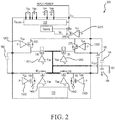
- FIG. 2 illustrates a 9-FET circuit topology of a power converter 200 in accordance with embodiments described herein. Like numerals and components from FIG. 1 are reused in FIG. 2 .
- an implementation of the power converter 200 may include the 9-FET topology, which differs from the 8-FET topology by adding an additional transistor, an input transistor 205, between V IN and the other eight transistors 220, 225, 130, 135, 140, 145, 150, and 155 of the 2:1 switched-capacitor converter 200.
- Use of the single input transistor 205 removes the switching capability from the initial voltage regulation stage.
- the input transistor 205 may be rated and sized for the maximum expected input voltage, and the remainder of the transistors 220, 225, 130, 135, 140, 145, 150, and 155 may be rated and sized smaller for the maximum output voltage of the load 190.
- Regulation of the output V CHARGE of the input transistor 205 is accomplished by the power path controller 170 controlling a voltage of a gate-driver circuit 215 for the input transistor 205.
- An additional power source V FF output by the internal power conditioning circuit 110 may be used to power the input gate driver circuit 215.
- Reverse-current protection in the power converter 200 may be accomplished in a similar manner as for the 8-FET implementation of FIG. 1 , or by other techniques described herein.
- output voltage regulation is accomplished by feedback and control from the power path controller 170 by sending a control signal having various voltage levels to set the output voltage level V CHARGE used to power the load 190.
- a low voltage signal from the power path controller 170 will induce a low voltage on the gate of the input transistor 205 resulting in a low V CHARGE .
- a higher voltage signal from the power path controller 170 will induce a hihger voltage on the gate of the input transistor 205 resulting in a higher V CHARGE .
- V CHARGE will typically be some quotient of a dividend V IN .
- the back gate transistors 130 and 135 are reversed by the power path controller 170 from their default orientation, and current leakage from V OUT to V IN is prevented.
- a switching action of a back gate transistor could be implemented on the input transistor 205.
- Current sensing may be performed in the 9-FET configuration, and can be accomplished by a current mirror at the input transistor 205 that is configured to provide a signal proportional to the current through the input transistor 205 that can be low-pass filtered into a sensing circuit to measure average current.
- Both topologies illustrated in FIGS. 1 and 2 use the gate voltage control on the input FETs, the input transistor 205 in the 9-FET implementation and input transistors 120 and 125 in the 8-FET implementation to regulate the output of the converters 100 and 200 and the voltage stresses seen by the other switching transistors. Because the input transistors are controlled to output a voltage V CHARGE generally not greater than twice the desired output voltage, stress caused by higher voltages on the non-input transistors are avoided. Once at a level V CHARGE , an ouptut voltage can be further adjusted witin a power adapter or similar output mechanism to a desired usage level.
- Output impedance may be controlled by controlling the gate voltage of input transistor 205 in the 9-FET implementation or input transistors 120 and 125 in the 8-FET implementation.
- Embodiments described herein may sense the current through the converters internally. As described herein a small subset of the transistors used may have a higher voltage rating, transistor 205 in the 9-FET implementation or input transistors 120 and 125 in the 8-FET implementation.
- the 9-FET implementation of FIG. 2 may operate in a similar manner as the 8-FET implementation of FIG. 1 .
- the switching action of the charge pump circuit and the power path controller 170 operate as described above.
- Voltage regulation may be performed by the single input transistor 205 and driver circuit 205D.
- a power converter including a power conditioning circuit to receive input power and set operating voltages of the power converter, a current sensing circuit to determine an input current of the power converter, a voltage regulation circuit to step down a voltage level of the input power, a charge pump circuit to store charge delivered by the voltage regulation circuit and output to a load a current larger than the input current, and a power path controller to control switching and provide feedback within the power converter.
- Various embodiments disclosed herein relate to charging of mobile and other electronic devices, including implementation options for designing a high-efficiency 2:1 switched capacitor converter for high-voltage direct battery charging. Both 8-FET and 9-FET topology approaches are described, along with the applicable control circuitry
Landscapes
- Engineering & Computer Science (AREA)
- Power Engineering (AREA)
- Dc-Dc Converters (AREA)
Abstract
Description
- This disclosure relates to a power converter for battery charging of mobile and other electronic devices.
- A brief summary of various embodiments is presented below. Some simplifications and omissions may be made in the following summary, which is intended to highlight and introduce some aspects of the various embodiments, but not to limit the scope of the invention. Detailed descriptions of embodiments adequate to allow those of ordinary skill in the art to make and use the inventive concepts will follow in later sections.
- Various embodiments include a power converter, including a power conditioning circuit to receive input power and set operating voltages of the power converter, a current sensing circuit to determine an input current of the power converter, a voltage regulation circuit to step down a voltage level of the input power, a charge pump circuit to store charge delivered by the voltage regulation circuit and output to a load a current larger than the input current, and a power path controller to control switching and provide feedback within the power converter.
- The voltage regulation circuit may include a single transistor and driver circuit.
- The voltage regulation circuit may include a pair of transistors that are switched at a fifty percent duty cycle.
- The power converter may include a plurality of back gate transistors to block leakage current from output to input.
- The charge pump circuit may include a pair of flying capacitors that are alternatively switched to provide power to a load.
- The voltage regulation circuit may include a pair of input transistors and the charge pump circuit includes a pair of back gate transistors, a pair of mid-point transistors, and a pair of grounding transistors.
- An input transistor and a mid-point transistor may be switched ON to charge the charge pump and are switched OFF to discharge the charge pump.
- A back gate transistor and a grounding transistor may be switched ON to discharge the charge pump and are switched OFF to charge the charge pump.
- The back gate transistors may be turned ON to prevent reverse current in the power converter from output to input.
- The power converter may include a pair of input drivers, a pair of back gate drivers, a pair of mid-point drivers, and a pair of grounding drivers.
- The power conditioning circuit may provide operating power to the input drivers, back gate drivers, mid-point drivers, and grounding drivers.
- The power path controller may receive current and voltage measurements and provide logic signals to the input drivers, back gate drivers, mid-point drivers, and grounding drivers.
- Various embodiments also include a method of charging a power adapter having a power converter, including providing input power to the power converter, using the input power to provide operating power to a plurality of driver circuits within the power converter, and controlling a voltage regulation circuit and a charge pump circuit to reduce voltage and increase current to a load of the power adapter.
- The method may include switching ON a first input transistor of the voltage regulation circuit and switching ON a first mid-point transistor of the charge pump circuit to charge a first flying capacitor of the charge pump circuit in a first half cycle.
- The method may include switching ON a second input transistor of the voltage regulation circuit and switching ON a second mid-point transistor of the charge pump circuit to charge a second flying capacitor of the charge pump circuit in a second half cycle.
- The method may include switching OFF a first back gate transistor of the charge pump circuit and switching OFF a first grounding transistor of the charge pump circuit to discharge a first flying capacitor of the charge pump circuit in a first half cycle.
- The method may include switching OFF a second back gate transistor of the charge pump circuit and switching OFF a second grounding transistor of the charge pump circuit to discharge a second flying capacitor of the charge pump circuit in a second half cycle.
- The method may include switching ON a pair of back gate transistors to prevent reverse current from output to input in the power converter.
- Additional objects and features of the invention will be more readily apparent from the following detailed description and appended claims when taken in conjunction with the drawings. Although several embodiments are illustrated and described, like reference numerals identify like parts in each of the figures, in which:
-
FIG. 1 illustrates an 8-FET circuit topology of a power converter in accordance with embodiments described herein; and -
FIG. 2 illustrates a 9-FET circuit topology of a power converter in accordance with embodiments described herein. - It should be understood that the figures are merely schematic and are not drawn to scale. It should also be understood that the same reference numerals are used throughout the figures to indicate the same or similar parts.
- The descriptions and drawings illustrate the principles of various example embodiments. It will thus be appreciated that those skilled in the art will be able to devise various arrangements that, although not explicitly described or shown herein, embody the principles of the invention and are included within its scope. Furthermore, all examples recited herein are principally intended expressly to be for pedagogical purposes to aid the reader in understanding the principles of the invention and the concepts contributed by the inventor(s) to furthering the art, and are to be construed as being without limitation to such specifically recited examples and conditions. Additionally, the term, "or," as used herein, refers to a non-exclusive or (i.e., and/or), unless otherwise indicated (e.g., "or else" or "or in the alternative"). Also, the various embodiments described herein are not necessarily mutually exclusive, as some embodiments can be combined with one or more other embodiments to form new embodiments. As used herein, the terms "context" and "context object" will be understood to be synonymous, unless otherwise indicated. Descriptors such as "first," "second," "third," etc., are not meant to limit the order of elements discussed, are used to distinguish one element from the next, and are generally interchangeable.
- Rapid battery charging of smart phones, other mobile devices, and small electronic devices has become increasingly important over the last few years. Charging currents have traditionally been limited to about three amps because of limitations of cables, connectors, and the rate of charge acceptance by Lithium ion (Li-ion) batteries in the mobile devices. Advances in the achievable charge acceptance rates have recently allowed some mobile device batteries to be charged at much higher currents, for example, between six and ten amps for a three amp-hour battery. A commercially available response to this new battery capability was implemented using high-current travel adapters with a special high-current cable and high-current connectors on both ends, providing high-current at a varying voltage with the state-of-charge of the battery.
- Embodiments described herein facilitate high-current charging of a Li-ion battery without the complications of a high-current travel adapter and non-standard cables and connectors on the device. Embodiments may be realized using implementation of a 2:1 switched capacitor converter that doubles the input current and halves the input voltage in a very high efficiency converter.
- Embodiments described herein include various implementations using a 2:1 switched-capacitor converter that may be used in battery charging of mobile devices and other electronic components.
-
FIG. 1 illustrates an 8-FET circuit topology of a power converter 100 ("converter") in accordance with embodiments described herein. Theconverter 100 may include an internalpower conditioning circuit 110 to receive input voltage VIN from a power source and provide power signals to driver circuits of the components of theconverter 100. Components of theconverter 100 may includeinput transistors 120 and 125, controlled by respectiveinput driver circuits input driver circuits power conditioning circuit 110. Converter 100 may incldueback gate transistors gate driver circuits gate driver circuits power conditioning circuit 110.Converter 100 may also includemid-point transistors mid-point driver circuits power conditioning circuit 110.Converter 100 may includegrounding transistors grounding driver circuits grounding driver circuits power conditioning circuit 110. In addition to VIN, the internalpower conditioning circuit 110 may have a secondary output VSCND that may be used in some conditions to efficiently pull some chip internal power from VSCND instead of VIN. Functionality of the various driver circuits are controlled by a power path controller sensing and logic block 170 ("power path controller 170"). -
Transistors 120 and 125 may have voltage ratings high enough and be of sufficient size to survive a maximum input voltage that theconverter 100 will encounter. Input voltage VIN may be in the range of twice the battery voltage up to about 20V. A battery to be charged may be rated at 5V and operate from 3.5V to 5V. The other sixtransistors input driver circuits input transistors 120 and 125. Current sensing may be implemented to determine the input current IIN by mirroring currents throughtransistors 120 and 125. Reverse current protection is implemented using back gate switching of thetransistors input transistors 120 and 125 can feed into an integrator circuit that produces a voltage proportional to the average current into a chip using theconverter 100. - The
converter 100 including the 8-FET topology illustrated inFIG. 1 includes a two-phase 2:1 switched-capacitor arrangement, adding output regulation capability and reverse-current protection. With an output regulation capability, theconverter 100 may provide an output voltage VOUT that is roughly one-half of the input voltage VIN, and the output current IOUT may be twice the input current ISENSE. Battery charging applications using theconverter 100 are able to control VOUT and IOUT with a high degree of accuracy Voltage regulation may be achieved by theinput transistors 120 and 125 in the 8-FET topology.Transistors 120 and 125 may be larger and more robust, able to handle higher voltages. Theother transistors - In the
converter 100, measured values of VIN, VOUT, and ISENSE may be input to thepower path controller 170 that subsequently provides feedback and control to circuit components within theconverter 100. The VIN, VOUT, and ISENSE signals may be analog inputs that are converted to digital signals by thepower path controller 170. Alternatively thepower path controller 170 may receive analog inputs and use analog controls to control components of theconverter 100. Thepower path controller 170 may communicate with the internalpower conditioning circuit 110 and have connections to the driver circuits to control actions of theconverter 100. For example, thepower path controller 170 may vary a control signal sent to theinput driver circuits respective input transistors 120 and 125.Power path controller 170 may control backgate driver circuits gates converter 100 is not operating in a power transfer mode,respective back gates - The
converter 100 may also include a charge pump circuit 142 having flyingcapacitors gate transistors gate drivers mid-point transisotrs mid-point drivers transistors drivers capacitors capacitors power path controller 170 may operate theconverter 100 in a dual switched mode, alternating the store of charge in flyingcapacitors load 190. The action of connecting theload 190 each half cycle to theconverter 100 is done with the purpose of doubling the input current at theload 190 while the input voltage may be halved or reduced by other divisor by theinput transistors 120 and 125 under the control of thepower path converter 170. - An additional way to determine the input current ISENSE is to compute a change in voltage across the flying
capacitors respective capacitor converter 100 may further includedecoupling capacitors load 190. - In operation, the 8-FET topology of
FIG. 1 may function in the following manner. Themid-point transistors input transistors 120 and 125. Backgate transistors transistors - During a time T1, which may be fifty percent of a full cycle, the
power path controller 170 may turn ONtransistors 120 and 140, connecting flyingcapacitor 180 between VIN and VOUT. Transistors 130 and 150 are turned OFF. During this same time T1, thepower path controller 170 turns ONtransistors capacitor 185 between VOUT and ground.Transistors - For the second half of the cycle during a time T2,
transistors capacitor 185 between VIN and VOUT. Transistors 135 and 155 are OFF. During this same time T2, thepower path controller 170 turns ONtransistors capacitor 180 between VOUT and ground.Transistors 120 and 140 are switched OFF. - During the time T1, the flying
capacitor 180 charges to a level of VCHARGE, and the flyingcapacitor 185 discharges to theload 190, after an initial charging half-cycle. During the time T2, the flyingcapacitor 180 discharges to theload 190, and the flyingcapacitor 180 charges to the level of VCHARGE. - The level of VCHARGE is determined by the
power path controller 170. Depending on a desired output charging voltage for theload 190, thepower path controller 170 may vary the drive signals to inputdriver circuits load 190. - As discussed herein, back
gate transistors back gate transistors -
FIG. 2 illustrates a 9-FET circuit topology of apower converter 200 in accordance with embodiments described herein. Like numerals and components fromFIG. 1 are reused inFIG. 2 . InFIG. 2 , an implementation of thepower converter 200 may include the 9-FET topology, which differs from the 8-FET topology by adding an additional transistor, aninput transistor 205, between VIN and the other eighttransistors capacitor converter 200. Use of thesingle input transistor 205 removes the switching capability from the initial voltage regulation stage. In this implementation, only theinput transistor 205 may be rated and sized for the maximum expected input voltage, and the remainder of thetransistors load 190. Regulation of the output VCHARGE of theinput transistor 205 is accomplished by thepower path controller 170 controlling a voltage of a gate-driver circuit 215 for theinput transistor 205. An additional power source VFF output by the internalpower conditioning circuit 110 may be used to power the input gate driver circuit 215. Reverse-current protection in thepower converter 200 may be accomplished in a similar manner as for the 8-FET implementation ofFIG. 1 , or by other techniques described herein. - In the 9-FET topology illustrated in
FIG. 2 , output voltage regulation is accomplished by feedback and control from thepower path controller 170 by sending a control signal having various voltage levels to set the output voltage level VCHARGE used to power theload 190. For example, a low voltage signal from thepower path controller 170 will induce a low voltage on the gate of theinput transistor 205 resulting in a low VCHARGE. A higher voltage signal from thepower path controller 170 will induce a hihger voltage on the gate of theinput transistor 205 resulting in a higher VCHARGE. VCHARGE will typically be some quotient of a dividend VIN. - According to embodiments described herein, when the
converters back gate transistors power path controller 170 from their default orientation, and current leakage from VOUT to VIN is prevented. Alternatively, for theconverter 200 illustrated inFIG. 2 , a switching action of a back gate transistor could be implemented on theinput transistor 205. Current sensing may be performed in the 9-FET configuration, and can be accomplished by a current mirror at theinput transistor 205 that is configured to provide a signal proportional to the current through theinput transistor 205 that can be low-pass filtered into a sensing circuit to measure average current. - Both topologies illustrated in
FIGS. 1 and2 use the gate voltage control on the input FETs, theinput transistor 205 in the 9-FET implementation andinput transistors 120 and 125 in the 8-FET implementation to regulate the output of theconverters - Output impedance may be controlled by controlling the gate voltage of
input transistor 205 in the 9-FET implementation orinput transistors 120 and 125 in the 8-FET implementation. Embodiments described herein may sense the current through the converters internally. As described herein a small subset of the transistors used may have a higher voltage rating,transistor 205 in the 9-FET implementation orinput transistors 120 and 125 in the 8-FET implementation. - The 9-FET implementation of
FIG. 2 may operate in a similar manner as the 8-FET implementation ofFIG. 1 . The switching action of the charge pump circuit and thepower path controller 170 operate as described above. Voltage regulation may be performed by thesingle input transistor 205 anddriver circuit 205D. - A power converter including a power conditioning circuit to receive input power and set operating voltages of the power converter, a current sensing circuit to determine an input current of the power converter, a voltage regulation circuit to step down a voltage level of the input power, a charge pump circuit to store charge delivered by the voltage regulation circuit and output to a load a current larger than the input current, and a power path controller to control switching and provide feedback within the power converter.
- Various embodiments disclosed herein relate to charging of mobile and other electronic devices, including implementation options for designing a high-efficiency 2:1 switched capacitor converter for high-voltage direct battery charging. Both 8-FET and 9-FET topology approaches are described, along with the applicable control circuitry
- Although the various embodiments have been described in detail with particular reference to certain aspects thereof, it should be understood that the embodiments described herein are capable of other embodiments and its details are capable of modifications in various obvious respects. As is readily apparent to those skilled in the art, variations and modifications can be effected while remaining within the spirit and scope of the embodiments described herein. Accordingly, the foregoing disclosure, description, and figures are for illustrative purposes only and do not in any way limit the embodiments described herein, which is defined only by the claims.
Claims (15)
- A power converter, comprising:a power conditioning circuit to receive input power and set operating voltages of the power converter;a current sensing circuit to determine an input current of the power converter;a voltage regulation circuit to step down a voltage level of the input power;a charge pump circuit to store charge delivered by the voltage regulation circuit and output to a load a current larger than the input current; anda power path controller to control switching and provide feedback within the power converter.
- The power converter of claim 1, wherein the voltage regulation circuit comprises a single transistor and driver circuit.
- The power converter of claim 1 or 2, wherein the voltage regulation circuit comprises a pair of transistors that are switched at a fifty percent duty cycle.
- The power converter of any preceding claim comprising a plurality of back gate transistors to block leakage current from output to input.
- The power converter of any preceding claim, wherein the charge pump circuit includes a pair of flying capacitors that are alternatively switched to provide power to a load.
- The power converter of any preceding claim, wherein the voltage regulation circuit comprises a pair of input transistors and the charge pump circuit includes a pair of back gate transistors, a pair of mid-point transistors, and a pair of grounding transistors.
- The power converter of claim 6, wherein an input transistor and a mid-point transistor are switched ON to charge the charge pump and are switched OFF to discharge the charge pump.
- The power converter of claim 6 or 7, wherein a back gate transistor and a grounding transistor are switched ON to discharge the charge pump and are switched OFF to charge the charge pump.
- The power converter of any of claims 6 to 8, wherein the back gate transistors are turned ON to prevent reverse current in the power converter from output to input.
- The power converter of any of claims 6 to 9, further comprising a pair of input drivers, a pair of back gate drivers, a pair of mid-point drivers, and a pair of grounding drivers.
- The power converter of claim 10, wherein the power conditioning circuit provides operating power to the input drivers, back gate drivers, mid-point drivers, and grounding drivers.
- The power converter of claim 10 or 11, wherein the power path controller receives current and voltage measurements and provides logic signals to the input drivers, back gate drivers, mid-point drivers, and grounding drivers.
- A method of charging a power adapter having a power converter, comprising:providing input power to the power converter;using the input power to provide operating power to a plurality of driver circuits within the power converter; andcontrolling a voltage regulation circuit and a charge pump circuit to reduce voltage and increase current to a load of the power adapter.
- The method of claim 13, further comprising switching ON a first input transistor of the voltage regulation circuit and switching ON a first mid-point transistor of the charge pump circuit to charge a first flying capacitor of the charge pump circuit in a first half cycle.
- The method of claim 14, further comprising switching ON a second input transistor of the voltage regulation circuit and switching ON a second mid-point transistor of the charge pump circuit to charge a second flying capacitor of the charge pump circuit in a second half cycle.
Applications Claiming Priority (1)
| Application Number | Priority Date | Filing Date | Title |
|---|---|---|---|
| US15/600,244 US10312724B2 (en) | 2017-05-19 | 2017-05-19 | Implementation of high-voltage direct-charging 2:1 switched-capacitor converter for battery charging of electronic devices |
Publications (1)
| Publication Number | Publication Date |
|---|---|
| EP3404813A1 true EP3404813A1 (en) | 2018-11-21 |
Family
ID=62186378
Family Applications (1)
| Application Number | Title | Priority Date | Filing Date |
|---|---|---|---|
| EP18172687.8A Withdrawn EP3404813A1 (en) | 2017-05-19 | 2018-05-16 | Implementation of high-voltage direct-charging 2:1 switched-capacitor converter for battery charging of electronic devices |
Country Status (3)
| Country | Link |
|---|---|
| US (1) | US10312724B2 (en) |
| EP (1) | EP3404813A1 (en) |
| CN (1) | CN108964447B (en) |
Families Citing this family (6)
| Publication number | Priority date | Publication date | Assignee | Title |
|---|---|---|---|---|
| US10468898B2 (en) | 2017-05-19 | 2019-11-05 | Nxp B.V. | Implementation of high efficiency battery charger for electronic devices |
| CN112557777B (en) * | 2019-09-09 | 2024-07-09 | 戴尔产品有限公司 | Power converter equipment health check system |
| CN111313707B (en) * | 2020-05-15 | 2020-09-29 | 广东希荻微电子有限公司 | A DC/DC power conversion system |
| US11545895B2 (en) | 2021-06-04 | 2023-01-03 | Nxp B.V. | Precharge in a switched capacitor (SC) converter |
| CN113824196B (en) * | 2021-11-19 | 2022-03-11 | 广东希荻微电子股份有限公司 | Battery charging circuit, device and terminal equipment |
| US20240204658A1 (en) * | 2022-12-19 | 2024-06-20 | Apple Inc. | Switched capacitor converter with tap-change capability |
Citations (7)
| Publication number | Priority date | Publication date | Assignee | Title |
|---|---|---|---|---|
| US20090128219A1 (en) * | 2005-06-17 | 2009-05-21 | Rohm Co., Ltd. | Semiconductor device, power supply device, and information processing device |
| WO2012151466A2 (en) * | 2011-05-05 | 2012-11-08 | Arctic Sand Technologies, Inc. | Dc-dc converter with modular stages |
| US20130234513A1 (en) * | 2012-02-28 | 2013-09-12 | Texas Instruments Deutschland Gmbh | Single inductor-multiple output dc-dc converter, method for operating the same and electronic device comprising the converter |
| US20150054571A1 (en) * | 2013-08-21 | 2015-02-26 | Semiconductor Energy Laboratory Co., Ltd. | Charge pump circuit and semiconductor device including the same |
| US20150214848A1 (en) * | 2014-01-30 | 2015-07-30 | Denso Corporation | Power converter |
| EP2903126A1 (en) * | 2014-02-03 | 2015-08-05 | Samsung Electronics Co., Ltd | Charging circuit and electronic device having the same |
| EP3073596A1 (en) * | 2015-03-25 | 2016-09-28 | Nxp B.V. | Voltage control using rectifying circuitry |
Family Cites Families (14)
| Publication number | Priority date | Publication date | Assignee | Title |
|---|---|---|---|---|
| US6917240B2 (en) * | 2003-01-06 | 2005-07-12 | Texas Instruments Incorporated | Reconfigurable topology for switching and charge pump negative polarity regulators |
| JP2008141871A (en) * | 2006-12-01 | 2008-06-19 | Honda Motor Co Ltd | Power converter |
| CN101647182B (en) * | 2006-12-30 | 2013-01-30 | 先进模拟科技公司 | High Efficiency DC/DC Voltage Converter Including Boost Inductive Switching Pre-Regulator and Capacitive Switching Post-Converter |
| US7812579B2 (en) * | 2006-12-30 | 2010-10-12 | Advanced Analogic Technologies, Inc. | High-efficiency DC/DC voltage converter including capacitive switching pre-converter and up inductive switching post-regulator |
| CN101286693B (en) * | 2007-04-10 | 2011-03-30 | 立锜科技股份有限公司 | Charge pump regulator and method of generating a regulated voltage |
| JP5316965B2 (en) * | 2007-07-06 | 2013-10-16 | アドバンスト・アナロジック・テクノロジーズ・インコーポレイテッド | Boost and up / down switching regulator with synchronous freewheeling MOSFET |
| US20090033293A1 (en) | 2007-08-01 | 2009-02-05 | Intersil Americas Inc. | Voltage converter with combined capacitive voltage divider, buck converter and battery charger |
| US9065329B2 (en) | 2009-01-12 | 2015-06-23 | Vestas Wind Systems A/S | Reconfigurable power converter module |
| US9035626B2 (en) * | 2010-08-18 | 2015-05-19 | Volterra Semiconductor Corporation | Switching circuits for extracting power from an electric power source and associated methods |
| US8547168B2 (en) * | 2011-10-14 | 2013-10-01 | Jen-Ai Holdings, Llc | High current drive switched capacitor charge pump |
| CN107196530A (en) | 2016-03-14 | 2017-09-22 | 恩智浦有限公司 | Load current is measured |
| US11101674B2 (en) * | 2016-08-05 | 2021-08-24 | Avago Technologies International Sales Pte. Limited | Battery charging architectures |
| US20180074564A1 (en) * | 2016-09-13 | 2018-03-15 | Qualcomm Incorporated | Reverse high-voltage power transfer |
| US10468898B2 (en) * | 2017-05-19 | 2019-11-05 | Nxp B.V. | Implementation of high efficiency battery charger for electronic devices |
-
2017
- 2017-05-19 US US15/600,244 patent/US10312724B2/en active Active
-
2018
- 2018-05-16 EP EP18172687.8A patent/EP3404813A1/en not_active Withdrawn
- 2018-05-18 CN CN201810486297.5A patent/CN108964447B/en active Active
Patent Citations (7)
| Publication number | Priority date | Publication date | Assignee | Title |
|---|---|---|---|---|
| US20090128219A1 (en) * | 2005-06-17 | 2009-05-21 | Rohm Co., Ltd. | Semiconductor device, power supply device, and information processing device |
| WO2012151466A2 (en) * | 2011-05-05 | 2012-11-08 | Arctic Sand Technologies, Inc. | Dc-dc converter with modular stages |
| US20130234513A1 (en) * | 2012-02-28 | 2013-09-12 | Texas Instruments Deutschland Gmbh | Single inductor-multiple output dc-dc converter, method for operating the same and electronic device comprising the converter |
| US20150054571A1 (en) * | 2013-08-21 | 2015-02-26 | Semiconductor Energy Laboratory Co., Ltd. | Charge pump circuit and semiconductor device including the same |
| US20150214848A1 (en) * | 2014-01-30 | 2015-07-30 | Denso Corporation | Power converter |
| EP2903126A1 (en) * | 2014-02-03 | 2015-08-05 | Samsung Electronics Co., Ltd | Charging circuit and electronic device having the same |
| EP3073596A1 (en) * | 2015-03-25 | 2016-09-28 | Nxp B.V. | Voltage control using rectifying circuitry |
Also Published As
| Publication number | Publication date |
|---|---|
| US20180337539A1 (en) | 2018-11-22 |
| US10312724B2 (en) | 2019-06-04 |
| CN108964447B (en) | 2024-01-05 |
| CN108964447A (en) | 2018-12-07 |
Similar Documents
| Publication | Publication Date | Title |
|---|---|---|
| CN108964457B (en) | Implementation of efficient battery charger for electronic devices | |
| EP3404813A1 (en) | Implementation of high-voltage direct-charging 2:1 switched-capacitor converter for battery charging of electronic devices | |
| US10727747B2 (en) | Hybrid buck-boost converter | |
| US12476476B2 (en) | Circuit for battery charging and system supply, combining capacitive and inductive charging | |
| CN101814725B (en) | Secondary battery | |
| US12230985B2 (en) | Switched multi-cell battery system | |
| CN104009516B (en) | Method and device for controlling power supply components | |
| US20190074702A1 (en) | Battery Fuel Gauge Apparatus | |
| EP3829023A1 (en) | Power supply system and management device | |
| TW201813263A (en) | Balancing techniques and circuits for charge pumps | |
| HK1222953A1 (en) | Universal power adapter | |
| WO2013006753A1 (en) | Current selectable usb charger | |
| US9590510B1 (en) | Cable IR drop compensation | |
| CN110970956A (en) | Charging method, electronic device, charging device, and charging system | |
| US10236694B2 (en) | Systems and methods for management of asymmetrical multi-tapped battery packs | |
| CN115372686A (en) | Current detection circuit of charging chip and electronic equipment | |
| KR101490740B1 (en) | Ballancing control circuit for battery cell module using series resonant circuit | |
| CN100405697C (en) | Charging device | |
| US20210226526A1 (en) | Current In-Rush Limiter | |
| JP2012029382A (en) | Power storage device and energy balance adjusting method | |
| US8035367B2 (en) | Electronic device, detection circuit and voltage control method | |
| CN114914962B (en) | Electronic systems | |
| TWM542282U (en) | Charging device |
Legal Events
| Date | Code | Title | Description |
|---|---|---|---|
| PUAI | Public reference made under article 153(3) epc to a published international application that has entered the european phase |
Free format text: ORIGINAL CODE: 0009012 |
|
| STAA | Information on the status of an ep patent application or granted ep patent |
Free format text: STATUS: THE APPLICATION HAS BEEN PUBLISHED |
|
| AK | Designated contracting states |
Kind code of ref document: A1 Designated state(s): AL AT BE BG CH CY CZ DE DK EE ES FI FR GB GR HR HU IE IS IT LI LT LU LV MC MK MT NL NO PL PT RO RS SE SI SK SM TR |
|
| AX | Request for extension of the european patent |
Extension state: BA ME |
|
| STAA | Information on the status of an ep patent application or granted ep patent |
Free format text: STATUS: REQUEST FOR EXAMINATION WAS MADE |
|
| 17P | Request for examination filed |
Effective date: 20190521 |
|
| RBV | Designated contracting states (corrected) |
Designated state(s): AL AT BE BG CH CY CZ DE DK EE ES FI FR GB GR HR HU IE IS IT LI LT LU LV MC MK MT NL NO PL PT RO RS SE SI SK SM TR |
|
| STAA | Information on the status of an ep patent application or granted ep patent |
Free format text: STATUS: EXAMINATION IS IN PROGRESS |
|
| 17Q | First examination report despatched |
Effective date: 20191209 |
|
| STAA | Information on the status of an ep patent application or granted ep patent |
Free format text: STATUS: THE APPLICATION IS DEEMED TO BE WITHDRAWN |
|
| 18D | Application deemed to be withdrawn |
Effective date: 20210310 |