EP3403243B1 - Einstufung von zielabmessungen - Google Patents
Einstufung von zielabmessungen Download PDFInfo
- Publication number
- EP3403243B1 EP3403243B1 EP16885331.5A EP16885331A EP3403243B1 EP 3403243 B1 EP3403243 B1 EP 3403243B1 EP 16885331 A EP16885331 A EP 16885331A EP 3403243 B1 EP3403243 B1 EP 3403243B1
- Authority
- EP
- European Patent Office
- Prior art keywords
- dimension
- target
- model
- dimensions
- target dimension
- Prior art date
- Legal status (The legal status is an assumption and is not a legal conclusion. Google has not performed a legal analysis and makes no representation as to the accuracy of the status listed.)
- Active
Links
Images
Classifications
-
- G—PHYSICS
- G06—COMPUTING OR CALCULATING; COUNTING
- G06T—IMAGE DATA PROCESSING OR GENERATION, IN GENERAL
- G06T7/00—Image analysis
- G06T7/60—Analysis of geometric attributes
-
- G—PHYSICS
- G06—COMPUTING OR CALCULATING; COUNTING
- G06T—IMAGE DATA PROCESSING OR GENERATION, IN GENERAL
- G06T17/00—Three-dimensional [3D] modelling for computer graphics
-
- G—PHYSICS
- G06—COMPUTING OR CALCULATING; COUNTING
- G06T—IMAGE DATA PROCESSING OR GENERATION, IN GENERAL
- G06T19/00—Manipulating three-dimensional [3D] models or images for computer graphics
- G06T19/20—Editing of three-dimensional [3D] images, e.g. changing shapes or colours, aligning objects or positioning parts
-
- G—PHYSICS
- G06—COMPUTING OR CALCULATING; COUNTING
- G06T—IMAGE DATA PROCESSING OR GENERATION, IN GENERAL
- G06T7/00—Image analysis
- G06T7/70—Determining position or orientation of objects or cameras
-
- G—PHYSICS
- G06—COMPUTING OR CALCULATING; COUNTING
- G06T—IMAGE DATA PROCESSING OR GENERATION, IN GENERAL
- G06T2200/00—Indexing scheme for image data processing or generation, in general
- G06T2200/08—Indexing scheme for image data processing or generation, in general involving all processing steps from image acquisition to 3D model generation
-
- G—PHYSICS
- G06—COMPUTING OR CALCULATING; COUNTING
- G06T—IMAGE DATA PROCESSING OR GENERATION, IN GENERAL
- G06T2200/00—Indexing scheme for image data processing or generation, in general
- G06T2200/24—Indexing scheme for image data processing or generation, in general involving graphical user interfaces [GUIs]
-
- G—PHYSICS
- G06—COMPUTING OR CALCULATING; COUNTING
- G06T—IMAGE DATA PROCESSING OR GENERATION, IN GENERAL
- G06T2207/00—Indexing scheme for image analysis or image enhancement
- G06T2207/10—Image acquisition modality
- G06T2207/10004—Still image; Photographic image
- G06T2207/10008—Still image; Photographic image from scanner, fax or copier
-
- G—PHYSICS
- G06—COMPUTING OR CALCULATING; COUNTING
- G06T—IMAGE DATA PROCESSING OR GENERATION, IN GENERAL
- G06T2210/00—Indexing scheme for image generation or computer graphics
- G06T2210/56—Particle system, point based geometry or rendering
-
- G—PHYSICS
- G06—COMPUTING OR CALCULATING; COUNTING
- G06T—IMAGE DATA PROCESSING OR GENERATION, IN GENERAL
- G06T2215/00—Indexing scheme for image rendering
- G06T2215/16—Using real world measurements to influence rendering
Definitions
- Three-dimensional (3D) scanning may be useful for analyzing a real world object and constructing a digital model of that object.
- 3D scanning may be used in the entertainment industry for digital productions such as movies and video games. Additional examples may include using 3D scanning in industrial design, prototyping, and quality control applications.
- US 2007/0172112 A1 discloses systems and methods, which provide visual feedback concerning one or more scanning parameters to a user during acquisition of a three dimensional scan.
- Vgstudio Max "The market's leading application software for analysis and visualization of industrial computed tomography/voxel data", November 23, 2015, XP055597891 provides a plurality of features that make working with the CT data and presenting analysis results comfortable.
- US 2008/012851 A1 discloses a system and a method for automatic 3D scan data alignment.
- An automated mechanism that identifies and defines a global coordinate system that is most appropriate for a collection of raw 3D scan data used to form a mesh model is discussed. More specifically, a coordinate system is identified that is able to minimize the total sum of deviation error while also minimizing the peak error for raw 3D scan data.
- This document searches for appropriate coordinate systems from raw 3D scan data in a fully automated way. Multiple coordinate systems in order of likelihood of leading to minimal global deviation error are identified and presented to a user. End users are also allowed to edit suggested coordinate system parameters interactively prior to the alignment of the 3D scan data being transformed based on a selected coordinate system.
- Scan quality of three-dimensional (3D) scanners may vary between different 3D scanners. For example, some scanners may not scan objects with a desired amount of accuracy. For instance, such scanners may not accurately scan certain areas and/or features of scanned objects such as a recessed area of a scanned object.
- ranking target dimensions can include a model engine to generate a three-dimensional (3D) model of an object from a scan of the object, an analysis engine to analyze the 3D model of the object and determine target dimensions of the object, a ranking engine to rank the target dimensions based on target dimension characteristics, historical scan information related to the target dimension characteristics, or a combination thereof, and a display engine to display information relating to the ranked target dimensions of the object.
- 3D three-dimensional
- a target dimension refers to a dimension of an object that may be measured by a user to supplement the 3D model of the object.
- a target dimension may define and/or affect other dimensions of the object. That is, a target dimension of the object may be a dimension of the object that may be important to defining a shape, size, and/or other physical characteristics of the object.
- an object can be a cylinder where a target dimension of the cylinder may include a length and/or diameter of the cylinder.
- Target dimensions may be useful in supplementing scans of objects with 3D scanners.
- a 3D scanner may not accurately scan certain features of an object that may be target dimensions of the object. Therefore, a user may measure a target dimension of the object to supplement the 3D scan of the object.
- ranking target dimensions of an object scanned with a 3D scanner can inform a user of the scanner of poorly scanned areas and/or features of the object. Additionally, ranking target dimensions can inform the user to supplement the 3D scan of the object with certain measurements of the object while comparatively reducing a number of scanned measurements utilized in forming an accurate 3D model of the object. For example, informing the user of ranked target dimensions of the 3D object to be measured and revising the 3D model after each measurement may allow for a 3D model with acceptable accuracy without measuring all of the ranked target dimensions of the 3D object, as is further described herein.
- an object may be any 3D object about which target dimensions may be determined.
- a 3D object may be any object that may be scanned by a scanner. That is, a 3D object may be any object that has a height, width, and length as a first, second, and third dimension.
- a scanner may be any device that analyzes a real-world object (e.g., a 3D object) to collect data about its shape and/or appearance.
- the scanner may be a device with an attached camera, reader, projector, light source, and/or other suitable devices or combinations thereof.
- the scanner may be used to generate and transmit a plurality of pictures of the 3D object.
- the system can then analyze the pictures of the 3D object, generate a 3D model of the 3D object, and determine and rank target dimensions of the 3D object to be measured, as is further described herein.
- the system can then display information relating to the ranked target dimensions.
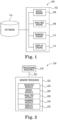
- Figures 1 and 2 illustrate examples of system 100 and computing device 214 consistent with the disclosure.
- Figure 1 illustrates a diagram of an example of a system 100 of ranking target dimensions consistent with the disclosure.
- the system 100 can include a database 114, a ranking target dimensions system 102, and/or a plurality of engines (e.g., receiver engine 104, model engine 106, analysis engine 108, ranking engine 110, display engine 112).
- the ranking target dimension system 102 can be in communication with the database 114 via a communication link, and can include the plurality of engines (e.g., receiver engine 104, model engine 106, analysis engine 108, ranking engine 110, display engine 112).
- the ranking target dimension system 102 can include additional or fewer engines that are illustrated to perform the various elements as are described in further detail in connection with Figure 3 .
- the plurality of engines can include a combination of hardware and machine readable instructions (e.g., stored in a memory resource such as a non-transitory machine readable medium) that are executable using hardware components such as a processor, but at least hardware, to perform elements described herein (e.g., generate a three-dimensional (3D) model of an object from a scan of the object, analyze the 3D model of the object and determine target dimensions of the object, rank the target dimensions based on target dimension characteristics, historical scan information related to the target dimension characteristics, or a combination thereof, and display information relating to the ranked target dimensions of the object, etc.).
- a memory resource such as a non-transitory machine readable medium
- elements described herein e.g., generate a three-dimensional (3D) model of an object from a scan of the object, analyze the 3D model of the object and determine target dimensions of the object, rank the target dimensions based on target dimension characteristics, historical scan information related to the target dimension characteristics, or a combination thereof, and display information
- the model engine 106 can include hardware and/or a combination of hardware and machine readable instructions, but at least hardware, to generate a three-dimensional (3D) model of an object from a scan of the object.
- the model engine 106 can utilize point cloud information to generate a 3D model of the scanned object.
- a point cloud can be a set of data points in a coordinate system.
- a point cloud can be a set of data points in a three-dimensional coordinate system (e.g., X, Y, and Z coordinates).
- a point cloud can represent the external surface of an object, such as a scanned object, that a device such as a 3D scanner has measured.
- the object may be represented by a set of data points included in a point cloud or a plurality of point clouds, where the point clouds include coordinate information for the set of data points that can be used to generate the 3D model of the object.
- the analysis engine 108 can include hardware and/or a combination of hardware and machine readable instructions, but at least hardware, to analyze the 3D model of the object and determine target dimensions of the object. Analyzing the 3D model of the object can include determining an object type, size, shape, and/or other characteristics of the object. Model engine 106 may utilize characteristics of the object from the 3D model such as the type, size, and/or shape to determine the target dimensions of the object.
- the 3D model may be of an object that is comprised of two stacked cylinders.
- 3D model may consist of at least nine target dimensions that may be relevant to measure, including the length and/or diameter of a first cylinder of the object, the length and/or diameter of a second cylinder of the object, the position of the midline of the first cylinder relative to the midline of the second cylinder along two axes, the orientation of the first cylinder relative to the second cylinder around two axes, as well as the total length of the object, although target dimensions of the object are not limited to the above dimensions.
- Analyzing the 3D model of the 3D object may include determining characteristics of each target dimension of the object.
- characteristics of a target dimension may include a determined value of the target dimension, a target dimension type, and a target dimension correction.
- a target dimension value may include a value of a dimension of the target dimension.
- a target dimension value may be the length of a cylinder of the object. That is, the length of a cylinder of the object (e.g., target dimension value) may be three inches.
- a target dimension type may be a type of dimension.
- a target dimension type may include "a total length of an object", “a length of a component of the object”, “an angle between two components of the object”, “a depth of a recess (e.g., a hole) of the object", “a wall thickness of the object”, “a height of a protrusion of the object”, and/or "a diameter of a cylindrical component of the object”.
- a target dimension type may be a specific object type.
- the target dimension type may include "the width of the head of a bolt”.
- the target dimension type may include "the width of the head of an M4 bolt”.
- a target dimension correction may be a difference between a value of a dimension of the 3D model and a value of the corresponding dimension of the object.
- the value of a diameter of a cylinder of an object may be five inches and a value of a corresponding diameter of the 3D model may be four inches; the target dimension correction is one inch.
- Each target dimension characteristic may have more than one possible value, and may have an associated probability for the value. For example, there may be a 95% probability that a target dimension type is "the minimum width of a hexagon", and an 80% probability that the same target dimension is "the minimum width of the head of a bolt”.
- the ranking engine 110 can include hardware and/or a combination of hardware and machine readable instructions, but at least hardware, to rank the target dimensions based on target dimension characteristics, historical scan information related to the target dimension characteristics, or a combination thereof. For example, the ranking engine 110 can rank the target dimensions of the object from a highest ranking to a lowest ranking. Ranking engine 110 may determine the ranking by determining a probability that a user would want to measure the target dimension, as well as an estimated time a user would take to measure the dimension, as is described herein.
- a highest ranking of a target dimension may be a target dimension a user of the scanner would most likely want to measure to supplement the 3D model. Further, as used herein, a lowest ranking of a target dimension may be a target dimension a user of the scanner would least likely want to measure to supplement the 3D model.
- Ranking engine 110 may use historical scan information related to the target dimension characteristics to rank the target dimensions. For example, where two cylinders of the object meet at approximately 90 degrees, and historical actions of users with a similar type of object positioning and/or orientation may have measured a similar angle in 1 % of cases, the target dimension of the angle at which the two cylinders meet may be ranked such that a user may not be likely to measure that target dimension. As another example, historical actions of users may indicate that a diameter of a thin cylinder was measured 70% of the time and the length 10% of the time; the target dimension of the diameter of the thin cylinder may be ranked higher than the target diameter of the length of the cylinder.
- historical actions of users may indicate that a depth of a hole of the object was measured 50% of the time and a diameter of the hole was measured 60% of the time; the target dimensions of the depth and the diameter of the hole may both be ranked higher relative to other target dimensions, but the target dimension of the diameter of the hole may be ranked higher than the target dimension of the depth of the hole.
- the indeterminate target dimension may be ranked higher among other target dimensions of the object. For example, a depth of a hole or recess of the object may not be easily and/or accurately scanned, and a target dimension of the depth may be ranked higher among the target dimensions.
- historical actions of users may indicate that the total length of an object may be measured more often than other measurements.
- the target dimension of the total length of the object may therefore be ranked higher than other target dimensions.
- historical scan information may include scans of other objects and historical user behavior in measuring target dimensions of the other objects. That is, historical scan information may include historical measurement information related to the target dimension characteristics.
- ranking engine 110 may recognize the scan of a current object to be a bolt, and rank target dimensions of the current scan of the bolt based on scans of other bolts and/or past user behavior with other bolts. That is, ranking engine 110 may determine that dimensions important to a user may include the length of the bolt and the pitch of the thread of the bolt, and rank the target dimensions of the bolt such as the length and the pitch of the thread higher relative to other target dimensions based on the object.
- ranking engine 110 may compute a probability that a user would want to measure the length of the bolt based on a probability that the object is a bolt and the historical scan information for which users measured the length of the bolt. Additionally, ranking engine 110 may estimate an amount of time it may take for a user to take a length measurement of the bolt by using the probability that it is a bolt as well as time taken in the past for users the measure the length of a bolt.
- Ranking engine 110 may use a type of the scanned object to rank the target dimensions. Determining the type of the scanned object to rank target dimensions of the object may include using heuristics to determine the probability a user would want to measure each target dimension.
- Heuristics may be based on the characteristics of each target dimension. For example, the characteristics (e.g., the value of the target dimension, the target dimension type, and/or the target dimension correction) of each target dimension may be used by heuristics to rank the target dimensions.
- the characteristics e.g., the value of the target dimension, the target dimension type, and/or the target dimension correction
- a heuristic may be based on a design preference. For example, a designer may prefer to make dimensions round numbers; if a target dimension is linear and the length of an object is an integer number, then the probability a user would want to manually measure the length target dimension may be low relative to other target dimensions. As another example, if a target dimension is an orientation and an angle of orientation is an integer multiple of 5 degrees, then the probability a user would want to manually measure the orientation angle may be low relative to other target dimensions.
- a heuristic may be based on a model type. For example, based on an object type being a bolt, if a probability that an object is an M4 bolt is 90%, and if the length of the object is an integer multiple of five millimeters, then the target dimension may be ranked low relative to other target dimensions, or no measurement may be necessary.
- a heuristic may be utilized when determining a time taken for a user to make a measurement. For example, based on a user's personal experience, a heuristic may include parts with a length less than ten inches, an expected time to measure the length may be five seconds.
- ranking engine 110 may utilize any other metric and/or characteristic to rank the target dimensions of the scanned object.
- the display engine 112 can include hardware and/or a combination of hardware and machine readable instructions, but at least hardware, to display information relating to the ranked target dimensions of the object.
- Information relating to the ranked target dimensions of the object may include a list of the target dimensions.
- the list of the target dimensions may be ranked by a likelihood a user may want to measure that target dimension. For example, the target dimensions may be ranked from a highest likelihood to a lowest likelihood that the user may want to measure the target dimensions.
- the display engine 112 may display information related to a comparatively highest ranked target dimension of the target dimensions. For example, display engine 112 may display the highest ranked target dimension for a user to measure. Displaying the highest ranked target dimension may include a request to a user to measure the highest ranked target dimension. For example, the request may indicate to a user to measure the highest ranked target dimension of the object.
- the receiver engine 104 may receive a revised measured dimension of the object in response to receipt of a measurement of the highest ranked target dimension of the 3D object.
- the receiver engine 104 may receive the measurement of the highest ranked target dimension from a user measuring the highest ranked target dimension of the object. For example, in response to displaying the highest ranked target dimension and requesting a user to measure the highest ranked target dimension, receiver engine 104 may receive the measurement of the highest ranked target dimension from a measurement tool, as is further described herein.
- the model engine 106 may update the 3D model of the object with a revised measured dimension of the object in response to receipt of a measurement of the comparatively highest ranked target dimension. For example, after receiving a measurement from a user of the highest ranked target dimension by receiver engine 104, the corresponding measurement of the 3D model may be updated. That is, the dimension of the 3D model corresponding to the highest ranked target dimension of the object may be updated based on the user of the scanner measuring the highest ranked target dimension of the object.
- updating the 3D model of the object may include updating dimensions of the 3D model that are similar to the highest ranked target dimension. For example, where an object has three holes that are of similar dimensions, such as diameter and/or depth, and one of the holes is the highest ranked target dimension, the model engine 106 may update the remaining two holes based on the similarity of the dimensions and/or characteristics of the three holes. Model engine 106 may update the two remaining holes automatically, or may request the user via display engine 112 for a selection to allow the two remaining holes to be updated.
- the database 114 can include digital information relating to the scanned object. That is, the database 114 can be utilized to store digital representations (e.g., a 3D model) of the object.
- the 3D model can include image data such as point cloud information.
- the database 114 can include the image data of the 3D model.
- the database 114 may further include pre-coded heuristics and historical information from previous scans, including past user behavior.
- Figure 2 illustrates a diagram of an example of a computing device 216 consistent with the disclosure.
- the computing device 216 can include hardware, machine readable instructions on a non-transitory machine readable medium, or a combination thereof, to perform the elements described herein.
- the computing device 216 can be any combination of hardware and machine readable instructions to share information.
- the hardware for example, can include a processing resource 218 and/or a memory resource 222 (e.g., computer-readable medium (CRM), machine readable medium (MRM), database, etc.).
- a processing resource 218, as used herein, can include any number of processors capable of executing instructions stored by a memory resource 222.
- Processing resource 218 may be implemented in a single device or distributed across multiple devices.
- the machine readable instructions can include instructions stored on the memory resource 222 and executable by the processing resource 218 to implement a desired element (e.g., receive, from a scanner, a scan of a three-dimensional (3D) object, generate a 3D model of the 3D object from the scan, analyze the 3D model of the 3D object to determine target dimensions of the 3D object, rank the target dimensions based on target dimension characteristics, historical scan information related to the target dimension characteristics, or a combination thereof, and display, via a user interface, information relating to the ranked target dimensions of the object, etc.).
- a desired element e.g., receive, from a scanner, a scan of a three-dimensional (3D) object, generate a 3D model of the 3D object from the scan, analyze the 3D model of the 3D object to determine target dimensions of the 3D object, rank the target dimensions based on target dimension characteristics, historical scan information related to the target dimension characteristics, or a combination thereof, and display, via a user interface, information relating to the
- the memory resource 222 can be in communication with a processing resource 218.
- a memory resource 222 can include any number of memory components capable of storing instructions that can be executed by processing resource 218.
- Such memory resource 222 can be a non-transitory CRM or MRM.
- Memory resource 222 may be integrated in a single device or distributed across multiple devices. Further, memory resource 222 may be fully or partially integrated in the same device as processing resource 218 or it may be separate but accessible to that device and processing resource 218.
- the computing device 216 may be implemented on a participant device, on a server device, on a collection of server devices, and/or a combination of the participant device and the server device.
- the memory resource 222 can be in communication with the processing resource 218 via a communication link (e.g., a path) 220.
- the communication link 220 can be local or remote to a machine (e.g., a computing device) associated with the processing resource 218. Examples of a local communication link 220 can include an electronic bus internal to a machine (e.g., a computing device) where the memory resource 222 is one of volatile, non-volatile, fixed, and/or removable storage medium in communication with the processing resource 218 via the electronic bus.
- a plurality of modules can include CRI that when executed by the processing resource 218 can perform elements.
- the plurality of modules e.g., receiver module 224, model module 226, analysis module 228, ranking module 230, display module 232
- the plurality of modules can be sub-modules of other modules.
- the receiver module 224 and the model module 226 can be sub-modules and/or contained within the same computing device.
- the plurality of modules e.g., receiver module 224, model module 226, analysis module 228, ranking module 230, display module 232
- Each of the plurality of modules can include instructions that when executed by the processing resource 218 can function as a corresponding engine as described herein.
- the receiver module 224 can include instructions that when executed by the processing resource 218 can function as the model engine 106.
- the model module 226 can include instructions that when executed by the processing resource 218 can function as the model engine 106.
- the analysis module 228 can include instructions that when executed by the processing resource 218 can function as the analysis engine 108.
- the ranking module 230 can include instructions that when executed by the processing resource 218 can function as the ranking engine 110.
- the display module 232 can include instructions that when executed by the processing resource 218 can function as the display engine 112.
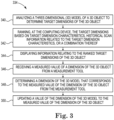
- Figure 3 illustrates a flow chart of an example of a method 334 of ranking target dimensions consistent with the disclosure.
- method 334 can be performed by a computing device (e.g., computing device 216 previously described in connection with Figure 2 ) to rank target dimensions.
- the method 334 can include analyzing a three-dimensional (3D) model of a 3D object to determine target dimensions of the 3D object. Analyzing the 3D model of the 3D object can include determining an object type, size, shape, and/or characteristics of the 3D object, which can be used to determine the target dimensions of the 3D object.
- the 3D model may be of a 3D object comprised of two stacked cylinders; the 3D model may then consist of at least nine target dimensions that may be relevant to measure, including the length and/or diameter of a first cylinder of the 3D object, the length and/or diameter of a second cylinder of the 3D object, the position of the midline of the first cylinder relative to the midline of the second cylinder along two axes, the orientation of the first cylinder relative to the second cylinder around two axes, as well as the total length of the 3D object, although the target dimensions of the 3D object are not limited to the above dimensions.
- Analyzing the 3D model of the 3D object may include determining characteristics of each target dimension of the object.
- characteristics of a target dimension may include a determined value of the target dimension, a target dimension type, and a target dimension correction.
- a target dimension value may include a value of a dimension of the target dimension.
- a target dimension value may be the length of a cylinder of the object. That is, the length of a cylinder of the object (e.g., target dimension value) may be three inches.
- a target dimension type may be a type of dimension.
- a target dimension type may include "a total length of an object", “a length of a component of the object”, “an angle between two components of the object”, “a depth of a recess (e.g., a hole) of the object", “a wall thickness of the object”, “a height of a protrusion of the object”, and/or "a diameter of a cylindrical component of the object”.
- a target dimension type may be a specific object type.
- the target dimension type may include "the width of the head of a bolt”.
- the target dimension type may include "the width of the head of an M4 bolt”.
- a target dimension correction may be a difference between a value of a dimension of the 3D model and a value of the corresponding dimension of the object.
- the value of a diameter of a cylinder of an object may be five inches and a value of a corresponding diameter of the 3D model may be four inches; the target dimension correct is one inch.
- Each target dimension characteristic may have more than one possible value, and may have an associated probability for the value. For example, there may be a 95% probability that a target dimension type is "the minimum width of a hexagon", and an 80% probability that the same target dimension is "the minimum width of the head of a bolt”.
- the method 334 can include ranking the target dimensions based on target dimension characteristics, historical scan information related to the target dimension characteristics, or a combination thereof.
- the target dimensions of the 3D object can be ranked from a highest ranking (e.g., a target dimension a user of the scanner would most likely want to measure to supplement the 3D model) to a lowest ranking (e.g., a target dimension a user of the scanner would least likely want to measure to supplement the 3D model).
- Ranking engine 110 may determine the ranking by determining a probability that a user would want to measure the target dimension, as well as an estimated time a user would take to measure the dimension, as is described herein.
- Ranking the target dimensions may include using historical scan information related to the target dimension characteristics.
- Ranking the target dimensions using historical scan information related to the target dimension characteristics may include utilizing experience with similar objects and/or object characteristics.
- Object characteristics can include characteristics such as object size, position, and/or orientation to rank target dimensions of the 3D object.
- Historical scan information may include scans and historical target dimensions of other scanned objects of a same object type.
- Experience with similar or same objects and/or object characteristics may include using historical actions of users with a similar and/or same type of object.
- historical actions of users that may have measured an angle of two cylinders of an object that meet at approximately 90 degrees in only 1% of cases may indicate that a user may not be likely to measure that target dimension, and can rank that target dimension as less likely that the user would want to measure it to supplement the 3D model.
- historical actions of users may indicate that a diameter of a thin cylinder was measured 70% of the time and the length 10% of the time; the target dimension of the diameter of the thin cylinder may be ranked higher than the target diameter of the length of the cylinder.
- historical actions of users may indicate that a depth of a hole of the object was measured 50% of the time and a diameter of the hole was measured 60% of the time; the target dimensions of the depth and diameter of the hole may both be ranked higher relative to other target dimensions, but the target dimension of the diameter of the hole may be ranked higher than the target dimension of the depth of the hole.
- ranking the target dimensions using historical scan information may additionally include ranking target dimensions that could not be determined by the scan of the 3D object as more likely that the user would want to measure it to supplement the 3D model.
- Ranking the target dimensions using historical scan information may further include other historical actions of users such as measuring the total length of an object more often than other measurements.
- the target dimension of the total length of the object may be correspondingly ranked higher than other target dimensions.
- the target dimensions can be ranked by target dimension characteristics including a type of the 3D object. Determining the type of the 3D object to rank target dimensions of the 3D object may include using heuristics to determine the probability that a user would want to measure each target dimension of the 3D object.
- Heuristics may be based on the characteristics of each target dimension.
- the characteristics of each target dimension may include the value of the target dimension, the target dimension type, and/or the target dimension correction.
- heuristics may be based on a design preference of a designer, a type of 3D object, and/or a time taken for a user to make a measurement of the target dimension, although examples of heuristics are not so limited.
- the method 334 can include displaying information relating to the ranked target dimensions of the 3D object.
- Displaying information can include displaying the 3D model of the 3D object.
- the 3D model may be displayed, as well as the list of ranked target dimensions. That is, the list of ranked target dimensions may be displayed alongside the 3D model.
- the list of ranked target dimensions may indicate to a user the dimensions most likely to supplement the 3D model of the 3D object based on heuristics, indeterminate target dimensions, and historical scan information.
- Displaying the 3D model may also indicate to a user the areas of the 3D model that correspond to the ranked target dimensions.
- the ranked target dimensions may be displayed on the corresponding areas of the 3D model to indicate to a user the locations of the 3D object to measure to supplement the 3D model.
- Displaying the 3D model may also include displaying the target dimensions that may not have been accurately scanned.
- the target dimensions that could not be determined by the scan of the 3D object may be displayed, such as the depth of a hole or other feature of an 3D object that could not be determined by the scan of the 3D object.
- a user may have the option to limit the display of the target dimensions to the target dimensions that may not have been accurately scanned.
- Displaying information related to the ranked target dimensions may include displaying the ranked target dimensions based on the type of 3D object.
- a 3D object may include a hole and a pin that fits into the hole, where the hole may be deeper than the length of the pin.
- the length of the pin may not be deemed an important target dimension because of the type of 3D object, such as a 3D object with a hole deeper than the length of the pin, and as such may not be displayed.
- Displaying information related to the ranked target dimensions may include projecting, by a projected light, information relating to the ranked target dimensions onto the 3D object.
- the scanner may be a structured light scanner that projects a pattern of light onto the 3D object, where the structured light scanner includes a turn table onto which the scanned 3D object may be placed.
- the turn table may be a mechanically operated device that rotates the object by a specified angle.
- the same scanner used for scanning may be used to project, by a pattern of light, information related to the ranked target dimensions onto the 3D object.
- the scanner may project the ranked target dimensions onto the corresponding areas of the 3D object.
- a 3D object comprised of two cylinders may have a ranked target dimension that includes the diameter of a first of the two cylinders of the 3D object; the scanner may project onto the first of the two cylinders an indication to measure the diameter of the first of the two cylinders via a projected light pattern.
- the scanner may rotate the 3D object via the turn table in order to project the indication onto the second of the two cylinders.
- the 3D object may be rotated when the orientation of the 3D object relative to the scanner may not align to properly project the light pattern onto the correct corresponding area of the object.
- the method 334 can include receiving a measured value of a dimension of the 3D object from a measurement tool. For example, once information relating to the ranked target dimensions of the 3D object are displayed to indicate to a user dimensions of the 3D object to be measured, the user may measure dimensions of the 3D object to supplement values of dimensions of the 3D model using a measurement tool.
- a measurement tool may be a tool to make a measurement of a dimension of the 3D object. That is, a measurement tool may include a mechanism to directly measure a dimension of the 3D object, or to indicate a desired dimension of the 3D object.
- a measurement tool may include a micrometer, caliper, protractor, and/or tape measure, although examples of the disclosure are not so limited.
- the measurement tool may include a mechanism to indicate a dimension of the 3D object when the dimension may not be able to be directly measured on the 3D object.
- a micrometer may be set by the user to show a desired wall thickness even if the wall thickness may not be measured with available measurement tools.
- the length of the 3D object could be indicated by a user moving a caliper to the desired length even if the 3D object is not present. That is, the measurement tool may be used to indicate a desired dimension of the 3D object without having the 3D object present.
- the measurement from the measurement tool can be transmitted (e.g., to a computing device, such as computing device 216) by a network relationship.
- the measurement can be transmitted to a computing device from the measurement tool via a wired or wireless network.
- the wired or wireless network can be a network relationship that connects the measurement tool to the computing device.
- Examples of such a network relationship can include a local area network (LAN), wide area network (WAN), personal area network (PAN), a distributed computing environment (e.g., a cloud computing environment), storage area network (SAN), Metropolitan area network (MAN), a cellular communications network, a Bluetooth network, and/or the Internet, among other types of network relationships.
- the method 334 can include determining a dimension of the 3D model that corresponds to the measured value of the dimension of the 3D object from the measurement tool. For example, once a measurement of the 3D object is received from the measurement tool, the computing device may not know which dimension of the 3D object the measurement corresponds to. That is, the user may not have measured the highest ranked target dimension, and so applying the measurement to the highest ranked target dimension of the 3D model may result in an incorrect 3D model of the 3D object.
- the value of the dimension of the 3D model that corresponds to the measured value of the dimension of the 3D object from the measurement tool may be determined using the ranked target dimensions. For example, it may be more plausible that the user has measured the highest ranked target dimension displayed as part of the information relating to the ranked target dimensions of the 3D object. A probability that the measured dimension from the measurement tool corresponds to the highest ranked target dimension can be assigned. Further, other measurements received from the measurement tool can additionally be assigned probabilities that correspond to other ranked target dimensions.
- Determining a probability that each measurement corresponds to a particular ranked target dimension can include utilizing the measurement received from the measurement tool. Probabilities may be assigned to each dimension based on the size and type of measurement. For example, a 3D object may be approximately fifteen inches long and two inches wide; therefore, a measurement of fifteen inches received from a measurement tool may be more probable to correspond to a length of the 3D object than the width of the 3D object.
- Determining the dimension of the 3D model that corresponds to the value of the measured dimension of the 3D object may include using a camera to determine a location of the measurement tool relative to the 3D object.
- the scanner may include a plurality of cameras that may track movement of a measurement tool relative to the 3D object.
- a 3D cylindrical object may be approximately two inches long and having a diameter of approximately two inches may be measured using a measurement tool and the measurement process may be tracked using the camera.
- a measurement of 2.1 inches may be received, and using the camera to determine the placement of the measurement tool relative to the 3D object, the measurement can be determined to be the length of the cylinder based on the camera capturing the placement of the measurement tool relative to the 3D object during the measurement.
- Determining the dimension of the 3D model that corresponds to the value of the measured dimension of the 3D object may include using a sensor to determine a location and/or orientation of the measurement tool.
- the measurement tool may include an orientation sensor. If the orientation sensor determines the measurement tool is being held horizontally, and a target dimension exists which is horizontal on the image of the 3D object displayed to the user, then the measurement may be determined to be of the target dimension corresponding to the horizontal dimension.
- the method 334 can include updating a value of the dimension of the 3D model corresponding to the measured value of the dimension of the 3D object.
- the 3D model can be updated with the received measured value of the dimension of the 3D object to supplement the initial scan of the 3D object.
- the computing device may determine a particular dimension of the 3D model corresponds to a measured dimension and update the 3D model with the measured dimension. For example, the computing device may determine a measured dimension received from a measurement tool corresponds to a particular dimension of the 3D model based on the value of the measured dimension of the 3D object as well as the ranked target dimensions. The computing device may update (e.g., automatically) the particular dimension of the 3D model with the measured dimension.
- the computing device may request a selection, via a display, for a user to select the dimension of the 3D model corresponding to the measured dimension of the 3D object. For example, the computing device may request a user to select the dimension of the 3D model that corresponds to the dimension of the 3D object the user has measured. As another example, the computing device may select the most likely dimensions of the 3D object that correspond to the dimension of the 3D object the user has measured and request a user to select, from the most likely dimensions, the dimension of the 3D object that corresponds to the measured dimension.
- the computing device may update a dimension of the 3D model of the 3D object corresponding to a measured dimension of the 3D object. For example, once a user has selected the dimension of the 3D model corresponding to the measured dimension (e.g., from either the entire list of dimensions of the 3D object or from the most likely dimensions of the 3D object as determined by the computing device), the dimension of the 3D model of the 3D object may be updated with the value of the received measurement.
- the method 334 may be repeated. That is, method 334 may be repeated to further supplement the 3D model of the 3D object with further measurements received from a measurement tool. For example, upon updating the 3D model, the target dimensions may be re-ranked, updated information relating to the re-ranked target dimensions of the 3D object can be displayed, a further measured dimension of the 3D object can be received from a measurement tool, a dimension of the 3D model of the 3D object can be determined to correspond to the measured dimension, and the further dimension of the 3D model corresponding to the measured dimension can be updated.
- re-ranking the target dimension of the object may include optimizing the measurements to reduce the number of measurements utilized in supplementing the 3D model. For example, where a user is measuring a part that is two inches wide and three feet long with small one inch protrusions and the user takes a measurement of the protrusions, the computing device may determine the user is using a measurement tool such as a caliper with a low range of measurement (e.g., zero to twelve inches); the measurement tool may not be capable of measuring the length of the 3D object, so the computing device may request the user to measure the protrusions and the width rather than the length to prevent the user from having to switch measurement tools.
- a measurement tool such as a caliper with a low range of measurement (e.g., zero to twelve inches)
- the measurement tool may not be capable of measuring the length of the 3D object, so the computing device may request the user to measure the protrusions and the width rather than the length to prevent the user from having to switch measurement tools.
- method 334 may be utilized to generate a scaled 3D model relative to an original 3D object.
- the original 3D object may be scanned using only photographs of the object. Lacking any object of known size in the photos, the relative measurements of the scan may be accurate but the absolute size of the object may be known approximately.
- Method 334 may be utilized to scan the original 3D object and request a user to measure a ranked target dimension. Once the measured dimension is received and correlated to the corresponding dimension in the 3D model of the 3D object, the computing device can scale the 3D model of the 3D object by scaling the dimension in the 3D model of the object corresponding to the received measured dimension, and then scaling the remaining dimensions of the 3D model of the 3D object accordingly.
- the 3D model and user actions may be recorded and/or saved as historical scan information.
- the saved 3D model and user actions may be used to aid in analyzing and ranking subsequently scanned 3D objects.
- ranking target dimensions can supplement the scan of the 3D object using a measurement by a measurement tool to allow for more complete and accurate scans of 3D objects while minimizing time taken for a user to make necessary measurements to supplement the 3D model. Further, errors during the scan may be corrected to result in a more complete and accurate 3D model.
- logic is an alternative or additional processing resource to perform a particular action and/or element described herein.
- Logic can include hardware.
- the hardware can include processing resources such as circuitry, which are distinct from machine readable instructions on a machine readable media.
- processing resources such as circuitry, which are distinct from machine readable instructions on a machine readable media.
- a" or "a plurality of” something can refer to one or more such things.
- a plurality of widgets can refer to one or more widgets.
Landscapes
- Engineering & Computer Science (AREA)
- Physics & Mathematics (AREA)
- General Physics & Mathematics (AREA)
- Theoretical Computer Science (AREA)
- Computer Graphics (AREA)
- Geometry (AREA)
- Software Systems (AREA)
- Computer Vision & Pattern Recognition (AREA)
- Architecture (AREA)
- Computer Hardware Design (AREA)
- General Engineering & Computer Science (AREA)
- Length Measuring Devices By Optical Means (AREA)
Claims (12)
- System (100), das Folgendes umfasst:eine Modellmaschine (106), die dazu konfiguriert ist, ein dreidimensionales, 3D, Modell, eines Objekts von einem Scan des Objekts zu erzeugen;eine Analysemaschine (108), die dazu konfiguriert ist, das 3D-Modell des Objekts zu analysieren und Zielabmessungen des Objekts zu bestimmen, wobei eine Zielabmessung auf eine Abmessung des Objekts, die durch einen Benutzer gemessen wird, zum Ergänzen des 3D-Modells des Objekts Bezug nimmt und die Zielabmessung auf eine Form, Größe und/oder andere physische Eigenschaften des Objekts Bezug nimmt;eine Einstufungsmaschine (110), die dazu konfiguriert ist, die Zielabmessungen auf der Basis von einer Kombination von Zielabmessungseigenschaften und historischen Scaninformationen, die sich auf die Zielabmessungseigenschaften beziehen, einzustufen, wobei die Zielabmessungseigenschaften bestimmte Zielabmessungswerte umfassen und die historischen Scaninformationen die Wahrscheinlichkeit, dass der Benutzer jede Zielabmessung messen will, auf der Basis von dem historischen Benutzerverhalten bei einem Messen von Zielabmessungen anderer Objekte mit ähnlicher Positionierung oder Orientierung angeben; undeine Anzeigemaschine (112), die dazu konfiguriert ist, Informationen, die sich auf die eingestuften Zielabmessungen des Objekts beziehen, durch eine Liste von eingestuften Abmessungen anzuzeigen, wobei die Liste von eingestuften Zielabmessungen dem Benutzer die Abmessungen zum Ergänzen des 3D-Modells des Objekts angibt; wobeidie Anzeigemaschine (112) dazu konfiguriert ist, Informationen, die sich auf eine vergleichsweise höchste eingestufte Zielabmessung der Liste von Zielabmessungen beziehen, anzuzeigen,eine Empfängermaschine (104) dazu konfiguriert ist, eine revidierte gemessene Abmessung des Objekts als Reaktion auf einen Empfang einer Messung der höchsten eingestuften Zielabmessung zu empfangen, die Modellmaschine (106) dazu konfiguriert ist, das 3D-Modell des Objekts mit der revidierten gemessenen Abmessung des Objekts als Reaktion auf einen Empfang der Messung zu aktualisieren.
- System (100) nach Anspruch 1, wobei die Zielabmessungseigenschaften mehr als einen möglichen Wert aufweisen, wobei jeder Wert eine zugehörige Wahrscheinlichkeit aufweist.
- Nichtflüchtiges computerlesbares Medium, das Anweisungen speichert, die durch eine Verarbeitungsressource ausführbar sind, zum Veranlassen einer Rechenvorrichtung zu Folgendem:Empfangen, von einem Scanner, eines Scans eines dreidimensionalen, 3D, Objekts;Erzeugen eines 3D-Modells des 3D-Objekts von dem Scan;Analysieren des 3D-Modells des 3D-Objekts zum Bestimmen von Zielabmessungen des 3D-Objekts, wobei eine Zielabmessung auf eine Abmessung des Objekts, die von einem Benutzer gemessen wird, zum Ergänzen des 3D-Modells des Objekts Bezug nimmt und die Zielabmessung auf eine Form, Größe und/oder andere physische Eigenschaften des Objekts Bezug nimmt;Einordnen der Zielabmessungen auf der Basis von einer Kombination von Zielabmessungseigenschaften und historischen Scaninformationen, die sich auf die Zielabmessungseigenschaften beziehen, wobei die Zielabmessungseigenschaften bestimmte Zielabmessungswerte umfassen und die historischen Scaninformationen die Wahrscheinlichkeit, dass der Benutzer jede Zielabmessung messen will, auf der Basis von dem historischen Benutzerverhalten bei einem Messen von Zielabmessungen anderer Objekte mit ähnlicher Positionierung oder Orientierung, angeben;Anzeigen von Informationen, die sich auf eine vergleichsweise höchste eingestufte Zielabmessung der Liste von Zielabmessungen beziehen,Empfangen einer revidierten gemessenen Abmessung des Objekts als Reaktion auf einen Empfang einer Messung der höchsten eingestuften Zielabmessung undAktualisieren des 3D-Modells des Objekts mit der revidierten gemessenen Abmessung des Objekts als Reaktion auf einen Empfang der Messung.
- Medium nach Anspruch 3, wobei ein Anzeigen von Informationen ein Anzeigen des 3D-Modells einschließt.
- Medium nach Anspruch 3, das Anweisungen zum Empfangen einer gemessenen Abmessung des 3D-Objekts von einem Messwerkzeug umfasst.
- Medium nach Anspruch 5, das Anweisungen zum Anfordern einer Auswahl einer Abmessung des 3D-Modells, die der gemessenen Abmessung des 3D-Objekts entspricht, umfasst.
- Medium nach Anspruch 5, das Anweisungen zum Bestimmen einer Abmessung des 3D-Modells, die der gemessenen Abmessung des 3D-Objekts entspricht, unter Verwendung der eingestuften Zielabmessungen umfasst.
- Medium nach Anspruch 3, das Anweisungen zum Aktualisieren eines Werts einer Abmessung des 3D-Modells des 3D-Objekts auf einen gemessenen Wert einer Abmessung des 3D-Objekts umfasst.
- Verfahren, das Folgendes umfasst:Erzeugen, durch eine Modellmaschine (106), eines dreidimensionalen, 3D, Modells eines Objekts von einem Scan des Objekts;Analysieren, durch eine Analysemaschine (108), des 3D-Modells des Objekts;Bestimmen, durch die Analysemaschine (108), von Zielabmessungen des Objekts, wobei eine Zielabmessung auf eine Abmessung des Objekts, die durch einen Benutzer gemessen wird, zum Ergänzen des 3D-Modells des Objekts Bezug nimmt und die Zielabmessung auf eine Form, Größe und/oder andere physische Eigenschaften des Objekts Bezug nimmt;Einstufen, durch die Einstufungsmaschine (110), der Zielabmessungen auf der Basis von einer Kombination von Zielabmessungseigenschaften und historischen Scaninformationen, die sich auf die Zielabmessungseigenschaften beziehen, wobei die Zielabmessungseigenschaften bestimmte Zielabmessungswerte umfassen und die historischen Scaninformationen die Wahrscheinlichkeit, dass der Benutzer jede Zielabmessung messen will, auf der Basis von dem historischen Benutzerverhalten bei einem Messen von Zielabmessungen anderer Objekte mit ähnlicher Positionierung oder Orientierung angeben;Anzeigen von Informationen, die sich auf eine vergleichsweise höchste eingestufte Zielabmessung der Liste von Zielabmessungen beziehen,Empfangen einer revidierten gemessenen Abmessung des Objekts als Reaktion auf einen Empfang einer Messung der höchsten eingestuften Zielabmessung undAktualisieren des 3D-Modells des Objekts mit der revidierten gemessenen Abmessung des Objekts als Reaktion auf einen Empfang der Messung..
- Verfahren nach Anspruch 9, das ferner ein Einordnen der Zielabmessungen auf der Basis von einer Art des 3D-Objekts einschließt.
- Verfahren nach Anspruch 9, wobei ein Anzeigen von Informationen, die sich auf die eingestuften Zielabmessungen beziehen, ein Projizieren, durch ein projiziertes Licht, von Informationen, die sich auf die eingestuften Zielabmessungen beziehen, auf das 3D-Objekt einschließt.
- Verfahren nach Anspruch 9, wobei ein Bestimmen der Abmessung des 3D-Modells, die der gemessenen Abmessung des 3D-Objekts entspricht, ein Verwenden einer Kamera zum Bestimmen einer Lage des Messwerkzeugs bezüglich des 3D-Objekts einschließt.
Applications Claiming Priority (1)
| Application Number | Priority Date | Filing Date | Title |
|---|---|---|---|
| PCT/US2016/013412 WO2017123230A1 (en) | 2016-01-14 | 2016-01-14 | Ranking target dimensions |
Publications (3)
| Publication Number | Publication Date |
|---|---|
| EP3403243A1 EP3403243A1 (de) | 2018-11-21 |
| EP3403243A4 EP3403243A4 (de) | 2019-07-31 |
| EP3403243B1 true EP3403243B1 (de) | 2024-01-10 |
Family
ID=59311400
Family Applications (1)
| Application Number | Title | Priority Date | Filing Date |
|---|---|---|---|
| EP16885331.5A Active EP3403243B1 (de) | 2016-01-14 | 2016-01-14 | Einstufung von zielabmessungen |
Country Status (4)
| Country | Link |
|---|---|
| US (1) | US10552975B2 (de) |
| EP (1) | EP3403243B1 (de) |
| CN (1) | CN108352081B (de) |
| WO (1) | WO2017123230A1 (de) |
Families Citing this family (1)
| Publication number | Priority date | Publication date | Assignee | Title |
|---|---|---|---|---|
| CN111121584A (zh) * | 2020-01-02 | 2020-05-08 | 中国水产科学研究院渔业机械仪器研究所 | 用于海带自动化夹苗装备前期设计的测绘装置及测绘方法 |
Family Cites Families (16)
| Publication number | Priority date | Publication date | Assignee | Title |
|---|---|---|---|---|
| US6246412B1 (en) | 1998-06-18 | 2001-06-12 | Microsoft Corporation | Interactive construction and refinement of 3D models from multiple panoramic images |
| CN100568273C (zh) | 2004-07-23 | 2009-12-09 | 3形状股份有限公司 | 产生物理对象的三维计算机模型的方法 |
| US7660458B1 (en) * | 2004-12-14 | 2010-02-09 | Google Inc. | Three-dimensional model construction using unstructured pattern |
| US7840042B2 (en) * | 2006-01-20 | 2010-11-23 | 3M Innovative Properties Company | Superposition for visualization of three-dimensional data acquisition |
| US7639253B2 (en) | 2006-07-13 | 2009-12-29 | Inus Technology, Inc. | System and method for automatic 3D scan data alignment |
| US20100238167A1 (en) * | 2008-04-14 | 2010-09-23 | Ricky Lynn Black | System and method for converting dimensions |
| US8487927B2 (en) * | 2008-05-19 | 2013-07-16 | Microsoft Corporation | Validating user generated three-dimensional models |
| CN101996242B (zh) * | 2010-11-02 | 2012-11-28 | 江西师范大学 | 基于三维r树索引扩展结构的三维城市模型自适应方法 |
| CN102184566A (zh) * | 2011-04-28 | 2011-09-14 | 湘潭大学 | 基于微型投影仪手机平台的便携式三维扫描系统及方法 |
| US10089413B2 (en) * | 2011-12-23 | 2018-10-02 | Materialise Nv | Systems and methods for designing and generating devices using accuracy maps and stability analysis |
| CN103608696B (zh) | 2012-05-22 | 2016-05-11 | 韩国生产技术研究院 | 3d扫描系统和获得3d图像的方法 |
| US8436853B1 (en) * | 2012-07-20 | 2013-05-07 | Google Inc. | Methods and systems for acquiring and ranking image sets |
| US9400682B2 (en) * | 2012-12-06 | 2016-07-26 | Hewlett Packard Enterprise Development Lp | Ranking and scheduling of monitoring tasks |
| CN103034718B (zh) * | 2012-12-12 | 2016-07-06 | 北京博雅立方科技有限公司 | 一种目标数据排序方法及装置 |
| US20150138320A1 (en) * | 2013-11-21 | 2015-05-21 | Antoine El Daher | High Accuracy Automated 3D Scanner With Efficient Scanning Pattern |
| CN105034671B (zh) * | 2015-06-09 | 2018-07-24 | 上海工程技术大学 | 基于废料利用的多领域集成的艺术品一体化成型工艺 |
-
2016
- 2016-01-14 EP EP16885331.5A patent/EP3403243B1/de active Active
- 2016-01-14 US US15/763,010 patent/US10552975B2/en active Active
- 2016-01-14 CN CN201680063195.1A patent/CN108352081B/zh active Active
- 2016-01-14 WO PCT/US2016/013412 patent/WO2017123230A1/en not_active Ceased
Also Published As
| Publication number | Publication date |
|---|---|
| WO2017123230A1 (en) | 2017-07-20 |
| CN108352081A (zh) | 2018-07-31 |
| EP3403243A4 (de) | 2019-07-31 |
| CN108352081B (zh) | 2021-12-31 |
| EP3403243A1 (de) | 2018-11-21 |
| US10552975B2 (en) | 2020-02-04 |
| US20180293750A1 (en) | 2018-10-11 |
Similar Documents
| Publication | Publication Date | Title |
|---|---|---|
| US10452949B2 (en) | System and method for scoring clutter for use in 3D point cloud matching in a vision system | |
| US9641830B2 (en) | Automated camera calibration methods and systems | |
| CN107564069B (zh) | 标定参数的确定方法、装置及计算机可读存储介质 | |
| EP2236980B1 (de) | Verfahren zur Bestimmung der relativen Position einer ersten und einer zweiten Bildgebungsvorrichtung und Vorrichtungen dafür | |
| CN107680125B (zh) | 在视觉系统中自动选择三维对准算法的系统和方法 | |
| US20150288956A1 (en) | Calibration target for video processing | |
| US10169891B2 (en) | Producing three-dimensional representation based on images of a person | |
| US10417833B2 (en) | Automatic 3D camera alignment and object arrangment to match a 2D background image | |
| US9773022B2 (en) | Displaying objects based on a plurality of models | |
| US20200320740A1 (en) | Calibration for vision system | |
| CN108340405A (zh) | 一种机器人三维扫描系统及方法 | |
| Pesce et al. | A 12-camera body scanning system based on close-range photogrammetry for precise applications | |
| US20180025479A1 (en) | Systems and methods for aligning measurement data to reference data | |
| EP3403243B1 (de) | Einstufung von zielabmessungen | |
| JP2020512536A (ja) | モデルベースのピーク選択を使用した3dプロファイル決定のためのシステム及び方法 | |
| US20220215585A1 (en) | Three-dimensional measurement device, three-dimensional measurement method, and three-dimensional measurement program | |
| Gillihan | Accuracy comparisons of iphone 12 pro LiDAR outputs | |
| US20210256177A1 (en) | System and method for creating a 2D floor plan using 3D pictures | |
| JP7640427B2 (ja) | 注視位置分析システム及び注視位置分析方法 | |
| Abdelhafiz et al. | Automatic texture mapping mega-projects | |
| CN117853649A (zh) | 基于sfm和渲染技术的图像-位姿数据库生成方法及装置 | |
| Rose et al. | Research and development of a photogrammetric condition monitoring workflow to improve change detection in wall paintings | |
| US12597201B2 (en) | Interactive method and system for displaying measurements of objects and surfaces using co-registered images and 3D points | |
| Alves et al. | Automatic 3D shape recovery for rapid prototyping | |
| US20250069325A1 (en) | Interactive method and system for displaying measurements of objects and surfaces using co-registered images and 3d points |
Legal Events
| Date | Code | Title | Description |
|---|---|---|---|
| STAA | Information on the status of an ep patent application or granted ep patent |
Free format text: STATUS: THE INTERNATIONAL PUBLICATION HAS BEEN MADE |
|
| PUAI | Public reference made under article 153(3) epc to a published international application that has entered the european phase |
Free format text: ORIGINAL CODE: 0009012 |
|
| STAA | Information on the status of an ep patent application or granted ep patent |
Free format text: STATUS: REQUEST FOR EXAMINATION WAS MADE |
|
| 17P | Request for examination filed |
Effective date: 20180402 |
|
| AK | Designated contracting states |
Kind code of ref document: A1 Designated state(s): AL AT BE BG CH CY CZ DE DK EE ES FI FR GB GR HR HU IE IS IT LI LT LU LV MC MK MT NL NO PL PT RO RS SE SI SK SM TR |
|
| AX | Request for extension of the european patent |
Extension state: BA ME |
|
| DAV | Request for validation of the european patent (deleted) | ||
| DAX | Request for extension of the european patent (deleted) | ||
| RAP1 | Party data changed (applicant data changed or rights of an application transferred) |
Owner name: HEWLETT-PACKARD DEVELOPMENT COMPANY, L.P. |
|
| A4 | Supplementary search report drawn up and despatched |
Effective date: 20190628 |
|
| RIC1 | Information provided on ipc code assigned before grant |
Ipc: G06T 17/00 20060101AFI20190624BHEP |
|
| STAA | Information on the status of an ep patent application or granted ep patent |
Free format text: STATUS: EXAMINATION IS IN PROGRESS |
|
| 17Q | First examination report despatched |
Effective date: 20200625 |
|
| GRAP | Despatch of communication of intention to grant a patent |
Free format text: ORIGINAL CODE: EPIDOSNIGR1 |
|
| STAA | Information on the status of an ep patent application or granted ep patent |
Free format text: STATUS: GRANT OF PATENT IS INTENDED |
|
| INTG | Intention to grant announced |
Effective date: 20231025 |
|
| GRAS | Grant fee paid |
Free format text: ORIGINAL CODE: EPIDOSNIGR3 |
|
| GRAA | (expected) grant |
Free format text: ORIGINAL CODE: 0009210 |
|
| STAA | Information on the status of an ep patent application or granted ep patent |
Free format text: STATUS: THE PATENT HAS BEEN GRANTED |
|
| AK | Designated contracting states |
Kind code of ref document: B1 Designated state(s): AL AT BE BG CH CY CZ DE DK EE ES FI FR GB GR HR HU IE IS IT LI LT LU LV MC MK MT NL NO PL PT RO RS SE SI SK SM TR |
|
| REG | Reference to a national code |
Ref country code: GB Ref legal event code: FG4D |
|
| REG | Reference to a national code |
Ref country code: CH Ref legal event code: EP |
|
| REG | Reference to a national code |
Ref country code: DE Ref legal event code: R096 Ref document number: 602016085312 Country of ref document: DE |
|
| REG | Reference to a national code |
Ref country code: IE Ref legal event code: FG4D |
|
| REG | Reference to a national code |
Ref country code: LT Ref legal event code: MG9D |
|
| REG | Reference to a national code |
Ref country code: NL Ref legal event code: MP Effective date: 20240110 |
|
| REG | Reference to a national code |
Ref country code: AT Ref legal event code: MK05 Ref document number: 1649502 Country of ref document: AT Kind code of ref document: T Effective date: 20240110 |
|
| PG25 | Lapsed in a contracting state [announced via postgrant information from national office to epo] |
Ref country code: NL Free format text: LAPSE BECAUSE OF FAILURE TO SUBMIT A TRANSLATION OF THE DESCRIPTION OR TO PAY THE FEE WITHIN THE PRESCRIBED TIME-LIMIT Effective date: 20240110 |
|
| PG25 | Lapsed in a contracting state [announced via postgrant information from national office to epo] |
Ref country code: NL Free format text: LAPSE BECAUSE OF FAILURE TO SUBMIT A TRANSLATION OF THE DESCRIPTION OR TO PAY THE FEE WITHIN THE PRESCRIBED TIME-LIMIT Effective date: 20240110 |
|
| PG25 | Lapsed in a contracting state [announced via postgrant information from national office to epo] |
Ref country code: IS Free format text: LAPSE BECAUSE OF FAILURE TO SUBMIT A TRANSLATION OF THE DESCRIPTION OR TO PAY THE FEE WITHIN THE PRESCRIBED TIME-LIMIT Effective date: 20240510 |
|
| PG25 | Lapsed in a contracting state [announced via postgrant information from national office to epo] |
Ref country code: LT Free format text: LAPSE BECAUSE OF FAILURE TO SUBMIT A TRANSLATION OF THE DESCRIPTION OR TO PAY THE FEE WITHIN THE PRESCRIBED TIME-LIMIT Effective date: 20240110 |
|
| PG25 | Lapsed in a contracting state [announced via postgrant information from national office to epo] |
Ref country code: GR Free format text: LAPSE BECAUSE OF FAILURE TO SUBMIT A TRANSLATION OF THE DESCRIPTION OR TO PAY THE FEE WITHIN THE PRESCRIBED TIME-LIMIT Effective date: 20240411 |
|
| PG25 | Lapsed in a contracting state [announced via postgrant information from national office to epo] |
Ref country code: RS Free format text: LAPSE BECAUSE OF FAILURE TO SUBMIT A TRANSLATION OF THE DESCRIPTION OR TO PAY THE FEE WITHIN THE PRESCRIBED TIME-LIMIT Effective date: 20240410 Ref country code: HR Free format text: LAPSE BECAUSE OF FAILURE TO SUBMIT A TRANSLATION OF THE DESCRIPTION OR TO PAY THE FEE WITHIN THE PRESCRIBED TIME-LIMIT Effective date: 20240110 |
|
| PG25 | Lapsed in a contracting state [announced via postgrant information from national office to epo] |
Ref country code: ES Free format text: LAPSE BECAUSE OF FAILURE TO SUBMIT A TRANSLATION OF THE DESCRIPTION OR TO PAY THE FEE WITHIN THE PRESCRIBED TIME-LIMIT Effective date: 20240110 |
|
| PG25 | Lapsed in a contracting state [announced via postgrant information from national office to epo] |
Ref country code: AT Free format text: LAPSE BECAUSE OF FAILURE TO SUBMIT A TRANSLATION OF THE DESCRIPTION OR TO PAY THE FEE WITHIN THE PRESCRIBED TIME-LIMIT Effective date: 20240110 |
|
| PG25 | Lapsed in a contracting state [announced via postgrant information from national office to epo] |
Ref country code: RS Free format text: LAPSE BECAUSE OF FAILURE TO SUBMIT A TRANSLATION OF THE DESCRIPTION OR TO PAY THE FEE WITHIN THE PRESCRIBED TIME-LIMIT Effective date: 20240410 Ref country code: NO Free format text: LAPSE BECAUSE OF FAILURE TO SUBMIT A TRANSLATION OF THE DESCRIPTION OR TO PAY THE FEE WITHIN THE PRESCRIBED TIME-LIMIT Effective date: 20240410 Ref country code: LT Free format text: LAPSE BECAUSE OF FAILURE TO SUBMIT A TRANSLATION OF THE DESCRIPTION OR TO PAY THE FEE WITHIN THE PRESCRIBED TIME-LIMIT Effective date: 20240110 Ref country code: IS Free format text: LAPSE BECAUSE OF FAILURE TO SUBMIT A TRANSLATION OF THE DESCRIPTION OR TO PAY THE FEE WITHIN THE PRESCRIBED TIME-LIMIT Effective date: 20240510 Ref country code: HR Free format text: LAPSE BECAUSE OF FAILURE TO SUBMIT A TRANSLATION OF THE DESCRIPTION OR TO PAY THE FEE WITHIN THE PRESCRIBED TIME-LIMIT Effective date: 20240110 Ref country code: GR Free format text: LAPSE BECAUSE OF FAILURE TO SUBMIT A TRANSLATION OF THE DESCRIPTION OR TO PAY THE FEE WITHIN THE PRESCRIBED TIME-LIMIT Effective date: 20240411 Ref country code: ES Free format text: LAPSE BECAUSE OF FAILURE TO SUBMIT A TRANSLATION OF THE DESCRIPTION OR TO PAY THE FEE WITHIN THE PRESCRIBED TIME-LIMIT Effective date: 20240110 Ref country code: BG Free format text: LAPSE BECAUSE OF FAILURE TO SUBMIT A TRANSLATION OF THE DESCRIPTION OR TO PAY THE FEE WITHIN THE PRESCRIBED TIME-LIMIT Effective date: 20240110 Ref country code: AT Free format text: LAPSE BECAUSE OF FAILURE TO SUBMIT A TRANSLATION OF THE DESCRIPTION OR TO PAY THE FEE WITHIN THE PRESCRIBED TIME-LIMIT Effective date: 20240110 |
|
| PG25 | Lapsed in a contracting state [announced via postgrant information from national office to epo] |
Ref country code: PL Free format text: LAPSE BECAUSE OF FAILURE TO SUBMIT A TRANSLATION OF THE DESCRIPTION OR TO PAY THE FEE WITHIN THE PRESCRIBED TIME-LIMIT Effective date: 20240110 Ref country code: PT Free format text: LAPSE BECAUSE OF FAILURE TO SUBMIT A TRANSLATION OF THE DESCRIPTION OR TO PAY THE FEE WITHIN THE PRESCRIBED TIME-LIMIT Effective date: 20240510 |
|
| PG25 | Lapsed in a contracting state [announced via postgrant information from national office to epo] |
Ref country code: SE Free format text: LAPSE BECAUSE OF FAILURE TO SUBMIT A TRANSLATION OF THE DESCRIPTION OR TO PAY THE FEE WITHIN THE PRESCRIBED TIME-LIMIT Effective date: 20240110 Ref country code: PT Free format text: LAPSE BECAUSE OF FAILURE TO SUBMIT A TRANSLATION OF THE DESCRIPTION OR TO PAY THE FEE WITHIN THE PRESCRIBED TIME-LIMIT Effective date: 20240510 Ref country code: PL Free format text: LAPSE BECAUSE OF FAILURE TO SUBMIT A TRANSLATION OF THE DESCRIPTION OR TO PAY THE FEE WITHIN THE PRESCRIBED TIME-LIMIT Effective date: 20240110 Ref country code: LV Free format text: LAPSE BECAUSE OF FAILURE TO SUBMIT A TRANSLATION OF THE DESCRIPTION OR TO PAY THE FEE WITHIN THE PRESCRIBED TIME-LIMIT Effective date: 20240110 |
|
| REG | Reference to a national code |
Ref country code: CH Ref legal event code: PL |
|
| PG25 | Lapsed in a contracting state [announced via postgrant information from national office to epo] |
Ref country code: LU Free format text: LAPSE BECAUSE OF NON-PAYMENT OF DUE FEES Effective date: 20240114 |
|
| PG25 | Lapsed in a contracting state [announced via postgrant information from national office to epo] |
Ref country code: LU Free format text: LAPSE BECAUSE OF NON-PAYMENT OF DUE FEES Effective date: 20240114 |
|
| PG25 | Lapsed in a contracting state [announced via postgrant information from national office to epo] |
Ref country code: DK Free format text: LAPSE BECAUSE OF FAILURE TO SUBMIT A TRANSLATION OF THE DESCRIPTION OR TO PAY THE FEE WITHIN THE PRESCRIBED TIME-LIMIT Effective date: 20240110 |
|
| REG | Reference to a national code |
Ref country code: DE Ref legal event code: R097 Ref document number: 602016085312 Country of ref document: DE |
|
| PG25 | Lapsed in a contracting state [announced via postgrant information from national office to epo] |
Ref country code: SM Free format text: LAPSE BECAUSE OF FAILURE TO SUBMIT A TRANSLATION OF THE DESCRIPTION OR TO PAY THE FEE WITHIN THE PRESCRIBED TIME-LIMIT Effective date: 20240110 |
|
| PG25 | Lapsed in a contracting state [announced via postgrant information from national office to epo] |
Ref country code: BE Free format text: LAPSE BECAUSE OF NON-PAYMENT OF DUE FEES Effective date: 20240131 |
|
| PG25 | Lapsed in a contracting state [announced via postgrant information from national office to epo] |
Ref country code: CH Free format text: LAPSE BECAUSE OF NON-PAYMENT OF DUE FEES Effective date: 20240131 |
|
| PG25 | Lapsed in a contracting state [announced via postgrant information from national office to epo] |
Ref country code: CZ Free format text: LAPSE BECAUSE OF FAILURE TO SUBMIT A TRANSLATION OF THE DESCRIPTION OR TO PAY THE FEE WITHIN THE PRESCRIBED TIME-LIMIT Effective date: 20240110 Ref country code: EE Free format text: LAPSE BECAUSE OF FAILURE TO SUBMIT A TRANSLATION OF THE DESCRIPTION OR TO PAY THE FEE WITHIN THE PRESCRIBED TIME-LIMIT Effective date: 20240110 |
|
| PG25 | Lapsed in a contracting state [announced via postgrant information from national office to epo] |
Ref country code: SK Free format text: LAPSE BECAUSE OF FAILURE TO SUBMIT A TRANSLATION OF THE DESCRIPTION OR TO PAY THE FEE WITHIN THE PRESCRIBED TIME-LIMIT Effective date: 20240110 |
|
| PG25 | Lapsed in a contracting state [announced via postgrant information from national office to epo] |
Ref country code: SM Free format text: LAPSE BECAUSE OF FAILURE TO SUBMIT A TRANSLATION OF THE DESCRIPTION OR TO PAY THE FEE WITHIN THE PRESCRIBED TIME-LIMIT Effective date: 20240110 Ref country code: SK Free format text: LAPSE BECAUSE OF FAILURE TO SUBMIT A TRANSLATION OF THE DESCRIPTION OR TO PAY THE FEE WITHIN THE PRESCRIBED TIME-LIMIT Effective date: 20240110 Ref country code: RO Free format text: LAPSE BECAUSE OF FAILURE TO SUBMIT A TRANSLATION OF THE DESCRIPTION OR TO PAY THE FEE WITHIN THE PRESCRIBED TIME-LIMIT Effective date: 20240110 Ref country code: EE Free format text: LAPSE BECAUSE OF FAILURE TO SUBMIT A TRANSLATION OF THE DESCRIPTION OR TO PAY THE FEE WITHIN THE PRESCRIBED TIME-LIMIT Effective date: 20240110 Ref country code: DK Free format text: LAPSE BECAUSE OF FAILURE TO SUBMIT A TRANSLATION OF THE DESCRIPTION OR TO PAY THE FEE WITHIN THE PRESCRIBED TIME-LIMIT Effective date: 20240110 Ref country code: CZ Free format text: LAPSE BECAUSE OF FAILURE TO SUBMIT A TRANSLATION OF THE DESCRIPTION OR TO PAY THE FEE WITHIN THE PRESCRIBED TIME-LIMIT Effective date: 20240110 Ref country code: CH Free format text: LAPSE BECAUSE OF NON-PAYMENT OF DUE FEES Effective date: 20240131 Ref country code: BE Free format text: LAPSE BECAUSE OF NON-PAYMENT OF DUE FEES Effective date: 20240131 |
|
| REG | Reference to a national code |
Ref country code: BE Ref legal event code: MM Effective date: 20240131 |
|
| PG25 | Lapsed in a contracting state [announced via postgrant information from national office to epo] |
Ref country code: MC Free format text: LAPSE BECAUSE OF FAILURE TO SUBMIT A TRANSLATION OF THE DESCRIPTION OR TO PAY THE FEE WITHIN THE PRESCRIBED TIME-LIMIT Effective date: 20240110 |
|
| PLBE | No opposition filed within time limit |
Free format text: ORIGINAL CODE: 0009261 |
|
| STAA | Information on the status of an ep patent application or granted ep patent |
Free format text: STATUS: NO OPPOSITION FILED WITHIN TIME LIMIT |
|
| PG25 | Lapsed in a contracting state [announced via postgrant information from national office to epo] |
Ref country code: MC Free format text: LAPSE BECAUSE OF FAILURE TO SUBMIT A TRANSLATION OF THE DESCRIPTION OR TO PAY THE FEE WITHIN THE PRESCRIBED TIME-LIMIT Effective date: 20240110 |
|
| PG25 | Lapsed in a contracting state [announced via postgrant information from national office to epo] |
Ref country code: IT Free format text: LAPSE BECAUSE OF FAILURE TO SUBMIT A TRANSLATION OF THE DESCRIPTION OR TO PAY THE FEE WITHIN THE PRESCRIBED TIME-LIMIT Effective date: 20240110 |
|
| 26N | No opposition filed |
Effective date: 20241011 |
|
| PG25 | Lapsed in a contracting state [announced via postgrant information from national office to epo] |
Ref country code: IT Free format text: LAPSE BECAUSE OF FAILURE TO SUBMIT A TRANSLATION OF THE DESCRIPTION OR TO PAY THE FEE WITHIN THE PRESCRIBED TIME-LIMIT Effective date: 20240110 |
|
| PGFP | Annual fee paid to national office [announced via postgrant information from national office to epo] |
Ref country code: GB Payment date: 20241219 Year of fee payment: 10 |
|
| PGFP | Annual fee paid to national office [announced via postgrant information from national office to epo] |
Ref country code: FR Payment date: 20241220 Year of fee payment: 10 |
|
| PG25 | Lapsed in a contracting state [announced via postgrant information from national office to epo] |
Ref country code: IE Free format text: LAPSE BECAUSE OF NON-PAYMENT OF DUE FEES Effective date: 20240114 |
|
| PG25 | Lapsed in a contracting state [announced via postgrant information from national office to epo] |
Ref country code: IE Free format text: LAPSE BECAUSE OF NON-PAYMENT OF DUE FEES Effective date: 20240114 |
|
| PGFP | Annual fee paid to national office [announced via postgrant information from national office to epo] |
Ref country code: DE Payment date: 20241218 Year of fee payment: 10 |
|
| PG25 | Lapsed in a contracting state [announced via postgrant information from national office to epo] |
Ref country code: SI Free format text: LAPSE BECAUSE OF FAILURE TO SUBMIT A TRANSLATION OF THE DESCRIPTION OR TO PAY THE FEE WITHIN THE PRESCRIBED TIME-LIMIT Effective date: 20240110 |
|
| REG | Reference to a national code |
Ref country code: DE Ref legal event code: R081 Ref document number: 602016085312 Country of ref document: DE Owner name: PERIDOT PRINT LLC, PALO ALTO, US Free format text: FORMER OWNER: HEWLETT-PACKARD DEVELOPMENT COMPANY, L.P., SPRING, TX, US Ref country code: GB Ref legal event code: 732E Free format text: REGISTERED BETWEEN 20250410 AND 20250416 |
|
| PG25 | Lapsed in a contracting state [announced via postgrant information from national office to epo] |
Ref country code: CY Free format text: LAPSE BECAUSE OF FAILURE TO SUBMIT A TRANSLATION OF THE DESCRIPTION OR TO PAY THE FEE WITHIN THE PRESCRIBED TIME-LIMIT; INVALID AB INITIO Effective date: 20160114 |
|
| PG25 | Lapsed in a contracting state [announced via postgrant information from national office to epo] |
Ref country code: HU Free format text: LAPSE BECAUSE OF FAILURE TO SUBMIT A TRANSLATION OF THE DESCRIPTION OR TO PAY THE FEE WITHIN THE PRESCRIBED TIME-LIMIT; INVALID AB INITIO Effective date: 20160114 |
|
| PG25 | Lapsed in a contracting state [announced via postgrant information from national office to epo] |
Ref country code: FI Free format text: LAPSE BECAUSE OF FAILURE TO SUBMIT A TRANSLATION OF THE DESCRIPTION OR TO PAY THE FEE WITHIN THE PRESCRIBED TIME-LIMIT Effective date: 20240110 |
|
| PG25 | Lapsed in a contracting state [announced via postgrant information from national office to epo] |
Ref country code: TR Free format text: LAPSE BECAUSE OF FAILURE TO SUBMIT A TRANSLATION OF THE DESCRIPTION OR TO PAY THE FEE WITHIN THE PRESCRIBED TIME-LIMIT Effective date: 20240110 |