EP3401929A1 - Cable insulation - Google Patents
Cable insulation Download PDFInfo
- Publication number
- EP3401929A1 EP3401929A1 EP17170147.7A EP17170147A EP3401929A1 EP 3401929 A1 EP3401929 A1 EP 3401929A1 EP 17170147 A EP17170147 A EP 17170147A EP 3401929 A1 EP3401929 A1 EP 3401929A1
- Authority
- EP
- European Patent Office
- Prior art keywords
- tetramethyl
- piperidinyl
- cable
- bis
- wire
- Prior art date
- Legal status (The legal status is an assumption and is not a legal conclusion. Google has not performed a legal analysis and makes no representation as to the accuracy of the status listed.)
- Withdrawn
Links
Images

Classifications
-
- H—ELECTRICITY
- H01—ELECTRIC ELEMENTS
- H01B—CABLES; CONDUCTORS; INSULATORS; SELECTION OF MATERIALS FOR THEIR CONDUCTIVE, INSULATING OR DIELECTRIC PROPERTIES
- H01B3/00—Insulators or insulating bodies characterised by the insulating materials; Selection of materials for their insulating or dielectric properties
- H01B3/18—Insulators or insulating bodies characterised by the insulating materials; Selection of materials for their insulating or dielectric properties mainly consisting of organic substances
- H01B3/30—Insulators or insulating bodies characterised by the insulating materials; Selection of materials for their insulating or dielectric properties mainly consisting of organic substances plastics; resins; waxes
- H01B3/44—Insulators or insulating bodies characterised by the insulating materials; Selection of materials for their insulating or dielectric properties mainly consisting of organic substances plastics; resins; waxes vinyl resins; acrylic resins
- H01B3/441—Insulators or insulating bodies characterised by the insulating materials; Selection of materials for their insulating or dielectric properties mainly consisting of organic substances plastics; resins; waxes vinyl resins; acrylic resins from alkenes
-
- C—CHEMISTRY; METALLURGY
- C08—ORGANIC MACROMOLECULAR COMPOUNDS; THEIR PREPARATION OR CHEMICAL WORKING-UP; COMPOSITIONS BASED THEREON
- C08K—Use of inorganic or non-macromolecular organic substances as compounding ingredients
- C08K3/00—Use of inorganic substances as compounding ingredients
- C08K3/18—Oxygen-containing compounds, e.g. metal carbonyls
- C08K3/20—Oxides; Hydroxides
- C08K3/22—Oxides; Hydroxides of metals
-
- C—CHEMISTRY; METALLURGY
- C08—ORGANIC MACROMOLECULAR COMPOUNDS; THEIR PREPARATION OR CHEMICAL WORKING-UP; COMPOSITIONS BASED THEREON
- C08K—Use of inorganic or non-macromolecular organic substances as compounding ingredients
- C08K5/00—Use of organic ingredients
- C08K5/0008—Organic ingredients according to more than one of the "one dot" groups of C08K5/01 - C08K5/59
- C08K5/0025—Crosslinking or vulcanising agents; including accelerators
-
- C—CHEMISTRY; METALLURGY
- C08—ORGANIC MACROMOLECULAR COMPOUNDS; THEIR PREPARATION OR CHEMICAL WORKING-UP; COMPOSITIONS BASED THEREON
- C08K—Use of inorganic or non-macromolecular organic substances as compounding ingredients
- C08K5/00—Use of organic ingredients
- C08K5/0008—Organic ingredients according to more than one of the "one dot" groups of C08K5/01 - C08K5/59
- C08K5/005—Stabilisers against oxidation, heat, light, ozone
-
- C—CHEMISTRY; METALLURGY
- C08—ORGANIC MACROMOLECULAR COMPOUNDS; THEIR PREPARATION OR CHEMICAL WORKING-UP; COMPOSITIONS BASED THEREON
- C08K—Use of inorganic or non-macromolecular organic substances as compounding ingredients
- C08K5/00—Use of organic ingredients
- C08K5/0008—Organic ingredients according to more than one of the "one dot" groups of C08K5/01 - C08K5/59
- C08K5/0066—Flame-proofing or flame-retarding additives
-
- C—CHEMISTRY; METALLURGY
- C08—ORGANIC MACROMOLECULAR COMPOUNDS; THEIR PREPARATION OR CHEMICAL WORKING-UP; COMPOSITIONS BASED THEREON
- C08K—Use of inorganic or non-macromolecular organic substances as compounding ingredients
- C08K5/00—Use of organic ingredients
- C08K5/04—Oxygen-containing compounds
- C08K5/10—Esters; Ether-esters
- C08K5/101—Esters; Ether-esters of monocarboxylic acids
- C08K5/103—Esters; Ether-esters of monocarboxylic acids with polyalcohols
-
- C—CHEMISTRY; METALLURGY
- C08—ORGANIC MACROMOLECULAR COMPOUNDS; THEIR PREPARATION OR CHEMICAL WORKING-UP; COMPOSITIONS BASED THEREON
- C08K—Use of inorganic or non-macromolecular organic substances as compounding ingredients
- C08K5/00—Use of organic ingredients
- C08K5/04—Oxygen-containing compounds
- C08K5/13—Phenols; Phenolates
-
- C—CHEMISTRY; METALLURGY
- C08—ORGANIC MACROMOLECULAR COMPOUNDS; THEIR PREPARATION OR CHEMICAL WORKING-UP; COMPOSITIONS BASED THEREON
- C08K—Use of inorganic or non-macromolecular organic substances as compounding ingredients
- C08K5/00—Use of organic ingredients
- C08K5/16—Nitrogen-containing compounds
- C08K5/34—Heterocyclic compounds having nitrogen in the ring
- C08K5/3412—Heterocyclic compounds having nitrogen in the ring having one nitrogen atom in the ring
- C08K5/3432—Six-membered rings
- C08K5/3435—Piperidines
-
- C—CHEMISTRY; METALLURGY
- C08—ORGANIC MACROMOLECULAR COMPOUNDS; THEIR PREPARATION OR CHEMICAL WORKING-UP; COMPOSITIONS BASED THEREON
- C08L—COMPOSITIONS OF MACROMOLECULAR COMPOUNDS
- C08L23/00—Compositions of homopolymers or copolymers of unsaturated aliphatic hydrocarbons having only one carbon-to-carbon double bond; Compositions of derivatives of such polymers
- C08L23/02—Compositions of homopolymers or copolymers of unsaturated aliphatic hydrocarbons having only one carbon-to-carbon double bond; Compositions of derivatives of such polymers not modified by chemical after-treatment
- C08L23/04—Homopolymers or copolymers of ethene
- C08L23/08—Copolymers of ethene
- C08L23/0846—Copolymers of ethene with unsaturated hydrocarbons containing atoms other than carbon or hydrogen
- C08L23/0853—Ethylene vinyl acetate copolymers
-
- C—CHEMISTRY; METALLURGY
- C08—ORGANIC MACROMOLECULAR COMPOUNDS; THEIR PREPARATION OR CHEMICAL WORKING-UP; COMPOSITIONS BASED THEREON
- C08L—COMPOSITIONS OF MACROMOLECULAR COMPOUNDS
- C08L33/00—Compositions of homopolymers or copolymers of compounds having one or more unsaturated aliphatic radicals, each having only one carbon-to-carbon double bond, and only one being terminated by only one carboxyl radical, or of salts, anhydrides, esters, amides, imides or nitriles thereof; Compositions of derivatives of such polymers
- C08L33/04—Homopolymers or copolymers of esters
- C08L33/06—Homopolymers or copolymers of esters of esters containing only carbon, hydrogen and oxygen, which oxygen atoms are present only as part of the carboxyl radical
- C08L33/08—Homopolymers or copolymers of acrylic acid esters
-
- C—CHEMISTRY; METALLURGY
- C08—ORGANIC MACROMOLECULAR COMPOUNDS; THEIR PREPARATION OR CHEMICAL WORKING-UP; COMPOSITIONS BASED THEREON
- C08L—COMPOSITIONS OF MACROMOLECULAR COMPOUNDS
- C08L33/00—Compositions of homopolymers or copolymers of compounds having one or more unsaturated aliphatic radicals, each having only one carbon-to-carbon double bond, and only one being terminated by only one carboxyl radical, or of salts, anhydrides, esters, amides, imides or nitriles thereof; Compositions of derivatives of such polymers
- C08L33/04—Homopolymers or copolymers of esters
- C08L33/06—Homopolymers or copolymers of esters of esters containing only carbon, hydrogen and oxygen, which oxygen atoms are present only as part of the carboxyl radical
- C08L33/10—Homopolymers or copolymers of methacrylic acid esters
-
- H—ELECTRICITY
- H01—ELECTRIC ELEMENTS
- H01B—CABLES; CONDUCTORS; INSULATORS; SELECTION OF MATERIALS FOR THEIR CONDUCTIVE, INSULATING OR DIELECTRIC PROPERTIES
- H01B13/00—Apparatus or processes specially adapted for manufacturing conductors or cables
- H01B13/06—Insulating conductors or cables
- H01B13/14—Insulating conductors or cables by extrusion
- H01B13/148—Selection of the insulating material therefor
-
- H—ELECTRICITY
- H01—ELECTRIC ELEMENTS
- H01B—CABLES; CONDUCTORS; INSULATORS; SELECTION OF MATERIALS FOR THEIR CONDUCTIVE, INSULATING OR DIELECTRIC PROPERTIES
- H01B13/00—Apparatus or processes specially adapted for manufacturing conductors or cables
- H01B13/22—Sheathing; Armouring; Screening; Applying other protective layers
- H01B13/24—Sheathing; Armouring; Screening; Applying other protective layers by extrusion
-
- H—ELECTRICITY
- H01—ELECTRIC ELEMENTS
- H01B—CABLES; CONDUCTORS; INSULATORS; SELECTION OF MATERIALS FOR THEIR CONDUCTIVE, INSULATING OR DIELECTRIC PROPERTIES
- H01B3/00—Insulators or insulating bodies characterised by the insulating materials; Selection of materials for their insulating or dielectric properties
- H01B3/18—Insulators or insulating bodies characterised by the insulating materials; Selection of materials for their insulating or dielectric properties mainly consisting of organic substances
- H01B3/30—Insulators or insulating bodies characterised by the insulating materials; Selection of materials for their insulating or dielectric properties mainly consisting of organic substances plastics; resins; waxes
- H01B3/44—Insulators or insulating bodies characterised by the insulating materials; Selection of materials for their insulating or dielectric properties mainly consisting of organic substances plastics; resins; waxes vinyl resins; acrylic resins
- H01B3/447—Insulators or insulating bodies characterised by the insulating materials; Selection of materials for their insulating or dielectric properties mainly consisting of organic substances plastics; resins; waxes vinyl resins; acrylic resins from acrylic compounds
-
- H—ELECTRICITY
- H01—ELECTRIC ELEMENTS
- H01B—CABLES; CONDUCTORS; INSULATORS; SELECTION OF MATERIALS FOR THEIR CONDUCTIVE, INSULATING OR DIELECTRIC PROPERTIES
- H01B3/00—Insulators or insulating bodies characterised by the insulating materials; Selection of materials for their insulating or dielectric properties
- H01B3/18—Insulators or insulating bodies characterised by the insulating materials; Selection of materials for their insulating or dielectric properties mainly consisting of organic substances
- H01B3/30—Insulators or insulating bodies characterised by the insulating materials; Selection of materials for their insulating or dielectric properties mainly consisting of organic substances plastics; resins; waxes
- H01B3/44—Insulators or insulating bodies characterised by the insulating materials; Selection of materials for their insulating or dielectric properties mainly consisting of organic substances plastics; resins; waxes vinyl resins; acrylic resins
- H01B3/448—Insulators or insulating bodies characterised by the insulating materials; Selection of materials for their insulating or dielectric properties mainly consisting of organic substances plastics; resins; waxes vinyl resins; acrylic resins from other vinyl compounds
-
- H—ELECTRICITY
- H01—ELECTRIC ELEMENTS
- H01B—CABLES; CONDUCTORS; INSULATORS; SELECTION OF MATERIALS FOR THEIR CONDUCTIVE, INSULATING OR DIELECTRIC PROPERTIES
- H01B7/00—Insulated conductors or cables characterised by their form
- H01B7/02—Disposition of insulation
-
- H—ELECTRICITY
- H01—ELECTRIC ELEMENTS
- H01B—CABLES; CONDUCTORS; INSULATORS; SELECTION OF MATERIALS FOR THEIR CONDUCTIVE, INSULATING OR DIELECTRIC PROPERTIES
- H01B7/00—Insulated conductors or cables characterised by their form
- H01B7/17—Protection against damage caused by external factors, e.g. sheaths or armouring
- H01B7/29—Protection against damage caused by extremes of temperature or by flame
- H01B7/295—Protection against damage caused by extremes of temperature or by flame using material resistant to flame
-
- C—CHEMISTRY; METALLURGY
- C08—ORGANIC MACROMOLECULAR COMPOUNDS; THEIR PREPARATION OR CHEMICAL WORKING-UP; COMPOSITIONS BASED THEREON
- C08K—Use of inorganic or non-macromolecular organic substances as compounding ingredients
- C08K3/00—Use of inorganic substances as compounding ingredients
- C08K3/18—Oxygen-containing compounds, e.g. metal carbonyls
- C08K3/20—Oxides; Hydroxides
- C08K3/22—Oxides; Hydroxides of metals
- C08K2003/2217—Oxides; Hydroxides of metals of magnesium
- C08K2003/2224—Magnesium hydroxide
-
- C—CHEMISTRY; METALLURGY
- C08—ORGANIC MACROMOLECULAR COMPOUNDS; THEIR PREPARATION OR CHEMICAL WORKING-UP; COMPOSITIONS BASED THEREON
- C08K—Use of inorganic or non-macromolecular organic substances as compounding ingredients
- C08K3/00—Use of inorganic substances as compounding ingredients
- C08K3/18—Oxygen-containing compounds, e.g. metal carbonyls
- C08K3/20—Oxides; Hydroxides
- C08K3/22—Oxides; Hydroxides of metals
- C08K2003/2227—Oxides; Hydroxides of metals of aluminium
-
- C—CHEMISTRY; METALLURGY
- C08—ORGANIC MACROMOLECULAR COMPOUNDS; THEIR PREPARATION OR CHEMICAL WORKING-UP; COMPOSITIONS BASED THEREON
- C08K—Use of inorganic or non-macromolecular organic substances as compounding ingredients
- C08K5/00—Use of organic ingredients
- C08K5/04—Oxygen-containing compounds
- C08K5/14—Peroxides
-
- C—CHEMISTRY; METALLURGY
- C08—ORGANIC MACROMOLECULAR COMPOUNDS; THEIR PREPARATION OR CHEMICAL WORKING-UP; COMPOSITIONS BASED THEREON
- C08L—COMPOSITIONS OF MACROMOLECULAR COMPOUNDS
- C08L2203/00—Applications
- C08L2203/20—Applications use in electrical or conductive gadgets
- C08L2203/202—Applications use in electrical or conductive gadgets use in electrical wires or wirecoating
Definitions
- This invention relates to a new composition for the insulation layer on a wire or cable.
- the invention relates to the combination of certain low melting point polyethylene copolymers with a hindered amine light stabiliser in the insulation layer of a wire or cable.
- the invention further relates to a composition of matter suitable for use in the insulation layer of a wire or cable comprising certain low melting point polyethylene copolymers with a hindered amine light stabiliser.
- compositions are used as polymeric insulators for electrical conductors. These compositions typically contain a polyethylene such as an ethylene vinyl acetate copolymer. However, polyethylenes alone are ineffective insulators due to oxidative degradation of the polymeric material at the high temperatures usually found in electrical devices.
- additives are typically mixed with the polymeric material to improve the heat ageing of the material.
- additive packages that can aid heat stabilisation.
- Other additives that are typically added to the insulating materials include zinc salt of a mercaptobenzimidazole, e.g. US4824883 , US 4797323 , US4693937 and US4260661 .
- an insulating composition consisting essentially of a copolymer of ethylene and vinyl acetate, a zinc salt of a mercaptobenzimidazole, aluminium trihydrate, and a peroxide curing agent consisting of para and meta isomers of [alpha],[alpha]'-bis(t-butylperoxy) diisopropyl benzene.
- This insulating composition has thermal stability and fast cure.
- US6326422 describes a composition comprising certain polyethylene copolymers, a hydrated inorganic filler, an alkoxysilane and a zinc salt of a mercaptobenzimidazole which can be cured by irradiation.
- the inventors propose a synergistic combination of zinc salt of a mercaptobenzimidazole, zinc dibutyldithiocarbamate and tetrakis(methylene(3,5-ditertbutyl-4-hydroxyhydrocinnamate.
- Wires such as those used in road vehicles, need to satisfy certain requirements in order to be fit for purpose.
- wires must resist ageing caused by heat. Heat ageing is regulated by ISO standard 6722.
- the wall thickness of the insulation layer material present on the conductor during the testing procedure was previously defined as 0.3 mm.
- the current standard requires that insulation materials must pass the test with an insulation layer thickness of 0.25 mm for thin wall wires. It will be clear that the thinner insulation layer thickness makes passing the test procedure significantly more challenging.
- HALS hindered amine light stabiliser
- Sabostab UV 94 provides superior thermo-oxidative stability for thin wall cables, in particular compared to market leading additives such as Vanox ZMTI.
- VANOX ZMTI is an antioxidant that is often used to provide protection against heat and oxygen aging, especially combined with phenolic type antioxidants. Structurally, it is 2-mercapto-toluimidazole zinc.
- HALS motif provides improved thermal ageing properties, in particular when combined with antioxidants.
- the HALS additive is well known at preventing light-induced degradation of most polymers. These additives are often found therefore in polymer films or other articles in which light stability is crucial.
- the invention provides wire or cable comprising a conductor coated with an insulation composition, wherein said insulation composition comprises:
- the invention provides wire or cable comprising a conductor coated with an insulation composition, wherein said insulation composition comprises:
- composition suitable for use as an insulation coating for a wire or cable comprising:
- composition suitable for use as an insulation coating for a wire or cable comprising:
- the invention provides the use of a composition as herein defined as the insulation layer of a wire or cable.
- HALS hindered amine light stabiliser
- the invention provides process for the preparation of a wire or cable as defined herein comprising extruding an insulation composition as defined herein onto a conductor to form a crosslinkable wire or cable comprising a conductor coated with said insulation composition; and crosslinking the crosslinkable wire or cable, e.g. by heating in a vulcanisation tube.
- This invention relates to the use of HALS compounds to improve the heat ageing capabilities of the insulation layer of a wire or cable comprising a low melting point polyethylene copolymer. We have remarkably found that these HALS compounds are able to significantly improve the heat ageing performance of the material at high temperatures.
- the invention relates either to a wire or cable comprising an insulation composition as defined herein or to a composition of matter suitable for use in such an insulation layer.
- Embodiments described below are generally applicable to either the cable insulation or composition of matter aspects of the invention.
- the polyethylene copolymer should have a melting point of 105°C or less, such as 100°C or less. In a most preferred embodiment, the melting point is 95°C or less.
- the polyethylene copolymer typically has a melting point of at least 60°C. Such lower melting copolymers have a reduced crystallinity which is advantageous for e.g. flame retardant applications as they are able to be filled with inorganic fillers to a large extent without damaging its physical performance.
- the ethylene monomer residues will form the predominant monomer residue units present (in wt% terms). More preferably, the polyethylene copolymer is an ethylene (meth)acrylate copolymer, an ethylene plastomer or an ethylene vinyl carboxylate copolymer, especially an ethylene vinyl acetate copolymer.
- the insulation layer composition of the invention preferably comprises an ethylene vinyl carboxylate, especially ethylene vinyl acetate.
- Suitable carboxylates include vinyl acetate, vinyl propionate, vinyl butyrate, vinyl pentanoate or vinyl hexanoate. It is most preferred if the polyethylene is ethylene vinyl acetate.
- the amount of vinyl acetate (relative to the amount of ethylene) in the resin can vary over wide limits. Typical values range from 5 to 40 wt% of the acetate, such as 15 to 35 wt% of the acetate in the polymer.
- the density of the ethylene vinyl carboxylate resin may be in the range of 920 to 960 kg/m 3 . Its MFR 2 may range from 0.1 to 40g/10 min.
- EAA Ethylene alkyl (meth)acrylate resin
- the insulation layer composition of the invention may comprise at least one ethylene alkyl (meth)acrylate resin.
- alkyl is used to designate a C 1-6 alkyl, preferably a C 1-4 alkyl.
- the EAA may be an ethylene methyl (meth)acrylate, ethylene ethyl (meth)acrylate or ethylene butyl (meth)acrylate resin, especially ethylene methyl acrylate, ethylene ethyl acrylate or ethylene butyl acrylate resin (EMA, EEA and EBA respectively). Whilst mixtures of these resins can be used, it is preferred if only one EAA is used. Most preferably this is EMA.
- the amount of (meth)acrylate (relative to the amount of ethylene) in the EAA resin can vary over wide limits. Typical values range from 5 to 40 wt% of the acrylate, such as 15 to 35 wt% of the acrylate in the EAA polymer.
- the density of the ethylene alkyl (meth)acrylate resin may be in the range of 920 to 960 kg/m 3 , preferably 930 to 955 kg/m 3 . Its MFR 2 may range from 0.1 to 20 g/10 min.
- EAA polymers are commercially available materials and can be purchased from various suppliers, e.g. under the trade name Elvaloy TM , Lotryl TM , Amplify TM , Lotader TM Lucotin TM etc.
- the insulation layer composition may also comprise an ethylene plastomer, e.g. an ethylene copolymer with one or more C3-10 alpha olefins.
- the density of the plastomer is preferably 900 kg/m 3 or less, such as 890 kg/m 3 or less.
- Plastomers preferably have a density of 860 kg/m 3 or more, such as 870 kg/m 3 or more.
- the content of comonomer in the plastomer may range from 3 to 30 mol%, preferably 5 to 30 mol%.
- Preferred plastomers are ethylene 1-hexene or ethylene 1-octene copolymers.
- the insulation layer composition preferably comprises from 30 to 65 wt% polyethylene copolymer based on the weight of the insulation composition, preferably from 35 to 55 wt%, more preferably from 40 to 50 wt%.
- the insulation layer composition preferably comprises from 30 to 65 wt% ethylene vinyl carboxylate or ethylene (meth)acrylate copolymer based on the weight of the insulation composition, preferably from 35 to 55 wt%, more preferably from 40 to 50 wt%.
- the insulation layer composition preferably comprises from 30 to 65 wt% ethylene vinyl acetate copolymer based on the weight of the insulation composition, preferably from 35 to 55 wt%, more preferably from 40 to 50 wt%.
- polyethylene copolymer with minor amounts, e.g. 0.5 to 20 wt%, such as 1.0 to 10 wt% of other well-known polymers, in particular other well-known polyolefins such as polypropylene homopolymers or copolymers or more preferably, known polyethylenes such as LDPE, HDPE or LLDPE.
- other polymers such as LDPE, HDPE or LLDPE.
- there are no other polymers present other than possible additive carrier polymers, i.e. a form of masterbatch).
- the insulation layer is preferably free of polyurethane.
- the insulation layer of the invention must comprise at least one HALS compound which possesses at least one 2,2,6,6-tetramethyl-piperidinyl group.
- the 2,2,6,6-tetramethyl-piperidinyl is the common motif characteristic of HALS compounds.
- the HALS of interest in the invention will comprise one or more groups of formula:
- the N atom can be substituted or may simply carry an H.
- the nature of any substituent group present can vary.
- the 4-position of the of the piperidinyl ring is substituted.
- the nature of any substituent group present can vary.
- HALS compound comprising the 2,2,6,6-tetramethyl-piperidinyl motif
- any HALS compound comprising the 2,2,6,6-tetramethyl-piperidinyl motif
- the art contains a wide variety of compounds possessing this motif, some of which are depicted below.
- HALS compounds are however preferred. It is generally preferred if the HALS comprises two or more 2,2,6,6-tetramethyl-piperidinyl groups. It is generally preferred if the HALS comprises at least four 2,2,6,6-tetramethyl-piperidinyl groups. It is generally preferred if the HALS comprises a 2,2,6,6-tetramethyl-piperidinyl group in which the nitrogen atom is free of substituent groups. It is generally preferred if the HALS is a polymer in which a plurality of 2,2,6,6-tetramethyl-piperidinyl groups are present.
- R when R is O the formed compound is an N-oxide. It is preferred if R is H.
- the hindered amine light stabiliser comprises one piperidinyl group of formula (II) where R is as hereinbefore defined and R 3 is an organic group that may comprise at least one heteroatom, e.g. OCO-C 1-20 alkyl, C 1-20 alkyl.
- the HALS compounds of formula (II) therefore contain one 2,2,6,6-tetramethylpiperidinyl group.
- the hindered amine light stabiliser comprises repeating units of formula (III)
- the HALS is a polymer and therefore contains at least two repeating units, such as a plurality of repeating units.
- a polymer can be formed via a structure (III) or via structure (I) in which the 2,2,6,6-tetramethylpiperidinyl group is linked via its 4-position to a linking group, where the linking group then forms a monomer unit.
- the insulation layer composition preferably comprises from 0.1 to 1.5 wt% HALS based on the weight of the insulation composition, preferably from 0.25 to 1.0 wt%.
- HALS is 1,3,5-Triazine-2,4,6-triamine, N,N"'- (1,2-ethane-diylbis(((4,6-bis(butyl(1,2,2,6,6-pentamethyl-4-piperidinyl)amino)-1,3,5-triazine-2-yl) imino)-3,1-propanediyl))-bis-( N ', N "-dibutyl- N ', N "-bis-(1,2,2,6,6-pentamethyl-4-piperidinyl), or more preferably poly[[6-[(1,1,3,3-tetramethylbutyl)amino]-1,3,5-triazine-2,4-diyl][(2,2,6,6-tetramethyl-4-piperidinyl)imino]-1,6-hexanediyl[(2,2,6,6-tetramethyl-4-piperidinyl)i
- HALS stabilisers can also be used.
- the insulation layer composition preferably comprises at least one halogen free flame retardant.
- the flame retardant is preferably hydrated inorganic filler such as hydrated calcium silicate, hydrated magnesium carbonate, hydrated magnesium hydroxide, hydrated aluminium hydroxide, calcium carbonate or calcium carbonate silicon gum combinations (see EP0393959 , EP1863041 , EP1512719 , EP1862496 , EP2199335 and EP1695997 ).
- hydrated aluminium hydroxide or calcium carbonate silicon gum combinations are used. Hydrated aluminium hydroxide may also be referred to as aluminium trihydrate.
- the amount of halogen free flame retardant present in the insulation composition may range from 30 to 69 wt% based on the weight of the insulation composition, preferably 45 to 55 wt%.
- the insulation layer composition of the invention comprises at least one antioxidant, preferably at least one phenolic antioxidant.
- Preferred phenolic antioxidants are selected from [Octadecyl 3-(3',5'-di-tert. butyl-4-hydroxyphenyl)propionate] (e.g. Irganox 1076), benzenepropanoic acid, 3,5-bis(1,1-dimethylethyl)-4-hydroxy-, thiodi-2,1-ethanediyl ester (Irganox 1035), [Pentaerythrityl-tetrakis(3-(3',5'-di-tert.
- butyl-4-hydroxyphenyl)-propionate e.g. Irganox 1010
- 2',3-bis [[3-[3,5-di-tert-butyl-4-hydroxyphenyl]propionyl]] propionohydrazide Irganox 1024 MD
- propionohydrazide Irganox 1024 MD
- the insulation layer composition comprises [Pentaerythrityl-tetrakis(3-(3',5'-di-tert. butyl-4-hydroxyphenyl)-propionate] (e.g. Irganox 1010), or 2',3-bis [[3-[3,5-di-tert-butyl-4-hydroxyphenyl]propionyl]] propionohydrazide (Irganox 1024 MD) or, most especially a combination of these two antioxidants.
- Pentaerythrityl-tetrakis(3-(3',5'-di-tert. butyl-4-hydroxyphenyl)-propionate] e.g. Irganox 1010
- 2',3-bis [[3-[3,5-di-tert-butyl-4-hydroxyphenyl]propionyl]] propionohydrazide Irganox 1024 MD
- the insulation layer composition should preferably comprise 0.01 to 1.5 wt%, e.g. 0.1 to 1.2 wt% phenolic antioxidant. In a preferred embodiment, the insulation layer composition comprises 0.1 to 0.6 wt% Irganox 1010. In a preferred embodiment, the insulation layer composition comprises 0.15 to 0.65 wt% Irganox 1024 MD.
- the insulation layer composition may also comprise at least one organic phosphite or phosphonite antioxidant such as [Bis(2-methyl-4,6-bis(1,1-dimethylethyl)phenyl)phosphorous acid ethylester] (e.g. Irgafos 38), [Tris(2,4-di-t-butylphenyl)phosphite] (e.g. Irgafos 168), or [Phosphorous acid- cyclic butylethyl propandiol, 2,4,6-tri-t-butylphenyl ester] (e.g. Ultranox 641).
- organic phosphite or phosphonite antioxidant such as [Bis(2-methyl-4,6-bis(1,1-dimethylethyl)phenyl)phosphorous acid ethylester] (e.g. Irgafos 38), [Tris(2,4-di-t-butylphenyl)phosphit
- composition used in the insulation layer is cross-linked. It is thus preferred if a crosslinking agent is present in the insulation layer composition before the vulcanisation process.
- a crosslinking agent is a compound that crosslinks the polymer chain present.
- Suitable crosslinking agents are multifunctional monomers which have two or more carbon-carbon double bonds. They include multifunctional vinyl monomers, acrylate and methacrylate monomers, and allyl monomers. Examples of multifunctional vinyl monomers include ethylene glycol divinyl ether, propylene glycol divinyl ether, triethylene glycol divinyl ether, divinyl urethanes, divinyl polyesters, the like, and mixtures thereof. Examples of multifunctional allyl monomers include diallyl phthalates, trimethylolpropane diallyl ether, triallyl cyanurate, allyl acrylate, allyl methacrylate, the like, and mixtures thereof.
- Suitable multifunctional acrylates and methacrylates include trimethylolpropane triacrylate and trimethacrylate, glyceryl propoxy triacrylate and trimethacrylate, alkoxylated bisphenol A diacrylate and dimethacrylate, 1,4-butanediol diacrylate and dimethacrylate, the like, and mixtures thereof.
- Multifunctional acrylates and methacrylates are preferred. Trifunctional acrylates and methacrylates are particularly preferred.
- a preferred crosslinking agent is trimethylpropane trimethacrylate.
- the insulation layer composition should preferably comprise 0.1 to 2.0 wt%, e.g. 0.5 to 1.5 wt% crosslinking agent before crosslinking.
- the insulation layer composition before crosslinking, contains an initiator, such as a peroxide.
- a peroxide Any known peroxide can be used.
- Preferred peroxides for curing polyolefins include dicumyl peroxide, tertiary diperoxides such as 2,5-dimethyl-2,5-di(t-butyl peroxy) hexane) hexyne-3, and diperoxy and polyperoxide compounds such as 1,3(4)-bis(tert-butylperoxyisopropyl)benzene.
- the initiator content can vary in amount from about 0.2 to about 2.0 weight percent of the composition, and preferably from about 0.4 to about 1.0 weight percent.
- the insulation layer composition of the invention may also contain pigments, lubricants, and processing aids provided that they do not interfere with cross-linking or detract from the physical properties of the composition.
- a processing aid can also be added to the mixture to facilitate dispersion of added inorganic components.
- Preferred processing aids include alkoxysilane additives. Any conventional alkoxysilane known in the art can be used as long as it does not combust or degrade during polymer processing or interfere with crosslinking. Alkoxysilanes having 2 or 3 C1-3 alkoxy substituents, e.g., methoxy, ethoxy, propoxy, or combinations thereof, are particularly advantageous.
- Illustrative silanes include methyltriethoxysilane, methyltris(2-methoxyethoxy)silane, dimethyldiethoxylsilane, ethyltrimethoxysilane, vinyltris(2-methoxyethoxy)silane, phenyltris(2-methoxyethoxy)silane, vinyltrimethoxysilane, vinyltriethoxysilane, and gamma-methacryloxypropyl trimethoxysilane.
- vinyltrimethoxysilane or vinyltriethoxysilane is especially preferred.
- the alkoxysilane component if present, can vary in amount from about 0.2 to about 3.0 weight percent of the composition, and preferably from about 0.5 to about 2.0 weight percent.
- the insulation layer of the invention is free of a zinc salt of a mercaptobenzimidazole.
- the insulation layer composition comprises:
- the insulation layer composition comprises:
- the invention further relates to a composition of matter suitable for use in the manufacture of an insulation layer in a cable.
- composition comprises
- the preferred options for the polyethylene copolymer, HALS, flame retardant, additional additives, weight percentages and so on discussed above in connection with the insulation layer of the wire or cable apply equally to this embodiment of the invention. It is thus most preferred if the HALS is Sabostab UV 94. It is most preferred if the composition additionally comprises at least one phenolic antioxidant, such as Irganox 1010 and/or Irganox 1024 MD.
- the composition comprises at least one initiator such as a peroxide. It will be appreciated that in the final insulation layer on the cable, the material is cross-linked and hence the peroxide has decomposed to initiate reaction.
- the peroxide is however a component present in the composition before crosslinking.
- the composition preferably comprises at least one crosslinking agent such as TMPTMA.
- the polymer and additives can be mixed using any conventional procedure.
- Mixing technology is well known in the prior art.
- an internal mixer such as a Banbury mixer can be used.
- Other high shear internal mixers including Farrel continuous mixer, Boiling Mixtrumat(TM), or Werner & Pfleiderer mixers, can also be used in the mixing procedure.
- the polymer, HALS and flame retardant are first mixed together before the peroxide curing agent is added.
- the peroxide is then added under controlled temperature conditions.
- the temperature of peroxide mixing should be controlled in order to prevent premature cross-linking.
- Preferred peroxide mixing temperatures may be from about 50 to about 120°C.
- the resulting blend is then applied to electrical conductors to form an insulating layer surrounding the conductor.
- the layer provides insulation and physical protection for the conductor and flame retardancy for the insulated conductor.
- the composition mixture is applied using any conventional coating techniques. Coating methods are well known in the art. A typical procedure is to apply the composition by extruding a substantially uniform layer onto a metal conductor. The extrusion may be carried out using a single screw extruder at the desired line speeds. Curing is typically accomplished by passing the insulated wire through a pressurized steam tube immediately following extrusion.
- the wire or cable of the invention is preferably one that is designed for use in the automotive industry.
- the cable comprises a conductive core (typically copper core) and an insulation layer.
- the insulation layer may be the only polymer layer present.
- the insulation layer may be of any preferred thickness, e.g. 0.2 to 1.3 mm, but is preferably less than 0.5 mm in thickness, such as 0.4 mm or less, especially 0.3 mm or less.
- the minimum insulation layer thickness may be 0.1 mm, preferably at least 0.2 mm. A thickness of 0.25 mm is especially preferred.
- the copper core may have a size of 0.1 to 25 mm 2 . When used in relation to conductor, the term "size" means cross-section area.
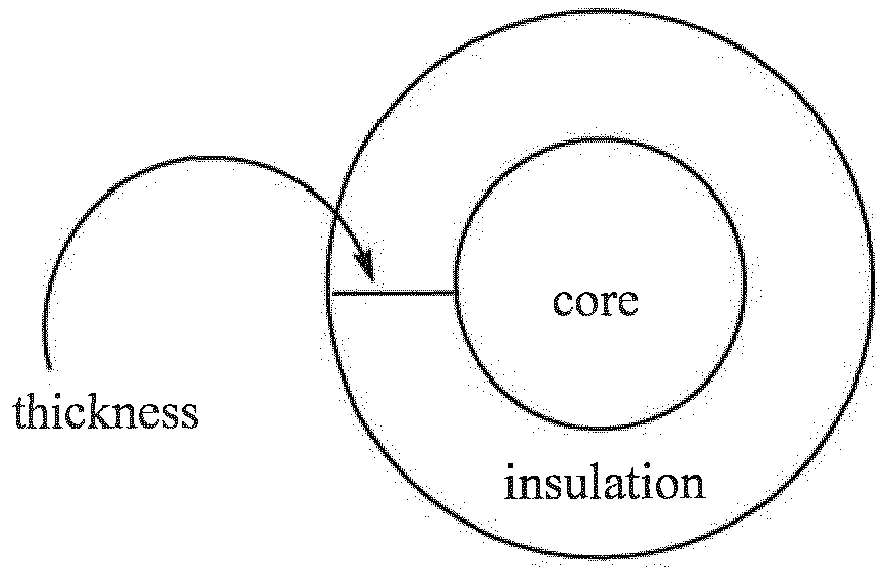
- the thickness of the insulation layer is the measurement below:
- the wire or cables of the invention preferably pass the ISO 6722 test either at 125°C, or 150°C or preferably both.
- ISO 6722 test either at 125°C, or 150°C or preferably both.
- Data presented herein relates to thin wall requirements for a cable construction in which conductor size is 0,35 mm 2 and insulation thickness is 0.25 mm.
- the invention further relates therefore to a wire or cable wherein the insulation layer composition passes a heat ageing measured according to ISO 6722 (thin wall cables as above) at 125°C of at least 3000 hrs.
- the invention further relates therefore to a wire or cable wherein the insulation layer composition passes a heat ageing measured according to ISO 6722 (thin wall cables as above) at 150°C of at least 240 hrs.
- Figure 1 compares heat ageing performance of examples of the invention, the comparative examples and an example from the US 6392154 prior art.
- melt flow rates MFR 2 were measured under a load of 2.16 kg at 190°C according to ISO 1133.
- Oven used was an Elastocon EB01 cell oven with 15 air exchanges per hour. Samples of different materials were not aged in the same cell.
- Trimethylolpropane trimethacrylate CAS No. 3290-92-4, Supplied by Evonik, Visiomer TMPTMA, Purity >98%
- Cables were extruded at 125°C melt temperature at a line speed of 100 m/min and in a sequential step cross-linked at 11 m/min in a vulcanisation tube with 10 bar nitrogen atmosphere at 400 °C in first zone and 375 °C in second zone.
- the cables were then tested for heat ageing according to ISO 6722:2006 at 175, 165, 150 and 125 °C.
- compositions Table 1 Comp.ex.1 (wt-%) Comp.ex.2 (wt-%) Comp.ex.3
- Commercial material A Inventive ex. 1 (wt-%)
- Inventive ex. 2 wt-%)
- EVA 41,97 41,28 42 42,18 42,3 Al trihydrate 54,45 54,45 54 54,45 54,45
- Vinyl triethoxysilane 0,44 0,44 0,44 0,44 Irganox 1010 0,2 0,25 0,8 0,3 0,3 Irganox 1035 0,5 Irganox 1024 MD 0,4 0,8 0,5 0,45 0,45
- Hostanox SE10 Luperox F 0,7 0,7 1,1 0,7 0,7 TMPTMA 1 1 - 1 *Thioether antioxidant
- Results are presented in table 2: Table 2. Heat ageing results on cables according to ISO 6722:2006. Standard pass criteria is 240 h at 150 °C and 3000 h at 125 °C. Temp °C Comp.ex.1 (h) Comp.ex.2 (h) Comp.ex.3 (h) Inventive ex. 1 (h) Inventive ex. 2 (h) 125 ⁇ 2880 ⁇ 2880 ⁇ 2880 >3170 >3170 150 ⁇ 240 ⁇ 240 ⁇ 240 800 ⁇ 240 165 ⁇ 96 ⁇ 96 ⁇ 96 292 ⁇ 96 175 24 48 24 96 24
Landscapes
- Chemical & Material Sciences (AREA)
- Organic Chemistry (AREA)
- Health & Medical Sciences (AREA)
- Chemical Kinetics & Catalysis (AREA)
- Medicinal Chemistry (AREA)
- Polymers & Plastics (AREA)
- Physics & Mathematics (AREA)
- Spectroscopy & Molecular Physics (AREA)
- Manufacturing & Machinery (AREA)
- Engineering & Computer Science (AREA)
- Compositions Of Macromolecular Compounds (AREA)
- Organic Insulating Materials (AREA)
- Insulated Conductors (AREA)
Abstract
The present invention relates to a wire or cable comprising a conductor coated with an insulation composition, wherein said insulation composition comprises:
i) a polyethylene copolymer having a melting point of 105°C or less; and
ii) a hindered amine light stabiliser (HALS) comprising at least one 2,2,6,6-tetramethyl-piperidinyl group.
i) a polyethylene copolymer having a melting point of 105°C or less; and
ii) a hindered amine light stabiliser (HALS) comprising at least one 2,2,6,6-tetramethyl-piperidinyl group.
Description
- This invention relates to a new composition for the insulation layer on a wire or cable. In particular, the invention relates to the combination of certain low melting point polyethylene copolymers with a hindered amine light stabiliser in the insulation layer of a wire or cable. The invention further relates to a composition of matter suitable for use in the insulation layer of a wire or cable comprising certain low melting point polyethylene copolymers with a hindered amine light stabiliser.
- Many different compositions are used as polymeric insulators for electrical conductors. These compositions typically contain a polyethylene such as an ethylene vinyl acetate copolymer. However, polyethylenes alone are ineffective insulators due to oxidative degradation of the polymeric material at the high temperatures usually found in electrical devices.
- Because of the instability of the polymers, various additives are typically mixed with the polymeric material to improve the heat ageing of the material. There are many disclosures in the prior art regarding possible additive packages that can aid heat stabilisation. For example, it is common for hindered phenol antioxidants to be added to the insulation layer. Other additives that are typically added to the insulating materials include zinc salt of a mercaptobenzimidazole, e.g.
US4824883 ,US 4797323 ,US4693937 andUS4260661 . - In
US 6392154 , the inventors propose an insulating composition consisting essentially of a copolymer of ethylene and vinyl acetate, a zinc salt of a mercaptobenzimidazole, aluminium trihydrate, and a peroxide curing agent consisting of para and meta isomers of [alpha],[alpha]'-bis(t-butylperoxy) diisopropyl benzene. This insulating composition has thermal stability and fast cure. -
US6326422 describes a composition comprising certain polyethylene copolymers, a hydrated inorganic filler, an alkoxysilane and a zinc salt of a mercaptobenzimidazole which can be cured by irradiation. - In
WO99/57190 - Wires, such as those used in road vehicles, need to satisfy certain requirements in order to be fit for purpose. In particular, wires must resist ageing caused by heat. Heat ageing is regulated by ISO
standard 6722. - The wall thickness of the insulation layer material present on the conductor during the testing procedure was previously defined as 0.3 mm. The current standard requires that insulation materials must pass the test with an insulation layer thickness of 0.25 mm for thin wall wires. It will be clear that the thinner insulation layer thickness makes passing the test procedure significantly more challenging.
- The person skilled in the art is therefore looking for new materials that can meet the new exacting standard, in particular passing a heat ageing at 125°C of 3000 hours or 240 hr at 150°C.
- The inventors have now realised that the inclusion of a hindered amine light stabiliser (HALS) such as Sabostab UV 94 provides superior thermo-oxidative stability for thin wall cables, in particular compared to market leading additives such as Vanox ZMTI. VANOX ZMTI is an antioxidant that is often used to provide protection against heat and oxygen aging, especially combined with phenolic type antioxidants. Structurally, it is 2-mercapto-toluimidazole zinc.
- Our results demonstrate that the HALS motif provides improved thermal ageing properties, in particular when combined with antioxidants. The HALS additive is well known at preventing light-induced degradation of most polymers. These additives are often found therefore in polymer films or other articles in which light stability is crucial.
- There is no teaching, however, that these additives can prevent heat ageing in wire and cable applications, e.g. at temperatures of 125°C or more, e.g. 135°C or more.
- Viewed from one aspect the invention provides wire or cable comprising a conductor coated with an insulation composition, wherein said insulation composition comprises:
- i) a polyethylene copolymer having a melting point of 105°C or less; and
- ii) a hindered amine light stabiliser (HALS) comprising at least one 2,2,6,6-tetramethyl-piperidinyl group.
- Viewed from another aspect the invention provides wire or cable comprising a conductor coated with an insulation composition, wherein said insulation composition comprises:
- i) an ethylene (meth)acrylate copolymer, an ethylene plastomer or an ethylene vinyl carboxylate copolymer, especially an ethylene vinyl acetate copolymer; and
- ii) a hindered amine light stabiliser (HALS) comprising at least one 2,2,6,6-tetramethyl-piperidinyl group.
- Viewed from another aspect the invention provides a composition suitable for use as an insulation coating for a wire or cable comprising:
- i) 30 to 65 wt% of a polyethylene copolymer having a melting point of 105°C or less, such as an ethylene vinyl acetate copolymer;
- ii) a hindered amine light stabiliser (HALS) comprising at least one 2,2,6,6-tetramethyl-piperidinyl group; and
- iii) 30 to 69 wt% of a halogen free flame retardant such as a hydrated inorganic filler.
- Viewed from another aspect the invention provides a composition suitable for use as an insulation coating for a wire or cable comprising:
- i) 30 to 65 wt% of an ethylene (meth)acrylate copolymer, an ethylene plastomer or an ethylene vinyl carboxylate copolymer, especially an ethylene vinyl acetate copolymer; and
- ii) a hindered amine light stabiliser (HALS) comprising at least one 2,2,6,6-tetramethyl-piperidinyl group; and
- iii) 30 to 69 wt% of a halogen free flame retardant such as a hydrated inorganic filler.
- Viewed from another aspect the invention provides the use of a composition as herein defined as the insulation layer of a wire or cable.
- Viewed from another aspect the invention provides the use of a hindered amine light stabiliser (HALS) comprising at least one 2,2,6,6-tetramethyl-piperidinyl group to reduce heat ageing in a wire or cable comprising a conductor coated with an insulation composition, wherein said insulation composition comprises:
- i) a polyethylene copolymer having a melting point of 105°C or less; and
- ii) a hindered amine light stabiliser (HALS) comprising at least one 2,2,6,6-tetramethyl-piperidinyl group.
- Viewed from another aspect the invention provides process for the preparation of a wire or cable as defined herein comprising extruding an insulation composition as defined herein onto a conductor to form a crosslinkable wire or cable comprising a conductor coated with said insulation composition; and
crosslinking the crosslinkable wire or cable, e.g. by heating in a vulcanisation tube. - This invention relates to the use of HALS compounds to improve the heat ageing capabilities of the insulation layer of a wire or cable comprising a low melting point polyethylene copolymer. We have remarkably found that these HALS compounds are able to significantly improve the heat ageing performance of the material at high temperatures.
- The invention relates either to a wire or cable comprising an insulation composition as defined herein or to a composition of matter suitable for use in such an insulation layer. Embodiments described below are generally applicable to either the cable insulation or composition of matter aspects of the invention.
- The polyethylene copolymer should have a melting point of 105°C or less, such as 100°C or less. In a most preferred embodiment, the melting point is 95°C or less. The polyethylene copolymer typically has a melting point of at least 60°C. Such lower melting copolymers have a reduced crystallinity which is advantageous for e.g. flame retardant applications as they are able to be filled with inorganic fillers to a large extent without damaging its physical performance.
- In any polyethylene copolymer, the ethylene monomer residues will form the predominant monomer residue units present (in wt% terms). More preferably, the polyethylene copolymer is an ethylene (meth)acrylate copolymer, an ethylene plastomer or an ethylene vinyl carboxylate copolymer, especially an ethylene vinyl acetate copolymer.
- The insulation layer composition of the invention preferably comprises an ethylene vinyl carboxylate, especially ethylene vinyl acetate. Suitable carboxylates include vinyl acetate, vinyl propionate, vinyl butyrate, vinyl pentanoate or vinyl hexanoate. It is most preferred if the polyethylene is ethylene vinyl acetate. The amount of vinyl acetate (relative to the amount of ethylene) in the resin can vary over wide limits. Typical values range from 5 to 40 wt% of the acetate, such as 15 to 35 wt% of the acetate in the polymer.
- The density of the ethylene vinyl carboxylate resin may be in the range of 920 to 960 kg/m3. Its MFR2 may range from 0.1 to 40g/10 min.
- These polymers are commercially available materials.
- The insulation layer composition of the invention may comprise at least one ethylene alkyl (meth)acrylate resin. The term (meth)acrylate is intended to cover both methacrylates and acrylates, i.e. compounds of formula CH2(Me)=CHCOO- or CH2=CHCOO-. The (meth) designates therefore the optional presence of the methyl group forming the methacrylate. It is preferred, however, if the EAA of the invention is an acrylate.
- The term "alkyl" is used to designate a C1-6 alkyl, preferably a C1-4 alkyl. Preferably the EAA may be an ethylene methyl (meth)acrylate, ethylene ethyl (meth)acrylate or ethylene butyl (meth)acrylate resin, especially ethylene methyl acrylate, ethylene ethyl acrylate or ethylene butyl acrylate resin (EMA, EEA and EBA respectively). Whilst mixtures of these resins can be used, it is preferred if only one EAA is used. Most preferably this is EMA.
- The amount of (meth)acrylate (relative to the amount of ethylene) in the EAA resin can vary over wide limits. Typical values range from 5 to 40 wt% of the acrylate, such as 15 to 35 wt% of the acrylate in the EAA polymer.
- The density of the ethylene alkyl (meth)acrylate resin may be in the range of 920 to 960 kg/m3, preferably 930 to 955 kg/m3. Its MFR2 may range from 0.1 to 20 g/10 min.
- These EAA polymers are commercially available materials and can be purchased from various suppliers, e.g. under the trade name Elvaloy™, Lotryl™, Amplify™, Lotader™ Lucotin™ etc.
- The insulation layer composition may also comprise an ethylene plastomer, e.g. an ethylene copolymer with one or more C3-10 alpha olefins. The density of the plastomer is preferably 900 kg/m3 or less, such as 890 kg/m3 or less. Plastomers preferably have a density of 860 kg/m3 or more, such as 870 kg/m3 or more.
- The content of comonomer in the plastomer may range from 3 to 30 mol%, preferably 5 to 30 mol%.
- Preferred plastomers are ethylene 1-hexene or ethylene 1-octene copolymers.
- The insulation layer composition preferably comprises from 30 to 65 wt% polyethylene copolymer based on the weight of the insulation composition, preferably from 35 to 55 wt%, more preferably from 40 to 50 wt%.
- The insulation layer composition preferably comprises from 30 to 65 wt% ethylene vinyl carboxylate or ethylene (meth)acrylate copolymer based on the weight of the insulation composition, preferably from 35 to 55 wt%, more preferably from 40 to 50 wt%.
- The insulation layer composition preferably comprises from 30 to 65 wt% ethylene vinyl acetate copolymer based on the weight of the insulation composition, preferably from 35 to 55 wt%, more preferably from 40 to 50 wt%.
- It is within the scope of the invention to employ a mixture of the polyethylene copolymers above. If a mixture is used, the combined total of the components preferably still meets the wt% presented above.
- It is possible to combine the polyethylene copolymer with minor amounts, e.g. 0.5 to 20 wt%, such as 1.0 to 10 wt% of other well-known polymers, in particular other well-known polyolefins such as polypropylene homopolymers or copolymers or more preferably, known polyethylenes such as LDPE, HDPE or LLDPE. Preferably however, there are no other polymers present (other than possible additive carrier polymers, i.e. a form of masterbatch). The insulation layer is preferably free of polyurethane.
- The insulation layer of the invention must comprise at least one HALS compound which possesses at least one 2,2,6,6-tetramethyl-piperidinyl group. The 2,2,6,6-tetramethyl-piperidinyl is the common motif characteristic of HALS compounds.
- Preferably therefore, the HALS of interest in the invention will comprise one or more groups of formula:

- The N atom can be substituted or may simply carry an H. The nature of any substituent group present can vary. Typically, the 4-position of the of the piperidinyl ring is substituted. The nature of any substituent group present can vary.
- Any HALS compound comprising the 2,2,6,6-tetramethyl-piperidinyl motif can be used and it will be appreciated that the art contains a wide variety of compounds possessing this motif, some of which are depicted below.
- Certain HALS compounds are however preferred. It is generally preferred if the HALS comprises two or more 2,2,6,6-tetramethyl-piperidinyl groups. It is generally preferred if the HALS comprises at least four 2,2,6,6-tetramethyl-piperidinyl groups. It is generally preferred if the HALS comprises a 2,2,6,6-tetramethyl-piperidinyl group in which the nitrogen atom is free of substituent groups. It is generally preferred if the HALS is a polymer in which a plurality of 2,2,6,6-tetramethyl-piperidinyl groups are present.
- It is preferred if the HALS comprises at least two piperidinyl groups of formula (I)

R1 is H or C1-15 alkyl; and
R2 is a C1-10 alkyl group which optionally comprises one or more heteroatoms selected from O, N or S or which optionally comprises a C=O group;
said at least two piperidinyl groups being covalently bound via the 4-position of the piperidinyl rings to a linking group. - In this regard, when R is O the formed compound is an N-oxide. It is preferred if R is H.
- Alternatively, the hindered amine light stabiliser comprises one piperidinyl group of formula (II)

- Alternatively, the hindered amine light stabiliser comprises repeating units of formula (III)

- wherein n is at least 2;
- X and Y represent atoms forming the repeating unit.
- In a preferred embodiment, the HALS is a polymer and therefore contains at least two repeating units, such as a plurality of repeating units. A polymer can be formed via a structure (III) or via structure (I) in which the 2,2,6,6-tetramethylpiperidinyl group is linked via its 4-position to a linking group, where the linking group then forms a monomer unit.
- The person skilled in the art can prepare a variety of compounds comprising the 2,2,6,6-tetramethylpiperidinyl motif.
- The insulation layer composition preferably comprises from 0.1 to 1.5 wt% HALS based on the weight of the insulation composition, preferably from 0.25 to 1.0 wt%.
- In a preferred embodiment the HALS is:
- bis 2,2,6,6-tetramethyl-4-piperidinyl-sebacate (such as Tinuvin 770 CAS 52829-07-9);
- bis(1-octyloxy-2,2,6,6-tetramethyl-4-piperidyl) sebacate (such as Tinuvin 123 CAS 129757-67-1);
- butanedioic acid, dimethylester, polymer with 4-hydroxy-2,2,6,6-tetramethyl-1-piperidine ethanol (such as Tinuvin 622 CAS 65447-77-0);
- Bis-(1,2,2,6,6-pentamethyl-4-piperidyl) sebacate (such as Tinuvin 765 CAS 41556-26-7);
- a mixture of esters of 2,2,6,6-tetramethyl-4-piperidinol and higher fatty acids (mainly stearic acid) (such as Cyasorb UV-3853 CAS 86403-32-9);
- Tetrakis (2,2,6,6-tetramethyl-4-piperidyl)-1,2,3,4-butane tetracarboxylate (such as ADK Stab LA-57 CAS 64022-61-3);
- Tetrakis (1,2,2,6,6-pentamethyl-4-piperidyl)-1,2,3,4-butane tetracarboxylate (such as ADK Stab LA-52 CAS 91788-83-9);
- Di-(1,2,2,6,6-pentamethyl-4-piperidyl)-2-butyl-2-(3,5-di-tert-butyl-4-hydroxybenzyl)malonate (such as Tinuvin 144 CAS 63843-89-0) 2,9,11,13,15,22,24,26,27,28- decaazatricyclo[21.3.1.1^(10,14)]octacosa-1(27),10,12,14(28),23,25-hexaene-12,25-diamine, N,N'-bis(1,1,3,3-tetramethylbutyl)-2,9,15,22-tetrakis(2,2,6,6-tetramethyl-4-piperidinyl)- (such as Chimassorb 966 CAS 86168-95-8);
- Poly [(6-morpholino-s-triazine-2,4-diyl)[2,2,6,6- tetramethyl-4-piperidyl) imino]-hexamethylene [(2,2,6,6-tetramethyl-4-piperidyl) imino]] (such as Cyasorb UV 3346 CAS 82451-48-7)
- 1,6-Hexanediamine, N,N'-bis(2,2,6,6-tetramethyl-4-piperidinyl)-, Polymers with morpholine-2,4,6-trichloro- 1,3,5-triazine (such as Cyasorb UV 3529 CAS 193098-40-7);
- CAS-no. 247243-62-5 (such as Tinuvin NOR 371 CAS);
- bis(2,2,6,6-tetramethyl-1-undecoxypiperidin-4-yl) carbonate (such as ADK StabLA-81 CAS705257-84-7);
- N,N'-Bis(2,2,6,6-tetramethyl-4-piperidinyl)-1,6-hexanediamine polymer with 2,4,6-trichloro-1,3,5-triazine reaction products with N-butyl-1-butanamine and N-butyl-2,2,6,6-tetramethyl-4-piperidinamine (such as Chimassorb 2020 CAS 192268-64-7);
- 1,3,5-Triazine-2,4,6-triamine, N,N"'-(1,2-ethane-diylbis(((4,6-bis(butyl(1,2,2,6,6-pentamethyl-4-piperidinyl)amino)-1,3,5-triazine-2-yl)imino)-3,1-propanediyl))-bis-(N',N"-dibutyl-N',N"-bis-(1,2,2,6,6-pentamethyl-4-piperidinyl), (such as Sabostab UV 119 CAS 106990-43-6);
- poly[[6-[(1,1,3,3-tetramethylbutyl)amino]-1,3,5-triazine-2,4-diyl][(2,2,6,6-tetramethyl-4-piperidinyl)imino]-1,6-hexanediyl[(2,2,6,6-tetramethyl-4-piperidinyl)imino]]) (such as Sabostab UV 94 CAS 71878-19-8);
- 1,2,3-tris-(1,2,2,6,6-pentamethyl-4-piperidinyl)-4-tridecyl butane-1,2,3,4-tetracarboxylate (such as ADK Stab LA-62 CAS 84696-72-0);
- 1,2,3-tris-(2,2,6,6-pentamethyl-4-piperidinyl)-4-tridecyl butane-1,2,3,4-tetracarboxylate (such as ADK Stab LA-67 CAS 84696-71-9);
- 2,2,4,4-tetramethyl-7-oxa-3,20-diaza-dispiro(5.1.11.2)-heneicosane-21-on (such as Hostavin N20 CAS 64338-16-5);
- Bis(1,2,2,6,6-pentamethyl-4-piperidinyl)-2-(4-methoxybenzylidene)malonate (such as Hostavin PR-31 CAS 147783-69-5);
- N,N'-bisformyl-N,N'-bis-(2,2,6,6-tetramethyl-4-piperidinyl)-hexamethylendiamine (such as Uvinul 4050 H 124172-53-8);
- Polymer 2,2,4,4-tetramethyl-7-oxa-3,20-diaza-20- (2,3-epoxi-propyl)-dispiro-(5.1, 11.2)-heneicosane-21-one and Epichlorohydrin (such as Hostavin N30 CAS 202483-55-4);
- 1,3-Propanediamine, N,N" - 1,2-ethanediylbis-polymer with 2,4,6-trichloro-1,3,5-triazine, reaction products with N-butyl-2,2,6,6-tetramethyl-4-piperidinamine (such as Uvasorb HA88 CAS 136504-96-6);
- 1,2,3,4-butanetetracarboxylic acid, polymer with beta, beta, beta', beta'-tetramethyl-2,4,8,10-tetraoxaspiro(5.5) undecane-3-9-diethanol, 1,2,2,6,6-pentamethyl-4-piperidinyl ester (such as ADK Stab LA-63P CAS 101357-36-2);
- 2,4,8,10-tetraoxaspiro(5.5) undecane-3,9-diethanol, beta, beta, beta', beta'-tetramethyl-polymer with 1,2,3,4-butanetetracarboxylic acid, 2,2,6,6-tetramethyl-4-piperidinyl ester (such as ADK Stab LA-68P CAS 101357-37-3);
- Polymethylpropyl-3-oxy-4(2,2,6,6-tetramethyl) piperidinyl) siloxane (such as Uvasil 299 CAS 182635-99-0);
- N-(2,2,6,6-tetramethyl-4-piperidyl)-maleinimid, C20: C24-olefin-copolymer (such as Uvinul 5050H CAS152261-33-1); and
- 4-(3-(3,5-di-t-butyl-4-hydroxyphenyl)propionyloxy-1-(2-(3-(3,5-di-t-butyl-4-hydroxy)propionyloxy) ethyl)-)-2,2,6,6-tetramethylpiperidine (such as sanol LS-2626 CAS 73754-27-5).
- It is especially preferred if the HALS is 1,3,5-Triazine-2,4,6-triamine, N,N"'-(1,2-ethane-diylbis(((4,6-bis(butyl(1,2,2,6,6-pentamethyl-4-piperidinyl)amino)-1,3,5-triazine-2-yl) imino)-3,1-propanediyl))-bis-(N',N"-dibutyl-N',N"-bis-(1,2,2,6,6-pentamethyl-4-piperidinyl), or more preferably poly[[6-[(1,1,3,3-tetramethylbutyl)amino]-1,3,5-triazine-2,4-diyl][(2,2,6,6-tetramethyl-4-piperidinyl)imino]-1,6-hexanediyl[(2,2,6,6-tetramethyl-4-piperidinyl)imino]]).
- Mixtures of HALS stabilisers can also be used.
- The insulation layer composition preferably comprises at least one halogen free flame retardant. The flame retardant is preferably hydrated inorganic filler such as hydrated calcium silicate, hydrated magnesium carbonate, hydrated magnesium hydroxide, hydrated aluminium hydroxide, calcium carbonate or calcium carbonate silicon gum combinations (see
EP0393959 ,EP1863041 ,EP1512719 ,EP1862496 ,EP2199335 andEP1695997 ). Preferably, hydrated aluminium hydroxide or calcium carbonate silicon gum combinations are used. Hydrated aluminium hydroxide may also be referred to as aluminium trihydrate. - The amount of halogen free flame retardant present in the insulation composition may range from 30 to 69 wt% based on the weight of the insulation composition, preferably 45 to 55 wt%.
- It is preferred if the insulation layer composition of the invention comprises at least one antioxidant, preferably at least one phenolic antioxidant. Preferred phenolic antioxidants are selected from [Octadecyl 3-(3',5'-di-tert. butyl-4-hydroxyphenyl)propionate] (e.g. Irganox 1076), benzenepropanoic acid, 3,5-bis(1,1-dimethylethyl)-4-hydroxy-, thiodi-2,1-ethanediyl ester (Irganox 1035), [Pentaerythrityl-tetrakis(3-(3',5'-di-tert. butyl-4-hydroxyphenyl)-propionate] (e.g. Irganox 1010); or 2',3-bis [[3-[3,5-di-tert-butyl-4-hydroxyphenyl]propionyl]] propionohydrazide (Irganox 1024 MD) or a combination thereof.
- It is especially preferred if the insulation layer composition comprises [Pentaerythrityl-tetrakis(3-(3',5'-di-tert. butyl-4-hydroxyphenyl)-propionate] (e.g. Irganox 1010), or 2',3-bis [[3-[3,5-di-tert-butyl-4-hydroxyphenyl]propionyl]] propionohydrazide (Irganox 1024 MD) or, most especially a combination of these two antioxidants.
- The insulation layer composition should preferably comprise 0.01 to 1.5 wt%, e.g. 0.1 to 1.2 wt% phenolic antioxidant. In a preferred embodiment, the insulation layer composition comprises 0.1 to 0.6 wt% Irganox 1010. In a preferred embodiment, the insulation layer composition comprises 0.15 to 0.65 wt% Irganox 1024 MD.
- The insulation layer composition may also comprise at least one organic phosphite or phosphonite antioxidant such as [Bis(2-methyl-4,6-bis(1,1-dimethylethyl)phenyl)phosphorous acid ethylester] (e.g. Irgafos 38), [Tris(2,4-di-t-butylphenyl)phosphite] (e.g. Irgafos 168), or [Phosphorous acid- cyclic butylethyl propandiol, 2,4,6-tri-t-butylphenyl ester] (e.g. Ultranox 641).
- It is preferred if the composition used in the insulation layer is cross-linked. It is thus preferred if a crosslinking agent is present in the insulation layer composition before the vulcanisation process. A crosslinking agent is a compound that crosslinks the polymer chain present.
- Suitable crosslinking agents are multifunctional monomers which have two or more carbon-carbon double bonds. They include multifunctional vinyl monomers, acrylate and methacrylate monomers, and allyl monomers. Examples of multifunctional vinyl monomers include ethylene glycol divinyl ether, propylene glycol divinyl ether, triethylene glycol divinyl ether, divinyl urethanes, divinyl polyesters, the like, and mixtures thereof. Examples of multifunctional allyl monomers include diallyl phthalates, trimethylolpropane diallyl ether, triallyl cyanurate, allyl acrylate, allyl methacrylate, the like, and mixtures thereof. Examples of suitable multifunctional acrylates and methacrylates include trimethylolpropane triacrylate and trimethacrylate, glyceryl propoxy triacrylate and trimethacrylate, alkoxylated bisphenol A diacrylate and dimethacrylate, 1,4-butanediol diacrylate and dimethacrylate, the like, and mixtures thereof.
- Multifunctional acrylates and methacrylates are preferred. Trifunctional acrylates and methacrylates are particularly preferred. A preferred crosslinking agent is trimethylpropane trimethacrylate.
- The insulation layer composition should preferably comprise 0.1 to 2.0 wt%, e.g. 0.5 to 1.5 wt% crosslinking agent before crosslinking.
- In order to allow crosslinking to occur, it is preferred of the insulation layer composition, before crosslinking, contains an initiator, such as a peroxide. Any known peroxide can be used. Preferred peroxides for curing polyolefins include dicumyl peroxide, tertiary diperoxides such as 2,5-dimethyl-2,5-di(t-butyl peroxy) hexane) hexyne-3, and diperoxy and polyperoxide compounds such as 1,3(4)-bis(tert-butylperoxyisopropyl)benzene.
- The initiator content can vary in amount from about 0.2 to about 2.0 weight percent of the composition, and preferably from about 0.4 to about 1.0 weight percent.
- The insulation layer composition of the invention may also contain pigments, lubricants, and processing aids provided that they do not interfere with cross-linking or detract from the physical properties of the composition. A processing aid can also be added to the mixture to facilitate dispersion of added inorganic components. Preferred processing aids include alkoxysilane additives. Any conventional alkoxysilane known in the art can be used as long as it does not combust or degrade during polymer processing or interfere with crosslinking. Alkoxysilanes having 2 or 3 C1-3 alkoxy substituents, e.g., methoxy, ethoxy, propoxy, or combinations thereof, are particularly advantageous. Illustrative silanes include methyltriethoxysilane, methyltris(2-methoxyethoxy)silane, dimethyldiethoxylsilane, ethyltrimethoxysilane, vinyltris(2-methoxyethoxy)silane, phenyltris(2-methoxyethoxy)silane, vinyltrimethoxysilane, vinyltriethoxysilane, and gamma-methacryloxypropyl trimethoxysilane.
- The use of vinyltrimethoxysilane or vinyltriethoxysilane is especially preferred.
- The alkoxysilane component, if present, can vary in amount from about 0.2 to about 3.0 weight percent of the composition, and preferably from about 0.5 to about 2.0 weight percent.
- In one embodiment, the insulation layer of the invention is free of a zinc salt of a mercaptobenzimidazole.
- In a preferred embodiment, the insulation layer composition comprises:
- i). 30 to 65 wt% of a polyethylene copolymer having a melting point of 105°C or less, such as an ethylene vinyl acetate copolymer;
- ii). 0.1 to 1.5 wt% of a hindered amine light stabiliser (HALS) comprising at least one 2,2,6,6-tetramethyl-piperidinyl group; and
- iii). 30 to 69 wt% of a halogen free flame retardant such as a hydrated inorganic filler.
- In a preferred embodiment, the insulation layer composition comprises:
- i). 30 to 65 wt% of a polyethylene copolymer having a melting point of 105°C or less, such as an ethylene vinyl acetate copolymer;
- ii). 0.1 to 1.5 wt% of a hindered amine light stabiliser (HALS) comprising at least one 2,2,6,6-tetramethyl-piperidinyl group;
- iii). 30 to 69 wt% of a halogen free flame retardant such as a hydrated inorganic filler; and
- iv). 0.1 to 1.5 wt% of at least one phenolic antioxidant.
- The invention further relates to a composition of matter suitable for use in the manufacture of an insulation layer in a cable.
- That composition comprises
- i). 30 to 65 wt% of a polyethylene copolymer having a melting point of 105°C or less, such as an ethylene vinyl acetate copolymer;
- ii). a hindered amine light stabiliser (HALS) comprising at least one 2,2,6,6-tetramethyl-piperidinyl group; and
- iii). 30 to 69 wt% of a halogen free flame retardant such as a hydrated inorganic filler.
- The preferred options for the polyethylene copolymer, HALS, flame retardant, additional additives, weight percentages and so on discussed above in connection with the insulation layer of the wire or cable apply equally to this embodiment of the invention. It is thus most preferred if the HALS is Sabostab UV 94. It is most preferred if the composition additionally comprises at least one phenolic antioxidant, such as Irganox 1010 and/or Irganox 1024 MD.
- It is preferred if the composition comprises at least one initiator such as a peroxide. It will be appreciated that in the final insulation layer on the cable, the material is cross-linked and hence the peroxide has decomposed to initiate reaction. The peroxide is however a component present in the composition before crosslinking.
- The composition preferably comprises at least one crosslinking agent such as TMPTMA.
- The polymer and additives can be mixed using any conventional procedure. Mixing technology is well known in the prior art. For instance, an internal mixer such as a Banbury mixer can be used. Other high shear internal mixers, including Farrel continuous mixer, Boiling Mixtrumat(TM), or Werner & Pfleiderer mixers, can also be used in the mixing procedure.
- Typically, the polymer, HALS and flame retardant are first mixed together before the peroxide curing agent is added. The peroxide is then added under controlled temperature conditions. The temperature of peroxide mixing should be controlled in order to prevent premature cross-linking. Preferred peroxide mixing temperatures may be from about 50 to about 120°C.
- The resulting blend is then applied to electrical conductors to form an insulating layer surrounding the conductor. The layer provides insulation and physical protection for the conductor and flame retardancy for the insulated conductor. The composition mixture is applied using any conventional coating techniques. Coating methods are well known in the art. A typical procedure is to apply the composition by extruding a substantially uniform layer onto a metal conductor. The extrusion may be carried out using a single screw extruder at the desired line speeds. Curing is typically accomplished by passing the insulated wire through a pressurized steam tube immediately following extrusion.
- The wire or cable of the invention is preferably one that is designed for use in the automotive industry. Preferably, the cable comprises a conductive core (typically copper core) and an insulation layer. The insulation layer may be the only polymer layer present. The insulation layer may be of any preferred thickness, e.g. 0.2 to 1.3 mm, but is preferably less than 0.5 mm in thickness, such as 0.4 mm or less, especially 0.3 mm or less. The minimum insulation layer thickness may be 0.1 mm, preferably at least 0.2 mm. A thickness of 0.25 mm is especially preferred. The copper core may have a size of 0.1 to 25 mm2. When used in relation to conductor, the term "size" means cross-section area.
- The thickness of the insulation layer is the measurement below:
- The wire or cables of the invention preferably pass the
ISO 6722 test either at 125°C, or 150°C or preferably both. There are three categories of cable which can be subjected to the ISO test 6722: thick wall, thin wall or ultra-thin wall. They are categorised based on the insulation thickness in relation to the conductor diameter and size. The thinner the wall, the more challenging it is to pass the ageing standard. - Data presented herein relates to thin wall requirements for a cable construction in which conductor size is 0,35 mm2 and insulation thickness is 0.25 mm.
- The invention further relates therefore to a wire or cable wherein the insulation layer composition passes a heat ageing measured according to ISO 6722 (thin wall cables as above) at 125°C of at least 3000 hrs.
- The invention further relates therefore to a wire or cable wherein the insulation layer composition passes a heat ageing measured according to ISO 6722 (thin wall cables as above) at 150°C of at least 240 hrs.
- The invention will now be described with reference to the following non limiting examples and figure.
Figure 1 compares heat ageing performance of examples of the invention, the comparative examples and an example from theUS 6392154 prior art. - Melting point determinations were made by Differential Scanning Calorimetry (DSC) in accordance with ISO11357-3. A TA-Instruments Q 2000 was used and operated between -60 to 180°C at a ramping rate of 10°C/minute. The second melting cycle was used for determination of the melting point.
- The melt flow rates MFR2 were measured under a load of 2.16 kg at 190°C according to ISO 1133.
- Were measured using ISO1183.
- According to ISO 6722:2006. Data presented relates to a cable construction in which conductor size is 0.35 mm2 and insulation thickness is 0.25 mm.
- Oven used was an Elastocon EB01 cell oven with 15 air exchanges per hour. Samples of different materials were not aged in the same cell.
- Samples were taken out of the oven after each day for samples aged at 175 °C.
- For 165 °C the first sample outtake was done after 96 h, samples failing before this time are presented as < 96h in Table 2.
- For 150 °C the first sample outtake was done after 10 days, samples failing before this time are presented as < 240 hours in Table 2.
- For 125 °C the first sample outtake was done after 2880 hours, samples failing before this time are presented as < 2880 hours in Table 2.
- The following materials were used in order to prepare examples describing the invention:
- EVA
ELVAX 460A, produced by Du Pont. MFR2,16=2,2 g/10min, VA content=18wt%, DSC melting point 87°C. - Aluminium trihydrate (ATH)
Precipitated ATH, Hydral PGA-SD, produced by Huber. Purity 99,5%. Particle size, d50=1,1 µm (by Sedigraph 5100), Surface area 4,5 m2/g. - Vinyl triethoxysilane CAS No. 78-08-0
Wacker Chemie, Geniosil GF 56. Purity >98%. - Antioxidants:
Pentaerytrithyl-tetrakis(3-(3,5-di-tert. Butyl-4-hydroxyphenyl)-propionate, CAS no. 6683-19-8, Supplied by BASF, Irganox 1010, Purity>92%
2,2-thiodiethylenebis-(3,5-di-tert. butyl-4-hydroxyphenyl)-propionate, CAS no. 41484-35-9. Supplied by BASF. Irganox 1035, Purity>98%
N,N'-bis (3(3',5'-di-tert. butyl-4'-hydroxyphenyl)propionyl) hydrazide, CAS-no.32687-78-8, supplied by BASF, Irganox MD 1024, purity>98%
Di-octadecyl-disulphide, CAS-no. 2500-88-1, supplied by Clariant, purity>98%
Tris (2,4-di-t-butylphenyl) phosphite, (CAS no. 31570-04-4), supplied by BASF, Irgafos 168, purity>99%.
Di-stearyl-thio-di-propionate (DSTDP) (CAS-no. 693-36-7), supplied by BASF, Irganox PS 802, purity>93%
4,4'-bis(1,1'-dimethylbenzyl)diphenylamine (CAS-no. 10081-67-1), supplied by Addivant, Naugard 445, purity>99% - Poly((6-((1,1,3,3-tetramethylbutyl)amino)-1,3,5-triazine-2,4-diyl)(2,2,6,6-tetramethyl-4-piperidyl)imino)-1,6-hexanediyl ((2,2,6,6-tetramethyl-4-piperidyl)imino)), CAS-no. 71878-19-8, supplied by Sabo, Sabostab 94, ash content<0,1%, volatiles 105°C/2 hours <1%.
- 1,3,5-Triazine-2,4,6-triamine, N,N"'-(1,2-ethane-diylbis(((4,6-bis(butyl(1,2,2,6,6-pentamethyl-4-piperidinyl)amino)-1,3,5-triazine-2-yl) imino)-3,1-propanediyl))-bis-(N',N"-dibutyl-N',N"-bis-(1,2,2,6,6-pentamethyl-4-piperidinyl), CAS no.106990-43-6, supplied by Sabo, Sabostab UV 119, ash content<0,1%, volatiles 105°C/2 hours <1%.
- Di(tert-butylperoxyisopropyl)benzene, CAS-no. 25155-25-3, Supplied by Arkema, Luperox F, Purity>96%
- Trimethylolpropane trimethacrylate, CAS No. 3290-92-4, Supplied by Evonik, Visiomer TMPTMA, Purity >98%
- Compounds in accordance with the compositions described in Table 1 were produced in a 46mm Buss line at 225 rpm and set temperatures of 120°C in
zone 1 and 110°C in zone 2, the mixer screw was heated to 80°C. The extruder screw temperature was 110°C, the barrel heated to 120°C and the speed 9 rpm. All ingredients were added to the first feeding port. - Cables were extruded at 125°C melt temperature at a line speed of 100 m/min and in a sequential step cross-linked at 11 m/min in a vulcanisation tube with 10 bar nitrogen atmosphere at 400 °C in first zone and 375 °C in second zone.
- The cables were then tested for heat ageing according to ISO 6722:2006 at 175, 165, 150 and 125 °C.
- The following compositions were prepared:
Compositions Table 1 Comp.ex.1 (wt-%) Comp.ex.2 (wt-%) Comp.ex.3 Commercial material A Inventive ex. 1 (wt-%) Inventive ex. 2 (wt-%) EVA 41,97 41,28 42 42,18 42,3 Al trihydrate 54,45 54,45 54 54,45 54,45 Vinyl triethoxysilane 0,44 0,44 0,44 0,44 0,44 Irganox 1010 0,2 0,25 0,8 0,3 0,3 Irganox 1035 0,5 Irganox 1024 MD 0,4 0,8 0,5 0,45 0,45 Sabostab UV 94 - 0,48 Sabostab UV 119 0,36 Irgafos 168 0,2 0,25 - DSTDP* 0,64 0,88 - Hostanox SE10 0,8 Luperox F 0,7 0,7 1,1 0,7 0,7 TMPTMA 1 1 - 1 1 *Thioether antioxidant - Results are presented in table 2:
Table 2. Heat ageing results on cables according to ISO 6722:2006. Standard pass criteria is 240 h at 150 °C and 3000 h at 125 °C. Temp °C Comp.ex.1 (h) Comp.ex.2 (h) Comp.ex.3 (h) Inventive ex. 1 (h) Inventive ex. 2 (h) 125 <2880 <2880 <2880 >3170 >3170 150 < 240 < 240 < 240 800 <240 165 < 96 < 96 <96 292 <96 175 24 48 24 96 24 - From Table 1 and 2 it is clear that surprisingly the material Sandostab UV 94 and also the formulation based on the other light stabiliser, Sandostab UV 119, are the only compositions that passes after more than 3000 h at 125°C; i.e. the formulations based on the inventive examples are working better the closer they are to the actual temperature of use.
Claims (17)
- A wire or cable comprising a conductor coated with an insulation composition, wherein said insulation composition comprises:i) a polyethylene copolymer having a melting point of 105°C or less; andii) a hindered amine light stabiliser (HALS) comprising at least one 2,2,6,6-tetramethyl-piperidinyl group.
- A wire or cable as claimed in claim 1 wherein the polyethylene copolymer is an ethylene vinyl acetate copolymer or an ethylene (meth)acrylate copolymer, preferably an ethylene vinyl acetate copolymer.
- A wire or cable as claimed in any preceding claim wherein the hindered amine light stabiliser comprises:at least two piperidinyl groups of formula (I)

R1 is H or C1-15 alkyl; and
R2 is a C1-10 alkyl group optionally comprising one or more heteroatoms selected from O, N or S or a C=O group;
said at least two piperidinyl groups being covalently bound via the 4-position of the piperidinyl ring to a linking group;
wherein the hindered amine light stabiliser comprises one piperidinyl group of formula (II)
 wherein n is at least 2;X and Y represent atoms forming the repeating unit.
 - A wire or cable as claimed in any preceding claim in which the insulation composition is cross-linked.
- A wire or cable as claimed in any preceding claim wherein the HALS is a polymer.
- A wire or cable as claimed in any preceding claim in which R is H.
- A wire or cable as claimed in any preceding claim wherein the insulation composition has a heat ageing measured according to ISO 6722:2006 at 125°C of at least 3000 hrs or a heat ageing measured according to ISO 6722:2006 at 150°C of at least 240 hrs.
- A wire or cable as claimed in any preceding claim wherein the insulation composition comprises from 0.1 to 1.5 wt% HALS based on the weight of the insulation composition, preferably from 0.25 to 1.0 wt%.
- A wire or cable as claimed in any preceding claim wherein the HALS is
bis 2,2,6,6-tetramethyl-4-piperidinyl-sebacate (such as Tinuvin 770);
bis(1-octyloxy-2,2,6,6-tetramethyl-4-piperidyl) sebacate (such as Tinuvin 123); butanedioic acid, dimethylester, polymer with 4-hydroxy-2,2,6,6-tetramethyl-1-piperidine ethanol (such as Tinuvin 622);
Bis-(1,2,2,6,6-pentamethyl-4-piperidyl) sebacate (such as Tinuvin 765);
a mixture of esters of 2,2,6,6-tetramethyl-4-piperidinol and higher fatty acids (mainly stearic acid) (such as Cyasorb UV-3853);
Tetrakis (2,2,6,6-tetramethyl-4-piperidyl)-1,2,3,4-butane tetracarboxylate (such as ADK Stab LA-57);
Tetrakis (1,2,2,6,6-pentamethyl-4-piperidyl)-1,2,3,4-butane tetracarboxylate (such as ADK Stab LA-52);
Di-(1,2,2,6,6-pentamethyl-4-piperidyl)-2-butyl-2-(3,5-di-tert-butyl-4-hydroxybenzyl)malonate (Tinuvin 144) 2,9,11,13,15,22,24,26,27,28-decaazatricyclo[21.3.1.1^(10,14)]octacosa- 1(27),10,12,14(28),23,25-hexaene-12,25-diamine, N,N'-bis(1,1,3,3-tetramethylbutyl)-2,9,15,22-tetrakis(2,2,6,6-tetramethyl-4-piperidinyl)- (such as Chimassorb 966);
Poly [(6-morpholino-s-triazine-2,4-diyl)[2,2,6,6- tetramethyl-4-piperidyl) imino]-hexamethylene [(2,2,6,6-tetramethyl-4-piperidyl) imino]] (such as Cyasorb UV 3346) 1,6-Hexanediamine, N,N'-bis(2,2,6,6-tetramethyl-4-piperidinyl)-, Polymers with morpholine-2,4,6-trichloro- 1,3,5-triazine (such as Cyasorb UV 3529);
CAS-no. 247243-62-5 (such as Tinuvin NOR 371); bis(2,2,6,6-tetramethyl-1-undecoxypiperidin-4-yl) carbonate (such as ADK StabLA-81);
N,N'-Bis(2,2,6,6-tetramethyl-4-piperidinyl)-1,6-hexanediamine polymer with 2,4,6-trichloro-1,3,5-triazine reaction products with N-butyl-1-butanamine and N-butyl-2,2,6,6-tetramethyl-4-piperidinamine (such as Chimassorb 2020);
1,3,5-Triazine-2,4,6-triamine, N,N"'-(1,2-ethane-diylbis(((4,6-bis(butyl(1,2,2,6,6-pentamethyl-4-piperidinyl)amino)-1,3,5-triazine-2-yl) imino)-3,1-propanediyl))-bis-(N',N"-dibutyl-N',N"-bis-(1,2,2,6,6-pentamethyl-4-piperidinyl), (such as Sabostab UV 119);
poly[[6-[(1,1,3,3-tetramethylbutyl)amino]-1,3,5-triazine-2,4-diyl][(2,2,6,6-tetramethyl-4-piperidinyl)imino]-1,6-hexanediyl[(2,2,6,6-tetramethyl-4-piperidinyl)imino]]) (such as Sabostab UV 94);
1,2,3-tris-(1,2,2,6,6-pentamethyl-4-piperidinyl)-4-tridecyl butane-1,2,3,4-tetracarboxylate (such as ADK Stab LA-62);
1,2,3-tris-(2,2,6,6-pentamethyl-4-piperidinyl)-4-tridecyl butane-1,2,3,4-tetracarboxylate (such as ADK Stab LA-67);
2,2,4,4-tetramethyl-7-oxa-3,20-diaza-dispiro(5.1.11.2)-heneicosane-21-on (such as Hostavin N20);
Bis(1,2,2,6,6-pentamethyl-4-piperidinyl)-2-(4-methoxybenzylidene)malonate (such as Hostavin PR-31);
N,N'-bisformyl-N,N'-bis-(2,2,6,6-tetramethyl-4-piperidinyl)-hexamethylendiamine (such as Uvinul 4050 H);
Polymer 2,2,4,4-tetramethyl-7-oxa-3,20-diaza-20- (2,3-epoxi-propyl)-dispiro-(5.1, 11.2)-heneicosane-21-one and Epichlorohydrin (such as Hostavin 30);
1,3-Propanediamine, N,N" - 1,2-ethanediylbis-polymer with 2,4,6-trichloro-1,3,5-triazine, reaction products with N-butyl-2,2,6,6-tetramethyl-4-piperidinamine (such as Uvasorb HA88);
1,2,3,4-butanetetracarboxylic acid, polymer with beta, beta, beta', beta'-tetramethyl-2,4,8,10-tetraoxaspiro(5.5) undecane-3-9-diethanol, 1,2,2,6,6-pentamethyl-4-piperidinyl ester (such as ADK Stab LA-63P);
2,4,8,10-tetraoxaspiro(5.5) undecane-3,9-diethanol, beta, beta, beta', beta'-tetramethyl-polymer with 1,2,3,4-butanetetracarboxylic acid, 2,2,6,6-tetramethyl-4-piperidinyl ester (such as ADK Stab LA-68P);
Polymethylpropyl-3-oxy-4(2,2,6,6-tetramethyl) piperidinyl) siloxane (such as Uvasil 299);
N-(2,2,6,6-tetramethyl-4-piperidyl)-maleinimid, C20: C24-olefin-copolymer (such as Uvinul 5050H); or
4-(3-(3,5-di-t-butyl-4-hydroxyphenyl)propionyloxy-1-(2-(3-(3,5-di-t-butyl-4-hydroxy)propionyloxy) ethyl)-)-2,2,6,6-tetramethylpiperidine (such as sanol LS-2626); or a mixture thereof;
preferably 1,3,5-Triazine-2,4,6-triamine, N,N"'-(1,2-ethane-diylbis(((4,6-bis(butyl(1,2,2,6,6-pentamethyl-4-piperidinyl)amino)-1,3,5-triazine-2-yl)imino)-3,1-propanediyl))-bis-(N',N"-dibutyl-N',N"-bis-(1,2,2,6,6-pentamethyl-4-piperidinyl), or more preferably
poly[[6-[(1,1,3,3-tetramethylbutyl)amino]-1,3,5-triazine-2,4-diyl][(2,2,6,6-tetramethyl-4-piperidinyl)imino]-1,6-hexanediyl[(2,2,6,6-tetramethyl-4-piperidinyl)imino]]). - A wire or cable as claimed in any preceding claim further comprises a halogen free flame retardant, preferably a hydrated inorganic filler, more preferably aluminium hydroxide or magnesium hydroxide.
- A wire or cable as claimed in any preceding claim wherein the insulation composition comprises from 30 to 65 wt% ethylene-vinyl acetate copolymer based on the weight of the insulation composition, preferably from about 40 to about 50 wt%; and/or 30 to 69 wt% hydrated inorganic filler based on the weight of the insulation composition, preferably 45 to 55 wt%.
- A wire or cable as claimed in any preceding claim wherein the insulation composition further comprises an anti-oxidant, such as a sterically hindered phenolic antioxidant, preferably wherein said antioxidant is pentaerythritol tetrakis(3-(3,5-di-tert-butyl-4-hydroxyphenyl)propionate (Irganox 1010) or 2',3-bis [[3-[3,5-di-tert-butyl-4-hydroxyphenyl]propionyl]] propionohydrazide (Irganox 1024 MD) or a combination thereof.
- A wire or cable as claimed in any preceding claim wherein the insulation composition comprises:i). an ethylene vinyl acetate copolymer; andii). poly[[6-[(1,1,3,3-tetramethylbutyl)amino]-1,3,5-triazine-2,4-diyl] [(2,2,6,6- tetramethyl-4-piperidinyl)imino]-1,6-hexanediyl[(2,2,6,6-tetramethyl-4-piperidinyl)imino]]);iii). pentaerythritol Tetrakis(3-(3,5-di-tert-butyl-4-hydroxyphenyl)propionate (Irganox 1010) or 2',3-bis [[3-[3,5-di-tert-butyl-4-hydroxyphenyl]propionyl]] propionohydrazide (Irganox 1024 MD) or a combination thereof.
- A wire or cable as claimed in any preceding claim wherein the insulation composition forms a coating around the conductor, said coating having a thickness of 0.1 to 0.3 mm.
- A composition suitable for use as an insulation coating for a wire or cable comprising:i). 30 to 65 wt% of a polyethylene copolymer having a melting point of 105°C or less, such as an ethylene vinyl acetate copolymer;ii). a hindered amine light stabiliser (HALS) comprising at least one 2,2,6,6-tetramethyl-piperidinyl group; andiii). 30 to 69 wt% of a halogen free flame retardant such as a hydrated inorganic filler.
- A composition as claimed in claim 15 further comprising an initiator such as a peroxide and/or a crosslinking booster such as trimethylolpropane trimethacrylate.
- A process for the preparation of a wire or cable as claimed in claim 1 to 14 comprising extruding an insulation composition as defined in claim 1 to 14 or as claimed in claims 18 to 21 onto a conductor to form a crosslinkable wire or cable comprising a conductor coated with said insulation composition; and
crosslinking the crosslinkable wire or cable, e.g. by heating in a vulcanisation tube.
Priority Applications (10)
| Application Number | Priority Date | Filing Date | Title |
|---|---|---|---|
| EP17170147.7A EP3401929A1 (en) | 2017-05-09 | 2017-05-09 | Cable insulation |
| US16/611,902 US11462340B2 (en) | 2017-05-09 | 2018-05-08 | Cable insulation |
| MX2019011964A MX2019011964A (en) | 2017-05-09 | 2018-05-08 | Cable insulation. |
| BR112019021307-4A BR112019021307B1 (en) | 2017-05-09 | 2018-05-08 | WIRE OR CABLE, COMPOSITION AND PROCESS FOR PREPARING A WIRE OR CABLE |
| KR1020197029767A KR20190142328A (en) | 2017-05-09 | 2018-05-08 | Cable insulation |
| CA3062974A CA3062974C (en) | 2017-05-09 | 2018-05-08 | Cable insulation |
| CN201880026938.7A CN110741446A (en) | 2017-05-09 | 2018-05-08 | Cable insulator |
| PCT/EP2018/061874 WO2018206580A1 (en) | 2017-05-09 | 2018-05-08 | Cable insulation |
| RU2019131857A RU2750866C2 (en) | 2017-05-09 | 2018-05-08 | Cable insulation |
| EP18721076.0A EP3622541A1 (en) | 2017-05-09 | 2018-05-08 | Cable insulation |
Applications Claiming Priority (1)
| Application Number | Priority Date | Filing Date | Title |
|---|---|---|---|
| EP17170147.7A EP3401929A1 (en) | 2017-05-09 | 2017-05-09 | Cable insulation |
Publications (1)
| Publication Number | Publication Date |
|---|---|
| EP3401929A1 true EP3401929A1 (en) | 2018-11-14 |
Family
ID=58709789
Family Applications (2)
| Application Number | Title | Priority Date | Filing Date |
|---|---|---|---|
| EP17170147.7A Withdrawn EP3401929A1 (en) | 2017-05-09 | 2017-05-09 | Cable insulation |
| EP18721076.0A Pending EP3622541A1 (en) | 2017-05-09 | 2018-05-08 | Cable insulation |
Family Applications After (1)
| Application Number | Title | Priority Date | Filing Date |
|---|---|---|---|
| EP18721076.0A Pending EP3622541A1 (en) | 2017-05-09 | 2018-05-08 | Cable insulation |
Country Status (8)
| Country | Link |
|---|---|
| US (1) | US11462340B2 (en) |
| EP (2) | EP3401929A1 (en) |
| KR (1) | KR20190142328A (en) |
| CN (1) | CN110741446A (en) |
| CA (1) | CA3062974C (en) |
| MX (1) | MX2019011964A (en) |
| RU (1) | RU2750866C2 (en) |
| WO (1) | WO2018206580A1 (en) |
Cited By (1)
| Publication number | Priority date | Publication date | Assignee | Title |
|---|---|---|---|---|
| WO2026155306A1 (en) * | 2025-01-20 | 2026-07-23 | 엘에스전선 주식회사 | Insulation composition for signal cable for railway vehicles |
Families Citing this family (8)
| Publication number | Priority date | Publication date | Assignee | Title |
|---|---|---|---|---|
| EP4023712A1 (en) | 2020-12-29 | 2022-07-06 | Borealis AG | Highly track resistant polyethylene compositions for wire and cable applications |
| EP4023711A1 (en) | 2020-12-29 | 2022-07-06 | Borealis AG | Highly track resistant polyethylene compounds for wire and cable applications |
| CN112961405A (en) * | 2021-02-09 | 2021-06-15 | 双键化工(上海)有限公司 | High-weather-resistance light stabilizer and composite light stabilizer for polyolefin wood-plastic composite material |
| EP4393989A1 (en) | 2022-12-27 | 2024-07-03 | Borealis AG | Use of a magnesium hydroxide filler in highly track resistant polyethylene compositions |
| CN121941727A (en) | 2023-09-29 | 2026-04-28 | 博里利斯有限责任公司 | Optical fiber cable |
| KR20250076919A (en) * | 2023-11-23 | 2025-05-30 | 롯데케미칼 주식회사 | Polypropylene resin composition for insulation of power cables with excellent heat and voltage stability and article prepared using the same |
| WO2026120168A1 (en) | 2024-12-06 | 2026-06-11 | Borealis Gmbh | Polyethylene composition comprising nano silica for the production of pipes having low sagging |
| WO2026132039A1 (en) | 2024-12-19 | 2026-06-25 | Abu Dhabi Polymers Co. Ltd (Borouge) - Sole Proprietorship L.L.C. | High-density polyethylene composition for molding and film applications |
Citations (17)
| Publication number | Priority date | Publication date | Assignee | Title |
|---|---|---|---|---|
| US4260661A (en) | 1980-01-23 | 1981-04-07 | General Electric Company | Polyolefin compounds having improved heat curing stability, method of improving heat aging stability therein, an electrical conductor insulated therewith and method of forming |
| US4693937A (en) | 1984-02-09 | 1987-09-15 | General Electric Company | Flame retardant wire with high insulation resistance |
| US4797323A (en) | 1984-02-09 | 1989-01-10 | Vulkor, Incorporated | Flame retardant wire with high insulation resistance |
| US4824883A (en) | 1978-12-01 | 1989-04-25 | Vulkor, Incorporated | Polyolefin compounds having improved heat curing stability, method of improving heat aging stability therein, an electrical conductor insulated therewith and method of forming |
| EP0393959A2 (en) | 1989-04-21 | 1990-10-24 | Borealis Holding A/S | Flame retardant polymer composition |
| WO1999021194A1 (en) * | 1997-10-22 | 1999-04-29 | Borealis A/S | Composition for electric cables |
| WO1999057190A1 (en) | 1998-05-04 | 1999-11-11 | R.T. Vanderbilt Company, Inc. | Stabilizer compositions for polymeric insulations |
| US6326422B1 (en) | 2000-04-03 | 2001-12-04 | Equistar Chemicals, Lp | Radiation curable wire and cable insulation compositions |
| US6392154B1 (en) | 2001-04-04 | 2002-05-21 | Equistar Chemicals, Lp | Fast curing polymer composition |
| WO2002070600A2 (en) * | 2001-03-01 | 2002-09-12 | Union Carbide Chemicals & Plastics Technology Corporation | A polyethylene crosslinkable composition |
| EP1512719A1 (en) | 2003-08-27 | 2005-03-09 | Borealis Technology Oy | Flame retardant polymer composition comprising fine particles |
| WO2006060093A1 (en) * | 2004-11-30 | 2006-06-08 | Union Carbide Chemicals And Plastics Technology Corporation | Composition with enhanced heat resistance property |
| EP1695997A1 (en) | 2005-02-23 | 2006-08-30 | Borealis Technology Oy | Power or communications cable with flame retardant polymer layer |
| EP1863041A1 (en) | 2006-05-31 | 2007-12-05 | Borealis Technology Oy | Flame retardant polymer composition comprising polyolefin with high molecular weight distribution |
| EP1862496A1 (en) | 2006-05-31 | 2007-12-05 | Borealis Technology Oy | Flame retardant polyethylene composition comprising polypropylene |
| EP2199335A1 (en) | 2008-12-22 | 2010-06-23 | Borealis AG | Flame retardant composition with improved mechanical properties |
| EP2527396A2 (en) * | 2007-08-06 | 2012-11-28 | General Cable Technologies Corporation | Tree resistant insulation compositions |
Family Cites Families (6)
| Publication number | Priority date | Publication date | Assignee | Title |
|---|---|---|---|---|
| US6858296B1 (en) * | 2000-10-05 | 2005-02-22 | Union Carbide Chemicals & Plastics Technology Corporation | Power cable |
| HU230004B1 (en) * | 2001-06-21 | 2015-04-28 | Sanofi-Aventis | Resolution process for (r)-(-)-2-hydroxy-2-(2-chlorophenyl)-acetic acid |
| US20040002559A1 (en) * | 2002-04-10 | 2004-01-01 | Malisa Troutman | Flame retardant coatings |
| BR112012003075B1 (en) * | 2009-08-10 | 2019-11-19 | Union Carbide Chem Plastic | coated wire and method for making a coated wire |
| JP5852179B2 (en) * | 2014-05-23 | 2016-02-03 | 株式会社フジクラ | Flame-retardant resin composition and cable using the same |
| JP6497696B2 (en) * | 2014-12-02 | 2019-04-10 | 株式会社Nuc | Crosslinkable resin composition and electric wire / cable |
-
2017
- 2017-05-09 EP EP17170147.7A patent/EP3401929A1/en not_active Withdrawn
-
2018
- 2018-05-08 MX MX2019011964A patent/MX2019011964A/en unknown
- 2018-05-08 CA CA3062974A patent/CA3062974C/en active Active
- 2018-05-08 WO PCT/EP2018/061874 patent/WO2018206580A1/en not_active Ceased
- 2018-05-08 RU RU2019131857A patent/RU2750866C2/en active
- 2018-05-08 EP EP18721076.0A patent/EP3622541A1/en active Pending
- 2018-05-08 KR KR1020197029767A patent/KR20190142328A/en not_active Ceased
- 2018-05-08 US US16/611,902 patent/US11462340B2/en active Active
- 2018-05-08 CN CN201880026938.7A patent/CN110741446A/en active Pending
Patent Citations (17)
| Publication number | Priority date | Publication date | Assignee | Title |
|---|---|---|---|---|
| US4824883A (en) | 1978-12-01 | 1989-04-25 | Vulkor, Incorporated | Polyolefin compounds having improved heat curing stability, method of improving heat aging stability therein, an electrical conductor insulated therewith and method of forming |
| US4260661A (en) | 1980-01-23 | 1981-04-07 | General Electric Company | Polyolefin compounds having improved heat curing stability, method of improving heat aging stability therein, an electrical conductor insulated therewith and method of forming |
| US4693937A (en) | 1984-02-09 | 1987-09-15 | General Electric Company | Flame retardant wire with high insulation resistance |
| US4797323A (en) | 1984-02-09 | 1989-01-10 | Vulkor, Incorporated | Flame retardant wire with high insulation resistance |
| EP0393959A2 (en) | 1989-04-21 | 1990-10-24 | Borealis Holding A/S | Flame retardant polymer composition |
| WO1999021194A1 (en) * | 1997-10-22 | 1999-04-29 | Borealis A/S | Composition for electric cables |
| WO1999057190A1 (en) | 1998-05-04 | 1999-11-11 | R.T. Vanderbilt Company, Inc. | Stabilizer compositions for polymeric insulations |
| US6326422B1 (en) | 2000-04-03 | 2001-12-04 | Equistar Chemicals, Lp | Radiation curable wire and cable insulation compositions |
| WO2002070600A2 (en) * | 2001-03-01 | 2002-09-12 | Union Carbide Chemicals & Plastics Technology Corporation | A polyethylene crosslinkable composition |
| US6392154B1 (en) | 2001-04-04 | 2002-05-21 | Equistar Chemicals, Lp | Fast curing polymer composition |
| EP1512719A1 (en) | 2003-08-27 | 2005-03-09 | Borealis Technology Oy | Flame retardant polymer composition comprising fine particles |
| WO2006060093A1 (en) * | 2004-11-30 | 2006-06-08 | Union Carbide Chemicals And Plastics Technology Corporation | Composition with enhanced heat resistance property |
| EP1695997A1 (en) | 2005-02-23 | 2006-08-30 | Borealis Technology Oy | Power or communications cable with flame retardant polymer layer |
| EP1863041A1 (en) | 2006-05-31 | 2007-12-05 | Borealis Technology Oy | Flame retardant polymer composition comprising polyolefin with high molecular weight distribution |
| EP1862496A1 (en) | 2006-05-31 | 2007-12-05 | Borealis Technology Oy | Flame retardant polyethylene composition comprising polypropylene |
| EP2527396A2 (en) * | 2007-08-06 | 2012-11-28 | General Cable Technologies Corporation | Tree resistant insulation compositions |
| EP2199335A1 (en) | 2008-12-22 | 2010-06-23 | Borealis AG | Flame retardant composition with improved mechanical properties |
Cited By (1)
| Publication number | Priority date | Publication date | Assignee | Title |
|---|---|---|---|---|
| WO2026155306A1 (en) * | 2025-01-20 | 2026-07-23 | 엘에스전선 주식회사 | Insulation composition for signal cable for railway vehicles |
Also Published As
| Publication number | Publication date |
|---|---|
| CA3062974A1 (en) | 2018-11-15 |
| RU2019131857A3 (en) | 2021-06-09 |
| CA3062974C (en) | 2023-03-21 |
| RU2750866C2 (en) | 2021-07-05 |
| RU2019131857A (en) | 2021-06-09 |
| US20200211731A1 (en) | 2020-07-02 |
| WO2018206580A1 (en) | 2018-11-15 |
| CN110741446A (en) | 2020-01-31 |
| US11462340B2 (en) | 2022-10-04 |
| MX2019011964A (en) | 2019-12-05 |
| KR20190142328A (en) | 2019-12-26 |
| BR112019021307A2 (en) | 2020-05-19 |
| EP3622541A1 (en) | 2020-03-18 |
Similar Documents
| Publication | Publication Date | Title |
|---|---|---|
| CA3062974C (en) | Cable insulation | |
| CA2695603C (en) | Tree resistant insulation compositions | |
| US20070213433A1 (en) | Lead-free insulation compositions containing metallocene polymers | |
| EP3310852B1 (en) | Cable insulation compositions comprising a phosphorus-containing antioxidant | |
| EP1817370A1 (en) | Composition with enhanced heat resistance property | |
| EP3559960B1 (en) | Curable semiconducting composition | |
| KR102698648B1 (en) | UV stabilization of crosslinkable polyolefin compositions comprising acidic silanol condensation catalysts | |
| KR102695577B1 (en) | UV stabilization of crosslinkable polyolefin compositions comprising acidic silanol condensation catalysts | |
| BR112019021307B1 (en) | WIRE OR CABLE, COMPOSITION AND PROCESS FOR PREPARING A WIRE OR CABLE | |
| HK1144096B (en) | Tree resistant insulation compositions |
Legal Events
| Date | Code | Title | Description |
|---|---|---|---|
| PUAI | Public reference made under article 153(3) epc to a published international application that has entered the european phase |
Free format text: ORIGINAL CODE: 0009012 |
|
| STAA | Information on the status of an ep patent application or granted ep patent |
Free format text: STATUS: THE APPLICATION HAS BEEN PUBLISHED |
|
| AK | Designated contracting states |
Kind code of ref document: A1 Designated state(s): AL AT BE BG CH CY CZ DE DK EE ES FI FR GB GR HR HU IE IS IT LI LT LU LV MC MK MT NL NO PL PT RO RS SE SI SK SM TR |
|
| AX | Request for extension of the european patent |
Extension state: BA ME |
|
| STAA | Information on the status of an ep patent application or granted ep patent |
Free format text: STATUS: THE APPLICATION IS DEEMED TO BE WITHDRAWN |
|
| 18D | Application deemed to be withdrawn |
Effective date: 20190515 |