EP1512719A1 - Flame retardant polymer composition comprising fine particles - Google Patents
Flame retardant polymer composition comprising fine particles Download PDFInfo
- Publication number
- EP1512719A1 EP1512719A1 EP03019364A EP03019364A EP1512719A1 EP 1512719 A1 EP1512719 A1 EP 1512719A1 EP 03019364 A EP03019364 A EP 03019364A EP 03019364 A EP03019364 A EP 03019364A EP 1512719 A1 EP1512719 A1 EP 1512719A1
- Authority
- EP
- European Patent Office
- Prior art keywords
- composition
- composition according
- polymer
- particles
- preferred
- Prior art date
- Legal status (The legal status is an assumption and is not a legal conclusion. Google has not performed a legal analysis and makes no representation as to the accuracy of the status listed.)
- Granted
Links
Images

Classifications
-
- H—ELECTRICITY
- H01—ELECTRIC ELEMENTS
- H01B—CABLES; CONDUCTORS; INSULATORS; SELECTION OF MATERIALS FOR THEIR CONDUCTIVE, INSULATING OR DIELECTRIC PROPERTIES
- H01B3/00—Insulators or insulating bodies characterised by the insulating materials; Selection of materials for their insulating or dielectric properties
- H01B3/18—Insulators or insulating bodies characterised by the insulating materials; Selection of materials for their insulating or dielectric properties mainly consisting of organic substances
- H01B3/30—Insulators or insulating bodies characterised by the insulating materials; Selection of materials for their insulating or dielectric properties mainly consisting of organic substances plastics; resins; waxes
- H01B3/44—Insulators or insulating bodies characterised by the insulating materials; Selection of materials for their insulating or dielectric properties mainly consisting of organic substances plastics; resins; waxes vinyl resins; acrylic resins
- H01B3/441—Insulators or insulating bodies characterised by the insulating materials; Selection of materials for their insulating or dielectric properties mainly consisting of organic substances plastics; resins; waxes vinyl resins; acrylic resins from alkenes
-
- C—CHEMISTRY; METALLURGY
- C08—ORGANIC MACROMOLECULAR COMPOUNDS; THEIR PREPARATION OR CHEMICAL WORKING-UP; COMPOSITIONS BASED THEREON
- C08F—MACROMOLECULAR COMPOUNDS OBTAINED BY REACTIONS ONLY INVOLVING CARBON-TO-CARBON UNSATURATED BONDS
- C08F290/00—Macromolecular compounds obtained by polymerising monomers on to polymers modified by introduction of aliphatic unsaturated end or side groups
- C08F290/02—Macromolecular compounds obtained by polymerising monomers on to polymers modified by introduction of aliphatic unsaturated end or side groups on to polymers modified by introduction of unsaturated end groups
- C08F290/06—Polymers provided for in subclass C08G
- C08F290/068—Polysiloxanes
-
- C—CHEMISTRY; METALLURGY
- C08—ORGANIC MACROMOLECULAR COMPOUNDS; THEIR PREPARATION OR CHEMICAL WORKING-UP; COMPOSITIONS BASED THEREON
- C08L—COMPOSITIONS OF MACROMOLECULAR COMPOUNDS
- C08L23/00—Compositions of homopolymers or copolymers of unsaturated aliphatic hydrocarbons having only one carbon-to-carbon double bond; Compositions of derivatives of such polymers
- C08L23/02—Compositions of homopolymers or copolymers of unsaturated aliphatic hydrocarbons having only one carbon-to-carbon double bond; Compositions of derivatives of such polymers not modified by chemical after-treatment
- C08L23/04—Homopolymers or copolymers of ethene
-
- C—CHEMISTRY; METALLURGY
- C08—ORGANIC MACROMOLECULAR COMPOUNDS; THEIR PREPARATION OR CHEMICAL WORKING-UP; COMPOSITIONS BASED THEREON
- C08L—COMPOSITIONS OF MACROMOLECULAR COMPOUNDS
- C08L23/00—Compositions of homopolymers or copolymers of unsaturated aliphatic hydrocarbons having only one carbon-to-carbon double bond; Compositions of derivatives of such polymers
- C08L23/02—Compositions of homopolymers or copolymers of unsaturated aliphatic hydrocarbons having only one carbon-to-carbon double bond; Compositions of derivatives of such polymers not modified by chemical after-treatment
- C08L23/04—Homopolymers or copolymers of ethene
- C08L23/06—Polyethylene
-
- C—CHEMISTRY; METALLURGY
- C08—ORGANIC MACROMOLECULAR COMPOUNDS; THEIR PREPARATION OR CHEMICAL WORKING-UP; COMPOSITIONS BASED THEREON
- C08L—COMPOSITIONS OF MACROMOLECULAR COMPOUNDS
- C08L23/00—Compositions of homopolymers or copolymers of unsaturated aliphatic hydrocarbons having only one carbon-to-carbon double bond; Compositions of derivatives of such polymers
- C08L23/02—Compositions of homopolymers or copolymers of unsaturated aliphatic hydrocarbons having only one carbon-to-carbon double bond; Compositions of derivatives of such polymers not modified by chemical after-treatment
- C08L23/04—Homopolymers or copolymers of ethene
- C08L23/08—Copolymers of ethene
-
- C—CHEMISTRY; METALLURGY
- C08—ORGANIC MACROMOLECULAR COMPOUNDS; THEIR PREPARATION OR CHEMICAL WORKING-UP; COMPOSITIONS BASED THEREON
- C08L—COMPOSITIONS OF MACROMOLECULAR COMPOUNDS
- C08L55/00—Compositions of homopolymers or copolymers, obtained by polymerisation reactions only involving carbon-to-carbon unsaturated bonds, not provided for in groups C08L23/00 - C08L53/00
- C08L55/005—Homopolymers or copolymers obtained by polymerisation of macromolecular compounds terminated by a carbon-to-carbon double bond
-
- C—CHEMISTRY; METALLURGY
- C08—ORGANIC MACROMOLECULAR COMPOUNDS; THEIR PREPARATION OR CHEMICAL WORKING-UP; COMPOSITIONS BASED THEREON
- C08K—Use of inorganic or non-macromolecular organic substances as compounding ingredients
- C08K5/00—Use of organic ingredients
- C08K5/0008—Organic ingredients according to more than one of the "one dot" groups of C08K5/01 - C08K5/59
- C08K5/0066—Flame-proofing or flame-retarding additives
-
- C—CHEMISTRY; METALLURGY
- C08—ORGANIC MACROMOLECULAR COMPOUNDS; THEIR PREPARATION OR CHEMICAL WORKING-UP; COMPOSITIONS BASED THEREON
- C08L—COMPOSITIONS OF MACROMOLECULAR COMPOUNDS
- C08L83/00—Compositions of macromolecular compounds obtained by reactions forming in the main chain of the macromolecule a linkage containing silicon with or without sulfur, nitrogen, oxygen or carbon only; Compositions of derivatives of such polymers
- C08L83/04—Polysiloxanes
Definitions
- the present invention relates to a flame retardant polymer composition, more particularly to a flame retardant polymer composition for wires or cables which shows improved flame retardant properties while retaining other properties such as good extrudability or a good balance between flexibility and stiffness. Furthermore, the present invention relates to the use of the flame retardant polymer composition for the production of a flame retardant layer in wires or cables as well as to a wire or cable comprising a flame retardant composition according to the invention.
- Polyolefins are inherently combustible materials. However, in many applications flame resistance is required such as for cables and wires in the Electronics and Electrical industries.
- specific additives such as halogen based chemicals, phosphate based chemicals or inorganic hydroxide/hydrated compounds.
- halogen based chemicals such as halogen based chemicals, phosphate based chemicals or inorganic hydroxide/hydrated compounds.
- phosphate based chemicals such as phosphate based chemicals or inorganic hydroxide/hydrated compounds.
- Each of these additives have their own deficiencies, such as incompatibility with the polyolefin, the need for high loading levels leading to poor mechanical properties and poor processability, the presence or emission of harmful, toxic or otherwise undesirable compounds and high costs.
- a flame retardant polymer composition may comprise a silicon-group containing compound, an inorganic filler which is neither a hydroxide nor a substantially hydrated compound and an organic polymer matrix typically comprising an acrylate or acetate.
- the flame retardancy of such compositions is based on synergistic effects between these three components which in case of burning lead to the formation of a physically and firmly stable char layer that protects the polymer from further burning.
- Compounds based on such compositions usually show good flame retardancy, e.g in the limiting oxygen index (LOI) test method according to ISO 4589-A-IV.
- LOI limiting oxygen index
- Sheathed cables and larger conduit (unsheathed) cables also have to fulfil specific cable test, as e.g. the single-wire burning test according to IEC 332-1.
- Conduit wires are, however, most commonly small and wires smaller than 4 mm 2 based on such compositions have difficulties in fulfilling IEC 332-1. Hence, the flame retardancy of such compositions can still be improved.
- the present invention is based on the finding that this object can be achieved by a polymer composition which in addition to a polymer comprises a particulate inorganic filler with at least part of the particles having a size of below 1 micrometer, more particular below 0.7 micrometer.
- the present invention provides therefore a flame retardant polymer composition
- a flame retardant polymer composition comprising
- the inventive composition shows improved flame retardancy compared to prior art materials, as it passes the single-wire burning test and shows improved dripping properties. Furthermore, the composition on decomposition does deliberate less hazardous and no corrosive gases.
- the purpose of the test method IEC 332-1 is to determine the resistance to flame propagation for single vertical cables.
- the cable (600 mm) is installed in a vertical position and a 1 kW flame produced by a propane burner is applied onto the cable sample at a 45° angle 475 mm from the upper support of the cable.
- the distance between the lower and upper support should be 550 mm.
- the flame is applied for 60 seconds.
- the flame should extinguish after the propane burner flame has been taken away and no charring should be visible within 50 mm from the upper support and below 540 mm.
- polymer (A) may vary, depending on whether the inventive composition is used as a layer for wires or cables and depending on for what purpose the layer is used.
- polymer (A) may also comprise a mixture of different polymers.
- Suitable polymers for forming component (A) include polyolefins, polyesters, polyethers and polyurethanes.
- Elastomeric polymers may also be used such as, for example, ethylene/propylene rubber (EPR), ethylene/propylene-diene monomer rubbers (EPDN), thermoplastic elastomer rubber (TPE), acrylonitrile butadiene rubber (NBR) and acrylnitril-butadiene-styrene (ABS).
- Silane-crosslinkable polymers may also be used, i.e. polymers prepared using unsaturated silane monomers having hydrolysable groups capable of crosslinking by hydrolysis and condensation to form silanol groups in the presence of water and, optionally, a silanol condensation catalyst.
- component (A) is essentially formed by olefin, preferably ethylene, homo- or copolymers.
- olefin preferably ethylene, homo- or copolymers.
- ethylene preferably ethylene, homo- or copolymers.
- ethylene preferably ethylene, homo- or copolymers.
- Suitable homopolymers and copolymers of ethylene include low density polyethylene, linear low, medium or high density polyethylene and very low density polyethylene.
- Suitable ethylene copolymers include such with of C 3 - to C 20 -alpha-olefins, C 1 - to C 6 - alkyl acrylates, C 1 - to C 6 - alkyl methacrylates, acrylic acids, methacrylic acids and vinyl acetates.
- Preferred examples for the alkyl alpha-olefins are propylene, 1-butene, 4-methyl-1-pentene, 1-hexene and 1-octene.
- composition component (A) comprises an olefin copolymer, preferably a polar olefin copolymer.
- Polar groups are defined to be functional groups which comprise at least one element other that carbon and hydrogen.
- the polar copolymer is an olefin/acrylate, preferably ethylene/acrylate, and/or olefin/acetate, preferably ethylene/acetate, copolymer.
- the polar copolymer comprises a copolymer of an olefin, preferably ethylene, with one or more comonomers selected from C 1 - to C 6 -alkyl acrylates, C 1 - to C 6 -alkyl methacrylates, acrylic acids, methacrylic acids and vinyl acetate.
- the copolymer may also contain ionomeric structures (like in e.g. DuPont's Surlyn types).
- the polar polymer comprises a copolymer of ethylene with C 1 - to C 4 -alkyl, such as methyl, ethyl, propyl or butyl, acrylates or vinylacetate.
- the polar polymer comprises a copolymer of an olefin, perferably ethylene, with an acrylic copolymer, such as ethylene acrylic acid copolymer and ethylene methacrylic acid copolymer.
- the copolymers may also contain further monomers.
- terpolymers between acrylates and acrylic acid or methacrylic acid, or acrylates with vinyl silanes, or acrylates with siloxane, or acrylic acid with siloxane may be used.
- the polar copolymer may be produced by copolymerisation of the polymer, e.g. olefin, monomers with polar comonomers but may also be a grafted polymer, e.g. a polyolefin in which one or more of the comonomers is grafted onto the polymer backbone, as for example acrylic acid-grafted polyethylene.
- the polar polymer makes up an amount of 30 parts by weight (pbw) or more, more preferred of 50 pbw or more, and still more preferred of 70 pbw or more, per 100 pbw of component (A).
- polymer component (A) is present in the composition in an amount of 30 to 70 wt%, more preferred of 40 to 60 wt% of the total composition.
- the inventive flame retardant composition further comprises a silicone-group containing compound (B).
- component (B) is a silicone fluid or a gum, or an olefin, preferably ethylene, copolymer comprising at least one silicone-group containing comonomer, or a mixture of any of these compounds.
- said comonomer is a vinylpolysiloxane, as e.g. a vinyl unsaturated polybishydrocarbylsiloxane.
- Silicone fluids and gums suitable for use in the present inventions are known and include for example organopolysiloxane polymers comprising chemically combined siloxy units selected from the group consisting of R 3 SiO 0.5 , R 2 SiO, R 1 SiO 1.5 , R 1 R 2 SiO 0.5 , RR 1 SiO, R 1 2 SiO, RSiO 1.5 and SiO 2 units and mixtures thereof in which each R represents independently a saturated or unsaturated monovalent hydrocarbon radical and each R 1 represents a radical such as R or a radical selected from the group consisting of hydrogen, hydroxyl, alkoxy, aryl, vinyl or allyl radicals.
- organopolysiloxane polymers comprising chemically combined siloxy units selected from the group consisting of R 3 SiO 0.5 , R 2 SiO, R 1 SiO 1.5 , R 1 R 2 SiO 0.5 , RR 1 SiO, R 1 2 SiO, RSiO 1.5 and SiO 2 units and mixtures thereof in which each
- the organopolysiloxane preferably has a number average molecular weight M n of approximately 10 to 10,000,000.
- M n number average molecular weight distribution
- M n number average molecular weight distribution
- CHCl 3 was used as a solvent.
- Shodex-Mikrostyragel (10 5 , 10 4 , 10 3 , 100 ⁇ ) column set, RI-detector and a NMWD polystyrene calibration were used.
- the GPC tests were performed at room temperature.
- the silicone fluid or gum can contain fumed silica fillers of the type commonly used to stiffen silicone rubbers, e.g. up to 50% by weight.
- component (B) is polydimethylsiloxane, preferably having a M n of approximately 1,000 to 1,000,000, more preferably of 200,000 to 400,000, and/or a copolymer of ethylene and vinyl polydimethylsiloxane. These components (B) are preferred due to commercial availability.
- copolymer as used herein is meant to include copolymers produced by copolymerization or by grafting of monomers onto a polymer backbone.
- silicone-group containing compound (B) is present in the composition in an amount of 0.5 to 40 %, more preferred 0.5 to 10 % and still more preferred 1 to 5 % by weight of the total composition.
- the silicone-group containing compound is added in such an amount that the amount of silicone-groups in the total composition is from 1 to 20 wt.%, more preferably from 1 to 10 wt%.
- Inorganic filler component (C) has a particle size distribution so that at least 10 wt.% , more preferably at least 15 wt.% of the of the total polymer composition are particles with a size of below 0.7 micrometer.
- component (C) has a particle size distribution so that at least 10 wt.%, more preferably at least 15 wt.% of the total polymer composition are particles with a size of 0.65 micrometer or less, further preferred of 0.60 micrometer or less and most preferred of below 0.5 micrometer.
- component (C) has a particle size distribution so that at most 55 wt.%, more preferred at most 45 wt.%, still more preferred at most 30 wt.% of the total polymer composition are particles with a size of below 0.7 micrometer, more preferred 0.65 micrometer or less, still more preferred 0.60 micrometer or less and most preferred below 0.5 micrometer.
- component (C) has a particle size distribution so that at least 50 wt.% of the particles have a size of below 0.7 micrometer, more preferred of 0.65 micrometer or less, still more preferred of 0.60 micrometer or less and most preferred of below 0.5 micormeter.
- At least 60 wt% of the particles of component (C) have a particle size of 1 micrometer or below, further preferred at least 70 wt.% of the particles have a size of 1.5 micrometer or below, and still further preferred at least 80 wt% of the particles have a size of 2 micrometer or below.
- the particle size is defined to be the numerical average of the widest and shortest dimensions of the particle.
- the inorganic filler (C) comprises at least one type of filler, wherein the aspect ratio of the inorganic filler particles, i.e. the ratio between the widest and shortest dimension of the particles is below 5.
- CaCO 3 particles usually have an aspect ratio of close to 1, e.g. of 1 to 2.
- Inorganic filler (C) may, accordingly, consist completely of fillers having a particle aspect ratio below 5.
- the inorganic filler (C) comprises a mixture between at least two types of fillers, with one type having particles with an aspect ratio of below 5, and one type having an aspect ratio of 5 or higher.
- fibres typically have a particle aspect ratio of 10 and higher
- platelet type of fillers like mica, talk, Al-hydroxide and graphite have typically a particle aspect ratio of 5 to 100.
- inorganic filler (C) is present in the composition in an amount of more than 10 wt%, more preferred of 30 wt% or more, still more prefered of 32 wt% or more, still more preferred 34 wt% or more, and most preferred of 35 wt% or more.
- inorganic filler (C) is present in the composition in an amount up to 70 wt%, more preferably of up to 60 wt% and most preferably of up to 55 wt%.
- Component (C) i.e. the inorganic filler material suitable for use in the inventive composition, comprises all filler materials as known in the art.
- Component (C) may also comprise a mixture of any such filler materials.
- filler materials are oxides, hydroxides and carbonates of aluminium, magnesium, calcium and/or barium.
- component (C) comprises an inorganic compound of a metal of groups 1 to 13, more preferred groups 1 to 3, still more preferred groups 1 and 2 and most preferred group 2, of the Periodic Table of Elements.
- inorganic filler component (C) comprises a compound which is neither a hydroxide, nor a hydrated compound, more preferred comprises a compound selected from carbonates, oxides and sulphates, and most preferred comprises a carbonate.
- Preferred examples of such compounds are calcium carbonate, magnesium oxide and huntite Mg 3 Ca(CO 3 ) 4 , with a particular preferred example being calcium carbonate.
- inorganic filler (C) preferably is not a hydroxide, it may contain small amounts of hydroxide typically less than 5% by weight of the filler, preferably less than 3% by weight. For example there may be small amounts of magnesium hydroxide in magnesium oxide.
- filler (C) is not a hydrated compound, it may contain small amounts of water, usually less than 3% by weight of the filler, preferably less than 1% by weight. However, it is most preferred that component (C) is completely free of hydroxide and/or water.
- component (C) of the inventive flame retardant polymer composition comprises 50 wt% or more of calcium carbonate and further preferred is substantially made up completely of calcium carbonate.
- the inorganic filler may comprise a filler which has been surface-treated with an organosilane, a polymer, a carboxylic acid or salt etc. to aid processing and provide better dispersion of the filler in the organic polymer.
- Such coatings usually do not make up more than 3 wt.% of the filler.
- compositions according to the present invention contain less than 3 wt.% of organo-metallic salt or polymer coatings.
- composition according to the present invention may contain further ingredients, such as for example antioxidants and or UV stabilizers, in small amounts.
- mineral fillers such as glass fibres may be part of the composition.
- compositions according to the present invention may be cross-linkable. It is well known to cross-link thermoplastic polymer compositions using irradiation or cross-linking agents such as organic peroxides and thus the compositions according to the present invention may contain a cross-linking agent in a conventional amount. Silane cross-linkable polymers may contain a silanol condensation catalyst.
- the flame retardant polymer composition according to the invention may be prepared by:
- a conventional compounding or blending apparatus e.g. a Banbury mixer, a 2-roll rubber mill, Buss-co-kneader or a twin screw extruder may be used.
- the composition will be prepared by blending them together at a temperature which is sufficiently high to soften and plasticise the polymer, typically a temperature in the range of 120 to 200 °C.
- the flame retardant composition according to the present invention can be used in many and diverse applications and products.
- the composition can for example be moulded, extruded or otherwise formed into mouldings, sheets, webbings and fibres.
- a preferred use of the flame retardant composition according to the present invention is for the manufacture of conduits, plugs, wires or cables or for injection moulding, with a particularly preferred use being the manufacture of wires or cables.
- the composition can be extruded about a wire or cable to form an insulating or jacketing layer or can be used as a bedding compound.
- Flame retardant polymer compositions according to the invention and for comparative purpose were produced by compounding together the components in a roller mill at a temperature of 180°C.
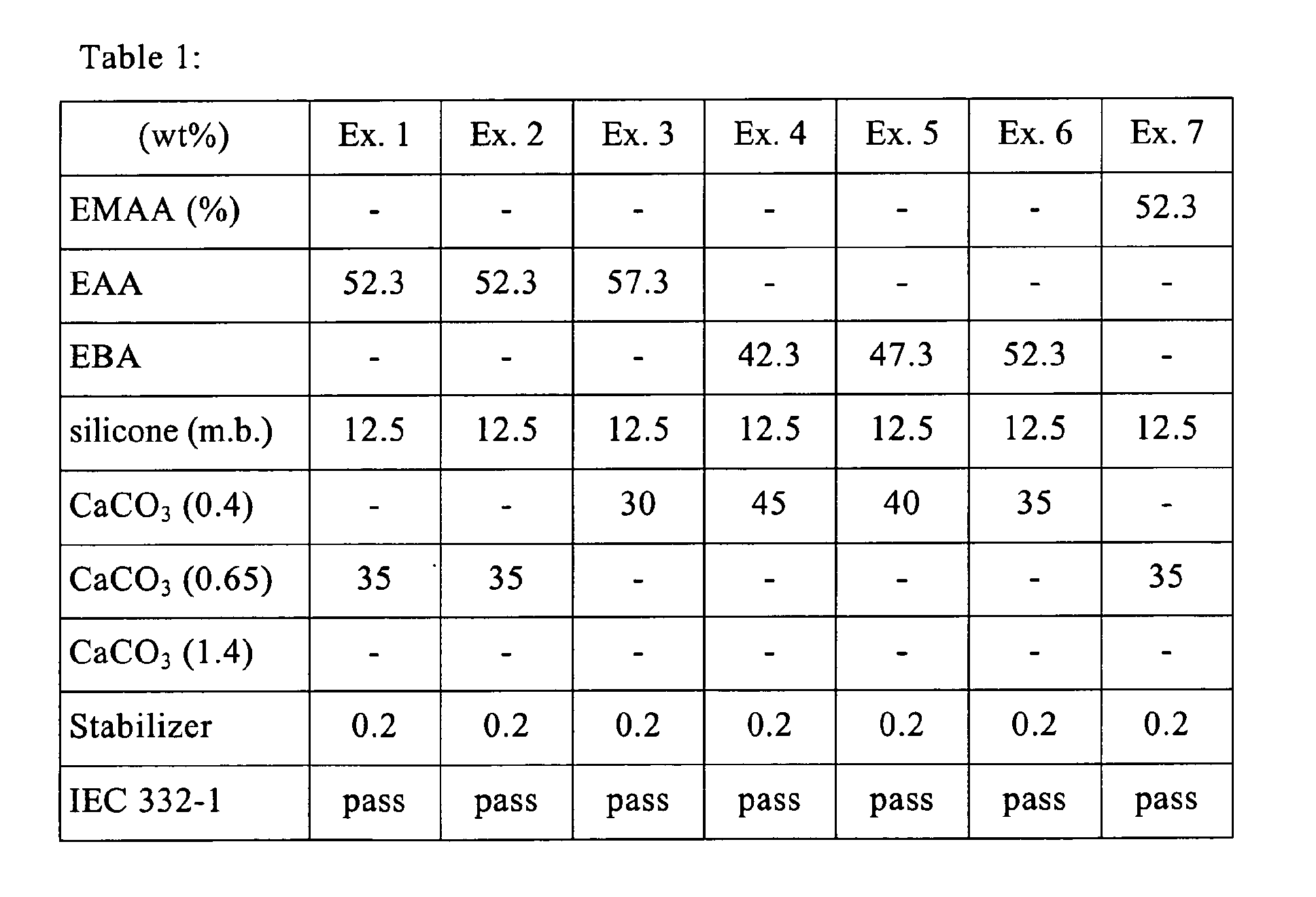
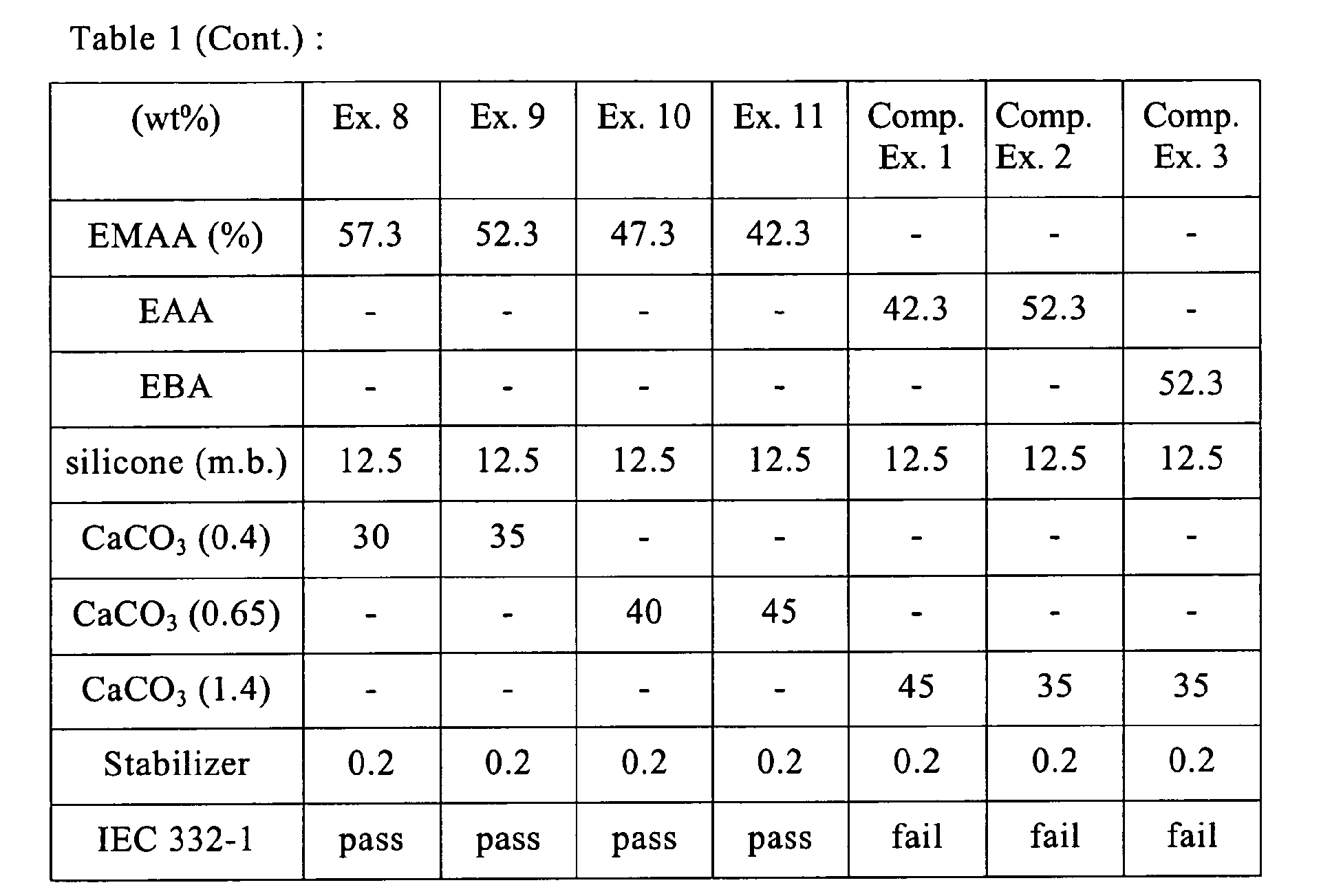
- compositions were compounded as indicated above with amounts given in wt% of the components as indicated in Table 1.
- Sedimentation rate is measured by using a finely collimated beam of low energy X-rays which pass through the sample cell to a detector. Since the particles in the cell absorb X-rays, only a percentage of the original X-ray beam reaches the detector. This is the raw data used to determine the distribution of particle sizes in a cell containing sedimentation liquid.
- the X-ray source and detector assembly remain stationary, while the cell moves vertically between them. Due to the beam split feature, automatic cell positioning is guaranteed, eliminating the uncertainty associated with other systems due to their movement of the assembly.
- the cell contains a transparent window through which X-rays from the source reach the detector.
- the distribution of particle mass at various points in the cell affects the number of X-ray pulses reaching the detector. This X-ray pulse count is used to derive the particle diameter distribution and the percent mass at given particle diameters.
- the average particle size is defined as the particle size when 50 weight-% of the material is finer and 50 weight-% of the material is coarser.
- Table 2 show that the inventive compositions have an improved dripping tendency.
- the compounds tested all contained 12.5 wt% of silicone (m.b.), 0.2 wt% of stabilizer, the amount and quality of CaCO 3 as indicated in Table 2 and the remainder being EBA. Average particle size 30% CaCO 3 35% CaCO 3 40% CaCO 3 0.4 micron 12 9 2 0.65 micron 8 1 2 1.4 micron 33 8 12
Landscapes
- Chemical & Material Sciences (AREA)
- Polymers & Plastics (AREA)
- Health & Medical Sciences (AREA)
- Chemical Kinetics & Catalysis (AREA)
- Medicinal Chemistry (AREA)
- Organic Chemistry (AREA)
- Spectroscopy & Molecular Physics (AREA)
- Physics & Mathematics (AREA)
- Compositions Of Macromolecular Compounds (AREA)
- Organic Insulating Materials (AREA)
- Fireproofing Substances (AREA)
- Inorganic Insulating Materials (AREA)
- Insulated Conductors (AREA)
Abstract
Description
- The present invention relates to a flame retardant polymer composition, more particularly to a flame retardant polymer composition for wires or cables which shows improved flame retardant properties while retaining other properties such as good extrudability or a good balance between flexibility and stiffness. Furthermore, the present invention relates to the use of the flame retardant polymer composition for the production of a flame retardant layer in wires or cables as well as to a wire or cable comprising a flame retardant composition according to the invention.
- Polyolefins are inherently combustible materials. However, in many applications flame resistance is required such as for cables and wires in the Electronics and Electrical industries. To obtain polyolefin polymers with improved flame resistance it is known to incorporate specific additives into the polymer, such as halogen based chemicals, phosphate based chemicals or inorganic hydroxide/hydrated compounds. Each of these additives have their own deficiencies, such as incompatibility with the polyolefin, the need for high loading levels leading to poor mechanical properties and poor processability, the presence or emission of harmful, toxic or otherwise undesirable compounds and high costs.
- For example, as disclosed in
EP 0 393 959 or WO 98/12253, a flame retardant polymer composition may comprise a silicon-group containing compound, an inorganic filler which is neither a hydroxide nor a substantially hydrated compound and an organic polymer matrix typically comprising an acrylate or acetate. The flame retardancy of such compositions is based on synergistic effects between these three components which in case of burning lead to the formation of a physically and firmly stable char layer that protects the polymer from further burning. Compounds based on such compositions usually show good flame retardancy, e.g in the limiting oxygen index (LOI) test method according to ISO 4589-A-IV. Sheathed cables and larger conduit (unsheathed) cables also have to fulfil specific cable test, as e.g. the single-wire burning test according to IEC 332-1. Conduit wires are, however, most commonly small and wires smaller than 4 mm2 based on such compositions have difficulties in fulfilling IEC 332-1. Hence, the flame retardancy of such compositions can still be improved. - It is therefore an object of the present invention to provide a flame retardant polymer composition which is having an improved flame retardancy while retaining good mechanical properties, especially a good balance between flexibility and stiffness.
- The present invention is based on the finding that this object can be achieved by a polymer composition which in addition to a polymer comprises a particulate inorganic filler with at least part of the particles having a size of below 1 micrometer, more particular below 0.7 micrometer.
- The present invention provides therefore a flame retardant polymer composition comprising
- (A) a polymer,
- (B) a silicone-group containing compound,
- (C) an inorganic filler in an amount of at least 10 wt.-% of the total polymer composition, wherein component (C) has a particle size distribution so that at least 10 wt.% of the total polymer composition are particles with a size of below 0.7 micrometers.
-
- The inventive composition shows improved flame retardancy compared to prior art materials, as it passes the single-wire burning test and shows improved dripping properties. Furthermore, the composition on decomposition does deliberate less hazardous and no corrosive gases.
- The purpose of the test method IEC 332-1 is to determine the resistance to flame propagation for single vertical cables. The cable (600 mm) is installed in a vertical position and a 1 kW flame produced by a propane burner is applied onto the cable sample at a 45° angle 475 mm from the upper support of the cable. The distance between the lower and upper support should be 550 mm. For cables having an outer diameter of less than 25 mm the flame is applied for 60 seconds. In order to fulfil the test, the flame should extinguish after the propane burner flame has been taken away and no charring should be visible within 50 mm from the upper support and below 540 mm.
- In the composition according to the invention, the choice and the composition of polymer (A) may vary, depending on whether the inventive composition is used as a layer for wires or cables and depending on for what purpose the layer is used. Of course, polymer (A) may also comprise a mixture of different polymers.
- Suitable polymers for forming component (A) include polyolefins, polyesters, polyethers and polyurethanes. Elastomeric polymers may also be used such as, for example, ethylene/propylene rubber (EPR), ethylene/propylene-diene monomer rubbers (EPDN), thermoplastic elastomer rubber (TPE), acrylonitrile butadiene rubber (NBR) and acrylnitril-butadiene-styrene (ABS). Silane-crosslinkable polymers may also be used, i.e. polymers prepared using unsaturated silane monomers having hydrolysable groups capable of crosslinking by hydrolysis and condensation to form silanol groups in the presence of water and, optionally, a silanol condensation catalyst.
- In a preferred embodiment component (A) is essentially formed by olefin, preferably ethylene, homo- or copolymers. These include, for example, homopolymers or copolymers of ethylene, propylene and butene and polymers of butadiene or isoprene. Suitable homopolymers and copolymers of ethylene include low density polyethylene, linear low, medium or high density polyethylene and very low density polyethylene. Suitable ethylene copolymers include such with of C3- to C20-alpha-olefins, C1- to C6- alkyl acrylates, C1- to C6- alkyl methacrylates, acrylic acids, methacrylic acids and vinyl acetates. Preferred examples for the alkyl alpha-olefins are propylene, 1-butene, 4-methyl-1-pentene, 1-hexene and 1-octene.
- In a further preferred embodiment of the inventive composition component (A) comprises an olefin copolymer, preferably a polar olefin copolymer.
- Polar groups are defined to be functional groups which comprise at least one element other that carbon and hydrogen.
- Further preferred, the polar copolymer is an olefin/acrylate, preferably ethylene/acrylate, and/or olefin/acetate, preferably ethylene/acetate, copolymer.
- It is further preferred that the polar copolymer comprises a copolymer of an olefin, preferably ethylene, with one or more comonomers selected from C1- to C6-alkyl acrylates, C1- to C6-alkyl methacrylates, acrylic acids, methacrylic acids and vinyl acetate. The copolymer may also contain ionomeric structures (like in e.g. DuPont's Surlyn types).
- Further preferred, the polar polymer comprises a copolymer of ethylene with C1- to C4-alkyl, such as methyl, ethyl, propyl or butyl, acrylates or vinylacetate.
- It is particularly preferred that the polar polymer comprises a copolymer of an olefin, perferably ethylene, with an acrylic copolymer, such as ethylene acrylic acid copolymer and ethylene methacrylic acid copolymer.
- In addition to ethylene and the defined comonomers, the copolymers may also contain further monomers. For example, terpolymers between acrylates and acrylic acid or methacrylic acid, or acrylates with vinyl silanes, or acrylates with siloxane, or acrylic acid with siloxane may be used.
- The polar copolymer may be produced by copolymerisation of the polymer, e.g. olefin, monomers with polar comonomers but may also be a grafted polymer, e.g. a polyolefin in which one or more of the comonomers is grafted onto the polymer backbone, as for example acrylic acid-grafted polyethylene.
- It is further preferred that the polar polymer makes up an amount of 30 parts by weight (pbw) or more, more preferred of 50 pbw or more, and still more preferred of 70 pbw or more, per 100 pbw of component (A).
- It is preferred that polymer component (A) is present in the composition in an amount of 30 to 70 wt%, more preferred of 40 to 60 wt% of the total composition.
- The inventive flame retardant composition further comprises a silicone-group containing compound (B).
- In a preferred embodiment of the inventive composition, component (B) is a silicone fluid or a gum, or an olefin, preferably ethylene, copolymer comprising at least one silicone-group containing comonomer, or a mixture of any of these compounds. Preferably, said comonomer is a vinylpolysiloxane, as e.g. a vinyl unsaturated polybishydrocarbylsiloxane.
- Silicone fluids and gums suitable for use in the present inventions are known and include for example organopolysiloxane polymers comprising chemically combined siloxy units selected from the group consisting of R3SiO0.5, R2SiO, R1SiO1.5, R1R2SiO0.5, RR1SiO, R1 2SiO, RSiO1.5 and SiO2 units and mixtures thereof in which each R represents independently a saturated or unsaturated monovalent hydrocarbon radical and each R1represents a radical such as R or a radical selected from the group consisting of hydrogen, hydroxyl, alkoxy, aryl, vinyl or allyl radicals.
- The organopolysiloxane preferably has a number average molecular weight Mn of approximately 10 to 10,000,000. The molecular weight distribution (MWD) measurements were performed using GPC. CHCl3 was used as a solvent. Shodex-Mikrostyragel (105, 104, 103, 100 Å) column set, RI-detector and a NMWD polystyrene calibration were used. The GPC tests were performed at room temperature.
- The silicone fluid or gum can contain fumed silica fillers of the type commonly used to stiffen silicone rubbers, e.g. up to 50% by weight.
- Copolymers of an olefin, preferably ethylene, and at least one silicone-group containing comonomer preferably are a vinyl unsaturated polybis-hydrocarbylsiloxanes according to formula (I):wherein n = 1 to 1000 and

R and R' independently are vinyl, alkyl branched or unbranched, with 1 to 10 carbon atoms; aryl with 6 or 10 carbon atoms; alkyl aryl with 7 to 10 carbon atoms; or aryl alkyl with 7 to 10 carbon atoms. - Such compounds e.g. are disclosed in WO 98/12253 the contents of which is herein enclosed by reference.
- Preferably, component (B) is polydimethylsiloxane, preferably having a Mn of approximately 1,000 to 1,000,000, more preferably of 200,000 to 400,000, and/or a copolymer of ethylene and vinyl polydimethylsiloxane. These components (B) are preferred due to commercial availability.
- The term "copolymer" as used herein is meant to include copolymers produced by copolymerization or by grafting of monomers onto a polymer backbone.
- It is preferred that silicone-group containing compound (B) is present in the composition in an amount of 0.5 to 40 %, more preferred 0.5 to 10 % and still more preferred 1 to 5 % by weight of the total composition.
- It is, furthermore, preferred that the silicone-group containing compound is added in such an amount that the amount of silicone-groups in the total composition is from 1 to 20 wt.%, more preferably from 1 to 10 wt%.
- Inorganic filler component (C) has a particle size distribution so that at least 10 wt.% , more preferably at least 15 wt.% of the of the total polymer composition are particles with a size of below 0.7 micrometer.
- Preferably, component (C) has a particle size distribution so that at least 10 wt.%, more preferably at least 15 wt.% of the total polymer composition are particles with a size of 0.65 micrometer or less, further preferred of 0.60 micrometer or less and most preferred of below 0.5 micrometer.
- Further preferred, component (C) has a particle size distribution so that at most 55 wt.%, more preferred at most 45 wt.%, still more preferred at most 30 wt.% of the total polymer composition are particles with a size of below 0.7 micrometer, more preferred 0.65 micrometer or less, still more preferred 0.60 micrometer or less and most preferred below 0.5 micrometer.
- It is furthermore preferred that component (C) has a particle size distribution so that at least 50 wt.% of the particles have a size of below 0.7 micrometer, more preferred of 0.65 micrometer or less, still more preferred of 0.60 micrometer or less and most preferred of below 0.5 micormeter.
- Furthermore, it is preferred that at least 60 wt% of the particles of component (C) have a particle size of 1 micrometer or below, further preferred at least 70 wt.% of the particles have a size of 1.5 micrometer or below, and still further preferred at least 80 wt% of the particles have a size of 2 micrometer or below.
- In case inorganic filler particles are used having an aspect ratio, i.e. the ratio between the widest and the shortest dimension of the particles, deviating from 1, the particle size is defined to be the numerical average of the widest and shortest dimensions of the particle.
- Preferably, the inorganic filler (C) comprises at least one type of filler, wherein the aspect ratio of the inorganic filler particles, i.e. the ratio between the widest and shortest dimension of the particles is below 5.
- For example, CaCO3 particles usually have an aspect ratio of close to 1, e.g. of 1 to 2.
- It is within the scope of the invention that only one type or a mixture of two or more types of inorganic fillers are used with all filler particles having the same aspect ratio.
- Inorganic filler (C) may, accordingly, consist completely of fillers having a particle aspect ratio below 5.
- In a preferred embodiment, the inorganic filler (C) comprises a mixture between at least two types of fillers, with one type having particles with an aspect ratio of below 5, and one type having an aspect ratio of 5 or higher.
- For example, fibres typically have a particle aspect ratio of 10 and higher, platelet type of fillers like mica, talk, Al-hydroxide and graphite have typically a particle aspect ratio of 5 to 100.
- It is preferred that inorganic filler (C) is present in the composition in an amount of more than 10 wt%, more preferred of 30 wt% or more, still more prefered of 32 wt% or more, still more preferred 34 wt% or more, and most preferred of 35 wt% or more.
- It is further preferred that inorganic filler (C) is present in the composition in an amount up to 70 wt%, more preferably of up to 60 wt% and most preferably of up to 55 wt%.
- Component (C), i.e. the inorganic filler material suitable for use in the inventive composition, comprises all filler materials as known in the art.
- Component (C) may also comprise a mixture of any such filler materials. Examples for such filler materials are oxides, hydroxides and carbonates of aluminium, magnesium, calcium and/or barium.
- Preferably, component (C) comprises an inorganic compound of a metal of
groups 1 to 13, morepreferred groups 1 to 3, still morepreferred groups preferred group 2, of the Periodic Table of Elements. - The numbering of chemical groups, as used herein, is in accordance with the IUPAC system in which the groups of the periodic system of the elements are numbered from 1 to 18.
- Preferably, inorganic filler component (C) comprises a compound which is neither a hydroxide, nor a hydrated compound, more preferred comprises a compound selected from carbonates, oxides and sulphates, and most preferred comprises a carbonate.
- Preferred examples of such compounds are calcium carbonate, magnesium oxide and huntite Mg3Ca(CO3)4, with a particular preferred example being calcium carbonate.
- Although inorganic filler (C) preferably is not a hydroxide, it may contain small amounts of hydroxide typically less than 5% by weight of the filler, preferably less than 3% by weight. For example there may be small amounts of magnesium hydroxide in magnesium oxide. Furthermore, although filler (C) is not a hydrated compound, it may contain small amounts of water, usually less than 3% by weight of the filler, preferably less than 1% by weight. However, it is most preferred that component (C) is completely free of hydroxide and/or water.
- Preferably, component (C) of the inventive flame retardant polymer composition comprises 50 wt% or more of calcium carbonate and further preferred is substantially made up completely of calcium carbonate.
- The inorganic filler may comprise a filler which has been surface-treated with an organosilane, a polymer, a carboxylic acid or salt etc. to aid processing and provide better dispersion of the filler in the organic polymer. Such coatings usually do not make up more than 3 wt.% of the filler.
- Preferably, the compositions according to the present invention contain less than 3 wt.% of organo-metallic salt or polymer coatings.
- In addition to the above-mentioned components (A), (B) and (C), the composition according to the present invention may contain further ingredients, such as for example antioxidants and or UV stabilizers, in small amounts.
- Furthermore, also other mineral fillers such as glass fibres may be part of the composition.
- The compositions according to the present invention may be cross-linkable. It is well known to cross-link thermoplastic polymer compositions using irradiation or cross-linking agents such as organic peroxides and thus the compositions according to the present invention may contain a cross-linking agent in a conventional amount. Silane cross-linkable polymers may contain a silanol condensation catalyst.
- The flame retardant polymer composition according to the invention may be prepared by
- a) preparation of a master batch comprising the silicone-group containing compound, additives and polymer followed by compounding with inorganic filler and matrix polymer or
- b) one step compounding of all components.
-
- For mixing, a conventional compounding or blending apparatus, e.g. a Banbury mixer, a 2-roll rubber mill, Buss-co-kneader or a twin screw extruder may be used. Preferably, the composition will be prepared by blending them together at a temperature which is sufficiently high to soften and plasticise the polymer, typically a temperature in the range of 120 to 200 °C.
- The flame retardant composition according to the present invention can be used in many and diverse applications and products. The composition can for example be moulded, extruded or otherwise formed into mouldings, sheets, webbings and fibres.
- As already mentioned above a preferred use of the flame retardant composition according to the present invention is for the manufacture of conduits, plugs, wires or cables or for injection moulding, with a particularly preferred use being the manufacture of wires or cables. The composition can be extruded about a wire or cable to form an insulating or jacketing layer or can be used as a bedding compound.
- In the following the present invention is further illustrated by means of examples and the following figure:
- Fig. 1 shows the particle size distribution of the inorganic CaCO3 filler materials used in the Examples.
-
- Flame retardant polymer compositions according to the invention and for comparative purpose were produced by compounding together the components in a roller mill at a temperature of 180°C.
- For the production of the comparative compositions and the compositions in accordance with the invention, the following materials were used:
- EMAA =
- Ethylene methacrylic acid copolymer containing 9 wt% of methacrylic acid, having a melt flow rate at 190 °C, 2.16 kg (MRF2) of 3.0 g/10min, and a density of 0.934 g/cm3;
- EAA =
- Ethylene acrylic acid copolymer containing 9 wt.% of acrylic acid, having a MFR2 of 8 g/10min, and a density of 0.936 g/cm3;
- EBA =
- Ethylene butyl acrylate copolymer containing 8 wt.% of butyl acrylate, and having an MFR2 of 0.4 g/10 min.
- Silicone (m.b.) =
- Masterbatch, consisting of 40% polydimethylsilicone elastomer and 60% low-density polyethylene,
- CaCO3 (0.4) =
- Precipitated calcium carbonate having an average particle size (d50-value) of 0.4 microns,
- CaCO3 (0.65) =
- Ground calcium carbonate having an average particle size (d50-value) of 0.65 microns,
- CaCO3 (1.4) =
- Ground calcium carbonate having an average particle size (d50-value) of 1.4 microns,
- Stabilizer =
- Irganox 1010 (phenolic antioxidant).
- The compositions were compounded as indicated above with amounts given in wt% of the components as indicated in Table 1.
- 0.7 +/- 0.1 mm insulation of the different compositions outlined in Table 1 was extruded onto 1.5 mm2 copper conductor on a laboratory extrusion line (160-170-180°C, rpm, pressure die).
-
- a) The melt flow rate MFR2 of the composition was measured in accordance with ISO 1133 at 190°C and a weight of 2.16 kg.
- b) The single wire burning test was done in full accordance with IEC 332-1. In order to fulfil the test the flame should extinguish after the flame from the 1 kW propane burner has been taken away and no charring should be visible within 50 mm from the upper support and below 540 mm. A wire fulfilling this criterium was marked "pass" in Table 1, otherwise it was marked "fail".
- c) The dripping tendency of the materials was determined in the following way: A 60x60x3 mm plaque is pressed of the material and put on a steel frame having a mesh size of 12. The plaque is burned from below at an angle of 45° through the steel frame by a 1 kW Bunsen burner (950+/-50°C) until the fire distinguish by itself (plaque completely burned). The burning drops fall down in water. The residues in the water are filtered, dried and weighed. The dripping tendencies are expressed as the residue collected in water divided by the original weight of the plaque multiplied by 100. l.e. percent of the original sample weight that has been lost due to dripping. The method is based on the French method NF P 92-505.
- d) The particle size distribution and average particle size (d50-value) was determined with a Sedigraph 5100. This sedimentation method determines particle size by measuring the gravity-induced travel rates of different size particles in a liquid with known properties. The rate at which particles fall through the liquid is described by Stokes' Law. The largest particles fall fastest, while the smallest particles fall slowest, until all have settled and the liquid is clear. Since different particles rarely exhibit a uniform shape, each particle size is reported as an "Equivalent Spherical Diameter", the diameter of a sphere of the same material with the same gravitational speed.
-
- Sedimentation rate is measured by using a finely collimated beam of low energy X-rays which pass through the sample cell to a detector. Since the particles in the cell absorb X-rays, only a percentage of the original X-ray beam reaches the detector. This is the raw data used to determine the distribution of particle sizes in a cell containing sedimentation liquid.
- The X-ray source and detector assembly remain stationary, while the cell moves vertically between them. Due to the beam split feature, automatic cell positioning is guaranteed, eliminating the uncertainty associated with other systems due to their movement of the assembly. The cell contains a transparent window through which X-rays from the source reach the detector. The distribution of particle mass at various points in the cell affects the number of X-ray pulses reaching the detector. This X-ray pulse count is used to derive the particle diameter distribution and the percent mass at given particle diameters. The average particle size is defined as the particle size when 50 weight-% of the material is finer and 50 weight-% of the material is coarser.
- A comparison between the properties of the compositions according to the invention (Examples 1 to 11) and comparative compositions (Comparative Examples 1 to 3) as given in Table 1 shows that cables made from the inventive compositions pass the single wire burning test and thus have improved flame retardancy.
- Furthermore, the results shown in Table 2 show that the inventive compositions have an improved dripping tendency. The compounds tested all contained 12.5 wt% of silicone (m.b.), 0.2 wt% of stabilizer, the amount and quality of CaCO3 as indicated in Table 2 and the remainder being EBA.
Average particle size 30% CaCO3 35 % CaCO 340% CaCO3 0.4 micron 12 9 2 0.65 micron 8 1 2 1.4 micron 33 8 12
Claims (14)
- A flame retardant polymer composition comprisingwherein component (C) has a particle size distribution so that at least 10 wt% of the total polymer composition are particles with a size of below 0.7 micrometers.(A) a polymer,(B) a silicone-group containing compound,(C) an inorganic filler in an amount of at least 10 wt% of the total polymer composition,
- Composition according to claim 1 wherein component (C) has a particle size distribution so that at least 10 wt% of the total polymer composition are particles with a size of 0.65 micrometer or less, preferably of 0.60 micrometer or less.
- Composition according to any of the preceding claims wherein component (C) has a particle size distribution so that at least 10 wt% of the total polymer composition are particles with a size of below 0.5 micrometer.
- Composition according to any of the preceding claims wherein the total amount of inorganic filler (C) is from 30 to 55 wt% of the total polymer composition.
- Composition according to any of the preceding claims, wherein inorganic filler (C) is neither a hydroxide nor a hydrated compound.
- Composition according to any of the preceding claims wherein inorganic filler (C) comprises a carbonate, oxide and/or sulphate of an element of groups 1 to 13 of the Periodic System of the Elements.
- Composition according to any of the preceding claims wherein component (C) comprises an inorganic compound having particles with an aspect ratio of below 5.
- Composition according to any of the preceding claims wherein polymer (A) is an olefin homo- and/or copolymer.
- Composition according to claim 8 wherein polymer (A) is a polar olefin copolymer.
- Composition according to claim 9 wherein polymer (A) is an copolymer of an olefin with an acrylic comonomer.
- Composition according to any of the preceding claims wherein silicone-group containing compound (B) is a silicone fluid and/or gum, and/or an olefin copolymer comprising a silicone-group containing comonomer.
- Composition according to any of the preceding claims wherein the amount of silicone-groups in the total composition is from 1 to 20 % by weight of the total composition.
- Use of a composition according to any of the preceding claims in a conduit, plug, wire or cable or for injection moulding, preferably in a wire or cable.
- A wire or cable having a layer comprising a composition according to any of claims 1 to 12.
Priority Applications (12)
| Application Number | Priority Date | Filing Date | Title |
|---|---|---|---|
| DE60323974T DE60323974D1 (en) | 2003-08-27 | 2003-08-27 | Flame-retardant polymer mixture with fine particles |
| EP03019364A EP1512719B1 (en) | 2003-08-27 | 2003-08-27 | Flame retardant polymer composition comprising fine particles |
| AT03019364T ATE410475T1 (en) | 2003-08-27 | 2003-08-27 | FLAME RETARDANT POLYMER BLEND WITH FINE PARTICLES |
| ES03019364T ES2315448T3 (en) | 2003-08-27 | 2003-08-27 | FLAME RETARDING POLYMERIC COMPOSITION THAT INCLUDES FINE PARTICLES. |
| PL379224A PL379224A1 (en) | 2003-08-27 | 2004-08-25 | Polymer composition with reduced flammability containing fine particles |
| PCT/EP2004/009491 WO2005021642A1 (en) | 2003-08-27 | 2004-08-25 | Flame retardant polymer composition comprising fine particles |
| JP2006524324A JP2007503493A (en) | 2003-08-27 | 2004-08-25 | Flame retardant polymer composition containing fine particles |
| EA200600463A EA008923B1 (en) | 2003-08-27 | 2004-08-25 | FIRE-RELEASE POLYMER COMPOSITION CONTAINING THIN-DIFFERENT INCLUSIONS |
| US10/569,334 US20070112111A1 (en) | 2003-08-27 | 2004-08-25 | Flame retardant polymer composition comprising fine particles |
| AU2004268042A AU2004268042B2 (en) | 2003-08-27 | 2004-08-25 | Flame retardant polymer composition comprising fine particles |
| CNA2004800244316A CN1842572A (en) | 2003-08-27 | 2004-08-25 | Flame retardant polymer composition comprising fine particles |
| CA002536589A CA2536589A1 (en) | 2003-08-27 | 2004-08-25 | Flame retardant polymer composition comprising fine particles |
Applications Claiming Priority (1)
| Application Number | Priority Date | Filing Date | Title |
|---|---|---|---|
| EP03019364A EP1512719B1 (en) | 2003-08-27 | 2003-08-27 | Flame retardant polymer composition comprising fine particles |
Publications (2)
| Publication Number | Publication Date |
|---|---|
| EP1512719A1 true EP1512719A1 (en) | 2005-03-09 |
| EP1512719B1 EP1512719B1 (en) | 2008-10-08 |
Family
ID=34130081
Family Applications (1)
| Application Number | Title | Priority Date | Filing Date |
|---|---|---|---|
| EP03019364A Expired - Lifetime EP1512719B1 (en) | 2003-08-27 | 2003-08-27 | Flame retardant polymer composition comprising fine particles |
Country Status (12)
| Country | Link |
|---|---|
| US (1) | US20070112111A1 (en) |
| EP (1) | EP1512719B1 (en) |
| JP (1) | JP2007503493A (en) |
| CN (1) | CN1842572A (en) |
| AT (1) | ATE410475T1 (en) |
| AU (1) | AU2004268042B2 (en) |
| CA (1) | CA2536589A1 (en) |
| DE (1) | DE60323974D1 (en) |
| EA (1) | EA008923B1 (en) |
| ES (1) | ES2315448T3 (en) |
| PL (1) | PL379224A1 (en) |
| WO (1) | WO2005021642A1 (en) |
Cited By (5)
| Publication number | Priority date | Publication date | Assignee | Title |
|---|---|---|---|---|
| WO2009146831A1 (en) * | 2008-06-05 | 2009-12-10 | Borealis Ag | Flame retardant polyolefin composition comprising a high amount of inorganic filler |
| WO2010097705A1 (en) * | 2009-02-25 | 2010-09-02 | Nexans | A fire performance material, and cable including the material |
| WO2013159942A3 (en) * | 2012-04-27 | 2014-04-24 | Borealis Ag | Flame retardant polymer composition |
| US9447531B2 (en) | 2007-06-03 | 2016-09-20 | Imerys Pigments, Inc. | Process for producing nonwoven fabric |
| EP3401929A1 (en) | 2017-05-09 | 2018-11-14 | Borealis AG | Cable insulation |
Families Citing this family (6)
| Publication number | Priority date | Publication date | Assignee | Title |
|---|---|---|---|---|
| JP2006321934A (en) * | 2005-05-20 | 2006-11-30 | Sunallomer Ltd | Flame retardant thermoplastic resin composition, molded product thereof and electric wire |
| ES2328950T3 (en) * | 2006-05-31 | 2009-11-19 | Borealis Technology Oy | FLAMMING POLYMERIC COMPOSITION OF THE FLAME, THAT INCLUDES A POLYOLEFINE WITH MOLECULAR WEIGHT DISTRIBUTION. |
| JP2010111760A (en) * | 2008-11-06 | 2010-05-20 | Hitachi Cable Ltd | Non-halogen resin composition, non-halogen insulated electrical wire, and non-halogen cable |
| CN102916279B (en) * | 2011-08-04 | 2016-01-27 | 巴斯威尔股份有限公司 | Power transmission bus filling material and its application |
| JP5951473B2 (en) * | 2012-12-27 | 2016-07-13 | 株式会社フジクラ | Flame-retardant resin composition and cable using the same |
| CN106103577B (en) | 2014-03-04 | 2020-03-27 | 美国陶氏有机硅公司 | Thermoplastic Polymer Masterbatch |
Citations (2)
| Publication number | Priority date | Publication date | Assignee | Title |
|---|---|---|---|---|
| EP0393959A2 (en) * | 1989-04-21 | 1990-10-24 | Borealis Holding A/S | Flame retardant polymer composition |
| EP1188793A1 (en) * | 2000-03-27 | 2002-03-20 | Idemitsu Petrochemical Co., Ltd. | Flame-retardant polycarbonate resin composition and molded article |
Family Cites Families (14)
| Publication number | Priority date | Publication date | Assignee | Title |
|---|---|---|---|---|
| EP0319924B1 (en) * | 1987-12-08 | 1995-11-22 | Idemitsu Petrochemical Company Limited | Process for producing thermoplastic resin composition |
| JPH02255843A (en) * | 1988-11-22 | 1990-10-16 | Furukawa Electric Co Ltd:The | Flame-retarding resin composition and flame-retarding cable prepared by using same |
| JPH0512928A (en) * | 1991-07-03 | 1993-01-22 | Hitachi Cable Ltd | Flame retardant electrical insulation |
| DE69308174T2 (en) * | 1992-06-09 | 1997-08-07 | Kanegafuchi Kagaku Kogyo K.K., Osaka | Polyolefin molding compound, process for its production and molded articles produced therefrom |
| JP3372298B2 (en) * | 1993-06-10 | 2003-01-27 | 鐘淵化学工業株式会社 | Modified polyolefin resin composition and polyolefin resin composition containing the same |
| CN1152471A (en) * | 1995-11-10 | 1997-06-25 | 阿尔卡塔尔-阿尔斯托姆通用电气公司 | Composition with high anti-fire-spreading property |
| EP0774488A1 (en) * | 1995-11-11 | 1997-05-21 | Alcatel | Fire propagation inhibiting composition |
| SE507330C2 (en) * | 1996-09-17 | 1998-05-11 | Borealis As | Flame retardant composition and cable comprising the flame retardant composition |
| JP3735444B2 (en) * | 1997-04-09 | 2006-01-18 | 日本ユニカー株式会社 | Flame retardant resin composition |
| JPH10334737A (en) * | 1997-05-30 | 1998-12-18 | Hitachi Cable Ltd | Fluorine-containing elastomer coated wires and cables |
| US6077892A (en) * | 1998-09-04 | 2000-06-20 | Dow Corning Corporation | Curable polyolefin compositions containing organosilicon compounds as adhesion additives |
| AU783561B2 (en) * | 2001-03-28 | 2005-11-10 | Oji Paper Co. Ltd. | Coated paper sheet |
| EP1316581A1 (en) * | 2001-11-28 | 2003-06-04 | Borealis Technology Oy | Flame retardant polymer composition |
| EP1396865A1 (en) * | 2002-09-03 | 2004-03-10 | Borealis Technology Oy | Flame retardant polymer composition |
-
2003
- 2003-08-27 DE DE60323974T patent/DE60323974D1/en not_active Expired - Lifetime
- 2003-08-27 ES ES03019364T patent/ES2315448T3/en not_active Expired - Lifetime
- 2003-08-27 EP EP03019364A patent/EP1512719B1/en not_active Expired - Lifetime
- 2003-08-27 AT AT03019364T patent/ATE410475T1/en not_active IP Right Cessation
-
2004
- 2004-08-25 PL PL379224A patent/PL379224A1/en not_active Application Discontinuation
- 2004-08-25 WO PCT/EP2004/009491 patent/WO2005021642A1/en not_active Ceased
- 2004-08-25 CA CA002536589A patent/CA2536589A1/en not_active Abandoned
- 2004-08-25 EA EA200600463A patent/EA008923B1/en not_active IP Right Cessation
- 2004-08-25 JP JP2006524324A patent/JP2007503493A/en active Pending
- 2004-08-25 US US10/569,334 patent/US20070112111A1/en not_active Abandoned
- 2004-08-25 CN CNA2004800244316A patent/CN1842572A/en active Pending
- 2004-08-25 AU AU2004268042A patent/AU2004268042B2/en not_active Expired - Fee Related
Patent Citations (2)
| Publication number | Priority date | Publication date | Assignee | Title |
|---|---|---|---|---|
| EP0393959A2 (en) * | 1989-04-21 | 1990-10-24 | Borealis Holding A/S | Flame retardant polymer composition |
| EP1188793A1 (en) * | 2000-03-27 | 2002-03-20 | Idemitsu Petrochemical Co., Ltd. | Flame-retardant polycarbonate resin composition and molded article |
Cited By (9)
| Publication number | Priority date | Publication date | Assignee | Title |
|---|---|---|---|---|
| US9447531B2 (en) | 2007-06-03 | 2016-09-20 | Imerys Pigments, Inc. | Process for producing nonwoven fabric |
| WO2009146831A1 (en) * | 2008-06-05 | 2009-12-10 | Borealis Ag | Flame retardant polyolefin composition comprising a high amount of inorganic filler |
| WO2010097705A1 (en) * | 2009-02-25 | 2010-09-02 | Nexans | A fire performance material, and cable including the material |
| WO2013159942A3 (en) * | 2012-04-27 | 2014-04-24 | Borealis Ag | Flame retardant polymer composition |
| KR20140139064A (en) * | 2012-04-27 | 2014-12-04 | 보레알리스 아게 | Flame retardant polymer composition |
| US9249288B2 (en) | 2012-04-27 | 2016-02-02 | Borealis Ag | Flame retardant polymer composition |
| KR101630109B1 (en) | 2012-04-27 | 2016-06-13 | 보레알리스 아게 | Flame retardant polymer composition |
| EP3401929A1 (en) | 2017-05-09 | 2018-11-14 | Borealis AG | Cable insulation |
| WO2018206580A1 (en) | 2017-05-09 | 2018-11-15 | Borealis Ag | Cable insulation |
Also Published As
| Publication number | Publication date |
|---|---|
| EP1512719B1 (en) | 2008-10-08 |
| AU2004268042A1 (en) | 2005-03-10 |
| ES2315448T3 (en) | 2009-04-01 |
| ATE410475T1 (en) | 2008-10-15 |
| CA2536589A1 (en) | 2005-03-10 |
| WO2005021642A1 (en) | 2005-03-10 |
| PL379224A1 (en) | 2006-08-07 |
| EA200600463A1 (en) | 2006-08-25 |
| DE60323974D1 (en) | 2008-11-20 |
| AU2004268042B2 (en) | 2009-06-04 |
| JP2007503493A (en) | 2007-02-22 |
| CN1842572A (en) | 2006-10-04 |
| US20070112111A1 (en) | 2007-05-17 |
| EA008923B1 (en) | 2007-08-31 |
Similar Documents
| Publication | Publication Date | Title |
|---|---|---|
| CA2869814C (en) | Flame retardant polymer composition | |
| EP3289006B1 (en) | Hydroxyl-terminated pdms as cure control additive for the silane crosslinking of polyolefins | |
| NZ233370A (en) | Flame retardent compositions comprising an ethylene containing copolymer, a silicone and an inorganic filler which is an alkaline-earth compound | |
| EP2130864B1 (en) | Flame retardant polyolefin composition comprising a high amount of inorganic filler | |
| EP1512719B1 (en) | Flame retardant polymer composition comprising fine particles | |
| EP1695997B1 (en) | Power or communications cable with flame retardant polymer layer | |
| EP2037463B1 (en) | Cable comprising with reduced amount of volatile compounds | |
| CN117916292A (en) | Halogen-free flame retardant polymer composition | |
| EP1396865A1 (en) | Flame retardant polymer composition | |
| EP2072573B1 (en) | Flame retardant polymer composition comprising coated aluminium hydroxide as filler | |
| WO2003046064A1 (en) | Flame retardant polymer composition |
Legal Events
| Date | Code | Title | Description |
|---|---|---|---|
| PUAI | Public reference made under article 153(3) epc to a published international application that has entered the european phase |
Free format text: ORIGINAL CODE: 0009012 |
|
| 17P | Request for examination filed |
Effective date: 20030827 |
|
| AK | Designated contracting states |
Kind code of ref document: A1 Designated state(s): AT BE BG CH CY CZ DE DK EE ES FI FR GB GR HU IE IT LI LU MC NL PT RO SE SI SK TR |
|
| AX | Request for extension of the european patent |
Extension state: AL LT LV MK |
|
| AKX | Designation fees paid |
Designated state(s): AT BE BG CH CY CZ DE DK EE ES FI FR GB GR HU IE IT LI LU MC NL PT RO SE SI SK TR |
|
| 17Q | First examination report despatched |
Effective date: 20070402 |
|
| GRAP | Despatch of communication of intention to grant a patent |
Free format text: ORIGINAL CODE: EPIDOSNIGR1 |
|
| GRAS | Grant fee paid |
Free format text: ORIGINAL CODE: EPIDOSNIGR3 |
|
| GRAA | (expected) grant |
Free format text: ORIGINAL CODE: 0009210 |
|
| AK | Designated contracting states |
Kind code of ref document: B1 Designated state(s): AT BE BG CH CY CZ DE DK EE ES FI FR GB GR HU IE IT LI LU MC NL PT RO SE SI SK TR |
|
| REG | Reference to a national code |
Ref country code: GB Ref legal event code: FG4D |
|
| REG | Reference to a national code |
Ref country code: CH Ref legal event code: EP |
|
| REG | Reference to a national code |
Ref country code: IE Ref legal event code: FG4D |
|
| REF | Corresponds to: |
Ref document number: 60323974 Country of ref document: DE Date of ref document: 20081120 Kind code of ref document: P |
|
| PG25 | Lapsed in a contracting state [announced via postgrant information from national office to epo] |
Ref country code: SI Free format text: LAPSE BECAUSE OF FAILURE TO SUBMIT A TRANSLATION OF THE DESCRIPTION OR TO PAY THE FEE WITHIN THE PRESCRIBED TIME-LIMIT Effective date: 20081008 |
|
| NLV1 | Nl: lapsed or annulled due to failure to fulfill the requirements of art. 29p and 29m of the patents act | ||
| REG | Reference to a national code |
Ref country code: ES Ref legal event code: FG2A Ref document number: 2315448 Country of ref document: ES Kind code of ref document: T3 |
|
| PG25 | Lapsed in a contracting state [announced via postgrant information from national office to epo] |
Ref country code: BG Free format text: LAPSE BECAUSE OF FAILURE TO SUBMIT A TRANSLATION OF THE DESCRIPTION OR TO PAY THE FEE WITHIN THE PRESCRIBED TIME-LIMIT Effective date: 20090108 Ref country code: AT Free format text: LAPSE BECAUSE OF FAILURE TO SUBMIT A TRANSLATION OF THE DESCRIPTION OR TO PAY THE FEE WITHIN THE PRESCRIBED TIME-LIMIT Effective date: 20081008 |
|
| PG25 | Lapsed in a contracting state [announced via postgrant information from national office to epo] |
Ref country code: NL Free format text: LAPSE BECAUSE OF FAILURE TO SUBMIT A TRANSLATION OF THE DESCRIPTION OR TO PAY THE FEE WITHIN THE PRESCRIBED TIME-LIMIT Effective date: 20081008 Ref country code: PT Free format text: LAPSE BECAUSE OF FAILURE TO SUBMIT A TRANSLATION OF THE DESCRIPTION OR TO PAY THE FEE WITHIN THE PRESCRIBED TIME-LIMIT Effective date: 20090218 Ref country code: FI Free format text: LAPSE BECAUSE OF FAILURE TO SUBMIT A TRANSLATION OF THE DESCRIPTION OR TO PAY THE FEE WITHIN THE PRESCRIBED TIME-LIMIT Effective date: 20081008 |
|
| PG25 | Lapsed in a contracting state [announced via postgrant information from national office to epo] |
Ref country code: EE Free format text: LAPSE BECAUSE OF FAILURE TO SUBMIT A TRANSLATION OF THE DESCRIPTION OR TO PAY THE FEE WITHIN THE PRESCRIBED TIME-LIMIT Effective date: 20081008 Ref country code: BE Free format text: LAPSE BECAUSE OF FAILURE TO SUBMIT A TRANSLATION OF THE DESCRIPTION OR TO PAY THE FEE WITHIN THE PRESCRIBED TIME-LIMIT Effective date: 20081008 Ref country code: RO Free format text: LAPSE BECAUSE OF FAILURE TO SUBMIT A TRANSLATION OF THE DESCRIPTION OR TO PAY THE FEE WITHIN THE PRESCRIBED TIME-LIMIT Effective date: 20081008 Ref country code: DK Free format text: LAPSE BECAUSE OF FAILURE TO SUBMIT A TRANSLATION OF THE DESCRIPTION OR TO PAY THE FEE WITHIN THE PRESCRIBED TIME-LIMIT Effective date: 20081008 |
|
| PLBE | No opposition filed within time limit |
Free format text: ORIGINAL CODE: 0009261 |
|
| STAA | Information on the status of an ep patent application or granted ep patent |
Free format text: STATUS: NO OPPOSITION FILED WITHIN TIME LIMIT |
|
| PG25 | Lapsed in a contracting state [announced via postgrant information from national office to epo] |
Ref country code: SE Free format text: LAPSE BECAUSE OF FAILURE TO SUBMIT A TRANSLATION OF THE DESCRIPTION OR TO PAY THE FEE WITHIN THE PRESCRIBED TIME-LIMIT Effective date: 20090108 Ref country code: CZ Free format text: LAPSE BECAUSE OF FAILURE TO SUBMIT A TRANSLATION OF THE DESCRIPTION OR TO PAY THE FEE WITHIN THE PRESCRIBED TIME-LIMIT Effective date: 20081008 Ref country code: IT Free format text: LAPSE BECAUSE OF FAILURE TO SUBMIT A TRANSLATION OF THE DESCRIPTION OR TO PAY THE FEE WITHIN THE PRESCRIBED TIME-LIMIT Effective date: 20081008 |
|
| 26N | No opposition filed |
Effective date: 20090709 |
|
| PG25 | Lapsed in a contracting state [announced via postgrant information from national office to epo] |
Ref country code: SK Free format text: LAPSE BECAUSE OF FAILURE TO SUBMIT A TRANSLATION OF THE DESCRIPTION OR TO PAY THE FEE WITHIN THE PRESCRIBED TIME-LIMIT Effective date: 20081008 |
|
| PG25 | Lapsed in a contracting state [announced via postgrant information from national office to epo] |
Ref country code: MC Free format text: LAPSE BECAUSE OF NON-PAYMENT OF DUE FEES Effective date: 20090831 |
|
| REG | Reference to a national code |
Ref country code: CH Ref legal event code: PL |
|
| GBPC | Gb: european patent ceased through non-payment of renewal fee |
Effective date: 20090827 |
|
| PG25 | Lapsed in a contracting state [announced via postgrant information from national office to epo] |
Ref country code: LI Free format text: LAPSE BECAUSE OF NON-PAYMENT OF DUE FEES Effective date: 20090831 Ref country code: CH Free format text: LAPSE BECAUSE OF NON-PAYMENT OF DUE FEES Effective date: 20090831 |
|
| REG | Reference to a national code |
Ref country code: IE Ref legal event code: MM4A |
|
| PG25 | Lapsed in a contracting state [announced via postgrant information from national office to epo] |
Ref country code: IE Free format text: LAPSE BECAUSE OF NON-PAYMENT OF DUE FEES Effective date: 20090827 |
|
| PG25 | Lapsed in a contracting state [announced via postgrant information from national office to epo] |
Ref country code: GR Free format text: LAPSE BECAUSE OF FAILURE TO SUBMIT A TRANSLATION OF THE DESCRIPTION OR TO PAY THE FEE WITHIN THE PRESCRIBED TIME-LIMIT Effective date: 20090109 |
|
| PG25 | Lapsed in a contracting state [announced via postgrant information from national office to epo] |
Ref country code: GB Free format text: LAPSE BECAUSE OF NON-PAYMENT OF DUE FEES Effective date: 20090827 |
|
| PG25 | Lapsed in a contracting state [announced via postgrant information from national office to epo] |
Ref country code: LU Free format text: LAPSE BECAUSE OF NON-PAYMENT OF DUE FEES Effective date: 20090827 |
|
| PG25 | Lapsed in a contracting state [announced via postgrant information from national office to epo] |
Ref country code: HU Free format text: LAPSE BECAUSE OF FAILURE TO SUBMIT A TRANSLATION OF THE DESCRIPTION OR TO PAY THE FEE WITHIN THE PRESCRIBED TIME-LIMIT Effective date: 20090409 |
|
| PG25 | Lapsed in a contracting state [announced via postgrant information from national office to epo] |
Ref country code: TR Free format text: LAPSE BECAUSE OF FAILURE TO SUBMIT A TRANSLATION OF THE DESCRIPTION OR TO PAY THE FEE WITHIN THE PRESCRIBED TIME-LIMIT Effective date: 20081008 |
|
| PG25 | Lapsed in a contracting state [announced via postgrant information from national office to epo] |
Ref country code: CY Free format text: LAPSE BECAUSE OF FAILURE TO SUBMIT A TRANSLATION OF THE DESCRIPTION OR TO PAY THE FEE WITHIN THE PRESCRIBED TIME-LIMIT Effective date: 20081008 |
|
| PGFP | Annual fee paid to national office [announced via postgrant information from national office to epo] |
Ref country code: DE Payment date: 20110823 Year of fee payment: 9 Ref country code: ES Payment date: 20110825 Year of fee payment: 9 Ref country code: FR Payment date: 20110901 Year of fee payment: 9 |
|
| REG | Reference to a national code |
Ref country code: FR Ref legal event code: ST Effective date: 20130430 |
|
| PG25 | Lapsed in a contracting state [announced via postgrant information from national office to epo] |
Ref country code: DE Free format text: LAPSE BECAUSE OF NON-PAYMENT OF DUE FEES Effective date: 20130301 |
|
| PG25 | Lapsed in a contracting state [announced via postgrant information from national office to epo] |
Ref country code: FR Free format text: LAPSE BECAUSE OF NON-PAYMENT OF DUE FEES Effective date: 20120831 |
|
| REG | Reference to a national code |
Ref country code: DE Ref legal event code: R119 Ref document number: 60323974 Country of ref document: DE Effective date: 20130301 |
|
| REG | Reference to a national code |
Ref country code: ES Ref legal event code: FD2A Effective date: 20131021 |
|
| PG25 | Lapsed in a contracting state [announced via postgrant information from national office to epo] |
Ref country code: ES Free format text: LAPSE BECAUSE OF NON-PAYMENT OF DUE FEES Effective date: 20120828 |