EP3401128B1 - Tire including contact charging type self-power generation module - Google Patents
Tire including contact charging type self-power generation module Download PDFInfo
- Publication number
- EP3401128B1 EP3401128B1 EP18157882.4A EP18157882A EP3401128B1 EP 3401128 B1 EP3401128 B1 EP 3401128B1 EP 18157882 A EP18157882 A EP 18157882A EP 3401128 B1 EP3401128 B1 EP 3401128B1
- Authority
- EP
- European Patent Office
- Prior art keywords
- sound
- absorbing material
- tire
- electrode portion
- external electrode
- Prior art date
- Legal status (The legal status is an assumption and is not a legal conclusion. Google has not performed a legal analysis and makes no representation as to the accuracy of the status listed.)
- Active
Links
Images




Classifications
-
- B—PERFORMING OPERATIONS; TRANSPORTING
- B60—VEHICLES IN GENERAL
- B60C—VEHICLE TYRES; TYRE INFLATION; TYRE CHANGING; CONNECTING VALVES TO INFLATABLE ELASTIC BODIES IN GENERAL; DEVICES OR ARRANGEMENTS RELATED TO TYRES
- B60C23/00—Devices for measuring, signalling, controlling, or distributing tyre pressure or temperature, specially adapted for mounting on vehicles; Arrangement of tyre inflating devices on vehicles, e.g. of pumps or of tanks; Tyre cooling arrangements
- B60C23/02—Signalling devices actuated by tyre pressure
- B60C23/04—Signalling devices actuated by tyre pressure mounted on the wheel or tyre
- B60C23/0491—Constructional details of means for attaching the control device
- B60C23/0493—Constructional details of means for attaching the control device for attachment on the tyre
-
- B—PERFORMING OPERATIONS; TRANSPORTING
- B60—VEHICLES IN GENERAL
- B60C—VEHICLE TYRES; TYRE INFLATION; TYRE CHANGING; CONNECTING VALVES TO INFLATABLE ELASTIC BODIES IN GENERAL; DEVICES OR ARRANGEMENTS RELATED TO TYRES
- B60C19/00—Tyre parts or constructions not otherwise provided for
-
- B—PERFORMING OPERATIONS; TRANSPORTING
- B29—WORKING OF PLASTICS; WORKING OF SUBSTANCES IN A PLASTIC STATE IN GENERAL
- B29D—PRODUCING PARTICULAR ARTICLES FROM PLASTICS OR FROM SUBSTANCES IN A PLASTIC STATE
- B29D30/00—Producing pneumatic or solid tyres or parts thereof
- B29D30/0061—Accessories, details or auxiliary operations not otherwise provided for
-
- B—PERFORMING OPERATIONS; TRANSPORTING
- B60—VEHICLES IN GENERAL
- B60C—VEHICLE TYRES; TYRE INFLATION; TYRE CHANGING; CONNECTING VALVES TO INFLATABLE ELASTIC BODIES IN GENERAL; DEVICES OR ARRANGEMENTS RELATED TO TYRES
- B60C19/00—Tyre parts or constructions not otherwise provided for
- B60C19/002—Noise damping elements provided in the tyre structure or attached thereto, e.g. in the tyre interior
-
- B—PERFORMING OPERATIONS; TRANSPORTING
- B60—VEHICLES IN GENERAL
- B60C—VEHICLE TYRES; TYRE INFLATION; TYRE CHANGING; CONNECTING VALVES TO INFLATABLE ELASTIC BODIES IN GENERAL; DEVICES OR ARRANGEMENTS RELATED TO TYRES
- B60C19/00—Tyre parts or constructions not otherwise provided for
- B60C19/08—Electric-charge-dissipating arrangements
-
- B—PERFORMING OPERATIONS; TRANSPORTING
- B60—VEHICLES IN GENERAL
- B60C—VEHICLE TYRES; TYRE INFLATION; TYRE CHANGING; CONNECTING VALVES TO INFLATABLE ELASTIC BODIES IN GENERAL; DEVICES OR ARRANGEMENTS RELATED TO TYRES
- B60C23/00—Devices for measuring, signalling, controlling, or distributing tyre pressure or temperature, specially adapted for mounting on vehicles; Arrangement of tyre inflating devices on vehicles, e.g. of pumps or of tanks; Tyre cooling arrangements
- B60C23/02—Signalling devices actuated by tyre pressure
- B60C23/04—Signalling devices actuated by tyre pressure mounted on the wheel or tyre
- B60C23/0408—Signalling devices actuated by tyre pressure mounted on the wheel or tyre transmitting the signals by non-mechanical means from the wheel or tyre to a vehicle body mounted receiver
- B60C23/041—Means for supplying power to the signal- transmitting means on the wheel
-
- B—PERFORMING OPERATIONS; TRANSPORTING
- B60—VEHICLES IN GENERAL
- B60C—VEHICLE TYRES; TYRE INFLATION; TYRE CHANGING; CONNECTING VALVES TO INFLATABLE ELASTIC BODIES IN GENERAL; DEVICES OR ARRANGEMENTS RELATED TO TYRES
- B60C23/00—Devices for measuring, signalling, controlling, or distributing tyre pressure or temperature, specially adapted for mounting on vehicles; Arrangement of tyre inflating devices on vehicles, e.g. of pumps or of tanks; Tyre cooling arrangements
- B60C23/02—Signalling devices actuated by tyre pressure
- B60C23/04—Signalling devices actuated by tyre pressure mounted on the wheel or tyre
- B60C23/0408—Signalling devices actuated by tyre pressure mounted on the wheel or tyre transmitting the signals by non-mechanical means from the wheel or tyre to a vehicle body mounted receiver
- B60C23/041—Means for supplying power to the signal- transmitting means on the wheel
- B60C23/0411—Piezoelectric generators
-
- B—PERFORMING OPERATIONS; TRANSPORTING
- B29—WORKING OF PLASTICS; WORKING OF SUBSTANCES IN A PLASTIC STATE IN GENERAL
- B29D—PRODUCING PARTICULAR ARTICLES FROM PLASTICS OR FROM SUBSTANCES IN A PLASTIC STATE
- B29D30/00—Producing pneumatic or solid tyres or parts thereof
- B29D30/0061—Accessories, details or auxiliary operations not otherwise provided for
- B29D2030/0094—Tyres been capable of generating, e.g. recovering, energy
Definitions
- the present invention relates to a tire including a contact charging type self-power generation module, and more particularly, to a tire including a contact charging type self-power generation module that can generate electricity by charging static electricity occurring within a tire and a sound-absorbing material of the tire and that can operate a sensor using the generated electricity.
- a method of generating electricity using a pressure or a force applied to a sensor is referred to as a piezo-generation method. Because such a piezo-generation method has low efficiency and additionally requires a circuit that amplifies using an OP-AMP, compared with a power generation method of using static electricity, there is a drawback that the piezo-generation method has a complex structure and cannot permanently use a piezo-element.
- Patent document 1 Korean Patent Publication No. 10-1690833 JP H07276914A and WO 2006/093479A1 each describe a prior art device.
- the present invention has been made in an effort to provide a tire including a contact charging type self-power generation module that generates electricity by charging static electricity occurring within a tire and a sound-absorbing material of the tire and that can operate a sensor using the electricity.
- a tire including a contact charging type self-power generation module includes a sound-absorbing material provided within an inner liner of the tire; an internal electrode portion provided within the sound-absorbing material and extended in a length direction of the sound-absorbing material; and an external electrode portion having a first external electrode provided separately from the sound-absorbing material and provided parallel to the internal electrode portion, wherein when the tire moves, as the sound-absorbing material moves, the internal electrode portion and the external electrode portion are charged with electricity to generate electricity.
- the first external electrode may be provided in a lower portion or an upper portion of the sound-absorbing material.
- the tire may further include a fixing bar that connects and fixes the sound-absorbing material and the first external electrode and including an electric wire.
- the fixing bar may be made of a material having an insulating property.
- the tire may further include a case that houses the sound-absorbing material, the internal electrode portion, and the external electrode portion therein.
- the tire may further include a power source unit connected to the internal electrode portion and the external electrode portion to receive generated electricity.
- the power source unit may include a pneumatic sensor that measures an air pressure of the tire; and a power source element that converts electricity of a non-sinusoidal wave or a sine wave occurring in the internal electrode portion and the external electrode portion to a DC form to provide the electricity to the pneumatic sensor, wherein the power source element may supply electricity with a predetermined voltage to the pneumatic sensor.
- a tire including a contact charging type self-power generation module includes a first sound-absorbing material bonded to an inner side surface of an inner liner of the tire; an external electrode portion provided at an upper portion of the first sound-absorbing material; a second sound-absorbing material provided at an upper portion of the external electrode portion; and an internal electrode portion provided within the second sound-absorbing material and extended in a length direction of the second sound-absorbing material, wherein when the tire moves, as the first sound-absorbing material and the second sound-absorbing material move, the first sound-absorbing material, the second sound-absorbing material, and the external electrode portion are provided separately from each other, and the internal electrode portion and the external electrode portion are charged with electricity to generate electricity.
- the external electrode portion may include a fourth external electrode provided parallel to the internal electrode portion.
- the tire may further include a fixing bar that connects and fixes the first sound-absorbing material, the second sound-absorbing material, and the fourth external electrode and including an electric wire.
- a configuration of the present invention for achieving the object provides a vehicle that mounts the tire including the contact charging type self-power generation module.
- a sound-absorbing material of the tire is made of a material, which occurs much static electricity, such as polyurethane. Therefore, when an internal electrode portion is provided within a sound-absorbing material, as in the present invention, electricity can be more efficiently generated.
- a self-power generation module of the present invention is formed in an integral structure connected to a sound-absorbing material, a noise reduction function of a conventional tire made of a sound-absorbing material can be maintained.
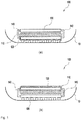
- FIG. 1 is a diagram illustrating a tire including a contact charging type self-power generation module according to a first exemplary embodiment of the present invention.
- a tire 100 including a contact charging type self-power generation module includes a sound-absorbing material 110, an internal electrode portion 120, and an external electrode portion, and when the tire moves, the sound-absorbing material 110 moves and thus the internal electrode portion 120 and the external electrode portion are charged with electricity to generate electricity.
- the sound-absorbing material 110 may be provided within an inner liner 10 of the tire.
- the sound-absorbing material 110 may be made of a polyurethane material, but the sound-absorbing material 110 is not limited thereto and may include an entire material that enables static electricity according to a friction to well occur to be well charged with electricity and having a sound-absorbing function.
- the sound-absorbing material 110 may be made of a polymer material that can be well charged with electricity at a sponge structure for sound-absorption.
- An adhesive using when bonding the sound-absorbing material 110 to the inside of the inner liner 10 of the tire may be a sealant adhesive or a silicon-based adhesive, but an adhesive kind is not limited thereto.
- the internal electrode portion 120 is provided within the sound-absorbing material 110 and may be extended in a length direction of the sound-absorbing material 110.
- the external electrode portion may be separated from the sound-absorbing material 110 and includes a first external electrode 130 provided parallel to the internal electrode portion 120.
- the first external electrode 130 may be provided at a lower portion or an upper portion of the sound-absorbing material 110.
- an upper portion of the sound-absorbing material 110 indicates an internal direction of the tire
- a lower portion of the sound-absorbing material 110 indicates a direction of the inner liner 10 of the tire to which the sound-absorbing material is bonded and they are equally applied hereinafter. Therefore, FIG. 1A illustrates a state in which the first external electrode 130 is positioned at an upper portion of the sound-absorbing material 110
- FIG. 1B illustrates a state in which the first external electrode 130 is positioned at a lower portion of the sound-absorbing material 110.
- the internal electrode portion 120 and the external electrode portion may be made of a conductive material and a metal having predetermined ductility.
- the internal electrode portion 120 and the external electrode portion may be made of a material such as a polymer, a carbon bar, a carbon nano fiber, and a graphene film that includes a conductive material to be well charged with electricity.
- the internal electrode portion 120 and the external electrode portion may have a thickness that does not exceed 2mm, and the first external electrode 130 may be provided separately by a gap of more than 0 to 5cm or less from the sound-absorbing material 110.
- the tire 100 including the contact charging type self-power generation module may further include a fixing bar 140 that connects and fixes the sound-absorbing material 110 and the first external electrode 130 and including an electric wire.
- the fixing bar 140 may connect both ends of the sound-absorbing material 110 and the first external electrode 130 to fix the sound-absorbing material 110 and the first external electrode 130 such that the sound-absorbing material 110 and the first external electrode 130 are integrally formed.
- An electric wire that moves electric charges is provided in the fixing bar 140 to enable the internal electrode portion 120 and the first external electrode 130 to be connected to a power source unit 150 to be described later.
- the fixing bar 140 may be made of a material having an insulating property.
- FIG. 2 is a diagram illustrating an installation position of a power source unit of a tire including a contact charging type self-power generation module according to an exemplary embodiment of the present invention.
- the tire 100 including a contact charging type self-power generation module may further include a power source unit 150 connected to the internal electrode portion 120 and the external electrode portion to receive generated electricity.
- the power source unit 150 includes a pneumatic sensor (not shown) and a power source element (not shown).
- the pneumatic sensor is provided to measure an air pressure of the tire.
- the power source element may convert electricity of a non-sinusoidal wave or a sine wave occurring in the internal electrode portion 120 and the external electrode portion to a DC form to provide the converted electricity to the pneumatic sensor.
- the power source element constantly supplies electricity of a predetermined voltage required by the pneumatic sensor.
- the power source element may not limit to provide electricity to only the pneumatic sensor, but may be provided to supply electricity to a separate position in which the vehicle requires.
- the power source unit 150 may be provided between the adjacent sound-absorbing materials 110.
- the tire 100 including the contact charging type self-power generation module may be provided in the plural in an inner circumference direction of the tire. In this way, when the tire 100 including the contact charging type self-power generation module is provided in the plural in an inner circumference direction of the tire, the power source unit 150 may be provided between the sound-absorbing materials 110 of the tire 100 including a pair of adjacent contact charging type self-power generation modules.
- the tire 100 including a contact charging type self-power generation module when the tire 100 including a contact charging type self-power generation module is in a state extended in an inner circumference direction thereof, by enabling a length of the sound-absorbing material 110 to be smaller than that of an inner circumferential surface of the tire, a space may be formed between both ends of the sound-absorbing material 110. At the formed space, the power source unit 150 may be provided.
- the power source unit 150 may be provided at a space formed at the inside of the sound-absorbing material 110.
- a space that may install a power source portion may be formed in a shape and size corresponding to the power source unit 150 at both ends of the sound-absorbing material 110.
- the power source portion may be installed.
- the sound-absorbing material 110 moves according to a movement of the tire.
- the moved sound-absorbing material 110 may enable the internal electrode portion 120 installed therein and the first external electrode 130 separately installed by a predetermined gap from the internal electrode portion 120 to be charged with electricity.
- electricity generated by a movement of electric charges is provided to the power source unit 150 by an electric wire.
- a power source element of the power source unit 150 controls a voltage of received electricity and provides electricity having a controlled voltage to the pneumatic sensor to measure an air pressure of the tire.
- the tire 100 including a contact charging type self-power generation module provided in this way may operate a pneumatic sensor without a separate external power source and thus the tire is economical.
- the tire 100 including a contact charging type self-power generation module collects static electricity occurring within a running vehicle to generate electricity and thus may efficiently generate much electricity while removing static electricity occurring within the running vehicle.
- FIG. 3 is a diagram illustrating a tire including a contact charging type self-power generation module according to a second exemplary embodiment of the present invention.
- a tire 200 including a contact charging type self-power generation module having a plurality of external electrodes includes a sound-absorbing material 210, an internal electrode portion 220, and an external electrode portion, and when the tire moves, the sound-absorbing material 210 moves and thus the internal electrode portion 220 and the external electrode portion are charged with electricity to generate electricity.
- the sound-absorbing material 210 may be provided within an inner liner 10 of the tire.
- the sound-absorbing material 210 may be made of a polyurethane material, but the sound-absorbing material 210 is not limited thereto and may include an entire material well charged with electricity and having a sound-absorbing function.
- the sound-absorbing material 210 may be made of a polymer material well charged with electricity at a sponge structure for sound-absorption.
- the internal electrode portion 220 is provided within the sound-absorbing material 210 and may be extended in a length direction of the sound-absorbing material 210.
- the external electrode portion is provided between the sound-absorbing material 210 and the inner liner 10 and includes a plurality of second external electrodes 230 bonded to an inner side surface of the inner liner 10.
- the sound-absorbing material 210 may be bonded to an inner side surface of the inner liner 10 by an adhesive, and the second external electrode 230 may be positioned between the sound-absorbing material 210 and the inner liner 10 and may be bonded in a state separated by a predetermined gap from the sound-absorbing material 210.
- a shape of the sound-absorbing material 210 may be adjusted. Specifically, at a lower portion of the sound-absorbing material 210, a receiving hole 211 corresponding to a shape of the second external electrode 230 may be formed.
- the receiving hole 211 may be provided to insert the second external electrode 230.
- the receiving hole 211 is formed at a low surface of the sound-absorbing material 210 that contacts the inner liner 10, but may be formed to correspond to a position, the number, and a shape of the second external electrode 230 bonded to an inner side surface of the inner liner 10.
- the receiving hole 211 provided in this way enables the sound-absorbing material 210 to be bonded to come in more close contact with the inner liner 10 to enhance safety and may enable to form a predetermined gap between the sound-absorbing material 210 and the second external electrode 230.
- the second external electrode 230 inserted into the receiving hole 211 enables the sound-absorbing material 210 to be charged with electricity when the sound-absorbing material 210 vertically moves as well as when the sound-absorbing material 210 moves in a lateral direction, thereby generating electricity.
- the tire 200 including a contact charging type self-power generation module having a plurality of external electrodes according to a second exemplary embodiment further includes a power source unit.
- a power source unit of the tire 200 including a contact charging type self-power generation module having a plurality of external electrodes according to a second exemplary embodiment has substantially the same configuration as that of the power source unit 150 of the tire 100 including a contact charging type self-power generation module according to the first exemplary embodiment and therefore a detailed description thereof will be omitted.
- FIG. 4 is a diagram illustrating a tire including a contact charging type self-power generation module according to a third exemplary embodiment of the present invention.
- a tire 300 including a contact charging type self-power generation module having a side external electrode includes a sound-absorbing material 310, an internal electrode portion 320, and an external electrode portion, and when the tire moves, the sound-absorbing material 310 moves and thus the internal electrode portion 320 and the external electrode portion are charged electricity to generate electricity.
- the sound-absorbing material 310 may be provided within an inner liner 10 of the tire.
- the sound-absorbing material 310 may be made of a polyurethane material, but the sound-absorbing material 310 is not limited thereto and may include an entire material well charged with electricity and having a sound-absorbing function.
- the sound-absorbing material 310 may be made of a polymer material well charged with electricity in a sponge structure for sound-absorption.
- the internal electrode portion 320 may be provided within the sound-absorbing material 310 and may be extended in a length direction of the sound-absorbing material 310.
- the external electrode portion may include third external electrodes 330 provided in a pair at both sides of the sound-absorbing material 310.
- one end of the third external electrode 330 may be bonded to an inner side surface of an inner liner 10, and the other end thereof may be extended in a vertical direction from an inner side surface of the inner liner 10.
- one end of the third external electrode 330 may be bonded to an inner side surface of the inner liner 10, the other end thereof may be extended in a vertical direction from an inner side surface of the inner liner 10, and the other end of the third external electrode 330 may be bent and extended in a vertical direction, but a pair of third external electrodes 330 may be bent and extended in a facing direction.
- the third external electrode 330 provided in this way is well charged with electricity and thus generation efficiency can be enhanced.
- the tire 300 including a contact charging type self-power generation module having a side external electrode according to a third exemplary embodiment further includes a power source unit.
- the power source unit of the tire 300 including a contact charging type self-power generation module having a side external electrode according to a third exemplary embodiment has substantially the same configuration as that of the power source unit 150 of the tire 100 including a contact charging type self-power generation module according to the first exemplary embodiment and therefore a detailed description thereof will be omitted.
- FIG. 5 is a diagram illustrating a tire including a contact charging type self-power generation module according to a fourth exemplary embodiment of the present invention.
- a tire 400 including a contact charging type self-power generation module includes a sound-absorbing material 410, an internal electrode portion 420, and an external electrode portion, and when the tire moves, the sound-absorbing material 410 moves and thus the internal electrode portion 420 and the external electrode portion are charged with electricity to generate electricity.
- the sound-absorbing material 410 includes a first sound-absorbing material 411 and a second sound-absorbing material 412, and here, the sound-absorbing material 410 may be made of a polyurethane material, but the sound-absorbing material 410 is not limited thereto. That is, the sound-absorbing material 410 may include an entire material well charged with electricity and having a sound-absorbing function. For example, the sound-absorbing material 410 may be made of a polymer material well charged with electricity in a sponge structure for sound-absorption.
- the first sound-absorbing material 411 may be provided to bond to an inner side surface of an inner liner 10 of the tire.
- the external electrode portion may be provided, and at an upper portion of the external electrode portion, the second sound-absorbing material 412 may be provided.
- the internal electrode portion 420 may be provided within the second sound-absorbing material 412 and may be extended in a length direction of the second sound-absorbing material 412.
- the external electrode portion includes a fourth external electrode 430 provided parallel to the internal electrode portion 420, and the first sound-absorbing material 411, the second sound-absorbing material 412, and the fourth external electrode 430 may be separated from each other.
- the tire 400 including a contact charging type self-power generation module according to the fourth exemplary embodiment provided in this way moves, the first sound-absorbing material 411 and the second sound-absorbing material 412 move and thus the internal electrode portion 420 and the external electrode portion are charged with electricity to generate electricity.
- the tire 400 including a contact charging type self-power generation module may further include a fixing bar 440 that connects and fixes the first sound-absorbing material 411, the second sound-absorbing material 412, and a fourth external electrode 413 and including an electric wire.
- the fixing bar 440 may connect both ends of the sound-absorbing material 410 and the fourth external electrode 430 to integrally fix the sound-absorbing material 410 and the fourth external electrode 430.
- An electric wire for moving electric charges is provided in the fixing bar 440 to enable the internal electrode portion 420 and the fourth external electrode 430 to be connected to a power source unit.
- the fixing bar 440 may be made of a material having an insulating property.
- the tire 400 including a contact charging type self-power generation module according to a fourth exemplary embodiment further includes a power source unit.
- the power source unit of the tire 400 including the contact charging type self-power generation module according to a fourth exemplary embodiment has substantially the same configuration as that of the power source unit 150 of the tire 100 including a contact charging type self-power generation module according to the first exemplary embodiment and therefore a detailed description thereof will be omitted.
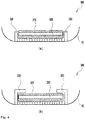
- FIG. 6 is a diagram illustrating a tire including a contact charging type self-power generation module having a case according to a first exemplary embodiment to a fourth exemplary embodiment of the present invention.
- a tire including a self-power generation module according to a first exemplary embodiment to a fourth exemplary embodiment of the present invention may further include each case C that houses the sound-absorbing material, the internal electrode portion, and the external electrode portion therein.
- the case C provided in this way may integrally form the sound-absorbing material, the internal electrode portion, and the external electrode portion to stably form in a module not to separate from an original position even when the tire moves.
- the tire including a self-power generation module formed in a module in this way may be easily attached to a vehicle or may be easily detached from a vehicle.
- the case C may be made of a material having an insulating property and the sound-absorbing material, the internal electrode portion, and the external electrode portion provided therein may be made of a material having an insulation property not to be damaged by a frictional heat between the tire and the ground.
- tires 100, 200, 300, and 400 including a self-power generation module according to a first exemplary embodiment to a fourth exemplary embodiment may have self-power generation modules using static electricity therein to generate efficiently electricity. Because a tire according to the present invention may use generated electricity for operating a pneumatic sensor, a separate external power source for operating the pneumatic sensor is unnecessary and thus the tire according to the present invention is economical.
- the sound-absorbing materials 110, 210, 310, and 410 of the present invention are made of a material, which much occurs static electricity, such as polyurethane. Therefore, as in the present invention, when the internal electrode portion 120, 220, 320, 420 are provided within the sound-absorbing materials 110, 210, 310, and 410, electricity may be more efficiently generated.
- the tire according to the present invention generates electricity using static electricity occurring therein, static electricity occurring within the tire and the vehicle can be effectively removed.
- the tire according to the present invention generates electricity using static electricity occurring in the sound-absorbing materials 110, 210, 310, and 410 and the vehicle, a generation area and a generation capacity are large and power can be uniformly generated, compared with a conventional piezo-generation method.
- a self-power generation module according to the present invention is formed in an integral structure connected to the sound-absorbing materials 110, 210, 310, and 410, the tire according to the present invention may maintain a noise reduction function of a conventional tire made of a sound-absorbing material.
- a tire including a self-power generation module according to the first exemplary embodiment to the fourth exemplary embodiment may be mounted in a vehicle.
Landscapes
- Engineering & Computer Science (AREA)
- Mechanical Engineering (AREA)
- Tires In General (AREA)
- Measuring Fluid Pressure (AREA)
Description
- This application claims priority to and the benefit of Korean Patent Application No.
10-2017-0058736, filed on May 11, 2017 - The present invention relates to a tire including a contact charging type self-power generation module, and more particularly, to a tire including a contact charging type self-power generation module that can generate electricity by charging static electricity occurring within a tire and a sound-absorbing material of the tire and that can operate a sensor using the generated electricity.
- Nowadays, a research on an apparatus for generating electricity within a tire has been actively performed.
- For example, up to now, when a tire moves, research and development on an electric power system of a piezoelectric method using a force in which the tire is pressed by the ground has been performed.
- However, when a piezoelectric method electric power system is applied to a tire, the piezoelectric method electric power system is very expensive and a life-span of a piezoelectric material is short and thus there is a problem that it is difficult to permanently use the piezoelectric method electric power system.
- More specifically, a method of generating electricity using a pressure or a force applied to a sensor is referred to as a piezo-generation method. Because such a piezo-generation method has low efficiency and additionally requires a circuit that amplifies using an OP-AMP, compared with a power generation method of using static electricity, there is a drawback that the piezo-generation method has a complex structure and cannot permanently use a piezo-element.
- Further, nowadays, when driving a vehicle, technology that generates electricity using a heat generated due to a friction between a tire and the ground has been developed.
- However, there is a problem that technology that generates electricity using a heat generated due to a friction between a tire and the ground is inefficient in an environment in which a frictional heat of the tire cannot fully occur due to an influence of weather.
- Therefore, a tire including a self-power generation module that can more efficiently and economically generate electricity is required.
- (Patent document 1) Korean Patent Publication No.
10-1690833 JP H07276914A WO 2006/093479A1 each describe a prior art device. - The present invention has been made in an effort to provide a tire including a contact charging type self-power generation module that generates electricity by charging static electricity occurring within a tire and a sound-absorbing material of the tire and that can operate a sensor using the electricity.
- The technical problems of the present invention are not limited to the above-described technical problems and the other technical problems will be understood by those skilled in the art from the following description.
- In accordance with an exemplary embodiment, a tire including a contact charging type self-power generation module includes a sound-absorbing material provided within an inner liner of the tire; an internal electrode portion provided within the sound-absorbing material and extended in a length direction of the sound-absorbing material; and an external electrode portion having a first external electrode provided separately from the sound-absorbing material and provided parallel to the internal electrode portion, wherein when the tire moves, as the sound-absorbing material moves, the internal electrode portion and the external electrode portion are charged with electricity to generate electricity.
- The first external electrode may be provided in a lower portion or an upper portion of the sound-absorbing material.
- The tire may further include a fixing bar that connects and fixes the sound-absorbing material and the first external electrode and including an electric wire.
- The fixing bar may be made of a material having an insulating property.
- The tire may further include a case that houses the sound-absorbing material, the internal electrode portion, and the external electrode portion therein.
- The tire may further include a power source unit connected to the internal electrode portion and the external electrode portion to receive generated electricity.
- The power source unit may include a pneumatic sensor that measures an air pressure of the tire; and a power source element that converts electricity of a non-sinusoidal wave or a sine wave occurring in the internal electrode portion and the external electrode portion to a DC form to provide the electricity to the pneumatic sensor, wherein the power source element may supply electricity with a predetermined voltage to the pneumatic sensor.
- In accordance with an exemplary embodiment, a tire including a contact charging type self-power generation module includes a first sound-absorbing material bonded to an inner side surface of an inner liner of the tire; an external electrode portion provided at an upper portion of the first sound-absorbing material; a second sound-absorbing material provided at an upper portion of the external electrode portion; and an internal electrode portion provided within the second sound-absorbing material and extended in a length direction of the second sound-absorbing material, wherein when the tire moves, as the first sound-absorbing material and the second sound-absorbing material move, the first sound-absorbing material, the second sound-absorbing material, and the external electrode portion are provided separately from each other, and the internal electrode portion and the external electrode portion are charged with electricity to generate electricity.
- The external electrode portion may include a fourth external electrode provided parallel to the internal electrode portion.
- The tire may further include a fixing bar that connects and fixes the first sound-absorbing material, the second sound-absorbing material, and the fourth external electrode and including an electric wire.
- A configuration of the present invention for achieving the object provides a vehicle that mounts the tire including the contact charging type self-power generation module.
- According to the present invention having the above configuration, because a self-power generation module using static electricity is provided within a tire, electricity can be efficiently generated. In the present invention, because generated electricity can be used for operating a pneumatic sensor, a separate external power source for operating the pneumatic sensor is unnecessary and thus the tire is economical.
- Further, a sound-absorbing material of the tire is made of a material, which occurs much static electricity, such as polyurethane. Therefore, when an internal electrode portion is provided within a sound-absorbing material, as in the present invention, electricity can be more efficiently generated.
- Further, according to the present invention, by generating electricity using static electricity occurring within the tire, static electricity occurring within the tire and the vehicle can be effectively removed.
- Further, according to the present invention, because electricity is generated using a sound-absorbing material, a generation area is large, a generation capacity is large, and power can be uniformly generated, compared with a conventional piezo-generation method.
- Further, because a self-power generation module of the present invention is formed in an integral structure connected to a sound-absorbing material, a noise reduction function of a conventional tire made of a sound-absorbing material can be maintained.
- The effects of the present invention are not limited to the above-described effects and it should be understood that the effects include entire effects that can be deduced from a configuration of the invention described in a detailed description of the present invention or claims.
-
-
FIG. 1 is a diagram illustrating a tire including a contact charging type self-power generation module according to a first exemplary embodiment of the present invention. -
FIG. 2 is a diagram illustrating an installation position of a power source unit of a tire including a contact charging type self-power generation module according to an exemplary embodiment of the present invention. -
FIG. 3 is a diagram illustrating a tire including a contact charging type self-power generation module having a plurality of external electrodes according to a second exemplary embodiment of the present invention. -
FIG. 4 is a diagram illustrating a tire including a contact charging type self-power generation module having a side external electrode according to a third exemplary embodiment of the present invention. -
FIG. 5 is a diagram illustrating a tire including a contact charging type self-power generation module according to a fourth exemplary embodiment of the present invention. -
FIG. 6 is a diagram illustrating a tire including a contact charging type self-power generation module having a case according to a first exemplary embodiment to a fourth exemplary embodiment of the present invention. - Hereinafter, the present invention will be described in detail with reference to the attached drawings. As those skilled in the art would realize, the described embodiments may be modified in various different ways, all without departing from the scope of the present invention. Accordingly, the drawings and description are to be regarded as illustrative in nature and not restrictive. Like reference numerals designate like elements throughout the specification.
- Throughout this specification and the claims that follow, when it is described that an element is "connected (accessed, contact, and coupled)" to another element, the element may be "directly connected" to the other element and "indirectly connected" to the other element through a third element. Further, unless explicitly described to the contrary, the word "comprise" and variations such as "comprises" or "comprising", will be understood to imply the inclusion of stated elements but not the exclusion of any other elements.
- Terms used in the present application are used for describing a specific exemplary embodiment and do not limit the present invention. When using in a description of the present invention and the appended claims, a singular form includes a plurality of forms unless it is explicitly differently represented. Further, in the present specification, a term "comprise" or "have" indicates presence of a characteristic, numeral, step, operation, element, component, or combination thereof described in a specification and does not exclude presence or addition of at least one other characteristic, numeral, step, operation, element, component, or combination thereof.
- Hereinafter, an exemplary embodiment according to the present invention will be described in detail with reference to the attached drawings.
-
FIG. 1 is a diagram illustrating a tire including a contact charging type self-power generation module according to a first exemplary embodiment of the present invention. - As shown in
FIG. 1 , atire 100 including a contact charging type self-power generation module includes a sound-absorbingmaterial 110, aninternal electrode portion 120, and an external electrode portion, and when the tire moves, the sound-absorbingmaterial 110 moves and thus theinternal electrode portion 120 and the external electrode portion are charged with electricity to generate electricity. - The sound-absorbing
material 110 may be provided within aninner liner 10 of the tire. Here, the sound-absorbingmaterial 110 may be made of a polyurethane material, but the sound-absorbingmaterial 110 is not limited thereto and may include an entire material that enables static electricity according to a friction to well occur to be well charged with electricity and having a sound-absorbing function. For example, the sound-absorbingmaterial 110 may be made of a polymer material that can be well charged with electricity at a sponge structure for sound-absorption. - An adhesive using when bonding the sound-absorbing
material 110 to the inside of theinner liner 10 of the tire may be a sealant adhesive or a silicon-based adhesive, but an adhesive kind is not limited thereto. - The
internal electrode portion 120 is provided within the sound-absorbingmaterial 110 and may be extended in a length direction of the sound-absorbingmaterial 110. - The external electrode portion may be separated from the sound-absorbing
material 110 and includes a firstexternal electrode 130 provided parallel to theinternal electrode portion 120. - The first
external electrode 130 may be provided at a lower portion or an upper portion of the sound-absorbingmaterial 110. Here, an upper portion of the sound-absorbingmaterial 110 indicates an internal direction of the tire, and a lower portion of the sound-absorbingmaterial 110 indicates a direction of theinner liner 10 of the tire to which the sound-absorbing material is bonded and they are equally applied hereinafter. Therefore,FIG. 1A illustrates a state in which the firstexternal electrode 130 is positioned at an upper portion of the sound-absorbingmaterial 110, andFIG. 1B illustrates a state in which the firstexternal electrode 130 is positioned at a lower portion of the sound-absorbingmaterial 110. - Further, the
internal electrode portion 120 and the external electrode portion may be made of a conductive material and a metal having predetermined ductility. For example, theinternal electrode portion 120 and the external electrode portion may be made of a material such as a polymer, a carbon bar, a carbon nano fiber, and a graphene film that includes a conductive material to be well charged with electricity. - The
internal electrode portion 120 and the external electrode portion may have a thickness that does not exceed 2mm, and the firstexternal electrode 130 may be provided separately by a gap of more than 0 to 5cm or less from the sound-absorbingmaterial 110. - Further, the
tire 100 including the contact charging type self-power generation module may further include a fixingbar 140 that connects and fixes the sound-absorbingmaterial 110 and the firstexternal electrode 130 and including an electric wire. - Specifically, the fixing
bar 140 may connect both ends of the sound-absorbingmaterial 110 and the firstexternal electrode 130 to fix the sound-absorbingmaterial 110 and the firstexternal electrode 130 such that the sound-absorbingmaterial 110 and the firstexternal electrode 130 are integrally formed. An electric wire that moves electric charges is provided in the fixingbar 140 to enable theinternal electrode portion 120 and the firstexternal electrode 130 to be connected to apower source unit 150 to be described later. The fixingbar 140 may be made of a material having an insulating property. -
FIG. 2 is a diagram illustrating an installation position of a power source unit of a tire including a contact charging type self-power generation module according to an exemplary embodiment of the present invention. - Referring to
FIGS. 1 and2 , thetire 100 including a contact charging type self-power generation module may further include apower source unit 150 connected to theinternal electrode portion 120 and the external electrode portion to receive generated electricity. Thepower source unit 150 includes a pneumatic sensor (not shown) and a power source element (not shown). - The pneumatic sensor is provided to measure an air pressure of the tire.
- The power source element may convert electricity of a non-sinusoidal wave or a sine wave occurring in the
internal electrode portion 120 and the external electrode portion to a DC form to provide the converted electricity to the pneumatic sensor. The power source element constantly supplies electricity of a predetermined voltage required by the pneumatic sensor. - However, the power source element may not limit to provide electricity to only the pneumatic sensor, but may be provided to supply electricity to a separate position in which the vehicle requires.
- Further, as shown in
FIG. 2A , thepower source unit 150 may be provided between the adjacent sound-absorbingmaterials 110. Specifically, thetire 100 including the contact charging type self-power generation module may be provided in the plural in an inner circumference direction of the tire. In this way, when thetire 100 including the contact charging type self-power generation module is provided in the plural in an inner circumference direction of the tire, thepower source unit 150 may be provided between the sound-absorbingmaterials 110 of thetire 100 including a pair of adjacent contact charging type self-power generation modules. - Alternatively, when the
tire 100 including a contact charging type self-power generation module is in a state extended in an inner circumference direction thereof, by enabling a length of the sound-absorbingmaterial 110 to be smaller than that of an inner circumferential surface of the tire, a space may be formed between both ends of the sound-absorbingmaterial 110. At the formed space, thepower source unit 150 may be provided. - Further, as shown in
FIG. 2B , thepower source unit 150 may be provided at a space formed at the inside of the sound-absorbingmaterial 110. Specifically, as shown inFIG. 2B , when thetire 100 including a contact charging type self-power generation module is in a state extended in an inner circumference direction thereof, a space that may install a power source portion may be formed in a shape and size corresponding to thepower source unit 150 at both ends of the sound-absorbingmaterial 110. For example, as shown inFIG. 2B , by cutting out each of both ends of the sound-absorbingmaterial 110 in a half-circle shape, the power source portion may be installed. - In the
tire 100 including a contact charging type self-power generation module provided in this way, when the vehicle runs, the sound-absorbingmaterial 110 moves according to a movement of the tire. The moved sound-absorbingmaterial 110 may enable theinternal electrode portion 120 installed therein and the firstexternal electrode 130 separately installed by a predetermined gap from theinternal electrode portion 120 to be charged with electricity. In this way, as theinternal electrode portion 120 and the firstexternal electrode 130 are charged with electricity, electricity generated by a movement of electric charges is provided to thepower source unit 150 by an electric wire. A power source element of thepower source unit 150 controls a voltage of received electricity and provides electricity having a controlled voltage to the pneumatic sensor to measure an air pressure of the tire. Thetire 100 including a contact charging type self-power generation module provided in this way may operate a pneumatic sensor without a separate external power source and thus the tire is economical. - Further, the
tire 100 including a contact charging type self-power generation module collects static electricity occurring within a running vehicle to generate electricity and thus may efficiently generate much electricity while removing static electricity occurring within the running vehicle. -
FIG. 3 is a diagram illustrating a tire including a contact charging type self-power generation module according to a second exemplary embodiment of the present invention. - As shown in
FIG. 3 , atire 200 including a contact charging type self-power generation module having a plurality of external electrodes according to the second exemplary embodiment includes a sound-absorbingmaterial 210, aninternal electrode portion 220, and an external electrode portion, and when the tire moves, the sound-absorbingmaterial 210 moves and thus theinternal electrode portion 220 and the external electrode portion are charged with electricity to generate electricity. - The sound-absorbing
material 210 may be provided within aninner liner 10 of the tire. Here, the sound-absorbingmaterial 210 may be made of a polyurethane material, but the sound-absorbingmaterial 210 is not limited thereto and may include an entire material well charged with electricity and having a sound-absorbing function. For example, the sound-absorbingmaterial 210 may be made of a polymer material well charged with electricity at a sponge structure for sound-absorption. - The
internal electrode portion 220 is provided within the sound-absorbingmaterial 210 and may be extended in a length direction of the sound-absorbingmaterial 210. - The external electrode portion is provided between the sound-absorbing
material 210 and theinner liner 10 and includes a plurality of secondexternal electrodes 230 bonded to an inner side surface of theinner liner 10. - Specifically, as shown in
FIG. 3A , the sound-absorbingmaterial 210 may be bonded to an inner side surface of theinner liner 10 by an adhesive, and the secondexternal electrode 230 may be positioned between the sound-absorbingmaterial 210 and theinner liner 10 and may be bonded in a state separated by a predetermined gap from the sound-absorbingmaterial 210. - In order to well form a predetermined gap between the sound-absorbing
material 210 and the secondexternal electrode 230, as shown inFIG. 3B , a shape of the sound-absorbingmaterial 210 may be adjusted. Specifically, at a lower portion of the sound-absorbingmaterial 210, a receivinghole 211 corresponding to a shape of the secondexternal electrode 230 may be formed. - When the sound-absorbing
material 210 is bonded to an inner side surface of theinner liner 10, the receivinghole 211 may be provided to insert the secondexternal electrode 230. For example, as shown inFIG. 3B , the receivinghole 211 is formed at a low surface of the sound-absorbingmaterial 210 that contacts theinner liner 10, but may be formed to correspond to a position, the number, and a shape of the secondexternal electrode 230 bonded to an inner side surface of theinner liner 10. - The receiving
hole 211 provided in this way enables the sound-absorbingmaterial 210 to be bonded to come in more close contact with theinner liner 10 to enhance safety and may enable to form a predetermined gap between the sound-absorbingmaterial 210 and the secondexternal electrode 230. - Particularly, as described above, the second
external electrode 230 inserted into the receivinghole 211 enables the sound-absorbingmaterial 210 to be charged with electricity when the sound-absorbingmaterial 210 vertically moves as well as when the sound-absorbingmaterial 210 moves in a lateral direction, thereby generating electricity. - Further, the
tire 200 including a contact charging type self-power generation module having a plurality of external electrodes according to a second exemplary embodiment further includes a power source unit. However, a power source unit of thetire 200 including a contact charging type self-power generation module having a plurality of external electrodes according to a second exemplary embodiment has substantially the same configuration as that of thepower source unit 150 of thetire 100 including a contact charging type self-power generation module according to the first exemplary embodiment and therefore a detailed description thereof will be omitted. -
FIG. 4 is a diagram illustrating a tire including a contact charging type self-power generation module according to a third exemplary embodiment of the present invention. - As shown in
FIG. 4 , atire 300 including a contact charging type self-power generation module having a side external electrode according to a third exemplary embodiment includes a sound-absorbingmaterial 310, aninternal electrode portion 320, and an external electrode portion, and when the tire moves, the sound-absorbingmaterial 310 moves and thus theinternal electrode portion 320 and the external electrode portion are charged electricity to generate electricity. - The sound-absorbing
material 310 may be provided within aninner liner 10 of the tire. Here, the sound-absorbingmaterial 310 may be made of a polyurethane material, but the sound-absorbingmaterial 310 is not limited thereto and may include an entire material well charged with electricity and having a sound-absorbing function. For example, the sound-absorbingmaterial 310 may be made of a polymer material well charged with electricity in a sponge structure for sound-absorption. - The
internal electrode portion 320 may be provided within the sound-absorbingmaterial 310 and may be extended in a length direction of the sound-absorbingmaterial 310. - The external electrode portion may include third
external electrodes 330 provided in a pair at both sides of the sound-absorbingmaterial 310. - Specifically, as shown in
FIG. 4A , one end of the thirdexternal electrode 330 may be bonded to an inner side surface of aninner liner 10, and the other end thereof may be extended in a vertical direction from an inner side surface of theinner liner 10. - Alternatively, as shown in
FIG. 4B , one end of the thirdexternal electrode 330 may be bonded to an inner side surface of theinner liner 10, the other end thereof may be extended in a vertical direction from an inner side surface of theinner liner 10, and the other end of the thirdexternal electrode 330 may be bent and extended in a vertical direction, but a pair of thirdexternal electrodes 330 may be bent and extended in a facing direction. - When the sound-absorbing
material 310 moves in a direction of the right side, the left side, the upper side, and the lower side, the thirdexternal electrode 330 provided in this way is well charged with electricity and thus generation efficiency can be enhanced. - Further, the
tire 300 including a contact charging type self-power generation module having a side external electrode according to a third exemplary embodiment further includes a power source unit. However, the power source unit of thetire 300 including a contact charging type self-power generation module having a side external electrode according to a third exemplary embodiment has substantially the same configuration as that of thepower source unit 150 of thetire 100 including a contact charging type self-power generation module according to the first exemplary embodiment and therefore a detailed description thereof will be omitted. -
FIG. 5 is a diagram illustrating a tire including a contact charging type self-power generation module according to a fourth exemplary embodiment of the present invention. - As shown in
FIG. 5 , atire 400 including a contact charging type self-power generation module according to a fourth exemplary embodiment includes a sound-absorbingmaterial 410, aninternal electrode portion 420, and an external electrode portion, and when the tire moves, the sound-absorbingmaterial 410 moves and thus theinternal electrode portion 420 and the external electrode portion are charged with electricity to generate electricity. - The sound-absorbing
material 410 includes a first sound-absorbingmaterial 411 and a second sound-absorbingmaterial 412, and here, the sound-absorbingmaterial 410 may be made of a polyurethane material, but the sound-absorbingmaterial 410 is not limited thereto. That is, the sound-absorbingmaterial 410 may include an entire material well charged with electricity and having a sound-absorbing function. For example, the sound-absorbingmaterial 410 may be made of a polymer material well charged with electricity in a sponge structure for sound-absorption. - The first sound-absorbing
material 411 may be provided to bond to an inner side surface of aninner liner 10 of the tire. - At an upper portion of the first sound-absorbing
material 411, the external electrode portion may be provided, and at an upper portion of the external electrode portion, the second sound-absorbingmaterial 412 may be provided. - The
internal electrode portion 420 may be provided within the second sound-absorbingmaterial 412 and may be extended in a length direction of the second sound-absorbingmaterial 412. - The external electrode portion includes a fourth
external electrode 430 provided parallel to theinternal electrode portion 420, and the first sound-absorbingmaterial 411, the second sound-absorbingmaterial 412, and the fourthexternal electrode 430 may be separated from each other. - When the
tire 400 including a contact charging type self-power generation module according to the fourth exemplary embodiment provided in this way moves, the first sound-absorbingmaterial 411 and the second sound-absorbingmaterial 412 move and thus theinternal electrode portion 420 and the external electrode portion are charged with electricity to generate electricity. - The
tire 400 including a contact charging type self-power generation module according to a fourth exemplary embodiment may further include a fixingbar 440 that connects and fixes the first sound-absorbingmaterial 411, the second sound-absorbingmaterial 412, and a fourth external electrode 413 and including an electric wire. - Specifically, the fixing
bar 440 may connect both ends of the sound-absorbingmaterial 410 and the fourthexternal electrode 430 to integrally fix the sound-absorbingmaterial 410 and the fourthexternal electrode 430. An electric wire for moving electric charges is provided in the fixingbar 440 to enable theinternal electrode portion 420 and the fourthexternal electrode 430 to be connected to a power source unit. The fixingbar 440 may be made of a material having an insulating property. - The
tire 400 including a contact charging type self-power generation module according to a fourth exemplary embodiment further includes a power source unit. However, the power source unit of thetire 400 including the contact charging type self-power generation module according to a fourth exemplary embodiment has substantially the same configuration as that of thepower source unit 150 of thetire 100 including a contact charging type self-power generation module according to the first exemplary embodiment and therefore a detailed description thereof will be omitted. -
FIG. 6 is a diagram illustrating a tire including a contact charging type self-power generation module having a case according to a first exemplary embodiment to a fourth exemplary embodiment of the present invention. - As shown in
FIG. 6 , a tire including a self-power generation module according to a first exemplary embodiment to a fourth exemplary embodiment of the present invention may further include each case C that houses the sound-absorbing material, the internal electrode portion, and the external electrode portion therein. - The case C provided in this way may integrally form the sound-absorbing material, the internal electrode portion, and the external electrode portion to stably form in a module not to separate from an original position even when the tire moves. The tire including a self-power generation module formed in a module in this way may be easily attached to a vehicle or may be easily detached from a vehicle.
- The case C may be made of a material having an insulating property and the sound-absorbing material, the internal electrode portion, and the external electrode portion provided therein may be made of a material having an insulation property not to be damaged by a frictional heat between the tire and the ground.
- As described above,
tires - Further, the sound-absorbing
materials internal electrode portion materials - Further, because the tire according to the present invention generates electricity using static electricity occurring therein, static electricity occurring within the tire and the vehicle can be effectively removed.
- Further, because the tire according to the present invention generates electricity using static electricity occurring in the sound-absorbing
materials - Further, because a self-power generation module according to the present invention is formed in an integral structure connected to the sound-absorbing
materials - As described above, a tire including a self-power generation module according to the first exemplary embodiment to the fourth exemplary embodiment may be mounted in a vehicle.
- The foregoing description of the present invention is an illustration, and it may be understood by a person of ordinary skill in the art that the present invention may be easily changed in different detailed forms without changing the technical essential characteristic of the present invention. Therefore, it should be understood that the foregoing exemplary embodiments are not limited but are illustrative. For example, each constituent element described in a single type may be distributedly performed, and constituent elements described in a distributed type may be performed in a combined form.
- The scope of the present invention is represented by claims to be described later, and it should be analyzed that a meaning and the scope of claims and an entire change or a changed form derived from an equivalent concept thereof are included in the scope of the present invention.
-
- 10: inner liner
- 100, 400: tire including contact charging type self-power generation module
- 110, 210, 310, 410: sound-absorbing material
- 120, 220, 320, 420: internal electrode portion
- 130: first external electrode
- 140, 440: fixing bar
- 150: power source unit
- 200: tire including contact charging type self-power generation module having a plurality of external electrodes
- 211: receiving hole
- 230: second external electrode
- 300: tire including contact charging type self-power generation module having side external electrode
- 330: third external electrode
- 411: first sound-absorbing material
- 412: second sound-absorbing material
- 430: fourth external electrode
- C: case
Claims (11)
- A tire (100) including a contact charging type self-power generation module, the tire comprising:a sound-absorbing material (110) provided within an inner liner of the tire; characterized by an internal electrode portion (120) provided within the sound-absorbing material and extended in a length direction of the sound-absorbing material; andan external electrode portion (130) having a first external electrode provided separately from the sound-absorbing material and provided parallel to the internal electrode portion,wherein the internal electrode portion and the external electrode portion are charged with electricity to generate electricity, as the sound-absorbing material moves, when the tire moves.
- The tire of claim 1, wherein the first external electrode is provided in a lower portion or an upper portion of the sound-absorbing material.
- The tire of claim 2, further comprising a fixing bar that connects and fixes the sound-absorbing material and the first external electrode and comprising an electric wire.
- The tire of claim 3, wherein the fixing bar is made of a material having an insulating property.
- The tire of claim 1, further comprising a case that houses the sound-absorbing material, the internal electrode portion, and the external electrode portion therein.
- The tire of claim 1, further comprising a power source unit connected to the internal electrode portion and the external electrode portion to receive generated electricity.
- The tire of claim 6, wherein the power source unit comprises:a pneumatic sensor that measures an air pressure of the tire; anda power source element that converts electricity of a non-sinusoidal wave or a sine wave occurring in the internal electrode portion and the external electrode portion to a DC form to provide the converted electricity to the pneumatic sensor,wherein the power source element supplies electricity of a predetermined voltage to the pneumatic sensor.
- A tire (400) including a contact charging type self-power generation module, the tire comprising:a first sound-absorbing material (411) bonded to an inner side surface of an inner liner of the tire; characterized by an external electrode portion provided at an upper portion of the first sound-absorbing material;a second sound-absorbing material (412) provided at an upper portion of the external electrode portion; andan internal electrode portion (420) provided within the second sound-absorbing material and extended in a length direction of the second sound-absorbing material,wherein the first sound-absorbing material, the second sound-absorbing material, and the external electrode portion are provided separately from each other, andthe internal electrode portion and the external electrode portion are charged with electricity to generate electricity, as the first sound-absorbing material and the second sound-absorbing material move, when the tire moves.
- The tire of claim 8, wherein the external electrode portion comprises a fourth external electrode provided parallel to the internal electrode portion.
- The tire of claim 9, further comprising a fixing bar that connects and fixes the first sound-absorbing material, the second sound-absorbing material, and the fourth external electrode and comprising an electric wire.
- A vehicle that mounts the tire including the contact charging type self-power generation module according to any one of claims 1 to 10.
Applications Claiming Priority (1)
| Application Number | Priority Date | Filing Date | Title |
|---|---|---|---|
| KR1020170058736A KR101887809B1 (en) | 2017-05-11 | 2017-05-11 | Tire including self-power generation module of contact charging type |
Publications (2)
| Publication Number | Publication Date |
|---|---|
| EP3401128A1 EP3401128A1 (en) | 2018-11-14 |
| EP3401128B1 true EP3401128B1 (en) | 2021-01-27 |
Family
ID=61256693
Family Applications (1)
| Application Number | Title | Priority Date | Filing Date |
|---|---|---|---|
| EP18157882.4A Active EP3401128B1 (en) | 2017-05-11 | 2018-02-21 | Tire including contact charging type self-power generation module |
Country Status (5)
| Country | Link |
|---|---|
| US (1) | US10744828B2 (en) |
| EP (1) | EP3401128B1 (en) |
| JP (1) | JP6605057B2 (en) |
| KR (1) | KR101887809B1 (en) |
| CN (1) | CN108859620B (en) |
Families Citing this family (10)
| Publication number | Priority date | Publication date | Assignee | Title |
|---|---|---|---|---|
| KR101887809B1 (en) * | 2017-05-11 | 2018-08-10 | 한국타이어 주식회사 | Tire including self-power generation module of contact charging type |
| CN110733299A (en) * | 2018-07-18 | 2020-01-31 | 住友橡胶工业株式会社 | Tire assembly, monitoring system and method of tire |
| KR102001059B1 (en) * | 2019-01-08 | 2019-10-01 | 우병철 | Puncture preventing member having a function of reducing static electricity and reducing road surface noise |
| IT201900001153A1 (en) * | 2019-01-25 | 2020-07-25 | Bridgestone Europe Nv Sa | METHOD AND APPLICATION SYSTEM FOR APPLYING A SEALANT AGENT ON THE INTERNAL SURFACE OF A TIRE |
| JP2020199954A (en) | 2019-06-12 | 2020-12-17 | 株式会社ブリヂストン | Non-pneumatic tire, movable body power supply device and movable body |
| KR102351699B1 (en) | 2020-02-17 | 2022-01-17 | 한국타이어앤테크놀로지 주식회사 | Tires with self generation and sound absorption |
| CN112546606B (en) * | 2021-02-04 | 2022-05-06 | 浙江师范大学 | a roller skate |
| JP2023096611A (en) * | 2021-12-27 | 2023-07-07 | Toyo Tire株式会社 | pneumatic tire |
| KR102675128B1 (en) * | 2022-10-17 | 2024-06-13 | 금호타이어 주식회사 | Tire with a contact electrostatic generator |
| WO2025014348A1 (en) * | 2023-07-11 | 2025-01-16 | 한국타이어앤테크놀로지 주식회사 | Noise-reducing pneumatic tire and method of manufacturing same |
Family Cites Families (27)
| Publication number | Priority date | Publication date | Assignee | Title |
|---|---|---|---|---|
| US4510484A (en) * | 1983-03-28 | 1985-04-09 | Imperial Clevite Inc. | Piezoelectric reed power supply for use in abnormal tire condition warning systems |
| JPH07276914A (en) * | 1994-04-13 | 1995-10-24 | Sumitomo Rubber Ind Ltd | Pneumatic tire |
| DE19644538C1 (en) * | 1996-10-26 | 1998-09-03 | Continental Ag | Pneumatic vehicle tires |
| US6175302B1 (en) * | 1999-04-02 | 2001-01-16 | Tien-Tsai Huang | Tire pressure indicator including pressure gauges that have a self-generating power capability |
| JP2003011612A (en) * | 2001-07-02 | 2003-01-15 | Yokohama Rubber Co Ltd:The | Pneumatic tire |
| US20030061873A1 (en) * | 2001-10-02 | 2003-04-03 | Yingjie Lin | Tire pressure sensor with self-contained power generator |
| JP3736804B2 (en) * | 2003-04-02 | 2006-01-18 | 本田技研工業株式会社 | Method for holding member in tire air chamber and member with holding portion used in the method |
| KR100555659B1 (en) * | 2003-12-22 | 2006-03-03 | 삼성전자주식회사 | Self-generated sensing module and tire pressure monitoring system using it |
| US7132939B2 (en) * | 2004-07-07 | 2006-11-07 | Michelin Recherche Et Technique S.A. | Integrated self-powered tire revolution counter |
| JP2006223054A (en) * | 2005-02-10 | 2006-08-24 | Yokohama Rubber Co Ltd:The | Tire with power generator |
| JP2008531373A (en) * | 2005-02-24 | 2008-08-14 | ソシエテ ドゥ テクノロジー ミシュラン | System and method for reducing tire vibration |
| JP5114863B2 (en) * | 2006-04-11 | 2013-01-09 | 横浜ゴム株式会社 | Pneumatic tire and method for assembling pneumatic tire |
| CN101981820A (en) * | 2008-03-31 | 2011-02-23 | 米其林研究和技术股份有限公司 | Self-powered semi-passive RFID transponder embedded in a tire |
| KR101295670B1 (en) * | 2009-12-11 | 2013-08-14 | 한국전자통신연구원 | piezoelectric power generator |
| US20120139389A1 (en) * | 2010-11-26 | 2012-06-07 | Ruamoko MEMS, Inc. | Microelectronic devices for harvesting kinetic energy and associated systems and methods |
| US9178446B2 (en) * | 2011-08-30 | 2015-11-03 | Georgia Tech Research Corporation | Triboelectric generator |
| WO2013114388A1 (en) * | 2011-12-23 | 2013-08-08 | Muthukumar Prasad | Smart active tyre pressure optimising system |
| WO2014017204A1 (en) * | 2012-07-25 | 2014-01-30 | 株式会社ビスキャス | Vibration power generation body |
| JP5691080B2 (en) * | 2012-07-25 | 2015-04-01 | 株式会社ビスキャス | Vibrating power generator, manufacturing method thereof and power generation method |
| US20160303923A1 (en) * | 2013-12-03 | 2016-10-20 | The Yokohama Rubber Co., Ltd. | Method for Manufacturing Pneumatic Tire |
| US9344011B2 (en) * | 2014-01-31 | 2016-05-17 | Ford Global Technologies, Llc | Systems and methods for generating power for an electric sub-assembly of a motor vehicle |
| JP6206307B2 (en) * | 2014-04-11 | 2017-10-04 | 株式会社デンソー | Tire structure |
| KR101690833B1 (en) | 2014-06-20 | 2016-12-29 | 한국과학기술원 | Triboelectric energy harvester with nature-replicated structure and manufacturing method thereof |
| CN206277898U (en) * | 2016-12-23 | 2017-06-27 | 石家庄铁道大学 | A kind of piezoelectric type self-powered device for monitoring tyre pressure |
| CN106712566B (en) * | 2017-03-01 | 2018-10-09 | 江苏大学 | Three dimensions wheel generating electricity |
| KR101887809B1 (en) * | 2017-05-11 | 2018-08-10 | 한국타이어 주식회사 | Tire including self-power generation module of contact charging type |
| KR102085006B1 (en) * | 2018-11-28 | 2020-03-05 | 만도헬라일렉트로닉스(주) | Self generating device |
-
2017
- 2017-05-11 KR KR1020170058736A patent/KR101887809B1/en active Active
-
2018
- 2018-02-15 US US15/897,850 patent/US10744828B2/en active Active
- 2018-02-16 JP JP2018025572A patent/JP6605057B2/en active Active
- 2018-02-21 EP EP18157882.4A patent/EP3401128B1/en active Active
- 2018-02-23 CN CN201810155296.2A patent/CN108859620B/en active Active
Non-Patent Citations (1)
| Title |
|---|
| None * |
Also Published As
| Publication number | Publication date |
|---|---|
| JP2018188128A (en) | 2018-11-29 |
| JP6605057B2 (en) | 2019-11-13 |
| US10744828B2 (en) | 2020-08-18 |
| CN108859620B (en) | 2020-09-01 |
| EP3401128A1 (en) | 2018-11-14 |
| CN108859620A (en) | 2018-11-23 |
| US20180326801A1 (en) | 2018-11-15 |
| KR101887809B1 (en) | 2018-08-10 |
Similar Documents
| Publication | Publication Date | Title |
|---|---|---|
| US10744828B2 (en) | Tire including contact charging type self-power generation module | |
| US10746206B1 (en) | Soft-bodied fluidic actuator | |
| CN101604930B (en) | Generator | |
| JP5691080B2 (en) | Vibrating power generator, manufacturing method thereof and power generation method | |
| EP2251087B1 (en) | Electric precipitator | |
| KR20160019947A (en) | Single-Electrode Friction Nano Generator, Power Generation Method And Self-Driven Tracker | |
| UA95364C2 (en) | Module for electric energy storage assemblies for ageing detection of said assemblies | |
| ATE521009T1 (en) | INTERFEROMETRIC FABRY-PEROT MEMS ELECTROMAGNETIC WAVE MODULATOR WITH ZERO ELECTRICAL FIELD | |
| KR101685184B1 (en) | Cylindrical triboelectric generator based on contact-electrification and method for manufacturing the generator | |
| WO2014017204A1 (en) | Vibration power generation body | |
| ITTO20130652A1 (en) | PIEZOELECTRIC TRANSDUCER FOR AN ENERGY COLLECTION SYSTEM AND METHOD FOR ENERGY COLLECTION BY MEANS OF A PIEZOELECTRIC TRANSDUCER | |
| US20150280616A1 (en) | Power-generating vibration sensor, and tire and electrical device using the same | |
| JP2008278607A (en) | Electrostatic transducer and capacitance detector equipped with this electrostatic transducer | |
| US10050566B2 (en) | Generator for automobile using flexible piezoelectric device | |
| KR101500359B1 (en) | Piezoelectric power generator | |
| JP5660577B2 (en) | Connection module for building-integrated photovoltaic power generation system | |
| KR101864536B1 (en) | Tire including contact charging electric power generating module having side external electrodes | |
| JP6133118B2 (en) | Vibration generator | |
| KR101867228B1 (en) | Tire including contact charging electric power generating module having plurality of external electrodes | |
| KR101617865B1 (en) | Cylindrical triboelectric generator based on contact-electrification | |
| JP5993946B2 (en) | speaker | |
| KR102429758B1 (en) | Ficture apparatus for fixing the probe | |
| CN103888096A (en) | Piezoelectric vibrating assembly | |
| KR101789553B1 (en) | Sound proof panel with photovoltaic panel | |
| CN205269905U (en) | Ionic wind air purifier |
Legal Events
| Date | Code | Title | Description |
|---|---|---|---|
| PUAI | Public reference made under article 153(3) epc to a published international application that has entered the european phase |
Free format text: ORIGINAL CODE: 0009012 |
|
| STAA | Information on the status of an ep patent application or granted ep patent |
Free format text: STATUS: REQUEST FOR EXAMINATION WAS MADE |
|
| 17P | Request for examination filed |
Effective date: 20180320 |
|
| AK | Designated contracting states |
Kind code of ref document: A1 Designated state(s): AL AT BE BG CH CY CZ DE DK EE ES FI FR GB GR HR HU IE IS IT LI LT LU LV MC MK MT NL NO PL PT RO RS SE SI SK SM TR |
|
| AX | Request for extension of the european patent |
Extension state: BA ME |
|
| RBV | Designated contracting states (corrected) |
Designated state(s): AL AT BE BG CH CY CZ DE DK EE ES FI FR GB GR HR HU IE IS IT LI LT LU LV MC MK MT NL NO PL PT RO RS SE SI SK SM TR |
|
| GRAP | Despatch of communication of intention to grant a patent |
Free format text: ORIGINAL CODE: EPIDOSNIGR1 |
|
| STAA | Information on the status of an ep patent application or granted ep patent |
Free format text: STATUS: GRANT OF PATENT IS INTENDED |
|
| INTG | Intention to grant announced |
Effective date: 20200824 |
|
| GRAS | Grant fee paid |
Free format text: ORIGINAL CODE: EPIDOSNIGR3 |
|
| GRAA | (expected) grant |
Free format text: ORIGINAL CODE: 0009210 |
|
| STAA | Information on the status of an ep patent application or granted ep patent |
Free format text: STATUS: THE PATENT HAS BEEN GRANTED |
|
| AK | Designated contracting states |
Kind code of ref document: B1 Designated state(s): AL AT BE BG CH CY CZ DE DK EE ES FI FR GB GR HR HU IE IS IT LI LT LU LV MC MK MT NL NO PL PT RO RS SE SI SK SM TR |
|
| REG | Reference to a national code |
Ref country code: GB Ref legal event code: FG4D |
|
| REG | Reference to a national code |
Ref country code: CH Ref legal event code: EP |
|
| REG | Reference to a national code |
Ref country code: AT Ref legal event code: REF Ref document number: 1358026 Country of ref document: AT Kind code of ref document: T Effective date: 20210215 |
|
| REG | Reference to a national code |
Ref country code: IE Ref legal event code: FG4D |
|
| REG | Reference to a national code |
Ref country code: DE Ref legal event code: R096 Ref document number: 602018012145 Country of ref document: DE |
|
| REG | Reference to a national code |
Ref country code: NL Ref legal event code: MP Effective date: 20210127 |
|
| REG | Reference to a national code |
Ref country code: LT Ref legal event code: MG9D |
|
| REG | Reference to a national code |
Ref country code: AT Ref legal event code: MK05 Ref document number: 1358026 Country of ref document: AT Kind code of ref document: T Effective date: 20210127 |
|
| PG25 | Lapsed in a contracting state [announced via postgrant information from national office to epo] |
Ref country code: GR Free format text: LAPSE BECAUSE OF FAILURE TO SUBMIT A TRANSLATION OF THE DESCRIPTION OR TO PAY THE FEE WITHIN THE PRESCRIBED TIME-LIMIT Effective date: 20210428 Ref country code: HR Free format text: LAPSE BECAUSE OF FAILURE TO SUBMIT A TRANSLATION OF THE DESCRIPTION OR TO PAY THE FEE WITHIN THE PRESCRIBED TIME-LIMIT Effective date: 20210127 Ref country code: FI Free format text: LAPSE BECAUSE OF FAILURE TO SUBMIT A TRANSLATION OF THE DESCRIPTION OR TO PAY THE FEE WITHIN THE PRESCRIBED TIME-LIMIT Effective date: 20210127 Ref country code: PT Free format text: LAPSE BECAUSE OF FAILURE TO SUBMIT A TRANSLATION OF THE DESCRIPTION OR TO PAY THE FEE WITHIN THE PRESCRIBED TIME-LIMIT Effective date: 20210527 Ref country code: NO Free format text: LAPSE BECAUSE OF FAILURE TO SUBMIT A TRANSLATION OF THE DESCRIPTION OR TO PAY THE FEE WITHIN THE PRESCRIBED TIME-LIMIT Effective date: 20210427 Ref country code: BG Free format text: LAPSE BECAUSE OF FAILURE TO SUBMIT A TRANSLATION OF THE DESCRIPTION OR TO PAY THE FEE WITHIN THE PRESCRIBED TIME-LIMIT Effective date: 20210427 Ref country code: LT Free format text: LAPSE BECAUSE OF FAILURE TO SUBMIT A TRANSLATION OF THE DESCRIPTION OR TO PAY THE FEE WITHIN THE PRESCRIBED TIME-LIMIT Effective date: 20210127 |
|
| PG25 | Lapsed in a contracting state [announced via postgrant information from national office to epo] |
Ref country code: AT Free format text: LAPSE BECAUSE OF FAILURE TO SUBMIT A TRANSLATION OF THE DESCRIPTION OR TO PAY THE FEE WITHIN THE PRESCRIBED TIME-LIMIT Effective date: 20210127 Ref country code: PL Free format text: LAPSE BECAUSE OF FAILURE TO SUBMIT A TRANSLATION OF THE DESCRIPTION OR TO PAY THE FEE WITHIN THE PRESCRIBED TIME-LIMIT Effective date: 20210127 Ref country code: LV Free format text: LAPSE BECAUSE OF FAILURE TO SUBMIT A TRANSLATION OF THE DESCRIPTION OR TO PAY THE FEE WITHIN THE PRESCRIBED TIME-LIMIT Effective date: 20210127 Ref country code: RS Free format text: LAPSE BECAUSE OF FAILURE TO SUBMIT A TRANSLATION OF THE DESCRIPTION OR TO PAY THE FEE WITHIN THE PRESCRIBED TIME-LIMIT Effective date: 20210127 Ref country code: SE Free format text: LAPSE BECAUSE OF FAILURE TO SUBMIT A TRANSLATION OF THE DESCRIPTION OR TO PAY THE FEE WITHIN THE PRESCRIBED TIME-LIMIT Effective date: 20210127 |
|
| PG25 | Lapsed in a contracting state [announced via postgrant information from national office to epo] |
Ref country code: IS Free format text: LAPSE BECAUSE OF FAILURE TO SUBMIT A TRANSLATION OF THE DESCRIPTION OR TO PAY THE FEE WITHIN THE PRESCRIBED TIME-LIMIT Effective date: 20210527 |
|
| REG | Reference to a national code |
Ref country code: BE Ref legal event code: MM Effective date: 20210228 |
|
| REG | Reference to a national code |
Ref country code: DE Ref legal event code: R097 Ref document number: 602018012145 Country of ref document: DE |
|
| PG25 | Lapsed in a contracting state [announced via postgrant information from national office to epo] |
Ref country code: SM Free format text: LAPSE BECAUSE OF FAILURE TO SUBMIT A TRANSLATION OF THE DESCRIPTION OR TO PAY THE FEE WITHIN THE PRESCRIBED TIME-LIMIT Effective date: 20210127 Ref country code: CH Free format text: LAPSE BECAUSE OF NON-PAYMENT OF DUE FEES Effective date: 20210228 Ref country code: EE Free format text: LAPSE BECAUSE OF FAILURE TO SUBMIT A TRANSLATION OF THE DESCRIPTION OR TO PAY THE FEE WITHIN THE PRESCRIBED TIME-LIMIT Effective date: 20210127 Ref country code: CZ Free format text: LAPSE BECAUSE OF FAILURE TO SUBMIT A TRANSLATION OF THE DESCRIPTION OR TO PAY THE FEE WITHIN THE PRESCRIBED TIME-LIMIT Effective date: 20210127 Ref country code: LI Free format text: LAPSE BECAUSE OF NON-PAYMENT OF DUE FEES Effective date: 20210228 Ref country code: MC Free format text: LAPSE BECAUSE OF FAILURE TO SUBMIT A TRANSLATION OF THE DESCRIPTION OR TO PAY THE FEE WITHIN THE PRESCRIBED TIME-LIMIT Effective date: 20210127 Ref country code: LU Free format text: LAPSE BECAUSE OF NON-PAYMENT OF DUE FEES Effective date: 20210221 |
|
| PG25 | Lapsed in a contracting state [announced via postgrant information from national office to epo] |
Ref country code: SK Free format text: LAPSE BECAUSE OF FAILURE TO SUBMIT A TRANSLATION OF THE DESCRIPTION OR TO PAY THE FEE WITHIN THE PRESCRIBED TIME-LIMIT Effective date: 20210127 Ref country code: DK Free format text: LAPSE BECAUSE OF FAILURE TO SUBMIT A TRANSLATION OF THE DESCRIPTION OR TO PAY THE FEE WITHIN THE PRESCRIBED TIME-LIMIT Effective date: 20210127 Ref country code: RO Free format text: LAPSE BECAUSE OF FAILURE TO SUBMIT A TRANSLATION OF THE DESCRIPTION OR TO PAY THE FEE WITHIN THE PRESCRIBED TIME-LIMIT Effective date: 20210127 |
|
| PLBE | No opposition filed within time limit |
Free format text: ORIGINAL CODE: 0009261 |
|
| STAA | Information on the status of an ep patent application or granted ep patent |
Free format text: STATUS: NO OPPOSITION FILED WITHIN TIME LIMIT |
|
| 26N | No opposition filed |
Effective date: 20211028 |
|
| PG25 | Lapsed in a contracting state [announced via postgrant information from national office to epo] |
Ref country code: AL Free format text: LAPSE BECAUSE OF FAILURE TO SUBMIT A TRANSLATION OF THE DESCRIPTION OR TO PAY THE FEE WITHIN THE PRESCRIBED TIME-LIMIT Effective date: 20210127 Ref country code: ES Free format text: LAPSE BECAUSE OF FAILURE TO SUBMIT A TRANSLATION OF THE DESCRIPTION OR TO PAY THE FEE WITHIN THE PRESCRIBED TIME-LIMIT Effective date: 20210127 Ref country code: IE Free format text: LAPSE BECAUSE OF NON-PAYMENT OF DUE FEES Effective date: 20210221 |
|
| PG25 | Lapsed in a contracting state [announced via postgrant information from national office to epo] |
Ref country code: SI Free format text: LAPSE BECAUSE OF FAILURE TO SUBMIT A TRANSLATION OF THE DESCRIPTION OR TO PAY THE FEE WITHIN THE PRESCRIBED TIME-LIMIT Effective date: 20210127 |
|
| PG25 | Lapsed in a contracting state [announced via postgrant information from national office to epo] |
Ref country code: IT Free format text: LAPSE BECAUSE OF FAILURE TO SUBMIT A TRANSLATION OF THE DESCRIPTION OR TO PAY THE FEE WITHIN THE PRESCRIBED TIME-LIMIT Effective date: 20210127 |
|
| PG25 | Lapsed in a contracting state [announced via postgrant information from national office to epo] |
Ref country code: IS Free format text: LAPSE BECAUSE OF FAILURE TO SUBMIT A TRANSLATION OF THE DESCRIPTION OR TO PAY THE FEE WITHIN THE PRESCRIBED TIME-LIMIT Effective date: 20210527 |
|
| PG25 | Lapsed in a contracting state [announced via postgrant information from national office to epo] |
Ref country code: BE Free format text: LAPSE BECAUSE OF NON-PAYMENT OF DUE FEES Effective date: 20210228 |
|
| GBPC | Gb: european patent ceased through non-payment of renewal fee |
Effective date: 20220221 |
|
| PG25 | Lapsed in a contracting state [announced via postgrant information from national office to epo] |
Ref country code: GB Free format text: LAPSE BECAUSE OF NON-PAYMENT OF DUE FEES Effective date: 20220221 |
|
| PG25 | Lapsed in a contracting state [announced via postgrant information from national office to epo] |
Ref country code: NL Free format text: LAPSE BECAUSE OF NON-PAYMENT OF DUE FEES Effective date: 20210127 Ref country code: CY Free format text: LAPSE BECAUSE OF FAILURE TO SUBMIT A TRANSLATION OF THE DESCRIPTION OR TO PAY THE FEE WITHIN THE PRESCRIBED TIME-LIMIT Effective date: 20210127 |
|
| PG25 | Lapsed in a contracting state [announced via postgrant information from national office to epo] |
Ref country code: HU Free format text: LAPSE BECAUSE OF FAILURE TO SUBMIT A TRANSLATION OF THE DESCRIPTION OR TO PAY THE FEE WITHIN THE PRESCRIBED TIME-LIMIT; INVALID AB INITIO Effective date: 20180221 |
|
| P01 | Opt-out of the competence of the unified patent court (upc) registered |
Effective date: 20230926 |
|
| PG25 | Lapsed in a contracting state [announced via postgrant information from national office to epo] |
Ref country code: MK Free format text: LAPSE BECAUSE OF FAILURE TO SUBMIT A TRANSLATION OF THE DESCRIPTION OR TO PAY THE FEE WITHIN THE PRESCRIBED TIME-LIMIT Effective date: 20210127 |
|
| PG25 | Lapsed in a contracting state [announced via postgrant information from national office to epo] |
Ref country code: MT Free format text: LAPSE BECAUSE OF FAILURE TO SUBMIT A TRANSLATION OF THE DESCRIPTION OR TO PAY THE FEE WITHIN THE PRESCRIBED TIME-LIMIT Effective date: 20210127 |
|
| PG25 | Lapsed in a contracting state [announced via postgrant information from national office to epo] |
Ref country code: TR Free format text: LAPSE BECAUSE OF FAILURE TO SUBMIT A TRANSLATION OF THE DESCRIPTION OR TO PAY THE FEE WITHIN THE PRESCRIBED TIME-LIMIT Effective date: 20210127 |
|
| PGFP | Annual fee paid to national office [announced via postgrant information from national office to epo] |
Ref country code: DE Payment date: 20260120 Year of fee payment: 9 |
|
| PGFP | Annual fee paid to national office [announced via postgrant information from national office to epo] |
Ref country code: FR Payment date: 20260121 Year of fee payment: 9 |