EP3400942A1 - Use of quinoline derivatives for treating oesophageal cancer and treatment method, pharmaceutical composition and kit thereof - Google Patents
Use of quinoline derivatives for treating oesophageal cancer and treatment method, pharmaceutical composition and kit thereof Download PDFInfo
- Publication number
- EP3400942A1 EP3400942A1 EP17735839.7A EP17735839A EP3400942A1 EP 3400942 A1 EP3400942 A1 EP 3400942A1 EP 17735839 A EP17735839 A EP 17735839A EP 3400942 A1 EP3400942 A1 EP 3400942A1
- Authority
- EP
- European Patent Office
- Prior art keywords
- compound
- pharmaceutically acceptable
- oesophageal cancer
- administration
- pharmaceutical composition
- Prior art date
- Legal status (The legal status is an assumption and is not a legal conclusion. Google has not performed a legal analysis and makes no representation as to the accuracy of the status listed.)
- Granted
Links
Classifications
-
- A—HUMAN NECESSITIES
- A61—MEDICAL OR VETERINARY SCIENCE; HYGIENE
- A61K—PREPARATIONS FOR MEDICAL, DENTAL OR TOILETRY PURPOSES
- A61K31/00—Medicinal preparations containing organic active ingredients
- A61K31/33—Heterocyclic compounds
- A61K31/395—Heterocyclic compounds having nitrogen as a ring hetero atom, e.g. guanethidine or rifamycins
- A61K31/435—Heterocyclic compounds having nitrogen as a ring hetero atom, e.g. guanethidine or rifamycins having six-membered rings with one nitrogen as the only ring hetero atom
- A61K31/47—Quinolines; Isoquinolines
- A61K31/4709—Non-condensed quinolines and containing further heterocyclic rings
-
- A—HUMAN NECESSITIES
- A61—MEDICAL OR VETERINARY SCIENCE; HYGIENE
- A61K—PREPARATIONS FOR MEDICAL, DENTAL OR TOILETRY PURPOSES
- A61K9/00—Medicinal preparations characterised by special physical form
- A61K9/0012—Galenical forms characterised by the site of application
- A61K9/0053—Mouth and digestive tract, i.e. intraoral and peroral administration
-
- A—HUMAN NECESSITIES
- A61—MEDICAL OR VETERINARY SCIENCE; HYGIENE
- A61K—PREPARATIONS FOR MEDICAL, DENTAL OR TOILETRY PURPOSES
- A61K9/00—Medicinal preparations characterised by special physical form
- A61K9/20—Pills, tablets, discs, rods
-
- A—HUMAN NECESSITIES
- A61—MEDICAL OR VETERINARY SCIENCE; HYGIENE
- A61K—PREPARATIONS FOR MEDICAL, DENTAL OR TOILETRY PURPOSES
- A61K9/00—Medicinal preparations characterised by special physical form
- A61K9/48—Preparations in capsules, e.g. of gelatin, of chocolate
-
- A—HUMAN NECESSITIES
- A61—MEDICAL OR VETERINARY SCIENCE; HYGIENE
- A61K—PREPARATIONS FOR MEDICAL, DENTAL OR TOILETRY PURPOSES
- A61K9/00—Medicinal preparations characterised by special physical form
- A61K9/48—Preparations in capsules, e.g. of gelatin, of chocolate
- A61K9/4841—Filling excipients; Inactive ingredients
- A61K9/4866—Organic macromolecular compounds
-
- A—HUMAN NECESSITIES
- A61—MEDICAL OR VETERINARY SCIENCE; HYGIENE
- A61P—SPECIFIC THERAPEUTIC ACTIVITY OF CHEMICAL COMPOUNDS OR MEDICINAL PREPARATIONS
- A61P35/00—Antineoplastic agents
-
- C—CHEMISTRY; METALLURGY
- C07—ORGANIC CHEMISTRY
- C07D—HETEROCYCLIC COMPOUNDS
- C07D401/00—Heterocyclic compounds containing two or more hetero rings, having nitrogen atoms as the only ring hetero atoms, at least one ring being a six-membered ring with only one nitrogen atom
- C07D401/02—Heterocyclic compounds containing two or more hetero rings, having nitrogen atoms as the only ring hetero atoms, at least one ring being a six-membered ring with only one nitrogen atom containing two hetero rings
- C07D401/12—Heterocyclic compounds containing two or more hetero rings, having nitrogen atoms as the only ring hetero atoms, at least one ring being a six-membered ring with only one nitrogen atom containing two hetero rings linked by a chain containing hetero atoms as chain links
Definitions
- the present invention relates to a use of quinoline derivatives for treating oesophageal cancer, and a treatment method, a pharmaceutical composition and a kit thereof, which belongs to the technical field of medicine.
- Oesophageal cancer refers to malignant lesions formed by abnormal hyperplasia of squamous epithelium or glandular epithelium of the esophagus, and its development usually goes through the stages of epithelioid atypical hyperplasia, carcinoma in situ, infiltrating carcinoma, etc. Among them, about 90% of oesophageal cancer is squamous-cell carcinoma, and about 10% is adenocarcinoma. Oesophageal cancer involves changes of many oncogenes, tumor suppressor genes and proteins at the molecular level.
- Oesophageal cancer accounts for about 2% of malignant tumors, and around the world, there are about 220 thousand oesophageal cancer patients each year. China is the high-incidence area of oesophageal cancer, and is also one of the countries with the highest mortality rate of oesophageal cancer. After diagnosed as oesophageal cancer, surgery, radiotherapy, chemotherapy and the like are often required. The treatment process will cause different levels of pain and agony to patients. Moreover, patients with distant metastases are generally unsuitable for surgery, and only palliative treatment or chemotherapy is available. Therefore, developing a drug that can effectively treat oesophageal cancer is deeply necessary.
- the present invention provides a method for treating oesophageal cancer, which comprises administering a therapeutically effective amount of Compound I or a pharmaceutically acceptable salt thereof to patients in need of treatment.
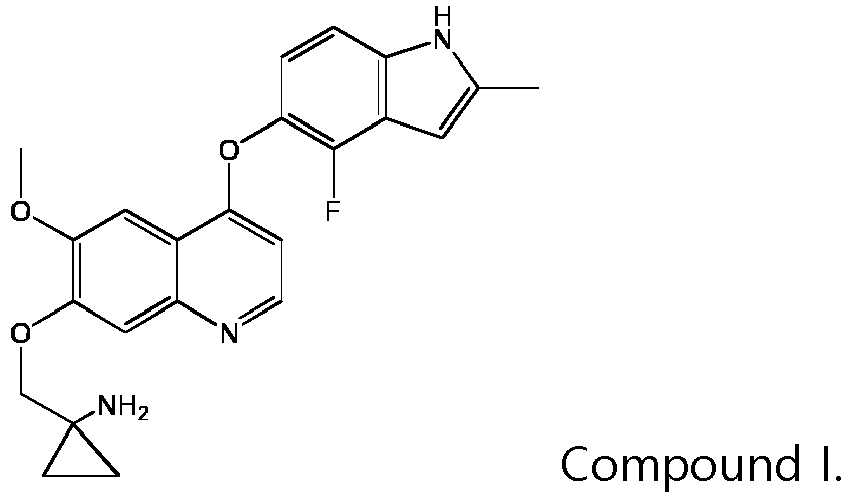
- Compound I 1-[[[4-(4-fluoro-2-methyl-1H-indol-5-yl)oxy-6-methoxyquinolin-7-yl]oxy]methyl]cyclopropylamine, and it has the following structural formula:
- the present invention provides a use of Compound I or a pharmaceutically acceptable salt thereof in manufacturing a pharmaceutical composition for treating oesophageal cancer.
- the present invention provides a pharmaceutical composition for treating oesophageal cancer, which comprises Compound I or a pharmaceutically acceptable salt thereof, and at least one pharmaceutically acceptable carrier.
- the present invention provides a kit, comprising (a) a pharmaceutical composition of at least one unit dose of Compound I or a pharmaceutically acceptable salt thereof, and (b) instructions for treatment of oesophageal cancer.
- said oesophageal cancer includes, but not limited to, esophageal squamous-cell carcinoma and esophageal adenocarcinoma.
- the present invention provides a method for treating oesophageal cancer, which comprises administering a therapeutically effective amount of Compound I or a pharmaceutically acceptable salt thereof to patients in need of treatment.
- Said oesophageal cancer includes, but not limited to, esophageal squamous-cell carcinoma and esophageal adenocarcinoma.
- a method for treating esophageal squamous-cell carcinoma comprising administering a therapeutically effective amount of Compound I or a pharmaceutically acceptable salt thereof to patients in need of treatment.
- a method for treating esophageal adenocarcinoma comprising administering a therapeutically effective amount of Compound I or a pharmaceutically acceptable salt thereof to patients in need of treatment.
- a method for treating advanced oesophageal cancer and/or metastatic oesophageal cancer comprising administering a therapeutically effective amount of Compound I or a pharmaceutically acceptable salt thereof to patients in need of treatment.
- a method for treating oesophageal cancer after failure of treatment with taxanes antitumor drugs, vinca alkaloids antitumor drugs, platinum complexes and/or pyrimidine antagonists comprises administering a therapeutically effective amount of Compound I or a pharmaceutically acceptable salt thereof to patients in need of treatment.
- taxanes antitumor drugs include, but not limited to, paclitaxel and docetaxel; vinca alkaloids antitumor drugs include, but not limited to, vinblastine, vincristine, vindesine and vinorelbine; platinum complexes include, but not limited to, miriplatin, cisplatin, carboplatin, nedaplatin and oxaliplatin; pyrimidine antagonists include, but not limited to, cytarabine, ancitabine, capecitabine, gemcitabine, fluorouracil, difuradin, doxifluridine, tegafur and carmofur.
- Compound I can be administered in the free base form thereof, and can also be administered in the form of salts, hydrates and prodrugs thereof (the prodrugs will be converted into the free base form of Compound I in the body).
- the pharmaceutically acceptable salts of Compound I are within the scope of the present invention, and the salts can be produced by different organic acids and inorganic acids in accordance with well-known processes in the art.
- Compound I is administered in the form of hydrochloride thereof. In some embodiments, Compound I is administered in the form of monohydrochloride thereof. In some embodiments, Compound I is administered in the form of dihydrochloride thereof. In some embodiments, Compound I is administered in the crystalline form of hydrochloride thereof. In a certain embodiment, Compound I is administered in the crystalline form of dihydrochloride thereof.
- Compound I or the pharmaceutically acceptable salts thereof can be administered via various routes, including but not limited to the one selected from the following routes: orally, parenterally, intraperitoneally, intravenously, intraarterially, transdermally, sublingually, intramuscularly, rectally, transbuccally, intranasally, via inhalation, vaginally, intraocularly, via local administration, subcutaneously, intraadiposally, intraarticularly, intraperitoneally and intrathecally. In a specific embodiment, the administration is performed orally.
- the administration amount of Compound I or the pharmaceutically acceptable salts thereof can be determined according to severity of diseases, response of diseases, any treatment-related toxicity, and age and health status of patients.
- the daily administration dosage of Compound I or the pharmaceutically acceptable salts thereof is 2 mg to 20 mg.
- the daily administration dosage of Compound I or the pharmaceutically acceptable salts thereof is 5 mg to 20 mg.
- the daily administration dosage of Compound I or the pharmaceutically acceptable salts thereof is 8 mg to 20 mg.
- the daily administration dosage of Compound I or the pharmaceutically acceptable salts thereof is 10 mg to 16 mg.
- the daily administration dosage of Compound I or the pharmaceutically acceptable salts thereof is 10 mg to 14 mg.
- the daily administration dosage of Compound I or the pharmaceutically acceptable salts thereof is 10 mg. In a specific embodiment, the daily administration dosage of Compound I or the pharmaceutically acceptable salts thereof is 12 mg. In a specific embodiment, the daily administration dosage of Compound I or the pharmaceutically acceptable salts thereof is 14 mg. In a specific embodiment, the daily administration dosage of Compound I or the pharmaceutically acceptable salts thereof is 16 mg.
- Compound I or the pharmaceutically acceptable salts thereof can be administered one or more times daily. In some embodiments, Compound I or the pharmaceutically acceptable salts thereof is administered once per day. In some embodiments, the administration is performed once per day in the form of oral solid formulation.
- Administration methods can be generally determined according to activity and toxicity of drugs, and tolerability of patients and the like.
- Compound I or the pharmaceutically acceptable salts thereof is administered in the manner of interval administration.
- the interval administration includes administration periods and rest periods, and during the administration periods, Compound I or the pharmaceutically acceptable salts thereof can be administered one or more times daily.
- Compound I or the pharmaceutically acceptable salts thereof is administered daily in an administration period, and then the administration is stopped for a period of time in a rest period, followed by an administration period and then a rest period, such an administration regimen can be repeated many times.
- the ratio of the administration period to the rest period in days is 2:0.5 ⁇ 5, preferably 2:0.5 ⁇ 3, more preferably 2:0.5 ⁇ 2, most preferably 2:0.5 ⁇ 1.
- the administration is continuously performed for 2 weeks and rest for 2 weeks. In some embodiments, the administration is continuously performed once daily for 14 days and rest for 14 days, followed by continuously administering once daily for 14 days and resting for 14 days, such an interval administration regimen with a two-week continuous administration period and a two-week rest period can be repeated many times.
- the administration is continuously performed for 2 weeks and rest for 1 week. In some embodiments, the administration is continuously performed once daily for 14 days and rest for 7 days, followed by continuously administering once daily for 14 days and resting for 7 days, such an interval administration regimen with a two-week continuous administration period and a one-week rest period can be repeated many times.
- the administration is continuously performed for 5 days and rest for 2 days. In some embodiments, the administration is continuously performed once daily for 5 days and rest for 2 days, followed by continuously administering once daily for 5 days and resting for 2 days, such an interval administration regimen with a five-day continuous administration period and a two-day rest period can be repeated many times.
- Compound I or the pharmaceutically acceptable salts thereof is separately administered to patients as the sole active ingredient.
- the present invention provides a use of Compound I or the pharmaceutically acceptable salts thereof in manufacturing a pharmaceutical composition for treating oesophageal cancer.
- Said oesophageal cancer includes, but not limited to, esophageal squamous-cell carcinoma and esophageal adenocarcinoma.
- a use of Compound I or the pharmaceutically acceptable salts thereof in manufacturing a pharmaceutical composition for treating esophageal squamous-cell carcinoma is provided.
- a use of Compound I or the pharmaceutically acceptable salts thereof in manufacturing a pharmaceutical composition for treating esophageal adenocarcinoma is provided.
- a use of Compound I or the pharmaceutically acceptable salts thereof in manufacturing a pharmaceutical composition for treating advanced oesophageal cancer and/or metastatic oesophageal cancer is provided.
- a use of Compound I or the pharmaceutically acceptable salts thereof in manufacturing a pharmaceutical composition for treating oesophageal cancer after failure of treatment with taxanes antitumor drugs, vinca alkaloids antitumor drugs, platinum complexes and/or pyrimidine antagonists is provided.
- taxanes antitumor drugs include, but not limited to, paclitaxel and docetaxel; vinca alkaloids antitumor drugs include, but not limited to, vinblastine, vincristine, vindesine and vinorelbine; platinum complexes include, but not limited to, miriplatin, cisplatin, carboplatin, nedaplatin and oxaliplatin; pyrimidine antagonists include, but not limited to, cytarabine, ancitabine, capecitabine, gemcitabine, fluorouracil, difuradin, doxifluridine, tegafur and carmofur.
- Compound I can be administered in the free base form thereof, and can also be administered in the form of salts, hydrates and prodrugs thereof (the prodrugs will be converted into the free base form of Compound I in the body).
- the pharmaceutically acceptable salts of Compound I are within the scope of the present invention, and the salts can be produced by different organic acids and inorganic acids in accordance with well-known processes in the art.
- Compound I or the pharmaceutically acceptable salts thereof is in the form of hydrochloride of Compound I. In some embodiments, Compound I or the pharmaceutically acceptable salts thereof is in the form of monohydrochloride of Compound I. In some embodiments, Compound I or the pharmaceutically acceptable salts thereof is in the form of dihydrochloride of Compound I. In some embodiments, Compound I or the pharmaceutically acceptable salts thereof is in the crystalline form of hydrochloride of Compound I. In a specific embodiment, Compound I or the pharmaceutically acceptable salts thereof is in the crystalline form of dihydrochloride of Compound I.
- the amount of Compound I or the pharmaceutically acceptable salts thereof can be determined according to severity of diseases, response of diseases, any treatment-related toxicity, and age and health status of patients.
- the daily administration dosage of Compound I or the pharmaceutically acceptable salts thereof is 2 mg to 20 mg.
- the daily administration dosage of Compound I or the pharmaceutically acceptable salts thereof is 5 mg to 20 mg.
- the dosage of Compound I or the pharmaceutically acceptable salts thereof is 8 mg to 20 mg.
- the dosage of Compound I or the pharmaceutically acceptable salts thereof is 10 mg to 16 mg.
- the dosage of Compound I or the pharmaceutically acceptable salts thereof is 10 mg to 14 mg.
- the dosage of Compound I or the pharmaceutically acceptable salts thereof is 10 mg. In a specific embodiment, the dosage of Compound I or the pharmaceutically acceptable salts thereof is 12 mg. In a specific embodiment, the dosage of Compound I or the pharmaceutically acceptable salts thereof is 14 mg. In a specific embodiment, the dosage of Compound I or the pharmaceutically acceptable salts thereof is 16 mg.
- the present invention provides a pharmaceutical composition for treating oesophageal cancer, which comprises Compound I or the pharmaceutically acceptable salts thereof, and at least one pharmaceutically acceptable carrier.
- Said oesophageal cancer includes, but not limited to, esophageal squamous-cell carcinoma and esophageal adenocarcinoma.
- a pharmaceutical composition for treating esophageal squamous-cell carcinoma which comprises Compound I or the pharmaceutically acceptable salts thereof, and at least one pharmaceutically acceptable carrier.
- a pharmaceutical composition for treating esophageal adenocarcinoma which comprises Compound I or the pharmaceutically acceptable salts thereof, and at least one pharmaceutically acceptable carrier.
- a pharmaceutical composition for treating advanced oesophageal cancer and/or metastatic oesophageal cancer which comprises Compound I or the pharmaceutically acceptable salts thereof, and at least one pharmaceutically acceptable carrier.
- a pharmaceutical composition for treating oesophageal cancer after failure of treatment with taxanes antitumor drugs, vinca alkaloids antitumor drugs, platinum complexes and/or pyrimidine antagonists which comprises Compound I or the pharmaceutically acceptable salts thereof, and at least one pharmaceutically acceptable carrier.
- taxanes antitumor drugs include, but not limited to, paclitaxel and docetaxel; vinca alkaloids antitumor drugs include, but not limited to, vinblastine, vincristine, vindesine and vinorelbine; platinum complexes include, but not limited to, miriplatin, cisplatin, carboplatin, nedaplatin and oxaliplatin; pyrimidine antagonists include, but not limited to, cytarabine, ancitabine, capecitabine, gemcitabine, fluorouracil, difuradin, doxifluridine, tegafur and carmofur.
- Compound I can be administered in the free base form thereof, and can also be administered in the form of salts, hydrates and prodrugs thereof (the prodrugs will be converted into the free base form of Compound I in the body).
- the pharmaceutically acceptable salts of Compound I are within the scope of the present invention, and the salts can be produced by different organic acids and inorganic acids in accordance with well-known processes in the art.
- Compound I or the pharmaceutically acceptable salts thereof is in the form of hydrochloride of Compound I. In some embodiments, Compound I or the pharmaceutically acceptable salts thereof is in the form of monohydrochloride of Compound I. In some embodiments, Compound I or the pharmaceutically acceptable salts thereof is in the form of dihydrochloride of Compound I. In some embodiments, Compound I or the pharmaceutically acceptable salts thereof is in the crystalline form of hydrochloride of Compound I. In a specific embodiment, Compound I or the pharmaceutically acceptable salts thereof is in the crystalline form of dihydrochloride of Compound I.
- the administration amount of Compound I or the pharmaceutically acceptable salts thereof can be determined according to severity of diseases, response of diseases, any treatment-related toxicity, and age and health status of patients.
- the daily administration dosage of Compound I or the pharmaceutically acceptable salts thereof is 2 mg to 20 mg.
- the daily administration dosage of Compound I or the pharmaceutically acceptable salts thereof is 5 mg to 20 mg.
- the amount of Compound I or the pharmaceutically acceptable salts thereof in the pharmaceutical composition is 8 mg to 20 mg.
- the amount of Compound I or the pharmaceutically acceptable salts thereof is 10 mg to 16 mg.
- the amount of Compound I or the pharmaceutically acceptable salts thereof is 10 mg to 14 mg.
- the amount of Compound I or the pharmaceutically acceptable salts thereof is 10 mg. In a specific embodiment, the amount of Compound I or the pharmaceutically acceptable salts thereof is 12 mg. In a specific embodiment, the amount of Compound I or the pharmaceutically acceptable salts thereof is 14 mg. In a specific embodiment, the amount of Compound I or the pharmaceutically acceptable salts thereof is 16 mg.
- the pharmaceutical compositions are the formulations suitable for oral administration, which include tablets, capsules, dusts, granulates, drip pills, pastes, powders and the like, and tablets and capsules are preferred.
- the tablets can be common tablets, dispersible tablets, effervescent tablets, sustained release tablets, controlled release tablets or enteric coated tablets
- the capsules can be common capsules, sustained release capsules, controlled release capsules or enteric coated capsules.
- the oral formulations can be prepared with well-known pharmaceutically acceptable carriers in the art by conventional methods.
- the pharmaceutically acceptable carriers include bulking agents, absorbing agents, wetting agents, binding agents, disintegrating agents, lubricants and the like.
- the bulking agents include starch, lactose, mannitol, microcrystalline cellulose or the like; the absorbing agents include calcium sulfate, calcium hydrogen phosphate, calcium carbonate or the like; the wetting agents include water, ethanol or the like; the binding agents include hydroxypropyl methylcellulose, povidone, microcrystalline cellulose or the like; the disintegrating agents include cross-linked carboxymethyl cellulose sodium, crospovidone, surfactants, low-substituted hydroxypropyl cellulose or the like; the lubricants include magnesium stearate, talc powder, polyethylene glycol, sodium dodecylsulfate, Aerosil, talc powder or the like.
- the pharmaceutical excipients also include colorants, sweetening agents and the like.
- the pharmaceutical composition is solid formulations suitable for oral administration.
- the composition can be in the form of tablets and capsules.
- the pharmaceutical composition is capsules.
- the pharmaceutically acceptable carriers of the oral solid formulations include mannitol, microcrystalline cellulose, hydroxypropyl cellulose, and magnesium stearate.
- a pharmaceutical composition for treating oesophageal cancer formulated as a unit dosage form is provided.
- the pharmaceutical composition in the unit dosage form contains 2 mg-20 mg of Compound I or the pharmaceutically acceptable salts thereof.
- the pharmaceutical composition in the unit dosage form contains 5 mg-20 mg of Compound I or the pharmaceutically acceptable salts thereof.
- the pharmaceutical composition in the unit dosage form contains 8 mg-20 mg of Compound I or the pharmaceutically acceptable salts thereof, preferably 10 mg-16 mg of Compound I or the pharmaceutically acceptable salts thereof, and more preferably 10 mg-14 mg of Compound I or the pharmaceutically acceptable salts thereof.
- the pharmaceutical composition in the unit dosage form contains 10 mg of Compound I or the pharmaceutically acceptable salts thereof. In a particular embodiment, the pharmaceutical composition in the unit dosage form contains 12 mg of Compound I or the pharmaceutically acceptable salts thereof. In a particular embodiment, the pharmaceutical composition in the unit dosage form contains 14 mg of Compound I or the pharmaceutically acceptable salts thereof. In a particular embodiment, the pharmaceutical composition in the unit dosage form contains 16 mg of Compound I or the pharmaceutically acceptable salts thereof.
- "a pharmaceutical composition in the unit dosage form" means each tablet or capsule.
- the pharmaceutical composition is administered in an interval administration regimen.
- the interval administration includes administration periods and rest periods, and during the administration periods, the pharmaceutical composition can be administered one or more times daily.
- the pharmaceutical composition is administered daily in an administration period, and then the administration is stopped for a period of time in a rest period, followed by an administration period and then a rest period, such an administration regimen can be repeated many times.
- the ratio of the administration period to the rest period in days is 2:0.5-5, preferably 2:0.5-3, more preferably 2:0.5-2, and most preferably 2:0.5-1.
- the administration is continuously performed for 2 weeks and rest for 2 weeks. In some embodiments, the administration is continuously performed once daily for 14 days and rest for 14 days, followed by continuously administering once daily for 14 days and resting for 14 days, such an interval administration regimen with a two-week continuous administration period and a two-week rest period can be repeated many times.
- the administration is continuously performed for 2 weeks and rest for 1 week. In some embodiments, the administration is continuously performed once daily for 14 days and rest for 7 days, followed by continuously administering once daily for 14 days and resting for 7 days, such an interval administration regimen with a two-week continuous administration period and a one-week rest period can be repeated many times.
- the administration is continuously performed for 5 days and rest for 2 days. In some embodiments, the administration is continuously performed once daily for 5 days and rest for 2 days, followed by continuously administering once daily for 5 days and resting for 2 days, such an interval administration regimen with a five-day continuous administration period and a two-day rest period can be repeated many times.
- the oesophageal cancer is advanced oesophageal cancer and/or metastatic oesophageal cancer.
- the present invention also provides a kit, comprising (a) at least one unit dose of the pharmaceutical composition as described in the third aspect of the present invention, and (b) instructions for treatment of oesophageal cancer.
- a kit is provided, which comprises (a) at least one unit dose of the preparation suitable for oral administration as described in the third aspect of the present invention, and (b) instructions for treatment of oesophageal cancer in the manner of interval administration.
- a kit is provided, which comprises (a) at least one unit dose of tablets or capsules as described in the third aspect of the present invention, and (b) instructions for treatment of oesophageal cancer in the manner of interval administration.
- said oesophageal cancer includes, but not limited to, esophageal squamous-cell carcinoma and esophageal adenocarcinoma.
- said oesophageal cancer is advanced oesophageal cancer and/or metastatic oesophageal cancer.
- said oesophageal cancer is the one after failure of treatment with taxanes antitumor drugs, vinca alkaloids antitumor drugs, platinum complexes and/or pyrimidine antagonists.
- taxanes antitumor drugs include, but not limited to, paclitaxel and docetaxel; vinca alkaloids antitumor drugs include, but not limited to, vinblastine, vincristine, vindesine and vinorelbine; platinum complexes include, but not limited to, miriplatin, cisplatin, carboplatin, nedaplatin and oxaliplatin; pyrimidine antagonists include, but not limited to, cytarabine, ancitabine, capecitabine, gemcitabine, fluorouracil, difuradin, doxifluridine, tegafur and carmofur.
- the pharmaceutical composition in the unit dosage form contains 2 mg-20 mg of Compound I or the pharmaceutically acceptable salts thereof. In some embodiments, the pharmaceutical composition in the unit dosage form contains 5 mg-20 mg of Compound I or the pharmaceutically acceptable salts thereof. In some embodiments, the pharmaceutical composition in the unit dosage form contains 8 mg-20 mg of Compound I or the pharmaceutically acceptable salts thereof, preferably 10 mg-16 mg of Compound I or the pharmaceutically acceptable salts thereof, and more preferably 10 mg-14 mg of Compound I or the pharmaceutically acceptable salts thereof. In a particular embodiment, the pharmaceutical composition in the unit dosage form contains 10 mg of Compound I or the pharmaceutically acceptable salts thereof.
- the pharmaceutical composition in the unit dosage form contains 12 mg of Compound I or the pharmaceutically acceptable salts thereof. In a particular embodiment, the pharmaceutical composition in the unit dosage form contains 14 mg of Compound I or the pharmaceutically acceptable salts thereof. In a particular embodiment, the pharmaceutical composition in the unit dosage form contains 16 mg of Compound I or the pharmaceutically acceptable salts thereof.
- a pharmaceutical composition in the unit dosage form means each tablet or capsule.
- qd refers to administration once daily.
- the crystalline form of the hydrochloride of Compound I includes, but not limited to, crystalline Forms A, B and C disclosed in the Chinese patent application publication No. CN102344438A , wherein crystalline Forms A and B are those which do not contain crystal water and other solvents basically, and crystalline Form C is the one containing two molecules of crystal water.
- the crystalline form of the dihydrochloride of Compound I is crystalline Form A.
- Patients refer to mammal, preferably human. In some embodiments, the patients are those having failed standard treatment or lacking standard treatment.
- “Pharmaceutically acceptable carrier” means those which are useful in preparing a pharmaceutical composition that is generally safe, non-toxic and neither biologically nor otherwise undesirable, and that is acceptable for human pharmaceutical use when the carriers are included.
- “Pharmaceutically acceptable salts” include, but not limited to acid addition salts formed from inorganic acids, such as hydrochloric acid, hydrobromic acid, sulfuric acid, nitric acid, phosphoric acid or the like; or acid addition salts formed from organic acids, such as acetic acid, trifluoroacetic acid, propionic acid, caproic acid, heptanoic acid, cyclopentane propionic acid, glycolic acid, pyruvic acid, lactic acid, malonic acid, succinic acid, malic acid, maleic acid, fumaric acid, tartaric acid, citric acid, benzoic acid, cinnamic acid, mandelic acid, methyl sulfonic acid, ethyl sulfonic acid, 1,2-ethanedisulfonic acid, 2-hydroxyethanesulphonic acid, benzenesulfonic acid, p-chlorobenzenesulfonic acid, p-toluenesulf
- “Therapeutically effective amount” means an amount of a compound that, when administered to human for treating a disease, is sufficient to effect such treatment for the disease.
- Treatment/treating means any administration of a therapeutically effective amount of a compound, and includes:
- PR is the abbreviation of "partial response”, which refers to partial remission.
- PD is the abbreviation of "progressive disease”, which refers to progression of disease.
- SD is the abbreviation of “stable disease”, which refers to stability of disease.
- “Failure of Treatment” refers to intolerance of toxic and side effects, disease progression in the course of treatment, or relapse after treatment; wherein the intolerance includes, but not limited to, grade IV of hematological toxicity (grade III or more thrombocytopenia), grade III of nonhematological toxicity, or more.
- Advanced includes “locally advanced”.
- Example 1 1-[[[4-(4-fluoro-2-methyl-1H-indol-5-yl)oxy-6-methoxyquinolin-7-yl]oxy]methyl]cyclopropylamine dihydrochloride (dihydrochloride of Compound I) 1-[[[4-(4-fluoro-2-methyl-1H-indol-5-yl)oxy-6-methoxyquinolin-7-yl]oxy]methyl]cyclopropylamine was prepared by reference to the method of Example 24 in WO2008112407 , and then the title compound was prepared by reference to the preparation method in "Examples of Salt Formation" of the Description of WO2008112407 .
- Example 2 Capsules comprising 1-[[[4-(4-fluoro-2-methyl-1H-indol-5-yl)oxy-6-methoxyquinolin-7-yl]oxy]methyl]cyclopropylamine dihydrochloride (dihydrochloride of Compound I)
- Raw material/excipient names amount 1000 capsules
- Dihydrochloride of Compound I 14.16 g(corresponding to 12 g
- Dihydrochloride of Compound I was grinded and sifted with a 80 mesh sieve, and then mixed uniformly with mannitol and hydroxypropyl cellulose; the prescribed amount of microcrystalline cellulose was subsequently added, mixed uniformly and sifted with a
- the chemotherapy regimen of paclitaxel liposome + nedaplatin + fluorouracil was performed for 6 cycles, evaluated as PR (partial remission). From September 2012 to November 2012, Tegafur/Gimeracil/Oteracil was orally administered for treatment, and the progression of the disease was found in November 2012. From November 30, 2012 to February 28, 2013, the chemotherapy regimen of gemcitabine + Calcium Levofolinate/fluorouracil was performed for 2 cycles, and then the chemotherapy regimen of vinorelbine + capecitabine was performed for 2 cycles, evaluated as PD (disease progression). From March 19, 2013 to April 19, 2013, Chinese medicine yijinsheng was used, and evaluated as PD (disease progression).
- Imageological evaluation was conducted at the end of the second cycle of administration of the capsules of dihydrochloride of Compound I: the sum of the diameter of the targeted lesions was 78 mm;
- Imageological evaluation was conducted at the end of the sixth cycle of administration of the capsules of dihydrochloride of Compound I: the sum of the diameter of the targeted lesions was 75 mm.
- the overall tolerance was good. Only I° hypercholesterolemia, I° pharyngeal pain, I° loss of appetite, I° proteinuria, I° loss of appetite, I° hand-foot skin reaction, and I° thyrotropin increase occurred occasionally.
Landscapes
- Health & Medical Sciences (AREA)
- Chemical & Material Sciences (AREA)
- General Health & Medical Sciences (AREA)
- Medicinal Chemistry (AREA)
- Pharmacology & Pharmacy (AREA)
- Life Sciences & Earth Sciences (AREA)
- Animal Behavior & Ethology (AREA)
- Public Health (AREA)
- Veterinary Medicine (AREA)
- Epidemiology (AREA)
- Organic Chemistry (AREA)
- Chemical Kinetics & Catalysis (AREA)
- General Chemical & Material Sciences (AREA)
- Nuclear Medicine, Radiotherapy & Molecular Imaging (AREA)
- Nutrition Science (AREA)
- Physiology (AREA)
- Pharmaceuticals Containing Other Organic And Inorganic Compounds (AREA)
- Plural Heterocyclic Compounds (AREA)
- Medicinal Preparation (AREA)
Abstract
Description
- The present invention relates to a use of quinoline derivatives for treating oesophageal cancer, and a treatment method, a pharmaceutical composition and a kit thereof, which belongs to the technical field of medicine.
- Oesophageal cancer refers to malignant lesions formed by abnormal hyperplasia of squamous epithelium or glandular epithelium of the esophagus, and its development usually goes through the stages of epithelioid atypical hyperplasia, carcinoma in situ, infiltrating carcinoma, etc. Among them, about 90% of oesophageal cancer is squamous-cell carcinoma, and about 10% is adenocarcinoma. Oesophageal cancer involves changes of many oncogenes, tumor suppressor genes and proteins at the molecular level.
- Oesophageal cancer accounts for about 2% of malignant tumors, and around the world, there are about 220 thousand oesophageal cancer patients each year. China is the high-incidence area of oesophageal cancer, and is also one of the countries with the highest mortality rate of oesophageal cancer. After diagnosed as oesophageal cancer, surgery, radiotherapy, chemotherapy and the like are often required. The treatment process will cause different levels of pain and agony to patients. Moreover, patients with distant metastases are generally unsuitable for surgery, and only palliative treatment or chemotherapy is available. Therefore, developing a drug that can effectively treat oesophageal cancer is deeply necessary.
- In the first aspect, the present invention provides a method for treating oesophageal cancer, which comprises administering a therapeutically effective amount of Compound I or a pharmaceutically acceptable salt thereof to patients in need of treatment.
- The chemical name of Compound I is 1-[[[4-(4-fluoro-2-methyl-1H-indol-5-yl)oxy-6-methoxyquinolin-7-yl]oxy]methyl]cyclopropylamine, and it has the following structural formula:
- In the second aspect, the present invention provides a use of Compound I or a pharmaceutically acceptable salt thereof in manufacturing a pharmaceutical composition for treating oesophageal cancer.
- In the third aspect, the present invention provides a pharmaceutical composition for treating oesophageal cancer, which comprises Compound I or a pharmaceutically acceptable salt thereof, and at least one pharmaceutically acceptable carrier.
- In the fourth aspect, the present invention provides a kit, comprising (a) a pharmaceutical composition of at least one unit dose of Compound I or a pharmaceutically acceptable salt thereof, and (b) instructions for treatment of oesophageal cancer.
- In the present invention, said oesophageal cancer includes, but not limited to, esophageal squamous-cell carcinoma and esophageal adenocarcinoma.
- In the first aspect, the present invention provides a method for treating oesophageal cancer, which comprises administering a therapeutically effective amount of Compound I or a pharmaceutically acceptable salt thereof to patients in need of treatment. Said oesophageal cancer includes, but not limited to, esophageal squamous-cell carcinoma and esophageal adenocarcinoma.
- In some embodiments of the present invention, a method for treating esophageal squamous-cell carcinoma is provided, comprising administering a therapeutically effective amount of Compound I or a pharmaceutically acceptable salt thereof to patients in need of treatment.
- In some embodiments of the present invention, a method for treating esophageal adenocarcinoma is provided, comprising administering a therapeutically effective amount of Compound I or a pharmaceutically acceptable salt thereof to patients in need of treatment.
- In some embodiments of the present invention, a method for treating advanced oesophageal cancer and/or metastatic oesophageal cancer is provided, comprising administering a therapeutically effective amount of Compound I or a pharmaceutically acceptable salt thereof to patients in need of treatment.
- In some embodiments of the present invention, a method for treating oesophageal cancer after failure of treatment with taxanes antitumor drugs, vinca alkaloids antitumor drugs, platinum complexes and/or pyrimidine antagonists is provided, which comprises administering a therapeutically effective amount of Compound I or a pharmaceutically acceptable salt thereof to patients in need of treatment.
- In some embodiments of the present invention, taxanes antitumor drugs include, but not limited to, paclitaxel and docetaxel; vinca alkaloids antitumor drugs include, but not limited to, vinblastine, vincristine, vindesine and vinorelbine; platinum complexes include, but not limited to, miriplatin, cisplatin, carboplatin, nedaplatin and oxaliplatin; pyrimidine antagonists include, but not limited to, cytarabine, ancitabine, capecitabine, gemcitabine, fluorouracil, difuradin, doxifluridine, tegafur and carmofur.
- Compound I can be administered in the free base form thereof, and can also be administered in the form of salts, hydrates and prodrugs thereof (the prodrugs will be converted into the free base form of Compound I in the body). For example, the pharmaceutically acceptable salts of Compound I are within the scope of the present invention, and the salts can be produced by different organic acids and inorganic acids in accordance with well-known processes in the art.
- In some embodiments, Compound I is administered in the form of hydrochloride thereof. In some embodiments, Compound I is administered in the form of monohydrochloride thereof. In some embodiments, Compound I is administered in the form of dihydrochloride thereof. In some embodiments, Compound I is administered in the crystalline form of hydrochloride thereof. In a certain embodiment, Compound I is administered in the crystalline form of dihydrochloride thereof.
- Compound I or the pharmaceutically acceptable salts thereof can be administered via various routes, including but not limited to the one selected from the following routes: orally, parenterally, intraperitoneally, intravenously, intraarterially, transdermally, sublingually, intramuscularly, rectally, transbuccally, intranasally, via inhalation, vaginally, intraocularly, via local administration, subcutaneously, intraadiposally, intraarticularly, intraperitoneally and intrathecally. In a specific embodiment, the administration is performed orally.
- The administration amount of Compound I or the pharmaceutically acceptable salts thereof can be determined according to severity of diseases, response of diseases, any treatment-related toxicity, and age and health status of patients. In some embodiments, the daily administration dosage of Compound I or the pharmaceutically acceptable salts thereof is 2 mg to 20 mg. In some embodiments, the daily administration dosage of Compound I or the pharmaceutically acceptable salts thereof is 5 mg to 20 mg. In some embodiments, the daily administration dosage of Compound I or the pharmaceutically acceptable salts thereof is 8 mg to 20 mg. In some embodiments, the daily administration dosage of Compound I or the pharmaceutically acceptable salts thereof is 10 mg to 16 mg. In some embodiments, the daily administration dosage of Compound I or the pharmaceutically acceptable salts thereof is 10 mg to 14 mg. In a specific embodiment, the daily administration dosage of Compound I or the pharmaceutically acceptable salts thereof is 10 mg. In a specific embodiment, the daily administration dosage of Compound I or the pharmaceutically acceptable salts thereof is 12 mg. In a specific embodiment, the daily administration dosage of Compound I or the pharmaceutically acceptable salts thereof is 14 mg. In a specific embodiment, the daily administration dosage of Compound I or the pharmaceutically acceptable salts thereof is 16 mg.
- Compound I or the pharmaceutically acceptable salts thereof can be administered one or more times daily. In some embodiments, Compound I or the pharmaceutically acceptable salts thereof is administered once per day. In some embodiments, the administration is performed once per day in the form of oral solid formulation.
- Administration methods can be generally determined according to activity and toxicity of drugs, and tolerability of patients and the like. Preferably, Compound I or the pharmaceutically acceptable salts thereof is administered in the manner of interval administration. The interval administration includes administration periods and rest periods, and during the administration periods, Compound I or the pharmaceutically acceptable salts thereof can be administered one or more times daily. For example, Compound I or the pharmaceutically acceptable salts thereof is administered daily in an administration period, and then the administration is stopped for a period of time in a rest period, followed by an administration period and then a rest period, such an administration regimen can be repeated many times. Among them, the ratio of the administration period to the rest period in days is 2:0.5∼5, preferably 2:0.5∼3, more preferably 2:0.5∼2, most preferably 2:0.5∼1.
- In some embodiments, the administration is continuously performed for 2 weeks and rest for 2 weeks. In some embodiments, the administration is continuously performed once daily for 14 days and rest for 14 days, followed by continuously administering once daily for 14 days and resting for 14 days, such an interval administration regimen with a two-week continuous administration period and a two-week rest period can be repeated many times.
- In some embodiments, the administration is continuously performed for 2 weeks and rest for 1 week. In some embodiments, the administration is continuously performed once daily for 14 days and rest for 7 days, followed by continuously administering once daily for 14 days and resting for 7 days, such an interval administration regimen with a two-week continuous administration period and a one-week rest period can be repeated many times.
- In some embodiments, the administration is continuously performed for 5 days and rest for 2 days. In some embodiments, the administration is continuously performed once daily for 5 days and rest for 2 days, followed by continuously administering once daily for 5 days and resting for 2 days, such an interval administration regimen with a five-day continuous administration period and a two-day rest period can be repeated many times.
- In some embodiments, Compound I or the pharmaceutically acceptable salts thereof is separately administered to patients as the sole active ingredient.
- In the second aspect, the present invention provides a use of Compound I or the pharmaceutically acceptable salts thereof in manufacturing a pharmaceutical composition for treating oesophageal cancer. Said oesophageal cancer includes, but not limited to, esophageal squamous-cell carcinoma and esophageal adenocarcinoma.
- In some embodiments of the present invention, a use of Compound I or the pharmaceutically acceptable salts thereof in manufacturing a pharmaceutical composition for treating esophageal squamous-cell carcinoma is provided.
- In some embodiments of the present invention, a use of Compound I or the pharmaceutically acceptable salts thereof in manufacturing a pharmaceutical composition for treating esophageal adenocarcinoma is provided.
- In some embodiments of the present invention, a use of Compound I or the pharmaceutically acceptable salts thereof in manufacturing a pharmaceutical composition for treating advanced oesophageal cancer and/or metastatic oesophageal cancer is provided.
- In some embodiments of the present invention, a use of Compound I or the pharmaceutically acceptable salts thereof in manufacturing a pharmaceutical composition for treating oesophageal cancer after failure of treatment with taxanes antitumor drugs, vinca alkaloids antitumor drugs, platinum complexes and/or pyrimidine antagonists is provided.
- In some embodiments of the present invention, taxanes antitumor drugs include, but not limited to, paclitaxel and docetaxel; vinca alkaloids antitumor drugs include, but not limited to, vinblastine, vincristine, vindesine and vinorelbine; platinum complexes include, but not limited to, miriplatin, cisplatin, carboplatin, nedaplatin and oxaliplatin; pyrimidine antagonists include, but not limited to, cytarabine, ancitabine, capecitabine, gemcitabine, fluorouracil, difuradin, doxifluridine, tegafur and carmofur.
- Compound I can be administered in the free base form thereof, and can also be administered in the form of salts, hydrates and prodrugs thereof (the prodrugs will be converted into the free base form of Compound I in the body). For example, the pharmaceutically acceptable salts of Compound I are within the scope of the present invention, and the salts can be produced by different organic acids and inorganic acids in accordance with well-known processes in the art.
- In some embodiments, Compound I or the pharmaceutically acceptable salts thereof is in the form of hydrochloride of Compound I. In some embodiments, Compound I or the pharmaceutically acceptable salts thereof is in the form of monohydrochloride of Compound I. In some embodiments, Compound I or the pharmaceutically acceptable salts thereof is in the form of dihydrochloride of Compound I. In some embodiments, Compound I or the pharmaceutically acceptable salts thereof is in the crystalline form of hydrochloride of Compound I. In a specific embodiment, Compound I or the pharmaceutically acceptable salts thereof is in the crystalline form of dihydrochloride of Compound I.
- The amount of Compound I or the pharmaceutically acceptable salts thereof can be determined according to severity of diseases, response of diseases, any treatment-related toxicity, and age and health status of patients. In some embodiments, the daily administration dosage of Compound I or the pharmaceutically acceptable salts thereof is 2 mg to 20 mg. In some embodiments, the daily administration dosage of Compound I or the pharmaceutically acceptable salts thereof is 5 mg to 20 mg. In some embodiments, the dosage of Compound I or the pharmaceutically acceptable salts thereof is 8 mg to 20 mg. In some embodiments, the dosage of Compound I or the pharmaceutically acceptable salts thereof is 10 mg to 16 mg. In some embodiments, the dosage of Compound I or the pharmaceutically acceptable salts thereof is 10 mg to 14 mg. In a specific embodiment, the dosage of Compound I or the pharmaceutically acceptable salts thereof is 10 mg. In a specific embodiment, the dosage of Compound I or the pharmaceutically acceptable salts thereof is 12 mg. In a specific embodiment, the dosage of Compound I or the pharmaceutically acceptable salts thereof is 14 mg. In a specific embodiment, the dosage of Compound I or the pharmaceutically acceptable salts thereof is 16 mg.
- In the third aspect, the present invention provides a pharmaceutical composition for treating oesophageal cancer, which comprises Compound I or the pharmaceutically acceptable salts thereof, and at least one pharmaceutically acceptable carrier. Said oesophageal cancer includes, but not limited to, esophageal squamous-cell carcinoma and esophageal adenocarcinoma.
- In some embodiments of the present invention, a pharmaceutical composition for treating esophageal squamous-cell carcinoma is provided, which comprises Compound I or the pharmaceutically acceptable salts thereof, and at least one pharmaceutically acceptable carrier.
- In some embodiments of the present invention, a pharmaceutical composition for treating esophageal adenocarcinoma is provided, which comprises Compound I or the pharmaceutically acceptable salts thereof, and at least one pharmaceutically acceptable carrier.
- In some embodiments of the present invention, a pharmaceutical composition for treating advanced oesophageal cancer and/or metastatic oesophageal cancer is provided, which comprises Compound I or the pharmaceutically acceptable salts thereof, and at least one pharmaceutically acceptable carrier.
- In some embodiments of the present invention, a pharmaceutical composition for treating oesophageal cancer after failure of treatment with taxanes antitumor drugs, vinca alkaloids antitumor drugs, platinum complexes and/or pyrimidine antagonists is provided, which comprises Compound I or the pharmaceutically acceptable salts thereof, and at least one pharmaceutically acceptable carrier.
- In some embodiments of the present invention, taxanes antitumor drugs include, but not limited to, paclitaxel and docetaxel; vinca alkaloids antitumor drugs include, but not limited to, vinblastine, vincristine, vindesine and vinorelbine; platinum complexes include, but not limited to, miriplatin, cisplatin, carboplatin, nedaplatin and oxaliplatin; pyrimidine antagonists include, but not limited to, cytarabine, ancitabine, capecitabine, gemcitabine, fluorouracil, difuradin, doxifluridine, tegafur and carmofur.
- Compound I can be administered in the free base form thereof, and can also be administered in the form of salts, hydrates and prodrugs thereof (the prodrugs will be converted into the free base form of Compound I in the body). For example, the pharmaceutically acceptable salts of Compound I are within the scope of the present invention, and the salts can be produced by different organic acids and inorganic acids in accordance with well-known processes in the art.
- In some embodiments, Compound I or the pharmaceutically acceptable salts thereof is in the form of hydrochloride of Compound I. In some embodiments, Compound I or the pharmaceutically acceptable salts thereof is in the form of monohydrochloride of Compound I. In some embodiments, Compound I or the pharmaceutically acceptable salts thereof is in the form of dihydrochloride of Compound I. In some embodiments, Compound I or the pharmaceutically acceptable salts thereof is in the crystalline form of hydrochloride of Compound I. In a specific embodiment, Compound I or the pharmaceutically acceptable salts thereof is in the crystalline form of dihydrochloride of Compound I.
- The administration amount of Compound I or the pharmaceutically acceptable salts thereof can be determined according to severity of diseases, response of diseases, any treatment-related toxicity, and age and health status of patients. In some embodiments, the daily administration dosage of Compound I or the pharmaceutically acceptable salts thereof is 2 mg to 20 mg. In some embodiments, the daily administration dosage of Compound I or the pharmaceutically acceptable salts thereof is 5 mg to 20 mg. In some embodiments, the amount of Compound I or the pharmaceutically acceptable salts thereof in the pharmaceutical composition is 8 mg to 20 mg. In some embodiments, the amount of Compound I or the pharmaceutically acceptable salts thereof is 10 mg to 16 mg. In some embodiments, the amount of Compound I or the pharmaceutically acceptable salts thereof is 10 mg to 14 mg. In a specific embodiment, the amount of Compound I or the pharmaceutically acceptable salts thereof is 10 mg. In a specific embodiment, the amount of Compound I or the pharmaceutically acceptable salts thereof is 12 mg. In a specific embodiment, the amount of Compound I or the pharmaceutically acceptable salts thereof is 14 mg. In a specific embodiment, the amount of Compound I or the pharmaceutically acceptable salts thereof is 16 mg.
- In some embodiments of the present invention, the pharmaceutical compositions are the formulations suitable for oral administration, which include tablets, capsules, dusts, granulates, drip pills, pastes, powders and the like, and tablets and capsules are preferred. Among them, the tablets can be common tablets, dispersible tablets, effervescent tablets, sustained release tablets, controlled release tablets or enteric coated tablets, and the capsules can be common capsules, sustained release capsules, controlled release capsules or enteric coated capsules. The oral formulations can be prepared with well-known pharmaceutically acceptable carriers in the art by conventional methods. The pharmaceutically acceptable carriers include bulking agents, absorbing agents, wetting agents, binding agents, disintegrating agents, lubricants and the like. The bulking agents include starch, lactose, mannitol, microcrystalline cellulose or the like; the absorbing agents include calcium sulfate, calcium hydrogen phosphate, calcium carbonate or the like; the wetting agents include water, ethanol or the like; the binding agents include hydroxypropyl methylcellulose, povidone, microcrystalline cellulose or the like; the disintegrating agents include cross-linked carboxymethyl cellulose sodium, crospovidone, surfactants, low-substituted hydroxypropyl cellulose or the like; the lubricants include magnesium stearate, talc powder, polyethylene glycol, sodium dodecylsulfate, Aerosil, talc powder or the like. The pharmaceutical excipients also include colorants, sweetening agents and the like.
- In one embodiment, the pharmaceutical composition is solid formulations suitable for oral administration. For example, the composition can be in the form of tablets and capsules. In a particular embodiment, the pharmaceutical composition is capsules. In a particular embodiment of the present invention, the pharmaceutically acceptable carriers of the oral solid formulations include mannitol, microcrystalline cellulose, hydroxypropyl cellulose, and magnesium stearate.
- In some embodiments, a pharmaceutical composition for treating oesophageal cancer formulated as a unit dosage form is provided. In some embodiments, the pharmaceutical composition in the unit dosage form contains 2 mg-20 mg of Compound I or the pharmaceutically acceptable salts thereof. In some embodiments, the pharmaceutical composition in the unit dosage form contains 5 mg-20 mg of Compound I or the pharmaceutically acceptable salts thereof. In some embodiments, the pharmaceutical composition in the unit dosage form contains 8 mg-20 mg of Compound I or the pharmaceutically acceptable salts thereof, preferably 10 mg-16 mg of Compound I or the pharmaceutically acceptable salts thereof, and more preferably 10 mg-14 mg of Compound I or the pharmaceutically acceptable salts thereof. In a particular embodiment, the pharmaceutical composition in the unit dosage form contains 10 mg of Compound I or the pharmaceutically acceptable salts thereof. In a particular embodiment, the pharmaceutical composition in the unit dosage form contains 12 mg of Compound I or the pharmaceutically acceptable salts thereof. In a particular embodiment, the pharmaceutical composition in the unit dosage form contains 14 mg of Compound I or the pharmaceutically acceptable salts thereof. In a particular embodiment, the pharmaceutical composition in the unit dosage form contains 16 mg of Compound I or the pharmaceutically acceptable salts thereof. For example, for tablets or capsules, "a pharmaceutical composition in the unit dosage form" means each tablet or capsule.
- Preferably, the pharmaceutical composition is administered in an interval administration regimen. The interval administration includes administration periods and rest periods, and during the administration periods, the pharmaceutical composition can be administered one or more times daily. For example, the pharmaceutical composition is administered daily in an administration period, and then the administration is stopped for a period of time in a rest period, followed by an administration period and then a rest period, such an administration regimen can be repeated many times. Among them, the ratio of the administration period to the rest period in days is 2:0.5-5, preferably 2:0.5-3, more preferably 2:0.5-2, and most preferably 2:0.5-1.
- In some embodiments, the administration is continuously performed for 2 weeks and rest for 2 weeks. In some embodiments, the administration is continuously performed once daily for 14 days and rest for 14 days, followed by continuously administering once daily for 14 days and resting for 14 days, such an interval administration regimen with a two-week continuous administration period and a two-week rest period can be repeated many times.
- In some embodiments, the administration is continuously performed for 2 weeks and rest for 1 week. In some embodiments, the administration is continuously performed once daily for 14 days and rest for 7 days, followed by continuously administering once daily for 14 days and resting for 7 days, such an interval administration regimen with a two-week continuous administration period and a one-week rest period can be repeated many times.
- In some embodiments, the administration is continuously performed for 5 days and rest for 2 days. In some embodiments, the administration is continuously performed once daily for 5 days and rest for 2 days, followed by continuously administering once daily for 5 days and resting for 2 days, such an interval administration regimen with a five-day continuous administration period and a two-day rest period can be repeated many times. In some embodiments of the present invention, the oesophageal cancer is advanced oesophageal cancer and/or metastatic oesophageal cancer.
- In the fourth aspect, the present invention also provides a kit, comprising (a) at least one unit dose of the pharmaceutical composition as described in the third aspect of the present invention, and (b) instructions for treatment of oesophageal cancer. In some embodiment, a kit is provided, which comprises (a) at least one unit dose of the preparation suitable for oral administration as described in the third aspect of the present invention, and (b) instructions for treatment of oesophageal cancer in the manner of interval administration. In a particular embodiment, a kit is provided, which comprises (a) at least one unit dose of tablets or capsules as described in the third aspect of the present invention, and (b) instructions for treatment of oesophageal cancer in the manner of interval administration.
- In some embodiments, said oesophageal cancer includes, but not limited to, esophageal squamous-cell carcinoma and esophageal adenocarcinoma.
- In some embodiments, said oesophageal cancer is advanced oesophageal cancer and/or metastatic oesophageal cancer.
- In some embodiments, said oesophageal cancer is the one after failure of treatment with taxanes antitumor drugs, vinca alkaloids antitumor drugs, platinum complexes and/or pyrimidine antagonists.
- In some embodiments of the present invention, taxanes antitumor drugs include, but not limited to, paclitaxel and docetaxel; vinca alkaloids antitumor drugs include, but not limited to, vinblastine, vincristine, vindesine and vinorelbine; platinum complexes include, but not limited to, miriplatin, cisplatin, carboplatin, nedaplatin and oxaliplatin; pyrimidine antagonists include, but not limited to, cytarabine, ancitabine, capecitabine, gemcitabine, fluorouracil, difuradin, doxifluridine, tegafur and carmofur.
- In some embodiments, the pharmaceutical composition in the unit dosage form contains 2 mg-20 mg of Compound I or the pharmaceutically acceptable salts thereof. In some embodiments, the pharmaceutical composition in the unit dosage form contains 5 mg-20 mg of Compound I or the pharmaceutically acceptable salts thereof. In some embodiments, the pharmaceutical composition in the unit dosage form contains 8 mg-20 mg of Compound I or the pharmaceutically acceptable salts thereof, preferably 10 mg-16 mg of Compound I or the pharmaceutically acceptable salts thereof, and more preferably 10 mg-14 mg of Compound I or the pharmaceutically acceptable salts thereof. In a particular embodiment, the pharmaceutical composition in the unit dosage form contains 10 mg of Compound I or the pharmaceutically acceptable salts thereof. In a particular embodiment, the pharmaceutical composition in the unit dosage form contains 12 mg of Compound I or the pharmaceutically acceptable salts thereof. In a particular embodiment, the pharmaceutical composition in the unit dosage form contains 14 mg of Compound I or the pharmaceutically acceptable salts thereof. In a particular embodiment, the pharmaceutical composition in the unit dosage form contains 16 mg of Compound I or the pharmaceutically acceptable salts thereof. For example, for tablets or capsules, "a pharmaceutical composition in the unit dosage form" means each tablet or capsule. Herein, unless indicated otherwise, the dosages and ranges provided therein are based on the molecular weight of the free base form of Compound I.
- Herein, unless indicated otherwise, qd refers to administration once daily.
- Herein, the crystalline form of the hydrochloride of Compound I includes, but not limited to, crystalline Forms A, B and C disclosed in the Chinese patent application publication No.
CN102344438A , wherein crystalline Forms A and B are those which do not contain crystal water and other solvents basically, and crystalline Form C is the one containing two molecules of crystal water. In some embodiments, the crystalline form of the dihydrochloride of Compound I is crystalline Form A. - Unless indicated otherwise, for the purpose of the present application, the following terms used in the Description and Claims are intended to have the meanings denoted below.
- "Patients" refer to mammal, preferably human. In some embodiments, the patients are those having failed standard treatment or lacking standard treatment.
- "Pharmaceutically acceptable carrier" means those which are useful in preparing a pharmaceutical composition that is generally safe, non-toxic and neither biologically nor otherwise undesirable, and that is acceptable for human pharmaceutical use when the carriers are included.
- "Pharmaceutically acceptable salts" include, but not limited to acid addition salts formed from inorganic acids, such as hydrochloric acid, hydrobromic acid, sulfuric acid, nitric acid, phosphoric acid or the like; or acid addition salts formed from organic acids, such as acetic acid, trifluoroacetic acid, propionic acid, caproic acid, heptanoic acid, cyclopentane propionic acid, glycolic acid, pyruvic acid, lactic acid, malonic acid, succinic acid, malic acid, maleic acid, fumaric acid, tartaric acid, citric acid, benzoic acid, cinnamic acid, mandelic acid, methyl sulfonic acid, ethyl sulfonic acid, 1,2-ethanedisulfonic acid, 2-hydroxyethanesulphonic acid, benzenesulfonic acid, p-chlorobenzenesulfonic acid, p-toluenesulfonic acid, 3-phenylpropionic acid, trimethylacetic acid, t-butylacetic acid, dodecyl sulfuric acid, gluconic acid, glutamic acid, hydroxynaphthoic acid, salicylic acid, stearic acid and the like.
- "Therapeutically effective amount" means an amount of a compound that, when administered to human for treating a disease, is sufficient to effect such treatment for the disease.
- "Treatment/treating" means any administration of a therapeutically effective amount of a compound, and includes:
- (1) Inhibiting the disease in a person that is experiencing or displaying the pathology or symptomatology of the disease (i.e., retarding further development of the pathology and/or symptomatology), or
- (2) Ameliorating the disease in a person that is experiencing or displaying the pathology or symptomatology of the disease (i.e., reversing the pathology and/or symptomatology).
- "PR" is the abbreviation of "partial response", which refers to partial remission.
- "PD" is the abbreviation of "progressive disease", which refers to progression of disease.
- "SD" is the abbreviation of "stable disease", which refers to stability of disease.
- "Failure of Treatment" refers to intolerance of toxic and side effects, disease progression in the course of treatment, or relapse after treatment; wherein the intolerance includes, but not limited to, grade IV of hematological toxicity (grade III or more thrombocytopenia), grade III of nonhematological toxicity, or more.
- "Advanced" includes "locally advanced".
-
Example 1 1-[[[4-(4-fluoro-2-methyl-1H-indol-5-yl)oxy-6-methoxyquinolin-7-yl]oxy]methyl]cyclopropylamine dihydrochloride (dihydrochloride of Compound I)
WO2008112407 , and then the title compound was prepared by reference to the preparation method in "Examples of Salt Formation" of the Description ofWO2008112407 . Alternatively, the title compound was prepared by reference to the method disclosed in the Chinese patent application publication No.CN102344438A .
Example 2 Capsules comprising 1-[[[4-(4-fluoro-2-methyl-1H-indol-5-yl)oxy-6-methoxyquinolin-7-yl]oxy]methyl]cyclopropylamine dihydrochloride (dihydrochloride of Compound I)Raw material/excipient names amount (1000 capsules) Dihydrochloride of Compound I 14.16 g(corresponding to 12 g Compound I) Mannitol 89 g Microcrystalline cellulose 138.4 g Hydroxypropyl cellulose 5.9 g Magnesium stearate 0.99 g
Example 3 Efficacy on oesophageal cancer - A 47-year-old woman occurred dysphagia in March 2012; gastroscope results showed a semi-circle cauliflower-like mass in the esophagus at 28-31 cm from the incisors; pathology showed poorly differentiated carcinoma, squamous-cell carcinoma. In April 19, 2012, CT results showed multiple nodules and masses in both lungs, wherein the larger one was about 2.9 x 2.1 cm; and multiple lymph nodes in the left clavicle and adjacent the esophagus, wherein the larger one was located on the left clavicle, about 3.3 x 3.2 cm. From April 28, 2012 to September 2012, the chemotherapy regimen of paclitaxel liposome + nedaplatin + fluorouracil was performed for 6 cycles, evaluated as PR (partial remission). From September 2012 to November 2012, Tegafur/Gimeracil/Oteracil was orally administered for treatment, and the progression of the disease was found in November 2012. From November 30, 2012 to February 28, 2013, the chemotherapy regimen of gemcitabine + Calcium Levofolinate/fluorouracil was performed for 2 cycles, and then the chemotherapy regimen of vinorelbine + capecitabine was performed for 2 cycles, evaluated as PD (disease progression). From March 19, 2013 to April 19, 2013, Chinese medicine yijinsheng was used, and evaluated as PD (disease progression). From May 6, 2013 to June 15, 2013, chest radiotherapy DT60G was performed without evaluation, and from July 19, 2013 to February 2014, the chemotherapy regimen of docetaxel + nedaplatin/oxaliplatin was performed for 8 cycles, evaluated as PD (disease progression).
- From March 21, 2014, the capsules of dihydrochloride of Compound I were administered orally qd at 12 mg for treatment, and the administration was continuously performed for 2 weeks and rest for 1 week.
- Imageological evaluation was conducted before administration of the capsules of dihydrochloride of Compound I: the sum of the diameter of the targeted lesions was 82 mm;
- Imageological evaluation was conducted at the end of the second cycle of administration of the capsules of dihydrochloride of Compound I: the sum of the diameter of the targeted lesions was 78 mm;
- Imageological evaluation was conducted at the end of the sixth cycle of administration of the capsules of dihydrochloride of Compound I: the sum of the diameter of the targeted lesions was 75 mm.
- The overall tolerance was good. Only I° hypercholesterolemia, I° pharyngeal pain, I° loss of appetite, I° proteinuria, I° loss of appetite, I° hand-foot skin reaction, and I° thyrotropin increase occurred occasionally.
- The preferred embodiments of the invention are described in detail, but the invention is not limited to specific details in the above embodiments, and within the scope of the technical conception of the invention, a variety of simple variations of the technical solution can be carried out, all of which fall within the scope of the present invention.
- It is also to be noted that the specific technical features described in the above specific embodiments can be combined in any appropriate manner without contradiction, and in order to avoid unnecessary repetition, it will not be explained separately for various possible combinations in the present invention.
- In addition, various embodiments of the present invention can also be combined, as long as it does not violate the conception of the invention, which should also be regarded as the content of the invention.
Claims (20)
- A method for treating oesophageal cancer, comprising administering a therapeutically effective amount of Compound I or a pharmaceutically acceptable salt thereof to patients in need of treatment,

- The method of claim 1, wherein the oesophageal cancer is esophageal squamous-cell carcinoma and/or esophageal adenocarcinoma.
- The method of claim 1, wherein the oesophageal cancer is advanced oesophageal cancer and/or metastatic oesophageal cancer.
- The method of claim 1, wherein the oesophageal cancer is the one after failure of treatment with taxanes antitumor drugs, vinca alkaloids antitumor drugs, platinum complexes and/or pyrimidine antagonists,
preferably, the taxanes antitumor drugs are selected from paclitaxel and docetaxel; the vinca alkaloids antitumor drugs are selected from vinblastine, vincristine, vindesine and vinorelbine; the platinum complexes are selected from miriplatin, cisplatin, carboplatin, nedaplatin and oxaliplatin; and the pyrimidine antagonists are selected from cytarabine, ancitabine, capecitabine, gemcitabine, fluorouracil, difuradin, doxifluridine, tegafur and carmofur. - The method of any one of claims 1 to 4, wherein the pharmaceutically acceptable salt of Compound I is hydrochloride, preferably dihydrochloride.
- The method of claim 5, wherein the daily administration dosage of Compound I or the pharmaceutically acceptable salt thereof is one of the following administration dosages: 2 mg-20 mg, 5 mg-20 mg, 8 mg-20 mg, 10 mg-16 mg, 10 mg-14 mg, 10 mg, 12 mg, 14 mg and 16 mg.
- The method of claim 5, wherein Compound I or the pharmaceutically acceptable salt thereof is administered by an interval administration regimen, and the interval administration includes administration periods and rest periods, wherein the ratio of the administration period to the rest period in days is 2:0.5-5, preferably 2:0.5-3, more preferably 2:0.5-2, and most preferably 2:0.5-1; preferably the interval administration regimen is one of the following regimens:continuous administering for 2 weeks and resting for 2 weeks, continuous administering for 2 weeks and resting for 1 week, and continuous administering for 5 days and resting for 2 days, such an interval administration regimen can be repeated many times.
- Use of Compound I or a pharmaceutically acceptable salt thereof in manufacturing a pharmaceutical composition for treating oesophageal cancer,

- The use of claim 8, wherein the oesophageal cancer is esophageal squamous-cell carcinoma and/or esophageal adenocarcinoma.
- The use of claim 8, wherein the oesophageal cancer is advanced oesophageal cancer and/or metastatic oesophageal cancer.
- The use of claim 8, wherein the oesophageal cancer is the one after failure of treatment with taxanes antitumor drugs, vinca alkaloids antitumor drugs, platinum complexes and/or pyrimidine antagonists,
preferably, the taxanes antitumor drugs are selected from paclitaxel and docetaxel; the vinca alkaloids antitumor drugs are selected from vinblastine, vincristine, vindesine and vinorelbine; the platinum complexes are selected from miriplatin, cisplatin, carboplatin, nedaplatin and oxaliplatin; and the pyrimidine antagonists are selected from cytarabine, ancitabine, capecitabine, gemcitabine, fluorouracil, difuradin, doxifluridine, tegafur and carmofur. - The use of any one of claims 8 to 11, wherein the pharmaceutically acceptable salt of Compound I is hydrochloride, preferably dihydrochloride.
- A pharmaceutical composition for treating oesophageal cancer, which comprises Compound I or a pharmaceutically acceptable salt thereof, and at least one pharmaceutically acceptable carrier,

- The pharmaceutical composition of claim 13, wherein the oesophageal cancer is esophageal squamous-cell carcinoma and/or esophageal adenocarcinoma.
- The pharmaceutical composition of claim 13, wherein the oesophageal cancer is advanced oesophageal cancer and/or metastatic oesophageal cancer.
- The pharmaceutical composition of claim 13, wherein the oesophageal cancer is the one after failure of treatment with taxanes antitumor drugs, vinca alkaloids antitumor drugs, platinum complexes and/or pyrimidine antagonists,
preferably, the taxanes antitumor drugs are selected from paclitaxel and docetaxel; the vinca alkaloids antitumor drugs are selected from vinblastine, vincristine, vindesine and vinorelbine; the platinum complexes are selected from miriplatin, cisplatin, carboplatin, nedaplatin and oxaliplatin; and the pyrimidine antagonists are selected from cytarabine, ancitabine, capecitabine, gemcitabine, fluorouracil, difuradin, doxifluridine, tegafur and carmofur. - The pharmaceutical composition of any one of claims 13 to 16, wherein the pharmaceutically acceptable salt of compound I is hydrochloride, preferably dihydrochloride.
- The pharmaceutical composition of claim 17, wherein the daily administration dosage of Compound I or the pharmaceutically acceptable salt thereof is one of the following daily administration dosages: 2 mg-20 mg, 5 mg-20 mg, 8 mg-20 mg, 10 mg-16 mg, 10 mg-14 mg, 10 mg, 12 mg, 14 mg and 16 mg.
- The pharmaceutical composition of claim 17, wherein Compound I or the pharmaceutically acceptable salt thereof is administered by an interval administration regimen, and the interval administration includes administration periods and rest periods, wherein the ratio of the administration period to the rest period in days is 2:0.5-5, preferably 2:0.5-3, more preferably 2:0.5-2, and most preferably 2:0.5-1; preferably the interval administration regimen is one of the following regimens:continuous administering for 2 weeks and resting for 2 weeks, continuous administering for 2 weeks and resting for 1 week, and continuous administering for 5 days and resting for 2 days, such an interval administration regimen can be repeated many times.
- A kit, comprising (a) at least one unit dose of the pharmaceutical composition of any one of claims 13 to 19, and (b) instructions for treatment of oesophageal cancer, especially for treatment of oesophageal cancer in an internal administration regimen; the pharmaceutical composition is preferably a preparation suitable for oral administration, more preferably tablets or capsules.
Applications Claiming Priority (2)
| Application Number | Priority Date | Filing Date | Title |
|---|---|---|---|
| CN201610013628 | 2016-01-08 | ||
| PCT/CN2017/070352 WO2017118401A1 (en) | 2016-01-08 | 2017-01-06 | Use of quinoline derivatives for treating oesophageal cancer and treatment method, pharmaceutical composition and kit thereof |
Publications (3)
| Publication Number | Publication Date |
|---|---|
| EP3400942A1 true EP3400942A1 (en) | 2018-11-14 |
| EP3400942A4 EP3400942A4 (en) | 2019-10-16 |
| EP3400942B1 EP3400942B1 (en) | 2022-04-13 |
Family
ID=59273281
Family Applications (1)
| Application Number | Title | Priority Date | Filing Date |
|---|---|---|---|
| EP17735839.7A Active EP3400942B1 (en) | 2016-01-08 | 2017-01-06 | Use of quinoline derivatives for treating oesophageal cancer and treatment method, pharmaceutical composition and kit thereof |
Country Status (9)
| Country | Link |
|---|---|
| US (1) | US10561647B2 (en) |
| EP (1) | EP3400942B1 (en) |
| JP (1) | JP6855488B2 (en) |
| KR (1) | KR102708246B1 (en) |
| CN (2) | CN108601778A (en) |
| AU (1) | AU2017205749B2 (en) |
| ES (1) | ES2913097T3 (en) |
| RU (1) | RU2734260C2 (en) |
| WO (1) | WO2017118401A1 (en) |
Families Citing this family (7)
| Publication number | Priority date | Publication date | Assignee | Title |
|---|---|---|---|---|
| CN111757736B (en) * | 2018-03-14 | 2022-10-18 | 正大天晴药业集团股份有限公司 | Quinoline derivatives for treating nasopharyngeal carcinoma |
| US11419862B2 (en) | 2018-03-14 | 2022-08-23 | Chia Tai Tianqing Pharmaceutical Group Co., Ltd. | Quinoline derivative for treatment of nasopharyngeal carcinoma |
| WO2020057539A1 (en) * | 2018-09-18 | 2020-03-26 | 正大天晴药业集团股份有限公司 | Quinoline derivative used for treating small cell lung cancer |
| CN111643502A (en) * | 2019-03-04 | 2020-09-11 | 正大天晴药业集团股份有限公司 | Quinoline derivatives combined with chemotherapy drugs for the treatment of non-small cell lung cancer |
| EP3934645A4 (en) * | 2019-03-07 | 2022-12-21 | Advenchen Pharmaceuticals LLC | USE OF CATEQUENTINIB (ANLOTINIB) IN COMBINATION WITH STANDARD CHEMOTHERAPY OR STANDARD IMMUNOTHERAPY FOR THE TREATMENT OF CANCER |
| CN114929225B (en) * | 2020-01-19 | 2024-06-28 | 正大天晴药业集团股份有限公司 | Quinoline derivatives for the treatment of rheumatoid arthritis |
| GB2596271A (en) * | 2020-05-06 | 2021-12-29 | Nottingham Univ Hospitals Nhs Trust | Cancer screening test |
Family Cites Families (7)
| Publication number | Priority date | Publication date | Assignee | Title |
|---|---|---|---|---|
| RU2186594C2 (en) * | 2000-10-10 | 2002-08-10 | Российский онкологический научный центр им. Н.Н.Блохина РАМН | Method for treating the patients with planocellular esophageal cancer |
| US8148532B2 (en) * | 2007-03-14 | 2012-04-03 | Guoqing Paul Chen | Spiro substituted compounds as angiogenesis inhibitors |
| WO2008138184A1 (en) * | 2007-05-14 | 2008-11-20 | Shanghai Hengrui Pharmaceutical Co.Ltd. | Derivatives of pyrroloazacycles, the method of making them and the use thereof as inhibitors of protein kinases |
| RU2571687C2 (en) * | 2007-11-13 | 2015-12-20 | Феникс Байотекнолоджи Инк. | Kit for detecting probability of therapeutic response to anti-cancer chemotherapy with cardiac glycoside |
| CN102344438B (en) * | 2010-08-01 | 2014-02-19 | 正大天晴药业集团股份有限公司 | Crystallization of quinoline derivatives and its preparation method |
| CN105311029A (en) * | 2014-06-06 | 2016-02-10 | 正大天晴药业集团股份有限公司 | Antineoplastic-activity quinoline derivative |
| CN105213394B (en) | 2014-06-06 | 2019-04-09 | 正大天晴药业集团股份有限公司 | Quinoline derivatives with antitumor activity |
-
2017
- 2017-01-06 WO PCT/CN2017/070352 patent/WO2017118401A1/en not_active Ceased
- 2017-01-06 US US16/068,332 patent/US10561647B2/en active Active
- 2017-01-06 KR KR1020187022299A patent/KR102708246B1/en active Active
- 2017-01-06 RU RU2018126829A patent/RU2734260C2/en active
- 2017-01-06 EP EP17735839.7A patent/EP3400942B1/en active Active
- 2017-01-06 AU AU2017205749A patent/AU2017205749B2/en active Active
- 2017-01-06 ES ES17735839T patent/ES2913097T3/en active Active
- 2017-01-06 CN CN201780009721.0A patent/CN108601778A/en active Pending
- 2017-01-06 JP JP2018535145A patent/JP6855488B2/en active Active
- 2017-01-06 CN CN202210812303.8A patent/CN115025090A/en active Pending
Also Published As
| Publication number | Publication date |
|---|---|
| US20190022082A1 (en) | 2019-01-24 |
| RU2018126829A (en) | 2020-01-20 |
| EP3400942B1 (en) | 2022-04-13 |
| JP2019501185A (en) | 2019-01-17 |
| RU2734260C2 (en) | 2020-10-13 |
| WO2017118401A1 (en) | 2017-07-13 |
| EP3400942A4 (en) | 2019-10-16 |
| CN115025090A (en) | 2022-09-09 |
| CA3010654A1 (en) | 2017-07-13 |
| AU2017205749A1 (en) | 2018-08-02 |
| AU2017205749B2 (en) | 2021-12-23 |
| RU2018126829A3 (en) | 2020-04-06 |
| JP6855488B2 (en) | 2021-04-07 |
| KR102708246B1 (en) | 2024-09-23 |
| ES2913097T3 (en) | 2022-05-31 |
| US10561647B2 (en) | 2020-02-18 |
| CN108601778A (en) | 2018-09-28 |
| KR20180100614A (en) | 2018-09-11 |
Similar Documents
| Publication | Publication Date | Title |
|---|---|---|
| EP3400942B1 (en) | Use of quinoline derivatives for treating oesophageal cancer and treatment method, pharmaceutical composition and kit thereof | |
| CN107001326B (en) | Quinoline derivatives against non-small cell lung cancer | |
| CN115624550B (en) | Quinoline derivative for treating gastric cancer | |
| EP3148336A1 (en) | Use of eribulin and poly (adp ribose) polymerase (parp) inhibitors as combination therapy for the treatment of cancer | |
| CN111643503A (en) | Quinoline derivatives for the treatment of non-small cell lung cancer | |
| CN111035640A (en) | Quinoline derivatives for the treatment of thyroid cancer | |
| CN112638385B (en) | Quinoline derivatives for the treatment of brain tumors | |
| WO2020029918A1 (en) | Quinoline derivative for treating extranodal nk/t cell lymphoma | |
| CN111643502A (en) | Quinoline derivatives combined with chemotherapy drugs for the treatment of non-small cell lung cancer | |
| CN112533600B (en) | Quinoline derivatives for the treatment of small cell lung cancer | |
| CA3010654C (en) | Use of quinoline derivatives for treating oesophageal cancer and treatment method, pharmaceutical composition and kit thereof | |
| KR102744499B1 (en) | Quinoline derivatives for the treatment of nasopharyngeal cancer | |
| HK40046131B (en) | Quinoline derivative used for treating small cell lung cancer | |
| HK40031721B (en) | Quinoline derivative for treatment of nasopharyngeal carcinoma | |
| HK1231735B (en) | Methods and uses of quinoline derivatives in the treatment of thyroid cancer and pharmaceutical compositions for treatment of same |
Legal Events
| Date | Code | Title | Description |
|---|---|---|---|
| STAA | Information on the status of an ep patent application or granted ep patent |
Free format text: STATUS: THE INTERNATIONAL PUBLICATION HAS BEEN MADE |
|
| PUAI | Public reference made under article 153(3) epc to a published international application that has entered the european phase |
Free format text: ORIGINAL CODE: 0009012 |
|
| STAA | Information on the status of an ep patent application or granted ep patent |
Free format text: STATUS: REQUEST FOR EXAMINATION WAS MADE |
|
| 17P | Request for examination filed |
Effective date: 20180713 |
|
| AK | Designated contracting states |
Kind code of ref document: A1 Designated state(s): AL AT BE BG CH CY CZ DE DK EE ES FI FR GB GR HR HU IE IS IT LI LT LU LV MC MK MT NL NO PL PT RO RS SE SI SK SM TR |
|
| AX | Request for extension of the european patent |
Extension state: BA ME |
|
| DAV | Request for validation of the european patent (deleted) | ||
| DAX | Request for extension of the european patent (deleted) | ||
| A4 | Supplementary search report drawn up and despatched |
Effective date: 20190913 |
|
| RIC1 | Information provided on ipc code assigned before grant |
Ipc: A61P 35/00 20060101ALI20190910BHEP Ipc: A61K 31/4709 20060101AFI20190910BHEP |
|
| RAP1 | Party data changed (applicant data changed or rights of an application transferred) |
Owner name: CHIA TAI TIANQING PHARMACEUTICAL GROUP CO., LTD. |
|
| STAA | Information on the status of an ep patent application or granted ep patent |
Free format text: STATUS: EXAMINATION IS IN PROGRESS |
|
| 17Q | First examination report despatched |
Effective date: 20201112 |
|
| GRAP | Despatch of communication of intention to grant a patent |
Free format text: ORIGINAL CODE: EPIDOSNIGR1 |
|
| STAA | Information on the status of an ep patent application or granted ep patent |
Free format text: STATUS: GRANT OF PATENT IS INTENDED |
|
| INTG | Intention to grant announced |
Effective date: 20211125 |
|
| RAP3 | Party data changed (applicant data changed or rights of an application transferred) |
Owner name: CHIA TAI TIANQING PHARMACEUTICAL GROUP CO., LTD. |
|
| GRAS | Grant fee paid |
Free format text: ORIGINAL CODE: EPIDOSNIGR3 |
|
| GRAA | (expected) grant |
Free format text: ORIGINAL CODE: 0009210 |
|
| STAA | Information on the status of an ep patent application or granted ep patent |
Free format text: STATUS: THE PATENT HAS BEEN GRANTED |
|
| AK | Designated contracting states |
Kind code of ref document: B1 Designated state(s): AL AT BE BG CH CY CZ DE DK EE ES FI FR GB GR HR HU IE IS IT LI LT LU LV MC MK MT NL NO PL PT RO RS SE SI SK SM TR |
|
| REG | Reference to a national code |
Ref country code: GB Ref legal event code: FG4D |
|
| REG | Reference to a national code |
Ref country code: CH Ref legal event code: EP |
|
| REG | Reference to a national code |
Ref country code: DE Ref legal event code: R096 Ref document number: 602017055908 Country of ref document: DE |
|
| REG | Reference to a national code |
Ref country code: IE Ref legal event code: FG4D |
|
| REG | Reference to a national code |
Ref country code: AT Ref legal event code: REF Ref document number: 1482868 Country of ref document: AT Kind code of ref document: T Effective date: 20220515 |
|
| REG | Reference to a national code |
Ref country code: ES Ref legal event code: FG2A Ref document number: 2913097 Country of ref document: ES Kind code of ref document: T3 Effective date: 20220531 |
|
| REG | Reference to a national code |
Ref country code: LT Ref legal event code: MG9D |
|
| REG | Reference to a national code |
Ref country code: NL Ref legal event code: MP Effective date: 20220413 |
|
| REG | Reference to a national code |
Ref country code: AT Ref legal event code: MK05 Ref document number: 1482868 Country of ref document: AT Kind code of ref document: T Effective date: 20220413 |
|
| PG25 | Lapsed in a contracting state [announced via postgrant information from national office to epo] |
Ref country code: NL Free format text: LAPSE BECAUSE OF FAILURE TO SUBMIT A TRANSLATION OF THE DESCRIPTION OR TO PAY THE FEE WITHIN THE PRESCRIBED TIME-LIMIT Effective date: 20220413 |
|
| PG25 | Lapsed in a contracting state [announced via postgrant information from national office to epo] |
Ref country code: SE Free format text: LAPSE BECAUSE OF FAILURE TO SUBMIT A TRANSLATION OF THE DESCRIPTION OR TO PAY THE FEE WITHIN THE PRESCRIBED TIME-LIMIT Effective date: 20220413 Ref country code: PT Free format text: LAPSE BECAUSE OF FAILURE TO SUBMIT A TRANSLATION OF THE DESCRIPTION OR TO PAY THE FEE WITHIN THE PRESCRIBED TIME-LIMIT Effective date: 20220816 Ref country code: NO Free format text: LAPSE BECAUSE OF FAILURE TO SUBMIT A TRANSLATION OF THE DESCRIPTION OR TO PAY THE FEE WITHIN THE PRESCRIBED TIME-LIMIT Effective date: 20220713 Ref country code: LT Free format text: LAPSE BECAUSE OF FAILURE TO SUBMIT A TRANSLATION OF THE DESCRIPTION OR TO PAY THE FEE WITHIN THE PRESCRIBED TIME-LIMIT Effective date: 20220413 Ref country code: HR Free format text: LAPSE BECAUSE OF FAILURE TO SUBMIT A TRANSLATION OF THE DESCRIPTION OR TO PAY THE FEE WITHIN THE PRESCRIBED TIME-LIMIT Effective date: 20220413 Ref country code: GR Free format text: LAPSE BECAUSE OF FAILURE TO SUBMIT A TRANSLATION OF THE DESCRIPTION OR TO PAY THE FEE WITHIN THE PRESCRIBED TIME-LIMIT Effective date: 20220714 Ref country code: FI Free format text: LAPSE BECAUSE OF FAILURE TO SUBMIT A TRANSLATION OF THE DESCRIPTION OR TO PAY THE FEE WITHIN THE PRESCRIBED TIME-LIMIT Effective date: 20220413 Ref country code: BG Free format text: LAPSE BECAUSE OF FAILURE TO SUBMIT A TRANSLATION OF THE DESCRIPTION OR TO PAY THE FEE WITHIN THE PRESCRIBED TIME-LIMIT Effective date: 20220713 Ref country code: AT Free format text: LAPSE BECAUSE OF FAILURE TO SUBMIT A TRANSLATION OF THE DESCRIPTION OR TO PAY THE FEE WITHIN THE PRESCRIBED TIME-LIMIT Effective date: 20220413 |
|
| PG25 | Lapsed in a contracting state [announced via postgrant information from national office to epo] |
Ref country code: RS Free format text: LAPSE BECAUSE OF FAILURE TO SUBMIT A TRANSLATION OF THE DESCRIPTION OR TO PAY THE FEE WITHIN THE PRESCRIBED TIME-LIMIT Effective date: 20220413 Ref country code: PL Free format text: LAPSE BECAUSE OF FAILURE TO SUBMIT A TRANSLATION OF THE DESCRIPTION OR TO PAY THE FEE WITHIN THE PRESCRIBED TIME-LIMIT Effective date: 20220413 Ref country code: LV Free format text: LAPSE BECAUSE OF FAILURE TO SUBMIT A TRANSLATION OF THE DESCRIPTION OR TO PAY THE FEE WITHIN THE PRESCRIBED TIME-LIMIT Effective date: 20220413 Ref country code: IS Free format text: LAPSE BECAUSE OF FAILURE TO SUBMIT A TRANSLATION OF THE DESCRIPTION OR TO PAY THE FEE WITHIN THE PRESCRIBED TIME-LIMIT Effective date: 20220813 |
|
| REG | Reference to a national code |
Ref country code: DE Ref legal event code: R097 Ref document number: 602017055908 Country of ref document: DE |
|
| PG25 | Lapsed in a contracting state [announced via postgrant information from national office to epo] |
Ref country code: SM Free format text: LAPSE BECAUSE OF FAILURE TO SUBMIT A TRANSLATION OF THE DESCRIPTION OR TO PAY THE FEE WITHIN THE PRESCRIBED TIME-LIMIT Effective date: 20220413 Ref country code: SK Free format text: LAPSE BECAUSE OF FAILURE TO SUBMIT A TRANSLATION OF THE DESCRIPTION OR TO PAY THE FEE WITHIN THE PRESCRIBED TIME-LIMIT Effective date: 20220413 Ref country code: RO Free format text: LAPSE BECAUSE OF FAILURE TO SUBMIT A TRANSLATION OF THE DESCRIPTION OR TO PAY THE FEE WITHIN THE PRESCRIBED TIME-LIMIT Effective date: 20220413 Ref country code: EE Free format text: LAPSE BECAUSE OF FAILURE TO SUBMIT A TRANSLATION OF THE DESCRIPTION OR TO PAY THE FEE WITHIN THE PRESCRIBED TIME-LIMIT Effective date: 20220413 Ref country code: DK Free format text: LAPSE BECAUSE OF FAILURE TO SUBMIT A TRANSLATION OF THE DESCRIPTION OR TO PAY THE FEE WITHIN THE PRESCRIBED TIME-LIMIT Effective date: 20220413 Ref country code: CZ Free format text: LAPSE BECAUSE OF FAILURE TO SUBMIT A TRANSLATION OF THE DESCRIPTION OR TO PAY THE FEE WITHIN THE PRESCRIBED TIME-LIMIT Effective date: 20220413 |
|
| PLBE | No opposition filed within time limit |
Free format text: ORIGINAL CODE: 0009261 |
|
| STAA | Information on the status of an ep patent application or granted ep patent |
Free format text: STATUS: NO OPPOSITION FILED WITHIN TIME LIMIT |
|
| 26N | No opposition filed |
Effective date: 20230116 |
|
| PG25 | Lapsed in a contracting state [announced via postgrant information from national office to epo] |
Ref country code: AL Free format text: LAPSE BECAUSE OF FAILURE TO SUBMIT A TRANSLATION OF THE DESCRIPTION OR TO PAY THE FEE WITHIN THE PRESCRIBED TIME-LIMIT Effective date: 20220413 |
|
| PG25 | Lapsed in a contracting state [announced via postgrant information from national office to epo] |
Ref country code: SI Free format text: LAPSE BECAUSE OF FAILURE TO SUBMIT A TRANSLATION OF THE DESCRIPTION OR TO PAY THE FEE WITHIN THE PRESCRIBED TIME-LIMIT Effective date: 20220413 |
|
| P01 | Opt-out of the competence of the unified patent court (upc) registered |
Effective date: 20230601 |
|
| PG25 | Lapsed in a contracting state [announced via postgrant information from national office to epo] |
Ref country code: LU Free format text: LAPSE BECAUSE OF NON-PAYMENT OF DUE FEES Effective date: 20230106 |
|
| REG | Reference to a national code |
Ref country code: BE Ref legal event code: MM Effective date: 20230131 |
|
| PG25 | Lapsed in a contracting state [announced via postgrant information from national office to epo] |
Ref country code: BE Free format text: LAPSE BECAUSE OF NON-PAYMENT OF DUE FEES Effective date: 20230131 |
|
| PG25 | Lapsed in a contracting state [announced via postgrant information from national office to epo] |
Ref country code: IE Free format text: LAPSE BECAUSE OF NON-PAYMENT OF DUE FEES Effective date: 20230106 |
|
| PG25 | Lapsed in a contracting state [announced via postgrant information from national office to epo] |
Ref country code: MC Free format text: LAPSE BECAUSE OF FAILURE TO SUBMIT A TRANSLATION OF THE DESCRIPTION OR TO PAY THE FEE WITHIN THE PRESCRIBED TIME-LIMIT Effective date: 20220413 |
|
| PG25 | Lapsed in a contracting state [announced via postgrant information from national office to epo] |
Ref country code: MC Free format text: LAPSE BECAUSE OF FAILURE TO SUBMIT A TRANSLATION OF THE DESCRIPTION OR TO PAY THE FEE WITHIN THE PRESCRIBED TIME-LIMIT Effective date: 20220413 |
|
| PG25 | Lapsed in a contracting state [announced via postgrant information from national office to epo] |
Ref country code: BG Free format text: LAPSE BECAUSE OF FAILURE TO SUBMIT A TRANSLATION OF THE DESCRIPTION OR TO PAY THE FEE WITHIN THE PRESCRIBED TIME-LIMIT Effective date: 20220413 |
|
| PG25 | Lapsed in a contracting state [announced via postgrant information from national office to epo] |
Ref country code: BG Free format text: LAPSE BECAUSE OF FAILURE TO SUBMIT A TRANSLATION OF THE DESCRIPTION OR TO PAY THE FEE WITHIN THE PRESCRIBED TIME-LIMIT Effective date: 20220413 |
|
| PG25 | Lapsed in a contracting state [announced via postgrant information from national office to epo] |
Ref country code: CY Free format text: LAPSE BECAUSE OF FAILURE TO SUBMIT A TRANSLATION OF THE DESCRIPTION OR TO PAY THE FEE WITHIN THE PRESCRIBED TIME-LIMIT; INVALID AB INITIO Effective date: 20170106 |
|
| PG25 | Lapsed in a contracting state [announced via postgrant information from national office to epo] |
Ref country code: HU Free format text: LAPSE BECAUSE OF FAILURE TO SUBMIT A TRANSLATION OF THE DESCRIPTION OR TO PAY THE FEE WITHIN THE PRESCRIBED TIME-LIMIT; INVALID AB INITIO Effective date: 20170106 |
|
| PG25 | Lapsed in a contracting state [announced via postgrant information from national office to epo] |
Ref country code: TR Free format text: LAPSE BECAUSE OF FAILURE TO SUBMIT A TRANSLATION OF THE DESCRIPTION OR TO PAY THE FEE WITHIN THE PRESCRIBED TIME-LIMIT Effective date: 20220413 |
|
| PGFP | Annual fee paid to national office [announced via postgrant information from national office to epo] |
Ref country code: GB Payment date: 20251204 Year of fee payment: 10 |
|
| PGFP | Annual fee paid to national office [announced via postgrant information from national office to epo] |
Ref country code: FR Payment date: 20251208 Year of fee payment: 10 |
|
| REG | Reference to a national code |
Ref country code: CH Ref legal event code: U11 Free format text: ST27 STATUS EVENT CODE: U-0-0-U10-U11 (AS PROVIDED BY THE NATIONAL OFFICE) Effective date: 20260201 |
|
| PGFP | Annual fee paid to national office [announced via postgrant information from national office to epo] |
Ref country code: ES Payment date: 20260209 Year of fee payment: 10 |
|
| PGFP | Annual fee paid to national office [announced via postgrant information from national office to epo] |
Ref country code: DE Payment date: 20251203 Year of fee payment: 10 |
|
| PGFP | Annual fee paid to national office [announced via postgrant information from national office to epo] |
Ref country code: IT Payment date: 20251219 Year of fee payment: 10 |
|
| PGFP | Annual fee paid to national office [announced via postgrant information from national office to epo] |
Ref country code: CH Payment date: 20260201 Year of fee payment: 10 |