EP3398865A1 - Method for packaging absorbent articles - Google Patents
Method for packaging absorbent articles Download PDFInfo
- Publication number
- EP3398865A1 EP3398865A1 EP16881493.7A EP16881493A EP3398865A1 EP 3398865 A1 EP3398865 A1 EP 3398865A1 EP 16881493 A EP16881493 A EP 16881493A EP 3398865 A1 EP3398865 A1 EP 3398865A1
- Authority
- EP
- European Patent Office
- Prior art keywords
- package
- cardboard box
- package bundle
- packages
- absorbent articles
- Prior art date
- Legal status (The legal status is an assumption and is not a legal conclusion. Google has not performed a legal analysis and makes no representation as to the accuracy of the status listed.)
- Granted
Links
- 238000000034 method Methods 0.000 title claims abstract description 141
- 230000002745 absorbent Effects 0.000 title claims abstract description 51
- 239000002250 absorbent Substances 0.000 title claims abstract description 51
- 238000004806 packaging method and process Methods 0.000 title claims abstract description 46
- 230000008569 process Effects 0.000 claims abstract description 88
- 230000006835 compression Effects 0.000 claims abstract description 84
- 238000007906 compression Methods 0.000 claims abstract description 84
- 238000012856 packing Methods 0.000 claims abstract description 50
- 230000005484 gravity Effects 0.000 claims description 7
- 238000010586 diagram Methods 0.000 description 79
- 238000000926 separation method Methods 0.000 description 6
- 238000003780 insertion Methods 0.000 description 4
- 230000037431 insertion Effects 0.000 description 4
- 238000012545 processing Methods 0.000 description 3
- 230000008901 benefit Effects 0.000 description 2
- 230000010354 integration Effects 0.000 description 2
- 238000007789 sealing Methods 0.000 description 2
- 230000000694 effects Effects 0.000 description 1
- 238000012986 modification Methods 0.000 description 1
- 230000004048 modification Effects 0.000 description 1
- 230000004044 response Effects 0.000 description 1
- 239000007779 soft material Substances 0.000 description 1
Images




Classifications
-
- B—PERFORMING OPERATIONS; TRANSPORTING
- B65—CONVEYING; PACKING; STORING; HANDLING THIN OR FILAMENTARY MATERIAL
- B65B—MACHINES, APPARATUS OR DEVICES FOR, OR METHODS OF, PACKAGING ARTICLES OR MATERIALS; UNPACKING
- B65B5/00—Packaging individual articles in containers or receptacles, e.g. bags, sacks, boxes, cartons, cans, jars
- B65B5/06—Packaging groups of articles, the groups being treated as single articles
- B65B5/061—Filled bags
-
- B—PERFORMING OPERATIONS; TRANSPORTING
- B65—CONVEYING; PACKING; STORING; HANDLING THIN OR FILAMENTARY MATERIAL
- B65B—MACHINES, APPARATUS OR DEVICES FOR, OR METHODS OF, PACKAGING ARTICLES OR MATERIALS; UNPACKING
- B65B31/00—Packaging articles or materials under special atmospheric or gaseous conditions; Adding propellants to aerosol containers
-
- B—PERFORMING OPERATIONS; TRANSPORTING
- B65—CONVEYING; PACKING; STORING; HANDLING THIN OR FILAMENTARY MATERIAL
- B65B—MACHINES, APPARATUS OR DEVICES FOR, OR METHODS OF, PACKAGING ARTICLES OR MATERIALS; UNPACKING
- B65B63/00—Auxiliary devices, not otherwise provided for, for operating on articles or materials to be packaged
- B65B63/02—Auxiliary devices, not otherwise provided for, for operating on articles or materials to be packaged for compressing or compacting articles or materials prior to wrapping or insertion in containers or receptacles
- B65B63/026—Auxiliary devices, not otherwise provided for, for operating on articles or materials to be packaged for compressing or compacting articles or materials prior to wrapping or insertion in containers or receptacles for compressing by feeding articles through a narrowing space
-
- B—PERFORMING OPERATIONS; TRANSPORTING
- B65—CONVEYING; PACKING; STORING; HANDLING THIN OR FILAMENTARY MATERIAL
- B65B—MACHINES, APPARATUS OR DEVICES FOR, OR METHODS OF, PACKAGING ARTICLES OR MATERIALS; UNPACKING
- B65B27/00—Bundling particular articles presenting special problems using string, wire, or narrow tape or band; Baling fibrous material, e.g. peat, not otherwise provided for
- B65B27/12—Baling or bundling compressible fibrous material, e.g. peat
- B65B27/125—Baling or bundling compressible fibrous material, e.g. peat and wrapping or bagging
Definitions
- the present invention relates to a method for packing absorbent articles.
- Such packing methods include a forming process to form a package configured by plural folded absorbent articles inserted into a packaging member, and a loading process in which a package bundle of plural packages is loaded into a cardboard box.
- the length of the package bundle has been set smaller than the internal dimension of the cardboard box in order to facilitate loading of the package bundle into the cardboard box in the loading process, such that gaps are generated between ends of the package bundle loaded into the cardboard box and the cardboard box itself.
- an object of the present invention is to raise the strength of a cardboard box containing a package bundle.
- a main invention is a method for packing absorbent articles, the method including:
- the strength of a cardboard box containing a package bundle can be raised.
- a method for packing absorbent articles including:
- a compressing stage in which the packages are compressed and a loading stage in which the package bundle is loaded into the cardboard box are separately provided.
- the packages are compressed one at a time and in the loading stage, a plurality of the packages that have been individually compressed are collected together and loaded into the cardboard box all at once.
- the package is compressed in a thickness direction of the absorbent articles.
- the packages are readily deformed in the compression direction, enabling compression to be performed easily.
- contacting is also performed smoothly by expansion of the package bundle in the contacting process.
- the absorbent articles are compressed in the thickness direction and a plurality of the absorbent articles are inserted into the packaging member.
- contacting is performed more smoothly by expansion of the package bundle in the contacting process.
- the package bundle in the loading process, preferably the package bundle is loaded into the cardboard box such that the compression direction is along a width direction of the cardboard box.
- the package bundle in the loading process, preferably the package bundle is loaded into the cardboard box such that the compression direction is along a length direction of the cardboard box.
- the package bundle in the loading process, preferably the package bundle is loaded in a direction of gravity.
- gravity acts on the package bundle and assists smooth loading (without catching or resistance) into the cardboard box.
- the packages are compressed in a plurality of mutually orthogonal compression directions and the package bundle is loaded into the cardboard box.
- the package bundle and the cardboard box are even more appropriately placed in close contact and integrated together. This enables the strength of the package bundle-containing cardboard box to be raised further, and makes the problem of package bundle-containing cardboard box collapsing in transit even more unlikely to occur.
- an air-release hole is formed in the packaging member.
- the package is appropriately compressed without the packaging member rupturing, due to air escaping through this hole.
- FIG. 1 is a block diagram to explain processes in a method for packing diapers 1 according to the present embodiment.
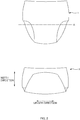
- Fig. 2 is a schematic diagram illustrating the diaper 1 according to the present embodiment.
- Fig. 3 is a schematic diagram to explain an example of a package forming process, and a package former 52 is also illustrated in Fig. 3 .
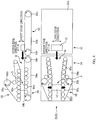
- Fig. 4 is a schematic diagram to explain an example of a compressing stage in a package bundle loading process, and a package compressor 62 is also illustrated in Fig. 4 .
- Fig. 5 is a schematic diagram to explain an example of a loading stage in the package bundle loading process, and a package bundle loader 72 is also illustrated in Fig. 5 .
- Fig. 6 is a schematic diagram illustrating a length of a package bundle 15 in a compression direction before and after compression according to the present embodiment.
- Fig. 7 is a schematic diagram illustrating a cardboard box 20 containing the package bundle 15 according to the present embodiment.
- the method for packing the diapers 1 is a method in which a package 10 (a diaper containing package), configured from plural folded diapers 1 inserted into a packaging member 3 (a package of a soft material), is formed, and then plural of the formed packages 10 (the plural packages 10 configuring the package bundle 15) are loaded into the cardboard box 20, so as to finally form a diaper-containing cardboard box 30.
- the method for packing the diapers 1 includes a package forming process (corresponding to a forming process), a package bundle loading process (corresponding to a loading process), and a package bundle contacting process (corresponding to a contacting process), with these processes being executed in the above sequence.
- the diaper-containing cardboard box 30 is formed by executing these processes. Specific description thereof follows.
- the diaper 1 according to the present embodiment is illustrated in Fig. 2 .
- the folded diaper 1 is illustrated at the bottom of Fig. 2
- the opened-out diaper 1 is illustrated at the top of Fig. 2 .
- the folded diaper 1 at the bottom of the diagram is the diaper at the top of the diagram when folded in two along fold line A illustrated at the top of the diagram.
- the folded diaper 1 at the bottom of the diagram is for insertion into the packaging member 3. Namely, the diaper 1 is inserted into the packaging member 3 in a folded (folded-in-two) state.
- the folded diaper 1 has a substantially rectangular profile.
- the long edge direction of the rectangular profile will be referred to as the length direction, and the short edge direction thereof will be referred to as the width direction.
- a direction orthogonal to the length direction and the width direction will be referred to as the thickness direction (the direction into the page in Fig. 2 ). Namely, there are three mutually orthogonal directions defined for the folded diaper 1.
- Plural of the diapers 1 according to the present embodiment are superimposed on each other in the thickness direction in a folded (folded-in-two) state, and inserted into the packaging member 3. Namely, plural of the diapers 1 are superimposed on each other in the thickness direction in a state in which the length direction and the width direction of the respective diapers 1 are aligned with each other, and the plural diapers 1 are then inserted into the packaging member 3 (details are described later).
- a package forming process is executed.
- processing is performed to insert plural of the folded diapers 1 into the packaging member 3, so as to form the package 10.
- Fig. 3 is a schematic diagram to explain an example of the package forming process, and is a diagram of the way in which the package 10 is formed, as viewed from above.
- a number (number of units) of the diapers 1 to be inserted into a single packaging member 3 are set at a predetermined position (namely, at an insertion start position where insertion of the diapers 1 is to be started).
- the plural diapers 1 are arranged along their thickness direction, in a state in which the width direction of the diapers 1 lies along the up-down direction (the direction into the page in Fig. 3 ).
- the plural diapers 1 are then placed into a hopper 54 of the packing machine 50 (package former 52).
- the hopper 54 includes a support member 54a that contacts the diapers 1 positioned at both ends in the thickness direction, and supports (clamps) these diapers 1 such that all of the diapers 1 are supported by the support member 54a.
- a first pusher then pushes the plural diapers 1, which are arranged in such a state along the thickness direction, forward in the direction of the white arrow at the diagram on the top left (a push-forward direction).
- the plural diapers 1, which are arranged along the thickness direction are moved toward a lift hopper 56.
- the lift hopper 56 includes a compression member 56a that contacts the diapers 1 positioned at both ends in the thickness direction, and supports (clamps) and compresses the diapers 1.
- the compression member 56a moves in the bold black arrow directions in the diagram at the top left (directions intersecting the forward-push direction and the up-down direction), and compresses these diapers 1 (as seen from a comparison of the diagrams at the top left and at the top right).
- the lift hopper 56 rises with the plural diapers 1 arranged along the thickness direction in a compressed state, and moves to a position corresponding to (facing) a packaging member setting section 58.
- the hopper 54 and the packaging member setting section 58 are positioned at different positions from each other in a height direction (the height of the hopper 54 is "height A", and the height of the packaging member setting section 58 is "height B").
- the packaging member setting section 58 is positioned at a higher position than the hopper 54.
- the lift hopper 56 rises from a position ("height A") corresponding to (facing) the hopper 54, to a position ("height B") corresponding to (facing) the packaging member setting section 58 (as seen from a comparison of the diagram at the top right and the diagram at the bottom left).
- a non-illustrated second pusher (the second pusher being positioned at "height B" in contrast to the first pusher positioned at "height A”) then pushes the plural diapers 1 arranged along the thickness direction forward in the direction of the white arrow in the diagram at the bottom left (the forward-push direction).
- the plural diapers 1 arranged along the thickness direction are moved into the packaging member setting section 58 in a compressed state.
- the packaging member 3 has been preset in the packaging member setting section 58, and so these diapers 1 are inserted into the packaging member 3 as they are moved into the packaging member setting section 58.
- an opening (insertion opening) of the packaging member 3 is sealed by heat sealing, so as to form the package 10.
- plural of the diapers 1 are compressed in the thickness direction of the diapers 1 and inserted into the packaging member 3.
- a state is accordingly achieved in which, in contrast to a length in the thickness direction of the plural diapers 1 arranged along the thickness direction prior to compression, which is longer than an internal dimension of the packaging member 3, the length in the thickness direction thereof after compression is shorter than the internal dimension.
- the plural diapers 1 are inserted into the packaging member 3 in this state.
- the package bundle loading process is executed.
- processing is performed to load the package bundle 15 configured from the plural packages 10 into the cardboard box 20.
- the packages 10 are compressed in the thickness direction and the plural packages 10 (the package bundle 15) are loaded into cardboard box 20 similarly to how the plural diapers 1 were compressed in the thickness direction and inserted into the packaging member 3 in the previous process.
- each of the packages 10 is compressed one at a time. Then the packages 10 that were each compressed one at a time in the compressing stage are collected together and plural of the packages 10 are loaded into the cardboard box 20 all at once.
- Fig. 4 is a schematic diagram to explain an example of the compressing stage in the package bundle loading process.
- the manner in which the packages 10 are compressed is illustrated as viewed from the side in the diagram at the top of Fig. 4 , and the manner in which packages 10 are compressed is illustrated as viewed from above in the diagram at the bottom of Fig. 4 .
- the package 10 has a substantially cuboid shape, with the plural diapers 1 arranged along the thickness direction inserted therein.
- the following directions are defined for the package 10. Namely, a direction along the thickness direction of the inserted diapers 1 (the direction the diapers 1 are arranged along) is called the long edge direction, a direction along the length direction of the inserted diapers 1 is called the medium edge direction, and the direction along the width direction of the inserted diapers 1 is called the short edge direction.
- the length of the medium edge direction is longer than the length of the short edge direction, and the length of the long edge direction is longer than the length of the medium edge direction.
- the package 10 is transported in the long thick black arrow direction (forward direction) by a first belt-conveyor 63 of the packing machine 50 (the package compressor 62).
- the package 10 is placed on a first belt 63a of the first belt-conveyor 63 so that the medium edge direction lies along the forward direction, and the short edge direction lies along the up-down direction.
- the first belt 63a is moved by rotational driving of a first drive roller 63b, and the package 10 moves together with movement of the first belt 63a.
- the member indicated with the reference sign 63c is a first following roller.
- the package 10 When the package 10 is moved by the first belt-conveyor 63, the package 10 eventually reaches a second belt-conveyor 64, and is placed on the second belt-conveyor 64.
- the package 10 is then transported in the long thick black arrow direction (forward direction) by the second belt-conveyor 64.
- the package 10 is also placed on the second belt-conveyor 64 such that the medium edge direction lies along the forward direction, and the short edge direction lies along the up-down direction.
- a second belt 64a is moved by rotational driving of a second drive roller 64b, and the package 10 moves together with movement of the second belt 64a.
- the member indicated with the reference sign 64c is a second following roller.
- the pair of third belt-conveyors 65 configures what is referred to as a press conveyor, and the third belt-conveyors 65 are disposed at positions sandwiching the package 10 in the width direction of the second belt 64a (in other words, in the long edge direction of the package 10).
- a pair of third belts 65a of the third belt-conveyors 65 are provided with their width directions orthogonal to the width direction of the second belt 64a, and a space S (the opening M being the entrance to the space S) is formed between the two third belts 65a.
- the package 10 transported in by the second belt-conveyor 64 enters into the space S through the opening M.
- the width of the space S in the width direction of the second belt 64a (the long edge direction of the package 10), is greater than the length of the long edge direction of the package 10 at the opening M.
- the pair of third belts 65a are disposed so that the width of the space S (in other words, the separation between the pair of third belts 65a) gradually narrows along with movement of the package 10.
- the width (separation) is less than the length of the long edge direction of the package 10.
- the long edge direction in other words, the thickness direction of the diapers 1
- the compression direction of the package 10 is indicated by the short thick black arrows in Fig. 4 .
- the pair of third belts 65a move under rotational driving of third drive rollers 65b, and the third drive rollers 65b are controlled so that the movement speed of the pair of third belts 65a is the same as the movement speed of the second belt 64a.
- plural third free rollers 65c are provided for the third belt-conveyors 65, and the third free rollers 65c perform the role of pressing the package 10 in the compression direction while maintaining a predetermined value for the width of the space S (the separation between the pair of third belts 65a).
- a fourth belt-conveyor 66 is provided above (the package 10 being transported by) the second belt-conveyor 64.
- the fourth belt-conveyor 66 is positioned at a position such that the package 10 is sandwiched from above and below by the fourth belt-conveyor 66 and the second belt-conveyor 64.
- a fourth belt 66a of the fourth belt-conveyor 66 is provided with its width direction orthogonal to the width direction of the third belts 65a, and the space S referred to above is formed by a collaboration between the fourth belt 66a and the second belt 64a and the third belts 65a.
- the fourth belt 66a is disposed such that the width of the space S in the up-down direction (the short edge direction of the package 10) (in other words, the separation between the second belt 64a and the fourth belt 66a) is the same as the length of the short edge direction of the package 10. Therefore, the fourth belt-conveyor 66 (the fourth belt 66a) performs the role of holding the package 10 down in a precautionary manner, such that the short edge direction of the package 10 does not expand in response to the long edge direction of the package 10 being compressed.
- the fourth belt 66a is moved by rotational driving of a fourth drive roller 66b, and the fourth drive roller 66b is controlled so that the movement speed of the fourth belt 66a is the same as the movement speed of the second belt 64a and the third belts 65a.
- plural fourth free rollers 66c are provided in the fourth belt-conveyor 66, and the fourth free rollers 66c perform the role of pressing the package 10 while maintaining a predetermined value for the width of the space S (the separation between the second belt 64a and the fourth belt 66a) in cooperation with second free rollers 64d provided in the second belt-conveyor 64.
- the package 10 is compressed by the package compressor 62 at the compressing stage of the package bundle loading process.
- the package compressor 62 there is a non-illustrated air-release hole (in the present embodiment, perforations used for un-sealing the packaging member serve as this hole) formed in the packaging member 3.
- the package 10 is accordingly appropriately compressed without the packaging member 3 rupturing, due to air escaping through this hole when the package 10 is being compressed.
- the compressed package 10 is transported by a non-illustrated belt-conveyor to the package bundle loader 72, and the loading stage of the package bundle loading process is executed by the package bundle loader 72.
- Fig. 5 is a schematic diagram to explain an example of the loading stage in the package bundle loading process, and is a diagram showing as viewed from above the manner by which the package bundle 15 is loaded into the cardboard box 20.
- the number of packages 10 to be inserted into a single cardboard box 20 are set at a predetermined position (i.e. at the loading start position where loading of the packages 10 is to start) .
- three of the packages 10 are housed in a hopper 74 of the packing machine 50 (the package bundle loader 72) in a state in which the three packages 10 are arranged in a row along the medium edge direction, with the long edge direction of the packages 10 along the up-down direction (the direction into the page in Fig. 5 ).
- the hopper 74 includes a support member 74a that contacts the packages 10 positioned at the two medium edge direction ends and supports (clamps) the packages 10. All of the packages 10 are thereby supported by the support member 74a.
- a non-illustrated pusher pushes the three packages 10 forward in the direction of the white arrow (the forward-push direction).
- the three packages 10 (the package bundle 15) are thereby moved to a cardboard box setting section 76.
- the cardboard box 20 is preset in the cardboard box setting section 76 such that the height direction of the cardboard box 20 is along the white arrow direction (forward-push direction), and the width direction of the cardboard box 20 is along the up-down direction (the direction into the page in Fig. 5 ).
- the three packages 10 (the package bundle 15) are moved to the cardboard box setting section 76, they are inserted into the cardboard box 20.
- the cardboard box 20 is set in a state in which only the bottom flaps are closed and taped (in Fig. 5 , the top flaps are omitted from illustration), and after the three packages 10 (the package bundle 15) have been loaded, the top flaps are closed and taped.
- the diaper-containing cardboard box 30 is thereby finally formed.
- the package bundle 15 is loaded into the cardboard box 20 after each of the packages 10 has been compressed in the compressing stage.
- the loading stage is started while the compressed state is still maintained. This means that the packages 10 (and hence also the package bundle 15) are loaded into the cardboard box 20 in the loading stage while in a compressed state.
- the package bundle 15 is depicted in the diagram on the left and the diagram on the right of Fig. 6
- the cardboard box 20 is depicted in the diagram at the center of Fig. 6 .
- the difference between the diagram on the left and diagram on the right of Fig. 6 is whether or not the packages 10 are compressed.
- the package bundle 15 illustrated in the diagram on the left of Fig. 6 is a package bundle 15 in which the packages 10 are compressed (a compressed package bundle 15), which is the package bundle 15 when loading into the cardboard box 20.
- the package bundle 15 in the diagram on the left is loaded into the cardboard box 20 illustrated in the diagram at the center.
- the package bundle 15 illustrated in the diagram on the right of Fig. 6 is one in which three uncompressed packages 10 are arranged in a row, with the same layout as would be adopted for loading into the cardboard box 20 (referred to as an uncompressed package bundle 15).
- a length L3 in the compression direction of the uncompressed package bundle 15 is longer than an internal dimension L2 of the cardboard box 20.
- the uncompressed package bundle 15 is in a state that cannot be loaded into the cardboard box 20.
- Fig. 7 is a schematic diagram illustrating the cardboard box 20 containing the package bundle 15 according to the present embodiment.
- the diagram on the left of Fig. 7 illustrates the cardboard box 20 as viewed from above, and the diagram on the right of Fig. 7 is the same as the diagram on the left of Fig. 7 , but illustrates the cardboard box 20 with the top flaps (external flaps 22 and internal flaps 24) omitted from illustration, so as to show the contents of the cardboard box 20.
- the package bundle 15 expands in the opposite direction to the compression direction (the opposite direction is indicated by the black arrows in the diagram on the right of Fig. 7 ).
- the two ends 15a of the package bundle 15 in the opposite direction thereby contact the inner face of the cardboard box 20. Namely, gaps that were present in the compression direction (the opposite direction) between the package bundle 15 and the cardboard box 20 when the package bundle 15 was loaded into the cardboard box 20 disappear due to the package bundle 15 expanding. Close contact is accordingly achieved between the package bundle 15 and the cardboard box 20. This means that the strength of the manufactured diaper-containing cardboard box 30 becomes stronger.
- processing is performed to allow the loaded package bundle 15 to expand in the opposite direction to the compression direction, so as to cause the two ends 15a of the package bundle 15 in the opposite direction to contact the inner face of the cardboard box 20.
- the method for packing the diapers 1 is completed by performing the above processes, and the diaper-containing cardboard box 30 is thereby manufactured. Note that due to the packages 10 (the package bundle 15) returning to the uncompressed state when the packages 10 (the package bundle 15) are taken out from the manufactured diaper-containing cardboard box 30, the length of the packages 10 (the package bundle 15) in the compression direction becomes longer than the internal dimension of the cardboard box 20.
- the method for packing the diapers 1 includes a package forming process, a package bundle loading process, and a package bundle contacting process.
- the package forming process a plurality of folded diapers 1 are inserted into a packaging member 3 to form a package 10.
- the package bundle loading process the package 10 is compressed in a compression direction and a package bundle 15 configured by a plurality of the packages 10 is loaded into a cardboard box 20.
- the package bundle 15 is loaded into the cardboard box 20 in a state in which due to compression of the packages 10 a length L1 of the package bundle 15 in the compression direction is shorter than an internal dimension L2 of the cardboard box 20 in the compression direction.
- the loaded package bundle 15 is allowed to expand in an opposite direction to the compression direction so as to cause two ends 15a of the package bundle 15 in the opposite direction to contact an inner face of the cardboard box 20.
- the length of the package bundle was set smaller than the internal dimension of the cardboard box, such that gaps were generated between ends of the package bundle loaded into the cardboard box and the cardboard box itself. This resulted in a lack of close contact between the package bundle and the cardboard box, leading to the problem of the strength of the package bundle-containing cardboard box being weakened. This accordingly sometimes led the problem of the package bundle-containing cardboard box collapsing in transit.
- the package bundle 15 is loaded into the cardboard box 20 in a state in which, due to the packages 10 being compressed, the length L1 of the package bundle 15 in the compression direction is shorter than the internal dimension L2 of the cardboard box 20 in the compression direction. Then, by allowing the loaded package bundle 15 to expand in the opposite direction to the compression direction, the two ends 15a of the package bundle 15 in the opposite direction are caused to contact the inner face of the cardboard box 20, thereby achieving an appropriate close contact and integration between the package bundle and the cardboard box.
- This enables the strength (i.e. the robustness) of the manufactured diaper-containing cardboard box 30 to be raised, and makes the problem of the diaper-containing cardboard box 30 collapsing in transit unlikely to occur.
- a state is achieved in which the two ends 15a of the package bundle 15 in the opposite direction contact the inner face of the cardboard box 20, namely, a state in which there are no gaps present in the opposite direction between the package bundle 15 and the cardboard box 20.
- the size of the cardboard box 20, to be prepared according to the size of the package bundle 15 can also be smaller. This enables savings to be made in the cost of cardboard boxes, and savings to also be achieved in transport costs due to increasing the number of diaper-containing cardboard boxes 30 that can be stacked on each pallet.
- each of the process described above may be performed manually, instead of being automated as illustrated in Fig. 3 to Fig. 5 .
- the packages 10 may be loaded into the cardboard box 20 while the package bundle 15 is in a compressed state (while being compressed) by a compression member using a method similar to the package forming process ( Fig. 3 ).
- the external faces of the packages 10 i.e. the packaging members 3 contact the compression member. Due to such contact and the packages 10 (the package bundle 15) being pushed by pushers or the like in order to be loaded into the cardboard box 20 while in a state applied with pressure by the compression member, frictional heat is generated in the packaging members 3 due to rubbing against the compression member. The possibility of damage to the packaging members 3 from the frictional heat accordingly arises. In contrast thereto, the present embodiment is preferable from the perspective of enabling compression of the packages 10 to be performed without damaging the packaging members 3.
- the packages 10 are compressed one at a time in the compressing stage, and plural of the individually compressed packages 10 are collected together and loaded into the cardboard box 20 all at once and at the loading stage.
- plural packages 10 to be collectively loaded into the cardboard box 20 may be collectively compressed.
- the present embodiment is preferable from the perspective of enabling the compression of the packages 10 to be performed without the packages 10 collapsing.
- the packages 10 are compressed in the thickness direction of the diapers 1. Namely, the compression direction when compressing the packages 10 is along the thickness direction of the diapers 1 packaged in the packages 10.
- the packages 10 may be compressed in the length direction or the width direction of the diapers 1.
- the packages 10 are compressed in the thickness direction, the packages 10 are more readily deformed in the compression direction than cases in which the packages 10 are compressed in the length direction or the width direction, thereby facilitating compressing. Moreover, as a result of being readily deformed, contacting is also performed smoothly (without hindrance) by expansion of the package bundle 15 in the package bundle contacting process.
- the present embodiment is preferable from this perspective.
- plural diapers 1 are inserted into each of the packaging members 3 in a state in which the diapers 1 are compressed in the thickness direction. This means that contact is even more smoothly performed by expansion of the package bundle 15 in the package bundle contacting process.
- the package bundle 15 may be loaded in the direction of gravity. Namely, although in the present embodiment, as illustrated in Fig. 5 , the package bundle 15 are loaded in a direction orthogonal of the direction of gravity (namely, a sideways direction), the package bundle 15 may be loaded in the direction of gravity (namely, the up-down direction).
- Such cases have the advantage of gravity acting on the package bundle 15 and assisting smooth loading (without catching or resistance) into the cardboard box 20.
- the package bundle 15 may be loaded into the cardboard box 20 with the packages 10 compressed in plural mutually orthogonal compression directions. Namely, although in the present embodiment the packages 10 are compressed in only one direction out of three directions (i.e. the long edge direction, the medium edge direction, and the short edge direction), the packages 10 may be compressed in two directions, or may be compressed in three directions.
- the package bundle 15 and the cardboard box 20 are even more appropriately placed in close contact and integrated together. This enables the strength of the cardboard box 20 containing the package bundle 15 to be raised further, and makes the problem of the cardboard box 20 containing the package bundle 15 collapsing in transit even more unlikely to occur.
- Fig. 8 is a diagram corresponding to Fig. 6 , and is a schematic diagram illustrating the length of the package bundle 15 in the compression direction before and after compression according to the modified example.
- Fig. 9 is a diagram corresponding to Fig. 7 , and is a schematic diagram illustrating the cardboard box 20 containing the package bundle 15 according to the modified example.
- the first embodiment there are three packages 10 (the package bundle 15) loaded into each of the cardboard boxes 20.
- the second embodiment there are six packages 10 (the package bundle 15) loaded into each of the cardboard boxes 20.
- the package bundle 15 is illustrated in the diagram at the top and the diagram at the bottom of Fig. 8
- the cardboard box 20 is illustrated in the diagram at the center of Fig. 8 .
- the difference between the diagram at the top and the diagram at the bottom of Fig. 8 is whether or not the packages 10 are compressed.
- the package bundle 15 illustrated in the diagram at the top of Fig. 8 is a package bundle 15 in which the packages 10 are compressed (a compressed package bundle 15), which is the package bundle 15 when loading into the cardboard box 20.
- the package bundle 15 in the diagram at the top is loaded into the cardboard box 20 illustrated in the diagram at the center.
- the package bundle 15 illustrated in the diagram at the bottom of Fig. 8 is one in which there are six uncompressed packages 10 that are arranged in a row in the same layout as would be adopted for loading into the cardboard box 20 (referred to as an uncompressed package bundle 15).
- the compression direction in the second embodiment is also along the long edge direction of the packages 10, similarly to in the first embodiment. Moreover, similarly to in the first embodiment the compression direction is also along the thickness direction of the diapers 1.
- a length L6 of the uncompressed package bundle 15 in the compression direction is longer than an internal dimension L5 of the cardboard box 20. This means that the uncompressed package bundle 15 is in a state that cannot be loaded into the cardboard box 20. Note that a length L6 of the uncompressed package bundle 15 in the compression direction is a length of three packages, which is different to the length L3 of the first embodiment.
- the package bundle 15 expands in the opposite direction to the compression direction (the opposite direction is indicated by the short black arrows on the diagram on the right of Fig. 9 ).
- the two ends 15a of the package bundle 15 in the opposite direction then contact the inner face of the cardboard box 20.
- the gaps present between the package bundle 15 and the cardboard box 20 in the compression direction (the opposite direction) when the package bundle 15 is loaded into the cardboard box 20 disappear by the expansion of the package bundle 15. Close contact is accordingly achieved between the package bundle 15 and the cardboard box 20. This enhances the strength of the manufactured diaper-containing cardboard box 30.
- the package bundle 15 is loaded into the cardboard box 20 with the compression direction along the width direction of the cardboard box 20. This means that the opposite direction is also along the width direction of the cardboard box 20.
- the package bundle 15 is loaded into the cardboard box 20 with the compression direction along the length direction of the cardboard box 20. This means that the opposite direction is also along the length direction of the cardboard box 20.
- the contact pressure as indicated by the short black arrows in Fig. 9 constantly acts on the cardboard box 20 due to the opposite direction being along the length direction of the cardboard box 20.
- a half-open state of the internal flaps 24 is automatically achieved due to the contact pressure.
- the internal flaps 24 transitioning to this half-open state press the external flaps 22 upward such that a half-open state of the external flaps 22 is also achieved.
- a half-open state is achieved with not only the external flaps 22, but also with the internal flaps 24.
Landscapes
- Engineering & Computer Science (AREA)
- Mechanical Engineering (AREA)
- Chemical & Material Sciences (AREA)
- Dispersion Chemistry (AREA)
- Auxiliary Devices For And Details Of Packaging Control (AREA)
- Container Filling Or Packaging Operations (AREA)
- Packaging Of Annular Or Rod-Shaped Articles, Wearing Apparel, Cassettes, Or The Like (AREA)
Abstract
Description
- The present invention relates to a method for packing absorbent articles.
- Methods for packing absorbent articles such as diapers are already well known. Such packing methods include a forming process to form a package configured by plural folded absorbent articles inserted into a packaging member, and a loading process in which a package bundle of plural packages is loaded into a cardboard box.
- [PTL 1] Japanese Unexamined Patent Application Publication No.
H05-65102 - Hitherto, the length of the package bundle has been set smaller than the internal dimension of the cardboard box in order to facilitate loading of the package bundle into the cardboard box in the loading process, such that gaps are generated between ends of the package bundle loaded into the cardboard box and the cardboard box itself. This results in a problem of the strength of the package bundle-containing cardboard box being weak due to the package bundle and the cardboard box not being in close contact with each other. This sometimes leads to a problem in that the cardboard box containing the package bundle is collapsed in transit.
- In consideration of the above issues, an object of the present invention is to raise the strength of a cardboard box containing a package bundle.
- In order to achieve the above object, a main invention is a method for packing absorbent articles, the method including:
- a forming process in which a plurality of folded absorbent articles are inserted into a packaging member to form a package;
- a loading process in which the package is compressed in a compression direction and a package bundle configured by a plurality of the packages is loaded into a cardboard box, the package bundle being loaded into the cardboard box in a state in which a length of the package bundle in the compression direction is shorter than an internal dimension of the cardboard box in the compression direction due to compression of the packages; and
- a contacting process in which the loaded package bundle is allowed to expand in an opposite direction to the compression direction so as to cause two ends of the package bundle in the opposite direction to contact an inner face of the cardboard box.
- Other features of the present invention will become apparent from the present specification and accompanying drawings.
- According to the present invention, the strength of a cardboard box containing a package bundle can be raised.
-
-
Fig. 1 is a block diagram to explain processes in a method for packingdiapers 1 according to a present embodiment. -
Fig. 2 is a schematic diagram illustrating adiaper 1 according to the present embodiment. -
Fig. 3 is a schematic diagram to explain an example of a package forming process. -
Fig. 4 is a schematic diagram to explain an example of a compressing stage in a package bundle loading process. -
Fig. 5 is a schematic diagram to explain an example of a loading stage in a package bundle loading process. -
Fig. 6 is a schematic diagram illustrating a length of apackage bundle 15 in a compression direction before and after compression according to the present embodiment. -
Fig. 7 is a schematic diagram illustrating acardboard box 20 containing apackage bundle 15 according to the present embodiment. -
Fig. 8 is a schematic diagram illustrating a length of apackage bundle 15 in a compression direction before and after compression according to a modified example. -
Fig. 9 is a schematic diagram illustrating acardboard box 20 containing apackage bundle 15 according to a modified example. - At least the following items are apparent from the present specification and accompanying drawings.
- A method for packing absorbent articles, the method including:
- a forming process in which a plurality of folded absorbent articles are inserted into a packaging member to form a package;
- a loading process in which the package is compressed in a compression direction and a package bundle configured by a plurality of the packages is loaded into a cardboard box, the package bundle being loaded into the cardboard box in a state in which a length of the package bundle in the compression direction is shorter than an internal dimension of the cardboard box in the compression direction due to compression of the packages; and
- a contacting process in which the loaded package bundle is allowed to expand in an opposite direction to the compression direction so as to cause two ends of the package bundle in the opposite direction to contact an inner face of the cardboard box.
- According to such a method for packing absorbent articles, appropriate close contact and integration is achieved between the package bundle and the cardboard box. This enables the strength of the package bundle-containing cardboard box to be raised, and makes the problem of the package bundle-containing cardboard box collapsing in transit unlikely to occur.
- In this method for packing absorbent articles, preferably, in the loading process, a compressing stage in which the packages are compressed and a loading stage in which the package bundle is loaded into the cardboard box are separately provided.
- According to such a method for packing absorbent articles, compression of the packages can be performed without damaging the packaging member.
- In this method for packing absorbent articles, preferably, in the compressing stage, the packages are compressed one at a time and
in the loading stage, a plurality of the packages that have been individually compressed are collected together and loaded into the cardboard box all at once. - According to such a method for packing absorbent articles, compression of the packages can be performed without the packages collapsing.
- In this method for packing absorbent articles, preferably, in the loading process, the package is compressed in a thickness direction of the absorbent articles.
- According to such a method for packing absorbent articles, the packages are readily deformed in the compression direction, enabling compression to be performed easily. As a result of being readily deformed, contacting is also performed smoothly by expansion of the package bundle in the contacting process.
- In this method for packing absorbent articles, preferably, in the forming process, the absorbent articles are compressed in the thickness direction and a plurality of the absorbent articles are inserted into the packaging member.
- According to such a method for packing absorbent articles, contacting is performed more smoothly by expansion of the package bundle in the contacting process.
- In this method for packing absorbent articles, in the loading process, preferably the package bundle is loaded into the cardboard box such that the compression direction is along a width direction of the cardboard box.
- According to such a method for packing absorbent articles, work to open external flaps of the cardboard box can be performed extremely easily.
- In this method for packing absorbent articles, in the loading process, preferably the package bundle is loaded into the cardboard box such that the compression direction is along a length direction of the cardboard box.
- According to such a method for packing absorbent articles, work to open external flaps and internal flaps of the cardboard box can be performed simply in a well-balanced manner.
- In this method for packing absorbent articles, in the loading process, preferably the package bundle is loaded in a direction of gravity.
- According to such a method for packing absorbent articles, gravity acts on the package bundle and assists smooth loading (without catching or resistance) into the cardboard box.
- In this method for packing absorbent articles, in the loading process, preferably the packages are compressed in a plurality of mutually orthogonal compression directions and the package bundle is loaded into the cardboard box.
- According to such a method for packing absorbent articles, the package bundle and the cardboard box are even more appropriately placed in close contact and integrated together. This enables the strength of the package bundle-containing cardboard box to be raised further, and makes the problem of package bundle-containing cardboard box collapsing in transit even more unlikely to occur.
- In this method for packing absorbent articles, preferably an air-release hole is formed in the packaging member.
- According to such a method for packing absorbent articles, the package is appropriately compressed without the packaging member rupturing, due to air escaping through this hole.
- A description follows regarding a method for packing absorbent articles according to the present embodiment, with reference to
Fig. 1 to Fig. 7 . Note that in the present embodiment, an example will be described in which adult diapers (referred to below simply as diapers 1) serve as absorbent articles.Fig. 1 is a block diagram to explain processes in a method for packingdiapers 1 according to the present embodiment.Fig. 2 is a schematic diagram illustrating thediaper 1 according to the present embodiment.Fig. 3 is a schematic diagram to explain an example of a package forming process, and a package former 52 is also illustrated inFig. 3 .Fig. 4 is a schematic diagram to explain an example of a compressing stage in a package bundle loading process, and a package compressor 62 is also illustrated inFig. 4 .Fig. 5 is a schematic diagram to explain an example of a loading stage in the package bundle loading process, and a package bundle loader 72 is also illustrated inFig. 5 .Fig. 6 is a schematic diagram illustrating a length of apackage bundle 15 in a compression direction before and after compression according to the present embodiment.Fig. 7 is a schematic diagram illustrating acardboard box 20 containing thepackage bundle 15 according to the present embodiment. - The method for packing the
diapers 1 according to the present embodiment is a method in which a package 10 (a diaper containing package), configured from plural foldeddiapers 1 inserted into a packaging member 3 (a package of a soft material), is formed, and then plural of the formed packages 10 (theplural packages 10 configuring the package bundle 15) are loaded into thecardboard box 20, so as to finally form a diaper-containingcardboard box 30. The method for packing thediapers 1 includes a package forming process (corresponding to a forming process), a package bundle loading process (corresponding to a loading process), and a package bundle contacting process (corresponding to a contacting process), with these processes being executed in the above sequence. The diaper-containingcardboard box 30 is formed by executing these processes. Specific description thereof follows. - The
diaper 1 according to the present embodiment is illustrated inFig. 2 . The foldeddiaper 1 is illustrated at the bottom ofFig. 2 , and the opened-outdiaper 1 is illustrated at the top ofFig. 2 . The foldeddiaper 1 at the bottom of the diagram is the diaper at the top of the diagram when folded in two along fold line A illustrated at the top of the diagram. The foldeddiaper 1 at the bottom of the diagram is for insertion into thepackaging member 3. Namely, thediaper 1 is inserted into thepackaging member 3 in a folded (folded-in-two) state. - Note that, as illustrated at the bottom of the diagram, the folded
diaper 1 has a substantially rectangular profile. The long edge direction of the rectangular profile will be referred to as the length direction, and the short edge direction thereof will be referred to as the width direction. Moreover, a direction orthogonal to the length direction and the width direction will be referred to as the thickness direction (the direction into the page inFig. 2 ). Namely, there are three mutually orthogonal directions defined for the foldeddiaper 1. - Plural of the
diapers 1 according to the present embodiment are superimposed on each other in the thickness direction in a folded (folded-in-two) state, and inserted into thepackaging member 3. Namely, plural of thediapers 1 are superimposed on each other in the thickness direction in a state in which the length direction and the width direction of therespective diapers 1 are aligned with each other, and theplural diapers 1 are then inserted into the packaging member 3 (details are described later). - Description now follows regarding each of the processes in the method for packing the
diapers 1. Note that each of the processes described below are merely examples thereof, and the method of executing each of the processes and a packing machine 50 for executing each of the processes, are not limited thereto. - First, as illustrated in
Fig. 1 , a package forming process is executed. In this package forming process, processing is performed to insert plural of the foldeddiapers 1 into thepackaging member 3, so as to form thepackage 10. -
Fig. 3 is a schematic diagram to explain an example of the package forming process, and is a diagram of the way in which thepackage 10 is formed, as viewed from above. - First, as illustrated in the diagram at the top left of
Fig. 3 , a number (number of units) of thediapers 1 to be inserted into asingle packaging member 3 are set at a predetermined position (namely, at an insertion start position where insertion of thediapers 1 is to be started). In the present example, theplural diapers 1 are arranged along their thickness direction, in a state in which the width direction of thediapers 1 lies along the up-down direction (the direction into the page inFig. 3 ). Theplural diapers 1 are then placed into ahopper 54 of the packing machine 50 (package former 52). Thehopper 54 includes asupport member 54a that contacts thediapers 1 positioned at both ends in the thickness direction, and supports (clamps) thesediapers 1 such that all of thediapers 1 are supported by thesupport member 54a. - A first pusher, not illustrated in the drawings, then pushes the
plural diapers 1, which are arranged in such a state along the thickness direction, forward in the direction of the white arrow at the diagram on the top left (a push-forward direction). Thereby, as illustrated in the diagram at the top right ofFig. 3 , theplural diapers 1, which are arranged along the thickness direction, are moved toward alift hopper 56. Thelift hopper 56 includes acompression member 56a that contacts thediapers 1 positioned at both ends in the thickness direction, and supports (clamps) and compresses thediapers 1. Then, when theplural diapers 1 arranged along the thickness direction have been moved into thelift hopper 56, thecompression member 56a moves in the bold black arrow directions in the diagram at the top left (directions intersecting the forward-push direction and the up-down direction), and compresses these diapers 1 (as seen from a comparison of the diagrams at the top left and at the top right). - Next, as illustrated in the diagram at the bottom left of
Fig. 3 , thelift hopper 56 rises with theplural diapers 1 arranged along the thickness direction in a compressed state, and moves to a position corresponding to (facing) a packagingmember setting section 58. Namely, as illustrated in each of the diagrams ofFig. 3 , thehopper 54 and the packagingmember setting section 58 are positioned at different positions from each other in a height direction (the height of thehopper 54 is "height A", and the height of the packagingmember setting section 58 is "height B"). In the present example, the packagingmember setting section 58 is positioned at a higher position than thehopper 54. Then, thelift hopper 56 rises from a position ("height A") corresponding to (facing) thehopper 54, to a position ("height B") corresponding to (facing) the packaging member setting section 58 (as seen from a comparison of the diagram at the top right and the diagram at the bottom left). - Then from this state, a non-illustrated second pusher (the second pusher being positioned at "height B" in contrast to the first pusher positioned at "height A") then pushes the
plural diapers 1 arranged along the thickness direction forward in the direction of the white arrow in the diagram at the bottom left (the forward-push direction). Thus, as illustrated in the diagram at the bottom right ofFig. 3 , theplural diapers 1 arranged along the thickness direction are moved into the packagingmember setting section 58 in a compressed state. Thepackaging member 3 has been preset in the packagingmember setting section 58, and so thesediapers 1 are inserted into thepackaging member 3 as they are moved into the packagingmember setting section 58. Then, finally, an opening (insertion opening) of thepackaging member 3 is sealed by heat sealing, so as to form thepackage 10. - In this manner, in the present embodiment, plural of the
diapers 1 are compressed in the thickness direction of thediapers 1 and inserted into thepackaging member 3. A state is accordingly achieved in which, in contrast to a length in the thickness direction of theplural diapers 1 arranged along the thickness direction prior to compression, which is longer than an internal dimension of thepackaging member 3, the length in the thickness direction thereof after compression is shorter than the internal dimension. Theplural diapers 1 are inserted into thepackaging member 3 in this state. - Next, as illustrated in
Fig. 1 , the package bundle loading process is executed. In the package bundle loading process, processing is performed to load thepackage bundle 15 configured from theplural packages 10 into thecardboard box 20. Moreover, in the present process, thepackages 10 are compressed in the thickness direction and the plural packages 10 (the package bundle 15) are loaded intocardboard box 20 similarly to how theplural diapers 1 were compressed in the thickness direction and inserted into thepackaging member 3 in the previous process. However, whereas in the previous process theplural diapers 1 were inserted into thepackaging member 3 in a state compressed (while being compressed) by thecompression member 56a, in the present process, first each of thepackages 10 is compressed by the package compressor 62, and then plural packages 10 (the package bundle 15) are loaded into thecardboard box 20 after completing compression by the package compressor 62. Namely, in the present process (the package bundle loading process), as illustrated inFig. 1 , in contrast to in the previous process, there are separately provided stages of a compressing stage for compressing thepackages 10, and a loading stage for loading thepackage bundle 15 into thecardboard box 20. - Moreover, whereas in the previous process the
plural diapers 1 arranged along the thickness direction were compressed all together, in the present process, each of thepackages 10 is compressed one at a time. Then thepackages 10 that were each compressed one at a time in the compressing stage are collected together and plural of thepackages 10 are loaded into thecardboard box 20 all at once. - Next, description first follows regarding the compressing stage, and then the loading stage will be described.
-
Fig. 4 is a schematic diagram to explain an example of the compressing stage in the package bundle loading process. The manner in which thepackages 10 are compressed is illustrated as viewed from the side in the diagram at the top ofFig. 4 , and the manner in which packages 10 are compressed is illustrated as viewed from above in the diagram at the bottom ofFig. 4 . - Note that in the present embodiment, the
package 10 has a substantially cuboid shape, with theplural diapers 1 arranged along the thickness direction inserted therein. Thus, for ease of explanation, the following directions are defined for thepackage 10. Namely, a direction along the thickness direction of the inserted diapers 1 (the direction thediapers 1 are arranged along) is called the long edge direction, a direction along the length direction of the inserteddiapers 1 is called the medium edge direction, and the direction along the width direction of the inserteddiapers 1 is called the short edge direction. For thepackage 10, the length of the medium edge direction is longer than the length of the short edge direction, and the length of the long edge direction is longer than the length of the medium edge direction. - First, the
package 10 is transported in the long thick black arrow direction (forward direction) by a first belt-conveyor 63 of the packing machine 50 (the package compressor 62). Thepackage 10 is placed on afirst belt 63a of the first belt-conveyor 63 so that the medium edge direction lies along the forward direction, and the short edge direction lies along the up-down direction. Then, in this state, thefirst belt 63a is moved by rotational driving of afirst drive roller 63b, and thepackage 10 moves together with movement of thefirst belt 63a. Note that the member indicated with thereference sign 63c is a first following roller. - When the
package 10 is moved by the first belt-conveyor 63, thepackage 10 eventually reaches a second belt-conveyor 64, and is placed on the second belt-conveyor 64. Thepackage 10 is then transported in the long thick black arrow direction (forward direction) by the second belt-conveyor 64. Thepackage 10 is also placed on the second belt-conveyor 64 such that the medium edge direction lies along the forward direction, and the short edge direction lies along the up-down direction. Asecond belt 64a is moved by rotational driving of asecond drive roller 64b, and thepackage 10 moves together with movement of thesecond belt 64a. Note that the member indicated with thereference sign 64c is a second following roller. - When the
package 10 moves together with movement of thesecond belt 64a, thepackage 10 eventually reaches an opening M of a pair of third belt-conveyors 65. The pair of third belt-conveyors 65 configures what is referred to as a press conveyor, and the third belt-conveyors 65 are disposed at positions sandwiching thepackage 10 in the width direction of thesecond belt 64a (in other words, in the long edge direction of the package 10). Namely, a pair ofthird belts 65a of the third belt-conveyors 65 are provided with their width directions orthogonal to the width direction of thesecond belt 64a, and a space S (the opening M being the entrance to the space S) is formed between the twothird belts 65a. Thepackage 10 transported in by the second belt-conveyor 64 enters into the space S through the opening M. - The width of the space S in the width direction of the
second belt 64a (the long edge direction of the package 10), is greater than the length of the long edge direction of thepackage 10 at the opening M. However, the pair ofthird belts 65a are disposed so that the width of the space S (in other words, the separation between the pair ofthird belts 65a) gradually narrows along with movement of thepackage 10. At the location where the width of the space S (the separation between the pair ofthird belts 65a) is narrowest, the width (separation) is less than the length of the long edge direction of thepackage 10. Thus, when thepackage 10 transported by the second belt-conveyor 64 arrives at this location, the long edge direction (in other words, the thickness direction of the diapers 1) has been compressed (the compression direction of thepackage 10 is indicated by the short thick black arrows inFig. 4 ). Note that the pair ofthird belts 65a move under rotational driving ofthird drive rollers 65b, and thethird drive rollers 65b are controlled so that the movement speed of the pair ofthird belts 65a is the same as the movement speed of thesecond belt 64a. Moreover, plural thirdfree rollers 65c are provided for the third belt-conveyors 65, and the thirdfree rollers 65c perform the role of pressing thepackage 10 in the compression direction while maintaining a predetermined value for the width of the space S (the separation between the pair ofthird belts 65a). - Moreover, a fourth belt-
conveyor 66 is provided above (thepackage 10 being transported by) the second belt-conveyor 64. Namely, the fourth belt-conveyor 66 is positioned at a position such that thepackage 10 is sandwiched from above and below by the fourth belt-conveyor 66 and the second belt-conveyor 64. I.e. afourth belt 66a of the fourth belt-conveyor 66 is provided with its width direction orthogonal to the width direction of thethird belts 65a, and the space S referred to above is formed by a collaboration between thefourth belt 66a and thesecond belt 64a and thethird belts 65a. - The
fourth belt 66a is disposed such that the width of the space S in the up-down direction (the short edge direction of the package 10) (in other words, the separation between thesecond belt 64a and thefourth belt 66a) is the same as the length of the short edge direction of thepackage 10. Therefore, the fourth belt-conveyor 66 (thefourth belt 66a) performs the role of holding thepackage 10 down in a precautionary manner, such that the short edge direction of thepackage 10 does not expand in response to the long edge direction of thepackage 10 being compressed. Note that thefourth belt 66a is moved by rotational driving of afourth drive roller 66b, and thefourth drive roller 66b is controlled so that the movement speed of thefourth belt 66a is the same as the movement speed of thesecond belt 64a and thethird belts 65a. Moreover, plural fourthfree rollers 66c are provided in the fourth belt-conveyor 66, and the fourthfree rollers 66c perform the role of pressing thepackage 10 while maintaining a predetermined value for the width of the space S (the separation between thesecond belt 64a and thefourth belt 66a) in cooperation with secondfree rollers 64d provided in the second belt-conveyor 64. - In this manner, in the present embodiment, the
package 10 is compressed by the package compressor 62 at the compressing stage of the package bundle loading process. Note that in the present embodiment there is a non-illustrated air-release hole (in the present embodiment, perforations used for un-sealing the packaging member serve as this hole) formed in thepackaging member 3. Thepackage 10 is accordingly appropriately compressed without thepackaging member 3 rupturing, due to air escaping through this hole when thepackage 10 is being compressed. - The
compressed package 10 is transported by a non-illustrated belt-conveyor to the package bundle loader 72, and the loading stage of the package bundle loading process is executed by the package bundle loader 72. -
Fig. 5 is a schematic diagram to explain an example of the loading stage in the package bundle loading process, and is a diagram showing as viewed from above the manner by which thepackage bundle 15 is loaded into thecardboard box 20. - First, as illustrated in
Fig. 5 , the number ofpackages 10 to be inserted into asingle cardboard box 20 are set at a predetermined position (i.e. at the loading start position where loading of thepackages 10 is to start) . In the present example, three of thepackages 10 are housed in ahopper 74 of the packing machine 50 (the package bundle loader 72) in a state in which the threepackages 10 are arranged in a row along the medium edge direction, with the long edge direction of thepackages 10 along the up-down direction (the direction into the page inFig. 5 ). Thehopper 74 includes asupport member 74a that contacts thepackages 10 positioned at the two medium edge direction ends and supports (clamps) thepackages 10. All of thepackages 10 are thereby supported by thesupport member 74a. - Then, in this state, a non-illustrated pusher pushes the three
packages 10 forward in the direction of the white arrow (the forward-push direction). The three packages 10 (the package bundle 15) are thereby moved to a cardboardbox setting section 76. Thecardboard box 20 is preset in the cardboardbox setting section 76 such that the height direction of thecardboard box 20 is along the white arrow direction (forward-push direction), and the width direction of thecardboard box 20 is along the up-down direction (the direction into the page inFig. 5 ). Thus, when the three packages 10 (the package bundle 15) are moved to the cardboardbox setting section 76, they are inserted into thecardboard box 20. Note that thecardboard box 20 is set in a state in which only the bottom flaps are closed and taped (inFig. 5 , the top flaps are omitted from illustration), and after the three packages 10 (the package bundle 15) have been loaded, the top flaps are closed and taped. The diaper-containingcardboard box 30 is thereby finally formed. - Moreover, as stated above, the
package bundle 15 is loaded into thecardboard box 20 after each of thepackages 10 has been compressed in the compressing stage. When thepackages 10 have been compressed in the compressing stage, due to the compressed state of thepackages 10 being maintained for a short while (about 30 minutes in the present embodiment), the loading stage is started while the compressed state is still maintained. This means that the packages 10 (and hence also the package bundle 15) are loaded into thecardboard box 20 in the loading stage while in a compressed state. - This matter will now be explained in more detail, with reference to
Fig. 6 . Thepackage bundle 15 is depicted in the diagram on the left and the diagram on the right ofFig. 6 , and thecardboard box 20 is depicted in the diagram at the center ofFig. 6 . The difference between the diagram on the left and diagram on the right ofFig. 6 is whether or not thepackages 10 are compressed. Namely, thepackage bundle 15 illustrated in the diagram on the left ofFig. 6 is apackage bundle 15 in which thepackages 10 are compressed (a compressed package bundle 15), which is thepackage bundle 15 when loading into thecardboard box 20. Namely, thepackage bundle 15 in the diagram on the left is loaded into thecardboard box 20 illustrated in the diagram at the center. However, thepackage bundle 15 illustrated in the diagram on the right ofFig. 6 is one in which threeuncompressed packages 10 are arranged in a row, with the same layout as would be adopted for loading into the cardboard box 20 (referred to as an uncompressed package bundle 15). - As illustrated in the diagram on the right and the diagram in the center, a length L3 in the compression direction of the
uncompressed package bundle 15 is longer than an internal dimension L2 of thecardboard box 20. Thus, theuncompressed package bundle 15 is in a state that cannot be loaded into thecardboard box 20. - As illustrated in the diagram on the left and the diagram in the center, when each of the
packages 10 has been compressed in the compressing stage, a state is achieved in which a length L1 of thepackage bundle 15 in the compression direction due to compressing thepackages 10 is shorter than the internal dimension L2 of thecardboard box 20 in the compression direction. Thus thepackage bundle 15 is loaded into thecardboard box 20 in this state. - Next, as illustrated in
Fig. 1 , the package bundle contacting process is executed. -
Fig. 7 is a schematic diagram illustrating thecardboard box 20 containing thepackage bundle 15 according to the present embodiment. The diagram on the left ofFig. 7 illustrates thecardboard box 20 as viewed from above, and the diagram on the right ofFig. 7 is the same as the diagram on the left ofFig. 7 , but illustrates thecardboard box 20 with the top flaps (external flaps 22 and internal flaps 24) omitted from illustration, so as to show the contents of thecardboard box 20. - When the
compressed package bundle 15 has been loaded into thecardboard box 20 for some time, as illustrated in the diagram on the right ofFig. 7 , thepackage bundle 15 expands in the opposite direction to the compression direction (the opposite direction is indicated by the black arrows in the diagram on the right ofFig. 7 ). The two ends 15a of thepackage bundle 15 in the opposite direction thereby contact the inner face of thecardboard box 20. Namely, gaps that were present in the compression direction (the opposite direction) between thepackage bundle 15 and thecardboard box 20 when thepackage bundle 15 was loaded into thecardboard box 20 disappear due to thepackage bundle 15 expanding. Close contact is accordingly achieved between thepackage bundle 15 and thecardboard box 20. This means that the strength of the manufactured diaper-containingcardboard box 30 becomes stronger. - In this manner, in the package bundle contacting process, by allowing a certain amount of time to elapse, processing is performed to allow the loaded
package bundle 15 to expand in the opposite direction to the compression direction, so as to cause the twoends 15a of thepackage bundle 15 in the opposite direction to contact the inner face of thecardboard box 20. - The method for packing the
diapers 1 is completed by performing the above processes, and the diaper-containingcardboard box 30 is thereby manufactured. Note that due to the packages 10 (the package bundle 15) returning to the uncompressed state when the packages 10 (the package bundle 15) are taken out from the manufactured diaper-containingcardboard box 30, the length of the packages 10 (the package bundle 15) in the compression direction becomes longer than the internal dimension of thecardboard box 20. - As stated above, the method for packing the
diapers 1 according to the present embodiment includes a package forming process, a package bundle loading process, and a package bundle contacting process. In the package forming process, a plurality of foldeddiapers 1 are inserted into apackaging member 3 to form apackage 10. In the package bundle loading process, thepackage 10 is compressed in a compression direction and apackage bundle 15 configured by a plurality of thepackages 10 is loaded into acardboard box 20. Thepackage bundle 15 is loaded into thecardboard box 20 in a state in which due to compression of the packages 10 a length L1 of thepackage bundle 15 in the compression direction is shorter than an internal dimension L2 of thecardboard box 20 in the compression direction. In the package bundle contacting process, the loadedpackage bundle 15 is allowed to expand in an opposite direction to the compression direction so as to cause twoends 15a of thepackage bundle 15 in the opposite direction to contact an inner face of thecardboard box 20. - This enables the strength of the
cardboard box 20 containing the package bundle 15 (the diaper-containing cardboard box 30) to be raised. - Namely, hitherto, in order to facilitate loading of the package bundle into the cardboard box in a package bundle loading process, the length of the package bundle was set smaller than the internal dimension of the cardboard box, such that gaps were generated between ends of the package bundle loaded into the cardboard box and the cardboard box itself. This resulted in a lack of close contact between the package bundle and the cardboard box, leading to the problem of the strength of the package bundle-containing cardboard box being weakened. This accordingly sometimes led the problem of the package bundle-containing cardboard box collapsing in transit.
- In contrast thereto, in the present embodiment, the
package bundle 15 is loaded into thecardboard box 20 in a state in which, due to thepackages 10 being compressed, the length L1 of thepackage bundle 15 in the compression direction is shorter than the internal dimension L2 of thecardboard box 20 in the compression direction. Then, by allowing the loadedpackage bundle 15 to expand in the opposite direction to the compression direction, the twoends 15a of thepackage bundle 15 in the opposite direction are caused to contact the inner face of thecardboard box 20, thereby achieving an appropriate close contact and integration between the package bundle and the cardboard box. This enables the strength (i.e. the robustness) of the manufactured diaper-containingcardboard box 30 to be raised, and makes the problem of the diaper-containingcardboard box 30 collapsing in transit unlikely to occur. - Moreover, a state is achieved in which the two
ends 15a of thepackage bundle 15 in the opposite direction contact the inner face of thecardboard box 20, namely, a state in which there are no gaps present in the opposite direction between thepackage bundle 15 and thecardboard box 20. Thereby, the size of thecardboard box 20, to be prepared according to the size of thepackage bundle 15, can also be smaller. This enables savings to be made in the cost of cardboard boxes, and savings to also be achieved in transport costs due to increasing the number of diaper-containingcardboard boxes 30 that can be stacked on each pallet. - The above embodiment is merely to facilitate understanding of the invention, and is not meant to be interpreted in a manner limiting the scope of the invention. The invention can of course be modified and improved without departing from the gist thereof and the invention includes functional equivalents of such modifications and improvements.
- Although in the above embodiment an example is given in which adult diapers serve as absorbent articles, there is no limitation thereto, and any absorbent articles may be employed therefor. For example, baby diapers, or napkins may be employed therefor.
- Moreover, each of the process described above may be performed manually, instead of being automated as illustrated in
Fig. 3 to Fig. 5 . - Moreover, in the package bundle loading process according to the above embodiment, separate stages were provided for the compressing stage to compress the
packages 10, and the loading stage to load thepackage bundle 15 into thecardboard box 20. - However, there is no limitation thereto, and these two stages do not necessarily have to be provided separately. For example, the packages 10 (the package bundle 15) may be loaded into the
cardboard box 20 while thepackage bundle 15 is in a compressed state (while being compressed) by a compression member using a method similar to the package forming process (Fig. 3 ). - When the
package bundle 15 is being loaded into thecardboard box 20 while the packages 10 (the package bundle 15) are in a compressed state (while being compressed) by a compression member, the external faces of the packages 10 (i.e. the packaging members 3) contact the compression member. Due to such contact and the packages 10 (the package bundle 15) being pushed by pushers or the like in order to be loaded into thecardboard box 20 while in a state applied with pressure by the compression member, frictional heat is generated in thepackaging members 3 due to rubbing against the compression member. The possibility of damage to thepackaging members 3 from the frictional heat accordingly arises. In contrast thereto, the present embodiment is preferable from the perspective of enabling compression of thepackages 10 to be performed without damaging thepackaging members 3. - Moreover, according to the above embodiment, the
packages 10 are compressed one at a time in the compressing stage, and plural of the individually compressedpackages 10 are collected together and loaded into thecardboard box 20 all at once and at the loading stage. - However, there is no limitation thereto, and
plural packages 10 to be collectively loaded into thecardboard box 20 may be collectively compressed. - When
plural packages 10 are collectively compressed, there is a possibility that there is a collapse in the plural packages 10 (that the state in which thepackages 10 are arranged in a row can no longer be maintained) when theplural packages 10 are being sandwiched and pressed by the compression member. In contrast thereto, the present embodiment is preferable from the perspective of enabling the compression of thepackages 10 to be performed without thepackages 10 collapsing. - Moreover, in the package bundle loading process according to the present embodiment, the
packages 10 are compressed in the thickness direction of thediapers 1. Namely, the compression direction when compressing thepackages 10 is along the thickness direction of thediapers 1 packaged in thepackages 10. - However, there is no limitation thereto, and, for example, the
packages 10 may be compressed in the length direction or the width direction of thediapers 1. - However, when the
packages 10 are compressed in the thickness direction, thepackages 10 are more readily deformed in the compression direction than cases in which thepackages 10 are compressed in the length direction or the width direction, thereby facilitating compressing. Moreover, as a result of being readily deformed, contacting is also performed smoothly (without hindrance) by expansion of thepackage bundle 15 in the package bundle contacting process. The present embodiment is preferable from this perspective. - Moreover, in the present embodiment, in addition to the above, in the package forming process,
plural diapers 1 are inserted into each of thepackaging members 3 in a state in which thediapers 1 are compressed in the thickness direction. This means that contact is even more smoothly performed by expansion of thepackage bundle 15 in the package bundle contacting process. - Moreover, in the package bundle loading process, the
package bundle 15 may be loaded in the direction of gravity. Namely, although in the present embodiment, as illustrated inFig. 5 , thepackage bundle 15 are loaded in a direction orthogonal of the direction of gravity (namely, a sideways direction), thepackage bundle 15 may be loaded in the direction of gravity (namely, the up-down direction). - Such cases have the advantage of gravity acting on the
package bundle 15 and assisting smooth loading (without catching or resistance) into thecardboard box 20. - Moreover, in the package bundle loading process, the
package bundle 15 may be loaded into thecardboard box 20 with thepackages 10 compressed in plural mutually orthogonal compression directions. Namely, although in the present embodiment thepackages 10 are compressed in only one direction out of three directions (i.e. the long edge direction, the medium edge direction, and the short edge direction), thepackages 10 may be compressed in two directions, or may be compressed in three directions. - In such cases, the
package bundle 15 and thecardboard box 20 are even more appropriately placed in close contact and integrated together. This enables the strength of thecardboard box 20 containing thepackage bundle 15 to be raised further, and makes the problem of thecardboard box 20 containing thepackage bundle 15 collapsing in transit even more unlikely to occur. - A description follows regarding a modified example of the present embodiment (the above embodiment is also referred to as a first embodiment, and the modified example referred to as a second embodiment), with reference to
Fig. 8 andFig. 9 .Fig. 8 is a diagram corresponding toFig. 6 , and is a schematic diagram illustrating the length of thepackage bundle 15 in the compression direction before and after compression according to the modified example.Fig. 9 is a diagram corresponding toFig. 7 , and is a schematic diagram illustrating thecardboard box 20 containing thepackage bundle 15 according to the modified example. - In the first embodiment, there are three packages 10 (the package bundle 15) loaded into each of the
cardboard boxes 20. However, in the second embodiment, there are six packages 10 (the package bundle 15) loaded into each of thecardboard boxes 20. - The
package bundle 15 is illustrated in the diagram at the top and the diagram at the bottom ofFig. 8 , and thecardboard box 20 is illustrated in the diagram at the center ofFig. 8 . The difference between the diagram at the top and the diagram at the bottom ofFig. 8 is whether or not thepackages 10 are compressed. Namely, thepackage bundle 15 illustrated in the diagram at the top ofFig. 8 is apackage bundle 15 in which thepackages 10 are compressed (a compressed package bundle 15), which is thepackage bundle 15 when loading into thecardboard box 20. Namely, thepackage bundle 15 in the diagram at the top is loaded into thecardboard box 20 illustrated in the diagram at the center. However, thepackage bundle 15 illustrated in the diagram at the bottom ofFig. 8 is one in which there are sixuncompressed packages 10 that are arranged in a row in the same layout as would be adopted for loading into the cardboard box 20 (referred to as an uncompressed package bundle 15). - Note that, as is apparent from the top diagram and the bottom diagram, the compression direction in the second embodiment is also along the long edge direction of the
packages 10, similarly to in the first embodiment. Moreover, similarly to in the first embodiment the compression direction is also along the thickness direction of thediapers 1. - As illustrated in the diagram at the bottom and the diagram at the center, a length L6 of the
uncompressed package bundle 15 in the compression direction is longer than an internal dimension L5 of thecardboard box 20. This means that theuncompressed package bundle 15 is in a state that cannot be loaded into thecardboard box 20. Note that a length L6 of theuncompressed package bundle 15 in the compression direction is a length of three packages, which is different to the length L3 of the first embodiment. - As illustrated in the diagram at the top and the diagram at the center, when each of the
packages 10 is individually compressed at the compressing stage, a state is achieved in which, due to compression of thepackages 10, a length L4 of thepackage bundle 15 in the compression direction is shorter than the internal dimension L5 of thecardboard box 20 in the compression direction. Thepackage bundle 15 is then loaded into thecardboard box 20 in this state. - When some time has elapsed from the compressed
package bundle 15 being loaded into thecardboard box 20, as illustrated in the diagram on the right ofFig. 9 , thepackage bundle 15 expands in the opposite direction to the compression direction (the opposite direction is indicated by the short black arrows on the diagram on the right ofFig. 9 ). The two ends 15a of thepackage bundle 15 in the opposite direction then contact the inner face of thecardboard box 20. Namely, the gaps present between thepackage bundle 15 and thecardboard box 20 in the compression direction (the opposite direction) when thepackage bundle 15 is loaded into thecardboard box 20, disappear by the expansion of thepackage bundle 15. Close contact is accordingly achieved between thepackage bundle 15 and thecardboard box 20. This enhances the strength of the manufactured diaper-containingcardboard box 30. - Note that, as illustrated in
Fig. 7 , in the first embodiment thepackage bundle 15 is loaded into thecardboard box 20 with the compression direction along the width direction of thecardboard box 20. This means that the opposite direction is also along the width direction of thecardboard box 20. However, as illustrated inFig. 9 , in the second embodiment thepackage bundle 15 is loaded into thecardboard box 20 with the compression direction along the length direction of thecardboard box 20. This means that the opposite direction is also along the length direction of thecardboard box 20. - This difference results in the respective advantages explained below. Namely, in the first embodiment, due to the opposite direction being along the width direction of the
cardboard box 20, contact pressure indicated by the short black arrows inFig. 7 constantly acts on thecardboard box 20. This means that in order to take thepackages 10 out from thecardboard box 20, when opening theexternal flaps 22, the contact pressure assists a user or the like in opening the external flaps 22. Namely, when a user or the like has peeled off the tape applied to the pair ofexternal flaps 22, a half-open state of theexternal flaps 22 is automatically achieved due to the contact pressure, enabling subsequent work to open theexternal flaps 22 to be performed easily. - However, in the second embodiment, the contact pressure as indicated by the short black arrows in
Fig. 9 constantly acts on thecardboard box 20 due to the opposite direction being along the length direction of thecardboard box 20. This means that when a user or the like has peeled off the tape applied to the pair ofexternal flaps 22, a half-open state of theinternal flaps 24 is automatically achieved due to the contact pressure. Theinternal flaps 24 transitioning to this half-open state press theexternal flaps 22 upward such that a half-open state of theexternal flaps 22 is also achieved. In the second embodiment, although the degree of half-opening of both these types of flap is less than in the first embodiment, a half-open state is achieved with not only theexternal flaps 22, but also with the internal flaps 24. Thereby, if emphasis is placed on extreme simplicity of work to open theexternal flaps 22, then the former embodiment is superior. However, if emphasis is placed on a balanced simplicity for the work to open both types of flap, then the latter embodiment is superior. -
- 1 diaper, 3 packaging member
- 10 package, 15 package bundle, 15a two ends
- 20 cardboard box, 22 external flap, 24 internal flap
- 30 diaper-containing cardboard box
- 50 packing machine, 52 package former
- 54 hopper, 54a support member
- 56 lift hopper, 56a compression member
- 58 packaging member setting section
- 62 package compressor
- 63 first belt-conveyor
- 63a first belt, 63b first drive roller, 63c first following roller
- 64 second belt-conveyor
- 64a second belt, 64b second drive roller
- 64c second following roller, 64d second free roller
- 65 third belt-conveyor
- 65a third belt, 65b third drive roller, 65c third free roller
- 66 fourth belt-conveyor
- 66a fourth belt, 66b fourth drive roller, 66c fourth free roller
- 72 package bundle loader
- 74 hopper, 74a support member
- 76 cardboard box setting section
- M opening, S space
Claims (10)
- A method for packing absorbent articles, the method comprising:a forming process in which a plurality of folded absorbent articles are inserted into a packaging member to form a package;a loading process in which the package is compressed in a compression direction and a package bundle configured by a plurality of the packages is loaded into a cardboard box, the package bundle being loaded into the cardboard box in a state in which a length of the package bundle in the compression direction is shorter than an internal dimension of the cardboard box in the compression direction due to compression of the packages; anda contacting process in which the loaded package bundle is allowed to expand in an opposite direction to the compression direction so as to cause two ends of the package bundle in the opposite direction to contact an inner face of the cardboard box.
- The method for packing absorbent articles according to claim 1, wherein
in the loading process, a compressing stage in which the packages are compressed and a loading stage in which the package bundle is loaded into the cardboard box are separately provided. - The method for packing absorbent articles according to claim 2, wherein
in the compressing stage, the packages are compressed one at a time and
in the loading stage, a plurality of the packages that have been individually compressed are collected together and loaded into the cardboard box all at once. - The method for packing absorbent articles according to any one of claims 1 to 3, wherein
in the loading process, the package is compressed in a thickness direction of the absorbent articles. - The method for packing absorbent articles according to claim 4, wherein
in the forming process, the absorbent articles are compressed in the thickness direction and a plurality of the absorbent articles are inserted into the packaging member. - The method for packing absorbent articles according to any one of claims 1 to 5, wherein
in the loading process, the package bundle is loaded into the cardboard box such that the compression direction is along a width direction of the cardboard box. - The method for packing absorbent articles according to any one of claims 1 to 5, wherein
in the loading process, the package bundle is loaded into the cardboard box such that the compression direction is along a length direction of the cardboard box. - The method for packing absorbent articles according to any one of claims 1 to 7, wherein
in the loading process, the package bundle is loaded in a direction of gravity. - The method for packing absorbent articles according to any one of claims 1 to 8, wherein
in the loading process, the packages are compressed in a plurality of mutually orthogonal compression directions and the package bundle is loaded into the cardboard box. - The method for packing absorbent articles according to any one of claims 1 to 9, wherein
an air-release hole is formed in the packaging member.
Applications Claiming Priority (2)
| Application Number | Priority Date | Filing Date | Title |
|---|---|---|---|
| JP2015255933A JP6140799B1 (en) | 2015-12-28 | 2015-12-28 | Absorbent article packaging method |
| PCT/JP2016/078876 WO2017115513A1 (en) | 2015-12-28 | 2016-09-29 | Method for packaging absorbent articles |
Publications (3)
| Publication Number | Publication Date |
|---|---|
| EP3398865A1 true EP3398865A1 (en) | 2018-11-07 |
| EP3398865A4 EP3398865A4 (en) | 2018-11-07 |
| EP3398865B1 EP3398865B1 (en) | 2019-09-04 |
Family
ID=58794391
Family Applications (1)
| Application Number | Title | Priority Date | Filing Date |
|---|---|---|---|
| EP16881493.7A Not-in-force EP3398865B1 (en) | 2015-12-28 | 2016-09-29 | Method for packaging absorbent articles |
Country Status (4)
| Country | Link |
|---|---|
| EP (1) | EP3398865B1 (en) |
| JP (1) | JP6140799B1 (en) |
| CN (1) | CN108473221B (en) |
| WO (1) | WO2017115513A1 (en) |
Families Citing this family (2)
| Publication number | Priority date | Publication date | Assignee | Title |
|---|---|---|---|---|
| CN112009776B (en) * | 2019-05-28 | 2023-04-28 | 王子控股株式会社 | Method for packaging absorbent article and package for absorbent article |
| CN111591535B (en) * | 2020-06-09 | 2021-11-26 | 杭州赞恩日化有限公司 | Mask and processing system and processing method thereof |
Family Cites Families (5)
| Publication number | Priority date | Publication date | Assignee | Title |
|---|---|---|---|---|
| JPH04352623A (en) * | 1991-05-30 | 1992-12-07 | Kao Corp | Device and method for compression packaging |
| JPH07329905A (en) * | 1994-06-13 | 1995-12-19 | Orion Kikai Kogyo Kk | Box packing method and device |
| JPH0966945A (en) * | 1995-08-30 | 1997-03-11 | Daiwa Packs:Kk | Compressed storage bag for clothes with re-sealed exhaust port |
| JP5880423B2 (en) * | 2012-12-26 | 2016-03-09 | 王子ホールディングス株式会社 | Integrated packaging apparatus and manufacturing method of integrated packaging body |
| US9623989B2 (en) * | 2013-03-01 | 2017-04-18 | The Procter & Gamble Company | Method and apparatus for bundling packages of absorbent articles |
-
2015
- 2015-12-28 JP JP2015255933A patent/JP6140799B1/en active Active
-
2016
- 2016-09-29 EP EP16881493.7A patent/EP3398865B1/en not_active Not-in-force
- 2016-09-29 WO PCT/JP2016/078876 patent/WO2017115513A1/en not_active Ceased
- 2016-09-29 CN CN201680076207.4A patent/CN108473221B/en active Active
Also Published As
| Publication number | Publication date |
|---|---|
| WO2017115513A1 (en) | 2017-07-06 |
| CN108473221A (en) | 2018-08-31 |
| JP6140799B1 (en) | 2017-05-31 |
| EP3398865B1 (en) | 2019-09-04 |
| CN108473221B (en) | 2019-08-13 |
| EP3398865A4 (en) | 2018-11-07 |
| JP2017119520A (en) | 2017-07-06 |
Similar Documents
| Publication | Publication Date | Title |
|---|---|---|
| CN105383721B (en) | The packaging facilities and packing method of absorbent commodity | |
| US3021947A (en) | Fused-together unit of stacked articles | |
| EP2282943B1 (en) | Method and machine for forming a sealed wrapping about an article | |
| EP3398865B1 (en) | Method for packaging absorbent articles | |
| US9889962B2 (en) | Blank and packaging produced therefrom | |
| JP5547840B1 (en) | Packaging device and packaging system | |
| CN110114273A (en) | The packing machine and method of manufacture packaging unit and the packaging unit made of package sleeve and outer packing | |
| CN102774523A (en) | Production line for packing flat objects such as ceramic tiles, panels | |
| FR3075181B1 (en) | MACHINE FOR PACKAGING WITH AT LEAST ONE STERILIZATION PACKAGING MATERIAL | |
| WO2017022832A1 (en) | Packaging implement, package, packaging method using packaging implement, packaging implement manufacturing apparatus, and packaging implement manufacturing method | |
| CN105539900A (en) | A flexible packaging automatic packing robot | |
| CN114945459B (en) | Packaging machine with station for folding preformed cartons and method thereof | |
| KR20180058435A (en) | Automatic mask-sheet packaging device | |
| US20060081485A1 (en) | Package block of envelopes | |
| WO2023027575A1 (en) | A packing apparatus for loading compressible articles | |
| US3278019A (en) | Package having a lifting and opening tab | |
| JP4104398B2 (en) | Method and apparatus for packing articles using cardboard boxes | |
| JP2017159925A (en) | Roll sheet stacking device | |
| JP2004075142A (en) | Cardboard box | |
| US8403137B2 (en) | Flexible packaging for compressed duct | |
| WO2026060200A1 (en) | System and method of opening a bag | |
| GB2549256A (en) | Automatic sleeving machine | |
| US2845215A (en) | Wrappers | |
| JP6466029B2 (en) | Package and packing method | |
| JP2005162304A (en) | Automatic packing method and automatic packing device |
Legal Events
| Date | Code | Title | Description |
|---|---|---|---|
| STAA | Information on the status of an ep patent application or granted ep patent |
Free format text: STATUS: THE INTERNATIONAL PUBLICATION HAS BEEN MADE |
|
| PUAI | Public reference made under article 153(3) epc to a published international application that has entered the european phase |
Free format text: ORIGINAL CODE: 0009012 |
|
| STAA | Information on the status of an ep patent application or granted ep patent |
Free format text: STATUS: REQUEST FOR EXAMINATION WAS MADE |
|
| 17P | Request for examination filed |
Effective date: 20180622 |
|
| A4 | Supplementary search report drawn up and despatched |
Effective date: 20181009 |
|
| AK | Designated contracting states |
Kind code of ref document: A1 Designated state(s): AL AT BE BG CH CY CZ DE DK EE ES FI FR GB GR HR HU IE IS IT LI LT LU LV MC MK MT NL NO PL PT RO RS SE SI SK SM TR |
|
| AX | Request for extension of the european patent |
Extension state: BA ME |
|
| DAV | Request for validation of the european patent (deleted) | ||
| DAX | Request for extension of the european patent (deleted) | ||
| GRAP | Despatch of communication of intention to grant a patent |
Free format text: ORIGINAL CODE: EPIDOSNIGR1 |
|
| STAA | Information on the status of an ep patent application or granted ep patent |
Free format text: STATUS: GRANT OF PATENT IS INTENDED |
|
| RIC1 | Information provided on ipc code assigned before grant |
Ipc: B65B 63/02 20060101AFI20190425BHEP Ipc: B65B 27/12 20060101ALI20190425BHEP Ipc: B65B 5/06 20060101ALI20190425BHEP Ipc: B65B 31/00 20060101ALI20190425BHEP |
|
| INTG | Intention to grant announced |
Effective date: 20190517 |
|
| GRAS | Grant fee paid |
Free format text: ORIGINAL CODE: EPIDOSNIGR3 |
|
| GRAA | (expected) grant |
Free format text: ORIGINAL CODE: 0009210 |
|
| STAA | Information on the status of an ep patent application or granted ep patent |
Free format text: STATUS: THE PATENT HAS BEEN GRANTED |
|
| AK | Designated contracting states |
Kind code of ref document: B1 Designated state(s): AL AT BE BG CH CY CZ DE DK EE ES FI FR GB GR HR HU IE IS IT LI LT LU LV MC MK MT NL NO PL PT RO RS SE SI SK SM TR |
|
| REG | Reference to a national code |
Ref country code: GB Ref legal event code: FG4D |
|
| REG | Reference to a national code |
Ref country code: CH Ref legal event code: EP |
|
| REG | Reference to a national code |
Ref country code: AT Ref legal event code: REF Ref document number: 1175012 Country of ref document: AT Kind code of ref document: T Effective date: 20190915 |
|
| REG | Reference to a national code |
Ref country code: DE Ref legal event code: R096 Ref document number: 602016020194 Country of ref document: DE |
|
| REG | Reference to a national code |
Ref country code: IE Ref legal event code: FG4D |
|
| REG | Reference to a national code |
Ref country code: NL Ref legal event code: MP Effective date: 20190904 |
|
| REG | Reference to a national code |
Ref country code: LT Ref legal event code: MG4D |
|
| PG25 | Lapsed in a contracting state [announced via postgrant information from national office to epo] |
Ref country code: LT Free format text: LAPSE BECAUSE OF FAILURE TO SUBMIT A TRANSLATION OF THE DESCRIPTION OR TO PAY THE FEE WITHIN THE PRESCRIBED TIME-LIMIT Effective date: 20190904 Ref country code: FI Free format text: LAPSE BECAUSE OF FAILURE TO SUBMIT A TRANSLATION OF THE DESCRIPTION OR TO PAY THE FEE WITHIN THE PRESCRIBED TIME-LIMIT Effective date: 20190904 Ref country code: BG Free format text: LAPSE BECAUSE OF FAILURE TO SUBMIT A TRANSLATION OF THE DESCRIPTION OR TO PAY THE FEE WITHIN THE PRESCRIBED TIME-LIMIT Effective date: 20191204 Ref country code: NO Free format text: LAPSE BECAUSE OF FAILURE TO SUBMIT A TRANSLATION OF THE DESCRIPTION OR TO PAY THE FEE WITHIN THE PRESCRIBED TIME-LIMIT Effective date: 20191204 Ref country code: SE Free format text: LAPSE BECAUSE OF FAILURE TO SUBMIT A TRANSLATION OF THE DESCRIPTION OR TO PAY THE FEE WITHIN THE PRESCRIBED TIME-LIMIT Effective date: 20190904 Ref country code: HR Free format text: LAPSE BECAUSE OF FAILURE TO SUBMIT A TRANSLATION OF THE DESCRIPTION OR TO PAY THE FEE WITHIN THE PRESCRIBED TIME-LIMIT Effective date: 20190904 |
|
| PG25 | Lapsed in a contracting state [announced via postgrant information from national office to epo] |
Ref country code: GR Free format text: LAPSE BECAUSE OF FAILURE TO SUBMIT A TRANSLATION OF THE DESCRIPTION OR TO PAY THE FEE WITHIN THE PRESCRIBED TIME-LIMIT Effective date: 20191205 Ref country code: LV Free format text: LAPSE BECAUSE OF FAILURE TO SUBMIT A TRANSLATION OF THE DESCRIPTION OR TO PAY THE FEE WITHIN THE PRESCRIBED TIME-LIMIT Effective date: 20190904 Ref country code: AL Free format text: LAPSE BECAUSE OF FAILURE TO SUBMIT A TRANSLATION OF THE DESCRIPTION OR TO PAY THE FEE WITHIN THE PRESCRIBED TIME-LIMIT Effective date: 20190904 Ref country code: RS Free format text: LAPSE BECAUSE OF FAILURE TO SUBMIT A TRANSLATION OF THE DESCRIPTION OR TO PAY THE FEE WITHIN THE PRESCRIBED TIME-LIMIT Effective date: 20190904 Ref country code: ES Free format text: LAPSE BECAUSE OF FAILURE TO SUBMIT A TRANSLATION OF THE DESCRIPTION OR TO PAY THE FEE WITHIN THE PRESCRIBED TIME-LIMIT Effective date: 20190904 |
|
| REG | Reference to a national code |
Ref country code: AT Ref legal event code: MK05 Ref document number: 1175012 Country of ref document: AT Kind code of ref document: T Effective date: 20190904 |
|
| PG25 | Lapsed in a contracting state [announced via postgrant information from national office to epo] |
Ref country code: NL Free format text: LAPSE BECAUSE OF FAILURE TO SUBMIT A TRANSLATION OF THE DESCRIPTION OR TO PAY THE FEE WITHIN THE PRESCRIBED TIME-LIMIT Effective date: 20190904 Ref country code: AT Free format text: LAPSE BECAUSE OF FAILURE TO SUBMIT A TRANSLATION OF THE DESCRIPTION OR TO PAY THE FEE WITHIN THE PRESCRIBED TIME-LIMIT Effective date: 20190904 Ref country code: EE Free format text: LAPSE BECAUSE OF FAILURE TO SUBMIT A TRANSLATION OF THE DESCRIPTION OR TO PAY THE FEE WITHIN THE PRESCRIBED TIME-LIMIT Effective date: 20190904 Ref country code: PL Free format text: LAPSE BECAUSE OF FAILURE TO SUBMIT A TRANSLATION OF THE DESCRIPTION OR TO PAY THE FEE WITHIN THE PRESCRIBED TIME-LIMIT Effective date: 20190904 Ref country code: PT Free format text: LAPSE BECAUSE OF FAILURE TO SUBMIT A TRANSLATION OF THE DESCRIPTION OR TO PAY THE FEE WITHIN THE PRESCRIBED TIME-LIMIT Effective date: 20200106 Ref country code: RO Free format text: LAPSE BECAUSE OF FAILURE TO SUBMIT A TRANSLATION OF THE DESCRIPTION OR TO PAY THE FEE WITHIN THE PRESCRIBED TIME-LIMIT Effective date: 20190904 |
|
| PG25 | Lapsed in a contracting state [announced via postgrant information from national office to epo] |
Ref country code: SM Free format text: LAPSE BECAUSE OF FAILURE TO SUBMIT A TRANSLATION OF THE DESCRIPTION OR TO PAY THE FEE WITHIN THE PRESCRIBED TIME-LIMIT Effective date: 20190904 Ref country code: CZ Free format text: LAPSE BECAUSE OF FAILURE TO SUBMIT A TRANSLATION OF THE DESCRIPTION OR TO PAY THE FEE WITHIN THE PRESCRIBED TIME-LIMIT Effective date: 20190904 Ref country code: SK Free format text: LAPSE BECAUSE OF FAILURE TO SUBMIT A TRANSLATION OF THE DESCRIPTION OR TO PAY THE FEE WITHIN THE PRESCRIBED TIME-LIMIT Effective date: 20190904 Ref country code: IS Free format text: LAPSE BECAUSE OF FAILURE TO SUBMIT A TRANSLATION OF THE DESCRIPTION OR TO PAY THE FEE WITHIN THE PRESCRIBED TIME-LIMIT Effective date: 20200224 |
|
| REG | Reference to a national code |
Ref country code: CH Ref legal event code: PL |
|
| REG | Reference to a national code |
Ref country code: DE Ref legal event code: R097 Ref document number: 602016020194 Country of ref document: DE |
|
| PLBE | No opposition filed within time limit |
Free format text: ORIGINAL CODE: 0009261 |
|
| STAA | Information on the status of an ep patent application or granted ep patent |
Free format text: STATUS: NO OPPOSITION FILED WITHIN TIME LIMIT |
|
| PG2D | Information on lapse in contracting state deleted |
Ref country code: IS |
|
| PG25 | Lapsed in a contracting state [announced via postgrant information from national office to epo] |
Ref country code: CH Free format text: LAPSE BECAUSE OF NON-PAYMENT OF DUE FEES Effective date: 20190930 Ref country code: LU Free format text: LAPSE BECAUSE OF NON-PAYMENT OF DUE FEES Effective date: 20190929 Ref country code: DK Free format text: LAPSE BECAUSE OF FAILURE TO SUBMIT A TRANSLATION OF THE DESCRIPTION OR TO PAY THE FEE WITHIN THE PRESCRIBED TIME-LIMIT Effective date: 20190904 Ref country code: LI Free format text: LAPSE BECAUSE OF NON-PAYMENT OF DUE FEES Effective date: 20190930 Ref country code: IE Free format text: LAPSE BECAUSE OF NON-PAYMENT OF DUE FEES Effective date: 20190929 Ref country code: IS Free format text: LAPSE BECAUSE OF FAILURE TO SUBMIT A TRANSLATION OF THE DESCRIPTION OR TO PAY THE FEE WITHIN THE PRESCRIBED TIME-LIMIT Effective date: 20200105 |
|
| REG | Reference to a national code |
Ref country code: BE Ref legal event code: MM Effective date: 20190930 |
|
| 26N | No opposition filed |
Effective date: 20200605 |
|
| PG25 | Lapsed in a contracting state [announced via postgrant information from national office to epo] |
Ref country code: BE Free format text: LAPSE BECAUSE OF NON-PAYMENT OF DUE FEES Effective date: 20190930 Ref country code: MC Free format text: LAPSE BECAUSE OF FAILURE TO SUBMIT A TRANSLATION OF THE DESCRIPTION OR TO PAY THE FEE WITHIN THE PRESCRIBED TIME-LIMIT Effective date: 20190904 |
|
| PG25 | Lapsed in a contracting state [announced via postgrant information from national office to epo] |
Ref country code: CY Free format text: LAPSE BECAUSE OF FAILURE TO SUBMIT A TRANSLATION OF THE DESCRIPTION OR TO PAY THE FEE WITHIN THE PRESCRIBED TIME-LIMIT Effective date: 20190904 |
|
| PG25 | Lapsed in a contracting state [announced via postgrant information from national office to epo] |
Ref country code: MT Free format text: LAPSE BECAUSE OF FAILURE TO SUBMIT A TRANSLATION OF THE DESCRIPTION OR TO PAY THE FEE WITHIN THE PRESCRIBED TIME-LIMIT Effective date: 20190904 Ref country code: HU Free format text: LAPSE BECAUSE OF FAILURE TO SUBMIT A TRANSLATION OF THE DESCRIPTION OR TO PAY THE FEE WITHIN THE PRESCRIBED TIME-LIMIT; INVALID AB INITIO Effective date: 20160929 |
|
| PG25 | Lapsed in a contracting state [announced via postgrant information from national office to epo] |
Ref country code: SI Free format text: LAPSE BECAUSE OF FAILURE TO SUBMIT A TRANSLATION OF THE DESCRIPTION OR TO PAY THE FEE WITHIN THE PRESCRIBED TIME-LIMIT Effective date: 20190904 |
|
| PGFP | Annual fee paid to national office [announced via postgrant information from national office to epo] |
Ref country code: IT Payment date: 20210811 Year of fee payment: 6 Ref country code: FR Payment date: 20210812 Year of fee payment: 6 |
|
| PGFP | Annual fee paid to national office [announced via postgrant information from national office to epo] |
Ref country code: GB Payment date: 20210818 Year of fee payment: 6 Ref country code: DE Payment date: 20210818 Year of fee payment: 6 |
|
| PG25 | Lapsed in a contracting state [announced via postgrant information from national office to epo] |
Ref country code: TR Free format text: LAPSE BECAUSE OF FAILURE TO SUBMIT A TRANSLATION OF THE DESCRIPTION OR TO PAY THE FEE WITHIN THE PRESCRIBED TIME-LIMIT Effective date: 20190904 |
|
| PG25 | Lapsed in a contracting state [announced via postgrant information from national office to epo] |
Ref country code: MK Free format text: LAPSE BECAUSE OF FAILURE TO SUBMIT A TRANSLATION OF THE DESCRIPTION OR TO PAY THE FEE WITHIN THE PRESCRIBED TIME-LIMIT Effective date: 20190904 |
|
| REG | Reference to a national code |
Ref country code: DE Ref legal event code: R119 Ref document number: 602016020194 Country of ref document: DE |
|
| GBPC | Gb: european patent ceased through non-payment of renewal fee |
Effective date: 20220929 |
|
| PG25 | Lapsed in a contracting state [announced via postgrant information from national office to epo] |
Ref country code: FR Free format text: LAPSE BECAUSE OF NON-PAYMENT OF DUE FEES Effective date: 20220930 Ref country code: DE Free format text: LAPSE BECAUSE OF NON-PAYMENT OF DUE FEES Effective date: 20230401 |
|
| PG25 | Lapsed in a contracting state [announced via postgrant information from national office to epo] |
Ref country code: IT Free format text: LAPSE BECAUSE OF NON-PAYMENT OF DUE FEES Effective date: 20220929 Ref country code: GB Free format text: LAPSE BECAUSE OF NON-PAYMENT OF DUE FEES Effective date: 20220929 |