EP3397632B1 - 3-(5-fluoroindolyl)-4-arylmaleimide compounds and their use in tumor treatment - Google Patents
3-(5-fluoroindolyl)-4-arylmaleimide compounds and their use in tumor treatment Download PDFInfo
- Publication number
- EP3397632B1 EP3397632B1 EP16825789.7A EP16825789A EP3397632B1 EP 3397632 B1 EP3397632 B1 EP 3397632B1 EP 16825789 A EP16825789 A EP 16825789A EP 3397632 B1 EP3397632 B1 EP 3397632B1
- Authority
- EP
- European Patent Office
- Prior art keywords
- compound
- compounds
- formula
- solvates
- indol
- Prior art date
- Legal status (The legal status is an assumption and is not a legal conclusion. Google has not performed a legal analysis and makes no representation as to the accuracy of the status listed.)
- Active
Links
- DEQFCILKUDIMJP-UHFFFAOYSA-N CC(C)CC(C(OCC[n]1c(ccc(F)c2)c2c(C(C(NC2=O)=O)=C2c(cc2OC)cc(OC)c2OC)c1)=O)N Chemical compound CC(C)CC(C(OCC[n]1c(ccc(F)c2)c2c(C(C(NC2=O)=O)=C2c(cc2OC)cc(OC)c2OC)c1)=O)N DEQFCILKUDIMJP-UHFFFAOYSA-N 0.000 description 1
- YXARKZHYMNZRIE-UHFFFAOYSA-N COc(cc(cc1OC)C(C(N2)=O)=C(c3c[n](CCCO)c(cc4)c3cc4F)C2=O)c1OC Chemical compound COc(cc(cc1OC)C(C(N2)=O)=C(c3c[n](CCCO)c(cc4)c3cc4F)C2=O)c1OC YXARKZHYMNZRIE-UHFFFAOYSA-N 0.000 description 1
- 0 COc1c(*)c(OC)cc(C(C(N2)=O)=C(c3c[n](*)c(cc4)c3cc4F)C2=O)c1 Chemical compound COc1c(*)c(OC)cc(C(C(N2)=O)=C(c3c[n](*)c(cc4)c3cc4F)C2=O)c1 0.000 description 1
Images
Classifications
-
- C—CHEMISTRY; METALLURGY
- C07—ORGANIC CHEMISTRY
- C07D—HETEROCYCLIC COMPOUNDS
- C07D403/00—Heterocyclic compounds containing two or more hetero rings, having nitrogen atoms as the only ring hetero atoms, not provided for by group C07D401/00
- C07D403/02—Heterocyclic compounds containing two or more hetero rings, having nitrogen atoms as the only ring hetero atoms, not provided for by group C07D401/00 containing two hetero rings
- C07D403/04—Heterocyclic compounds containing two or more hetero rings, having nitrogen atoms as the only ring hetero atoms, not provided for by group C07D401/00 containing two hetero rings directly linked by a ring-member-to-ring-member bond
-
- A—HUMAN NECESSITIES
- A61—MEDICAL OR VETERINARY SCIENCE; HYGIENE
- A61K—PREPARATIONS FOR MEDICAL, DENTAL OR TOILETRY PURPOSES
- A61K31/00—Medicinal preparations containing organic active ingredients
- A61K31/33—Heterocyclic compounds
- A61K31/395—Heterocyclic compounds having nitrogen as a ring hetero atom, e.g. guanethidine or rifamycins
- A61K31/40—Heterocyclic compounds having nitrogen as a ring hetero atom, e.g. guanethidine or rifamycins having five-membered rings with one nitrogen as the only ring hetero atom, e.g. sulpiride, succinimide, tolmetin, buflomedil
- A61K31/4025—Heterocyclic compounds having nitrogen as a ring hetero atom, e.g. guanethidine or rifamycins having five-membered rings with one nitrogen as the only ring hetero atom, e.g. sulpiride, succinimide, tolmetin, buflomedil not condensed and containing further heterocyclic rings, e.g. cromakalim
-
- A—HUMAN NECESSITIES
- A61—MEDICAL OR VETERINARY SCIENCE; HYGIENE
- A61K—PREPARATIONS FOR MEDICAL, DENTAL OR TOILETRY PURPOSES
- A61K31/00—Medicinal preparations containing organic active ingredients
- A61K31/33—Heterocyclic compounds
- A61K31/395—Heterocyclic compounds having nitrogen as a ring hetero atom, e.g. guanethidine or rifamycins
- A61K31/435—Heterocyclic compounds having nitrogen as a ring hetero atom, e.g. guanethidine or rifamycins having six-membered rings with one nitrogen as the only ring hetero atom
- A61K31/47—Quinolines; Isoquinolines
- A61K31/4738—Quinolines; Isoquinolines ortho- or peri-condensed with heterocyclic ring systems
- A61K31/4745—Quinolines; Isoquinolines ortho- or peri-condensed with heterocyclic ring systems condensed with ring systems having nitrogen as a ring hetero atom, e.g. phenantrolines
-
- A—HUMAN NECESSITIES
- A61—MEDICAL OR VETERINARY SCIENCE; HYGIENE
- A61K—PREPARATIONS FOR MEDICAL, DENTAL OR TOILETRY PURPOSES
- A61K45/00—Medicinal preparations containing active ingredients not provided for in groups A61K31/00 - A61K41/00
- A61K45/06—Mixtures of active ingredients without chemical characterisation, e.g. antiphlogistics and cardiaca
-
- A—HUMAN NECESSITIES
- A61—MEDICAL OR VETERINARY SCIENCE; HYGIENE
- A61P—SPECIFIC THERAPEUTIC ACTIVITY OF CHEMICAL COMPOUNDS OR MEDICINAL PREPARATIONS
- A61P35/00—Antineoplastic agents
Definitions
- the present invention relates to 3-(5-fluoroindolyl)-4-arylmaleimide compounds, pharmaceutical compositions containing them, and their use in tumor treatment.
- Protein kinases are an interesting class of target molecules for developing improved cancer therapies. These proteins are known to regulate the majority of cellular pathways including such relevant for control cell growth, cell movement, apoptosis resistance and survival - all processes relevant for cancer growth and progression. In fact, the tyrosine kinases act primarily as growth factor receptors. Receptors for the vascular endothelial growth factor (VEGF), the epidermal growth factor (EGF) and the bood platelet growth factor (PDGF) are particularly interesting targets in the development of tumor therapeutics ( Nat. Rev. Drug Discov. 1 (2002) 309-315 ).
- VEGF vascular endothelial growth factor
- EGF epidermal growth factor
- PDGF bood platelet growth factor
- angiogenesis or neovascularization
- VEGF and non-VEGF pathway relevant kinases
- angiogenesis process a class of small molecule compounds which are 3-(indolyl)- or 3-(azaindolyl)-4-arylmaleimide derivatives with tumor and vascular targeting properties.
- WO 2006/061212 WO 2009/071620
- WO 2011/073091 WO 2011/073092
- WO 2012/084683 The publications of Peifer et al. in J. Med. Chem. 2006, 49: 1271-1281 ; J. Med. Chem. 2006, 49: 7549-7553 ; and J. Med. Chem. 2008, 51: 3814-3824 are concerned with the design, synthesis and evaluation of 3,4-diarylmaleimides as angiogenesis inhibitors.
- WO 02/38561 describes kinase inhibitors of the formula wherein R is an aryl residue such as a hydroxyl substituted phenyl group.
- EP 1 845 094 A and WO 2006/06939 describe the kinase inhibitor of formula: and related compounds for use in treating cancer.
- the problem underlying the invention was therefore to provide compounds which are useful in a single therapy and provide the desired effectiveness and compatibility.
- the present invention relates to compounds of formula I: wherein
- An embodiment of the invention is a compound having formula (I) wherein R 2 is (CH 3 ) 2 CHCH 2 CH(NH 2 )C(O)OCH 2 CH 2 - , hydroxyethyl, or hydroxypropyl and the physiologically acceptable salts, solvates and solvates of the salts of the compounds of formula I.
- Physiologically acceptable salts of the compounds of formula I include acid addition salts with physiologically acceptable acids.
- suitable physiologically acceptable organic and inorganic acids are hydrochloric acid, hydrobromic acid, phosphoric acid, sulfuric acid, C 1 -C 4 -alkylsulfonic acids, such as methanesulfonic acid, cycloaliphatic sulfonic acids, such as S-(+)-10-camphor sulfonic acid, aromatic sulfonic acids, such as benzene sulfonic acid and toluene sulfonic acid, carboxylic acids, such as acetic acid, and hydroxycarboxylic acids, such as oxalic acid, malonic acid, maleic acid, mandelic acid, ascorbic acid, fumaric acid, gluconic acid, lactic acid, tartaric acid, citric acid, glycolic acid, adipic acid and benzoic acid.
- Other utilizable acids are described, e.g., in "
- physiologically acceptable salts of the compounds of formula I also include salts of a physiologically tolerated anion, e.g. a deprotonated physiologically acceptable acid, with a compound of formula I, wherein one or more than one nitrogen atom may be quaternized, e.g. with an alkyl residue (e.g. methyl or ethyl).
- a physiologically tolerated anion e.g. a deprotonated physiologically acceptable acid
- Physiologically acceptable solvates are in particular hydrates.
- the compounds of the present invention can be prepared according to the methods given in the examples section.
- the compounds of the present invention have antineoplastic activity.
- the particular advantage is that the compound of formula Ia (or Ib) can be used for a "sequential" therapy because it is metabolized via compound Ib which is further metabolized to compound Ic and then to compound Id.
- a further metabolic pathway is from compound Ia via compound Ib to a compound of formula I wherein R 1 is methoxy and R 2 is H and further to compound Id.
- the compounds of the invention address different kinases allowing a "combination" therapy with one single compound.
- the compounds of the invention can therefore be used for the treatment or prevention of tumors, in particular solid tumors, such as astrocytoma, bladder cancer, bone cancer, brain tumor, breast cancer, bronchial tumor, cervical cancer, colorectal cancer, endome-trial cancer, esophageal cancer, gallbladder cancer, gastrointestinal stromal tumor, germ cell tumor, glioma, head and neck cancer, liver cancer, lymphoma, sarcoma, lung cancer, melanoma, ovarian cancer, pancreatic cancer, thyroid cancer, neuroblastoma, prostate cancer, renal cancer, skin cancer, squamous neck cancer, stomach (gastric) cancer, testicular cancer.
- the compounds of the invention are especially useful for treatment or prevention of cervical cancer, colorectal cancer, gastrointestinal stromal tumor, liver cancer, lung cancer, ovarian cancer, prostate cancer, stomach cancer, and pancreatic carcinoma.
- the compounds of the present invention can be used for the treatment or prevention of leukemia.
- Leukemia according to the present invention comprises in particular acute lymphocytic leukemia (also known as acute lymphoblastic leukemia, or ALL), acute myelogenous leukemia (also known as acute myeloid leukemia, or AML); chronic lymphocytic leukemia (CLL), mixed-lineage leukemia and chronic myelogenous leukemia (CML).
- ALL acute lymphocytic leukemia
- ALL acute lymphoblastic leukemia
- AML acute myelogenous leukemia
- CLL chronic lymphocytic leukemia
- CML chronic myelogenous leukemia
- CML chronic myelogenous leukemia
- the invention relates to the treatment of AML or ALL.
- the leukemia is characterized by leukemic cells which are positive for expression of FLT3.
- the leukemia is characterized by leukemic cells which show enhanced expression of FLT3, compared to non-malignant cells of the same cell type.
- the compounds of the invention may be used together with one or more than one other chemotherapeutic agent.
- a further embodiment of the invention is therefore a combination of the compounds of the present invention with one or more than one chemotherapeutic agent including antineoplastic agents, multidrug resistance reversing agents; and biological response modifiers, and combinations thereof, examples being given below.
- the combination of the invention exhibits enhanced tumor activity.
- Suitable antineoplastic agents may be selected from the group comprising compounds affecting integrity and synthesis of DNA, e.g. topoisomerase I inhibitors; alkylating agents: intercalating agents or DNA-binding antibiotics; antimitotic compounds such as taxanes: vinca alkaloids or colchicine derivatives; compounds for targeted cancer therapy such as protein kinase inhibitors, antibodies binding to cell membrane receptors and soluble decoy receptors; compounds affecting the cell metabolism, e.g. farnesyltransferase inhibitors, purine or pyrimidine analogues.
- compounds affecting integrity and synthesis of DNA e.g. topoisomerase I inhibitors
- alkylating agents intercalating agents or DNA-binding antibiotics
- antimitotic compounds such as taxanes: vinca alkaloids or colchicine derivatives
- compounds for targeted cancer therapy such as protein kinase inhibitors, antibodies binding to cell membrane receptors and soluble decoy receptors
- compounds affecting the cell metabolism
- antineoplastic agents examples include aflibercept, asparaginase, bleomycin, busulfan, carmustine, chlorambucil, cladribine, cyclophosphamide, cytarabine, dacarbazine, daunorubicin, doxorubicin, etoposide, fludarabine, gemcitabine, hydroxyurea, idarubicin, ifosfamide, irinotecan, lomustine, mechlorethamine, melphalan, mercaptopurine, methotrexate, mitomycin, mitoxantrone, pentostatin, procarbazine, 6-thioguanine, topotecan, vinblastine, vincristine, retinoic acid, oxaliplatin, cis-platin, carboplatin, 5-FU (5-fluorouracil), teniposide, amasacrine, docetaxel, paclitaxel, vin
- antineoplastic agents which are protein kinase inhibitors include imatinib, erlotinib, sorafenib, sunitinib, dasatinib, nilotinib, lapatinib, gefitinib, temsirolimus, everolimus, rapamycine, bosutinib, axitinib, neratinib, vatalanib, pazopanib, midostaurin and enzastaurin.
- antineoplastic agents which are antibodies comprise trastuzumab, cetuximab, panitumumab, rituximab, bevacizumab, mapatumumab, conatumumab, lexatumumab and the like.
- PSC 833 a potent inhibitor of the efflux of antitumor drugs mediated by P-glycoprotein.
- Suitable biological response modifiers may be selected from the group consisting of monoclonal antibodies and cytokines, such as interferons, interleukins and colony-stimulating factors, e.g., rituxan, CMA-676, interferon-alpha recombinant, interleukin-2, interleukin-3, erythropoetin, epoetin, G-CSF, GM-CSF, filgrastim, sargramostim and thrombopoietin.
- cytokines such as interferons, interleukins and colony-stimulating factors, e.g., rituxan, CMA-676, interferon-alpha recombinant, interleukin-2, interleukin-3, erythropoetin, epoetin, G-CSF, GM-CSF, filgrastim, sargramostim and thrombopoietin.
- the further chemotherapeutic agent is a topoisomerase I inhibitor and especially camptothecin or a derivative thereof such as described by Pommier, Y. (2006), Nature Reviews Cancer 6: 789-802 .
- topomerase I inhibitors comprise compounds and the pharmaceutically acceptable salts thereof such as irinotecan (in particular irinotecan hydrochloride), topotecan (in particular topotecan hydrochloride), rubitecan, exatecan (in particular exatecan mesylate), lurtotecan, gimatecan, prothecan, karenitecin, belotecan (in particular belotecan hydrochloride), silatecan or diflomotecan and the salts thereof.
- irinotecan in particular irinotecan hydrochloride
- topotecan in particular topotecan hydrochloride
- irinotecan hydrochloride irinotecan hydrochloride
- topotecan in particular to
- the weight ratio of the compounds of the invention to the chemotherapeutic agent is in general in the range from 5:1 to 1:500, in particular 3:1 to 1:200.
- a further embodiment of the invention is a pharmaceutical composition comprising at least one compound of formula I.
- the composition comprises at least one additional chemotherapeutic agent as defined above.
- the pharmaceutical compositions comprise an amount therapeutically effective for tumor treatment of at least one compound of formula I as defined herein.
- a further embodiment of the invention is a compound of formula I for use in a method of treating tumors by administration of a compound of the invention to a subject, preferably a human subject, in need of such treatment.
- said method comprises the use of an additional therapeutic agent (other than a compound of formula I).
- the additional therapeutic agent may be as defined above and can be administered prior to, simultaneously with or after administration of a compound of the invention.
- the compounds or combinations of the present invention can be incorporated into standard pharmaceutical dosage forms.
- the compounds or combinations are useful when administered in systemic or local, oral or parenteral applications and for this purpose are combined with the usual pharmaceutical excipients, diluents and adjuvants, e.g., organic and inorganic inert carrier materials such as water, gelatin, lactose, starch, magnesium stearate, talc, vegetable oils, gums, polyalkyleneglycols, etc.
- These pharmaceutical preparations can be employed in a solid form, e.g., as tablets, capsules, and especially in combination with or for admixture with a palatable food item suitable for mammals; or they can be administered in liquid form, e.g., as solutions and elixirs.
- Pharmaceutical excipients and adjuvants which can be added to include preservatives, antioxidants, antimicrobial agents and other stabilizers; wetting, emulsifying, and suspending agents, and anticaking compounds; fragrance and coloring additives; compositions for improving compressibility, or to create a delayed-, sustained-, or controlled-release of the active ingredient; and various salts to change the osmotic pressure of the pharmaceutical preparation or to act as buffers.
- the therapeutically effective amount of a compound of formula I as defined may be administered systemically to said mammal, wherein said systemic administration comprises: (1) injection or infusion into suitable body tissues or cavities of a pharmaceutical composition containing said compound or combination in suitable liquid form such as aqueous solutions, emulsions or suspensions for intraarterial, intra- or transdermal (including subcutaneous) and most commonly intramuscular or intravenous delivery thereof; or for serving as a depot for delivery thereof; (2) instillation into suitable body tissues or cavities of a pharmaceutical composition containing said compound or combination in suitable solid form, e.g., comprising a matrix of bio-compatible and bio-erodible materials in which particles of at least one compound of formula I are dispersed for serving as a solid implant composition for delayed-, sustained-, and/or controlled-release delivery thereof; or (3) ingestion or administration of a pharmaceutical composition containing said compound or combination in suitable solid or liquid form for transdermal delivery thereof, for instance a transdermal patch or a subepidermal (subcuticular
- the dosage forms described herein may be formulated so as to provide controlled-, sustained-, and/or delayed release of the active ingredient from said dosage form.
- Preferred peroral dosage forms for systemic administration are solids, e.g., palatable oral compositions such as fast dissolving palatable wafers, tablets, capsules, caplets, etc., and liquids, e.g., solutions, suspensions, emulsions, etc.
- compositions of special types suitable for oral administration to mammals may be used, and include, but are not limited to such items as an oral paste to be delivered to the back of the tongue of the mammal being treated, a granular form to be delivered through incorporation in the mammal's food, and a chewable form wherein the active ingredient is consumed along with the palatable chew, or a chewable form which may deliver the active ingredient by leaching from the body of the chew which is not consumed, during mastication by the mammal being treated. Tablets and capsules are preferred dosage forms.
- Said therapeutically effective amount of a compound of formula I as defined may also be administered locally to said mammal, wherein said local administration comprises: (1) injection or infusion into a local site affected with abnormal angiogenesis and/or vascular dysfunction of a pharmaceutical composition containing said compound of formula I or combination in suitable liquid form for delivery thereof, including components which provide delayed-release, controlled-release, and/or sustained-release of said compound or combination into said local site; or for serving as a depot for delivery thereof wherein said composition provides storage of said compound or combination and thereafter delayed-, sustained-, and/or controlled-release thereof; or (2) instillation of a pharmaceutical composition containing said compound or combination in suitable solid form for serving as a solid implant for delivery thereof, said composition optionally providing delayed-, sustained-, and/or controlled-release of said compound or combination to said local site.
- the therapeutically effective amount of the compound of formula I is administered to a mammal to be treated in an amount expressed as milligrams per m 2 of body surface of said mammal, per day: "mg/m 2 /day".
- the dose i.e., the therapeutically effective amount of a compound of formula I will usually range from about 0.2 mg/m 2 /day to about 2000 mg/m 2 /day, preferably from about 0.5 mg/m 2 /day to about 1500 mg/m 2 /day, more preferably from about 1.0 mg/m 2 /day to about 1000 mg/m 2 /day.
- a combination of a compound of formula I with a chemotherapeutic agent such as an anticancer agent
- administration may be simultaneously, for example given as coformulation or separately, or sequentially.
- the dose of a compound of formula I will usually be as given above whereas the dose of the chemotherapeutic agent will range from about 0.2 mg/m 2 /day to about 2000 mg/m 2 /day, preferably from about 0.5 mg/m 2 /day to about 1500 mg/m 2 /day, more preferably from about 1.0 mg/m 2 /day to about 1000 mg/m 2 /day.
- the compound (le) which is not part of the invention was prepared in an analogous manner by using 3-bromopropoxy- tert- butyldimethylsilane in place of 2-bromoethoxy- tert -butyldimethylsilane.
- Compound (Ig) which is not part of the invention was prepared in an analogous manner by using 3-(5-fluoro-1-(3-hydroxypropyl)-1 H -indol-3-yl)-4-(3,4,5-trimethoxyphenyl)-maleimide as starting material.
- the fluorine-substituted compounds Ib and If of the invention exhibit a comparable effect as to GSK-3 ⁇ and a significantly higher effect in inhibiting the activity of VEGFR-2 and FLT-3 as compared to the corresponding compound without fluorine substitution.
- the antiproliferative activity against HT-29 human colon adenocarcinoma cells was determined by a MTT assay for compound (Id) and non-fluorinated compound (lid) using 3-(4,5-dimethylthiazol-2-yl)-2,5-diphenyltetrazolium bromide (MTT) as described previously ( Mosmann, T. et al. (1983) J. Immunol. Methods 65, 55-63 ). Cells in the exponential growth phase were transferred to 96-well flat-bottom plates. 10,000 viable cells contained in 200 ⁇ l cell suspension were plated into each well and incubated over night.
- MTT 3-(4,5-dimethylthiazol-2-yl)-2,5-diphenyltetrazolium bromide
Landscapes
- Health & Medical Sciences (AREA)
- Chemical & Material Sciences (AREA)
- Medicinal Chemistry (AREA)
- Pharmacology & Pharmacy (AREA)
- Life Sciences & Earth Sciences (AREA)
- Animal Behavior & Ethology (AREA)
- General Health & Medical Sciences (AREA)
- Public Health (AREA)
- Veterinary Medicine (AREA)
- Organic Chemistry (AREA)
- Epidemiology (AREA)
- General Chemical & Material Sciences (AREA)
- Nuclear Medicine, Radiotherapy & Molecular Imaging (AREA)
- Chemical Kinetics & Catalysis (AREA)
- Pharmaceuticals Containing Other Organic And Inorganic Compounds (AREA)
- Plural Heterocyclic Compounds (AREA)
- Medicines That Contain Protein Lipid Enzymes And Other Medicines (AREA)
Description
- The present invention relates to 3-(5-fluoroindolyl)-4-arylmaleimide compounds, pharmaceutical compositions containing them, and their use in tumor treatment.
- Protein kinases are an interesting class of target molecules for developing improved cancer therapies. These proteins are known to regulate the majority of cellular pathways including such relevant for control cell growth, cell movement, apoptosis resistance and survival - all processes relevant for cancer growth and progression. In fact, the tyrosine kinases act primarily as growth factor receptors. Receptors for the vascular endothelial growth factor (VEGF), the epidermal growth factor (EGF) and the bood platelet growth factor (PDGF) are particularly interesting targets in the development of tumor therapeutics (Nat. Rev. Drug Discov. 1 (2002) 309-315). The formation of new blood vessels (angiogenesis or neovascularization) are essential for the nutrient and oxygen supply of tumors and, moreover, contributes to metastasis (Nature (1993), 362, 841-844). Therefore, research focused on the strategy to find active compounds which control the regulation of relevant kinases (VEGF and non-VEGF pathway) or the angiogenesis process. This led to the development of moguntinones, a class of small molecule compounds which are 3-(indolyl)- or 3-(azaindolyl)-4-arylmaleimide derivatives with tumor and vascular targeting properties. The moguntinones and their use are disclosed in
WO 2006/061212 ,WO 2009/071620 ,WO 2011/073091 ,WO 2011/073092 andWO 2012/084683 . The publications of Peifer et al. in J. Med. Chem. 2006, 49: 1271-1281; J. Med. Chem. 2006, 49: 7549-7553; and J. Med. Chem. 2008, 51: 3814-3824 are concerned with the design, synthesis and evaluation of 3,4-diarylmaleimides as angiogenesis inhibitors.WO 02/38561 
EP 328 026 A WO 02/10158 WO 03/057202 WO 03/095452 WO 03/103663 WO 95/07910 WO 00/38675 WO 97/34890 WO 91/13071 EP 384 349 A EP 540 956 EP 1 224 932 AWO 00/021927 -
EP 1 845 094 A andWO 2006/06939 
- The above-mentioned strategy has been realized with bevacizumab in combination with a tyrosin kinase inhibitor (J. Clin. Oncol. 2013, 31, 1219-1230; Onco Targets and Therapy, 2015, 8, 835-843). In a combination of two active compounds having different targets the compounds may interact with regard to potency, metabolization and excretion. Furthermore, there may be differences in absorption and half-life period. Thus, a therapy with two active compounds having different targets is difficult to control.
- The problem underlying the invention was therefore to provide compounds which are useful in a single therapy and provide the desired effectiveness and compatibility.
- The present invention relates to compounds of formula I:
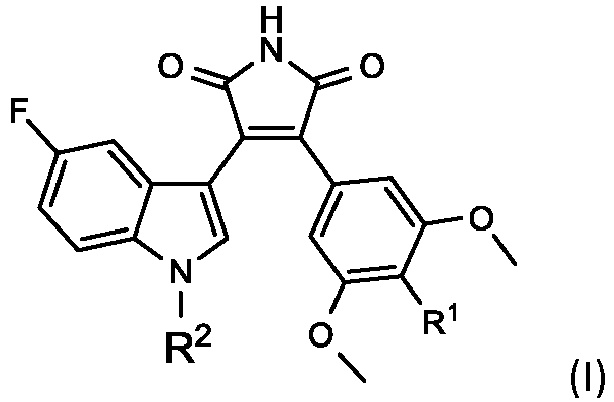
- R1
- is methoxy; and
- R2
- is (CH3)2CHCH2CH(NH2)C(O)OCH2CH2-hydroxyethyl, hydroxypropyl;
-
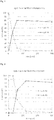
- Fig. 1
- shows the metabolization of compound Ia in rat liver microsomes over time.
- Fig. 2
- shows the metabolization of compound IIa in rat liver microsomes over time.
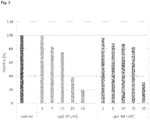
- Fig. 3
- shows the antiproliferative activity of compounds Id and IId against HT-29 human colon adenocarcinoma cells.
- An embodiment of the invention is a compound having formula (I) wherein R2 is (CH3)2CHCH2CH(NH2)C(O)OCH2CH2- , hydroxyethyl, or hydroxypropyl and the physiologically acceptable salts, solvates and solvates of the salts of the compounds of formula I. Disclosed herein are the compounds of formulae (Ia), (Ib), (Ic), (Id), (Ie), (If) and (Ig):


and the physiologically acceptable salts, solvates and solvates of the salts of the compounds of formula (Ia), (Ib), (Ic), (Id), (Ie), (If) and (Ig). - Physiologically acceptable salts of the compounds of formula I include acid addition salts with physiologically acceptable acids. Examples of suitable physiologically acceptable organic and inorganic acids are hydrochloric acid, hydrobromic acid, phosphoric acid, sulfuric acid, C1-C4-alkylsulfonic acids, such as methanesulfonic acid, cycloaliphatic sulfonic acids, such as S-(+)-10-camphor sulfonic acid, aromatic sulfonic acids, such as benzene sulfonic acid and toluene sulfonic acid, carboxylic acids, such as acetic acid, and hydroxycarboxylic acids, such as oxalic acid, malonic acid, maleic acid, mandelic acid, ascorbic acid, fumaric acid, gluconic acid, lactic acid, tartaric acid, citric acid, glycolic acid, adipic acid and benzoic acid. Other utilizable acids are described, e.g., in "Fortschritte der Arzneimittelforschung" [Advances in drug research], .
- The physiologically acceptable salts of the compounds of formula I also include salts of a physiologically tolerated anion, e.g. a deprotonated physiologically acceptable acid, with a compound of formula I, wherein one or more than one nitrogen atom may be quaternized, e.g. with an alkyl residue (e.g. methyl or ethyl).
- Physiologically acceptable solvates are in particular hydrates.
- The compounds of the present invention can be prepared according to the methods given in the examples section.
- The compounds of the present invention have antineoplastic activity. The particular advantage is that the compound of formula Ia (or Ib) can be used for a "sequential" therapy because it is metabolized via compound Ib which is further metabolized to compound Ic and then to compound Id. A further metabolic pathway is from compound Ia via compound Ib to a compound of formula I wherein R1 is methoxy and R2 is H and further to compound Id. The compounds of the invention address different kinases allowing a "combination" therapy with one single compound.
- The compounds of the invention can therefore be used for the treatment or prevention of tumors, in particular solid tumors, such as astrocytoma, bladder cancer, bone cancer, brain tumor, breast cancer, bronchial tumor, cervical cancer, colorectal cancer, endome-trial cancer, esophageal cancer, gallbladder cancer, gastrointestinal stromal tumor, germ cell tumor, glioma, head and neck cancer, liver cancer, lymphoma, sarcoma, lung cancer, melanoma, ovarian cancer, pancreatic cancer, thyroid cancer, neuroblastoma, prostate cancer, renal cancer, skin cancer, squamous neck cancer, stomach (gastric) cancer, testicular cancer. The compounds of the invention are especially useful for treatment or prevention of cervical cancer, colorectal cancer, gastrointestinal stromal tumor, liver cancer, lung cancer, ovarian cancer, prostate cancer, stomach cancer, and pancreatic carcinoma.
- According to a further embodiment, the compounds of the present invention can be used for the treatment or prevention of leukemia. Leukemia according to the present invention comprises in particular acute lymphocytic leukemia (also known as acute lymphoblastic leukemia, or ALL), acute myelogenous leukemia (also known as acute myeloid leukemia, or AML); chronic lymphocytic leukemia (CLL), mixed-lineage leukemia and chronic myelogenous leukemia (CML). These leukemias and further subtypes of these leukemias are defined by morphological, histochemical and immunological techniques that are well known by those skilled in the art.
- In a further embodiment, the invention relates to the treatment of AML or ALL.
- In a further embodiment of the invention, the leukemia is characterized by leukemic cells which are positive for expression of FLT3. In a particular embodiment of the invention, the leukemia is characterized by leukemic cells which show enhanced expression of FLT3, compared to non-malignant cells of the same cell type.
- The compounds of the invention may be used together with one or more than one other chemotherapeutic agent. A further embodiment of the invention is therefore a combination of the compounds of the present invention with one or more than one chemotherapeutic agent including antineoplastic agents, multidrug resistance reversing agents; and biological response modifiers, and combinations thereof, examples being given below. The combination of the invention exhibits enhanced tumor activity.
- Suitable antineoplastic agents may be selected from the group comprising compounds affecting integrity and synthesis of DNA, e.g. topoisomerase I inhibitors; alkylating agents: intercalating agents or DNA-binding antibiotics; antimitotic compounds such as taxanes: vinca alkaloids or colchicine derivatives; compounds for targeted cancer therapy such as protein kinase inhibitors, antibodies binding to cell membrane receptors and soluble decoy receptors; compounds affecting the cell metabolism, e.g. farnesyltransferase inhibitors, purine or pyrimidine analogues.
- Examples for antineoplastic agents are aflibercept, asparaginase, bleomycin, busulfan, carmustine, chlorambucil, cladribine, cyclophosphamide, cytarabine, dacarbazine, daunorubicin, doxorubicin, etoposide, fludarabine, gemcitabine, hydroxyurea, idarubicin, ifosfamide, irinotecan, lomustine, mechlorethamine, melphalan, mercaptopurine, methotrexate, mitomycin, mitoxantrone, pentostatin, procarbazine, 6-thioguanine, topotecan, vinblastine, vincristine, retinoic acid, oxaliplatin, cis-platin, carboplatin, 5-FU (5-fluorouracil), teniposide, amasacrine, docetaxel, paclitaxel, vinorelbine, bortezomib, clofarabine, capecitabine, actinomycin D, epirubicine, vindesine, methotrexate, tioguanine (6-thioguanine), tipifarnib.
- Examples for antineoplastic agents which are protein kinase inhibitors include imatinib, erlotinib, sorafenib, sunitinib, dasatinib, nilotinib, lapatinib, gefitinib, temsirolimus, everolimus, rapamycine, bosutinib, axitinib, neratinib, vatalanib, pazopanib, midostaurin and enzastaurin.
- Examples for antineoplastic agents which are antibodies comprise trastuzumab, cetuximab, panitumumab, rituximab, bevacizumab, mapatumumab, conatumumab, lexatumumab and the like.
- An example for a multidrug resistance reversing agent is PSC 833, a potent inhibitor of the efflux of antitumor drugs mediated by P-glycoprotein.
- Suitable biological response modifiers may be selected from the group consisting of monoclonal antibodies and cytokines, such as interferons, interleukins and colony-stimulating factors, e.g., rituxan, CMA-676, interferon-alpha recombinant, interleukin-2, interleukin-3, erythropoetin, epoetin, G-CSF, GM-CSF, filgrastim, sargramostim and thrombopoietin.
- According to a particular embodiment, the further chemotherapeutic agent is a topoisomerase I inhibitor and especially camptothecin or a derivative thereof such as described by Pommier, Y. (2006), Nature Reviews Cancer 6: 789-802. Examples for topomerase I inhibitors comprise compounds and the pharmaceutically acceptable salts thereof such as irinotecan (in particular irinotecan hydrochloride), topotecan (in particular topotecan hydrochloride), rubitecan, exatecan (in particular exatecan mesylate), lurtotecan, gimatecan, prothecan, karenitecin, belotecan (in particular belotecan hydrochloride), silatecan or diflomotecan and the salts thereof. Preferred is irinotecan (in particular irinotecan hydrochloride) or topotecan (in particular topotecan hydrochloride), and especially irinotecan (in particular irinotecan hydrochloride).
- The weight ratio of the compounds of the invention to the chemotherapeutic agent is in general in the range from 5:1 to 1:500, in particular 3:1 to 1:200.
- A further embodiment of the invention is a pharmaceutical composition comprising at least one compound of formula I. In a further embodiment the composition comprises at least one additional chemotherapeutic agent as defined above. In general, the pharmaceutical compositions comprise an amount therapeutically effective for tumor treatment of at least one compound of formula I as defined herein.
- A further embodiment of the invention is a compound of formula I for use in a method of treating tumors by administration of a compound of the invention to a subject, preferably a human subject, in need of such treatment.
- According to a further embodiment, said method comprises the use of an additional therapeutic agent (other than a compound of formula I). The additional therapeutic agent may be as defined above and can be administered prior to, simultaneously with or after administration of a compound of the invention.
- For use the compounds or combinations of the present invention can be incorporated into standard pharmaceutical dosage forms. For example, the compounds or combinations are useful when administered in systemic or local, oral or parenteral applications and for this purpose are combined with the usual pharmaceutical excipients, diluents and adjuvants, e.g., organic and inorganic inert carrier materials such as water, gelatin, lactose, starch, magnesium stearate, talc, vegetable oils, gums, polyalkyleneglycols, etc. These pharmaceutical preparations can be employed in a solid form, e.g., as tablets, capsules, and especially in combination with or for admixture with a palatable food item suitable for mammals; or they can be administered in liquid form, e.g., as solutions and elixirs. Pharmaceutical excipients and adjuvants which can be added to include preservatives, antioxidants, antimicrobial agents and other stabilizers; wetting, emulsifying, and suspending agents, and anticaking compounds; fragrance and coloring additives; compositions for improving compressibility, or to create a delayed-, sustained-, or controlled-release of the active ingredient; and various salts to change the osmotic pressure of the pharmaceutical preparation or to act as buffers.
- The therapeutically effective amount of a compound of formula I as defined may be administered systemically to said mammal, wherein said systemic administration comprises: (1) injection or infusion into suitable body tissues or cavities of a pharmaceutical composition containing said compound or combination in suitable liquid form such as aqueous solutions, emulsions or suspensions for intraarterial, intra- or transdermal (including subcutaneous) and most commonly intramuscular or intravenous delivery thereof; or for serving as a depot for delivery thereof; (2) instillation into suitable body tissues or cavities of a pharmaceutical composition containing said compound or combination in suitable solid form, e.g., comprising a matrix of bio-compatible and bio-erodible materials in which particles of at least one compound of formula I are dispersed for serving as a solid implant composition for delayed-, sustained-, and/or controlled-release delivery thereof; or (3) ingestion or administration of a pharmaceutical composition containing said compound or combination in suitable solid or liquid form for transdermal delivery thereof, for instance a transdermal patch or a subepidermal (subcuticular) implant, for peroral delivery thereof.
- The dosage forms described herein may be formulated so as to provide controlled-, sustained-, and/or delayed release of the active ingredient from said dosage form.
- Preferred peroral dosage forms for systemic administration are solids, e.g., palatable oral compositions such as fast dissolving palatable wafers, tablets, capsules, caplets, etc., and liquids, e.g., solutions, suspensions, emulsions, etc. Pharmaceutical compositions of special types suitable for oral administration to mammals may be used, and include, but are not limited to such items as an oral paste to be delivered to the back of the tongue of the mammal being treated, a granular form to be delivered through incorporation in the mammal's food, and a chewable form wherein the active ingredient is consumed along with the palatable chew, or a chewable form which may deliver the active ingredient by leaching from the body of the chew which is not consumed, during mastication by the mammal being treated. Tablets and capsules are preferred dosage forms.
- Said therapeutically effective amount of a compound of formula I as defined may also be administered locally to said mammal, wherein said local administration comprises: (1) injection or infusion into a local site affected with abnormal angiogenesis and/or vascular dysfunction of a pharmaceutical composition containing said compound of formula I or combination in suitable liquid form for delivery thereof, including components which provide delayed-release, controlled-release, and/or sustained-release of said compound or combination into said local site; or for serving as a depot for delivery thereof wherein said composition provides storage of said compound or combination and thereafter delayed-, sustained-, and/or controlled-release thereof; or (2) instillation of a pharmaceutical composition containing said compound or combination in suitable solid form for serving as a solid implant for delivery thereof, said composition optionally providing delayed-, sustained-, and/or controlled-release of said compound or combination to said local site.
- The therapeutically effective amount of the compound of formula I is administered to a mammal to be treated in an amount expressed as milligrams per m2 of body surface of said mammal, per day: "mg/m2/day". The dose, i.e., the therapeutically effective amount of a compound of formula I will usually range from about 0.2 mg/m2/day to about 2000 mg/m2/day, preferably from about 0.5 mg/m2/day to about 1500 mg/m2/day, more preferably from about 1.0 mg/m2/day to about 1000 mg/m2/day. In case of a combination of a compound of formula I with a chemotherapeutic agent such as an anticancer agent, administration may be simultaneously, for example given as coformulation or separately, or sequentially. The dose of a compound of formula I will usually be as given above whereas the dose of the chemotherapeutic agent will range from about 0.2 mg/m2/day to about 2000 mg/m2/day, preferably from about 0.5 mg/m2/day to about 1500 mg/m2/day, more preferably from about 1.0 mg/m2/day to about 1000 mg/m2/day.
- It is necessary for the skilled artisan, not only to determine the preferred route of administration and the corresponding dosage form and amount, but said artisan must also determine the dosing regimen, i.e., the frequency of dosing. In general terms it is most likely that the choice will be between once-a-day (s.i.d.) dosing and twice-a-day (b.i.d.) dosing, and that the former will provide more rapid and profound therapy, while the latter will provide less profound but more sustained therapy.
- The following examples illustrate the invention without limiting it.
- Infrared spectra were recorded on a Thermo Nicolet Avatar 330 FT-IR spectrometer. 1H (300 MHz, digital resolution 0.3768 Hz) and 13C (75 MHz, digital resolution 1.1299 Hz) NMR were recorded on a Bruker AC 300: the data are reported as follows: chemical shift in ppm from Me4Si as external standard, multiplicity and coupling constant (Hz). El-Mass spectra were recorded on a Varian MAT 44S (80 eV) and FD-Mass spectra on a Finnigan MAT 7 (5 kV). For clarity purposes only the highest measured signal is given for FD-Mass spectra. Elemental analyses were performed on a Haereus CHN rapid, Carlo Erba Strumentazione 1106. Combustion analyses agreed with the calculated data within ±0.4 unless otherwise stated. Melting points (mp.)/decomposition temperatures were determined on a Büchi apparatus according to Dr. Tottloi and are uncorrected. Where appropriate, column chromatography was performed for crude precursors with Merck silica gel 60 (0.063-0.200 mm). Column chromatography for test compounds was performed using a MPLC-System B-680 (Büchi) with Merck silica gel (0.015-0.040 mm). The progress of the reactions was monitored by thin layer chromatography (TLC) performed with Merck silica gel 60 F-254 plates. Where necessary, reactions were carried out in a nitrogen atmosphere using 4 Å molecular sieves. All reagents and solvents were obtained from commercial sources and used as received.
-
- rt
- room temperature
- DMF
- dimethylformamide
- DMAP
- dimethylaminopyridine
- DCM
- dichloromethane
- THF
- tetrahydrofurane
- DMSO
- dimethylsulfoxide
- PE/EE
- petrol ether/ethyl acetate
- Mp
- melting point
-

- A modified procedure of Galka et al., J. Lab. Comp. Rad. 2005, 48, 11, 797-809 was used to prepare the title compound. A mixture of 2-bromoethanol (40 mmol), tert-butyldimethylsilylchloride (40 mmol) and imidazole (44 mmol) was stirred at rt for 3 hours under inert atmosphere. The reaction was quenched with water and extracted with diethylether. The organic layer was dried over MgSO4, filtered and concentrated in vacuo. The purification was achieved by column chromatography (PE/EE) to yield the title compound (36.4 mmol; 91 %). 1H NMR (300 MHz, CDCl3) δ [ppm] = 3.91 (t; 3J = 6.5 Hz; 2H; OCH2); 3.41 (t; 3J = 6.5 Hz; 2H; CH2Br); 0.93 (s; 9H; C(CH3)3); 0.11 (s; 6H; 2xCH3).
- To a solution of 5-fluoroindole (16.28 mmol) in diethylether was added slowly at 0°C pyridine (170 µl) and ethylchlorooxoacetate (19.8 mmol) under inert gas. The reaction mixture was stirred for 1 h at 0°C, then for 4 h at rt. The precipitate was filtered and washed with water and ethanol (0°C) to yield the title compound as colorless crystals (11 mmol; 66 %). 1H NMR (300 MHz, CDCl3) δ [ppm] = 9.22 (bs, 1H; NH); 8.53 (d; J = 3.3 Hz; 1H; indole-H); 8.11 (dd; J = 2.5 Hz; J = 9.0 Hz; 1H; indole-H); 7.41 (dd; J = 4.3 Hz; J = 9.0 Hz; 1H; indole-H); 7.06 (dt; J = 2.5 Hz; J = 9.0 Hz; 1H; indole-H); 4.41 (q; 3J = 7.1 Hz; 2H; OCH 2CH3); 1.43 (t; 3J = 7.1 Hz; 3H; OCH2 CH 3).
- A modified procedure of Faul et al., J. of Org. Chem, 1998, 63, 6, 1961-1973 and Zhang et al., Bioorg. Med. Chem. Lett., 2004, 14, 12, 3245-3250 was used. A stirred suspension of ethyl-2-(5-fluoro-1H-indole)-2-oxoacetate (2) (4.3 mmol), CsCO3 (5.6 mmol) and 2-bromoethoxy-tert-butyldimethylsilane (1) (4.7 mmol) in dry DMF was heated to 75-80°C under nitrogen for 8 hours. The reaction was cooled to rt, diluted with ethyl acetate (40 ml) and filtered. The mixture was washed with water, dried over MgSO4, filtered, concentrated and purified by column chromatography to obtain the title compound as orange oil (12.5 mmol; 78 %). 1H NMR (300 MHz, CDCl3) δ [ppm] = 8.44 (s, 1H, Indol-H), 8.12 (m, 1H, Indol-H), 7.30 (m, Indol-H), 7.06 (Indol-H), 4.40 (q, J = 7.1 Hz, 2H, CH 2-CH3), 4.27 (t, J = 5.0 Hz, 2H, N-CH 2-CH2-O), 3.95 (t, J = 5.0 Hz, 2H, N-CH2-CH 2-O), 1.44 (t, J = 7.1 Hz, 3H, CH2-CH 3), 0.80 (s, 9H, C(CH3)3), - 0.16 (s, 6H, Si(CH3)2).
- A mixture of 3,4,5-trimethoxyphenylacetic acid (10 mmol) and phosphorus pentachloride (10 mmol) in dry DCM was stirred under inert gas. After 2 h, 10 ml of ammonia (25%) was added via syringe and after an additional 1h the mixture was quenched with ice (100 ml), acidified (10% HCI) and extracted with DCM. The organic fraction was dried (MgSO4) and concentrated, then the crude product was recrystallized in ethanol to obtain the title compound as colorless powder (8.5 mmol; 85 %). 1H NMR (300 MHz, DMSO) δ [ppm] = 7.39 (bs; 1H; NH); 6.87 (bs; 1H; NH); 6.55 (s; 2H; Ar-H); 3.73 (s; 6H; 2xOCH3); 3.61 (s; 3H; OCH3); 3.28(s; 2H; CH2).
- A modified procedure of
Peifer et al., WO 2006/061212 and J. Med. Chem., 2006, 49, 4, 1271-1281 was used to prepare 3-phenyl-4-indolyl-maleinimides. - To a solution of ethyl 2-(1-(3-(tert-butyldimethylsilyloxy)-ethyl)-5-fluoro-1H-indol-3-yl)-2-oxoacetate (3) (3.2 mmol) and 3,4,5-trimethoxyphenylacetamid (4) (3.2 mmol) in THF (inert gas, activated molecular sieve 4Å) was added slowly potassium tert-butoxide (14 mmol) in THF via syringe. The mixture was stirred for 2 h at rt, then diluted with ethyl acetate and filtered. After washing with water, the organic layer was dried over MgSO4, concentrated and purified by column chromatography (PE/EE) to obtain the title compound as orange solid (1.3 mmol; 41 %). 1H NMR (300 MHz, CDCl3) δ [ppm] = 8.09 (s, 1H, Indol-H), 7.34 (s, 1H, Imid-H), 7.29 (m, 1H, Indol-H), 6.90 (m, 1H, Indol-H), 6.74 (s, 2H, Ar-H), 5.99 (m, 1H, Indol-H), 4.29 (t, J = 5.0 Hz, 2H, N-CH 2-CH2-O-), 3.97 (t, J = 5.1 Hz, 2H N-CH2-CH 2-O-), 3.88 (s, 3H, OCH3), 3.56 (s, 6H, 2x OCH3), 0.80 (s, 9H, C(CH3)3), - 0.14 (s, 6H, Si(CH3)2).
-

- To 3-(1-(2-(tert-butyldimethylsilyloxy)-ethyl)-5-fluoro-1H-indol-3-yl)-4-(3,4,5-trimethoxyphenyl)-maleimide (5) (0.91 mmol) in THF was added tetrabutylammoniumfluo-ride (1.3 mmol) and the mixture was stirred at rt. After completion (TLC), the mixture was dried (MgSO4), concentrated and purified by column chromatography (PE/EE) to obtain the title compound as orange solid (0.84 mmol; 92 %). Mp 175 °C; IR ṽ [cm-1] = 3468, 3276, 2990, 1695, 1491, 1327, 1123, 751. FD-MS m/z (rel. Int.) = 440.1 (100 %; M+). 1H NMR (300 MHz, CDCl3) δ [ppm] = 8.05 (s, 1H, Indol-H), 7.40 (s, 1H, Imid-H), 7.28 (m, 1H, Indol-H), 6.92 (m, 1H, Indol-H), 6.75 (s, 2H, Ar-H), 6.08 (m, 1H, Indol-H), 4.34 (t, J= 4.7 Hz, 2H, N-CH 2 -CH2-OH), 4.04 (t, J = 4.8 Hz, 2H, N-CH2-CH 2 -OH ), 3.87 (s, 3H, OCH3), 3.56 (s, 6H, 2xOCH3).13C-NMR (75 MHz, DMSO) δ [ppm] = 172.56 (Cq), 172.33 (Cq), 155.62 (Cq), 152.59 (2 x Cq), 138.76 (Cq), 133.45 (CH), 131.62 (Cq), 128.74 (Cq), 125.76 (Cq), 125.27 (Cq), 108.08 (2 x CH), 107.04 (CH), 106.72 (Cq), 103.74 (2 x CH), 60.50 (CH3), 60.37 (CH2), 55.97 (2 x CH3), 49.33 (CH2). Anal. calcd for C23H21FN2O6 x H2O: C, 62.72; H, 4.81; N, 6.36. Found: C, 62.72; H, 4.88; N, 6.18.
- To a stirred solution of 1-ethyl-3-(3-dimethylaminopropyl)carbodiimid (EDCI; 1.3 mmol) and dimethylaminopyridine (DMAP; 0.22 mmol) in dry DCM, 3-(5-fluoro-1-(2-hydroxyethyl)-1H-indol-3-yl)-4-(3,4,5-trimethoxyphenyl)-maleimide (6) (0.45 mmol) in dry DCM was slowly added via syringe. The reaction mixture was stirred for 24 h at ambient temperature. After quenching with water and extracting with ethyl acetate, the combined organic layers were dried over MgSO4, filtered, concentrated and purified by column chromatography (PE/EE) to obtain the title compound as orange solid (0.4 mmol; 89 %). 1H NMR (300 MHz, CDCl3) δ [ppm] = 8.05 (s, 1H, Indol-H), 7.47 (s, 1H, Imid-H), 7.29 (m, 1H, Indol-H), 6.96 (m, 1H, Indol-H), 6.75 (s, 2H, Ar-H), 6.08 (d, J = 12,67 Hz, 1H, Indol-H), 5.00 (d, J = 8.75 Hz, 1H, -NH-CH-CO), 4.48 (m, 4H, -CH 2 -CH 2 -O-), 3.87 (s, 3H, OCH3), 3.56 (s, 6H, 2x OCH3), 1.68 (m, 4H, -NH-CH-CO and -CH 2 -CH(CH3)2, 1.42 (s, 9H, C(CH 3)3), 0.87 (m, 6H, -CH2-CH(CH 3 )2.
-

- To 2-(3-(2,5-dioxo-4-(3,4,5-trimethoxyphenyl)-2,5-dihydro-1H-pyrrol-3-yl)-5-fluoro-1H-indol-1-yl)-ethyl-2-((tert-butoxycarbonyl)-amino)-4-methylpentanoate (7) (0.4 mmol) in DCM was added trichloroacetic acid (15 mmol) and the mixture was stirred under inert gas at ambient temperature for 24 h. The solution was then diluted with ethyl acetate (0°C) and washed three times with saturated NaHCO3-solution (0-5°C). The dried organic phase (MgSO4) was concentrated (water bath 25°C) to give the title compound as orange-red solid (0.36 mmol; 90 %). Mp 180°C; IR ṽ [cm-1] = 3673, 2978, 2888, 1703, 1495, 1384, 1119, 959. 1H NMR (300 MHz, DMSO) δ [ppm] = 11.13 (s; 1H; Imid-NH), 8.44 (s; 3H; -NH3 +), 8.19 (s; 1H; Indol-H), 7.67 (d, J = 9,0 Hz; 1H; Indol-H), 7.03 (t; J = 9,0 Hz; 1H; Indol-H), 6.67 (s; 2H; Ar-H), 5,88 (d; J = 10,6 Hz; 1H; Indol-H), 4.47 (m; 4H, -CH2CH2-), 3.84 (t; J = 6.9 Hz; 1H; -NH-CH-CO-), 3.66 (s; 3H; OCH3), 3.34 (s; 6H; 2xOCH3), 1.60 (m; 1H; -CH2-CH(CH3)2), 1.45 (dd; J = 12,3; 6,8 Hz; 2H; -CH-CH 2-CH-), 0.72 (m, 6H; -CH2-CH(CH 3)2). Anal. calcd for C29H32FN3O7 x HCl x H2O: C, 57.28; H, 5.80; N, 6.91. Found: C, 57.08; H, 6.03; N, 6.56.
- The compound (le) which is not part of the invention was prepared in an analogous manner by using 3-bromopropoxy-tert-butyldimethylsilane in place of 2-bromoethoxy-tert-butyldimethylsilane.
-
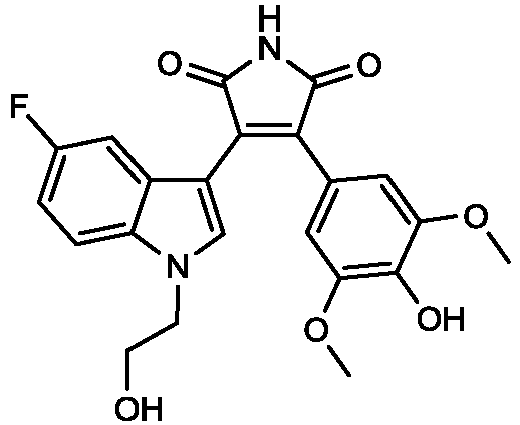
- To aluminium chloride (35 mmol) in DCM was added slowly 3-(5-fluoro-1-(2-hydroxyethyl)-1H-indol-3-yl)-4-(3,4,5-trimethoxyphenyl)-maleimide (6) (1.13 mmol) in DCM and the mixture was stirred for 48 h at ambient temperature. After completion, 20 ml of ice was added (0-3°C) and the mixture was extracted with ethyl acetate. The organic phase was washed with water and brine, dried over MgSO4 and concentrated to afford the product as orange crystals (0.9 mmol; 80 %). Mp 233°C. FD-MS m/z (rel. Int.) = 426.1 (100 %; M+). 1H NMR (300 MHz, CDCl3) δ [ppm] = 8.00 (s, 1H, Indol-H), 7.31 (s, 1H, Imid-NH), 6.96 (m, 2H, Indol-H), 6.86 (s, 2H, Ar-H), 6.24 (m, 1H, Indol-H), 5.74 (s, 1H, Ar-OH), 4.36 (m, 2H, N-CH 2-CH2-OH), 4.06 (t, J = 5.1 Hz, 2H, N-CH2-CH 2 -OH ), 3.60 (s, 6H, 2x OCH3). Anal. calcd for C22H19FN2O6: C,61.97; H,4.49; N,6.57. Found: C,61.55; H,4.79; N,6.38.
- Compound (Ig) which is not part of the invention was prepared in an analogous manner by using 3-(5-fluoro-1-(3-hydroxypropyl)-1H-indol-3-yl)-4-(3,4,5-trimethoxyphenyl)-maleimide as starting material.
-

- To a solution of ethyl-2-(5-fluoro-1H-indole)-2-oxoacetate (2) (3 mmol) and 3,4,5-trimethoxyphenylacetamide (4) (3 mmol) in THF (inert gas, activated molecular sieve 4Å) was added slowly potassium tert-butoxide (14 mmol) in THF via syringe. The reaction mixture was stirred for 2 h at rt, diluted with ethyl acetate and filtered. After washing with water, the organic layer was dried, concentrated and purified by column chromatography (PE/EE) to obtain the title compound as orange solid (1.2 mmol; 40 %). Mp = 232-233°C. IR ṽ [cm-1] = 3289; 1716; 1577. FD-MS m/z (rel. Int.) = 398.1 (1.71%; M+*). 1H NMR (300 MHz, DMSO) δ [ppm] = 11.99 (bs, 1H, indole-NH), 11.07 (bs, 1H, imide-NH), 8.06 (d, 3J = 2.6 Hz, 1H, indole-H), 7.44 (dd, J = 4.7 Hz, J = 8.8 Hz, 1H, indole-H), 6.94 (dt, J = 2.3 Hz, J = 9.1 Hz, 1H, indole-H); 6.7 (s, 2H, Ar-H), 5.91 (dd, J = 2.1 Hz, J = 10.7 Hz, 1H, indole H), 3.67 (s, 3H, OCH3), 3.43 (s, 6H, 2xOCH3).
- To aluminium chloride (35 mmol) in DCM was added slowly 3-(5-Fluoro-1H-indol-3-yl)-4-(3,4,5-trimethoxyphenyl)-maleimide (10) (1.2 mmol) in DCM and the mixture was stirred for 4 h at ambient temperature. After completion, 20 ml water was added (0-3°C) and the mixture was extracted with ethyl acetate. The organic phase was washed with water and brine, dried over MgSO4 and concentrated and purified by column chromatography (PE/EE) to afford the product (0.8 mmol; 67 %). 1H NMR (300 MHz, DMSO) δ [ppm] = 11.92 (bs, 1H, indole-NH), 10.98 (bs, 1H, imide-NH), 8.85 (s, 1H, indole-H), 7.98 (s, 1H, indole-H), 7.44 (dd, J = 4.56 Hz, J = 9.03 Hz, 1H, indole-H), 6.88 (m, 1H, indole-H); 6.74 (s, 2H, Ar-H), 6.08 (d, J = 8.20 Hz, 1H, indole-H), 3.43 (s, 6H, 2xOCH3). Anal. calcd for C22H19FN2O6 x 0,5H2O: C,61.38; H,4.12; N,7.16.. Found: C,61.07; H,4.40; N,6.84.
- For the following tests compounds (Ia) to (Id) as shown above were used in comparison to the following non-fluorinated compounds (IIa), (IIb) and (IId):


- The effect of test compounds on the activity of the protein kinases GSK-3β, VEGFR-2 and FLT-3 was evaluated based on half maximal inhibitory concentration (IC50) values determined by Eurofins Pharma Discovery Services UK Limited, Gemini Crescent, Dundee Technology Park, Dundee, DD2 1SW (KinaseProfiler™). Detailed information can be found at: http://www.eurofins.com/pharma-services/pharma-discovery-services/services/in-vitro-pharmacology/kinases/biochemical.aspx. The assays are also described in Biochem. J. (2013) 451, 313-328. The results are given in the following table 1.
Table 1 
(IC50 [nM]) compound R1 R2 VEGFR-2 GSK-3β FLT-3 IIb 
H 153 3 554 Ib 
F 79 3 66 If 
F 168 3 84 IIe 
H 920 2 556 - As can be seen, the fluorine-substituted compounds Ib and If of the invention exhibit a comparable effect as to GSK-3β and a significantly higher effect in inhibiting the activity of VEGFR-2 and FLT-3 as compared to the corresponding compound without fluorine substitution.
- In a further experiment the metabolic conversion of compounds (Ia) and (IIa) was evaluated according to the following procedure:
The test compounds were incubated in the reaction mixture given below with rat liver microsomes (Corning). For this purpose the reaction mixture (components 1-5, see below) was preincubated for 10 minutes at 37 °C. The reaction was started with the addition of 10 µl of the test compound followed by incubation at 37 ºC for 0-300 minutes, respectively. At each time point, 50 µl of the mixture were removed, added to 250 µl of ice cold acetonitrile and vortexed immediately. After centrifugation, the acetonitrile solution was analyzed by RP-HPLC-MS/MS system. -
- 1.
Magnesiumchloride hexahydrate 50 µl - 2. Glucose-6-
phosphate 50 µl - 3.
NADP + 50 µl - 4. Glucose-6-phosphate-dehydrogenase: 10 µl
- 5. Microsomes: 50 µl
- 6. Compounds: 40 µM (10 µl of 4 mM solution in ethanol)
- Acquity UPLC®- Quattro Premier XE (MS) system by Waters
Column: BEH C18, 2.1x50 mm, 1.2 µm pore diameter, Waters
Inject volume: 10 µl
Solvent A: H2O, NH4-formiate 2 mM + 0.1 % formic acid
Solvent B: Methanol, NH4-formiate 2 mM + 0.1 % formic acid
Flow regime: from 70 % solvent A/30 % solvent B to 100 % Solvent A in 2.4 minutes, then 70 % solvent A/30 % solvent B for 0.8 minutes. - The results for compound (Ia) are shown in
figure 1 whereas the results for compound (IIa) are shown infigure 2 . A time dependent degradation of both compounds and increasing concentration of the metabolite (Ib) and (IIb) can be seen. However, the metabolization of (Ia) is much faster than the metabolization of (IIa), i.e. (Ia) is largely metabolized after 1h while it takes 2h for (IIa) to metabolize to a comparable extent. As (Ib) is highly active, the faster metabolization is a significant advantage as the active principle is faster available as compared to (IIa). - In a further experiment the antiproliferative activity against HT-29 human colon adenocarcinoma cells was determined by a MTT assay for compound (Id) and non-fluorinated compound (lid) using 3-(4,5-dimethylthiazol-2-yl)-2,5-diphenyltetrazolium bromide (MTT) as described previously (Mosmann, T. et al. (1983) J. Immunol. Methods 65, 55-63). Cells in the exponential growth phase were transferred to 96-well flat-bottom plates. 10,000 viable cells contained in 200 µl cell suspension were plated into each well and incubated over night. Cells were then exposed to various concentrations of test compounds (100 µl/well) for 3 days at 37°C with 5% CO2. Subsequently, 10 µll/well MTT stock solution (5 mg/ml; Biomol, Germany) was added and the cells were incubated at 37°C with 5% CO2 for 4 hours. 100 µl solubilization solution (10% SDS in 0.01 M HCI) was added and the cells were incubated at 37°C with 5% CO2 over night. Plates were read on an ELISA-Reader ELX 800 (BIO-TEK Software KC 4) at 562 nm absorbance. Each experiment was done in triplicate. The results are given in
figure 3 which shows that compound (Id) has a time dependent, higher activity as compared to (IId) (the lower the viability of the target, the higher the activity).
Claims (14)
- 3-(5-Fluoroindolyl)-4-phenylmaleimide compounds of formula (I)
 R1 is methoxy; andR2 is (CH3)2CHCH2CH(NH2)C(O)OCH2CH2-, hydroxyethyl or hydroxypropyl;and the physiologically acceptable salts, solvates and solvates of the salts of the compounds of formula (I).
 - The compound of claim 1 having formula (I) wherein R2 is (CH3)2CHCH2CH(NH2)C(O)OCH2CH2- or hydroxyethyl and the physiologically acceptable salts, solvates and solvates of the salts of the compounds of formula (I).
- The compound of claim 1 having formula (Ia)

- The compound of claim 1 having formula (Ib)

- The compound of claim 1 having formula (If)

- A pharmaceutical composition comprising one or more compounds of any one of claims 1 to 5 and a pharmaceutically acceptable excipient.
- The composition of claim 6, further comprising one or more additional chemotherapeutic agents.
- The composition of claim 7, wherein the additional chemotherapeutic agent is selected from antineoplastic agents, multidrug resistance reversing agents, and biological response modifiers, and combinations thereof.
- The composition of claim 7, wherein the additional chemotherapeutic agent is at least one topoisomerase I inhibitor, preferably irinotecan or topotecan or a mixture thereof.
- A compound according to any one of claims 1 to 5 for use in the treatment or prevention of tumors.
- The compound for use according to claim 10, further comprising the use of one or more additional chemotherapeutic agents.
- The compound for use according to claim 11, wherein the additional chemotherapeutic agent is selected from antineoplastic agents, multidrug resistance reversing agents, and biological response modifiers, and combinations thereof.
- The compound for use according to claim 11, wherein the additional chemotherapeutic agent is at least one topoisomerase I inhibitor, preferably irinotecan or topotecan or a mixture thereof.
- The compound for use according to any one of claims 11 to 13, wherein the additional chemotherapeutic agent and the compound according to any one of claims 1 to 5 are administered sequentially, intermittently or simultaneously.
Applications Claiming Priority (2)
| Application Number | Priority Date | Filing Date | Title |
|---|---|---|---|
| EP15203072.2A EP3187495A1 (en) | 2015-12-30 | 2015-12-30 | 3-(5-fluoroindolyl)-4-arylmaleimide compounds and their use in tumor treatment |
| PCT/EP2016/082777 WO2017114863A1 (en) | 2015-12-30 | 2016-12-28 | 3-(5-fluoroindolyl)-4-arylmaleimide compounds and their use in tumor treatment |
Publications (2)
| Publication Number | Publication Date |
|---|---|
| EP3397632A1 EP3397632A1 (en) | 2018-11-07 |
| EP3397632B1 true EP3397632B1 (en) | 2020-06-24 |
Family
ID=55068898
Family Applications (2)
| Application Number | Title | Priority Date | Filing Date |
|---|---|---|---|
| EP15203072.2A Withdrawn EP3187495A1 (en) | 2015-12-30 | 2015-12-30 | 3-(5-fluoroindolyl)-4-arylmaleimide compounds and their use in tumor treatment |
| EP16825789.7A Active EP3397632B1 (en) | 2015-12-30 | 2016-12-28 | 3-(5-fluoroindolyl)-4-arylmaleimide compounds and their use in tumor treatment |
Family Applications Before (1)
| Application Number | Title | Priority Date | Filing Date |
|---|---|---|---|
| EP15203072.2A Withdrawn EP3187495A1 (en) | 2015-12-30 | 2015-12-30 | 3-(5-fluoroindolyl)-4-arylmaleimide compounds and their use in tumor treatment |
Country Status (6)
| Country | Link |
|---|---|
| US (1) | US11045449B2 (en) |
| EP (2) | EP3187495A1 (en) |
| JP (1) | JP6981983B2 (en) |
| AU (1) | AU2016383627A1 (en) |
| CA (1) | CA3004007C (en) |
| WO (1) | WO2017114863A1 (en) |
Families Citing this family (1)
| Publication number | Priority date | Publication date | Assignee | Title |
|---|---|---|---|---|
| AU2019358074A1 (en) * | 2018-10-10 | 2021-05-06 | Albert Einstein College Of Medicine | Benzoxazole and related compounds useful as chaperone-mediated autophagy modulators |
Family Cites Families (22)
| Publication number | Priority date | Publication date | Assignee | Title |
|---|---|---|---|---|
| SK75289A3 (en) | 1988-02-10 | 1998-05-06 | Hoffmann La Roche | Substituted pyrroles, their use for producing a drug, and the drug on their base |
| GB8904161D0 (en) | 1989-02-23 | 1989-04-05 | Hoffmann La Roche | Substituted pyrroles |
| MC2096A1 (en) | 1989-02-23 | 1991-02-15 | Hoffmann La Roche | SUBSTITUTED PYRROLES |
| DE4005969A1 (en) | 1990-02-26 | 1991-08-29 | Boehringer Mannheim Gmbh | NEW TRISUBSTITUTED PYRROLE, METHOD FOR THE PRODUCTION THEREOF AND MEDICINAL PRODUCTS CONTAINING THESE COMPOUNDS |
| GB9123396D0 (en) | 1991-11-04 | 1991-12-18 | Hoffmann La Roche | A process for the manufacture of substituted maleimides |
| GB9319297D0 (en) | 1993-09-17 | 1993-11-03 | Wellcome Found | Indole derivatives |
| KR20000064764A (en) | 1996-03-20 | 2000-11-06 | 피터지.스트링거 | Manufacturing method of indolyl maleimide |
| JP2002527419A (en) | 1998-10-08 | 2002-08-27 | スミスクライン・ビーチャム・パブリック・リミテッド・カンパニー | Pyrrole-2,5-diones as GSK-3 inhibitors |
| GB9828640D0 (en) | 1998-12-23 | 1999-02-17 | Smithkline Beecham Plc | Novel method and compounds |
| EP1224932A4 (en) | 1999-08-20 | 2002-10-16 | Sagami Chem Res | DRUGS INHIBITING CELL DEATH |
| IL153851A0 (en) | 2000-07-27 | 2003-07-31 | Hoffmann La Roche | 3-indolyl-4-phenyl-1h-pyrrole-2,5-dione derivatives as inhibitors of glycogen synthase kinase-3beta |
| SG159378A1 (en) | 2000-11-07 | 2010-03-30 | Novartis Ag | Indolylmaleimide derivatives as protein kinase c inhibitors |
| AU2003235798A1 (en) | 2002-01-10 | 2003-07-24 | F. Hoffmann-La Roche Ag | Use of a gsk-3beta inhibitor in the manufacture of a medicament for increasing bone formation |
| CA2485527A1 (en) | 2002-05-08 | 2003-11-20 | Janssen Pharmaceutica N.V. | Substituted pyrroline kinase inhibitors |
| JP2005531607A (en) | 2002-06-05 | 2005-10-20 | ジヤンセン・フアーマシユーチカ・ナームローゼ・フエンノートシヤツプ | Substituted pyrroline as a kinase inhibitor |
| WO2006006939A1 (en) | 2004-07-09 | 2006-01-19 | Agency For Science, Technology And Research | MODULATION OF GSK-3β AND METHOD OF TREATING PROLIFERATIVE DISORDERS |
| CA2589127C (en) | 2004-12-08 | 2013-02-05 | Johannes Gutenberg-Universitat Mainz | 3-(indolyl)-4-arylmaleimide derivatives and their use as angiogenesis inhibitors |
| WO2006073202A1 (en) | 2005-01-04 | 2006-07-13 | National University Corporation Kanazawa University | METHOD OF TUMOR SUPPRESSION AND EVALUATION OF ANTICANCER AGENT BASED ON GSK3β INHIBITORY EFFECT |
| US8841319B2 (en) | 2007-12-05 | 2014-09-23 | Johannes Gutenberg-Universitat Mainz | Use of 3-(indolyl)- or 3-(azaindolyl)-4-arylmaleimide derivatives in leukemia management |
| EP2338486A1 (en) * | 2009-12-18 | 2011-06-29 | Johannes Gutenberg-Universität Mainz | 3-(indolyl)- or 3-(azaindolyl)-4-arylmaleimide derivatives for use in the treatment of colon and gastric adenocarcinoma |
| EP2343291A1 (en) * | 2009-12-18 | 2011-07-13 | Johannes Gutenberg-Universität Mainz | 3-(Indolyl)- or 3-(Azaindolyl)-4-arylmaleimide compounds and their use in tumor treatment |
| EP2474541A1 (en) | 2010-12-23 | 2012-07-11 | Johannes- Gutenberg-Universität Mainz | Conjugated 3-(indolyl)- and 3-(azaindolyl)-4-arylmaleimide compounds and their use in tumor treatment |
-
2015
- 2015-12-30 EP EP15203072.2A patent/EP3187495A1/en not_active Withdrawn
-
2016
- 2016-12-28 US US16/066,268 patent/US11045449B2/en not_active Expired - Fee Related
- 2016-12-28 JP JP2018534580A patent/JP6981983B2/en not_active Expired - Fee Related
- 2016-12-28 EP EP16825789.7A patent/EP3397632B1/en active Active
- 2016-12-28 CA CA3004007A patent/CA3004007C/en active Active
- 2016-12-28 AU AU2016383627A patent/AU2016383627A1/en not_active Abandoned
- 2016-12-28 WO PCT/EP2016/082777 patent/WO2017114863A1/en not_active Ceased
Non-Patent Citations (1)
| Title |
|---|
| None * |
Also Published As
| Publication number | Publication date |
|---|---|
| CA3004007A1 (en) | 2017-07-06 |
| US20200253930A1 (en) | 2020-08-13 |
| JP6981983B2 (en) | 2021-12-17 |
| WO2017114863A1 (en) | 2017-07-06 |
| US11045449B2 (en) | 2021-06-29 |
| AU2016383627A1 (en) | 2018-05-10 |
| EP3187495A1 (en) | 2017-07-05 |
| CA3004007C (en) | 2023-12-05 |
| JP2019500393A (en) | 2019-01-10 |
| EP3397632A1 (en) | 2018-11-07 |
Similar Documents
| Publication | Publication Date | Title |
|---|---|---|
| CN104185627B (en) | Pyridone Derivatives | |
| CN107406454B (en) | Optimized combinations and their use in the treatment of cancer and autoimmune diseases | |
| JP2007535520A (en) | Indole and azaindole derivatives having antitumor activity | |
| JP2009542608A5 (en) | ||
| CA2782555C (en) | 3-(indolyl)-or 3-(azaindolyl)-4-arylmaleimide derivatives for use in the treatment of colon and gastric adenocarcinoma | |
| CN112142745B (en) | Casein kinase 1 epsilon inhibitor, pharmaceutical composition and application thereof | |
| JP6380777B2 (en) | PI3K, condensed quinoline compounds as mTOR inhibitors | |
| WO2021060453A1 (en) | Crosslinked optically active secondary amine derivative | |
| EP2513089B1 (en) | 3-(indolyl)- or 3-(azaindolyl)-4-arylmaleimide compounds and their use in tumor treatment | |
| EP2315761A1 (en) | Pharmaceutical compounds | |
| EP2655359B1 (en) | Conjugated 3-(indolyl)- and 3-(azaindolyl)-4-arylmaleimide compounds and their use in tumor treatment | |
| CN110357858B (en) | 5-substituted difluoropiperidine compounds having blood-brain barrier crossing capability | |
| TWI441829B (en) | Tricyclic pyrazolopyrimidine derivatives | |
| US11045449B2 (en) | 3-(5-fluoroindolyl)-4-arylmaleimide compounds and their use in tumor treatment | |
| KR20230135541A (en) | Novel compound and its use for inhibiting checkpoint kinase 2 | |
| TW202532410A (en) | Tertiary amide derivatives substituted with four-membered ring structures |
Legal Events
| Date | Code | Title | Description |
|---|---|---|---|
| STAA | Information on the status of an ep patent application or granted ep patent |
Free format text: STATUS: UNKNOWN |
|
| STAA | Information on the status of an ep patent application or granted ep patent |
Free format text: STATUS: THE INTERNATIONAL PUBLICATION HAS BEEN MADE |
|
| PUAI | Public reference made under article 153(3) epc to a published international application that has entered the european phase |
Free format text: ORIGINAL CODE: 0009012 |
|
| STAA | Information on the status of an ep patent application or granted ep patent |
Free format text: STATUS: REQUEST FOR EXAMINATION WAS MADE |
|
| 17P | Request for examination filed |
Effective date: 20180607 |
|
| AK | Designated contracting states |
Kind code of ref document: A1 Designated state(s): AL AT BE BG CH CY CZ DE DK EE ES FI FR GB GR HR HU IE IS IT LI LT LU LV MC MK MT NL NO PL PT RO RS SE SI SK SM TR |
|
| AX | Request for extension of the european patent |
Extension state: BA ME |
|
| RIN1 | Information on inventor provided before grant (corrected) |
Inventor name: LAUERMANN, EVA Inventor name: MOEHLER, MARKUS Inventor name: MADERER, ANNETT Inventor name: MOENNIKES, RENE Inventor name: GANSER, CHRISTOPHER Inventor name: DANNHARDT, GERD |
|
| DAV | Request for validation of the european patent (deleted) | ||
| DAX | Request for extension of the european patent (deleted) | ||
| RAP1 | Party data changed (applicant data changed or rights of an application transferred) |
Owner name: JOHANNES-GUTENBERG-UNIVERSITAET MAINZ Owner name: UNIVERSITAETSMEDIZIN DER JOHANNES GUTENBERG-UNIVER |
|
| STAA | Information on the status of an ep patent application or granted ep patent |
Free format text: STATUS: EXAMINATION IS IN PROGRESS |
|
| 17Q | First examination report despatched |
Effective date: 20191017 |
|
| GRAP | Despatch of communication of intention to grant a patent |
Free format text: ORIGINAL CODE: EPIDOSNIGR1 |
|
| STAA | Information on the status of an ep patent application or granted ep patent |
Free format text: STATUS: GRANT OF PATENT IS INTENDED |
|
| INTG | Intention to grant announced |
Effective date: 20200120 |
|
| GRAJ | Information related to disapproval of communication of intention to grant by the applicant or resumption of examination proceedings by the epo deleted |
Free format text: ORIGINAL CODE: EPIDOSDIGR1 |
|
| STAA | Information on the status of an ep patent application or granted ep patent |
Free format text: STATUS: EXAMINATION IS IN PROGRESS |
|
| GRAR | Information related to intention to grant a patent recorded |
Free format text: ORIGINAL CODE: EPIDOSNIGR71 |
|
| GRAS | Grant fee paid |
Free format text: ORIGINAL CODE: EPIDOSNIGR3 |
|
| STAA | Information on the status of an ep patent application or granted ep patent |
Free format text: STATUS: GRANT OF PATENT IS INTENDED |
|
| GRAA | (expected) grant |
Free format text: ORIGINAL CODE: 0009210 |
|
| STAA | Information on the status of an ep patent application or granted ep patent |
Free format text: STATUS: THE PATENT HAS BEEN GRANTED |
|
| INTC | Intention to grant announced (deleted) | ||
| INTG | Intention to grant announced |
Effective date: 20200514 |
|
| AK | Designated contracting states |
Kind code of ref document: B1 Designated state(s): AL AT BE BG CH CY CZ DE DK EE ES FI FR GB GR HR HU IE IS IT LI LT LU LV MC MK MT NL NO PL PT RO RS SE SI SK SM TR |
|
| REG | Reference to a national code |
Ref country code: GB Ref legal event code: FG4D |
|
| REG | Reference to a national code |
Ref country code: CH Ref legal event code: EP |
|
| REG | Reference to a national code |
Ref country code: AT Ref legal event code: REF Ref document number: 1283776 Country of ref document: AT Kind code of ref document: T Effective date: 20200715 |
|
| REG | Reference to a national code |
Ref country code: DE Ref legal event code: R096 Ref document number: 602016038853 Country of ref document: DE |
|
| REG | Reference to a national code |
Ref country code: IE Ref legal event code: FG4D |
|
| PG25 | Lapsed in a contracting state [announced via postgrant information from national office to epo] |
Ref country code: LT Free format text: LAPSE BECAUSE OF FAILURE TO SUBMIT A TRANSLATION OF THE DESCRIPTION OR TO PAY THE FEE WITHIN THE PRESCRIBED TIME-LIMIT Effective date: 20200624 Ref country code: SE Free format text: LAPSE BECAUSE OF FAILURE TO SUBMIT A TRANSLATION OF THE DESCRIPTION OR TO PAY THE FEE WITHIN THE PRESCRIBED TIME-LIMIT Effective date: 20200624 Ref country code: GR Free format text: LAPSE BECAUSE OF FAILURE TO SUBMIT A TRANSLATION OF THE DESCRIPTION OR TO PAY THE FEE WITHIN THE PRESCRIBED TIME-LIMIT Effective date: 20200925 Ref country code: NO Free format text: LAPSE BECAUSE OF FAILURE TO SUBMIT A TRANSLATION OF THE DESCRIPTION OR TO PAY THE FEE WITHIN THE PRESCRIBED TIME-LIMIT Effective date: 20200924 Ref country code: FI Free format text: LAPSE BECAUSE OF FAILURE TO SUBMIT A TRANSLATION OF THE DESCRIPTION OR TO PAY THE FEE WITHIN THE PRESCRIBED TIME-LIMIT Effective date: 20200624 |
|
| REG | Reference to a national code |
Ref country code: CH Ref legal event code: NV Representative=s name: BOVARD AG PATENT- UND MARKENANWAELTE, CH |
|
| REG | Reference to a national code |
Ref country code: LT Ref legal event code: MG4D |
|
| PG25 | Lapsed in a contracting state [announced via postgrant information from national office to epo] |
Ref country code: RS Free format text: LAPSE BECAUSE OF FAILURE TO SUBMIT A TRANSLATION OF THE DESCRIPTION OR TO PAY THE FEE WITHIN THE PRESCRIBED TIME-LIMIT Effective date: 20200624 Ref country code: LV Free format text: LAPSE BECAUSE OF FAILURE TO SUBMIT A TRANSLATION OF THE DESCRIPTION OR TO PAY THE FEE WITHIN THE PRESCRIBED TIME-LIMIT Effective date: 20200624 Ref country code: HR Free format text: LAPSE BECAUSE OF FAILURE TO SUBMIT A TRANSLATION OF THE DESCRIPTION OR TO PAY THE FEE WITHIN THE PRESCRIBED TIME-LIMIT Effective date: 20200624 Ref country code: BG Free format text: LAPSE BECAUSE OF FAILURE TO SUBMIT A TRANSLATION OF THE DESCRIPTION OR TO PAY THE FEE WITHIN THE PRESCRIBED TIME-LIMIT Effective date: 20200924 |
|
| REG | Reference to a national code |
Ref country code: NL Ref legal event code: MP Effective date: 20200624 |
|
| PG25 | Lapsed in a contracting state [announced via postgrant information from national office to epo] |
Ref country code: NL Free format text: LAPSE BECAUSE OF FAILURE TO SUBMIT A TRANSLATION OF THE DESCRIPTION OR TO PAY THE FEE WITHIN THE PRESCRIBED TIME-LIMIT Effective date: 20200624 Ref country code: AL Free format text: LAPSE BECAUSE OF FAILURE TO SUBMIT A TRANSLATION OF THE DESCRIPTION OR TO PAY THE FEE WITHIN THE PRESCRIBED TIME-LIMIT Effective date: 20200624 |
|
| PG25 | Lapsed in a contracting state [announced via postgrant information from national office to epo] |
Ref country code: SM Free format text: LAPSE BECAUSE OF FAILURE TO SUBMIT A TRANSLATION OF THE DESCRIPTION OR TO PAY THE FEE WITHIN THE PRESCRIBED TIME-LIMIT Effective date: 20200624 Ref country code: EE Free format text: LAPSE BECAUSE OF FAILURE TO SUBMIT A TRANSLATION OF THE DESCRIPTION OR TO PAY THE FEE WITHIN THE PRESCRIBED TIME-LIMIT Effective date: 20200624 Ref country code: CZ Free format text: LAPSE BECAUSE OF FAILURE TO SUBMIT A TRANSLATION OF THE DESCRIPTION OR TO PAY THE FEE WITHIN THE PRESCRIBED TIME-LIMIT Effective date: 20200624 Ref country code: RO Free format text: LAPSE BECAUSE OF FAILURE TO SUBMIT A TRANSLATION OF THE DESCRIPTION OR TO PAY THE FEE WITHIN THE PRESCRIBED TIME-LIMIT Effective date: 20200624 Ref country code: IT Free format text: LAPSE BECAUSE OF FAILURE TO SUBMIT A TRANSLATION OF THE DESCRIPTION OR TO PAY THE FEE WITHIN THE PRESCRIBED TIME-LIMIT Effective date: 20200624 Ref country code: PT Free format text: LAPSE BECAUSE OF FAILURE TO SUBMIT A TRANSLATION OF THE DESCRIPTION OR TO PAY THE FEE WITHIN THE PRESCRIBED TIME-LIMIT Effective date: 20201026 Ref country code: ES Free format text: LAPSE BECAUSE OF FAILURE TO SUBMIT A TRANSLATION OF THE DESCRIPTION OR TO PAY THE FEE WITHIN THE PRESCRIBED TIME-LIMIT Effective date: 20200624 |
|
| REG | Reference to a national code |
Ref country code: AT Ref legal event code: UEP Ref document number: 1283776 Country of ref document: AT Kind code of ref document: T Effective date: 20200624 |
|
| PG25 | Lapsed in a contracting state [announced via postgrant information from national office to epo] |
Ref country code: IS Free format text: LAPSE BECAUSE OF FAILURE TO SUBMIT A TRANSLATION OF THE DESCRIPTION OR TO PAY THE FEE WITHIN THE PRESCRIBED TIME-LIMIT Effective date: 20201024 Ref country code: SK Free format text: LAPSE BECAUSE OF FAILURE TO SUBMIT A TRANSLATION OF THE DESCRIPTION OR TO PAY THE FEE WITHIN THE PRESCRIBED TIME-LIMIT Effective date: 20200624 Ref country code: PL Free format text: LAPSE BECAUSE OF FAILURE TO SUBMIT A TRANSLATION OF THE DESCRIPTION OR TO PAY THE FEE WITHIN THE PRESCRIBED TIME-LIMIT Effective date: 20200624 |
|
| REG | Reference to a national code |
Ref country code: DE Ref legal event code: R097 Ref document number: 602016038853 Country of ref document: DE |
|
| PG25 | Lapsed in a contracting state [announced via postgrant information from national office to epo] |
Ref country code: DK Free format text: LAPSE BECAUSE OF FAILURE TO SUBMIT A TRANSLATION OF THE DESCRIPTION OR TO PAY THE FEE WITHIN THE PRESCRIBED TIME-LIMIT Effective date: 20200624 |
|
| PLBE | No opposition filed within time limit |
Free format text: ORIGINAL CODE: 0009261 |
|
| STAA | Information on the status of an ep patent application or granted ep patent |
Free format text: STATUS: NO OPPOSITION FILED WITHIN TIME LIMIT |
|
| 26N | No opposition filed |
Effective date: 20210325 |
|
| PG25 | Lapsed in a contracting state [announced via postgrant information from national office to epo] |
Ref country code: SI Free format text: LAPSE BECAUSE OF FAILURE TO SUBMIT A TRANSLATION OF THE DESCRIPTION OR TO PAY THE FEE WITHIN THE PRESCRIBED TIME-LIMIT Effective date: 20200624 Ref country code: MC Free format text: LAPSE BECAUSE OF FAILURE TO SUBMIT A TRANSLATION OF THE DESCRIPTION OR TO PAY THE FEE WITHIN THE PRESCRIBED TIME-LIMIT Effective date: 20200624 |
|
| REG | Reference to a national code |
Ref country code: BE Ref legal event code: MM Effective date: 20201231 |
|
| PG25 | Lapsed in a contracting state [announced via postgrant information from national office to epo] |
Ref country code: LU Free format text: LAPSE BECAUSE OF NON-PAYMENT OF DUE FEES Effective date: 20201228 Ref country code: IE Free format text: LAPSE BECAUSE OF NON-PAYMENT OF DUE FEES Effective date: 20201228 |
|
| PG25 | Lapsed in a contracting state [announced via postgrant information from national office to epo] |
Ref country code: TR Free format text: LAPSE BECAUSE OF FAILURE TO SUBMIT A TRANSLATION OF THE DESCRIPTION OR TO PAY THE FEE WITHIN THE PRESCRIBED TIME-LIMIT Effective date: 20200624 Ref country code: MT Free format text: LAPSE BECAUSE OF FAILURE TO SUBMIT A TRANSLATION OF THE DESCRIPTION OR TO PAY THE FEE WITHIN THE PRESCRIBED TIME-LIMIT Effective date: 20200624 Ref country code: CY Free format text: LAPSE BECAUSE OF FAILURE TO SUBMIT A TRANSLATION OF THE DESCRIPTION OR TO PAY THE FEE WITHIN THE PRESCRIBED TIME-LIMIT Effective date: 20200624 |
|
| PG25 | Lapsed in a contracting state [announced via postgrant information from national office to epo] |
Ref country code: MK Free format text: LAPSE BECAUSE OF FAILURE TO SUBMIT A TRANSLATION OF THE DESCRIPTION OR TO PAY THE FEE WITHIN THE PRESCRIBED TIME-LIMIT Effective date: 20200624 |
|
| PG25 | Lapsed in a contracting state [announced via postgrant information from national office to epo] |
Ref country code: BE Free format text: LAPSE BECAUSE OF NON-PAYMENT OF DUE FEES Effective date: 20201231 |
|
| PGFP | Annual fee paid to national office [announced via postgrant information from national office to epo] |
Ref country code: GB Payment date: 20221222 Year of fee payment: 7 Ref country code: FR Payment date: 20221219 Year of fee payment: 7 Ref country code: AT Payment date: 20221216 Year of fee payment: 7 |
|
| PGFP | Annual fee paid to national office [announced via postgrant information from national office to epo] |
Ref country code: CH Payment date: 20230103 Year of fee payment: 7 |
|
| PGFP | Annual fee paid to national office [announced via postgrant information from national office to epo] |
Ref country code: DE Payment date: 20221229 Year of fee payment: 7 |
|
| REG | Reference to a national code |
Ref country code: DE Ref legal event code: R119 Ref document number: 602016038853 Country of ref document: DE |
|
| REG | Reference to a national code |
Ref country code: CH Ref legal event code: PL |
|
| REG | Reference to a national code |
Ref country code: AT Ref legal event code: MM01 Ref document number: 1283776 Country of ref document: AT Kind code of ref document: T Effective date: 20231228 |
|
| GBPC | Gb: european patent ceased through non-payment of renewal fee |
Effective date: 20231228 |
|
| PG25 | Lapsed in a contracting state [announced via postgrant information from national office to epo] |
Ref country code: DE Free format text: LAPSE BECAUSE OF NON-PAYMENT OF DUE FEES Effective date: 20240702 |
|
| PG25 | Lapsed in a contracting state [announced via postgrant information from national office to epo] |
Ref country code: GB Free format text: LAPSE BECAUSE OF NON-PAYMENT OF DUE FEES Effective date: 20231228 |
|
| PG25 | Lapsed in a contracting state [announced via postgrant information from national office to epo] |
Ref country code: FR Free format text: LAPSE BECAUSE OF NON-PAYMENT OF DUE FEES Effective date: 20231231 |
|
| PG25 | Lapsed in a contracting state [announced via postgrant information from national office to epo] |
Ref country code: CH Free format text: LAPSE BECAUSE OF NON-PAYMENT OF DUE FEES Effective date: 20231231 |
|
| PG25 | Lapsed in a contracting state [announced via postgrant information from national office to epo] |
Ref country code: AT Free format text: LAPSE BECAUSE OF NON-PAYMENT OF DUE FEES Effective date: 20231228 |
|
| PG25 | Lapsed in a contracting state [announced via postgrant information from national office to epo] |
Ref country code: GB Free format text: LAPSE BECAUSE OF NON-PAYMENT OF DUE FEES Effective date: 20231228 Ref country code: FR Free format text: LAPSE BECAUSE OF NON-PAYMENT OF DUE FEES Effective date: 20231231 Ref country code: DE Free format text: LAPSE BECAUSE OF NON-PAYMENT OF DUE FEES Effective date: 20240702 Ref country code: CH Free format text: LAPSE BECAUSE OF NON-PAYMENT OF DUE FEES Effective date: 20231231 Ref country code: AT Free format text: LAPSE BECAUSE OF NON-PAYMENT OF DUE FEES Effective date: 20231228 |