EP3397487B1 - Flexible film, envelope or bag - Google Patents
Flexible film, envelope or bag Download PDFInfo
- Publication number
- EP3397487B1 EP3397487B1 EP16831754.3A EP16831754A EP3397487B1 EP 3397487 B1 EP3397487 B1 EP 3397487B1 EP 16831754 A EP16831754 A EP 16831754A EP 3397487 B1 EP3397487 B1 EP 3397487B1
- Authority
- EP
- European Patent Office
- Prior art keywords
- layer
- flexible film
- bag
- protective layer
- film according
- Prior art date
- Legal status (The legal status is an assumption and is not a legal conclusion. Google has not performed a legal analysis and makes no representation as to the accuracy of the status listed.)
- Active
Links
Images
Classifications
-
- B—PERFORMING OPERATIONS; TRANSPORTING
- B32—LAYERED PRODUCTS
- B32B—LAYERED PRODUCTS, i.e. PRODUCTS BUILT-UP OF STRATA OF FLAT OR NON-FLAT, e.g. CELLULAR OR HONEYCOMB, FORM
- B32B15/00—Layered products comprising a layer of metal
- B32B15/04—Layered products comprising a layer of metal comprising metal as the main or only constituent of a layer, which is next to another layer of the same or of a different material
- B32B15/08—Layered products comprising a layer of metal comprising metal as the main or only constituent of a layer, which is next to another layer of the same or of a different material of synthetic resin
- B32B15/085—Layered products comprising a layer of metal comprising metal as the main or only constituent of a layer, which is next to another layer of the same or of a different material of synthetic resin comprising polyolefins
-
- B—PERFORMING OPERATIONS; TRANSPORTING
- B32—LAYERED PRODUCTS
- B32B—LAYERED PRODUCTS, i.e. PRODUCTS BUILT-UP OF STRATA OF FLAT OR NON-FLAT, e.g. CELLULAR OR HONEYCOMB, FORM
- B32B15/00—Layered products comprising a layer of metal
- B32B15/04—Layered products comprising a layer of metal comprising metal as the main or only constituent of a layer, which is next to another layer of the same or of a different material
- B32B15/08—Layered products comprising a layer of metal comprising metal as the main or only constituent of a layer, which is next to another layer of the same or of a different material of synthetic resin
- B32B15/09—Layered products comprising a layer of metal comprising metal as the main or only constituent of a layer, which is next to another layer of the same or of a different material of synthetic resin comprising polyesters
-
- B—PERFORMING OPERATIONS; TRANSPORTING
- B32—LAYERED PRODUCTS
- B32B—LAYERED PRODUCTS, i.e. PRODUCTS BUILT-UP OF STRATA OF FLAT OR NON-FLAT, e.g. CELLULAR OR HONEYCOMB, FORM
- B32B27/00—Layered products comprising a layer of synthetic resin
- B32B27/06—Layered products comprising a layer of synthetic resin as the main or only constituent of a layer, which is next to another layer of the same or of a different material
- B32B27/08—Layered products comprising a layer of synthetic resin as the main or only constituent of a layer, which is next to another layer of the same or of a different material of synthetic resin
-
- B—PERFORMING OPERATIONS; TRANSPORTING
- B32—LAYERED PRODUCTS
- B32B—LAYERED PRODUCTS, i.e. PRODUCTS BUILT-UP OF STRATA OF FLAT OR NON-FLAT, e.g. CELLULAR OR HONEYCOMB, FORM
- B32B27/00—Layered products comprising a layer of synthetic resin
- B32B27/30—Layered products comprising a layer of synthetic resin comprising vinyl (co)polymers; comprising acrylic (co)polymers
- B32B27/306—Layered products comprising a layer of synthetic resin comprising vinyl (co)polymers; comprising acrylic (co)polymers comprising vinyl acetate or vinyl alcohol (co)polymers
-
- B—PERFORMING OPERATIONS; TRANSPORTING
- B32—LAYERED PRODUCTS
- B32B—LAYERED PRODUCTS, i.e. PRODUCTS BUILT-UP OF STRATA OF FLAT OR NON-FLAT, e.g. CELLULAR OR HONEYCOMB, FORM
- B32B27/00—Layered products comprising a layer of synthetic resin
- B32B27/32—Layered products comprising a layer of synthetic resin comprising polyolefins
-
- B—PERFORMING OPERATIONS; TRANSPORTING
- B32—LAYERED PRODUCTS
- B32B—LAYERED PRODUCTS, i.e. PRODUCTS BUILT-UP OF STRATA OF FLAT OR NON-FLAT, e.g. CELLULAR OR HONEYCOMB, FORM
- B32B27/00—Layered products comprising a layer of synthetic resin
- B32B27/32—Layered products comprising a layer of synthetic resin comprising polyolefins
- B32B27/325—Layered products comprising a layer of synthetic resin comprising polyolefins comprising polycycloolefins
-
- B—PERFORMING OPERATIONS; TRANSPORTING
- B32—LAYERED PRODUCTS
- B32B—LAYERED PRODUCTS, i.e. PRODUCTS BUILT-UP OF STRATA OF FLAT OR NON-FLAT, e.g. CELLULAR OR HONEYCOMB, FORM
- B32B27/00—Layered products comprising a layer of synthetic resin
- B32B27/36—Layered products comprising a layer of synthetic resin comprising polyesters
-
- B—PERFORMING OPERATIONS; TRANSPORTING
- B32—LAYERED PRODUCTS
- B32B—LAYERED PRODUCTS, i.e. PRODUCTS BUILT-UP OF STRATA OF FLAT OR NON-FLAT, e.g. CELLULAR OR HONEYCOMB, FORM
- B32B7/00—Layered products characterised by the relation between layers; Layered products characterised by the relative orientation of features between layers, or by the relative values of a measurable parameter between layers, i.e. products comprising layers having different physical, chemical or physicochemical properties; Layered products characterised by the interconnection of layers
- B32B7/04—Interconnection of layers
- B32B7/12—Interconnection of layers using interposed adhesives or interposed materials with bonding properties
-
- B—PERFORMING OPERATIONS; TRANSPORTING
- B65—CONVEYING; PACKING; STORING; HANDLING THIN OR FILAMENTARY MATERIAL
- B65D—CONTAINERS FOR STORAGE OR TRANSPORT OF ARTICLES OR MATERIALS, e.g. BAGS, BARRELS, BOTTLES, BOXES, CANS, CARTONS, CRATES, DRUMS, JARS, TANKS, HOPPERS, FORWARDING CONTAINERS; ACCESSORIES, CLOSURES, OR FITTINGS THEREFOR; PACKAGING ELEMENTS; PACKAGES
- B65D75/00—Packages comprising articles or materials partially or wholly enclosed in strips, sheets, blanks, tubes or webs of flexible sheet material, e.g. in folded wrappers
- B65D75/52—Details
- B65D75/58—Opening or contents-removing devices added or incorporated during package manufacture
- B65D75/5805—Opening or contents-removing devices added or incorporated during package manufacture for tearing a side strip parallel and next to the edge, e.g. by means of a line of weakness
-
- B—PERFORMING OPERATIONS; TRANSPORTING
- B32—LAYERED PRODUCTS
- B32B—LAYERED PRODUCTS, i.e. PRODUCTS BUILT-UP OF STRATA OF FLAT OR NON-FLAT, e.g. CELLULAR OR HONEYCOMB, FORM
- B32B2270/00—Resin or rubber layer containing a blend of at least two different polymers
-
- B—PERFORMING OPERATIONS; TRANSPORTING
- B32—LAYERED PRODUCTS
- B32B—LAYERED PRODUCTS, i.e. PRODUCTS BUILT-UP OF STRATA OF FLAT OR NON-FLAT, e.g. CELLULAR OR HONEYCOMB, FORM
- B32B2307/00—Properties of the layers or laminate
- B32B2307/30—Properties of the layers or laminate having particular thermal properties
- B32B2307/31—Heat sealable
-
- B—PERFORMING OPERATIONS; TRANSPORTING
- B32—LAYERED PRODUCTS
- B32B—LAYERED PRODUCTS, i.e. PRODUCTS BUILT-UP OF STRATA OF FLAT OR NON-FLAT, e.g. CELLULAR OR HONEYCOMB, FORM
- B32B2307/00—Properties of the layers or laminate
- B32B2307/50—Properties of the layers or laminate having particular mechanical properties
- B32B2307/582—Tearability
-
- B—PERFORMING OPERATIONS; TRANSPORTING
- B32—LAYERED PRODUCTS
- B32B—LAYERED PRODUCTS, i.e. PRODUCTS BUILT-UP OF STRATA OF FLAT OR NON-FLAT, e.g. CELLULAR OR HONEYCOMB, FORM
- B32B2307/00—Properties of the layers or laminate
- B32B2307/70—Other properties
- B32B2307/704—Crystalline
-
- B—PERFORMING OPERATIONS; TRANSPORTING
- B32—LAYERED PRODUCTS
- B32B—LAYERED PRODUCTS, i.e. PRODUCTS BUILT-UP OF STRATA OF FLAT OR NON-FLAT, e.g. CELLULAR OR HONEYCOMB, FORM
- B32B2307/00—Properties of the layers or laminate
- B32B2307/70—Other properties
- B32B2307/71—Resistive to light or to UV
-
- B—PERFORMING OPERATIONS; TRANSPORTING
- B32—LAYERED PRODUCTS
- B32B—LAYERED PRODUCTS, i.e. PRODUCTS BUILT-UP OF STRATA OF FLAT OR NON-FLAT, e.g. CELLULAR OR HONEYCOMB, FORM
- B32B2307/00—Properties of the layers or laminate
- B32B2307/70—Other properties
- B32B2307/724—Permeability to gases, adsorption
- B32B2307/7242—Non-permeable
-
- B—PERFORMING OPERATIONS; TRANSPORTING
- B32—LAYERED PRODUCTS
- B32B—LAYERED PRODUCTS, i.e. PRODUCTS BUILT-UP OF STRATA OF FLAT OR NON-FLAT, e.g. CELLULAR OR HONEYCOMB, FORM
- B32B2439/00—Containers; Receptacles
- B32B2439/40—Closed containers
- B32B2439/46—Bags
-
- B—PERFORMING OPERATIONS; TRANSPORTING
- B32—LAYERED PRODUCTS
- B32B—LAYERED PRODUCTS, i.e. PRODUCTS BUILT-UP OF STRATA OF FLAT OR NON-FLAT, e.g. CELLULAR OR HONEYCOMB, FORM
- B32B2439/00—Containers; Receptacles
- B32B2439/70—Food packaging
Definitions
- This invention relates to a flexible packaging film, and a bag for easy opening.
- the use of thin-walled films allows obtaining advantages in terms of both logistics and transport costs, mainly by virtue of the reduced weight and overall dimensions of such films.
- copolymers based on cyclic olefins in said films is also known, mainly in order to facilitate a substantially linear tearing upon product opening, without the need for tools.
- US2006/046006 describes a flexible multilayer polymeric film for making containers useful for packaging material e.g. drugs, foods and electronics, comprising base polymer layer, cyclic olefin copolymer layer, and vapour deposited layer comprising barrier coating.
- This invention relates to the preceding context, proposing to provide a film and a bag able to dramatically extend the useful life of the cyclic olefins, and thus ensure the film or bag reliable tearing behaviour over time.
- reference number 10 identifies, in its entirety, a flexible packaging film according to this invention.
- This film 10 comprises, preferably joined indirectly (in this regard see the following description), the following layers:
- fats and/or oils which have been identified as the substances mainly responsible for the rubbery transformation of the cyclic olefins mentioned in the opening, are prevented or limited from reaching the fourth layer, by virtue of the protective layer and related characteristics that act as a barrier to the crossing of its thickness.
- the fatty substances penetrate in the films since chemically compatible with the polymeric layers of such films. These substances thus blend and plasticise the crystalline structure of the crystallised polyolefins, forming rubbery structures. In other words, the fatty substances would appear to be suitable to break the crystalline structure of the linearly crystallised polyolefins, making them plastic.
- the fatty or oily substances remain confined at a certain distance from the crystallised polyolefins, or have a sufficiently low migration speed as not to impair the crystalline structure of the polyolefin of the fourth layer.
- the fourth layer could be apolar.
- the fourth layer 12 comprises the crystallised olefins mixed with polyethylene, low density polyethylene optionally linear, medium density polyethylene optionally linear, high density polyethylene, ultra high molecular weight polyethylene, polypropylene, homopolymer polypropylene, random copolymer polypropylene and combinations thereof.
- the crystallised olefins could be mixed with the aforesaid polymers in a percentage equal to or less than 99% by weight (%wt), preferably in a percentage comprised in the range 20-50%wt.
- the overall thickness A of said film 10 is approximately in the range of 70-200 ⁇ m.
- the protective layer 14 has a thickness comprised in the range of about 10-30 ⁇ m. More precisely, the thickness of the protective layer 14 is variable as a function of the concentration of fatty or oily substances intended to come into contact with the flexible film (and thus of the type of product) and/or by virtue of the nature of the selected protective layer.
- the second layer 6 comprises or consists of a foil made of aluminium or aluminium alloy.
- the first 4 and/or the third 8 layer comprise or consist of a polyethylene terephthalate (PET).
- PET polyethylene terephthalate
- the first 4, optionally the second 6, the fourth 12 and optionally the third 8 layer adhere to each other indirectly, through adhesive layers 18, 20, 22 interposed between them.
- adhesive layers 18, 20, 22 interposed between them see, for example, the schematisations of Figures 1 and 2 .
- the protective layer 14 serves at least partly as a filter or physical barrier for said fatty or oily substances, in order to reject, at least partly, the migration of the latter through the thickness of the protective layer 14 and prevent contamination of the crystallised polyolefins of the fourth layer 12 by the fatty/oily substances.
- such a filter or barrier could be effective for a time of at least three months at a temperature of about 40°C, or for at least six months (for example, for about one year) at room temperature.
- the protective layer 14 comprises or consists of polyethylene, low density polyethylene optionally linear, medium density polyethylene optionally linear, high density polyethylene, ultra high molecular weight polyethylene, polypropylene, homopolymer polypropylene, random copolymer polypropylene, ethylene vinyl alcohol, ionomers, and/or combinations thereof.
- the ionomers could include sodium ions and/or zinc ions.
- the protective layer 14 comprises or consists of a polar polymeric layer.
- the film 10 could comprise an amphipathic coupling layer 16, 16' at least on the side facing the fourth layer 12.
- a polar layer preferably requires at least one amphipathic coupling layer 16, 16' that, by virtue of its dual polar/apolar functionality, is able to combine a layer with polar characteristics with the fourth layer, preferably apolar.
- the protective layer 14 could be in direct contact with the fourth layer 12 ( Figure 1 ), or could be separated from the fourth layer 12 by an amphipathic coupling layer 16 ( Figure 2 ).
- the flexible film 10 could further comprise a product-contact layer 42, positioned on the side opposite to the first layer 4.
- the product-contact layer 42 could be apolar.
- the product-contact layer 42 is connected to the protective layer through an amphipathic coupling layer 16'.
- the product-contact layer 42 could include, or consist of random polypropylene copolymer, or could be selected from among any of the polymers mentioned above in relation to the fourth layer 14.
- the flexible film 10 would therefore have a double barrier with respect to the fatty/oily substances, for which it would be particularly suitable for contact with products with a high content of oils and fats.
- At least the surface 24 of the first layer 4 facing the fourth layer 12 comprises graphic elements 26, for example printed.
- this bag 1, 2 could be shaped in a substantially flat manner ( Figure 4 ), or could be of the stand-up type ( Figure 3 ).
- the bag 1, 2 comprises at least a pair of walls 28, 30, which together delimit an internal compartment 32 to receive fatty or oily substances, where such walls 28, 30 are at least partially thermo-welded to each other to hermetically close the internal compartment 32.
- the walls 28, 30 are welded along the side edges 34, 34', for example in the number of at least three or at least four edges, where the walls are preferably of a polygonal shape.
- One or both of the aforesaid walls 28, 30 are made at least partly (for example completely) from the flexible film 10 according to any of the embodiments illustrated previously.
- the walls 28, 30 could be thermo-welded to each other through the protective layer 14, or through the pair of protective layers of the two walls facing each other.
- the internal compartment 32 is at least partially occupied by a cosmetic or food product, where the protective layer 14 could be in contact with such product ( Figure 1 ), or could be separated from such product through the product-contact layer 42.
- the internal compartment 32 is resistant to an external compression of at least 1,5 tons (for example about 3 tons) for at least 1 minute, in particular without such compartment bursting.
- the walls 28, 30 are joined together securely enough and/or have a wall thickness sufficiently high to ensure that such bag 1, 1' withstands the aforesaid applied compression.
- the walls 28, 30 delimit a plurality of side edges 34, 34' welded together where, in correspondence of at least one 34, 34' of said edges, at least one guide notch 36 is formed for tearing at least part of said edge from the remaining portion of the bag.
- Figure 3 shows a bag 2 with only one guide notch
- Figure 4 shows a bag 1 with a pair of opposed notches.
- the notch facilitates the first tearing of the side edge, and determines the tearing direction S of the edge through the crystallised polyolefins, such tearing taking place in a substantially linear manner by virtue of the polyolefins.
- the divarication value or ratio D/L between the overall length L of a side edge 34 the aforesaid bag, and the maximum distance D between the torn flaps 38, 40 of opposite walls 28, 30 in correspondence of the side edge 34 is approximately comprised in the range 0.02 to 0.1.
- the columns from left to right identify, in this order, the layer considered, its thickness expressed in micrometres, the percentage by weight of the layer components, the chemical nature of such components, the trade name of a possible industrial product usable for each component, and finally the manufacturer of the industrial product.
- Example 1 Product name Produce fourth layer 60 ⁇ 47% LLDPE Innovex LL6608AF Ineos 43% crystallised polyolefins Topas® 8007F-400 Topas 10% LDPE LD 158 BW ExxonMobil protective layer 15 ⁇ 100% LMDPE innovex LL6910AA Ineos Overall thickness: 75 ⁇
- Example 2 Product name Producer fourth layer 60 ⁇ 47% LLDPE Innovex LL6608AF Ineos 43% crystallised polyolefins APL 6015T Mitsui 10% LDPE LD 158 BW ExxonMobil protective layer 40 ⁇ 100% LMDPE Innovex KL6910AA Ineos Overall thickness: 100 ⁇
- Example 3 Product name Producer fourth layer 40 ⁇ 47% LLDPE Innovex LL6608AF Ineos 43% crystall
- LLDPE linear low density polyethylene
- LDPE low density polyethylene
- LMDPE linear medium density polyethylene
- PP polypropylene
- EVOH ethylene vinyl alcohol
- the flexible film and bag of this invention allow brilliantly solving the drawbacks of the prior art.
- the structure of the film and bag allow preserving the easy-opening or tearing characteristics over time, by virtue of the slowing or impossibility of the oily/greasy substances to reach the crystallised polyolefins.
- the film and the bag of this invention allow guaranteeing a reliable sealed closure of the environment in which the product is contained.
- the film and the bag object of this invention were designed to ensure resistance to high external pressure.
- the film and bag of this invention allow achieving considerable economies of manufacture, by virtue of the fact that specific processing does not require supplementary or additional equipment respect to those required in this sector.
- the film and bag of this invention substantially completely use materials destined to the union of the components, with no waste.
- the film and the bag of this invention are particularly effective in creating a barrier to the fourth layer, since the appropriate selection of the polarities provides a reliable partition of the materials.
- the film and bag of this invention have wall thicknesses no greater with respect to the corresponding products according to the known technique.
Landscapes
- Engineering & Computer Science (AREA)
- Mechanical Engineering (AREA)
- Laminated Bodies (AREA)
- Wrappers (AREA)
Description
- The present invention is defined in the appended claims.
- This invention relates to a flexible packaging film, and a bag for easy opening.
- The use of flexible films, for example in the form of an envelope, for the containment of products of the cosmetics or food industries is extremely widespread.
- With respect to the more traditional glass containers, the use of thin-walled films allows obtaining advantages in terms of both logistics and transport costs, mainly by virtue of the reduced weight and overall dimensions of such films.
- The use of copolymers based on cyclic olefins in said films is also known, mainly in order to facilitate a substantially linear tearing upon product opening, without the need for tools.
-
US2006/046006 describes a flexible multilayer polymeric film for making containers useful for packaging material e.g. drugs, foods and electronics, comprising base polymer layer, cyclic olefin copolymer layer, and vapour deposited layer comprising barrier coating. - In this regard, the authors of this invention have observed that cyclic olefins suffer a progressive and irreversible deterioration in contact with certain categories of product, since such olefins assume a generally rubbery consistency and, as a result of such transformation, no longer correctly perform their tearing-assistance function.
- This invention relates to the preceding context, proposing to provide a film and a bag able to dramatically extend the useful life of the cyclic olefins, and thus ensure the film or bag reliable tearing behaviour over time.
- This purpose is achieved by means of a film according to
claim 1 and by means of a bag according to claim 11. The claims dependent on these show preferred embodiments. - The object of this invention will now be described in detail, with the help of the accompanying drawings, in which:
-
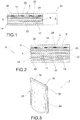
Figures 1 and 2 show sections of two different films, object of this invention, according to possible embodiments; -
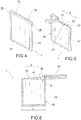
Figures 3 and4 illustrate envelopes or bags made with the aforesaid films, according to distinct variants; -
Figure 5 represents the bag offigure 4 during the tearing of a side edge; -
Figure 6 summarises the parameters of a bag involved in the calculation of the divarication value or ratio. - With reference to the accompanying figures,
reference number 10 identifies, in its entirety, a flexible packaging film according to this invention. - This
film 10 comprises, preferably joined indirectly (in this regard see the following description), the following layers: - a first layer 4 or outer layer comprising or consisting of polyester;
- a second metallic layer 6, configured to create a barrier through the
film 10 with respect to moisture, gases and/or light; - a
third layer 8 comprising or consisting of polyester; - a
fourth layer 12, configured to promote a substantially linear tearing of thefilm 10 along at least a given tearing direction S and comprising crystallised cyclic olefin copolymers (COC); - a
protective layer 14 or inner layer, comprising or consisting of a thermoplastic polymer (and preferably thermo-weldable), free of crystallised polyolefins and covering at least part of thefourth layer 12 in order to prevent/limit the migration of fatty or oily substances through its thickness, towards thefourth layer 12. - It follows that fats and/or oils, which have been identified as the substances mainly responsible for the rubbery transformation of the cyclic olefins mentioned in the opening, are prevented or limited from reaching the fourth layer, by virtue of the protective layer and related characteristics that act as a barrier to the crossing of its thickness.
- Without wishing in any way to provide a scientific explanation of the phenomenon, it is considered that, according to the known technique, the fatty substances penetrate in the films since chemically compatible with the polymeric layers of such films. These substances thus blend and plasticise the crystalline structure of the crystallised polyolefins, forming rubbery structures. In other words, the fatty substances would appear to be suitable to break the crystalline structure of the linearly crystallised polyolefins, making them plastic.
- On the contrary, according to this invention, the fatty or oily substances remain confined at a certain distance from the crystallised polyolefins, or have a sufficiently low migration speed as not to impair the crystalline structure of the polyolefin of the fourth layer.
- For example, the fourth layer could be apolar. Preferably, the
fourth layer 12 comprises the crystallised olefins mixed with polyethylene, low density polyethylene optionally linear, medium density polyethylene optionally linear, high density polyethylene, ultra high molecular weight polyethylene, polypropylene, homopolymer polypropylene, random copolymer polypropylene and combinations thereof. - Merely by way of example, the crystallised olefins could be mixed with the aforesaid polymers in a percentage equal to or less than 99% by weight (%wt), preferably in a percentage comprised in the range 20-50%wt.
- According to an embodiment, the overall thickness A of said
film 10 is approximately in the range of 70-200 µm. - According to a further embodiment, the
protective layer 14 has a thickness comprised in the range of about 10-30 µm. More precisely, the thickness of theprotective layer 14 is variable as a function of the concentration of fatty or oily substances intended to come into contact with the flexible film (and thus of the type of product) and/or by virtue of the nature of the selected protective layer. - According to a preferred variant, the second layer 6 comprises or consists of a foil made of aluminium or aluminium alloy.
- According to an advantageous variant, the first 4 and/or the third 8 layer comprise or consist of a polyethylene terephthalate (PET).
- According to an embodiment, the first 4, optionally the second 6, the fourth 12 and optionally the third 8 layer adhere to each other indirectly, through
adhesive layers Figures 1 and 2 . - According to a particularly advantageous embodiment, the
protective layer 14 serves at least partly as a filter or physical barrier for said fatty or oily substances, in order to reject, at least partly, the migration of the latter through the thickness of theprotective layer 14 and prevent contamination of the crystallised polyolefins of thefourth layer 12 by the fatty/oily substances. - Merely by way of example, such a filter or barrier could be effective for a time of at least three months at a temperature of about 40°C, or for at least six months (for example, for about one year) at room temperature.
- According to various variants, the
protective layer 14 comprises or consists of polyethylene, low density polyethylene optionally linear, medium density polyethylene optionally linear, high density polyethylene, ultra high molecular weight polyethylene, polypropylene, homopolymer polypropylene, random copolymer polypropylene, ethylene vinyl alcohol, ionomers, and/or combinations thereof. - Merely by way of example, the ionomers could include sodium ions and/or zinc ions.
- According to an advantageous embodiment, the
protective layer 14 comprises or consists of a polar polymeric layer. According to this variant, thefilm 10 could comprise anamphipathic coupling layer 16, 16' at least on the side facing thefourth layer 12. - The presence of a polar layer preferably requires at least one
amphipathic coupling layer 16, 16' that, by virtue of its dual polar/apolar functionality, is able to combine a layer with polar characteristics with the fourth layer, preferably apolar. - According to the schematised embodiments, the
protective layer 14 could be in direct contact with the fourth layer 12 (Figure 1 ), or could be separated from thefourth layer 12 by an amphipathic coupling layer 16 (Figure 2 ). - In the presence of a
protective layer 14 of polar nature, theflexible film 10 could further comprise a product-contact layer 42, positioned on the side opposite to the first layer 4. - For example, the product-
contact layer 42 could be apolar. - Advantageously, the product-
contact layer 42 is connected to the protective layer through an amphipathic coupling layer 16'. - According to a variant, the product-
contact layer 42 could include, or consist of random polypropylene copolymer, or could be selected from among any of the polymers mentioned above in relation to thefourth layer 14. - According to these last variants, the
flexible film 10 would therefore have a double barrier with respect to the fatty/oily substances, for which it would be particularly suitable for contact with products with a high content of oils and fats. - Optionally, at least the
surface 24 of the first layer 4 facing thefourth layer 12 comprisesgraphic elements 26, for example printed. - The aforesaid objective is also achieved by an easy-opening
bag - According to the embodiments shown, this
bag Figure 4 ), or could be of the stand-up type (Figure 3 ). - The
bag walls internal compartment 32 to receive fatty or oily substances, wheresuch walls internal compartment 32. - More precisely, the
walls side edges 34, 34', for example in the number of at least three or at least four edges, where the walls are preferably of a polygonal shape. - One or both of the
aforesaid walls flexible film 10 according to any of the embodiments illustrated previously. - Preferably, the
walls protective layer 14, or through the pair of protective layers of the two walls facing each other. - Preferably, the
internal compartment 32 is at least partially occupied by a cosmetic or food product, where theprotective layer 14 could be in contact with such product (Figure 1 ), or could be separated from such product through the product-contact layer 42. - According to a preferred embodiment, the
internal compartment 32 is resistant to an external compression of at least 1,5 tons (for example about 3 tons) for at least 1 minute, in particular without such compartment bursting. - It follows that the
walls such bag 1, 1' withstands the aforesaid applied compression. - According to a variant, the
walls side edges 34, 34' welded together where, in correspondence of at least one 34, 34' of said edges, at least oneguide notch 36 is formed for tearing at least part of said edge from the remaining portion of the bag. - In this regard,
Figure 3 shows abag 2 with only one guide notch, whileFigure 4 shows abag 1 with a pair of opposed notches. - Therefore the notch facilitates the first tearing of the side edge, and determines the tearing direction S of the edge through the crystallised polyolefins, such tearing taking place in a substantially linear manner by virtue of the polyolefins.
- According to a particularly advantageous variant, the divarication value or ratio D/L between the overall length L of a
side edge 34 the aforesaid bag, and the maximum distance D between thetorn flaps opposite walls side edge 34 is approximately comprised in the range 0.02 to 0.1. - As regards the divarication value, reference is also made to document
EP1769908A1 of the same Applicant. - This invention will now be illustrated according to several non-limiting examples.
- In these examples, the columns from left to right identify, in this order, the layer considered, its thickness expressed in micrometres, the percentage by weight of the layer components, the chemical nature of such components, the trade name of a possible industrial product usable for each component, and finally the manufacturer of the industrial product.
- These examples focus primarily on the fourth layer and layers successive to the fourth, but does not affect the fact that the first layer according to the invention is always present and also the second and third layers as defined above.
Example 1: Product name Produce fourth layer 60µ 47% LLDPE Innovex LL6608AF Ineos 43% crystallised polyolefins Topas® 8007F-400 Topas 10% LDPE LD 158 BW ExxonMobil protective layer 15µ 100% LMDPE innovex LL6910AA Ineos Overall thickness: 75µ Example 2: Product name Producer fourth layer 60µ 47% LLDPE Innovex LL6608AF Ineos 43% crystallised polyolefins APL 6015T Mitsui 10% LDPE LD 158 BW ExxonMobil protective layer 40µ 100% LMDPE Innovex KL6910AA Ineos Overall thickness: 100µ Example 3: Product name Producer fourth layer 40µ 47% LLDPE Innovex LL6608AF Ineos 43% crystallised polyolefins AFL 6015T Mitsui 10% LDPE LD 158 BW ExxonMobil amphipathic layer 3µ 100% Admer NF458A Mitsui protective layer 3µ 100% EVOH EVAL F171 Kuraray amphipathic layer 3µ 100% Admer NF458A Mitsui product-contact layer 26µ 90% LLDPE Innovex LL6608AF Ineos 10% LDPE LD 158 BW ExxonMobil Overall thickness: 75µ Example 4: Product name Producer fourth layer 60µ 57% PP random copolymer Moplen RP320M Lyondellbasell 43% crystallised polyolefins Topas® 8007F-400 Topas protective layer 15µ 100% PP homopolymer Moplen HP420M Lyondellbasell Overall thickness: 75µ Example 5: Product name Producer fourth layer 40µ 57% PP random copolymer Mοplen RP320M Lyondellbasell 43% crystallised polyolefins Topas® 8007F-400 Topas amphipathic layer 3µ 100% Admer NF458A Mitsui protective layer 3µ 100% EVOH EVAL F171 Kuraray amphipathie layer 3µ 100% Admer NF458A Mitsui product-contact layer 26µ 100% PP random copolymer Moplen RP320M Lyondellbasell Overall thickness : 75µ - In the preceding examples the abbreviations used have the following meaning: LLDPE = linear low density polyethylene; LDPE = low density polyethylene; LMDPE = linear medium density polyethylene; PP = polypropylene; EVOH = ethylene vinyl alcohol.
- Innovatively, the flexible film and bag of this invention allow brilliantly solving the drawbacks of the prior art.
- More precisely, the structure of the film and bag allow preserving the easy-opening or tearing characteristics over time, by virtue of the slowing or impossibility of the oily/greasy substances to reach the crystallised polyolefins.
- Advantageously, the film and the bag of this invention allow guaranteeing a reliable sealed closure of the environment in which the product is contained.
- Advantageously, the film and the bag object of this invention were designed to ensure resistance to high external pressure.
- Advantageously, the film and bag of this invention allow achieving considerable economies of manufacture, by virtue of the fact that specific processing does not require supplementary or additional equipment respect to those required in this sector.
- Advantageously, the film and bag of this invention substantially completely use materials destined to the union of the components, with no waste.
- Advantageously, the film and the bag of this invention are particularly effective in creating a barrier to the fourth layer, since the appropriate selection of the polarities provides a reliable partition of the materials.
- Advantageously, the film and bag of this invention have wall thicknesses no greater with respect to the corresponding products according to the known technique.
- To the embodiments of the aforesaid flexible film and bag, one skilled in the art, in order to meet specific needs, may make variants or substitutions of elements with others functionally equivalent.
- Even these variants are contained within the scope of protection, as defined by the following claims.
- Moreover, each of the variants described as belonging to a possible embodiment can be realised independently of the other variants described.
Claims (16)
- Flexible film (10) for packaging comprising, joined together in a preferably indirect manner:- a first layer (4) or outer layer comprising or consisting of polyester;- a second metallic layer (6), configured to create a barrier through said film (10) with respect to moisture, gases and/or light;- a third layer (8) comprising or consisting of polyester;- a fourth layer (12) comprising crystallised cyclic olefin copolymers (COC) configured to promote a substantially linear tearing of said film (10) .along at least a given tearing direction (S);- a protective layer (14) or inner layer, comprising or consisting of a thermoplastic polymer, free of crystallised cyclic olefin copolymers and covering at least part of the fourth layer (12) in order to prevent/limit the migration of fatty or oily substances through its thickness, towards the fourth layer (12).
- Flexible film according to the preceding claim, wherein the protective layer (14) makes at least partly a filter or physical barrier for said fatty or oily substances, in order to reject the migration of the latter through the thickness of the protective layer (14) and prevent contamination of the crystallised polyolefins of the fourth layer (12), e.g. for a time of at least three months at a temperature of about 40°C.
- Flexible film according to any of the preceding claims, wherein the protective layer (14) comprises or consists of polyethylene, low density polyethylene optionally linear, medium density polyethylene optionally linear, high density polyethylene, ultra high molecular weight polyethylene, polypropylene, homopolymer polypropylene, random copolymer polypropylene, ethylene vinyl alcohol, ionomers, or combinations thereof.
- Flexible film according to any of the preceding claims, wherein the protective layer (14) comprises or consists of a polar polymer layer, and comprising an amphipathic coupling layer (16, 16') at least on the side facing the fourth layer (12).
- Flexible film according to the preceding claim, comprising an apolar product-contact layer (42) positioned on the opposite side with respect to the first layer (4) and connected to the protective layer through an amphipathic coupling layer (16').
- Flexible film according to any of the preceding claims, wherein the protective layer (14) has a thickness in the range of about 10-30 pm.
- Flexible film according to any one of the preceding claims, wherein the first (4), second (6), fourth (12) and optionally third layer (8) indirectly adhere to each other through adhesive layers (18, 20, 22), and wherein the protective layer (14) is in direct contact with the fourth layer (12) or is separated from the fourth layer (12) by an amphipathic coupling layer (16, 16').
- Flexible film according to any of the preceding claims, wherein the first (4) and the third (8) layer comprise or consist of polyethylene terephthalate (PET), and wherein at least the surface (24) of the first layer (4) facing the fourth layer (12) comprises printed graphic elements (26).
- Flexible film according to any of the preceding claims, wherein the fourth 1 ayer (12) comprises the crystallised cyclic olefin copolymer mixed, for example in a percentage equal to or lower than 99%wt, with polyethylene, low density polyethylene optionally linear, medium density polyethylene optionally linear, high density polyethylene, ultra high molecular weight polyethylene, polypropylene, homopolymer polypropylene, random copolymer polypropylene and combinations thereof.
- Flexible film according to any of the preceding claims, wherein the overall thickness (A) of said film (10) is approximately in the range of 70-200 µm.
- Easy-opening bag (1, 2), comprising at least a pair of walls (28, 30), which together delimit an internal compartment (32) to receive fatty or oily substances, said walls (28, 30) being at least partially thermo-welded to each other to hermetically close the internal compartment (32), wherein one or both of said walls (28, 30) are at least partly made of the flexible film (10) according to any of the preceding claims.
- Bag according to the pre ceding claim, wherein the internal compartment (32) is at least partially occupied by a cosmetic or food product, the protective layer (14) being in contact with said product.
- Bag according to any of claims 11 to 12, wherein the internal compartment (32) is resistant to an external compression, without bursting, of at least 1,5 tons for at least 1 minute, the walls (28, 30) being joined together securely enough and having sufficiently high wall thicknesses to ensure that such bag (1, 1') withstands said applied compression.
- Bag according to any of claims 11 to 13, characterised in that it has a substantially flat or stand-up type shape.
- Bag according to any of claims 11 to 14, wherein the walls (28, 30) delimit a plurality of side edges (34, 34') welded together wherein, in correspondence of at least one (34, 34') of said edges, at least one guide notch (36) is formed for tearing at least part of said edge from the remaining portion of the bag.
- Bag according to any of claims 11 to 15, wherein the divarication value or ratio D/L between the overall length (L) of a side edge (34) of said bag, and the maximum distance (D) between the torn flaps (38, 40) of opposite walls (28, 30) in correspondence of the side edge (34) is approximately in the range 0.02 to 0.1.
Applications Claiming Priority (2)
| Application Number | Priority Date | Filing Date | Title |
|---|---|---|---|
| ITUB2015A009235A ITUB20159235A1 (en) | 2015-12-29 | 2015-12-29 | FLEXIBLE FILM, ENVELOPE OR BAG |
| PCT/IB2016/057928 WO2017115241A1 (en) | 2015-12-29 | 2016-12-22 | Flexible film, envelope or bag |
Publications (2)
| Publication Number | Publication Date |
|---|---|
| EP3397487A1 EP3397487A1 (en) | 2018-11-07 |
| EP3397487B1 true EP3397487B1 (en) | 2020-03-18 |
Family
ID=55697333
Family Applications (1)
| Application Number | Title | Priority Date | Filing Date |
|---|---|---|---|
| EP16831754.3A Active EP3397487B1 (en) | 2015-12-29 | 2016-12-22 | Flexible film, envelope or bag |
Country Status (3)
| Country | Link |
|---|---|
| EP (1) | EP3397487B1 (en) |
| IT (1) | ITUB20159235A1 (en) |
| WO (1) | WO2017115241A1 (en) |
Family Cites Families (6)
| Publication number | Priority date | Publication date | Assignee | Title |
|---|---|---|---|---|
| KR100220961B1 (en) * | 1996-04-11 | 1999-09-15 | 사또 아끼오 | Laminated film and packaging material |
| JP4603532B2 (en) * | 2003-05-07 | 2010-12-22 | ティコナ ゲゼルシャフト ミット ベシュレンクテル ハフツング | Co-extruded multilayer film for packaging that is sealable, uses thereof, and methods of making the same |
| US20060046006A1 (en) * | 2004-08-31 | 2006-03-02 | Bastion Bradley J | Multilayer polymeric barrier film, flexible packaging made therewith, and methods |
| US10189621B2 (en) * | 2007-05-21 | 2019-01-29 | Cryovac, Inc. | Bag made from high-strength heat-shrinkable film exhibiting directional tear, and process utilizing same |
| WO2012121716A1 (en) * | 2011-03-09 | 2012-09-13 | Curwood, Inc. | Gusseted bag with easy-open lap seal |
| DE102011121143A1 (en) * | 2011-08-23 | 2013-02-28 | Huhtamaki Films Germany Gmbh & Co. Kg | A linearly tearable multilayer film |
-
2015
- 2015-12-29 IT ITUB2015A009235A patent/ITUB20159235A1/en unknown
-
2016
- 2016-12-22 EP EP16831754.3A patent/EP3397487B1/en active Active
- 2016-12-22 WO PCT/IB2016/057928 patent/WO2017115241A1/en not_active Ceased
Non-Patent Citations (1)
| Title |
|---|
| None * |
Also Published As
| Publication number | Publication date |
|---|---|
| ITUB20159235A1 (en) | 2017-06-29 |
| EP3397487A1 (en) | 2018-11-07 |
| WO2017115241A1 (en) | 2017-07-06 |
Similar Documents
| Publication | Publication Date | Title |
|---|---|---|
| KR100318654B1 (en) | Anti-fouling sealant film and its products | |
| US8383221B2 (en) | Multi-layer film | |
| EP3218187B1 (en) | Chemically-resistant barrier film | |
| CN114684481A (en) | Tubular container | |
| KR20210019988A (en) | Resin composition for liquid-repellent layer formation, and liquid-repellent film, liquid-repellent laminate, packaging material and container using the same | |
| JP2008512317A (en) | Strip tape, packaging container having such strip tape, and method of manufacturing such strip tape | |
| JP2019516575A5 (en) | ||
| KR20220103965A (en) | Manufacturing method of package, film for packaging material, laminated film and packaging material comprising the same | |
| WO2015046132A1 (en) | Antifogging multilayer film, laminate using same, and packaging material | |
| US6949275B2 (en) | Packaging laminate and container including it | |
| CN101291807A (en) | Cold-formable laminates for blister base parts | |
| KR20160061308A (en) | Antifogging multilayer film, laminate using same, and packaging material | |
| KR101139075B1 (en) | Film, laminate and package | |
| EP3397487B1 (en) | Flexible film, envelope or bag | |
| AU2003273859B2 (en) | Multilayered laminate for tubes and other similar film-type packagings with an embedded barrier layer | |
| JP6343845B2 (en) | Paperboard assembly comprising coextruded microlayered polymer barrier film | |
| US20180079577A1 (en) | Heat-Resistant Easy-Open Package | |
| US20200270037A1 (en) | Cover material for blister packs | |
| US20150217542A1 (en) | Medicine packaging sheet and medicine package | |
| CA2361084A1 (en) | Retortable pouch | |
| JP7412088B2 (en) | Absorbent transparent lid material | |
| US20140370212A1 (en) | Packaging film with superior seal, barrier, and flex crack resistance | |
| US5985421A (en) | Multilayer film material | |
| JP4521807B2 (en) | Heat-sealable composite film | |
| WO2019111733A1 (en) | Packaging bag for heating |
Legal Events
| Date | Code | Title | Description |
|---|---|---|---|
| STAA | Information on the status of an ep patent application or granted ep patent |
Free format text: STATUS: UNKNOWN |
|
| STAA | Information on the status of an ep patent application or granted ep patent |
Free format text: STATUS: THE INTERNATIONAL PUBLICATION HAS BEEN MADE |
|
| PUAI | Public reference made under article 153(3) epc to a published international application that has entered the european phase |
Free format text: ORIGINAL CODE: 0009012 |
|
| STAA | Information on the status of an ep patent application or granted ep patent |
Free format text: STATUS: REQUEST FOR EXAMINATION WAS MADE |
|
| 17P | Request for examination filed |
Effective date: 20180614 |
|
| AK | Designated contracting states |
Kind code of ref document: A1 Designated state(s): AL AT BE BG CH CY CZ DE DK EE ES FI FR GB GR HR HU IE IS IT LI LT LU LV MC MK MT NL NO PL PT RO RS SE SI SK SM TR |
|
| AX | Request for extension of the european patent |
Extension state: BA ME |
|
| DAV | Request for validation of the european patent (deleted) | ||
| DAX | Request for extension of the european patent (deleted) | ||
| GRAP | Despatch of communication of intention to grant a patent |
Free format text: ORIGINAL CODE: EPIDOSNIGR1 |
|
| STAA | Information on the status of an ep patent application or granted ep patent |
Free format text: STATUS: GRANT OF PATENT IS INTENDED |
|
| INTG | Intention to grant announced |
Effective date: 20191009 |
|
| GRAS | Grant fee paid |
Free format text: ORIGINAL CODE: EPIDOSNIGR3 |
|
| GRAA | (expected) grant |
Free format text: ORIGINAL CODE: 0009210 |
|
| STAA | Information on the status of an ep patent application or granted ep patent |
Free format text: STATUS: THE PATENT HAS BEEN GRANTED |
|
| RAP1 | Party data changed (applicant data changed or rights of an application transferred) |
Owner name: GUALA PACK S.P.A. |
|
| AK | Designated contracting states |
Kind code of ref document: B1 Designated state(s): AL AT BE BG CH CY CZ DE DK EE ES FI FR GB GR HR HU IE IS IT LI LT LU LV MC MK MT NL NO PL PT RO RS SE SI SK SM TR |
|
| REG | Reference to a national code |
Ref country code: GB Ref legal event code: FG4D |
|
| REG | Reference to a national code |
Ref country code: DE Ref legal event code: R096 Ref document number: 602016032249 Country of ref document: DE |
|
| REG | Reference to a national code |
Ref country code: AT Ref legal event code: REF Ref document number: 1245457 Country of ref document: AT Kind code of ref document: T Effective date: 20200415 Ref country code: IE Ref legal event code: FG4D |
|
| PG25 | Lapsed in a contracting state [announced via postgrant information from national office to epo] |
Ref country code: FI Free format text: LAPSE BECAUSE OF FAILURE TO SUBMIT A TRANSLATION OF THE DESCRIPTION OR TO PAY THE FEE WITHIN THE PRESCRIBED TIME-LIMIT Effective date: 20200318 Ref country code: NO Free format text: LAPSE BECAUSE OF FAILURE TO SUBMIT A TRANSLATION OF THE DESCRIPTION OR TO PAY THE FEE WITHIN THE PRESCRIBED TIME-LIMIT Effective date: 20200618 Ref country code: RS Free format text: LAPSE BECAUSE OF FAILURE TO SUBMIT A TRANSLATION OF THE DESCRIPTION OR TO PAY THE FEE WITHIN THE PRESCRIBED TIME-LIMIT Effective date: 20200318 |
|
| REG | Reference to a national code |
Ref country code: NL Ref legal event code: MP Effective date: 20200318 |
|
| PG25 | Lapsed in a contracting state [announced via postgrant information from national office to epo] |
Ref country code: LV Free format text: LAPSE BECAUSE OF FAILURE TO SUBMIT A TRANSLATION OF THE DESCRIPTION OR TO PAY THE FEE WITHIN THE PRESCRIBED TIME-LIMIT Effective date: 20200318 Ref country code: SE Free format text: LAPSE BECAUSE OF FAILURE TO SUBMIT A TRANSLATION OF THE DESCRIPTION OR TO PAY THE FEE WITHIN THE PRESCRIBED TIME-LIMIT Effective date: 20200318 Ref country code: HR Free format text: LAPSE BECAUSE OF FAILURE TO SUBMIT A TRANSLATION OF THE DESCRIPTION OR TO PAY THE FEE WITHIN THE PRESCRIBED TIME-LIMIT Effective date: 20200318 Ref country code: BG Free format text: LAPSE BECAUSE OF FAILURE TO SUBMIT A TRANSLATION OF THE DESCRIPTION OR TO PAY THE FEE WITHIN THE PRESCRIBED TIME-LIMIT Effective date: 20200618 Ref country code: GR Free format text: LAPSE BECAUSE OF FAILURE TO SUBMIT A TRANSLATION OF THE DESCRIPTION OR TO PAY THE FEE WITHIN THE PRESCRIBED TIME-LIMIT Effective date: 20200619 |
|
| REG | Reference to a national code |
Ref country code: LT Ref legal event code: MG4D |
|
| PG25 | Lapsed in a contracting state [announced via postgrant information from national office to epo] |
Ref country code: NL Free format text: LAPSE BECAUSE OF FAILURE TO SUBMIT A TRANSLATION OF THE DESCRIPTION OR TO PAY THE FEE WITHIN THE PRESCRIBED TIME-LIMIT Effective date: 20200318 |
|
| PG25 | Lapsed in a contracting state [announced via postgrant information from national office to epo] |
Ref country code: SK Free format text: LAPSE BECAUSE OF FAILURE TO SUBMIT A TRANSLATION OF THE DESCRIPTION OR TO PAY THE FEE WITHIN THE PRESCRIBED TIME-LIMIT Effective date: 20200318 Ref country code: IS Free format text: LAPSE BECAUSE OF FAILURE TO SUBMIT A TRANSLATION OF THE DESCRIPTION OR TO PAY THE FEE WITHIN THE PRESCRIBED TIME-LIMIT Effective date: 20200718 Ref country code: SM Free format text: LAPSE BECAUSE OF FAILURE TO SUBMIT A TRANSLATION OF THE DESCRIPTION OR TO PAY THE FEE WITHIN THE PRESCRIBED TIME-LIMIT Effective date: 20200318 Ref country code: EE Free format text: LAPSE BECAUSE OF FAILURE TO SUBMIT A TRANSLATION OF THE DESCRIPTION OR TO PAY THE FEE WITHIN THE PRESCRIBED TIME-LIMIT Effective date: 20200318 Ref country code: RO Free format text: LAPSE BECAUSE OF FAILURE TO SUBMIT A TRANSLATION OF THE DESCRIPTION OR TO PAY THE FEE WITHIN THE PRESCRIBED TIME-LIMIT Effective date: 20200318 Ref country code: CZ Free format text: LAPSE BECAUSE OF FAILURE TO SUBMIT A TRANSLATION OF THE DESCRIPTION OR TO PAY THE FEE WITHIN THE PRESCRIBED TIME-LIMIT Effective date: 20200318 Ref country code: PT Free format text: LAPSE BECAUSE OF FAILURE TO SUBMIT A TRANSLATION OF THE DESCRIPTION OR TO PAY THE FEE WITHIN THE PRESCRIBED TIME-LIMIT Effective date: 20200812 Ref country code: LT Free format text: LAPSE BECAUSE OF FAILURE TO SUBMIT A TRANSLATION OF THE DESCRIPTION OR TO PAY THE FEE WITHIN THE PRESCRIBED TIME-LIMIT Effective date: 20200318 |
|
| REG | Reference to a national code |
Ref country code: AT Ref legal event code: MK05 Ref document number: 1245457 Country of ref document: AT Kind code of ref document: T Effective date: 20200318 |
|
| REG | Reference to a national code |
Ref country code: DE Ref legal event code: R097 Ref document number: 602016032249 Country of ref document: DE |
|
| PLBE | No opposition filed within time limit |
Free format text: ORIGINAL CODE: 0009261 |
|
| STAA | Information on the status of an ep patent application or granted ep patent |
Free format text: STATUS: NO OPPOSITION FILED WITHIN TIME LIMIT |
|
| PG25 | Lapsed in a contracting state [announced via postgrant information from national office to epo] |
Ref country code: AT Free format text: LAPSE BECAUSE OF FAILURE TO SUBMIT A TRANSLATION OF THE DESCRIPTION OR TO PAY THE FEE WITHIN THE PRESCRIBED TIME-LIMIT Effective date: 20200318 Ref country code: DK Free format text: LAPSE BECAUSE OF FAILURE TO SUBMIT A TRANSLATION OF THE DESCRIPTION OR TO PAY THE FEE WITHIN THE PRESCRIBED TIME-LIMIT Effective date: 20200318 Ref country code: ES Free format text: LAPSE BECAUSE OF FAILURE TO SUBMIT A TRANSLATION OF THE DESCRIPTION OR TO PAY THE FEE WITHIN THE PRESCRIBED TIME-LIMIT Effective date: 20200318 |
|
| 26N | No opposition filed |
Effective date: 20201221 |
|
| PG25 | Lapsed in a contracting state [announced via postgrant information from national office to epo] |
Ref country code: PL Free format text: LAPSE BECAUSE OF FAILURE TO SUBMIT A TRANSLATION OF THE DESCRIPTION OR TO PAY THE FEE WITHIN THE PRESCRIBED TIME-LIMIT Effective date: 20200318 |
|
| PG25 | Lapsed in a contracting state [announced via postgrant information from national office to epo] |
Ref country code: SI Free format text: LAPSE BECAUSE OF FAILURE TO SUBMIT A TRANSLATION OF THE DESCRIPTION OR TO PAY THE FEE WITHIN THE PRESCRIBED TIME-LIMIT Effective date: 20200318 |
|
| REG | Reference to a national code |
Ref country code: CH Ref legal event code: PL |
|
| GBPC | Gb: european patent ceased through non-payment of renewal fee |
Effective date: 20201222 |
|
| PG25 | Lapsed in a contracting state [announced via postgrant information from national office to epo] |
Ref country code: MC Free format text: LAPSE BECAUSE OF FAILURE TO SUBMIT A TRANSLATION OF THE DESCRIPTION OR TO PAY THE FEE WITHIN THE PRESCRIBED TIME-LIMIT Effective date: 20200318 |
|
| REG | Reference to a national code |
Ref country code: BE Ref legal event code: MM Effective date: 20201231 |
|
| PG25 | Lapsed in a contracting state [announced via postgrant information from national office to epo] |
Ref country code: LU Free format text: LAPSE BECAUSE OF NON-PAYMENT OF DUE FEES Effective date: 20201222 Ref country code: IE Free format text: LAPSE BECAUSE OF NON-PAYMENT OF DUE FEES Effective date: 20201222 |
|
| PG25 | Lapsed in a contracting state [announced via postgrant information from national office to epo] |
Ref country code: CH Free format text: LAPSE BECAUSE OF NON-PAYMENT OF DUE FEES Effective date: 20201231 Ref country code: GB Free format text: LAPSE BECAUSE OF NON-PAYMENT OF DUE FEES Effective date: 20201222 Ref country code: LI Free format text: LAPSE BECAUSE OF NON-PAYMENT OF DUE FEES Effective date: 20201231 |
|
| PG25 | Lapsed in a contracting state [announced via postgrant information from national office to epo] |
Ref country code: TR Free format text: LAPSE BECAUSE OF FAILURE TO SUBMIT A TRANSLATION OF THE DESCRIPTION OR TO PAY THE FEE WITHIN THE PRESCRIBED TIME-LIMIT Effective date: 20200318 Ref country code: MT Free format text: LAPSE BECAUSE OF FAILURE TO SUBMIT A TRANSLATION OF THE DESCRIPTION OR TO PAY THE FEE WITHIN THE PRESCRIBED TIME-LIMIT Effective date: 20200318 Ref country code: CY Free format text: LAPSE BECAUSE OF FAILURE TO SUBMIT A TRANSLATION OF THE DESCRIPTION OR TO PAY THE FEE WITHIN THE PRESCRIBED TIME-LIMIT Effective date: 20200318 |
|
| PG25 | Lapsed in a contracting state [announced via postgrant information from national office to epo] |
Ref country code: MK Free format text: LAPSE BECAUSE OF FAILURE TO SUBMIT A TRANSLATION OF THE DESCRIPTION OR TO PAY THE FEE WITHIN THE PRESCRIBED TIME-LIMIT Effective date: 20200318 Ref country code: AL Free format text: LAPSE BECAUSE OF FAILURE TO SUBMIT A TRANSLATION OF THE DESCRIPTION OR TO PAY THE FEE WITHIN THE PRESCRIBED TIME-LIMIT Effective date: 20200318 |
|
| PG25 | Lapsed in a contracting state [announced via postgrant information from national office to epo] |
Ref country code: BE Free format text: LAPSE BECAUSE OF NON-PAYMENT OF DUE FEES Effective date: 20201231 |
|
| P01 | Opt-out of the competence of the unified patent court (upc) registered |
Effective date: 20230530 |
|
| PGFP | Annual fee paid to national office [announced via postgrant information from national office to epo] |
Ref country code: DE Payment date: 20241227 Year of fee payment: 9 |
|
| PGFP | Annual fee paid to national office [announced via postgrant information from national office to epo] |
Ref country code: IT Payment date: 20251007 Year of fee payment: 10 |
|
| PGFP | Annual fee paid to national office [announced via postgrant information from national office to epo] |
Ref country code: FR Payment date: 20251128 Year of fee payment: 10 |