EP3397229B1 - Neugeborenenliegevorrichtung und wiederbelebungsvorrichtung - Google Patents
Neugeborenenliegevorrichtung und wiederbelebungsvorrichtung Download PDFInfo
- Publication number
- EP3397229B1 EP3397229B1 EP16825597.4A EP16825597A EP3397229B1 EP 3397229 B1 EP3397229 B1 EP 3397229B1 EP 16825597 A EP16825597 A EP 16825597A EP 3397229 B1 EP3397229 B1 EP 3397229B1
- Authority
- EP
- European Patent Office
- Prior art keywords
- platform
- newborn
- support
- resuscitation
- slit
- Prior art date
- Legal status (The legal status is an assumption and is not a legal conclusion. Google has not performed a legal analysis and makes no representation as to the accuracy of the status listed.)
- Active
Links
Images





Classifications
-
- A—HUMAN NECESSITIES
- A61—MEDICAL OR VETERINARY SCIENCE; HYGIENE
- A61G—TRANSPORT, PERSONAL CONVEYANCES, OR ACCOMMODATION SPECIALLY ADAPTED FOR PATIENTS OR DISABLED PERSONS; OPERATING TABLES OR CHAIRS; CHAIRS FOR DENTISTRY; FUNERAL DEVICES
- A61G11/00—Baby-incubators; Couveuses
-
- A—HUMAN NECESSITIES
- A61—MEDICAL OR VETERINARY SCIENCE; HYGIENE
- A61G—TRANSPORT, PERSONAL CONVEYANCES, OR ACCOMMODATION SPECIALLY ADAPTED FOR PATIENTS OR DISABLED PERSONS; OPERATING TABLES OR CHAIRS; CHAIRS FOR DENTISTRY; FUNERAL DEVICES
- A61G2200/00—Information related to the kind of patient or his position
- A61G2200/30—Specific positions of the patient
- A61G2200/32—Specific positions of the patient lying
- A61G2200/327—Specific positions of the patient lying supine
-
- A—HUMAN NECESSITIES
- A61—MEDICAL OR VETERINARY SCIENCE; HYGIENE
- A61G—TRANSPORT, PERSONAL CONVEYANCES, OR ACCOMMODATION SPECIALLY ADAPTED FOR PATIENTS OR DISABLED PERSONS; OPERATING TABLES OR CHAIRS; CHAIRS FOR DENTISTRY; FUNERAL DEVICES
- A61G2210/00—Devices for specific treatment or diagnosis
Definitions
- the present invention relates to a newborn support device for supporting a newborn, particularly a preterm newborn, in close proximity to the mother comprising a support platform having a top surface for receiving in an at least almost fully supported manner the newborn thereon.
- the invention moreover relates to a resuscitation device for resuscitating a newborn, particularly a preterm newborn, the resuscitation device comprising resuscitation means connected to a support device for supporting the newborn.
- Newborn support devices that allow resuscitation of the newborn while the cord remains intact are thus developed.
- These newborn support devices comprise a support platform or table that can be positioned in close proximity to the mother, e.g. above or near the bed whereon the mother is resting.
- the support platform provides a suitable and reliable surface on which the newborn may be carried in fully supported manner allowing for resuscitation and other possibly necessary supportive treatments of the newborn.
- Such a newborn support device is disclosed in an article by Weeks, A.D.: "Innovation in immediate neonatal care: development of the Bedside Assessment, Stabilisation and Initial Cardiorespiratory Support (BASICS) trolley",BMJ Innov, vol. 1 10 April 2015, pages 53-58, XP055613456 .
- a drawback of these newborn support devices is that only in the event that the umbilical cord proofs to be sufficiently long the newborn may be placed on the platform to allow resuscitation with delayed cord clamping.
- the umbilical cord of a preterm infant is in most cases much shorter as compared to term infants. In such cases the length of the umbilical cord may proof to be too short so that the newborn cannot be properly supported on the platform without stretching or otherwise adversely affecting the umbilical cord. In such cases it is still often decided or even necessitated to immediately clamp and cut the umbilical cord, despite the clear benefits of delayed cord clamping.
- a newborn support device of the type described in the first paragraph is according to the present invention characterized in that the support platform is provided with an elongated slit that defines a passage in the support platform which is accessible from a side of the platform and extends through the platform from the top surface to a bottom surface of the platform to enable passing of an umbilical cord with which the newborn is attached to the mother through at least a part of the platform.
- the present invention is based on the recognition that the support should enable positioning of the newborn with intact umbilical cord as close as possible above the vaginal introitus (birth canal) of the mother with the umbilical cord following a shortest possible path between the placenta and the newborn.
- the elongated slit which is accessible from the side of the platform enables moving of the umbilical cord from an outside or peripheral position with respect to the platform to a more central position with respect to the platform.
- the slit defined in the platform according to the present invention thus shortens the path for the umbilical cord to follow between the vaginal introitus and the newborn. Accordingly even in cases of a relatively short length umbilical cord, such as in many instances with preterm newborns, the platform of the support device according to the invention allows to support and resuscitate the newborn with delayed cord clamping.
- the elongated slit extends from an access opening through the platform to a central region with respect to the top surface which allows the umbilical cord to extend in an at least almost straight vertical direction between the vaginal introitus and the newborn when the platform is positioned with the slit above the vaginal introitus.
- the support platform allows the newborn to be stabilized and kept as close as possible near the mother while respiratory support is delivered without needing to stretch the umbilical cord in any way. This renders it possible to defer cord clamping until it is most beneficial for the newborn, e.g. after some respiratory support has been given.
- the support platform of the newborn support device is movable with respect to the newborn mother's bed, and in particular the newborn support device allows for a positioning of the support platform at least partly extending over the bed surface, and most preferably with the slit in the platform positioned at least almost vertically above the vaginal introitus of the mother.
- Such positioning of the support platform in addition to providing support to the newborn with delayed cord clamping, moreover realizes family centered care, with the newborn being positioned in close proximity to the mother to allow beneficial physical contact between the mother and her child.
- Such physical contact has the potential to stimulate the newborns breathing effort.
- the dimensions of the slit should be such that movement of the umbilical cord through the slit is possible.
- a width of the slit is preferably minimally the largest diameter of a cross section of the umbilical cord.
- the average diameter of the umbilical cord is approximately 2 cm.
- the slit preferably has a width of approximately 2 cm.
- the newborn support device according to the invention is characterized in that the slit narrows from the access opening to a part of the slit in the central region of the top surface.
- the narrowing of the slit allows for a sufficient width of the slit at the access opening for convenient guidance of the umbilical cord in the slit, while a width of the part of the slit in the central region of the top surface on which the newborn may be placed is kept to a minimum.
- a larger than necessary slit dimension in the central region of the top surface on which the newborn may be placed increases the risk that a body part of the newborn is not sufficiently or adequately supported by the platform.
- the dimensions of the slit in the more central region of the top surface is preferably as small as possible while allowing movement of the umbilical cord through approximately a full length of the slit.
- a preferred embodiment of the newborn support device according to the invention is characterized in that the platform comprises a plate-like member in which the slit is provided.
- the plate-like member provides for a relatively thin support platform that may be conveniently positioned above the mother's bed as close as possible to the vaginal introitus of the mother.
- the slit may be formed in the plate-like member, which may be made of or formed out of any sufficiently strong material, by a convenient material removing step, such as a cutting or etching step, or by shape forming the plate-like member, for example by using a molding technique.
- a further preferred embodiment of the newborn support device is characterized in that the platform is an elongated platform with the slit extending in a longitudinal direction of the platform.
- the elongated platform is more preferably dimensioned such that most or all newborns independent of their body size at birth may be carried by the platform in a fully supported manner.
- the platform is preferably dimensioned with a sufficiently large top surface to receive any newborn thereon.
- the slit extends in the longitudinal direction from a mid point of a short side of the elongated platform. More preferably the slit extends from the mid point of the short side along a central longitudinal axis of the elongated platform. When a newborn is supported on the platform the slit may accordingly extend in the platform top surface between the left and right leg of the newborn.
- a length of the slit between the access opening and an end of the slit in the central region of the top surface is such that the slit spans a distance between an outer edge of the platform defining the access opening and a point in the top surface adjacent a part of the top surface on which the newborns body is positioned.
- a particular embodiment of the newborn support device according to the invention is characterized in that the slit extends from the side of the platform along at least one quarter of a length of a longitudinal axis of the platform, and preferably over at least one third of a longitudinal axis of the platform.
- the slit may extend over a full length of the elongated platform, thus dividing the platform in two parts on either side of the slit. In such an embodiment the two parts of the platform may for instance be coupled to each other by suitable coupling means.
- the newborn support device As the platform in use will be positioned at a height, e.g. above the mother's bed surface, means should be provided to prevent the newborn from falling of the platform.
- the newborn support device according to the invention is characterized in that the support platform comprises at least an edge part extending upward from the top surface at an outer circumference.
- the at least edge part extending upward from the top surface on which the newborn is placed forms a physical barrier which prevents the newborn from falling of the platform.
- the at least edge part may encompass a continuous, uninterrupted, peripheral edge extending upward from the top surface.
- edge parts extend upward from the top surface of the platform with openings or spaces being provided in between the edge parts which allow lateral access to the newborn on the top surface, for instance in order to allow easy manual lifting of the newborn from the platform after all needed care has been provided.
- the newborn support device is characterized in that the support platform is coupled to a support frame which enables positioning of the platform in close proximity to the mother and in particular enables positioning of the platform aligned above the vaginal introitus of the mother.
- the support frame may for instance comprise a horizontal arm to which the platform is coupled for positioning above the mother's bed.
- the support frame may be rested on a wall, floor or ceiling of the surroundings. Particularly the frame allows for positioning and repositioning of the support platform as desired with respect to a mother's bed.
- the newborn support device according to the invention is characterized in that the support platform is coupled to the support frame with a pivot that enables pivoting of the platform with respect to the support frame in at least a horizontal plane.
- the support platform may for instance be rotated with respect to the frame from a first position with a longitudinal axis of the platform extending in a direction transversely to a longitudinal axis of an arm of the frame to which the platform is coupled to a second position with a longitudinal axis of the platform extending in a direction in line with the longitudinal axis of the arm of the frame to which the platform is coupled.
- the newborn support device may according to the invention be formed as an assembly comprising the platform and a bed.
- the platform may be integrally coupled with the bed or may be a separate element that can be provided simultaneously with other parts of the assembly, such as the bed, in order to provide a complete set-up ready for use for delivery of a newborn with the support platform being in close proximity to the mother.
- the newborn support device may additionally or also be part of a resuscitation device that is fully equipped in order to provide standard care (monitoring, ventilation device, heater, humidifier and suctioning) to the newborn.
- a resuscitation device for resuscitating a newborn, particularly a preterm newborn that comprises resuscitation means connected to a support device according to the invention.
- the resuscitation device As provision of adequate ventilation is essential at birth, but also an important part of the "ventilation before cord clamping" approach, in a preferred embodiment the resuscitation device according to the invention is characterized in that the resuscitation means comprise a resuscitation monitor for monitoring respiratory functions in the newborn.
- the resuscitation device With such a resuscitation device adequate respiratory support can be provided to the newborn as it is fully monitored by a built-in resuscitation monitor displaying to the neonatal caregiver (neonatologist/pediatrician, registrar, nurse or other person) involved in providing care to the newborn relevant resuscitation data such as respiratory function, mask technique feedback, oxygen saturation, heart rate, oxygen given and video.
- the resuscitation device is characterized in that the resuscitation monitor is coupled to the support device adjacent the support platform.
- the neonatologist/pediatrician, registrar, nurse or other relevant person while giving support to the newborn may view or observe the data displayed on the monitor without needing to move away from the support platform.
- the monitor is positioned such with respect to the support platform that the monitor is in a line of sight of the person giving support to the newborn.
- the device further comprises warming means for directing heat to the support platform.
- the warming means comprise a heat source positioned at a height above the support platform for providing radiation heat to a newborn supported on the support platform.
- the resuscitation device is characterized in that the device further comprises an undercarriage with rolling means.
- the resuscitation device may be movably supported on a ground surface to ease a positioning and repositioning of the resuscitation device with respect to the mother's bed as desired.
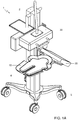
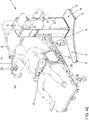
- the resuscitation device comprises a movable cart 1 with a vertical stand 2 provided at a bottom with rolling means 5 for movement over a floor or ground surface.
- the rolling means 5 to this end comprise a rolling body, for example a wheel, which may freely rotate, i.e. rotate 360 degrees, around a central shaft with which each rolling body is coupled to a respective toe 4 extending laterally from the vertical stand 2.
- a first arm extends laterally from the stand 2 near a top thereof and carries a warming means 30 in the form of a heat source which is capable of directing radiation heat to a surface there below.
- the heat source may for instance comprise a light source which is capable of radiating infrared light.
- Below the warming means 30 a newborn support device 10 of the resuscitation device is provided, which is coupled to the vertical stand 2 by means of a second arm extending laterally from the stand.
- the newborn support device 10 is capable of carrying a newborn in an at least almost fully supported manner.
- Coupling means may be provided between the newborn support device 10 and the second arm to allow the newborn support device 10 to move with respect to the arm, for instance be rotated in a horizontal plane perpendicular to the vertical stand.
- the coupling means to this end for example may comprise a pivot or hinge.
- the second arm may be coupled to the vertical stand in such a way as to allow movement of the arm with respect to the stand, for example moving in a height direction along at least a part of the height of the vertical stand.
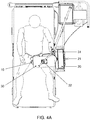
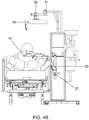
- the movement of the newborn support device 10 with respect to the second arm and the movement of the second arm with respect to the stand allow for a positioning of the newborn support device 10 as desired with respect to a person 50, e.g. the mother of the newborn, laying on a resting surface 40, e.g. a bed, besides the resuscitation device ( figure 2A-2B ) and/or with respect to the warming means 30.
- the warming means 30 may be movable with respect to the first arm and/or the first arm may be movable with respect to the stand 2 in order to allow a desired positioning and distance of the heat source 30 with respect to a newborn support device 10 of the resuscitation device.
- the movement may be realized by the provision of rotation means such as a pivot or a hinge between the stand 2 and the first arm and/or between the first arm and the warming means 30.
- rotation means such as a pivot or a hinge between the stand 2 and the first arm and/or between the first arm and the warming means 30.
- a resuscitation monitor 20 capable of monitoring respiratory functions of a newborn carried by the newborn support device 10 is coupled to the second arm.
- the monitor 20 is positioned such as to be in a line of sight of the neonatal caregiver giving care to the newborn, so that the caregiver may view or observe the data displayed on the monitor without needing to move away from the support platform and the newborn. This allows and safeguards a correct and continuous provision of respiratory support to the newborn, which may be of critical importance for preterm newborns.
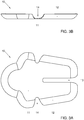
- the newborn support device 10 comprises a relatively thin plate-like support platform.
- the platform has a top surface 11 which is sufficiently large for receiving in an at least almost fully supported manner a newborn thereon. Receiving the newborn in at least almost fully supported manner, i.e. with all body parts being supported, eases the provision of standard care to the newborn and prevents discomfort or injury of the newborn.
- the platform may comprise or be provided with a relatively soft layer, for instance formed by a matrass, to provide a more comfortable laying surface for the newborn. As the platform is relatively thin, and may be moved with respect to the rest of the resuscitation device, as is described in the foregoing, it is possible to position the platform in close proximity to the mother approximately above the introitus.
- an elongated slit 13 is provided in the platform through which an umbilical cord with which the newborn is attached to the mother can extend.
- a newborn may be put on the platform such that the legs of the newborn are supported by the parts of the platform on either side of the elongated slit, with the slit thus positioned between the legs of the newborn.
- the slit extends from an access opening at one side of the platform to a more central region of the top surface 11 approximately up to a crotch of the body of the newborn supported on the platform.
- the umbilical cord When putting a newborn still attached via the umbilical cord on the platform, the umbilical cord can move via the access opening through the length of the slit up to the central region in the platform. Accordingly the umbilical cord extending through the platform does not have to extend around a relatively distant outer edge of the platform, thereby allowing the newborn to be put on the platform with an intact umbilical cord also in cases with relatively short umbilical cord lengths, such as is particularly the case for many preterm newborns.
- the support device comprises an edge part 12 extending upward from the top surface 11 at an outer circumference of the platform.
- the edge part may be sufficiently high to enclose a matrass provided on the platform on the lateral sides and to form a raised rim forming a physical barrier preventing the newborn from rolling over the edge of the platform.
- On opposite lateral sides of the platform there is no upward edge part, i.e. there is an opening or gap 14 in the edge part, which forms a more convenient lateral access to the top surface 11, for instance to render manual placing and lifting of the newborn to and from the top surface more convenient for the neonatal caregiver.
- the resuscitation device may be placed adjacent a bed on which a mother of a newborn may be supported with a newborn support device 10 being positioned above the birth canal of the mother.
- the use of the wording birth canal throughout this document may be understood to mean either the vaginal introitus, i.e. the vaginal opening, or in the event the mother has given birth via a cesarean section, the abdominal opening which is the result of the cesarean section.
- the newborn support device 10 may according to the invention appropriately be positioned above or near the birth canal to support the newborn in close proximity to the mother while allowing for complete delivery of resuscitation support to the newborn with the umbilical cord still intact.
- the resuscitation device 1 according to this embodiment comprises a vertical stand 2 which at a lower end is provided with a base plate 4 which extends laterally from the vertical stand 2. Below the base plate are provided a couple of rollers, e.g. caster wheels, with which the resuscitation device 1 can be transported over a floor or ground surface.
- a first arm 6 extends laterally from the stand 2, which first arm 6 at an outer end is coupled via rotation means 31 such as a pivot or hinge to a carrying body 7, e.g. carrying bar, rod or rail, which carries warming means 30.
- the warming means 30, e.g. a light fixture and heating lamp for providing heat radiation, is axially movable coupled along the carrying body 7, for instance via an eyelet 32 or any other suitable coupling means that allow for movement of the warming means along the carrying body 7.
- Blocking means or stopping means may be provided at a free outer end of the carrying rail 7 to prevent the warming means 30 from falling of the rail.
- a particular positioning of the warming means on the rail may be adjusted at any time by a user such as a neonatologist / pediatrician, registrar, nurse or other relevant person which is giving support to the newborn by applying a relatively simple pulling or pushing force on the warming means 30, e.g. by hand.
- the pivot or hinge 31 between the first arm 6 and carrying body 7 renders a mutual rotation between the first arm 6 and carrying body 7 possible, in order to allow an even more accurate positioning of the warming means 30 above the newborn support device 10 of the resuscitation device 1.
- the newborn support device 10 is connected via a monitor 20 and further rotation means 21, e.g. pivot or hinge, to a second arm 8 of the resuscitation device 1 which extends laterally from the stand 2 at a height between the first arm 6 and the base plate 4.
- the second arm 8 is movable in the vertical height direction along the vertical stand 2 to allow for an adjustment in the height of the second arm carrying the monitor 20 and newborn support device 10.
- the further rotation means 21 allows for an adjustment of the monitor 20 with respect to the second arm 8, so that the monitor may be positioned and/or orientated as needed or desired by the neonatal caregiver.
- the monitor 20 can be positioned in close proximity to the edge of the bed on which the mother of the newborn is supported, allowing the monitor to be in the line of sight of the neonatal caregiver while giving care to the newborn, so that the caregiver may view or observe the data displayed on the monitor without needing to move away from the support platform and the newborn.
- the further rotation means 21 preferably comprise a pivot or hinge, more preferably a ball pivot, e.g. a ball and socket joint, which allows for free movement of the monitor 20 in multiple directions with respect to the second arm 8.
- the pivot or hinge 21 may be manually operable for a quick adjustment of the monitor 20 and newborn support device 10 with respect to the other parts of the resuscitation device 1 by the neonatologist/pediatrician, registrar, nurse or other relevant person who is giving support to the newborn.
- suitable gripping means may be provided for manually controlling the pivot or hinge 21, which gripping means preferably are clearly visible and allow for easy adjustment of the pivot or hinge 21 using relatively little force.
- the newborn support device 10 comprises a support platform for carrying a newborn, which support platform can be moved with respect to the monitor 20 in order to allow for an adjustment in horizontal distance between the support platform and the monitor 20.
- the support platform is guidable or can slide along a guiding track of the newborn support device 10, such as a bar, rod or rail which extends from the monitor 20.
- the support platform may be fixedly coupled to a telescopic bar, rod or rail which extends from the monitor 20.
Landscapes
- Health & Medical Sciences (AREA)
- Gynecology & Obstetrics (AREA)
- Pediatric Medicine (AREA)
- Pregnancy & Childbirth (AREA)
- Life Sciences & Earth Sciences (AREA)
- Animal Behavior & Ethology (AREA)
- General Health & Medical Sciences (AREA)
- Public Health (AREA)
- Veterinary Medicine (AREA)
- Accommodation For Nursing Or Treatment Tables (AREA)
Claims (14)
- Neugeborenen-Stützvorrichtung (10) zum Stützen eines Neugeborenen in unmittelbarer Nähe zu der Mutter, umfassend eine Stützplattform mit einer Oberseite (11) zum Aufnehmen des Neugeborenen darauf in einer mindestens nahezu vollständig gestützten Weise, wobei die Stützplattform an einen Stützrahmen (8) gekoppelt ist, der Positionieren der Plattform in unmittelbarer Nähe zu der Mutter ermöglicht und insbesondere Positionieren der Plattform, ausgerichtet über dem vaginalen Introitus der Mutter, ermöglicht, dadurch gekennzeichnet, dass die Stützplattform mit einem länglichen Schlitz bereitgestellt ist, der einen Durchgang in der Stützplattform definiert, der von einer Seite der Plattform zugänglich ist und sich durch die Plattform von der Oberseite bis zu einer Unterseite der Plattform erstreckt, um Durchführen einer Nabelschnur, mit der das Neugeborene an die Mutter befestigt ist, durch mindestens einen Teil der Plattform zu ermöglichen.
- Stützvorrichtung nach Anspruch 1, dadurch gekennzeichnet, dass sich der Schlitz (13) in einem zentralen Bereich der Oberseite von einer Zugangsöffnung an der Seite der Plattform erstreckt.
- Stützvorrichtung nach Anspruch 2, dadurch gekennzeichnet, dass sich der Schlitz (13) von der Zugangsöffnung zu einem Teil des Schlitzes in dem zentralen Bereich der Oberseite verengt.
- Stützvorrichtung nach einem der vorhergehenden Ansprüche, dadurch gekennzeichnet, dass die Plattform ein plattenartiges Element umfasst, in dem der Schlitz (13) bereitgestellt ist.
- Stützvorrichtung nach einem der vorhergehenden Ansprüche, dadurch gekennzeichnet, dass die Plattform eine längliche Plattform ist, wobei sich der Schlitz (13) in einer Längsrichtung der Plattform erstreckt.
- Stützvorrichtung nach Anspruch 5, dadurch gekennzeichnet, dass sich der Schlitz (13) von der Seite der Plattform entlang wenigstens eines Viertels einer Länge einer Längsachse der Plattform, und vorzugsweise über mindestens ein Drittel einer Längsachse der Plattform erstreckt.
- Stützvorrichtung nach einem der vorhergehenden Ansprüche, dadurch gekennzeichnet, dass die Stützplattform mindestens einen Randteil (12) umfasst, der sich von der Oberseite an einem Außenumfang nach oben erstreckt.
- Stützvorrichtung nach einem der vorhergehenden Ansprüche, dadurch gekennzeichnet, dass die Stützplattform mit dem Stützrahmen (8) mit einem Drehpunkt (21) gekoppelt ist, der Drehen der Plattform in Bezug auf den Stützrahmen in mindestens einer horizontalen Ebene ermöglicht.
- Wiederbelebungsvorrichtung (1), umfassend Wiederbelebungsmittel und ferner umfassend eine Stützvorrichtung (10) nach einem der vorherigen Ansprüche, verbunden mit den Wiederbelebungsmitteln.
- Wiederbelebungsvorrichtung nach Anspruch 9, dadurch gekennzeichnet, dass die Wiederbelebungsmittel einen Wiederbelebungsmonitor (20) zum Überwachen von Atemfunktionen umfassen.
- Wiederbelebungsvorrichtung nach Anspruch 10, dadurch gekennzeichnet, dass der Wiederbelebungsmonitor (20) mit der Stützvorrichtung (10) neben der Stützplattform gekoppelt ist.
- Wiederbelebungsvorrichtung nach einem der Ansprüche 9 - 11, dadurch gekennzeichnet, dass die Vorrichtung ferner Wärmemittel (30) zum Richten von Wärme auf die Stützplattform umfasst.
- Wiederbelebungsvorrichtung nach Anspruch 12, dadurch gekennzeichnet, dass die Wärmemittel (30) eine Wärmequelle , positioniert auf einer Höhe über der Stützplattform, umfassen, zum Bereitstellen von Strahlungswärme für ein Neugeborenes, gestützt auf der Stützplattform.
- Wiederbelebungsvorrichtung nach einem der Ansprüche 9 - 13, dadurch gekennzeichnet, dass die Vorrichtung ferner ein Untergestell (4) mit Rollmitteln (5) umfasst.
Applications Claiming Priority (2)
| Application Number | Priority Date | Filing Date | Title |
|---|---|---|---|
| EP15203251 | 2015-12-31 | ||
| PCT/NL2016/050928 WO2017116233A1 (en) | 2015-12-31 | 2016-12-30 | Newborn support device and resuscitation device |
Publications (2)
| Publication Number | Publication Date |
|---|---|
| EP3397229A1 EP3397229A1 (de) | 2018-11-07 |
| EP3397229B1 true EP3397229B1 (de) | 2020-10-14 |
Family
ID=55027626
Family Applications (1)
| Application Number | Title | Priority Date | Filing Date |
|---|---|---|---|
| EP16825597.4A Active EP3397229B1 (de) | 2015-12-31 | 2016-12-30 | Neugeborenenliegevorrichtung und wiederbelebungsvorrichtung |
Country Status (7)
| Country | Link |
|---|---|
| US (2) | US12213922B2 (de) |
| EP (1) | EP3397229B1 (de) |
| JP (1) | JP6763024B2 (de) |
| CN (1) | CN108601696B (de) |
| BR (1) | BR112018013500B1 (de) |
| ES (1) | ES2833578T3 (de) |
| WO (1) | WO2017116233A1 (de) |
Families Citing this family (4)
| Publication number | Priority date | Publication date | Assignee | Title |
|---|---|---|---|---|
| CN109620600B (zh) * | 2018-12-29 | 2021-01-26 | 赵志旭 | 一种具有支撑功能的新生儿复苏装置 |
| WO2020198228A1 (en) * | 2019-03-25 | 2020-10-01 | Western Connecticut Health Network, Inc. | Infant warmer mattress support extension apparatus and method of use |
| CN113995618B (zh) * | 2021-12-07 | 2023-06-16 | 郑州大学第三附属医院(河南省妇幼保健院) | 一种新生儿延迟脐带结扎的智能复苏平台 |
| CN119055472A (zh) * | 2024-08-16 | 2024-12-03 | 宁波戴维医疗器械股份有限公司 | 一种婴儿辐射保暖台 |
Citations (6)
| Publication number | Priority date | Publication date | Assignee | Title |
|---|---|---|---|---|
| US5387177A (en) | 1993-05-13 | 1995-02-07 | Span-America Medical Systems, Inc. | Adjustable pediatric incubator nest |
| US20090178202A1 (en) | 2008-01-11 | 2009-07-16 | Kovalyak Nicole L | Infant pillow device |
| WO2010033429A1 (en) | 2008-09-19 | 2010-03-25 | Draeger Medical Systems, Inc. | Warming therapy device including resuscitation control system |
| US20130283536A1 (en) | 2010-08-23 | 2013-10-31 | Beevers Manufacturing & Supply, Inc. | Infant Support Device |
| US20160213540A1 (en) | 2015-01-26 | 2016-07-28 | Zenon Kunysz | Independent Neonatal Support Assessment Placenta Transfusion And Resuscitation Unit |
| WO2017053406A1 (en) | 2015-09-25 | 2017-03-30 | The Board Of Trustees Of The Leland Stanford Junior University | Delayed cord clamping and simple resuscitation or bed accessory |
Family Cites Families (21)
| Publication number | Priority date | Publication date | Assignee | Title |
|---|---|---|---|---|
| US395001A (en) * | 1888-12-25 | Surgical table | ||
| US3094986A (en) * | 1961-12-19 | 1963-06-25 | James J Lally | Portable shock splint with traction |
| US5218958A (en) * | 1991-02-21 | 1993-06-15 | Cooper William I | Placental chamber - artificial uterus |
| US20040193096A1 (en) * | 2003-03-25 | 2004-09-30 | Cooper William Isaac | Conceptus chamber |
| JP2008501420A (ja) * | 2004-06-03 | 2008-01-24 | ヒル−ロム サービシーズ,インコーポレイティド | 展開式ベッドヘッドウォール構造体 |
| US7966678B2 (en) | 2005-12-07 | 2011-06-28 | General Electric Company | Infant care bed with evaluation capabilities |
| NL1030654C2 (nl) * | 2005-12-13 | 2007-06-14 | Univ Delft Tech | Couveuse. |
| CN2922790Y (zh) * | 2006-07-21 | 2007-07-18 | 中国科学院合肥物质科学研究院 | 一种新生儿信息采集与识别装置 |
| RU2376969C1 (ru) | 2008-06-11 | 2009-12-27 | Государственное образовательное учреждение высшего профессионального образования "Саратовский государственный медицинский университет Федерального агентства по здравоохранению и социальному развитию" | Устройство для выхаживания недоношенных новорожденных |
| CN201393792Y (zh) * | 2009-05-07 | 2010-02-03 | 张爱菊 | 手摇调节高度多用婴儿床 |
| US9486377B2 (en) * | 2009-12-01 | 2016-11-08 | General Electric Company | Infant care apparatus with multiple user interfaces |
| CN102283529B (zh) | 2010-06-16 | 2014-08-06 | 明门香港股份有限公司 | 婴儿床 |
| JP5694839B2 (ja) * | 2011-04-19 | 2015-04-01 | アトムメディカル株式会社 | 保育器における可動壁部取り付け機構 |
| JP5965242B2 (ja) * | 2012-08-08 | 2016-08-03 | アトムメディカル株式会社 | 保育器の臥床台および臥床台付き保育器ならびに保育器の臥床台の使用方法 |
| US9872807B2 (en) * | 2013-12-31 | 2018-01-23 | General Electric Company | Multiple patient infant warming device, manager and method |
| CN103932851A (zh) * | 2014-03-31 | 2014-07-23 | 江苏赛康医疗设备有限公司 | 一种新生婴儿车 |
| CN204072625U (zh) * | 2014-09-10 | 2015-01-07 | 南通市第一人民医院 | 一体化新生儿急救车 |
| US9629759B2 (en) * | 2014-09-18 | 2017-04-25 | General Electric Company | Infant patient transfer device with vapor barrier |
| CN205181682U (zh) * | 2015-12-16 | 2016-04-27 | 冯强 | 新生儿鸟巢 |
| CN205548848U (zh) * | 2015-12-30 | 2016-09-07 | 张冠莉 | 一种医用产科婴儿保暖监护台床 |
| CN206463176U (zh) * | 2016-10-31 | 2017-09-05 | 十堰市太和医院(湖北医药学院附属医院) | 新生儿窒息复苏头位固定器 |
-
2016
- 2016-12-30 CN CN201680075287.1A patent/CN108601696B/zh active Active
- 2016-12-30 EP EP16825597.4A patent/EP3397229B1/de active Active
- 2016-12-30 ES ES16825597T patent/ES2833578T3/es active Active
- 2016-12-30 WO PCT/NL2016/050928 patent/WO2017116233A1/en not_active Ceased
- 2016-12-30 US US16/065,370 patent/US12213922B2/en active Active
- 2016-12-30 JP JP2018534167A patent/JP6763024B2/ja active Active
- 2016-12-30 BR BR112018013500-3A patent/BR112018013500B1/pt active IP Right Grant
-
2024
- 2024-12-20 US US18/989,734 patent/US20250114262A1/en active Pending
Patent Citations (6)
| Publication number | Priority date | Publication date | Assignee | Title |
|---|---|---|---|---|
| US5387177A (en) | 1993-05-13 | 1995-02-07 | Span-America Medical Systems, Inc. | Adjustable pediatric incubator nest |
| US20090178202A1 (en) | 2008-01-11 | 2009-07-16 | Kovalyak Nicole L | Infant pillow device |
| WO2010033429A1 (en) | 2008-09-19 | 2010-03-25 | Draeger Medical Systems, Inc. | Warming therapy device including resuscitation control system |
| US20130283536A1 (en) | 2010-08-23 | 2013-10-31 | Beevers Manufacturing & Supply, Inc. | Infant Support Device |
| US20160213540A1 (en) | 2015-01-26 | 2016-07-28 | Zenon Kunysz | Independent Neonatal Support Assessment Placenta Transfusion And Resuscitation Unit |
| WO2017053406A1 (en) | 2015-09-25 | 2017-03-30 | The Board Of Trustees Of The Leland Stanford Junior University | Delayed cord clamping and simple resuscitation or bed accessory |
Non-Patent Citations (8)
| Title |
|---|
| A D WEEKS ET AL: "Innovation in immediate neonatal care: development of the Bedside Assessment, Stabilisation and Initial Cardiorespiratory Support (BASICS) trolley", BMJ INNOVATIONS, vol. 1, no. 2, 1 April 2015 (2015-04-01), pages 53 - 58, XP055613456, ISSN: 2055-8074, DOI: 10.1136/bmjinnov-2014-000017 |
| A D WEEKS, P WATT, C W YOXALL, A GALLAGHER, A BURLEIGH, S BEWLEY, A M HEUCHAN, L DULEY: "Innovation in immediate neonatal care: development of the Bedside Assessment, Stabilisation and Initial Cardiorespiratory Support (BASICS) trolley", BMJ INNOVATIONS, vol. 1, no. 2, 1 April 2015 (2015-04-01), pages 53 - 58, XP055613456, ISSN: 2055-8074, DOI: 10.1136/bmjinnov-2014-000017 |
| BALKAWADE N U, SHINDE M A: "Study of Length of Umbilical Cord and Fetal Outcome: A Study of 1000 Deliveries", THE JOURNAL OF OBSTETRICS AND GYNECOLOGY OF INDIA, vol. 62, no. 5, 3 October 2012 (2012-10-03), pages 520 - 525, XP055827151 |
| BALKAWADE NU ET AL.: "Study of length of umbilical cord and fetal outcome: a study of 1,000 deliveries", J OBSTET GYNAECOL INDIA, vol. 62, no. 5, 3 October 2012 (2012-10-03), pages 520 - 525, XP055827151, Retrieved from the Internet <URL:https://www.ncbi.nlm.nih.gov/pmc/articles/PMC3526711> |
| HUTCHON DAVID: "Evolution of neonatal resuscitation with intact placental circulation", CLINICAL PRACTICE, vol. 10, no. 2, 1 January 2014 (2014-01-01), pages 58 - 62, XP055827145 |
| MARGARET R THOMAS ET AL.: "PROVIDING NEWBORN RESUSCITATION AT THE MOTHER'S BEDSIDE: ASSESSING THE SAFETY, USABILITY AND ACCEPTABILITY OF A MOBILE TROLLEY", BMC PEDIATRICS, vol. 14, 29 May 2014 (2014-05-29), XP021187622, Retrieved from the Internet <URL:https://link.springer.com/content/pdf/1 0.1186/1471-2431-14-135.pdf> DOI: 10.1186/1471-2431-14-135 |
| MARGARET R THOMAS ET AL: "Providing newborn resuscitation at the mother?s bedside: assessing the safety, usability and acceptability of a mobile trolley", BMC PEDIATRICS, BIOMED CENTRAL, LONDON, GB, vol. 14, no. 1, 29 May 2014 (2014-05-29), GB, pages 135, XP021187622, ISSN: 1471-2431, DOI: 10.1186/1471-2431-14-135 |
| WEEKS: "Innovation in immediate neonatal care: development of the Bedside Assessment, Stabilisation and Initial Cardiorespiratory Support (BASICS) trolley", BMJ INNOV, vol. 1, 10 April 2015 (2015-04-10), pages 53 - 58, XP055613456, Retrieved from the Internet <URL:https://innovations.bmj.com/content/1/2/53> [retrieved on 20190816], DOI: 10.1136/bmjinnov-2014-000017 * |
Also Published As
| Publication number | Publication date |
|---|---|
| JP6763024B2 (ja) | 2020-09-30 |
| US20210220200A1 (en) | 2021-07-22 |
| WO2017116233A1 (en) | 2017-07-06 |
| ES2833578T3 (es) | 2021-06-15 |
| CN108601696B (zh) | 2020-10-23 |
| BR112018013500A2 (pt) | 2018-12-04 |
| US20250114262A1 (en) | 2025-04-10 |
| BR112018013500B1 (pt) | 2022-05-31 |
| JP2019501715A (ja) | 2019-01-24 |
| CN108601696A (zh) | 2018-09-28 |
| US12213922B2 (en) | 2025-02-04 |
| EP3397229A1 (de) | 2018-11-07 |
Similar Documents
| Publication | Publication Date | Title |
|---|---|---|
| US20250114262A1 (en) | Newborn support device and resuscitation device | |
| US9056041B2 (en) | C-spine head stabilization device | |
| CN102026608B (zh) | 协助分娩的装置 | |
| CN106029036B (zh) | 用于新生儿和早产儿的热疗设备 | |
| CN107361936A (zh) | 一种普外科用多功能护理床 | |
| EP3581240B1 (de) | Immobilisierungsvorrichtung für die strahlentherapie | |
| CN204501309U (zh) | 一种肿瘤科用多功能护理床 | |
| CN108403338A (zh) | 独立装置的立体可调式床上扶手 | |
| CN107260459A (zh) | 一种小儿科用婴儿保暖台 | |
| CN214105060U (zh) | 一种妇幼医院麻醉手术床 | |
| US9402773B2 (en) | Prone cart | |
| CN204468585U (zh) | 水温调控婴幼儿手术体位架 | |
| CN209864349U (zh) | 一种转运床 | |
| CN206325062U (zh) | 一种新型普外科烤灯 | |
| CN204637143U (zh) | 自身便携式输液架 | |
| CN204909912U (zh) | 临床手术护理床 | |
| CN211326006U (zh) | 一种改进型精神病人约束装置 | |
| CN218792918U (zh) | 一种泌尿外科护理用辅助托架 | |
| CN208892976U (zh) | 一种普外科用多功能护理床 | |
| US2203045A (en) | Handling device for invalid cots | |
| CN104306128B (zh) | 一种picc维护操作椅 | |
| CN204072645U (zh) | 一种智能中心静脉置管床 | |
| EP4389100A1 (de) | Vorrichtung zum stützen und beschützen der benutzerin während der geburt, der austreibungsphase und postpartum | |
| CN205831910U (zh) | 床旁式手术用医疗器械推车 | |
| CN220109857U (zh) | 用于颈内静脉及锁骨下静脉穿刺操作的辅助装置 |
Legal Events
| Date | Code | Title | Description |
|---|---|---|---|
| STAA | Information on the status of an ep patent application or granted ep patent |
Free format text: STATUS: UNKNOWN |
|
| STAA | Information on the status of an ep patent application or granted ep patent |
Free format text: STATUS: THE INTERNATIONAL PUBLICATION HAS BEEN MADE |
|
| PUAI | Public reference made under article 153(3) epc to a published international application that has entered the european phase |
Free format text: ORIGINAL CODE: 0009012 |
|
| STAA | Information on the status of an ep patent application or granted ep patent |
Free format text: STATUS: REQUEST FOR EXAMINATION WAS MADE |
|
| 17P | Request for examination filed |
Effective date: 20180613 |
|
| AK | Designated contracting states |
Kind code of ref document: A1 Designated state(s): AL AT BE BG CH CY CZ DE DK EE ES FI FR GB GR HR HU IE IS IT LI LT LU LV MC MK MT NL NO PL PT RO RS SE SI SK SM TR |
|
| AX | Request for extension of the european patent |
Extension state: BA ME |
|
| DAV | Request for validation of the european patent (deleted) | ||
| DAX | Request for extension of the european patent (deleted) | ||
| STAA | Information on the status of an ep patent application or granted ep patent |
Free format text: STATUS: EXAMINATION IS IN PROGRESS |
|
| 17Q | First examination report despatched |
Effective date: 20190830 |
|
| GRAP | Despatch of communication of intention to grant a patent |
Free format text: ORIGINAL CODE: EPIDOSNIGR1 |
|
| STAA | Information on the status of an ep patent application or granted ep patent |
Free format text: STATUS: GRANT OF PATENT IS INTENDED |
|
| INTG | Intention to grant announced |
Effective date: 20200429 |
|
| GRAS | Grant fee paid |
Free format text: ORIGINAL CODE: EPIDOSNIGR3 |
|
| GRAA | (expected) grant |
Free format text: ORIGINAL CODE: 0009210 |
|
| STAA | Information on the status of an ep patent application or granted ep patent |
Free format text: STATUS: THE PATENT HAS BEEN GRANTED |
|
| AK | Designated contracting states |
Kind code of ref document: B1 Designated state(s): AL AT BE BG CH CY CZ DE DK EE ES FI FR GB GR HR HU IE IS IT LI LT LU LV MC MK MT NL NO PL PT RO RS SE SI SK SM TR |
|
| REG | Reference to a national code |
Ref country code: GB Ref legal event code: FG4D |
|
| REG | Reference to a national code |
Ref country code: AT Ref legal event code: REF Ref document number: 1322858 Country of ref document: AT Kind code of ref document: T Effective date: 20201015 Ref country code: CH Ref legal event code: EP |
|
| REG | Reference to a national code |
Ref country code: DE Ref legal event code: R096 Ref document number: 602016045970 Country of ref document: DE |
|
| REG | Reference to a national code |
Ref country code: IE Ref legal event code: FG4D |
|
| REG | Reference to a national code |
Ref country code: CH Ref legal event code: NV Representative=s name: DENNEMEYER AG, CH |
|
| REG | Reference to a national code |
Ref country code: AT Ref legal event code: MK05 Ref document number: 1322858 Country of ref document: AT Kind code of ref document: T Effective date: 20201014 |
|
| REG | Reference to a national code |
Ref country code: NL Ref legal event code: MP Effective date: 20201014 |
|
| PG25 | Lapsed in a contracting state [announced via postgrant information from national office to epo] |
Ref country code: PT Free format text: LAPSE BECAUSE OF FAILURE TO SUBMIT A TRANSLATION OF THE DESCRIPTION OR TO PAY THE FEE WITHIN THE PRESCRIBED TIME-LIMIT Effective date: 20210215 Ref country code: RS Free format text: LAPSE BECAUSE OF FAILURE TO SUBMIT A TRANSLATION OF THE DESCRIPTION OR TO PAY THE FEE WITHIN THE PRESCRIBED TIME-LIMIT Effective date: 20201014 Ref country code: NO Free format text: LAPSE BECAUSE OF FAILURE TO SUBMIT A TRANSLATION OF THE DESCRIPTION OR TO PAY THE FEE WITHIN THE PRESCRIBED TIME-LIMIT Effective date: 20210114 Ref country code: GR Free format text: LAPSE BECAUSE OF FAILURE TO SUBMIT A TRANSLATION OF THE DESCRIPTION OR TO PAY THE FEE WITHIN THE PRESCRIBED TIME-LIMIT Effective date: 20210115 Ref country code: FI Free format text: LAPSE BECAUSE OF FAILURE TO SUBMIT A TRANSLATION OF THE DESCRIPTION OR TO PAY THE FEE WITHIN THE PRESCRIBED TIME-LIMIT Effective date: 20201014 |
|
| REG | Reference to a national code |
Ref country code: LT Ref legal event code: MG4D |
|
| PG25 | Lapsed in a contracting state [announced via postgrant information from national office to epo] |
Ref country code: SE Free format text: LAPSE BECAUSE OF FAILURE TO SUBMIT A TRANSLATION OF THE DESCRIPTION OR TO PAY THE FEE WITHIN THE PRESCRIBED TIME-LIMIT Effective date: 20201014 Ref country code: BG Free format text: LAPSE BECAUSE OF FAILURE TO SUBMIT A TRANSLATION OF THE DESCRIPTION OR TO PAY THE FEE WITHIN THE PRESCRIBED TIME-LIMIT Effective date: 20210114 Ref country code: LV Free format text: LAPSE BECAUSE OF FAILURE TO SUBMIT A TRANSLATION OF THE DESCRIPTION OR TO PAY THE FEE WITHIN THE PRESCRIBED TIME-LIMIT Effective date: 20201014 Ref country code: PL Free format text: LAPSE BECAUSE OF FAILURE TO SUBMIT A TRANSLATION OF THE DESCRIPTION OR TO PAY THE FEE WITHIN THE PRESCRIBED TIME-LIMIT Effective date: 20201014 Ref country code: IS Free format text: LAPSE BECAUSE OF FAILURE TO SUBMIT A TRANSLATION OF THE DESCRIPTION OR TO PAY THE FEE WITHIN THE PRESCRIBED TIME-LIMIT Effective date: 20210214 Ref country code: AT Free format text: LAPSE BECAUSE OF FAILURE TO SUBMIT A TRANSLATION OF THE DESCRIPTION OR TO PAY THE FEE WITHIN THE PRESCRIBED TIME-LIMIT Effective date: 20201014 |
|
| REG | Reference to a national code |
Ref country code: ES Ref legal event code: FG2A Ref document number: 2833578 Country of ref document: ES Kind code of ref document: T3 Effective date: 20210615 |
|
| PG25 | Lapsed in a contracting state [announced via postgrant information from national office to epo] |
Ref country code: NL Free format text: LAPSE BECAUSE OF FAILURE TO SUBMIT A TRANSLATION OF THE DESCRIPTION OR TO PAY THE FEE WITHIN THE PRESCRIBED TIME-LIMIT Effective date: 20201014 Ref country code: HR Free format text: LAPSE BECAUSE OF FAILURE TO SUBMIT A TRANSLATION OF THE DESCRIPTION OR TO PAY THE FEE WITHIN THE PRESCRIBED TIME-LIMIT Effective date: 20201014 |
|
| REG | Reference to a national code |
Ref country code: DE Ref legal event code: R026 Ref document number: 602016045970 Country of ref document: DE |
|
| PLBI | Opposition filed |
Free format text: ORIGINAL CODE: 0009260 |
|
| PLAX | Notice of opposition and request to file observation + time limit sent |
Free format text: ORIGINAL CODE: EPIDOSNOBS2 |
|
| PG25 | Lapsed in a contracting state [announced via postgrant information from national office to epo] |
Ref country code: RO Free format text: LAPSE BECAUSE OF FAILURE TO SUBMIT A TRANSLATION OF THE DESCRIPTION OR TO PAY THE FEE WITHIN THE PRESCRIBED TIME-LIMIT Effective date: 20201014 Ref country code: SK Free format text: LAPSE BECAUSE OF FAILURE TO SUBMIT A TRANSLATION OF THE DESCRIPTION OR TO PAY THE FEE WITHIN THE PRESCRIBED TIME-LIMIT Effective date: 20201014 Ref country code: EE Free format text: LAPSE BECAUSE OF FAILURE TO SUBMIT A TRANSLATION OF THE DESCRIPTION OR TO PAY THE FEE WITHIN THE PRESCRIBED TIME-LIMIT Effective date: 20201014 Ref country code: SM Free format text: LAPSE BECAUSE OF FAILURE TO SUBMIT A TRANSLATION OF THE DESCRIPTION OR TO PAY THE FEE WITHIN THE PRESCRIBED TIME-LIMIT Effective date: 20201014 Ref country code: LT Free format text: LAPSE BECAUSE OF FAILURE TO SUBMIT A TRANSLATION OF THE DESCRIPTION OR TO PAY THE FEE WITHIN THE PRESCRIBED TIME-LIMIT Effective date: 20201014 |
|
| 26 | Opposition filed |
Opponent name: LUNT, MARK Effective date: 20210713 |
|
| PG25 | Lapsed in a contracting state [announced via postgrant information from national office to epo] |
Ref country code: MC Free format text: LAPSE BECAUSE OF FAILURE TO SUBMIT A TRANSLATION OF THE DESCRIPTION OR TO PAY THE FEE WITHIN THE PRESCRIBED TIME-LIMIT Effective date: 20201014 Ref country code: DK Free format text: LAPSE BECAUSE OF FAILURE TO SUBMIT A TRANSLATION OF THE DESCRIPTION OR TO PAY THE FEE WITHIN THE PRESCRIBED TIME-LIMIT Effective date: 20201014 |
|
| REG | Reference to a national code |
Ref country code: BE Ref legal event code: MM Effective date: 20201231 |
|
| PG25 | Lapsed in a contracting state [announced via postgrant information from national office to epo] |
Ref country code: IE Free format text: LAPSE BECAUSE OF NON-PAYMENT OF DUE FEES Effective date: 20201230 Ref country code: AL Free format text: LAPSE BECAUSE OF FAILURE TO SUBMIT A TRANSLATION OF THE DESCRIPTION OR TO PAY THE FEE WITHIN THE PRESCRIBED TIME-LIMIT Effective date: 20201014 Ref country code: LU Free format text: LAPSE BECAUSE OF NON-PAYMENT OF DUE FEES Effective date: 20201230 |
|
| PG25 | Lapsed in a contracting state [announced via postgrant information from national office to epo] |
Ref country code: SI Free format text: LAPSE BECAUSE OF FAILURE TO SUBMIT A TRANSLATION OF THE DESCRIPTION OR TO PAY THE FEE WITHIN THE PRESCRIBED TIME-LIMIT Effective date: 20201014 |
|
| PLBB | Reply of patent proprietor to notice(s) of opposition received |
Free format text: ORIGINAL CODE: EPIDOSNOBS3 |
|
| PG25 | Lapsed in a contracting state [announced via postgrant information from national office to epo] |
Ref country code: IS Free format text: LAPSE BECAUSE OF FAILURE TO SUBMIT A TRANSLATION OF THE DESCRIPTION OR TO PAY THE FEE WITHIN THE PRESCRIBED TIME-LIMIT Effective date: 20210214 Ref country code: MT Free format text: LAPSE BECAUSE OF FAILURE TO SUBMIT A TRANSLATION OF THE DESCRIPTION OR TO PAY THE FEE WITHIN THE PRESCRIBED TIME-LIMIT Effective date: 20201014 Ref country code: CY Free format text: LAPSE BECAUSE OF FAILURE TO SUBMIT A TRANSLATION OF THE DESCRIPTION OR TO PAY THE FEE WITHIN THE PRESCRIBED TIME-LIMIT Effective date: 20201014 |
|
| PG25 | Lapsed in a contracting state [announced via postgrant information from national office to epo] |
Ref country code: MK Free format text: LAPSE BECAUSE OF FAILURE TO SUBMIT A TRANSLATION OF THE DESCRIPTION OR TO PAY THE FEE WITHIN THE PRESCRIBED TIME-LIMIT Effective date: 20201014 |
|
| PG25 | Lapsed in a contracting state [announced via postgrant information from national office to epo] |
Ref country code: BE Free format text: LAPSE BECAUSE OF NON-PAYMENT OF DUE FEES Effective date: 20201231 |
|
| APAH | Appeal reference modified |
Free format text: ORIGINAL CODE: EPIDOSCREFNO |
|
| APBM | Appeal reference recorded |
Free format text: ORIGINAL CODE: EPIDOSNREFNO |
|
| APBP | Date of receipt of notice of appeal recorded |
Free format text: ORIGINAL CODE: EPIDOSNNOA2O |
|
| APBM | Appeal reference recorded |
Free format text: ORIGINAL CODE: EPIDOSNREFNO |
|
| APBP | Date of receipt of notice of appeal recorded |
Free format text: ORIGINAL CODE: EPIDOSNNOA2O |
|
| APBQ | Date of receipt of statement of grounds of appeal recorded |
Free format text: ORIGINAL CODE: EPIDOSNNOA3O |
|
| APBQ | Date of receipt of statement of grounds of appeal recorded |
Free format text: ORIGINAL CODE: EPIDOSNNOA3O |
|
| P01 | Opt-out of the competence of the unified patent court (upc) registered |
Effective date: 20230605 |
|
| PGFP | Annual fee paid to national office [announced via postgrant information from national office to epo] |
Ref country code: ES Payment date: 20250131 Year of fee payment: 9 |
|
| PGFP | Annual fee paid to national office [announced via postgrant information from national office to epo] |
Ref country code: CH Payment date: 20250101 Year of fee payment: 9 |
|
| APBU | Appeal procedure closed |
Free format text: ORIGINAL CODE: EPIDOSNNOA9O |
|
| REG | Reference to a national code |
Ref country code: DE Ref legal event code: R100 Ref document number: 602016045970 Country of ref document: DE |
|
| REG | Reference to a national code |
Ref country code: CH Ref legal event code: U11 Free format text: ST27 STATUS EVENT CODE: U-0-0-U10-U11 (AS PROVIDED BY THE NATIONAL OFFICE) Effective date: 20260101 |
|
| PGFP | Annual fee paid to national office [announced via postgrant information from national office to epo] |
Ref country code: DE Payment date: 20251211 Year of fee payment: 10 |
|
| PGFP | Annual fee paid to national office [announced via postgrant information from national office to epo] |
Ref country code: GB Payment date: 20251219 Year of fee payment: 10 |
|
| PGFP | Annual fee paid to national office [announced via postgrant information from national office to epo] |
Ref country code: IT Payment date: 20251223 Year of fee payment: 10 |
|
| PGFP | Annual fee paid to national office [announced via postgrant information from national office to epo] |
Ref country code: FR Payment date: 20251229 Year of fee payment: 10 |
|
| PGFP | Annual fee paid to national office [announced via postgrant information from national office to epo] |
Ref country code: TR Payment date: 20251224 Year of fee payment: 10 |
|
| PLBN | Opposition rejected |
Free format text: ORIGINAL CODE: 0009273 |
|
| PLCK | Communication despatched that opposition was rejected |
Free format text: ORIGINAL CODE: EPIDOSNREJ1 |
|
| STAA | Information on the status of an ep patent application or granted ep patent |
Free format text: STATUS: OPPOSITION REJECTED |
|
| PGFP | Annual fee paid to national office [announced via postgrant information from national office to epo] |
Ref country code: CZ Payment date: 20251223 Year of fee payment: 10 |
|
| REG | Reference to a national code |
Ref country code: CH Ref legal event code: L18 Free format text: ST27 STATUS EVENT CODE: U-0-0-L10-L18 (AS PROVIDED BY THE NATIONAL OFFICE) Effective date: 20260121 |