EP3396551A1 - Vorrichtung und verfahren zur integration einer waschbeckenvorrichtung mit einer quellenvorrichtung - Google Patents
Vorrichtung und verfahren zur integration einer waschbeckenvorrichtung mit einer quellenvorrichtung Download PDFInfo
- Publication number
- EP3396551A1 EP3396551A1 EP17275060.6A EP17275060A EP3396551A1 EP 3396551 A1 EP3396551 A1 EP 3396551A1 EP 17275060 A EP17275060 A EP 17275060A EP 3396551 A1 EP3396551 A1 EP 3396551A1
- Authority
- EP
- European Patent Office
- Prior art keywords
- source device
- function
- sink
- mediator
- source
- Prior art date
- Legal status (The legal status is an assumption and is not a legal conclusion. Google has not performed a legal analysis and makes no representation as to the accuracy of the status listed.)
- Ceased
Links
Images




Classifications
-
- G—PHYSICS
- G06—COMPUTING OR CALCULATING; COUNTING
- G06F—ELECTRIC DIGITAL DATA PROCESSING
- G06F9/00—Arrangements for program control, e.g. control units
- G06F9/06—Arrangements for program control, e.g. control units using stored programs, i.e. using an internal store of processing equipment to receive or retain programs
- G06F9/46—Multiprogramming arrangements
- G06F9/54—Interprogram communication
- G06F9/541—Interprogram communication via adapters, e.g. between incompatible applications
-
- G—PHYSICS
- G06—COMPUTING OR CALCULATING; COUNTING
- G06F—ELECTRIC DIGITAL DATA PROCESSING
- G06F40/00—Handling natural language data
- G06F40/20—Natural language analysis
- G06F40/205—Parsing
- G06F40/216—Parsing using statistical methods
-
- G—PHYSICS
- G06—COMPUTING OR CALCULATING; COUNTING
- G06F—ELECTRIC DIGITAL DATA PROCESSING
- G06F40/00—Handling natural language data
- G06F40/30—Semantic analysis
-
- G—PHYSICS
- G06—COMPUTING OR CALCULATING; COUNTING
- G06F—ELECTRIC DIGITAL DATA PROCESSING
- G06F8/00—Arrangements for software engineering
- G06F8/10—Requirements analysis; Specification techniques
-
- G—PHYSICS
- G06—COMPUTING OR CALCULATING; COUNTING
- G06F—ELECTRIC DIGITAL DATA PROCESSING
- G06F8/00—Arrangements for software engineering
- G06F8/30—Creation or generation of source code
-
- G—PHYSICS
- G06—COMPUTING OR CALCULATING; COUNTING
- G06N—COMPUTING ARRANGEMENTS BASED ON SPECIFIC COMPUTATIONAL MODELS
- G06N20/00—Machine learning
-
- G—PHYSICS
- G06—COMPUTING OR CALCULATING; COUNTING
- G06N—COMPUTING ARRANGEMENTS BASED ON SPECIFIC COMPUTATIONAL MODELS
- G06N5/00—Computing arrangements using knowledge-based models
- G06N5/01—Dynamic search techniques; Heuristics; Dynamic trees; Branch-and-bound
Definitions
- the present invention relates generally to the field of computers and computer devices. More particularly, the present invention relates to a computer device and a method for integrating a sink device with a source device coupleable thereto, for example, for integrating a control computer device with a sensor device coupleable thereto.
- System integration such as computationally or programmatically integrating sink devices with source devices coupleable thereto, typically provides data communication and/or exchange between the sink devices and the source devices.
- source devices may output, or transmit, data which is input to, or received by, the sink devices.
- systems are designed to facilitate system integration.
- the source devices and the sink devices may be designed together and/or cooperatively, such as to agreed or standardized specifications, so as to provide plug and socket type functionality. In this way, system integration is built in from the outset.
- source devices may be developed to defined or standards specifications of the sink devices. In this way, system integration is also built in from the outset.
- system integration in which the source devices and/or the sink devices are not designed together and/or cooperatively, such as in which the source devices and/or the sink devices do not conform to the same specifications may be problematic. That is, the source devices and/or the sink devices may have been developed according to different specifications.
- Such potentially problematic system integration may be encountered when a new source device is to be integrated with an existing sink device, such as a legacy sink device.
- a new sensor device providing new and/or complementary data, may be integrated with an existing control computer device, so as to enhance capability of the existing control computer device.
- a new sink device is to be integrated with an existing source device.
- a new control computer device may be integrated with an existing sensor device.
- such potentially problematic system integration may be compounded by requirements to integrate a plurality of different source devices with a single sink device, in which the different source devices conform respectively to different specifications.
- the invention provides a computer device and method for integrating a sink device with a source device coupleable thereto.
- the computer device comprises a processor circuit and a memory circuit.
- the computer device also comprises an artificial intelligence, AI, mediator.
- the AI mediator is configured to map a function of a programmatic interface exposed by the source device to an associated function of the sink device, whereby, in response to invoking the associated function by the sink device, the mapped function of the source device is invoked.
- integration of the sink device with the source device is facilitated, since the integration is provided by the computer device by mapping a function of a programmatic interface exposed by the source device to an associated function of the sink device, thereby reducing reliance on human integration specialists and improving timescales to effect integration.
- a computer device for integrating a sink device with a source device coupleable thereto, the computer device comprising a processor circuit and a memory circuit, wherein the computer device comprises an artificial intelligence, AI, mediator configured to: map a function of a programmatic interface exposed by the source device to an associated function of the sink device; whereby, in response to invoking the associated function by the sink device, the mapped function of the source device is invoked.
- AI artificial intelligence
- the AI mediator is configured to parse a human-readable text specification document related to the programmatic interface.
- the AI mediator is configured to identify technology used by the source device.
- the AI mediator is configured to discover supporting information related to the source device.
- the AI mediator is configured to provide an adapter configured to map the function of the programmatic interface exposed by the source device to the associated function of the sink device.
- the source device comprises a sensor.
- a method of integrating a sink device with a source device coupleable thereto the method implemented on a computer device comprising a processor circuit and a memory circuit, wherein the computer device comprises an artificial intelligence, AI, mediator, the method comprising: mapping a function of a programmatic interface exposed by the source device to an associated function of the sink device; whereby, in response to invoking the associated function by the sink device, the mapped function of the source device is invoked.
- the method comprises parsing a human-readable text specification document related to the programmatic interface.
- the method comprises identifying technology used by the source device.
- the method comprises discovering supporting information related to the source device.
- the method comprises providing an adapter configured to map the function of the programmatic interface exposed by the source device to the associated function of the sink device.
- the source device comprises a sensor.
- a tangible non-transient computer-readable storage medium having recorded thereon instructions which, when implemented by a computer device including a processor circuit and a memory circuit cause the computer device to be arranged as set forth herein and/or which cause the computer device to perform any of the methods as set forth herein.
- a system comprising a computer device, a sink device and a source device coupleable thereto, the computer device comprising a processor circuit and a memory circuit, the computer device for integrating a sink device with a source device, wherein the computer device comprises an artificial intelligence, AI, mediator configured to: map a function of a programmatic interface exposed by the source device to an associated function of the sink device; whereby, in response to invoking the associated function by the sink device, the mapped function of the source device is invoked.
- AI artificial intelligence
- a method of integrating a sink device with a source device coupleable thereto the method implemented at least in part on a computer device comprising a processor circuit, a memory circuit and an artificial intelligence, AI, mediator, the method comprising: mapping, by the AI mediator, a function of a programmatic interface exposed by the source device to an associated function of the sink device; and in response to invoking the associated function by the sink device, invoking the mapped function of the source device.
- At least some of the following example embodiments provide improved integration of a sink device with a source device, in which the integration is provided by the computer device by mapping a function of a programmatic interface exposed by the source device to an associated function of the sink device. In this way, reliance on human integration specialists is reduced while timescales to effect integration may also be improved. Many other advantages and improvements will be discussed in more detail herein.
- Figure 1 is a schematic overview of a part of a network 100 of a type which may be used in the example embodiments discussed herein, including a computer device 200 according to an example embodiment. Also included are a sink device 120 and a source device 130.
- source devices may output, or transmit, data which is input to, or received by, the sink devices.
- the sink devices may control the source devices, such as control how data are acquired by the source devices and/or which data are output to the sink devices.
- the sink devices may send control messages to the source devices.
- the source devices may acquire data and/or output data to the sink devices.
- system integration may also include enabling control of the source devices by the sink devices.
- the data communication and/or exchange between the sink devices and the source devices may be unidirectional, such as from the source device to the sink device, or bidirectional.
- the sink devices may also behave as source devices i.e. the sink devices may also output data and/or be controlled by the source devices.
- the source devices may also behave as sink devices i.e. the source devices may also receive data from and/or control the sink devices.
- the source device 130 comprises a sensor, such as an acoustic sensor, a sound sensor, a vibration sensor, an automotive sensor, a transportation sensor, a chemical sensor, an electric current sensor, an electric potential sensor, a magnetic sensor, a radio sensor, an environment sensor, a weather sensor, a moisture sensor, a humidity sensor, a flow sensor, a fluid velocity sensor, an ionizing radiation sensor, subatomic particles sensor, a navigation instruments sensor, a position sensor, an angle sensor, a displacement sensor, a distance sensor, a speed sensor, an acceleration sensor, an optical sensor, a light sensor, an imaging sensor, a photon sensor, a pressure sensor, a force sensor, a density sensor, a level sensor, a thermal sensor, a heat sensor, a temperature sensor, a proximity sensor or a presence sensor.
- the source device 130 may comprise a plurality of any such sensors.
- the source device 130 may comprise a passive sensor and/or an active sensor.
- the sink device 120 comprises a control device, such as another computer device.
- the computer device 200 is coupled, via path A via the network 100 such as a private network, a virtual private network, an intranet, a cloud, the Internet, to a sink device 120, for example, or comprising, a different second computer device 120.
- the computer device 200 is also coupled, via path B the network 100 to a source device 130.
- the sink device 120 is coupleable to the source device 130, for example via the network 100.
- the source device 130 exposes a programmatic interface including a function, such as to output data.
- the sink device 120 implements an associated function.
- the programmatic interface exposed by the source device 130 may be an Application Programming Interface (API).
- APIs generally include sets of subroutine definitions, protocols, and tools for building application software.
- the programmatic interface exposed by the source device 130 may include a set of defined functions (also known as methods) of communication between software components. Since the programmatic interface of the source device is exposed, the function may be public i.e. the function may be accessible to and/or invoked by external software components. In contrast, private (also known as protected) functions typically are not exposed and thus may not be accessible to and/or invoked by the external software components.
- functions such as the function of the exposed programmatic interface of the source device 130
- an identifier such as a name or number.
- Some functions may be referenced by a unique identifier, such as a Globally Unique Identifier (GUID), also known as a Universally Unique Identifier (UUID).
- GUID Globally Unique Identifier
- UUID Universally Unique Identifier
- functions may include one or more inputs and/or one or more outputs.
- function inputs may be employed to control the source device 130 and/or to specify which data are to be output by the source device 130 to the sink device 120.
- function outputs may be utilised to transfer an acknowledgement and/or data from the source device 130 to the sink device 120.
- the programmatic interface of the source device 130 may be defined by a specification such as or including an interface specification of the source device 130.
- the interface specification of the source device 130 may include a human-readable text interface specification (for example, a specification document) and/or a programmatic interface specification interpretable by the computer device 200.
- a human-readable medium or human-readable format, such as the human-readable text interface specification is a representation of data or information that can be naturally read by humans. In computing, human-readable data is often encoded as ASCII or Unicode text, rather than presented in a binary representation.
- An input and/or an output of the function of the source device 130 may be defined by this interface specification of the source device 130.
- the associated function of the sink device 120 may be similarly defined by a specification of the sink device 120.
- the specification of the sink device 120 may include a human-readable text specification and/or a programmatic specification interpretable by the computer device 200.
- An input and/or an output of the associated function of the sink device 120 may be defined by the specification
- the computer device 200 also comprises an artificial intelligence, AI, mediator 300, as described in more detail below.
- the AI mediator 300 is configured to map a function of the programmatic interface exposed by the source device 130 to the associated function of the sink device 120, whereby, in response to invoking the associated function by the sink device 130, the mapped function of the source device 120 is invoked. That is, following integration, by the computer device 200, of the sink device 120 with the source device 130, wherein the sink device 120 with the source device 130 are coupled via path C, the mapped function of the source device 130 is configured to be invoked in response to invoking the associated function by the sink device 120. In this way, data output by the source device 130, for example, may be received and subsequently processed by the sink device 120.
- FIG. 2 is a schematic overview of the computer device 200 according to an exemplary embodiment of the invention, in more detail.
- the computer device 200 as herein described typically includes physical hardware (H/W) 201 such as a memory circuit, one or more processor circuits such as central processing units (CPUs), one or more input/output (I/O) interfaces (e.g. network cards, USB interfaces), a power supply and so on.
- the hardware 201 supports an operating system 202 to provide a runtime environment which supports execution of a plurality of processes or productivity applications, such as client applications, according to the needs of the user or users of this particular computer device 200.
- the runtime environment provides resources such as installed software, system services, drivers, files and/or registry settings.
- the computer device 200 may communicate with the sink device 120 and the source device 130.
- the computer device 200 may take any suitable form factor, such as a server, a static desktop computer or a portable computing device (laptop, tablet, handhelds smart-phone, etc.). Additionally and/or alternatively, the computer device 200 may be implemented using virtualization, such as a virtual machine, and/or may comprise a network of computer devices, such as provided via cloud computing. Additionally and/or alternatively, the computer device 200 may be implemented as part of the sink device 120 and/or the source device 130.
- FIG. 3 is a schematic overview of the computer device 200 according to an exemplary embodiment of the invention, in more detail.
- the computer device 200 comprises the AI mediator 300.
- the AI mediator 300 is configured to map a function of the programmatic interface exposed by the source device 130 to the associated function of the sink device 120, whereby, in response to invoking the associated function by the sink device 130, the mapped function of the source device 120 is invoked.
- the AI mediator 300 may be configured to provide Machine Learning (ML).
- the AI mediator 300 may comprise a ML module.
- ML is a type of AI that gives computers an ability to learn correct decisions without being explicitly programmed.
- ML algorithms typically make data driven decisions using a model built from sample inputs.
- ML is employed in a wide range of fields, such as image/video processing, text/speech recognition, search engines, security, robotics, autonomous vehicles, and many others.
- the AI mediator 300 may be configured to provide Natural Language Programming (NLP).
- NLP Natural Language Programming
- the AI mediator 300 may comprise an NLP module, such as an NLP engine.
- NLP may be utilised to extract semantic meaning from human-readable text, such as specifications including the interface specification of the source device 130 and/or the specification of the sink device 120.
- the AI mediator 300 may employ a Neural Network (NN), such as a NN having Long Short-Term Memory (LSTM) and/or Bilateral Multi-Perspective Matching (BiMPM) architectures, as described, for example, in Zhiguo Wang, Wael Hamza, Radu Stamm (2017) Bilateral Multi-Perspective Matching for Natural Language Sentences, arXiv preprint arXiv:1702.03814; Tim Rocktäschel, Edward Grefenstette, Karl Moritz Hermann, Tomá Ko isk ⁇ and Phil Blunsom (2016) Reasoning about entailment with neural attention, International Conference on Learning Representations; Alexander M Rush, Sumit Chopra, and Jason Weston (2015) A neural attention model for abstractive sentence summarization, Proceedings of the 2015 Conference on Empirical Methods in Natural Language Processing ; Shengxian Wan, Yanyan Lany, Jiafeng Guoy, Jun Xuy, Liang Pang, and Xueqi Cheng (2015) A Deep Architecture for Semantic Matching
- Such NN may be trained over large datasets, including open-source datasets such as described, for example, in Stanford Natural Language Inference (SNLI) Corpus, Samuel R. Bowman, Gabor Angeli, Christopher Potts, and Christopher D. Manning (2015) A large annotated corpus for learning natural language inference, Proceedings of the 2015 Conference on Empirical Methods in Natural Language Processing .
- SNLI Stanford Natural Language Inference
- the NN may be retrained on task-specific datasets to perform a targeted and/or a more constrained function, for example related to interface technology and/or attribute and/or data field identification.
- the AI mediator 300 may be configured to receive a specification document, such as of the human-readable text interface specification of the source device 130.
- a specification document such as of the human-readable text interface specification of the source device 130.
- the AI mediator 300 may be configured to receive an electronic version of the specification document.
- the specification document may be provided, for example, as a Microsoft Office (RTM) file such as a Word document, an Excel spreadsheet, a PowerPoint presentation, a Microsoft Visio (RTM) document or the like.
- the specification document may be provided as a Portable Document Format (PDF) (RTM) file.
- PDF Portable Document Format
- ODF Open Document Format
- RTM Extensible Metadata Platform
- XMP Extensible Metadata Platform
- the AI mediator 300 may be configured to perform optical character recognition (OCR) of an image, such as scanned imaged of a hardcopy of a specification document.
- OCR optical character recognition
- the AI mediator 300 may be configured to obtain a digital representation of the programmatic interface, such as by querying the programmatic interface.
- the AI mediator 300 may be configured to obtain information about the source device 130, for example, by questioning a human user and handling natural language responses, that may be provided in writing and/or by voice (i.e. verbally) to the computer device 200.
- the AI mediator 300 for example the NLP engine, may be configured to perform one or more functions including:
- the AI mediator 300 may be configured to parse a human-readable text specification document, such as of the interface specification of the source device 130 and/or of the specification of the sink device 120, so as to understand the structure of the specification document.
- Parsing also known as syntax analysis or syntactic analysis
- Parsing is the process of analysing a string of symbols, either in natural language or in computer languages, conforming to rules of a formal grammar. Parsing may refer to formal computational analysis of a sentence or other string of words into constituents, resulting in a parse tree that indicates syntactic relations between the constituents.
- the parse tree may also contain semantic and other information.
- the AI mediator 300 may employ one or more standard document readers such as provided with and/or by Microsoft Word, Adobe Acrobat, Open Office, html editors and regular expression parsers to process the specification document.
- standard document readers such as provided with and/or by Microsoft Word, Adobe Acrobat, Open Office, html editors and regular expression parsers to process the specification document.
- Processing strategies may include using table-of-content and/or index information, using lists of tables, learning probable section heading names, searching for key-words and/or passing a part of or the whole specification document to the other functions.
- a set of technology hypotheses to support a decision may be created, for example by the AI mediator 300, for example the NLP engine, and/or may be predetermined.
- a hypothesis may be 'The source device 130 interface use Ethernet'.
- a goal may be to use a ML function to establish whether a part of the specification document, such as one or more words, phrases, strings, sentences and/or tables identified in the parsed specification document, entails (i.e. premises or supports) any of these technology hypotheses. Disambiguation may be improved by having more than one hypothesis per technology, though ML techniques are generally designed to handle synonyms.
- a strength of entailment of the technology hypotheses over some or all identified sentences may be used to evaluate a technology decision tree.
- the AI mediator 300 for example the NLP engine, may be configured to determine enabling technology of the source device 130 and/or the sink device, for example, from the parsed specifications, as described above.
- ML techniques with deep neural network for NLP tasks may be improved using LSTM modules, as described, for example, in Rocktäschel et al.
- LSTM neural
- These LSTM (neural) modules may allow words, such as each word, in a sentence to be understood within a context of the sentence. This may be improved further by 'attending' bi-directionally to the words in the sentence, as described, for example, in Wan et al ., and/or by matching from multiple perspectives, as described, for example, in Wang et al., such as a top score to-date in a SNLI test set, as described, for example, in Bowman et al. These improvements may provide an efficient mechanism of creating additional learning capacity. However, improved functional performance may be associated with increased learning time and/or demand for training data.
- the AI mediator 300 may be trained, for example initially, on large open source datasets, as described, for example, in Bowman et al.
- Open source approaches such as word2vec may be used to learn optimal representations for large general lexicons, as described, for example, in word2vec Google Code Archive, https://code.google.com/archive/p/word2vec/; Tomas Mikolov, Ilya Sutskever, Kai Chen, Greg S. Corrado, and Jeff Dean (2013) Distributed representations of words and phrases and their compositionality, NIPS 2013.
- the AI mediator 300 may be retrained or trained respectively on a smaller focused dataset for a specific domain, such as a domain of the source device 130 and/or the sink device 120.
- the AI mediator 300 for example the NLP engine, may be retrained or trained on a body of documents, such as technical documents and/or specification documents. In this way, models may be developed having a deep understanding of natural English language in general together with a specialism or bias towards a technical lexicon and semantics, such as typical of specification documents.
- a question and answer model rather than entailment may be a more natural approach, appropriate for the document specification.
- Questions may be predetermined and/or developed by the AI mediator 300, for example the NLP engine,.
- generic questions may be predetermined and may include 'What port is used for the TCP socket?'
- specific questions may be developed by the AI mediator 300, for example the NLP engine, for example, in response to answers to generic questions.
- the AI mediator 300 for example the NLP engine, may ask these questions of one or more parts of the specification document, such as one or more words, phrases, strings, sentences and/or tables identified in the parsed specification document.
- the AI mediator 300, for example the NLP engine may be configured to discover such supporting information.
- the AI mediator 300, for example the NLP engine may be configured identify a method of representation of the interface of the source device 130.
- the AI mediator 300 may be configured to interoperate with open architectures, such as open computing architectures. Additionally and/or alternatively, the AI mediator 300 may comprise an open architecture, thereby supporting plugins such as algorithmic plugins, as described below.
- the AI mediator 300 may comprise an open source machine learning framework, for example Google TensorFlow (RTM), Torch (RTM) or Theano RTM).
- the AI mediator 300 may be configured to be trained using an open source dataset, for example SNLI for initial general ML.
- the AI mediator 300 may comprise an open source utility, for example PDFMiner to extract text and/or formatting from PDF documents.
- the AI mediator 300 may be configured to provide Q-Learning, as described, for example, in Christopher J.C.H. Watkins and Peter Dayan (1992) Q-Learning, Machine Learning 8(3-4) 279 - 292 .
- the AI mediator 300 may comprise a Q-Learning module.
- Q-Learning is based on adaptive ML heuristics and learns based on experience as well as trial and error.
- a benefit of Q-Learning is that it does not require a previously-created training dataset. Rather, Q-Learning may be considered as a 'decision making' and 'updating' ML algorithm that may be used in scenarios requiring a system to automatically learn and self-adjust without a previously-generated training dataset.
- Q-Learning may take decisions or 'actions' based on previous experiences and may select a best decision in order to reach or get closer to a specific goal. Actions lead to changes in system 'states'. When there are no experiences, a randomly-selected action is performed. High 'rewards' are given to good actions, whilst zero or low value rewards are given to bad actions. Experiences are stored in a data structure called the 'Q-Table'. The Q-Table is updated when new experiences are gained from the environment. This feedback loop, with rewards and actions, allows the system to 'learn'. In contrast to other ML heuristics, such as NNs which are static, Q-Learning may adapt in real-time. Q-Learning typically uses low CPU resources because updates and decision making are relatively trivial operations.
- the AI mediator 300 may be further configured to provide an adapter, such as a programmatic adapter, a software component, code, source code, compiled code or a script, configured to map the function of the programmatic interface exposed by the source device 130 to the associated function of the sink device 120.
- the AI mediator 300 may be configured to provide the adapter by, for example, creating or generating the adapter by authoring, scripting, coding, and/or compiling the adapter.
- the AI mediator 300 may be configured to provide the adapter by, for example, modifying, adapting and/or customizing an adapter, such as an existing and/or a generic and/or a template adapter.
- Modifying and/or customizing such an adapter may comprise authoring, scripting, coding, and/or compiling the adapter. Modifying, adapting and/or customizing such an adapter may additionally and/or alternatively comprise configuring the adapter using plugins.
- the adapter configured in this way, may be provided to the sink device 120, for example by the computer device 200. In this way, in response to invoking the associated function by the sink device 120, the mapped function of the source device 130 is invoked in turn by the adapter.
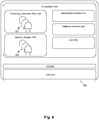
- FIG. 4 is a schematic overview of the computer device 200 according to an exemplary embodiment of the invention, in more detail.
- the AI mediator 300 comprises a specification parser module 410, a technology decision tree module 420, an attribute identifier module 430, a generic adapter module 440 and a graphical user interface (GUI) 450.
- GUI graphical user interface
- One or more of these modules, including the specification parser module 410, the technology decision tree module 420, the attribute identifier module 430 and the generic adapter module 440, may provide at least a part of the AI mediator 300, for example the NLP engine, as described above.
- the specification parser module 410 may be configured to provide a function of the AI mediator 300, for example the NLP engine, as described above, such as the function of understanding the structure of the specification document.
- An input of the specification parser module 410 may be the specification document, such as for the programmatic interface exposed by the source device 130, as described previously.
- An output of the specification parser module 410 for example the parsed specification document, may be provided by the specification parser module 410 to the technology decision tree module 420.
- the technology decision tree module 420 may be configured to provide a function of the AI mediator 300, for example the NLP engine, as described above, such as the function of interpreting technology used to implement the documented specification.
- the technology decision tree module 420 may comprise one or more technology decision tree plugins 421, configured to interpret the technology used to implement the documented specification.
- An output of the technology decision tree module 420, for example the technology decision tree, may be provided by the technology decision tree module 420 to the attribute identifier module 430 and/or to the generic adapter module 440.
- the attribute identifier module 430 may be configured to provide a function of the AI mediator 300, for example the NLP engine, as described above, such as the function of discovering supporting information such as metadata and/or message attributes associated with the documented specification.
- An output of the attribute identifier module 430 may be provided by the attribute identifier module 430 and/or to the generic adapter module 440.
- This output may comprise a Bayesian decision tree for technology categories for the programmatic interface exposed by the source device 130, such as including identification of metadata, attributes or data-fields that are exploitable by the generic adapter module 440.
- the generic adapter module 440 may be configured to map the function of the programmatic interface exposed by the source device 130 to the associated function of the sink device 120.
- the generic adapter module 440 may be configured to conform to the programmatic interface exposed by the source device 130, for example, using one or more generic adapter plugins 441 configured to provide, for example, interface adapters that map predetermined functions of programmatic interfaces.
- the generic adapter module 440 may be configured to provide one or more standards-based programmatic interfaces, configured to interface with the source device 130, for example.
- the generic adapter 440 may be configured to enable communication between the source device 130 and a user, such as to enable confirmation of the mapping.
- the generic adapter module 440 configured to map the function of the programmatic interface exposed by the source device 130 to the associated function of the sink device 120, may be provided to the sink device 120. In this way, in response to invoking the associated function by the sink device 120, the mapped function of the source device 130 is invoked in turn by the generic adapter 440.
- the GUI 450 may be configured to enable interaction between a user and the technology decision tree module 420 and/or the attribute identifier module 430, such as to confirm decisions and/or select alternatives.
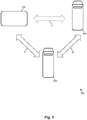
- Figure 5 is a schematic overview of a part of a network 500 of a type which may be used in the example embodiments discussed herein, including the computer device 200 according to an example embodiment. Also included are a sink device 520 and a source device 530. Generally, the network 500, the sink device 520 and the source device 530 are as described above with reference to the network 100, the sink device 120 and the source device 130, respectively.
- the source device 530 comprises a sensor, particularly an optical sensor.
- the source device 530 is a digital camera, having a charged coupled device (CCD) sensor.
- the sink device 520 comprises a control computer device.
- a human-readable text specification document 540 for the programmatic interface exposed by the source device 530 is provided to the computer device 200 including the AI mediator 300.
- the AI mediator 300 is configured to understand a structure of the specification document 540, interpret technology used to implement the documented specification 540 and discover supporting information such as metadata and/or message attributes associated with the documented specification. Based on output of these functions, the AI mediator is further configured to provide an adapter, such as the generic adapter 440 described previously, configured to map the function of the programmatic interface exposed by the source device 530 to the associated function of the sink device 520.
- the sink device 520 may be integrated with the source device 530, such that in response to invoking the associated function by the sink device 520, the mapped function of the source device 530 is invoked.
- the sink device 520 may receive data such as images from the source device 530, via the mapped function.
- the sink device 520 may control the source device 530, via the mapped function, to acquire an image, for example.
- integration of the sink device 520 with the source device 530 coupleable thereto is provided by the computer device 200 by mapping a function of a programmatic interface exposed by the source device 530 to an associated function of the sink device 520, thereby reducing reliance on human integration specialists and improving timescales to effect integration.
- Figure 6 is an example partial technology decision tree provided by the AI mediator 300.
- the technology decision tree is arranged according to the Open Systems Interconnection (OSI) model, in which physical 600, network 610, transport 620 and presentation 630 layers are shown. Nodes of the technology decision tree are connected to other nodes in higher layers, such as adjacent higher layers.
- OSI Open Systems Interconnection
- the physical layer 600 includes a specification document node 601.
- the network layer 610 includes Ethernet 611 and Wi-Fi (RTM) 612 nodes.
- the transport layer 620 includes The User Datagram Protocol (UDP) 621, Transmission Control Protocol (TCP) 622 and Hypertext Transfer Protocol (HTTP) 623 nodes.
- UDP User Datagram Protocol
- TCP Transmission Control Protocol
- HTTP Hypertext Transfer Protocol
- the presentation layer 630 includes Unicode (or Universal Coded Character Set) Transformation Format - 8-bit (UTF-8) 631, binary fixed length 632, binary variable length 633, Extensible Markup Language (XML) 634, Web Service Definition Language (WSDL) 635, JavaScript Object Notation (JSON) 636 and Moving Picture Experts Group 4 (MPEG-4) 637 nodes.
- Unicode or Universal Coded Character Set Transformation Format - 8-bit (UTF-8) 631
- binary fixed length 632 binary variable length 633
- XML Extensible Markup Language
- WSDL Web Service Definition Language
- JSON JavaScript Object Notation
- MPEG-4 Moving Picture Experts Group 4
- RTSP Real Time Streaming Protocol
- AMQP Advanced Message Queuing Protocol
- Figure 7 is a flowchart of the example method of operating the computer device 200 of Figure 1 .
- the AI mediator 300 maps the function of the programmatic interface exposed by the source device 130 to the associated function of the sink device 120. In this way, in response to invoking the associated function by the sink device 120, the mapped function of the source device 130 is invoked.
- Figure 8 is a flowchart of the example method of operating the computer device of Figure 1 , in more detail.
- the specification document is provided to the specification parser module 410.
- the specification parser module 410 understands the structure of the specification document by parsing the specification document.
- the specification parser module 410 provides the parsed specification document to the technology decision tree module 420.
- the technology decision tree module 420 interprets technology used to implement the documented specification.
- the technology decision tree module 420 provides the technology decision tree to the attribute identifier module 430 and/or to the generic adapter module 440.
- the attribute identifier module 430 discovers supporting information such as metadata and/or message attributes associated with the documented specification.
- the attribute identifier module 430 provides the discovered supporting information together with the technology decision tree to the generic adapter module 440.
- the generic adapter module 440 maps the function of the programmatic interface exposed by the source device 130 to the associated function of the sink device 120.
- the generic adapter module 440 configured to map the function of the programmatic interface exposed by the source device 130 to the associated function of the sink device 120, may be provided to the sink device 120. In this way, in response to invoking the associated function by the sink device 120, the mapped function of the source device 130 is invoked in turn by the generic adapter 440.
- the invention provides a computer device and method for integrating a sink device with a source device coupleable thereto.
- the computer device comprises a processor circuit and a memory circuit.
- the computer device also comprises an artificial intelligence, AI, mediator.
- the AI mediator is configured to map a function of a programmatic interface exposed by the source device to an associated function of the sink device, whereby, in response to invoking the associated function by the sink device, the mapped function of the source device is invoked.
- integration of the sink device with the source device is facilitated, since the integration is provided by the computer device by mapping a function of a programmatic interface exposed by the source device to an associated function of the sink device, thereby reducing reliance on human integration specialists and improving timescales to effect integration.
Landscapes
- Engineering & Computer Science (AREA)
- Theoretical Computer Science (AREA)
- General Engineering & Computer Science (AREA)
- Physics & Mathematics (AREA)
- Software Systems (AREA)
- General Physics & Mathematics (AREA)
- Artificial Intelligence (AREA)
- Computational Linguistics (AREA)
- Evolutionary Computation (AREA)
- Mathematical Physics (AREA)
- Computing Systems (AREA)
- Data Mining & Analysis (AREA)
- Health & Medical Sciences (AREA)
- Audiology, Speech & Language Pathology (AREA)
- General Health & Medical Sciences (AREA)
- Computer Vision & Pattern Recognition (AREA)
- Medical Informatics (AREA)
- Probability & Statistics with Applications (AREA)
- User Interface Of Digital Computer (AREA)
Priority Applications (2)
| Application Number | Priority Date | Filing Date | Title |
|---|---|---|---|
| EP17275060.6A EP3396551A1 (de) | 2017-04-25 | 2017-04-25 | Vorrichtung und verfahren zur integration einer waschbeckenvorrichtung mit einer quellenvorrichtung |
| PCT/GB2018/051066 WO2018197855A1 (en) | 2017-04-25 | 2018-04-24 | Apparatus and method for integrating a sink device with a source device |
Applications Claiming Priority (1)
| Application Number | Priority Date | Filing Date | Title |
|---|---|---|---|
| EP17275060.6A EP3396551A1 (de) | 2017-04-25 | 2017-04-25 | Vorrichtung und verfahren zur integration einer waschbeckenvorrichtung mit einer quellenvorrichtung |
Publications (1)
| Publication Number | Publication Date |
|---|---|
| EP3396551A1 true EP3396551A1 (de) | 2018-10-31 |
Family
ID=58664617
Family Applications (1)
| Application Number | Title | Priority Date | Filing Date |
|---|---|---|---|
| EP17275060.6A Ceased EP3396551A1 (de) | 2017-04-25 | 2017-04-25 | Vorrichtung und verfahren zur integration einer waschbeckenvorrichtung mit einer quellenvorrichtung |
Country Status (1)
| Country | Link |
|---|---|
| EP (1) | EP3396551A1 (de) |
Citations (3)
| Publication number | Priority date | Publication date | Assignee | Title |
|---|---|---|---|---|
| WO2015099976A1 (en) * | 2013-12-27 | 2015-07-02 | Microsoft Technology Licensing, Llc. | Generation of client-side application programming interfaces |
| US20150363171A1 (en) * | 2014-06-11 | 2015-12-17 | Ca, Inc. | Generating virtualized application programming interface (api) implementation from narrative api documentation |
| US20160147507A1 (en) * | 2014-11-25 | 2016-05-26 | Symbol Technologies, Llc | Apparatus and method for converting a procedure manual to an automated program |
-
2017
- 2017-04-25 EP EP17275060.6A patent/EP3396551A1/de not_active Ceased
Patent Citations (3)
| Publication number | Priority date | Publication date | Assignee | Title |
|---|---|---|---|---|
| WO2015099976A1 (en) * | 2013-12-27 | 2015-07-02 | Microsoft Technology Licensing, Llc. | Generation of client-side application programming interfaces |
| US20150363171A1 (en) * | 2014-06-11 | 2015-12-17 | Ca, Inc. | Generating virtualized application programming interface (api) implementation from narrative api documentation |
| US20160147507A1 (en) * | 2014-11-25 | 2016-05-26 | Symbol Technologies, Llc | Apparatus and method for converting a procedure manual to an automated program |
Non-Patent Citations (9)
| Title |
|---|
| ALEXANDER M RUSH; SUMIT CHOPRA; JASON WESTON: "A neural attention model for abstractive sentence summarization", PROCEEDINGS OF THE 2015 CONFERENCE ON EMPIRICAL METHODS IN NATURAL LANGUAGE PROCESSING, 2015 |
| CHRISTOPHER D. MANNING: "A large annotated corpus for learning natural language inference", PROCEEDINGS OF THE 2015 CONFERENCE ON EMPIRICAL METHODS IN NATURAL LANGUAGE PROCESSING, 2015 |
| CHRISTOPHER J.C.H. WATKINS; PETER DAYAN, Q-LEARNING, MACHINE LEARNING, vol. 8, no. 3-4, 1992 |
| SAMUEL R. BOWMAN; GABOR ANGELI; CHRISTOPHER POTTS, STANFORD NATURAL LANGUAGE INFERENCE (SNLI) CORPUS |
| SHENGXIAN WAN; YANYAN LANY; JIAFENG GUOY; JUN XUY; LIANG PANG; XUEQI CHENG: "A Deep Architecture for Semantic Matching with Multiple Positional Sentence Representations", PROCEEDINGS OF THE 2016 AAAI CONFERENCE ON ARTIFICIAL INTELLIGENCE, 2015 |
| TAO LEI; REGINA BARZILAY; TOMMI JAAKKOLA, RATIONALIZING NEURAL PREDICTIONS, 2016 |
| TIM ROCKTASCHEL; EDWARD GREFENSTETTE; KARL MORITZ HERMANN; TOMAS KOCISKY; PHIL BLUNSOM: "Reasoning about entailment with neural attention", INTERNATIONAL CONFERENCE ON LEARNING REPRESENTATIONS, 2016 |
| TOMAS MIKOLOV; ILYA SUTSKEVER; KAI CHEN; GREG S. CORRADO; JEFF DEAN: "Distributed representations of words and phrases and their compositionality", NIPS 2013, 2013 |
| ZHIGUO WANG; WAEL HAMZA; RADU FLORIAN, BILATERAL MULTI-PERSPECTIVE MATCHING FOR NATURAL LANGUAGE SENTENCES, 2017 |
Similar Documents
| Publication | Publication Date | Title |
|---|---|---|
| Wu et al. | Visual chatgpt: Talking, drawing and editing with visual foundation models | |
| CN114970721B (zh) | 多语言多模态预训练模型的训练方法、装置及电子设备 | |
| US10832006B2 (en) | Responding to an indirect utterance by a conversational system | |
| CN112136125B (zh) | 用于自然语言分类的训练数据扩展 | |
| US11954613B2 (en) | Establishing a logical connection between an indirect utterance and a transaction | |
| CN107783960B (zh) | 用于抽取信息的方法、装置和设备 | |
| US10698932B2 (en) | Method and apparatus for parsing query based on artificial intelligence, and storage medium | |
| US9691024B2 (en) | Knowledge-based editor with natural language interface | |
| JP7335300B2 (ja) | 知識事前訓練モデルの訓練方法、装置及び電子機器 | |
| CN111488742B (zh) | 用于翻译的方法和装置 | |
| EP4485398B1 (de) | Übersetzung von in bildern abgebildetem text | |
| US11386273B2 (en) | System and method for negation aware sentiment detection | |
| US10223349B2 (en) | Inducing and applying a subject-targeted context free grammar | |
| JP2023002690A (ja) | セマンティックス認識方法、装置、電子機器及び記憶媒体 | |
| Chimalamarri et al. | Linguistically enhanced word segmentation for better neural machine translation of low resource agglutinative languages | |
| Das et al. | A visual attention-based model for bengali image captioning | |
| Almansor et al. | Transferring informal text in arabic as low resource languages: State-of-the-art and future research directions | |
| CN114365144B (zh) | 自然语言内容的选择性深度解析 | |
| CN114218387A (zh) | 基于注意力的对话文本分类方法、系统、设备及存储介质 | |
| WO2018197855A1 (en) | Apparatus and method for integrating a sink device with a source device | |
| Lenz et al. | Argservices: A microservice-based architecture for argumentation machines | |
| GB2562038A (en) | Apparatus and method for integrating a sink device with a source device | |
| EP3396551A1 (de) | Vorrichtung und verfahren zur integration einer waschbeckenvorrichtung mit einer quellenvorrichtung | |
| CN115964458B (zh) | 文本的量子线路确定方法、装置、存储介质及电子设备 | |
| Isaeva et al. | Formal cross-domain ontologization of human knowledge |
Legal Events
| Date | Code | Title | Description |
|---|---|---|---|
| PUAI | Public reference made under article 153(3) epc to a published international application that has entered the european phase |
Free format text: ORIGINAL CODE: 0009012 |
|
| AK | Designated contracting states |
Kind code of ref document: A1 Designated state(s): AL AT BE BG CH CY CZ DE DK EE ES FI FR GB GR HR HU IE IS IT LI LT LU LV MC MK MT NL NO PL PT RO RS SE SI SK SM TR |
|
| AX | Request for extension of the european patent |
Extension state: BA ME |
|
| STAA | Information on the status of an ep patent application or granted ep patent |
Free format text: STATUS: THE APPLICATION HAS BEEN REFUSED |
|
| 18R | Application refused |
Effective date: 20181201 |