EP3395915A1 - Coating agent - Google Patents
Coating agent Download PDFInfo
- Publication number
- EP3395915A1 EP3395915A1 EP16877965.0A EP16877965A EP3395915A1 EP 3395915 A1 EP3395915 A1 EP 3395915A1 EP 16877965 A EP16877965 A EP 16877965A EP 3395915 A1 EP3395915 A1 EP 3395915A1
- Authority
- EP
- European Patent Office
- Prior art keywords
- group
- coating agent
- exemplified
- film
- compound
- Prior art date
- Legal status (The legal status is an assumption and is not a legal conclusion. Google has not performed a legal analysis and makes no representation as to the accuracy of the status listed.)
- Withdrawn
Links
- 239000011248 coating agent Substances 0.000 title claims abstract description 82
- 229920000642 polymer Polymers 0.000 claims abstract description 32
- 239000000758 substrate Substances 0.000 claims abstract description 27
- 239000004033 plastic Substances 0.000 claims abstract description 18
- 229920003023 plastic Polymers 0.000 claims abstract description 18
- 239000000178 monomer Substances 0.000 claims abstract description 14
- 125000001424 substituent group Chemical group 0.000 claims abstract description 12
- 125000003118 aryl group Chemical group 0.000 claims abstract description 11
- 125000004435 hydrogen atom Chemical group [H]* 0.000 claims abstract description 11
- 125000004169 (C1-C6) alkyl group Chemical group 0.000 claims abstract description 10
- 125000004430 oxygen atom Chemical group O* 0.000 claims abstract description 8
- 125000000524 functional group Chemical group 0.000 claims abstract description 7
- -1 methacryloyl group Chemical group 0.000 claims description 75
- 125000003647 acryloyl group Chemical group O=C([*])C([H])=C([H])[H] 0.000 claims description 4
- 229920001519 homopolymer Polymers 0.000 claims description 3
- 229920005672 polyolefin resin Polymers 0.000 claims description 2
- 239000011347 resin Substances 0.000 abstract description 8
- 229920005989 resin Polymers 0.000 abstract description 8
- 150000001925 cycloalkenes Chemical class 0.000 abstract description 7
- 239000010408 film Substances 0.000 description 64
- 238000000576 coating method Methods 0.000 description 28
- 150000001875 compounds Chemical class 0.000 description 23
- 238000006243 chemical reaction Methods 0.000 description 22
- 238000000034 method Methods 0.000 description 21
- WYURNTSHIVDZCO-UHFFFAOYSA-N Tetrahydrofuran Chemical class C1CCOC1 WYURNTSHIVDZCO-UHFFFAOYSA-N 0.000 description 20
- 239000003960 organic solvent Substances 0.000 description 20
- 229910052751 metal Inorganic materials 0.000 description 19
- 239000002184 metal Substances 0.000 description 19
- VLKZOEOYAKHREP-UHFFFAOYSA-N n-Hexane Chemical compound CCCCCC VLKZOEOYAKHREP-UHFFFAOYSA-N 0.000 description 16
- IJGRMHOSHXDMSA-UHFFFAOYSA-N Atomic nitrogen Chemical compound N#N IJGRMHOSHXDMSA-UHFFFAOYSA-N 0.000 description 13
- OZAIFHULBGXAKX-UHFFFAOYSA-N 2-(2-cyanopropan-2-yldiazenyl)-2-methylpropanenitrile Chemical compound N#CC(C)(C)N=NC(C)(C)C#N OZAIFHULBGXAKX-UHFFFAOYSA-N 0.000 description 12
- ZMANZCXQSJIPKH-UHFFFAOYSA-N Triethylamine Chemical compound CCN(CC)CC ZMANZCXQSJIPKH-UHFFFAOYSA-N 0.000 description 12
- 230000015572 biosynthetic process Effects 0.000 description 10
- JHIVVAPYMSGYDF-UHFFFAOYSA-N cyclohexanone Chemical compound O=C1CCCCC1 JHIVVAPYMSGYDF-UHFFFAOYSA-N 0.000 description 10
- 239000000243 solution Substances 0.000 description 10
- 150000007524 organic acids Chemical class 0.000 description 9
- 125000001997 phenyl group Chemical group [H]C1=C([H])C([H])=C(*)C([H])=C1[H] 0.000 description 9
- 239000007789 gas Substances 0.000 description 8
- 238000010438 heat treatment Methods 0.000 description 8
- 150000003839 salts Chemical class 0.000 description 8
- SCPYDCQAZCOKTP-UHFFFAOYSA-N silanol Chemical compound [SiH3]O SCPYDCQAZCOKTP-UHFFFAOYSA-N 0.000 description 8
- 239000010936 titanium Substances 0.000 description 8
- NIXOWILDQLNWCW-UHFFFAOYSA-M Acrylate Chemical compound [O-]C(=O)C=C NIXOWILDQLNWCW-UHFFFAOYSA-M 0.000 description 7
- RTZKZFJDLAIYFH-UHFFFAOYSA-N Diethyl ether Chemical compound CCOCC RTZKZFJDLAIYFH-UHFFFAOYSA-N 0.000 description 7
- 239000007983 Tris buffer Substances 0.000 description 7
- 239000002253 acid Substances 0.000 description 7
- 238000009833 condensation Methods 0.000 description 7
- 230000005494 condensation Effects 0.000 description 7
- 239000010410 layer Substances 0.000 description 7
- 229910044991 metal oxide Inorganic materials 0.000 description 7
- 150000004706 metal oxides Chemical class 0.000 description 7
- 239000002245 particle Substances 0.000 description 7
- QTBSBXVTEAMEQO-UHFFFAOYSA-N Acetic acid Chemical compound CC(O)=O QTBSBXVTEAMEQO-UHFFFAOYSA-N 0.000 description 6
- OKKJLVBELUTLKV-UHFFFAOYSA-N Methanol Chemical compound OC OKKJLVBELUTLKV-UHFFFAOYSA-N 0.000 description 6
- MUBZPKHOEPUJKR-UHFFFAOYSA-N Oxalic acid Chemical compound OC(=O)C(O)=O MUBZPKHOEPUJKR-UHFFFAOYSA-N 0.000 description 6
- YXFVVABEGXRONW-UHFFFAOYSA-N Toluene Chemical compound CC1=CC=CC=C1 YXFVVABEGXRONW-UHFFFAOYSA-N 0.000 description 6
- 230000004888 barrier function Effects 0.000 description 6
- 125000004432 carbon atom Chemical group C* 0.000 description 6
- 150000004696 coordination complex Chemical class 0.000 description 6
- RWGFKTVRMDUZSP-UHFFFAOYSA-N cumene Chemical compound CC(C)C1=CC=CC=C1 RWGFKTVRMDUZSP-UHFFFAOYSA-N 0.000 description 6
- 125000001153 fluoro group Chemical group F* 0.000 description 6
- 125000002887 hydroxy group Chemical group [H]O* 0.000 description 6
- 150000002736 metal compounds Chemical class 0.000 description 6
- 229910052757 nitrogen Inorganic materials 0.000 description 6
- 239000003505 polymerization initiator Substances 0.000 description 6
- XLYOFNOQVPJJNP-UHFFFAOYSA-N water Substances O XLYOFNOQVPJJNP-UHFFFAOYSA-N 0.000 description 6
- VYPSYNLAJGMNEJ-UHFFFAOYSA-N Silicium dioxide Chemical group O=[Si]=O VYPSYNLAJGMNEJ-UHFFFAOYSA-N 0.000 description 5
- RTAQQCXQSZGOHL-UHFFFAOYSA-N Titanium Chemical compound [Ti] RTAQQCXQSZGOHL-UHFFFAOYSA-N 0.000 description 5
- 125000004423 acyloxy group Chemical group 0.000 description 5
- 239000003054 catalyst Substances 0.000 description 5
- 125000005843 halogen group Chemical group 0.000 description 5
- 125000002496 methyl group Chemical group [H]C([H])([H])* 0.000 description 5
- 230000003287 optical effect Effects 0.000 description 5
- 238000002360 preparation method Methods 0.000 description 5
- 239000007787 solid Substances 0.000 description 5
- 229910052719 titanium Inorganic materials 0.000 description 5
- PTVDYMGQGCNETM-UHFFFAOYSA-N trityl 2-methylprop-2-enoate Chemical compound C=1C=CC=CC=1C(C=1C=CC=CC=1)(OC(=O)C(=C)C)C1=CC=CC=C1 PTVDYMGQGCNETM-UHFFFAOYSA-N 0.000 description 5
- 238000005160 1H NMR spectroscopy Methods 0.000 description 4
- 125000003903 2-propenyl group Chemical group [H]C([*])([H])C([H])=C([H])[H] 0.000 description 4
- XINCECQTMHSORG-UHFFFAOYSA-N Isoamyl isovalerate Chemical compound CC(C)CCOC(=O)CC(C)C XINCECQTMHSORG-UHFFFAOYSA-N 0.000 description 4
- 238000005481 NMR spectroscopy Methods 0.000 description 4
- XUIMIQQOPSSXEZ-UHFFFAOYSA-N Silicon Chemical compound [Si] XUIMIQQOPSSXEZ-UHFFFAOYSA-N 0.000 description 4
- ATJFFYVFTNAWJD-UHFFFAOYSA-N Tin Chemical compound [Sn] ATJFFYVFTNAWJD-UHFFFAOYSA-N 0.000 description 4
- XLOMVQKBTHCTTD-UHFFFAOYSA-N Zinc monoxide Chemical compound [Zn]=O XLOMVQKBTHCTTD-UHFFFAOYSA-N 0.000 description 4
- CSCPPACGZOOCGX-WFGJKAKNSA-N acetone d6 Chemical compound [2H]C([2H])([2H])C(=O)C([2H])([2H])[2H] CSCPPACGZOOCGX-WFGJKAKNSA-N 0.000 description 4
- 125000002947 alkylene group Chemical group 0.000 description 4
- 239000012295 chemical reaction liquid Substances 0.000 description 4
- 239000003999 initiator Substances 0.000 description 4
- 239000011572 manganese Substances 0.000 description 4
- 229910000000 metal hydroxide Inorganic materials 0.000 description 4
- 150000004692 metal hydroxides Chemical class 0.000 description 4
- VHRYZQNGTZXDNX-UHFFFAOYSA-N methacryloyl chloride Chemical compound CC(=C)C(Cl)=O VHRYZQNGTZXDNX-UHFFFAOYSA-N 0.000 description 4
- 239000012044 organic layer Substances 0.000 description 4
- 238000006116 polymerization reaction Methods 0.000 description 4
- 230000000379 polymerizing effect Effects 0.000 description 4
- 229910052710 silicon Inorganic materials 0.000 description 4
- 239000010703 silicon Substances 0.000 description 4
- XHFLOLLMZOTPSM-UHFFFAOYSA-M sodium;hydrogen carbonate;hydrate Chemical class [OH-].[Na+].OC(O)=O XHFLOLLMZOTPSM-UHFFFAOYSA-M 0.000 description 4
- 238000004544 sputter deposition Methods 0.000 description 4
- 238000003786 synthesis reaction Methods 0.000 description 4
- 238000012719 thermal polymerization Methods 0.000 description 4
- 229910052718 tin Inorganic materials 0.000 description 4
- KJKCBNITWLOZPQ-UHFFFAOYSA-N tris(3,5-dimethylphenyl)methyl 2-methylprop-2-enoate Chemical compound C(C(=C)C)(=O)OC(C1=CC(=CC(=C1)C)C)(C1=CC(=CC(=C1)C)C)C1=CC(=CC(=C1)C)C KJKCBNITWLOZPQ-UHFFFAOYSA-N 0.000 description 4
- GEYSGGAQPCDXQR-UHFFFAOYSA-N tris(4-chlorophenyl)methyl 2-methylprop-2-enoate Chemical compound C(C(=C)C)(=O)OC(C1=CC=C(C=C1)Cl)(C1=CC=C(C=C1)Cl)C1=CC=C(C=C1)Cl GEYSGGAQPCDXQR-UHFFFAOYSA-N 0.000 description 4
- BHASKWRZUYXFFQ-UHFFFAOYSA-N tris(4-methylphenyl)methyl 2-methylprop-2-enoate Chemical compound C(C(=C)C)(=O)OC(C1=CC=C(C=C1)C)(C1=CC=C(C=C1)C)C1=CC=C(C=C1)C BHASKWRZUYXFFQ-UHFFFAOYSA-N 0.000 description 4
- 125000000229 (C1-C4)alkoxy group Chemical group 0.000 description 3
- ZWEHNKRNPOVVGH-UHFFFAOYSA-N 2-Butanone Chemical compound CCC(C)=O ZWEHNKRNPOVVGH-UHFFFAOYSA-N 0.000 description 3
- UHOVQNZJYSORNB-UHFFFAOYSA-N Benzene Chemical compound C1=CC=CC=C1 UHOVQNZJYSORNB-UHFFFAOYSA-N 0.000 description 3
- 229920000089 Cyclic olefin copolymer Polymers 0.000 description 3
- XEKOWRVHYACXOJ-UHFFFAOYSA-N Ethyl acetate Chemical compound CCOC(C)=O XEKOWRVHYACXOJ-UHFFFAOYSA-N 0.000 description 3
- LYCAIKOWRPUZTN-UHFFFAOYSA-N Ethylene glycol Chemical compound OCCO LYCAIKOWRPUZTN-UHFFFAOYSA-N 0.000 description 3
- ISWSIDIOOBJBQZ-UHFFFAOYSA-N Phenol Natural products OC1=CC=CC=C1 ISWSIDIOOBJBQZ-UHFFFAOYSA-N 0.000 description 3
- BLRPTPMANUNPDV-UHFFFAOYSA-N Silane Chemical compound [SiH4] BLRPTPMANUNPDV-UHFFFAOYSA-N 0.000 description 3
- PFHLXMMCWCWAMA-UHFFFAOYSA-N [4-(4-diphenylsulfoniophenyl)sulfanylphenyl]-diphenylsulfanium Chemical compound C=1C=C([S+](C=2C=CC=CC=2)C=2C=CC=CC=2)C=CC=1SC(C=C1)=CC=C1[S+](C=1C=CC=CC=1)C1=CC=CC=C1 PFHLXMMCWCWAMA-UHFFFAOYSA-N 0.000 description 3
- 229910052782 aluminium Inorganic materials 0.000 description 3
- XAGFODPZIPBFFR-UHFFFAOYSA-N aluminium Chemical compound [Al] XAGFODPZIPBFFR-UHFFFAOYSA-N 0.000 description 3
- 125000002091 cationic group Chemical group 0.000 description 3
- 238000001035 drying Methods 0.000 description 3
- 150000002148 esters Chemical class 0.000 description 3
- 229910052738 indium Inorganic materials 0.000 description 3
- APFVFJFRJDLVQX-UHFFFAOYSA-N indium atom Chemical compound [In] APFVFJFRJDLVQX-UHFFFAOYSA-N 0.000 description 3
- 239000011133 lead Substances 0.000 description 3
- 125000000956 methoxy group Chemical group [H]C([H])([H])O* 0.000 description 3
- 125000001624 naphthyl group Chemical group 0.000 description 3
- 238000005268 plasma chemical vapour deposition Methods 0.000 description 3
- 238000010526 radical polymerization reaction Methods 0.000 description 3
- 150000003254 radicals Chemical class 0.000 description 3
- 229910000077 silane Inorganic materials 0.000 description 3
- 238000012360 testing method Methods 0.000 description 3
- ZALFZMYXGFDRIW-UHFFFAOYSA-N (4-methylphenyl)methyl 2-methylprop-2-enoate Chemical compound CC(=C)C(=O)OCC1=CC=C(C)C=C1 ZALFZMYXGFDRIW-UHFFFAOYSA-N 0.000 description 2
- 125000004191 (C1-C6) alkoxy group Chemical group 0.000 description 2
- XRRDFIPYLFCYLU-UHFFFAOYSA-N 1,3,5-trimethylbenzene Chemical group [CH2]C1=CC(C)=CC(C)=C1 XRRDFIPYLFCYLU-UHFFFAOYSA-N 0.000 description 2
- HNAGHMKIPMKKBB-UHFFFAOYSA-N 1-benzylpyrrolidine-3-carboxamide Chemical compound C1C(C(=O)N)CCN1CC1=CC=CC=C1 HNAGHMKIPMKKBB-UHFFFAOYSA-N 0.000 description 2
- KWVGIHKZDCUPEU-UHFFFAOYSA-N 2,2-dimethoxy-2-phenylacetophenone Chemical compound C=1C=CC=CC=1C(OC)(OC)C(=O)C1=CC=CC=C1 KWVGIHKZDCUPEU-UHFFFAOYSA-N 0.000 description 2
- UJOBWOGCFQCDNV-UHFFFAOYSA-N 9H-carbazole Chemical compound C1=CC=C2C3=CC=CC=C3NC2=C1 UJOBWOGCFQCDNV-UHFFFAOYSA-N 0.000 description 2
- CSCPPACGZOOCGX-UHFFFAOYSA-N Acetone Chemical compound CC(C)=O CSCPPACGZOOCGX-UHFFFAOYSA-N 0.000 description 2
- KWOLFJPFCHCOCG-UHFFFAOYSA-N Acetophenone Chemical compound CC(=O)C1=CC=CC=C1 KWOLFJPFCHCOCG-UHFFFAOYSA-N 0.000 description 2
- DKPFZGUDAPQIHT-UHFFFAOYSA-N Butyl acetate Natural products CCCCOC(C)=O DKPFZGUDAPQIHT-UHFFFAOYSA-N 0.000 description 2
- MYMOFIZGZYHOMD-UHFFFAOYSA-N Dioxygen Chemical compound O=O MYMOFIZGZYHOMD-UHFFFAOYSA-N 0.000 description 2
- AEMRFAOFKBGASW-UHFFFAOYSA-N Glycolic acid Chemical compound OCC(O)=O AEMRFAOFKBGASW-UHFFFAOYSA-N 0.000 description 2
- VEXZGXHMUGYJMC-UHFFFAOYSA-N Hydrochloric acid Chemical compound Cl VEXZGXHMUGYJMC-UHFFFAOYSA-N 0.000 description 2
- UQSXHKLRYXJYBZ-UHFFFAOYSA-N Iron oxide Chemical compound [Fe]=O UQSXHKLRYXJYBZ-UHFFFAOYSA-N 0.000 description 2
- KFZMGEQAYNKOFK-UHFFFAOYSA-N Isopropanol Chemical compound CC(C)O KFZMGEQAYNKOFK-UHFFFAOYSA-N 0.000 description 2
- AFVFQIVMOAPDHO-UHFFFAOYSA-N Methanesulfonic acid Chemical compound CS(O)(=O)=O AFVFQIVMOAPDHO-UHFFFAOYSA-N 0.000 description 2
- VVQNEPGJFQJSBK-UHFFFAOYSA-N Methyl methacrylate Chemical compound COC(=O)C(C)=C VVQNEPGJFQJSBK-UHFFFAOYSA-N 0.000 description 2
- PPBRXRYQALVLMV-UHFFFAOYSA-N Styrene Chemical compound C=CC1=CC=CC=C1 PPBRXRYQALVLMV-UHFFFAOYSA-N 0.000 description 2
- DTQVDTLACAAQTR-UHFFFAOYSA-N Trifluoroacetic acid Chemical compound OC(=O)C(F)(F)F DTQVDTLACAAQTR-UHFFFAOYSA-N 0.000 description 2
- QCWXUUIWCKQGHC-UHFFFAOYSA-N Zirconium Chemical compound [Zr] QCWXUUIWCKQGHC-UHFFFAOYSA-N 0.000 description 2
- MCMNRKCIXSYSNV-UHFFFAOYSA-N Zirconium dioxide Chemical compound O=[Zr]=O MCMNRKCIXSYSNV-UHFFFAOYSA-N 0.000 description 2
- 235000011054 acetic acid Nutrition 0.000 description 2
- ZCZSIDMEHXZRLG-UHFFFAOYSA-N acetic acid heptyl ester Natural products CCCCCCCOC(C)=O ZCZSIDMEHXZRLG-UHFFFAOYSA-N 0.000 description 2
- YRKCREAYFQTBPV-UHFFFAOYSA-N acetylacetone Chemical compound CC(=O)CC(C)=O YRKCREAYFQTBPV-UHFFFAOYSA-N 0.000 description 2
- 239000000654 additive Substances 0.000 description 2
- 150000001338 aliphatic hydrocarbons Chemical class 0.000 description 2
- 125000003342 alkenyl group Chemical group 0.000 description 2
- 125000003545 alkoxy group Chemical group 0.000 description 2
- 125000000217 alkyl group Chemical group 0.000 description 2
- 125000004414 alkyl thio group Chemical group 0.000 description 2
- 150000001412 amines Chemical class 0.000 description 2
- 150000004945 aromatic hydrocarbons Chemical class 0.000 description 2
- 125000004104 aryloxy group Chemical group 0.000 description 2
- QVGXLLKOCUKJST-UHFFFAOYSA-N atomic oxygen Chemical compound [O] QVGXLLKOCUKJST-UHFFFAOYSA-N 0.000 description 2
- HUMNYLRZRPPJDN-UHFFFAOYSA-N benzaldehyde Chemical compound O=CC1=CC=CC=C1 HUMNYLRZRPPJDN-UHFFFAOYSA-N 0.000 description 2
- WPYMKLBDIGXBTP-UHFFFAOYSA-N benzoic acid Chemical compound OC(=O)C1=CC=CC=C1 WPYMKLBDIGXBTP-UHFFFAOYSA-N 0.000 description 2
- 125000001246 bromo group Chemical group Br* 0.000 description 2
- OBNCKNCVKJNDBV-UHFFFAOYSA-N butanoic acid ethyl ester Natural products CCCC(=O)OCC OBNCKNCVKJNDBV-UHFFFAOYSA-N 0.000 description 2
- 229940043232 butyl acetate Drugs 0.000 description 2
- 229910052799 carbon Inorganic materials 0.000 description 2
- BVKZGUZCCUSVTD-UHFFFAOYSA-N carbonic acid Chemical compound OC(O)=O BVKZGUZCCUSVTD-UHFFFAOYSA-N 0.000 description 2
- 239000003795 chemical substances by application Substances 0.000 description 2
- 125000001309 chloro group Chemical group Cl* 0.000 description 2
- 239000002131 composite material Substances 0.000 description 2
- 239000012954 diazonium Substances 0.000 description 2
- 229910001882 dioxygen Inorganic materials 0.000 description 2
- 238000007598 dipping method Methods 0.000 description 2
- 125000001301 ethoxy group Chemical group [H]C([H])([H])C([H])([H])O* 0.000 description 2
- 125000001495 ethyl group Chemical group [H]C([H])([H])C([H])([H])* 0.000 description 2
- 239000000945 filler Substances 0.000 description 2
- 229910052731 fluorine Inorganic materials 0.000 description 2
- 235000019000 fluorine Nutrition 0.000 description 2
- 229910052732 germanium Inorganic materials 0.000 description 2
- GNPVGFCGXDBREM-UHFFFAOYSA-N germanium atom Chemical compound [Ge] GNPVGFCGXDBREM-UHFFFAOYSA-N 0.000 description 2
- 150000008282 halocarbons Chemical class 0.000 description 2
- JPXGPRBLTIYFQG-UHFFFAOYSA-N heptan-4-yl acetate Chemical compound CCCC(CCC)OC(C)=O JPXGPRBLTIYFQG-UHFFFAOYSA-N 0.000 description 2
- FUZZWVXGSFPDMH-UHFFFAOYSA-N hexanoic acid Chemical compound CCCCCC(O)=O FUZZWVXGSFPDMH-UHFFFAOYSA-N 0.000 description 2
- XLYOFNOQVPJJNP-UHFFFAOYSA-M hydroxide Chemical compound [OH-] XLYOFNOQVPJJNP-UHFFFAOYSA-M 0.000 description 2
- AMWRITDGCCNYAT-UHFFFAOYSA-L hydroxy(oxo)manganese;manganese Chemical compound [Mn].O[Mn]=O.O[Mn]=O AMWRITDGCCNYAT-UHFFFAOYSA-L 0.000 description 2
- 150000002484 inorganic compounds Chemical class 0.000 description 2
- 229910010272 inorganic material Inorganic materials 0.000 description 2
- 229910052500 inorganic mineral Inorganic materials 0.000 description 2
- 125000002346 iodo group Chemical group I* 0.000 description 2
- 238000007733 ion plating Methods 0.000 description 2
- 230000001678 irradiating effect Effects 0.000 description 2
- MLFHJEHSLIIPHL-UHFFFAOYSA-N isoamyl acetate Chemical compound CC(C)CCOC(C)=O MLFHJEHSLIIPHL-UHFFFAOYSA-N 0.000 description 2
- 125000000959 isobutyl group Chemical group [H]C([H])([H])C([H])(C([H])([H])[H])C([H])([H])* 0.000 description 2
- IQPQWNKOIGAROB-UHFFFAOYSA-N isocyanate group Chemical group [N-]=C=O IQPQWNKOIGAROB-UHFFFAOYSA-N 0.000 description 2
- 125000001449 isopropyl group Chemical group [H]C([H])([H])C([H])(*)C([H])([H])[H] 0.000 description 2
- 150000002576 ketones Chemical class 0.000 description 2
- JVTAAEKCZFNVCJ-UHFFFAOYSA-N lactic acid Chemical compound CC(O)C(O)=O JVTAAEKCZFNVCJ-UHFFFAOYSA-N 0.000 description 2
- QSHDDOUJBYECFT-UHFFFAOYSA-N mercury Chemical compound [Hg] QSHDDOUJBYECFT-UHFFFAOYSA-N 0.000 description 2
- 229910052753 mercury Inorganic materials 0.000 description 2
- BDAGIHXWWSANSR-UHFFFAOYSA-N methanoic acid Natural products OC=O BDAGIHXWWSANSR-UHFFFAOYSA-N 0.000 description 2
- 239000011707 mineral Substances 0.000 description 2
- 235000010755 mineral Nutrition 0.000 description 2
- 238000002156 mixing Methods 0.000 description 2
- YKYONYBAUNKHLG-UHFFFAOYSA-N n-Propyl acetate Natural products CCCOC(C)=O YKYONYBAUNKHLG-UHFFFAOYSA-N 0.000 description 2
- 125000006606 n-butoxy group Chemical group 0.000 description 2
- 125000004108 n-butyl group Chemical group [H]C([H])([H])C([H])([H])C([H])([H])C([H])([H])* 0.000 description 2
- 125000001280 n-hexyl group Chemical group C(CCCCC)* 0.000 description 2
- 125000000740 n-pentyl group Chemical group [H]C([H])([H])C([H])([H])C([H])([H])C([H])([H])C([H])([H])* 0.000 description 2
- 125000003506 n-propoxy group Chemical group [H]C([H])([H])C([H])([H])C([H])([H])O* 0.000 description 2
- 125000004123 n-propyl group Chemical group [H]C([H])([H])C([H])([H])C([H])([H])* 0.000 description 2
- 125000001971 neopentyl group Chemical group [H]C([*])([H])C(C([H])([H])[H])(C([H])([H])[H])C([H])([H])[H] 0.000 description 2
- 150000004767 nitrides Chemical class 0.000 description 2
- 235000006408 oxalic acid Nutrition 0.000 description 2
- 229910052760 oxygen Inorganic materials 0.000 description 2
- 239000001301 oxygen Substances 0.000 description 2
- RVTZCBVAJQQJTK-UHFFFAOYSA-N oxygen(2-);zirconium(4+) Chemical compound [O-2].[O-2].[Zr+4] RVTZCBVAJQQJTK-UHFFFAOYSA-N 0.000 description 2
- XNGIFLGASWRNHJ-UHFFFAOYSA-N phthalic acid Chemical compound OC(=O)C1=CC=CC=C1C(O)=O XNGIFLGASWRNHJ-UHFFFAOYSA-N 0.000 description 2
- 239000000049 pigment Substances 0.000 description 2
- 239000000843 powder Substances 0.000 description 2
- 239000000047 product Substances 0.000 description 2
- 229940090181 propyl acetate Drugs 0.000 description 2
- 125000002914 sec-butyl group Chemical group [H]C([H])([H])C([H])([H])C([H])(*)C([H])([H])[H] 0.000 description 2
- VSZWPYCFIRKVQL-UHFFFAOYSA-N selanylidenegallium;selenium Chemical compound [Se].[Se]=[Ga].[Se]=[Ga] VSZWPYCFIRKVQL-UHFFFAOYSA-N 0.000 description 2
- 150000003377 silicon compounds Chemical class 0.000 description 2
- 229910052814 silicon oxide Inorganic materials 0.000 description 2
- 238000005507 spraying Methods 0.000 description 2
- 229910052715 tantalum Inorganic materials 0.000 description 2
- GUVRBAGPIYLISA-UHFFFAOYSA-N tantalum atom Chemical compound [Ta] GUVRBAGPIYLISA-UHFFFAOYSA-N 0.000 description 2
- 125000000999 tert-butyl group Chemical group [H]C([H])([H])C(*)(C([H])([H])[H])C([H])([H])[H] 0.000 description 2
- 238000002230 thermal chemical vapour deposition Methods 0.000 description 2
- 239000010409 thin film Substances 0.000 description 2
- JOXIMZWYDAKGHI-UHFFFAOYSA-N toluene-4-sulfonic acid Chemical compound CC1=CC=C(S(O)(=O)=O)C=C1 JOXIMZWYDAKGHI-UHFFFAOYSA-N 0.000 description 2
- 125000002023 trifluoromethyl group Chemical group FC(F)(F)* 0.000 description 2
- PYOKUURKVVELLB-UHFFFAOYSA-N trimethyl orthoformate Chemical compound COC(OC)OC PYOKUURKVVELLB-UHFFFAOYSA-N 0.000 description 2
- WFKWXMTUELFFGS-UHFFFAOYSA-N tungsten Chemical compound [W] WFKWXMTUELFFGS-UHFFFAOYSA-N 0.000 description 2
- 229910052721 tungsten Inorganic materials 0.000 description 2
- 239000010937 tungsten Substances 0.000 description 2
- 238000001771 vacuum deposition Methods 0.000 description 2
- NQPDZGIKBAWPEJ-UHFFFAOYSA-N valeric acid Chemical compound CCCCC(O)=O NQPDZGIKBAWPEJ-UHFFFAOYSA-N 0.000 description 2
- 125000000391 vinyl group Chemical group [H]C([*])=C([H])[H] 0.000 description 2
- JNELGWHKGNBSMD-UHFFFAOYSA-N xanthone Chemical compound C1=CC=C2C(=O)C3=CC=CC=C3OC2=C1 JNELGWHKGNBSMD-UHFFFAOYSA-N 0.000 description 2
- 239000011787 zinc oxide Substances 0.000 description 2
- 229910052726 zirconium Inorganic materials 0.000 description 2
- 229910001928 zirconium oxide Inorganic materials 0.000 description 2
- UOCLXMDMGBRAIB-UHFFFAOYSA-N 1,1,1-trichloroethane Chemical compound CC(Cl)(Cl)Cl UOCLXMDMGBRAIB-UHFFFAOYSA-N 0.000 description 1
- HDPNBNXLBDFELL-UHFFFAOYSA-N 1,1,1-trimethoxyethane Chemical compound COC(C)(OC)OC HDPNBNXLBDFELL-UHFFFAOYSA-N 0.000 description 1
- KYVBNYUBXIEUFW-UHFFFAOYSA-N 1,1,3,3-tetramethylguanidine Chemical compound CN(C)C(=N)N(C)C KYVBNYUBXIEUFW-UHFFFAOYSA-N 0.000 description 1
- ROLAGNYPWIVYTG-UHFFFAOYSA-N 1,2-bis(4-methoxyphenyl)ethanamine;hydrochloride Chemical compound Cl.C1=CC(OC)=CC=C1CC(N)C1=CC=C(OC)C=C1 ROLAGNYPWIVYTG-UHFFFAOYSA-N 0.000 description 1
- GJZFGDYLJLCGHT-UHFFFAOYSA-N 1,2-diethylthioxanthen-9-one Chemical compound C1=CC=C2C(=O)C3=C(CC)C(CC)=CC=C3SC2=C1 GJZFGDYLJLCGHT-UHFFFAOYSA-N 0.000 description 1
- QWQFVUQPHUKAMY-UHFFFAOYSA-N 1,2-diphenyl-2-propoxyethanone Chemical compound C=1C=CC=CC=1C(OCCC)C(=O)C1=CC=CC=C1 QWQFVUQPHUKAMY-UHFFFAOYSA-N 0.000 description 1
- RTGSGNGEJHEVSM-UHFFFAOYSA-N 1,2-diphenylethane-1,2-dione;1-phenylethanone Chemical compound CC(=O)C1=CC=CC=C1.C=1C=CC=CC=1C(=O)C(=O)C1=CC=CC=C1 RTGSGNGEJHEVSM-UHFFFAOYSA-N 0.000 description 1
- KOMNUTZXSVSERR-UHFFFAOYSA-N 1,3,5-tris(prop-2-enyl)-1,3,5-triazinane-2,4,6-trione Chemical compound C=CCN1C(=O)N(CC=C)C(=O)N(CC=C)C1=O KOMNUTZXSVSERR-UHFFFAOYSA-N 0.000 description 1
- RMNXLRNTRCAEHT-UHFFFAOYSA-N 1-[chloro-bis(3,5-dimethylphenyl)methyl]-3,5-dimethylbenzene Chemical compound ClC(C1=CC(=CC(=C1)C)C)(C1=CC(=CC(=C1)C)C)C1=CC(=CC(=C1)C)C RMNXLRNTRCAEHT-UHFFFAOYSA-N 0.000 description 1
- LERHIHGCBHWTQV-UHFFFAOYSA-N 1-[chloro-bis(4-methylphenyl)methyl]-4-methylbenzene Chemical compound C1=CC(C)=CC=C1C(Cl)(C=1C=CC(C)=CC=1)C1=CC=C(C)C=C1 LERHIHGCBHWTQV-UHFFFAOYSA-N 0.000 description 1
- DURPTKYDGMDSBL-UHFFFAOYSA-N 1-butoxybutane Chemical compound CCCCOCCCC DURPTKYDGMDSBL-UHFFFAOYSA-N 0.000 description 1
- QJMSAGYAPUSMFY-UHFFFAOYSA-N 1-chloro-4-[chloro-bis(4-chlorophenyl)methyl]benzene Chemical compound C1=CC(Cl)=CC=C1C(Cl)(C=1C=CC(Cl)=CC=1)C1=CC=C(Cl)C=C1 QJMSAGYAPUSMFY-UHFFFAOYSA-N 0.000 description 1
- JOLQKTGDSGKSKJ-UHFFFAOYSA-N 1-ethoxypropan-2-ol Chemical compound CCOCC(C)O JOLQKTGDSGKSKJ-UHFFFAOYSA-N 0.000 description 1
- 239000012956 1-hydroxycyclohexylphenyl-ketone Substances 0.000 description 1
- ARXJGSRGQADJSQ-UHFFFAOYSA-N 1-methoxypropan-2-ol Chemical compound COCC(C)O ARXJGSRGQADJSQ-UHFFFAOYSA-N 0.000 description 1
- AOPDRZXCEAKHHW-UHFFFAOYSA-N 1-pentoxypentane Chemical compound CCCCCOCCCCC AOPDRZXCEAKHHW-UHFFFAOYSA-N 0.000 description 1
- BJELTSYBAHKXRW-UHFFFAOYSA-N 2,4,6-triallyloxy-1,3,5-triazine Chemical compound C=CCOC1=NC(OCC=C)=NC(OCC=C)=N1 BJELTSYBAHKXRW-UHFFFAOYSA-N 0.000 description 1
- KFBXUKHERGLHLG-UHFFFAOYSA-N 2,4-Nonanedione Chemical compound CCCCCC(=O)CC(C)=O KFBXUKHERGLHLG-UHFFFAOYSA-N 0.000 description 1
- LZHUBCULTHIFNO-UHFFFAOYSA-N 2,4-dihydroxy-1,5-bis[4-(2-hydroxyethoxy)phenyl]-2,4-dimethylpentan-3-one Chemical compound C=1C=C(OCCO)C=CC=1CC(C)(O)C(=O)C(O)(C)CC1=CC=C(OCCO)C=C1 LZHUBCULTHIFNO-UHFFFAOYSA-N 0.000 description 1
- SBYMUDUGTIKLCR-UHFFFAOYSA-N 2-chloroethenylbenzene Chemical compound ClC=CC1=CC=CC=C1 SBYMUDUGTIKLCR-UHFFFAOYSA-N 0.000 description 1
- ZCDADJXRUCOCJE-UHFFFAOYSA-N 2-chlorothioxanthen-9-one Chemical compound C1=CC=C2C(=O)C3=CC(Cl)=CC=C3SC2=C1 ZCDADJXRUCOCJE-UHFFFAOYSA-N 0.000 description 1
- KMNCBSZOIQAUFX-UHFFFAOYSA-N 2-ethoxy-1,2-diphenylethanone Chemical compound C=1C=CC=CC=1C(OCC)C(=O)C1=CC=CC=C1 KMNCBSZOIQAUFX-UHFFFAOYSA-N 0.000 description 1
- QPXVRLXJHPTCPW-UHFFFAOYSA-N 2-hydroxy-2-methyl-1-(4-propan-2-ylphenyl)propan-1-one Chemical compound CC(C)C1=CC=C(C(=O)C(C)(C)O)C=C1 QPXVRLXJHPTCPW-UHFFFAOYSA-N 0.000 description 1
- XMLYCEVDHLAQEL-UHFFFAOYSA-N 2-hydroxy-2-methyl-1-phenylpropan-1-one Chemical compound CC(C)(O)C(=O)C1=CC=CC=C1 XMLYCEVDHLAQEL-UHFFFAOYSA-N 0.000 description 1
- LWRBVKNFOYUCNP-UHFFFAOYSA-N 2-methyl-1-(4-methylsulfanylphenyl)-2-morpholin-4-ylpropan-1-one Chemical compound C1=CC(SC)=CC=C1C(=O)C(C)(C)N1CCOCC1 LWRBVKNFOYUCNP-UHFFFAOYSA-N 0.000 description 1
- 125000004493 2-methylbut-1-yl group Chemical group CC(C*)CC 0.000 description 1
- KTALPKYXQZGAEG-UHFFFAOYSA-N 2-propan-2-ylthioxanthen-9-one Chemical compound C1=CC=C2C(=O)C3=CC(C(C)C)=CC=C3SC2=C1 KTALPKYXQZGAEG-UHFFFAOYSA-N 0.000 description 1
- DOYKFSOCSXVQAN-UHFFFAOYSA-N 3-[diethoxy(methyl)silyl]propyl 2-methylprop-2-enoate Chemical compound CCO[Si](C)(OCC)CCCOC(=O)C(C)=C DOYKFSOCSXVQAN-UHFFFAOYSA-N 0.000 description 1
- LZMNXXQIQIHFGC-UHFFFAOYSA-N 3-[dimethoxy(methyl)silyl]propyl 2-methylprop-2-enoate Chemical compound CO[Si](C)(OC)CCCOC(=O)C(C)=C LZMNXXQIQIHFGC-UHFFFAOYSA-N 0.000 description 1
- URDOJQUSEUXVRP-UHFFFAOYSA-N 3-triethoxysilylpropyl 2-methylprop-2-enoate Chemical compound CCO[Si](OCC)(OCC)CCCOC(=O)C(C)=C URDOJQUSEUXVRP-UHFFFAOYSA-N 0.000 description 1
- XDLMVUHYZWKMMD-UHFFFAOYSA-N 3-trimethoxysilylpropyl 2-methylprop-2-enoate Chemical compound CO[Si](OC)(OC)CCCOC(=O)C(C)=C XDLMVUHYZWKMMD-UHFFFAOYSA-N 0.000 description 1
- KBQVDAIIQCXKPI-UHFFFAOYSA-N 3-trimethoxysilylpropyl prop-2-enoate Chemical compound CO[Si](OC)(OC)CCCOC(=O)C=C KBQVDAIIQCXKPI-UHFFFAOYSA-N 0.000 description 1
- OSWFIVFLDKOXQC-UHFFFAOYSA-N 4-(3-methoxyphenyl)aniline Chemical compound COC1=CC=CC(C=2C=CC(N)=CC=2)=C1 OSWFIVFLDKOXQC-UHFFFAOYSA-N 0.000 description 1
- UGVRJVHOJNYEHR-UHFFFAOYSA-N 4-chlorobenzophenone Chemical compound C1=CC(Cl)=CC=C1C(=O)C1=CC=CC=C1 UGVRJVHOJNYEHR-UHFFFAOYSA-N 0.000 description 1
- KHZGUWAFFHXZLC-UHFFFAOYSA-N 5-methylhexane-2,4-dione Chemical compound CC(C)C(=O)CC(C)=O KHZGUWAFFHXZLC-UHFFFAOYSA-N 0.000 description 1
- 239000004925 Acrylic resin Substances 0.000 description 1
- 229920000178 Acrylic resin Polymers 0.000 description 1
- QGZKDVFQNNGYKY-UHFFFAOYSA-O Ammonium Chemical compound [NH4+] QGZKDVFQNNGYKY-UHFFFAOYSA-O 0.000 description 1
- 239000005711 Benzoic acid Substances 0.000 description 1
- LSNNMFCWUKXFEE-UHFFFAOYSA-M Bisulfite Chemical compound OS([O-])=O LSNNMFCWUKXFEE-UHFFFAOYSA-M 0.000 description 1
- REIYHFWZISXFKU-UHFFFAOYSA-N Butyl acetoacetate Chemical compound CCCCOC(=O)CC(C)=O REIYHFWZISXFKU-UHFFFAOYSA-N 0.000 description 1
- DDRHFMPLKPRDPQ-UHFFFAOYSA-N CCC[Zr](CCC)(CCC)CCC Chemical compound CCC[Zr](CCC)(CCC)CCC DDRHFMPLKPRDPQ-UHFFFAOYSA-N 0.000 description 1
- UHBKEKFHZYFRRU-UHFFFAOYSA-N C[Ti](C)(C)C Chemical compound C[Ti](C)(C)C UHBKEKFHZYFRRU-UHFFFAOYSA-N 0.000 description 1
- XDTMQSROBMDMFD-UHFFFAOYSA-N Cyclohexane Chemical compound C1CCCCC1 XDTMQSROBMDMFD-UHFFFAOYSA-N 0.000 description 1
- FEWJPZIEWOKRBE-JCYAYHJZSA-N Dextrotartaric acid Chemical compound OC(=O)[C@H](O)[C@@H](O)C(O)=O FEWJPZIEWOKRBE-JCYAYHJZSA-N 0.000 description 1
- 239000004641 Diallyl-phthalate Substances 0.000 description 1
- RWSOTUBLDIXVET-UHFFFAOYSA-N Dihydrogen sulfide Chemical class S RWSOTUBLDIXVET-UHFFFAOYSA-N 0.000 description 1
- PXGOKWXKJXAPGV-UHFFFAOYSA-N Fluorine Chemical compound FF PXGOKWXKJXAPGV-UHFFFAOYSA-N 0.000 description 1
- 229920000106 Liquid crystal polymer Polymers 0.000 description 1
- 239000004977 Liquid-crystal polymers (LCPs) Substances 0.000 description 1
- NTIZESTWPVYFNL-UHFFFAOYSA-N Methyl isobutyl ketone Chemical compound CC(C)CC(C)=O NTIZESTWPVYFNL-UHFFFAOYSA-N 0.000 description 1
- UIHCLUNTQKBZGK-UHFFFAOYSA-N Methyl isobutyl ketone Natural products CCC(C)C(C)=O UIHCLUNTQKBZGK-UHFFFAOYSA-N 0.000 description 1
- WRQNANDWMGAFTP-UHFFFAOYSA-N Methylacetoacetic acid Chemical compound COC(=O)CC(C)=O WRQNANDWMGAFTP-UHFFFAOYSA-N 0.000 description 1
- IMNFDUFMRHMDMM-UHFFFAOYSA-N N-Heptane Chemical compound CCCCCCC IMNFDUFMRHMDMM-UHFFFAOYSA-N 0.000 description 1
- GRYLNZFGIOXLOG-UHFFFAOYSA-N Nitric acid Chemical compound O[N+]([O-])=O GRYLNZFGIOXLOG-UHFFFAOYSA-N 0.000 description 1
- CTQNGGLPUBDAKN-UHFFFAOYSA-N O-Xylene Chemical compound CC1=CC=CC=C1C CTQNGGLPUBDAKN-UHFFFAOYSA-N 0.000 description 1
- 239000004695 Polyether sulfone Substances 0.000 description 1
- 239000006087 Silane Coupling Agent Substances 0.000 description 1
- NINIDFKCEFEMDL-UHFFFAOYSA-N Sulfur Chemical compound [S] NINIDFKCEFEMDL-UHFFFAOYSA-N 0.000 description 1
- UCKMPCXJQFINFW-UHFFFAOYSA-N Sulphide Chemical compound [S-2] UCKMPCXJQFINFW-UHFFFAOYSA-N 0.000 description 1
- FEWJPZIEWOKRBE-UHFFFAOYSA-N Tartaric acid Natural products [H+].[H+].[O-]C(=O)C(O)C(O)C([O-])=O FEWJPZIEWOKRBE-UHFFFAOYSA-N 0.000 description 1
- BOTDANWDWHJENH-UHFFFAOYSA-N Tetraethyl orthosilicate Chemical compound CCO[Si](OCC)(OCC)OCC BOTDANWDWHJENH-UHFFFAOYSA-N 0.000 description 1
- GWEVSGVZZGPLCZ-UHFFFAOYSA-N Titan oxide Chemical compound O=[Ti]=O GWEVSGVZZGPLCZ-UHFFFAOYSA-N 0.000 description 1
- XSTXAVWGXDQKEL-UHFFFAOYSA-N Trichloroethylene Chemical group ClC=C(Cl)Cl XSTXAVWGXDQKEL-UHFFFAOYSA-N 0.000 description 1
- WGLPBDUCMAPZCE-UHFFFAOYSA-N Trioxochromium Chemical compound O=[Cr](=O)=O WGLPBDUCMAPZCE-UHFFFAOYSA-N 0.000 description 1
- HCHKCACWOHOZIP-UHFFFAOYSA-N Zinc Chemical compound [Zn] HCHKCACWOHOZIP-UHFFFAOYSA-N 0.000 description 1
- LFOXEOLGJPJZAA-UHFFFAOYSA-N [(2,6-dimethoxybenzoyl)-(2,4,4-trimethylpentyl)phosphoryl]-(2,6-dimethoxyphenyl)methanone Chemical compound COC1=CC=CC(OC)=C1C(=O)P(=O)(CC(C)CC(C)(C)C)C(=O)C1=C(OC)C=CC=C1OC LFOXEOLGJPJZAA-UHFFFAOYSA-N 0.000 description 1
- YMOONIIMQBGTDU-VOTSOKGWSA-N [(e)-2-bromoethenyl]benzene Chemical compound Br\C=C\C1=CC=CC=C1 YMOONIIMQBGTDU-VOTSOKGWSA-N 0.000 description 1
- RQVFGTYFBUVGOP-UHFFFAOYSA-N [acetyloxy(dimethyl)silyl] acetate Chemical compound CC(=O)O[Si](C)(C)OC(C)=O RQVFGTYFBUVGOP-UHFFFAOYSA-N 0.000 description 1
- UHSZXAAKBYPYFU-UHFFFAOYSA-N [acetyloxy-bis(ethenyl)silyl] acetate Chemical compound CC(=O)O[Si](C=C)(C=C)OC(C)=O UHSZXAAKBYPYFU-UHFFFAOYSA-N 0.000 description 1
- 239000006096 absorbing agent Substances 0.000 description 1
- KXKVLQRXCPHEJC-UHFFFAOYSA-N acetic acid trimethyl ester Natural products COC(C)=O KXKVLQRXCPHEJC-UHFFFAOYSA-N 0.000 description 1
- 125000003668 acetyloxy group Chemical group [H]C([H])([H])C(=O)O[*] 0.000 description 1
- 230000000996 additive effect Effects 0.000 description 1
- 239000012790 adhesive layer Substances 0.000 description 1
- 239000002390 adhesive tape Substances 0.000 description 1
- 239000000956 alloy Substances 0.000 description 1
- 229910045601 alloy Inorganic materials 0.000 description 1
- 150000003863 ammonium salts Chemical class 0.000 description 1
- 229940072049 amyl acetate Drugs 0.000 description 1
- PGMYKACGEOXYJE-UHFFFAOYSA-N anhydrous amyl acetate Natural products CCCCCOC(C)=O PGMYKACGEOXYJE-UHFFFAOYSA-N 0.000 description 1
- 238000010539 anionic addition polymerization reaction Methods 0.000 description 1
- 125000000129 anionic group Chemical group 0.000 description 1
- 150000001450 anions Chemical class 0.000 description 1
- PYKYMHQGRFAEBM-UHFFFAOYSA-N anthraquinone Natural products CCC(=O)c1c(O)c2C(=O)C3C(C=CC=C3O)C(=O)c2cc1CC(=O)OC PYKYMHQGRFAEBM-UHFFFAOYSA-N 0.000 description 1
- 150000004056 anthraquinones Chemical class 0.000 description 1
- 229910052787 antimony Inorganic materials 0.000 description 1
- WATWJIUSRGPENY-UHFFFAOYSA-N antimony atom Chemical compound [Sb] WATWJIUSRGPENY-UHFFFAOYSA-N 0.000 description 1
- 238000007611 bar coating method Methods 0.000 description 1
- 235000010233 benzoic acid Nutrition 0.000 description 1
- 125000001231 benzoyloxy group Chemical group C(C1=CC=CC=C1)(=O)O* 0.000 description 1
- 125000001797 benzyl group Chemical group [H]C1=C([H])C([H])=C(C([H])=C1[H])C([H])([H])* 0.000 description 1
- 230000005540 biological transmission Effects 0.000 description 1
- ZLSMCQSGRWNEGX-UHFFFAOYSA-N bis(4-aminophenyl)methanone Chemical compound C1=CC(N)=CC=C1C(=O)C1=CC=C(N)C=C1 ZLSMCQSGRWNEGX-UHFFFAOYSA-N 0.000 description 1
- RFVHVYKVRGKLNK-UHFFFAOYSA-N bis(4-methoxyphenyl)methanone Chemical compound C1=CC(OC)=CC=C1C(=O)C1=CC=C(OC)C=C1 RFVHVYKVRGKLNK-UHFFFAOYSA-N 0.000 description 1
- HOYQJKNWCAKCJT-UHFFFAOYSA-N bis(but-3-enyl)-dimethoxysilane Chemical compound C=CCC[Si](OC)(CCC=C)OC HOYQJKNWCAKCJT-UHFFFAOYSA-N 0.000 description 1
- ZPECUSGQPIKHLT-UHFFFAOYSA-N bis(ethenyl)-dimethoxysilane Chemical compound CO[Si](OC)(C=C)C=C ZPECUSGQPIKHLT-UHFFFAOYSA-N 0.000 description 1
- QUDWYFHPNIMBFC-UHFFFAOYSA-N bis(prop-2-enyl) benzene-1,2-dicarboxylate Chemical compound C=CCOC(=O)C1=CC=CC=C1C(=O)OCC=C QUDWYFHPNIMBFC-UHFFFAOYSA-N 0.000 description 1
- ZDNFTNPFYCKVTB-UHFFFAOYSA-N bis(prop-2-enyl) benzene-1,4-dicarboxylate Chemical compound C=CCOC(=O)C1=CC=C(C(=O)OCC=C)C=C1 ZDNFTNPFYCKVTB-UHFFFAOYSA-N 0.000 description 1
- SYFOAKAXGNMQAX-UHFFFAOYSA-N bis(prop-2-enyl) carbonate;2-(2-hydroxyethoxy)ethanol Chemical compound OCCOCCO.C=CCOC(=O)OCC=C SYFOAKAXGNMQAX-UHFFFAOYSA-N 0.000 description 1
- MQDJYUACMFCOFT-UHFFFAOYSA-N bis[2-(1-hydroxycyclohexyl)phenyl]methanone Chemical compound C=1C=CC=C(C(=O)C=2C(=CC=CC=2)C2(O)CCCCC2)C=1C1(O)CCCCC1 MQDJYUACMFCOFT-UHFFFAOYSA-N 0.000 description 1
- KGBXLFKZBHKPEV-UHFFFAOYSA-N boric acid Chemical compound OB(O)O KGBXLFKZBHKPEV-UHFFFAOYSA-N 0.000 description 1
- 239000004327 boric acid Substances 0.000 description 1
- 125000004799 bromophenyl group Chemical group 0.000 description 1
- FNNYJATZZFNKNT-UHFFFAOYSA-N but-3-enyl(trimethoxy)silane Chemical compound CO[Si](OC)(OC)CCC=C FNNYJATZZFNKNT-UHFFFAOYSA-N 0.000 description 1
- BSDOQSMQCZQLDV-UHFFFAOYSA-N butan-1-olate;zirconium(4+) Chemical compound [Zr+4].CCCC[O-].CCCC[O-].CCCC[O-].CCCC[O-] BSDOQSMQCZQLDV-UHFFFAOYSA-N 0.000 description 1
- QSTNBMLCULGCQE-UHFFFAOYSA-N butan-2-yl 3-oxobutanoate Chemical compound CCC(C)OC(=O)CC(C)=O QSTNBMLCULGCQE-UHFFFAOYSA-N 0.000 description 1
- SXPLZNMUBFBFIA-UHFFFAOYSA-N butyl(trimethoxy)silane Chemical compound CCCC[Si](OC)(OC)OC SXPLZNMUBFBFIA-UHFFFAOYSA-N 0.000 description 1
- 150000007942 carboxylates Chemical class 0.000 description 1
- 150000001732 carboxylic acid derivatives Chemical class 0.000 description 1
- 150000001768 cations Chemical class 0.000 description 1
- 239000013522 chelant Substances 0.000 description 1
- 229910000423 chromium oxide Inorganic materials 0.000 description 1
- 229910000428 cobalt oxide Inorganic materials 0.000 description 1
- IVMYJDGYRUAWML-UHFFFAOYSA-N cobalt(ii) oxide Chemical compound [Co]=O IVMYJDGYRUAWML-UHFFFAOYSA-N 0.000 description 1
- 239000008119 colloidal silica Substances 0.000 description 1
- 239000007822 coupling agent Substances 0.000 description 1
- 238000007766 curtain coating Methods 0.000 description 1
- 125000000113 cyclohexyl group Chemical group [H]C1([H])C([H])([H])C([H])([H])C([H])(*)C([H])([H])C1([H])[H] 0.000 description 1
- IXXKXGNJIZVGRW-UHFFFAOYSA-N cyclopent-2-en-1-yl(trimethoxy)silane Chemical compound CO[Si](OC)(OC)C1CCC=C1 IXXKXGNJIZVGRW-UHFFFAOYSA-N 0.000 description 1
- OTKZRCONVLMZKH-UHFFFAOYSA-N cycloprop-2-en-1-yl(trimethoxy)silane Chemical compound CO[Si](OC)(OC)C1C=C1 OTKZRCONVLMZKH-UHFFFAOYSA-N 0.000 description 1
- 125000002704 decyl group Chemical group [H]C([H])([H])C([H])([H])C([H])([H])C([H])([H])C([H])([H])C([H])([H])C([H])([H])C([H])([H])C([H])([H])C([H])([H])* 0.000 description 1
- 239000012024 dehydrating agents Substances 0.000 description 1
- 238000011161 development Methods 0.000 description 1
- 150000001989 diazonium salts Chemical class 0.000 description 1
- IJGRMHOSHXDMSA-UHFFFAOYSA-O diazynium Chemical compound [NH+]#N IJGRMHOSHXDMSA-UHFFFAOYSA-O 0.000 description 1
- YPENMAABQGWRBR-UHFFFAOYSA-N dibutyl(dimethoxy)silane Chemical compound CCCC[Si](OC)(OC)CCCC YPENMAABQGWRBR-UHFFFAOYSA-N 0.000 description 1
- MAYIDWCWWMOISO-UHFFFAOYSA-N dichloro-bis(ethenyl)silane Chemical compound C=C[Si](Cl)(Cl)C=C MAYIDWCWWMOISO-UHFFFAOYSA-N 0.000 description 1
- OTARVPUIYXHRRB-UHFFFAOYSA-N diethoxy-methyl-[3-(oxiran-2-ylmethoxy)propyl]silane Chemical compound CCO[Si](C)(OCC)CCCOCC1CO1 OTARVPUIYXHRRB-UHFFFAOYSA-N 0.000 description 1
- JJQZDUKDJDQPMQ-UHFFFAOYSA-N dimethoxy(dimethyl)silane Chemical compound CO[Si](C)(C)OC JJQZDUKDJDQPMQ-UHFFFAOYSA-N 0.000 description 1
- AHUXYBVKTIBBJW-UHFFFAOYSA-N dimethoxy(diphenyl)silane Chemical compound C=1C=CC=CC=1[Si](OC)(OC)C1=CC=CC=C1 AHUXYBVKTIBBJW-UHFFFAOYSA-N 0.000 description 1
- WERMRYHPOOABQT-UHFFFAOYSA-N dimethoxy-bis(prop-2-enyl)silane Chemical compound C=CC[Si](OC)(CC=C)OC WERMRYHPOOABQT-UHFFFAOYSA-N 0.000 description 1
- LIKFHECYJZWXFJ-UHFFFAOYSA-N dimethyldichlorosilane Chemical compound C[Si](C)(Cl)Cl LIKFHECYJZWXFJ-UHFFFAOYSA-N 0.000 description 1
- 229910001873 dinitrogen Inorganic materials 0.000 description 1
- VFHVQBAGLAREND-UHFFFAOYSA-N diphenylphosphoryl-(2,4,6-trimethylphenyl)methanone Chemical compound CC1=CC(C)=CC(C)=C1C(=O)P(=O)(C=1C=CC=CC=1)C1=CC=CC=C1 VFHVQBAGLAREND-UHFFFAOYSA-N 0.000 description 1
- POLCUAVZOMRGSN-UHFFFAOYSA-N dipropyl ether Chemical compound CCCOCCC POLCUAVZOMRGSN-UHFFFAOYSA-N 0.000 description 1
- KPUWHANPEXNPJT-UHFFFAOYSA-N disiloxane Chemical class [SiH3]O[SiH3] KPUWHANPEXNPJT-UHFFFAOYSA-N 0.000 description 1
- 239000002270 dispersing agent Substances 0.000 description 1
- 125000003438 dodecyl group Chemical group [H]C([H])([H])C([H])([H])C([H])([H])C([H])([H])C([H])([H])C([H])([H])C([H])([H])C([H])([H])C([H])([H])C([H])([H])C([H])([H])C([H])([H])* 0.000 description 1
- 230000000694 effects Effects 0.000 description 1
- 125000003700 epoxy group Chemical group 0.000 description 1
- 239000003822 epoxy resin Substances 0.000 description 1
- FWDBOZPQNFPOLF-UHFFFAOYSA-N ethenyl(triethoxy)silane Chemical compound CCO[Si](OCC)(OCC)C=C FWDBOZPQNFPOLF-UHFFFAOYSA-N 0.000 description 1
- NKSJNEHGWDZZQF-UHFFFAOYSA-N ethenyl(trimethoxy)silane Chemical compound CO[Si](OC)(OC)C=C NKSJNEHGWDZZQF-UHFFFAOYSA-N 0.000 description 1
- IRTACFOVZDBFEX-UHFFFAOYSA-N ethenyl-diethoxy-ethylsilane Chemical compound CCO[Si](CC)(C=C)OCC IRTACFOVZDBFEX-UHFFFAOYSA-N 0.000 description 1
- ZLNAFSPCNATQPQ-UHFFFAOYSA-N ethenyl-dimethoxy-methylsilane Chemical compound CO[Si](C)(OC)C=C ZLNAFSPCNATQPQ-UHFFFAOYSA-N 0.000 description 1
- MABAWBWRUSBLKQ-UHFFFAOYSA-N ethenyl-tri(propan-2-yloxy)silane Chemical compound CC(C)O[Si](OC(C)C)(OC(C)C)C=C MABAWBWRUSBLKQ-UHFFFAOYSA-N 0.000 description 1
- 229940093499 ethyl acetate Drugs 0.000 description 1
- SBRXLTRZCJVAPH-UHFFFAOYSA-N ethyl(trimethoxy)silane Chemical compound CC[Si](OC)(OC)OC SBRXLTRZCJVAPH-UHFFFAOYSA-N 0.000 description 1
- MYEJNNDSIXAGNK-UHFFFAOYSA-N ethyl-tri(propan-2-yloxy)silane Chemical compound CC(C)O[Si](CC)(OC(C)C)OC(C)C MYEJNNDSIXAGNK-UHFFFAOYSA-N 0.000 description 1
- 125000004705 ethylthio group Chemical group C(C)S* 0.000 description 1
- 238000011156 evaluation Methods 0.000 description 1
- YLQWCDOCJODRMT-UHFFFAOYSA-N fluoren-9-one Chemical compound C1=CC=C2C(=O)C3=CC=CC=C3C2=C1 YLQWCDOCJODRMT-UHFFFAOYSA-N 0.000 description 1
- RMBPEFMHABBEKP-UHFFFAOYSA-N fluorene Chemical compound C1=CC=C2C3=C[CH]C=CC3=CC2=C1 RMBPEFMHABBEKP-UHFFFAOYSA-N 0.000 description 1
- 239000011737 fluorine Substances 0.000 description 1
- 235000019253 formic acid Nutrition 0.000 description 1
- 125000003055 glycidyl group Chemical group C(C1CO1)* 0.000 description 1
- 238000007646 gravure printing Methods 0.000 description 1
- ILPNRWUGFSPGAA-UHFFFAOYSA-N heptane-2,4-dione Chemical compound CCCC(=O)CC(C)=O ILPNRWUGFSPGAA-UHFFFAOYSA-N 0.000 description 1
- DGCTVLNZTFDPDJ-UHFFFAOYSA-N heptane-3,5-dione Chemical compound CCC(=O)CC(=O)CC DGCTVLNZTFDPDJ-UHFFFAOYSA-N 0.000 description 1
- MNWFXJYAOYHMED-UHFFFAOYSA-M heptanoate Chemical compound CCCCCCC([O-])=O MNWFXJYAOYHMED-UHFFFAOYSA-M 0.000 description 1
- NDOGLIPWGGRQCO-UHFFFAOYSA-N hexane-2,4-dione Chemical compound CCC(=O)CC(C)=O NDOGLIPWGGRQCO-UHFFFAOYSA-N 0.000 description 1
- XMBWDFGMSWQBCA-UHFFFAOYSA-N hydrogen iodide Chemical class I XMBWDFGMSWQBCA-UHFFFAOYSA-N 0.000 description 1
- 239000000413 hydrolysate Substances 0.000 description 1
- 230000001771 impaired effect Effects 0.000 description 1
- 229910003437 indium oxide Inorganic materials 0.000 description 1
- PJXISJQVUVHSOJ-UHFFFAOYSA-N indium(iii) oxide Chemical compound [O-2].[O-2].[O-2].[In+3].[In+3] PJXISJQVUVHSOJ-UHFFFAOYSA-N 0.000 description 1
- 239000001023 inorganic pigment Substances 0.000 description 1
- MGFYSGNNHQQTJW-UHFFFAOYSA-N iodonium Chemical compound [IH2+] MGFYSGNNHQQTJW-UHFFFAOYSA-N 0.000 description 1
- XEEYBQQBJWHFJM-UHFFFAOYSA-N iron Substances [Fe] XEEYBQQBJWHFJM-UHFFFAOYSA-N 0.000 description 1
- JEIPFZHSYJVQDO-UHFFFAOYSA-N iron(III) oxide Inorganic materials O=[Fe]O[Fe]=O JEIPFZHSYJVQDO-UHFFFAOYSA-N 0.000 description 1
- 229940117955 isoamyl acetate Drugs 0.000 description 1
- 125000002510 isobutoxy group Chemical group [H]C([H])([H])C([H])(C([H])([H])[H])C([H])([H])O* 0.000 description 1
- 239000012948 isocyanate Substances 0.000 description 1
- 150000002513 isocyanates Chemical class 0.000 description 1
- 125000004491 isohexyl group Chemical group C(CCC(C)C)* 0.000 description 1
- 125000001972 isopentyl group Chemical group [H]C([H])([H])C([H])(C([H])([H])[H])C([H])([H])C([H])([H])* 0.000 description 1
- 125000003253 isopropoxy group Chemical group [H]C([H])([H])C([H])(O*)C([H])([H])[H] 0.000 description 1
- 239000004310 lactic acid Substances 0.000 description 1
- 235000014655 lactic acid Nutrition 0.000 description 1
- 238000010030 laminating Methods 0.000 description 1
- FSPSELPMWGWDRY-UHFFFAOYSA-N m-Methylacetophenone Chemical compound CC(=O)C1=CC=CC(C)=C1 FSPSELPMWGWDRY-UHFFFAOYSA-N 0.000 description 1
- 125000002960 margaryl group Chemical group [H]C([*])([H])C([H])([H])C([H])([H])C([H])([H])C([H])([H])C([H])([H])C([H])([H])C([H])([H])C([H])([H])C([H])([H])C([H])([H])C([H])([H])C([H])([H])C([H])([H])C([H])([H])C([H])([H])C([H])([H])[H] 0.000 description 1
- 239000000463 material Substances 0.000 description 1
- 238000002844 melting Methods 0.000 description 1
- 230000008018 melting Effects 0.000 description 1
- 229910001507 metal halide Inorganic materials 0.000 description 1
- 150000005309 metal halides Chemical class 0.000 description 1
- 229910021645 metal ion Inorganic materials 0.000 description 1
- 150000002739 metals Chemical class 0.000 description 1
- 229940098779 methanesulfonic acid Drugs 0.000 description 1
- 239000005055 methyl trichlorosilane Substances 0.000 description 1
- KOXQZISAMDUXGH-UHFFFAOYSA-N methyl-tris(oxiran-2-ylmethoxy)silane Chemical compound C1OC1CO[Si](OCC1OC1)(C)OCC1CO1 KOXQZISAMDUXGH-UHFFFAOYSA-N 0.000 description 1
- 125000002816 methylsulfanyl group Chemical group [H]C([H])([H])S[*] 0.000 description 1
- JLUFWMXJHAVVNN-UHFFFAOYSA-N methyltrichlorosilane Chemical compound C[Si](Cl)(Cl)Cl JLUFWMXJHAVVNN-UHFFFAOYSA-N 0.000 description 1
- BFXIKLCIZHOAAZ-UHFFFAOYSA-N methyltrimethoxysilane Chemical compound CO[Si](C)(OC)OC BFXIKLCIZHOAAZ-UHFFFAOYSA-N 0.000 description 1
- 239000012046 mixed solvent Substances 0.000 description 1
- 239000000203 mixture Substances 0.000 description 1
- 238000012986 modification Methods 0.000 description 1
- 230000004048 modification Effects 0.000 description 1
- 125000001421 myristyl group Chemical group [H]C([*])([H])C([H])([H])C([H])([H])C([H])([H])C([H])([H])C([H])([H])C([H])([H])C([H])([H])C([H])([H])C([H])([H])C([H])([H])C([H])([H])C([H])([H])C([H])([H])[H] 0.000 description 1
- 125000004708 n-butylthio group Chemical group C(CCC)S* 0.000 description 1
- 125000003136 n-heptyl group Chemical group [H]C([H])([H])C([H])([H])C([H])([H])C([H])([H])C([H])([H])C([H])([H])C([H])([H])* 0.000 description 1
- 125000001298 n-hexoxy group Chemical group [H]C([H])([H])C([H])([H])C([H])([H])C([H])([H])C([H])([H])C([H])([H])O* 0.000 description 1
- 125000004718 n-hexylthio group Chemical group C(CCCCC)S* 0.000 description 1
- 125000003935 n-pentoxy group Chemical group [H]C([H])([H])C([H])([H])C([H])([H])C([H])([H])C([H])([H])O* 0.000 description 1
- 125000004712 n-pentylthio group Chemical group C(CCCC)S* 0.000 description 1
- 125000004706 n-propylthio group Chemical group C(CC)S* 0.000 description 1
- 229910017604 nitric acid Inorganic materials 0.000 description 1
- 125000001400 nonyl group Chemical group [H]C([*])([H])C([H])([H])C([H])([H])C([H])([H])C([H])([H])C([H])([H])C([H])([H])C([H])([H])C([H])([H])[H] 0.000 description 1
- NIHNNTQXNPWCJQ-UHFFFAOYSA-N o-biphenylenemethane Natural products C1=CC=C2CC3=CC=CC=C3C2=C1 NIHNNTQXNPWCJQ-UHFFFAOYSA-N 0.000 description 1
- GJYXGIIWJFZCLN-UHFFFAOYSA-N octane-2,4-dione Chemical compound CCCCC(=O)CC(C)=O GJYXGIIWJFZCLN-UHFFFAOYSA-N 0.000 description 1
- 239000003921 oil Substances 0.000 description 1
- JRZJOMJEPLMPRA-UHFFFAOYSA-N olefin Natural products CCCCCCCC=C JRZJOMJEPLMPRA-UHFFFAOYSA-N 0.000 description 1
- 150000002894 organic compounds Chemical class 0.000 description 1
- 150000001451 organic peroxides Chemical class 0.000 description 1
- 239000012860 organic pigment Substances 0.000 description 1
- TWNQGVIAIRXVLR-UHFFFAOYSA-N oxo(oxoalumanyloxy)alumane Chemical compound O=[Al]O[Al]=O TWNQGVIAIRXVLR-UHFFFAOYSA-N 0.000 description 1
- 125000000913 palmityl group Chemical group [H]C([*])([H])C([H])([H])C([H])([H])C([H])([H])C([H])([H])C([H])([H])C([H])([H])C([H])([H])C([H])([H])C([H])([H])C([H])([H])C([H])([H])C([H])([H])C([H])([H])C([H])([H])C([H])([H])[H] 0.000 description 1
- QNGNSVIICDLXHT-UHFFFAOYSA-N para-ethylbenzaldehyde Natural products CCC1=CC=C(C=O)C=C1 QNGNSVIICDLXHT-UHFFFAOYSA-N 0.000 description 1
- 125000002958 pentadecyl group Chemical group [H]C([*])([H])C([H])([H])C([H])([H])C([H])([H])C([H])([H])C([H])([H])C([H])([H])C([H])([H])C([H])([H])C([H])([H])C([H])([H])C([H])([H])C([H])([H])C([H])([H])C([H])([H])[H] 0.000 description 1
- 125000000951 phenoxy group Chemical group [H]C1=C([H])C([H])=C(O*)C([H])=C1[H] 0.000 description 1
- 238000000053 physical method Methods 0.000 description 1
- 229920000058 polyacrylate Polymers 0.000 description 1
- 229920005668 polycarbonate resin Polymers 0.000 description 1
- 239000004431 polycarbonate resin Substances 0.000 description 1
- 229920000647 polyepoxide Polymers 0.000 description 1
- 229920001225 polyester resin Polymers 0.000 description 1
- 239000004645 polyester resin Substances 0.000 description 1
- 229920006393 polyether sulfone Polymers 0.000 description 1
- 229920001721 polyimide Polymers 0.000 description 1
- 239000009719 polyimide resin Substances 0.000 description 1
- 239000002244 precipitate Substances 0.000 description 1
- 239000003755 preservative agent Substances 0.000 description 1
- 230000002335 preservative effect Effects 0.000 description 1
- 230000002265 prevention Effects 0.000 description 1
- 230000003449 preventive effect Effects 0.000 description 1
- MOVRCMBPGBESLI-UHFFFAOYSA-N prop-2-enoyloxysilicon Chemical compound [Si]OC(=O)C=C MOVRCMBPGBESLI-UHFFFAOYSA-N 0.000 description 1
- GVIIRWAJDFKJMJ-UHFFFAOYSA-N propan-2-yl 3-oxobutanoate Chemical compound CC(C)OC(=O)CC(C)=O GVIIRWAJDFKJMJ-UHFFFAOYSA-N 0.000 description 1
- DHGFMVMDBNLMKT-UHFFFAOYSA-N propyl 3-oxobutanoate Chemical compound CCCOC(=O)CC(C)=O DHGFMVMDBNLMKT-UHFFFAOYSA-N 0.000 description 1
- 150000003242 quaternary ammonium salts Chemical class 0.000 description 1
- 239000012966 redox initiator Substances 0.000 description 1
- 238000001226 reprecipitation Methods 0.000 description 1
- 238000005070 sampling Methods 0.000 description 1
- 125000005372 silanol group Chemical group 0.000 description 1
- 239000000377 silicon dioxide Substances 0.000 description 1
- 235000012239 silicon dioxide Nutrition 0.000 description 1
- 238000005245 sintering Methods 0.000 description 1
- 238000004528 spin coating Methods 0.000 description 1
- 125000004079 stearyl group Chemical group [H]C([*])([H])C([H])([H])C([H])([H])C([H])([H])C([H])([H])C([H])([H])C([H])([H])C([H])([H])C([H])([H])C([H])([H])C([H])([H])C([H])([H])C([H])([H])C([H])([H])C([H])([H])C([H])([H])C([H])([H])C([H])([H])[H] 0.000 description 1
- 238000003756 stirring Methods 0.000 description 1
- 239000000126 substance Substances 0.000 description 1
- BUUPQKDIAURBJP-UHFFFAOYSA-N sulfinic acid Chemical compound OS=O BUUPQKDIAURBJP-UHFFFAOYSA-N 0.000 description 1
- 229940124530 sulfonamide Drugs 0.000 description 1
- BDHFUVZGWQCTTF-UHFFFAOYSA-M sulfonate Chemical compound [O-]S(=O)=O BDHFUVZGWQCTTF-UHFFFAOYSA-M 0.000 description 1
- RWSOTUBLDIXVET-UHFFFAOYSA-O sulfonium Chemical compound [SH3+] RWSOTUBLDIXVET-UHFFFAOYSA-O 0.000 description 1
- 229910052717 sulfur Inorganic materials 0.000 description 1
- 239000011593 sulfur Substances 0.000 description 1
- 239000004094 surface-active agent Substances 0.000 description 1
- 230000002194 synthesizing effect Effects 0.000 description 1
- 239000011975 tartaric acid Substances 0.000 description 1
- 235000002906 tartaric acid Nutrition 0.000 description 1
- JBQYATWDVHIOAR-UHFFFAOYSA-N tellanylidenegermanium Chemical compound [Te]=[Ge] JBQYATWDVHIOAR-UHFFFAOYSA-N 0.000 description 1
- JKUYRAMKJLMYLO-UHFFFAOYSA-N tert-butyl 3-oxobutanoate Chemical compound CC(=O)CC(=O)OC(C)(C)C JKUYRAMKJLMYLO-UHFFFAOYSA-N 0.000 description 1
- 238000010998 test method Methods 0.000 description 1
- 125000001712 tetrahydronaphthyl group Chemical group C1(CCCC2=CC=CC=C12)* 0.000 description 1
- 230000008719 thickening Effects 0.000 description 1
- 239000002562 thickening agent Substances 0.000 description 1
- YRHRIQCWCFGUEQ-UHFFFAOYSA-N thioxanthen-9-one Chemical compound C1=CC=C2C(=O)C3=CC=CC=C3SC2=C1 YRHRIQCWCFGUEQ-UHFFFAOYSA-N 0.000 description 1
- XOLBLPGZBRYERU-UHFFFAOYSA-N tin dioxide Chemical compound O=[Sn]=O XOLBLPGZBRYERU-UHFFFAOYSA-N 0.000 description 1
- 229910001887 tin oxide Inorganic materials 0.000 description 1
- OGIDPMRJRNCKJF-UHFFFAOYSA-N titanium oxide Inorganic materials [Ti]=O OGIDPMRJRNCKJF-UHFFFAOYSA-N 0.000 description 1
- VXUYXOFXAQZZMF-UHFFFAOYSA-N titanium(IV) isopropoxide Chemical compound CC(C)O[Ti](OC(C)C)(OC(C)C)OC(C)C VXUYXOFXAQZZMF-UHFFFAOYSA-N 0.000 description 1
- SGCFZHOZKKQIBU-UHFFFAOYSA-N tributoxy(ethenyl)silane Chemical compound CCCCO[Si](OCCCC)(OCCCC)C=C SGCFZHOZKKQIBU-UHFFFAOYSA-N 0.000 description 1
- GIHPVQDFBJMUAO-UHFFFAOYSA-N tributoxy(ethyl)silane Chemical compound CCCCO[Si](CC)(OCCCC)OCCCC GIHPVQDFBJMUAO-UHFFFAOYSA-N 0.000 description 1
- GYZQBXUDWTVJDF-UHFFFAOYSA-N tributoxy(methyl)silane Chemical compound CCCCO[Si](C)(OCCCC)OCCCC GYZQBXUDWTVJDF-UHFFFAOYSA-N 0.000 description 1
- GQIUQDDJKHLHTB-UHFFFAOYSA-N trichloro(ethenyl)silane Chemical compound Cl[Si](Cl)(Cl)C=C GQIUQDDJKHLHTB-UHFFFAOYSA-N 0.000 description 1
- UBOXGVDOUJQMTN-UHFFFAOYSA-N trichloroethylene Natural products ClCC(Cl)Cl UBOXGVDOUJQMTN-UHFFFAOYSA-N 0.000 description 1
- 125000002889 tridecyl group Chemical group [H]C([*])([H])C([H])([H])C([H])([H])C([H])([H])C([H])([H])C([H])([H])C([H])([H])C([H])([H])C([H])([H])C([H])([H])C([H])([H])C([H])([H])C([H])([H])[H] 0.000 description 1
- CPUDPFPXCZDNGI-UHFFFAOYSA-N triethoxy(methyl)silane Chemical compound CCO[Si](C)(OCC)OCC CPUDPFPXCZDNGI-UHFFFAOYSA-N 0.000 description 1
- JXUKBNICSRJFAP-UHFFFAOYSA-N triethoxy-[3-(oxiran-2-ylmethoxy)propyl]silane Chemical compound CCO[Si](OCC)(OCC)CCCOCC1CO1 JXUKBNICSRJFAP-UHFFFAOYSA-N 0.000 description 1
- 125000000876 trifluoromethoxy group Chemical group FC(F)(F)O* 0.000 description 1
- WREJUSSMWRBOJJ-UHFFFAOYSA-N trimethoxy(oxan-4-yl)silane Chemical compound CO[Si](OC)(OC)C1CCOCC1 WREJUSSMWRBOJJ-UHFFFAOYSA-N 0.000 description 1
- ZNOCGWVLWPVKAO-UHFFFAOYSA-N trimethoxy(phenyl)silane Chemical compound CO[Si](OC)(OC)C1=CC=CC=C1 ZNOCGWVLWPVKAO-UHFFFAOYSA-N 0.000 description 1
- LFRDHGNFBLIJIY-UHFFFAOYSA-N trimethoxy(prop-2-enyl)silane Chemical compound CO[Si](OC)(OC)CC=C LFRDHGNFBLIJIY-UHFFFAOYSA-N 0.000 description 1
- ORVBHOQTQDOUIW-UHFFFAOYSA-N trimethoxy(trifluoromethyl)silane Chemical compound CO[Si](OC)(OC)C(F)(F)F ORVBHOQTQDOUIW-UHFFFAOYSA-N 0.000 description 1
- XFFHTZIRHGKTBQ-UHFFFAOYSA-N trimethoxy-(2,3,4,5,6-pentafluorophenyl)silane Chemical compound CO[Si](OC)(OC)C1=C(F)C(F)=C(F)C(F)=C1F XFFHTZIRHGKTBQ-UHFFFAOYSA-N 0.000 description 1
- DQZNLOXENNXVAD-UHFFFAOYSA-N trimethoxy-[2-(7-oxabicyclo[4.1.0]heptan-4-yl)ethyl]silane Chemical compound C1C(CC[Si](OC)(OC)OC)CCC2OC21 DQZNLOXENNXVAD-UHFFFAOYSA-N 0.000 description 1
- BPSIOYPQMFLKFR-UHFFFAOYSA-N trimethoxy-[3-(oxiran-2-ylmethoxy)propyl]silane Chemical compound CO[Si](OC)(OC)CCCOCC1CO1 BPSIOYPQMFLKFR-UHFFFAOYSA-N 0.000 description 1
- ODHXBMXNKOYIBV-UHFFFAOYSA-N triphenylamine Chemical compound C1=CC=CC=C1N(C=1C=CC=CC=1)C1=CC=CC=C1 ODHXBMXNKOYIBV-UHFFFAOYSA-N 0.000 description 1
- JBWKIWSBJXDJDT-UHFFFAOYSA-N triphenylmethyl chloride Chemical compound C=1C=CC=CC=1C(C=1C=CC=CC=1)(Cl)C1=CC=CC=C1 JBWKIWSBJXDJDT-UHFFFAOYSA-N 0.000 description 1
- 239000005050 vinyl trichlorosilane Substances 0.000 description 1
- 239000008096 xylene Substances 0.000 description 1
- 229910052725 zinc Inorganic materials 0.000 description 1
- 239000011701 zinc Substances 0.000 description 1
Classifications
-
- C—CHEMISTRY; METALLURGY
- C08—ORGANIC MACROMOLECULAR COMPOUNDS; THEIR PREPARATION OR CHEMICAL WORKING-UP; COMPOSITIONS BASED THEREON
- C08J—WORKING-UP; GENERAL PROCESSES OF COMPOUNDING; AFTER-TREATMENT NOT COVERED BY SUBCLASSES C08B, C08C, C08F, C08G or C08H
- C08J7/00—Chemical treatment or coating of shaped articles made of macromolecular substances
- C08J7/04—Coating
- C08J7/048—Forming gas barrier coatings
-
- C—CHEMISTRY; METALLURGY
- C08—ORGANIC MACROMOLECULAR COMPOUNDS; THEIR PREPARATION OR CHEMICAL WORKING-UP; COMPOSITIONS BASED THEREON
- C08J—WORKING-UP; GENERAL PROCESSES OF COMPOUNDING; AFTER-TREATMENT NOT COVERED BY SUBCLASSES C08B, C08C, C08F, C08G or C08H
- C08J7/00—Chemical treatment or coating of shaped articles made of macromolecular substances
- C08J7/04—Coating
-
- C—CHEMISTRY; METALLURGY
- C08—ORGANIC MACROMOLECULAR COMPOUNDS; THEIR PREPARATION OR CHEMICAL WORKING-UP; COMPOSITIONS BASED THEREON
- C08J—WORKING-UP; GENERAL PROCESSES OF COMPOUNDING; AFTER-TREATMENT NOT COVERED BY SUBCLASSES C08B, C08C, C08F, C08G or C08H
- C08J7/00—Chemical treatment or coating of shaped articles made of macromolecular substances
- C08J7/04—Coating
- C08J7/0427—Coating with only one layer of a composition containing a polymer binder
-
- C—CHEMISTRY; METALLURGY
- C08—ORGANIC MACROMOLECULAR COMPOUNDS; THEIR PREPARATION OR CHEMICAL WORKING-UP; COMPOSITIONS BASED THEREON
- C08J—WORKING-UP; GENERAL PROCESSES OF COMPOUNDING; AFTER-TREATMENT NOT COVERED BY SUBCLASSES C08B, C08C, C08F, C08G or C08H
- C08J7/00—Chemical treatment or coating of shaped articles made of macromolecular substances
- C08J7/04—Coating
- C08J7/043—Improving the adhesiveness of the coatings per se, e.g. forming primers
-
- C—CHEMISTRY; METALLURGY
- C09—DYES; PAINTS; POLISHES; NATURAL RESINS; ADHESIVES; COMPOSITIONS NOT OTHERWISE PROVIDED FOR; APPLICATIONS OF MATERIALS NOT OTHERWISE PROVIDED FOR
- C09D—COATING COMPOSITIONS, e.g. PAINTS, VARNISHES OR LACQUERS; FILLING PASTES; CHEMICAL PAINT OR INK REMOVERS; INKS; CORRECTING FLUIDS; WOODSTAINS; PASTES OR SOLIDS FOR COLOURING OR PRINTING; USE OF MATERIALS THEREFOR
- C09D133/00—Coating compositions based on homopolymers or copolymers of compounds having one or more unsaturated aliphatic radicals, each having only one carbon-to-carbon double bond, and at least one being terminated by only one carboxyl radical, or of salts, anhydrides, esters, amides, imides, or nitriles thereof; Coating compositions based on derivatives of such polymers
- C09D133/04—Homopolymers or copolymers of esters
-
- C—CHEMISTRY; METALLURGY
- C09—DYES; PAINTS; POLISHES; NATURAL RESINS; ADHESIVES; COMPOSITIONS NOT OTHERWISE PROVIDED FOR; APPLICATIONS OF MATERIALS NOT OTHERWISE PROVIDED FOR
- C09D—COATING COMPOSITIONS, e.g. PAINTS, VARNISHES OR LACQUERS; FILLING PASTES; CHEMICAL PAINT OR INK REMOVERS; INKS; CORRECTING FLUIDS; WOODSTAINS; PASTES OR SOLIDS FOR COLOURING OR PRINTING; USE OF MATERIALS THEREFOR
- C09D133/00—Coating compositions based on homopolymers or copolymers of compounds having one or more unsaturated aliphatic radicals, each having only one carbon-to-carbon double bond, and at least one being terminated by only one carboxyl radical, or of salts, anhydrides, esters, amides, imides, or nitriles thereof; Coating compositions based on derivatives of such polymers
- C09D133/04—Homopolymers or copolymers of esters
- C09D133/06—Homopolymers or copolymers of esters of esters containing only carbon, hydrogen and oxygen, the oxygen atom being present only as part of the carboxyl radical
- C09D133/10—Homopolymers or copolymers of methacrylic acid esters
-
- C—CHEMISTRY; METALLURGY
- C09—DYES; PAINTS; POLISHES; NATURAL RESINS; ADHESIVES; COMPOSITIONS NOT OTHERWISE PROVIDED FOR; APPLICATIONS OF MATERIALS NOT OTHERWISE PROVIDED FOR
- C09D—COATING COMPOSITIONS, e.g. PAINTS, VARNISHES OR LACQUERS; FILLING PASTES; CHEMICAL PAINT OR INK REMOVERS; INKS; CORRECTING FLUIDS; WOODSTAINS; PASTES OR SOLIDS FOR COLOURING OR PRINTING; USE OF MATERIALS THEREFOR
- C09D133/00—Coating compositions based on homopolymers or copolymers of compounds having one or more unsaturated aliphatic radicals, each having only one carbon-to-carbon double bond, and at least one being terminated by only one carboxyl radical, or of salts, anhydrides, esters, amides, imides, or nitriles thereof; Coating compositions based on derivatives of such polymers
- C09D133/04—Homopolymers or copolymers of esters
- C09D133/06—Homopolymers or copolymers of esters of esters containing only carbon, hydrogen and oxygen, the oxygen atom being present only as part of the carboxyl radical
- C09D133/10—Homopolymers or copolymers of methacrylic acid esters
- C09D133/12—Homopolymers or copolymers of methyl methacrylate
-
- C—CHEMISTRY; METALLURGY
- C09—DYES; PAINTS; POLISHES; NATURAL RESINS; ADHESIVES; COMPOSITIONS NOT OTHERWISE PROVIDED FOR; APPLICATIONS OF MATERIALS NOT OTHERWISE PROVIDED FOR
- C09D—COATING COMPOSITIONS, e.g. PAINTS, VARNISHES OR LACQUERS; FILLING PASTES; CHEMICAL PAINT OR INK REMOVERS; INKS; CORRECTING FLUIDS; WOODSTAINS; PASTES OR SOLIDS FOR COLOURING OR PRINTING; USE OF MATERIALS THEREFOR
- C09D133/00—Coating compositions based on homopolymers or copolymers of compounds having one or more unsaturated aliphatic radicals, each having only one carbon-to-carbon double bond, and at least one being terminated by only one carboxyl radical, or of salts, anhydrides, esters, amides, imides, or nitriles thereof; Coating compositions based on derivatives of such polymers
- C09D133/04—Homopolymers or copolymers of esters
- C09D133/14—Homopolymers or copolymers of esters of esters containing halogen, nitrogen, sulfur or oxygen atoms in addition to the carboxy oxygen
- C09D133/16—Homopolymers or copolymers of esters containing halogen atoms
-
- C—CHEMISTRY; METALLURGY
- C09—DYES; PAINTS; POLISHES; NATURAL RESINS; ADHESIVES; COMPOSITIONS NOT OTHERWISE PROVIDED FOR; APPLICATIONS OF MATERIALS NOT OTHERWISE PROVIDED FOR
- C09D—COATING COMPOSITIONS, e.g. PAINTS, VARNISHES OR LACQUERS; FILLING PASTES; CHEMICAL PAINT OR INK REMOVERS; INKS; CORRECTING FLUIDS; WOODSTAINS; PASTES OR SOLIDS FOR COLOURING OR PRINTING; USE OF MATERIALS THEREFOR
- C09D133/00—Coating compositions based on homopolymers or copolymers of compounds having one or more unsaturated aliphatic radicals, each having only one carbon-to-carbon double bond, and at least one being terminated by only one carboxyl radical, or of salts, anhydrides, esters, amides, imides, or nitriles thereof; Coating compositions based on derivatives of such polymers
- C09D133/24—Homopolymers or copolymers of amides or imides
-
- C—CHEMISTRY; METALLURGY
- C08—ORGANIC MACROMOLECULAR COMPOUNDS; THEIR PREPARATION OR CHEMICAL WORKING-UP; COMPOSITIONS BASED THEREON
- C08J—WORKING-UP; GENERAL PROCESSES OF COMPOUNDING; AFTER-TREATMENT NOT COVERED BY SUBCLASSES C08B, C08C, C08F, C08G or C08H
- C08J2323/00—Characterised by the use of homopolymers or copolymers of unsaturated aliphatic hydrocarbons having only one carbon-to-carbon double bond; Derivatives of such polymers
-
- C—CHEMISTRY; METALLURGY
- C08—ORGANIC MACROMOLECULAR COMPOUNDS; THEIR PREPARATION OR CHEMICAL WORKING-UP; COMPOSITIONS BASED THEREON
- C08J—WORKING-UP; GENERAL PROCESSES OF COMPOUNDING; AFTER-TREATMENT NOT COVERED BY SUBCLASSES C08B, C08C, C08F, C08G or C08H
- C08J2345/00—Characterised by the use of homopolymers or copolymers of compounds having no unsaturated aliphatic radicals in side chain, and having one or more carbon-to-carbon double bonds in a carbocyclic or in a heterocyclic ring system; Derivatives of such polymers
-
- C—CHEMISTRY; METALLURGY
- C08—ORGANIC MACROMOLECULAR COMPOUNDS; THEIR PREPARATION OR CHEMICAL WORKING-UP; COMPOSITIONS BASED THEREON
- C08J—WORKING-UP; GENERAL PROCESSES OF COMPOUNDING; AFTER-TREATMENT NOT COVERED BY SUBCLASSES C08B, C08C, C08F, C08G or C08H
- C08J2433/00—Characterised by the use of homopolymers or copolymers of compounds having one or more unsaturated aliphatic radicals, each having only one carbon-to-carbon double bond, and only one being terminated by only one carboxyl radical, or of salts, anhydrides, esters, amides, imides, or nitriles thereof; Derivatives of such polymers
- C08J2433/04—Characterised by the use of homopolymers or copolymers of compounds having one or more unsaturated aliphatic radicals, each having only one carbon-to-carbon double bond, and only one being terminated by only one carboxyl radical, or of salts, anhydrides, esters, amides, imides, or nitriles thereof; Derivatives of such polymers esters
-
- C—CHEMISTRY; METALLURGY
- C08—ORGANIC MACROMOLECULAR COMPOUNDS; THEIR PREPARATION OR CHEMICAL WORKING-UP; COMPOSITIONS BASED THEREON
- C08J—WORKING-UP; GENERAL PROCESSES OF COMPOUNDING; AFTER-TREATMENT NOT COVERED BY SUBCLASSES C08B, C08C, C08F, C08G or C08H
- C08J2433/00—Characterised by the use of homopolymers or copolymers of compounds having one or more unsaturated aliphatic radicals, each having only one carbon-to-carbon double bond, and only one being terminated by only one carboxyl radical, or of salts, anhydrides, esters, amides, imides, or nitriles thereof; Derivatives of such polymers
- C08J2433/04—Characterised by the use of homopolymers or copolymers of compounds having one or more unsaturated aliphatic radicals, each having only one carbon-to-carbon double bond, and only one being terminated by only one carboxyl radical, or of salts, anhydrides, esters, amides, imides, or nitriles thereof; Derivatives of such polymers esters
- C08J2433/06—Characterised by the use of homopolymers or copolymers of compounds having one or more unsaturated aliphatic radicals, each having only one carbon-to-carbon double bond, and only one being terminated by only one carboxyl radical, or of salts, anhydrides, esters, amides, imides, or nitriles thereof; Derivatives of such polymers esters of esters containing only carbon, hydrogen, and oxygen, the oxygen atom being present only as part of the carboxyl radical
- C08J2433/10—Homopolymers or copolymers of methacrylic acid esters
-
- C—CHEMISTRY; METALLURGY
- C08—ORGANIC MACROMOLECULAR COMPOUNDS; THEIR PREPARATION OR CHEMICAL WORKING-UP; COMPOSITIONS BASED THEREON
- C08J—WORKING-UP; GENERAL PROCESSES OF COMPOUNDING; AFTER-TREATMENT NOT COVERED BY SUBCLASSES C08B, C08C, C08F, C08G or C08H
- C08J2433/00—Characterised by the use of homopolymers or copolymers of compounds having one or more unsaturated aliphatic radicals, each having only one carbon-to-carbon double bond, and only one being terminated by only one carboxyl radical, or of salts, anhydrides, esters, amides, imides, or nitriles thereof; Derivatives of such polymers
- C08J2433/04—Characterised by the use of homopolymers or copolymers of compounds having one or more unsaturated aliphatic radicals, each having only one carbon-to-carbon double bond, and only one being terminated by only one carboxyl radical, or of salts, anhydrides, esters, amides, imides, or nitriles thereof; Derivatives of such polymers esters
- C08J2433/06—Characterised by the use of homopolymers or copolymers of compounds having one or more unsaturated aliphatic radicals, each having only one carbon-to-carbon double bond, and only one being terminated by only one carboxyl radical, or of salts, anhydrides, esters, amides, imides, or nitriles thereof; Derivatives of such polymers esters of esters containing only carbon, hydrogen, and oxygen, the oxygen atom being present only as part of the carboxyl radical
- C08J2433/10—Homopolymers or copolymers of methacrylic acid esters
- C08J2433/12—Homopolymers or copolymers of methyl methacrylate
-
- C—CHEMISTRY; METALLURGY
- C08—ORGANIC MACROMOLECULAR COMPOUNDS; THEIR PREPARATION OR CHEMICAL WORKING-UP; COMPOSITIONS BASED THEREON
- C08J—WORKING-UP; GENERAL PROCESSES OF COMPOUNDING; AFTER-TREATMENT NOT COVERED BY SUBCLASSES C08B, C08C, C08F, C08G or C08H
- C08J2433/00—Characterised by the use of homopolymers or copolymers of compounds having one or more unsaturated aliphatic radicals, each having only one carbon-to-carbon double bond, and only one being terminated by only one carboxyl radical, or of salts, anhydrides, esters, amides, imides, or nitriles thereof; Derivatives of such polymers
- C08J2433/04—Characterised by the use of homopolymers or copolymers of compounds having one or more unsaturated aliphatic radicals, each having only one carbon-to-carbon double bond, and only one being terminated by only one carboxyl radical, or of salts, anhydrides, esters, amides, imides, or nitriles thereof; Derivatives of such polymers esters
- C08J2433/14—Characterised by the use of homopolymers or copolymers of compounds having one or more unsaturated aliphatic radicals, each having only one carbon-to-carbon double bond, and only one being terminated by only one carboxyl radical, or of salts, anhydrides, esters, amides, imides, or nitriles thereof; Derivatives of such polymers esters of esters containing halogen, nitrogen, sulfur, or oxygen atoms in addition to the carboxy oxygen
- C08J2433/16—Homopolymers or copolymers of esters containing halogen atoms
Definitions
- the present invention relates to a novel coating agent, particularly a coating agent having excellent adhesiveness to a plastic substrate.
- cycloolefin resins are widely used as optical lenses, optical components, or medical use, but primer layers for their surface modification having excellent adhesiveness are unknown.
- the present inventor has studied diligently in order to achieve the above object, and as a result found that a polymer of a monomer represented by formula (I) forms a base film having excellent adhesiveness on a substrate of a plastic such as a cycloolefin resin, leading to the completion of the present invention.
- the present invention relates to
- a film (coating film) having excellent adhesiveness to a plastic substrate, particularly a substrate of a plastic such as a cycloolefin resin, and having a high refractive index may be formed.
- a functional film that may not be conventionally directly formed on a plastic substrate may be laminated via the coating film of the present invention.
- the coating agent of the present invention comprises a polymer having a repeating unit derived from a monomer represented by formula (I) (sometimes referred to as a "polymer (I)").
- Ar represents a C6 to C10 aryl group optionally having a substituent.
- C6 to C10 aryl group specifically, a phenyl group, a naphthyl group, a tetrahydronaphthyl group, or the like is exemplified.
- substituted in “optionally having a substituent”, specifically, a halogeno group, a hydroxyl group, a C1 to C6 alkyl group, a C1 to C6 alkoxy group, a C1 to C6 alkylthio group, a C6 to C10 aryl group, and a C6 to C10 aryloxy group are exemplified.
- halogeno group specifically, a fluoro group, a chloro group, a bromo group, and an iodo group are exemplified.
- C1 to C6 alkyl group specifically, a methyl group, an ethyl group, a n-propyl group, an i-propyl group, a n-butyl group, a s-butyl group, an i-butyl group, a t-butyl group, a n-pentyl group, a n-hexyl group, or the like is exemplified.
- a methoxy group, an ethoxy group, a n-propoxy group, an i-propoxy group, a n-butoxy group, a s-butoxy group, an i-butoxy group, a t-butoxy group, a n-pentoxy group, a n-hexoxy group, or the like is exemplified.
- C1 to C6 alkylthio group specifically, a methylthio group, an ethylthio group, a n-propylthio group, an i-propylthio group, a n-butylthio group, a s-butylthio group, an i-butylthio group, a t-butylthio group, a n-pentylthio group, a n-hexylthio group, or the like is exemplified.
- C6 to C10 aryl group specifically, a phenyl group, a naphthyl group, or the like is exemplified.
- C6 to C10 aryloxy group specifically, a phenoxy group, a naphthoxy group, or the like is exemplified.
- X represents an oxygen atom or -NR-.
- R represents a hydrogen atom or a C1 to C6 alkyl group, and as the C1 to C6 alkyl group, the same group as the C1 to C6 alkyl group exemplified as the "substituent" in "optionally having a substituent” is exemplified.
- Y represents a polymerizable functional group.
- the polymerizable functional group an acryloyl group, a methacryloyl group, a vinyloxycarbonyl group, a prop-1-en-2-yloxycarbonyl group, an allyloxycarbonyl group, a vinyl group, an allyl group, and a glycidyl group are exemplified.
- trityl acrylate and trityl methacrylate are exemplified.
- the polymer (I) used in the present invention may be used without particular limitation as long as it is a polymer obtained by polymerizing the monomer represented by formula (I).
- the polymer (I) may be a polymer obtained by polymerizing one type of monomer, or a polymer obtained by polymerizing two or more types of monomers.
- the polymer (I) is preferably a homopolymer obtained by polymerizing one type of monomer represented by formula (I).
- the polymerization reaction is not particularly limited, and may be a known method for synthesizing a polyacrylate, and, for example, radical polymerization, anionic polymerization, or the like may be exemplified.
- the molecular weight of the polymer (I) used is not limited as long as it is in a range in which application onto a substrate is possible.
- a polymer having a number average molecular weight in the range of 10,000 to 100,000 may be exemplified.
- An organic solvent may be comprised in the coating agent of the present invention.
- an ether-based organic solvent an ester-based organic solvent, an aliphatic hydrocarbon-based organic solvent, an aromatic hydrocarbon-based organic solvent, a ketone-based organic solvent, an organohalide-based organic solvent, or the like is exemplified.
- ether-based organic solvent diethyl ether, dipropyl ether, dibutyl ether, diamyl ether, or the like is exemplified; as the ester-based organic solvent, ethyl acetate, propyl acetate, butyl acetate, amyl acetate, heptyl acetate, ethyl butyrate, isoamyl isovalerate, or the like is exemplified; as the aliphatic hydrocarbon-based organic solvent, normal hexane, normal heptane, cyclohexane, or the like is exemplified; as the aromatic hydrocarbon-based organic solvent, toluene, xylene, or the like is exemplified; as the ketone-based organic solvent, methyl ethyl ketone, methyl isobutyl ketone, cyclohexanone, or the like is exemplified; and as the organo
- an ester-based organic solvent such as propyl acetate, butyl acetate, isoamyl acetate, heptyl acetate, ethyl butyrate, or isoamyl isovalerate having volatility is preferred considering that the present invention is often used in an open system in a natural environment.
- a condensate of an organosilane compound may be comprised in the coating agent of the present invention for the purpose of laminating an organic-inorganic composite film.
- a coating film having good adhesiveness to a substrate may be formed.
- the condensate of the organosilane compound may be produced with an organosilane compound represented by formula (A) using a known silanol condensation method.
- R 4 represents a C1 to C30 alkyl group, a C2 to C8 alkenyl group, or a C6 to C10 aryl group that may be substituted by an epoxy group, a glycidyloxy group, or a (meth)acryloxy group; and R 3 represents a hydroxyl group or a hydrolyzable group.
- C2 to C8 alkenyl group a vinyl group, an allyl group, a 2-propenyl group, or the like is exemplified.
- C6 to C10 aryl group a phenyl group, a naphthyl group, or the like is exemplified.
- the hydrolyzable group of R 3 means a group that may be hydrolyzed by heating at 25°C to 100°C under catalyst-free conditions or in the coexistence of excess water to produce a silanol group, or a group that may form a siloxane condensate.
- an alkoxy group, an acyloxy group, a halogeno group, an isocyanate group, or the like may be exemplified, and a C1 to C4 alkoxy group or a C1 to C6 acyloxy group is preferred.
- the C1 to C4 alkoxy group a methoxy group, an ethoxy group, a n-propoxy group, an isopropoxy group, a n-butoxy group, an isobutoxy group, a t-butoxy group, or the like is exemplified
- the C1 to C6 acyloxy group an acetyloxy group, a benzoyloxy group, or the like is exemplified.
- the halogeno group a fluoro group, a chloro group, a bromo group, an iodo group, or the like is exemplified.
- organosilane compound represented by formula (A) specifically, vinyltrichlorosilane, vinyltrimethoxysilane, vinyltriethoxysilane, vinyltributoxysilane, vinyltriisopropoxysilane, allyltrimethoxysilane, 3-butenyltrimethoxysilane, divinyldichlorosilane, divinyldiacetoxysilane, divinyldimethoxysilane, diallyldimethoxysilane, di-3-butenyldimethoxysilane, vinylmethyldimethoxysilane, vinylethyldiethoxysilane, methyltri(meth)acryloxysilane, methyltris[2-(meth)acryloxyethoxy]silane, methyltriglycidyloxysilane, methyltris(3-methyl-3-oxetanemethoxy)silane, methyltrichlorosilane, methyltrimethoxysilane
- the silanol condensation catalyst is not particularly limited as long as the hydrolyzable group in the compound represented by formula (A) is hydrolyzed, and the silanol is condensed to form a siloxane bond.
- An organic metal, an organic acid metal salt, a metal hydroxide, an acid, a base, a metal complex, a hydrolysate thereof, a condensate thereof, or the like is exemplified.
- the silanol condensation catalyst may be used alone or used by combination of two or more thereof.
- an alkyl metal compound such as tetramethyltitanium or tetrapropylzirconium; a metal alcoholate such as tetraisopropoxytitanium or tetrabutoxyzirconium; or the like is exemplified.
- the organic acid metal salt is a compound consisting of a salt obtained from a metal ion and an organic acid, and as the organic acid, an organic compound that exhibits acidity, such as a carboxylic acid such as acetic acid, oxalic acid, tartaric acid, or benzoic acid; a sulfur-containing organic acid such as sulfonic acid or sulfinic acid; a phenol compound; an enol compound; an oxime compound; an imide compound; or an aromatic sulfonamide is exemplified.
- a metal carboxylate, a metal sulfonate, a phenol metal salt, or the like is exemplified.
- the metal hydroxide is a metal compound having a hydroxide ion as an anion.
- the metal complex is preferably a metal complex having a hydroxyl group or a hydrolyzable group, and more preferably a metal complex having two or more hydroxyl groups or hydrolyzable groups. Having two or more hydroxyl groups or hydrolyzable groups means that the total of hydrolyzable groups and hydroxyl groups is two or more.
- a hydrolyzable group an alkoxy group, an acyloxy group, a halogen group, and an isocyanate group are exemplified, and a C1 to C4 alkoxy group and a C1 to C4 acyloxy group are preferred.
- a ⁇ -ketocarbonyl compound, a ⁇ -ketoester compound, and an ⁇ -hydroxyester compound are preferred, and specifically a compound in which a ⁇ -ketoester such as methyl acetoacetate, n-propyl acetoacetate, isopropyl acetoacetate, n-butyl acetoacetate, sec-butyl acetoacetate, or t-butyl acetoacetate; a ⁇ -diketone such as acetylacetone, hexane-2,4-dione, heptane-2,4-dione, heptane-3,5-dione, octane-2,4-dione, nonane-2,4-dione, or 5-methyl-hexane-2,4-dione; a hydroxycarboxylic acid such as glycolic acid or lactic acid; or the like is coordinated is exemplified.
- titanium (Ti), zirconium (Zr), aluminum (Al), silicon (Si), germanium (Ge), indium (In), tin (Sn), tantalum (Ta), zinc (Zn), tungsten (W), lead (Pb), or the like is exemplified, and among these, titanium (Ti), zirconium (Zr), aluminum (Al), and tin (Sn) are preferred, and particularly titanium (Ti) is preferred. These may be used alone or may be used by combination of two or more thereof.
- an organic acid and a mineral acid are exemplified.
- organic acid acetic acid, formic acid, oxalic acid, carbonic acid, phthalic acid, trifluoroacetic acid, p-toluenesulfonic acid, methanesulfonic acid, or the like is exemplified
- mineral acid hydrochloric acid, nitric acid, boric acid, hydrofluoboric acid, or the like is exemplified.
- a photo-acid-generating agent that generates an acid by light irradiation, specifically, diphenyliodonium hexafluorophosphate, triphenylphosphonium hexafluorophosphate, and the like, is also included in the acid.
- a strong base such as tetramethylguanidine or tetramethylguanidylpropyltrimethoxysilane; an organic amine, a carboxylic acid-neutralized salt of an organic amine, a quaternary ammonium salt, or the like is exemplified.
- the blending ratio of the silanol condensation catalyst is 1:99 to 99:1, and preferably 1:99 to 50:50, with respect to the mass of the organosilane compound.
- a metal compound may be added to the coating agent of the present invention for the purpose of increasing the refractive index and hardness of the formed coating film.
- the metal compound the above-described organosilane compound, and the organic metal, the organic acid metal salt, the metal hydroxide, and the metal chelate compound exemplified as the silanol condensation catalyst are exemplified.
- a metal oxide is exemplified, and specifically, particles of a metal oxide that is silicon dioxide, titanium oxide, aluminum oxide, chromium oxide, manganese oxide, iron oxide, zirconium oxide (zirconia), or cobalt oxide, or the like are exemplified. Particularly zirconium oxide is preferred.
- a spherical form, a porous powder form, a scaly form, a fibrous form, or the like is exemplified, and the shape of the particles is more preferably a porous powder form.
- colloidal metal oxide particles may also be used.
- colloidal silica and colloidal zirconium may be exemplified, and water-dispersed colloidal metal oxide particles or colloidal metal oxide particles dispersed in an organic solvent such as methanol or isopropanol may be exemplified.
- a filler may also be separately added and dispersed.
- a water-insoluble pigment such as an organic pigment or an inorganic pigment, a particulate, fibrous, or scaly metal and alloy and oxide, hydroxide, carbide, nitride, and sulfide thereof other than a pigment, or the like are exemplified.
- additives such as a known dehydrating agent such as methyl orthoformate, methyl orthoacetate, or tetraethoxysilane, various surfactants, and a silane coupling agent, a titanium coupling agent, a dye, a dispersing agent, a thickening agent, and a leveling agent other than the above may also be added.
- the coating agent of the present invention may comprise a copolymerizable compound in addition to the polymer (I).
- the copolymerizable compound should be appropriately selected according to the purpose of adjusting the melting point, viscosity, refractive index, or the like, and is not particularly limited, but specifically the following are exemplified:
- a (meth)acrylate such as methyl (meth)acrylate, benzyl (meth)acrylate, phenyl (meth)acrylate, bromophenyl (meth)acrylate, ethylene glycol di(meth)acrylate, cyclohexyl (meth)acrylate, or tris(2-(meth)acryloxyethyl) isocyanate; an allyl ester such as diallyl phthalate, diallyl isophthalate, diallyl terephthalate, diethylene glycol bisallyl carbonate, triallyl cyanurate, or triallyl isocyanurate; and an aromatic olefin such as styrene, chlorostyrene, or bromostyrene.
- the proportion of the polymer (I) to the total amount of the copolymerizable compound other than the polymer (I) comprised in the coating agent of the present invention is preferably 30% by mass or more, and more preferably 50% by mass or more.
- the coating agent of the present invention may comprise a polymerization initiator.
- a polymerization reaction a photopolymerization reaction, a thermal polymerization reaction, or the like is exemplified, and a photopolymerization reaction that has no thermal influence on a plastic substrate is preferred.
- the light used in the photopolymerization reaction ultraviolet rays or visible light is exemplified, and ultraviolet rays with a fast polymerization rate are preferred.
- photopolymerization initiator (a) a compound that generates a cationic species by light irradiation, and (b) a compound that generates an active radical species by light irradiation, or the like may be exemplified.
- sulfonium salt bis[4-(diphenylsulfonio)phenyl]sulfide bishexafluorophosphate, bis[4-(diphenylsulfonio)phenyl]sulfide bishexafluoroantimonate, bis[4-(diphenylsulfonio)phenyl]sulfide bistetrafluoroborate, bis[4-(diphenylsulfonio)phenyl]sulfide tetrakis(pentafluorophenyl)borate, diphenyl-4-(phenylthio)phenylsulfonium hexafluorophosphate, diphenyl-4-(phenylthio)phenylsulfonium hexafluoroantimonate, diphenyl-4-(phenylthio)phenylsulfonium tetrafluoroborate, diphenyl
- diphenyliodonium hexafluorophosphate diphenyliodonium hexafluoroantimonate, diphenyliodonium tetrafluoroborate, diphenyliodonium tetrakis(pentafluorophenyl)borate, bis(dodecylphenyl)iodonium hexafluorophosphate, bis(dodecylphenyl)iodonium hexafluoroantimonate, bis(dodecylphenyl)iodonium tetrafluoroborate, bis(dodecylphenyl)iodonium tetrakis(pentafluorophenyl)borate, or the like is exemplified.
- phenyldiazonium hexafluorophosphate phenyldiazonium hexafluoroantimonate
- phenyldiazonium tetrafluoroborate phenyldiazonium tetrakis(pentafluorophenyl)borate, or the like is exemplified.
- (2,4-cyclopentadien-1-yl)[(1-methylethyl)benzene]-Fe salt (2,4-cyclopentadien-1-yl)[(1-methylethyl)benzene]-Fe(II) hexafluorophosphate
- (2,4-cyclopentadien-1-yl)[(1-methylethyl)benzene]-Fe(II) tetrafluoroborate (2,4-cyclopentadien-1-yl)[(1-methylethyl)benzene]-Fe(II) tetrakis(pentafluorophenyl)borate, or the like is exemplified.
- acetophenone As the compound that generates an active radical species by light irradiation, specifically, acetophenone, acetophenone benzil ketal, 1-hydroxycyclohexyl phenyl ketone, 2,2-dimethoxy-1,2-diphenylethan-1-one, xanthone, fluorenone, benzaldehyde, fluorene, anthraquinone, triphenylamine, carbazole, 3-methylacetophenone, 4-chlorobenzophenone, 4,4'-dimethoxybenzophenone, 4,4'-diaminobenzophenone, benzoin propyl ether, benzoin ethyl ether, benzil dimethyl ketal, 1-(4-isopropylphenyl)-2-hydroxy-2-methylpropan-1-one, 2-hydroxy-2-methyl-1-phenylpropan-1-one, thioxanthone, diethylthioxanthone, 2-iso
- the thermal polymerization initiator refers to a compound that generates a radical by heating, and an organic peroxide, an azo compound, and a redox initiator, or the like is exemplified.
- blended amount of the polymerization initiator used in the present invention 0.01 to 20% by mass of the polymerization initiator is preferably blended with respect to the total amount of all copolymerizable compounds other than the polymer (I), and 0.1 to 10% by mass is further preferred.
- a sensitizer may be added as required.
- additive components such as an ultraviolet absorbing agent, a dye, a rust preventive, and a preservative may be blended into the coating agent of the present invention as required, as long as the object of the present invention is not impaired.
- the coating agent in the present invention is usually prepared by mixing, in addition to the above polymer (I), the above condensate of the organosilane compound, photopolymerization initiator, metal compound, and the like as required, in an organic solvent.
- the solid content of the coating agent of the present invention is preferably 1 to 90% by mass, and more preferably 5 to 60% by mass.
- the compact of the present invention is a compact in which a film (coating film) obtained by applying the coating agent containing the above polymer (I) to a plastic substrate, and curing the above coating agent is directly provided.
- a plastic substrate is preferred, and, for example, a cycloolefin resin, a polycarbonate resin, an acrylic resin, a polyimide resin, a polyester resin, an epoxy resin, a liquid crystal polymer resin, and a polyethersulfone are exemplified. Particularly a cycloolefin resin is preferably used.
- the coating film of the present invention may be formed through the step of applying the above-described coating agent to a substrate, drying it, and heating it as required, when the polymerization of a copolymerizable compound is not required.
- the coating film of the present invention may be formed through (A) the step of applying the above-described coating agent to a substrate, and drying it, and (B) the step of irradiating the coating agent with light comprising ultraviolet rays for photopolymerization to cure the coating agent.
- thermal polymerization initiator thermal polymerization should be performed by heating instead of irradiating the coating agent with light in the above (B) step.
- the carbon atom content in the surface portion of the formed coating film is lower than the carbon atom content inside the coating film (in the vicinity of the bonding portion to the substrate), and a concentrated layer of the condensate of the organosilane compound may be formed on the surface of the coating film.
- a known application method may be used, and a dipping method, a spraying method, a bar coating method, a roll coating method, a spin coating method, a curtain coating method, a gravure printing method, a silk screen method, an ink jet method, or the like is exemplified.
- the thickness of the formed coating film is not particularly limited, and is about 0.1 to 200 ⁇ m.
- the drying treatment of the coating film is preferably performed at 40 to 200°C for about 0.5 to 120 minutes, and more preferably at 60 to 120°C for about 1 to 60 minutes.
- the irradiation with ultraviolet rays may be performed using a known apparatus such as a high pressure mercury lamp, a low pressure mercury lamp, a metal halide lamp, or an excimer lamp.
- a functional film may be further provided on the coating film of the present invention as required.
- the coating film of the present invention has very good adhesiveness to a plastic substrate, and therefore, the coating film of the present invention may be used as an adhesive layer or an intermediate layer.
- a functional film that may not be conventionally directly formed on a plastic substrate may be laminated via the coating film of the present invention.
- a plurality of layers may be laminated, and also a layer or layers may further be laminated by further applying the coating agent of the present invention to the plurality of layers.
- a transparent conductive film and a gas barrier film are exemplified.
- a film of indium oxide doped with tin ITO film
- a film of tin oxide doped with fluorine FTO film
- a film of zinc oxide doped with antimony a film of zinc oxide doped with indium, or the like is exemplified.
- the gas barrier film is not particularly limited as long as it has gas barrier properties against oxygen, water vapor, and the like, and the gas barrier film is preferably a thin film of an inorganic compound, and particularly a thin film of a metal oxide, a metal nitride, or a metal carbide having a metal element selected from the group consisting of titanium, zirconium, aluminum, silicon, germanium, indium, tin, tantalum, zinc, tungsten, and lead, or a composite thereof is preferred.
- the thickness of these functional films is usually 10 to 300 nm, preferably 10 to 200 nm, and more preferably 10 to 100 nm.
- the transparent conductive film or the gas barrier film may be formed by a known method, and the formation may be performed by a physical method such as a sputtering method, a vacuum deposition method, or an ion plating method, a chemical method such as a spraying method, a dipping method, a thermal CVD method, or a plasma CVD method, or the like.
- a film consisting of silicon oxide may also be formed by using as a target a sintered body obtained by sintering a silicon compound in the presence of oxygen gas, or the like, or a film may also be formed by reactively sputtering metal silicon as a target in the presence of oxygen.
- a plasma CVD method a film consisting of silicon oxynitride on a substrate may be formed by supplying silane gas together with oxygen gas and nitrogen gas into a chamber in which a plasma is generated, to react them.
- a film consisting of silicon oxide may be formed by using as an evaporant an organic solvent solution containing a silicon compound, or the like.
- the functional film is preferably formed particularly by a sputtering method, a vacuum deposition method, an ion plating method, or a plasma CVD method.
- the surface of the coating film of the present invention may be previously plasma-treated or UV-ozone-treated as required.
- Trityl chloride (20.00 g, 0.072 mol), triethylamine (12.34 g, 0.122 mol), and super-dehydrated tetrahydrofuran (168.89 g) were added to a 300 mL four-necked flask purged with nitrogen.
- the reaction solution was cooled to 10°C or less in an ice bath, and methacrylic acid chloride (9.88 g, 0.115 mol) was slowly dropped. Further, the temperature of the reaction solution was increased to room temperature, and the reaction was performed for 24 hours. After the completion of the reaction, the reaction solution was water-washed with saturated sodium bicarbonate water, and the THF in the organic layer was distilled off by an evaporator. Then, the residue was recrystallized with hexane to obtain 19.34 g (yield 82%) of trityl methacrylate.
- the polymer was made by a radical polymerization reaction using azobisisobutyronitrile (AIBN) as an initiator.
- AIBN azobisisobutyronitrile
- the trityl methacrylate (2.00 g, 0.006 mol) synthesized in Example 1 and AIBN (20 mg, 0.12 mmol) were added to a 50 mL Schlenk tube.
- a stirring bar was placed, and the Schlenk tube was sealed with a three-way cock, and then a gas sampling bag containing nitrogen was placed.
- the system was degassed by a vacuum pump, and then purged with nitrogen.
- deoxygenated toluene (8.00 mL) was added, and the mixture was heated in an oil bath at 65°C for 24 hours for a radical polymerization reaction. After the completion of the reaction, the reaction liquid was added to methanol for reprecipitation.
- the precipitate was fractionated with a benzene/hexane mixed solvent to remove the oligomer to obtain the polymer as insoluble matter.
- the number average molecular weight (Mn) of the polymer was 39631 Da.
- a cycloolefin polymer (COP) film having a thickness of 188 ⁇ m (product name "ZEONOR Film ZF-16", manufactured by ZEON Corporation) was cut to 50 mm ⁇ 50 mm, and a film of the coating agent (A-1) was formed by bar coating. The coated film was dried (120°C for 3 minutes) in an oven to obtain a compact (A-2).
- reaction solution was water-washed with saturated sodium bicarbonate water, and the THF in the organic layer was distilled off by an evaporator. Then, the residue was recrystallized with hexane to obtain tris(4-methylphenyl)methyl methacrylate (1.805 g, yield 78%).
- the polymer was made by the same method as Example 1 except that tris(4-methylphenyl)methyl methacrylate (2.00 g, 0.005 mol) and AIBN (5.9 mg, 0.04 mmol) were used.
- the number average molecular weight (Mn) of the polymer was 42301 Da.
- Chlorotris(4-chlorophenyl)methane (5.00 g, 0.013 mol), triethylamine (2.26 g, 0.022 mol), and super-dehydrated tetrahydrofuran (36.30 g) were added to a 100 mL four-necked flask purged with nitrogen.
- the reaction solution was cooled to 10°C or less in an ice bath, and methacrylic acid chloride (1.81 g, 0.021 mol) was slowly dropped. Further, the temperature of the reaction liquid was increased to room temperature, and the reaction was performed for 24 hours.
- reaction solution was water-washed with saturated sodium bicarbonate water, and the THF in the organic layer was distilled off by an evaporator. Then, the residue was recrystallized with hexane to obtain tris(4-chlorophenyl)methyl methacrylate (4.58 g, yield 81%).
- the polymer was made by the same method as Example 1 except that tris(4-chlorophenyl)methyl methacrylate (2.00 g, 0.005 mol) and AIBN (5.1 mg, 0.03 mmol) were used.
- the number average molecular weight (Mn) of the polymer was 47011 Da.
- reaction solution was water-washed with saturated sodium bicarbonate water, and the THF in the organic layer was distilled off by an evaporator. Then, the residue was recrystallized with hexane to obtain tris(3,5-dimethylphenyl)methyl methacrylate (4.50 g, yield 79%) .
- the polymer was made by the same method as Example 1 except that tris(3,5-dimethylphenyl)methyl methacrylate (2.00 g, 0.00485 mol) and AIBN (4.0 mg, 0.024 mmol) were used. From GPC, the number average molecular weight (Mn) of the polymer was 48231 Da.
- the coating film on each compact was cross-cut in the form of a grid of 1 mm ⁇ 1 mm squares, and a peeling test was performed using transparent adhesive tape. The results are shown in Table 1.
Landscapes
- Chemical & Material Sciences (AREA)
- Organic Chemistry (AREA)
- Life Sciences & Earth Sciences (AREA)
- Engineering & Computer Science (AREA)
- Materials Engineering (AREA)
- Wood Science & Technology (AREA)
- Health & Medical Sciences (AREA)
- Chemical Kinetics & Catalysis (AREA)
- Medicinal Chemistry (AREA)
- Polymers & Plastics (AREA)
- Paints Or Removers (AREA)
- Addition Polymer Or Copolymer, Post-Treatments, Or Chemical Modifications (AREA)
- Laminated Bodies (AREA)
Abstract
Description
- The present invention relates to a novel coating agent, particularly a coating agent having excellent adhesiveness to a plastic substrate.
- This application claims priority to Japanese Patent Application No.
2015-248224 filed on December 21, 2015 - It is known that a three-dimensional polymer obtained by radical-polymerizing a compound comprising at least one compound represented by formula (1):

- A cured product obtained by photopolymerizing a polymerizable compound characterized by being represented by the following formula (2):


-
- Patent Document 1: Japanese unexamined Patent Application Publication No.
63-145310 - Patent Document 2: Japanese unexamined Patent Application Publication No.
63-145287 - Patent Document 3:
WO2009/139476 - However, examples in which these polymerizable compounds are used for applications other than optical plastic substrates are unknown.
- On the other hand, cycloolefin resins are widely used as optical lenses, optical components, or medical use, but primer layers for their surface modification having excellent adhesiveness are unknown.
- It is an object of the present invention to provide a coating agent that may form a base film having excellent adhesiveness to a substrate of a plastic such as a cycloolefin resin and having transparency and a high refractive index.
- The present inventor has studied diligently in order to achieve the above object, and as a result found that a polymer of a monomer represented by formula (I) forms a base film having excellent adhesiveness on a substrate of a plastic such as a cycloolefin resin, leading to the completion of the present invention.
- Specifically, the present invention relates to
- (1) a coating agent comprising a polymer consisting of only a repeating unit derived from a monomer represented by formula (I):

- (2) a coating agent comprising a homopolymer having a repeating unit derived from a monomer represented by formula (I):

- (3) the coating agent according to (1) or (2), wherein in formula (I), Y is an acryloyl group or a methacryloyl group,
- (4) the coating agent according to any one of (1) to (3), wherein the coating agent is a coating agent onto a plastic substrate, and
- (5) the coating agent according to (4), wherein the plastic substrate is a polyolefin resin substrate.
- By using the coating agent of the present invention, a film (coating film) having excellent adhesiveness to a plastic substrate, particularly a substrate of a plastic such as a cycloolefin resin, and having a high refractive index may be formed. A functional film that may not be conventionally directly formed on a plastic substrate may be laminated via the coating film of the present invention.
- The coating agent of the present invention comprises a polymer having a repeating unit derived from a monomer represented by formula (I) (sometimes referred to as a "polymer (I)").
- In the formula, Ar represents a C6 to C10 aryl group optionally having a substituent.
- As the C6 to C10 aryl group, specifically, a phenyl group, a naphthyl group, a tetrahydronaphthyl group, or the like is exemplified.
- As the "substituent" in "optionally having a substituent", specifically, a halogeno group, a hydroxyl group, a C1 to C6 alkyl group, a C1 to C6 alkoxy group, a C1 to C6 alkylthio group, a C6 to C10 aryl group, and a C6 to C10 aryloxy group are exemplified.
- As the halogeno group, specifically, a fluoro group, a chloro group, a bromo group, and an iodo group are exemplified.
- As the C1 to C6 alkyl group, specifically, a methyl group, an ethyl group, a n-propyl group, an i-propyl group, a n-butyl group, a s-butyl group, an i-butyl group, a t-butyl group, a n-pentyl group, a n-hexyl group, or the like is exemplified.
- As the C1 to C6 alkoxy group, specifically, a methoxy group, an ethoxy group, a n-propoxy group, an i-propoxy group, a n-butoxy group, a s-butoxy group, an i-butoxy group, a t-butoxy group, a n-pentoxy group, a n-hexoxy group, or the like is exemplified.
- As the C1 to C6 alkylthio group, specifically, a methylthio group, an ethylthio group, a n-propylthio group, an i-propylthio group, a n-butylthio group, a s-butylthio group, an i-butylthio group, a t-butylthio group, a n-pentylthio group, a n-hexylthio group, or the like is exemplified.
- As the C6 to C10 aryl group, specifically, a phenyl group, a naphthyl group, or the like is exemplified.
- As the C6 to C10 aryloxy group, specifically, a phenoxy group, a naphthoxy group, or the like is exemplified.
- X represents an oxygen atom or -NR-. R represents a hydrogen atom or a C1 to C6 alkyl group, and as the C1 to C6 alkyl group, the same group as the C1 to C6 alkyl group exemplified as the "substituent" in "optionally having a substituent" is exemplified.
- In the formula, Y represents a polymerizable functional group. As the polymerizable functional group, an acryloyl group, a methacryloyl group, a vinyloxycarbonyl group, a prop-1-en-2-yloxycarbonyl group, an allyloxycarbonyl group, a vinyl group, an allyl group, and a glycidyl group are exemplified.
- Among monomers represented by formula (I) used in the present invention, preferably trityl acrylate and trityl methacrylate are exemplified.
- The polymer (I) used in the present invention may be used without particular limitation as long as it is a polymer obtained by polymerizing the monomer represented by formula (I). The polymer (I) may be a polymer obtained by polymerizing one type of monomer, or a polymer obtained by polymerizing two or more types of monomers. Particularly, the polymer (I) is preferably a homopolymer obtained by polymerizing one type of monomer represented by formula (I). The polymerization reaction is not particularly limited, and may be a known method for synthesizing a polyacrylate, and, for example, radical polymerization, anionic polymerization, or the like may be exemplified. The molecular weight of the polymer (I) used is not limited as long as it is in a range in which application onto a substrate is possible. For example, a polymer having a number average molecular weight in the range of 10,000 to 100,000 may be exemplified.
- An organic solvent may be comprised in the coating agent of the present invention. As a typical organic solvent that may be used, an ether-based organic solvent, an ester-based organic solvent, an aliphatic hydrocarbon-based organic solvent, an aromatic hydrocarbon-based organic solvent, a ketone-based organic solvent, an organohalide-based organic solvent, or the like is exemplified.
- As the ether-based organic solvent, diethyl ether, dipropyl ether, dibutyl ether, diamyl ether, or the like is exemplified; as the ester-based organic solvent, ethyl acetate, propyl acetate, butyl acetate, amyl acetate, heptyl acetate, ethyl butyrate, isoamyl isovalerate, or the like is exemplified; as the aliphatic hydrocarbon-based organic solvent, normal hexane, normal heptane, cyclohexane, or the like is exemplified; as the aromatic hydrocarbon-based organic solvent, toluene, xylene, or the like is exemplified; as the ketone-based organic solvent, methyl ethyl ketone, methyl isobutyl ketone, cyclohexanone, or the like is exemplified; and as the organohalide-based organic solvent, trichloroethane, trichloroethylene, or the like is exemplified. Further, a relatively inactive organic solvent such as propylene glycol monomethyl ether or propylene glycol monoethyl ether may also be used.
- Especially, an ester-based organic solvent such as propyl acetate, butyl acetate, isoamyl acetate, heptyl acetate, ethyl butyrate, or isoamyl isovalerate having volatility is preferred considering that the present invention is often used in an open system in a natural environment.
- A condensate of an organosilane compound may be comprised in the coating agent of the present invention for the purpose of laminating an organic-inorganic composite film. Thus, a coating film having good adhesiveness to a substrate may be formed.
- The condensate of the organosilane compound may be produced with an organosilane compound represented by formula (A) using a known silanol condensation method.
R4Si(R3)3 (A)
- wherein R4 represents a C1 to C30 alkyl group, a C2 to C8 alkenyl group, or a C6 to C10 aryl group that may be substituted by an epoxy group, a glycidyloxy group, or a (meth)acryloxy group; and R3 represents a hydroxyl group or a hydrolyzable group.
- As the C1 to C30 alkyl group for R4, a methyl group, an ethyl group, a n-propyl group, an isopropyl group, a n-butyl group, an isobutyl group, a s-butyl group, a t-butyl group, a n-pentyl group, an isopentyl group, a neopentyl group, a 2-methylbutyl group, a 2,2-dimethylpropyl group, a n-hexyl group, an isohexyl group, a n-heptyl group, a n-octyl group, a nonyl group, an isononyl group, a decyl group, a lauryl group, a tridecyl group, a myristyl group, a pentadecyl group, a palmityl group, a heptadecyl group, a stearyl group, or the like is exemplified.
- As the C2 to C8 alkenyl group, a vinyl group, an allyl group, a 2-propenyl group, or the like is exemplified.
- As the C6 to C10 aryl group, a phenyl group, a naphthyl group, or the like is exemplified.
- The hydrolyzable group of R3 means a group that may be hydrolyzed by heating at 25°C to 100°C under catalyst-free conditions or in the coexistence of excess water to produce a silanol group, or a group that may form a siloxane condensate. Specifically, an alkoxy group, an acyloxy group, a halogeno group, an isocyanate group, or the like may be exemplified, and a C1 to C4 alkoxy group or a C1 to C6 acyloxy group is preferred.
- Here, as the C1 to C4 alkoxy group, a methoxy group, an ethoxy group, a n-propoxy group, an isopropoxy group, a n-butoxy group, an isobutoxy group, a t-butoxy group, or the like is exemplified, and as the C1 to C6 acyloxy group, an acetyloxy group, a benzoyloxy group, or the like is exemplified. As the halogeno group, a fluoro group, a chloro group, a bromo group, an iodo group, or the like is exemplified.
- As the organosilane compound represented by formula (A), specifically, vinyltrichlorosilane, vinyltrimethoxysilane, vinyltriethoxysilane, vinyltributoxysilane, vinyltriisopropoxysilane, allyltrimethoxysilane, 3-butenyltrimethoxysilane, divinyldichlorosilane, divinyldiacetoxysilane, divinyldimethoxysilane, diallyldimethoxysilane, di-3-butenyldimethoxysilane, vinylmethyldimethoxysilane, vinylethyldiethoxysilane, methyltri(meth)acryloxysilane, methyltris[2-(meth)acryloxyethoxy]silane, methyltriglycidyloxysilane, methyltris(3-methyl-3-oxetanemethoxy)silane, methyltrichlorosilane, methyltrimethoxysilane, methyltriethoxysilane, methyltributoxysilane, ethyltrimethoxysilane, ethyltriisopropoxysilane, ethyltri(n-butoxy)silane, n-butyltrimethoxysilane, dimethyldichlorosilane, dimethyldiacetoxysilane, dimethyldimethoxysilane, di-n-butyldimethoxysilane, 2-cyclopropenyltrimethoxysilane, 2-cyclopentenyltrimethoxysilane, trifluoromethyltrimethoxysilane, phenyltrimethoxysilane, diphenyldimethoxysilane, pentafluorophenyltrimethoxysilane, 4-oxacyclohexyltrimethoxysilane, 2-(3,4-epoxycyclohexyl)ethyltrimethoxysilane, 3-glycidyloxy-n-propylmethyldiethoxysilane, 3-glycidyloxy-n-propyltrimethoxysilane, 3-glycidyloxy-n-propyltriethoxysilane, 3-methacryloxy-n-propylmethyldimethoxysilane, 3-methacryloxy-n-propyltrimethoxysilane, 3-methacryloxy-n-propylmethyldiethoxysilane, 3-methacryloxy-n-propyltriethoxysilane, 3-acryloxy-n-propyltrimethoxysilane, or the like is exemplified.
- For the known silanol condensation method, specifically a method using a silanol condensation catalyst may be exemplified. The silanol condensation catalyst is not particularly limited as long as the hydrolyzable group in the compound represented by formula (A) is hydrolyzed, and the silanol is condensed to form a siloxane bond. An organic metal, an organic acid metal salt, a metal hydroxide, an acid, a base, a metal complex, a hydrolysate thereof, a condensate thereof, or the like is exemplified. The silanol condensation catalyst may be used alone or used by combination of two or more thereof.
- As the organic metal, specifically, an alkyl metal compound such as tetramethyltitanium or tetrapropylzirconium; a metal alcoholate such as tetraisopropoxytitanium or tetrabutoxyzirconium; or the like is exemplified.
- The organic acid metal salt is a compound consisting of a salt obtained from a metal ion and an organic acid, and as the organic acid, an organic compound that exhibits acidity, such as a carboxylic acid such as acetic acid, oxalic acid, tartaric acid, or benzoic acid; a sulfur-containing organic acid such as sulfonic acid or sulfinic acid; a phenol compound; an enol compound; an oxime compound; an imide compound; or an aromatic sulfonamide is exemplified. Specifically, a metal carboxylate, a metal sulfonate, a phenol metal salt, or the like is exemplified.
- The metal hydroxide is a metal compound having a hydroxide ion as an anion.
- The metal complex is preferably a metal complex having a hydroxyl group or a hydrolyzable group, and more preferably a metal complex having two or more hydroxyl groups or hydrolyzable groups. Having two or more hydroxyl groups or hydrolyzable groups means that the total of hydrolyzable groups and hydroxyl groups is two or more. As the hydrolyzable group, an alkoxy group, an acyloxy group, a halogen group, and an isocyanate group are exemplified, and a C1 to C4 alkoxy group and a C1 to C4 acyloxy group are preferred.
- As the above metal complex, a β-ketocarbonyl compound, a β-ketoester compound, and an α-hydroxyester compound are preferred, and specifically a compound in which a β-ketoester such as methyl acetoacetate, n-propyl acetoacetate, isopropyl acetoacetate, n-butyl acetoacetate, sec-butyl acetoacetate, or t-butyl acetoacetate; a β-diketone such as acetylacetone, hexane-2,4-dione, heptane-2,4-dione, heptane-3,5-dione, octane-2,4-dione, nonane-2,4-dione, or 5-methyl-hexane-2,4-dione; a hydroxycarboxylic acid such as glycolic acid or lactic acid; or the like is coordinated is exemplified.
- As the metals in these organic metal, organic acid metal salt, metal hydroxide, and metal complex, titanium (Ti), zirconium (Zr), aluminum (Al), silicon (Si), germanium (Ge), indium (In), tin (Sn), tantalum (Ta), zinc (Zn), tungsten (W), lead (Pb), or the like is exemplified, and among these, titanium (Ti), zirconium (Zr), aluminum (Al), and tin (Sn) are preferred, and particularly titanium (Ti) is preferred. These may be used alone or may be used by combination of two or more thereof.
- As the acid, an organic acid and a mineral acid are exemplified. As the organic acid, acetic acid, formic acid, oxalic acid, carbonic acid, phthalic acid, trifluoroacetic acid, p-toluenesulfonic acid, methanesulfonic acid, or the like is exemplified, and as the mineral acid, hydrochloric acid, nitric acid, boric acid, hydrofluoboric acid, or the like is exemplified.
- Here, a photo-acid-generating agent that generates an acid by light irradiation, specifically, diphenyliodonium hexafluorophosphate, triphenylphosphonium hexafluorophosphate, and the like, is also included in the acid.
- As the base, a strong base such as tetramethylguanidine or tetramethylguanidylpropyltrimethoxysilane; an organic amine, a carboxylic acid-neutralized salt of an organic amine, a quaternary ammonium salt, or the like is exemplified.
- The blending ratio of the silanol condensation catalyst is 1:99 to 99:1, and preferably 1:99 to 50:50, with respect to the mass of the organosilane compound.
- A metal compound may be added to the coating agent of the present invention for the purpose of increasing the refractive index and hardness of the formed coating film. As the metal compound, the above-described organosilane compound, and the organic metal, the organic acid metal salt, the metal hydroxide, and the metal chelate compound exemplified as the silanol condensation catalyst are exemplified. As a metal compound other than these, a metal oxide is exemplified, and specifically, particles of a metal oxide that is silicon dioxide, titanium oxide, aluminum oxide, chromium oxide, manganese oxide, iron oxide, zirconium oxide (zirconia), or cobalt oxide, or the like are exemplified. Particularly zirconium oxide is preferred.
- As the shape of the particles, a spherical form, a porous powder form, a scaly form, a fibrous form, or the like is exemplified, and the shape of the particles is more preferably a porous powder form.
- As the metal oxide particles of the present invention, colloidal metal oxide particles may also be used. Specifically, colloidal silica and colloidal zirconium may be exemplified, and water-dispersed colloidal metal oxide particles or colloidal metal oxide particles dispersed in an organic solvent such as methanol or isopropanol may be exemplified.
- For the coloration of the coating film, film thickening, the prevention of the transmission of ultraviolet rays to the base, the provision of anticorrosiveness, and the development of properties such as heat resistance, a filler may also be separately added and dispersed. As the filler, a water-insoluble pigment such as an organic pigment or an inorganic pigment, a particulate, fibrous, or scaly metal and alloy and oxide, hydroxide, carbide, nitride, and sulfide thereof other than a pigment, or the like are exemplified.
- In addition, additives such as a known dehydrating agent such as methyl orthoformate, methyl orthoacetate, or tetraethoxysilane, various surfactants, and a silane coupling agent, a titanium coupling agent, a dye, a dispersing agent, a thickening agent, and a leveling agent other than the above may also be added.
- The coating agent of the present invention may comprise a copolymerizable compound in addition to the polymer (I).
- The copolymerizable compound should be appropriately selected according to the purpose of adjusting the melting point, viscosity, refractive index, or the like, and is not particularly limited, but specifically the following are exemplified:
- A (meth)acrylate such as methyl (meth)acrylate, benzyl (meth)acrylate, phenyl (meth)acrylate, bromophenyl (meth)acrylate, ethylene glycol di(meth)acrylate, cyclohexyl (meth)acrylate, or tris(2-(meth)acryloxyethyl) isocyanate; an allyl ester such as diallyl phthalate, diallyl isophthalate, diallyl terephthalate, diethylene glycol bisallyl carbonate, triallyl cyanurate, or triallyl isocyanurate; and an aromatic olefin such as styrene, chlorostyrene, or bromostyrene.
- The proportion of the polymer (I) to the total amount of the copolymerizable compound other than the polymer (I) comprised in the coating agent of the present invention is preferably 30% by mass or more, and more preferably 50% by mass or more.
- The coating agent of the present invention may comprise a polymerization initiator. Here, as the polymerization reaction, a photopolymerization reaction, a thermal polymerization reaction, or the like is exemplified, and a photopolymerization reaction that has no thermal influence on a plastic substrate is preferred. As the light used in the photopolymerization reaction, ultraviolet rays or visible light is exemplified, and ultraviolet rays with a fast polymerization rate are preferred.
- As the photopolymerization initiator, (a) a compound that generates a cationic species by light irradiation, and (b) a compound that generates an active radical species by light irradiation, or the like may be exemplified.
- As the compound that generates a cationic species by light irradiation, for example, an onium salt in which the cationic moiety is a sulfonium, iodonium, diazonium, ammonium, or (2,4-cyclopentadien-1-yl)[(1-methylethyl)benzene]-Fe cation, and the anionic moiety is composed of BF4 -, PF6 -, SbF6 -, or [BX4]- (X represents a phenyl group substituted by at least two or more fluorines or a trifluoromethyl group) is exemplified.
- Specifically, as the sulfonium salt, bis[4-(diphenylsulfonio)phenyl]sulfide bishexafluorophosphate, bis[4-(diphenylsulfonio)phenyl]sulfide bishexafluoroantimonate, bis[4-(diphenylsulfonio)phenyl]sulfide bistetrafluoroborate, bis[4-(diphenylsulfonio)phenyl]sulfide tetrakis(pentafluorophenyl)borate, diphenyl-4-(phenylthio)phenylsulfonium hexafluorophosphate, diphenyl-4-(phenylthio)phenylsulfonium hexafluoroantimonate, diphenyl-4-(phenylthio)phenylsulfonium tetrafluoroborate, diphenyl-4-(phenylthio)phenylsulfonium tetrakis(pentafluorophenyl)borate, triphenylsulfonium hexafluorophosphate, or the like is exemplified.
- As the iodonium salt, diphenyliodonium hexafluorophosphate, diphenyliodonium hexafluoroantimonate, diphenyliodonium tetrafluoroborate, diphenyliodonium tetrakis(pentafluorophenyl)borate, bis(dodecylphenyl)iodonium hexafluorophosphate, bis(dodecylphenyl)iodonium hexafluoroantimonate, bis(dodecylphenyl)iodonium tetrafluoroborate, bis(dodecylphenyl)iodonium tetrakis(pentafluorophenyl)borate, or the like is exemplified.
- As the diazonium salt, phenyldiazonium hexafluorophosphate, phenyldiazonium hexafluoroantimonate, phenyldiazonium tetrafluoroborate, phenyldiazonium tetrakis(pentafluorophenyl)borate, or the like is exemplified.
- As the ammonium salt, 1-benzyl-2-cyanopyridinium hexafluorophosphate, 1-benzyl-2-cyanopyridinium hexafluoroantimonate, 1-benzyl-2-cyanopyridinium tetrafluoroborate, 1-benzyl-2-cyanopyridinium tetrakis(pentafluorophenyl)borate, 1-(naphthylmethyl)-2-cyanopyridinium hexafluorophosphate, 1-(naphthylmethyl)-2-cyanopyridinium hexafluoroantimonate, 1-(naphthylmethyl)-2-cyanopyridinium tetrafluoroborate, 1-(naphthylmethyl)-2-cyanopyridinium tetrakis(pentafluorophenyl)borate, or the like is exemplified.
- As the (2,4-cyclopentadien-1-yl)[(1-methylethyl)benzene]-Fe salt, (2,4-cyclopentadien-1-yl)[(1-methylethyl)benzene]-Fe(II) hexafluorophosphate, (2,4-cyclopentadien-1-yl)[(1-methylethyl)benzene]-Fe(II) hexafluoroantimonate, (2,4-cyclopentadien-1-yl)[(1-methylethyl)benzene]-Fe(II) tetrafluoroborate, (2,4-cyclopentadien-1-yl)[(1-methylethyl)benzene]-Fe(II) tetrakis(pentafluorophenyl)borate, or the like is exemplified.
- As the compound that generates an active radical species by light irradiation, specifically, acetophenone, acetophenone benzil ketal, 1-hydroxycyclohexyl phenyl ketone, 2,2-dimethoxy-1,2-diphenylethan-1-one, xanthone, fluorenone, benzaldehyde, fluorene, anthraquinone, triphenylamine, carbazole, 3-methylacetophenone, 4-chlorobenzophenone, 4,4'-dimethoxybenzophenone, 4,4'-diaminobenzophenone, benzoin propyl ether, benzoin ethyl ether, benzil dimethyl ketal, 1-(4-isopropylphenyl)-2-hydroxy-2-methylpropan-1-one, 2-hydroxy-2-methyl-1-phenylpropan-1-one, thioxanthone, diethylthioxanthone, 2-isopropylthioxanthone, 2-chlorothioxanthone, 2-methyl-1-[4-(methylthio)phenyl]-2-morpholino-propan-1-one, 2-benzyl-2-dimethylamino-1-(4-morpholinophenyl)-butanone-1,4-(2-hydroxyethoxy)phenyl-(2-hydroxy-2-propyl) ketone, 2,4,6-trimethylbenzoyldiphenylphosphine oxide, bis-(2,6-dimethoxybenzoyl)-2,4,4-trimethylpentylphosphine oxide, oligo(2-hydroxy-2-methyl-1-(4-(1-methylvinyl)phenyl)propanone), or the like is exemplified.
- The thermal polymerization initiator refers to a compound that generates a radical by heating, and an organic peroxide, an azo compound, and a redox initiator, or the like is exemplified.
- For the blended amount of the polymerization initiator used in the present invention, 0.01 to 20% by mass of the polymerization initiator is preferably blended with respect to the total amount of all copolymerizable compounds other than the polymer (I), and 0.1 to 10% by mass is further preferred.
- In the present invention, a sensitizer may be added as required. In addition to the above, additive components such as an ultraviolet absorbing agent, a dye, a rust preventive, and a preservative may be blended into the coating agent of the present invention as required, as long as the object of the present invention is not impaired.
- The coating agent in the present invention is usually prepared by mixing, in addition to the above polymer (I), the above condensate of the organosilane compound, photopolymerization initiator, metal compound, and the like as required, in an organic solvent. The solid content of the coating agent of the present invention is preferably 1 to 90% by mass, and more preferably 5 to 60% by mass.
- The compact of the present invention is a compact in which a film (coating film) obtained by applying the coating agent containing the above polymer (I) to a plastic substrate, and curing the above coating agent is directly provided.
- As the substrate on which the coating agent of the present invention may be used, a plastic substrate is preferred, and, for example, a cycloolefin resin, a polycarbonate resin, an acrylic resin, a polyimide resin, a polyester resin, an epoxy resin, a liquid crystal polymer resin, and a polyethersulfone are exemplified. Particularly a cycloolefin resin is preferably used.
- The coating film of the present invention may be formed through the step of applying the above-described coating agent to a substrate, drying it, and heating it as required, when the polymerization of a copolymerizable compound is not required.
- When a copolymerizable compound is comprised, and a photopolymerization initiator is used, the coating film of the present invention may be formed through (A) the step of applying the above-described coating agent to a substrate, and drying it, and (B) the step of irradiating the coating agent with light comprising ultraviolet rays for photopolymerization to cure the coating agent. When a thermal polymerization initiator is used, thermal polymerization should be performed by heating instead of irradiating the coating agent with light in the above (B) step.
- Further, when the condensate of the organosilane compound represented by formula (A) is comprised, the carbon atom content in the surface portion of the formed coating film is lower than the carbon atom content inside the coating film (in the vicinity of the bonding portion to the substrate), and a concentrated layer of the condensate of the organosilane compound may be formed on the surface of the coating film.
- As the method for applying the coating agent, a known application method may be used, and a dipping method, a spraying method, a bar coating method, a roll coating method, a spin coating method, a curtain coating method, a gravure printing method, a silk screen method, an ink jet method, or the like is exemplified. The thickness of the formed coating film is not particularly limited, and is about 0.1 to 200 µm.
- The drying treatment of the coating film is preferably performed at 40 to 200°C for about 0.5 to 120 minutes, and more preferably at 60 to 120°C for about 1 to 60 minutes.
- The irradiation with ultraviolet rays may be performed using a known apparatus such as a high pressure mercury lamp, a low pressure mercury lamp, a metal halide lamp, or an excimer lamp.
- A functional film may be further provided on the coating film of the present invention as required.
- The coating film of the present invention has very good adhesiveness to a plastic substrate, and therefore, the coating film of the present invention may be used as an adhesive layer or an intermediate layer. A functional film that may not be conventionally directly formed on a plastic substrate may be laminated via the coating film of the present invention. A plurality of layers may be laminated, and also a layer or layers may further be laminated by further applying the coating agent of the present invention to the plurality of layers.
- As the functional film, a transparent conductive film and a gas barrier film are exemplified.
- As the transparent conductive film, a film of indium oxide doped with tin (ITO film), a film of tin oxide doped with fluorine (FTO film), a film of zinc oxide doped with antimony, a film of zinc oxide doped with indium, or the like is exemplified.
- The gas barrier film is not particularly limited as long as it has gas barrier properties against oxygen, water vapor, and the like, and the gas barrier film is preferably a thin film of an inorganic compound, and particularly a thin film of a metal oxide, a metal nitride, or a metal carbide having a metal element selected from the group consisting of titanium, zirconium, aluminum, silicon, germanium, indium, tin, tantalum, zinc, tungsten, and lead, or a composite thereof is preferred.
- The thickness of these functional films is usually 10 to 300 nm, preferably 10 to 200 nm, and more preferably 10 to 100 nm.
- For the method for forming a transparent conductive film or a gas barrier film consisting of an inorganic compound on the coating film of the present invention, the transparent conductive film or the gas barrier film may be formed by a known method, and the formation may be performed by a physical method such as a sputtering method, a vacuum deposition method, or an ion plating method, a chemical method such as a spraying method, a dipping method, a thermal CVD method, or a plasma CVD method, or the like.
- For example, according to a sputtering method or the like, a film consisting of silicon oxide may also be formed by using as a target a sintered body obtained by sintering a silicon compound in the presence of oxygen gas, or the like, or a film may also be formed by reactively sputtering metal silicon as a target in the presence of oxygen. According to a plasma CVD method, a film consisting of silicon oxynitride on a substrate may be formed by supplying silane gas together with oxygen gas and nitrogen gas into a chamber in which a plasma is generated, to react them. According to a thermal CVD method or the like, a film consisting of silicon oxide may be formed by using as an evaporant an organic solvent solution containing a silicon compound, or the like.
- In the present invention, the functional film is preferably formed particularly by a sputtering method, a vacuum deposition method, an ion plating method, or a plasma CVD method.
- When the functional film is formed, the surface of the coating film of the present invention may be previously plasma-treated or UV-ozone-treated as required.
- Examples will be shown below, but the technical scope of the present invention is not limited by these Examples.
- Trityl chloride (20.00 g, 0.072 mol), triethylamine (12.34 g, 0.122 mol), and super-dehydrated tetrahydrofuran (168.89 g) were added to a 300 mL four-necked flask purged with nitrogen. The reaction solution was cooled to 10°C or less in an ice bath, and methacrylic acid chloride (9.88 g, 0.115 mol) was slowly dropped. Further, the temperature of the reaction solution was increased to room temperature, and the reaction was performed for 24 hours. After the completion of the reaction, the reaction solution was water-washed with saturated sodium bicarbonate water, and the THF in the organic layer was distilled off by an evaporator. Then, the residue was recrystallized with hexane to obtain 19.34 g (yield 82%) of trityl methacrylate.
- The NMR data of the obtained trityl methacrylate are shown below:
1H NMR (acetone-d6, 500 MH, 300 K, TMS): 7.2-7.5, 6.2, 5.7, 1.9-2.0 ppm - The polymer was made by a radical polymerization reaction using azobisisobutyronitrile (AIBN) as an initiator.
- The trityl methacrylate (2.00 g, 0.006 mol) synthesized in Example 1 and AIBN (20 mg, 0.12 mmol) were added to a 50 mL Schlenk tube. A stirring bar was placed, and the Schlenk tube was sealed with a three-way cock, and then a gas sampling bag containing nitrogen was placed. The system was degassed by a vacuum pump, and then purged with nitrogen. Then, deoxygenated toluene (8.00 mL) was added, and the mixture was heated in an oil bath at 65°C for 24 hours for a radical polymerization reaction. After the completion of the reaction, the reaction liquid was added to methanol for reprecipitation. The precipitate was fractionated with a benzene/hexane mixed solvent to remove the oligomer to obtain the polymer as insoluble matter.
- From GPC, the number average molecular weight (Mn) of the polymer was 39631 Da.
- Poly(trityl methacrylate) (0.1 g) was dissolved in THF/cyclohexanone = 5/5 (v/v) (9.9 g) by heating to obtain a coating agent (A-1) having a solid concentration of 1 wt%.
- A cycloolefin polymer (COP) film having a thickness of 188 µm (product name "ZEONOR Film ZF-16", manufactured by ZEON Corporation) was cut to 50 mm × 50 mm, and a film of the coating agent (A-1) was formed by bar coating. The coated film was dried (120°C for 3 minutes) in an oven to obtain a compact (A-2).
- Chlorotris(4-methylphenyl)methane (2.00 g, 0.006 mol), triethylamine (1.07 g, 0.011 mol), and super-dehydrated tetrahydrofuran (15.74 g) were added to a 100 mL four-necked flask purged with nitrogen. The reaction solution was cooled to 10°C or less in an ice bath, and methacrylic acid chloride (0.86 g, 0.010 mol) was slowly dropped. Further, the temperature of the reaction liquid was increased to room temperature, and the reaction was performed for 24 hours. After the completion of the reaction, the reaction solution was water-washed with saturated sodium bicarbonate water, and the THF in the organic layer was distilled off by an evaporator. Then, the residue was recrystallized with hexane to obtain tris(4-methylphenyl)methyl methacrylate (1.805 g, yield 78%).
- The NMR data of the obtained tris(4-methylphenyl)methyl methacrylate are shown below: 1H NMR (acetone-d6, 500 MH, 300 K, TMS): 7.2-7.3, 7.1-7.15, 6.15-6.2, 5.6-5.7, 2.3, 1.9-2.0 ppm.
- The polymer was made by the same method as Example 1 except that tris(4-methylphenyl)methyl methacrylate (2.00 g, 0.005 mol) and AIBN (5.9 mg, 0.04 mmol) were used.
- From GPC, the number average molecular weight (Mn) of the polymer was 42301 Da.
- Poly{tris(4-methylphenyl)methyl methacrylate} (0.1 g) was dissolved in THF/cyclohexanone = 5/5 (v/v) (9.9 g) by heating to obtain a coating agent (B-1) having a solid concentration of 1 wt%.
- Except that (B-1) was used for the coating agent, the same operation as Example 1 was performed to obtain a compact (B-2).
- Chlorotris(4-chlorophenyl)methane (5.00 g, 0.013 mol), triethylamine (2.26 g, 0.022 mol), and super-dehydrated tetrahydrofuran (36.30 g) were added to a 100 mL four-necked flask purged with nitrogen. The reaction solution was cooled to 10°C or less in an ice bath, and methacrylic acid chloride (1.81 g, 0.021 mol) was slowly dropped. Further, the temperature of the reaction liquid was increased to room temperature, and the reaction was performed for 24 hours. After the completion of the reaction, the reaction solution was water-washed with saturated sodium bicarbonate water, and the THF in the organic layer was distilled off by an evaporator. Then, the residue was recrystallized with hexane to obtain tris(4-chlorophenyl)methyl methacrylate (4.58 g, yield 81%).
- The NMR data of the obtained tris(4-chlorophenyl)methyl methacrylate are shown below: 1H NMR (acetone-d6, 500 MH, 300 K, TMS): 7.25-7.4, 6.08, 5.61, 1.90 ppm.
- The polymer was made by the same method as Example 1 except that tris(4-chlorophenyl)methyl methacrylate (2.00 g, 0.005 mol) and AIBN (5.1 mg, 0.03 mmol) were used.
- From GPC, the number average molecular weight (Mn) of the polymer was 47011 Da.
- Poly{tris(4-chlorophenyl)methyl methacrylate} (0.1 g) was dissolved in THF/cyclohexanone = 5/5 (v/v) (9.9 g) by heating to obtain a coating agent (C-1) having a solid concentration of 1 wt%.
- Except that (C-1) was used for the coating agent, the same operation as Example 1 was performed to obtain a compact (C-2).
- Chlorotris(3,5-dimethylphenyl)methane (5.00 g, 0.01381 mol), triethylamine (2.37 g, 0.02347 mol), and super-dehydrated tetrahydrofuran (37.11 g) were added to a 100 mL four-necked flask purged with nitrogen. The reaction solution was cooled to 10°C or less in an ice bath, and methacrylic acid chloride (1.90 g, 0.02209 mol) was slowly dropped. Further, the temperature of the reaction liquid was increased to room temperature, and the reaction was performed for 24 hours. After the completion of the reaction, the reaction solution was water-washed with saturated sodium bicarbonate water, and the THF in the organic layer was distilled off by an evaporator. Then, the residue was recrystallized with hexane to obtain tris(3,5-dimethylphenyl)methyl methacrylate (4.50 g, yield 79%) .
- The NMR data of the obtained tris(3,5-dimethylphenyl)methyl methacrylate are shown below: 1H NMR (acetone-d6, 500 MH, 300 K, TMS) : 7.03, 6.75, 6.0, 5.6, 2.2, 1.9 ppm.
- The polymer was made by the same method as Example 1 except that tris(3,5-dimethylphenyl)methyl methacrylate (2.00 g, 0.00485 mol) and AIBN (4.0 mg, 0.024 mmol) were used. From GPC, the number average molecular weight (Mn) of the polymer was 48231 Da.
- 0.1 g of poly{tris(3,5-dimethylphenyl)methyl methacrylate} was dissolved in THF/cyclohexanone = 5/5 (v/v) (9.9 g) by heating to obtain a coating agent (D-1) having a solid concentration of 1 wt%.
- Except that (D-1) was used for the coating agent, the same operation as Example 1 was performed to obtain a compact (D-2).
- For the compacts (A-2), (B-2), and (C-2) and the compact (D-2) obtained in the above Examples, a cross-cut peeling test was performed according to the cross-cut tape peeling test method described in JIS K-5400 (1999).
- The coating film on each compact was cross-cut in the form of a grid of 1 mm × 1 mm squares, and a peeling test was performed using transparent adhesive tape. The results are shown in Table 1.
- For all coating films, no peeling from the COP film was seen.
[Table 1] A-2 B-2 C-2 D-2 Test result 100/100 100/100 100/100 100/100
Claims (5)
- A coating agent comprising a polymer consisting of only a repeating unit derived from a monomer represented by formula (I):
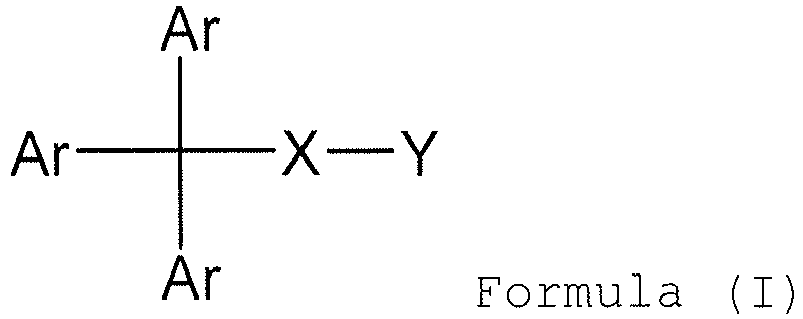
- A coating agent comprising a homopolymer having a repeating unit derived from a monomer represented by formula (I):

- The coating agent according to claim 1 or 2, wherein in formula (I), Y is an acryloyl group or a methacryloyl group.
- The coating agent according to any one of claims 1 to 3, wherein the coating agent is a coating agent onto a plastic substrate.
- The coating agent according to claim 4, wherein the plastic substrate is a polyolefin resin substrate.
Applications Claiming Priority (2)
| Application Number | Priority Date | Filing Date | Title |
|---|---|---|---|
| JP2015248224 | 2015-12-21 | ||
| PCT/JP2016/005129 WO2017110060A1 (en) | 2015-12-21 | 2016-12-14 | Coating agent |
Publications (2)
| Publication Number | Publication Date |
|---|---|
| EP3395915A1 true EP3395915A1 (en) | 2018-10-31 |
| EP3395915A4 EP3395915A4 (en) | 2019-08-21 |
Family
ID=59089898
Family Applications (1)
| Application Number | Title | Priority Date | Filing Date |
|---|---|---|---|
| EP16877965.0A Withdrawn EP3395915A4 (en) | 2015-12-21 | 2016-12-14 | Coating agent |
Country Status (7)
| Country | Link |
|---|---|
| US (1) | US20180273793A1 (en) |
| EP (1) | EP3395915A4 (en) |
| JP (1) | JP6734299B2 (en) |
| KR (1) | KR102153802B1 (en) |
| CN (1) | CN108291108B (en) |
| TW (1) | TWI619779B (en) |
| WO (1) | WO2017110060A1 (en) |
Families Citing this family (1)
| Publication number | Priority date | Publication date | Assignee | Title |
|---|---|---|---|---|
| WO2019039142A1 (en) * | 2017-08-21 | 2019-02-28 | 東レ株式会社 | Color conversion composition, color conversion sheet, and light source unit, display and lighting device each equipped with same |
Family Cites Families (16)
| Publication number | Priority date | Publication date | Assignee | Title |
|---|---|---|---|---|
| JPS56142216A (en) * | 1980-02-19 | 1981-11-06 | Daicel Chem Ind Ltd | Optical resolution of racemate by optically active polymer |
| JPS57147434A (en) * | 1981-03-10 | 1982-09-11 | Daicel Chem Ind Ltd | Adsorbent for separation |
| JPH0691956B2 (en) * | 1981-03-11 | 1994-11-16 | ダイセル化学工業株式会社 | Adsorbent for separation supporting optically active polymer |
| JPS5975244A (en) * | 1982-10-25 | 1984-04-27 | Hitachi Ltd | Radiation sensitive organic polymer material |
| GB8512212D0 (en) * | 1985-05-14 | 1985-06-19 | Int Paint Plc | Binder for anti-fouling paints |
| JPS63145287A (en) | 1986-12-06 | 1988-06-17 | Agency Of Ind Science & Technol | Novel unsaturated compound having triphenylsilyl group |
| JPS63145310A (en) | 1986-12-06 | 1988-06-17 | Agency Of Ind Science & Technol | Optical plastic material |
| JPH10185894A (en) * | 1996-12-20 | 1998-07-14 | Daicel Chem Ind Ltd | Preparation of filler for high-performance liquid chromatography |
| NO20020846L (en) * | 2002-02-21 | 2003-08-22 | Jotun As | Self-polishing antifouling paint |
| KR101035342B1 (en) * | 2002-07-10 | 2011-05-20 | 시그마칼론 서비시즈 비.브이. | Method for preparing polyorganosilylated carboxylate monomer or polymer thereof |
| WO2004018575A1 (en) * | 2002-08-22 | 2004-03-04 | Mitsubishi Rayon Co., Ltd. | Primer composition for coating |
| JP2004315668A (en) * | 2003-04-16 | 2004-11-11 | Mitsubishi Rayon Co Ltd | Resin composition for paint |
| WO2008112452A2 (en) * | 2007-03-09 | 2008-09-18 | 3M Innovative Properties Company | Triphenyl monomers suitable for microstructured optical films |
| JP5434913B2 (en) | 2008-05-16 | 2014-03-05 | 旭硝子株式会社 | Polymerizable compound, photocurable composition, optical element and optical head device |
| KR101828139B1 (en) * | 2013-01-28 | 2018-02-09 | 닛뽕소다 가부시키가이샤 | Coating agent |
| JP2016033210A (en) * | 2014-07-28 | 2016-03-10 | 日本曹達株式会社 | Coating agent |
-
2016
- 2016-12-14 CN CN201680068008.9A patent/CN108291108B/en not_active Expired - Fee Related
- 2016-12-14 US US15/776,564 patent/US20180273793A1/en not_active Abandoned
- 2016-12-14 EP EP16877965.0A patent/EP3395915A4/en not_active Withdrawn
- 2016-12-14 JP JP2017557694A patent/JP6734299B2/en not_active Expired - Fee Related
- 2016-12-14 WO PCT/JP2016/005129 patent/WO2017110060A1/en not_active Ceased
- 2016-12-14 KR KR1020187009823A patent/KR102153802B1/en not_active Expired - Fee Related
- 2016-12-16 TW TW105141711A patent/TWI619779B/en not_active IP Right Cessation
Also Published As
| Publication number | Publication date |
|---|---|
| WO2017110060A1 (en) | 2017-06-29 |
| JPWO2017110060A1 (en) | 2018-08-30 |
| KR102153802B1 (en) | 2020-09-08 |
| US20180273793A1 (en) | 2018-09-27 |
| EP3395915A4 (en) | 2019-08-21 |
| JP6734299B2 (en) | 2020-08-05 |
| TWI619779B (en) | 2018-04-01 |
| CN108291108A (en) | 2018-07-17 |
| TW201726839A (en) | 2017-08-01 |
| KR20180050391A (en) | 2018-05-14 |
| CN108291108B (en) | 2020-12-18 |
Similar Documents
| Publication | Publication Date | Title |
|---|---|---|
| US12104092B2 (en) | Adhesive composition | |
| EP2949716B1 (en) | Coating agent | |
| JP2016033210A (en) | Coating agent | |
| KR102153802B1 (en) | Coating agent |
Legal Events
| Date | Code | Title | Description |
|---|---|---|---|
| STAA | Information on the status of an ep patent application or granted ep patent |
Free format text: STATUS: THE INTERNATIONAL PUBLICATION HAS BEEN MADE |
|
| PUAI | Public reference made under article 153(3) epc to a published international application that has entered the european phase |
Free format text: ORIGINAL CODE: 0009012 |
|
| STAA | Information on the status of an ep patent application or granted ep patent |
Free format text: STATUS: REQUEST FOR EXAMINATION WAS MADE |
|
| 17P | Request for examination filed |
Effective date: 20180612 |
|
| AK | Designated contracting states |
Kind code of ref document: A1 Designated state(s): AL AT BE BG CH CY CZ DE DK EE ES FI FR GB GR HR HU IE IS IT LI LT LU LV MC MK MT NL NO PL PT RO RS SE SI SK SM TR |
|
| AX | Request for extension of the european patent |
Extension state: BA ME |
|
| DAV | Request for validation of the european patent (deleted) | ||
| DAX | Request for extension of the european patent (deleted) | ||
| A4 | Supplementary search report drawn up and despatched |
Effective date: 20190719 |
|
| RIC1 | Information provided on ipc code assigned before grant |
Ipc: C09D 133/04 20060101AFI20190715BHEP Ipc: C08J 7/04 20060101ALI20190715BHEP Ipc: C09D 133/24 20060101ALI20190715BHEP |
|
| STAA | Information on the status of an ep patent application or granted ep patent |
Free format text: STATUS: THE APPLICATION HAS BEEN WITHDRAWN |
|
| 18W | Application withdrawn |
Effective date: 20210621 |