EP3395822A1 - Organoaminosilanes and methods for making same - Google Patents
Organoaminosilanes and methods for making same Download PDFInfo
- Publication number
- EP3395822A1 EP3395822A1 EP18177680.8A EP18177680A EP3395822A1 EP 3395822 A1 EP3395822 A1 EP 3395822A1 EP 18177680 A EP18177680 A EP 18177680A EP 3395822 A1 EP3395822 A1 EP 3395822A1
- Authority
- EP
- European Patent Office
- Prior art keywords
- iso
- group
- propylamino
- butyl
- sec
- Prior art date
- Legal status (The legal status is an assumption and is not a legal conclusion. Google has not performed a legal analysis and makes no representation as to the accuracy of the status listed.)
- Granted
Links
- 0 CCCN([*+])C(C)C Chemical compound CCCN([*+])C(C)C 0.000 description 62
- WYLLBTPEHIVUKV-UHFFFAOYSA-N CC(C)N(C)C(C)(C)C Chemical compound CC(C)N(C)C(C)(C)C WYLLBTPEHIVUKV-UHFFFAOYSA-N 0.000 description 1
- ISRXMEYARGEVIU-UHFFFAOYSA-N CC(C)N(C)C(C)C Chemical compound CC(C)N(C)C(C)C ISRXMEYARGEVIU-UHFFFAOYSA-N 0.000 description 1
- ZBGZVIGUXBTBGM-UHFFFAOYSA-N CCC(C)N(C)C(C)CC Chemical compound CCC(C)N(C)C(C)CC ZBGZVIGUXBTBGM-UHFFFAOYSA-N 0.000 description 1
- OYQDUCLFZSKBCZ-UHFFFAOYSA-N CCCN(C)C(C)C Chemical compound CCCN(C)C(C)C OYQDUCLFZSKBCZ-UHFFFAOYSA-N 0.000 description 1
- KFSOLPKDWDZRTG-UHFFFAOYSA-N CCN(c1ccccc1)[Si+]1(C)CCCC1 Chemical compound CCN(c1ccccc1)[Si+]1(C)CCCC1 KFSOLPKDWDZRTG-UHFFFAOYSA-N 0.000 description 1
- AJUKDNIHDHFGIP-UHFFFAOYSA-N CN(C1CCCCC1)[Si+]1(C)CCCC1 Chemical compound CN(C1CCCCC1)[Si+]1(C)CCCC1 AJUKDNIHDHFGIP-UHFFFAOYSA-N 0.000 description 1
Classifications
-
- C—CHEMISTRY; METALLURGY
- C07—ORGANIC CHEMISTRY
- C07F—ACYCLIC, CARBOCYCLIC OR HETEROCYCLIC COMPOUNDS CONTAINING ELEMENTS OTHER THAN CARBON, HYDROGEN, HALOGEN, OXYGEN, NITROGEN, SULFUR, SELENIUM OR TELLURIUM
- C07F7/00—Compounds containing elements of Groups 4 or 14 of the Periodic Table
- C07F7/02—Silicon compounds
- C07F7/025—Silicon compounds without C-silicon linkages
-
- C—CHEMISTRY; METALLURGY
- C07—ORGANIC CHEMISTRY
- C07F—ACYCLIC, CARBOCYCLIC OR HETEROCYCLIC COMPOUNDS CONTAINING ELEMENTS OTHER THAN CARBON, HYDROGEN, HALOGEN, OXYGEN, NITROGEN, SULFUR, SELENIUM OR TELLURIUM
- C07F7/00—Compounds containing elements of Groups 4 or 14 of the Periodic Table
- C07F7/02—Silicon compounds
- C07F7/08—Compounds having one or more C—Si linkages
- C07F7/10—Compounds having one or more C—Si linkages containing nitrogen having a Si-N linkage
-
- C—CHEMISTRY; METALLURGY
- C07—ORGANIC CHEMISTRY
- C07F—ACYCLIC, CARBOCYCLIC OR HETEROCYCLIC COMPOUNDS CONTAINING ELEMENTS OTHER THAN CARBON, HYDROGEN, HALOGEN, OXYGEN, NITROGEN, SULFUR, SELENIUM OR TELLURIUM
- C07F7/00—Compounds containing elements of Groups 4 or 14 of the Periodic Table
- C07F7/02—Silicon compounds
- C07F7/08—Compounds having one or more C—Si linkages
- C07F7/0801—General processes
-
- C—CHEMISTRY; METALLURGY
- C07—ORGANIC CHEMISTRY
- C07F—ACYCLIC, CARBOCYCLIC OR HETEROCYCLIC COMPOUNDS CONTAINING ELEMENTS OTHER THAN CARBON, HYDROGEN, HALOGEN, OXYGEN, NITROGEN, SULFUR, SELENIUM OR TELLURIUM
- C07F7/00—Compounds containing elements of Groups 4 or 14 of the Periodic Table
- C07F7/02—Silicon compounds
- C07F7/08—Compounds having one or more C—Si linkages
- C07F7/12—Organo silicon halides
Definitions
- organoaminosilane compounds that may be useful, for example, as chemical precursor for depositing a silicon-containing film.
- Organoaminosilanes containing the -SiH 3 or -SiH 2 - moieties are desirable precursors for the deposition of silicon-containing films such as, without limitation, silicon oxide and silicon nitride films or doped versions thereof.
- silicon-containing films such as, without limitation, silicon oxide and silicon nitride films or doped versions thereof.
- volatile compounds such as without limitation organoaminosilanes, organoaminodisilanes, and/or organoaminocarbosilanes are important precursors used for the deposition of silicon-containing films in the manufacture of semiconductor devices.
- an organoaminosilane compound is di-iso-propylaminosilane (DIPAS), which has previously been shown to exhibit desirable physical properties for the controlled deposition of such films.
- DIPAS di-iso-propylaminosilane
- DIPAS can be prepared by the direct reaction of di-iso-propylamine (DIPA) or lithium-di-iso-propylamide with monochlorosilane (MCS) or monochlorodisilane (MCDS)
- MCS or MCDS is not an abundant commodity chemical and is therefore subject to limited availability and price instability.
- synthesis of organoaminosilanes using MCS may produce stoichiometric amounts of amine hydrochloride salts that can be highly absorbent thereby complicating recovery of organoaminosilane products.
- Japanese Patent JP49-1106732 describes a method for preparing silylamines by the reaction of an imine and a hydridosilane in the presence of a rhodium (Rh) complex.
- exemplary silylamines that were prepared include: PhCH 2 N(Me)SiEt 3 , PhCH 2 N(Me)SiHPh 2 , PhCH 2 N(Ph)SiEt 3 , and PhMeCHN(Ph)SiHEt 2 wherein "Ph” means phenyl, "Me” means methyl, and "Et” means ethyl.
- U.S. Pat. No. 6,072,085 describes a method for preparing a secondary amine from a reaction mixture comprising an imine, a nucleophilic activator, a silane, and a metal catalyst.
- the catalyst acts to catalyze the reduction of the imine by a hydrosilylation reaction.
- U.S. Pat. No. 6,963,003 which is owned by the assignee of the present application, provides a method for preparing an organoaminosilane compound comprising reacting a stoichiometric excess of at least one amine selected from the group consisting of secondary amines having the formula R 1 R 2 NH, primary amines having the formula R 2 NH 2 or combinations thereof with at least one chlorosilane having the formula R 3 n SiCl 4-n under anhydrous conditions sufficient such that a liquid comprising the aminosilane product and an amine hydrochloride salt is produced wherein R 1 and R 2 can each independently be a linear, cyclic or branched alkyl group having 1 to 20 carbon atoms; R 3 can be a hydrogen atom, an amine group, or a linear, cyclic or branched alkyl group having 1 to 20 carbon atoms; and n is a number ranging from 1 to 3.
- U. S. Pat. No. 7,875,556 which is owned by the assignee of the present application, describes a method for making an organoaminosilane by reacting an acid with an arylsilane in the presence of a solvent, adding a secondary amine and tertiary amine, and removing the reaction byproduct using phase separation and the solvent using distillation.
- Korean Patent No. 10-1040325 provides a method for preparing an alkylaminosilane which involves reacting a secondary amine and trichloroalkylsilane in an anhydrous atmosphere and in the presence of a solvent to form an alkyl aminochlorosilane intermediate and a metal hydride LiAlH 4 is added to the alkyl aminochlorosilane intermediate as a reducing agent to form the alkylaminosilane. The alkylaminosilane is then subjected to a distillation process to separate and purify the alkylaminosilane.
- the synthesis reactions described above that do involve catalytic hydrosilylation of imines are generally used for the synthesis of secondary amines or, alternatively, for highlighting fundamentally unique catalysts.
- the aforementioned references do not describe a method for the synthesis, isolation, and purification of organoaminosilanes to be used, for example, as precursors for the deposition of silicon-containing films.
- silicon-containing sources such as silane (SiH 4 ), disilane (Si 2 H 6 ), or methylsilane (MeSiH 3 ) gas are used as the Si-H starting material or silicon source material for the catalytic hydrosilylation of imines to form organoaminosilane or organoaminodisilane compounds, such as, for example, di-iso-propylaminosilane (DIPAS), di-iso-propylaminodisilane (DIPADS), and di-iso-propylaminomethylsilane.
- DIPAS di-iso-propylaminosilane
- DIPADS di-iso-propylaminodisilane
- di-iso-propylaminomethylsilane di-iso-propylaminomethylsilane.
- organoamines such as, without limitation, organoamines, organoaminosilanes (e.g., DIPAS), organoaminodisilanes (e.g., DIPADS), and organoaminocarbosilanes, using commercially available reagents in relatively high yields via the catalytic hydrosilylation of imines.
- organoaminosilanes such as without limitation, DIPAS
- DIPAS organoaminosilanes
- organoaminosilanes and/or organoamines that reduces the overall production costs by reducing the costs of reagents used and/or reducing agents.
- a method of making organoaminosilanes and/or organoamines that eliminates hazards associated with highly exothermic reactions such as those involving triflic acid, metal amide, and metal hydride reagents.
- a method of making organoaminosilanes and/or organoamines that avoids using halosilane starting materials, such that there are reduced halide impurities in the purified product in order to avoid potential halides contamination if the compound is used as a precursor for depositing silicon-containing films.
- Described herein is a method for making compounds, more specifically organoaminosilanes, organoaminodisilanes, organoaminocarbosilanes and/or organoamines, which provides one or more of the following advantages over prior art methods to make such compounds: (a) avoids the use of chlorosilane reagents which could lead to chlorine impurities in the end product thereby eliminating chloride contamination when the end product is being used as precursors to deposit a silicon containing film; (b) avoids the need for additional filtration steps to remove amine-hydrochloride or alkali metal salt byproducts which are common in prior art methods, and/or (c) avoids the use of pyrophoric alkyllithium, metal hydride reagents, or extremely corrosive reagents such as triflic acid.
- organoaminosilanes as used herein means a compound that includes at least one N atom, at least one carbon-containing group, and at least one Si atom and includes, without limitation, organoaminosilanes, organoaminodisilanes, and organoaminocarbosilanes.
- the reacting step is conducted in the presence of a solvent. In an alternative embodiment of the method described herein, the reacting step is conducted in the absence of a solvent.
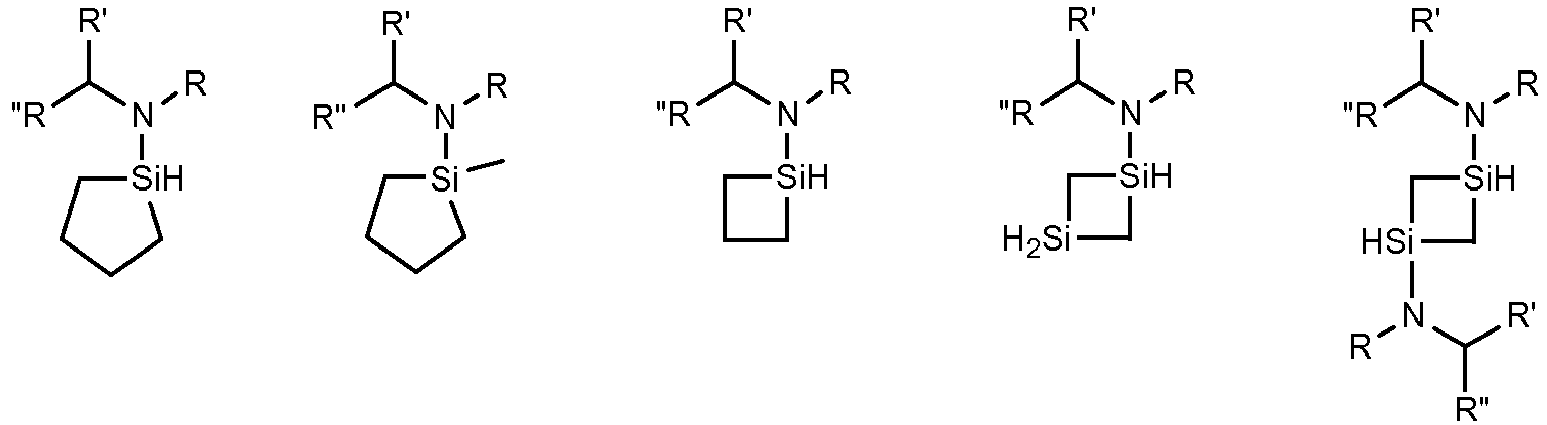
- organoaminocarbosilane compound represented by the following structures: wherein R, R' and R" are each independently selected from hydrogen, a C 1 - 10 linear alkyl group, a C 3-10 branched alkyl group, a C 3-10 cyclic alkyl group, a C 2-10 alkenyl group, a C 4-10 aromatic group, a C 4-10 heterocyclic group, a C 1 - 10 linear organoamino group, a C 2 - 10 branched organoamino groups, a silyl group, a C 1 - 10 linear carbosilyl group, or a C 2 - 10 branched carbosilyl groups and wherein at least one of R' and R", or R and R', or none of R' and R" or R and R' are be linked to form a substituted or unsubstituted cyclic ring.
- R-N CR'R" wherein R, R' and R" are each independently selected from hydrogen, a C 1 - 10 linear alkyl group, a C 3-10 branched alkyl group, a C 3-10 cyclic alkyl group, a C 2-10 alkenyl group, a C 4-10 aromatic group, a C 4-10 heterocyclic group, a C 1 - 10 linear organoamino group, a C 2 - 10 branched organoamino group, a silyl group, a C 1 - 10 linear carbosilyl group, and a C 2 - 10 branched carbosilyl group and wherein R' and R" or R and R' can be linked to form a substituted or an unsubstituted cyclic ring
- alkyl denotes a linear or branched functional group having from 1 to 10 or from 3 to 10 carbon atoms, respectively.
- exemplary linear alkyl groups include, but are not limited to, methyl, ethyl, n-propyl, n-butyl, n-pentyl, and hexyl.
- exemplary branched alkyl groups include, but are not limited to, isopropyl, isobutyl, sec-butyl, tert-butyl, iso-pentyl, tert-pentyl, isohexyl, and neohexyl.
- the alkyl group may have one or more functional groups such as, but not limited to, an alkoxy group, a dialkylamino group, an carbosilyl group, or combinations thereof, attached thereto. In other embodiments, the alkyl group does not have one or more functional groups attached thereto.
- cyclic alkyl denotes a cyclic functional group having from 3 to 10 or from 4 to 10 carbon atoms.
- exemplary cyclic alkyl groups include, but are not limited to, cyclobutyl, cyclopentyl, cyclohexyl, and cyclooctyl groups.
- aryl denotes an aromatic cyclic functional group having from 5 to 10 carbon atoms.
- exemplary aryl groups include, but are not limited to, phenyl, benzyl, chlorobenzyl, tolyl, and o-xylyl.
- the aromatic cyclic group can have other elements such as oxygen, or nitrogen.
- Exemplary such groups include, but not limited to, pyrollyl, furanyl, pyridinyl, pyridazinyl.
- alkenyl group denotes a group which has one or more carbon-carbon double bonds and has from 2 to 10 or from 2 to 6 carbon atoms.
- alkenyl groups include, but are not limited to, vinyl or allyl groups.
- alkynyl group denotes a group which has one or more carbon-carbon triple bonds and has from 2 to 10 or from 2 to 6 carbon atoms.
- carbosilane denotes an organosilane comprising carbon, hydrogen, and silicon having from 1 to 10 carbon atoms and from 1 to 10 silicon atoms, and which contains at least one Si-C bond.
- carbosilanes include, without limitation, methylsilane, ethylsilane, diethylsilane, dimethylsilane, triethylsilane, 1,2-dimethyldisilane,1,4-disilabutane, 2-methyl-1,3-disilapropane, 1,3-disilapropane, 1-silacyclopentane, 1-methyl-1-silacyclopentane, 1-silacyclobutane, 1,3-disilacyclobutane, and phenylsilane.
- carbosilyl denotes an organosilyl group comprising carbon, hydrogen, and silicon having from 1 to 10 carbon atoms and from 1 to 10 silicon atoms, and which contains at least one Si-C bond.
- sil denotes the unsubstituted silyl group (-SiH 3 ).
- organoamino denotes a dialkylamino, alkylamino, or arylalkylamino group which may have from 1 to 10, or from 1 to 4 carbon atoms.
- organoamino groups include, but are not limited to, dimethylamino (Me 2 N-), diethylamino (Et 2 N-), di-iso-propylamino ( i Pr 2 N-), iso-propyl-sec-butylamino, N-sec-butyl-N-iso-propylamino, N-ethyl-N-cyclohexylamino, N-phenyl-N-iso-propylamino, tert-butylamino ( t BuNH-), tert-pentylamino ( t AmNH-), n-propylamino ( n PrNH-), and iso-propylamino ( i PrNH-).
- a substituent such as a cyclic ring may be substituted or have one or more atoms or group of atoms substituted in place of, for example, a hydrogen atom.
- substituents include, but are not limited to, oxygen, sulfur, halogen atoms (e.g., F, Cl, I, or Br), nitrogen, and phosphorous.
- the substitutent is not unsubstituted.
- the method described herein involves the catalytic hydrosilylation of imines as an alternative route to the synthesis of compounds such as organoaminosilane, organoaminodisilane, and organoaminocarbosilane which can be used, without limitation, as precursors in the deposition of silicon-containing films.
- organoaminosilane i Pr 2 N-SiH 3 could be conveniently synthesized by reacting the imine N-iso-propyl-iso-propylidenimine with a silicon source such as silane gas (SiH 4 ).
- the organoaminodisilane i Pr 2 N-SiH 2 SiH 3 could be obtained in a similar fashion by reacting the imine N-iso-propyl-iso-propylidenimine with a silicon source such as disilane gas (Si 2 H 6 ).
- organoaminosilane, organoaminodisilane, or organoaminocarbosilane compounds such as, without limitation, (organoamino)SiH 3 , (organoamino)SiH 2 SiH 3 , (organoamino)SiH 2 SiH 2 (organoamino), (organoamino)SiH 2 CH 2 CH 2 SiH 3 , (organoamino)SiH 2 CH 2 CH 2 SiH 2 (organoamino), (organoamino)SiHEt 2 , (organoamino)SiH(CH 2 CH 2 CH 2 CH 2 ), (organoamino)SiMe(CH 2 CH 2 CH 2 CH 2 ), (organoamino)SiH(CH 2 CH 2 CH 2 ), (organoamino)SiH(CH 2 SiH 2 CH 2 ), (organoamino)SiH(CH 2 SiH 2 CH 2 ), (organoamino)
- asymmetric imines could be used as a reagent in a reaction mixture comprising a silicon source in the presence of a catalyst to provide organoaminosilanes, organoaminodisilanes, or organoaminocarbosilanes having asymmetric organoamino groups.
- these asymmetric organoamino precursors would otherwise have been unfeasible to synthesize using prior art methods due to scarcity of the corresponding amine [e.g. ( s Bu)( i Pr)NH, ( t Bu)( i Pr)NH].
- exemplary yields obtainable for the compounds using the synthesis method described herein are 50 mol% or greater, 55 mol% or greater, 60 mol% or greater, 65 mol% or greater, 70 mol% or greater, 75 mol% or greater, 80 mol% or greater, or 90 mol% or greater based on the imine usage.
- the silicon source comprises a hydridosilane reagent having at least two Si-H groups
- the rate for a second, third, or fourth hydrosilylation to take place at the same silicon atom becomes significantly and successively slower.
- an imine is reacted with a silicon source to form a reaction mixture comprising a compound such as without limitation, an organoaminosilane (e.g., DIPAS), an organoaminodisilanes (e.g., DIPADS), or an organoaminocarbosilane.
- a compound such as without limitation, an organoaminosilane (e.g., DIPAS), an organoaminodisilanes (e.g., DIPADS), or an organoaminocarbosilane.
- the silicon source reagent may comprise a hydridosilane having the formula of R 1 R 2 R 3 SiH wherein R 1 , R 2 and R 3 are each independently selected from hydrogen, a C 1 - 10 linear alkyl group, a C 3-10 branched alkyl group, a C 4-10 cyclic alkyl group, a C 2-10 alkenyl group, a C 4-10 aromatic group, a C 4-10 heterocyclic group, a C 1 - 10 linear organoamino group, a C 2-10 branched organoamino groups, a silyl group, a C 1 - 10 linear carbosilyl group, and a C 2-10 branched carbosilyl group and wherein at least one of R 1 and R 2 , R 1 and R 3 , or R 2 and R 3 or none of R 1 and R 2 , R 1 and R 3 , or R 2 and R 3 are linked to form a substituted or unsubstituted cyclic ring
- exemplary imines include, but are not limited to, N-iso-propyl-iso-propylidenimine, N-iso-propyl-sec-butylidenimine, N-sec-butyl-sec-butylidenimine, and N-tert-butyl-iso-propylidineimine.
- the molar ratio of imine to the hydridosilane in the reaction mixture ranges from 0.1:1 to 10:1.
- Exemplary ratios of imine to the hydridosilane include, but are not limited to, 0.1:1, 1:1, 2:1, 3:1, 5:1, and 10:1.
- the reaction may yield solely the singly substituted amine derivative and be insensitive to higher imine ratios, especially if the imine has large substituents.
- the hydridosilane reagent in the reaction mixture comprises three or more Si-H bonds per silicon atom, an excess of hydridosilane is used to avoid bis(amino)silane products.
- the hydridosilane has only one Si-H x group, wherein x is a number ranging from 1 to 4, such as silane, methylsilane, diethylsilane, or trimethylsilane.
- x is a number ranging from 1 to 4
- an excess of hydridosilane is used if the desired organoaminodisilane or organoaminocarbosilane product is to have only one organoamino group.
- the reaction mixture has a 1:2.2 to 1:2.3 molar ratio of imine to hydridosilane to ensure the reaction proceeds quickly to completion and to prevent more than one hydrosilylation reaction per hydridosilane molecule.
- the molar ratio of catalyst to imine in the reaction mixture ranges from 0.0000001:1 to 1:1.
- Exemplary ratios of catalyst to imine include, but are not limited to 0.1:1, 0.01:1, 0.05:1, 0.07:1, 0.005:1, 0.001:1, 0.0001:1, 0.0005:1, 0.00001:1, 0.00005:1, and 0.00008:1.
- 0.05 to 0.07 equivalents of catalyst is used per equivalent of imine.
- 0.00008 equivalents of catalyst is used per equivalent of imine.
- the reaction mixture comprising the hydridosilane reagent(s), imine reagent(s), and catalyst(s) further comprises an anhydrous solvent.
- solvents may include, but are not limited to linear-, branched-, cyclic- or polyethers (e.g., tetrahydrofuran (THF), diethyl ether, diglyme, and/or tetraglyme); linear-, branched-, or cyclic- alkanes, alkenes, aromatics and halocarbons (e.g. pentane, hexanes, toluene and dichloromethane).
- the selection of one or more solvent, if added, may be influenced by its compatibility with reagents contained within the reaction mixture, the solubility of the catalyst, and/or the separation process for the intermediate product and/or the end product chosen.
- the reaction mixture does not comprise a solvent.
- the mixture of imine and hydridosilane reagents may be used as the liquid medium for the reaction in the reaction mixture.
- the reaction between the hydridosilane reagent(s) and the imine reagent(s) occurs at one or more temperatures ranging from 0°C to 100°C.
- Exemplary temperatures for the reaction include ranges having any one or more of the following endpoints: 0, 10, 20, 30, 40, 50, 60, 70, 80, 90, or 100°C.
- the suitable temperature range for this reaction may be dictated by the physical properties of the hydridosilane reagent(s), imine reagent(s), catalyst(s), and optional solvent. Examples of particular reactor temperature ranges include but are not limited to, 0°C to 80°C or from 0°C to 30°C.
- the pressure of the reaction may range from 1 to 115 psia (7 to 790 kPa) or from 15 to 45 psia (100 to 310 kPa).
- the reaction is run at atmospheric pressure.
- the reaction is run at a pressure above 15 psia (100 kPa).
- one or more reagents may be introduced to the reaction mixture as a liquid or a vapor.
- a non-reactive gas such as nitrogen or an inert gas may be employed as a carrier gas to deliver the vapor to the reaction mixture.
- the regent may be added neat, or alternatively diluted with a solvent. The reagent is fed to the reaction mixture until the desired conversion to the crude mixture containing the organoaminosilane product, or crude liquid, has been achieved.
- the reaction may be run in a continuous manner by replenishing the hydridosilane and/or imine reagents and removing the reaction products and the crude liquid from the reactor.
- An example of the catalytic hydrosiliation method described herein comprises combining a hydridosilane and an imine to provide a reaction mixture in the presence of 0.1-10 mol% catalyst under ambient conditions to produce an organoaminosilane, organoaminodisilane, or organoaminocarbosilane compound as shown below in the following reaction scheme (1).
- the hydridosilane reagent has the following formula R 1 R 2 R 3 SiH wherein R 1 , R 2 and R 3 are each independently selected from hydrogen, C 1 - 10 linear alkyl group, a C 3-10 branched alkyl group, a C 4-10 cyclic alkyl group, a C 2-10 alkenyl group, a C 4-10 aromatic group, a C 4-10 heterocyclic group, a C 1 - 10 linear organoamino group, a C 2-10 branched organoamino groups, a silyl group, a C 1 - 10 linear carbosilyl group, and a C 2 - 10 branched carbosilyl group and wherein at least one of, or none of, R 1 and R 2 , R 1 and R 3 , or R 2 and R 3 in the hydridosilane reagent are linked to form a substituted or unsubstituted cyclic ring.
- the reaction may require an excess of either hydridosilane reagent or imine to regulate the extent of hydrosilylation, and solvents such as tetrahydrofuran (THF) or hexanes may be used to facilitate the reaction progress.
- solvents such as tetrahydrofuran (THF) or hexanes
- hydridosilane reagents that are volatile liquids or gases [e.g.
- SiH 4 (silane), Si 2 H 6 (disilane), MeSiH 3 (methylsilane), EtSiH 3 (ethylsilane), Et 2 SiH 2 (diethylsilane), PhSiH 3 (phenylsilane), H 3 SiCH 2 CH 2 SiH 3 (1,4-disilabutane), H 3 SiCH 2 SiH 3 (1,3-disilapropane), H 3 SiCH(CH 3 )SiH 3 (2-methyl-1,3-disilapropane), (CH 2 CH 2 CH 2 CH 2 )SiH 2 (1-silacyclopentane), (CH 2 CH 2 CH 2 CH 2 )SiHMe (1-methyl-1-silacyclopentane), (CH 2 CH 2 CH 2 )SiH 2 (1-silacyclobutane), (CH 2 SiH 2 CH 2 )SiH 2 (1,3-disilacyclobutane)], pressures greater than 1 atmosphere
- the organoaminosilane, organoaminodisilane, or organoaminocarbosilane product can be purified by distillation.
- the final organoaminosilane, organoaminodisilane, or organoaminocarbosilane product is formed by the reaction of the imine and hydridosilane.
- a >50% stoichiometric excess of hydridosilane is generally used to ensure complete reaction, though smaller excesses may be used if the mixing period is adequately long
- the crude mixture comprising the desired organoaminosilane, organoaminodisilane, or organoaminocarbosilane product, catalyst(s), and potentially residual imine, residual hydridosilane, solvent(s), or undesired organoaminosilane product(s) may require separation process(es).
- suitable separation processes include, but are not limited to, distillation, evaporation, membrane separation, filtration, vapor phase transfer, extraction, fractional distillation using an inverted column, and combinations thereof.
- the crude fluid is first separated from the residual catalyst by vacuum transfer or distillation at lower temperatures prior to isolation of the desired product by fractional distillation in order to prevent the catalyzation of undesired reactions during the purification process.
- the pressure can vary considerably from atmospheric to full vacuum.
- the reaction occurs at one or more temperatures ranging from 20°C to 200°C.
- Exemplary temperatures for the reaction include ranges having any one or more of the following endpoints: 20, 30, 40, 50, 60, 70, 80, 90, 100, 110, 120, 130, 140, 150, 160, 170, 180, 190, or 200°C.
- Examples of particular reactor temperature ranges include but are not limited to, 20°C to 200°C or from 70°C to 160°C.
- the pressure of the reaction may range from 0.1 to 115 psia (0.7 to 790 kPa) or from 10 to 45 psia (70 to 310 kPa). In one particular embodiment, the reaction is run at a pressure of about 100 psia (about 700 kPa).
- the reagents in the reaction mixture are gaseous.
- the contact of the catalyst with reaction mixture may be defined in terms of defined by the bulk reactor volume displaced by the catalyst ⁇ reactant (e.g., silane and/or silicon source gas) gas flow rate.
- the gas-catalyst contact time may range from 5 to 200 seconds.
- Exemplary times for the contact of the reactive mixture with the catalyst include ranges having any one or more of the following endpoints: 5, 10, 20, 30, 40, 50, 60, 70, 80, 90, 100, 110, 120, 130, 140, 150, 160, 170, 180, 190, or 200 seconds. Examples of particular contact time ranges include but are not limited to, 20 to 100 or from 10 to 40 seconds.
- Exemplary catalysts that can be used with the method described herein include, but are not limited to the following: alkaline earth metal catalysts; halide-free main group, transition metal, lanthanide, and actinide catalysts; and halide-containing main group, transition metal, lanthanide, and actinide catalysts.
- the compounds, or organoaminosilanes, organoaminodisilanes, and organoaminocarbosilanes, prepared using the methods described herein and compositions comprising the compounds are preferably substantially free of halide ions.
- halide ions or halides
- compositions according to the present invention that are substantially free of halides can be achieved by (1) reducing or eliminating chloride sources during chemical synthesis, and/or (2) implementing an effective purification process to remove chloride from the crude product such that the final purified product is substantially free of halides.
- Halide sources may be reduced during synthesis by using reagents that do not contain halides such as the halide-free catalysts described herein.
- the synthesis should not use halide based solvents, catalysts, or solvents which contain unacceptably high levels of halide contamination.
- the crude product may also be treated by various purification methods to render the final product substantially free of halides such as chlorides.
- Such methods are well described in the prior art and, may include, but are not limited to, purification processes such as distillation, or adsorption. Distillation is commonly used to separate impurities from the desire product by exploiting differences in boiling point. Adsorption may also be used to take advantage of the differential adsorptive properties of the components to effect separation such that the final product is substantially free of halide. Adsorbents such as, for example, commercially available solid bases can be used to remove halides such as chloride.
- Table 1 lists imines that can be used as reagents in the method described herein to provide exemplary organoaminosilanes, organoaminodisilanes, organoaminocarbosilanes, and organoamines compounds defined herein. Table 1.
- Organoaminodisilane (more specifically 1,2-bis(organoamino)disilane) Compounds 1,2-bis(N-methyl-N-iso-propylamino)disilane 1,2-bis(N-sec-butyl-N-methylamino)disilane 1,2-bis(N-cyclohexyl-N-methylamino)disilane 1,2-bis(N-methyl-N-cyclopentylamino)disilane 1,2-bis(N-ethyl-N-iso-propylamino)disilane 1,2-bis(N-sec-butyl-N-ethylamino)disilane 1,2-bis(N-ethyl-N-cyclohexylamino)disilane 1,2-bis(N-ethyl-N-cyclopentylamino)disilane 1,2-bis(N-n-propyl-N-iso-propylamino)disilane 1,2-bis
- Organoaminocarbosilane More specifically organoamino-1,4-disilabutane
- Organoaminocarbosilane More specifically 1,4-bis(organoamino)-1,4-disilabutane
- Organoaminocarbosilane More specifically organoamino-1,3- disilapropane
- Organoaminocarbosilane More specifically 1,3-bis(organoamino)-1,3-disilapropane
- Organoaminocarbosilane More specifically 1-organoamino-2-methyl-1,3-disilapropane
- Organoaminocarbosilane More specifically 1,3-bis(organoamino)-2-methyl-1,3-disilapropane
- Organoaminocarbosilane More specifically organoamino-silacyclopentane
- Organoaminocarbosilane (more specifically organoamino-methylsilacyclopentane) Compounds 1-(N-methyl-N-iso-propylamino)-1-methyl-silacyclopentane 1-(N-sec-butyl-N-methylamino)-1-methyl-silacyclopentane 1-(N-cyclohexyl-N-methylamino)-1-methyl-silacyclopentane 1-(N-methyl-N-cyclopentylamino)-1-methyl-silacyclopentane 1-(N-ethyl-N-iso-propylamino)-1-methyl-silacyclopentane 1-(N-sec-butyl-N-ethylamino)-1-methyl-silacyclopentane 1-(N-ethyl-N-cyclohexylamino)- 1 1-methyl-silacyclopentane -(N-ethyl
- Organoaminocarbosilane (more specifically organoamino-silacyclobutane having cyclic four-membered ring) Compounds 1-(N-methyl-N-iso-propylamino)-silacyclobutane 1-(N-sec-butyl-N-methylamino)-silacyclobutane 1-(N-cyclohexyl-N-methylamino)-silacyclobutane 1-(N-methyl-N-cyclopentylamino)-silacyclobutane 1-(N-ethyl-N-iso-propylamino)-silacyclobutane 1-(N-sec-butyl-N-ethylamino)-silacyclobutane 1-(N-ethyl-N-cyclohexylamino)-silacyclobutane 1-(N-ethyl-N-cyclopentylamino)-s
- Organoaminocarbosilane (more specifically organoamino-1,3-disilacyclobutane having cyclic four-membered ring) Compounds 1-(N-methyl-N-iso-propylamino)-1,3-disilacyclobutane 1-(N-sec-butyl-N-methylamino)-1,3-disilacyclobutane 1-(N-cyclohexyl-N-methylamino)-1,3-disilacyclobutane 1-(N-methyl-N-cyclopentylamino)-1,3-disilacyclobutane 1-(N-ethyl-N-iso-propylamino)-1,3-disilacyclobutane 1-(N-sec-butyl-N-ethylamino)-1,3-disilacyclobutane 1-(N-ethyl-N-cyclohexylamino)-1,
- Organoaminocarbosilane (more specifically 1,3-bis(organoamino)-1,3-disilacyclobutane having cyclic four-membered ring)
- Compounds 1,3-bis(N-methyl-N-iso-propylamino)-1,3-disilacyclobutane 1,3-bis(N-sec-butyl-N-methylamino)-1,3-disilacyclobutane 1,3-bis(N-cyclohexyl-N-methylamino)-1,3-disilacyclobutane 1,3-bis(N-methyl-N-cyclopentylamino)-1,3-disilacyclobutane 1,3-bis(N-ethyl-N-iso-propylamino)-1,3-disilacyclobutane 1,3-bis(N-sec-butyl-N-ethylamino)-1,3-disilacycl
- Organoaminocarbosilane (more specifically organoamino-methylsilane) Compounds N-methyl-N-iso-propylamino-methylsilane N-sec-butyl-N-methylamino-methylsilane N-cyclohexyl-N-methylamino-methylsilane N-methyl-N-cyclopentylamino-methylsilane N-ethyl-N-iso-propylamino-methylsilane N-sec-butyl-N-ethylamino-methylsilane N-ethyl-N-cyclohexylamino-methylsilane N-ethyl-N-cyclopentylamino-methylsilane N-n-propyl-N-iso-propylamino-methylsilane N-sec-butyl-N-n-propylamino-methylsilane N-cyclohexyl-N-propylamino-methyls
- Organoaminocarbosilane (more specifically organoaminophenylsilane) Compounds N-methyl-N-iso-propylamino-phenylsilane N-sec-butyl-N-methylamino-phenylsilane N-cyclohexyl-N-methylamino-phenylsilane N-methyl-N-cyclopentylamino-phenylsilane N-ethyl-N-iso-propylamino-phenylsilane N-sec-butyl-N-ethylamino-phenylsilane N-ethyl-N-cyclohexylamino-phenylsilane N-ethyl-N-cyclopentylamino-phenylsilane N-n-propyl-N-iso-propylamino-phenylsilane N-sec-butyl-N-n-propylamino-phenyls
- the compound selected from orgnoaminosilane, organoaminodisilane, or organoaminocarbosilane is reacted with a proton source to provide an organoamine.
- the step, of reacting the compound with a proton source could be performed prior to or after the purification of the compound.
- the reagents could be combined neat or, alternatively in the presence of a solvent (e.g., at least one of the proton source or the compound is dissolved in solvent). An excess of proton source can be used to drive the reaction to completion, aid in the purification process, or both.
- the proton source is delivered as a vapor into the reaction solution comprising the organoaminosilane.
- the protonation step e.g., reaction of the proton source with the compound
- the protonation step could be performed in the temperature range between -50°C to 150°C for the addition of reagents and/or for the extent of the reaction.
- the protonation step may be carried out at lower temperature (below 0 °C) in order to help remove heat and prevent side reactions. In other embodiments, higher temperatures (above 30 °C) may be preferred to drive the intended protonation reaction to completion.
- Reaction times could range from 5 minutes to 30 minutes, to 1 h, to 6h, to 12 h, to 24 hr or more.
- the protonation reaction mixture may likely yield more than one phase (liquid-liquid or liquid-solid) which can be separated by filtration, decantation, separator funnel, distillation, adsorption, centrifugation, or other means.
- Purification of the end organoamine product may be accomplished by distillation, column chromatography, gas chromatography, sublimation, crystallization, or other purification processes.
- GC-TCD gas chromatography
- GC-MS mass spectrometry
- 1 H NMR spectroscopy were used to identify and quantify the solution compositions as appropriate.
- Gas chromatographic analyses were carried out on the product effluent using a TCD equipped HP-5890 Series II GC and a 0.53mm diameter x 30m Supleco column containing 3 ⁇ m thick SPB-5 media. Chloride analyses were performed by hydrolyzing the sample with water at 85 °C and injecting the liquid phase into a Metrohm Ion Chromatography instrument equipped with a conductivity detector.
- the catalyst Ru 3 (CO) 12 (0.10 g, 0.16 mmol) was dissolved in the imine N-iso-propylidene-iso-propylamine (7.0 g, 71 mmol) and the resulting solution was exposed to a silicon source gas (SiH 4 ) at 82 psia (575 kPa) for 6 hours at 40 °C.
- SiH 4 silicon source gas
- the resulting reaction solution was determined by GC-MS to contain N,N-di-iso-propylaminosilane. GC-MS showed the following peaks: 131 (M+), 126 (M-15), 116, 110, 98, 88, 74.
- the catalyst Ru 3 (CO) 12 (0.10 g, 0.16 mmol) was dissolved in the imine N-iso-propylidene-sec-butylamine (7.0 g, 71 mmol) and the resulting solution was exposed to a disilane gas (Si 2 H 6 ) at 102 psia (703 kPa) for 6 hours at 40 °C.
- the reaction solution was determined by GC-MS to contain N,N-di-iso-propylaminodisilane. GC-MS showed the following peaks: 161 (M+), 146 (M-15), 128, 114, 104, 88, 72.
- the solid catalyst Ca[N(SiMe 3 ) 2 ] 2 (0.01 g, 0.03 mmol) was added to a mixture of a silicon source, 1-methyl-1-silacyclopentane (0.15 g, 1.5 mmol), and the imine N-iso-propylidene-iso-propylamine (0.15 g, 1.5 mmol).
- the pale yellow reaction solution was determined by GC and GC-MS to contain 1-(N,N-di-iso-propylamino)-1-methyl-1-silacyclopentane as the major product.
- GC-MS showed the following peaks: 199 (M+), 179, 164, 148, 134, 122, 107, 91, 81, 77.
- GC-MS showed the following corresponding peaks: 207 (M+), 192 (M-15), 177, 164, 150, 134, 121, 107, 86, 72. Minor products observed include N,N-di-iso-propylaminosilane, bis(N,N-di-iso-propylamino)silane, and diphenylsilane.
- Examples 9-21 Synthesis of additional organoaminosilane, organoaminodisilane, or organoaminocarbosilane compounds.
- organoaminosilanes Organoaminosilanes, organoaminodisilanes, and organoaminocarbosilanes were made via similar fashion as Examples 1 to 8 and were characterized by GC-MS.
- the molecular weight (MW), the structure, and corresponding major MS fragmentation peaks of each compound are provided in Table 18 to confirm their identification.
- Table 18 Organoaminosilane, organoaminodisilane, or organoaminocarbosilane compounds synthesized via hydrosilylation of imines.
- MW Structure MS Peaks 9 N-sec-butyl-N-iso-propylaminosilane (cf.
- Table 2 145.32 145, 130, 116, 100, 88, 74 10 N,N-di-sec-butylaminosilane (cf. Table 2) 159.35 159, 144, 130, 114, 100, 88, 74, 11 N-sec-butyl-N-iso-propylaminodisilane (cf. Table 3) 175.42 175, 160, 146, 128, 114, 104, 86, 72 12 N,N-di-sec-butylaminosilane (cf.
- Table 14 187.43 187, 172, 159, 143, 130, 115, 101, 86, 73 21 1,3-bis(N,N-di-iso-propylamino)-1,3-disilacyclobutane (cf. Table 15) 286.61 286, 271, 243, 229, 213, 186, 172, 144, 128, 101, 87, 70
Landscapes
- Chemical & Material Sciences (AREA)
- Organic Chemistry (AREA)
- Low-Molecular Organic Synthesis Reactions Using Catalysts (AREA)
- Organic Low-Molecular-Weight Compounds And Preparation Thereof (AREA)
Abstract
Description
- Described herein are methods for making organoaminosilane compounds that may be useful, for example, as chemical precursor for depositing a silicon-containing film. Also described herein are compounds, more specifically organoamine, organoaminosilane, organoaminodisilane, and/or organoaminocarbosilane compounds, that are suitable for use in a variety of industrial applications.
- Organoaminosilanes containing the -SiH3 or -SiH2- moieties are desirable precursors for the deposition of silicon-containing films such as, without limitation, silicon oxide and silicon nitride films or doped versions thereof. For example, volatile compounds such as without limitation organoaminosilanes, organoaminodisilanes, and/or organoaminocarbosilanes are important precursors used for the deposition of silicon-containing films in the manufacture of semiconductor devices. One particular embodiment of an organoaminosilane compound is di-iso-propylaminosilane (DIPAS), which has previously been shown to exhibit desirable physical properties for the controlled deposition of such films. Although DIPAS can be prepared by the direct reaction of di-iso-propylamine (DIPA) or lithium-di-iso-propylamide with monochlorosilane (MCS) or monochlorodisilane (MCDS), MCS or MCDS is not an abundant commodity chemical and is therefore subject to limited availability and price instability. Furthermore, synthesis of organoaminosilanes using MCS may produce stoichiometric amounts of amine hydrochloride salts that can be highly absorbent thereby complicating recovery of organoaminosilane products.
- The prior art describes some methods for the production of organoaminosilane compounds. Japanese Patent
JP49-1106732 -
U.S. Pat. No. 6,072,085 describes a method for preparing a secondary amine from a reaction mixture comprising an imine, a nucleophilic activator, a silane, and a metal catalyst. The catalyst acts to catalyze the reduction of the imine by a hydrosilylation reaction. -
U.S. Pat. No. 6,963,003 , which is owned by the assignee of the present application, provides a method for preparing an organoaminosilane compound comprising reacting a stoichiometric excess of at least one amine selected from the group consisting of secondary amines having the formula R1R2NH, primary amines having the formula R2NH2 or combinations thereof with at least one chlorosilane having the formula R3 nSiCl4-n under anhydrous conditions sufficient such that a liquid comprising the aminosilane product and an amine hydrochloride salt is produced wherein R1 and R2 can each independently be a linear, cyclic or branched alkyl group having 1 to 20 carbon atoms; R3 can be a hydrogen atom, an amine group, or a linear, cyclic or branched alkyl group having 1 to 20 carbon atoms; and n is a number ranging from 1 to 3. -
U. S. Pat. No. 7,875,556 , which is owned by the assignee of the present application, describes a method for making an organoaminosilane by reacting an acid with an arylsilane in the presence of a solvent, adding a secondary amine and tertiary amine, and removing the reaction byproduct using phase separation and the solvent using distillation. -
U.S. Publ. No. 2012/0277457 , which is owned by the assignee of the present application, describes a method for making an organoaminosilane compound having the following formula:
H3SiNR1R2
wherein R1 and R2 are each independently selected from C1-C10 linear, branched or cyclic, saturated or unsaturated, aromatic, heterocyclic, substituted or unsubstituted alkyl groups wherein R1 and R2 are linked to form a cyclic group or wherein R1 and R2 are not linked to form a cyclic group comprising the steps of: reacting a halosilane having the formula HnSiX4-n wherein n is 0, 1, or 2 and X is Cl, Br, or a mixture of Cl and Br, with an amine to provide a slurry comprising a haloaminosilane compound X4-nHn-1SiNR1R2 wherein n is a number selected from 1, 2 and 3; and X is a halogen selected from Cl, Br, or a mixture of Cl and Br; and introducing into the slurry a reducing agent wherein at least a portion of the reducing agent reacts with the haloaminosilane compound and provides an end product mixture comprising the aminosilane compound. - Korean Patent No.
10-1040325 - Reference article entitled "Homogeneous Catalytic Hydrosilylation of Pyridines", L. Hao et al., Angew. Chem., Int. Ed., Vol. 37, 1998, pp. 3126-29 describes the hydrosilylation of pyridines, e.g. RC5H4N (R = H, 3-Me, 4-Me, 3-CO2Et), by PhSiH2Me, Ph2SiH2 and PhSiH3 in the presence of a titanocene complex catalyst such as a [Cp2TiMe2], which provided high yields of 1-silylated tetrahydropyridine derivatives and the intermediate silyltitanocene adduct, Cp2Ti(SiHMePh)(C5H5N) (I).
- Reference article entitled "Stoichiometric Hydrosilylation of Nitriles and Catalytic Hydrosilylation of Imines and Ketones Using a µ-Silane Diruthenium Complex", H. Hashimoto et al., Organometallics, Vol. 22, 2003, pp. 2199-2201 describes a method to synthesize µ-iminosilyl complexes Ru2(CO)4(µ-dppm)(µ-SiTol2)(µ-RCH:NSiTol2) (R = Me, Ph, t-Bu, CH:CH2) in high yields during the stoichiometric reactions of a diruthenium complex having Ru-H-Si interactions, {Ru(CO)2(SiTol2H)}2(µ-dppm)(µ-η2:η2-H2SiTol2), with nitriles RCN.
- Reference article entitled "Titanocene-Catalyzed Hydrosilylation of Imines: Experimental and Computational Investigations of the Catalytically Active Species", H. Gruber-Woelfler et al., Organometallics, Vol. 28, 2009, pp. 2546-2553 described the asymmetrical catalytic hydrosilylation of imines using (R,R)-ethylene-1,2-bis(η5-4,5,6,7-tetrahydro-1-indenyl)titanium (R)-1,1'-binaphth-2-olate (1) and (S,S)-ethylene-1,2-bis(η5-4,5,6,7-tetrahydro-1-indenyl)titanium dichloride (2) as catalyst precursors. After activation with RLi (R = alkyl, aryl) and a silane, these complexes are known catalysts for hydrosilylation reactions.
- Reference article "Iridium-Catalyzed Reduction of Secondary Amides to Secondary Amines and Imines by Diethylsilane", C. Cheng et al., J. Am. Chem. Soc. , Vol. 134, 2012, pp. 110304-7, describes the catalytic reduction of secondary amides to imines and secondary amines by using iridium catalysts such as [Ir(COE)2Cl]2 with diethylsilane as reductant.
- The prior art synthesis reactions described above suffer from various deficiencies. For example, in the synthesis routes that do not use a catalyst, the synthesis of organoaminosilanes require multiple steps using, for example, (a) arylsilane, triflic acid, secondary amine, and tertiary amine, (b) silylhalogen, excess secondary amine, and metal hydride, or (c) silylhalogen, alkali metal amide, and metal hydride. Each of these synthesis routes requires significant cooling to manage highly exothermic reactions and produces significant amounts of salt byproducts that must be subsequently removed by a filtration process.
- Alternatively, the synthesis reactions described above that do involve catalytic hydrosilylation of imines, are generally used for the synthesis of secondary amines or, alternatively, for highlighting fundamentally unique catalysts. As such, the aforementioned references do not describe a method for the synthesis, isolation, and purification of organoaminosilanes to be used, for example, as precursors for the deposition of silicon-containing films. It should be noted further that there are no description in the above references wherein, silicon-containing sources such as silane (SiH4), disilane (Si2H6), or methylsilane (MeSiH3) gas are used as the Si-H starting material or silicon source material for the catalytic hydrosilylation of imines to form organoaminosilane or organoaminodisilane compounds, such as, for example, di-iso-propylaminosilane (DIPAS), di-iso-propylaminodisilane (DIPADS), and di-iso-propylaminomethylsilane. Furthermore, there is no prior art that teaches the use of complexes of alkaline earth metals such as Ca, Sr, Ba, which are more abundant and less expensive than many transition metals, as catalysts for the hydrosilylation of imines, whether it be for the synthesis of organoaminosilanes, organoaminodisilanes, and organoaminocarbosilanes or the synthesis of organoamines.
- Accordingly there is a need to provide a method of making compounds such as, without limitation, organoamines, organoaminosilanes (e.g., DIPAS), organoaminodisilanes (e.g., DIPADS), and organoaminocarbosilanes, using commercially available reagents in relatively high yields via the catalytic hydrosilylation of imines. There is also a need to provide a method of making organoaminosilanes, such as without limitation, DIPAS, by a means that eliminates or facilitates the separation of the product from reaction mixture. There is a need to provide methods of making organoaminosilanes and/or organoamines that reduces the overall production costs by reducing the costs of reagents used and/or reducing agents. There is a need to provide a method of making organoaminosilanes and/or organoamines that eliminates hazards associated with highly exothermic reactions such as those involving triflic acid, metal amide, and metal hydride reagents. There is a need to provide a method of making organoaminosilanes and/or organoamines that avoids using halosilane starting materials, such that there are reduced halide impurities in the purified product in order to avoid potential halides contamination if the compound is used as a precursor for depositing silicon-containing films. There is also a need for synthesis of compounds such as, without limitation, organoamines, organoaminosilanes, organoaminodisilanes, or organoaminocarbosilanes via hydrosilylation of imines using cheaper, more earth abundant metal catalysts compared to the currently widely used precious metal (Ru, Rh, Ir, Pd, and Pt) catalysts.
- Described herein is a method for making compounds, more specifically organoaminosilanes, organoaminodisilanes, organoaminocarbosilanes and/or organoamines, which provides one or more of the following advantages over prior art methods to make such compounds: (a) avoids the use of chlorosilane reagents which could lead to chlorine impurities in the end product thereby eliminating chloride contamination when the end product is being used as precursors to deposit a silicon containing film; (b) avoids the need for additional filtration steps to remove amine-hydrochloride or alkali metal salt byproducts which are common in prior art methods, and/or (c) avoids the use of pyrophoric alkyllithium, metal hydride reagents, or extremely corrosive reagents such as triflic acid. In this regard, the methods described herein improve upon the prior art methods for making compounds such as organoaminosilanes, organoaminodisilanes, organoaminocarbosilanes, and organoamines in one or more of the following ways: provides increased product purity, improves the yield of end product, and/or avoids potential environmental health and safety issues. The term "organoaminosilane" as used herein means a compound that includes at least one N atom, at least one carbon-containing group, and at least one Si atom and includes, without limitation, organoaminosilanes, organoaminodisilanes, and organoaminocarbosilanes.
- In one aspect, described herein is a method for preparing a compound selected from the group consisting of an organoaminosilane, an organoaminodisilane, and an organoaminocarbosilane comprising: reacting an imine, having a formula R-N=CR'R", and a silicon source, comprising a hydridosilane, in the presence of a catalyst under conditions sufficient for the silicon source and imine to react and provide the compound, wherein R, R' and R" are each independently selected from hydrogen, a C1-10 linear alkyl group, a C3-10 branched alkyl group, a C3-10 cyclic alkyl group, a C2-10 alkenyl group, a C4-10 aromatic group, a C4-10 heterocyclic group, a C1-10 linear organoamino group, a C2-10 branched organoamino group, a silyl group, a C1-10 linear carbosilyl group, and a C2-10 branched carbosilyl group and wherein at least one of R' and R" or R and R' or none of R' and R" or R and R' are linked to form a substituted or an unsubstituted cyclic ring. In certain embodiments of the imine having formula R-N=CR'R", at least one of R' and R", R and R', or both R' and R" and R and R' in the formula are linked to form the substituted or unsubstituted cyclic ring. In alternative embodiments of the imine having formula R-N=CR'R", neither R' and R" nor R and R' in the formula are linked to form the substituted or unsubstituted cyclic ring. In one particular embodiment of the method described herein, the reacting step is conducted in the presence of a solvent. In an alternative embodiment of the method described herein, the reacting step is conducted in the absence of a solvent.
- In another aspect, there is provided a method for preparing an organoamine having a formula HN(R)(CHR'R") wherein R, R' and R" are each independently selected from hydrogen, a C1-10 linear alkyl group, a C3-10 branched alkyl group, a C3-10 cyclic alkyl group, a C2-10 alkenyl group, a C4-10 aromatic group, a C4-10 heterocyclic group, a C1-10 linear organoamino group, a C2-10 branched organoamino group, a C1-10 linear carbosilyl group, and a C2-10 branched carbosilyl group wherein at least one of R' and R" or R and R', or none of R' and R" or R and R' are linked to form a substituted or an unsubstituted cyclic ring, the method comprising the steps of: forming a compound selected from an organoaminosilane, an organoaminodisilane, and an organoaminocarbosilane by reacting an imine, having a formula R-N=CR'R", and a silicon source, comprising a hydridosilane, in the presence of a catalyst (preferably an alkaline earth metal catalyst) under reaction conditions sufficient for the imine and silicon source to react and provide the compound, wherein in the formula R-N=CR'R" each of R, R' and R" are each independently selected from hydrogen, a C1-10 linear alkyl group, a C3-10 branched alkyl or C3-10 cyclic alkyl, C2-10 alkenyl, C4-10 aromatic, C4-10 heterocyclic, C1-10 linear or C2-10 branched organoamino groups, a silyl group, or C1-10 linear carbosilyl or C2-10 branched carbosilyl groups wherein at least one of R' and R", R and R', or none of R' and R" and R and R' are linked to form a substituted or unsubstituted cyclic ring; and reacting the compound with a proton source under conditions sufficient to provide the organoamine. In certain embodiments, the proton source is selected from the group consisting of water, alcohol, or Brønsted acid.
- In a further aspect, there is provided organoaminocarbosilane compound represented by the following structures:
- Methods for preparing compounds such as organoaminosilanes, organoaminodisilanes, organoaminocarbosilanes, and organoamines are described herein using an imine having a formula R-N=CR'R" wherein R, R' and R" are each independently selected from hydrogen, a C1-10 linear alkyl group, a C3-10 branched alkyl group, a C3-10 cyclic alkyl group, a C2-10 alkenyl group, a C4-10 aromatic group, a C4-10 heterocyclic group, a C1-10 linear organoamino group, a C2-10 branched organoamino group, a silyl group, a C1-10 linear carbosilyl group, and a C2-10 branched carbosilyl group and wherein R' and R" or R and R' can be linked to form a substituted or an unsubstituted cyclic ring. In certain embodiments of the imine having formula R-N=CR'R", R' and R" or R and R' in the formula are linked to form the substituted or unsubstituted cyclic ring. In these embodiments, the imine can be synthesized by condensing a primary amine having the formula RNH2, with a ketone or aldehyde having the formula R'R"C=O. In alternative embodiments of the imine having formula R-N=CR'R", R' and R" or R and R' in the formula are not linked to form the substituted or unsubstituted cyclic ring.
- In the formulas above and throughout the description, the term "alkyl" denotes a linear or branched functional group having from 1 to 10 or from 3 to 10 carbon atoms, respectively. Exemplary linear alkyl groups include, but are not limited to, methyl, ethyl, n-propyl, n-butyl, n-pentyl, and hexyl. Exemplary branched alkyl groups include, but are not limited to, isopropyl, isobutyl, sec-butyl, tert-butyl, iso-pentyl, tert-pentyl, isohexyl, and neohexyl. In certain embodiments, the alkyl group may have one or more functional groups such as, but not limited to, an alkoxy group, a dialkylamino group, an carbosilyl group, or combinations thereof, attached thereto. In other embodiments, the alkyl group does not have one or more functional groups attached thereto.
- In the formulas above and throughout the description, the term "cyclic alkyl" denotes a cyclic functional group having from 3 to 10 or from 4 to 10 carbon atoms. Exemplary cyclic alkyl groups include, but are not limited to, cyclobutyl, cyclopentyl, cyclohexyl, and cyclooctyl groups.
- In the formulas above and throughout the description, the term "aryl" denotes an aromatic cyclic functional group having from 5 to 10 carbon atoms. Exemplary aryl groups include, but are not limited to, phenyl, benzyl, chlorobenzyl, tolyl, and o-xylyl. In some embodiments, the aromatic cyclic group can have other elements such as oxygen, or nitrogen. Exemplary such groups include, but not limited to, pyrollyl, furanyl, pyridinyl, pyridazinyl.
- In the formulas above and throughout the description, the term "alkenyl group" denotes a group which has one or more carbon-carbon double bonds and has from 2 to 10 or from 2 to 6 carbon atoms. Exemplary alkenyl groups include, but are not limited to, vinyl or allyl groups.
- In the formulas above and throughout the description, the term "alkynyl group" denotes a group which has one or more carbon-carbon triple bonds and has from 2 to 10 or from 2 to 6 carbon atoms.
- In the formulas above and throughout the description, the term "carbosilane" denotes an organosilane comprising carbon, hydrogen, and silicon having from 1 to 10 carbon atoms and from 1 to 10 silicon atoms, and which contains at least one Si-C bond. Examples of carbosilanes include, without limitation, methylsilane, ethylsilane, diethylsilane, dimethylsilane, triethylsilane, 1,2-dimethyldisilane,1,4-disilabutane, 2-methyl-1,3-disilapropane, 1,3-disilapropane, 1-silacyclopentane, 1-methyl-1-silacyclopentane, 1-silacyclobutane, 1,3-disilacyclobutane, and phenylsilane.
- In the formulas above and throughout the description, the term "carbosilyl" denotes an organosilyl group comprising carbon, hydrogen, and silicon having from 1 to 10 carbon atoms and from 1 to 10 silicon atoms, and which contains at least one Si-C bond. Examples of carbosilyl groups include, without limitation, methylsilyl (-SiMeH2), ethylsilyl (-SiEtH2), diethylsilyl (-SiEt2H), dimethylsilyl (-SiMe2H), triethylsilyl (-SiEt3), trimethylsilyl (-SiMe3), 1,2-dimethyldisilyl (-SiMeHSiMeH2),1,4-disilabutyl(-SiH2CH2CH2SiH3), dimethylvinylsilyl (-SiMe2CH=CH2), and phenylsilyl (-SiPhH2).
- In the formulas above and throughout the description, the term "silyl" denotes the unsubstituted silyl group (-SiH3).
- In formulas above and throughout the description, the term "organoamino" denotes a dialkylamino, alkylamino, or arylalkylamino group which may have from 1 to 10, or from 1 to 4 carbon atoms. Exemplary organoamino groups include, but are not limited to, dimethylamino (Me2N-), diethylamino (Et2N-), di-iso-propylamino (iPr2N-), iso-propyl-sec-butylamino, N-sec-butyl-N-iso-propylamino, N-ethyl-N-cyclohexylamino, N-phenyl-N-iso-propylamino, tert-butylamino (tBuNH-), tert-pentylamino (tAmNH-), n-propylamino (nPrNH-), and iso-propylamino (iPrNH-).
- In certain embodiments of the formulas described herein, a substituent such as a cyclic ring may be substituted or have one or more atoms or group of atoms substituted in place of, for example, a hydrogen atom. Exemplary substituents include, but are not limited to, oxygen, sulfur, halogen atoms (e.g., F, Cl, I, or Br), nitrogen, and phosphorous. In alternative embodiments, the substitutent is not unsubstituted.
- The method described herein involves the catalytic hydrosilylation of imines as an alternative route to the synthesis of compounds such as organoaminosilane, organoaminodisilane, and organoaminocarbosilane which can be used, without limitation, as precursors in the deposition of silicon-containing films. For example, in one embodiment, the organoaminosilane iPr2N-SiH3 could be conveniently synthesized by reacting the imine N-iso-propyl-iso-propylidenimine with a silicon source such as silane gas (SiH4). In another embodiment, the organoaminodisilane iPr2N-SiH2SiH3 could be obtained in a similar fashion by reacting the imine N-iso-propyl-iso-propylidenimine with a silicon source such as disilane gas (Si2H6). The method described herein can be used, for example, to prepare other organoaminosilane, organoaminodisilane, or organoaminocarbosilane compounds such as, without limitation, (organoamino)SiH3, (organoamino)SiH2SiH3, (organoamino)SiH2SiH2(organoamino), (organoamino)SiH2CH2CH2SiH3, (organoamino)SiH2CH2CH2SiH2(organoamino), (organoamino)SiHEt2, (organoamino)SiH(CH2CH2CH2CH2), (organoamino)SiMe(CH2CH2CH2CH2), (organoamino)SiH(CH2CH2CH2), (organoamino)SiH(CH2SiH2CH2), (organoamino)SiH(CH2)2SiH(organoamino), (organoamino)SiH2Me, or (organoamino)SiH2Ph. In certain embodiments, asymmetric imines could be used as a reagent in a reaction mixture comprising a silicon source in the presence of a catalyst to provide organoaminosilanes, organoaminodisilanes, or organoaminocarbosilanes having asymmetric organoamino groups. In this regard, these asymmetric organoamino precursors would otherwise have been unfeasible to synthesize using prior art methods due to scarcity of the corresponding amine [e.g. (sBu)(iPr)NH, (tBu)(iPr)NH].
- The methods described herein provide a means to synthesize desirable compounds such as but not limited to organoaminosilanes (e.g., DIPAS), organoaminodisilanes (e.g., DIPADS), organoaminocarbosilanes, at relatively high yields. In this regard, exemplary yields obtainable for the compounds using the synthesis method described herein are 50 mol% or greater, 55 mol% or greater, 60 mol% or greater, 65 mol% or greater, 70 mol% or greater, 75 mol% or greater, 80 mol% or greater, or 90 mol% or greater based on the imine usage. In synthesis processes wherein the silicon source comprises a hydridosilane reagent having at least two Si-H groups, once one hydrosilylation has taken place at a single silicon atom, the rate for a second, third, or fourth hydrosilylation to take place at the same silicon atom becomes significantly and successively slower. In contrast, in synthesis processes involving reacting lithium-amides with Si-Xn (X = halide or H, n = 2,3,4) compounds, or when reacting primary or secondary amines with said compounds, preventing over-amination is difficult. Therefore, there is a kinetic selectivity for preparing compounds such as organoaminosilanes in a more subtle, less harsh hydrosilylation method such as the method described herein.
- As previously discussed, an imine is reacted with a silicon source to form a reaction mixture comprising a compound such as without limitation, an organoaminosilane (e.g., DIPAS), an organoaminodisilanes (e.g., DIPADS), or an organoaminocarbosilane. In these embodiments, the silicon source reagent may comprise a hydridosilane having the formula of R1R2R3SiH wherein R1, R2 and R3 are each independently selected from hydrogen, a C1-10 linear alkyl group, a C3-10 branched alkyl group, a C4-10 cyclic alkyl group, a C2-10 alkenyl group, a C4-10 aromatic group, a C4-10 heterocyclic group, a C1-10 linear organoamino group, a C2-10 branched organoamino groups, a silyl group, a C1-10 linear carbosilyl group, and a C2-10 branched carbosilyl group and wherein at least one of R1 and R2, R1 and R3, or R2 and R3 or none of R1 and R2, R1 and R3, or R2 and R3 are linked to form a substituted or unsubstituted cyclic ring.
- The imine reagents may include secondary aldimines, R-N=CHR', or secondary ketimines, R-N=CR'R", containing linear or branched organic R, R' and R" functionalities and wherein R, R' and R" are as described herein, though it is preferable that alkyl functionalities be sufficiently large to afford stability during purification processes and storage of the final organoaminosilane product. Exemplary imines include, but are not limited to, N-iso-propyl-iso-propylidenimine, N-iso-propyl-sec-butylidenimine, N-sec-butyl-sec-butylidenimine, and N-tert-butyl-iso-propylidineimine.
- The molar ratio of imine to the hydridosilane in the reaction mixture ranges from 0.1:1 to 10:1. Exemplary ratios of imine to the hydridosilane include, but are not limited to, 0.1:1, 1:1, 2:1, 3:1, 5:1, and 10:1. In embodiments wherein the hydridosilane reagent comprises only one or two Si-H bonds per silicon atom, the reaction may yield solely the singly substituted amine derivative and be insensitive to higher imine ratios, especially if the imine has large substituents. In embodiments wherein the hydridosilane reagent in the reaction mixture comprises three or more Si-H bonds per silicon atom, an excess of hydridosilane is used to avoid bis(amino)silane products. In some embodiments, the hydridosilane has only one Si-Hx group, wherein x is a number ranging from 1 to 4, such as silane, methylsilane, diethylsilane, or trimethylsilane. In other embodiments, wherein the hydridosilane has more than one Si-Hx groups, wherein x is a number ranging from 1 to 3, such as disilane, 1,4-disilabutane, or polysilanes, an excess of hydridosilane is used if the desired organoaminodisilane or organoaminocarbosilane product is to have only one organoamino group. In one particular embodiment, the reaction mixture has a 1:2.2 to 1:2.3 molar ratio of imine to hydridosilane to ensure the reaction proceeds quickly to completion and to prevent more than one hydrosilylation reaction per hydridosilane molecule.
- The molar ratio of catalyst to imine in the reaction mixture ranges from 0.0000001:1 to 1:1. Exemplary ratios of catalyst to imine include, but are not limited to 0.1:1, 0.01:1, 0.05:1, 0.07:1, 0.005:1, 0.001:1, 0.0001:1, 0.0005:1, 0.00001:1, 0.00005:1, and 0.00008:1. In one particular embodiment 0.05 to 0.07 equivalents of catalyst is used per equivalent of imine. In another particular embodiment 0.00008 equivalents of catalyst is used per equivalent of imine.
- In certain embodiments, the reaction mixture comprising the hydridosilane reagent(s), imine reagent(s), and catalyst(s) further comprises an anhydrous solvent. Exemplary solvents may include, but are not limited to linear-, branched-, cyclic- or polyethers (e.g., tetrahydrofuran (THF), diethyl ether, diglyme, and/or tetraglyme); linear-, branched-, or cyclic- alkanes, alkenes, aromatics and halocarbons (e.g. pentane, hexanes, toluene and dichloromethane). The selection of one or more solvent, if added, may be influenced by its compatibility with reagents contained within the reaction mixture, the solubility of the catalyst, and/or the separation process for the intermediate product and/or the end product chosen. In other embodiments, the reaction mixture does not comprise a solvent. In these or other embodiments, the mixture of imine and hydridosilane reagents may be used as the liquid medium for the reaction in the reaction mixture.
- In the method described herein, the reaction between the hydridosilane reagent(s) and the imine reagent(s) occurs at one or more temperatures ranging from 0°C to 100°C. Exemplary temperatures for the reaction include ranges having any one or more of the following endpoints: 0, 10, 20, 30, 40, 50, 60, 70, 80, 90, or 100°C. The suitable temperature range for this reaction may be dictated by the physical properties of the hydridosilane reagent(s), imine reagent(s), catalyst(s), and optional solvent. Examples of particular reactor temperature ranges include but are not limited to, 0°C to 80°C or from 0°C to 30°C.
- In certain embodiments of the method described herein, the pressure of the reaction may range from 1 to 115 psia (7 to 790 kPa) or from 15 to 45 psia (100 to 310 kPa). In some embodiments where the hydridosilane reagent is a liquid under ambient conditions, the reaction is run at atmospheric pressure. In some embodiments where the hydridosilane reagent is a gas under ambient conditions, the reaction is run at a pressure above 15 psia (100 kPa).
- In certain embodiments, one or more reagents may be introduced to the reaction mixture as a liquid or a vapor. In embodiments where one or more of the reagents is added as a vapor, a non-reactive gas such as nitrogen or an inert gas may be employed as a carrier gas to deliver the vapor to the reaction mixture. In embodiments where one or more of the reagents is added as a liquid, the regent may be added neat, or alternatively diluted with a solvent. The reagent is fed to the reaction mixture until the desired conversion to the crude mixture containing the organoaminosilane product, or crude liquid, has been achieved. In certain embodiments, the reaction may be run in a continuous manner by replenishing the hydridosilane and/or imine reagents and removing the reaction products and the crude liquid from the reactor.
- An example of the catalytic hydrosiliation method described herein comprises combining a hydridosilane and an imine to provide a reaction mixture in the presence of 0.1-10 mol% catalyst under ambient conditions to produce an organoaminosilane, organoaminodisilane, or organoaminocarbosilane compound as shown below in the following reaction scheme (1). The hydridosilane reagent has the following formula R1R2R3SiH wherein R1, R2 and R3 are each independently selected from hydrogen, C1-10 linear alkyl group, a C3-10 branched alkyl group, a C4-10 cyclic alkyl group, a C2-10 alkenyl group, a C4-10 aromatic group, a C4-10 heterocyclic group, a C1-10 linear organoamino group, a C2-10 branched organoamino groups, a silyl group, a C1-10 linear carbosilyl group, and a C2-10 branched carbosilyl group and wherein at least one of, or none of, R1 and R2, R1 and R3, or R2 and R3 in the hydridosilane reagent are linked to form a substituted or unsubstituted cyclic ring.

- The reaction may require an excess of either hydridosilane reagent or imine to regulate the extent of hydrosilylation, and solvents such as tetrahydrofuran (THF) or hexanes may be used to facilitate the reaction progress. With hydridosilane reagents that are volatile liquids or gases [e.g. SiH4 (silane), Si2H6 (disilane), MeSiH3 (methylsilane), EtSiH3 (ethylsilane), Et2SiH2 (diethylsilane), PhSiH3 (phenylsilane), H3SiCH2CH2SiH3 (1,4-disilabutane), H3SiCH2SiH3 (1,3-disilapropane), H3SiCH(CH3)SiH3 (2-methyl-1,3-disilapropane), (CH2CH2CH2CH2)SiH2 (1-silacyclopentane), (CH2CH2CH2CH2)SiHMe (1-methyl-1-silacyclopentane), (CH2CH2CH2)SiH2 (1-silacyclobutane), (CH2SiH2CH2)SiH2 (1,3-disilacyclobutane)], pressures greater than 1 atmospheres (atm) may be required to maintain sufficient levels of these reagents in the liquid phase. Once the reaction is complete or has reached equilibrium, the organoaminosilane, organoaminodisilane, or organoaminocarbosilane product can be purified by distillation. Referring to the above reaction scheme (1), the final organoaminosilane, organoaminodisilane, or organoaminocarbosilane product is formed by the reaction of the imine and hydridosilane. A >50% stoichiometric excess of hydridosilane is generally used to ensure complete reaction, though smaller excesses may be used if the mixing period is adequately long
- The crude mixture comprising the desired organoaminosilane, organoaminodisilane, or organoaminocarbosilane product, catalyst(s), and potentially residual imine, residual hydridosilane, solvent(s), or undesired organoaminosilane product(s) may require separation process(es). Examples of suitable separation processes include, but are not limited to, distillation, evaporation, membrane separation, filtration, vapor phase transfer, extraction, fractional distillation using an inverted column, and combinations thereof. In particular embodiments, the crude fluid is first separated from the residual catalyst by vacuum transfer or distillation at lower temperatures prior to isolation of the desired product by fractional distillation in order to prevent the catalyzation of undesired reactions during the purification process. In these embodiments, the pressure can vary considerably from atmospheric to full vacuum. In this embodiment or other embodiments, the reaction occurs at one or more temperatures ranging from 20°C to 200°C. Exemplary temperatures for the reaction include ranges having any one or more of the following endpoints: 20, 30, 40, 50, 60, 70, 80, 90, 100, 110, 120, 130, 140, 150, 160, 170, 180, 190, or 200°C. Examples of particular reactor temperature ranges include but are not limited to, 20°C to 200°C or from 70°C to 160°C.
- In certain embodiments of the method described herein, the pressure of the reaction may range from 0.1 to 115 psia (0.7 to 790 kPa) or from 10 to 45 psia (70 to 310 kPa). In one particular embodiment, the reaction is run at a pressure of about 100 psia (about 700 kPa).
- In certain preferred embodiments, the reagents in the reaction mixture are gaseous. In these embodiments, the contact of the catalyst with reaction mixture may be defined in terms of defined by the bulk reactor volume displaced by the catalyst ÷ reactant (e.g., silane and/or silicon source gas) gas flow rate. The gas-catalyst contact time may range from 5 to 200 seconds. Exemplary times for the contact of the reactive mixture with the catalyst include ranges having any one or more of the following endpoints: 5, 10, 20, 30, 40, 50, 60, 70, 80, 90, 100, 110, 120, 130, 140, 150, 160, 170, 180, 190, or 200 seconds. Examples of particular contact time ranges include but are not limited to, 20 to 100 or from 10 to 40 seconds.
- Exemplary catalysts that can be used with the method described herein include, but are not limited to the following: alkaline earth metal catalysts; halide-free main group, transition metal, lanthanide, and actinide catalysts; and halide-containing main group, transition metal, lanthanide, and actinide catalysts.
- Exemplary alkaline earth metal catalysts include but are not limited to the following: Mg[N(SiMe3)2]2, ToMMgMe [ToM =tris(4,4-dimethyl-2-oxazolinyl)phenylborate], ToMMg-H, ToMMg-NR2 (R = H, alkyl, aryl) Ca[N(SiMe3)2]2, [(dipp-nacnac)CaX(THF)]2 (dipp-nacnac = CH[(CMe)(2,6- i Pr2-C6H3N)]2; X = H, alkyl, carbosilyl, organoamino), Ca(CH2Ph)2, Ca(C3H5)2, Ca(α-Me3Si-2-(Me2N)-benzyl)2(THF)2, Ca(9-(Me3Si)-fluorenyl)(α-Me3Si-2-(Me2N)-benzyl)(THF), [(Me3TACD)3Ca3(µ 3-H)2]+ (Me3TACD = Me3[12]aneN4), Ca(η 2-Ph2CNPh)(hmpa)3 (hmpa = hexamethylphosphoramide), Sr[N(SiMe3)2]2, and other M2+ alkaline earth metal-amide, -imine, -alkyl, -hydride, and -carbosilyl complexes (M = Ca, Mg, Sr, Ba).
- Exemplary halide-free, main group, transition metal, lanthanide, and actinide catalysts include but are not limited to the following: 1,3-diisopropyl-4,5-dimethylimidazol-2-ylidene, 2,2'-bipyridyl, phenanthroline, B(C6F5)3, BR3 (R = linear, branched, or cyclic C1 to C10 alkyl group, a C5 to C10 aryl group, or a C1 to C10 alkoxy group), AlR3 (R = linear, branched, or cyclic C1 to C10 alkyl group, a C5 to C10 aryl group, or a C1 to C10 alkoxy group), (C5H5)2TiR2 (R = alkyl, H, alkoxy, organoamino, carbosilyl), (C5H5)2Ti(OAr)2 [Ar = (2,6-(iPr)2C6H3)], (C5H5)2Ti(SiHRR')PMe3 (wherein R, R' are each independently selected from H, Me, Ph), TiMe2(dmpe)2 (dmpe = 1,2-bis(dimethylphosphino)ethane), bis(benzene)chromium(0), Cr(CO)6, Mn2(CO)12, Fe(CO)5, Fe3(CO)12, (C5H5)Fe(CO)2Me, Co2(CO)8, Ni(II) acetate, Nickel(II) acetylacetonate, Ni(cyclooctadiene)2, [(dippe)Ni(µ-H)]2 (dippe = 1,2-bis(diisopropylphosphino)ethane), (R-indenyl)Ni(PR'3)Me (R = 1-iPr, 1-SiMe3, 1,3-(SiMe3)2; R' = Me,Ph), [{Ni(η-CH2:CHSiMe)2O}2{µ-(η-CH2:CHSiMe2)2O}], Cu(I) acetate, CuH, [tris(4,4-dimethyl-2-oxazolinyl)phenylborate]ZnH, (C5H5)2ZrR2 (R = alkyl, H, alkoxy, organoamino, carbosilyl), Ru3(CO)12, [(Et3P)Ru(2,6-dimesitylthiophenolate)][B[3,5-(CF3)2C6H3]4], [(C5Me5)Ru(R3P)x(NCMe)3-x]+ (wherein R is selected from a linear, branched, or cyclic C1 to C10 alkyl group and a C5 to C10 aryl group; x = 0, 1, 2, 3), Rh6(CO)16, tris(triphenylphosphine)rhodium(l)carbonyl hydride, Rh2H2(CO)2(dppm)2 (dppm = bis(diphenylphosphino)methane, Rh2(µ-SiRH)2(CO)2(dppm)2 (R = Ph, Et, C6H13), Pd/C, tris(dibenzylideneacetone)dipalladium(0), tetrakis(triphenylphosphine)palladium(0), PD(II) acetate, (C5H5)2SmH, (C5Me5)2SmH, (THF)2Yb[N(SiMe3)2]2, (NHC)Yb(N(SiMe3)2)2 [NHC = 1,3-bis(2,4,6-trimethylphenyl) imidazol-2-ylidene)], Yb(η 2-Ph2CNPh)(hmpa)3 (hmpa = hexamethylphosphoramide), W(CO)6, Re2(CO)10, Os3(CO)12, Ir4(CO)12, (acetylacetonato)dicarbonyliridium(I), Ir(Me) 2(C5Me5)L (L = PMe3, PPh3), [Ir(cyclooctadiene)OMe]2, PtO2 (Adams's catalyst), Pt/C, Platinum(0)-1,3-divinyl-1,1,3,3-tetramethyldisiloxane (Karstedt's catalyst), bis(tri-tert-butylphosphine)platinum(0), Pt(cyclooctadiene)2, [(Me3Si)2N]3U][BPh4], [(Et2N)3U][BPh4], and other halide-free Mn+ complexes (M = Sc, Ti, V, Cr, Mn, Fe, Co, Ni, Cu, Zn, Y, Zr, Nb, Mo, Ru, Rh, Pd, La, Ce, Pr, Nd, Pm, Sm, Eu, Gd, Tb, Dy, Ho, Er, Tm, Yb, Lu, Hf, Ta, W, Re, Os, Ir, Pt, U; n = 0, 1, 2, 3, 4, 5, 6).
- Exemplary halide-containing, main group, transition metal, lanthanide, and actinide catalysts include but are not limited to the following: BX3 (X = F, Cl, Br, I), BF3•OEt2, AlX3 (X = F, Cl, Br, I), (C5H5)2TiX2 (X = F, CI), [Mn(CO)4Br]2, NiCl2, (C5H5)2ZrX2 (X = F, CI), PdCl2, Pdl2, CuCI, Cul, CuF2, CuCl2, CuBr2, Cu(PPh3)3Cl, ZnCl2, [(C6H6)RuX2]2 (X = Cl, Br, I), (Ph3P)3RhCl (Wilkinson's catalyst), [RhCl(cyclooctadiene)]2, di-µ-chloro-tetracarbonyldirhodium(I), bis(triphenylphosphine)rhodium(I) carbonyl chloride, NdI2, SmI2, DyI2, (POCOP)IrHCl (POCOP = 2,6-(R2PO)2C6H3; R = iPr, nBu, Me), H2PtCl6•nH2O (Speier's catalyst), PtCl2, Pt(PPh3)2Cl2, and other halide-containing Mn+ complexes (M = Sc, Ti, V, Cr, Mn, Fe, Co, Ni, Cu, Zn, Y, Zr, Nb, Mo, Ru, Rh, Pd, La, Ce, Pr, Nd, Pm, Sm, Eu, Gd, Tb, Dy, Ho, Er, Tm, Yb, Lu, Hf, Ta, W, Re, Os, Ir, Pt, U; n = 0, 1, 2, 3, 4, 5, 6).
- In certain embodiments, the compounds, or organoaminosilanes, organoaminodisilanes, and organoaminocarbosilanes, prepared using the methods described herein and compositions comprising the compounds are preferably substantially free of halide ions. As used herein, the term "substantially free" as it relates to halide ions (or halides) such as, for example, chlorides and fluorides, bromides, and iodides, means less than 5 ppm (by weight), preferably less than 3 ppm, and more preferably less than 1 ppm, and most preferably 0 ppm. Compositions according to the present invention that are substantially free of halides can be achieved by (1) reducing or eliminating chloride sources during chemical synthesis, and/or (2) implementing an effective purification process to remove chloride from the crude product such that the final purified product is substantially free of halides. Halide sources may be reduced during synthesis by using reagents that do not contain halides such as the halide-free catalysts described herein. In a similar manner, the synthesis should not use halide based solvents, catalysts, or solvents which contain unacceptably high levels of halide contamination. Alternatively, or additionally, the crude product may also be treated by various purification methods to render the final product substantially free of halides such as chlorides. Such methods are well described in the prior art and, may include, but are not limited to, purification processes such as distillation, or adsorption. Distillation is commonly used to separate impurities from the desire product by exploiting differences in boiling point. Adsorption may also be used to take advantage of the differential adsorptive properties of the components to effect separation such that the final product is substantially free of halide. Adsorbents such as, for example, commercially available solid bases can be used to remove halides such as chloride.
- The following Table 1 lists imines that can be used as reagents in the method described herein to provide exemplary organoaminosilanes, organoaminodisilanes, organoaminocarbosilanes, and organoamines compounds defined herein.
Table 1. Exemplary imines 


N-iso-propylidene-methylamine N-sec-butylidene-methylamine N-cyclohexylidene-methylamine N-cyclopentylidene-methylamine 


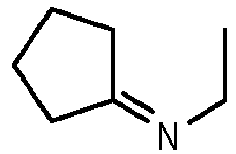
N-iso-propylidene-ethylamine N-sec-butylidene-ethylamine N-cyclohexylidene-ethylamine N-cyclopentylidene-ethylamine 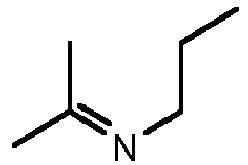


N-iso-propylidene-n-propylamine N-sec-butylidene-n-propylamine N-cyclohexylidene-n-propylamine N-cyclopentylidene-n-propylamine 

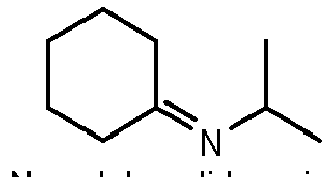

N-iso-propylidene-iso-propyl amine N-sec-butylidene-iso-propyl amine N-cyclohexylidene-iso propylamine N-cyclopentylidene-iso-propyl amine 


N-iso-propylidene-sec-butylamine N-sec-butyl idene-sec-butylamine N-cyclohexyl idene-sec-butylamine N-cyclopentyl idene-sec-butylamine 


N-iso-propylidene-tert-butylamine N-sec-butylidene-tert-butylamine N-cyclohexylidene-tert-butylamine N-cyclopentylidene-tert-butylamine 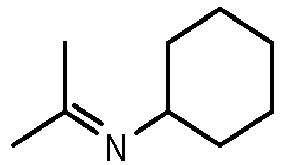


N-iso-propylidene-cyclohexylamine N-sec-butylidene-cyclohexylamine N-cyclohexylidene-cyclohexylamine N-cyclopentylidene-cyclohexylamine 


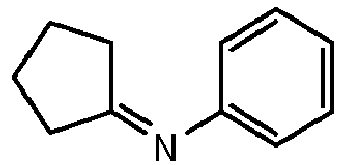
N-iso-propylidene-phenylamine N-sec-butylidene-phenylamine N-cyclohexylidene-phenylamine N-cyclopentylidene-phenylamine 
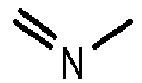


N-ethylidene-phenylamine N-methylidene-methylamine N-ethylidene-ethylamine N-n-propylidene-n-propylamine Table 2. Exemplary Organoaminosilane Compounds 
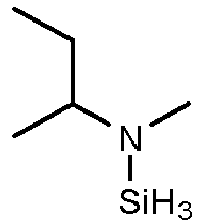
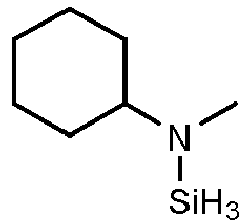
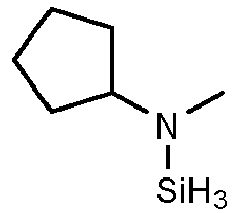
N-methyl-N-iso-propylaminosilane N-sec-butyl-N-methylaminosilane N-cyclohexyl-N-methylaminosilane N-methyl-N-cyclopentylaminosilane 


N-ethyl-N-iso-propylaminosilane N-sec-butyl-N-ethylaminosilane N-ethyl-N-cyclohexylaminosilane N-ethyl-N-cyclopentylaminosilane 
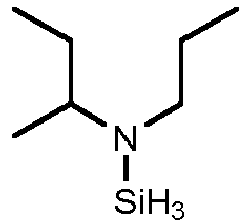


N-n-propyl-N-iso-propylaminosilane N-sec-butyl-N-n-propylaminosilane N-cyclohexyl-N-n-propylaminosilane N-cyclopentyl-N-n-propylaminosilane 


N,N-di-iso-propylaminosilane N-sec-butyl-N-iso-propylaminosilane N-cyclohexyl-N-iso-propylaminosilane N-cyclopentyl-N-iso-propylaminosilane 

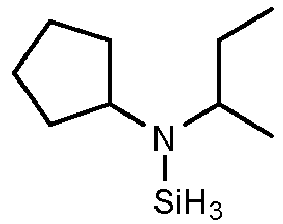
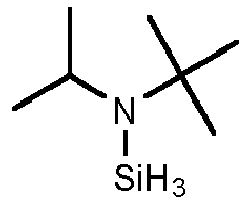
N,N-di-sec-butylaminosilane N-sec-butyl-N-cyclohexylaminosilane N-sec-butyl-N-cyclopentylaminosilane N-tertbutyl-N-iso-propylaminosilane 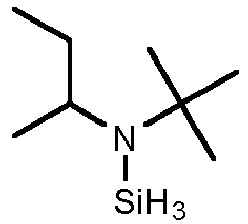

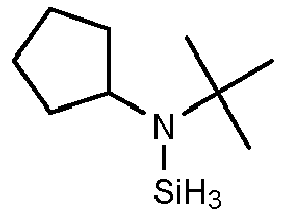

N-sec-butyl-N-tert-butylaminosilane N-tert-butyl-N-cyclohexylaminosilane N-tert-butyl-N-cyclopentylaminosilane N,N-dicyclohexylaminosilane 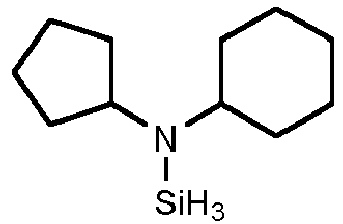
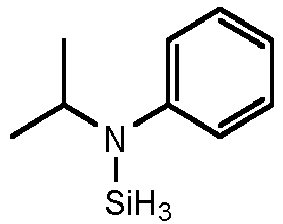

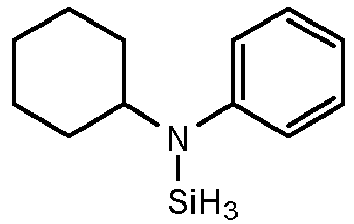
N-cyclohexyl-N-cyclopentylaminosilane N-phenyl-N-iso-propylaminosilane N-sec-butyl-N-phenylaminosilane N-cyclohexyl-N-phenylaminosilane 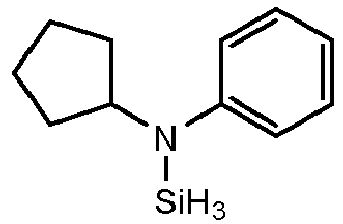


N-cyclopentyl-N-phenylaminosilane N-ethyl-N-phenylaminosilane N,N-dimethylaminosilane N,N-diethylaminosilane 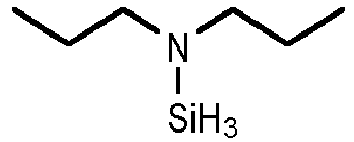
N,N-di-n-propylaminosilane Table 3. Exemplary Organoaminodisilane Compounds 

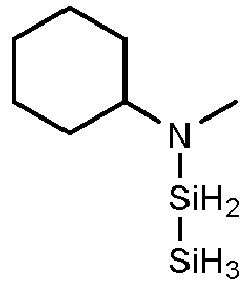
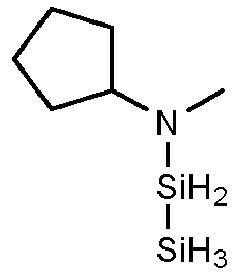
N-methyl-N-iso-propylaminodisilane N-sec-butyl-N-methylaminodisilane N-cyclohexyl-N-methylaminodisilane N-methyl-N-cyclopentylaminodisilane 


N-ethyl-N-iso-propylaminodisilane N-sec-butyl-N-ethylaminodisilane N-ethyl-N-cyclohexylaminodisilane N-ethyl-N-cyclopentylaminodisilane 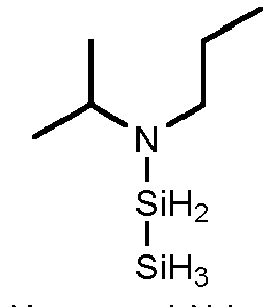

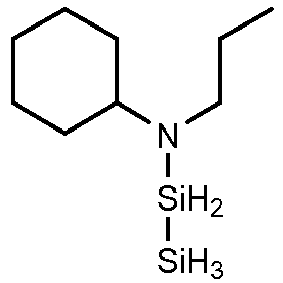

N-n-propyl-N-iso-propylaminodisilane N-sec-butyl-N-n-propylaminodisilane N-cyclohexyl-N-n-propylaminodisilane N-cyclopentyl-N-n-propylaminodisilane 


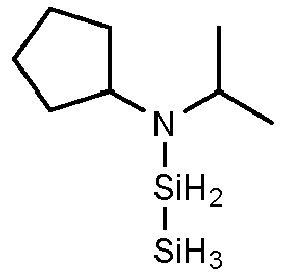
N,N-di-iso-propylaminodisilane N-sec-butyl-N-iso-propylaminodisilane N-cyclohexyl-N-iso-propylaminodisilane N-cyclopentyl-N-iso-propylaminodisilane 
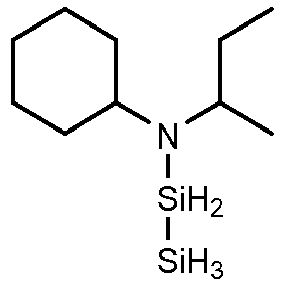


N,N-di-sec-butylaminodisilane N-sec-butyl-N-cyclohexylaminodisilane N-sec-butyl-N-cyclopentylaminodisilane N-tert-butyl-N-iso-propylaminodisilane 


N-sec-butyl-N-tert-butylaminodisilane N-tert-butyl-N-cyclohexylaminodisilane N-tert-butyl-N-cyclopentylaminodisilane N,N-dicyclohexylaminodisilane 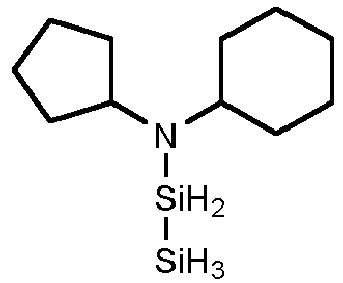
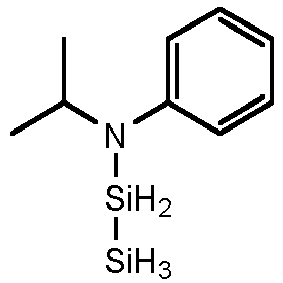


N-cyclohexyl-N-cyclopentylaminodisilane N-phenyl-N-iso-propylaminodisilane N-sec-butyl-N-phenylaminodisilane N-cyclohexyl-N-phenylaminodisilane 


N-cyclopentyl-N-phenylaminodisilane N-ethyl-N-phenylaminodisilane N,N-dimethylaminodisilane N,N-diethylaminodisilane 
N,N-di-n-propylaminodisilane Table 4. Exemplary Organoaminodisilane (more specifically 1,2-bis(organoamino)disilane) Compounds 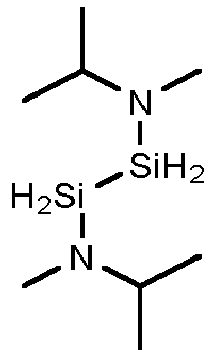

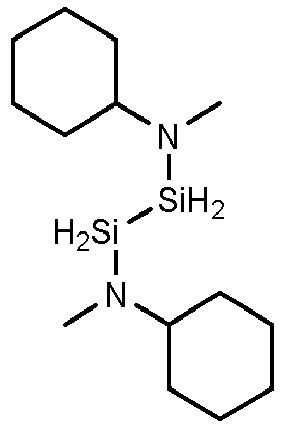

1,2-bis(N-methyl-N-iso-propylamino)disilane 1,2-bis(N-sec-butyl-N-methylamino)disilane 1,2-bis(N-cyclohexyl-N-methylamino)disilane 1,2-bis(N-methyl-N-cyclopentylamino)disilane 


1,2-bis(N-ethyl-N-iso-propylamino)disilane 1,2-bis(N-sec-butyl-N-ethylamino)disilane 1,2-bis(N-ethyl-N-cyclohexylamino)disilane 1,2-bis(N-ethyl-N-cyclopentylamino)disilane 


1,2-bis(N-n-propyl-N-iso-propylamino)disilane 1,2-bis(N-sec-butyl-N-n-propylamino)disilane 1,2-bis(N-cyclohexyl-N-n-propylamino)disilane 1,2-bis(N-cyclopentyl-N-n-propylamino)disilane 
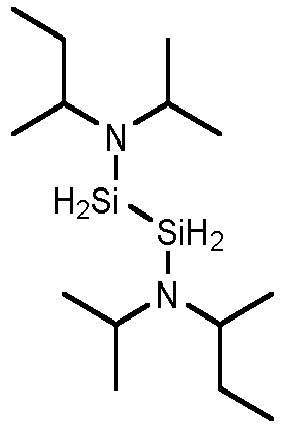


1,2-bis(N,N-di-iso-propylamino)disilane 1,2-bis(N-sec-butyl-N-iso-propylamino)disilane 1,2-bis(N-cyclohexyl-N-iso-propylamino)disilane 1,2-bis(N-cyclopentyl-N-iso-propylamino)disilane 
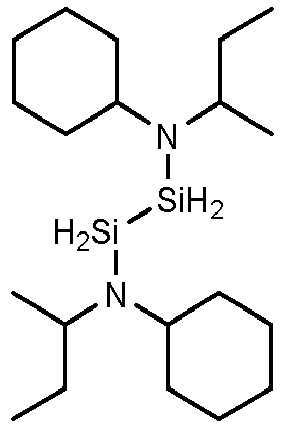


1,2-bis(N,N-di-sec-butylamino)disilane 1,2-bis(N-sec-butyl-N-cyclohexylamino)disilane 1,2-bis(N-sec-butyl-N-cyclopentylamino)disilane 1,2-bis(N-tert-butyl-N-iso-propylamino)disilane 
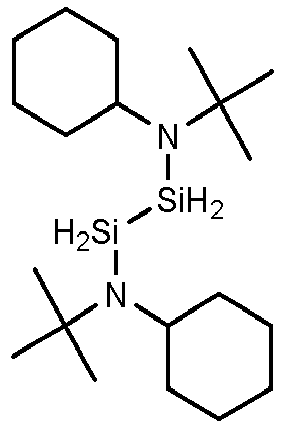

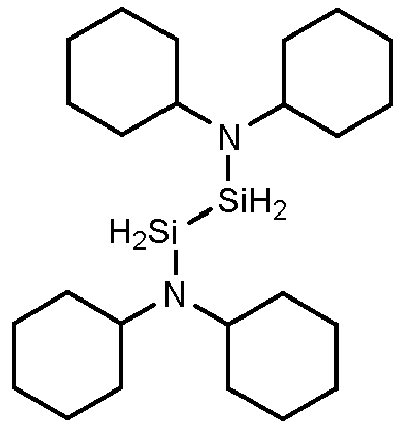
1,2-bis(N-sec-butyl-N-tert-butylamino)disilane 1,2-bis(N-tert-butyl-N-cyclohexylamino)disilane 1,2-bis(N-tert-butyl-N-cyclopentylamino)disilane 1,2-bis(N,N-dicyclohexylamino)disilane 


1,2-bis(N-cyclohexyl-N-cyclopentylamino)disilane 1,2-bis(N-phenyl-N-iso-propylamino)disilane 1,2-bis(N-sec-butyl-N-phenylamino)disilane 1,2-bis(N-cyclohexyl-N-phenylamino)disilane 

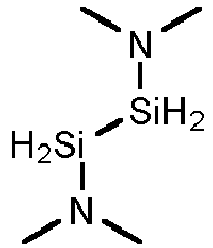

1,2-bis(N-cyclopentyl-N-phenylamino)disilane 1,2-bis(N-ethyl-N-phenylamino)disilane 1,2-bis(N,N-dimethylamino)disilane 1,2-bis(N,N-dieethylamino)disilane 
1,2-bis(N,N-di-n-propylamino)disilane Table 5. Exemplary Organoaminocarbosilane (more specifically organoamino-1,4-disilabutane) Compounds 


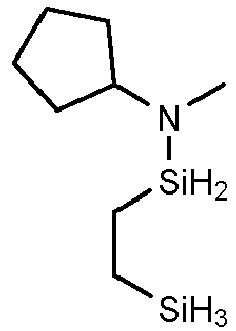
1-(N-methyl-N-iso-propylamino)-1,4-disilabutane 1-(N-sec-butyl-N-methylamino)-1,4-disilabutane 1-(N-cyclohexyl-N-methylamino)-1,4-disilabutane 1-(N-methyl-N-cyclopentylamino)-1,4-disilabutane 
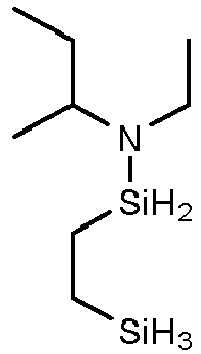
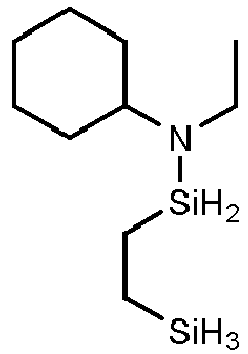

1-(N-ethyl-N-iso-propylamino)-1,4-disilabutane 1-(N-sec-butyl-N-ethylamino)-1,4-disilabutane 1-(N-ethyl-N-cyclohexylamino)-1,4-disilabutane 1-(N-ethyl-N-cyclopentylamino)-1,4-disilabutane 

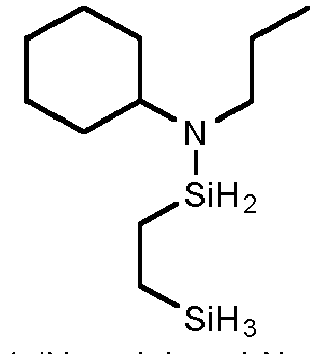

1-(N-n-propyl-N-iso-propylamino)-1,4-disilabutane 1-(N-sec-butyl-N-n-propylamino)-1,4-disilabutane 1-(N-cyclohexyl-N-n-propylamino)-1,4-disilabutane 1-(N-cyclopentyl-N-n-propylamino)-1,4-disilabutane 


1-(N,N-di-iso-propylamino)-1,4-disilabutane 1-(N-sec-butyl-N-iso-propylamino)-1,4-disilabutane 1-(N-cyclohexyl-N-iso-propylamino)-1,4-disilabutane 1-(N-cyclopentyl-N-iso-propylamino)-1,4-disilabutane 


1-(N,N-di-sec-butylamino)-1,4-disilabutane 1-(N-sec-butyl-N-cyclohexylamino)-1,4-disilabutane 1-(N-sec-butyl-N-cyclopentylamino)-1,4-disilabutane 1-(N-tert-butyl-N-iso-propylamino)-1,4-disilabutane 


1-(N-sec-butyl-N-tert-butylamino)-1,4-disilabutane 1-(N-tert-butyl-N-cyclohexylamino)-1,4-disilabutane 1-(N-tert-butyl-N-cyclopentylamino)-1,4-disilabutane 1-(N,N-dicyclohexylamino)-1,4-disilabutane 


1-(N-cyclohexyl-N-cyclopentylamino)-1,4-disilabutane 1-(N-phenyl-N-iso-propylamino)-1,4-disilabutane 1-(N-sec-butyl-N-phenylamino)-1,4-disilabutane 1-(N-cyclohexyl-N-phenylamino)-1,4-disilabutane 
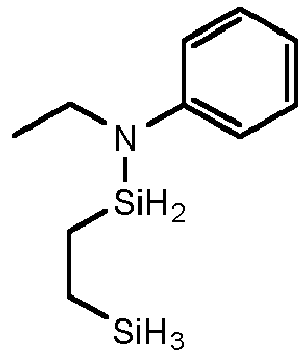

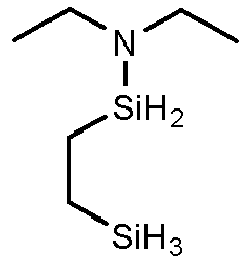
1-(N-cyclopentyl-N-phenylamino)-1,4-disilabutane 1-(N-ethyl-N-phenylamino)-1,4-disilabutane 1-(N,N-dimethylamino)-1,4-disilabutane 1-(N,N-diethylamino)-1,4-disilabutane 
1-(N,N-di-n-propylamino)-1,4-disilabutane Table 6. Exemplary Organoaminocarbosilane (more specifically 1,4-bis(organoamino)-1,4-disilabutane) Compounds 


1,4-bis(N-methyl-N-iso-propylamino)-1,4-disilabutane 1,4-bis(N-sec-butyl-N-methylamino)-1,4-disilabutane 1,4-bis(N-cyclohexyl-N-methylamino)-1,4-disilabutane 1,4-bis(N-methyl-N-cyclopentylamino)-1,4-disilabutane 


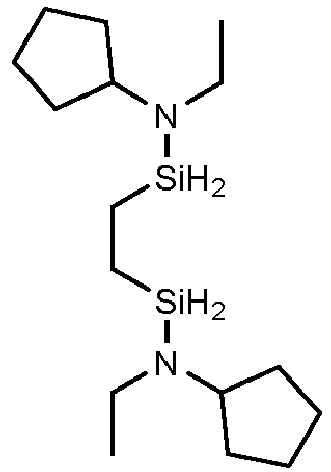
1,4-bis(N-ethyl-N-iso-propylamino)-1,4-disilabutane 1,4-bis(N-sec-butyl-N-ethylamino)-1,4-disilabutane 1,4-bis(N-ethyl-N-cyclohexylamino)-1,4-disilabutane 1,4-bis(N-ethyl-N-cyclopentylamino)-1,4-disilabutane 

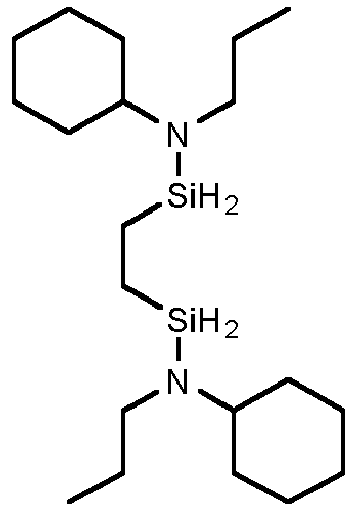

1,4-bis(N-n-propyl-N-iso-propylamino)-1,4-disilabutane 1,4-bis(N-sec-butyl-N-n-propylamino)-1,4-disilabutane 1,4-bis(N-cyclohexyl-N-n-propylamino)-1,4-disilabutane 1,4-bis(N-cyclopentyl-N-n-propylamino)-1,4-disilabutane 


1,4-bis(N,N-di-iso-propylamino)-1,4-disilabutane 1,4-bis(N-sec-butyl-N-iso-propylamino)-1,4-disilabutane 1,4-bis(N-cyclohexyl-N-iso-propylamino)-1,4-disilabutane 1,4-bis(N-cyclopentyl-N-iso-propylamino)-1,4-disilabutane 

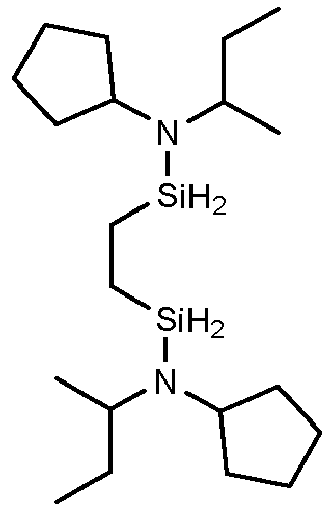

1,4-bis(N,N-di-sec-butylamino)-1,4-disilabutane 1,4-bis(N-sec-butyl-N-cyclohexylamino)-1,4-disilabutane 1,4-bis(N-sec-butyl-N-cyclopentylamino)-1,4-disilabutane 1,4-bis(N-tert-butyl-N-iso-propylamino)-1,4-disilabutane 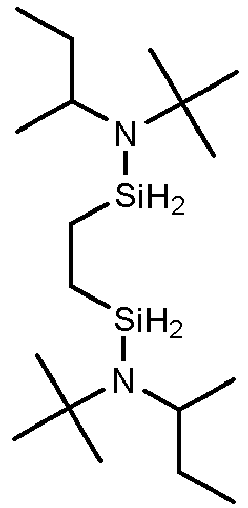
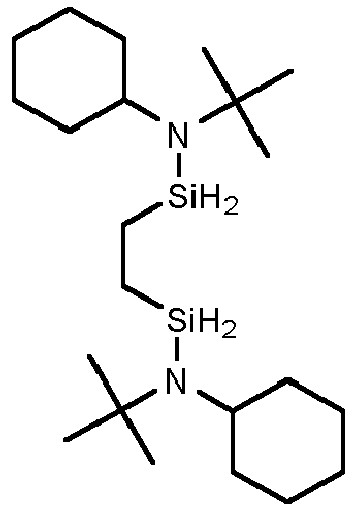
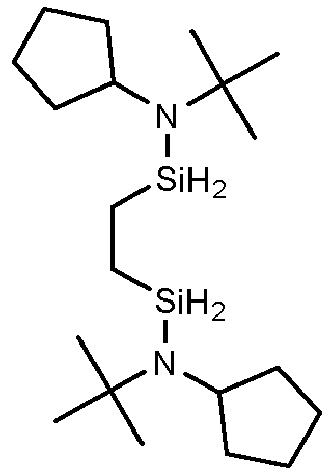

1,4-bis(N-sec-butyl-N-tert-butylamino)-1,4-disilabutane 1,4-bis(N-tert-butyl-N-cyclohexylamino)-1,4-disilabutane 1,4-bis(N-tert-butyl-N-cyclopentylamino)-1,4-disilabutane 1,4-bis(N,N-dicyclohexylamino)-1,4-disilabutane 
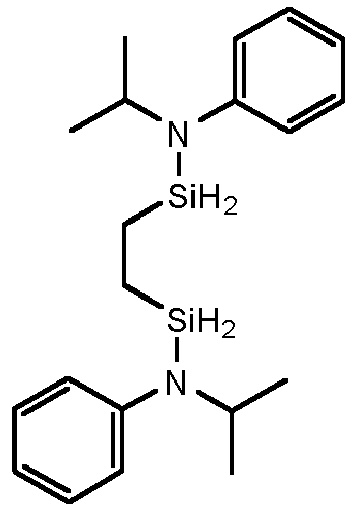

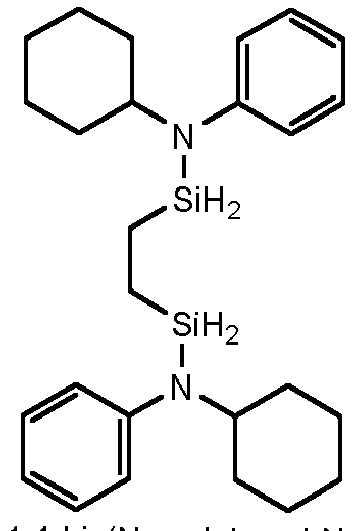
1,4-bis(N-cyclohexyl-N-cyclopentylamino)-1,4-disilabutane 1,4-bis(N-phenyl-N-iso-propylamino)-1,4-disilabutane 1,4-bis(N-sec-butyl-N-phenylamino)-1,4-disilabutane 1,4-bis(N-cyclohexyl-N-phenylamino)-1,4-disilabutane 


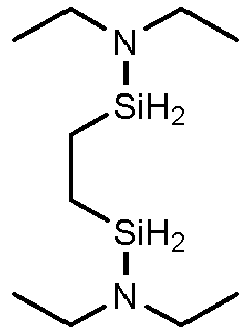
1,4-bis(N-cyclopentyl-N-phenylamino)-1,4-disilabutane 1,4-bis(N-ethyl-N-phenylamino)-1,4-disilabutane 1,4-bis(N,N-dimethylamino)-1,4-disilabutane 1,4-bis(N,N-diethylamino)-1,4-disilabutane 
1,4-bis(N,N-di-n-propylamino)-1,4-disilabutane Table 7. Exemplary Organoaminocarbosilane (more specifically organoamino-1,3-disilapropane) Compounds 


1-(N-methyl-N-iso-propylamino)-1,3-disilapropane 1-(N-sec-butyl-N-methylamino)-1,3-disilapropane 1-(N-cyclohexyl-N-methylamino)-1,3-disilapropane 1-(N-methyl-N-cyclopentylamino)-1,3-disilapropane 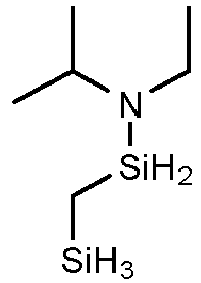
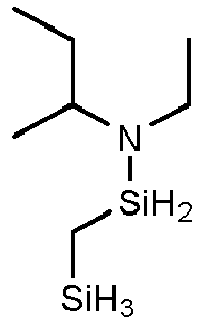


1-(N-ethyl-N-iso-propylamino)-1,3-disilapropane 1-(N-sec-butyl-N-ethylamino)-1,3-disilapropane 1-(N-ethyl-N-cyclohexylamino)-1,3-disilapropane 1-(N-ethyl-N-cyclopentylamino)-1,3-disilapropane 


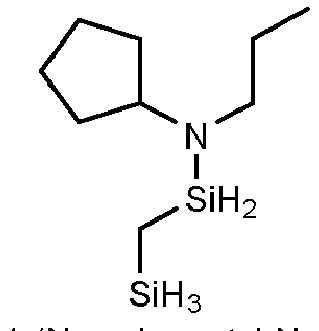
1-(N-n-propyl-N-iso-propylamino)-1,3-disilapropane 1-(N-sec-butyl-N-n-propylamino)-1,3-disilapropane 1-(N-cyclohexyl-N-n-propylamino)-1,3-disilapropane 1-(N-cyclopentyl-N-n-propylamino)-1,3-disilapropane 


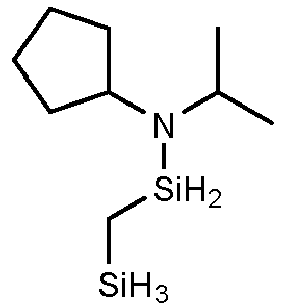
1-(N,N-di-iso-propylamino)-1,3-disilapropane 1-(N-sec-butyl-N-iso-propylamino)-1,3-disilapropane 1-(N-cyclohexyl-N-iso-propylamino)-1,3-disilapropane 1-(N-cyclopentyl-N-iso-propylamino)-1,3-disilapropane 


1-(N,N-di-sec-butylamino)-1,3-disilapropane 1-(N-sec-butyl-N-cyclohexylamino)-1,3-disilapropane 1-(N-sec-butyl-N-cyclopentylamino)-1,3-disilapropane 1-(N-tert-butyl-N-isopropylamino)-1,3-disilapropane 


1-(N-sec-butyl-N-tertbutylamino)-1,3-disilapropane 1-(N-tert-butyl-N-cyclohexylamino)-1,3-disilapropane 1-(N-tert-butyl-N-cyclopentylamino)-1,3-disilapropane 1-(N,N-dicyclohexylamino)-1,3-disilapropane 


1-(N-cyclohexyl-N-cyclopentylamino)-1,3-disilapropane 1-(N-phenyl-N-iso-propylamino)-1,3-disilapropane 1-(N-sec-butyl-N-phenylamino)-1,3-disilapropane 1-(N-cyclohexyl-N-phenylamino)-1,3-disilapropane 


1-(N-cyclopentyl-N-phenylamino)-1,3-disilapropane 1-(N-ethyl-N-phenylamino)-1,3-disilapropane 1-(N,N-dimethylamino)-1,3-disilapropane 1-(N,N-dimethylamino)-1,3-disilapropane 
1-(N,N-di-n-propylamino)-1,3-disilapropane Table 8. Exemplary Organoaminocarbosilane (more specifically 1,3-bis(organoamino)-1,3-disilapropane) Compounds 


1,3-bis(N-methyl-N-iso-propylamino)-1,3-disilapropane 1,3-bis(N-sec-butyl-N-methylamino)-1,3-disilapropane 1,3-bis(N-cyclohexyl-N-methylamino)-1,3-disilapropane 1,3-bis(N-methyl-N-cyclopentylamino)-1,3-disilapropane 


1,3-bis(N-ethyl-N-iso-propylamino)-1,3-disilapropane 1,3-bis(N-sec-butyl-N-ethylamino)-1,3-disilapropane 1,3-bis(N-ethyl-N-cyclohexylamino)-1,3-disilapropane 1,3-bis(N-ethyl-N-cyclopentylamino)-1,3-disilapropane 


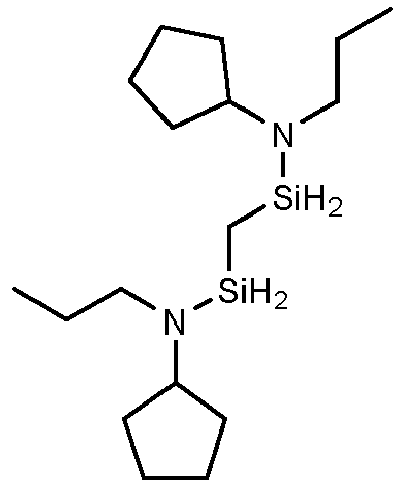
1,3-bis(N-n-propyl-N-iso-propylamino)-1,3-disilapropane 1,3-bis(N-sec-butyl-N-n-propylamino)-1,3-disilapropane 1,3-bis(N-cyclohexyl-N-n-propylamino)-1,3-disilapropane 1,3-bis(N-cyclopentyl-N-n-propylamino)-1,3-disilapropane 


1,3-bis(N,N-di-iso-propylamino)-1,3-disilapropane 1,3-bis(N-sec-butyl-N-iso-propylamino)-1,3-disilapropane 1,3-bis(N-cyclohexyl-N-iso-propylamino)-1,3-disilapropane 1,3-bis(N-cyclopentyl-N-iso-propylamino)-1,3-disilapropane 

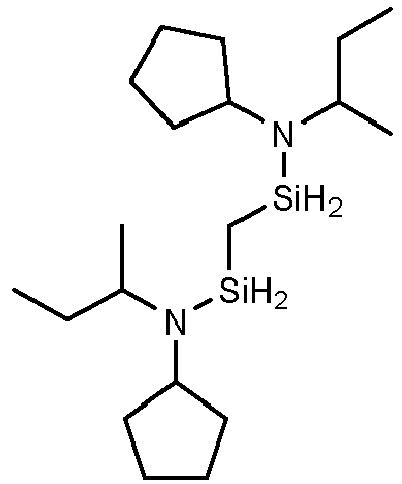

1,3-bis(N,N-di-sec-butylamino)-1,3-disilapropane 1,3-bis(N-sec-butyl-N-cyclohexylamino)-1,3-disilapropane 1,3-bis(N-sec-butyl-N-cyclopentylamino)-1,3-disilapropane 1,3-bis(N-tert-butyl-N-iso-propylamino)-1,3-disilapropane 
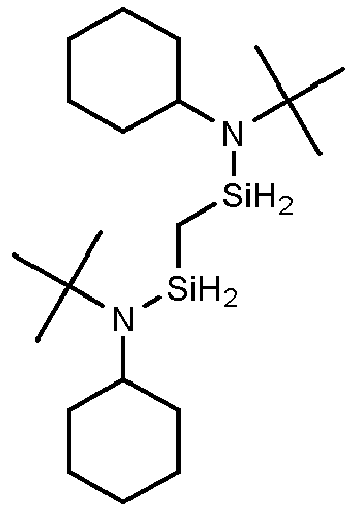


1,3-bis(N-sec-butyl-N-tert-butylamino)-1,3-disilapropane 1,3-bis(N-tert-butyl-N-cyclohexylamino)-1,3-disilapropane 1,3-bis(N-tert-butyl-N-cyclopentylamino)-1,3-disilapropane 1,3-bis(N,N-dicyclohexylamino)-1,3-disilapropane 


1,3-bis(N-cyclohexyl-N-cyclopentylamino)-1,3-disilapropane 1,3-bis(N-phenyl-N-iso-propylamino)-1,3-disilapropane 1,3-bis(N-sec-butyl-N-phenylamino)-1,3-disilapropane 1,3-bis(N-cyclohexyl-N-phenylamino)-1,3-disilapropane 


1,3-bis(N-cyclopentyl-N-phenylamino)-1,3-disilapropane 1,3-bis(N-ethyl-N-phenylamino)-1,3-disilapropane 1,3-bis(N,N-dimethylamino)-1,3-disilapropane 1,3-bis(N,N-diethylamino)-1,3-disilapropane 
1,3-bis(N,N-di-n-propylamino)-1,3-disilapropane Table 9. Exemplary Organoaminocarbosilane (more specifically 1-organoamino-2-methyl-1,3-disilapropane) Compounds 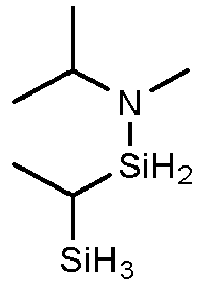


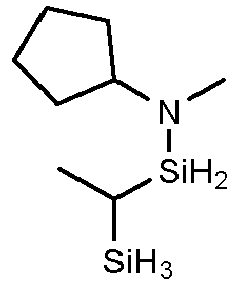
1-(N-methyl-N-iso-propylamino)-2-methyl-1,3-disilapropane 1-(N-sec-butyl-N-methylamino)-2-methyl-1,3-disilapropane 1-(N-cyclohexyl-N-methylamino)-2-methyl-1,3-disilapropane 1-(N-methyl-N-cyclopentylamino)-2-methyl-1,3-disilapropane 


1-(N-ethyl-N-iso-propylamino)-2-methyl-1,3-disilapropane 1-(N-sec-butyl-N-ethylamino)-2-methyl-1,3-disilapropane 1-(N-ethyl-N-cyclohexylamino)-2-methyl-1,3-disilapropane 1-(N-ethyl-N-cyclopentylamino)-2-methyl-1,3-disilapropane 

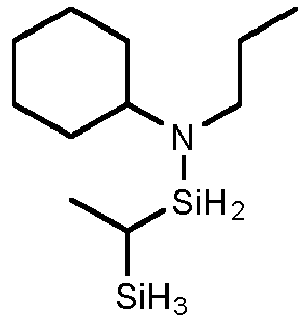
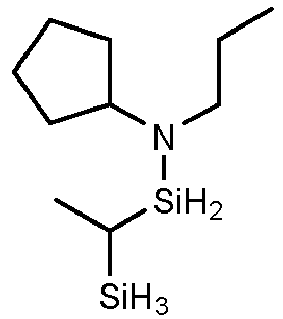
1-(N-n-propyl-N-iso-propylamino)-2-methyl-1,3-disilapropane 1-(N-sec-butyl-N-n-propylamino)-2-methyl-1,3-disilapropane 1-(N-cyclohexyl-N-n-propylamino)-2-methyl-1,3-disilapropane 1-(N-cyclopentyl-N-n-propylamino)-2-methyl-1,3-disilapropane 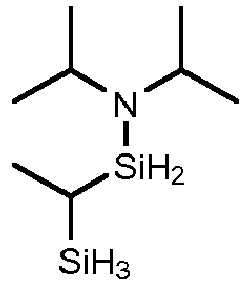


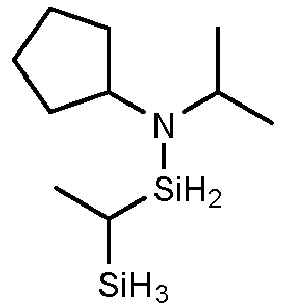
1-(N,N-di-iso-propylamino)-2-methyl-1,3-disilapropane 1-(N-sec-butyl-N-iso-propylamino)-2-methyl-1,3-disilapropane 1-(N-cyclohexyl-N-iso-propylamino)-2-methyl-1,3-disilapropane 1-(N-cyclopentyl-N-iso-propylamino)-2-methyl-1,3-disilapropane 


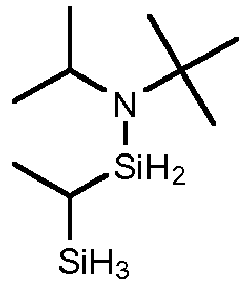
1-(N,N-di-sec-butylamino)-2-methyl-1,3-disilapropane 1-(N-sec-butyl-N-cyclohexylamino)-2-methyl-1,3-disilapropane 1-(N-sec-butyl-N-cyclopentylamino)-2-methyl-1,3-disilapropane 1-(N-tert-butyl-N-iso-propylamino)-2-methyl-1,3-disilapropane 


1-(N-sec-butyl-N-tert-butylamino)-2-methyl-1,3-disilapropane 1-(N-tert-butyl-N-cyclohexylamino)-2-methyl-1,3-disilapropane 1-(N-tert-butyl-N-cyclopentylamino)-2-methyl-1,3-disilapropane 1-(N,N-dicyclohexylamino)-2-methyl-1,3-disilapropane 


1-(N-cyclohexyl-N-cyclopentylamino)-2-methyl-1,3-disilapropane 1-(N-phenyl-N-iso-propylamino)-2-methyl-1,3-disilapropane 1-(N-sec-butyl-N-phenylamino)-2-methyl-1,3-disilapropane 1-(N-cyclohexyl-N-phenylamino)-2-methyl-1,3-disilapropane 


1-(N-cyclopentyl-N-phenylamino)-2-methyl-1,3-disilapropane 1-(N-ethyl-N-phenylamino)-2-methyl-1,3-disilapropane 1-(N,N-dimethylamino)-2-methyl-1,3-disilapropane 1-(N,N-dimethylamino)-2-methyl-1,3-disilapropane 
1-(N,N-di-n-propylamino)-2-methyl-1,3-disilapropane Table 10. Exemplary Organoaminocarbosilane (more specifically 1,3-bis(organoamino)-2-methyl-1,3-disilapropane) Compounds 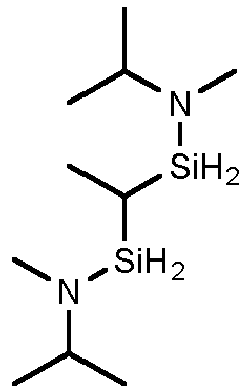


1,3-bis(N-methyl-N-iso-propylamino)-2-methyl-1,3-disilapropane 1,3-bis(N-sec-butyl-N-methylamino)-2-methyl-1,3-disilapropane 1,3-bis(N-cyclohexyl-N-methylamino)-2-methyl-1,3-disilapropane 1,3-bis(N-methyl-N-cyclopentylamino)-2-methyl-1,3-disilapropane 


1,3-bis(N-ethyl-N-iso-propylamino)-2-methyl-1,3-disilapropane 1,3-bis(N-sec-butyl-N-ethylamino)-2-methyl-1,3-disilapropane 1,3-bis(N-ethyl-N-cyclohexylamino)-2-methyl-1,3-disilapropane 1,3-bis(N-ethyl-N-cyclopentylamino)-2-methyl-1,3-disilapropane 


1,3-bis(N-n-propyl-N-iso-propylamino)-2-methyl-1,3-disilapropane 1,3-bis(N-sec-butyl-N-n-propylamino)-2-methyl-1,3-disilapropane 1,3-bis(N-cyclohexyl-N-n-propylamino)-2-methyl-1,3-disilapropane 1,3-bis(N-cyclopentyl-N-n-propylamino)-2-methyl-1,3-disilapropane 


1,3-bis(N,N-di-iso-propylamino)-2-methyl-1,3-disilapropane 1,3-bis(N-sec-butyl-N-iso-propylamino)-2-methyl-1,3-disilapropane 1,3-bis(N-cyclohexyl-N-iso-propylamino)-2-methyl-1,3-disilapropane 1,3-bis(N-cyclopentyl-N-iso-propylamino)-2-methyl-1,3-disilapropane 
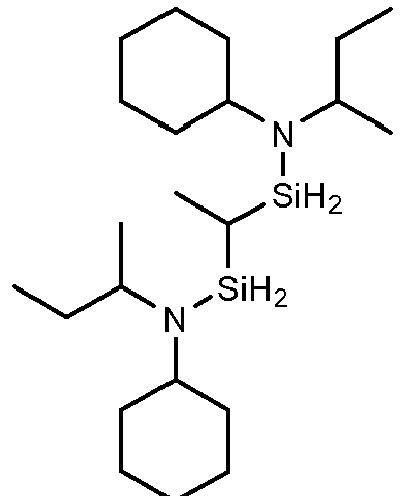


1,3-bis(N,N-di-sec-butylamino)-2-methyl-1,3-disilapropane 1,3-bis(N-sec-butyl-N-cyclohexylamino)-2-methyl-1,3-disilapropane 1,3-bis(N-sec-butyl-N-cyclopentylamino)-2-methyl-1,3-disilapropane 1,3-bis(N-tert-butyl-N-iso-propylamino)-2-methyl-1,3-disilapropane 

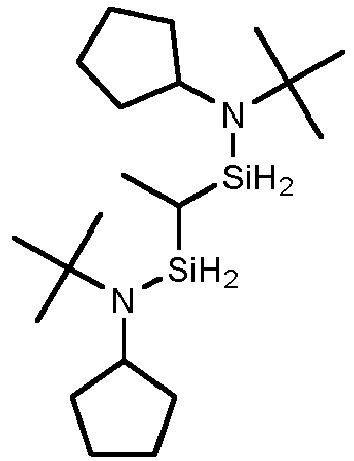

1,3-bis(N-sec-butyl-N-tert-butylamino)-2-methyl-1,3-disilapropane 1,3-bis(N-tert-butyl-N-cyclohexylamino)-2-methyl-1,3-disilapropane 1,3-bis(N-tert-butyl-N-cyclopentylamino)-2-methyl-1,3-disilapropane 1,3-bis(N,N-dicyclohexylamino)-2-methyl-1,3-disilapropane 


1,3-bis(N-cyclohexyl-N-cyclopentylamino)-2-methyl-1,3-disilapropane 1,3-bis(N-phenyl-N-iso-propylamino)-2-methyl-1,3-disilapropane 1,3-bis(N-sec-butyl-N-phenylamino)-2-methyl-1,3-disilapropane 1,3-bis(N-cyclohexyl-N-phenylamino)-2-methyl-1,3-disilapropane 


1,3-bis(N-cyclopentyl-N-phenylamino)-2-methyl-1,3-disilapropane 1,3-bis(N-ethyl-N-phenylamino)-2-methyl-1,3-disilapropane 1,3-bis(N,N-dimethylamino)-2-methyl-1,3-disilapropane 1,3-bis(N,N-diethylamino)-2-methyl-1,3-disilapropane 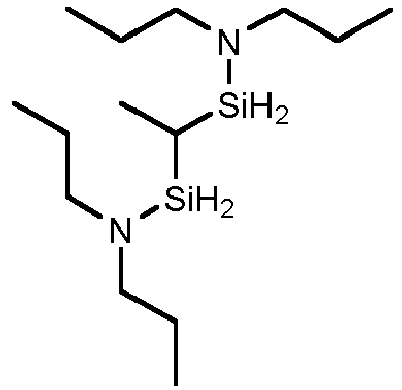
1,3-bis(N,N-di-n-propylamino)-2-methyl-1,3-disilapropane Table 11. Exemplary Organoaminocarbosilane (more specifically organoamino-silacyclopentane) Compounds 
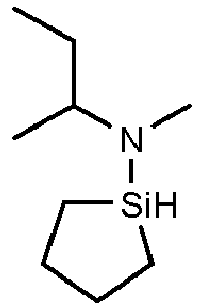


1-(N-methyl-N-iso-propylamino)-silacyclopentane 1-(N-sec-butyl-N-methylamino)-silacyclopentane 1-(N-cyclohexyl-N-methylamino)-silacyclopentane 1-(N-methyl-N-cyclopentylamino)-silacyclopentane 


1-(N-ethyl-N-iso-propylamino)-silacyclopentane 1-(N-sec-butyl-N-ethylamino)-silacyclopentane 1-(N-ethyl-N-cyclohexylamino)-silacyclopentane 1-(N-ethyl-N-cyclopentylamino)-silacyclopentane 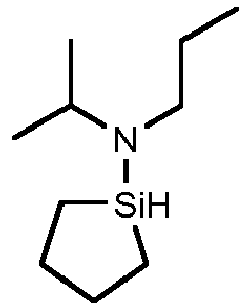


1-(N-n-propyl-N-iso-propylamino)-silacyclopentane 1-(N-sec-butyl-N-n-propylamino)-silacyclopentane 1-(N-cyclohexyl-N-n-propylamino)-silacyclopentane 1-(N-cyclopentyl-N-n-propylamino)-silacyclopentane 


1-(N,N-di-iso-propylamino)-silacyclopentane 1-(N-sec-butyl-N-iso-propylamino)-silacyclopentane 1-(N-cyclohexyl-N-iso-propylamino)-silacyclopentane 1-(N-cyclopentyl-N-iso-propylamino)-silacyclopentane 


1-(N,N-di-sec-butylamino)-silacyclopentane 1-(N-sec-butyl-N-cyclohexylamino)-silacyclopentane 1-(N-sec-butyl-N-cyclopentylamino)-silacyclopentane 1-(N-tert-butyl-N-iso-propylamino)-silacyclopentane 


1-(N-sec-butyl-N-tert-butylamino)-silacyclopentane 1-(N-tert-butyl-N-cyclohexylamino)-silacyclopentane 1-(N-tert-butyl-N-cyclopentylamino)-silacyclopentane 1-(N,N-dicyclohexylamino)-silacyclopentane 


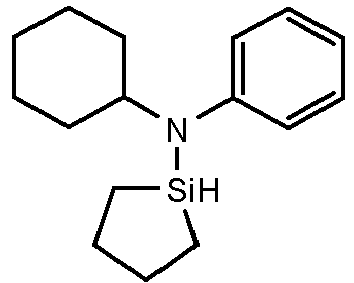
1-(N-cyclohexyl-N-cyclopentylamino)-silacyclopentane 1-(N-phenyl-N-iso-propylamino)-silacyclopentane 1-(N-sec-butyl-N-phenylamino)-silacyclopentane 1-(N-cyclohexyl-N-phenylamino)-silacyclopentane 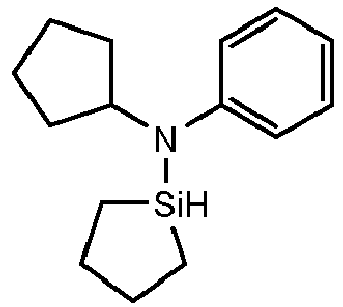


1-(N-cyclopentyl-N-phenylamino)-silacyclopentane 1-(N-ethyl-N-phenylamino)-silacyclopentane 1-(N,N-dimethylamino)-silacyclopentane 1-(N,N-diethylamino)-silacyclopentane 
1-(N,N-di-n-propylamino)-silacyclopentane Table 12. Exemplary Organoaminocarbosilane (more specifically organoamino-methylsilacyclopentane) Compounds 


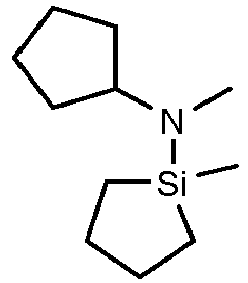
1-(N-methyl-N-iso-propylamino)-1-methyl-silacyclopentane 1-(N-sec-butyl-N-methylamino)-1-methyl-silacyclopentane 1-(N-cyclohexyl-N-methylamino)-1-methyl-silacyclopentane 1-(N-methyl-N-cyclopentylamino)-1-methyl-silacyclopentane 
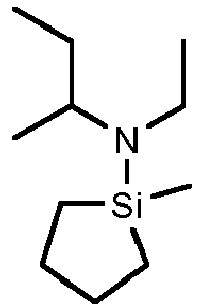


1-(N-ethyl-N-iso-propylamino)-1-methyl-silacyclopentane 1-(N-sec-butyl-N-ethylamino)-1-methyl-silacyclopentane 1-(N-ethyl-N-cyclohexylamino)- 1 1-methyl-silacyclopentane -(N-ethyl-N-cyclopentylamino)-1-methyl-silacyclopentane 

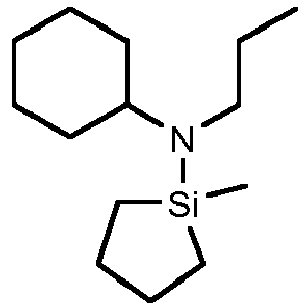

1-(N-n-propyl-N-iso-propylamino)-1-methyl-silacyclopentane 1-(N-sec-butyl-N-n-propylamino)-1-methyl-silacyclopentane 1-(N-cyclohexyl-N-n-propylamino)-1-methyl-silacyclopentane 1-(N-cyclopentyl-N-n-propylamino)-1-methyl-silacyclopentane 


1-(N,N-di-iso-propylamino)-1-methyl-silacyclopentane 1-(N-sec-butyl-N-iso-propylamino)-1-methyl-silacyclopentane 1-(N-cyclohexyl-N-iso-propylamino)-1-methyl-silacyclopentane 1-(N-cyclopentyl-N-iso-propylamino)-1-methyl-silacyclopentane 
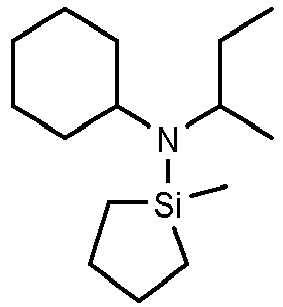

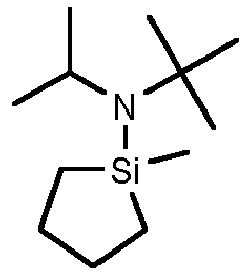
1-(N,N-di-sec-butylamino)-1-methyl-silacyclopentane 1-(N-sec-butyl-N-cyclohexylamino)-1-methyl-silacyclopentane 1-(N-sec-butyl-N-cyclopentylamino)-1-methyl-silacyclopentane 1-(N-tert-butyl-N-iso-propylamino)-1-methyl-silacyclopentane 

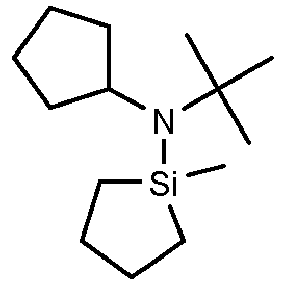

1-(N-sec-butyl-N-tert-butylamino)-1-methyl-silacyclopentane 1-(N-tert-butyl-N-cyclohexylamino)-1-methyl-silacyclopentane 1-(N-tert-butyl-N-cyclopentylamino)-1-methyl-silacyclopentane 1-(N,N-dicyclohexylamino)-1-methyl-silacyclopentane 


1-(N-cyclohexyl-N-cyclopentylamino)-1-methyl-silacyclopentane 1-(N-phenyl-N-iso-propylamino)-1-methyl-silacyclopentane 1-(N-sec-butyl-N-phenylamino)-1-methyl-silacyclopentane 1-(N-cyclohexyl-N-phenylamino)-1-methyl-silacyclopentane 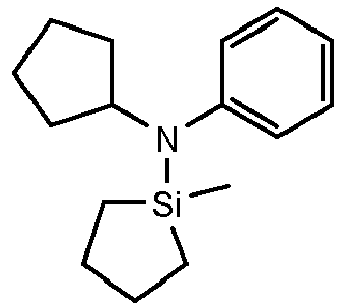


1-(N-cyclopentyl-N-phenylamino)-1-methyl-silacyclopentane 1-(N-ethyl-N-phenylamino)-1-methyl-silacyclopentane 1-(N,N-dimethylamino)-1-methyl-silacyclopentane 1-(N,N-dimethylamino)-1-methyl-silacyclopentane 
1-(N,N-di-n-propylamino)-1-methyl-silacyclopentane Table 13. Exemplary Organoaminocarbosilane (more specifically organoamino-silacyclobutane having cyclic four-membered ring) Compounds 
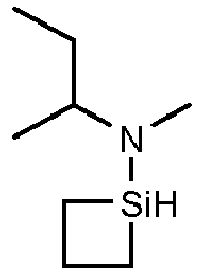


1-(N-methyl-N-iso-propylamino)-silacyclobutane 1-(N-sec-butyl-N-methylamino)-silacyclobutane 1-(N-cyclohexyl-N-methylamino)-silacyclobutane 1-(N-methyl-N-cyclopentylamino)-silacyclobutane 

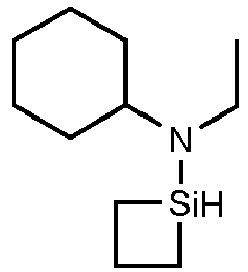

1-(N-ethyl-N-iso-propylamino)-silacyclobutane 1-(N-sec-butyl-N-ethylamino)-silacyclobutane 1-(N-ethyl-N-cyclohexylamino)-silacyclobutane 1-(N-ethyl-N-cyclopentylamino)-silacyclobutane 


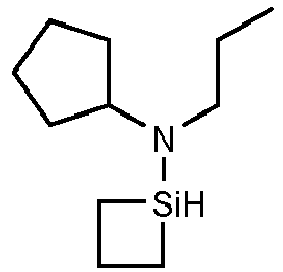
1-(N-n-propyl-N-iso-propylamino)-silacyclobutane 1-(N-sec-butyl-N-n-propylamino)-silacyclobutane 1-(N-cyclohexyl-N-n-propylamino)-silacyclobutane 1-(N-cyclopentyl-N-n-propylamino)-silacyclobutane 


1-(N,N-di-iso-propylamino)-silacyclobutane 1-(N-sec-butyl-N-iso-propylamino)-silacyclobutane 1-(N-cyclohexyl-N-iso-propylamino)-silacyclobutane 1-(N-cyclopentyl-N-iso-propylamino)-silacyclobutane 


1-(N,N-di-sec-butylamino)-silacyclobutane 1-(N-sec-butyl-N-cyclohexylamino)-silacyclobutane 1-(N-sec-butyl-N-cyclopentylamino)-silacyclobutane 1-(N-tert-butyl-N-iso-propylamino)-silacyclobutane 


1-(N-sec-butyl-N-tert-butylamino)-silacyclobutane 1-(N-tert-butyl-N-cyclohexylamino)-silacyclobutane 1-(N-tert-butyl-N-cyclopentylamino)-silacyclobutane 1-(N,N-dicyclohexylamino)-silacyclobutane 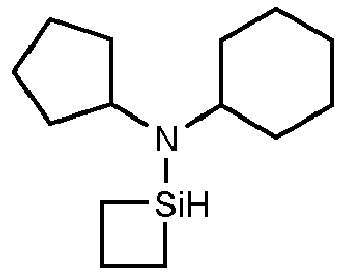


1-(N-cyclohexyl-N-cyclopentylamino)-silacyclobutane 1-(N-phenyl-N-iso-propylamino)-silacyclobutane 1-(N-sec-butyl-N-phenylamino)-silacyclobutane 1-(N-cyclohexyl-N-phenylamino)-silacyclobutane 


1-(N-cyclopentyl-N-phenylamino)-silacyclobutane 1-(N-ethyl-N-phenylamino)-silacyclobutane 1-(N,N-dimethylamino)-silacyclobutane 1-(N,N-diethylamino)-silacyclobutane 
1-(N,N-di-n-propylamino)-silacyclobutane Table 14. Exemplary Organoaminocarbosilane (more specifically organoamino-1,3-disilacyclobutane having cyclic four-membered ring) Compounds 
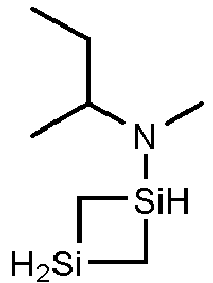


1-(N-methyl-N-iso-propylamino)-1,3-disilacyclobutane 1-(N-sec-butyl-N-methylamino)-1,3-disilacyclobutane 1-(N-cyclohexyl-N-methylamino)-1,3-disilacyclobutane 1-(N-methyl-N-cyclopentylamino)-1,3-disilacyclobutane 

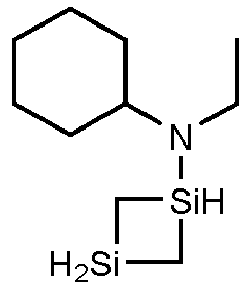

1-(N-ethyl-N-iso-propylamino)-1,3-disilacyclobutane 1-(N-sec-butyl-N-ethylamino)-1,3-disilacyclobutane 1-(N-ethyl-N-cyclohexylamino)-1,3-disilacyclobutane 1-(N-ethyl-N-cyclopentylamino)-1,3-disilacyclobutane 


1-(N-n-propyl-N-iso-propylamino)-1,3-disilacyclobutane 1-(N-sec-butyl-N-n-propylamino)-1,3-disilacyclobutane 1-(N-cyclohexyl-N-n-propylamino)-1,3-disilacyclobutane 1-(N-cyclopentyl-N-n-propylamino)-1,3-disilacyclobutane 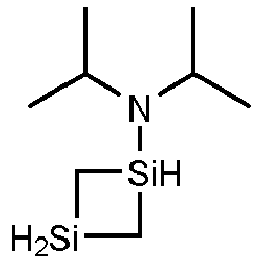

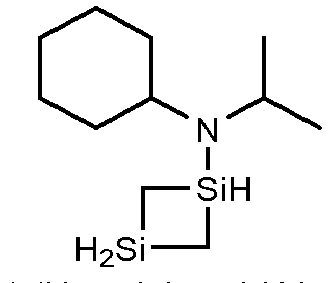

1-(N,N-di-iso-propylamino)-1,3-disilacyclobutane 1 -(N-sec-butyl-N-iso-propylamino)-1,3-disilacyclobutane 1 -(N-cyclohexyl-N-iso-propylamino)-1,3-disilacyclobutane 1-(N-cyclopentyl-N-iso-propylamino)-1,3-disilacyclobutane 


1-(N,N-di-sec-butylamino)-1,3-disilacyclobutane 1-(N-sec-butyl-N-cyclohexylamino)-1,3-disilacyclobutane 1-(N-sec-butyl-N-cyclopentylamino)-1,3-disilacyclobutane 1-(N-tert-butyl-N-iso-propylamino)-1,3-disilacyclobutane 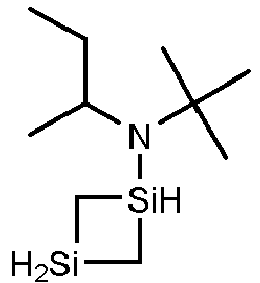


1-(N-sec-butyl-N-tert-butylamino)-1,3-disilacyclobutane 1-(N-tert-butyl-N-cyclohexylamino)-1,3-disilacyclobutane 1-(N-tert-butyl-N-cyclopentylamino)-1,3-disilacyclobutane 1-(N,N-dicyclohexylamino)-1,3-disilacyclobutane 
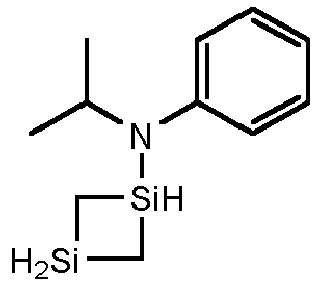

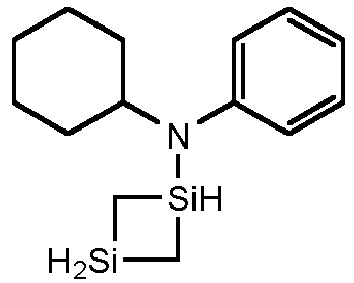
1-(N-cyclohexyl-N-cyclopentylamino)-1,3-disilacyclobutane 1-(N-phenyl-N-iso-propylamino)-1,3-disilacyclobutane 1-(N-sec-butyl-N-phenylamino)-1,3-disilacyclobutane 1-(N-cyclohexyl-N-phenylamino)-1,3-disilacyclobutane 

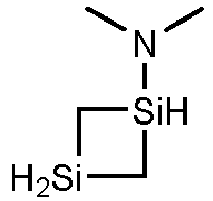
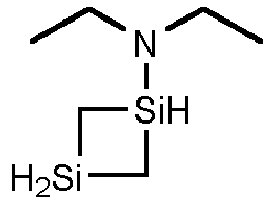
1-(N-cyclopentyl-N-phenylamino)-1,3-disilacyclobutane 1-(N-ethyl-N-phenylamino)-1,3-disilacyclobutane 1-(N,N-dimethylamino)-1,3-disilacyclobutane 1-(N,N-diethylamino)-1,3-disilacyclobutane 
1-(N,N-di-n-propylamino)-1,3-disilacyclobutane Table 15. Exemplary Organoaminocarbosilane (more specifically 1,3-bis(organoamino)-1,3-disilacyclobutane having cyclic four-membered ring) Compounds 


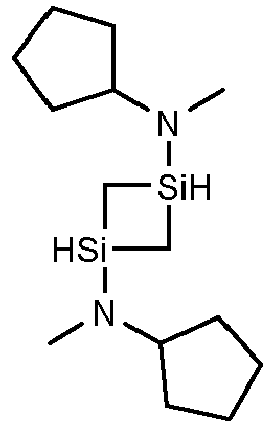
1,3-bis(N-methyl-N-iso-propylamino)-1,3-disilacyclobutane 1,3-bis(N-sec-butyl-N-methylamino)-1,3-disilacyclobutane 1,3-bis(N-cyclohexyl-N-methylamino)-1,3-disilacyclobutane 1,3-bis(N-methyl-N-cyclopentylamino)-1,3-disilacyclobutane 


1,3-bis(N-ethyl-N-iso-propylamino)-1,3-disilacyclobutane 1,3-bis(N-sec-butyl-N-ethylamino)-1,3-disilacyclobutane 1,3-bis(N-ethyl-N-cyclohexylamino)-1,3-disilacyclobutane 1,3-bis(N-ethyl-N-cyclopentylamino)-1,3-disilacyclobutane 


1,3-bis(N-n-propyl-N-iso-propylamino)-1,3-disilacyclobutane 1,3-bis(N-sec-butyl-N-n-propylamino)-1,3-disilacyclobutane 1,3-bis(N-cyclohexyl-N-n-propylamino)-1,3-disilacyclobutane 1,3-bis(N-cyclopentyl-N-n-propylamino)-1,3-disilacyclobutane 


1,3-bis(N,N-di-iso-propylamino)-1,3-disilacyclobutane 1,3-bis(N-sec-butyl-N-iso-propylamino)-1,3-disilacyclobutane 1,3-bis(N-cyclohexyl-N-iso-propylamino)-1,3-disilacyclobutane 1,3-bis(N-cyclopentyl-N-iso-propylamino)-1,3-disilacyclobutane 


1,3-bis(N,N-di-sec-butylamino)-1,3-disilacyclobutane 1,3-bis(N-sec-butyl-N-cyclohexylamino)-1,3-disilacyclobutane 1,3-bis(N-sec-butyl-N-cyclopentylamino)-1,3-disilacyclobutane 1,3-bis(N-tert-butyl-N-iso-propylamino)-1,3-disilacyclobutane 


1,3-bis(N-sec-butyl-N-tert-butylamino)-1,3-disilacyclobutane 1,3-bis(N-tert-butyl-N-cyclohexylamino)-1,3-disilacyclobutane 1,3-bis(N-tert-butyl-N-cyclopentylamino)-1,3-disilacyclobutane 1,3-bis(N,N-dicyclohexylamino)-1,3-disilacyclobutane 


1,3-bis(N-cyclohexyl-N-cyclopentylamino)-1,3-disilacyclobutane 1,3-bis(N-phenyl-N-iso-propylamino)-1,3-disilacyclobutane 1,3-bis(N-sec-butyl-N-phenylamino)-1,3-disilacyclobutane 1,3-bis(N-cyclohexyl-N-phenylamino)-1,3-disilacyclobutane 


1,3-bis(N-cyclopentyl-N-phenylamino)-1,3-disilacyclobutane 1,3-bis(N-ethyl-N-phenylamino)-1,3-disilacyclobutane 1,3-bis(N,N-dimethylamino)-1,3-disilacyclobutane 1,3-bis(N,N-diethylamino)-1,3-disilacyclobutane 
1,3-bis(N,N-di-n-propylamino)-1,3-disilacyclobutane Table 16. Exemplary Organoaminocarbosilane (more specifically organoamino-methylsilane) Compounds 


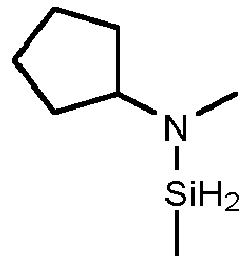
N-methyl-N-iso-propylamino-methylsilane N-sec-butyl-N-methylamino-methylsilane N-cyclohexyl-N-methylamino-methylsilane N-methyl-N-cyclopentylamino-methylsilane 
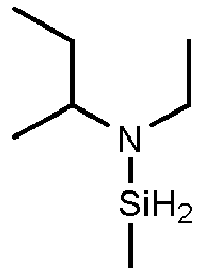


N-ethyl-N-iso-propylamino-methylsilane N-sec-butyl-N-ethylamino-methylsilane N-ethyl-N-cyclohexylamino-methylsilane N-ethyl-N-cyclopentylamino-methylsilane 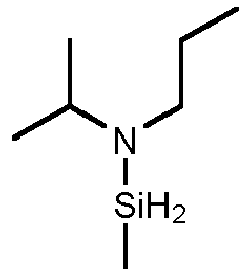


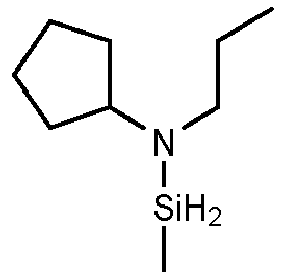
N-n-propyl-N-iso-propylamino-methylsilane N-sec-butyl-N-n-propylamino-methylsilane N-cyclohexyl-N-n-propylamino-methylsilane N-cyclopentyl-N-n-propylamino-methylsilane 


N,N-di-iso-propylamino-methylsilane N-sec-butyl-N-iso-propylamino-methylsilane N-cyclohexyl-N-iso-propylamino-methylsilane N-cyclopentyl-N-iso-propylamino-methylsilane 


N,N-di-sec-butylamino-methylsilane N-sec-butyl-N-cyclohexylamino-methylsilane N-sec-butyl-N-cyclopentylamino-methylsilane N-tert-butyl-N-iso-propylamino-methylsilane 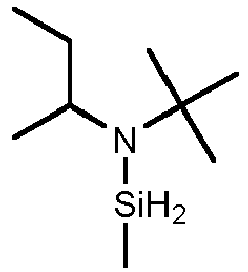

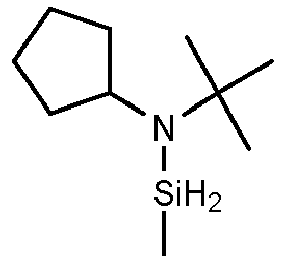

N-sec-butyl-N-tert-butylamino-methylsilane N-tert-butyl-N-cyclohexylamino-methylsilane N-tert-butyl-N-cyclopentylamino-methylsilane N,N-dicyclohexylamino-methylsilane 


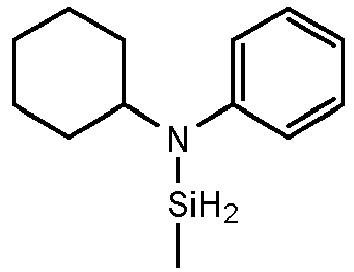
N-cyclohexyl-N-cyclopentylamino-methylsilane N-phenyl-N-iso-propylamino-methylsilane N-sec-butyl-N-phenylamino-methylsilane N-cyclohexyl-N-phenylamino-methylsilane 


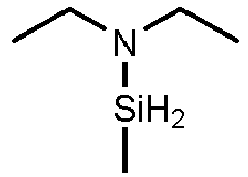
N-cyclopentyl-N-phenylamino-methylsilane N-ethyl-N-phenylamino-methylsilane N,N-dimethylamino-methylsilane N,N-diethylamino-methylsilane 
N,N-di-n-propylamino-methylsilane Table 17. Exemplary Organoaminocarbosilane (more specifically organoaminophenylsilane) Compounds 


N-methyl-N-iso-propylamino-phenylsilane N-sec-butyl-N-methylamino-phenylsilane N-cyclohexyl-N-methylamino-phenylsilane N-methyl-N-cyclopentylamino-phenylsilane 


N-ethyl-N-iso-propylamino-phenylsilane N-sec-butyl-N-ethylamino-phenylsilane N-ethyl-N-cyclohexylamino-phenylsilane N-ethyl-N-cyclopentylamino-phenylsilane 


N-n-propyl-N-iso-propylamino-phenylsilane N-sec-butyl-N-n-propylamino-phenylsilane N-cyclohexyl-N-n-propylamino-phenylsilane N-cyclopentyl-N-n-propylamino-phenylsilane 


N,N-di-iso-propylamino-phenylsilane N-sec-butyl-N-iso-propylamino-phenylsilane N-cyclohexyl-N-iso-propylamino-phenylsilane N-cyclopentyl-N-iso-propylamino-phenylsilane 


N,N-di-sec-butylamino-phenylsilane N-sec-butyl-N-cyclohexylamino-phenylsilane N-sec-butyl-N-cyclopentylamino-phenylsilane N-tert-butyl-N-iso-propylamino-phenylsilane 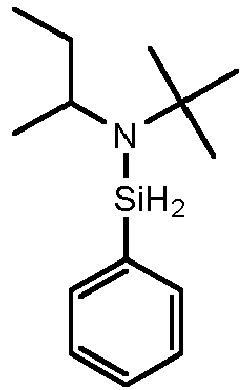


N-sec-butyl-N-tert-butylamino-phenylsilane N-tert-butyl-N-cyclohexylamino-phenylsilane N-tert-butyl-N-cyclopentylamino-phenylsilane N,N-dicyclohexylamino-phenylsilane 

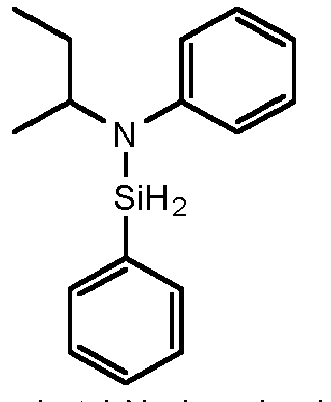

N-cyclohexyl-N-cyclopentylamino-phenylsilane N-phenyl-N-iso-propylamino-phenylsilane N-sec-butyl-N-phenylamino-phenylsilane N-cyclohexyl-N-phenylamino-phenylsilane 


N-cyclopentyl-N-phenylamino-phenylsilane N-ethyl-N-phenylamino-phenylsilane N,N-dimethylamino-phenylsilane N,N-diethylamino-phenylsilane 
N,N-di-n-propylamino-phenylsilane - In another embodiment of the method described herein, the compound selected from orgnoaminosilane, organoaminodisilane, or organoaminocarbosilane is reacted with a proton source to provide an organoamine. In this embodiment, the step, of reacting the compound with a proton source, could be performed prior to or after the purification of the compound. The reagents could be combined neat or, alternatively in the presence of a solvent (e.g., at least one of the proton source or the compound is dissolved in solvent). An excess of proton source can be used to drive the reaction to completion, aid in the purification process, or both. Alternatively, a slight deficiency of the proton source can be used to eliminate the need of separating unreacted proton source from the organoamine product. In one particular embodiment, the proton source is delivered as a vapor into the reaction solution comprising the organoaminosilane. The protonation step (e.g., reaction of the proton source with the compound) could be performed in the temperature range between -50°C to 150°C for the addition of reagents and/or for the extent of the reaction. In some embodiments, the protonation step may be carried out at lower temperature (below 0 °C) in order to help remove heat and prevent side reactions. In other embodiments, higher temperatures (above 30 °C) may be preferred to drive the intended protonation reaction to completion. Reaction times could range from 5 minutes to 30 minutes, to 1 h, to 6h, to 12 h, to 24 hr or more. The protonation reaction mixture may likely yield more than one phase (liquid-liquid or liquid-solid) which can be separated by filtration, decantation, separator funnel, distillation, adsorption, centrifugation, or other means. Purification of the end organoamine product may be accomplished by distillation, column chromatography, gas chromatography, sublimation, crystallization, or other purification processes.
- Aspects of the present invention including the following aspects, numbered #1 to #13:
- #1. A method for preparing a compound selected from an organoaminosilane, an organoaminodisilane, and an organoaminocarbosilane, the method comprising the steps of:
- reacting an imine having a formula R-N=CR'R" wherein R, R' and R" are each independently selected from hydrogen, a C1-10 linear alkyl group, a C3-10 branched alkyl, a C3-10 cyclic alkyl group, a C2-10 alkenyl group, a C4-10 aromatic group, a C4-10 heterocyclic group, a C1-10 linear organoamino group, a C2-10 branched organoamino group, a silyl group, a C1-10 linear carbosilyl group, and a C2-10 branched carbosilyl group, wherein at least one of R' and R" or R and R', or
- none of R' and R" or R and R' are be linked to form a substituted or unsubstituted cyclic ring and a silicon source comprising a hydridosilane in the presence of a catalyst under reaction conditions sufficient for the imine and silicon source to react and provide the compound.
- #2. The method of Aspect #1 wherein the compound comprises the organoaminosilane and is at least one selected from the group consisting of: N,N-di-iso-propylaminosilane, N-sec-butyl-N-iso-propylaminosilane, N,N-di-sec-butyl-aminosilane, N-methyl-N-cyclopentylaminosilane, N-ethyl-N-cyclopentylaminosilane, N-cyclopentyl-N-n-propylaminosilane, N-cyclopentyl-N-iso-propylaminosilane, N-cyclohexyl-N-methylaminosilane, N-ethyl-N-cyclohexylaminosilane, and N-cyclohexyl-N-iso-propylaminosilane.
- #3. The method of Aspect #1 wherein the compound comprises the organoaminodisilane and is at least one selected from the group consisting of: N,N-di-iso-propylaminodisilane, N-sec-butyl-N-iso-propylaminodisilane, N,N-di-sec-butyl-aminodisilane, N-ethyl-N-cyclopentylaminodisilane, N-cyclopentyl-N-n-propylaminodisilane, N-cyclopentyl-N-iso-propylaminodisilane, N-sec-butyl-N-cyclopentylaminodisilane, N-cyclohexyl-N-methylaminodisilane, N-ethyl-N-cyclohexylaminodisilane, and N-cyclohexyl-N-iso-propylaminodisilane.
- #4. The method of Aspect #1 wherein the compound comprises the organoaminocarbosilane and is at least one selected from the group consisting of: 1-(N,N-di-iso-propylamino)-1,4-disilabutane, 1-(N,N-di-iso-propylamino)-1,3-disilapropane, 1-(N,N-di-iso-propylamino)-2-methyl-1,3-disilapropane, 1-(N,N-di-iso-propylamino)-1-silacyclopentane, 1-(N,N-di-iso-propylamino)-1,3-disilacyclobutane, N,N-di-iso-propylamino-methylsilane, N-n-propyl-N-iso-propylamino-methylsilane, N-sec-butyl-N-iso-propylamino-methylsilane, N-cyclohexyl-N-iso-propylamino-methylsilane, and N,N-diethylamino-phenylsilane.
- #5. The method of Aspect #1 wherein the compound comprises 100 ppm or less of halide.
- #6. The method of Aspect #5 wherein the compound comprises 10 ppm or less of halide.
- #7. The method of Aspect #5 wherein the compound comprises 1 ppm or less of halide.
- #8. The method of Aspect #1 wherein the catalyst comprises a halide-free catalyst and wherein the compound is substantially free of halide.
- #9. The method of Aspect #1 wherein the catalyst comprises an alkaline earth metal complex.
- #10. The method of Aspect #1 wherein the hydridosilane has a formula R1R2R3SiH wherein R1, R2 and R3 are each independently selected from hydrogen, a C1-10 linear alkyl group, a C3-10 branched alkyl group, a C4-10 cyclic alkyl group, a C2-10 alkenyl group, a C4-10 aromatic group, a C4-10 heterocyclic group, a C1-10 linear organoamino group, a C2-10 branched organoamino group, a silyl group, a C1-10 linear carbosilyl group, and a C2-10 branched carbosilyl group and wherein at least one of R1 and R2, R1 and R3, R2 and R3 or none of R1 and R2, R1 and R3, or R2 and R3 are linked to form a substituted or unsubstituted cyclic ring.
- #11. A method of preparing an organoamine having a formula HN(R)(CHR'R") wherein R, R' and R" are each independently selected from hydrogen, a C1-10 linear alkyl group, a C3-10 branched alkyl group, a C3-10 cyclic alkyl group, a C2-10 alkenyl group, a C4-10 aromatic group, a C4-10 heterocyclic group, a C1-10 linear organoamino group, a C2-10 branched organoamino group, a C1-10 linear carbosilyl group, and a C2-10 branched carbosilyl groups wherein at least one of R' and R" or R and R' or none of R' and R" or R and R' are linked to form a substituted or an unsubstituted cyclic ring, the method comprising the steps of:
- reacting an imine having a formula R-N=CR'R" wherein R, R' and R" are each independently selected from hydrogen, a C1-10 linear alkyl group, a C3-10 branched alkyl group, a C3-10 cyclic alkyl group, a C2-10 alkenyl group, a C4-10 aromatic group, a C4-10 heterocyclic group, a C1-10 linear organoamino group, a C2-10 branched organoamino groups, a silyl group, a C1-10 linear carbosilyl group, and a C2-10 branched carbosilyl group wherein at least one of R' and R" or R and R' or none of R' and R" or R and R' are linked to form a substutitued or unsubstituted cyclic ring and a silicon source comprising a hydridosilane in the presence of an alkaline earth metal catalyst under conditions sufficient for the imine and silicon source to react and provide a compound selected from an organoaminosilane, an organoaminodisilane, and an organoaminocarbosilane;
- reacting the compound with a proton source under conditions sufficient to provide the organoamine.
- #12. A method described in Aspect #11 wherein the proton source is selected from the group consisting of water, alcohol, or Brønsted acid.
- #13. An organoaminocarbosilane compound represented by the following structures:

- The following examples illustrate the method described herein for preparing compounds such as, without limitation organoaminosilanes, organoaminodisilanes, organoaminocarbosilanes, and is not intended to limit it in any way.
- For the following examples, gas chromatography (GC-TCD), mass spectrometry (GC-MS), and 1H NMR spectroscopy were used to identify and quantify the solution compositions as appropriate. Gas chromatographic analyses were carried out on the product effluent using a TCD equipped HP-5890 Series II GC and a 0.53mm diameter x 30m Supleco column containing 3µm thick SPB-5 media. Chloride analyses were performed by hydrolyzing the sample with water at 85 °C and injecting the liquid phase into a Metrohm Ion Chromatography instrument equipped with a conductivity detector.
- The catalyst Ru3(CO)12 (0.10 g, 0.16 mmol) was dissolved in the imine N-iso-propylidene-iso-propylamine (7.0 g, 71 mmol) and the resulting solution was exposed to a silicon source gas (SiH4) at 82 psia (575 kPa) for 6 hours at 40 °C. The resulting reaction solution was determined by GC-MS to contain N,N-di-iso-propylaminosilane. GC-MS showed the following peaks: 131 (M+), 126 (M-15), 116, 110, 98, 88, 74.
- The catalyst Ru3(CO)12 (0.10 g, 0.16 mmol) was dissolved in the imine N-iso-propylidene-sec-butylamine (7.0 g, 71 mmol) and the resulting solution was exposed to a disilane gas (Si2H6) at 102 psia (703 kPa) for 6 hours at 40 °C. The reaction solution was determined by GC-MS to contain N,N-di-iso-propylaminodisilane. GC-MS showed the following peaks: 161 (M+), 146 (M-15), 128, 114, 104, 88, 72.
- A mixture of a silicon source, 1,4-disilabutane (0.48 g, 5.3 mmol), and the imine N-iso-propylidene-iso-propylamine (0.25 g, 2.5 mmol) was added to a stirred suspension of the catalyst, anhydrous NiCl2 (0.02 g, 0.15 mmol), in tetrahyrdofuran (THF) (1 mL), in a nitrogen-filled glovebox. After 2 days of stirring at room temperature, the resulting brown mixture was filtered to remove catalyst sediments and was determined by GC and GC-MS to contain the end product 1-(N,N-di-iso-propylamino)-1,4-disilabutane. GC-MS showed the following peaks: 189 (M+), 188 (M-1), 174 (M-15), 159, 144, 130, 102.
- A mixture of a silicon source, 1,4-disilabutane (0.50 g, 5.54 mmol), and the imine N-sec-butylidene-sec-butylamine (0.35 g, 2.75 mmol) was added to a stirred solution of the catalyst (Ph3P)3RhCl (0.02 g, 0.02 mmol) in THF (0.5 mL). After 1 day of stirring, the imine was completely consumed, and the resulting orange solution was determined by GC and GC-MS to contain the end product 1-(N,N-di-sec-butylamino)-1,4-disilabutane. GC-MS showed the following peaks: 217 (M+), 202 (M-15), 189, 172, 158, 144, 132, 114, 102.
- A mixture of a silicon source, 1,4-disilabutane (0.50 g, 5.54 mmol), and the imine N-sec-butylidene-iso-propylamine (0.32 g, 2.83 mmol) was added to a stirred solution of the catalyst (Ph3P)3RhCl (0.02 g, 0.02 mmol) in THF (0.5 mL). After 1 day of stirring, the imine was completely consumed, and the resulting orange solution was determined by GC and GC-MS to contain the end product 1-(N-sec-butyl-N-iso-propylamino)-1,4-disilabutane. GC-MS showed the following peaks: 203 (M+), 188 (M-15), 174, 158, 144, 130, 119, 102.
- The solid catalyst Ca[N(SiMe3)2]2 (0.01 g, 0.03 mmol) was added to a mixture of a silicon source, 1-methyl-1-silacyclopentane (0.15 g, 1.5 mmol), and the imine N-iso-propylidene-iso-propylamine (0.15 g, 1.5 mmol). After 2 weeks, the pale yellow reaction solution was determined by GC and GC-MS to contain 1-(N,N-di-iso-propylamino)-1-methyl-1-silacyclopentane as the major product. GC-MS showed the following peaks: 199 (M+), 179, 164, 148, 134, 122, 107, 91, 81, 77.
- A solution of the catalyst (Ph3P)3RhCl (0.01 g, 0.01 mmol) in THF (1 mL) was added to a stirred solution of a silicon source, phenylsilane (0.30 g, 2.77 mmol), and the imine N-iso-propylidene-iso-propylamine (0.12 g, 1.21 mmol). After 1 day of stirring, the imine was almost completely consumed, and the resulting orange solution was determined by GC and GC-MS to contain N,N-di-iso-propylamino-phenylsilane as the major product. GC-MS showed the following corresponding peaks: 207 (M+), 192 (M-15), 177, 164, 150, 134, 121, 107, 86, 72. Minor products observed include N,N-di-iso-propylaminosilane, bis(N,N-di-iso-propylamino)silane, and diphenylsilane.
- Traditional method to make organoaminocarbosilane: Chlorodiethysilane (18.5 g, 151 mmol) was added dropwise to a stirred solution of di-n-propylamine (32.1 g, 317 mmol) in hexanes (250 mL) at -15 °C. The resulting white slurry was allowed to warm to room temperature while stirring. The white solids were removed by filtration and the colorless filtrate was purified by vacuum distillation to obtain 22.2 g of N,N-di-n-propylaminodiethylsilane. GC-MS showed the following peaks: 187 (M+), 172 (M-15), 158, 144, 130, 116, 100, 87, 72. This product was determined after hydrolysis to contain 537 ppm chloride.
- Method to make organoaminocarbosilane in accordance with the present invention: A solution of the catalyst (Ph3P)3RhCl (0.40 mL, 0.029 M, 0.012 mmol) in THF was added to a stirred solution of a silicon source, diethylsilane (14.6 g, 165 mmol), and the imine N-n-propylidene-n-propylamine (14.4 g, 145 mmol). After 3 days of stirring, the reaction solution was purified by vacuum distillation to obtain 21.4 g of N,N-di-n-propylaminodiethylsilane. This product was determined after hydrolysis to contain 22 ppm chloride, demonstrating the hydrosilylation route provides much less chloride contamination than the route employing chlorosilanes as starting material. Furthermore, the chloride (or other halide) content can be reduced to non-detectable if halide-free catalysts are being employed in the hydrosilylation.
- Additional organoaminosilanes, organoaminodisilanes, and organoaminocarbosilanes were made via similar fashion as Examples 1 to 8 and were characterized by GC-MS. The molecular weight (MW), the structure, and corresponding major MS fragmentation peaks of each compound are provided in Table 18 to confirm their identification.
Table 18. Organoaminosilane, organoaminodisilane, or organoaminocarbosilane compounds synthesized via hydrosilylation of imines. Ex. Precursor Name MW Structure MS Peaks 9 N-sec-butyl-N-iso-propylaminosilane (cf. Table 2) 145.32 
145, 130, 116, 100, 88, 74 10 N,N-di-sec-butylaminosilane (cf. Table 2) 159.35 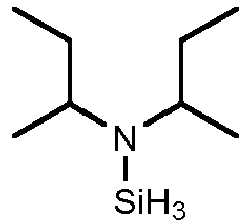
159, 144, 130, 114, 100, 88, 74, 11 N-sec-butyl-N-iso-propylaminodisilane (cf. Table 3) 175.42 
175, 160, 146, 128, 114, 104, 86, 72 12 N,N-di-sec-butylaminosilane (cf. Table 3) 189.45 
189, 174, 160, 142, 128, 118, 104, 86, 72 13 1,2-bis(N,N-di-iso-propylamino)disilane (cf. Table 4) 260.57 
260, 245, 229, 215, 187, 173, 158, 144,128, 116, 100, 86 14 1,2-bis(N-sec-butyl-N-iso-propylamino)disilane (cf. Table 4) 288.63 
288, 273, 259, 172, 158, 144, 130,116,100, 86, 72 15 1-(N-n-propyl-N-iso-propylamino)-1,4-disilabutane (cf. Table 5) 189.45 
189, 174, 160, 144, 130, 116, 102, 86 16 1,4-bis(N-n-propyl-N-iso-propylamino)-1,4-disilabutane (cf. Table 6) 288.63 
288, 274, 260, 244, 230, 216, 201, 188, 173, 160, 144, 128 17 1,4-bis(N,N-di-iso-propylamino)-1,4-disilabutane (cf. Table 6) 288.63 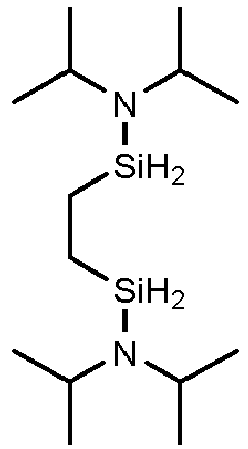
288, 287, 243, 229, 207, 188, 144,130 18 1,4-bis(N-sec-butyl-N-iso-propylamino)-1,4-disilabutane (cf. Table 6) 316.68 
316, 301, 281, 257, 243, 229, 215, 202, 186, 172, 158 19 1-(N,N-di-iso-propylamino)-silacyclopentane (cf. Table 11) 185.39 
185, 170, 154, 142, 128, 112, 99, 85, 70 20 1-(N,N-di-iso-propylamino)-1,3-disilacyclobutane (cf. Table 14) 187.43 
187, 172, 159, 143, 130, 115, 101, 86, 73 21 1,3-bis(N,N-di-iso-propylamino)-1,3-disilacyclobutane (cf. Table 15) 286.61 
286, 271, 243, 229, 213, 186, 172, 144, 128, 101, 87, 70
Claims (13)
- A method for preparing a compound selected from an organoaminosilane, an organoaminodisilane, and an organoaminocarbosilane, the method comprising:
reacting an imine, having a formula R-N=CR'R", and a silicon source, comprising a hydridosilane, in the presence of a catalyst under reaction conditions sufficient for the imine and silicon source to react and provide the compound, wherein R, R' and R" are each independently selected from hydrogen, a C1-10 linear alkyl group, a C3-10 branched alkyl, a C3-10 cyclic alkyl group, a C2-10 alkenyl group, a C4-10 aromatic group, a C4-10 heterocyclic group, a C1-10 linear organoamino group, a C2-10 branched organoamino group, a silyl group, a C1-10 linear carbosilyl group, and a C2-10 branched carbosilyl group, wherein at least one of R' and R" or R and R', or none of R' and R" or R and R' are linked to form a substituted or unsubstituted cyclic ring. - The method of Claim 1 wherein the compound is an organoaminosilane selected from the group consisting of: N,N-di-iso-propylaminosilane, N-sec-butyl-N-iso-propylaminosilane, N,N-di-sec-butyl- aminosilane, N-methyl-N-cyclopentylaminosilane, N-ethyl-N-cyclopentylaminosilane, N-cyclopentyl-N-n-propylaminosilane, N-cyclopentyl-N-iso-propylaminosilane, N-cyclohexyl-N-methylaminosilane, N-ethyl-N-cyclohexylaminosilane, and N-cyclohexyl-N-iso-propylaminosilane.
- The method of Claim 1 wherein the compound is an organoaminodisilane selected from the group consisting of: N,N-di-iso-propylaminodisilane, N-sec-butyl-N-iso-propylaminodisilane, N,N-di-sec-butyl-aminodisilane, N-ethyl-N-cyclopentylaminodisilane, N-cyclopentyl-N-n-propylaminodisilane, N-cyclopentyl-N-iso-propylaminodisilane, N-sec-butyl-N-cyclopentylaminodisilane, N-cyclohexyl-N-methylaminodisilane, N-ethyl-N-cyclohexylaminodisilane, and N-cyclohexyl-N-iso-propylaminodisilane.
- The method of Claim 1 wherein the compound is an organoaminocarbosilane selected from the group consisting of: 1-(N,N-di-iso-propylamino)-1,4-disilabutane, 1-(N,N-di-iso-propylamino)-1,3-disilapropane, 1-(N,N-di-iso-propylamino)-2-methyl-1,3-disilapropane, 1-(N,N-di-iso-propylamino)-1-silacyclopentane, 1-(N,N-di-iso-propylamino)-1,3-disilacyclobutane, N,N-di-iso-propylamino-methylsilane, N-n-propyl-N-iso-propylamino-methylsilane, N-sec-butyl-N-iso-propylamino-methylsilane, N-cyclohexyl-N-iso-propylamino-methylsilane, and N,N-diethylamino-phenylsilane.
- The method of any preceding claim wherein the compound is present in a composition that comprises 100 ppm or less of halide.
- The method of any one of Claims 1 to 4 wherein the compound is present in a composition that comprises 10 ppm or less of halide.
- The method of any one of Claims 1 to 4 wherein the compound is present in a composition that comprises 1 ppm or less of halide.
- The method of any one of Claims 1 to 4 wherein the catalyst comprises a halide-free catalyst and wherein the compound is present in a composition that is substantially free of halide.
- The method of any preceding claim wherein the catalyst comprises an alkaline earth metal complex.
- The method of any preceding claim wherein the hydridosilane has a formula R1R2R3SiH wherein R1, R2 and R3 are each independently selected from hydrogen, a C1-10 linear alkyl group, a C3-10 branched alkyl group, a C4-10 cyclic alkyl group, a C2-10 alkenyl group, a C4-10 aromatic group, a C4-10 heterocyclic group, a C1-10 linear organoamino group, a C2-10 branched organoamino group, a silyl group, a C1-10 linear carbosilyl group, and a C2-10 branched carbosilyl group and wherein at least one of R1 and R2, R1 and R3, R2 and R3 or none of R1 and R2, R1 and R3, or R2 and R3 are linked to form a substituted or unsubstituted cyclic ring.
- A method of preparing an organoamine having a formula HN(R)(CHR'R") wherein R, R' and R" are each independently selected from hydrogen, a C1-10 linear alkyl group, a C3-10 branched alkyl group, a C3-10 cyclic alkyl group, a C2-10 alkenyl group, a C4-10 aromatic group, a C4-10 heterocyclic group, a C1-10 linear organoamino group, a C2-10 branched organoamino group, a C1-10 linear carbosilyl group, and a C2-10 branched carbosilyl groups wherein at least one of R' and R" or R and R' or none of R' and R" or R and R' are linked to form a substituted or an unsubstituted cyclic ring, the method comprising the steps of:preparing, in accordance with the method of any one of Claims 1 to 10, a compound selected from an organoaminosilane, an organoaminodisilane, and an organoaminocarbosilane; andreacting the compound with a proton source under conditions sufficient to provide the organoamine.
- A method described in Claim 11 wherein the proton source is selected from the group consisting of water, alcohol, or Brønsted acid.
- An organoaminocarbosilane compound represented by the following structures:

Applications Claiming Priority (3)
| Application Number | Priority Date | Filing Date | Title |
|---|---|---|---|
| US201461946164P | 2014-02-28 | 2014-02-28 | |
| US14/625,158 US9233990B2 (en) | 2014-02-28 | 2015-02-18 | Organoaminosilanes and methods for making same |
| EP15157000.9A EP2913334B1 (en) | 2014-02-28 | 2015-02-27 | Organoaminosilanes and methods for making same |
Related Parent Applications (2)
| Application Number | Title | Priority Date | Filing Date |
|---|---|---|---|
| EP15157000.9A Division EP2913334B1 (en) | 2014-02-28 | 2015-02-27 | Organoaminosilanes and methods for making same |
| EP15157000.9A Division-Into EP2913334B1 (en) | 2014-02-28 | 2015-02-27 | Organoaminosilanes and methods for making same |
Publications (2)
| Publication Number | Publication Date |
|---|---|
| EP3395822A1 true EP3395822A1 (en) | 2018-10-31 |
| EP3395822B1 EP3395822B1 (en) | 2020-03-25 |
Family
ID=52596806
Family Applications (2)
| Application Number | Title | Priority Date | Filing Date |
|---|---|---|---|
| EP15157000.9A Active EP2913334B1 (en) | 2014-02-28 | 2015-02-27 | Organoaminosilanes and methods for making same |
| EP18177680.8A Active EP3395822B1 (en) | 2014-02-28 | 2015-02-27 | Organoaminosilanes and methods for making same |
Family Applications Before (1)
| Application Number | Title | Priority Date | Filing Date |
|---|---|---|---|
| EP15157000.9A Active EP2913334B1 (en) | 2014-02-28 | 2015-02-27 | Organoaminosilanes and methods for making same |
Country Status (6)
| Country | Link |
|---|---|
| US (3) | US9233990B2 (en) |
| EP (2) | EP2913334B1 (en) |
| JP (2) | JP6046758B2 (en) |
| KR (2) | KR101873565B1 (en) |
| CN (1) | CN104876957B (en) |
| TW (1) | TWI540138B (en) |
Families Citing this family (31)
| Publication number | Priority date | Publication date | Assignee | Title |
|---|---|---|---|---|
| US10453675B2 (en) * | 2013-09-20 | 2019-10-22 | Versum Materials Us, Llc | Organoaminosilane precursors and methods for depositing films comprising same |
| KR102326396B1 (en) | 2013-09-27 | 2021-11-12 | 레르 리키드 쏘시에떼 아노님 뿌르 레드 에렉스뿔라따시옹 데 프로세데 조르즈 클로드 | Amine substituted trisilylamine and tridisilylamine compounds |
| US9233990B2 (en) * | 2014-02-28 | 2016-01-12 | Air Products And Chemicals, Inc. | Organoaminosilanes and methods for making same |
| US9969756B2 (en) | 2014-09-23 | 2018-05-15 | L'Air Liquide, Société Anonyme pour l'Etude et l'Exploitation des Procédés George Claude | Carbosilane substituted amine precursors for deposition of Si-containing films and methods thereof |
| US10354860B2 (en) * | 2015-01-29 | 2019-07-16 | Versum Materials Us, Llc | Method and precursors for manufacturing 3D devices |
| US9777025B2 (en) | 2015-03-30 | 2017-10-03 | L'Air Liquide, Société pour l'Etude et l'Exploitation des Procédés Georges Claude | Si-containing film forming precursors and methods of using the same |
| TWI716333B (en) | 2015-03-30 | 2021-01-11 | 法商液態空氣喬治斯克勞帝方法研究開發股份有限公司 | Catalyst dehydrogenative coupling of carbosilanes with ammonia, amnines and amidines |
| EP3310942B1 (en) * | 2015-06-16 | 2022-07-13 | Versum Materials US, LLC | Processes for depositing silicon-containing films |
| US11111256B2 (en) * | 2015-12-18 | 2021-09-07 | Jiangsu Nata Opto-Electronic Materials Co. Ltd. | High purity trisilylamine, methods of making, and use |
| US9701695B1 (en) * | 2015-12-30 | 2017-07-11 | American Air Liquide, Inc. | Synthesis methods for amino(halo)silanes |
| US10053775B2 (en) | 2015-12-30 | 2018-08-21 | L'air Liquide, Societé Anonyme Pour L'etude Et L'exploitation Des Procédés Georges Claude | Methods of using amino(bromo)silane precursors for ALD/CVD silicon-containing film applications |
| TWI724141B (en) | 2016-03-23 | 2021-04-11 | 法商液態空氣喬治斯克勞帝方法硏究開發股份有限公司 | Si-containing film forming compositions and methods of making and using the same |
| US10464953B2 (en) * | 2016-10-14 | 2019-11-05 | Versum Materials Us, Llc | Carbon bridged aminosilane compounds for high growth rate silicon-containing films |
| US11735413B2 (en) | 2016-11-01 | 2023-08-22 | Versum Materials Us, Llc | Precursors and flowable CVD methods for making low-k films to fill surface features |
| JP7100036B2 (en) * | 2016-12-27 | 2022-07-12 | ナタ セミコンダクター マテリアルズ カンパニー リミテッド | Catalysis of dehydrogenation coupling reaction between amines and silanes |
| TWI784022B (en) | 2017-07-31 | 2022-11-21 | 中國大陸商南大光電半導體材料有限公司 | 1,1,1-tris(dimethylamino)disilane and method of preparing same |
| WO2019055393A1 (en) * | 2017-09-14 | 2019-03-21 | Versum Material Us, Llc | Compositions and methods for depositing silicon-containing films |
| US20190211039A1 (en) * | 2017-12-08 | 2019-07-11 | Rohm And Haas Electronic Materials Llc | Hydrocarbyloxydisilanes |
| CN108084219B (en) * | 2017-12-26 | 2020-09-15 | 浙江博瑞电子科技有限公司 | Synthesis method of bis (diethylamino) silane |
| KR102872468B1 (en) * | 2018-05-23 | 2025-10-24 | 다우 실리콘즈 코포레이션 | Method for producing organoaminosilane |
| EP3902939A4 (en) * | 2019-02-05 | 2022-09-28 | Versum Materials US, LLC | Deposition of carbon doped silicon oxide |
| US20210017198A1 (en) | 2019-04-05 | 2021-01-21 | Versum Materials Us, Llc | Organoamino-Functionalized Cyclic Oligosiloxanes For Deposition Of Silicon-Containing Films |
| US11649560B2 (en) | 2019-06-20 | 2023-05-16 | Applied Materials, Inc. | Method for forming silicon-phosphorous materials |
| US11466037B2 (en) * | 2019-10-31 | 2022-10-11 | Nata Semiconductor Materials Co., Ltd. | Catalysis of dehydrocoupling reactions between amines and silanes |
| CN115443347A (en) * | 2020-04-02 | 2022-12-06 | 弗萨姆材料美国有限责任公司 | Organoaminofunctional Cyclic Oligosiloxanes for Depositing Silicon-Containing Films |
| TWI797640B (en) | 2020-06-18 | 2023-04-01 | 法商液態空氣喬治斯克勞帝方法研究開發股份有限公司 | Silicon-based self-assembling monolayer compositions and surface preparation using the same |
| CN112210769B (en) * | 2020-09-29 | 2023-04-25 | 合肥安德科铭半导体科技有限公司 | A method for atomic layer deposition of silicon oxide thin films at low temperature and high growth rate |
| FR3126417B1 (en) * | 2021-08-31 | 2024-06-21 | Elkem Silicones France Sas | Hydrosilylation process catalyzed by an iron complex |
| CN115260223B (en) * | 2022-09-26 | 2022-12-23 | 江苏南大光电材料股份有限公司 | Use of chlorine-free catalysts for producing diisopropylamine silanes |
| KR102858392B1 (en) | 2023-07-18 | 2025-09-11 | 주식회사 한솔케미칼 | Method for the formation of thin films using two types of silicon precursor |
| KR20250085041A (en) | 2023-12-04 | 2025-06-12 | (주)원익머트리얼즈 | Method for producing di-alkylaminodisilane |
Citations (8)
| Publication number | Priority date | Publication date | Assignee | Title |
|---|---|---|---|---|
| JPS49110673A (en) | 1973-03-07 | 1974-10-22 | ||
| US6072085A (en) | 1997-09-30 | 2000-06-06 | Massachusetts Institute Of Technology | Imine hydrosilylation, uses and reagents related thereto |
| FR2833944A1 (en) * | 2001-12-20 | 2003-06-27 | Rhodia Chimie Sa | Production of amines by reacting imines with a silane reducing agent comprises using a catalyst selected from triflate or carboxylate salts, zinc or cobalt halides or alkoxides |
| US6963003B2 (en) | 2002-10-28 | 2005-11-08 | Vision-Ease Lane | Oxygen-containing heterocyclic fused naphthopyrans |
| US7875556B2 (en) | 2005-05-16 | 2011-01-25 | Air Products And Chemicals, Inc. | Precursors for CVD silicon carbo-nitride and silicon nitride films |
| KR101040325B1 (en) | 2009-08-25 | 2011-06-10 | (주)디엔에프 | Method for producing alkylaminosilane |
| US20120277457A1 (en) | 2010-10-12 | 2012-11-01 | Air Products And Chemicals, Inc. | Aminosilanes and methods for making same |
| EP2860182A2 (en) * | 2013-09-20 | 2015-04-15 | Air Products And Chemicals, Inc. | Organoaminosilane precursors and methods for depositing films comprising same |
Family Cites Families (6)
| Publication number | Priority date | Publication date | Assignee | Title |
|---|---|---|---|---|
| JPS5736424Y2 (en) | 1973-01-17 | 1982-08-11 | ||
| JPS519738B2 (en) * | 1973-03-07 | 1976-03-30 | ||
| US4965367A (en) * | 1989-10-16 | 1990-10-23 | Dow Corning Corporation | Process for preparation of silacyclobutanes |
| FR2739283B1 (en) | 1995-09-29 | 1997-11-07 | Oreal | TOPICAL COMPOSITION CONTAINING A SILICONE GRAFT POLYMER AND AN AMPHIPHILIC FATTY CHAIN POLYMER |
| US8530361B2 (en) | 2006-05-23 | 2013-09-10 | Air Products And Chemicals, Inc. | Process for producing silicon and oxide films from organoaminosilane precursors |
| US9233990B2 (en) * | 2014-02-28 | 2016-01-12 | Air Products And Chemicals, Inc. | Organoaminosilanes and methods for making same |
-
2015
- 2015-02-18 US US14/625,158 patent/US9233990B2/en active Active
- 2015-02-24 TW TW104105880A patent/TWI540138B/en active
- 2015-02-27 EP EP15157000.9A patent/EP2913334B1/en active Active
- 2015-02-27 JP JP2015038477A patent/JP6046758B2/en active Active
- 2015-02-27 KR KR1020150027946A patent/KR101873565B1/en active Active
- 2015-02-27 EP EP18177680.8A patent/EP3395822B1/en active Active
- 2015-02-28 CN CN201510091650.6A patent/CN104876957B/en active Active
- 2015-12-02 US US14/956,748 patent/US9758534B2/en active Active
-
2016
- 2016-11-07 JP JP2016217206A patent/JP2017066147A/en active Pending
-
2017
- 2017-03-30 US US15/474,789 patent/US10294250B2/en active Active
-
2018
- 2018-06-26 KR KR1020180073562A patent/KR102201058B1/en active Active
Patent Citations (8)
| Publication number | Priority date | Publication date | Assignee | Title |
|---|---|---|---|---|
| JPS49110673A (en) | 1973-03-07 | 1974-10-22 | ||
| US6072085A (en) | 1997-09-30 | 2000-06-06 | Massachusetts Institute Of Technology | Imine hydrosilylation, uses and reagents related thereto |
| FR2833944A1 (en) * | 2001-12-20 | 2003-06-27 | Rhodia Chimie Sa | Production of amines by reacting imines with a silane reducing agent comprises using a catalyst selected from triflate or carboxylate salts, zinc or cobalt halides or alkoxides |
| US6963003B2 (en) | 2002-10-28 | 2005-11-08 | Vision-Ease Lane | Oxygen-containing heterocyclic fused naphthopyrans |
| US7875556B2 (en) | 2005-05-16 | 2011-01-25 | Air Products And Chemicals, Inc. | Precursors for CVD silicon carbo-nitride and silicon nitride films |
| KR101040325B1 (en) | 2009-08-25 | 2011-06-10 | (주)디엔에프 | Method for producing alkylaminosilane |
| US20120277457A1 (en) | 2010-10-12 | 2012-11-01 | Air Products And Chemicals, Inc. | Aminosilanes and methods for making same |
| EP2860182A2 (en) * | 2013-09-20 | 2015-04-15 | Air Products And Chemicals, Inc. | Organoaminosilane precursors and methods for depositing films comprising same |
Non-Patent Citations (17)
| Title |
|---|
| ANDRIANOV, K. A. ET AL: "Reaction of the amino group of organoaminosilanes and organosilazanes with electron-donating solvents", ZHURNAL OBSHCHEI KHIMII , 43(5), 1057-61 CODEN: ZOKHA4; ISSN: 0044-460X, 1973 * |
| C. CHENG ET AL.: "Iridium-Catalyzed Reduction of Secondary Amides to Secondary Amines and Imines by Diethylsilane", J. AM. CHEM. SOC., vol. 134, 2012, pages 110304 - 110307 |
| DATABASE CA [online] CHEMICAL ABSTRACTS SERVICE, COLUMBUS, OHIO, US; ANDRIANOV, K. A. ET AL: "Reaction of the amino group of organoaminosilanes and organosilazanes with electron-donating solvents", XP002741542, retrieved from STN Database accession no. 1973:477605 * |
| DATABASE CA [online] CHEMICAL ABSTRACTS SERVICE, COLUMBUS, OHIO, US; KRAPIVIN, A. M. ET AL: "The NMR study and CNDO/2 molecular orbital calculation of silacyclobutanes", XP002741543, retrieved from STN Database accession no. 1980:531604 * |
| DATABASE CA [online] CHEMICAL ABSTRACTS SERVICE, COLUMBUS, OHIO, US; SLADKOVA, T. A. ET AL: "The effect of structure of silicon-containing nitrile on orientation of its catalytic reduction", XP002741541, retrieved from STN Database accession no. 1965:446348 * |
| H. GRUBER-WOELFLER ET AL.: "Titanocene-Catalyzed Hydrosilylation of Imines: Experimental and Computational Investigations of the Catalytically Active Species", ORGANOMETALLICS, vol. 28, 2009, pages 2546 - 2553 |
| HASHIMOTO ET AL., ORGANOMETALLICS, vol. 22, 2003, pages 2199 - 2201 |
| HASHIMOTO H ET AL: "STOICHIOMETRIC HYDROSILYLATION OF NITRILES AND CATALYTIC HYDRISILYLATION OF IMINES AND KETONES USING A MU-SILANE DIRUTHENIUM COMPLEX", ORGANOMETALLICS, ACS, WASHINGTON, DC, US, vol. 22, no. 11, 26 May 2003 (2003-05-26), pages 2199 - 2201, XP001161896, ISSN: 0276-7333, DOI: 10.1021/OM030219X * |
| I IOVEL ET AL: "HYDROSILYLATION OF HETEROCYCLIC ALDIMINES CATALYZED BY TRANSITION METAL COMPLEXES", CHEMISTRY OF HETEROCYCLIC COMPOUNDS, 1 January 2002 (2002-01-01), pages 46 - 53, XP055178661, Retrieved from the Internet <URL:http://download.springer.com/static/pdf/282/art%3A10.1023%2FA%3A1014899124792.pdf?auth66=1427179656_afe507b54a2fa331e8aa4d82bc88c89f&ext=.pdf> [retrieved on 20150324] * |
| IWAO OJIMA ET AL: "A novel method for the reduction of schiff bases using catalytic hydrosilylation", TETRAHEDRON LETTERS, 1 January 1973 (1973-01-01), pages 2475 - 2478, XP055194990, Retrieved from the Internet <URL:http://www.sciencedirect.com/science/article/pii/S0040403901961829> DOI: 10.1016/S0040-4039(01)96182-9 * |
| JULIA INTEMANN: "Magnesium and zinc hydride complexes: From fundamental investigations to potential applications in hydrogen storage and catalysis", PHD THESIS, 14 February 2014 (2014-02-14), pages 1 - 275, XP055299829, Retrieved from the Internet <URL:http://www.rug.nl/research/portal/files/3685422/2_thesis_intemann.pdf> [retrieved on 20160905] * |
| KRAPIVIN, A. M. ET AL: "The NMR study and CNDO/2 molecular orbital calculation of silacyclobutanes", JOURNAL OF ORGANOMETALLIC CHEMISTRY , 190(1), 9-33 CODEN: JORCAI; ISSN: 0022-328X, 1980, DOI: 10.1016/S0022-328X(00)82875-2 10.1016/S0022-328X(00)82875-2 * |
| L. HAO ET AL.: "Homogeneous Catalytic Hydrosilylation of Pyridines", ANGEW. CHEM., INT. ED., vol. 37, 1998, pages 3126 - 3129 |
| LESLIE D. FIELD ET AL: "Iridium(I)-Catalysed Tandem Hydrosilylation-Protodesilylation of Imines", EUROPEAN JOURNAL OF ORGANIC CHEMISTRY, vol. 2005, no. 14, 1 July 2005 (2005-07-01), pages 2881 - 2883, XP055178662, ISSN: 1434-193X, DOI: 10.1002/ejoc.200500168 * |
| LUIS C. MISAL CASTRO ET AL: "NHC-carbene cyclopentadienyl iron based catalyst for a general and efficient hydrosilylation of imines", CHEMICAL COMMUNICATIONS, vol. 48, no. 1, 1 January 2012 (2012-01-01), pages 151 - 153, XP055178659, ISSN: 1359-7345, DOI: 10.1039/C1CC14403K * |
| SJOERD HARDER: "From Limestone to Catalysis: Application of Calcium Compounds as Homogeneous Catalysts", CHEMICAL REVIEWS, vol. 110, no. 7, 14 July 2010 (2010-07-14), US, pages 3852 - 3876, XP055300418, ISSN: 0009-2665, DOI: 10.1021/cr9003659 * |
| SLADKOVA, T. A. ET AL: "The effect of structure of silicon-containing nitrile on orientation of its catalytic reduction", IZVESTIYA AKADEMII NAUK SSSR, SERIYA KHIMICHESKAYA , (6), 1061-5 CODEN: IASKA6; ISSN: 0002-3353, 1965 * |
Also Published As
| Publication number | Publication date |
|---|---|
| US9758534B2 (en) | 2017-09-12 |
| KR102201058B1 (en) | 2021-01-08 |
| TWI540138B (en) | 2016-07-01 |
| TW201533051A (en) | 2015-09-01 |
| EP3395822B1 (en) | 2020-03-25 |
| EP2913334A1 (en) | 2015-09-02 |
| JP6046758B2 (en) | 2016-12-21 |
| US20160168169A1 (en) | 2016-06-16 |
| CN104876957B (en) | 2019-04-19 |
| KR20180079259A (en) | 2018-07-10 |
| KR20150102725A (en) | 2015-09-07 |
| KR101873565B1 (en) | 2018-07-03 |
| US9233990B2 (en) | 2016-01-12 |
| US10294250B2 (en) | 2019-05-21 |
| JP2017066147A (en) | 2017-04-06 |
| US20170204120A1 (en) | 2017-07-20 |
| JP2015164917A (en) | 2015-09-17 |
| US20150246937A1 (en) | 2015-09-03 |
| CN104876957A (en) | 2015-09-02 |
| EP2913334B1 (en) | 2018-12-19 |
Similar Documents
| Publication | Publication Date | Title |
|---|---|---|
| EP2913334B1 (en) | Organoaminosilanes and methods for making same | |
| EP2451820B1 (en) | Hydrosilylation catalysts | |
| EP2790829B1 (en) | Non-precious metal-based hydrosilylation catalysts | |
| EP3071584B1 (en) | Cobalt catalysts and their use for hydrosilylation and dehydrogenative silylation | |
| EP3195932B1 (en) | Hydrosilylation reaction catalyst | |
| JP5115729B2 (en) | Organosilicon compound containing acetoacetate group protected with trialkylsilyl group and process for producing the same | |
| EP3894418B1 (en) | Preparation of triiodosilanes | |
| US20150057462A1 (en) | Methods of preparing low molecular weight carbosilanes and precursors thereof | |
| JP2003532734A (en) | Preparation of secondary aminoisobutylalkoxysilanes | |
| JP2022531805A (en) | Catalytic germanium (II) compounds, methods of their preparation, and their use as catalysts in hydrosilylation. | |
| CN106029681A (en) | Process for hydrosilylation with addition of organic salts | |
| JP3915875B2 (en) | Process for producing N-substituted-3-silylpropylamines and derivatives thereof | |
| EP3915995B1 (en) | Process for the stepwise synthesis of silahydrocarbons | |
| JP5290386B2 (en) | Process for the production of alkoxy-substituted 1,2-bis-silyl-ethane | |
| JP3815535B2 (en) | Method for silylation of alcohols | |
| JP5886876B2 (en) | Novel (triorganosilyl) alkynes and derivatives thereof, and novel catalytic methods for obtaining novel and conventional substituted (triorganosilyl) alkynes and derivatives thereof | |
| JP3915878B2 (en) | Process for producing 1,3-bis (3- (N-substituted amino) propyl) -1,1,3,3-tetramethyldisiloxane | |
| Levchinsky | Reactivity studies of sterically hindered primary arylsilanes with low-valent platinum complexes | |
| JPH03190888A (en) | Production of aminosilane compound | |
| PL211901B1 (en) | New catalytical method of asymetrical siloxane synthesis | |
| JPH02221284A (en) | 4-silylbutenyne, 1,4-disilylbutadiene and production thereof |
Legal Events
| Date | Code | Title | Description |
|---|---|---|---|
| PUAI | Public reference made under article 153(3) epc to a published international application that has entered the european phase |
Free format text: ORIGINAL CODE: 0009012 |
|
| STAA | Information on the status of an ep patent application or granted ep patent |
Free format text: STATUS: THE APPLICATION HAS BEEN PUBLISHED |
|
| AC | Divisional application: reference to earlier application |
Ref document number: 2913334 Country of ref document: EP Kind code of ref document: P |
|
| AK | Designated contracting states |
Kind code of ref document: A1 Designated state(s): AL AT BE BG CH CY CZ DE DK EE ES FI FR GB GR HR HU IE IS IT LI LT LU LV MC MK MT NL NO PL PT RO RS SE SI SK SM TR |
|
| STAA | Information on the status of an ep patent application or granted ep patent |
Free format text: STATUS: REQUEST FOR EXAMINATION WAS MADE |
|
| 17P | Request for examination filed |
Effective date: 20190429 |
|
| RBV | Designated contracting states (corrected) |
Designated state(s): AL AT BE BG CH CY CZ DE DK EE ES FI FR GB GR HR HU IE IS IT LI LT LU LV MC MK MT NL NO PL PT RO RS SE SI SK SM TR |
|
| RIN1 | Information on inventor provided before grant (corrected) |
Inventor name: LEI, XINJIAN Inventor name: MACDONALD, MATTHEW R. Inventor name: HO, RICHARD Inventor name: XIAO, MANCHAO |
|
| STAA | Information on the status of an ep patent application or granted ep patent |
Free format text: STATUS: EXAMINATION IS IN PROGRESS |
|
| 17Q | First examination report despatched |
Effective date: 20190628 |
|
| GRAP | Despatch of communication of intention to grant a patent |
Free format text: ORIGINAL CODE: EPIDOSNIGR1 |
|
| STAA | Information on the status of an ep patent application or granted ep patent |
Free format text: STATUS: GRANT OF PATENT IS INTENDED |
|
| INTG | Intention to grant announced |
Effective date: 20200115 |
|
| GRAS | Grant fee paid |
Free format text: ORIGINAL CODE: EPIDOSNIGR3 |
|
| GRAA | (expected) grant |
Free format text: ORIGINAL CODE: 0009210 |
|
| STAA | Information on the status of an ep patent application or granted ep patent |
Free format text: STATUS: THE PATENT HAS BEEN GRANTED |
|
| AC | Divisional application: reference to earlier application |
Ref document number: 2913334 Country of ref document: EP Kind code of ref document: P |
|
| AK | Designated contracting states |
Kind code of ref document: B1 Designated state(s): AL AT BE BG CH CY CZ DE DK EE ES FI FR GB GR HR HU IE IS IT LI LT LU LV MC MK MT NL NO PL PT RO RS SE SI SK SM TR |
|
| REG | Reference to a national code |
Ref country code: GB Ref legal event code: FG4D |
|
| REG | Reference to a national code |
Ref country code: AT Ref legal event code: REF Ref document number: 1248420 Country of ref document: AT Kind code of ref document: T Effective date: 20200415 Ref country code: IE Ref legal event code: FG4D |
|
| REG | Reference to a national code |
Ref country code: DE Ref legal event code: R096 Ref document number: 602015049657 Country of ref document: DE |
|
| PG25 | Lapsed in a contracting state [announced via postgrant information from national office to epo] |
Ref country code: RS Free format text: LAPSE BECAUSE OF FAILURE TO SUBMIT A TRANSLATION OF THE DESCRIPTION OR TO PAY THE FEE WITHIN THE PRESCRIBED TIME-LIMIT Effective date: 20200325 Ref country code: FI Free format text: LAPSE BECAUSE OF FAILURE TO SUBMIT A TRANSLATION OF THE DESCRIPTION OR TO PAY THE FEE WITHIN THE PRESCRIBED TIME-LIMIT Effective date: 20200325 Ref country code: NO Free format text: LAPSE BECAUSE OF FAILURE TO SUBMIT A TRANSLATION OF THE DESCRIPTION OR TO PAY THE FEE WITHIN THE PRESCRIBED TIME-LIMIT Effective date: 20200625 |
|
| PG25 | Lapsed in a contracting state [announced via postgrant information from national office to epo] |
Ref country code: BG Free format text: LAPSE BECAUSE OF FAILURE TO SUBMIT A TRANSLATION OF THE DESCRIPTION OR TO PAY THE FEE WITHIN THE PRESCRIBED TIME-LIMIT Effective date: 20200625 Ref country code: HR Free format text: LAPSE BECAUSE OF FAILURE TO SUBMIT A TRANSLATION OF THE DESCRIPTION OR TO PAY THE FEE WITHIN THE PRESCRIBED TIME-LIMIT Effective date: 20200325 Ref country code: GR Free format text: LAPSE BECAUSE OF FAILURE TO SUBMIT A TRANSLATION OF THE DESCRIPTION OR TO PAY THE FEE WITHIN THE PRESCRIBED TIME-LIMIT Effective date: 20200626 Ref country code: SE Free format text: LAPSE BECAUSE OF FAILURE TO SUBMIT A TRANSLATION OF THE DESCRIPTION OR TO PAY THE FEE WITHIN THE PRESCRIBED TIME-LIMIT Effective date: 20200325 Ref country code: LV Free format text: LAPSE BECAUSE OF FAILURE TO SUBMIT A TRANSLATION OF THE DESCRIPTION OR TO PAY THE FEE WITHIN THE PRESCRIBED TIME-LIMIT Effective date: 20200325 |
|
| REG | Reference to a national code |
Ref country code: NL Ref legal event code: MP Effective date: 20200325 |
|
| REG | Reference to a national code |
Ref country code: LT Ref legal event code: MG4D |
|
| PG25 | Lapsed in a contracting state [announced via postgrant information from national office to epo] |
Ref country code: NL Free format text: LAPSE BECAUSE OF FAILURE TO SUBMIT A TRANSLATION OF THE DESCRIPTION OR TO PAY THE FEE WITHIN THE PRESCRIBED TIME-LIMIT Effective date: 20200325 |
|
| PG25 | Lapsed in a contracting state [announced via postgrant information from national office to epo] |
Ref country code: SK Free format text: LAPSE BECAUSE OF FAILURE TO SUBMIT A TRANSLATION OF THE DESCRIPTION OR TO PAY THE FEE WITHIN THE PRESCRIBED TIME-LIMIT Effective date: 20200325 Ref country code: SM Free format text: LAPSE BECAUSE OF FAILURE TO SUBMIT A TRANSLATION OF THE DESCRIPTION OR TO PAY THE FEE WITHIN THE PRESCRIBED TIME-LIMIT Effective date: 20200325 Ref country code: EE Free format text: LAPSE BECAUSE OF FAILURE TO SUBMIT A TRANSLATION OF THE DESCRIPTION OR TO PAY THE FEE WITHIN THE PRESCRIBED TIME-LIMIT Effective date: 20200325 Ref country code: LT Free format text: LAPSE BECAUSE OF FAILURE TO SUBMIT A TRANSLATION OF THE DESCRIPTION OR TO PAY THE FEE WITHIN THE PRESCRIBED TIME-LIMIT Effective date: 20200325 Ref country code: PT Free format text: LAPSE BECAUSE OF FAILURE TO SUBMIT A TRANSLATION OF THE DESCRIPTION OR TO PAY THE FEE WITHIN THE PRESCRIBED TIME-LIMIT Effective date: 20200818 Ref country code: CZ Free format text: LAPSE BECAUSE OF FAILURE TO SUBMIT A TRANSLATION OF THE DESCRIPTION OR TO PAY THE FEE WITHIN THE PRESCRIBED TIME-LIMIT Effective date: 20200325 Ref country code: RO Free format text: LAPSE BECAUSE OF FAILURE TO SUBMIT A TRANSLATION OF THE DESCRIPTION OR TO PAY THE FEE WITHIN THE PRESCRIBED TIME-LIMIT Effective date: 20200325 Ref country code: IS Free format text: LAPSE BECAUSE OF FAILURE TO SUBMIT A TRANSLATION OF THE DESCRIPTION OR TO PAY THE FEE WITHIN THE PRESCRIBED TIME-LIMIT Effective date: 20200725 |
|
| REG | Reference to a national code |
Ref country code: AT Ref legal event code: MK05 Ref document number: 1248420 Country of ref document: AT Kind code of ref document: T Effective date: 20200325 |
|
| REG | Reference to a national code |
Ref country code: DE Ref legal event code: R097 Ref document number: 602015049657 Country of ref document: DE |
|
| PG25 | Lapsed in a contracting state [announced via postgrant information from national office to epo] |
Ref country code: DK Free format text: LAPSE BECAUSE OF FAILURE TO SUBMIT A TRANSLATION OF THE DESCRIPTION OR TO PAY THE FEE WITHIN THE PRESCRIBED TIME-LIMIT Effective date: 20200325 Ref country code: IT Free format text: LAPSE BECAUSE OF FAILURE TO SUBMIT A TRANSLATION OF THE DESCRIPTION OR TO PAY THE FEE WITHIN THE PRESCRIBED TIME-LIMIT Effective date: 20200325 Ref country code: AT Free format text: LAPSE BECAUSE OF FAILURE TO SUBMIT A TRANSLATION OF THE DESCRIPTION OR TO PAY THE FEE WITHIN THE PRESCRIBED TIME-LIMIT Effective date: 20200325 Ref country code: ES Free format text: LAPSE BECAUSE OF FAILURE TO SUBMIT A TRANSLATION OF THE DESCRIPTION OR TO PAY THE FEE WITHIN THE PRESCRIBED TIME-LIMIT Effective date: 20200325 |
|
| PLBE | No opposition filed within time limit |
Free format text: ORIGINAL CODE: 0009261 |
|
| STAA | Information on the status of an ep patent application or granted ep patent |
Free format text: STATUS: NO OPPOSITION FILED WITHIN TIME LIMIT |
|
| PG25 | Lapsed in a contracting state [announced via postgrant information from national office to epo] |
Ref country code: PL Free format text: LAPSE BECAUSE OF FAILURE TO SUBMIT A TRANSLATION OF THE DESCRIPTION OR TO PAY THE FEE WITHIN THE PRESCRIBED TIME-LIMIT Effective date: 20200325 |
|
| 26N | No opposition filed |
Effective date: 20210112 |
|
| PG25 | Lapsed in a contracting state [announced via postgrant information from national office to epo] |
Ref country code: SI Free format text: LAPSE BECAUSE OF FAILURE TO SUBMIT A TRANSLATION OF THE DESCRIPTION OR TO PAY THE FEE WITHIN THE PRESCRIBED TIME-LIMIT Effective date: 20200325 |
|
| PG25 | Lapsed in a contracting state [announced via postgrant information from national office to epo] |
Ref country code: MC Free format text: LAPSE BECAUSE OF FAILURE TO SUBMIT A TRANSLATION OF THE DESCRIPTION OR TO PAY THE FEE WITHIN THE PRESCRIBED TIME-LIMIT Effective date: 20200325 |
|
| GBPC | Gb: european patent ceased through non-payment of renewal fee |
Effective date: 20210227 |
|
| REG | Reference to a national code |
Ref country code: BE Ref legal event code: MM Effective date: 20210228 |
|
| PG25 | Lapsed in a contracting state [announced via postgrant information from national office to epo] |
Ref country code: CH Free format text: LAPSE BECAUSE OF NON-PAYMENT OF DUE FEES Effective date: 20210228 Ref country code: LI Free format text: LAPSE BECAUSE OF NON-PAYMENT OF DUE FEES Effective date: 20210228 Ref country code: LU Free format text: LAPSE BECAUSE OF NON-PAYMENT OF DUE FEES Effective date: 20210227 |
|
| PG25 | Lapsed in a contracting state [announced via postgrant information from national office to epo] |
Ref country code: GB Free format text: LAPSE BECAUSE OF NON-PAYMENT OF DUE FEES Effective date: 20210227 |
|
| PG25 | Lapsed in a contracting state [announced via postgrant information from national office to epo] |
Ref country code: BE Free format text: LAPSE BECAUSE OF NON-PAYMENT OF DUE FEES Effective date: 20210228 |
|
| PG25 | Lapsed in a contracting state [announced via postgrant information from national office to epo] |
Ref country code: CY Free format text: LAPSE BECAUSE OF FAILURE TO SUBMIT A TRANSLATION OF THE DESCRIPTION OR TO PAY THE FEE WITHIN THE PRESCRIBED TIME-LIMIT Effective date: 20200325 |
|
| P01 | Opt-out of the competence of the unified patent court (upc) registered |
Effective date: 20230602 |
|
| PG25 | Lapsed in a contracting state [announced via postgrant information from national office to epo] |
Ref country code: HU Free format text: LAPSE BECAUSE OF FAILURE TO SUBMIT A TRANSLATION OF THE DESCRIPTION OR TO PAY THE FEE WITHIN THE PRESCRIBED TIME-LIMIT; INVALID AB INITIO Effective date: 20150227 |
|
| PG25 | Lapsed in a contracting state [announced via postgrant information from national office to epo] |
Ref country code: MK Free format text: LAPSE BECAUSE OF FAILURE TO SUBMIT A TRANSLATION OF THE DESCRIPTION OR TO PAY THE FEE WITHIN THE PRESCRIBED TIME-LIMIT Effective date: 20200325 |
|
| PG25 | Lapsed in a contracting state [announced via postgrant information from national office to epo] |
Ref country code: MT Free format text: LAPSE BECAUSE OF FAILURE TO SUBMIT A TRANSLATION OF THE DESCRIPTION OR TO PAY THE FEE WITHIN THE PRESCRIBED TIME-LIMIT Effective date: 20200325 |
|
| PG25 | Lapsed in a contracting state [announced via postgrant information from national office to epo] |
Ref country code: TR Free format text: LAPSE BECAUSE OF FAILURE TO SUBMIT A TRANSLATION OF THE DESCRIPTION OR TO PAY THE FEE WITHIN THE PRESCRIBED TIME-LIMIT Effective date: 20200325 |
|
| PGFP | Annual fee paid to national office [announced via postgrant information from national office to epo] |
Ref country code: DE Payment date: 20260121 Year of fee payment: 12 Ref country code: IE Payment date: 20260123 Year of fee payment: 12 |
|
| PGFP | Annual fee paid to national office [announced via postgrant information from national office to epo] |
Ref country code: FR Payment date: 20260121 Year of fee payment: 12 |