EP3395097B1 - Anzeige von verkehrseigenschaften zur verbindungsherstellungssteuerung - Google Patents
Anzeige von verkehrseigenschaften zur verbindungsherstellungssteuerung Download PDFInfo
- Publication number
- EP3395097B1 EP3395097B1 EP15820532.8A EP15820532A EP3395097B1 EP 3395097 B1 EP3395097 B1 EP 3395097B1 EP 15820532 A EP15820532 A EP 15820532A EP 3395097 B1 EP3395097 B1 EP 3395097B1
- Authority
- EP
- European Patent Office
- Prior art keywords
- connection
- traffic
- radio device
- characteristic
- request
- Prior art date
- Legal status (The legal status is an assumption and is not a legal conclusion. Google has not performed a legal analysis and makes no representation as to the accuracy of the status listed.)
- Not-in-force
Links
Images





Classifications
-
- H—ELECTRICITY
- H04—ELECTRIC COMMUNICATION TECHNIQUE
- H04W—WIRELESS COMMUNICATION NETWORKS
- H04W48/00—Access restriction; Network selection; Access point selection
- H04W48/02—Access restriction performed under specific conditions
- H04W48/06—Access restriction performed under specific conditions based on traffic conditions
-
- H—ELECTRICITY
- H04—ELECTRIC COMMUNICATION TECHNIQUE
- H04L—TRANSMISSION OF DIGITAL INFORMATION, e.g. TELEGRAPHIC COMMUNICATION
- H04L45/00—Routing or path finding of packets in data switching networks
- H04L45/302—Route determination based on requested QoS
- H04L45/306—Route determination based on the nature of the carried application
-
- H—ELECTRICITY
- H04—ELECTRIC COMMUNICATION TECHNIQUE
- H04W—WIRELESS COMMUNICATION NETWORKS
- H04W24/00—Supervisory, monitoring or testing arrangements
- H04W24/08—Testing, supervising or monitoring using real traffic
-
- H—ELECTRICITY
- H04—ELECTRIC COMMUNICATION TECHNIQUE
- H04W—WIRELESS COMMUNICATION NETWORKS
- H04W28/00—Network traffic management; Network resource management
- H04W28/02—Traffic management, e.g. flow control or congestion control
- H04W28/0268—Traffic management, e.g. flow control or congestion control using specific QoS parameters for wireless networks, e.g. QoS class identifier [QCI] or guaranteed bit rate [GBR]
-
- H—ELECTRICITY
- H04—ELECTRIC COMMUNICATION TECHNIQUE
- H04W—WIRELESS COMMUNICATION NETWORKS
- H04W28/00—Network traffic management; Network resource management
- H04W28/16—Central resource management; Negotiation of resources or communication parameters, e.g. negotiating bandwidth or QoS [Quality of Service]
-
- H—ELECTRICITY
- H04—ELECTRIC COMMUNICATION TECHNIQUE
- H04W—WIRELESS COMMUNICATION NETWORKS
- H04W28/00—Network traffic management; Network resource management
- H04W28/16—Central resource management; Negotiation of resources or communication parameters, e.g. negotiating bandwidth or QoS [Quality of Service]
- H04W28/24—Negotiating SLA [Service Level Agreement]; Negotiating QoS [Quality of Service]
-
- H—ELECTRICITY
- H04—ELECTRIC COMMUNICATION TECHNIQUE
- H04W—WIRELESS COMMUNICATION NETWORKS
- H04W76/00—Connection management
- H04W76/10—Connection setup
-
- H—ELECTRICITY
- H04—ELECTRIC COMMUNICATION TECHNIQUE
- H04W—WIRELESS COMMUNICATION NETWORKS
- H04W76/00—Connection management
- H04W76/20—Manipulation of established connections
- H04W76/27—Transitions between radio resource control [RRC] states
-
- H—ELECTRICITY
- H04—ELECTRIC COMMUNICATION TECHNIQUE
- H04W—WIRELESS COMMUNICATION NETWORKS
- H04W76/00—Connection management
- H04W76/30—Connection release
- H04W76/38—Connection release triggered by timers
Definitions
- the present invention relates to methods for controlling connectivity to a cellular radio network and to corresponding devices.
- a radio device In current cellular radio networks, e.g., based on the LTE (Long Term Evolution) technology specified by 3GPP (3 rd Generation Partnership Project), a radio device, typically referred to as a user equipment (UE), may establish a connection to the cellular radio network via one or more access nodes. Examples of such access nodes are base stations, in the LTE technology referred to as eNB ("evolved Node B").
- eNB evolved Node B
- Such connections may be controlled and managed by nodes of a core network part of the cellular radio network, e.g., an MME (Mobility Management Entity) or S-GW (Serving Gateway) of the LTE technology.
- the connection may use one carrier or multiple carriers, e.g., through carrier aggregation. In some case, the carriers may be selected from multiple available frequency layers.
- a signaling connection When a UE wants to initiate a data transfer to or from the cellular radio network, typically first a signaling connection needs to be established. For example, in the LTE technology an RRC (Radio Resource Control) connection is established by the UE and the eNB. Once the RRC connection is established, the UE can send and receive traffic.
- the RRC connection may be kept active over multiple individual transfers of data, which means that it is not necessary to establish a new RRC connection for each transfer of data.
- the RRC connection is released after a certain period of inactivity, controlled by an inactivity timer.
- the setting of the inactivity timer is decided by the eNB and is typically is a trade-off between signaling load for setting up the RRC connection and resource availability for maintaining the RRC connection.
- the network needs to decide whether and how to establish the connection.
- the decision whether to establish the connection is also referred to as "admission control".
- the decision how to establish the connection may involve selecting a cell through which the connection is established, selecting a carrier for establishing the connection, or the like.
- These processes are typically implemented by connection management functionalities of one or more nodes of the cellular radio network, such as eNBs or MMEs.
- connection management functionalities take the decisions which are most appropriate from the perspective of user experience and impact on performance of the cellular radio network.
- decisions involve first deciding whether to admit establishment of the connection and, once the connection is established, later evaluating if the connection should be modified, e.g., by moving it to another access node or cell, switching the connection another carrier, releasing the connection, or the like. This may for example have the effect that some connections are not admitted even though their admission would have required only insignificant resources of the cellular radio network, or that connections are admitted which then turn out to require significant resources for handling the associated traffic or managing the connection.
- connection management functionalities may in some cases also set the inactivity timer to a value which is too high or to a value which is too low.
- a too high value of the inactivity timer may have the effect that the connection is maintained excessively long and resources are blocked.
- a too low value of the inactivity timer may in turn result in additional connection requests by the UE, the handling of which consumes resources both on the UE side and the cellular radio network side.
- RRCConnectionRequest message may also include a field indicating an establishment cause.
- This information element may be used for prioritizing emergency calls or certain subscribers, or for distinguishing between different UE configurations. However, this information element provides only limited input to be used for taking appropriate connection management decisions when a regular application triggers establishment of a connection.
- WO2015/070903 A1 discloses a connection establishment scheduling method for Machine Type Communication based on traffic characteristics, such as maximum acceptable delay or MTC data periodicity included in the connection request sent by the UE.
- US2015/0305056 A1 discloses a method to adjust an inactivity timer of an RRC connection based on the expected upcoming data traffic.
- a method of controlling connectivity to a cellular radio network is provided.
- multiple applications are configured at a radio device.
- the radio device determines at least one characteristic of traffic generated by the application.
- the radio device sends a request for establishing the connection to the cellular radio network, the request indicates the at least one characteristic corresponding to the application.
- a method of controlling connectivity to a cellular radio network is provided.
- an access node of the cellular radio network receives, from a radio device with multiple configured applications, a request for establishing a connection of the radio device to the cellular radio network.
- the request indicates at least one characteristic of traffic generated by that one of the applications which requires establishment of the connection.
- the access node controls establishment of the connection.
- a radio device configured with multiple applications. Further, the radio device is configured to determine, for each of the multiple applications, at least one characteristic of traffic generated by the application. Further, the radio device is configured to, in response to one of the applications requiring establishment of a connection of the radio device to the cellular radio network, send a request for establishing the connection to the cellular radio network. The request indicates the at least one characteristic corresponding to the application.
- an access node configured to receive, from a radio device with multiple configured applications, a request for establishing a connection of the radio device to the cellular radio network.
- the request indicates at least one characteristic of traffic generated by that one of the applications which requires establishment of the connection.
- the access node is configured to control establishment of the connection depending on the indicated at least one characteristic.
- a computer program or computer program product is provided, e.g., in the form of a non-transitory storage medium, which comprises program code to be executed by at least one processor of a radio device configured with multiple applications. Execution of the program code causes the radio device to determine, for each of the multiple applications, at least one characteristic of traffic generated by the application. Further, execution of the program code causes the radio device to, in response to one of the applications requiring establishment of a connection of the radio device to the cellular radio network, send a request for establishing the connection to the cellular radio network. The request indicates the at least one characteristic corresponding to the application.
- a computer program or computer program product is provided, e.g., in the form of a non-transitory storage medium, which comprises program code to be executed by at least one processor of an access node of a cellular radio network.
- Execution of the program code causes the access node to receive, from a radio device with multiple configured applications, a request for establishing a connection of the radio device to the cellular radio network.
- the request indicates at least one characteristic of traffic generated by that one of the applications which requires establishment of the connection.
- execution of the program code causes the access node to control establishment of the connection depending on the indicated at least one characteristic.
- the illustrated embodiments relate to controlling connectivity of a radio device, e.g., a UE, to a cellular radio network.
- the cellular radio network is assumed to be based on the LTE technology.
- other cellular radio technologies could be utilized as well, e.g., the UMTS (Universal Mobile Telecommunications System) technology.
- UMTS Universal Mobile Telecommunications System
- the radio device is assumed to be configured with multiple applications which each may require data transfers to or from the cellular radio network, for which purpose a connection to the cellular radio network may need to be established.
- an application is considered to be a computer program designed to provide one or more functionalities of the radio device. Examples of such applications are messaging applications, multimedia applications, online gaming applications, social media applications, or the like.
- the applications may be installed by a user and/or be preconfigured, e.g., as part of an operating system of the radio device.
- the illustrated concepts utilize that characteristics of traffic generated these applications typically vary from application to application. For example, certain multimedia applications may generate large volumes of traffic with a long duration.
- the radio device determines one or more characteristics of the traffic generated by a given application and, when this application requires establishment of a connection to the cellular radio network, indicates the characteristic(s) in a request for establishment of the connection sent to the cellular radio network.
- the characteristic(s) for each application may be preconfigured and stored in the radio device. Alternatively or in addition, the radio device may learn such characteristic(s) by monitoring the traffic generated by the applications.
- the characteristic(s) may for example include an indication whether the traffic generated by the application is expected to form a single burst or rather multiple separate bursts, an expected volume of the traffic, e.g., in terms of a classification in for example low volume, medium volume, large volume, and optionally unknown volume, an expected duration of the traffic, e.g., duration of lower than ⁇ 100 ms, higher than 10s, or in between, and/or a latency requirement of the traffic, e.g., in terms of a classification as latency sensitive traffic or latency insensitive traffic.
- these characteristics are determined individually for each application, so that connection management may be optimized depending on the application which requires establishment of the connection.
- connection management processes may be performed depending on the characteristic indicated in the request for establishing the connection. For example, an access node receiving the request may decide depending on the characteristic whether to admit the connection or not. For example, if a cell served by the excess node is close to a configured load limit and the characteristic indicated in the request indicates that a large volume is to be expected for the connection, the access node may decide not to admit the connection. Further, the access node could decide to admit the connection and then move the connection to a less loaded cell. On the other hand, if the characteristic indicates only a single burst of low volume, the access node could decide to admit the connection even though this might result in temporarily exceeding the configured load limit.
- the latter decision may be more resource efficient than not admitting the connection, because the decision not to admit the connection may trigger resource consuming processes on the network side and also on the side of the radio device, such as signaling the decision not to admit the connection to the radio device or handling subsequent connection requests.
- the access node may set an inactivity timer for controlling releasing of the connection depending on the expected duration of the traffic. In this way, it can for example be achieved that the connection is not released before expiry of the expected duration of the traffic. Further, it can be achieved that the connection is maintained for an excessively long time period after expiry of the expected duration of the traffic.
- the inactivity timer may be set to a certain default value (which may of course depend on one or more other parameters), and if the characteristic indicated in the request indicates an expected duration below this default value, the inactivity timer may be set to a lower value than the default value, e.g., to a value corresponding to the expected duration of the traffic. Further, if the characteristic indicates that the traffic is latency sensitive, the access node may decide to refrain from performing load balancing by moving the established connection to another cell or to another access node.
- Fig. 1 schematically illustrates a cellular radio network environment in which the concepts as outlined above may be applied.
- Fig. 1 illustrates infrastructure of the cellular radio network in the form of access nodes 100, 110, in accordance with the assumed utilization of the LTE technology in the following also referred to as eNB 100, 110, and a control node 150, in accordance with the assumed utilization of the LTE technology in the following also referred to as MME 150.
- the eNB 100 is assumed to serve a first cell 101 on a first frequency layer FL1 and a second cell 102 on a second frequency layer FL2.
- the eNB 110 is assumed to serve a third cell 111 and a fourth cell 112 on a third frequency layer FL3.
- Each frequency layer may allow utilization of one or more corresponding carriers.
- a connection may be established on the basis of one carrier from one of the frequency layers FL1, FL2, FL3, on the basis of multiple carriers from one of the frequency layers FL1, FL2, FL3, or on the basis of multiple carriers from different frequency layers FL1, FL2, FL3.
- Such connection using multiple carriers may be based on carrier aggregation, e.g., by using multiple carriers for a connection to one of the eNB 100, 110, and/or on dual connectivity, e.g., by using multiple carriers for a connection to both eNBs 100, 110.
- Fig. 1 illustrates radio devices, in the following referred to as UE, which may connect to the cellular radio network by establishing a connection to the eNB 100 and/or to the eNB 110.
- the establishment and further control of such connections is assumed to be managed by the eNBs 100, 110 and the MME 150.
- the eNBs 100, 110 may communicate with each other through inter-access node interfaces, e.g., X2 interfaces as specified for the LTE technology.
- the eNBs 100, 110 may communicate with the MME 150 through corresponding control interfaces, e.g., S1 interfaces as specified for the LTE technology.
- Signaling on these interfaces may be used to control connection establishment, e.g., with respect to admission control, cell selection, or carrier selection, moving of connections, and/or releasing of connections.
- connection establishment e.g., with respect to admission control, cell selection, or carrier selection, moving of connections, and/or releasing of connections.
- control processes may be optimized in an application specific manner by considering the characteristic(s) indicated in the request for establishing the connection.
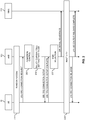
- Fig. 2 illustrates exemplary processes for establishing a connection of a UE 10 to the cellular radio network.
- the UE 10 may correspond to one of the UEs 10 as illustrated in Fig. 1 .
- the processes of Fig. 2 involve the UE 10, the eNB 100, and the MME 150 and are based on procedures for establishing an RRC connection as specified in 3GPP TS 36.331 V12.6.0.
- the processes of Fig. 2 are assumed to be triggered by one of multiple applications configured at the UE 10 requiring establishment of a connection to the cellular radio network.
- the UE 10 first determines the characteristic(s) of traffic generated by this application. This may involve obtaining information stored in the UE 10.
- An estimate of the characteristic(s) of the traffic generated by a specific application can be obtained initially from parameters included in the application software itself. If no such parameters are included in the application software a default characteristic may be assumed. Such default characteristic may however be updated once the application is used, e.g., by monitoring the traffic generated by the application.
- the UE 10 then proceeds by performing a random access procedure 201 with the eNB 100. As a result, the UE 10 synchronize to one of the cells 101, 102 served by the eNB 100. In the example of Fig. 2 , it is assumed that the UE 10 synchronizes to the cell 101. However, it is to be understood that processes similar to those described in the following could also be performed when the UE 10 initially synchronizes to the cell 102.
- the eNB 100 then grants initial uplink radio resources of the cell 101 to the UE 10.
- the UE 10 utilizes these uplink radio resources for sending an RRCConnectionRequest message 202 to the eNB 100.
- the RRCConnectionRequest message 202 also indicates the previously determined characteristic(s) of the traffic generated by the application. Here, it may be beneficial to indicate the characteristic(s) by small sized parameters, thereby avoiding excessively increasing the data volume of the RRCConnectionRequest message 202.
- the eNB 100 performs admission control processes, as illustrated by block 203. This may for example involve deciding whether to admit the connection requested by the RRCConnectionRequest message 202. This admission decision may be based on the characteristic(s) indicated in the RRCConnectionRequest message 202. Further, this admission decision may also be based on various other criteria, such as load of the cell 101 in which establishment of the connection is requested, and/or on other information indicated in the RRCConnectionRequest message 202, e.g., information in the EstablishmentCause field.
- the cell 101 could be close to a maximum load limit and the eNB 100 could thus decide only to admit the requested connection is in the indicated characteristic(s) indicate that the traffic generated by the application is expected to form a single burst of low volume and short duration.
- admitting the connection can be even more resource efficient than rejecting the request, because the latter decision may for example result in signaling of the request being rejected toward the UE 10 and the UE 10 retrying the request.
- the eNB 100 admits the connection and then proceeds to perform further control processes related to the establishment of the connection, as illustrated by block 204.
- control processes of block 204 may for example include selecting one or more carriers for the connection, selecting an alternative cell for establishing the connection, setting queuing parameters for the connection, and/or setting an inactivity timer for controlling release of the connection.
- the eNB 100 may decide to perform load balancing by first establishing the connection in the cell 101 and then moving the connection to another cell, such as the cell 102.
- the eNB 100 may also decide to move the connection to a cell control by another eNB, such as one of the cells 111, 112 controlled by the eNB 110.
- the eNB 100 may also decide to delay establishment of the connection until resources for establishing the connection become available, e.g., by using a queueing algorithm for handling concurrent requests for establishment of a connection.
- the eNB 100 may set the queueing parameter(s) to establish the connection as soon as possible.
- One or more parameters of such queueing algorithm may be set depending on the characteristic(s) of the traffic generated by the application. Further, the characteristic(s) may for example indicate that the traffic generated by the application is expected to have a short duration, e.g., shorter than a default value of the inactivity timer applied by the eNB 100, e.g., a default value of a few seconds.
- the eNB 100 may then set the inactivity timer to a lower value than the default value, e.g., to a value corresponding to the expected duration of the traffic.
- the eNB 100 may also set the inactivity timer to zero or even completely deactivate usage of the inactivity timer. This may for example be the case if the characteristic(s) indicate that the traffic will consist of only a single data transfer, i.e., a very short single burst. In such cases, the connection may be released immediately after such single data transfer is completed.
- the eNB 100 then sends a RRCConnectionSetup message 205 to the UE 10, which initiates setup of the RRC connection between the UE 10 and the eNB 100. Having completed configurations for the setup of the RRC connection, the UE 10 responds with an RRCCconnectionSetupComplete message 206 to the eNB 100. The eNB 100 then proceeds with selection of an MME for controlling the connection, as illustrated by block 207. In the illustrated example, it is assumed that the eNB 100 selects the MME 150. Having selected the MME 150, the eNB 100 sends an initial UE message 208, included with the RRCConnectionSetupComplete message 206, to the MME 150. At this stage, establishment of the connection is completed, and the UE 10 may send or receive traffic generated by the application via the connection.
- a period of inactivity 209 may follow. For example, this period of connectivity may be due to the UE 10 having completed all pending data transfers required by the application.
- the eNB 100 start the inactivity timer. If the application becomes active again before the inactivity timer has expired, then the inactivity timer is stopped and reset. After expiry of the inactivity timer without any further data transfer on the connection, the eNB 100 initiates releasing of the connection. As illustrated, this involves sending a RRCConnectionRelease message 210 to the UE 10 and sending a UEContextReleaseComplete message 211 to the MME 150.
- the timing when the releasing of the connection is initiated may be controlled depending on the characteristic(s) indicated in the RRCRonnectionRequest message 202. In this way, some connections may be released earlier, e.g., connections for which it was indicated that the traffic is expected to form a single burst, while other connections may be released later, e.g., connection for which it was indicated that the traffic is expected to form multiple bursts over a longer duration.
- the UE 10 and/or the eNB 100 may also monitor the traffic on the connection and use statistic information obtained by this monitoring for dynamically updating the characteristic(s) stored by the UE 10.
- expected data volumes, expected durations of traffic, and/or the burst characteristic of the traffic may be determined in a refined manner and individually for each UE 10.
- the UE 10 may statistically evaluate the information obtained by monitoring the traffic, e.g., a measured data volume or duration of the traffic, compare the statistically evaluated characteristic(s) to the stored characteristic(s) and adapt the stored characteristic(s) based on this comparison. In this way, the stored characteristic(s) may be refined by statistical data.
- the eNB 100 may contribute to search updating of the characteristic(s). For example, also the eNB 100 could monitor the traffic, and the stored characteristics could be updated based on the monitoring results obtained by the eNB 100. In some cases where no initial information on the characteristic(s) is available, e.g., from the application software, the characteristic(s) may also be determined exclusively based on such monitoring processes.
- Fig. 3 shows a distribution of data volume transferred over a connection versus number of connections for a typical North American cellular radio network, sampled over one hour.
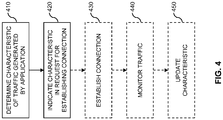
- Fig. 4 shows a flowchart for illustrating a method of controlling connectivity to a cellular radio network.
- the method may be utilized for implementing the illustrated concepts in a radio device, e.g., the above-mentioned UE 10. If a processor-based implementation of the radio device is used, the steps of the method may be performed by one or more processors of the radio device. In such a case the radio device may further comprise a memory in which program code or other information for implementing the below described functionalities is stored.
- the radio device determines at least one characteristic of traffic generated by an application. This is accomplished for each of multiple applications configured at the radio device.
- the at least one characteristic may indicate whether the traffic is expected to form a single burst or if the traffic is rather expected to form a sequence of multiple data transfers which may be separated in time.
- the at least one characteristic may indicate an expected volume of the traffic, an expected volume of the traffic, an expected duration of the traffic, and/or a latency requirement of the traffic. For example, this may be accomplished in terms of a classification, e.g., a classification as low volume traffic or high volume traffic, a classification of low duration traffic or high duration traffic, or a classification as latency sensitive traffic or latency insensitive traffic.
- the radio device sends a request for establishing a connection to the cellular radio network. This is accomplished in response to one of the applications requiring establishment of the connection.
- the request indicates the at least one characteristic corresponding to the application.
- the request may be an RRC Connection Request, e.g., an RRCConnectionRequest message as specified in 3GPP TS 36.331 V12.6.0, and the characteristic(s) may be indicated in an additional field of such message.
- the radio device may establish a connection for one of the applications to the cellular radio network. This may for example be the connection for which establishment was requested by the request sent at step 420.
- the connection may be established in response to the cellular radio network admitting the connection. The decision whether to admit the connection may be based on the at least one characteristic indicated in the request sent at step 420.
- the radio device may monitor the traffic generated by the application.
- the radio device may monitor tour the traffic on the connection established at step 430.
- the radio device may statistically evaluate information obtained by this monitoring, e.g., a measured volume of the traffic, a measured duration of the traffic, or a burst characteristic of the traffic.
- the determination of the at least one characteristic at step 410 may be based on the information obtained by this monitoring of the traffic.
- the radio device may update the at least one characteristic based on the information obtained at step 440.
- Fig. 5 shows a block diagram for illustrating functionalities of a radio device 500 which operates according to the method of Fig. 4 .
- the radio device 500 may be provided with a module 510 configured to determine at least one characteristic of traffic generated by each of multiple applications configured at the radio device, such as explained in connection with step 410.
- the radio device 500 may be provided with a module 520 configured to indicate the at least one characteristic in a request for establishing a connection, such as explained in connection with step 520.
- the radio device 500 may optionally be provided with a module 530 configured to establish a connection, such as explained in connection with step 430.
- the radio device 500 may optionally be provided with a module 540 configured to monitor traffic generated by an application, such as explained in connection with step 440. Further, the radio device 500 may optionally be provided with a module 550 configured to update the at least one characteristic, such as explained in connection with step 450.
- the radio device 500 may also include further modules for implementing other functionalities, such as functionalities for hosting the applications or for performing and managing data transfers associated with the applications, and that the modules of the radio device 500 do not necessarily represent a hardware structure of the radio device 500, but may also correspond to functional elements, e.g., implemented by hardware, software, or a combination thereof.
- Fig. 6 shows a flowchart for illustrating a method of controlling connectivity to a cellular radio network.
- the method may be utilized for implementing the illustrated concepts in an access node of the cellular radio network, e.g., the eNB 100. If a processor-based implementation of the access node is used, the steps of the method may be performed by one or more processors of the access node. In such a case the access node may further comprise a memory in which program code or other information for implementing the below described functionalities is stored.
- the access node of the cellular radio network receives, from a radio device with multiple configured applications, a request for establishing a connection of the radio device to the cellular radio network.
- the request indicates at least one characteristic of traffic generated by that one of the applications which requires establishment of the connection.
- the at least one characteristic may indicate whether the traffic is expected to form a single burst or if the traffic is rather expected to form a sequence of multiple data transfers which may be separated in time.
- the at least one characteristic may indicate an expected volume of the traffic, an expected volume of the traffic, an expected duration of the traffic, and/or a latency requirement of the traffic. For example, this may be accomplished in terms of a classification, e.g., a classification as low volume traffic or high volume traffic, a classification of low duration traffic or high duration traffic, or a classification as latency sensitive traffic or latency insensitive traffic.
- the access node determines the at least one characteristic from the request received at step 610. This may for example be accomplished by extracting the at least one characteristic from a corresponding information field of the request.
- the access node controls establishment of the connection depending on the at least one characteristic as indicated in the request received at step 610 and determined at step 620.
- the controlling of establishment of the connection may involve deciding whether to admit establishment of the connection. Further, the controlling of establishment of the connection may involve deciding whether delaying establishment of the connection is tolerable. Further, the controlling of establishment of the connection may involve selecting one or more carriers for the connection. If multiple carriers are selected, these may for example be used in a carrier aggregation configuration and/or a dual connectivity configuration. Further, the controlling of establishment of the connection may involve deciding whether to transfer the connection to another access node or other cell, e.g., for purposes of load-balancing. Further, the controlling of establishment of the connection may involve configuring a timer for controlling inactivity-triggered release of the connection.
- Fig. 7 shows a block diagram for illustrating functionalities of an access node 700 which operates according to the method of Fig. 6 .
- the access node 700 may be provided with a module 710 configured to receive a request for establishing a connection, the request indicating at least one characteristic of traffic generated by an applications which requires establishment of the connection, such as explained in connection with step 610.
- the access node 700 may be provided with a module 720 configured to determine the at least one characteristic from the request, such as explained in connection with step 620.
- the access node 700 may optionally be provided with a module 730 configured to control establishment of the connection depending on the indicated at least one characteristic, such as explained in connection with step 730.
- the access node 700 may also include further modules for implementing other functionalities, such as functionalities for performing or managing data transfers associated with the applications, and that the modules of the access node 700 do not necessarily represent a hardware structure of the access node 700, but may also correspond to functional elements, e.g., implemented by hardware, software, or a combination thereof.
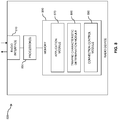
- Fig. 8 illustrates exemplary structures which may be used for implementing the above concepts in a radio device 800, such as the UE 10.
- the radio device 800 may for example correspond to a mobile phone or to some other type of UE.
- the radio device 800 may include a radio interface 810 for enabling access of the radio device 800 to a cellular radio network, e.g., a cellular radio network based on the LTE technology.
- the radio interface 810 may for example implement the Uu radio interface of the LTE radio technology.
- the radio device 800 may include one or more processors 850 coupled to the radio interface 810, and a memory 860 coupled to the processor(s) 850.
- the memory 860 may include a Read Only Memory (ROM), e.g., a flash ROM, a Random Access Memory (RAM), e.g., a Dynamic RAM (DRAM) or Static RAM (SRAM), a mass storage, e.g., a hard disk or solid state disk, or the like.
- the memory 860 includes suitably configured program code to be executed by the processor(s) 850 so as to implement the above-described functionalities of a radio device.
- the memory 860 may include various program code modules for causing the radio device 800 to perform processes as described above, e.g., corresponding to the method steps of Fig. 4 .
- the memory 860 may include an application module 870 for enabling configuration of a plurality of applications, such as explained in connection with step 410 of Fig. 4 . Further, the memory 860 may include a traffic characteristic determination module 880 for implementing the above-described functionalities of determining characteristics of traffic generated by the applications, such as explained in connection with step 420 of Fig. 4 . Further, the memory 860 may also include a connection control module 890 for implementing the above-described functionalities related to establishment of a connection, specifically generating and sending the request for establishing the connection, such as described in connection with step 420 of Fig. 4 .
- the structures as illustrated in Fig. 8 are merely schematic and that the radio device 800 may actually include further components which, for the sake of clarity, have not been illustrated, e.g., further interfaces or processors.
- the memory 860 may include further types of program code modules, which have not been illustrated, e.g., program code modules for implementing known functionalities of a UE or similar radio device.
- a computer program may be provided for implementing functionalities of the radio device 800, e.g., in the form of a physical medium storing the program code and/or other data to be stored in the memory 860 or by making the program code available for download or by streaming.
- Fig. 9 illustrates exemplary structures which may be used for implementing the above concepts in an access node 900 of a cellular radio network, e.g., a cellular radio network based on the LTE technology.
- the access node 900 may for example correspond to an eNB, such as the eNB 100, or to some other type of base station.
- the access node 900 may include a radio interface 910 for enabling access of one or more radio devices, such as the above-mentioned UEs 10, the radio device 500, or the radio device 800, to the cellular radio network.
- the radio interface 910 may for example implement the Uu radio interface of the LTE radio technology.
- the access node 900 may include a network interface 920 for connecting the access node to other nodes of the cellular radio network, e.g., to other access nodes or to nodes of a core network part of the cellular radio network.
- the network interface 920 may for example implement the X2 and/or S1 interface of the LTE technology.
- the access node 900 may include one or more processors 950 coupled to the radio interface 910 and network interface 920, and a memory 960 coupled to the processor(s) 950.
- the memory 960 may include a ROM, e.g., a flash ROM, a RAM, e.g., a DRAM or SRAM, a mass storage, e.g., a hard disk or solid state disk, or the like.
- the memory 960 includes suitably configured program code to be executed by the processor(s) 950 so as to implement the above-described functionalities of an access node.
- the memory 960 may include various program code modules for causing the access node 900 to perform processes as described above, e.g., corresponding to the method steps of Fig. 6 .
- the memory 960 may include an connection control module 970 for implementing the above-described functionalities related to establishment of a connection, specifically receiving and processing the request for establishing the connection, such as described in connection with step 610 of Fig. 6 , and performing processes for controlling establishment of the connection, such as described in connection with step 630 of Fig. 6 . Further, the memory 960 may include a traffic characteristic determination module 980 for implementing the above-described functionalities of determining the characteristics of traffic generated by applications from the request for establishing the connection, such as explained in connection with step 620 of Fig. 6 .
- the structures as illustrated in Fig. 9 are merely schematic and that the access node 900 may actually include further components which, for the sake of clarity, have not been illustrated, e.g., further interfaces or processors.
- the memory 960 may include further types of program code modules, which have not been illustrated, e.g., program code modules for implementing known functionalities of an eNB or similar access node.
- a computer program may be provided for implementing functionalities of the access node 900, e.g., in the form of a physical medium storing the program code and/or other data to be stored in the memory 960 or by making the program code available for download or by streaming.
- the concepts as described above may be used for efficiently controlling connectivity of radio devices to a cellular radio network.
- the concepts allow for achieving a more stable behavior of connections in the cellular radio network, because a connection can be setup right from the start in such a way that it best suits the characteristics of the expected traffic so that subsequent adjustments can be avoided. This in turn may allow for a higher efficiency in terms of signaling load, computational resources or required measurements.
- the concepts allow for reducing a risk that a connection for latency sensitive traffic is rejected by admission control or is moved to another cell or access node for load balancing, thereby generating undesired delays.
- the concepts allow for avoiding too early and too late releasing of a connection by setting the inactivity timer depending on the characteristic(s) of the expected traffic, which in turn allows for achieving a higher resource efficiency.
- the illustrated concepts may be applied in connection with various cellular radio network technologies. Further, other characteristics of traffic generated by an application could be considered in addition or as an alternative. Moreover, it is to be understood that the above concepts may be implemented by using correspondingly designed software to be executed by one or more processors of an existing device, or by using dedicated device hardware. Further, it should be noted that the illustrated radio device may be implemented as a single device or as a system of multiple interacting devices.
Landscapes
- Engineering & Computer Science (AREA)
- Computer Networks & Wireless Communication (AREA)
- Signal Processing (AREA)
- Quality & Reliability (AREA)
- Computer Security & Cryptography (AREA)
- Mobile Radio Communication Systems (AREA)
Claims (16)
- Verfahren zum Steuern der Konnektivität zu einem zellularen Funknetz, wobei das Verfahren Folgendes umfasst:für jede von mehreren Anwendungen, die an einer Funkvorrichtung (10; 500; 800) konfiguriert sind, wobei die Funkvorrichtung (10; 500; 800) mindestens ein Merkmal des durch die Anwendung erzeugten Verkehrs bestimmt; undals Reaktion auf eine der Anwendungen, die die Verbindungsherstellung der Funkvorrichtung (10; 500; 800) zum zellularen Funknetz erfordert, Senden durch die Funkvorrichtung (10; 500; 800) einer Anforderung (202) für die Verbindungsherstellung zum zellularen Funknetz, wobei die Anforderung das mindestens eine der Anwendung entsprechende Merkmal angibt,dadurch gekennzeichnet, dass das mindestens eine Merkmal angibt, ob erwartet wird, dass der Verkehr einen einzelnen Burst bildet, und nicht eine Folge von mehreren zeitlich getrennten Datenübertragungen.
- Verfahren nach Anspruch 1,
wobei die Anforderung (202) eine Verbindungsanforderung für die Funkressourcensteuerung ist. - Verfahren nach Anspruch 1 oder 2,
wobei das mindestens eine Merkmal ferner mindestens eines angibt aus der Gruppe von- ein erwartetes Verkehrsaufkommen,- eine voraussichtliche Dauer des Verkehrs oder- eine Latenzanforderung des Verkehrs. - Verfahren nach einem der vorhergehenden Ansprüche, umfassend:für eine der Anwendungen, Herstellen einer Verbindung durch die Funkvorrichtung (10; 500; 800) zum zellularen Funknetz;wobei die Funkvorrichtung (10; 500; 800) den von der Anwendung erzeugten Verkehr basierend auf der hergestellten Verbindung überwacht; undwobei die Funkvorrichtung (10; 500; 800) das mindestens eine Merkmal für diese Anwendung basierend auf der Überwachung des Verkehrs bestimmt.
- Verfahren zum Steuern der Konnektivität zu einem zellularen Funknetz, wobei das Verfahren Folgendes umfasst:einen Zugangsknoten (100; 700; 900) des zellularen Funknetzes, der von einer Funkvorrichtung (10; 500; 800) mit mehreren konfigurierten Anwendungen eine Anforderung (202) zum Herstellen einer Verbindung der Funkvorrichtung (10; 500; 800) mit dem zellularen Funknetz empfängt, wobei die Anforderung (202) mindestens ein durch diese eine der Anwendungen erzeugtes Merkmal des Verkehrs angibt, das die Verbindungsherstellung erfordert; undabhängig von dem angegebenen mindestens einen Merkmal, Steuern durch den Zugangsknoten (100; 700; 900) der Verbindungsherstellung,dadurch gekennzeichnet, dass das mindestens eine Merkmal angibt, ob erwartet wird, dass der Verkehr einen einzelnen Burst bildet, und nicht eine Folge von mehreren zeitlich getrennten Datenübertragungen.
- Verfahren nach Anspruch 5,
wobei die Verbindungsherstellungssteuerung mindestens eines umfasst aus der Gruppe von- Entscheiden, ob die Verbindungsherstellung zugelassen werden soll,- Entscheiden, ob eine verzögerte Verbindungsherstellung tolerierbar ist,- Auswählen eines oder mehrerer Träger für die Verbindung,- Entscheiden, ob die Verbindung an einen anderen Zugangsknoten (110) übertragen werden soll, oder- Konfigurieren eines Zeitgebers zum Steuern der inaktivitätsabhängigen Freigabe der Verbindung. - Verfahren nach einem der Ansprüche 5 bis 6,
wobei die Anforderung (202) eine Verbindungsanforderung für die Funkressourcensteuerung ist. - Verfahren nach einem der Ansprüche 5 bis 7,
wobei das mindestens eine Merkmal ferner mindestens eines angibt aus der Gruppe von- ein erwartetes Verkehrsaufkommen,- eine voraussichtliche Dauer des Verkehrs oder- eine Latenzanforderung des Verkehrs. - Funkvorrichtung (10; 500; 800), wobei die Funkvorrichtung (10; 500; 800) konfiguriert ist, um:- für jede von mehreren Anwendungen, die an der Funkvorrichtung (10; 500; 800) konfiguriert sind, mindestens ein Merkmal des durch die Anwendung erzeugten Verkehrs zu bestimmen; und- als Reaktion auf eine der Anwendungen, die die Verbindungsherstellung der Funkvorrichtung (10; 500; 800) mit dem zellularen Funknetz erfordert, eine Anforderung (202) zur Verbindungsherstellung mit dem zellularen Funknetz zu senden, wobei die Anforderung (202) das mindestens eine der Anwendung entsprechende Merkmal angibt,
dadurch gekennzeichnet, dass das mindestens eine Merkmal angibt, ob erwartet wird, dass der Verkehr einen einzelnen Burst bildet, und nicht eine Folge von mehreren zeitlich getrennten Datenübertragungen. - Funkvorrichtung (10; 500; 800) nach Anspruch 9,
wobei die Funkvorrichtung (10; 500; 800) konfiguriert ist, um ein Verfahren nach einem der Ansprüche 2 bis 4 durchzuführen. - Zugangsknoten (100; 700; 900) für ein zellulares Funknetz, wobei der Zugangsknoten (100; 700; 900) konfiguriert ist, um:- von einer Funkvorrichtung (10; 500; 800) mit mehreren konfigurierten Anwendungen eine Anforderung (202) zum Herstellen einer Verbindung der Funkvorrichtung (10; 500; 800) mit dem zellularen Funknetz zu empfangen, wobei die Anforderung (202) mindestens ein durch diese eine der Anwendungen erzeugtes Merkmal des Verkehrs angibt, das die Verbindungsherstellung erfordert; und- abhängig von dem angegebenen mindestens einen Merkmal, die Verbindungsherstellung zu steuern,
dadurch gekennzeichnet, dass das mindestens eine Merkmal angibt, ob erwartet wird, dass der Verkehr einen einzelnen Burst bildet, und nicht eine Folge von mehreren zeitlich getrennten Datenübertragungen. - Zugangsknoten (100; 700; 900) nach Anspruch 11,
wobei der Zugangsknoten (100; 700; 900) konfiguriert ist, um ein Verfahren nach einem der Ansprüche 6 bis 8 durchzuführen. - Computerprogramm, umfassend einen Programmcode, der durch mindestens einen Prozessor (850) einer Funkvorrichtung (10; 500; 800) ausgeführt werden soll, wobei das Ausführen des Programmcodes bewirkt, dass die Funkvorrichtung (10; 500; 800) Schritte eines Verfahrens nach einem der Ansprüche 1 bis 4 durchführt.
- Computerprogrammprodukt, umfassend einen Programmcode, der durch mindestens einen Prozessor (850) einer Funkvorrichtung (10; 500; 800) ausgeführt werden soll, wobei das Ausführen des Programmcodes bewirkt, dass die Funkvorrichtung (10; 500; 800) Schritte eines Verfahrens nach einem der Ansprüche 1 bis 4 durchführt.
- Computerprogramm, umfassend einen Programmcode, der durch mindestens einen Prozessor (950) eines Zugangsknotens (100; 700; 900) für ein zellulares Funknetz ausgeführt werden soll, wobei das Ausführen des Programmcodes bewirkt, dass der Zugangsknoten (100; 700; 900) Schritte eines Verfahrens nach einem der Ansprüche 5 bis 8 durchführt.
- Computerprogrammprodukt, umfassend einen Programmcode, der durch mindestens einen Prozessor (950) eines Zugangsknotens (100; 700; 900) für ein zellulares Funknetz ausgeführt werden soll, wobei das Ausführen des Programmcodes bewirkt, dass der Zugangsknoten(100; 700; 900) Schritte eines Verfahrens nach einem der Ansprüche 5 bis 8 durchführt.
Applications Claiming Priority (1)
| Application Number | Priority Date | Filing Date | Title |
|---|---|---|---|
| PCT/EP2015/081190 WO2017108135A1 (en) | 2015-12-23 | 2015-12-23 | Traffic characteristic indication for connection establishment control |
Publications (2)
| Publication Number | Publication Date |
|---|---|
| EP3395097A1 EP3395097A1 (de) | 2018-10-31 |
| EP3395097B1 true EP3395097B1 (de) | 2019-08-07 |
Family
ID=55071019
Family Applications (1)
| Application Number | Title | Priority Date | Filing Date |
|---|---|---|---|
| EP15820532.8A Not-in-force EP3395097B1 (de) | 2015-12-23 | 2015-12-23 | Anzeige von verkehrseigenschaften zur verbindungsherstellungssteuerung |
Country Status (4)
| Country | Link |
|---|---|
| US (1) | US10433238B2 (de) |
| EP (1) | EP3395097B1 (de) |
| AR (1) | AR107177A1 (de) |
| WO (1) | WO2017108135A1 (de) |
Families Citing this family (6)
| Publication number | Priority date | Publication date | Assignee | Title |
|---|---|---|---|---|
| KR102327639B1 (ko) | 2017-03-10 | 2021-11-17 | 삼성전자 주식회사 | Mobile Initiated Communication Only mode 단말의 연결을 유지시키는 방법 |
| WO2018226034A1 (ko) * | 2017-06-06 | 2018-12-13 | 엘지전자 주식회사 | 무선 통신 시스템에서 eNB가 Remote UE로 하향링크 데이터를 전송하는 방법 및 이를 위한 장치 |
| US11452169B2 (en) * | 2018-08-15 | 2022-09-20 | Google Llc | Preventing inadvertent idle mode in multi-node connectivity environments |
| KR102879413B1 (ko) * | 2018-11-21 | 2025-10-31 | 삼성전자 주식회사 | 무선 통신 시스템에서 신호를 송수신하는 방법 및 장치 |
| US11758600B1 (en) * | 2020-12-16 | 2023-09-12 | Sprint Spectrum Llc | Controlling dual connectivity based on inter-access-node flow of user-plane communication of dual-connectivity service |
| WO2026019250A1 (en) * | 2024-07-17 | 2026-01-22 | Lg Electronics Inc. | Access control parameter adaptation based on traffic characteristic |
Family Cites Families (11)
| Publication number | Priority date | Publication date | Assignee | Title |
|---|---|---|---|---|
| US7930446B2 (en) * | 2007-12-28 | 2011-04-19 | Intel Corporation | Methods and apparatuses for wireless network communication wherein a universal serial bus request block (URB) is generated that will vary parameters that controls wireless transmission commands between devices |
| US8504716B2 (en) * | 2008-10-08 | 2013-08-06 | Citrix Systems, Inc | Systems and methods for allocating bandwidth by an intermediary for flow control |
| US8527627B2 (en) * | 2010-12-14 | 2013-09-03 | At&T Intellectual Property I, L.P. | Intelligent mobility application profiling with respect to identified communication bursts |
| CN107580376B (zh) * | 2011-04-01 | 2021-08-20 | 交互数字专利控股公司 | 移动性管理实体及用于提供连接性信息的方法 |
| US8874112B2 (en) | 2011-05-09 | 2014-10-28 | Telefonaktiebolaget Lm Ericsson (Publ) | Service dependent inactivity timer |
| US8566625B2 (en) * | 2011-07-01 | 2013-10-22 | Intel Corporation | System and method for determining transmitting frequency to maintain remote application server connectivity |
| CN110087272B (zh) * | 2013-02-22 | 2021-10-08 | 三星电子株式会社 | 在多个e节点b和用户设备间提供同时连接的方法和系统 |
| CN104300245A (zh) | 2013-07-15 | 2015-01-21 | 华为技术有限公司 | 可插拔设备 |
| EP3069531B1 (de) * | 2013-11-13 | 2019-09-25 | Huawei Technologies Co., Ltd. | Steuerung der datenübertragung für maschinenkommunikation in einem mobilkommunikationssystem |
| US9497771B2 (en) | 2014-04-18 | 2016-11-15 | Apple Inc. | Deterministic RRC connections |
| US9459799B1 (en) * | 2014-06-25 | 2016-10-04 | Emc Corporation | Identifying problematic application workloads based on associated response times |
-
2015
- 2015-12-23 EP EP15820532.8A patent/EP3395097B1/de not_active Not-in-force
- 2015-12-23 US US16/064,521 patent/US10433238B2/en active Active
- 2015-12-23 WO PCT/EP2015/081190 patent/WO2017108135A1/en not_active Ceased
-
2016
- 2016-12-22 AR ARP160103997A patent/AR107177A1/es unknown
Non-Patent Citations (1)
| Title |
|---|
| None * |
Also Published As
| Publication number | Publication date |
|---|---|
| US10433238B2 (en) | 2019-10-01 |
| WO2017108135A1 (en) | 2017-06-29 |
| US20190028959A1 (en) | 2019-01-24 |
| EP3395097A1 (de) | 2018-10-31 |
| AR107177A1 (es) | 2018-03-28 |
Similar Documents
| Publication | Publication Date | Title |
|---|---|---|
| EP3395097B1 (de) | Anzeige von verkehrseigenschaften zur verbindungsherstellungssteuerung | |
| US12349224B2 (en) | UE behavior with rejection of resume request | |
| US10667185B2 (en) | Method for avoiding unnecessary actions in resume procedure | |
| US11758500B2 (en) | Methods for controlling unauthorized aerial UEs | |
| US9999095B2 (en) | Method and apparatus for setting up/releasing radio resource control connection between evolved node B and user equipment in communication system | |
| EP2757856B1 (de) | Optimierung von kontext- und/oder verbindungsverwaltung in einem mobilen kommunikationssystem | |
| US20120289232A1 (en) | Service dependent inactivity timer | |
| KR20200132846A (ko) | 비활성 상태로부터의 rrc 재개를 위한 보안 핸들링 | |
| EP3035616B1 (de) | Verfahren zur bereitstellung von nicht-echtzeitdaten | |
| EP2869648B1 (de) | Beantwortung von Funkrufaufforderungen während des Wartens auf die Anfrage zur Verbindung mit einem drahtlosen Netzwerk | |
| WO2018019001A1 (zh) | 一种终端状态转换方法及装置 | |
| CN103988549A (zh) | 高度拥塞的网络环境中的呼叫建立 | |
| JP2017041868A (ja) | ワイヤレス通信ネットワークにおけるx2リンク管理のための方法及びシステム | |
| JP7690962B2 (ja) | 第2ネットワーク装置及び方法 | |
| US9094866B2 (en) | Method and radio base station in a wireless communication network | |
| WO2018028636A1 (zh) | Rrc连接控制方法及装置、系统 | |
| CN118743309A (zh) | 小数据传输失败报告 | |
| KR20140117510A (ko) | 클러스터 유저를 기반으로 하는 메시지 전송 방법 및 장치 | |
| WO2016198011A1 (zh) | 一种实现负荷分担的方法和装置 | |
| CN119999276A (zh) | 针对RRC-IDLE模式的QoE | |
| US20240422816A1 (en) | Data Transmission Method, Terminal, and Network-Side Device | |
| WO2025166668A1 (zh) | 基于配置资源发送数据和/或信令的方法、终端设备、网络设备及存储介质 | |
| CN117998681A (zh) | 一种通信方法及装置 | |
| WO2024169520A1 (zh) | 数据传输方法、装置及存储介质 |
Legal Events
| Date | Code | Title | Description |
|---|---|---|---|
| STAA | Information on the status of an ep patent application or granted ep patent |
Free format text: STATUS: THE INTERNATIONAL PUBLICATION HAS BEEN MADE |
|
| PUAI | Public reference made under article 153(3) epc to a published international application that has entered the european phase |
Free format text: ORIGINAL CODE: 0009012 |
|
| STAA | Information on the status of an ep patent application or granted ep patent |
Free format text: STATUS: REQUEST FOR EXAMINATION WAS MADE |
|
| 17P | Request for examination filed |
Effective date: 20180619 |
|
| AK | Designated contracting states |
Kind code of ref document: A1 Designated state(s): AL AT BE BG CH CY CZ DE DK EE ES FI FR GB GR HR HU IE IS IT LI LT LU LV MC MK MT NL NO PL PT RO RS SE SI SK SM TR |
|
| AX | Request for extension of the european patent |
Extension state: BA ME |
|
| DAV | Request for validation of the european patent (deleted) | ||
| DAX | Request for extension of the european patent (deleted) | ||
| GRAP | Despatch of communication of intention to grant a patent |
Free format text: ORIGINAL CODE: EPIDOSNIGR1 |
|
| STAA | Information on the status of an ep patent application or granted ep patent |
Free format text: STATUS: GRANT OF PATENT IS INTENDED |
|
| GRAS | Grant fee paid |
Free format text: ORIGINAL CODE: EPIDOSNIGR3 |
|
| INTG | Intention to grant announced |
Effective date: 20190604 |
|
| GRAA | (expected) grant |
Free format text: ORIGINAL CODE: 0009210 |
|
| STAA | Information on the status of an ep patent application or granted ep patent |
Free format text: STATUS: THE PATENT HAS BEEN GRANTED |
|
| AK | Designated contracting states |
Kind code of ref document: B1 Designated state(s): AL AT BE BG CH CY CZ DE DK EE ES FI FR GB GR HR HU IE IS IT LI LT LU LV MC MK MT NL NO PL PT RO RS SE SI SK SM TR |
|
| REG | Reference to a national code |
Ref country code: GB Ref legal event code: FG4D |
|
| REG | Reference to a national code |
Ref country code: CH Ref legal event code: EP Ref country code: AT Ref legal event code: REF Ref document number: 1165775 Country of ref document: AT Kind code of ref document: T Effective date: 20190815 |
|
| REG | Reference to a national code |
Ref country code: IE Ref legal event code: FG4D |
|
| REG | Reference to a national code |
Ref country code: DE Ref legal event code: R096 Ref document number: 602015035504 Country of ref document: DE |
|
| REG | Reference to a national code |
Ref country code: NL Ref legal event code: MP Effective date: 20190807 |
|
| REG | Reference to a national code |
Ref country code: LT Ref legal event code: MG4D |
|
| PG25 | Lapsed in a contracting state [announced via postgrant information from national office to epo] |
Ref country code: PT Free format text: LAPSE BECAUSE OF FAILURE TO SUBMIT A TRANSLATION OF THE DESCRIPTION OR TO PAY THE FEE WITHIN THE PRESCRIBED TIME-LIMIT Effective date: 20191209 Ref country code: BG Free format text: LAPSE BECAUSE OF FAILURE TO SUBMIT A TRANSLATION OF THE DESCRIPTION OR TO PAY THE FEE WITHIN THE PRESCRIBED TIME-LIMIT Effective date: 20191107 Ref country code: LT Free format text: LAPSE BECAUSE OF FAILURE TO SUBMIT A TRANSLATION OF THE DESCRIPTION OR TO PAY THE FEE WITHIN THE PRESCRIBED TIME-LIMIT Effective date: 20190807 Ref country code: NL Free format text: LAPSE BECAUSE OF FAILURE TO SUBMIT A TRANSLATION OF THE DESCRIPTION OR TO PAY THE FEE WITHIN THE PRESCRIBED TIME-LIMIT Effective date: 20190807 Ref country code: SE Free format text: LAPSE BECAUSE OF FAILURE TO SUBMIT A TRANSLATION OF THE DESCRIPTION OR TO PAY THE FEE WITHIN THE PRESCRIBED TIME-LIMIT Effective date: 20190807 Ref country code: HR Free format text: LAPSE BECAUSE OF FAILURE TO SUBMIT A TRANSLATION OF THE DESCRIPTION OR TO PAY THE FEE WITHIN THE PRESCRIBED TIME-LIMIT Effective date: 20190807 Ref country code: FI Free format text: LAPSE BECAUSE OF FAILURE TO SUBMIT A TRANSLATION OF THE DESCRIPTION OR TO PAY THE FEE WITHIN THE PRESCRIBED TIME-LIMIT Effective date: 20190807 Ref country code: NO Free format text: LAPSE BECAUSE OF FAILURE TO SUBMIT A TRANSLATION OF THE DESCRIPTION OR TO PAY THE FEE WITHIN THE PRESCRIBED TIME-LIMIT Effective date: 20191107 |
|
| REG | Reference to a national code |
Ref country code: AT Ref legal event code: MK05 Ref document number: 1165775 Country of ref document: AT Kind code of ref document: T Effective date: 20190807 |
|
| PG25 | Lapsed in a contracting state [announced via postgrant information from national office to epo] |
Ref country code: IS Free format text: LAPSE BECAUSE OF FAILURE TO SUBMIT A TRANSLATION OF THE DESCRIPTION OR TO PAY THE FEE WITHIN THE PRESCRIBED TIME-LIMIT Effective date: 20191207 Ref country code: ES Free format text: LAPSE BECAUSE OF FAILURE TO SUBMIT A TRANSLATION OF THE DESCRIPTION OR TO PAY THE FEE WITHIN THE PRESCRIBED TIME-LIMIT Effective date: 20190807 Ref country code: GR Free format text: LAPSE BECAUSE OF FAILURE TO SUBMIT A TRANSLATION OF THE DESCRIPTION OR TO PAY THE FEE WITHIN THE PRESCRIBED TIME-LIMIT Effective date: 20191108 Ref country code: RS Free format text: LAPSE BECAUSE OF FAILURE TO SUBMIT A TRANSLATION OF THE DESCRIPTION OR TO PAY THE FEE WITHIN THE PRESCRIBED TIME-LIMIT Effective date: 20190807 Ref country code: AL Free format text: LAPSE BECAUSE OF FAILURE TO SUBMIT A TRANSLATION OF THE DESCRIPTION OR TO PAY THE FEE WITHIN THE PRESCRIBED TIME-LIMIT Effective date: 20190807 Ref country code: LV Free format text: LAPSE BECAUSE OF FAILURE TO SUBMIT A TRANSLATION OF THE DESCRIPTION OR TO PAY THE FEE WITHIN THE PRESCRIBED TIME-LIMIT Effective date: 20190807 |
|
| PG25 | Lapsed in a contracting state [announced via postgrant information from national office to epo] |
Ref country code: TR Free format text: LAPSE BECAUSE OF FAILURE TO SUBMIT A TRANSLATION OF THE DESCRIPTION OR TO PAY THE FEE WITHIN THE PRESCRIBED TIME-LIMIT Effective date: 20190807 |
|
| PG25 | Lapsed in a contracting state [announced via postgrant information from national office to epo] |
Ref country code: RO Free format text: LAPSE BECAUSE OF FAILURE TO SUBMIT A TRANSLATION OF THE DESCRIPTION OR TO PAY THE FEE WITHIN THE PRESCRIBED TIME-LIMIT Effective date: 20190807 Ref country code: EE Free format text: LAPSE BECAUSE OF FAILURE TO SUBMIT A TRANSLATION OF THE DESCRIPTION OR TO PAY THE FEE WITHIN THE PRESCRIBED TIME-LIMIT Effective date: 20190807 Ref country code: DK Free format text: LAPSE BECAUSE OF FAILURE TO SUBMIT A TRANSLATION OF THE DESCRIPTION OR TO PAY THE FEE WITHIN THE PRESCRIBED TIME-LIMIT Effective date: 20190807 Ref country code: AT Free format text: LAPSE BECAUSE OF FAILURE TO SUBMIT A TRANSLATION OF THE DESCRIPTION OR TO PAY THE FEE WITHIN THE PRESCRIBED TIME-LIMIT Effective date: 20190807 Ref country code: IT Free format text: LAPSE BECAUSE OF FAILURE TO SUBMIT A TRANSLATION OF THE DESCRIPTION OR TO PAY THE FEE WITHIN THE PRESCRIBED TIME-LIMIT Effective date: 20190807 Ref country code: PL Free format text: LAPSE BECAUSE OF FAILURE TO SUBMIT A TRANSLATION OF THE DESCRIPTION OR TO PAY THE FEE WITHIN THE PRESCRIBED TIME-LIMIT Effective date: 20190807 |
|
| PG25 | Lapsed in a contracting state [announced via postgrant information from national office to epo] |
Ref country code: CZ Free format text: LAPSE BECAUSE OF FAILURE TO SUBMIT A TRANSLATION OF THE DESCRIPTION OR TO PAY THE FEE WITHIN THE PRESCRIBED TIME-LIMIT Effective date: 20190807 Ref country code: SK Free format text: LAPSE BECAUSE OF FAILURE TO SUBMIT A TRANSLATION OF THE DESCRIPTION OR TO PAY THE FEE WITHIN THE PRESCRIBED TIME-LIMIT Effective date: 20190807 Ref country code: IS Free format text: LAPSE BECAUSE OF FAILURE TO SUBMIT A TRANSLATION OF THE DESCRIPTION OR TO PAY THE FEE WITHIN THE PRESCRIBED TIME-LIMIT Effective date: 20200224 Ref country code: SM Free format text: LAPSE BECAUSE OF FAILURE TO SUBMIT A TRANSLATION OF THE DESCRIPTION OR TO PAY THE FEE WITHIN THE PRESCRIBED TIME-LIMIT Effective date: 20190807 |
|
| REG | Reference to a national code |
Ref country code: DE Ref legal event code: R097 Ref document number: 602015035504 Country of ref document: DE |
|
| PLBE | No opposition filed within time limit |
Free format text: ORIGINAL CODE: 0009261 |
|
| STAA | Information on the status of an ep patent application or granted ep patent |
Free format text: STATUS: NO OPPOSITION FILED WITHIN TIME LIMIT |
|
| PG2D | Information on lapse in contracting state deleted |
Ref country code: IS |
|
| REG | Reference to a national code |
Ref country code: CH Ref legal event code: PL |
|
| 26N | No opposition filed |
Effective date: 20200603 |
|
| REG | Reference to a national code |
Ref country code: BE Ref legal event code: MM Effective date: 20191231 |
|
| PG25 | Lapsed in a contracting state [announced via postgrant information from national office to epo] |
Ref country code: MC Free format text: LAPSE BECAUSE OF FAILURE TO SUBMIT A TRANSLATION OF THE DESCRIPTION OR TO PAY THE FEE WITHIN THE PRESCRIBED TIME-LIMIT Effective date: 20190807 |
|
| PG25 | Lapsed in a contracting state [announced via postgrant information from national office to epo] |
Ref country code: IE Free format text: LAPSE BECAUSE OF NON-PAYMENT OF DUE FEES Effective date: 20191223 Ref country code: LU Free format text: LAPSE BECAUSE OF NON-PAYMENT OF DUE FEES Effective date: 20191223 Ref country code: FR Free format text: LAPSE BECAUSE OF NON-PAYMENT OF DUE FEES Effective date: 20191231 |
|
| PG25 | Lapsed in a contracting state [announced via postgrant information from national office to epo] |
Ref country code: LI Free format text: LAPSE BECAUSE OF NON-PAYMENT OF DUE FEES Effective date: 20191231 Ref country code: BE Free format text: LAPSE BECAUSE OF NON-PAYMENT OF DUE FEES Effective date: 20191231 Ref country code: CH Free format text: LAPSE BECAUSE OF NON-PAYMENT OF DUE FEES Effective date: 20191231 |
|
| PG25 | Lapsed in a contracting state [announced via postgrant information from national office to epo] |
Ref country code: CY Free format text: LAPSE BECAUSE OF FAILURE TO SUBMIT A TRANSLATION OF THE DESCRIPTION OR TO PAY THE FEE WITHIN THE PRESCRIBED TIME-LIMIT Effective date: 20190807 |
|
| PG25 | Lapsed in a contracting state [announced via postgrant information from national office to epo] |
Ref country code: MT Free format text: LAPSE BECAUSE OF FAILURE TO SUBMIT A TRANSLATION OF THE DESCRIPTION OR TO PAY THE FEE WITHIN THE PRESCRIBED TIME-LIMIT Effective date: 20190807 Ref country code: HU Free format text: LAPSE BECAUSE OF FAILURE TO SUBMIT A TRANSLATION OF THE DESCRIPTION OR TO PAY THE FEE WITHIN THE PRESCRIBED TIME-LIMIT; INVALID AB INITIO Effective date: 20151223 |
|
| PG25 | Lapsed in a contracting state [announced via postgrant information from national office to epo] |
Ref country code: SI Free format text: LAPSE BECAUSE OF FAILURE TO SUBMIT A TRANSLATION OF THE DESCRIPTION OR TO PAY THE FEE WITHIN THE PRESCRIBED TIME-LIMIT Effective date: 20190807 |
|
| PG25 | Lapsed in a contracting state [announced via postgrant information from national office to epo] |
Ref country code: MK Free format text: LAPSE BECAUSE OF FAILURE TO SUBMIT A TRANSLATION OF THE DESCRIPTION OR TO PAY THE FEE WITHIN THE PRESCRIBED TIME-LIMIT Effective date: 20190807 |
|
| PGFP | Annual fee paid to national office [announced via postgrant information from national office to epo] |
Ref country code: GB Payment date: 20221227 Year of fee payment: 8 |
|
| PGFP | Annual fee paid to national office [announced via postgrant information from national office to epo] |
Ref country code: DE Payment date: 20221228 Year of fee payment: 8 |
|
| REG | Reference to a national code |
Ref country code: DE Ref legal event code: R119 Ref document number: 602015035504 Country of ref document: DE |
|
| GBPC | Gb: european patent ceased through non-payment of renewal fee |
Effective date: 20231223 |
|
| PG25 | Lapsed in a contracting state [announced via postgrant information from national office to epo] |
Ref country code: DE Free format text: LAPSE BECAUSE OF NON-PAYMENT OF DUE FEES Effective date: 20240702 |
|
| PG25 | Lapsed in a contracting state [announced via postgrant information from national office to epo] |
Ref country code: GB Free format text: LAPSE BECAUSE OF NON-PAYMENT OF DUE FEES Effective date: 20231223 |
|
| PG25 | Lapsed in a contracting state [announced via postgrant information from national office to epo] |
Ref country code: GB Free format text: LAPSE BECAUSE OF NON-PAYMENT OF DUE FEES Effective date: 20231223 Ref country code: DE Free format text: LAPSE BECAUSE OF NON-PAYMENT OF DUE FEES Effective date: 20240702 |