EP3394627B1 - Ratiometrisch gepulste cest-bildgebung - Google Patents
Ratiometrisch gepulste cest-bildgebung Download PDFInfo
- Publication number
- EP3394627B1 EP3394627B1 EP16819104.7A EP16819104A EP3394627B1 EP 3394627 B1 EP3394627 B1 EP 3394627B1 EP 16819104 A EP16819104 A EP 16819104A EP 3394627 B1 EP3394627 B1 EP 3394627B1
- Authority
- EP
- European Patent Office
- Prior art keywords
- cest
- procedure
- ratiometric
- effect
- flip angles
- Prior art date
- Legal status (The legal status is an assumption and is not a legal conclusion. Google has not performed a legal analysis and makes no representation as to the accuracy of the status listed.)
- Active
Links
Images




Classifications
-
- G—PHYSICS
- G01—MEASURING; TESTING
- G01R—MEASURING ELECTRIC VARIABLES; MEASURING MAGNETIC VARIABLES
- G01R33/00—Arrangements or instruments for measuring magnetic variables
- G01R33/20—Arrangements or instruments for measuring magnetic variables involving magnetic resonance
- G01R33/44—Arrangements or instruments for measuring magnetic variables involving magnetic resonance using nuclear magnetic resonance [NMR]
- G01R33/48—NMR imaging systems
- G01R33/54—Signal processing systems, e.g. using pulse sequences ; Generation or control of pulse sequences; Operator console
- G01R33/56—Image enhancement or correction, e.g. subtraction or averaging techniques, e.g. improvement of signal-to-noise ratio and resolution
- G01R33/5605—Image enhancement or correction, e.g. subtraction or averaging techniques, e.g. improvement of signal-to-noise ratio and resolution by transferring coherence or polarization from a spin species to another, e.g. creating magnetization transfer contrast [MTC], polarization transfer using nuclear Overhauser enhancement [NOE]
-
- A—HUMAN NECESSITIES
- A61—MEDICAL OR VETERINARY SCIENCE; HYGIENE
- A61B—DIAGNOSIS; SURGERY; IDENTIFICATION
- A61B5/00—Measuring for diagnostic purposes; Identification of persons
- A61B5/05—Detecting, measuring or recording for diagnosis by means of electric currents or magnetic fields; Measuring using microwaves or radio waves
- A61B5/055—Detecting, measuring or recording for diagnosis by means of electric currents or magnetic fields; Measuring using microwaves or radio waves involving electronic [EMR] or nuclear [NMR] magnetic resonance, e.g. magnetic resonance imaging
-
- A—HUMAN NECESSITIES
- A61—MEDICAL OR VETERINARY SCIENCE; HYGIENE
- A61K—PREPARATIONS FOR MEDICAL, DENTAL OR TOILETRY PURPOSES
- A61K49/00—Preparations for testing in vivo
- A61K49/06—Nuclear magnetic resonance [NMR] contrast preparations; Magnetic resonance imaging [MRI] contrast preparations
- A61K49/08—Nuclear magnetic resonance [NMR] contrast preparations; Magnetic resonance imaging [MRI] contrast preparations characterised by the carrier
- A61K49/10—Organic compounds
-
- G—PHYSICS
- G01—MEASURING; TESTING
- G01R—MEASURING ELECTRIC VARIABLES; MEASURING MAGNETIC VARIABLES
- G01R33/00—Arrangements or instruments for measuring magnetic variables
- G01R33/20—Arrangements or instruments for measuring magnetic variables involving magnetic resonance
- G01R33/44—Arrangements or instruments for measuring magnetic variables involving magnetic resonance using nuclear magnetic resonance [NMR]
- G01R33/48—NMR imaging systems
- G01R33/54—Signal processing systems, e.g. using pulse sequences ; Generation or control of pulse sequences; Operator console
- G01R33/56—Image enhancement or correction, e.g. subtraction or averaging techniques, e.g. improvement of signal-to-noise ratio and resolution
- G01R33/5601—Image enhancement or correction, e.g. subtraction or averaging techniques, e.g. improvement of signal-to-noise ratio and resolution involving use of a contrast agent for contrast manipulation, e.g. a paramagnetic, super-paramagnetic, ferromagnetic or hyperpolarised contrast agent
-
- A—HUMAN NECESSITIES
- A61—MEDICAL OR VETERINARY SCIENCE; HYGIENE
- A61B—DIAGNOSIS; SURGERY; IDENTIFICATION
- A61B2503/00—Evaluating a particular growth phase or type of persons or animals
- A61B2503/40—Animals
-
- G—PHYSICS
- G01—MEASURING; TESTING
- G01R—MEASURING ELECTRIC VARIABLES; MEASURING MAGNETIC VARIABLES
- G01R33/00—Arrangements or instruments for measuring magnetic variables
- G01R33/20—Arrangements or instruments for measuring magnetic variables involving magnetic resonance
- G01R33/44—Arrangements or instruments for measuring magnetic variables involving magnetic resonance using nuclear magnetic resonance [NMR]
- G01R33/46—NMR spectroscopy
- G01R33/465—NMR spectroscopy applied to biological material, e.g. in vitro testing
-
- G—PHYSICS
- G01—MEASURING; TESTING
- G01R—MEASURING ELECTRIC VARIABLES; MEASURING MAGNETIC VARIABLES
- G01R33/00—Arrangements or instruments for measuring magnetic variables
- G01R33/20—Arrangements or instruments for measuring magnetic variables involving magnetic resonance
- G01R33/44—Arrangements or instruments for measuring magnetic variables involving magnetic resonance using nuclear magnetic resonance [NMR]
- G01R33/48—NMR imaging systems
- G01R33/4804—Spatially selective measurement of temperature or pH
-
- G—PHYSICS
- G01—MEASURING; TESTING
- G01R—MEASURING ELECTRIC VARIABLES; MEASURING MAGNETIC VARIABLES
- G01R33/00—Arrangements or instruments for measuring magnetic variables
- G01R33/20—Arrangements or instruments for measuring magnetic variables involving magnetic resonance
- G01R33/44—Arrangements or instruments for measuring magnetic variables involving magnetic resonance using nuclear magnetic resonance [NMR]
- G01R33/48—NMR imaging systems
- G01R33/4818—MR characterised by data acquisition along a specific k-space trajectory or by the temporal order of k-space coverage, e.g. centric or segmented coverage of k-space
- G01R33/482—MR characterised by data acquisition along a specific k-space trajectory or by the temporal order of k-space coverage, e.g. centric or segmented coverage of k-space using a Cartesian trajectory
-
- G—PHYSICS
- G01—MEASURING; TESTING
- G01R—MEASURING ELECTRIC VARIABLES; MEASURING MAGNETIC VARIABLES
- G01R33/00—Arrangements or instruments for measuring magnetic variables
- G01R33/20—Arrangements or instruments for measuring magnetic variables involving magnetic resonance
- G01R33/44—Arrangements or instruments for measuring magnetic variables involving magnetic resonance using nuclear magnetic resonance [NMR]
- G01R33/48—NMR imaging systems
- G01R33/54—Signal processing systems, e.g. using pulse sequences ; Generation or control of pulse sequences; Operator console
- G01R33/56—Image enhancement or correction, e.g. subtraction or averaging techniques, e.g. improvement of signal-to-noise ratio and resolution
- G01R33/561—Image enhancement or correction, e.g. subtraction or averaging techniques, e.g. improvement of signal-to-noise ratio and resolution by reduction of the scanning time, i.e. fast acquiring systems, e.g. using echo-planar pulse sequences
- G01R33/5615—Echo train techniques involving acquiring plural, differently encoded, echo signals after one RF excitation, e.g. using gradient refocusing in echo planar imaging [EPI], RF refocusing in rapid acquisition with relaxation enhancement [RARE] or using both RF and gradient refocusing in gradient and spin echo imaging [GRASE]
- G01R33/5617—Echo train techniques involving acquiring plural, differently encoded, echo signals after one RF excitation, e.g. using gradient refocusing in echo planar imaging [EPI], RF refocusing in rapid acquisition with relaxation enhancement [RARE] or using both RF and gradient refocusing in gradient and spin echo imaging [GRASE] using RF refocusing, e.g. RARE
Definitions
- the present invention relates to the field of Magnetic Resonance Imaging (MRI) based on pulsed Chemical Exchange-dependent Saturation Transfer (CEST).
- MRI Magnetic Resonance Imaging
- CEST Chemical Exchange-dependent Saturation Transfer
- exogenous CEST agent for use in pulsed CEST-MRI to provide Rotation Transfer-based CEST contrast
- ratiometric-based CEST-MR procedure applying a pulse train saturation scheme to a single pool of an exogenous CEST agent to obtain concentration-independent CEST contrast.
- CEST Chemical Exchange Saturation Transfer
- the CEST imaging technique relies upon a phenomenon which is known in high resolution NMR as double resonance experiment in which the application of a second radio frequency (rf) field centered at, or close to, the chemical shift of the mobile protons, makes possible to saturate their resonance thus creating saturated magnetization that is transferred to the "bulk” water by chemical exchange thus determining a neat reduction of the bulk water signal, which is registered to form an image.
- This effect is referred to as saturated magnetization transfer, or Saturation Transfer (ST) effect, as used herein interchangeably.
- ST Saturation Transfer
- the contrast in the resulting MR image is then determined by the extent of the saturated magnetization transfer. Differently from conventional MRI agents, the contrast in the recorded imaging is "frequency-encoded".
- the extent of the reduction of the water signal intensity they promote depends on the interplay between physico-chemical properties of the CEST agent and instrumental parameters (typically the applied radio frequency field) (see, for instance, Enzo Terreno, Daniela Delli Castelli and Silvio Aime, Encoding the frequency dependence in MRI contrast media: the emerging class of CEST agents. Contrast Media Mol. Imaging 2010, 5, 78-98 ).
- Basic requisite for a CEST agent is the presence of mobile proton(s) (or exchangeable protons, as herein used interchangeably) having appropriate exchange rate (k ex ), and suitable chemical shift separation with bulk water protons allowing both exchanging site activation and transfer of the saturation.
- k ex mobile proton(s)
- k ex ⁇ ⁇ v exchange rate
- CEST contrast agents are mainly grouped in diamagnetic and paramagnetic systems. Suitable examples of low molecular weight diamagnetic CEST agents (DIACEST) were first provided by Balaban in WO 00/66180 . Paramagnetic CEST agents (PARACEST), mainly including macrocyclic tetra-amide derivatives of DOTA providing for four magnetically equivalent, or pseudo-equivalent, N-H mobile protons pools, where first reported by Sherry (see, for instance, J. Am. Chem. Soc 2001; 123:1517-1518 ). The use of iodinated radiographic contrast agents having mobile proton(s) belonging to amide function(s) in magnetization transfer-based MRI techniques was firstly disclosed in US8,211,404 .
- diamagnetic and paramagnetic CEST agents are e.g. disclosed in Magnetic Resonance Imaging. Chem. Rev. 2010, 110, 2960-3018 .
- CEST agents a class of particular interest is represented by "responsive" agents, namely contrast agents endowed with at least one exchangeable proton whose saturation transfer capability correlates to a physico-chemical parameter of diagnostic interest of the microenvironment in which the agent distributes.
- responsive agents namely contrast agents endowed with at least one exchangeable proton whose saturation transfer capability correlates to a physico-chemical parameter of diagnostic interest of the microenvironment in which the agent distributes.
- These agents beside acting as typical CEST agents and providing CEST contrast, are also able to report about changes of the said parameter, typically selected from pH, temperature, metabolites or specific ions concentration, O 2 or CO 2 partial pressure, proteins or enzymes activity, in the body organ or region in which they distribute, thus acting as useful biomarkers of specific diseases that are strictly related to these changes.
- the amount of the saturation transfer ST measured in a CEST procedure depends on the water and CEST agent contents or, in other words, on its local absolute concentration in the concerned organ or tissue of interest. Therefore, the peculiar responsive property exhibited by these responsive agents may, in practice, be properly exploited only when thereof actual concentration is known.
- a CEST responsive contrast agent should display its responsiveness in a concentration independent mode.
- This task is currently achieved by using CEST agents containing at least two sets of magnetically non-equivalent protons whose ST effect shows a different dependence from the physico-chemical parameter of interest.
- RST ratiometric approach
- Balaban's approach strictly depends on the development of CEST systems possessing at least two sets of magnetically non-equivalent protons (with different responsiveness to the parameter of interest) having suitable chemical shift separation and appropriate exchange rate (k ex ) at physiological temperature and pH allowing both exchanging site activation and transfer of the saturation to the bulk water.
- a pulsed-CEST imaging scheme addressing the SAR and hardware issues by using an irradiation scheme of repetitive short RF pulses is disclosed in Magn Reson Med 2008, 60, 834 and Magn Reson Med 2011, 65, 1620 .
- exogenous agents that provide oscillating CEST contrast promoted by rotation effects of the spin magnetization affecting the water signal (or rotation transfer-based CEST contrast, or CERT contrast, as used herein interchangeably) when a pulse train saturation scheme having a frequency centered at (or close to) the chemical shift of a mobile proton of the exogenous agent is applied, acting on said single proton frequency.
- the identified exogenous agents are able to provide effective rotation transfer-based CEST contrast despite they comprise mobile proton(s) with an exchange rate (k ex ) with surrounding water protons significantly higher than that recommended in the above quoted prior-art.
- exogenous agents may comprise a single pool of mobile protons, they can advantageously be used to set-up ratiometric-based CEST-MRI, e.g. to provide concentration-independent CEST contrast, as well as to set-up CEST-based concentration independent responsiveness.
- an exogenous CEST agents having a single pool of mobile protons may be exploited to obtain ratiometric CEST contrast by comparing CEST effects obtained at different RF irradiation pulse flip angles by using a pulse train saturation scheme. More specifically, the invention concerns the method defined in claim 1.
- a new ratiometric value of the ST effect is obtained as a function of the different RF irradiation pulses flip angles ⁇ , by the comparative ratio between the ST effects induced by the selective irradiation of only one resonance (or mobile proton pool), at (at last two) different RF flip angles.
- exogenous molecules such as the exogenous CEST agent of the invention
- the use of exogenous molecules makes it possible to use the method of the invention for obtaining diagnostically relevant information e.g. on the extravasation of the agent (and hence on conditions of the local vascularization) or on the value of extracellular parameters such as pH and temperature, hardly obtainable e.g. by the use of known endogenous amide/amine groups.
- the present invention generally relies on the use of exogenous agents having a pool of mobile proton(s) (or exogenous CEST agents, as herein used interchangeably) in CEST-MR imaging to generate Chemical Exchange Rotation Transfer-based CEST contrast. Moreover, it relates to a ratiometric-based CEST-MR procedure that comprises using these exogenous agents to set-up CERT-based concentration-independent CEST MR imaging, and as responsive agents to set-up CERT-based concentration independent responsiveness.
- the invention relates to the use of exogenous CEST agents comprising a pool of mobile proton(s) in setting a CERT-based CEST-MR imaging procedure that comprises applying a pulse train saturation scheme to a single proton frequency of the agent to generate CERT-based CEST contrast.
- the invention in another aspect relates to a CERT-based CEST-MR procedure that comprises applying a train saturation scheme of Radio Frequency (RF) irradiation pulses with different flip angles to a single proton frequency of an exogenous CEST agent, and detecting CERT-based CEST-signals providing for CERT-based CEST contrast.
- RF Radio Frequency
- the pulsed (or CERT-based) CEST-MR procedure is ratiometric-based and comprises calculating a ratiometric value of the Saturation Transfer effect as a function of the different RF irradiation pulses flip angles, (said irradiation pulses) acting on a single proton frequency of the exogenous agent.
- the invention relates to the use of exogenous CEST agents in a pulsed CEST-MR procedure that comprises calculating a ratiometric value of the Saturation Transfer effect as a function of different RF irradiation pulses flip angles, to set-up ratiometric-based CEST-MR imaging, or in vivo or in vitro ( ex vivo ) concentration independent responsiveness.
- the invention relates to an optimized CEST-based ratiometric approach that comprises calculating a new ratiometric value of the CERT-based Saturation Transfer (ST) effect from a single set of mobile proton(s) of an exogenous CEST agent as a function of the different flip angles of RF irradiation pulses acting on the same proton resonance.
- ST Saturation Transfer
- the invention in another aspect relates to a multiple-angle ratiometric-based CEST MR procedure that comprises irradiating a single set of mobile proton(s) of an exogenous CEST agent of the invention by a train of RF pulses at different flip angles and calculating a ratiometric value of the ST effect as a function of the different RF irradiation pulses flip angles to set-up concentration-independent CEST contrast and/or to obtain concentration independent in vivo or in vitro ( ex vivo ) maps of a physiological parameter of diagnostic interest in a human or animal and, preferably, mammalian body organ, fluid or tissue.
- the invention relates to a ratiometric-based CEST-MR procedure that comprises:
- CEST contrast agents according to the invention comprises exogenous agents having a pool of mobile proton(s) and, hence, even a single pool of mobile proton(s).
- the present invention relates to the use of an exogenous agent comprising a pool of mobile proton(s) in setting a CERT-based CEST-MR procedure where a pulse train saturation scheme is applied to a single frequency of the agent to set-up CERT-based CEST imaging.
- exogenous agent or “Exogenous CEST agent” includes in its meaning any CEST contrast agent or material (having at least one suitable mobile proton) that is active in an individual organism, but that originates outside that organism, namely that is provided or administered to the organism (or is contacted with the organism sample) before imaging.
- pool of mobile proton(s) comprises in its meaning a set consisting of one (namely a single proton) or more mobile protons having the same chemical shift.
- Exogenous agents according to the invention comprise at least one pool of mobile proton(s) and, hence, one or more mobile protons, having equal (single pool) or different (more pools) chemical shifts.
- Suitable examples include diamagnetic agents having a pool of mobile proton(s), including diamagnetic agents with a single pool of mobile proton(s).
- the mobile proton(s) have exchange rate with surrounding water protons e.g. below 5000 Hz, preferably below 3500, more preferably below 2000 Hz and, most preferably, below 1500 Hz at physiological conditions, namely measured in aqueous solution at a pH about 7, e.g. ranging from about 6.5 to about 7.5, by use of the NMR technique e.g. as disclosed in Magn Reson Med 2011, 65, 202 .
- surrounding water protons e.g. below 5000 Hz, preferably below 3500, more preferably below 2000 Hz and, most preferably, below 1500 Hz at physiological conditions, namely measured in aqueous solution at a pH about 7, e.g. ranging from about 6.5 to about 7.5, by use of the NMR technique e.g. as disclosed in Magn Reson Med 2011, 65, 202 .
- Preferred diamagnetic agents comprise mobile proton(s) having moderate to fast exchange rate with surrounding water molecule.
- moderate to fast exchange rate comprises in its meaning an exchange rate (k ex ) (of a mobile proton or protons pool of the CEST agent of the invention with surrounding water proton(s)) higher than 100 Hz, preferably than 200 Hz, e.g. comprises from about 200 to about 3500 Hz, more preferably from about 200 to about 2000 Hz and, most preferably, from 300 to about 1500 Hz under physiological conditions.
- the mobile proton(s) of these diamagnetic agents further display a chemical shift separation with bulk water protons of at least 1 ppm, preferably of 2 ppm and, most preferably, greater than k ex ( ⁇ v ⁇ k ex ) where ⁇ v is the chemical shift separation in Hz between the two exchanging pools.
- Preferred exogenous agents for the use of the invention are iodinated contrast agents, (or radiographic contrast agents, as herein used interchangeably), comprising at least one amide mobile proton in their structure.
- Suitable examples include iodinated contrast agents of formula (I) in which:
- C 1 -C 6 alkyl includes in its meanings any linear or branched chain comprising from 1 to 6 carbon atoms such as: methyl, ethyl, propyl, iso-propyl, butyl, iso-butyl, tert- butyl, pentyl, hexyl, and the like.
- C 1 -C 3 alkyl comprises within its meanings a linear or branched chain comprising from 1 to 3 carbon atoms such as, for instance, methyl, ethyl, propyl and iso-propyl.
- C 1 -C 6 alkylene comprises within its meanings a bivalent, straight or branched, chain derived from any of the corresponding C 1 -C 6 hydrocarbon by removal of two hydrogen atoms from different carbon atoms, including C 1 -C 6 alkylene such as for instance a methylene, ethylene, propylene, iso-propylene, and so on.
- alkoxy comprises within its meanings any of the corresponding alkyl-oxy groups such as methoxy, ethoxy, n-propoxy, isopropoxy and the like;
- hydroxyalkyl comprises within its meanings any of the corresponding alkyl chain wherein one or more hydrogen atoms are replaced by hydroxyl (OH) groups such as, preferably, hydroxymethyl (-CH 2 OH), hydroxyethyl (-CH 2 CH 2 OH), hydroxypropyl (-CH 2 CH 2 CH 2 OH), dihydroxypropyl, (CH 2 CH 2 OHCH 2 OH and -CH(CH 2 OH) 2 ) and the like, and the term “hydroxyalkoxy” comprises within its meanings any of the corresponding C 1 -C 5 alkyl-oxy groups comprising one or more hydroxyls (-OH) in the alkyl chain.
- iodinated agents of formula (I) in which A, D and E are as reported in Table 1 below together with the name of the intended compound: Table 1 Name A D E Metrizamide -CONHCH(CHO)(CHOH) 3 CH 2 OH -NH-Ac -N(Me)Ac lopamidol -CONHCH(CH 2 OH) 2 -NHCOCH(OH)CH 3 -CONHCH(CH 2 OH) 2 Iopromide -CON(Me)CH 2 CH(OH)CH 2 OH -NHCOCH 2 OMe -CONHCH 2 CH(OH)CH 2 OH logulamide -CONHCH 2 CH(OH)CH 2 OH -NHCOCO(CHOH) 3 CH 2 OH -CONHCH 2 CH(OH)CH 2 OH lodamide -COOH -NHCOCH 3 -CH 2 NHCOCH 3 loglucol -CONHMe -NHCO(CHOH) 4 CH 2 OH -N(
- iodinated contrast agents selected from the group consisting of: Iopamidol, Iodixanol, Iohexol, Ioversol, Iomeprol, Iopromide Iodamide, and possible combinations thereof.
- a significant improvement of the conventional ratiometric based approach may be obtained by irradiating a single set of a mobile proton(s) of an exogenous CEST agent according to the invention by a train of RF pulses with different flip angles, and then calculating a new ratiometric value of the ST effect as a function of different RF irradiation pulses flip angles, through a comparison of ST effects obtained at different RF irradiation pulse flip angles for the same proton resonance.
- a new ratiometric value of the ST effect otherwise called Ratiometric of Pulsed RF flip Angles, or RPA
- RPA Ratiometric of Pulsed RF flip Angles
- M s refers to the intensity of the water signal upon irradiation at the frequency corresponding to the mobile protons resonance (v on )
- RF FA1 is the ST effects induced by the selective irradiation of the non-water exchangeable proton resonance at the RF flip angles A1
- RF FA2 is the ST effects induced by the selective irradiation of the non-water exchangeable proton resonance at the RF flip angles A2 and RPA is the ratiometric value of the ST effect obtained using the new ratiometric approach of the invention.
- an object of the instant invention is a CEST-MR procedure that comprises applying a pulse train saturation scheme to a single proton frequency of an exogenous CEST agent comprising a pool of mobile proton(s) to setup in vivo or in vitro ( ex vivo ) CERT-based CEST-MRI imaging.
- the invention relates to a CEST-MR procedure that comprises:
- sample refers to an in vitro or ex vivo biological sample from a human or animal body organ, region, fluid or tissue; or a body organ, region, fluid or tissue of a human or animal patient, that has been previously administered with a suitable amount of the exogenous CEST agent.
- said pulsed (or CERT-based) CEST-MR procedure is ratiometric-based, and comprises calculating a ratiometric value of the ST effect as a function of different RF irradiation pulses flip angles.
- the present invention relates to a ratiometric based CEST-MR procedure that comprises applying a train of RF irradiation pulses at different flip angles and constant value of the B avg power to a single proton frequency of an exogenous CEST agent and calculating a ratiometric ST effect as a function of the RF irradiation pulses flip angles, i.e. by a comparative ratio between the ST effects measured at the different RF irradiation flip angles.
- the step c) comprises calculating the ratiometric value of the ST effect i by exploitation of the equation (3).
- the exploitation of this new ratiometric approach allows to overcome the prerequisite of the Balaban's approach, i.e. the necessary presence of two non-magnetically equivalent resonances on the same molecules, thereby resulting in a significant improvement of the general applicability of the ratiometric approach to all radiographic contrast agents, and more generally, exogenous agents having only a single pool of exchanging proton(s), although the ratiometric method may be applied as well in the presence of a plurality of exchangeable proton pools.
- the procedure of the invention further allows to overcome long-times requirements and specific SAR drawbacks commonly encountered by using the Continuous-Wave (CW) saturation scheme, and is thus easily translable clinical MRI scanners currently in use.
- CW Continuous-Wave
- continuous wave scheme as used herein we refers to a scheme where a single long (on the order of seconds) off-resonance rectangular radiofrequency irradiation pulse precedes the imaging acquisition.
- said ratiometric-based CEST MR procedure is exploited to provide in vivo or in vitro ( ex vivo ) images of human or animal body organ, region, fluid or tissue that are unaffected by the local concentration of the CEST agent.
- the ratiometric-based CEST MR procedure of the invention is exploited to provide an in vitro ( ex vivo ) or, preferably, in vivo assessment or a map of a physical or chemical parameter of diagnostic interest in a human or animal body organ, fluid or tissue that is unaffected by the local concentration of exogenous CEST agent.
- the exogenous CEST agent for use in the pulsed CEST-MR procedure of the invention is a diamagnetic CEST agent.
- the diamagnetic agent is a radiographic contrast agent comprising at least one pool of amide mobile proton(s), e.g. even a single pool of mobile proton(s), that preferably have an exchange rate K ex with surrounding water molecules from 200 to 3500 Hz at physiological conditions.
- the radiographic contrast agent acting as preferred exogenous CEST agent according to the invention includes only a single pool of mobile protons.
- the radiographic contrast agent is selected in the group consisting of Iodixanol, Iopamidol, Iopromide, Iohexol, Ioversol, and Iomeprol, and, most preferably, is Iopamidol or Iodixanol.
- the present invention relates to a ratiometric-based CEST-MRI procedures that comprises saturating a single amide proton frequency of a radiographic contrast agent with a train of RF irradiation pulses at different flip angles and calculating a ratiometric ST effect as a function of the RF irradiation pulses flip angles to provide concentration-independent in vivo or in vitro ( ex vivo ) CEST-MRI imaging.
- ratiometric-based CEST MR procedure is employed for the in vivo or in vitro ( ex vivo ) determination of physical or chemical parameter of diagnostic interest in a human or animal body organ, fluid or tissue that is unaffected by the local concentration of the radiographic contrast agent.
- Physical or chemical parameters of diagnostic interest include, for instance, temperature, pH, partial pressure of oxygen ( p O 2 ) or carbon dioxide ( p CO 2 ), specific ion or metabolite concentration, or specific enzymatic activity, wherein temperature and pH are preferred, and pH is particularly preferred.
- the invention relates to a ratiometric-based CEST-MR procedure for obtaining concentration-independent images of a human or animal body organ, region, fluid or tissue that comprises:
- the invention relates to a ratiometric-based CEST-MR procedure according to the invention for determining a physical or chemical parameter or for obtaining a concentration-independent map of a physical or chemical parameter of diagnostic interest in a human or animal body organ, region, fluid or tissue, that comprises:
- the step D) of the above procedure further comprises superimposing the collected map of ratiometric values obtained from step C) of the procedure on previously recorded morphological images of the concerned human or animal body organ, region, fluid or tissue.
- main imaging steps of the above procedures including irradiating the mobile proton frequency, collecting the Z-spectrum, calculating a ratiometric ST effect and, by using calibration curves previously performed, obtaining estimates or maps of the desired physical or chemical parameter in a body organ or region, are automatically performed by the MRI scanner, once properly set, in accordance with procedures used in the current diagnostic practice, and by using data processing procedures available to those skilled in the relevant art, for instance from clinical protocols in current use, or provided in the quoted relevant literature.
- the CEST-MRI method of the invention is performed on human or animal bodies that have been previously administered, i.e. suitably pre-administered, with a pharmaceutical preparation comprising a suitable amount of the radiographic contrast agent according to the invention.
- the instant invention relates to CEST-MRI method according to the invention for the in vivo imaging of a human or animal body organ, region, fluid or tissue or for the in vivo assessment or mapping of a physical or chemical parameter of diagnostic interest in a human or animal body organ, region, fluid or tissue that is carried out on a human or animal body that has been previously administered, namely pre-administered, with a pharmaceutical preparation comprising a suitable amount of a radiographic contrast agent complex compound according to the invention.
- suitable amount we refers to any amount of a contrast agent of the invention, or pharmaceutical composition thereof, that is sufficient to fulfil its intended diagnostic purpose(s): i.e., for example, to acquire concentration independent contrasted images or providing concentration independent maps of a parameter of interest in a concerned human or animal body organ, region, fluid or tissue, by use of CEST based MRI imaging technique.
- the saturation transfer step can be carried out according to sequences known in the art, e.g. using repetitive short RF pulses with different shapes (rectangular, gaussian, sinc) in optional combination with different readout schemes, comprising "gradient or field echo” and “spin echo and fast spin echo” or “echo planar imaging”.
- the method of the invention comprises collecting a Z-spectrum covering a range of frequency offset(s) comprising the resonance offset(s) of the mobile proton(s) of the administered CEST agent, or agents mixture, and the water resonance.
- the Z-spectrum is preferably collected by means of a fast spin echo centric-encoding-based sequence scheme, and optimized through correction on a punctual basis (namely voxel-by-voxel) of B 0 inhomogeneities and removal of noisy data, in order to minimize artefacts observed especially when working in vivo conditions ( Magn Reson Med 2013, 70, 859 ).
- An optimization of the obtained ST effect is preferably operated on a punctual basis, e.g. by calculating the Saturation Transfer effect (for each of the different flip angle of the RF irradiation pulses) on a voxel-by-voxel basis, i.e. at all the experimental point of each frequency offset, e.g.
- the invention relates to a CEST-MRI method for providing concentration-independent in vivo maps of a physical or chemical parameter of diagnostic interest in a human or animal body organ, region, fluid or tissue that comprises:
- the radiographic contrast agent is Iodixanol.
- the invention relates to the use of Iodixanol as pH responsive agent, to set-up concentration-independent responsiveness, especially to obtain in vivo maps of the pH in a human or animal body organ, region, fluid or tissue.
- the invention relates to a ratiometric-based CEST-MRI method using a radiographic contrast agent having even a single pool of mobile proton(s) as a responsive agent to provide a concentration independent assessment of a physiological parameter of diagnostic interest though the determination of a ratiometric value of the ST effect based on the exploitation of equations (3).
- ratiometric-based CEST MR procedure that comprises using any exogenous CEST agent according to the invention, namely having at least a pool of mobile proton(s), that preferably are in a moderate to fast exchange regime with water protons.
- the radiographic contrast agent acting as CEST agent according to the invention is administered or pre-administered in the form of a suitable pharmaceutical preparation.
- said administration or pre-administration can, for instance, occurs by intravasal injection (for instance intravenous, intraarterial, intraventricular injection, and so on) or intrathecally, intraperitoneally, intralymphaticly, intracavitally, orally or enterally.
- intravasal injection for instance intravenous, intraarterial, intraventricular injection, and so on
- intrathecally intraperitoneally, intralymphaticly, intracavitally, orally or enterally.
- Injectable pharmaceutical formulations of exogenous CEST agents according to the invention including, preferably, the radiographic contrast agents according to the formula (I) and (II) having at least one amide proton pool, are typically prepared by dissolving the active ingredient, namely the contrast agent complex, or a pharmaceutically acceptable salt thereof, and the pharmaceutically acceptable excipients in water of suitable purity from the pharmacological point of view.
- the resulting formulation is suitably sterilized and can be used as such or it can alternatively be lyophilized and reconstituted before the use.
- formulations can be administered in variable concentrations depending on the diagnostic requirements, e.g. ranging from 100 to 450 mg I/mL, although solutions containing lower amounts of the contrast agent can also be used.
- Commonly administered CA dose is of from 100 to, more typically, 150 ml of a CA formulation, up to a maximum clinically accepted dose of 1.5 g I/kg of patient BW.
- the invention relates to a ratiometric-based CEST procedure for obtaining in vivo maps of the pH in a human or animal body organ, region, fluid or tissue of interest that comprise at least one radiographic contrast agent selected from Iodixanol, Iopamidol, together with suitable excipient, and/ or diluents.
- Iopamidol and Iodixanol were used as non-limiting, representative, examples of exogenous CEST contrast agents according to the invention.
- Iodixanol is a well-known contrast agent used in conventional CT imaging, long time marketed as Visipaque (GE Healthcare).
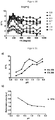
- This contrast agent possesses a single proton amide resonance (namely has 4 amide protons having the same resonance in the NMR spectrum, circled in Fig. 1 ) able to generate a CEST contrast at a specific chemical shift of 4.4 ppm, as shown by the Iodixanol Z-spectrum having only one region of saturation transfer ( Figure 2b ). Therefore, the Balaban's ratiometric approach, based on the exploitation of at least two magnetically non-equivalent mobile protons, cannot be applied with this compound.
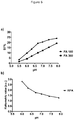
- test was performed by using a phantom containing seven different vials with Iodixanol solutions (40 mM solution in PBS) at different pH values ranging from 5.5 and 7.9.
- CEST experiments where performed by use of RF train pulses with constant saturation B avg power of 1 ⁇ T and different flip angles ( ⁇ ), respectively of 180° and 360°.
- a ratiometric RPA map was thus obtained, by using equation (3), from ST images of paned b) and c), shown in the paned d) of the figure, leading to obtain a concentration independent assessment of the pH, provided in the panel e) of the figure, where the obtained pH map is overimposed onto T 2 -weighted image.
- the sensitivity granted by the ratiometric method of the invention to report on a particular parameter of diagnostic interest, (e.g. the physiological pH) was then assessed as the difference (or delta) between the lower and the higher ratiometric value (of the parameter of interest, e.g. the physiological pH) measured inside the range of examined values.
- a particular parameter of diagnostic interest e.g. the physiological pH
- MR images were acquired on a Bruker Avance 300 spectrometer operating at 7 T and equipped with a microimaging probe with a transmiter/receiver resonator (diameter of 30 mm) used for in vitro and in vivo experiments, respectively.
- PTR pulse train repetition
- a pulsed-CEST sequence with a B avg power of 1 ⁇ T, irradiation FA of 180° and dc of 50% has a ⁇ P of 10.8 ms, a ⁇ D of 10.8 ms, a pulse train repetition of 21.6 ms, and 232 pulses for a total irradiation time of 5s.
- B avg power levels were set to be 0.5, 1 and 2 ⁇ T with different values of duty cycle (dc) of 50% and 30%.
- dc duty cycle
- B avg power can be calculated by using the following equation (4)
- B avg power 1 PTR ⁇ 0 PTR
- B 1 2 dt p 2 dc ⁇ ⁇ 180 ⁇ ⁇ ⁇ p 1 ⁇ PTR
- B avg power is the field strength of a continuous wave irradiation with the same average power as the pulsed-CEST.
- p1 is the ratio of the average amplitude to the maximum amplitude of the irradiation pulse
- p2 is the ration of the average of the square of the amplitude to the square of the maximum amplitude of the irradiation pulse
- ⁇ is the gyromagnetic ratio of the proton (with units rad(s T).
- p1 is equal to 0.418 and p2 equal 0.299, respectively. Images were acquired with a 64x64 acquisition matrix with a slice thickness of 2 mm and a field of view (FOV) of 30x30 mm. The experiments were performed at 37 °C.
- Z-spectra raw data were exported from the MRI workstation and automatically elaborated by means of a home-written software running in MATLAB (The Mathworks, Inc., Natick, MA, USA). The analysis consisted of several steps including image segmentation, global ROI analysis, local voxel-by-voxel analysis. In particular, after the automatic image segmentation of the morphological image, a Region Of Interest (ROI) was manually selected, in each morphological image, commonly including tumor area, blood vessels or edema regions, in which ROI features such as the bulk water resonance frequency and the ST response are investigated. Z-spectra were built by sampling the signal with a 0.1 ppm sampling step, more typically used for the irradiation frequency values close to the bulk water resonance.
- ROI Region Of Interest
- the segmented image was locally investigated by calculating the ST at any desired frequency offset.
- a local analysis was performed, on a voxel-by-voxel basis, accounting for the different physico-chemical properties in each single voxel, by interpolating samples coming from each voxel of the segmented image, in order to obtain the local Z-spectrum.
- the interpolation was performed based on smoothing splines, by using a smoothing factor of 0.9, allowing to identify and subtract voxel with low signal-to-noise ratio.
- the right position of the bulk water signal was assessed on a voxel basis, leading to obtain a "zero offset" map of the voxel-by-voxel distribution of the bulk water resonance in the segmented image.
- the locally corrected ST analysis was then carried out by shifting the interpolated Z-spectrum in each voxel in order to fix the bulk water resonance to zero offset. Then, a correct intra-voxel ST was calculated on the basis of the shifted interpolated curve.
Landscapes
- Health & Medical Sciences (AREA)
- Physics & Mathematics (AREA)
- Life Sciences & Earth Sciences (AREA)
- Nuclear Medicine, Radiotherapy & Molecular Imaging (AREA)
- General Health & Medical Sciences (AREA)
- High Energy & Nuclear Physics (AREA)
- Radiology & Medical Imaging (AREA)
- General Physics & Mathematics (AREA)
- Condensed Matter Physics & Semiconductors (AREA)
- Engineering & Computer Science (AREA)
- Animal Behavior & Ethology (AREA)
- Veterinary Medicine (AREA)
- Public Health (AREA)
- Molecular Biology (AREA)
- Signal Processing (AREA)
- Biomedical Technology (AREA)
- Medical Informatics (AREA)
- Heart & Thoracic Surgery (AREA)
- Chemical & Material Sciences (AREA)
- Medicinal Chemistry (AREA)
- Epidemiology (AREA)
- Surgery (AREA)
- Pathology (AREA)
- Biophysics (AREA)
- Spectroscopy & Molecular Physics (AREA)
- Magnetic Resonance Imaging Apparatus (AREA)
- Medicines Containing Antibodies Or Antigens For Use As Internal Diagnostic Agents (AREA)
- Apparatus For Radiation Diagnosis (AREA)
Claims (21)
- CEST-MR-Verfahren, umfassend:i) Anwenden eines Pulssättigungsschemas durch Bestrahlen einer einzelnes-mobiles-Proton-Frequenz eines exogenen CEST-Mittels in einer Probe mit einem Zug von Radiofrequenz(RF)-Bestrahlungspulsen mit verschiedenen Flipwinkeln und einer konstanten mittleren Leistung B1, definiert als die Quadratwurzel des mittleren quadratischen Bestrahlungsfelds B1 über die gesamte Zeitdauer jedes Pulszugs, zum Induzieren eines Sättigungstransfer-Effekts (ST-Effekt) auf der Basis von Chemical Exchange Rotation Transfer (CERT); undii) Erfassen von CEST-Signalen auf CERT-Basis von der Probe.
- CEST-MR-Verfahren gemäß Anspruch 1, wobei das Verfahren auf ratiometrischer Basis steht.
- CEST-MR-Verfahren gemäß Anspruch 2, umfassend Berechnen eines ratiometrischen Werts des ST-Effekts als Funktion der verschiedenen RF-Bestrahlungspuls-Flipwinkel.
- CEST-MR-Verfahren gemäß einem der Ansprüche 2 oder 3, umfassend:a) Berechnen eines ratiometrischen Werts des ST-Effekts durch Vergleichen von ST-Effekt-Werten, die bei verschiedenen RF-Bestrahlungspuls-Flipwinkeln gemessen sind;b) Bestimmen eines konzentrationsunabhängigen CEST-Werts.
- CEST-MRI-Verfahren gemäß Anspruch 4, wobei der Schritt a) das Berechnen einer Ratiometrie von gepulste-RF-Flipwinkeln durch Verwendung der Gleichung (3) umfasst,

- CEST-MR-Verfahren gemäß Anspruch 4, wobei der konzentrationsunabhängige CEST-Wert verwendet wird, um ein konzentrationsunabhängiges CEST-Bild bereitzustellen.
- CEST-MR-Verfahren gemäß Anspruch 4, wobei der konzentrationsunabhängige CEST-Wert verwendet wird, um ein konzentrationsunabhängiges parametrisches Bild bereitzustellen.
- CEST-MR-Verfahren gemäß einem der Ansprüche 1-7, wobei das exogene CEST-Mittel diamagnetisch ist.
- CEST-MR-Verfahren gemäß Anspruch 8, wobei das diamagnetische Mittel ein radiographisches Kontrastmittel mit wenigstens einem Amid-Proton ist.
- CEST-MR-Verfahren gemäß Anspruch 9, wobei das radiographische Kontrastmittel ein iodiertes Kontrastmittel der Formel (I),
 A, D und E gleich oder voneinander verschieden ausgewählt sind aus den Gruppen der Formeln -CON(R)R1,-COOH, -CONH2 und - (CH2)0-1N(R)-COR2; wobei:oder der Formel (II) ist,R unabhängig voneinander H oder R1 ist;R1 ein C1-C6-Alkyl, gegebenenfalls substituiert mit einem oder mehreren Hydroxy, C1-C5-Alkoxy, C1-C5-Hydroxyalkoxy oder ein Kohlenhydratrest ist; undR2 ein C1-C6-Alkyl, gegebenenfalls unterbrochen von einem oder mehreren Hydroxy, C1-C5-Alkoxy oder eine C1-C5-Hydroxyalkoxygruppe ist;
 A, D und E wie vorstehend definiert sind,B und B' gleich oder voneinander verschieden eine kovalente Bindung oder eine Gruppe ausgewählt aus den Gruppen der Formeln -CON(R)-, -N(R)CO- und -N(COR3)- sind, wobei:R wie vorstehend beschrieben ist;R3 H oder ein C1-C3-alkyl ist, gegebenenfalls substituiert mit einer oder mehreren Hydroxygruppen; undX ein C1-C6-Alkylen ist, gegebenenfalls unterbrochen von einer Gruppe ausgewählt aus -0-, -N- und -S- und gegebenenfalls substituiert mit einer oder mehreren Hydroxygruppen,mit der Maßgabe, dass in den vorstehenden Formeln (I) und (II) wenigstens ein R H ist.
 - CEST-MR-Verfahren gemäß Anspruch 10, wobei das radiographische Kontrastmittel ausgewählt ist aus der Gruppe bestehend aus: Iopamidol, Iodixanol, Iohexol, Ioversol, Iomeprol, Iopromid, Iodamid und möglichen Kombinationen davon.
- CEST-MR-Verfahren gemäß Anspruch 6 zum Erhalten von konzentrationsunabhängigen CEST-MRI-Bildern auf CERT-Basis von einem menschlichen oder Tier-Körperorgan, -bereich, -fluid oder -gewebe, umfassend:a) Verwenden eines radiographischen Kontrastmittels als das exogene CEST-Mittel bei Schritt i) von Anspruch 1;b) Aufnehmen eines Z-Spektrums und Erhalten eines Sättigungstransfer-Effekts für jeden der verschiedenen Flipwinkel;c) Berechnen eines ratiometrischen Werts des ST-Effekts als Funktion der RF-Bestrahlungspuls-Flipwinkel durch Vergleichen von ST-Effekt-Werten, die bei verschiedenen RF-Bestrahlungspuls-Flipwinkeln erhalten sind, undd) Erhalten eines konzentrationsunabhängigen Bilds des menschlichen oder Tier-Körperorgans, -bereichs, -fluids oder -gewebes.
- CEST-MR-Verfahren gemäß Anspruch 12, das in vitro (ex vivo) durchgeführt wird.
- CEST-MR-Verfahren gemäß Anspruch 12, das in vivo an einem menschlichen oder Tier-Körperorgan, -bereich, -fluid oder -gewebe durchgeführt wird, wobei dem Menschen oder Tier zuvor das radiographische Kontrastmittel verabreicht worden ist.
- CEST-MR-Verfahren gemäß Anspruch 4, wobei der berechnete ratiometrische ST-Effekt auf einen physikalischen oder chemischen Parameter von diagnostischem Interesse anspricht.
- CEST-MR-Verfahren gemäß Anspruch 15 zum Bestimmen des physikalischen oder chemischen Parameters oder zum Erhalten einer konzentrationsunabhängigen Karte des physikalischen oder chemischen Parameters von diagnostischem Interesse in einem menschlichen oder Tier-Körperorgan, -bereich, -fluid oder -gewebe, umfassend:A) Verwenden eines radiographischen Kontrastmittels als das exogene CEST-Mittel bei Schritt i) von Anspruch 1;B) Aufnehmen eines Z-Spektrums und Erhalten eines Sättigungstransfer-Effekts für jeden der verschiedenen Flipwinkel;C) Berechnen eines ratiometrischen Werts des ST-Effekts als Funktion der RF-Bestrahlungspuls-Flipwinkel durch ein Vergleichsverhältnis von ST-Effekten, die bei verschiedenen RF-Bestrahlungspuls-Flipwinkeln, die bei der gleichen Resonanz wirken, erhalten sind; undD) aus dem berechneten ratiometrischen ST-Effekt Erhalten eines Maßes oder einer konzentrationsunabhängigen Karte des physikalischen oder chemischen Parameters von Interesse.
- CEST-MR-Verfahren gemäß Anspruch 16, das in vitro (ex vivo) durchgeführt wird.
- CEST-MR-Verfahren gemäß Anspruch 16, das in vivo an einem menschlichen oder Tier-Körperorgan, -bereich, -fluid oder -gewebe durchgeführt wird, an das/den zuvor das exogene CEST-Mittel verabreicht worden ist.
- CEST-MR-Verfahren gemäß Anspruch 15, durchgeführt an einem Patienten, an den zuvor eine geeignete Menge eines radiographischen Kontrastmittels verabreicht worden ist, umfassend:i) gegebenenfalls Aufzeichnen eines anatomischen MR-Bilds eines Körperorgans, -bereichs oder -gewebes von Interesse des Patienten;ii) Verwenden eines radiographischen Kontrastmittels als das exogene CEST-Mittel bei Schritt i) von Anspruch 1;iii) Aufnehmen eines Z-Spektrums;iv) Interpolieren des Z-Spektrums und Übersetzen der interpolierten Kurve in jedem Bildvoxel, um das Minimum der Kurve auf einen Verschiebungswert von null festzulegen,v) Berechnen des ST-Effekts in dem Körperorgan, -bereich oder -gewebe des Patienten von Interesse bei jeder gewünschten Frequenzverschiebung,vi) Berechnen des ratiometrischen Werts des ST-Effekts für eine einzelne Resonanz durch Vergleichen der ST-Effekte bei verschiedenen RF-Flipwinkeln,vii) Erhalten einer parametrischen Karte des Parameters von Interesse durch Verwenden einer zuvor berechneten Kalibrierkurve; und gegebenenfallsviii) Überlagern der erhaltenen parametrischen Karte mit dem gegebenenfalls aufgezeichneten anatomischen MR-Bild, um den/die Bereich(e), an denen der Parameter von Interesse erzeugt wird, räumlich zu lokalisieren.
- CEST-MR-Verfahren gemäß einem der Ansprüche 16-19, wobei der physikalische oder chemische Parameter von diagnostischem Interesse ausgewählt ist aus der Gruppe bestehend aus: Temperatur, pH-Wert, SauerstoffPartialdruck, Kohlendioxid-Partialdruck, Ionen- oder Metabolitenkonzentration und enzymatischer Aktivität.
- CEST-MR-Verfahren gemäß einem der Ansprüche 9-20, wobei das radiographische Kontrastmittel Iodixanol oder Iopamidol ist.
Applications Claiming Priority (2)
| Application Number | Priority Date | Filing Date | Title |
|---|---|---|---|
| EP15202355 | 2015-12-23 | ||
| PCT/EP2016/082446 WO2017109111A1 (en) | 2015-12-23 | 2016-12-22 | Ratiometric pulsed cest imaging |
Publications (2)
| Publication Number | Publication Date |
|---|---|
| EP3394627A1 EP3394627A1 (de) | 2018-10-31 |
| EP3394627B1 true EP3394627B1 (de) | 2020-06-03 |
Family
ID=55129446
Family Applications (1)
| Application Number | Title | Priority Date | Filing Date |
|---|---|---|---|
| EP16819104.7A Active EP3394627B1 (de) | 2015-12-23 | 2016-12-22 | Ratiometrisch gepulste cest-bildgebung |
Country Status (5)
| Country | Link |
|---|---|
| US (2) | US20200379070A1 (de) |
| EP (1) | EP3394627B1 (de) |
| JP (1) | JP6964583B2 (de) |
| CN (1) | CN108369266B (de) |
| WO (1) | WO2017109111A1 (de) |
Cited By (1)
| Publication number | Priority date | Publication date | Assignee | Title |
|---|---|---|---|---|
| US11366189B2 (en) | 2020-09-25 | 2022-06-21 | Uih America, Inc. | Systems and methods for magnetic resonance imaging |
Families Citing this family (6)
| Publication number | Priority date | Publication date | Assignee | Title |
|---|---|---|---|---|
| CN108195867B (zh) * | 2017-12-18 | 2019-10-18 | 深圳先进技术研究院 | pH测定方法 |
| EP3575814A1 (de) * | 2018-05-29 | 2019-12-04 | Koninklijke Philips N.V. | Bewegungsdetektion in der cest-magnetresonanzbildgebung basierend auf einer auswertung des z-spektrums |
| CN112731235B (zh) * | 2020-12-09 | 2024-04-19 | 中国科学院深圳先进技术研究院 | 一种磁共振化学交换饱和转移成像方法以及相关设备 |
| US12449494B2 (en) | 2021-08-18 | 2025-10-21 | University of Pittsburgh—of the Commonwealth System of Higher Education | Chemical exchange saturation transfer (CEST) magnetic resonance imaging using an ASEF or AROSE system |
| US12529739B2 (en) | 2022-07-26 | 2026-01-20 | Canon Medical Systems Corporation | pH calculating apparatus, magnetic resonance imaging apparatus, and pH calculating method |
| CN116577711B (zh) * | 2023-05-15 | 2025-12-12 | 浙江大学 | 磁共振变翻转角序列翻转角优化方法、cest成像方法、介质及设备 |
Family Cites Families (16)
| Publication number | Priority date | Publication date | Assignee | Title |
|---|---|---|---|---|
| US8518373B2 (en) * | 2001-08-03 | 2013-08-27 | Bracco Imaging Spa | Ionic and non-ionic radiographic contrast agents for use in combined X-ray and nuclear magnetic resonance diagnostics |
| EP1331012A1 (de) * | 2002-01-29 | 2003-07-30 | BRACCO IMAGING S.p.A. | Magnetisch beeinflussbare paramagnetische Kontrastmittel für Magnetresonanzbildgebung |
| DE602006008604D1 (de) * | 2005-04-26 | 2009-10-01 | Koninkl Philips Electronics Nv | Kontrastmittel für die magnetresonanzbildgebung mit cest-aktivem paramagnetischem komplex |
| WO2006114739A2 (en) * | 2005-04-26 | 2006-11-02 | Koninklijke Philips Electronics N.V. | Method for using cest contrast agents in mri |
| RU2446829C2 (ru) * | 2006-06-09 | 2012-04-10 | Конинклейке Филипс Электроникс Н.В. | Устранение зависимости от концентрации контрастного агента в мрт |
| WO2008144421A1 (en) * | 2007-05-17 | 2008-11-27 | University Of Washington | Fast two-point mapping of the bound pool fraction and cross-relaxation rate constant for mri |
| WO2009126289A2 (en) * | 2008-04-09 | 2009-10-15 | Beth Israel Deaconess Medical Center, Inc. | Positive magnetic resonance imaging contrast methods and apparatus using chemical exchange saturation transfer |
| US8611981B2 (en) * | 2008-08-26 | 2013-12-17 | Bracco Imaging S.P.A. | MRI-CEST diagnostic technique based on non-punctual analysis |
| US9194923B2 (en) * | 2010-06-09 | 2015-11-24 | Hitachi Medical Corporation | Magnetic resonance imaging device and transmitting sensitivity distribution calculation method |
| US9157976B2 (en) * | 2010-07-20 | 2015-10-13 | The Trustees Of The University Of Pennsylvania | CEST MRI methods for imaging glutaminolysis in cancer |
| EP2457594A1 (de) * | 2010-11-05 | 2012-05-30 | Bracco Imaging S.p.A | CEST-Systeme mit konzentrationsunabhängiger Ansprechempfindlichkeit |
| WO2012098955A1 (ja) * | 2011-01-17 | 2012-07-26 | 株式会社 日立メディコ | 磁気共鳴イメージング装置及び流体強調画像取得法 |
| US10247799B2 (en) * | 2012-12-18 | 2019-04-02 | The General Hospital Corporation | System and method for sensitivity-enhanced multi-echo chemical exchange saturation transfer (MECEST) magentic resonance imaging |
| EP3047294A1 (de) * | 2013-09-16 | 2016-07-27 | Koninklijke Philips N.V. | Magnetisierungstransferkontrasttechnik für chemical-exchange-saturation-transfer (cest)-mri durch lokalisierten dampf und verfahren zum betrieb davon |
| US9638781B2 (en) * | 2014-02-03 | 2017-05-02 | Toshiba Medical Systems Corporation | Enhancement of MT effect and/or CEST effect |
| US10267881B2 (en) * | 2014-12-18 | 2019-04-23 | The Johns Hopkins University | Multi-echo parametric variation saturation (MePaVARS CEST imaging and other MR imaging |
-
2016
- 2016-12-22 EP EP16819104.7A patent/EP3394627B1/de active Active
- 2016-12-22 JP JP2018526053A patent/JP6964583B2/ja active Active
- 2016-12-22 WO PCT/EP2016/082446 patent/WO2017109111A1/en not_active Ceased
- 2016-12-22 CN CN201680073728.4A patent/CN108369266B/zh active Active
- 2016-12-22 US US16/065,302 patent/US20200379070A1/en not_active Abandoned
-
2021
- 2021-04-30 US US17/246,135 patent/US20210263122A1/en not_active Abandoned
Non-Patent Citations (1)
| Title |
|---|
| None * |
Cited By (2)
| Publication number | Priority date | Publication date | Assignee | Title |
|---|---|---|---|---|
| US11366189B2 (en) | 2020-09-25 | 2022-06-21 | Uih America, Inc. | Systems and methods for magnetic resonance imaging |
| US11977140B2 (en) | 2020-09-25 | 2024-05-07 | Shanghai United Imaging Healthcare Co., Ltd. | Systems and methods for magnetic resonance imaging |
Also Published As
| Publication number | Publication date |
|---|---|
| WO2017109111A1 (en) | 2017-06-29 |
| JP2019505248A (ja) | 2019-02-28 |
| EP3394627A1 (de) | 2018-10-31 |
| CN108369266A (zh) | 2018-08-03 |
| CN108369266B (zh) | 2021-08-06 |
| US20210263122A1 (en) | 2021-08-26 |
| US20200379070A1 (en) | 2020-12-03 |
| JP6964583B2 (ja) | 2021-11-10 |
Similar Documents
| Publication | Publication Date | Title |
|---|---|---|
| US20210263122A1 (en) | Ratiometric pulsed cest imaging | |
| Jones et al. | Clinical translation of tumor acidosis measurements with AcidoCEST MRI | |
| EP2157912B1 (de) | Multiparametrische perfusionsbildgebung mit auslaufkorrektur | |
| US6963769B1 (en) | Method for enhancing contrast produced by MRI | |
| Hyodo et al. | Monitoring redox-sensitive paramagnetic contrast agent by EPRI, OMRI and MRI | |
| EP3325992B1 (de) | Quantitative magnetresonanzbildgebung der vaskulatur | |
| US10967076B2 (en) | Use of non-labeled sugars and detection by MRI for assessing tissue perfusion and metabolism | |
| Brookes et al. | Measurement of spin-lattice relaxation times with FLASH for dynamic MRI of the breast | |
| Taheri et al. | Analysis of pharmacokinetics of Gd-DTPA for dynamic contrast-enhanced magnetic resonance imaging | |
| Soikkeli et al. | Synthesis and in vitro phantom NMR and MRI studies of fully organic free radicals, TEEPO-glucose and TEMPO-glucose, potential contrast agents for MRI | |
| Lorenz et al. | Contrast‐enhanced coronary MRA | |
| US20130006099A1 (en) | Compositions and methods for metabolic imaging | |
| US8518373B2 (en) | Ionic and non-ionic radiographic contrast agents for use in combined X-ray and nuclear magnetic resonance diagnostics | |
| Frese et al. | Balanced steady-state free precession enables high-resolution dynamic 3d deuterium metabolic imaging of the human brain at 7T | |
| Perman et al. | Fast volumetric spatial-spectral MR imaging of hyperpolarized 13C-labeled compounds using multiple echo 3D bSSFP | |
| Yu et al. | Correlation of the R1 and R2 values of gadolinium-based MRI contrast media with the ΔHounsfield unit of CT contrast media of identical concentration | |
| WO2018217817A1 (en) | Simultaneous ph and oxygen weighted mri contrast using multi-echo chemical exchange saturation transfer imaging (me-cest) | |
| Longo et al. | Iodinated contrast media as pH-responsive CEST agents | |
| Papanikolaou et al. | Comparison of dual spin echo echo planar imaging (SE_EPI), turbo spin echo with fat suppression and conventional dual spin echo sequences for T2-weighted MR imaging of focal liver lesions | |
| US12569170B2 (en) | Paramagnetic sodium NMR macrocyclic-based biosensors, and associated methods | |
| Haneder et al. | Gadofosveset: parameter optimization for steady-state imaging of the thoracic and abdominal vasculature | |
| Mukherjee et al. | Mapping of the cerebral response to acetazolamide using graded asymmetric spin echo EPI | |
| Brindle et al. | Imaging glioblastoma response to radiotherapy using 2H magnetic resonance spectroscopy measurements of fumarate metabolism | |
| Manton et al. | Combined proton MR spectroscopy and dynamic contrast enhanced MR imaging of human intracranial tumours in vivo | |
| Ubert et al. | Combining Oxygen‐Enhanced MRI and Electron Paramagnetic Resonance Oximetry for Quantitative OE‐MRI (qOE‐MRI) as a Method for Mapping Absolute Oxygen Levels (pO2) in Tumors |
Legal Events
| Date | Code | Title | Description |
|---|---|---|---|
| STAA | Information on the status of an ep patent application or granted ep patent |
Free format text: STATUS: UNKNOWN |
|
| STAA | Information on the status of an ep patent application or granted ep patent |
Free format text: STATUS: THE INTERNATIONAL PUBLICATION HAS BEEN MADE |
|
| PUAI | Public reference made under article 153(3) epc to a published international application that has entered the european phase |
Free format text: ORIGINAL CODE: 0009012 |
|
| STAA | Information on the status of an ep patent application or granted ep patent |
Free format text: STATUS: REQUEST FOR EXAMINATION WAS MADE |
|
| 17P | Request for examination filed |
Effective date: 20180705 |
|
| AK | Designated contracting states |
Kind code of ref document: A1 Designated state(s): AL AT BE BG CH CY CZ DE DK EE ES FI FR GB GR HR HU IE IS IT LI LT LU LV MC MK MT NL NO PL PT RO RS SE SI SK SM TR |
|
| AX | Request for extension of the european patent |
Extension state: BA ME |
|
| DAV | Request for validation of the european patent (deleted) | ||
| DAX | Request for extension of the european patent (deleted) | ||
| STAA | Information on the status of an ep patent application or granted ep patent |
Free format text: STATUS: EXAMINATION IS IN PROGRESS |
|
| 17Q | First examination report despatched |
Effective date: 20190904 |
|
| GRAP | Despatch of communication of intention to grant a patent |
Free format text: ORIGINAL CODE: EPIDOSNIGR1 |
|
| STAA | Information on the status of an ep patent application or granted ep patent |
Free format text: STATUS: GRANT OF PATENT IS INTENDED |
|
| INTG | Intention to grant announced |
Effective date: 20200131 |
|
| RIN1 | Information on inventor provided before grant (corrected) |
Inventor name: ARENA, FRANCESCA Inventor name: AIME, SILVIO Inventor name: CONSOLINO, LORENA Inventor name: LONGO, DARIO, LIVIO Inventor name: COLOMBO SERRA, SONIA |
|
| GRAS | Grant fee paid |
Free format text: ORIGINAL CODE: EPIDOSNIGR3 |
|
| GRAA | (expected) grant |
Free format text: ORIGINAL CODE: 0009210 |
|
| STAA | Information on the status of an ep patent application or granted ep patent |
Free format text: STATUS: THE PATENT HAS BEEN GRANTED |
|
| AK | Designated contracting states |
Kind code of ref document: B1 Designated state(s): AL AT BE BG CH CY CZ DE DK EE ES FI FR GB GR HR HU IE IS IT LI LT LU LV MC MK MT NL NO PL PT RO RS SE SI SK SM TR |
|
| REG | Reference to a national code |
Ref country code: GB Ref legal event code: FG4D |
|
| REG | Reference to a national code |
Ref country code: AT Ref legal event code: REF Ref document number: 1277553 Country of ref document: AT Kind code of ref document: T Effective date: 20200615 Ref country code: CH Ref legal event code: EP |
|
| REG | Reference to a national code |
Ref country code: DE Ref legal event code: R096 Ref document number: 602016037646 Country of ref document: DE |
|
| REG | Reference to a national code |
Ref country code: LT Ref legal event code: MG4D |
|
| PG25 | Lapsed in a contracting state [announced via postgrant information from national office to epo] |
Ref country code: LT Free format text: LAPSE BECAUSE OF FAILURE TO SUBMIT A TRANSLATION OF THE DESCRIPTION OR TO PAY THE FEE WITHIN THE PRESCRIBED TIME-LIMIT Effective date: 20200603 Ref country code: GR Free format text: LAPSE BECAUSE OF FAILURE TO SUBMIT A TRANSLATION OF THE DESCRIPTION OR TO PAY THE FEE WITHIN THE PRESCRIBED TIME-LIMIT Effective date: 20200904 Ref country code: FI Free format text: LAPSE BECAUSE OF FAILURE TO SUBMIT A TRANSLATION OF THE DESCRIPTION OR TO PAY THE FEE WITHIN THE PRESCRIBED TIME-LIMIT Effective date: 20200603 Ref country code: NO Free format text: LAPSE BECAUSE OF FAILURE TO SUBMIT A TRANSLATION OF THE DESCRIPTION OR TO PAY THE FEE WITHIN THE PRESCRIBED TIME-LIMIT Effective date: 20200903 Ref country code: SE Free format text: LAPSE BECAUSE OF FAILURE TO SUBMIT A TRANSLATION OF THE DESCRIPTION OR TO PAY THE FEE WITHIN THE PRESCRIBED TIME-LIMIT Effective date: 20200603 |
|
| REG | Reference to a national code |
Ref country code: NL Ref legal event code: MP Effective date: 20200603 |
|
| PG25 | Lapsed in a contracting state [announced via postgrant information from national office to epo] |
Ref country code: HR Free format text: LAPSE BECAUSE OF FAILURE TO SUBMIT A TRANSLATION OF THE DESCRIPTION OR TO PAY THE FEE WITHIN THE PRESCRIBED TIME-LIMIT Effective date: 20200603 Ref country code: BG Free format text: LAPSE BECAUSE OF FAILURE TO SUBMIT A TRANSLATION OF THE DESCRIPTION OR TO PAY THE FEE WITHIN THE PRESCRIBED TIME-LIMIT Effective date: 20200903 Ref country code: LV Free format text: LAPSE BECAUSE OF FAILURE TO SUBMIT A TRANSLATION OF THE DESCRIPTION OR TO PAY THE FEE WITHIN THE PRESCRIBED TIME-LIMIT Effective date: 20200603 Ref country code: RS Free format text: LAPSE BECAUSE OF FAILURE TO SUBMIT A TRANSLATION OF THE DESCRIPTION OR TO PAY THE FEE WITHIN THE PRESCRIBED TIME-LIMIT Effective date: 20200603 |
|
| REG | Reference to a national code |
Ref country code: AT Ref legal event code: MK05 Ref document number: 1277553 Country of ref document: AT Kind code of ref document: T Effective date: 20200603 |
|
| PG25 | Lapsed in a contracting state [announced via postgrant information from national office to epo] |
Ref country code: AL Free format text: LAPSE BECAUSE OF FAILURE TO SUBMIT A TRANSLATION OF THE DESCRIPTION OR TO PAY THE FEE WITHIN THE PRESCRIBED TIME-LIMIT Effective date: 20200603 Ref country code: NL Free format text: LAPSE BECAUSE OF FAILURE TO SUBMIT A TRANSLATION OF THE DESCRIPTION OR TO PAY THE FEE WITHIN THE PRESCRIBED TIME-LIMIT Effective date: 20200603 |
|
| PG25 | Lapsed in a contracting state [announced via postgrant information from national office to epo] |
Ref country code: ES Free format text: LAPSE BECAUSE OF FAILURE TO SUBMIT A TRANSLATION OF THE DESCRIPTION OR TO PAY THE FEE WITHIN THE PRESCRIBED TIME-LIMIT Effective date: 20200603 Ref country code: CZ Free format text: LAPSE BECAUSE OF FAILURE TO SUBMIT A TRANSLATION OF THE DESCRIPTION OR TO PAY THE FEE WITHIN THE PRESCRIBED TIME-LIMIT Effective date: 20200603 Ref country code: AT Free format text: LAPSE BECAUSE OF FAILURE TO SUBMIT A TRANSLATION OF THE DESCRIPTION OR TO PAY THE FEE WITHIN THE PRESCRIBED TIME-LIMIT Effective date: 20200603 Ref country code: SM Free format text: LAPSE BECAUSE OF FAILURE TO SUBMIT A TRANSLATION OF THE DESCRIPTION OR TO PAY THE FEE WITHIN THE PRESCRIBED TIME-LIMIT Effective date: 20200603 Ref country code: EE Free format text: LAPSE BECAUSE OF FAILURE TO SUBMIT A TRANSLATION OF THE DESCRIPTION OR TO PAY THE FEE WITHIN THE PRESCRIBED TIME-LIMIT Effective date: 20200603 Ref country code: RO Free format text: LAPSE BECAUSE OF FAILURE TO SUBMIT A TRANSLATION OF THE DESCRIPTION OR TO PAY THE FEE WITHIN THE PRESCRIBED TIME-LIMIT Effective date: 20200603 Ref country code: PT Free format text: LAPSE BECAUSE OF FAILURE TO SUBMIT A TRANSLATION OF THE DESCRIPTION OR TO PAY THE FEE WITHIN THE PRESCRIBED TIME-LIMIT Effective date: 20201006 |
|
| PG25 | Lapsed in a contracting state [announced via postgrant information from national office to epo] |
Ref country code: IS Free format text: LAPSE BECAUSE OF FAILURE TO SUBMIT A TRANSLATION OF THE DESCRIPTION OR TO PAY THE FEE WITHIN THE PRESCRIBED TIME-LIMIT Effective date: 20201003 Ref country code: PL Free format text: LAPSE BECAUSE OF FAILURE TO SUBMIT A TRANSLATION OF THE DESCRIPTION OR TO PAY THE FEE WITHIN THE PRESCRIBED TIME-LIMIT Effective date: 20200603 Ref country code: SK Free format text: LAPSE BECAUSE OF FAILURE TO SUBMIT A TRANSLATION OF THE DESCRIPTION OR TO PAY THE FEE WITHIN THE PRESCRIBED TIME-LIMIT Effective date: 20200603 |
|
| REG | Reference to a national code |
Ref country code: DE Ref legal event code: R097 Ref document number: 602016037646 Country of ref document: DE |
|
| PLBE | No opposition filed within time limit |
Free format text: ORIGINAL CODE: 0009261 |
|
| STAA | Information on the status of an ep patent application or granted ep patent |
Free format text: STATUS: NO OPPOSITION FILED WITHIN TIME LIMIT |
|
| PG25 | Lapsed in a contracting state [announced via postgrant information from national office to epo] |
Ref country code: DK Free format text: LAPSE BECAUSE OF FAILURE TO SUBMIT A TRANSLATION OF THE DESCRIPTION OR TO PAY THE FEE WITHIN THE PRESCRIBED TIME-LIMIT Effective date: 20200603 |
|
| 26N | No opposition filed |
Effective date: 20210304 |
|
| PG25 | Lapsed in a contracting state [announced via postgrant information from national office to epo] |
Ref country code: SI Free format text: LAPSE BECAUSE OF FAILURE TO SUBMIT A TRANSLATION OF THE DESCRIPTION OR TO PAY THE FEE WITHIN THE PRESCRIBED TIME-LIMIT Effective date: 20200603 |
|
| PG25 | Lapsed in a contracting state [announced via postgrant information from national office to epo] |
Ref country code: MC Free format text: LAPSE BECAUSE OF FAILURE TO SUBMIT A TRANSLATION OF THE DESCRIPTION OR TO PAY THE FEE WITHIN THE PRESCRIBED TIME-LIMIT Effective date: 20200603 |
|
| REG | Reference to a national code |
Ref country code: BE Ref legal event code: MM Effective date: 20201231 |
|
| PG25 | Lapsed in a contracting state [announced via postgrant information from national office to epo] |
Ref country code: IE Free format text: LAPSE BECAUSE OF NON-PAYMENT OF DUE FEES Effective date: 20201222 Ref country code: LU Free format text: LAPSE BECAUSE OF NON-PAYMENT OF DUE FEES Effective date: 20201222 |
|
| PG25 | Lapsed in a contracting state [announced via postgrant information from national office to epo] |
Ref country code: TR Free format text: LAPSE BECAUSE OF FAILURE TO SUBMIT A TRANSLATION OF THE DESCRIPTION OR TO PAY THE FEE WITHIN THE PRESCRIBED TIME-LIMIT Effective date: 20200603 Ref country code: MT Free format text: LAPSE BECAUSE OF FAILURE TO SUBMIT A TRANSLATION OF THE DESCRIPTION OR TO PAY THE FEE WITHIN THE PRESCRIBED TIME-LIMIT Effective date: 20200603 Ref country code: CY Free format text: LAPSE BECAUSE OF FAILURE TO SUBMIT A TRANSLATION OF THE DESCRIPTION OR TO PAY THE FEE WITHIN THE PRESCRIBED TIME-LIMIT Effective date: 20200603 |
|
| PG25 | Lapsed in a contracting state [announced via postgrant information from national office to epo] |
Ref country code: MK Free format text: LAPSE BECAUSE OF FAILURE TO SUBMIT A TRANSLATION OF THE DESCRIPTION OR TO PAY THE FEE WITHIN THE PRESCRIBED TIME-LIMIT Effective date: 20200603 |
|
| PG25 | Lapsed in a contracting state [announced via postgrant information from national office to epo] |
Ref country code: BE Free format text: LAPSE BECAUSE OF NON-PAYMENT OF DUE FEES Effective date: 20201231 |
|
| REG | Reference to a national code |
Ref country code: CH Ref legal event code: U11 Free format text: ST27 STATUS EVENT CODE: U-0-0-U10-U11 (AS PROVIDED BY THE NATIONAL OFFICE) Effective date: 20260101 |
|
| PGFP | Annual fee paid to national office [announced via postgrant information from national office to epo] |
Ref country code: GB Payment date: 20251229 Year of fee payment: 10 |
|
| PGFP | Annual fee paid to national office [announced via postgrant information from national office to epo] |
Ref country code: IT Payment date: 20251219 Year of fee payment: 10 |
|
| PGFP | Annual fee paid to national office [announced via postgrant information from national office to epo] |
Ref country code: FR Payment date: 20251226 Year of fee payment: 10 |
|
| PGFP | Annual fee paid to national office [announced via postgrant information from national office to epo] |
Ref country code: DE Payment date: 20251229 Year of fee payment: 10 |
|
| PGFP | Annual fee paid to national office [announced via postgrant information from national office to epo] |
Ref country code: CH Payment date: 20260101 Year of fee payment: 10 |