EP3393582B1 - Intensitätsmodulierte protonentherapieplan-optimierung basierend auf mindestens der erwarteten bewegung des inneren organs und/oder der erwarteten verformung - Google Patents
Intensitätsmodulierte protonentherapieplan-optimierung basierend auf mindestens der erwarteten bewegung des inneren organs und/oder der erwarteten verformung Download PDFInfo
- Publication number
- EP3393582B1 EP3393582B1 EP16819670.7A EP16819670A EP3393582B1 EP 3393582 B1 EP3393582 B1 EP 3393582B1 EP 16819670 A EP16819670 A EP 16819670A EP 3393582 B1 EP3393582 B1 EP 3393582B1
- Authority
- EP
- European Patent Office
- Prior art keywords
- dose distribution
- internal organ
- image
- deformation
- proton therapy
- Prior art date
- Legal status (The legal status is an assumption and is not a legal conclusion. Google has not performed a legal analysis and makes no representation as to the accuracy of the status listed.)
- Active
Links
Images


Classifications
-
- A—HUMAN NECESSITIES
- A61—MEDICAL OR VETERINARY SCIENCE; HYGIENE
- A61N—ELECTROTHERAPY; MAGNETOTHERAPY; RADIATION THERAPY; ULTRASOUND THERAPY
- A61N5/00—Radiation therapy
- A61N5/10—X-ray therapy; Gamma-ray therapy; Particle-irradiation therapy
- A61N5/103—Treatment planning systems
- A61N5/1031—Treatment planning systems using a specific method of dose optimization
-
- A—HUMAN NECESSITIES
- A61—MEDICAL OR VETERINARY SCIENCE; HYGIENE
- A61N—ELECTROTHERAPY; MAGNETOTHERAPY; RADIATION THERAPY; ULTRASOUND THERAPY
- A61N5/00—Radiation therapy
- A61N5/10—X-ray therapy; Gamma-ray therapy; Particle-irradiation therapy
- A61N5/103—Treatment planning systems
- A61N5/1037—Treatment planning systems taking into account the movement of the target, e.g. 4D-image based planning
-
- A—HUMAN NECESSITIES
- A61—MEDICAL OR VETERINARY SCIENCE; HYGIENE
- A61N—ELECTROTHERAPY; MAGNETOTHERAPY; RADIATION THERAPY; ULTRASOUND THERAPY
- A61N5/00—Radiation therapy
- A61N5/10—X-ray therapy; Gamma-ray therapy; Particle-irradiation therapy
- A61N5/103—Treatment planning systems
- A61N5/1039—Treatment planning systems using functional images, e.g. PET or MRI
-
- A—HUMAN NECESSITIES
- A61—MEDICAL OR VETERINARY SCIENCE; HYGIENE
- A61N—ELECTROTHERAPY; MAGNETOTHERAPY; RADIATION THERAPY; ULTRASOUND THERAPY
- A61N5/00—Radiation therapy
- A61N5/10—X-ray therapy; Gamma-ray therapy; Particle-irradiation therapy
- A61N5/1042—X-ray therapy; Gamma-ray therapy; Particle-irradiation therapy with spatial modulation of the radiation beam within the treatment head
- A61N5/1045—X-ray therapy; Gamma-ray therapy; Particle-irradiation therapy with spatial modulation of the radiation beam within the treatment head using a multi-leaf collimator, e.g. for intensity modulated radiation therapy or IMRT
-
- A—HUMAN NECESSITIES
- A61—MEDICAL OR VETERINARY SCIENCE; HYGIENE
- A61N—ELECTROTHERAPY; MAGNETOTHERAPY; RADIATION THERAPY; ULTRASOUND THERAPY
- A61N5/00—Radiation therapy
- A61N5/10—X-ray therapy; Gamma-ray therapy; Particle-irradiation therapy
- A61N5/1048—Monitoring, verifying, controlling systems and methods
- A61N2005/1074—Details of the control system, e.g. user interfaces
-
- A—HUMAN NECESSITIES
- A61—MEDICAL OR VETERINARY SCIENCE; HYGIENE
- A61N—ELECTROTHERAPY; MAGNETOTHERAPY; RADIATION THERAPY; ULTRASOUND THERAPY
- A61N5/00—Radiation therapy
- A61N5/10—X-ray therapy; Gamma-ray therapy; Particle-irradiation therapy
- A61N2005/1085—X-ray therapy; Gamma-ray therapy; Particle-irradiation therapy characterised by the type of particles applied to the patient
- A61N2005/1087—Ions; Protons
Definitions
- the following generally relates intensity modulated proton therapy (IMPT), and more particularly to optimizing an IMPT plan based at least on internal organ anticipated movement and/or expected deformation.
- IMPT intensity modulated proton therapy
- Intensity modulated proton therapy uses a beam of protons to irradiate diseased tissue, e.g., in the treatment of cancer. Failing to account for errors such as range and setup uncertainties in the IMPT plan may result in a delivered dose distribution that is inferior to the planned dose distribution.
- Range uncertainty corresponds to the uncertainty of the location of the Bragg peak with respect to anatomical structures (i.e., the range of a proton beam in the patient). This uncertainty can be from the uncertainty in CT Hounsfield units and the conversion to stopping power, artifacts in the CT image, and geometric changes of the patient. Setup uncertainty is due to a positional shift of the patient, which may cause misalignment of dose contributions from different beam directions and misalignment of density heterogeneities.
- RO Robust Optimization
- Setup uncertainty can be modeled by simulating a set of independent uncertainty cases that mimic whole body movement of the patient in six directions (three pair of positive and negative coordinates).
- the RO minimizes a total objective value (RO OBV), which includes a clinical objective component (Nominal Plan OBV) and a patient setup error component (Setup Error OBV).
- RO OBV total objective value
- Nominal Plan OBV Nominal Plan OBV
- Setup Error OBV Setup Error OBV
- +X error OBV is the objective value obtained from the dose statistics when the patient is shifted in a positive X direction by a factor specified by the user.
- Non-limiting examples of determining error and IMPT planning are described in Goitein, "Calculation of uncertainty in the dose delivered during radiation therapy," Med. Phys. 12, 608-612 (1985 ), Unkelbach et al., “Accounting for range uncertainties in the optimization of intensity modulated proton therapy, Phys. Med. Biol. 52 (2007) 2755-2773 (2007 ), and Unkelbach et al. "Reducing the sensitivity of IMPT treatment plans to setup errors and range uncertainties via probabilistic treatment planning" American Association of Physicists in Medicine (2009 ).
- EQUATION 1 is well-suited for setup errors such as whole body patient movement, e.g., three millimeters (3 mm) with the modern immobilization devices.
- EQUATION 1 does not take into account internal organ movement and/or deformation, such as in the case of the bladder or rectum, which tends to be of a large magnitude relative to setup errors, and the probability of occurrence for this error tends to increase over time.
- such movement and/or deformation may result in a wrong dose due to a positional change with respect to beams.
- US8644571 describes the therapeutic treatment of a patient using IMPT.
- a method of creating a proton treatment plan is presented that divides volumes of interest into sub-volumes, applies does constraints to the sub-volumes, finds one or more feasible configurations of a proton therapy system, and selects a proton beam configuration.
- US2004/254773 describes the use of intensity modulated radiation therapy (IMRT) of targets subject to respiratory motion.
- IMRT intensity modulated radiation therapy
- a method in one aspect, includes generating a nominal dose distribution based on an image and clinical goals. The method further includes generating a setup error dose distribution based on range and setup uncertainties. The method further includes generating a dose distribution for a parameter of an internal organ. The method further includes optimizing a planned dose distribution of an intensity modulated proton therapy plan by minimizing a total objective value including the nominal dose distribution, the setup error dose distribution dose distribution, and the dose distribution for the internal organ. The method further includes generating a final dose distribution for the intensity modulated proton therapy plan based on beam parameters of the optimized planned dose distribution. The method further includes controlling a proton therapy apparatus configured to deliver proton therapy based on the intensity modulated proton therapy plan with the optimized planned dose distribution.
- a system in another aspect, includes a proton therapy apparatus configured to deliver proton therapy and a controller configured to control the proton therapy apparatus.
- the system further includes a treatment planner configured to generate an optimized intensity modulated proton therapy plan based on an input image, a nominal dose distribution, a setup error dose distribution, and a dose distribution for at least one of an internal organ movement or an internal organ deformation.
- the system further includes a console (122) configured to instruct the controller to control the proton therapy apparatus to transmit a proton beam based on the optimized intensity modulated proton therapy plan.
- a non-transitory computer readable medium is encoded with computer executable instructions, which when executed by a processor, causes the processor to: receive an image, receive a first input indicative of a nominal dose distribution for the image and clinical goals, receive a second input indicative of a whole body dose distribution for range and setup uncertainties, receive a third input indicative of an anticipated movement of an internal organ, receive a fourth input indicative of an expected deformation of the internal organ, warp the image based on the anticipated movement and the expected deformation, generating a warped image, compute a dose distribution for the warped image, optimize a planned dose distribution of an intensity modulated proton therapy based on the nominal dose distribution, the whole body movement distribution and the dose distribution for the anticipated movement and the expected deformation, export beam parameters obtained from the optimization to the received image, and generate a final dose distribution for the intensity modulated proton therapy plan based the beam parameters.
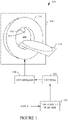
- FIGURE 1 schematically illustrates a therapy system 100 configured for intensity modulated proton therapy (IMPT.
- IMPT intensity modulated proton therapy
- a stationary gantry 102 rotatably supports a rotating gantry 104, which rotates with respect to a rotation axis about a treatment region 106.
- a nozzle 110 houses beam modifying components and delivers the proton beam.
- a snout 112 supports the aperture and compensator.
- a support 114 supports a portion of a subject in the treatment region 106.
- a proton source such as a 70 MeV proton accelerator, produces a proton beam.
- An operator console 122 includes human readable output devices such as a display monitor and input devices such as a keyboard and/or mouse. Software accessible on and executable by a processor of the console 122 allows the operator to control an operation of the therapy system 100.
- a controller 124 is configured to control rotation of the rotating gantry 104 and the subject support 116 and deliver of treatment protons by the proton source during a treatment.
- a treatment planner 126 creates IMPT treatment plans. As described in greater detail below, in one instance the treatment planner 126 is configured to optimize IMPT treatment plans based at least on internal organ movement and/or deformation. For example, in one instance the treatment planner 126 is configured to optimize IMPT treatment plans based on set up error and internal organ movement and/or deformation. In other embodiments, the treatment planner 126 is configured to optimize IMPT treatment plans based on more or less, additional or different, etc. features.
- the treatment planner 126 can be implemented via one or more processors (e.g., micro-processor, central processing unit, controller, etc.) executing one or more computer readable instructions.
- the one or more computer readable instructions are encoded on non-transitory computer readable storage medium such a physical memory and/or other non-transitory medium.
- at least one of the computer readable instructions can be carried by a carrier waver, a signal and/or other transitory medium.
- FIGURE 2 illustrates a non-limiting example of the treatment planner 126.
- the treatment planner 126 receives, as input, an image and clinical (user specified) goals.
- the image can be a computed tomography (CT), magnetic resonance (MR), positron emission tomography (PET), and/or other modality image.
- the image can be received from an imaging system, a data repository (e.g., picture archiving and communication system (PACS), a radiology information system (RIS), etc.), local memory, etc.
- Examples of clinical goals include a specific machine parameter setting (e.g., number of spots, spot monitor unit (MU), etc.), dose-volume histogram (DVH), dose distribution and a Composite Objective Value.
- a nominal plan generator 202 is configured to generate an optimized nominal IMPT plan based on the image and the clinical goals.
- the nominal plan includes an estimated nominal dose distribution, e.g., dose statistics of each region of interest (ROI).
- ROI region of interest
- the treatment planner 126 further receives, as input, anticipated ROI movement in one or more dimensions and/or an expected worst case of deformation for the ROI.
- GUIs 300 and 400 for entering organ movement and organ deformation in three-dimensions are illustrated. From FIGURE 3 , the GUI 300 includes a first field 302 for selecting a ROI 304 from a pre-determined list, and fields 306, 308 and 310 for entering expected organ movement along Antero-posterior (AP) 312, Superior-inferior (SI) 314 and Medio-Lateral (ML) 316 directions.
- AP Antero-posterior
- SI Superior-inferior
- ML Medio-Lateral
- the GUI 400 includes a first field 402 for selecting a ROI 404, and fields 406, 408 and 410 for entering a range of deformation along AP 412, SI 414 and ML 416 directions.
- a location and/or a size/shape of the/ ROI can be entered and/or edited.
- an image warper 204 warps the input image based on the anticipated ROI movement and/or the expected ROI deformation, producing a warped image or model.
- the input is converted to a set of deformation vector fields (DVFs), which is applied on an external contour of the ROI to warp the ROI (ROI-warping), the region of the image contained within the ROI (ROI density-warping) and/or regions in a predetermined vicinity about the deformed ROI (neighborhood density-warping).
- This will produce warping inside the ROI as well as in the regions adjacent to the ROI.
- the neighborhood density-warping is done by assuming a simple elastic expansion-contraction model. In this approach, as shown in FIGURE 5 , a neighborhood region 500 contracts if an ROI 504 expands, and, as shown in FIGURE 6 , the neighborhood region 500 expands if the ROI 502 contracts.
- the elastic model for neighborhood-density warping can in turn obey different models based on user preference, a default, etc.
- a first is a simple spring expansion model in which the displacement is shared equally starting from the fixed point to the loaded point.
- Another is a damped spring expansion model in which the displacement is more at a loaded point and gradually reduces towards a fixed point.
- the simple spring is well-suited for instances where the expected organ movement and/or deformation causes an equal and linear contraction or expansion in the nearest neighborhood as well as in the farthest regions from the deformed organ.
- the damped spring model is well-suited for instances where the expected expansion/contraction resulting from organ movement or deformation is greater in the nearest neighborhood and less farther from the organ.
- an organ movement and/or deformation analyzer 206 processes the ROI in the warped image and generates dose distributions for the ROI movement and/or deformation.
- the treatment planner 126 further receives, as input, a set of setup uncertainty such as an estimate of whole body movement of the patient in six directions (three pair of positive and negative coordinates), range uncertainty, etc.
- a setup error analyzer 208 processes the setup error (range and setup uncertainty) and generates a dose distribution optimized for the setup error.
- a robustness optimizer 210 processes the estimated nominal dose distribution, the dose distributions for the setup error, and the dose distributions for the ROI movement and/or deformation.
- EQUATION 2 provides an example RO optimization for computing a RO OBV that takes into account the ROI movement and/or deformation.
- RO OBV Nominal Plan OBV + Setup Error OBV + Organ Movement OBV + Organ deformation OBV
- each objective value represents a respective uncertainty scenario, e.g., Organ B (+X error OBV) is the objective value obtained from the dose statistics when the organ B is in displaced place by a factor specified by the user.
- each objective value represents the respective uncertainty scenario, e.g., Organ A (X contraction OBV) is the objective value obtained from the dose statistics when the organ A is in contracted state.
- the Organ Movement OBV component is omitted from EQUATION 2, and EQUATION 2 takes into account internal organ deformation but not internal organ movement.
- the Organ deformation OBV component is omitted from EQUATION 2, and EQUATION 2 takes into account internal organ movement but not internal organ deformation.
- a parameter and image combiner 212 combines the beam parameters obtained from using EQUATION 2 and the input image (i.e. the image without warping). This can be achieved by exporting the beam parameters obtained from the RO onto the input image.
- a dose distribution estimator 214 re-computes the dose distribution based thereon. This information is displayed via a display monitor, and a user can evaluate the treatment plan, e.g., to check the optimality of the dose distribution. The user, via an input device, can confirm, modify, re-compute, or reject the plan.
- An IMPT plan with an accepted dose distribution is provided to the console 122, which instructs the controller 124 based thereon for a proton beam therapy treatment.
- FIGURE 7 illustrates an example method for optimized IMPT plan that takes into account internal organ movement and/or deformation.
- an image for creating an IMPT plan is received.
- a nominal dose distribution is generated for the image and the clinical goals.
- anticipated internal organ movement and/or expected internal organ deformation information is received, as described herein and/or otherwise.
- the image is warped based on the organ movement and/or deformation information, as described herein and/or otherwise.
- a dose distribution for the movement and/or deformation is determined, as described herein and/or otherwise.
- setup error is received.
- a dose distribution for the setup error is determined.
- an objective function including components for the nominal dose distribution, the dose distribution for the setup error, and the dose distribution for the movement and/or deformation is optimized, as described herein and/or otherwise.
- the resulting beam parameters are combined with the image, as described herein and/or otherwise.
- a final dose distribution is estimated based thereon, as described herein and/or otherwise.
- the IMPT plan with the final dose distribution is employed by the system 100 to execute a proton treatment.
- the following provides examples in connection with MR therapy. This includes deformation of MR images on treatment sites where there are more tissues than bones using algorithms to convert MR images to CT images on which radiation treatment planning is performed. This allows for improved deformation due at least to more tissues in the MR images relative to CT images.
- FIGURE 8 illustrates an example method for MR therapy. This method is fully MR-based (i.e., no additional radiation exposure due to CT acquisition) and leverages soft tissue contrast.
- an MR imaging system is used to scan a subject and generate an MR image for creating an IMPT plan.
- the MR image is converted into a pseudo CT image such as a MR for Calculating ATtenuation (MRCAT) image.
- MRCAT MR for Calculating ATtenuation
- Known and/or other algorithms can be employed to convert the MR images. Converting a CT image to a MRCAT image is discussed at http://www.philips.com.eg/healthcare/education-resources/publications/hotspot/prostate-rt-planning and in Kohler et al., "MR-only simulation for radiotherapy planning.”
- anticipated internal organ movement and/or expected internal organ deformation information is obtained, as described herein and/or otherwise.
- the MR image is warped based on the organ movement and/or deformation producing a warped image, as described herein and/or otherwise.
- the warped MR image is converted to a warped MRCAT image.
- Known and/or other algorithms can be employed to convert the deformed MR images.
- a robustness analysis and optimization is performed, as described herein (e.g., acts 712-724 of FIGURE 7 ) and/or otherwise.
- a final dose distribution is estimated based thereon, as described herein and/or otherwise.
- the IMPT plan with the final dose distribution is employed by the system 100 to execute a proton treatment.
- FIGURE 9 illustrates another example method for MR therapy. This method uses both a CT image and a MR image. A nominal plan is created using actual CT and thus is more accurate in terms of dose computation, and the soft tissue information from the MR image is incorporated in the process.
- an CT imaging system is used to scan a subject and generate a CT image for creating an IMPT plan.
- an MR imaging system is used to scan a subject and generate an MR image for creating an IMPT plan.
- anticipated internal organ movement and/or expected internal organ deformation information is obtained, as described herein and/or otherwise.
- the MR image is warped based on the organ movement and/or deformation producing a warped MR image, as described herein and/or otherwise.
- a deformable image registration (e.g., MR to CT fusion, etc.) is applied between the CT and warped MR, which transfers the deformations in MR image to the CT image.
- a robustness analysis and optimization is performed, as described herein (e.g., acts 712-724 of FIGURE 7 ) and/or otherwise.
- a final dose distribution is estimated based thereon, as described herein and/or otherwise.
- the IMPT plan with the final dose distribution is employed by the system 100 to execute a proton treatment.
- the estimate may be subject to a validation step by a validation system.
- the methods herein may be implemented by way of computer readable instructions, encoded or embedded on computer readable storage medium, which, when executed by a computer processor(s), cause the processor(s) to carry out the described acts. Additionally or alternatively, at least one of the computer readable instructions is carried by a signal, carrier wave or other transitory medium.
Landscapes
- Health & Medical Sciences (AREA)
- Engineering & Computer Science (AREA)
- Biomedical Technology (AREA)
- Pathology (AREA)
- Nuclear Medicine, Radiotherapy & Molecular Imaging (AREA)
- Radiology & Medical Imaging (AREA)
- Life Sciences & Earth Sciences (AREA)
- Animal Behavior & Ethology (AREA)
- General Health & Medical Sciences (AREA)
- Public Health (AREA)
- Veterinary Medicine (AREA)
- Radiation-Therapy Devices (AREA)
Claims (15)
- Verfahren zum Erzeugen eines optimierten Plans für intensitätsmodulierte Protonentherapie, das Verfahren umfassend:Erzeugen einer nominalen Dosisverteilung basierend auf eines Bild und klinischen Zielen;Erzeugen einer Einrichtungsfehler-Dosisverteilung basierend auf Bereichs- und Einrichtungsunsicherheiten;Erzeugen einer Dosisverteilung für einen Parameter eines inneren Organs, wobei der Parameter eine vorweggenommene Bewegung eines inneren Organs und/oder eine erwartete Deformation eines inneren Organs beinhaltet; und wobei ein Erzeugen der Dosisverteilung für den Parameter eines inneren Organs ein Verkrümmen des Bilds basierend auf der vorweggenommenen Bewegung eines inneren Organs und/oder der erwarteten Deformation eines inneren Organs, ein Erzeugen eines verkrümmten Bilds und ein Berechnen der Dosisverteilung für den Parameter mit dem verkrümmten Bild umfasst;Optimieren einer geplanten Dosisverteilung eines Plans für intensitätsmodulierte Protonentherapie durch Minimieren eines Gesamtzielwerts, der die nominale Dosisverteilung, die Einrichtungsfehler-Dosisverteilung und die Dosisverteilung für den Parameter des inneren Organs beinhaltet; undErzeugen einer endgültigen Dosisverteilung für den Plan für intensitätsmodulierte Protonentherapie basierend auf den Strahlparametern der optimierten geplanten Dosisverteilung.
- Verfahren nach Anspruch 1, wobei die Vorweggenommene Bewegung eines inneren Organs und/oder erwartete Deformation eines inneren Organs eine dreidimensionale Bewegung beinhaltet.
- Verfahren nach Anspruch 1, wobei das Verkrümmen Folgendes umfasst:Bestimmung eines Deformationsvektorfelds für den Parameter; undAnwenden des Deformationsvektorfelds auf das Bild.
- Verfahren nach Anspruch 3, wobei das Verkrümmen nur ein Verkrümmen eines Teilbereichs von Interesse des inneren Organs beinhaltet.
- Verfahren nach Anspruch 4, wobei das Vektorfeld auf eine äußere Kontur des Teilbereichs von Interesse des inneren Organs angewendet wird.
- Verfahren nach einem der Ansprüche 4 bis 5, wobei das Vektorfeld auf einen Bereich angewendet wird, der in dem Teilbereich von Interesse des inneren Organs enthalten ist.
- Verfahren nach einem der Ansprüche 4 bis 6, wobei das Vektorfeld auf einen vorbestimmten Bereich um den Teilbereich von Interesse des inneren Organs angewendet wird.
- Verfahren nach Anspruch 7, wobei das Verkrümmen auf einem elastischen Expansions-Kontraktions-Modell basiert, bei dem sich der vorbestimmte Bereich als Reaktion auf die Kontraktion des Teilbereichs ausdehnt und der vorbestimmte Bereich als Reaktion auf die Expansion des Teilbereichs kontrahiert.
- Verfahren nach Anspruch 8, wobei das Modell aus einer Gruppe ist, bestehend aus einem einfachen Federexpansionsmodell, bei dem eine Verlagerung gleichförmig verteilt ist, und einem gedämpften Federexpansionsmodell, bei dem die Auslenkung ungleich ist.
- System, das konfiguriert ist, um einen optimierten Plan für intensitätsmodulierte Protonentherapie zu erzeugen, umfassend:
einen Behandlungsplaner (126), der einen Prozessor beinhaltet, der konfiguriert ist, um einen optimierten Plan für intensitätsmodulierte Protonentherapie nach Anspruch 1 basierend auf einem Eingangsbilds, einer nominalen Dosisverteilung, einer Einrichtungsfehler-Dosisverteilung und einer Dosisverteilung für mindestens eine von einer Bewegung eines inneren Organs oder einer Deformation eines inneren Organs zu erzeugen; wobei der Behandlungsplaner ferner Folgendes umfasst:einen Bildverkrümmer (204), der konfiguriert ist, um das Eingangsbild basierend auf einer vorweggenommenen Bewegung eines inneren Organs und einer erwarteten Deformation des inneren Organs zu verkrümmen und ein verkrümmtes Bild zu erzeugen; undeinen Organbewegungs- und/oderdeformationsanalysator (206), der konfiguriert ist, um das verkrümmte Bild zu verarbeiten und die Dosisverteilung für die mindestens eine von der Bewegung eines inneren Organs und/oder Deformation eines inneren Organs zu berechnen. - System nach Anspruch 10, wobei der Behandlungsplaner ferner Folgendes umfasst:
einen Robustheitsoptimierer (210), der konfiguriert ist, um eine geplante Dosisverteilung eines Plans für intensitätsmodulierte Protonentherapie zu optimieren, indem er einen Gesamtzielwert minimiert, der die nominale Dosisverteilung, die Einrichtungsfehler-Dosisverteilung und die Dosisverteilung für die Bewegung eines inneren Organs und/oder die Deformation eines inneren Organs umfasst, was optimierte Strahlparameter erzeugt. - System nach Anspruch 11, wobei der Behandlungsplaner ferner Folgendes umfasst:
einen Parameter- und Bildkombinierer (212), der konfiguriert ist, um Strahlparameter in das Eingangsbild zu exportieren. - System nach Anspruch 12, wobei der Behandlungsplaner ferner Folgendes umfasst:
einen Dosisverteilungsschätzer (214), der konfiguriert ist, um eine endgültige Dosisverteilung für den optimierten Plan für intensitätsmodulierte Protonentherapie basierend auf den Strahlparametern zu berechnen. - Protonentherapievorrichtung (100), die konfiguriert ist, um Protonentherapie zu liefern, umfassend;das System nach Anspruch 10;eine Steuerung (124), die konfiguriert ist, um die Protonentherapievorrichtung zu steuern; undeine Konsole (122), die konfiguriert ist, um die Steuerung anzuweisen, die Protonentherapievorrichtung zu steuern, um einen Protonenstrahl basierend auf dem optimierten Plan für intensitätsmodulierte Protonentherapie zu übertragen.
- Nicht-transitorisches, computerlesbares Medium, das mit computerausführbaren Anweisungen zum Erzeugen eines optimierten Plans für intensitätsmodulierte Protonentherapie kodiert ist, die, wenn sie von einem Prozessor ausgeführt werden, den Prozessor zu Folgendem veranlassen:Empfangen eines Bilds;Empfangen eines ersten Eingangs, der indikativ für eine nominale Dosisverteilung für das Bild und die klinischen Ziele ist;Empfangen eines zweiten Eingangs, der indikativ für eine Einrichtungsfehler-Dosisverteilung für Bereichs- und Einrichtungsunsicherheiten ist;Empfangen eines dritten Eingangs, der indikativ für eine vorweggenommene Bewegung eines inneren Organs ist;Empfangen eines vierten Eingangs, der indikativ für eine erwartete Deformation des inneren Organs ist;Verkrümmen des Bilds basierend auf der vorweggenommenen Bewegung des Organs und der erwarteten Deformation des Organs und Erzeugen eines verkrümmten Bilds;Berechnen einer Dosisverteilung für das verkrümmte Bild; Optimieren einer geplanten Dosisverteilung für eine intensitätsmodulierte Protonentherapie basierend auf der nominellen Dosisverteilung, der Einrichtungsfehlerverteilung und der Dosisverteilung für die vorweggenommene Bewegung des Organs und die erwartete Deformation des Organs, Exportieren von Strahlparametern, die aus der Optimierung erlangt werden, in das empfangene Bild; undErzeugen einer endgültigen Dosisverteilung für den Plan für intensitätsmodulierte Protonentherapie basierend auf den Strahlparametern.
Applications Claiming Priority (2)
| Application Number | Priority Date | Filing Date | Title |
|---|---|---|---|
| US201562270616P | 2015-12-22 | 2015-12-22 | |
| PCT/IB2016/057523 WO2017109632A1 (en) | 2015-12-22 | 2016-12-12 | Intensity modulated proton therapy (impt) plan optimization based at least on internal organ anticipated movement and/or expected deformation |
Publications (2)
| Publication Number | Publication Date |
|---|---|
| EP3393582A1 EP3393582A1 (de) | 2018-10-31 |
| EP3393582B1 true EP3393582B1 (de) | 2022-10-26 |
Family
ID=57680438
Family Applications (1)
| Application Number | Title | Priority Date | Filing Date |
|---|---|---|---|
| EP16819670.7A Active EP3393582B1 (de) | 2015-12-22 | 2016-12-12 | Intensitätsmodulierte protonentherapieplan-optimierung basierend auf mindestens der erwarteten bewegung des inneren organs und/oder der erwarteten verformung |
Country Status (4)
| Country | Link |
|---|---|
| US (1) | US11110298B2 (de) |
| EP (1) | EP3393582B1 (de) |
| CN (2) | CN115245636A (de) |
| WO (1) | WO2017109632A1 (de) |
Families Citing this family (19)
| Publication number | Priority date | Publication date | Assignee | Title |
|---|---|---|---|---|
| EP3586920B1 (de) * | 2018-06-29 | 2025-11-26 | RaySearch Laboratories AB | System und verfahren zur bestrahlungsbehandlungsplanung |
| EP3616752A1 (de) | 2018-08-28 | 2020-03-04 | Koninklijke Philips N.V. | Intensitätsmodulierte protonentherapieplanoptimierung für lokalisierte planmängel |
| US20210299472A1 (en) | 2018-07-11 | 2021-09-30 | Koninklijke Philips N.V. | Intensity modulated proton therapy plan optimization for localized plan deficiencies |
| US12390662B2 (en) * | 2020-04-02 | 2025-08-19 | Siemens Healthineers International Ag | System and method for proton therapy treatment planning with proton energy and spot optimization |
| US11638840B2 (en) | 2020-12-30 | 2023-05-02 | Varian Medical Systems, Inc. | Radiotherapy methods, systems, and workflow-oriented graphical user interfaces |
| US11712587B2 (en) | 2020-12-30 | 2023-08-01 | Varian Medical Systems, Inc. | Radiotherapy methods, systems, and workflow-oriented graphical user interfaces |
| US11577095B2 (en) | 2020-12-30 | 2023-02-14 | Varian Medical Systems, Inc. | Radiotherapy methods, systems, and workflow-oriented graphical user interfaces |
| US11607563B2 (en) | 2020-12-30 | 2023-03-21 | Varian Medical Systems, Inc. | Radiotherapy methods, systems, and workflow-oriented graphical user interfaces |
| US11660473B2 (en) | 2020-12-30 | 2023-05-30 | Varian Medical Systems, Inc. | Radiotherapy methods, systems, and workflow-oriented graphical user interfaces |
| US11604564B2 (en) | 2020-12-30 | 2023-03-14 | Varian Medical Systems, Inc. | Radiotherapy methods, systems, and workflow-oriented graphical user interfaces |
| US11844962B2 (en) | 2020-12-30 | 2023-12-19 | Varian Medical Systems, Inc. | Radiotherapy methods, systems, and workflow-oriented graphical user interfaces |
| US11786757B2 (en) | 2020-12-30 | 2023-10-17 | Varian Medical Systems, Inc. | Radiotherapy methods, systems, and workflow-oriented graphical user interfaces |
| US11786756B2 (en) | 2020-12-30 | 2023-10-17 | Varian Medical Systems, Inc. | Radiotherapy methods, systems, and workflow-oriented graphical user interfaces |
| US11817210B2 (en) | 2020-12-30 | 2023-11-14 | Varian Medical Systems, Inc. | Radiotherapy methods, systems, and workflow-oriented graphical user interfaces |
| US11654303B2 (en) | 2020-12-30 | 2023-05-23 | Varian Medical Systems, Inc. | Radiotherapy methods, systems, and workflow-oriented graphical user interfaces |
| US11759656B2 (en) | 2020-12-30 | 2023-09-19 | Varian Medical Systems, Inc. | Radiotherapy methods, systems, and workflow-oriented graphical user interfaces |
| US12403329B2 (en) * | 2022-10-12 | 2025-09-02 | Protonvda Llc | Updating proton stopping power maps for proton radiation therapy treatment planning |
| US12576284B2 (en) * | 2023-09-18 | 2026-03-17 | Siemens Healthineers International Ag | Method and apparatus for facilitating optimizing and administering an energy therapy treatment plan |
| CN121266025B (zh) * | 2025-12-08 | 2026-05-01 | 中国医学科学院肿瘤医院 | 基于补偿器调制的超高剂量率放射治疗计划优化系统 |
Family Cites Families (14)
| Publication number | Priority date | Publication date | Assignee | Title |
|---|---|---|---|---|
| US6546073B1 (en) * | 1999-11-05 | 2003-04-08 | Georgia Tech Research Corporation | Systems and methods for global optimization of treatment planning for external beam radiation therapy |
| US7778691B2 (en) * | 2003-06-13 | 2010-08-17 | Wisconsin Alumni Research Foundation | Apparatus and method using synchronized breathing to treat tissue subject to respiratory motion |
| EP1690323A4 (de) * | 2003-12-02 | 2010-04-28 | Fox Chase Cancer Ct | Verfahren zum modulieren von laserbeschleunigten protonen für die strahlungstherapie |
| US8433159B1 (en) | 2007-05-16 | 2013-04-30 | Varian Medical Systems International Ag | Compressed target movement model using interpolation |
| US8554573B2 (en) | 2007-07-27 | 2013-10-08 | Koninklijke Philips N.V. | Interactive atlas to image registration |
| US8467497B2 (en) * | 2007-10-25 | 2013-06-18 | Tomotherapy Incorporated | System and method for motion adaptive optimization for radiation therapy delivery |
| CN103889506B (zh) * | 2011-08-16 | 2016-10-05 | 皇家飞利浦有限公司 | 一种治疗规划系统及治疗系统 |
| US8644571B1 (en) * | 2011-12-06 | 2014-02-04 | Loma Linda University Medical Center | Intensity-modulated proton therapy |
| CN102697560A (zh) * | 2012-05-17 | 2012-10-03 | 深圳市一体医疗科技股份有限公司 | 一种无创肿瘤定位系统及定位方法 |
| JP6375097B2 (ja) * | 2013-01-23 | 2018-08-15 | 株式会社日立製作所 | 放射線治療計画装置及び治療計画方法 |
| US8989472B2 (en) | 2013-02-13 | 2015-03-24 | Mitsubishi Electric Research Laboratories, Inc. | Method for simulating thoracic 4DCT |
| CN104117151B (zh) * | 2014-08-12 | 2017-01-25 | 章桦 | 一种在线自适应放疗计划优化方法 |
| WO2016070938A1 (en) * | 2014-11-07 | 2016-05-12 | Raysearch Laboratories Ab | Robust radiotherapy treatment plan generation |
| CN105031833B (zh) * | 2015-08-28 | 2018-02-06 | 瑞地玛医学科技有限公司 | 放射治疗装置的剂量验证系统 |
-
2016
- 2016-12-12 CN CN202210992281.8A patent/CN115245636A/zh active Pending
- 2016-12-12 US US16/061,443 patent/US11110298B2/en active Active
- 2016-12-12 WO PCT/IB2016/057523 patent/WO2017109632A1/en not_active Ceased
- 2016-12-12 EP EP16819670.7A patent/EP3393582B1/de active Active
- 2016-12-12 CN CN201680075763.XA patent/CN108601946A/zh active Pending
Also Published As
| Publication number | Publication date |
|---|---|
| EP3393582A1 (de) | 2018-10-31 |
| US20200261743A1 (en) | 2020-08-20 |
| US11110298B2 (en) | 2021-09-07 |
| WO2017109632A1 (en) | 2017-06-29 |
| CN108601946A (zh) | 2018-09-28 |
| CN115245636A (zh) | 2022-10-28 |
Similar Documents
| Publication | Publication Date | Title |
|---|---|---|
| US11110298B2 (en) | Intensity modulated proton therapy (IMPT) plan optimization based at least on internal organ anticipated movement and/or expected deformation | |
| US11547870B2 (en) | Radiation treatment planning using four-dimensional imaging data | |
| AU2020264304B2 (en) | Adaptive radiotherapy system | |
| CN111068187B (zh) | 用于执行适应性放射疗法阶段的自动化工作流的系统 | |
| CN115003379B (zh) | 用于重建受运动影响的处置剂量的局部形变图 | |
| Keall et al. | Review of real-time 3-dimensional image guided radiation therapy on standard-equipped cancer radiation therapy systems: are we at the tipping point for the era of real-time radiation therapy? | |
| CN106039576B (zh) | 射野剂量测定系统、设备和方法 | |
| US7611452B2 (en) | Wizard and template for treatment planning | |
| US8509383B2 (en) | System and method for motion adaptive optimization for radiation therapy delivery | |
| JP5330992B2 (ja) | 生物学に導かれた適応的な治療計画 | |
| US20100232572A1 (en) | Use of planning atlas in radiation therapy | |
| JP2017533797A (ja) | 放射線治療のための画像ガイダンス | |
| CN104812442A (zh) | 用于放射疗法的质量保证的系统、设备和方法 | |
| CN102316930A (zh) | 用于递送放射治疗的运动自适应优化的系统和方法 | |
| US11989851B2 (en) | Deformable image registration using deep learning | |
| EP3479355B1 (de) | Oberflächengeführte röntgenstrahlenregistrierung | |
| US20180268558A1 (en) | Method and system for recording a change in position of an object | |
| JP2014212820A (ja) | 放射線治療システム | |
| KR102035736B1 (ko) | 방사선 치료 장비의 선량 품질 검증 방법 및 장치 | |
| Chi et al. | A method to reconstruct intra-fractional liver motion in rotational radiotherapy using linear fiducial markers | |
| EP3751524A1 (de) | Verfahren, computerprogrammprodukt und computersystem zur bereitstellung eines ungefähren bildes | |
| US12239848B2 (en) | Bed calculation with isotoxic planning | |
| Elmirad | Intra-fraction tumor motion monitoring in arbitrary gantry angles during radiotherapy treatments | |
| Yin et al. | Overview of IGRT | |
| Matuszak et al. | Adaptive radiation therapy for lung cancer |
Legal Events
| Date | Code | Title | Description |
|---|---|---|---|
| STAA | Information on the status of an ep patent application or granted ep patent |
Free format text: STATUS: UNKNOWN |
|
| STAA | Information on the status of an ep patent application or granted ep patent |
Free format text: STATUS: THE INTERNATIONAL PUBLICATION HAS BEEN MADE |
|
| PUAI | Public reference made under article 153(3) epc to a published international application that has entered the european phase |
Free format text: ORIGINAL CODE: 0009012 |
|
| STAA | Information on the status of an ep patent application or granted ep patent |
Free format text: STATUS: REQUEST FOR EXAMINATION WAS MADE |
|
| 17P | Request for examination filed |
Effective date: 20180723 |
|
| AK | Designated contracting states |
Kind code of ref document: A1 Designated state(s): AL AT BE BG CH CY CZ DE DK EE ES FI FR GB GR HR HU IE IS IT LI LT LU LV MC MK MT NL NO PL PT RO RS SE SI SK SM TR |
|
| AX | Request for extension of the european patent |
Extension state: BA ME |
|
| DAV | Request for validation of the european patent (deleted) | ||
| DAX | Request for extension of the european patent (deleted) | ||
| RAP1 | Party data changed (applicant data changed or rights of an application transferred) |
Owner name: KONINKLIJKE PHILIPS N.V. |
|
| GRAP | Despatch of communication of intention to grant a patent |
Free format text: ORIGINAL CODE: EPIDOSNIGR1 |
|
| STAA | Information on the status of an ep patent application or granted ep patent |
Free format text: STATUS: GRANT OF PATENT IS INTENDED |
|
| INTG | Intention to grant announced |
Effective date: 20220516 |
|
| GRAS | Grant fee paid |
Free format text: ORIGINAL CODE: EPIDOSNIGR3 |
|
| GRAA | (expected) grant |
Free format text: ORIGINAL CODE: 0009210 |
|
| STAA | Information on the status of an ep patent application or granted ep patent |
Free format text: STATUS: THE PATENT HAS BEEN GRANTED |
|
| AK | Designated contracting states |
Kind code of ref document: B1 Designated state(s): AL AT BE BG CH CY CZ DE DK EE ES FI FR GB GR HR HU IE IS IT LI LT LU LV MC MK MT NL NO PL PT RO RS SE SI SK SM TR |
|
| REG | Reference to a national code |
Ref country code: GB Ref legal event code: FG4D |
|
| REG | Reference to a national code |
Ref country code: CH Ref legal event code: EP |
|
| REG | Reference to a national code |
Ref country code: DE Ref legal event code: R096 Ref document number: 602016075926 Country of ref document: DE |
|
| REG | Reference to a national code |
Ref country code: AT Ref legal event code: REF Ref document number: 1526629 Country of ref document: AT Kind code of ref document: T Effective date: 20221115 |
|
| REG | Reference to a national code |
Ref country code: IE Ref legal event code: FG4D |
|
| REG | Reference to a national code |
Ref country code: LT Ref legal event code: MG9D |
|
| REG | Reference to a national code |
Ref country code: NL Ref legal event code: MP Effective date: 20221026 |
|
| REG | Reference to a national code |
Ref country code: AT Ref legal event code: MK05 Ref document number: 1526629 Country of ref document: AT Kind code of ref document: T Effective date: 20221026 |
|
| PG25 | Lapsed in a contracting state [announced via postgrant information from national office to epo] |
Ref country code: NL Free format text: LAPSE BECAUSE OF FAILURE TO SUBMIT A TRANSLATION OF THE DESCRIPTION OR TO PAY THE FEE WITHIN THE PRESCRIBED TIME-LIMIT Effective date: 20221026 |
|
| PG25 | Lapsed in a contracting state [announced via postgrant information from national office to epo] |
Ref country code: SE Free format text: LAPSE BECAUSE OF FAILURE TO SUBMIT A TRANSLATION OF THE DESCRIPTION OR TO PAY THE FEE WITHIN THE PRESCRIBED TIME-LIMIT Effective date: 20221026 Ref country code: PT Free format text: LAPSE BECAUSE OF FAILURE TO SUBMIT A TRANSLATION OF THE DESCRIPTION OR TO PAY THE FEE WITHIN THE PRESCRIBED TIME-LIMIT Effective date: 20230227 Ref country code: NO Free format text: LAPSE BECAUSE OF FAILURE TO SUBMIT A TRANSLATION OF THE DESCRIPTION OR TO PAY THE FEE WITHIN THE PRESCRIBED TIME-LIMIT Effective date: 20230126 Ref country code: LT Free format text: LAPSE BECAUSE OF FAILURE TO SUBMIT A TRANSLATION OF THE DESCRIPTION OR TO PAY THE FEE WITHIN THE PRESCRIBED TIME-LIMIT Effective date: 20221026 Ref country code: FI Free format text: LAPSE BECAUSE OF FAILURE TO SUBMIT A TRANSLATION OF THE DESCRIPTION OR TO PAY THE FEE WITHIN THE PRESCRIBED TIME-LIMIT Effective date: 20221026 Ref country code: ES Free format text: LAPSE BECAUSE OF FAILURE TO SUBMIT A TRANSLATION OF THE DESCRIPTION OR TO PAY THE FEE WITHIN THE PRESCRIBED TIME-LIMIT Effective date: 20221026 Ref country code: AT Free format text: LAPSE BECAUSE OF FAILURE TO SUBMIT A TRANSLATION OF THE DESCRIPTION OR TO PAY THE FEE WITHIN THE PRESCRIBED TIME-LIMIT Effective date: 20221026 |
|
| PG25 | Lapsed in a contracting state [announced via postgrant information from national office to epo] |
Ref country code: RS Free format text: LAPSE BECAUSE OF FAILURE TO SUBMIT A TRANSLATION OF THE DESCRIPTION OR TO PAY THE FEE WITHIN THE PRESCRIBED TIME-LIMIT Effective date: 20221026 Ref country code: PL Free format text: LAPSE BECAUSE OF FAILURE TO SUBMIT A TRANSLATION OF THE DESCRIPTION OR TO PAY THE FEE WITHIN THE PRESCRIBED TIME-LIMIT Effective date: 20221026 Ref country code: LV Free format text: LAPSE BECAUSE OF FAILURE TO SUBMIT A TRANSLATION OF THE DESCRIPTION OR TO PAY THE FEE WITHIN THE PRESCRIBED TIME-LIMIT Effective date: 20221026 Ref country code: IS Free format text: LAPSE BECAUSE OF FAILURE TO SUBMIT A TRANSLATION OF THE DESCRIPTION OR TO PAY THE FEE WITHIN THE PRESCRIBED TIME-LIMIT Effective date: 20230226 Ref country code: HR Free format text: LAPSE BECAUSE OF FAILURE TO SUBMIT A TRANSLATION OF THE DESCRIPTION OR TO PAY THE FEE WITHIN THE PRESCRIBED TIME-LIMIT Effective date: 20221026 Ref country code: GR Free format text: LAPSE BECAUSE OF FAILURE TO SUBMIT A TRANSLATION OF THE DESCRIPTION OR TO PAY THE FEE WITHIN THE PRESCRIBED TIME-LIMIT Effective date: 20230127 |
|
| REG | Reference to a national code |
Ref country code: DE Ref legal event code: R097 Ref document number: 602016075926 Country of ref document: DE |
|
| PG25 | Lapsed in a contracting state [announced via postgrant information from national office to epo] |
Ref country code: SM Free format text: LAPSE BECAUSE OF FAILURE TO SUBMIT A TRANSLATION OF THE DESCRIPTION OR TO PAY THE FEE WITHIN THE PRESCRIBED TIME-LIMIT Effective date: 20221026 Ref country code: RO Free format text: LAPSE BECAUSE OF FAILURE TO SUBMIT A TRANSLATION OF THE DESCRIPTION OR TO PAY THE FEE WITHIN THE PRESCRIBED TIME-LIMIT Effective date: 20221026 Ref country code: EE Free format text: LAPSE BECAUSE OF FAILURE TO SUBMIT A TRANSLATION OF THE DESCRIPTION OR TO PAY THE FEE WITHIN THE PRESCRIBED TIME-LIMIT Effective date: 20221026 Ref country code: DK Free format text: LAPSE BECAUSE OF FAILURE TO SUBMIT A TRANSLATION OF THE DESCRIPTION OR TO PAY THE FEE WITHIN THE PRESCRIBED TIME-LIMIT Effective date: 20221026 Ref country code: CZ Free format text: LAPSE BECAUSE OF FAILURE TO SUBMIT A TRANSLATION OF THE DESCRIPTION OR TO PAY THE FEE WITHIN THE PRESCRIBED TIME-LIMIT Effective date: 20221026 |
|
| REG | Reference to a national code |
Ref country code: CH Ref legal event code: PL |
|
| REG | Reference to a national code |
Ref country code: BE Ref legal event code: MM Effective date: 20221231 |
|
| PG25 | Lapsed in a contracting state [announced via postgrant information from national office to epo] |
Ref country code: SK Free format text: LAPSE BECAUSE OF FAILURE TO SUBMIT A TRANSLATION OF THE DESCRIPTION OR TO PAY THE FEE WITHIN THE PRESCRIBED TIME-LIMIT Effective date: 20221026 Ref country code: LU Free format text: LAPSE BECAUSE OF NON-PAYMENT OF DUE FEES Effective date: 20221212 Ref country code: AL Free format text: LAPSE BECAUSE OF FAILURE TO SUBMIT A TRANSLATION OF THE DESCRIPTION OR TO PAY THE FEE WITHIN THE PRESCRIBED TIME-LIMIT Effective date: 20221026 |
|
| PLBE | No opposition filed within time limit |
Free format text: ORIGINAL CODE: 0009261 |
|
| STAA | Information on the status of an ep patent application or granted ep patent |
Free format text: STATUS: NO OPPOSITION FILED WITHIN TIME LIMIT |
|
| GBPC | Gb: european patent ceased through non-payment of renewal fee |
Effective date: 20230126 |
|
| 26N | No opposition filed |
Effective date: 20230727 |
|
| PG25 | Lapsed in a contracting state [announced via postgrant information from national office to epo] |
Ref country code: LI Free format text: LAPSE BECAUSE OF NON-PAYMENT OF DUE FEES Effective date: 20221231 Ref country code: IE Free format text: LAPSE BECAUSE OF NON-PAYMENT OF DUE FEES Effective date: 20221212 Ref country code: GB Free format text: LAPSE BECAUSE OF NON-PAYMENT OF DUE FEES Effective date: 20230126 Ref country code: CH Free format text: LAPSE BECAUSE OF NON-PAYMENT OF DUE FEES Effective date: 20221231 |
|
| PG25 | Lapsed in a contracting state [announced via postgrant information from national office to epo] |
Ref country code: SI Free format text: LAPSE BECAUSE OF FAILURE TO SUBMIT A TRANSLATION OF THE DESCRIPTION OR TO PAY THE FEE WITHIN THE PRESCRIBED TIME-LIMIT Effective date: 20221026 Ref country code: FR Free format text: LAPSE BECAUSE OF NON-PAYMENT OF DUE FEES Effective date: 20221226 Ref country code: BE Free format text: LAPSE BECAUSE OF NON-PAYMENT OF DUE FEES Effective date: 20221231 |
|
| PG25 | Lapsed in a contracting state [announced via postgrant information from national office to epo] |
Ref country code: HU Free format text: LAPSE BECAUSE OF FAILURE TO SUBMIT A TRANSLATION OF THE DESCRIPTION OR TO PAY THE FEE WITHIN THE PRESCRIBED TIME-LIMIT; INVALID AB INITIO Effective date: 20161212 |
|
| PG25 | Lapsed in a contracting state [announced via postgrant information from national office to epo] |
Ref country code: CY Free format text: LAPSE BECAUSE OF FAILURE TO SUBMIT A TRANSLATION OF THE DESCRIPTION OR TO PAY THE FEE WITHIN THE PRESCRIBED TIME-LIMIT Effective date: 20221026 |
|
| PG25 | Lapsed in a contracting state [announced via postgrant information from national office to epo] |
Ref country code: MK Free format text: LAPSE BECAUSE OF FAILURE TO SUBMIT A TRANSLATION OF THE DESCRIPTION OR TO PAY THE FEE WITHIN THE PRESCRIBED TIME-LIMIT Effective date: 20221026 Ref country code: IT Free format text: LAPSE BECAUSE OF FAILURE TO SUBMIT A TRANSLATION OF THE DESCRIPTION OR TO PAY THE FEE WITHIN THE PRESCRIBED TIME-LIMIT Effective date: 20221026 |
|
| PG25 | Lapsed in a contracting state [announced via postgrant information from national office to epo] |
Ref country code: MC Free format text: LAPSE BECAUSE OF FAILURE TO SUBMIT A TRANSLATION OF THE DESCRIPTION OR TO PAY THE FEE WITHIN THE PRESCRIBED TIME-LIMIT Effective date: 20221026 |
|
| PG25 | Lapsed in a contracting state [announced via postgrant information from national office to epo] |
Ref country code: MC Free format text: LAPSE BECAUSE OF FAILURE TO SUBMIT A TRANSLATION OF THE DESCRIPTION OR TO PAY THE FEE WITHIN THE PRESCRIBED TIME-LIMIT Effective date: 20221026 |
|
| PG25 | Lapsed in a contracting state [announced via postgrant information from national office to epo] |
Ref country code: BG Free format text: LAPSE BECAUSE OF FAILURE TO SUBMIT A TRANSLATION OF THE DESCRIPTION OR TO PAY THE FEE WITHIN THE PRESCRIBED TIME-LIMIT Effective date: 20221026 |
|
| PG25 | Lapsed in a contracting state [announced via postgrant information from national office to epo] |
Ref country code: MT Free format text: LAPSE BECAUSE OF FAILURE TO SUBMIT A TRANSLATION OF THE DESCRIPTION OR TO PAY THE FEE WITHIN THE PRESCRIBED TIME-LIMIT Effective date: 20221026 |
|
| PG25 | Lapsed in a contracting state [announced via postgrant information from national office to epo] |
Ref country code: TR Free format text: LAPSE BECAUSE OF FAILURE TO SUBMIT A TRANSLATION OF THE DESCRIPTION OR TO PAY THE FEE WITHIN THE PRESCRIBED TIME-LIMIT Effective date: 20221026 |
|
| PGFP | Annual fee paid to national office [announced via postgrant information from national office to epo] |
Ref country code: DE Payment date: 20250930 Year of fee payment: 10 |