EP3393164A1 - Method and apparatus for configuring secondary cell, and host - Google Patents
Method and apparatus for configuring secondary cell, and host Download PDFInfo
- Publication number
- EP3393164A1 EP3393164A1 EP18159473.0A EP18159473A EP3393164A1 EP 3393164 A1 EP3393164 A1 EP 3393164A1 EP 18159473 A EP18159473 A EP 18159473A EP 3393164 A1 EP3393164 A1 EP 3393164A1
- Authority
- EP
- European Patent Office
- Prior art keywords
- secondary cell
- base station
- message
- configuration
- cell configuration
- Prior art date
- Legal status (The legal status is an assumption and is not a legal conclusion. Google has not performed a legal analysis and makes no representation as to the accuracy of the status listed.)
- Withdrawn
Links
- 238000000034 method Methods 0.000 title claims abstract description 67
- 230000004913 activation Effects 0.000 claims abstract description 27
- 230000009849 deactivation Effects 0.000 claims abstract description 20
- 230000020411 cell activation Effects 0.000 claims description 38
- 230000003213 activating effect Effects 0.000 claims description 22
- 238000004891 communication Methods 0.000 abstract description 30
- 238000005516 engineering process Methods 0.000 abstract description 3
- 238000010586 diagram Methods 0.000 description 14
- 230000005540 biological transmission Effects 0.000 description 12
- 230000011664 signaling Effects 0.000 description 7
- 238000011161 development Methods 0.000 description 3
- 238000012545 processing Methods 0.000 description 3
- 230000004931 aggregating effect Effects 0.000 description 1
- 239000000969 carrier Substances 0.000 description 1
- 238000012986 modification Methods 0.000 description 1
- 230000004048 modification Effects 0.000 description 1
- 238000011160 research Methods 0.000 description 1
Images

Classifications
-
- H—ELECTRICITY
- H04—ELECTRIC COMMUNICATION TECHNIQUE
- H04W—WIRELESS COMMUNICATION NETWORKS
- H04W24/00—Supervisory, monitoring or testing arrangements
- H04W24/02—Arrangements for optimising operational condition
-
- H—ELECTRICITY
- H04—ELECTRIC COMMUNICATION TECHNIQUE
- H04W—WIRELESS COMMUNICATION NETWORKS
- H04W56/00—Synchronisation arrangements
- H04W56/004—Synchronisation arrangements compensating for timing error of reception due to propagation delay
- H04W56/0045—Synchronisation arrangements compensating for timing error of reception due to propagation delay compensating for timing error by altering transmission time
-
- H—ELECTRICITY
- H04—ELECTRIC COMMUNICATION TECHNIQUE
- H04W—WIRELESS COMMUNICATION NETWORKS
- H04W72/00—Local resource management
- H04W72/20—Control channels or signalling for resource management
- H04W72/27—Control channels or signalling for resource management between access points
-
- H—ELECTRICITY
- H04—ELECTRIC COMMUNICATION TECHNIQUE
- H04W—WIRELESS COMMUNICATION NETWORKS
- H04W76/00—Connection management
- H04W76/30—Connection release
-
- H—ELECTRICITY
- H04—ELECTRIC COMMUNICATION TECHNIQUE
- H04W—WIRELESS COMMUNICATION NETWORKS
- H04W72/00—Local resource management
Definitions
- the present invention relates to the field of communications technologies, and in particular, to a method and an apparatus for configuring a secondary cell, and a host.
- a coverage area of the network is formed by cells of different sizes and types, and the cells include a macro cell, a small cell, and the like.
- a coverage area of a macro cell includes coverage areas of multiple small cells, where the small cells are generally discretely set in the macro cell.
- Most macro cells use a low frequency band carrier, which features a continuous coverage area, so that seamless coverage is implemented among the macro cells.
- low frequency resources are scarcer.
- terminals such as smartphones, users impose a higher requirement for a wireless transmission rate.
- a high frequency band carrier with abundant resources needs to be gradually used to provide a service.
- a base station that uses a high frequency band carrier to implement small coverage is generally referred to as a small eNodeB (SeNB, Small eNB), and sometimes the small eNodeB is also referred to as a secondary eNodeB, that is, a secondary eNB, which may also be abbreviated to SeNB.
- a coverage area of the small eNodeB is generally referred to as a small cell.
- a carrier at a lower frequency band is generally used.
- a macro cell is used to provide a service for a user.
- a terminal may be handed over to a corresponding small cell to offload network services, so as to increase a network capacity.
- network enhancement in a small cell has become a research topic.
- a main idea of small cell enhancement is that user equipment (UE, User Equipment) may obtain more available wireless resources by simultaneously aggregating carriers from a macro cell and a small cell, thereby increasing a data transmission rate.
- a macro eNodeB (MeNB, macro eNB) is used as a main control station responsible for mobility management of user equipment, data packet offloading, and the like.
- the macro eNodeB is sometimes also referred to as a master eNodeB, that is, a Master eNB, which may also be abbreviated to MeNB.
- TA uplink timing advance
- all cells in the macro eNodeB may be grouped into a cell group, and when the user equipment performs uplink data transmission in the cell group, a same TA value is used. Therefore, the group of cells that use the same TA sometimes is also referred to as a TA group (TAG, Timing advanced Group).
- TAG Timing advanced Group
- a cell controlled by a small eNodeB may also be used as a TA group, and when user equipment performs uplink data transmission in cells in different TA groups, TA values corresponding to these TA groups are used for transmission.
- secondary cells Secondary Cell
- a secondary cell index of a secondary cell configured by the macro eNodeB may be the same as a secondary cell index (SCell index) of a secondary cell controlled by the small eNodeB.
- SCell index secondary cell index
- a secondary cell of the small eNodeB may be incorrectly activated; or when a timing adjustment command for a TAG of a secondary cell of the macro eNodeB is received, timing of a TAG of a secondary cell of the small eNodeB may be incorrectly adjusted.
- timing adjustment is incorrectly performed, the UE uses incorrect uplink timing to perform transmission. Consequently, not only a signal of the UE itself cannot be correctly received by a base station, but also severe interference may be brought to uplink transmission of another UE.
- the present invention provides a method and an apparatus for configuring a secondary cell, and a host, so as to resolve a problem of incorrect activation or timing adjustment that occurs when user equipment performs operations such as activation or timing adjustment on a secondary cell; in addition, a related message or related signaling delivered by a base station does not need to carry a device identifier of the base station each time.
- a first aspect of the present application provides a method for configuring a secondary cell, including:
- the method before the receiving a secondary cell configuration message sent by a first base station, the method further includes: when one or more secondary cells are about to be configured or reconfigured for the user equipment, or when a secondary cell/secondary eNodeB addition request message sent by the first base station is received, or when a service offloading request message sent by the first base station is received, sending a secondary cell configuration request message to the first base station, where the secondary cell configuration request message is used to request the first base station to allocate a secondary cell index.
- the secondary cell configuration message further includes a group index that is of a timing advance group to which the secondary cell belongs and is configured by the first base station for the secondary cell; and the secondary cell configuration information further includes the group index that is of the timing advance group to which the secondary cell belongs and is configured by the first base station for the secondary cell.
- the secondary cell configuration message further includes:
- the method further includes: sending a secondary cell configuration acknowledgment message to the first base station, where:
- the secondary cell configuration request message further includes: a secondary cell index expected to be used, and/or an index that is expected to be used and of a timing advance group to which the secondary cell belongs.
- the method further includes: sending secondary cell activation information to the user equipment, where the secondary cell activation information includes instruction information about activating and/or deactivating the secondary cell.
- the method further includes: sending uplink timing advance information to the user equipment, where the uplink timing advance information includes a timing advance used for adjusting an uplink timing advance of the secondary cell, and an index of a timing advance group to which the secondary cell belongs.
- the method further includes: when it is determined to release the secondary cell or after the secondary cell is released, sending a secondary cell release indication message to the first base station, where the secondary cell release indication message includes information about the released secondary cell.
- a second aspect of the present invention provides a method for configuring a secondary cell, including:
- the method before the receiving a secondary cell configuration request message sent by a second base station, the method further includes: sending a secondary cell/secondary eNodeB addition request message or a service offloading request message to the second base station.
- the method further includes: sending secondary cell activation information to the user equipment, where the secondary cell activation information includes instruction information about activating and/or deactivating the secondary cell.
- the method further includes: sending uplink timing advance information to the user equipment, where the uplink timing advance information includes a timing advance used for adjusting an uplink timing advance of the secondary cell, and an index of a timing advance group to which the secondary cell belongs.
- the method further includes: after a secondary cell release indication message is received, releasing information that is related to a released secondary cell and included in the secondary cell release indication message.
- a third aspect of the present application provides an apparatus for configuring a secondary cell, including:
- the apparatus further includes a secondary cell configuration request message sending unit, where the secondary cell configuration request message sending unit is configured to: when one or more secondary cells are about to be configured or reconfigured for the user equipment, or when a secondary cell/secondary eNodeB addition request message sent by the first base station is received, or when a service offloading request message sent by the first base station is received, send a secondary cell configuration request message to the first base station, where the secondary cell configuration request message is used to request the first base station to allocate a secondary cell index.
- the secondary cell configuration request message sending unit is configured to: when one or more secondary cells are about to be configured or reconfigured for the user equipment, or when a secondary cell/secondary eNodeB addition request message sent by the first base station is received, or when a service offloading request message sent by the first base station is received, send a secondary cell configuration request message to the first base station, where the secondary cell configuration request message is used to request the first base station to allocate a secondary cell index.
- the secondary cell configuration message further includes a group index that is of a timing advance group to which the secondary cell belongs and is configured by the first base station for the secondary cell; and the secondary cell configuration information further includes the group index that is of the timing advance group to which the secondary cell belongs and is configured by the first base station for the secondary cell.
- the apparatus further includes a service request message sending unit, where the service request message sending unit is configured to: when the secondary cell configuration message receiving unit receives the secondary cell configuration message sent by the first base station, simultaneously receive a secondary cell/secondary eNodeB addition request message or a service offloading request message sent by the first base station; or the secondary cell configuration message received by the secondary cell configuration message receiving unit is included in a secondary cell/secondary eNodeB addition request message or a service offloading request message sent by the service request message sending unit.
- the service request message sending unit is configured to: when the secondary cell configuration message receiving unit receives the secondary cell configuration message sent by the first base station, simultaneously receive a secondary cell/secondary eNodeB addition request message or a service offloading request message sent by the first base station; or the secondary cell configuration message received by the secondary cell configuration message receiving unit is included in a secondary cell/secondary eNodeB addition request message or a service offloading request message sent by the service request message sending unit.
- the apparatus further includes: a message acknowledgment unit, configured to send a secondary cell configuration acknowledgment message to the first base station, where:
- the secondary cell configuration request message further includes: a secondary cell index expected to be used, or an index that is expected to be used and of a timing advance group to which the secondary cell belongs.
- the apparatus further includes: an activation message sending unit, configured to send secondary cell activation information to the user equipment, where the secondary cell activation information includes instruction information about activating and/or deactivating the secondary cell.
- the apparatus further includes: an uplink timing advance information sending unit, configured to send uplink timing advance information to the user equipment, where the uplink timing advance information includes a timing advance used for adjusting an uplink timing advance of the secondary cell, and an index of a timing advance group to which the secondary cell belongs.
- the apparatus further includes: a release message sending unit, configured to: when it is determined to release the secondary cell or after the secondary cell is released, send a secondary cell release indication message to the first base station, where the secondary cell release indication message includes information about the released secondary cell.
- a release message sending unit configured to: when it is determined to release the secondary cell or after the secondary cell is released, send a secondary cell release indication message to the first base station, where the secondary cell release indication message includes information about the released secondary cell.
- a fourth aspect of the present invention provides an apparatus for configuring a secondary cell, including:
- the apparatus further includes: a request message sending unit, configured to send a secondary cell/secondary eNodeB addition request message or a service offloading request message to the second base station.
- the apparatus further includes: a secondary cell activation information sending unit, configured to send secondary cell activation information to the user equipment, where the secondary cell activation information includes instruction information about activating and/or deactivating the secondary cell.
- the apparatus further includes: an uplink timing advance information sending unit, configured to send uplink timing advance information to the user equipment, where the uplink timing advance information includes a timing advance used for adjusting an uplink timing advance of the secondary cell, and an index of a timing advance group to which the secondary cell belongs.
- the apparatus further includes: a releasing unit, configured to: after a secondary cell release indication message is received, release information that is related to a released secondary cell and included in the secondary cell release indication message.
- a fifth aspect of the present application provides a host, including a processor, a communications interface, a memory, and a bus, where:
- a sixth aspect of the present application provides a host, including a processor, a communications interface, a memory, and a bus, where:
- Embodiments of the present invention provide the method for configuring a secondary cell.
- a macro eNodeB allocates a secondary cell index, where the secondary cell index is used by user equipment to configure the index for a corresponding secondary cell; after completing configuration of the secondary cell index, the user equipment feeds back a secondary cell configuration completion message; and after the secondary cell configuration completion message fed back is received or a secondary cell configuration completion message sent by the macro eNodeB is received, configuration of the secondary cell is completed.
- a related message or related signaling does not need to carry a device identifier of the base station each time. Therefore, a load information amount of a message can be reduced.
- a first base station may be a macro eNodeB
- a second base station may be a small eNodeB.
- a macro eNodeB may also be used as a secondary eNodeB
- a small eNodeB may also be used as a master eNodeB.
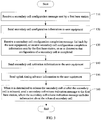
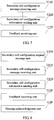
- an embodiment of the present invention discloses a schematic flowchart of a method for configuring a secondary cell, where the method includes: Step 110: Receive a secondary cell configuration message sent by a first base station.
- the secondary cell configuration message may include a secondary cell index configured by the first base station for a secondary cell, where the secondary cell is a cell of another base station except the first base station, such as a cell of a second base station.
- Step 120 Send secondary cell configuration information to user equipment.
- the secondary cell configuration information includes the secondary cell index configured by the first base station for the secondary cell, the user equipment configures the index for the corresponding secondary cell according to the secondary cell index, and the secondary cell index is used for activation or deactivation of the secondary cell.
- Step 130 Receive a secondary cell configuration completion message fed back by the user equipment, or receive secondary cell configuration completion information sent by the first base station, so as to determine that configuration of a secondary cell is completed.
- the secondary cell configuration completion information is that the first base station receives the secondary cell configuration completion message fed back by the user equipment; or the secondary cell configuration completion information is generated by the first base station after the secondary cell configuration completion message fed back by the user equipment is received.
- This embodiment of the present invention provides the method for configuring a secondary cell.
- a first base station allocates a secondary cell index, where the secondary cell index is used by user equipment to configure the index for a corresponding secondary cell; after completing configuration of the secondary cell index, the user equipment feeds back a secondary cell configuration completion message; and after the secondary cell configuration completion message fed back is received or a secondary cell configuration completion information sent by the first base station is received, configuration of the secondary cell is completed.
- the first base station or a second base station further delivers a related operation instruction to perform a related operation such as activation or deactivation, or delivers a timing advance adjustment message
- a related message or related signaling does not need to carry a device identifier of the base station each time. Therefore, a load information amount of a message can be reduced.
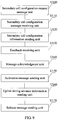
- an embodiment of the present invention discloses a schematic flowchart of a method for configuring a secondary cell, where the method includes:
- Step 100 When one or more secondary cells are about to be configured or reconfigured for user equipment, or when a secondary cell/secondary eNodeB addition request message sent by a first base station is received, or when a service offloading request message sent by a first base station is received, send a secondary cell configuration request message to the first base station, where the secondary cell configuration request message is used to request the first base station to allocate a secondary cell index.
- the first base station may be a macro eNodeB
- the secondary cell configuration request message may include a secondary cell index expected to be used, or an index that is expected to be used and of a timing advance group to which the secondary cell belongs.
- Step 110 Receive a secondary cell configuration message sent by the first base station.
- the secondary cell configuration message includes a secondary cell index configured by the first base station for the secondary cell, where the secondary cell is a cell of another base station except the first base station.
- the secondary cell index may be the secondary cell index that is expected to be used and is in the secondary cell configuration request message received by the first base station, or may be an unallocated secondary cell index selected by the first base station.
- a secondary cell/secondary eNodeB addition request message or a service offloading request message sent by the first base station may be simultaneously received; or the secondary cell configuration message is included in a secondary cell/secondary eNodeB addition request message or a service offloading request message sent by the first base station.
- the method may further include: sending a secondary cell configuration acknowledgment message to the first base station, where the secondary cell configuration acknowledgment message includes acknowledgment information that the secondary cell index is configured for the secondary cell, or the secondary cell configuration acknowledgment message includes the secondary cell index configured for the secondary cell.
- Step 120 Send secondary cell configuration information to the user equipment.
- the secondary cell configuration information includes the secondary cell index configured by the first base station for the secondary cell, the user equipment configures the index for the corresponding secondary cell according to the secondary cell index, and the secondary cell index is used for activation or deactivation of the secondary cell.
- the secondary cell configuration message may further include a group index that is of a timing advance group to which the secondary cell belongs and is configured by the first base station for the secondary cell.
- the secondary cell configuration information may further include the group index that is of the timing advance group to which the secondary cell belongs and is configured by the first base station for the secondary cell.
- the group index of the timing advance group to which the secondary cell belongs is a part of uplink timing advance information, where the uplink timing advance information may further include a timing advance used for adjusting an uplink timing advance of the secondary cell.
- the uplink timing advance information is used by the user equipment to adjust uplink timing. Uplink timing of the user equipment changes as the user equipment moves. If uplink timing is not adjusted, a base station cannot correctly receive a signal sent by the user equipment.
- a secondary cell index of a secondary cell configured by the first base station may be the same as a secondary cell index of a secondary cell controlled by the second base station.
- a misoperation may occur because of a conflict between the secondary cell indexes of the two base stations.
- a secondary cell of the second base station may be incorrectly activated; or when a timing adjustment command for a TAG of a secondary cell of the first base station is received, timing of a TAG of a secondary cell of the second base station may be incorrectly adjusted.
- a related message for example, an RRC reconfiguration message, needs to be limited.
- the RRC reconfiguration message can be sent only at a corresponding station, but cannot be sent across stations.
- the secondary cell configuration message may further include an RRC reconfiguration message, and after receiving the RRC reconfiguration message, the user equipment configures a secondary cell index for a corresponding secondary cell.
- Step 130 Receive a secondary cell configuration completion message fed back by the user equipment, or receive secondary cell configuration completion information sent by the first base station, so as to determine that configuration of the secondary cell is completed.
- the secondary cell configuration completion information is that the first base station receives the secondary cell configuration completion message fed back by the user equipment; or the secondary cell configuration completion information is generated by the first base station after the secondary cell configuration completion message fed back by the user equipment is received.
- the user equipment sends the secondary cell configuration completion message to the first base station or the second base station. Specifically, if the user equipment receives the secondary cell configuration information from the first base station, the user equipment sends the secondary cell configuration completion message to the first base station, and then sends an indication message to the second base station according to the secondary cell configuration completion message, so as to notify the second base station that the user equipment has completed configuration of the secondary cell. Alternatively, if the user equipment receives the secondary cell configuration information from the second base station, the user equipment sends the secondary cell configuration completion message to the second base station, so as to notify the second base station that the user equipment has completed configuration of the secondary cell.
- the user equipment always sends the secondary cell configuration completion message to the first base station or the second base station, no matter whether the user equipment receives the secondary cell configuration information from the first base station or the second base station. That is, how the user equipment feeds back the secondary cell configuration completion message is not specifically limited.
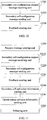
- an embodiment of the present invention discloses a schematic flowchart of a method for configuring a secondary cell, where the method includes:
- Step 110 Receive a secondary cell configuration message sent by a first base station.
- the secondary cell configuration message includes a secondary cell index configured by the first base station for a secondary cell, where the secondary cell is a cell of another base station except the first base station.
- Step 120 Send secondary cell configuration information to user equipment.
- the secondary cell configuration information includes the secondary cell index configured by the first base station for the secondary cell, the user equipment configures the index for the corresponding secondary cell according to the secondary cell index, and the secondary cell index is used for activation or deactivation of the secondary cell.
- Step 130 Receive a secondary cell configuration completion message fed back by the user equipment, or receive secondary cell configuration completion information sent by the first base station, so as to determine that configuration of a secondary cell is completed.
- the secondary cell configuration completion information is that the first base station receives the secondary cell configuration completion message fed back by the user equipment; or the secondary cell configuration completion information is generated by the first base station after the secondary cell configuration completion message fed back by the user equipment is received.
- Step 140 Send secondary cell activation information to the user equipment.
- the secondary cell activation information includes instruction information about activating and/or deactivating the secondary cell.
- the secondary cell activation information is used to make the user equipment really start to work on the cell, that is, make the user equipment start to listen to a physical downlink control channel of the secondary cell, and decode a physical downlink shared channel according to the physical downlink control channel.
- the base station when a base station needs to activate a secondary cell for user equipment, the base station sends instruction information about activating and/or deactivating the secondary cell to the secondary cell, where a format of the instruction information about activating and/or deactivating the secondary cell is as follows: C 7 C 6 C 5 C 4 C 3 C 2 C 1 R
- C1-C7 represents seven secondary cells. If a corresponding bit is 1, it indicates that a secondary cell should be activated; if a corresponding bit is 0, it indicates that a secondary cell should be deactivated. After a secondary cell is activated, the user equipment can perform data transmission in the secondary cell.
- the instruction for activating and/or deactivating the secondary cell may be sent by the first base station, or may be sent by a second base station. That is, the instruction information about activating and/or deactivating the secondary cell may be sent to the user equipment by using a cell of the first base station, or may be sent to the user equipment by using a cell of the second base station.
- Step 150 Send uplink timing advance information to the user equipment, where the uplink timing advance information includes a timing advance used for adjusting an uplink timing advance of the secondary cell, and an index of a timing advance group to which the secondary cell belongs.
- a base station When the user equipment moves, a base station often sends uplink timing advance information to the user equipment, so as to update a TA value of the user equipment in the secondary cell or a TA value of the user equipment in a TAG to which the secondary cell belongs.
- TAG id indicates an index of a timing advance group to which a secondary cell belongs, of which a base station requires a TA update
- Timing Advance Command indicates a TA value required to be adjusted when uplink transmission is specifically performed in the secondary cell of the TAG.
- Step 160 When it is determined to release the secondary cell or after the secondary cell is released, send a secondary cell release indication message to the first base station, where the secondary cell release indication message includes information about the released secondary cell.
- the second base station When the second base station determines to release a secondary cell for the first base station, the second base station sends a secondary cell release indication message to the first base station, so as to notify the first base station of the released secondary cell, and then the first base station can allocate, to another secondary cell, an SCell index that has been allocated to the secondary cell.
- the first base station can allocate an index of the TAG to another TAG for use.
- a TAG release indication message may be directly sent.
- an embodiment of the present invention discloses a schematic flowchart of a method for configuring a secondary cell, where the method includes:
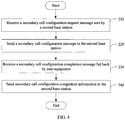
- Step 210 Receive a secondary cell configuration request message sent by a second base station.
- the secondary cell configuration request message is used to request to allocate a secondary cell index to a secondary cell, and the secondary cell is a cell of the second base station.
- the second base station may be a small eNodeB.
- Step 220 Send a secondary cell configuration message to the second base station.
- the secondary cell configuration message includes a secondary cell index configured for the secondary cell.
- Step 230 Receive a secondary cell configuration completion message fed back by user equipment.
- Step 240 Send secondary cell configuration completion information to the second base station.
- the secondary cell configuration completion information is that the secondary cell configuration completion message fed back by the user equipment is received; or the secondary cell configuration completion information is generated after the secondary cell configuration completion message fed back by the user equipment is received.
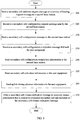
- an embodiment of the present invention discloses a schematic flowchart of a method for configuring a secondary cell, where the method includes:
- Step 200 Send a secondary cell/secondary eNodeB addition request message or a service offloading request message to a second base station.
- the second base station may be a second base station.
- Step 210 Receive a secondary cell configuration request message sent by the second base station.
- the secondary cell configuration request message is used to request to allocate a secondary cell index to a secondary cell, and the secondary cell is a cell of the second base station.
- Step 220 Send a secondary cell configuration message to the second base station.
- the secondary cell configuration message includes a secondary cell index configured for the secondary cell.
- Step 230 Receive a secondary cell configuration completion message fed back by user equipment.
- Step 240 Send secondary cell configuration completion information to the second base station.
- the secondary cell configuration completion information is that the secondary cell configuration completion message fed back by the user equipment is received; or the secondary cell configuration completion information is generated after the secondary cell configuration completion message fed back by the user equipment is received.
- Step 250 Send secondary cell activation information to the user equipment.
- the secondary cell activation information includes instruction information about activating and/or deactivating the secondary cell.
- Step 260 Send uplink timing advance information to the user equipment.
- the uplink timing advance information includes a timing advance used for adjusting an uplink timing advance of the secondary cell, and an index of a timing advance group to which the secondary cell belongs.
- Step 270 After a secondary cell release indication message is received, release information that is related to a released secondary cell and included in the secondary cell release indication message.
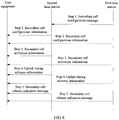
- Step 1 A first base station sends a secondary cell configuration message to a second base station.
- the second base station when the second base station is about to configure or reconfigure one or more secondary cells for user equipment; or when the first base station sends a secondary cell/secondary eNodeB addition request message to the second base station, and the second base station receives the secondary cell/secondary eNodeB addition request message sent by the first base station; or when the first base station sends a service offloading request message to the second base station, and the second base station receives the service offloading request message sent by the first base station, the second base station sends a secondary cell configuration request message to the first base station, where the secondary cell configuration request message may include a secondary cell index expected to be used, or an index that is expected to be used and of a timing advance group to which the secondary cell belongs.
- the secondary cell configuration request message is used to request the first base station to allocate a secondary cell index or an index of a timing advance group to which a secondary cell belongs.
- the first base station After receiving the secondary cell configuration request message fed back by the second base station, the first base station sends the secondary cell configuration message to the second base station, where the secondary cell configuration message may include an SCell index configured by the first base station for the secondary cell.
- the secondary cell configuration message may include a group index that is of a timing advance group to which the secondary cell belongs and is configured by the first base station for the secondary cell; or in addition to the SCell index, the secondary cell configuration message may include a secondary cell/secondary eNodeB addition request message or a service offloading request message.
- Step 2 The second base station or the first base station sends secondary cell configuration information to user equipment.
- the secondary cell configuration information includes the secondary cell configuration message received by the second base station from the first base station. After completing configuration of the corresponding secondary cell according to the secondary cell configuration information, the user equipment sends a secondary cell configuration completion message to the first base station or the second base station. Specifically, if the user equipment receives the secondary cell configuration information from the first base station, the user equipment sends the secondary cell configuration completion message to the first base station, and then sends an indication message to the second base station according to the secondary cell configuration completion message, so as to notify the second base station that the user equipment has completed configuration of the secondary cell.
- the user equipment if the user equipment receives the secondary cell configuration information from the second base station, the user equipment sends the secondary cell configuration completion message to the second base station, so as to notify the second base station that the user equipment has completed configuration of the secondary cell.
- the user equipment always sends the secondary cell configuration completion message to the first base station or the second base station, no matter whether the user equipment receives the secondary cell configuration information from the first base station or the second base station. That is, how the user equipment feeds back the secondary cell configuration completion message is not specifically limited.
- Step 3 The second base station or the first base station sends secondary cell activation information to the user equipment.
- the secondary cell activation information includes instruction information about activating and/or deactivating the secondary cell. Further, the second base station or the first base station sends an SCell activation and/or deactivation MAC CE to the user equipment, so as to activate and/or deactivate the configured SCell for the user equipment. After receiving the SCell activation/deactivation MAC CE, the user equipment activates/deactivates a corresponding SCell according to the MAC CE.
- Step 4 The second base station or the first base station sends uplink timing advance information to the user equipment.
- the second base station or the first base station When the second base station or the first base station needs to adjust a TA value of an SCell, the second base station or the first base station sends uplink timing advance information to the user equipment, and adjusts a TA value of a TAG of the SCell.
- the uplink timing advance information includes a timing advance used for adjusting an uplink timing advance of the secondary cell, and an index of a timing advance group to which the secondary cell belongs.
- Step 5 The second base station sends a secondary cell release indication message to the first base station.
- the second base station When it is determined to release the secondary cell or after the secondary cell is released, the second base station sends a secondary cell release indication message to the first base station, where the secondary cell release indication message includes information about the released secondary cell, so as to notify the first base station of the released secondary cell, and then the first base station can allocate, to another secondary cell, the SCell index that has been allocated to the secondary cell.
- an embodiment of the present invention provides a schematic diagram of a structure of an apparatus for configuring a secondary cell, where the apparatus for configuring a secondary cell includes:
- This embodiment of the present invention provides the apparatus for configuring a secondary cell.
- a first base station allocates a secondary cell index, where the secondary cell index is used by user equipment to configure the index for a corresponding secondary cell; after completing configuration of the secondary cell index, the user equipment feeds back a secondary cell configuration completion message; and after the secondary cell configuration completion message fed back is received or a secondary cell configuration completion message sent by the first base station is received, configuration of the secondary cell is completed.
- the first base station or a second base station further delivers a related operation instruction to perform a related operation such as activation or deactivation, or delivers a timing advance adjustment message
- a related message or related signaling does not need to carry a device identifier of the base station each time. Therefore, a load information amount of a message can be reduced.
- the apparatus for configuring a secondary cell further includes a secondary cell configuration request message sending unit U100, where the secondary cell configuration request message sending unit U100 is configured to: when one or more secondary cells are about to be configured or reconfigured for the user equipment, or when a secondary cell/secondary eNodeB addition request message sent by the first base station is received, or when a service offloading request message sent by the first base station is received, send a secondary cell configuration request message to the first base station, where the secondary cell configuration request message is used to request the first base station to allocate a secondary cell index.
- the secondary cell configuration message further includes a group index that is of a timing advance group to which the secondary cell belongs and is configured by the first base station for the secondary cell; and the secondary cell configuration information further includes the group index that is of the timing advance group to which the secondary cell belongs and is configured by the first base station for the secondary cell.
- the apparatus further includes a service request message sending unit, where the service request message sending unit is configured to: when the secondary cell configuration message receiving unit receives the secondary cell configuration message sent by the first base station, simultaneously receive a secondary cell/secondary eNodeB addition request message or a service offloading request message sent by the first base station; or the secondary cell configuration message received by the secondary cell configuration message receiving unit is included in a secondary cell/secondary eNodeB addition request message or a service offloading request message sent by the service request message sending unit.
- the service request message sending unit is configured to: when the secondary cell configuration message receiving unit receives the secondary cell configuration message sent by the first base station, simultaneously receive a secondary cell/secondary eNodeB addition request message or a service offloading request message sent by the first base station; or the secondary cell configuration message received by the secondary cell configuration message receiving unit is included in a secondary cell/secondary eNodeB addition request message or a service offloading request message sent by the service request message sending unit.
- the apparatus for configuring a secondary cell further includes a message acknowledgment unit U140, configured to send a secondary cell configuration acknowledgment message to the first base station, where: the secondary cell configuration acknowledgment message includes acknowledgment information that the secondary cell index is configured for the secondary cell; or the secondary cell configuration acknowledgment message includes the secondary cell index configured for the secondary cell.
- a message acknowledgment unit U140 configured to send a secondary cell configuration acknowledgment message to the first base station, where: the secondary cell configuration acknowledgment message includes acknowledgment information that the secondary cell index is configured for the secondary cell; or the secondary cell configuration acknowledgment message includes the secondary cell index configured for the secondary cell.
- the secondary cell configuration request message further includes: a secondary cell index expected to be used, or an index that is expected to be used and of a timing advance group to which the secondary cell belongs.
- the apparatus for configuring a secondary cell further includes an activation message sending unit U150, configured to send secondary cell activation information to the user equipment, where the secondary cell activation information includes instruction information about activating and/or deactivating the secondary cell.
- an activation message sending unit U150 configured to send secondary cell activation information to the user equipment, where the secondary cell activation information includes instruction information about activating and/or deactivating the secondary cell.
- the apparatus for configuring a secondary cell further includes an uplink timing advance information sending unit U160, configured to send uplink timing advance information to the user equipment, where the uplink timing advance information includes a timing advance used for adjusting an uplink timing advance of the secondary cell, and an index of a timing advance group to which the secondary cell belongs.
- the uplink timing advance information includes a timing advance used for adjusting an uplink timing advance of the secondary cell, and an index of a timing advance group to which the secondary cell belongs.
- the apparatus for configuring a secondary cell further includes a release message sending unit U170, configured to: when it is determined to release the secondary cell or after the secondary cell is released, send a secondary cell release indication message to the first base station, where the secondary cell release indication message includes information about the released secondary cell.
- a release message sending unit U170 configured to: when it is determined to release the secondary cell or after the secondary cell is released, send a secondary cell release indication message to the first base station, where the secondary cell release indication message includes information about the released secondary cell.
- an embodiment of the present invention provides a schematic diagram of a structure of an apparatus for configuring a secondary cell, where the apparatus includes:
- the apparatus for configuring a secondary cell further includes: a request message sending unit U200, configured to send a secondary cell/secondary eNodeB addition request message or a service offloading request message to the second base station.
- the apparatus for configuring a secondary cell further includes: a secondary cell activation information sending unit U240, configured to send secondary cell activation information to the user equipment, where the secondary cell activation information includes instruction information about activating and/or deactivating the secondary cell.
- a secondary cell activation information sending unit U240 configured to send secondary cell activation information to the user equipment, where the secondary cell activation information includes instruction information about activating and/or deactivating the secondary cell.
- the apparatus for configuring a secondary cell further includes: an uplink timing advance information sending unit U250, configured to send uplink timing advance information to the user equipment, where the uplink timing advance information includes a timing advance used for adjusting an uplink timing advance of the secondary cell, and an index of a timing advance group to which the secondary cell belongs.
- an uplink timing advance information sending unit U250 configured to send uplink timing advance information to the user equipment, where the uplink timing advance information includes a timing advance used for adjusting an uplink timing advance of the secondary cell, and an index of a timing advance group to which the secondary cell belongs.
- the apparatus for configuring a secondary cell further includes: a releasing unit U260, configured to: after a secondary cell release indication message is received, release information that is related to a released secondary cell and included in the secondary cell release indication message.
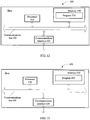
- an embodiment of the present invention provides a schematic diagram of a host 300.
- the host 300 may be a host server that has a computing capability, a personal computer PC, a portable computer or terminal, or the like.
- a specific embodiment of the present invention imposes no limitation on specific implementation of the host.
- the host 300 includes: a processor (processor) 310, a communications interface (Communications Interface) 320, a memory (memory) 330, and a bus 340, where: the processor 310, the communications interface 320, and the memory 330 complete mutual communication by using the bus 340.
- the communications interface 320 is configured to receive a secondary cell configuration message sent by a first base station, where the secondary cell configuration message includes a secondary cell index configured by the first base station for a secondary cell, and the secondary cell is a cell of another base station except the first base station.
- the processor 310 is configured to execute a program 332.
- the program 332 may include program code, where the program code includes a computer operation instruction.
- the processor 310 may be a central processing unit CPU, or an application specific integrated circuit ASIC (Application Specific Integrated Circuit), or one or more integrated circuits configured to implement this embodiment of the present invention.
- CPU central processing unit
- ASIC Application Specific Integrated Circuit
- the memory 330 is configured to store the program 332.
- the memory 330 may include a high-speed RAM memory, and may further include a non-volatile memory (non-volatile memory), for example, at least one disk memory.
- the program 332 may be specifically used to:
- an embodiment of the present invention provides a schematic diagram of a host 400.
- the host 400 may be a host server that has a computing capability, a personal computer PC, a portable computer or terminal, or the like.
- a specific embodiment of the present invention imposes no limitation on specific implementation of the host.
- the host 400 includes: a processor (processor) 410, a communications interface (Communications Interface) 420, a memory (memory) 430, and a bus 440, where: the processor 410, the communications interface 420, and the memory 430 complete mutual communication by using the bus 440.
- the communications interface 420 is configured to receive a secondary cell configuration request message sent by a second base station, where the secondary cell configuration request message is used to request to allocate a secondary cell index to a secondary cell, and the secondary cell is a cell of the second base station.
- the processor 410 is configured to execute a program 432.
- the program 432 may include program code, where the program code includes a computer operation instruction.
- the processor 410 may be a central processing unit CPU, or an application specific integrated circuit ASIC (Application Specific Integrated Circuit), or one or more integrated circuits configured to implement this embodiment of the present invention.
- CPU central processing unit
- ASIC Application Specific Integrated Circuit
- the memory 430 is configured to store the program 432.
- the memory 430 may include a high-speed RAM memory, and may further include a non-volatile memory (non-volatile memory), for example, at least one disk memory.
- the program 432 may be specifically used to:
- modules in the apparatuses provided in the embodiments may be arranged in the apparatuses in a distributed manner according to the description of the embodiments, or may be arranged in one or more apparatuses that are different from those described in the embodiments.
- the modules in the foregoing embodiments may be combined into one module, or split into a plurality of submodules.
- a person of ordinary skill in the art may understand that all or some of the processing in the methods in the foregoing embodiments may be implemented by a program instructing relevant hardware.
- the program may be stored in a computer-readable storage medium.
- Embodiment 1 A method for configuring a secondary cell, comprising:
- Embodiment 2 The method according to Embodiment 1, before the receiving a secondary cell configuration message sent by a first base station, further comprising:
- Embodiment 3 The method according to Embodiment 1, wherein the secondary cell configuration message further comprises a group index that is of a timing advance group to which the secondary cell belongs and is configured by the first base station for the secondary cell; and the secondary cell configuration information further comprises the group index that is of the timing advance group to which the secondary cell belongs and is configured by the first base station for the secondary cell.
- Embodiment 4 The method according to Embodiment 1, wherein the secondary cell configuration message further comprises:
- Embodiment 5 The method according to Embodiment 2 or 4, after the receiving a secondary cell configuration message sent by a first base station, further comprising: sending a secondary cell configuration acknowledgment message to the first base station, wherein:
- Embodiment 6 The method according to Embodiment 2, wherein the secondary cell configuration request message further comprises: a secondary cell index expected to be used, and/or an index that is expected to be used and of a timing advance group to which the secondary cell belongs.
- Embodiment 7 The method according to Embodiment 1, wherein after configuration of the secondary cell is completed, the method further comprises: sending secondary cell activation information to the user equipment, wherein the secondary cell activation information comprises instruction information about activating and/or deactivating the secondary cell.
- Embodiment 8 The method according to Embodiment 7, after the sending secondary cell activation information to the user equipment, further comprising: sending uplink timing advance information to the user equipment, wherein the uplink timing advance information comprises a timing advance used for adjusting an uplink timing advance of the secondary cell, and an index of a timing advance group to which the secondary cell belongs.
- Embodiment 9 The method according to any one of Embodiments 1 to 8, further comprising: when it is determined to release the secondary cell or after the secondary cell is released, sending a secondary cell release indication message to the first base station, wherein the secondary cell release indication message comprises information about the released secondary cell.
- Embodiment 10 A method for configuring a secondary cell, comprising:
- Embodiment 11 The method according to Embodiment 10, before the receiving a secondary cell configuration request message sent by a second base station, further comprising: sending a secondary cell/secondary eNodeB addition request message or a service offloading request message to the second base station.
- Embodiment 12 The method according to Embodiment 10, after configuration of the secondary cell is completed, further comprising: sending secondary cell activation information to the user equipment, wherein the secondary cell activation information comprises instruction information about activating and/or deactivating the secondary cell.
- Embodiment 13 The method according to Embodiment 11, after the sending secondary cell activation information to the user equipment, further comprising: sending uplink timing advance information to the user equipment, wherein the uplink timing advance information comprises a timing advance used for adjusting an uplink timing advance of the secondary cell, and an index of a timing advance group to which the secondary cell belongs.
- Embodiment 14 The method according to any one of Embodiments 10 to 13, further comprising: after a secondary cell release indication message is received, releasing information that is related to a released secondary cell and comprised in the secondary cell release indication message.
- Embodiment 15 An apparatus for configuring a secondary cell, comprising:
- Embodiment 16 The apparatus according to claim 15, further comprising a secondary cell configuration request message sending unit, wherein the secondary cell configuration request message sending unit is configured to:
- Embodiment 17 The apparatus according to Embodiment 15, wherein the secondary cell configuration message further comprises a group index that is of a timing advance group to which the secondary cell belongs and is configured by the first base station for the secondary cell; and the secondary cell configuration information further comprises the group index that is of the timing advance group to which the secondary cell belongs and is configured by the first base station for the secondary cell.
- Embodiment 18 The apparatus according to Embodiment 15, further comprising a service request message sending unit, wherein the service request message sending unit is configured to: when the secondary cell configuration message receiving unit receives the secondary cell configuration message sent by the first base station, simultaneously receive a secondary cell/secondary eNodeB addition request message or a service offloading request message sent by the first base station; or the secondary cell configuration message received by the secondary cell configuration message receiving unit is comprised in a secondary cell/secondary eNodeB addition request message or a service offloading request message sent by the service request message sending unit.
- the service request message sending unit is configured to: when the secondary cell configuration message receiving unit receives the secondary cell configuration message sent by the first base station, simultaneously receive a secondary cell/secondary eNodeB addition request message or a service offloading request message sent by the first base station; or the secondary cell configuration message received by the secondary cell configuration message receiving unit is comprised in a secondary cell/secondary eNodeB addition request message or a service offloading request message
- Embodiment 19 The apparatus according to Embodiment 16 or 18, further comprising: a message acknowledgment unit, configured to send a secondary cell configuration acknowledgment message to the first base station, wherein:
- Embodiment 20 The apparatus according to Embodiment 16, wherein the secondary cell configuration request message further comprises: a secondary cell index expected to be used, or an index that is expected to be used and of a timing advance group to which the secondary cell belongs.
- Embodiment 21 The apparatus according to Embodiment 15, further comprising: an activation message sending unit, configured to send secondary cell activation information to the user equipment, wherein the secondary cell activation information comprises instruction information about activating and/or deactivating the secondary cell.
- an activation message sending unit configured to send secondary cell activation information to the user equipment, wherein the secondary cell activation information comprises instruction information about activating and/or deactivating the secondary cell.
- Embodiment 22 The apparatus according to Embodiment 21, further comprising: an uplink timing advance information sending unit, configured to send uplink timing advance information to the user equipment, wherein the uplink timing advance information comprises a timing advance used for adjusting an uplink timing advance of the secondary cell, and an index of a timing advance group to which the secondary cell belongs.
- an uplink timing advance information sending unit configured to send uplink timing advance information to the user equipment, wherein the uplink timing advance information comprises a timing advance used for adjusting an uplink timing advance of the secondary cell, and an index of a timing advance group to which the secondary cell belongs.
- Embodiment 23 The apparatus according to any one of Embodiments 15 to 22, further comprising: a release message sending unit, configured to: when it is determined to release the secondary cell or after the secondary cell is released, send a secondary cell release indication message to the first base station, wherein the secondary cell release indication message comprises information about the released secondary cell.
- a release message sending unit configured to: when it is determined to release the secondary cell or after the secondary cell is released, send a secondary cell release indication message to the first base station, wherein the secondary cell release indication message comprises information about the released secondary cell.
- Embodiment 24 An apparatus for configuring a secondary cell, comprising:
- Embodiment 25 The apparatus according to Embodiment 24, further comprising: a request message sending unit, configured to send a secondary cell/secondary eNodeB addition request message or a service offloading request message to the second base station.
- a request message sending unit configured to send a secondary cell/secondary eNodeB addition request message or a service offloading request message to the second base station.
- Embodiment 26 The apparatus according to Embodiment 24, further comprising: a secondary cell activation information sending unit, configured to send secondary cell activation information to the user equipment, wherein the secondary cell activation information comprises instruction information about activating and/or deactivating the secondary cell.
- a secondary cell activation information sending unit configured to send secondary cell activation information to the user equipment, wherein the secondary cell activation information comprises instruction information about activating and/or deactivating the secondary cell.
- Embodiment 27 The apparatus according to Embodiment 25, further comprising: an uplink timing advance information sending unit, configured to send uplink timing advance information to the user equipment, wherein the uplink timing advance information comprises a timing advance used for adjusting an uplink timing advance of the secondary cell, and an index of a timing advance group to which the secondary cell belongs.
- an uplink timing advance information sending unit configured to send uplink timing advance information to the user equipment, wherein the uplink timing advance information comprises a timing advance used for adjusting an uplink timing advance of the secondary cell, and an index of a timing advance group to which the secondary cell belongs.
- Embodiment 28 The apparatus according to any one of Embodiments 24 to 27, further comprising: a releasing unit, configured to: after a secondary cell release indication message is received, release information that is related to a released secondary cell and comprised in the secondary cell release indication message.
- a releasing unit configured to: after a secondary cell release indication message is received, release information that is related to a released secondary cell and comprised in the secondary cell release indication message.
- Embodiment 29 A host, comprising a processor, a communications interface, a memory, and a bus, wherein:
- Embodiment 30 A host, comprising a processor, a communications interface, a memory, and a bus, wherein:
Landscapes
- Engineering & Computer Science (AREA)
- Computer Networks & Wireless Communication (AREA)
- Signal Processing (AREA)
- Mobile Radio Communication Systems (AREA)
Priority Applications (1)
| Application Number | Priority Date | Filing Date | Title |
|---|---|---|---|
| EP18159473.0A EP3393164A1 (en) | 2013-08-07 | 2013-08-07 | Method and apparatus for configuring secondary cell, and host |
Applications Claiming Priority (3)
| Application Number | Priority Date | Filing Date | Title |
|---|---|---|---|
| EP18159473.0A EP3393164A1 (en) | 2013-08-07 | 2013-08-07 | Method and apparatus for configuring secondary cell, and host |
| PCT/CN2013/080969 WO2015017997A1 (zh) | 2013-08-07 | 2013-08-07 | 辅小区的配置方法、装置及主机 |
| EP13891329.8A EP3024293B1 (en) | 2013-08-07 | 2013-08-07 | Method, apparatus and host for configuring secondary cell |
Related Parent Applications (2)
| Application Number | Title | Priority Date | Filing Date |
|---|---|---|---|
| EP13891329.8A Division EP3024293B1 (en) | 2013-08-07 | 2013-08-07 | Method, apparatus and host for configuring secondary cell |
| EP13891329.8A Division-Into EP3024293B1 (en) | 2013-08-07 | 2013-08-07 | Method, apparatus and host for configuring secondary cell |
Publications (1)
| Publication Number | Publication Date |
|---|---|
| EP3393164A1 true EP3393164A1 (en) | 2018-10-24 |
Family
ID=52460501
Family Applications (2)
| Application Number | Title | Priority Date | Filing Date |
|---|---|---|---|
| EP18159473.0A Withdrawn EP3393164A1 (en) | 2013-08-07 | 2013-08-07 | Method and apparatus for configuring secondary cell, and host |
| EP13891329.8A Active EP3024293B1 (en) | 2013-08-07 | 2013-08-07 | Method, apparatus and host for configuring secondary cell |
Family Applications After (1)
| Application Number | Title | Priority Date | Filing Date |
|---|---|---|---|
| EP13891329.8A Active EP3024293B1 (en) | 2013-08-07 | 2013-08-07 | Method, apparatus and host for configuring secondary cell |
Country Status (7)
| Country | Link |
|---|---|
| US (1) | US10595213B2 (enExample) |
| EP (2) | EP3393164A1 (enExample) |
| JP (1) | JP6341519B2 (enExample) |
| KR (2) | KR101887559B1 (enExample) |
| CN (1) | CN104770031B (enExample) |
| BR (1) | BR112016002553B1 (enExample) |
| WO (1) | WO2015017997A1 (enExample) |
Families Citing this family (5)
| Publication number | Priority date | Publication date | Assignee | Title |
|---|---|---|---|---|
| US9960895B2 (en) | 2015-03-09 | 2018-05-01 | Ofinno Technologies, Llc | Updating secondary cell configuration in a wireless network |
| CN109391399B (zh) * | 2017-08-10 | 2022-04-19 | 中兴通讯股份有限公司 | 辅小区的管理方法、装置及设备 |
| EP3745792B1 (en) * | 2018-02-13 | 2023-12-13 | Huawei Technologies Co., Ltd. | Communication method and device |
| EP3820212B1 (en) * | 2018-08-08 | 2023-06-14 | Guangdong Oppo Mobile Telecommunications Corp., Ltd. | Information configuration methods, terminal and network device |
| EP4569985A4 (en) * | 2022-09-22 | 2025-09-24 | Apple Inc | MULTI-CELL GROUP CONNECTIVITY REALIZATION MODEL FOR SECONDARY CELL GROUP (SCG) SWITCH |
Citations (2)
| Publication number | Priority date | Publication date | Assignee | Title |
|---|---|---|---|---|
| US20120106510A1 (en) * | 2010-11-02 | 2012-05-03 | Innovative Sonic Corporation | Method and apparatus for secondary cell release during handover in a wireless communication system |
| CN103139911A (zh) * | 2011-11-25 | 2013-06-05 | 华为技术有限公司 | 实现载波聚合的方法、基站和用户设备 |
Family Cites Families (13)
| Publication number | Priority date | Publication date | Assignee | Title |
|---|---|---|---|---|
| EP2271142B1 (en) | 2009-06-26 | 2012-08-29 | Alcatel Lucent | Method, computer program product and base station apparatus for detecting PCI collisions |
| KR101015423B1 (ko) * | 2010-07-16 | 2011-02-22 | 두배라 주식회사 | 회전력을 이용한 열 발생장치 |
| EP3565147B1 (en) * | 2010-08-19 | 2022-05-04 | Samsung Electronics Co., Ltd. | Methods and apparatus for activating and deactivating secondary cells in a carrier aggregation environment |
| CN102624494B (zh) * | 2011-01-27 | 2017-10-13 | 中兴通讯股份有限公司 | 一种信道状态指示测量方法及系统 |
| WO2012108643A2 (en) * | 2011-02-09 | 2012-08-16 | Pantech Co., Ltd. | Apparatus and method for transmitting uplink signal in multiple component carrier system |
| WO2012177054A2 (ko) * | 2011-06-22 | 2012-12-27 | 엘지전자 주식회사 | 랜덤 액세스 과정 수행 방법 및 장치 |
| CN102244927B (zh) * | 2011-07-22 | 2015-01-28 | 新邮通信设备有限公司 | 多小区长期演进系统中建立上行同步的方法、设备和终端 |
| JP2013042258A (ja) * | 2011-08-12 | 2013-02-28 | Sharp Corp | 移動局装置、基地局装置、通信システム、上りリンク送信制御方法および集積回路 |
| CN103051412B (zh) * | 2011-10-14 | 2016-03-09 | 华为技术有限公司 | 小区控制方法及系统 |
| US8995405B2 (en) | 2012-01-25 | 2015-03-31 | Ofinno Technologies, Llc | Pathloss reference configuration in a wireless device and base station |
| US8934438B2 (en) * | 2012-04-01 | 2015-01-13 | Ofinno Technologies, Llc | Uplink transmission timing advance in a wireless device and base station |
| EP2849501B1 (en) * | 2012-05-09 | 2020-09-30 | Samsung Electronics Co., Ltd. | Method and apparatus for controlling discontinuous reception in mobile communication system |
| WO2014112803A1 (en) * | 2013-01-16 | 2014-07-24 | Lg Electronics Inc. | Method and apparatus for transmitting indication in wireless communication system |
-
2013
- 2013-08-07 EP EP18159473.0A patent/EP3393164A1/en not_active Withdrawn
- 2013-08-07 JP JP2016532177A patent/JP6341519B2/ja active Active
- 2013-08-07 KR KR1020177026301A patent/KR101887559B1/ko active Active
- 2013-08-07 CN CN201380000987.0A patent/CN104770031B/zh active Active
- 2013-08-07 WO PCT/CN2013/080969 patent/WO2015017997A1/zh not_active Ceased
- 2013-08-07 EP EP13891329.8A patent/EP3024293B1/en active Active
- 2013-08-07 BR BR112016002553-9A patent/BR112016002553B1/pt active IP Right Grant
- 2013-08-07 KR KR1020167005757A patent/KR101781967B1/ko active Active
-
2016
- 2016-02-05 US US15/017,387 patent/US10595213B2/en active Active
Patent Citations (3)
| Publication number | Priority date | Publication date | Assignee | Title |
|---|---|---|---|---|
| US20120106510A1 (en) * | 2010-11-02 | 2012-05-03 | Innovative Sonic Corporation | Method and apparatus for secondary cell release during handover in a wireless communication system |
| CN103139911A (zh) * | 2011-11-25 | 2013-06-05 | 华为技术有限公司 | 实现载波聚合的方法、基站和用户设备 |
| EP2773157A1 (en) * | 2011-11-25 | 2014-09-03 | Huawei Technologies Co., Ltd. | Method, base station and user equipment for achieving carrier aggregation |
Also Published As
| Publication number | Publication date |
|---|---|
| KR101887559B1 (ko) | 2018-08-10 |
| CN104770031A (zh) | 2015-07-08 |
| BR112016002553A2 (pt) | 2017-08-01 |
| KR20170108180A (ko) | 2017-09-26 |
| US10595213B2 (en) | 2020-03-17 |
| EP3024293B1 (en) | 2018-05-23 |
| JP6341519B2 (ja) | 2018-06-13 |
| KR101781967B1 (ko) | 2017-09-26 |
| KR20160041970A (ko) | 2016-04-18 |
| EP3024293A1 (en) | 2016-05-25 |
| EP3024293A4 (en) | 2016-07-20 |
| CN104770031B (zh) | 2019-04-12 |
| US20160157110A1 (en) | 2016-06-02 |
| JP2016527828A (ja) | 2016-09-08 |
| WO2015017997A1 (zh) | 2015-02-12 |
| BR112016002553B1 (pt) | 2022-10-04 |
Similar Documents
| Publication | Publication Date | Title |
|---|---|---|
| US11184886B2 (en) | Method, base station, and user equipment for implementing carrier aggregation | |
| US11888627B2 (en) | Configuration and/or activation method for duplication transmission, method for duplication transmission and apparatuses thereof | |
| EP3301847B1 (en) | Communication method, base station and user equipment | |
| EP3316638A1 (en) | Method and apparatus for acquiring configuration information | |
| US10595213B2 (en) | Method and apparatus for configuring secondary cell, and host | |
| EP4301023A1 (en) | Beam failure recovery method and apparatus, and readable storage medium | |
| US11589334B2 (en) | Transmission resource selection method, network apparatus, and user equipment | |
| CN108141712A (zh) | 用于处理接入信息的方法、网络节点和无线装置 | |
| CN115866767A (zh) | 用于一组ue的联合带宽部分切换 | |
| EP3107323B1 (en) | Uplink signal control method and apparatus | |
| EP2757724B1 (en) | Method for transmitting fragments and device for transmitting fragments | |
| JP6509033B2 (ja) | ユーザ装置、基地局及び通信方法 | |
| EP3609251A1 (en) | Communication method and device | |
| JP2016527828A5 (enExample) | ||
| CN112422246B (zh) | 信息传输方法及装置 | |
| US20230089037A1 (en) | Mode switching method, terminal, and network-side device | |
| WO2024031298A1 (en) | Mobility with pre-configuration of candidate cells at ue | |
| US20210153192A1 (en) | User equipment and radio base station | |
| EP3709754B1 (en) | Random access method and device | |
| WO2024234994A1 (zh) | 随机接入的方法和通信装置 | |
| EP3531769A1 (en) | Information transmission method and access network device |
Legal Events
| Date | Code | Title | Description |
|---|---|---|---|
| PUAI | Public reference made under article 153(3) epc to a published international application that has entered the european phase |
Free format text: ORIGINAL CODE: 0009012 |
|
| 17P | Request for examination filed |
Effective date: 20180301 |
|
| AC | Divisional application: reference to earlier application |
Ref document number: 3024293 Country of ref document: EP Kind code of ref document: P |
|
| AK | Designated contracting states |
Kind code of ref document: A1 Designated state(s): AL AT BE BG CH CY CZ DE DK EE ES FI FR GB GR HR HU IE IS IT LI LT LU LV MC MK MT NL NO PL PT RO RS SE SI SK SM TR |
|
| STAA | Information on the status of an ep patent application or granted ep patent |
Free format text: STATUS: THE APPLICATION IS DEEMED TO BE WITHDRAWN |
|
| 18D | Application deemed to be withdrawn |
Effective date: 20190425 |