EP3393029A1 - A power converter and an electric power system - Google Patents
A power converter and an electric power system Download PDFInfo
- Publication number
- EP3393029A1 EP3393029A1 EP17167178.7A EP17167178A EP3393029A1 EP 3393029 A1 EP3393029 A1 EP 3393029A1 EP 17167178 A EP17167178 A EP 17167178A EP 3393029 A1 EP3393029 A1 EP 3393029A1
- Authority
- EP
- European Patent Office
- Prior art keywords
- pole
- electric
- direct voltage
- inductor coil
- current
- Prior art date
- Legal status (The legal status is an assumption and is not a legal conclusion. Google has not performed a legal analysis and makes no representation as to the accuracy of the status listed.)
- Granted
Links
Images

Classifications
-
- H—ELECTRICITY
- H02—GENERATION; CONVERSION OR DISTRIBUTION OF ELECTRIC POWER
- H02J—ELECTRIC POWER NETWORKS; CIRCUIT ARRANGEMENTS OR SYSTEMS FOR SUPPLYING OR DISTRIBUTING ELECTRIC POWER; SYSTEMS FOR STORING ELECTRIC ENERGY
- H02J1/00—Circuit arrangements for DC mains or DC distribution networks
- H02J1/08—Three-wire DC power distribution systems; Systems having more than three wires
-
- H—ELECTRICITY
- H02—GENERATION; CONVERSION OR DISTRIBUTION OF ELECTRIC POWER
- H02M—APPARATUS FOR CONVERSION BETWEEN AC AND AC, BETWEEN AC AND DC, OR BETWEEN DC AND DC, AND FOR USE WITH MAINS OR SIMILAR POWER SUPPLY SYSTEMS; CONVERSION OF DC OR AC INPUT POWER INTO SURGE OUTPUT POWER; CONTROL OR REGULATION THEREOF
- H02M3/00—Conversion of DC power input into DC power output
- H02M3/02—Conversion of DC power input into DC power output without intermediate conversion into AC
- H02M3/04—Conversion of DC power input into DC power output without intermediate conversion into AC by static converters
- H02M3/10—Conversion of DC power input into DC power output without intermediate conversion into AC by static converters using discharge tubes with control electrode or semiconductor devices with control electrode
- H02M3/145—Conversion of DC power input into DC power output without intermediate conversion into AC by static converters using discharge tubes with control electrode or semiconductor devices with control electrode using devices of a triode or transistor type requiring continuous application of a control signal
- H02M3/155—Conversion of DC power input into DC power output without intermediate conversion into AC by static converters using discharge tubes with control electrode or semiconductor devices with control electrode using devices of a triode or transistor type requiring continuous application of a control signal using semiconductor devices only
- H02M3/156—Conversion of DC power input into DC power output without intermediate conversion into AC by static converters using discharge tubes with control electrode or semiconductor devices with control electrode using devices of a triode or transistor type requiring continuous application of a control signal using semiconductor devices only with automatic control of output voltage or current, e.g. switching regulators
- H02M3/1563—Conversion of DC power input into DC power output without intermediate conversion into AC by static converters using discharge tubes with control electrode or semiconductor devices with control electrode using devices of a triode or transistor type requiring continuous application of a control signal using semiconductor devices only with automatic control of output voltage or current, e.g. switching regulators without using an external clock
-
- H—ELECTRICITY
- H02—GENERATION; CONVERSION OR DISTRIBUTION OF ELECTRIC POWER
- H02H—EMERGENCY PROTECTIVE CIRCUIT ARRANGEMENTS
- H02H7/00—Emergency protective circuit arrangements specially adapted for specific types of electric machines or apparatus or for sectionalised protection of cable or line systems, and effecting automatic switching in the event of an undesired change from normal working conditions
- H02H7/10—Emergency protective circuit arrangements specially adapted for specific types of electric machines or apparatus or for sectionalised protection of cable or line systems, and effecting automatic switching in the event of an undesired change from normal working conditions for converters; for rectifiers
- H02H7/12—Emergency protective circuit arrangements specially adapted for specific types of electric machines or apparatus or for sectionalised protection of cable or line systems, and effecting automatic switching in the event of an undesired change from normal working conditions for converters; for rectifiers for static converters or rectifiers
- H02H7/1213—Emergency protective circuit arrangements specially adapted for specific types of electric machines or apparatus or for sectionalised protection of cable or line systems, and effecting automatic switching in the event of an undesired change from normal working conditions for converters; for rectifiers for static converters or rectifiers for DC-DC converters
-
- H—ELECTRICITY
- H02—GENERATION; CONVERSION OR DISTRIBUTION OF ELECTRIC POWER
- H02J—ELECTRIC POWER NETWORKS; CIRCUIT ARRANGEMENTS OR SYSTEMS FOR SUPPLYING OR DISTRIBUTING ELECTRIC POWER; SYSTEMS FOR STORING ELECTRIC ENERGY
- H02J1/00—Circuit arrangements for DC mains or DC distribution networks
- H02J1/10—Parallel operation of DC sources
- H02J1/102—Parallel operation of DC sources being switching converters
-
- H—ELECTRICITY
- H02—GENERATION; CONVERSION OR DISTRIBUTION OF ELECTRIC POWER
- H02J—ELECTRIC POWER NETWORKS; CIRCUIT ARRANGEMENTS OR SYSTEMS FOR SUPPLYING OR DISTRIBUTING ELECTRIC POWER; SYSTEMS FOR STORING ELECTRIC ENERGY
- H02J3/00—Circuit arrangements for AC mains or AC distribution networks
- H02J3/38—Arrangements for feeding a single network from two or more generators or sources in parallel; Arrangements for feeding already energised networks from additional generators or sources in parallel
- H02J3/381—Dispersed generators
-
- H—ELECTRICITY
- H02—GENERATION; CONVERSION OR DISTRIBUTION OF ELECTRIC POWER
- H02J—ELECTRIC POWER NETWORKS; CIRCUIT ARRANGEMENTS OR SYSTEMS FOR SUPPLYING OR DISTRIBUTING ELECTRIC POWER; SYSTEMS FOR STORING ELECTRIC ENERGY
- H02J4/00—Circuit arrangements for mains or distribution networks not specified as AC or DC; Circuit arrangements for mains or distribution networks combining AC and DC sections or sub-networks
-
- H—ELECTRICITY
- H02—GENERATION; CONVERSION OR DISTRIBUTION OF ELECTRIC POWER
- H02M—APPARATUS FOR CONVERSION BETWEEN AC AND AC, BETWEEN AC AND DC, OR BETWEEN DC AND DC, AND FOR USE WITH MAINS OR SIMILAR POWER SUPPLY SYSTEMS; CONVERSION OF DC OR AC INPUT POWER INTO SURGE OUTPUT POWER; CONTROL OR REGULATION THEREOF
- H02M3/00—Conversion of DC power input into DC power output
- H02M3/02—Conversion of DC power input into DC power output without intermediate conversion into AC
- H02M3/04—Conversion of DC power input into DC power output without intermediate conversion into AC by static converters
- H02M3/10—Conversion of DC power input into DC power output without intermediate conversion into AC by static converters using discharge tubes with control electrode or semiconductor devices with control electrode
- H02M3/145—Conversion of DC power input into DC power output without intermediate conversion into AC by static converters using discharge tubes with control electrode or semiconductor devices with control electrode using devices of a triode or transistor type requiring continuous application of a control signal
- H02M3/155—Conversion of DC power input into DC power output without intermediate conversion into AC by static converters using discharge tubes with control electrode or semiconductor devices with control electrode using devices of a triode or transistor type requiring continuous application of a control signal using semiconductor devices only
-
- H—ELECTRICITY
- H02—GENERATION; CONVERSION OR DISTRIBUTION OF ELECTRIC POWER
- H02M—APPARATUS FOR CONVERSION BETWEEN AC AND AC, BETWEEN AC AND DC, OR BETWEEN DC AND DC, AND FOR USE WITH MAINS OR SIMILAR POWER SUPPLY SYSTEMS; CONVERSION OF DC OR AC INPUT POWER INTO SURGE OUTPUT POWER; CONTROL OR REGULATION THEREOF
- H02M3/00—Conversion of DC power input into DC power output
- H02M3/02—Conversion of DC power input into DC power output without intermediate conversion into AC
- H02M3/04—Conversion of DC power input into DC power output without intermediate conversion into AC by static converters
- H02M3/10—Conversion of DC power input into DC power output without intermediate conversion into AC by static converters using discharge tubes with control electrode or semiconductor devices with control electrode
- H02M3/145—Conversion of DC power input into DC power output without intermediate conversion into AC by static converters using discharge tubes with control electrode or semiconductor devices with control electrode using devices of a triode or transistor type requiring continuous application of a control signal
- H02M3/155—Conversion of DC power input into DC power output without intermediate conversion into AC by static converters using discharge tubes with control electrode or semiconductor devices with control electrode using devices of a triode or transistor type requiring continuous application of a control signal using semiconductor devices only
- H02M3/156—Conversion of DC power input into DC power output without intermediate conversion into AC by static converters using discharge tubes with control electrode or semiconductor devices with control electrode using devices of a triode or transistor type requiring continuous application of a control signal using semiconductor devices only with automatic control of output voltage or current, e.g. switching regulators
-
- H—ELECTRICITY
- H02—GENERATION; CONVERSION OR DISTRIBUTION OF ELECTRIC POWER
- H02M—APPARATUS FOR CONVERSION BETWEEN AC AND AC, BETWEEN AC AND DC, OR BETWEEN DC AND DC, AND FOR USE WITH MAINS OR SIMILAR POWER SUPPLY SYSTEMS; CONVERSION OF DC OR AC INPUT POWER INTO SURGE OUTPUT POWER; CONTROL OR REGULATION THEREOF
- H02M3/00—Conversion of DC power input into DC power output
- H02M3/02—Conversion of DC power input into DC power output without intermediate conversion into AC
- H02M3/04—Conversion of DC power input into DC power output without intermediate conversion into AC by static converters
- H02M3/10—Conversion of DC power input into DC power output without intermediate conversion into AC by static converters using discharge tubes with control electrode or semiconductor devices with control electrode
- H02M3/145—Conversion of DC power input into DC power output without intermediate conversion into AC by static converters using discharge tubes with control electrode or semiconductor devices with control electrode using devices of a triode or transistor type requiring continuous application of a control signal
- H02M3/155—Conversion of DC power input into DC power output without intermediate conversion into AC by static converters using discharge tubes with control electrode or semiconductor devices with control electrode using devices of a triode or transistor type requiring continuous application of a control signal using semiconductor devices only
- H02M3/156—Conversion of DC power input into DC power output without intermediate conversion into AC by static converters using discharge tubes with control electrode or semiconductor devices with control electrode using devices of a triode or transistor type requiring continuous application of a control signal using semiconductor devices only with automatic control of output voltage or current, e.g. switching regulators
- H02M3/158—Conversion of DC power input into DC power output without intermediate conversion into AC by static converters using discharge tubes with control electrode or semiconductor devices with control electrode using devices of a triode or transistor type requiring continuous application of a control signal using semiconductor devices only with automatic control of output voltage or current, e.g. switching regulators including plural semiconductor devices as final control devices for a single load
-
- B—PERFORMING OPERATIONS; TRANSPORTING
- B60—VEHICLES IN GENERAL
- B60L—PROPULSION OF ELECTRICALLY-PROPELLED VEHICLES; SUPPLYING ELECTRIC POWER FOR AUXILIARY EQUIPMENT OF ELECTRICALLY-PROPELLED VEHICLES; ELECTRODYNAMIC BRAKE SYSTEMS FOR VEHICLES IN GENERAL; MAGNETIC SUSPENSION OR LEVITATION FOR VEHICLES; MONITORING OPERATING VARIABLES OF ELECTRICALLY-PROPELLED VEHICLES; ELECTRIC SAFETY DEVICES FOR ELECTRICALLY-PROPELLED VEHICLES
- B60L2200/00—Type of vehicles
- B60L2200/32—Waterborne vessels
-
- B—PERFORMING OPERATIONS; TRANSPORTING
- B60—VEHICLES IN GENERAL
- B60L—PROPULSION OF ELECTRICALLY-PROPELLED VEHICLES; SUPPLYING ELECTRIC POWER FOR AUXILIARY EQUIPMENT OF ELECTRICALLY-PROPELLED VEHICLES; ELECTRODYNAMIC BRAKE SYSTEMS FOR VEHICLES IN GENERAL; MAGNETIC SUSPENSION OR LEVITATION FOR VEHICLES; MONITORING OPERATING VARIABLES OF ELECTRICALLY-PROPELLED VEHICLES; ELECTRIC SAFETY DEVICES FOR ELECTRICALLY-PROPELLED VEHICLES
- B60L2210/00—Converter types
- B60L2210/10—DC to DC converters
- B60L2210/14—Boost converters
-
- B—PERFORMING OPERATIONS; TRANSPORTING
- B63—SHIPS OR OTHER WATERBORNE VESSELS; RELATED EQUIPMENT
- B63H—MARINE PROPULSION OR STEERING
- B63H21/00—Use of propulsion power plant or units on vessels
- B63H21/12—Use of propulsion power plant or units on vessels the vessels being motor-driven
- B63H21/17—Use of propulsion power plant or units on vessels the vessels being motor-driven by electric motor
-
- B—PERFORMING OPERATIONS; TRANSPORTING
- B63—SHIPS OR OTHER WATERBORNE VESSELS; RELATED EQUIPMENT
- B63J—AUXILIARIES ON VESSELS
- B63J3/00—Driving of auxiliaries
- B63J2003/001—Driving of auxiliaries characterised by type of power supply, or power transmission, e.g. by using electric power or steam
- B63J2003/002—Driving of auxiliaries characterised by type of power supply, or power transmission, e.g. by using electric power or steam by using electric power
-
- H—ELECTRICITY
- H02—GENERATION; CONVERSION OR DISTRIBUTION OF ELECTRIC POWER
- H02J—ELECTRIC POWER NETWORKS; CIRCUIT ARRANGEMENTS OR SYSTEMS FOR SUPPLYING OR DISTRIBUTING ELECTRIC POWER; SYSTEMS FOR STORING ELECTRIC ENERGY
- H02J7/00—Circuit arrangements for charging or discharging batteries or for supplying loads from batteries
- H02J7/34—Parallel operation in networks using both storage and other DC sources, e.g. providing buffering
- H02J7/345—Parallel operation in networks using both storage and other DC sources, e.g. providing buffering using capacitors as storage or buffering devices
-
- H—ELECTRICITY
- H02—GENERATION; CONVERSION OR DISTRIBUTION OF ELECTRIC POWER
- H02J—ELECTRIC POWER NETWORKS; CIRCUIT ARRANGEMENTS OR SYSTEMS FOR SUPPLYING OR DISTRIBUTING ELECTRIC POWER; SYSTEMS FOR STORING ELECTRIC ENERGY
- H02J7/00—Circuit arrangements for charging or discharging batteries or for supplying loads from batteries
- H02J7/50—Circuit arrangements for charging or discharging batteries or for supplying loads from batteries acting upon multiple batteries simultaneously or sequentially
-
- H—ELECTRICITY
- H02—GENERATION; CONVERSION OR DISTRIBUTION OF ELECTRIC POWER
- H02J—ELECTRIC POWER NETWORKS; CIRCUIT ARRANGEMENTS OR SYSTEMS FOR SUPPLYING OR DISTRIBUTING ELECTRIC POWER; SYSTEMS FOR STORING ELECTRIC ENERGY
- H02J7/00—Circuit arrangements for charging or discharging batteries or for supplying loads from batteries
- H02J7/50—Circuit arrangements for charging or discharging batteries or for supplying loads from batteries acting upon multiple batteries simultaneously or sequentially
- H02J7/585—Sequential battery discharge in systems with a plurality of batteries
-
- H—ELECTRICITY
- H02—GENERATION; CONVERSION OR DISTRIBUTION OF ELECTRIC POWER
- H02P—CONTROL OR REGULATION OF ELECTRIC MOTORS, ELECTRIC GENERATORS OR DYNAMO-ELECTRIC CONVERTERS; CONTROLLING TRANSFORMERS, REACTORS OR CHOKE COILS
- H02P5/00—Arrangements specially adapted for regulating or controlling the speed or torque of two or more electric motors
- H02P5/74—Arrangements specially adapted for regulating or controlling the speed or torque of two or more electric motors controlling two or more AC dynamo-electric motors
-
- Y—GENERAL TAGGING OF NEW TECHNOLOGICAL DEVELOPMENTS; GENERAL TAGGING OF CROSS-SECTIONAL TECHNOLOGIES SPANNING OVER SEVERAL SECTIONS OF THE IPC; TECHNICAL SUBJECTS COVERED BY FORMER USPC CROSS-REFERENCE ART COLLECTIONS [XRACs] AND DIGESTS
- Y02—TECHNOLOGIES OR APPLICATIONS FOR MITIGATION OR ADAPTATION AGAINST CLIMATE CHANGE
- Y02T—CLIMATE CHANGE MITIGATION TECHNOLOGIES RELATED TO TRANSPORTATION
- Y02T10/00—Road transport of goods or passengers
- Y02T10/60—Other road transportation technologies with climate change mitigation effect
- Y02T10/72—Electric energy management in electromobility
Definitions
- the disclosure relates to a power converter for converting input direct voltage into output direct voltage. Furthermore, the disclosure relates to an electric power system that can be, for example but not necessarily, an electric power system of a ship or a direct current "DC" power distribution system.
- an electric power system comprises a direct voltage rail, one or more battery elements for supplying electric energy to the direct voltage rail, and one or more power converters for converting the direct voltage of the direct voltage rail into voltages suitable for one or more loads of the electric power system.
- the electric power system can be for example an electric power system of a ship in which case the loads of the electric power system may comprise one or more propulsion motors, an alternating voltage network of the ship, and other loads such as e.g. one or more bow thruster motors.
- the motors are advantageously alternating current "AC" motors and the corresponding power converters are inverters for converting the direct voltage of the direct voltage rail into alternating voltages suitable for the AC-motors.
- each of the battery elements is typically connected with a voltage-increasing power converter, i.e. a boost converter, to the direct voltage rail.
- the power converter comprises typically an inductor coil whose first pole is connected to the respective battery element, a controllable switch between the ground and the second pole of the inductor coil, and an unidirectionally conductive component, e.g. a diode, for providing a path for electric current from the inductor coil towards the direct voltage rail in response to a situation in which the controllable switch is in a non-conductive state.
- the power converter comprises:
- the above-mentioned second unidirectionally conductive component constitutes a low-inductance bypass route for fault current. Therefore, sufficiently strong fault current can be directed to the over-current protector already at an early stage of a fault situation that drops the output direct voltage below the input direct voltage. Thus, the over-current protector is enabled to disconnect the power converter from the external system prior to the electric current of the inductor coil has had time to increase significantly. Furthermore, as the second unidirectionally conductive component constitutes the above-mentioned bypass route, the above-mentioned inductor coil and the first unidirectionally conductive component do not need to be dimensioned according to the fault current.
- An electric power system that can be, for example but not necessarily, an electric power system of a ship or a direct current "DC" power distribution system.
- An electric power system according to the invention comprises:
- a new ship that comprises an electric power system of the kind described above.
- the loads of the electric power system of the ship may comprise for example one or more propulsion motors, an alternating voltage network of the ship, and/or other loads such as e.g. one or more bow thruster motors.
- the motors are advantageously alternating current "AC" motors and the corresponding power converters are inverters for converting the one or more direct voltages of the one or more direct voltage rails into alternating voltages suitable for the AC-motors.
- FIG. 1 a shows a schematic illustration of a main circuit of a power converter 101 according to an exemplifying and non-limiting embodiment.
- the power converter comprises an input terminal 102 for receiving input direct voltage U DC in and an output terminal 103 for supplying output direct voltage U DC out to an external system.
- the power converter 101 is a voltage-increasing converter, i.e. a boost-converter, capable of transferring electric energy from the input terminal 102 to the output terminal 103 in a controlled way when the input direct voltage U DC in is smaller than the output direct voltage U DC out .
- the power converter comprises an inductor coil 104 whose first pole is connected to a first pole 109a of the input terminal 102.
- the power converter comprises a first controllable switch 105 between a negative pole 109a of the input terminal and a second pole of the inductor coil 104.
- the controllable switch 105 can be for example an insulated gate bipolar transistor "IGBT", a gate turn-off thyristor "GTO", a bipolar transistor, or a field-effect transistor "FET”.
- the power converter comprises a first unidirectionally conductive component 106 for providing a path for electric current from the second pole of the inductor coil 104 towards the output terminal 103 in response to a situation in which the controllable switch 105 is in a non-conductive state and electric current of the inductor coil 104 flows towards the second pole of the inductor coil, i.e.
- the unidirectionally conductive component 106 can be for example a diode. It is, however, also possible that the unidirectionally conductive component 106 is or comprises a controllable switch which is controlled in an opposite phase with respect to the controllable switch 105.
- the power converter comprises a first over-current protector 107 at the output terminal 103. In this exemplifying case, the over-current protector 107 is between the unidirectionally conductive component 106 and the positive pole of the output terminal 103.
- the over-current protector 107 is configured to break electric current though the output terminal 103 in response to a situation in which the electric current though the output terminal 103 exceeds a pre-determined limit.
- the over-current protector 107 can be for example a fuse.
- the power converter further comprises a second unidirectionally conductive component 108 for conducting electric current from the first pole of the inductor coil 104 to the output terminal 103 in response to a fault situation in which the output direct voltage U DC out is smaller than the input direct voltage U DC in , i.e. U DC out ⁇ U DC in .
- the unidirectionally conductive component 108 constitutes a low-inductance bypass route from the input terminal 102 to the over-current protector 107. Therefore, sufficiently strong fault current can be directed to the over-current protector 107 already at an early stage of a fault situation that drops the output direct voltage U DC out below the input direct voltage U DC in. Thus, the over-current protector 107 is enabled to disconnect the power converter from the external system prior to the electric current of the inductor coil 104 has had time to increase significantly. Furthermore, as the unidirectionally conductive component 108 constitutes the above-mentioned bypass route, the inductor coil 104 and the unidirectionally conductive component 106 do not need to be dimensioned according to the fault current which can be significantly higher than electric current during normal operation.
- the power converter 101 further comprises components for enabling the power converter to transfer electric energy from the output terminal 103 to the input terminal 102 so as to for example charge a battery element in cases where the battery element is connected to the input terminal 102.
- the battery element is not shown in figure 1a .
- the power converter 101 comprises a second controllable switch 110 for conducting electric current from the output terminal 103 to the second pole of the inductor coil 114.
- the controllable switch 110 can be for example an insulated gate bipolar transistor "IGBT", a gate turn-off thyristor "GTO", a bipolar transistor, or a field-effect transistor "FET”.
- the power converter 101 comprises a third unidirectionally conductive component 111 for providing a path for electric current from the second pole 109b of the input terminal 102 to the second pole of the inductor coil 104 in response to a situation in which the controllable switch 110 is in a non-conductive state and the electric current of the inductor coil 104 flows towards the first pole of the inductor coil, i.e. towards the input terminal 102.
- the unidirectionally conductive component 111 can be for example a diode. It is however also possible that the unidirectionally conductive component 111 is or comprises a controllable switch which is controlled in an opposite phase with respect to the controllable switch 110.
- the power converter 101 is capable of transferring electric energy from the output terminal 103 to the input terminal 102 in a controlled way when the input direct voltage U DC in is smaller than the output direct voltage U DC out .
- the controllable switches 105 and 110 are IGBTs or metal oxide semiconductor field effect transistors "MOSFET”
- the unidirectionally conductive components 106 and 111 can be body diodes of the IGBTs or the MOSFETs.
- a power converter according to an exemplifying and non-limiting embodiment further comprises a second over-current protector 112 so that the first pole of the inductor coil 104 is connected to the first pole 109a of the input terminal 102 via the second over-current protector 112.
- the over-current protector 112 is configured to break electric current though the over-current protector 112 in response to a situation in which the electric current though the over-current protector 112 exceeds a pre-determined limit.
- the over-current protector 112 can be for example a fuse.
- the power converter 101 may further comprise capacitors and/or other elements which are arranged to absorb energy stored by the inductor coil 104 at a moment when one or both of the over-current protectors 107 and 112 break electric current. Furthermore, the power converter 101 may further comprise e.g. one or more diodes or other elements for providing alternative paths for inductive current when one or both of the over-current protectors 107 and 112 break electric current.
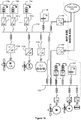
- FIG 1 b shows a schematic illustration of an electric power system according to an exemplifying and non-limiting embodiment.
- the electric power system is an electric power system of a ship.
- the electric power system comprises a direct voltage rail 114, battery elements, and first power converters for transferring electric energy from the battery elements to the direct voltage rail.
- three of the battery elements are denoted with figure references 113a, 113b, and 113c
- three of the first power converters are denoted with figure references 101 a, 101b, and 101c.
- Each of the first power converters 101a-101c can be similar to the power converter 101 illustrated in figure 1 a.
- the electric power system comprises second power converters for converting the direct voltage of the direct voltage rail 114 into voltages suitable for loads of the electric power system.
- the loads of the electric power system comprise a propulsion system, bow thruster motors, and an alternating voltage network.
- one of the electric motors of the propulsion system is denoted with a figure reference 115
- one of the bow thruster motors is denoted with a figure reference 116
- a part of the alternating voltage network is denoted with a figure reference 117.
- the second converters comprise inverters for converting the direct voltage of the direct voltage rail into alternating voltages suitable for the loads of the electric power system.
- the exemplifying electric power system illustrated in figure 1b further comprises a capacitor system 119 connected to the direct voltage rail 114.
- the capacitor system 119 may comprise for example one or more high-capacitance electric double layer capacitors "EDLC" which are also called “super capacitors”.
- EDLC high-capacitance electric double layer capacitors
- the capacitance of the capacitor system 119 is advantageously at least 0.1 F, more advantageously at least 1 F, and yet more advantageously at least 10 F.
- the exemplifying electric power system illustrated in figure 1b comprises another direct voltage rail 120 so that the direct voltage rails 114 and 120 of the electric power system are connected to each other via over-current protectors.
- the portions of the electric power system connected to different ones of the direct voltage rails are advantageously operable independently of each other in order to improve the operational reliability of the electric power system.
- the electric power system comprises another capacitor system 121 connected to the direct voltage rail 120.
- the electric power system illustrated in figure 1b may further comprise one or more combustion engine driven generators which are connected to one or both of the direct voltage rails 114 and 120 with suitable power converters.
- the combustion engine driven generators are not shown in figure 1 b.
- the electric power system may comprise one or more solar cells and/or fuel cells and/or other electric power sources connected to one or both of the direct voltage rails 114 and 120 with suitable power converters.
- the electric power system may comprise one or more wind turbine driven generators which are connected to one or more direct voltage rails with suitable power converters.
Landscapes
- Engineering & Computer Science (AREA)
- Power Engineering (AREA)
- Dc-Dc Converters (AREA)
- Protection Of Static Devices (AREA)
Abstract
Description
- The disclosure relates to a power converter for converting input direct voltage into output direct voltage. Furthermore, the disclosure relates to an electric power system that can be, for example but not necessarily, an electric power system of a ship or a direct current "DC" power distribution system.
- In many cases, an electric power system comprises a direct voltage rail, one or more battery elements for supplying electric energy to the direct voltage rail, and one or more power converters for converting the direct voltage of the direct voltage rail into voltages suitable for one or more loads of the electric power system. The electric power system can be for example an electric power system of a ship in which case the loads of the electric power system may comprise one or more propulsion motors, an alternating voltage network of the ship, and other loads such as e.g. one or more bow thruster motors. The motors are advantageously alternating current "AC" motors and the corresponding power converters are inverters for converting the direct voltage of the direct voltage rail into alternating voltages suitable for the AC-motors.
- In many cases it is advantageous that the direct voltage of the direct voltage rail is higher than the direct voltages of the battery elements. In these cases, each of the battery elements is typically connected with a voltage-increasing power converter, i.e. a boost converter, to the direct voltage rail. The power converter comprises typically an inductor coil whose first pole is connected to the respective battery element, a controllable switch between the ground and the second pole of the inductor coil, and an unidirectionally conductive component, e.g. a diode, for providing a path for electric current from the inductor coil towards the direct voltage rail in response to a situation in which the controllable switch is in a non-conductive state.
- In an electric power system of the kind described above, there is typically a need to disconnect a voltage-increasing power converter from the direct voltage rail in fault situations where the direct voltage of the voltage rail drops below the battery voltage. A straightforward approach is to connect an over-current protector, e.g. a fuse, between the voltage-increasing power converter and the direct voltage rail. An inherent challenge related to this approach is that fault current which is needed for blowing the fuse, or for activating another over-current protector, flows through the inductor coil of the voltage-increasing power converter, and thus appropriate arrangements are needed for preventing and/or for protecting against harmful voltage peaks caused by abrupt changes in the above-mentioned fault current. Furthermore, there is a need to design the inductor coil and the unidirectionally conductive component, e.g. a diode, in accordance with the fault current that can be significantly higher than corresponding electric current in normal operation. Another approach is to provide the voltage-increasing power converter with circuitries arranged to ramp down the electric current of the inductor coil in response to a fault situation of the kind mentioned above. The above-mentioned circuitries, however, increase the complexity and the costs of the voltage-increasing power converter.
- The following presents a simplified summary in order to provide a basic understanding of some aspects of various embodiments. The summary is not an extensive overview of the invention. It is neither intended to identify key or critical elements of the invention nor to delineate the scope of the invention. The following summary merely presents some concepts in a simplified form as a prelude to a more detailed description of exemplifying embodiments.
- In accordance with the invention, there is provided a new power converter for converting input direct voltage into output direct voltage. The power converter comprises:
- an input terminal for receiving the input direct voltage,
- an output terminal for supplying the output direct voltage to an external system,
- an inductor coil whose first pole is connected to a first pole of the input terminal,
- a controllable switch between a second pole of the input terminal and a second pole of the inductor coil, and
- a first unidirectionally conductive component, e.g. diode, for providing a path for electric current from the second pole of the inductor coil towards the output terminal in response to a situation in which the controllable switch is in a non-conductive state and electric current of the inductor coil flows towards the second pole of the inductor coil,
- an over-current protector, e.g. a fuse, at the output terminal, the over-current protector breaking electric current though the output terminal in response to a situation in which the electric current though the output terminal exceeds a pre-determined limit, and
- a second unidirectionally conductive component, e.g. a diode, for conducting electric current from the first pole of the inductor coil to the output terminal in response to a situation in which the output direct voltage is smaller than the input direct voltage.
- The above-mentioned second unidirectionally conductive component constitutes a low-inductance bypass route for fault current. Therefore, sufficiently strong fault current can be directed to the over-current protector already at an early stage of a fault situation that drops the output direct voltage below the input direct voltage. Thus, the over-current protector is enabled to disconnect the power converter from the external system prior to the electric current of the inductor coil has had time to increase significantly. Furthermore, as the second unidirectionally conductive component constitutes the above-mentioned bypass route, the above-mentioned inductor coil and the first unidirectionally conductive component do not need to be dimensioned according to the fault current.
- In accordance with the invention, there is provided also a new electric power system that can be, for example but not necessarily, an electric power system of a ship or a direct current "DC" power distribution system. An electric power system according to the invention comprises:
- one or more direct voltage rails,
- one or more battery elements,
- one or more first power converters of the kind described above for transferring electric energy from the one or more battery elements to the one or more direct voltage rails, each first power converter being connected to one of the one or more battery elements, and
- one or more second power converters, e.g. inverters, for converting one or more direct voltages of the one or more direct voltage rails into voltages suitable for one or more loads of the electric power system.
- In accordance with the invention, there is provided also a new ship that comprises an electric power system of the kind described above. The loads of the electric power system of the ship may comprise for example one or more propulsion motors, an alternating voltage network of the ship, and/or other loads such as e.g. one or more bow thruster motors. The motors are advantageously alternating current "AC" motors and the corresponding power converters are inverters for converting the one or more direct voltages of the one or more direct voltage rails into alternating voltages suitable for the AC-motors.
- A number of exemplifying and non-limiting embodiments are described in accompanied dependent claims.
- Various exemplifying and non-limiting embodiments both as to constructions and to methods of operation, together with additional objects and advantages thereof, will be best understood from the following description of specific exemplifying and non-limiting embodiments when read in connection with the accompanying drawings.
- The verbs "to comprise" and "to include" are used in this document as open limitations that neither exclude nor require the existence of unrecited features. The features recited in dependent claims are mutually freely combinable unless otherwise explicitly stated. Furthermore, it is to be understood that the use of "a" or "an", i.e. a singular form, throughout this document does not exclude a plurality.
- Exemplifying and non-limiting embodiments and their advantages are explained in greater detail below in the sense of examples and with reference to the accompanying drawings, in which:
-
figure 1a shows a schematic illustration of a main circuit of a power converter according to an exemplifying and non-limiting embodiment, and -
figure 1 b shows a schematic illustration of an electric power system according to an exemplifying and non-limiting embodiment. - The specific examples provided in the description given below should not be construed as limiting the scope and/or the applicability of the appended claims. Lists and groups of examples provided in the description given below are not exhaustive unless otherwise explicitly stated.
-
Figure 1 a shows a schematic illustration of a main circuit of apower converter 101 according to an exemplifying and non-limiting embodiment. The power converter comprises aninput terminal 102 for receiving input direct voltage UDC in and anoutput terminal 103 for supplying output direct voltage UDC out to an external system. Thepower converter 101 is a voltage-increasing converter, i.e. a boost-converter, capable of transferring electric energy from theinput terminal 102 to theoutput terminal 103 in a controlled way when the input direct voltage UDC in is smaller than the output direct voltage UDC out. The power converter comprises aninductor coil 104 whose first pole is connected to afirst pole 109a of theinput terminal 102. The power converter comprises a firstcontrollable switch 105 between anegative pole 109a of the input terminal and a second pole of theinductor coil 104. Thecontrollable switch 105 can be for example an insulated gate bipolar transistor "IGBT", a gate turn-off thyristor "GTO", a bipolar transistor, or a field-effect transistor "FET". The power converter comprises a first unidirectionallyconductive component 106 for providing a path for electric current from the second pole of theinductor coil 104 towards theoutput terminal 103 in response to a situation in which thecontrollable switch 105 is in a non-conductive state and electric current of theinductor coil 104 flows towards the second pole of the inductor coil, i.e. towards theoutput terminal 103. The unidirectionallyconductive component 106 can be for example a diode. It is, however, also possible that the unidirectionallyconductive component 106 is or comprises a controllable switch which is controlled in an opposite phase with respect to thecontrollable switch 105. The power converter comprises a first over-currentprotector 107 at theoutput terminal 103. In this exemplifying case, theover-current protector 107 is between the unidirectionallyconductive component 106 and the positive pole of theoutput terminal 103. Theover-current protector 107 is configured to break electric current though theoutput terminal 103 in response to a situation in which the electric current though theoutput terminal 103 exceeds a pre-determined limit. Theover-current protector 107 can be for example a fuse. The power converter further comprises a second unidirectionallyconductive component 108 for conducting electric current from the first pole of theinductor coil 104 to theoutput terminal 103 in response to a fault situation in which the output direct voltage UDC out is smaller than the input direct voltage UDC in, i.e. UDC out < UDC in. - The unidirectionally
conductive component 108 constitutes a low-inductance bypass route from theinput terminal 102 to theover-current protector 107. Therefore, sufficiently strong fault current can be directed to theover-current protector 107 already at an early stage of a fault situation that drops the output direct voltage UDC out below the input direct voltage UDC in. Thus, theover-current protector 107 is enabled to disconnect the power converter from the external system prior to the electric current of theinductor coil 104 has had time to increase significantly. Furthermore, as the unidirectionallyconductive component 108 constitutes the above-mentioned bypass route, theinductor coil 104 and the unidirectionallyconductive component 106 do not need to be dimensioned according to the fault current which can be significantly higher than electric current during normal operation. - In the exemplifying case illustrated in
figure 1a , thepower converter 101 further comprises components for enabling the power converter to transfer electric energy from theoutput terminal 103 to theinput terminal 102 so as to for example charge a battery element in cases where the battery element is connected to theinput terminal 102. The battery element is not shown infigure 1a . Thepower converter 101 comprises a secondcontrollable switch 110 for conducting electric current from theoutput terminal 103 to the second pole of theinductor coil 114. Thecontrollable switch 110 can be for example an insulated gate bipolar transistor "IGBT", a gate turn-off thyristor "GTO", a bipolar transistor, or a field-effect transistor "FET". Thepower converter 101 comprises a third unidirectionallyconductive component 111 for providing a path for electric current from thesecond pole 109b of theinput terminal 102 to the second pole of theinductor coil 104 in response to a situation in which thecontrollable switch 110 is in a non-conductive state and the electric current of theinductor coil 104 flows towards the first pole of the inductor coil, i.e. towards theinput terminal 102. The unidirectionallyconductive component 111 can be for example a diode. It is however also possible that the unidirectionallyconductive component 111 is or comprises a controllable switch which is controlled in an opposite phase with respect to thecontrollable switch 110. With the aid of theinductor coil 104, thecontrollable switch 110, and the unidirectionallyconductive component 111, thepower converter 101 is capable of transferring electric energy from theoutput terminal 103 to theinput terminal 102 in a controlled way when the input direct voltage UDC in is smaller than the output direct voltage UDC out. In an exemplifying case where thecontrollable switches conductive components - A power converter according to an exemplifying and non-limiting embodiment further comprises a second
over-current protector 112 so that the first pole of theinductor coil 104 is connected to thefirst pole 109a of theinput terminal 102 via the secondover-current protector 112. Theover-current protector 112 is configured to break electric current though theover-current protector 112 in response to a situation in which the electric current though theover-current protector 112 exceeds a pre-determined limit. Theover-current protector 112 can be for example a fuse. - In addition to the electrical components shown in
figure 1 a , thepower converter 101 may further comprise capacitors and/or other elements which are arranged to absorb energy stored by theinductor coil 104 at a moment when one or both of theover-current protectors power converter 101 may further comprise e.g. one or more diodes or other elements for providing alternative paths for inductive current when one or both of theover-current protectors -
Figure 1 b shows a schematic illustration of an electric power system according to an exemplifying and non-limiting embodiment. In this exemplifying case, the electric power system is an electric power system of a ship. The electric power system comprises adirect voltage rail 114, battery elements, and first power converters for transferring electric energy from the battery elements to the direct voltage rail. Infigure 1b , three of the battery elements are denoted withfigure references figure references first power converters 101a-101c can be similar to thepower converter 101 illustrated infigure 1 a. The electric power system comprises second power converters for converting the direct voltage of thedirect voltage rail 114 into voltages suitable for loads of the electric power system. Infigure 1b , three of the second power converters are denoted withfigure references figure 1 b , the loads of the electric power system comprise a propulsion system, bow thruster motors, and an alternating voltage network. Infigure 1 b , one of the electric motors of the propulsion system is denoted with afigure reference 115, one of the bow thruster motors is denoted with afigure reference 116, and a part of the alternating voltage network is denoted with afigure reference 117. In the exemplifying case illustrated infigure 1 b , the second converters comprise inverters for converting the direct voltage of the direct voltage rail into alternating voltages suitable for the loads of the electric power system. - The exemplifying electric power system illustrated in
figure 1b further comprises acapacitor system 119 connected to thedirect voltage rail 114. Thecapacitor system 119 may comprise for example one or more high-capacitance electric double layer capacitors "EDLC" which are also called "super capacitors". The capacitance of thecapacitor system 119 is advantageously at least 0.1 F, more advantageously at least 1 F, and yet more advantageously at least 10 F. - The exemplifying electric power system illustrated in
figure 1b comprises anotherdirect voltage rail 120 so that thedirect voltage rails capacitor system 121 connected to thedirect voltage rail 120. - The exemplifying electric power system illustrated in
figure 1 b comprises chargingconverters external power network 123 and for supplying the electric energy to thedirect voltage rails power network 123. The power converters between the battery elements and the direct voltage rails can be provided with components and control systems for enabling the power converters to transfer electric energy from the direct voltage rails to the battery elements. The components for enabling the charging operation can be for example such as thecontrollable switch 110 and the unidirectionallyconductive component 111 illustrated infigure 1 a. It is, however, also possible that the electric power system comprises separate power converters for charging the battery elements. - Each of the power converters of the above-described electric power system may comprise a controller for controlling the operation of the power converter under consideration. It is also possible that a single controller is configured to control many power converters. A controller can be implemented with one or more processor circuits each of which can be a programmable processor circuit provided with appropriate software, a dedicated hardware processor such as for example an application specific integrated circuit "ASIC", or a configurable hardware processor such as for example a field programmable gate array "FPGA". Furthermore, each controller may comprise one or more memory circuits. The controllers are not shown in
figures 1 a and 1 b. - The electric power system illustrated in
figure 1b may further comprise one or more combustion engine driven generators which are connected to one or both of thedirect voltage rails figure 1 b. Furthermore, the electric power system may comprise one or more solar cells and/or fuel cells and/or other electric power sources connected to one or both of thedirect voltage rails - The specific examples provided in the description given above should not be construed as limiting the applicability and/or the interpretation of the appended claims. Lists and groups of examples provided in the description given above are not exhaustive unless otherwise explicitly stated.
Claims (12)
- A power converter (101) comprising:- an input terminal (102) for receiving input direct voltage (UDC in),- an output terminal (103) for supplying output direct voltage (UDC out) to an external system,- an inductor coil (104) whose first pole is connected to a first pole (109a) the input terminal,- a first controllable switch (105) between a second pole (109b) of the input terminal and a second pole of the inductor coil, and- a first unidirectionally conductive component (106) for providing a path for electric current from the second pole of the inductor coil towards the output terminal in response to a situation in which the first controllable switch is in a non-conductive state and electric current of the inductor coil flows towards the second pole of the inductor coil, and- a first over-current protector (107) at the output terminal, the first over-current protector breaking electric current though the output terminal in response to a situation in which the electric current though the output terminal exceeds a first pre-determined limit,characterized in that the power converter further comprises a second unidirectionally conductive component (108) for conducting electric current from the first pole of the inductor coil to the output terminal in response to a situation in which the output direct voltage is smaller than the input direct voltage.
- A power converter according to claim 1, wherein the power converter further comprises the following components for enabling the power converter to transfer electric energy from the output terminal to the input terminal:- a second controllable switch (110) for conducting electric current from a first pole of the output terminal to the second pole of the inductor coil, and- a third unidirectionally conductive component (111) for providing a path for electric current from the second pole of the input terminal to the second pole of the inductor coil in response to a situation in which the second controllable switch is in a non-conductive state and the electric current of the inductor coil flows towards the first pole of the inductor coil.
- A power converter according to claim 1 or 2, wherein the power converter further comprises a second over-current protector (112) so that the first pole of the inductor coil is connected to the first pole of the input terminal via the second over-current protector, the second over-current protector breaking electric current though the second over-current protector in response to a situation in which the electric current though the second over-current protector exceeds a second pre-determined limit.
- A power converter according to any of claims 1-3, wherein the first unidirectionally conductive component (106) is a diode.
- A power converter according to any of claims 1-4, wherein the second unidirectionally conductive component (108) is a diode.
- An electric power system according to any of claims 1-5, wherein the first over-current protector (107) is a fuse.
- An electric power system comprising:- one or more direct voltage rails (114, 120),- one or more battery elements (113a-113b),- one or more first power converters (101 a-1 01 c) according to any of claims 1-6 for transferring electric energy from the one or more battery elements to the one or more direct voltage rails, each first power converter being connected to one of the one or more battery elements, and- one or more second power converters (114a-114c) for converting one or more direct voltages of the direct voltage rail into voltages suitable for one or more loads of the electric power system.
- An electric power system according to claim 7, wherein the one or more second power converters (114a-114c) comprise one or more inverters for converting the one or more direct voltages of the one or more direct voltage rails into alternating voltages suitable for one or more of the loads of the electric power system.
- An electric power system according to claim 7 or 8, wherein the electric power system comprises one or more charging converters (118, 122) for receiving electric energy from an external power network and for supplying the electric energy to the one or more direct voltage rails.
- An electric power system according to any of claims 7-9, wherein the electric power system comprises one or more capacitor systems (119, 121) connected to the one or more direct voltage rails.
- An electric power system according to claim 10, wherein the one or more capacitor systems comprise one or more electric double layer capacitors.
- A ship comprising an electric power system according to any of claims 7-11.
Priority Applications (5)
| Application Number | Priority Date | Filing Date | Title |
|---|---|---|---|
| EP17167178.7A EP3393029B1 (en) | 2017-04-20 | 2017-04-20 | A power converter and an electric power system |
| JP2018057729A JP7121512B2 (en) | 2017-04-20 | 2018-03-26 | Power converters and power systems |
| KR1020180042634A KR102514669B1 (en) | 2017-04-20 | 2018-04-12 | A power converter and electric power system |
| US15/953,727 US10742036B2 (en) | 2017-04-20 | 2018-04-16 | Power converter and an electric power system |
| CN201810364523.2A CN108736712B (en) | 2017-04-20 | 2018-04-20 | Power Converters and Power Systems |
Applications Claiming Priority (1)
| Application Number | Priority Date | Filing Date | Title |
|---|---|---|---|
| EP17167178.7A EP3393029B1 (en) | 2017-04-20 | 2017-04-20 | A power converter and an electric power system |
Publications (2)
| Publication Number | Publication Date |
|---|---|
| EP3393029A1 true EP3393029A1 (en) | 2018-10-24 |
| EP3393029B1 EP3393029B1 (en) | 2019-07-03 |
Family
ID=58640678
Family Applications (1)
| Application Number | Title | Priority Date | Filing Date |
|---|---|---|---|
| EP17167178.7A Active EP3393029B1 (en) | 2017-04-20 | 2017-04-20 | A power converter and an electric power system |
Country Status (5)
| Country | Link |
|---|---|
| US (1) | US10742036B2 (en) |
| EP (1) | EP3393029B1 (en) |
| JP (1) | JP7121512B2 (en) |
| KR (1) | KR102514669B1 (en) |
| CN (1) | CN108736712B (en) |
Cited By (2)
| Publication number | Priority date | Publication date | Assignee | Title |
|---|---|---|---|---|
| WO2021239826A1 (en) * | 2020-05-26 | 2021-12-02 | Siemens Aktiengesellschaft | Dc grid |
| EP4053574A4 (en) * | 2019-11-29 | 2023-01-18 | Huawei Digital Power Technologies Co., Ltd. | SHORT CIRCUIT DETECTION METHOD AND APPARATUS FOR INVERTER, AND INVERTER |
Families Citing this family (10)
| Publication number | Priority date | Publication date | Assignee | Title |
|---|---|---|---|---|
| DE102018124998B4 (en) * | 2018-10-10 | 2020-06-18 | Vacon Oy | Power electronic converter and method for controlling the same |
| AT521386B1 (en) | 2018-12-27 | 2020-01-15 | Plasser & Theurer Export Von Bahnbaumaschinen Gmbh | Interface device for a track construction machine |
| GB202011388D0 (en) * | 2020-07-23 | 2020-09-09 | Siemens Gas And Power Gmbh & Co Kg | Energy distribution system |
| FI3985822T3 (en) | 2020-10-15 | 2023-12-19 | Danfoss Editron Oy | ELECTRICAL POWER SYSTEM |
| TWI760952B (en) * | 2020-12-02 | 2022-04-11 | 財團法人船舶暨海洋產業研發中心 | Vessel power safety control system and operating method thereof |
| EP4254700A4 (en) | 2021-04-21 | 2024-10-02 | Samsung Electronics Co., Ltd. | OVERCURRENT PROTECTION DEVICE OF A POWER SUPPLY DEVICE AND OPERATING METHOD THEREFOR |
| KR102924983B1 (en) * | 2021-04-21 | 2026-02-10 | 삼성전자주식회사 | Overcurrent protection device of power supply and method of operating the same |
| KR102708274B1 (en) * | 2022-02-22 | 2024-09-23 | 에이치엠이 주식회사 | Marine battery charger using FET |
| US12413146B2 (en) | 2022-09-23 | 2025-09-09 | Ford Global Technologies, Llc | Automotive variable voltage converter with multiple sets of power switches |
| AU2023380644A1 (en) * | 2022-11-14 | 2025-05-15 | Vestas Wind Systems A/S | A wind turbine generator comprising an apparatus for electric power conversion |
Citations (4)
| Publication number | Priority date | Publication date | Assignee | Title |
|---|---|---|---|---|
| US20100096926A1 (en) * | 2008-10-22 | 2010-04-22 | Robert Dean King | Apparatus for transferring energy using power electronics and machine inductance and method of manufacturing same |
| EP2463995A2 (en) * | 2010-12-11 | 2012-06-13 | The Boeing Company | Fault tolerant synchronous rectifier PWM regulator |
| DE102011088457A1 (en) * | 2011-12-13 | 2013-06-13 | Robert Bosch Gmbh | Circuit device for converting input voltage to output voltage, used in powertrain of motor car, has half-bridge that includes inductor which is connected to bridge tap connected between controllable semiconductor switches |
| DE102014109092A1 (en) * | 2014-06-27 | 2015-12-31 | Thyssenkrupp Ag | Drive system for a submarine |
Family Cites Families (13)
| Publication number | Priority date | Publication date | Assignee | Title |
|---|---|---|---|---|
| JPS5112939U (en) * | 1974-07-16 | 1976-01-30 | ||
| JPS552712Y2 (en) * | 1975-04-04 | 1980-01-23 | ||
| JPH08126304A (en) * | 1994-10-28 | 1996-05-17 | Toshiba Emi Ltd | Switching power supply |
| GB9500661D0 (en) * | 1995-01-13 | 1995-03-08 | Autotronics Eng Int Ltd | Electrical apparatus |
| TW200826444A (en) * | 2006-07-27 | 2008-06-16 | Koninkl Philips Electronics Nv | Switch mode power supply for in-line voltage applications |
| FR2938234B1 (en) * | 2008-11-13 | 2010-11-26 | Stx France Cruise Sa | AUTOMOTIVE SHIP AFFECTED TO NAVIGATION ON A SET DISTANCE BETWEEN A STARTING POINT AND A POINT OF ARRIVAL |
| US8208276B2 (en) * | 2009-02-20 | 2012-06-26 | Toshiba Mitsubishi-Electric Indsutrial Systems Corporation | Power conversion device |
| US9088224B2 (en) * | 2010-07-21 | 2015-07-21 | Lihua Chen | Variable voltage converter with stabilized output voltage |
| DK2634885T3 (en) | 2012-02-29 | 2015-11-23 | Abb Technology Ltd | DC power system with system protection features |
| CN103532386A (en) | 2013-11-06 | 2014-01-22 | 湖南南车时代电动汽车股份有限公司 | Boost converter |
| JP6135563B2 (en) * | 2014-03-14 | 2017-05-31 | トヨタ自動車株式会社 | Voltage converter |
| US9744925B2 (en) * | 2014-07-31 | 2017-08-29 | General Electric Company | DC power system for marine applications |
| CN106464140B (en) * | 2014-08-07 | 2019-03-22 | 松下知识产权经营株式会社 | In-vehicle power supply device and vehicle equipped with the in-vehicle power supply device |
-
2017
- 2017-04-20 EP EP17167178.7A patent/EP3393029B1/en active Active
-
2018
- 2018-03-26 JP JP2018057729A patent/JP7121512B2/en active Active
- 2018-04-12 KR KR1020180042634A patent/KR102514669B1/en active Active
- 2018-04-16 US US15/953,727 patent/US10742036B2/en active Active
- 2018-04-20 CN CN201810364523.2A patent/CN108736712B/en active Active
Patent Citations (4)
| Publication number | Priority date | Publication date | Assignee | Title |
|---|---|---|---|---|
| US20100096926A1 (en) * | 2008-10-22 | 2010-04-22 | Robert Dean King | Apparatus for transferring energy using power electronics and machine inductance and method of manufacturing same |
| EP2463995A2 (en) * | 2010-12-11 | 2012-06-13 | The Boeing Company | Fault tolerant synchronous rectifier PWM regulator |
| DE102011088457A1 (en) * | 2011-12-13 | 2013-06-13 | Robert Bosch Gmbh | Circuit device for converting input voltage to output voltage, used in powertrain of motor car, has half-bridge that includes inductor which is connected to bridge tap connected between controllable semiconductor switches |
| DE102014109092A1 (en) * | 2014-06-27 | 2015-12-31 | Thyssenkrupp Ag | Drive system for a submarine |
Cited By (3)
| Publication number | Priority date | Publication date | Assignee | Title |
|---|---|---|---|---|
| EP4053574A4 (en) * | 2019-11-29 | 2023-01-18 | Huawei Digital Power Technologies Co., Ltd. | SHORT CIRCUIT DETECTION METHOD AND APPARATUS FOR INVERTER, AND INVERTER |
| US12199522B2 (en) | 2019-11-29 | 2025-01-14 | Huawei Digital Power Technologies Co., Ltd. | Method and apparatus for detecting short circuit of inverter, and inverter |
| WO2021239826A1 (en) * | 2020-05-26 | 2021-12-02 | Siemens Aktiengesellschaft | Dc grid |
Also Published As
| Publication number | Publication date |
|---|---|
| JP7121512B2 (en) | 2022-08-18 |
| KR20180118044A (en) | 2018-10-30 |
| EP3393029B1 (en) | 2019-07-03 |
| JP2018183038A (en) | 2018-11-15 |
| KR102514669B1 (en) | 2023-03-27 |
| US10742036B2 (en) | 2020-08-11 |
| US20180309297A1 (en) | 2018-10-25 |
| CN108736712A (en) | 2018-11-02 |
| CN108736712B (en) | 2021-04-16 |
Similar Documents
| Publication | Publication Date | Title |
|---|---|---|
| US10742036B2 (en) | Power converter and an electric power system | |
| US10218271B2 (en) | Electric power system | |
| US9083274B2 (en) | Power stage precharging and dynamic braking apparatus for multilevel inverter | |
| US8582331B2 (en) | Inverter topologies usable with reactive power | |
| Maqsood et al. | Integration of Z-source breakers into zonal DC ship power system microgrids | |
| US20180219479A1 (en) | Bipolar high-voltage network and method for operating a bipolar high-voltage network | |
| CN103947099A (en) | A power electronic module | |
| CN110383659B (en) | Energizing a hybrid converter comprising half-bridge and full-bridge submodules | |
| CA2857704A1 (en) | Multilevel converter system | |
| US20130033909A1 (en) | Circiut and method for protecting a controllable power switch | |
| US12176740B2 (en) | Method and apparatus for electrical switching | |
| US20180187653A1 (en) | Hybrid power generation system and an associated method thereof | |
| EP2980945B1 (en) | Dc power system for marine applications | |
| EP3602763A1 (en) | Hybrid power cell | |
| US10333389B2 (en) | Converter module for a multi-stage converter and method for operating said converter module | |
| AU2013407019B2 (en) | Control system and control method for controlling a switching device integrated in an electronic converter and switching cell comprising said system | |
| HK1234899A (en) | An electric power system | |
| HK1234899A1 (en) | An electric power system | |
| US12407159B2 (en) | DC solid state circuit breaker and DC circuit breaker system | |
| EP4333288A1 (en) | Solid-state motor starter | |
| HK1234899B (en) | An electric power system | |
| EP3136538A1 (en) | An intermediate circuit system | |
| WO2019023023A1 (en) | A hybrid power generation system and an associated method thereof |
Legal Events
| Date | Code | Title | Description |
|---|---|---|---|
| PUAI | Public reference made under article 153(3) epc to a published international application that has entered the european phase |
Free format text: ORIGINAL CODE: 0009012 |
|
| STAA | Information on the status of an ep patent application or granted ep patent |
Free format text: STATUS: REQUEST FOR EXAMINATION WAS MADE |
|
| 17P | Request for examination filed |
Effective date: 20180301 |
|
| AK | Designated contracting states |
Kind code of ref document: A1 Designated state(s): AL AT BE BG CH CY CZ DE DK EE ES FI FR GB GR HR HU IE IS IT LI LT LU LV MC MK MT NL NO PL PT RO RS SE SI SK SM TR |
|
| AX | Request for extension of the european patent |
Extension state: BA ME |
|
| GRAP | Despatch of communication of intention to grant a patent |
Free format text: ORIGINAL CODE: EPIDOSNIGR1 |
|
| STAA | Information on the status of an ep patent application or granted ep patent |
Free format text: STATUS: GRANT OF PATENT IS INTENDED |
|
| RIC1 | Information provided on ipc code assigned before grant |
Ipc: H02J 7/00 20060101ALI20181106BHEP Ipc: H02M 3/155 20060101ALI20181106BHEP Ipc: H02J 7/34 20060101ALI20181106BHEP Ipc: H02P 5/74 20060101ALI20181106BHEP Ipc: H02H 7/12 20060101ALI20181106BHEP Ipc: H02J 3/32 20060101ALI20181106BHEP Ipc: H02J 1/10 20060101ALI20181106BHEP Ipc: B63H 21/17 20060101ALI20181106BHEP Ipc: H02M 3/10 20060101AFI20181106BHEP |
|
| INTG | Intention to grant announced |
Effective date: 20181204 |
|
| GRAJ | Information related to disapproval of communication of intention to grant by the applicant or resumption of examination proceedings by the epo deleted |
Free format text: ORIGINAL CODE: EPIDOSDIGR1 |
|
| STAA | Information on the status of an ep patent application or granted ep patent |
Free format text: STATUS: REQUEST FOR EXAMINATION WAS MADE |
|
| INTC | Intention to grant announced (deleted) | ||
| GRAP | Despatch of communication of intention to grant a patent |
Free format text: ORIGINAL CODE: EPIDOSNIGR1 |
|
| STAA | Information on the status of an ep patent application or granted ep patent |
Free format text: STATUS: GRANT OF PATENT IS INTENDED |
|
| GRAS | Grant fee paid |
Free format text: ORIGINAL CODE: EPIDOSNIGR3 |
|
| GRAA | (expected) grant |
Free format text: ORIGINAL CODE: 0009210 |
|
| STAA | Information on the status of an ep patent application or granted ep patent |
Free format text: STATUS: THE PATENT HAS BEEN GRANTED |
|
| INTG | Intention to grant announced |
Effective date: 20190520 |
|
| AK | Designated contracting states |
Kind code of ref document: B1 Designated state(s): AL AT BE BG CH CY CZ DE DK EE ES FI FR GB GR HR HU IE IS IT LI LT LU LV MC MK MT NL NO PL PT RO RS SE SI SK SM TR |
|
| REG | Reference to a national code |
Ref country code: GB Ref legal event code: FG4D |
|
| REG | Reference to a national code |
Ref country code: CH Ref legal event code: EP Ref country code: AT Ref legal event code: REF Ref document number: 1152186 Country of ref document: AT Kind code of ref document: T Effective date: 20190715 |
|
| REG | Reference to a national code |
Ref country code: IE Ref legal event code: FG4D |
|
| REG | Reference to a national code |
Ref country code: DE Ref legal event code: R096 Ref document number: 602017004918 Country of ref document: DE |
|
| REG | Reference to a national code |
Ref country code: NO Ref legal event code: T2 Effective date: 20190703 |
|
| REG | Reference to a national code |
Ref country code: SE Ref legal event code: TRGR |
|
| REG | Reference to a national code |
Ref country code: NL Ref legal event code: MP Effective date: 20190703 |
|
| REG | Reference to a national code |
Ref country code: LT Ref legal event code: MG4D |
|
| REG | Reference to a national code |
Ref country code: AT Ref legal event code: MK05 Ref document number: 1152186 Country of ref document: AT Kind code of ref document: T Effective date: 20190703 |
|
| PG25 | Lapsed in a contracting state [announced via postgrant information from national office to epo] |
Ref country code: LT Free format text: LAPSE BECAUSE OF FAILURE TO SUBMIT A TRANSLATION OF THE DESCRIPTION OR TO PAY THE FEE WITHIN THE PRESCRIBED TIME-LIMIT Effective date: 20190703 Ref country code: CZ Free format text: LAPSE BECAUSE OF FAILURE TO SUBMIT A TRANSLATION OF THE DESCRIPTION OR TO PAY THE FEE WITHIN THE PRESCRIBED TIME-LIMIT Effective date: 20190703 Ref country code: BG Free format text: LAPSE BECAUSE OF FAILURE TO SUBMIT A TRANSLATION OF THE DESCRIPTION OR TO PAY THE FEE WITHIN THE PRESCRIBED TIME-LIMIT Effective date: 20191003 Ref country code: NL Free format text: LAPSE BECAUSE OF FAILURE TO SUBMIT A TRANSLATION OF THE DESCRIPTION OR TO PAY THE FEE WITHIN THE PRESCRIBED TIME-LIMIT Effective date: 20190703 Ref country code: PT Free format text: LAPSE BECAUSE OF FAILURE TO SUBMIT A TRANSLATION OF THE DESCRIPTION OR TO PAY THE FEE WITHIN THE PRESCRIBED TIME-LIMIT Effective date: 20191104 Ref country code: AT Free format text: LAPSE BECAUSE OF FAILURE TO SUBMIT A TRANSLATION OF THE DESCRIPTION OR TO PAY THE FEE WITHIN THE PRESCRIBED TIME-LIMIT Effective date: 20190703 Ref country code: HR Free format text: LAPSE BECAUSE OF FAILURE TO SUBMIT A TRANSLATION OF THE DESCRIPTION OR TO PAY THE FEE WITHIN THE PRESCRIBED TIME-LIMIT Effective date: 20190703 |
|
| PG25 | Lapsed in a contracting state [announced via postgrant information from national office to epo] |
Ref country code: IS Free format text: LAPSE BECAUSE OF FAILURE TO SUBMIT A TRANSLATION OF THE DESCRIPTION OR TO PAY THE FEE WITHIN THE PRESCRIBED TIME-LIMIT Effective date: 20191103 Ref country code: LV Free format text: LAPSE BECAUSE OF FAILURE TO SUBMIT A TRANSLATION OF THE DESCRIPTION OR TO PAY THE FEE WITHIN THE PRESCRIBED TIME-LIMIT Effective date: 20190703 Ref country code: ES Free format text: LAPSE BECAUSE OF FAILURE TO SUBMIT A TRANSLATION OF THE DESCRIPTION OR TO PAY THE FEE WITHIN THE PRESCRIBED TIME-LIMIT Effective date: 20190703 Ref country code: GR Free format text: LAPSE BECAUSE OF FAILURE TO SUBMIT A TRANSLATION OF THE DESCRIPTION OR TO PAY THE FEE WITHIN THE PRESCRIBED TIME-LIMIT Effective date: 20191004 Ref country code: RS Free format text: LAPSE BECAUSE OF FAILURE TO SUBMIT A TRANSLATION OF THE DESCRIPTION OR TO PAY THE FEE WITHIN THE PRESCRIBED TIME-LIMIT Effective date: 20190703 Ref country code: AL Free format text: LAPSE BECAUSE OF FAILURE TO SUBMIT A TRANSLATION OF THE DESCRIPTION OR TO PAY THE FEE WITHIN THE PRESCRIBED TIME-LIMIT Effective date: 20190703 |
|
| PG25 | Lapsed in a contracting state [announced via postgrant information from national office to epo] |
Ref country code: TR Free format text: LAPSE BECAUSE OF FAILURE TO SUBMIT A TRANSLATION OF THE DESCRIPTION OR TO PAY THE FEE WITHIN THE PRESCRIBED TIME-LIMIT Effective date: 20190703 |
|
| PG25 | Lapsed in a contracting state [announced via postgrant information from national office to epo] |
Ref country code: RO Free format text: LAPSE BECAUSE OF FAILURE TO SUBMIT A TRANSLATION OF THE DESCRIPTION OR TO PAY THE FEE WITHIN THE PRESCRIBED TIME-LIMIT Effective date: 20190703 Ref country code: EE Free format text: LAPSE BECAUSE OF FAILURE TO SUBMIT A TRANSLATION OF THE DESCRIPTION OR TO PAY THE FEE WITHIN THE PRESCRIBED TIME-LIMIT Effective date: 20190703 Ref country code: IT Free format text: LAPSE BECAUSE OF FAILURE TO SUBMIT A TRANSLATION OF THE DESCRIPTION OR TO PAY THE FEE WITHIN THE PRESCRIBED TIME-LIMIT Effective date: 20190703 Ref country code: DK Free format text: LAPSE BECAUSE OF FAILURE TO SUBMIT A TRANSLATION OF THE DESCRIPTION OR TO PAY THE FEE WITHIN THE PRESCRIBED TIME-LIMIT Effective date: 20190703 Ref country code: PL Free format text: LAPSE BECAUSE OF FAILURE TO SUBMIT A TRANSLATION OF THE DESCRIPTION OR TO PAY THE FEE WITHIN THE PRESCRIBED TIME-LIMIT Effective date: 20190703 |
|
| PG25 | Lapsed in a contracting state [announced via postgrant information from national office to epo] |
Ref country code: SK Free format text: LAPSE BECAUSE OF FAILURE TO SUBMIT A TRANSLATION OF THE DESCRIPTION OR TO PAY THE FEE WITHIN THE PRESCRIBED TIME-LIMIT Effective date: 20190703 Ref country code: SM Free format text: LAPSE BECAUSE OF FAILURE TO SUBMIT A TRANSLATION OF THE DESCRIPTION OR TO PAY THE FEE WITHIN THE PRESCRIBED TIME-LIMIT Effective date: 20190703 Ref country code: IS Free format text: LAPSE BECAUSE OF FAILURE TO SUBMIT A TRANSLATION OF THE DESCRIPTION OR TO PAY THE FEE WITHIN THE PRESCRIBED TIME-LIMIT Effective date: 20200224 |
|
| REG | Reference to a national code |
Ref country code: DE Ref legal event code: R097 Ref document number: 602017004918 Country of ref document: DE |
|
| PLBE | No opposition filed within time limit |
Free format text: ORIGINAL CODE: 0009261 |
|
| STAA | Information on the status of an ep patent application or granted ep patent |
Free format text: STATUS: NO OPPOSITION FILED WITHIN TIME LIMIT |
|
| PG2D | Information on lapse in contracting state deleted |
Ref country code: IS |
|
| 26N | No opposition filed |
Effective date: 20200603 |
|
| PG25 | Lapsed in a contracting state [announced via postgrant information from national office to epo] |
Ref country code: MC Free format text: LAPSE BECAUSE OF FAILURE TO SUBMIT A TRANSLATION OF THE DESCRIPTION OR TO PAY THE FEE WITHIN THE PRESCRIBED TIME-LIMIT Effective date: 20190703 |
|
| REG | Reference to a national code |
Ref country code: CH Ref legal event code: PL |
|
| PG25 | Lapsed in a contracting state [announced via postgrant information from national office to epo] |
Ref country code: CH Free format text: LAPSE BECAUSE OF NON-PAYMENT OF DUE FEES Effective date: 20200430 Ref country code: LU Free format text: LAPSE BECAUSE OF NON-PAYMENT OF DUE FEES Effective date: 20200420 Ref country code: LI Free format text: LAPSE BECAUSE OF NON-PAYMENT OF DUE FEES Effective date: 20200430 |
|
| REG | Reference to a national code |
Ref country code: BE Ref legal event code: MM Effective date: 20200430 |
|
| PG25 | Lapsed in a contracting state [announced via postgrant information from national office to epo] |
Ref country code: BE Free format text: LAPSE BECAUSE OF NON-PAYMENT OF DUE FEES Effective date: 20200430 |
|
| PG25 | Lapsed in a contracting state [announced via postgrant information from national office to epo] |
Ref country code: IE Free format text: LAPSE BECAUSE OF NON-PAYMENT OF DUE FEES Effective date: 20200420 |
|
| PG25 | Lapsed in a contracting state [announced via postgrant information from national office to epo] |
Ref country code: MT Free format text: LAPSE BECAUSE OF FAILURE TO SUBMIT A TRANSLATION OF THE DESCRIPTION OR TO PAY THE FEE WITHIN THE PRESCRIBED TIME-LIMIT Effective date: 20190703 Ref country code: CY Free format text: LAPSE BECAUSE OF FAILURE TO SUBMIT A TRANSLATION OF THE DESCRIPTION OR TO PAY THE FEE WITHIN THE PRESCRIBED TIME-LIMIT Effective date: 20190703 |
|
| PG25 | Lapsed in a contracting state [announced via postgrant information from national office to epo] |
Ref country code: MK Free format text: LAPSE BECAUSE OF FAILURE TO SUBMIT A TRANSLATION OF THE DESCRIPTION OR TO PAY THE FEE WITHIN THE PRESCRIBED TIME-LIMIT Effective date: 20190703 |
|
| P01 | Opt-out of the competence of the unified patent court (upc) registered |
Effective date: 20230617 |
|
| PG25 | Lapsed in a contracting state [announced via postgrant information from national office to epo] |
Ref country code: SI Free format text: LAPSE BECAUSE OF FAILURE TO SUBMIT A TRANSLATION OF THE DESCRIPTION OR TO PAY THE FEE WITHIN THE PRESCRIBED TIME-LIMIT Effective date: 20190703 |
|
| REG | Reference to a national code |
Ref country code: FI Ref legal event code: PCE Owner name: DANFOSS A/S |
|
| REG | Reference to a national code |
Ref country code: NO Ref legal event code: CREP Ref country code: NO Ref legal event code: CHAD Owner name: DANFOSS A/S, DK |
|
| REG | Reference to a national code |
Ref country code: GB Ref legal event code: 732E Free format text: REGISTERED BETWEEN 20240229 AND 20240306 |
|
| REG | Reference to a national code |
Ref country code: DE Ref legal event code: R081 Ref document number: 602017004918 Country of ref document: DE Owner name: DANFOSS A/S, DK Free format text: FORMER OWNER: DANFOSS MOBILE ELECTRIFICATION OY, LAPPEENRANTA, FI |
|
| PGFP | Annual fee paid to national office [announced via postgrant information from national office to epo] |
Ref country code: FI Payment date: 20250421 Year of fee payment: 9 |
|
| PGFP | Annual fee paid to national office [announced via postgrant information from national office to epo] |
Ref country code: DE Payment date: 20250305 Year of fee payment: 9 |
|
| PGFP | Annual fee paid to national office [announced via postgrant information from national office to epo] |
Ref country code: NO Payment date: 20250409 Year of fee payment: 9 |
|
| PGFP | Annual fee paid to national office [announced via postgrant information from national office to epo] |
Ref country code: SE Payment date: 20260312 Year of fee payment: 10 |
|
| PGFP | Annual fee paid to national office [announced via postgrant information from national office to epo] |
Ref country code: GB Payment date: 20260312 Year of fee payment: 10 |
|
| PGFP | Annual fee paid to national office [announced via postgrant information from national office to epo] |
Ref country code: FR Payment date: 20260323 Year of fee payment: 10 |