EP3392833A1 - Verfolgungssystem zur verfolgung eines objekts auf basis der silhouette - Google Patents
Verfolgungssystem zur verfolgung eines objekts auf basis der silhouette Download PDFInfo
- Publication number
- EP3392833A1 EP3392833A1 EP18167625.5A EP18167625A EP3392833A1 EP 3392833 A1 EP3392833 A1 EP 3392833A1 EP 18167625 A EP18167625 A EP 18167625A EP 3392833 A1 EP3392833 A1 EP 3392833A1
- Authority
- EP
- European Patent Office
- Prior art keywords
- orientation
- dimensional
- tracking
- trackable device
- trackable
- Prior art date
- Legal status (The legal status is an assumption and is not a legal conclusion. Google has not performed a legal analysis and makes no representation as to the accuracy of the status listed.)
- Granted
Links
Images




Classifications
-
- G—PHYSICS
- G06—COMPUTING OR CALCULATING; COUNTING
- G06T—IMAGE DATA PROCESSING OR GENERATION, IN GENERAL
- G06T7/00—Image analysis
- G06T7/20—Analysis of motion
- G06T7/223—Analysis of motion using block-matching
-
- G—PHYSICS
- G06—COMPUTING OR CALCULATING; COUNTING
- G06T—IMAGE DATA PROCESSING OR GENERATION, IN GENERAL
- G06T7/00—Image analysis
- G06T7/20—Analysis of motion
- G06T7/246—Analysis of motion using feature-based methods, e.g. the tracking of corners or segments
- G06T7/251—Analysis of motion using feature-based methods, e.g. the tracking of corners or segments involving models
-
- G—PHYSICS
- G06—COMPUTING OR CALCULATING; COUNTING
- G06T—IMAGE DATA PROCESSING OR GENERATION, IN GENERAL
- G06T7/00—Image analysis
- G06T7/20—Analysis of motion
- G06T7/246—Analysis of motion using feature-based methods, e.g. the tracking of corners or segments
- G06T7/248—Analysis of motion using feature-based methods, e.g. the tracking of corners or segments involving reference images or patches
-
- G—PHYSICS
- G06—COMPUTING OR CALCULATING; COUNTING
- G06T—IMAGE DATA PROCESSING OR GENERATION, IN GENERAL
- G06T7/00—Image analysis
- G06T7/20—Analysis of motion
- G06T7/285—Analysis of motion using a sequence of stereo image pairs
-
- G—PHYSICS
- G06—COMPUTING OR CALCULATING; COUNTING
- G06T—IMAGE DATA PROCESSING OR GENERATION, IN GENERAL
- G06T7/00—Image analysis
- G06T7/70—Determining position or orientation of objects or cameras
- G06T7/73—Determining position or orientation of objects or cameras using feature-based methods
- G06T7/74—Determining position or orientation of objects or cameras using feature-based methods involving reference images or patches
-
- G—PHYSICS
- G06—COMPUTING OR CALCULATING; COUNTING
- G06V—IMAGE OR VIDEO RECOGNITION OR UNDERSTANDING
- G06V20/00—Scenes; Scene-specific elements
- G06V20/60—Type of objects
- G06V20/64—Three-dimensional [3D] objects
- G06V20/647—Three-dimensional [3D] objects by matching two-dimensional images to three-dimensional objects
-
- G—PHYSICS
- G06—COMPUTING OR CALCULATING; COUNTING
- G06T—IMAGE DATA PROCESSING OR GENERATION, IN GENERAL
- G06T2207/00—Indexing scheme for image analysis or image enhancement
- G06T2207/10—Image acquisition modality
- G06T2207/10016—Video; Image sequence
-
- G—PHYSICS
- G06—COMPUTING OR CALCULATING; COUNTING
- G06T—IMAGE DATA PROCESSING OR GENERATION, IN GENERAL
- G06T2207/00—Indexing scheme for image analysis or image enhancement
- G06T2207/30—Subject of image; Context of image processing
- G06T2207/30244—Camera pose
-
- G—PHYSICS
- G06—COMPUTING OR CALCULATING; COUNTING
- G06V—IMAGE OR VIDEO RECOGNITION OR UNDERSTANDING
- G06V2201/00—Indexing scheme relating to image or video recognition or understanding
- G06V2201/12—Acquisition of 3D measurements of objects
Definitions
- the disclosure relates to a tracking system. More particularly, the disclosure relates to a manner about tracking an object according to a silhouette of the object.
- VR virtual reality
- high-end systems e.g., HTC VIVE, Oculus Rift
- low-cost systems e.g., google cardboard
- the virtual reality system requires a tracking manner to monitor a movement of the user.
- the high-end systems there are many solutions to detect the movement precisely.
- the disclosure provides a tracking system, which includes a trackable device and a tracking device.
- the trackable device has a three-dimensional shape.
- the trackable device includes a first orientation sensor for sensing a first orientation of the trackable device.
- the tracking device is communicated with the trackable device.
- the tracking device includes a second orientation sensor, an image sensor and a processing circuit.
- the second orientation sensor is configured to sense a second orientation of the trackable device.
- the image sensor configured to capture an image.
- the processing circuit is coupled with the second orientation sensor and the image sensor.
- the processing circuit is operable to calculate a two-dimensional silhouette corresponding to the three-dimensional shape according to the first orientation and the second orientation, and utilize the two-dimensional silhouette to search the image captured by the image sensor for allocating coordinates of the trackable device within the image.
- the disclosure further provides a tracking method suitable between a tracking device and a trackable device having a three-dimensional shape.
- the tracking method include following operations.
- a first orientation of the trackable device is sensed by a first orientation sensor of the trackable device.
- the first orientation is transmitted from the trackable device to the tracking device.
- a second orientation of the tracking device is sensed by a second orientation sensor of the tracking device.
- a two-dimensional silhouette corresponding to the three-dimensional shape of the trackable device is calculated according to the first orientation of the trackable device and the second orientation of the trackable device.
- An image is captured by an image sensor of the tracking device.
- the two-dimensional silhouette is utilized to search the image captured by the image sensor for allocating coordinates of the trackable device within the image.
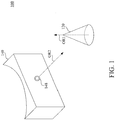
- FIG. 1 is a schematic diagram illustrating a tracking system 100 according to an embodiment of the disclosure.
- the tracking system 100 includes a trackable device 120 and a tracking device 140.
- the tracking device 140 includes an image sensor 148.
- the image sensor 148 is configured to capture an image (or capture a series of images sequentially over time).
- the image sensor 148 can be a visible optical camera, an infrared camera or any equivalent optical sensor.
- the tracking device 140 is able to track a position of the trackable device 120 relative to the tracking device 140 by analyzing data in the image captured by the image sensor 148.
- the tracking device 140 may apply a two-dimensional mask (corresponding to a shape of the trackable device 120) onto the image captured by the image sensor 148, so as to search for the trackable device 120 within the image in reference with the two-dimensional mask.
- the tracking device 140 applies one identical two-dimensional mask to search for the trackable device 120 under all different conditions, some errors may occur in searching process.
- the trackable device 120 (or the tracking device 140) may be rotated or tilted to one direction, and the trackable device 120 will appear in a different shape in view of the image sensor 148 of the tracking device 140. Therefore, applying a uniform-shaped two-dimensional mask on the tracking device 140 in searching for the trackable device 120 within the captured image may cause some problems, such as reducing preciseness of tracking.
- the tracking system 100 is able to dynamically calculate a two-dimensional silhouette (which is not fixed in an identical shape) corresponding to the three-dimensional shape of the trackable device 120. Details about how to calculate the two-dimensional silhouette will be explained in following paragraphs.
- a three-dimensional shape of the trackable device 120 is a cone shape.
- the cone shape of the trackable device 120 is simply an example for demonstration.
- the three-dimensional shape of the trackable device 120 is not limited to a specific shape. In some other embodiments of the disclosure, the three-dimensional shape can also be a cube shape, an ellipsoid shape, a polyhedron shape or an irregular shape (e.g., a rock shape, a rifle shape, a shotgun shape, a baseball bat shape, a glove shape).
- the cone-shaped trackable device 120 is utilized in following the paragraphs for demonstration.
- the tracking device 140 can be a host device of the tracking system 100, and the trackable device 120 can be a client device to be tracked by the tracking device 140.
- the tracking device 140 can be a head-mounted display (HMD) device of a virtual reality (VR), augmented reality (AR), substitutional reality (SR) or mixed reality (MR) system
- the trackable device 120 can be a controller of the system (or a partial portion of the controller).
- HMD head-mounted display
- VR virtual reality
- AR augmented reality
- SR substitutional reality
- MR mixed reality
- the disclosure is not limited to be used between the head-mounted display device and the controller.
- FIG. 2 is a functional block diagram illustrating the tracking system 100 shown in FIG. 1 .
- the trackable device 120 includes an orientation sensor 122, a processing circuit 124 and a communication circuit 126.
- the processing circuit 124 is coupled with the orientation sensor 122 and the communication circuit 126.
- the orientation sensor 122 can be implemented by an Inertial Measurement Unit (IMU).
- IMU Inertial Measurement Unit
- the Inertial Measurement Unit is able to sense accelerations and angular rates on the trackable device 120 along multiple axes.
- the orientation sensor 122 can also be implemented by an accelerometer or a gyro sensor, or any equivalent orientation sensor.
- the orientation sensor 122 may directly sense a first orientation OR1 of the trackable device 120.
- the orientation sensor is configured to sense relative data (e.g., accelerations, angular rates, a gravity direction) about the first orientation OR1, and the relative data is calculated by the processing circuit 124 to determine the first orientation OR1.
- the first orientation OR1 represent a directional vector extending along a central axis of the trackable device 120.
- the communication circuit 126 is configured to transmit the first orientation OR1 sensed by the orientation sensor 122 to the tracking device 140.
- the communication circuit 126 can be implemented by a radio frequency transceiver circuit, a local-area communication circuit and/or a telecommunication circuit.
- the radio frequency transceiver circuit can include an antenna for transmitting or receiving a radio frequency signal.
- the local-area communication circuit can include a Bluetooth Low-Energy (BLE) transceiver, a Near Field Communication (NFC) transceiver, a WiFi-direct transceiver, a Zigbee transceiver and any equivalent transceiver.
- the telecommunication circuit can include 2G, 3G, 4G and/or 5G telecommunication transceiver.
- the processing circuit 124 can be implemented by a processor, a central processing unit, a graphic processing unit or an Application-specific integrated circuit (ASIC).
- ASIC Application-specific integrated circuit
- the tracking device 140 includes an orientation sensor 142, a processing circuit 144, a communication circuit 146 and the image sensor 148.
- the processing circuit 144 is coupled with the orientation sensor 142, the communication circuit 146 and the image sensor 148.
- the orientation sensor 142 can be implemented by an Inertial Measurement Unit (IMU).
- IMU Inertial Measurement Unit
- the Inertial Measurement Unit is able to sense accelerations and angular rates on the tracking device 140 along multiple axes.
- the orientation sensor 142 can also be implemented by an accelerometer or a gyro sensor, or any equivalent orientation sensor.
- the orientation sensor 142 may directly sense a second orientation OR2 of the tracking device 140.
- the orientation sensor is configured to sense relative data (e.g., accelerations, angular rates, a gravity direction) about the second orientation OR2, and the relative data is calculated by the processing circuit 144 to determine the second orientation OR2.
- the second orientation OR2 represent a directional vector extending along a central axis of the tracking device 140 (or extending along a central axis of the image sensor 148) as shown in FIG. 1 .
- the communication circuit 146 is configured to receive the first orientation OR1 from the trackable device 140.
- the communication circuit 146 can be implemented by a radio frequency transceiver circuit, a local-area communication circuit and/or a telecommunication circuit.
- the processing circuit 144 can be implemented by a processor, a central processing unit, a graphic processing unit or an Application-specific integrated circuit (ASIC).
- the processing circuit 144 is configured to calculate a two-dimensional silhouette corresponding to the three-dimensional shape of the trackable device according to the first orientation and the second orientation.
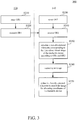
- FIG. 3 is a flow chart diagram illustrating a tracking method 300 according to some embodiments of the disclosure.
- the tracking method 300 is suitable to be used between the trackable device 120 and the tracking device 140 in the tracking system 100 shown in FIG. 1 and FIG. 2 .
- operation S310 is executed by the orientation sensor 122 on the trackable device 120 to sense the first orientation OR1.
- operation S320 is executed by the communication circuit 126 to transmit the first orientation OR1 from the trackable device 120 to the tracking device 140.
- operation S330 is executed by the orientation sensor 142 on the tracking device 140 to sense the second orientation OR2.
- operation S340 is executed by the communication circuit 146 to receive the first orientation OR1 from the trackable device 120.
- Operation S350 is executed by the processing circuit 144 to calculate a two-dimensional silhouette corresponding to the three-dimensional shape of the trackable device according to the first orientation OR1 and the second orientation OR2.
- FIG. 4A to FIG. 4D are schematic diagrams illustrating different examples of the two-dimensional silhouettes calculated according different combinations of the first orientation OR1 and the second orientation OR2.
- the first orientation OR1 may be perpendicular to the second orientation OR2.
- the two-dimensional silhouette calculated by the processing circuit 144 will be the two-dimensional silhouette SILH1 shown in FIG. 4A in a triangle shape, because the image sensor 148 is facing a front surface of the trackable device 120 in the cone shape.
- the first orientation OR1 and the second orientation OR2 may form an acute angle (less than 90 degrees) along one axis.
- the two-dimensional silhouette calculated by the processing circuit 144 will be the two-dimensional silhouette SILH2 shown in FIG. 4B in a fan shape (or a sector shape), because the image sensor 148 is facing the trackable device 120 in the cone shape from a lower angle.
- the first orientation OR1 and the second orientation OR2 may overlap or almost parallel with each other.
- the two-dimensional silhouette calculated by the processing circuit 144 will be the two-dimensional silhouette SILH3 shown in FIG. 4C in a round shape, because the image sensor 148 is facing a bottom side of the trackable device 120 in the cone shape.
- the first orientation OR1 and the second orientation OR2 may form another acute angle along one axis (different from the axis in aforesaid embodiment of FIG. 4B ).
- the two-dimensional silhouette calculated by the processing circuit 144 will be the two-dimensional silhouette SILH4 shown in FIG. 4D in a fan shape (or a sector shape) tilting to the left side, because the image sensor 148 is facing the tilted trackable device 120 in the cone shape from a lower angle.
- FIG. 4A to FIG. 4D provides some examples about different two-dimensional silhouettes SILH1-SILH4 calculated under the different combinations of the first orientation OR1 and the second orientation OR2.
- the two-dimensional silhouettes calculated by the processing circuit 144 are not limited to these four examples. Based on similar manners, the two-dimensional silhouette calculated by the processing circuit 144 can be rotated to the ride side, or even flipped to the bottom side.
- Operation S360 is executed by the image sensor 148 of the tracking device 140.
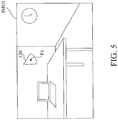
- FIG. 5 is a schematic diagram illustrating the image IMG1 captured by the image sensor 148 according to an embodiment of the disclosure. As shown in FIG. 5 , the trackable device 120 appears in the image IMG1 captured by the image sensor 148. In order to track a position of the trackable device 120, the processing circuit 144 must extract or identify the trackable device 120 from a background and other objects in the image IMG1. In this embodiment, operation S370 is executed by the processing circuit 144 to utilize the two-dimensional silhouette SILH4 (shown in FIG.
- the two-dimensional silhouette SILH4 calculated according to the first orientation OR1 and the second orientation OR2 will be suitable to extract the trackable device 120 from the background and other object in the image IMG1. Therefore, a preciseness of the tracking device 140 in tracking the trackable device 120 will be elevated by adopting a suitable searching mask (i.e., the two-dimensional silhouette SILH4).
- FIG. 6 is a flow chart diagram illustrating further detail operations of the operation S350 in FIG. 3 according to an embodiment of the disclosure.
- FIG. 7 is a schematic diagram illustrating a two-dimensional silhouette calculated by the detail operations shown in FIG. 6 .
- the tracking device 140 in an embodiment may further include a storage unit 149.
- the storage unit 149 is coupled with the processing circuit 144.
- the storage unit 149 is configured to store a three-dimensional model MD1 matching with the three-dimensional shape of the trackable device 120.
- Operation S651 is executed to determine a reference plane RP1 (referring to FIG.
- a normal vector of the reference plane RP1 can be determined by the second orientation OR2.
- Operation S652 is executed to align the three-dimensional model MD1 with the first orientation OR1.
- a central axis of the three-dimensional model MD1 can be aligned to the first orientation OR1.
- Operation S653 is executed to project a contour the three-dimensional model MD1 onto the reference plane RP1 to obtain the two-dimensional silhouette SILH5.
- the two-dimensional silhouette SILH5 is dynamically calculated according the three-dimensional model MD1, the first orientation OR1 and the second orientation OR2.
- FIG. 8 is a flow chart diagram illustrating further detail operations S851-S853 of the operation S350 in FIG. 3 according to another embodiment of the disclosure.
- the tracking device 140 as shown in FIG. 2 further includes a storage unit 149.
- the storage unit 149 is coupled with the processing circuit 144.
- the storage unit 149 can be implemented by a memory, a flash memory, a hard-disk, a transitory computer-readable medium and/or a non-transitory computer-readable medium.
- the storage unit 149 is configured to store a lookup table.
- FIG. 9 is a schematic diagram illustrating an example of a lookup table LUT1 corresponding to an embodiment shown in FIG. 8 .
- the lookup table LUT1 stored in the storage unit 149 is configured to record multiple candidate two-dimensional silhouettes, such as the candidate two-dimensional silhouettes SC1-SC15 shown in FIG. 9 .
- the candidate two-dimensional silhouettes SC1-SC15 correspond to different first orientation ranges OR1a-OR1e of the first orientation OR1 on the trackable device 120 and different second orientation ranges OR2a-OR2e of the second orientation OR2 on the tracking device 140.
- the candidate two-dimensional silhouette SC1 corresponds to the first orientation range OR1a and the second orientation range OR2a; the candidate two-dimensional silhouette SC2 corresponds to the first orientation range OR1b and the second orientation range OR2a; and the candidate two-dimensional silhouette SC3 corresponds to the first orientation range OR1c and the second orientation range OR2a.
- the second orientation range OR2a remains the same and the first orientation OR1 of the trackable device 120 is rotated from tilting to the left (corresponding to the first orientation range OR1a) to tilting to the right (corresponding to the first orientation range OR1e).
- the first orientation range OR1c remains the same and the second orientation OR2 of the tracking device 120 is moved from a lower level than the trackable device 140 (corresponding to the second orientation range OR2a) to a similar level with the trackable device 140 (corresponding to the second orientation range OR2c).
- the lookup table LUT1 can be established in advance by placing the trackable device 120 in front of the tracking device 140, capturing reference images of the trackable device 120, recording the corresponding candidate two-dimensional silhouettes SC1-SC15 in the reference images under the different first orientation ranges OR1a-OR1e and different second orientation ranges OR2a-OR2c into the lookup table LUT1.
- the lookup table LUT1 can be established in advance and stored in the storage unit 149. In this example, there are five first orientation ranges OR1a-OR1e and three second orientation ranges OR2a-OR2c are illustrated in the lookup table LUT1 for demonstration. However, the lookup table LUT1 may include more combinations of first orientation ranges and second orientation ranges to cover different variations of spatial positions.
- the lookup table LUT1 is not limited to the example shown in FIG. 9 .
- the operation S350 in FIG. 3 can be performed by executing operations S851 to S853 in the embodiment shown in FIG. 8 .
- operation S851 is executed to compare the first orientation OR1 sensed by the tracking object 120 and the second orientation OR2 sensed by the tracking device 140 with one combination (e.g., a combination of OR1a and OR2a) selected from the first orientation ranges OR1a-OR1e and the second orientation ranges OR2a-OR2c in the lookup table LUT1.
- one combination e.g., a combination of OR1a and OR2a
- operation S852 is executed to determine whether the first orientation OR1 sensed by the tracking object 120 and the second orientation OR2 sensed by the tracking device 140 matches the combination in current comparison. If the comparison fails to match (OR1 and OR2 does not fall into the combination of OR1a and OR2a), the operation S851 will be executed again to compare the first orientation OR1 and the second orientation OR2 with another combination (e.g., a combination of OR1b and OR2a) selected from the first orientation ranges OR1a-OR1e and the second orientation ranges OR2a-OR2c in the lookup table LUT1.
- another combination e.g., a combination of OR1b and OR2a
- operation S853 will be executed to select one of the candidate two-dimensional silhouettes SC1-SC15 from the lookup table LUT1 as the two-dimensional silhouette (e.g., the candidate two-dimensional silhouettes SC2 will be selected in this example).
- the two-dimensional silhouette will be selected from the lookup table LUT1 established in advance, such that the tracking device 140 can rapidly determine the suitable mask (the two-dimensional silhouette) for tracking the trackable device 120 appeared in the images captured by the image sensor 148.
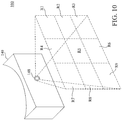
- FIG. 10 is a schematic diagram illustrating a field of view of the image sensor 148 of the tracking device 140 in FIG. 1 .
- the field of view of the image sensor 148 covers different regions R1-R9 as shown in FIG. 10 .
- the trackable device 120 located in different regions relative to the tracking device 140 will not appear in the same contour. For example, when the trackable device 120 located in the region R4 relative to the image sensor 148 will show relatively more of the bottom side of the trackable device 120; and, when the trackable device 120 located in the region R6 relative to the image sensor 148 will show relatively more of the top side of the trackable device 120. In this case, it will not be ideal for the tracking device 140 to utilize the same mask (e.g., the two-dimensional silhouette) to search the trackable device 120 in all regions R1-R9 of the image captured by the image sensor 148.
- the same mask e.g., the two-dimensional silhouette
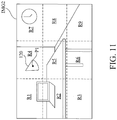
- FIG. 11 is a schematic diagram illustrating an embodiment of an image IMG2 captured by the image sensor 148.
- the storage unit 149 is configured to store K different versions of lookup tables.
- Each one of the K lookup tables records candidate two-dimensional silhouettes.
- Each one of the K lookup tables is in the same structure of the lookup table LUT1 shown in FIG. 9 .
- the K lookup tables view the trackable device 120 from different point of views. Therefore, the candidate two-dimensional silhouettes in one of the K lookup tables will be different from another one of the K lookup tables.
- K is a positive integer. In the embodiments shown in FIG. 10 and FIG. 11 , K is equal to 9. However, the disclosure is not limited thereto.
- K lookup tables can be established separately in advance and stored in the storage unit 149. Details about how to establish the K lookup tables are similar to the establishing process of the lookup table LUT1 by placing the trackable device 120 at different regions R1-R9 in front of the tracking device 140, capturing reference images of the trackable device 120, recording the corresponding candidate two-dimensional silhouettes in the reference images under the different first orientation ranges and different second orientation ranges into the K lookup tables.
- the processing circuit 144 is operate to calculate K two-dimensional silhouettes in reference with the K lookup tables corresponding to the three-dimensional shape of the trackable device 120 according to the first orientation OR1 and the second orientation OR2.
- the processing circuit 144 is further operate to divide the image IMG2 captured by the image sensor into K divided regions R1-R9.
- the processing circuit 144 is further operate to utilize one of the K two-dimensional silhouettes to search within a corresponding one of the K divided regions R1-R9 for allocating coordinates P1 of the trackable device 120 within the image IMG2.
- the processing circuit 144 will utilizes nine different two-dimensional silhouettes to search the nine divided regions R1-R9 in the image IMG2.
- Each of the nine different two-dimensional silhouettes utilized by the processing circuit 144 is decided separately according to the first orientation OR1 and the second orientation OR2 in correspondence with one divided region.
- the two-dimensional silhouette will be selected from the different lookup tables established in advance, such that the tracking device 140 can rapidly determine the suitable mask (the two-dimensional silhouette) for tracking the trackable device 120 appeared in the different divided regions of the images captured by the image sensor 148. Preciseness for tracking the trackable device 120 based on images captured by the image sensor 148 of the tracking device 140 will be elevated and also computation time for tracking will be reduced because the processing circuit 144 is able search the regions of the image IMG2 with a proper mask (the selected two-dimensional silhouette).
Landscapes
- Engineering & Computer Science (AREA)
- Physics & Mathematics (AREA)
- General Physics & Mathematics (AREA)
- Theoretical Computer Science (AREA)
- Computer Vision & Pattern Recognition (AREA)
- Multimedia (AREA)
- User Interface Of Digital Computer (AREA)
- Image Analysis (AREA)
- Image Processing (AREA)
Applications Claiming Priority (1)
| Application Number | Priority Date | Filing Date | Title |
|---|---|---|---|
| US201762486011P | 2017-04-17 | 2017-04-17 |
Publications (2)
| Publication Number | Publication Date |
|---|---|
| EP3392833A1 true EP3392833A1 (de) | 2018-10-24 |
| EP3392833B1 EP3392833B1 (de) | 2019-10-16 |
Family
ID=62062821
Family Applications (1)
| Application Number | Title | Priority Date | Filing Date |
|---|---|---|---|
| EP18167625.5A Active EP3392833B1 (de) | 2017-04-17 | 2018-04-16 | Verfolgungssystem zur verfolgung eines objekts auf basis der silhouette |
Country Status (4)
| Country | Link |
|---|---|
| US (1) | US10467456B2 (de) |
| EP (1) | EP3392833B1 (de) |
| CN (1) | CN108734721B (de) |
| TW (1) | TWI663525B (de) |
Families Citing this family (2)
| Publication number | Priority date | Publication date | Assignee | Title |
|---|---|---|---|---|
| US20220317771A1 (en) * | 2021-04-01 | 2022-10-06 | Htc Corporation | Method for tracking trackers and host |
| US12205328B2 (en) * | 2021-07-28 | 2025-01-21 | Htc Corporation | System for tracking camera and control method thereof |
Citations (2)
| Publication number | Priority date | Publication date | Assignee | Title |
|---|---|---|---|---|
| US20080080789A1 (en) * | 2006-09-28 | 2008-04-03 | Sony Computer Entertainment Inc. | Object detection using video input combined with tilt angle information |
| US20160026253A1 (en) * | 2014-03-11 | 2016-01-28 | Magic Leap, Inc. | Methods and systems for creating virtual and augmented reality |
Family Cites Families (18)
| Publication number | Priority date | Publication date | Assignee | Title |
|---|---|---|---|---|
| US10279254B2 (en) | 2005-10-26 | 2019-05-07 | Sony Interactive Entertainment Inc. | Controller having visually trackable object for interfacing with a gaming system |
| US7978174B2 (en) * | 2006-06-07 | 2011-07-12 | Avago Technologies General Ip (Singapore) Pte. Ltd. | System and method for interactive three-dimensional position tracking |
| US20100303297A1 (en) * | 2009-05-30 | 2010-12-02 | Anton Mikhailov | Color calibration for object tracking |
| TW201126451A (en) | 2011-03-29 | 2011-08-01 | Yuan-Hong Li | Augmented-reality system having initial orientation in space and time and method |
| EP2751742A1 (de) | 2011-08-31 | 2014-07-09 | metaio GmbH | Verfahren zum abgleich von bildmerkmalen mit referenzmerkmalen |
| JP5966510B2 (ja) | 2012-03-29 | 2016-08-10 | ソニー株式会社 | 情報処理システム |
| US9256987B2 (en) | 2013-06-24 | 2016-02-09 | Microsoft Technology Licensing, Llc | Tracking head movement when wearing mobile device |
| US9514571B2 (en) * | 2013-07-25 | 2016-12-06 | Microsoft Technology Licensing, Llc | Late stage reprojection |
| US9264702B2 (en) | 2013-08-19 | 2016-02-16 | Qualcomm Incorporated | Automatic calibration of scene camera for optical see-through head mounted display |
| US9489765B2 (en) * | 2013-11-18 | 2016-11-08 | Nant Holdings Ip, Llc | Silhouette-based object and texture alignment, systems and methods |
| US9626568B2 (en) | 2013-11-26 | 2017-04-18 | Rowan University | Use of spatially structured light for dynamic three dimensional reconstruction and reality augmentation |
| EP2879371B1 (de) * | 2013-11-29 | 2016-12-21 | Axis AB | System zum Verfolgen mit einer Kamera eines durch eine Etikettvorrichtung markierten Objekts |
| CN105279750B (zh) * | 2014-07-09 | 2019-02-01 | 中国人民解放军装甲兵工程学院 | 一种基于ir-uwb和图像矩的装备展示导览系统 |
| US9807316B2 (en) * | 2014-09-04 | 2017-10-31 | Htc Corporation | Method for image segmentation |
| US10684485B2 (en) | 2015-03-06 | 2020-06-16 | Sony Interactive Entertainment Inc. | Tracking system for head mounted display |
| US10296086B2 (en) | 2015-03-20 | 2019-05-21 | Sony Interactive Entertainment Inc. | Dynamic gloves to convey sense of touch and movement for virtual objects in HMD rendered environments |
| CN205103761U (zh) | 2015-08-03 | 2016-03-23 | 众景视界(北京)科技有限公司 | 头戴式智能设备 |
| CN105183148A (zh) | 2015-08-03 | 2015-12-23 | 众景视界(北京)科技有限公司 | 用于头戴式智能设备的平移检测方法及平移检测装置 |
-
2018
- 2018-04-13 US US15/952,258 patent/US10467456B2/en active Active
- 2018-04-16 EP EP18167625.5A patent/EP3392833B1/de active Active
- 2018-04-17 CN CN201810345018.3A patent/CN108734721B/zh active Active
- 2018-04-17 TW TW107113075A patent/TWI663525B/zh active
Patent Citations (2)
| Publication number | Priority date | Publication date | Assignee | Title |
|---|---|---|---|---|
| US20080080789A1 (en) * | 2006-09-28 | 2008-04-03 | Sony Computer Entertainment Inc. | Object detection using video input combined with tilt angle information |
| US20160026253A1 (en) * | 2014-03-11 | 2016-01-28 | Magic Leap, Inc. | Methods and systems for creating virtual and augmented reality |
Non-Patent Citations (3)
| Title |
|---|
| ADAM RIECICKÝ ET AL: "Optical-inertial Synchronization of MoCap Suit with Single Camera Setup for Reliable Position Tracking :", PROCEEDINGS OF THE 13TH INTERNATIONAL JOINT CONFERENCE ON COMPUTER VISION, IMAGING AND COMPUTER GRAPHICS THEORY AND APPLICATIONS, 28 January 2018 (2018-01-28) - 28 January 2018 (2018-01-28), pages 40 - 47, XP055503618, ISBN: 978-989-7582-87-5, DOI: 10.5220/0006531100400047 * |
| GERARD PONS-MOLL ET AL: "Multisensor-fusion for 3D full-body human motion capture", 2010 IEEE CONFERENCE ON COMPUTER VISION AND PATTERN RECOGNITION (CVPR), 13-18 JUNE 2010, SAN FRANCISCO, CA, USA, IEEE, PISCATAWAY, NJ, USA, 13 June 2010 (2010-06-13), pages 663 - 670, XP031725978, ISBN: 978-1-4244-6984-0 * |
| PRISACARIU VICTOR ADRIAN ET AL: "Real-Time 3D Tracking and Reconstruction on Mobile Phones", IEEE TRANSACTIONS ON VISUALIZATION AND COMPUTER GRAPHICS, IEEE SERVICE CENTER, LOS ALAMITOS, CA, US, vol. 21, no. 5, 1 May 2015 (2015-05-01), pages 557 - 570, XP011576624, ISSN: 1077-2626, [retrieved on 20150325], DOI: 10.1109/TVCG.2014.2355207 * |
Also Published As
| Publication number | Publication date |
|---|---|
| EP3392833B1 (de) | 2019-10-16 |
| US10467456B2 (en) | 2019-11-05 |
| CN108734721A (zh) | 2018-11-02 |
| US20180300532A1 (en) | 2018-10-18 |
| TWI663525B (zh) | 2019-06-21 |
| CN108734721B (zh) | 2021-03-16 |
| TW201839552A (zh) | 2018-11-01 |
Similar Documents
| Publication | Publication Date | Title |
|---|---|---|
| CN110702111B (zh) | 使用双事件相机的同时定位与地图创建(slam) | |
| CN108028871B (zh) | 移动设备上的无标记的多用户多对象增强现实 | |
| CN109035334B (zh) | 位姿的确定方法和装置、存储介质及电子装置 | |
| KR20220009393A (ko) | 이미지 기반 로컬화 | |
| US20170068326A1 (en) | Imaging surround system for touch-free display control | |
| CN109791608A (zh) | 映射摘要和本地化 | |
| GB2506338A (en) | A method of localisation and mapping | |
| WO2016041088A1 (en) | System and method for tracking wearable peripherals in augmented reality and virtual reality applications | |
| KR102398478B1 (ko) | 전자 디바이스 상에서의 환경 맵핑을 위한 피쳐 데이터 관리 | |
| WO2012145210A1 (en) | Online reference patch generation and pose estimation for augmented reality | |
| KR102871418B1 (ko) | 자세 추정 방법 및 장치 | |
| EP4530800B1 (de) | Vorrichtung zur berechnung eines koordinatensystemversatzes, verfahren und nichttransitorisches computerlesbares speichermedium dafür | |
| EP3392833B1 (de) | Verfolgungssystem zur verfolgung eines objekts auf basis der silhouette | |
| CN110119189B (zh) | Slam系统的初始化、ar控制方法、装置和系统 | |
| WO2018227580A1 (zh) | 摄像头标定方法和终端 | |
| CN107102735A (zh) | 一种对齐方法及对齐装置 | |
| KR20190005222A (ko) | 가상 환경의 표현에서의 시선 방향을 조정하는 방법 | |
| CN110880187B (zh) | 一种相机位置信息确定方法、装置、电子设备及存储介质 | |
| WO2021177132A1 (ja) | 情報処理装置、情報処理システム、情報処理方法及びプログラム | |
| WO2018070895A1 (ru) | Система позиционирования объекта в пространстве для виртуальной реальности. | |
| JP2025083150A (ja) | 計測装置、システム、方法、及び、プログラム | |
| CN113052977A (zh) | 处理方法及装置 | |
| HK40061179A (en) | Image-based localization | |
| KR20190071228A (ko) | 공간 동기화 기법 |
Legal Events
| Date | Code | Title | Description |
|---|---|---|---|
| PUAI | Public reference made under article 153(3) epc to a published international application that has entered the european phase |
Free format text: ORIGINAL CODE: 0009012 |
|
| STAA | Information on the status of an ep patent application or granted ep patent |
Free format text: STATUS: REQUEST FOR EXAMINATION WAS MADE |
|
| STAA | Information on the status of an ep patent application or granted ep patent |
Free format text: STATUS: EXAMINATION IS IN PROGRESS |
|
| 17P | Request for examination filed |
Effective date: 20180416 |
|
| AK | Designated contracting states |
Kind code of ref document: A1 Designated state(s): AL AT BE BG CH CY CZ DE DK EE ES FI FR GB GR HR HU IE IS IT LI LT LU LV MC MK MT NL NO PL PT RO RS SE SI SK SM TR |
|
| AX | Request for extension of the european patent |
Extension state: BA ME |
|
| 17Q | First examination report despatched |
Effective date: 20181010 |
|
| GRAP | Despatch of communication of intention to grant a patent |
Free format text: ORIGINAL CODE: EPIDOSNIGR1 |
|
| STAA | Information on the status of an ep patent application or granted ep patent |
Free format text: STATUS: GRANT OF PATENT IS INTENDED |
|
| RBV | Designated contracting states (corrected) |
Designated state(s): AL AT BE BG CH CY CZ DE DK EE ES FI FR GB GR HR HU IE IS IT LI LT LU LV MC MK MT NL NO PL PT RO RS SE SI SK SM TR |
|
| RIC1 | Information provided on ipc code assigned before grant |
Ipc: G06K 9/00 20060101ALI20190430BHEP Ipc: G06K 9/46 20060101ALI20190430BHEP Ipc: G06T 7/246 20170101AFI20190430BHEP Ipc: G06K 9/20 20060101ALI20190430BHEP Ipc: G06T 7/73 20170101ALI20190430BHEP |
|
| INTG | Intention to grant announced |
Effective date: 20190528 |
|
| GRAS | Grant fee paid |
Free format text: ORIGINAL CODE: EPIDOSNIGR3 |
|
| GRAA | (expected) grant |
Free format text: ORIGINAL CODE: 0009210 |
|
| STAA | Information on the status of an ep patent application or granted ep patent |
Free format text: STATUS: THE PATENT HAS BEEN GRANTED |
|
| AK | Designated contracting states |
Kind code of ref document: B1 Designated state(s): AL AT BE BG CH CY CZ DE DK EE ES FI FR GB GR HR HU IE IS IT LI LT LU LV MC MK MT NL NO PL PT RO RS SE SI SK SM TR |
|
| REG | Reference to a national code |
Ref country code: GB Ref legal event code: FG4D |
|
| REG | Reference to a national code |
Ref country code: CH Ref legal event code: EP |
|
| REG | Reference to a national code |
Ref country code: DE Ref legal event code: R096 Ref document number: 602018000888 Country of ref document: DE |
|
| REG | Reference to a national code |
Ref country code: IE Ref legal event code: FG4D |
|
| REG | Reference to a national code |
Ref country code: AT Ref legal event code: REF Ref document number: 1192024 Country of ref document: AT Kind code of ref document: T Effective date: 20191115 |
|
| REG | Reference to a national code |
Ref country code: NL Ref legal event code: FP |
|
| REG | Reference to a national code |
Ref country code: LT Ref legal event code: MG4D |
|
| REG | Reference to a national code |
Ref country code: AT Ref legal event code: MK05 Ref document number: 1192024 Country of ref document: AT Kind code of ref document: T Effective date: 20191016 |
|
| PG25 | Lapsed in a contracting state [announced via postgrant information from national office to epo] |
Ref country code: PT Free format text: LAPSE BECAUSE OF FAILURE TO SUBMIT A TRANSLATION OF THE DESCRIPTION OR TO PAY THE FEE WITHIN THE PRESCRIBED TIME-LIMIT Effective date: 20200217 Ref country code: AT Free format text: LAPSE BECAUSE OF FAILURE TO SUBMIT A TRANSLATION OF THE DESCRIPTION OR TO PAY THE FEE WITHIN THE PRESCRIBED TIME-LIMIT Effective date: 20191016 Ref country code: LT Free format text: LAPSE BECAUSE OF FAILURE TO SUBMIT A TRANSLATION OF THE DESCRIPTION OR TO PAY THE FEE WITHIN THE PRESCRIBED TIME-LIMIT Effective date: 20191016 Ref country code: PL Free format text: LAPSE BECAUSE OF FAILURE TO SUBMIT A TRANSLATION OF THE DESCRIPTION OR TO PAY THE FEE WITHIN THE PRESCRIBED TIME-LIMIT Effective date: 20191016 Ref country code: GR Free format text: LAPSE BECAUSE OF FAILURE TO SUBMIT A TRANSLATION OF THE DESCRIPTION OR TO PAY THE FEE WITHIN THE PRESCRIBED TIME-LIMIT Effective date: 20200117 Ref country code: FI Free format text: LAPSE BECAUSE OF FAILURE TO SUBMIT A TRANSLATION OF THE DESCRIPTION OR TO PAY THE FEE WITHIN THE PRESCRIBED TIME-LIMIT Effective date: 20191016 Ref country code: BG Free format text: LAPSE BECAUSE OF FAILURE TO SUBMIT A TRANSLATION OF THE DESCRIPTION OR TO PAY THE FEE WITHIN THE PRESCRIBED TIME-LIMIT Effective date: 20200116 Ref country code: NO Free format text: LAPSE BECAUSE OF FAILURE TO SUBMIT A TRANSLATION OF THE DESCRIPTION OR TO PAY THE FEE WITHIN THE PRESCRIBED TIME-LIMIT Effective date: 20200116 Ref country code: LV Free format text: LAPSE BECAUSE OF FAILURE TO SUBMIT A TRANSLATION OF THE DESCRIPTION OR TO PAY THE FEE WITHIN THE PRESCRIBED TIME-LIMIT Effective date: 20191016 Ref country code: SE Free format text: LAPSE BECAUSE OF FAILURE TO SUBMIT A TRANSLATION OF THE DESCRIPTION OR TO PAY THE FEE WITHIN THE PRESCRIBED TIME-LIMIT Effective date: 20191016 |
|
| PG25 | Lapsed in a contracting state [announced via postgrant information from national office to epo] |
Ref country code: IS Free format text: LAPSE BECAUSE OF FAILURE TO SUBMIT A TRANSLATION OF THE DESCRIPTION OR TO PAY THE FEE WITHIN THE PRESCRIBED TIME-LIMIT Effective date: 20200224 Ref country code: HR Free format text: LAPSE BECAUSE OF FAILURE TO SUBMIT A TRANSLATION OF THE DESCRIPTION OR TO PAY THE FEE WITHIN THE PRESCRIBED TIME-LIMIT Effective date: 20191016 Ref country code: RS Free format text: LAPSE BECAUSE OF FAILURE TO SUBMIT A TRANSLATION OF THE DESCRIPTION OR TO PAY THE FEE WITHIN THE PRESCRIBED TIME-LIMIT Effective date: 20191016 |
|
| PG25 | Lapsed in a contracting state [announced via postgrant information from national office to epo] |
Ref country code: AL Free format text: LAPSE BECAUSE OF FAILURE TO SUBMIT A TRANSLATION OF THE DESCRIPTION OR TO PAY THE FEE WITHIN THE PRESCRIBED TIME-LIMIT Effective date: 20191016 |
|
| REG | Reference to a national code |
Ref country code: DE Ref legal event code: R097 Ref document number: 602018000888 Country of ref document: DE |
|
| PG2D | Information on lapse in contracting state deleted |
Ref country code: IS |
|
| PG25 | Lapsed in a contracting state [announced via postgrant information from national office to epo] |
Ref country code: DK Free format text: LAPSE BECAUSE OF FAILURE TO SUBMIT A TRANSLATION OF THE DESCRIPTION OR TO PAY THE FEE WITHIN THE PRESCRIBED TIME-LIMIT Effective date: 20191016 Ref country code: ES Free format text: LAPSE BECAUSE OF FAILURE TO SUBMIT A TRANSLATION OF THE DESCRIPTION OR TO PAY THE FEE WITHIN THE PRESCRIBED TIME-LIMIT Effective date: 20191016 Ref country code: CZ Free format text: LAPSE BECAUSE OF FAILURE TO SUBMIT A TRANSLATION OF THE DESCRIPTION OR TO PAY THE FEE WITHIN THE PRESCRIBED TIME-LIMIT Effective date: 20191016 Ref country code: RO Free format text: LAPSE BECAUSE OF FAILURE TO SUBMIT A TRANSLATION OF THE DESCRIPTION OR TO PAY THE FEE WITHIN THE PRESCRIBED TIME-LIMIT Effective date: 20191016 Ref country code: EE Free format text: LAPSE BECAUSE OF FAILURE TO SUBMIT A TRANSLATION OF THE DESCRIPTION OR TO PAY THE FEE WITHIN THE PRESCRIBED TIME-LIMIT Effective date: 20191016 Ref country code: IS Free format text: LAPSE BECAUSE OF FAILURE TO SUBMIT A TRANSLATION OF THE DESCRIPTION OR TO PAY THE FEE WITHIN THE PRESCRIBED TIME-LIMIT Effective date: 20200216 |
|
| PLBE | No opposition filed within time limit |
Free format text: ORIGINAL CODE: 0009261 |
|
| STAA | Information on the status of an ep patent application or granted ep patent |
Free format text: STATUS: NO OPPOSITION FILED WITHIN TIME LIMIT |
|
| PG25 | Lapsed in a contracting state [announced via postgrant information from national office to epo] |
Ref country code: IT Free format text: LAPSE BECAUSE OF FAILURE TO SUBMIT A TRANSLATION OF THE DESCRIPTION OR TO PAY THE FEE WITHIN THE PRESCRIBED TIME-LIMIT Effective date: 20191016 Ref country code: SK Free format text: LAPSE BECAUSE OF FAILURE TO SUBMIT A TRANSLATION OF THE DESCRIPTION OR TO PAY THE FEE WITHIN THE PRESCRIBED TIME-LIMIT Effective date: 20191016 Ref country code: SM Free format text: LAPSE BECAUSE OF FAILURE TO SUBMIT A TRANSLATION OF THE DESCRIPTION OR TO PAY THE FEE WITHIN THE PRESCRIBED TIME-LIMIT Effective date: 20191016 |
|
| 26N | No opposition filed |
Effective date: 20200717 |
|
| PG25 | Lapsed in a contracting state [announced via postgrant information from national office to epo] |
Ref country code: SI Free format text: LAPSE BECAUSE OF FAILURE TO SUBMIT A TRANSLATION OF THE DESCRIPTION OR TO PAY THE FEE WITHIN THE PRESCRIBED TIME-LIMIT Effective date: 20191016 Ref country code: MC Free format text: LAPSE BECAUSE OF FAILURE TO SUBMIT A TRANSLATION OF THE DESCRIPTION OR TO PAY THE FEE WITHIN THE PRESCRIBED TIME-LIMIT Effective date: 20191016 |
|
| PG25 | Lapsed in a contracting state [announced via postgrant information from national office to epo] |
Ref country code: LU Free format text: LAPSE BECAUSE OF NON-PAYMENT OF DUE FEES Effective date: 20200416 |
|
| REG | Reference to a national code |
Ref country code: BE Ref legal event code: MM Effective date: 20200430 |
|
| PG25 | Lapsed in a contracting state [announced via postgrant information from national office to epo] |
Ref country code: BE Free format text: LAPSE BECAUSE OF NON-PAYMENT OF DUE FEES Effective date: 20200430 |
|
| PG25 | Lapsed in a contracting state [announced via postgrant information from national office to epo] |
Ref country code: IE Free format text: LAPSE BECAUSE OF NON-PAYMENT OF DUE FEES Effective date: 20200416 |
|
| PG25 | Lapsed in a contracting state [announced via postgrant information from national office to epo] |
Ref country code: LI Free format text: LAPSE BECAUSE OF NON-PAYMENT OF DUE FEES Effective date: 20210430 Ref country code: CH Free format text: LAPSE BECAUSE OF NON-PAYMENT OF DUE FEES Effective date: 20210430 |
|
| PG25 | Lapsed in a contracting state [announced via postgrant information from national office to epo] |
Ref country code: TR Free format text: LAPSE BECAUSE OF FAILURE TO SUBMIT A TRANSLATION OF THE DESCRIPTION OR TO PAY THE FEE WITHIN THE PRESCRIBED TIME-LIMIT Effective date: 20191016 Ref country code: MT Free format text: LAPSE BECAUSE OF FAILURE TO SUBMIT A TRANSLATION OF THE DESCRIPTION OR TO PAY THE FEE WITHIN THE PRESCRIBED TIME-LIMIT Effective date: 20191016 Ref country code: CY Free format text: LAPSE BECAUSE OF FAILURE TO SUBMIT A TRANSLATION OF THE DESCRIPTION OR TO PAY THE FEE WITHIN THE PRESCRIBED TIME-LIMIT Effective date: 20191016 |
|
| PG25 | Lapsed in a contracting state [announced via postgrant information from national office to epo] |
Ref country code: MK Free format text: LAPSE BECAUSE OF FAILURE TO SUBMIT A TRANSLATION OF THE DESCRIPTION OR TO PAY THE FEE WITHIN THE PRESCRIBED TIME-LIMIT Effective date: 20191016 |
|
| P01 | Opt-out of the competence of the unified patent court (upc) registered |
Effective date: 20230602 |
|
| PGFP | Annual fee paid to national office [announced via postgrant information from national office to epo] |
Ref country code: DE Payment date: 20250305 Year of fee payment: 8 |
|
| PGFP | Annual fee paid to national office [announced via postgrant information from national office to epo] |
Ref country code: GB Payment date: 20260312 Year of fee payment: 9 |
|
| PGFP | Annual fee paid to national office [announced via postgrant information from national office to epo] |
Ref country code: NL Payment date: 20260317 Year of fee payment: 9 |
|
| PGFP | Annual fee paid to national office [announced via postgrant information from national office to epo] |
Ref country code: FR Payment date: 20260309 Year of fee payment: 9 |