EP3392264A1 - Material comprising oligoglycine tectomers and nanowires - Google Patents
Material comprising oligoglycine tectomers and nanowires Download PDFInfo
- Publication number
- EP3392264A1 EP3392264A1 EP16874961.2A EP16874961A EP3392264A1 EP 3392264 A1 EP3392264 A1 EP 3392264A1 EP 16874961 A EP16874961 A EP 16874961A EP 3392264 A1 EP3392264 A1 EP 3392264A1
- Authority
- EP
- European Patent Office
- Prior art keywords
- nws
- oligoglycine
- agnws
- tectomers
- material according
- Prior art date
- Legal status (The legal status is an assumption and is not a legal conclusion. Google has not performed a legal analysis and makes no representation as to the accuracy of the status listed.)
- Withdrawn
Links
- 239000000463 material Substances 0.000 title claims abstract description 58
- 239000002070 nanowire Substances 0.000 title claims abstract description 57
- 239000002042 Silver nanowire Substances 0.000 claims description 50
- 239000000758 substrate Substances 0.000 claims description 34
- 238000000034 method Methods 0.000 claims description 17
- 238000000151 deposition Methods 0.000 claims description 11
- 230000008021 deposition Effects 0.000 claims description 11
- 239000011521 glass Substances 0.000 claims description 11
- 239000000126 substance Substances 0.000 claims description 10
- 238000005507 spraying Methods 0.000 claims description 8
- 230000000845 anti-microbial effect Effects 0.000 claims description 7
- 238000003618 dip coating Methods 0.000 claims description 7
- 238000005266 casting Methods 0.000 claims description 6
- PCHJSUWPFVWCPO-UHFFFAOYSA-N gold Chemical compound [Au] PCHJSUWPFVWCPO-UHFFFAOYSA-N 0.000 claims description 6
- 229920003229 poly(methyl methacrylate) Polymers 0.000 claims description 6
- 229920000139 polyethylene terephthalate Polymers 0.000 claims description 6
- 239000005020 polyethylene terephthalate Substances 0.000 claims description 6
- 239000004926 polymethyl methacrylate Substances 0.000 claims description 6
- 238000004528 spin coating Methods 0.000 claims description 6
- 230000004888 barrier function Effects 0.000 claims description 5
- -1 polyethylene terephthalate Polymers 0.000 claims description 5
- 230000003373 anti-fouling effect Effects 0.000 claims description 4
- 239000003814 drug Substances 0.000 claims description 4
- 229940079593 drug Drugs 0.000 claims description 4
- 230000000840 anti-viral effect Effects 0.000 claims description 3
- 238000011068 loading method Methods 0.000 claims description 3
- 230000005693 optoelectronics Effects 0.000 claims description 2
- 239000012459 cleaning agent Substances 0.000 claims 1
- 239000000243 solution Substances 0.000 description 26
- 238000000576 coating method Methods 0.000 description 22
- 238000004630 atomic force microscopy Methods 0.000 description 10
- 239000006185 dispersion Substances 0.000 description 10
- 239000000203 mixture Substances 0.000 description 9
- 239000011248 coating agent Substances 0.000 description 8
- 230000003993 interaction Effects 0.000 description 8
- XLYOFNOQVPJJNP-UHFFFAOYSA-N water Substances O XLYOFNOQVPJJNP-UHFFFAOYSA-N 0.000 description 8
- 241000700605 Viruses Species 0.000 description 7
- 238000012876 topography Methods 0.000 description 7
- 230000008859 change Effects 0.000 description 6
- 241000894006 Bacteria Species 0.000 description 5
- 230000007613 environmental effect Effects 0.000 description 5
- 230000006870 function Effects 0.000 description 5
- 239000002609 medium Substances 0.000 description 5
- 230000008569 process Effects 0.000 description 5
- 125000003277 amino group Chemical group 0.000 description 4
- 239000007864 aqueous solution Substances 0.000 description 4
- 230000015572 biosynthetic process Effects 0.000 description 4
- 230000007423 decrease Effects 0.000 description 4
- 229910052737 gold Inorganic materials 0.000 description 4
- 239000010931 gold Substances 0.000 description 4
- 238000004519 manufacturing process Methods 0.000 description 4
- 238000002834 transmittance Methods 0.000 description 4
- YBNMDCCMCLUHBL-UHFFFAOYSA-N (2,5-dioxopyrrolidin-1-yl) 4-pyren-1-ylbutanoate Chemical compound C=1C=C(C2=C34)C=CC3=CC=CC4=CC=C2C=1CCCC(=O)ON1C(=O)CCC1=O YBNMDCCMCLUHBL-UHFFFAOYSA-N 0.000 description 3
- 229910001218 Gallium arsenide Inorganic materials 0.000 description 3
- VYPSYNLAJGMNEJ-UHFFFAOYSA-N Silicium dioxide Chemical compound O=[Si]=O VYPSYNLAJGMNEJ-UHFFFAOYSA-N 0.000 description 3
- GWEVSGVZZGPLCZ-UHFFFAOYSA-N Titan oxide Chemical compound O=[Ti]=O GWEVSGVZZGPLCZ-UHFFFAOYSA-N 0.000 description 3
- 238000004140 cleaning Methods 0.000 description 3
- 230000006866 deterioration Effects 0.000 description 3
- 238000010586 diagram Methods 0.000 description 3
- 238000007654 immersion Methods 0.000 description 3
- 239000008204 material by function Substances 0.000 description 3
- 229910052759 nickel Inorganic materials 0.000 description 3
- 239000006250 one-dimensional material Substances 0.000 description 3
- 229910052697 platinum Inorganic materials 0.000 description 3
- 229910052709 silver Inorganic materials 0.000 description 3
- 239000007921 spray Substances 0.000 description 3
- 238000004627 transmission electron microscopy Methods 0.000 description 3
- OKTJSMMVPCPJKN-UHFFFAOYSA-N Carbon Chemical compound [C] OKTJSMMVPCPJKN-UHFFFAOYSA-N 0.000 description 2
- 241000588724 Escherichia coli Species 0.000 description 2
- KFZMGEQAYNKOFK-UHFFFAOYSA-N Isopropanol Chemical compound CC(C)O KFZMGEQAYNKOFK-UHFFFAOYSA-N 0.000 description 2
- 241000607142 Salmonella Species 0.000 description 2
- 238000004833 X-ray photoelectron spectroscopy Methods 0.000 description 2
- 230000005540 biological transmission Effects 0.000 description 2
- 238000012512 characterization method Methods 0.000 description 2
- 229910052681 coesite Inorganic materials 0.000 description 2
- 229910052906 cristobalite Inorganic materials 0.000 description 2
- 230000006378 damage Effects 0.000 description 2
- 230000001419 dependent effect Effects 0.000 description 2
- 238000002474 experimental method Methods 0.000 description 2
- 230000002349 favourable effect Effects 0.000 description 2
- 229910021389 graphene Inorganic materials 0.000 description 2
- 239000001963 growth medium Substances 0.000 description 2
- 239000001257 hydrogen Substances 0.000 description 2
- 229910052739 hydrogen Inorganic materials 0.000 description 2
- 230000002209 hydrophobic effect Effects 0.000 description 2
- 238000001802 infusion Methods 0.000 description 2
- 239000007788 liquid Substances 0.000 description 2
- 238000005259 measurement Methods 0.000 description 2
- 238000001000 micrograph Methods 0.000 description 2
- 230000004048 modification Effects 0.000 description 2
- 238000012986 modification Methods 0.000 description 2
- 239000002086 nanomaterial Substances 0.000 description 2
- 230000000704 physical effect Effects 0.000 description 2
- 238000002360 preparation method Methods 0.000 description 2
- 108090000765 processed proteins & peptides Proteins 0.000 description 2
- 238000011160 research Methods 0.000 description 2
- 230000004044 response Effects 0.000 description 2
- 230000002441 reversible effect Effects 0.000 description 2
- 229910052682 stishovite Inorganic materials 0.000 description 2
- 230000002195 synergetic effect Effects 0.000 description 2
- 229910052905 tridymite Inorganic materials 0.000 description 2
- CBENFWSGALASAD-UHFFFAOYSA-N Ozone Chemical compound [O-][O+]=O CBENFWSGALASAD-UHFFFAOYSA-N 0.000 description 1
- NINIDFKCEFEMDL-UHFFFAOYSA-N Sulfur Chemical compound [S] NINIDFKCEFEMDL-UHFFFAOYSA-N 0.000 description 1
- 239000005864 Sulphur Substances 0.000 description 1
- 239000002253 acid Substances 0.000 description 1
- 230000002378 acidificating effect Effects 0.000 description 1
- 230000009471 action Effects 0.000 description 1
- 239000000654 additive Substances 0.000 description 1
- 230000001070 adhesive effect Effects 0.000 description 1
- 230000002776 aggregation Effects 0.000 description 1
- 238000004220 aggregation Methods 0.000 description 1
- 239000002246 antineoplastic agent Substances 0.000 description 1
- 229940041181 antineoplastic drug Drugs 0.000 description 1
- 230000000712 assembly Effects 0.000 description 1
- 238000000429 assembly Methods 0.000 description 1
- 239000012298 atmosphere Substances 0.000 description 1
- 238000000089 atomic force micrograph Methods 0.000 description 1
- QVGXLLKOCUKJST-UHFFFAOYSA-N atomic oxygen Chemical compound [O] QVGXLLKOCUKJST-UHFFFAOYSA-N 0.000 description 1
- 230000001580 bacterial effect Effects 0.000 description 1
- 230000008901 benefit Effects 0.000 description 1
- 210000004556 brain Anatomy 0.000 description 1
- 230000015556 catabolic process Effects 0.000 description 1
- 238000005119 centrifugation Methods 0.000 description 1
- 239000003795 chemical substances by application Substances 0.000 description 1
- 239000000084 colloidal system Substances 0.000 description 1
- 230000002860 competitive effect Effects 0.000 description 1
- 229920001940 conductive polymer Polymers 0.000 description 1
- 230000003247 decreasing effect Effects 0.000 description 1
- 238000006731 degradation reaction Methods 0.000 description 1
- 238000013461 design Methods 0.000 description 1
- 238000002059 diagnostic imaging Methods 0.000 description 1
- 230000005684 electric field Effects 0.000 description 1
- 230000009881 electrostatic interaction Effects 0.000 description 1
- 238000004146 energy storage Methods 0.000 description 1
- 230000008020 evaporation Effects 0.000 description 1
- 238000001704 evaporation Methods 0.000 description 1
- 125000000524 functional group Chemical group 0.000 description 1
- 150000002333 glycines Chemical class 0.000 description 1
- 238000009396 hybridization Methods 0.000 description 1
- AMGQUBHHOARCQH-UHFFFAOYSA-N indium;oxotin Chemical compound [In].[Sn]=O AMGQUBHHOARCQH-UHFFFAOYSA-N 0.000 description 1
- 238000011031 large-scale manufacturing process Methods 0.000 description 1
- 238000000386 microscopy Methods 0.000 description 1
- 238000002156 mixing Methods 0.000 description 1
- 239000002105 nanoparticle Substances 0.000 description 1
- 239000002071 nanotube Substances 0.000 description 1
- 230000007935 neutral effect Effects 0.000 description 1
- 230000003287 optical effect Effects 0.000 description 1
- 230000003647 oxidation Effects 0.000 description 1
- 238000007254 oxidation reaction Methods 0.000 description 1
- 239000001301 oxygen Substances 0.000 description 1
- 229910052760 oxygen Inorganic materials 0.000 description 1
- 230000035515 penetration Effects 0.000 description 1
- 230000009467 reduction Effects 0.000 description 1
- 238000001338 self-assembly Methods 0.000 description 1
- 239000000377 silicon dioxide Substances 0.000 description 1
- 238000001179 sorption measurement Methods 0.000 description 1
- 239000007858 starting material Substances 0.000 description 1
- 230000007847 structural defect Effects 0.000 description 1
- 238000005987 sulfurization reaction Methods 0.000 description 1
- 238000003786 synthesis reaction Methods 0.000 description 1
- 238000012360 testing method Methods 0.000 description 1
Images


Classifications
-
- H—ELECTRICITY
- H01—ELECTRIC ELEMENTS
- H01B—CABLES; CONDUCTORS; INSULATORS; SELECTION OF MATERIALS FOR THEIR CONDUCTIVE, INSULATING OR DIELECTRIC PROPERTIES
- H01B1/00—Conductors or conductive bodies characterised by the conductive materials; Selection of materials as conductors
- H01B1/20—Conductive material dispersed in non-conductive organic material
- H01B1/22—Conductive material dispersed in non-conductive organic material the conductive material comprising metals or alloys
-
- A—HUMAN NECESSITIES
- A61—MEDICAL OR VETERINARY SCIENCE; HYGIENE
- A61K—PREPARATIONS FOR MEDICAL, DENTAL OR TOILETRY PURPOSES
- A61K47/00—Medicinal preparations characterised by the non-active ingredients used, e.g. carriers or inert additives; Targeting or modifying agents chemically bound to the active ingredient
- A61K47/02—Inorganic compounds
-
- A—HUMAN NECESSITIES
- A61—MEDICAL OR VETERINARY SCIENCE; HYGIENE
- A61K—PREPARATIONS FOR MEDICAL, DENTAL OR TOILETRY PURPOSES
- A61K47/00—Medicinal preparations characterised by the non-active ingredients used, e.g. carriers or inert additives; Targeting or modifying agents chemically bound to the active ingredient
- A61K47/30—Macromolecular organic or inorganic compounds, e.g. inorganic polyphosphates
- A61K47/42—Proteins; Polypeptides; Degradation products thereof; Derivatives thereof, e.g. albumin, gelatin or zein
-
- B—PERFORMING OPERATIONS; TRANSPORTING
- B82—NANOTECHNOLOGY
- B82B—NANOSTRUCTURES FORMED BY MANIPULATION OF INDIVIDUAL ATOMS, MOLECULES, OR LIMITED COLLECTIONS OF ATOMS OR MOLECULES AS DISCRETE UNITS; MANUFACTURE OR TREATMENT THEREOF
- B82B1/00—Nanostructures formed by manipulation of individual atoms or molecules, or limited collections of atoms or molecules as discrete units
-
- B—PERFORMING OPERATIONS; TRANSPORTING
- B82—NANOTECHNOLOGY
- B82B—NANOSTRUCTURES FORMED BY MANIPULATION OF INDIVIDUAL ATOMS, MOLECULES, OR LIMITED COLLECTIONS OF ATOMS OR MOLECULES AS DISCRETE UNITS; MANUFACTURE OR TREATMENT THEREOF
- B82B3/00—Manufacture or treatment of nanostructures by manipulation of individual atoms or molecules, or limited collections of atoms or molecules as discrete units
-
- B—PERFORMING OPERATIONS; TRANSPORTING
- B82—NANOTECHNOLOGY
- B82Y—SPECIFIC USES OR APPLICATIONS OF NANOSTRUCTURES; MEASUREMENT OR ANALYSIS OF NANOSTRUCTURES; MANUFACTURE OR TREATMENT OF NANOSTRUCTURES
- B82Y15/00—Nanotechnology for interacting, sensing or actuating, e.g. quantum dots as markers in protein assays or molecular motors
-
- B—PERFORMING OPERATIONS; TRANSPORTING
- B82—NANOTECHNOLOGY
- B82Y—SPECIFIC USES OR APPLICATIONS OF NANOSTRUCTURES; MEASUREMENT OR ANALYSIS OF NANOSTRUCTURES; MANUFACTURE OR TREATMENT OF NANOSTRUCTURES
- B82Y20/00—Nanooptics, e.g. quantum optics or photonic crystals
-
- B—PERFORMING OPERATIONS; TRANSPORTING
- B82—NANOTECHNOLOGY
- B82Y—SPECIFIC USES OR APPLICATIONS OF NANOSTRUCTURES; MEASUREMENT OR ANALYSIS OF NANOSTRUCTURES; MANUFACTURE OR TREATMENT OF NANOSTRUCTURES
- B82Y30/00—Nanotechnology for materials or surface science, e.g. nanocomposites
-
- B—PERFORMING OPERATIONS; TRANSPORTING
- B82—NANOTECHNOLOGY
- B82Y—SPECIFIC USES OR APPLICATIONS OF NANOSTRUCTURES; MEASUREMENT OR ANALYSIS OF NANOSTRUCTURES; MANUFACTURE OR TREATMENT OF NANOSTRUCTURES
- B82Y5/00—Nanobiotechnology or nanomedicine, e.g. protein engineering or drug delivery
-
- C—CHEMISTRY; METALLURGY
- C01—INORGANIC CHEMISTRY
- C01G—COMPOUNDS CONTAINING METALS NOT COVERED BY SUBCLASSES C01D OR C01F
- C01G5/00—Compounds of silver
-
- C—CHEMISTRY; METALLURGY
- C01—INORGANIC CHEMISTRY
- C01G—COMPOUNDS CONTAINING METALS NOT COVERED BY SUBCLASSES C01D OR C01F
- C01G7/00—Compounds of gold
-
- C—CHEMISTRY; METALLURGY
- C07—ORGANIC CHEMISTRY
- C07K—PEPTIDES
- C07K7/00—Peptides having 5 to 20 amino acids in a fully defined sequence; Derivatives thereof
- C07K7/04—Linear peptides containing only normal peptide links
- C07K7/06—Linear peptides containing only normal peptide links having 5 to 11 amino acids
-
- G—PHYSICS
- G01—MEASURING; TESTING
- G01N—INVESTIGATING OR ANALYSING MATERIALS BY DETERMINING THEIR CHEMICAL OR PHYSICAL PROPERTIES
- G01N31/00—Investigating or analysing non-biological materials by the use of the chemical methods specified in the subgroup; Apparatus specially adapted for such methods
- G01N31/22—Investigating or analysing non-biological materials by the use of the chemical methods specified in the subgroup; Apparatus specially adapted for such methods using chemical indicators
- G01N31/221—Investigating or analysing non-biological materials by the use of the chemical methods specified in the subgroup; Apparatus specially adapted for such methods using chemical indicators for investigating pH value
-
- H—ELECTRICITY
- H01—ELECTRIC ELEMENTS
- H01B—CABLES; CONDUCTORS; INSULATORS; SELECTION OF MATERIALS FOR THEIR CONDUCTIVE, INSULATING OR DIELECTRIC PROPERTIES
- H01B5/00—Non-insulated conductors or conductive bodies characterised by their form
- H01B5/06—Single tubes
-
- B—PERFORMING OPERATIONS; TRANSPORTING
- B82—NANOTECHNOLOGY
- B82Y—SPECIFIC USES OR APPLICATIONS OF NANOSTRUCTURES; MEASUREMENT OR ANALYSIS OF NANOSTRUCTURES; MANUFACTURE OR TREATMENT OF NANOSTRUCTURES
- B82Y40/00—Manufacture or treatment of nanostructures
-
- C—CHEMISTRY; METALLURGY
- C08—ORGANIC MACROMOLECULAR COMPOUNDS; THEIR PREPARATION OR CHEMICAL WORKING-UP; COMPOSITIONS BASED THEREON
- C08K—Use of inorganic or non-macromolecular organic substances as compounding ingredients
- C08K3/00—Use of inorganic substances as compounding ingredients
- C08K3/02—Elements
- C08K3/08—Metals
- C08K2003/0806—Silver
-
- C—CHEMISTRY; METALLURGY
- C08—ORGANIC MACROMOLECULAR COMPOUNDS; THEIR PREPARATION OR CHEMICAL WORKING-UP; COMPOSITIONS BASED THEREON
- C08K—Use of inorganic or non-macromolecular organic substances as compounding ingredients
- C08K3/00—Use of inorganic substances as compounding ingredients
- C08K3/02—Elements
- C08K3/08—Metals
- C08K2003/0831—Gold
Definitions
- the present invention relates to a multifunctional hybrid material, comprising oligoglycine tectomers and nanowires (NWs).
- the present invention further relates to the procedure for obtaining such material and to its use as an electrode, as a conductive and transparent hybrid material, and as a pH sensor.
- NWs nanowires
- Silver nanowires have a very high optical transmission but at the same time very low sheet resistance (Rs), which combined with their decreasing cost and current large-scale production methods, makes them perfect candidates in the area of transparent and flexible electronics (see, for example, Nano Letters 2012, 12, 3138-3144 ; ACS Nano 2009, 3, 1767-1774 ; ACS Applied Materials & Interfaces 2013, 5, 10165-10172 ; Materials Research Bulletin 2013, 48, 2944-2949 ; Nanoscale 2014, 6, 946-952 ).
- Rs sheet resistance
- AuNWs Gold nanowires
- the capacity of penetration of the gold wires in cells and tissues combined with the high electrical conductivity and handling capability under electric fields make AuNWs interesting for applications in biomedicine: diagnostic imaging ( Chem. Commun., 2013,49, 11038-11040 ), biosensors and nanoinjection of exogenous agents ( J. Mater. Sci. Tech. 2015, 31, 573-580 ).
- the functionalisation of AuNWs as a result of their surface modification is interesting for all these applications.
- Oligoglycines able to assemble in two-dimensional systems have been described and synthesised, whose stability is based on the formation of hydrogen bonds (see, for example, ChemBioChem 2003, 4, 147-154 ; Nanotechnologies in Russia 2008, 3, 291 - 302 ; J. Org. Chem. 2014, 10, 1372-1382 ).
- These types of two-dimensional supramers are called tectomers.
- Tectomers are soluble in water as well as in an acid medium. The self-assembly and aggregation are favoured by shifting the pH of the medium to basic values.
- Tectomers have attracted attention in biomedicine because the adsorption of these peptide layers on the surface of virus blocks the adhesion of the virus to cells (see, for example, ChemBioChem, 2003, 4, 147-154 ; Glycoconjugate Journal 2004, 21, 471-478 ).
- the availability of tectomers able to form perfectly flat and rigid layers with a predefined thickness is promising for the design of new nanomaterials and as a platform for nanodevices (see, for example, J. Org. Chem. 2014, 10, 1372- 1382 ).
- Previous work has shown that tectomers can act as vehicles for pH-controlled loading and release of anticancer drugs and fluorescent substances ( ACS Appl. Mater. Interfaces 2016, 8, 1913-1921 ).
- the present invention describes the synergistic effect observed between oligoglycine tectomers and NWs, particularly silver nanowires (AgNWs) or gold nanowires (AuNWs), to provide NW materials with improved physico-chemical properties.
- tectomer coatings significantly reduce the sheet resistance (Rs) of the electrode, also acting as barriers to moisture, protection against high temperatures and maintaining electrode transparency.
- Rs reduction without increasing the amount of AgNWs is of interest due to their high cost and for the fabrication of transparent, flexible, wearable and cheap electrodes.
- oligoglycine allows reversible switching of the response to external stimuli such as the change of pH which makes it useful for the preparation of sensors.
- an aspect of the present invention relates to a material comprising oligoglycine tectomers and nanowires (NWs).
- the invention relates to the material as defined above, wherein the NWs are silver nanowires (AgNWs).
- the invention relates to the material as defined above, wherein the NWs are gold nanowires (AuNWs).
- the invention relates to the material as defined above, wherein the oligoglycine tectomers are deposited on the NWs.
- the invention relates to the material as defined above, characterised by being a substrate/NWs/tectomers multilayer system, and preferably a multilayer substrate/AgNWs/tectomers or substrate/AuNWs/tectomers system.
- the hybrid AgNW/tectomers or AuNW/tectomers remain attached to the substrate, although under certain conditions (for example, adjusting the pH) they can detach from the substrates, these hybrid materials themselves forming conductive and transparent film which can also be transferred to other substrates in liquid medium.
- the invention relates to the material as defined above, characterised by being conductive and transparent film.
- the invention relates to the material as defined above, characterised by being conductive and transparent film, which can be transferred to other substrates in liquid medium.
- Another aspect of the present invention refers to the procedure for obtaining the material as mentioned above which comprises:
- dispersions of 0.1 mg/mL in isopropanol diluted from an original dispersion of 5 mg/mL were used.
- the average diameter and length of the AgNWs used are respectively 60 nanometers and 10 micrometers.
- Diluted dispersions are used for the fabrication of AgNW films, whose density on the substrates is controlled with the spray coated volume of the dispersions.
- the processes of spray coating of the dispersions of AgNWs are carried out at a pressure of 30 psi and a distance of 10 cm between the airbrush nozzle and substrate.
- the density of AgNW films on the substrates is controlled by the spray coated volume when using dispersions of AgNWs of the same concentration, verifying the densities of AgNWs deposited by means of Rs and topography using atomic force microscopy (AFM).
- AFM atomic force microscopy
- Aqueous solutions of biantennary, triantennary and tetrantennary oligoglycine were used for the tectomer coatings.
- the deposition of the oligoglycine tectomers on the films of NWs was conducted by drop casting procedures, by immersion in oligoglycine tectomer solutions (dip coating), by dragging the dispersions on the substrates with a blade (doctor blade) or by centrifuging (spin coating).
- the density of AgNWs deposited by spray coating, and the concentration, volume and type of oligoglycine of the tectomer solutions define the composition of the coatings.
- Aqueous solutions of biantennary, triantennary and tetrantennary oligoglycine were used for the tectomer coatings.
- the deposition of the oligoglycine tectomers on the films of NWs can be conducted by "drop casting” procedures, by immersion in oligoglycine tectomer solutions ("dip coating"), by dragging the dispersions on the substrates with a blade ("doctor blade”) or by centrifuging ("spin coating”).
- the density of AgNWs deposited by spray coating, and the concentration, volume and type of oligoglycine of the tectomer solutions define the composition of the coatings.
- step (ii) is carried out by drop casting, dip coating, doctor blade or by spin coating.
- Another aspect of the invention relates to the use of the material as defined previously as an electrode or as a transparent conducting component, and preferably as electrodes for transparent electronic and optoelectronic devices, touch screens, solar cells, sensors and biosensors.
- Coating with oligoglycine tectomers also confers antimicrobial and antiviral features, protection against high temperatures (of up to 85 °C), as well as moisture barrier and self-cleaning/anti-fouling properties due to the increased hydrophobicity resulting from the tectomer/NWs synergy.
- the invention relates to the use of the material as defined above, wherein the hybrid material has antimicrobial, antiviral, moisture barrier, self-cleaning and anti-fouling properties and those of protection against high temperatures, and preferably protection against temperatures of up to 85 °C.
- Another aspect of the present invention relates to the use of the material as defined above, as conductive hybrid material characterised by having transparency values above 90%.
- Another aspect of the present invention relates to the use of the material as previously defined as pH sensor.
- Another aspect of the present invention relates to a device that comprises the material as defined above.
- NW materials particularly AgNWs or AuNWs
- oligoglycine would act as highly conductive components with a potential application in devices such as those mentioned in the preceding paragraph, and the oligoglycine may additionally provide improved hydrophobicity as well as new biofuncionalidades to the NWs, particularly AgNWs or AuNWs.
- the NW/oligoglycine material preferably AgNWs/oligoglycine or AuNWs/oligoglycine material
- the NW/oligoglycine material is used as a pH sensor since that the change in pH affects the degree of oligoglycine assembly, which can be monitored by microscopy studies.
- the sheet resistance (Rs) is quantified in Ohm/sqr and is represented as Ohm/sqr.
- Another aspect of the invention relates to the use of the material defined above for loading drugs and fluorescent substances.
- oligoglycine tectomers refers to aggregates of oligoglycine molecules, which self-assemble forming stable two-dimensional structures, both in solution and on surfaces. These structures are stabilised by the formation of hydrogen bonds in two dimensions between the glycines at the ends of the molecule (called antennas). Thus, these two-dimensional structures can be formed from biantennary, triantennary and tetrantennary oligoglycines. For the invention described herein this type of oligoglycine has been used, preferably biantennary oligoglycine.
- Nanowires refers to quasi-one-dimensional wires, having a diameter ranging from 1 nm to several tens of nanometers and typical lengths ranging from several hundreds of nanometer to several micrometres.
- the composition of the nanowires can be very varied, on which their chemical and physical properties depend.
- Examples of nanowires include among other conducting NWs (Au, Ag, Pt, Ni, among others), semiconducting NWs (Si, GaN, GaAs, ZnO, PbSe, among others), insulating NWs (Ti02, Si02, among others) and organic NWs.
- the invention described herein has preferably used conducting NWs (Au, Ag, Pt, Ni, among others), semiconducting NWs (Si, GaN, GaAs, ZnO, PbSe, among others), more preferably conducting NWs, and even more preferably silver nanowires (AgNWs).
- conducting NWs Au, Ag, Pt, Ni, among others
- semiconducting NWs Si, GaN, GaAs, ZnO, PbSe, among others
- more preferably conducting NWs and even more preferably silver nanowires (AgNWs).
- GaNWs silver nanowires
- other types of NWs and quasi - one-dimensional materials may also be used in these systems if their interaction with the oligoglycine tectomers is favourable, either by their nature or composition, or by their functionalisation and/or charge, preferably carboxylated nanowires, since, due to the affinity to tectomers, with protonated amino groups, because of the negative charge surfaces ( J. Bio
- NWs of other compositions and properties as well as other one-dimensional materials such as nanotubes may also be used in these systems if their interaction with the oligoglycine tectomers is favourable, either due to composition or functionalisation.
- hybrid system refers to a system of two components: a layer of NWs, on which the oligoglycine tectomers are deposited, being primarily supported on a substrate.
- AgNWs have been used, which have high transparency and electrical conductivity, and which have also proven to be exceptional materials for multiple applications ranging from capacitive touch sensors to multifunctional wearable sensors (see, for example, Advanced Functional Materials 2014, 24, 7580-7587 ; Nanoscale 2014, 6, 2345-2352 ; ACS Nano 2014, 8, 5154-5163 ).
- the AgNWs are deposited by spray coating on glass substrates, forming layers of different (and controlled) densities.
- AgNW deposition on substrates of polyethylene terephthalate (PET) and (poly(methyl methacrylate), PMMA) was also performed, which gives the material high transparency and flexibility.
- Aqueous solutions of biantennary, triantennary and tetrantennary oligoglycine were used for the tectomer coatings.
- the deposition of the oligoglycine tectomers on the films of NWs was conducted by drop casting procedures, by immersion in oligoglycine tectomer solutions (dip coating), by dragging the dispersions on the substrates with a blade (doctor blade) or by centrifugation (spin coating).
- the density of AgNWs deposited by spray coating, and the concentration, volume and type of oligoglycine of the tectomer solutions define the composition of the coatings.
- the fabrication of the material comprising AuNWs takes place by a procedure analogous to the above with the corresponding starting materials, i.e. with AuNWs instead of AgNWs.
- transmittance (T) vs Rs curves were obtained.
- the choice of the deposition system was justified by the fact that spray coating is industrially scalable and can produce films with high transparency on large substrates.
- Three types of AgNW electrodes, Rs 50 Ohm / sq, 1 kOhm / sq, and 1 MOhm / sq, were prepared depending on the density (high, intermediate and low, respectively) of AgNWs in the AgNW films.
- the transmittance is greater than 92% for low densities of AgNWs and gradually decreases as AgNWs are added.
- the AFM 3D topography image of the intermediate density AgNW film included in Fig. 1 provides values of Rs ⁇ 10 kOhm / sqr as well as transparency values of 91%, with 2-3 layers of AgNWs evenly distributed on the substrate.
- AFM has been used to study the morphology of the oligoglycine tectomer layers deposited on a glass substrate ( FIG. 2 ).
- AFM characterisation shows that the oligoglycine molecules are assembled forming two-dimensional systems or platelets whose sizes are in the micrometer range ( Fig. 2 left), each individual platelet being approximately 5.7 nm thick ( Fig. 2 right).
- Each tectomer platelet consists of a coplanar stacking of biantennary oligoglycine molecules, facing each other such that its hydrophobic component is always exposed on the surface, as shown in the diagram of Fig. 3 .
- Tectomer layers are atomically-smooth, highly uniform, and present no structural defects.
- Example 4 Current and voltage as a function of time
- I-V curves of the AgNW films and AgNWs/oligoglycine hybrid systems showed an excellent ohmic behaviour, regardless of the density of AgNWs and of concentration of oligoglycine used.
- Fig. 4a The diagram of the system used to make these measurements is shown in Fig. 4a .
- films with an intermediate content in AgNWs there is a sharp decrease (between 50-70%) of the initial value of Rs when oligoglycine solutions of 0.5 and 1.0 mg/mL were deposited ( Fig. 4.b ).
- This decrease in the value of Rs is due to the action of the tectomer layers deposited.
- the concentration in oligoglycine increases during the water evaporation process of the solutions deposited, and the tectomer layers and aggregates mechanically press the AgNWs, increasing the contact between individual AgNWs.
- the effective interaction between the oligoglycine and the AgNWs in these systems and that produces the synergistic effects described herein also entails significant changes observed by X-ray photoelectron spectroscopy (XPS) in the peaks corresponding to Ag3d, N1s and O1s as a result of the deposition of the tectomer solutions on electrodes of AgNWs.
- XPS X-ray photoelectron spectroscopy
- This interaction between the tectomers and the NWs can be modulated if the NWs are functionalised.
- the electrostatic interactions between functional groups of functionalised NWs and protonated terminal amino groups of the tectomers change the degree of interaction between the two components and the structure of the hybrid material.
- Example 6 AgNW/oligoglycine hybrids as pH sensors
- Oligoglycine coatings provide new biofuncionalidades to AgNW electrodes.
- oligoglycines have the ability to physically or chemically immobilise viruses and bacteria ( Russ J Bioorg Chem 2010, 36, 574-580 )
- their hybridisation with AgNWs gives rise to new functionalities that make them useful as biomedical materials.
- hybrids of AgNWs and two-dimensional peptide systems give rise to the formation of sophisticated nanostructures with smart response to the environment.
- the interaction of viruses and other analytes in these hybrid systems can be controlled through the functionalisation of terminal amino groups of oligoglycines, which makes them useful as biosensors or for the immobilisation of bacteria and viruses.
- the adhesion of viruses, bacteria, or other analytes to these films and electrodes of tectomer and AgNW hybrids can be removed by varying the pH of the environment, such that at low pH values the oligoglycine assemblies are destroyed, thus removing the materials attached to them.
- Example 7 Use of tectomer coatings as protection for AgNWs under extreme environmental conditions.
- the performance of the transparent AgNW electrodes largely depends on the degradation and deterioration of the AgNWs themselves ( Small 2014, 10, 4171-4181 ). Under environmental conditions, AgNWs undergo oxidation and sulfurization processes, so that it is highly important to protect the AgNW electrodes against harsh environmental conditions, such as for example humidity, exposure to oxygen and ozone as well as other gaseous molecules containing sulphur. Accordingly, different coatings that protect the nanowires against deterioration in these conditions have been developed, either by coating the individual nanowires or systems consisting of a set of nanowires ( ACS Appl. Mater. Interfaces 2012, 4, 6410-6414 ; Nanoscale 2014, 6, 4812-4818 ; ACS Appl. Mater.
- Example 8 AgNWs coated with tectomers exhibit antimicrobial activity.
- Example 9 Interaction of tectomers with gold nanowires.
- AuNW/tectomer hybrids have been prepared.
- the AuNWs used had an average diameter of 30 nm and lengths of 4.5 ⁇ m.
- TEM characterisation of the aqueous dispersions resulting from mixing 0.5 mg ⁇ mL-1 of biantennary oligoglycine and 0.05 mg ⁇ mL-1 of AuNWs is shown in Fig. 8 , in which there is an extensive coating of AuNWs by the oligoglycine tectomers.
- AuNW/tectomer hybrids can combine the features of biomedical interest of both the AuNWs and the tectomers, which can be loaded with drugs and fluorescent substances ( ACS Appl. Mater. Interfaces 2016, 8, 1913-1921 ).
Landscapes
- Chemical & Material Sciences (AREA)
- Engineering & Computer Science (AREA)
- Nanotechnology (AREA)
- Crystallography & Structural Chemistry (AREA)
- Health & Medical Sciences (AREA)
- Life Sciences & Earth Sciences (AREA)
- General Health & Medical Sciences (AREA)
- Organic Chemistry (AREA)
- Physics & Mathematics (AREA)
- Molecular Biology (AREA)
- Biophysics (AREA)
- Medicinal Chemistry (AREA)
- Pharmacology & Pharmacy (AREA)
- Inorganic Chemistry (AREA)
- Proteomics, Peptides & Aminoacids (AREA)
- General Physics & Mathematics (AREA)
- Biochemistry (AREA)
- Veterinary Medicine (AREA)
- Public Health (AREA)
- Animal Behavior & Ethology (AREA)
- Epidemiology (AREA)
- Spectroscopy & Molecular Physics (AREA)
- Dispersion Chemistry (AREA)
- Manufacturing & Machinery (AREA)
- Genetics & Genomics (AREA)
- Medical Informatics (AREA)
- General Engineering & Computer Science (AREA)
- Composite Materials (AREA)
- Condensed Matter Physics & Semiconductors (AREA)
- Biotechnology (AREA)
- Materials Engineering (AREA)
- Bioinformatics & Cheminformatics (AREA)
- Optics & Photonics (AREA)
- Analytical Chemistry (AREA)
- Immunology (AREA)
- Pathology (AREA)
- Medicinal Preparation (AREA)
- Paints Or Removers (AREA)
- Application Of Or Painting With Fluid Materials (AREA)
- Peptides Or Proteins (AREA)
Abstract
Description
- The present invention relates to a multifunctional hybrid material, comprising oligoglycine tectomers and nanowires (NWs). The present invention further relates to the procedure for obtaining such material and to its use as an electrode, as a conductive and transparent hybrid material, and as a pH sensor.
- In recent years there has been much research on the study of the synthesis, properties and applications of one-dimensional materials, and including nanowires (NWs) in particular. Their unique physical properties depending on their composition, together with their high aspect ratio and surface area, have led to the use of the NWs in multiple devices and applications, which may include electronic, electrochemical, photonic and biological applications, in energy storage devices, solar cells and sensors (see, for example,
Materials Today 2006, 9, 18-27 - Silver nanowires (AgNWs) have a very high optical transmission but at the same time very low sheet resistance (Rs), which combined with their decreasing cost and current large-scale production methods, makes them perfect candidates in the area of transparent and flexible electronics (see, for example, Nano Letters 2012, 12, 3138-3144; ACS Nano 2009, 3, 1767-1774; ACS Applied Materials & Interfaces 2013, 5, 10165-10172; Materials Research Bulletin 2013, 48, 2944-2949; Nanoscale 2014, 6, 946-952). In addition, the synergy of AgNWs with two-dimensional materials such as graphene has been proven to provide additional functionalities to the electrodes, such as mechanical flexibility and improved electronic transport properties, which may make them commercially competitive against ITO (indium tin oxide) (Advanced Functional Materials 2014, 24, 7580-7587).
- Gold nanowires (AuNWs) are very interesting for many applications due to their chemical stability, biocompatibility and high electrical conductivity, including use as transparent electrodes, (Procedia Engineering 2016, 141, 152-156), sensors, energy (solar cells) and biomedicine. The capacity of penetration of the gold wires in cells and tissues combined with the high electrical conductivity and handling capability under electric fields (Nat. Nanotechnol. 2011, 6, 57-64; Appl. Phys. Lett. 2004, 85, 4175) make AuNWs interesting for applications in biomedicine: diagnostic imaging (Chem. Commun., 2013,49, 11038-11040), biosensors and nanoinjection of exogenous agents (J. Mater. Sci. Tech. 2015, 31, 573-580). The functionalisation of AuNWs as a result of their surface modification is interesting for all these applications.
- Oligoglycines able to assemble in two-dimensional systems, either spontaneously or in surface-assisted processes, have been described and synthesised, whose stability is based on the formation of hydrogen bonds (see, for example, ChemBioChem 2003, 4, 147-154; Nanotechnologies in Russia 2008, 3, 291 - 302; J. Org. Chem. 2014, 10, 1372-1382). These types of two-dimensional supramers are called tectomers. Tectomers are soluble in water as well as in an acid medium. The self-assembly and aggregation are favoured by shifting the pH of the medium to basic values. Tectomers have attracted attention in biomedicine because the adsorption of these peptide layers on the surface of virus blocks the adhesion of the virus to cells (see, for example, ChemBioChem, 2003, 4, 147-154; Glycoconjugate Journal 2004, 21, 471-478). On the other hand, the availability of tectomers able to form perfectly flat and rigid layers with a predefined thickness is promising for the design of new nanomaterials and as a platform for nanodevices (see, for example, J. Org. Chem. 2014, 10, 1372- 1382). Previous work has shown that tectomers can act as vehicles for pH-controlled loading and release of anticancer drugs and fluorescent substances (ACS Appl. Mater. ).
- Therefore, it would be desirable to have electrodes of AgNWs or AuNWs with improved physical-chemical properties, that do not require a high content of AgNWs or AuNWs due to their high cost.
- Thus, the present invention describes the synergistic effect observed between oligoglycine tectomers and NWs, particularly silver nanowires (AgNWs) or gold nanowires (AuNWs), to provide NW materials with improved physico-chemical properties.
- In the case of AgNWs, tectomer coatings significantly reduce the sheet resistance (Rs) of the electrode, also acting as barriers to moisture, protection against high temperatures and maintaining electrode transparency. Rs reduction without increasing the amount of AgNWs is of interest due to their high cost and for the fabrication of transparent, flexible, wearable and cheap electrodes. In addition, oligoglycine allows reversible switching of the response to external stimuli such as the change of pH which makes it useful for the preparation of sensors.
- Therefore, an aspect of the present invention relates to a material comprising oligoglycine tectomers and nanowires (NWs).
- In another embodiment the invention relates to the material as defined above, wherein the NWs are silver nanowires (AgNWs).
- In another embodiment the invention relates to the material as defined above, wherein the NWs are gold nanowires (AuNWs).
- In another embodiment the invention relates to the material as defined above, wherein the oligoglycine tectomers are deposited on the NWs.
- In another embodiment the invention relates to the material as defined above, characterised by being a substrate/NWs/tectomers multilayer system, and preferably a multilayer substrate/AgNWs/tectomers or substrate/AuNWs/tectomers system.
- In these systems, the hybrid AgNW/tectomers or AuNW/tectomers remain attached to the substrate, although under certain conditions (for example, adjusting the pH) they can detach from the substrates, these hybrid materials themselves forming conductive and transparent film which can also be transferred to other substrates in liquid medium.
- In another embodiment the invention relates to the material as defined above, characterised by being conductive and transparent film.
- In another embodiment the invention relates to the material as defined above, characterised by being conductive and transparent film, which can be transferred to other substrates in liquid medium.
- Another aspect of the present invention refers to the procedure for obtaining the material as mentioned above which comprises:
- i) deposition, preferably by spray coating, of NWs on a substrate, preferably wherein the substrate is selected from glass, polyethylene terephthalate (PET) or polymethylmethacrylate (PMMA); and
- ii) The deposition of solutions of oligoglycine tectomers on the films of NWs resulting from step (i).
- For the deposition of AgNWs, dispersions of 0.1 mg/mL in isopropanol diluted from an original dispersion of 5 mg/mL were used. The average diameter and length of the AgNWs used are respectively 60 nanometers and 10 micrometers. Diluted dispersions are used for the fabrication of AgNW films, whose density on the substrates is controlled with the spray coated volume of the dispersions. The processes of spray coating of the dispersions of AgNWs are carried out at a pressure of 30 psi and a distance of 10 cm between the airbrush nozzle and substrate.
- The density of AgNW films on the substrates is controlled by the spray coated volume when using dispersions of AgNWs of the same concentration, verifying the densities of AgNWs deposited by means of Rs and topography using atomic force microscopy (AFM).
- Aqueous solutions of biantennary, triantennary and tetrantennary oligoglycine were used for the tectomer coatings. The deposition of the oligoglycine tectomers on the films of NWs was conducted by drop casting procedures, by immersion in oligoglycine tectomer solutions (dip coating), by dragging the dispersions on the substrates with a blade (doctor blade) or by centrifuging (spin coating). The density of AgNWs deposited by spray coating, and the concentration, volume and type of oligoglycine of the tectomer solutions define the composition of the coatings.
- Aqueous solutions of biantennary, triantennary and tetrantennary oligoglycine were used for the tectomer coatings. The deposition of the oligoglycine tectomers on the films of NWs can be conducted by "drop casting" procedures, by immersion in oligoglycine tectomer solutions ("dip coating"), by dragging the dispersions on the substrates with a blade ("doctor blade") or by centrifuging ("spin coating"). The density of AgNWs deposited by spray coating, and the concentration, volume and type of oligoglycine of the tectomer solutions define the composition of the coatings.
- In another embodiment the invention relates to the procedure as described above, wherein step (ii) is carried out by drop casting, dip coating, doctor blade or by spin coating.
- Another aspect of the invention relates to the use of the material as defined previously as an electrode or as a transparent conducting component, and preferably as electrodes for transparent electronic and optoelectronic devices, touch screens, solar cells, sensors and biosensors.
- Coating with oligoglycine tectomers also confers antimicrobial and antiviral features, protection against high temperatures (of up to 85 °C), as well as moisture barrier and self-cleaning/anti-fouling properties due to the increased hydrophobicity resulting from the tectomer/NWs synergy.
- Thus, in another embodiment the invention relates to the use of the material as defined above, wherein the hybrid material has antimicrobial, antiviral, moisture barrier, self-cleaning and anti-fouling properties and those of protection against high temperatures, and preferably protection against temperatures of up to 85 °C.
- Another aspect of the present invention relates to the use of the material as defined above, as conductive hybrid material characterised by having transparency values above 90%.
- Another aspect of the present invention relates to the use of the material as previously defined as pH sensor.
- Another aspect of the present invention relates to a device that comprises the material as defined above.
- NW materials, particularly AgNWs or AuNWs, and oligoglycine would act as highly conductive components with a potential application in devices such as those mentioned in the preceding paragraph, and the oligoglycine may additionally provide improved hydrophobicity as well as new biofuncionalidades to the NWs, particularly AgNWs or AuNWs.
- On the other hand, the NW/oligoglycine material, preferably AgNWs/oligoglycine or AuNWs/oligoglycine material, is used as a pH sensor since that the change in pH affects the degree of oligoglycine assembly, which can be monitored by microscopy studies.
- The sheet resistance (Rs) is quantified in Ohm/sqr and is represented as Ohm/sqr.
- Another aspect of the invention relates to the use of the material defined above for loading drugs and fluorescent substances.
- Throughout the description, "oligoglycine tectomers" refers to aggregates of oligoglycine molecules, which self-assemble forming stable two-dimensional structures, both in solution and on surfaces. These structures are stabilised by the formation of hydrogen bonds in two dimensions between the glycines at the ends of the molecule (called antennas). Thus, these two-dimensional structures can be formed from biantennary, triantennary and tetrantennary oligoglycines. For the invention described herein this type of oligoglycine has been used, preferably biantennary oligoglycine.
- "Nanowires" (NWs) refers to quasi-one-dimensional wires, having a diameter ranging from 1 nm to several tens of nanometers and typical lengths ranging from several hundreds of nanometer to several micrometres. The composition of the nanowires can be very varied, on which their chemical and physical properties depend. Examples of nanowires include among other conducting NWs (Au, Ag, Pt, Ni, among others), semiconducting NWs (Si, GaN, GaAs, ZnO, PbSe, among others), insulating NWs (Ti02, Si02, among others) and organic NWs. The invention described herein has preferably used conducting NWs (Au, Ag, Pt, Ni, among others), semiconducting NWs (Si, GaN, GaAs, ZnO, PbSe, among others), more preferably conducting NWs, and even more preferably silver nanowires (AgNWs). However, other types of NWs and quasi - one-dimensional materials may also be used in these systems if their interaction with the oligoglycine tectomers is favourable, either by their nature or composition, or by their functionalisation and/or charge, preferably carboxylated nanowires, since, due to the affinity to tectomers, with protonated amino groups, because of the negative charge surfaces (J. Biomater. Nanobiotech. 2011, 2, 91-97; ACS Appl. Mater. ), a greater interaction at the interface between these functionalised nanowires and the tectomers is obtained. Thus, NWs of other compositions and properties as well as other one-dimensional materials such as nanotubes may also be used in these systems if their interaction with the oligoglycine tectomers is favourable, either due to composition or functionalisation.
- Throughout the description, "hybrid system" refers to a system of two components: a layer of NWs, on which the oligoglycine tectomers are deposited, being primarily supported on a substrate.
- Throughout the description and claims the word "comprises" and its variants are not intended to exclude other technical features, additives, components or steps. For those skilled in the art, other objects, advantages and characteristics of the invention will emerge partly from the description and partly from practice of the invention. The following examples and figures are provided by way of illustration and are not intended to limit the scope of the present invention.
-
- FIG. 1.
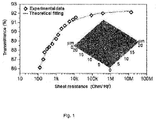
- Transmittance (at 550 nm) vs Rs of AgNW films of different densities. This figure includes a representative atomic force microscopy (AFM) 3D topography image of an AgNW film of intermediate density.
- FIG. 2
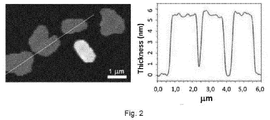
- Left: AFM topography image of individual layers of oligoglycine tectomers deposited on a glass substrate. Right: Height profile showing that individual tectomer layers are approximately 5.7 nm thick.
- FIG. 3.
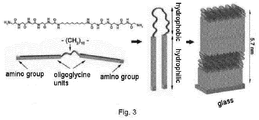
- The chemical structure of the biantennary oligoglycine, and the representation of its assembly in the form of tectomers deposited on a glass substrate.
- FIG. 4
- (a) Sheet resistance (Rs) as a function of time of an AgNW medium-density electrode on which a solution of 0.5 mg/mL biantennary oligoglycine has been deposited, left to dry at room temperature. A diagram of the system used to measure the current vs voltage curves is included. (b) Change of Rs (in %) as a function of the oligoglycine concentration in the original aqueous solution.
- FIG. 5
- 3D representation of AFM topography images of low density AgNW film deposited on glass substrates, showing (a) tectomer aggregates and (b) an individual tectomer layer deposited on a low density AgNW conducting film. AFM topography images and contact angle measurements of water on intermediate density AgNW films covered with tectomer layers from solutions of oligoglycine at a concentration (c, f) 0.01 mg/ml, (d, g) 0.5 mg/ml and (e, h) 1 mg/ml.
- FIG. 6
- pH-dependent assembly and destruction tectomer layers in solution and on electrodes of AgNWs. Photograph of oligoglycine solutions at different pH values (b). Micrographs of transmission electron microscopy (TEM) of 1 mg/ml oligoglycine solution samples with at pH 2.2 (a) and pH 7.4 (c). AFM images that show how the topography of AgNW/tectomer hybrids deposited on glass substrates change when exposed to solutions of different pH values (d).
- FIG. 7.
- Kinetics of bacteria growth (a) E. Coli and (b) salmonella on a glass substrate using as culture medium brain heart infusion (BHI broth), (▲) without and (•) in the presence of AgNW/tectomer.
- FIG. 8
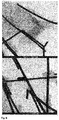
- Transmission electronic microscopy images (TEM) of AuNW/tectomer hybrids.
- Below the invention will be illustrated by means of tests performed by the inventors, which highlights the effectiveness of the product of the invention.
- For the fabrication of the material, AgNWs have been used, which have high transparency and electrical conductivity, and which have also proven to be exceptional materials for multiple applications ranging from capacitive touch sensors to multifunctional wearable sensors (see, for example, Advanced Functional Materials 2014, 24, 7580-7587;
Nanoscale 2014, 6, 2345-2352ACS Nano 2014, 8, 5154-5163 - Aqueous solutions of biantennary, triantennary and tetrantennary oligoglycine were used for the tectomer coatings. The deposition of the oligoglycine tectomers on the films of NWs was conducted by drop casting procedures, by immersion in oligoglycine tectomer solutions (dip coating), by dragging the dispersions on the substrates with a blade (doctor blade) or by centrifugation (spin coating).
- Drop casting: The tectomer solutions were drop casted on AgNW film and left to dry at room temperature for 3 hours, or until the water had evaporated completely.
- Dip coating: Solutions were deposited by dip coating of the substrate for 10 seconds, after which the substrate is removed from the solution at a speed of 1 mm/min. Once the process has been completed, the substrate with its coating is left dry in an upright position for 15 minutes.
- Doctor blade: Is a suitable procedure for obtaining large tectomer coatings. 2 mL of tectomer solution were deposited at the end of a substrate and were then spread evenly over the substrate. In these experiments the blade height used was 50 micrometers; it can be adjusted in each case.
- Spin-coating: the tectomer solutions were deposited on the spray coated AgNW films and spun at 2000 rpm for 10 seconds.
- The density of AgNWs deposited by spray coating, and the concentration, volume and type of oligoglycine of the tectomer solutions define the composition of the coatings.
- The fabrication of the material comprising AuNWs takes place by a procedure analogous to the above with the corresponding starting materials, i.e. with AuNWs instead of AgNWs.
- Thus, transmittance (T) vs Rs curves were obtained. The choice of the deposition system was justified by the fact that spray coating is industrially scalable and can produce films with high transparency on large substrates. Three types of AgNW electrodes, Rs = 50 Ohm / sq, 1 kOhm / sq, and 1 MOhm / sq, were prepared depending on the density (high, intermediate and low, respectively) of AgNWs in the AgNW films.
- As shown in
Fig. 1 , the transmittance is greater than 92% for low densities of AgNWs and gradually decreases as AgNWs are added.
The AFM 3D topography image of the intermediate density AgNW film included inFig. 1 provides values of Rs∼10 kOhm / sqr as well as transparency values of 91%, with 2-3 layers of AgNWs evenly distributed on the substrate. - AFM has been used to study the morphology of the oligoglycine tectomer layers deposited on a glass substrate (
Fig. 2 ). AFM characterisation shows that the oligoglycine molecules are assembled forming two-dimensional systems or platelets whose sizes are in the micrometer range (Fig. 2 left), each individual platelet being approximately 5.7 nm thick (Fig. 2 right). Each tectomer platelet consists of a coplanar stacking of biantennary oligoglycine molecules, facing each other such that its hydrophobic component is always exposed on the surface, as shown in the diagram ofFig. 3 . Tectomer layers are atomically-smooth, highly uniform, and present no structural defects. - Oligoglycine solutions have been deposited on AgNWs, obtaining for each sample current vs voltage (I-V) curves as a function of time. I-V curves of the AgNW films and AgNWs/oligoglycine hybrid systems showed an excellent ohmic behaviour, regardless of the density of AgNWs and of concentration of oligoglycine used.
- The diagram of the system used to make these measurements is shown in
Fig. 4a . In films with an intermediate content in AgNWs there is a sharp decrease (between 50-70%) of the initial value of Rs when oligoglycine solutions of 0.5 and 1.0 mg/mL were deposited (Fig. 4.b ). This decrease in the value of Rs is due to the action of the tectomer layers deposited. The concentration in oligoglycine increases during the water evaporation process of the solutions deposited, and the tectomer layers and aggregates mechanically press the AgNWs, increasing the contact between individual AgNWs. This increase in conductivity is achieved while maintaining at all times transparency of baseline electrodes (transparency values above 90% with transparency changes as low as 1% with respect of the starting AgNW electrodes have been measured in the AgNW/oligoglycine materials of this study). In this regard, tectomer layers would have a behaviour similar to that described for graphene, which similarly mechanically press the AgNWs on which they are deposited (see, for example, Advanced Functional Materials 2014, 24, 7580-7587; ACS Applied Materials & Interfaces 2013, 5, 11756-11761; Sci. Rep. 2013, 3, 1112). - The effective interaction between the oligoglycine and the AgNWs in these systems and that produces the synergistic effects described herein also entails significant changes observed by X-ray photoelectron spectroscopy (XPS) in the peaks corresponding to Ag3d, N1s and O1s as a result of the deposition of the tectomer solutions on electrodes of AgNWs. This interaction between the tectomers and the NWs can be modulated if the NWs are functionalised. For example, the electrostatic interactions between functional groups of functionalised NWs and protonated terminal amino groups of the tectomers change the degree of interaction between the two components and the structure of the hybrid material.
- Due to the unique way in which the biantennary oligoglycine self-assembles in the form of tectomers in these experiments, its hydrophobic part is always exposed to the air. As a result, the water contact angle studies have been conducted to determine the hydrophobicity of tectomer-coated AgNW electrodes. These studies show a significant hydrophobicity increase (-90°) of the AgNW electrodes coated with tectomers from solutions of 0.5 and 1.0 mg/mL of biantennary oligoglycine (
Fig. 5 ). This result indicates that the tectomer coatings act as an effective barrier to moisture, giving the system self-cleaning and anti-fouling functions. When the water drop is deposited on the AgNW electrode without tectomer coating, conversely, the water contact angle decreases from 33° to 11°, which indicates that the water penetrates into the unprotected conducting AgNW film. - On the other hand, when the pH of an oligoglycine solution changes to acidic or basic regions, the oligoglycine assembly may take place or otherwise be destroyed (
Fig. 6 a-c ), since the change in pH can make the terminal amino groups of the oligoglycine neutral or charged (Beilstein Journal of ). The self-assembling or destruction of the tectomer layers is completely reversible and can be carried out repeatedly. These pH-dependent structural changes of oligoglycine can be observed also in hybrid electrodes of AgNWs/oligoglycine (Fig. 6.d ) and can therefore be considered as pH sensors. - Oligoglycine coatings provide new biofuncionalidades to AgNW electrodes. As oligoglycines have the ability to physically or chemically immobilise viruses and bacteria (Russ J Bioorg Chem 2010, 36, 574-580), their hybridisation with AgNWs gives rise to new functionalities that make them useful as biomedical materials. In this regard, hybrids of AgNWs and two-dimensional peptide systems give rise to the formation of sophisticated nanostructures with smart response to the environment. In addition, the interaction of viruses and other analytes in these hybrid systems can be controlled through the functionalisation of terminal amino groups of oligoglycines, which makes them useful as biosensors or for the immobilisation of bacteria and viruses. The adhesion of viruses, bacteria, or other analytes to these films and electrodes of tectomer and AgNW hybrids can be removed by varying the pH of the environment, such that at low pH values the oligoglycine assemblies are destroyed, thus removing the materials attached to them.
- The performance of the transparent AgNW electrodes largely depends on the degradation and deterioration of the AgNWs themselves (Small 2014, 10, 4171-4181). Under environmental conditions, AgNWs undergo oxidation and sulfurization processes, so that it is highly important to protect the AgNW electrodes against harsh environmental conditions, such as for example humidity, exposure to oxygen and ozone as well as other gaseous molecules containing sulphur. Accordingly, different coatings that protect the nanowires against deterioration in these conditions have been developed, either by coating the individual nanowires or systems consisting of a set of nanowires (ACS Appl. Mater. ;
Nanoscale 2014, 6, 4812-4818 - Studies on the kinetics of E. coli and salmonella growth using as culture medium a brain-heart infusion (BHI broth), in AgNW/tectomer materials deposited on glass, show that bacterial growth is significantly inhibited in these compared with the substrate used without coating (
Fig. 7 ). These results show that coatings with tectomers protect not only the AgNWs against deterioration produced by the environment (example 7), but it also preserves the antimicrobial activity of the AgNWs (Mater. ). The adhesive action of tectomers on bacteria (Colloids Surf. A 2014, 460, 130-136) and viruses (ChemBioChem 2003, 4, 147- 154 - AuNW/tectomer hybrids have been prepared. The AuNWs used had an average diameter of 30 nm and lengths of 4.5 µm. TEM characterisation of the aqueous dispersions resulting from mixing 0.5 mg·mL-1 of biantennary oligoglycine and 0.05 mg·mL-1 of AuNWs is shown in
Fig. 8 , in which there is an extensive coating of AuNWs by the oligoglycine tectomers. - The functionalisation of AuNWs as a result of surface modification with tectomers is promising for applications in electronics, sensors, energy (solar cells) and biomedicine. Thus, AuNW/tectomer hybrids can combine the features of biomedical interest of both the AuNWs and the tectomers, which can be loaded with drugs and fluorescent substances (ACS Appl. Mater. ).
- In addition, the procedures described herein can be extended to functionalised nanowires, such as for example carboxylated nanowires.
Claims (14)
- Material comprising oligoglycine tectomers and nanowires (NWs).
- The material according to claim 1, wherein the NWs are silver nanowires (AgNWs).
- The material according to claim 1, wherein the NWs are gold nanowires (AuNWs).
- Material according to any of claims 1 to 3, wherein the oligoglycine tectomers are deposited on the NWs.
- Method for obtaining the material according to any of claims 1 to 4, comprising:i) the deposition, preferably by spray coating, of NWs on a substrate, preferably wherein the substrate is selected from glass, polyethylene terephthalate (PET) or polymethylmethacrylate (PMMA); andii) the deposition of solutions of oligoglycine tectomers on the films of NWs resulting from step (i).
- The procedure according to claim 5, wherein step (ii) is carried out by drop casting, dip coating, doctor blade or by spin coating.
- Use of the material according to any of claims 1 to 4, as an electrode or as a transparent conducting component.
- Use according to claim 7, as an electrode for transparent electronic and optoelectronic devices, touch screens, solar cells, sensors and biosensors.
- Use according to claim 7, wherein the hybrid material has antimicrobial, antiviral, moisture barrier and protection properties, against high temperatures and self-cleaning agent anti-fouling properties.
- Use according to claim 9, wherein the hybrid material has properties for the protection against temperatures of up to 85°C.
- Use of the material according to any of claims 1 to 4, as a conducting hybrid material characterised by having transparency values above 90%.
- Use of the material according to any of claims 1 to 4, as pH sensor.
- Use of the material according to any of claims 1 to 4, for loading drugs and fluorescent substances.
- Device comprising the material according to any of claims 1 to 4.
Applications Claiming Priority (2)
| Application Number | Priority Date | Filing Date | Title |
|---|---|---|---|
| ES201531843A ES2625024B1 (en) | 2015-12-18 | 2015-12-18 | Material comprising oligoglycine and nanowire tectomers |
| PCT/ES2016/070904 WO2017103317A1 (en) | 2015-12-18 | 2016-12-16 | Material comprising oligoglycine tectomers and nanowires |
Publications (2)
| Publication Number | Publication Date |
|---|---|
| EP3392264A1 true EP3392264A1 (en) | 2018-10-24 |
| EP3392264A4 EP3392264A4 (en) | 2019-08-21 |
Family
ID=59055923
Family Applications (1)
| Application Number | Title | Priority Date | Filing Date |
|---|---|---|---|
| EP16874961.2A Withdrawn EP3392264A4 (en) | 2015-12-18 | 2016-12-16 | MATERIAL COMPRISING OLIGOGLYCIN TECTOMERS AND NANOWILS |
Country Status (6)
| Country | Link |
|---|---|
| US (1) | US20190006057A1 (en) |
| EP (1) | EP3392264A4 (en) |
| JP (1) | JP2019508591A (en) |
| CN (1) | CN108602856A (en) |
| ES (1) | ES2625024B1 (en) |
| WO (1) | WO2017103317A1 (en) |
Family Cites Families (11)
| Publication number | Priority date | Publication date | Assignee | Title |
|---|---|---|---|---|
| JP2796613B2 (en) * | 1996-08-29 | 1998-09-10 | 工業技術院長 | Method for producing tubular fiber structure encapsulating vesicles |
| JP4524745B2 (en) * | 2004-04-28 | 2010-08-18 | 三菱マテリアル株式会社 | Metal nanowire-containing conductive material and use thereof |
| SG150516A1 (en) * | 2005-08-12 | 2009-03-30 | Cambrios Technologies Corp | Nanowires-based transparent conductors |
| US9274108B2 (en) * | 2006-02-06 | 2016-03-01 | Massachusetts Institute Of Technology | Self-assembly of macromolecules on multilayered polymer surfaces |
| EP2086521A2 (en) * | 2006-11-07 | 2009-08-12 | Government of the United States of America, Represented by the Secretary, Department of Health and Human Services | Self-assembling nanoparticles composed of transmembrane peptides and their application for specific intra-tumor delivery of anti-cancer drugs |
| US7922787B2 (en) * | 2008-02-02 | 2011-04-12 | Seashell Technology, Llc | Methods for the production of silver nanowires |
| KR101849816B1 (en) * | 2011-02-23 | 2018-04-17 | 데쿠세리아루즈 가부시키가이샤 | Transparent electroconductive film, information input device, and electronic instrument |
| JP5807927B2 (en) * | 2011-05-09 | 2015-11-10 | 国立研究開発法人産業技術総合研究所 | Internal surface hydrophobized organic nanotube, and drug encapsulated product using the nanotube |
| WO2012158622A2 (en) * | 2011-05-13 | 2012-11-22 | The Regents Of The University Of California | Reversibly crosslinked micelle systems |
| CN104508758B (en) * | 2012-03-01 | 2018-08-07 | 雷蒙特亚特特拉维夫大学有限公司 | Conducting nanowires film |
| US9920207B2 (en) * | 2012-06-22 | 2018-03-20 | C3Nano Inc. | Metal nanostructured networks and transparent conductive material |
-
2015
- 2015-12-18 ES ES201531843A patent/ES2625024B1/en active Active
-
2016
- 2016-12-16 CN CN201680081697.7A patent/CN108602856A/en active Pending
- 2016-12-16 EP EP16874961.2A patent/EP3392264A4/en not_active Withdrawn
- 2016-12-16 US US16/063,553 patent/US20190006057A1/en not_active Abandoned
- 2016-12-16 JP JP2018551525A patent/JP2019508591A/en active Pending
- 2016-12-16 WO PCT/ES2016/070904 patent/WO2017103317A1/en not_active Ceased
Also Published As
| Publication number | Publication date |
|---|---|
| ES2625024B1 (en) | 2018-05-10 |
| EP3392264A4 (en) | 2019-08-21 |
| US20190006057A1 (en) | 2019-01-03 |
| ES2625024A1 (en) | 2017-07-18 |
| WO2017103317A1 (en) | 2017-06-22 |
| CN108602856A (en) | 2018-09-28 |
| JP2019508591A (en) | 2019-03-28 |
Similar Documents
| Publication | Publication Date | Title |
|---|---|---|
| Hwang et al. | Poly (vinyl alcohol) reinforced and toughened with poly (dopamine)-treated graphene oxide, and its use for humidity sensing | |
| Saetia et al. | Spray‐layer‐by‐layer carbon nanotube/electrospun fiber electrodes for flexible chemiresistive sensor applications | |
| Tung et al. | Graphene quantum resistive sensing skin for the detection of alteration biomarkers | |
| CN102906165B (en) | Produce the method for conducting polymer and cellulose nano-complex | |
| Xie et al. | Nanomechanical insights into versatile polydopamine wet adhesive interacting with liquid-infused and solid slippery surfaces | |
| KR101651108B1 (en) | Fabrication method for electrode using sensor and the sensor thereby | |
| Mahmoodian et al. | Effect of anionic dopants on thickness, morphology and electrical properties of polypyrrole ultra-thin films prepared by in situ chemical polymerization | |
| de Oliveira Farias et al. | A thin PANI and carrageenan–gold nanoparticle film on a flexible gold electrode as a conductive and low-cost platform for sensing in a physiological environment | |
| Sridhar et al. | Effect of surface coverage and chemistry on self-assembly of monolayer protected gold nanoparticles: a molecular dynamics simulation study | |
| Chang et al. | Air-stable gelatin composite memory devices on a paper substrate | |
| US11387012B2 (en) | Standing nanowire-based elastic conductor | |
| Oytun et al. | Fabrication of solution-processable, highly transparent and conductive electrodes via layer-by-layer assembly of functional silver nanowires | |
| KR100963204B1 (en) | Flexible transparent electrode manufacturing method | |
| Perumal et al. | Interaction of zwitterionic and ionic monomers with graphene surfaces | |
| Kausar | Transition metal dichalcogenide—hitherto advances in polymeric nanocomposites and future opportunities | |
| Kang et al. | Highly conductive paper/textile electrodes using ligand exchange reaction-induced in situ metallic fusion | |
| Thirugnanasambandan | Polymers-metal nanocomposites | |
| Garriga et al. | Two-dimensional oligoglycine tectomer adhesives for graphene oxide fiber functionalization | |
| Lin et al. | Site-selective deposition of gold on photo-patterned self-assembled monolayers | |
| US20190006057A1 (en) | Material comprising oligoglycine tectomers and nanowires | |
| Jurewicz et al. | Functionalization of silver nanowire transparent electrodes with self-assembled 2-dimensional tectomer nanosheets | |
| KR101948038B1 (en) | Strain sensor device using gold nanostructure and preparing method of the same | |
| KR101953321B1 (en) | A hydrogen peroxide electrochemical sensor and preparation method of the same | |
| Kim et al. | Nano-Ag complexes prepared by γ-radiolysis and their structures and physical properties | |
| WO2006101659A2 (en) | Method of making nanoparticle wires |
Legal Events
| Date | Code | Title | Description |
|---|---|---|---|
| STAA | Information on the status of an ep patent application or granted ep patent |
Free format text: STATUS: THE INTERNATIONAL PUBLICATION HAS BEEN MADE |
|
| PUAI | Public reference made under article 153(3) epc to a published international application that has entered the european phase |
Free format text: ORIGINAL CODE: 0009012 |
|
| STAA | Information on the status of an ep patent application or granted ep patent |
Free format text: STATUS: REQUEST FOR EXAMINATION WAS MADE |
|
| 17P | Request for examination filed |
Effective date: 20180711 |
|
| AK | Designated contracting states |
Kind code of ref document: A1 Designated state(s): AL AT BE BG CH CY CZ DE DK EE ES FI FR GB GR HR HU IE IS IT LI LT LU LV MC MK MT NL NO PL PT RO RS SE SI SK SM TR |
|
| AX | Request for extension of the european patent |
Extension state: BA ME |
|
| DAV | Request for validation of the european patent (deleted) | ||
| DAX | Request for extension of the european patent (deleted) | ||
| A4 | Supplementary search report drawn up and despatched |
Effective date: 20190719 |
|
| RIC1 | Information provided on ipc code assigned before grant |
Ipc: C01G 5/00 20060101ALI20190715BHEP Ipc: C01G 7/00 20060101ALI20190715BHEP Ipc: B82Y 5/00 20110101ALI20190715BHEP Ipc: B82Y 30/00 20110101ALI20190715BHEP Ipc: B82Y 15/00 20110101ALI20190715BHEP Ipc: H01B 5/06 20060101ALI20190715BHEP Ipc: B82B 3/00 20060101ALI20190715BHEP Ipc: H01B 1/22 20060101ALI20190715BHEP Ipc: B82B 1/00 20060101ALI20190715BHEP Ipc: B82Y 20/00 20110101ALI20190715BHEP Ipc: C07K 7/06 20060101AFI20190715BHEP |
|
| GRAP | Despatch of communication of intention to grant a patent |
Free format text: ORIGINAL CODE: EPIDOSNIGR1 |
|
| STAA | Information on the status of an ep patent application or granted ep patent |
Free format text: STATUS: GRANT OF PATENT IS INTENDED |
|
| INTG | Intention to grant announced |
Effective date: 20200525 |
|
| STAA | Information on the status of an ep patent application or granted ep patent |
Free format text: STATUS: THE APPLICATION IS DEEMED TO BE WITHDRAWN |
|
| 18D | Application deemed to be withdrawn |
Effective date: 20201006 |