EP3387143B1 - Extraktionsscheibe - Google Patents
Extraktionsscheibe Download PDFInfo
- Publication number
- EP3387143B1 EP3387143B1 EP16808742.7A EP16808742A EP3387143B1 EP 3387143 B1 EP3387143 B1 EP 3387143B1 EP 16808742 A EP16808742 A EP 16808742A EP 3387143 B1 EP3387143 B1 EP 3387143B1
- Authority
- EP
- European Patent Office
- Prior art keywords
- disc
- lactamase
- inhibitor
- egta
- microorganism
- Prior art date
- Legal status (The legal status is an assumption and is not a legal conclusion. Google has not performed a legal analysis and makes no representation as to the accuracy of the status listed.)
- Active
Links
Images



Classifications
-
- C—CHEMISTRY; METALLURGY
- C12—BIOCHEMISTRY; BEER; SPIRITS; WINE; VINEGAR; MICROBIOLOGY; ENZYMOLOGY; MUTATION OR GENETIC ENGINEERING
- C12Q—MEASURING OR TESTING PROCESSES INVOLVING ENZYMES, NUCLEIC ACIDS OR MICROORGANISMS; COMPOSITIONS OR TEST PAPERS THEREFOR; PROCESSES OF PREPARING SUCH COMPOSITIONS; CONDITION-RESPONSIVE CONTROL IN MICROBIOLOGICAL OR ENZYMOLOGICAL PROCESSES
- C12Q1/00—Measuring or testing processes involving enzymes, nucleic acids or microorganisms; Compositions therefor; Processes of preparing such compositions
- C12Q1/02—Measuring or testing processes involving enzymes, nucleic acids or microorganisms; Compositions therefor; Processes of preparing such compositions involving viable microorganisms
- C12Q1/04—Determining presence or kind of microorganism; Use of selective media for testing antibiotics or bacteriocides; Compositions containing a chemical indicator therefor
-
- C—CHEMISTRY; METALLURGY
- C12—BIOCHEMISTRY; BEER; SPIRITS; WINE; VINEGAR; MICROBIOLOGY; ENZYMOLOGY; MUTATION OR GENETIC ENGINEERING
- C12Q—MEASURING OR TESTING PROCESSES INVOLVING ENZYMES, NUCLEIC ACIDS OR MICROORGANISMS; COMPOSITIONS OR TEST PAPERS THEREFOR; PROCESSES OF PREPARING SUCH COMPOSITIONS; CONDITION-RESPONSIVE CONTROL IN MICROBIOLOGICAL OR ENZYMOLOGICAL PROCESSES
- C12Q1/00—Measuring or testing processes involving enzymes, nucleic acids or microorganisms; Compositions therefor; Processes of preparing such compositions
- C12Q1/02—Measuring or testing processes involving enzymes, nucleic acids or microorganisms; Compositions therefor; Processes of preparing such compositions involving viable microorganisms
- C12Q1/18—Testing for antimicrobial activity of a material
-
- C—CHEMISTRY; METALLURGY
- C12—BIOCHEMISTRY; BEER; SPIRITS; WINE; VINEGAR; MICROBIOLOGY; ENZYMOLOGY; MUTATION OR GENETIC ENGINEERING
- C12Q—MEASURING OR TESTING PROCESSES INVOLVING ENZYMES, NUCLEIC ACIDS OR MICROORGANISMS; COMPOSITIONS OR TEST PAPERS THEREFOR; PROCESSES OF PREPARING SUCH COMPOSITIONS; CONDITION-RESPONSIVE CONTROL IN MICROBIOLOGICAL OR ENZYMOLOGICAL PROCESSES
- C12Q1/00—Measuring or testing processes involving enzymes, nucleic acids or microorganisms; Compositions therefor; Processes of preparing such compositions
- C12Q1/34—Measuring or testing processes involving enzymes, nucleic acids or microorganisms; Compositions therefor; Processes of preparing such compositions involving hydrolase
Definitions
- the present invention relates to a method for detecting the presence of a carbapenem or penem hydrolysing ⁇ -lactamase-producing bacteria in a sample, and enzyme assay and kits for use in such methods.
- Disc diffusion methods used for antibiotic susceptibility testing including the Modified Hodge-Test, are widely used to determine what antibiotics are likely to be effective against a disease causing bacteria since it is common knowledge that certain bacterial enzymes can inactivate particular antibiotics thereby rendering treatment with them ineffective. Variations of disc based diffusion methods, such as the MHT, can be used to demonstrate production of antibiotic inactivated enzymes.
- the infectious microorganism is uniformly spread over the surface of a culture medium, such as an agar plate, then several filter paper discs impregnated with specific amounts of selected antibiotics are placed on the agar surface. During incubation, the microorganism grows on the surface of the agar except in the areas where certain antibiotics have inhibited its growth. Inhibition of growth is detected as clear zones of no growth (inhibition zones) on the agar around the specific antibiotic disc.
- Carbapenemases are a group of ⁇ -lactamases that are active against various antibiotics including carbapenems.
- Carbapenemases belong to three classes of beta-lactamases, namely Ambler class A, Ambler class B and Ambler class D. These three classes of carbapenemases confer resistance in clinically important bacteria to carbapenems or decreased susceptibility to carbapenems. Bacteria that produce carbapenemases are therefore of interest clinically and methods for their early detection are required in order to prevent their spread and to reduce multidrug and pandrug resistance.
- Black J. et al (Journal of Clinical Microbiology, July 2005, p. 3110-3123 ) reported an AmpC disc test, based on filter paper discs impregnated with EDTA to detect plasmid-mediated AmpC B-lactamase in Enterobacteriaceae lacking a chromosomally mediated AmpC B-lactamase using cefoxitin insusceptibility as a screen.
- Pasteran F. et al discloses a Modified Hodge Test for the detection of Klebsiella pneumoniae carbapenemase (KPC) and metallo-Beta-Lactamase (MBL) expression in P. Aeruginosa using a Klebsiella pneumoniae indicator.
- KPC Klebsiella pneumoniae carbapenemase
- MBL metallo-Beta-Lactamase
- ICT indirect carbapenemase test
- CPE carbapenemase producing Enterobacteriaceae
- MBL carbapenemase producing Enterobacteriaceae
- KPC carbapenemase enzymes
- the inventors have developed a method that is effective at identifying bacteria which produce ⁇ -lactamses, particularly KPCs, MBLs and OXA-48s.
- the new test is particularly effective at identifying MBL production in Enterobacteriaceae, Pseudomonas spp or Acinetobacter spp.
- the present invention provides a method for determining whether a microorganism produces a carbapenem or penem hydrolysing ⁇ -lactamase, comprising:
- the reagent composition is provided on an enzyme assay disc comprising a solid support on which the reagent composition is impregnated or absorbed.
- each of the components of the reagent composition may be impregnated or absorbed on a single assay disc.
- a ⁇ -lactam containing antibiotic may be impregnated or absorbed on an assay disc, with an Extended-Spectrum ⁇ -lactamase inhibitor or an AmpC inhibitor and EGTA impregnated or absorbed on one or more additional assay discs.
- a negative control disc may also be provided.
- the negative control disc may be impregnated with an Extended-Spectrum ⁇ -lactamase inhibitor or an AmpC inhibitor and EGTA.
- the negative control disc may additionally be impregnated with a negative control organism. Suitable organisms may be carbapenemase sensitive, such as Escherichia coli ATCC25922.
- the negative control disc may also comprise a ⁇ -lactam containing antibiotic.
- the present invention provides an enzyme assay system for use in a method of determining whether a microorganism produces a carbapenem or penem-hydrolysing ⁇ -lactamase, the system comprising: a ⁇ -lactam containing antibiotic; an extended-spectrum ⁇ -lactamase inhibitor and/or an AmpC inhibitor to which the carbapenem or penem hydrolysing ⁇ -lactamase is resistant; and a membrane permeabilizing agent which is ethylene glycol tetraacetic acid (EGTA) that permeabilizes the microorganism's outer membrane; wherein the system has one or more assay discs and the a ⁇ -lactam containing antibiotic, extended-spectrum ⁇ -lactamase inhibitor and/or an AmpC inhibitor, and ethylene glycol tetraacetic acid (EGTA) are impregnated in the one or more discs.
- EGTA ethylene glycol tetraacetic acid
- the present invention provides a kit for determining whether a microorganism produces a carbapene- hydrolysing ⁇ -lactamase, comprising an enzyme assay system according to the second aspect of the present invention.
- the method of the invention may be used to determine whether a microorganism produces a carbapenem or penem-hydrolysing ⁇ -lactamase.
- the ⁇ -lactamases that may be detected are selected from metallo- ⁇ -lactamases (MBL), Klebsiella pneumoniae carbapenemase (KPC) and Oxacillinases e.g. OXA-48 carbapenemase.
- the ⁇ -lactamase is produced by a Pseudomonas spp., Enterobacteriaceae such as E. coli, Klebsiella spp. Citrobacter freundii and/or Enterobacter spp.
- Carbapenemases are clinically important because they destroy, and so may confer resistance to, carbapenems, and usually most other ⁇ -lactams, including penem antibiotics.
- the method of the present invention is particularly advantageous in the detection of MBL.
- the MBL is produced by Pseudomonas spp.
- MBL requires a divalent cation, such as zinc, to function.
- the prior art methods employ EDTA either on its own or paired with one antibiotic to eliminate false positive results.
- EDTA as well as acting as a permeabilization agent, acts to chelate zinc ions thereby potentially leading to false negative results.
- the method of the present invention uses ethylene glycol tetraacetic acid (EGTA) which preferentially sequesters calcium ions as opposed to zinc ions which reduces the chances of obtaining a false negative result, This allows positive results to be observed in the method of the present invention for the presence of MBL enzymes.
- EGTA ethylene glycol tetraacetic acid
- the reagent composition used in the present invention a ⁇ -lactam containing antibiotic, an extended-spectrum ⁇ -lactamase inhibitor and/or an AmpC inhibitor to which the carbapenem hydrolysing ⁇ -lactamase is resistant, and a membrane permeabilizing agent which is ethylene glycol tetraacetic acid (EGTA) that permeabilizes the microorganism's outer membrane.
- EGTA ethylene glycol tetraacetic acid
- the addition of zinc to the reagent composition used in the method of the present invention prevents false negatives.
- the addition of zinc is not possible in the prior art methods where EDTA is used.
- the reagent composition may contain a divalent cation which is preferably zinc ions.
- the ⁇ -lactam containing antibiotic used in the reagent composition may be selected from carbapenem or penem, preferably selected from meropenem, imipenem, ertapenem, doripenem, faropenem, sulopenem, ritapenem.
- an extended spectrum ⁇ -lactamase inhibitor and/or an AmpC inhibitor to which the carbapenem ⁇ -lactamase which is produced by the test microorganism is resistant may be present in the reagent composition.
- the inhibitors are selected from cloxacillin and tazobactam particularly when the organism is suspected of producing an enzyme which confers carbapenem resistance,
- Other inhibitors include flucloxacillin, oxacillin, nafcillin, dicloxacillin, clavulanic acid and sulbactam.
- the reagent composition used in the invention comprises a ⁇ -lactam containing antibiotic.
- the ⁇ -lactam containing antibiotic is selected from faropenem, meropenem, ertapenem and doripenem or mixtures thereof.
- the antibiotic is faropenem.
- the test microorganism is cultured with the reagent composition in a culture medium.
- the culture medium is any culture medium suitable for culturing a given microorganism which would be known to the skilled person.
- the culture may be a liquid or a solid culture medium.
- the culture medium is a solid culture medium such as Mueller Hinton agar.
- the reagent composition is provided in at least two separate discs wherein each disc comprises a carrier and the first disc has the ⁇ -lactam containing antibiotic impregnated in its carrier and the second disc has an extended-spectrum ⁇ -lactamase inhibitor and/or AmpC inhibitor and EGTA impregnated in its carrier.
- each disc is a standard antibiotic susceptibility testing disc having comprising white paper with 290gsm ⁇ 30gsm weight or 140gsm ⁇ 30gsm weight and has a 6mm diameter or 8mm diameter.
- the disc may have any suitable diameter.
- the disc may have an 8mm diameter.
- a reporter microorganism is provided in the culture medium to assess whether the test microorganism produces a carbapenem-hydrolysing ⁇ -lactamase.
- a positive test for a carbapenem-hydrolysing ⁇ -lactamase producing microorganism is determined by an increase in the growth of the reporter microorganism.
- the growth of the reporter microorganism may be observed by the naked eye as a lawn of growth of the organism on a solid growth medium.
- the test microorganism is E.coli ATCC25922.
- the reporter organism is Klebsiella pneumoniae ATCC700603. Klebsiella pneumoniae is particularly effective for the detection of KPC and MBL expression in P. Aeurginosa.
- the reagent composition is provided in at least two separate discs wherein each disc comprises a carrier and the first disc has the ⁇ -lactam containing antibiotic impregnated in its carrier and the second disc has the extended-spectrum ⁇ -lactamase inhibitor and/or AmpC inhibitor and EGTA impregnated in its carrier.
- the test microorganism is applied to the disc containing the EGTA and the two discs are provided on the solid growth medium. After a sufficient incubation time a positive result is observed where the EGTA porinates the test bacterium to release the carbapenem-hydrolysing ⁇ -lactamase enzyme which dissipates in to the surrounding culture medium and provides localized protection to a susceptible reporter microorganism.
- a positive result is observed by the characteristic distortion of zone of inhibition around the discs containing the test microorganism.
- the disc having the ⁇ -lactam containing antibiotic impregnated in its carrier is obtainable from Mast Group Limited as is designated a D71C disc.
- the ⁇ -lactam antibiotic is faropenem because this antibiotic provides a zone of diameter of 18-20 mm when E.co / i ATCC25922 is used as the reporter microorganism. This result means that when the method of the invention is conducted on a dual disc test system no spacing is needed between the antibiotic disc and the enzyme extraction disc. This is preferable as the antibiotic disc and the enzyme extraction disc may be abutted together.
- a gap may be required between each disc.
- the gap between the discs may be about 9mm or less.
- the gap may be about 3mm.
- the test microorganism is cultured with the reagent composition in a culture medium for from 16 to 24 hours at from 35 to 37°C.
- the ⁇ -lactamase inhibitor is Cloxacillin present in an amount of from 67 to 150 ⁇ g/ disc or Tazobactam from 6 to 15 ⁇ g/disc or mixtures thereof.
- the ⁇ -lactam containing antibiotic is present in an amount of from 1-25 ⁇ g/disc.
- the EGTA is present in an amount of from 150 to 500 ⁇ g/disc.
- zinc ions are present in the second disc at 75-150 ⁇ g/disc.
- the method of the present invention is able to produce accurate results within 18 to 20 hours after start of incubation of the test microorganism with the reagent composition.
- a negative control disc may further be provided.
- the negative control disc may be a standard antibiotic susceptibility testing disc.
- the negative control disc may comprise an extended-spectrum ⁇ -lactamase inhibitor and/or AmpC inhibitor and EGTA impregnated in its carrier.
- the negative control disc may further comprise a control organism which is carbapenemase sensitive, for example Escherichia coli ATCC25922. Such discs may need to be positioned at the same or at a similar distance from a ⁇ -lactam containing antibiotic contain disc as an extended-spectrum ⁇ -lactamase inhibitor and/or AmpC inhibitor and EGTA impregnated extraction disc in order that the control disc be in the same environment as the extraction disc.
- the negative control disc may further comprise a ⁇ -lactam containing antibiotic.
- Such control discs may not have to be positioned at any set point relative to the assay discs used in the method of the present invention.
- the reagent composition may be provided as an assay system having three discs which are connected such that the discs are arranged so as to have one central disc (antibiotic disc) and two peripheral discs (extraction and control discs) wherein the relative spacing between the discs is fixed.
- the central disc may have each of the features of the first disc as set out above, while the two peripheral discs may have the same features and reagent composition as the second disc and/or negative control disc as set out above.
- the test microorganism is applied to the non-control disc containing the EGTA and the device is provided on the solid growth medium. Preferably the device is placed onto the reporter organism suspension lawn such that the extraction and control tabs make contact with the culture medium.
- the triple disc assay system may be provided additional support structure.
- the additional support structure may fix the three discs at optimal positions relative to each other.
- the additional support structure may also provide easier handling of the system when placing on to a test plate such as a pre-swabbed reporter organism agar plate.
- the device having three connected discs may be obtainable from Mast Group Limited, designated as a D74 disc.
- the ⁇ -lactam antibiotic is cloxacillin. Cloxacillin may be present in an amount from about 67 ⁇ g to about 150 ⁇ g.
- the ⁇ -lactam antibiotic is Tazobactam. Tazobactum may be present in an amount from about 6 ⁇ g to about 25 ⁇ g.
- the ⁇ -lactam containing antibiotic is present in an amount of from 1-25 ⁇ g/disc.
- the EGTA is present in an amount of from 150 to 500 ⁇ g/disc.
- zinc ions are present at 75-150 ⁇ g/disc.
- the device may be made from paper.
- the paper may be white paper with 100 to 320gsm basis weight.
- the paper may have 110gsm ⁇ 30gsm basis weight or 290gsm ⁇ 30gsm basis weight.
- the spacing between the discs may be pre-set an optimised for the antibiotic disc and the enzyme extraction disc used.
- the gap between neighboring discs may be about 9mm or less. Preferably the gap may be about 3mm.
- the gap between neighboring discs may be small enough such that the zone of inhibition around the negative control disc meets that of the central antibiotic disc.
- the reagent composition is provided on a single disc comprising the ⁇ -lactam containing antibiotic, the extended-spectrum ⁇ -lactamase inhibitor and/or AmpC inhibitor and the EGTA.
- the disc is a standard antibiotic susceptibility testing disc having comprising white paper with 290gsm ⁇ 30gsm or 140gsm ⁇ weight and has a 6mm diameter or 8mm diameter.
- the disc may have any suitable diameter.
- the disc may have an 8mm diameter.
- a reporter microorganism is provided in the culture medium to assess whether the test microorganism produces a carbapenem-hydrolysing ⁇ -lactamase.
- a positive test for a carbapenem-hydrolysing ⁇ -lactamase producing microorganism is determined by an increase in the growth of the reporter microorganism.
- the growth of the reporter microorganism may be observed by the naked eye as a lawn of growth of the organism on a solid growth medium.
- the test microorganism is Klebsiella pneumoniae ATCC700603.
- the test microorganism is E.coli ATCC25922.
- the reagent composition is provided in a single disc wherein the disc comprises a carrier comprising the ⁇ -lactam containing antibiotic, the extended-spectrum ⁇ -lactamase inhibitor and/or AmpC inhibitor and EGTA impregnated in the carrier.
- the test microorganism is applied to the disc and the disc is provided on the solid growth medium. After a sufficient incubation time a positive result is observed where the EGTA porinates the test bacterium to release the carbapenem-hydrolysing ⁇ -lactamase enzyme which dissipates in to the surrounding culture medium and provides localized protection to a susceptible reporter microorganism.
- a positive result is observed by the characteristic distortion of zone of inhibition around the disc.
- the ⁇ -lactam antibiotic is faropenem because this antibiotic provides a zone of diameter of 18-20 mm when E.coli ATCC25922 is used as the reporter microorganism.
- the test microorganism is cultured with the reagent composition in a culture medium for from 16 to 24 hours at from 35 to 37°C.
- the ⁇ -lactamase inhibitor is Cloxacillin present in an amount of from 67 to 150 ⁇ g/ disc or Tazobactam from 6 to 15 ⁇ g/disc or mixtures thereof.
- the ⁇ -lactam containing antibiotic is present in an amount of from 1-25 ⁇ g/disc.
- the EGTA is present in an amount of from 150 to 500 ⁇ g/disc.
- zinc ions are present in the second disc at 75-150 ⁇ g/disc.
- the method of the present invention is able to produce accurate results within 16 to 20 hours or 18 to 20 hours after start of incubation of the test microorganism with the reagent composition.
- the method of the present invention may be performed using a dual disc assay system.
- Disc B is impregnated with a ⁇ -lactam containing antibiotic while extraction disc A is impregnated with an extended-spectrum ⁇ -lactamase inhibitor and/or an AmpC inhibitor, and ethylene glycol tetraacetic acid (EGTA).
- EGTA ethylene glycol tetraacetic acid
- a test sample thought to comprise carbapenem or penem hydrolysing ⁇ -lactamase is applied to the back of disc B, and discs And B are mounted on a culture plate which has been swabbed with a reporter organism. The discs are positioned on the plate to abut one another.
- the discs may be positioned to have a small gap there between.
- a suitable gap may be less than about 9 mm and preferably about 3 mm.
- a positive test for a carbapenem or penem hydrolysing ⁇ -lactamase is shown in Figure 2 by a distorted zone of inhibition.
- a negative test for a carbapenem or penem hydrolysing ⁇ -lactamase is shown in Figure 1 by an undistorted zone of inhibition.
- the method of the present invention may be performed using a triple disc assay system.
- the triple disc assay system comprises a central disc X, which is impregnated with a ⁇ -lactam containing antibiotic and two peripheral discs 3 and 4.
- Disc 3 is impregnated with an extended-spectrum ⁇ -lactamase inhibitor and/or an AmpC inhibitor, and ethylene glycol tetraacetic acid (EGTA).
- Disc 4 is a negative control disc and is also impregnated with extended-spectrum ⁇ -lactamase inhibitor and/or an AmpC inhibitor, and ethylene glycol tetraacetic acid (EGTA), and may also be impregnated with a negative control organism.
- a suitable negative control organism may be carbapenemase sensitive, such as Escherichia coli ATCC®25922.
- the triple disc assay system may be mounted on a culture plate which has been swabbed with a reporter organism.
- a test sample thought to comprise carbapenem or penem hydrolysing ⁇ -lactamase is then applied to the back of disc 3, while a negative control sample is applied to the back of disc 4 using sterile swabs.
- the triple disc assay system is then turned-over and mounted on the culture plate.
- the discs may then be pressed against the culture plate to ensure a good contact between the reporter organism and the impregnated discs. After an incubation period, the plate is viewed to determine whether there test sample is positive or negative for a carbapenem or penem hydrolysing ⁇ -lactamase.
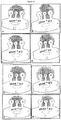
- a positive result is indicated by a dis-similar (distorted) zone of inhibition existing about the extraction tab compared to that of the negative control tab. This is shown by Figures 6B, 6C, 6D and 6H .
- a negative result is shown by figure 6A, 6E and 6F .
- an alternative embodiment of the present invention provides a single assay disc system 5.
- a system disc 5 is impregnated with each of a ⁇ -lactam containing antibiotic, an extended-spectrum ⁇ -lactamase inhibitor and/or an AmpC inhibitor, and ethylene glycol tetraacetic acid (EGTA).
- EGTA ethylene glycol tetraacetic acid
- the method of the present invention is carried out by applying a test sample thought to comprise carbapenem or penem hydrolysing ⁇ -lactamase to the back of disc 5, which is then mounted on a culture plate which has been swabbed with a reporter organism, as depicted in Figure 5 .
- a negative control disc which is also impregnated with a ⁇ -lactam containing antibiotic, an extended-spectrum ⁇ -lactamase inhibitor and/or an AmpC inhibitor, and ethylene glycol tetraacetic acid (EGTA), as well as a negative control organism, such as Escherichia coli ATCC®25922 may also be mounted on the culture plate.
- an anerobic incubation step may be used when testing P. Aeruginosa samples. This may prevent overgrowth of an organism which may otherwise lead to misinterpretation of the resultant data.
- ICT Indirect Carbapenemase Test
- a suspension of a carbapenem-susceptible E. coli strain (ATCC 25922) was prepared in saline (0.85% physiological equivalent) to a McFarland 0.5 turbidity standard and inoculated onto Mueller-Hinton agar plates to achieve a confluent lawn. Between 5 and 10 colonies of the test isolate were applied to the extraction disc by touching a few well-isolated colonies onto the disc using a 10 ⁇ l loop in order to coat the extraction disc. The inoculated disc was placed with the bacterial inoculum (organism) side down on the lawn abutting a 10 ⁇ g faropenem disc (available from MAST under catalogue number D71C- CATID). The plate was then incubated for 18-24 hours at 35°C ⁇ 1 in ambient air.
- the sensitivity of known carbapenem hydrolysing ⁇ -lactamase producing organisms was tested to confirm the efficacy of the test.
- a method for determining whether a microorganism produces a carbapenem or penem hydrolysing ⁇ -lactamase according to an aspect of the present invention was tested using a triple disc carbapenemases inactivation (CAT ID) test.
- CAT ID triple disc carbapenemases inactivation
- a triple disc test system using a D74 designated disc obtained from Mast Group Limited was used to perform in-house testing on a total of 120 carbapenemase positive and negative organisms.
- a positive test for carbapenemase production was indicated by a dis-similar (distorted) zone of inhibition existing about the extraction tab compared to that of the negative control tab.
- Table 1 in house test organism panel used in the triple CAT ID disc test Test organisms Carbapenemase positive organisms Carbapenemase negative organisms Acinetobacter spp 7 15 Enterobacteriaceae 31 41 Pseudomonas spp 5 21
- Table 2 Results from in-house testing of the triple CAT ID disc test. Number of organisms True Positive 42 True Negative 69 False Positive 9 False Negative 0
- a method for determining whether a microorganism produces a carbapenem or penem hydrolysing ⁇ -lactamase according to an aspect of the present invention was tested using a single disc carbapenemases inactivation (CAT ID) test.
- CAT ID single disc carbapenemases inactivation
- a positive test for carbapenemase production was indicated by the presence of a clear reduction of zone of inhibition around the test disc in comparison to the negative control disc.
- a negative test for carbapenemase production was indicated by the presence of minimal or no reduction in the zone of inhibition around the test disc in comparison to the negative control disc.
- the present invention provides an a method for identifying bacteria which produce ⁇ -lactamases, particularly KPCs, MBLs and OXA-48 in Enterobacteriaceae, Pseudomonas spp & Acinetobacter spp. This involves the combination of the reagents used in preparing extraction disc and the Cat ID disc, in the previously stated quantities into a single disc.
- the basis of the test method is the same as the two and three disc embodiments of the present invention.
- the permeabilizating agent (EGTA) exposes the carbapenemase enzymes present in the test organism which metabolizes any carbapenems present and in turn effect the zone of inhibition.
- the size of the overall zone of inhibition is affected. This is due to the carbapenem having to defuse though the permeabilizaed test organism before it can defuse into the surroundings media and effect the growth of the reporter organism forming the zone of inhibition.
Landscapes
- Chemical & Material Sciences (AREA)
- Life Sciences & Earth Sciences (AREA)
- Organic Chemistry (AREA)
- Health & Medical Sciences (AREA)
- Engineering & Computer Science (AREA)
- Zoology (AREA)
- Wood Science & Technology (AREA)
- Proteomics, Peptides & Aminoacids (AREA)
- Analytical Chemistry (AREA)
- General Engineering & Computer Science (AREA)
- Immunology (AREA)
- Microbiology (AREA)
- Molecular Biology (AREA)
- Biophysics (AREA)
- Physics & Mathematics (AREA)
- Genetics & Genomics (AREA)
- Biochemistry (AREA)
- Bioinformatics & Cheminformatics (AREA)
- Biotechnology (AREA)
- General Health & Medical Sciences (AREA)
- Toxicology (AREA)
- Measuring Or Testing Involving Enzymes Or Micro-Organisms (AREA)
Claims (15)
- Verfahren für die Bestimmung, ob ein Mikroorganismus eine Carbapenem- oder Penem-hydrolysierende β-Lactamase erzeugt, das Folgendes umfasst:Bereitstellen einer Reagenzzusammensetzung, die Folgendes umfasst: ein β-Lactam-enthaltendes Antibiotikum, einen Breitspektrum-ß-Lactamase-Inhibitor und/oder einen AmpC-Inhibitor, gegen den die Carbapenem- oder Penem-hydrolysierende β-Lactamase resistent ist, und ein Membran-durchdringendes Mittel, das Ethylenglycoltetraessigsäure (EGTA) ist, die die äußere Membran des Mikroorganismus durchdringt;Inkontaktbringen des Organismus, von dem vermutet wird, dass er eine β-Lactamase erzeugt, mit der Reagenzzusammensetzung; undKultivieren des Mikroorganismus mit der Reagenzzusammensetzung in einem Kulturmedium, das einen Reporter-Mikroorganismus umfasst, wobei ein positiver Test durch einen Anstieg des Wachstums des Reporter-Mikroorganismus bestimmt wird.
- Verfahren nach Anspruch 1, wobei die Carbapenem- oder Penem-hydrolysierende β-Lactamase Folgendes ist:eine Metallo-ß-Lactamase, die bevorzugt von einer Pseudomonas spp., Enterobacteriaceae oder Acinetobacter spp. erzeugt wird; odereine Carbapenemase, die bevorzugt aus Oxacillinasen oder einer K. pneumoniae Carbapenemase (KPC) ausgewählt ist.
- Verfahren nach Anspruch 1 oder Anspruch 2, wobei die Reagenzzusammensetzung in mindestens zwei verschiedenen Scheibchen bereitgestellt wird, wobei jedes Scheibchen einen Träger umfasst und das erste Scheibchen das β-Lactam-enthaltende Antibiotikum in seinem Träger imprägnierend aufweist und das zweite Scheibchen den Breitspektrum-β-Lactamase-Inhibitor und/oder AmpC-Inhibitor und die EGTA in seinem Träger imprägnierend aufweist.
- Verfahren nach Anspruch 1 oder Anspruch 2, wobei die Reagenzzusammensetzung in einem einzigen Scheibchen bereitgestellt wird, das das β-Lactam-enthaltende Antibiotikum, den Breitspektrum-β-Lactamase-Inhibitor und/oder AmpC-Inhibitor und die EGTA umfasst.
- Verfahren nach Anspruch 3 oder 4, wobei das Scheibchen, das den Breitspektrum-ß-Lactamase-Inhibitor und/oder AmpC-Inhibitor und die EGTA umfasst, weiter ein zweiwertiges Kation umfasst, bevorzugt Zinkionen, und optional wobei die Reagenzzusammensetzung weiter ein Scheibchen der negativen Kontrolle umfasst.
- Verfahren nach einem vorstehenden Anspruch, wobei das β-Lactam-enthaltende Antibiotikum ein Carbapenem oder Penem ist, das bevorzugt aus Meropenem, Imipenem, Ertapenem, Doripenem, Faropenem, Sulopenem, Ritapenem ausgewählt ist, und bevorzugt wobei das β-Lactam-enthaltende Antibiotikum Faropenem ist.
- Verfahren nach einem vorstehenden Anspruch, wobei das Kulturmedium ein festes Wachstumsmedium ist, optional wobei das eine oder die mehreren Scheibchen auf dem festen Wachstumsmedium bereitgestellt sind und wobei der Testmikroorganismus auf das Scheibchen aufgetragen wird, das die EGTA aufweist, und weiter optional wobei der Mikroorganismus mit der Reagenzzusammensetzung in einem Kulturmedium für 16 bis 24 Stunden bei 35 bis 37 °C kultiviert wird.
- Verfahren nach einem der Ansprüche 3 bis 7, wobei der β-Lactamase-Inhibitor Cloxacillin, das in einer Menge von 67 bis 150 µg/Scheibchen vorliegt, oder Tazobactam von 6 bis 15 µg/Scheibchen oder Mischungen davon ist.
- Verfahren nach einem der Ansprüche 3 bis 8, wobei das β-Lactam-enthaltende Antibiotikum in einer Menge von 1-25 µg/Scheibchen vorliegt, optional wobei die EGTA in einer Menge von 150 bis 500 µg/Scheibchen vorliegt und weiter optional wobei Zink in dem zweiten Scheibchen zu 75-150 µg/Scheibchen vorliegt.
- Enzym-Assay-System für die Verwendung in einem Verfahren zur Bestimmung, ob ein Mikroorganismus eine Carbapenem- oder Penem-hydrolysierende β-Lactamase erzeugt, wobei das System Folgendes umfasst:ein β-Lactam-enthaltendes Antibiotikum;einen Breitspektrum-β-Lactamase-Inhibitor und/oder einen AmpC-Inhibitor, gegen den die Carbapenem- oder Penem-hydrolysierende β-Lactamase resistent ist; undein Membran-durchdringendes Mittel, das Ethylenglycoltetraessigsäure (EGTA) ist, die die äußere Membran des Mikroorganismus durchdringt;wobeidas System ein oder mehrere Assay-Scheibchen aufweist und das β-Lactam-enthaltende Antibiotikum, der Breitspektrum-β-Lactamase-Inhibitor und/oder ein AmpC-Inhibitor und Ethylenglycoltetraessigsäure (EGTA) in dem einen oder den mehreren Scheibchen imprägnierend vorliegen.
- Enzym-Assay-System nach Anspruch 10, wobei das System weiter ein Scheibchen der negativen Kontrolle umfasst und optional wobei das β-Lactam-enthaltende Antibiotikum, der Breitspektrum-β-Lactamase-Inhibitor und/oder ein AmpC-Inhibitor und Ethylenglycoltetraessigsäure (EGTA) alle in einem einzigen Assay-Scheibchen imprägnierend vorliegen.
- Enzym-Assay-System nach einem der Ansprüche 10 bis 11, wobei das System Folgendes umfasst: ein erstes Assay-Scheibchen, das ein β-Lactam-enthaltendes Antibiotikum umfasst, und ein zweites Assay-Scheibchen, das einen Breitspektrum-β-Lactamase-Inhibitor und/oder einen AmpC-Inhibitor und Ethylenglycoltetraessigsäure (EGTA) umfasst.
- Enzym-Assay-System nach einem der Ansprüche 10 bis 12, wobei das System Folgendes umfasst: ein erstes Assay-Scheibchen, das ein β-Lactam-enthaltendes Antibiotikum umfasst, ein zweites Assay-Scheibchen, das einen Breitspektrum-β-Lactamase-Inhibitor und/oder einen AmpC-Inhibitor und Ethylenglycoltetraessigsäure (EGTA) umfasst, und ein drittes Assay-Scheibchen, das ein Scheibchen der negativen Kontrolle ist.
- Enzym-Assay-System nach Anspruch 13, wobei jedes der Scheibchen auf einem Scheibchenträger angebracht ist, der die drei Scheibchen an einer optimierten Position in Bezug aufeinander hält, sodass sich das erste Assay-Scheibchen, das ein β-Lactam-enthaltendes Antibiotikum umfasst, mittig zwischen dem zweiten Assay-Scheibchen, das einen Breitspektrum-β-Lactamase-Inhibitor und/oder einen AmpC-Inhibitor und Ethylenglycoltetraessigsäure (EGTA) umfasst, und dem Scheibchen der negativen Kontrolle befindet.
- Kit für die Bestimmung, ob ein Mikroorganismus eine Carbapenemhydrolysierende β-Lactamase erzeugt, der ein Enzym-Assay-System nach einem von Anspruch 10 bis Anspruch 14 umfasst.
Applications Claiming Priority (2)
| Application Number | Priority Date | Filing Date | Title |
|---|---|---|---|
| GBGB1521899.3A GB201521899D0 (en) | 2015-12-11 | 2015-12-11 | Extraction discs |
| PCT/GB2016/053732 WO2017098206A1 (en) | 2015-12-11 | 2016-11-28 | Extraction disc |
Publications (2)
| Publication Number | Publication Date |
|---|---|
| EP3387143A1 EP3387143A1 (de) | 2018-10-17 |
| EP3387143B1 true EP3387143B1 (de) | 2019-09-18 |
Family
ID=55274605
Family Applications (1)
| Application Number | Title | Priority Date | Filing Date |
|---|---|---|---|
| EP16808742.7A Active EP3387143B1 (de) | 2015-12-11 | 2016-11-28 | Extraktionsscheibe |
Country Status (3)
| Country | Link |
|---|---|
| EP (1) | EP3387143B1 (de) |
| GB (2) | GB201521899D0 (de) |
| WO (1) | WO2017098206A1 (de) |
Family Cites Families (3)
| Publication number | Priority date | Publication date | Assignee | Title |
|---|---|---|---|---|
| US7291480B2 (en) * | 2002-03-13 | 2007-11-06 | Black Jennifer A | Device and method for detecting antibiotic-inactivating enzymes |
| US7452691B2 (en) * | 2005-07-07 | 2008-11-18 | Creighton University | Device and method for detecting antibiotic inactivating enzymes |
| JP5628677B2 (ja) * | 2007-10-19 | 2014-11-19 | ベクトン・ディキンソン・アンド・カンパニーBecton, Dickinson And Company | ベータ−ラクタマーゼの検出のための方法および組成物 |
-
2015
- 2015-12-11 GB GBGB1521899.3A patent/GB201521899D0/en not_active Ceased
-
2016
- 2016-11-28 GB GB1620094.1A patent/GB2551856A/en not_active Withdrawn
- 2016-11-28 EP EP16808742.7A patent/EP3387143B1/de active Active
- 2016-11-28 WO PCT/GB2016/053732 patent/WO2017098206A1/en not_active Ceased
Non-Patent Citations (1)
| Title |
|---|
| None * |
Also Published As
| Publication number | Publication date |
|---|---|
| GB201521899D0 (en) | 2016-01-27 |
| WO2017098206A1 (en) | 2017-06-15 |
| EP3387143A1 (de) | 2018-10-17 |
| GB2551856A (en) | 2018-01-03 |
| GB201620094D0 (en) | 2017-01-11 |
Similar Documents
| Publication | Publication Date | Title |
|---|---|---|
| US7718392B2 (en) | Device and direct method for detecting antibiotic-inactivating factors | |
| US7807403B2 (en) | Device and direct method for detection of antibiotic-inactivating enzymes | |
| US20110245105A1 (en) | Methods and Kits for Direct Detection and Susceptibility Profiling of Beta-Lactam Resistant Bacteria | |
| JP2022065021A (ja) | 細菌における抗微生物剤耐性を検出するための組成物、方法、システムおよび/またはキット | |
| EP3380631B1 (de) | Verfahren zur erkennung von carbapenemase | |
| AU2012236787B2 (en) | Detection of bacteria having an enzymatic resistance to carbapenems | |
| Chukwunwejim et al. | Incidence of community acquired ESBL-producing bacteria among asymptomatic University students in Anambra State, Nigeria | |
| US7452691B2 (en) | Device and method for detecting antibiotic inactivating enzymes | |
| AU2013294867B2 (en) | Method of detecting OXA-048 carbapenemase producing bacteria | |
| Chatzidimitriou et al. | Ceftazidime/avibactam and eravacycline susceptibility of carbapenem-resistant Klebsiella pneumoniae in two Greek tertiary teaching hospitals | |
| Moyen et al. | Activity of beta-lactam antibiotics and production of beta-lactamases in bacteria isolated from wound infections in Brazzaville, Congo | |
| WO2017098206A1 (en) | Extraction disc | |
| Poudel et al. | Multi-drug resistant bacterial isolates associated with blood stream infection | |
| Shiraz et al. | Evaluation of Carbapenemase Resistance in Pseudomonas Aeruginosa and Enterobacteriaceae Family Isolated from Clinical Specimens by Using Phenotypic Methods | |
| SURIYA et al. | Comparison of Antimicrobial Activity between Ceftriaxone-Sulbactam-Disodium EDTA and Ceftazidime-Avibactam against Carbapenemase Producing Enterobacterales Isolates from a Tertiary Care Hospital: An In-vitro Study. | |
| Igbokwe et al. | The prevalence of Klebsiella pneumoniae Carbapenemase and Metallo-beta-lactamases/Oxacillinase enzymes in drug-resistant bacterial isolates from students’ toilet facilities in a Nigerian pharmacy school | |
| Gautam | Isolation, Speciation and Detection of Virulence Factors in Pseudomonas Species with Special Reference to Metallo-Betalactamase Production | |
| Usha Rani et al. | Detection of metallo-beta-lactamase production in rare carbapenem-resistant non-fermentative gram-negative bacilli isolated in a tertiary care hospital, Visakhapatnam, India | |
| Agrawal et al. | ESBL Mediated Resistance In Pseudomonas Aeruginosa In CSOM Patients: An Emerging Threat To Clinical Therapeutics. |
Legal Events
| Date | Code | Title | Description |
|---|---|---|---|
| STAA | Information on the status of an ep patent application or granted ep patent |
Free format text: STATUS: UNKNOWN |
|
| STAA | Information on the status of an ep patent application or granted ep patent |
Free format text: STATUS: THE INTERNATIONAL PUBLICATION HAS BEEN MADE |
|
| PUAI | Public reference made under article 153(3) epc to a published international application that has entered the european phase |
Free format text: ORIGINAL CODE: 0009012 |
|
| STAA | Information on the status of an ep patent application or granted ep patent |
Free format text: STATUS: REQUEST FOR EXAMINATION WAS MADE |
|
| 17P | Request for examination filed |
Effective date: 20180517 |
|
| AK | Designated contracting states |
Kind code of ref document: A1 Designated state(s): AL AT BE BG CH CY CZ DE DK EE ES FI FR GB GR HR HU IE IS IT LI LT LU LV MC MK MT NL NO PL PT RO RS SE SI SK SM TR |
|
| AX | Request for extension of the european patent |
Extension state: BA ME |
|
| DAV | Request for validation of the european patent (deleted) | ||
| DAX | Request for extension of the european patent (deleted) | ||
| GRAP | Despatch of communication of intention to grant a patent |
Free format text: ORIGINAL CODE: EPIDOSNIGR1 |
|
| STAA | Information on the status of an ep patent application or granted ep patent |
Free format text: STATUS: GRANT OF PATENT IS INTENDED |
|
| INTG | Intention to grant announced |
Effective date: 20190410 |
|
| GRAS | Grant fee paid |
Free format text: ORIGINAL CODE: EPIDOSNIGR3 |
|
| GRAA | (expected) grant |
Free format text: ORIGINAL CODE: 0009210 |
|
| STAA | Information on the status of an ep patent application or granted ep patent |
Free format text: STATUS: THE PATENT HAS BEEN GRANTED |
|
| AK | Designated contracting states |
Kind code of ref document: B1 Designated state(s): AL AT BE BG CH CY CZ DE DK EE ES FI FR GB GR HR HU IE IS IT LI LT LU LV MC MK MT NL NO PL PT RO RS SE SI SK SM TR |
|
| REG | Reference to a national code |
Ref country code: GB Ref legal event code: FG4D |
|
| REG | Reference to a national code |
Ref country code: CH Ref legal event code: EP |
|
| REG | Reference to a national code |
Ref country code: DE Ref legal event code: R096 Ref document number: 602016021004 Country of ref document: DE |
|
| REG | Reference to a national code |
Ref country code: AT Ref legal event code: REF Ref document number: 1181361 Country of ref document: AT Kind code of ref document: T Effective date: 20191015 |
|
| REG | Reference to a national code |
Ref country code: IE Ref legal event code: FG4D |
|
| REG | Reference to a national code |
Ref country code: NL Ref legal event code: MP Effective date: 20190918 |
|
| PG25 | Lapsed in a contracting state [announced via postgrant information from national office to epo] |
Ref country code: HR Free format text: LAPSE BECAUSE OF FAILURE TO SUBMIT A TRANSLATION OF THE DESCRIPTION OR TO PAY THE FEE WITHIN THE PRESCRIBED TIME-LIMIT Effective date: 20190918 Ref country code: LT Free format text: LAPSE BECAUSE OF FAILURE TO SUBMIT A TRANSLATION OF THE DESCRIPTION OR TO PAY THE FEE WITHIN THE PRESCRIBED TIME-LIMIT Effective date: 20190918 Ref country code: BG Free format text: LAPSE BECAUSE OF FAILURE TO SUBMIT A TRANSLATION OF THE DESCRIPTION OR TO PAY THE FEE WITHIN THE PRESCRIBED TIME-LIMIT Effective date: 20191218 Ref country code: SE Free format text: LAPSE BECAUSE OF FAILURE TO SUBMIT A TRANSLATION OF THE DESCRIPTION OR TO PAY THE FEE WITHIN THE PRESCRIBED TIME-LIMIT Effective date: 20190918 Ref country code: FI Free format text: LAPSE BECAUSE OF FAILURE TO SUBMIT A TRANSLATION OF THE DESCRIPTION OR TO PAY THE FEE WITHIN THE PRESCRIBED TIME-LIMIT Effective date: 20190918 Ref country code: NO Free format text: LAPSE BECAUSE OF FAILURE TO SUBMIT A TRANSLATION OF THE DESCRIPTION OR TO PAY THE FEE WITHIN THE PRESCRIBED TIME-LIMIT Effective date: 20191218 |
|
| REG | Reference to a national code |
Ref country code: LT Ref legal event code: MG4D |
|
| PG25 | Lapsed in a contracting state [announced via postgrant information from national office to epo] |
Ref country code: RS Free format text: LAPSE BECAUSE OF FAILURE TO SUBMIT A TRANSLATION OF THE DESCRIPTION OR TO PAY THE FEE WITHIN THE PRESCRIBED TIME-LIMIT Effective date: 20190918 Ref country code: GR Free format text: LAPSE BECAUSE OF FAILURE TO SUBMIT A TRANSLATION OF THE DESCRIPTION OR TO PAY THE FEE WITHIN THE PRESCRIBED TIME-LIMIT Effective date: 20191219 Ref country code: LV Free format text: LAPSE BECAUSE OF FAILURE TO SUBMIT A TRANSLATION OF THE DESCRIPTION OR TO PAY THE FEE WITHIN THE PRESCRIBED TIME-LIMIT Effective date: 20190918 Ref country code: AL Free format text: LAPSE BECAUSE OF FAILURE TO SUBMIT A TRANSLATION OF THE DESCRIPTION OR TO PAY THE FEE WITHIN THE PRESCRIBED TIME-LIMIT Effective date: 20190918 |
|
| REG | Reference to a national code |
Ref country code: AT Ref legal event code: MK05 Ref document number: 1181361 Country of ref document: AT Kind code of ref document: T Effective date: 20190918 |
|
| PG25 | Lapsed in a contracting state [announced via postgrant information from national office to epo] |
Ref country code: RO Free format text: LAPSE BECAUSE OF FAILURE TO SUBMIT A TRANSLATION OF THE DESCRIPTION OR TO PAY THE FEE WITHIN THE PRESCRIBED TIME-LIMIT Effective date: 20190918 Ref country code: IT Free format text: LAPSE BECAUSE OF FAILURE TO SUBMIT A TRANSLATION OF THE DESCRIPTION OR TO PAY THE FEE WITHIN THE PRESCRIBED TIME-LIMIT Effective date: 20190918 Ref country code: EE Free format text: LAPSE BECAUSE OF FAILURE TO SUBMIT A TRANSLATION OF THE DESCRIPTION OR TO PAY THE FEE WITHIN THE PRESCRIBED TIME-LIMIT Effective date: 20190918 Ref country code: AT Free format text: LAPSE BECAUSE OF FAILURE TO SUBMIT A TRANSLATION OF THE DESCRIPTION OR TO PAY THE FEE WITHIN THE PRESCRIBED TIME-LIMIT Effective date: 20190918 Ref country code: NL Free format text: LAPSE BECAUSE OF FAILURE TO SUBMIT A TRANSLATION OF THE DESCRIPTION OR TO PAY THE FEE WITHIN THE PRESCRIBED TIME-LIMIT Effective date: 20190918 Ref country code: PT Free format text: LAPSE BECAUSE OF FAILURE TO SUBMIT A TRANSLATION OF THE DESCRIPTION OR TO PAY THE FEE WITHIN THE PRESCRIBED TIME-LIMIT Effective date: 20200120 Ref country code: ES Free format text: LAPSE BECAUSE OF FAILURE TO SUBMIT A TRANSLATION OF THE DESCRIPTION OR TO PAY THE FEE WITHIN THE PRESCRIBED TIME-LIMIT Effective date: 20190918 Ref country code: PL Free format text: LAPSE BECAUSE OF FAILURE TO SUBMIT A TRANSLATION OF THE DESCRIPTION OR TO PAY THE FEE WITHIN THE PRESCRIBED TIME-LIMIT Effective date: 20190918 |
|
| PG25 | Lapsed in a contracting state [announced via postgrant information from national office to epo] |
Ref country code: SK Free format text: LAPSE BECAUSE OF FAILURE TO SUBMIT A TRANSLATION OF THE DESCRIPTION OR TO PAY THE FEE WITHIN THE PRESCRIBED TIME-LIMIT Effective date: 20190918 Ref country code: IS Free format text: LAPSE BECAUSE OF FAILURE TO SUBMIT A TRANSLATION OF THE DESCRIPTION OR TO PAY THE FEE WITHIN THE PRESCRIBED TIME-LIMIT Effective date: 20200224 Ref country code: SM Free format text: LAPSE BECAUSE OF FAILURE TO SUBMIT A TRANSLATION OF THE DESCRIPTION OR TO PAY THE FEE WITHIN THE PRESCRIBED TIME-LIMIT Effective date: 20190918 Ref country code: CZ Free format text: LAPSE BECAUSE OF FAILURE TO SUBMIT A TRANSLATION OF THE DESCRIPTION OR TO PAY THE FEE WITHIN THE PRESCRIBED TIME-LIMIT Effective date: 20190918 |
|
| REG | Reference to a national code |
Ref country code: DE Ref legal event code: R097 Ref document number: 602016021004 Country of ref document: DE |
|
| REG | Reference to a national code |
Ref country code: CH Ref legal event code: PL |
|
| PLBE | No opposition filed within time limit |
Free format text: ORIGINAL CODE: 0009261 |
|
| STAA | Information on the status of an ep patent application or granted ep patent |
Free format text: STATUS: NO OPPOSITION FILED WITHIN TIME LIMIT |
|
| PG2D | Information on lapse in contracting state deleted |
Ref country code: IS |
|
| PG25 | Lapsed in a contracting state [announced via postgrant information from national office to epo] |
Ref country code: DK Free format text: LAPSE BECAUSE OF FAILURE TO SUBMIT A TRANSLATION OF THE DESCRIPTION OR TO PAY THE FEE WITHIN THE PRESCRIBED TIME-LIMIT Effective date: 20190918 Ref country code: LI Free format text: LAPSE BECAUSE OF NON-PAYMENT OF DUE FEES Effective date: 20191130 Ref country code: MC Free format text: LAPSE BECAUSE OF FAILURE TO SUBMIT A TRANSLATION OF THE DESCRIPTION OR TO PAY THE FEE WITHIN THE PRESCRIBED TIME-LIMIT Effective date: 20190918 Ref country code: LU Free format text: LAPSE BECAUSE OF NON-PAYMENT OF DUE FEES Effective date: 20191128 Ref country code: CH Free format text: LAPSE BECAUSE OF NON-PAYMENT OF DUE FEES Effective date: 20191130 Ref country code: IS Free format text: LAPSE BECAUSE OF FAILURE TO SUBMIT A TRANSLATION OF THE DESCRIPTION OR TO PAY THE FEE WITHIN THE PRESCRIBED TIME-LIMIT Effective date: 20200119 |
|
| REG | Reference to a national code |
Ref country code: BE Ref legal event code: MM Effective date: 20191130 |
|
| 26N | No opposition filed |
Effective date: 20200619 |
|
| PG25 | Lapsed in a contracting state [announced via postgrant information from national office to epo] |
Ref country code: SI Free format text: LAPSE BECAUSE OF FAILURE TO SUBMIT A TRANSLATION OF THE DESCRIPTION OR TO PAY THE FEE WITHIN THE PRESCRIBED TIME-LIMIT Effective date: 20190918 |
|
| PG25 | Lapsed in a contracting state [announced via postgrant information from national office to epo] |
Ref country code: IE Free format text: LAPSE BECAUSE OF NON-PAYMENT OF DUE FEES Effective date: 20191128 Ref country code: FR Free format text: LAPSE BECAUSE OF NON-PAYMENT OF DUE FEES Effective date: 20191130 |
|
| PG25 | Lapsed in a contracting state [announced via postgrant information from national office to epo] |
Ref country code: BE Free format text: LAPSE BECAUSE OF NON-PAYMENT OF DUE FEES Effective date: 20191130 |
|
| PG25 | Lapsed in a contracting state [announced via postgrant information from national office to epo] |
Ref country code: FR Free format text: LAPSE BECAUSE OF NON-PAYMENT OF DUE FEES Effective date: 20191130 |
|
| PGRI | Patent reinstated in contracting state [announced from national office to epo] |
Ref country code: FR Effective date: 20201218 |
|
| PG25 | Lapsed in a contracting state [announced via postgrant information from national office to epo] |
Ref country code: CY Free format text: LAPSE BECAUSE OF FAILURE TO SUBMIT A TRANSLATION OF THE DESCRIPTION OR TO PAY THE FEE WITHIN THE PRESCRIBED TIME-LIMIT Effective date: 20190918 |
|
| PG25 | Lapsed in a contracting state [announced via postgrant information from national office to epo] |
Ref country code: MT Free format text: LAPSE BECAUSE OF FAILURE TO SUBMIT A TRANSLATION OF THE DESCRIPTION OR TO PAY THE FEE WITHIN THE PRESCRIBED TIME-LIMIT Effective date: 20190918 Ref country code: HU Free format text: LAPSE BECAUSE OF FAILURE TO SUBMIT A TRANSLATION OF THE DESCRIPTION OR TO PAY THE FEE WITHIN THE PRESCRIBED TIME-LIMIT; INVALID AB INITIO Effective date: 20161128 |
|
| PG25 | Lapsed in a contracting state [announced via postgrant information from national office to epo] |
Ref country code: TR Free format text: LAPSE BECAUSE OF FAILURE TO SUBMIT A TRANSLATION OF THE DESCRIPTION OR TO PAY THE FEE WITHIN THE PRESCRIBED TIME-LIMIT Effective date: 20190918 |
|
| PG25 | Lapsed in a contracting state [announced via postgrant information from national office to epo] |
Ref country code: MK Free format text: LAPSE BECAUSE OF FAILURE TO SUBMIT A TRANSLATION OF THE DESCRIPTION OR TO PAY THE FEE WITHIN THE PRESCRIBED TIME-LIMIT Effective date: 20190918 |
|
| P01 | Opt-out of the competence of the unified patent court (upc) registered |
Effective date: 20230527 |
|
| PGFP | Annual fee paid to national office [announced via postgrant information from national office to epo] |
Ref country code: DE Payment date: 20251118 Year of fee payment: 10 |
|
| PGFP | Annual fee paid to national office [announced via postgrant information from national office to epo] |
Ref country code: GB Payment date: 20251006 Year of fee payment: 10 |
|
| PGFP | Annual fee paid to national office [announced via postgrant information from national office to epo] |
Ref country code: FR Payment date: 20251016 Year of fee payment: 10 |