EP3386484B1 - Compositions and methods for delivery of therapeutic agents - Google Patents
Compositions and methods for delivery of therapeutic agents Download PDFInfo
- Publication number
- EP3386484B1 EP3386484B1 EP16873489.5A EP16873489A EP3386484B1 EP 3386484 B1 EP3386484 B1 EP 3386484B1 EP 16873489 A EP16873489 A EP 16873489A EP 3386484 B1 EP3386484 B1 EP 3386484B1
- Authority
- EP
- European Patent Office
- Prior art keywords
- lipid
- lnp
- peg
- group
- cells
- Prior art date
- Legal status (The legal status is an assumption and is not a legal conclusion. Google has not performed a legal analysis and makes no representation as to the accuracy of the status listed.)
- Active
Links
Images


Classifications
-
- A—HUMAN NECESSITIES
- A61—MEDICAL OR VETERINARY SCIENCE; HYGIENE
- A61K—PREPARATIONS FOR MEDICAL, DENTAL OR TOILETRY PURPOSES
- A61K9/00—Medicinal preparations characterised by special physical form
- A61K9/10—Dispersions; Emulsions
- A61K9/127—Synthetic bilayered vehicles, e.g. liposomes or liposomes with cholesterol as the only non-phosphatidyl surfactant
-
- A—HUMAN NECESSITIES
- A61—MEDICAL OR VETERINARY SCIENCE; HYGIENE
- A61K—PREPARATIONS FOR MEDICAL, DENTAL OR TOILETRY PURPOSES
- A61K48/00—Medicinal preparations containing genetic material which is inserted into cells of the living body to treat genetic diseases; Gene therapy
- A61K48/0008—Medicinal preparations containing genetic material which is inserted into cells of the living body to treat genetic diseases; Gene therapy characterised by an aspect of the 'non-active' part of the composition delivered, e.g. wherein such 'non-active' part is not delivered simultaneously with the 'active' part of the composition
- A61K48/0025—Medicinal preparations containing genetic material which is inserted into cells of the living body to treat genetic diseases; Gene therapy characterised by an aspect of the 'non-active' part of the composition delivered, e.g. wherein such 'non-active' part is not delivered simultaneously with the 'active' part of the composition wherein the non-active part clearly interacts with the delivered nucleic acid
- A61K48/0033—Medicinal preparations containing genetic material which is inserted into cells of the living body to treat genetic diseases; Gene therapy characterised by an aspect of the 'non-active' part of the composition delivered, e.g. wherein such 'non-active' part is not delivered simultaneously with the 'active' part of the composition wherein the non-active part clearly interacts with the delivered nucleic acid the non-active part being non-polymeric
-
- A—HUMAN NECESSITIES
- A61—MEDICAL OR VETERINARY SCIENCE; HYGIENE
- A61K—PREPARATIONS FOR MEDICAL, DENTAL OR TOILETRY PURPOSES
- A61K31/00—Medicinal preparations containing organic active ingredients
- A61K31/70—Carbohydrates; Sugars; Derivatives thereof
- A61K31/7088—Compounds having three or more nucleosides or nucleotides
- A61K31/7115—Nucleic acids or oligonucleotides having modified bases, i.e. other than adenine, guanine, cytosine, uracil or thymine
-
- A—HUMAN NECESSITIES
- A61—MEDICAL OR VETERINARY SCIENCE; HYGIENE
- A61K—PREPARATIONS FOR MEDICAL, DENTAL OR TOILETRY PURPOSES
- A61K31/00—Medicinal preparations containing organic active ingredients
- A61K31/70—Carbohydrates; Sugars; Derivatives thereof
- A61K31/7088—Compounds having three or more nucleosides or nucleotides
- A61K31/713—Double-stranded nucleic acids or oligonucleotides
-
- A—HUMAN NECESSITIES
- A61—MEDICAL OR VETERINARY SCIENCE; HYGIENE
- A61K—PREPARATIONS FOR MEDICAL, DENTAL OR TOILETRY PURPOSES
- A61K39/00—Medicinal preparations containing antigens or antibodies
- A61K39/39—Medicinal preparations containing antigens or antibodies characterised by the immunostimulating additives, e.g. chemical adjuvants
-
- A—HUMAN NECESSITIES
- A61—MEDICAL OR VETERINARY SCIENCE; HYGIENE
- A61K—PREPARATIONS FOR MEDICAL, DENTAL OR TOILETRY PURPOSES
- A61K47/00—Medicinal preparations characterised by the non-active ingredients used, e.g. carriers or inert additives; Targeting or modifying agents chemically bound to the active ingredient
- A61K47/06—Organic compounds, e.g. natural or synthetic hydrocarbons, polyolefins, mineral oil, petrolatum or ozokerite
- A61K47/08—Organic compounds, e.g. natural or synthetic hydrocarbons, polyolefins, mineral oil, petrolatum or ozokerite containing oxygen, e.g. ethers, acetals, ketones, quinones, aldehydes, peroxides
- A61K47/10—Alcohols; Phenols; Salts thereof, e.g. glycerol; Polyethylene glycols [PEG]; Poloxamers; PEG/POE alkyl ethers
-
- A—HUMAN NECESSITIES
- A61—MEDICAL OR VETERINARY SCIENCE; HYGIENE
- A61K—PREPARATIONS FOR MEDICAL, DENTAL OR TOILETRY PURPOSES
- A61K47/00—Medicinal preparations characterised by the non-active ingredients used, e.g. carriers or inert additives; Targeting or modifying agents chemically bound to the active ingredient
- A61K47/06—Organic compounds, e.g. natural or synthetic hydrocarbons, polyolefins, mineral oil, petrolatum or ozokerite
- A61K47/08—Organic compounds, e.g. natural or synthetic hydrocarbons, polyolefins, mineral oil, petrolatum or ozokerite containing oxygen, e.g. ethers, acetals, ketones, quinones, aldehydes, peroxides
- A61K47/14—Esters of carboxylic acids, e.g. fatty acid monoglycerides, medium-chain triglycerides, parabens or PEG fatty acid esters
-
- A—HUMAN NECESSITIES
- A61—MEDICAL OR VETERINARY SCIENCE; HYGIENE
- A61K—PREPARATIONS FOR MEDICAL, DENTAL OR TOILETRY PURPOSES
- A61K47/00—Medicinal preparations characterised by the non-active ingredients used, e.g. carriers or inert additives; Targeting or modifying agents chemically bound to the active ingredient
- A61K47/06—Organic compounds, e.g. natural or synthetic hydrocarbons, polyolefins, mineral oil, petrolatum or ozokerite
- A61K47/16—Organic compounds, e.g. natural or synthetic hydrocarbons, polyolefins, mineral oil, petrolatum or ozokerite containing nitrogen, e.g. nitro-, nitroso-, azo-compounds, nitriles, cyanates
- A61K47/18—Amines; Amides; Ureas; Quaternary ammonium compounds; Amino acids; Oligopeptides having up to five amino acids
-
- A—HUMAN NECESSITIES
- A61—MEDICAL OR VETERINARY SCIENCE; HYGIENE
- A61K—PREPARATIONS FOR MEDICAL, DENTAL OR TOILETRY PURPOSES
- A61K47/00—Medicinal preparations characterised by the non-active ingredients used, e.g. carriers or inert additives; Targeting or modifying agents chemically bound to the active ingredient
- A61K47/50—Medicinal preparations characterised by the non-active ingredients used, e.g. carriers or inert additives; Targeting or modifying agents chemically bound to the active ingredient the non-active ingredient being chemically bound to the active ingredient, e.g. polymer-drug conjugates
- A61K47/51—Medicinal preparations characterised by the non-active ingredients used, e.g. carriers or inert additives; Targeting or modifying agents chemically bound to the active ingredient the non-active ingredient being chemically bound to the active ingredient, e.g. polymer-drug conjugates the non-active ingredient being a modifying agent
- A61K47/54—Medicinal preparations characterised by the non-active ingredients used, e.g. carriers or inert additives; Targeting or modifying agents chemically bound to the active ingredient the non-active ingredient being chemically bound to the active ingredient, e.g. polymer-drug conjugates the non-active ingredient being a modifying agent the modifying agent being an organic compound
- A61K47/543—Lipids, e.g. triglycerides; Polyamines, e.g. spermine or spermidine
-
- A—HUMAN NECESSITIES
- A61—MEDICAL OR VETERINARY SCIENCE; HYGIENE
- A61K—PREPARATIONS FOR MEDICAL, DENTAL OR TOILETRY PURPOSES
- A61K47/00—Medicinal preparations characterised by the non-active ingredients used, e.g. carriers or inert additives; Targeting or modifying agents chemically bound to the active ingredient
- A61K47/50—Medicinal preparations characterised by the non-active ingredients used, e.g. carriers or inert additives; Targeting or modifying agents chemically bound to the active ingredient the non-active ingredient being chemically bound to the active ingredient, e.g. polymer-drug conjugates
- A61K47/51—Medicinal preparations characterised by the non-active ingredients used, e.g. carriers or inert additives; Targeting or modifying agents chemically bound to the active ingredient the non-active ingredient being chemically bound to the active ingredient, e.g. polymer-drug conjugates the non-active ingredient being a modifying agent
- A61K47/54—Medicinal preparations characterised by the non-active ingredients used, e.g. carriers or inert additives; Targeting or modifying agents chemically bound to the active ingredient the non-active ingredient being chemically bound to the active ingredient, e.g. polymer-drug conjugates the non-active ingredient being a modifying agent the modifying agent being an organic compound
- A61K47/543—Lipids, e.g. triglycerides; Polyamines, e.g. spermine or spermidine
- A61K47/544—Phospholipids
-
- A—HUMAN NECESSITIES
- A61—MEDICAL OR VETERINARY SCIENCE; HYGIENE
- A61K—PREPARATIONS FOR MEDICAL, DENTAL OR TOILETRY PURPOSES
- A61K47/00—Medicinal preparations characterised by the non-active ingredients used, e.g. carriers or inert additives; Targeting or modifying agents chemically bound to the active ingredient
- A61K47/50—Medicinal preparations characterised by the non-active ingredients used, e.g. carriers or inert additives; Targeting or modifying agents chemically bound to the active ingredient the non-active ingredient being chemically bound to the active ingredient, e.g. polymer-drug conjugates
- A61K47/51—Medicinal preparations characterised by the non-active ingredients used, e.g. carriers or inert additives; Targeting or modifying agents chemically bound to the active ingredient the non-active ingredient being chemically bound to the active ingredient, e.g. polymer-drug conjugates the non-active ingredient being a modifying agent
- A61K47/56—Medicinal preparations characterised by the non-active ingredients used, e.g. carriers or inert additives; Targeting or modifying agents chemically bound to the active ingredient the non-active ingredient being chemically bound to the active ingredient, e.g. polymer-drug conjugates the non-active ingredient being a modifying agent the modifying agent being an organic macromolecular compound, e.g. an oligomeric, polymeric or dendrimeric molecule
- A61K47/59—Medicinal preparations characterised by the non-active ingredients used, e.g. carriers or inert additives; Targeting or modifying agents chemically bound to the active ingredient the non-active ingredient being chemically bound to the active ingredient, e.g. polymer-drug conjugates the non-active ingredient being a modifying agent the modifying agent being an organic macromolecular compound, e.g. an oligomeric, polymeric or dendrimeric molecule obtained otherwise than by reactions only involving carbon-to-carbon unsaturated bonds, e.g. polyureas or polyurethanes
- A61K47/60—Medicinal preparations characterised by the non-active ingredients used, e.g. carriers or inert additives; Targeting or modifying agents chemically bound to the active ingredient the non-active ingredient being chemically bound to the active ingredient, e.g. polymer-drug conjugates the non-active ingredient being a modifying agent the modifying agent being an organic macromolecular compound, e.g. an oligomeric, polymeric or dendrimeric molecule obtained otherwise than by reactions only involving carbon-to-carbon unsaturated bonds, e.g. polyureas or polyurethanes the organic macromolecular compound being a polyoxyalkylene oligomer, polymer or dendrimer, e.g. PEG, PPG, PEO or polyglycerol
-
- A—HUMAN NECESSITIES
- A61—MEDICAL OR VETERINARY SCIENCE; HYGIENE
- A61K—PREPARATIONS FOR MEDICAL, DENTAL OR TOILETRY PURPOSES
- A61K47/00—Medicinal preparations characterised by the non-active ingredients used, e.g. carriers or inert additives; Targeting or modifying agents chemically bound to the active ingredient
- A61K47/50—Medicinal preparations characterised by the non-active ingredients used, e.g. carriers or inert additives; Targeting or modifying agents chemically bound to the active ingredient the non-active ingredient being chemically bound to the active ingredient, e.g. polymer-drug conjugates
- A61K47/69—Medicinal preparations characterised by the non-active ingredients used, e.g. carriers or inert additives; Targeting or modifying agents chemically bound to the active ingredient the non-active ingredient being chemically bound to the active ingredient, e.g. polymer-drug conjugates the conjugate being characterised by physical or galenical forms, e.g. emulsion, particle, inclusion complex, stent or kit
- A61K47/6921—Medicinal preparations characterised by the non-active ingredients used, e.g. carriers or inert additives; Targeting or modifying agents chemically bound to the active ingredient the non-active ingredient being chemically bound to the active ingredient, e.g. polymer-drug conjugates the conjugate being characterised by physical or galenical forms, e.g. emulsion, particle, inclusion complex, stent or kit the form being a particulate, a powder, an adsorbate, a bead or a sphere
- A61K47/6927—Medicinal preparations characterised by the non-active ingredients used, e.g. carriers or inert additives; Targeting or modifying agents chemically bound to the active ingredient the non-active ingredient being chemically bound to the active ingredient, e.g. polymer-drug conjugates the conjugate being characterised by physical or galenical forms, e.g. emulsion, particle, inclusion complex, stent or kit the form being a particulate, a powder, an adsorbate, a bead or a sphere the form being a solid microparticle having no hollow or gas-filled cores
- A61K47/6929—Medicinal preparations characterised by the non-active ingredients used, e.g. carriers or inert additives; Targeting or modifying agents chemically bound to the active ingredient the non-active ingredient being chemically bound to the active ingredient, e.g. polymer-drug conjugates the conjugate being characterised by physical or galenical forms, e.g. emulsion, particle, inclusion complex, stent or kit the form being a particulate, a powder, an adsorbate, a bead or a sphere the form being a solid microparticle having no hollow or gas-filled cores the form being a nanoparticle, e.g. an immuno-nanoparticle
-
- A—HUMAN NECESSITIES
- A61—MEDICAL OR VETERINARY SCIENCE; HYGIENE
- A61K—PREPARATIONS FOR MEDICAL, DENTAL OR TOILETRY PURPOSES
- A61K48/00—Medicinal preparations containing genetic material which is inserted into cells of the living body to treat genetic diseases; Gene therapy
- A61K48/005—Medicinal preparations containing genetic material which is inserted into cells of the living body to treat genetic diseases; Gene therapy characterised by an aspect of the 'active' part of the composition delivered, i.e. the nucleic acid delivered
- A61K48/0066—Manipulation of the nucleic acid to modify its expression pattern, e.g. enhance its duration of expression, achieved by the presence of particular introns in the delivered nucleic acid
-
- A—HUMAN NECESSITIES
- A61—MEDICAL OR VETERINARY SCIENCE; HYGIENE
- A61K—PREPARATIONS FOR MEDICAL, DENTAL OR TOILETRY PURPOSES
- A61K9/00—Medicinal preparations characterised by special physical form
- A61K9/10—Dispersions; Emulsions
- A61K9/127—Synthetic bilayered vehicles, e.g. liposomes or liposomes with cholesterol as the only non-phosphatidyl surfactant
- A61K9/1271—Non-conventional liposomes, e.g. PEGylated liposomes or liposomes coated or grafted with polymers
-
- A—HUMAN NECESSITIES
- A61—MEDICAL OR VETERINARY SCIENCE; HYGIENE
- A61P—SPECIFIC THERAPEUTIC ACTIVITY OF CHEMICAL COMPOUNDS OR MEDICINAL PREPARATIONS
- A61P29/00—Non-central analgesic, antipyretic or antiinflammatory agents, e.g. antirheumatic agents; Non-steroidal antiinflammatory drugs [NSAID]
-
- A—HUMAN NECESSITIES
- A61—MEDICAL OR VETERINARY SCIENCE; HYGIENE
- A61P—SPECIFIC THERAPEUTIC ACTIVITY OF CHEMICAL COMPOUNDS OR MEDICINAL PREPARATIONS
- A61P37/00—Drugs for immunological or allergic disorders
- A61P37/02—Immunomodulators
- A61P37/06—Immunosuppressants, e.g. drugs for graft rejection
-
- A—HUMAN NECESSITIES
- A61—MEDICAL OR VETERINARY SCIENCE; HYGIENE
- A61P—SPECIFIC THERAPEUTIC ACTIVITY OF CHEMICAL COMPOUNDS OR MEDICINAL PREPARATIONS
- A61P37/00—Drugs for immunological or allergic disorders
- A61P37/08—Antiallergic agents
-
- A—HUMAN NECESSITIES
- A61—MEDICAL OR VETERINARY SCIENCE; HYGIENE
- A61P—SPECIFIC THERAPEUTIC ACTIVITY OF CHEMICAL COMPOUNDS OR MEDICINAL PREPARATIONS
- A61P43/00—Drugs for specific purposes, not provided for in groups A61P1/00-A61P41/00
-
- A—HUMAN NECESSITIES
- A61—MEDICAL OR VETERINARY SCIENCE; HYGIENE
- A61P—SPECIFIC THERAPEUTIC ACTIVITY OF CHEMICAL COMPOUNDS OR MEDICINAL PREPARATIONS
- A61P7/00—Drugs for disorders of the blood or the extracellular fluid
- A61P7/02—Antithrombotic agents; Anticoagulants; Platelet aggregation inhibitors
-
- C—CHEMISTRY; METALLURGY
- C08—ORGANIC MACROMOLECULAR COMPOUNDS; THEIR PREPARATION OR CHEMICAL WORKING-UP; COMPOSITIONS BASED THEREON
- C08G—MACROMOLECULAR COMPOUNDS OBTAINED OTHERWISE THAN BY REACTIONS ONLY INVOLVING UNSATURATED CARBON-TO-CARBON BONDS
- C08G65/00—Macromolecular compounds obtained by reactions forming an ether link in the main chain of the macromolecule
- C08G65/02—Macromolecular compounds obtained by reactions forming an ether link in the main chain of the macromolecule from cyclic ethers by opening of the heterocyclic ring
- C08G65/32—Polymers modified by chemical after-treatment
- C08G65/329—Polymers modified by chemical after-treatment with organic compounds
- C08G65/331—Polymers modified by chemical after-treatment with organic compounds containing oxygen
- C08G65/332—Polymers modified by chemical after-treatment with organic compounds containing oxygen containing carboxyl groups, or halides, or esters thereof
- C08G65/3322—Polymers modified by chemical after-treatment with organic compounds containing oxygen containing carboxyl groups, or halides, or esters thereof acyclic
-
- C—CHEMISTRY; METALLURGY
- C08—ORGANIC MACROMOLECULAR COMPOUNDS; THEIR PREPARATION OR CHEMICAL WORKING-UP; COMPOSITIONS BASED THEREON
- C08G—MACROMOLECULAR COMPOUNDS OBTAINED OTHERWISE THAN BY REACTIONS ONLY INVOLVING UNSATURATED CARBON-TO-CARBON BONDS
- C08G65/00—Macromolecular compounds obtained by reactions forming an ether link in the main chain of the macromolecule
- C08G65/02—Macromolecular compounds obtained by reactions forming an ether link in the main chain of the macromolecule from cyclic ethers by opening of the heterocyclic ring
- C08G65/32—Polymers modified by chemical after-treatment
- C08G65/329—Polymers modified by chemical after-treatment with organic compounds
- C08G65/331—Polymers modified by chemical after-treatment with organic compounds containing oxygen
- C08G65/332—Polymers modified by chemical after-treatment with organic compounds containing oxygen containing carboxyl groups, or halides, or esters thereof
- C08G65/3324—Polymers modified by chemical after-treatment with organic compounds containing oxygen containing carboxyl groups, or halides, or esters thereof cyclic
- C08G65/3326—Polymers modified by chemical after-treatment with organic compounds containing oxygen containing carboxyl groups, or halides, or esters thereof cyclic aromatic
-
- C—CHEMISTRY; METALLURGY
- C08—ORGANIC MACROMOLECULAR COMPOUNDS; THEIR PREPARATION OR CHEMICAL WORKING-UP; COMPOSITIONS BASED THEREON
- C08G—MACROMOLECULAR COMPOUNDS OBTAINED OTHERWISE THAN BY REACTIONS ONLY INVOLVING UNSATURATED CARBON-TO-CARBON BONDS
- C08G65/00—Macromolecular compounds obtained by reactions forming an ether link in the main chain of the macromolecule
- C08G65/02—Macromolecular compounds obtained by reactions forming an ether link in the main chain of the macromolecule from cyclic ethers by opening of the heterocyclic ring
- C08G65/32—Polymers modified by chemical after-treatment
- C08G65/329—Polymers modified by chemical after-treatment with organic compounds
- C08G65/333—Polymers modified by chemical after-treatment with organic compounds containing nitrogen
- C08G65/33303—Polymers modified by chemical after-treatment with organic compounds containing nitrogen containing amino group
- C08G65/33306—Polymers modified by chemical after-treatment with organic compounds containing nitrogen containing amino group acyclic
-
- C—CHEMISTRY; METALLURGY
- C08—ORGANIC MACROMOLECULAR COMPOUNDS; THEIR PREPARATION OR CHEMICAL WORKING-UP; COMPOSITIONS BASED THEREON
- C08G—MACROMOLECULAR COMPOUNDS OBTAINED OTHERWISE THAN BY REACTIONS ONLY INVOLVING UNSATURATED CARBON-TO-CARBON BONDS
- C08G65/00—Macromolecular compounds obtained by reactions forming an ether link in the main chain of the macromolecule
- C08G65/02—Macromolecular compounds obtained by reactions forming an ether link in the main chain of the macromolecule from cyclic ethers by opening of the heterocyclic ring
- C08G65/32—Polymers modified by chemical after-treatment
- C08G65/329—Polymers modified by chemical after-treatment with organic compounds
- C08G65/333—Polymers modified by chemical after-treatment with organic compounds containing nitrogen
- C08G65/33303—Polymers modified by chemical after-treatment with organic compounds containing nitrogen containing amino group
- C08G65/3331—Polymers modified by chemical after-treatment with organic compounds containing nitrogen containing amino group cyclic
-
- C—CHEMISTRY; METALLURGY
- C08—ORGANIC MACROMOLECULAR COMPOUNDS; THEIR PREPARATION OR CHEMICAL WORKING-UP; COMPOSITIONS BASED THEREON
- C08G—MACROMOLECULAR COMPOUNDS OBTAINED OTHERWISE THAN BY REACTIONS ONLY INVOLVING UNSATURATED CARBON-TO-CARBON BONDS
- C08G65/00—Macromolecular compounds obtained by reactions forming an ether link in the main chain of the macromolecule
- C08G65/02—Macromolecular compounds obtained by reactions forming an ether link in the main chain of the macromolecule from cyclic ethers by opening of the heterocyclic ring
- C08G65/32—Polymers modified by chemical after-treatment
- C08G65/329—Polymers modified by chemical after-treatment with organic compounds
- C08G65/333—Polymers modified by chemical after-treatment with organic compounds containing nitrogen
- C08G65/33303—Polymers modified by chemical after-treatment with organic compounds containing nitrogen containing amino group
- C08G65/33317—Polymers modified by chemical after-treatment with organic compounds containing nitrogen containing amino group heterocyclic
-
- C—CHEMISTRY; METALLURGY
- C08—ORGANIC MACROMOLECULAR COMPOUNDS; THEIR PREPARATION OR CHEMICAL WORKING-UP; COMPOSITIONS BASED THEREON
- C08G—MACROMOLECULAR COMPOUNDS OBTAINED OTHERWISE THAN BY REACTIONS ONLY INVOLVING UNSATURATED CARBON-TO-CARBON BONDS
- C08G65/00—Macromolecular compounds obtained by reactions forming an ether link in the main chain of the macromolecule
- C08G65/02—Macromolecular compounds obtained by reactions forming an ether link in the main chain of the macromolecule from cyclic ethers by opening of the heterocyclic ring
- C08G65/32—Polymers modified by chemical after-treatment
- C08G65/329—Polymers modified by chemical after-treatment with organic compounds
- C08G65/333—Polymers modified by chemical after-treatment with organic compounds containing nitrogen
- C08G65/3332—Polymers modified by chemical after-treatment with organic compounds containing nitrogen containing carboxamide group
- C08G65/33324—Polymers modified by chemical after-treatment with organic compounds containing nitrogen containing carboxamide group acyclic
-
- C—CHEMISTRY; METALLURGY
- C08—ORGANIC MACROMOLECULAR COMPOUNDS; THEIR PREPARATION OR CHEMICAL WORKING-UP; COMPOSITIONS BASED THEREON
- C08G—MACROMOLECULAR COMPOUNDS OBTAINED OTHERWISE THAN BY REACTIONS ONLY INVOLVING UNSATURATED CARBON-TO-CARBON BONDS
- C08G65/00—Macromolecular compounds obtained by reactions forming an ether link in the main chain of the macromolecule
- C08G65/02—Macromolecular compounds obtained by reactions forming an ether link in the main chain of the macromolecule from cyclic ethers by opening of the heterocyclic ring
- C08G65/32—Polymers modified by chemical after-treatment
- C08G65/329—Polymers modified by chemical after-treatment with organic compounds
- C08G65/334—Polymers modified by chemical after-treatment with organic compounds containing sulfur
- C08G65/3348—Polymers modified by chemical after-treatment with organic compounds containing sulfur containing nitrogen in addition to sulfur
-
- C—CHEMISTRY; METALLURGY
- C08—ORGANIC MACROMOLECULAR COMPOUNDS; THEIR PREPARATION OR CHEMICAL WORKING-UP; COMPOSITIONS BASED THEREON
- C08G—MACROMOLECULAR COMPOUNDS OBTAINED OTHERWISE THAN BY REACTIONS ONLY INVOLVING UNSATURATED CARBON-TO-CARBON BONDS
- C08G65/00—Macromolecular compounds obtained by reactions forming an ether link in the main chain of the macromolecule
- C08G65/02—Macromolecular compounds obtained by reactions forming an ether link in the main chain of the macromolecule from cyclic ethers by opening of the heterocyclic ring
- C08G65/32—Polymers modified by chemical after-treatment
- C08G65/329—Polymers modified by chemical after-treatment with organic compounds
- C08G65/335—Polymers modified by chemical after-treatment with organic compounds containing phosphorus
- C08G65/3356—Polymers modified by chemical after-treatment with organic compounds containing phosphorus having nitrogen in addition to phosphorus
-
- C—CHEMISTRY; METALLURGY
- C12—BIOCHEMISTRY; BEER; SPIRITS; WINE; VINEGAR; MICROBIOLOGY; ENZYMOLOGY; MUTATION OR GENETIC ENGINEERING
- C12N—MICROORGANISMS OR ENZYMES; COMPOSITIONS THEREOF; PROPAGATING, PRESERVING, OR MAINTAINING MICROORGANISMS; MUTATION OR GENETIC ENGINEERING; CULTURE MEDIA
- C12N15/00—Mutation or genetic engineering; DNA or RNA concerning genetic engineering, vectors, e.g. plasmids, or their isolation, preparation or purification; Use of hosts therefor
- C12N15/09—Recombinant DNA-technology
- C12N15/11—DNA or RNA fragments; Modified forms thereof; Non-coding nucleic acids having a biological activity
- C12N15/117—Nucleic acids having immunomodulatory properties, e.g. containing CpG-motifs
-
- C—CHEMISTRY; METALLURGY
- C12—BIOCHEMISTRY; BEER; SPIRITS; WINE; VINEGAR; MICROBIOLOGY; ENZYMOLOGY; MUTATION OR GENETIC ENGINEERING
- C12N—MICROORGANISMS OR ENZYMES; COMPOSITIONS THEREOF; PROPAGATING, PRESERVING, OR MAINTAINING MICROORGANISMS; MUTATION OR GENETIC ENGINEERING; CULTURE MEDIA
- C12N15/00—Mutation or genetic engineering; DNA or RNA concerning genetic engineering, vectors, e.g. plasmids, or their isolation, preparation or purification; Use of hosts therefor
- C12N15/09—Recombinant DNA-technology
- C12N15/87—Introduction of foreign genetic material using processes not otherwise provided for, e.g. co-transformation
- C12N15/88—Introduction of foreign genetic material using processes not otherwise provided for, e.g. co-transformation using microencapsulation, e.g. using amphiphile liposome vesicle
-
- A—HUMAN NECESSITIES
- A61—MEDICAL OR VETERINARY SCIENCE; HYGIENE
- A61K—PREPARATIONS FOR MEDICAL, DENTAL OR TOILETRY PURPOSES
- A61K39/00—Medicinal preparations containing antigens or antibodies
- A61K2039/555—Medicinal preparations containing antigens or antibodies characterised by a specific combination antigen/adjuvant
- A61K2039/55511—Organic adjuvants
- A61K2039/55555—Liposomes; Vesicles, e.g. nanoparticles; Spheres, e.g. nanospheres; Polymers
-
- C—CHEMISTRY; METALLURGY
- C08—ORGANIC MACROMOLECULAR COMPOUNDS; THEIR PREPARATION OR CHEMICAL WORKING-UP; COMPOSITIONS BASED THEREON
- C08G—MACROMOLECULAR COMPOUNDS OBTAINED OTHERWISE THAN BY REACTIONS ONLY INVOLVING UNSATURATED CARBON-TO-CARBON BONDS
- C08G2650/00—Macromolecular compounds obtained by reactions forming an ether link in the main chain of the macromolecule
- C08G2650/02—Macromolecular compounds obtained by reactions forming an ether link in the main chain of the macromolecule characterized by the type of post-polymerisation functionalisation
- C08G2650/04—End-capping
-
- C—CHEMISTRY; METALLURGY
- C12—BIOCHEMISTRY; BEER; SPIRITS; WINE; VINEGAR; MICROBIOLOGY; ENZYMOLOGY; MUTATION OR GENETIC ENGINEERING
- C12N—MICROORGANISMS OR ENZYMES; COMPOSITIONS THEREOF; PROPAGATING, PRESERVING, OR MAINTAINING MICROORGANISMS; MUTATION OR GENETIC ENGINEERING; CULTURE MEDIA
- C12N2310/00—Structure or type of the nucleic acid
- C12N2310/10—Type of nucleic acid
- C12N2310/14—Type of nucleic acid interfering nucleic acids [NA]
- C12N2310/141—MicroRNAs, miRNAs
-
- C—CHEMISTRY; METALLURGY
- C12—BIOCHEMISTRY; BEER; SPIRITS; WINE; VINEGAR; MICROBIOLOGY; ENZYMOLOGY; MUTATION OR GENETIC ENGINEERING
- C12N—MICROORGANISMS OR ENZYMES; COMPOSITIONS THEREOF; PROPAGATING, PRESERVING, OR MAINTAINING MICROORGANISMS; MUTATION OR GENETIC ENGINEERING; CULTURE MEDIA
- C12N2310/00—Structure or type of the nucleic acid
- C12N2310/10—Type of nucleic acid
- C12N2310/17—Immunomodulatory nucleic acids
-
- C—CHEMISTRY; METALLURGY
- C12—BIOCHEMISTRY; BEER; SPIRITS; WINE; VINEGAR; MICROBIOLOGY; ENZYMOLOGY; MUTATION OR GENETIC ENGINEERING
- C12N—MICROORGANISMS OR ENZYMES; COMPOSITIONS THEREOF; PROPAGATING, PRESERVING, OR MAINTAINING MICROORGANISMS; MUTATION OR GENETIC ENGINEERING; CULTURE MEDIA
- C12N2320/00—Applications; Uses
- C12N2320/30—Special therapeutic applications
- C12N2320/32—Special delivery means, e.g. tissue-specific
Definitions
- active agents such as small molecule drugs, proteins, peptides, and nucleic acids
- Some active agents are recognized by the immune system, resulting in decreased efficacy.
- certain active agent formulations have incorporated polymers such as polyethylene glycol which was thought to cloak or mask the agent, thereby reducing its antigenicity and immunogenicity.
- polymers such as polyethylene glycol which was thought to cloak or mask the agent, thereby reducing its antigenicity and immunogenicity.
- these "stealth" formulations have their limitations, including an inability to be repeatedly and frequently dosed, for example, over a period of days without loss of activity.
- agents or formulations when administered in vivo may interact with one or more cells or factors, potentially interfering with their functions, and ultimately resulting in adverse effects. Such adverse effects may limit the administration frequency and/or administered dose of the agent, or may preclude in vivo use altogether.
- WO2013/086373 concerns lipids for delivery of active agents.
- WO2015/058069 concerns compositions and methods for tolerizing cellular systems.
- WO2015/199952 concerns novel lipids for delivery of nucleic acids.
- the present invention provides a lipid nanoparticle (LNP) encapsulating an mRNA coding for a therapeutic protein, wherein the LNP comprises a cationic lipid, a helper lipid, a structural lipid, and a stabilizer, wherein the cationic lipid is an ionizable lipid, wherein the stabilizer is a PEG lipid, and wherein the PEG lipid is a compound of Formula (V-OH): or a pharmaceutically acceptable salt thereof, wherein: r is an integer between 1 and 100, inclusive; and R 5 is optionally substituted C 10-40 alkyl, optionally substituted C 10-40 alkenyl, or optionally substituted C 10-40 alkynyl; and wherein the LNP does not trigger accelerated blood clearance.
- LNP lipid nanoparticle
- the present invention provides a lipid nanoparticle (LNP) for use in a method of delivering a therapeutic level of a protein of interest to a subject, wherein the LNP is the LNP of the invention, wherein the method comprises administering a first dose and a second dose of the LNP to the subject; and wherein the first dose of LNP does not induce an immune response that promotes accelerated blood clearance (ABC) upon administration of a second dose of LNP.
- LNP lipid nanoparticle
- LNPs lipid nanoparticles
- components of the LNPs may induce an innate immune response.
- components of the LNPs such as phosphatidylcholine
- B1 cells such as B1a and/or B1b cells.
- B1a and B1b cells lipid nanoparticles
- the activation of B1 cells and platelets by LNPs may be mediated by activation of the CD36 receptor by a component in the LNPs such as phosphatidylcholine. Additionally, the PEG-lipid on the LNPs may contribute to the production of natural IgM and/or anti-PEG IgG and IgM.
- LNPs for delivering LNPs to a subject without promoting the same degree of LNP-related drug responses as noted herein by using LNPs that do not trigger an innate immune response characterized by natural IgM production, natural IgG production, anti-PEG IgM, anti-PEG IgG, B1a cell activation, B1b cell activation, pDC cell activation and/or platelet aggregation and/or activation, and/or using secondary agents, in particular, pharmacological agents, that inhibit the production of this innate immune response, as well as suppress the downstream signaling pathways leading to the LNP-related drug responses.
- secondary agents in particular, pharmacological agents, that inhibit the production of this innate immune response, as well as suppress the downstream signaling pathways leading to the LNP-related drug responses.
- LNP novel lipid nanoparticles
- LNP formulations that are less susceptible to recognition and thus clearance, by the immune system.
- the LNP provided herein have surprisingly improved clearance and in some instances, toxicity profiles. While not intending to be bound by any particular mechanism or theory, the improved clearance profiles are believed to have reduced recognition by and/or binding to certain immune cells and less overall effect on those and other immune cells and factors. More specifically, certain of the LNPs provided herein have no or low binding to B1a and/or B1b cells, B1a and/or B1b activating activity, pDC activating activity, platelet aggregating activity, and/or platelet activating activity. This activity may be due at least in part to the components of the LNP, or an agent that inhibits immune responses induced by the LNP components. Such an agent may be incorporated within the LNP administered or or formulated separately.
- compositions including formulations, that modulate immune responses to administered nanoparticles such as LNP.
- methods of use of such compounds and compositions particularly relating to immune modulation in vivo.
- methods of use of LNPs together with certain classes of secondary agents including for example use of LNPs in subjects that have been co-medicated, e.g., pre-medicated with certain secondary agents.
- pre-administration and/or pre-treatment screening methods that identify patients that respond to LNP administration and optionally classify such patients according the degree of their response. Identifying such subjects may lead, in some instances, to a modified treatment regimen.
- LNPs comprise a cationic lipid, a helper lipid, a structural lipid, and a stabilizer which may or may not be provided conjugated to another lipid.
- the cationic lipid may be but is not limited to DLin-DMA, DLin-D-DMA, DLin-MC3-DMA, DLin-KC2-DMA and DODMA.
- the cationic lipid may be an ionizable lipid.
- the structural lipid may be but is not limited to a sterol such as for example cholesterol.
- the helper lipid is an amphiphilic surface active lipid, or surfactant. In some embodiments it is a non-cationic lipid
- the helper lipid may comprise at least one non-polar chain and at least one polar headgroup moiety.
- a helper lipid may also be referred to as a complementary lipid i.e. the lipid functions to "complement" the amino lipid and increase the fusogenicity of the bilayer to help endosomal escape.
- the non-polar chain is a lipid. In other embodiments it is a fatty acid of at least 8C.
- the helper lipid is non-naturally occurring (e.g., not naturally occurring in human subjects) or is exogenous.
- Certain of the LNPs lack any phosphatidyl choline (PC) lipids (i.e., are free of phosphatidyl choline (PC)). Certain of the LNPs provided herein lack specific phosphatidyl choline lipids such as but not limiting to DSPC. Certain of the LNPs comprise a phosphatidyl choline analog, such analogs comprising modified head groups (e.g., a modified quaternary amine head group), modified core group, and/or modified lipid tail group. Such analogs may comprise a zwitterionic group that is a non-PC zwitterionic group.
- the helper lipid may be a lipid of any one or any combination of Formulae I, I-a, I-b, I-b-1. I-b-2. I-b-3. I-b-4, I-c, I-c-1, I-c-2, I-c-3, or II as provided herein.
- LNPs comprise other helper non-cationic lipids including for example oleic acid or oleic acid analogs.
- the helper lipid may be a lipid of Formula IV as provided herein.
- the stabilizer may be polyethylene glycol (PEG).
- PEG may be conjugated to a lipid and thus may be provided as PEG-c-DOMG or PEG-DMG, for example.
- the stabilizer whether provided in a conjugated or an unconjugated form, may comprise 1.5 mol% of the LNP, or it may comprise less than 0.5 mol% of the LNP. For example, it may comprise less than 0.4 mol %, less than 0.3 mol %, less than 0.2 mol%, or less than 0.1 mol %.
- the LNP may comprise a PEGylated lipid of Formula III, including Formulae III-OH, III-a-1, III-a-2, III-b-1, IIII-b-2, III-b-1-OH, III-b-2-OH, V, V-OH.
- LNPs comprise no or low levels of PEGylated lipids, including no or low levels of alkyl-PEGylated lipids, and may be referred to herein as being free of PEG or PEGylated lipid.
- some LNPs comprise less than 0.5 mol% PEGylated lipid.
- PEG may be an alkyl-PEG such as methoxy-PEG.
- Still other LNPs comprise non-alkyl-PEG such as hydroxy-PEG, and/or non-alkyl-PEGylated lipids such as hydroxy-PEGylated lipids.
- the PEGylated lipid may be a Cmpd420, a Cmpd396, a Cmpd394, Cmpd397, Cmpd395, Cmpd417, Cmpd418, or Cmpd419.
- the LNP may comprise about 50 mol %, 10 mol % helper lipid, 1.5 mol % PEGylated lipid, and 38.5 mol % structural lipid.
- the LNP may comprise about 50 mol %, 10 mol % helper lipid, less than 0.5 mol% PEGylated lipid, and 39.5 mol% structural lipid.
- the stabilizer is a non-PEG moiety such as an XTEN peptide that may or may not be conjugated to a lipid.
- the XTEN peptide is capable of forming a hydrated shell around the LNP due to its hydrophilic nature. It further serves to increase the half-life of the LNP, compared to an LNP lacking (or free of) any stabilizer. Unlike PEG, however, it is biodegradable and has been reported to be non-immunogenic.
- the X TEN peptide may have an amino acid sequence of MAEPAGSPTSTEEGTPGSGTASSSPGSSTPSGATGSPGASPGTSSTGS (SEQ ID NO:1) or MAEPAGSPTSTEEGASPGTSSTGSPGSSTPSGATGSPGSSTPSGATGS (SEQ ID NO:2).
- Other XTEN amino acid sequences are known in the art, including for example those reported in U.S. Patent No. 9,062,299 .
- Examples of XTEN conjugated lipids include but are not limited to Cmpd431, and Cmpd432 and Cmpd433. Click chemistry may be used to conjugate the XTEN peptide to the lipid.
- the stabilizer is a non-PEG moiety such as a PAS peptide.
- a PAS peptide is a peptide comprising primarily if not exclusively proline, alanine and serine. Like PEG and XTEN peptides, the PAS peptide is capable of forming a hydrated shell around the LNP. It too serves to increase the half-life of an LNP, compared to an LNP lacking (or free of) a stabilizer. Unlike XTEN peptides, however, PAS peptides tend to be neutral in charge, and thus at least in this respect more similar to PEG.
- the PAS peptide may have an amino acid sequence of SAPSSPSPSAPSSPSPASPSSAPSSPSPSAPSSPSPASPSSAPSSPSPSAPSSPSPASPS (SEQ ID NO:3 or AASPAAPSAPPAAASPAAPSAPPAAASPAAPSAPPAAASPAAPSAPPA (SEQ ID NO:4).
- Other PAS amino acid sequences are known in the art, including for example, those reported in WO 2008155134 .
- LNPs having any combination of the foregoing characteristics. Such LNPs may be further characterized as having reduced binding to B1a cells and/or reduced B1a cell activation activity. Additionally or alternatively, they may be further characterized as having reduced platelet aggregation activity, which may be indicated as reduced platelet activation activity.
- LNPs may be used in vivo to deliver an agent, such as a protein or a nucleic acid, without triggering accelerated blood clearance (ABC).
- an agent such as a protein or a nucleic acid
- ABSC accelerated blood clearance
- LNPs can be administered to a subject repeatedly and within short time periods without risk of enhanced clearance by the immune system, as has been previously reported for a variety of administered agents including lipid formulated agents.
- the LNPs and more importantly their cargo can be administered more frequently, and effectively at higher doses over these short time periods, than was previously possible.
- LNPs would have the dual benefit of reduced susceptibility to ABC and reduced toxicity in vivo.
- these LNPs allow for higher doses of encapsulated agent to be administered to a subject, due in part to the reduced toxicity profile of their encapsulating LNP.
- the LNPs also lead to a longer half-life for the LNPs and thus their cargo, due in part to their reduced susceptibility to ABC. This results in higher and more stable levels of cargo between administrations.
- the LNPs provided herein facilitate such administration. This serves to increase the efficacy of certain agents by allowing more frequent dosing than may currently be possible. This also serves to render useful other agents that may have not been used previously in vivo due to these restrictions.
- LNPs LNP formulations
- methods of use of LNPs and LNP formulations together with anti-platelet agents including but not limited to platelet aggregation inhibitors.
- anti-platelet agents including but not limited to platelet aggregation inhibitors.
- This disclosure contemplates that such agents may be administered to a subject prior to and/or substantially simultaneously with, and/or even after administration of the LNP.
- agents may be formulated together with the LNP or they may be separately formulated but administered together, via the same route, and/or at the same or substantially the same time.
- pre-medication or co-medication of a subject with these anti-platelet agents results in reduced toxicity, including coagulopathy-related toxicity, and in a lower and less severe incidence of ABC.
- subjects may be pre-medicated or co-medicated with a combination of secondary agents including platelet aggregation inhibitors, anti-histamines, and NSAIDS or COX enzyme inhibitors.
- Certain secondary agents that may he used have dual functionality (i.e., they are able to inhibit platelet aggregation, in whole or in part, and also have a general anti-inflammatory effect).
- One such example is aspirin.
- a lipid nanoparticle (LNP) encapsulating an mRNA encoding a protein is provided in some aspects of the invention.
- the LNP has a cationic lipid, a non-cationic helper lipid comprising at least one fatty acid chain of at least 8C and at least one polar head group moiety, and wherein the helper lipid is not a phosphatidyl choline (PC), a PEG lipid, and a sterol.
- the LNP further comprises an agent that inhibits immune responses by the LNP.
- non-cationic helper lipid is a zwitterionic non-cationic helper lipid, a DSPC analog, oleic acid, an oleic acid analog, or a 1,2-distearoyl- sn -glycero-3-phosphocholine (DSPC) substitute.
- DSPC 1,2-distearoyl- sn -glycero-3-phosphocholine
- non-cationic lipids useful in the present invention are DSPC analogs wherein the phosphocholine moiety is replaced by a different zwitterionic group. In certain embodiments, the different zwitterionic group is not a phosphocholine group.
- a non-cationic lipid useful in the present invention is a compound of Formula ( II ). Provided herein are compounds of Formula (II): or a salts thereof wherein:
- Z is an amino acid or a derivative thereof. In certain embodiments, Z is of one of the following formulae: wherein R o is hydrogen, optionally substituted alkyl or an oxygen protecting group. In certain embodiments, a compound of Formula (II) is of one of the following formulae: or a salt thereof.
- a compound of Formula ( II ) is of one of the following formulae: or a salt thereof.
- a compound of Formula ( II ) is one of the following: or salts thereof.
- Non-cationic lipids useful in the present invention also include analogs of oleic acid.
- an oleic acid analog can comprise a modified oleic acid tail, a modified carboxylic acid moiety, or both.
- an analog of oleic acid is a compound of Formula (IV) .
- the compound of Formula ( IV ) is one of the following: or salts thereof.
- an oleic acid analog is a compound wherein the carboxylic acid moiety of oleic acid replaced by a different group.
- an oleic acid analog useful in the present invention is one of the following: or salts thereof.
- non-cationic lipids examples include, but are not limited to. the following:
- a lipid nanoparticle (LNP) encapsulating an mRNA encoding a protein is provided in some aspects of the invention.
- the LNP has a cationic lipid, a non-cationic helper lipid comprising at least one fatty acid chain of at least 8C and at least one polar head group moiety, a PEG lipid, and a sterol.
- the LNP further comprises an agent that inhibits immune responses by the LNP.
- the PEG lipid is an alkyl-PEGylated lipids, non-alkyl-PEG such as hydroxy-PEG, a non-alkyl-PEGylated lipid such as hydroxy-PEGylated lipid, a Cmpd420, a Cmpd396, a Cmpd394, Cmpd397, Cmpd395, Cmpd417, Cmpd418, or Cmpd419, Cmpd421, Cmpd422, or wherein the PEG lipid contains less than 0.5% molar ratio of PEG lipid to the other components.
- a PEG lipid useful in the present disclosure is a compound of Formula ( III ).
- the compound of Fomula ( III) is a PEG-OH lipid ( i.e., R 3 is -OR o , and R o is hydrogen).
- the compound of Formula ( III ) is of Formula ( III-OH ): or a salt thereof.
- D is a moiety obtained by click chemistry (e.g., triazole).
- the compound of Formila ( III ) is of Formula ( III-a-1 ) or ( III-a-2 ): or a salt thereof.
- the compound of Formula ( III ) is of one of the following formulae: or a salt thereof, wherein s is 0, 1, 2, 3, 4, 5, 6. 7, 8, 9, or 10.
- the compound of Formula ( III ) is of one of the following formulae: or a salt thereof.
- a compound of Formula ( III ) is of one of the following formulae: or a salt thereof.
- a compound of Formula (III) is of one of the following formulae: or a salt thereof.
- D is a moiety cleavable under physiological conditions (e.g., ester, amide, carbonate, carbamate, urea).
- a compound of Formula ( III ) is of Formula ( III-b-1 ) or ( III-b-2 ): or a salt thereof.
- a compound of Formula ( III ) is of Formula ( III-b-1-OH ) or ( III-b-2-OH ): or a salt thereof.
- the compound of Formula ( III ) is of one of the following formulae: or a salt thereof.
- a compound of Formula ( III ) is of one of the following formulae: or a salt thereof.
- a compound of Formula ( III ) is of one of the following formulae: or a salt thereof.
- a compound of Formula ( III ) is of one of the following formulae: or salts thereof.
- a PEG lipid useful in the present disclosure is a PEGylated fatty acid.
- a PEG lipid useful in the present disclosure is a compound of Formula ( V ).
- the compound of Formula (V) is of Formula ( V-OH ): or a salt thereof.
- a compound of Formula (V) is of one of the following formulae: or a salt thereof.
- non-cationic helper lipid is a zwitterionic non-cationic helper lipid, a lipid that is not a phosphatidyl choline (PC), a DSPC analog, oleic acid, an oleic acid analog, or a 1,2-distearoyl- sn -glycero-3-phosphocholine (DSPC) substitute.
- PC phosphatidyl choline
- DSPC 1,2-distearoyl- sn -glycero-3-phosphocholine
- the agent that inhibits immune responses by the LNP comprises a miR binding site.
- the miR binding site is selected from miR 126, miR 155, and miR 142 3p.
- the miR binding site is incorporated into a mRNA in some embodiments. In other embodiments the miR binding site is separate from the mRNA.
- the agent that inhibits immune responses by the LNP comprises an mRNA comprising a miR binding site.
- the mRNA comprises 1-4, one, two, three or four miR binding sites, wherein at least one of the miR binding sites is a miR-126 binding site.
- the mRNA comprises at least two microRNA binding sites, wherein at least one of the microRNA binding sites is a miR-126 binding site.
- the mRNA e.g., mmRNA
- the mRNA comprises a miR-126 binding site and a second microRNA binding site for a miR selected from the group consisting of miR-142-3p, miR-142-5p, miR-146-3p, miR-146-5p, miR-155, miR-16, miR-21, miR-223, miR-24 and miR-27.
- the mRNA comprises a miR-126 (e.g., miR-126-3p) binding site and a miR-142 (e.g., miR-142-3p) binding site.
- a miR referred to by number herein can refer to either of the two mature microRNAs originating from opposite arms of the same pre-miRNA (e.g., either the 3p or 5p microRNA). All miRs referred to by number herein are intended to include both the 3p and 5p arms/sequences. It has now been discovered that incorporation of at least one microRNA binding site for a microRNA expressed in immune cells (e.g., miR-126, miR-142, miR-155 and combinations thereof) into an mRNA construct can reduce or inhibit ABC when the lipid-comprising compound or composition comprising the mRNA is administered to a subject.
- the mechanism of action of the miRNA binding site(s) is a microRNA "sponge", wherein the miRNA binding site(s) in the construct or LNP "soaks up" microRNAs that bind to the binding site(s).
- the DSPC analog may have a modified head group that is a modified quaternary amine head group, a modified core group, or a modified lipid tail group.
- the PEG lipid in other embodiments contains at least 0.0001%, at least 0.0005%, at least 0.001%, at least 0.005%, at least 0.01%, at least 0.05%, at least 0.1%, at least 0.15%, at least 0.2%, at least 0.25%, at least 0.3%, at least 0.35%, at least 0.4%, at least 0.45%, and less than 0.5% molar ratio of PEG lipid to the other components.
- the LNP may have a molar ratio of about 45-65% cationic lipid, about 0.15-15% PEG lipid, about 15-45% cholesterol and about 5-25% non-cationic helper lipid or a molar ratio of about 55% cationic lipid, about 2.5% PEG lipid, about 32.5% cholesterol and about 10% non-cationic lipid.
- the cationic lipid is selected from DLin-DMA, DLin-D-DMA, DLin-MC3-DMA, DLin-KC2-DMA or DODMA. In other embodiments the cationic lipid is selected from the lipid Cmpd numbers provided herein.
- the disclosure provides a PEG lipid comprising a compound of Formula (V): or a salts thereof, wherein:
- the compound of Formula ( V ) is of Formula ( V-OH): or a salt thereof.
- the compound of Formula (V) is of one of the following formulae: or a salt thereof.
- the compound of Formula ( V) is: or a salt thereof.
- This disclosure provides lipid-comprising compounds and compositions that are not subject to ABC and/or that have reduced toxicity, as well as methods for delivering LNPs to a subject without promoting LNP-related drug responses, including ABC and LNP-induced toxicity (e.g., coagulopathy, disseminated intravascular coagulation, vascular thrombosis, CARPA, APR, or a combination thereof).
- ABC and LNP-induced toxicity e.g., coagulopathy, disseminated intravascular coagulation, vascular thrombosis, CARPA, APR, or a combination thereof.
- Lipid-comprising compounds and compositions are compounds and compositions that comprise or are conjugated to one or more lipids. These agents may be referred to herein as lipid-conjugated agents or lipidated agents. Alternatively such lipids may encapsulate agents such as prophylactic, therapeutic and diagnostic agents. These agents may be referred to herein as lipid-encapsulated agents or lipid nanoparticle (LNP) encapsulated agents.
- LNP lipid nanoparticle
- this disclosure provides improved compounds and compositions for reducing or eliminating ABC and toxicity upon in vivo administration.
- this disclosure may however in some instances refer to compositions or formulations such as lipid nanoparticles or LNPs. This is intended for exemplary purposes and it is to be understood that the various teachings provided herein apply equally to individual compounds. such as lipid-conjugated compounds, unless explicitly stated otherwise.
- the invention provides compounds, compositions and methods of use thereof for reducing the effect of ABC on a repeatedly administered active agent such as a biologically active agent.
- a repeatedly administered active agent such as a biologically active agent.
- reducing or eliminating altogether the effect of ABC on an administered active agent effectively increases its half-life and thus its efficacy.
- the term reducing ABC refers to any reduction in ABC in comparison to a positive reference control ABC inducing LNP such as an MC3 LNP.
- ABC inducing LNPs cause a reduction in circulating levels of an active agent upon a second or subsequent administration within a given time frame.
- a reduction in ABC refers to less clearance of circulating agent upon a second or subsequent dose of agent, relative to a standard LNP.
- the reduction may be, for instance, at least 10%, 15%, 20%, 25%, 30%, 35%, 40%, 45%, 50%, 55%, 60%, 65%, 70%, 75%, 80%, 85%, 90%, 95%, 98%, or 100%.
- the reduction is 10-100%, 10-50%, 20-100%, 20-50%, 30-100%, 30-50%, 40%-100%, 40-80%, 50-90%, or 50-100%.
- the reduction in ABC may be characterized as at least a detectable level of circulating agent following a second or subsequent administration or at least a 2 fold, 3 fold, 4 fold, 5 fold increase in circulating agent relative to circulating agent following administration of a standard LNP.
- the reduction is a 2-100 fold, 2-50 fold, 3-100 fold, 3-50 fold, 3-20 fold, 4-100 fold, 4-50 fold, 4-40 fold, 4-30 fold, 4-25 fold, 4-20 fold, 4-15 fold, 4-10 fold, 4-5 fold, 5 - 100 fold, 5-50 fold, 5-40 fold, 5-30 fold, 5-25 fold, 5-20 fold, 5-15 fold, 5-10 fold, 6-100 fold, 6-50 fold. 6-40 fold, 6-30 fold, 6-25 fold, 6-20 fold, 6-15 fold, 6-10 fold, 8-100 fold. 8-50 fold, 8-40 fold, 8-30 fold, 8-25 fold, 8-20 fold, 8-15 fold, 8-10 fold, 10-100 fold, 10-50 fold, 10-40 fold, 10-30 fold, 10-25 fold. 10-20 fold. 10-15 fold, 20-100 fold, 20-50 fold. 20-40 fold, 20-30 fold, or 20-25 fold.
- the disclosure provides lipid-comprising compounds and compositions that are less susceptible to clearance and thus have a longer half-life in vivo. This is particularly the case where the compositions are intended for repeated including chronic administration, and even more particularly where such repeated administration occurs within days or weeks.
- ABC accelerated blood clearance
- This disclosure provides compounds and compositions that arc less susceptible, if at all susceptible, to ABC.
- such compounds and compositions are lipid-comprising compounds or compositions.
- the lipid-containing compounds or compositions of this disclosure surprisingly, do not experience ABC upon second and subsequent administration in vivo.
- This resistance to ABC renders these compounds and compositions particularly suitable for repeated use in vivo, including for repeated use within short periods of time, including days or 1-2 weeks.
- This enhanced stability and/or half-life is due, in part, to the inability of these compositions to activate B1a and/or B1b cells and/or conventional B cells, pDCs and/or platelets.
- ABC accelerated blood clearance
- lipidated agents or lipid-comprising formulations such as lipid nanoparticles administered in vivo trigger and are subject to ABC.
- sensors one or more cells involved in generating an innate immune response (referred to herein as sensors) bind such agent, are activated, and then initiate a cascade of immune factors (referred to herein as effectors) that promote ABC and toxicity.
- effectors a cascade of immune factors that promote ABC and toxicity.
- B1a and B1b cells may bind to LNP, become activated (alone or in the presence of other sensors such as pDC and/or effectors such as IL6) and secrete natural IgM that binds to the LNP.
- Pre-existing natural IgM in the subject may also recognize and bind to the LNP, thereby triggering complement fixation.
- the production of natural IgM begins within 1-2 hours of administration of the LNP. Typically by about 2-3 weeks the natural IgM is cleared from the system due to the natural half-life of IgM.
- Natural IgG is produced beginning around 96 hours after administration of the LNP.
- the agent when administered in a naive setting, can exert its biological effects relatively unencumbered by the natural IgM produced post-activation of the B1a cells or B1b cells or natural IgG.
- the natural IgM and natural IgG are non-specific and thus are distinct from anti-PEG IgM and anti-PEG IgG.
- LNPs trigger ABC and/or toxicity through the following mechanisms. It is believed that when an LNP is administered to a subject the LNP is rapidly transported through the blood to the spleen. The LNPs may encounter immune cells in the blood and/or the spleen. A rapid innate immune response is triggered in response to the presence of the LNP within the blood and/or spleen. Applicant has shown herein that within hours of administration of an LNP several immune sensors have reacted to the presence of the LNP. These sensors include but are not limited to immune cells involved in generating an immune response, such as B cells, pDC, and platelets.
- the sensors may be present in the spleen, such as in the marginal zone of the spleen and/or in the blood.
- the LNP may physically interact with one or more sensors, which may interact with other sensors. In such a case the LNP is directly or indirectly interacting with the sensors.
- the sensors may interact directly with one another in response to recognition of the LNP. For instance many sensors are located in the spleen and can easily interact with one another. Alternatively one or more of the sensors may interact with LNP in the blood and become activated. The activated sensor may then interact directly with other sensors or indirectly (e.g., through the stimulation or production of a messenger such as a cytokine e.g., II.6)
- the LNP may interact directly with and activate each of the following sensors: pDC, B1a cells. B1b cells, and platelets. These cells may then interact directly or indirectly with one another to initiate the production of effectors which ultimately lead to the ABC and/or toxicity associated with repeated doses of LNP.
- pDC pDC
- B1a cells B1a cells
- B1b cells B1b cells
- platelets These cells may then interact directly or indirectly with one another to initiate the production of effectors which ultimately lead to the ABC and/or toxicity associated with repeated doses of LNP.
- pDC pDC cells
- LNP has been found to interact with the surface of platelets and B cells relatively quickly. Blocking the activation of any one or combination of these sensors in response to LNP is useful for dampening the immune response that would ordinarily occur. This dampening of the immune response results in the avoidance of ABC and/or toxicity.
- An effector is an immune molecule produced by an immune cell, such as a B cell.
- Effectors include but are not limited to immunoglobulin such as natural IgM and natural lgG and cytokines such as IL6.
- B1a and B1b cells stimulate the production of natural IgMs within 2-6 hours following administration of an LNP.
- Natural 1gG can be detected within 96 hours.
- IL6 levels arc increased within several hours.
- the natural IgM and IgG circulate in the body for several days to several weeks. During this time the circulating effectors can interact with newly administered LNPs, triggering those LNPs for clearance by the body. For instance, an effector may recognize and bind to an LNP.
- the Fc region of the effector may be recognized by and trigger uptake of the decorated LNP by macrophage.
- the macrophage are then transported to the spleen.
- the production of effectors by immune sensors is a transient response that correlates with the timing observed for ABC.
- the administered dose is the second or subsequent administered dose, and if such second or subsequent dose is administered before the previously induced natural IgM and/or IgG is cleared from the system (e.g., before the 2-3 window time period), then such second or subsequent dose is targeted by the circulating natural IgM and/or natural IgG or Fc which trigger alternative complement pathway activation and is itself rapidly cleared.
- LNP are administered after the effectors have cleared from the body or are reduced in number, ABC is not observed.
- LNP is designed to limit or block interaction of the LNP with a sensor.
- the LNP may have an altered PC and/or PEG to prevent interactions with sensors.
- an agent that inhibits immune responses induced by LNPs may be used to achieve any one or more of these effects.
- conventional B cells are also implicated in ABC. Specifically, upon first administration of an agent, conventional B cells, referred to herein as CD19(+), bind to and react against the agent. Unlike B1a and B1b cells though, conventional B cells are able to mount first an IgM response (beginning around 96 hours after administration of the LNPs) followed by an IgG response (beginning around 14 days after administration of the LNPs) concomitant with a memory response. Thus conventional Bcells react against the administered agent and contribute to IgM (and eventually IgG) that mediates ABC. The IgM and IgG are typically anti-PEG IgM and anti-PEG IgG.
- the majority of the ABC response is mediated through B1a cells and B1a-mediated immune responses. It is further contemplated that in some instances, the ABC response is mediated by both IgM and IgG, with both conventional B cells and B1a cells mediating such effects. In yet still other instances, the ABC response is mediated by natural IgM molecules, some of which are capable of binding to natural 1gM, which may be produced by activated B1a cells.
- the natural IgMs may bind to one or more components of the LNPs, e.g., binding to a phospholipid component of the LNPs (such as binding to the PC moiety of the phospholipid) and/or binding to a PEG-lipid component of the LNPs (such as binding to PEG-DMG, in particular, binding to the PEG moiety of PEG-DMG).
- B1a expresses CD36, to which phosphatidylcholine is a ligand, it is contenplated that the CD36 receptor may mediate the activation of B1a cells and thus production of natural IgM.
- the ABC response is mediated primarily by conventional B cells.
- the ABC phenomenon can be reduced or abrogated, at least in part, through the use of compounds and compositions (such as agents, delivery vehicles, and formulations) that do not activate B1a cells.
- compounds and compositions such as agents, delivery vehicles, and formulations
- B1a inert compounds and compositions Compounds and compositions that do not activate B1a cells
- the ABC phenomenon can be reduced or abrogated, at least in part, through the use of compounds and compositions that do not activate conventional B cells.
- Compounds and compositions that do not activate conventional B cells may in some embodiments be referred to herein as CD19-inert compounds and compositions.
- the compounds and compositions do not activate B1a cells and they do not activate conventional B cells.
- Compounds and compositions that do not activate B1a cells and conventional B cells may in some embodiments be referred to herein as B 1a/CD19-inert compounds and compositions.
- this disclosure provides compounds and compositions that do not promote ABC. These may be further characterized as not capable of activating B1a and/or B1b cells, platelets and/or pDC, and optionally conventional B cells also.
- These compounds e.g., agents, including biologically active agents such as prophylactic agents, therapeutic agents and diagnostic agents, delivery vehicles, including liposomes, lipid nanoparticles. and other lipid-based encapsulating structures, etc.
- compositions e.g., formulations, etc.
- the agent is a nucleic acid based therapeutic that is provided to a subject at regular, closely-spaced intervals.
- the findings provided herein may be applied to these and other agents that are similarly administered and/or that are subject to ABC.
- lipid-comprising compounds lipid-comprising particles, and lipid-comprising compositions as these are known to be susceptible to ABC.
- Such lipid-comprising compounds particles, and compositions have been used extensively as biologically active agents or as delivery vehicles for such agents.
- the ability to improve their efficacy of such agents, whether by reducing the effect of ABC on the agent itself or on its delivery vehicle, is beneficial for a wide variety of active agents.
- compositions that do not stimulate or boost an acute phase response (ARP) associated with repeat dose administration of one or more biologically active agents.
- ARP acute phase response
- composition in some instances, may not bind to IgM, including but not limited to natural IgM.
- composition in some instances, may not bind to an acute phase protein such as but not limited to C-reactive protein.
- composition in some instances, may not trigger a CD5(+) mediated immune response.
- a CD5(+) mediated immune response is an immune response that is mediated by B1a and/or B1b cells. Such a response may include an ABC response, an acute phase response, induction of natural IgM and/or IgG, and the like.
- composition in some instances, may not trigger a CD19(+) mediated immune response.
- a CD19(+) mediated immune response is an immune response that is mediated by conventional CD19(+), CD5(-) B cells.
- Such a response may include induction of IgM, induction of IgG, induction of memory B cells, an ABC response, an antidrug antibody (ADA) response including an anti-protein response where the protein may be encapsulated within an LNP, and the like.
- B1a cells are a subset of B cells involved in innate immunity. These cells are the source of circulating IgM, referred to as natural antibody or natural serum antibody. Natural IgM antibodies are characterized as having weak affinity for a number of antigens, and therefore they are referred to as "poly-specific” or “poly-reactive", indicating their ability to bind to more than one antigen. B1a cells are not able to produce IgG. Additionally, they do not develop into memory cells and thus do not contribute to an adaptive immune response. However, they arc able to secrete IgM upon activation. The secreted IgM is typically cleared within about 2-3 weeks, at which point the immune system is rendered relatively na ⁇ ve to the previously administered antigen.
- the antigen is not rapidly cleared. However. significantly, if the antigen is presented within that time period (e.g., within 2 weeks, including within 1 week, or within days), then the antigen is rapidly cleared. This delay between consecutive doses has rendered certain lipid-containing therapeutic or diagnostic agents unsuitable for use.
- B1a cells are CD19(+), CD20(+), CD27(+), CD43(+), CD70(-) and CD5(+).
- B1a cells are CD19(+), CD5(+), and CD45 B cell isoform B220(+). It is the expression of CD5 which typically distinguishes B1a cells from other convention B cells.
- B1a cells may express high levels of CDS, and on this basis may be distinguished from other B-1 cells such as B-1b cells which express low or undetectable levels of CDS.
- CDS is a panT cell surface glycoprotein.
- B1a cells also express CD36, also known as fatty acid translocase.
- CD36 is a member of the class B scavenger receptor family. CD36 can bind many ligands, including oxidized low density lipoproteins, native lipoproteins, oxidized phospholipids, and long-chain fatty acids.
- B1b cells are another subset of B cells involved in innate immunity. These cells arc another source of circulating natural IgM.
- antigens including PS, are capable of inducing T cell independent immunity through B1b activation.
- CD27 is typically upregulated on B1b cells in response to antigen activation.
- the B1b cells are typically located in specific body locations such as the spleen and peritoneal cavity and are in very low abundance in the blood.
- the B1b secreted natural IgM is typically cleared within about 2-3 weeks, at which point the immune system is rendered relatively na ⁇ ve to the previously administered antigen. If the same antigen is presented after this time period (e.g., at about 3 weeks after the initial exposure), the antigen is not rapidly cleared.
- the antigen is presented within that time period (e.g., within 2 weeks, including within 1 week, or within days), then the antigen is rapidly cleared. This delay between consecutive doses has rendered certain lipid-containing therapeutic or diagnostic agents unsuitable for use.
- B1a and/or B1b cell activation it is desirable to block B1a and/or B1b cell activation.
- One strategy for blocking B1a and/or B1b cell activation involves determining which components of a lipid nanoparticle promote B cell activation and neutralizing those components. It has been discovered herein that at least PEG and phosphatidylcholine (PC) contribute to B1a and B1b cell interaction with other cells and/or activation. PEG may play a role in promoting aggregation between B1 cells and platelets, which may lead to activation.
- PC a helper lipid in LNPs
- PEG-lipid alternatives e.g. oleic acid or analogs thereof
- PC replacement lipids e.g. oleic acid or analogs thereof
- Applicant has established that replacement of one or more of these components within an LNP that otherwise would promote ABC upon repeat administration, is useful in preventing ABC by reducing the production of natural IgM and/or B cell activation.
- the invention encompasses LNPs that have reduced ABC as a result of a design which eliminates the inclusion of B cell triggers.
- Another strategy for blocking B1a and/or B1b cell activation involves using an agent that inhibits immune responses induced by LNPs.
- agents block the interaction between B1a/B1b cells and the LNP or platelets or pDC.
- the agent may be an antibody or other binding agent that physically blocks the interaction.
- An example of this is an antibody that binds to CD36 or CD6.
- the agent may also be a compound that prevents or disables the B1a/B1b cell from signaling once activated or prior to activation.
- the agent may act one or more effectors produced by the B1a/B1b cells following activation. These effectors include for instance, natural IgM and cytokines.
- pDC cell activation may be blocked by agents that interfere with the interaction between pDC and LNP and/or B cells/platelets.
- agents that act on the pDC to block its ability to get activated or on its effectors can be used together with the LNP to avoid ABC.
- Platelets also play an important role in ABC and toxicity. Very quickly after a first dose of LNP is administered to a subject platelets associate with the LNP, aggregate and are activated. In some embodiments it is desirable to block platelet aggregation and/or activation.
- One strategy for blocking platelet aggregation and/or activation involves determining which components of a lipid nanoparticle promote platelet aggregation and/or activation and neutralizing those components. It has been discovered herein that at least PEG contribute to platelet aggregation, activation and/or interaction with other cells. Numerous particles have PEG-lipid alternatives and PEG-less have been designed and tested.
- the invention encompasses LNPs that have reduced ABC as a result of a design which eliminates the inclusion of platelet triggers.
- agents that act on the platelets to block its activity once it is activated or on its effectors can be used together with the LNP to avoid ABC.
- LNPs do not promote ABC activity upon administration in vivo.
- LNPs may be characterized and/or identified through any of a number of assays, such as but not limited to those described below, as well as any of the assays disclosed in the Examples section, include the methods subsection of the Examples
- the methods involve administering an LNP without producing an immune response that promotes ABC.
- An immune response that promotes ABC involves activation of one or more sensors, such as B1 cells, pDC, or platelets, and one or more effectors, such as natural IgM, natural IgG or cytokines such as IL6.
- administration of an LNP without producing an immune response that promotes ABC at a minimum involves administration of an LNP without significant activation of one or more sensors and significant production of one or more effectors.
- Significant used in this context refers to an amount that would lead to the physiological consequence of accelerated blood clearance of all or part of a second dose with respect to the level of blood clearance expected for a second dose of an ABC triggering LNP.
- the immune response should be dampened such that the ABC observed after the second dose is lower than would have been expected for an ABC triggering LNP.
- compositions provided in this disclosure do not activate B cells, such as B1a or B1b cells (CDI9+ CD5+) and/or conventional B cells (CD19+ CD5-).
- B1a cells, B1b cells, or conventional Bcells may be determined in a number of ways, some of which are provided below.
- B cell population may be provided as fractionated B cell populations or unfractionated populations of splenocytes or peripheral blood mononuclear cells (PBMC). If the latter, the cell population may be incubated with the LNP of choice for a period of time, and then harvested for further analysis. Alternatively, the supernatant may be harvested and analyzed.
- B1a cells, B1b cells, or conventional B cells may be demonstrated as increased expression of B cell activation markers including late activation markers such as CD86.
- B cell activation markers including late activation markers such as CD86.
- unfractionatcd B cells are provided as a splenocyte population or as a PBMC population, incubated with an LNP of choice for a particular period of time, and then stained for a standard B cell marker such as CD19 and for an activation marker such as CD86, and analyzed using for example flow cytometry.
- a suitable negative control involves incubating the same population with medium, and then performing the same staining and visualization steps. An increase in CD86 expression in the test population compared to the negative control indicates R cell activation
- B cell activation may also be assessed by cytokine release assay.
- activation may be assessed through the production and/or secretion of cytokines such as IL-6 and/or TNF-alpha upon exposure with LNPs of interest.
- Such assays may be performed using routine cytokine secretion assays well known in the art. An increase in cytokine secretion is indicative of B cell activation.
- LNP association or binding to B cells may also be used to assess an LNP of interest and to further characterize such LNP.
- Association/binding and/or uptake/internalization may be assessed using a detectably labeled, such as fluorescently labeled, LNP and tracking the location of such LNP in or on B cells following various periods of incubation.
- compositions provided herein may be capable of evading recognition or detection and optionally binding by downstream mediators of ABC such as circulating IgM and/or acute phase response mediators such as acute phase proteins (e.g., C-reactive protein (CRP).
- downstream mediators of ABC such as circulating IgM and/or acute phase response mediators such as acute phase proteins (e.g., C-reactive protein (CRP).
- CRP C-reactive protein
- LNPs which may encapsulate an agent such as a therapeutic agent, to a subject without promoting ABC.
- the method comprises administering any of the LNPs described herein, which do not promote ABC, for example, do not induce production of natural IgM binding to the LNPs, do not activate B1a and/or B1b cells.
- an LNP that "does not promote ABC” refers to an LNP that induces no immune responses that would lead to substantial ABC or a substantially low level of immune responses that is not sufficient to lead to substantial ABC.
- An LNP that does not induce the production of natural IgMs binding to the LNP refers to LNPs that induce either no natural IgM binding to the LNPs or a substantially low level of the natural IgM molecules, which is insufficient to lead to substantial ABC.
- An LNP that does not activate B1a and/or B1b cells refer to LNPs that induce no response of B1a and/or B1b cells to produce natural IgM binding to the LNPs or a substantially low level of B1a and/or B1b responses, which is insufficient to lead to substantial ABC.
- the terms do not activate and do not induce production are a relative reduction to a reference value or condition.
- the reference value or condition is the amount of activation or induction of production of a molecule such as IgM by a standard LNP such as an MC3 LNP.
- the relative reduction is a reduction of at least 30%, for example at least 30%, 35%, 40%, 45%, 50%, 55%, 60%, 65%, 70%, 75%, 80%, 85%, 90%, 91%, 92%, 93%, 94%, 95%, 96%, 97%, 98%, 99%, or 100%.
- the terms do not activate cells such as B cells and do not induce production of a protein such as IgM may refer to an undetectable amount of the active cells or the specific protein.
- the LNPs described herein may be free of an epitope that activates B1a cells, for example, free of an epitope that activates or interacts with CD36 or CD6. Such LNPs contain either no epitopes capable of activating B1a cells or CD36 or contain such epitopes at a substantially low amount, which is not sufficient to activate B1a or CD36 to a level high enough for inducing substantial ABC. In other embodiments, the LNPs described herein may be free of an epitope that activates B1b cells. By substantially free of, it is meaclassical pnt that a LNP includes less than 99% of the recited agent. In some embodiments the LNP may include none of the recited agent.
- the LNPs described herein may contain one or more helper lipid as described herein, which may comprise at least one fatty acid chain of at least 8C and at least one polar moiety.
- the helper lipid does not activate B1a and/or B1b cells.
- the helper lipid does not bind or has low binding affinity to CD36.
- the helper lipid may competitively inhibit phosphatidylcholine from binding to CD36.
- the LNP may be coadminstered (administered with, before or after) or coformulated with an agent that removes or targets B or B1a cells.
- An agent that removes or targets B or B1a cells may be Rituximab.
- Rituximab (RITUXAN ® , GenentechBiogen) is a monoclonal antibody against the protein CD20, which is primarily found on the surface of immune system B cells.
- Rituximab interacts with CD20 on the surface of B cells and destroys B cells. As shown in the Examples, the combination of Rituximab and the LNP had significantly reduced ABC upon subsequent administration of LNP.
- the agent may bind and/or inhibit CD6 on B1a cells.
- An exemplary agent that binds and/or inhibits CD6 on B1a cells is an anti-CD6 antibody, such as Alzumab.
- Alzumab is a humanized IgGI monoclonal antibody that selectively targets CD6, a pan T cell marker involved in co-stimulation, adhesion and maturation of T cells.
- Alzumab also binds to CD6 on the surface of B1a cells.
- such methods may comprise
- Another method for delivering an agent to a subject involves
- Still another method for delivering an agent to a subject involves
- Second or subsequent doses may be administered within 1 week, or within 6 days, or within 5 days, or within 4 days, or within 3 days, or within 2 days, or within 1 day of the first or prior dose.
- the agent may be a biologically active agent such as a diagnostic agent or a therapeutic agent, although it is not so limited.
- Agents may be administered two or more times, three or more times, four or more times, etc. Agent administration may therefore be repeated once, twice, 3, 4, 5, 6, 7, 8, 9, 10, or more times. The agent may be administered chronically or acutely, depending on its intended purpose.
- the method may be a method of treating a subject having or at risk of having a condition that benefits from the biologically active agent, particularly if the biologically active agent is a therapeutic agent.
- the method may be a method of diagnosing a subject, in which case the biologically active agent is a diagnostic agent.
- the second and subsequent doses of biologically active agent may maintain an activity of at least 50% of the activity of the first dose, or at least 60% of the first dose, or at least 70% of the first dose, or at least 75% of the first dose, or at least 80% of the first dose, or at least 85% of the first dose, or at least 90% of the first dose, or at least 95% of the first dose, or more, for at least 1 day, 2 days, 3 days, 4 days, 5 days, 6 days, or 7 days postadministration of the second or subsequent dose.
- a method for reducing ABC of LNPs encapsulating the mRNA can be performed using a low amount of the LNPs for the first dose, and/or the second dose (as well as the subsequent doses).
- the low doses can be equal to or less than 0.3 mg/kg, e.g., 0.2 mg/kg, or 0.1 mg/kg.
- the first dose, the second dose, or both range from 0.1 to 0.3 mg/kg.
- the interval between the first dose and the second dose in any of the methods described herein may be equal to or less than two weeks, for example, less than 21, 20, 19, 18, 17. 16, 15, 14, 13, 12, 11, 10, 9, 8, 7, 6, 5, 4, 3, 2 or 1 days.
- the subject can be administered a dose once daily, every 2, 3, 4, 5, 6, 7, 8, 9, 10, 11, 12, 13, 14, 15. 16, 17, 18, 19, 20 or 21 days in any of the methods described herein.
- inhibiting ABC of LNPs in a subject can be achieved by the use of one or more secondary agents that inhibit immune responses induced by LNPs, e.g., inhibit the binding to or activity of sensors e.g., natural IgM production, natural IgG production, activation of B1a cells, activation of B1b cells, and/or activation of platelets and or dendritic cells or the activity or production of any effectors .
- the secondary agents are referred to alternatively as agents that inhibit immune responses induced by LNPs.
- the secondary agent may inhibit the production of natural IgM that binds the LNPs, or neutralize such natural IgMs.
- the secondary agent may inhibit activation of B1a cells or remove B1a cells.
- such a secondary agent may inhibit a surface receptor of B1a cells, including, but not limited to CD36 .
- the secondary agent may interfere with the binding of IgM to its target.
- the secondary agent may inhibit the production of natural IgG that binds the LNPs, or neutralize such natural IgGs or may interfere with the binding of IgG to its target.
- the secondary agent may inhibit activation of B1b cells or remove B1b cells.
- the invention is further premised in part on the elucidation of the mechanism underlying dose-limiting toxicity associated with LNP administration.
- toxicity may involve coagulopathy, disseminated intravascular coagulation (DIC, also referred to as consumptive coagulopathy), whether acute or chronic, and/or vascular thrombosis.
- DIC disseminated intravascular coagulation
- the dose-limiting toxicity associated with LNPs is acute phase response (APR) or complement activation-related psudoallergy (CARPA).
- coagulopathy refers to increased coagulation (blood clotting) in vivo.
- the findings reported in this disclosure are consistent with such increased coagulation and significantly provide insight on the underlying mechanism.
- Coagulation is a process that involves a number of different factors and cell types, and heretofore the relationship between and interaction of LNPs and platelets has not been understood in this regard.
- This disclosure provides evidence of such interaction and also provides compounds and compositions that arc modified to have reduced platelet effect, including reduced platelet association, reduced platelet aggregation, and/or reduced platelet aggregation.
- the ability to modulate, including preferably down-modulate, such platelet effects can reduce the incidence and/or severity of coagulopathy post-LNP administration. This in turn will reduce toxicity relating to such LNP, thereby allowing higher doses of LNPs and importantly their cargo to be administered to patients in need thereof.
- CARPA is a class of acute immune toxicity manifested in hypersensitivity reactions (HSRs), which may be triggered by nanomedicines and biologicals. Unlike allergic reactions, CARPA typically does not involve IgE but arises as a consequence of activation of the complement system, which is part of the innate immune system that enhances the body's abilities to clear pathogens.
- HSRs hypersensitivity reactions
- CARPA typically does not involve IgE but arises as a consequence of activation of the complement system, which is part of the innate immune system that enhances the body's abilities to clear pathogens.
- One or more of the following pathways, the classical complement pathway (CP), the alternative pathway (AP), and the lectin pathway (LP) may be involved in CARPA. Szebeni, Molecular Immunology, 61:163-173 (2014 ).
- the classical pathway is triggered by activation of the C 1-complex, which contains. Clq, Clr, Cls, or Clqr2s2.
- Activation of the Cl -complex occurs when Clq binds to IgM or IgG complexed with antigens, or when Clq binds directly to the surface of the pathogen.
- Such binding leads to conformational changes in the Clq molecule, which leads to the activation of Clr, which in turn, cleave C1s.
- the Clr2s2 component now splits C4 and then C2, producing C4a, C4b, C2a, and C2b.
- C4b and C2b bind to form the classical pathway C3-convertase (C4b2b complex), which promotes cleavage of C3 into C3a and C3b.
- C3b then binds the C3 convertase to from the C5 convertase (C4b2b3b complex).
- the alternative pathway is continuously activated as a result of spontaneous C3 hydrolysis.
- Factor P properdin
- Oligomerization of properdin stabilizes the C3 convertase, which can then cleave much more C3.
- the C3 molecules can bind to surfaces and recruit more B, D, and P activity, leading to amplification of the complement activation.
- APR Acute phase response
- certain LNP are able to associate physically with platelets almost immediately after administration in vivo, while other LNP do not associate with platelets at all or only at background levels.
- those LNPs that associate with platelets also apparently stabilize the platelet aggregates that are formed thereafter.
- Physical contact of the platelets with certain LNPs correlates with the ability of such platelets to remain aggregated or to form aggregates continuously for an extended period of time after administration.
- Such aggregates comprise activated platelets and also innate immune cells such as macrophages and B cells.
- Platelet aggregation is observed soon after LNP administration, and appears to occur at the same time as or potentially before platelet activation as evidenced through increased expression of platelet activation markers such as CD3I and CD62P.
- LNPs that do not associate with significant numbers of platelets but which are able to activate platelets to a lesser degree than the more robust LNPs (discussed above) also cause platelet aggregation very early after administration, and presumably prior to platelet activation.
- LNP association with platelets appears to occur at about the same time as aggregation of platelets, and presumably prior to the peak of platelet activation.
- LNPs have also been shown to stimulate early interaction between platelets (whether or not activated) and macrophages and B cells, thereby activating these latter cells as well.
- the effect of LNPs on B cells and macrophages is therefore both direct and indirect, but ultimately can lead to increased activation of such cells.
- Activation of platelets could mediate complement activation. It is therefore contemplated that certain LNPs may induce dose-limiting toxicity such as CARPA and APR via activation of platelets and subsequently the complement system. Certain lipid components of LNPs, such as phosphatidylcholine may bind to and activate CD36 on platelets, which would trigger the TLR2/4/6 signaling, leading to aggregation and activation of the platelets.
- Activated platelets express CD62P (P selectin), which is a C3b-binding protein and can trigger the complement cascade. Activated platelets also recruit immune cells such as macrophages and neutrophils, which lead to further immune responses including cytokine (e.g., IL-6) secretion.
- CD62P P selectin
- LNPs that do not induce platelet activation and/or aggregation; and/or do not promote the activation of the complement system (e.g., the classic pathway and/or the alternative pathway) could reduce the risk of LNP-related toxicity.
- Such LNPs may not induce the activation of platelets and/or the complement system at all.
- such LNPs may induce a substantially low level of platelet activation and/or complement system activation, which is not sufficient to result in substantial dose-limiting toxicity.
- secondary agents that block the initial platelet activation/aggregation, the initial activation of the complement system, and/or the downstream complement cascade, either in the classic pathway or in the alternative pathway, could be used to prevent or reduce LNP-related toxicity.
- a secondary agent may inhibit platelet activation, for example, inhibit CD36 activation triggered by LNPs.
- the secondary agent may inhibit CARPA or ARP, for example, inhibit the classical pathway and/or the alternative pathway.
- Such a secondary agent may target at least one component in the complement system or proteins involved in ARP, thereby blocking the reaction cascade.
- the secondary agent may be an antagonist of a TLR receptor (TLR2.
- the secondary agent may be an agent that can alleviate at least one symptom of LNP-related toxicity.
- agents include, but are not limited to, nonsteroidal anti-inflammatory drug (NSAID) or an antihistamine agent, which can be a histamine receptor blocker such as an H1 antagonist or an H1 inverse agonist.
- dose-limiting toxicity and/or ABC can be reduced in a subject being treated with a therapeutic regimen involving LNP-mcdiated drug delivery by using LNPs that do not activate a thrombospondin receptor (e.g., CD36), which may be expressed on the surface of immune cells (e.g., B1a or B1b cells); or other surface receptors involved in triggering the immune responses that lead to dose-limiting toxicity and/or ABC.
- a thrombospondin receptor e.g., CD36
- Such LNPs may not activate the thrombospondin receptor at all, or could only induce a substantially low level of its activity such that it is insufficient to induce clinically significant dose-limiting toxicity and/or ABC.
- dose-limiting toxicity and/or ABC can be reduced in a subject being treated with a therapeutic regimen involving LNP-mediatcd drug delivery by using one or more secondary agent that inhibits the activity of a thrombospondin receptor (e.g ., CD36) expressed on the surface of immune cells and platelets.
- a thrombospondin receptor e.g ., CD36
- the thrombospondins (TSP) are a family of multifunctional proteins that are expressed on the surface of or secreted by cells such as blood platelets. The family consists of thrombospondins 1-5. TSP-1 is a inhibitory ligand of CD36.
- LNPs as well as LNP-formulatcd active agents that have reduced platelet association and/or reduced platelet activation and/or reduced platelet aggregation activity.
- Use of such LNPs for example as a delivery vehicle for an active agent, reduces the risk of developing coagulopathy, such as disseminated intravascular coagulation (DIC, also referred to as consumptive coagulopathy), whether acute or chronic, and/or vascular thrombosis, as well as any toxicity related thereto. If such toxicity is dose-limiting, then use of these LNPs will enable administration of higher LNP doses and more importantly will enable the delivery of higher doses of the active agent cargo carried by such LNP.
- DIC disseminated intravascular coagulation
- LNPs have been reported to activate complement shortly after administration. This activation may be direct or indirect. For example, it has been reported that activated platelets are able to activate complement. Thus LNPs that reduce or prevent platelet activation will also indirectly reduce or prevent complement activation. Complement activation can also contribute to coagulation, for example through complement-mediated generation of thrombin. Thrombin converts available fibrinogen to fibrin, which in turn forms clots together with platelets. Activated platelets have thrombin receptors on their surface and therefore are able to recruit and/or raise the local concentration of thrombin, thereby enhancing fibrin production and ultimately clot formation. The disclosure therefore contemplates and provides additional LNPs that do not activate complement or do not activate complement to the same degree as existing LNPs. Yet still additional LNPs provided herewith are those that do not activate platelet and do not activate complement.
- this disclosure contemplates LNPs that interfere with properdin binding to platelets.
- Properdin is a positive regulator of the alternative pathway of the complement system. It has been shown to bind to activated platelets, thereby activating the alternative pathway in response to and in the vicinity of the activated platelet.
- a properdin inhibitors in combination with LNPs provided herein whether such LNPs activate or do not activate platelets, as defined below.
- Properdin inhibitors include DNA and sulfated glucoconjugates, both of which are bound by properdin and may interfere with properdin binding to activated platelets.
- LNPs and LNP formulations that have reduced platelet effects including reduced platelet association and/or reduced platelet activation and/or reduced platelet aggregation activity.
- Certain LNPs may affect one, two or all three of these platelet activities. For example, some LNP may have reduced platelet association activity, or reduced platelet aggregation activity, or reduced platelet activation activity. Some LNP may have reduced platelet association activity and or reduced platelet activation activity, or reduced platelet association activity and reduced platelet activation activity, or reduced platelet aggregation activity and reduced platelet activation activity. Some LNP may have reduced platelet association activity, reduced platelet aggregation activity, and reduced platelet activation activity.
- LNPs may be universal LNPs, intending that they will down-modulate (or not stimulate in the first instance) one or more of the afore-mentioned platelet activities upon administration in the majority of patients or in all patients.
- LNPs may in some instances be defined and thus identified as patient-specific. That is, some LNPs may be effective at downregulating a platelet response, as described herein, in some but not all patients. Thus, in some instances, some LNPs and LNP formulations may be identified for particular patients and may then be used only for those particular patients.
- the findings provided herein may be applied directly to biologically active agents.
- the biologically active agent that is a lipid or is conjugated to a lipid or that is conjugated to a PEG moiety directly or indirectly may be modified as described herein to render the agent unable to stimulate a platelet response or cascade.
- platelet activation may be assessed by increased expression of activation markers such as CD31 and CD62P.
- Platelet aggregation may be assessed by flow cytometry.
- flow cytometry may be used to detect non-platelet types such as B cells and macrophages within such aggregates.
- the platelet effects of LNP can be assessed in vivo. for example in an animal model, as well as in vitro using for example human blood. These assays may be used to screen for and/or identify LNP having one or more of the afore-mentioned activities.
- compositions that are less susceptible to clearance and thus have a longer half-life in vivo. This is particularly important where the compositions are intended for repeated including chronic administration, and even more particularly where such repeated administration occurs within days or weeks.
- ABC accelerated blood clearance
- compositions of this disclosure do not experience or are minimally affected by ABC upon second and subsequent administration in vivo.
- This resistance to ABC renders these compositions particularly suitable for repeated use in vivo, including for repeated use within short periods of time, including days or 1-2 weeks.
- compositions are therefore referred to herein as B1a inert compositions or compositions that do not activate substantial B1a. intending that these compositions, when combined with B1a cells, do not activate B1a cells.
- Activation of B1a cells may be determined in a number of ways including, but not limited to, increased expression of activation markers such as CD86, and expression and/or secretion of cytokines.
- These compositions may or may not bind to B1a cells, and they may or may not bind to circulating IgM. Thus, these compositions may evade detection by circulating IgM and/or by B1a cells.
- B1a cells are a subset of B cells involved in innate immunity. These cells are the source of circulating IgM, referred to as natural antibody or natural serum antibody. These IgM antibodies are characterized as having weak affinity for a number of antigens, and therefore they are referred to as "poly-specific” or “poly-reactive", describing their ability to bind to more than one antigen. Although able to produce such IgM, B1a cells are not capable of producing IgG. Additionally, they do not develop into memory cells and thus do not contribute to an adaptive immune response. However, they are able to secrete IgM upon activation.
- the secreted IgM is typically cleared within about 12 days (half-life of IgM in sera is about 5-8 days, Nature Review Drug Discovery 2, 52-62. January 2003 ), at which point the immune system is rendered relatively na ⁇ ve to the previously administered antigen. If the same antigen is presented after this time period (e.g., at about 2 weeks after the initial exposure), the antigen is not rapidly cleared. However, significantly, if the antigen is presented within that time period (e.g., within 2 weeks, including within 1 week, or within days), then the antigen is rapidly cleared. This delay between consecutive doses has rendered certain lipid-containing therapeutic or diagnostic compositions unsuitable for repeated use.
- the compounds, particles, and compositions described herein overcome these limitations, thereby transforming a variety of lipid-containing compositions into efficacious therapeutic and diagnostic agents.
- the B1a lipid-compositions provided herein do not undergo accelerated blood clearance upon repeat administration and thus can be administered repeatedly to a subject, including within short periods of time, without loss of activity.
- Resistance to ABC may also be due in part to the inability of these compositions to activate B1b cells, pDC and/or platelets.
- Such compositions are therefore referred to herein as B1b pDC and/or platelets inert compositions or compositions that do not activate substantial B1b pDC and/or platelets, intending that these compositions, when combined with B1b cells pDC and/or platelets, do not activate B1b cells pDC and/or platelets, respectively.
- Activation of B 1b cells, pDC and/or platelets may be determined in a number of ways including, but not limited to, increased expression of activation markers such as CD11b (for B1b cells), and expression and/or secretion of cytokines, and ability to activate B cells (pDC).
- activation markers such as CD11b (for B1b cells)
- cytokines for B1b cells
- pDC ability to activate B cells
- These compositions may or may not bind to B1b cells, pDC and/or platelets, and they may or may not bind to circulating IgM or IgG. Thus, these compositions may evade detection by circulating IgM, IgG and/or by B1a cells pDC and/or platelets.
- Particles typically comprise one or more of the following components: lipids (which may include cationic lipids, helper lipids which may be neutral lipids, zwitterionic lipid, anionic lipids, and the like), structural lipids such as cholesterol or cholesterol analogs, fatty acids, polymers, stabilizers, salts, buffers, solvent, and the like.
- lipids which may include cationic lipids, helper lipids which may be neutral lipids, zwitterionic lipid, anionic lipids, and the like
- structural lipids such as cholesterol or cholesterol analogs, fatty acids, polymers, stabilizers, salts, buffers, solvent, and the like.
- LNPs comprise a cationic lipid, a helper lipid, a structural lipid, and a stabilizer which may or may not be provided conjugated to another lipid.
- the cationic lipid may be but is not limited to DLin-DMA, DLin-D-DMA, DLin-MC3-DMA, DLin-KC2-DMA and DODMA.
- the cationic lipid may be an ionizable lipid.
- the structural lipid may be but is not limited to a sterol such as for example cholesterol.
- the helper lipid is a non-cationic lipid.
- the helper lipid may comprise at least one fatty acid chain of at least 8C and at least one polar hcadgroup moiety.
- Certain of the LNPs lack any phosphatidyl choline (PC) lipids (i.e., are free of phosphatidyl choline (PC)). Certain of the LNPs provided herein lack specific phosphatidyl choline lipids such as but not limiting to DSPC. Certain of the LNPs comprise a phosphatidyl choline analog, such analogs comprising modified head groups (e.g., a modified quaternary amine head group), modified core group, and/or modified lipid tail group. Such analogs may comprise a zwitterionic group that is a non-PC zwitterionic group.
- the helper lipid may be a lipid of any one or any combination of Formulae I, I-a, I-b, I-b-1, I-b-2, I-b-3, I-b-4, I-c, I-c-1, I-c-2, I-c-3, or II as provided herein.
- the LNP may include a 1.2-distearoyl- sn -glycero-3-phosphocholine (DSPC) substitute or include a minimal amount of DSPC.
- the DSPC substitute is a lipid that is not a phospholipid.
- Certain LNPs comprise other helper non-cationic lipids including for example oleic acid or oleic acid analogs.
- the helper lipid may be a lipid of Formula IV as provided herein.
- the oleic acid may be a substitute or may be in addition to another lipid in the LNP.
- modified versions of oleic acid or related fatty acids may be used as well.
- the LNP comprise PEGylated lipids or lipids conjugated to other stabilizing moieties (or stabilizers) such as but not limited to XTEN and PAS polypeptides.
- the disclosure contemplates and provides LNPs or formulations thereof that do not include PEG.
- the LNPs include HO-PEG.
- the LNPs include a PEG substitute such as a different polymer.
- PEG When PEG is used as the stabilizer, it may be conjugated to a lipid and thus may be provided as PEG-c-DOMG or PEG-DMG, for example.
- the stabilizer whether provided in a conjugated or an unconjugated form, may comprise 1.5 mol % of the LNP, or it may comprise less than 0.5 mol % of the LNP. For example, it may comprise less than 0.4 mol %, less than 0.3 mol %, less than 0.2 mol %, or less than 0.1 mol %.
- LNPs may contain less than 0.5% molar ratio of PEG lipid to the other components.
- an LNP may comprise at least 0.0001%, at least 0.0005%, at least 0.001%, at least 0.005%, at least 0.01%, at least 0.05%, at least 0. 1%, at least 0.15%, at least 0.2%, at least 0.25%, at least 0.3%, at least 0.35%, at least 0.4%, at least 0.45%, and less than 0.5% (expressed as a molar percentage) of PEGylated lipid.
- the LNP may comprise a PEGylatcd lipid of Formula III, including Formulae III-OH, II1-a-1, III-a-2, III-b-1, IIII-b-2, III-b-1-OH, III-b-2-OH, V, V-OH.
- LNPs comprise no or low levels of PEGylated lipids, including no or low levels of alkyl-PEGylated lipids, and may be referred to herein as being free of PEG or PEGylated lipid. Thus, some LNPs comprise less than 0.5 mol% PEGylated lipid.
- PEG may be an alkyl-PEG such as methoxy-PEG.
- Still other LNPs comprise non-alkyl-PEG such as hydroxy-PEG, and/or non-alkyl-PEGylated lipids such as hydroxy-PEGylated lipids.
- the PEGylated lipid may be a Cmpd420, a Cmpd396, a Cmpd394, Cmpd397, Cmpd395, Cmpd417, Cmpd418, or Cmpd419.
- the LNP may comprise about 50 mol %, 10 mol % helper lipid, 1.5 mol % PEGylated lipid, and 38.5 mol % structural lipid.
- the LNP may comprise about 50 mol %, 10 mol % helper lipid, less than 0.5 mol % PEGylated lipid, and 39.5 mol % structural lipid.
- the stabilizer is a non-PEG moiety such as an XTEN peptide that may or may not be conjugated to a lipid.
- the XTEN peptide is capable of forming a hydrated shell around the LNP due to its hydrophilic nature. It further serves to increase the half-life of the LNP, compared to an LNP lacking (or free of) any stabilizer. Unlike PEG, however, it is biodegradable and has been reported to be non-immunogenic.
- the XTEN peptide may have an amino acid sequence of MAEPAGSPTSTEEGTPGSGTASSSPGSSTPSGATGSPGASPGTSSTGS (SEQ ID NO:1) or MAEPAGSPTSTEEGASPGTSSTGSPGSSTPSGATGSPGSSTPSGATGS (SEQ ID NO:2).
- Other XTEN amino acid sequences are known in the art, including for example those reported in U.S. Patent No. 9,062,299 .
- Examples of XTEN conjugated lipids include but are not limited to Cmpd431, and Cmpd432 and Cmpd433. Click chemistry may be used to conjugate the XTEN peptide to the lipid.
- the stabilizer is a non-PEG moiety such as a PAS peptide.
- a PAS peptide is a peptide comprising primarily if not exclusively proline, alanine and serine. Like PEG and XTEN peptides, the PAS peptide is capable of forming a hydrated shell around the LNP. It too serves to increase the half-life of an LNP, compared to an LNP lacking (or free of) a stabilizer. Unlike XTEN peptides, however, PAS peptides tend to be neutral in charge, and thus at least in this respect more similar to PEG.
- the PAS peptide may have an amino acid sequence of SAPSSPSPSAPSSPSPASPSSAPSSPSPSAPSSPSPASPSSAPSSPSPSAPSSPSPASPS (SEQ ID NO:3 or AASPAAPSAPPAAASPAAPSAPPAAASPAAPSAPPAAASPAAPSAPPA (SEQ ID NO:4).
- Other PAS amino acid sequences are known in the art, including for example, those reported in WO 2008155134 .
- Agents that inhibit immune responses induced by LNPs may also be used in the methods of the disclosure, together with a standard ABC inducing LNP or with a modified LNP of the invention.
- Agents that inhibit immune responses induced by LNPs are compounds that inhibit the activation of a sensor, inhibit the interaction between an LNP and a sensor or between sensors (e.g, blocks interaction between pDC and B cells), and/or inhibit the production or activity of an effector. In some instances the agent will be specific for a particular sensor or effector. In other embodiments the agent that inhibits immune responses induced by LNPs functions to prevent the activation of multiple sensors by a more general mechanism, typically acting indirectly on other cellular components that can affect the sensors. An example of an agent that functions on multiple sensors indirectly is a miR binding site.
- the miR binding site may be incorporated into a therapeutic nucleic acid that is being delivered in the LNP. Alternatively the miR binding site may separately be incorporated into the same LNP that incorporates the therapeutic nucleic acid or into a different LNP.
- the miR binding site may be administered to the subject in a separate vehicle at the same or different time as the LNP and may or may not be incorporated into an LNP. In some embodiments the miR binding site may be a miR sponge.
- the miR binding site act to soak up endogenous, targeted miRNA of interest, preventing that miRNA from functioning in the cell. It is possible to target miRNA that play a positive role in regulation of immune cell function. By inhibiting the function of endogenous miRNA the miR binding site acts as an inhibitor to block the miRNA function and other downstream effects resulting from this targeting inhibition.
- the miRNA binding agent may also or alternatively be functioning by preventing protein translation in specific tissues or cells, such as the spleen or immune cells. By preventing translation of, for instance, an mRNA therapeutic encapsulated in the LNP, in specific tissues that are high in immune cells, the immune response in those tissues will be decreased, while not having an impact on mRNA expression in other tissues.
- miR binding sites such as miR 126 (highly abundant in pDC) results in a reduction in B cell activation, a reduction in pDC activation, a reduction in cytokine expression, such as IL6 and IFN-gamma, and a reduction in IgM relative to the response delivered by a corresponding LNP without the miR binding site.
- the miR binding site is a miR 126, miR 155, and/or miR 142.3p binding site.
- the mRNA can comprise at least one miR binding site to thereby reduce or inhibit ABC.
- the miR binding site may be found in, for instance, the 3' UTR of the mRNA.
- the mRNA comprises a miR-122 binding site, to thereby allow increased expression of a polypeptide encoded by the mRNA in a liver cancer cell (e.g., a hepatocellular carcinoma cell) as compared to a normal liver cell.
- miR binding sites e.g., selected from the group consisting of miR-142, miR-146, miR-155, miR-126, miR-16, miK-21, miR-223, miR-24, miR-27.
- a compound that inhibits the interaction between an LNP and a sensor as used herein will disrupt interaction between LNP and B1 cell, platelet or pDC. For instance, Some interactions between LNP and B1 cells are mediated through the CD36 receptor on the B1 cell and the PC on the LNP.
- the compound may block and neutralize the PC or the CD36.
- the compound is an antibody that recognizes and binds CD36, or an antigen-binding fragment or derivative thereof or a CD36 antagonist.
- a CD36 antagonist may be selected from the group consisting of antibodies or aptamers which bind to CD36 or fragments thereof; soluble ligands which bind to CD36 or fragments thereof; soluble CD36 which bind to its ligands; fusion polypeptides, peptides, small molecules, peptidomimetics inhibiting the CD36 activity; and nucleic acid molecules interfering specifically with CD36 expression.
- Such CD36 antagonist is preferably an antagonist which, preferably specifically, recognizes and binds to a CD36 molecule or fragment thereof, and is preferably selected from the group consisting of an antibody or an aptamer which specifically recognizes and binds to CD36 or a fragment thereof, a nucleic acid molecule interfering specifically with CD36 expression, and a small molecule inhibiting the CD36 activity. More preferably, said CD36 antagonist is a function-blocking monoclonal antibody against CD36.
- said CD36 antagonist is a small molecule selected from the group consisting of salvianolic acid B, rosmarinic acid, sodium danshensu, 3-cinnamoyl indole, 13 pentyl berberine, hexarelin, nanoblockers, statins or antioxidants such as alpha-tocopherol and SS peptides, Sulfo-N-succinimidyl oleate and Ursolic acid, and any combination thereof.
- the CD36 antagonist may comprise an antibody that recognizes and binds CD36, or an antigen-binding fragment or derivative thereof.
- said antibody or antigen-binding fragment or derivative thereof is directed against the extracellular domain of CD36.
- Said antibody may be a full-length antibody.
- said antibody is a monoclonal antibody.
- the antibody may be of the IgG, IgE or IgD type, preferably of the IgG type.
- the antibody may be a humanized, chimeric or human antibody.
- the antibody may also be camelid heavy-chain antibody, and in particular humanized camclid heavy-chain antibody.
- said antibody, or antigen-binding fragment or derivative thereof is bivalent.
- the antigen-binding fragment is selected from the group consisting of F(ab')2 di-scFvs, sc(Fv) 2 fragment, (VHH) 2 fragment and diabody.
- a compound that inhibits the activity of an effector is a compound that prevents an effector from being produced by a sensor or functioning.
- the agent may inhibit the production of natural IgM that binds the LNPs by interfering with the synthesis pathway in a B1 cell.
- the agent may neutralize such natural IgMs or IgG.
- the agent may be an antibody or antigen-binding portion thereof, that binds to natural IgM or IgG and neutralizes it.
- the agent may interfere with the binding of IgM or IgG to its target.
- the agent that inhibits immune responses induced by the LNPs is an agent that inhibits IL6 activity.
- Agents that inhibit IL6 activity include for instance, antibodies, fragments thereof, specific humanized antibodies and fragments and variants thereof capable of binding to IL-6 and/or the IL-6/IL-6R complex. These antibodies may bind soluble IL-6 or cell surface expressed IL-6.
- Lipid Nanoparticles generally contain
- the lipid nanoparticle comprises a cationic lipid, a PEG-modified lipid, a sterol and a non-cationic lipid.
- the lipid nanoparticle carrier comprising a molar ratio of about 20-60% cationic lipid: 5-25% non-cationic lipid: 25-55% sterol; and 0.5-15% PEG-modified lipid.
- the cationic lipid is an ionizable cationic lipid.
- the non-cationic lipid is a neutral lipid.
- the sterol is a cholesterol.
- the cationic lipid is selected from 2,2-dilinoleyl-4-dimethylaminoethyl-[1,3]-dioxotane (DLin-KC2-DMA), dilinoleyl-methyl-4-dimethylaminobutyrate (DLin-MC3-DMA), and di((Z)-non-2-en-I-yl)9-((4-(dimethylamino)butanoyl)oxy)heptadecanedioate (L319).
- the lipid nanoparticle has a polydiversity value of less than 0.4.
- the lipid nanoparticle has a net neutral charge at a neutral pH.
- the lipid nanoparticle has a mean diameter of 50-200nm.
- Lipid nanoparticles may comprise one or more lipid species, including, but not limited to, cationic/ionizable lipids, non-cationic lipids, structural lipids, phospholipids, and helper lipids. Any of these lipids may be conjugated to polyethylene glycol (PEG) and thus may be referred to as PEGylated lipids or PEG-modified lipids.
- PEG polyethylene glycol
- LNP lipid nanoparticle
- a lipid nanoparticle formulation may be influenced by, but not limited to, the selection of the cationic lipid component, the degree of cationic lipid saturation, the selection of the non-cationic lipid component, the degree of non-cationic lipid saturation, the selection of the structural lipid component, the nature of the PEGylation, ratio of all components and biophysical parameters such as size.
- a LNP comprises tour basic components: (1) a cationic lipid; (2) a non-cationic lipid (e.g., a phospholipid such as DSPC); (3) a structural lipid (e.g., a sterol such as cholesterol); and (4) PEG or a PEG-modified lipid.
- the lipid nanoparticle formulation is composed of molar ratios as follows: 57.1 % cationic lipid, 7.1% dipalmitoylphosphatidylcholine, 34.3 % cholesterol, and 1.4% PEG-c-DMA.
- changing the composition of the cationic lipid can more effectively deliver siRNA to various antigen presenting cells ( Basha el al., Mol Ther. 2011 19:2186-2200 ).
- the lipid nanoparticles described herein comprise one or more lipids.
- the lipid nanoparticle formulation comprises a cationic lipid and a non-cationic lipid.
- the LNP formulation comprises a cationic lipid and a DSPC substitute.
- the LNP formulation comprises a cationic lipid and a fatty acid.
- the LNP formulation comprises a cationic lipid and oleic acid.
- the LNP formulation comprises a cationic lipid and an analog of oleic acid.
- Cationic lipids are positively charged lipids that may associate with nucleic acids in the lipid/LNP-based delivery systems. A positive charge on the LNP promotes association with the negatively charged cell membrane to enhance cellular uptake. Cationic lipids may also combine with negatively charged lipids to induce nonbilayer structures that facilitate intracellular delivery.
- Suitable cationic lipids for use in making the LNPs disclosed herein can be ionizable cationic lipids, for example, amino lipid, and those disclosed herein.
- the lipid nanoparticle formulation comprises a cationic lipid, a non-cationic lipid, and a structural lipid.
- the LNP formulation comprises a cationic lipid, a fatty acid, and a structural lipid.
- the LNP formulation comprises a cationic lipid, oleic acid, and a structural lipid.
- the LNP formulation comprises a cationic lipid, an analog of oleic acid, and a structural lipid.
- the LNP formulation comprises a cationic lipid, a fatty acid, and a sterol.
- the LNP formulation comprises a cationic lipid, oleic acid, and a sterol.
- the LNP formulation comprises a cationic lipid, oleic acid, and cholesterol.
- the LNP formulation comprises a cationic lipid, oleic acid, and cholesterol.
- the lipid nanoparticle formulation comprises a cationic lipid. a non-cationic lipid, and PEG or a PEG lipid.
- the LNP formulation comprises a cationic lipid, a non-cationic lipid, and a PEG lipid.
- the LNP formulation comprises a cationic lipid, a non-cationic lipid, and a PEG-OH lipid.
- the lipid nanoparticle formulation comprises a cationic lipid, a non-cationic lipid, and a PEG-OH lipid.
- the lipid nanoparticle formulation comprises a cationic lipid, a fatty acid, and a PEG-OH lipid.
- the lipid nanoparticle formulation comprises a cationic lipid, oleic acid, and a PEG-OH lipid. In certain embodiments, the lipid nanoparticle formulation comprises a cationic lipid, an analog of oleic acid, and a PEG-OH lipid.
- the lipid nanoparticle formulation comprises a cationic lipid. a non-cationic lipid (e.g ., a phospholipid or fatty acid), a structural lipid, and a PEG lipid. In certain embodiments, the lipid nanoparticle formulation comprises a cationic lipid, a non-cationic lipid (e.g., phospholipid or fatty acid), a structural lipid, and a PEG-OH lipid. In certain embodiments, the lipid nanoparticle formulation comprises a cationic lipid, a non-cationic lipid (e.g., phospholipid or fatty acid), and structural lipid. In certain embodiments, the lipid nanoparticle formulation comprises a cationic lipid.
- the lipid nanoparticle formulation comprises a cationic lipid, a fatty acid (e.g., oleic acid or an analog thereof), a structural lipid, and a PEG-OH lipid.
- the lipid nanoparticle formulation comprises a cationic lipid, oleic acid, a structural lipid (e.g., a sterol), and a PEG-OH lipid.
- the lipid nanoparticle formulation comprises a cationic lipid, oleic acid, and a structural lipid (e.g., cholesterol).
- the lipid nanoparticle formulation comprises one or more cationic or non-cationic lipids, a fatty acid (e.g., oleic acid), and a PEG lipid. In certain embodiments, the lipid nanoparticle formulation comprises one or more cationic or non-cationic lipids, a fatty acid (e.g., oleic acid), and a PEG-OH lipid.
- the LNP comprises a fatty acid.
- the fatty acid is a monounsaturated fatty acid.
- the fatty acid is a polyunsaturated fatty acid.
- the LNP comprises oleic acid.
- the lipid nanoparticle formulation comprises one or more cationic or non-cationic lipids, and a fatty acid (e.g., oleic acid).
- the lipid nanoparticle formulation comprises one or more cationic or non-cationic lipids, and oleic acid.
- the LNP when the LNP includes oleic acid, the LNP does not include a phospholipid.
- the LNP when the LNP includes oleic acid, the LNP does not include DSPC. In certain embodiments, when the LNP includes a fatty acid, the LNP does not include a phospholipid. In certain embodiments, when the LNP includes a fatty acid, the TNP does not include DSPC.
- the LNP comprises PEG-OH lipids.
- the lipid nanoparticle formulation comprises one or more cationic or non-cationic lipids. and a PEG-OH lipid.
- lipid nanoparticle formulations may comprise, in molar percentages, 35 to 45% cationic lipid, 40% to 50% cationic lipid, 50% to 60% cationic lipid and/or 55% to 65% cationic lipid.
- the ratio of lipid to nucleic acid (e.g., mRNA) in lipid nanoparticles may be 5:1 to 20:1, 10:1 to 25:1, 15:1 to 30:1 and/or at least 30:1.
- the ratio of PEG in the lipid nanoparticle formulations may be increased or decreased and/or the carbon chain length of the PEG lipid may be modified from C14 to C18 to alter the pharmacokinetics and/or biodistribution of the lipid nanoparticle formulations.
- lipid nanoparticle formulations may contain 0.5% to 3.0%, 1.0% to 3.5%, 1.5% to 4.0%, 2.0% to 4.5%, 2.5% to 5.0%, and/or 3.0% to 6.0% of the lipid molar ratio of PEG lipid to the other components.
- lipid nanoparticle formulations may contain 0.5% to 3.0%, 1.0% to 3.5%, 1.5% to 4.0%, 2.0% to 4.5%, 2.5% to 5.0%, and/or 3.0% to 6.0% of the lipid molar ratio of PEG-c-DOMG (R-3-[( ⁇ -methoxy-poly(ethyleneglycol)2000)carbamoyl)]-1,2-dimyristyloxypropyl-3-amine) (also referred to herein as PEG-DOMG) as compared to the cationic lipid, DSPC, and cholesterol.
- PEG-c-DOMG R-3-[( ⁇ -methoxy-poly(ethyleneglycol)2000)carbamoyl)]-1,2-dimyristyloxypropyl-3-amine
- the PEG-c-DOMG may be replaced with a PEG lipid such as, but not limited to, PEG- DSG (1,2-distearoyl-sn-glycerol, methoxypolyethylene glycol), DMG-PEG (1,2-dimyristoyi-sn-glycerol) and/or PEG-DPG (1,2-dipalmitoyl-sn-glycerol, methoxypolyethylene glycol).
- the cationic lipid may be selected from any lipid known in the art such as, but not limited to, DLin-MC3-DMA, DLin-DMA, C12-200, and DLin-KC2-DMA.
- the lipid nanoparticle does not contain a PEG lipid.
- the lipid nanoparticle contains a PEG lipid substitute such as a PEG-OH lipid.
- incorporation of PEG-OH lipids in the nanoparticle formulation can improve the pharmacokinetics and/or biodistribution of the lipid nanoparticle formulations. For example, incorporation of PEG-OH lipids in the nanoparticle formulation can reduce the ABC effect.
- lipid nanoparticle formulations may contain 0.5% to 3.0%, 1.0% to 3.5%, 1.5% to 4.0%, 2.0% to 4.5%, 2.5% to 5.0%, and/or 3.0% to 6.0% of the lipid molar ratio of PEG-OH lipid to the other components (e.g., the cationic, neutral, and structural lipids).
- a LNP formulation is a nanoparticle that comprises at least one lipid.
- the lipids is selected from cationic/ionizable lipids, non-cationic lipids (e.g., tatty acids and phospholipids), PEG lipids, structural lipids (e.g., sterols), and PEG-OH lipids.
- the lipid may be selected from, but is not limited to, DLin-DMA, DLin-K-DMA, 98N12-5, C12-200, DLin-MC3-DMA, DLin-KC2-DMA, DODMA, PLGA.
- the lipid may be a cationic lipid, such as, but not limited to. DLin-DMA, DLin-D-DMA, DLin-MC3-DMA. DLin-KC2-DMA, DODMA, and amino alcohol lipids.
- the amino alcohol cationic lipid may be the lipids described in and/or made by the methods described in US Patent Publication No. US2013/0150625 .
- the cationic lipid may be 2-amino-3-[(9Z,12Z)-octadeca-9,12-dien-I-yloxy]-2-([(9Z,27,)-octadeca-9,12-dien-1-yloxy]methyl)propan-1-ol (Compound 1 in US2013/0150625 ); 2-amino-3-[(9Z)-octadec-9-en-1 -yloxy]-2- ⁇ [(9Z)-octadec-9-en-1-yloxy]methyl ⁇ propan-1-ol (Compound 2 in US20130150625 ); 2-amino-3-[(9Z,12Z)-octadeca-9,12-dien-1-yloxy]-2-[(octytoxy)mcthyt]propan-1-ol (Compound 3 in US2013/01 50625 ); and 2-(dimethylamino)
- Lipid nanoparticle formulations can comprise a lipid, in particular, an ionizable cationic lipid, for example, 2,2-dilinoleyl-4-dimethylaminoethyl-[1,3]-dioxolane (DLin-KC2-DMA), dilinoleyl-methyl-4-dimethylaminobutyrate (DLin-MC3-DMA), or di((Z)-non-2-en-1-yl) 9-((4-(dimethylamino)butanoyl)oxy)heptadecanedioate (L319), and further comprise a non-cationic lipid (e.g ., phospholipid or fatty acid), a structural lipid (e.g ., a sterol such as cholesterol), and a molecule capable of reducing particle aggregation, for example, a PEG or PEG-modified lipid (e.g. , PEG-OH lipid).
- the LNP formulation consists essentially of a molar ratio of 20-60% cationic lipid; 5-25% non-cationic lipid; 25-55% sterol; 0.5-15% PEG lipid. In some embodiments, the LNP formulation consists essentially of a molar ratio of 20-60% cationic lipid; 5-25% non-cationic lipid; 25-55% sterol; 0.5-15% PEG-OH lipid. In some embodiments, the LNP formulation consists essentially of in a molar ratio of 20-60% cationic lipid; 5-25% non-cationic lipid; and 25-55% sterol. In certain embodiments, the non-cationic lipid is a fatty acid. In certain embodiments, the non-cationic lipid is oleic acid or an analog thereof. In certain embodiments, the PEG lipid is a PEG-OH lipid.
- a lipid nanoparticle formulation consists essentially of (i) at least one lipid selected from the group consisting of 2,2-dilinoleyl-4-dimethylaminoethyl-[1,3]-dioxolane (DLin-KC2-DMA), dilinoleyl-methyl-4-dimethylaminobutyrate (DLin-MC3-DMA), and di((Z)-non-2-en-1-yl) 9-((4-(dimethylamino)butanoyl)oxy)heptadecanedioatc (L319); (ii) a non-cationic lipid selected from DSPC, DPPC, POPC, DOPE, and SM; (iii) a sterol, e.g., cholesterol; and (iv) a PEG-lipid, e.g., PEG-DMG or PEG-cDMA, in a molar ratio of 20-60% cationic
- a lipid nanoparticle formulation consists essentially of (i) at least one lipid selected from the group consisting of 2.2-dilinoleyl-4-dimethylaminocthyl-[1,3]-dioxolane (DLin-KC2-DMA), dilinoleyl-methyl-4-dimcthylaminobutyrate (DLin-MC3-DMA), and di((Z)-non-2-en-1-yl) 9-((4-(dimethylamino)butanoyl)oxy)heptadecanedioate (L319); (ii) a non-cationic lipid as a DSPC substitute ( e.g ., a different phospholipid, or a fatty acid); (iii) a structural lipid (e.g ., a sterol such as cholesterol); and (iv) a PEG-lipid or a PEG-OH lipid (e.g .,
- a lipid nanoparticle formulation includes 25% to 75% on a molar basis of a cationic lipid.
- the cationic lipid may be selected from 2,2-dilinoleyl-4-dimethylaminoethyl-[1,3]-dioxolane (DLin-KC2-DMA), dilinoleyl-methyl-4-dimethylaminobutyrate (DLin-MC3-DMA), and di((Z)-non-2-en-1-yl) 9-((4-(dimethylamino)butanoyl)oxy)heptadecanedioate (L319), e . g ., 35 to 65%, 45 to 65%, 60%, 57.5%, 50% or 40% on a molar basis.
- a lipid nanoparticle formulation includes 0.5% to 15% on a molar basis of the non-cationic lipid, e.g., 3 to 12%, 5 to 10% or 15%, 10%, or 7.5% on a molar basis.
- the non-cationic lipid is a phospholipid.
- the non-cationic lipid is a DSPC substitute ( e.g. , a phospholipid other than DSPC, or a fatty acid).
- the non-cationic lipid is a fatty acid (e.g ., oleic acid or an analog thereof).
- Other examples of non-cationic lipids include, without limitation, POPC, DPPC, DOPE and SM.
- a lipid nanoparticle formulation includes 0.5% to 15% on a molar basis of a fatty acid, e . g ., 3 to 12%. 5 to 10% or 15%, 1 0%, or 7.5% on a molar basis. In some embodiments, a lipid nanoparticle formulation includes 0.5% to 15% on a molar basis of oleic acid, e.g., 3 to 12%, 5 to 10% or 15%, 10%. or 7.5% on a molar basis.
- a lipid nanoparticle formulation includes 0.5% to 15% on a molar basis of an analog of oleic acid, e.g., 3 to 12%, 5 to 10% or 15%, 10%, or 7.5% on a molar basis.
- the formulation includes 5% to 50% on a molar basis of the structural lipid, e.g., 15 to 45%, 20 to 40%, 40%, 38.5%, 35%, or 31% on a molar basis. In some embodiments, the formulation includes 5% to 50% on a molar basis of a sterol, e.g ., 15 to 45%, 20 to 40%, 40%, 38.5%, 35%, or 31% on a molar basis.
- a non-limiting example of a sterol is cholesterol.
- a lipid nanoparticle formulation includes 0.5% to 20% on a molar basis of the PEG or PEG-modified lipid, e.g., 0.5 to 10%, 0.5 to 5%, 1.5%, 0.5%, 1.5%, 3.5%, or 5% on a molar basis.
- a PEG or PEG-modified lipid comprises a PEG molecule of an average molecular weight of 2,000 Da.
- a PEG or PEG modified lipid comprises a PEG molecule of an average molecular weight of less than 2,000, for example, around 1,500 Da, around 1,000 Da, or around 500 Da.
- Non-limiting examples of PEG-modified lipids include PEG-distearoyl glycerol (PEG-DMG) (also referred herein as Cmpd422), PEG-cDMA (further discussed in Reyes et al. J. Controlled Release, 107, 276-287 (2005 )).
- PEG-DMG PEG-distearoyl glycerol
- PEG-cDMA further discussed in Reyes et al. J. Controlled Release, 107, 276-287 (2005 )
- any PEG lipids or PEG-modified lipids may be PEG-OH lipids.
- a lipid nanoparticle formulation includes 0.5% to 20% on a molar basis of a PEG-OH lipid, e.g., 0.5 to 10%, 0.5 to 5%, 1.5%, 0.5%, 1.5%, 3.5%, or 5% on a molar basis.
- lipid nanoparticle formulations include 25-75% of a cationic lipid, 0.5-1 5% of the non-cationic lipid; 5-50% of the structural lipid, and 0.5-20% of the PEG or PEG-modified lipid on a molar basis. In some embodiments, lipid nanoparticle formulations include 25-75% of a cationic lipid, 0.5-15% of the non-cationic lipid; 5-50% of the structural lipid, and 0.5-20% of a PEG-OH lipid on a molar basis.
- lipid nanoparticle formulations include 25-75% of a cationic lipid, 0.5-15% of the non-cationic lipid, and 5-50% of the structural lipid on a molar basis. In some embodiments, lipid nanoparticle formulations include 25-75% of a cationic lipid selected from 2,2-dilinoleyl-4-dimethylaminoethyl-[1,3]-dioxolane (DLin-KC2-DMA), dilinoleyl-methyl-4-dimethylaminobutyrate (DLin-MC3-DMA), and di((Z)-non-2-en-1-yl) 9-((4-(dimethylamino)butanoyl)oxy)heptadecanedioate (L319).
- DLin-KC2-DMA 2,2-dilinoleyl-4-dimethylaminoethyl-[1,3]-dioxolane
- DLin-MC3-DMA
- lipid nanoparticle formulations include 35-65% of a cationic lipid, 3-12% of the non-cationic lipid, 15-45% of the structural lipid, and 0.5-10% of the PEG or PEG-modified lipid on a molar basis. In some embodiments, lipid nanoparticle formulations include 35-65% of a cationic lipid, 3-12% of the non-cationic lipid, 15-45% of the structural lipid, and 0.5-10% of the PEG-OH lipid on a molar basis. In some embodiments, lipid nanoparticle formulations include 35-65% of a cationic lipid, 3-12% of the non-cationic lipid, and 15-45% of the structural lipid on a molar basis.
- lipid nanoparticle formulations include 35-65% of a cationic lipid selected from 2,2-dilinoleyl-4-dimethylaminoethyl-[1,3]-dioxolane (DLin-KC2-DMA), dilinoleyl-methyl-4-dimethylaminobutyrate (DLin-MC3-DMA), and di((Z)-non-2-en-1-yl) 9-((4-(dimethylamino)butanoyl)oxy)heptadecanedioate (L319).
- DLin-KC2-DMA 2,2-dilinoleyl-4-dimethylaminoethyl-[1,3]-dioxolane
- DLin-MC3-DMA dilinoleyl-methyl-4-dimethylaminobutyrate
- L319 di((Z)-non-2-en-1-yl) 9-((4-(dimethylamino)
- lipid nanoparticle formulations include 45-65% of a cationic lipid, 5-10% of the non-cationic lipid, 25-40% of the structural lipid, and 0.5-10% of the PEG or PEG-modified lipid on a molar basis. In some embodiments, lipid nanoparticle formulations include 45-65% of a cationic lipid, 5-10% of the non-cationic lipid, 25-40% of the structural lipid, and 0.5-10% of a PEG-OH lipid on a molar basis.
- lipid nanoparticle formulations include 45-65% of a cationic lipid, 5-10% of the non-cationic lipid, and 25-40% of the structural lipid on a molar basis. In some embodiments, lipid nanoparticle formulations include 45-65% of a cationic lipid selected from 2,2-dilinoleyl-4-dimethylaminoethyl-[1,3]-dioxolane (DLin-KC2-DMA), dilinoleyl-methyl-4-dimethylaminobutyrate (DLin-MC3-DMA), and di((Z)-non-2-en-1-yl) 9-((4-(dimethylamino)butanoyl)oxy)heptadecanedioate (L319).
- DLin-KC2-DMA 2,2-dilinoleyl-4-dimethylaminoethyl-[1,3]-dioxolane
- DLin-MC3-DMA
- lipid nanoparticle formulations include 60% of a cationic lipid, 7.5% of the non-cationic lipid, 31 % of a structural lipid, and 1.5% of the PEG or PEG-modificd lipid on a molar basis. In some embodiments, lipid nanoparticle formulations include 60% of a cationic lipid, 7.5% of the non-cationic lipid, 31% of a structural lipid, and 1.5% of a PEG-OH lipid on a molar basis. In some embodiments, lipid nanoparticle formulations include 60% of a cationic lipid, 9% of the non-cationic lipid, and 31% of a structural lipid on a molar basis.
- lipid nanoparticle formulations include 60% of a cationic lipid selected from 2,2-dilinoleyl-4-dimethylaminoethyl-[1,3]-dioxolane (DLin-KC2-DMA), dilinoleyl-methyl-4-dimethylaminobutyrate (DLin-MC3-DMA), and d1((Z)-non-2-en-1-yl) 9-((4-(dimethylammo)butanoyl)oxy)heptadecanedioate (L319).
- DLin-KC2-DMA 2,2-dilinoleyl-4-dimethylaminoethyl-[1,3]-dioxolane
- DLin-MC3-DMA dilinoleyl-methyl-4-dimethylaminobutyrate
- L319 d1((Z)-non-2-en-1-yl) 9-((4-(dimethylamm
- lipid nanoparticle formulations include 50% of a cationic lipid, 10% of the non-cationic lipid, 38.5 % of the structural lipid, and 1.5% of the PEG or PEG-modified lipid on a molar basis. In some embodiments, lipid nanoparticle formulations include 50% of a cationic lipid, 10% of the non-cationic lipid, 38.5 % of a structural lipid. and 1.5% of a PEG-OH lipid on a molar basis. In some embodiments, lipid nanoparticle formulations include 50% of a cationic lipid, 10% of the non-cationic lipid, and 40% of a structural lipid on a molar basis.
- lipid nanoparticle formulations include 50% of a cationic lipid selected from 2,2-dilinoleyl-4-dimethylaminoethyl-[1,3]-dioxolane (DLin-KC2-DMA), dilinoleyl-methyl-4-dimethylaminobutyrate (DLin-MC3-DMA), and di((Z)-non-2-en-1-yl) 9-((4-(dimethylamino)butanoyl)oxy)heptadecanedioate (L319).
- DLin-KC2-DMA 2,2-dilinoleyl-4-dimethylaminoethyl-[1,3]-dioxolane
- DLin-MC3-DMA dilinoleyl-methyl-4-dimethylaminobutyrate
- L319 di((Z)-non-2-en-1-yl) 9-((4-(dimethylamino)butan
- lipid nanoparticle formulations include 40% of a cationic lipid, 15% of the non-cationic lipid, 40% of the structural lipid, and 5% of the PEG or PEG-modified lipid on a molar basis. In some embodiments, lipid nanoparticle formulations include 40% of a cationic lipid, 15% of the non-cationic lipid, 40% of the structural lipid, and 5% of a PEG-OH lipid on a molar basis. In some embodiments, lipid nanoparticle formulations include 40% of a cationic lipid, 20% of the non-cationic lipid, 40% of the structural lipid on a molar basis.
- lipid nanoparticle formulations include 40% of a cationic lipid selected from 2,2-dilinoleyl-4-dimethylaminoethyl-[1,3]-dioxolane (DLin-KC2-DMA), dilinoleyl-methyl-4-dimethylaminobutyrate (DLin-MC3-DMA), and di((Z)-non-2-en-1-yl) 9-((4-(dimethylamino)butanoyl)oxy)heptadecanedioate (L319).
- DLin-KC2-DMA 2,2-dilinoleyl-4-dimethylaminoethyl-[1,3]-dioxolane
- DLin-MC3-DMA dilinoleyl-methyl-4-dimethylaminobutyrate
- L319 di((Z)-non-2-en-1-yl) 9-((4-(dimethylamino)butan
- lipid nanoparticle formulations include 57.2% of a cationic lipid, 7.1% of the non-cationic lipid 34.3% of the sterol, and 1.4% of the PEG or PEG-modified lipid on a molar basis. In some embodiments, lipid nanoparticle formulations include 57.2% of a cationic lipid, 7.1% of the non-cationic lipid, 34.3% of the structural lipid, and 1.4% of the PEG-OH lipid on a molar basis. In some embodiments, lipid nanoparticle formulations include 57.2% of a cationic lipid, 8.5% of the non-cationic lipid, and 34.3% of the structural lipid on a molar basis.
- lipid nanoparticle formulations include 57.2% of a cationic lipid selected from 2,2-dilinoleyl-4-dimethylaminoethyl-[1.3]-dioxolane (DLin-KC2-DMA), dilinoleyl-methyl-4-dimethylaminobutyrate (DLin-MC3-DMA), and di((Z)-non-2-en-1-yl) 9-((4-(dimethylamino)butanoyl)oxy)heptadecanedioale (L319).
- DLin-KC2-DMA 2,2-dilinoleyl-4-dimethylaminoethyl-[1.3]-dioxolane
- DLin-MC3-DMA dilinoleyl-methyl-4-dimethylaminobutyrate
- L319 di((Z)-non-2-en-1-yl) 9-((4-(dimethylamino)
- lipid nanoparticle formulations consists essentially of a lipid mixture in molar ratios of 20-70% cationic lipid; 5-45% non-cationic lipid; 20-55% structural lipid; 0.5-15% PEG-modified lipid. In some embodiments, lipid nanoparticle formulations consists essentially of a lipid mixture in molar ratios of 20-70% cationic lipid; 5-45% non-cationic lipid (e.g ., phospholipid or fatty acid); 20-55% structural lipid; and 0.5-15% PEG-OH lipid.
- lipid nanoparticle formulations consists essentially of a lipid mixture in molar ratios of 20-70% cationic lipid; 5-45% non-cationic lipid (e.g ., phospholipid or fatty acid); 20-55% structural lipid ( e.g ., sterols); and 0.5-15% PEG-OH lipid.
- lipid nanoparticle formulations consists essentially of a lipid mixture in molar ratios of 20-70% cationic lipid; 5-45% non-cationic lipid (e.g ., phospholipid or fatty acid); and 20-55% structural lipid ( e.g ., sterols).
- lipid nanoparticle formulations consists essentially of a lipid mixture in molar ratios of 20-70% cationic lipid; 5-45% fatty acid (e.g ., oleic acid or analog thereof); 20-55% structural lipid ( e.g ., sterols); and 0.5-15% PEG-OH lipid.
- lipid nanoparticle formulations consists essentially of a lipid mixture in molar ratios of 20-70% cationic lipid; 5-45% fatty acid (e.g., oleic acid or analog thereof); and 20-55% structural lipid (e.g ., sterols).
- lipid nanoparticle formulations consists essentially of a lipid mixture in molar ratios of 20-70% cationic lipid; 5-45% oleic acid; 20-55% structural lipid ( e.g ., sterols); and 0.5-15% PEG-OH lipid. In some embodiments, lipid nanoparticle formulations consists essentially of a lipid mixture in molar ratios of 20-70% cationic lipid; 5-45% oleic acid; and 20-55% structural lipid ( e.g ., sterols).
- the molar lipid ratio is 50/10/38.5/1.5 (mol% cationic lipid/non-cationic lipid/structural lipid/PEG lipid). In some embodiments, the molar lipid ratio is 57.2/7.1134.3/1.4 (mol% cationic lipid/non-cationic lipid/structural lipid/PEG lipid). In some embodiments, the molar lipid ratio is 40/15/40/5 (mol% cationic lipid/non-cationic lipid/structural lipid/PEG lipid). In some embodiments, the molar lipid ratio is 50/10/35/4.5/0.5 (mol% cationic lipid/non-cationic lipid/structural lipid/PEG lipid).
- the molar lipid ratio is 50/10/35/5 (mol% cationic lipid/non-cationic lipid/structural lipid/PEG lipid). In some embodiments, the molar lipid ratio is 40/10/40/10 (mol% cationic lipid/non-cationic lipid/structural lipid/PEG lipid). In some embodiments, the molar lipid ratio is 35/15/40/10 (mol% cationic lipid/non-cationic lipid/structural lipid/PEG lipid). In some embodiments, the molar lipid ratio is 52/13/30/5(mol% cationic lipid/non-cationic lipid/structural lipid/PEG lipid).
- any non-cationic lipid may be a DSPC substitute such as a non-DSPC phospholipid or a fatty acid (e.g ., oleic acid).
- any PEG lipid may be a PEG-OH lipid.
- Non-limiting examples of lipid nanoparticle compositions and methods of making them are described, for example, in Semple et al. (2010) Nat. Biotechnol. 28:172-176 ; Jayarama et al. (2012), Angew. Chem. Int. Ed, 51: 8529-8533 ; and Maier el al. (2013) Molecular Therapy 21, 1570-1578
- lipid nanoparticle formulations may comprise a cationic lipid, a PEG lipid (e.g. , PEG-OH lipid) and optionally comprise a non-cationic lipid (e.g ., phospholipid or fatty acid).
- lipid nanoparticle formulations may comprise a cationic lipid, a PEG lipid ( e.g., PEG-OH lipid) and a structural lipid ( e.g., a sterol) and optionally comprise a non-cationic lipid (e.g ., phospholipid or fatty acid).
- Lipid nanoparticles described herein may comprise 2 or more components (e.g ., lipids), not including the payload.
- the LNP comprises two components (e.g ., lipids), not including the payload.
- the lipid nanoparticle comprises 5 components ( e.g ., lipids), not including the payload.
- the LNP comprises 6 components ( e.g ., lipids), not including the payload.
- the lipid nanoparticle formulations described herein may be four component lipid nanoparticles.
- a 4 component LNP may comprise four different lipids selected from any described herein. The four components do not include the payload.
- the lipid nanoparticle may comprise a cationic lipid, a non-cationic lipid, a PEG lipid, and a structural lipid.
- the lipid nanoparticle comprises a cationic lipid, a fatty acid, a PEG lipid, and a structural lipid.
- the lipid nanoparticle comprises a cationic lipid, a fatty acid, a PEG-OH lipid, and a structural lipid.
- the lipid nanoparticle formulations described herein may be three component lipid nanoparticles.
- a three component LNP may comprise three different lipids described herein.
- the lipid nanoparticle may comprise a cationic lipid, a non-cationic lipid (e.g. , phospholipid or fatty acid), and a structural lipid.
- the lipid nanoparticle comprises a cationic lipid, a fatty acid, and a structural lipid.
- the lipid nanoparticle comprises a cationic lipid, a phospholipid, and a structural lipid.
- a nanoparticle e.g. , a lipid nanoparticle
- a nanoparticle has a mean diameter of 10-500 nm, 20-400 nm, 30-300 nm, or 40-200 nm.
- a nanoparticle e.g., a lipid nanoparticle
- the LNP formulation may be formulated by the methods described in International Publication Nos. WO2011127255 or WO2008103276 .
- LNP formulations as described in WO2011127255 and/or WO2008103276 are examples of LNP formulations as described in WO2011127255 and/or WO2008103276 .
- the lipid nanoparticle may be formulated by the methods described in US Patent Publication No US2013/0156845 or International Publication No WO2013/093648 or WO2012024526 .
- lipid nanoparticles described herein may be made in a sterile environment by the system and/or methods described in US Patent Publication No. US20130164400 .
- the LNP formulation may be formulated in a nanoparticle such as a nucleic acid-lipid particle described in US Patent No. 8,492,359 .
- the lipid particle may comprise one or more active agents or therapeutic agents (e . g ., RNA); one or more cationic lipids comprising from about 50 mol% to about 85 mol% of the total lipid present in the particle; one or more non-cationic lipid lipids comprising from about 13 mol% to about 49.5 mol% of the total lipid present in the particle; and one or more structural lipids that inhibit aggregation of particles comprising from about 0.5 mol% to about 2 mol% of the total lipid present in the particle.
- active agents or therapeutic agents e . g ., RNA
- cationic lipids comprising from about 50 mol% to about 85 mol% of the total lipid present in the particle
- non-cationic lipid lipids comprising from about 13 mol% to about 49.5 mol% of the total lipid present in the particle
- structural lipids that inhibit aggregation of particles comprising from about 0.5 mol% to about 2 mol% of the total
- the LNP formulation may be formulated by the methods described in International Publication Nos. WO2011127255 or WO2008103276 .
- LNP formulations described herein may comprise a polycationic composition.
- the polycationic composition may be selected from formula 1-60 of US Patent Publication No. US20050222064 .
- LNPs comprise the lipid KL52 (an amino-lipid disclosed in U.S. Application Publication No. 2012/0295832 ). Activity and/or safety (as measured by examining one or more of ALT/AST, white blood cell count and cytokine induction) of LNP administration may be improved by incorporation of such lipids.
- LNPs comprising KL52 may be administered intravenously and/or in one or more doses. In some embodiments, administration of LNPs comprising KL52 results in equal or improved mRNA and/or protein expression as compared to LNPs comprising MC3.
- the LNP may include a cationic peptide or a polypeptide such as, but not limited to, polylysine, polyornithine and/or polyarginine and the cationic peptides described in International Pub. No. WO2012013326 or US Patent Pub. No. US20130142818 .
- the lipid nanoparticle includes a non-cationic lipid such as, but not limited to, cholesterol or dioleoyl phosphatidylethanolamine (DOPE).
- DOPE dioleoyl phosphatidylethanolamine
- the lipid nanoparticles described herein can have a diameter from below 0.1 um up to 100 nm such as, but not limited to, less than 0.1 um, less than 1.0 um, less than 5 um, less than 10 um, less than 15 um, less than 20 um, less than 25 um, less than 30 um, less than 35 um, less than 40 um, less than 50 um, less than 55 um, less than 60 um, less than 65 um, less than 70 um, less than 75 um, less than 80 um, less than 85 um.
- less than 90 um less than 95 um, less than 100 um, less than 125 um, less than 150 um, less than 175 um, less than 200 um, less than 225 um, less than 250 um, less than 275 um, less than 300 um, less than 325 um, less than 350 um, less than 375 um, less than 400 um, less than 425 um, less than 450 um, less than 475 um, less than 500 um, less than 525 um, less than 550 um, less than 575 um, less than 600 um, less than 625 um, less than 650 um, less than 675 um, less than 700 um, less than 725 um, less than 750 um, less than 775 um, less than 800 um, less than 825 um, less than 850 um, less than 875 um, less than 900 um, less than 925 um, less than 950 um, less than 975 um.
- LNPs may have a diameter from about 1 nm to about 100 nm, from about 1 nm to about 10 nm, about 1 nm to about 20 nm. from about 1 nm to about 30 nm. from about 1nm to about 40 nm, from about 1nm to about 50 nm, from about 1nm to about 60 nm, from about 1 nm to about 70 nm, from about 1nm to about 80 nm, from about 1 nm to about 90 nm, from about 5 nm to about from 100 nm, from about 5 nm to about 10 nm, about 5 nm to about 20 nm, from about 5 nm to about 30 nm, from about 5 nm to about 40 nm, from about 5 nm to about 50 nm, from about 5 nm to about 60 nm, from about 5 nm to about 70 nm, from about 5 nm to about 80 nm, from about 1
- a nanoparticle composition may be relatively homogenous.
- a polydispersity index may be used to indicate the homogeneity of a nanoparticle composition, e.g., the particle size distribution of the nanoparticle compositions.
- a small (e.g., less than 0.3) polydispersity index generally indicates a narrow particle size distribution.
- a nanoparticle composition may have a polydispersity index from about 0 to about 0.25, such as 0.01, 0.02, 0.03, 0.04, 0.05, 0.06, 0.07, 0.08, 0.09, 0.10, 0.11, 0.12, 0.13, 0.14, 0.15, 0.16, 0.17, 0.18, 0.19, 0.20, 0.21, 0.22, 0.23, 0.24, or 0.25.
- the polydispersity index of a nanoparlicle composition may be from about 0.10 to about 0.20. Each possibility represents a separate embodiment of the present invention.
- the zeta potential of a nanoparticle composition may be used to indicate the electrokinetic potential of the composition.
- the zeta potential may describe the surface charge of a nanoparticle composition.
- Nanoparticle compositions with relatively low charges, positive or negative, are generally desirable, as more highly charged species may interact undesirably with cells, tissues, and other elements in the body.
- the zeta potential of a nanoparticle composition may be from about -10 mV to about +20 mV, from about -10 mV to about +15 mV, from about -10 mV to about +10 mV, from about -10 mV to about +5 mV, from about -10 mV to about 0 mV, from about -10 mV to about -5 mV, from about -5 mV to about +20 mV, from about -5 mV to about +15 mV, from about -5 mV to about +10 mV, trom about -5 mV to about +5 mV, from about -5 mV to about 0 mV, from about 0 mV to about +20 mV, from about 0 mV to about +15 mV, from about 0 mV to about +10 mV, from about 0 mV to about +5 mV, from about 0 mV to about +5
- the efficiency of encapsulation of a therapeutic agent describes the amount of therapeutic agent that is encapsulated or otherwise associated with a nanoparticle composition after preparation, relative to the initial amount provided.
- the encapsulation efficiency is desirably high (e.g ., close to 100%).
- the encapsulation efficiency may be measured, for example, by comparing the amount of therapeutic agent in a solution containing the nanoparticle composition before and after breaking up the nanoparticle composition with one or more organic solvents or detergents. Fluorescence may be used to measure the amount of free therapeutic agent (e.g ., nucleic acids) in a solution.
- the encapsulation efficiency of a therapeutic agent may be at least 50%, for example 50%, 55%, 60%, 65%, 70%, 75%, 80%, 85%, 90%, 91%, 92%, 93%, 94%, 95%, 96%, 97%. 98%, 99%, or 100%.
- the encapsulation efficiency may be at least 80%.
- the encapsulation efficiency may be at least 90%.
- a nanoparticle composition may optionally comprise one or more coatings.
- a nanoparticle composition may be formulated in a capsule, film, or tablet having a coating.
- a capsule, film, or tablet including a composition described herein may have any useful size, tensile strength, hardness, or density.
- microfluidic mixers may include, but are not limited to a slit interdigitial micromixer including, but not limited to those manufactured by Microinnova (Allerheiligen bei Wildon, Austria) and/or a staggered herringbone micromixer (SHM) (Zhigaltsev, I.V. et al., Bottom-up design and synthesis of limit size lipid nanoparticle systems with aqueous and triglyceride cores using millisecond microfluidic mixing have been published ( Langmuir. 2012. 28:3633-40 ; Belliveau, N.M.
- slit interdigitial micromixer including, but not limited to those manufactured by Microinnova (Allerheiligen bei Wildon, Austria) and/or a staggered herringbone micromixer (SHM) (Zhigaltsev, I.V. et al., Bottom-up design and synthesis of limit size lipid nanoparticle systems with aqueous and triglycer
- methods of LNP generation comprising SHM, further comprise the mixing of at least two input streams wherein mixing occurs by microstructure-induccd chaotic advection (MICA).
- MICA microstructure-induccd chaotic advection
- fluid streams flow through channels present in a herringbone pattern causing rotational flow and folding the fluids around each other.
- This method may also comprise a surface for fluid mixing wherein the surface changes orientations during fluid cycling.
- Methods of generating LNPs using SHM include those disclosed in U.S. Application Publication Nos. 2004/0262223 and 2012/0276209 .
- the lipid nanoparticles may be formulated using a micromixer such as, but not limited to, a Slit Interdigital Microstructured Mixer (SIMM-V2) or a Standard Slit Interdigital Micro Mixer (SSIMM) or Caterpillar (CPMM) or Impinging-jet (IJMM)from the Institut für Mikrotechnik Mainz GmbH, Mainz Germany).
- a micromixer such as, but not limited to, a Slit Interdigital Microstructured Mixer (SIMM-V2) or a Standard Slit Interdigital Micro Mixer (SSIMM) or Caterpillar (CPMM) or Impinging-jet (IJMM)from the Institut für Mikrotechnik Mainz GmbH, Mainz Germany).
- the lipid nanoparticles are created using microfluidic technology (see Whitesides, George M. The Origins and the Future of Microfluidics. Nature, 2006 442: 368-373 ; and Abraham et al. Chaotic Mixer for Microchannels. Science, 2002 295: 647-651 ).
- controlled microfluidic formulation includes a passive method for mixing streams of steady pressure-driven flows in micro channels at a low Reynolds number (See e.g., Abraham ct al. Chaotic Mixer for Microchannels. Science, 2002 295: 647651 ).
- the mRNA of the present invention may be formulated in lipid nanoparticles created using a micromixer chip such as, but not limited to, those from Harvard Apparatus (Holliston, MA) or Dolomite Microfluidics (Royston, UK).
- a micromixcr chip can be used for rapid mixing of two or more fluid streams with a split and recombine mechanism.
- the lipid nanoparticles may have a diameter from about 10 to about 100 nm such as, but not limited to, about 10 to about 20 nm, about 10 to about 30 nm, about 10 to about 40 nm, about 10 to about 50 nm, about 10 to about 60 nm, about 10 to about 70 nm, about 10 to about 80 nm, about 10 to about 90 nm, about 20 to about 30 nm, about 20 to about 40 nm, about 20 to about 50 nm, about 20 to about 60 nm, about 20 to about 70 nm, about 20 to about 80 nm, about 20 to about 90 nm, about 20 to about 100 nm, about 30 to about 40 nm, about 30 to about 50 nm, about 30 to about 60 nm, about 30 to about 70 nm, about 30 to about 80 nm, about 30 to about 90 nm, about 30 to about 100 nm, about 40 to about 50 nm, about 40 to about 50 nm,
- the lipid nanoparticles may have a diameter from about 10 to 500 nm. In one embodiment, the lipid nanoparticle may have a diameter greater than 100 nm, greater than 150 nm, greater than 200 nm, greater than 250 nm, greater than 300 nm, greater than 350 nm, greater than 400 nm, greater than 450 nm, greater than 500 nm, greater than 550 nm, greater than 600 nm, greater than 650 nm, greater than 700 nm, greater than 750 nm, greater than 800 nm, greater than 850 nm, greater than 900 nm, greater than 950 nm or greater than 1000 nm.
- Each possibility represents a separate embodiment of the present invention.
- the lipid nanoparticle has a polydiversity value of less than 0.4. In some embodiments, the lipid nanoparticle has a net neutral charge at a neutral pH. In some embodiments, the lipid nanoparticle has a mean diameter of 50-200nm.
- lipid refers to a small molecule that has hydrophobic or amphiphilic properties. Lipids may be naturally occurring or synthetic. Examples of classes of lipids include, but are not limited to, fats, waxes, sterol-containing metabolites, vitamins, fatty acids, glycerolipids, glycerophospholipids, sphingolipids, saccharolipids, and polyketides, and prenol lipids. In some instances, the amphiphilic properties of some lipids leads them to form liposomes, vesicles, or membranes in aqueous media.
- a nanoparticle composition may include one or more cationic and/or ionizable lipids (e.g., lipids that may have a positive or partial positive charge at physiological pH).
- Cationic and/or ionizable lipids may be selected from the non-limiting group consisting of 3-(didodecylamino)-N1,N1,4-tridodecyl-1-piperazineethanamine (KL10), N1-[2-(didodecylamino)ethyl] N1,N4,N4-tridodecyl-1,4-piperazinediethanamine (KL22).
- a cationic lipid may also be a lipid including a cyclic amine group.
- the cationic lipid may be selected from, but not limited to, a cationic lipid described in International Publication Nos. WO2012040184 , WO2011153120 , WO2011149733 , WO2011090965 , WO2011043913 , WO2011022460 , WO2012061259 , WO2012054365 , WO2012044638 , WO2010080724 , WO201021865 , WO2008103276 WO2013086373 and WO2013086354 , US Patent Nos. 7,893,302 , 7,404,969 , 8,283,333 , and 8,466,122 and US Patent Publication No. US20100036115 , US20120202871 , US20130064894 , US20130129785 , US20130150625 , US20130178541 and S20130225836 .
- the cationic lipid may be selected from, but not limited to, formula A described in International Publication Nos. WO2012040184 , WO2011153120 , WO2011149733 , WO2011090965 , WO2011043913 , WO2011022460 , WO2012061259 , WO2012054365 , WO2012044638 and WO2013116126 or US Patent Publication No. US20130178541 and US20130225836 .
- the cationic lipid may be selected from, but not limited to, formula CLI-CLXXIX of International Publication No. WO2008103276 , formula CLI-CLXXIX of US Patent No. 7,893,302 , formula CLI-CLXXXXII of US Patent No. 7,404,969 and formula I-VI of US Patent Publication No. US20100036115 , formula I of US Patent Publication No. US20130123338 .
- the cationic lipid may be selected from (20Z,23Z)-N,N-dimethytnonacosa-20,23-dien-10-amine, (17Z,20Z)-N,N-dimemylhexacosa-17,20-dien-9-amine, (1Z,19Z)-N5N-dimethylpentacosa-16, 19-dien-8-amine, (13Z,16Z)-N,N-dimethyldocosa-13, 16-dien-5-amine, (12Z,15Z)-N,N dimethylhenicosa-12,15- dien-4-amine, (14Z,17Z)-N,N-dimethyltricosa-14,17-dien-6-amine, (15Z,18Z)-N,N-dimethyltetracosa-15,18-dien-7-amine, (18Z,21Z)-N,N-dimethylheptacosa-18,21-dien-10-amine,
- cationic lipids include the following:
- the lipid may be a cleavable lipid such as those described in International Publication No. WO2012170889 .
- the lipid may be a cationic lipid such as, but not limited to, Formula (1) of U.S. Patent Application No. US20130064894 .
- the cationic lipid may be synthesized by methods known in the art and/or as described in International Publication Nos. WO2013086354 .
- the cationic lipid may be a trialkyl cationic lipid. Non-limiting examples of trialkyl cationic lipids and methods of making and using the trialkyl cationic lipids are described in International Patent Publication No. WO2013126803 .
- additional lipids may comprise a compound of Formula (X): or a salt or isomer thereof, wherein:
- a subset of compounds of Formula (X) includes those in which when R 4 is -(CH 2 ) n Q, -(CH 2 ) n CHQR, -CHQR, or -CQ(R) 2 , then (i) Q is not -N(R) 2 when n is 1, 2, 3, 4 or 5, or (ii) Q is not 5, 6, or 7-membered heterocycloalkyl when n is 1 or 2.
- another subset of compounds of Formula (X) includes those in which
- another subset of compounds of Formula (X) includes those in which
- another subset of compounds of Formula (X) includes those in which
- another subset of compounds of Formula (X) includes those in which
- another subset of compounds of Formula (X) includes those in which
- a subset of compounds of Formula (X) includes those of Formula (XA): or a salt or isomer thereof, wherein
- a subset of compounds of Formula (X) includes those of Formula (XI): (II) or a salt or isomer thereof, wherein
- a subset of compounds of Formula (X) includes those of Formula (XIa), (XIb), (XIc), or (XIe): or or a salt or isomer thereof, wherein R 4 is as described herein.
- a subset of compounds of Formula (X) includes those of Formula (XId): or a salt or isomer thereof, wherein n is 2, 3, or 4; and m, R', R'', and R 2 through R 6 are as described herein.
- each of R 2 and R 3 may be independently selected from the group consisting of C 5-14 alkyl and C 5-14 alkenyl.
- a subset of compounds of Formula (X) includes those of Formula (XIa), (XIb), (XIc), or (XIe): or a salt or isomer thereof, wherein R 4 is as described herein.
- a subset of compounds of Formula (X) includes those of Formula (XId): or a salt or isomer thereof, wherein n is 2, 3, or 4; and m, R', R'', and R 2 through R 6 are as described herein.
- each of R 2 and R 3 may be independently selected from the group consisting of C 5-14 alkyl and C 5-14 alkenyl.
- the compound of Formula (X) is selected from the group consisting of:
- the compound of Formula (X) is selected from the group consisting of:
- the compound of Formula (X) is selected from the group consisting of: isomers thereof,
- a nanoparticle comprises the following compound: and isomers thereof.
- the disclosure features a nanoparticle composition including a lipid component comprising a compound as described herein (e.g ., a compound according to Formula (X), (XA), (XI), (XIa), (XIb), (XIc), (XId) or (XIe)).
- a compound according to Formula (X) e.g ., a compound according to Formula (X), (XA), (XI), (XIa), (XIb), (XIc), (XId) or (XIe)).
- Non-cationic lipids including non-cationic helper lipids
- the lipid component of the nanoparticle may include any neutral and/or non-cationic lipid (e.g ., lipids that are neutral or non-cationic lipid at physiological pH).
- Non-cationic lipid lipids may include, but are not limited to, fatty acids, glycerolipids, and prenol lipids.
- the non-cationic lipid is a fatty acid.
- the fatty acid may be saturated or unsaturated.
- unsaturated fatty acids include, but are not limited to, myristoleic acid, palmitoleic acid sapienic acid, oleic acid, elaidic acid, vaccenic acid, linoleic acid, linoelaidic acid, alpha-linoelaidic acid arachidonic acid, eicosapentaenoic acid, erucic acid, docosahexanoic acid, or any cis/trans double-bond isomers thereof.
- the lipid is oleic acid.
- the lipid is an isomer of oleic acid (e.g.
- the double bond is in a different location along the aliphatic chain relative to oleic acid).
- the lipid is an analog of oleic acid (e.g. , the aliphatic chain is 1-10 carbons longer or 1-10 carbons shorter than the aliphatic chain of oleic acid).
- saturated fatty acids include, but are not limited to, caprylic acid, capric acid, lauric acid, myristic acid, palmitic acid, stearic acid, arachidic acid, behenic acid, lignoceric acid, and cerotic acid.
- the non-cationic lipid is a glycine derivative of a fatly acid (e.g.
- the non-cationic lipid is a glycerolipid (e.g. , monoglyceride, diglyceride, triglyceride). In certain embodiments, the non-cationic lipid is a monoglyceride. In certain embodiments, the non-cationic lipid is a diglyceride. In certain embodiments, the non-cationic lipid is a triglyceride. In certain embodiments, the non-cationic lipid comprises a sugar moeity ( e.g. , saccharide, disaccharide, polysaccharide). Examples of non-cationic lipids include, but are not limited to, the following:
- non-cationic lipids comprising sugars include, but arc not limited to the following:
- non-cationic lipids useful in the present invention are DSPC analogs wherein the phosphocholine moiety is replaced by a different zwitterionic group.
- DSPC has the following structure:
- FIG. 73 The replacement with a different zwitterionic group is depicted in FIG. 73 .
- a non-cationic lipid useful in the present invention is a compound of Formula ( II ).
- A is of the formula:
- Z is an amino acid or a derivative thereof. In certain embodiments, Z is of one of the following formulae: wherein R O is hydrogen, optionally substituted alkyl or an oxygen protecting group. In certain embodiments, a compound of Formula ( II ) is of one of the following formulae: or a salt thereof.
- a compound of Formula ( II ) is of one of the following formulae: or a salt thereof.
- a compound of Formula (II) is one of the following: or salts thereof.
- non-cationic lipids useful in the present invention include analogs of oleic acid.
- an oleic acid analog can comprise a modified oleic acid tail, a modified carboxylic acid moiety, or both.
- an analog of oleic acid is a compound of Formula ( IV ).
- the compound of Formula ( IV ) is one of the following: or salts thereof.
- an oleic acid analog is a compound wherein the carboxylic acid moiety of oleic acid replaced by a different group.
- an oleic acid analog useful in the present invention is one of the following: or salts thereof.
- an oleic acid analog useful in the present invention is:
- the lipid component of a nanoparticle composition may include one or more PEG or PEG-modified lipids. Such species may be alternately referred to as PEGylated lipids.
- a PEG lipid is a lipid modified with polyethylene glycol.
- a PEG lipid may be selected from the non-limiting group consisting of PEG-modified phosphatidylethanolamines, PEG-modified phosphatidic acids, PEG-modified ceramides, PEG-modified dialkylamines, PEG-modified diacylglycerols, PEG-modified dialkylglycerols, and mixtures thereof.
- a PEG lipid may be PEG-c-DOMG, PEG-DMG, PEG-DLPE, PEG-DMPE, PEG-DPPC, or a PEG-DSPE lipid.
- PEG-modified lipids are a modified form of PEG DMG.
- PEG-DMG has the following structure:
- PEG lipids useful in the present disclosure can be PEGylated lipids described in International Publication No. WO2012099755 . Any of these exemplary PEG lipids described herein may be modified to comprise a hydroxyl group on the PEG chain.
- the PEG lipid is a PEG-OH lipid.
- a "PEG-OH lipid" (also referred to herein as "hydroxy-PEGylated lipid”) is a PEGylated lipid having one or more hydroxyl (-OH) groups on the lipid.
- the PEG-OH lipid includes one or more hydroxyl groups on the PEG chain.
- a PEG-OH or hydroxy-PEGylated lipid comprises an -OH group at the terminus of the PEG chain.
- a PEG lipid useful in the present disclosure is a compound of Formula ( III ).
- the compound of Fomula ( III ) is a PEG-OH lipid ( i . e ., R 3 is -OR O , and R O is hydrogen).
- the compound of Formula ( III ) is of Formula ( III-OH ): or a salt thereof.
- D is a moiety obtained by click chemistry (e.g., triazole).
- the compound of Formila ( III ) is of Formula ( III-a-1 ) or ( III-a-2 ): or a salt thereof.
- the compound of Formula ( III ) is of one of the following formulae: or a salt thereof, wherein s is 0, 1, 2, 3, 4, 5, 6, 7, 8. 9, or 10.
- the compound of Formula ( III ) is of one of the following formulae: or a salt thereof.
- a compound of Formula ( III ) is of one of the following formulae: or a salt thereof
- a compound of Formula ( III ) is of one of the following formulae: or a salt thereof.
- D is a moiety cleavable under physiological conditions (e.g., ester, amide, carbonate, carbamate, urea).
- a compound of Formula ( III ) is of Formula ( III-b-1 ) or ( III-b-2 ): or a salt thereof.
- a compound of Formula ( III ) is of Formula ( III-b-1-OH ) or ( III-b-2-OH ): or a salt thereof.
- the compound of Formula ( III ) is of one of the following formulae: or a salt thereof.
- a compound of Formula ( III ) is of one of the following formulae: or a salt thereof.
- a compound of Formula ( III ) is of one of the following formulae: or a salt thereof.
- a compound of Formula ( III ) is of one of the following formulae: or salts thereof.
- a PEG lipid useful in the present disclosure is a PEGylatcd fatty acid.
- a PEG lipid useful in the present disclosure is a compound of Formula (V).
- the compound of Formula (V) is of Formula (V-OII): or a salt thereof.
- a compound of Formula (V) is of one of the following formulae: or a salt thereof.
- Phospholipids including helper phospholipids
- Phospholipids are any lipids that comprise a phosphate group. Phospholipids are a subset of non-cationic lipids.
- the lipid component of a nanoparticlc composition may include one or more phospholipids, such as one or more (poly)unsaturated lipids. Phospholipids may assemble into one or more lipid bilayers. In general, phospholipids may include a phospholipid moiety and one or more fatty acid moieties.
- a phospholipid moiety may be selected from the non-limiting group consisting of phosphatidyl choline, phosphatidyl ethanolamine, phosphatidyl glycerol, phosphatidyl serine, phosphatidic acid, 2-lysophosphatidyl choline, and a sphingomyelin.
- a fatty acid moiety may be selected from the non-limiting group consisting of lauric acid, myristic acid, myristoleic acid, palmitic acid, palmitoleic acid, stearic acid, oleic acid, linoleic acid, alpha-linolenic acid, erucic acid, phytanoic acid, arachidic acid, arachidonic acid, eicosapentaenoic acid, behenic acid, docosapentaenoic acid, and docosahexaenoic acid.
- Non-natural species including natural species with modifications and substitutions including branching, oxidation, cyclization, and alkynes are also contemplated.
- a phospholipid may be functionalized with or cross-linked to one or more alkynes (e.g., an alkenyl group in which one or more double bonds is replaced with a triple bond).
- alkynes e.g., an alkenyl group in which one or more double bonds is replaced with a triple bond.
- an alkync group may undergo a copper-catalyzed cycloaddition upon exposure to an azide.
- Such reactions may be useful in functionalizing a lipid bilayer of a nanoparticle composition to facilitate membrane permeation or cellular recognition or in conjugating a nanoparticle composition to a useful component such as a targeting or imaging moiety (e . g ., a dye).
- a targeting or imaging moiety e . g ., a dye
- Phospholipids useful in the compositions and methods may be selected from the non-limiting group consisting of 1,2-distearoyl- sn -glycero-3-phosphocholine (DSPC), 1,2-diolcoyl- sn -glycero-3-phosphoethanolamine (DOPE), 1,2-dilinoleoyl-sn-glycero-3-phosphocholine (DLPC), 1,2-dimyrisloyl-sn-glycero-phosphocholine (DMPC), 1,2 dioleoyl sn glyoero 3 phosphocholine (DOPC), 1,2-dipalmitoyl-sn-glycero-3-phosphocholine (DPPC), 1,2-diundecanoyl-sn-glycero-phosphocholine (DUPC), 1-palmitoyl-2-oleoyl-sn-glycero-3-phosphocholine (POPC), 1,2-di-O-octadecen
- a nanoparticle composition includes DSPC. In certain embodiments, a nanoparticle composition includes DOPE. In some embodiments, a nanoparticle composition includes both DSPC and DOPE. Examples of phospholipids include, but are not limited to, the following: and
- a phospholipid useful in the present invention is an analog or variant of DSPC.
- a phospholipid useful in the present invention is a compound of Formula ( I ): or a salt thereof, wherein:
- a phospholipid useful in the present invention comprises a modified phospholipid head (e.g., a modified choline group).
- a phospholipid with a modified head is DSPC, or analog thereof, with a modified quaternary amine.
- at least one of R 1 is not methyl.
- at least one of R 1 is not hydrogen or methyl.
- the compound of Formula ( I ) is of one of the following formulae: or a salt thereof, wherein:
- the compound of Formula ( I ) is of one of the following formulae: or a salt thereof.
- a compound of Formula ( I ) is one of the following: or a salt thereof.
- a compound of Formula ( I ) is of Formula ( I-a ): or a salt thereof.
- phospholipids useful in the present invention comprise a modified core (see, e . g ., FIG 47B).
- a phospholipid with a modified core described herein is DSPC, or analog thereof, with a modified core structure.
- group A is not of the following formula:
- the compound of Formula (I-a) is of one of the following formulae: or a salt thereof.
- a compound of Formula ( I ) is one of the following: or sails thereof.
- a phospholipid useful in the present invention comprises a cyclic moiety in place of the glyceride moiety.
- a phospholipid useful in the present invention is DSPC, or analog thereof, with a cyclic moiety in place of the glyceride moiety.
- the compound of Formula ( I ) is of Formula ( I-b ): or a salt thereof.
- the compound of Formula ( I-b ) is of Formula ( I-b-1 ): or a salt thereof, wherein: w is 0, 1, 2, or 3.
- the compound of Formula ( I-b ) is of Formula ( I-b-2 ): or a salt thereof.
- the compound of Formula ( I-b ) is of Formula ( I-b-3 ): or a salt thereof.
- the compound of Formula ( I-b ) is of Formula ( I-b-4 ): or a salt thereof.
- the compound of Formula ( I-b ) is one of the following: or salts thereof.
- a phospholipid useful in the present invention comprises a modified tail.
- a phospholipid useful in the present invention is DSPC, or analog thereof, with a modified tail.
- a "modified tail” may be a tail with shorter or longer aliphatic chains, aliphatic chains with branching introduced, aliphatic chains with substituents introduced, aliphatic chains wherein one or more methylenes are replaced by cyclic or heteroatom groups, or any combination thereof.
- the compound of Formula (I-a) is of Formula ( I-c ): or a salt thereof, wherein:
- the compound of Formula ( I-c ) is of Formula ( I-c-1 ): or salt thereof, wherein: each instance of v is independently 1, 2, or 3.
- the compound of Formula ( I-c ) is of Formula ( I-c-2 ): or a salt thereof.
- the compound of Formula (I-c) is of the following formula: or a salt thereof.
- the compound of Formula (I-c) is the following: or a salt thereof.
- the compound of Formula (I-c) is of Formula ( I-c-3 ): or a salt thereof.
- the compound of Formula (I-c) is of the following formulae: or a salt thereof.
- the compound of Formula (I-c) is the following: or a salt thereof.
- a phospholipid useful in the present invention comprises a modified phosphocholine moiety, wherein the alkyl chain linking the quaternary amine to the phosphoryl group is not ethylene (e.g., n is not 2). Therefore, in certain embodiments, a phospholipid useful in the present invention is a compound of Formula ( I ), wherein n is 1, 3, 4, 5, 6, 7, 8, 9, or 10. For example, in certain embodiments, a compound of Formula ( I ) is of one of the following formulae: or a salt thereof.
- a compound of Formula ( I ) is one of the following: or salts thereof.
- LNP formulations having phospholipids other than DSPC were prepared and tested for activity, as demonstrated in the examples below.
- Exemplary phospholipids are shown in the Figures, including Figs. 75A, 75D and 75Emissing.
- the lipid component of a nanoparticle composition may include one or more structural lipids. Incorporation of structural lipids in the lipid nanoparticle may help mitigate aggregation of other lipids in the particle.
- Structural lipids can be selected from the group consisting of, but are not limited to, cholesterol, fecosterol, sitosterol, ergosterol, campesterol, stigmasterol, brassicasterol, tomatidine, tomatine, ursolic acid, alpha-tocopherol, hopanoids, phytosterols, steroids, and mixtures thereof.
- the structural lipid is a sterol.
- sterols are a subgroup of steroids consisting of steroid alcohols.
- the structural lipid is a steroid. In certain embodiments, the structural lipid is cholesterol. In certain embodiments, the structural lipid is an analog of cholesterol. In certain embodiments, the structural lipid is alpha-tocopherol. Examples of structural lipids include, but are not limited to, the following: and
- Compounds described herein can comprise one or more asymmetric centers, and thus can exist in various stereoisomeric forms, e . g ., enantiomers and/or diastereomers.
- the compounds described herein can be in the form of an individual enantiomer, diastereomer or geometric isomer, or can be in the form of a mixture of stereoisomers, including racemic mixtures and mixtures enriched in one or more stereoisomer.
- Isomers can be isolated from mixtures by methods known to those skilled in the art, including chiral high pressure liquid chromatography (HPLC) and the formation and crystallization of chiral salts; or preferred isomers can be prepared by asymmetric syntheses.
- HPLC high pressure liquid chromatography
- a formula is a single bond where the stereochemistry of the moieties immediately attached thereto is not specified, --- is absent or a single bond, and or is a single or double bond.
- structures depicted herein are also meant to include compounds that differ only in the presence of one or more isotopically enriched atoms.
- compounds having the present structures except for the replacement of hydrogen by deuterium or tritium, replacement of 19 F with 18 F, or the replacement of 12 C with 13 C or 14 C are within the scope of the disclosure.
- Such compounds are useful, for example, as analytical tools or probes in biological assays.
- C 1-6 alkyl is intended to encompass, C 1 , C 2 , C 3 , C 4 , C 5 , C 6 , C 1-6 , C 1-5 , C 1-4 , C 1-3 , C 1-2 , C 2-6 , C 2-5 , C 2-4 , C 2-3 , C 3-6 , C 3-5 , C 3-4 , C 4-6 , C 4-3 , and C 5-6 alkyl.
- aliphatic refers to alkyl, alkenyl, alkynyl, and carbocyclic groups.
- heteroaliphatic refers to heteroalkyl, heteroalkenyl, heteroalkynyl, and heterocyclic groups.
- alkyl refers to a radical of a straight-chain or branched saturated hydrocarbon group having from 1 to 10 carbon atoms (“C 1-10 alkyl”). In some embodiments, an alkyl group has 1 to 9 carbon atoms ("C 1-9 alkyl”). In some embodiments, an alkyl group has 1 to 8 carbon atoms ("C 1-8 alkyl”). In some embodiments, an alkyl group has 1 to 7 carbon atoms (“C 1-7 alkyl”). In some embodiments, an alkyl group has 1 to 6 carbon atoms (“C 1-6 alkyl”). In some embodiments, an alkyl group has 1 to 5 carbon atoms (“C 1-5 alkyl”).
- an alkyl group has 1 to 4 carbon atoms ("C 1-4 alkyl”). In some embodiments, an alkyl group has 1 to 3 carbon atoms ("C 1-3 alkyl”). In some embodiments, an alkyl group has 1 to 2 carbon atoms ("C 1-2 alkyl”). In some embodiments, an alkyl group has 1 carbon atom (“C 1 alkyl”). In some embodiments, an alkyl group has 2 to 6 carbon atoms (“C 2-6 alkyl”).
- C 1-6 alkyl groups include methyl (C 1 ), ethyl (C 2 ), propyl (C 3 ) (e.g., n-propyl, isopropyl), butyl (C 4 ) (e.g., n-butyl, tert-butyl, sec-butyl, iso-butyl), pentyl (C 5 ) (e.g., n-pentyl, 3-pentanyl, amyl, neopentyl, 3-methyl-2-butanyl, tertiary amyl), and hexyl (C 6 ) (e.g., n-hexyl).
- alkyl groups include n-heptyl (C 7 ), n-octyl (C 8 ), and the like. Unless otherwise specified, each instance of an alkyl group is independently unsubstituted (an "unsubstituted alkyl") or substituted (a "substituted alkyl") with one or more substituents (e.g., halogen, such as F).
- substituents e.g., halogen, such as F
- the alkyl group is an unsubstituted C 1-10 alkyl (such as unsubstituted C 1-6 alkyl, e.g., -CH 3 (Me), unsubstituted ethyl (Et), unsubstituted propyl (Pr, e.g., unsubstituted n-propyl (n-Pr), unsubstituted isopropyl (i-Pr)), unsubstituted butyl (Bu, e.g., unsubstituted n-butyl (n-Bu), unsubstituted tert-butyl (tert-Bu or t-Bu), unsubstituted sec-butyl (sec-Bu), unsubstituted isobutyl (i-Bu)).
- the alkyl group is a substituted C 1-10 alkyl (such as substituted C 1-6 alkyl, e . g
- haloalkyl is a substituted alkyl group, wherein one or more of the hydrogen atoms are independently replaced by a halogen, e.g., fluoro, bromo, chloro, or iodo.
- the haloalkyl moiety has 1 to 8 carbon atoms ("C 1-8 haloalkyl”).
- the haloalkyl moiety has 1 to 6 carbon atoms ("C 1-6 haloalkyl”).
- the haloalkyl moiety has 1 to 4 carbon atoms ("C 1-4 haloalkyl").
- the haloalkyl moiety has 1 to 3 carbon atoms ("C 1-3 haloalkyl”). In some embodiments, the haloalkyl moiety has 1 to 2 carbon atoms ("C 1-2 haloalkyl”). Examples of haloalkyl groups include -CHF 2 , -CH 2 F, -CF 3 , -CH 2 CF 3 , -CF 2 CF 3 , -CF 2 CF 2 CF 3 , -CCl 3 . -CFCl 2 , -CF 2 Cl, and the like.
- heteroalkyl refers to an alkyl group, which further includes at least one heteroatom (e . g ., 1, 2, 3, or 4 heteroatoms) selected from oxygen, nitrogen, or sulfur within (i.e., inserted between adjacent carbon atoms of) and/or placed at one or more terminal position(s) of the parent chain.
- a heteroalkyl group refers to a saturated group having from 1 to 10 carbon atoms and 1 or more heteroatoms within the parent chain ("heteroC 1-10 alkyl").
- a heteroalkyl group is a saturated group having 1 to 9 carbon atoms and 1 or more heteroatoms within the parent chain (“heteroC 1-9 alkyl").
- a heteroalkyl group is a saturated group having 1 to 8 carbon atoms and 1 or more heteroatoms within the parent chain ("heteroC 1-8 alkyl"). In some embodiments, a heteroalkyl group is a saturated group having 1 to 7 carbon atoms and 1 or more heteroatoms within the parent chain ("heteroC 1-7 alkyl"). In some embodiments, a heteroalkyl group is a saturated group having 1 to 6 carbon atoms and 1 or more heteroatoms within the parent chain (“heteroC 1-6 alkyl"). In some embodiments, a heteroalkyl group is a saturated group having 1 to 5 carbon atoms and 1 or 2 heteroatoms within the parent chain (“heteroC 1-5 alkyl").
- a heteroalkyl group is a saturated group having 1 to 4 carbon atoms and 1or 2 heteroatoms within the parent chain ("heteroC 1-4 alkyl"). In some embodiments, a heteroalkyl group is a saturated group having 1 to 3 carbon atoms and 1 heteroatom within the parent chain ("heteroC 1-3 alkyl”). In some embodiments, a heteroalkyl group is a saturated group having 1 to 2 carbon atoms and 1 heteroatom within the parent chain ("heteroC 1-2 alkyl”). In some embodiments, a heteroalkyl group is a saturated group having 1 carbon atom and 1 heteroatom (“heteroC 1 alkyl").
- a heteroalkyl group is a saturated group having 2 to 6 carbon atoms and 1 or 2 heteroatoms within the parent chain ("heteroC 2-6 alkyl"). Unless otherwise specified, each instance of a heteroalkyl group is independently unsubstituted (an "unsubstituted heteroalkyl") or substituted (a "substituted heteroalkyl") with one or more substituents. In certain embodiments, the heteroalkyl group is an unsubstituted heteroC 1-10 alkyl. In certain embodiments, the heteroalkyl group is a substituted heteroC 1-10 alkyl.
- alkenyl refers to a radical of a straight-chain or branched hydrocarbon group having from 2 to 10 carbon atoms and one or more carbon-carbon double bonds (e.g., 1, 2, 3, or 4 double bonds).
- an alkenyl group has 2 to 9 carbon atoms ("C 2-9 alkenyl”).
- an alkenyl group has 2 to 8 carbon atoms ("C 2-8 alkenyl”).
- an alkenyl group has 2 to 7 carbon atoms (“C 2-7 alkenyl”).
- an alkenyl group has 2 to 6 carbon atoms (“C 2-6 alkenyl”).
- an alkenyl group has 2 to 5 carbon atoms ("C 2-5 alkenyl”). In some embodiments, an alkenyl group has 2 to 4 carbon atoms ("C 2-4 alkenyl”). In some embodiments, an alkenyl group has 2 to 3 carbon atoms ("C 2-3 alkenyl”). In some embodiments, an alkenyl group has 2 carbon atoms ("C 2 alkenyl”).
- the one or more carbon-carbon double bonds can be internal (such as in 2-butenyl) or terminal (such as in 1-butenyl).
- Examples of C 2-4 alkenyl groups include ethenyl (C 2 ), 1-propenyl (C 3 ), 2-propenyl (C 3 ), 1-butenyl (C 4 ), 2-butenyl (C 4 ), butadienyl (C 4 ), and the like.
- Examples of C 2-6 alkenyl groups include the aforementioned C 2-4 alkenyl groups as well as pentenyl (C 5 ), pentadienyl (C 8 ), hexenyl (C 6 ), and the like. Additional examples of alkenyl include heptenyl (C 7 ), octenyl (C 8 ), octatrienyl (C 8 ), and the like.
- each instance of an alkenyl group is independently unsubstituted (an "unsubstituted alkenyl") or substituted (a "substituted alkenyl") with one or more substituents.
- the alkenyl group is an unsubstituted C 2-10 alkenyl.
- the alkenyl group is a substituted C 2-10 alkenyl.
- heteroalkenyl refers to an alkenyl group, which further includes at least one heteroatom (e . g ., 1, 2, 3, or 4 heteroatoms) selected from oxygen, nitrogen, or sulfur within (i.e., inserted between adjacent carbon atoms of) and/or placed at one or more terminal position(s) of the parent chain.
- a heteroalkenyl group refers to a group having from 2 to 10 carbon atoms, at least one double bond, and 1 or more heteroatoms within the parent chain (“heteroC 2-10 alkenyl").
- a heteroalkenyl group has 2 to 9 carbon atoms at least one double bond, and 1 or more heteroatoms within the parent chain ("heteroC 2-9 alkenyl")- In some embodiments, a heteroalkenyl group has 2 to 8 carbon atoms, at least one double bond, and 1 or more heteroatoms within the parent chain (“heteroC 2-8 alkenyl”). In some embodiments, a heteroalkenyl group has 2 to 7 carbon atoms, at least one double bond, and 1 or more heteroatoms within the parent chain (“heteroC 2-7 alkenyl").
- a heteroalkenyl group has 2 to 6 carbon atoms, at least one double bond, and l or more heteroatoms within the parent chain ("heteroC 2-6 alkenyl"). In some embodiments, a heteroalkenyl group has 2 to 5 carbon atoms, at least one double bond, and 1 or 2 heteroatoms within the parent chain ("heteroC 2-5 alkenyl”). In some embodiments, a heteroalkenyl group has 2 to 4 carbon atoms, at least one double bond, and 1or 2 heteroatoms within the parent chain (“heteroC 2-4 alkenyl").
- a heteroalkenyl group has 2 to 3 carbon atoms, at least one double bond, and 1 heteroatom within the parent chain ("heteroC 2-3 alkenyl"). In some embodiments, a heteroalkenyl group has 2 to 6 carbon atoms, at least one double bond, and 1 or 2 heteroatoms within the parent chain ("heteroC 2-6 alkenyl”). Unless otherwise specified, each instance of a heteroalkenyl group is independently unsubstituted (an "unsubstituted heteroalkenyl") or substituted (a "substituted heteroalkenyl") with one or more substituents. In certain embodiments, the heteroalkenyl group is an unsubstituted heteroC 2-10 alkenyl. In certain embodiments, the heteroalkenyl group is a substituted heteroC 2-10 alkenyl.
- alkynyl refers to a radical of a straight-chain or branched hydrocarbon group having from 2 to 10 carbon atoms and one or more carbon-carbon triple bonds (e.g., 1, 2, 3, or 4 triple bonds) ("C 2-10 alkynyl”). In some embodiments, an alkynyl group has 2 to 9 carbon atoms ("C 2-9 alkynyl”). In some embodiments, an alkynyl group has 2 to 8 carbon atoms (“C 2-8 alkynyl”). In some embodiments, an alkynyl group has 2 to 7 carbon atoms (“C 2-7 alkynyl”).
- an alkynyl group has 2 to 6 carbon atoms ("C 2-6 alkynyl”). In some embodiments, an alkynyl group has 2 to 5 carbon atoms ("C 2-5 alkynyl”). In some embodiments, an alkynyl group has 2 to 4 carbon atoms ("C 2-4 alkynyl”). In some embodiments, an alkynyl group has 2 to 3 carbon atoms ("C 2-3 alkynyl”). In some embodiments, an alkynyl group has 2 carbon atoms ("C 2 alkynyl”). The one or more carbon-carbon triple bonds can be internal (such as in 2-butynyl) or terminal (such as in 1-butynyl).
- Examples of C 2-4 alkynyl groups include, without limitation, ethynyl (C 2 ), 1-propynyl (C 3 ), 2-propynyl (C 3 ), 1-botynyl (C 4 ), 2-butynyl (C 4 ), and the like.
- Examples of C 2-6 alkenyl groups include the aforementioned C 2-4 alkynyl groups as well as pentynyl (C 8 ), hexynyl (C 6 ), and the like. Additional examples of alkynyl include heptynyl (C 7 ), octynyl (C 8 ), and the like.
- each instance of an alkynyl group is independently unsubstituted (an "unsubstituted alkynyl") or substituted (a "substituted alkynyl") with one or more substituents.
- the alkynyl group is an unsubstituted C 2-10 alkynyl.
- the alkynyl group is a substituted C 2-10 alkynyl.
- heteroalkynyl refers to an alkynyl group, which further includes at least one heteroatom (e.g ., 1, 2, 3, or 4 heteroatoms) selected from oxygen, nitrogen, or sulfur within (i.e., inserted between adjacent carbon atoms of) and/or placed at one or more terminal position(s) of the parent chain.
- a heteroalkynyl group refers to a group having from 2 to 10 carbon atoms, at least one triple bond, and 1 or more heteroatoms within the parent chain (“heteroC 2-10 alkynyl").
- a heteroalkynyl group has 2 to 9 carbon atoms, at least one triple bond, and 1 or more heteroatoms within the parent chain ("heteroC 2-9 alkynyl"). In some embodiments, a heteroalkynyl group has 2 to 8 carbon atoms, at least one triple bond, and 1 or more heteroatoms within the parent chain ("heteroC 2-8 alkynyl”). In some embodiments, a heteroalkynyl group has 2 to 7 carbon atoms, at least one triple bond, and 1 or more heteroatoms within the parent chain (“heteroC 2-7 alkynyl").
- a heteroalkynyl group has 2 to 6 carbon atoms, at least one triple bond, and 1 or more heteroatoms within the parent chain ("heteroC 2-6 alkynyl"). In some embodiments, a heteroalkynyl group has 2 to 5 carbon atoms, at least one triple bond, and 1 or 2 heteroatoms within the parent chain ("heteroC 2-3 alkynyl”). In some embodiments, a heteroalkynyl group has 2 to 4 carbon atoms, at least one triple bond, and 1 or 2 heteroatoms within the parent chain (“heteroC 2-4 alkynyl").
- a heteroalkynyl group has 2 to 3 carbon atoms, at least one triple bond, and 1 heteroatom within the parent chain ("heteroC 2-3 alkynyl"). In some embodiments, a heteroalkynyl group has 2 to 6 carbon atoms, at least one triple bond, and 1 or 2 heteroatoms within the parent chain ("heteroC 2-6 alkynyl"). Unless otherwise specified, each instance of a heteroalkynyl group is independently unsubstituted (an "unsubstituted heteroalkynyl") or substituted (a "substituted heteroalkynyl") with one or more substituents. In certain embodiments, the heteroalkynyl group is an unsubstituted heteroC 2-10 alkynyl. In certain embodiments, the heteroalkynyl group is a substituted heteroC 2-10 alkynyl.
- carbocyclyl refers to a radical of a non-aromatic cyclic hydrocarbon group having from 3 to 14 ring carbon atoms ("C 3-14 carbocyclyl") and zero heteroatoms in the non-aromatic ring system.
- a carbocyclyl group has 3 to 10 ring carbon atoms ("C 3-10 carbocyclyl”).
- a carbocyclyl group has 3 to 8 ring carbon atoms (“C 3-8 carbocyclyl”).
- a carbocyclyl group has 3 to 7 ring carbon atoms (“C 3-7 carbocyclyl”).
- a carbocyclyl group has 3 to 6 ring carbon atoms ("C 3-6 carbocyclyl”). In some embodiments, a carbocyclyl group has 4 to 6 ring carbon atoms ("C 4-6 carbocyclyl”). In some embodiments, a carbocyclyl group has 5 to 6 ring carbon atoms ("C 5-6 carbocyclyl”). In some embodiments, a carbocyclyl group has 5 to 10 ring carbon atoms ("C 5-10 carbocyclyl”).
- Exemplary C 3-6 carbocyclyl groups include, without limitation, cyclopropyl (C 3 ), cyclopropenyl (C 3 ), cyclobutyl (C 4 ), cyclobutenyl (C 4 ), cyclopentyl (C 3 ), cyclopentenyl (C 8 ), cyclohexyl (C 6 ), cyclohexenyl (C 6 ), cyclohexadienyl (C 6 ), and the like.
- Exemplary C 3-8 carbocyclyl groups include, without limitation, the aforementioned C 3-6 carbocyclyl groups as well as cycloheptyl (C 3 ), cycloheptenyl (C 7 ), cycloheptadienyl (C 7 ), cycloheptatrienyl (C 7 ), cyclooctyl (C 5 ), cyclooctenyl (C 8 ), bicyclo[2.2.1]heptanyl (C 7 ), bicyclo[2.2.2]octanyl (C 8 ), and the like.
- Exemplary C 3-10 carbocyclyl groups include, without limitation, the aforementioned C 3-8 carbocyclyl groups as well as cyclononyl (C 9 ), cyclononenyl (C 9 ), cyclodecyl (C 10 ), cyclodecenyl (C 10 ), octahydro-1H-indenyl (C 9 ), decahydronaphthalenyl (C 10 ), spiro[4.5]decanyl (C 10 ), and the like.
- the carbocyclyl group is either monocyclic (“monocyclic carbocyclyl”) or polycyclic (e.g ., containing a fused, bridged or spiro ring system such as a bicyclic system (“bicyclic carbocyclyl”) or tricyclic system (“tricyclic carbocyclyl”)) and can be saturated or can contain one or more carbon-carbon double or triple bonds.
- Carbocyclyl also includes ring systems wherein the carbocyclyl ring, as defined above, is fused with one or more aryl or heteroaryl groups wherein the point of attachment is on the carbocyclyl ring, and in such instances, the number of carbons continue to designate the number of carbons in the carbocyclic ring system.
- each instance of a carbocyclyl group is independently unsubstituted (an "unsubstituted carbocyclyl") or substituted (a "substituted carbocyclyl”) with one or more substituents.
- the carbocyclyl group is an unsubstituted C 3-14 carbocyclyl.
- the carbocyclyl group is a substituted C 3-14 carbocyclyl.
- “carbocyclyl” is a monocyclic, saturated carbocyclyl group having from 3 to 14 ring carbon atoms ("C 3-14 cycloalkyl”). In some embodiments, a cycloalkyl group has 3 to 10 ring carbon atoms ("C 3-10 cycloalkyl”). In some embodiments, a cycloalkyl group has 3 to 8 ring carbon atoms ("C 3-8 cycloalkyl”). In some embodiments, a cycloalkyl group has 3 to 6 ring carbon atoms ("C 3-6 cycloalkyl").
- a cycloalkyl group has 4 to 6 ring carbon atoms ("C 4-6 cycloalkyl”). In some embodiments, a cycloalkyl group has 5 to 6 ring carbon atoms ("C 5-6 cycloalkyl”). In some embodiments, a cycloalkyl group has 5 to 10 ring carbon atoms ("C 5-10 cycloalkyl”).
- C 5-6 cycloalkyl groups include cyclopentyl (C 5 ) and cyclohexyl (C 5 ),
- Examples of C 3-6 cycloalkyl groups include the aforementioned C 5-6 cycloalkyl groups as well as cyclopropyl (C 3 ) and cyclobutyl (C 4 ).
- C 3-8 cycloalkyl groups include the aforementioned C 3-6 cycloalkyl groups as well as cycloheptyl (C 7 ) and cyclooctyl (C 5 ), Unless otherwise specified, each instance of a cycloalkyl group is independently unsubstituted (an "unsubstituted cycloalkyl") or substituted (a "substituted cycloalkyl”) with one or more substituents. In certain embodiments, the cycloalkyl group is an unsubstituted C 3-14 cycloalkyl. In certain embodiments, the cycloalkyl group is a substituted C 3-14 cycloalkyl.
- heterocyclyl refers to a radical of a 3- to 14-membered non-aromatic ring system having ring carbon atoms and 1 to 4 ring heteroatoms, wherein each heteroatom is independently selected from nitrogen, oxygen, and sulfur ("3-14 membered heterocyclyl").
- heterocyclyl groups that contain one or more nitrogen atoms, the point of attachment can be a carbon or nitrogen atom, as valency permits.
- a heterocyclyl group can either be monocyclic (“monocyclic heterocyclyl”) or polycyclic (e.g.
- a fused, bridged or spiro ring system such as a bicyclic system (“bicyclic heterocyclyl”) or tricyclic system (“tricyclic heterocyclyl”)
- bicyclic heterocyclyl bicyclic system
- tricyclic heterocyclyl tricyclic system
- Heterocyclyl polycyclic ring systems can include one or more heteroatoms in one or both rings.
- Heterocyclyl also includes ring systems wherein the heterocyclyl ring, as defined above, is fused with one or more carbocyclyl groups wherein the point of attachment is either on the carbocyclyl or heterocyclyl ring, or ring systems wherein the heterocyclyl ring, as defined above, is fused with one or more aryl or heteroaryl groups, wherein the point of attachment is on the heterocyclyl ring, and in such instances, the number of ring members continue to designate the number of ring members in the heterocyclyl ring system.
- each instance of heterocyclyl is independently unsubstituted (an "unsubstituted heterocyclyl") or substituted (a "substituted heterocyclyl") with one or more substituents.
- the heterocyclyl group is an unsubstituted 3-14 membered heterocyclyl. In certain embodiments, the heterocyclyl group is a substituted 3-14 membered heterocyclyl.
- a heterocyclyl group is a 5-10 membered non-aromatic ring system having ring carbon atoms and 1-4 ring heteroatoms, wherein each heteroatom is independently selected from nitrogen, oxygen, and sulfur ("5-10 membered heterocyclyl").
- a heterocyclyl group is a 5-8 membered non-aromatic ring system having ring carbon atoms and 1-4 ring heteroatoms, wherein each heteroatom is independently selected from nitrogen, oxygen, and sulfur ("5-8 membered heterocyclyl").
- a heterocyclyl group is a 5-6 membered non-aromatic ring system having ring carbon atoms and 1-4 ring heteroatoms, wherein each heteroatom is independently selected from nitrogen, oxygen, and sulfur ("5-6 membered heterocyclyl").
- the 5-6 membered heterocyclyl has 1-3 ring heteroatoms selected from nitrogen, oxygen, and sulfur.
- the 5-6 membered heterocyclyl has 1-2 ring heteroatoms selected from nitrogen, oxygen, and sulfur.
- the 5-6 membered heterocyclyl has 1 ring heteroatom selected from nitrogen, oxygen, and sulfur.
- Exemplary 3-membered heterocyclyl groups containing 1 heteroatom include, without limitation, azirdinyl, oxiranyl, and thiiranyl.
- Exemplary 4-membered heterocyclyl groups containing 1 heteroatom include, without limitation, azetidinyl, oxetanyl, and thietanyl.
- Exemplary 5-membered heterocyclyl groups containing 1 heteroatom include, without limitation, tetrahydrofuranyl, dihydrofuranyl, tetrahydrothiophenyl, dihydrothiophenyl, pyrrolidinyl, dihydropyrrolyl, and pyrrolyl-2,5-dione.
- Exemplary 5-membered heterocyclyl groups containing 2 heteroatoms include, without limitation, dioxolanyl, oxathiolanyl and dithiolanyl.
- Exemplary 5-membered heterocyclyl groups containing 3 heteroatoms include, without limitation, triazolinyl, oxadiazolinyl, and thiadiazolinyl.
- Exemplary 6-membered heterocyclyl groups containing 1 heteroatom include, without limitation, piperidinyl, tetrahydropyranyl, dihydropyridinyl, and thianyl.
- Exemplary 6-membered heterocyclyl groups containing 2 heteroatoms include, without limitation, piperazinyl, morpholinyl, dithianyl, and dioxanyl.
- Exemplary 6-membered heterocyclyl groups containing 2 heteroatoms include, without limitation, triazinanyl.
- Exemplary 7-membered heterocyclyl groups containing 1 heteroatom include, without limitation, azepanyl, oxepanyl and thiepanyl.
- Exemplary 8-membered heterocyclyl groups containing 1 heteroatom include, without limitation, azocanyl, oxecanyl and thiocanyl.
- Exemplary bicyclic heterocyclyl groups include, without limitation, indolinyl, isoindolinyl, dihydrobenzofuranyl, dihydrobenzothienyl, tetrahydrobenzothienyl, tetrahydrobenzofuranyl, tetrahydroindolyl, tetrahydroquinolinyl, tetrahydroisoquinolinyl, decahydroquinolinyl, decahydroisoquinolinyl.
- octahydrochromenyl octahydroisochromenyl, decahydronaphthyridinyl, decahydro-1,8-naphthyridinyl, octahydropyrrolo[3,2-b]pyrrole, indolinyl, phthalimidyl, naphthalimidyl, chromanyl, chromenyl, 1H-benzo[e][1,4]diazepinyl, 1,4,5,7-tetrahydropyrano[3,4-b]pyrrolyl, 5,6-dihydro-4H-furo[3,2-b]pyrrolyl, 6,7-dihydro-5H-furo[3,2-b]pyranyl, 5,7-dihydro-4H-thieno[2,3-c]pyranyl, 2,3-dihydro-1H-pyrrolo[2,3-b]pyridinyl, 2,3-dihydrofuro
- aryl refers to a radical of a monocyclic or polycyclic (e.g., bicyclic or tricyclic) 4n+2 aromatic ring system (e.g., having 6, 10, or 14 ⁇ electrons shared in a cyclic array) having 6-14 ring carbon atoms and zero heteroatoms provided in the aromatic ring system ("C 6-14 aryl").
- an aryl group has 6 ring carbon atoms ("C 6 aryl”; e . g ., phenyl).
- an aryl group has 10 ring carbon atoms ("C 10 aryl"; e .
- an aryl group has 14 ring carbon atoms ("C 14 aryl”; e.g., anthracyl).
- Aryl also includes ring systems wherein the aryl ring, as defined above, is fused with one or more carbocyclyl or heterocyclyl groups wherein the radical or point of attachment is on the aryl ring, and in such instances, the number of carbon atoms continue to designate the number of carbon atoms in the aryl ring system.
- each instance of an aryl group is independently unsubstituted (an "unsubstituted aryl") or substituted (a "substituted aryl") with one or more substituents.
- the aryl group is an unsubstituted C 6-14 aryl.
- the aryl group is a substituted C 6-14 aryl.
- heteroaryl refers to a radical of a 5-14 membered monocyclic or polycyclic ( e . g ., bicyclic, tricyclic) 4n+2 aromatic ring system ( e . g ., having 6, 10, or 14 ⁇ electrons shared in a cyclic array) having ring carbon atoms and 1-4 ring heteroatoms provided in the aromatic ring system, wherein each heteroatom is independently selected from nitrogen, oxygen, and sulfur ("5-14 membered heteroaryl").
- the point of attachment can be a carbon or nitrogen atom, as valency permits.
- Heteroaryl polycyclic ring systems can include one or more heteroatoms in one or both rings.
- Heteroaryl includes ring systems wherein the heteroaryl ring, as defined above, is fused with one or more carbocyclyl or heterocyclyl groups wherein the point of attachment is on the heteroaryl ring, and in such instances, the number of ring members continue to designate the number of ring members in the heteroaryl ring system.
- Heteroaryl also includes ring systems wherein the heteroaryl ring, as defined above, is fused with one or more aryl groups wherein the point of attachment is either on the aryl or heteroaryl ring, and in such instances, the number of ring members designates the number of ring members in the fused polycyclic (aryl/heteroaryl) ring system.
- the point of attachment can be on either ring, i.e., either the ring bearing a heteroatom (e.g ., 2-indolyl) or the ring that does not contain a heteroatom ( e.g., 5-indolyl).
- a heteroaryl group is a 5-10 membered aromatic ring system having ring carbon atoms and 1-4 ring heteroatoms provided in the aromatic ring system, wherein each heteroatom is independently selected from nitrogen, oxygen, and sulfur ("5-10 membered heteroaryl").
- a heteroaryl group is a 5-8 membered aromatic ring system having ring carbon atoms and 1-4 ring heteroatoms provided in the aromatic ring system, wherein each heteroatom is independently selected from nitrogen, oxygen, and sulfur ("5-8 membered heteroaryl").
- a heteroaryl group is a 5-6 membered aromatic ring system having ring carbon atoms and 1-4 ring heteroatoms provided in the aromatic ring system, wherein each heteroatom is independently selected from nitrogen, oxygen, and sulfur ("5-6 membered heteroaryl").
- the 5-6 membered heteroaryl has 1-3 ring heteroatoms selected from nitrogen, oxygen, and sulfur.
- the 5-6 membered heteroaryl has 1-2 ring heteroatoms selected from nitrogen, oxygen, and sulfur.
- the 5-6 membered heteroaryl has 1 ring heteroatom selected from nitrogen, oxygen, and sulfur.
- each instance of a heteroaryl group is independently unsubstituted (an "unsubstituted heteroaryl") or substituted (a "substituted heteroaryl") with one or more substituents.
- the heteroaryl group is an unsubstituted 5-14 membered heteroaryl.
- the heteroaryl group is a substituted 5-14 membered heteroaryl.
- Exemplary 5-membered heteroaryl groups containing 1 heteroatom include, without limitation, pyrrolyl, furanyl, and thiophenyl.
- Exemplary 5-membered heteroaryl groups containing 2 heteroatoms include, without limitation, imidazolyl, pyrazolyl, oxazolyl, isoxazolyl, thiazolyl, and isothiazolyl.
- Exemplary 5-membered heteroaryl groups containing 3 heteroatoms include, without limitation, triazolyl, oxadiazolyl, and thiadiazolyl.
- Exemplary 5-membered heteroaryl groups containing 4 heteroatoms include, without limitation, tetrazolyl.
- Exemplary 6-membered heteroaryl groups containing 1 heteroatom include, without limitation, pyridinyl.
- Exemplary 6-membered heteroaryl groups containing 2 heteroatoms include, without limitation, pyridazinyl, pyrimidinyl, and pyrazinyl.
- Exemplary 6-membered heteroaryl groups containing 3 or 4 heteroatoms include, without limitation, triazinyl and tetrazinyl, respectively.
- Exemplary 7-membered heteroaryl groups containing 1 heteroatom include, without limitation, azepinyl, oxepinyl, and thiepinyl.
- Exemplary 5,6-bicyclic heteroaryl groups include, without limitation, indolyl, isoindolyl, indazolyl, benzotriazolyl, benzothiophenyl, isobenzothiophenyl, benzofuranyl, benzoisofuranyl, benzimidazolyl, benzoxazolyl, benzisoxazolyl, benzoxadiazolyl, benzthiazolyl, benzisothiazolyl, benzthiadiazolyl, indolizinyl, and purinyl.
- Exemplary 6,6-bicyclic heteroaryl groups include, without limitation, naphthyridinyl, pteridinyl, quinolinyl, isoquinolinyl, cinnolinyl, quinoxalinyl, phthalazinyl, and quinazolinyl.
- Exemplary tricyclic heteroaryl groups include, without limitation, phenanthridinyl, dibenzofuranyl, carbazolyl, acridinyl, phenothiazinyl, phenoxazinyl and phenazinyl.
- unsaturated bond refers to a double or triple bond.
- unsaturated or partially unsaturated refers to a moiety that includes at least one double or triple bond.
- unsaturated refers to a moiety that does not contain a double or triple bond, i.e ., the moiety only contains single bonds.
- alkylene is the divalent moiety of alkyl
- alkenylene is the divalent moiety of alkenyl
- alkynylene is the divalent moiety of alkynyl
- heteroalkylene is the divalent moiety of heteroalkyl
- heteroalkenylene is the divalent moiety of heteroalkenyl
- heteroalkynylene is the divalent moiety of heteroalkynyl
- carbocyclylene is the divalent moiety of carbocyclyl.
- heterocyclylene is the divalent moiety of heterocyclyl
- arylene is the divalent moiety of aryl
- heteroarylene is the divalent moiety of heteroaryl.
- a group is optionally substituted unless expressly provided otherwise.
- the term “optionally substituted” refers to being substituted or unsubstituted.
- alkyl, alkenyl, alkynyl, heteroalkyl, heteroalkenyl, heteroalkynyl, carbocyclyl, heterocyclyl, aryl, and heteroaryl groups are optionally substituted.
- Optionally substituted refers to a group which may be substituted or unsubstituted ( e .
- substituted means that at least one hydrogen present on a group is replaced with a permissible substituent, e . g ., a substituent which upon substitution results in a stable compound, e . g ., a compound which does not spontaneously undergo transformation such as by rearrangement, cyclization, elimination, or other reaction.
- a "substituted” group has a substituent at one or more substitutable positions of the group, and when more than one position in any given structure is substituted, the substituent is either the same or different at each position.
- substituted is contemplated to include substitution with all permissible substituents of organic compounds, and includes any of the substituents described herein that results in the formation of a stable compound.
- the present invention contemplates any and all such combinations in order to arrive at a stable compound.
- heteroatoms such as nitrogen may have hydrogen substituents and/or any suitable substituent as described herein which satisfy the valencies of the heteroatoms and results in the formation of a stable moiety.
- the invention is not intended to be limited in any manner by the exemplary substituents described herein.
- halo or halogen refers to fluorine (fluoro, -F), chlorine (chloro. -Cl). bromine (bromo, -Br), or iodine (iodo, -I).
- hydroxyl refers to the group -OH.
- amino refers to the group -NH 2 .
- substituted amino by extension, refers to a monosubstituted amino, a disubstituted amino, or a trisubstituted amino. In certain embodiments, the "substituted amino” is a monosubstituted amino or a disubstituted amino group.
- trisubstituted amino refers to an amino group wherein the nitrogen atom directly attached to the parent molecule is substituted with three groups, and includes groups selected from -N(R bb ) 3 and -N(R bb ) 3 + X - , wherein R bb and X - are as defined herein.
- sulfonyl refers to a group selected from -SO 2 N(R bb ) 2 , -SO 2 R aa , and - SO 2 OR aa , wherein R aa and R bb are as defined herein.
- acyl groups include aldehydes (-CHO), carboxylic acids (-CO 2 H), ketones, acyl halides, esters, amides, imines, carbonates, carbamates, and ureas.
- Acyl substituents include, but are not limited to, any of the substituents described herein, that result in the formation of a stable moiety ( e .
- heteroalkyloxy aryloxy, heteroaryloxy, aliphaticthioxy, heteroaliphaticthioxy, alkylthioxy, heteroalkylthioxy, arylthioxy, heteroarylthioxy, acyloxy, and the like, each of which may or may not be further substituted).
- Nitrogen atoms can be substituted or unsubstituted as valency permits, and include primary, secondary, tertiary, and quaternary nitrogen atoms.
- Exemplary nitrogen atom substituents include, but are not limited to, hydrogen, -OH, -OR aa , -N(R cc ) 2 .
- the substituent present on the nitrogen atom is an nitrogen protecting group (also referred to herein as an "amino protecting group").
- Nitrogen protecting groups such as carbamate groups include, but are not limited to, methyl carbamate, ethyl carbamate, 9-fluorenylmethyl carbamate (Fmoc), 9-(2-sulfo)fluorenylmethyl carbamate, 9-(2,7-dibromo)fluoroenylmethyl carbamate, 2,7-di-t-butyl-[9-(10,10-dioxo-10,10,10,10-tetrahydrothioxanthyl)]methyl carbamate (DBD-Tmoc), 4-methoxyphenacyl carbamate (Phenoc), 2,2,2-trichloroethyl carbamate (Troc), 2-trimethylsilylethyl carbamate (Teoc), 2-phenylethyl carbamate (hZ), 1-(1-adamantyl)-1-methylethyl
- Nitrogen protecting groups such as sulfonamide groups include, but are not limited to, p-toluenesulfonamide (Ts), benzenesulfonamide, 2,3,6-trimethyl-4-methoxybenzenesulfonamide (Mtr), 2,4,6-trimethoxybenzenesulfonamide (Mtb), 2,6-dimethyl-4-methoxybenzenesulfonamide (Pme), 2,3,5,6-tetramethyl-4-methoxybenzenesulfonamide (Mte), 4-methoxybenzenesulfonamide (Mbs), 2,4,6-trimethylbenzenesulfonamide (Mts), 2,6-dimethoxy-4-methylbenzenesulfonamide (iMds), 2,2,5,7,8-pentamethylchroman-6-sulfonamide (Pmc), methane
- Ts p-toluenesulfonamide
- Mtr 2,
- nitrogen protecting groups include, but are not limited to, phenothiazinyl-(10)-acyl derivative, N'-p-toluenesulfonylaminoacyl derivative, N'-phenylaminothioacyl derivative, N-benzoylphenylalanyl derivative, N-acetylmethionine derivative, 4,5-diphenyl-3-oxazolin-2-one, N-phthalimide, N-dithiasuccinimide (Dts), N-2,3-diphenylmaleimidc, N-2,5-dimethylpyrrole, N-1,1,4,4-tetramethyldisilylazacyclopentane adduct (STABASE), 5-substituted 1,3-dimethyl-1,3,5-triazacyclohexan-2-one, 5-substituted 1,3-dibenzyl-1,3,5-triazacyclohexan-2-one, 1-substituted 3,5-dinitro
- the substituent present on an oxygen atom is an oxygen protecting group (also referred to herein as an "hydroxyl protecting group").
- oxygen protecting groups include, but are not limited to, methyl, methoxylmethyl (MOM), methylthiomethyl (MTM), t-butylthiomethyl, (phenyldimethylsilyl)methoxymethyl (SMOM), benzyloxymethyl (BOM), p-methoxybenzyloxymcthyl (PMBM), (4-methoxyphenoxy)methyl (p-AOM), guaiacolmelhyl (GUM), t-butoxymcthyl, 4-pentenyloxymethyl (POM), siloxymethyl, 2-methoxyethoxymethyl (MEM), 2,2,2-trichloroethoxymethyl, bis(2-chloroethoxy)melhyl, 2-(trimethylsilyl)ethoxymethyl (SEMOR), tetrahydropyranyl (THP), 3 bromotetrahydropyranyl, tetrahydrothiopyranyl, 1-methoxycyclohexyl, 4-methoxy
- 1-(2-chloroethoxy)ethyl 1-methyl-1-methoxyethyl, 1-methyl-1-benzyloxyethyl, 1-methyl-1-benzyloxy-2-fluoroethyl, 2,2,2-trichloroethyl, 2-trimethylsilylethyl, 2-(phenylselenyl)ethyl, t-butyl, allyl, p-chlorophenyl, p-methoxyphenyl, 2,4-dinitrophenyl, benzyl (Bn), p-methoxybenzyl, 3,4-dimethoxybenzyl, o-nitrobenzyl, p-nitrobenzyl, p-halobenzyl, 2,6-dichlorobenzyl, p-cyanobenzyl, p-phenylbenzyl, 2-picolyl, 4-picolyl, 3-methyl-2-picolyl N-oxido, diphenylmethyl, p,
- the substituent present on a sulfur atom is a sulfur protecting group (also referred to as a "thiol protecting group").
- a “counterion” or “anionic counterion” is a negatively charged group associated with a positively charged group in order to maintain electronic neutrality.
- An anionic counterion may be monovalent (i.e., including one formal negative charge).
- An anionic counterion may also be multivalent (i.e., including more than one formal negative charge), such as divalent or trivalent.
- Exemplary counterions include halide ions ( e .
- sulfonate ions e.g., methansulfonate, trifluoromethanesulfonate, p- toluenesulfonate, benzenesulfonate, 10-camphor sulfonate, naphthalene-2-sulfonate, naphthalene-1-sulfonic acid-5-sulfonate, ethan-1-sulfonic acid-2-sulfonate, and the like), carboxylate ions ( e .
- Exemplary counterions which may be multivalent include CO 3 2- , HPO 4 2- , PO 4 3- , B 4 O 7 2- , SO 4 2- , S 2 O 3 2- , carboxylate anions (e . g ., tartrate, citrate, fumarate, maleate, malate, malonate, gluconate, succinate, glutarate, adipate, pimelate, suberate, azelate, sebacate, salicylate, phthalates, aspartate, glutamate, and the like), and carboranes.
- carboxylate anions e . g ., tartrate, citrate, fumarate, maleate, malate, malonate, gluconate, succinate, glutarate, adipate, pimelate, suberate, azelate, sebacate, salicylate, phthalates, aspartate, glutamate, and the like
- At least one instance refers to 1, 2, 3, 4, or more instances, but also encompasses a range, e.g., for example, from 1 to 4, from 1 to 3, from 1 to 2, from 2 to 4, from 2 to 3. or from 3 to 4 instances, inclusive.
- salt refers to any and all salts, and encompasses pharmaceutically acceptable salts.
- pharmaceutically acceptable salt refers to those salts which are, within the scope of sound medical judgment, suitable for use in contact with the tissues of humans and lower animals without undue toxicity, irritation, allergic response, and the like, and arc commensurate with a reasonable benefit/risk ratio.
- Pharmaceutically acceptable salts arc well known in the art. For example, Berge et al. describe pharmaceutically acceptable salts in detail in J. Pharmaceutical Sciences, 1977, 66, 1-19 .
- Pharmaceutically acceptable salts of the compounds of this invention include those derived from suitable inorganic and organic acids and bases.
- Examples of pharmaceutically acceptable, nontoxic acid addition salts are salts of an amino group formed with inorganic acids, such as hydrochloric acid, hydrobromic acid, phosphoric acid, sulfuric acid, and perchloric acid or with organic acids, such as acetic acid, oxalic acid, maleic acid, tartaric acid, citric acid, succinic acid, or malonic acid or by using other methods known in the art such as ion exchange.
- inorganic acids such as hydrochloric acid, hydrobromic acid, phosphoric acid, sulfuric acid, and perchloric acid
- organic acids such as acetic acid, oxalic acid, maleic acid, tartaric acid, citric acid, succinic acid, or malonic acid or by using other methods known in the art such as ion exchange.
- salts include adipate, alginate, ascorbate, aspartate, benzenesulfonate, benzoate, bisulfate, borate, butyrate, camphorate, camphorsulfonate, citrate, cyclopentanepropionate, digluconate, dodecylsulfate, ethanesulfonate, formate, fumarate, glucoheptonate, glycerophosphate, gluconate, hemisulfate, heptanoate, hexanoate, hydroiodide, 2-hydroxy-ethanesulfonate, lactobionate, lactate, laurate, lauryl sulfate, malate, maleate, malonate, methanesulfonate, 2-naphthalenesulfonate, nicotinate, nitrate, oleate, oxalate, palmitate, pamoate, pectinate,
- Salts derived from appropriate bases include alkali metal, alkaline earth metal, ammonium, and N + (C 1-4 alkyl) 4 - salts.
- Representative alkali or alkaline earth metal salts include sodium, lithium, potassium, calcium, magnesium, and the like.
- Further pharmaceutically acceptable salts include, when appropriate, nontoxic ammonium, quaternary ammonium, and amine cations formed using counterions such as halide, hydroxide, carboxylate, sulfate, phosphate, nitrate, lower alkyl sulfonate, and aryl sulfonate.
- LNPs provided herein and/or the various combination therapies provided herein may be used to deliver a variety of agents to a subject.
- agents typically will be biologically active agents.
- Biologically active agents arc agents that have an effect in vivo, and preferably a beneficial effect, such as desirable immune modulation, immune stimulation, immune inhibition, cell killing, cell preservation, modified gene expression, protein replacement, and the like.
- Biologically active agents include but are not limited to prophylactic agents, therapeutic agents, and diagnostic agents.
- Biologically active agents include immunomodulatory agents such as immunostimulatory or immunoinhibitory agents, antigens, antibodies and antibody fragments such as antigen-binding antibody fragments, adjuvants, cytokines such as interleukins, anti-bacterial agents, anti-viral agents, anti-fungal agents, anti-parasitic agents, anti-cancer agents, antiinflammatory agents, and the like.
- immunomodulatory agents such as immunostimulatory or immunoinhibitory agents, antigens, antibodies and antibody fragments such as antigen-binding antibody fragments, adjuvants, cytokines such as interleukins, anti-bacterial agents, anti-viral agents, anti-fungal agents, anti-parasitic agents, anti-cancer agents, antiinflammatory agents, and the like.
- Such agents may be, without limitation, nucleic acids, proteins or peptide, small organic compounds, carbohydrates and/or polysaccharides, and the like. They may be used to express nucleic acids and/or proteins in cells, particularly in cells that are deficient in such nucleic acids or proteins or have mutated versions of such nucleic acids or proteins. They may be used to introduce and express nucleic acids or proteins that are not native to the cell or organism, as may be done for example in the context of an immunization or vaccination protocol.
- the nucleic acid or protein may be foreign to the subject to whom it is administered (e.g., not naturally occurring in such subject, or not naturally occurring at all), and it is administered to the subject to induce and/or boost an immune response to such nucleic acid or protein.
- the nucleic acids provided herein may be used for such a purpose.
- nucleic acids or proteins may be used alone or together with such nucleic acids or proteins, including formulated together with such nucleic acids or proteins, including formulated in the LNPs of this disclosure.
- nucleic acid refers to a compound comprising a nucleobase and an acidic moiety, e.g., a nucleoside, a nucleotide, or a polymer of nucleotides.
- polymeric nucleic acids e. g .. nucleic acid molecules comprising three or more nucleotides are linear molecules, in which adjacent nucleotides are linked to each other via a phosphodiester linkage.
- nucleic acid refers to individual nucleic acid residues (e.g., nucleotides and/or nucleosides).
- nucleic acid refers to an oligonucleotide chain comprising three or more individual nucleotide residues.
- oligonucleotide and polynucleotide can be used interchangeably to refer to a polymer of nucleotides (e.g., a string of at least three nucleotides).
- nucleic acid encompasses RNA as well as single and/or double-stranded DNA. A nucleic acid sequence is presented in the 5' to 3' direction unless otherwise indicated.
- Nucleic acids include any compound and/or substance that comprises a polymer of nucleotides. These polymers are referred to as polynucleotides. Nucleic acids may be or may include, for example, ribonucleic acids (RNAs), deoxyribonucleic acids (DNAs), threose nucleic acids (TNAs), glycol nucleic acids (GNAs), peptide nucleic acids (PNAs), locked nucleic acids (LNAs, including LNA having a ⁇ - D-ribo configuration, ⁇ -LNA having an ⁇ -L-ribo configuration (a diastereomer of LNA), 2'-amino-LNA having a 2'-amino functionalization, and 2'-amino- ⁇ -LNA having a 2'-amino functionalization), ethylene nucleic acids (ENA), cyclohexenyl nucleic acids (CeNA) or chimeras or combinations thereof.
- RNAs rib
- Nucleic acids may be naturally occurring, for example, in the context of a genome, a transcript, an mRNA, tRNA, rRNA, siRNA, snRNA, plasmid. cosmid, chromosome, chromatid, or other naturally occurring nucleic acid molecule.
- a nucleic acid molecule may be a non-naturally occurring molecule, e.g., a recombinant DNA or RNA, an artificial chromosome, an engineered genome, or fragment thereof, or a synthetic DNA, RNA, DNA/RNA hybrid, or including non-naturally occurring nucleotides or nucleosides.
- Nucleic acids can be purified from natural sources, produced using recombinant expression systems and optionally purified, chemically synthesized, etc.
- nucleic acid includes nucleic acid analogs, i.e., analogs having other than a phosphodiester backbone.
- nucleic acids can comprise nucleoside analogs such as analogs having chemically modified bases or sugars, and backbone modifications.
- a nucleic acid is or comprises natural nucleosides (e.g., adenosine, thymidine, guanosine, cytidine, uridine, deoxyadenosine, deoxythymidine, deoxyguanosine, and deoxycytidine); nucleoside analogs (e.g., 2-aminoadenosine, 2-thiothymidine, inosine, pyrrolo-pyrimidine, 3-methyl adenosine, 5-methylcytidine, 2-aminoadenosine, CS-bromouridine, C5-fluorouridine, C5-iodouridine, C5-propynyl-uridine, C5-propynyl-cytidine
- nucleoside refers to a compound containing a sugar molecule (e.g., a pentose or ribose) or a derivative thereof in combination with an organic base (e.g., a purine or pyrimidine) or a derivative thereof (also referred to herein as “nucleobase”).
- organic base e.g., a purine or pyrimidine
- nucleobase also referred to herein as “nucleobase”
- nucleotide refers to a nucleoside, including a phosphate group. Modified nucleotides may by synthesized by any useful method, such as, for example, chemically, enzymatically. or recombinantly, to include one or more modified or non-natural nucleosides.
- Polynucleotides may comprise a region or regions of linked nucleosides. Such regions may have variable backbone linkages.
- the linkages may be standard phosphdioester linkages, in which case the polynucleotides would comprise regions of nucleotides.
- Modified nucleotide base pairing encompasses not only the standard adenosine-thymine, adenosine-uracil, or guanosine-cytosine base pairs, but also base pairs formed between nucleotides and/or modified nucleotides comprising non-standard or modified bases, wherein the arrangement of hydrogen bond donors and hydrogen bond acceptors permits hydrogen bonding between a non-standard base and a standard base or between two complementary non-standard base structures.
- non-standard base pairing is the base pairing between the modified nucleotide inosine and adenine, cytosine or uracil. Any combination of base/sugar or linker may be incorporated into polynucleotides of the present disclosure.
- RNA polynucleotides e.g., RNA polynucleotides, such as mRNA polynucleotides
- Modifications of polynucleotides include, but are not limited to the following: 2-methylthio-N6-(cis-hydroxyisopentenyl)adenosine; 2-methylthio-N6-methyladenosine; 2-methylthio-N6-threonyl carbamoyladenosine; N6-glycinylcarbamoyladenosine; N6-isopentenyladenosine; N6-methyladenosine; N6-threonylcarbamoyladenosine; 1.2'.O-dimethyladenosine; 1-methyladenosine; 2'-O-methyladenosine; 2'-O-ribosyladenosine (phosphate); 2-methyladenosine; 2-methylthio-N6 isopentenyladeno
- the polynucleotide e.g., RNA polynucleotide, such as mRNA polynucleotide
- the polynucleotide includes a combination of at least two (e.g., 2, 3, 4 or more) of the aforementioned modified nucleobases.
- modified nucleobases in the polynucleotide are selected from the group consisting of pseudouridine ( ⁇ ), N1-methylpseudouridine (m1 ⁇ ), N1-ethylpseudouridine, 2-thiouridine, 4'-thiouridine, 5-methylcytosine, 2-thio-1-methyl-1-deaza-pseudouridine, 2-thio-1-methyl-pseudouridine, 2-thio-5-aza-uridine, 2-thio-dihydropseudouridine, 2-thio-dihydrouridine, 2-thio-pseudouridine, 4-methoxy-2-thio-pseudouridine, 4-methoxy-pseudouridine, 4-thio-1-methyl-pseudouridine, 4-thio-pseudouridine, 5-aza-uridine,
- the polynucleotide e.g., RNA polynucleotide, such as mRNA polynucleotide
- the polynucleotide includes a combination of at least two (e.g., 2, 3, 4 or more) of the aforementioned modified nucleobases.
- RNA polynucleotide such as mRNA polynucleotide
- mRNA polynucleotide includes a combination of at least two (e.g., 2, 3, 4 or more) of the aforementioned modified nucleobases.
- modified nucleobases in the polynucleotide are selected from the group consisting of 1-methyl-pseudouridine (m1 ⁇ ), 5-methoxy-uridine (mo5U), 5-methyl-cytidine (m5C), pseudouridine ( ⁇ ), ⁇ -thio-guanosine and ⁇ -thio-adenosine.
- the polynucleotide includes a combination of at least two (e.g., 2, 3, 4 or more) of the aforementioned modified nucleobases. Each possibility represents a separate embodiment of the present invention. Each possibility represents a separate embodiment of the present invention.
- the polynucleotide (e.g., RNA polynucleotide, such as mRNA polynucleotide) comprises pseudouridine ( ⁇ ) and 5-methyl-cytidine (m5C).
- the polynucleotide (e.g., RNA polynucleotide, such as mRNA polynucleotide) comprises 1-methyl-pseudouridine (m1 ⁇ ).
- the polynucleotide (e.g., RNA polynucleotide, such as mRNA polynucleotide) comprises 1-methyl-pseudouridine (m1 ⁇ ) and 5-methyl-cytidine (m5C).
- the polynucleotide (e.g., RNA polynucleotide, such as mRNA polynucleotide) comprises 2-thiouridine (s2U). In some embodiments, the polynucleotide (e.g., RNA polynucleotide, such as mRNA polynucleotide) comprises 2-thiouridine and 5-methyl-cytidine (m5C). In some embodiments, the polynucleotide (e.g., RNA polynucleotide, such as mRNA polynucleotide) comprises methoxy-uridine (mo5U).
- the polynucleotide (e.g., RNA polynucleotide, such as mRNA polynucleotide) comprises 5-methoxy-uridine (mo5U) and 5-methyl-cytidine (m5C).
- the polynucleotide (e.g., RNA polynucleotide, such as mRNA polynucleotide) comprises 2'-O-methyl uridine.
- the polynucleotide (e.g., RNA polynucleotide, such as mRNA polynucleotide) comprises 2'-O-methyl uridine and 5-methyl-cytidine (m5C).
- the polynucleotide (e.g., RNA polynucleotide, such as mRNA polynucleotide) comprises N6-methyl-adenosine (m6A). In some embodiments, the polynucleotide (e.g., RNA polynucleotide, such as mRNA polynucleotide) comprises N6-methyl-adenosine (m6A) and 5-methyl-cytidine (m5C). Each possibility represents a separate embodiment of the present invention.
- m6A N6-methyl-adenosine
- m5C 5-methyl-cytidine
- the polynucleotide e.g., RNA polynucleotide, such as mRNA polynucleotide
- RNA polynucleotide is uniformly modified (e.g., fully modified, modified throughout the entire sequence) for a particular modification.
- a polynucleotide can be uniformly modified with 5-methyl-cytidine (m5C), meaning that all cytosine residues in the mRNA sequence are replaced with 5-methyl-cytidine (m5C).
- m5C 5-methyl-cytidine
- a polynucleotide can be uniformly modified for any type of nucleoside residue present in the sequence by replacement with a modified residue such as any of those set forth above.
- the modified nucleobase is a modified cytosine.
- nucleobases and nucleosides having a modified cytosine include N4-acetyl-cytidine (ac4C), 5-methyl-cytidine (m5C), 5-halo-cytidine (e.g., 5-iodo-cytidine), 5-hydroxymethyl-cytidine (hm5C), 1-methyl-pseudoisocytidine, 2-thio-cytidine (s2C), 2-thio-5-methyl-cytidine.
- a modified nucleobase is a modified uridine.
- Example nucleobases and nucleosides having a modified uridine include 5-cyano uridine or 4'-thio uridine. Each possibility represents a separate embodiment of the present invention.
- a modified nucleobase is a modified adenine.
- Example nucleobases and nucleosides having a modified adenine include 7-deaza-adenine, 1-methyladenosine (m1A), 2-methyl-adenine (m2A), N6-methyl-adenosine (m6A), and 2,6-Diaminopurine. Each possibility represents a separate embodiment of the present invention.
- a modified nucleobase is a modified guanine.
- Example nucleobases and nucleosides having a modified guanine include inosine (I), 1-methyl-inosine (m 11), wyosine (imG), methylwyosine (mimG), 7-deaza-guanosine, 7-cyano-7-deaza-guanosine (preQ0), 7-aminomethyl-7-deaza-guanosine (preQ1), 7-methyl-guanosine (m7G), 1-methyl-guanosine (m1G), 8-oxo-guanosine, 7-methyl-8-oxo-guanosine.
- I inosine
- m 11 1-methyl-inosine
- wyosine imG
- methylwyosine mimethyosine
- preQ0 7-aminomethyl-7-deaza-guanosine
- preQ1 7-methyl-guanosine
- polynucleotides function as messenger RNA (mRNA).
- mRNA messenger RNA
- “Messenger RNA” refers to any polynucleotide that encodes a (at least one) polypeptide (a naturally-occurring, non-naturally-occurring, or modified polymer of amino acids) and can be translated to produce the encoded polypeptide in vitro, in vivo, in situ or ex vivo.
- the basic components of an mRNA molecule typically include at least one coding region, a 5' untranslated region (UTR), a 3' UTR, a 5' cap and a poly-A tail.
- Polynucleotides may function as mRNA but can be distinguished from wild-type mRNA in their functional and/or structural design features which serve to overcome existing problems of effective polypeptide expression using nucleic-acid based therapeutics.
- the mRNA comprises at least one (one or more) ribonucleic acid (RNA) polynucleotide having an open reading frame encoding at least one polypeptide of interest.
- a RNA polynucleotide of an mRNA encodes 2-10, 2-9, 2-8, 2-7, 2-6, 2-5, 2-4, 2-3, 3-10, 3-9, 3-8, 3-7, 3-6, 3-5, 3-4, 4-10, 4-9, 4-8, 4-7, 4-6, 4-5, 5-10, 5-9, 5-8,5-7, 5-6, 6-10, 6-9, 6-8, 6-7, 7-10, 7-9, 7-8, 8-10, 8-9 or 9-10 polypeptides.
- a RNA polynucleotide of an mRNA encodes at least 10, 20, 30, 40, 50 , 60, 70, 80, 90 or 100 polypeptides. In some embodiments, a RNA polynucleotide of an mRNA encodes at least 100 or at least 200 polypeptides.
- the nucleic acids are therapeutic mRNAs.
- therapeutic mRNA refers to an mRNA that encodes a therapeutic protein.
- Therapeutic proteins mediate a variety of effects in a host cell or a subject in order to treat a disease or ameliorate the signs and symptoms of a disease.
- a therapeutic protein can replace a protein that is deficient or abnormal, augment the function of an endogenous protein, provide a novel function to a cell (e.g., inhibit or activate an endogenous cellular activity, or act as a delivery agent for another therapeutic compound (e.g., an antibody-drug conjugate).
- Therapeutic mRNA may be useful for the treatment of the following diseases and conditions: bacterial infections, viral infections, parasitic infections, cell proliferation disorders, genetic disorders, and autoimmune disorders.
- the structures of the invention can be used as therapeutic or prophylactic agents. They are provided for use in medicine.
- the mRNA of the structures described herein can be administered to a subject, wherein the polynucleotides are translated in vivo to produce a therapeutic peptide.
- the active therapeutic agents of the invention include the structures, cells containing structures or polypeptides translated from the polynucleotides contained in the structures.
- the structures may be induced for translation in a cell, tissue or organism. Such translation can be in vivo, ex vivo, in culture, or in vitro.
- the cell, tissue or organism is contacted with an effective amount of a composition containing a structure which contains the mRNA polynucleotides each of which has at least one translatable region encoding a peptide.
- an "effective amount" of the structures are provided based, at least in part, on the target tissue, target cell type, means of administration, physical characteristics of the polynucleotide (e.g., size, and extent of modified nucleosides) and other components of the nucleic acids, and other determinants.
- an effective amount of the nucleic acids provides an induced or boosted peptide production in the cell.
- the mRNA of the present invention may be designed to encode polypeptides of interest selected from any of several target categories including, but not limited to, biologics, antibodies, vaccines, therapeutic proteins or peptides, cell penetrating peptides, secreted proteins, plasma membrane proteins, cytoplasmic or cytoskeletal proteins, intracellular membrane bound proteins, nuclear proteins, proteins associated with human disease, targeting moieties or those proteins encoded by the human genome for which no therapeutic indication has been identified but which nonetheless have utility in areas of research and discovery.
- “Therapeutic protein” refers to a protein that, when administered to a cell has a therapeutic, diagnostic, and/or prophylactic effect and/or elicits a desired biological and/or pharmacological effect.
- the mRNA disclosed herein may encode one or more biologics.
- a "biologic” is a polypeptide-based molecule produced by the methods provided herein and which may be used to treat, cure, mitigate, prevent, or diagnose a serious or life-threatening disease or medical condition.
- Biologics include, but are not limited to, allergenic extracts (e.g. for allergy shots and tests), blood components, gene therapy products, human tissue or cellular products used in transplantation, vaccines, monoclonal antibodies, cytokines. growth factors, enzymes, thrombolytics, and immunomodulators, among others.
- one or more biologics currently being marketed or in development may be encoded by the mRNA of the present invention. While not wishing to be bound by theory, it is believed that incorporation of the encoding polynucleotides of a known biologic into the mRNA of the invention will result in improved therapeutic efficacy due at least in part to the specificity, purity and/or selectivity of the construct designs.
- the mRNA disclosed herein may encode one or more antibodies or fragments thereof.
- antibody includes monoclonal antibodies (including full length antibodies which have an immunoglobulin Fc region), antibody compositions with polyepitopic specificity, multispecific antibodies (e.g., bispecific antibodies, diabodies, and single-chain molecules), as well as antibody fragments.
- immunoglobulin Ig is used interchangeably with “antibody” herein.
- the term "monoclonal antibody” refers to an antibody obtained from a population of substantially homogeneous antibodies, i.e., the individual antibodies comprising the population are identical except for possible naturally occurring mutations and/or post-translation modifications (e.g., isomerizations, amidations) that may be present in minor amounts. Monoclonal antibodies are highly specific, being directed against a single antigenic site.
- the monoclonal antibodies herein specifically include "chimeric" antibodies (immunoglobulins) in which a portion of the heavy and/or light chain is identical with or homologous to corresponding sequences in antibodies derived from a particular species or belonging to a particular antibody class or subclass, while the remainder of the chain(s) is(are) identical with or homologous to corresponding sequences in antibodies derived from another species or belonging to another antibody class or subclass, as well as fragments of such antibodies, so long as they exhibit the desired biological activity.
- chimeric antibodies immunoglobulins in which a portion of the heavy and/or light chain is identical with or homologous to corresponding sequences in antibodies derived from a particular species or belonging to a particular antibody class or subclass, while the remainder of the chain(s) is(are) identical with or homologous to corresponding sequences in antibodies derived from another species or belonging to another antibody class or subclass, as well as fragments of such antibodies, so long as they exhibit the desired biological activity.
- Chimeric antibodies of interest herein include, but are not limited to, "primatized” antibodies comprising variable domain antigen-binding sequences derived from a non-human primate (e.g., Old World Monkey, Ape etc.) and human constant region sequences.
- a non-human primate e.g., Old World Monkey, Ape etc.
- human constant region sequences e.g., Old World Monkey, Ape etc.
- antibody fragment comprises a portion of an intact antibody, preferably the antigen binding and/or the variable region of the intact antibody.
- antibody fragments include Fab, Fab'. F(ab')2 and Fv fragments; diabodies; linear antibodies; nanobodies; single-chain antibody moleculcs and multispecific antibodies formed from antibody fragments.
- any of the five classes of immunoglobulins, IgA, IgD, IgE, IgG and IgM, may be encoded by the mRNA of the invention, including the heavy chains designated alpha, delta, epsilon, gamma and mu, respectively. Also included are polynucleotide sequences encoding the subclasses, gamma and mu.
- any of the subclasses of antibodies may be encoded in part or in whole and include the following subclasses: IgG1, IgG2, IgG3, IgG4, IgA1 and IgA2.
- one or more antibodies or fragments currently being marketed or in development may be encoded by the mRNA of the present invention.
- Antibodies encoded in the mRNA of the invention may be utilized to treat conditions or diseases in many therapeutic areas such as, but not limited to, blood, cardiovascular, CNS, poisoning (including antivenoms), dermatology, endocrinology, gastrointestinal, medical imaging, musculoskeletal, oncology, immunology, respiratory, sensory and anti-infective.
- mRNA disclosed herein may encode monoclonal antibodies and/or variants thereof. Variants of antibodies may also include, but are not limited to, substitutional variants, conservative amino acid substitution, insertional variants, deletional variants and/or covalent derivatives.
- the mRNA disclosed herein may encode an immunoglobulin Fc region. In another embodiment, the mRNA may encode a variant immunoglobulin Fc region.
- the mRNA disclosed herein may encode one or more vaccine antigens.
- a "vaccine antigen” is a biological preparation that improves immunity to a particular disease or infectious agent.
- one or more vaccine antigens currently being marketed or in development may be encoded by the mRNA of the present invention.
- Vaccine antigens encoded in the mRNA of the invention may be utilized to treat conditions or diseases in many therapeutic areas such as, but not limited to, cancer, allergy and infectious disease.
- the mRNA of the present invention may be designed to encode on or more antimicrobial peptides (AMP) or antiviral peptides (AVP).
- AMPs and AVPs have been isolated and described from a wide range of animals such as, but not limited to, microorganisms, invertebrates, plants, amphibians, birds, fish, and mammals.
- the anti-microbial polypeptides described herein may block cell fusion and/or viral entry by one or more enveloped viruses (e.g., HIV, HCV).
- the anti-microbial polypeptide can comprise or consist of a synthetic peptide corresponding to a region, e.g., a consecutive sequence of at least about 5, 10, 15, 20, 25, 30, 35, 40, 45, 50, 55, or 60 amino acids of the transmembrane subunit of a viral envelope protein, e.g., HIV-1 gp120 or gp41.
- a viral envelope protein e.g., HIV-1 gp120 or gp41.
- the amino acid and nucleotide sequences of HIV-1 gp120 or gp41 are described in, e.g.. Kuiken et al., (2008). "HIV Sequence Compendium," Los Alamos National Laboratory .
- the anti-microbial polypeptide may have at least about 75%, 80%, 85%, 90%, 95%, 100% sequence homology to the corresponding viral protein sequence. In some embodiments, the anti-microbial polypeptide may have at least about 75%, 80%, 85%, 90%, 95%, or 100% sequence homology to the corresponding viral protein sequence.
- the anti-microbial polypeptide may comprise or consist of a synthetic peptide corresponding to a region, e.g., a consecutive sequence of at least about 5, 10, 15, 20, 25, 30, 35, 40, 45, 50, 55, or 60 amino acids of the binding domain of a capsid binding protein.
- the anti-microbial polypeptide may have at least about 75%, 80%, 85%, 90%, 95%, or 100% sequence homology to the corresponding sequence of the capsid binding protein.
- the anti-microbial polypeptides described herein may block protease dimerization and inhibit cleavage of viral proproteins (e.g., HIV Gag-pol processing) into functional proteins thereby preventing release of one or more enveloped viruses (e.g., HIV, HCV).
- the anti-microbial polypeptide may have at least about 75%, 80%, 85%, 9U%, 95%, 100% sequence homology to the corresponding viral protein sequence.
- the anti-microbial polypeptide can comprise or consist of a synthetic peptide corresponding to a region, e.g., a consecutive sequence of at least about 5, 10, 15, 20, 25, 30, 35, 40,45, 50, 55, or 60 amino acids of the binding domain of a protease binding protein.
- the anti-microbial polypeptide may have at least about 75%, 80%, 85%, 90%, 95%, 100% sequence homology to the corresponding sequence of the protease binding protein.
- HIV human immunodeficiency virus
- HIV resulting in mycobacterial infection HIV resulting in mycobacterial infection
- AIDS related Cacheixa HIV related Cytomegalovirus infection
- HIV-associated nephropathy HIV-associated nephropathy
- Lipodystrophy AID related cryptococcal meningitis
- AIDS related neutropaenia Pneumocysitis jiroveci (Pneumocystis carinii) infections
- AID related toxoplasmosis hepatitis A, B, C, D or E
- herpes herpes zoster (chicken pox)
- German measles rubberella virus
- yellow fever dengue fever etc.
- Botulism Rickettsial disease and Mastoiditis
- parasitic infections such as Cysticercosis, Echinococcosis, Trematode/Fluke infections, Trichinellosis, Babesiosis, Hypodermyiasis, Diphyllobothriasis and Trypanosomiasis
- respiratory infections such as adenovirus infection, aspergillosis infections, avian (H5N1) influenza, influenza, RSV infections, severe acute respiratory syndrome (SARS), sinusitis, Legionellosis, Coccidioidomycosis and swine (H1N1) influenza
- sepsis such as bacteraemia, sepsis/septic shock, sepsis in premature infants
- urinary tract infection such as vaginal infections (bacterial), vaginal infections (fungal) and gonococcal infection
- viral skin diseases such as B19 parvovirus infections, warts, genital herpes, orofacial
- Coli 0157:H7 Escherichia coli
- Salmonellosis Salmonellosis (Salmonella species), Shingellosis (Shingella), Vibriosis and Listeriosis
- bioterrorism and potential epidemic diseases such as Ebola haemorrhagic fever, Lassa fever, Marburg haemorrhagic fever, plague, Anthrax Nipah virus disease, Hanta virus, Smallpox, Glanders (Burkholderia mallei), Melioidosis (Burkholderia pseudomallei), Psittacosis (Chlamydia psittaci), Q fever (Coxiclla burnctii), Tularemia (Fancisclla tularensis), rubella, mumps and polio.
- the mRNA disclosed herein may encode one or more validated or "in testing" therapeutic proteins or peptides.
- one or more therapeutic proteins or peptides currently being marketed or in development may be encoded by the mRNA of the present invention.
- Therapeutic proteins and peptides encoded in the mRNA of the invention may be utilized to treat conditions or diseases in many therapeutic areas such as, but not limited to, blood, cardiovascular, CNS, poisoning (including antivenoms), dermatology, endocrinology, genetic, genitourinary, gastrointestinal, musculoskeletal, oncology, and immunology, respiratory, sensory and anti-infective.
- the mRNA disclosed herein may encode one or more cell-penetrating polypeptides.
- “cell-penetrating polypeptide” or CPP refers to a polypeptide which may facilitate the cellular uptake of molecules.
- a cell-penetrating polypeptide of the present invention may contain one or more detectable labels.
- the polypeptides may be partially labeled or completely labeled throughout.
- the mRNA may encode the detectable label completely, partially or not at all.
- the cell-penetrating peptide may also include a signal sequence.
- a “signal sequence” refers to a sequence of amino acid residues bound at the amino terminus of a nascent protein during protein translation. The signal sequence may be used to signal the secretion of the cell-penetrating polypeptide.
- the mRNA may also encode a fusion protein.
- the fusion protein may be created by operably linking a charged protein to a therapeutic protein.
- “operably linked” refers to the therapeutic protein and the charged protein being connected in such a way to permit the expression of the complex when introduced into the cell.
- “charged protein” refers to a protein that carries a positive, negative or overall neutral electrical charge.
- the therapeutic protein may be covalently linked to the charged protein in the formation of the fusion protein.
- the ratio of surface charge to total or surface amino acids may be approximately 0.1, 0.2, 0.3, 0.4, 0.5, 0.6, 0.7, 0.8 or 0.9.
- the cell-penetrating polypeptide encoded by the mRNA may form a complex after being translated.
- the complex may comprise a charged protein linked, e.g. covalently linked, to the cell-penetrating polypeptide.
- the cell-penetrating polypeptide may comprise a first domain and a second domain.
- the first domain may comprise a supercharged polypeptide.
- the second domain may comprise a protein-binding partner.
- protein-binding partner includes, but is not limited to, antibodies and functional fragments thereof, scaffold proteins, or peptides.
- the cell-penetrating polypeptide may further comprise an intracellular binding partner for the protein-binding partner.
- the cell-penetrating polypeptide may be capable of being secreted from a cell where the mRNA may be introduced.
- the cell-penetrating polypeptide may also be capable of penetrating the first cell.
- the mRNA may encode a cell-penetrating polypeptide which may comprise a protein-binding partner.
- the protein binding partner may include, but is not limited to, an antibody, a supercharged antibody or a functional fragment.
- the mRNA may be introduced into the cell where a cell-penetrating polypeptide comprising the protein-binding partner is introduced.
- Some embodiments of the present disclosure provide a therapeutic mRNA that includes at least one ribonucleic acid (RNA) polynucleotide having an open reading frame encoding at least one antigenic polypeptide, in which the RNA polynucleotide of the RNA includes at least one chemical modification.
- RNA ribonucleic acid
- the chemical modification is selected from pseudouridine, N1-methylpseudouridine, N1-ethylpseudouridine, 2-thiouridine, 4'-thiouridine, 5-methyleytosine, 2-thio-1-methyl-1-deaza-pseudouridine, 2-thio-1-methyl-pseudouridine, 2-thio-5-aza-uridine , 2-thio-dihydropseudouridine, 2-thio-dihydrouridine, 2-thio-pseudouridine, 4-methoxy-2-thio-pseudouridine, 4-methoxy-pseudouridine, 4-thio-1-methyl-pseudouridine, 4-thio-pseudouridine, 5-aza-uridine, dihydropseudouridine, 5-methyluridine,), 5-methoxyuridine, and 2'-O-methyl uridine.
- pseudouridine N1-methylpseudouridine, N1-
- Codon optimization may be used to match codon frequencies in target and host organisms to ensure proper folding; bias GC content to increase mRNA stability or reduce secondary structures; minimize tandem repeat codons or base runs that may impair gene construction or expression; customize transcriptional and translational control regions; insert or remove protein trafficking sequences; remove/add post translation modification sites in encoded protein (e.g.
- Codon optimization tools, algorithms and services are known in the art - non-limiting examples include services from GeneArt (Life Technologies), DNA2.0 (Menlo Park CA) and/or proprietary methods.
- the open reading frame (ORF) sequence is optimized using optimization algorithms.
- a codon optimized sequence shares less than 95% sequence identity to a naturally-occurring or wild-type sequence (e.g., a naturally-occurring or wild-type mRNA sequence encoding a polypeptide or protein of interest (e.g., an antigenic protein or polypeptide.
- a codon optimized sequence shares less than 90% sequence identity to a naturally-occurring or wild-type sequence (e.g., a naturally-occurring or wild-type mRNA sequence encoding a polypeptide or protein of interest (e.g., an antigenic protein or polypeptide.
- a codon optimized sequence shares less than 85% sequence identity to a naturally-occurring or wild-type sequence (e.g., a naturally-occurring or wild-type mRNA sequence encoding a polypeptide or protein of interest (e.g., an antigenic protein or polypeptide. In some embodiments, a codon optimized sequence shares less than 80% sequence identity to a naturally-occurring or wild-type sequence (e.g., a naturally-occurring or wild-type mRNA sequence encoding a polypeptide or protein of interest (e.g., an antigenic protein or polypeptide.
- a codon optimized sequence shares less than 75% sequence identity to a naturally-occurring or wild-type sequence (e.g., a naturally-occurring or wild-type mRNA sequence encoding a polypeptide or protein of interest (e.g., an antigenic protein or polypeptide.
- a codon optimized sequence shares between 65% and 85% (e.g., between about 67% and about 85% or between about 67% and about 80%) sequence identity to a naturally-occurring or wild-type sequence (e.g., a naturally-occurring or wild-type mRNA sequence encoding a polypeptide or protein of interest (e.g., an antigenic protein or polypeptide.
- a codon optimized sequence shares between 65% and 75 or about 80% sequence identity to a naturally-occurring or wild-type sequence (e.g., a naturally-occurring or wild-type mRNA sequence encoding a polypeptide or protein of interest (e.g ., an antigenic protein or polypeptide.
- a codon optimized RNA may, for instance, be one in which the levels of G/C are enhanced.
- the G/C-content of nucleic acid molecules may influence the stability of the RNA.
- RNA having an increased amount of guanine (G) and/or cytosine (C) residues may be functionally more stable than nucleic acids containing a large amount of adenine (A) and thymine (T) or uracil (U) nucleotides.
- WO02/098443 discloses a pharmaceutical composition containing an mRNA stabilized by sequence modifications in the translated region. Due to the degeneracy of the genetic code, the modifications work by substituting existing codons for those that promote greater RNA stability without changing the resulting amino acid. The approach is limited to coding regions of the RNA.
- site As used herein, when referring to polypeptides the terms “site” as it pertains to amino acid based embodiments is used synonymously with “amino acid residue” and “amino acid side chain.” As used herein when referring to polynucleotides the terms “site” as it pertains to nucleotide based embodiments is used synonymously with “nucleotide.”
- a site represents a position within a peptide or polypeptide or polynucleotide that may be modified, manipulated, altered, derivatized or varied within the polypeptide or polynucleotide based molecules.
- terminal refers to an extremity of a polypeptide or polynucleotide respectively. Such extremity is not limited only to the first or final site of the polypeptide or polynucleotide but may include additional amino acids or nucleotides in the terminal regions.
- Polypeptide-based molecules may be characterized as having both an N-terminus (terminated by an amino acid with a free amino group (NH2)) and a C-terminus (terminated by an amino acid with a free carboxyl group (COOH)).
- Proteins are in some cases made up of multiple polypeptide chains brought together by disulfide bonds or by non-covalent forces (multimers, oligomers). These proteins have multiple N- and C-termini. Alternatively, the termini of the polypeptides may be modified such that they begin or end, as the case may be, with a non-polypeptide based moiety such as an organic conjugate.
- protein fragments, functional protein domains, and homologous proteins are also considered to be within the scope of polypeptides of interest.
- any protein fragment meaning a polypeptide sequence at least one amino acid residue shorter than a reference polypeptide sequence but otherwise identical
- a reference protein 10 20, 30, 40, 50, 60, 70, 80, 90, 100 or greater than 100 amino acids in length.
- any protein that includes a stretch of 20, 30, 40, 50, or 100 amino acids which are 40%, 50%, 60%, 70%, 80%, 90%, 95%, or 100% identical to any of the sequences described herein can be utilized in accordance with the disclosure.
- a polypeptide includes 2, 3, 4, 5, 6, 7, 8, 9, 10, or more mutations as shown in any of the sequences provided or referenced herein.
- any protein that includes a stretch of 20, 30,40. 50, or 100 amino acids that are greater than 80%, 90%, 95%, or 100% identical to any of the sequences described herein, wherein the protein has a stretch of 5, 10, 15, 20, 25, or 30 amino acids that are less than 80%, 75%, 70%, 65% or 60% identical to any of the sequences described herein can be utilized in accordance with the disclosure.
- Polypeptide or polynucleotide molecules of the present disclosure may share a certain degree of sequence similarity or identity with the reference molecules (e.g., reference polypeptides or reference polynucleotides), for example, with art-described molecules (e . g ., engineered or designed molecules or wild-type molecules).
- identity refers to a relationship between the sequences of two or more polypeptides or polynucleotides, as determined by comparing the sequences. In the art, identity also means the degree of sequence relatedness between them as determined by the number of matches between strings of two or more amino acid residues or nucleic acid residues.
- Identity measures the percent of identical matches between the smaller of two or more sequences with gap alignments (if any) addressed by a particular mathematical model or computer program (e . g ., "algorithms"). Identity of related peptides can be readily calculated by known methods. "% identity" as it applies to polypeptide or polynucleotide sequences is defined as the percentage of residues (amino acid residues or nucleic acid residues) in the candidate amino acid or nucleic acid sequence that are identical with the residues in the amino acid sequence or nucleic acid sequence of a second sequence after aligning the sequences and introducing gaps, if necessary, to achieve the maximum percent identity. Methods and computer programs for the alignment arc well known in the art.
- variants of a particular polynucleotide or polypeptide have at least 40%, 45%, 50%, 55%, 60%, 65%, 70%, 75%, 80%, 85%, 90%, 91%, 92%, 93%, 94%, 95%, 96%, 97%, 98%, 99% but less than 100% sequence identity to that particular reference polynucleotide or polypeptide as determined by sequence alignment programs and parameters described herein and known to those skilled in the art.
- Such tools for alignment include those of the BLAST suite ( Stephen F.
- FGSAA Fast Optimal Global Sequence Alignment Algorithm
- homologous refers to the overall relatedness between polymeric molecules, e.g. between nucleic acid molecules (e.g. DNA molecules and/or RNA molecules) and/or between polypeptide molecules.
- Polymeric molecules e.g. nucleic acid molecules (e.g. DNA molecules and/or RNA molecules) and/or polypeptide molecules
- homologous e.g. nucleic acid molecules (e.g. DNA molecules and/or RNA molecules) and/or polypeptide molecules) that share a threshold level of similarity or identity determined by alignment of matching residues.
- homologous is a qualitative term that describes a relationship between molecules and can be based upon the quantitative similarity or identity. Similarity or identity is a quantitative term that defines the degree of sequence match between two compared sequences.
- polymeric molecules are considered to be "homologous" to one another if their sequences are at least 25%, 30%, 35%, 40%, 45%, 50%, 55%, 60%, 65%, 70%, 75%, 80%, 85%, 90%, 95%, or 99% identical or similar.
- the term “homologous” necessarily refers to a comparison between at least two sequences (polynucleotide or polypeptide sequences). Two polynucleotide sequences are considered homologous if the polypeptides they encode are at least 50%, 60%, 70%, 80%, 90%, 95%, or even 99% for at least one stretch of at least 20 amino acids.
- homologous polynucleotide sequences are characterized by the ability to encode a stretch of at least 4-5 uniquely specified amino acids. For polynucleotide sequences less than 60 nucleotides in length, homology is determined by the ability to encode a stretch of at least 4-5 uniquely specified amino acids. Two protein sequences are considered homologous if the proteins are at least 50%, 60%, 70%, 80%, or 90% identical for at least one stretch of at least 20 amino acids.
- homolog refers to a first amino acid sequence or nucleic acid sequence (e.g., gene (DNA or RNA) or protein sequence) that is related to a second amino acid sequence or nucleic acid sequence by descent from a common ancestral sequence.
- the term “homolog” may apply to the relationship between genes and/or proteins separated by the event of speciation or to the relationship between genes and/or proteins separated by the event of genetic duplication.
- Orthologs are genes (or proteins) in different species that evolved from a common ancestral gene (or protein) by speciation. Typically, orthologs retain the same function in the course of evolution.
- Parents are genes (or proteins) related by duplication within a genome. Orthologs retain the same function in the course of evolution, whereas paralogs evolve new functions, even if these are related to the original one.
- identity refers to the overall relatedness between polymeric molecules, for example, between polynucleotide molecules (e.g. DNA molecules and/or RNA molecules) and/or between polypeptide molecules. Calculation of the percent identity of two polynucleic acid sequences, for example, can be performed by aligning the two sequences for optimal comparison purposes (e.g., gaps can be introduced in one or both of a first and a second nucleic acid sequences for optimal alignment and non-identical sequences can be disregarded for comparison purposes).
- the length of a sequence aligned for comparison purposes is at least 30%, at least 40%, at least 50%, at least 60%, at least 70%, at least 80%, at least 90%, at least 95%, or 100% of the length of the reference sequence.
- the nucleotides at corresponding nucleotide positions are then compared. When a position in the first sequence is occupied by the same nucleotide as the corresponding position in the second sequence, then the molecules are identical at that position.
- the percent identity between the two sequences is a function of the number of identical positions shared by the sequences. taking into account the number of gaps, and the length of each gap, which needs to be introduced for optimal alignment of the two sequences.
- the comparison of sequences and determination of percent identity between two sequences can be accomplished using a mathematical algorithm.
- the percent identity between two nucleic acid sequences can be determined using methods such as those described in Computational Molecular Biology, Lesk, A. M., ed., Oxford University Press, New York, 1988 ; Biocomputing: Informatics and Genome Projects, Smith, D. W., ed., Academic Press, New York, 1993 ; Sequence Analysis in Molecular Biology, von Heinje, G., Academic Press, 1987 ; Computer Analysis of Sequence Data, Part I, Griffin, A. M., and Griffin, H. G., eds., Humana Press, New Jersey. 1994 ; and Sequence Analysis Primer, Gribskov, M.
- the percent identity between two nucleic acid sequences can be determined using the algorithm of Meyers and Miller ( CABIOS, 1989, 4:11-17 ), which has been incorporated into the ALIGN program (version 2.0) using a PAM120 weight residue table, a gap length penalty of 12 and a gap penalty of 4.
- the percent identity between two nucleic acid sequences can, alternatively, be determined using the GAP program in the GCG software package using an NWSgapdna.CMP matrix.
- Methods commonly employed to determine percent identity between sequences include, but are not limited to those disclosed in Carillo, H., and Lipman, D., SIAM J Applied Math., 48:1073 (1988 ). Techniques for determining identity are codified in publicly available computer programs. Exemplary computer software to determine homology between two sequences include, but are not limited to, GCG program package, Devereux, J., et al., Nucleic Acids Research, 12(1), 387 (1984 )), BLASTP, BLASTN, and FASTA Altschul, S. F. et al, J. Molec. Biol., 215, 403 (1990 )).
- the immunomodulatory agent may be an immunostimulatory agent or an immunoinhibitory agent.
- An immunostimulatory agent is an agent that stimulates an immune response (including enhancing a pre-existing immune response) in a subject to whom it is administered, whether alone or in combination with another agent.
- antigens e.g., TLR ligands such as imiquimod, imidazoquinoline, nucleic acids comprising an unmethylated CpG dinucleotide, monophosphoryl lipid A or other lipopolysaccharide derivatives, single-stranded or double-stranded RNA, flagellin, muramyl dipeptide
- cytokines including interleukins e.g., IL-2, IL-7, IL-15 (or superagonist/mutant forms of these cytokines), IL-12, IFN-gamma, IFN-alpha, GM-CSF, FLT3-ligand, etc.
- immunostimulatory antibodies e.g., anti-CTLA-4, anti-CD28, anti-CD3, or single chain/antibody fragments of
- An immunoinhibitory agent is an agent that inhibits an immune response in a subject to whom it is administered, whether alone or in combination with another agent.
- examples include steroids, retinoic acid, dexamethasone, cyclophosphamide, anti-CD3 antibody or antibody fragment, and other immunosuppressants.
- Adjvants are agents that enhance an immune response.
- the adjuvant may be without limitation alum (e.g., aluminum hydroxide, aluminum phosphate); saponins purified from the bark of the Q. saponaria tree such as QS21 (a glycolipid that elutes in the 21st peak with HPLC fractionation; Antigenics, Inc., Worcester, Mass.); poly[di(carboxylatophenoxy) phosphazene (PCPP polymer; Virus Research Institute, USA), Flt3 ligand, Leishmania elongation factor (a purified Leishmania protein; Corixa Corporation, Seattle, Wash.), ISCOMS (immunostimulating complexes which contain mixed saponins, lipids and form virus-sized particles with pores that can hold antigen; CSL, Melbourne, Australia), Pam3Cys, SB-AS4 (SmithKline Beecham adjuvant system #4 which contains alum and MPL; SBB, Belgium), non-ionic block copolymers that form mic
- Adjuvants may be TLR ligands.
- Adjuvants that act through TLR3 include without limitation double-stranded RNA.
- Adjuvants that act through TLR4 include wihtout limitation derivatives of lipopolysaccharides such as monophosphoryl lipid A (MPLA; Ribi ImmunoChem Research, Inc., Hamilton, Mont.) and muramyl dipeptide (MDP; Ribi) andthreonyl-muramyl dipeptide (t-MDP; Ribi); OM-174 (a glucosamine disaccharide related to lipid A; OM Pharma SA, Meyrin, Switzerland).
- Adjuvants that act through TLR5 include without limitation flagellin.
- Adjuvants that act through TLR7 and/or TLR8 include single-stranded RNA, oligoribonucleotides (ORN), synthetic low molecular weight compounds such as imidazoquinolinamines (e.g., imiquimod, resiquimod).
- Adjuvants acting through TLR9 include DNA of viral or bacterial origin, or synthetic oligodeoxynucleotides (ODN), such as CpG ODN.
- Another adjuvant class is phosphorothioate containing molecules such as phosphorothioate nucleotide analogs and nucleic acids containing phosphorothioate backbone linkages.
- the antigen may be without limitation a cancer antigen, a self-antigen, a microbial antigen, an allergen, or an environmental antigen.
- the antigen may be peptide, lipid, or carbohydrate in nature, but it is not so limited.
- a cancer antigen is an antigen that is expressed preferentially by cancer cells (i.e.. it is expressed at higher levels in cancer cells than on non-canccr cells) and in some instances it is expressed solely by cancer cells.
- the cancer antigen may be expressed within a cancer cell or on the surface of the cancer cell.
- the cancer antigen may be MART-1/Melan-A, gp100, adenosine deaminase-binding protein (ADAbp), FAP, cyclophilin b, colorectal associated antigen (CRC)--C017-1A/GA733, carcinoembryonic antigen (CEA), CAP-1, CAP-2, etv6, AMLI, prostate specific antigen (PSA), PSA-1, PSA-2, PSA-3, prostate-specific membrane antigen (PSMA), T cell receptor/CD3-zeta chain, and CD20.
- MART-1/Melan-A gp100
- ADAbp adenosine deaminase-binding protein
- FAP cyclophilin b
- CRC colorectal associated antigen
- CEA carcinoembryonic antigen
- CAP-1 CAP-1
- CAP-2 etv6, AMLI
- PSA prostate specific antigen
- PSMA prostate-specific membrane
- the cancer antigen may be selected from the group consisting of MAGE-A1, MAGE-A2, MAGE-A3, MAGE-A4, MAGE-A5, MAGE-A6, MAGE-A7, MAGE-A8, MAGE-A9, MAGE-A10, MAGE-A11, MAGE-A12, MAGE-Xp2 (MAGE-B2), MAGE-Xp3 (MAGE-B3), MAGE-Xp4 (MAGE-B4), MAGE-C1, MAGE-C2, MAGE-C3, MAGE-C4, MAGE-C5).
- the cancer antigen may be selected from the group consisting of GAGE-1. GAGE-2, GAGE-3, GAGE-4, GAGE-5, GAGE-6, GAGE-7, GAGE-8, GAGE-9.
- the cancer antigen may be selected from the group consisting of BAGE, RAGE, LAGE-1, NAG, GnT-V, MUM-1, CDK4, tyrosinase, p53, MUC family, HER2/neu, p21ras, RCAS1, ⁇ -fetoprotein, E-cadherin, ⁇ -catenin, ⁇ -catenin, ⁇ -catenin, p120ctn, gp100Pmel117, PRAME, NY-ESO-1, cdc27, adenomatous polyposis coli protein (APC), fodrin, Connexin 37, Ig-idiotype, p15, gp75, GM2 ganglioside, GD2 ganglioside, human papilloma virus proteins, Smad family of tumor antigens, lmp-1, P1A, EBV-encoded nuclear antigen (EBNA)-1, brain glycogen phosphorylase, SSX-1, SSX-2
- Microbial antigens are antigens derived from microbial species such as without limitation bacterial, viral, fungal, parasitic and mycobacterial species.
- microbial antigens include bacterial antigens, viral antigens, fungal antigens, parasitic antigens, and mycobacterial antigens. Examples of bacterial, viral, fungal, parasitic and mycobacterial species are provided herein.
- the microbial antigen may be part of a microbial species or it may be the entire microbe.
- An anti-cancer agent is an agent that at least partially inhibits the development or progression of a cancer, including inhibiting in whole or in part symptoms associated with the cancer even if only for the short term.
- DNA damaging agents include topoisomerase inhibitors (e.g., etoposide, ramptothecin, topotecan, teniposide, mitoxantrone), DNA alkylating agents (e.g., cisplatin, mechlorethamine, cyclophosphamide, ifosfamide, melphalan, chorambucil, busulfan, thiotepa, carmustine, lomustine, carboplatin, dacarbazine, procarbazine), DNA strand break inducing agents (e.g., bleomycin, doxorubicin, daunorubicin, idarubicin, mitomycin C), anti-microtubule agents (e.g.
- anti-cancer agents include without limitation Acivicin; Aclarubicin; Acodazole Hydrochloride; Acronine; Adozelesin; Aldesleukin; Altretamine; Ambomycin; Ametantrone Acetate; Aminoglutethimide; Amsacrine; Anastrozole; Anthramycin; Asparaginase; Asperlin; Azacitidine; Azetepa; Azotomycin; Batimastat; Benzodepa; Bicalutamide; Bisantrene Hydrochloride; Bisnafide Dimesylate; Bizelesin; Bleomycin Sulfate; Bortezomib (VELCADE); Brequinar Sodium; Bropirimine; Busulfan; Cactinomycin; Calusterone; Caracemide; Carbetimer; Carboplatin (a platinum-containing regimen); Carmustine; Carubicin Hydrochloride; Carzelesin; Cedefingol; Chloram
- the anti-cancer agent may be an enzyme inhibitor including without limitation tyrosine kinase inhibitor, a CDK inhibitor, a MAP kinase inhibitor, or an EGFR inhibitor.
- the tyrosine kinase inhibitor may be without limitation Gc concludein (4'.5,7-trihydroxyisoflavone), Tyrphostin 25 (3,4,5-trihydroxyphenyl), methylene]-propanedinitrile, Herbimycin A, Daidzein (4',7-dihydroxyisoflavone), AG-126, trans-1-(3'-carboxy-4'-hydroxyphenyl)-2-(2",5"-dihydroxy-phenyl)ethane, or HDBA (2-Hydroxy5-(2,5-Dihydroxybcnzylamino)-2-hydroxybenzoic acid.
- the CDK inhibitor may be without limitation p21, p27, p57, p15, p16, p18, or p19.
- the MAP kinase inhibitor may be without limitation KY12420 (C 23 H 24 O 8 ), CNI-1493, PD98059, or 4-(4-Fluorophenyl)-2-(4-methylsulfinyl phenyl)-5-(4-pyridyl) 1H-imidazole.
- the EGFR inhibitor may be without limitation erlotinib (TARCEVA), gefitinib (IRESSA), WHI-P97 (quinazoline derivative), LFM-A12 (leflunomide metabolite analog), ABX-EGF, lapatinib, canertinib, ZD-6474 (ZACTIMA), AEE788, and AG1458.
- the anti-cancer agent may be a VEGF inhibitor including without limitation bevacizumab (AVASTIN), ranibizumab (LUCENTIS), pegaptanib (MACUGEN), sorafenib, sunitinib (SUTENT), vatalanib, ZD-6474 (ZACTIMA), anecortave (RETAANE), squalamine lactate, and semaphorin.
- AVASTIN bevacizumab
- ranibizumab LCENTIS
- MACUGEN pegaptanib
- sorafenib sunitinib
- SUTENT sunitinib
- ZACTIMA ZACTIMA
- anecortave squalamine lactate
- semaphorin semaphorin
- the anti-cancer agent may be an antibody or an antibody fragment including without limitation an antibody or an antibody fragment including but not limited to bevacizumab (AVASTIN), trastuzumab (HERCEPTIN), alemtuzumab (CAMPATH, indicated for B cell chronic lymphocytic leukemia,), gemtuzumab (MYLOTARG, hP67.6, anti-CD33, indicated for leukemia such as acute myeloid leukemia), rituximab (RITUXAN), tositumomab (BEXXAR, anti-CD20, indicated for B cell malignancy), MDX-210 (bispecific antibody that binds simultaneously to HER-2/neu oncogene protein product and type 1 Fc receptors for immunoglobulin G (IgG) (Fc gamma RI)), oregovomab (OVAREX, indicated for ovarian cancer), edrecolomab (PANOREX), daclizumab (ZENAPAX),
- a diagnostic agent which may be referred to herein as an imaging agent, is an agent that emits signal directly or indirectly thereby allowing its detection in vivo .
- Diagnostic agents such as contrast agents and radioactive agents that can be detected using medical imaging techniques such as nuclear medicine scans and magnetic resonance imaging (MRI).
- Imaging agents for magnetic resonance imaging (MRI) include Gd(DOTA), iron oxide or gold nanoparticles; imaging agents for nuclear medicine include 201 TI.
- imaging agents for positron-emission tomography include positron-emitting isotopes, (18)F-fluorodeoxyglucose ((18)FDG), (18)F-fluoride, coppcr-64, gadoamide, and radioisotopes of Pb(II) such as 203 Pb, and 11In; imaging agents for in vivo fluorescence imaging such as fluorescent dyes or dye-conjugated nanoparticles.
- the agent to be delivered is conjugated, or fused to, or mixed or combined with an diagnostic agent.
- the compounds and compositions may be administered to virtually any subject type that is likely to benefit from delivery of agents as contemplated herein.
- Human subjects are preferred subjects in some embodiments of the invention.
- Subjects also include animals such as household pets (e . g ., dogs, cats, rabbits, ferrets, etc.), livestock or farm animals (e.g., cows, pigs, sheep, chickens and other poultry), horses such as thoroughbred horses, laboratory animals (e.g., mice, rats, rabbits, etc.), and the like.
- Subjects also include fish and other aquatic species.
- the subjects to whom the agents are delivered may be normal subjects. Alternatively they may have or may be at risk of developing a condition that can be diagnosed or that can benefit from localized delivery of one or more particular agents. Such conditions include cancer (e.g., solid tumor cancers), infections (particularly infections localized to particular regions or tissues in the body), autoimmune disorders, allergies or allergic conditions, asthma, transplant rejection, and the like. In some embodiments, the subjects have been diagnosed with a genetic defect and are being administered a nucleic acid based therapeutic.
- Agents may be administered systemically or locally. Agents may be administered in effective amounts.
- An effective amount is a dosage of the agent sufficient to provide a medically desirable result.
- the effective amount will vary with the particular condition being treated, the age and physical condition of the subject being treated, the severity of the condition, the duration of the treatment, the nature of the concurrent or combination therapy (if any), the specific route of administration and like factors within the knowledge and expertise of the health practitioner. It is preferred generally that a maximum dose be used, that is, the highest safe dose according to sound medical judgment.
- compositions are sterile compositions that comprise agents and may comprise delivery vehicles, nanoparticles and the like, preferably in a pharmaceutically-acceptable carrier.
- pharmaceutically-acceptable carrier means one or more compatible solid or liquid filler, diluents or encapsulating substances which are suitable for administration to a human or other subject contemplated by the invention.
- carrier denotes an organic or inorganic ingredient, natural or synthetic, with which the cells, nanoparticles and agent(s) are combined to facilitate administration.
- the components of the pharmaceutical compositions are commingled in a manner that precludes interaction that would substantially impair their desired pharmaceutical efficiency.
- compositions when it is desirable to deliver them systemically, may be formulated for parenteral administration by injection, e.g., by bolus injection or continuous infusion.
- Formulations for injection may be presented in unit dosage form, e . g ., in ampoules or in multi-dose containers.
- Pharmaceutical parenteral formulations include aqueous solutions of the ingredients.
- Aqueous injection suspensions may contain substances which increase the viscosity of the suspension, such as sodium carboxymethyl cellulose, sorbitol, or dextran.
- suspensions of ingredients may be prepared as oil-based suspensions such as are known in the art or that will be readily apparent to those of ordinary skill in the art based on this disclosure.
- This disclosure further contemplates use of LNPs together with one or more secondary agents, including agents that would normally be indicated for the subject.
- the LNPs may be administered substantially simultaneously with the secondary agents.
- substantially simultaneously it is meant that a LNP is administered to a subject close in time with the administration of the secondary agent, including for example with 1 hour, within 30 minutes, within 10 minutes, or within 5 minutes.
- the secondary agent(s) may be administered prior to the LNP.
- the secondary agent(s) may be administered prior to and within 24 hours, or within 18 hours, or within 12 hours, or within 6 hours, or within 3 hours, or within 2 hours of the LNP administration.
- the secondary agent(s) may be administered 18-24 hours prior to LNP administration, or 12-18 hours prior to LNP administration, or 6-12 hours prior to LNP administration, or 2-6 hours prior to LNP administration.
- Subjects who have been administered one or more secondary agents 2 or more hours prior to LNP administration may be referred to as having been pre-medicated with such agent(s).
- Subjects who have been administered one or more secondary agents within 1 hour prior to LNP administration may be referred to as having been co-mediated with such agent(s).
- the secondary agent(s) may be administered continuously to the subject, on an as needed basis or on a regular schedule (e.g., every day, every two days. etc.).
- the secondary agent may be administered before or after the administration of the LNP.
- Such secondary agents may include but are not limited to anti-histamines, anti-platelet agents, and non-steroidal anti-inflammatory drugs.
- the LNPs are not formulated with and subjects are not pre- or co-medicated with a corticosteroid, such as but not limited to dexamethasone.
- single secondary agents having anti-inflammatory and anti-platelet effects are used.
- An example of such an agent is aspirin.
- a combination of aspirin, clopidrogrel (Plavix ® ), and an anti-histamine such as but not limited to diphenhydramine (Benadryl), fexofenadine (Allegra), loratadine (Claritin), or cetirizine is used.
- an anti-histamine such as but not limited to diphenhydramine (Benadryl), fexofenadine (Allegra), loratadine (Claritin), or cetirizine is used.
- One or more of the secondary agents may be administered once per LNP administration while others may be administered more frequently.
- clopidrogrel (Plavix ® ) may be administered once per LNP administration while aspirin and/or the anti-histamine may be administered daily.
- Anti-histamines include H1 receptor antagonists and H1 receptor inverse agonists.
- H1 receptor antagonists include but are not limited to acrivastine, alimemazine, alimemazine tartrate, antazoline, astemizole, azatadine, azatadine maleate, azelastine, bamipine, benzquinamide, bepotastine, bepotastine besilate, bilastine bromazine, bromopheniramine, buclizine, carbinoxamine, chlorphenoxamine, chlorcyclizine, cinnopentazone histapyrrodine, chlorodipheynhydramine, chloropyramine, chlorophenamine, Chlorpromazine, cinnarizine, clemastine, clemizole, clocinizine, cyclizine, cyproheptadine, desloratadine, deptropine, dexchlorpheniramine, dexbrompheniraine, dimenhydrinate, dimetindene, dimetotiazin
- H1 receptor inverse agonists include but are not limited to pyrilamine, cetirizine, levocetirizine, and desloratadine.
- Anti-platelet agents include but are not limited to activation inhibitors, aggregation inhibitors, adhesion antagonists, anti-coagulation drugs (that do not target platelets directly), and agents that reduce platelet count or numbers.
- activation inhibitors include but are not limited to (1) thrombin receptor PAR-1 inhibitors such as SCH 530348 (vorapaxar), E-5555 (atopaxar), SCH79797, FR 171113, RWJ 56110, BMS-200661, RWJ-58259, SCH205831, Pipal-7 pepducin, P1pal-12 pepducin; (2) thrombin receptor PAR-4 inhibitors such as ML 354, tcY-NH2, P4pal-10 pepducin, P4pal-i1 pepducin; (3) FSLLRY-NH2 (PAR-2 peptide antagonist); (4) TxA2 receptor antagonists such as AH 23,848, SQ 29,548, or R 68,070, S-1452, iosartan, seratrodast; (5) thromboxane receptor antagonists such as terutroban; (6) ADP P2Y12 receptor inhibitors such as ticlopidine, clopidogrel, prasugrel
- 5-HT2A antagonists such as R-1012444, naftidrofuryl, sarpogrelate, AT-1015;
- thromboxane syntahase inhibitors such as dazoxiben, CS-518 (TXA2 synthase inhibitor), SB 203580, U63557A, imidazo (1,5-2) pyridine-5-hexanoic acid;
- COX-1 inhibitors such as aspirin, NCX-4016, ridogrel, S18886, picotamide, ramatroban (also TXA2 receptor antagonist), SC-560, FR122047, mofezolac, P6, TFAP, ibuprofen and naproxen (also Cox-2 inhibitors);
- COX-2 inhibitors such as triflusal (also COX-1 and PDE inhibitor), Etoricoxib, rofecoxib, celecoxib, mcloxicam; and
- PI3K inhibitors such as
- Examples of aggregation inhibitors include but are not limited to (1) GPIa/IIa Inhibitors such as EMS16; (2) GPVI inhibitors such as monoclonal antibodies and Fab fragments of mAb 12A5; (3) GPIIb/IIIa inhibitors such as abciximab, eptifibatide, tirofiban; (4) PDE inhibitors such as dipyridamole (also adenosine reuptake inhibitor), cilostazol (PDE3 inhibitor that results in increased cAMP, and activated PKA), and (5) ADP receptor antagonists.
- GPIa/IIa Inhibitors such as EMS16
- GPVI inhibitors such as monoclonal antibodies and Fab fragments of mAb 12A5
- GPIIb/IIIa inhibitors such as abciximab, eptifibatide, tirofiban
- PDE inhibitors such as dipyridamole (also adenosine reuptake inhibitor), c
- platelet aggregation inhibitors include aspirin, clopidrogrel (Plavix ® ), aspirin/pravastatin, cilostazol, prasugrel, aspirin/dipyridamole, ticagrelor, cangrelor, elinogrel, dipyridamole, and ticlopidine.
- adhesion antagonists to fibrinogen
- fibrinogen examples include but are not limited to ClqTNF-related protein-1, DZ-697b, RG 12986.
- non-platelet anti-coagulation agents include but are not limited to warfarin; Xa inhibitors such as rivaroxaban, apixaban, edoxaban, betrixaban, darexaban, otamixaban; thrombin inhibitors such as bivalirudin, hirudin, dabigatran, lepirudin, desirudin, argatroban, melagatran, dabigatran, CDSO3, FDSO3, SDSO3, and additional sulphated benzofurans allorsteric inhibitors reported by Sidhu et al. paper.
- Xa inhibitors such as rivaroxaban, apixaban, edoxaban, betrixaban, darexaban, otamixaban
- thrombin inhibitors such as bivalirudin, hirudin, dabigatran, lepirudin, desirudin, argatroban, melagatran, dabigatran, CDSO3, FD
- agents that reduce platelet count or number include but are not limited to (1) cAMP phosphodiesterase inhibitors (e.g., anagrelide), 6,7-dichloro-1,5-dihydroimidazo-[2,1-b]quinazolin-2(3H)-one or 6,7-dichloro-1,2,3,5-tetrahydroimidazo[2,1-b]quinazolin-2-one ( U.S.
- Patent 5,185,323 transforming growth factor-beta, the 12-17 kD glycoprotein produced by megakaryocytes, thrombin and thrombospondin and its amino (I-174 amino acid) terminal fragment ( J Lab Clin Med 1997 129:231-8 ), and (6) other agents including anti-cheloid agents such as Tranilast (Rizaben) ( J Dermatol 1998 25:706-9 ); forskolin and spleen anti-maturation factor ( U.S. Patent 4,088,753 ).
- Anti-platelet agents may also be characterized as anti-thrombotic agents, fibrinolytic agents, direct thrombin inhibitors, glycoprotein IIb/IIIa receptor inhibitors, agents that bind to cellular adhesion molecules and inhibit the ability of white blood cells to attach to such molecules, calcium channel blockers, beta-adrenergic receptor blockers, cyclooxygenase-2 inhibitors, and angiotensin system inhibitors.
- Anti-thrombotic agents are defined as agents which prevent the formation of a blood thrombus via a number of potential mechanisms and they include fibrinolytic agents, anti-coagulant agents, and inhibitors of platelet function.
- Fibrinolytic agents are defined as agents that lyse a thrombus (e.g., a blood clot), usually through the dissolution of fibrin by enzymatic action.
- thrombolytic agents include but are not limited to ancrod, anistreplase, bisobrin lactate, brinolase, Hageman factor (i.e. factor XII) fragments, molsidomine, plasminogen activators such as streptokinase, tissue plasminogen activators (TPA) and urokinase, and plasmin and plasminogen.
- Anti-coagulant agents also include inhibitors of factor Xa, factor TFPI, factor VIIa, factor IXc, factor Va, factor VIIIa as well as inhibitors of other coagulation factors.
- Anti-coagulant agents are agents which inhibit the coagulation pathway by impacting negatively upon the production, deposition, cleavage and/or activation of factors essential in the formation of a blood clot.
- Anti-coagulant agents include but are not limited to vitamin K antagonists such as coumarin and coumarin derivatives (e.g., warfarin sodium); glycosoaminoglycans such as heparins both in unfractionated form and in low molecular weight form; ardeparin sodium, bivalirudin, bromindione, coumarin dalteparin sodium, desirudin, dicumarol, lyapolate sodium, nafamostat mesylate, phenprocoumon, sulfatide, and tinzaparin sodium.
- vitamin K antagonists such as coumarin and coumarin derivatives (e.g., warfarin sodium); glycosoaminoglycans such as heparins both in unfractionated form and in low molecular
- anti-coagulant and/or “fibrinolytic” agents include Plasminogen; Streptokinase; Urokinase: Anisoylated Plasminogen-Streptokinase Activator Complex; Pro-Urokinase; (Pro-UK); rTPA (alteplase or activase; r denotes recombinant); rPro-UK; Abbokinase; Eminase; Streptase; Anagrelide Hydrochloride; Bivalirudin; Dalteparin Sodium; Danaparoid Sodium; Dazoxiben Hydrochloride; Efegatran Sulfate; Enoxaparin Sodium; Ifetroban; Ifetroban Sodium; Tinzaparin Sodium; retaplase; Trifenagrel; Warfarin; Dextrans.
- Still other anti-coagulant agents include, but are not limited to, Ancrod; Anticoagulant Citrate Dextrose Solution; Anticoagulant Citrate Phosphate Dextrose Adenine Solution; Anticoagulant Citrate Phosphate Dextrose Solution; Anticoagulant Heparin Solution; Anticoagulant Sodium Citrate Solution; Ardeparin Sodium; Bromindione; Desirudin; Dicumarol; Heparin Calcium; Heparin Sodium; Lyapolate Sodium; Nafamostat Mesylate; Phenprocoumon.
- Clot lysing agents include, but are not limited to, tissue plasminogen activator, streptokinase, and nimodipine.
- Inhibitors of platelet function are agents that impair the ability of mature platelets to perform their normal physiological roles (i.e., their normal function). Platelets are normally involved in a number of physiological processes such as adhesion, for example, to cellular and non-cellular entities, aggregation, for example, for the purpose of forming a blood clot, and release of factors such as growth factors (e.g., platelet-derived growth factor (PDGF)) and platelet granular components.
- growth factors e.g., platelet-derived growth factor (PDGF)
- PDGF platelet-derived growth factor
- One subcategory of platelet function inhibitors arc inhibitors of platelet aggregation which are compounds which reduce or halt the ability of platelets to associate physically with themselves or with other cellular and non-cellular components, thereby precluding the ability of a platelet to form a thrombus.
- inhibitors of platelet function include but are not limited to acadesine, anagrelide, anipamil, argatroban, aspirin, clopidogrel, cyclooxygenase inhibitors such as nonsteroidal anti-inflammatory drugs and the synthetic compound FR-122047, danaparoid sodium, dazoxiben hydrochloride, diadenosine 5',5′′′-P1,P4-tetraphosphate (Ap4A) analogs, difibrotide, dilazep dihydrochloride, 1,2- and 1,3-glyceryl dinitrate, dipyridamole, dopamine and 3-methoxytyramine, efegatran sulfate, enoxaparin sodium, glucagon, glycoprotein IIb/IIIa antagonists such as Ro-43-8857 and L-700,462, ifetroban, ifetroban sodium, iloprost, isocarbacyclin methyl ester, isosorbide-5
- platelet activating factor antagonists such as lexipafant, prostacyclin (PGI2), pyrazines, pyridinol carbamate, ReoPro (i.e., abciximab), sulfinpyrazone, synthetic compounds BN-50727, BN-52021, CV-4151, E-5510, FK-409, GU-7, KB-2796, KBT-3022, KC-404, KF-4939, OP-41483, TRK-100, TA-3090, TFC-612 and ZK-36374, 2,4,5,7-tetrathiaoctane, 2,4,5,7-tetrathiaoctane 2,2-dioxide, 2,4,5-trithiahexane, theophyllin pentoxifyllin, thromboxane and thromboxane synthetase inhibitors such as picotamide and sulotroban, ticlopidine, tirofiban, trapidil
- Patent 5,440,020 and anti-serotonin drugs, Clopridogrel; Sulfinpyrazone; Aspirin; Dipyridamole; Clofibrate; Pyridinol Carbamate; PGE; Glucagon; Antiserotonin drugs; Caffeine; Theophyllin Pentoxifyllin; Ticlopidine.
- Direct thrombin inhibitors include hirudin, hirugen, hirulog, agatroban, PPACK, thrombin aptamers.
- Glycoprotein IIb/IIIa receptor inhibitors are both antibodies and non-antibodies, and include but are not limited to ReoPro (abcixamab), lamifiban, tirofiban.
- Calcium channel blockers are a chemically diverse class of compounds having important therapeutic value in the control of a variety of diseases ( Fleckenstein, Cir. Res. v. 52, (suppl. 1), p.13-16 (1983 ); Fleckenstein, Experimental Facts and Therapeutic Prospects, John Wiley, New York (1983 ); McCall, D., Curr Pract Cardiol, v. 10, p. 1-11 (1985 )).
- Calcium channel blockers are a heterogeneous group of drugs that prevent or slow the entry of calcium into cells by regulating cellular calcium channels. ( Remington, The Science and Practice of Pharmacy, Nineteenth Edition, Mack Publishing Company, Eaton, PA, p.963 (1995 )).
- the dihydropyridines such as nifedipine
- the phenyl alkyl amines such as verapamil
- benzothiazepines such as diltiazem.
- calcium channel blockers useful according to the invention include, but are not limited to, amrinone, amlodipine, bencyclane, felodipine, fendiline, flunarizine, isradipine, nicardipine, nimodipine, perhexilene, gallopamil, tiapamil and tiapamil analogues (such as 1993RO-11-2933), phenytoin, barbiturates, and the peptides dynorphin, omega-conotoxin, and omega-agatoxin, and the like and/or pharmaceutically acceptable salts thereof.
- Beta-adrenergic receptor blocking agents are a class of drugs that antagonize the cardiovascular effects of catecholamines in angina pectoris, hypertension, and cardiac arrhythmias.
- Beta-adrenergic receptor blockers include, but are not limited to, atenolol, acebutolol, alprenolol, befunolol, betaxolol, bunitrolol, carteolol, celiprolol, hedroxalol, indenolol, labetalol, levobunolol, mepindolol, methypranol, metindol, metoprolol, metrizoranolol, oxprenolol, pindolol, propranolol, practolol, practolol, sotalolnadolol, tiprenolol, tomalolol, timol
- Cyclooxygenase-2 (COX-2) is a recently identified form of a cyclooxygenase.
- Cyclooxygenase is an enzyme complex present in most tissues that produces various prostaglandins and thromboxanes from arachidonic acid.
- Non-steroidal, anti-inflammatory drugs exert most of their anti-inflammatory, analgesic and antipyretic activity and inhibit hormone-induced uterine contractions and certain types of cancer growth through inhibition of the cyclooxygenase (also known as prostaglandin G/H synthase and/or prostaglandin-endoperoxide synthase).
- the "constitutive enzyme” or cyclooxygenase-1 (COX-1). It and was originally identified in bovine seminal vesicles.
- Cyclooxygenase-2 (COX-2) has been cloned, sequenced and characterized initially from chicken, murine and human sources (See, e.g., U.S. Patent 5,543,297, issued August 6, 1996 to Cromlish , et al. , and assigned to Merck Frosst Canada, Inc., Kirkland, CA, entitled: "Human cyclooxygenase-2 cDNA and assays for evaluating cyclooxygenase-2 activity").
- COX-2 inhibitors include, but are not limited to, COX-2 inhibitors described in U.S. Patent 5,474,995 "Phenyl heterocycles as cox-2 inhibitors”; U.S. Patent 5,521,213 "Diaryl bicyclic heterocycles as inhibitors of cyclooxygenase-2"; U.S. Patent 5,536,752 "Phenyl heterocycles as COX-2 inhibitors”; U.S. Patent 5,550,142 "Phenyl heterocycles as COX-2 inhibitors”; U.S. Patent 5,552,422 "Aryl substituted 5,5 fused aromatic nitrogen compounds as anti-inflammatory agents”; U.S.
- Patent 5,604,253 "N-benzylindol-3-yl propanoic acid derivatives as cyclooxygenase inhibitors"; U.S. Patent 5,604,260 "5-methanesulfonamido-1-indanones as an inhibitor of cyclooxygenase-2"; U.S. Patent 5,639,780 N-benzyl indol-3-yl butanoic acid derivatives as cyclooxygenase inhibitors"; U.S. Patent 5,677,318 Diphenyl-1,2-3-thiadiazoles as anti-inflammatory agents"; U.S.
- Patent 5,691,374 Diaryl-5-oxygenated-2-(5H) -furanoncs as COX-2 inhibitors
- U.S. Patent 5,698,584 "3,4-diaryl-2-hydroxy-2,5-dihydrofurans as prodrugs to COX-2 inhibitors”
- U.S. Patent 5,710,140 Phenyl heterocycles as COX-2 inhibitors
- U.S. Patent 5,733,909 Diphenyl stilbenes as prodrugs to COX-2 inhibitors
- U.S. Patent 5,789,413 Alkylated styrenes as prodrugs to COX-2 inhibitors”
- Patent 5,817,700 “Bisaryl cyclobutenes derivatives as cyclooxygenase inhibitors”
- U.S. Patent 5,849,943 "Stilbene derivatives useful as cyclooxygenase-2 inhibitors”
- U.S. Patent 5,861,419 “Substituted pyridines as selective cyclooxygenase-2 inhibitors”
- U.S. Patent 5,922,742 Pyridinyl-2-cyclopenten-1-ones as selective cyclooxygenase-2 inhibitors”
- Patent 5,925,631 "Alkylated styrenes as prodrugs to COX-2 inhibitors"; all of which are commonly assigned to Merck Frosst Canada, Inc. (Kirkland, CA). Additional COX-2 inhibitors are also described in U.S. Patent 5,643,933 , assigned to G. D. Searle & Co. (Skokie, IL), entitled: "Substituted sulfonylphenylheterocycles as cyclooxygenase-2 and 5-lipoxygenase inhibitors.” Aspirin is an example of a COX-2 inhibitor.
- a number of the above-identified COX-2 inhibitors arc prodrugs of selective COX-2 inhibitors, and exert their action by conversion in vivo to the active and selective COX-2 inhibitors.
- the active and selective COX-2 inhibitors formed from the above-identified COX-2 inhibitor prodrugs are described in detail in WO 95/00501, published January 5, 1995 , WO 95/18799, published July 13, 1995 and U.S. Patent 5,474,995, issued December 12, 1995 . Given the teachings of U.S.
- Patent 5,543,297 entitled: "Human cyclooxygenase-2 cDNA and assays for evaluating cyclooxygenase-2 activity," a person of ordinary skill in the art would be able to determine whether an agent is a selective COX-2 inhibitor or a precursor of a COX-2 inhibitor, and therefore part of the present invention.
- Non-steroidal anti-inflammatory drugs include but are not limited to naproxen sodium, diclofenac, sulindac, oxaprozin, diflunisal, aspirin, piroxicam, indomethocin, etodolac, ibuprofen, fenoprofen, ketoprofen, mefenamic acid, nabumetone, tolmetin sodium, and ketorolac tromethamine.
- the secondary agent may be an agent that inhibits the production of natural IgM, IgG, and/or activation of B1a and/or B1b cells by LNPs.
- agents may be antagonists of a surface receptor of B1a cells (e.g., CD36 and C5a) or B1b cells, for examples, antibodies or small molecule inhibitors that bind the surface receptor and interfere with its binding to its cognate ligands (e.g., lipid component such as phosphatidylcholine in certain LNPs).
- the secondary agent may be an agent that inhibits the activation of platelets and/or complement system (classical pathway or alternative pathway) by LNPs.
- agents may be CD36 antagonists, TLR antagonists, or antagonists of any component in the complement cascade.
- Such antagonists may be antagonistic antibodies specific to one of the targets.
- the antagonists may be a protease inhibitor that targets one or more of the serine protease component in the complement system.
- Other CD36 antagonists include, but are not limited to, salvianolic acid or metabolites thereof (e.g., RA and DSS), 3- cinnamoyl indole, 13-pentyl berberine, hexarelin, or certain fatty acids such as DHA.
- the disclosure contemplates use of one or more of the foregoing secondary agents with any of the LNP provided herein, including for example those that comprise a cationic lipid such as MC3, a helper lipid such as DSPC or DOPE, a structural lipid such as cholesterol, and a methoxy-PEGylated lipid such as DMG-PEG, including when such methoxy-PEGylated lipid is used at a molar percentage of greater than 0.5% including 1.5%.
- LNPs that would otherwise trigger a platelet response may be used together with secondary agents that include one or more anti-platelet secondary agents. Such combinations are intended to reduce frequency and/or severity of ABC and toxicity related to LNP use in vivo.
- ABC is a threshold phenomenon, which means that the dose of an agent such as LNPs must reach a threshold to induce clinically signicant ABC (substantial). Accordingly, it is contemplated that using a dose lower than the threshold could reduce ABC or prevent its occurrence.
- the LNPs described herein can lower B1a and/or B1b and/or natural IgM stimulating activity and thus increase the dosing threshold.
- a method for reducing ABC of lipid LNPs encapsulating an mRNA can be performed by at least (i) administering to a subject in need thereof a first dose of the LNPs, and (ii) administering to the subject a second dose of the LNPs; wherein the first dose, the second dose, or both are equal to or less than about 0.3 mg/kg.
- the first dose, the second dose, or both can be equal to or less than 0.2 mg/kg or 0.1 mg/kg.
- the first dose, the second dose, or both can range from about 0.1-0.3 mg/kg.
- the interval between the first dose and the second dose can be less than 2 weeks, e.g, less than 10 days, less than 1 week, less than 4 days, or less than 2 days.
- the interval between two consecutive doses may be less than 2 weeks, for example, less than 10 days, less than 1 week, less than 4 days, or less than 2 days.
- Dose-limiting toxicity refers to side effects of a drug or other treatment that are serious enough to prevent an increase in dose or level of treatment. It is contemplated that using treatment regimens that could maintain the serum level of LNPs below the threshold for triggering clinically significant dose-limiting toxicity would reduce such toxicity or prevent its occurrence.
- a method for delivering lipid nanoparticles (LNPs) encapsulating an mRNA to a subject without promoting LNP-related toxicity comprises administering an amount of the LNPs to a subject during a period, wherein the serum level of the LNPs in the subject during the administration period is not sufficient to induce LNP-related toxicity.
- the LNP-related toxicity may be coagulopathy, disseminated intravascular coagulation (DIC), vascular thrombosis, activation-related pseudoallergy (CARPA), acute phase response (APR), or a combination thereof.
- the dose of the LNPs may be lower than 1 mg/kg, e.g., 0.5 mg/kg, 0.3 mg/kg, 0.2 mg/kg, or 0.1 mg/kg.
- the LNP dose may range from 0.5 to 1 mg/kg (e.g., 0.3 to 0.5 mg/kg).
- the administration period may range from 30 minutes to 3 hours, for example 1-2 hours. In some instances, the administration period is no less than 1 hour, for example, no less than 1.5 hours, no less than 2 hours, no less than 2.5 hours, or no less than 3 hours.
- the mRNA encapsulated in LNPs can be a therapeutic mRNA, which may code for a therapeutic protein.
- the mRNA encapsulated in LNPs may also be a mRNA encoding a vaccine antigen.
- the mRNA encapsulated in LNPs may encode multiple proteins.
- the LNPs used in this method can be any of the LNPs described herein.
- Streptavidin CML latex beads (Polysciences Inc) were coupled with biotinylated DSPC (6mm beads) or biotinylated PEG (10 mm beads) following manufacturer's recommendations. Coupled Beads (DSPC coupled and PEG coupled) were incubated with diluted serum from mice injected with different LNPs for 30 minutes at room temperature. After washing, beads were then incubated with a rat anti-mouse IgM IgG (BD biosciences) for 15 minutes at room temperature. After washing, cells were resuspended in PBS + 2% BSA and analyzed by flow cytometry with a BD Fortesssa (BD Biosciences). Titers of anti LNP IgM were calculated based on standard curve obtained with an anti-PEG IgM monoclonal antibody. Analysis was performed with FlowJo and Prism Software.
- Blood samples were collected in 6mL BD Vacutainer containing 1mL anticoagulant citrate dextrose (BD biosciences) and centrifuged with no acceleration and no brake at 200 ⁇ g, 22°C, for 20 minutes.
- the top, transparent layer of platelet rich plasma (PRP) was transferred into a 15mL conical tube and washed in PBS+2% fetal calf serum.
- PRP platelet rich plasma
- 10 5 cells were incubated at room temperature for different time points with different LNPs or LPS or different LNP components and stained with anti-CD41, CD31 and CD62P fluorescently labeled for 20min on ice. After washing cells were fixed and analyzed by flow cytometry with a BD Fortessa (BD Biosciences). Analysis was performed with FlowJo and Prism Software.
- Blood sample were collected in 6mL BD Vacutainer containing 1mL anticoagulant citrate dextrose (BD biosciences). 10-25ml of blood were incubated at room temperature for different time points at room temperature with different LNPs or LPS and stained with anti-CD41, CD11b, CD19 and F4/80 fluorescently labeled for 20min on ice. After washing cells were fixed and analyzed by flow cytometry with a BD Fortessa (BD Biosciences). Analysis was performed with FlowJo and Prism Software.
- mice were injected intravenously with different LNPs. After different time points, Blood sample were collected in 6mL BD Vacutainer containing 1mL anticoagulant citrate dextrose (BD biosciences) and centrifuged with no acceleration and no brake at 200 ⁇ g, 22°C, for 20 minutes. The top, transparent layer of platelet rich plasma (PRP) was transferred into a 15mL conical tube and washed in PBS+2% fetal calf serum. After counting, 10 5 cells were stained with anti-CD41, CD31 and CD62P fluorescently labeled for 20min on ice. After washing cells were fixed and analyzed by flow cytometry with a BD Fortessa (BD Biosciences). Analysis was performed with FlowJo and Prism Software.
- PRP platelet rich plasma
- mice were injected intravenously with different LNPs. After different time points, Blood sample were collected in 6mL BD Vacutainer containing 1mL anticoagulant citrate dextrose (BD biosciences).10-25ml of blood were the stained with anti-CD41, CD11b, CD19 and F4/80 fluorescently labeled for 20min on ice. After washing cells were fixed and analyzed by flow cytometry with a BD Fortessa (BD Biosciences). Analysis was performed with FlowJo and Prism Software.
- BD Vacutainer containing 1mL anticoagulant citrate dextrose (BD biosciences).10-25ml of blood were the stained with anti-CD41, CD11b, CD19 and F4/80 fluorescently labeled for 20min on ice. After washing cells were fixed and analyzed by flow cytometry with a BD Fortessa (BD Biosciences). Analysis was performed with FlowJo and Prism Software.
- Spleen of injected animals with fluorescent LNPs were collected in saline buffer.
- Splenocytes cell suspension were prepared by gently pressing the spleen through a 70- ⁇ M mesh cell strainer (Fisher Scientific). After washing, red blood cells was lysed and cells were resuspended in PBS+2% fetal calf serum. After washing and counting, 10 5 cells were stained with anti-CD19, CD86 and CD69 fluorescently labeled for 20min on ice. After washing cells were fixed and analyzed by flow cytometry with a BD Fortessa (BD Biosciences). Analysis was performed with FlowJo and Prism Software.
- Spleen of injected animals with fluorescent LNPs were collected in saline buffer.
- Splenocytes cell suspension were prepared by gently pressing the spleen through a 70- ⁇ M mesh cell strainer (Fisher Scientific). After washing, red blood cells was lysed and cells were resuspended in PBS+2% fetal calf serum. After washing and counting, 10 5 cells were stained with anti-CD19 and CD5 fluorescently labeled for 20min on ice. After washing cells were fixed and analyzed by flow cytometry with a BD Fortessa (BD Biosciences). Analysis was performed with FlowJo and Prism Software.
- Spleen of injected animals with fluorescent LNPs were collected in saline buffer.
- Splenocytes cell suspension were prepared by gently pressing the spleen through a 70- ⁇ M mesh cell strainer (Fisher Scientific). After washing, red blood cells was lysed and cells were resuspended in PBS+2% Fetal calf serum. After counting, 10 5 cells were incubated at 37C for the indicated time points with different LNPs or medium. After incubation, cells were stained anti-CD19, CD86 and CD69 fluorescently labeled for 20min on ice. After washing cells were fixed and analyzed by flow cytometry with a BD Fortessa (BD Biosciences). Analysis was performed with FlowJo and Prism Software.
- Spleen of injected animals with fluorescent LNPs were collected in saline buffer.
- Splenocytes cell suspension were prepared by gently pressing the spleen through a 70- ⁇ M mesh cell strainer (Fisher Scientific). After washing, red blood cells was lysed and cells were resuspended in PBS+2% Fetal calf serum. After counting, 10 5 cells were incubated at 37C for the indicated time points with different LNPs or medium. After incubation, cells were stained anti-CD19 and CD5 fluorescently labeled for 20min on ice. After washing cells were fixed and analyzed by flow cytometry with a BD Fortessa (BD Biosciences). Analysis was perfomed with FlowJo and Prism Software.
- Human PBMC were isolated post-Ficoll gradient separation. After counting, 10 5 cells were incubated at 37C for the indicated time points with different LNPs or medium. After incubation, cells were washed and stained with anti-CD19, CD86 and CD69 fluorescently labeled for 20min on ice. After washing cells were fixed and analyzed by flow cytometry with a BD Fortessa (BD Biosciences). Analysis was performed with FlowJo and Prism Software.
- Anti-PEG IgM In several of the figures the terminology anti-PEG IgM is used generally to refer to IgM. If the IgM is detected at a time point earlier than 96 hours following delivery of the LNP, the IgM is natural IgM. If the IgM is measured after 96 hours, the IgM may be anti-PEG IgM and/or natural IgM. Natural IgM bind phosphocholine motif rather than PEG.
- PE phycoerythrin, fluoresces at 562 nm. PE fluorescence demonstrates presence of the LNP. Enhanced green fluorescence protein (EGFP) once translated has a maximum emission wavelength of 509 nm. EGFP fluorescence demonstrates the LNP cargo was translated.
- EGFP green fluorescence protein
- LNPs associate or are taken up primarily by B cells (CD19+ cells) and not T cells (CD3+ cells) in ex vivo culture conditions, as shown in FIG. 1 .
- Splenocytes incubated with LNPs lacking PE or with medium alone show no PE-Rhodamine fluorescence, as expected.
- Time courses for LNP association or uptake by CD3+ T cells or CD19+ B cells arc provided in FIGs. 2A and 2B , respectively.
- CD19+ B cells associate and/or uptake the LNP rapidly upon ex vivo culture incubation, and to a much greater extent than CD3+ T cells.
- About 20% of CD19+ B cells stain positive for PE up to about 48 hours of incubation.
- Only about 5% of CD3+ T cells stain with PE, and then only at after 48 hours of incubation.
- B cells associate and/or take up the LNPs to a much greater extent and more rapidly than do T cells.
- CD19+ B cells do not however express the LNP mRNA cargo, as demonstrated in FIG. 3 .
- the B cells appear to associate and/or take up the LNP but do not express the LNP mRNA cargo.
- the level of anti-PEG IgM antibody was also measured in these mice after the first and second dose of LNP, as shown in FIG. 4B .
- the level of anti-PEG IgM decreased between the first and second doses but only in the non-splenectomized mice.
- the splenectomized mice had lower levels of anti-EPG IgM at both time points and did not show such a decrease in the IgM level following the second dose.
- PBMCs peripheral blood mononuclear cells
- FIG. 5 Increasing levels of PE+ LNP uptake by circulating CD19+ B cells were observed after 2 to 24 hours incubation, as shown in FIG. 5 . As expected no PE fluorescence was observed in cells incubated with PE- LNP or with medium alone. The time course is illustrated in FIG. 6A which shows that LNP association and/or uptake increased steadily from 2 hours through to 24 hours. LNP uptake by circulating B cells is similar to that observed in splenic B cells. FIG. 6B shows that no EGFP expression occurs in the circulating CD191 B cells, similar to the splenic B cells.
- splenocytes or PBMCs were incubated with 200 ng of EGFP mRNA formulated with LNP comprising PE-Rhodamine or LNP lacking PE-Rhodamine ("non-PE-Rhodamine").
- LNP comprising PE-Rhodamine or LNP lacking PE-Rhodamine
- cells were stained for CD3, CD19 and CD86 and analyzed by flow cytometry for PE uptake and upregulation of CD86.
- CD86 expression was compared between B cells incubated with PE+ LNPs and PE- LNPs and between B cells that had taken up PE+ LNPs and B cells that had not taken up PE+ LNPs.
- IL-6 and TNF-alpha secretion into the cell culture supernatant was measured by ELISA after 24h culture.
- Splenic and circulating B cells that take up LNPs are activated as measured by CD86 upregulation.
- FIG. 7 shows that splenic and circulating B cells are activated after incubation with either PE+ or PE- LNP.
- FIG. 8 similarly shows increased CD86 expression correlates with LNP association or uptake by the splenic and circulating B cells.
- FIG. 9 shows that splenic B cells that take up LNPs are activated in an LNP-dose dependent manner. Activation is a transient phenomenon and begins to decrease after 24 hours. B cells incubated with PE+ or PE- LNP for 24 hours secrete increased levels of the inflammatory cytokines IL-6 and TNF-alpha ( FIG. 10 ).
- Splenic B cells are take up empty PE+ LNP at 4 hours ( FIG. 11B ) and 24 hours ( FIGs. 11A and 11B ).
- Empty PE+ LNP uptake by splenic B cells is similar to that observed with PE+ LNPs carrying EGFP mRNA cargo.
- the empty PE+ LNP were capable of activating the B cells as evidenced by increased CD86 expression.
- Splenic B cells are activated by empty PE+ LNPs in a dose dependent manner, as shown in FIG. 12A .
- empty PE+ LNP were capable of inducing secretion of IL-6 and TNF-alpha from splenic B cells, as shown in FIG. 12B .
- FIG. 13D illustrates that wild type and Apo deficient B cells secrete similar levels of TNF-alpha and KC/GRO that are higher than the levels secreted by LDLR deficient B cells following incubation with LNP. Wild type B cells however secrete higher levels of IL-1beta than both of Apo deficient and LDL receptor deficient B cells following incubation with the LNP.
- 2 ⁇ 10 5 splenocytes were pre-incubated for 2h with free PEG or with anti-PEG IgG and then incubated with 200 ng of EGFP mRNA formulated with PE+ or PE- LNP. After 24h of LNP incubation, cells were stained for CD3, CD19 and analyzed by flow cytometry for PE uptake.
- LNP uptake still occurred even after pre-incubation of B cells with free PEG or with anti-PEG IgG antibody as shown in FIG. 14 .
- pre-incubation did not appear to compete with the PEG-comprising LNP for binding to B cells.
- Pre-incubation with anti-PEG antibody also did not appear to interfere with the ability of LNP to bind to B cells.
- Splenocytes were incubated with 200 ng of EGFP mRNA formulated with PE+ LNP comprising either PEG, PE-OH or no PEG (PEGless). After 24h cells were stained for CD3, CD19 and analyzed by flow cytometry for PE uptake.
- LNPs Splenocytes were incubated with 200 ng of EGFP mRNA formulated with different PE+ or PE- LNP. These LNPs lacked phospholipid ("phospholipid-less"), or comprised DSPC, oleic acid, DOPC or DOPE as a helper lipid. In other experiments, the LNPs comprised either PEG, PE-OH, DOPE PEG or no PEG (PEGless). After 24 hours, cells were stained for CD3, CD19, and CD5 and analyzed by flow cytometry for LNP uptake.
- FIG. 18 shows LNP uptake for LNPs that comprise DSPC, oleic acid, DOPC and DOPE as helper lipid, or lacking a helper lipid.
- Uptake by B cells was greatest for LNPs comprising DOPE, followed by LNPs comprising DOPC, and LNPs comprising DSPC.
- Lowest uptake by B cells was seen for LNPs comprising oleic acid or lacking a helper lipid.
- FIG. 19 indicates that PEGless or PEG-OH LNP uptake is mainly due to the presence of CD19+ CD5 + splenic B cells.
- This CD5+ B cell population represents the B1a cells. These cells are responsible for the production of natural IgM.
- the remaining uptake observed with PEGless and PEG-OH LNPs is mainly due to CD19+ CD5- conventional B cells.
- FIG. 20 indicates that CD5+ B cells are responsible for uptake of the majority of LNP comprising PEG-OH, DSPE and PEG, or being PEGless.
- CD5- cells were responsible for uptake of the majority of LNP comprising DMG-PEG.
- PEGless or PEG-OH LNPs uptake is mainly due to the presence of CD19+CD5+ splenic murine B cells.
- the various LNPs comprised DMG-PEG and DSPC, PEG-OH and DSPC, or DSPC without PEG (PEGless). All LNPs further comprised cationic lipid MC3, and also carried EGFP mRNA.
- FIG. 21 shows that EGFP expression was observed in non-conventional T (CD3 - ) and B cells (CD19 - ) in the spleen as early as 1 hour after administration of DMG-PEG, PEG-OH and PEGless LNPs. At 4 hours post administration, expression levels of EGFP had increased relative to the 1 hour level in all the test groups. However, expression was the lowest in the PEGless group.
- FIGs. 22A and 22B show that B cell uptake in vivo is similar to the uptake observed ex vivo and is partially dependent of DMG-PEG.
- B cell uptake was measured 1 hour post injection ( FIG. 22A ) and 4 hours post injection ( FIG. 22B ) with PBS or LNP comprising DMG-PEG or PEG OH, or LNP lacking PEG (PEGless LNPs).
- FIGs. 23A-23C show that uptake by B cells of LNP comprising DMG-PEG ( FIG. 23A ) or Cmpd418 ( FIG. 23B ) or PEGless LNP ( FIG. 23C ) results in B cell activation, as indicated by CD86 expression, in a LNP dose dependent manner.
- LNP uptake was measured I hour post injection ( FIG. 23D ) and 4 hours post injection ( FIG. 23E ) of PBS or LNP comprising DMG-PEG or PEG OH or PEGless LNPs.
- B cell uptake is also analyzed by flow cytometry ( FIGs. 23A-23C ). Activation levels are 1 hour post-injection were similar between the different LNPs. At 4 hours post-injection LNPs comprising PEG OH or lacking PEG were less stimulatory than were LNPs comprising DMG-PEG.
- LNPs are mainly located in the B cell membrane. Fewer PEGless LNPs and LNPs comprising Cmpd418 were observed at the membrane compared to LNPs comprising DMG-PEG.
- LNP uptake by CDS + B cell uptake in vivo is slightly decreased when the LNP comprise PEG-OH or when the LNP lack PEG.
- LNP uptake is measured 1 hour post injection ( FIG. 24A ) and 4 hours post injection ( FIG. 24B ) of PBS, or LNP comprising DMG-PEG or PEG OH or PEGless LNPs.
- LNPs are mainly located in the B cell membrane. Fewer PEGless LNPs and LNPs comprising PEG-OH were observed at the membrane compared to LNPs comprising DMG-PEG.
- Table 3 outlines a study designed to analyze effects of LNPs comprising different amounts of DMG-PEG. All test LNPs comprised cationic lipid MC3, helper lipid DSPC, structural lipid cholesterol and carried hEPO mRNA cargo. The LNPs differed in their DMG-PEG contents with DMG-PEG content ranging from 0%, 0.25%, 0.5%, 0.75%, 1%, 1.25%, and 1.5%. Percentages reflect a theoretical mol %. The third column of the table provides the lipid composition of the LNP expressed as theoretical mol %.
- B cell activation measured by CD86 expression, after uptake of LNPs having differing amounts of DMG-PEG was analyzed. These data are shown in FIG. 26 .
- CD86 expression increased on the surface of B cells as the mol percentage of DMG-PEG increased.
- B cell activation is consistent with B cell uptake.
- the most activated cells arc those that have associated with or taken up the most LNP (indicated as LNP PE high).
- Table 4 outlines a study designed to analyze effects of LNPs comprising different amounts of DMG-PEG.
- Some of the tested LNPs comprised cationic lipid MC3, helper lipid DSPC, structural lipid cholesterol, and carried hEPO mRNA cargo.
- Some of the tested LNPs comprised cationic lipid MC3, helper lipid DOPE conjugated to Rhodamine, structural lipid cholesterol, and carried hEPO mRNA cargo.
- the amount of DMG-PEG varied from 0%, 0.05%, 0.1%, 0.15%, 0.2%, and 0.25%. Percentages reflect a theoretical mol %.
- the third column of the table provides the lipid composition of the LNP expressed as theoretical mol %.
- CD86 expression in B cell populations showed no, low, intermediate, and high uptake of LNP comprising 0, 0.05, 0.1, 0.15,0.2, and 0.25 mol % DMG-PEG (data not shown).
- Table 5 outlines a study designed to analyze the effect of LNPs comprising different helper lipids and different PEG conjugation chemistries on uptake of such LNP by B cells. All the tested LNPs comprised cationic lipid MC3 and structural lipid cholesterol. The LNPs differed in their helper lipids with some LNPs comprising oleic acid, DSPC, DOPE (conjugated to Rhodamine), oleic acid and DOPE, or DSPC and DOPE. The LNPs also differed in the PEGylated lipid component with some LNPs comprising DMG-PEG and others comprising variant Cmpd395. The second column provides details regarding the LNP lipid composition. The third column provides details regarding the mol % of each LNP component. The structure of the Cmpd395 variant is provided in FIG. 31A .
- LNPs comprising the oleic acid, Cmpd395, and Cmpd404.
- the LNP compositions are identified in FIG. 40.
- the full data set is provided in FIG. 28 .
- LNP comprising the Cmpd395 variant appears to have higher uptake by B cells.
- CD86 expression in B cell populations showed no, low, intermediate, and high uptake of LNP comprising Cmpd395, Cmpd404, and oleic acid, respectively. There was no activation in the presence of oleic acid.
- This experiment assessed the percentage of an activated B cell population defined as (CD19+CD86+CD69+) as a function of DMG-PEG content in LNPs, in the presence and absence of Imiquimod.
- DMG-PEG mol % were 0. 0.25, 0.5, 0.75, 1, 1.25 and 1.5 mol %.
- the data are shown in FIGs. 29A (without Imiquimod) and 29B (with Imiquimod).
- B cell activation is increased when the percentage of DMG-PEG is increased. 0.5% of DMG-PEG appears to constitute a threshold, below which B cells are no or minimally activated.
- Pro-inflammatory cytokine release induced by these same LNPs in an ex vivo culture is shown in FIG.
- FIG. 30A IFN-gamma
- FIG. 30B TNF-alpha
- the cytokine secretion data are consistent with the B cell activation data. Increased cytokine secretion was observed when DMG-PEG mol % was increased, with 0.5% appearing to a threshold below which no or low levels of cytokine secretion were observed.
- Phospholipid design variations and substitutions for PC, including DSPC, lipids are provided in FIG. 31A-31D .
- the modifications may function to reduce LNP association with B cells, recognition of LNP by receptors, and ultimately uptake by B cells.
- the variations contemplated include but are not limited to modifying the PC head group ( FIG. 31A ), the PC core ( FIG. 31B ), or through reducing the planarity of the lipid ( FIG. 31C ).
- Other variants or substitutes include modified oleic acid, as shown in FIG. 31D .
- FIG. 32A shows the structures for Cmpd394, Cmpd395, Cmpd396, and Cmpd397 variants.
- FIG. 32B shows exemplary Cmpd 398 and Cmpd 399.
- a table of parameters tor an FFLuc repeat dose study with different PEG lipids and/or alternatives to PEG in mouse is shown in Table 6. This study was designed to test the effect of different surface stabilizing LNP components on IgG production. All the tested LNP comprised cationic lipid MC3, helper lipid DSPC and structural lipid cholesterol in the same proportions. They also all contained cargo Luc mRNA. The LNP differed in the PEGylatcd lipid. The anti-PEG or anti-DSPC IgM response measured by flow cytometry (beads) 96 hours after administration of the second dose is shown in FIG. 33 . PEG DMG, PEG DSPE or PEG DSG LNPs induced anti-LNP responses.
- the data presented in FIG. 34 shows anti-PEG IgM measured by ELISA and anti-PEG or anti-DSPC IgM measured by flow cytometry (beads) 96 hours after administration of the second dose.
- the anti-PEG IgMs measured by ELISA and beads are similar and no significant differences were detected.
- DMG-PEG LNP comprising DMG-PEG, helper lipid DSPC, cationic lipid MC3, and structural lipid cholesterol
- PEG-OH LNP comprising PEG-OH, helper lipid DSPC, cationic lipid MC3, and structural lipid cholesterol
- PEGless LNP comprising helper lipid DSPC, cationic lipid MC3, and structural lipid cholesterol, but lacking PEG.
- LNP association to platelets is shown in FIG. 35 .
- the percent LNP associated with platelets (as indicated by phycoerythrin (PE) fluorescence) is shown at three time points (15, 60 and 240 minutes) after administration of PBS, DMG-PEG containing LNP, PEG-OH containing LNP, and PEGless LNP (left to right for each time point).
- PE phycoerythrin
- the DMG-PEG and more specifically the methoxy-PEG moiety, was likely responsible for the observed LNP association since association did not occur when hydroxy-PEG (PEG-OH) was used instead of DMG-PEG and nor did it occur in the absence of any PEG (referred to as PEGless).
- Platelet activation after LNP administration is shown in FIG. 36 .
- Platelet activation (as indicated by expression of platelet activation marker CD62P (MFI)) was measured at three time points (15, 60 and 240 minutes) after administration of PBS, DMG-PEG LNP, PEG-OH LNP, and PEGless LNP (left to right).
- the LNPs are as described in Table 7.
- Administration of LNPs led to increased expression of CD62P.
- the activation is highest in the DMG-PEG group but is also measurable in the PEG-OH and PEGless groups. Activation is detectable at 15 minutes after injection and is maximal at 60 minutes after injection. As with LNP association with platelets, activation is transient and decreases with time.
- platelets appear to first associate with the injected LNP, following which such platelets are activated.
- LNPs comprising DMG-PEG are able to associate with platelets within 15 minutes of administration and then activate platelets within 60 and 240 minutes of administration.
- LNPs comprising PEG-OH and PEGless LNP do not demonstrate significant association with platelets and yet are still able to activate platelets at the 60 and 240 minute time points.
- the level of platelet activation observed with the PEG-OH and PEGless LNP are slightly lower than that observed with DMG-PEG LNP.
- FIGs. 37A and 37B show the percentage of B220+ B cells and F4/80+ macrophages present in platelet aggregates following intravenous injection of DMG-PEG LNP, PEG-OH LNP and PEGless LNP. Percent of B cells (as indicated by B220+ staining, FIG. 37A ) and percent of macrophages (as indicated by F4/80+ staining, FIG. 37B ) at three time points (15, 60 and 240 minutes) after administration of PBS, DMG-PEG LNP, PEG-OH LNP, and PEGless LNP (left to right), is shown. B cells and macrophages were associated with platelet aggregates.
- Macrophages and B cells associated with platelet aggregates following administration of all three LNP types (DMG-PEG LNP, PEG-OH LNP and PEGless LNP). B cell association was similar between the three LNP types, suggesting that PEG played a minimal or no role in this phenomenon. Macrophage association varied slightly between the three LNP types, with the highest macrophage association observed with LNPs comprising DMG-PEG. More significant differences were observed at the 240 minute time point for both cell types. Regardless of the LNP composition and PEG content, the association was transient and decreased with time. Interestingly, even in the absence of observable 'LNP association' with platelets in the presence of PEG-OH LNP and PEGless LNP (see FIG. 35 ), there is detectable B cell and macrophage presence in platelet aggregates.
- Platelets were incubated in vitro with medium, LPS or LNPs comprising helper lipid DSPC (further comprising cationic lipid MC3, DMG-PEG, and structural lipid cholesterol). Platelet activation was assessed by expression of CD31 and CD62P in the CD41+ platelet population. Platelets were rapidly and strongly activated, as indicated by upregulation of CD31 and CD62P activation markers, after contact with LNPs. Peak platelet activation was observed by 15 minutes, as compared to 60 minutes when LNPs were administered in vivo . DSPC LNP stimulated platelets to a greater degree than LPS and medium at each time point tested. The data are shown in FIGs. 38 and 39A-39D .
- FIGs. 40A-40B Aggregated cells were collected and gated based on CD41 expression (first column), high forward scatter and side scatter (second column) and F4/80 (y-axis) and CD11b (x-axis) expression (third column) after contact with medium (first row), LPS (second row) and DSPC LNP (third row). Platelet aggregates were isolated based on CD41+ expression and high FCS and high SSC, as shown in the second column for FIG. 40A .
- DSPC LNPs Percent of aggregated cells that are CD11b+ F4/80+ double positive (macrophages) after administration of medium, LPS, and DSPC LNP (from left to right) is shown ( FIG. 40B ). DSPC LNPs resulted in a greater percentage of macrophages in platelet aggregates.
- FIGs. 41A-41B show the degree of CD19+ B cells, CD11b+ macrophages and F4/80+ macrophages bound to platelets following incubation of whole blood with medium, LPS and DSPC LNP for 30 minutes ( FIG. 41A ) and 120 minutes ( FIG. 41B ).
- the data are also presented in FIGs. 42A and 42B (macrophages) and FIG. 42C (B cells).
- FIGs. 43A-43B show activation based on CD31 ( FIG. 43A ) and CD62P ( FIG. 43B ) expression after LNP platelet incubation for 0, 10, 30 and 60 minutes (left to right) with medium (control), DSPC LNP.
- DOPC LNP, DOPG LNP, DMG-PEG LNP, and LPS from left to right.
- the presence of DSPC and DOPC strongly activates platelets in vitro.
- DMG-PEG activates platelets, but the activation is lower than the activation with DSPC or DOPC.
- the absence of activation with DOPG particularly as compared to the activation observed with DOPC, strongly suggests that the PC motif is responsible of the activation by DOPC and DSPC.
- the data are also presented in FIG. 44A-44B .
- the spleen is the only location where platelets contact lymphocytes.
- LNPs lipid nanoparticles
- platelets Upon contact with lipid nanoparticles (LNPs), platelets are rapidly and strongly activated, as demonstrated by an upregaultion of both CD31 and CD62, two platelet activation markers ( FIGs. 38 , 39A-39D ).
- a whole blood assay illustrated that thromocytes aggregate with macrophages in the presence of LNPs ( FIGs. 40A-40B , 42A-42B ).
- LNP uptake by B cells was shown to occur rapidly in a knetic manner under ex vivo culture conditions, while no specific uptake of LNPs by T cells was observed ( FIGs. 2A-2B ).
- B cells particularly the B1 subset, were shown to be dose-dependently activated by empty LNPs ( FIGs. 12A-12B ). It has been shown that both B1a and B2b cells require the spleen, as B1a cells are lost and B1b cells lose the ability to secrete antibody following splenectomy ( FIGs. 46A-46B ).
- AUC area under the curve
- C max represents the peak concentration of the substance or product ot the substance after administration
- Complement activation was also measured and compared between the two groups. It was found that the splenectomized NHPs showed suppressed complement activation compared to the intact (control) NHPs, as measured by complement activation indicators, C3a ( FIG. 50A ) and C5b9 ( FIG. 50B ). Furthermore, cytokine expression was found to be nearly absent in splenectomzied NHPs (IL-6, FIG. 51A and IL-10, FIG. 51B ). Anti-PEG IgM ( FIG. 52A ) and anti-PEG IgG ( FIG. 52B ) were also found to be greatly reduced in the absence of the spleen.
- LNPs have multiple cellular interactions in vivo that drive the ABC effect, which likely includes a quorum-sensing event that includes platelets, monocytes, grulocytes, and B cells.
- a key node appears to be the spleen, which highly supports the hypothesis that ABC is driven by B1 cell function.
- B1 cells are responsible for natural IgMs, and can recognize PEG, phospholipids, and possibly cholesteral crystals, among others.
- B1b cells can also produce IgG when stimulated.
- removal of the spleen prevents activation of the B cells (including B1 cells) that likely contribute heavily to ABC.
- the splenectomized animals showed low to no IgM/IgG to PEG, no clearance of RNA or protein, and low to no cytokine/complement activation, showing that B1 cells drive accelerated blood clearance.
- Example 18 shows LNP formulations designed to reduce CD36 binding and production of anti-PEG IgM.
- Numerous novel LNP formulations loaded with hEPO were prepared and tested to determine the effect of lipid changes on expression levels, B cell activation (e.g. through CD36) and anti-PEG IgM production.
- Commercially available natural phospholipid and fatty acids were incorporated into LNPs and screened in parallel with design and synthesis of unnatural DSPC analogs.
- Fig. 54 is a schematic depicting the replacement of a phospholipid with a different zwitterionic group.
- CD-1 mice were dosed weekly with Cmpd405, Cmpd396, Cmpd406, Cmpd394, Cmpd407, Cmpd403, Cmpd434, Cmpd406, Cmpd405, and Cmpd407 LNPs. A repeat dose was administered at 3 weeks.
- FIGs. 53A-53B are a set of graphs depicting anti-PEG IgM production following administration of LNP formulations.
- the PEG-lipid effects the amount of Anti-PEG IgM generated in vivo upon repeat dose.
- Four PEG-lipids demonstrated low anti-PEG IgM levels with moderate levels of hEPO expression.
- Cmpd413 produced relatively high PEG IgM.
- hydroxy-terminated and faster diffusing PEG Lipids afford reduced levels of anti-PEG IgM.
- LNP formulations were designed to determine what type of DSPC modifications would reduce recognition of the LNP by CD36 on immune cells. It is believed according to aspects of the invention that activation of immune system by DSPC is caused by interaction with CD36 on platelets and B-cells and/or glycerol core. The head group and planarity of lipids tail on DSPC may play a role on the ability of the molecule to interact with CD36 ligands. Accordingly several modified DSPCs were generated, incorporated into lipids and tested for effects on B cells and platelets.
- FIGs. 55A-55B depict Luc mRNA expression ( FIG. 55A ) and B cell activation ( FIG. 55B ) following administration of LNP formulations in the CD-1 mice.
- the natural PC analogs do result in activation of B-cells and some appear to interfere with expression (DOPG and DOPA) in the assay performed.
- oleic acid demonstrates significantly reduced B cell activation, while maintaining sufficient levels of Luc expression.
- FIG. 56A-56E and 57A-57C The structures are shown in FIG. 56A .
- FIG. 56B is a graph depicting CD86 expression (B cell activation) and
- FIG. 56C is a graph depicting expression levels of Luc as measured by total flux.
- FIG. 57A is a graph depicting activated B-cell frequencies 24 hours post dose.
- FIG. 57B is a graph depicting aggregation of platelets 15 minutes post dose.
- FIG. 57C is a graph depicting recruitment of cells in platelet aggregate.
- Oleic acid derivatives show good expression and lower in vitro B-cell activation relative to DSPC, as shown in FIG. 56B (graph depicting CD86 expression) and FIG. 56C (graph depicting total flux).
- FIGs. 58A-58B , 59 , and 60A-60C The immune activation profiles for Cmpd 18 LNPs containing oleic acid derivatives was examined.
- the oleic acid derivatives demonstrated improved immune activation profiles.
- the data is shown in FIGs. 58A-58B , 59 , and 60A-60C .
- the positive effects of oleic acid were maintained with Cmpd18.
- FIG. 58A depicts levels of luciferase expression as measured by total flux 6 hours after delivery to CD-1 mice.
- FIG. 58B depicts in vivo B-cell activation in mouse solenocytes 24 hours following the administration.
- FIG. 59 is a graph depicting hEPO concentration over time. An improved margin of expression with a particle of the invention in contrast to MC3 was demonstrated with chemically modified mRNA.
- FIG. 60A-60C are a set of graphs depicting improved immune activation profile with chemically modified mRNA in LNP formulations of the invention.
- FIG. 60A is a graph depicting in vivo B-cell activation 24 hours following administration of the hEPO loaded particles or PBS.
- FIG. 60B is a graph depicting in IL-6 concentration 6 hours following administration of the hEPO loaded particles or PBS.
- FIG. 60C is a graph depicting IP-10 concentration 6 hours following administration of the hEPO loaded particles or PBS.
- Example 19 B cell association and activation using novel LNP formulations comprising oleic acid and PC derivatives are shown in Example 19.
- FIG. 61 is a graph depicting LNP uptake by B cells as measured by percent PE+ CD19+ B cells.
- FIG. 62 is a graph depicting B cell activation by LNPs as measured by CD86 expression on B cells.
- Example 20 In vivo assessment of hEPO containing LNP formulations composed of novel PEG lipids is shown in Example 20.
- the tested structures and experimental design are shown in Table 10.
- hEPO Expression levels of hEPO from the mRNA delivered in the LNP were measured at weeks 1, 2, 3, and 4 following the IV administration of the LNP. hEPO was expressed by each of the mRNA-LNP formulations. The levels of expression were diminished in the DSG PEG OMe LNP relative to the other formulations.
- FIGs. 63A-63B are a set of graphs depicting the amount of PEG IgM produced 96 hours after a second dose of LNP ( FIG. 63A ) or 96 hours after a third dose of LNP ( FIG. 63B ).
- the compounds tested correspond to the lanes in the following order from left to right in both FIGs. 63A and 63B : PBS, Pegless, Cmpd408, Cmpd405, Cmpd406, Cmpd409, Cmpd410, Cmpd411, Cmpd412, Cmpd413, and Cmpd414.
- DSG and DMG serve as relative known controls.
- the DMG control is increased by the third3rd dose. Many of the novel formulations produced less IgM than the DMG control.
- Cmpd405 and Cmpd396 after both doses exhibited only minimal PEG IgM.
- the Cmpd396 appeared to be the best candidate tested at producing minimal PEG IgM.
- Titration data was generated to determine the effect of titration with oleic and DSPC on the immune components of ABC/toxicity.
- Levels of oleic and DSPC in MC3 LNPs were reduced (e.g. providing reduced levels of choline).
- the LNPs were loaded with hEPO and formulated as shown in Table 11. The LNPs were administered by IV once weekly for 4 weeks to mice.
- FIG. 64 is a graph depicting hEPO Expression 6 hours following once weekly administration by IV of hEPO mRNA - LNP formulations at weeks 1, 2, 3, and 4. The results indicate a dose response rather than a binary switch. For oleic acid, 10-20% appears to be optimal. Increasing the amount of oleic acid may provide further benefits in the production of stable particles since it is only about half the size of DSPC.
- FIG. 65 is a graph depicting anti-PEG IgM production 96 hours following a third dose of hEPO mRNA- LNP formulations.
- LNPs comprised of phospholipids having different head groups were prepared and tested in a single dose study. The objective of the study was to evaluate expression for different phospholipid headgroups relative to the standard DSPC formulation. A single dose of MC3 LNPs having various phospholipids with different headgroups were administered by IV to CD-1 mice. At 3, 6, and 24 hours post injection 100ul blood 15 minutes was collected.
- FIGs. 67A-67C are a set of graphs depicting cytokine release as a measure of ex vivo human B cell activation. Levels of IFN-gamma ( FIG. 67A ), L1-6 ( FIG. 67B ) and TNF-alpha ( FIG. 67C ) were measured. In FIG. 67A , significant differences in IFNg release were observed with non-DSPC LNPs.
- FIG. 68 is a graph depicting the amount of B cell activation as a result of various LNP formulations. LNP formulations including oleic acid demonstrated reduced splenic B cell activation.
- LNPs comprised of novel PC and oleic acid derivatives were prepared and tested for impact on Luc expression, platelet aggregation and B cell activation.
- the LNPs were formulated as listed in Table 13 and administered IV as a single dose to CD-1 mice.
- the lipids were DSPC replacements having structures as shown in FIG. 56A . Some of the lipids have a modified PC-like head group. Others have modified tails to test for stabilization. Cmpd 125 has a Zwitterionic head group.
- the RNAs are modified with N1-methylpseudouridine. The lipid structures are shown in FIG. 56A .
- FIG. 70 is a graph depicting Luc expression levels following administration of LUC mRNA encapsulated in various LNP formulations composed of novel PC and oleic acid derivatives at 3, 6 and 24 hours following administration. Expression levels varied. As the molecules became more sterically hindered, expression appeared to decrease. Expression levels for oleic acid and its derivatives remained high.
- FIGs. 71A-71B are a set of graphs depicting B cell interaction/association with various LNP formulations as assessed by a percentage of CD19+PE+ cells.
- LNP formulations are depicted in FIG. 71A .
- Oleic acid and Cmpd125 are depicted in FIG. 71B .
- FIGs. 72A-72B are a set of graphs depicting B cell activation with various LNP formulations as assessed by CD86 expression median fluorescence intensity.
- Several LNP formulations are depicted in FIG. 72A .
- Oleic acid and Cmpd 125 are depicted in FIG. 72B .
- LNPs comprised of novel PC and oleic acid derivatives were prepared and tested for expression, platelet activation, and B cell activation in a single dose study relative to the standard DSPC formulation.
- the LNPs were formulated as listed in Table 14 and administered IV as a single dose to CD-I mice.
- RNAs are modified with N1-methylpseudouridine.
- the structures of the tested lipids are shown in FIG. 56D .
- FIGs. 73A-73C The data is shown in FIGs. 73A-73C .
- Luc expression with various LNP formulations was assessed by a measurement of total flux at 3 hours ( FIG. 73A ), 6 hours ( FIG. 73B ), and 24 hours ( FIG. 73C ) following a dose.
- Monkeys were administered hEPO mRNA (chemically modified) in MC3-LNP 1X weekly for 4 weeks.
- the co-medication regimen of oral Dexamethasone at equal mg/kg dose of human, COX-2 inhibitor (vet), ranitidine, and cetirizine was administered as described in literature. Methotrexate was administered weekly to assess targeted B cell inhibition.
- the experimental design is shown in Table 15. Table 15 Group No.
- Test Material Dose Level (mg/kg) Co-medication Dose rate (mL/kg/h) Dose Concentration (mg/mL) Number of Males 1 MC3 a 0 N/A 5 0 3 2 hEPO mRNA in MC3 0.3 N/A 5 0.06 3 3 hEPO mRNA in MC3 0.3 Methotrexate 5 0.06 3 a
- FIG. 91A is a graph depicting cytokine (IL-6) production in NHPs at day 1 and day 22 of co-medication regimens.
- FIG 91B is a graph illustrating that co-medication with Gilenya reduces anti-Peg IgM production, consistent with reduced ABC.
- the results show that previously treated animals appear to have a high baseline positive IgM or IgG titer. However, some animals did not show an increase in IgM and/or IgG post LNP administration.
- NHPs exhibit a high frequency of Anti-PEG response, either IgM or IgG (-50%).
- FIG. 92 shows that B cells proliferate in the presence of DSPC LNPs.
- FIG. 93 shows that DSPC LNPs induce calcium release in B cells.
- PEG lipids which can be sued as PEG-lipid, e.g., PEG DMG alternatives. Without being bound in theory, it is believed that such novel PEG-lipids provide for reduction of anti-PEG IgM generation through faster diffusion (shorter lipid tails) and reduced surface hydrophobicity (-OH vs -OMe).
- mice A three-week study of novel PEG/Cmpd18 and PEG/MC3 combinations by intravenous (IV) administration with hEPO was conducted in mice.
- MC3 novel PEG LNPs and Cmpd18 novel PEG LNPs were prepared and tested head-to-head for expression, anti-PEG IgM, in vivo B cell activation, and cytokine expression in a multi-dose study.
- the LNP formulations were administered by IV in three fixed volume doses to CD-1 mice. Size in diameter (nm), polydispersity index (PDI), encapsulation efficiency (EE), mRNA concentration (ug/mL), and endotoxin concentration (EU/mL) were measured for the novel LNPs.
- PDI polydispersity index
- EE encapsulation efficiency
- EU/mL endotoxin concentration
- Table 1 shows the foregoing measurements of the MC3 and Cmpd18 LNPs with the novel PEG lipids after the first dose was administered. As shown by the data in Table 17, the LNPs had a size, PDI, and EE sufficient for in vivo administration.
- the size in diameter (nm), polydispersity index (PDI), encapsulation efficiency, mRNA concentration (ug/mL), and endotoxin concentration of the MC3 novel PEG LNPs and SM86 novel PEG LNPS were also measured three weeks after dosing. This data is shown in Table 18 below. The data in Tables 17 and 18 show that the physiochemical characteristics for both MC3 and Cmpd18 LNPs remained constant throughout the study. Additionally, the EE and size of the novel LNPS shown in Tables 17 and 18 are within art- recognized ranges.
- FIGs. 74A-74B depict hEPO expression 6 hours following once weekly IV administration of hEPO mRNA - LNP formulations at weeks 1, 2, and 3.
- the data show superior expression for Cmpd 18-based LNPs and further evidence appreciable protein expression with several of the novel PEG lipids tested.
- IP-10 IFN- ⁇ -inducible protein 10
- IL-6 interlukin 6
- LNPs comprised comprising of novel DSPC and/ oleic acid derivatives were prepared and tested for expression of luciferase (m 1 ⁇ -modified mRNA-encoded luciferase) and B cell activation in a single dose study relative to the standard DSPC formulation.
- luciferase m 1 ⁇ -modified mRNA-encoded luciferase
- B cell activation in a single dose study relative to the standard DSPC formulation.
- the DSPC/oleic analogs tested are shown in Table 23 below.
- the LNPs were administered by IV as a single dose to mice.
- the data is shown in FIGs. 76 and 77 .
- Luc expression with various LNP formulations was assessed by a measurement of total flux (p/s) at 3, 6, and 9 hours following dosing, using whole body BLI imaging (see FIG. 76 ).
- the percentage of activated B cells (CD86 + CD69 + ) in splenic CD19 + cells was also measured. These activated B cell frequencies are shown in FIG. 77 .
- a repeat dose of hEPO mRNA in Cmpd18-containing LNPs with modified PEG lipids was next performed in non-human primates. Briefly, cynomolgus monkeys were treated with LNP-encapsulated mRNA administered by intravenous (IV) infusion. Oleic acid- and Cmpd403-containing LNPs were analyzed to determine their effect on accelerated blood clearance (ABC). In particular, it was an objective to determine if the DSPC and PEG-lipid replacements demonstrate low B cell activation, low anti-PEG IgM, and maintenance of protein expression in higher species.
- MC3/DSPC/Chol/Cmpd422 control
- Cmpd18/DSPC/Chol/Cmpd422 control
- Cmpd18/DSPC/Chol/Cmpd403 test group
- Cmpd18/Oleic Acid/Chol/Cmpd422 test group.
- the monkeys were administered a pseudouridine modified hEPO mRNA (0.2 mg/kg) weekly dosing in the foregoing LNPs for 6 weeks.
- mRNA used for this study was m 1 ⁇ -modified mRNA encoding EPO.
- Formulations includes components at the following mol % - 50:10:38.5:1.5.
- Table 24 shows size, encapsulation efficiency (EE) and polydispersity index (PDI). Particles had characteristics within acceptable limits tor in vivo testing.
- FIG. 79 depicts hEPO expression (ng/mL) at predose, 2 hours, 6 hours, 12 hours, 24 hours, 48 hours, and 72 hours following once weekly IV administration of the hEPO mRNA - LNP formulations at day 1, day 8, day 15, day 22, day 29, day 36, and day 43.
- FIG. 80 levels of anti-PEG IgM (U/mL) were measured following once weekly IV administration of the hEPO mRNA - LNP formulations at day 1, day 8, day 15, day 22, day 29, day 36, and day 43.
- FIG. 81 shows the levels of anti-PEG IgG (U/mL) measured following once weekly IV administration of the hEPO mRNA - LNP formulations at day 1, day 8, day 15, day 22, day 29, day 36, and day 43.
- the Cmpd403 group demonstrated maintenance of protein expression across the 6 weeks, maintenance of baseline levels of anti-PEG IgM and anti-PEG IgG, no complement activation, and minimal cytokine activation.
- Table 25 shows hEPO expression as measured by AUC of the four LNP groups.
- the hEPO AUC (ng/mL ⁇ h) was measured each week of the 6 week study Table 25 hEPO AUC (ng/mL ⁇ h) Day MC3 Cmpd18 Cmpd403 Oleic Acid 1 9134 4059 9861 31258 8 4754 6272 8554 31739 15 8031 4059 10922 17132 22 4951 6272 7562 44124 29 2607 9414 10822 21015 36 2824 17585 7870 6105 43 7491 14102 16622 689.3
- a single injection of anti CD20, 7 days before LNP injection lead to (1) low/no IgM/IgG to PEG; (2) no clearance of RNA or protein; and (3) low/no cytokines/complement activation, making this an attractive candidate for co-administration regimens featuring LNP-encapsulated mRNAs.
- FIG. 82 shows the percentage of activated B cells (CD86 + CD27 + ) in CD 19 + cells at pre-bleed, day 1, day 22, day 43, and day 44 of the study.
- all LNP groups demonstrated low B cell activation.
- Nearly all of the subjects administered the Cmpd 18/DSPC/Chol/Cmpd403 or the Cmpd18/Oleic Acid/Chol/Cmpd422 had less than 5% B cell activation in CD19 + cells and demonstrated an average B cell activation percentage close to 2.5%, which was maintained through the course of the study.
- the percentage of monocyte activation was also measured at pre-bleed, day 1, day 22, day 43, and day 44 of the study. These results are reflected in FIG. 83 .
- LNP-encapsulated nucleic acids e.g., mRNAs.
- Prior art studies attempted to mitigate the ABC phenomenon with compounds such as dexamenthsone and/or corticosteroids.
- the instant inventors have provided a detailed mechanistic understanding of the ABC phenomenon, in particular as it pertains to LNP-encapsulated mRNA administration.
- LNPs have multiple cellular interactions in vivo that have been demonstrated to drive the ABC effect.
- IV injection of LNPs leads to increased secretion of anti PC IgM (natural IgM) and induced development of anti- PEG IgM response.
- repeat IV injection of LNPs leads to increase levels of natural IgM.
- a key node appears to be the spleen and highly supports the hypothesis that ABC is driven by B1 cell function. These cells are responsible for secreting "natural IgMs" (e.g., B1a cells), but B1b cells can also produce IgG when stimulated. These immunoglobulins recognize PEG, phospholipids, and most likely, cholesterol domains, present on the surface of the LNPs. It is shown herein that natural IgM likely recognize a PC motif present on the surface of standard LNP (e.g., DSPC-containing LNPs).
- LNPs IV injection of LNPs leads to rapid activation of B1a cells resulting in increased secretion of anti-PC IgM (natural IgM) and repeat IV injection of LNPs leads increase level of natural IgM.
- Removal of the spleen prevents activation of B cells (B1 specifically) that likely contribute heavily to ABC.
- splenectomized animals show (1) low/no IgM/IgG to PEG; (2) no clearance of RNA or protein; and (3) low/no cytokines/complement activation.
- FIGs. 84A-90 show the EPO expression after the first injection and after the fifth injection.
- the concentration of EPO ng/mL
- FIGs. 85A-85E show the EPO expression for each of the co-medications on day I and day 29 of the study.
- the concentration of EPO ng/mL was measured on day I and day 29 at 2 hours, 6 hours. 12 hours, 24 hours, and 48 hours for each co-medication group.
- Immune cell populations were also measured. Specifically, the percentage of B cells ( FIG. 86A ), B1a cells ( FIG.
- FIG. 86B The percentage of activated B cells in circulating B cells was measured for each co-medication group at day -7, 24 hours post first injection, and 24 hours post fifth injection.
- the percentage of activated B cells increased 24 hours post first injection and again 24 hours post fifth injection, thus, showing that more LNP injection leads to higher B cell activation.
- the percentage of activated B cells was reduced drastically in the rituximab group 24 hours post first injection, due to the fact that B cells were deleted in the subjects of this group.
- B cell depletion correlated with reduction of anti-PEG IgM and IgG, even at day 34 (post 5th injection).
- B cell depletion also correlated well with maintenance of protein expression. In particular, B cell depletion provided for loss of expression after 5 injections indicating there was no ABC and B cell depletion further provided for no anti PEG response.
- B cell activation was not observed in the idelalisib group and B cells frequencies were slightly reduced (see FIG. 86A ).
- the fostamatinib and fingolimid groups displayed normal B cell activation similar to that of the control group.
- B1a cell frequencies were normal before injection in all co-medication groups (see FIG. 86B ).
- all co-medication.groups displayed increased B1a cells frequencies after LNP injection, meaning that LNP injection leads to B1a activation and proliferation.
- Monocyte activation is reflected in FIG. 88 .
- the percentage of activated monocytes/macrophages in circulating PBMCs was measured for each co-medication group at day -7, 24 hours post first injection, and 24 hours post fifth injection.
- the frequencies of monocytes were normal in all co-medication groups except for fingolimod, where a significant decrease was observed.
- An increase in the percentage of activated monocytes/macrophages post injection was only observed in the fingolimod co-medication group.
- the frequency of monocytes in the fingolimod group dropped significantly post injection, the data suggests monocyte activation before apoptosis.
- FIGs. 89A and 89B show the anti-PEG response.
- Anti-PEG IgM levels (U/mL) ( FIG. 89A ) and anti-PEG IgG levels (U/mL) ( FIG. 89B ) were measured for each co-medication group at baseline, day 9 post first injection, and day 34 post fifth injection.
- FIG. 78 shows the impact of removing circulating IgM on EPO EPO expression over the course of the 6 week study.
- concentration of EPO ng/mL was measured at pre-bleed, 6 hours, and 24 hours, at each of the 6 weeks.
- EPO levels remained at baseline throughout the study, while in the mRNA treatment groups, EPO concentrations peaked at 6 hours post-dose, and then receded back to baseline by two weeks following mRNA administration. Note that, in Week 1, the EPO concentration was approximately the same in the c57Bl6J mice and the sIgM-/- mice at the 6 hour time point (peak expression post dose). However, over the time course of the experiment, the ABC phenomenon was observed, as evidenced by the decreasing AUC for EPO expression in the c57Bl6J mice.
- the sIgM-/- mice produced consistently high levels of EPO following each repeat administraion of LNP-encapsulated mRNA throughout the duration of the experiment.
- the sIgM-/- mice produced consistently high levels of EPO following each repeat administraion of LNP-encapsulated mRNA throughout the duration of the experiment.
- no loss of expression was observed even after five injections of mRNA evidencing a complete lack of ABC.
- FIG. 90 further demonstrates the importance of anti-PEG IgM in the ABC phenomenon.
- FIGs. 90A-90B are two graphs showing anti-PEG IgM levels (U/mL) and EPO levels (ng/mL) in two of the groups from FIG. 78 : C57Bl6J ( FIG. 90A ) and sIgM-/- mice ( FIG. 90B ).
- the anti-PEG IgM levels are graphed as light grey circles in FIG. 90A and an increase in anti-PEG IgM correlates with the onset of ABC. In the sIgM-/- mouse this is shown by black circles which remain at the baseline ( FIG. 90B ). EPO concentrations are indicated by black circles ( FIG.
- Step 5 3-(((2-Cyanoethoxy)(diisopropylamino)phosphino)oxy)propanc-1,2-diyl dipalmitate
Landscapes
- Health & Medical Sciences (AREA)
- Chemical & Material Sciences (AREA)
- Life Sciences & Earth Sciences (AREA)
- Medicinal Chemistry (AREA)
- General Health & Medical Sciences (AREA)
- Engineering & Computer Science (AREA)
- Veterinary Medicine (AREA)
- Pharmacology & Pharmacy (AREA)
- Animal Behavior & Ethology (AREA)
- Public Health (AREA)
- Epidemiology (AREA)
- Organic Chemistry (AREA)
- Chemical Kinetics & Catalysis (AREA)
- General Chemical & Material Sciences (AREA)
- Bioinformatics & Cheminformatics (AREA)
- Genetics & Genomics (AREA)
- Molecular Biology (AREA)
- Biochemistry (AREA)
- Polymers & Plastics (AREA)
- Biotechnology (AREA)
- Biomedical Technology (AREA)
- Immunology (AREA)
- Zoology (AREA)
- General Engineering & Computer Science (AREA)
- Wood Science & Technology (AREA)
- Biophysics (AREA)
- Oil, Petroleum & Natural Gas (AREA)
- Nuclear Medicine, Radiotherapy & Molecular Imaging (AREA)
- Microbiology (AREA)
- Dispersion Chemistry (AREA)
- Plant Pathology (AREA)
- Physics & Mathematics (AREA)
- Proteomics, Peptides & Aminoacids (AREA)
- Mycology (AREA)
- Nanotechnology (AREA)
- Pain & Pain Management (AREA)
- Diabetes (AREA)
- Transplantation (AREA)
- Hematology (AREA)
- Pulmonology (AREA)
Description
- Effective in vivo delivery of active agents such as small molecule drugs, proteins, peptides, and nucleic acids represents a continuing medical challenge. Some active agents are recognized by the immune system, resulting in decreased efficacy. To address this issue, certain active agent formulations have incorporated polymers such as polyethylene glycol which was thought to cloak or mask the agent, thereby reducing its antigenicity and immunogenicity. However, even these "stealth" formulations have their limitations, including an inability to be repeatedly and frequently dosed, for example, over a period of days without loss of activity.
- In addition, some agents or formulations when administered in vivo may interact with one or more cells or factors, potentially interfering with their functions, and ultimately resulting in adverse effects. Such adverse effects may limit the administration frequency and/or administered dose of the agent, or may preclude in vivo use altogether.
-
WO2013/086373 concerns lipids for delivery of active agents.WO2015/058069 concerns compositions and methods for tolerizing cellular systems.WO2015/199952 concerns novel lipids for delivery of nucleic acids. - Based on the disclosure that is contained herein, the present invention provides a lipid nanoparticle (LNP) encapsulating an mRNA coding for a therapeutic protein, wherein the LNP comprises a cationic lipid, a helper lipid, a structural lipid, and a stabilizer, wherein the cationic lipid is an ionizable lipid, wherein the stabilizer is a PEG lipid, and wherein the PEG lipid is a compound of Formula (V-OH):

- In another aspect, the present invention provides a lipid nanoparticle (LNP) for use in a method of delivering a therapeutic level of a protein of interest to a subject, wherein the LNP is the LNP of the invention, wherein the method comprises administering a first dose and a second dose of the LNP to the subject; and wherein the first dose of LNP does not induce an immune response that promotes accelerated blood clearance (ABC) upon administration of a second dose of LNP.
- The present invention is defined in the independent claims and certain optional features thereof are defined in the dependent claims. In so far as the terms "invention", "example" and "embodiment" are used herein, this will be interpreted in such a way that the only protection sought is for the invention as claimed.
- The present disclosure is based, at least in part, on the discoveries that components of lipid nanoparticles (LNPs) may induce an innate immune response. In some embodiments components of the LNPs, such as phosphatidylcholine, may induce the production of natural IgM and/or IgG molecules, which may be mediated by activation of B1 cells, such as B1a and/or B1b cells. These biological mechanisms may contribute to drug responses caused by LNPs, including accelerated blood clearance (ABC) and dose-limiting toxicity such as acute phase response (APR) and complement activation-related pseudoallergy (CARPA). Both B1a cells and platelets express CD36, which can bind phosphatidylcholine.
- The activation of B1 cells and platelets by LNPs may be mediated by activation of the CD36 receptor by a component in the LNPs such as phosphatidylcholine. Additionally, the PEG-lipid on the LNPs may contribute to the production of natural IgM and/or anti-PEG IgG and IgM. Accordingly, provided herein are methods and compositions for delivering LNPs to a subject without promoting the same degree of LNP-related drug responses as noted herein by using LNPs that do not trigger an innate immune response characterized by natural IgM production, natural IgG production, anti-PEG IgM, anti-PEG IgG, B1a cell activation, B1b cell activation, pDC cell activation and/or platelet aggregation and/or activation, and/or using secondary agents, in particular, pharmacological agents, that inhibit the production of this innate immune response, as well as suppress the downstream signaling pathways leading to the LNP-related drug responses.
- This disclosure provides, in part, novel lipid nanoparticles (LNP) and LNP formulations that are less susceptible to recognition and thus clearance, by the immune system. The LNP provided herein have surprisingly improved clearance and in some instances, toxicity profiles. While not intending to be bound by any particular mechanism or theory, the improved clearance profiles are believed to have reduced recognition by and/or binding to certain immune cells and less overall effect on those and other immune cells and factors. More specifically, certain of the LNPs provided herein have no or low binding to B1a and/or B1b cells, B1a and/or B1b activating activity, pDC activating activity, platelet aggregating activity, and/or platelet activating activity. This activity may be due at least in part to the components of the LNP, or an agent that inhibits immune responses induced by the LNP components. Such an agent may be incorporated within the LNP administered or or formulated separately.
- Also provided in this disclosure are compounds and compositions, including formulations, that modulate immune responses to administered nanoparticles such as LNP. Also provided herein are methods of use of such compounds and compositions, particularly relating to immune modulation in vivo. Also provided are methods of use of LNPs together with certain classes of secondary agents, including for example use of LNPs in subjects that have been co-medicated, e.g., pre-medicated with certain secondary agents. Also provided are pre-administration and/or pre-treatment screening methods that identify patients that respond to LNP administration and optionally classify such patients according the degree of their response. Identifying such subjects may lead, in some instances, to a modified treatment regimen.
- Certain of the LNPs provided herein comprise a cationic lipid, a helper lipid, a structural lipid, and a stabilizer which may or may not be provided conjugated to another lipid.
- The cationic lipid may be but is not limited to DLin-DMA, DLin-D-DMA, DLin-MC3-DMA, DLin-KC2-DMA and DODMA. The cationic lipid may be an ionizable lipid.
- The structural lipid may be but is not limited to a sterol such as for example cholesterol.
- The helper lipid is an amphiphilic surface active lipid, or surfactant. In some embodiments it is a non-cationic lipid The helper lipid may comprise at least one non-polar chain and at least one polar headgroup moiety. A helper lipid may also be referred to as a complementary lipid i.e. the lipid functions to "complement" the amino lipid and increase the fusogenicity of the bilayer to help endosomal escape. In some embodiments the non-polar chain is a lipid. In other embodiments it is a fatty acid of at least 8C. In exemplary embodiments, the helper lipid is non-naturally occurring (e.g., not naturally occurring in human subjects) or is exogenous.
- Certain of the LNPs lack any phosphatidyl choline (PC) lipids (i.e., are free of phosphatidyl choline (PC)). Certain of the LNPs provided herein lack specific phosphatidyl choline lipids such as but not limiting to DSPC. Certain of the LNPs comprise a phosphatidyl choline analog, such analogs comprising modified head groups (e.g., a modified quaternary amine head group), modified core group, and/or modified lipid tail group. Such analogs may comprise a zwitterionic group that is a non-PC zwitterionic group. The helper lipid may be a lipid of any one or any combination of Formulae I, I-a, I-b, I-b-1. I-b-2. I-b-3. I-b-4, I-c, I-c-1, I-c-2, I-c-3, or II as provided herein.
- Certain LNPs comprise other helper non-cationic lipids including for example oleic acid or oleic acid analogs. The helper lipid may be a lipid of Formula IV as provided herein.
- The stabilizer may be polyethylene glycol (PEG). PEG may be conjugated to a lipid and thus may be provided as PEG-c-DOMG or PEG-DMG, for example. The stabilizer, whether provided in a conjugated or an unconjugated form, may comprise 1.5 mol% of the LNP, or it may comprise less than 0.5 mol% of the LNP. For example, it may comprise less than 0.4 mol %, less than 0.3 mol %, less than 0.2 mol%, or less than 0.1 mol %.
- The LNP may comprise a PEGylated lipid of Formula III, including Formulae III-OH, III-a-1, III-a-2, III-b-1, IIII-b-2, III-b-1-OH, III-b-2-OH, V, V-OH.
- Certain of the LNPs provided herein comprise no or low levels of PEGylated lipids, including no or low levels of alkyl-PEGylated lipids, and may be referred to herein as being free of PEG or PEGylated lipid. Thus, some LNPs comprise less than 0.5 mol% PEGylated lipid. In some instances, PEG may be an alkyl-PEG such as methoxy-PEG. Still other LNPs comprise non-alkyl-PEG such as hydroxy-PEG, and/or non-alkyl-PEGylated lipids such as hydroxy-PEGylated lipids.
- The PEGylated lipid may be a Cmpd420, a Cmpd396, a Cmpd394, Cmpd397, Cmpd395, Cmpd417, Cmpd418, or Cmpd419.
- In some instances, the LNP may comprise about 50 mol %, 10 mol % helper lipid, 1.5 mol % PEGylated lipid, and 38.5 mol % structural lipid.
- In some instances, the LNP may comprise about 50 mol %, 10 mol % helper lipid, less than 0.5 mol% PEGylated lipid, and 39.5 mol% structural lipid.
- In some embodiments, the stabilizer is a non-PEG moiety such as an XTEN peptide that may or may not be conjugated to a lipid. The XTEN peptide is capable of forming a hydrated shell around the LNP due to its hydrophilic nature. It further serves to increase the half-life of the LNP, compared to an LNP lacking (or free of) any stabilizer. Unlike PEG, however, it is biodegradable and has been reported to be non-immunogenic. The X TEN peptide may have an amino acid sequence of
MAEPAGSPTSTEEGTPGSGTASSSPGSSTPSGATGSPGASPGTSSTGS (SEQ ID NO:1) or MAEPAGSPTSTEEGASPGTSSTGSPGSSTPSGATGSPGSSTPSGATGS (SEQ ID NO:2). Other XTEN amino acid sequences are known in the art, including for example those reported inU.S. Patent No. 9,062,299 - In some embodiments, the stabilizer is a non-PEG moiety such as a PAS peptide. A PAS peptide is a peptide comprising primarily if not exclusively proline, alanine and serine. Like PEG and XTEN peptides, the PAS peptide is capable of forming a hydrated shell around the LNP. It too serves to increase the half-life of an LNP, compared to an LNP lacking (or free of) a stabilizer. Unlike XTEN peptides, however, PAS peptides tend to be neutral in charge, and thus at least in this respect more similar to PEG. The PAS peptide may have an amino acid sequence of
SAPSSPSPSAPSSPSPASPSSAPSSPSPSAPSSPSPASPSSAPSSPSPSAPSSPSPASPS (SEQ ID NO:3 or
AASPAAPSAPPAAASPAAPSAPPAAASPAAPSAPPAAASPAAPSAPPA (SEQ ID NO:4). Other PAS amino acid sequences are known in the art, including for example, those reported inWO 2008155134 . - The disclosure contemplates LNPs having any combination of the foregoing characteristics. Such LNPs may be further characterized as having reduced binding to B1a cells and/or reduced B1a cell activation activity. Additionally or alternatively, they may be further characterized as having reduced platelet aggregation activity, which may be indicated as reduced platelet activation activity.
- This disclosure further contemplates that such LNPs may be used in vivo to deliver an agent, such as a protein or a nucleic acid, without triggering accelerated blood clearance (ABC). Thus, such LNPs can be administered to a subject repeatedly and within short time periods without risk of enhanced clearance by the immune system, as has been previously reported for a variety of administered agents including lipid formulated agents. Thus, the LNPs and more importantly their cargo can be administered more frequently, and effectively at higher doses over these short time periods, than was previously possible.
- Even more surprisingly, certain of these LNPs also demonstrate reduced toxicity upon administration. Again, while not intending to be bound by any particular mechanism or theory, this is believed to result from the reduced platelet aggregation activity of these LNPs. This inability or reduced ability to aggregate platelets reduces the likelihood and severity of coagulopathy-related toxicity that has been observed following LNP administration in vivo.
- It was wholly unexpected that certain LNPs would have the dual benefit of reduced susceptibility to ABC and reduced toxicity in vivo. As a result, these LNPs allow for higher doses of encapsulated agent to be administered to a subject, due in part to the reduced toxicity profile of their encapsulating LNP. The LNPs also lead to a longer half-life for the LNPs and thus their cargo, due in part to their reduced susceptibility to ABC. This results in higher and more stable levels of cargo between administrations. Moreover, in the case of cargo requires repeated frequent administration, the LNPs provided herein facilitate such administration. This serves to increase the efficacy of certain agents by allowing more frequent dosing than may currently be possible. This also serves to render useful other agents that may have not been used previously in vivo due to these restrictions.
- This disclosure further provides other novel formulations and methods of use of LNPs, including LNP formulations. Specifically, provided herein are methods of use of LNPs and LNP formulations together with anti-platelet agents including but not limited to platelet aggregation inhibitors. This disclosure contemplates that such agents may be administered to a subject prior to and/or substantially simultaneously with, and/or even after administration of the LNP. Thus, such agents may be formulated together with the LNP or they may be separately formulated but administered together, via the same route, and/or at the same or substantially the same time. Significantly, pre-medication or co-medication of a subject with these anti-platelet agents results in reduced toxicity, including coagulopathy-related toxicity, and in a lower and less severe incidence of ABC. According to certain embodiments, subjects may be pre-medicated or co-medicated with a combination of secondary agents including platelet aggregation inhibitors, anti-histamines, and NSAIDS or COX enzyme inhibitors. Certain secondary agents that may he used have dual functionality (i.e., they are able to inhibit platelet aggregation, in whole or in part, and also have a general anti-inflammatory effect). One such example is aspirin.
- A lipid nanoparticle (LNP) encapsulating an mRNA encoding a protein is provided in some aspects of the invention. The LNP has a cationic lipid, a non-cationic helper lipid comprising at least one fatty acid chain of at least 8C and at least one polar head group moiety, and wherein the helper lipid is not a phosphatidyl choline (PC), a PEG lipid, and a sterol. In some aspects the LNP further comprises an agent that inhibits immune responses by the LNP. In other aspects the non-cationic helper lipid is a zwitterionic non-cationic helper lipid, a DSPC analog, oleic acid, an oleic acid analog, or a 1,2-distearoyl-sn-glycero-3-phosphocholine (DSPC) substitute.
- In certain embodiments, non-cationic lipids useful in the present invention are DSPC analogs wherein the phosphocholine moiety is replaced by a different zwitterionic group. In certain embodiments, the different zwitterionic group is not a phosphocholine group. In certain embodiments, a non-cationic lipid useful in the present invention is a compound of Formula (II). Provided herein are compounds of Formula (II):

- Z is a zwitterionic moiety,
- wherein the zwitterionic moiety is not of the formula:

- A is of the formula:

- each instance of L2 is independently a bond or optionally substituted C1-6 alkylene, wherein one methylene unit of the optionally substituted C1-6 alkylene is optionally replaced with -O-, -N(RN)-, -S-, -C(O)-, -C(O)N(RN)-, -NRNC(O)-, -C(O)O-, -OC(O)-, - OC(O)O-, -OC(O)N(RN)-, -NRNC(O)O-, or -NRNC(O)N(RN)-;
- each instance of R2 is independently optionally substituted C1-30 alkyl, optionally substituted C1-30 alkenyl, or optionally substituted C1-30 alkynyl; optionally wherein one or more methylene units of R2 are independently replaced with optionally substituted carbocyclylene, optionally substituted heterocyclylene, optionally substituted arylene, optionally substituted heteroarylene, -N(RN)-, -O-, -S-, -C(O)-, -C(O)N(RN)-, - NRNC(O)-, -NRNC(O)N(RN)-, -C(O)O-, -OC(O)-, -OC(O)O-, -OC(O)N(RN)-, - NRNC(O)O-, -C(O)S-, -SC(O)-, -C(=NRN)-, -C(=NRN)N(RN)-, NRNC(=NRN)-, - NRNC(=NRN)N(RN)-, -C(S)-, -C(S)N(RN)-, -NRNC(S)-, -NRNC(S)N(RN)-, -S(O)-, - OS(O)-, -S(O)O-, -OS(O)O-, -OS(O)2-, -S(O)2O-, -OS(O)2O-, -N(RN)S(O)-, - S(O)N(RN)-, -N(RN)S(O)N(RN)-, -OS(O)N(RN)-, -N(RN)S(O)O-, -S(O)2-, -N(RN)S(O)2-, -S(O)2N(RN)-, -N(RN)S(O)2N(RN)-, -OS(O)2N(RN)-, or -N(RN)S(O)2O-;
- each instance of RN is independently hydrogen, optionally substituted alkyl, or a nitrogen protecting group;
- Ring B is optionally substituted carbocyclyl, optionally substituted heterocyclyl, optionally substituted aryl, or optionally substituted heteroaryl; and
- p is 1 or 2.
- In certain embodiments, Z is an amino acid or a derivative thereof. In certain embodiments, Z is of one of the following formulae:


- In certain embodiments, a compound of Formula (II) is of one of the following formulae:


- For example, in certain embodiments, a compound of Formula (II) is one of the following:


- Non-cationic lipids useful in the present invention also include analogs of oleic acid. As described herein, an oleic acid analog can comprise a modified oleic acid tail, a modified carboxylic acid moiety, or both. In certain embodiments, an analog of oleic acid is a compound of Formula (IV). Provided herein are compounds of Formula (IV):

- R4 is optionally substituted, C10-40 alkyl; optionally substituted, C10-40 alkenyl; optionally substituted, C10-40 alkynyl; wherein at least one methylene group of R4 is independently replaced with optionally substituted carbocyclylene, optionally substituted heterocyclylene, optionally substituted arylene, optionally substituted heteroarylene, -N(RN)-, -O-, -S-, -C(O)-, -C(O)N(RN)-, -NRNC(O)-, -NRNC(O)N(RN)-, -C(O)O-, -OC(O)-, - OC(O)O-, -OC(O)N(RN)-, -NRNC(O)O-, -C(O)S-, -SC(O)-, -C(=NRN)-, - C(-NRN)N(RN)-, -NRNC(-NRN)-, -NRNC(=NRN)N(RN)-, -C(S)-. -C(S)N(RN)-, - NRNC(S)-, -NRNC(S)N(RN)-, -S(O)-, -OS(O)-, -S(O)O-, -OS(O)O-, -OS(O)2-, - S(O)2O-, -OS(O)2O-, -N(RN)S(O)-, -S(O)N(RN)-, -N(RN)S(O)N(RN)-, -OS(O)N(RN)-, - N(RN)S(O)O-, -S(O)2-, -N(RN)S(O)2-, -S(O)2N(RN)-, -N(RN)S(O)2N(RN)-, - OS(O)2N(RN)-, or -N(RN)S(O)2O-; and
- each instance of RN is independently hydrogen, optionally substituted alkyl, or a nitrogen protecting group.
- In certain embodiments, the compound of Formula (IV) is one of the following:


- In certain embodiments, an oleic acid analog is a compound wherein the carboxylic acid moiety of oleic acid replaced by a different group. In certain embodiments, an oleic acid analog useful in the present invention is one of the following:





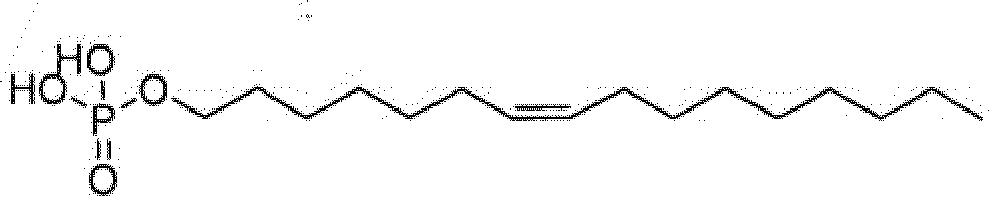


- Examples of non-cationic lipids include, but are not limited to. the following:


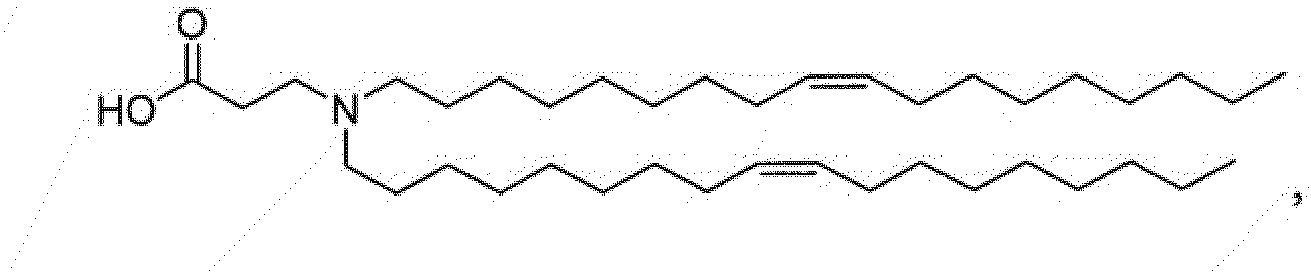


- A lipid nanoparticle (LNP) encapsulating an mRNA encoding a protein is provided in some aspects of the invention. The LNP has a cationic lipid, a non-cationic helper lipid comprising at least one fatty acid chain of at least 8C and at least one polar head group moiety, a PEG lipid, and a sterol. In some aspects the LNP further comprises an agent that inhibits immune responses by the LNP. In some embodiments the PEG lipid is an alkyl-PEGylated lipids, non-alkyl-PEG such as hydroxy-PEG, a non-alkyl-PEGylated lipid such as hydroxy-PEGylated lipid, a Cmpd420, a Cmpd396, a Cmpd394, Cmpd397, Cmpd395, Cmpd417, Cmpd418, or Cmpd419, Cmpd421, Cmpd422, or wherein the PEG lipid contains less than 0.5% molar ratio of PEG lipid to the other components. In certain embodiments, a PEG lipid useful in the present disclosure is a compound of Formula (III). Provided herein are compounds of Formula (III):

- R3 is -ORo;
- Ro is hydrogen, optionally substituted alkyl, or an oxygen protecting group;
- r is an integer between 1 and 100, inclusive;
- L1 is optionally substituted C1-10 alkylene, wherein at least one methylene of the optionally substituted C1-10alkylene is independently replaced with optionally substituted carbocyclylene, optionally substituted heterocyclylene, optionally substituted arylene, optionally substituted heteroarylene, -O-, -N(RN)-, -S-, -C(O)-, -C(O)N(RN)-, - NRNC(O)-, -C(O)O-, -OC(O)-, -OC(O)O-, -OC(O)N(RN)-, -NRNC(O)O-, or - NRNC(O)N(RN)-;
- D is a moiety obtained by click chemistry or a moiety cleavable under physiological conditions;
- m is 0, 1, 2, 3, 4, 5, 6, 7, 8, 9, or 10;
- A is of the formula:

- each instance of L2 is independently a bond or optionally substituted C1-6 alkylene, wherein one methylene unit of the optionally substituted C1-6 alkylene is optionally replaced with -O-, -N(RN)-, -S-, -C(O)-, -C(O)N(RN)-, -NRNC(O)-, -C(O)O-, -OC(O)-, - OC(O)O-, -OC(O)N(RN)-, -NRNC(O)O-, or -NRNC(O)N(RN)-;
- each instance of R2 is independently optionally substituted C1-30 alkyl, optionally substituted C1-30 alkenyl, or optionally substituted C1-30 alkynyl; optionally wherein one or more methylene units of R2 are independently replaced with optionally substituted carbocyclylene, optionally substituted heterocyclylene, optionally substituted arylene, optionally substituted heteroarylene. -N(RN)-, -O-, -S-, -C(O)-, -C(O)N(RN)-, - NRNC(O)-, -NRNC(O)N(RN)-, -C(O)O-, -OC(O)-, -OC(O)O-, -OC(O)N(RN)-, - NRNC(O)O-, -C(O)S-, -SC(O)-, -C(=NRN)-, -C(=NRN)N(RN)-, -NRNC(=NRN)-, - NRNC(=NRN)N(RN)-, -C(S)-, -C(S)N(RN)-, -NRNC(S)-, -NRNC(S)N(RN)-, -S(O)-, - OS(O)-, -S(O)O-, -OS(O)O-, -OS(O)2-, -S(O)2O-, -OS(O)2O-, -N(RN)S(O)-, - S(O)N(RN)-, -N(RN)S(O)N(RN)-, -OS(O)N(RN)-, -N(RN)S(O)O-, -S(O)2-, -N(RN)S(O)2-. -S(O)2N(RN)-, -N(RN)S(O)2N(RN)-, -OS(O)2N(RN)-, or -N(RN)S(O)2O-;
- each instance of RN is independently hydrogen, optionally substituted alkyl, or a nitrogen protecting group;
- Ring B is optionally substituted carbocyclyl, optionally substituted heterocyclyl, optionally substituted aryl, or optionally substituted heteroaryl; and
- p is 1 or 2.
- In certain embodiments, the compound of Fomula (III) is a PEG-OH lipid (i.e., R3 is -ORo, and Ro is hydrogen). In certain embodiments, the compound of Formula (III) is of Formula (III-OH):

- In certain embodiments, D is a moiety obtained by click chemistry (e.g., triazole). In certain embodiments, the compound of Formila (III) is of Formula (III-a-1) or (III-a-2):

- In certain embodiments, the compound of Formula (III) is of one of the following formulae:


s is 0, 1, 2, 3, 4, 5, 6. 7, 8, 9, or 10. - In certain embodiments, the compound of Formula (III) is of one of the following formulae:


- In certain embodiments, a compound of Formula (III) is of one of the following formulae:
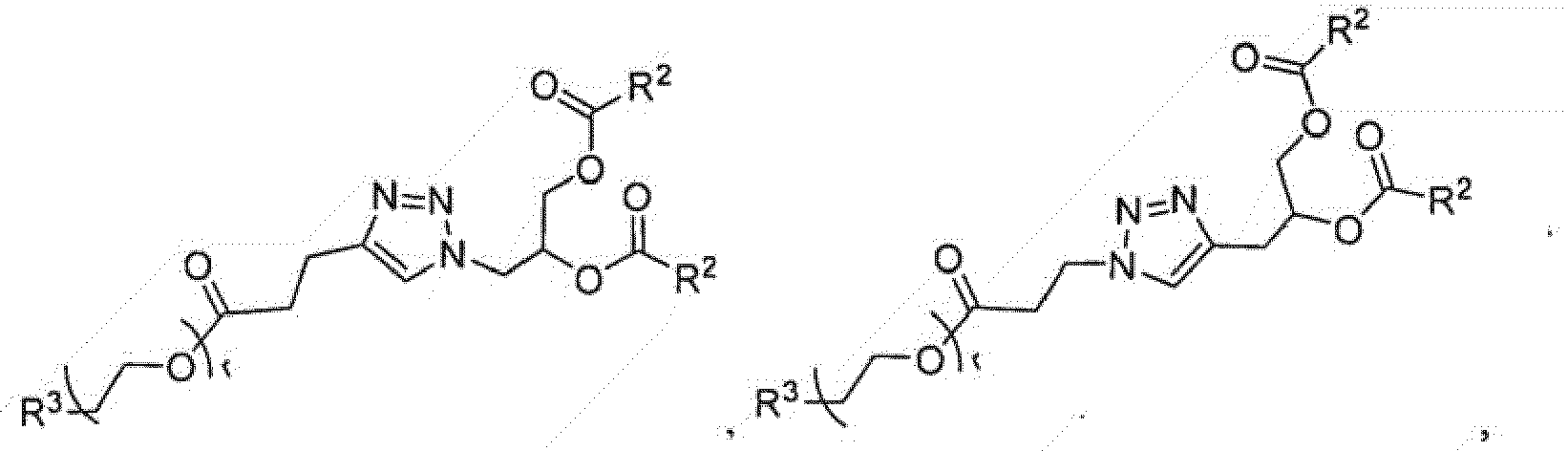
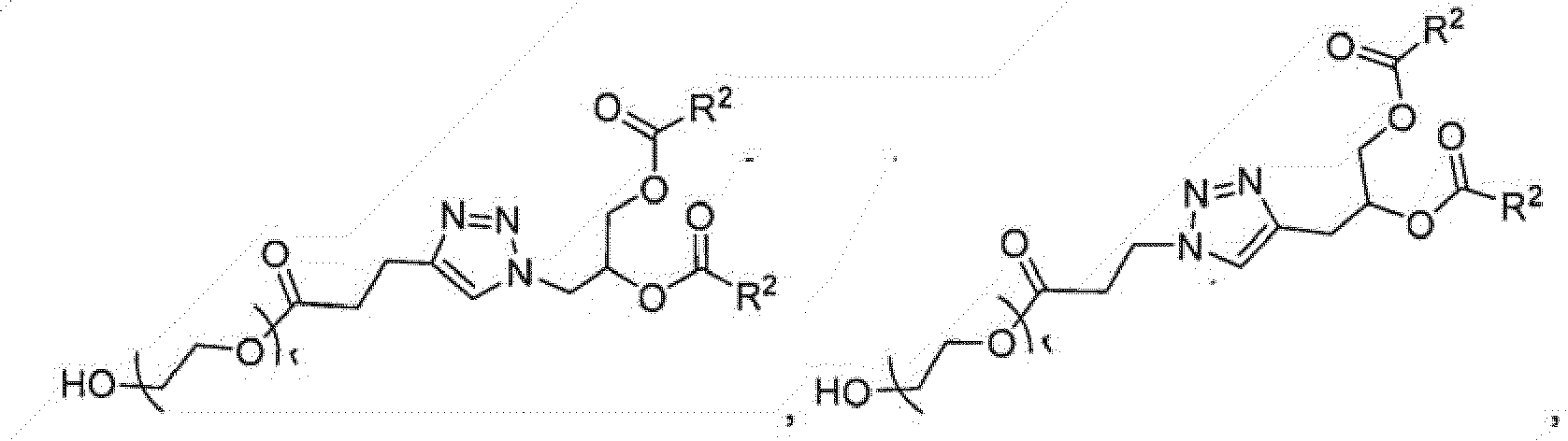
- In certain embodiments, a compound of Formula (III) is of one of the following formulae:


- In certain embodiments, D is a moiety cleavable under physiological conditions (e.g., ester, amide, carbonate, carbamate, urea). In certain embodiments, a compound of Formula (III) is of Formula (III-b-1) or (III-b-2):

- In certain embodiments, a compound of Formula (III) is of Formula (III-b-1-OH) or (III-b-2-OH):

- In certain embodiments, the compound of Formula (III) is of one of the following formulae:


- In certain embodiments, a compound of Formula (III) is of one of the following formulae:


- In certain embodiments, a compound of Formula (III) is of one of the following formulae:


- In certain embodiments, a compound of Formula (III) is of one of the following formulae:


- In certain embodiments, a PEG lipid useful in the present disclosure is a PEGylated fatty acid. In certain embodiments, a PEG lipid useful in the present disclosure is a compound of Formula (V). Provided herein are compounds of Formula (V):
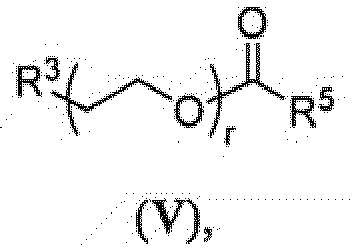
- R3 is-ORo;
- Ro is hydrogen, optionally substituted alkyl or an oxygen protecting group;
- r is an integer between 1 and 100, inclusive;
- R5 is optionally substituted C10-40 alkyl, optionally substituted C10-40 alkenyl, or optionally substituted C10-40 alkynyl; and optionally one or more methylene groups of R5 are replaced with optionally substituted carbocyclylene, optionally substituted heterocyclylene, optionally substituted arylene, optionally substituted heteroarylene, -N(RN)-, -O-, -S-, - C(O)-, -C(O)N(RN)-, -NRNC(O)-, -NRNC(O)N(RN)-, -C(O)O-, -OC(O)-, -OC(O)O-, - OC(O)N(RN)-, -NRC(O)O-, -C(O)S-, -SC(O)-, -C(=NRN)-, -C(=NRN)N(RN)-, - NRNC(=NRN)-, -NRNC(=NRN)N(RN)-, -C(S)-, -C(S)N(RN)-, NRNC(S)-, - NRNC(S)N(RN)-, -S(O)-, -OS(O)-, -S(O)O-, -OS(O)O-, -OS(O)2-, -S(O)2O-. - OS(O)2O-, -N(RN)S(O)-, -S(O)N(RN)-, -N(RN)S(O)N(RN)-, -OS(O)N(RN)-, - N(RN)S(O)O-, -S(O)2-, -N(RN)S(O)2-, -S(O)2N(RN)-, -N(RN)S(O)2N(RN)-, - OS(O)2N(RN)-, or -N(RN)S(O)2O-; and
- each instance of RN is independently hydrogen, optionally substituted alkyl, or a nitrogen protecting group.
- In embodiments of the invention, the compound of Formula (V) is of Formula (V-OH):

- In certain embodiments, a compound of Formula (V) is of one of the following formulae:


- In other aspects the non-cationic helper lipid is a zwitterionic non-cationic helper lipid, a lipid that is not a phosphatidyl choline (PC), a DSPC analog, oleic acid, an oleic acid analog, or a 1,2-distearoyl-sn-glycero-3-phosphocholine (DSPC) substitute.
- In some embodiments the agent that inhibits immune responses by the LNP comprises a miR binding site. In other embodiments the miR binding site is selected from miR 126,
miR 155, and miR 142 3p. The miR binding site is incorporated into a mRNA in some embodiments. In other embodiments the miR binding site is separate from the mRNA. - In some embodiments the agent that inhibits immune responses by the LNP comprises an mRNA comprising a miR binding site. In various embodiments, the mRNA comprises 1-4, one, two, three or four miR binding sites, wherein at least one of the miR binding sites is a miR-126 binding site. In one embodiment, the mRNA, comprises at least two microRNA binding sites, wherein at least one of the microRNA binding sites is a miR-126 binding site. In one embodiment, the mRNA, e.g., mmRNA, comprises a miR-126 binding site and a second microRNA binding site for a miR selected from the group consisting of miR-142-3p, miR-142-5p, miR-146-3p, miR-146-5p, miR-155, miR-16, miR-21, miR-223, miR-24 and miR-27. In another embodiment, the mRNA, comprises a miR-126 (e.g., miR-126-3p) binding site and a miR-142 (e.g., miR-142-3p) binding site. A miR referred to by number herein can refer to either of the two mature microRNAs originating from opposite arms of the same pre-miRNA (e.g., either the 3p or 5p microRNA). All miRs referred to by number herein are intended to include both the 3p and 5p arms/sequences. It has now been discovered that incorporation of at least one microRNA binding site for a microRNA expressed in immune cells (e.g., miR-126, miR-142, miR-155 and combinations thereof) into an mRNA construct can reduce or inhibit ABC when the lipid-comprising compound or composition comprising the mRNA is administered to a subject. In one embodiment, the mechanism of action of the miRNA binding site(s) is a microRNA "sponge", wherein the miRNA binding site(s) in the construct or LNP "soaks up" microRNAs that bind to the binding site(s).
- The DSPC analog may have a modified head group that is a modified quaternary amine head group, a modified core group, or a modified lipid tail group. In some embodiments. The PEG lipid in other embodiments contains at least 0.0001%, at least 0.0005%, at least 0.001%, at least 0.005%, at least 0.01%, at least 0.05%, at least 0.1%, at least 0.15%, at least 0.2%, at least 0.25%, at least 0.3%, at least 0.35%, at least 0.4%, at least 0.45%, and less than 0.5% molar ratio of PEG lipid to the other components.
- In some embodiments the LNP may have a molar ratio of about 45-65% cationic lipid, about 0.15-15% PEG lipid, about 15-45% cholesterol and about 5-25% non-cationic helper lipid or a molar ratio of about 55% cationic lipid, about 2.5% PEG lipid, about 32.5% cholesterol and about 10% non-cationic lipid.
- In other embodiments the cationic lipid is selected from DLin-DMA, DLin-D-DMA, DLin-MC3-DMA, DLin-KC2-DMA or DODMA. In other embodiments the cationic lipid is selected from the lipid Cmpd numbers provided herein.
- The disclosure provides a PEG lipid comprising a compound of Formula (V):

- R3 is-ORo;
- Ro is hydrogen, optionally substituted alkyl or an oxygen protecting group;
- r is an integer between 1 and 100, inclusive;
- R5 is optionally substituted C10-40 alkyl, optionally substituted C10-40 alkenyl, or optionally substituted C10-40 alkynyl; and optionally one or more methylene groups of R5 are replaced with optionally substituted carbocyclylene, optionally substituted heterocyclylene, optionally substituted arylene, optionally substituted heteroarylene, -N(RN)-, -O-, -S-, - C(O)-, -C(O)N(RN)-, -NRNC(O)-, -NRNC(O)N(RN)-, -C(O)O-, -OC(O)-, -OC(O)O-, - OC(O)N(RN)-, -NRNC(O)O-, -C(O)S-, -SC(O)-, -C(=NRN)-, -C(=NRN)N(RN)-, - NRNC(=NRN)-, -NRNC(=NRN)N(RN)-, -C(S)-, -C(S)N(RN)-, -NRNC(S)-, - NRNC(S)N(RN)-, -S(O)-, -OS(O)-, -S(O)O-, -OS(O)O-, -OS(O)2-, -S(O)2O-, - OS(O)2O-, -N(RN)S(O)-, -S(O)N(RN)-, -N(RN)S(O)N(RN)-, -OS(O)N(RN)-, - N(RN)S(O)O-, -S(O)2-, -N(RN)S(O)2-, -S(O)2N(RN)-, -N(RN)S(O)2N(RN)-, - OS(O)2N(RN)-, or -N(RN)S(O)2O-; and
- each instance of RN is independently hydrogen, optionally substituted alkyl, or a nitrogen protecting group.
- In embodiments of the invention the compound of Formula (V) is of Formula (V-OH):

- In other embodiments the compound of Formula (V) is of one of the following formulae:

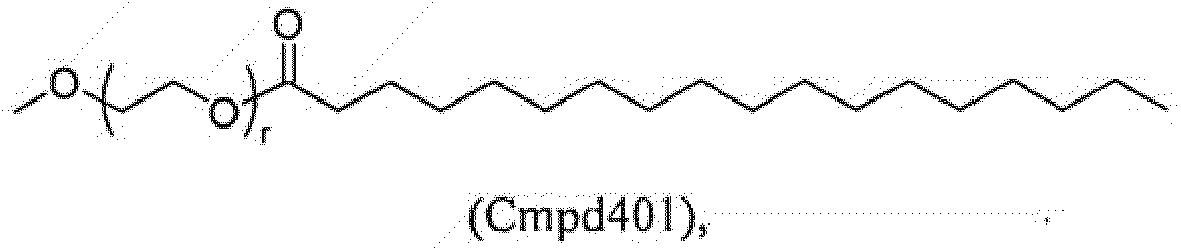


- In yet other embodiments the compound of Formula (V) is:

- These and other embodiments and aspects will be discussed in greater detail herein.
- The following Figures are provided in and grey scale.
-
FIG. 1 : Phycoerythrin (PE) fluorescence of CD3+ T cells and CD19+ B cells following incubation with PE- LNP, PE+ LNP or medium alone. The data show uptake of LNPs by splenic B cells but not T cells under ex vivo culture conditions. -
FIGs. 2A-2B : Phycoerythrin (PE) fluorescence of CD3+ T cells and CD19+ B cells as a function of time of incubation with PE- LNP, PE+ LNP or medium alone. The data show LNP uptake by B cells but not T cells occurs rapidly in these ex vivo culture conditions. -
FIG. 3 : EGFP fluorescence of CD19+ cells as a function of time of incubation with PE+ LNP comprising EGFP mRNA. No expression of EGFP by B cells is observed at any time point, despite massive LNP uptake by those cells. -
FIGs. 4A-4B : hEPO concentration and anti-PEG IgM levels in vivo following administration of first, second and third doses (hEPO) and first and second (IgM) of LNP carrying hEPO mRNA cargo into CD-1 non-splenectomized (CD-1) and splenectomized mice. -
FIG. 5 : PE-Rhodamine fluorescence in CD19+ circulating B cells after incubation for 2. 4, 6 and 24 hours with PE+ and PE- LNP -
FIGs. 6A-6B : LNP uptake (FIG. 6A ) and EGFP expression (FIG. 6B ) by circulating B cells as a function of incubation time. -
FIG. 7 : CD86 expression in splenic and circulating B cells following incubation with PE- and PE+ LNP. Splenic and circulating B cells that take up LNPs are activated. -
FIG. 8 : CD86 expression in splenic and circulating B cells that take up or fail to take up PE+ LNPs. Splenic and circulating B cells that take up LNPs are activated, as evidenced by increased CD86 expression. -
FIG. 9 : CD86 expression as a function of LNP uptake by splenic B cells at various incubation times. -
FIG. 10 : IL-6 and TNF-alpha secretion by B cells incubated with PE+ and PE- LNP for 24 hours. -
FIGs. 11A-11B : Empty PE+ LNP uptake by CD19+ B cells at 24 hours (FIG. 11A ) and the time course at 4 and 24 hours (FIG. 11B ). -
FIGs. 12A-12B : CD86 expression in B cells that have taken up empty PE+ LNP (FIG. 12A ). Splenic B cells are activated by empty LNPs in a dose dependent manner. IL-6 and TNF-alpha secretion by B cells incubated with empty PE+ LNP (FIG. 12B ). -
FIGs. 13A-13D : Uptake and cytokine secretion by B cells from wild type (WT), ApoE deficient, and LDL receptor deficient mice in PE+ LNPs (FIG. 13A ) and PE- LNPs (FIG. 13B ). The percentage of CD19+ PE+ cells (FIG. 13C ) and cytokine levels in pg/ml (FIG. 13D ) are also given. -
FIG. 14 : LNP uptake following pre-incubation of B cells with free PEG or anti-PEG IgG. -
FIG. 15 : Uptake of LNPs comprising PEG or PEG-OH or lacking PEG (PEGless) by B cells. -
FIG. 16 : Uptake of LNPs comprising PEG or PEG-OH or lacking PEG (PEGless) by B cells. -
FIG. 17 : CD86 expression in B cells incubated with PEG-less LNP or PEG-OH LNP, as a function of LNP uptake. -
FIG. 18 : LNP uptake as a function of phospholipid content of the LNP. -
FIG. 19 : LNP uptake as a function of phospholipid and PEG content of the LNP in CD19+ B cells and CD5+ B cells. -
FIG. 20 : LNP uptake by CD19+, CD19+CD5+ or CD19+CD5- B cells as a function of phospholipid and PEG content. -
FIG. 21 : EGFP expression in non-conventional T (CD3-) and B (CD19-) cells from thespleen -
FIGs. 22A-22B : LNP uptake by B cells in vivo as a function of phospholipid and PEG content. -
FIGs. 23A-23E : CD86 expression levels in B cells after injection of LNPs comprising DMG-PEG (FIG. 23A ) or Cmpd418 (FIG. 23B ), or PEGless LNP (FIG. 23C ). CD86 expression level was assessed at I hour (FIG. 23D ) and4 hours (FIG. 12E) after injection of LNP. -
FIGs. 24A-24B : Uptake of PE+ LNP by B cells invivo 1 hour (FIG. 24A ) and4 hours (FIG. 24B ) after injection of LNP comprising DMG-PEG or PEG OH or PEGless LNPs. -
FIG. 25 : LNP uptake in B cells as a function of DMG-PEG content in LNP (intermediate content study). -
FIG. 26 : B cell activation after LNP uptake as a function of DMG-PEG content in LNP. The data are presented in sets of 4 bars. the four bars in each set representing LNP PE negative, LNP-PE positive low, LNP-PE positive intermediate, and LNP-PE positive high, from left to right, respectively. Thus, the bars represent populations of cells that have associated or taken up an increasing amount of LNPs. -
FIG. 27 : LNP uptake in B cells as a function of DMG-PEG content in LNP (low content study). -
FIGs. 28 : PE+ staining of CD19+ B cells contacted with Cmpd395, Cmpd404, and oleic acid comprising LNPs. -
FIGs. 29A-29B : B cell activation measured through an increase in activated B cell population (CD19+CD86+CD69+).FIG. 29A shows B cell activation as a function of DMG-PEG mol % without Imiquimod andFIG. 29B shows B cell activation as a function of DMG-PEG mol % with Imiquimod. -
FIGs. 30A-30B : Pro-inflammatory cytokine release (IFN-γ inFIG. 30A , TNF-α inFIG. 30B ) in an ex vivo human B cell culture as a function of DMG-PEG mol % in the presence or absence of Imiquimod. -
FIGs. 31A-31D : Phospholipid designs of helper lipids that are analogs and substitutes of phosphatidyl choline (PC) and DSPC. The modifications reduce association, recognition for example by receptors, and/or uptake of LNP through for example modifying the PC head group (FIG. 31A ), the PC core (FIG. 31B ), or through reducing the planarity of the lipid (FIG. 31C ). An oleic acid variant is also provided (FIG. 31D ). -
FIGs. 32A-32C : Examples of PEGylated lipids comprising short lipid tails, a click linker, and a hydroxy (OH) PEG end group.FIG. 32A shows Cmpd394, Cmpd395, Cmpd396, and Cmpd397.FIG. 32B shows Cmpd398 and Cmpd399.FIG. 32C shows Cmpd400-403. -
FIG. 33 : Anti-PEG or anti-DSPC IgM response measured by flow cytometry (beads) 96 hours after administration of the second dose. The IgM responses against DSPC or PEG are measured identically when beads are used alone or together. PEG DMG, PEG DSPE or Cmpd430 LNPs induced anti-LNP responses. Anti-PEG IgM and anti DSPC IgMs were both observed suggesting that the IgM response is a natural IgM response. -
FIG. 34 : Anti-PEG IgM measured by ELISA and anti-PEG or anti-DSPC IgM measured by flow cytometry (beads) 96 hours after administration of the second dose. The anti-PEG IgMs measured by ELISA and beads are similar and no significant differences were detected. -
FIG. 35 : LNP association with platelets as a function of time and LNP composition. The percent of LNP associated with platelets (as indicated by phycoerythrin (PE) fluorescence) is shown at three time points (15, 60 and 240 minutes) after administration of PBS, DMG-PEG containing LNP, PEG-OH containing LNP, and PEGless LNP (left to right for each time point). These experiments were performed on purified platelets harvested from the subject at the various time points shown. -
FIG. 36 : Platelet activation as a function of LNP composition. Platelet activation (as indicated by expression of platelet activation marker CD62P (MFI)) was measured at three time points (15, 60 and 240 minutes) after administration of PBS, DMG-PEG LNP, PEG-OH LNP, and PEGless LNP (left to right). -
FIGs. 37A-37B : Presence of B220+ B cells and F4/80+ macrophages in platelet aggregates in vivo as a function of time and LNP composition. Percent of B cells (as indicated by B220+ staining,FIG. 37A ) and percent of macrophages (as indicated by F4/80+ staining,FIG. 37B ) at three time points (15, 60 and 240 minutes) after administration of PBS, DMG-PEG LNP, PEG-OH LNP, and PEGless LNP (left to right), is shown. -
FIG. 38 : In vitro activation of platelets as assessed by upregulation of CD31 and CD62P activation markers, after contact with LNPs. -
FIGs. 39A-39D : In vitro activation of platelets, as indicated by increased CD31 expression relative to control (medium), at 10 minutes (FIG. 39A ), 30 minutes (FIG. 39B ), 60 minutes (FIG. 39C ), and 120 minutes (FIG. 39D ) after administration of medium, LPS and LNP comprising DSPC. -
FIGs. 40A-40B : In vitro platelet aggregation using a whole blood assay. Aggregated cells were collected and gated based on CD41 expression (first column), high forward scatter and side scatter (second column) and F4/80 (y-axis) and CD11b (x-axis) expression (third column) after contact with medium (first row), LPS (second row) and DSPC LNP (third row). Platelet aggregates were isolated based on CD41+ expression and high FCS and high SSC, as shown in the second column forFIG. 40A . Percent of aggregated cells that are CD11b+ F4/80+ double positive after administration of medium, LPS, and DSPC LNP (from left to right) is shown (FIG. 40B ). -
FIGs. 41A-41B : In vitro platelet aggregation with B cells (CD19+) and macrophages (CD11b+ and F4/80+) after incubation of whole blood with medium, LPS and DSPC LNP (from left to right) for 30 minutes (FIG. 41A ) and 120 minutes (FIG. 41B ). -
FIGs. 42A-42C : In vitro platelet aggregation with macrophages (FIG. 42A and 42B ) and B cells (FIG. 42C ) after incubation of whole blood with medium, LPS, and DSPC LNP (from left to right) for 30 minutes and 120 minutes. -
FIGs. 43A-43B : Upregulation of platelet activation markers CD31 (FIG. 43A ) and CD62P (FIG. 43B ) after incubation of platelets with medium (control), DSPC LNP, DOPC LNP, DOPG LNP, DMG-PEG LNP, and LPS (from left to right) in vitro, for 0, 10, 30 and 60 minutes, as measured by flow cytometry. -
FIGs. 44A-44B : Upregulation of activation markers CD31 (FIG. 44A ) and CD62P (FIG. 44B ) after incubation of platelets in vitro with medium (control), DSPC LNP, DOPC LNP, DOPG LNP, DMG-PEG LNP and LPS, for 0, 10, 30 and 60 minutes, as measured by flow cytometry. -
FIG. 45 : Model of the effect of LNPs on platelets. DMG-PEG LNP physically associate with and activate platelets. DSPC LNP do not physically associate with platelets, but nevertheless are able to activate platelets. Both LNP types cause platelets to aggregate with concomitant recruitment of B cells and macrophages. PEG-OH and PEGless LNPs do not detectably associate with platelets, suggesting a role of the DMG-PEG in the LNP-platelet association. Even in the absence of DMG-PEG, however there is platelet activation, suggesting an interaction between platelets and the phospholipid component, and in particular the PC head group, in the LNP. -
FIG. 46A-46B : B1a and B1b cells require the spleen.FIG. 46A shows B1a (top) and B2b (bottom) cell levels following splenectomy or a sham operation.FIG. 46B shows B1a (to) and B2b (bottom) antibody levels following splenectomies. B1b cells lose the ability to secrete antibody. -
FIG. 47 : Reticulocyte counts in intact and splenectomized non-human primates (NHPs). -
FIG. 48 : Hematocrit is maintained in splenectomized NHPs. -
FIGs. 49A-49D : NHP splenectomy study results.FIGs. 49A-49B show the area under the curve (AUC) results from hEPO-mRNA-MC3 (FIG. 49A ) and hEPO (FIG. 49B ). Cmax values for hEPO-mRNA-MC3 (FIG. 49C ) and hEPO (FIG. 49D ) are also presented. -
FIGs. 50A-50B : Suppression of complement activation in splenectomized NHPs as demonstrated by levels of complement activation indicators, C3a (FIG. 50A ) and C5b9 (FIG. 50B ). -
FIGs. 51A-51B : Cytokine expression in splenectomized NHPs. Levels of IL-6 (FIG. 51A ) and IL-10 (FIG. 51B ) are given. -
FIGs. 52A-52B : Anti-PEG IgM (FIG. 52A ) and anti-PEG IgG (FIG. 52B ) levels are greatly reduced in the absence of spleen. -
FIGs. 53A-53B is a set of graphs depicting anti-PEG IgM production following administration of LNP formulations. -
FIG. 54 is a schematic depicting the replacement of a phospholipid with a different zwitterionic group. -
FIGs. 55A -55B are a set of graphs depicting Luc mRNA expression (FIG. 55A ) and B cell activation (FIG. 55B ) following administration of LNP formulations in CD-1 mice. CD-1 mice were administered 0.05 mg/kg Luc mRNA and Luc expression was measured six hours later. -
FIGs. 56A-56E depicts effects of LNP formulation on Luc expression and B cell activation.FIG. 56B is a graph depicting CD86 expression (B cell activation) andFIG. 56C is a graph depicting expression levels of Luc as measured by total flux. The structures are shown inFIGs. 56A ,56D , and56E . -
FIGs. 57A-57C depicts the effects of various LNP formulations on B cells and platelets.FIG. 57A is a graph depicting activated B-cell frequencies 24 hours post dose.FIG. 57B is a graph depicting aggregation ofplatelets 15 minutes post dose.FIG. 57C is a graph depicting recruitment of cells in platelet aggregate. -
FIGs. 58A-58B depicts the positive effects of oleic acid in an LNP.FIG. 58A depicts levels of luciferase expression as measured bytotal flux 6 hours after delivery to CD-1 mice.FIG. 58B depicts in vivo B-cell activation inmouse splenocytes 24 hours following the adm inistration. -
FIG. 59 is a graph depicting hEPO concentration over time. An improved margin of expression with a particle of the invention in contrast to MC3 was demonstrated with chemically modified mRNA. -
FIGs. 60A-60C is a set of graphs depicting improved immune activation profile with chemically modified mRNA in LNP formulations of the invention.FIG. 60A is a graph depicting in vivo B-cell activation 24 hours following administration of the hEPO loaded particles or PBS.FIG. 60B is a graph depicting in IL-6concentration 6 hours following administration of the hEPO loaded particles or PBS.FIG. 60C is a graph depicting IP-10concentration 6 hours following administration of the hEPO loaded particles or PBS. -
FIG. 61 is a graph depicting LNP Uptake by B cells as measured by percent PE+ CD19+ B cells. -
FIG. 62 is a graph depicting B cell activation by LNPs as measured by CD86 expression on D cells. -
FIGs. 63A-63B are a set of graphs depicting the amount of PEG IgM produced 96 hours after a second dose of LNP (FIG. 63A ) or 96 hours after a third dose of LNP (FIG. 63B ). -
FIG. 64 is a graph depictinghEPO Expression 6 hours following once weekly administration by IV of hEPO mRNA - LNP formulations atweeks -
FIG. 65 is a graph depictinganti-PEG IgM production 96 hours following a third dose of hEPO mRNA - LNP formulations. -
FIG. 66 is a graph depicting data from a single dose study of LNP having various phospholipids with different headgroups injected by IV in CD-1 Mice. Each phospholipid is measured at three time points (3, 6, and 24 hrs) following injection. Phospholipid structures are shown inFIG. 69 . -
FIGs. 67A-67C is a set of graphs depicting cytokine release as a measure of ex vivo human B cell activation. Levels of IFN-gamma (FIG. 67A ), LI-6 (FIG. 67 ) and TNF-alpha (FIG. 67C ) were measured. -
FIG. 68 is a graph depicting the amount of B cell activation as a result of various LNP formulations. LNP formulations including oleic acid demonstrated reduced splenic B cell activation. -
FIG. 69 shows phospholipid structures. -
FIG. 70 is a graph depicting Luc expression levels following administration of LUC mRNA encapsulated in various LNP formulations composed of novel PC and Oleic Acid Derivatives at 3, 6 and 24 hours following. -
FIGs. 71A-71B is a set of graphs depicting B cell interaction/association with various LNP formulations as assessed by a percentage of CD19+PE+ cells. Several LNP formulations are depicted inFIG. 71A . Oleic acid and Cmpd125 are depicted inFIG. 71B . -
FIG. 72 is a set of graphs depicting B cell activation with various LNP formulations as assessed by CD86 Expression Median Fluorescence Intensity. Several LNP formulations are depicted inFIG. 72A . Oleic acid and Cmpd125 are depicted inFIG. 72B . -
FIGs. 73A-73C are a set of graphs depicting Luc expression with various LNP formulations as assessed by a measurement of total flux at 3 hours (FIG. 73A ), 6 hours (FIG. 73B ), and24 hours (FIG. 73C ) following a dose. - FIGs. 74A-74B are graphs depicting hEPO Expression (pg/mL) 6 hours following once weekly IV administration of hEPO mRNA-LNP formulations at
weeks -
FIG. 75 is a graph depicting anti-PEG IgM production (ng/mL) 96 hours following administration of the second dose of LNP formulations. -
FIG. 76 is a graph depicting Luc expression of various LNP formulations. Luc expression was assessed by a measurement of total flux (p/s) at 3 hours following a dose, using whole body BLI imaging. -
FIG. 77 is a graph depicting B cell activation. Percentage of activated B cells (CD86+ CD69+) in splenic CD19+ cells for LNP formulations was measured. -
FIG. 78 is a graph depicting EPO expression. Concentration of EPO (ng/mL) was measured at prebleed, 6 hours, and 24 hours, each of the 6 weeks. -
FIG. 79 is a graph depicting hEPO expression (ng/mL) at predose, 2 hours, 6 hours, 12 hours, 24 hours, 48 hours, and 72 hours following once weekly IV administration of hEPO mRNA-LNP formulations. -
FIG. 80 is a graph depicting levels of anti-PEG IgM (U/mL) following once weekly IV administration of the hEPO mRNA-LNP formulations. -
FIG. 81 is a graph depicting levels of anti-PEG IgG (U/mL) following once weekly IV administration of the hEPO mRNA - LNP formulations. -
FIG. 82 is a graph depicting B cell activation. Percentage of activated B cells (CD86+ CD27+) in CD19+ cells for LNP formulations was measured. -
FIG. 83 is a graph depicting monocyte activation measured for LNP formulations. -
FIGs. 84A-84B are graphs depicting EPO expression. Concentration of EPO (ng/mL) was measured at 2 hours, 6 hours, 12 hours, 24 hours, and 48 hours following the first injection and the fifth injection. -
FIGs. 85A-85E are graphs depicting EPO expression. Concentration of EPO (ng/mL) was measured on day I andday 29 at 2 hours, 6 hours, 12 hours, 24 hours, and 48 hours for each co-medication group. -
FIGs. 86A-86C are graphs depicting immune cell populations. Shows the percentage of B cells (FIG. 86A ), B1a cells (FIG. 86B ), and monocytes (FIG. 86C ) in PBMCs for each co-medication group at day -7, 24 hours post first injection, and 24 hours post fifth injection. -
FIG. 87 is a graph depicting B cell activation. The percentage of activated B cells in circulating B cells was measured for each co-medication group at day -7, 24 hours post first injection, and 24 hours post fifth injection. -
FIG. 88 is a graph depicting monocyte activation. The percentage of activated monocytes/macrophages in circulating PBMCs was measured for each co-medication group at day -7, 24 hours post first injection, and 24 hours post fifth injection. -
FIGs. 89A-89B are graphs depicting anti-PEG response. Anti-PEG IgM levels (U/mL) (FIG. 89A ) and anti-PEG IgG levels (U/mL) (FIG. 89B ) were measured for each co-medication group at baseline,day 9 post first injection, and day 34 post fifth injection. -
FIGs. 90A-90B are two graphs showing anti-PEG IgM levels (U/mL) and EPO levels (ng/mL) in two of the groups fromFIG. 78 : C57BI6J (FIG. 90A ) and sIgM-/- (FIG. 90B ). InFIG. 90A , anti-PEG IgM levels are graphed as light grey circles; inFIG. 90B . they arc represented by black circles. EPO concentrations are indicated by black circles (FIG. 90A ) and black squares (FIG. 90B ). -
FIGs. 91A-91B : The effect of co-medication on ABC in NHP. Co-medication alleviates cytokine (IL-6) production in NHPs (FIG. 91A ) and co-medication with Gilcnya reduces anti-PEG IgM production, consistent with reduced ABC (FIG. 91B ). -
FIG. 92 : B cells proliferate in the presence of DSPC LNPs. Splenic cells were stained with CFSE and after washing, incubated with IL-6, anti-BCR, DOPC liposomes, DSPC LNPs containing mRNA, DSPC LNPs containing siRNA or empty LNPs for 4 days at 37°C. Onday 4, the cells were harvested, washed and stained for surface markers, (CD19 and CD3) before they were measured on a BDFortessa flow cytometer and analyzed with ModFit 4.1 software. -
FIG. 93 : DSPC LNPs induce calcium release in B cells. Splenic cells were stained with CalciumSensor Dye eFluor ® 514, CD19, and CD3. After washing, a calcium baseline was acquired for 30 seconds on a BDFortessa flow cytometer. Immediately after, the cells were incubated with DSPC LNPs containing mRNA, DOPC liposomes, oleic LNPs, or anti BCR and the calcium signal was acquired for 360 seconds. Then, the cell stimulation cocktail was added to the cells and the signal was acquired for an additional 30 seconds. The analysis was performed using ModFit 4.1 software. - This disclosure provides lipid-comprising compounds and compositions that are not subject to ABC and/or that have reduced toxicity, as well as methods for delivering LNPs to a subject without promoting LNP-related drug responses, including ABC and LNP-induced toxicity (e.g., coagulopathy, disseminated intravascular coagulation, vascular thrombosis, CARPA, APR, or a combination thereof).
- Lipid-comprising compounds and compositions are compounds and compositions that comprise or are conjugated to one or more lipids. These agents may be referred to herein as lipid-conjugated agents or lipidated agents. Alternatively such lipids may encapsulate agents such as prophylactic, therapeutic and diagnostic agents. These agents may be referred to herein as lipid-encapsulated agents or lipid nanoparticle (LNP) encapsulated agents.
- Thus, it is to be understood that this disclosure provides improved compounds and compositions for reducing or eliminating ABC and toxicity upon in vivo administration. For brevity, this disclosure may however in some instances refer to compositions or formulations such as lipid nanoparticles or LNPs. This is intended for exemplary purposes and it is to be understood that the various teachings provided herein apply equally to individual compounds. such as lipid-conjugated compounds, unless explicitly stated otherwise.
- The invention provides compounds, compositions and methods of use thereof for reducing the effect of ABC on a repeatedly administered active agent such as a biologically active agent. As will be readily apparent, reducing or eliminating altogether the effect of ABC on an administered active agent effectively increases its half-life and thus its efficacy.
- In some embodiments the term reducing ABC refers to any reduction in ABC in comparison to a positive reference control ABC inducing LNP such as an MC3 LNP. ABC inducing LNPs cause a reduction in circulating levels of an active agent upon a second or subsequent administration within a given time frame. Thus a reduction in ABC refers to less clearance of circulating agent upon a second or subsequent dose of agent, relative to a standard LNP. The reduction may be, for instance, at least 10%, 15%, 20%, 25%, 30%, 35%, 40%, 45%, 50%, 55%, 60%, 65%, 70%, 75%, 80%, 85%, 90%, 95%, 98%, or 100%. In some embodiments the reduction is 10-100%, 10-50%, 20-100%, 20-50%, 30-100%, 30-50%, 40%-100%, 40-80%, 50-90%, or 50-100%. Alternatively the reduction in ABC may be characterized as at least a detectable level of circulating agent following a second or subsequent administration or at least a 2 fold, 3 fold, 4 fold, 5 fold increase in circulating agent relative to circulating agent following administration of a standard LNP. In some embodiments the reduction is a 2-100 fold, 2-50 fold, 3-100 fold, 3-50 fold, 3-20 fold, 4-100 fold, 4-50 fold, 4-40 fold, 4-30 fold, 4-25 fold, 4-20 fold, 4-15 fold, 4-10 fold, 4-5 fold, 5 - 100 fold, 5-50 fold, 5-40 fold, 5-30 fold, 5-25 fold, 5-20 fold, 5-15 fold, 5-10 fold, 6-100 fold, 6-50 fold. 6-40 fold, 6-30 fold, 6-25 fold, 6-20 fold, 6-15 fold, 6-10 fold, 8-100 fold. 8-50 fold, 8-40 fold, 8-30 fold, 8-25 fold, 8-20 fold, 8-15 fold, 8-10 fold, 10-100 fold, 10-50 fold, 10-40 fold, 10-30 fold, 10-25 fold. 10-20 fold. 10-15 fold, 20-100 fold, 20-50 fold. 20-40 fold, 20-30 fold, or 20-25 fold.
- The disclosure provides lipid-comprising compounds and compositions that are less susceptible to clearance and thus have a longer half-life in vivo. This is particularly the case where the compositions are intended for repeated including chronic administration, and even more particularly where such repeated administration occurs within days or weeks.
- Significantly, these compositions are less susceptible or altogether circumvent the observed phenomenon of accelerated blood clearance (ABC). ABC is a phenomenon in which certain exogenously administered agents are rapidly cleared from the blood upon second and subsequent administrations. This phenomenon has been observed, in part, for a variety of lipid-containing compositions including but not limited to lipidated agents, liposomes or other lipid-based delivery vehicles, and lipid-encapsulated agents. Heretofore, the basis of ABC has been poorly understood and in some cases attributed to a humoral immune response and accordingly strategies for limiting its impact in vivo particularly in a clinical setting have remained elusive.
- This disclosure provides compounds and compositions that arc less susceptible, if at all susceptible, to ABC. In some important aspects, such compounds and compositions are lipid-comprising compounds or compositions. The lipid-containing compounds or compositions of this disclosure, surprisingly, do not experience ABC upon second and subsequent administration in vivo. This resistance to ABC renders these compounds and compositions particularly suitable for repeated use in vivo, including for repeated use within short periods of time, including days or 1-2 weeks. This enhanced stability and/or half-life is due, in part, to the inability of these compositions to activate B1a and/or B1b cells and/or conventional B cells, pDCs and/or platelets.
- This disclosure therefore provides an elucidation of the mechanism underlying accelerated blood clearance (ABC). It has been found, in accordance with this disclosure and the inventions provided herein, that the ABC phenomenon at least as it relates to lipids and lipid nanoparticles is mediated, at least in part an innate immune response involving B1a and/or B1b cells. pDC and/or platelets. B1a cells are normally responsible for. secreting natural antibody, in the form of circulating IgM. This IgM is poly-reactive, meaning that it is able to bind to a variety of antigens, albeit with a relatively low affinity for each.
- It has been found in accordance with the invention that some lipidated agents or lipid-comprising formulations such as lipid nanoparticles administered in vivo trigger and are subject to ABC. It has now been found in accordance with the invention that upon administration of a first dose of the LNP. one or more cells involved in generating an innate immune response (referred to herein as sensors) bind such agent, are activated, and then initiate a cascade of immune factors (referred to herein as effectors) that promote ABC and toxicity. For instance, B1a and B1b cells may bind to LNP, become activated (alone or in the presence of other sensors such as pDC and/or effectors such as IL6) and secrete natural IgM that binds to the LNP. Pre-existing natural IgM in the subject may also recognize and bind to the LNP, thereby triggering complement fixation. After administration of the first dose, the production of natural IgM begins within 1-2 hours of administration of the LNP. Typically by about 2-3 weeks the natural IgM is cleared from the system due to the natural half-life of IgM. Natural IgG is produced beginning around 96 hours after administration of the LNP. The agent, when administered in a naive setting, can exert its biological effects relatively unencumbered by the natural IgM produced post-activation of the B1a cells or B1b cells or natural IgG. The natural IgM and natural IgG are non-specific and thus are distinct from anti-PEG IgM and anti-PEG IgG.
- Although Applicant is not bound by mechanism, it is proposed that LNPs trigger ABC and/or toxicity through the following mechanisms. It is believed that when an LNP is administered to a subject the LNP is rapidly transported through the blood to the spleen. The LNPs may encounter immune cells in the blood and/or the spleen. A rapid innate immune response is triggered in response to the presence of the LNP within the blood and/or spleen. Applicant has shown herein that within hours of administration of an LNP several immune sensors have reacted to the presence of the LNP. These sensors include but are not limited to immune cells involved in generating an immune response, such as B cells, pDC, and platelets. The sensors may be present in the spleen, such as in the marginal zone of the spleen and/or in the blood. The LNP may physically interact with one or more sensors, which may interact with other sensors. In such a case the LNP is directly or indirectly interacting with the sensors. The sensors may interact directly with one another in response to recognition of the LNP. For instance many sensors are located in the spleen and can easily interact with one another. Alternatively one or more of the sensors may interact with LNP in the blood and become activated. The activated sensor may then interact directly with other sensors or indirectly (e.g., through the stimulation or production of a messenger such as a cytokine e.g., II.6)
- In some embodiments the LNP may interact directly with and activate each of the following sensors: pDC, B1a cells. B1b cells, and platelets. These cells may then interact directly or indirectly with one another to initiate the production of effectors which ultimately lead to the ABC and/or toxicity associated with repeated doses of LNP. For instance, Applicant has shown that LNP administration leads to pDC activation, platelet aggregation and activation and B cell activation. In response to LNP platelets also aggregate and are activated and aggregate with B cells. pDC cells are activated. LNP has been found to interact with the surface of platelets and B cells relatively quickly. Blocking the activation of any one or combination of these sensors in response to LNP is useful for dampening the immune response that would ordinarily occur. This dampening of the immune response results in the avoidance of ABC and/or toxicity.
- The sensors once activated produce effectors. An effector, as used herein, is an immune molecule produced by an immune cell, such as a B cell. Effectors include but are not limited to immunoglobulin such as natural IgM and natural lgG and cytokines such as IL6. B1a and B1b cells stimulate the production of natural IgMs within 2-6 hours following administration of an LNP. Natural 1gG can be detected within 96 hours. IL6 levels arc increased within several hours. The natural IgM and IgG circulate in the body for several days to several weeks. During this time the circulating effectors can interact with newly administered LNPs, triggering those LNPs for clearance by the body. For instance, an effector may recognize and bind to an LNP. The Fc region of the effector may be recognized by and trigger uptake of the decorated LNP by macrophage. The macrophage are then transported to the spleen. The production of effectors by immune sensors is a transient response that correlates with the timing observed for ABC.
- If the administered dose is the second or subsequent administered dose, and if such second or subsequent dose is administered before the previously induced natural IgM and/or IgG is cleared from the system (e.g., before the 2-3 window time period), then such second or subsequent dose is targeted by the circulating natural IgM and/or natural IgG or Fc which trigger alternative complement pathway activation and is itself rapidly cleared. When LNP are administered after the effectors have cleared from the body or are reduced in number, ABC is not observed.
- Thus, it is useful according to aspects of the invention to inhibit the interaction between LNP and one or more sensors, to inhibit the activation of one or more sensors by LNP (direct or indirect), to inhibit the production of one or more effectors, and/or to inhibit the activity of one or more effectors. In some embodiments the LNP is designed to limit or block interaction of the LNP with a sensor. For instance the LNP may have an altered PC and/or PEG to prevent interactions with sensors. Alternatively or additionally an agent that inhibits immune responses induced by LNPs may be used to achieve any one or more of these effects.
- It has also been determined that conventional B cells are also implicated in ABC. Specifically, upon first administration of an agent, conventional B cells, referred to herein as CD19(+), bind to and react against the agent. Unlike B1a and B1b cells though, conventional B cells are able to mount first an IgM response (beginning around 96 hours after administration of the LNPs) followed by an IgG response (beginning around 14 days after administration of the LNPs) concomitant with a memory response. Thus conventional Bcells react against the administered agent and contribute to IgM (and eventually IgG) that mediates ABC. The IgM and IgG are typically anti-PEG IgM and anti-PEG IgG.
- It is contemplated that in some instances, the majority of the ABC response is mediated through B1a cells and B1a-mediated immune responses. It is further contemplated that in some instances, the ABC response is mediated by both IgM and IgG, with both conventional B cells and B1a cells mediating such effects. In yet still other instances, the ABC response is mediated by natural IgM molecules, some of which are capable of binding to natural 1gM, which may be produced by activated B1a cells. The natural IgMs may bind to one or more components of the LNPs, e.g., binding to a phospholipid component of the LNPs (such as binding to the PC moiety of the phospholipid) and/or binding to a PEG-lipid component of the LNPs (such as binding to PEG-DMG, in particular, binding to the PEG moiety of PEG-DMG). Since B1a expresses CD36, to which phosphatidylcholine is a ligand, it is contenplated that the CD36 receptor may mediate the activation of B1a cells and thus production of natural IgM. In yet still other instances, the ABC response is mediated primarily by conventional B cells.
- It has been found in accordance with the invention that the ABC phenomenon can be reduced or abrogated, at least in part, through the use of compounds and compositions (such as agents, delivery vehicles, and formulations) that do not activate B1a cells. Compounds and compositions that do not activate B1a cells may be referred to herein as B1a inert compounds and compositions. It has been further found in accordance with the invention that the ABC phenomenon can be reduced or abrogated, at least in part, through the use of compounds and compositions that do not activate conventional B cells. Compounds and compositions that do not activate conventional B cells may in some embodiments be referred to herein as CD19-inert compounds and compositions. Thus, in some embodiments provided herein, the compounds and compositions do not activate B1a cells and they do not activate conventional B cells. Compounds and compositions that do not activate B1a cells and conventional B cells may in some embodiments be referred to herein as
B 1a/CD19-inert compounds and compositions. - These underlying mechanisms were not heretofore understood, and the role of B1a and B1b cells and their interplay with conventional B cells in this phenomenon was also not appreciated.
- Accordingly, this disclosure provides compounds and compositions that do not promote ABC. These may be further characterized as not capable of activating B1a and/or B1b cells, platelets and/or pDC, and optionally conventional B cells also. These compounds (e.g., agents, including biologically active agents such as prophylactic agents, therapeutic agents and diagnostic agents, delivery vehicles, including liposomes, lipid nanoparticles. and other lipid-based encapsulating structures, etc.) and compositions (e.g., formulations, etc.) arc particularly desirable for applications requiring repeated administration, and in particular repeated administrations that occur within with short periods of time (e.g., within 1-2 weeks). This is the case, for example, if the agent is a nucleic acid based therapeutic that is provided to a subject at regular, closely-spaced intervals. The findings provided herein may be applied to these and other agents that are similarly administered and/or that are subject to ABC.
- Of particular interest are lipid-comprising compounds, lipid-comprising particles, and lipid-comprising compositions as these are known to be susceptible to ABC. Such lipid-comprising compounds particles, and compositions have been used extensively as biologically active agents or as delivery vehicles for such agents. Thus, the ability to improve their efficacy of such agents, whether by reducing the effect of ABC on the agent itself or on its delivery vehicle, is beneficial for a wide variety of active agents.
- Also provided herein are compositions that do not stimulate or boost an acute phase response (ARP) associated with repeat dose administration of one or more biologically active agents.
- The composition, in some instances, may not bind to IgM, including but not limited to natural IgM.
- The composition, in some instances, may not bind to an acute phase protein such as but not limited to C-reactive protein.
- The composition, in some instances, may not trigger a CD5(+) mediated immune response. As used herein, a CD5(+) mediated immune response is an immune response that is mediated by B1a and/or B1b cells. Such a response may include an ABC response, an acute phase response, induction of natural IgM and/or IgG, and the like.
- The composition, in some instances, may not trigger a CD19(+) mediated immune response. As used herein, a CD19(+) mediated immune response is an immune response that is mediated by conventional CD19(+), CD5(-) B cells. Such a response may include induction of IgM, induction of IgG, induction of memory B cells, an ABC response, an antidrug antibody (ADA) response including an anti-protein response where the protein may be encapsulated within an LNP, and the like.
- B1a cells are a subset of B cells involved in innate immunity. These cells are the source of circulating IgM, referred to as natural antibody or natural serum antibody. Natural IgM antibodies are characterized as having weak affinity for a number of antigens, and therefore they are referred to as "poly-specific" or "poly-reactive", indicating their ability to bind to more than one antigen. B1a cells are not able to produce IgG. Additionally, they do not develop into memory cells and thus do not contribute to an adaptive immune response. However, they arc able to secrete IgM upon activation. The secreted IgM is typically cleared within about 2-3 weeks, at which point the immune system is rendered relatively naïve to the previously administered antigen. If the same antigen is presented after this time period (e.g., at about 3 weeks after the initial exposure), the antigen is not rapidly cleared. However. significantly, if the antigen is presented within that time period (e.g., within 2 weeks, including within 1 week, or within days), then the antigen is rapidly cleared. This delay between consecutive doses has rendered certain lipid-containing therapeutic or diagnostic agents unsuitable for use.
- In humans, B1a cells are CD19(+), CD20(+), CD27(+), CD43(+), CD70(-) and CD5(+). In mice, B1a cells are CD19(+), CD5(+), and CD45 B cell isoform B220(+). It is the expression of CD5 which typically distinguishes B1a cells from other convention B cells. B1a cells may express high levels of CDS, and on this basis may be distinguished from other B-1 cells such as B-1b cells which express low or undetectable levels of CDS. CDS is a panT cell surface glycoprotein. B1a cells also express CD36, also known as fatty acid translocase. CD36 is a member of the class B scavenger receptor family. CD36 can bind many ligands, including oxidized low density lipoproteins, native lipoproteins, oxidized phospholipids, and long-chain fatty acids.
- B1b cells are another subset of B cells involved in innate immunity. These cells arc another source of circulating natural IgM. Several antigens, including PS, are capable of inducing T cell independent immunity through B1b activation. CD27 is typically upregulated on B1b cells in response to antigen activation. Similar to B1a cells, the B1b cells are typically located in specific body locations such as the spleen and peritoneal cavity and are in very low abundance in the blood. The B1b secreted natural IgM is typically cleared within about 2-3 weeks, at which point the immune system is rendered relatively naïve to the previously administered antigen. If the same antigen is presented after this time period (e.g., at about 3 weeks after the initial exposure), the antigen is not rapidly cleared. However, significantly, if the antigen is presented within that time period (e.g., within 2 weeks, including within 1 week, or within days), then the antigen is rapidly cleared. This delay between consecutive doses has rendered certain lipid-containing therapeutic or diagnostic agents unsuitable for use.
- In some embodiments it is desirable to block B1a and/or B1b cell activation. One strategy for blocking B1a and/or B1b cell activation involves determining which components of a lipid nanoparticle promote B cell activation and neutralizing those components. It has been discovered herein that at least PEG and phosphatidylcholine (PC) contribute to B1a and B1b cell interaction with other cells and/or activation. PEG may play a role in promoting aggregation between B1 cells and platelets, which may lead to activation. PC (a helper lipid in LNPs) is also involved in activating the B1 cells, likely through interaction with the CD36 receptor on the B cell surface. Numerous particles have PEG-lipid alternatives, PEG-less, and/or PC replacement lipids (e.g. oleic acid or analogs thereof) have been designed and tested. Applicant has established that replacement of one or more of these components within an LNP that otherwise would promote ABC upon repeat administration, is useful in preventing ABC by reducing the production of natural IgM and/or B cell activation. Thus, the invention encompasses LNPs that have reduced ABC as a result of a design which eliminates the inclusion of B cell triggers.
- Another strategy for blocking B1a and/or B1b cell activation involves using an agent that inhibits immune responses induced by LNPs. These types of agents are discussed in more detail below. In some embodiments these agents block the interaction between B1a/B1b cells and the LNP or platelets or pDC. For instance the agent may be an antibody or other binding agent that physically blocks the interaction. An example of this is an antibody that binds to CD36 or CD6. The agent may also be a compound that prevents or disables the B1a/B1b cell from signaling once activated or prior to activation. For instance, it is possible to block one or more components in the B1a/B1b signaling cascade the results from B cell interaction with LNP or other immune cells. In other embodiments the agent may act one or more effectors produced by the B1a/B1b cells following activation. These effectors include for instance, natural IgM and cytokines.
- It has been demonstrated according to aspects of the invention that when activation of pDC cells is blocked, B cell activation in response to LNP is decreased. Thus, in order to avoid ABC and/or toxicity, it may be desirable to prevent pDC activation. Similar to the strategies discussed above, pDC cell activation may be blocked by agents that interfere with the interaction between pDC and LNP and/or B cells/platelets. Alternatively agents that act on the pDC to block its ability to get activated or on its effectors can be used together with the LNP to avoid ABC.
- Platelets also play an important role in ABC and toxicity. Very quickly after a first dose of LNP is administered to a subject platelets associate with the LNP, aggregate and are activated. In some embodiments it is desirable to block platelet aggregation and/or activation. One strategy for blocking platelet aggregation and/or activation involves determining which components of a lipid nanoparticle promote platelet aggregation and/or activation and neutralizing those components. It has been discovered herein that at least PEG contribute to platelet aggregation, activation and/or interaction with other cells. Numerous particles have PEG-lipid alternatives and PEG-less have been designed and tested. Applicant has established that replacement of one or more of these components within an LNP that otherwise would promote ABC upon repeat administration, is useful in preventing ABC by reducing the production of natural IgM and/or platelet aggregation. Thus, the invention encompasses LNPs that have reduced ABC as a result of a design which eliminates the inclusion of platelet triggers. Alternatively agents that act on the platelets to block its activity once it is activated or on its effectors can be used together with the LNP to avoid ABC.
- Various compounds and compositions provided herein, including LNPs, do not promote ABC activity upon administration in vivo. These LNPs may be characterized and/or identified through any of a number of assays, such as but not limited to those described below, as well as any of the assays disclosed in the Examples section, include the methods subsection of the Examples
- In some embodiments the methods involve administering an LNP without producing an immune response that promotes ABC. An immune response that promotes ABC involves activation of one or more sensors, such as B1 cells, pDC, or platelets, and one or more effectors, such as natural IgM, natural IgG or cytokines such as IL6. Thus administration of an LNP without producing an immune response that promotes ABC, at a minimum involves administration of an LNP without significant activation of one or more sensors and significant production of one or more effectors. Significant used in this context refers to an amount that would lead to the physiological consequence of accelerated blood clearance of all or part of a second dose with respect to the level of blood clearance expected for a second dose of an ABC triggering LNP. For instance, the immune response should be dampened such that the ABC observed after the second dose is lower than would have been expected for an ABC triggering LNP.
- Certain compositions provided in this disclosure do not activate B cells, such as B1a or B1b cells (CDI9+ CD5+) and/or conventional B cells (CD19+ CD5-). Activation of B1a cells, B1b cells, or conventional Bcells may be determined in a number of ways, some of which are provided below. B cell population may be provided as fractionated B cell populations or unfractionated populations of splenocytes or peripheral blood mononuclear cells (PBMC). If the latter, the cell population may be incubated with the LNP of choice for a period of time, and then harvested for further analysis. Alternatively, the supernatant may be harvested and analyzed.
- Activation of B1a cells, B1b cells, or conventional B cells may be demonstrated as increased expression of B cell activation markers including late activation markers such as CD86. In an exemplary non-limiting assay, unfractionatcd B cells are provided as a splenocyte population or as a PBMC population, incubated with an LNP of choice for a particular period of time, and then stained for a standard B cell marker such as CD19 and for an activation marker such as CD86, and analyzed using for example flow cytometry. A suitable negative control involves incubating the same population with medium, and then performing the same staining and visualization steps. An increase in CD86 expression in the test population compared to the negative control indicates R cell activation
- B cell activation may also be assessed by cytokine release assay. For example, activation may be assessed through the production and/or secretion of cytokines such as IL-6 and/or TNF-alpha upon exposure with LNPs of interest.
- Such assays may be performed using routine cytokine secretion assays well known in the art. An increase in cytokine secretion is indicative of B cell activation.
- LNP association or binding to B cells may also be used to assess an LNP of interest and to further characterize such LNP. Association/binding and/or uptake/internalization may be assessed using a detectably labeled, such as fluorescently labeled, LNP and tracking the location of such LNP in or on B cells following various periods of incubation.
- The invention further contemplates that the compositions provided herein may be capable of evading recognition or detection and optionally binding by downstream mediators of ABC such as circulating IgM and/or acute phase response mediators such as acute phase proteins (e.g., C-reactive protein (CRP).
- Also provided herein are methods for delivering LNPs, which may encapsulate an agent such as a therapeutic agent, to a subject without promoting ABC.
- In some embodiments, the method comprises administering any of the LNPs described herein, which do not promote ABC, for example, do not induce production of natural IgM binding to the LNPs, do not activate B1a and/or B1b cells. As used herein, an LNP that "does not promote ABC" refers to an LNP that induces no immune responses that would lead to substantial ABC or a substantially low level of immune responses that is not sufficient to lead to substantial ABC. An LNP that does not induce the production of natural IgMs binding to the LNP refers to LNPs that induce either no natural IgM binding to the LNPs or a substantially low level of the natural IgM molecules, which is insufficient to lead to substantial ABC. An LNP that does not activate B1a and/or B1b cells refer to LNPs that induce no response of B1a and/or B1b cells to produce natural IgM binding to the LNPs or a substantially low level of B1a and/or B1b responses, which is insufficient to lead to substantial ABC.
- In some embodiments the terms do not activate and do not induce production are a relative reduction to a reference value or condition. In some embodiments the reference value or condition is the amount of activation or induction of production of a molecule such as IgM by a standard LNP such as an MC3 LNP. In some embodiments the relative reduction is a reduction of at least 30%, for example at least 30%, 35%, 40%, 45%, 50%, 55%, 60%, 65%, 70%, 75%, 80%, 85%, 90%, 91%, 92%, 93%, 94%, 95%, 96%, 97%, 98%, 99%, or 100%. In other embodiments the terms do not activate cells such as B cells and do not induce production of a protein such as IgM may refer to an undetectable amount of the active cells or the specific protein.
- In some instances, the LNPs described herein may be free of an epitope that activates B1a cells, for example, free of an epitope that activates or interacts with CD36 or CD6. Such LNPs contain either no epitopes capable of activating B1a cells or CD36 or contain such epitopes at a substantially low amount, which is not sufficient to activate B1a or CD36 to a level high enough for inducing substantial ABC. In other embodiments, the LNPs described herein may be free of an epitope that activates B1b cells. By substantially free of, it is meaclassical pnt that a LNP includes less than 99% of the recited agent. In some embodiments the LNP may include none of the recited agent. In some instances, the LNPs described herein may contain one or more helper lipid as described herein, which may comprise at least one fatty acid chain of at least 8C and at least one polar moiety. In some examples, the helper lipid does not activate B1a and/or B1b cells. In other examples, the helper lipid does not bind or has low binding affinity to CD36. Alternatively, the helper lipid may competitively inhibit phosphatidylcholine from binding to CD36.
- Alternatively the LNP may be coadminstered (administered with, before or after) or coformulated with an agent that removes or targets B or B1a cells. An agent that removes or targets B or B1a cells may be Rituximab. Rituximab (RITUXAN®, GenentechBiogen) is a monoclonal antibody against the protein CD20, which is primarily found on the surface of immune system B cells. Rituximab interacts with CD20 on the surface of B cells and destroys B cells. As shown in the Examples, the combination of Rituximab and the LNP had significantly reduced ABC upon subsequent administration of LNP.
- In other embodiments the agent may bind and/or inhibit CD6 on B1a cells. An exemplary agent that binds and/or inhibits CD6 on B1a cells is an anti-CD6 antibody, such as Alzumab. Alzumab (itolizumab, Biocon) is a humanized IgGI monoclonal antibody that selectively targets CD6, a pan T cell marker involved in co-stimulation, adhesion and maturation of T cells. Alzumab also binds to CD6 on the surface of B1a cells.
- In some instances such methods may comprise
- (i) administering a first dose of an agent to a subject,
- (ii) administering a second or subsequent dose of the agent to the subject, wherein the second or subsequent dose is administered within 2 weeks of the first or prior dose, and
- (iii) repearing step (II) one or more times,
- Another method for delivering an agent to a subject involves
- (i) administering a first dose of an agent to a subject,
- (ii) administering a second or subsequent dose of the agent to the subject, wherein the second or subsequent dose is administered within 2 weeks of the first or prior dose, and
- (iii) repeating step (ii) one or more times,
- Still another method for delivering an agent to a subject involves
- (i) administering a first dose of an agent to a subject,
- (ii) administering a second or subsequent dose of the agent to the subject, wherein the second or subsequent dose is administered within 2 weeks of the first or prior dose. and
- (iii) repeating step (ii) one or more times,
- Second or subsequent doses may be administered within 1 week, or within 6 days, or within 5 days, or within 4 days, or within 3 days, or within 2 days, or within 1 day of the first or prior dose.
- The agent may be a biologically active agent such as a diagnostic agent or a therapeutic agent, although it is not so limited.
- Agents may be administered two or more times, three or more times, four or more times, etc. Agent administration may therefore be repeated once, twice, 3, 4, 5, 6, 7, 8, 9, 10, or more times. The agent may be administered chronically or acutely, depending on its intended purpose.
- The method may be a method of treating a subject having or at risk of having a condition that benefits from the biologically active agent, particularly if the biologically active agent is a therapeutic agent. Alternatively, the method may be a method of diagnosing a subject, in which case the biologically active agent is a diagnostic agent.
- The second and subsequent doses of biologically active agent may maintain an activity of at least 50% of the activity of the first dose, or at least 60% of the first dose, or at least 70% of the first dose, or at least 75% of the first dose, or at least 80% of the first dose, or at least 85% of the first dose, or at least 90% of the first dose, or at least 95% of the first dose, or more, for at least 1 day, 2 days, 3 days, 4 days, 5 days, 6 days, or 7 days postadministration of the second or subsequent dose.
- When the biologically active agent is an mRNA (a therapeutic mRNA or a mRNA encoding a vaccine antigen), a method for reducing ABC of LNPs encapsulating the mRNA can be performed using a low amount of the LNPs for the first dose, and/or the second dose (as well as the subsequent doses). The low doses can be equal to or less than 0.3 mg/kg, e.g., 0.2 mg/kg, or 0.1 mg/kg. In some instances, the first dose, the second dose, or both range from 0.1 to 0.3 mg/kg.
- The interval between the first dose and the second dose in any of the methods described herein may be equal to or less than two weeks, for example, less than 21, 20, 19, 18, 17. 16, 15, 14, 13, 12, 11, 10, 9, 8, 7, 6, 5, 4, 3, 2 or 1 days. In some instances, the subject can be administered a dose once daily, every 2, 3, 4, 5, 6, 7, 8, 9, 10, 11, 12, 13, 14, 15. 16, 17, 18, 19, 20 or 21 days in any of the methods described herein.
- Further, inhibiting ABC of LNPs in a subject can be achieved by the use of one or more secondary agents that inhibit immune responses induced by LNPs, e.g., inhibit the binding to or activity of sensors e.g., natural IgM production, natural IgG production, activation of B1a cells, activation of B1b cells, and/or activation of platelets and or dendritic cells or the activity or production of any effectors . The secondary agents are referred to alternatively as agents that inhibit immune responses induced by LNPs. In some instances, the secondary agent may inhibit the production of natural IgM that binds the LNPs, or neutralize such natural IgMs. In other instances, the secondary agent may inhibit activation of B1a cells or remove B1a cells. For example, such a secondary agent may inhibit a surface receptor of B1a cells, including, but not limited to CD36 . Alternatively or in addition, the secondary agent may interfere with the binding of IgM to its target. In other embodiments, the secondary agent may inhibit the production of natural IgG that binds the LNPs, or neutralize such natural IgGs or may interfere with the binding of IgG to its target. In other instances, the secondary agent may inhibit activation of B1b cells or remove B1b cells.
- The invention is further premised in part on the elucidation of the mechanism underlying dose-limiting toxicity associated with LNP administration. Such toxicity may involve coagulopathy, disseminated intravascular coagulation (DIC, also referred to as consumptive coagulopathy), whether acute or chronic, and/or vascular thrombosis. In some instances, the dose-limiting toxicity associated with LNPs is acute phase response (APR) or complement activation-related psudoallergy (CARPA).
- As used herein, coagulopathy refers to increased coagulation (blood clotting) in vivo. The findings reported in this disclosure are consistent with such increased coagulation and significantly provide insight on the underlying mechanism. Coagulation is a process that involves a number of different factors and cell types, and heretofore the relationship between and interaction of LNPs and platelets has not been understood in this regard. This disclosure provides evidence of such interaction and also provides compounds and compositions that arc modified to have reduced platelet effect, including reduced platelet association, reduced platelet aggregation, and/or reduced platelet aggregation. The ability to modulate, including preferably down-modulate, such platelet effects can reduce the incidence and/or severity of coagulopathy post-LNP administration. This in turn will reduce toxicity relating to such LNP, thereby allowing higher doses of LNPs and importantly their cargo to be administered to patients in need thereof.
- CARPA is a class of acute immune toxicity manifested in hypersensitivity reactions (HSRs), which may be triggered by nanomedicines and biologicals. Unlike allergic reactions, CARPA typically does not involve IgE but arises as a consequence of activation of the complement system, which is part of the innate immune system that enhances the body's abilities to clear pathogens. One or more of the following pathways, the classical complement pathway (CP), the alternative pathway (AP), and the lectin pathway (LP), may be involved in CARPA. Szebeni, Molecular Immunology, 61:163-173 (2014).
- The classical pathway is triggered by activation of the C 1-complex, which contains. Clq, Clr, Cls, or Clqr2s2. Activation of the Cl -complex occurs when Clq binds to IgM or IgG complexed with antigens, or when Clq binds directly to the surface of the pathogen. Such binding leads to conformational changes in the Clq molecule, which leads to the activation of Clr, which in turn, cleave C1s. The Clr2s2 component now splits C4 and then C2, producing C4a, C4b, C2a, and C2b. C4b and C2b bind to form the classical pathway C3-convertase (C4b2b complex), which promotes cleavage of C3 into C3a and C3b. C3b then binds the C3 convertase to from the C5 convertase (C4b2b3b complex). The alternative pathway is continuously activated as a result of spontaneous C3 hydrolysis. Factor P (properdin) is a positive regulator of the alternative pathway. Oligomerization of properdin stabilizes the C3 convertase, which can then cleave much more C3. The C3 molecules can bind to surfaces and recruit more B, D, and P activity, leading to amplification of the complement activation.
- Acute phase response (APR) is a complex systemic innate immune responses for preventing infection and clearing potential pathogens. Numerous proteins arc involved in APR and C-reactive protein is a well-characterized one.
- It has been found, in accordance with the invention, that certain LNP are able to associate physically with platelets almost immediately after administration in vivo, while other LNP do not associate with platelets at all or only at background levels. Significantly, those LNPs that associate with platelets also apparently stabilize the platelet aggregates that are formed thereafter. Physical contact of the platelets with certain LNPs correlates with the ability of such platelets to remain aggregated or to form aggregates continuously for an extended period of time after administration. Such aggregates comprise activated platelets and also innate immune cells such as macrophages and B cells.
- Platelet aggregation is observed soon after LNP administration, and appears to occur at the same time as or potentially before platelet activation as evidenced through increased expression of platelet activation markers such as CD3I and CD62P. LNPs that do not associate with significant numbers of platelets but which are able to activate platelets to a lesser degree than the more robust LNPs (discussed above) also cause platelet aggregation very early after administration, and presumably prior to platelet activation. Thus, in vivo, LNP association with platelets appears to occur at about the same time as aggregation of platelets, and presumably prior to the peak of platelet activation.
- Also significant is the additional observation that a subset of LNPs are able to activate platelets, even without appreciable physical association with platelets. This subset is also able to form platelet aggregates comprising R cells and macrophages
- Certain LNPs have also been shown to stimulate early interaction between platelets (whether or not activated) and macrophages and B cells, thereby activating these latter cells as well. The effect of LNPs on B cells and macrophages is therefore both direct and indirect, but ultimately can lead to increased activation of such cells.
- Activation of platelets could mediate complement activation. It is therefore contemplated that certain LNPs may induce dose-limiting toxicity such as CARPA and APR via activation of platelets and subsequently the complement system. Certain lipid components of LNPs, such as phosphatidylcholine may bind to and activate CD36 on platelets, which would trigger the TLR2/4/6 signaling, leading to aggregation and activation of the platelets. Activated platelets express CD62P (P selectin), which is a C3b-binding protein and can trigger the complement cascade. Activated platelets also recruit immune cells such as macrophages and neutrophils, which lead to further immune responses including cytokine (e.g., IL-6) secretion. Further, properdin was found to bind directly to activated platelet via, e.g., CD62P and recruits C3b or C3(H2O), thus triggering the alternative pathway. Saggu et al., J. Immunol. 190:6457-6467 (2013).
- Accordingly, uses of LNPs that do not induce platelet activation and/or aggregation; and/or do not promote the activation of the complement system (e.g., the classic pathway and/or the alternative pathway) could reduce the risk of LNP-related toxicity. Such LNPs may not induce the activation of platelets and/or the complement system at all. Alternatively, such LNPs may induce a substantially low level of platelet activation and/or complement system activation, which is not sufficient to result in substantial dose-limiting toxicity.
- Alternatively or in addition, secondary agents that block the initial platelet activation/aggregation, the initial activation of the complement system, and/or the downstream complement cascade, either in the classic pathway or in the alternative pathway, could be used to prevent or reduce LNP-related toxicity. In some instances, such a secondary agent may inhibit platelet activation, for example, inhibit CD36 activation triggered by LNPs. In other instances, the secondary agent may inhibit CARPA or ARP, for example, inhibit the classical pathway and/or the alternative pathway. Such a secondary agent may target at least one component in the complement system or proteins involved in ARP, thereby blocking the reaction cascade. For example, the secondary agent may be an antagonist of a TLR receptor (TLR2. TLR4, or TLR6), CD62P, CD31, properdin, a component of the complement system (e.g., Clq, C3a, C3b, C5a, and C5b). In yet other instances, the secondary agent may be an agent that can alleviate at least one symptom of LNP-related toxicity. Such agents include, but are not limited to, nonsteroidal anti-inflammatory drug (NSAID) or an antihistamine agent, which can be a histamine receptor blocker such as an H1 antagonist or an H1 inverse agonist.
- In some embodiments, dose-limiting toxicity and/or ABC can be reduced in a subject being treated with a therapeutic regimen involving LNP-mcdiated drug delivery by using LNPs that do not activate a thrombospondin receptor (e.g., CD36), which may be expressed on the surface of immune cells (e.g., B1a or B1b cells); or other surface receptors involved in triggering the immune responses that lead to dose-limiting toxicity and/or ABC. Such LNPs may not activate the thrombospondin receptor at all, or could only induce a substantially low level of its activity such that it is insufficient to induce clinically significant dose-limiting toxicity and/or ABC. Alternatively or in addition, dose-limiting toxicity and/or ABC can be reduced in a subject being treated with a therapeutic regimen involving LNP-mediatcd drug delivery by using one or more secondary agent that inhibits the activity of a thrombospondin receptor (e.g., CD36) expressed on the surface of immune cells and platelets. The thrombospondins (TSP) are a family of multifunctional proteins that are expressed on the surface of or secreted by cells such as blood platelets. The family consists of thrombospondins 1-5. TSP-1 is a inhibitory ligand of CD36.
- Based on these findings, this disclosure contemplates and provides LNPs as well as LNP-formulatcd active agents that have reduced platelet association and/or reduced platelet activation and/or reduced platelet aggregation activity. Use of such LNPs, for example as a delivery vehicle for an active agent, reduces the risk of developing coagulopathy, such as disseminated intravascular coagulation (DIC, also referred to as consumptive coagulopathy), whether acute or chronic, and/or vascular thrombosis, as well as any toxicity related thereto. If such toxicity is dose-limiting, then use of these LNPs will enable administration of higher LNP doses and more importantly will enable the delivery of higher doses of the active agent cargo carried by such LNP.
- The diminution of the platelet response after LNP administration has additional desirable effects, some of which may be synergistic. LNPs have been reported to activate complement shortly after administration. This activation may be direct or indirect. For example, it has been reported that activated platelets are able to activate complement. Thus LNPs that reduce or prevent platelet activation will also indirectly reduce or prevent complement activation. Complement activation can also contribute to coagulation, for example through complement-mediated generation of thrombin. Thrombin converts available fibrinogen to fibrin, which in turn forms clots together with platelets. Activated platelets have thrombin receptors on their surface and therefore are able to recruit and/or raise the local concentration of thrombin, thereby enhancing fibrin production and ultimately clot formation. The disclosure therefore contemplates and provides additional LNPs that do not activate complement or do not activate complement to the same degree as existing LNPs. Yet still additional LNPs provided herewith are those that do not activate platelet and do not activate complement.
- Similarly, this disclosure contemplates LNPs that interfere with properdin binding to platelets. Properdin is a positive regulator of the alternative pathway of the complement system. It has been shown to bind to activated platelets, thereby activating the alternative pathway in response to and in the vicinity of the activated platelet. Thus further contemplated is the use of a properdin inhibitors in combination with LNPs provided herein whether such LNPs activate or do not activate platelets, as defined below. Properdin inhibitors include DNA and sulfated glucoconjugates, both of which are bound by properdin and may interfere with properdin binding to activated platelets.
- This disclosure therefore contemplates and provides, in some aspects, LNPs and LNP formulations that have reduced platelet effects including reduced platelet association and/or reduced platelet activation and/or reduced platelet aggregation activity. Certain LNPs may affect one, two or all three of these platelet activities. For example, some LNP may have reduced platelet association activity, or reduced platelet aggregation activity, or reduced platelet activation activity. Some LNP may have reduced platelet association activity and or reduced platelet activation activity, or reduced platelet association activity and reduced platelet activation activity, or reduced platelet aggregation activity and reduced platelet activation activity. Some LNP may have reduced platelet association activity, reduced platelet aggregation activity, and reduced platelet activation activity.
- The disclosure contemplates that some LNPs may be universal LNPs, intending that they will down-modulate (or not stimulate in the first instance) one or more of the afore-mentioned platelet activities upon administration in the majority of patients or in all patients.
- Additionally, the disclosure contemplates that some LNPs may in some instances be defined and thus identified as patient-specific. That is, some LNPs may be effective at downregulating a platelet response, as described herein, in some but not all patients. Thus, in some instances, some LNPs and LNP formulations may be identified for particular patients and may then be used only for those particular patients.
- In some instances, the findings provided herein may be applied directly to biologically active agents. For example, the biologically active agent that is a lipid or is conjugated to a lipid or that is conjugated to a PEG moiety directly or indirectly, may be modified as described herein to render the agent unable to stimulate a platelet response or cascade.
- These various activities may be measured as described herein and/or as performed in the art. For example, platelet activation may be assessed by increased expression of activation markers such as CD31 and CD62P. Platelet aggregation may be assessed by flow cytometry. Similarly flow cytometry may be used to detect non-platelet types such as B cells and macrophages within such aggregates. It is to be understood that the platelet effects of LNP can be assessed in vivo. for example in an animal model, as well as in vitro using for example human blood. These assays may be used to screen for and/or identify LNP having one or more of the afore-mentioned activities.
- The disclosure provides lipid-comprising compositions that are less susceptible to clearance and thus have a longer half-life in vivo. This is particularly important where the compositions are intended for repeated including chronic administration, and even more particularly where such repeated administration occurs within days or weeks.
- Significantly, these compositions are less susceptible or altogether circumvent the observed phenomenon of accelerated blood clearance (ABC). ABC is a phenomenon in which lipid-containing exogenously administered agents are rapidly cleared from the blood upon second and subsequent administrations. This phenomenon has been observed for a variety of lipid-containing compositions, including, but not limited to, liposomes, lipid nanoparticles, and lipid-encapsulated agents. Heretofore, the basis of ABC has been poorly understood and accordingly strategies for avoiding it have remained elusive.
- The lipid-containing compositions of this disclosure, surprisingly, do not experience or are minimally affected by ABC upon second and subsequent administration in vivo. This resistance to ABC renders these compositions particularly suitable for repeated use in vivo, including for repeated use within short periods of time, including days or 1-2 weeks.
- This resistance to ABC is due in part to the inability of these compositions to activate B1a cells. Such compositions are therefore referred to herein as B1a inert compositions or compositions that do not activate substantial B1a. intending that these compositions, when combined with B1a cells, do not activate B1a cells. Activation of B1a cells may be determined in a number of ways including, but not limited to, increased expression of activation markers such as CD86, and expression and/or secretion of cytokines. These compositions may or may not bind to B1a cells, and they may or may not bind to circulating IgM. Thus, these compositions may evade detection by circulating IgM and/or by B1a cells.
- B1a cells are a subset of B cells involved in innate immunity. These cells are the source of circulating IgM, referred to as natural antibody or natural serum antibody. These IgM antibodies are characterized as having weak affinity for a number of antigens, and therefore they are referred to as "poly-specific" or "poly-reactive", describing their ability to bind to more than one antigen. Although able to produce such IgM, B1a cells are not capable of producing IgG. Additionally, they do not develop into memory cells and thus do not contribute to an adaptive immune response. However, they are able to secrete IgM upon activation. The secreted IgM is typically cleared within about 12 days (half-life of IgM in sera is about 5-8 days, Nature ), at which point the immune system is rendered relatively naïve to the previously administered antigen. If the same antigen is presented after this time period (e.g., at about 2 weeks after the initial exposure), the antigen is not rapidly cleared. However, significantly, if the antigen is presented within that time period (e.g., within 2 weeks, including within 1 week, or within days), then the antigen is rapidly cleared. This delay between consecutive doses has rendered certain lipid-containing therapeutic or diagnostic compositions unsuitable for repeated use.
- The compounds, particles, and compositions described herein overcome these limitations, thereby transforming a variety of lipid-containing compositions into efficacious therapeutic and diagnostic agents. The B1a lipid-compositions provided herein do not undergo accelerated blood clearance upon repeat administration and thus can be administered repeatedly to a subject, including within short periods of time, without loss of activity.
- Resistance to ABC may also be due in part to the inability of these compositions to activate B1b cells, pDC and/or platelets. Such compositions are therefore referred to herein as B1b pDC and/or platelets inert compositions or compositions that do not activate substantial B1b pDC and/or platelets, intending that these compositions, when combined with B1b cells pDC and/or platelets, do not activate B1b cells pDC and/or platelets, respectively. Activation of
B 1b cells, pDC and/or platelets may be determined in a number of ways including, but not limited to, increased expression of activation markers such as CD11b (for B1b cells), and expression and/or secretion of cytokines, and ability to activate B cells (pDC). These compositions may or may not bind to B1b cells, pDC and/or platelets, and they may or may not bind to circulating IgM or IgG. Thus, these compositions may evade detection by circulating IgM, IgG and/or by B1a cells pDC and/or platelets. - Particles, such as LNP, typically comprise one or more of the following components: lipids (which may include cationic lipids, helper lipids which may be neutral lipids, zwitterionic lipid, anionic lipids, and the like), structural lipids such as cholesterol or cholesterol analogs, fatty acids, polymers, stabilizers, salts, buffers, solvent, and the like.
- Certain of the LNPs provided herein comprise a cationic lipid, a helper lipid, a structural lipid, and a stabilizer which may or may not be provided conjugated to another lipid.
- The cationic lipid may be but is not limited to DLin-DMA, DLin-D-DMA, DLin-MC3-DMA, DLin-KC2-DMA and DODMA. The cationic lipid may be an ionizable lipid.
- The structural lipid may be but is not limited to a sterol such as for example cholesterol.
- The helper lipid is a non-cationic lipid. The helper lipid may comprise at least one fatty acid chain of at least 8C and at least one polar hcadgroup moiety.
- Certain of the LNPs lack any phosphatidyl choline (PC) lipids (i.e., are free of phosphatidyl choline (PC)). Certain of the LNPs provided herein lack specific phosphatidyl choline lipids such as but not limiting to DSPC. Certain of the LNPs comprise a phosphatidyl choline analog, such analogs comprising modified head groups (e.g., a modified quaternary amine head group), modified core group, and/or modified lipid tail group. Such analogs may comprise a zwitterionic group that is a non-PC zwitterionic group. The helper lipid may be a lipid of any one or any combination of Formulae I, I-a, I-b, I-b-1, I-b-2, I-b-3, I-b-4, I-c, I-c-1, I-c-2, I-c-3, or II as provided herein.
- Certain of the LNP may include a 1.2-distearoyl-sn-glycero-3-phosphocholine (DSPC) substitute or include a minimal amount of DSPC. In certain embodiments, the DSPC substitute is a lipid that is not a phospholipid.
- Certain LNPs comprise other helper non-cationic lipids including for example oleic acid or oleic acid analogs. The helper lipid may be a lipid of Formula IV as provided herein. The oleic acid may be a substitute or may be in addition to another lipid in the LNP. As would be appreciated by one of skill in the art, modified versions of oleic acid or related fatty acids may be used as well.
- In some instances, the LNP comprise PEGylated lipids or lipids conjugated to other stabilizing moieties (or stabilizers) such as but not limited to XTEN and PAS polypeptides. Thus, the disclosure contemplates and provides LNPs or formulations thereof that do not include PEG. In certain embodiments, the LNPs include HO-PEG. In other embodiments, the LNPs include a PEG substitute such as a different polymer.
- When PEG is used as the stabilizer, it may be conjugated to a lipid and thus may be provided as PEG-c-DOMG or PEG-DMG, for example. The stabilizer, whether provided in a conjugated or an unconjugated form, may comprise 1.5 mol % of the LNP, or it may comprise less than 0.5 mol % of the LNP. For example, it may comprise less than 0.4 mol %, less than 0.3 mol %, less than 0.2 mol %, or less than 0.1 mol %.
- In still other embodiments, LNPs may contain less than 0.5% molar ratio of PEG lipid to the other components. Thus, an LNP may comprise at least 0.0001%, at least 0.0005%, at least 0.001%, at least 0.005%, at least 0.01%, at least 0.05%, at least 0. 1%, at least 0.15%, at least 0.2%, at least 0.25%, at least 0.3%, at least 0.35%, at least 0.4%, at least 0.45%, and less than 0.5% (expressed as a molar percentage) of PEGylated lipid.
- The LNP may comprise a PEGylatcd lipid of Formula III, including Formulae III-OH, II1-a-1, III-a-2, III-b-1, IIII-b-2, III-b-1-OH, III-b-2-OH, V, V-OH.
- Certain of the LNPs provided herein comprise no or low levels of PEGylated lipids, including no or low levels of alkyl-PEGylated lipids, and may be referred to herein as being free of PEG or PEGylated lipid. Thus, some LNPs comprise less than 0.5 mol% PEGylated lipid. In some instances, PEG may be an alkyl-PEG such as methoxy-PEG..Still other LNPs comprise non-alkyl-PEG such as hydroxy-PEG, and/or non-alkyl-PEGylated lipids such as hydroxy-PEGylated lipids.
- The PEGylated lipid may be a Cmpd420, a Cmpd396, a Cmpd394, Cmpd397, Cmpd395, Cmpd417, Cmpd418, or Cmpd419.
- In some instances, the LNP may comprise about 50 mol %, 10 mol % helper lipid, 1.5 mol % PEGylated lipid, and 38.5 mol % structural lipid.
- In some instances, the LNP may comprise about 50 mol %, 10 mol % helper lipid, less than 0.5 mol % PEGylated lipid, and 39.5 mol % structural lipid.
- In some embodiments, the stabilizer is a non-PEG moiety such as an XTEN peptide that may or may not be conjugated to a lipid. The XTEN peptide is capable of forming a hydrated shell around the LNP due to its hydrophilic nature. It further serves to increase the half-life of the LNP, compared to an LNP lacking (or free of) any stabilizer. Unlike PEG, however, it is biodegradable and has been reported to be non-immunogenic. The XTEN peptide may have an amino acid sequence of MAEPAGSPTSTEEGTPGSGTASSSPGSSTPSGATGSPGASPGTSSTGS (SEQ ID NO:1) or MAEPAGSPTSTEEGASPGTSSTGSPGSSTPSGATGSPGSSTPSGATGS (SEQ ID NO:2). Other XTEN amino acid sequences are known in the art, including for example those reported in
U.S. Patent No. 9,062,299 - In some embodiments, the stabilizer is a non-PEG moiety such as a PAS peptide. A PAS peptide is a peptide comprising primarily if not exclusively proline, alanine and serine. Like PEG and XTEN peptides, the PAS peptide is capable of forming a hydrated shell around the LNP. It too serves to increase the half-life of an LNP, compared to an LNP lacking (or free of) a stabilizer. Unlike XTEN peptides, however, PAS peptides tend to be neutral in charge, and thus at least in this respect more similar to PEG. The PAS peptide may have an amino acid sequence of
SAPSSPSPSAPSSPSPASPSSAPSSPSPSAPSSPSPASPSSAPSSPSPSAPSSPSPASPS (SEQ ID NO:3 or
AASPAAPSAPPAAASPAAPSAPPAAASPAAPSAPPAAASPAAPSAPPA (SEQ ID NO:4). Other PAS amino acid sequences are known in the art, including for example, those reported inWO 2008155134 . - Agents that inhibit immune responses induced by LNPs may also be used in the methods of the disclosure, together with a standard ABC inducing LNP or with a modified LNP of the invention. Agents that inhibit immune responses induced by LNPs, are compounds that inhibit the activation of a sensor, inhibit the interaction between an LNP and a sensor or between sensors (e.g, blocks interaction between pDC and B cells), and/or inhibit the production or activity of an effector. In some instances the agent will be specific for a particular sensor or effector. In other embodiments the agent that inhibits immune responses induced by LNPs functions to prevent the activation of multiple sensors by a more general mechanism, typically acting indirectly on other cellular components that can affect the sensors. An example of an agent that functions on multiple sensors indirectly is a miR binding site.
- It has been discovered according to the invention that delivery of a miR binding site will inhibit an immune response associated with ABC and can be used to provide repeated dosing of a subject with an LNP during the window of susceptibility to ABC. The miR binding site may be incorporated into a therapeutic nucleic acid that is being delivered in the LNP. Alternatively the miR binding site may separately be incorporated into the same LNP that incorporates the therapeutic nucleic acid or into a different LNP. The miR binding site may be administered to the subject in a separate vehicle at the same or different time as the LNP and may or may not be incorporated into an LNP. In some embodiments the miR binding site may be a miR sponge.
- Although Applicant is not bound by mechanism, it is believed that the miR binding site act to soak up endogenous, targeted miRNA of interest, preventing that miRNA from functioning in the cell. It is possible to target miRNA that play a positive role in regulation of immune cell function. By inhibiting the function of endogenous miRNA the miR binding site acts as an inhibitor to block the miRNA function and other downstream effects resulting from this targeting inhibition. The miRNA binding agent may also or alternatively be functioning by preventing protein translation in specific tissues or cells, such as the spleen or immune cells. By preventing translation of, for instance, an mRNA therapeutic encapsulated in the LNP, in specific tissues that are high in immune cells, the immune response in those tissues will be decreased, while not having an impact on mRNA expression in other tissues.
- It has been demonstrated that introduction of miR binding sites such as miR 126 (highly abundant in pDC) results in a reduction in B cell activation, a reduction in pDC activation, a reduction in cytokine expression, such as IL6 and IFN-gamma, and a reduction in IgM relative to the response delivered by a corresponding LNP without the miR binding site.
- In some embodiments the miR binding site is a miR 126,
miR 155, and/or miR 142.3p binding site. In some embodiments, the mRNA can comprise at least one miR binding site to thereby reduce or inhibit ABC. The miR binding site may be found in, for instance, the 3' UTR of the mRNA. For example, in one embodiment, the mRNA comprises a miR-122 binding site, to thereby allow increased expression of a polypeptide encoded by the mRNA in a liver cancer cell (e.g., a hepatocellular carcinoma cell) as compared to a normal liver cell. and also comprises one or more miR binding sites, e.g., selected from the group consisting of miR-142, miR-146, miR-155, miR-126, miR-16, miK-21, miR-223, miR-24, miR-27. - A compound that inhibits the interaction between an LNP and a sensor as used herein will disrupt interaction between LNP and B1 cell, platelet or pDC. For instance, Some interactions between LNP and B1 cells are mediated through the CD36 receptor on the B1 cell and the PC on the LNP. The compound may block and neutralize the PC or the CD36. In some embodiments the compound is an antibody that recognizes and binds CD36, or an antigen-binding fragment or derivative thereof or a CD36 antagonist. A CD36 antagonist may be selected from the group consisting of antibodies or aptamers which bind to CD36 or fragments thereof; soluble ligands which bind to CD36 or fragments thereof; soluble CD36 which bind to its ligands; fusion polypeptides, peptides, small molecules, peptidomimetics inhibiting the CD36 activity; and nucleic acid molecules interfering specifically with CD36 expression. Such CD36 antagonist is preferably an antagonist which, preferably specifically, recognizes and binds to a CD36 molecule or fragment thereof, and is preferably selected from the group consisting of an antibody or an aptamer which specifically recognizes and binds to CD36 or a fragment thereof, a nucleic acid molecule interfering specifically with CD36 expression, and a small molecule inhibiting the CD36 activity. More preferably, said CD36 antagonist is a function-blocking monoclonal antibody against CD36. In other embodiments, said CD36 antagonist is a small molecule selected from the group consisting of salvianolic acid B, rosmarinic acid, sodium danshensu, 3-cinnamoyl indole, 13 pentyl berberine, hexarelin, nanoblockers, statins or antioxidants such as alpha-tocopherol and SS peptides, Sulfo-N-succinimidyl oleate and Ursolic acid, and any combination thereof. Alternatively, the CD36 antagonist may comprise an antibody that recognizes and binds CD36, or an antigen-binding fragment or derivative thereof. Preferably, said antibody or antigen-binding fragment or derivative thereof, is directed against the extracellular domain of CD36. Said antibody may be a full-length antibody. Preferably, said antibody is a monoclonal antibody. The antibody may be of the IgG, IgE or IgD type, preferably of the IgG type. The antibody may be a humanized, chimeric or human antibody. The antibody may also be camelid heavy-chain antibody, and in particular humanized camclid heavy-chain antibody. Preferably, said antibody, or antigen-binding fragment or derivative thereof, is bivalent. In particular, the antigen-binding fragment is selected from the group consisting of F(ab')2 di-scFvs, sc(Fv)2 fragment, (VHH)2 fragment and diabody.
- A compound that inhibits the activity of an effector is a compound that prevents an effector from being produced by a sensor or functioning. For instance the agent may inhibit the production of natural IgM that binds the LNPs by interfering with the synthesis pathway in a B1 cell. Alternatively the agent may neutralize such natural IgMs or IgG. The agent may be an antibody or antigen-binding portion thereof, that binds to natural IgM or IgG and neutralizes it. Alternatively, the agent may interfere with the binding of IgM or IgG to its target. In other embodiments the agent that inhibits immune responses induced by the LNPs is an agent that inhibits IL6 activity. Agents that inhibit IL6 activity include for instance, antibodies, fragments thereof, specific humanized antibodies and fragments and variants thereof capable of binding to IL-6 and/or the IL-6/IL-6R complex. These antibodies may bind soluble IL-6 or cell surface expressed IL-6.
- In some embodiments, the lipid nanoparticle comprises a cationic lipid, a PEG-modified lipid, a sterol and a non-cationic lipid. In some embodiments, the lipid nanoparticle carrier comprising a molar ratio of about 20-60% cationic lipid: 5-25% non-cationic lipid: 25-55% sterol; and 0.5-15% PEG-modified lipid. In some embodiments, the cationic lipid is an ionizable cationic lipid. In some embodiments, the non-cationic lipid is a neutral lipid. In some embodiments, the sterol is a cholesterol. In some embodiments, the cationic lipid is selected from 2,2-dilinoleyl-4-dimethylaminoethyl-[1,3]-dioxotane (DLin-KC2-DMA), dilinoleyl-methyl-4-dimethylaminobutyrate (DLin-MC3-DMA), and di((Z)-non-2-en-I-yl)9-((4-(dimethylamino)butanoyl)oxy)heptadecanedioate (L319). In some embodiments, the lipid nanoparticle has a polydiversity value of less than 0.4. In some embodiments, the lipid nanoparticle has a net neutral charge at a neutral pH. In some embodiments, the lipid nanoparticle has a mean diameter of 50-200nm.
- Lipid nanoparticles may comprise one or more lipid species, including, but not limited to, cationic/ionizable lipids, non-cationic lipids, structural lipids, phospholipids, and helper lipids. Any of these lipids may be conjugated to polyethylene glycol (PEG) and thus may be referred to as PEGylated lipids or PEG-modified lipids.
- The formation of the lipid nanoparticle (LNP) may be accomplished by methods known in the art and/or as described in
U.S. Pub. No. 2012/0178702 , herein - A lipid nanoparticle formulation may be influenced by, but not limited to, the selection of the cationic lipid component, the degree of cationic lipid saturation, the selection of the non-cationic lipid component, the degree of non-cationic lipid saturation, the selection of the structural lipid component, the nature of the PEGylation, ratio of all components and biophysical parameters such as size. In certain non-limiting examples, a LNP comprises tour basic components: (1) a cationic lipid; (2) a non-cationic lipid (e.g., a phospholipid such as DSPC); (3) a structural lipid (e.g., a sterol such as cholesterol); and (4) PEG or a PEG-modified lipid. In one example by Semple el al. (Nature Biotech. 2010 28:172-176), the lipid nanoparticle formulation is composed of molar ratios as follows: 57.1 % cationic lipid, 7.1% dipalmitoylphosphatidylcholine, 34.3 % cholesterol, and 1.4% PEG-c-DMA. As another example, changing the composition of the cationic lipid can more effectively deliver siRNA to various antigen presenting cells (Basha el al., Mol Ther. 2011 19:2186-2200).
- The lipid nanoparticles described herein comprise one or more lipids. In certain embodiments, the lipid nanoparticle formulation comprises a cationic lipid and a non-cationic lipid. In certain embodiments, the LNP formulation comprises a cationic lipid and a DSPC substitute. In certain embodiments, the LNP formulation comprises a cationic lipid and a fatty acid. In certain embodiments, the LNP formulation comprises a cationic lipid and oleic acid. In certain embodiments, the LNP formulation comprises a cationic lipid and an analog of oleic acid.
- Cationic lipids are positively charged lipids that may associate with nucleic acids in the lipid/LNP-based delivery systems. A positive charge on the LNP promotes association with the negatively charged cell membrane to enhance cellular uptake. Cationic lipids may also combine with negatively charged lipids to induce nonbilayer structures that facilitate intracellular delivery. Suitable cationic lipids for use in making the LNPs disclosed herein can be ionizable cationic lipids, for example, amino lipid, and those disclosed herein.
- In certain embodiments, the lipid nanoparticle formulation comprises a cationic lipid, a non-cationic lipid, and a structural lipid. In certain embodiments, the LNP formulation comprises a cationic lipid, a fatty acid, and a structural lipid. In certain embodiments, the LNP formulation comprises a cationic lipid, oleic acid, and a structural lipid. In certain embodiments, the LNP formulation comprises a cationic lipid, an analog of oleic acid, and a structural lipid. In certain embodiments, the LNP formulation comprises a cationic lipid, a fatty acid, and a sterol. In certain embodiments, the LNP formulation comprises a cationic lipid, oleic acid, and a sterol. In certain embodiments, the LNP formulation comprises a cationic lipid, oleic acid, and cholesterol.
- In certain embodiments, the lipid nanoparticle formulation comprises a cationic lipid. a non-cationic lipid, and PEG or a PEG lipid. In certain embodiments, the LNP formulation comprises a cationic lipid, a non-cationic lipid, and a PEG lipid. In certain embodiments, the LNP formulation comprises a cationic lipid, a non-cationic lipid, and a PEG-OH lipid. In certain embodiments, the lipid nanoparticle formulation comprises a cationic lipid, a non-cationic lipid, and a PEG-OH lipid. In certain embodiments, the lipid nanoparticle formulation comprises a cationic lipid, a fatty acid, and a PEG-OH lipid. In certain embodiments, the lipid nanoparticle formulation comprises a cationic lipid, oleic acid, and a PEG-OH lipid. In certain embodiments, the lipid nanoparticle formulation comprises a cationic lipid, an analog of oleic acid, and a PEG-OH lipid.
- In certain embodiments, the lipid nanoparticle formulation comprises a cationic lipid. a non-cationic lipid (e.g., a phospholipid or fatty acid), a structural lipid, and a PEG lipid. In certain embodiments, the lipid nanoparticle formulation comprises a cationic lipid, a non-cationic lipid (e.g., phospholipid or fatty acid), a structural lipid, and a PEG-OH lipid. In certain embodiments, the lipid nanoparticle formulation comprises a cationic lipid, a non-cationic lipid (e.g., phospholipid or fatty acid), and structural lipid. In certain embodiments, the lipid nanoparticle formulation comprises a cationic lipid. a fatty acid (e.g., oleic acid or an analog thereof), a structural lipid, and a PEG lipid. In certain embodiments, the lipid nanoparticle formulation comprises a cationic lipid, a fatty acid (e.g., oleic acid or an analog thereof), a structural lipid, and a PEG-OH lipid. In certain embodiments, the lipid nanoparticle formulation comprises a cationic lipid, oleic acid, a structural lipid (e.g., a sterol), and a PEG-OH lipid. In certain embodiments, the lipid nanoparticle formulation comprises a cationic lipid, oleic acid, and a structural lipid (e.g., cholesterol). In certain embodiments, the lipid nanoparticle formulation comprises one or more cationic or non-cationic lipids, a fatty acid (e.g., oleic acid), and a PEG lipid. In certain embodiments, the lipid nanoparticle formulation comprises one or more cationic or non-cationic lipids, a fatty acid (e.g., oleic acid), and a PEG-OH lipid.
- In some embodiments, the LNP comprises a fatty acid. In certain embodiments, the fatty acid is a monounsaturated fatty acid. In certain embodiments, the fatty acid is a polyunsaturated fatty acid. In some embodiments, the LNP comprises oleic acid. In certain embodiments, the lipid nanoparticle formulation comprises one or more cationic or non-cationic lipids, and a fatty acid (e.g., oleic acid). In certain embodiments, the lipid nanoparticle formulation comprises one or more cationic or non-cationic lipids, and oleic acid. In certain embodiments, when the LNP includes oleic acid, the LNP does not include a phospholipid. In certain embodiments, when the LNP includes oleic acid, the LNP does not include DSPC. In certain embodiments, when the LNP includes a fatty acid, the LNP does not include a phospholipid. In certain embodiments, when the LNP includes a fatty acid, the TNP does not include DSPC.
- In some embodiments, the LNP comprises PEG-OH lipids. In certain embodiments, the lipid nanoparticle formulation comprises one or more cationic or non-cationic lipids. and a PEG-OH lipid.
- In some embodiments, lipid nanoparticle formulations may comprise, in molar percentages, 35 to 45% cationic lipid, 40% to 50% cationic lipid, 50% to 60% cationic lipid and/or 55% to 65% cationic lipid. In some embodiments, the ratio of lipid to nucleic acid (e.g., mRNA) in lipid nanoparticles may be 5:1 to 20:1, 10:1 to 25:1, 15:1 to 30:1 and/or at least 30:1.
- In some embodiments, the ratio of PEG in the lipid nanoparticle formulations may be increased or decreased and/or the carbon chain length of the PEG lipid may be modified from C14 to C18 to alter the pharmacokinetics and/or biodistribution of the lipid nanoparticle formulations. In certain embodiments, lipid nanoparticle formulations may contain 0.5% to 3.0%, 1.0% to 3.5%, 1.5% to 4.0%, 2.0% to 4.5%, 2.5% to 5.0%, and/or 3.0% to 6.0% of the lipid molar ratio of PEG lipid to the other components. As a non-limiting example, lipid nanoparticle formulations may contain 0.5% to 3.0%, 1.0% to 3.5%, 1.5% to 4.0%, 2.0% to 4.5%, 2.5% to 5.0%, and/or 3.0% to 6.0% of the lipid molar ratio of PEG-c-DOMG (R-3-[(ω-methoxy-poly(ethyleneglycol)2000)carbamoyl)]-1,2-dimyristyloxypropyl-3-amine) (also referred to herein as PEG-DOMG) as compared to the cationic lipid, DSPC, and cholesterol. In some embodiments, the PEG-c-DOMG may be replaced with a PEG lipid such as, but not limited to, PEG- DSG (1,2-distearoyl-sn-glycerol, methoxypolyethylene glycol), DMG-PEG (1,2-dimyristoyi-sn-glycerol) and/or PEG-DPG (1,2-dipalmitoyl-sn-glycerol, methoxypolyethylene glycol). The cationic lipid may be selected from any lipid known in the art such as, but not limited to, DLin-MC3-DMA, DLin-DMA, C12-200, and DLin-KC2-DMA. In certain embodiments, the lipid nanoparticle does not contain a PEG lipid. In certain embodiments, the lipid nanoparticle contains a PEG lipid substitute such as a PEG-OH lipid. Incorporation of PEG-OH lipids in the nanoparticle formulation can improve the pharmacokinetics and/or biodistribution of the lipid nanoparticle formulations. For example, incorporation of PEG-OH lipids in the nanoparticle formulation can reduce the ABC effect. In certain embodiments, lipid nanoparticle formulations may contain 0.5% to 3.0%, 1.0% to 3.5%, 1.5% to 4.0%, 2.0% to 4.5%, 2.5% to 5.0%, and/or 3.0% to 6.0% of the lipid molar ratio of PEG-OH lipid to the other components (e.g., the cationic, neutral, and structural lipids).
- In some embodiments, a LNP formulation is a nanoparticle that comprises at least one lipid. In certain embodiments, the lipids is selected from cationic/ionizable lipids, non-cationic lipids (e.g., tatty acids and phospholipids), PEG lipids, structural lipids (e.g., sterols), and PEG-OH lipids. The lipid may be selected from, but is not limited to, DLin-DMA, DLin-K-DMA, 98N12-5, C12-200, DLin-MC3-DMA, DLin-KC2-DMA, DODMA, PLGA. PEG, PEG-DMG, PEGylatcd lipids, and amino alcohol lipids. In some embodiments, the lipid may be a cationic lipid, such as, but not limited to. DLin-DMA, DLin-D-DMA, DLin-MC3-DMA. DLin-KC2-DMA, DODMA, and amino alcohol lipids. The amino alcohol cationic lipid may be the lipids described in and/or made by the methods described in US Patent Publication No.
US2013/0150625 . As a non-limiting example, the cationic lipid may be 2-amino-3-[(9Z,12Z)-octadeca-9,12-dien-I-yloxy]-2-([(9Z,27,)-octadeca-9,12-dien-1-yloxy]methyl)propan-1-ol (Compound 1 inUS2013/0150625 ); 2-amino-3-[(9Z)-octadec-9-en-1 -yloxy]-2-{[(9Z)-octadec-9-en-1-yloxy]methyl}propan-1-ol (Compound 2 inUS20130150625 ); 2-amino-3-[(9Z,12Z)-octadeca-9,12-dien-1-yloxy]-2-[(octytoxy)mcthyt]propan-1-ol (Compound 3 inUS2013/01 50625 ); and 2-(dimethylamino)-3-[(9Z, 12Z)-octadeca-9,12-dien-1-yloxy]-2-{[(9Z,12Z)-octadeca-9,12-dien-1-yloxy]methyl}propan-1-ol (Compound 4 inUS2013/0150625 ); or any pharmaceutically acceptable salt or stereoisomer thereof. - Lipid nanoparticle formulations can comprise a lipid, in particular, an ionizable cationic lipid, for example, 2,2-dilinoleyl-4-dimethylaminoethyl-[1,3]-dioxolane (DLin-KC2-DMA), dilinoleyl-methyl-4-dimethylaminobutyrate (DLin-MC3-DMA), or di((Z)-non-2-en-1-yl) 9-((4-(dimethylamino)butanoyl)oxy)heptadecanedioate (L319), and further comprise a non-cationic lipid (e.g., phospholipid or fatty acid), a structural lipid (e.g., a sterol such as cholesterol), and a molecule capable of reducing particle aggregation, for example, a PEG or PEG-modified lipid (e.g., PEG-OH lipid). In certain embodiments, the formulation does not contain the PEG lipid.
- In some embodiments, the LNP formulation consists essentially of a molar ratio of 20-60% cationic lipid; 5-25% non-cationic lipid; 25-55% sterol; 0.5-15% PEG lipid. In some embodiments, the LNP formulation consists essentially of a molar ratio of 20-60% cationic lipid; 5-25% non-cationic lipid; 25-55% sterol; 0.5-15% PEG-OH lipid. In some embodiments, the LNP formulation consists essentially of in a molar ratio of 20-60% cationic lipid; 5-25% non-cationic lipid; and 25-55% sterol. In certain embodiments, the non-cationic lipid is a fatty acid. In certain embodiments, the non-cationic lipid is oleic acid or an analog thereof. In certain embodiments, the PEG lipid is a PEG-OH lipid.
- In some embodiments, a lipid nanoparticle formulation consists essentially of (i) at least one lipid selected from the group consisting of 2,2-dilinoleyl-4-dimethylaminoethyl-[1,3]-dioxolane (DLin-KC2-DMA), dilinoleyl-methyl-4-dimethylaminobutyrate (DLin-MC3-DMA), and di((Z)-non-2-en-1-yl) 9-((4-(dimethylamino)butanoyl)oxy)heptadecanedioatc (L319); (ii) a non-cationic lipid selected from DSPC, DPPC, POPC, DOPE, and SM; (iii) a sterol, e.g., cholesterol; and (iv) a PEG-lipid, e.g., PEG-DMG or PEG-cDMA, in a molar ratio of 20-60% cationic lipid; 5-25% non-cationic lipid; 25-55% sterol; 0.5-15% PEG-lipid.
- In some embodiments, a lipid nanoparticle formulation consists essentially of (i) at least one lipid selected from the group consisting of 2.2-dilinoleyl-4-dimethylaminocthyl-[1,3]-dioxolane (DLin-KC2-DMA), dilinoleyl-methyl-4-dimcthylaminobutyrate (DLin-MC3-DMA), and di((Z)-non-2-en-1-yl) 9-((4-(dimethylamino)butanoyl)oxy)heptadecanedioate (L319); (ii) a non-cationic lipid as a DSPC substitute (e.g., a different phospholipid, or a fatty acid); (iii) a structural lipid (e.g., a sterol such as cholesterol); and (iv) a PEG-lipid or a PEG-OH lipid (e.g., PEG-DMG or PEG-cDMA), in a molar ratio of 20-60% cationic lipid; 5-25% DSPC substitute; 25-55% structural lipid; 0.5-15% PEG-lipid.
- In some embodiments, a lipid nanoparticle formulation includes 25% to 75% on a molar basis of a cationic lipid. The cationic lipid may be selected from 2,2-dilinoleyl-4-dimethylaminoethyl-[1,3]-dioxolane (DLin-KC2-DMA), dilinoleyl-methyl-4-dimethylaminobutyrate (DLin-MC3-DMA), and di((Z)-non-2-en-1-yl) 9-((4-(dimethylamino)butanoyl)oxy)heptadecanedioate (L319), e.g., 35 to 65%, 45 to 65%, 60%, 57.5%, 50% or 40% on a molar basis.
- In some embodiments, a lipid nanoparticle formulation includes 0.5% to 15% on a molar basis of the non-cationic lipid, e.g., 3 to 12%, 5 to 10% or 15%, 10%, or 7.5% on a molar basis. In certain embodiments, the non-cationic lipid is a phospholipid. In certain embodiments, the non-cationic lipid is a DSPC substitute (e.g., a phospholipid other than DSPC, or a fatty acid). In certain embodiments, the non-cationic lipid is a fatty acid (e.g., oleic acid or an analog thereof). Other examples of non-cationic lipids include, without limitation, POPC, DPPC, DOPE and SM. In some embodiments, a lipid nanoparticle formulation includes 0.5% to 15% on a molar basis of a fatty acid, e.g., 3 to 12%. 5 to 10% or 15%, 1 0%, or 7.5% on a molar basis. In some embodiments, a lipid nanoparticle formulation includes 0.5% to 15% on a molar basis of oleic acid, e.g., 3 to 12%, 5 to 10% or 15%, 10%. or 7.5% on a molar basis. In some embodiments, a lipid nanoparticle formulation includes 0.5% to 15% on a molar basis of an analog of oleic acid, e.g., 3 to 12%, 5 to 10% or 15%, 10%, or 7.5% on a molar basis.
- In some embodiments, the formulation includes 5% to 50% on a molar basis of the structural lipid, e.g., 15 to 45%, 20 to 40%, 40%, 38.5%, 35%, or 31% on a molar basis. In some embodiments, the formulation includes 5% to 50% on a molar basis of a sterol, e.g., 15 to 45%, 20 to 40%, 40%, 38.5%, 35%, or 31% on a molar basis. A non-limiting example of a sterol is cholesterol.
- In some embodiments, a lipid nanoparticle formulation includes 0.5% to 20% on a molar basis of the PEG or PEG-modified lipid, e.g., 0.5 to 10%, 0.5 to 5%, 1.5%, 0.5%, 1.5%, 3.5%, or 5% on a molar basis. In some embodiments, a PEG or PEG-modified lipid comprises a PEG molecule of an average molecular weight of 2,000 Da. In some embodiments, a PEG or PEG modified lipid comprises a PEG molecule of an average molecular weight of less than 2,000, for example, around 1,500 Da, around 1,000 Da, or around 500 Da. Non-limiting examples of PEG-modified lipids include PEG-distearoyl glycerol (PEG-DMG) (also referred herein as Cmpd422), PEG-cDMA (further discussed in Reyes et al. J. Controlled Release, 107, 276-287 (2005)). As described herein, any PEG lipids or PEG-modified lipids may be PEG-OH lipids. In some embodiments, a lipid nanoparticle formulation includes 0.5% to 20% on a molar basis of a PEG-OH lipid, e.g., 0.5 to 10%, 0.5 to 5%, 1.5%, 0.5%, 1.5%, 3.5%, or 5% on a molar basis.
- In some embodiments, lipid nanoparticle formulations include 25-75% of a cationic lipid, 0.5-1 5% of the non-cationic lipid; 5-50% of the structural lipid, and 0.5-20% of the PEG or PEG-modified lipid on a molar basis. In some embodiments, lipid nanoparticle formulations include 25-75% of a cationic lipid, 0.5-15% of the non-cationic lipid; 5-50% of the structural lipid, and 0.5-20% of a PEG-OH lipid on a molar basis. In some embodiments, lipid nanoparticle formulations include 25-75% of a cationic lipid, 0.5-15% of the non-cationic lipid, and 5-50% of the structural lipid on a molar basis. In some embodiments, lipid nanoparticle formulations include 25-75% of a cationic lipid selected from 2,2-dilinoleyl-4-dimethylaminoethyl-[1,3]-dioxolane (DLin-KC2-DMA), dilinoleyl-methyl-4-dimethylaminobutyrate (DLin-MC3-DMA), and di((Z)-non-2-en-1-yl) 9-((4-(dimethylamino)butanoyl)oxy)heptadecanedioate (L319).
- In some embodiments, lipid nanoparticle formulations include 35-65% of a cationic lipid, 3-12% of the non-cationic lipid, 15-45% of the structural lipid, and 0.5-10% of the PEG or PEG-modified lipid on a molar basis. In some embodiments, lipid nanoparticle formulations include 35-65% of a cationic lipid, 3-12% of the non-cationic lipid, 15-45% of the structural lipid, and 0.5-10% of the PEG-OH lipid on a molar basis. In some embodiments, lipid nanoparticle formulations include 35-65% of a cationic lipid, 3-12% of the non-cationic lipid, and 15-45% of the structural lipid on a molar basis. In some embodiments, lipid nanoparticle formulations include 35-65% of a cationic lipid selected from 2,2-dilinoleyl-4-dimethylaminoethyl-[1,3]-dioxolane (DLin-KC2-DMA), dilinoleyl-methyl-4-dimethylaminobutyrate (DLin-MC3-DMA), and di((Z)-non-2-en-1-yl) 9-((4-(dimethylamino)butanoyl)oxy)heptadecanedioate (L319).
- In some embodiments, lipid nanoparticle formulations include 45-65% of a cationic lipid, 5-10% of the non-cationic lipid, 25-40% of the structural lipid, and 0.5-10% of the PEG or PEG-modified lipid on a molar basis. In some embodiments, lipid nanoparticle formulations include 45-65% of a cationic lipid, 5-10% of the non-cationic lipid, 25-40% of the structural lipid, and 0.5-10% of a PEG-OH lipid on a molar basis. In some embodiments, lipid nanoparticle formulations include 45-65% of a cationic lipid, 5-10% of the non-cationic lipid, and 25-40% of the structural lipid on a molar basis. In some embodiments, lipid nanoparticle formulations include 45-65% of a cationic lipid selected from 2,2-dilinoleyl-4-dimethylaminoethyl-[1,3]-dioxolane (DLin-KC2-DMA), dilinoleyl-methyl-4-dimethylaminobutyrate (DLin-MC3-DMA), and di((Z)-non-2-en-1-yl) 9-((4-(dimethylamino)butanoyl)oxy)heptadecanedioate (L319).
- In some embodiments, lipid nanoparticle formulations include 60% of a cationic lipid, 7.5% of the non-cationic lipid, 31 % of a structural lipid, and 1.5% of the PEG or PEG-modificd lipid on a molar basis. In some embodiments, lipid nanoparticle formulations include 60% of a cationic lipid, 7.5% of the non-cationic lipid, 31% of a structural lipid, and 1.5% of a PEG-OH lipid on a molar basis. In some embodiments, lipid nanoparticle formulations include 60% of a cationic lipid, 9% of the non-cationic lipid, and 31% of a structural lipid on a molar basis. In some embodiments, lipid nanoparticle formulations include 60% of a cationic lipid selected from 2,2-dilinoleyl-4-dimethylaminoethyl-[1,3]-dioxolane (DLin-KC2-DMA), dilinoleyl-methyl-4-dimethylaminobutyrate (DLin-MC3-DMA), and d1((Z)-non-2-en-1-yl) 9-((4-(dimethylammo)butanoyl)oxy)heptadecanedioate (L319).
- In some embodiments, lipid nanoparticle formulations include 50% of a cationic lipid, 10% of the non-cationic lipid, 38.5 % of the structural lipid, and 1.5% of the PEG or PEG-modified lipid on a molar basis. In some embodiments, lipid nanoparticle formulations include 50% of a cationic lipid, 10% of the non-cationic lipid, 38.5 % of a structural lipid. and 1.5% of a PEG-OH lipid on a molar basis. In some embodiments, lipid nanoparticle formulations include 50% of a cationic lipid, 10% of the non-cationic lipid, and 40% of a structural lipid on a molar basis. In some embodiments, lipid nanoparticle formulations include 50% of a cationic lipid selected from 2,2-dilinoleyl-4-dimethylaminoethyl-[1,3]-dioxolane (DLin-KC2-DMA), dilinoleyl-methyl-4-dimethylaminobutyrate (DLin-MC3-DMA), and di((Z)-non-2-en-1-yl) 9-((4-(dimethylamino)butanoyl)oxy)heptadecanedioate (L319).
- In some embodiments, lipid nanoparticle formulations include 40% of a cationic lipid, 15% of the non-cationic lipid, 40% of the structural lipid, and 5% of the PEG or PEG-modified lipid on a molar basis. In some embodiments, lipid nanoparticle formulations include 40% of a cationic lipid, 15% of the non-cationic lipid, 40% of the structural lipid, and 5% of a PEG-OH lipid on a molar basis. In some embodiments, lipid nanoparticle formulations include 40% of a cationic lipid, 20% of the non-cationic lipid, 40% of the structural lipid on a molar basis. In some embodiments, lipid nanoparticle formulations include 40% of a cationic lipid selected from 2,2-dilinoleyl-4-dimethylaminoethyl-[1,3]-dioxolane (DLin-KC2-DMA), dilinoleyl-methyl-4-dimethylaminobutyrate (DLin-MC3-DMA), and di((Z)-non-2-en-1-yl) 9-((4-(dimethylamino)butanoyl)oxy)heptadecanedioate (L319).
- In some embodiments, lipid nanoparticle formulations include 57.2% of a cationic lipid, 7.1% of the non-cationic lipid 34.3% of the sterol, and 1.4% of the PEG or PEG-modified lipid on a molar basis. In some embodiments, lipid nanoparticle formulations include 57.2% of a cationic lipid, 7.1% of the non-cationic lipid, 34.3% of the structural lipid, and 1.4% of the PEG-OH lipid on a molar basis. In some embodiments, lipid nanoparticle formulations include 57.2% of a cationic lipid, 8.5% of the non-cationic lipid, and 34.3% of the structural lipid on a molar basis. In some embodiments, lipid nanoparticle formulations include 57.2% of a cationic lipid selected from 2,2-dilinoleyl-4-dimethylaminoethyl-[1.3]-dioxolane (DLin-KC2-DMA), dilinoleyl-methyl-4-dimethylaminobutyrate (DLin-MC3-DMA), and di((Z)-non-2-en-1-yl) 9-((4-(dimethylamino)butanoyl)oxy)heptadecanedioale (L319).
- In some embodiments, lipid nanoparticle formulations consists essentially of a lipid mixture in molar ratios of 20-70% cationic lipid; 5-45% non-cationic lipid; 20-55% structural lipid; 0.5-15% PEG-modified lipid. In some embodiments, lipid nanoparticle formulations consists essentially of a lipid mixture in molar ratios of 20-70% cationic lipid; 5-45% non-cationic lipid (e.g., phospholipid or fatty acid); 20-55% structural lipid; and 0.5-15% PEG-OH lipid. In some embodiments, lipid nanoparticle formulations consists essentially of a lipid mixture in molar ratios of 20-70% cationic lipid; 5-45% non-cationic lipid (e.g., phospholipid or fatty acid); 20-55% structural lipid (e.g., sterols); and 0.5-15% PEG-OH lipid. In some embodiments, lipid nanoparticle formulations consists essentially of a lipid mixture in molar ratios of 20-70% cationic lipid; 5-45% non-cationic lipid (e.g., phospholipid or fatty acid); and 20-55% structural lipid (e.g., sterols). In some embodiments, lipid nanoparticle formulations consists essentially of a lipid mixture in molar ratios of 20-70% cationic lipid; 5-45% fatty acid (e.g., oleic acid or analog thereof); 20-55% structural lipid (e.g., sterols); and 0.5-15% PEG-OH lipid. In some embodiments, lipid nanoparticle formulations consists essentially of a lipid mixture in molar ratios of 20-70% cationic lipid; 5-45% fatty acid (e.g., oleic acid or analog thereof); and 20-55% structural lipid (e.g., sterols). In some embodiments, lipid nanoparticle formulations consists essentially of a lipid mixture in molar ratios of 20-70% cationic lipid; 5-45% oleic acid; 20-55% structural lipid (e.g., sterols); and 0.5-15% PEG-OH lipid. In some embodiments, lipid nanoparticle formulations consists essentially of a lipid mixture in molar ratios of 20-70% cationic lipid; 5-45% oleic acid; and 20-55% structural lipid (e.g., sterols).
- In some embodiments, the molar lipid ratio is 50/10/38.5/1.5 (mol% cationic lipid/non-cationic lipid/structural lipid/PEG lipid). In some embodiments, the molar lipid ratio is 57.2/7.1134.3/1.4 (mol% cationic lipid/non-cationic lipid/structural lipid/PEG lipid). In some embodiments, the molar lipid ratio is 40/15/40/5 (mol% cationic lipid/non-cationic lipid/structural lipid/PEG lipid). In some embodiments, the molar lipid ratio is 50/10/35/4.5/0.5 (mol% cationic lipid/non-cationic lipid/structural lipid/PEG lipid). In some embodiments, the molar lipid ratio is 50/10/35/5 (mol% cationic lipid/non-cationic lipid/structural lipid/PEG lipid). In some embodiments, the molar lipid ratio is 40/10/40/10 (mol% cationic lipid/non-cationic lipid/structural lipid/PEG lipid). In some embodiments, the molar lipid ratio is 35/15/40/10 (mol% cationic lipid/non-cationic lipid/structural lipid/PEG lipid). In some embodiments, the molar lipid ratio is 52/13/30/5(mol% cationic lipid/non-cationic lipid/structural lipid/PEG lipid). As described herein, any non-cationic lipid may be a DSPC substitute such as a non-DSPC phospholipid or a fatty acid (e.g., oleic acid). As described herein, any PEG lipid may be a PEG-OH lipid.
- Non-limiting examples of lipid nanoparticle compositions and methods of making them are described, for example, in Semple et al. (2010) Nat. Biotechnol. 28:172-176; Jayarama et al. (2012), Angew. Chem. Int. Ed, 51: 8529-8533; and Maier el al. (2013)
- In some embodiments, lipid nanoparticle formulations may comprise a cationic lipid, a PEG lipid (e.g., PEG-OH lipid) and optionally comprise a non-cationic lipid (e.g., phospholipid or fatty acid). In some embodiments, lipid nanoparticle formulations may comprise a cationic lipid, a PEG lipid (e.g., PEG-OH lipid) and a structural lipid (e.g., a sterol) and optionally comprise a non-cationic lipid (e.g., phospholipid or fatty acid).
- Lipid nanoparticles described herein may comprise 2 or more components (e.g., lipids), not including the payload. In certain embodiments, the LNP comprises two components (e.g., lipids), not including the payload. In certain embodiments, the lipid nanoparticle comprises 5 components (e.g., lipids), not including the payload. In certain embodiments, the LNP comprises 6 components (e.g., lipids), not including the payload.
- In some embodiments, the lipid nanoparticle formulations described herein may be four component lipid nanoparticles. A 4 component LNP may comprise four different lipids selected from any described herein. The four components do not include the payload. The lipid nanoparticle may comprise a cationic lipid, a non-cationic lipid, a PEG lipid, and a structural lipid. In certain embodiments, the lipid nanoparticle comprises a cationic lipid, a fatty acid, a PEG lipid, and a structural lipid. In certain embodiments, the lipid nanoparticle comprises a cationic lipid, a fatty acid, a PEG-OH lipid, and a structural lipid.
- In some embodiments, the lipid nanoparticle formulations described herein may be three component lipid nanoparticles. A three component LNP may comprise three different lipids described herein. The lipid nanoparticle may comprise a cationic lipid, a non-cationic lipid (e.g., phospholipid or fatty acid), and a structural lipid. In certain embodiments, the lipid nanoparticle comprises a cationic lipid, a fatty acid, and a structural lipid. In certain embodiments, the lipid nanoparticle comprises a cationic lipid, a phospholipid, and a structural lipid.
- In some embodiments, a nanoparticle (e.g., a lipid nanoparticle) has a mean diameter of 10-500 nm, 20-400 nm, 30-300 nm, or 40-200 nm. In some embodiments, a nanoparticle (e.g., a lipid nanoparticle) has a mean diameter of 50-150 nm, 50-200 nm, 80-100 nm. or 80-200 nm.
- In one embodiment, the LNP formulation may be formulated by the methods described in International Publication Nos.
WO2011127255 orWO2008103276 . As a non-limiting example, LNP formulations as described inWO2011127255 and/orWO2008103276 . - In one embodiment, the lipid nanoparticle may be formulated by the methods described in US Patent Publication No
US2013/0156845 or International Publication NoWO2013/093648 orWO2012024526 . - The lipid nanoparticles described herein may be made in a sterile environment by the system and/or methods described in US Patent Publication No.
US20130164400 . - In one embodiment, the LNP formulation may be formulated in a nanoparticle such as a nucleic acid-lipid particle described in
US Patent No. 8,492,359 . - As a non-limiting example, the lipid particle may comprise one or more active agents or therapeutic agents (e.g., RNA); one or more cationic lipids comprising from about 50 mol% to about 85 mol% of the total lipid present in the particle; one or more non-cationic lipid lipids comprising from about 13 mol% to about 49.5 mol% of the total lipid present in the particle; and one or more structural lipids that inhibit aggregation of particles comprising from about 0.5 mol% to about 2 mol% of the total lipid present in the particle.
- In one embodiment, the LNP formulation may be formulated by the methods described in International Publication Nos.
WO2011127255 orWO2008103276 . As a non-limiting example, LNP formulations as described inWO2011127255 and/orWO2008103276 ; the contents of each of which are herein incorporated by reference in their entirety. In one embodiment, LNP formulations described herein may comprise a polycationic composition. As a non-limiting example, the polycationic composition may be selected from formula 1-60 of US Patent Publication No.US20050222064 . - In some embodiments, LNPs comprise the lipid KL52 (an amino-lipid disclosed in U.S. Application Publication No.
2012/0295832 ). Activity and/or safety (as measured by examining one or more of ALT/AST, white blood cell count and cytokine induction) of LNP administration may be improved by incorporation of such lipids. LNPs comprising KL52 may be administered intravenously and/or in one or more doses. In some embodiments, administration of LNPs comprising KL52 results in equal or improved mRNA and/or protein expression as compared to LNPs comprising MC3. - As a non-limiting example, the LNP may include a cationic peptide or a polypeptide such as, but not limited to, polylysine, polyornithine and/or polyarginine and the cationic peptides described in International Pub. No.
WO2012013326 or US Patent Pub. No.US20130142818 . In some embodiments, the lipid nanoparticle includes a non-cationic lipid such as, but not limited to, cholesterol or dioleoyl phosphatidylethanolamine (DOPE). - In some embodiments, the lipid nanoparticles described herein can have a diameter from below 0.1 um up to 100 nm such as, but not limited to, less than 0.1 um, less than 1.0 um, less than 5 um, less than 10 um, less than 15 um, less than 20 um, less than 25 um, less than 30 um, less than 35 um, less than 40 um, less than 50 um, less than 55 um, less than 60 um, less than 65 um, less than 70 um, less than 75 um, less than 80 um, less than 85 um. less than 90 um, less than 95 um, less than 100 um, less than 125 um, less than 150 um, less than 175 um, less than 200 um, less than 225 um, less than 250 um, less than 275 um, less than 300 um, less than 325 um, less than 350 um, less than 375 um, less than 400 um, less than 425 um, less than 450 um, less than 475 um, less than 500 um, less than 525 um, less than 550 um, less than 575 um, less than 600 um, less than 625 um, less than 650 um, less than 675 um, less than 700 um, less than 725 um, less than 750 um, less than 775 um, less than 800 um, less than 825 um, less than 850 um, less than 875 um, less than 900 um, less than 925 um, less than 950 um, less than 975 um.
- In another embodiment, LNPs may have a diameter from about 1 nm to about 100 nm, from about 1 nm to about 10 nm, about 1 nm to about 20 nm. from about 1 nm to about 30 nm. from about 1nm to about 40 nm, from about 1nm to about 50 nm, from about 1nm to about 60 nm, from about 1 nm to about 70 nm, from about 1nm to about 80 nm, from about 1 nm to about 90 nm, from about 5 nm to about from 100 nm, from about 5 nm to about 10 nm, about 5 nm to about 20 nm, from about 5 nm to about 30 nm, from about 5 nm to about 40 nm, from about 5 nm to about 50 nm, from about 5 nm to about 60 nm, from about 5 nm to about 70 nm, from about 5 nm to about 80 nm, from about 5 nm to about 90 nm, about 10 to about 50 nM, from about 20 to about 50 nm, from about 30 to about 50 nm, from about 40 to about 50 nm, from about 20 to about 60 nm, from about 30 to about 60 nm, from about 40 to about 60 nm, from about 20 to about 70 nm, from about 30 to about 70 nm, from about 40 to about 70 nm, from about 50 to about 70 nm, from about 60 to about 70 nm, from about 20 to about 80 nm, from about 30 to about 80 nm, from about 40 to about 80 nm, from about 50 to about 80 nm. from about 60 to about 80 nm, from about 20 to about 90 nm, from about 30 to about 90 nm, from about 40 to about 90 nm, from about 50 to about 90 nm, from about 60 to about 90 nm and/or from about 70 to about 90 nm. Each possibility represents a separate embodiment of the present invention.
- A nanoparticle composition may be relatively homogenous. A polydispersity index may be used to indicate the homogeneity of a nanoparticle composition, e.g., the particle size distribution of the nanoparticle compositions. A small (e.g., less than 0.3) polydispersity index generally indicates a narrow particle size distribution. A nanoparticle composition may have a polydispersity index from about 0 to about 0.25, such as 0.01, 0.02, 0.03, 0.04, 0.05, 0.06, 0.07, 0.08, 0.09, 0.10, 0.11, 0.12, 0.13, 0.14, 0.15, 0.16, 0.17, 0.18, 0.19, 0.20, 0.21, 0.22, 0.23, 0.24, or 0.25. In some embodiments, the polydispersity index of a nanoparlicle composition may be from about 0.10 to about 0.20. Each possibility represents a separate embodiment of the present invention.
- The zeta potential of a nanoparticle composition may be used to indicate the electrokinetic potential of the composition. For example, the zeta potential may describe the surface charge of a nanoparticle composition. Nanoparticle compositions with relatively low charges, positive or negative, are generally desirable, as more highly charged species may interact undesirably with cells, tissues, and other elements in the body. In some embodiments, the zeta potential of a nanoparticle composition may be from about -10 mV to about +20 mV, from about -10 mV to about +15 mV, from about -10 mV to about +10 mV, from about -10 mV to about +5 mV, from about -10 mV to about 0 mV, from about -10 mV to about -5 mV, from about -5 mV to about +20 mV, from about -5 mV to about +15 mV, from about -5 mV to about +10 mV, trom about -5 mV to about +5 mV, from about -5 mV to about 0 mV, from about 0 mV to about +20 mV, from about 0 mV to about +15 mV, from about 0 mV to about +10 mV, from about 0 mV to about +5 mV, from about +5 mV to about +20 mV, from about +5 mV to about +15 mV, or from about +5 mV to about +10 mV. Each possibility represents a separate embodiment of the present invention.
- The efficiency of encapsulation of a therapeutic agent describes the amount of therapeutic agent that is encapsulated or otherwise associated with a nanoparticle composition after preparation, relative to the initial amount provided. The encapsulation efficiency is desirably high (e.g., close to 100%). The encapsulation efficiency may be measured, for example, by comparing the amount of therapeutic agent in a solution containing the nanoparticle composition before and after breaking up the nanoparticle composition with one or more organic solvents or detergents. Fluorescence may be used to measure the amount of free therapeutic agent (e.g., nucleic acids) in a solution. For the nanoparticle compositions described herein, the encapsulation efficiency of a therapeutic agent may be at least 50%, for example 50%, 55%, 60%, 65%, 70%, 75%, 80%, 85%, 90%, 91%, 92%, 93%, 94%, 95%, 96%, 97%. 98%, 99%, or 100%. In some embodiments, the encapsulation efficiency may be at least 80%. In certain embodiments, the encapsulation efficiency may be at least 90%. Each possibility represents a separate embodiment of the present invention.
- A nanoparticle composition may optionally comprise one or more coatings. For example, a nanoparticle composition may be formulated in a capsule, film, or tablet having a coating. A capsule, film, or tablet including a composition described herein may have any useful size, tensile strength, hardness, or density.
- In some embodiments, such LNPs arc synthesized using methods comprising microfluidic mixers. Exemplary microfluidic mixers may include, but are not limited to a slit interdigitial micromixer including, but not limited to those manufactured by Microinnova (Allerheiligen bei Wildon, Austria) and/or a staggered herringbone micromixer (SHM) (Zhigaltsev, I.V. et al., Bottom-up design and synthesis of limit size lipid nanoparticle systems with aqueous and triglyceride cores using millisecond microfluidic mixing have been published (Langmuir. 2012. 28:3633-40; Belliveau, N.M. et al., Microfluidic synthesis of highly potent limit-size lipid nanoparticles for in vivo delivery of siRNA. Molecular Therapy-Nucleic Acids. 2012. 1:e37; Chen, D. et al., Rapid discovery of potent siRNA-containing lipid nanoparticles enabled by controlled microfluidic formulation. J Am Chem Soc. 2012. 134(16):6948-51 ).
- In some embodiments, methods of LNP generation comprising SHM, further comprise the mixing of at least two input streams wherein mixing occurs by microstructure-induccd chaotic advection (MICA). According to this method, fluid streams flow through channels present in a herringbone pattern causing rotational flow and folding the fluids around each other. This method may also comprise a surface for fluid mixing wherein the surface changes orientations during fluid cycling. Methods of generating LNPs using SHM include those disclosed in
U.S. Application Publication Nos. 2004/0262223 and2012/0276209 . - In one embodiment, the lipid nanoparticles may be formulated using a micromixer such as, but not limited to, a Slit Interdigital Microstructured Mixer (SIMM-V2) or a Standard Slit Interdigital Micro Mixer (SSIMM) or Caterpillar (CPMM) or Impinging-jet (IJMM)from the Institut für Mikrotechnik Mainz GmbH, Mainz Germany).
- In one embodiment, the lipid nanoparticles are created using microfluidic technology (see Whitesides, George M. The Origins and the Future of Microfluidics. Nature, 2006 442: 368-373; and Abraham et al. Chaotic Mixer for Microchannels. Science, 2002 295: 647-651). As a non-limiting example, controlled microfluidic formulation includes a passive method for mixing streams of steady pressure-driven flows in micro channels at a low Reynolds number (See e.g., Abraham ct al. Chaotic Mixer for Microchannels. Science, 2002 295: 647651).
- In one embodiment, the mRNA of the present invention may be formulated in lipid nanoparticles created using a micromixer chip such as, but not limited to, those from Harvard Apparatus (Holliston, MA) or Dolomite Microfluidics (Royston, UK). A micromixcr chip can be used for rapid mixing of two or more fluid streams with a split and recombine mechanism.
- In one embodiment, the lipid nanoparticles may have a diameter from about 10 to about 100 nm such as, but not limited to, about 10 to about 20 nm, about 10 to about 30 nm, about 10 to about 40 nm, about 10 to about 50 nm, about 10 to about 60 nm, about 10 to about 70 nm, about 10 to about 80 nm, about 10 to about 90 nm, about 20 to about 30 nm, about 20 to about 40 nm, about 20 to about 50 nm, about 20 to about 60 nm, about 20 to about 70 nm, about 20 to about 80 nm, about 20 to about 90 nm, about 20 to about 100 nm, about 30 to about 40 nm, about 30 to about 50 nm, about 30 to about 60 nm, about 30 to about 70 nm, about 30 to about 80 nm, about 30 to about 90 nm, about 30 to about 100 nm, about 40 to about 50 nm, about 40 to about 60 nm, about 40 to about 70 nm, about 40 to about 80 nm, about 40 to about 90 nm, about 40 to about 100 nm, about 50 to about 60 nm, about 50 to about 70 nm about 50 to about 80 nm, about 50 to about 90 nm, about 50 to about 100 nm, about 60 to about 70 nm, about 60 to about 80 nm, about 60 to about 90 nm, about 60 to about 100 nm, about 70 to about 80 nm, about 70 to about 90 nm, about 70 to about 100 nm, about 80 to about 90 nm, about 80 to about 100 nm and/or about 90 to about 100 nm. In one embodiment, the lipid nanoparticles may have a diameter from about 10 to 500 nm. In one embodiment, the lipid nanoparticle may have a diameter greater than 100 nm, greater than 150 nm, greater than 200 nm, greater than 250 nm, greater than 300 nm, greater than 350 nm, greater than 400 nm, greater than 450 nm, greater than 500 nm, greater than 550 nm, greater than 600 nm, greater than 650 nm, greater than 700 nm, greater than 750 nm, greater than 800 nm, greater than 850 nm, greater than 900 nm, greater than 950 nm or greater than 1000 nm. Each possibility represents a separate embodiment of the present invention.
- In some embodiments, the lipid nanoparticle has a polydiversity value of less than 0.4. In some embodiments, the lipid nanoparticle has a net neutral charge at a neutral pH. In some embodiments, the lipid nanoparticle has a mean diameter of 50-200nm.
- As generally defined herein, the term "lipid" refers to a small molecule that has hydrophobic or amphiphilic properties. Lipids may be naturally occurring or synthetic. Examples of classes of lipids include, but are not limited to, fats, waxes, sterol-containing metabolites, vitamins, fatty acids, glycerolipids, glycerophospholipids, sphingolipids, saccharolipids, and polyketides, and prenol lipids. In some instances, the amphiphilic properties of some lipids leads them to form liposomes, vesicles, or membranes in aqueous media.
- A nanoparticle composition may include one or more cationic and/or ionizable lipids (e.g., lipids that may have a positive or partial positive charge at physiological pH). Cationic and/or ionizable lipids may be selected from the non-limiting group consisting of 3-(didodecylamino)-N1,N1,4-tridodecyl-1-piperazineethanamine (KL10), N1-[2-(didodecylamino)ethyl] N1,N4,N4-tridodecyl-1,4-piperazinediethanamine (KL22). 14.25-diuidecyl-15,18,21,24-tctraaza-octatriacontane (KL25), 1.2-dilinoleyloxy-N,N-dimethylaminopropane (DLin-DMA), 2,2-dilinoleyl-4-dimethylaminomethyl-[1,3]-dioxolane (DLin-K-DMA), heptatriaconta-6,9,28,31-tetraen-19-yl-4-(dimethylamino)butanoate (DLin-MC3-DMA), 2,2-dilinoleyl-4-(2 dimethylaminoethyl)-[1,3]-dioxolane (DLin-KC2-DMA), 1,2-dioleyloxy-N,N-dimethylaminopropane (DODMA), 2-({8 [(3β)-cholest-5-en-3-yloxy]octyl}oxy) N,N dimethyl-3-[(9Z,12Z)-octadeca-9,12-dien-1-yloxy]propan-1-amine (Octyl-CLinDMA). (2R)-2-((B-[(3β)-cholest-5-en-3-yloxy]octyl}oxy)-N,N-dimethyl-3-[(9Z,12Z)-octadeca-9,12-dien-1-yloxy]propan-1-amine (Octyl-CLinDMA (2R)), and (2S) 2-({8-[(3β)-cholest-5-en-3-yloxy]octyl}oxy)-N,N-dimethyl-3-[(9Z,12Z)-octadeca-9,12-dien-1-yloxy]propan-1-amine (Octyl-CLinDMA (2S)). In addition to these, a cationic lipid may also be a lipid including a cyclic amine group. Each possibility represents a separate embodiment of the present invention. Each possibility represents a separate embodiment of the present invention.
- In one embodiment, the cationic lipid may be selected from, but not limited to, a cationic lipid described in International Publication Nos.
WO2012040184 ,WO2011153120 ,WO2011149733 ,WO2011090965 ,WO2011043913 ,WO2011022460 ,WO2012061259 ,WO2012054365 ,WO2012044638 ,WO2010080724 ,WO201021865 WO2008103276 WO2013086373 andWO2013086354 ,US Patent Nos. 7,893,302 ,7,404,969 ,8,283,333 , and8,466,122 and US Patent Publication No.US20100036115 ,US20120202871 ,US20130064894 ,US20130129785 ,US20130150625 ,US20130178541 andS20130225836 . - In another embodiment, the cationic lipid may be selected from, but not limited to, formula A described in International Publication Nos.
WO2012040184 ,WO2011153120 ,WO2011149733 ,WO2011090965 ,WO2011043913 ,WO2011022460 ,WO2012061259 ,WO2012054365 ,WO2012044638 andWO2013116126 or US Patent Publication No.US20130178541 andUS20130225836 . In yet another embodiment, the cationic lipid may be selected from, but not limited to, formula CLI-CLXXIX of International Publication No.WO2008103276 , formula CLI-CLXXIX ofUS Patent No. 7,893,302 , formula CLI-CLXXXXII ofUS Patent No. 7,404,969 and formula I-VI of US Patent Publication No.US20100036115 , formula I of US Patent Publication NoUS20130123338 . - As a non-limiting example, the cationic lipid may be selected from (20Z,23Z)-N,N-dimethytnonacosa-20,23-dien-10-amine, (17Z,20Z)-N,N-dimemylhexacosa-17,20-dien-9-amine, (1Z,19Z)-N5N-dimethylpentacosa-16, 19-dien-8-amine, (13Z,16Z)-N,N-dimethyldocosa-13, 16-dien-5-amine, (12Z,15Z)-N,N dimethylhenicosa-12,15- dien-4-amine, (14Z,17Z)-N,N-dimethyltricosa-14,17-dien-6-amine, (15Z,18Z)-N,N-dimethyltetracosa-15,18-dien-7-amine, (18Z,21Z)-N,N-dimethylheptacosa-18,21-dien-10-amine, (15Z,18Z)-N,N-dimethyltetracosa-15,18-dien-5-amine, (14Z,17Z)-N,N-dimethyltricosa-14, 17-dien-4-amine, (19Z,22Z)-N,N-dimeihyloctacosa-19,22-dien-9-amine, (18Z,21 Z)-N,N-dimethylheptacosa- 18,21 -dien-8 -amine, (17Z,20Z)-N,N-dimethylhexacosa- 17,20-dien-7-amine, (16Z,19Z)-N,N-dimethylpentacosa-16,19-dien-6-amine, (22Z,25Z)-N,N-dimethylhentriaconta-22,25-dien-10-amine, (21 Z ,24Z)-N,N-dimethyltriaconta-21,24-dien-9-amine, (18Z)-N,N-dimetylheptacos-18-en-10-amine, (17Z)-N,N-dimethylhexacos-17-en-9-amine, (19Z,22Z)-N,N-dimethyloctacosa-19,22-dien-7-amine, N,N-dimethylheptacosan-10-amine, (20Z,23Z)-N-ethyl-N-methylnonacosa-20,23-dien-10-amine, 1-[(11Z,14Z)-1-nonylicosa-11,14-dien-1-yl] pyrrolidine, (20Z)-N,N-dimethylheptacos-20-en-10-amine, (15Z)-N,N-dimethyl eptacos-15-en-10-amine, (14Z)-N,N-dimethylnonacos-14-en-10-amine, (17Z)-N,N-dimethylnonacos-17-en-10-amine, (24Z)-N,N-dimethyltritriacont-24-en-10-amine, (20Z)-N,N-dimethylnonacos-20-en-1 0-amine, (22Z)-N,N-dimethylhentriacont-22-en-10-amine, (16Z)-N,N-dimethylpentacos-16-en-8-amine, (12Z,15Z)-N,N-dimethyl-2-nonylhenicosa-12,15-dien-1-amine, (13Z,16Z)-N,N-dimethyl-3-nonyldocosa-13,16-dien-1-amine, N,N-dimethyl-1-[(1S,2R)-2-octylcyclopropyl] eptadecan-8-amine, 1-[(1S,2R)-2-hexylcyclopropyl]-N,N- dimethylnonadecan-10-amine, N,N-dimethyl-1-[(1S ,2R)-2-octylcyclopropyl]nonadecan-10-amine, N,N-dimethyl-21-[(1S,2R)-2-octylcyclopropyl]henicosan-10-amine,N,N-dimethy]-1-[(1S,2S)-2-{[(1R,2R)-2-pentylcyclopropyl)methyl}cyclopropyl]nonadecan-10-amine,N,N-dimethyl-1-[(1S,2R)-2-octylcyclopropyl]hexadecan-8-amine, N,N-dimethyl-[(1R,2S)-2 undecylcyclopropyl]tetradecan-5-amine, N,N-dimethyl-3-{7-[(1S,2R)-2-octylcyclopropyl]heplyl} dodecan-1-amine, 1-[(1R)2S)-2-hepty lcyclopropyl]-N,N-dimethyloctadecan-9-amine, 1-[(1S,2R)-2-decylcyclopropyl]-N,N-dimethylpentadecan-6-amine, N,N-dimethy)-1-[(1S,2R)-2-octylcyclopropyl]pentadecan-8-amine, R-N,N-dimcthy(-1-[(9Z, 12Z)-octadeca-9,12- dien-1-yloxy]-3-(octyloxy)propan-2-am ine, S-N,N-dimethyl-1-[(9Z,12Z)-octadeca-9,12-dien-1-yloxy]-3-(octyloxy)propan-2-amine, 1-{2-[(9Z,12Z)-octadeca-9,12-dien-1-yloxy]-1-[(octyloxy)methyl]ethyl}pyrrolidine, (2S)-N,N-dimethyl-1-[(9Z,12Z)-octadeca-9,12-dien-1-yloxy]-3-[(5Z)-oct-5-en-1-yloxy]propan-2-amine, 1-{2-[(9Z,12Z)-octadeca-9, 12-dien-1-yloxy]-1-[(octyloxy)methyl]ethyl}azetidine, (2S)-1-(hexyloxy)-N,N-dimethyl-3-[(9Z,12Z)-octadeca-9,12-dien-1-yloxy]propan-2-amine, (2S)-1-(heptyloxy)-N,N-dimethyl-3-[(9Z,12Z)-octadeca-9,12-dien-1-yloxy]propan-2-amine, N,N-dimethyl-1-(nonyloxy)-3-[(9Z,12Z)-octadeca-9,12-dien-1-yloxy]propan-2-amine, N,N-dimethyl-1-[(9Z)-octadec-9-en-1-ytoxy]-3-(octytoxy)propan-2-amine; (2S)-N,N-dimethyl-1-[(6Z,9Z,12Z)-octadeca-6,9,12-trien-1-yloxy]-3-(octyloxy)propan-2-amine, (2S)-1 - [(11Z,14Z)-icosa-11,14-dien-1-yloxy]-N,N-dimethyl-3-(pentyloxy)propan-2-amine, (2S)-1-(hexyloxy)-3-[(11Z,14Z)-icosa-11,14-dien-1-yloxy]-N,N-dimethylpropan-2-amine, 1-[(11Z,14Z)-icosa-11,14-dien-1-yloxy]-N,N-dimethyl-3-(octyloxy)propan-2-amine, 1-[(13Z,16Z)-docosa-13,16-dien-1-yloxy]-N,N-dimethyl-3-(octyloxy)propan-2-amine, (2S)-1 - [(13Z,16Z)-docosa-13,16-dien-1-yloxy]-3-(hexyloxy)-N,N-dimethylpropan-2-amine, (2S)-1-[(13Z)-docos-13-en-1-yloxy]-3-(hexyloxy)-N,N-dimethylpropan-2-amine, 1-[(13Z)-docos-13-en-1-yloxy]-N,N-dimethyl-3-(octyloxy)propan-2-amine, 1-[(9Z)-hexadec-9-en-1-yloxy]-N,N-dimethyl-3-(octyloxy)propan-2-amine, (2R)-N,N-dimethyl-H(1-metoyloctyl)oxy]-3-[(9Z,12Z)-octadeca-9,12-dien-1-yloxy]propon-2-amine, (2R)-1-[(3,7- dimethyloctyl)oxy]-N,N-dimethyl-3-[(9Z,12Z)-octadeca-9,12-dien-1-yloxy]propan-2-amine, N,N-dimethyl-1-(octyloxy)-3-({8-[(1S,2S)-2-{[(1R,2R)-2-pentylcyclopropyl]methyl} cyclopropyl]octyl} oxy)propan-2-am ine, N,N-dimethyl-1-{[8-(2-oclylcyclopropyl)octy)]oxy}-3-(octytoxy)propan-2-amine and (11E,20Z,23Z)- N,N-dimethylnonacosa-11,20,2-trien-10-aminc or a pharmaceutically acceptable salt or stereoisomer thereof. Each possibility represents a separate embodiment of the present invention.
- Additional examples of cationic lipids include the following:


- In one embodiment, the lipid may be a cleavable lipid such as those described in International Publication No.
WO2012170889 . In another embodiment, the lipid may be a cationic lipid such as, but not limited to, Formula (1) of U.S. Patent Application No.US20130064894 . In one embodiment, the cationic lipid may be synthesized by methods known in the art and/or as described in International Publication Nos.WO2013086354 . In another embodiment, the cationic lipid may be a trialkyl cationic lipid. Non-limiting examples of trialkyl cationic lipids and methods of making and using the trialkyl cationic lipids are described in International Patent Publication No.WO2013126803 . - In some embodiments, additional lipids may comprise a compound of Formula (X):

- R1 is selected from the group consisting of C5-30 alkyl, C5-20 alkenyl, -R∗YR'', -YR'', and -R''M'R';
- R2 and R3 are independently selected from the group consisting of H, C1-14 alkyl, C2-14 alkenyl, -R∗YR'', -YR", and -R∗OR'', or R2 and R3, together with the atom to which they are attached, form a heterocycle or carbocycle;
- R4 is selected from the group consisting of a C3-6 carbocycle, -(CH2)nQ, -(CH2)nCHQR,
- -CHQR, -CQ(R)2, and unsubstituted C1-6 alkyl, where Q is selected from a carbocycle, heterocycle, -OR, -O(CH2)nN(R)2, -C(O)OR, -OC(O)R, -CX3, -CX2H, -CXH2, -CN, -N(R)2, -C(O)N(R)2, -N(R)C(O)R, -N(R)S(O)2R, -N(R)C(O)N(R)2, -N(R)C(S)N(R)2, -N(R)R8, -O(CH2)nOR, -N(R)C(=NR9)N(R)2, -N(R)C(=CHR9)N(R)2, -OC(O)N(R)2, -N(R)C(O)OR, -N(OR)C(O)R, -N(OR)S(O)2R, -N(OR)C(O)OR, -N(OR)C(O)N(R)2, -N(OR)C(S)N(R)2, -N(OR)C(=NR9)N(R)2, -N(OR)C(=CHR9)N(R)2, -C(=NR9)N(R)2, -C(=NR9)R, -C(O)N(R)OR, and -C(R)N(R)2C(O)OR, and each n is independently selected from 1, 2, 3, 4, and 5;
- each R5 is independently selected from the group consisting of C1-3 alkyl, C2-3 alkenyl, and H;
- each R6 is independently selected from the group consisting of C1-3 alkyl, C2-3 alkenyl, and H;
- M and M' are independently selected from -C(O)O-, -OC(O)-, -C(O)N(R')-, -N(R')C(O)-, -C(O)-, -C(S)-, -C(S)S-, -SC(S)-, -CH(OH)-, -P(O)(OR')O-, -S(O)2-, -S-S-, an aryl group, and a heteroaryl group;
- R7 is selected from the group consisting of C1-3 alkyl, C2-3 alkenyl, and H;
- R8 is selected from the group consisting of C3-6 carbocycle and heterocycle;
- R9 is selected from the group consisting of H, CN, NO2, C1-6 alkyl, -OR, -S(O)2R, -S(O)2N(R)2, C2-6 alkenyl, C3-6 carbocycle and heterocycle;
- each R is independently selected from the group consisting of C1-3 alkyl, C2-3 alkenyl, and H;
- each R' Is Independently selected trom the group consisting of C1-18 alkyl, C2-18 alkenyl, -R∗YR'', -YR'', and H;
- each R'' is independently selected from the group consisting of C3-14 alkyl and C3-14 alkenyl;
- each R∗ is independently selected from the group consisting of C1-12 alkyl and C2-12 alkenyl;
- each Y is independently a C3-6 carbocycle;
- each X is independently selected from the group consisting of F, Cl, Br, and I; and
- m is selected from 5, 6, 7, 8, 9, 10, 11, 12, and 13.
- In some embodiments, a subset of compounds of Formula (X) includes those in which when R4 is -(CH2)nQ, -(CH2)nCHQR, -CHQR, or -CQ(R)2, then (i) Q is not -N(R)2 when n is 1, 2, 3, 4 or 5, or (ii) Q is not 5, 6, or 7-membered heterocycloalkyl when n is 1 or 2.
- In some embodiments, another subset of compounds of Formula (X) includes those in which
- R1 is selected from the group consisting of C5-30 alkyl, C5-20 alkenyl, -R∗YR'', -YR'', and -R''M'R';
- R2 and R3 are independently selected from the group consisting of H, C1-14 alkyl, C2-14 alkenyl, -R∗YR'', -YR'', and -R∗OR'', or R2 and R3, together with the atom to which they arc attached, form a heterocycle or carbocycle;
- R4 is selected from the group consisting of a C3-6 carbocycle, -(CH2)nQ,
- -(CH2)nCHQR,
- -CHQR, -CQ(R)2, and unsubstituted C1-6 alkyl, where Q is selected from a C3-6 carbocycle, a 5- to 14-membered heteroaryl having one or more heteroatoms selected from N, O, and S, - OR,
- -O(CH2)nN(R)2, -C(O)OR, -OC(O)R, -CX3, -CX2H, -CXH2, -CN, -C(O)N(R)2, -N(R)C(O)R, -N(R)S(O)2R, -N(R)C(O)N(R)2, -N(R)C(S)N(R)2, -CRN(R)2C(O)OR, -N(R)R8, -O(CH2)nOR, -N(R)C(-NR9)N(R)2, -N(R)C(=CHR9)N(R)2, -OC(O)N(R)2, -N(R)C(O)OR, -N(OR)C(O)R, -N(OR)S(O)2R, -N(OR)C(O)OR, -N(OR)C(O)N(R)2, -N(OR)C(S)N(R)2, -N(OR)C(=NR9)N(R)2, -N(OR)C(=CHR9)N(R)2, -C(=NR9)N(R)2, -C(=NR9)R,
- -C(O)N(R)OR, and a 5- to 14-membered heterocycloalkyl having one or more heteroatoms selected from N, O, and S which is substituted with one or more substituents selected from oxo (=O), OH, amino, mono- or di-alkylamino, and C1-3 alkyl, and each n is independently selected from 1, 2, 3, 4, and 5;
- each R5 is independently selected from the group consisting of C1-3 alkyl, C2-3 alkenyl, and H;
- each R6 is independently selected from the group consisting of C1-3 alkyl, C2-3 alkenyl, and H;
- M and M' are independently selected from -C(O)O-, -OC(O)-, -C(O)N(R')-, -N(R')C(O)-, -C(O)-, -C(S)-, -C(S)S-, -SC(S)-, -CH(OH)-, -P(O)(OR')O-, -S(O)2-, -S-S-, an aryl group, and a heteroaryl group;
- R7 is selected from the group consisting of C1-3 alkyl, C2-3 alkenyl, and H;
- R8 is selected from the group consisting of C3-6 carbocycle and heterocycle;
- R9 is selected from the group consisting of H, CN, NO2, C1-6 alkyl, -OR, -S(O)2R, -S(O)2N(R)2, C2-6 alkenyl. C3-6 carbocycle and heterocycle;
- each R is independently selected from the group consisting of C1-3 alkyl, C2-3 alkenyl, and H;
- each R' is independently selected from the group consisting of C1-18 alkyl, C2-18 alkenyl, -R∗YR'', -YR'', and H;
- each R'' is independently selected from the group consisting of C3-14 alkyl and C3-14 alkenyl;
- each R∗ is independently selected from the group consisting of C1-12 alkyl and C2-12 alkenyl;
- each Y is independently a C3-6 carbocycle;
- each X is independently selected from the group consisting of F, Cl, Br, and I; and
- m is selected from 5, 6, 7, 8, 9, 10, 11, 12, and 13,
- or salts or isomers thereof.
- In some embodiments, another subset of compounds of Formula (X) includes those in which
- R1 is selected from the group consisting of C5-30 alkyl, C5-20 alkenyl, -R∗YR'', -YR'', and -R''M'R';
- R2 and R3 are independently selected from the group consisting of H, C1-14 alkyl, C2-14 alkenyl, -R∗YR'', -YR'', and -R∗OR'', or R2 and R3, together with the atom to which they are attached, form a heterocycle or carbocycle;
- R4 is selected from the group consisting of a C3-6 carbocycle, -(CH2)nQ, -(CH2)nCHQR,
- -CHQR, -CQ(R)2, and unsubstituted C1-6 alkyl, where Q is selected from a C3-6 carbocycle, a 5- to 14-membered heterocycle having one or more heteroatoms selected from N, O, and S, - OR,
- -O(CH2)nN(R)2, -C(O)OR, -OC(O)R, -CX3, -CX2H, -CXH2, -CN, -C(O)N(R)2, -N(R)C(O)R, -N(R)S(O)2R, -N(R)C(O)N(R)2, -N(R)C(S)N(R)2, -CRN(R)2C(O)OR, -N(R)R8,
- -O(CH2)nOR, -N(R)C(=NR9)N(R)2, -N(R)C(=CHR9)N(R)2, -OC(O)N(R)2, -N(R)C(O)OR, -N(OR)C(O)R, -N(OR)S(O)2R, -N(OR)C(O)OR, -N(OR)C(O)N(R)2, -N(OR)C(S)N(R)2, -N(OR)C(=NR9)N(R)2, -N(OR)C(=CHR9)N(R)2, -C(=NR9)R, -C(O)N(R)OR, and
- -C(=NR9)N(R)2, and each n is independently selected from 1, 2, 3, 4, and 5; and when Q is a 5- to 14-membered heterocycle and (i) R4 is -(CH2)nQ in which n is 1 or 2, or (ii) R4 is -(CH2)nCHQR in which n is 1, or (iii) R4 is -CHQR, and -CQ(R)2, then Q is either a 5- to 14-membered heteroaryl or 8- to 14-membered heterocycloalkyl;
- each R5 is independently selected from the group consisting of C1-3 alkyl, C2-3 alkenyl, and H;
- each R6 is independently selected from the group consisting of C1-3 alkyl, C2-3 alkenyl, and H;
- M and M' are independently selected from -C(O)O-, -OC(O)-, -C(O)N(R')-, -N(R')C(O)-, -C(O)-, -C(S)-, -C(S)S-, -SC(S)-, -CH(OH)-, -P(O)(OR')O-, -S(O)2-, -S-S-, an aryl group, and a heteroaryl group;
- R7 is selected from the group consisting of C1-3 alkyl, C2-3 alkenyl, and H;
- R8 is selected from the group consisting of C3-6 carbocycle and heterocycle;
- R9 is selected from the group consisting of H, CN, NO2, C1-6 alkyl, -OR, -S(O)2R, -S(O)2N(R)2, C2-6 alkenyl, C3-6 carbocycle and heterocycle;
- each R is independently selected from the group consisting of C1-3 alkyl, C2-3 alkenyl, and H;
- each R' is independently selected from the group consisting of C1-18 alkyl, C2-18 alkenyl, -R∗YR'', -YR'', and H;
- each R'' is independently selected from the group consisting of C3-14 alkyl and C3-14 alkenyl;
- each R∗ is independently selected from the group consisting of C1-12 alkyl and C2-12 alkenyl;
- each Y is independently a C3-6 carbocycle;
- each X is independently selected from the group consisting of F, Cl, Br, and I; and
- m is selected from 5, 6, 7, 8, 9, 10, 11, 12, and 13,
- or salts or Isomers thereof.
- In some embodiments, another subset of compounds of Formula (X) includes those in which
- R1 is selected from the group consisting of C5-30 alkyl, C5-20 alkenyl, -R∗YR'', -YR'', and -R''M'R';
- R2 and R3 are independently selected from the group consisting of H, C1-14 alkyl, C2-14 alkenyl, -R∗YR'', -YR'', and -R∗OR'', or R2 and R3, together with the atom to which they are attached, form a heterocycle or carbocycle;
- R4 is selected from the group consisting of a C3-6 carbocycle, -(CH2)nQ, -(CH2)nCHQR,
- -CHQR, -CQ(R)2, and unsubstituted C1-6 alkyl, where Q is selected from a C3-6 carbocycle, a 5- to 14-membered heteroaryl having one or more heteroatoms selected from N, O, and S, - OR,
- -O(CH2)nN(R)2, -C(O)OR, -OC(O)R, -CX3, -CX2H, -CXH2, -CN, -C(O)N(R)2,
- -N(R)C(O)R, -N(R)S(O)2R, -N(R)C(O)N(R)2, -N(R)C(S)N(R)2, -CRN(R)2C(O)OR, -N(R)R8,
- -O(CH2)nOR, -N(R)C(=NR9)N(R)2, -N(R)C(=CHR9)N(R)2, -OC(O)N(R)2, -N(R)C(O)OR,
- -N(OR)C(O)R, -N(OR)S(O)2R, -N(OR)C(O)OR, -N(OR)C(O)N(R)2, -N(OR)C(S)N(R)2,
- -N(OR)C(=NR9)N(R)2, -N(OR)C(=CHR9)N(R)2, -C(=NR9)R, -C(O)N(R)OR, and
- -C(=NR9)N(R)2, and each n is independently selected from 1, 2, 3, 4, and 5;
- each R5 is independently selected from the group consisting of C1-3 alkyl, C2-3 alkenyl, and H;
- each R6 is independently selected from the group consisting of C1-3 alkyl, C2-3 alkenyl, and H;
- M and M' are independently selected from -C(O)O-, -OC(O)-, -C(O)N(R')-,
- -N(R')C(O)-, -C(O)-, -C(S)-, -C(S)S-, -SC(S)-, -CH(OH)-, -P(O)(OR')O-, -S(O)2-, -S-S-, an aryl group, and a heteroaryl group;
- R7 is selected from the group consisting of C1-3 alkyl, C2-3 alkenyl, and H;
- R8 is selected from the group consisting of C3-6 carbocycle and heterocycle;
- R9 is selected from the group consisting of H, CN, NO2, C1-6 alkyl, -OR, -S(O)2R, -S(O)3N(R)2, C2-6 alkenyl, C3-6 carbocycle and heterocycle;
- each R is independently selected from the group consisting of C1-3 alkyl, C2-3 alkenyl, and H;
- each R' is independently selected from the group consisting of C1-18 alkyl, C2-18 alkenyl, -R∗YR'', -YR'', and H;
- each R'' is independently selected from the group consisting of C3-14 alkyl and C3-14 alkenyl;
- each R∗ is independently selected from the group consisting of C1-12 alkyl and C2-12 alkenyl;
- each Y is independently a C3-6 carbocycle;
- each X is independently selected from the group consisting of F, Cl, Br, and I; and
- m is selected from 5, 6, 7, 8, 9, 10, 11, 12, and 13,
- or salts or isomers thereof.
- In some embodiments, another subset of compounds of Formula (X) includes those in which
- R1 is selected from the group consisting of C5-30 alkyl, C5-20 alkenyl, -R∗YR'', -YR'', and -R''M'R';
- R2 and R3 are independently selected from the group consisting of H, C2-14 alkyl, C2-14 alkenyl, -R∗YR'', -YR'', and -R∗OR'', or R2 and R3, together with the atom to which they are attached, form a heterocycle or carbocycle;
- R4 is -(CH2)nQ or -(CH2)nCHQR, where Q is -N(R)2, and n is selected from 3, 4, and 5;
- each R5 is independently selected from the group consisting of C1-3 alkyl, C2-3 alkenyl, and H;
- each R6 is independently selected from the group consisting of C1-3 alkyl, C2-3 alkenyl, and H;
- M and M' are independently selected from -C(O)O-, -OC(O)-, -C(O)N(R')-, -N(R')C(O)-, -C(O)-, -C(S)-, -C(S)S-, -SC(S)-, -CH(OH)-, -P(O)(OR')O-, -S(O)2-, -S-S-, an aryl group, and a heteroaryl group;
- R7 is selected from the group consisting of C1-3 alkyl, C2-3 alkenyl, and H;
- each R is independently selected from the group consisting of C1-3 alkyl, C2-3 alkenyl, and H;
- each R' is independently selected from the group consisting of C1-18 alkyl, C2-18 alkenyl, -R∗YR'', -YR'', and H;
- each R'' is independently selected from the group consisting of C3-14 alkyl and C3-14 alkenyl;
- each R∗ is independently selected from the group consisting of C1-12 alkyl and C1-12 alkenyl;
- each Y is independently a C3-6 carbocycle;
- each X is independently selected from the group consisting of F, Cl, Br, and I; and
- m is selected from 5, 6, 7, 8, 9, 10, 11, 12, and 13,
- or salts or isomers thereof.
- In some embodiments, another subset of compounds of Formula (X) includes those in which
- R1 is selected from the group consisting of C5-30 alkyl, C5-20 alkenyl, -R∗YR'', -YR'', and -R''M'R';
- R2 and R3 are independently selected from the group consisting of C1-14 alkyl, C2-14 alkenyl, -R∗YR'', -YR'', and -R∗OR'', or R2 and R3, together with the atom to which they are attached, form a heterocycle or carbocycle;
- R4 is selected from the group consisting of -(CH2)nQ, -(CH2)nCHQR, -CHQR, and -CQ(R)2, where Q is -N(R)2, and n is selected from 1, 2, 3, 4, and 5;
- each R5 is independently selected from the group consisting of C1-3 alkyl, C2-3 alkenyl, and H;
- each R6 is independently selected from the group consisting of C1-3 alkyl, C2-3 alkenyl, and H;
- M and M' are independently selected from -C(O)O-, -OC(O)-, -C(O)N(R')-, -N(R')C(O)-, -C(O)-, -C(S)-, -C(S)S-, -SC(S)-, -CH(OH)-, -P(O)(OR')O-, -S(O)2-, -S-S-, an aryl group, and a heteroaryl group;
- R7 is selected from the group consisting of C1-3 alkyl, C2-3 alkenyl, and H;
- each R is independently selected from the group consisting of C1-3 alkyl, C2-3 alkenyl, and H;
- each R' is independently selected from the group consisting of C1-18 alkyl, C2-18 alkenyl, -R∗YR'', -YR'', and H;
- each R" is independently selected from the group consisting of C3-14 alkyl and C3-14 alkenyl;
- each R∗ is independently selected from the group consisting of C1-12 alkyl and C1-12 alkenyl;
- each Y is independently a C3-6 carbocycle;
- each X is independently selected from the group consisting of F, Cl, Br, and I; and
- m is selected from 5, 6, 7, 8, 9, 10, 11, 12, and 13,
- or salts or isomers thereof.
- In some embodiments, a subset of compounds of Formula (X) includes those of Formula (XA):

- In some embodiments, a subset of compounds of Formula (X) includes those of Formula (XI):

- In some embodiments, a subset of compounds of Formula (X) includes those of Formula (XIa), (XIb), (XIc), or (XIe):


- In some embodiments, a subset of compounds of Formula (X) includes those of Formula (XId):

- In some embodiments, a subset of compounds of Formula (X) includes those of Formula (XIa), (XIb), (XIc), or (XIe):


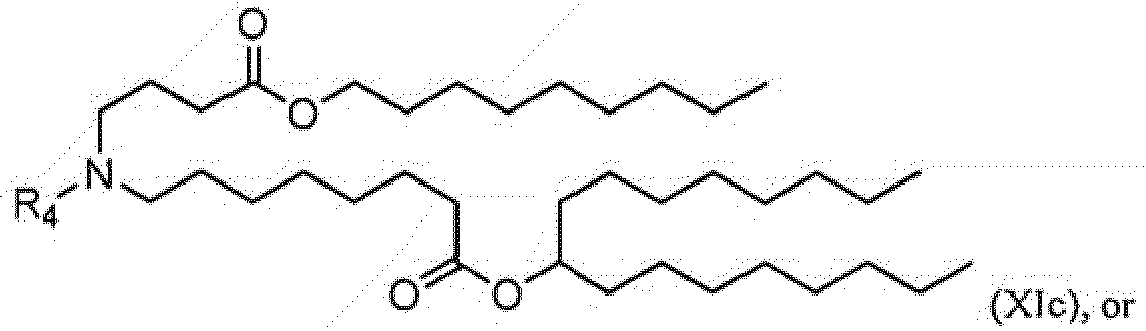

- In some embodiments, a subset of compounds of Formula (X) includes those of Formula (XId):

- In some embodiments, the compound of Formula (X) is selected from the group consisting of:


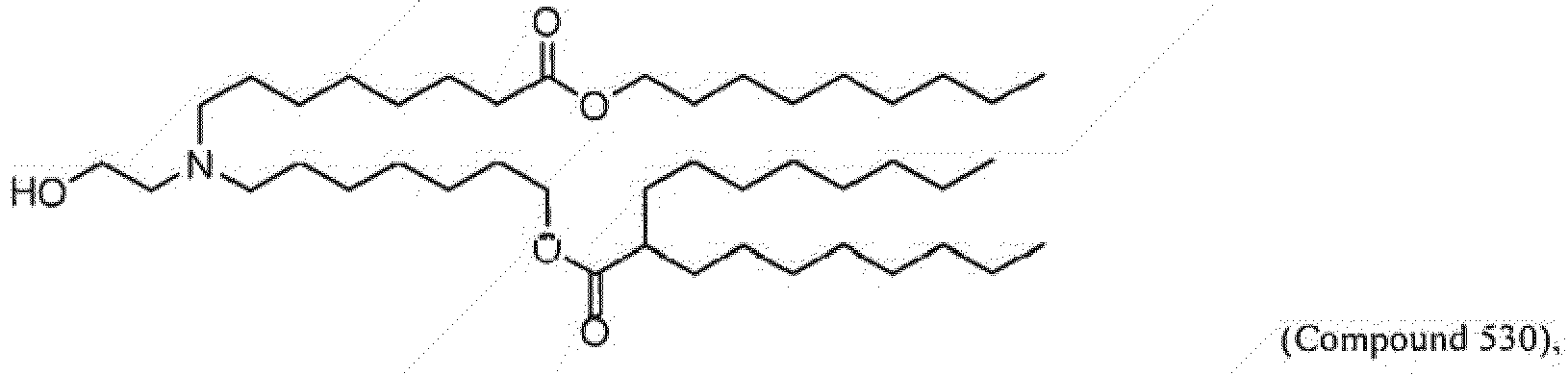


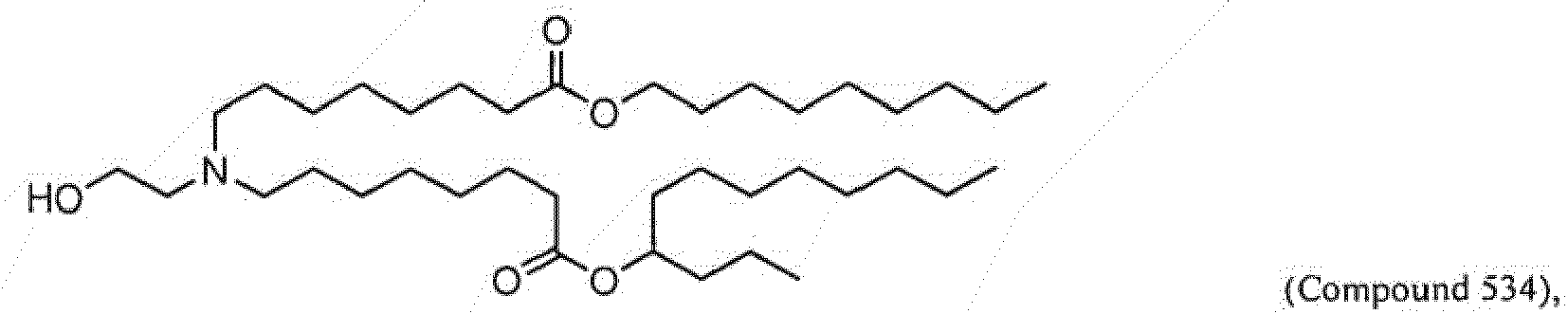


- In further embodiments, the compound of Formula (X) is selected from the group consisting of:


- In some embodiments, the compound of Formula (X) is selected from the group consisting of:








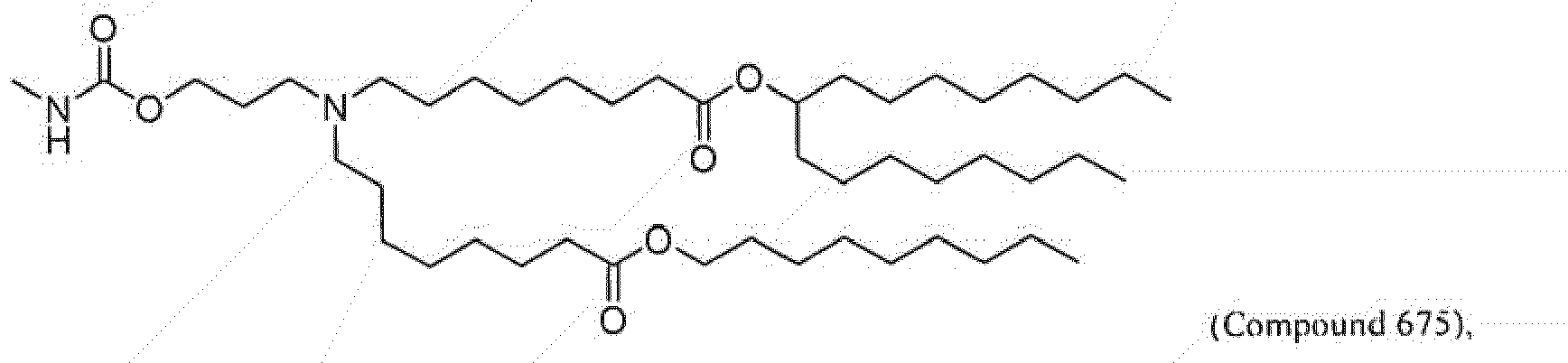





- In some embodiments, a nanoparticle comprises the following compound:

- In some embodiments, the disclosure features a nanoparticle composition including a lipid component comprising a compound as described herein (e.g., a compound according to Formula (X), (XA), (XI), (XIa), (XIb), (XIc), (XId) or (XIe)).
- The lipid component of the nanoparticle may include any neutral and/or non-cationic lipid (e.g., lipids that are neutral or non-cationic lipid at physiological pH). Non-cationic lipid lipids may include, but are not limited to, fatty acids, glycerolipids, and prenol lipids. In certain embodiments, the non-cationic lipid is a fatty acid. The fatty acid may be saturated or unsaturated. Examples of unsaturated fatty acids include, but are not limited to, myristoleic acid, palmitoleic acid sapienic acid, oleic acid, elaidic acid, vaccenic acid, linoleic acid, linoelaidic acid, alpha-linoelaidic acid arachidonic acid, eicosapentaenoic acid, erucic acid, docosahexanoic acid, or any cis/trans double-bond isomers thereof. In certain embodiments, the lipid is oleic acid. In certain embodiments, the lipid is an isomer of oleic acid (e.g., the double bond is in a different location along the aliphatic chain relative to oleic acid). In certain embodiments, the lipid is an analog of oleic acid (e.g., the aliphatic chain is 1-10 carbons longer or 1-10 carbons shorter than the aliphatic chain of oleic acid). Examples of saturated fatty acids include, but are not limited to, caprylic acid, capric acid, lauric acid, myristic acid, palmitic acid, stearic acid, arachidic acid, behenic acid, lignoceric acid, and cerotic acid. In certain embodiments, the non-cationic lipid is a glycine derivative of a fatly acid (e.g., N-palitoylglycine or N-oleoglycine) In certain embodiments, the non-cationic lipid is a glycerolipid (e.g., monoglyceride, diglyceride, triglyceride). In certain embodiments, the non-cationic lipid is a monoglyceride. In certain embodiments, the non-cationic lipid is a diglyceride. In certain embodiments, the non-cationic lipid is a triglyceride. In certain embodiments, the non-cationic lipid comprises a sugar moeity (e.g., saccharide, disaccharide, polysaccharide). Examples of non-cationic lipids include, but are not limited to, the following:





- Examples of non-cationic lipids comprising sugars include, but arc not limited to the following:


- In certain embodiments, non-cationic lipids useful in the present invention are DSPC analogs wherein the phosphocholine moiety is replaced by a different zwitterionic group.
- DSPC has the following structure:

- The replacement with a different zwitterionic group is depicted in
FIG. 73 . - In certain embodiments, the different zwitterionic group is not a phosphocholinc group. In certain embodiments, a non-cationic lipid useful in the present invention is a compound of Formula (II). Provided herein are compounds of Formula (II):
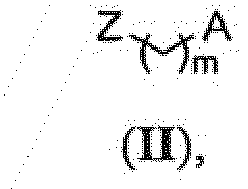
- Z is a zwitterionic moiety,
- wherein the zwitterionic moiety is not of the formula:

- m is 0, 1, 2, 3, 4, 5, 6, 7, 8, 9, or 10;
- A is of the formula:

- each instance of L2 is independently a bond or optionally substituted C1-6 alkylene, wherein one methylene unit of the optionally substituted C1-6 alkylene is optionally replaced with -O-, -N(RN)-, -S-, -C(O)-, -C(O)N(RN)-, -NRNC(O)-, -C(O)O-, -OC(O)-, - OC(O)O-, -OC(O)N(RN)-, -NRNC(O)O-, or -NRNC(O)N(RN)-;
- each instance of R2 is independently optionally substituted C1-30 alkyl, optionally substituted C1-30 alkenyl, or optionally substituted C1-30 alkynyl; optionally wherein one or more methylene units of R2 are independently replaced with optionally substituted carbocyclylene, optionally substituted heterocyclylene, optionally substituted arylene, optionally substituted heteroarylene, -N(RN)-, -O-, -S-, -C(O)-, -C(O)N(RN)-, - NRNC(O)-, -NRNC(O)N(RN)-, -C(O)O-, -OC(O)-, -OC(O)O-, -OC(O)N(RN)-, - NRNC(O)O-, -C(O)S-, -SC(O)-, -C(=NRN)-, -C(=NRN)N(RN)-, -NRNC(=NRN)-, - NRNC(=NRN)N(RN)-, -C(S)-, -C(S)N(RN)-, -NRNC(S)-, -NRNC(S)N(RN)-, -S(O)-, - OS(O)-, -S(O)O-, -OS(O)O-, -OS(O)2-, -S(O)2O-, -OS(O)2O-, -N(RN)S(O)-, - S(O)N(RN)-, -N(RN)S(O)N(RN)-, -OS(O)N(RN)-, -N(RN)S(O)O-, -S(O)2-, -N(RN)S(O)2-, -S(O)2N(RN)-, -N(RN)S(O)2N(RN)-, -OS(O)2N(RN)-, or -N(RN)S(O)2O-;
- each instance of RN is independently hydrogen, optionally substituted alkyl, or a nitrogen protecting group;
- Ring B is optionally substituted carbocyclyl, optionally substituted heterocyclyl, optionally substituted aryl, or optionally substituted heteroaryl; and
- p is 1 or 2.
- In certain embodiments, Z is an amino acid or a derivative thereof. In certain embodiments, Z is of one of the following formulae:


- In certain embodiments, a compound of Formula (II) is of one of the following formulae:


- For example, in certain embodiments, a compound of Formula (II) is one of the following:


- As described herein, non-cationic lipids useful in the present invention include analogs of oleic acid. As described herein, an oleic acid analog can comprise a modified oleic acid tail, a modified carboxylic acid moiety, or both. In certain embodiments, an analog of oleic acid is a compound of Formula (IV). Provided herein are compounds of Formula (IV):

- R4 is optionally substituted, C10-40 alkyl; optionally substituted, C10-40 alkenyl; optionally substituted, C10-40 alkynyl; wherein at least one methylene group of R4 is independently replaced with optionally substituted carbocyclylene, optionally substituted heterocyclylene, optionally substituted arylene, optionally substituted heteroarylene, -N(RN)-, -O-, -S-, -C(O)-, -C(O)N(RN)-, -NRNC(O)-, -NRNC(O)N(RN)-, -C(O)O-, -OC(O)-, - OC(O)O-, -OC(O)N(RN)-, -NRNC(O)O-, -C(O)S-, -SC(O)-, -C(=NRN)-, - C(=NRN)N(RN)-, -NRNC(=NRN)-, -NRNC(=NRN)N(RN)-, -C(S)-, -C(S)N(RN)-, - NRNC(S)-, -NRNC(S)N(RN)-, -S(O)-, -OS(O)-, -S(O)O-, -OS(O)O-, -OS(O)2-, - S(O)2O-, -OS(O)2O-, -N(RN)S(O)-, -S(O)N(RN)-, -N(RN)S(O)N(RN)-, -OS(O)N(RN)-, - N(RN)S(O)O-, -S(O)2-, -N(RN)S(O)2-, -S(O)2N(RN)-, -N(RN)S(O)2N(RN)-, - OS(O)2N(RN)-, or -N(RN)S(O)2O-; and
- each instance of RN is independently hydrogen, optionally substituted alkyl, or a nitrogen protecting group.
- In certain embodiments, the compound of Formula (IV) is one of the following:


- In certain embodiments, an oleic acid analog is a compound wherein the carboxylic acid moiety of oleic acid replaced by a different group. In certain embodiments, an oleic acid analog useful in the present invention is one of the following:






- In certain embodiments, an oleic acid analog useful in the present invention is:

- The lipid component of a nanoparticle composition may include one or more PEG or PEG-modified lipids. Such species may be alternately referred to as PEGylated lipids. A PEG lipid is a lipid modified with polyethylene glycol. A PEG lipid may be selected from the non-limiting group consisting of PEG-modified phosphatidylethanolamines, PEG-modified phosphatidic acids, PEG-modified ceramides, PEG-modified dialkylamines, PEG-modified diacylglycerols, PEG-modified dialkylglycerols, and mixtures thereof. For example, a PEG lipid may be PEG-c-DOMG, PEG-DMG, PEG-DLPE, PEG-DMPE, PEG-DPPC, or a PEG-DSPE lipid.
- In some embodiments the PEG-modified lipids are a modified form of PEG DMG. PEG-DMG has the following structure:

- In one embodiment, PEG lipids useful in the present disclosure can be PEGylated lipids described in International Publication No.
WO2012099755 . Any of these exemplary PEG lipids described herein may be modified to comprise a hydroxyl group on the PEG chain. In certain embodiments, the PEG lipid is a PEG-OH lipid. As generally defined herein, a "PEG-OH lipid" (also referred to herein as "hydroxy-PEGylated lipid") is a PEGylated lipid having one or more hydroxyl (-OH) groups on the lipid. In certain embodiments, the PEG-OH lipid includes one or more hydroxyl groups on the PEG chain. In certain embodimetns, a PEG-OH or hydroxy-PEGylated lipid comprises an -OH group at the terminus of the PEG chain. - In certain embodiments, a PEG lipid useful in the present disclosure is a compound of Formula (III). Provided herein are compounds of Formula (III):


- R3 is -ORO;
- RO is hydrogen, optionally substituted alkyl, or an oxygen protecting group;
- r is an integer between 1 and 100, inclusive;
- L1 is optionally substituted C1-10 alkylene, wherein at least one methylene of the optionally substituted C1-10 alkylene is independently replaced with optionally substituted carbocyclylene, optionally substituted heterocyclylene, optionally substituted arylene, optionally substituted heteroarylene, -O-, -N(RN)-, -S-, -C(O)-, -C(O)N(RN)-, - NRNC(O)-, -C(O)O-, -OC(O)-, -OC(O)O-, -OC(O)N(RN)-, -NRNC(O)O-, or - NRNC(O)N(RN)-;
- D is a moiety obtained by click chemistry or a moiety cleavable under physiological conditions;
- m is 0, 1, 2, 3, 4, 5, 6, 7, 8, 9, or 10;
- A is of the formula:

- each instance of L2 is independently a bond or optionally substituted C1-6 alkylene, wherein one methylene unit of the optionally substituted C1-6 alkylene is optionally replaced with O , N(RN)-, -S-, -C(O)-, -C(O)N(RN)-, -NRNC(O)-, -C(O)O-, -OC(O)-, - OC(O)O-, -OC(O)N(RN)-, -NRNC(O)O-, or -NRNC(O)N(RN)-;
- each instance of R2 is independently optionally substituted C1-30 alkyl, optionally substituted C1-30 alkenyl, or optionally substituted C1-30 alkynyl; optionally wherein one or more methylene units of R2 are independently replaced with optionally substituted carbocyclylene, optionally substituted heterocyclylene, optionally substituted arylene, optionally substituted heteroarylene, -N(RN)-, -O-, -S-, -C(O)-, -C(O)N(RN)-, - NRNC(O)-, -NRNC(O)N(RN)-, -C(O)O-, -OC(O)-, -OC(O)O-, -OC(O)N(RN)-, - NRNC(O)O-, -C(O)S-, -SC(O)-, -C(=NRN)-, -C(=NRN)N(RN)-, -NRNC(=NRN)-, - NRNC(=NRN)N(RN)-, -C(S)-, -C(S)N(RN)-, -NRNC(S)-, -NRNC(S)N(RN)-, -S(O)-, - OS(O)-, -S(O)O-, -OS(O)O-, -OS(O)2-, -S(O)2O-, -OS(O)2O-, -N(RN)S(O)-, - S(O)N(RN)-, -N(RN)S(O)N(RN)-, -OS(O)N(RN)-, -N(RN)S(O)O-, -S(O)2-, -N(RN)S(O)2-, -S(O)2N(RN)-, -N(RN)S(O)2N(RN)-, -OS(O)2N(RN)-, or -N(RN)S(O)2O-;
- each instance of RN is independently hydrogen, optionally substituted alkyl, or a nitrogen protecting group;
- Ring B is optionally substituted carbocyclyl, optionally substituted heterocyclyl, optionally substituted aryl, or optionally substituted heteroaryl; and
- p is 1 or 2.
- In certain embodiments, the compound of Fomula (III) is a PEG-OH lipid (i.e., R3 is -ORO, and RO is hydrogen). In certain embodiments, the compound of Formula (III) is of Formula (III-OH):

- In certain embodiments, D is a moiety obtained by click chemistry (e.g., triazole). In certain embodiments, the compound of Formila (III) is of Formula (III-a-1) or (III-a-2):

- In certain embodiments, the compound of Formula (III) is of one of the following formulae:


s is 0, 1, 2, 3, 4, 5, 6, 7, 8. 9, or 10. - In certain embodiments, the compound of Formula (III) is of one of the following formulae:


- In certain embodiments, a compound of Formula (III) is of one of the following formulae:


- In certain embodiments, a compound of Formula (III) is of one of the following formulae:


- In certain embodiments, D is a moiety cleavable under physiological conditions (e.g., ester, amide, carbonate, carbamate, urea). In certain embodiments, a compound of Formula (III) is of Formula (III-b-1) or (III-b-2):
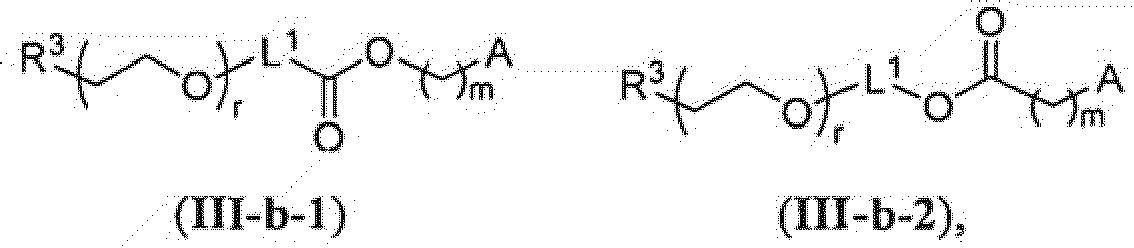
- In certain embodiments, a compound of Formula (III) is of Formula (III-b-1-OH) or (III-b-2-OH):

- In certain embodiments, the compound of Formula (III) is of one of the following formulae:


- In certain embodiments, a compound of Formula (III) is of one of the following formulae:


- In certain embodiments, a compound of Formula (III) is of one of the following formulae:


- In certain embodiments, a compound of Formula (III) is of one of the following formulae:


- In certain embodiments, a PEG lipid useful in the present disclosure is a PEGylatcd fatty acid. In certain embodiments, a PEG lipid useful in the present disclosure is a compound of Formula (V). Provided herein are compounds of Formula (V):

- R3 is-ORO;
- RO is hydrogen, optionally substituted alkyl or an oxygen protecting group;
- r is an integer between 1 and 100, inclusive;
- R5 is optionally substituted C10-40 alkyl, optionally substituted C10-40 alkenyl, or optionally substituted C10-40 alkynyl; and optionally one or more methylene groups of R5 are replaced with optionally substituted carbocyclylene, optionally substituted heterocyclylene, optionally substituted arylene, optionally substituted heteroarylene, -N(RN)-, -O-, -S-, - C(O)-, -C(O)N(RN)-, -NRNC(O)-, -NRNC(O)N(RN)-, -C(O)O-, -OC(O)-, -OC(O)O-,-OC(O)N(RN)-, -NRNC(O)O-, -C(O)S-, -SC(O)-, -C(=NRN)-, -C(=NRN)N(RN)-,-NRNC(=NRN)-, -NRNC(=NRN)N(RN)-, -C(S)-, -C(S)N(RN)-, -NRNC(S)-,-NRNC(S)N(RN)-, -S(O)-, -OS(O)-, -S(O)O-, -OS(O)O-, -OS(O)2-, -S(O)2O-,-OS(O)2O-, -N(RN)S(O)-, -S(O)N(RN)-, -N(RN)S(O)N(RN)-, -OS(O)N(RN)-,-N(RN)S(O)O-, -S(O)2-, -N(RN)S(O)2-, -S(O)2N(RN)-, -N(RN)S(O)2N(RN)-,-OS(O)2N(RN)-, or -N(RN)S(O)2O-; and
- each instance of RN is independently hydrogen, optionally substituted alkyl, or a nitrogen protecting group.
- In embodiments of the invention, the compound of Formula (V) is of Formula (V-OII):

- In certain embodiments, a compound of Formula (V) is of one of the following formulae:





- Numerous LNP formulations having different PEG-lipids were prepared and tested for activity, as demonstrated in the Examples included below.
- Phospholipids, as defined herein, are any lipids that comprise a phosphate group. Phospholipids are a subset of non-cationic lipids. The lipid component of a nanoparticlc composition may include one or more phospholipids, such as one or more (poly)unsaturated lipids. Phospholipids may assemble into one or more lipid bilayers. In general, phospholipids may include a phospholipid moiety and one or more fatty acid moieties. A phospholipid moiety may be selected from the non-limiting group consisting of phosphatidyl choline, phosphatidyl ethanolamine, phosphatidyl glycerol, phosphatidyl serine, phosphatidic acid, 2-lysophosphatidyl choline, and a sphingomyelin. A fatty acid moiety may be selected from the non-limiting group consisting of lauric acid, myristic acid, myristoleic acid, palmitic acid, palmitoleic acid, stearic acid, oleic acid, linoleic acid, alpha-linolenic acid, erucic acid, phytanoic acid, arachidic acid, arachidonic acid, eicosapentaenoic acid, behenic acid, docosapentaenoic acid, and docosahexaenoic acid. Non-natural species including natural species with modifications and substitutions including branching, oxidation, cyclization, and alkynes are also contemplated. For example, a phospholipid may be functionalized with or cross-linked to one or more alkynes (e.g., an alkenyl group in which one or more double bonds is replaced with a triple bond). Under appropriate reaction conditions, an alkync group may undergo a copper-catalyzed cycloaddition upon exposure to an azide. Such reactions may be useful in functionalizing a lipid bilayer of a nanoparticle composition to facilitate membrane permeation or cellular recognition or in conjugating a nanoparticle composition to a useful component such as a targeting or imaging moiety (e.g., a dye). Each possibility represents a separate embodiment of the present invention.
- Phospholipids useful in the compositions and methods may be selected from the non-limiting group consisting of 1,2-distearoyl-sn-glycero-3-phosphocholine (DSPC), 1,2-diolcoyl-sn-glycero-3-phosphoethanolamine (DOPE), 1,2-dilinoleoyl-sn-glycero-3-phosphocholine (DLPC), 1,2-dimyrisloyl-sn-glycero-phosphocholine (DMPC), 1,2 dioleoyl sn glyoero 3 phosphocholine (DOPC), 1,2-dipalmitoyl-sn-glycero-3-phosphocholine (DPPC), 1,2-diundecanoyl-sn-glycero-phosphocholine (DUPC), 1-palmitoyl-2-oleoyl-sn-glycero-3-phosphocholine (POPC), 1,2-di-O-octadecenyl-sn-glycero-3-phosphocholine (18:0 Diether PC), 1-oleoyl-2-cholesterylhemisuccinoyl-sn-glycero-3-phosphocholine (OChemsPC), 1-hexadecyl-sn-glycero-3-phosphocholine (C16 Lyso PC), 1,2-dilinolenoyl-sn-glycero-3-phosphocholine, 1,2-diarachidonoyl-sn-glycero-3-phosphocholine, 1,2-didocosahexaenoyl-sn-glyccro-3-phosphocholine, 1,2-diphytanoyl-sn-glycero-3-phosphoethanolamine (ME 16.0 PE), 1,2-distearoyl-sn-glycero-3-phosphoethanolamine, 1,2-dilinoleoyl-sn-glycero-3-phosphoethanolamine, 1,2-dilinolenoyl-sn-glycero-3-phosphoethanolamine, 1,2-diarachidonoyl-sn-glycero-3-phosphoethanolamine, 1,2-didocosahexaenoyl-sn-glycero-3-phosphoethanolamine, 1,2-dioleoyl-sn-glycero-3-phospho-rac-(1-glycerol) sodium salt (DOPG), and sphingomyelin. Each possibility represents a separate embodiment of the present invention.
- In some embodiments, a nanoparticle composition includes DSPC. In certain embodiments, a nanoparticle composition includes DOPE. In some embodiments, a nanoparticle composition includes both DSPC and DOPE. Examples of phospholipids include, but are not limited to, the following:





- In certain embodiments, a phospholipid useful in the present invention is an analog or variant of DSPC. In certain embodiments, a phospholipid useful in the present invention is a compound of Formula (I):

- each R1 is independently optionally substituted alkyl; or optionally two R1 are joined together with the intervening atoms to form optionally substituted monocyclic carbocyclyl or optionally substituted monocyclic heterocyclyl; or optionally three R1 are joined together with the intervening atoms to form optionally substituted bicyclic carbocyclyl or optionally substitute bicyclic heterocyclyl;
- n is 1, 2, 3, 4, 5, 6, 7, 8, 9, or 10;
- m is 0, 1, 2, 3, 4, 5, 6, 7, 8, 9, or 10;
- A is of the formula:

- each instance of L2 is independently a bond or optionally substituted C1-6 alkylene, wherein one methylene unit of the optionally substituted C1-6 alkylene is optionally replaced with -O-. -N(RN)-, -S-, -C(O)-, -C(O)N(RN)-, -NRNC(O)-, -C(O)O-, -OC(O)-,-OC(O)O-, -OC(O)N(RN)-, -NRNC(O)O-, or -NRNC(O)N(RN)-;
- each instance of R2 is independently optionally substituted C1-30 alkyl, optionally substituted C1-30 alkenyl, or optionally substituted C1-30 alkynyl; optionally wherein one or more methylene units of R2 are independently replaced with optionally substituted carbocyclylene, optionally substituted heterocyclylene, optionally substituted arylene, optionally substituted heteroarylene, -N(RN)-, -O-, -S-, -C(O)-, -C(O)N(RN)-,-NRNC(O)-, -NRNC(O)N(RN)-, -C(O)O-, -OC(O)-, -OC(O)O-, -OC(O)N(RN)-,-NRNC(O)O-, -C(O)S-, -SC(O)-, -C(=NRN)-, -C(=NRN)N(RN)-, -NRNC(=NRN)-,-NRNC(=NRN)N(RN)-, -C(S)-, -C(S)N(RN)-, -NRNC(S)-, -NRNC(S)N(RN)-, -S(O)-,-OS(O)-, -S(O)O-, -OS(O)O-, -OS(O)2-, -S(O)2O-, -OS(O)2O-, -N(RN)S(O)-,-S(O)N(RN)-, -N(RN)S(O)N(RN)-, -OS(O)N(RN)-, -N(RN)S(O)O-, -S(O)2-, -N(RN)S(O)2-, -S(O)2N(RN)-, -N(RN)S(O)2N(RN)-, -OS(O)2N(RN)-, or -N(RN)S(O)2O-;
- each instance of RN is independently hydrogen, optionally substituted alkyl, or a nitrogen protecting group;
- Ring B is optionally substituted carbocyclyl, optionally substituted heterocyclyl, optionally substituted aryl, or optionally substituted heteroaryl; and
- p is 1 or 2;
- provided that the compound is not of the formula:

- In certain embodiments, a phospholipid useful in the present invention comprises a modified phospholipid head (e.g., a modified choline group). In certain embodiments, a phospholipid with a modified head is DSPC, or analog thereof, with a modified quaternary amine. For example, in embodiments of Formula (I), at least one of R1 is not methyl. In certain embodiments, at least one of R1 is not hydrogen or methyl. In certain embodiments, the compound of Formula (I) is of one of the following formulae:


- each t is independently 1, 2, 3, 4, 5, 6, 7, 8, 9, or 10;
- each u is independently 0, 1, 2, 3, 4, 5, 6, 7, 8, 9, or 10; and
- each v is independently 1, 2, or 3.
- In certain embodiments, the compound of Formula (I) is of one of the following formulae:


- In certain embodiments, a compound of Formula (I) is one of the following:
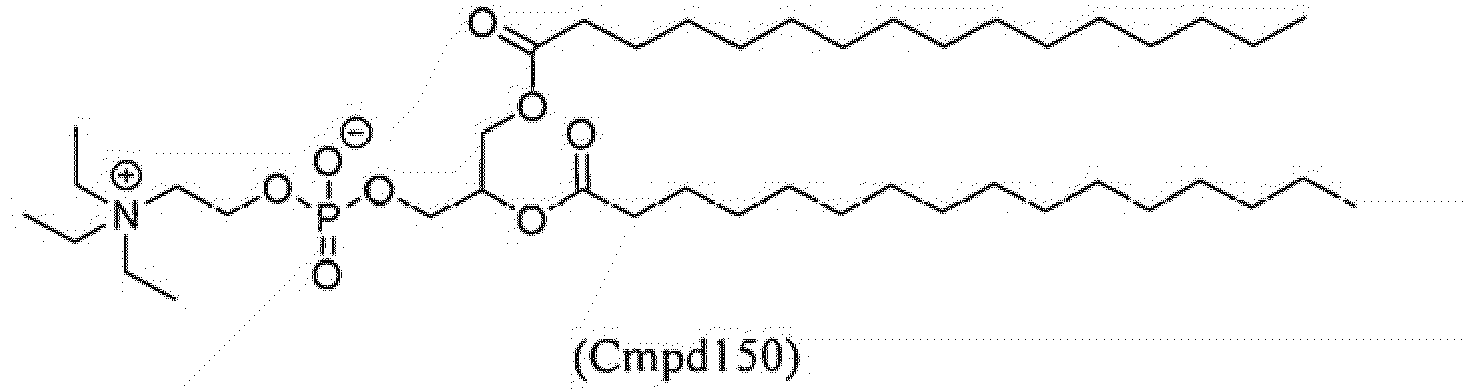


- In certain embodiments, a compound of Formula (I) is of Formula (I-a):

- In certain embodiments, phospholipids useful in the present invention comprise a modified core (see, e.g., FIG 47B). In certain embodiments, a phospholipid with a modified core described herein is DSPC, or analog thereof, with a modified core structure. For example, in certain embodiments of Formula (I-a), group A is not of the following formula:

- In certain embodiments, the compound of Formula (I-a) is of one of the following formulae:


- In certain embodiments, a compound of Formula (I) is one of the following:


- In certain embodiments, a phospholipid useful in the present invention comprises a cyclic moiety in place of the glyceride moiety. In certain embodiments, a phospholipid useful in the present invention is DSPC, or analog thereof, with a cyclic moiety in place of the glyceride moiety. In certain embodiments In certain embodiments, the compound of Formula (I) is of Formula (I-b):

- In certain embodiments, the compound of Formula (I-b) is of Formula (I-b-1):

w is 0, 1, 2, or 3. - In certain embodiments, the compound of Formula (I-b) is of Formula (I-b-2):

- In certain embodiments, the compound of Formula (I-b) is of Formula (I-b-3):

- In certain embodiments, the compound of Formula (I-b) is of Formula (I-b-4):

- In certain embodiments, the compound of Formula (I-b) is one of the following:


- In certain embodiments, a phospholipid useful in the present invention comprises a modified tail. In certain embodiments, a phospholipid useful in the present invention is DSPC, or analog thereof, with a modified tail. As described herein, a "modified tail" may be a tail with shorter or longer aliphatic chains, aliphatic chains with branching introduced, aliphatic chains with substituents introduced, aliphatic chains wherein one or more methylenes are replaced by cyclic or heteroatom groups, or any combination thereof. For example, in certain embodiments, the compound of (I) is of Formula (I-a), or a salt thereof, wherein at least one instance of R2 is each instance of R2 is optionally substituted C1-30 alkyl, wherein one or more methylene units of R2 are independently replaced with optionally substituted carbocyclylene, optionally substituted heterocyclylene, optionally substituted arylene, optionally substituted heteroarylene, -N(RN)-, -O-, -S-, -C(O)-, -C(O)N(RN)-,-NRNC(O)-, -NRNC(O)N(RN)-, -C(O)O-, -OC(O)-, -OC(O)O-, -OC(C))N(RN)-,-NRNC(O)O-, -C(O)S-, -SC(O)-, -C(=NRN)-, -C(-NRN)N(RN)-, -NRNC(=NRN)-,-NRNC(=NRN)N(RN)-, -C(S)-, -C(S)N(RN)-, -NRNC(S)-, -NRNC(S)N(RN)-, -S(O)-,-OS(O)-, -S(O)O-, -OS(O)O-, -OS(O)2-, -S(O)2O-, -OS(O)2O-, -N(RN)S(O)-,-S(O)N(RN)-. -N(RN)S(O)N(RN)-, -OS(O)N(RN)-, N(RN)S(O)O-, -S(O)2-, -N(RN)S(O)2-, -S(O)2N(RN)-, -N(RN)S(O)2N(RN)-, -OS(O)2N(RN)-, or -N(RN)S(O)2O-.
- In certain embodiments, the compound of Formula (I-a) is of Formula (I-c):

- each x is independently an integer between 0-30, inclusive; and
- each instance is G is independently selected from the group consisting of optionally substituted carbocyclylene, optionally substituted heterocyclylene, optionally substituted arylene, optionally substituted heteroarylene, -N(RN)-, -O-, -S-, -C(O)-, -C(O)N(RN)-, - NRNC(O)-, -NRNC(O)N(RN)-, -C(O)O-, -OC(O)-, -OC(O)O-, -OC(O)N(RN)-,-NRNC(O)O-, -C(O)S-, -SC(O)-, -C(=NRN)-, -C(=NRN)N(RN)-, -NRNC(=NRN}-,-NRNC(=NRN)N(RN)-, -C(S)-, -C(S)N(RN)-, -NRNC(S)-, -NRNC(S)N(RN)-, -S(O)-,-OS(O)-, -S(O)O-, -OS(O)O-, -OS(O)2-, -S(O)2O-, -OS(O)2O-, -N(RN)S(O)-,-S(O)N(RN)-, -N(RN)S(O)N(RN)-, -OS(O)N(RN)-, -N(RN)S(O)O-, -S(O)2-, -N(RN)S(O)2-, -S(O)2N(RN)-, N(RN)S(O)2N(RN)-, -OS(O)2N(RN)-, or -N(RN)S(O)2O-. Each possibility represents a separate embodiment of the present invention.
- In certain embodiments, the compound of Formula (I-c) is of Formula (I-c-1):

each instance of v is independently 1, 2, or 3. - In certain embodiments, the compound of Formula (I-c) is of Formula (I-c-2):

- In certain embodimenrs, the compound of Formula (I-c) is of the following formula:

- In certain embodiments, the compound of Formula (I-c) is the following:

- In certain embodiments, the compound of Formula (I-c) is of Formula (I-c-3):

- In certain embodiments, the compound of Formula (I-c) is of the following formulae:

- In certain embodiments, the compound of Formula (I-c) is the following:

- In certain embodiments, a phospholipid useful in the present invention comprises a modified phosphocholine moiety, wherein the alkyl chain linking the quaternary amine to the phosphoryl group is not ethylene (e.g., n is not 2). Therefore, in certain embodiments, a phospholipid useful in the present invention is a compound of Formula (I), wherein n is 1, 3, 4, 5, 6, 7, 8, 9, or 10. For example, in certain embodiments, a compound of Formula (I) is of one of the following formulae:

- In certain embodiments, a compound of Formula (I) is one of the following:


- Numerous LNP formulations having phospholipids other than DSPC were prepared and tested for activity, as demonstrated in the examples below. Exemplary phospholipids are shown in the Figures, including Figs. 75A, 75D and 75Emissing.
- The following Table provides a summary of the phospholipids and indicates which examples include data on the phospholipids.
Compound Name Common Name Example testing lipid Formulation Oleic acid OL 23 MC3:OL:Chol:PEG-DMG Cmpd393 Trialkyl 25 MC3:PC:Chol:PEG-DMG Cmpd125 Dialkyl 23 MC3:PC:Chol:PEG-DMG Cmpd-148 OL 25 MC3:OL:Chol:PEG-DMG Cmpd- 149 OL 23 MC3:OL:Chol:PEG-DMG Cmpd-150 PC 23 MC3:PC:Chol:PEG-DMG Cmpd-151 PC 23 MC3:PC:Chol:PEG-DMG Cmpd-152 PC 23 MC3:PC:Chol:PEG-DMG Cmpd-153 PC 23 MC3:PC:Chol:PEG-DMG DOPC PC 22 MC3:PC:Chol:PEG-DMG Oleic add FA 22 MC3:PC:Chol:PEG-DMG DOCP PC 22 MC3:PC:Chol:PEG-DMG DOCPe PC 22 MC3:PC:Chol:PEG-DMG DOPE PE 22 MC3:PC:Chol:PEG-DMG DOPG PG 22 MC3:PC:Chol:PEG-DMG DOPA PA 22 MC3:PC:Chol:PEG-DMG DOPS 0.1% PS 22 MC3:OL:Chol:PEG-DMG DOPS 1% PS 22 MC3:OL:Chol:PEG-DMG DOPS 1% PS 22 MC3:PC:Chol:PEG-DMG Cmpd-279 PC 23 MC3:PC:Chol:PEG-DMG Cmpd-280 PC 23 MC3:PC:Chol:PEG-DMG Cmpd-281 PC 23 MC3:PC:Chol:PEG-DMG Cmpd-160 PC 25 MC3:PC:Chol:PEG-DMG Cmpd-161 PC 25 MC3:PC:Chol:PEG-DMG Cmpd-162 PC 25 MC3:PC:Chol:PEG-DMG Cmpd-163 PC 25 MC3:PC:Chol:PEG-DMG Cmpd-157 OL 25 MC3:OL:Chol:PEG-DMG Cmpd-158 OL 25 MC3:OL:Chol:PEG-DMG Cmpd-159 OL 25 MC3:OL:Chol:PEG-DMG Cmpd-164 PC 25 MC3:PC:Chol:PEG-DMG Cmpd-165 PC 25 MC3:PC:Chol:PEG-DMG Cmpd-166 PC 25 MC3:PC:Chol:PEG-DMG DSPC PC 24 Cmpd18:PC:Chol:PEG-DMG (50:1-:38.5:1.5) DPPC PC 24 Cmpd18:PC:Chol:PEG-DMG (50:1-:38.5:1.5) DMPC PC 24 Cmpd18:PC:Chol:PEG-DMG (50:1-:38.5:1.5) SMPC PC 24 Cmpd18:PC:Chol:PEG-DMG (50:1-:38.5:1.5) OMPC PC 24 Cmpd18:PC:Chol:PEG-DMG (50:1-:38.5:1.5) SPPC 24 Cmpd18:PC:Chol:PEG-DMG (50:1-:38.5:1.5) OPPC 24 Cmpd18:PC:Chol:PEG-DMG (50:1-:30.5:1.5) PSPC 24 Cmpd18:PC:Chol:PEG-DMG (50:1-:38.5:1.5) POPC PC 24 Cmpd18:PC:Chol:PEG-DMG (50:1-:38.5:1.5) PLPC PC 24 Cmpd18:PC:Chol:PEG-DMG (50:1-:38.5:1.5) PMPC PC 24 Cmpd18:PC:Chol:PEG-DMG (50:1-:38.5:1.5) MSPC PC 24 Cmpd18:PC:Chol:PEG-DMG (50:1-:38.5:1.5) Steric acid OL 24 Oleic Acid OL 24 Linoleic Acid OL 24 - The lipid component of a nanoparticle composition may include one or more structural lipids. Incorporation of structural lipids in the lipid nanoparticle may help mitigate aggregation of other lipids in the particle. Structural lipids can be selected from the group consisting of, but are not limited to, cholesterol, fecosterol, sitosterol, ergosterol, campesterol, stigmasterol, brassicasterol, tomatidine, tomatine, ursolic acid, alpha-tocopherol, hopanoids, phytosterols, steroids, and mixtures thereof. In some embodiments, the structural lipid is a sterol. As defined herein, "sterols" are a subgroup of steroids consisting of steroid alcohols. In certain embodiments, the structural lipid is a steroid. In certain embodiments, the structural lipid is cholesterol. In certain embodiments, the structural lipid is an analog of cholesterol. In certain embodiments, the structural lipid is alpha-tocopherol. Examples of structural lipids include, but are not limited to, the following:


- Definitions of specific functional groups and chemical terms are described in more detail below. The chemical elements are identified in accordance with the Periodic Table of the Elements, CAS version, Handbook of Chemistry and Physics, 75th Ed., inside cover, and specific functional groups are generally defined as described therein. Additionally, general principles of organic chemistry, as well as specific functional moieties and reactivity, arc described in Organic Chemistry. Thomas Sorrell, University Science Books, Sausalito, 1999; Smith and March, March's Advanced Organic Chemistry, 5th Edition, John Wiley & Sons, Inc., New York, 2001; Larock, Comprehensive Organic Transformations, VCH Publishers, Inc., New York, 1989; and Carruthers, Some Modern Methods of Organic Synthesis, 3rd Edition, Cambridge University Press, Cambridge, 1987.
- Compounds described herein can comprise one or more asymmetric centers, and thus can exist in various stereoisomeric forms, e.g., enantiomers and/or diastereomers. For example, the compounds described herein can be in the form of an individual enantiomer, diastereomer or geometric isomer, or can be in the form of a mixture of stereoisomers, including racemic mixtures and mixtures enriched in one or more stereoisomer. Isomers can be isolated from mixtures by methods known to those skilled in the art, including chiral high pressure liquid chromatography (HPLC) and the formation and crystallization of chiral salts; or preferred isomers can be prepared by asymmetric syntheses. See, for example, Jacques et al., Enantiomers, Racemates and Resolutions (Wiley Interscience, New York, 1981); Wilen et al., Tetrahedron 33:2725 (1977); Eliel, E.L. Stereochemistry of Carbon Compounds (McGraw-Hill, NY, 1962); and Wilen, S.H., Tables of Resolving Agents and Optical Resolutions p. 268 (E.L. Eliel, Ed., Univ. of Notre Dame Press, Notre Dame, IN 1972). The invention additionally encompasses compounds as individual isomers substantially free of other isomers, and alternatively, as mixtures of various isomers.
- In a formula,is a single bond where the stereochemistry of the moieties immediately attached thereto is not specified, --- is absent or a single bond, and
 or
or is a single or double bond.
- Unless otherwise stated, structures depicted herein are also meant to include compounds that differ only in the presence of one or more isotopically enriched atoms. For example, compounds having the present structures except for the replacement of hydrogen by deuterium or tritium, replacement of 19F with 18F, or the replacement of 12C with 13C or 14C are within the scope of the disclosure. Such compounds are useful, for example, as analytical tools or probes in biological assays.
- When a range of values is listed, it is intended to encompass each value and sub-range within the range. For example "C1-6 alkyl" is intended to encompass, C1, C2, C3, C4, C5, C6, C1-6, C1-5, C1-4, C1-3, C1-2, C2-6, C2-5, C2-4, C2-3, C3-6, C3-5, C3-4, C4-6, C4-3, and C5-6 alkyl.
- The term "aliphatic" refers to alkyl, alkenyl, alkynyl, and carbocyclic groups. Likewise, the term "heteroaliphatic" refers to heteroalkyl, heteroalkenyl, heteroalkynyl, and heterocyclic groups.
- The term "alkyl" refers to a radical of a straight-chain or branched saturated hydrocarbon group having from 1 to 10 carbon atoms ("C1-10 alkyl"). In some embodiments, an alkyl group has 1 to 9 carbon atoms ("C1-9 alkyl"). In some embodiments, an alkyl group has 1 to 8 carbon atoms ("C1-8 alkyl"). In some embodiments, an alkyl group has 1 to 7 carbon atoms ("C1-7 alkyl"). In some embodiments, an alkyl group has 1 to 6 carbon atoms ("C1-6 alkyl"). In some embodiments, an alkyl group has 1 to 5 carbon atoms ("C1-5 alkyl"). In some embodiments, an alkyl group has 1 to 4 carbon atoms ("C1-4 alkyl"). In some embodiments, an alkyl group has 1 to 3 carbon atoms ("C1-3 alkyl"). In some embodiments, an alkyl group has 1 to 2 carbon atoms ("C1-2 alkyl"). In some embodiments, an alkyl group has 1 carbon atom ("C1 alkyl"). In some embodiments, an alkyl group has 2 to 6 carbon atoms ("C2-6 alkyl"). Examples of C1-6 alkyl groups include methyl (C1), ethyl (C2), propyl (C3) (e.g., n-propyl, isopropyl), butyl (C4) (e.g., n-butyl, tert-butyl, sec-butyl, iso-butyl), pentyl (C5) (e.g., n-pentyl, 3-pentanyl, amyl, neopentyl, 3-methyl-2-butanyl, tertiary amyl), and hexyl (C6) (e.g., n-hexyl). Additional examples of alkyl groups include n-heptyl (C7), n-octyl (C8), and the like. Unless otherwise specified, each instance of an alkyl group is independently unsubstituted (an "unsubstituted alkyl") or substituted (a "substituted alkyl") with one or more substituents (e.g., halogen, such as F). In certain embodiments, the alkyl group is an unsubstituted C1-10 alkyl (such as unsubstituted C1-6 alkyl, e.g., -CH3 (Me), unsubstituted ethyl (Et), unsubstituted propyl (Pr, e.g., unsubstituted n-propyl (n-Pr), unsubstituted isopropyl (i-Pr)), unsubstituted butyl (Bu, e.g., unsubstituted n-butyl (n-Bu), unsubstituted tert-butyl (tert-Bu or t-Bu), unsubstituted sec-butyl (sec-Bu), unsubstituted isobutyl (i-Bu)). In certain embodiments, the alkyl group is a substituted C1-10 alkyl (such as substituted C1-6 alkyl, e.g., -CF3, Bn).
- The term "haloalkyl" is a substituted alkyl group, wherein one or more of the hydrogen atoms are independently replaced by a halogen, e.g., fluoro, bromo, chloro, or iodo. In some embodiments, the haloalkyl moiety has 1 to 8 carbon atoms ("C1-8 haloalkyl"). In some embodiments, the haloalkyl moiety has 1 to 6 carbon atoms ("C1-6 haloalkyl"). In some embodiments, the haloalkyl moiety has 1 to 4 carbon atoms ("C1-4 haloalkyl"). In some embodiments, the haloalkyl moiety has 1 to 3 carbon atoms ("C1-3 haloalkyl"). In some embodiments, the haloalkyl moiety has 1 to 2 carbon atoms ("C1-2 haloalkyl"). Examples of haloalkyl groups include -CHF2, -CH2F, -CF3, -CH2CF3, -CF2CF3, -CF2CF2CF3, -CCl3. -CFCl2, -CF2Cl, and the like.
- The term "heteroalkyl" refers to an alkyl group, which further includes at least one heteroatom (e.g., 1, 2, 3, or 4 heteroatoms) selected from oxygen, nitrogen, or sulfur within (i.e., inserted between adjacent carbon atoms of) and/or placed at one or more terminal position(s) of the parent chain. In certain embodiments, a heteroalkyl group refers to a saturated group having from 1 to 10 carbon atoms and 1 or more heteroatoms within the parent chain ("heteroC1-10 alkyl"). In some embodiments, a heteroalkyl group is a saturated group having 1 to 9 carbon atoms and 1 or more heteroatoms within the parent chain ("heteroC1-9 alkyl"). In some embodiments, a heteroalkyl group is a saturated group having 1 to 8 carbon atoms and 1 or more heteroatoms within the parent chain ("heteroC1-8 alkyl"). In some embodiments, a heteroalkyl group is a saturated group having 1 to 7 carbon atoms and 1 or more heteroatoms within the parent chain ("heteroC1-7 alkyl"). In some embodiments, a heteroalkyl group is a saturated group having 1 to 6 carbon atoms and 1 or more heteroatoms within the parent chain ("heteroC1-6 alkyl"). In some embodiments, a heteroalkyl group is a saturated group having 1 to 5 carbon atoms and 1 or 2 heteroatoms within the parent chain ("heteroC1-5 alkyl"). In some embodiments, a heteroalkyl group is a saturated group having 1 to 4 carbon atoms and
1or 2 heteroatoms within the parent chain ("heteroC1-4 alkyl"). In some embodiments, a heteroalkyl group is a saturated group having 1 to 3 carbon atoms and 1 heteroatom within the parent chain ("heteroC1-3 alkyl"). In some embodiments, a heteroalkyl group is a saturated group having 1 to 2 carbon atoms and 1 heteroatom within the parent chain ("heteroC1-2 alkyl"). In some embodiments, a heteroalkyl group is a saturated group having 1 carbon atom and 1 heteroatom ("heteroC1 alkyl"). In some embodiments, a heteroalkyl group is a saturated group having 2 to 6 carbon atoms and 1 or 2 heteroatoms within the parent chain ("heteroC2-6 alkyl"). Unless otherwise specified, each instance of a heteroalkyl group is independently unsubstituted (an "unsubstituted heteroalkyl") or substituted (a "substituted heteroalkyl") with one or more substituents. In certain embodiments, the heteroalkyl group is an unsubstituted heteroC1-10 alkyl. In certain embodiments, the heteroalkyl group is a substituted heteroC1-10 alkyl. - The term "alkenyl" refers to a radical of a straight-chain or branched hydrocarbon group having from 2 to 10 carbon atoms and one or more carbon-carbon double bonds (e.g., 1, 2, 3, or 4 double bonds). In some embodiments, an alkenyl group has 2 to 9 carbon atoms ("C2-9 alkenyl"). In some embodiments, an alkenyl group has 2 to 8 carbon atoms ("C2-8 alkenyl"). In some embodiments, an alkenyl group has 2 to 7 carbon atoms ("C2-7 alkenyl"). In some embodiments, an alkenyl group has 2 to 6 carbon atoms ("C2-6 alkenyl"). In some embodiments, an alkenyl group has 2 to 5 carbon atoms ("C2-5 alkenyl"). In some embodiments, an alkenyl group has 2 to 4 carbon atoms ("C2-4 alkenyl"). In some embodiments, an alkenyl group has 2 to 3 carbon atoms ("C2-3 alkenyl"). In some embodiments, an alkenyl group has 2 carbon atoms ("C2 alkenyl"). The one or more carbon-carbon double bonds can be internal (such as in 2-butenyl) or terminal (such as in 1-butenyl). Examples of C2-4 alkenyl groups include ethenyl (C2), 1-propenyl (C3), 2-propenyl (C3), 1-butenyl (C4), 2-butenyl (C4), butadienyl (C4), and the like. Examples of C2-6 alkenyl groups include the aforementioned C2-4 alkenyl groups as well as pentenyl (C5), pentadienyl (C8), hexenyl (C6), and the like. Additional examples of alkenyl include heptenyl (C7), octenyl (C8), octatrienyl (C8), and the like. Unless otherwise specified, each instance of an alkenyl group is independently unsubstituted (an "unsubstituted alkenyl") or substituted (a "substituted alkenyl") with one or more substituents. In certain embodiments, the alkenyl group is an unsubstituted C2-10 alkenyl. In certain embodiments, the alkenyl group is a substituted C2-10 alkenyl. In an alkenyl group, a C=C double bond for which the stereochemistry is not specified (e.g., -CH=CHCH3 or

- The term "heteroalkenyl" refers to an alkenyl group, which further includes at least one heteroatom (e.g., 1, 2, 3, or 4 heteroatoms) selected from oxygen, nitrogen, or sulfur within (i.e., inserted between adjacent carbon atoms of) and/or placed at one or more terminal position(s) of the parent chain. In certain embodiments, a heteroalkenyl group refers to a group having from 2 to 10 carbon atoms, at least one double bond, and 1 or more heteroatoms within the parent chain ("heteroC2-10 alkenyl"). In some embodiments, a heteroalkenyl group has 2 to 9 carbon atoms at least one double bond, and 1 or more heteroatoms within the parent chain ("heteroC2-9 alkenyl")- In some embodiments, a heteroalkenyl group has 2 to 8 carbon atoms, at least one double bond, and 1 or more heteroatoms within the parent chain ("heteroC2-8 alkenyl"). In some embodiments, a heteroalkenyl group has 2 to 7 carbon atoms, at least one double bond, and 1 or more heteroatoms within the parent chain ("heteroC2-7 alkenyl"). In some embodiments, a heteroalkenyl group has 2 to 6 carbon atoms, at least one double bond, and l or more heteroatoms within the parent chain ("heteroC2-6 alkenyl"). In some embodiments, a heteroalkenyl group has 2 to 5 carbon atoms, at least one double bond, and 1 or 2 heteroatoms within the parent chain ("heteroC2-5 alkenyl"). In some embodiments, a heteroalkenyl group has 2 to 4 carbon atoms, at least one double bond, and
1or 2 heteroatoms within the parent chain ("heteroC2-4 alkenyl"). In some embodiments, a heteroalkenyl group has 2 to 3 carbon atoms, at least one double bond, and 1 heteroatom within the parent chain ("heteroC2-3 alkenyl"). In some embodiments, a heteroalkenyl group has 2 to 6 carbon atoms, at least one double bond, and 1 or 2 heteroatoms within the parent chain ("heteroC2-6 alkenyl"). Unless otherwise specified, each instance of a heteroalkenyl group is independently unsubstituted (an "unsubstituted heteroalkenyl") or substituted (a "substituted heteroalkenyl") with one or more substituents. In certain embodiments, the heteroalkenyl group is an unsubstituted heteroC2-10 alkenyl. In certain embodiments, the heteroalkenyl group is a substituted heteroC2-10 alkenyl. - The term "alkynyl" refers to a radical of a straight-chain or branched hydrocarbon group having from 2 to 10 carbon atoms and one or more carbon-carbon triple bonds (e.g., 1, 2, 3, or 4 triple bonds) ("C2-10 alkynyl"). In some embodiments, an alkynyl group has 2 to 9 carbon atoms ("C2-9 alkynyl"). In some embodiments, an alkynyl group has 2 to 8 carbon atoms ("C2-8 alkynyl"). In some embodiments, an alkynyl group has 2 to 7 carbon atoms ("C2-7 alkynyl"). In some embodiments, an alkynyl group has 2 to 6 carbon atoms ("C2-6 alkynyl"). In some embodiments, an alkynyl group has 2 to 5 carbon atoms ("C2-5 alkynyl"). In some embodiments, an alkynyl group has 2 to 4 carbon atoms ("C2-4 alkynyl"). In some embodiments, an alkynyl group has 2 to 3 carbon atoms ("C2-3 alkynyl"). In some embodiments, an alkynyl group has 2 carbon atoms ("C2 alkynyl"). The one or more carbon-carbon triple bonds can be internal (such as in 2-butynyl) or terminal (such as in 1-butynyl). Examples of C2-4 alkynyl groups include, without limitation, ethynyl (C2), 1-propynyl (C3), 2-propynyl (C3), 1-botynyl (C4), 2-butynyl (C4), and the like. Examples of C2-6 alkenyl groups include the aforementioned C2-4 alkynyl groups as well as pentynyl (C8), hexynyl (C6), and the like. Additional examples of alkynyl include heptynyl (C7), octynyl (C8), and the like. Unless otherwise specified, each instance of an alkynyl group is independently unsubstituted (an "unsubstituted alkynyl") or substituted (a "substituted alkynyl") with one or more substituents. In certain embodiments, the alkynyl group is an unsubstituted C2-10 alkynyl. In certain embodiments, the alkynyl group is a substituted C2-10 alkynyl.
- The term "heteroalkynyl" refers to an alkynyl group, which further includes at least one heteroatom (e.g., 1, 2, 3, or 4 heteroatoms) selected from oxygen, nitrogen, or sulfur within (i.e., inserted between adjacent carbon atoms of) and/or placed at one or more terminal position(s) of the parent chain. In certain embodiments, a heteroalkynyl group refers to a group having from 2 to 10 carbon atoms, at least one triple bond, and 1 or more heteroatoms within the parent chain ("heteroC2-10 alkynyl"). In some embodiments, a heteroalkynyl group has 2 to 9 carbon atoms, at least one triple bond, and 1 or more heteroatoms within the parent chain ("heteroC2-9 alkynyl"). In some embodiments, a heteroalkynyl group has 2 to 8 carbon atoms, at least one triple bond, and 1 or more heteroatoms within the parent chain ("heteroC2-8 alkynyl"). In some embodiments, a heteroalkynyl group has 2 to 7 carbon atoms, at least one triple bond, and 1 or more heteroatoms within the parent chain ("heteroC2-7 alkynyl"). In some embodiments, a heteroalkynyl group has 2 to 6 carbon atoms, at least one triple bond, and 1 or more heteroatoms within the parent chain ("heteroC2-6 alkynyl"). In some embodiments, a heteroalkynyl group has 2 to 5 carbon atoms, at least one triple bond, and 1 or 2 heteroatoms within the parent chain ("heteroC2-3 alkynyl"). In some embodiments, a heteroalkynyl group has 2 to 4 carbon atoms, at least one triple bond, and 1 or 2 heteroatoms within the parent chain ("heteroC2-4 alkynyl"). In some embodiments, a heteroalkynyl group has 2 to 3 carbon atoms, at least one triple bond, and 1 heteroatom within the parent chain ("heteroC2-3 alkynyl"). In some embodiments, a heteroalkynyl group has 2 to 6 carbon atoms, at least one triple bond, and 1 or 2 heteroatoms within the parent chain ("heteroC2-6 alkynyl"). Unless otherwise specified, each instance of a heteroalkynyl group is independently unsubstituted (an "unsubstituted heteroalkynyl") or substituted (a "substituted heteroalkynyl") with one or more substituents. In certain embodiments, the heteroalkynyl group is an unsubstituted heteroC2-10 alkynyl. In certain embodiments, the heteroalkynyl group is a substituted heteroC2-10 alkynyl.
- The term "carbocyclyl" or "carbocyclic" refers to a radical of a non-aromatic cyclic hydrocarbon group having from 3 to 14 ring carbon atoms ("C3-14 carbocyclyl") and zero heteroatoms in the non-aromatic ring system. In some embodiments, a carbocyclyl group has 3 to 10 ring carbon atoms ("C3-10 carbocyclyl"). In some embodiments, a carbocyclyl group has 3 to 8 ring carbon atoms ("C3-8 carbocyclyl"). In some embodiments, a carbocyclyl group has 3 to 7 ring carbon atoms ("C3-7 carbocyclyl"). In some embodiments, a carbocyclyl group has 3 to 6 ring carbon atoms ("C3-6 carbocyclyl"). In some embodiments, a carbocyclyl group has 4 to 6 ring carbon atoms ("C4-6 carbocyclyl"). In some embodiments, a carbocyclyl group has 5 to 6 ring carbon atoms ("C5-6 carbocyclyl"). In some embodiments, a carbocyclyl group has 5 to 10 ring carbon atoms ("C5-10 carbocyclyl"). Exemplary C3-6 carbocyclyl groups include, without limitation, cyclopropyl (C3), cyclopropenyl (C3), cyclobutyl (C4), cyclobutenyl (C4), cyclopentyl (C3), cyclopentenyl (C8), cyclohexyl (C6), cyclohexenyl (C6), cyclohexadienyl (C6), and the like. Exemplary C3-8 carbocyclyl groups include, without limitation, the aforementioned C3-6 carbocyclyl groups as well as cycloheptyl (C3), cycloheptenyl (C7), cycloheptadienyl (C7), cycloheptatrienyl (C7), cyclooctyl (C5), cyclooctenyl (C8), bicyclo[2.2.1]heptanyl (C7), bicyclo[2.2.2]octanyl (C8), and the like. Exemplary C3-10 carbocyclyl groups include, without limitation, the aforementioned C3-8 carbocyclyl groups as well as cyclononyl (C9), cyclononenyl (C9), cyclodecyl (C10), cyclodecenyl (C10), octahydro-1H-indenyl (C9), decahydronaphthalenyl (C10), spiro[4.5]decanyl (C10), and the like. As the foregoing examples illustrate, in certain embodiments, the carbocyclyl group is either monocyclic ("monocyclic carbocyclyl") or polycyclic (e.g., containing a fused, bridged or spiro ring system such as a bicyclic system ("bicyclic carbocyclyl") or tricyclic system ("tricyclic carbocyclyl")) and can be saturated or can contain one or more carbon-carbon double or triple bonds. "Carbocyclyl" also includes ring systems wherein the carbocyclyl ring, as defined above, is fused with one or more aryl or heteroaryl groups wherein the point of attachment is on the carbocyclyl ring, and in such instances, the number of carbons continue to designate the number of carbons in the carbocyclic ring system. Unless otherwise specified, each instance of a carbocyclyl group is independently unsubstituted (an "unsubstituted carbocyclyl") or substituted (a "substituted carbocyclyl") with one or more substituents. In certain embodiments, the carbocyclyl group is an unsubstituted C3-14 carbocyclyl. In certain embodiments, the carbocyclyl group is a substituted C3-14 carbocyclyl.
- In some embodiments, "carbocyclyl" is a monocyclic, saturated carbocyclyl group having from 3 to 14 ring carbon atoms ("C3-14 cycloalkyl"). In some embodiments, a cycloalkyl group has 3 to 10 ring carbon atoms ("C3-10 cycloalkyl"). In some embodiments, a cycloalkyl group has 3 to 8 ring carbon atoms ("C3-8 cycloalkyl"). In some embodiments, a cycloalkyl group has 3 to 6 ring carbon atoms ("C3-6 cycloalkyl"). In some embodiments, a cycloalkyl group has 4 to 6 ring carbon atoms ("C4-6 cycloalkyl"). In some embodiments, a cycloalkyl group has 5 to 6 ring carbon atoms ("C5-6 cycloalkyl"). In some embodiments, a cycloalkyl group has 5 to 10 ring carbon atoms ("C5-10 cycloalkyl"). Examples of C5-6 cycloalkyl groups include cyclopentyl (C5) and cyclohexyl (C5), Examples of C3-6 cycloalkyl groups include the aforementioned C5-6 cycloalkyl groups as well as cyclopropyl (C3) and cyclobutyl (C4). Examples of C3-8 cycloalkyl groups include the aforementioned C3-6 cycloalkyl groups as well as cycloheptyl (C7) and cyclooctyl (C5), Unless otherwise specified, each instance of a cycloalkyl group is independently unsubstituted (an "unsubstituted cycloalkyl") or substituted (a "substituted cycloalkyl") with one or more substituents. In certain embodiments, the cycloalkyl group is an unsubstituted C3-14 cycloalkyl. In certain embodiments, the cycloalkyl group is a substituted C3-14 cycloalkyl.
- The term "heterocyclyl" or "heterocyclic" refers to a radical of a 3- to 14-membered non-aromatic ring system having ring carbon atoms and 1 to 4 ring heteroatoms, wherein each heteroatom is independently selected from nitrogen, oxygen, and sulfur ("3-14 membered heterocyclyl"). In heterocyclyl groups that contain one or more nitrogen atoms, the point of attachment can be a carbon or nitrogen atom, as valency permits. A heterocyclyl group can either be monocyclic ("monocyclic heterocyclyl") or polycyclic (e.g., a fused, bridged or spiro ring system such as a bicyclic system ("bicyclic heterocyclyl") or tricyclic system ("tricyclic heterocyclyl")), and can be saturated or can contain one or more carbon-carbon double or triple bonds. Heterocyclyl polycyclic ring systems can include one or more heteroatoms in one or both rings. "Heterocyclyl" also includes ring systems wherein the heterocyclyl ring, as defined above, is fused with one or more carbocyclyl groups wherein the point of attachment is either on the carbocyclyl or heterocyclyl ring, or ring systems wherein the heterocyclyl ring, as defined above, is fused with one or more aryl or heteroaryl groups, wherein the point of attachment is on the heterocyclyl ring, and in such instances, the number of ring members continue to designate the number of ring members in the heterocyclyl ring system. Unless otherwise specified, each instance of heterocyclyl is independently unsubstituted (an "unsubstituted heterocyclyl") or substituted (a "substituted heterocyclyl") with one or more substituents. In certain embodiments, the heterocyclyl group is an unsubstituted 3-14 membered heterocyclyl. In certain embodiments, the heterocyclyl group is a substituted 3-14 membered heterocyclyl.
- In some embodiments, a heterocyclyl group is a 5-10 membered non-aromatic ring system having ring carbon atoms and 1-4 ring heteroatoms, wherein each heteroatom is independently selected from nitrogen, oxygen, and sulfur ("5-10 membered heterocyclyl"). In some embodiments, a heterocyclyl group is a 5-8 membered non-aromatic ring system having ring carbon atoms and 1-4 ring heteroatoms, wherein each heteroatom is independently selected from nitrogen, oxygen, and sulfur ("5-8 membered heterocyclyl"). In some embodiments, a heterocyclyl group is a 5-6 membered non-aromatic ring system having ring carbon atoms and 1-4 ring heteroatoms, wherein each heteroatom is independently selected from nitrogen, oxygen, and sulfur ("5-6 membered heterocyclyl"). In some embodiments, the 5-6 membered heterocyclyl has 1-3 ring heteroatoms selected from nitrogen, oxygen, and sulfur. In some embodiments, the 5-6 membered heterocyclyl has 1-2 ring heteroatoms selected from nitrogen, oxygen, and sulfur. In some embodiments, the 5-6 membered heterocyclyl has 1 ring heteroatom selected from nitrogen, oxygen, and sulfur. Each possibility represents a separate embodiment of the present invention.
- Exemplary 3-membered heterocyclyl groups containing 1 heteroatom include, without limitation, azirdinyl, oxiranyl, and thiiranyl. Exemplary 4-membered heterocyclyl groups containing 1 heteroatom include, without limitation, azetidinyl, oxetanyl, and thietanyl. Exemplary 5-membered heterocyclyl groups containing 1 heteroatom include, without limitation, tetrahydrofuranyl, dihydrofuranyl, tetrahydrothiophenyl, dihydrothiophenyl, pyrrolidinyl, dihydropyrrolyl, and pyrrolyl-2,5-dione. Exemplary 5-membered heterocyclyl groups containing 2 heteroatoms include, without limitation, dioxolanyl, oxathiolanyl and dithiolanyl. Exemplary 5-membered heterocyclyl groups containing 3 heteroatoms include, without limitation, triazolinyl, oxadiazolinyl, and thiadiazolinyl. Exemplary 6-membered heterocyclyl groups containing 1 heteroatom include, without limitation, piperidinyl, tetrahydropyranyl, dihydropyridinyl, and thianyl. Exemplary 6-membered heterocyclyl groups containing 2 heteroatoms include, without limitation, piperazinyl, morpholinyl, dithianyl, and dioxanyl. Exemplary 6-membered heterocyclyl groups containing 2 heteroatoms include, without limitation, triazinanyl. Exemplary 7-membered heterocyclyl groups containing 1 heteroatom include, without limitation, azepanyl, oxepanyl and thiepanyl. Exemplary 8-membered heterocyclyl groups containing 1 heteroatom include, without limitation, azocanyl, oxecanyl and thiocanyl. Exemplary bicyclic heterocyclyl groups include, without limitation, indolinyl, isoindolinyl, dihydrobenzofuranyl, dihydrobenzothienyl, tetrahydrobenzothienyl, tetrahydrobenzofuranyl, tetrahydroindolyl, tetrahydroquinolinyl, tetrahydroisoquinolinyl, decahydroquinolinyl, decahydroisoquinolinyl. octahydrochromenyl, octahydroisochromenyl, decahydronaphthyridinyl, decahydro-1,8-naphthyridinyl, octahydropyrrolo[3,2-b]pyrrole, indolinyl, phthalimidyl, naphthalimidyl, chromanyl, chromenyl, 1H-benzo[e][1,4]diazepinyl, 1,4,5,7-tetrahydropyrano[3,4-b]pyrrolyl, 5,6-dihydro-4H-furo[3,2-b]pyrrolyl, 6,7-dihydro-5H-furo[3,2-b]pyranyl, 5,7-dihydro-4H-thieno[2,3-c]pyranyl, 2,3-dihydro-1H-pyrrolo[2,3-b]pyridinyl, 2,3-dihydrofuro[2,3-b]pyridinyl, 4,5,6,7-tetrahydro-1H-pyrrolo[2,3-b]pyridinyl, 4,5,6,7-tetrahydrofuro[3,2-c]pyridinyl, 4,5,6,7-tetrahydrothieno[3,2-b]pyridinyl, 1,2,3,4-tetrahydro-1,6-naphthyridinyl, and the like.
- The term "aryl" refers to a radical of a monocyclic or polycyclic (e.g., bicyclic or tricyclic) 4n+2 aromatic ring system (e.g., having 6, 10, or 14 π electrons shared in a cyclic array) having 6-14 ring carbon atoms and zero heteroatoms provided in the aromatic ring system ("C6-14 aryl"). In some embodiments, an aryl group has 6 ring carbon atoms ("C6 aryl"; e.g., phenyl). In some embodiments, an aryl group has 10 ring carbon atoms ("C10 aryl"; e.g., naphthyl such as 1-naphthyl and 2-naphthyl). In some embodiments, an aryl group has 14 ring carbon atoms ("C14 aryl"; e.g., anthracyl). "Aryl" also includes ring systems wherein the aryl ring, as defined above, is fused with one or more carbocyclyl or heterocyclyl groups wherein the radical or point of attachment is on the aryl ring, and in such instances, the number of carbon atoms continue to designate the number of carbon atoms in the aryl ring system. Unless otherwise specified, each instance of an aryl group is independently unsubstituted (an "unsubstituted aryl") or substituted (a "substituted aryl") with one or more substituents. In certain embodiments, the aryl group is an unsubstituted C6-14 aryl. In certain embodiments, the aryl group is a substituted C6-14 aryl.
- The term "heteroaryl" refers to a radical of a 5-14 membered monocyclic or polycyclic (e.g., bicyclic, tricyclic) 4n+2 aromatic ring system (e.g., having 6, 10, or 14 π electrons shared in a cyclic array) having ring carbon atoms and 1-4 ring heteroatoms provided in the aromatic ring system, wherein each heteroatom is independently selected from nitrogen, oxygen, and sulfur ("5-14 membered heteroaryl"). In heteroaryl groups that contain one or more nitrogen atoms, the point of attachment can be a carbon or nitrogen atom, as valency permits. Heteroaryl polycyclic ring systems can include one or more heteroatoms in one or both rings. "Heteroaryl" includes ring systems wherein the heteroaryl ring, as defined above, is fused with one or more carbocyclyl or heterocyclyl groups wherein the point of attachment is on the heteroaryl ring, and in such instances, the number of ring members continue to designate the number of ring members in the heteroaryl ring system. "Heteroaryl" also includes ring systems wherein the heteroaryl ring, as defined above, is fused with one or more aryl groups wherein the point of attachment is either on the aryl or heteroaryl ring, and in such instances, the number of ring members designates the number of ring members in the fused polycyclic (aryl/heteroaryl) ring system. Polycyclic heteroaryl groups wherein one ring does not contain a heteroatom (e.g., indolyl, quinolinyl, carbazolyl, and the like) the point of attachment can be on either ring, i.e., either the ring bearing a heteroatom (e.g., 2-indolyl) or the ring that does not contain a heteroatom (e.g., 5-indolyl).
- In some embodiments, a heteroaryl group is a 5-10 membered aromatic ring system having ring carbon atoms and 1-4 ring heteroatoms provided in the aromatic ring system, wherein each heteroatom is independently selected from nitrogen, oxygen, and sulfur ("5-10 membered heteroaryl"). In some embodiments, a heteroaryl group is a 5-8 membered aromatic ring system having ring carbon atoms and 1-4 ring heteroatoms provided in the aromatic ring system, wherein each heteroatom is independently selected from nitrogen, oxygen, and sulfur ("5-8 membered heteroaryl"). In some embodiments, a heteroaryl group is a 5-6 membered aromatic ring system having ring carbon atoms and 1-4 ring heteroatoms provided in the aromatic ring system, wherein each heteroatom is independently selected from nitrogen, oxygen, and sulfur ("5-6 membered heteroaryl"). In some embodiments, the 5-6 membered heteroaryl has 1-3 ring heteroatoms selected from nitrogen, oxygen, and sulfur. In some embodiments, the 5-6 membered heteroaryl has 1-2 ring heteroatoms selected from nitrogen, oxygen, and sulfur. In some embodiments, the 5-6 membered heteroaryl has 1 ring heteroatom selected from nitrogen, oxygen, and sulfur. Unless otherwise specified, each instance of a heteroaryl group is independently unsubstituted (an "unsubstituted heteroaryl") or substituted (a "substituted heteroaryl") with one or more substituents. In certain embodiments, the heteroaryl group is an unsubstituted 5-14 membered heteroaryl. In certain embodiments, the heteroaryl group is a substituted 5-14 membered heteroaryl.
- Exemplary 5-membered heteroaryl groups containing 1 heteroatom include, without limitation, pyrrolyl, furanyl, and thiophenyl. Exemplary 5-membered heteroaryl groups containing 2 heteroatoms include, without limitation, imidazolyl, pyrazolyl, oxazolyl, isoxazolyl, thiazolyl, and isothiazolyl. Exemplary 5-membered heteroaryl groups containing 3 heteroatoms include, without limitation, triazolyl, oxadiazolyl, and thiadiazolyl. Exemplary 5-membered heteroaryl groups containing 4 heteroatoms include, without limitation, tetrazolyl. Exemplary 6-membered heteroaryl groups containing 1 heteroatom include, without limitation, pyridinyl. Exemplary 6-membered heteroaryl groups containing 2 heteroatoms include, without limitation, pyridazinyl, pyrimidinyl, and pyrazinyl. Exemplary 6-membered heteroaryl groups containing 3 or 4 heteroatoms include, without limitation, triazinyl and tetrazinyl, respectively. Exemplary 7-membered heteroaryl groups containing 1 heteroatom include, without limitation, azepinyl, oxepinyl, and thiepinyl. Exemplary 5,6-bicyclic heteroaryl groups include, without limitation, indolyl, isoindolyl, indazolyl, benzotriazolyl, benzothiophenyl, isobenzothiophenyl, benzofuranyl, benzoisofuranyl, benzimidazolyl, benzoxazolyl, benzisoxazolyl, benzoxadiazolyl, benzthiazolyl, benzisothiazolyl, benzthiadiazolyl, indolizinyl, and purinyl. Exemplary 6,6-bicyclic heteroaryl groups include, without limitation, naphthyridinyl, pteridinyl, quinolinyl, isoquinolinyl, cinnolinyl, quinoxalinyl, phthalazinyl, and quinazolinyl. Exemplary tricyclic heteroaryl groups include, without limitation, phenanthridinyl, dibenzofuranyl, carbazolyl, acridinyl, phenothiazinyl, phenoxazinyl and phenazinyl.
- The term "unsaturated bond" refers to a double or triple bond. The term "unsaturated" or "partially unsaturated" refers to a moiety that includes at least one double or triple bond. The term "saturated" refers to a moiety that does not contain a double or triple bond, i.e., the moiety only contains single bonds.
- Affixing the suffix "-ene" to a group indicates the group is a divalent moiety, e.g., alkylene is the divalent moiety of alkyl, alkenylene is the divalent moiety of alkenyl, alkynylene is the divalent moiety of alkynyl, heteroalkylene is the divalent moiety of heteroalkyl, heteroalkenylene is the divalent moiety of heteroalkenyl, heteroalkynylene is the divalent moiety of heteroalkynyl, carbocyclylene is the divalent moiety of carbocyclyl. heterocyclylene is the divalent moiety of heterocyclyl, arylene is the divalent moiety of aryl, and heteroarylene is the divalent moiety of heteroaryl.
- A group is optionally substituted unless expressly provided otherwise. The term "optionally substituted" refers to being substituted or unsubstituted. In certain embodiments, alkyl, alkenyl, alkynyl, heteroalkyl, heteroalkenyl, heteroalkynyl, carbocyclyl, heterocyclyl, aryl, and heteroaryl groups are optionally substituted. "Optionally substituted" refers to a group which may be substituted or unsubstituted (e.g., "substituted" or "unsubstituted" alkyl, "substituted" or "unsubstituted" alkenyl, "substituted" or "unsubstituted" alkynyl, "substituted" or "unsubstituted" heteroalkyl, "substituted" or "unsubstituted" heteroalkenyl, "substituted" or "unsubstituted" heteroalkynyl, "substituted" or "unsubstituted" carbocyclyl, "substituted" or "unsubstituted" heterocyclyl, "substituted" or "unsubstituted" aryl or "substituted" or "unsubstituted" heteroaryl group). In general, the term "substituted" means that at least one hydrogen present on a group is replaced with a permissible substituent, e.g., a substituent which upon substitution results in a stable compound, e.g., a compound which does not spontaneously undergo transformation such as by rearrangement, cyclization, elimination, or other reaction. Unless otherwise indicated, a "substituted" group has a substituent at one or more substitutable positions of the group, and when more than one position in any given structure is substituted, the substituent is either the same or different at each position. The term "substituted" is contemplated to include substitution with all permissible substituents of organic compounds, and includes any of the substituents described herein that results in the formation of a stable compound. The present invention contemplates any and all such combinations in order to arrive at a stable compound. For purposes of this invention, heteroatoms such as nitrogen may have hydrogen substituents and/or any suitable substituent as described herein which satisfy the valencies of the heteroatoms and results in the formation of a stable moiety. The invention is not intended to be limited in any manner by the exemplary substituents described herein.
- Exemplary carbon atom substituents include, but are not limited to, halogen, -CN, -NO2, -N3, -SO2H, -SO3H, -OH, -ORaa, -ON(Rbb)2, -N(Rbb)2, -N(Rbb)3 +X-, -N(ORcc)Rbb, -SH, -SRaa, -SSRcc, -C(=O)Raa, -CO2H, -CHO, -C(ORcc)2, -CO2Raa, -OC(=O)Raa, -OCO2Raa, -C(=O)N(Rb)2, -OC(=O)N(Rbb)2, -NRbbC(=O)Raa, -NRbbCO2Raa, -NRbbC(=O)N(Rbb)2, -C(=NRbb)Raa, -C(=NRbb)ORaa, -OC(=NRbb)Raa, -OC(=NRbb)ORaa, -C(=NRbb)N(Rbb)2, -OC(=NRbb)N(Rbb)2, -NRbbC(=NRbb)N(Rbb)2, -C(=O)NRbbSO2Raa, -NRbbSO2Raa, -SO2N(Rbb)2, -SO2Raa, -SO2ORaa, -OSO2Raa, -S(=O)Raa, -OS(=O)Raa, -Si(Raa)3, -OSi(Raa)3 -C(=S)N(Rbb)2, -C(=O)SRaa, -C(=S)SRaa, -SC(=S)SRaa, -SC(=O)SRaa. -OC(=O)SRaa, -SC(=O)ORaa, -SC(=O)Raa, -P(=O)(Raa)2. -P(=O)(ORcc)2, -OP(=O)(Raa)2, -OP(=O)(ORcc)2. -P(=O)(N(Rbb)2)2, -OP(=O)(N(Rbb)2)2, -NRbbP(=O)(Raa)2, -NRbbP(=O)(ORcc)2, -NRbbP(=O)(N(Rbb)2)2, -P(Rcc)2, -P(ORcc)2, -P(Rcc)3 +X-, -P(ORcc)3 +X-, -P(Rcc)4, -P(ORcc)4, -OP(Rcc)2, -OP(V)3 +X-, -OP(ORcc)2, -OP(ORcc)3 +X-, -OP(Rcc)4, -OP(ORcc)4, -B(Raa)2, -B(ORcc)2, -BRaa(ORcc), C1-10 alkyl, C1-10 perhaloalkyl, C2-10 alkenyl, C2-10 alkynyl, heteroC1-10 alkyl, heteroC2-10 alkenyl, heteroC2-10 alkynyl, C3-10 carbocyclyl, 3-14 membered heterocyclyl, C6-14 aryl, and 5-14 membered heteroaryl, wherein each alkyl, alkenyl, alkynyl, heteroalkyl, heteroalkenyl, heteroalkynyl, carbocyclyl, heterocyclyl, aryl, and heteroaryl is independently substituted with 0, 1, 2, 3, 4, or 5 Rdd groups; wherein X is a counterion;
- or two geminal hydrogens on a carbon atom are replaced with the group =O, =S, =NN(Rbb)2, =NNRbbC(=O)Raa, =NNRbbC(=O)ORaa, =NNRbbS(=O)2Raa, =NRbb, or =NORcc;
- each instance of Raa is, independently, selected from C1-10 alkyl, C1-10 perhaloalkyl, C2-10 alkenyl, C2-10 alkynyl, heteroC1-10 alkyl, heteroC2-10alkenyl, heteroC2-10alkynyl, C3-10 carbocyclyl, 3-14 membered heterocyclyl, C6-14 aryl, and 5-14 membered heteroaryl, or two Raa groups are joined to form a 3-14 membered heterocyclyl or 5-14 membered heteroaryl ring, wherein each alkyl, alkenyl, alkynyl, heteroalkyl, heteroalkenyl, heteroalkynyl, carbocyclyl, heterocyclyl, aryl, and heteroaryl is independently substituted with 0, 1, 2, 3, 4, or 5 Rdd groups;
- each instance of Rbb is, independently, selected from hydrogen, -OH, -ORaa, -N(Rcc)2, -CN, -C(=O)Raa, -C(=O)N(Rcc)2, -CO2Raa, -SO2Raa, -C(=NRcc)ORaa, -C(=NRcc)N(Rcc)2, -SO2N(Rcc)2, -SO2Rcc, -SO2ORcc, -SORaa, -C(=S)N(Rcc)2, -C(=O)SRcc, -C(=S)SRcc, -P(=O)(Raa)2, -P(=O)(ORcc)2, -P(=O)(N(Rcc)2)2, C1-10 alkyl, C1-10 perhaloalkyl, C2-10 alkenyl, C2-10 alkynyl, heteroC1-10alkyl, heteroC2-10alkenyl, heteroC2-10alkynyl, C3-10 carbocyclyl, 3-14 membered heterocyclyl, C6-14 aryl, and 5-14 membered heteroaryl, or two Rbb groups are joined to form a 3-14 membered heterocyclyl or 5-14 membered heteroaryl ring, wherein each alkyl, alkenyl, alkynyl, heteroalkyl, heteroalkenyl, heteroalkynyl, carbocyclyl, heterocyclyl, aryl, and heteroaryl is independently substituted with 0, 1, 2, 3, 4, or 5 Rdd groups; wherein X- is a counterion;
- each instance of Rcc is, independently, selected from hydrogen, C1-10 alkyl, C1-10 perhaloalkyl, C2-10 alkenyl, C2-10 alkynyl, heteroC1-10 alkyl, heteroC2-10 alkenyl, heteroC2-10 alkynyl, C3-10 carbocyclyl, 3-14 membered heterocyclyl, C6-14 aryl, and 5-14 membered heteroaryl, or two Rcc groups are joined to form a 3-14 membered heterocyclyl or 5-14 membered heteroaryl ring, wherein each alkyl, alkenyl, alkynyl, heteroalkyl, heteroalkenyl, heteroalkynyl, carbocyclyl, heterocyclyl, aryl, and heteroaryl is independently substituted with 0, 1, 2, 3, 4, or 5 Rdd groups;
- each instance of Rdd is, independently, selected from halogen, -CN, -NO2, -N3, -SO2H, -SO3H, -OH, -ORee, -ON(Rff)2, -N(Rff)2, -N(Rff)3 +X-, -N(ORee)Rff, -SH, -SRee, -SSRee, -C(=O)Ree, -CO2H, -CO2Ree, -OC(=O)Ree, -OCO2Ree, -C(=O)N(Rff)2, -OC(=O)N(Rff)2, -NRffC(=O)Ree, -NR11CO2Ree, -NRffC(=O)N(Rff)2, -C(=NRff)ORcc, -OC(=NRff)Ree, -OC(=NRff)ORee, -C(=NRff)N(Rff)2, -OC(=NRff)N(Rff)2, -NRffC(-NRff)N(Rff)2, -NRffSO2Ree, -SO2N(Rff)2, -SO2Ree, -SO2OR22, -OSO2Ree. -S(=O)Ree, -Si(Ree)3, -OSi(Ree)3, -C(=S)N(Rff)2, -C(-O)SRee, -C(=S)SRee, -SC(=S)SRee, -P(=O)(ORee)2, -P(=O)(Ree)2, -OP(=O)(Ree)2, -OP(=O)(ORee)2, C1-6 alkyl, C1-6 perhaloalkyl, C2-6 alkenyl, C2-6 alkynyl, heteroC1-6alkyl, heteroC2-6alkenyl, heteroC2-6alkynyl, C3-10 carbocyclyl, 3-10 membered heterocyclyl, C6-10 aryl, 5-10 membered heteroaryl, wherein each alkyl, alkenyl, alkynyl, heteroalkyl, heteroalkenyl, heteroalkynyl, carbocyclyl, heterocyclyl, aryl, and heteroaryl is independently substituted with 0, 1, 2, 3, 4, or 5 Rgg groups, or two geminal Rdd substituents can be joined to form =O or =S; wherein X- is a counterion;
- each instance of Ree is, independently, selected from C1-6 alkyl, C1-6 perhaloalkyl, C2-6 alkenyl, C2-6 alkynyl, heteroC1-6 alkyl, heteroC2-6alkenyl, heteroC2-6 alkynyl, C3-10 carbocyclyl, C6-10 aryl, 3-10 membered heterocyclyl, and 3-10 membered heteroaryl, wherein each alkyl, alkenyl, alkynyl, heteroalkyl, heteroalkenyl, heteroalkynyl, carbocyclyl, heterocyclyl, aryl, and heteroaryl is independently substituted with 0, 1, 2, 3, 4, or 5 Rgg groups;
- each instance of Rff is, independently, selected from hydrogen, C1-6 alkyl, C1-6 perhaloalkyl, C2-6 alkenyl, C2-6 alkynyl, heteroC1-6alkyl, heteroC2-6alkenyl, heteroC2-6alkynyl, C3-10 carbocyclyl, 3-10 membered heterocyclyl, C6-10 aryl and 5-10 membered heteroaryl, or two Rff groups are joined to form a 3-10 membered heterocyclyl or 5-10 membered heteroaryl ring, wherein each alkyl, alkenyl, alkynyl, heteroalkyl, heteroalkenyl, heteroalkynyl, carbocyclyl, heterocyclyl, aryl, and heteroaryl is independently substituted with 0, 1, 2, 3, 4, or 5 Rgg groups; and
- each instance of Rgg is, independently, halogen, -CN, -NO2, -N3, -SO2H, -SO3H, -OH, -OC1-6 alkyl, -ON(C1-6 alkyl)2, -N(C1-6 alkyl)2, -N(C1-6 alkyl)3 +X-, -NH(C1-6 alkyl)2 +X-, -NH2(C1-6 alkyl) +X-, -NH3 +X-, -N(OC1-6 alkyl)(C1-6 alkyl), -N(OH)(C1-6 alkyl), -NH(OH), -SH, -SC1-6 alkyl, -SS(C1-6 alkyl), -C(=O)(C1-6 alkyl), -CO2H, -CO2(C1-6 alkyl), -OC(=O)(C1-6 alkyl), -OCO2(C1-6 alkyl), -C(=O)NH2, -C(=O)N(C1-6 alkyl)2, -OC(=O)NH(C1-6 alkyl), -NHC(=O)( C1-6 alkyl), -N(C1-6 alkyl)C(=O)( C1-6 alkyl), -NHCO2(C1-6 alkyl), -NHC(=O)N(C1-6 alkyl)2, -NHC(=O)NH(C1-6 alkyl), -NHC(=O)NH2, -C(=NH)O(C1-6 alkyl), -OC(=NH)(C1-6 alkyl), -OC(-NH)OC1-6 alkyl, -C(=NH)N(C1-6 alkyl)2, -C(=NH)NH(C1-6 alkyl), -C(=NH)NH2, -OC(=NH)N(C1-6 alkyl)2, -OC(NH)NH(C1-6 alkyl), -OC(NH)NH2, -NHC(NH)N(C1-6 alkyl)2, -NHC(=NH)NH2, -NHSO2(C1-6 alkyl), -SO2N(C1-6 alkyl)2, -SO2NH(C1-6 alkyl), -SO2NH2, -SO3C1-6 alkyl, -SO2OC1-6 alkyl, -OSO2C1-6 alkyl, -SOC1-6 alkyl, -Si(C1-6 alkyl)3, -OSi(C1-6 alkyl)3 -C(=S)N(C1-6 alkyl)2, C(=S)NH(C1-6 alkyl), C(=S)NH2, -C(=O)S(C1-6 alkyl), -C(=S)SC1-6 alkyl, -SC(=S)SC1-6 alkyl, -P(=O)(OC1-6 alkyl)2, -P(=O)(C1-6 alkyl)2, -OP(=O)(C1-6 alkyl)2, -OP(=O)(OC1-6 alkyl)2, C1-6 alkyl, C1-6 perhaloalkyl, C2-6 alkenyl, C2-6 alkynyl, heteroC1-6alkyl, heteroC2-6alkenyl, heteroC2-6alkynyl, C3-10 carbocyclyl, C6-10 aryl, 3-10 membered heterocyclyl, 5-10 membered heteroaryl; or two geminal Rgg substituents can be joined to form =O or =S; wherein X- is a counterion.
- The term "halo" or "halogen" refers to fluorine (fluoro, -F), chlorine (chloro. -Cl). bromine (bromo, -Br), or iodine (iodo, -I).
- The term "hydroxyl" or "hydroxy" refers to the group -OH. The term "substituted hydroxyl" or "substituted hydroxyl," by extension, refers to a hydroxyl group wherein the oxygen atom directly attached to the parent molecule is substituted with a group other than hydrogen, and includes groups selected from -ORaa, -ON(Rbb)2, -OC(=O)SRaa, -OC(=O)Raa, -OCO2Raa, -OC(=O)N(Rbb)2, -OC(=NRbb)Raa, -OC(=NRbb)ORaa, -OC(=NRbb)N(Rbb)2, -OS(=O)Raa, -OSO2Raa, -OSi(Raa)3, -OP(Rcc)2, -OP(Raa)3 +X-, -OP(ORcc)2, -OP(ORcc)3 +X-, -OP(=O)(Raa)2, -OP(=O)(ORcc)2, and -OP(=O)(N(Rbb))2, wherein X-, Raa, Rbb, and Rcc are as defined herein.
- The term "amino" refers to the group -NH2. The term "substituted amino," by extension, refers to a monosubstituted amino, a disubstituted amino, or a trisubstituted amino. In certain embodiments, the "substituted amino" is a monosubstituted amino or a disubstituted amino group.
- The term "monosubstituted amino" refers to an amino group wherein the nitrogen atom directly attached to the parent molecule is substituted with one hydrogen and one group other than hydrogen, and includes groups selected from -NH(Rbb), -NHC(=O)Raa, -NHCO2Raa, -NHC(O)N(Rbb)2, -NHC(=NRbb)N(Rbb)2, -NHSO2Raa, -NHP(=O)(ORcc)2, and -NHP(=O)(N(Rbb)2)2, wherein Raa, Rbb and Rcc are as defined herein, and wherein Rbb of the group -NH(Rbb) is not hydrogen.
- The term "disubstituted amino" refers to an amino group wherein the nitrogen atom directly attached to the parent molecule is substituted with two groups other than hydrogen, and includes groups selected from -N(Rbb)2, -NRbb C(=O)Raa, -NRbbCO2Raa, -NRbbC(=O)N(Rbb)2, -NRbbC(=NRbb)N(Rbb)2, -NRbbSO2Raa, -NRbbP(=O)(ORcc)2, and -NRbbP(=O)(N(Rbb)2)2, wherein Raa, Rbb, and Rcc are as defined herein, with the proviso that the nitrogen atom directly attached to the parent molecule is not substituted with hydrogen.
- The term "trisubstituted amino" refers to an amino group wherein the nitrogen atom directly attached to the parent molecule is substituted with three groups, and includes groups selected from -N(Rbb)3 and -N(Rbb)3 +X-, wherein Rbb and X- are as defined herein.
- The term "sulfonyl" refers to a group selected from -SO2N(Rbb)2, -SO2Raa, and - SO2ORaa, wherein Raa and Rbb are as defined herein.
- The term "sulfinyl" refers to the group -S(=O)Raa, wherein Raa is as defined herein.
- The term "acyl" refers to a group having the general formula -C(=O)RXI, -C(=O)ORXI, -C(=O)-O-C(=O)RXI, -C(=O)SRXI, -C(=O)N(RXI)2, -C(=S)RXI, -C(=S)N(RXI)2, and -C(=S)S(RXI), -C(=NRXI)RXI, -C(=NRXI)ORXI, -C(=NRXI)SRXI, and -C(=NRXI)N(RXI)2, wherein RXI is hydrogen; halogen; substituted or unsubstituted hydroxyl; substituted or unsubstituted thiol; substituted or unsubstituted amino; substituted or unsubstituted acyl, cyclic or acyclic, substituted or unsubstituted, branched or unbranched aliphatic; cyclic or acyclic, substituted or unsubstituted, branched or unbranched heteroaliphatic; cyclic or acyclic, substituted or unsubstituted, branched or unbranched alkyl; cyclic or acyclic, substituted or unsubstituted, branched or unbranched alkenyl; substituted or unsubstituted alkynyl; substituted or unsubstituted aryl, substituted or unsubstituted heteroaryl, aliphaticoxy, heteroaliphaticoxy, alkyloxy, heteroalkyloxy, aryloxy, heteroaryloxy, aliphaticthioxy, heteroaliphaticthioxy, alkylthioxy, heteroalkylthioxy, arylthioxy, heteroarylthioxy, mono- or di- aliphaticamino, mono- or di- heteroaliphaticamino, mono- or di- alkylamino, mono- or di- heteroalkylamino, mono- or di-arylamino, or mono- or di-heteroarylamino; or two RXI groups taken together form a 5- to 6-membered heterocyclic ring. Exemplary acyl groups include aldehydes (-CHO), carboxylic acids (-CO2H), ketones, acyl halides, esters, amides, imines, carbonates, carbamates, and ureas. Acyl substituents include, but are not limited to, any of the substituents described herein, that result in the formation of a stable moiety (e.g., aliphatic, alkyl, alkenyl, alkynyl, heteroaliphatic, heterocyclic, aryl, heteroaryl, acyl, oxo, imino, thiooxo, cyano, isocyano, amino, azido, nitro, hydroxyl, thiol, halo, aliphaticamino, heteroaliphaticamino, alkylamino, heteroalkylamino, arylamino, heteroarylamino, alkylaryl, arylalkyl, aliphaticoxy, heteroaliphaticoxy, alkyloxy. heteroalkyloxy, aryloxy, heteroaryloxy, aliphaticthioxy, heteroaliphaticthioxy, alkylthioxy, heteroalkylthioxy, arylthioxy, heteroarylthioxy, acyloxy, and the like, each of which may or may not be further substituted).
- The term "carbonyl" refers a group wherein the carbon directly attached to the parent molecule is sp2 hybridized, and is substituted with an oxygen, nitrogen or sulfur atom, e.g., a group selected from ketones (-C(=O)Raa), carboxylic acids (-CO2H), aldehydes (-CHO), esters (-CO2Raa, -C(=O)SRaa, -C(=S)SRaa), amides (-C(=O)N(Rbb)2, -C(=O)NRbbSO2Raa, -C(=S)N(Rb)2), and imines (-C(=NRbb)Raa, -C(=NRbb)ORaa), -C(=NRbb)N(Rbb)2), wherein Raa and Rbb are as defined herein.
- Nitrogen atoms can be substituted or unsubstituted as valency permits, and include primary, secondary, tertiary, and quaternary nitrogen atoms. Exemplary nitrogen atom substituents include, but are not limited to, hydrogen, -OH, -ORaa, -N(Rcc)2. -CN, -C(=O)Raa, -C(=O)N(Rcc)2, -CO2Raa, -SO2Raa, -C(=NRbb)Raa, -C(=NRcc)ORaa, -C(=NRcc)N(Rcc)2, -SO2N(Rcc)2, -SO3Rcc, -SO2ORcc, -SORaa, -C(-S)N(Rcc)2, -C(=O)SRcc, -C(=S)SRcc, -P(=O)(ORcc)2, -P(=O)(Raa)2, -P(=O)(N(Rcc)2)2, C1-10 alkyl, C1-10 perhaloalkyl, C2-10 alkenyl, C2-10 alkynyl, heteroC1-10alkyl, heteroC2-10alkenyl, heteroC2-10alkynyl, C3-10 carbocyclyl, 3-14 membered heterocyclyl, C6-14 aryl, and 5-14 membered heteroaryl, or two Rcc groups attached to an N atom are joined to form a 3-14 membered heterocyclyl or 5-14 membered heteroaryl ring, wherein each alkyl, alkenyl, alkynyl, heteroalkyl, heteroalkenyl, heteroalkynyl, carbocyclyl, heterocyclyl, aryl, and heteroaryl is independently substituted with 0, 1, 2, 3, 4, or 5 Rdd groups, and wherein Raa, Rbb, Rcc and Rdd arc as defined above.
- In certain embodiments, the substituent present on the nitrogen atom is an nitrogen protecting group (also referred to herein as an "amino protecting group"). Nitrogen protecting groups include, but are not limited to, -OH, -ORaa, -N(Rcc)2, -C(=O)Raa, -C(=O)N(Rcc)2, -CO2Raa, -SO2Raa, -C(=NRcc)Raa, -C(-NRcc)ORaa, -C(-NRcc)N(Rcc)2, -SO2N(Rcc)2, -SO2Rcc, -SO2ORcc, -SORaa, -C(=S)N(Rcc)2, -C(=O)SRcc, -C(=S)SRcc, C1-10 alkyl (e.g., aralkyl, heteroaralkyl), C2-10 alkenyl, C2-10 alkynyl, heteroC1-10 alkyl, heteroC2-10 alkenyl, heteroC2-10 alkynyl, C3-10 carbocyclyl, 3-14 membered heterocyclyl, C6-14 aryl, and 5-14 membered heteroaryl groups, wherein each alkyl, alkenyl, alkynyl, heteroalkyl, heteroalkenyl, heteroalkynyl, carbocyclyl, heterocyclyl, aralkyl, aryl, and heteroaryl is independently substituted with 0, 1, 2, 3, 4, or 5 Rdd groups, and wherein Raa, Rbb, Rcc and Rdd are as defined herein. Nitrogen protecting groups are well known in the art and include those described in detail in Protecting Groups in Organic Synthesis, T. W. Greene and P. G. M. Wuts, 3rd edition, John Wiley & Sons, 1999.
- For example, nitrogen protecting groups such as amide groups (e.g., -C(=O)Raa) include, but are not limited to, formamide, acetamide, chloroacetamide, trichloroacetamide, trifluoroacetamide, phenylacetamide, 3-phenylpropanamide, picolinamide, 3-pyridylcarboxamide, N-benzoylphenylalanyl derivative, benzamide, p-phenylbenzamide, o-nitophenylacetamide, o-nitrophenoxyacetamide, acetoacetamide, (N'-dithiobenzyloxyacylamino)acetamide, 3-(p-hydroxyphenyl)propanamide, 3-(o-nitrophenyl)propanamide, 2-methyl-2-(o-nitrophenoxy)propanamide, 2-methyl-2-(o-phenylazophenoxy)propanamide, 4-chlorobutanamide, 3-methyl-3-nitrobutanamide, o-nitrocinnamide, N-acetylmethionine derivative, o-nitrobenzamide and o-(benzoyloxymethyl)benzam ide.
- Nitrogen protecting groups such as carbamate groups (e.g., -C(=O)ORaa) include, but are not limited to, methyl carbamate, ethyl carbamate, 9-fluorenylmethyl carbamate (Fmoc), 9-(2-sulfo)fluorenylmethyl carbamate, 9-(2,7-dibromo)fluoroenylmethyl carbamate, 2,7-di-t-butyl-[9-(10,10-dioxo-10,10,10,10-tetrahydrothioxanthyl)]methyl carbamate (DBD-Tmoc), 4-methoxyphenacyl carbamate (Phenoc), 2,2,2-trichloroethyl carbamate (Troc), 2-trimethylsilylethyl carbamate (Teoc), 2-phenylethyl carbamate (hZ), 1-(1-adamantyl)-1-methylethyl carbamate (Adpoc), 1,1-dimethyl-2-haloethyl carbamate, 1,1-dimethyl-2,2-dibromoethyl carbamate (DB-t-BOC), 1,1-dimethyl-2,2,2-trichloroethyl carbamate (TCBOC), 1-methyl-t-(4-biphenylyl)ethyl carbamate (Bpoc), 1-(3,5-di-t-butylphenyl)-1-methylethyl carbamate (t-Bumeoc), 2-(2'- and 4'-pyridyl)ethyl carbamate (Pyoc), 2-(N,N-dicyclohexylcarboxamido)ethyl carbamate, t-butyl carbamate (BOC or Boc), 1-adamantyl carbamate (Adoc), vinyl carbamate (Voc), allyl carbamate (Alloc), 1-isopropylallyl carbamate (Ipaoc), cinnamyl carbamate (Coc), 4-nitrocinnamyl carbamate (Noc), 8-quinolyl carbamate, N-hydroxypiperidinyl carbamate, alkyldithio carbamate, benzyl carbamate (Cbz), p-methoxybenzyl carbamate (Moz), p-nitobenzyl carbamate, p-bromobenzyl carbamate, p-chlorobenzyl carbamate, 2,4-dichlorobenzyl carbamate, 4-methylsulfinylbenzyl carbamate (Msz), 9-anthrylmethyl carbamate, diphenylmethyl carbamate, 2-methylthioethyl carbamate, 2-methylsulfonylethyl carbamate, 2-(p-toluenesulfonyl)ethyl carbamate, [2-(1,3-dithianyl)]methyl carbamate (Dmoc), 4-methylthiophenyl carbamate (Mtpc), 2,4-dimethylthiophenyl carbamate (Bmpc), 2-phosphonioethyl carbamate (Peoc), 2-triphenylphosphonioisopropyl carbamate (Ppoc), 1,1-dimethyl-2-cyanoethyl carbamate, m-chloro-p-acyloxybenzyl carbamate, p-(dihydroxyboryl)benzyl carbamate, 5-benzisoxazolylmethyl carbamate, 2-(trifluoromethyl)-6-chromonylmethyl carbamate (Tcroc), m-nitrophenyl carbamate, 3,5-dimethoxybenzyl carbamate, o-nitrobenzyl carbamate, 3,4-dimethoxy-6-nitrobenzyl carbamate, phenyl(o-nitrophenyl)methyl carbamate, t-amyl carbamate, S-benzyl thiocarbamate, p-cyanobenzyl carbamate, cyclobutyl carbamate, cyclohexyl carbamate, cyclopentyl carbamate, cyclopropylmethyl carbamate, p-decyloxybcnzyl carbamate, 2,2-dimethoxyacylvinyl carbamate, o-(N,N-dimethylcarboxamido)benzyl carbamate, 1,1-dimethyl-3-(N,N-dimethylcarboxamido)propyl carbamate, 1,1-dimethylpropynyl carbamate, di(2-pyridyl)methyl carbamate, 2-furanylmethyl carbamate, 2-iodoethyl carbamate, isoborynl carbamate, isobutyl carbamate, isonicotinyl carbamate, p-(p'-methoxyphenylazo)benzyl carbamate, 1-methylcyclobutyl carbamate, 1-methylcyclohexyl carbamate, 1-methyl-1-cyclopropylmethyl carbamate, 1-methyl-1-(3,5-dimethoxyphenyl)ethyl carbamate, 1-methyl-1-(p-phenylazophenyl)ethyl carbamate, 1-methyl-1-phenylethyl carbamate, 1-methyl-1-(4-pyridyl)ethyl carbamate, phenyl carbamate, p-(phenylazo)benzyl carbamate, 2,4,6-tri-t-butylphenyl carbamate, 4-(trimethylammonium)benzyl carbamate, and 2,4,6-trimethylbenzyl carbamate.
- Nitrogen protecting groups such as sulfonamide groups (e.g., -S(=O)2Raa) include, but are not limited to, p-toluenesulfonamide (Ts), benzenesulfonamide, 2,3,6-trimethyl-4-methoxybenzenesulfonamide (Mtr), 2,4,6-trimethoxybenzenesulfonamide (Mtb), 2,6-dimethyl-4-methoxybenzenesulfonamide (Pme), 2,3,5,6-tetramethyl-4-methoxybenzenesulfonamide (Mte), 4-methoxybenzenesulfonamide (Mbs), 2,4,6-trimethylbenzenesulfonamide (Mts), 2,6-dimethoxy-4-methylbenzenesulfonamide (iMds), 2,2,5,7,8-pentamethylchroman-6-sulfonamide (Pmc), methanesulfonamide (Ms), β-trimethylsilylethanesulfonamide (SES), 9-anthracenesulfonamide, 4-(4',8'-dimethoxynaphthylmethyl)benzenesulfonamide (DNMBS), benzylsulfonamide, trifluoromethylsulfonamide, and phenacylsulfonamide.
- Other nitrogen protecting groups include, but are not limited to, phenothiazinyl-(10)-acyl derivative, N'-p-toluenesulfonylaminoacyl derivative, N'-phenylaminothioacyl derivative, N-benzoylphenylalanyl derivative, N-acetylmethionine derivative, 4,5-diphenyl-3-oxazolin-2-one, N-phthalimide, N-dithiasuccinimide (Dts), N-2,3-diphenylmaleimidc, N-2,5-dimethylpyrrole, N-1,1,4,4-tetramethyldisilylazacyclopentane adduct (STABASE), 5-substituted 1,3-dimethyl-1,3,5-triazacyclohexan-2-one, 5-substituted 1,3-dibenzyl-1,3,5-triazacyclohexan-2-one, 1-substituted 3,5-dinitro-4-pyridone, N-methylamine, N-allylamine, N-[2-(trimethylsilyl)ethoxy]methylamine (SEM), N-3-acetoxypropylamine, N-(1-isopropyl-4-nitro-2-oxo-3-pyroolin-3-yl)amine, quaternary ammonium salts, N-benzylamine, N-di(4-methoxyphenyl)methylamine, N-5-dibenzosuberylamine, N-triphenylmethylamine (Tr), N-[(4-methoxyphenyl)diphenylmethyl]amine (MMTr), N-9-phenylfluorenylamine (PhF), N-2,7-dichloro-9-fluorenylmethyleneamine, N-ferrocenylmethylamino (Fcm), N-2-picolylamino N'-oxide, N-1,1-dimethylthiomethyleneamine, N-benzylideneamine, N-p-methoxybenzylideneamine, N-diphenylmethyleneamine, N-[(2-pyridyl)mesityl]methyleneamine, N-(N',N'-dimethylaminomethylene)amine, N,N'-isopropylidenediamine, N-p-nitrobenzylideneamine, N-salicylideneamine, N-5-chlorosalicylideneamine, N-(5-chloro-2-hydroxyphenyl)phenylmethyleneamine, N-cyclohexylideneamine, N-(5,5-dimethyl-3-oxo-1-cyclohexenyl)amine, N-borane derivative, N-diphenylborinic acid derivative, N-[phenyl(pentaacylchromium- or tungsten)acyl]amine, N-copper chelate, N-zinc chelate, N-nitroamine, N-nitrosoamine, amine N-oxide, diphenylphosphinamide (Dpp), dimethylthiophosphinamide (Mpt), diphenylthiophosphinamide (Ppt), dialkyl phosphoramidates, dibenzyl phosphoramidate, diphenyl phosphoramidate, benzenesulfenamide, o-nitrobenzenesulfenamide (Nps), 2,4-dinitrobenzenesulfenamide, pentachlorobenzenesulfenamide, 2-nitro-4-methoxybenzenesulfenamide, triphenylmethylsulfenamide, and 3-nitropyridinesulfenamide (Npys).
- In certain embodiments, the substituent present on an oxygen atom is an oxygen protecting group (also referred to herein as an "hydroxyl protecting group"). Oxygen protecting groups include, but are not limited to, -Raa, -N(Rbb)2, -C(=O)SRaa, -C(=O)Raa, -CO2Raa, -C(=O)N(Rbb)2, -C(=NRbb)Raa, -C(=NRbb)ORaa, -C(=NRbb)N(Rbb)2, -S(=O)Ree, -SO2Raa, -Si(Raa)3, -P(Rcc)2, -P(Rcc)3+X-, -P(ORcc)2, -P(ORcc)3 +X-, -P(=O)(Raa)2, -P(=O)(ORcc)2, and -P(=O)(N(Rbb)2)2, wherein X-, Raa, Rbb, and Rcc are as defined herein. Oxygen protecting groups are well known in the art and include those described in detail in Protecting Groups in Organic Synthesis, T. W. Greene and P. G. M. Wuts, 3rd edition, John Wiley & Sons, 1999.
- Exemplary oxygen protecting groups include, but are not limited to, methyl, methoxylmethyl (MOM), methylthiomethyl (MTM), t-butylthiomethyl, (phenyldimethylsilyl)methoxymethyl (SMOM), benzyloxymethyl (BOM), p-methoxybenzyloxymcthyl (PMBM), (4-methoxyphenoxy)methyl (p-AOM), guaiacolmelhyl (GUM), t-butoxymcthyl, 4-pentenyloxymethyl (POM), siloxymethyl, 2-methoxyethoxymethyl (MEM), 2,2,2-trichloroethoxymethyl, bis(2-chloroethoxy)melhyl, 2-(trimethylsilyl)ethoxymethyl (SEMOR), tetrahydropyranyl (THP), 3 bromotetrahydropyranyl, tetrahydrothiopyranyl, 1-methoxycyclohexyl, 4-methoxytetrahydropyranyl (MTHP), 4-methoxytetrahydrothiopyranyl, 4-methoxytetrahydrothiopyranyl S,S-dioxide, 1-[(2-chloro-4-methyl)phenyl]-4-methoxypiperidin-4-yl (CTMP), 1,4-dioxan-2-yl, tetrahydrofuranyl, tetrahydrothiofuranyl, 2,3,3a,4,5,6,7,7a-octahydro-7,8,8-trimethyl-4,7-methanobenzofuran-2-yl, 1-ethoxyethyl. 1-(2-chloroethoxy)ethyl, 1-methyl-1-methoxyethyl, 1-methyl-1-benzyloxyethyl, 1-methyl-1-benzyloxy-2-fluoroethyl, 2,2,2-trichloroethyl, 2-trimethylsilylethyl, 2-(phenylselenyl)ethyl, t-butyl, allyl, p-chlorophenyl, p-methoxyphenyl, 2,4-dinitrophenyl, benzyl (Bn), p-methoxybenzyl, 3,4-dimethoxybenzyl, o-nitrobenzyl, p-nitrobenzyl, p-halobenzyl, 2,6-dichlorobenzyl, p-cyanobenzyl, p-phenylbenzyl, 2-picolyl, 4-picolyl, 3-methyl-2-picolyl N-oxido, diphenylmethyl, p,p'-dinitrobenzhydryl, 5-dibenzosuberyl, triphenylmethyl, α-naphthyldiphcnylmethyl, p-methoxyphenyldiphenylmethyl, di(p-methoxyphenyl)phenylmethyl, tri(p-methoxyphenyl)methyl, 4-(4'-bromophenacyloxyphenyl)diphenylmethyl, 4,4',4"-tris(4,5-dichlorophthalimidophenyl)methyl, 4,4',4"-tris(levulinoyloxyphenyl)methyl, 4,4',4"-tris(benzoyloxyphenyl)methyl, 3-(imidazol-1-yl)bis(4',4"-dimethoxyphenyl)methyl, 1,1-bis(4-methoxyphenyl)-1'-pyrenylmethyl, 9-anthryl, 9-(9-phenyl)xanthenyl, 9-(9-phenyl-10-oxo)anthryl, 1,3-benzodithiolan-2-yl, benzisothiazolyl S,S-dioxido, trimethylsilyl (TMS), triethylsilyl (TES), triisopropylsilyl (TIPS), dimethylisopropylsilyl (IPDMS), diethylisopropylsilyl (DEIPS), dimethylthexylsilyl, t-butyldimethylsilyl (TBDMS), t-butyldiphenylsilyl (TBDPS), tribenzylsilyl, tri-p-xylylsilyl, triphenylsilyl, diphenylmethylsilyl (DPMS), t-butylmethoxyphenylsilyl (TBMPS), formate, benzoylformate, acetate, chloroacetate, dichloroacetate, trichloroacetate, trifluoroacetate, methoxyacetate, triphenylmethoxyacetate, phenoxyacetate, p-chlorophenoxyacetate, 3-phenylpropionate, 4-oxopentanoate (levulinate), 4,4-(ethylenedithio)pentanoate (levulinoyldithioacetal), pivaloate, adamantoate, crotonate, 4-methoxycrotonate, benzoate, p-phenylbenzoate, 2,4,6-trimethylbenzoate (mesitoate), methyl carbonate, 9-fluorenylmethyl carbonate (Fmoc), ethyl carbonate, 2,2,2-trichloroethyl carbonate (Troc), 2-(trimethylsilyl)ethyl carbonate (TMSEC), 2-(phenylsulfonyl) ethyl carbonate (Psec), 2-(triphenylphosphonio) ethyl carbonate (Peoc), isobutyl carbonate, vinyl carbonate, allyl carbonate, t-butyl carbonate (BOC or Boc), p-nitrophenyl carbonate, benzyl carbonate, p-methoxybenzyl carbonate, 3,4-dimethoxybenzyl carbonate, o-nitrobenzyl carbonate, p-nitrobenzyl carbonate, S-benzyl thiocarbonate, 4-ethoxy-1-napththyl carbonate, methyl dithiocarbonate, 2-iodobenzoate, 4-azidobutyrate, 4-nitro-4-methylpentanoate, o-(dibromomethyl)benzoate, 2-formylbenzenesulfonate, 2-(methylthiomcthoxy)ethyl, 4-(methylthiomethoxy)butyrate, 2-(methylthiomethoxymethyl)benzoate, 2,6-dichloro-4-methylphenoxyacetate, 2,6-dichloro-4-(1,1,3,3-tetramethylbutyl)phenoxyacetate, 2,4-bis(1,1-dimethylpropyl)phenoxyacetate, chlorodiphenylacetate, isobutyrate, monosuccinoate, (E)-2-methyl-2-butenoate, o-(methoxyacyl)benzoate, a-naphthoate, nitrate, alkyl N,N,N',N'-tetramethylphosphorodiamidate, alkyl N-phenylcarbamate, borate, dimethylphosphinothioyl, alkyl 2,4-dinitrophenylsulfenate, sulfate, methanesulfonate (mesylate), benzylsulfonate, and tosylate (Ts).
- In certain embodiments, the substituent present on a sulfur atom is a sulfur protecting group (also referred to as a "thiol protecting group"). Sulfur protecting groups include, but are not limited to, -Raa, -N(Rbb)2, -C(=O)SRaa, -C(=O)Raa, -CO2Raa, -C(=O)N(Rbb)2, -C(=NRbb)Raa, -C(=NRbb)ORaa, -C(=NRbb)N(Rbb)2, -S(=O)Ree, -SO2Raa, -Si(Raa)3, -P(Rcc)2, -P(Rcc)3 +X-, -P(ORcc)2, -P(ORcc)3 +X-, -P(=O)(Raa)2, -P(=O)(ORcc)2, and -P(=O)(N(Rbb)2)2, wherein Raa, Rbb, and Rcc are as defined herein. Sulfur protecting groups are well known in the art and include those described in detail in Protecting Groups in Organic Synthesis, T. W. Greene and P. G. M. Wuts, 3rd edition, John Wiley & Sons, 1999.
- A "counterion" or "anionic counterion" is a negatively charged group associated with a positively charged group in order to maintain electronic neutrality. An anionic counterion may be monovalent (i.e., including one formal negative charge). An anionic counterion may also be multivalent (i.e., including more than one formal negative charge), such as divalent or trivalent. Exemplary counterions include halide ions (e.g., F-, Cl-, Br-, I-), NO3 -, ClO4 -, OH-, H2PO4 -, HCO3 -, HSO4 -, sulfonate ions (e.g., methansulfonate, trifluoromethanesulfonate, p-toluenesulfonate, benzenesulfonate, 10-camphor sulfonate, naphthalene-2-sulfonate, naphthalene-1-sulfonic acid-5-sulfonate, ethan-1-sulfonic acid-2-sulfonate, and the like), carboxylate ions (e.g., acetate, propanoate, benzoate, glycerate, lactate, tartrate, glycolate, gluconate, and the like), BF4 -, PF4 -, PF6 -, AsF6 -, SbF6 -, B[3,5-(CF3)2C6H3]4]-, B(C6F5)4 -, BPh4 -, Al(OC(CF3)3)4 -, and carborane anions (e.g., CB11H12 - or (HCB11Me5Br6)-). Exemplary counterions which may be multivalent include CO3 2-, HPO4 2-, PO4 3-, B4O7 2-, SO4 2-, S2O3 2-, carboxylate anions (e.g., tartrate, citrate, fumarate, maleate, malate, malonate, gluconate, succinate, glutarate, adipate, pimelate, suberate, azelate, sebacate, salicylate, phthalates, aspartate, glutamate, and the like), and carboranes.
- As used herein, use of the phrase "at least one instance" refers to 1, 2, 3, 4, or more instances, but also encompasses a range, e.g., for example, from 1 to 4, from 1 to 3, from 1 to 2, from 2 to 4, from 2 to 3. or from 3 to 4 instances, inclusive.
- These and other exemplary substituents are described in more detail throughout. The invention is not intended to be limited in any manner by the above exemplary listing of substituents.
- As used herein, the term "salt" refers to any and all salts, and encompasses pharmaceutically acceptable salts.
- The term "pharmaceutically acceptable salt" refers to those salts which are, within the scope of sound medical judgment, suitable for use in contact with the tissues of humans and lower animals without undue toxicity, irritation, allergic response, and the like, and arc commensurate with a reasonable benefit/risk ratio. Pharmaceutically acceptable salts arc well known in the art. For example, Berge et al. describe pharmaceutically acceptable salts in detail in J. Pharmaceutical Sciences, 1977, 66, 1-19. Pharmaceutically acceptable salts of the compounds of this invention include those derived from suitable inorganic and organic acids and bases. Examples of pharmaceutically acceptable, nontoxic acid addition salts are salts of an amino group formed with inorganic acids, such as hydrochloric acid, hydrobromic acid, phosphoric acid, sulfuric acid, and perchloric acid or with organic acids, such as acetic acid, oxalic acid, maleic acid, tartaric acid, citric acid, succinic acid, or malonic acid or by using other methods known in the art such as ion exchange. Other pharmaceutically acceptable salts include adipate, alginate, ascorbate, aspartate, benzenesulfonate, benzoate, bisulfate, borate, butyrate, camphorate, camphorsulfonate, citrate, cyclopentanepropionate, digluconate, dodecylsulfate, ethanesulfonate, formate, fumarate, glucoheptonate, glycerophosphate, gluconate, hemisulfate, heptanoate, hexanoate, hydroiodide, 2-hydroxy-ethanesulfonate, lactobionate, lactate, laurate, lauryl sulfate, malate, maleate, malonate, methanesulfonate, 2-naphthalenesulfonate, nicotinate, nitrate, oleate, oxalate, palmitate, pamoate, pectinate, persulfate, 3-phenylpropionate, phosphate, picrate, pivalate, propionate, stearate, succinate, sulfate, tartrate, thiocyanate, p-toluenesulfonate, undecanoate, valerate salts, and the like. Salts derived from appropriate bases include alkali metal, alkaline earth metal, ammonium, and N+(C1-4 alkyl)4 - salts. Representative alkali or alkaline earth metal salts include sodium, lithium, potassium, calcium, magnesium, and the like. Further pharmaceutically acceptable salts include, when appropriate, nontoxic ammonium, quaternary ammonium, and amine cations formed using counterions such as halide, hydroxide, carboxylate, sulfate, phosphate, nitrate, lower alkyl sulfonate, and aryl sulfonate.
- This disclosure contemplates that the LNPs provided herein and/or the various combination therapies provided herein may be used to deliver a variety of agents to a subject. Such agents typically will be biologically active agents. Biologically active agents arc agents that have an effect in vivo, and preferably a beneficial effect, such as desirable immune modulation, immune stimulation, immune inhibition, cell killing, cell preservation, modified gene expression, protein replacement, and the like. Biologically active agents include but are not limited to prophylactic agents, therapeutic agents, and diagnostic agents. Biologically active agents include immunomodulatory agents such as immunostimulatory or immunoinhibitory agents, antigens, antibodies and antibody fragments such as antigen-binding antibody fragments, adjuvants, cytokines such as interleukins, anti-bacterial agents, anti-viral agents, anti-fungal agents, anti-parasitic agents, anti-cancer agents, antiinflammatory agents, and the like.
- Such agents may be, without limitation, nucleic acids, proteins or peptide, small organic compounds, carbohydrates and/or polysaccharides, and the like. They may be used to express nucleic acids and/or proteins in cells, particularly in cells that are deficient in such nucleic acids or proteins or have mutated versions of such nucleic acids or proteins. They may be used to introduce and express nucleic acids or proteins that are not native to the cell or organism, as may be done for example in the context of an immunization or vaccination protocol. In this respect, the nucleic acid or protein may be foreign to the subject to whom it is administered (e.g., not naturally occurring in such subject, or not naturally occurring at all), and it is administered to the subject to induce and/or boost an immune response to such nucleic acid or protein. The nucleic acids provided herein may be used for such a purpose.
- Other biologically active agents may be used alone or together with such nucleic acids or proteins, including formulated together with such nucleic acids or proteins, including formulated in the LNPs of this disclosure.
- As used herein, the term "nucleic acid" refers to a compound comprising a nucleobase and an acidic moiety, e.g., a nucleoside, a nucleotide, or a polymer of nucleotides. Typically, polymeric nucleic acids, e.g.. nucleic acid molecules comprising three or more nucleotides are linear molecules, in which adjacent nucleotides are linked to each other via a phosphodiester linkage. In some embodiments, "nucleic acid" refers to individual nucleic acid residues (e.g., nucleotides and/or nucleosides). In some embodiments, "nucleic acid" refers to an oligonucleotide chain comprising three or more individual nucleotide residues. As used herein, the terms "oligonucleotide" and "polynucleotide" can be used interchangeably to refer to a polymer of nucleotides (e.g., a string of at least three nucleotides). In some embodiments, "nucleic acid" encompasses RNA as well as single and/or double-stranded DNA. A nucleic acid sequence is presented in the 5' to 3' direction unless otherwise indicated.
- Nucleic acids include any compound and/or substance that comprises a polymer of nucleotides. These polymers are referred to as polynucleotides. Nucleic acids may be or may include, for example, ribonucleic acids (RNAs), deoxyribonucleic acids (DNAs), threose nucleic acids (TNAs), glycol nucleic acids (GNAs), peptide nucleic acids (PNAs), locked nucleic acids (LNAs, including LNA having a β- D-ribo configuration, α-LNA having an α-L-ribo configuration (a diastereomer of LNA), 2'-amino-LNA having a 2'-amino functionalization, and 2'-amino- α-LNA having a 2'-amino functionalization), ethylene nucleic acids (ENA), cyclohexenyl nucleic acids (CeNA) or chimeras or combinations thereof.
- Nucleic acids may be naturally occurring, for example, in the context of a genome, a transcript, an mRNA, tRNA, rRNA, siRNA, snRNA, plasmid. cosmid, chromosome, chromatid, or other naturally occurring nucleic acid molecule. On the other hand, a nucleic acid molecule may be a non-naturally occurring molecule, e.g., a recombinant DNA or RNA, an artificial chromosome, an engineered genome, or fragment thereof, or a synthetic DNA, RNA, DNA/RNA hybrid, or including non-naturally occurring nucleotides or nucleosides. Nucleic acids can be purified from natural sources, produced using recombinant expression systems and optionally purified, chemically synthesized, etc.
- Furthermore, the terms "nucleic acid," "DNA," "RNA," and/or similar terms include nucleic acid analogs, i.e., analogs having other than a phosphodiester backbone.
- Where appropriate, e.g., in the case of chemically synthesized molecules, nucleic acids can comprise nucleoside analogs such as analogs having chemically modified bases or sugars, and backbone modifications. In some embodiments, a nucleic acid is or comprises natural nucleosides (e.g., adenosine, thymidine, guanosine, cytidine, uridine, deoxyadenosine, deoxythymidine, deoxyguanosine, and deoxycytidine); nucleoside analogs (e.g., 2-aminoadenosine, 2-thiothymidine, inosine, pyrrolo-pyrimidine, 3-methyl adenosine, 5-methylcytidine, 2-aminoadenosine, CS-bromouridine, C5-fluorouridine, C5-iodouridine, C5-propynyl-uridine, C5-propynyl-cytidine, C5-methylcytidine, 2-aminoadenosine, 7-deazaadenosine, 7-deazaguanosine, 8-oxoadenosine, 8-oxoguanosine, O(6)-methylguanine, and 2-thiocytidine); chemically modified bases; biologically modified bases (e.g., methylated bases); intercalated bases; modified sugars (e.g., 2'-fluororibose, ribose, 2'-deoxyribose, arabinose, and hexose); and/or modified phosphate groups (e.g., phosphorothioates and 5'-N-phosphoramidite linkages).
- A "nucleoside" refers to a compound containing a sugar molecule (e.g., a pentose or ribose) or a derivative thereof in combination with an organic base (e.g., a purine or pyrimidine) or a derivative thereof (also referred to herein as "nucleobase"). A "nucleotide" refers to a nucleoside, including a phosphate group. Modified nucleotides may by synthesized by any useful method, such as, for example, chemically, enzymatically. or recombinantly, to include one or more modified or non-natural nucleosides. Polynucleotides may comprise a region or regions of linked nucleosides. Such regions may have variable backbone linkages. The linkages may be standard phosphdioester linkages, in which case the polynucleotides would comprise regions of nucleotides.
- Modified nucleotide base pairing encompasses not only the standard adenosine-thymine, adenosine-uracil, or guanosine-cytosine base pairs, but also base pairs formed between nucleotides and/or modified nucleotides comprising non-standard or modified bases, wherein the arrangement of hydrogen bond donors and hydrogen bond acceptors permits hydrogen bonding between a non-standard base and a standard base or between two complementary non-standard base structures. One example of such non-standard base pairing is the base pairing between the modified nucleotide inosine and adenine, cytosine or uracil. Any combination of base/sugar or linker may be incorporated into polynucleotides of the present disclosure.
- The skilled artisan will appreciate that, except where otherwise noted, polynucleotide sequences set forth in the instant application will recite "T"s in a representative DNA sequence but where the sequence represents RNA, the "T"s would be substituted for "U"s.
- Modifications of polynucleotides (e.g., RNA polynucleotides, such as mRNA polynucleotides) that are useful in the therapeutic agents described herein include, but are not limited to the following: 2-methylthio-N6-(cis-hydroxyisopentenyl)adenosine; 2-methylthio-N6-methyladenosine; 2-methylthio-N6-threonyl carbamoyladenosine; N6-glycinylcarbamoyladenosine; N6-isopentenyladenosine; N6-methyladenosine; N6-threonylcarbamoyladenosine; 1.2'.O-dimethyladenosine; 1-methyladenosine; 2'-O-methyladenosine; 2'-O-ribosyladenosine (phosphate); 2-methyladenosine; 2-methylthio-N6 isopentenyladenosine; 2-methylthio-N6-hydroxynorvalyl carbamoyladenosine; 2'-O-methyladenosine; 2'-O-ribosyladenosine (phosphate); Isopentenyladenosine; N6-(cis-hydroxyisopentcnyl)adenosine; N6,2'-O-dimethyladenosine; N6,2'-O-dimethyladenosine; N6,N6,2-O-trimethyladenosine; N6,N6-dimethyladenosine; N6-acetyladenosine; N6-hydroxynorvalylcarbamoyladenosine; N6-methyl-N6-threonylcarbamoyladenosine; 2-methyladenosine; 2-methylthio-N6-isopentenyladenosine; 7-deaza-adenosine; N1-methyladenosine; N6, N6 (dimethyl)adenine; N6-cis-hydroxy-isopentenyl-adenosine; α-thio-adenosine; 2 (amino)adenine; 2 (aminopropyl)adenine; 2 (methylthio) N6 (isopentenyl)adenine; 2-(alkyl)adenine; 2-(aminoalkyl)adenine; 2-(aminopropyl)adeninc; 2-(halo)adenine; 2-(halo)adenine; 2-(propyl)adenine; 2'-Amino-2'-deoxy-ATP; 2'-Azido-2'-deoxy-ATP; 2'-Deoxy-2'-a-aminoadenosine TP; 2'-Deoxy-2'-a-azidoadenosine TP; 6 (alkyl)adenine; 6 (methyl)adenine; 6-(alkyl)adenine; 6-(methyl)adenine; 7 (deaza)adenine; 8 (alkenyl)adenine; 8 (alkynyl)adenine; 8 (amino)adenine; 8 (thioalkyl)adcnine; 8-(alkenyl)adenine; 8-(alkyl)adenine; 8-(alkynyl)adenine; 8-(amino)adenine; 8-(halo)adenine; 8-(hydroxyl)adenine; 8-(thioalkyl)adenine; 8-(thiol)adenine; 8-azido-adenosine; aza adenine; deaza adenine; N6 (methyl)adenine; N6-(isopentyl)adenine; 7-deaza-8-aza-adenosine; 7-methyladenine; I-Deazaadenosine TP; 2'Fluoro-N6-Bz-deoxyadenosine TP; 2'-OMe-2-Amino-ATP; 2'O-methyl-N6-Bz-deoxyadenosine TP; 2'-a-Ethynyladenosine TP; 2-aminoadenine; 2-Aminoadenosine TP; 2-Amino-ATP; 2'-a-Trifluoromethyladenosine TP; 2-Azidoadenosine TP; 2'-b-Ethynyladenosine TP; 2-Bromoadenosine TP; 2'-b-Trifluoromethyladenosine TP; 2-Chloroadenosine TP; 2'-Deoxy-2',2'-difluoroadenosine TP; 2'-Deoxy-2'-a-mercaptoadenosine TP; 2'-Deoxy-2'-a-thiomethoxyadenosine TP; 2'-Deoxy-2'-b-aminoadenosine TP; 2'-Deoxy-2'-b-azidoadenosine TP; 2'-Deoxy-2'-b.bromoadenosine TP; 2'-Deoxy-2'-b-chloroadenosine TP; 2'-Deoxy-2'-b-fluoroadenosine TP; 2'-Deoxy-2'-b-iodoadenosinc TP; 2'-Deoxy-2'-b-mercaptoadenosine TP; 2'-Deoxy-2'-b-thiomethoxyadenosine TP; 2-Fluoroadenosine TP; 2-Iodoadenosine TP; 2-Mercaptoadenosine TP; 2-methoxy-adenine; 2-methylthio-adenine; 2-Trifluoromethyladenosine TP; 3-Deaza-3-bromoadenosine TP; 3-Deaza-3-chloroadenosine TP; 3-Deaza-3-tluoroadenosine TP; 3-Deaza-3-iodoadenosine TP; 3-Deazaadenosine TP; 4'-Azidoadenosine TP; 4'-Carbocyclic adenosine TP; 4'-Ethynyladenosine TP; 5'-Homo-adenosine TP; 8-Aza-ATP; 8-bromo-adenosine TP; 8-Trifluoromethyladenosine TP; 9-Deazaadenosine TP; 2-aminopurine; 7-deaza-2,6-diaminopurine; 7-deaza-8-aza-2,6-diaminopurine; 7-deaza-8-aza-2-aminopurine; 2,6-diaminopurine; 7-deaza-8-aza-adenine, 7-deaza-2-aminopurine; 2-thiocytidine: 3-methylcytidine; 5-formylcytidine; 5-hydroxymethylcytidine; 5-methylcytidine; N4-acetylcytidine; 2'-O-methylcytidine; 2'-O-methylcytidine; 5.2'-O-dimethylcytidine; 5-formyl-2'-O-methylcytidine; Lysidine; N4,2'-O-dimethylcytidine; N4-acetyl-2'-O-melhylcytidine; N4-methylcytidine; N4,N4-Dimethyl-2'-OMe-Cytidine TP; 4-methylcytidine; 5-aza-cytidine; Pseudo-iso-cytidine; pyrrolo-cytidinc; α-thio-cytidine; 2-(thio)cytosine; 2'-Amino-2'-deoxy-CTP; 2'-Azido-2'-deoxy-CTP; 2'-Deoxy-2'-a-aminocytidine TP; 2'-Deoxy-2'-a-azidocytidine TP; 3 (deaza) 5 (aza)cytosinc; 3 (methyl)cytosine; 3-(alkyl)cytosine; 3-(deaza) 5 (aza)cytosine; 3-(methyl)cytidine; 4,2'-0-dimethylcytidine; 5 (halo)cytosine; 5 (methyl)cytosine; 5 (propynyl)cytosine; 5 (trifluoromethyl)cytosine; 5-(alkyl)cytosine; 5-(alkynyl)cytosine; 5-(halo)cytosine; 5-(propynyl)cytosine; 5-(trifluoromethyl)cytosine; 5-bromo-cytidine; 5-iodo-cytidine; 5-propynyl cytosine; 6-(azo)cytosine; 6-aza-cytidine; aza cytosine; deaza cytosine; N4 (acetyl)cytosine; 1-methyl-1-deaza-pseudoisocytidine; 1-methyl-pseudoisocytidine; 2-methoxy-5-methyl-cytidine; 2-methoxy-cytidine; 2-thio-5-methyl-cytidine; 4-methoxy-1-methyl-pseudoisocytidine; 4-methoxy-pseudoisocytidine; 4-thio-1-methyl-1-deaza-pseudoisocytidine; 4-thio-1-methyl-pseudoisocytidine; 4-thio-pseudoisocytidine; 5-aza-zebularine; 5-methyl-zebularine; pyrrolo-pseudoisocytidine; Zebularine; (E)-5-(2-Bromo-vinyl)cytidine TP; 2,2'-anhydro-cytidine TP hydrochloride; 2'Fluor-N4-Bz-cytidine TP; 2'Fluoro-N4-Acetyl-cytidine TP; 2'-O-Methyl-N4-Acetyl-cytidine TP; 2'O-methyl-N4-Bz-cytidine TP; 2'-a-Ethynylcytidine TP; 2'-a-Trifluoromethylcytidine TP; 2'-b-Ethynylcytidine TP; 2'-b-Trifluoromethylcytidine TP; 2'-Deoxy-2',2'-difluorocytidine TP; 2'-Deoxy-2'-a-mercaptocytidine TP; 2'-Deoxy-2'-a-thiomethoxycytidine TP; 2'-Deoxy-2'-b-aminocytidine TP; 2'-Deoxy-2'-b-azidocytidine TP; 2'-Deoxy-2'-b-bromocytidine TP; 2'-Deoxy-2'-b-chlorocytidine TP; 2'-Deoxy-2'-b-fluorocytidine TP; 2'-Deoxy-2'-b-iodocytidine TP; 2'-Deoxy-2'-b-mercaptocytidine TP; 2'-Deoxy-2'-b-thiomethoxycytidine TP; 2'-O-Methyl-5-(1-propynyl)cytidine TP; 3'-Ethynylcytidine TP; 4'-Azidocytidine TP; 4'-Carbocyclic cytidine TP; 4'-Ethynylcytidine TP; 5-(1-Propynyl)ara-cytidine TP; 5-(2-Chloro-phenyl)-2-thiocytidine TP; 5-(4-Amino-phenyl)-2-thiocytidine TP; 5-Aminoallyl-CTP; 5-Cyanocytidine TP; 5-Ethynylara-cytidine TP; 5-Ethynylcytidine TP; 5'-Homo-cytidine TP; 5-Methoxycytidine TP; 5-Tritluoromethyl-Cytidine TP; N4-Amino-cytidine TP; N4-Benzoyl-cytidine TP; Pseudoisocytidine; 7-methylguanosine; N2,2'-O-dimethylguanosine; N2-methylguanosine; Wyosine; 1,2-O-dimethyiguanosine; 1-methylguanosine; 2'-O-methylguanosine; 2'-O-ribosylguanosine (phosphate); 2'-O-methylguanosine; 2'-O-ribosylguanosine (phosphate); 7-aminomethyl-7-deazaguanosine; 7-cyano-7-deazaguanosine; Archaeosine; Methylwyosine; N2,7-dimethylguanosine; N2,N2,2'-O-trimethylguanosine; N2,N2,7-trimethylguanosine; N2,N2-dimethylguanosine; N2,7,2'-O-trimethylguanosine; 6-thio-guanosine; 7-deaza-guanosine; 8-oxo-guanosine; N1-methyl-guanosine; α-thio-guanosine; 2 (propyl)guanine; 2-(alkyl)guanine; 2'-Amino-2'-deoxy-GTP; 2'-Azido-2'-deoxy-GTP; 2'-Deoxy-2'-a-aminoguanosine TP; 2'-Deoxy-2'-a-azidoguanosine TP; 6 (methyl)guanine; 6-(alkyl)guanine; 6-(methyl)guanine; 6-methyl-guanosine; 7 (alkyl)guanine; 7 (deaza)guanine; 7 (methyl)guanine; 7-(alkyl)guanine; 7-(deaza)guaninc; 7-(methyl)guanine; 8 (alkyl)guanine; 8 (alkynyl)guanine; 8 (halo)guanine; 8 (thioalkyl)guanine; 8-(alkenyl)guanine; 8-(alkyl)guanine; 8-(alkynyl)guanine; 8-(amino)guaninc; 8-(halo)guanine; 8-(hydroxyl)guanine; 8-(thioalkyl)guanine; 8-(thiol)guanine; aza guanine; deaza guanine; N (methyl)guanine; N-(methyl)guanine; 1-methyl-6-thio-guanosine; 6-methoxy-guanosine; 6-thio-7-deaza-8-aza-guanosine; 6-thio-7-deaza-guanosine; 6-thio-7-methyl-guanosine; 7-deaza-8-aza-guanosine; 7-methyl-8-oxo-guanosine; N2,N2-dimethyl-6-thio-guanosine; N2-methyl-6-thio-guanosine; 1-Me-GTP; 2'Fluoro-N2-isobutyl-guanosine TP; 2'O-methyl-N2-isobutyl-guanosine TP; 2-a-Ethynylguanosine TP; 2'-a-Trifluoromethylguanosine TP; 2'-b-Ethynylguanosine TP; 2'-b-Trifluoromethylguanosine TP; 2'-Dcoxy-2',2'-difluoroguanosinc TP; 2'-Deoxy-2'-a-mercaptoguanosine TP; 2'-Deoxy-2'-a-thiomethoxyguanosine TP; 2'-Deoxy-2'-b-aminoguanosine TP; 2'-Deoxy-2'-b-azidoguanosine TP; 2'-Deoxy-2'-b-bromoguanosine TP; 2'-Deoxy-2'-b-chloroguanosine TP; 2'-Deoxy-2'-b-fluoroguanosine TP; 2'-Deoxy-2'-b-iodoguanosine TP; 2'-Deoxy-2'-b-mercaptoguanosine TP; 2'-Deoxy-2'-b-thiomethoxyguanosine TP; 4'-Azidoguanosine TP; 4'-Carbocyclic guanosine TP; 4'-Ethynylguanosine TP; 5'-Homo-guanosine TP; 8-bromo-guanosine TP; 9-Deazaguanosine TP; N2-isobutyl-guanosine TP; 1-methylinosine; Inosine; 1,2'-O-dimethylinosine; 2'-O-methylinosine; 7-methylinosine; 2'-O-methylinosine; Epoxyqucuosinc; galactosyl-queuosine; Mannosylqueuosine; Queuosine; allyamino-thymidine; aza thymidine; deaza thymidine; deoxy-thymidine; 2'-O-methyluridine; 2-thiouridine; 3-methyluridine; 5-carboxymethyluridine; 5-hydroxyuridine; 5-methyluridine; S-taurinomethyl-2-thiouridine; 5-taurinomethyluridine; Dihydrouridine; Pseudouridine; (3-(3-amino-3-carboxypropyl)uridine; 1-methyl-3-(3-amino-5-carboxypropyl)pseudouridine; 1-methylpseduouridine; 1-methyl-pseudouridine; 2'-O-methyluridine; 2-O-methylpseudouridine; 2'-O-methyluridine; 2-thio-2'-O-methyluridine; 3-(3-amino-3-carboxypropyl)uridine; 3.2'-O-dimethyluridine; 3-Methyl-pseudo-Uridine TP; 4-thiouridine; 5-(carboxyhydroxymethyl)uridine; 5-(carboxyhydroxymethyl)uridine methyl ester; 5,2'-O-dimethyluridine; 5,6-dihydro-uridine; 5-aminomelhyl-2-thiouridine; 5-carbamoylmethyl-2-O-methyluridine; 5-carbamoylmethyluridine; 5-carboxyhydroxymethyluridine; 5-carboxyhydroxymethyluridine methyl ester; 5-carboxymethylaminomethyl-2'-O-methyluridine; 5-carboxymethylaminomethyl-2-thiouridine; 5-carboxymethylaminomethyl-2-thiouridine; 5-carboxymethylaminomethyluridine; 5-carboxymethylaminomethyluridine; 5-Carbamoylmethyluridine TP; 5-methoxycarbonylmethyl-2'-O-methyluridine; 5-methoxycarbonylmethyl-2-thiouridine; 5-methoxycarbonylmcthyluridine; 5-methyluridine,), 5-methoxyuridine; 5-methyl-2-thiouridine; 5-methylaminomethyl-2-selenouridine; 5-methylaminomethyl-2-thiouridine; 5-methylaminomcthyluridine; 5-Methyldihydrouridine; 5-Oxyacetic acid- Uridine TP; 5-Oxyacetic acid-methyl ester-Uridine TP; N1 -methyl-pseudouridine; uridine 5-oxyacetic acid; uridine 5-oxyacetic acid methyl ester; 3-(3-Amino-3-carboxypropyl)-Uridine TP; 5-(iso-Pcntenylaminomethyl)- 2-thiouridine TP; 5-(iso-Pentenylaminomethyl)-2'-O-methyluridine TP; 5-(iso-Pentenylaminomethyl)uridine TP; 5-propynyl uracil; α-thio-uridine; 1 (aminoalkylamino-carbonylethylenyl)-2(thio)-pseudouracil; 1 (aminoalkylaminocarbonylethylenyl)-2,4-(dithio)pscudouracil; 1 (aminoalkylaminocarbonylethylenyl)-4 (thio)pseudouracil; 1 (aminoalkylaminocarbonylethylenyl)-pseudouracil; 1 (aminocarbonylethylenyl)-2(thio)-pseudouracil; 1 (aminocarbonylethylenyl)-2,4-(dithio)pseudouracil; 1 (aminocarbonylethylenyl)-4 (thio)pseudouracil; 1 (aminocarbonylethylenyl)-pseudouracil; 1 substituted 2(thio)-pseudouracil; 1 substituted 2,4-(dithio)pseudouracil; 1 substituted 4 (thio)pseudouracil; 1 substituted pseudouracil; 1-(aminoalkylamino-carbonylethylenyl)-2-(thio)-pseudouracil; 1-Methyl-3-(3-amino-3-carboxypropyl) pseudouridine TP; 1-Methyl-3-(3-amino-3-carboxypropyl)pseudo-UTP; 1-Methyl-pseudo-UTP; 2 (thio)pseudouracil; 2' deoxy uridine; 2' fluorouridine; 2-(thio)uracil; 2,4-(dithio)psuedouracil; 2' methyl, 2'amino, 2'azido, 2'fluro-guanosine; 2'-Amino-2'-deoxy-UTP; 2'-Azido-2'-deoxy-UTP; 2'-Azido-deoxyuridine TP; 2'-O-methylpseudouridine; 2' deoxy uridine; 2' fluorouridine; 2'-Deoxy-2'-a-aminouridine TP; 2'-Deoxy-2'-a-azidouridine TP; 2-methylpseudouridine; 3 (3 amino-3 carboxypropyl)uracil; 4 (thio)pseudouracil; 4-(thio )pseudouracil; 4-(thio)uracil; 4-thiouracil; 5 (1,3-diazole-1-alkyl)uracil; 5 (2-aminopropyl)uracil; 5 (aminoalkyl)uracil; 5 (dimethylaminoalkyl)uracil; 5 (guanidiniumalkyl)uracil; 5 (methoxycarbonylmethyl)-2-(thio)uracil; 5 (methoxycarbonyl-methyl)uracil; 5 (methyl) 2 (thio)uracil; 5 (methyl) 2.4 (dithio)uracil; 5 (methyl) 4 (thio)uracil; 5 (methylaminomethyl)-2 (thio)uracil; 5 (methylaminomethyl)-2,4 (dithio)uracil; 5 (methylaminomethyl)-4 (thio)uracil; 5 (propynyl)uracil; 5 (trifluoromcthyl)uracil; 5-(2-aminopropyl)uracil; 5-(alkyl)-2-(thio)pseudouracil; 5-(alkyl)-2,4 (dithio)pseudouracil; 5-(alkyl)-4 (thio)pseudouracil; 5-(alkyl)pseudouracil; 5-(alkyl)uracil; 5-(alkynyl)uracil; 5-(allylamino)uracil; 5-(cyanoalkyl)uracil; 5-(dialkylaminoalkyl)uracil; 5-(dimethylaminoalkyl)uracil; 5-(guanidiniumalkyl)uracil; 5-(halo)uracil; 5-(1,3-diazole-1-alkyl)uracil; 5-(methoxy)uracil; 5-(methoxycarbonylmethyl)-2-(thio)uracil; 5-(methoxycarbonyl-methyl)uracil; 5-(methyl) 2(thio)uracil; 5-(methyl) 2,4 (dithio )uracil; 5-(methyl) 4 (thio)uracil; 5-(methyl)-2-(thio)pseudouracil; 5-(methyl)-2,4 (dithio)pseudouracil; 5-(methyl)-4 (thio)pseudouracil; 5-(methyl)pseudouracil; 5-(methylaminomethyl)-2 (thio)uracil; 5-(methylaminomethyl)-2,4(dithio )uracil; 5-(methylaminomethyl)-4-(thio)uracil; 5-(propynyl)uracil; 5-(trifluoromethyl)uracil; 5-aminoallyl-uridine; 5-bromo-uridine; 5-iodo-uridine; 5-uracil; 6 (azo)uracil; 6-(azo)uracil; 6-aza-uridine; allyamino-uracil; aza uracil; deaza uracil; N3 (methyl)uracil; P seudo-UTP-1-2-ethanoic acid; Pseudouracil; 4-Thio-pseudo-UTP; 1-carboxymethyl-pseudouridine; 1-methyl-1-deaza-pseudouridine; 1-propynyl-uridinc; 1-taurinomethyl-1-methyl-uridine; 1-taurinomethyl-4-thio-uridine; 1-taurinomethyl-pseudouridine; 2-methoxy-4-thio-pseudouridine; 2-thio-1-methyl-1-deaza-pseudouridine; 2-thio-1-methyl-pseudouridine; 2-thio-5-aza-uridine; 2-thio-dihydropseudouridine; 2-thio-dihydrouridine; 2-thio-pseudouridine; 4-methoxy-2-thio-pseudouridine; 4-methoxy-pseudouridine; 4-thio-1-methyl-pseudouridine; 4-thio-pseudouridine; 5-aza-uridine; Dihydropseudouridine; (±)1-(2-Hydroxypropyl)pseudouridine TP; (2R)-1-(2-Hydroxypropyl)pseudouridine TP; (2S)-1-(2-Hydroxypropyl)pseudouridine TP; (E)-5-(2-Bromo-vinyl)ara-uridine TP; (E)-5-(2-Bromo-vinyl)uridine TP; (Z)-5-(2-Bromo-vinyl)ara-uridine TP; (Z)-5-(2-Bromo-vinyl)uridine TP; t-(2,2,2-Triftuoroethy))-pseudo-UTP; 1-(2,2,3,3,3-Pentafluoropropyl)pseudouridine TP; 1-(2,2-Diethoxyethyl)pseudouridine TP; 1-(2,4,6-Trimethylbenzyl)pseudouridine TP; 1-(2,4,6-Trimethyl-benzyl)pseudo-UTP; 1-(2,4,6-Trimethyl-phenyl)pseudo-UTP; 1-(2-Amino-2-carboxyethyl)pseudo-UTP; 1-(2-Aminoethyl)pseudo-UTP; 1-(2-Hydroxyethyl)pseudouridine TP; 1-(2-Methoxyethyl)pseudouridine TP; 1-(3,4-Bis-trifluoromethoxybenzyl)pseudouridine TP; 1-(3,4-Dimethoxybenzyl)pseudouridine TP; 1-(3-Amino-3-carboxypropyl)pseudo-UTP; 1-(3-Amino-propyl)pseudo-UTP; 1-(3-Cyclopropyl-prop-2-ynyl)pseudouridine TP; 1-(4-Amino-4-carboxybutyl)pseudo-UTP; 1-(4-Amino-benzyl)pseudo-UTP; 1-(4-Amino-butyl)pseudo-UTP; 1-(4-Amino-phenyl)pscudo-UTP; 1-(4-Azidobenzyl)pseudouridine TP; 1-(4-Bromobenzylpseudouridine; TP; 1-(4-Chlorobenzyl)pseudouridene TP; 1-(4-Fluorobenzyl)pseudouridine TP; 1-(4-Iodobenzyl)pseudoundine TP; 1-(4-Methanesulfonylbenzyl)pseudouridine TP; 1-(4-Methoxybenzyl)pseudouridine TP; 1-(4-Methoxy-benzyl)pseudo-UTP; 1-(4-Methoxy-phenyl)pseudo-UTP; 1-(4-Methylbenzyl)pseudouridine TP; 1-(4-Methyl-benzyl)pseudo-UTP; 1-(4-Nitrobenzyl)pseudouridine TP; 1-( 4-Nitro-benzyl)pseudo-UTP; 1(4-Nitro-phenyl)pseudo-UTP; 1-(4-Thiomethoxybenzyl)pseudouridineTP; 1-(4-Trifluoromethoxybenzyl)pseudouridine TP; 1-(4-Trifluoromethylbenzyl)pseudouridine TP; 1-(5-Amino-pentyl)pseudo-UTP; 1-(6-Amino-hexyl)pseudo-UTP; 1,6-Dimethyl-pseudo-UTP; 1-[3-(2-{2-[2-(2-Aminoethoxy)-ethoxy]-ethoxy}-ethoxy)-propionyl]pseudouridine TP; 1-{3-[2-(2-Aminoethoxy)-ethoxy]-propionyl } pscudouridine TP; I-Acetylpseudouridinc TP; 1-Alkyl-6-(1-propynyl)-pseudo-UTP; 1 -Alkyl-6-(2-propynyl)-pseudo-UTP; 1-Alkyl-6-allyl-pseudo-UTP; 1-Alkyl-6-ethynyl-pseudo-UTP; 1-Alkyl-6-homoallyl-pseudo-UTP; 1-Alkyl-6-vinyl-pseudo-UTP; 1-Allylpseudouridine TP; 1-Aminomethyl-pseudo-UTP; 1-Benzoylpseudouridine TP; 1-Benzyloxymethylpseudouridine TP; 1-Benzyl-pseudo-UTP; 1-Biotinyl-PEG2-pseudouridine TP; 1-Biotinylpseudouridine TP; 1-Butyl-pseudo-UTP; 1-Cyanomethylpseudouridine TP; I-Cyclobutylmethyl-pseudo-UTP; 1-Cyclobutyl-pseudo-UTP; 1-Cycloheptylmethyl-pseudo-UTP; 1-Cycloheptyl-pseudo-UTP; 1-Cyclohexylmethyl-pseudo-UTP; 1-Cyclohexyl-pseudo-UTP; 1-Cyclooctylmethyl-pseudo-UTP; 1-Cyclooctyl-pseudo-UTP; 1-Cyclopentylmethyl-pseudo-UTP; 1-Cyclopentyl-pseudo-UTP; 1-Cyclopropylmethyl-pseudo-UTP; 1-Cyclopropyl-pseudo-UTP; 1-Ethyl-pseudo-UTP; 1-Hexyl-pseudo-UTP; 1-HomoallylpseudouridineTP; 1-Hydroxymethylpseudouridine TP; 1-iso-propyl-pseudo-UTP; 1-Me-2-thio-pseudo-UTP; 1-Me-4-thio-pseudo-UTP; 1-Me-alpha-thio-pseudo-UTP; 1-Methanesulfonylmethylpseudouridine TP; 1-Methoxymethylpseudouridine TP; 1-Methyl-6-(2,2,2-Trifluoroethyl)pseudo-UTP; 1-Methyl-6-(4-morpholino)-pseudo-UTP; 1-Methyl-6-(4-thiomorpholino)-pseudo-UTP; 1-Methyl-6-(substituted phcnyl)pseudo-UTP; 1-Methyl-6-amino-pseudo-UTP; 1-Methyl-6-azido-pseudo-UTP; 1-Methyl-6-bromo-pseudo-UTP; 1-Methyl-6-butyl-pseudo-UTP; 1-Methyl-6-chloro-pseudo-UTP; 1-Methyl-6-cyano-pseudo-UTP; 1-Methyl-6-dimethylamino-pseudo-UTP; 1-Methyl-6-ethoxy-pseudo-UTP; 1-Methyl-6-ethylcarboxylate-pseudo-UTP; 1-Methyl-6-ethyl-pseudo-UTP; 1-Methyl-6-fluoro-pseudo-UTP; 1-Methyl-6-formyl-pseudo-UTP; 1-Methyl-6-hydroxyamino-pseudo-UTP; 1-Methyl-6-hydroxy-pseudo-UTP; 1-Methyl-6-iodo-pseudo-UTP; 1-Methyl-6-iso-propyl-pseudo-UTP; 1-Methyl-6-methoxy-pseudo-UTP; 1-Methyl-6-methylamino-pseudo-UTP; 1-Methyl-6-phenyl-pseudo-UTP; 1-Methyl-6-propyl-pseudo-UTP; 1-Methyl-6-tert-butyl-pseudo-UTP; 1-Methyl-6-trifluoromethoxy-pseudo-UTP; 1-Methyl-6-trifluoromethyl-pseudo-UTP; 1-Morpholinomethylpseudouridine TP; 1-Pentyl-pseudo-UTP; 1-Phenyl-pseudo-UTP; 1-Pivaloylpseudouridine TP; 1-Propargylpseudouridine TP; 1-Propyl-pseudo-UTP; 1-propynyl-pseudouridine; 1-p-tolyl-pseudo-UTP; 1-tert-Butyl-pseudo-UTP; 1-Thiomethoxymethylpseudouridine TP; 1-Thiomorpholinomethylpseudouridine TP; 1-Trifluoroacetylpseudouridine TP; 1-Trifluoromethyl-pseudo-UTP; 1-Vinylpseudouridine TP; 2,2'-anhydro-uridine TP; 2'-bromodeoxyuridine TP; 2'-F-S-Methyl-2'-deoxy-UTP; 2'-OMe-5-Me-UTP; 2'-OMe-pseudo-UTP; 2'-a-Ethynyluridine TP; 2'-a-Trifluoromelhyluridine TP; 2'-b-Ethynyluridine TP; 2'-b-Trifluoromethyluridine TP; 2'-Deoxy-2',2'-difluorouridine TP; 2'-Deoxy-2'-a-mercaptouridine TP; 2'-Deoxy-2'-a-thiomethoxyuridine TP; 2'-Deoxy-2'-b-aminouridine TP; 2'-Deoxy-2'-b-azidouridine TP; 2'-Deoxy-2'-b-bromouridine TP; 2'-Deoxy-2'-b-chlorouridine TP; 2'-Deoxy-2'-b-fluorouridine TP; 2'-Deoxy-2'-b-iodouridine TP; 2'-Deoxy-2'-b-mercaptouridine TP; 2'-Deoxy-2'-b-thiomethoxyuridine TP; 2-methoxy-4-thio-uridine; 2-methoxyuridine; 2'-O-Methyl-S-(1-propynyl)uridine TP; 3-Alkyl-pseudo-UTP; 4'-Azidouridine TP; 4'-Carbocyclic uridine TP; 4'-Ethynyluridine TP; 5-(1-Propynyl)ara-uridine TP; 5-(2-Furanyl)uridine TP; 5-Cyanouridine TP; 5-Dimethylaminouridine TP; 5'-Homo-uridine TP; 5-iodo-2'-fluoro-deoxyuridine TP; 5-Phenylethynyluridine TP; 5-Trideuteromethyl-6-deuterouridine TP; 5-Trifluoromethyl-Uridine TP; 5-Vinylarauridine TP; 6-(2,2,2-Trifluoroethyl)-pseudo-UTP; 6-(4-Morpholino)-pseudo-UTP; 6-(4-Thiomorpholino)-pseudo-UTP; 6-(Substituted-Phenyl)-pseudo-UTP; 6-Amino-pseudo-UTP; 6-Azido-pseudo-UTP; 6-Bromo-pseudo-UTP; 6-Butyl-pseudo-UTP; 6-Chloro-pseudo-UTP; 6-Cyano-pseudo-UTP; 6-Dimethylamino-pseudo-UTP; 6-Ethoxy-pseudo-UTP; 6-Ethylcarboxylate-pseudo-UTP; 6-Ethyl-pseudo-UTP; 6-Fluoro-pseudo-UTP; 6-Formyl-pseudo-UTP; 6-Hydroxyamino-pseudo-UTP; 6-Hydroxy-pseudo-UTP; 6-Iodo-pseudo-UTP; 6-iso-Propyl-pseudo-UTP; 6-Methoxy-pseudo-UTP; 6-Methylamino-pseudo-UTP; 6-Methyl-pseudo-UTP; 6-Phenyl-pseudo-UTP; 6-Phenyl-pseudo-UTP; 6-Propyl-pseudo-UTP; 6-tert-Butyl-pseudo-UTP; 6-Trifluoromethoxy-pseudo-UTP; 6-Triftuoromethyl-pseudo-UTP; Alpha-thio-pseudo-UTP; Pseudouridine 1-(4-methylbenzenesulfonic acid) TP; Pseudouridine 1-(4-methylbenzoic acid) TP; Pseudouridine TP 1-[3-(2-ethoxy)]propionic acid; Pseudouridine TP 1-[3-{2-(2-[2-(2-ethoxy )-ethoxy]-ethoxy )-ethoxy}]propionic acid; Pseudouridine TP 1-[3-{2-(2-[2-{2(2-ethoxy )-ethoxy}-ethoxy]-ethoxy )-ethoxy}]propionic acid; Pseudouridine TP 1-[3-(2-(2-[2-ethoxy ]-ethoxy)-ethoxy}]propionic acid; Pseudouridine TP 1-[3-{2-(2-ethoxy)-ethoxy}) propionic acid; Pseudouridine TP 1-methylphosphonic acid; Pseudouridine TP 1-methylphosphonic acid diethyl ester; Pseudo-UTP-N1-3-propionic acid; Pseudo-UTP-NI-4-butanoic acid; Pseudo-UTP-N1-5-pentanoic acid; Pseudo-UTP-N1-6-hexanoic acid; Pseudo-UTP-N 1-7-heptanoic acid; Pseudo-UTP-N 1-methyl-p-benzoic acid; Pseudo-UTP-N 1-p-benzoic acid; Wybutosine; Hydroxywybutosine; Isowyosine; Peroxywybutosine; undermodified hydroxywybutosine; 4-demethylwyosine; 2,6-(diamino)purine;1-(aza)-2-(thio)-3-(aza)-phenoxazin-1-yl: 1,3-( diaza)-2-( oxo )-phenthiazin-1-yl;1,3-(diaza)-2-(oxo)-phenoxazin-1-yl;1,3,5-(triaza)-2,6-(dioxa)-naphthalene;2 (amino)purine;2,4,5-(trimethyl)phenyl;2' methyl, 2'amino, 2'azido, 2'fluro-cytidine;2' methyl, 2'amino, 2'azido, 2'fluro-adenine;2'methyl, 2'amino, 2'azido, 2'fluro-uridine;2'-amino-2'-deoxyribose; 2-amino-6-Chloro-purine; 2-aza-inosinyl; 2'-azido-2'-deoxyribose; 2'fluoro-2'-deoxyribose; 2'.fluoro-modified bases; 2'-O=methyl-ribose; 2-oxo-7-aminopyridopyrimidin-3-yl; 2-oxo-pyridopyrimidine-3-yl; 2-pyridinone; 3 nitropyrrole; 3-(methyl)-7-(propynyl)isocarbostyrilyl; 3-(methyl)isocarbostyrilyl; 4-(fluoro)-6-(methyl)benzimidazole; 4-(methyl)benzimidazole; 4-(methyl)indolyl; 4,6-(dimethyl)indolyl; 5 nitroindole; 5 substituted pyrimidines; 5-(methyl)isocarbostyrilyl; 5-nitroindole; 6-(aza)pyrimidine; 6-(azo)thymine; 6-(methyl)-7-(aza)indolyl; 6-chloro-purine; 6-phenyl-pyrrolo-pyrimidin-2-on-3-yl; 7-(aminoalkylhydroxy)-1-(aza)-2-(thio )-3-(aza)-phenthiazin-1-yl; 7-(aminoalkylhydroxy)-1-(aza)-2-(thio)-3-(aza)-phenoxazin-1-yl; 7-(am inoalkylhydroxy)-1,3-(diaza)-2-(oxo)-phenoxazin-1-yl, 7-(aminoalkylhydroxy)-1,3-(diaza)-2-(oxo )-phenthiazin-1-yl; 7-(aminoalkylhydroxy)-1,3-( diaza)-2-(oxo)-phenoxazin-1-yl; 7-(aza)indolyl; 7-(guanidiniumalkylhydroxy)-1-(aza)-2-(thio )-3-(aza)-phenoxazinl-yl; 7-(guanidiniumatkylhydroxy)-1-(axa)-2-(thio )-3-(aza)-phenthiazin-1-yl; 7-(guanidiniumalkylhydroxy)-1-(aza)-2-(thio)-3-(aza)-phenoxazin-1-yl; 7-(guanidiniumalkylhydroxy)-1,3-(diaza)-2-(oxo)-phenoxazin-1-yl; 7-(guanidiniumalkyl-hydroxy)-1,3-( diaza)-2-( oxo )-phenthiazin-1-yl; 7-(guanidiniumalkylhydroxy)-1,3-(diaza)-2-( oxo )-phenoxazin-1-yl; 7-(propynyl)isocarbostyrilyl; 7-(propynyl)isocarbostyrilyl, propynyl-7-(aza)indolyl; 7-deaza-inosinyl; 7-substituted 1-(aza)-2-(thio)-3-(aza)-phenoxazin-1-yl; 7-substituted 1,3-(diaza)-2-(oxo)-phenoxazin-1-yl; 9-(methyl)-imidizopyridinyl; Aminoindolyl; Anthracenyl; bis-ortho-(aminoalkylhydroxy)-6-phenyl-pyrrolo-pyrimidin-2-on-3-yl; bis-ortho-substituted-6-phenyl-pyrrolo-pyrimidin-2-on-3-yl; Difluorotolyl; Hypoxanthine; Imidizopyridinyl; Inosinyl; Isocarbostyrilyl; Isoguanisine; N2-substituted purines; N6-methyl-2-amino-purine; N6-substituted purines; N-alkylated derivative; Napthalenyl; Nitrobenzimidazolyl; Nitroimidazolyl; Nitroindazolyl; Nitropyrazolyl; Nubularine; O6-substituted purines; O-alkylated derivative; ortho-(aminoalkylhydroxy)-6-phenyl-pyrrolo-pyrimidin-2-on-3-yl; ortho-substituted-6-phenyl-pyrrolo-pyrimidin-2-on-3-yl; Oxoformycin TP; para-(aminoalkylhydroxy)-6-phenyl-pyrrolo-pyrimidin-2-on-3-yl; para-substituted-6-phenyl-pyrrolo-pyrimidin-2-on-3-yl; Pentacenyl; Phenanthracenyl; Phenyl; propynyl-7-(aza)indolyl; Pyrenyl; pyridopyrimidin-3-yl; pyridopyrimidin-3-yl, 2-oxo-7-amino-pyridopyrimidin-3-yl; pyrrolo-pyrimidin-2-on-3-yl; Pyrrolopyrimidinyl; Pyrrolopyrizinyl; Stilbenzyl; substituted 1,2,4-triazoles; Tetracenyl; Tubercidine; Xanthine; Xanthosine-5'-TP; 2-thio-zebularine; 5-aza-2-thio-zebularine; 7-deaza-2-amino-purine; pyridin-4-one ribonucleoside; 2-Amino-riboside-TP; Formycin A TP; Formycin B TP; Pyrrolosinc TP; 2'-OH-ara-adenosine TP; 2'-OH-ara-cytidine TP; 2'-OH-ara-uridine TP; 2'-OH-ara-guanosine TP; 5-(2-carbomethoxyvinyl)uridine TP; and N6-(19-Amino-pentaoxanonadecyl)adcnosinc TP.
- In some embodiments, the polynucleotide (e.g., RNA polynucleotide, such as mRNA polynucleotide) includes a combination of at least two (e.g., 2, 3, 4 or more) of the aforementioned modified nucleobases.
- In some embodiments, modified nucleobases in the polynucleotide (e.g., RNA polynucleotide, such as mRNA polynucleotide) are selected from the group consisting of pseudouridine (ψ), N1-methylpseudouridine (m1ψ), N1-ethylpseudouridine, 2-thiouridine, 4'-thiouridine, 5-methylcytosine, 2-thio-1-methyl-1-deaza-pseudouridine, 2-thio-1-methyl-pseudouridine, 2-thio-5-aza-uridine, 2-thio-dihydropseudouridine, 2-thio-dihydrouridine, 2-thio-pseudouridine, 4-methoxy-2-thio-pseudouridine, 4-methoxy-pseudouridine, 4-thio-1-methyl-pseudouridine, 4-thio-pseudouridine, 5-aza-uridine, dihydropseudouridine, 5-methyluridine,), 5-methoxyuridine and 2'-O-methyl uridine. In some embodiments, the polynucleotide (e.g., RNA polynucleotide, such as mRNA polynucleotide) includes a combination of at least two (e.g., 2, 3, 4 or more) of the aforementioned modified nucleobases. Each possibility represents a separate embodiment of the present invention.
- In some embodiments, modified nucleobases in the polynucleotide (e.g., RNA polynucleotide, such as mRNA polynucleotide) are selected from the group consisting of 1-methyl-pseudouridine (m1ψ), 5-methoxy-uridine (mo5U), 5-methyl-cytidine (m5C), pseudouridine (ψ), α-thio-guanosine and α-thio-adenosine. In some embodiments, the polynucleotide includes a combination of at least two (e.g., 2, 3, 4 or more) of the aforementioned modified nucleobases. Each possibility represents a separate embodiment of the present invention. Each possibility represents a separate embodiment of the present invention.
- In some embodiments, the polynucleotide (e.g., RNA polynucleotide, such as mRNA polynucleotide) comprises pseudouridine (ψ) and 5-methyl-cytidine (m5C). In some embodiments, the polynucleotide (e.g., RNA polynucleotide, such as mRNA polynucleotide) comprises 1-methyl-pseudouridine (m1 ψ). In some embodiments, the polynucleotide (e.g., RNA polynucleotide, such as mRNA polynucleotide) comprises 1-methyl-pseudouridine (m1ψ) and 5-methyl-cytidine (m5C). In some embodiments, the polynucleotide (e.g., RNA polynucleotide, such as mRNA polynucleotide) comprises 2-thiouridine (s2U). In some embodiments, the polynucleotide (e.g., RNA polynucleotide, such as mRNA polynucleotide) comprises 2-thiouridine and 5-methyl-cytidine (m5C). In some embodiments, the polynucleotide (e.g., RNA polynucleotide, such as mRNA polynucleotide) comprises methoxy-uridine (mo5U). In some embodiments, the polynucleotide (e.g., RNA polynucleotide, such as mRNA polynucleotide) comprises 5-methoxy-uridine (mo5U) and 5-methyl-cytidine (m5C). In some embodiments, the polynucleotide (e.g., RNA polynucleotide, such as mRNA polynucleotide) comprises 2'-O-methyl uridine. In some embodiments, the polynucleotide (e.g., RNA polynucleotide, such as mRNA polynucleotide) comprises 2'-O-methyl uridine and 5-methyl-cytidine (m5C). In some embodiments, the polynucleotide (e.g., RNA polynucleotide, such as mRNA polynucleotide) comprises N6-methyl-adenosine (m6A). In some embodiments, the polynucleotide (e.g., RNA polynucleotide, such as mRNA polynucleotide) comprises N6-methyl-adenosine (m6A) and 5-methyl-cytidine (m5C). Each possibility represents a separate embodiment of the present invention.
- In some embodiments, the polynucleotide (e.g., RNA polynucleotide, such as mRNA polynucleotide) is uniformly modified (e.g., fully modified, modified throughout the entire sequence) for a particular modification. For example, a polynucleotide can be uniformly modified with 5-methyl-cytidine (m5C), meaning that all cytosine residues in the mRNA sequence are replaced with 5-methyl-cytidine (m5C). Similarly, a polynucleotide can be uniformly modified for any type of nucleoside residue present in the sequence by replacement with a modified residue such as any of those set forth above. Each possibility represents a separate embodiment of the present invention.
- In some embodiments, the modified nucleobase is a modified cytosine. Examples of nucleobases and nucleosides having a modified cytosine include N4-acetyl-cytidine (ac4C), 5-methyl-cytidine (m5C), 5-halo-cytidine (e.g., 5-iodo-cytidine), 5-hydroxymethyl-cytidine (hm5C), 1-methyl-pseudoisocytidine, 2-thio-cytidine (s2C), 2-thio-5-methyl-cytidine.
- In some embodiments, a modified nucleobase is a modified uridine. Example nucleobases and nucleosides having a modified uridine include 5-cyano uridine or 4'-thio uridine. Each possibility represents a separate embodiment of the present invention.
- In some embodiments, a modified nucleobase is a modified adenine. Example nucleobases and nucleosides having a modified adenine include 7-deaza-adenine, 1-methyladenosine (m1A), 2-methyl-adenine (m2A), N6-methyl-adenosine (m6A), and 2,6-Diaminopurine. Each possibility represents a separate embodiment of the present invention.
- In some embodiments, a modified nucleobase is a modified guanine. Example nucleobases and nucleosides having a modified guanine include inosine (I), 1-methyl-inosine (m 11), wyosine (imG), methylwyosine (mimG), 7-deaza-guanosine, 7-cyano-7-deaza-guanosine (preQ0), 7-aminomethyl-7-deaza-guanosine (preQ1), 7-methyl-guanosine (m7G), 1-methyl-guanosine (m1G), 8-oxo-guanosine, 7-methyl-8-oxo-guanosine. Each possibility represents a separate embodiment of the present invention.
- In some embodiments, polynucleotides function as messenger RNA (mRNA). "Messenger RNA" (mRNA) refers to any polynucleotide that encodes a (at least one) polypeptide (a naturally-occurring, non-naturally-occurring, or modified polymer of amino acids) and can be translated to produce the encoded polypeptide in vitro, in vivo, in situ or ex vivo. The basic components of an mRNA molecule typically include at least one coding region, a 5' untranslated region (UTR), a 3' UTR, a 5' cap and a poly-A tail. Polynucleotides may function as mRNA but can be distinguished from wild-type mRNA in their functional and/or structural design features which serve to overcome existing problems of effective polypeptide expression using nucleic-acid based therapeutics.
- The mRNA, as provided herein, comprises at least one (one or more) ribonucleic acid (RNA) polynucleotide having an open reading frame encoding at least one polypeptide of interest. In some embodiments, a RNA polynucleotide of an mRNA encodes 2-10, 2-9, 2-8, 2-7, 2-6, 2-5, 2-4, 2-3, 3-10, 3-9, 3-8, 3-7, 3-6, 3-5, 3-4, 4-10, 4-9, 4-8, 4-7, 4-6, 4-5, 5-10, 5-9, 5-8,5-7, 5-6, 6-10, 6-9, 6-8, 6-7, 7-10, 7-9, 7-8, 8-10, 8-9 or 9-10 polypeptides. In some embodiments, a RNA polynucleotide of an mRNA encodes at least 10, 20, 30, 40, 50 , 60, 70, 80, 90 or 100 polypeptides. In some embodiments, a RNA polynucleotide of an mRNA encodes at least 100 or at least 200 polypeptides.
- In some embodiments, the nucleic acids are therapeutic mRNAs. As used herein, the term "therapeutic mRNA" refers to an mRNA that encodes a therapeutic protein. Therapeutic proteins mediate a variety of effects in a host cell or a subject in order to treat a disease or ameliorate the signs and symptoms of a disease. For example, a therapeutic protein can replace a protein that is deficient or abnormal, augment the function of an endogenous protein, provide a novel function to a cell (e.g., inhibit or activate an endogenous cellular activity, or act as a delivery agent for another therapeutic compound (e.g., an antibody-drug conjugate). Therapeutic mRNA may be useful for the treatment of the following diseases and conditions: bacterial infections, viral infections, parasitic infections, cell proliferation disorders, genetic disorders, and autoimmune disorders.
- Thus, the structures of the invention can be used as therapeutic or prophylactic agents. They are provided for use in medicine. For example, the mRNA of the structures described herein can be administered to a subject, wherein the polynucleotides are translated in vivo to produce a therapeutic peptide. Provided are compositions, methods, kits, and reagents for diagnosis, treatment or prevention of a disease or condition in humans and other mammals. The active therapeutic agents of the invention include the structures, cells containing structures or polypeptides translated from the polynucleotides contained in the structures.
- The structures may be induced for translation in a cell, tissue or organism. Such translation can be in vivo, ex vivo, in culture, or in vitro. The cell, tissue or organism is contacted with an effective amount of a composition containing a structure which contains the mRNA polynucleotides each of which has at least one translatable region encoding a peptide.
- An "effective amount" of the structures are provided based, at least in part, on the target tissue, target cell type, means of administration, physical characteristics of the polynucleotide (e.g., size, and extent of modified nucleosides) and other components of the nucleic acids, and other determinants. In general, an effective amount of the nucleic acids provides an induced or boosted peptide production in the cell.
- The mRNA of the present invention may be designed to encode polypeptides of interest selected from any of several target categories including, but not limited to, biologics, antibodies, vaccines, therapeutic proteins or peptides, cell penetrating peptides, secreted proteins, plasma membrane proteins, cytoplasmic or cytoskeletal proteins, intracellular membrane bound proteins, nuclear proteins, proteins associated with human disease, targeting moieties or those proteins encoded by the human genome for which no therapeutic indication has been identified but which nonetheless have utility in areas of research and discovery. "Therapeutic protein" refers to a protein that, when administered to a cell has a therapeutic, diagnostic, and/or prophylactic effect and/or elicits a desired biological and/or pharmacological effect.
- The mRNA disclosed herein, may encode one or more biologics. As used herein, a "biologic" is a polypeptide-based molecule produced by the methods provided herein and which may be used to treat, cure, mitigate, prevent, or diagnose a serious or life-threatening disease or medical condition. Biologics, according to the present invention include, but are not limited to, allergenic extracts (e.g. for allergy shots and tests), blood components, gene therapy products, human tissue or cellular products used in transplantation, vaccines, monoclonal antibodies, cytokines. growth factors, enzymes, thrombolytics, and immunomodulators, among others.
- According to the present invention, one or more biologics currently being marketed or in development may be encoded by the mRNA of the present invention. While not wishing to be bound by theory, it is believed that incorporation of the encoding polynucleotides of a known biologic into the mRNA of the invention will result in improved therapeutic efficacy due at least in part to the specificity, purity and/or selectivity of the construct designs.
- The mRNA disclosed herein, may encode one or more antibodies or fragments thereof. The term "antibody" includes monoclonal antibodies (including full length antibodies which have an immunoglobulin Fc region), antibody compositions with polyepitopic specificity, multispecific antibodies (e.g., bispecific antibodies, diabodies, and single-chain molecules), as well as antibody fragments. The term "immunoglobulin" (Ig) is used interchangeably with "antibody" herein. As used herein, the term "monoclonal antibody" refers to an antibody obtained from a population of substantially homogeneous antibodies, i.e., the individual antibodies comprising the population are identical except for possible naturally occurring mutations and/or post-translation modifications (e.g., isomerizations, amidations) that may be present in minor amounts. Monoclonal antibodies are highly specific, being directed against a single antigenic site.
- The monoclonal antibodies herein specifically include "chimeric" antibodies (immunoglobulins) in which a portion of the heavy and/or light chain is identical with or homologous to corresponding sequences in antibodies derived from a particular species or belonging to a particular antibody class or subclass, while the remainder of the chain(s) is(are) identical with or homologous to corresponding sequences in antibodies derived from another species or belonging to another antibody class or subclass, as well as fragments of such antibodies, so long as they exhibit the desired biological activity. Chimeric antibodies of interest herein include, but are not limited to, "primatized" antibodies comprising variable domain antigen-binding sequences derived from a non-human primate (e.g., Old World Monkey, Ape etc.) and human constant region sequences.
- An "antibody fragment" comprises a portion of an intact antibody, preferably the antigen binding and/or the variable region of the intact antibody. Examples of antibody fragments include Fab, Fab'. F(ab')2 and Fv fragments; diabodies; linear antibodies; nanobodies; single-chain antibody moleculcs and multispecific antibodies formed from antibody fragments.
- Any of the five classes of immunoglobulins, IgA, IgD, IgE, IgG and IgM, may be encoded by the mRNA of the invention, including the heavy chains designated alpha, delta, epsilon, gamma and mu, respectively. Also included are polynucleotide sequences encoding the subclasses, gamma and mu. Hence any of the subclasses of antibodies may be encoded in part or in whole and include the following subclasses: IgG1, IgG2, IgG3, IgG4, IgA1 and IgA2. According to the present invention, one or more antibodies or fragments currently being marketed or in development may be encoded by the mRNA of the present invention.
- Antibodies encoded in the mRNA of the invention may be utilized to treat conditions or diseases in many therapeutic areas such as, but not limited to, blood, cardiovascular, CNS, poisoning (including antivenoms), dermatology, endocrinology, gastrointestinal, medical imaging, musculoskeletal, oncology, immunology, respiratory, sensory and anti-infective.
- In one embodiment, mRNA disclosed herein may encode monoclonal antibodies and/or variants thereof. Variants of antibodies may also include, but are not limited to, substitutional variants, conservative amino acid substitution, insertional variants, deletional variants and/or covalent derivatives. In one embodiment, the mRNA disclosed herein may encode an immunoglobulin Fc region. In another embodiment, the mRNA may encode a variant immunoglobulin Fc region.
- The mRNA disclosed herein, may encode one or more vaccine antigens. As used herein, a "vaccine antigen" is a biological preparation that improves immunity to a particular disease or infectious agent. According to the present invention, one or more vaccine antigens currently being marketed or in development may be encoded by the mRNA of the present invention. Vaccine antigens encoded in the mRNA of the invention may be utilized to treat conditions or diseases in many therapeutic areas such as, but not limited to, cancer, allergy and infectious disease.
- The mRNA of the present invention may be designed to encode on or more antimicrobial peptides (AMP) or antiviral peptides (AVP). AMPs and AVPs have been isolated and described from a wide range of animals such as, but not limited to, microorganisms, invertebrates, plants, amphibians, birds, fish, and mammals. The anti-microbial polypeptides described herein may block cell fusion and/or viral entry by one or more enveloped viruses (e.g., HIV, HCV). For example, the anti-microbial polypeptide can comprise or consist of a synthetic peptide corresponding to a region, e.g., a consecutive sequence of at least about 5, 10, 15, 20, 25, 30, 35, 40, 45, 50, 55, or 60 amino acids of the transmembrane subunit of a viral envelope protein, e.g., HIV-1 gp120 or gp41. The amino acid and nucleotide sequences of HIV-1 gp120 or gp41 are described in, e.g.. Kuiken et al., (2008). "HIV Sequence Compendium," Los Alamos National Laboratory.
- In some embodiments, the anti-microbial polypeptide may have at least about 75%, 80%, 85%, 90%, 95%, 100% sequence homology to the corresponding viral protein sequence. In some embodiments, the anti-microbial polypeptide may have at least about 75%, 80%, 85%, 90%, 95%, or 100% sequence homology to the corresponding viral protein sequence.
- In other embodiments, the anti-microbial polypeptide may comprise or consist of a synthetic peptide corresponding to a region, e.g., a consecutive sequence of at least about 5, 10, 15, 20, 25, 30, 35, 40, 45, 50, 55, or 60 amino acids of the binding domain of a capsid binding protein. In some embodiments, the anti-microbial polypeptide may have at least about 75%, 80%, 85%, 90%, 95%, or 100% sequence homology to the corresponding sequence of the capsid binding protein.
- The anti-microbial polypeptides described herein may block protease dimerization and inhibit cleavage of viral proproteins (e.g., HIV Gag-pol processing) into functional proteins thereby preventing release of one or more enveloped viruses (e.g., HIV, HCV). In some embodiments, the anti-microbial polypeptide may have at least about 75%, 80%, 85%, 9U%, 95%, 100% sequence homology to the corresponding viral protein sequence.
- In other embodiments, the anti-microbial polypeptide can comprise or consist of a synthetic peptide corresponding to a region, e.g., a consecutive sequence of at least about 5, 10, 15, 20, 25, 30, 35, 40,45, 50, 55, or 60 amino acids of the binding domain of a protease binding protein. In some embodiments, the anti-microbial polypeptide may have at least about 75%, 80%, 85%, 90%, 95%, 100% sequence homology to the corresponding sequence of the protease binding protein.
- A non-limiting list of infectious diseases that the mRNA vaccine antigens or anti-microbial peptides may treat is presented below: human immunodeficiency virus (HIV), HIV resulting in mycobacterial infection, AIDS related Cacheixa, AIDS related Cytomegalovirus infection, HIV-associated nephropathy, Lipodystrophy, AID related cryptococcal meningitis, AIDS related neutropaenia, Pneumocysitis jiroveci (Pneumocystis carinii) infections, AID related toxoplasmosis, hepatitis A, B, C, D or E, herpes, herpes zoster (chicken pox), German measles (rubella virus), yellow fever, dengue fever etc. (flavi viruses), flu (influenza viruses), haemorrhagic infectious diseases (Marburg or Ebola viruses), bacterial infectious diseases such as Legionnaires' disease (Legionella), gastric ulcer (Helicobacter), cholera (Vibrio), E. coli infections, staphylococcal infections, salmonella infections or streptococcal infections, tetanus (Clostridium tetani), protozoan infectious diseases (malaria, sleeping sickness, leishmaniasis, toxoplasmosis, i.e. infections caused by plasmodium, trypanosomcs, leishmania and toxoplasma), diphtheria, leprosy, measles, pertussis, rabies, tetanus, tuberculosis, typhoid, varicella, diarrheal infections such as Amoebiasis, Clostridium difficile-associated diarrhea (CDAD), Cryptosporidiosis, Giardiasis, Cyclosporiasis and Rotaviral gastroenteritis, encephalitis such as Japanese encephalitis, Wester equine encephalitis and Tick-borne encephalitis (TBE), fungal skin diseases such as candidiasis, onychomycosis, Tinea captis/scal ringworm, Tinea corporis/body ringworm, Tinea cruris/jock itch, sporotrichosis and Tinea pedis/Athlete's foot, Meningitis such as Haemophilus influenza type b (Hib), Meningitis, viral, meningococcal infections and pneumococcal infection, neglected tropical diseases such as Argentine haemorrhagic fever, Leishmaniasis, Nematode/roundworm infections, Ross river virus infection and West Nile virus (WNV) disease, Non-HIV STDs such as Trichomoniasis, Human papillomavirus (HPV) infections, sexually transmitted chlamydial diseases, Chancroid and Syphilis, Non-septic bacterial infections such as cellulitis, lyme disease, MRSA infection, pseudomonas, staphylococcal infections, Boutonneuse fever, Leptospirosis, Rheumatic fever. Botulism, Rickettsial disease and Mastoiditis, parasitic infections such as Cysticercosis, Echinococcosis, Trematode/Fluke infections, Trichinellosis, Babesiosis, Hypodermyiasis, Diphyllobothriasis and Trypanosomiasis, respiratory infections such as adenovirus infection, aspergillosis infections, avian (H5N1) influenza, influenza, RSV infections, severe acute respiratory syndrome (SARS), sinusitis, Legionellosis, Coccidioidomycosis and swine (H1N1) influenza, sepsis such as bacteraemia, sepsis/septic shock, sepsis in premature infants, urinary tract infection such as vaginal infections (bacterial), vaginal infections (fungal) and gonococcal infection, viral skin diseases such as B19 parvovirus infections, warts, genital herpes, orofacial herpes, shingles, inner ear infections, fetal cytomegalovirus syndrome, foodborn illnesses such as brucellosis (Brucella species), Clostridium perfringens (Epsilon toxin), E. Coli 0157:H7 (Escherichia coli), Salmonellosis (Salmonella species), Shingellosis (Shingella), Vibriosis and Listeriosis, bioterrorism and potential epidemic diseases such as Ebola haemorrhagic fever, Lassa fever, Marburg haemorrhagic fever, plague, Anthrax Nipah virus disease, Hanta virus, Smallpox, Glanders (Burkholderia mallei), Melioidosis (Burkholderia pseudomallei), Psittacosis (Chlamydia psittaci), Q fever (Coxiclla burnctii), Tularemia (Fancisclla tularensis), rubella, mumps and polio.
- The mRNA disclosed herein, may encode one or more validated or "in testing" therapeutic proteins or peptides. According to the present invention, one or more therapeutic proteins or peptides currently being marketed or in development may be encoded by the mRNA of the present invention. Therapeutic proteins and peptides encoded in the mRNA of the invention may be utilized to treat conditions or diseases in many therapeutic areas such as, but not limited to, blood, cardiovascular, CNS, poisoning (including antivenoms), dermatology, endocrinology, genetic, genitourinary, gastrointestinal, musculoskeletal, oncology, and immunology, respiratory, sensory and anti-infective.
- The mRNA disclosed herein, may encode one or more cell-penetrating polypeptides. As used herein, "cell-penetrating polypeptide" or CPP refers to a polypeptide which may facilitate the cellular uptake of molecules. A cell-penetrating polypeptide of the present invention may contain one or more detectable labels. The polypeptides may be partially labeled or completely labeled throughout. The mRNA may encode the detectable label completely, partially or not at all. The cell-penetrating peptide may also include a signal sequence. As used herein, a "signal sequence" refers to a sequence of amino acid residues bound at the amino terminus of a nascent protein during protein translation. The signal sequence may be used to signal the secretion of the cell-penetrating polypeptide.
- In one embodiment, the mRNA may also encode a fusion protein. The fusion protein may be created by operably linking a charged protein to a therapeutic protein. As used herein, "operably linked" refers to the therapeutic protein and the charged protein being connected in such a way to permit the expression of the complex when introduced into the cell. As used herein, "charged protein" refers to a protein that carries a positive, negative or overall neutral electrical charge. Preferably, the therapeutic protein may be covalently linked to the charged protein in the formation of the fusion protein. The ratio of surface charge to total or surface amino acids may be approximately 0.1, 0.2, 0.3, 0.4, 0.5, 0.6, 0.7, 0.8 or 0.9.
- The cell-penetrating polypeptide encoded by the mRNA may form a complex after being translated. The complex may comprise a charged protein linked, e.g. covalently linked, to the cell-penetrating polypeptide.
- In one embodiment, the cell-penetrating polypeptide may comprise a first domain and a second domain. The first domain may comprise a supercharged polypeptide. The second domain may comprise a protein-binding partner. As used herein, "protein-binding partner" includes, but is not limited to, antibodies and functional fragments thereof, scaffold proteins, or peptides. The cell-penetrating polypeptide may further comprise an intracellular binding partner for the protein-binding partner. The cell-penetrating polypeptide may be capable of being secreted from a cell where the mRNA may be introduced. The cell-penetrating polypeptide may also be capable of penetrating the first cell.
- In one embodiment, the mRNA may encode a cell-penetrating polypeptide which may comprise a protein-binding partner. The protein binding partner may include, but is not limited to, an antibody, a supercharged antibody or a functional fragment. The mRNA may be introduced into the cell where a cell-penetrating polypeptide comprising the protein-binding partner is introduced.
- Some embodiments of the present disclosure provide a therapeutic mRNA that includes at least one ribonucleic acid (RNA) polynucleotide having an open reading frame encoding at least one antigenic polypeptide, in which the RNA polynucleotide of the RNA includes at least one chemical modification. In some embodiments, the chemical modification is selected from pseudouridine, N1-methylpseudouridine, N1-ethylpseudouridine, 2-thiouridine, 4'-thiouridine, 5-methyleytosine, 2-thio-1-methyl-1-deaza-pseudouridine, 2-thio-1-methyl-pseudouridine, 2-thio-5-aza-uridine , 2-thio-dihydropseudouridine, 2-thio-dihydrouridine, 2-thio-pseudouridine, 4-methoxy-2-thio-pseudouridine, 4-methoxy-pseudouridine, 4-thio-1-methyl-pseudouridine, 4-thio-pseudouridine, 5-aza-uridine, dihydropseudouridine, 5-methyluridine,), 5-methoxyuridine, and 2'-O-methyl uridine. Each possibility represents a separate embodiment of the present invention.
- Any of the foregoing polynucleotides of the present disclosure, in some embodiments. are codon optimized. Codon optimization methods are known in the art and may be used as provided herein. Codon optimization, in some embodiments, may be used to match codon frequencies in target and host organisms to ensure proper folding; bias GC content to increase mRNA stability or reduce secondary structures; minimize tandem repeat codons or base runs that may impair gene construction or expression; customize transcriptional and translational control regions; insert or remove protein trafficking sequences; remove/add post translation modification sites in encoded protein (e.g. glycosylation sites); add, remove or shuffle protein domains; insert or delete restriction sites; modify ribosome binding sites and mRNA degradation sites; adjust translational rates to allow the various domains of the protein to fold properly; or to reduce or eliminate problem secondary structures within the polynucleotide. Codon optimization tools, algorithms and services are known in the art - non-limiting examples include services from GeneArt (Life Technologies), DNA2.0 (Menlo Park CA) and/or proprietary methods. In some embodiments, the open reading frame (ORF) sequence is optimized using optimization algorithms.
- In some embodiments, a codon optimized sequence shares less than 95% sequence identity to a naturally-occurring or wild-type sequence (e.g., a naturally-occurring or wild-type mRNA sequence encoding a polypeptide or protein of interest (e.g., an antigenic protein or polypeptide. In some embodiments, a codon optimized sequence shares less than 90% sequence identity to a naturally-occurring or wild-type sequence (e.g., a naturally-occurring or wild-type mRNA sequence encoding a polypeptide or protein of interest (e.g., an antigenic protein or polypeptide. In some embodiments, a codon optimized sequence shares less than 85% sequence identity to a naturally-occurring or wild-type sequence (e.g., a naturally-occurring or wild-type mRNA sequence encoding a polypeptide or protein of interest (e.g., an antigenic protein or polypeptide. In some embodiments, a codon optimized sequence shares less than 80% sequence identity to a naturally-occurring or wild-type sequence (e.g., a naturally-occurring or wild-type mRNA sequence encoding a polypeptide or protein of interest (e.g., an antigenic protein or polypeptide. In some embodiments, a codon optimized sequence shares less than 75% sequence identity to a naturally-occurring or wild-type sequence (e.g., a naturally-occurring or wild-type mRNA sequence encoding a polypeptide or protein of interest (e.g., an antigenic protein or polypeptide.
- In some embodiments, a codon optimized sequence shares between 65% and 85% (e.g., between about 67% and about 85% or between about 67% and about 80%) sequence identity to a naturally-occurring or wild-type sequence (e.g., a naturally-occurring or wild-type mRNA sequence encoding a polypeptide or protein of interest (e.g., an antigenic protein or polypeptide. In some embodiments, a codon optimized sequence shares between 65% and 75 or about 80% sequence identity to a naturally-occurring or wild-type sequence (e.g., a naturally-occurring or wild-type mRNA sequence encoding a polypeptide or protein of interest (e.g., an antigenic protein or polypeptide.
- In some embodiments a codon optimized RNA may, for instance, be one in which the levels of G/C are enhanced. The G/C-content of nucleic acid molecules may influence the stability of the RNA. RNA having an increased amount of guanine (G) and/or cytosine (C) residues may be functionally more stable than nucleic acids containing a large amount of adenine (A) and thymine (T) or uracil (U) nucleotides.
WO02/098443 - As used herein, when referring to polypeptides the terms "site" as it pertains to amino acid based embodiments is used synonymously with "amino acid residue" and "amino acid side chain." As used herein when referring to polynucleotides the terms "site" as it pertains to nucleotide based embodiments is used synonymously with "nucleotide." A site represents a position within a peptide or polypeptide or polynucleotide that may be modified, manipulated, altered, derivatized or varied within the polypeptide or polynucleotide based molecules.
- As used herein the terms "termini" or "terminus" when referring to polypeptides or polynucleotides refers to an extremity of a polypeptide or polynucleotide respectively. Such extremity is not limited only to the first or final site of the polypeptide or polynucleotide but may include additional amino acids or nucleotides in the terminal regions. Polypeptide-based molecules may be characterized as having both an N-terminus (terminated by an amino acid with a free amino group (NH2)) and a C-terminus (terminated by an amino acid with a free carboxyl group (COOH)). Proteins are in some cases made up of multiple polypeptide chains brought together by disulfide bonds or by non-covalent forces (multimers, oligomers). These proteins have multiple N- and C-termini. Alternatively, the termini of the polypeptides may be modified such that they begin or end, as the case may be, with a non-polypeptide based moiety such as an organic conjugate.
- As recognized by those skilled in the art, protein fragments, functional protein domains, and homologous proteins are also considered to be within the scope of polypeptides of interest. For example, provided herein is any protein fragment (meaning a polypeptide sequence at least one amino acid residue shorter than a reference polypeptide sequence but otherwise identical) of a
reference protein - Polypeptide or polynucleotide molecules of the present disclosure may share a certain degree of sequence similarity or identity with the reference molecules (e.g., reference polypeptides or reference polynucleotides), for example, with art-described molecules (e.g., engineered or designed molecules or wild-type molecules). The term "identity" as known in the art, refers to a relationship between the sequences of two or more polypeptides or polynucleotides, as determined by comparing the sequences. In the art, identity also means the degree of sequence relatedness between them as determined by the number of matches between strings of two or more amino acid residues or nucleic acid residues. Identity measures the percent of identical matches between the smaller of two or more sequences with gap alignments (if any) addressed by a particular mathematical model or computer program (e.g., "algorithms"). Identity of related peptides can be readily calculated by known methods. "% identity" as it applies to polypeptide or polynucleotide sequences is defined as the percentage of residues (amino acid residues or nucleic acid residues) in the candidate amino acid or nucleic acid sequence that are identical with the residues in the amino acid sequence or nucleic acid sequence of a second sequence after aligning the sequences and introducing gaps, if necessary, to achieve the maximum percent identity. Methods and computer programs for the alignment arc well known in the art. It is understood that identity depends on a calculation of percent identity but may differ in value due to gaps and penalties introduced in the calculation. Generally, variants of a particular polynucleotide or polypeptide have at least 40%, 45%, 50%, 55%, 60%, 65%, 70%, 75%, 80%, 85%, 90%, 91%, 92%, 93%, 94%, 95%, 96%, 97%, 98%, 99% but less than 100% sequence identity to that particular reference polynucleotide or polypeptide as determined by sequence alignment programs and parameters described herein and known to those skilled in the art. Such tools for alignment include those of the BLAST suite (Stephen F. Altschul, et al (1997), "Gapped BLAST and PSI-BLAST: a new generation of protein database search programs", Nucleic Acids Res. 25:3389-3402). Another popular local alignment technique is based on the Smith-Waterman algorithm (Smith, T.F. & Waterman, M.S. (1981) "Identification of common molecular subsequences." J. Mol. Biol. 147:195-197). A general global alignment technique based on dynamic programming is the Needleman-Wunsch algorithm (Needleman, S.B. & Wunsch, C.D. (1970) "A general method applicable to the search for similarities in the amino acid sequences of two proteins." J. Mol. Biol. 48:443-453.). More recently a Fast Optimal Global Sequence Alignment Algorithm (FOGSAA) has been developed that purportedly produces global alignment of nucleotide and protein sequences faster than other optimal global alignment methods, including the Needleman-Wunsch algorithm. Other tools are described herein, specifically in the definition of "identity" below.
- As used herein, the term "homology" refers to the overall relatedness between polymeric molecules, e.g. between nucleic acid molecules (e.g. DNA molecules and/or RNA molecules) and/or between polypeptide molecules. Polymeric molecules (e.g. nucleic acid molecules (e.g. DNA molecules and/or RNA molecules) and/or polypeptide molecules) that share a threshold level of similarity or identity determined by alignment of matching residues are termed homologous. Homology is a qualitative term that describes a relationship between molecules and can be based upon the quantitative similarity or identity. Similarity or identity is a quantitative term that defines the degree of sequence match between two compared sequences. In some embodiments, polymeric molecules are considered to be "homologous" to one another if their sequences are at least 25%, 30%, 35%, 40%, 45%, 50%, 55%, 60%, 65%, 70%, 75%, 80%, 85%, 90%, 95%, or 99% identical or similar. The term "homologous" necessarily refers to a comparison between at least two sequences (polynucleotide or polypeptide sequences). Two polynucleotide sequences are considered homologous if the polypeptides they encode are at least 50%, 60%, 70%, 80%, 90%, 95%, or even 99% for at least one stretch of at least 20 amino acids. In some embodiments, homologous polynucleotide sequences are characterized by the ability to encode a stretch of at least 4-5 uniquely specified amino acids. For polynucleotide sequences less than 60 nucleotides in length, homology is determined by the ability to encode a stretch of at least 4-5 uniquely specified amino acids. Two protein sequences are considered homologous if the proteins are at least 50%, 60%, 70%, 80%, or 90% identical for at least one stretch of at least 20 amino acids.
- Homology implies that the compared sequences diverged in evolution from a common origin. The term "homolog" refers to a first amino acid sequence or nucleic acid sequence (e.g., gene (DNA or RNA) or protein sequence) that is related to a second amino acid sequence or nucleic acid sequence by descent from a common ancestral sequence. The term "homolog" may apply to the relationship between genes and/or proteins separated by the event of speciation or to the relationship between genes and/or proteins separated by the event of genetic duplication. "Orthologs" are genes (or proteins) in different species that evolved from a common ancestral gene (or protein) by speciation. Typically, orthologs retain the same function in the course of evolution. "Paralogs" are genes (or proteins) related by duplication within a genome. Orthologs retain the same function in the course of evolution, whereas paralogs evolve new functions, even if these are related to the original one.
- The term "identity" refers to the overall relatedness between polymeric molecules, for example, between polynucleotide molecules (e.g. DNA molecules and/or RNA molecules) and/or between polypeptide molecules. Calculation of the percent identity of two polynucleic acid sequences, for example, can be performed by aligning the two sequences for optimal comparison purposes (e.g., gaps can be introduced in one or both of a first and a second nucleic acid sequences for optimal alignment and non-identical sequences can be disregarded for comparison purposes). In certain embodiments, the length of a sequence aligned for comparison purposes is at least 30%, at least 40%, at least 50%, at least 60%, at least 70%, at least 80%, at least 90%, at least 95%, or 100% of the length of the reference sequence. The nucleotides at corresponding nucleotide positions are then compared. When a position in the first sequence is occupied by the same nucleotide as the corresponding position in the second sequence, then the molecules are identical at that position. The percent identity between the two sequences is a function of the number of identical positions shared by the sequences. taking into account the number of gaps, and the length of each gap, which needs to be introduced for optimal alignment of the two sequences. The comparison of sequences and determination of percent identity between two sequences can be accomplished using a mathematical algorithm. For example, the percent identity between two nucleic acid sequences can be determined using methods such as those described in Computational Molecular Biology, Lesk, A. M., ed., Oxford University Press, New York, 1988; Biocomputing: Informatics and Genome Projects, Smith, D. W., ed., Academic Press, New York, 1993; Sequence Analysis in Molecular Biology, von Heinje, G., Academic Press, 1987; Computer Analysis of Sequence Data, Part I, Griffin, A. M., and Griffin, H. G., eds., Humana Press, New Jersey. 1994; and Sequence Analysis Primer, Gribskov, M. and Devereux, J., eds., M Stockton Press. New York, 1991. For example, the percent identity between two nucleic acid sequences can be determined using the algorithm of Meyers and Miller (CABIOS, 1989, 4:11-17), which has been incorporated into the ALIGN program (version 2.0) using a PAM120 weight residue table, a gap length penalty of 12 and a gap penalty of 4. The percent identity between two nucleic acid sequences can, alternatively, be determined using the GAP program in the GCG software package using an NWSgapdna.CMP matrix. Methods commonly employed to determine percent identity between sequences include, but are not limited to those disclosed in Carillo, H., and Lipman, D., SIAM J Applied Math., 48:1073 (1988). Techniques for determining identity are codified in publicly available computer programs. Exemplary computer software to determine homology between two sequences include, but are not limited to, GCG program package, Devereux, J., et al., Nucleic Acids Research, 12(1), 387 (1984)), BLASTP, BLASTN, and FASTA Altschul, S. F. et al, J. Molec. Biol., 215, 403 (1990)).
- The immunomodulatory agent may be an immunostimulatory agent or an immunoinhibitory agent.
- An immunostimulatory agent is an agent that stimulates an immune response (including enhancing a pre-existing immune response) in a subject to whom it is administered, whether alone or in combination with another agent. Examples include antigens, adjuvants (e.g., TLR ligands such as imiquimod, imidazoquinoline, nucleic acids comprising an unmethylated CpG dinucleotide, monophosphoryl lipid A or other lipopolysaccharide derivatives, single-stranded or double-stranded RNA, flagellin, muramyl dipeptide), cytokines including interleukins (e.g., IL-2, IL-7, IL-15 (or superagonist/mutant forms of these cytokines), IL-12, IFN-gamma, IFN-alpha, GM-CSF, FLT3-ligand, etc.), immunostimulatory antibodies (e.g., anti-CTLA-4, anti-CD28, anti-CD3, or single chain/antibody fragments of these molecules), and the like.
- An immunoinhibitory agent is an agent that inhibits an immune response in a subject to whom it is administered, whether alone or in combination with another agent. Examples include steroids, retinoic acid, dexamethasone, cyclophosphamide, anti-CD3 antibody or antibody fragment, and other immunosuppressants.
- Adjvants are agents that enhance an immune response. The adjuvant may be without limitation alum (e.g., aluminum hydroxide, aluminum phosphate); saponins purified from the bark of the Q. saponaria tree such as QS21 (a glycolipid that elutes in the 21st peak with HPLC fractionation; Antigenics, Inc., Worcester, Mass.); poly[di(carboxylatophenoxy) phosphazene (PCPP polymer; Virus Research Institute, USA), Flt3 ligand, Leishmania elongation factor (a purified Leishmania protein; Corixa Corporation, Seattle, Wash.), ISCOMS (immunostimulating complexes which contain mixed saponins, lipids and form virus-sized particles with pores that can hold antigen; CSL, Melbourne, Australia), Pam3Cys, SB-AS4 (SmithKline Beecham
adjuvant system # 4 which contains alum and MPL; SBB, Belgium), non-ionic block copolymers that form micelles such as CRL 1005 (these contain a linear chain of hydrophobic polyoxypropylene flanked by chains of polyoxyethylene, Vaxcel, Inc., Norcross, Ga.), and Montanide IMS (e.g., IMS 1312, water-based nanoparticles combined with a soluble immunostimulant, Seppic) - Adjuvants may be TLR ligands. Adjuvants that act through TLR3 include without limitation double-stranded RNA. Adjuvants that act through TLR4 include wihtout limitation derivatives of lipopolysaccharides such as monophosphoryl lipid A (MPLA; Ribi ImmunoChem Research, Inc., Hamilton, Mont.) and muramyl dipeptide (MDP; Ribi) andthreonyl-muramyl dipeptide (t-MDP; Ribi); OM-174 (a glucosamine disaccharide related to lipid A; OM Pharma SA, Meyrin, Switzerland). Adjuvants that act through TLR5 include without limitation flagellin. Adjuvants that act through TLR7 and/or TLR8 include single-stranded RNA, oligoribonucleotides (ORN), synthetic low molecular weight compounds such as imidazoquinolinamines (e.g., imiquimod, resiquimod). Adjuvants acting through TLR9 include DNA of viral or bacterial origin, or synthetic oligodeoxynucleotides (ODN), such as CpG ODN. Another adjuvant class is phosphorothioate containing molecules such as phosphorothioate nucleotide analogs and nucleic acids containing phosphorothioate backbone linkages.
- The antigen may be without limitation a cancer antigen, a self-antigen, a microbial antigen, an allergen, or an environmental antigen. The antigen may be peptide, lipid, or carbohydrate in nature, but it is not so limited.
- A cancer antigen is an antigen that is expressed preferentially by cancer cells (i.e.. it is expressed at higher levels in cancer cells than on non-canccr cells) and in some instances it is expressed solely by cancer cells. The cancer antigen may be expressed within a cancer cell or on the surface of the cancer cell. The cancer antigen may be MART-1/Melan-A, gp100, adenosine deaminase-binding protein (ADAbp), FAP, cyclophilin b, colorectal associated antigen (CRC)--C017-1A/GA733, carcinoembryonic antigen (CEA), CAP-1, CAP-2, etv6, AMLI, prostate specific antigen (PSA), PSA-1, PSA-2, PSA-3, prostate-specific membrane antigen (PSMA), T cell receptor/CD3-zeta chain, and CD20. The cancer antigen may be selected from the group consisting of MAGE-A1, MAGE-A2, MAGE-A3, MAGE-A4, MAGE-A5, MAGE-A6, MAGE-A7, MAGE-A8, MAGE-A9, MAGE-A10, MAGE-A11, MAGE-A12, MAGE-Xp2 (MAGE-B2), MAGE-Xp3 (MAGE-B3), MAGE-Xp4 (MAGE-B4), MAGE-C1, MAGE-C2, MAGE-C3, MAGE-C4, MAGE-C5). The cancer antigen may be selected from the group consisting of GAGE-1. GAGE-2, GAGE-3, GAGE-4, GAGE-5, GAGE-6, GAGE-7, GAGE-8, GAGE-9. The cancer antigen may be selected from the group consisting of BAGE, RAGE, LAGE-1, NAG, GnT-V, MUM-1, CDK4, tyrosinase, p53, MUC family, HER2/neu, p21ras, RCAS1, α-fetoprotein, E-cadherin, α-catenin, β-catenin, γ-catenin, p120ctn, gp100Pmel117, PRAME, NY-ESO-1, cdc27, adenomatous polyposis coli protein (APC), fodrin, Connexin 37, Ig-idiotype, p15, gp75, GM2 ganglioside, GD2 ganglioside, human papilloma virus proteins, Smad family of tumor antigens, lmp-1, P1A, EBV-encoded nuclear antigen (EBNA)-1, brain glycogen phosphorylase, SSX-1, SSX-2 (HOM-MEL-40), SSX-1, SSX-4, SSX-5, SCP-1 and CT-7, CD20, and c-erbB-2. Each possibility represents a separate embodiment of the present invention.
- Microbial antigens are antigens derived from microbial species such as without limitation bacterial, viral, fungal, parasitic and mycobacterial species. As such, microbial antigens include bacterial antigens, viral antigens, fungal antigens, parasitic antigens, and mycobacterial antigens. Examples of bacterial, viral, fungal, parasitic and mycobacterial species are provided herein. The microbial antigen may be part of a microbial species or it may be the entire microbe.
- An anti-cancer agent is an agent that at least partially inhibits the development or progression of a cancer, including inhibiting in whole or in part symptoms associated with the cancer even if only for the short term. Several anti-cancer agents can be categorized as DNA damaging agents and these include topoisomerase inhibitors (e.g., etoposide, ramptothecin, topotecan, teniposide, mitoxantrone), DNA alkylating agents (e.g., cisplatin, mechlorethamine, cyclophosphamide, ifosfamide, melphalan, chorambucil, busulfan, thiotepa, carmustine, lomustine, carboplatin, dacarbazine, procarbazine), DNA strand break inducing agents (e.g., bleomycin, doxorubicin, daunorubicin, idarubicin, mitomycin C), anti-microtubule agents (e.g., vincristine, vinblastine), anti-metabolic agents (e.g., cytarabine, methotrexate, hydroxyurea, 5-fluorouracil, floxuridine, 6-thioguanine, 6-mercaptopurine, fludarabine, pentostatin, chlorodeoxyadenosine), anthracyclines, vinca alkaloids. or epipodophyllotoxins.
- Examples of anti-cancer agents include without limitation Acivicin; Aclarubicin; Acodazole Hydrochloride; Acronine; Adozelesin; Aldesleukin; Altretamine; Ambomycin; Ametantrone Acetate; Aminoglutethimide; Amsacrine; Anastrozole; Anthramycin; Asparaginase; Asperlin; Azacitidine; Azetepa; Azotomycin; Batimastat; Benzodepa; Bicalutamide; Bisantrene Hydrochloride; Bisnafide Dimesylate; Bizelesin; Bleomycin Sulfate; Bortezomib (VELCADE); Brequinar Sodium; Bropirimine; Busulfan; Cactinomycin; Calusterone; Caracemide; Carbetimer; Carboplatin (a platinum-containing regimen); Carmustine; Carubicin Hydrochloride; Carzelesin; Cedefingol; Chlorambucil; Cirolemycin; Cisplatin (a platinum-containing regimen); Cladribine; Crisnatol Mesylate; Cyclophosphamide; Cytarabine; Dacarbazine; Dactinomycin; Daunorubicin; Decitabine; Dexormaplatin; Dezaguanine; Diaziquone; Docetaxel (TAXOTERE); Doxorubicin; Droloxifene; Dromostanolone; Duazomycin; Edatrexate; Eflornithine; Elsamitrucin; Enloplatin; Enpromate; Epipropidine; Epirubicin; Erbulozole; Erlotinib (TARCEVA), Esorubicin; Estramustine; Etanidazole; Etoposide; Etoprine; Fadrozole; Fazarabine; Fenretinide; Floxuridine; Fludarabine; 5-Fluorouracil; Flurocitabine; Fosquidone; Fostriccin; Gefitinib (IRESSA), Gemcitabine; Hydroxyurea; Idarubicin; Ifosfamide; Ilmofosine; Imatinib mesylate (GLEEVAC); Interferon alpha-2a; Interferon alpha-2b; Interferon alpha-n1; Interferon alpha-n3; Interferon beta-I a; Interferon gamma-I b; Iproplatin; Irinotecan; Lanreotide; Lenalidomide (REVLIMID, REVIMID); Letrozole; Leuprolide; Liarozole; Lometrexol; Lomustine; Losoxantrone; Masoprocol; Maytansine; Mechlorethamine; Megestrol; Melengestrol; Melphalan; Menogaril; Mercaptopurine; Methotrexate; Metoprine; Meturedepa: Mitindomide; Mitocarcin; Mitocromin; Mitogillin; Mitomalcin; Mitomycin; Mitosper; Mitotane; Mitoxantrone; Mycophenolic Acid; Nocodazole; Nogalamycin; Ormaplatin; Oxisuran; Paclitaxel; Pemetrexed (ALIMTA), Pegaspargase; Peliomycin; Pentamustine; Pentomone; Peplomycin; Perfosfamide; Pipobroman; Piposulfan; Piritrexim Isethionate; Piroxantrone; Plicamycin; Plomestane; Porfimer; Porfiromycin; Prednimustine; Procarbazine; Puromycin; Pyrazofurin; Riboprine; Rogletimide; Safingol; Semustine; Simtrazene; Sitogluside; Sparfosate; Sparsomycin; Spirogermanium; Spiromustine; Spiroplatin; Streptonigrin; Streptozocin; Sulofenur; Talisomycin; Tamsulosin; Taxol; Taxotere; Tecogalan; Tegafur; Teloxantrone; Temoporfin; Temozolomide (TEMODAR); Teniposide; Teroxirone; Testolactone; Thalidomide (THALOMID) and derivatives thereof; Thiamiprine; Thioguanine; Thiotepa; Tiazofurin; Tirapazamine; Topotecan; Toremifene; Trestolone; Triciribine; Trimetrexate; Triptorelin; Tubulozole; Uracil Mustard; Uredepa; Vapreotide; Verteporfin; Vinblastine; Vincristine; Vindesine; Vinepidine; Vinglycinate; Vinleurosine; Vinorelbine; Vinrosidine; Vinzolidine; Vorozole; Zeniplatin; Zinostatin; Zorubicin.
- The anti-cancer agent may be an enzyme inhibitor including without limitation tyrosine kinase inhibitor, a CDK inhibitor, a MAP kinase inhibitor, or an EGFR inhibitor. The tyrosine kinase inhibitor may be without limitation Gcnistein (4'.5,7-trihydroxyisoflavone), Tyrphostin 25 (3,4,5-trihydroxyphenyl), methylene]-propanedinitrile, Herbimycin A, Daidzein (4',7-dihydroxyisoflavone), AG-126, trans-1-(3'-carboxy-4'-hydroxyphenyl)-2-(2",5"-dihydroxy-phenyl)ethane, or HDBA (2-Hydroxy5-(2,5-Dihydroxybcnzylamino)-2-hydroxybenzoic acid. The CDK inhibitor may be without limitation p21, p27, p57, p15, p16, p18, or p19. The MAP kinase inhibitor may be without limitation KY12420 (C23H24O8), CNI-1493, PD98059, or 4-(4-Fluorophenyl)-2-(4-methylsulfinyl phenyl)-5-(4-pyridyl) 1H-imidazole. The EGFR inhibitor may be without limitation erlotinib (TARCEVA), gefitinib (IRESSA), WHI-P97 (quinazoline derivative), LFM-A12 (leflunomide metabolite analog), ABX-EGF, lapatinib, canertinib, ZD-6474 (ZACTIMA), AEE788, and AG1458.
- The anti-cancer agent may be a VEGF inhibitor including without limitation bevacizumab (AVASTIN), ranibizumab (LUCENTIS), pegaptanib (MACUGEN), sorafenib, sunitinib (SUTENT), vatalanib, ZD-6474 (ZACTIMA), anecortave (RETAANE), squalamine lactate, and semaphorin.
- The anti-cancer agent may be an antibody or an antibody fragment including without limitation an antibody or an antibody fragment including but not limited to bevacizumab (AVASTIN), trastuzumab (HERCEPTIN), alemtuzumab (CAMPATH, indicated for B cell chronic lymphocytic leukemia,), gemtuzumab (MYLOTARG, hP67.6, anti-CD33, indicated for leukemia such as acute myeloid leukemia), rituximab (RITUXAN), tositumomab (BEXXAR, anti-CD20, indicated for B cell malignancy), MDX-210 (bispecific antibody that binds simultaneously to HER-2/neu oncogene protein product and
type 1 Fc receptors for immunoglobulin G (IgG) (Fc gamma RI)), oregovomab (OVAREX, indicated for ovarian cancer), edrecolomab (PANOREX), daclizumab (ZENAPAX), palivizumab (SYNAGIS, indicated for respiratory conditions such as RSV infection), ibritumomab tiuxetan (ZEVALIN, indicated for Non-Hodgkin's lymphoma), cetuximab (ERBITUX), MDX-447, MDX-22, MDX-220 (anti-TAG-72), IOR-C5, IOR-T6 (anti-CD1), IOR EGF/R3, celogovab (ONCOSCINT OV103), epratuzumab (LYMPHOCIDE), pemtumomab (THERAGYN), and Gliomab-H (indicated for brain cancer, melanoma). - A diagnostic agent, which may be referred to herein as an imaging agent, is an agent that emits signal directly or indirectly thereby allowing its detection in vivo. Diagnostic agents such as contrast agents and radioactive agents that can be detected using medical imaging techniques such as nuclear medicine scans and magnetic resonance imaging (MRI). Imaging agents for magnetic resonance imaging (MRI) include Gd(DOTA), iron oxide or gold nanoparticles; imaging agents for nuclear medicine include 201TI. gamma-emitting radionuclide 99 mTc; imaging agents for positron-emission tomography (PET) include positron-emitting isotopes, (18)F-fluorodeoxyglucose ((18)FDG), (18)F-fluoride, coppcr-64, gadoamide, and radioisotopes of Pb(II) such as 203 Pb, and 11In; imaging agents for in vivo fluorescence imaging such as fluorescent dyes or dye-conjugated nanoparticles. In other embodiments, the agent to be delivered is conjugated, or fused to, or mixed or combined with an diagnostic agent.
- The compounds and compositions may be administered to virtually any subject type that is likely to benefit from delivery of agents as contemplated herein. Human subjects are preferred subjects in some embodiments of the invention. Subjects also include animals such as household pets (e.g., dogs, cats, rabbits, ferrets, etc.), livestock or farm animals (e.g., cows, pigs, sheep, chickens and other poultry), horses such as thoroughbred horses, laboratory animals (e.g., mice, rats, rabbits, etc.), and the like. Subjects also include fish and other aquatic species.
- The subjects to whom the agents are delivered may be normal subjects. Alternatively they may have or may be at risk of developing a condition that can be diagnosed or that can benefit from localized delivery of one or more particular agents. Such conditions include cancer (e.g., solid tumor cancers), infections (particularly infections localized to particular regions or tissues in the body), autoimmune disorders, allergies or allergic conditions, asthma, transplant rejection, and the like. In some embodiments, the subjects have been diagnosed with a genetic defect and are being administered a nucleic acid based therapeutic.
- Agents may be administered systemically or locally. Agents may be administered in effective amounts. An effective amount is a dosage of the agent sufficient to provide a medically desirable result. The effective amount will vary with the particular condition being treated, the age and physical condition of the subject being treated, the severity of the condition, the duration of the treatment, the nature of the concurrent or combination therapy (if any), the specific route of administration and like factors within the knowledge and expertise of the health practitioner. It is preferred generally that a maximum dose be used, that is, the highest safe dose according to sound medical judgment.
- The invention provides pharmaceutical compositions. Pharmaceutical compositions are sterile compositions that comprise agents and may comprise delivery vehicles, nanoparticles and the like, preferably in a pharmaceutically-acceptable carrier. The term "pharmaceutically-acceptable carrier" means one or more compatible solid or liquid filler, diluents or encapsulating substances which are suitable for administration to a human or other subject contemplated by the invention. The term "carrier" denotes an organic or inorganic ingredient, natural or synthetic, with which the cells, nanoparticles and agent(s) are combined to facilitate administration. The components of the pharmaceutical compositions are commingled in a manner that precludes interaction that would substantially impair their desired pharmaceutical efficiency.
- The compounds and compositions, when it is desirable to deliver them systemically, may be formulated for parenteral administration by injection, e.g., by bolus injection or continuous infusion. Formulations for injection may be presented in unit dosage form, e.g., in ampoules or in multi-dose containers. Pharmaceutical parenteral formulations include aqueous solutions of the ingredients. Aqueous injection suspensions may contain substances which increase the viscosity of the suspension, such as sodium carboxymethyl cellulose, sorbitol, or dextran. Alternatively, suspensions of ingredients may be prepared as oil-based suspensions such as are known in the art or that will be readily apparent to those of ordinary skill in the art based on this disclosure.
- This disclosure further contemplates use of LNPs together with one or more secondary agents, including agents that would normally be indicated for the subject.
- In some instances, the LNPs may be administered substantially simultaneously with the secondary agents. By substantially simultaneously, it is meant that a LNP is administered to a subject close in time with the administration of the secondary agent, including for example with 1 hour, within 30 minutes, within 10 minutes, or within 5 minutes.
- In some instances, the secondary agent(s) may be administered prior to the LNP. For example, the secondary agent(s) may be administered prior to and within 24 hours, or within 18 hours, or within 12 hours, or within 6 hours, or within 3 hours, or within 2 hours of the LNP administration. The secondary agent(s) may be administered 18-24 hours prior to LNP administration, or 12-18 hours prior to LNP administration, or 6-12 hours prior to LNP administration, or 2-6 hours prior to LNP administration.
- Subjects who have been administered one or more
secondary agents 2 or more hours prior to LNP administration may be referred to as having been pre-medicated with such agent(s). Subjects who have been administered one or more secondary agents within 1 hour prior to LNP administration may be referred to as having been co-mediated with such agent(s). - In some instances, the secondary agent(s) may be administered continuously to the subject, on an as needed basis or on a regular schedule (e.g., every day, every two days. etc.).
- In other instances, the secondary agent may be administered before or after the administration of the LNP.
- Such secondary agents may include but are not limited to anti-histamines, anti-platelet agents, and non-steroidal anti-inflammatory drugs. In certain embodiments, the LNPs are not formulated with and subjects are not pre- or co-medicated with a corticosteroid, such as but not limited to dexamethasone.
- In certain embodiments, single secondary agents having anti-inflammatory and anti-platelet effects are used. An example of such an agent is aspirin.
- In certain embodiments, a combination of aspirin, clopidrogrel (Plavix®), and an anti-histamine such as but not limited to diphenhydramine (Benadryl), fexofenadine (Allegra), loratadine (Claritin), or cetirizine is used. One or more of the secondary agents may be administered once per LNP administration while others may be administered more frequently. For example, clopidrogrel (Plavix®) may be administered once per LNP administration while aspirin and/or the anti-histamine may be administered daily.
- Anti-histamines include H1 receptor antagonists and H1 receptor inverse agonists.
- Examples of H1 receptor antagonists include but are not limited to acrivastine, alimemazine, alimemazine tartrate, antazoline, astemizole, azatadine, azatadine maleate, azelastine, bamipine, benzquinamide, bepotastine, bepotastine besilate, bilastine bromazine, bromopheniramine, buclizine, carbinoxamine, chlorphenoxamine, chlorcyclizine, cinnopentazone histapyrrodine, chlorodipheynhydramine, chloropyramine, chlorophenamine, Chlorpromazine, cinnarizine, clemastine, clemizole, clocinizine, cyclizine, cyproheptadine, desloratadine, deptropine, dexchlorpheniramine, dexbrompheniraine, dimenhydrinate, dimetindene, dimetotiazine, diphenhydramine (Benadryl), piphenylpyraline, doxepin, doxylamine, ebastine, efletirizine, embramine, emedastine, epinastine, fexofenadine (Allegra), flunarizine, homochlorcyclizine, hydroxyzine, isothipendyl, ketotifen, levocabastine (2nd genereation), loratadine (Claritin), mebhydroline, meclozine, mepyramine, mequitazine, methdilazine, mirtazapine, mizolastine, niaprazine, olopatadine, orphenadrine, oxatomide, oxomemazine, pemirolast, phenindamine, pheniramine, phenyltoloxamine, pimethixene, piprinhydrinate, promethazine, propiomazine, pyrrobutamine, quetiapine, quifcnadine, rupatadine, setastine, terfenadine, thenyldiaminc, thiethylperazine, thonzylamine, tolpropamine, trimethobenzamine, tripelennamine, triprolidine and tritoqualine.
- Examples of H1 receptor inverse agonists include but are not limited to pyrilamine, cetirizine, levocetirizine, and desloratadine.
- Anti-platelet agents include but are not limited to activation inhibitors, aggregation inhibitors, adhesion antagonists, anti-coagulation drugs (that do not target platelets directly), and agents that reduce platelet count or numbers.
- Examples of activation inhibitors include but are not limited to (1) thrombin receptor PAR-1 inhibitors such as SCH 530348 (vorapaxar), E-5555 (atopaxar), SCH79797, FR 171113, RWJ 56110, BMS-200661, RWJ-58259, SCH205831, Pipal-7 pepducin, P1pal-12 pepducin; (2) thrombin receptor PAR-4 inhibitors such as ML 354, tcY-NH2, P4pal-10 pepducin, P4pal-i1 pepducin; (3) FSLLRY-NH2 (PAR-2 peptide antagonist); (4) TxA2 receptor antagonists such as AH 23,848, SQ 29,548, or R 68,070, S-1452, iosartan, seratrodast; (5) thromboxane receptor antagonists such as terutroban; (6) ADP P2Y12 receptor inhibitors such as ticlopidine, clopidogrel, prasugrel, ticagrelor, cangrelor, elinogrel, AZD6140, AR-C69931, CoA; (7) ADP P2Y1 receptor inhibitors such as A2P5P, A3P5P, MRS2179, MRS2279, MRS2500, palmitoyl-CoA (also acts on P2Y12), and other compounds from SAR study by Thalji et al. 2010; (8) 5-HT2A antagonists such as R-1012444, naftidrofuryl, sarpogrelate, AT-1015; (9) thromboxane syntahase inhibitors such as dazoxiben, CS-518 (TXA2 synthase inhibitor), SB 203580, U63557A, imidazo (1,5-2) pyridine-5-hexanoic acid; (10) COX-1 inhibitors such as aspirin, NCX-4016, ridogrel, S18886, picotamide, ramatroban (also TXA2 receptor antagonist), SC-560, FR122047, mofezolac, P6, TFAP, ibuprofen and naproxen (also Cox-2 inhibitors); (11) COX-2 inhibitors such as triflusal (also COX-1 and PDE inhibitor), Etoricoxib, rofecoxib, celecoxib, mcloxicam; and (12) PI3K inhibitors such as AZD6482.
- Examples of aggregation inhibitors include but are not limited to (1) GPIa/IIa Inhibitors such as EMS16; (2) GPVI inhibitors such as monoclonal antibodies and Fab fragments of mAb 12A5; (3) GPIIb/IIIa inhibitors such as abciximab, eptifibatide, tirofiban; (4) PDE inhibitors such as dipyridamole (also adenosine reuptake inhibitor), cilostazol (PDE3 inhibitor that results in increased cAMP, and activated PKA), and (5) ADP receptor antagonists. Other platelet aggregation inhibitors include aspirin, clopidrogrel (Plavix®), aspirin/pravastatin, cilostazol, prasugrel, aspirin/dipyridamole, ticagrelor, cangrelor, elinogrel, dipyridamole, and ticlopidine.
- Examples of adhesion antagonists (to fibrinogen) include but are not limited to ClqTNF-related protein-1, DZ-697b, RG 12986.
- Examples of non-platelet anti-coagulation agents include but are not limited to warfarin; Xa inhibitors such as rivaroxaban, apixaban, edoxaban, betrixaban, darexaban, otamixaban; thrombin inhibitors such as bivalirudin, hirudin, dabigatran, lepirudin, desirudin, argatroban, melagatran, dabigatran, CDSO3, FDSO3, SDSO3, and additional sulphated benzofurans allorsteric inhibitors reported by Sidhu et al. paper.
- Examples of agents that reduce platelet count or number include but are not limited to (1) cAMP phosphodiesterase inhibitors (e.g., anagrelide), 6,7-dichloro-1,5-dihydroimidazo-[2,1-b]quinazolin-2(3H)-one or 6,7-dichloro-1,2,3,5-tetrahydroimidazo[2,1-b]quinazolin-2-one (
U.S. Patents 3,932,407 ;4,146,718 ; RE31,617, Haematologica 1992 77:40-3), (2) antibodies to cell surface receptors specifically expressed by platelets or megakaryocytes such as glycoprotein IIb/IIIa receptor antibodies, (3) most chemotherapeutic anti-cancer drugs such as busulphan (Br. J. Haematol. 1986 62:229-37), hydroxyurea (N Engl J Med 1995 332:1132-6), hepsulfan, phosphorus-32 (Br J Radiol 1997 70:1169-73), pipobroman (Scand J. Haematol 1986 37:306-9), cyclophosphamide (J Cell Physiol 1982 112:222-8), certain alkylating agents and certain antimetabolites, (4) cytokines, growth factors and interleukins such as alpha-interferon (Cancer Immunol Tmmunother 1987 25:266-73), gamma-interteron, transforming growth factor-beta, neutrophil activating peptide-2 and its analogs (U.S Patent 5,472,944 ), macrophage inflammatory protein and its analogs (U.S. Patent 5,306,709 ), (5) compounds secreted by either platelets or megakaryocytes such as platelet-factor 4 (U.S. Patent 5,185,323 ), transforming growth factor-beta, the 12-17 kD glycoprotein produced by megakaryocytes, thrombin and thrombospondin and its amino (I-174 amino acid) terminal fragment (J Lab Clin Med 1997 129:231-8), and (6) other agents including anti-cheloid agents such as Tranilast (Rizaben) (J Dermatol 1998 25:706-9); forskolin and spleen anti-maturation factor (U.S. Patent 4,088,753 ). - Anti-platelet agents may also be characterized as anti-thrombotic agents, fibrinolytic agents, direct thrombin inhibitors, glycoprotein IIb/IIIa receptor inhibitors, agents that bind to cellular adhesion molecules and inhibit the ability of white blood cells to attach to such molecules, calcium channel blockers, beta-adrenergic receptor blockers, cyclooxygenase-2 inhibitors, and angiotensin system inhibitors.
- Anti-thrombotic agents are defined as agents which prevent the formation of a blood thrombus via a number of potential mechanisms and they include fibrinolytic agents, anti-coagulant agents, and inhibitors of platelet function.
- Fibrinolytic agents are defined as agents that lyse a thrombus (e.g., a blood clot), usually through the dissolution of fibrin by enzymatic action. Examples of thrombolytic agents include but are not limited to ancrod, anistreplase, bisobrin lactate, brinolase, Hageman factor (i.e. factor XII) fragments, molsidomine, plasminogen activators such as streptokinase, tissue plasminogen activators (TPA) and urokinase, and plasmin and plasminogen. Anti-coagulant agents also include inhibitors of factor Xa, factor TFPI, factor VIIa, factor IXc, factor Va, factor VIIIa as well as inhibitors of other coagulation factors.
- Anti-coagulant agents are agents which inhibit the coagulation pathway by impacting negatively upon the production, deposition, cleavage and/or activation of factors essential in the formation of a blood clot. Anti-coagulant agents include but are not limited to vitamin K antagonists such as coumarin and coumarin derivatives (e.g., warfarin sodium); glycosoaminoglycans such as heparins both in unfractionated form and in low molecular weight form; ardeparin sodium, bivalirudin, bromindione, coumarin dalteparin sodium, desirudin, dicumarol, lyapolate sodium, nafamostat mesylate, phenprocoumon, sulfatide, and tinzaparin sodium.
- Other "anti-coagulant" and/or "fibrinolytic" agents include Plasminogen; Streptokinase; Urokinase: Anisoylated Plasminogen-Streptokinase Activator Complex; Pro-Urokinase; (Pro-UK); rTPA (alteplase or activase; r denotes recombinant); rPro-UK; Abbokinase; Eminase; Streptase; Anagrelide Hydrochloride; Bivalirudin; Dalteparin Sodium; Danaparoid Sodium; Dazoxiben Hydrochloride; Efegatran Sulfate; Enoxaparin Sodium; Ifetroban; Ifetroban Sodium; Tinzaparin Sodium; retaplase; Trifenagrel; Warfarin; Dextrans.
- Still other anti-coagulant agents include, but are not limited to, Ancrod; Anticoagulant Citrate Dextrose Solution; Anticoagulant Citrate Phosphate Dextrose Adenine Solution; Anticoagulant Citrate Phosphate Dextrose Solution; Anticoagulant Heparin Solution; Anticoagulant Sodium Citrate Solution; Ardeparin Sodium; Bromindione; Desirudin; Dicumarol; Heparin Calcium; Heparin Sodium; Lyapolate Sodium; Nafamostat Mesylate; Phenprocoumon.
- Clot lysing agents include, but are not limited to, tissue plasminogen activator, streptokinase, and nimodipine.
- Inhibitors of platelet function are agents that impair the ability of mature platelets to perform their normal physiological roles (i.e., their normal function). Platelets are normally involved in a number of physiological processes such as adhesion, for example, to cellular and non-cellular entities, aggregation, for example, for the purpose of forming a blood clot, and release of factors such as growth factors (e.g., platelet-derived growth factor (PDGF)) and platelet granular components. One subcategory of platelet function inhibitors arc inhibitors of platelet aggregation which are compounds which reduce or halt the ability of platelets to associate physically with themselves or with other cellular and non-cellular components, thereby precluding the ability of a platelet to form a thrombus.
- Examples of useful inhibitors of platelet function include but are not limited to acadesine, anagrelide, anipamil, argatroban, aspirin, clopidogrel, cyclooxygenase inhibitors such as nonsteroidal anti-inflammatory drugs and the synthetic compound FR-122047, danaparoid sodium, dazoxiben hydrochloride,
diadenosine 5',5‴-P1,P4-tetraphosphate (Ap4A) analogs, difibrotide, dilazep dihydrochloride, 1,2- and 1,3-glyceryl dinitrate, dipyridamole, dopamine and 3-methoxytyramine, efegatran sulfate, enoxaparin sodium, glucagon, glycoprotein IIb/IIIa antagonists such as Ro-43-8857 and L-700,462, ifetroban, ifetroban sodium, iloprost, isocarbacyclin methyl ester, isosorbide-5-mononitrate, itazigrel, ketanserin and BM-13.177, lamifiban, lifarizine, molsidomine, nifedipine, oxagrelate, PGE. platelet activating factor antagonists such as lexipafant, prostacyclin (PGI2), pyrazines, pyridinol carbamate, ReoPro (i.e., abciximab), sulfinpyrazone, synthetic compounds BN-50727, BN-52021, CV-4151, E-5510, FK-409, GU-7, KB-2796, KBT-3022, KC-404, KF-4939, OP-41483, TRK-100, TA-3090, TFC-612 and ZK-36374, 2,4,5,7-tetrathiaoctane, 2,4,5,7-tetrathiaoctane 2,2-dioxide, 2,4,5-trithiahexane, theophyllin pentoxifyllin, thromboxane and thromboxane synthetase inhibitors such as picotamide and sulotroban, ticlopidine, tirofiban, trapidil and ticlopidine, trifenagrel, trilinolein, 3-substituted 5,6-bis(4-methoxyphenyl)-1,2,4-triazines, and antibodies to glycoprotein IIb/IIIa as well as those disclosed inU.S. Patent 5,440,020 , and anti-serotonin drugs, Clopridogrel; Sulfinpyrazone; Aspirin; Dipyridamole; Clofibrate; Pyridinol Carbamate; PGE; Glucagon; Antiserotonin drugs; Caffeine; Theophyllin Pentoxifyllin; Ticlopidine. - "Direct thrombin inhibitors" include hirudin, hirugen, hirulog, agatroban, PPACK, thrombin aptamers.
- "Glycoprotein IIb/IIIa receptor inhibitors" are both antibodies and non-antibodies, and include but are not limited to ReoPro (abcixamab), lamifiban, tirofiban.
- "Calcium channel blockers" are a chemically diverse class of compounds having important therapeutic value in the control of a variety of diseases (Fleckenstein, Cir. Res. v. 52, (suppl. 1), p.13-16 (1983); Fleckenstein, Experimental Facts and Therapeutic Prospects, John Wiley, New York (1983); McCall, D., Curr Pract Cardiol, v. 10, p. 1-11 (1985)). Calcium channel blockers are a heterogeneous group of drugs that prevent or slow the entry of calcium into cells by regulating cellular calcium channels. (Remington, The Science and Practice of Pharmacy, Nineteenth Edition, Mack Publishing Company, Eaton, PA, p.963 (1995)). Most of the currently available calcium channel blockers, and useful according to the present invention, belong to one of three major chemical groups of drugs, the dihydropyridines, such as nifedipine, the phenyl alkyl amines, such as verapamil, and the benzothiazepines, such as diltiazem. Other calcium channel blockers useful according to the invention, include, but are not limited to, amrinone, amlodipine, bencyclane, felodipine, fendiline, flunarizine, isradipine, nicardipine, nimodipine, perhexilene, gallopamil, tiapamil and tiapamil analogues (such as 1993RO-11-2933), phenytoin, barbiturates, and the peptides dynorphin, omega-conotoxin, and omega-agatoxin, and the like and/or pharmaceutically acceptable salts thereof.
- "Beta-adrenergic receptor blocking agents" are a class of drugs that antagonize the cardiovascular effects of catecholamines in angina pectoris, hypertension, and cardiac arrhythmias. Beta-adrenergic receptor blockers include, but are not limited to, atenolol, acebutolol, alprenolol, befunolol, betaxolol, bunitrolol, carteolol, celiprolol, hedroxalol, indenolol, labetalol, levobunolol, mepindolol, methypranol, metindol, metoprolol, metrizoranolol, oxprenolol, pindolol, propranolol, practolol, practolol, sotalolnadolol, tiprenolol, tomalolol, timolol, bupranolol, penbutolol, trimepranol, 2-(3-(1,1-dimethylelhyl)-amino-2-hydroxypropoxy)-3-pyridenecarbonitrilHCl, 1-butylamino-3-(2,5-dichlorophenoxy)-2-propanol, 1-isopropylamino-3-(4-(2-cyclopropylmethoxyethyl)phenoxy)-2-propanol, 3-isopropylamino-1-(7-methylindan-4-yloxy)-2-butanol, 2-(3-t-butylamino-2-hydroxy-propylthio)-4-(5-carbamoyl-2-thienyl)thiazol,7-(2-hydroxy-3-t-butylaminpropoxy)phthalide. The above-identified compounds can be used as isomeric mixtures, or in their respective levorotating or dextrorotating form.
- Cyclooxygenase-2 (COX-2) is a recently identified form of a cyclooxygenase. "Cyclooxygenase" is an enzyme complex present in most tissues that produces various prostaglandins and thromboxanes from arachidonic acid. Non-steroidal, anti-inflammatory drugs exert most of their anti-inflammatory, analgesic and antipyretic activity and inhibit hormone-induced uterine contractions and certain types of cancer growth through inhibition of the cyclooxygenase (also known as prostaglandin G/H synthase and/or prostaglandin-endoperoxide synthase). Initially, only one form of cyclooxygenase was known, the "constitutive enzyme" or cyclooxygenase-1 (COX-1). It and was originally identified in bovine seminal vesicles.
- Cyclooxygenase-2 (COX-2) has been cloned, sequenced and characterized initially from chicken, murine and human sources (See, e.g.,
U.S. Patent 5,543,297, issued August 6, 1996 to Cromlish , et al. , and assigned to Merck Frosst Canada, Inc., Kirkland, CA, entitled: "Human cyclooxygenase-2 cDNA and assays for evaluating cyclooxygenase-2 activity"). - A number of selective "COX-2 inhibitors" are known in the art. These include, but are not limited to, COX-2 inhibitors described in
U.S. Patent 5,474,995 "Phenyl heterocycles as cox-2 inhibitors";U.S. Patent 5,521,213 "Diaryl bicyclic heterocycles as inhibitors of cyclooxygenase-2";U.S. Patent 5,536,752 "Phenyl heterocycles as COX-2 inhibitors";U.S. Patent 5,550,142 "Phenyl heterocycles as COX-2 inhibitors";U.S. Patent 5,552,422 "Aryl substituted 5,5 fused aromatic nitrogen compounds as anti-inflammatory agents";U.S. Patent 5,604,253 "N-benzylindol-3-yl propanoic acid derivatives as cyclooxygenase inhibitors";U.S. Patent 5,604,260 "5-methanesulfonamido-1-indanones as an inhibitor of cyclooxygenase-2";U.S. Patent 5,639,780 N-benzyl indol-3-yl butanoic acid derivatives as cyclooxygenase inhibitors";U.S. Patent 5,677,318 Diphenyl-1,2-3-thiadiazoles as anti-inflammatory agents";U.S. Patent 5,691,374 "Diaryl-5-oxygenated-2-(5H) -furanoncs as COX-2 inhibitors";U.S. Patent 5,698,584 "3,4-diaryl-2-hydroxy-2,5-dihydrofurans as prodrugs to COX-2 inhibitors";U.S. Patent 5,710,140 "Phenyl heterocycles as COX-2 inhibitors";U.S. Patent 5,733,909 "Diphenyl stilbenes as prodrugs to COX-2 inhibitors";U.S. Patent 5,789,413 "Alkylated styrenes as prodrugs to COX-2 inhibitors";U.S. Patent 5,817,700 "Bisaryl cyclobutenes derivatives as cyclooxygenase inhibitors";U.S. Patent 5,849,943 "Stilbene derivatives useful as cyclooxygenase-2 inhibitors";U.S. Patent 5,861,419 "Substituted pyridines as selective cyclooxygenase-2 inhibitors";U.S. Patent 5,922,742 "Pyridinyl-2-cyclopenten-1-ones as selective cyclooxygenase-2 inhibitors";U.S. Patent 5,925,631 "Alkylated styrenes as prodrugs to COX-2 inhibitors"; all of which are commonly assigned to Merck Frosst Canada, Inc. (Kirkland, CA). Additional COX-2 inhibitors are also described inU.S. Patent 5,643,933 , assigned to G. D. Searle & Co. (Skokie, IL), entitled: "Substituted sulfonylphenylheterocycles as cyclooxygenase-2 and 5-lipoxygenase inhibitors." Aspirin is an example of a COX-2 inhibitor. - A number of the above-identified COX-2 inhibitors arc prodrugs of selective COX-2 inhibitors, and exert their action by conversion in vivo to the active and selective COX-2 inhibitors. The active and selective COX-2 inhibitors formed from the above-identified COX-2 inhibitor prodrugs are described in detail in
WO 95/00501, published January 5, 1995 WO 95/18799, published July 13, 1995 U.S. Patent 5,474,995, issued December 12, 1995 . Given the teachings ofU.S. Patent 5,543,297 , entitled: "Human cyclooxygenase-2 cDNA and assays for evaluating cyclooxygenase-2 activity," a person of ordinary skill in the art would be able to determine whether an agent is a selective COX-2 inhibitor or a precursor of a COX-2 inhibitor, and therefore part of the present invention. - Non-steroidal anti-inflammatory drugs include but are not limited to naproxen sodium, diclofenac, sulindac, oxaprozin, diflunisal, aspirin, piroxicam, indomethocin, etodolac, ibuprofen, fenoprofen, ketoprofen, mefenamic acid, nabumetone, tolmetin sodium, and ketorolac tromethamine.
- In some embodiments, the secondary agent may be an agent that inhibits the production of natural IgM, IgG, and/or activation of B1a and/or B1b cells by LNPs. Such agents may be antagonists of a surface receptor of B1a cells (e.g., CD36 and C5a) or B1b cells, for examples, antibodies or small molecule inhibitors that bind the surface receptor and interfere with its binding to its cognate ligands (e.g., lipid component such as phosphatidylcholine in certain LNPs).
- In other embodiments, the secondary agent may be an agent that inhibits the activation of platelets and/or complement system (classical pathway or alternative pathway) by LNPs. Such agents may be CD36 antagonists, TLR antagonists, or antagonists of any component in the complement cascade. Such antagonists may be antagonistic antibodies specific to one of the targets. In some examples, the antagonists may be a protease inhibitor that targets one or more of the serine protease component in the complement system. Other CD36 antagonists include, but are not limited to, salvianolic acid or metabolites thereof (e.g., RA and DSS), 3- cinnamoyl indole, 13-pentyl berberine, hexarelin, or certain fatty acids such as DHA.
- It is to be understood that the disclosure contemplates use of one or more of the foregoing secondary agents with any of the LNP provided herein, including for example those that comprise a cationic lipid such as MC3, a helper lipid such as DSPC or DOPE, a structural lipid such as cholesterol, and a methoxy-PEGylated lipid such as DMG-PEG, including when such methoxy-PEGylated lipid is used at a molar percentage of greater than 0.5% including 1.5%. Thus, the disclosure contemplates that LNPs that would otherwise trigger a platelet response may be used together with secondary agents that include one or more anti-platelet secondary agents. Such combinations are intended to reduce frequency and/or severity of ABC and toxicity related to LNP use in vivo.
- Also provided herein are methods for reducing drug responses, including ABC and dose-limiting toxicity, associated with LNPs encapsulating mRNAs.
- ABC is a threshold phenomenon, which means that the dose of an agent such as LNPs must reach a threshold to induce clinically signicant ABC (substantial). Accordingly, it is contemplated that using a dose lower than the threshold could reduce ABC or prevent its occurrence. Alternatively, the LNPs described herein can lower B1a and/or B1b and/or natural IgM stimulating activity and thus increase the dosing threshold.
- In some embodiments, a method for reducing ABC of lipid LNPs encapsulating an mRNA can be performed by at least (i) administering to a subject in need thereof a first dose of the LNPs, and (ii) administering to the subject a second dose of the LNPs; wherein the first dose, the second dose, or both are equal to or less than about 0.3 mg/kg. For example, the first dose, the second dose, or both can be equal to or less than 0.2 mg/kg or 0.1 mg/kg. In some examples, the first dose, the second dose, or both, can range from about 0.1-0.3 mg/kg. The interval between the first dose and the second dose can be less than 2 weeks, e.g, less than 10 days, less than 1 week, less than 4 days, or less than 2 days. When subsequent doses are required, the same low doses described herein may be used. The interval between two consecutive doses may be less than 2 weeks, for example, less than 10 days, less than 1 week, less than 4 days, or less than 2 days.
- Dose-limiting toxicity, such as CARPA, refers to side effects of a drug or other treatment that are serious enough to prevent an increase in dose or level of treatment. It is contemplated that using treatment regimens that could maintain the serum level of LNPs below the threshold for triggering clinically significant dose-limiting toxicity would reduce such toxicity or prevent its occurrence.
- Accordingly, provided herein is a method for delivering lipid nanoparticles (LNPs) encapsulating an mRNA to a subject without promoting LNP-related toxicity. Such a method comprises administering an amount of the LNPs to a subject during a period, wherein the serum level of the LNPs in the subject during the administration period is not sufficient to induce LNP-related toxicity. The LNP-related toxicity may be coagulopathy, disseminated intravascular coagulation (DIC), vascular thrombosis, activation-related pseudoallergy (CARPA), acute phase response (APR), or a combination thereof.
- It is within the knowledge of those skilled in the art to select suitable doses of the mRNA-encapsulating LNPs and the duration of the administration (e.g., infusion) so as to maintain the serum level of the LNPs below the threshold. For example, when a large dose is needed to reach the intended therapeutic effects, a longer administration period can be used. Occurrence of any of the dose-limiting toxicity can be monitored via conventional approaches in medical practice. The dose and administration period can be adjusted upon showing of any symptom associated with the toxicity. In some examples, the dose of the LNPs may be lower than 1 mg/kg, e.g., 0.5 mg/kg, 0.3 mg/kg, 0.2 mg/kg, or 0.1 mg/kg. In other examples, the LNP dose may range from 0.5 to 1 mg/kg (e.g., 0.3 to 0.5 mg/kg). The administration period may range from 30 minutes to 3 hours, for example 1-2 hours. In some instances, the administration period is no less than 1 hour, for example, no less than 1.5 hours, no less than 2 hours, no less than 2.5 hours, or no less than 3 hours.
- In any of the methods described herein, the mRNA encapsulated in LNPs can be a therapeutic mRNA, which may code for a therapeutic protein. The mRNA encapsulated in LNPs may also be a mRNA encoding a vaccine antigen. In some instances, the mRNA encapsulated in LNPs may encode multiple proteins. In some embodiments, the LNPs used in this method can be any of the LNPs described herein.
- Streptavidin CML latex beads (Polysciences Inc) were coupled with biotinylated DSPC (6mm beads) or biotinylated PEG (10 mm beads) following manufacturer's recommendations. Coupled Beads (DSPC coupled and PEG coupled) were incubated with diluted serum from mice injected with different LNPs for 30 minutes at room temperature. After washing, beads were then incubated with a rat anti-mouse IgM IgG (BD biosciences) for 15 minutes at room temperature. After washing, cells were resuspended in PBS + 2% BSA and analyzed by flow cytometry with a BD Fortesssa (BD Biosciences). Titers of anti LNP IgM were calculated based on standard curve obtained with an anti-PEG IgM monoclonal antibody. Analysis was performed with FlowJo and Prism Software.
- Blood samples were collected in 6mL BD Vacutainer containing 1mL anticoagulant citrate dextrose (BD biosciences) and centrifuged with no acceleration and no brake at 200 × g, 22°C, for 20 minutes. The top, transparent layer of platelet rich plasma (PRP) was transferred into a 15mL conical tube and washed in PBS+2% fetal calf serum. After counting, 105 cells were incubated at room temperature for different time points with different LNPs or LPS or different LNP components and stained with anti-CD41, CD31 and CD62P fluorescently labeled for 20min on ice. After washing cells were fixed and analyzed by flow cytometry with a BD Fortessa (BD Biosciences). Analysis was performed with FlowJo and Prism Software.
- Blood sample were collected in 6mL BD Vacutainer containing 1mL anticoagulant citrate dextrose (BD biosciences). 10-25ml of blood were incubated at room temperature for different time points at room temperature with different LNPs or LPS and stained with anti-CD41, CD11b, CD19 and F4/80 fluorescently labeled for 20min on ice. After washing cells were fixed and analyzed by flow cytometry with a BD Fortessa (BD Biosciences). Analysis was performed with FlowJo and Prism Software.
- Mice were injected intravenously with different LNPs. After different time points, Blood sample were collected in 6mL BD Vacutainer containing 1mL anticoagulant citrate dextrose (BD biosciences) and centrifuged with no acceleration and no brake at 200 × g, 22°C, for 20 minutes. The top, transparent layer of platelet rich plasma (PRP) was transferred into a 15mL conical tube and washed in PBS+2% fetal calf serum. After counting, 105 cells were stained with anti-CD41, CD31 and CD62P fluorescently labeled for 20min on ice. After washing cells were fixed and analyzed by flow cytometry with a BD Fortessa (BD Biosciences). Analysis was performed with FlowJo and Prism Software.
- Mice were injected intravenously with different LNPs. After different time points, Blood sample were collected in 6mL BD Vacutainer containing 1mL anticoagulant citrate dextrose (BD biosciences).10-25ml of blood were the stained with anti-CD41, CD11b, CD19 and F4/80 fluorescently labeled for 20min on ice. After washing cells were fixed and analyzed by flow cytometry with a BD Fortessa (BD Biosciences). Analysis was performed with FlowJo and Prism Software.
- Spleen of injected animals with fluorescent LNPs were collected in saline buffer. Splenocytes cell suspension were prepared by gently pressing the spleen through a 70-µM mesh cell strainer (Fisher Scientific). After washing, red blood cells was lysed and cells were resuspended in PBS+2% fetal calf serum. After washing and counting, 105 cells were stained with anti-CD19, CD86 and CD69 fluorescently labeled for 20min on ice. After washing cells were fixed and analyzed by flow cytometry with a BD Fortessa (BD Biosciences). Analysis was performed with FlowJo and Prism Software.
- Spleen of injected animals with fluorescent LNPs were collected in saline buffer. Splenocytes cell suspension were prepared by gently pressing the spleen through a 70-µM mesh cell strainer (Fisher Scientific). After washing, red blood cells was lysed and cells were resuspended in PBS+2% fetal calf serum. After washing and counting, 105 cells were stained with anti-CD19 and CD5 fluorescently labeled for 20min on ice. After washing cells were fixed and analyzed by flow cytometry with a BD Fortessa (BD Biosciences). Analysis was performed with FlowJo and Prism Software.
- Spleen of injected animals with fluorescent LNPs were collected in saline buffer. Splenocytes cell suspension were prepared by gently pressing the spleen through a 70-µM mesh cell strainer (Fisher Scientific). After washing, red blood cells was lysed and cells were resuspended in PBS+2% Fetal calf serum. After counting, 105 cells were incubated at 37C for the indicated time points with different LNPs or medium. After incubation, cells were stained anti-CD19, CD86 and CD69 fluorescently labeled for 20min on ice. After washing cells were fixed and analyzed by flow cytometry with a BD Fortessa (BD Biosciences). Analysis was performed with FlowJo and Prism Software.
- Spleen of injected animals with fluorescent LNPs were collected in saline buffer. Splenocytes cell suspension were prepared by gently pressing the spleen through a 70-µM mesh cell strainer (Fisher Scientific). After washing, red blood cells was lysed and cells were resuspended in PBS+2% Fetal calf serum. After counting, 105 cells were incubated at 37C for the indicated time points with different LNPs or medium. After incubation, cells were stained anti-CD19 and CD5 fluorescently labeled for 20min on ice. After washing cells were fixed and analyzed by flow cytometry with a BD Fortessa (BD Biosciences). Analysis was perfomed with FlowJo and Prism Software.
- Human PBMC were isolated post-Ficoll gradient separation. After counting, 105 cells were incubated at 37C for the indicated time points with different LNPs or medium. After incubation, cells were washed and stained with anti-CD19, CD86 and CD69 fluorescently labeled for 20min on ice. After washing cells were fixed and analyzed by flow cytometry with a BD Fortessa (BD Biosciences). Analysis was performed with FlowJo and Prism Software.
- Anti-PEG IgM: In several of the figures the terminology anti-PEG IgM is used generally to refer to IgM. If the IgM is detected at a time point earlier than 96 hours following delivery of the LNP, the IgM is natural IgM. If the IgM is measured after 96 hours, the IgM may be anti-PEG IgM and/or natural IgM. Natural IgM bind phosphocholine motif rather than PEG.
- 2 × 10⁵ sterile unfractionated splenocytes were incubated with 200 ng of EGFP mRNA formulated with PE+ or PE- LNP PE-Rhodamine . LNP comprised MC3, DMG-PEG (1.5%). DSPC and cholesterol, mRNA expressing EGFP, and PE for visualizing LNP presence. After 2, 4, 6,24,48 or 120 h, cells were stained for CD3 and CD19 and analyzed by flow cytometry for PE uptake and EGFP expression. In parallel, 105 HeLa cells were incubated with 100 ng of EGFP mRNA formulated with LNP PE-Rhodamine and EGFP expression was followed by microscopy with IncuCyte technology. PE = phycoerythrin, fluoresces at 562 nm. PE fluorescence demonstrates presence of the LNP. Enhanced green fluorescence protein (EGFP) once translated has a maximum emission wavelength of 509 nm. EGFP fluorescence demonstrates the LNP cargo was translated.
- LNPs associate or are taken up primarily by B cells (CD19+ cells) and not T cells (CD3+ cells) in ex vivo culture conditions, as shown in
FIG. 1 . Splenocytes incubated with LNPs lacking PE or with medium alone show no PE-Rhodamine fluorescence, as expected. - Time courses for LNP association or uptake by CD3+ T cells or CD19+ B cells arc provided in
FIGs. 2A and 2B , respectively. CD19+ B cells associate and/or uptake the LNP rapidly upon ex vivo culture incubation, and to a much greater extent than CD3+ T cells. About 20% of CD19+ B cells stain positive for PE up to about 48 hours of incubation. Only about 5% of CD3+ T cells stain with PE, and then only at after 48 hours of incubation. Thus, it appears that B cells associate and/or take up the LNPs to a much greater extent and more rapidly than do T cells. - However, CD19+ B cells do not however express the LNP mRNA cargo, as demonstrated in
FIG. 3 . No EGFP fluorescence is observed from CD19+ B cells. The times tested correspond to the time period in which maximum LNP association and/or uptake by CD19+ was observed (i.e., up to and including 48 hours). Thus, the B cells appear to associate and/or take up the LNP but do not express the LNP mRNA cargo. - In order to assess the integrity of the cargo EGFP mRNA in these experiments, a control experiment was performed in which HeLa cells were incubated with the PE+ and PE-LNPs, both comprising EGFP mRNA, and PE and EGFP fluorescence was tested. Images were obtained using IncuCyte. As expected, cells incubated with PE+ LNP showed red fluorescence, while cells incubated with PE- LNP did not. Both cell populations; however, fluoresced green, indicating that the LNP mRNA cargo was expressed in both populations.
- In another experiment, the effect of the spleen and splenocyte populations on LNP update and mRNA cargo expression was analyzed. CD-1 mice were splenectomized and then LNP were injected intravenously (i.v.). The LNP carried hEPO mRNA cargo and comprised MC3, DMG-PEG (1.5%), DSPC and cholesterol. hEPO protein concentration in the blood was measured after a first, second and third dose of LNP, as shown in
FIG. 4A . The level of hEPO decreased with successive administrations, in both the non-splenectomized and splenectomized mice. The data are reminiscent of an accelerated blood clearance phenomenon. - The level of anti-PEG IgM antibody was also measured in these mice after the first and second dose of LNP, as shown in
FIG. 4B . The level of anti-PEG IgM decreased between the first and second doses but only in the non-splenectomized mice. The splenectomized mice, on the other hand, had lower levels of anti-EPG IgM at both time points and did not show such a decrease in the IgM level following the second dose. - 2 × 10⁵ Ficoll purified peripheral blood mononuclear cells (PBMCs) were incubated with 200 ng of EGFP mRNA formulated with LNP PE-Rhodamine. After 2, 4, 6, 24 hours, cells were stained for CD3 and CD19 and analyzed by flow cytometry for PE uptake and EGFP expression. The LNP comprised MC3, DMG-PEG (1.5%), DSPC and cholesterol.
- Increasing levels of PE+ LNP uptake by circulating CD19+ B cells were observed after 2 to 24 hours incubation, as shown in
FIG. 5 . As expected no PE fluorescence was observed in cells incubated with PE- LNP or with medium alone. The time course is illustrated inFIG. 6A which shows that LNP association and/or uptake increased steadily from 2 hours through to 24 hours. LNP uptake by circulating B cells is similar to that observed in splenic B cells.FIG. 6B shows that no EGFP expression occurs in the circulating CD191 B cells, similar to the splenic B cells. - 2 × 10⁵ splenocytes or PBMCs were incubated with 200 ng of EGFP mRNA formulated with LNP comprising PE-Rhodamine or LNP lacking PE-Rhodamine ("non-PE-Rhodamine"). After 24h, cells were stained for CD3, CD19 and CD86 and analyzed by flow cytometry for PE uptake and upregulation of CD86. CD86 expression was compared between B cells incubated with PE+ LNPs and PE- LNPs and between B cells that had taken up PE+ LNPs and B cells that had not taken up PE+ LNPs. IL-6 and TNF-alpha secretion into the cell culture supernatant was measured by ELISA after 24h culture.
- Splenic and circulating B cells that take up LNPs are activated as measured by CD86 upregulation.
FIG. 7 shows that splenic and circulating B cells are activated after incubation with either PE+ or PE- LNP.FIG. 8 similarly shows increased CD86 expression correlates with LNP association or uptake by the splenic and circulating B cells.FIG. 9 shows that splenic B cells that take up LNPs are activated in an LNP-dose dependent manner. Activation is a transient phenomenon and begins to decrease after 24 hours. B cells incubated with PE+ or PE- LNP for 24 hours secrete increased levels of the inflammatory cytokines IL-6 and TNF-alpha (FIG. 10 ). - 2 × 10⁵ splenocytes were incubated with PE+ LNP. After 4 and 24h, cells were stained for CD3, CD19 and CD86 and analyzed by flow cytometry for PE uptake and upregulation of CD86. IL-6 and TNF-alpha secretion into the cell culture supernatant was measured by ELISA after 24 h culture.
- Splenic B cells are take up empty PE+ LNP at 4 hours (
FIG. 11B ) and24 hours (FIGs. 11A and 11B ). Empty PE+ LNP uptake by splenic B cells is similar to that observed with PE+ LNPs carrying EGFP mRNA cargo. The empty PE+ LNP were capable of activating the B cells as evidenced by increased CD86 expression. Splenic B cells are activated by empty PE+ LNPs in a dose dependent manner, as shown inFIG. 12A . Similarly, empty PE+ LNP were capable of inducing secretion of IL-6 and TNF-alpha from splenic B cells, as shown inFIG. 12B . - 2 × 10⁵ splenocytes from wild-type (WT), and ApoE-/- or LDL-R-/- knockout mice were incubated with 200 ng of EGFP mRNA formulated with PE+ or PE- LNP. After 24h, cells were stained for CD3, CD19 and analyzed by flow cytometry for PE uptake. IL-1alpha, KC-GRO and TNF-alpha secretion into the cell culture supernatant was measured by ELISA.
- As shown in
FIGs. 13A-13C , LNP uptake at 24 hours is partially abolished in the absence of ApoE or in the absence of the LDL receptor.FIG. 13D illustrates that wild type and Apo deficient B cells secrete similar levels of TNF-alpha and KC/GRO that are higher than the levels secreted by LDLR deficient B cells following incubation with LNP. Wild type B cells however secrete higher levels of IL-1beta than both of Apo deficient and LDL receptor deficient B cells following incubation with the LNP. - 2 × 10⁵ splenocytes were pre-incubated for 2h with free PEG or with anti-PEG IgG and then incubated with 200 ng of EGFP mRNA formulated with PE+ or PE- LNP. After 24h of LNP incubation, cells were stained for CD3, CD19 and analyzed by flow cytometry for PE uptake.
- LNP uptake still occurred even after pre-incubation of B cells with free PEG or with anti-PEG IgG antibody as shown in
FIG. 14 . Thus, such pre-incubation did not appear to compete with the PEG-comprising LNP for binding to B cells. Pre-incubation with anti-PEG antibody also did not appear to interfere with the ability of LNP to bind to B cells. - Splenocytes were incubated with 200 ng of EGFP mRNA formulated with PE+ LNP comprising either PEG, PE-OH or no PEG (PEGless). After 24h cells were stained for CD3, CD19 and analyzed by flow cytometry for PE uptake.
- Uptake of LNP that lacked PEG ("PEGless" LNP) or LNP comprising hydroxy-PEG (PEG-OH) was partially abolished as compared to LNP comprising methoxy-PEG, as shown in
FIGs. 15 and16 . PEG-less LNP and PEG-OH LNP however still activate a small fraction of B cells as is apparentFIG. 17 . Non-PEG mediated activation of B cells is apparent. Activation based on CD86 expression also appears to be dose dependent as B cells taking up greater amounts of LNP show higher CD86 expression levels. - Splenocytes were incubated with 200 ng of EGFP mRNA formulated with different PE+ or PE- LNP. These LNPs lacked phospholipid ("phospholipid-less"), or comprised DSPC, oleic acid, DOPC or DOPE as a helper lipid. In other experiments, the LNPs comprised either PEG, PE-OH, DOPE PEG or no PEG (PEGless). After 24 hours, cells were stained for CD3, CD19, and CD5 and analyzed by flow cytometry for LNP uptake.
-
FIG. 18 shows LNP uptake for LNPs that comprise DSPC, oleic acid, DOPC and DOPE as helper lipid, or lacking a helper lipid. Uptake by B cells was greatest for LNPs comprising DOPE, followed by LNPs comprising DOPC, and LNPs comprising DSPC. Lowest uptake by B cells was seen for LNPs comprising oleic acid or lacking a helper lipid. These data indicate that B cell uptake of LNPs is partially dependent on the phospholipid content of the LNP. -
FIG. 19 indicates that PEGless or PEG-OH LNP uptake is mainly due to the presence of CD19+ CD5 + splenic B cells. This CD5+ B cell population represents the B1a cells. These cells are responsible for the production of natural IgM. The remaining uptake observed with PEGless and PEG-OH LNPs is mainly due to CD19+ CD5- conventional B cells. These data suggest that the combined use of hydroxy-PEG or the absence of PEG with oleic acid as the helper lipid could lead to no or low LNP uptake by B cells. -
FIG. 20 indicates that CD5+ B cells are responsible for uptake of the majority of LNP comprising PEG-OH, DSPE and PEG, or being PEGless. CD5- cells were responsible for uptake of the majority of LNP comprising DMG-PEG. PEGless or PEG-OH LNPs uptake is mainly due to the presence of CD19+CD5+ splenic murine B cells. - An in vivo study of various LNPs was undertaken to assess the effect of various phospholipid and PEG combinations on LNP uptake by splenic B cells. The control and test groups are summarized in Table 2 below. The various LNPs comprised DMG-PEG and DSPC, PEG-OH and DSPC, or DSPC without PEG (PEGless). All LNPs further comprised cationic lipid MC3, and also carried EGFP mRNA. A single dose 0.1 mL dose of 0.1 mg/kg (concentration 0.02 mg/mL) was administered Table 2. Summary of Experimental Groups
Group Test/Control Material Vehicl e Formulation Rout e # of Doses # of female s 1 PRS N/ A 1 4 2 mRNA EGFP ψ MC3 DMG-PEG (DSPC) TV 1 6 3 mRNA EGFP ψ MC3 PEG-OH (DSPC) IV 1 6 4 mRNA EGFP ψ MC3 PEGless (DSPC) IV 1 6 -
FIG. 21 shows that EGFP expression was observed in non-conventional T (CD3-) and B cells (CD19-) in the spleen as early as 1 hour after administration of DMG-PEG, PEG-OH and PEGless LNPs. At 4 hours post administration, expression levels of EGFP had increased relative to the 1 hour level in all the test groups. However, expression was the lowest in the PEGless group. -
FIGs. 22A and 22B show that B cell uptake in vivo is similar to the uptake observed ex vivo and is partially dependent of DMG-PEG. B cell uptake was measured 1 hour post injection (FIG. 22A ) and4 hours post injection (FIG. 22B ) with PBS or LNP comprising DMG-PEG or PEG OH, or LNP lacking PEG (PEGless LNPs). -
FIGs. 23A-23C show that uptake by B cells of LNP comprising DMG-PEG (FIG. 23A ) or Cmpd418 (FIG. 23B ) or PEGless LNP (FIG. 23C ) results in B cell activation, as indicated by CD86 expression, in a LNP dose dependent manner. LNP uptake was measured I hour post injection (FIG. 23D ) and4 hours post injection (FIG. 23E ) of PBS or LNP comprising DMG-PEG or PEG OH or PEGless LNPs. B cell uptake is also analyzed by flow cytometry (FIGs. 23A-23C ). Activation levels are 1 hour post-injection were similar between the different LNPs. At 4 hours post-injection LNPs comprising PEG OH or lacking PEG were less stimulatory than were LNPs comprising DMG-PEG. - CD19+ B cells were stained and analyzed individually. LNP (PE, red) staining and the overlap between LNP and CD19 staining (green) were examined. LNPs are mainly located in the B cell membrane. Fewer PEGless LNPs and LNPs comprising Cmpd418 were observed at the membrane compared to LNPs comprising DMG-PEG.
- Next, uptake of LNPs by CD5+ B cells was analyzed. The results are shown in
FIGs. 24A-24B . LNP uptake by CDS+ B cell uptake in vivo is slightly decreased when the LNP comprise PEG-OH or when the LNP lack PEG. LNP uptake is measured 1 hour post injection (FIG. 24A ) and4 hours post injection (FIG. 24B ) of PBS, or LNP comprising DMG-PEG or PEG OH or PEGless LNPs. - CD5+ B cells were stained and analyzed individually. LNP (PE, red) staining and the overlap between LNP and CD19 staining (green) were examined. LNPs are mainly located in the B cell membrane. Fewer PEGless LNPs and LNPs comprising PEG-OH were observed at the membrane compared to LNPs comprising DMG-PEG.
- Table 3 outlines a study designed to analyze effects of LNPs comprising different amounts of DMG-PEG. All test LNPs comprised cationic lipid MC3, helper lipid DSPC, structural lipid cholesterol and carried hEPO mRNA cargo. The LNPs differed in their DMG-PEG contents with DMG-PEG content ranging from 0%, 0.25%, 0.5%, 0.75%, 1%, 1.25%, and 1.5%. Percentages reflect a theoretical mol %. The third column of the table provides the lipid composition of the LNP expressed as theoretical mol %.

- The following experiments were performed to determine the effect increasing DMG-PEG content of LNP on murine splenocyte and murine B cell activation and LNP uptake by murine B cells. PE+ staining (and thus association and/or uptake) of B cells was observed. LNP uptake is reduced significantly when the percentage of DMG-PEG is less than 0.25%. There is an increase of PE high cells (increased LNP uptake) when the percent of DMG-PEG is higher than 0.5%. The full data set is provided in
FIG. 25 , which shows that LNP uptake is reduced significantly when the percentage of DMG-PEG is less than 0.5%. The overall percentage of PE+ B cells is relatively constant for LNPs containing equal to or greater than 0.5% DMG-PEG. - Next, B cell activation, measured by CD86 expression, after uptake of LNPs having differing amounts of DMG-PEG was analyzed. These data are shown in
FIG. 26 . CD86 expression increased on the surface of B cells as the mol percentage of DMG-PEG increased. B cell activation is consistent with B cell uptake. In addition, the most activated cells arc those that have associated with or taken up the most LNP (indicated as LNP PE high). - Table 4 outlines a study designed to analyze effects of LNPs comprising different amounts of DMG-PEG. Some of the tested LNPs comprised cationic lipid MC3, helper lipid DSPC, structural lipid cholesterol, and carried hEPO mRNA cargo. Some of the tested LNPs comprised cationic lipid MC3, helper lipid DOPE conjugated to Rhodamine, structural lipid cholesterol, and carried hEPO mRNA cargo. With each LNP subset, the amount of DMG-PEG varied from 0%, 0.05%, 0.1%, 0.15%, 0.2%, and 0.25%. Percentages reflect a theoretical mol %. The third column of the table provides the lipid composition of the LNP expressed as theoretical mol %.
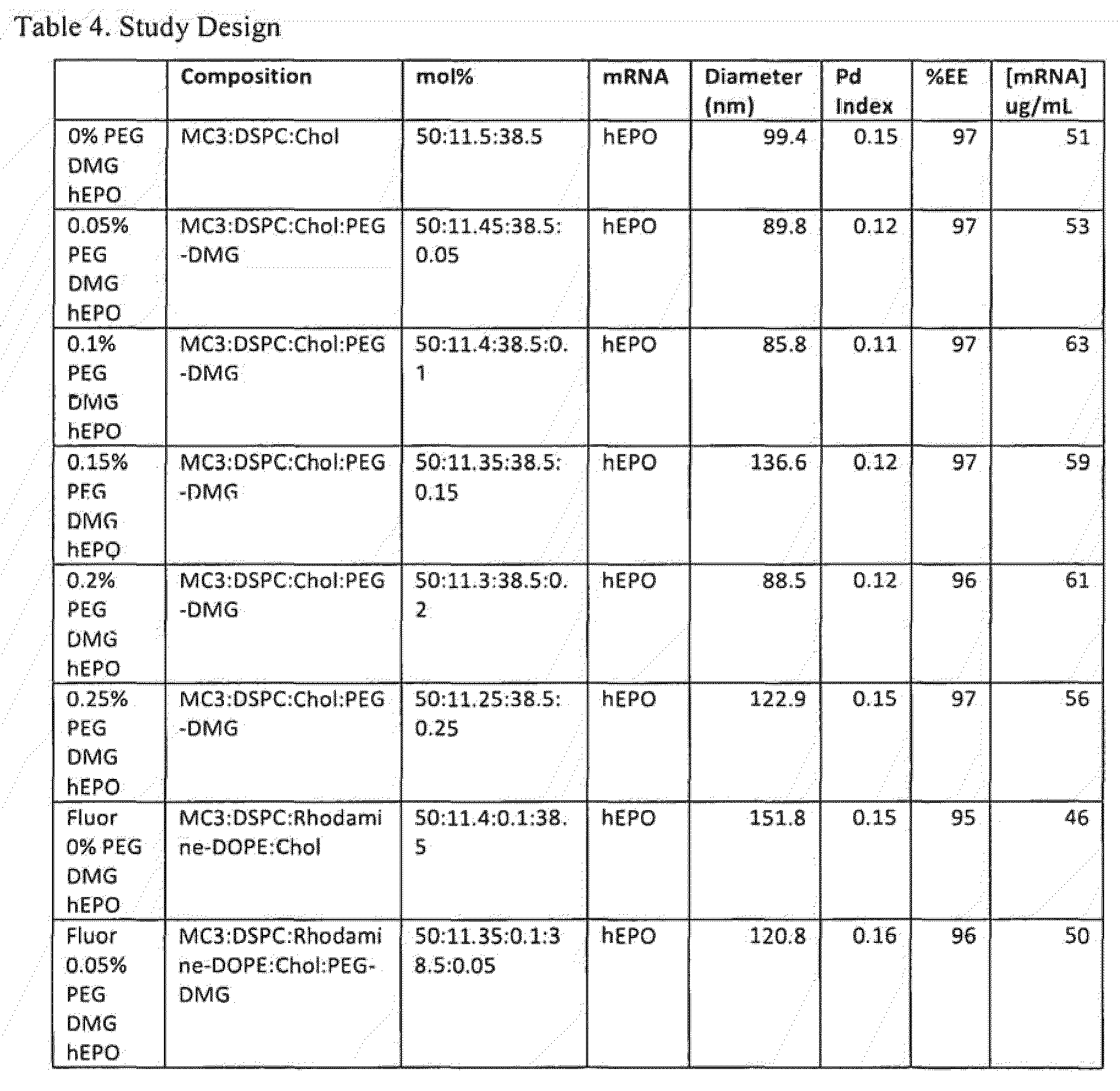

- The following experiments were performed to determine the effect decreasing DMG-PEG content of LNP on LNP uptake by B cells and B cell activation. PE+ staining (and thus association and/or uptake) of B cells was examined. LNP uptake is reduced significantly at all DMG-PEG concentrations tested (i.e., all below 0.5%). The full data set is provided in
FIG. 27 , which shows that LNP uptake is reduced significantly at all DMG-PEG mol % tested (i.e., 0-0.25 mol %). There is an absence or a significant reduction of LNP uptake by B cells at these lower DMG-PEG mol %. There is a significant reduction of B cell activation, as measured by CD86 expression, for all LNPs tested compared to LNPs having 1.5 mol% DMG-PEG. CD86 expression in B cell populations showed no, low, intermediate, and high uptake of LNP comprising 0, 0.05, 0.1, 0.15,0.2, and 0.25 mol % DMG-PEG (data not shown). - Table 5 outlines a study designed to analyze the effect of LNPs comprising different helper lipids and different PEG conjugation chemistries on uptake of such LNP by B cells. All the tested LNPs comprised cationic lipid MC3 and structural lipid cholesterol. The LNPs differed in their helper lipids with some LNPs comprising oleic acid, DSPC, DOPE (conjugated to Rhodamine), oleic acid and DOPE, or DSPC and DOPE. The LNPs also differed in the PEGylated lipid component with some LNPs comprising DMG-PEG and others comprising variant Cmpd395. The second column provides details regarding the LNP lipid composition. The third column provides details regarding the mol % of each LNP component. The structure of the Cmpd395 variant is provided in
FIG. 31A .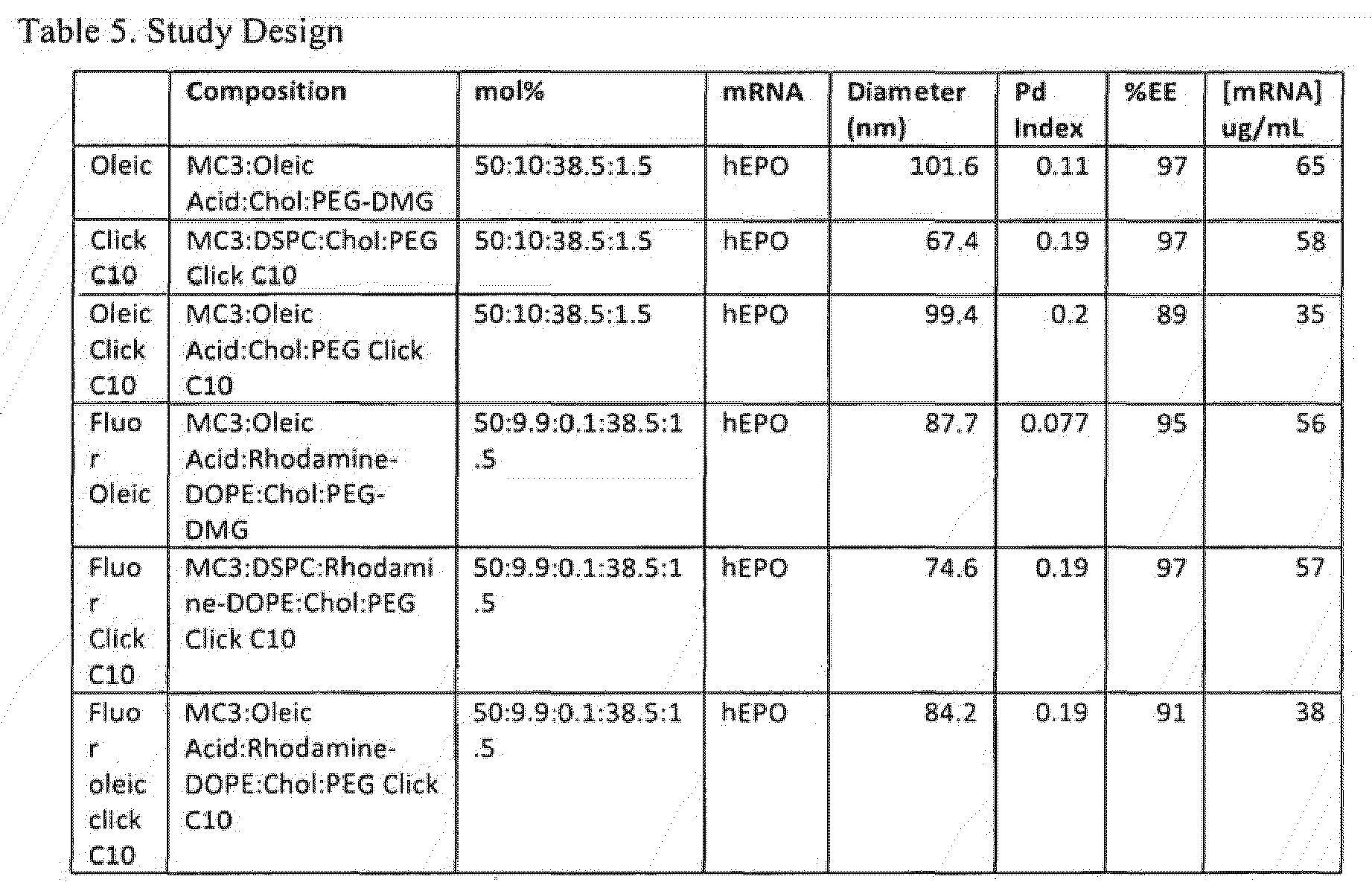
- PE+ staining (and thus association and/or uptake) of CD19+ B cells for LNPs comprising the oleic acid, Cmpd395, and Cmpd404. The LNP compositions are identified in FIG. 40. The full data set is provided in
FIG. 28 . LNP comprising the Cmpd395 variant appears to have higher uptake by B cells. CD86 expression in B cell populations showed no, low, intermediate, and high uptake of LNP comprising Cmpd395, Cmpd404, and oleic acid, respectively. There was no activation in the presence of oleic acid. - This experiment assessed the percentage of an activated B cell population defined as (CD19+CD86+CD69+) as a function of DMG-PEG content in LNPs, in the presence and absence of Imiquimod. DMG-PEG mol % were 0. 0.25, 0.5, 0.75, 1, 1.25 and 1.5 mol %. The data are shown in
FIGs. 29A (without Imiquimod) and 29B (with Imiquimod). B cell activation is increased when the percentage of DMG-PEG is increased. 0.5% of DMG-PEG appears to constitute a threshold, below which B cells are no or minimally activated. Pro-inflammatory cytokine release induced by these same LNPs in an ex vivo culture is shown inFIG. 30A (IFN-gamma) andFIG. 30B (TNF-alpha). The cytokine secretion data are consistent with the B cell activation data. Increased cytokine secretion was observed when DMG-PEG mol % was increased, with 0.5% appearing to a threshold below which no or low levels of cytokine secretion were observed. - Phospholipid design variations and substitutions for PC, including DSPC, lipids are provided in
FIG. 31A-31D . The modifications may function to reduce LNP association with B cells, recognition of LNP by receptors, and ultimately uptake by B cells. The variations contemplated include but are not limited to modifying the PC head group (FIG. 31A ), the PC core (FIG. 31B ), or through reducing the planarity of the lipid (FIG. 31C ). Other variants or substitutes include modified oleic acid, as shown inFIG. 31D . - Variations of DMG-PEG are also contemplated and these include for example variants having shorter lipid tails, a click linker, and/or a hydroxy end group on the PEG moiety (PEG-OH, or hydroxy-PEG).
FIG. 32A shows the structures for Cmpd394, Cmpd395, Cmpd396, and Cmpd397 variants.FIG. 32B shows exemplary Cmpd 398 and Cmpd 399. - A table of parameters tor an FFLuc repeat dose study with different PEG lipids and/or alternatives to PEG in mouse is shown in Table 6. This study was designed to test the effect of different surface stabilizing LNP components on IgG production. All the tested LNP comprised cationic lipid MC3, helper lipid DSPC and structural lipid cholesterol in the same proportions. They also all contained cargo Luc mRNA. The LNP differed in the PEGylatcd lipid. The anti-PEG or anti-DSPC IgM response measured by flow cytometry (beads) 96 hours after administration of the second dose is shown in
FIG. 33 . PEG DMG, PEG DSPE or PEG DSG LNPs induced anti-LNP responses. The data presented inFIG. 34 shows anti-PEG IgM measured by ELISA and anti-PEG or anti-DSPC IgM measured by flow cytometry (beads) 96 hours after administration of the second dose. The anti-PEG IgMs measured by ELISA and beads are similar and no significant differences were detected.

- Additional analyses were performed using the study design outlined in Table 7 to assess binding of various LNPs to platelets in vivo. The tested LNPs are denoted DMG-PEG LNP (comprising DMG-PEG, helper lipid DSPC, cationic lipid MC3, and structural lipid cholesterol), PEG-OH LNP (comprising PEG-OH, helper lipid DSPC, cationic lipid MC3, and structural lipid cholesterol), and PEGless LNP (comprising helper lipid DSPC, cationic lipid MC3, and structural lipid cholesterol, but lacking PEG).

- LNP association to platelets is shown in
FIG. 35 . The percent LNP associated with platelets (as indicated by phycoerythrin (PE) fluorescence) is shown at three time points (15, 60 and 240 minutes) after administration of PBS, DMG-PEG containing LNP, PEG-OH containing LNP, and PEGless LNP (left to right for each time point). These experiments were performed on purified platelets harvested from the subject at the various time points. After intravenous injection, LNPs containing DMG-PEG associated with platelets. This association was rapid but transient; after 60 minutes, it was no longer visible. The DMG-PEG, and more specifically the methoxy-PEG moiety, was likely responsible for the observed LNP association since association did not occur when hydroxy-PEG (PEG-OH) was used instead of DMG-PEG and nor did it occur in the absence of any PEG (referred to as PEGless). - Platelet activation after LNP administration is shown in
FIG. 36 . Platelet activation (as indicated by expression of platelet activation marker CD62P (MFI)) was measured at three time points (15, 60 and 240 minutes) after administration of PBS, DMG-PEG LNP, PEG-OH LNP, and PEGless LNP (left to right). The LNPs are as described in Table 7. Administration of LNPs led to increased expression of CD62P. The activation is highest in the DMG-PEG group but is also measurable in the PEG-OH and PEGless groups. Activation is detectable at 15 minutes after injection and is maximal at 60 minutes after injection. As with LNP association with platelets, activation is transient and decreases with time. - Thus, platelets appear to first associate with the injected LNP, following which such platelets are activated. LNPs comprising DMG-PEG are able to associate with platelets within 15 minutes of administration and then activate platelets within 60 and 240 minutes of administration. LNPs comprising PEG-OH and PEGless LNP, on the other hand, do not demonstrate significant association with platelets and yet are still able to activate platelets at the 60 and 240 minute time points. The level of platelet activation observed with the PEG-OH and PEGless LNP are slightly lower than that observed with DMG-PEG LNP. Thus it is possible for platelets to be activated even without appreciable association with the administered LNP. It may be that the association of DMG-PEG LNP to platelets is more stable than is the association of the other LNP types to platelets, and that while associated in vivo such association falls apart during the assay.
- The presence of other cells in platelet aggregates was also assessed.
FIGs. 37A and 37B show the percentage of B220+ B cells and F4/80+ macrophages present in platelet aggregates following intravenous injection of DMG-PEG LNP, PEG-OH LNP and PEGless LNP. Percent of B cells (as indicated by B220+ staining,FIG. 37A ) and percent of macrophages (as indicated by F4/80+ staining,FIG. 37B ) at three time points (15, 60 and 240 minutes) after administration of PBS, DMG-PEG LNP, PEG-OH LNP, and PEGless LNP (left to right), is shown. B cells and macrophages were associated with platelet aggregates. Macrophages and B cells associated with platelet aggregates following administration of all three LNP types (DMG-PEG LNP, PEG-OH LNP and PEGless LNP). B cell association was similar between the three LNP types, suggesting that PEG played a minimal or no role in this phenomenon. Macrophage association varied slightly between the three LNP types, with the highest macrophage association observed with LNPs comprising DMG-PEG. More significant differences were observed at the 240 minute time point for both cell types. Regardless of the LNP composition and PEG content, the association was transient and decreased with time. Interestingly, even in the absence of observable 'LNP association' with platelets in the presence of PEG-OH LNP and PEGless LNP (seeFIG. 35 ), there is detectable B cell and macrophage presence in platelet aggregates. - Additional experiments were carried out in vitro to investigate these platelet interactions. Platelets were incubated in vitro with medium, LPS or LNPs comprising helper lipid DSPC (further comprising cationic lipid MC3, DMG-PEG, and structural lipid cholesterol). Platelet activation was assessed by expression of CD31 and CD62P in the CD41+ platelet population. Platelets were rapidly and strongly activated, as indicated by upregulation of CD31 and CD62P activation markers, after contact with LNPs. Peak platelet activation was observed by 15 minutes, as compared to 60 minutes when LNPs were administered in vivo. DSPC LNP stimulated platelets to a greater degree than LPS and medium at each time point tested. The data are shown in
FIGs. 38 and39A-39D . - Next the ability of LNP to induce platelet aggregation in a whole blood assay was determined. The data are provide in
FIGs. 40A-40B . Aggregated cells were collected and gated based on CD41 expression (first column), high forward scatter and side scatter (second column) and F4/80 (y-axis) and CD11b (x-axis) expression (third column) after contact with medium (first row), LPS (second row) and DSPC LNP (third row). Platelet aggregates were isolated based on CD41+ expression and high FCS and high SSC, as shown in the second column forFIG. 40A . Percent of aggregated cells that are CD11b+ F4/80+ double positive (macrophages) after administration of medium, LPS, and DSPC LNP (from left to right) is shown (FIG. 40B ). DSPC LNPs resulted in a greater percentage of macrophages in platelet aggregates. -
FIGs. 41A-41B show the degree of CD19+ B cells, CD11b+ macrophages and F4/80+ macrophages bound to platelets following incubation of whole blood with medium, LPS and DSPC LNP for 30 minutes (FIG. 41A ) and 120 minutes (FIG. 41B ). The data are also presented inFIGs. 42A and 42B (macrophages) andFIG. 42C (B cells). - A further experiment was conducted to assess platelet activation, as indicated by CD31 and CD62P expression as measured by flow cytometry, as a function of LNP lipid content.
FIGs. 43A-43B show activation based on CD31 (FIG. 43A ) and CD62P (FIG. 43B ) expression after LNP platelet incubation for 0, 10, 30 and 60 minutes (left to right) with medium (control), DSPC LNP. DOPC LNP, DOPG LNP, DMG-PEG LNP, and LPS (from left to right). The presence of DSPC and DOPC strongly activates platelets in vitro. DMG-PEG activates platelets, but the activation is lower than the activation with DSPC or DOPC. The absence of activation with DOPG, particularly as compared to the activation observed with DOPC, strongly suggests that the PC motif is responsible of the activation by DOPC and DSPC. The data are also presented inFIG. 44A-44B . - Additional analyses were performed using the study design outlined in Table 8 to assess the pharmacokinetic and pharmocodynamic parameters of splenectomized non-human primates (NHPs).

- Generally, the spleen is the only location where platelets contact lymphocytes. Upon contact with lipid nanoparticles (LNPs), platelets are rapidly and strongly activated, as demonstrated by an upregaultion of both CD31 and CD62, two platelet activation markers (
FIGs. 38 ,39A-39D ). A whole blood assay illustrated that thromocytes aggregate with macrophages in the presence of LNPs (FIGs. 40A-40B ,42A-42B ). In the spleen, LNP uptake by B cells was shown to occur rapidly in a knetic manner under ex vivo culture conditions, while no specific uptake of LNPs by T cells was observed (FIGs. 2A-2B ). Furthermore, B cells, particularly the B1 subset, were shown to be dose-dependently activated by empty LNPs (FIGs. 12A-12B ). It has been shown that both B1a and B2b cells require the spleen, as B1a cells are lost and B1b cells lose the ability to secrete antibody following splenectomy (FIGs. 46A-46B ). - Experiments were performed to compare the level of modified mRNA treatment and its production of erythropoietin in the presence of intact, functioning spleens (the control group) and splenectomized non-human primates (NHPs) (Table 8). Animals (n=3 per group) underwent 60 minute infusions of rhEPO mRNA-LNP at a rate of 5 mL/kg/hr (a dose concentration of 0.04 mg/mL), totaling 0.20 mg/kg/week. Blood samples were collected before and after the end of infusion (up to 48 hours) over 29 days. The PKPD mRNA levels and hEPO production were measured using bDNA and a protein ELISA.
- First, the effect of splenectomies on reticulocyte counts was explored. Reticulocytes, immature red blood cells, undergo erythropoiesis to develop into mature red blood cells, a process controlled by the hormone erythropoietin (EPO). The spleen filters blood, removing infections and red blood cells from circulation, but it is not vital; splenectomized subjects show organ adaptation, resulting in an increased ability to fight infection and remove old red blood cells from circulation. After treatment with LNP-modRNA-hEPO as described above (
days day 15. In the splenectomy group, the level gradually decreased after 15 days (FIG. 47 ). The hematocrit was found to be maintained in the splenectomized group as well under the same treatment conditions (FIG. 48 ). - The mRNA and hEPO area under the curve (AUC) and Cmax values were determined over 29 days and 5 doses of mRNA-hEPO-LNP. AUC, a measure of the bioavailability of the measured substance over time, demonstrated that there was systemic exposure to the substance (
FIGs. 49A-49B ). Cmax represents the peak concentration of the substance or product ot the substance after administration (FIGs. 49C-49D ). In splenectomized NHPs, the levels of mRNA and hEPO are maintained systemically with repeat dosing (IV infusion) over the course of the study. In contrast to the intact (control) group, NHP mRNA and hEPO decline significantly starting on day 15 (FIGs. 49A-49D ). - Complement activation was also measured and compared between the two groups. It was found that the splenectomized NHPs showed suppressed complement activation compared to the intact (control) NHPs, as measured by complement activation indicators, C3a (
FIG. 50A ) and C5b9 (FIG. 50B ). Furthermore, cytokine expression was found to be nearly absent in splenectomzied NHPs (IL-6,FIG. 51A and IL-10,FIG. 51B ). Anti-PEG IgM (FIG. 52A ) and anti-PEG IgG (FIG. 52B ) were also found to be greatly reduced in the absence of the spleen. - In summary, LNPs have multiple cellular interactions in vivo that drive the ABC effect, which likely includes a quorum-sensing event that includes platelets, monocytes, grulocytes, and B cells. A key node appears to be the spleen, which highly supports the hypothesis that ABC is driven by B1 cell function. B1 cells are responsible for natural IgMs, and can recognize PEG, phospholipids, and possibly cholesteral crystals, among others. B1b cells can also produce IgG when stimulated. As demonstrated above, removal of the spleen prevents activation of the B cells (including B1 cells) that likely contribute heavily to ABC. The splenectomized animals showed low to no IgM/IgG to PEG, no clearance of RNA or protein, and low to no cytokine/complement activation, showing that B1 cells drive accelerated blood clearance.
- Example 18 shows LNP formulations designed to reduce CD36 binding and production of anti-PEG IgM. Numerous novel LNP formulations loaded with hEPO were prepared and tested to determine the effect of lipid changes on expression levels, B cell activation (e.g. through CD36) and anti-PEG IgM production. Commercially available natural phospholipid and fatty acids were incorporated into LNPs and screened in parallel with design and synthesis of unnatural DSPC analogs.
Fig. 54 is a schematic depicting the replacement of a phospholipid with a different zwitterionic group. - CD-1 mice were dosed weekly with Cmpd405, Cmpd396, Cmpd406, Cmpd394, Cmpd407, Cmpd403, Cmpd434, Cmpd406, Cmpd405, and Cmpd407 LNPs. A repeat dose was administered at 3 weeks.
- In the study hEPO expression was measured at 6 hours (pg/ml) and anti-PEG IgM was measured at
week 2. The data is shown inFIGs. 53A-53B. FIGs. 53A-53B are a set of graphs depicting anti-PEG IgM production following administration of LNP formulations. The PEG-lipid effects the amount of Anti-PEG IgM generated in vivo upon repeat dose. Four PEG-lipids demonstrated low anti-PEG IgM levels with moderate levels of hEPO expression. Cmpd396, Cmpd416, Cmpd403, and Cmpd405. Cmpd413 produced relatively high PEG IgM. In general hydroxy-terminated and faster diffusing PEG Lipids afford reduced levels of anti-PEG IgM. - Several LNP formulations were designed to determine what type of DSPC modifications would reduce recognition of the LNP by CD36 on immune cells. It is believed according to aspects of the invention that activation of immune system by DSPC is caused by interaction with CD36 on platelets and B-cells and/or glycerol core. The head group and planarity of lipids tail on DSPC may play a role on the ability of the molecule to interact with CD36 ligands. Accordingly several modified DSPCs were generated, incorporated into lipids and tested for effects on B cells and platelets.
- The effect of natural PC analogs on activation of cells and expression levels was tested.
FIGs. 55A-55B depict Luc mRNA expression (FIG. 55A ) and B cell activation (FIG. 55B ) following administration of LNP formulations in the CD-1 mice. The natural PC analogs do result in activation of B-cells and some appear to interfere with expression (DOPG and DOPA) in the assay performed. However, oleic acid demonstrates significantly reduced B cell activation, while maintaining sufficient levels of Luc expression. - Several oleic acid derivatives were synthesized and tested for effects on expression levels, B cell activation and platelet aggregation. The data is shown in
FIGs. 56A-56E and 57A-57C. The structures are shown inFIG. 56A .FIG. 56B is a graph depicting CD86 expression (B cell activation) andFIG. 56C is a graph depicting expression levels of Luc as measured by total flux.FIG. 57A is a graph depicting activated B-cell frequencies 24 hours post dose.FIG. 57B is a graph depicting aggregation ofplatelets 15 minutes post dose.FIG. 57C is a graph depicting recruitment of cells in platelet aggregate. Oleic acid derivatives show good expression and lower in vitro B-cell activation relative to DSPC, as shown inFIG. 56B (graph depicting CD86 expression) andFIG. 56C (graph depicting total flux). - The immune activation profiles for
Cmpd 18 LNPs containing oleic acid derivatives was examined. The oleic acid derivatives demonstrated improved immune activation profiles. The data is shown inFIGs. 58A-58B ,59 , and60A-60C . The positive effects of oleic acid were maintained with Cmpd18.FIG. 58A depicts levels of luciferase expression as measured bytotal flux 6 hours after delivery to CD-1 mice.FIG. 58B depicts in vivo B-cell activation inmouse solenocytes 24 hours following the administration.FIG. 59 is a graph depicting hEPO concentration over time. An improved margin of expression with a particle of the invention in contrast to MC3 was demonstrated with chemically modified mRNA.FIGs. 60A-60C are a set of graphs depicting improved immune activation profile with chemically modified mRNA in LNP formulations of the invention.FIG. 60A is a graph depicting in vivo B-cell activation 24 hours following administration of the hEPO loaded particles or PBS.FIG. 60B is a graph depicting in IL-6concentration 6 hours following administration of the hEPO loaded particles or PBS.FIG. 60C is a graph depicting IP-10concentration 6 hours following administration of the hEPO loaded particles or PBS. - The data demonstrate that several DSPC alternatives including oleic acid and oleic acid analogs can be formulated in LNPs and result in reduced B-cell activation in vivo. Additionally, PEG-lipid (PEG-DMG) alternatives having reduced anti-PEG IgM induction properties through faster diffusion and reduced surface hydrophobicity were identified.
- B cell association and activation using novel LNP formulations comprising oleic acid and PC derivatives are shown in Example 19. A study to determine the effect of the incorporation of oleic acid and PC derivatives in LNP on B cells as set up using the materials shown in Table 9. The characteristics of the resultant particles are also shown in Table 9.


- The data is presented in
FIGs. 61-62 .FIG. 61 is a graph depicting LNP uptake by B cells as measured by percent PE+ CD19+ B cells.FIG. 62 is a graph depicting B cell activation by LNPs as measured by CD86 expression on B cells. - In vivo assessment of hEPO containing LNP formulations composed of novel PEG lipids is shown in Example 20. An in vivo study to examine the effects of different PEG lipids on expression levels and anti-PEG IgM production was conducted. The study involved a comparison of different lipid tail lengths (diffusion) and terminal groups - e.g., -OH (versus oMe) with click linkers or an amide group. The tested structures and experimental design are shown in Table 10.

- Expression levels of hEPO from the mRNA delivered in the LNP were measured at
weeks - Anti-PEG IgM levels were also detected 96 hours following the second and third doses of LNP.
FIGs. 63A-63B are a set of graphs depicting the amount of PEG IgM produced 96 hours after a second dose of LNP (FIG. 63A ) or 96 hours after a third dose of LNP (FIG. 63B ). The compounds tested correspond to the lanes in the following order from left to right in bothFIGs. 63A and 63B : PBS, Pegless, Cmpd408, Cmpd405, Cmpd406, Cmpd409, Cmpd410, Cmpd411, Cmpd412, Cmpd413, and Cmpd414. DSG and DMG serve as relative known controls. The DMG control is increased by the third3rd dose. Many of the novel formulations produced less IgM than the DMG control. The Cmpd405, Cmpd396, Cmpd403 (single C18 tail), Cmpd416 (di-lipid tail), all showed low anti-PEG IgM induction. Cmpd405 and Cmpd396 after both doses exhibited only minimal PEG IgM. The Cmpd396 appeared to be the best candidate tested at producing minimal PEG IgM. - While hEPO expression was generally maintained for all groups, OH terminal PEGs exhibited reduced anti-PEG IgM levels. C10 PEG lipids also demonstrated reduced anti-PEG IgM production.
- Titration data was generated to determine the effect of titration with oleic and DSPC on the immune components of ABC/toxicity. Levels of oleic and DSPC in MC3 LNPs were reduced (e.g. providing reduced levels of choline). The LNPs were loaded with hEPO and formulated as shown in Table 11. The LNPs were administered by IV once weekly for 4 weeks to mice.


- The data is shown inFIGs. 64-65.
FIG. 64 is a graph depictinghEPO Expression 6 hours following once weekly administration by IV of hEPO mRNA - LNP formulations atweeks FIG. 65 is a graph depictinganti-PEG IgM production 96 hours following a third dose of hEPO mRNA- LNP formulations. - LNPs comprised of phospholipids having different head groups were prepared and tested in a single dose study. The objective of the study was to evaluate expression for different phospholipid headgroups relative to the standard DSPC formulation. A single dose of MC3 LNPs having various phospholipids with different headgroups were administered by IV to CD-1 mice. At 3, 6, and 24 hours post
injection 100ul blood 15 minutes was collected. - The results are shown in
FIG. 66 . Each phospholipid is measured at three time points (3, 6, and 24hrs) following injection. Phospholipid structures are shown inFIG. 69 . All of the formulations expressed well (DOPA and DOPG had the lowest expression). - Several new LNPs were synthesized to test B1a/B cell activation. The formulations are shown in Table 12.
Table 12 Composition mol% mRNA Diameter (nm) Pd Index %EE [mRNA] ug/mL DSPC MC3:DSPC:Chol:PEG-DMG 50:10:38.5:1.5 hEPO 69.7 0.12 98 57 Oleic acid MC3:Oleic Acid:Chol:PEG-DMG 50:10:38.5:1.5 hEPO 101.7 0.088 96 50 0.1% PS 9.9% Oleic Acid MC3:DOPS:Oleic Acid:Chol:PEG-DMG 50:0.1:9.9:38.5:1.5 hEPO 81 0.079 97 53 1 % PS 9% Oleic AcidMC3:DOPS:Oleic Acid:Chol:PEG-DMG 50:1:9:38.5:1.5 hEPO 74.4 0.083 98 51 DOPA MC3:DOPA:Chol:PEG-DMG 50:10:38.5:1.5 hEPO 103.9 0.15 98 43 0.1% PS 9.9% DSPC MC3:DOPS:DSPC:Chol:PEG-DMG 50:0.1:9.9:38.5:1.5 hEPO 77.6 0.11 98 48 1 % PS 9% DSPCMC3:DOPS:DSPC:Chol:PEG-DMG 50:1:9:38.5:1.5 hEPO 73 0.12 99 46 - All formulations resulted in an increase in activated B cell population (CDI9+CD86+CD69+) compared to a negative control. However, substituting DSPC by oleic acid led to decreased level of B cell activation. Ex vivo human B cell activation was also assessed by measuring cytokine release.
FIGs. 67A-67C are a set of graphs depicting cytokine release as a measure of ex vivo human B cell activation. Levels of IFN-gamma (FIG. 67A ), L1-6 (FIG. 67B ) and TNF-alpha (FIG. 67C ) were measured. InFIG. 67A , significant differences in IFNg release were observed with non-DSPC LNPs. Substitution of DSPC by oleic acid leads to significant decrease in IFN-g release. InFIG. 67B , significant differences in IL-6 were observed with non-DSPC LNPs. Substitution of DSPC by oleic acid led to significant decrease in IL-6 secretion. Substitution of DSPC by oleic acid also led to significant decrease in TNF-a secretion (FIG. 67C ). This decrease was more significant than the decreases observed with IFN-g and IL-6. - Splenic VB cell activation was also assessed. The results are shown in
FIG. 68. FIG. 68 is a graph depicting the amount of B cell activation as a result of various LNP formulations. LNP formulations including oleic acid demonstrated reduced splenic B cell activation. - LNPs comprised of novel PC and oleic acid derivatives were prepared and tested for impact on Luc expression, platelet aggregation and B cell activation. The LNPs were formulated as listed in Table 13 and administered IV as a single dose to CD-1 mice. The lipids were DSPC replacements having structures as shown in
FIG. 56A . Some of the lipids have a modified PC-like head group. Others have modified tails to test for stabilization.Cmpd 125 has a Zwitterionic head group.
FIG. 56A . - The results are shown in
FIG. 70. FIG. 70 is a graph depicting Luc expression levels following administration of LUC mRNA encapsulated in various LNP formulations composed of novel PC and oleic acid derivatives at 3, 6 and 24 hours following administration. Expression levels varied. As the molecules became more sterically hindered, expression appeared to decrease. Expression levels for oleic acid and its derivatives remained high. - In vitro Cmpd-LNPs and B cell interaction and activation were also assessed. The data is shown in
FIGs. 71A-71B and72A-72B . -
FIGs. 71A-71B are a set of graphs depicting B cell interaction/association with various LNP formulations as assessed by a percentage of CD19+PE+ cells. Several LNP formulations are depicted inFIG. 71A . Oleic acid and Cmpd125 are depicted inFIG. 71B .FIGs. 72A-72B are a set of graphs depicting B cell activation with various LNP formulations as assessed by CD86 expression median fluorescence intensity. Several LNP formulations are depicted inFIG. 72A . Oleic acid andCmpd 125 are depicted inFIG. 72B . - LNPs comprised of novel PC and oleic acid derivatives were prepared and tested for expression, platelet activation, and B cell activation in a single dose study relative to the standard DSPC formulation. The LNPs were formulated as listed in Table 14 and administered IV as a single dose to CD-I mice.

- The RNAs are modified with N1-methylpseudouridine. The structures of the tested lipids are shown in
FIG. 56D . - The data is shown in
FIGs. 73A-73C . Luc expression with various LNP formulations was assessed by a measurement of total flux at 3 hours (FIG. 73A ), 6 hours (FIG. 73B ), and24 hours (FIG. 73C ) following a dose. - Monkeys were administered hEPO mRNA (chemically modified) in MC3-LNP 1X weekly for 4 weeks. The co-medication regimen of oral Dexamethasone at equal mg/kg dose of human, COX-2 inhibitor (vet), ranitidine, and cetirizine was administered as described in literature. Methotrexate was administered weekly to assess targeted B cell inhibition. The experimental design is shown in Table 15.
Table 15 Group No. Test Material Dose Level (mg/kg) Co-medication Dose rate (mL/kg/h) Dose Concentration (mg/mL) Number of Males 1 MC3a 0 N/ A 5 0 3 2 hEPO mRNA in MC3 0.3 N/ A 5 0.06 3 3 hEPO mRNA in MC3 0.3 Methotrexate 5 0.06 3 a The concentration of MC3 for Group 1 is equivalent to the concentration of MC3 inGroups 2 to 3.
N/A = not applicable. - The data is shown in
FIGs. 91A-91B .FIG. 91A is a graph depicting cytokine (IL-6) production in NHPs atday 1 andday 22 of co-medication regimens.FIG 91B is a graph illustrating that co-medication with Gilenya reduces anti-Peg IgM production, consistent with reduced ABC. The results show that previously treated animals appear to have a high baseline positive IgM or IgG titer. However, some animals did not show an increase in IgM and/or IgG post LNP administration. NHPs exhibit a high frequency of Anti-PEG response, either IgM or IgG (-50%). Several co-medication regimens appear to ameliorate ABC in primates, including Gilenya and anti-platelet/Syk/Dex/PI3Kdelta. This results in reduced IL-6 production and reduced anti-PEG Ig responses as shown inFIGs. 91A-91B . Co-medication appears to enhanceday 1 expression indicating there are baseline ABC responses occurring (FIG 91A ). The results of the co-medication regimens are shown in Table 16.
- Cells were isolated from spleens by crushing the tissue through a 70nm filter in the presence of PBS. After washing, red blood cells were lysed by ACK buffer. After an additional washing with PBS, 2×10⁶ cells per sample were stained with CFSE in PBS at room temperature for 5 minutes. Immediately after incubation, the staining reaction was quenched with 15mL of media at room temperature. The cells were then centrifuged and washed twice with media. The cells were then incubated for 3 days at 37°C in the presence of diverse stimuli. The analysis was performed using ModFit 4.1 software.
FIG. 92 shows that B cells proliferate in the presence of DSPC LNPs. - Cells were isolated from spleens by crushing the tissue through a 70nm filter in the presence of PBS. After washing, red blood cells were lysed by ACK buffer. After an additional washing, 2×10⁶ cells per sample were stained with 5uM of Calcium Sensor Dye eFluor® 514(#65-0959-39, ebioscience) for 30 minutes at 37°C. After an additional washing, cells were stained with CD19 on ice for 20 minutes. The cells were then analyzed by flow cytometry. A baseline was acquired for 30 seconds, then after stimulus addition, the signal was measured for 360 seconds. After adding a positive stimulus (Cell stimulation cocktail #00-4970-03 ebioscience), the signal was recorded for an additional 30 seconds. The analysis was performed using FlowJo software.
FIG. 93 shows that DSPC LNPs induce calcium release in B cells. - Previous studies have characterized, in detail, the reduced efficacy of PEGylated nanoparticles upon repeat dosing, known as the ABC phenomenon. Anti-PEG IgM generated in response to LNP administration, recognize the PEG lipid component of the LNP, bind to LNP, and remove them from circulation. The phospholipid component of the LNP, in particular DSPC, activates both platelets and B cells causing the release of cytokines and "natural IgM" which further potentiate the immune response to administered LNPs, contributing to ABC. Oleic acid has been identified as a DSPC alternative. Replacement of DSPC with oleic acid results comparable protein expression from encapsulated mRNA, but provides reduced B cell activation as compared to standard LNP formulation, e.g., MC3-based LNP formulation. Also identified above, are novel PEG lipids which can be sued as PEG-lipid, e.g., PEG DMG alternatives. Without being bound in theory, it is believed that such novel PEG-lipids provide for reduction of anti-PEG IgM generation through faster diffusion (shorter lipid tails) and reduced surface hydrophobicity (-OH vs -OMe).
- Recent multi-dose studies in mice with hEPO have identified PEG-lipids which afford good levels of protein expression and low levels of Anti-PEG IgM. This study was designed to test such lipids in a repeat administration study in mice, optionally in combination with novel cationic amino lipids, in LNP-formulations for mRNA administration. Specific parameters such as protein expression, anti-PEG IgM, in vivo B-cell activation and cytokine expression were tested to differentiate LNPs based on preferred efficacy.
- A three-week study of novel PEG/Cmpd18 and PEG/MC3 combinations by intravenous (IV) administration with hEPO was conducted in mice. In particular, MC3 novel PEG LNPs and Cmpd18 novel PEG LNPs were prepared and tested head-to-head for expression, anti-PEG IgM, in vivo B cell activation, and cytokine expression in a multi-dose study. The LNP formulations were administered by IV in three fixed volume doses to CD-1 mice. Size in diameter (nm), polydispersity index (PDI), encapsulation efficiency (EE), mRNA concentration (ug/mL), and endotoxin concentration (EU/mL) were measured for the novel LNPs. Table 1 shows the foregoing measurements of the MC3 and Cmpd18 LNPs with the novel PEG lipids after the first dose was administered. As shown by the data in Table 17, the LNPs had a size, PDI, and EE sufficient for in vivo administration.

- The size in diameter (nm), polydispersity index (PDI), encapsulation efficiency, mRNA concentration (ug/mL), and endotoxin concentration of the MC3 novel PEG LNPs and SM86 novel PEG LNPS were also measured three weeks after dosing. This data is shown in Table 18 below. The data in Tables 17 and 18 show that the physiochemical characteristics for both MC3 and Cmpd18 LNPs remained constant throughout the study. Additionally, the EE and size of the novel LNPS shown in Tables 17 and 18 are within art- recognized ranges.
Table 18 (Week 3) Animal Diameter (nm) Pd Index %EE [final] ug/ mL 1 MC3: Cmpd422 63.8 0.089 98 93 2 MC3: Cmpd416 108 0.045 98 81 3 MC3: Cmpd405 76.7 0.16 97 71 4 MC3: Cmpd403 65.8 0.14 98 68 5 MC3: Cmpd396 77.2 0.16 97 67 6 MC3: Cmpd430 69.1 0.074 98 80 7 Cmpd18: Cmpd422 77.1 0.082 95 71 8 Cmpd18: Cmpd416 130.4 0.1 96 103 9 Cmpd18: Cmpd405 103.1 0.18 91 68 10 Cmpd18: Cmpd403 89.4 0.13 96 77 11 Cmpd18: Cmpd396 96 0.17 93 77 12 Cmpd18: Cmpd430 86.5 0.11 97 86 - Additional data is shown in FIGs. 74A-74B. FIGs. 74A-74B depict
hEPO expression 6 hours following once weekly IV administration of hEPO mRNA - LNP formulations atweeks - Cytokine expression in the MC3 and
Cmpd 18 LNPs is shown in Tables 19-22. IFN-γ-inducible protein 10 (IP-10) is a chemokine involved in inflammation and interlukin 6 (IL-6) is a pro-inflammatory cytokine. Concentrations (pg/mL) of IP-10 (Table 19) and IL-6 (Table 20) 6 hours following administration of the MC3 andCmpd 18 LNPs atweek 1 are given.

- Concentrations (pg/mL) of IP-10 and IL-6 6 hours following administration of the MC3 and SM86 LNPs at
week 2 are given in Tables 21 and 22, respectively. These data demonstrate that several of the novel PEG lipids tested provide for low levels of inflammatory chemokine/cytokine expression, in particular, when certain novel PEG lipids are formulated in combination withCmpd 18 as the cationic amino lipid.

- In
FIG. 75 , levels of anti-PEG IgM (ng/mL) 96 hours post second dose were measured. The data in this graph shows reduced levels of anti-PEG IgM generated for the novel PEG lipids. The above-discussed data show that accelerated blood clearance was not observed when certain novel PEG lipids were used in LNP formulations. Interestingly, most of the MC3 groups maintained expression while most of the Cmpd18 groups increased expression over the 3 week study. Of the novel PEG lipids tested, Cmpd405, Cmpd396 and Cmpd403 had the lowest levels of anti-PEG IgM. It was quite surprisingly observed in this study, as well as in previously described studies, that Cmpd160, which differs from DSPC by just one methyl group in the had group was essentially immune silent when tested in LNPs administered IV in vivo. - LNPs comprised comprising of novel DSPC and/ oleic acid derivatives were prepared and tested for expression of luciferase (
m 1 ψ-modified mRNA-encoded luciferase) and B cell activation in a single dose study relative to the standard DSPC formulation. The DSPC/oleic analogs tested are shown in Table 23 below.


- As shown in Table 23, the LNPs were administered by IV as a single dose to mice. The data is shown in
FIGs. 76 and77 . Luc expression with various LNP formulations was assessed by a measurement of total flux (p/s) at 3, 6, and 9 hours following dosing, using whole body BLI imaging (seeFIG. 76 ). The percentage of activated B cells (CD86+ CD69+) in splenic CD19+ cells was also measured. These activated B cell frequencies are shown inFIG. 77 . - In general, flux increased from three to six hours, showing a decline in expression by 24 hours. All of the formulations tested showed appreciable luciferase expression in vivo, although some variability in expression was observed. The % of CD86+CD69+ B cells in splenic CD19+ cells (B lymphocytes) in the spleen was also measured for the LNP formulations as an indicator of B cell activation. All formulations tested showed B cell activation at levels below, and often significantly below, that of DSCP control formulations.
- A repeat dose of hEPO mRNA in Cmpd18-containing LNPs with modified PEG lipids was next performed in non-human primates. Briefly, cynomolgus monkeys were treated with LNP-encapsulated mRNA administered by intravenous (IV) infusion. Oleic acid- and Cmpd403-containing LNPs were analyzed to determine their effect on accelerated blood clearance (ABC). In particular, it was an objective to determine if the DSPC and PEG-lipid replacements demonstrate low B cell activation, low anti-PEG IgM, and maintenance of protein expression in higher species. The following four groups were compared: MC3/DSPC/Chol/Cmpd422 (control), Cmpd18/DSPC/Chol/Cmpd422 (control), Cmpd18/DSPC/Chol/Cmpd403 (test group), and Cmpd18/Oleic Acid/Chol/Cmpd422 (test group). The monkeys were administered a pseudouridine modified hEPO mRNA (0.2 mg/kg) weekly dosing in the foregoing LNPs for 6 weeks.
- Pharmokinetic parameters including AUC were determined for Cmpd 18:
Cmpd 403 combinations. Contsitutive AUC was seen over time with baseline complement and cytokine levels and low to no levels of IgM observed. - The particle characteristics for each of the formulations are shown in Table 24 below. mRNA used for this study was
m 1 ψ-modified mRNA encoding EPO. Formulations includes components at the following mol % - 50:10:38.5:1.5. Table 24 shows size, encapsulation efficiency (EE) and polydispersity index (PDI). Particles had characteristics within acceptable limits tor in vivo testing.
- Throughout the 6 weeks of experimentation, hEPO protein expression, anti-PEG IgM and IgG levels, IgM, IgG and cytokine and complement levels were measured for the novel LNPs.
FIG. 79 depicts hEPO expression (ng/mL) at predose, 2 hours, 6 hours, 12 hours, 24 hours, 48 hours, and 72 hours following once weekly IV administration of the hEPO mRNA - LNP formulations atday 1,day 8,day 15,day 22,day 29,day 36, andday 43. - In
FIG. 80 , levels of anti-PEG IgM (U/mL) were measured following once weekly IV administration of the hEPO mRNA - LNP formulations atday 1,day 8,day 15,day 22,day 29,day 36, andday 43.FIG. 81 shows the levels of anti-PEG IgG (U/mL) measured following once weekly IV administration of the hEPO mRNA - LNP formulations atday 1,day 8,day 15,day 22,day 29,day 36, andday 43. The Cmpd403 group demonstrated maintenance of protein expression across the 6 weeks, maintenance of baseline levels of anti-PEG IgM and anti-PEG IgG, no complement activation, and minimal cytokine activation. Levels of anti-PEG IgM and IgG, complement, and cytokine elevations appeared to inversely correlate with a loss of protein expression. The MC3 and Cmpd18 controls and oleic acid group all showed reduced hEPO protein expression atweek 6. The oleic acid group demonstrated the highest levels of initial of protein production. The MC3 and Cmpd18 controls and Cmpd403 groups showed similar levels of hEPO expression. Cmpd18/DSPC at 0.2 mg/kg did not show increased hEPO expression relative to MC3/DSPC; however, Cmpd18/oleic acid did show increased protein expression (3-fold) relative to MC3/DSPC and Cmpd18/DSPC. Table 25 shows hEPO expression as measured by AUC of the four LNP groups. In particular, the hEPO AUC (ng/mL∗h) was measured each week of the 6 week studyTable 25 hEPO AUC (ng/mL∗h) Day MC3 Cmpd18 Cmpd403 Oleic Acid 1 9134 4059 9861 31258 8 4754 6272 8554 31739 15 8031 4059 10922 17132 22 4951 6272 7562 44124 29 2607 9414 10822 21015 36 2824 17585 7870 6105 43 7491 14102 16622 689.3 - Particles formulated with Cmpd18 as the cationic amino lipid outperformed standard MC3-based LNPs in terms of protein expression throughout repeated dosing in primates. Oleic acid as a DSPC replacement resulted in initially high protein expression but did not fully ameliorate ABC over the course of the study. Compound403 as a PEG-lipid replacement resulted in reduced ABC as evidenced by maintenance of hEPO AUC over the course of the study. Taken together, these data show that deletion of B cells leads to absence of to ABC after 5 injections. In particular, a single injection of anti CD20, 7 days before LNP injection lead to (1) low/no IgM/IgG to PEG; (2) no clearance of RNA or protein; and (3) low/no cytokines/complement activation, making this an attractive candidate for co-administration regimens featuring LNP-encapsulated mRNAs.
-
FIG. 82 shows the percentage of activated B cells (CD86+ CD27+) inCD 19+ cells at pre-bleed,day 1,day 22,day 43, andday 44 of the study. As shown inFIG. 82 , all LNP groups demonstrated low B cell activation. Nearly all of the subjects administered theCmpd 18/DSPC/Chol/Cmpd403 or the Cmpd18/Oleic Acid/Chol/Cmpd422 had less than 5% B cell activation in CD19+ cells and demonstrated an average B cell activation percentage close to 2.5%, which was maintained through the course of the study. The percentage of monocyte activation was also measured at pre-bleed,day 1,day 22,day 43, andday 44 of the study. These results are reflected inFIG. 83 . All of the LNP groups demonstrated low monocyte activation and all of the subjects administered the Cmpd18/DSPC/Chol/Cmpd403 or the Cmpd18/Oleic Acid/Chol/Cmpd422 maintained an average of less than 3% monocyte activation through the course of the study. - The above data show that B cell activation is a key contributor to the ABC phenomenon in animal administered LNP-encapsulated nucleic acids, e.g., mRNAs. Prior art studies attempted to mitigate the ABC phenomenon with compounds such as dexamenthsone and/or corticosteroids. The instant inventors have provided a detailed mechanistic understanding of the ABC phenomenon, in particular as it pertains to LNP-encapsulated mRNA administration. LNPs have multiple cellular interactions in vivo that have been demonstrated to drive the ABC effect. IV injection of LNPs leads to increased secretion of anti PC IgM (natural IgM) and induced development of anti- PEG IgM response. Moreover, repeat IV injection of LNPs leads to increase levels of natural IgM. A key node appears to be the spleen and highly supports the hypothesis that ABC is driven by B1 cell function. These cells are responsible for secreting "natural IgMs" (e.g., B1a cells), but B1b cells can also produce IgG when stimulated. These immunoglobulins recognize PEG, phospholipids, and most likely, cholesterol domains, present on the surface of the LNPs. It is shown herein that natural IgM likely recognize a PC motif present on the surface of standard LNP (e.g., DSPC-containing LNPs).
- IV injection of LNPs leads to rapid activation of B1a cells resulting in increased secretion of anti-PC IgM (natural IgM) and repeat IV injection of LNPs leads increase level of natural IgM. Removal of the spleen prevents activation of B cells (B1 specifically) that likely contribute heavily to ABC. In particular, splenectomized animals show (1) low/no IgM/IgG to PEG; (2) no clearance of RNA or protein; and (3) low/no cytokines/complement activation. Based on the mechanisms and cell types herein implicated in the ABC effect, the instant inventors hypothesized that certain B cell targeted co-administration regimens might be useful for treatment of subjects with LNP-encapsulated mRNAs, in particular, where repeat of chronic dosing is required for the desired therapeutic index.
- A repeat-dose study of hEPO mRNA by IV infusion with co-administration was conducted in cynomolgus monkeys. Monkeys were administered hEPO mRNA in MC3-LNPs according to the experimental design shown in Table 26 and were co-administered one of rituximab, idealalisib, fostamatinib, or fingoimod according to the regimen shown in Table 27.
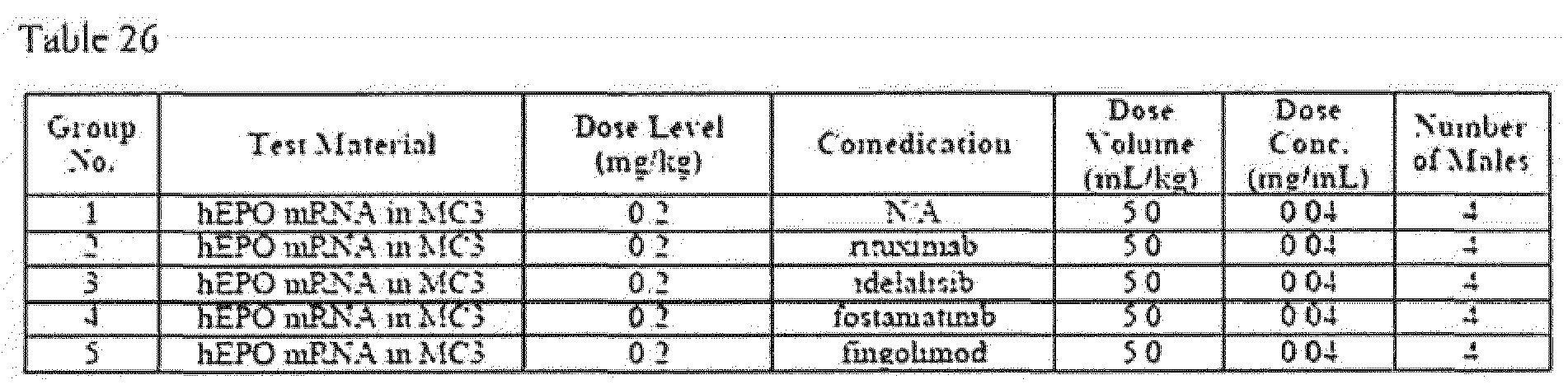

- The experimental data is shown in
FIGs. 84A-90 .FIGs. 84A and 84B show the EPO expression after the first injection and after the fifth injection. In particular, the concentration of EPO (ng/mL) was measured at 2 hours, 6 hours, 12 hours, 24 hours, and 48 hours following the first injection and the fifth injection.FIGs. 85A-85E show the EPO expression for each of the co-medications on day I andday 29 of the study. In particular, the concentration of EPO (ng/mL) was measured on day I andday 29 at 2 hours, 6 hours. 12 hours, 24 hours, and 48 hours for each co-medication group. Immune cell populations were also measured. Specifically, the percentage of B cells (FIG. 86A ), B1a cells (FIG. 86B ), and monocytes (FIG. 86C ) in PBMCs was measured for each co-medication group at day -7, 24 hours post first injection, and 24 hours post fifth injection. B cell activation is reflected inFIG. 87 . The percentage of activated B cells in circulating B cells was measured for each co-medication group at day -7, 24 hours post first injection, and 24 hours post fifth injection. - In the control group, the percentage of activated B cells increased 24 hours post first injection and again 24 hours post fifth injection, thus, showing that more LNP injection leads to higher B cell activation. The percentage of activated B cells was reduced drastically in the
rituximab group 24 hours post first injection, due to the fact that B cells were deleted in the subjects of this group. B cell depletion correlated with reduction of anti-PEG IgM and IgG, even at day 34 (post 5th injection). B cell depletion also correlated well with maintenance of protein expression. In particular, B cell depletion provided for loss of expression after 5 injections indicating there was no ABC and B cell depletion further provided for no anti PEG response. B cell activation was not observed in the idelalisib group and B cells frequencies were slightly reduced (seeFIG. 86A ). The fostamatinib and fingolimid groups displayed normal B cell activation similar to that of the control group. With regard to the Bla cells, B1a cell frequencies were normal before injection in all co-medication groups (seeFIG. 86B ). Except for the rituximab group where B1a cells frequencies dropped slightly, all co-medication.groups displayed increased B1a cells frequencies after LNP injection, meaning that LNP injection leads to B1a activation and proliferation. - Monocyte activation is reflected in
FIG. 88 . The percentage of activated monocytes/macrophages in circulating PBMCs was measured for each co-medication group at day -7, 24 hours post first injection, and 24 hours post fifth injection. As shown inFIG. 86C , the frequencies of monocytes were normal in all co-medication groups except for fingolimod, where a significant decrease was observed. An increase in the percentage of activated monocytes/macrophages post injection was only observed in the fingolimod co-medication group. As the frequency of monocytes in the fingolimod group dropped significantly post injection, the data suggests monocyte activation before apoptosis. -
FIGs. 89A and89B show the anti-PEG response. Anti-PEG IgM levels (U/mL) (FIG. 89A ) and anti-PEG IgG levels (U/mL) (FIG. 89B ) were measured for each co-medication group at baseline,day 9 post first injection, and day 34 post fifth injection. - To further study the role of IgM in the ABC phenomenon, LNP-encapsulated mRNA encoding EPO was administered to control mice and to that lack secreted IgM (slgM-/- mice).
FIG. 78 shows the impact of removing circulating IgM on EPO EPO expression over the course of the 6 week study. In particular, the concentration of EPO (ng/mL) was measured at pre-bleed, 6 hours, and 24 hours, at each of the 6 weeks. In the two negative control groups, c57Bl6J/PBS and sIgM-/-PBS, EPO levels remained at baseline throughout the study, while in the mRNA treatment groups, EPO concentrations peaked at 6 hours post-dose, and then receded back to baseline by two weeks following mRNA administration. Note that, inWeek 1, the EPO concentration was approximately the same in the c57Bl6J mice and the sIgM-/- mice at the 6 hour time point (peak expression post dose). However, over the time course of the experiment, the ABC phenomenon was observed, as evidenced by the decreasing AUC for EPO expression in the c57Bl6J mice. By contrast, the sIgM-/- mice produced consistently high levels of EPO following each repeat administraion of LNP-encapsulated mRNA throughout the duration of the experiment. Thus, in the absence of circulating IgM, no loss of expression was observed even after five injections of mRNA evidencing a complete lack of ABC. -
FIG. 90 further demonstrates the importance of anti-PEG IgM in the ABC phenomenon.FIGs. 90A-90B are two graphs showing anti-PEG IgM levels (U/mL) and EPO levels (ng/mL) in two of the groups fromFIG. 78 : C57Bl6J (FIG. 90A ) and sIgM-/- mice (FIG. 90B ). The anti-PEG IgM levels are graphed as light grey circles inFIG. 90A and an increase in anti-PEG IgM correlates with the onset of ABC. In the sIgM-/- mouse this is shown by black circles which remain at the baseline (FIG. 90B ). EPO concentrations are indicated by black circles (FIG. 90A ) and black squares (FIG. 90B ). The data clearly demonstrate the inverse correlation between protein expression and anti-PEG IgM levels. When IgM levels are high EPO expression is suppressed, indicating ABC is occurring. When IgM levels are suppressed, for instance in the knockout mice, the EPO expression is significantly enhanced and ABC is reduced. Thus, in the absence of circulating IgM, no loss of expression was observed (no ABC) correlating with the absence of an anti-PEG response. - Exemplary compound synthesis follows:
-
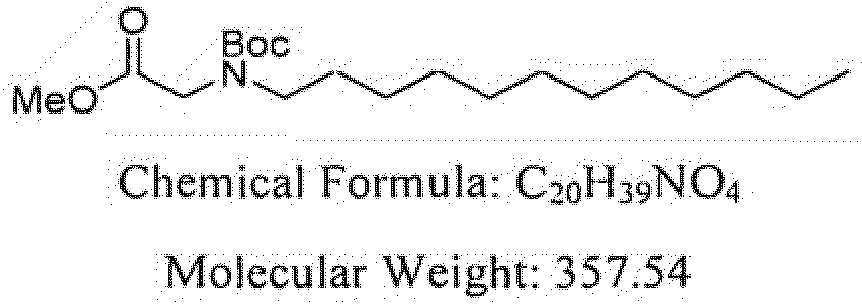
1H-NMR (300 MHz, CDCl3) δ: ppm 4.01-3.84 (br. m, 2H); 3.75 (s, 3H); 3.27 (br. m, 2H); 1.67-1.39 (br. m, 11H); 1.28 (br, 18H); 0.90 (t, 3H). -

- To a 0 °C solution of methyl N-(tert-butoxycarbonyl)-N-dodecylglycinate (4.03 g, 11.3 mmol) in DCM (17 mL) was added dropwise TFA (17 mL, 226 mmol). The reaction was allowed to return to room temperature and stir for 6 hours. The reaction mixture was concentrated in vacuo and the crude material was dissolved in DCM. The solution was washed with 10% NaOH, brine, dried over anhydrous Na2SO4, filtered, and concentrated in vacuo to provide methyl dodecylglycinate (2.84 g, 98%).
1H-NMR (300 MHz, CDCl3) δ: ppm 3.75 (s, 3H); 3.44 (s, 2H); 2.62 (t, 2H); 1.70 (br, 1H); 1.51 (m, 2H); 1.29 (br, 18H); 0.90 (t, 3H). -

- To a solution of 1-bromododecane (10 g, 40.1 mmol) in MeCN (84 mL) was added ethanolamine (1.10 mL, 18.2 mmol), K2CO3 (11.1 g, 80.1 mmol), and KI (302 mg, 1.82 mmol). The reaction was allowed to stir at 82 °C for 48 hours. The reaction mixture was cooled to room temperature, filtered, and the solids were washed with hexanes. The filtrate was extracted with hexanes, and the combined extracts were concentrated in vacuo. Purification by ISCO silica flash chromatography (0-20% MeOH/DCM) provided 2-(didodecylamino)ethan-1-ol (3.87 g, 53%).
- UPLC/ELSD: RT = 2.69 min. MS (ES): m/z (MH+) 398.56 for C26H55NO
- 1H-NMR (300 MHz, CDCl3) δ: ppm 3.57 (t, 2H); 2.63 (t, 2H); 2.49 (br. m, 4H); 1.48 (br. m, 4H); 1.29 (br, 36H); 0.91 (t, 6H).
-

- To a 0 °C solution of 2-(didodecylamino)ethan-1-ol (3.87 g, 9.73 mmol) and triethylamine (1.76 mL, 12.6 mmol) in DCM (50 mL) was added dropwise a solution of methanesulfonyl chloride (0.941 mL, 12.2 mmol) in DCM (5 mL). The reaction was allowed to return to room temperature and stir for 16 hours. The mixture was quenched by the addition of water and extracted with DCM. The organic layer was washed with saturated NaHCO3, brine, dried over anhydrous Na2SO4, filtered, and concentrated in vacuo. Purification by ISCO silica flash chromatography (0-10% EtOAc/hexanes) provided N-(2-chloroethyl)-N-dodecyldodecan-1-amine (1.92 g, 47%).
1H-NMR (300 MHz, CDCl3) δ: ppm 3.51 (t, 2H); 2.78 (t, 2H); 2.47 (br. m, 4H); 1.44 (br. m, 4H); 1.28 (br, 36H); 0.90 (t, 6H). -

- To a solution of methyl dodecylglycinate (425 mg, 1.65 mmol) in MeCN (10 mL) was added N-(2-chloroethyl)-N-dodecyldodecan-1-amine (825 mg, 1.98 mmol), K2CO3 (457 mg, 3.30 mmol), and KI (27 mg, 0.165 mmol). The reaction was allowed to stir at 82 °C for 72 hours. The reaction mixture was filtered and the solids were washed with hexanes. The filtrate was concentrated in vacuo to provide the crude product. Purification by ISCO silica flash chromatography (0-20% MeOH/DCM) provided methyl N-(2-(didodecylamino)ethyl)-N-dodecylglycinate (652 mg, 62%).
- UPLC/ELSD: RT = 3.77 min. MS (ES): m/z (MH+) 638.18 for C41H84N2O2
- 1H-NMR (300 MHz, CDCl3) δ: ppm 3.72 (s, 3H); 3.41 (s, 2H); 2.90-2.20 (br. m, 10H); 1.60-1.00 (br. m, 60H); 0.90 (t, 9H).
- N-(2-(Didodecylamino)ethyl)-N-dodecylglycine
-

- A solution of methyl N-(2-(didodecylamino)ethyl)-N-dodecylglycinate (652 mg, 1.02 mmol) in THF (6 mL) and 1M LiOH (5 mL, 5 mmol) was allowed to stir at 65 °C for 16 hours. The reaction was cooled to room temperature and acidified with 10% HCl. The mixture was extracted with chloroform, and the organics were washed with brine, dried over anhydrous Na2SO4, filtered, and concentrated in vacuo. Purification by ISCO silica flash chromatography (0-20% MeOH/DCM) provided N-(2-(didodecylamino)ethyl)-N-dodecylglycine (153 mg, 24%).
- UPLC/ELSD: RT = 3.60 min. MS (ES): m/z (MH+) 624.07 for C40H82N2O2
- 1H-NMR (300 MHz, CDCl3) δ: ppm 4.02-3.40 (br. m, 6H); 3.16 (br, 6H); 1.78 (br, 6H); 1.46-1.01 (br. m, 54H); 0.90 (t, 9H).
- Compound 125: 3-((8-(Heptadecan-9-yloxy)-8-oxooctyl)(8-(nonyloxy)-8-oxooctyl)amino)propanoic acid
-

- To a solution of 8-bromooctanoic acid (1.04 g, 4.6 mmol) and heptadecan-9-ol (1.5 g, 5.8 mmol) in dichloromethane (20 mL) was added N-(3-dimethylaminopropyl)-N'-ethylcarbodiimide hydrochloride (1.1 g, 5.8 mmol), N,N-diisopropylethylamine (3.3 mL, 18.7 mmol) and DMAP (114 mg, 0.9 mmol). The reaction was allowed to stir at rt for 18 h. The reaction was diluted with dichloromethane and washed with saturated sodium bicarbonate. The organic layer was separated and washed with brine, and dried over MgSO4. The organic layer was filtered and evaporated in vacuo. The residue was purified by silica gel chromatography (0-10% ethyl acetate in hexanes) to obtain heptadecan-9-yl 8-bromooctanoate (875 mg, 1.9 mmol, 41%).
1H NMR (300 MHz, CDCl3) δ: ppm 4.89 (m, 1H); 3.42 (m, 2H); 2.31 (m, 2H); 1.89 (m, 2H); 1.73-1.18 (br. m, 36H); 0.88 (m, 6H). -

- To a solution of 8-bromooctanoic acid (5 g, 22 mmol) and nonan-1-ol (6.46 g, 45 mmol) in dichloromethane (100 mL) were added N-(3-Dimethylaminopropyl)-N'-ethylcarbodiimide hydrochloride (4.3 g, 22 mmol) and DMAP (547 mg, 4.5 mmol). The reaction was allowed to stir at rt for 18 h. The reaction was diluted with dichloromethane and washed with saturated sodium bicarbonate. The organic layer was separated and washed with brine, dried over MgSO4. The organic layer was filtered and evaporated under vacuum. The residue was purified by silica gel chromatography (0-10% ethyl acetate in hexanes) to obtain nonyl 8-bromooctanoate (6.1 g, 17 mmol, 77%).
1H NMR (300 MHz, CDCl3) δ: ppm 4.06 (t, 2H); 3.40 (t, 2H); 2.29 (t, 2H); 1.85 (m, 2H); 1.72-0.97 (m, 22H); 0.88 (m, 3H). -

- A solution of 8.87 g (19.2 mmol) heptadecan-9-yl 8-bromooctanoate and 29 mL (384 mmol) 3-aminopropanol in 250 mL ethanol was heated to 50 °C and stirred for 20 hours, after which no starting bromide remained by LC/MS. The solution was allowed to cool to room temp., conc., and the residue dissolved in DCM. The solution was washed twice with a 5% aqueous sodium bicarbonate solution, dried (Na2SO4), filtered and the filtrate conc. to a colorless oil. This was chromatographed on silica with 100% DCM going to 10% DCM / 90% 80:20:1 DCM/MeOH/NH4OH to give heptadecan-9-yl 8-((3-hydroxypropyl)amino)octanoate (7.98 g, 17.5 mmol. 91%) as a colorless oil.
- UPLC/ELSD: RT= 2.52 min. MS (ES): m/z (MH+) 456.8 for C28H57NO3.
- 1H NMR (300 MHz, CDCl3) δ: ppm 4.86 (quint., 1H, J = 6 Hz); 3.81 (t, 2H, J = 7.5 Hz); 2.88 (t, 2H, J= 7.5 Hz); 2.60 (t, 2H, J = 7.5 Hz); 2.44 (br. s, 1H); 2.27 (t, 2H, J= 7.5 Hz); 1.70 (m, 2H); 1.61 (m, 2H); 1.49 (m, 6H); 1.25 (br. m, 31H); 0.88 (t, 6H, J = 7.5 Hz).
-

- To a mixture of 7.98 g (17.5 mmol) heptadecan-9-yl 8-((3-hydroxypropyl)amino)octanoate and 6.12 g (17.5 mmol) nonyl 8-bromooctanoate in 100 mL dry acetonitrile under dry nitrogen was added 3.2 g (19.3 mmol) potassium iodide followed by 9.7 g (70 mmol) potassium carbonate and the mixture diluted with 25 mL dry cyclopentyl methyl ether. The resulting white mixture was heated to 90 °C and stirred for 28 hours, then allowed to cool to room temp., filtered, the filter solids washed with DCM and the filtrate conc. The residue was partitioned between a 5% aqueous sodium bicarbonate solution and DCM, the phases separated and the aqueous extracted twice with DCM. The organics were combined, dried (MgSO4), filtered and the filtrate conc. to a yellow oil. This was chromatographed on silica with 100% DCM going to 50% DCM / 50% 80:20:1 DCM:MeOH:NH4OH to give heptadecan-9-yl 8-((3-hydroxypropyl)(8-(nonyloxy)-8-oxooctyl)amino)octanoate (10.14 g, 14 mmol, 80%) as a pale yellow oil.
1H NMR (300 MHz, CDCl3) δ: ppm 4.86 (p, 1H); 4.05 (t, 2H); 3.80 (m, 2H); 2.92-2.36 (br. m, 5H); 2.29 (m, 4H); 1.89-1.42 (br. m, 16H): 1.42-1.02 (br. m, 50H); 0.88 (m, 9H). UPLC/ELSD: RT = 4.51 min. MS (ES): m/z (MH+) 725.19 for C45H89NO5. -

- At -78 °C, to a solution of oxalyl chloride (0.25 mL, 3.0 mmol) in 3 mL dichloromethane was added dropwise a solution of DMSO (0.43 mL, 6.0 mmol) in 2 mL dichloromethane, and then a solution of heptadecan-9-yl 8-((3-hydroxypropyl)(8-(nonyloxy)-8-oxooctyl)amino)octanoate (1.45 g, 2.0 mmol) in dichloromethane (10 mL) was added immediately. After it was stirred for 30 min at this temperature, triethylamine (1.45 mL, 10.4 mmol) was added and the reaction mixture was warmed up to room temperature. TLC and MS showed complete reaction (M+1: 722.7), and the reaction mixture was diluted with water and extracted with hexanes (2X). The combined organic layer was washed with brine. After drying over sodium sulfate, the filtrate was concentrated and the residue was purified by ISCO (SiO2: EtOAc/Hexanes/0.5% Et3N 0 to 50%) to afford the product as a brown oil (810 mg, 61%).
- 1H NMR (300 MHz, CDCl3) δ: ppm 4.85 (p, 1H, J = 6.0 Hz); 4.05 (t, 2H, J = 6.9 Hz); 2.56 (t, 4H, J = 7.1 Hz); 2.31-2.24 (m, 4H); 1.67-1.19 (m, 63H); 0.87 (m, 9H).
- MS (APCI): mlz (MH+) 666.7.
-

- A solution ofheptadecan-9-yl 8-((8-(nonyloxy)-8-oxooctyl)amino)octanoate (798 mg, 1.2 mmol) and benzyl acrylate (293 mg, 1.8 mmol) in dichloromethane (20 mL) was stirred at room temperature for 16 h. TLC and MS showed almost no reaction, 10 mL McOH was added and the reaction mixture was stirred at room temperature for 16 h. MS showed the product with a small amount of methyl ester (M+1: 829.8, 752.7): The reaction mixture was concentrated to dryness and purified by ISCO (SiO2: EtOAc/
hexanes 0 to 35%) to afford the product as a colorless oil (280 mg, 28%). - 1H NMR (300 MHz, CDCl3) δ: ppm 7.36-7.32 (m, 5H); 5.10 (s, 2H); 4.85 (p, 1H, J= 6.0 Hz); 4.04 (t, 2H, J = 6.9 Hz); 2.78 (t, 2H, J= 6.9 Hz); 2.46 (t, 2H, J = 7.0 Hz); 2.36 (t, 4H, J = 6.9 Hz); 2.30-2.24 (m, 4H); 1.67-1.19 (m, 62H); 0.87 (m, 9H).
- MS (APCI): m/z (MH+) 829.8.
-

- A mixture of heptadecan-9-yl 8-((3-(benzyloxy)-3-oxopropyl)(8-(nonyloxy)-8-oxooctyl)amino)octanoate (280 mg, 0.34 mmol) and Pd/C (10%, 28 mg) in 20 mL EtOAc was stirred under hydrogen balloon for 1 h. MS showed complete reaction. The reaction mixture was filtered and the filtrate was concentrated. The residue was purified by ISCO (SiO2: MeOH/CH1Cl2 0 to 10%) to afford the product as a colorless oil (230 mg, 91%).
- 1H NMR (300 MHz, CDCl3) δ: ppm 4.85 (p, 1H, J = 6.0 Hz); 4.04 (t, 2H, J = 6.6 Hz); 2.85 (t, 2H, J = 6.0 Hz); 2.65 (t, 4H, J= 7.7 Hz); 2.48 (t, 2H, J = 6.0 Hz); 2.32-2.24 (m, 4H); 1.67-1.17 (m, 63H); 0.87 (m, 9H). LC/UV (214 nm): RT = 12.38 min.
- MS (APCI): m/z (MW+) 838.7.
- 4-((Benzyloxy)methyl)-2,2-dimethyl-1,3-dioxolane (Ref:
EP1916255 A2 , Pg 29)
- At 0 °C, to a mixture of NaH (60%, 4.4 g, 0.11 mole) in THF/DMF (25 mL/120 mL), a solution of (2,2-dimethyl-1,3-dioxolan-4-yl)methanol (13.2 g, 0.1 mole) in THF/DMF (25 mL/25 mL) was added dropwise. After addition, the mixture was stirred for 1 h, and then benzyl chloride (12.6 mL, 0.11 mole) was added. The mixture was warmed up to room temperature and stirred for 16 h. After confirmed the completion by TLC, the reaction was quenched with saturated ammonium chloride (300 mL) and extracted with ether (
2X 300 mL). The combined organic layer was washed with brine and dried over sodium sulfate. After filtration and concentration by vacuum, 4-((benzyloxy)methyl)-2,2-dimethyl-1,3-dioxolane was obtained as brown oil (23.3 g, quant.) which was used for the next step without further purification.
1H NMR (300 MHz, CDCl3) δ 7.25-7.41 (m, 5H), 4.52-4.61 (m, 2H), 4.25-4.34 (m, 1H), 4.02-4.08 (m, 1H), 3.71-3.78 (m, 1H), 3.43-3.58 (m, 2H), 1.41 (s, 3H), 1.35 (s, 3H). - 3-(Benzyloxy)propane-1,2-diol (Ref:
EP1916255 A2 , Pg 30)
- To a solution of 4-((benzyloxy)methyl)-2,2-dimethyl-1,3-dioxolane (23.3 g, 0.1 mole) in 150 mL MeOH, I N HCl (40 mL) was added, and the mixture was stirred at room temperature for 16 h. After confirmed the completion by TLC, the reaction mixture was neutralized by saturated sodium bicarbonate to pH = 7, and extracted with dichloromethane (4
X 300 mL). The combined organic layer was washed with brine and dried with sodium sulfate. After filtration and concentration by vacuum, the crude was purified with ISCO (330 g SiO2: EtOAc/Hexanes 0 to 100%) to get 3-(benzyloxy)propane-1,2-diol as light yellow oil (13.39 g, 73%).
1H NMR (300 MHz, CDCl3) δ 7.25-7.38 (m, 5H), 4.55 (s, 2H), 3.54-3.75 (m, 4H), 3.85-3.95 (m, 1H), 2.62 (t, 1H, J = 4.7 Hz), 2.12 (m, 1H). - 3-(Benzyloxy)propane-1,2-diyl dipalmitate (Ref:
EP1916255 A2 , Pg 30)
- A mixture of 3-(benzyloxy)propane-1,2-diol (7.57 g, 41.5 mmol), palmitic acid (21.3 g, 83 mmol), EDCI (17.5 g, 91.4 mmol) and DMAP (1.02 g, 8.3 mmol) in 150 mL dichloromethane was stirred at room temperature for 48 h. The reaction mixture was diluted with water, extracted with dichloromethane (2
X 500 mL), and the combined organic layer was washed with brine and dried over sodium sulfate. After filtration and concentration under vacuum, the crude was purified by dissolving in hexanes and filtering through a pad of silica gel, and then eluted with EtOAc/Hexanes 0 to 20% to give 3-(benzyloxy)propane-1,2-diyl dipalmitate as colorless oil (21.0 g, 76%).
1H NMR (300 MHz, CDCl3) δ 7.27-7.33 (m, 5H), 5.31-5.36 (m. 1H),5.29 (s, 2H), 5.21-5.26 (m, 1H),4.53 (dd, 2H, J= 12.3 Hz, 15.8 Hz), 4.33 (dd, 1H. J = 11.8 Hz, 3.8 Hz), 4.18 (dt, 1H, J = 12.0 Hz, 6.4 Hz), 3.58 (d, 2H, J = 5.2 Hz), 2.24-2.33 (m, 4H), 1.95-2.02 (m, 2H), 1.55-1.63 (w, 3H), 1.24 (bs, 44H), 0.87 (t, 6H, J= 6.8 Hz). -

- A mixture of 3-(benzyloxy)propane-1,2-diyl dipalmitate (5.14 g, 7.8 mmol) and Pd/C (5%, Degaussa E10002U/W,
Aldrich 330124, 514 mg) in 100 mL EtOAc was purged with nitrogen andhydrogen 3 times, respectively, and then the reaction was stirred at room temperature with balloon for 16 h. The suspension was filtered through Celite, washed with dichloromethane (300 mL). After concentration under vacuum, the residue was purified with ISCO (80 g SiO1: EtOAc/Hexanes 0 to 40% to give 3-hydroxypropane-1,2-diyl dipalmitate as white solid (3.17 g, 71%).
1H NMR (300 MHz, CDCl3) δ 5.07 (pent, 1H, J= 5.2 Hz), 4.27 (ddd, 2H, J = 4.4 Hz, 11.9 Hz, 24.9 Hz), 3.72 (t, 2H, J = 4.9 Hz), 2.33 (q, 4H, J = 7.1 Hz), 1.99 (t, 1H, J= 6.6 Hz), 1.56-1.66 (m, 4H), 1.24 (bs, 48H), 0.87 (t, 6H, J = 6.8 Hz). -

- To a solution of 3-hydroxypropane-1,2-diyl dipalmitate (2.70 g, 4.75 mmol) and tetrazole (0.45 M in MeCN, 21 mL, 9.490 mmol) in 80 mL dichloromethane, a solution of 3-((chloro(diisopropylamino)phosphino)oxy)propanenitrile (3.0 mL, 9.49 mmol) in 20 mL dichloromethane was added dropwise and the reaction mixture was stirred at room temperature for I h. The mixture was concentrated and purified by ISCO (80 g SiO2: EtOAc/Hexanes (1% Et3N) 0 to 10%) to give 3-(((2-cyanoethoxy)(diisopropylamino)phosphino)oxy)propane-1,2-diyl dipalmitate as white solid (3.22 g, 88%). The yield can be improved by pre-eluting the column with excess hexanes/1% Et3N.
1H NMR (300 MHz, CDCl3) δ 5.14-5.21 (m, 1H), 4.33 (dt, 1H, J= 11.2 Hz, 3.8 Hz), 4.11-4.20 (m, 1H), 3.56-3.87 (m, 5H), 2.62 (t, 2H, J= 6.6 Hz), 2.29 (t, 4H, J = 7.9 Hz), 1.55-1.64 (m, 3H), 1.24 (bs, 50H), 1.17 (d, 6H, J= 6.8 Hz), 1.16 (d, 6H, J = 6.8 Hz), 0.87 (t, 6H, J = 6.3 Hz). - 3-Hydroxy-N,N,N-trimethylpropan-1-aminium tosylate (Ref: Eur. J. Med. Chem. 2013, 66. 46)

1H NMR (300 MHz, DMSO-d 6) δ 7.47 (d, 2H, J = 7.9 Hz), 7.11 (d, 2H. J = 7.9 Hz), 4.80 (t, 1H, J =4.9 Hz), 3.47 (q, 2H, J = 5.8 Hz), 3.34 (m, 2H), 3.04 (s, 9H), 2.28 (s, 3H), 1.79-1.85 (m, 2H). -

- To a solution of 3-(((2-cyanoethoxy)(diisopropylamino)phosphino)oxy)propane-1,2-diyl dipalmitate (769 mg, 1.0 mmol) and 3-hydroxy-N,N,N-trimethylpropan-1-aminium tosylate (289 mg, 1.0 mmol) in 10 mL dichloromethane, a solution of tetrazole in MeCN (0.45 M, 2.2 mL, 1.0 mmol) was added slowly, and then the reaction was stirred at room temperature for 16 h. After confirmed the disappearance of 3-(((2-cyanoethoxy)(diisopropylamino)phosphino)oxy)propane-1,2-diyl dipalmitate, 'BuOOH (0.80 mL, 4.0 mmol) was added and the mixture was stirred for 4 h. The reaction mixture was diluted with dichloromethane, washed with 10% sodium bisulfate and brine, and then dried over sodium sulfate. After filtration and concentration under vacuum, the yellow foam residue was purified by ISCO (24 g SiO2: MeOH/
dichloromethane 0 to 10%) to give 3-(((2,3-bis(palmitoyloxy)propoxy)(2-cyanoethoxy) phosphoryl)oxy)-N,N,N-trimethylpropan-1-aminium chloride as white solid (407 mg, 48%).
1H NMR (300 MHz, CDCl3) δ 5.20-5.28 (m, 1H), 4.15-4.35 (m, 4H), 3.71-3.82 (m, 2H), 3.31 (s, 9H), 2.83 (m, 2H), 2.20-2.36 (m, 7H), 1.98 (s, 3H), 1.53-1.65 (m, 4H), 1.24 (bs, 48H), 0.87 (t, 6H, J = 6.6 Hz). -


- A solution of 3-(((2,3-bis(palmitoyloxy)propoxy)(2-cyanoethoxy) phosphoryl)oxy)-N,N,N-trimethylpropan-1-aminium chloride (407 mg, 0.48 mmol) and diisopropylethylamine (0.62 mL, 3.5 mmol) in 20 mL MeCN was heated to 60°C for 16 h. The reaction mixture was concentrated under vacuum and purified by ISCO (gold 24 g SiO2:MeOH/
dichloromethane 0 to 60%) to provide the desired product, 2,3-bis(palmitoyloxy)propyl (3-(trimethylammonio)propyl) phosphate as white solid (280 mg, 78%).
1H NMR (300 MHz, CDCl3) δ 5.20 (m. 1H), 4.40 (dd, 1H, J = 12.2 Hz, 2.7 Hz), 4.13 (dd, 1H, J = 11.7 Hz, 7.1 Hz), 3.93-4.03 (m, 4H), 3.82-3.88 (m, 2H), 3.28 (s, 9H), 2.23-2.30 (m, 4H), 2.13 (m, 2H), 1.56 (m, 4H), 1.24 (bs, 48H), 0.87 (t, 6H, J= 6.6 Hz). - S4-(2-Hydroxyethyl)-4-methylmorpholin-4-ium 4-methylbenzenesulfonate (Ref: Eur. J. Med. Chem. 2009, 44, 4970)

- A solution of 2-morpholinoethan-1-ol (2.7 mL, 22 mmol) and methyl tosylate (3.0 mL, 20 mmol) in 20 mL MeCN was heated to reflux for 4 h. The reaction mixture was concentrated under vacuum and precipitated in acetone to give 3-hydroxy-4-methylmorpholin-4-ium 4-methylbenzenesulfonate as brownish solid (5.57 g, 87%).
1H NMR (300 MHz, DMSO-d 6) δ 7.47 (d, 2H, J= 8.0 Hz), 7.11 (d, 2H, J = 8.0 Hz), 5.32 (t, 1H, J= 4.8 Hz), 3.86-3.96 (m, 6H), 3.38-3.58 (m, 6H), 3.19 (s, 3H), 2.28 (s, 3H). -

- To a solution of 3-(((2-cyanoethoxy)(diisopropylamino)phosphino)oxy)propane-1,2-diyl dipalmitate (769 mg, 1.0 mmol) 3-hydroxy4-methylmorpholin-4-ium 4-methylbenzenesulfonatc (317 mg, 1.0 mmol) in 10 mL dichloromethane, a solution of tetrazole in MeCN (0.45 M, 2.2 mL. 1.0 mmol) was added slowly, and then the reaction was stirred at room temperature for 48 h. After confirmed the disappearance of 3-(((2-cyanoethoxy)(diisopropylamino)phosphino)oxy)propane-1,2-diyl dipalmitate, 'BuOOH (0.80 mL, 4.0 mmol) was added and the mixture was stirred for 4 h. The reaction mixture was diluted with dichloromethane, washed with 10% sodium bisulfate and brine, and then dried over sodium sulfate. After filtration and concentration under vacuum, the yellow foam residue was purified by ISCO (24 g SiO2: MeOH/
dichloromethane 0 to 10%) to give 4-(2-(((2,3-bis(palmitoyloxy)propoxy)(2-cyanoethoxy)phosphoryl)oxy)ethyl)-4-methylmorpholin-4-ium chloride as white solid (713 mg, 86%).
1H NMR (300 MHz, CDCl3) δ 5.24 (m, 1H), 4.73 (m, 2H), 4.11-4.38 (m, 7H), 4.02 (m, 3H), 3.67 (m, 3H), 3.48 (m, 2H), 2.58-2.83 (m, 5H), 2.27-2.34 (m, 5H), 1.58 (m, 4H), 1.19-1.34 (bs, 48H), 0.87 (t, 6H, J= 6.6 Hz). -

- A solution of 4-(2-(((2,3-bis(palmitoyloxy)propoxy)(2-cyanoethoxy)phosphoryl)oxy)ethyl)-4-methylmorpholin-4-ium chloride (713 mg, 0.86 mmol) and diisopropylethylamine (1.05 mL, 6.0 mmol) in 20 mL MeCN was heated to 60°C for 16 h. The reaction mixture was concentrated under vacuum and purified by ISCO (gold 24 g SiO2: MeOH/
dichloromethane 0 to 60%) to provide the desired product, 2,3-bis(palmitoyloxy)propyl (2-(4-methylmorpholino-4-ium)ethyl) phosphate as white solid (446 mg, 67%).
1H NMR (300 MHz, CDCl3) δ 5.20 (m, 1H), 4.36-4.42 (m, 3H), 4.10 (dd, 1H, J = 12.1 Hz, 7.4 Hz), 3.90-4.02 (m, 6H), 3.69 (m, 4H), 3.50 (m, 1H), 2.28 (q, 8H, J= 6.8 Hz), 1.52-1.61 (m, 4H), 1.24 (bs, 48H), 0.87 (t, 6H, J = 7.1 Hz). - 4-Hydroxy-N,N,N-trimethylbutan-1-aminium 4-methylbenzenesulfonate (Ref: Eur. J. Med. Chem. 2013, 66, 46)


- A solution of 4-(dimethylamino)butan-1-ol (2.58 g, 22 mmol) and methyl tosylate (3.0 mL, 20 mmol) in 20 mL MeCN was heated to reflux for 16 h. The reaction mixture was concentrated under vacuum and precipitated in acetone to give 4-Hydroxy-N,N,N-trimethylbutan-1-aminium 4-methylbenzenesulfonate as white solid (5.13 g, 84%).
1H NMR (300 MHz, DMSO-d 6) δ 7.46 (d, 2H, J = 8.0 Hz), 7.11 (d, 2H, J = 8.0 Hz), 4.58 (t, 1H, J = 4.9 Hz), 3.43 (q, 2H, J = 5.2 Hz), 3.24-3.30 (m, 2H), 3.02 (s, 9H), 2.28 (s, 3H), 1.64-1.73 (m, 2H), 1.36-1.45 (m, 2H). -

- To a solution of 3-(((2-cyanoethoxy)(diisopropy)amino)phosphino)oxy)propane-1,2-diyl dipalmitate (769 mg, 1.0 mmol) 34-Hydroxy-N,N,N-trimethylbutan-1-aminium 4-methylbenzenesulfonate (303 mg, 1.0 mmol) in 10 mL dichloromethane, a solution of tetrazole in MeCN (0.45 M, 2.2 mL, 1.0 mmol) was added slowly, and then the reaction was stirred at room temperature for 16 h. After confirmed the disappearance of 3-(((2-cyanoethoxy)(diisopropylamino)phosphino)oxy)propane-1,2-diyl dipalmitate, 'BuOOH (0.80 mL, 4.0 mmol) was added and the mixture was stirred for 4 h. The reaction mixture was diluted with dichloromethane, washed with 10% sodium bisulfate and brine, and then dried over sodium sulfate. After filtration and concentration under vacuum, the yellow foam residue was purified by ISCO (24 g SiO2: MeOH/
dichloromethane 0 to 10%) to give 4-(((2,3-bis(palmitoyloxy)propoxy)(2-cyanoethoxy)phosphoryl)oxy)-N,N,N-trimethylbutan-1-aminium chloride as white solid (531 mg, 65%).
1H NMR (300 MHz, CDCl3) δ 5.22-5.26 (m, 1H), 4.11-4.35 (m, 8H), 3.62-3.68 (m, 2H), 3.31 (s, 9H), 2.78-2.84 (m, 2H), 2.32 (q, 4H, J= 7.6 Hz), 1.52-2.01 (m, 8H), 1.15-1.32 (m, 48H), 0.87 (t, 6H, J = 7.1 Hz). -


- A solution of 4-(((2,3-bis(palmitoyloxy)propoxy)(2-cyanoethoxy)phosphoryl)oxy)-N,N,N-trimethylbutan-1-aminium chloride (531 mg, 0.65 mmol) and diisopropylethylaminc (0.79 mL, 4.56 mmol) in 20 mL MeCN was heated to 60°C for 16 h. The reaction mixture was concentrated under vacuum and purified by ISCO (gold 24 g SiO2: MeOH/
dichloromcthane 0 to 60%) to provide the desired product, 2,3-bis(palmitoyloxy)propyl (4-(trimethylammonio)butyl) phosphate as a white solid (383 mg,77%).
%). 1H NMR (300 MHz, CDCl3) δ 5.20 (m, 1H), 4.40 (dd, 1H, J = 11.9 Hz, 2.7 Hz), 4.15 (dd, 1H, J = 11.9 Hz, 6.8 Hz), 3.89-3.98 (m, 4H), 3.65-3.72 (m, 2H), 3.29 (s, 9H), 2.22-2.34 (m, 6H), 1.94-2.02 (m, 2H), 1.69-1.73 (m, 2H), 1.15-1.61 (m, 2H), 1.24 (bs, 48H), 0.87 (t, 6H, J = 7.1 Hz). -

- To a solution of 3-(((2-cyanoethoxy)(diisopropylamino)phosphino)oxy)propane-1,2-diyl dipalmitate (769 mg, 1.0 mmol) and N,N,N-triethyl-2-hydroxyethanaminium iodide (126 mg, 0.46 mmol) in 10 mL dichloromethane, a solution of tetrazole in MeCN (0.45 M, 1.03 mL, 0.46 mmol) was added slowly, and then the reaction was stirred at room temperature for 16 h. After confirmed the disappearance of of 3-(((2-cyanoethoxy)(diisopropylamino)phosphino)oxy)propane-1,2-diyl dipalmitate, 'BuOOH (0.37 mL, 1.84 mmol) was added and the mixture was stirred for 4 h. The reaction mixture was diluted with dichloromethane, washed with 10% sodium bisulfate and brine, and then dried over sodium sulfate. After filtration and concentration under vacuum, the yellow foam residue was purified by ISCO (12 g SiO2:MeOH/
dichloromethane 0 to 50%) to provide 2-(((2,3-bis(palmitoyloxy)propoxy)(2-cyanoethoxy)phosphanyl)oxy)-N,N,N-triethylethan-1-aminium chloride as yellow foam (180 mg, 45%).
1H NMR (300 MHz, CDCl3) δ 5.26 (m, 1H), 4.70 (m, 2H), 4.05-4.45 (m, 6H), 3.56 (q, 6H, J = 7.1 Hz), 2.87 (m, 2H), 2.28-2.36 (m, 4H), 1.70 (m, 2H), 1.58 (m, 4H), 1.41 (t, 9H, J = 7.1 Hz), 1.24 (bs, 48H), 0.87 (t, 6H, 7.1 Hz). -

- A solution of 2-(((2,3-bis(palmitoyloxy)propoxy)(2-cyanoethoxy)phosphanyl)oxy)-N,N,N-triethylethan-1-aminium chloride (180 mg, 0.21 mmol) and diisopropylethylamine (0.27 mL, 1.53 mmol) in 5 mL MeCN was heated to 60°C for 16 h. The reaction mixture was concentrated under vacuum and purified by ISCO (gold 12 g SiO2: MeOH/
dichloromethane 0 to 60%) to afford the desired product, 2,3-bis(palmitoyloxy)propyl (2-(triethylammonio)ethyl) phosphate as white solid (114 mg, 70%).
1H NMR (300 MHz, CDCl3) δ 5.21 (m, 1H), 4.41 (dd, 1H, J = 11.9 Hz, 2.7 Hz), 4.31 (m, 2H), 4.15 (dd, 1H, J = 11.9 Hz, 6.8 Hz), 4.01 (t, 2H, J = 6.6 Hz), 3.51 (q, 8H, J = 7.4 Hz), 2.28 (q, 4H, J= 6.3 Hz), 1.71 (m, 4H), 1.37 (t, 9H, J= 7.4 Hz), 1.24 (bs, 48H), 0.87 (t, 6H, J = 7.1 Hz). - N-(2-Hydroxyethyl)-N,N-dipropylpropan-1-aminium bromide (Ref: Dalton Trans. 2015, 44, 16680)
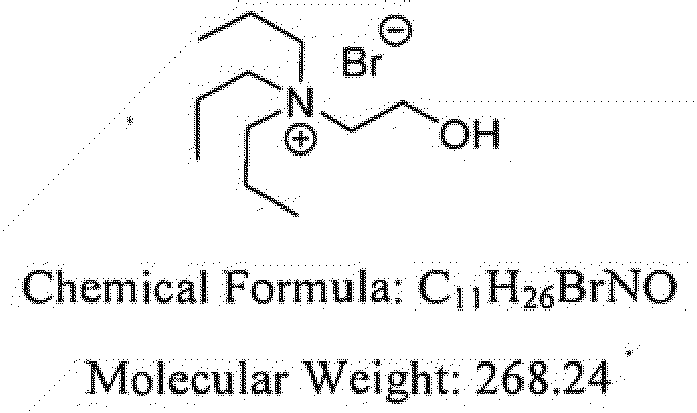
- A solution of tripropylamine (3.8 mL, 20 mmol) and 2-bromoethanol (1.42 mL, 20 mmol) in 20 mL MeCN was heated to reflux for 16 h. The reaction mixture was concentrated and the residue was precipitated in hexanes/EtOAc mixture to get N-(2-hydroxyethyl)-N,N-dipropylpropan-1-aminium bromide as white solid (3.81 g, 71%).
1H NMR (300 MHz, DMSO-d 6) δ 5.25 (t, 1H, J = 5.2 Hz), 3.77 (m, 2H), 3.33 (t, 2H, J= 7.1 Hz), 3.17-3.23 (m, 6H), 1.56-1.68 (m, 6H), 0.88 (t, 9H, J = 7.1 Hz). -
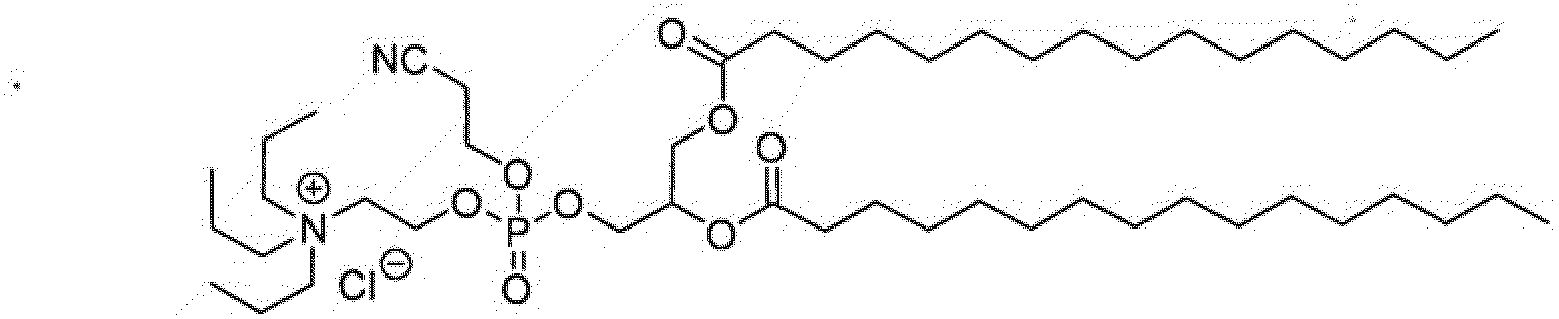

- To a solution of 3-(((2-cyanoethoxy)(diisopropylamino)phosphino)oxy)propane-1,2-diyl dipalmitate (769 mg, 1.0 mmol) and N-(2-hydroxyethyl)-N,N-dipropylpropan-1-aminium bromide (268 mg, 1.0 mmol) in 10 mL dichloromethane, a solution of tetrazole in MeCN (0.45 M, 2.2 mL, 1.0 mmol) was added slowly, and then the reaction was stirred at room temperature for 16 h. After confirmed the disappearance of 3-(((2-cyanoethoxy)(diisopropylamino)phosphino)oxy)propane-1,2-diyl dipalmitate, 'BuOOH (0.80 mL, 4.0 mmol) was added and the mixture was stirred for 4 h. The reaction mixture was diluted with dichloromethane, washed with 10% sodium bisulfate and brine, and then dried over sodium sulfate. After filtration and concentration under vacuum, the yellow foam residue was purified by ISCO (24 g SiO1: MeOH/
dichloromethane 0 to 50%) to provide N-(2-(((2,3-bis(palmitoyloxy)propoxy)(2-cyanoethoxy)phosphanyl)oxy)ethyl)-N,N-dipropylpropan-1-aminium chloride as white foam (520 mg, 60%).
1H NMR (300 MHz, CDCl3) δ 5.26 (m, 1H), 4.64 (m, 2H), 4.10-4.42 (m, 6H), 3.97 (m, 2H), 3.31 (m, 6H), 2.87 (m, 2H), 2.32 (g, 4H, J = 7.7 Hz), 1.54-2.00 (m, 10H), 1.24 (m, 48H), 1.03 (t, 9H, J= 7.1 Hz), 0.87 (t, 6H, J= 7.1 Hz). -

- A solution of N-(2-(((2,3-bis(paimitoyloxy)propoxy)(2-cyanoethoxy)phosphanyl)oxy)ethyl)-N,N-dipropylpropan-1-aminium chloride (520 mg, 0.60 mmol) and diisopropylethylamine (0.75 mL, 4.29 mmol) in 20 mL MeCN was heated to 60 °C for 16 h. The reaction mixture was concentrated under vacuum and purified by ISCO (gold 24 g SiO2: MeOH/
dichloromethane 0 to 60%) to afford the desired product, 2,3-bis(palmitoyloxy)propyl (2-(tripropylammonio)ethyl) phosphate as white solid (360 mg, 73%).
1H NMR (300 MHz, CDCl3) δ 5.20 (m, 1H), 4.41 (dd, 1H, J = 11.9 Hz, 2.7 Hz), 4.28 (m, 2H), 4.13 (dd, 1H, J = 11.9 Hz, 6.8 Hz), 4.00 (t, 2H, J = 6.6 Hz), 3.62 (m, 2H), 3.31-3.38 (m, 6H), 2.27 (dd, 4H, J = 7.0 Hz), 1.66-1.80 (m, 6H), 1.52-1.61 (m, 4H), 1.24 (bs, 48H), 1.04 (t, 9H, J = 7.4 Hz), 0.87 (t, 6H, J = 7.1 Hz). - 4-(2-Hydroxyethyl)-4-methylmorpholin-4-ium 4-methylbenzenesulfonate (Ref: Eur. J. Med Chem. 2009, 44, 4970)

- A solution of 2-morpholinoethan-1-ol (2.7 mL, 22 mmol) and methyl tosylate (3.0 mL, 20 mmol) in 20 mL acetonitrile was heated to reflux for 4 h. The reaction mixture was concentrated under vacuum and precipitated in acetone to give 3-hydroxy-4-methylmorpholin-4-ium 4-methylbenzenesulfonate as brownish solid (5.57 g, 87%).
1H NMR (300 MHz, DMSO-d 6) δ 7.47 (d, 2H, J = 8.0 Hz), 7.11 (d, 2H, J= 8.0 Hz), 5.27 (t, 1H, J = 4.8 Hz), 3.79-3.86 (m, 2H), 3.36-3.46 (m, 6H), 3.06 (s, 3H), 2.28 (s, 3H), 1.72-1.83 (m, 4H), 1.46-1.55 (m, 2H). -

- To a solution of 3-(((2-cyanoethoxy)(diisopropylamino)phosphanyl)oxy)propane-1.2-diyl dipalmitate (769 mg, 1.0 mmol) and 1-(2-hydroxyethyl)-1-methylpiperidin-1-ium 4-methylbenzenesulfonate (315 mg, 1.0 mmol) in 10 mL dichloromethane. a solution of tetrazole in MeCN (0.45 M, 2.2 mL, 1.0 mmol) was added slowly, and then the reaction was stirred at room temperature for 1 6 h. After confirmed the disappearance of of 3-(((2-cyanoethoxy)(diisopropylamino)phosphanyl)oxy)propane-1,2-diyl dipalmitate, 'BuOOH (0.80 mL, 4.0 mmol) was added and the mixture was stirred for 4 h. The reaction mixture was diluted with dichloromethane, washed with 10% sodium bisulfate and brine, and then dried over sodium sulfate. After filtration and concentration under vacuum, the yellow foam residue was purified by ISCO (24 g SiO2: MeOH/
dichloromethane 0 to 50%) to provide 1-(2-(((2,3-bis(palmitoyloxy)propoxy)(2-cyanoethoxy)phosphanyl)oxy)ethyl)-1-methylpiperidin-1-ium chloride as white foam (690 mg, 84%).
1H NMR (300 MHz, CDCl3) δ 5.25 (m, 1H),4.66 (m, 2H), 4.05-4.32 (m, 7H), 3.48 (s, 2H), 3.52-3.70 (m, 3H), 3.32 (s, 3H), 2.84 (m, 2H), 2.32 (q, 4H, J = 8.0 Hz), 1.92 (m, 4H), 1.77 (m, 2H), 1.59 (m, 4H), 1.19-1.34 (bs, 48H), 0.87 (t, 6H, J = 6.8 Hz). -

- A solution of 1-(2-(((2,3-bis(palmitoyloxy)propoxy)(2-cyanoethoxy)phosphanyl)oxy)ethyl)-1-methylpiperidin-1-ium chloride (690 mg. 0.83 mmol) and diisopropylethylamine (1.02 mL. 5.83 mmol) in 20 mL MeCN was heated to 60 °C for 16 h. The reaction mixture was concentrated under vacuum and purified by ISCO (gold 24 g SiO2:MeOH/
dichloromethane 0 to 60%) to afford the desired product, 2,3-bis(palmitoyloxy)propyl (2-(1-methylpiperidin-1-ium-1-yl)ethyl) phosphate as white solid (495 mg, 77%).
1H NMR (300 MHz, CDCl3) δ 5.18-5.20 (m, 1H), 4.30-4.42 (m, 3H), 4.12 (dd, 1H, J = 11.9 Hz, 7.1 Hz), 3.98 (t, 2H, J= 5.7 Hz), 3.82 (m, 2H), 3.60-3.71 (m, 2H), 3.46-3.55 (m, 2H), 3.33 (s, 3H), 2.27 (q, 4H, J = 7.4 Hz), 2.10 (m, 2H), 1.84-1.96 (m, 4H), 1.66-1.76 (m, 2H), 1.50-1.63 (m, 2H), 1.24 (bs, 48H), 0.87 (t, 6H, J = 6.6 Hz). - 1-(2-Hydroxyethyl)quinuclidin-1-ium bromide (Ref: Org. Bioorg. Chem. 2010,425)-

- A solution of quinuclidine (2.22 g, 20 mmol) and 2-bromoethanol (1.42 mL, 20 mmol) in 20 mL THF was heated to 50 °C for 5 h. After cooled to room temperature, the solid was filtered and washed with ether to give 1-(2-hydroxyethyl)quinuclidin-1-ium bromide as white solid (4.61 g, 97%).
1H NMR (300 MHz, DMSO-d 6) δ 5.24 (t, 1H, J= 4.6 Hz), 3.76-3.83 (m, 2H), 3.46 (t, 6H, J = 7.6 Hz), 3.21 (t, 2H, J= 5.5 Hz), 2.01-2.08 (m, 1H), 1.81-1.88 (m, 6H). -

- To a solution of 3-(((2-cyanoethoxy)(diisopropylamino)phosphanyl)oxy)propane-1,2-diyl dipalmitate (769 mg, 1.0 mmol) and 1-(2-hydroxyethyl)quinuclidin-1-ium bromide (236 mg, 1.0 mmol) in 10 mL dichloromethane, a solution of tetrazole in MeCN (0.45 M, 2.2 mL, 1.0 mmol) was added slowly, and then the reaction was stirred at room temperature for 16 h. After confirmed the disappearance of 3-(((2-cyanoethoxy)(diisopropylamino)phosphanyl)oxy)propane-1,2-diyl dipalmitate, 'BuOOH (0.80 mL, 4.0 mmol) was added and the mixture was stirred for 4 h. The reaction mixture was diluted with dichloromethane, washed with 10% sodium bisulfate and brine, and then dried over sodium sulfate. After filtration and concentration under vacuum, the yellow foam residue was purified by ISCO (24 g SiO2: MeOH/
dichloromethane 0 to 10%) to provide 1-(2-(((2,3-bis(palmitoyloxy)propoxy)(2-cyanoethoxy)phosphanyl)oxy)ethyl)quinuclidin-1-ium chloride as white solid (646 mg, 76%).
1H NMR (300 MHz, CDCl3) δ 5.25 (m, 1H),4.63 (m, 2H), 4.13-4.44 (m, 6H), 3.85 (m, 2H), 3.65 (m, 6H), 3.27 (m, 4H), 2.87 (m, 2H), 2.32 (q, 4H, J = 7.6 Hz), 2.19 (m, 1H), 2.04 (m, 4H), 1.59 (m, 2H), 1.18-1.42 (m, 48H), 0.87 (t, 6H, J= 7.0 Hz). -

- A solution of 1-(2-(((2,3-bis(paimitoyloxy)propoxy)(2-cyanoethoxy)phosphanyl)oxy)ethyl)quinuclidin-1-ium chloride (646 mg, 0.76 mmol) and diisopropylethylamine (0.94 mL, 5.38 mmol) in 20 mL MeCN was heated to 60 °C for 16 h. The reaction mixture was concentrated under vacuum and purified by ISCO (gold 24 g SiO2: McOH/
dichloromcthane 0 to 60%) to get the desired product, 2,3-bis(palmitoyloxy)propyl (2-(4-methylmorpholino-4-ium)ethyl) phosphate as white solid (444 mg. 74%).
1H NMR (300 MHz, CDCl3) δ 5.22 (m, 1H), 4.40 (dd, 1H, J= 11.6 Hz, 2.8 Hz), 4.30 (m, 2H), 4.12 (dd, 1H, J= 11.8 Hz, 7.0 Hz), 3.98 (m, 2H), 3.63-3.73 (m, 8H), 2.15-2.34 (m, 8H), 2.00 (m, 5H), 1.50-1.62 (m, 2H), 1.18-1.42 (m, 48H), 0.87 (t, 6H, J = 7.0 Hz). - 3-(Benzyloxy)propane-1,2-diyl distearate (Ref:
EP 1916255 A2 , Pg 30)
X 500 mL), and the combined organic layer was washed with brine and dried over sodium sulfate. After filtration and concentration under vacuum, the crude was purified by dissolving in hexanes and filtering through a pad of silica gel, and then eluted with EtOAc/Hexanes 0 to 30% to provide 3-(benzyloxy)propane-1,2-diyl distearate as white solid (48.2 g, 91%).
1H NMR (300 MHz, CDCl3) δ 7.27-7.34 (m, 5H), 5.21-5.25 (m, 1H), 4.53 (m, 2H), 4.34 (dd, 1H, J = 3.8 Hz, 11.8 Hz), 4.18 (dd, 1H, J = 6.6 Hz, 11.8 Hz), 3.58 (d, 2H, J = 6.0 Hz), 2.24-2.34 (m, 4H), 1.54-1.63 (m, 4H), 1.24 (s, 56H), 0.87 (t, 6H, J= 6.3 Hz). -

- A mixture of 3-(benzyloxy)propane-1,2-diyl distearate (48.2 g, 67.4 mmol) and Pd/C (5%, Degaussa E10002U/W, Aldrich 330124, 4.8 g) in 1 L EtOAc was purged with nitrogen and
hydrogen 3 times, respectively, and then the reaction was stirred at room temperature with balloon for 16 h. The suspension was filtered through Celite, washed with dichloromethane (3 L). After concentration under vacuum, the solid was precipitated in dichloromethane to provide 3-hydroxypropane-1,2-diyl distearate as white solid (40.67 g, 96%).
1H NMR (300 MHz, CDCl3) δ 5.05-5.11 (m, 1H), 4.31 (dd, 1H, J= 4.6 Hz, 11.9 Hz), 4.23 (dd, 1H, J = 5.7 Hz, 11.9 Hz), 3.70-3.74 (m, 2H), 2.33 (q, 4H, J = 7.1 Hz), 2.00 (t, 1H, J = 6.3 Hz), 1.57-1.62 (m, 4H), 1.24 (s, 56H), 0.87 (t, 6H, J i= 7.1 Hz). -

- To a solution of 3-hydroxypropane-1,2-diyl distearate (5.00 g, 8.0 mmol) and tetrazole (0.45 M in MeCN, 35.6 mL, 16.0 mmol) in 150 mL dichloromethane, a solution of 3-((chloro(diisopropylamino)phosphino)oxy)propanenitrile (5.1 mL, 16.0 mmol) in 100 mL dichloromethane was added dropwise and the reaction mixture was stirred at room temperature for 4 h. The mixture was concentrated and purified by ISCO (120 g SiO2:EtOAc/Hexanes (1% Et3N) 0 to 10%) to give 3-(((2-cyanoethoxy)(diisopropylamino)phosphanyl)oxy)propane-1,2-diyl distearate as white solid (3.73 g, 56%). The yield can be improved by pre-eluting the column with excess hexanes/1% Et3N.
1H NMR (300 MHz, CDCl3) δ 5.16-5.20 (m, 1H), 4.28-4.37 (m, 1H), 4.11-4.17 (m, 1H), 2.62 (t, 2H, J= 6.3 Hz), 2.26-2.32 (m, 8H), 1.57-1.64 (m, 6H), 1.24 (s, 56H), 1.14-1.19 (m, 12H), 0.87 (t, 6H, J= 6.3 Hz). -

- To a solution of 3-(((2-cyanoethoxy)(diisopropylamino)phosphanyl)oxy)propane-1,2-diyl distearate (700 mg, 0.848 mmol) and N,N,N-triethyl-2-hydroxyethanaminium iodide (232 mg, 0.848 mmol) in 10 mL dichloromethane, a solution of tetrazole in MeCN (0.45 M, 1.9 mL, 0.848 mmol) was added slowly, and then the reaction was stirred at room temperature for 16 h. After confirmed the disappearance of 3-(((2-cyanoethoxy)(diisopropylamino)phosphanyl)oxy)propane-1,2-diyl distearate, t BuOOH (0.68 mL, 3.39 mmol) was added and the mixture was stirred for 4 h. The reaction mixture was diluted with dichloromcthanc, washed with 10% sodium bisulfate and brine, and then dried over sodium sulfate. After filtration and concentration under vacuum, the yellow foam residue was purified by ISCO (24 g SiO2: MeOH/
dichloromethane 0 to 10%) to provide 2-(((2,3-bis(stearoyloxy)propoxy)(2-cyanoethoxy) phosphoryl)oxy)-N,N,N-triethylethanaminium chloride as yellowish foam (332 mg, 43%).
1H NMR (300 MHz, CDCl3) δ 5.29 (m, 1H), 4.67 (m, 1H). 4.14-4.44 (m, 7H), 3.98 (m, 1H), 3.51 (q, 6H, J = 7. 2 Hz), 2.87 (m, 2H), 2.28-2.37 (m, 4H), 1.60 (m, 5H), 1.41 (t, 9H, J = 7.1 Hz), 1.24 (s, 56H), 0.87 (t, 6H, J = 7.2 Hz). -

- A solution of 2-(((2,3-bis(stearoyloxy)propoxy)(2-cyanoethoxy) phosphoryl)oxy)-N,N,N-triethylethanaminium chloride (332 mg, 0.374 mmol) and diisopropylethylamine (0.46 mL, 2.62 mmol) in 10 mL MeCN was heated to 60 °C for 16 h. The reaction mixture was concentrated under vacuum and purified by ISCO (gold 24 g SiO2: MeOH/
dichloromethane 0 to 60%) to provide the desired product, 2,3-bis(stearoyloxy)propyl (2-(triethylammonio)ethyl) phosphate as white solid (200 mg, 64%).
1H NMR (300 MHz, CDCl3) δ 5.18-5.25 (m, 1H), 4.41 (dd, 1H, J =2.7 Hz, 11.8 Hz), 4.29 (m, 2H), 4.13 (dd, 1H, J =7.0 Hz, 11.8 Hz), 4.00 (t, 2H, J= 6.6 Hz), 3.57-3.62 (m, 2H), 3.52 (q, 6H, J = 7.4 Hz), 2.27 (q, 4H, J = 6.6 Hz), 1.52-1.62 (m, 4H), 1.37 (t, 9H, J = 7.1 Hz), 1.24 (s, 56H), 0.87 (t, 6H, J = 7.1 Hz). -

- To a solution of 3-(((2-cyanoethoxy)(diisopropylamino)phosphanyl)oxy)propane-1,2-diyl distearate (700 mg, 0.848 mmol) and 1-(2-hydroxyethyl)-1-methylpiperidin-1-ium 4-methylbenzenesulfonate (267 mg, 0.848 mmol) in 10 mL dichloromethane, a solution of tetrazole in MeCN (0.45 M, 1.9 mL, 0.848 mmol) was added slowly, and then the reaction was stirred at room temperature for 16 h. After confirmed the disappearance of 3-(((2-cyanoethoxy)(diisopropylamino)phosphanyl)oxy)propane-1,2-diyl distearate, t BuOOH (0.68 mL, 3.39 mmol) was added and the mixture was stirred for 4 h. The reaction mixture was diluted with dichloromethane, washed with 10% sodium bisulfate and brine, and then dried over sodium sulfate. After filtration and concentration under vacuum, the yellow foam residue was purified by ISCO (24 g SiO2: MeOH/
dichloromethane 0 to 10%) to provide 1-(2-(((2,3-bis(stearoyloxy)propoxy)(2-cyanoethoxy)phosphoryl)oxy)ethyl)-1-methylpiperidin-1-ium chloride as white solid (470 mg, 62%).
1H NMR (300 MHz, CDCl3) δ 5.25 (m, 1H), 4.67 (m, 2H), 4.12-4.42 (m, 7H), 3.48 (s, 2H), 3.55-3.70 (m, 3H), 3.32 (s, 3H), 2.77-2.85 (m, 2H), 2.32 (q, 4H, J = 8.0 Hz), 1.93 (m, 4H), 1.70-1.78 (m, 2H), 1.59 (m, 4H), 1.19-1.34 (bs, 56H), 0.87 (t, 6H, J = 6.8 Hz). -

- A solution of 1-(2-(((2,3-bis(stearoyloxy)propoxy)(2-eyanoethoxy)phosphoryl)oxy)ethyl)-1-methylpiperidin-1-ium chloride (470 mg, 0.53 mmol) and diisopropylethylamine (0.65 mL, 3.72 mmol) in 15 mL MeCN was heated to 60 °C for 16 h. The reaction mixture was concentrated under vacuum and purified by ISCO (gold 24 g SiO2: MeOH/
dichloromethane 0 to 60%) to get the desired product, 2,3-bis(stearoyloxy)propyl (2-(1-methylpiperidin-1-ium-1-yl)ethyl) phosphate as white solid (269 mg, 61%).
1H NMR (300 MHz, CDCl3) δ 5.18-5.24 (m, 1H), 4.40 (dd, 1H, J = 12.1 Hz, 3.0 Hz), 4.34 (m, 2H), 4.12 (dd, 1H, J = 11.9 Hz, 7.1 Hz), 3.99 (t, 2H, J = 5.7 Hz), 3.82 (m, 2H), 3.62-3.71 (m, 2H), 3.46-3.55 (m, 2H), 3.34 (s, 3H), 2.27 (q, 4H, J = 7.4 Hz), 1.84-1.96 (m, 4H), 1.68-1.76 (m, 2H), 1.52-1.63 (m, 4H), 1.24 (bs, 56H), 0.87 (t, 6H, J = 6.6 Hz). -

- To a solution of 3-(((2-cyanoethoxy)(diisopropylamino)phosphanyl)oxy)propane-1,2-diyl distearate (700 mg, 0.848 mmol) and 3-hydroxy-N,N,N-trimethylpropan-1-aminium tosylate (245 mg, 0.848 mmol) in 10 mL dichloromethane, a solution of tetrazole in MeCN (0.45 M, 1.9 mL, 0.848 mmol) was added slowly, and then the reaction was stirred at room temperature for 16 h. After confirmed the disappearance of 3-(((2-cyanoethoxy)(diisopropylamino)phosphanyl)oxy)propane-1,2-diyl distearate, t BuOOH (0.68 mL, 3.39 mmol) was added and the mixture was stirred for 4 h. The reaction mixture was diluted with dichloromethane, washed with 10% sodium bisulfate and brine, and then dried over sodium sulfate. After filtration and concentration under vacuum, the yellow foam residue was purified by ISCO (24 g SiO2: MeOH/
dichloromethane 0 to 10%) to provide 3-(((2,3-bis(stearoyloxy)propoxy)(2-cyanoethoxy) phosphoryl)oxy)-N,N,N-trimethylpropan-1-aminium chloride as white foam (502 mg, 68%).
1H NMR (300 MHz, CDCl3) δ 5.25 (m, 1H), 4.15-4.35 (m, 7H), 3.78 (m, 2H), 3.31 (s, 9H), 2.83 (m, 2H), 2.27-2.35 (m, 10H), 1.98 (m, 3H), 1.59 (m, 4H), 1.24 (s, 50H), 0.87 (t, 6H, J = 6.0 Hz). -

- A solution of 3-(((2,3-bis(stearoyloxy)propoxy)(2-cyanoethoxy) phosphoryl)oxy)-N,N,N-trimethylpropan-1-aminium chloride (502 mg, 0.58 mmol) and diisopropylethylamine (0.71 mL, 4.1 mmol) in 15 mL MeCN was heated to 60 °C for 16 h. The reaction mixture was concentrated under vacuum and purified by ISCO (gold 24 g SiO2: MeOR/
dichloromethane 0 to 60%) to get the desired product, 2,3-bis(stearoyloxy)propyl (3-(trimethylammonio)propyl) phosphate as white solid (385 mg, 82%).
1H NMR (300 MHz, CDCl3) δ 5.02 (m, 1H), 4.40 (dd, 1H, J = 3.0 Hz, 11.8 Hz), 4.13 (dd, 1H, J = 7.2 Hz, 11.8 Hz), 3.91-4.00 (m, 4H), 3.77-3.83 (m, 2H), 3.28 (s, 9H), 2.07-2.32 (m, 10H), 1.24 (s, 56H), 0.87 (t, 6H, J= 6.0 Hz). -

- To a solution of 3-(((2-cyanoethoxy)(diisopropylamino)phosphanyl)oxy)propane-1,2-diyl distearate (700 mg, 0.848 mmol) and 3-hydroxy-N,N,N-trimethylbutan-1-aminium 4-methylbenzenesulfonate (257 mg, 0.848 mmol) in 10 mL dichloromethane, a solution of tetrazole in MeCN (0.45 M, 1.9 mL. 0.848 mmol) was added slowly, and then the reaction was stirred at room temperature for 16 h. After confirmed the disappearance of 3-(((2-cyanoethoxy)(diisopropylamino)phosphanyl)oxy)propane-1,2-diyl distearate, 'BuOOH (0.68 mL, 3.39 mmol) was added and the mixture was stirred for 4 h. The reaction mixture was diluted with dichloromethane, washed with 10% sodium bisulfate and brine, and then dried over sodium sulfate. After filtration and concentration under vacuum, the yellow foam residue was purified by ISCO (24 g SiO2: MeOH/
dichloromethane 0 to 10%) to provide 3-(((2,3-bis(stearoyloxy)propoxy)(2-cyanoethoxy) phosphoryl)oxy)-N,N,N-trimethylbutan-1-aminium chloride as white solid (648 mg, 87%).
1H NMR (300 MHz, CDCl3) δ 5.19-5.27 (m, 1H), 4.1 1-4.34 (m, 8H), 3.60-3.68 (m, 2H), 3.32 (s, 9H), 2.77-2.85 (m, 2H), 2.31 (q, 4H, J = 6.8 Hz), 1.90-2.00 (m, 2H), 1.78-1.86 (m, 2H), 1.54-1.64 (m, 4H), 1. 19-1.35 (m, 56H), 0.86 (t, 6H, J= 6.8 Hz). -

- A solution of 3-(((2,3-bis(stearoyloxy)propoxy)(2-cyanoethoxy) phosphoryl)oxy)-N,N,N-trimethylbutan-1-aminium chloride (648 mg, 0.74 mmol) and diisopropylethylamine (0.91 mL, 5.2 mmol) in 20 mL MeCN was heated to 60 °C for 16 h. The reaction mixture was concentrated under vacuum and purified by ISCO (gold 24 g SiO2: MeOH/
dichloromethane 0 to 60%) to get the desired product, 2,3-bis(stearoyloxy)propyl (3-(trimethylammonio)butyl) phosphate as white solid (330 mg, 54%).
1H NMR (300 MHz, CDCl3) δ 5.18-5.24 (m, 1H), 4.40 (dd, 1H, J= 12.0 Hz, 3.0 Hz), 4.15 (dd, 1H, J= 11.9 Hz, 6.8 Hz), 3.90-3.98 (m, 4H), 3.94-3.98 (m, 2H), 3.28 (s, 9H), 1.94-2.32 (m, 6H), 1.68-1.73 (m, 2H), 1.52-1.62 (m, 4H), 1.24 (bs, 56H), 0.87 (t, 6H, J= 6.6 Hz). -

- To a solution of 3-(((2-cyanoethoxy)(diisopropylamino)phosphanyl)oxy)propane-1,2-diyl distearate (700 mg, 0.848 mmol) and 1-(2-hydroxyethyl)quinuclidin-1-ium bromide (200 mg, 0.848 mmol) in 10 mL dichloromethane, a solution of tetrazole in MeCN (0.45 M, 1.9 mL, 0.848 mmol) was added slowly, and then the reaction was stirred at room temperature for 16 h. After confirmed the disappearance of 3-(((2-cyanoethoxy)(diisopropylamino)phosphanyl)oxy)propane-1,2-diyl distearate, t BuOOH (0.68 mL, 3.39 mmol) was added and the mixture was stirred for 4 h. The reaction mixture was diluted with dichloromethane, washed with 10% sodium bisulfate and brine, and then dried over sodium sulfate. After filtration and concentration under vacuum, the yellow foam residue was purified by ISCO (24 g SiO2: MeOH/
dichloromethane 0 to 10%) to provide 1-(2-(((2,3-bis(stearoyloxy)propoxy)(2-cyanoethoxy)phosphoryl)oxy)ethyl)quinuclidin-1-ium chloride as white solid (572 mg, 75%).
1H NMR (300 MHz, CDCl3) δ 5.26 (m, 1H), 4.62 (m, 2H), 4.16-4.42 (m, 6H), 3.85 (m, 2H), 3.63-3.73 (m, 6H), 2.84-2.92 (m, 2H), 2.32 (q, 4H, J= 8.0 Hz), 2.20 (m, 1H), 2.04 (m, 6H), 1.52-1.84 (m, 10H), 1.18-1.33 (m, 50H), 0.87 (t, 6H, J= 6.8 Hz). -

- A solution of 1-(2-(((2,3-bis(stearoyloxy)propoxy)(2-cyanoethoxy)phosphoryl)oxy)ethyl)quinuclidin-1-ium chloride (572 mg, 0.64 mmol) and diisopropylethylamine (0.78 mL, 4.47 mmol) in 15 mL MeCN was heated to 60 °C for 16 h. The reaction mixture was concentrated under vacuum and purified by ISCO (gold 24 g SiO2: MeOH/
dichloromethane 0 to 60%) to provide the desired product, 2,3-bis(stearoyloxy)propyl (2-(quinuclidin-1-ium-1-yl)ethyl) phosphate as white solid (387 mg, 72%).
%). 1H NMR (300 MHz, CDCl3) δ 5.17-5.23 (m, 1H), 4.40 (dd, 1H, J= 11.9 Hz, 2.6 Hz), 4.32 (m, 2H), 4.12 (dd, 1H, J = 11.9 Hz, 7.1 Hz), 3.99 (t, 2H, J = 6.4 Hz), 3.64-3.73 (m, 9H), 2.52 (m, 4H), 2.28 (q, 4H, J= 7.7 Hz), 2.14-2.21 (m, 1H), 2.01 (m, 3H), 1.52-1.60 (m, 4H), 1.36-1.46 (m, 4H), 1.19-1.32 (bs, 50H), 0.87 (t, 6H, J = 6.6 Hz). -

- To a solution of 3-(((2-cyanoethoxy)(diisopropylamino)phosphanyl)oxy)propanc-1,2-diyl distearate (700 mg, 0.848 mmol) and N-(2-hydroxyethyl)-N,N-dipropylpropan-1-aminium bromide (227 mg, 0.848 mmol) in 10 mL dichloromethane, a solution oftetrazole in MeCN (0.45 M, 1.9 mL, 0.848 mmol) was added slowly, and then the reaction was stirred at room temperature for 16 h. After confirmed the disappearance of 3-(((2-cyanoethoxy)(diisopropylamino)phosphanyl)oxy)propane-1,2-diyl distearate, t BuOOH (0.68 mL, 3.39 mmol) was added and the mixture was stirred for 4 h. The reaction mixture was diluted with dichloromethane, washed with 10% sodium bisulfate and brine, and then dried over sodium sulfate. After filtration and concentration under vacuum, the yellow foam residue was purified by ISCO (24 g SiO2: MeOH/
dichloromethane 0 to 10%) to provide N-(2-(((2,3-bis(stearoyloxy)propoxy)(2-cyanoethoxy)phosphoryl)oxy)ethyl)-N,N-dipropylpropan-1-aminium chloride as yellowish foam (535 mg, 68%).
1H NMR (300 MHz, CDCl3) δ 8.82 (bs, 1H), 5.18-5.27 (m, 1H), 4.64 (m, 1H), 4.12-4.42 (m, 4H), 3.98 (m, 1H), 3.27-3.34 (m, 4H), 2.84-2.91 (m, 1H), 2.27-2.35 (m, 3H), 1.69-1.82 (m, 4H), 1.52-1.64 (m, 5H), 1.39 (d, 12H, J = 6.3 Hz), 1.19-1.33 (bs, 56H), 0.99-1.06 (m, 5H), 0.87 (t, 6H, J = 6.8 Hz). -
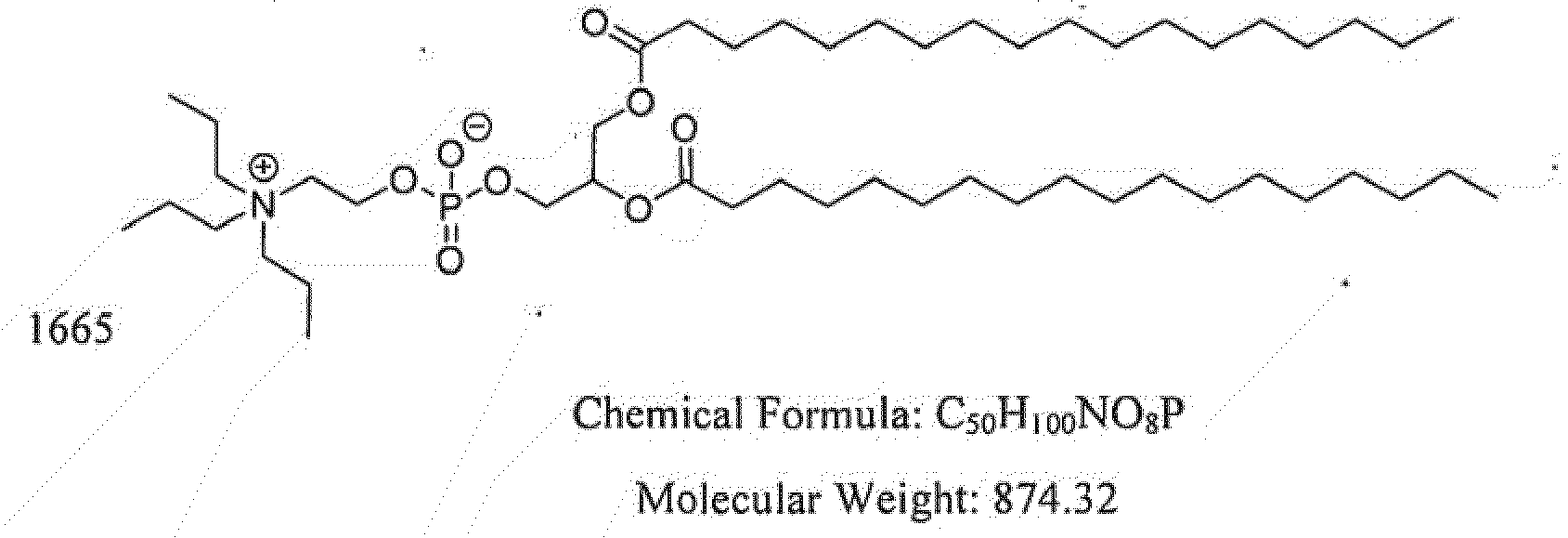
- A solution of 2-(((2,3-bis(stearoyloxy)propoxy)(2-cyanoethoxy) phosphoryl)oxy)-N,N,N-tripropylethanaminium chloride (535 mg, 0.57 mmol) and diisopropylethylamine (0.70 mL, 4.03 mmol) in 20 mL MeCN was heated to 60 °C for 16 h. The reaction mixture was concentrated under vacuum and purified by ISCO (gold 24 g SiO2: MeOH/
dichloromethane 0 to 60%) to provide the desired product, 2,3-bis(stearoyloxy)propyl (2-(tripropylammonio)ethyl) phosphate as white solid (472 mg, 94%).
1H NMR (300 MHz, CDCl3) δ 5.16-5.23 (m, 1H), 4.41 (dd, 1H, J = 11.9 Hz, 3.3 Hz), 4.26 (m, 2H), 4.13 (dd, 1H, J = 11.9 Hz, 7.1 Hz), 4.02 (t, 2H, J= 6.3 Hz), 3.60 (m, 2H), 3.228-3.37 (m, 6H), 2.22-2.31 (m, 4H), 1.33-1.96 (m, 15H), 1.24 (bs, 51H), 1.04 (t, 9H, J= 7.1 Hz), 0.87 (t, 6H, J= 6.6 Hz). -

- To a solution of 3-(((2-cyanoethoxy)(diisopropylamino)phosphanyl)oxy)propane-1,2-diyl distearate (700 mg, 0.848 mmol) and 3-hydroxy-4-methylmorpholin-4-ium 4-methylbenzenesulfonate (269 mg, 0.848 mmol) in 10 mL dichloromethane, a solution of tetrazole in MeCN (0.45 M, 1.9 mL, 0.848 mmol) was added slowly, and then the reaction was stirred at room temperature for 16 h. After confirmed the disappearance of 3-(((2-cyanoethoxy)(diisopropylamino)phosphanyl)oxy)propane-1,2-diyl distearate, 'BuOOH (0.68 mL, 3.39 mmol) was added and the mixture was stirred for 4 h. The reaction mixture was diluted with dichloromcthane, washed with 10% sodium bisulfate and brine, and then dried over sodium sulfate. After filtration and concentration under vacuum, the yellow foam residue was purified by ISCO (24 g SiO2: MeOH/
dichloromethane 0 to 10%) to provide 4-(2-(((2,3-bis(stearoyloxy)propoxy)(2-cyanoethoxy)phosphoryl)oxy)ethyl)-4-methylmorphol in-4-ium chloride as yellowish foam (456 mg, 60%).
1H NMR (300 MHz, CDCl3) δ 5.26 (m, 1H), 4.72 (m, 2H), 4.12-4.40 (m, 8H), 3.96-4.08 (m, 4H), 3.72 (m, 4H), 3.52 (s, 3H), 2.84 (m, 2H), 2.32 (q, 6H, J= 7.9 Hz), 1.59 (m, 4H), 1.14-1.31 (m, 54H), 0.87 (t, 6H, J = 6.6 Hz). -

- A solution of 4-(2-(((2,3-bis(stearoyloxy)propoxy)(2-cyanoethoxy)phosphoryl)oxy)ethyl)-4-methylmorpholin-4-ium chloride (456 mg, 0.51 mmol) and diisopropylethylamine (0.63 mL, 4.03 mmol) in 15 mL MeCN was heated to 60 °C for 16 h. The reaction mixture was concentrated under vacuum and purified by ISCO (gold 24 g SiO2: MeOH/
dichloromethane 0 to 60%) to provide the desired product, 2,3-bis(stearoyloxy)propyl (2-(4-methylmorpholino-4-ium)ethyl) phosphate as white solid (360 mg, 84%).
1H NMR (300 MHz, CDCl3) δ 5.21 (m, 1H), 4.36-4.42 (m, 3H), 4.10 (dd, 1H, J = 12.1 Hz, 7.4 Hz), 3.93-4.06 (m, 8H), 3.66-3.72 (m, 4H), 3.52 (s, 3H), 2.27 (q, 4H, J= 7.1 Hz), 1.92-2.06 (m, 2H), 1.52-1.62 (m, 4H), 1.24 (m, 54H), 0.87 (t, 6H, J = 6.6 Hz). - tert-Butyl (2-sulfamoylethyl)carbamate (Ref:
WO2007/041634 )
- A mixture of 2-aminoethane-1-sulfonamide (3.37 g, 21 mmol), di-tert-butyl dicarbonatc (6.87 g, 31.5 mmol), triethylamine (11.7 mL, 84 mmol) and N,N-dimethylpyridin-4-amine (260 mg, 2.1 mmol) in 120 mL dichloromethane was stirred at room temperature for 16 h. The reaction mixture was diluted with water and extracted with dichloromethane. The combined organic layer was washed with brine and dried over sodium sulfate. After filtration and concentration, the residue was purified by ISCO (80 g SiO2: EtOAc/
hexanes 0 to 100%) to provide tert-butyl (2-sulfamoylethyl)carbamate as white solid (1.40 g, 30%).
1H NMR (300 MHz, CDCl3) δ 5.08 (bs, 1H), 4.87 (bs, 1H), 3.67 (q, 2H, J= 6.0 Hz), 3.28 (t, 2H, J = 6.0 Hz), 1.44 (s, 9H). - tert-Butyl (2-(N-oleoylsulfamoyl)ethyl)carbamate (Ref:
WO2008/087190 )
- A mixture of tert-butyl (2-sulfamoylethyl)carbamate (1.40 g, 6.24 mmol), oleic acid (2.0 mL, 6.24 mmol), 1,1'-carbonyldiimidazole (1.01 g, 6.24 mmol) and 1,8-diazabicyclo[5.4.0]undec-7-ene (2.0 mL, 13.7 mmol) in 60 mL N,N-dimethylformamide was stirred at room temperature for 16 h. TLC showed the formation of the product. The reaction mixture was acidified with 4N HCl solution to pH = 2, and then extracted with ether. After dried over sodium sulfate, the solution was filtered and concentrated. The residue was purified by ISCO (80 g SiO2: EtOAc/hexanes, 0 to 10%) to provide tert-butyl (2-(N-oleoylsulfamoyl)ethyl)carbamate (2.34 g, 76%).
1H NMR (300 MHz, CDCl3) δ 5.29-5.34 (m, 2H), 5.07 (bs, 1H), 3.60 (bs, 4H), 2.33 (t, 2H, J = 7.5 Hz), 1.97-2.03 (m, 4H), 1.62-1.68 (m, 3H), 1.43 (s, 9H), 1.23-1.30 (m, 20 H), 0.87 (t, 3H, J= 5.8 Hz). -

- To a solution of tert-butyl (2-(N-oleoylsulfamoyl)ethyl)carbamate (378 mmol, 0.77 mmol) in 10 mL dichloromethane, trifluoroacetic acid (2 mL) was added slowly, and stirred at room temperature for 4 h. TLC showed the disappcarencc of tert-butyl (2-(N-olcoylsulfamoyl)ethyl)carbamate. The reaction mixture was concentrated to dryness and triturated with hcxanes to provide N-((2-aminoethyl)sulfonyl)oleamide trifluoroacetatc as white solid (344 mg, 88%).
- 1H NMR (300 MHz, CDCl3) δ 7.85 (bs, 2H), 5.28-5.36 (m, 2H), 3.84 (bs, 2H), 3.48 (bs, 2H), 2.30-2.40 (m, 2H), 1.94-2.04 (m, 4H), 1.18-1.36 (m, 20H), 0.87 (t, 6H, J= 6.8 Hz).
- MS (APCI): mlz (MH+) 389.3, 371.3.
-

- (Ref:
WO2008/087190 ) To a solution of 2-(dimethylamino)ethane-1-sulfonamide (500 mg, 3.28 mmol), triethylamine (0.92 mL, 6.57 mmol) and N,N-dimethylpyridin-4-amine (40 mg, 0.33 mmol) in 30 mL dichloromethane, oleoyl chloride (1.3 mL, 3.94 mmol) was added dropwise and the reaction mixture was warmed up to room temperature. MS showed complete reaction. The reaction mixture was diluted with water and extracted with dichloromethane. The combined organic layer was washed with brine and dried over sodium sulfate. After filtration and concentration, the residue was purified by ISCO (24 g SiO2: MeOH/dichloromethane 0 to 10%) to provide N-((2-(dimethylamino)ethyl)sulfonyl)oleamide as white solid (437 mg, 32%). - 1H NMR (300 MHz, CDCl3) δ 5.28-5.34 (m, 2H), 3.44 (t, 2H, J = 6.3 Hz), 3.03 (t, 2H, J = 6.3 Hz), 2.48 (s, 6H), 2.32 (t, 2H, J = 7.6 Hz), 1.95-2.02 (m, 4H), 1.56-1.64 (m, 2H), 1.20-1.38 (m, 20H), 0.87 (t, 3H, J= 6.6 Hz).
- MS (APCI): m/z (MH+) 417.3.
-

- A solution of N-((2-(dimethylamino)ethyl)sulfonyl)oleamide (172 mg, 0.41 mmol) and iodomethane (3 mL) in 15 mL dimethoxyethane was stirred at room temperature for 16 h. TLC showed complete reaction. After concentration, the crude was purified by Gold ISCO (24 g SiO2: MeOH/
dichloromethane 0 to 20%) to get N,N,N-trimethyl-2-(N oleoylsulfamoyl)ethan-1-aminium iodide as light yellow foam (217 mg, 94%). - 1H NMR (300 MHz, CDCl3) δ 5.28-5.38 (m, 2H), 4.24 (bs, 4H), 3.45 (s, 9H), 2.54-2.64 (m, 2H), 1.94-2.06 (m, 4H), 1.56-1.68 (m, 2H), 1.20-1.38 (m, 20H), 0.87 (t, 3H, J = 6.6 Hz).
- MS (APCI): m/z (MH+) 417.3, 391.3.
-

- At 0 °C, to a solution of 3-chloropropane-1-sulfonyl chloride (2.68 mL, 22 mmol) and triethylamine (7.8 mL, 56 mmol) in 80 mL dichloromethane, a solution of bis(4-methoxybenzyl)amine (5.15g, 20 mmol) in 20 mL dichloromethane was added slowly, and then the reaction was warmed up to room temperature for 16 h. The reaction mixture was diluted with water and extracted with dichloromethane. The combined organic layer was washed with brine and dried over sodium sulfate. The solution was filtered through a pad of silica gel and eluted with 30% EtOAc in hexanes. After concentration, the crude was purified with ISCO (120 g SiO2: EtOAc/
Hexanes 0 to 30%) to provide 3-chloro-N,N-bis(4-methoxybenzyl)propane-1-sulfonamide as brown oil (4.95, 62%).
1H NMR (300 MHz, CDCl3) δ 7.20-7.25 (m, 4H), 6.85-6.90 (m, 4H), 4.27 (s, 4H), 3.81 (s, 6H), 3.60 (t, 2H, J = 6.8 Hz), 2.99 (t, 2H, J = 7.1 Hz), 2.19-2.28 (m, 2H). -

- In a seal tube, a mixture 3-chloro-N,N-bis(4-methoxybenzyl)propane-1-sulfonamide (4.95 g, 12.4 mmol) in dimethylamine solution in THF (2.0 M, 30 mL, 60 mmol) was heated to 70 °C for 16 h. MS showed the product. After cooled to room temperature, the reaction mixture was filtered and washed with dichloromethane. The filtrate was concentrated and the crude was purified with ISCO (120 g SiO2: MeOH/
dichloromethane 0 to 7%) to provide 3-(dimethylamino)-N,N-bis(4-methoxybenzyl)propane-1-sulfonamide as a brown oil (4.04. 80%).
1H NMR (300 MHz, CDCl3) δ 7.15-7.25 (m, 4H), 6.82-6.89 (m, 4H), 4.25 (s, 4H), 3.80 (s, 6H), 2.85-2.95 (m, 2H), 2.28 (t, 2H, J= 6.6 Hz), 2.17 (s, 6H), 1.87-1.96 (m, 2H). - 3-(Dimethylamino)propane-1-sulfonamide (Ref:
WO2015/112441 )
- To a solution of 3-(dimethylamino)-N,N-bis(4-methoxybenzyl)propane-1-sulfonamide (1.22 g, 3.0 mmol) and anisole (3.3 mL) in 15 mL dichloromethane, 22 mL trifluoroacetic acid was added dropwise, and then stirred at room temperature for 16 h. MS showed the product. The reaction mixture was concentrated to dryness to give 3-(dimethylamino)propane-1-sulfonamide as semi-solid (1.00 g, quant.), which was used for the next step without further purification.
- 1H NMR (300 MHz, CD3OD) δ 3.28-3.34 (m, 2H), 3.18 (t, 2H, J = 6.6 Hz), 2.90 (s, 6H), 2.17-2.29 (m, 2H).
- MS (APCI): m/z (MH+) 167.1.
-

- To a solution of 3-(dimethylamino)propane-1-sulfonamide (1.00 g, 3.0 mmol), triethylamine (1.26 mL, 9.0 mmol) and N,N-dimethylpyridin-4-amine (37 mg, 0.3 mmol) in 60 mL dichloromethane, a solution of oleoyl chloride (1.2 mL, 3.6 mmol) was added dropwise, and then stirred at room temperature for 16 h. MS showed the product. The reaction mixture was diluted with water and extracted with dichloromethane. The combined organic layer was washed with brine and dried over sodium sulfate. After filtration and concentration, the residue was purified by ISCO (40 g SiO2: MeOH/
dichloromethane 0 to 10%) to provide N-((3-(dimethylamino)propyl)sulfonyl)oleamide as white solid (255 mg, 20%). - 1H NMR (300 MHz, CDCl3) δ 5.31-5.36 (m, 2H), 3.37 (t, 2H, J = 7.1 Hz), 2.99 (t, 2H, J = 7.0 Hz), 2.82 (bs, 1H), 2.68 (s, 6H), 2.37 (t, 2H, J = 7.6 Hz), 2.21-2.29 (m, 2H), 1.96-2.02 (m, 4H), 1.57-1.66 (m, 2H), 1.20-1.36 (m, 20H), 0.87 (t, 3H, J = 6.6 Hz).
- MS (APCI): m/z (MH+) 431.3.
-

- To a solution of N-((3-(dimethylamino)propyl)sulfonyl)oleamide (389 mg, 0.90 mmol) in 20 mL dimethoxyethane, iodomethane (5 mL) was added and the reaction mixture was stirred at room for 16 h. Either more iodomethane or longer time was not improving the yield. The reaction mixture was concentrated and purified with gold ISCO (24 g SiO2: MeOH/
dichloromethane 0 to 30%) to provide N,N,N-trimethyl-3-(N-oleoylsulfamoyl)propan-1-aminium iodide as yellow foam (237 mg, 46%).
1H NMR (300 MHz, CD3OD) δ 5.32-5.36 (m, 2H), 3.48-3.57 (m, 4H), 3.17 (s, 9H), 2.28-2.37 (m, 4H), 1.99-2.06 (m, 4H), 1.57-1.66 (m, 2H), 1.24-1.37 (m, 20H), 0.87 (t, 3H, J = 6.6 Hz). -
- At 0 °C, NaH (1.20 g, 30 mmol) was added into a solution of diethyl malonate (1.52 mL. 10 mmol) in 60 mL N,N-dimethylformamide. After stirring for 30 min, a solution of 1-bromooctadecane (8.33 g, 25 mmol) in 60 mL THF was added slowly, and the reaction mixture was warmed up to room temperature and then heated to 50 °C for 6 h. After the reaction was cooled to room temperature, MeOH, acetic acid and ice-cold water (5 mL cach) were added to quench the reaction. After extracted with dichloromethane, the combined organic layer was washed with brine (hard to separate). After drying over sodium sulfate, the solution was filtered and concentrated, and the crude was purified with ISCO (220 SiO2: ether/
hexanes 0 to 5%) to providediethyl 2,2-dioctadecylmalonate as white solid (5.96 g, 85%).
1H NMR (300 MHz, CDCl3) δ 4.16 (q, 4H, J = 7.1 Hz), 1.81-1.87 (m, 4H). 1.06-1.33 (m, 70H), 0.87 (t, 6H, J = 7.1 Hz). -

- To a solution of
diethyl 2,2-dioctadecylmalonate (3.39 g, 5.1 mmol) in 60 mL i PrOH, a solution of potassium hydroxide (11.0 g) in 60 mL water was added, and the mixture was heated to reflux for 48 h. TLC showed the disappearance of starting material with small amount of mono-ester. The reaction mixture was cooled to room temperature and diluted with water. 47% sulfuric acid was added to adjust pH = 2, and precipitate was observed. The suspension was filtered and washed with water and dichloromethane. The solid was dissolved in ether and dried over sodium sulfate. After filtration and concentration, 2,2-dioctadecylmalonic acid was obtained as white solid (2.13 g, 68%).
%). 1H NMR (300 MHz, CDCl3) δ 1.89-1.94 (m, 4H), 1.09-1.32 (m, 66H), 0.88 (t, 6H, J = 7.1 Hz).
- A mixture of 2,2-dioctadecylmalonic acid (2.13 g, 3.5 mmol) in 60 mL n-decane was heated to reflux for 16 h. After removing the volatile under vacuum, the crude was precipitated in chloroform to give 2-octadecylicosanoic acid as white solid (1.76g, 89%).
1H NMR (300 MHz, CDCl3) δ 2.28-2.36 (m, 1H), 1.40-1.56 (m, 4H), 1.08-1.33 (m, 64H), 0.87 (t, 6H, J = 7.1 Hz). -

- At 0 °C, oxalyl chloride (85 µL, 1 mmol) was slowly added into a suspension of 2-octadecylicosanoic acid (565 mg, 1 mmol) in 20 mL dichloromethane and followed with 5 drops of N,N-dimethylformamide, and then the reaction mixture was warmed up to room temperature for 1h until turned into clear solution. Triethylamine (0.56 mL, 4 mmol), methanesulfonamide (95 mg, 1 mmol) and N,N-dimethylpyridin-4-amine (12 mg, 0.1 mmol) were added, and the mixture was stirred at room temperature for 48 h. The reaction mixture was diluted with water and extracted with dichloromethane. The combined organic layer was washed with brine and dried over sodium sulfate. After filtration and concentration, the crude was precipitated in dichloromethane to provide N-(methylsulfonyl)-2-octadecylicosanamide as white solid (502 mg, 78%).
1H NMR (300 MHz, CDCl3) δ 3.30 (s, 3H), 2.10-2.16 (m, 1H), 1.40-1.62 (m, 4H), 1.24 (m, 64H), 0.87 (t, 6H, J = 7.1 Hz). -

WO2008/087190 ). To a solution of methanesulfonamide (380 mg, 4.0 mmol), triethylamine (1.1 mL, 8.0 mmol) and N,N-dimethylpyridin-4-amine (49 mg, 0.4 mmol) in 30 mL dichloromethane, a solution of stearoyl chloride (1.21 g, 4 mmol) was added dropwise, and then stirred at room temperature for 16 h. MS showed the product. The reaction mixture was diluted with water and extracted with dichloromethane. The combined organic layer was washed with brine and dried over sodium sulfate. After filtration and concentration, the crude was precipitated in dichloromethane to provide N-(methylsulfonyl)stearamide as a white solid (580 mg, 40%).
1H NMR (300 MHz, CDCl3) δ 3.30 (s, 3H), 2.32 (t, 2H, J = 7.4Hz), 1.60-1.69 (m, 2H), 1.24 (m, 28II), 0.87 (t, 3II, J - 6.8 Hz). -

1H NMR (300 MHz, CDCl3) δ 5.32-5.36 (m, 2H), 3.40 (t, 2H, J= 6.8 Hz), 1.97-2.02 (m, 4H), 1.82-1.88 (m, 2H), 1.10-1.44 (m, 22H), 0.87 (t, 3H, J = 7.1 Hz). -

- To a solution of diethyl malonate (0.6 mL, 3.92 mmol) in 40 mL N,N-dimethylformamide, NaH (470 mg, 11.76 mmol) was added at 0 °C. After 45 min, a solution of (Z)-1-bromooctadec-9-ene (3.74 g, 9.8 mmol) was added slowly, and then warmed up to room temperature for 16 h. TLC showed desired product with mono-substituted product. The reaction was quenched with MeOH/AcOH/water (5 mL each), and then extracted with dichloromethane. The combined organic layer was washed with brine and dried over sodium sulfate. After the filtration and concentration, the crude was purified by ISCO (80 g SiO2: ether/
hexanes 0 to 100%) to providediethyl 2,2-di((Z)-octadec-9-en-1-yl)malonate (1.68 g, 64%) and diethyl (Z)-2-(octadec-9-en-1-yl)malonate (0.91 g).
1H NMR (300 MHz, CDCl3) δ 5.28-5.35 (m, 4H), 4.16 (q, 4H, J = 7.1 Hz), 1.94-2.04 (m, 8H), 1.80-1.87 (m, 4H), 1.06-1.36 (m, 54H), 0.87 (t, 6H, J= 7.1 Hz). -

- To a solution of
diethyl 2,2-di((Z)-octadec-9-en-1-yl)malonate (1.68 g, 2.54 mmol) in 40 mL i PrOH, a solution of potassium hydroxide (6 g) in 40 mL water was added and the mixture was heated to reflux for 48 h. The reaction mixture was cooled to room temperature and diluted with water, acidified with 47% sulfuric acid to pH = 2, no solid formed. The mixture was extracted with ether, and the combined organic layer was washed with brine and dried over sodium sulfate. After filtration and concentration, the residue was purified with ISCO (40 g SiO2: EtOAc/Hexanes 0 to 35%) to provide 2,2-di((Z)-octadec-9-en-1-yl)malonic acid as colorless oil (1.36 g, 88%).
1H NMR (300 MHz, CDCl3) δ 5.30-5.34 (m, 4H), 1.88-2.02 (m, 12H), 1.13-1.32 (m, 48H), 0.87 (t, 6H, J= 7.1 Hz). -

- A solution of 2,2-di((Z)-octadec-9-en-1-yl)malonic acid (1.36 g, 2.24 mmol) in 40 mL n-decane was heated to reflux for 16 h. TLC showed complete reaction. After concentration, the crude was purified by ISCO (40 g SiO2:EtOAc/
Hexanes 0 to 20%) to give (Z)-2-((Z)-octadec-9-en-1-yl)icos-11-enoic acid as colorless oil (0.96 g, 76%). - 1H NMR (300 MHz, CDCl3) δ 5.30-5.34 (m, 4H), 2.28-2.36 (m, 1H), 1.97-2.02 (m, 8H), 1.40-1.65 (m, 4H), 1.26 (m, 48H), 0.87 (t, 6H, J = 7.1 Hz).
- MS (APCI): m/z (MH+) 561.6.
-

- At 0 °C, oxalyl chloride (70 µL, 0.82 mmol) was added dropwise into a solution of (Z)-2-((Z)-octadec-9-en-1-yl)icos-11-enoic acid 462 mg, 0.82 mmol) in 20 mL dichloromethane and followed with 5 drops of N,N-dimethylformamide, and then warmed up to room temperature for 1.5 h. Methanesulfonamide (78 mg, 0.82 mmol), triethylamine (0.46 mL, 3.29 mmol) and N,N-dimethylpyridin-4-amine (20 mg, 0.16 mmol) were added and the mixture was stirred at room temperature for 16 h. TLC showed complete reaction. The reaction mixture was diluted with water and extracted with dichloromethane, and the combined organic layer was washed with brine and dried over sodium sulfate. After filtration and concentration, the crude was purified by ISCO (24 g SiO2: EtOAc/
Hexanes 0 to 60%) to provide (Z)-N-(methylsulfonyl)-2-((Z)-octadec-9-en-1-yl)icos-11-enamide as white foam. - 1H NMR (300 MHz, CDCl3) δ 5.30-5.34 (m, 4H), 3.30 (s, 3H), 2.08-2.15 (m, 1H), 1.97-2.02 (m, 8H), 1.40-1.62 (m, 4H), 1.26 (m, 48H), 0.87 (t, 6H, J= 6.6 Hz).
- MS (APCI): m/z (MH+) 638.5.
-

- A solution of glycine methyl ester hydrochloride (564 mg, 4.49 mmol) and triethylamine (0.93 mL, 6.74 mmol) in DCE (11 mL) was allowed to stir at room temperature. After 15 minutes, tetradecanal (2.1 g, 9.89 mmol) in DCE (11 mL) was added and the mixture was cooled to 0 °C before the addition of sodium triacetoxyborohydride (2.1 g, 9.89 mmol) and acetic acid (0.6 mL, 9.89 mmol). The reaction was allowed to return to room temperature and stir for 16 hours. The reaction was quenched by slow addition of saturated sodium bicarbonate, and then extracted with DCM. The combined extracts were washed with brine, dried over anhydrous sodium sulfate, filtered, and concentrated in vacuo. Purification by ISCO silica flash chromatography (0-30% EtOAc/hexanes) afforded methyl ditetradecylglycinate (1.93 g, 89%).
1H-NMR (300 MHz, CDCl3) δ: ppm 3.72 (s, 3H); 3.34 (s, 2H); 1.56 (t, 4H); 1.60-1.03 (br. m, 48H); 0.91 (t, 6H). -

- To a solution of methyl ditetradecylglycinate (1.93 g, 4.0 mmol) in THF (100 mL) was added 1M LiOH (90 mL, 90 mmol), and the reaction was allowed to stir at 65°C for 16 hours. After cooling to room temperature, the reaction was concentrated in vacuo to a white powder. The powder was suspended in water, filtered, washed with water and diethyl ether, and dried under vacuum to afford lithium ditetradecylglycinate (1.81g, 97%).
1H-NMR (300 MHz, CDCl3) δ: ppm 3.17 (s, 2H); 2.64 (t, 4H); 1.52 (br. m, 4H); 1.31 (br. m, 44H); 0.93 (t, 6H). -

- A solution of nonanedioic acid (500 mg, 2.66 mmol), nonan-2-ol (556 µL, 3.19 mmol) and DMAP (65 mg, 0.53 mmol) in DCM (13 mL) was treated with EDC HCl (509 mg, 2.66 mmol). The reaction was allowed to stir at room temperature under nitrogen for 20 hours. Quenched reaction with H2O and extracted three times with DCM. Washed organic layers with saturated aqueous NaHCO3 followed by 10% citric acid and brine. Dried organic layers over Na2SO4, filtered and concentrated in vacuo. The residue was purified by silica gel chromatography (0-20% MeOH in DCM) to afford 9-(nonan-2-yloxy)-9-oxononanoic acid (350 mg, 1.11 mmol, 42%).
- UPLC/ELSD: RT = 2.21 min. MS (ES): m/z (MH-) 313.0 for C18H34O4
- 1H NMR (300 MHz, CDCl3) δ: ppm 6.27 (br. s, 1H); 4.87 (m, 1H); 2.27 (m, 4H); 1.60-1.39 (br. m, 6H); 1.31-1.25 (br. m, 16H); 1.17 (d, 3H); 0.86 (m, 3H).
-

- A solution of nonanedioic acid (500 mg, 2.66 mmol), octan-1-οl (418 µL, 3.19 mmol) and DMAP (65 mg, 0.53 mmol) in DCM (13 mL) was treated with EDC·HCl (509 mg, 2.66 mmol). The reaction was allowed to stir at room temperature under nitrogen for 20 hours. Quenched reaction with H2O and extracted three times with DCM. Washed organic layers with saturated aqueous NaHCO3 followed by 10% citric acid and brine. Dried organic layers over Na2SO4, filtered and concentrated in vacuo. The residue was purified by silica gel chromatography (0-20% MeOH in DCM) to afford 9-(octyloxy)-9-oxononanoic acid (350 mg, 1.16 mmol, 44%).
- UPLC/ELSD: RT = 2.05 min. MS (ES): m/z (MH-) 299.0 for C17H32O4
- 1H NMR (300 MHz, CDCl3) δ: ppm 7.88 (br. s, 1H); 3.99 (t, 2H); 2.24 (m. 4H); 1.57-1.53 (br. m, 6H); 1.26-1.21 (br. m, 16H); 0.86 (m, 3H).
- Compound : N-(Methylsulfonyl)oleamide
-

- To a solution of oleic acid (5g, 17.70 mmol) in DCM (60 mL) at 0 °C was added oxalyl chloride (1.65 mL, 19.47 mmol) followed by DMF (13.8 µL, 0.177 mmol). The reaction mixture was allowed to warm to room temperature and stir for 20 hours at room temperature. Reaction mixture was concentrated in vacuo and carried on without further purification to afford oleoyl chloride (5.5 g, 18.28 mmol, >99%).
1H NMR (300 MHz, CDCl3) δ: ppm 5.37 (m, 2H); 2.90 (t, 2H); 2.04 (m, 4H); 1.73 (m, 2H); 1.34-1.29 (br. m, 20H); 0.91 (m, 3H). -

- To a solution of oleoyl chloride (500 mg, 1.66 mmol) in DCM (8.3mL) was added DMAP (305 mg, 2.49 mmol) and methansulfonamide (237 mg, 2.49 mmol). The reaction mixture was allowed to stir at room temperature for 24 hours under nitrogen. The reaction mixture was quenched with 1N HCl and extracted with EtOAc. The organic layers were washed with saturated aqueous NaHCO3, followed by brine. The organic layers were dried over Na2SO4, filtered and concentrated in vacuo. Triturated with EtOAc and concentrated filtrate in vacuo to afford N-(methylsulfonyl)oleamide (75 mg, 0.209 mmol, 13%).
- UPLC/ELSD: RT = 2.67 min. MS (ES): m/z (M+Na) 382.0 for C19H37NO3S
- 1H NMR (300 MHz, CDCl3) δ: ppm 7.70 (br s, 1H); 5.37 (m, 2H); 3.33 (s, 3H); 2.35 (t, 2H); 2.04 (m, 4H); 1.69 (m, 2H); 1.34-1.29 (br. m, 20H); 0.90 (m, 3H).
-

- A mixture of oleoyl chloride (500 mg, 1.66 mmol), DIPEA (868 µL, 4.99 mmol), cyclopropanesulfonamide (242 mg, 1.99 mmol) and DMAP (102 mg, 0.83 mmol) were dissolved in DCM (8.3 mL) and allowed to stir at room temperature for 24 hours under nitrogen.
- The reaction mixture was quenched with IN HCl and extracted with EtOAc. The organic layers were washed with saturated aqueous NaHCO3, followed by brine. The organic layers were dried over Na2SO4, filtered and concentrated in vacuo. The residue was purified by silica gel chromatography (0-100% EtOAc in hexanes) to afford N-(cyclopropylsulfonyl)oleamide (315 mg, 0.82 mmol, 42%).
- UPLC/ELSD: RT = 2.83 min. MS (ES): m/z (MH-) 384.0 for C21H39NO3S
- 1H NMR (300 MHz, CDCl3) δ: ppm 8.66 (br s, 1H); 5.35 (m, 2H); 2.98 (m, 1H); 2.34 (t. 2H); 2.02 (m, 4H); 1.66 (m, 2H); 1.37-1.28 (br. m, 22H); 1.13 (m, 2H); 0.89 (m, 3H).
-

- A solution of nonanedioic acid (500 mg, 2.66 mmol), heptadecan-9-ol (681 mg, 2.66 mmol) and DMAP (65 mg, 0.53 mmol) in DCM (13 mL) was treated with EDC·HCl (509 mg, 2.66 mmol). The reaction was allowed to stir at room temperature under nitrogen for 20 hours. Quenched reaction with H2O and extracted three times with DCM. Washed organic layers with saturated aqueous NaHCO3 followed by 10% citric acid and brine. Dried organic layers over Na2SO4, filtered and concentrated in vacuo: The residue was purified by silica gel chromatography (0-20% MeOH in DCM) to afford 9-(heptadecan-9-yloxy)-9-oxononanoic acid (350 mg, 1.05 mmol, 40%).
- UPLC/ELSD: RT = 3.49 min. MS (ES): m/z (MH-) 425.0 for C26H50O4
- 1H NMR (300 MHz, CDCl3) δ: ppm 11.02 (br. s, 1H); 4.89 (m, 1H); 2.33 (m, 4H); 1.66-1.64 (br. m, 4H); 1.53-1.51 (br. m, 4H); 1.35-1.28 (br. m, 30H); 0.90 (m, 6H).
-

- To a solution of methyl glycinate (1 g, 11.22 mmol) and I -bromooctadecane (9.36 g, 28.06 mmol) in 1:1 CPME (10 mL):MeCN (10 mL) added K2CO3 (9.31 g, 67.35 mmol) and KI (4.66 g, 28.06 mmol). The reaction mixture was allowed to stir at 81 °C for 72 hours. The crude reaction mixture was allowed to cool to room temperature, filtered and concentrated in vacuo. The residue was dissolved in EtOAc and washed with water. Extracted aqueous layer three times with EtOAc. Dried organic layers over Na2SO4, filtered and concentrated in vacuo. The residue was purified by silica gel chromatography (0-40% (mixture of 1% NH4OH, 20% MeOH in dichloromethane) in dichloromethane) to afford methyl dioctadecylglycinate (1.80 g, 3.03 mmol, 27%).
1H NMR (300 MHz, CDCl3) δ: ppm 3.72 (s, 3H); 3.35 (s, 2H); 2.57 (m, 4H); 1.48-1.44 (br. m, 4H); 1.30-1.26 (br. m, 60H); 0.90 (m, 6H). -

- Dissolved methyl dioctadecylglycinate (1.8 g, 3.03 mmol) in EtOH (7.6 mL) and added 7.6 mL 2M NaOH to reaction mixture and allowed reaction to stir at 80 °C for 2 hours. Allowed the reaction mixture to cool to room temperature and concentrated in vacuo. Acidified the reaction mixture to pH I with 10% HCl. The residue was extracted three times with hexanes and concentrated in vacuo to afford dioctadecylglycine (305 mg, 0.526 mmol, 17%). UPLC/ELSD: RT = 3.81 min. MS (ES): m/z (MH+) 581.0.0 for C38H77NO2
1H NMR (300 MHz, CDCl3) δ: ppm 3.95 (s, 2H); 3.28 (m, 4H); 1.81 (m, 4H); 1.34-1.28 (br. m, 60H); 0.90 (m, 6H). -

- To a solution of methyl 3-aminopropanoate hydrochloride (1 g, 7.16 mmol) and 1-bromooctadecane (5.97 g, 17.91 mmol) in 1:1 CPME (10 mL):MeCN (10 mL) added K2CO3 (5.94 g, 42.99 mmol) and KI (2.97 g, 17.91 mmol). The reaction mixture was allowed to stir at 81 °C for 18 hours. The crude reaction mixture was allowed to cool to room temperature, filtered and concentrated in vacuo. The residue was dissolved in EtOAc and washed with water. Extracted aqueous layer three times with EtOAc. Dried organic layers over Na2SO4, filtered and concentrated in vacuo. The residue was purified by silica gel chromatography (0-20% (mixture of 1% NH4OH, 20% MeOH in dichloromethane) in dichloromethane) to afford methyl 3-(dioctadecylamino)propanoate (5.01 g, 8.24 mmol, >99%).
1H NMR (300 MHz, CDCl3) δ: ppm 3.69 (s, 3H); 2.80 (t, 2H); 2.49-2.38 (br. m, 6H); 1.46-1.41 (br. m, 4H); 1.32-1.28 (br. m, 60H); 0.90 (m, 6H). -
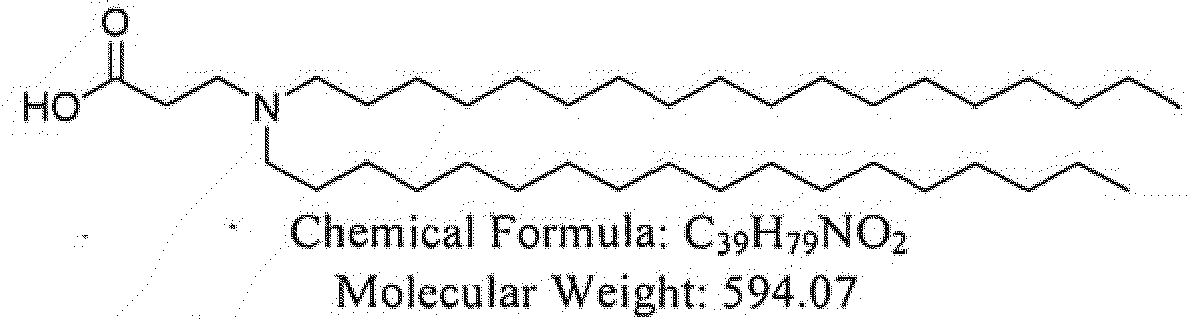
- Dissolved methyl 3-(dioctadecylamino)propanoate (5.01 g, 8.24 mmol) in EtOH (20.6 mL) and added 20.6 mL 2M NaOH to reaction mixture and allowed reaction to stir at 80 °C for 2 hours. Allowed the reaction mixture to cool to room temperature and concentrated in vacuo. Acidified the reaction mixture to
pH 1 with 10% HCl. The residue was extracted three times with hexanes and concentrated in vacuo to afford 3-(dioctadecylamino)propanoic acid (305 mg, 0.513 mmol, 6%). - UPLC/ELSD: RT = 3.75 min. MS (ES): m/z (MH+) 595.0 for C39H79NO2
- 1H NMR (300 MHz, CDCl3) δ: ppm 11.48 (br s, 1H); 3.34 (m, 2H); 3.07 (m, 6H); 1.80 (m, 4H); 1.35-1.28 (br. m, 60H); 0.90 (m, 6H).
-

1H NMR (300 MHz, CDCl3) δ: ppm 3.67 (t, 2H); 1.60 (m, 2H); 1.50-1.06 (m, 27H); 0.90 (m, 3H); 0.63 (m, 3H); -0.31 (m, 1H). -

- To a solution of PPh3 (1.33 g, 5.1 mmol) and 8-(2-octylcyclopropyl)octan-1-ol (1.35 g, 4.7 mmol) in DCM (15 mL) at 0 °C NBS (0.986 g, 5.5 mmol) was added in one portion. The reaction was allowed to stir at 0 °C for 1 hour and then warmed to room temperature and allowed to stir for 1 hour. 300 mL of hexanes was added to the reaction mixture, filtered through a silica gel plug and concentrated in vacuo. 200 mL of hexanes was added to the reaction mixture, filtered through a silica gel plug and concentrated in vacuo to afford 1-(8-bromooctyl)-2-octylcyclopropane (1.44 g, 4.2 mmol, 89%).
1H NMR (300 MHz, CDCl3) δ: ppm 3.43 (t, 2H); 1.88 (m, 2H); 1.57-1.06 (m, 26H); 0.91 (m, 3H); 0.66 (m, 3H); -0.30 (m, 1H). -

- To a solution of methyl 3-aminopropanoate hydrochloride (200 mg, 1.45 mmol) and 1-(8-bromooctyl)-2-octylcyclopropane (1.26 g, 3.63 mmol) in 1:1 CPME (2 mL):MeCN (2 mL) added K2CO3 (1.21 g, 8.72 mmol) and KI (603.35 mg, 17.91 mmol). The reaction mixture was allowed to stir at 81 °C for 6 hours. The crude reaction mixture was allowed to cool to room temperature, filtered and concentrated in vacuo. The residue was dissolved in EtOAc and washed with water. Extracted aqueous layer three times with EtOAc. Dried organic layers over Na2SO4, filtered and concentrated in vacuo. The residue was purified by silica gel chromatography (0-20% DCM in MeOH) to afford methyl 3-((8-(2-octylcyclopropyl)octyl)amino)propanoate (700 mg, 1.11 mmol, 76%).
1H NMR (300 MHz, CDCl3) δ: ppm 3.71 (s, 3H); 2.92 (t, 2H); 2.64 (t, 2H); 2.57 (t, 2H); 1.98 (br. s, 1H); 1.53-1.14 (br. m, 28H); 0.90 (m, 3H); 0.68-0.54 (br. m, 3H); -0.32 (m, 1H). -

- To a solution of methyl 3-((8-(2-octylcyclopropyl)octyl)amino)propanoate (700 mg, 1.9 mmol) and 1-(8-bromooctyl)-2-octylcyclopropane (280 mg, 0.82 mmol) in 1:1 CPME (7 mL):MeCN (7 mL) added K3CO3 (0.23 mg, 1.63 mmol) and KI (135.47 mg, 0.82 mmol). The reaction mixture was allowed to stir at 81 °C for 6 hours. The crude reaction mixture was allowed to cool to room temperature, filtered and concentrated in vacuo. The residue was dissolved in EtOAc and washed with water. Extracted aqueous layer three times with EtOAc. Dried organic layers over Na2SO4, filtered and concentrated in vacuo. The residue was purified by silica gel chromatography (0-20% DCM in MeOH) to afford methyl 3-(bis(8-(2-octylcyclopropyl)octyl)amino)propanoate (145 mg, 0.23 mmol, 28%).
1H NMR (300 MHz, CDCl3) δ: ppm 3.70 (s, 3H); 2.91 (m, 2H); 2.67-2.52 (br. m, 6H); 1.51-1.14 (br. m, 56H); 0.91 (m, 6H); 0.68-0.55 (br. m, 6H); -0.32 (m, 2H). -
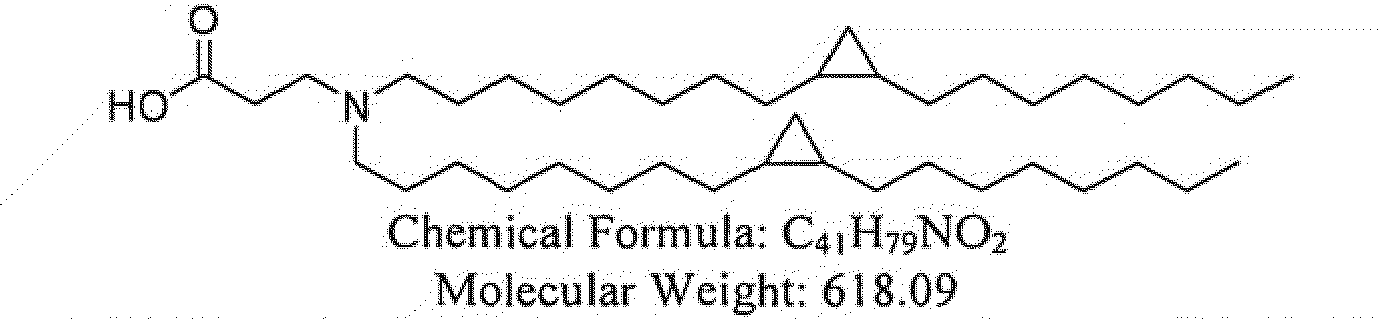
- Dissolved methyl 3-(dioctadecylamino)propanoate (145 mg, 0.23 mmol) in EtOH (0.6 mL) and added 2M NaOH (0.6 mL) to reaction mixture and allowed reaction to stir at 40 °C for 2 hours. Allowed the reaction mixture to cool to room temperature and concentrated in vacuo. Acidified the reaction mixture to
pH 1 with 2N HCl. The residue was extracted three times with hcxanes and concentrated in vacuo to afford 3-(bis(8-(2-octylcyclopropyl)octyl)amino)propanoic acid - (140 mg, 0.23 mmol, 98%).
- UPLC/ELSD: RT = 3.67 min. MS (ES): mlz (MH+) 619.0 for C41H79NO2
- 1H NMR (300 MHz, CDCl3) δ: ppm 11.10 (br s, 1H); 3.37 (m, 2H); 3.04 (br. m, 6H); 1.79 (br. m, 4H); 1.38-1.13 (br. m, 52H); 0.90 (m, 6H) 0.66-0.55 (br. m, 6H), -0.32 (m, 2H). Methyl 3(di((Z)-octadec-9-en-1-yl)amino)propanoate
-

- To a solution of (Z)-octadec-9-en-1-ol (5 g, 18.62 mmol) and PPh3 (5.18 g, 19.74 mmol) in DCM (60 mL) at 0 °C, was added NBS (3.85 g, 21.60 mmol) in one portion. The reaction . mixture was allowed to stir at 0 °C for 1 hour and then allowed to slowly warm to room temperature and allowed to stir for 1 hour. 240 mL of hexanes was added to the reaction mixture, filtered through a silica gel plug and concentrated in vacuo. 200 mL of hexanes was added to the reaction mixture, filtered through a silica gel plug and concentrated in vacuo to afford (Z)-1-bromooctadec-9-ene (4.70 g, 14.18 mmol, 76%).
1H NMR (300 MHz, CDCl3) δ: ppm 5.37 (m, 2H); 3.43 (t, 2H); 2.04 (m, 4H); 1.87 (m, 2H); 1.47-1.30 (br. m, 22H); 0.91 (m, 3H). -

- To a solution of methyl 3-aminopropanoate hydrochloride (100 mg, 0.72 mmol) and (Z)-1-bromooctadec-9-ene (594 mg, 1.79 mmol) in 1:1 CPME (2 mL):MeCN (2 mL) added K2CO3 (598 mg, 4.30 mmol) and KI (297 mg, 1.79 mmol). The reaction mixture was allowed to stir at 81 °C for 18 hours. The crude reaction mixture was allowed to cool to room temperature, filtered and concentrated in vacuo. The residue was dissolved in EtOAc and washed with water. Extracted aqueous layer three times with EtOAc. Dried organic layers over Na2SO4, filtered and concentrated in vacuo. The residue was purified by silica gel chromatography (0-20% (mixture of 1% NH4OH, 20% MeOH in dichloromethane) in dichloromethane) to afford methyl 3-(di((Z)-octadec-9-en-yl)amino)propanoate (56 mg, 0.09 mmol, 13%).
1H NMR (300 MHz, CDCl3) δ: ppm 5.37 (m, 4H); 3.69 (s, 3H); 2.80 (t, 2H); 2.48-2.38 (br. m, 6H); 2.06-2.00 (br. m, 8H); 1.48-1.29 (br. m, 48H); 0.90 (m, 6H). -

- Dissolved methyl 3-(di((Z)-octadec-9-en-yl)amino)propanoate (56 mg, 0.09 mmol) in EtOH (0.23 mL) and added 2M NaOH (0.23 mL) to reaction mixture and allowed reaction mixture to stir at 30 °C for 30 min. Allowed the reaction mixture to cool to room temperature and concentrated in vacuo. Acidified the reaction mixture to
pH 1 with 2N HCl. The residue was extracted three times with hexanes and concentrated in vacuo to afford 3-(di((Z)-octadec-9-en-yl)amino)propanoic acid (54 mg, 0.09 mmol, >99%). - UPLC/ELSD: RT = 3.55 min. MS (ES): m/z (MH+) 591.0 for C39H75NO2
- 1H NMR (300 MHz, CDCl3) δ: ppm 5.28 (m, 4H); 2.83 (m, 2H); 2.64 (m, 4H); 2.43 (m, 2H); 1.95-1.91 (br. m, 8H); 1.50 (m, 4H); 1.28-1.20 (br. m, 44H); 0.90 (m, 6H).
- (Z)-3-(Octadec-9-en-1-ylamino)propanoic acid
-

- To a solution of methyl 3-aminopropanoate hydrochloride (100 mg, 0.72 mmol) and (Z)-1-bromooctadec-9-ene (594 mg, 1.79 mmol) in 1:1 CPME (2 mL):MeCN (2 mL) added K2CO3 (598 mg, 4.30 mmol) and KI (297 mg, 1.79 mmol). The reaction mixture was allowed to stir at 81 °C for 18 hours. The crude reaction mixture was allowed to cool to room temperature, filtered and concentrated in vacuo. The residue was dissolved in EtOAc and washed with water. Extracted aqueous layer three times with EtOAc. Dried organic layers over Na2SO4, filtered and concentrated in vacuo. The residue was purified by silica gel chromatography (0-20% MeOH in dichloromethane) to afford methyl (Z)-3-(octadec-9-en-1-ylamino)propanoate (64 mg, 0.18 mmol, 25%).
1H NMR (300 MHz, CDCl3) δ: ppm 5.36 (m, 2H); 3.70 (s, 3H); 2.90 (t, 2H); 2.62 (t, 2H); 2.54 (t, 2H); 2.18 (br. s, 1H); 2.05-1.98 (br. m, 4H); 1.52-1.45 (br. m, 2H); 1.36-1.28 (br. m, 22H); 0.89 (m, 3H). -

- Dissolved methyl (Z)-3-(octadec-9-en-1-ylamino)propanoate (64 mg, 0.18 mmol) in EtOH (0.91 mL) and added 2M NaOH (0.91 mL) to reaction mixture and allowed reaction mixture to stir at room temperature for 1 hour. Allowed the reaction mixture to cool to room temperature and concentrated in vacuo. Acidified the reaction mixture to
pH 1 with 2N HCl. The residue was extracted three times with hexanes and concentrated in vacuo to afford (Z)-3-(octadec-9-en-1-ylamino)propanoic acid (60 mg, 0.18 mmol, 98%). - UPLC/ELSD: RT= 1.85 min. MS (ES): m/z (MH+) 340.3 for C21H41NO2
- 1H NMR (300 MHz, CDCl3) δ: ppm 8.59 (br. s, 1H); 5.27 (m, 2H); 4.88 (br. s, 1H); 3.18 (m, 2H); 2.98-2.92 (br. m, 4H); 1.97-1.90 (br. m, 4H); 1.78 (m, 2H); 1.26-1.19 (br. m, 22H); 0.81 (m, 3H).
-


- To a solution of (9Z,12Z)-octadeca-9,12-dien-1-ol (5 g, 18.76 mmol) and PPh3 (5.22 g, 19.89 mmol) in DCM (60 mL) at 0 °C, was added NBS (3.87 g, 21.77 mmol) in one portion. The reaction mixture was allowed to stir at 0 °C for 1 hour and then allowed to slowly warm to room temperature and allowed to stir for 1 hour. 240 mL of hexanes was added to the reaction mixture, filtered through a silica gel plug and concentrated in vacuo. 200 mL of hexanes was added to the reaction mixture, filtered through a silica gel plug and concentrated in vacuo to afford (6Z,9Z)-18-bromooctadeca-6,9-diene (4.06 g, 12.33 mmol, 66%).
1H NMR (300 MHz, CDCl3) δ: ppm 5.45-5.31 (br. m, 4H); 3.43 (t, 2H); 2.80 (m, 2H); 2.11-2.04 (br. m, 4II); 1.88 (m, 2H); 1.47-1.33 (br. m, 16H); 0.92 (m, 3H). -

- To a solution of methyl 3-aminopropanoate hydrochloride (100 mg, 0.72 mmol) and (6Z,9Z)-18-bromooctadeca-6,9-diene (590 mg, 1.79 mmol) in 1:1 CPME (2 mL):MeCN (2 mL) added K2CO3 (600 mg, 4.30 mmol) and KI (300 mg, 1.79 mmol). The reaction mixture was allowed to stir at 50 °C for 18 hours followed by 60 °C for 24 hours. The crude reaction mixture was allowed to cool to room temperature, filtered and concentrated in vacuo. The residue was dissolved in EtOAc and washed with water. Extracted aqueous layer three times with EtOAc. Dried organic layers over Na2SO4, filtered and concentrated in vacuo. The residue was purified by silica gel chromatography (0-15% MeOH in dichloromethane) to afford methyl 3-(di((9Z,12Z)-octadeca-9, 12-dien-1-yl)amino)propanoate (56 mg, 0.09 mmol, 13%).
1H NMR (300 MHz, CDCl3) δ: ppm 5.38 (m, 8H); 3.69 (s, 3H); 2.83-2.77 (br. m, 6H); 2.50-2.39 (br. m, 6H); 2.11-2.04 (br. m, 8H); 1.46-1.30 (br. m, 36H); 0.91 (m, 6H). -

- Dissolved methyl 3-(di((9Z,12Z)-octadeca-9, 12-dien-1-yl)amino)propanoate (113 mg, 0.19 mmol) in EtOH (0.94 mL) and added 2M NaOH (0.94 mL) to reaction mixture and allowed reaction mixture to stir at room temperature for 1 hour and concentrated in vacuo. Acidified the reaction mixture to
pH 1 with 1N HCl. The residue was extracted three times with hexanes and concentrated in vacuo to afford 3-(di((9Z, 12Z)-octadeca-9, 12-dien-1-yl)amino)propanoic acid (106 mg, 0.18 mmol, 95%). - UPLC/ELSD: RT = 3.32 min. MS (ES): m/z (MH+) 586.8 for C39H71NO2
- 1H NMR (300 MHz, CDCl3) δ: ppm 5.38 (m, 8H); 2.88-2.77 (br. m, 6H); 2.65 (m, 4H); 2.47 (m, 2H); 2.11-2.04 (br. m, 8H); 1.58-1.52 (br. m, 4H); 1.43-1.28 (br. m, 32H); 0.91 (m, 6H).
-

- To a solution of oleic acid (500 mg, 1.77 mmol) in THF (8 mL) was added methylamine (885 µL, 1.77 mmol) HATU (673 mg, 1.77 mmol) and DIPEA (617 µL. 3.54 mmol). The reaction was allowed to stir at room temperature for 3 hours. Quenched reaction with 1N citric acid and extracted three times with diethyl ether. The organic layers were washed with water and brine. Dried organic layers over Na2SO4, filtered and concentrated in vacuo. The residue was purified by silica gel chromatography (10-100% EtOAc in hexanes) to afford N-methyloleamide (495 mg, 1.67 mmol, 95%).
- UPLC/ELSD: RT = 2.67 min. MS (ES): m/z (MH+) 295.9 for C19H37NO
- 1H NMR (300 MHz, CDCl3) δ: ppm 5.36 (m, 2H); 3.26 (br. s, 1H); 2.83 (d, 3H); 2.18 (t, 2H); 2.05-2.00 (br. m, 4H); 1.66-1.62 (br. m, 4H); 1.37-1.29 (br. m, 18H); 0.90 (m, 3H). 3-Ammonio-4-(2,3-bis(stearoyloxy)propoxy)-4-oxobutanoate
-

- A mixture of 3-hydroxypropane-1,2-diyl distearate (625 mg, 1.0 mmol), 4-(benzyloxy)-2-((tert-butoxycarbonyl)amino)-4-oxobutanoic acid (647 mg, 2.0 mmol), EDCI (384 mg, 2.0 mmol) and DMAP (12 mg, 0.1 mmol) in 40 mL dichloromethane was stirred at room temperature for 16 h. TLC showed complete reaction. The reaction mixture was diluted with water and extracted with dichloromethane, and the combined organic layer was washed with brine and dried over sodium sulfate. After filtration and concentration, the crude was purified by ISCO (24 g SiO2: EtOAc/
Hexanes 0 to 40%) to provide 4-benzyl 1-(2,3-bis(stearoyloxy)propyl) (tert-butoxycarbonyl)aspartate as white solid (918 mg, 98%). - 1H NMR (300 MHz, CDCl3) δ 7.31-7.36 (m, 5H), 5.48 (m, 1H), 5.21 (m, 1H), 5.17 (s, 2H), 4.58-4.63 (m, 1H), 4.19-4.26 (m, 2H), 4.05-4.13 (m, 2H), 2.95-3.08 (m, 1H), 2.78-2.87 (m, 1H), 2.29 (dt, 4H, J = 7.4 Hz, 1.9 Hz), 1.55-1.64 (m, 6H), 1.42 (s, 9H), 1.24 (bs, 54H), 0.87 (t, 6H, J= 6.8 Hz).
- MS (APCI): m/z (MH+) 830.6.
-

- A mixture of 4-benzyl 1-(2,3-bis(stearoyloxy)propyl) (tert-butoxycarbonyl)aspartate (918 mg, 0.98 mmol) and Pd/C (5%, 300 mg) in 80 mL EtOAc was stirred for 16 h under hydrogen balloon. TLC showed complete reaction. The reaction mixture was filtered through Celite and washed with dichloromethane. The filtrate was concentrated to provide 4-(2,3-bis(stearoyloxy)propoxy)-3-((tert-butoxycarbony])amino)-4-oxobutanoic acid as white solid (805 mg, quant.), which was used for the next step without purification.
- 1H NMR (300 MHz, CDCl3) δ 5.46-5.52 (m, 1H), 5.26 (m, 1H), 4.58 (m, 1H), 4.07-4.44 (m, 4H), 2.76-3.06 (m, 2H), 2.30 (t, 4H, J = 7.4 Hz), 1.54-1.64 (m, 4H), 1.44 (s, 9H), 1.24 (bs, 56H), 0.87 (t, 6H, J= 6.8 Hz).
- MS (APCI): m/z (MH+) 740.6.
-

- 4-(2,3-Bis(stearoyloxy)propoxy)-3-((tert-butoxycarbonyl)amino)-4-oxobutanoic acid (800 mg, 0.98 mmol) was dissolved in 4M HCl in dioxane (5 mL), and the mixture was stirred at room temperature for 2 h. TLC showed the disappearance of starting material. Hexanes was added into the reaction mixture and triturated to provide the desired product, 3-ammonio-4-(2,3-bis(stearoyloxy)propoxy)-4-oxobutanoate as a white solid (701 mg, 92%).
- 1H NMR (300 MHz, CDCl3) δ 8.23 (bs, 2H), 5.31 (m, 1H), 4.08-4.54 (m, 5H), 3.14-3.36 (m, 2H), 2.31 (q, 4H, J = 7.4 Hz), 1.58 (m, 4H), 1.24 (bs, 56H), 0.87 (t, 6H, J = 7.1 Hz).
- MS (APCI): m/z (MH+) 740.6.
-
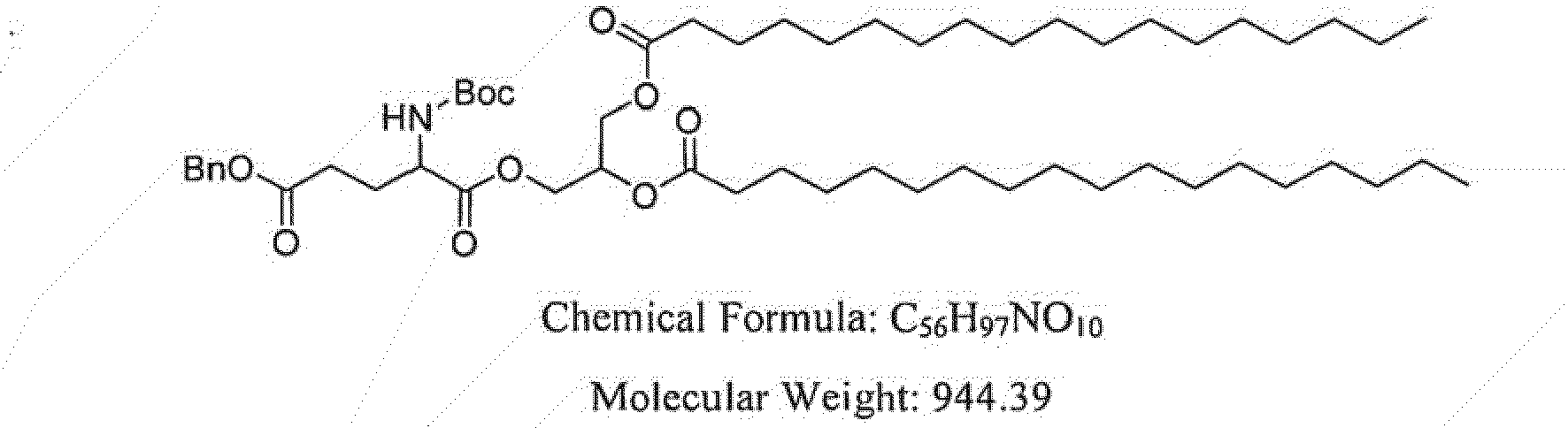
- A mixture of 3-hydroxypropane-1,2-diyl distearate (625 mg, 1.0 mmol), 5-(benzyloxy)-2-((tert-butoxycarbonyl)amino)-5-oxopentanoic acid (674 mg, 2.0 mmol), EDCI (384 mg, 2.0 mmol) and DMAP (12 mg, 0.1 mmol) in 40 mL dichloromethane was stirred at room temperature for 16 h. TLC showed complete reaction. The reaction mixture was diluted with water and extracted with dichloromethane, and the combined organic layer was washed with brine and dried over sodium sulfate. After filtration and concentration, the crude was purified by ISCO (24 g SiO2: EtOAc/
Hexanes 0 to 40%) to provide 5-benzyl 1-(2,3-bis(stearoyloxy)propyl) (tert-butoxycarbonyl)glutamate as white solid (950 mg, Quant.). - 1H NMR (300 MHz, CDCl3) δ 7.34 (m, 5H), 5.25 (m, 1H), 5.04-5.11 (m, 3H), 4.09-4.37 (m, 6H), 2.43-2.49 (m, 2H), 2.26-2.32 (m, 4H), 2.14-2.20 (m, 2H), 1.88-2.02 (m, 2H), 1.58 (m, 3H), 1.42 (s, 9H), 1.24 (bs, 54H), 0.87 (t, 6H, J = 7.1 Hz).
- MS (APCI): m/z (MH+) 844.6.
-

- A mixture of 5-benzyl 1-(2,3-bis(stearoyloxy)propyl) (tert-butoxycarbonyl)glutamate (950 mg, 1.0 mmol) and Pd/C (5%, 300 mg) in 80 mL EtOAc was stirred for 16 h under hydrogen balloon. TLC showed complete reaction. The reaction mixture was filtered through Celite and washed with dichloromethane. The filtrate was concentrated to provide 5-(2,3-bis(stearoyloxy)propoxy)4-((tert-butoxycarbonyl)amino)-5-oxopentanoic acid as white solid (848 mg. 99%), which was used for the next step without purification.
- 1H NMR (300 MHz, CDCl3) δ 6.39 (m, 0.5H), 6.25 (m, 0.5H), 5.10-5.29 (m, 2H), 4.06-4.34 (m, 3H), 3.74 (m, 1H), 3.25 (m, 1H), 2.44-2.52 (m, 2H), 2.31 (q, 2H, J= 6.8 Hz), 2.00-2.21 (m, 5H), 1.54-1.66 (m, 4H), 1.44 (s, 9H), 1.24 (bs, 54H), 0.87 (t, 6H, J = 6.8 Hz).
- MS (APCI): m/z (MH+) 754.6.
-

- 4-(2,3-Bis(stearoyloxy)propoxy)-3-((tert-butoxycarbonyl)am ino)-4-oxobutanoic acid (848 mg, 0.99 mmol) was dissolved in 4M HCl in dioxanc (20 mL), and the mixture was stirred at room temperature for 16 h. TLC showed the disappearance of starting material. Hexanes was added into the reaction mixture and triturated to provide the desired product, 1-(2,3-bis(stearoyloxy)propoxy)-4-carboxy-1-oxobutan-2-aminium chloride as white solid (740 mg, 94%).
- 1H NMR (300 MHz, CDCl3) δ 5.32 (m, 2H), 4.17-4.44 (m, 6H), 2.72 (m, 2H), 2.28-2.36 (m, 5H), 1.55-1.64 (m, 4H), 1.20-1.37 (bs, 58H), 0.88 (t, 6H, J= 6.8 Hz).
- MS (APCI): m/z (MH+) 754.6.
-

- A mixture of 3-hydroxypropane-1,2-diyl distearate (625 mg, 1.0 mmol), 4-(benzyloxy)-3-((tert-butoxycarbonyl)amino)-4-oxobutanoic acid (647 mg. 2.0 mmol), EDCI (384 mg, 2.0 mmol) and DMAP (12 mg, 0.1 mmol) in 40 mL dichloromethane was stirred at room temperature for 16 h. TLC showed complete reaction. The reaction mixture was diluted with water and extracted with dichloromethane, and the combined organic layer was washed with brine and dried over sodium sulfate. After filtration and concentration, the crude was purified by ISCO (40 g SiO2: EtOAc/
Hexanes 0 to 20%) to provide 1-benzyl 4-(2,3-bis(stearoyloxy)propyl) (tert-butoxycarbonyl)aspartate as white solid (942 mg, Quant.) - 1H NMR (300 MHz, CDCl3) δ 7.28-7.37 (m, 5H), 5.46-5.53 (m, 1H), 5.21 (m, 1H), 5.17 (s, 2H), 4.56-4.64 (m, 1H), 4.20-4.25 (m, 2H), 4.05-4.12 (m, 2H), 2.94-3.04 (m, 1H), 2.78-2.87 (m, 1H), 2.29 (dt, 4H, J = 7.6 Hz, 1.9 Hz), 1.56-1.64 (m, 4H), 1.42 (s, 9H), 1.24 (bs, 56H), 0.87 (t, 6H, J =6.8 Hz).
- MS (APCI): mlz (MH+) 830:6.
-

- A mixture of 1-benzyl 4-(2,3-bis(stearoyloxy)propyl) (tert-butoxycarbonyl)aspartate (942 mg, 1.0 mmol) and Pd/C (5%, 300 mg) in 80 mL EtOAc was stirred for 16 h under hydrogen balloon. TLC showed complete reaction. The reaction mixture was filtered through Celite and washed with dichloromethane. The filtrate was concentrated to provide 4-(2,3-bis(stearoyloxy)propoxy)-2-((tert-butoxycarbonyl)amino)-4-oxobutanoic acid as white solid (800 mg, 95%), which was used for the next step without purification.
- 1H NMR (300 MHz, CDCl3) δ 5.56 (m, 1H), 5.23-5.28 (m, 1H), 4.56 (m, 1H), 4.12-4.32 (m, 5H), 2.98-3.07 (m, 2H), 2.81-2.89 (m, 2H), 2.28-2.35 (m, 4H), 1.60 (m, 4H), 1.45 (s, 9H), 1.24 (bs, 54H), 0.87 (t, 6H, J = 7.1 Hz).
- MS (APCI): m/z (MH+) 740.6.
-

- 4-(2,3-Bis(stearoyloxy)propoxy)-2-((tert-butoxyearbonyl)amino)-4-oxobutanoic acid (800 mg, 0.95 mmol) was dissolved in 4M HCl in dioxane (20 mL), and the mixture was stirred at room temperature for 16 h. TLC showed the disappearance of starting material. Hexanes was added into the reaction mixture and triturated to provide the desired product, 3-(2,3-bis(stearoyloxy)propoxy)-1-carboxy-3-oxopropan-1-aminium chloride as white solid (718 mg, 97%).
- 1H NMR (300 MHz, CDCl3) δ 5.29 (m, 1H), 4.53 (m, 1H), 4.12-4.38 (m, 5H), 3.28 (m, 2H), 2.32 (q, 4H, J = 7.7 Hz), 1.60 (m, 4H), 1.24 (bs, 59H), 0.88 (t, 6H, J= 6.6 Hz).
- MS (APCI): m/z (MH+) 740.6.
-

- To a solution of 3-hydroxypropane-1,2-diyl distearate (6.25 g, 10 mmol) and triethylamine (1.81 mL, 12.5 mmol) in 100 mL dichloromethane, methanesulfonyl chloride (0.97 mL, 12.5 mmol) was added dropwise at 0 °C, and then the reaction was stirred at room temperature for 48 h. TLC showed complete reaction, and the reaction mixture was diluted with water and extracted with dichloromethane. The combined organic layer was washed with saturated sodium bicarbonate solution and brine. After dried over sodium sulfate, the filtrate was concentrated to provide 3-((methylsulfonyl)oxy)propane-1,2-diyl distearate as white solid (7.07 g, quant.), NMR showed mixture of mesylate and chloride, which was used for the next step without further purification.
1H NMR (300 MHz, CDCl3) δ 5.23-5.30 (m, 1H), 4.29-4.41 (m, 3H), 4.17 (dd, 1H, J = 11.9 Hz, 5.7 Hz), 2.43 (q, 4H, J = 7.6 Hz), 1.61 (m, 3H), 1.24 (bs, 60H), 0.87 (t, 6H, J = 6.8 Hz). -

- In a sealed tube, a mixture of 3-((methylsulfonyl)oxy)propane-1,2-diyl distearate (7.07 g, 10 mmol) and sodium azide (3.26 g, 50 mmol) in 40 mL DMF was heated to 100 °C for 16 h. After cooled to room temperature, the reaction mixture was diluted with water and extracted with hexanes/ether mixture. The organic layer was washed with water and brine. After dried over sodium sulfate, the filtrate was concentrated and purified by ISCO (120 g SiO2: EtOAc/
hexanes 0 to 50%) to provide 3-azidopropane-1,2-diyl distearate as white solid (5.40 g, 83%).
1H NMR (300 MHz, CDCl3) δ 5.17 (pent, 1H, J = 4.9 Hz), 4.29 (dd, 1H, J = 11.9 Hz, 4.6 Hz), 4.14 (dd, 1H, J = 11.9 Hz, 5.5 Hz), 3.45 (t, 2H, J = 3.3 Hz), 2.34 (dt, 4H, J = 10.2 Hz, 7.4 Hz), 1.57-1.65 (m, 4H), 1.24 (bs, 56H), 0.87 (t, 6H, J= 7.1 Hz). -

- A mixture of 3-azidopropane-1,2-diyl distearate (3.71 g, 5.7 mmol) and Pd/C (5%, Degaussa E10002U/W, Aldrich 330124, 370 mg) in 100 mL EtOAc was purged with nitrogen and
hydrogen 3 times, respectively, and then the reaction was stirred at room temperature with balloon for 16 h. TLC showed complete reaction. The reaction mixture was filtered through Celite and washed with hot dichloromethane to provide 3-aminopropane-1,2-diyl distearate as white solid (2.20 g, 62%). This compound has low solubility in most of the solvents at room temperature. - 1H NMR (300 MHz, CDCl3) δ 5.90 (m. 0.5H), 5.74 (m, 0.5H), 3.91-4.20 (m, 2H), 3.12-3.70 (m, 2H), 2.30-2.36 (m, 3H), 2.18-2.25 (m, 1H), 1.53-1.66 (m, 6H), 1.24 (bs, 56H), 0.87 (t, 6H, J = 7.1 Hz).
- MS (APCI): m/z (MH+) 624.6.
-

- A mixture of 3-aminopropane-1,2-diyl distearate (624 mg, 1.0 mmol), 5-(benzyloxy)-2-((tert-butoxycarbonyl)amino)-5-oxopentanoic acid (674 mg, 2.0 mmol), EDCI (384 mg, 2.0 mmol) and DMAP (12 mg, 0.1 mmol) in 70 mL/70 mL dichloromethane/THF was heated to 45°C for 16 h. TLC showed complete reaction. The reaction mixture was diluted with water and extracted with dichloromethane, and the combined organic layer was washed with brine and dried over sodium sulfate. After filtration and concentration, the crude was purified by ISCO (40 g SiO2: EtOAc/
Hexanes 0 to 20%) to provide 3-(5-(benzyloxy)-2-((tert-butoxycarbonyl)amino)-5-oxopentanamido)propane-1,2-diyl distearate as white solid (840 mg, 89%). - 1M NMR (300 MHz, CDCl3) δ 7.31-7.39 (m, 5H), 6.25 (m, 1H), 5.39-5.44 (m, 1H), 5.12-5.22 (m, 3H), 4.08-4.53 (m, 4H), 2.44-2.49 (m, 4H), 2.20-2.38 (m, 2H), 2.30 (m, 4H), 2.16 (m, 1H), 1.95 (m, 1H), 1.55-1.64 (m, 1H), 1.43 (s, 9H), 1.24 (bs, 56H), 0.87 (t, 6H, J = 6.8 Hz).
- MS (APCI): m/z (MH+) 943.7. 843.7.
-

- A mixture of 3-(5-(benzyloxy)-2-((tert-butoxycarbonyl)amino)-5-oxopentanamido)propane-1,2-diyl distearate (840 mg, 0.89 mmol) and Pd/C (5%, 250 mg) in 80 mL EtOAc was stirred for 16 h under hydrogen balloon. TLC showed complete reaction. The reaction mixture was filtered through Celite and washed with dichloromethane. The filtrate was concentrated to provide 5-((2,3-bis(stearoyloxy)propyl)amino)-4-((tert-butoxycarbonyl)amino)-5-oxopentanoic acid as a white solid (722 mg, 84%), which was used for the next step without purification.
- . 1H NMR (300 MHz, CDCl3) δ 5.23-5.29 (m, 1H), 5.12-5.16 (m, 1H), 4.08-4.42 (m, 6H), 2.44-2.49 (m, 4H), 2.20-2.38 (m, 2H), 2.30 (t, 4H, J= 7.6 Hz), 2.16 (m, 1H), 1.95 (m, 1H), 1.55-1.64 (m, 2H), 1.43 (s, 9H), 1.24 (bs, 54H), 0.87 (t, 6H, J = 6.8 Hz).
- MS (APCI): m/z (MH+) 853.7, 753.6.
-

- 5-((2,3-Bis(stearoyloxy)propyl)amino)-4-((tert-butoxycarbonyl)amino)-5-oxopentanoic acid (722 mg, 0.84 mmol) was dissolved in 4M HCl in dioxane (20 mL), and the mixture was stirred at room temperature for 16 h. TLC showed the disappearance of starting material, and the reaction mixture is clear solution. After concentration, the crude was purified by Gold ISCO (24 g SiO2: MeOH/
dichloromethane 0 to 50%) to provide the desired product, 1-((2,3-bis(stearoyloxy)propyl)amino)-4-carboxy-1-oxobutan-2-aminium chloride as white solid (610 mg, 91%). - 1H NMR (300 MHz, CDCl3) δ 8.43 (bs, 2H), 5.21 (m, 1H), 4.18-4.38 (m, 3H), 3.36-3.75 (m, 3H), 2.68 (m, 2H), 2.20-2.35 (m, 6H), 1.57 (m, 4H), 1.24 (bs, 56H), 0.87 (t, 6H, J = 6.8 Hz).
- MS (APCI): m/z (MH+) 753.6.
-

- A mixture of 3-aminopropane-1,2-diyl distearate (500 mg, 0.80 mmol), 4-(tert-butoxy)-3-((tert-butoxycarbonyl)amino)4-oxobutanoic acid (463 mg, 1.60 mmol), EDCI (307 mg, 1.60 mmol) and DMAP (10 mg, 0.08 mmol) in 70 mL/70 mL dichloromethane/THF was heated to 45°C for 16 h. TLC showed complete reaction. The reaction mixture was diluted with water and extracted with dichloromethane, and the combined organic layer was washed with brine and dried over sodium sulfate. After filtration and concentration, the crude was purified by ISCO (24 g SiO3: EtOAc/
Hexanes 0 to 40%) to provide 3-(4-(tert-butoxy)-3-((tert-butoxycarbonyl)amino)-4-oxobutanamido)propane-1,2-diyl distearate as a white solid (685 mg, 76%). - %). 1H NMR (300 MHz, CDCl3) δ 6.48 (m, 0.5H), 6.20 (m, 0.5H), 5.38 (m, 1H), 5.08-5.14 (m, 1H), 4.42-4.54 (m, 1H), 4.06-4.28 (m, 2H), 3.60-3.68 (m, 0.5H), 3.46-3.53 (m. 1H), 3.26-3.34 (m, 0.5H), 2.74-2.92 (m, 2H), 2.31 (dt, 2H, J = 7.5 Hz, 1.9 Hz), 2.19 (t, 2H, J = 7.7 Hz). 1.56-1.66 (m, 2H), 1.47 (s, 9H), 1.41-1.45 (m. 9H), 1.24 (bs, 58H), 0.87 (t, 6H, J = 6.8 Hz).
- MS (APCI): m/z (MH+) 895.7, 795.6.
-


- 3-(4-(tert-Butoxy)-3-((tert-butoxycarbonyl)amino)-4-oxobutanamido)propane-1,2-diyl distearate (685 mg, 0.76 mmol) was dissolved in 4M HCl in dioxane (10 mL), and the mixture was stirred at room temperature for 16 h. TLC showed the disappearance of starting material. Hexanes was added into the reaction mixture and triturated to provide the desired product, 3-((2,3-bis(stearoyloxy)propyl)amino)-1-carboxy-3-oxopropan-1-aminium chloride as white solid (520 mg, 88%).
- %). 1H NMR (300 MHz, CDCl3) δ 8.26 (bs, 2H), 5.15 (m, 1H), 4.50 (m, 1H), 4.22 (m, 2H), 3.16-3.54 (m, 4H), 2.20-2.38 (m, 4H), 1.58 (m, 4H), 1.24 (bs, 56H), 0.87 (t, 6H, J= 6.8 Hz).
- MS (APCI): m/z (MH+) 739.6
-
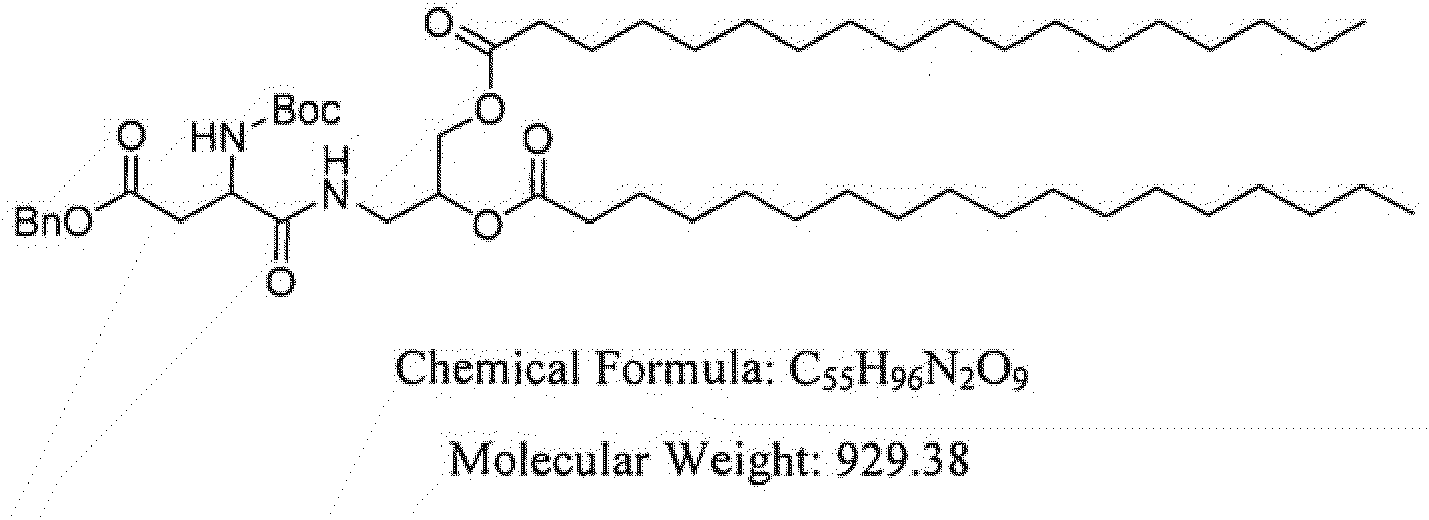
- A mixture of 3-aminopropane-1,2-diyl distearate (320 mg, 0.51 mmol), 4-(benzyloxy)-2-((tert-butoxycarbonyl)amino)-4-oxobutanoic acid (332 mg, 1.02 mmol), EDCI (197 mg, 1.02 mmol) and DMAP (6 mg, 0.05 mmol) in 30 mL/30 mL dichloromethane/THF was heated to 50 °C for 16 h. TLC showed the product. The reaction mixture was diluted with water and extracted with dichloromethane, and the combined organic layer was washed with brine and dried over sodium sulfate. After filtration and concentration, the crude was purified by ISCO (24 g SiO2: EtOAc/
Hexanes 0 to 40%) to provide 3-(4-(benzyloxy)-2-((tert-butoxycarbonyl)amino)-4-oxobutanamido)propane-1,2-diyl distearate as a white solid (310 mg, 64%). - 1H NMR (300 MHz, CDCl3) δ 7.31-7.39 (m, 5H), 6.24 (m, 1H), 5.39-5.43 (m, 1H), 5.11-5.22 (m, 3H), 4.53 (m, 1H), 4.06-4.22 (m, 2H), 3.72-3.80 (m, 1H), 2.88-3. 10 (m, 2H), 2.26-2.32 (m, 2H), 2.12-2.17 (m, 2H), 1.53-1.64 (m, 9H), 1.44 (s, 9H), 1.24 (bs, 50H). 0.87 (t, 6H, J = 6.8 Hz).
- MS (APCI): m/z (MH+) 929.7, 829.6.
-

- A mixture of 3-(4-(benzyloxy)-2-((tert-butoxycarbonyl)amino)4-oxobutanamido)propane-1,2-diyl distearate (310 mg, 0.33 mmol) and Pd/C (5%, 100 mg) in 45 mL EtOAc was stirred for 16 h under hydrogen balloon. TLC showed complete reaction. The reaction mixture was filtered through Celite and washed with dichloromethane. The filtrate was concentrated to provide 4-((2,3-bis(stearoyloxy)propyl)amino)-3-((tert-butoxycarbonyl)amino)-4-oxobutanoic acid as a white solid (248 mg, 88%), which was used for the next step without purification.
- 1H NMR (300 MHz, CDCl3) δ 6.29 (m, 1H), 5.54 (m, 1H), 5.17 (m, 1H), 4.52 (m, 1H), 4.128-4.26 (m, 1H), 4.11 (q, 2H, J= 6.8 Hz), 3.72 (m, 1H), 3.25 (m, 1H), 2.85-3.08 (m, 2H), 2.26-2.34 (m, 2H), 2.12-2.20 (m, 2H), 2.04(s, 2H), 1.59 (m, 4H), 1.44 (s, 9H), 1.24 (bs, 52H), 0.87 (t, 6H, J = 6.6 Hz).
- MS (APCI): m/z (MH+) 839.7, 739.6.
-

- 4-((2,3-bis(stearoyloxy)propyl)amino)-3-((tert-butoxycarbonyl)amino)-4-oxobutanoic acid (248 mg, 0.29 mmol) was dissolved in 4M HCl in dioxane (20 mL), and the mixture was stirred at room temperature for 16 h. TLC showed the disappearance of starting material. Hexanes was added into the reaction mixture and triturated to provide the desired product, 1-((2,3-bis(stearoyloxy)propyl)amino)-3-carboxy-1-oxopropan-2-aminium chloride as white solid (170 mg, 78%).
- 1HNMR (300 MHz, CDCl3) δ 8.32 (bs, 2H), 5.19 (m, 1H), 4.24 (m, 2H), 3.14-3.65 (m, 4H), 2.20-2.38 (m, 4H), 1.58 (m, 4H), 1.44 (s, 9H), 1.24 (bs, 50H), 0.87 (t, 6H, J = 6.8 Hz).
- MS (APCI): m/z (MH+) 739.6.
-

-

- To a 0°C solution of Solketal (2.0 g, 15.1 mmol) in pyridine (30 mL) was added tosyl chloride (3.2 g, 16.6 mmol), and the reaction was allowed to return to RT and stir for 12 hours. The mixture was concentrated, and azeotroped twice with toluene. The crude material was taken up in DCM and washed with water, saturated ammonium chloride, brine, dried over anhydrous Na3SO4, filtered, and concentrated in vacuo. Purification by ISCO silica flash chromatography (0-30% EtOAc/hexanes) provided (2,2-dimethyl-1,3-dioxolan-4-yl)methyl 4-methylbenzenesulfonate (4.18 g, 96%).
1H-NMR (300 MHz, CDCl3) δ: ppm 7.82 (d, 2H); 7.38 (d, 2H); 4.30 (m, 1H); 4.03 (m, 3H); 3.78 (m, 1H); 2.489 (s, 3H); 1.35 (m, 6H). -

- To a solution of (2,2-dimethyl-1,3-dioxolan-4-yl)methyl 4-methylbenzenesulfonate (4.18 g, 14.6 mmol) in DMF (36 mL) was added sodium azide (2.37 g, 36.5 mmol) and the reaction was allowed to stir at 80°C for 12 hours. After cooling to RT, the reaction was quenched with saturated sodium bicarbonate and the suspension was filtered. The solution was extracted x3 with ether, and the combined ether extracts were washed with brine, dried over anhydrous MgSO4. filtered, and concentrated in vacuo in the absence of external heat to provide 4-(azidomethyl)-2,2-dimethyl-1,3-dioxolane with residual DMF (3.37 g, 146%).
1H-NMR (300 MHz, CDCl3) δ: ppm 4.29 (m, 1H); 4.08 (m, 1H); 3.79 (m, 1H); 3.50-3.26 (br. m, 2H); 1.49 (s, 3H); 1.38 (s, 3H). -


- To a solution of 4-(azidomethyl)-2,2-dimethyl-1,3-dioxolane (2.29 g, 14.6 mmol) in MeOH (75 mL) was added tosylic acid monohydrate (1.39 g, 7.3 mmol) and the reaction was allowed to stir at RT. After 4 hours, solid sodium carbonate (3 g) was added and the mixture was allowed to stir for 20 minutes. The suspension was filtered and concentrated in vacuo in the absence of external heat. Purification by ISCO silica flash chromatography (50-100% EtOAc/hexanes) provided 3-azidopropane-1,2-diol (1.35 g, 79%).
1H-NMR (300 MHz, CDCl3) δ: ppm 3.90 (m, 1H); 3.80-3.57 (br. m, 2H); 3.44 (m, 2H); 2.42 (br, 2H). -
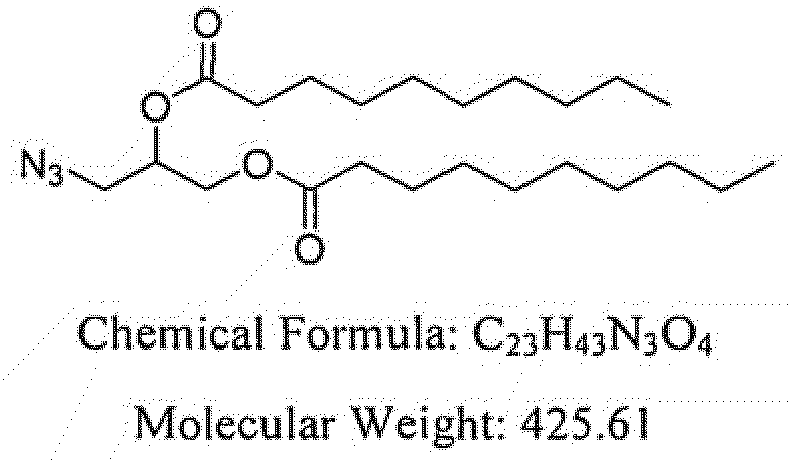
- To a solution of 3-azidopropane-1,2-diol (100 mg, 0.854 mmol) and decanoic acid (368 mg, 2.13 mmol) in DCM (4 mL) was added DCC (440 mg, 2.13 mmol) and DMAP (260 mg, 2.13 mmol), and the reaction was allowed to stir at RT for 48 hours. The mixture was filtered, and the solids rinsed with DCM. The filtrate was washed with 10% citric acid, saturated sodium bicarbonate, brine, dried over anhydrous sodium sulfate, filtered, and concentrated in vacuo. Purification by ISCO silica flash chromatography (0-30% EtOAc/hexanes) provided 3-azidopropane-1,2-diyl bis(decanoate) (318 mg, 88%).
1H-NMR (300 MHz, CDCl3) δ: ppm 5.20 (quint, 1H); 4.37-4.12 (br. m, 2H); 3.49 (m, 2H); 2.35 (m, 4H); 1.65 (m, 4H); 1.42-1.10 (br. m, 24H); 0.90 (t, 6H). -

- In the same manner as 3-azidopropane-1,2-diyl bis(dccanoate), 3-azidopropane-1,2-diyl ditetradecanoate was synthesized from 3-azidopropane-1,2-diol (300 mg, 2.56 mmol), myristic acid (1.46 g, 6.40 mmol), DCC (1.32 g, 6.40 mmol), and DMAP (782 mg, 6.40 mmol) in DCM (12 mL). Yield (1.21 g, 88%).
1H-NMR (300 MHz, CDCl3) δ: ppm 5.20 (quint, 1H); 4.37-4.12 (br. m, 2H); 3.49 (m, 2H); 2.35 (m, 4H); 1.65 (m, 4H); 1.42-1.10 (br. m, 40H); 0.90 (t, 6H).
-

- To a solution of O-(2-Azidoethyl)-O'-methylpolyethylene glycol 2000 (587 mg, 0.29 mmol) and 3-azidopropane-1,2-diyl bis(decanoate) (150 mg, 0.35 mmol) in t-butanol (1.5 mL) and water (1.5 mL) was added CuSO4 (12 mg, 0.07 mmol) and sodium ascorbate (29 mg, 0.15 mmol). The reaction was allowed to stir at RT for 24 hours and then concentrated in vacuo. Purification by ISCO silica flash chromatography (0-20% MeOH/DCM) provided the desired product (205 mg, 29%).
1H-NMR (300 MHz, CDCl3) δ: ppm 7.46 (s, 1H); 5.39 (quint, 1H); 4.58 (m, 2H); 4.38-4.20 (br. m, 4H); 4.09 (m, 2H); 3.89 (m, 2H); 3.67 (br. m, 170-200H); 3.40 (s, 3H); 3.07 (m, 2H); 2.77 (m, 2H); 2.33 (m, 4H); 1.86 (br, 4.6H, water); 1.60 (m, 4H); 1.29 (br. m, 24H); 0.90 (t, 6H). -

- In the same manner as C10, C8 was synthesized from O-(2-Azidoethyl)-O'-methylpolyethylene glycol 2000 (250 mg, 0.125 mmol), 3-azidopropane-1,2-diyl dioctanoate (56 mg, 0.15 mmol), CuSO4 (5 mg, 0.03 mmol) and sodium ascorbate (13 mg, 0.06 mmol) in t-butanol (1.5 mL) and water (1.5 mL). Yield (73 mg, 25%).
1H-NMR (300 MHz, CDCl3) δ: ppm 7.44 (s, 1H); 5.39 (quint, 1H); 4.58 (m, 2H); 4.38-4.20 (br. m, 4H); 4.09 (m, 2H); 3.89 (m, 2H); 3.67 (br. m, 170-200H); 3.40 (s, 3H); 3.07 (m, 2H); 2.77 (m, 2H); 2.33 (m, 4H); 1.86 (br, 3H, water); 1.60 (m, 4H); 1.29 (br. m, 16H); 0.90 (t, 6H). -

- In the same manner as C10, C14 was synthesized from 3-azidopropane-1,2-diyl ditetradecanoate.
1H-NMR (300 MHz, CDCl3) δ: ppm 7.57 (s, 1H); 5.39 (quint, 1H); 4.62 (m, 2H); 4.42-3.85 (br. m, 8H); 3.77-3.49 (br. m, 170-200H); 3.40 (s, 3H); 3.11 (m, 2H); 2.80 (m, 2H); 2.33 (m, 4H); 1.87-1.45 (br. m, 4H + 20H water); 1.42-1.16 (br. m, 40H); 0.90 (t, 6H). -

- In the same manner as C10, C13/14 was synthesized from 1-azido-3-(tridecanoyloxy)propan-2-yl tetradecanoate.
1H-NMR (300 MHz, CDCl3) δ: ppm 7.55 (s, 1H); 5.39 (quint, 1H); 4.61 (m, 2H); 4.39-3.81 (br. m, 8H); 3.79-3.49 (br. m, 170-200H); 3.40 (s, 3H); 3.10 (m, 2H); 2.80 (m, 2H); 2.33 (m, 4H); 1.75-1.47 (m, 4H); 1.42-1.16 (br. m, 38H); 0.90 (t, 6H). -

- In the same manner as C10, C13 was synthesized from 3-azidopropane-1,2-diyl ditridecanoate.
1H-NMR (300 MHz, CDCl3) δ: ppm 7.68 (s, 1H); 5.33 (quint, 1H); 4.65 (m, 2H); 4.36-3.85 (br. m, 8H); 3.78-3.55 (br. m, 170-200H); 3.40 (s, 3H); 3.15 (m, 2H); 2.80 (m, 2H); 2.33 (m, 4H); 1.78-1.38 (m, 4H + 24H water); 1.38-1.20 (br. m, 36H); 0.90 (t, 6H). -

- In the same manner as C10, C12 was synthesized from 3-azidopropane-1,2-diyl didodecanoate.
1H-NMR (300 MHz, CDCl3) δ: ppm 7.59 (s, 1H); 5.40 (quint, 1H); 4.62 (m, 2H); 4.37-3.83 (br. m, 8H); 3.78-3.48 (br. m, 170-200H); 3.40 (s, 3H); 3.12 (m, 2H); 2.82 (m, 2H); 2.33 (m, 4H); 2.09-1.82 (br. m, 7H water); 1.60 (m, 4H); 1.39-1.17 (br. m, 32H); 0.90 (t, 6H) -

- A solution of 3-hydroxypropane-1,2-diyl ditetradecanoate (0.10 g, 0.2 mmol), CDI (65 mg, 0.40 mmol) and Et3N in DCM (1 mL) was allowed to stir at RT for 2 h. After this time the reaction was quenched with 10% citric acid and the layers were separated. The organics were washed with brine, dried over MgSO4, filtered and concentrated to afford 3-((1H-imidazole-1-carbonyl)oxy)propane-1,2-diyl ditetradecanoate (97 mg, 80%) which was carried on with no purification.
-

- 3-((1H-Imidazole-1-carbonyl)oxy)propane-1,2-diyl ditetradecanoate (97 mg, 0.16 mmol) MeO-PEG2K-NH2 (100 mg, 0.053 mmol), DMAP (2 mg, 0.011 mmol) and Hunig's base (0.055 mL, 0.32 mmol) were combined in THF and allowed to stir at 65 °C for 6 h and then RT for 48 h. Reaction was concentrated and dissolved in DCM for purification. The crude material was purified by silica gel chromatography (0-20% MeOH in DCM with 1% NH4OH) to provide 107 mg of the desired product.
1H-NMR (300 MHz, CDCl3) δ: ppm 5.26 (m, 1H); 4.36-4.06 (br. m, 4H); 3.93-3.42 (br. m, 170-200H); 3.39 (s, 3H); 3.30 (m, 2H); 2.32 (t, 4H); 1.78 (m, 4H); 1.61 (br. m, 5H water); 1.42-1.20 (br. m, 40H); 0.89 (t, 6H). -

-

- To a solution of 3-(benzyloxy)propane-1,2-diol (1.0 g, 5.5 mmol) and myristic acid (3.1 g, 13.7 mmol) in DCM (26 mL) was added DCC (2.8 g, 13.7 mmol) and DMAP (1.7 g, 13.7 mmol), and the reaction was allowed to stir at RT for 72 hours. The mixture was filtered, and the solids were rinsed with DCM. The filtrate was washed with 10% citric acid, saturated sodium bicarbonate, brine, dried over anhydrous sodium sulfate, filtered, and concentrated in vacuo. Purification by ISCO silica flash chromatography (0-30% EtOAc/hexanes) provided 3-(benzyloxy)propane-1,2-diyl ditetradecanoate (2.78 g, 84%).
1H-NMR (300 MHz, CDCl3) δ: ppm 7.34 (br. m, 5H); 5.27 (quint, 1H); 4.56 (m, 2H); 4.44-4.14 (br. m, 2H); 3.61 (m, 2H); 2.32 (m, 4H); 1.62 (m, 4H); 1.40-1.06 (br. m, 40H); 0.90 (t, 6H). -

- To a nitrogen filled flask containing palladium on carbon (10 wt. %, 490 mg. 0.461 mmol) was added 3-(benzyloxy)propane-1,2-diyl ditetradecanoate (2.78 g, 4.61 mmol) and EtOH (22 mL). The flask was evacuated and backfilled with H2 three times, and allowed to stir at RT and 1 atm H2 for 12 hours. The mixture was filtered through celite, rinsing with EtOAc, and the filtrate was concentrated in vacuo to provide 3-hydroxypropane-1,2-diyl ditetradecanoate (1.50 g, 64%).
1H-NMR (300 MHz, CDCl3) δ: ppm 5.11 (quint, 1H); 4.30 (m, 2H); 3.75 (m, 2H); 2.36 (m, 4H); 1.72-1.10 (br. m, 44H); 0.91 (t, 6H). -

- To a solution of 3-hydroxypropane-1,2-diyl ditetradecanoate (300 mg, 0.585 mmol) and glutaric acid (77 mg, 0.585 mmol) in DCM (4 mL) was added DCC (121 mg, 0.585 mmol) and DMAP (71 mg, 0.585 mmol), and the reaction was allowed to stir at RT for 12 hours. The mixture was filtered and the solids were rinsed with DCM. The filtrate was washed with 10% citric acid, brine, dried over anhydrous sodium sulfate, filtered, and concentrated in vacuo. Purification by ISCO silica flash chromatography (0-20% MeOH/DCM) provided 5-(2,3-bis(tetradecanoyloxy)propoxy)-5-oxopentanoic acid (93 mg, 25%).
1H-NMR (300 MHz, CDCl3) δ: ppm 5.29 (quint, 1H); 4.41-4.11 (br. m, 4H); 2.46 (m, 4H); 2.34 (m, 4H); 1.99 (m, 2H); 1.63 (m, 4H); 1.40-1.10 (br. m, 40H); 0.90 (t, 6H). -

- In the same manner as 5-(2,3-bis(tetradecanoyloxy)propoxy)-5-oxopentanoic acid, 4-(2,3-bis(tetradecanoyloxy)propoxy)-4-oxobutanoic acid was synthesized from 3-hydroxypropane-1,2-diyl ditetradecanoate (300 mg, 0.585 mmol), glutaric acid (69 mg, 0.585 mmol), DCC (121 mg, 0.585 mmol) and DMAP (71 mg, 0.585 mmol) in DCM (4 mL). Yield (267 mg. 75%).
1H-NMR (300 MHz, CDCl3) δ: ppm 5.29 (quint, 1H); 4.41-4.11 (br. m, 4H); 2.69 (m, 41-1); 2.34 (m, 4H); 1.63 (m, 4H); 1.46-1.10 (br. m, 10H); 0.90 (t, 6H). -

- To a solution of methoxy-PEG2000 (247 mg, 0.124 mmol) and 5-(2,3-bis(tetradecanoyloxy)propoxy)-5-oxopentanoic acid (93 mg, 0.148 mmol) in DCM (2 mL) was added DCC (31 mg, 0.148 mmol) and DMAP (19 mg, 0.148 mmol) and the reaction was allowed to stir at 40°C for 12 hours. The mixture was allowed to cool to RT and concentrated in vacuo. Purification by ISCO C18 flash chromatography (50-100% [MeCN 0.1% TFA]/[water 0.1% TFA]) provided the desired product (75 mg, 23%).
1H-NMR (300 MHz, CDCl3) δ: ppm 5.28 (quint, 1H); 4.38-4.07 (br. m, 6H); 3.90 (m, 2H); 3.79-3.48 (br. m, 170-200H); 3.40 (s, 3H); 2.48-1.89 (br. m, 10H); 1.64 (br. m, 4H + 7.25H water); 1.41-1.08 (br. m, 40H); 0.90 (t, 6H). -

- In the same manner as in
representative procedure 2, the compound was synthesized from methoxy-PEG2000 (272 mg, 0.136 mmol), 4-(2,3-bis(tetradecanoyloxy)propoxy)-4-oxobutanoic acid (100 mg, 0.163 mmol), DCC (34 mg, 0.163 mmol), and DMAP (20 mg, 0.163 mmol) in DCM (2 mL). Yield (134 mg, 38%).
1H-NMR (300 MHz, CDCl3) δ: ppm 5.28 (m, 1H); 4.39-4.10 (br. m, 6H); 3.89 (m, 2H); 3.79-3.48 (br. m, 170-200H); 3.40 (s, 3H); 2.67 (m, 4H); 2.33 (m, 4H); 1.63 (m, 4H + 7.25 H water); 1.42-1.16 (br. m, 40H); 0.90 (t, 6H). -

- To a solution of methoxy-PEG2000 (1.0 g, 0.50 mmol) and stearic acid (171 mg, 0.60 mmol) in DCM (10 mL) was added DCC (124 mg, 0.60 mmol) and DMAP (73 mg, 0.60 mmol) and the reaction was allowed to stir at RT for 48 hours. The reaction was concentrated in vacuo, and purification by ISCO silica flash chromatography (0-20% MeOH/DCM) provided the desired product (620 mg, 55%).
1H-NMR (300 MHz, CDCl3) δ: ppm 4.24 (t, 2H); 3.94-3.52 (br. m, 170-200H); 3.40 (s, 3H); 2.34 (t, 2H); 1.65 (m, 4H); 1.28 (br. m, 2H +2H water); 0.90 (t, 3H). -

- In the same manner as
representative procedure 3, the compound was synthesized from methoxy-PEG2000 (1.0 g, 0.50 mmol), oleic acid (169 mg, 0.60 mmol), DCC (124 mg, 0.60 mmol), and DMAP (73 mg, 0.60 mmol) in DCM (10 mL). Yield (298 mg, 26%).
1H-NMR (300 MHz, CDCl3) δ: ppm 5.37 (m, 2H); 4.24 (t, 2H); 3.94-3.46 (br. m, 170-200H); 3.40 (s, 3H); 2.34 (t, 2H); 2.04 (m, 4H); 1.68 (m, 2H + 3H water); 1.46-1.18 (br: m, 20H); 0.90 (t, 3H). -

- In the same manner as
representative procedure 3, the compound was synthesized from methoxy-PEG2000 (10 g, 0.50 mmol), linoleic acid (168 mg, 0.60 mmol), DCC (124 mg, 0.60 mmol), and DMAP (73 mg, 0.60 mmol) in DCM (10 mL). Yield (451 mg, 40%).
1H-NMR (300 MHz, CDCl3) δ: ppm 5.38 (br. m, 4H); 4.24 (t, 2H); 3.94-3.50 (br. m, 170-200H); 3.40 (s, 3H); 2.79 (t, 2H); 2.34 (t, 2H); 2.06 (m, 4H); 1.67 (br. m, 2H +2H water); 1.47-1.21 (br. m, 14H); 0.91 (t, 3H). -

- In the same manner as
representative procedure 3, the compound was synthesized from methoxy-PEG2000 (1.0 g, 0.50 mmol), arachidic acid (188 mg, 0.60 mmol), DCC (124 mg. 0.60 mmol), and DMAP (73 mg, 0.60 mmol) in DCM (10 mL). Yield (739 mg, 64%).
1H-NMR (300 MHz, CDCl3) δ: ppm 4.24 (t, 2H); 3.96-3.50 (br. m, 170-200H); 3.40 (s, 3H); 2.34 (t, 2H); 1.63 (br. m, 2H + 1H water); 1.44-1.10 (32H); 0.90 (t, 3H).
-

- To a solution of PEG2000 (6.0 g, 3.0 mmol) in THF (30 mL) was added potassium tert-butoxide (168 mg, 1.50 mmol) and the solution was allowed to stir for 30 minutes before the addition of benzyl bromide (180 µL, 1.50 mmol) in THF (6 mL) over 12 hours (0.125 mmol/hr). After the addition was complete, the reaction was allowed to continue to stir at RT for 4 hours and then concentrated in vacuo. Purification by ISCO C18 flash chromatography (0-100%[MeCN 0.1% TFA]/[water 0.1% TFA]) provided the desired product (1.80 g, 29%).
1H-NMR (300 MHz, CDCl3) δ: ppm 7.35 (br. m, 5H); 4.59 (s, 2H); 3.94-3.37 (br. m, 170-200H); 2.07-1.78 (br, 3.5H water). -

- In the same manner as
representative procedure 3, the compound was synthesized from Benzyl-PEG2000-OH (218 mg, 0.104 mmol), stearic acid (36 mg, 0.125 mmol), DCC (26 mg, 0.125 mmol), and DMAP (16 mg, 0.125 mmol) in DCM (2 mL). Yield (150 mg, 61%).
1H-NMR (300 MHz, CDCl3) δ: ppm 7.35 (br. m, 5H); 4.59 (s, 2H); 4.24 (m, 2H); 3.95-3.31 (br. m, 170-200H); 2.34 (t, 2H); 1.64 (br. m, 2H +2H water); 1.41-1.15 (br. m, 28H); 0.90 (t, 3H). -

- In the same manner as
representative procedure 3, the compound was synthesized from Benzyl-PEG2000-OH (200 mg, 0.095 mmol), linoleic acid (32 mg, 0.114 mmol), DCC (24 mg, 0.114 mmol), and DMAP (14 mg, 0.114 mmol) in DCM (2 mL). Yield (110 mg, 49%).
1H-NMR (300 MHz, CDCl3) δ: ppm 7.36 (br. m, 5H); 5.46-5.26 (br. m, 4H); 4.59 (s, 2H); 4.24 (t, 2H); 3.94-3.39 (br. m, 170-200H; 2.79 (t, 2H); 2.34 (t, 2H); 2.06 (m, 4H); 1.68 (br. m, 2H + 5H water); 1.48-1.23 (br. m, 14H); 0.91 (t, 3H). -

- In the same manner as
representative procedure 3, the compound was synthesized from Benzyl-PEG2000-OH (200 mg, 0.095 mmol), oleic acid (32 mg, 0.114 mmol), DCC (24 mg, 0.114 mmol), and DMAP (14 mg, 0.114 mmol) in DCM (2 mL). Yield (94 mg, 42%).
1H-NMR (300 MHz, CDCl3) δ: ppm 7.36 (br. m, 5H); 5.36 (m, 2H); 4.59 (s, 2H); 4.24 (t, 2H); 3.95-3.35 (br. m, 170-200H); 2.35 (t, 2H); 2.03 (m, 4H); 1.64 (m, 2H); 1.48-1.16 (br. m, 20H); 0.90 (t, 3H). -

- In the same manner as
representative procedure 3, the compound was synthesized from Benzyl-PEG2000-OH (200 mg, 0.095 mmol), arachidic acid (36 mg, 0.114 mmol), DCC (24 mg, 0.114 mmol), and DMAP (14 mg, 0.114 mmol) in DCM (2 mL). Yield (101 mg, 44%).
1H-NMR (300 MHz, CDCl3) δ: ppm 7.36 (br. m, 5H); 4.59 (s, 2H); 4.24 (t, 2H); 3.95-3.35 (br. m, 170-200H); 2.34 (t, 2H); 1.78 (br, 3H water); 1.63 (m, 2H); 1.40-1.17 (br. m, 34H); 0.90 (t, 3H). -

- To a nitrogen filled flask containing palladium on carbon (10 wt. %, 74mg, 0.070 mmol) was added Benzyl-PEG2000-ester-C18 (822 mg, 0.35 mmol) and MeOH (20 mL). The flask was evacuated nad backfilled with H2 three times, and allowed to stir at RT and 1 atm H2 for 12 hours. The mixture was filtered through celite, rinsing with DCM, and the filtrate was concentrated in vacuo to provide the desired product (692 mg, 88%).
1H-NMR (300 MHz, CDCl3) δ: ppm 4.24 (t, 2H); 3.95-3.34 (br. m, 170-200H); 2.34 (t, 2H); 1.63 (m, 2H); 1.40-1.17 (br. m, 28H); 0.90 (t, 3H).
-

- To a solution of Benzyl-PEG2000-OH (1.0 g, 0.48 mmol) and 4-pentynoic acid (70 mg, 0.71 mmol) in DCM (10 mL) was added DCC (147 mg, 0.71 mmol) and DMAP (87 mg, 0.71 mmol), and the reaction was allowed to stir at RT for 12 hours. The mixture was filtered, the solids rinsed with DCM, and concentrated in vacuo. Purification by ISCO silica flash chromatography (0-100%DCM/[
DCM 20% MeOH 1% NH4OH]) provided the desired product (436 mg, 42%).
1H-NMR (300 MHz, CDCl3) δ: ppm 7.36 (br. m, 5H); 4.59 (s, 2H); 4.29 (t, 2H); 3.95-3.35 (br. m, 170-200H); 2.67-2.47 (br. m, 4H); 2.01 (m, 1H); 1.67 (br, 3H water). -

- To a solution of Benzyl-PEG2000-ester-ethyl-alkyne (175 mg, 0.080 mmol) and 3-azidopropane-1,2-diyl bis(decanoate) (51 mg, 0.119 mmol) in tert-butanol (2 mL) and water (2 mL) was added CuSO4 (7 mg, 0.040 mmol) and sodium ascorbate (16 mg, 0.080 mmol) and the reaction was allowed to stir at RT for 12 hours. The mixture was concentrated in vacuo. Purification by ISCO silica flash chromatography (0.100% DCM/[
DCM 20% MeOH 1% NH4OH]) provided the desired product (161 mg, 77%).
1H-NMR (300 MHz, CDCl3) δ: ppm 8.08 (m, 1H); 7.53-7.30 (br. m, 5H); 5.39 (m, 1H); 4.59 (s, 2H); 4.54-3.98 (br. m, 4H); 3.94-3.36 (br. m, 170-200H); 3.06 (t, 2H); 2.78 (t, 2H); 2.34 (m, 4H); 2.01-1.75 (br, 2H water); 1.62 (m, 4H); 1.45-1.12 (br. m, 24H); 0.90 (t, 6H). -

- In the same manner as Benzyl-PEG2000-ester-click-glycerol C10, Benzyl-PEG2000-ester-click-glycerol C10 was synthesized from Benzyl-PEG2000-ester-ethyl-alkyne (175 mg, 0.080 mmol), 3-azidopropane-1,2-diyl ditetradecanoate (64 mg, 0.119 mmol), CuSO4 (7 mg, 0.040 mmol) and sodium ascorbate (16 mg, 0.080 mmol) in in tert-butanol (2 mL) and water (2 mL). Yield (156 mg, 72%).
1H-NMR (300 MHz, CDCl3) δ: ppm 8.07 (s, 1H); 7.57-7.30 (br. m, 5H); 5.39 (m, 1H); 4.59 (s, 2H); 4.54-4.00 (br. m, 4H); 3.97-3.38 (br. m, 170-200H); 3.08 (t, 2H); 2.78 (t, 2H); 2.33 (m, 4H); 1.97-1.44 (br. m, 4H + 8H water); 1.44-1.16 (br. m, 40H); 0.90 (t, 6H). -

- In the same manner as HO-PEG2000-ester-C18, HO-PEG2000-ester-click-glycerol-C10 was synthesized from Benzyl-PEG2000-ester-click-glycerol C10 (161 mg, 0.061 mmol) and palladium on carbon (10 wt. %, 7 mg, 0.061 mmol) under 1 atm H2 in MeOH (2 mL). Yield (58 mg, 37%).
1H-NMR (300 MHz, CDCl3) δ: ppm 7.45 (s, 1H); 5.39 (m, 1H); 4.59 (m, 2H); 4.39-4.03 (br. m, 4H); 3.95-3.37 (br. m, 170-200H); 3.06 (t, 2H); 2.78 (t, 2H); 2.33 (m, 4H); 2.04 (br, 4H water); 1.61 (m, 4H); 1.44-1.19 (br. m, 24H); 0.90 (t, 6H). -

- In the same manner as HO-PEG2000-ester-C18, HO-PEG2000-ester-click-glycerol-C14 was synthesized from Benzyl-PEG2000-ester-click-glycerol C14 (156 mg, 0.057 mmol) and palladium on carbon (10 wt. %, 6 mg, 0.057 mmol) under 1 atm H2 in MeOH (2 mL). Yield (42 mg, 28%).
1H-NMR (300 MHz, CDCl3) δ: ppm 7.45 (s, 1H); 5.39 (m, 1H); 4.59 (m, 2H); 4.39-4.03 (br. m, 4H); 3.95-3.37 (br. m, 170-200H); 3.06 (t, 2H); 2.78 (t, 2H); 2.33 (m, 4H); 2.04 (br, 4H water); 1.61 (m, 4H); 1.44-1.19 (br. m, 40H); 0.90 (t, 6H).
-

- To a solution of 3-hydroxypropane-1,2-diyl ditetradecanoate (78 mg, 0.15 mmol), DCC (31 mg, 0.15 mmol), and DMAP (19 mg, 0.15 mmol) in DCM (4 mL) was added HO-PEG2000,COOH in DCM (2 mL) at a rate of 50 mg/hr for 5 hours. After the addition was complete, the reaction was allowed to continue to stir at RT for 12 hours. The reaction was filtered, rinsing the solids with DCM, and the filtrate was concentrated in vacuo. Purification by ISCO silica flash chromatography (0-100% [MeCN 0.1% TFA]/[water 01% TFA]).
1H-NMR (300 MHz, CDCl3) δ: ppm 5.30 (m, 1H); 4.45-4.10 (br. m, 6H); 3.95-3.34 (br. m, 170-200H); 2.33 (t, 4H); 1.81 (br, 4H water); 1.63 (m, 4H); 1.39-1.16 (br. m, 40H); 0.90 (t, 6H).
-

- To a solution of HO-PEG2000-NH2 (250 mg, 0.125 mmol) and 4-pentynoic acid (12 mg, 0.125 mmol) in THF (4 mL) was added (benzotriazol-1-yloxy)tripyrrolidinophosphonium hexafluorophosphate (228 mg, 0.438 mmol) and triethylamine (61 µL, 0.438 mmol) and the reaction was allowed to stir at RT for 12 hours. The mixture was concentrated in vacuo. The crude product was purified by ISCO C18 flash chromatography (0-100% [MeCN 0.1% TFA]/[water 0.1% TFA]). The product was taken up in DCM and washed with 5% sodium carbonate, brine, dried over anhydrous sodium sulfate, filtered, and concentrated in vacuo. Yield (91 mg, 35%).
1H-NMR (300 MHz, CDCl3) δ: ppm 3.98-3.30 (br. m, 170-200H); 2.55 (m, 2H); 2.44 (m, 2H); 2.06-1.73 (br. m, 3H + 5H water). -

- To a solution of benzyl-PEG2000-ester-ethyl-alkyne (91 mg, 0.043 mmol) and 3-azidopropane-1,2-diyl ditetradecanoate (28 mg, 0.052 mmol) in tert-butanol (1.5 mL) and water (1.5 mL) was added CuSO4 (4 mg, 0.022 mmol) and sodium ascorbate (9 mg, 0.043 mmol). The reaction was allowed to stir at RT overnight. The mixture was concentrated in vacuo. The crude product was purified by ISCO C18 flash chromatography (0-100%[MeCN 0.1% TFA]/[water 0.1% TFA]). The product was taken up in DCM and washed with 5% sodium carbonate, brine, dried over anhydrous sodium sulfate, filtered, and concentrated in vacuo. Y ield (34 mg, 30%).
1H-NMR (300 MHz, CDCl3) δ: ppm 7.52 (s, 1H); 5.38 (m, 1H); 4.65-3.98 (br. m, 6H); 3.95-3.30 (br. m, 170-200H); 3.09 (t, 2H); 2.63 (t, 2H); 1.76 (m, 4H); 1.82-1.52 (br. m, 4H + 2H water); 1.41-1.16 (br. m, 40H); 0.90 (t, 6H). - All definitions, as defined and used herein, should be understood to control over dictionary definitions, and/or ordinary meanings of the defined terms.
- The indefinite articles "a" and "an," as used herein in the specification and in the claims, unless clearly indicated to the contrary, should be understood to mean "at least one."
- The phrase "and/or," as used herein in the specification and in the claims, should be understood to mean "either or both" of the elements so conjoined, i.e., elements that arc conjunctively present in some cases and disjunctively present in other cases. Multiple elements listed with "and/or" should be construed in the same fashion, i.e., "one or more" of the elements so conjoined. Other elements may optionally be present other than the elements specifically identified by the "and/or" clause, whether related or unrelated to those elements specifically identified. Thus, as a non-limiting example, a reference to "A and/or B", when used in conjunction with open-ended language such as "comprising" can refer, in one embodiment, to A only (optionally including elements other than B); in another embodiment, to B only (optionally including elements other than A); in yet another embodiment, to both A and B (optionally including other elements); etc.As used herein in the specification and in the claims, "or" should be understood to have the same meaning as "and/or" as defined above. For example, when separating items in a list, "or" or "and/or" shall be interpreted as being inclusive, i.e., the inclusion of at least one, but also including more than one, of a number or list of elements, and, optionally, additional unlisted items. Only terms clearly indicated to the contrary, such as "only one of' or "exactly one of," or, when used in the claims, "consisting of," will refer to the inclusion of exactly one element of a number or list of elements. In general, the term "or" as used herein shall only be interpreted as indicating exclusive alternatives (i.e. "one or the other but not both") when preceded by terms of exclusivity, such as "either," "one of," "only one of," or "exactly one of." "Consisting essentially of," when used in the claims, shall have its ordinary meaning as used in the field of patent law.
- As used herein in the specification and in the claims, the phrase "at least one," in reference to a list of one or more elements, should be understood to mean at least one element selected from any one or more of the elements in the list of elements, but not necessarily including at least one of each and every element specifically listed within the list of elements and not excluding any combinations of elements in the list of elements. This definition also allows that elements may optionally be present other than the elements specifically identified within the list of elements to which the phrase "at least one" refers, whether related or unrelated to those elements specifically identified. Thus, as a non-limiting example, "at least one of A and B" (or, equivalently, "at least one of A or B," or, equivalently "at least one of A and/or B") can refer, in one embodiment, to at least one, optionally including more than one, A, with no B present (and optionally including elements other than B); in another embodiment, to at least one, optionally including more than one, B, with no A present (and optionally including elements other than A); in yet another embodiment, to at least one, optionally including more than one, A, and at least one, optionally including more than one, B (and optionally including other elements); etc. Each possibility represents a separate embodiment of the present invention.
- It should also be understood that, unless clearly indicated to the contrary, in any methods claimed herein that include more than one step or act, the order of the steps or acts of the method is not necessarily limited to the order in which the steps or acts of the method are recited.
- In the claims, as well as in the specification above, all transitional phrases such as "comprising," "including," "carrying," "having," "containing," "involving," "holding," "composed of," and the like are to be understood to be open-ended, i.e., to mean including but not limited to. Only the transitional phrases "consisting of" and "consisting essentially of" shall be closed or semi-closed transitional phrases, respectively, as set forth in the United States Patent Office Manual of Patent Examining Procedures,
Section 21 11.03.

Claims (19)
- A lipid nanoparticle (LNP) encapsulating an mRNA coding for a therapeutic protein, wherein the LNP comprises a cationic lipid, a helper lipid, a structural lipid, and a stabilizer, wherein the cationic lipid is an ionizable lipid,
wherein the stabilizer is a PEG lipid, and wherein the PEG lipid is a compound of Formula (V-OH): r is an integer between 1 and 100, inclusive; and R5 is optionally substituted C10-40 alkyl, optionally substituted C10-40 alkenyl, or optionally substituted C10-40 alkynyl; andwherein the LNP does not trigger accelerated blood clearance.
 - The LNP of Claim 1, wherein the ionizable lipid is of the Formula (XI):
 1 is selected from 1, 2, 3, 4, and 5;M and M' are independently selected from -C(O)O- , -OC(O)-, -C(O)N(R')-, -P(O)(OR')O-, - S-S-, an aryl group, and a heteroaryl group;M1 is a bond or M';R2 and R3 are independently selected from the group consisting of H, C1-14 alkyl, and C2-14 alkenyl;R4 is unsubstituted C1-3 alkyl, or - (CH2)nQ, in which n is selected from 2, 3, or 4 and Q is OH, -NHC(S)N(R)2, -NHC(O)N(R)2, -N(R)C(O)R, -N(R)S(O)2R, -N(R)R8, -NHC(=NR9)N(R)2, - NHC(=CHR9)N(R)2, -OC(O)N(R)2, -N(R)C(O)OR, heteroaryl or heterocycloalkyl;R' is independently selected from the group consisting of C1-8 alkyl, C2-18 alkenyl, -R∗YR", - YR", and H;R" is independently selected from the group consisting of C3-14 alkyl and C3-14 alkenyl;R∗ is independently selected from the group consisting of C1-12 alkyl and C2-12 alkenyl; andY is independently a C3-6 carbocycle.
 - The LNP of claim 2, wherein the compound of Formula (XI) has the structure of compound 18:

- The LNP of any one of claims 1-3, wherein the compound of Formula (V-OH) is:

- The LNP of any one of claims 1-4, wherein the PEG lipid comprises a PEG molecule of an average molecular weight of:(i) 2,000 Da; or(ii) less than 2,000 Da, optionally around 1,500 Da, around 1,000 Da, or around 500 Da.
- The LNP of any one of claims 1-2, wherein the compound of Formula (V-OH) is HO-PEG2000-ester-C18.
- The LNP of any one of claims 1-6, wherein the compound of Formula (V-OH) is:

- The LNP of any one of claims 1-7, wherein the helper lipid is a non-cationic helper lipid and the structural lipid is cholesterol, and wherein the LNP has a molar ratio of about 45-65% cationic lipid, about 0.15-15% PEG lipid, about 15-45% cholesterol and about 5-25% non-cationic helper lipid.
- The LNP of claim 8, wherein the LNP comprises less than 0.5 % (w/w) of PEG lipid.
- The LNP of claim 8, wherein the LNP comprises less than 0.25 % (w/w) of PEG lipid.
- The LNP of any one of claims 1-7, wherein the helper lipid is:(i) a non-cationic helper lipid comprising at least one fatty acid chain of at least 8C and at least one polar head group moiety;(ii) a zwitterionic non-cationic helper lipid;(iii) a lipid that is not a phosphatidyl choline (PC); or(iv) 1,2-distearoyl-sn-glycero-3-phosphocholine (DSPC).
- The LNP of any one of claims 1-7 or 11, wherein the helper lipid:(i) competitively inhibits phosphatidylcholine from binding to CD36; or(ii) does not bind or has low binding activity to CD36.
- The LNP of any one of claims 1-7, wherein the structural lipid is a sterol, for example cholesterol.
- The LNP of anyone of the preceding claims, wherein the mRNA comprises (a) chemically modified bases or sugars, and backbone modifications; and/or (b) a miR binding site, optionally wherein the miR binding site:(i) is selected from miR 126, miR 155 and miR 142 3p; or(ii) comprises a miR-122 binding site and also comprises one or more miR binding sites selected from the group consisting of miR-142, miR-146, miR-155, miR-126, miR-16, miR-21, miR-223, miR-24, miR-27.
- The LNP of any one of the preceding claims, wherein the LNP is characterized as having reduced binding to B1a cells and/or reduced B1a cell activation activity.
- A lipid nanoparticle (LNP) for use in a method of delivering a therapeutic level of a protein of interest to a subject,wherein the LNP is the LNP of any one of the preceding claims,wherein the method comprises administering a first dose and a second dose of the LNP to the subject; and wherein the first dose of LNP does not induce an immune response that promotes accelerated blood clearance (ABC) upon administration of a second dose of LNP.
- The LNP for use of claim 16, wherein the immune response is an anti-PEG IgM or anti-PEG IgG response.
- The LNP for use of any one of claims 16-17, wherein the first dose of LNP does not activate a CD36-dependent signalling pathway in an immune cell upon administration of a second dose of LNP.
- The LNP for use of any one of claims 16-18, wherein the interval between the first dose and the second dose is about 21 days or less, and/or wherein the method further comprises administering to the subject an additional agent that inhibits immune responses.
Priority Applications (5)
| Application Number | Priority Date | Filing Date | Title |
|---|---|---|---|
| SM20220358T SMT202200358T1 (en) | 2015-12-10 | 2016-12-10 | Compositions and methods for delivery of therapeutic agents |
| EP21202298.2A EP3964200A1 (en) | 2015-12-10 | 2016-12-10 | Compositions and methods for delivery of therapeutic agents |
| SI201631531T SI3386484T1 (en) | 2015-12-10 | 2016-12-10 | Compositions and methods for delivery of therapeutic agents |
| HRP20220652TT HRP20220652T1 (en) | 2015-12-10 | 2016-12-10 | Compositions and methods for delivery of therapeutic agents |
| RS20220606A RS63336B1 (en) | 2015-12-10 | 2016-12-10 | COMPOSITIONS AND PROCEDURES FOR THE DELIVERY OF THERAPEUTIC AGENTS |
Applications Claiming Priority (10)
| Application Number | Priority Date | Filing Date | Title |
|---|---|---|---|
| US201562265973P | 2015-12-10 | 2015-12-10 | |
| US201562266581P | 2015-12-12 | 2015-12-12 | |
| US201662311388P | 2016-03-21 | 2016-03-21 | |
| US201662311380P | 2016-03-21 | 2016-03-21 | |
| US201662311386P | 2016-03-21 | 2016-03-21 | |
| US201662350172P | 2016-06-14 | 2016-06-14 | |
| US201662350165P | 2016-06-14 | 2016-06-14 | |
| US201662413050P | 2016-10-26 | 2016-10-26 | |
| US201662413027P | 2016-10-26 | 2016-10-26 | |
| PCT/US2016/000129 WO2017099823A1 (en) | 2015-12-10 | 2016-12-10 | Compositions and methods for delivery of therapeutic agents |
Related Child Applications (2)
| Application Number | Title | Priority Date | Filing Date |
|---|---|---|---|
| EP21202298.2A Division EP3964200A1 (en) | 2015-12-10 | 2016-12-10 | Compositions and methods for delivery of therapeutic agents |
| EP21202298.2A Division-Into EP3964200A1 (en) | 2015-12-10 | 2016-12-10 | Compositions and methods for delivery of therapeutic agents |
Publications (3)
| Publication Number | Publication Date |
|---|---|
| EP3386484A1 EP3386484A1 (en) | 2018-10-17 |
| EP3386484A4 EP3386484A4 (en) | 2019-07-31 |
| EP3386484B1 true EP3386484B1 (en) | 2022-03-30 |
Family
ID=59013888
Family Applications (2)
| Application Number | Title | Priority Date | Filing Date |
|---|---|---|---|
| EP21202298.2A Pending EP3964200A1 (en) | 2015-12-10 | 2016-12-10 | Compositions and methods for delivery of therapeutic agents |
| EP16873489.5A Active EP3386484B1 (en) | 2015-12-10 | 2016-12-10 | Compositions and methods for delivery of therapeutic agents |
Family Applications Before (1)
| Application Number | Title | Priority Date | Filing Date |
|---|---|---|---|
| EP21202298.2A Pending EP3964200A1 (en) | 2015-12-10 | 2016-12-10 | Compositions and methods for delivery of therapeutic agents |
Country Status (17)
| Country | Link |
|---|---|
| US (5) | US10556018B2 (en) |
| EP (2) | EP3964200A1 (en) |
| JP (2) | JP7080172B2 (en) |
| AU (2) | AU2016366978B2 (en) |
| CA (1) | CA3007955A1 (en) |
| CY (1) | CY1125308T1 (en) |
| DK (1) | DK3386484T3 (en) |
| ES (1) | ES2924407T3 (en) |
| HR (1) | HRP20220652T1 (en) |
| LT (1) | LT3386484T (en) |
| MD (1) | MD3386484T2 (en) |
| PL (1) | PL3386484T3 (en) |
| PT (1) | PT3386484T (en) |
| RS (1) | RS63336B1 (en) |
| SI (1) | SI3386484T1 (en) |
| SM (1) | SMT202200358T1 (en) |
| WO (1) | WO2017099823A1 (en) |
Families Citing this family (308)
| Publication number | Priority date | Publication date | Assignee | Title |
|---|---|---|---|---|
| US9464124B2 (en) | 2011-09-12 | 2016-10-11 | Moderna Therapeutics, Inc. | Engineered nucleic acids and methods of use thereof |
| KR20160067219A (en) | 2013-10-03 | 2016-06-13 | 모더나 세라퓨틱스, 인코포레이티드 | Polynucleotides encoding low density lipoprotein receptor |
| DK3134131T3 (en) | 2014-04-23 | 2022-02-07 | Modernatx Inc | Nucleic acid vaccines |
| US11364292B2 (en) | 2015-07-21 | 2022-06-21 | Modernatx, Inc. | CHIKV RNA vaccines |
| MA42502A (en) | 2015-07-21 | 2018-05-30 | Modernatx Inc | VACCINES AGAINST INFECTIOUS DISEASE |
| WO2017020026A1 (en) | 2015-07-30 | 2017-02-02 | Modernatx, Inc. | Concatemeric peptide epitopes rnas |
| US11564893B2 (en) | 2015-08-17 | 2023-01-31 | Modernatx, Inc. | Methods for preparing particles and related compositions |
| RS63030B1 (en) | 2015-09-17 | 2022-04-29 | Modernatx Inc | Compounds and compositions for intracellular delivery of therapeutic agents |
| EP3364950A4 (en) | 2015-10-22 | 2019-10-23 | ModernaTX, Inc. | VACCINES AGAINST TROPICAL DISEASES |
| MD3718565T2 (en) | 2015-10-22 | 2022-09-30 | Modernatx Inc | Respiratory virus vaccines |
| AU2016342376A1 (en) | 2015-10-22 | 2018-06-07 | Modernatx, Inc. | Sexually transmitted disease vaccines |
| CN108430456B (en) | 2015-10-22 | 2022-01-18 | 摩登纳特斯有限公司 | Cancer vaccine |
| WO2017070601A1 (en) | 2015-10-22 | 2017-04-27 | Modernatx, Inc. | Nucleic acid vaccines for varicella zoster virus (vzv) |
| EP3364981A4 (en) | 2015-10-22 | 2019-08-07 | ModernaTX, Inc. | VACCINE AGAINST THE CYTOMEGALOVIRUS HUMAN |
| CA3007955A1 (en) | 2015-12-10 | 2017-06-15 | Modernatx, Inc. | Lipid nanoparticles for delivery of therapeutic agents |
| JP7114465B2 (en) | 2015-12-22 | 2022-08-08 | モデルナティエックス インコーポレイテッド | Compounds and compositions for intracellular delivery of drugs |
| US10465190B1 (en) | 2015-12-23 | 2019-11-05 | Modernatx, Inc. | In vitro transcription methods and constructs |
| US12128113B2 (en) | 2016-05-18 | 2024-10-29 | Modernatx, Inc. | Polynucleotides encoding JAGGED1 for the treatment of Alagille syndrome |
| JP7088911B2 (en) | 2016-05-18 | 2022-06-21 | モデルナティエックス インコーポレイテッド | Polynucleotide encoding relaxin |
| US20190298657A1 (en) * | 2016-05-18 | 2019-10-03 | Modernatx, Inc. | Polynucleotides Encoding Acyl-CoA Dehydrogenase, Very Long-Chain for the Treatment of Very Long-Chain Acyl-CoA Dehydrogenase Deficiency |
| KR101916652B1 (en) * | 2016-06-29 | 2018-11-08 | 올릭스 주식회사 | Compounds improving RNA interference of small interfering RNA and use thereof |
| JP6983455B2 (en) | 2016-09-14 | 2021-12-17 | モデルナティーエックス, インコーポレイテッド | High-purity RNA composition and methods for its preparation |
| AU2017345766A1 (en) | 2016-10-21 | 2019-05-16 | Modernatx, Inc. | Human cytomegalovirus vaccine |
| US11583504B2 (en) | 2016-11-08 | 2023-02-21 | Modernatx, Inc. | Stabilized formulations of lipid nanoparticles |
| CN110167587A (en) | 2016-11-11 | 2019-08-23 | 摩登纳特斯有限公司 | Influenza vaccines |
| EP3551193A4 (en) * | 2016-12-08 | 2020-08-19 | Modernatx, Inc. | NUCLEIC ACID VACCINES AGAINST RESPIRATORY VIRUS |
| EP3555289A1 (en) | 2016-12-13 | 2019-10-23 | ModernaTX, Inc. | Rna affinity purification |
| WO2018151816A1 (en) | 2017-02-16 | 2018-08-23 | Modernatx, Inc. | High potency immunogenic compositions |
| WO2018170270A1 (en) | 2017-03-15 | 2018-09-20 | Modernatx, Inc. | Varicella zoster virus (vzv) vaccine |
| CA3056133A1 (en) | 2017-03-15 | 2018-09-20 | Modernatx, Inc. | Crystal forms of amino lipids |
| KR20190132405A (en) | 2017-03-15 | 2019-11-27 | 모더나티엑스, 인크. | Compounds and Compositions for Intracellular Delivery of Therapeutic Agents |
| ES3020935T3 (en) | 2017-03-15 | 2025-05-23 | Modernatx Inc | Lipid nanoparticle formulation |
| WO2018170245A1 (en) | 2017-03-15 | 2018-09-20 | Modernatx, Inc. | Broad spectrum influenza virus vaccine |
| US11752206B2 (en) * | 2017-03-15 | 2023-09-12 | Modernatx, Inc. | Herpes simplex virus vaccine |
| MA47787A (en) | 2017-03-15 | 2020-01-22 | Modernatx Inc | RESPIRATORY SYNCYTIAL VIRUS VACCINE |
| US20200085944A1 (en) | 2017-03-17 | 2020-03-19 | Curevac Ag | Rna vaccine and immune checkpoint inhibitors for combined anticancer therapy |
| WO2018170347A1 (en) | 2017-03-17 | 2018-09-20 | Modernatx, Inc. | Zoonotic disease rna vaccines |
| WO2018187590A1 (en) * | 2017-04-05 | 2018-10-11 | Modernatx, Inc. | Reduction or elimination of immune responses to non-intravenous, e.g., subcutaneously administered therapeutic proteins |
| US12077501B2 (en) | 2017-06-14 | 2024-09-03 | Modernatx, Inc. | Compounds and compositions for intracellular delivery of agents |
| WO2018232357A1 (en) | 2017-06-15 | 2018-12-20 | Modernatx, Inc. | Rna formulations |
| BR112019028280A2 (en) | 2017-07-04 | 2020-07-14 | Curevac Ag | nucleic acid molecules |
| CN107266677B (en) * | 2017-07-06 | 2019-09-13 | 中国科学院长春应用化学研究所 | An oxidation-responsive PEGylated lipid material, its preparation method and application |
| CN111212905A (en) | 2017-08-18 | 2020-05-29 | 摩登纳特斯有限公司 | RNA polymerase variants |
| WO2019036683A1 (en) | 2017-08-18 | 2019-02-21 | Modernatx, Inc. | Analytical hplc methods |
| WO2019036685A1 (en) | 2017-08-18 | 2019-02-21 | Modernatx, Inc. | Methods for hplc analysis |
| EP3673069A1 (en) | 2017-08-22 | 2020-07-01 | CureVac AG | Bunyavirales vaccine |
| WO2019046185A1 (en) * | 2017-08-28 | 2019-03-07 | The University Of North Carolina At Chapel Hill | Use of high molecular weight polyethylene glycol compositions to restore the efficacy of pegylated therapeutic compositions |
| WO2019046809A1 (en) | 2017-08-31 | 2019-03-07 | Modernatx, Inc. | Methods of making lipid nanoparticles |
| US10653767B2 (en) | 2017-09-14 | 2020-05-19 | Modernatx, Inc. | Zika virus MRNA vaccines |
| CN107589193B (en) * | 2017-10-25 | 2020-05-05 | 南京工业大学 | A method for screening protein inhibitors using a microreaction device |
| MX2020006843A (en) * | 2017-12-27 | 2020-09-03 | Takeda Pharmaceuticals Co | Nucleic acid-containing lipid nano-particle and use thereof. |
| WO2019148101A1 (en) | 2018-01-29 | 2019-08-01 | Modernatx, Inc. | Rsv rna vaccines |
| US20190314291A1 (en) * | 2018-01-30 | 2019-10-17 | Modernatx, Inc. | Compositions and methods for delivery of agents to immune cells |
| JP7550648B2 (en) | 2018-03-19 | 2024-09-13 | クリスパー セラピューティクス アーゲー | Novel rna-programmable endonuclease system and uses thereof |
| CN108484667A (en) * | 2018-03-21 | 2018-09-04 | 江苏正大清江制药有限公司 | A kind of synthesis technology of noval chemical compound phosphatidyl 3- hydroxypropionitriles |
| WO2019193183A2 (en) | 2018-04-05 | 2019-10-10 | Curevac Ag | Novel yellow fever nucleic acid molecules for vaccination |
| DE202019006199U1 (en) | 2018-04-17 | 2026-01-12 | CureVac SE | New RSV RNA molecules and formulations for vaccination |
| US20210346306A1 (en) * | 2018-05-23 | 2021-11-11 | Modernatx, Inc. | Delivery of dna |
| US20210260178A1 (en) | 2018-06-27 | 2021-08-26 | Curevac Ag | Novel lassa virus rna molecules and compositions for vaccination |
| AU2019338557A1 (en) * | 2018-09-13 | 2021-03-25 | Modernatx, Inc. | Modified mRNA for the treatment of progressive familial intrahepatic cholestasis disorders |
| EP3849589A1 (en) | 2018-09-14 | 2021-07-21 | ModernaTX, Inc. | Methods and compositions for treating cancer using mrna therapeutics |
| WO2020061367A1 (en) | 2018-09-19 | 2020-03-26 | Modernatx, Inc. | Compounds and compositions for intracellular delivery of therapeutic agents |
| US12151029B2 (en) | 2018-09-19 | 2024-11-26 | Modernatx, Inc. | PEG lipids and uses thereof |
| AU2019345067A1 (en) | 2018-09-19 | 2021-04-08 | Modernatx, Inc. | High-purity peg lipids and uses thereof |
| WO2020061457A1 (en) | 2018-09-20 | 2020-03-26 | Modernatx, Inc. | Preparation of lipid nanoparticles and methods of administration thereof |
| CN113166783B (en) | 2018-10-09 | 2024-10-11 | 不列颠哥伦比亚大学 | Compositions and systems comprising organic solvent-free and detergent-free transfection-active vesicles and methods related thereto |
| CA3121191A1 (en) | 2018-11-28 | 2020-06-04 | Crispr Therapeutics Ag | Optimized mrna encoding cas9 for use in lnps |
| CN113453707A (en) | 2018-12-21 | 2021-09-28 | 库瑞瓦格股份公司 | RNA for malaria vaccine |
| KR20210133218A (en) | 2019-01-31 | 2021-11-05 | 모더나티엑스, 인크. | Vortex mixer and associated method, system and apparatus thereof |
| EP4491229A3 (en) | 2019-02-08 | 2025-05-14 | CureVac SE | Coding rna administered into the suprachoroidal space in the treatment of ophtalmic diseases |
| US11351242B1 (en) | 2019-02-12 | 2022-06-07 | Modernatx, Inc. | HMPV/hPIV3 mRNA vaccine composition |
| US11851694B1 (en) | 2019-02-20 | 2023-12-26 | Modernatx, Inc. | High fidelity in vitro transcription |
| JP2022521094A (en) | 2019-02-20 | 2022-04-05 | モデルナティエックス インコーポレイテッド | RNA polymerase variant for co-transcription capping |
| CN113874502A (en) | 2019-03-11 | 2021-12-31 | 摩登纳特斯有限公司 | Fed-batch in vitro transcription method |
| US20220145274A1 (en) | 2019-03-12 | 2022-05-12 | Crispr Therapeutics Ag | Novel high fidelity rna-programmable endonuclease systems and uses thereof |
| WO2020190750A1 (en) | 2019-03-15 | 2020-09-24 | Modernatx, Inc. | Hiv rna vaccines |
| MA55766A (en) * | 2019-04-26 | 2022-03-02 | Genevant Sciences Gmbh | LIPID NANOPARTICLES |
| US11013764B2 (en) * | 2019-04-30 | 2021-05-25 | Myeloid Therapeutics, Inc. | Engineered phagocytic receptor compositions and methods of use thereof |
| JP2022531461A (en) | 2019-05-07 | 2022-07-06 | モデルナティエックス インコーポレイテッド | Polynucleotides that disrupt immune cell activity and how to use them |
| MA55887A (en) | 2019-05-07 | 2022-03-16 | Modernatx Inc | DIFFERENTIALLY EXPRESSED IMMUNE CELL MICROARN FOR REGULATION OF PROTEIN EXPRESSION |
| EP3986452A1 (en) | 2019-06-18 | 2022-04-27 | CureVac AG | Rotavirus mrna vaccine |
| CA3147875A1 (en) | 2019-07-19 | 2021-01-28 | Flagship Pioneering Innovations Vi, Llc | Recombinase compositions and methods of use |
| JP2022543773A (en) | 2019-07-31 | 2022-10-14 | モデルナティエックス インコーポレイテッド | Compositions and methods for delivery of RNA interfering agents to immune cells |
| WO2021026358A1 (en) | 2019-08-07 | 2021-02-11 | Moderna TX, Inc. | Compositions and methods for enhanced delivery of agents |
| EP4013740B1 (en) * | 2019-08-12 | 2026-04-08 | Integrated Nanotherapeutics Inc. | Lipids for delivery of charged material, formulations thereof and method for making same |
| JP2022544412A (en) | 2019-08-14 | 2022-10-18 | キュアバック アーゲー | RNA combinations and compositions with reduced immunostimulatory properties |
| AU2020342668B2 (en) | 2019-09-06 | 2025-10-09 | Generation Bio Co. | Lipid nanoparticle compositions comprising closed-ended DNA and cleavable lipids and methods of use thereof |
| EP4027982A1 (en) | 2019-09-11 | 2022-07-20 | ModernaTX, Inc. | Lnp-formulated mrna therapeutics and use thereof for treating human subjects |
| MX2022003269A (en) | 2019-09-19 | 2022-07-04 | Modernatx Inc | BRANCHED TAIL LIPID COMPOUNDS AND COMPOSITIONS FOR THE INTRACELLULAR ADMINISTRATION OF THERAPEUTIC AGENTS. |
| CA3155015A1 (en) | 2019-09-19 | 2021-03-25 | Modernatx, Inc. | Carbonate containing lipid compounds and compositions for intracellular delivery of therapeutic agents |
| WO2021055609A1 (en) | 2019-09-20 | 2021-03-25 | Translate Bio, Inc. | Mrna encoding engineered cftr |
| AU2020366209A1 (en) | 2019-10-15 | 2022-05-19 | Board Of Regents Of The University Of Nebraska | mRNA encoding granulocyte-macrophage colony stimulating factor for treating Parkinson's disease |
| US20220370357A1 (en) | 2019-11-22 | 2022-11-24 | Generation Bio Co. | Ionizable lipids and nanoparticle compositions thereof |
| US10980836B1 (en) | 2019-12-11 | 2021-04-20 | Myeloid Therapeutics, Inc. | Therapeutic cell compositions and methods of manufacturing and use thereof |
| CN114901360A (en) | 2019-12-20 | 2022-08-12 | 库瑞瓦格股份公司 | Novel lipid nanoparticles for delivery of nucleic acids |
| JP2023510308A (en) | 2020-01-10 | 2023-03-13 | モデルナティエックス インコーポレイテッド | Methods of making tolerogenic dendritic cells |
| WO2021148511A1 (en) * | 2020-01-21 | 2021-07-29 | Etherna Immunotherapies Nv | Lipid nanoparticles |
| EP3886897A1 (en) | 2020-02-04 | 2021-10-06 | CureVac AG | Coronavirus vaccine |
| EP4114937A4 (en) | 2020-03-04 | 2024-09-04 | Flagship Pioneering Innovations VI, LLC | METHODS AND COMPOSITIONS FOR MODULATING A GENOME |
| JP2023518976A (en) | 2020-03-23 | 2023-05-09 | エイチディーティー バイオ コーポレーション | Compositions and methods for delivering RNA |
| AU2021244555A1 (en) | 2020-03-24 | 2022-11-24 | Generation Bio Co. | Non-viral dna vectors and uses thereof for expressing factor ix therapeutics |
| WO2021195218A1 (en) | 2020-03-24 | 2021-09-30 | Generation Bio Co. | Non-viral dna vectors and uses thereof for expressing gaucher therapeutics |
| US12534435B2 (en) | 2020-03-27 | 2026-01-27 | Generation Bio Co. | Lipids and nanoparticle compositions thereof |
| CN115667207B (en) * | 2020-04-01 | 2025-09-16 | 翻译生物公司 | Cationic lipids based on phenolic acid lipids |
| GB2613457B (en) | 2020-04-09 | 2023-12-06 | Verve Therapeutics Inc | Base editing of angptl3 and methods of using same for treatment of disease |
| US12194157B2 (en) | 2020-04-09 | 2025-01-14 | Finncure Oy | Carrier for targeted delivery to a host |
| AU2021252164A1 (en) | 2020-04-09 | 2022-12-15 | Finncure Oy | Mimetic nanoparticles for preventing the spreading and lowering the infection rate of novel coronaviruses |
| CN113521269A (en) | 2020-04-22 | 2021-10-22 | 生物技术Rna制药有限公司 | Coronavirus vaccine |
| TW202206097A (en) | 2020-05-20 | 2022-02-16 | 美商旗艦先鋒創新有限責任公司 | Coronavirus antigen compositions and their uses |
| EP4153223A1 (en) | 2020-05-20 | 2023-03-29 | Flagship Pioneering Innovations VI, LLC | Immunogenic compositions and uses thereof |
| CN116322758A (en) | 2020-05-29 | 2023-06-23 | 库尔维科欧洲股份公司 | Nucleic acid-based combination vaccines |
| CA3182026A1 (en) | 2020-05-29 | 2021-12-02 | Flagship Pioneering Innovations Vi, Llc. | Trem compositions and methods relating thereto |
| IL298539A (en) | 2020-05-29 | 2023-01-01 | Flagship Pioneering Innovations Vi Llc | trem compositions and methods related thereto |
| JP2023534279A (en) * | 2020-07-17 | 2023-08-08 | サノフィ・パスツール | Cleavable lipid compounds, compositions containing same, and uses thereof |
| WO2022023284A1 (en) | 2020-07-27 | 2022-02-03 | Anjarium Biosciences Ag | Compositions of dna molecules, methods of making therefor, and methods of use thereof |
| EP4172194A1 (en) | 2020-07-31 | 2023-05-03 | CureVac SE | Nucleic acid encoded antibody mixtures |
| AU2021327782A1 (en) * | 2020-08-21 | 2023-03-23 | The Board Of Regents Of The University Of Texas System | Functional ionizable phospholipids |
| US11406703B2 (en) | 2020-08-25 | 2022-08-09 | Modernatx, Inc. | Human cytomegalovirus vaccine |
| CA3170743A1 (en) | 2020-08-31 | 2022-03-03 | Susanne RAUCH | Multivalent nucleic acid based coronavirus vaccines |
| EP4208196A1 (en) | 2020-09-03 | 2023-07-12 | Flagship Pioneering Innovations VI, LLC | Immunogenic compositions and uses thereof |
| WO2022054955A1 (en) | 2020-09-14 | 2022-03-17 | 富士フイルム株式会社 | Lipid composition |
| EP4213882A4 (en) | 2020-09-15 | 2025-02-26 | Verve Therapeutics, Inc. | TAL EFFECTOR NUCLEASES FOR GENE EDITING |
| KR20230118715A (en) | 2020-10-14 | 2023-08-11 | 조지 메이슨 리서치 파운데이션 인코포레이티드 | Ionizable lipids and methods of making and using the same |
| US11771652B2 (en) | 2020-11-06 | 2023-10-03 | Sanofi | Lipid nanoparticles for delivering mRNA vaccines |
| CA3200234A1 (en) | 2020-11-25 | 2022-06-02 | Daryl C. Drummond | Lipid nanoparticles for delivery of nucleic acids, and related methods of use |
| CN117479963A (en) * | 2020-12-18 | 2024-01-30 | 盖纳万科学有限公司 | PEG lipids and lipid nanoparticles |
| US20240156946A1 (en) | 2020-12-22 | 2024-05-16 | CureVac SE | Rna vaccine against sars-cov-2 variants |
| CA3205827A1 (en) * | 2020-12-22 | 2022-06-30 | Cornell University | Zwitterionic lipid nanoparticle compositions, and methods of use |
| US20240299309A1 (en) | 2020-12-22 | 2024-09-12 | CureVac SE | Pharmaceutical composition comprising lipid-based carriers encapsulating rna for multidose administration |
| BR112023012377A2 (en) | 2020-12-23 | 2023-10-24 | Flagship Pioneering Innovations Vi Llc | MODIFIED TRAIN COMPOSITIONS AND USES THEREOF |
| AU2022206676A1 (en) * | 2021-01-06 | 2023-08-24 | Elevatebio Technologies, Inc. | Encapsulated rna polynucleotides and methods of use |
| WO2022150717A1 (en) | 2021-01-11 | 2022-07-14 | Modernatx, Inc. | Seasonal rna influenza virus vaccines |
| US20220226465A1 (en) | 2021-01-18 | 2022-07-21 | ConserV Bioscience | Coronavirus Immunogenic Compositions, Methods and Uses Thereof |
| EP4087938A2 (en) | 2021-01-27 | 2022-11-16 | CureVac AG | Method of reducing the immunostimulatory properties of in vitro transcribed rna |
| US11524023B2 (en) | 2021-02-19 | 2022-12-13 | Modernatx, Inc. | Lipid nanoparticle compositions and methods of formulating the same |
| MX2023011400A (en) | 2021-03-26 | 2023-10-09 | Glaxosmithkline Biologicals Sa | Immunogenic compositions. |
| US20220325287A1 (en) | 2021-03-31 | 2022-10-13 | Flagship Pioneering Innovations V, Inc. | Thanotransmission polypeptides and their use in treating cancer |
| WO2022207862A2 (en) | 2021-03-31 | 2022-10-06 | Curevac Ag | Syringes containing pharmaceutical compositions comprising rna |
| US20240358852A1 (en) | 2021-04-20 | 2024-10-31 | Anjarium Biosciences Ag | Compositions of dna molecules encoding amylo-alpha-1, 6-glucosidase, 4-alpha-glucanotransferase, methods of making thereof, and methods of use thereof |
| EP4329884A1 (en) | 2021-04-27 | 2024-03-06 | Generation Bio Co. | Non-viral dna vectors expressing anti-coronavirus antibodies and uses thereof |
| WO2022232289A1 (en) | 2021-04-27 | 2022-11-03 | Generation Bio Co. | Non-viral dna vectors expressing therapeutic antibodies and uses thereof |
| EP4334446A1 (en) | 2021-05-03 | 2024-03-13 | CureVac SE | Improved nucleic acid sequence for cell type specific expression |
| EP4182295A1 (en) * | 2021-05-06 | 2023-05-24 | Stemirna Therapeutics Co., Ltd. | A lipid |
| US20220363937A1 (en) | 2021-05-14 | 2022-11-17 | Armstrong World Industries, Inc. | Stabilization of antimicrobial coatings |
| WO2022247755A1 (en) | 2021-05-24 | 2022-12-01 | Suzhou Abogen Biosciences Co., Ltd. | Lipid compounds and lipid nanoparticle compositions |
| EP4101928A1 (en) | 2021-06-11 | 2022-12-14 | Bayer AG | Type v rna programmable endonuclease systems |
| IL308896A (en) | 2021-06-11 | 2024-01-01 | Bayer Ag | Programmable type V RNA endoclase systems |
| CA3222589A1 (en) | 2021-06-14 | 2022-12-22 | Matthew G. Stanton | Cationic lipids and compositions thereof |
| TW202320737A (en) | 2021-07-26 | 2023-06-01 | 美商現代公司 | Processes for preparing lipid nanoparticle compositions for the delivery of payload molecules to airway epithelium |
| EP4377457A1 (en) | 2021-07-26 | 2024-06-05 | Flagship Pioneering Innovations VI, LLC | Trem compositions and uses thereof |
| TW202320736A (en) | 2021-07-26 | 2023-06-01 | 美商現代公司 | Processes for preparing lipid nanoparticle compositions |
| WO2023006920A1 (en) * | 2021-07-29 | 2023-02-02 | BioNTech SE | Compositions and methods for treatment of melanoma |
| EP4387657A4 (en) * | 2021-08-17 | 2025-05-21 | Monash University | Lipid DNANOparticle formulations |
| CA3229889A1 (en) | 2021-09-03 | 2023-03-09 | Glaxosmithkline Biologicals Sa | Substitution of nucleotide bases in self-amplifying messenger ribonucleic acids |
| CN117940158A (en) | 2021-09-03 | 2024-04-26 | 库瑞瓦格欧洲公司 | Novel lipid nanoparticles comprising phosphatidylserine for nucleic acid delivery |
| IL309505A (en) | 2021-09-03 | 2024-02-01 | CureVac SE | Lipid nanoparticles for nucleic acid delivery |
| IL311101A (en) | 2021-09-03 | 2024-04-01 | Tacit Therapeutics Inc | Rna editing via recruitment of spliceosome components |
| EP4144841A1 (en) | 2021-09-07 | 2023-03-08 | Bayer AG | Novel small rna programmable endonuclease systems with impoved pam specificity and uses thereof |
| KR20260037664A (en) | 2021-09-08 | 2026-03-18 | 플래그쉽 파이어니어링 이노베이션스 브이아이, 엘엘씨 | Method and composition for regulating the genome |
| DK4271818T3 (en) | 2021-09-17 | 2024-11-04 | Flagship Pioneering Innovations Vi Llc | COMPOSITIONS AND METHODS FOR THE PRODUCTION OF CIRCULAR POLYRIBONUCLEOTIDES |
| JP2024535354A (en) * | 2021-09-22 | 2024-09-30 | エイチディーティー バイオ コーポレーション | Cancer treatment compositions and uses thereof |
| AU2022349251A1 (en) | 2021-09-22 | 2024-04-11 | Hdt Bio Corp. | Sars-cov-2 rna vaccine compositions and methods of use |
| KR20240096468A (en) | 2021-09-22 | 2024-06-26 | 에이치디티 바이오 코포레이션 | RNA vaccines against infectious diseases |
| KR20240088845A (en) | 2021-09-22 | 2024-06-20 | 에이치디티 바이오 코포레이션 | Dried Nanoparticle Composition |
| WO2023064469A1 (en) | 2021-10-13 | 2023-04-20 | Modernatx, Inc. | Compositions of mrna-encoded il15 fusion proteins and methods of use thereof |
| US20240417714A1 (en) | 2021-10-18 | 2024-12-19 | Flagship Pioneering Innovations Vi, Llc | Compositions and methods for purifying polyribonucleotides |
| US20250027108A1 (en) | 2021-10-29 | 2025-01-23 | CureVac SE | Improved circular rna for expressing therapeutic proteins |
| IL312599A (en) * | 2021-11-05 | 2024-07-01 | G2Gbio Inc | Pharmaceutical kit for joint parenteral administration |
| CN118541346A (en) | 2021-11-08 | 2024-08-23 | 奥纳治疗公司 | Lipid nanoparticle compositions for delivery of circular polynucleotides |
| CA3238370A1 (en) | 2021-11-24 | 2023-06-01 | Flagship Pioneering Innovations Vi, Llc | Varicella-zoster virus immunogen compositions and their uses |
| CN118900845A (en) | 2021-11-24 | 2024-11-05 | 旗舰创业创新六公司 | Coronavirus immunogen composition and its use |
| IL312965A (en) | 2021-11-24 | 2024-07-01 | Flagship Pioneering Innovations Vi Llc | Immunogenic compositions and uses thereof |
| US12186387B2 (en) | 2021-11-29 | 2025-01-07 | BioNTech SE | Coronavirus vaccine |
| MX2024007307A (en) | 2021-12-17 | 2024-08-06 | Flagship Pioneering Innovations Vi Llc | Methods for enrichment of circular rna under denaturing conditions. |
| US12529047B1 (en) | 2021-12-21 | 2026-01-20 | Modernatx, Inc. | mRNA quantification methods |
| AU2022417517A1 (en) | 2021-12-22 | 2024-06-27 | Flagship Pioneering Innovations Vi, Llc | Compositions and methods for purifying polyribonucleotides |
| CA3243301A1 (en) | 2021-12-23 | 2023-06-29 | Bayer Aktiengesellschaft | Novel small type v rna programmable endonuclease systems |
| MX2024007870A (en) | 2021-12-23 | 2024-08-15 | Flagship Pioneering Innovations Vi Llc | Circular polyribonucleotides encoding antifusogenic polypeptides. |
| JP2025504404A (en) | 2022-01-14 | 2025-02-12 | アンジャリウム バイオサイエンシズ エージー | Compositions of DNA molecules encoding factor VIII, methods of making same, and methods of use thereof - Patents.com |
| US20250099614A1 (en) | 2022-01-28 | 2025-03-27 | CureVac SE | Nucleic acid encoded transcription factor inhibitors |
| AU2023235112A1 (en) | 2022-03-14 | 2024-10-17 | Generation Bio Co. | Heterologous prime boost vaccine compositions and methods of use |
| EP4499607A1 (en) | 2022-03-25 | 2025-02-05 | Sail Biomedicines, Inc. | Novel ionizable lipids and lipid nanoparticles and methods of using the same |
| WO2023196634A2 (en) | 2022-04-08 | 2023-10-12 | Flagship Pioneering Innovations Vii, Llc | Vaccines and related methods |
| WO2023205628A1 (en) * | 2022-04-18 | 2023-10-26 | City Of Hope | Lipid nanoparticles, nucleic acids, and methods of use |
| CA3250262A1 (en) | 2022-04-27 | 2025-02-04 | Shanghai Regenelead Therapies Co., Ltd | Nucleic acid construct and use thereof |
| US20250295687A1 (en) | 2022-05-09 | 2025-09-25 | Flagship Pioneering Innovations Vi, Llc | Trem compositions and methods of use for treating proliferative disorders |
| TW202409283A (en) | 2022-05-13 | 2024-03-01 | 美商旗艦先鋒創新有限責任(Vii)公司 | Double stranded dna compositions and related methods |
| TW202400784A (en) | 2022-05-13 | 2024-01-01 | 大陸商上海瑞宏迪醫藥有限公司 | Nucleic acid constructs comprising utrs and applications thereof |
| EP4531819A2 (en) | 2022-05-25 | 2025-04-09 | Akagera Medicines, Inc. | Lipid nanoparticles for delivery of nucleic acids and methods of use thereof |
| CA3248209A1 (en) | 2022-05-25 | 2023-11-30 | CureVac SE | Nucleic acid based vaccine encoding an escherichia coli fimh antigenic polypeptide |
| AU2023283348A1 (en) | 2022-06-07 | 2025-01-09 | Generation Bio Co. | Lipid nanoparticle compositions and uses thereof |
| WO2023237587A1 (en) | 2022-06-10 | 2023-12-14 | Bayer Aktiengesellschaft | Novel small type v rna programmable endonuclease systems |
| WO2023242817A2 (en) | 2022-06-18 | 2023-12-21 | Glaxosmithkline Biologicals Sa | Recombinant rna molecules comprising untranslated regions or segments encoding spike protein from the omicron strain of severe acute respiratory coronavirus-2 |
| WO2023250112A1 (en) | 2022-06-22 | 2023-12-28 | Flagship Pioneering Innovations Vi, Llc | Compositions of modified trems and uses thereof |
| US12297285B2 (en) | 2022-06-24 | 2025-05-13 | Orna Therapeutics, Inc. | Circular RNA encoding chimeric antigen receptors targeting BCMA |
| WO2024002985A1 (en) | 2022-06-26 | 2024-01-04 | BioNTech SE | Coronavirus vaccine |
| CA3263437A1 (en) | 2022-07-29 | 2024-02-01 | Fujifilm Corporation | COMPOSITIONS AND METHODS FOR INHIBITING EXPRESSION OF THE SIGNAL REGULATORY PROTEIN ALPHA (SIRPα) GENE |
| AU2023320333A1 (en) | 2022-08-01 | 2025-01-16 | Flagship Pioneering Innovations Vii, Llc | Immunomodulatory proteins and related methods |
| WO2024035952A1 (en) | 2022-08-12 | 2024-02-15 | Remix Therapeutics Inc. | Methods and compositions for modulating splicing at alternative splice sites |
| WO2024040195A1 (en) | 2022-08-17 | 2024-02-22 | Capstan Therapeutics, Inc. | Conditioning for in vivo immune cell engineering |
| US20260055426A1 (en) | 2022-08-19 | 2026-02-26 | Generation Bio Co. | CLEAVABLE CLOSED-ENDED DNA (ceDNA) AND METHODS OF USE THEREOF |
| EP4581012A2 (en) | 2022-08-31 | 2025-07-09 | Sail Biomedicines, Inc. | Novel ionizable lipids and lipid nanoparticles and methods of using the same |
| WO2024057237A1 (en) | 2022-09-16 | 2024-03-21 | Pfizer Inc. | Lipid nanoparticles |
| EP4342460A1 (en) | 2022-09-21 | 2024-03-27 | NovoArc GmbH | Lipid nanoparticle with nucleic acid cargo |
| CA3267272A1 (en) | 2022-09-26 | 2024-04-04 | Glaxosmithkline Biologicals Sa | Influenza virus vaccines |
| WO2024077191A1 (en) | 2022-10-05 | 2024-04-11 | Flagship Pioneering Innovations V, Inc. | Nucleic acid molecules encoding trif and additionalpolypeptides and their use in treating cancer |
| EP4608442A1 (en) | 2022-10-28 | 2025-09-03 | GlaxoSmithKline Biologicals S.A. | Nucleic acid based vaccine |
| EP4612296A1 (en) | 2022-10-31 | 2025-09-10 | Flagship Pioneering Innovations VI, LLC | Compositions and methods for purifying polyribonucleotides |
| TW202425959A (en) | 2022-11-08 | 2024-07-01 | 美商歐納醫療公司 | Lipids and nanoparticle compositions for delivering polynucleotides |
| TW202434728A (en) | 2022-11-08 | 2024-09-01 | 美商旗艦先鋒創新有限責任公司 | Compositions and methods for producing circular polyribonucleotides |
| WO2024102677A1 (en) | 2022-11-08 | 2024-05-16 | Orna Therapeutics, Inc. | Circular rna compositions |
| WO2024102762A1 (en) | 2022-11-08 | 2024-05-16 | Orna Therapeutics, Inc. | Lipids and lipid nanoparticle compositions for delivering polynucleotides |
| EP4620945A1 (en) * | 2022-11-16 | 2025-09-24 | Samyang Holdings Corporation | Cationic lipids and method for preparing same |
| JP2025541726A (en) | 2022-12-01 | 2025-12-23 | ジェネレーション バイオ カンパニー | Stealth lipid nanoparticle compositions for cell targeting |
| JP2025540076A (en) | 2022-12-01 | 2025-12-11 | ジェネレーション バイオ カンパニー | Lipid nanoparticles comprising nucleic acids, ionizable lipids, sterols, lipid-anchored polymers, and helper lipids, and uses thereof |
| WO2024119103A1 (en) | 2022-12-01 | 2024-06-06 | Generation Bio Co. | Lipid nanoparticles comprising nucleic acids and lipid-anchored polymers |
| IL320873A (en) | 2022-12-01 | 2025-07-01 | Generation Bio Co | Novel polyglycerol-conjugated lipids and lipid nanoparticle compositions comprising the same |
| EP4634376A2 (en) | 2022-12-13 | 2025-10-22 | Bayer Aktiengesellschaft | Engineered type v rna programmable endonucleases and their uses |
| WO2024125597A1 (en) | 2022-12-14 | 2024-06-20 | Providence Therapeutics Holdings Inc. | Compositions and methods for infectious diseases |
| WO2024129988A1 (en) | 2022-12-14 | 2024-06-20 | Flagship Pioneering Innovations Vii, Llc | Compositions and methods for delivery of therapeutic agents to bone |
| WO2024133160A1 (en) | 2022-12-19 | 2024-06-27 | Glaxosmithkline Biologicals Sa | Hepatitis b compositions |
| AU2023414262B2 (en) | 2022-12-29 | 2025-08-14 | Rinuagene Biotechnology Co., Ltd. | Polynucleotide molecule for preventing or treating hpv infection-related diseases |
| TW202438673A (en) | 2023-01-09 | 2024-10-01 | 美商旗艦先鋒創新有限責任(Vii)公司 | Vaccines and related methods |
| WO2024151673A2 (en) | 2023-01-09 | 2024-07-18 | President And Fellows Of Harvard College | Recombinant nucleic acid molecules and their use in wound healing |
| US20240269251A1 (en) | 2023-01-09 | 2024-08-15 | Flagship Pioneering Innovations V, Inc. | Genetic switches and their use in treating cancer |
| WO2024151685A1 (en) | 2023-01-09 | 2024-07-18 | Beth Israel Deaconess Medical Center, Inc. | Recombinant nucleic acid molecules and their use in wound healing |
| EP4651859A1 (en) * | 2023-01-20 | 2025-11-26 | Serina Therapeutics (AL), Inc. | Targeting of antigen-presenting cells by nanoparticles containing polyoxazoline-lipid conjugates |
| EP4658239A1 (en) | 2023-02-03 | 2025-12-10 | GlaxoSmithKline Biologicals S.A. | Rna formulation |
| WO2024167885A1 (en) | 2023-02-06 | 2024-08-15 | Flagship Pioneering Innovations Vii, Llc | Immunomodulatory compositions and related methods |
| EP4665736A2 (en) | 2023-02-13 | 2025-12-24 | Flagship Pioneering Innovations VII, LLC | Cleavable linker-containing ionizable lipids and lipid carriers for therapeutic compositions |
| GB202302092D0 (en) | 2023-02-14 | 2023-03-29 | Glaxosmithkline Biologicals Sa | Analytical method |
| AU2024222598A1 (en) | 2023-02-17 | 2025-07-31 | Flagship Pioneering Innovations Vii, Llc | Dna compositions comprising modified uracil |
| JP2026507514A (en) | 2023-02-17 | 2026-03-04 | フラッグシップ パイオニアリング イノベーションズ セブン,エルエルシー | DNA Compositions Containing Modified Cytosines |
| WO2024178305A1 (en) | 2023-02-24 | 2024-08-29 | Modernatx, Inc. | Compositions of mrna-encoded il-15 fusion proteins and methods of use thereof for treating cancer |
| JP2026509258A (en) | 2023-03-08 | 2026-03-17 | キュアバック エスイー | Novel lipid nanoparticle formulations for nucleic acid delivery |
| AU2024235803A1 (en) | 2023-03-15 | 2025-09-25 | Flagship Pioneering Innovations Vi, Llc | Compositions comprising polyribonucleotides and uses thereof |
| WO2024192422A1 (en) | 2023-03-15 | 2024-09-19 | Flagship Pioneering Innovations Vi, Llc | Immunogenic compositions and uses thereof |
| EP4683666A1 (en) | 2023-03-23 | 2026-01-28 | ModernaTX, Inc. | Peg targeting compounds for delivery of therapeutics |
| WO2024197310A1 (en) | 2023-03-23 | 2024-09-26 | Modernatx, Inc. | Peg targeting compounds for delivery of therapeutics |
| EP4683665A1 (en) | 2023-03-23 | 2026-01-28 | ModernaTX, Inc. | Peg targeting compounds for delivery of therapeutics |
| WO2024205657A2 (en) | 2023-03-29 | 2024-10-03 | Orna Therapeutics, Inc. | Lipids and lipid nanoparticle compositions for delivering polynucleotides |
| JP2026512425A (en) | 2023-03-30 | 2026-04-16 | オーエスイー・イミュノセラピューティクス | Lipid-based nanoparticles targeted to activated immune cells for the expression of immune cell-enhancing molecules and their use |
| EP4687990A1 (en) | 2023-03-30 | 2026-02-11 | Ose Immunotherapeutics | Method of synthesis of targeted lipid nanoparticle and uses thereof |
| EP4695391A1 (en) | 2023-04-12 | 2026-02-18 | Flagship Pioneering Innovations VI, LLC | Trems for use in correction of missense mutations |
| JP2026514004A (en) | 2023-04-12 | 2026-05-01 | フラッグシップ パイオニアリング イノベーションズ シックス,エルエルシー | Modified TREM, compositions, and related methods |
| WO2024220746A2 (en) | 2023-04-21 | 2024-10-24 | Flagship Pioneering Innovations Vii, Llc | Rnai agents targeting fatty acid synthase and related methods |
| EP4701657A1 (en) | 2023-04-27 | 2026-03-04 | GlaxoSmithKline Biologicals S.A. | Influenza virus vaccines |
| WO2024223728A1 (en) | 2023-04-27 | 2024-10-31 | Glaxosmithkline Biologicals Sa | Influenza virus vaccines |
| AU2024269222A1 (en) | 2023-05-05 | 2025-10-09 | Orna Therapeutics, Inc. | Circular rna compositions and methods |
| WO2024230934A1 (en) | 2023-05-11 | 2024-11-14 | CureVac SE | Therapeutic nucleic acid for the treatment of ophthalmic diseases |
| AU2024279278A1 (en) | 2023-05-31 | 2025-12-18 | Capstan Therapeutics, Inc. | Lipid nanoparticle formulations and compositions |
| WO2024258829A1 (en) | 2023-06-12 | 2024-12-19 | Flagship Pioneering Innovations Vii, Llc | Sars-cov-2 vaccine compositions and related methods |
| WO2025006799A1 (en) | 2023-06-27 | 2025-01-02 | Capstan Therapeutics, Inc. | Extracorporeal and ex vivo engineering of select cell populations from peripheral blood |
| WO2025006684A1 (en) | 2023-06-28 | 2025-01-02 | Flagship Pioneering Innovations Vi, Llc | Circular polyribonucleotides encoding antifusogenic polypeptides |
| CN121532514A (en) | 2023-07-07 | 2026-02-13 | 上海环码生物医药有限公司 | Circular RNA vaccines for seasonal influenza and their administration |
| US20250092426A1 (en) | 2023-07-25 | 2025-03-20 | Flagship Pioneering Innovations Vii, Llc | Cas endonucleases and related methods |
| CN119371455A (en) * | 2023-07-27 | 2025-01-28 | 上海医药工业研究院有限公司 | A preparation method of dipalmitoylphosphatidylcholine and its intermediate |
| CN121620589A (en) | 2023-08-01 | 2026-03-06 | 法国居里学院 | Nanoparticles comprising a nucleic acid sequence encoding cyclic GMP-AMP synthase |
| WO2025042786A1 (en) | 2023-08-18 | 2025-02-27 | Flagship Pioneering Innovations Vi, Llc | Compositions comprising circular polyribonucleotides and uses thereof |
| WO2025049690A1 (en) | 2023-08-29 | 2025-03-06 | Orna Therapeutics, Inc. | Circular polyethylene glycol lipids |
| WO2025049606A1 (en) * | 2023-08-29 | 2025-03-06 | Earli Inc. | Nucleic acid delivery compositions |
| WO2025045142A1 (en) | 2023-08-29 | 2025-03-06 | Shanghai Circode Biomed Co., Ltd. | Circular rna encoding vegf polypeptides, formulations, and methods of uses |
| CN121752256A (en) | 2023-09-01 | 2026-03-27 | 诺沃阿克有限责任公司 | Lipid nanoparticles with nucleic acid supports and ionizable lipids |
| WO2025054236A2 (en) | 2023-09-06 | 2025-03-13 | Flagship Pioneering Innovations Vii, Llc | Sars-cov-2 vaccine compositions and related methods |
| WO2025052180A2 (en) | 2023-09-07 | 2025-03-13 | Axelyf ehf. | Lipids and lipid nanoparticles |
| WO2025051994A1 (en) | 2023-09-07 | 2025-03-13 | Coave Therapeutics | Ionizable lipid nanoparticles |
| TW202525266A (en) | 2023-09-18 | 2025-07-01 | 美商旗艦先鋒創新有限責任(Vii)公司 | Ionizable lipidoid compositions and therapeutic uses thereof |
| WO2025072331A1 (en) | 2023-09-26 | 2025-04-03 | Flagship Pioneering Innovations Vii, Llc | Cas nucleases and related methods |
| AU2024356983A1 (en) | 2023-10-05 | 2026-05-07 | Nanovation Therapeutics Inc. | Method of delivery of dna or rna cargo using unshielded lipid nanoparticles |
| CN121969744A (en) | 2023-10-06 | 2026-05-01 | 拜耳公司 | Engineered V-type RNA programmable endonucleases and their applications |
| AU2024363507A1 (en) | 2023-10-18 | 2026-05-07 | Tacit Therapeutics, Inc. | Trans-splicing nucleic acid molecules and methods of use |
| WO2025090417A1 (en) | 2023-10-24 | 2025-05-01 | Generation Bio Co. | Bispecific stealth lipid nanoparticle compositions for cell targeting |
| WO2025090138A1 (en) * | 2023-10-24 | 2025-05-01 | Generation Bio Co. | Stealth lipid nanoparticle compositions for cell targeting |
| WO2025096807A2 (en) | 2023-10-31 | 2025-05-08 | Flagship Pioneering Innovations Vii, Llc | Novel therapeutic dna forms |
| WO2025096940A1 (en) * | 2023-11-01 | 2025-05-08 | Spark Therapeutics, Inc. | Lipid compounds |
| WO2025101501A1 (en) | 2023-11-07 | 2025-05-15 | Orna Therapeutics, Inc. | Circular rna compositions |
| WO2025106670A1 (en) | 2023-11-14 | 2025-05-22 | Flagship Pioneering Innovations Vii, Llc | Ionizable lipidoid compositions and therapeutic uses thereof |
| TW202523695A (en) | 2023-11-22 | 2025-06-16 | 美商旗艦先鋒創新有限責任(Vii)公司 | Methods and compositions for treating non-alcoholic fatty liver disease |
| WO2025114520A1 (en) | 2023-12-01 | 2025-06-05 | Coave Therapeutics | Ionizable lipid nanoparticles |
| WO2025117877A2 (en) | 2023-12-01 | 2025-06-05 | Flagship Pioneering Innovations Vii, Llc | Cas nucleases and related methods |
| WO2025133115A1 (en) | 2023-12-21 | 2025-06-26 | Ose Immunotherapeutics | Lipid-based nanoparticles comprising il-35 |
| WO2025132839A1 (en) | 2023-12-21 | 2025-06-26 | Glaxosmithkline Biologicals Sa | Influenza virus vaccines |
| WO2025144938A1 (en) | 2023-12-26 | 2025-07-03 | Emmune, Inc. | Systems for nucleic acid transfer |
| KR20250104719A (en) * | 2023-12-29 | 2025-07-08 | 주식회사 삼양홀딩스 | Nanoparticle composition for drug delivery |
| TW202545974A (en) | 2024-01-26 | 2025-12-01 | 美商旗艦先鋒創新有限責任(Vii)公司 | Immunoreceptor inhibitory proteins and related methods |
| WO2025157978A1 (en) | 2024-01-26 | 2025-07-31 | Merck Patent Gmbh | Ionizable lipids for use in lipid nanoparticles |
| FI131999B1 (en) * | 2024-02-13 | 2026-04-02 | Helsingin Yliopisto | Lipopolymers and synthesis thereof |
| WO2025194019A1 (en) | 2024-03-14 | 2025-09-18 | Flagship Pioneering Innovations Vii, Llc | Methods for treating liver fibrosis and non-alcoholic fatty liver disease |
| GB202404607D0 (en) | 2024-03-29 | 2024-05-15 | Glaxosmithkline Biologicals Sa | RNA formulation |
| WO2025217275A2 (en) | 2024-04-10 | 2025-10-16 | Flagship Pioneering Innovations Vii, Llc | Immune cell targeted compositions and related methods |
| WO2025229572A1 (en) | 2024-05-01 | 2025-11-06 | Glaxosmithkline Biologicals Sa | Epstein-barr virus antigen-encoding messenger ribonucleic acid and antigen protein vaccines |
| WO2025240680A1 (en) | 2024-05-16 | 2025-11-20 | Flagship Pioneering Innovations Vii, Llc | Immunoreceptor inhibitory proteins and related methods |
| WO2025245188A2 (en) | 2024-05-21 | 2025-11-27 | Flagship Pioneering Innovations Vii, Llc | Methods of treating liver steatosis and non-alcoholic fatty liver disease |
| WO2025245111A1 (en) | 2024-05-22 | 2025-11-27 | Flagship Pioneering Innovations Vii, Llc | Immunoreceptor targeting proteins and related methods |
| WO2025259931A1 (en) | 2024-06-14 | 2025-12-18 | Orbital Therapeutics, Inc. | Compositions and methods for rna circularization |
| WO2026006203A2 (en) | 2024-06-24 | 2026-01-02 | Orbital Therapeutics, Inc. | Compositions and methods for making circular rna |
| US20260000702A1 (en) | 2024-06-26 | 2026-01-01 | Flagship Pioneering Innovations Vii, Llc | Therapeutic circular dna forms |
| WO2026003582A2 (en) | 2024-06-27 | 2026-01-02 | Axelyf ehf. | Lipids and lipid nanoparticles |
| WO2026025031A1 (en) * | 2024-07-26 | 2026-01-29 | Modernatx, Inc. | Mrna encoding mageb2 tcer molecule |
| WO2026039780A1 (en) | 2024-08-16 | 2026-02-19 | Modernatx, Inc. | Stable lipid nanoparticle compositions prepared without polymeric lipids and uses thereof |
| WO2026055543A1 (en) | 2024-09-06 | 2026-03-12 | Flagship Pioneering Innovations Vii, Llc | Modified dna compositions and related methods |
| WO2026055547A1 (en) | 2024-09-06 | 2026-03-12 | Flagship Pioneering Innovations Vii, Llc | Dna compositions and related methods |
| WO2026064313A1 (en) | 2024-09-17 | 2026-03-26 | Flagship Pioneering Innovations Vii, Llc | Rna compositions and related methods |
| WO2026064512A1 (en) | 2024-09-18 | 2026-03-26 | Generation Bio Co. | Polyglycerol-conjugated lipids and lipid nanoparticle compositions comprising the same |
| WO2026068705A1 (en) | 2024-09-26 | 2026-04-02 | Ose Immunotherapeutics | Lipid-based nanoparticles comprising non-glycosylated fc domains and uses thereof |
| WO2026085300A1 (en) | 2024-10-16 | 2026-04-23 | Flagship Pioneering Innovations Vii, Llc | Compositions and methods |
| WO2026085495A1 (en) | 2024-10-18 | 2026-04-23 | Generation Bio Co. | Synthetic partially single-stranded nucleic acid compositions and uses and methods therefor |
| WO2026093414A1 (en) | 2024-10-30 | 2026-05-07 | Ose Immunotherapeutics | Lipid-based nanoparticles comprising membrane il-35 |
Family Cites Families (289)
| Publication number | Priority date | Publication date | Assignee | Title |
|---|---|---|---|---|
| US5795587A (en) | 1995-01-23 | 1998-08-18 | University Of Pittsburgh | Stable lipid-comprising drug delivery complexes and methods for their production |
| US7288266B2 (en) | 1996-08-19 | 2007-10-30 | United States Of America As Represented By The Secretary, Department Of Health And Human Services | Liposome complexes for increased systemic delivery |
| WO1999014346A2 (en) | 1997-09-19 | 1999-03-25 | Sequitur, Inc. | SENSE mRNA THERAPY |
| CA2309766C (en) | 1997-11-20 | 2008-09-30 | Vical Incorporated | Treatment of cancer using cytokine-expressing polynucleotides and compositions therefor |
| US6432925B1 (en) | 1998-04-16 | 2002-08-13 | John Wayne Cancer Institute | RNA cancer vaccine and methods for its use |
| EP2286792A1 (en) | 1999-02-26 | 2011-02-23 | Novartis Vaccines and Diagnostics, Inc. | Microemulsions with an adsorbent surface, comprising a microdroplet emulsion |
| WO2001023002A1 (en) | 1999-09-30 | 2001-04-05 | National Jewish Medical And Research Center | Method for inhibition of pathogenic microorganisms |
| US7060291B1 (en) | 1999-11-24 | 2006-06-13 | Transave, Inc. | Modular targeted liposomal delivery system |
| US20040142474A1 (en) | 2000-09-14 | 2004-07-22 | Expression Genetics, Inc. | Novel cationic lipopolymer as a biocompatible gene delivery agent |
| US6696038B1 (en) | 2000-09-14 | 2004-02-24 | Expression Genetics, Inc. | Cationic lipopolymer as biocompatible gene delivery agent |
| US7708915B2 (en) | 2004-05-06 | 2010-05-04 | Castor Trevor P | Polymer microspheres/nanospheres and encapsulating therapeutic proteins therein |
| US6652886B2 (en) | 2001-02-16 | 2003-11-25 | Expression Genetics | Biodegradable cationic copolymers of poly (alkylenimine) and poly (ethylene glycol) for the delivery of bioactive agents |
| DE10109897A1 (en) | 2001-02-21 | 2002-11-07 | Novosom Ag | Optional cationic liposomes and their use |
| CA2449054C (en) | 2001-05-30 | 2011-01-04 | The Scripps Research Institute | Integrin targeting liposome for nucleic acid delivery |
| DE10207178A1 (en) | 2002-02-19 | 2003-09-04 | Novosom Ag | Components for the production of amphoteric liposomes |
| WO2003075892A1 (en) | 2002-03-13 | 2003-09-18 | Novartis Ag | Pharmaceutical microparticles |
| EP1519714B1 (en) | 2002-06-28 | 2010-10-20 | Protiva Biotherapeutics Inc. | Method and apparatus for producing liposomes |
| JP2007509040A (en) * | 2003-10-11 | 2007-04-12 | イネックス ファーマシューティカルズ コーポレイション | Methods and compositions for enhancing innate immunity and antibody-dependent cytotoxicity |
| WO2005065721A2 (en) * | 2003-12-30 | 2005-07-21 | Board Of Regents, The University Of Texas System | Use of an anti-inflammatory compound for the reduction of inflammation secondary to the administration of a lipid-nucleic acid complex |
| WO2005120152A2 (en) | 2004-06-07 | 2005-12-22 | Protiva Biotherapeutics, Inc. | Cationic lipids and methods of use |
| ATE536418T1 (en) | 2004-06-07 | 2011-12-15 | Protiva Biotherapeutics Inc | LIPID ENCAPSULATED INTERFERENCE RNA |
| CA2571292C (en) | 2004-06-30 | 2013-05-21 | Nektar Therapeutics Al, Corporation | Polymer-factor ix moiety conjugates |
| HUE043492T2 (en) | 2005-08-23 | 2019-08-28 | Univ Pennsylvania | RNAs and methods for their use containing modified nucleosides |
| US20120021042A1 (en) | 2005-09-15 | 2012-01-26 | Steffen Panzner | Efficient Method For Loading Amphoteric Liposomes With Nucleic Acid Active Substances |
| WO2007109244A2 (en) | 2006-03-21 | 2007-09-27 | Morehouse School Of Medicine | Novel nanoparticles for delivery of active agents |
| CA2648099C (en) | 2006-03-31 | 2012-05-29 | The Brigham And Women's Hospital, Inc | System for targeted delivery of therapeutic agents |
| EP2019691B1 (en) | 2006-05-15 | 2020-08-12 | Massachusetts Institute of Technology | Polymers for functional particles |
| WO2008042973A2 (en) | 2006-10-03 | 2008-04-10 | Alnylam Pharmaceuticals, Inc. | Lipid containing formulations |
| CA2665343C (en) | 2006-10-05 | 2014-12-16 | The Johns Hopkins University | Water-dispersible oral, parenteral, and topical formulations for poorly water soluble drugs using smart polymeric nanoparticles |
| EP2120876B1 (en) | 2007-03-05 | 2015-03-04 | Washington University | Nanoparticle delivery systems for membrane-integrating peptides |
| LT2494993T (en) | 2007-05-04 | 2018-12-27 | Marina Biotech, Inc. | Amino acid lipids and uses thereof |
| US9144546B2 (en) | 2007-08-06 | 2015-09-29 | Clsn Laboratories, Inc. | Nucleic acid-lipopolymer compositions |
| US20090042825A1 (en) | 2007-08-06 | 2009-02-12 | Majed Matar | Composition, method of preparation & application of concentrated formulations of condensed nucleic acids with a cationic lipopolymer |
| AU2008290545A1 (en) | 2007-08-23 | 2009-02-26 | Novartis Ag | Methods for detecting oligonucleotides |
| CA2917512C (en) | 2007-10-12 | 2025-08-05 | President And Fellows Of Harvard College | Vaccine nanotechnology |
| NZ588583A (en) | 2008-04-15 | 2012-08-31 | Protiva Biotherapeutics Inc | Novel lipid formulations for nucleic acid delivery |
| US8697098B2 (en) | 2011-02-25 | 2014-04-15 | South Dakota State University | Polymer conjugated protein micelles |
| HUE035770T2 (en) | 2008-06-16 | 2018-05-28 | Pfizer | Methods for the preparation of targeting agent functionalized diblock copolymers for use in fabrication of therapeutic nanoparticles |
| EA020954B1 (en) | 2008-06-16 | 2015-03-31 | Бинд Терапьютикс, Инк. | POLYMERIC NANOPARTICLES, PHARMACEUTICAL COMPOSITION AND CANCER TREATMENT |
| JP5777519B2 (en) | 2008-10-09 | 2015-09-09 | テクミラ ファーマシューティカルズ コーポレイション | Improved aminolipid and nucleic acid delivery methods |
| MX2011004859A (en) | 2008-11-07 | 2011-08-03 | Massachusetts Inst Technology | Aminoalcohol lipidoids and uses thereof. |
| EP4241767B1 (en) | 2008-11-10 | 2024-10-23 | Arbutus Biopharma Corporation | Novel lipids and compositions for the delivery of therapeutics |
| WO2010068866A2 (en) | 2008-12-12 | 2010-06-17 | Bind Biosciences | Therapeutic particles suitable for parenteral administration and methods of making and using same |
| EP2379064B1 (en) | 2008-12-15 | 2020-02-26 | Pfizer Inc. | Long circulating nanoparticles for sustained release of therapeutic agents |
| US20120101148A1 (en) | 2009-01-29 | 2012-04-26 | Alnylam Pharmaceuticals, Inc. | lipid formulation |
| US20140141089A1 (en) | 2009-02-11 | 2014-05-22 | Colorado School Of Mines | Nanoparticles, Compositions Thereof, and Methods of Use, and Methods of Making the Same |
| AU2010226434A1 (en) | 2009-03-20 | 2011-10-13 | Egen, Inc. | Polyamine derivatives |
| US8715736B2 (en) | 2009-04-30 | 2014-05-06 | Florida Agricultural And Mechanical University | Nanoparticle formulations for skin delivery |
| SG176553A1 (en) | 2009-05-05 | 2012-01-30 | Muthiah Manoharan | Lipid compositions |
| AU2010257181A1 (en) | 2009-06-02 | 2012-01-12 | Brian Charles Keller | Pure PEG-lipid conjugates |
| TR201811076T4 (en) * | 2009-06-10 | 2018-08-27 | Arbutus Biopharma Corp | Improved lipid formulation. |
| US8353800B2 (en) | 2009-06-12 | 2013-01-15 | Eaton Corporation | Limited slip differential using face gears and a pinion housing |
| AU2010260148A1 (en) | 2009-06-15 | 2012-02-02 | Alnylam Pharmaceuticals, Inc. | Lipid formulated dsRNA targeting the PCSK9 gene |
| US8569256B2 (en) | 2009-07-01 | 2013-10-29 | Protiva Biotherapeutics, Inc. | Cationic lipids and methods for the delivery of therapeutic agents |
| US8283333B2 (en) | 2009-07-01 | 2012-10-09 | Protiva Biotherapeutics, Inc. | Lipid formulations for nucleic acid delivery |
| WO2011017108A2 (en) * | 2009-07-27 | 2011-02-10 | Auspex Pharmaceuticals, Inc. | Cyclopropyl modulators of p2y12 receptor |
| US20120157500A1 (en) | 2009-08-24 | 2012-06-21 | Weikang Tao | Jak inhibition blocks rna interference associated toxicities |
| PL3338765T3 (en) | 2009-12-01 | 2019-06-28 | Translate Bio, Inc. | Steroid derivative for the delivery of mrna in human genetic diseases |
| WO2011071860A2 (en) | 2009-12-07 | 2011-06-16 | Alnylam Pharmaceuticals, Inc. | Compositions for nucleic acid delivery |
| TR201906255T4 (en) | 2009-12-11 | 2019-05-21 | Pfizer | Stable formulations for lyophilizing therapeutic particles. |
| EP3494963A1 (en) | 2009-12-18 | 2019-06-12 | The University of British Columbia | Methods and compositions for delivery of nucleic acids |
| AU2010334911A1 (en) | 2009-12-23 | 2012-07-12 | Novartis Ag | Lipids, lipid compositions, and methods of using them |
| US9149432B2 (en) | 2010-03-19 | 2015-10-06 | Massachusetts Institute Of Technology | Lipid vesicle compositions and methods of use |
| WO2011119262A1 (en) | 2010-03-26 | 2011-09-29 | Cerulean Pharma Inc. | Methods and systems for generating nanoparticles |
| WO2011127255A1 (en) | 2010-04-08 | 2011-10-13 | Merck Sharp & Dohme Corp. | Preparation of lipid nanoparticles |
| US20130156845A1 (en) | 2010-04-29 | 2013-06-20 | Alnylam Pharmaceuticals, Inc. | Lipid formulated single stranded rna |
| WO2011143230A1 (en) | 2010-05-10 | 2011-11-17 | Alnylam Pharmaceuticals | Methods and compositions for delivery of active agents |
| US10077232B2 (en) | 2010-05-12 | 2018-09-18 | Arbutus Biopharma Corporation | Cyclic cationic lipids and methods of use |
| US20130123338A1 (en) | 2010-05-12 | 2013-05-16 | Protiva Biotherapeutics, Inc. | Novel cationic lipids and methods of use thereof |
| US8802863B2 (en) | 2010-05-24 | 2014-08-12 | Sirna Therapeutics, Inc. | Amino alcohol cationic lipids for oligonucleotide delivery |
| US8748667B2 (en) | 2010-06-04 | 2014-06-10 | Sirna Therapeutics, Inc. | Low molecular weight cationic lipids for oligonucleotide delivery |
| WO2012002760A2 (en) | 2010-07-01 | 2012-01-05 | 포항공과대학교 산학협력단 | Method for treating and diagnosing cancer by using cell-derived microvesicles |
| AU2011276234B2 (en) | 2010-07-06 | 2016-02-25 | Glaxosmithkline Biologicals S.A. | Liposomes with lipids having an advantageous pKa- value for RNA delivery |
| US11291635B2 (en) | 2010-07-06 | 2022-04-05 | Glaxosmithkline Biological Sa | Virion-like delivery particles for self-replicating RNA molecules |
| US9192661B2 (en) | 2010-07-06 | 2015-11-24 | Novartis Ag | Delivery of self-replicating RNA using biodegradable polymer particles |
| CA2807552A1 (en) | 2010-08-06 | 2012-02-09 | Moderna Therapeutics, Inc. | Engineered nucleic acids and methods of use thereof |
| WO2012031043A1 (en) | 2010-08-31 | 2012-03-08 | Novartis Ag | Pegylated liposomes for delivery of immunogen-encoding rna |
| BR112013004879A2 (en) | 2010-08-31 | 2018-04-24 | Novartis Ag | small liposomes for delivery of immunogen encoding RNA |
| TR201908635T4 (en) | 2010-08-31 | 2019-07-22 | Glaxosmithkline Biologicals Sa | Lipids suitable for liposomal delivery of protein encoding rna. |
| WO2012031205A2 (en) | 2010-09-03 | 2012-03-08 | The Brigham And Women's Hospital, Inc. | Lipid-polymer hybrid particles |
| US8466122B2 (en) | 2010-09-17 | 2013-06-18 | Protiva Biotherapeutics, Inc. | Trialkyl cationic lipids and methods of use thereof |
| MX349088B (en) | 2010-09-20 | 2017-07-10 | Merck Sharp & Dohme | Novel low molecular weight cationic lipids for oligonucleotide delivery. |
| KR20130114115A (en) | 2010-09-30 | 2013-10-16 | 머크 샤프 앤드 돔 코포레이션 | Low molecular weight cationic lipids for oligonucleotide delivery |
| ES3005233T3 (en) | 2010-10-01 | 2025-03-14 | Modernatx Inc | Modified nucleosides, nucleotides, and nucleic acids, and uses thereof |
| CN103153347A (en) | 2010-10-21 | 2013-06-12 | 默沙东公司 | Novel low molecular weight cationic lipids for oligonucleotide delivery |
| JP5902197B2 (en) | 2011-01-11 | 2016-04-13 | アルニラム・ファーマシューティカルズ・インコーポレーテッド | PEGylated lipids and their use for drug delivery |
| CN102068701B (en) * | 2011-01-18 | 2012-11-07 | 沈阳药科大学 | Application of cleavable polyethylene glycol (PEG) lipid derivative in preparation |
| JP2014505064A (en) | 2011-01-26 | 2014-02-27 | セニックス バイオサイエンス ゲーエムベーハー | Delivery systems and conjugates for delivering compounds via naturally occurring intracellular transport pathways |
| US10363309B2 (en) | 2011-02-04 | 2019-07-30 | Case Western Reserve University | Targeted nanoparticle conjugates |
| WO2012116715A1 (en) | 2011-03-02 | 2012-09-07 | Curevac Gmbh | Vaccination in newborns and infants |
| WO2012112730A2 (en) | 2011-02-15 | 2012-08-23 | Merrimack Pharmaceuticals, Inc. | Compositions and methods for delivering nucleic acid to a cell |
| WO2012116714A1 (en) | 2011-03-02 | 2012-09-07 | Curevac Gmbh | Vaccination in elderly patients |
| CN102204920B (en) * | 2011-03-18 | 2013-03-20 | 海南本创医药科技有限公司 | Solid preparation of sodium aspirin and sodium pravastatin medicinal composition |
| US10357568B2 (en) | 2011-03-24 | 2019-07-23 | Glaxosmithkline Biologicals S.A. | Adjuvant nanoemulsions with phospholipids |
| JP2014511687A (en) | 2011-03-31 | 2014-05-19 | モデルナ セラピューティクス インコーポレイテッド | Engineered nucleic acid delivery and formulation |
| WO2013158127A1 (en) | 2012-04-16 | 2013-10-24 | Molecular Transfer, Inc. | Agents for improved delivery of nucleic acids to eukaryotic cells |
| KR20140041505A (en) | 2011-04-29 | 2014-04-04 | 셀렉타 바이오사이언시즈, 인크. | Tolerogenic Synthetic Nanocarriers for Regulatory B Cell Induction |
| DK2706988T3 (en) | 2011-05-12 | 2020-01-20 | Yissum Res Dev Co Of Hebrew Univ Jerusalem Ltd | LIPOSOMES COMPREHENSIVE POLYMER CONJUGATED LIPIDS AND RELATED USE |
| CN103687957A (en) | 2011-05-17 | 2014-03-26 | 现代治疗公司 | Engineered nucleic acids and methods for their use in non-human vertebrates |
| US8691750B2 (en) | 2011-05-17 | 2014-04-08 | Axolabs Gmbh | Lipids and compositions for intracellular delivery of biologically active compounds |
| CN107115314B (en) | 2011-06-02 | 2022-04-29 | 加利福尼亚大学董事会 | Membrane-encapsulated nanoparticles and methods of use |
| DK3336082T3 (en) | 2011-06-08 | 2020-04-27 | Translate Bio Inc | SPLITLY LIPIDS |
| PT2717893T (en) * | 2011-06-08 | 2019-08-20 | Translate Bio Inc | Lipid nanoparticle compositions and methods for mrna delivery |
| CN102813929B (en) * | 2011-06-09 | 2014-04-09 | 沈阳药科大学 | Low-concentration polyethylene glycol-lipid (PEG-lipid) derivative and application thereof |
| EP4014966A1 (en) | 2011-07-06 | 2022-06-22 | GlaxoSmithKline Biologicals S.A. | Liposomes having useful n:p ratio for delivery of rna molecules |
| AU2012280901B2 (en) | 2011-07-06 | 2016-11-10 | Glaxosmithkline Biologicals S.A. | Oil-in-water emulsions that contain nucleic acids |
| CA2841047A1 (en) | 2011-07-06 | 2013-01-10 | Novartis Ag | Immunogenic compositions and uses thereof |
| EP3854413A1 (en) | 2011-07-06 | 2021-07-28 | GlaxoSmithKline Biologicals SA | Immunogenic combination compositions and uses thereof |
| RU2649133C2 (en) | 2011-07-06 | 2018-03-29 | Новартис Аг | Cationic oil-in-water emulsions |
| SG11201400250UA (en) | 2011-08-31 | 2014-03-28 | Novartis Ag | Pegylated liposomes for delivery of immunogen-encoding rna |
| US9126966B2 (en) | 2011-08-31 | 2015-09-08 | Protiva Biotherapeutics, Inc. | Cationic lipids and methods of use thereof |
| US8889657B2 (en) | 2011-08-31 | 2014-11-18 | Mallinckrodt Llc | Nanoparticle PEG modification with H-phosphonates |
| US9464124B2 (en) | 2011-09-12 | 2016-10-11 | Moderna Therapeutics, Inc. | Engineered nucleic acids and methods of use thereof |
| WO2013039861A2 (en) | 2011-09-12 | 2013-03-21 | modeRNA Therapeutics | Engineered nucleic acids and methods of use thereof |
| EP2760477B1 (en) | 2011-09-27 | 2018-08-08 | Alnylam Pharmaceuticals, Inc. | Di-aliphatic substituted pegylated lipids |
| AU2012323937A1 (en) | 2011-10-14 | 2014-06-05 | Stc.Unm | Porous nanoparticle-supported lipid bilayers (protocells) for targeted delivery including transdermal delivery of cargo and methods thereof |
| ES2745373T3 (en) | 2011-10-18 | 2020-03-02 | Dicerna Pharmaceuticals Inc | Cationic amine lipids and their use |
| US20140248320A1 (en) | 2011-10-20 | 2014-09-04 | Novartis Ag | Adjuvanted influenza b virus vaccines for pediatric priming |
| US20140328759A1 (en) | 2011-10-25 | 2014-11-06 | The University Of British Columbia | Limit size lipid nanoparticles and related methods |
| WO2013066903A1 (en) | 2011-10-31 | 2013-05-10 | Mallinckrodt Llc | Combinational liposome compositions for cancer therapy |
| US9579338B2 (en) | 2011-11-04 | 2017-02-28 | Nitto Denko Corporation | Method of producing lipid nanoparticles for drug delivery |
| ES2721325T3 (en) | 2011-11-04 | 2019-07-31 | Nitto Denko Corp | Method for sterile production of lipid-nucleic acid particles |
| US9872870B2 (en) | 2011-11-04 | 2018-01-23 | University Of Notre Dame Du Lac | Multifunctional micellar nanoparticle-based drug and targeting agent system |
| JP2015500241A (en) | 2011-12-02 | 2015-01-05 | ペガサス ラボラトリーズ インコーポレイテッド | Sustained release composition based on amphiphilic lipids |
| US9463247B2 (en) | 2011-12-07 | 2016-10-11 | Alnylam Pharmaceuticals, Inc. | Branched alkyl and cycloalkyl terminated biodegradable lipids for the delivery of active agents |
| ES3065854T3 (en) | 2011-12-07 | 2026-05-08 | Alnylam Pharmaceuticals Inc | Biodegradable lipids for the delivery of active agents |
| WO2013086373A1 (en) * | 2011-12-07 | 2013-06-13 | Alnylam Pharmaceuticals, Inc. | Lipids for the delivery of active agents |
| WO2013086526A1 (en) | 2011-12-09 | 2013-06-13 | The Regents Of The University Of California | Liposomal drug encapsulation |
| AU2012353463B2 (en) | 2011-12-12 | 2017-08-24 | Kyowa Hakko Kirin Co., Ltd. | Lipid nanoparticles containing combinations of cationic lipids |
| JP6182457B2 (en) | 2011-12-12 | 2017-08-16 | 協和発酵キリン株式会社 | Lipid nanoparticles for drug delivery systems containing cationic lipids |
| WO2013130161A1 (en) | 2011-12-14 | 2013-09-06 | modeRNA Therapeutics | Methods of responding to a biothreat |
| EP2791159A4 (en) | 2011-12-14 | 2015-10-14 | Moderna Therapeutics Inc | MODIFIED NUCLEIC ACIDS, AND SHORT-TERM CARE USES THEREOF |
| WO2013087083A1 (en) | 2011-12-15 | 2013-06-20 | Biontech Ag | Particles comprising single stranded rna and double stranded rna for immunomodulation |
| JP2015501844A (en) | 2011-12-16 | 2015-01-19 | モデルナ セラピューティクス インコーポレイテッドModerna Therapeutics,Inc. | Modified nucleosides, nucleotides and nucleic acid compositions |
| CN104968354A (en) | 2011-12-21 | 2015-10-07 | 现代治疗公司 | Methods of increasing the viability or longevity of an organ or organ explant |
| KR102081560B1 (en) | 2012-02-09 | 2020-02-25 | 라이프 테크놀로지스 코포레이션 | Hydrophilic polymeric particles and methods for making same |
| US20130243867A1 (en) | 2012-02-23 | 2013-09-19 | University Of South Florida (A Florida Non-Profit Corporation) | Micelle compositions and methods for their use |
| US10322089B2 (en) | 2012-03-14 | 2019-06-18 | The Board Of Trustees Of The Leland Stanford Junior University | Nanoparticles, nanoparticle delivery methods, and systems of delivery |
| NZ631034A (en) | 2012-03-16 | 2016-06-24 | Merck Patent Gmbh | Targeting aminoacid lipids |
| EP2830991A1 (en) | 2012-03-26 | 2015-02-04 | President and Fellows of Harvard College | Lipid-coated nucleic acid nanostructures of defined shape |
| WO2013143555A1 (en) | 2012-03-26 | 2013-10-03 | Biontech Ag | Rna formulation for immunotherapy |
| CA2867323C (en) | 2012-03-27 | 2020-07-07 | Sirna Therapeutics, Inc. | Diether based biodegradable cationic lipids for sirna delivery |
| EP3865123A1 (en) | 2012-03-29 | 2021-08-18 | Translate Bio, Inc. | Lipid-derived neutral nanoparticles |
| US9254311B2 (en) | 2012-04-02 | 2016-02-09 | Moderna Therapeutics, Inc. | Modified polynucleotides for the production of proteins |
| US10501513B2 (en) | 2012-04-02 | 2019-12-10 | Modernatx, Inc. | Modified polynucleotides for the production of oncology-related proteins and peptides |
| WO2013151663A1 (en) | 2012-04-02 | 2013-10-10 | modeRNA Therapeutics | Modified polynucleotides for the production of membrane proteins |
| US9283287B2 (en) | 2012-04-02 | 2016-03-15 | Moderna Therapeutics, Inc. | Modified polynucleotides for the production of nuclear proteins |
| US9402816B2 (en) | 2012-04-19 | 2016-08-02 | Sima Therapeutics, Inc. | Diester and triester based low molecular weight, biodegradeable cationic lipids for oligonucleotide delivery |
| CA2872519C (en) | 2012-05-04 | 2017-09-05 | The Johns Hopkins University | Lipid-based drug carriers for rapid penetration through mucus linings |
| WO2013173693A1 (en) | 2012-05-18 | 2013-11-21 | The United States Of America, As Represented By The Secretary, Department Of Health And Human Services | Nanoparticles with enhanced entry into cancer cells |
| AU2013266238B2 (en) | 2012-05-23 | 2017-07-27 | The Ohio State University | Lipid-coated albumin nanoparticle compositions and methods of making and method of using the same |
| EP2858974B9 (en) | 2012-06-08 | 2022-07-20 | Nitto Denko Corporation | Lipids for therapeutic agent delivery formulations |
| WO2013185069A1 (en) | 2012-06-08 | 2013-12-12 | Shire Human Genetic Therapies, Inc. | Pulmonary delivery of mrna to non-lung target cells |
| US9415109B2 (en) | 2012-07-06 | 2016-08-16 | Alnylam Pharmaceuticals, Inc. | Stable non-aggregating nucleic acid lipid particle formulations |
| EP2882706A1 (en) | 2012-08-13 | 2015-06-17 | Massachusetts Institute of Technology | Amine-containing lipidoids and uses thereof |
| CA2881605A1 (en) | 2012-08-14 | 2014-02-20 | Aaron FROESE | Internal structured self assembling liposomes |
| WO2014028429A2 (en) | 2012-08-14 | 2014-02-20 | Moderna Therapeutics, Inc. | Enzymes and polymerases for the synthesis of rna |
| CN104812372A (en) | 2012-10-04 | 2015-07-29 | 约翰内斯堡金山大学 | Liposomal medicine delivery system |
| WO2014071072A2 (en) | 2012-11-02 | 2014-05-08 | Pungente Michael D | Novel cationic carotenoid-based lipids for cellular nucleic acid uptake |
| US9669104B2 (en) | 2012-11-07 | 2017-06-06 | Council Of Scientific And Industrial Research | Nanocomplex containing amphipathic peptide useful for efficient transfection of biomolecules |
| ES2921623T3 (en) | 2012-11-26 | 2022-08-30 | Modernatx Inc | terminally modified RNA |
| EP2931319B1 (en) | 2012-12-13 | 2019-08-21 | ModernaTX, Inc. | Modified nucleic acid molecules and uses thereof |
| US20150315541A1 (en) | 2012-12-13 | 2015-11-05 | Moderna Therapeutics, Inc. | Modified polynucleotides for altering cell phenotype |
| US20160032316A1 (en) | 2013-03-14 | 2016-02-04 | The Trustees Of The University Of Pennsylvania | Purification and Purity Assessment of RNA Molecules Synthesized with Modified Nucleosides |
| US10258698B2 (en) | 2013-03-14 | 2019-04-16 | Modernatx, Inc. | Formulation and delivery of modified nucleoside, nucleotide, and nucleic acid compositions |
| ES2882110T3 (en) | 2013-03-14 | 2021-12-01 | Translate Bio Inc | Methods and Compositions for Delivering mRNA-Encoded Antibodies |
| EP2971033B8 (en) | 2013-03-15 | 2019-07-10 | ModernaTX, Inc. | Manufacturing methods for production of rna transcripts |
| EP2983804A4 (en) | 2013-03-15 | 2017-03-01 | Moderna Therapeutics, Inc. | Ion exchange purification of mrna |
| EP4614148A3 (en) * | 2013-03-15 | 2025-12-17 | Translate Bio, Inc. | Synergistic enhancement of the delivery of nucleic acids via blended formulations |
| WO2014172045A1 (en) | 2013-03-15 | 2014-10-23 | The University Of British Columbia | Lipid nanoparticles for transfection and related methods |
| EP2971161B1 (en) | 2013-03-15 | 2018-12-26 | ModernaTX, Inc. | Ribonucleic acid purification |
| WO2014144039A1 (en) | 2013-03-15 | 2014-09-18 | Moderna Therapeutics, Inc. | Characterization of mrna molecules |
| TW201515650A (en) * | 2013-05-06 | 2015-05-01 | 艾爾妮蘭製藥公司 | Dosages and methods for delivering lipid formulated nucleic acid molecules |
| US9895443B2 (en) | 2013-06-26 | 2018-02-20 | Massachusetts Institute Of Technology | Multi-tailed lipids and uses thereof |
| WO2015051169A2 (en) | 2013-10-02 | 2015-04-09 | Moderna Therapeutics, Inc. | Polynucleotide molecules and uses thereof |
| KR20160067219A (en) | 2013-10-03 | 2016-06-13 | 모더나 세라퓨틱스, 인코포레이티드 | Polynucleotides encoding low density lipoprotein receptor |
| US20160243221A1 (en) * | 2013-10-18 | 2016-08-25 | Moderna Therapeutics, Inc. | Compositions and methods for tolerizing cellular systems |
| PT3083556T (en) | 2013-12-19 | 2020-03-05 | Novartis Ag | Lipids and lipid compositions for the delivery of active agents |
| WO2015130584A2 (en) | 2014-02-25 | 2015-09-03 | Merck Sharp & Dohme Corp. | Lipid nanoparticle vaccine adjuvants and antigen delivery systems |
| PT3122878T (en) * | 2014-03-24 | 2019-02-01 | Translate Bio Inc | Mrna therapy for the treatment of ocular diseases |
| DK3134131T3 (en) * | 2014-04-23 | 2022-02-07 | Modernatx Inc | Nucleic acid vaccines |
| US10975391B2 (en) * | 2014-04-25 | 2021-04-13 | University Of Massachusetts | Recombinant AAV vectors useful for reducing immunity against transgene products |
| WO2015196128A2 (en) | 2014-06-19 | 2015-12-23 | Moderna Therapeutics, Inc. | Alternative nucleic acid molecules and uses thereof |
| IL316479A (en) | 2014-06-25 | 2024-12-01 | Acuitas Therapeutics Inc | Novel lipids and lipid nanoparticle formulations for delivery of nucleic acids |
| EP3169693B1 (en) | 2014-07-16 | 2022-03-09 | ModernaTX, Inc. | Chimeric polynucleotides |
| EP3169783A4 (en) | 2014-07-17 | 2018-10-03 | Modernatx, Inc. | Terminal modifications of polynucleotides |
| CN107072946B (en) | 2014-09-05 | 2022-01-11 | 诺华股份有限公司 | Lipids and lipid compositions for delivery of active agents |
| CN104644555A (en) * | 2014-11-18 | 2015-05-27 | 中国科学院过程工程研究所 | Long-circulating liposome capable of avoiding accelerated blood clearance (ABC) phenomenon, and preparation method and application thereof |
| KR102713707B1 (en) | 2014-12-31 | 2024-10-04 | 더 유나이티드 스테이츠 오브 어메리카, 애즈 리프리젠티드 바이 더 세크러테리, 디파트먼트 오브 헬쓰 앤드 휴먼 서비씨즈 | Novel multivalent nanoparticle-based vaccine |
| WO2016118724A1 (en) * | 2015-01-21 | 2016-07-28 | Moderna Therapeutics, Inc. | Lipid nanoparticle compositions |
| EP3247398A4 (en) * | 2015-01-23 | 2018-09-26 | Moderna Therapeutics, Inc. | Lipid nanoparticle compositions |
| WO2016164762A1 (en) | 2015-04-08 | 2016-10-13 | Moderna Therapeutics, Inc. | Polynucleotides encoding low density lipoprotein receptor egf-a and intracellular domain mutants and methods of using the same |
| CN107567638B (en) | 2015-04-23 | 2021-10-15 | 皇家飞利浦有限公司 | Model-Based Segmentation of Anatomical Structures |
| JP2018526321A (en) * | 2015-04-27 | 2018-09-13 | ザ・トラステイーズ・オブ・ザ・ユニバーシテイ・オブ・ペンシルベニア | Nucleoside-modified RNA for inducing an adaptive immune response |
| EP3307305A4 (en) | 2015-06-10 | 2019-05-22 | Modernatx, Inc. | Targeted adaptive vaccines |
| WO2017015457A1 (en) | 2015-07-21 | 2017-01-26 | Modernatx, Inc. | Ebola vaccine |
| MA42502A (en) | 2015-07-21 | 2018-05-30 | Modernatx Inc | VACCINES AGAINST INFECTIOUS DISEASE |
| WO2017020026A1 (en) | 2015-07-30 | 2017-02-02 | Modernatx, Inc. | Concatemeric peptide epitopes rnas |
| WO2017019935A1 (en) | 2015-07-30 | 2017-02-02 | Modernatx, Inc. | Multimeric mrna |
| WO2017031241A1 (en) | 2015-08-17 | 2017-02-23 | Modernatx, Inc. | Rna mapping/fingerprinting |
| US11564893B2 (en) | 2015-08-17 | 2023-01-31 | Modernatx, Inc. | Methods for preparing particles and related compositions |
| RS63030B1 (en) | 2015-09-17 | 2022-04-29 | Modernatx Inc | Compounds and compositions for intracellular delivery of therapeutic agents |
| EP3359670B2 (en) | 2015-10-05 | 2024-02-14 | ModernaTX, Inc. | Methods for therapeutic administration of messenger ribonucleic acid drugs |
| WO2017066789A1 (en) | 2015-10-16 | 2017-04-20 | Modernatx, Inc. | Mrna cap analogs with modified sugar |
| MD3718565T2 (en) | 2015-10-22 | 2022-09-30 | Modernatx Inc | Respiratory virus vaccines |
| TN2018000154A1 (en) | 2015-10-22 | 2019-10-04 | Modernatx Inc | Respiratory syncytial virus vaccine |
| AU2016342376A1 (en) | 2015-10-22 | 2018-06-07 | Modernatx, Inc. | Sexually transmitted disease vaccines |
| WO2017070601A1 (en) | 2015-10-22 | 2017-04-27 | Modernatx, Inc. | Nucleic acid vaccines for varicella zoster virus (vzv) |
| EP3364981A4 (en) | 2015-10-22 | 2019-08-07 | ModernaTX, Inc. | VACCINE AGAINST THE CYTOMEGALOVIRUS HUMAN |
| AU2016342048B2 (en) | 2015-10-22 | 2022-09-08 | Modernatx, Inc. | Broad spectrum influenza virus vaccine |
| EP3364950A4 (en) | 2015-10-22 | 2019-10-23 | ModernaTX, Inc. | VACCINES AGAINST TROPICAL DISEASES |
| CN108430456B (en) | 2015-10-22 | 2022-01-18 | 摩登纳特斯有限公司 | Cancer vaccine |
| EP3365009A4 (en) | 2015-10-22 | 2019-07-03 | ModernaTX, Inc. | VACCINE AGAINST HERPES SIMPLEX VIRUS |
| RS63986B1 (en) * | 2015-10-28 | 2023-03-31 | Acuitas Therapeutics Inc | Novel lipids and lipid nanoparticle formulations for delivery of nucleic acids |
| CA3007955A1 (en) * | 2015-12-10 | 2017-06-15 | Modernatx, Inc. | Lipid nanoparticles for delivery of therapeutic agents |
| EP3390630B1 (en) | 2015-12-17 | 2025-01-22 | ModernaTX, Inc. | Polynucleotides encoding methylmalonyl-coa mutase |
| US10465190B1 (en) | 2015-12-23 | 2019-11-05 | Modernatx, Inc. | In vitro transcription methods and constructs |
| EP3405579A1 (en) | 2016-01-22 | 2018-11-28 | Modernatx, Inc. | Messenger ribonucleic acids for the production of intracellular binding polypeptides and methods of use thereof |
| EP3458092A1 (en) | 2016-05-18 | 2019-03-27 | Modernatx, Inc. | Mrna combination therapy for the treatment of cancer |
| US12123030B2 (en) | 2016-05-18 | 2024-10-22 | Modernatx, Inc. | Polynucleotides encoding lipoprotein lipase for the treatment of hyperlipidemia |
| MA45053A (en) | 2016-05-18 | 2019-03-27 | Modernatx Inc | POLYNUCLEOTIDES CODING FOR A CYSTIC FIBROSIS TRANSMEMBRANE CONDUCTANCE REGULATOR FOR THE TREATMENT OF CYSTIC FIBROSIS |
| US20190382774A1 (en) | 2016-05-18 | 2019-12-19 | Modernatx, Inc. | Polyribonucleotides containing reduced uracil content and uses thereof |
| MA45032A (en) | 2016-05-18 | 2019-03-27 | Fundacion Para La Investig Medica Aplicada | POLYNUCLEOTIDES CODING FOR PORPHOBILINOGEN DESAMINASE FOR THE TREATMENT OF ACUTE INTERMITTEN PORPHYRIA |
| US12128113B2 (en) | 2016-05-18 | 2024-10-29 | Modernatx, Inc. | Polynucleotides encoding JAGGED1 for the treatment of Alagille syndrome |
| EP3896164A1 (en) | 2016-05-18 | 2021-10-20 | ModernaTX, Inc. | Polynucleotides encoding alpha-galactosidase a for the treatment of fabry disease |
| JP7088911B2 (en) | 2016-05-18 | 2022-06-21 | モデルナティエックス インコーポレイテッド | Polynucleotide encoding relaxin |
| US20190298657A1 (en) | 2016-05-18 | 2019-10-03 | Modernatx, Inc. | Polynucleotides Encoding Acyl-CoA Dehydrogenase, Very Long-Chain for the Treatment of Very Long-Chain Acyl-CoA Dehydrogenase Deficiency |
| US11001861B2 (en) | 2016-05-18 | 2021-05-11 | Modernatx, Inc. | Polynucleotides encoding galactose-1-phosphate uridylyltransferase for the treatment of galactosemia type 1 |
| WO2017201349A1 (en) * | 2016-05-18 | 2017-11-23 | Modernatx, Inc. | Polynucleotides encoding citrin for the treatment of citrullinemia type 2 |
| WO2017218704A1 (en) | 2016-06-14 | 2017-12-21 | Modernatx, Inc. | Stabilized formulations of lipid nanoparticles |
| JP6983455B2 (en) | 2016-09-14 | 2021-12-17 | モデルナティーエックス, インコーポレイテッド | High-purity RNA composition and methods for its preparation |
| AU2017345766A1 (en) | 2016-10-21 | 2019-05-16 | Modernatx, Inc. | Human cytomegalovirus vaccine |
| WO2018081462A1 (en) | 2016-10-26 | 2018-05-03 | Modernatx, Inc. | Methods and compositions for rna mapping |
| MX2019004913A (en) | 2016-10-26 | 2019-09-16 | Curevac Ag | Lipid nanoparticle mrna vaccines. |
| EP3532070A1 (en) | 2016-10-26 | 2019-09-04 | Modernatx, Inc. | Messenger ribonucleic acids for enhancing immune responses and methods of use thereof |
| US11583504B2 (en) | 2016-11-08 | 2023-02-21 | Modernatx, Inc. | Stabilized formulations of lipid nanoparticles |
| CN110167587A (en) | 2016-11-11 | 2019-08-23 | 摩登纳特斯有限公司 | Influenza vaccines |
| EP3551193A4 (en) | 2016-12-08 | 2020-08-19 | Modernatx, Inc. | NUCLEIC ACID VACCINES AGAINST RESPIRATORY VIRUS |
| EP3555289A1 (en) | 2016-12-13 | 2019-10-23 | ModernaTX, Inc. | Rna affinity purification |
| US20180243225A1 (en) | 2017-01-25 | 2018-08-30 | Modernatx, Inc. | Ebola/marburg vaccines |
| US20200032274A1 (en) | 2017-02-01 | 2020-01-30 | Moderna TX, Inc. | Polynucleotide secondary structure |
| EP3576780A1 (en) | 2017-02-01 | 2019-12-11 | Modernatx, Inc. | Immunomodulatory therapeutic mrna compositions encoding activating oncogene mutation peptides |
| RU2768829C2 (en) | 2017-02-01 | 2022-03-24 | МОДЕРНАТиЭкс, ИНК. | Anticancer rna vaccines |
| WO2018151816A1 (en) | 2017-02-16 | 2018-08-23 | Modernatx, Inc. | High potency immunogenic compositions |
| US20200368162A1 (en) | 2017-02-24 | 2020-11-26 | Modernatx, Inc. | Nucleic Acid-Based Therapy of Muscular Dystrophies |
| US11752206B2 (en) | 2017-03-15 | 2023-09-12 | Modernatx, Inc. | Herpes simplex virus vaccine |
| WO2018170270A1 (en) | 2017-03-15 | 2018-09-20 | Modernatx, Inc. | Varicella zoster virus (vzv) vaccine |
| WO2018170245A1 (en) | 2017-03-15 | 2018-09-20 | Modernatx, Inc. | Broad spectrum influenza virus vaccine |
| MA47787A (en) | 2017-03-15 | 2020-01-22 | Modernatx Inc | RESPIRATORY SYNCYTIAL VIRUS VACCINE |
| KR20190132405A (en) | 2017-03-15 | 2019-11-27 | 모더나티엑스, 인크. | Compounds and Compositions for Intracellular Delivery of Therapeutic Agents |
| WO2018170347A1 (en) | 2017-03-17 | 2018-09-20 | Modernatx, Inc. | Zoonotic disease rna vaccines |
| WO2018175783A1 (en) | 2017-03-22 | 2018-09-27 | Modernatx, Inc. | Rna bacterial vaccines |
| WO2018187590A1 (en) | 2017-04-05 | 2018-10-11 | Modernatx, Inc. | Reduction or elimination of immune responses to non-intravenous, e.g., subcutaneously administered therapeutic proteins |
| WO2018200737A1 (en) | 2017-04-26 | 2018-11-01 | Modernatx, Inc. | Herpes simplex virus vaccine |
| WO2018232357A1 (en) | 2017-06-15 | 2018-12-20 | Modernatx, Inc. | Rna formulations |
| WO2018232355A1 (en) | 2017-06-15 | 2018-12-20 | Modernatx, Inc. | Rna antibodies |
| WO2019036683A1 (en) | 2017-08-18 | 2019-02-21 | Modernatx, Inc. | Analytical hplc methods |
| WO2019036670A2 (en) | 2017-08-18 | 2019-02-21 | Modernatx, Inc. | Efficacious mrna vaccines |
| WO2019036685A1 (en) | 2017-08-18 | 2019-02-21 | Modernatx, Inc. | Methods for hplc analysis |
| CN111212905A (en) | 2017-08-18 | 2020-05-29 | 摩登纳特斯有限公司 | RNA polymerase variants |
| US10653767B2 (en) | 2017-09-14 | 2020-05-19 | Modernatx, Inc. | Zika virus MRNA vaccines |
| US20190192646A1 (en) | 2017-11-03 | 2019-06-27 | Modernatx, Inc. | Salmonella vaccines |
| CA3083102A1 (en) | 2017-11-21 | 2019-05-31 | Modernatx, Inc. | Epstein-barr virus vaccines |
| WO2019148101A1 (en) | 2018-01-29 | 2019-08-01 | Modernatx, Inc. | Rsv rna vaccines |
| SG11202012770RA (en) | 2018-06-27 | 2021-01-28 | Modernatx Inc | Personalized cancer vaccine epitope selection |
| AU2019338557A1 (en) | 2018-09-13 | 2021-03-25 | Modernatx, Inc. | Modified mRNA for the treatment of progressive familial intrahepatic cholestasis disorders |
| AU2019345067A1 (en) | 2018-09-19 | 2021-04-08 | Modernatx, Inc. | High-purity peg lipids and uses thereof |
| US12151029B2 (en) | 2018-09-19 | 2024-11-26 | Modernatx, Inc. | PEG lipids and uses thereof |
| WO2020061367A1 (en) | 2018-09-19 | 2020-03-26 | Modernatx, Inc. | Compounds and compositions for intracellular delivery of therapeutic agents |
| CA3118947A1 (en) | 2018-11-07 | 2020-05-14 | Modernatx, Inc. | Rna cancer vaccines |
| JP2022521094A (en) | 2019-02-20 | 2022-04-05 | モデルナティエックス インコーポレイテッド | RNA polymerase variant for co-transcription capping |
| CN113874502A (en) | 2019-03-11 | 2021-12-31 | 摩登纳特斯有限公司 | Fed-batch in vitro transcription method |
| WO2020190750A1 (en) | 2019-03-15 | 2020-09-24 | Modernatx, Inc. | Hiv rna vaccines |
| JP2022535006A (en) | 2019-05-31 | 2022-08-04 | モデルナティエックス インコーポレイテッド | Proliferating T cell assay |
| CN114269918A (en) | 2019-08-14 | 2022-04-01 | 摩登纳特斯有限公司 | Method for purifying downstream products of in vitro transcription |
| JP2022547313A (en) | 2019-09-11 | 2022-11-11 | モデルナティエックス インコーポレイテッド | human cytomegalovirus vaccine |
| CA3155014A1 (en) | 2019-09-19 | 2021-03-25 | Modernatx, Inc. | Cap guides and methods of use thereof for rna mapping |
| EP4088281A4 (en) | 2020-01-10 | 2024-02-21 | ModernaTX, Inc. | Variational autoencoder for biological sequence generation |
| US20210228707A1 (en) | 2020-01-28 | 2021-07-29 | Modernatx, Inc. | Coronavirus rna vaccines |
| JP2023513073A (en) | 2020-01-30 | 2023-03-30 | モデルナティエックス インコーポレイテッド | Respiratory virus immunization composition |
| AU2021215938A1 (en) | 2020-02-07 | 2022-09-01 | Modernatx, Inc. | Sars-cov-2 mrna domain vaccines |
| WO2021211343A1 (en) | 2020-04-13 | 2021-10-21 | Modernatx, Inc. | Zika virus mrna vaccines |
| WO2021222304A1 (en) | 2020-04-27 | 2021-11-04 | Modernatx, Inc. | Sars-cov-2 rna vaccines |
| US20230181481A1 (en) | 2020-05-15 | 2023-06-15 | Modernatx, Inc. | Rna formulations for high volume distribution, and methods of using the same for treating covid-19 |
| WO2021159130A2 (en) | 2020-05-15 | 2021-08-12 | Modernatx, Inc. | Coronavirus rna vaccines and methods of use |
| US20230190761A1 (en) | 2020-05-21 | 2023-06-22 | Modernatx, Inc. | Methylene blue stabilized mrna compositions |
| AU2021283934A1 (en) | 2020-06-05 | 2023-01-19 | Modernatx, Inc. | Bacterial strains for DNA production |
| US11406703B2 (en) | 2020-08-25 | 2022-08-09 | Modernatx, Inc. | Human cytomegalovirus vaccine |
| WO2022067010A1 (en) | 2020-09-25 | 2022-03-31 | Modernatx, Inc. | Multi-proline-substituted coronavirus spike protein vaccines |
-
2016
- 2016-12-10 CA CA3007955A patent/CA3007955A1/en active Pending
- 2016-12-10 HR HRP20220652TT patent/HRP20220652T1/en unknown
- 2016-12-10 ES ES16873489T patent/ES2924407T3/en active Active
- 2016-12-10 PL PL16873489.5T patent/PL3386484T3/en unknown
- 2016-12-10 JP JP2018530496A patent/JP7080172B2/en active Active
- 2016-12-10 SM SM20220358T patent/SMT202200358T1/en unknown
- 2016-12-10 AU AU2016366978A patent/AU2016366978B2/en not_active Ceased
- 2016-12-10 EP EP21202298.2A patent/EP3964200A1/en active Pending
- 2016-12-10 EP EP16873489.5A patent/EP3386484B1/en active Active
- 2016-12-10 DK DK16873489.5T patent/DK3386484T3/en active
- 2016-12-10 WO PCT/US2016/000129 patent/WO2017099823A1/en not_active Ceased
- 2016-12-10 LT LTEPPCT/US2016/000129T patent/LT3386484T/en unknown
- 2016-12-10 RS RS20220606A patent/RS63336B1/en unknown
- 2016-12-10 MD MDE20180986T patent/MD3386484T2/en unknown
- 2016-12-10 SI SI201631531T patent/SI3386484T1/en unknown
- 2016-12-10 PT PT168734895T patent/PT3386484T/en unknown
-
2017
- 2017-08-10 US US15/674,107 patent/US10556018B2/en active Active
- 2017-08-11 US US15/674,872 patent/US10207010B2/en active Active
-
2018
- 2018-12-21 US US16/229,509 patent/US10485885B2/en active Active
-
2019
- 2019-10-11 US US16/599,661 patent/US11285222B2/en active Active
-
2021
- 2021-12-16 JP JP2021204271A patent/JP7412840B2/en active Active
-
2022
- 2022-01-25 US US17/583,674 patent/US12491260B2/en active Active
- 2022-06-29 CY CY20221100443T patent/CY1125308T1/en unknown
- 2022-10-26 AU AU2022259750A patent/AU2022259750B2/en not_active Ceased
Non-Patent Citations (1)
| Title |
|---|
| None * |
Also Published As
Similar Documents
| Publication | Publication Date | Title |
|---|---|---|
| US12491260B2 (en) | Compositions and methods for delivery of agents | |
| US20260034071A1 (en) | High-purity peg lipids and uses thereof | |
| US20250152518A1 (en) | Peg lipids and uses thereof | |
| WO2018187590A1 (en) | Reduction or elimination of immune responses to non-intravenous, e.g., subcutaneously administered therapeutic proteins | |
| AU2023203042A9 (en) | Compositions and methods for delivery of therapeutic agents | |
| HK1262230B (en) | Compositions and methods for delivery of therapeutic agents |
Legal Events
| Date | Code | Title | Description |
|---|---|---|---|
| REG | Reference to a national code |
Ref country code: HR Ref legal event code: TUEP Ref document number: P20220652 Country of ref document: HR |
|
| STAA | Information on the status of an ep patent application or granted ep patent |
Free format text: STATUS: THE INTERNATIONAL PUBLICATION HAS BEEN MADE |
|
| PUAI | Public reference made under article 153(3) epc to a published international application that has entered the european phase |
Free format text: ORIGINAL CODE: 0009012 |
|
| STAA | Information on the status of an ep patent application or granted ep patent |
Free format text: STATUS: REQUEST FOR EXAMINATION WAS MADE |
|
| 17P | Request for examination filed |
Effective date: 20180709 |
|
| AK | Designated contracting states |
Kind code of ref document: A1 Designated state(s): AL AT BE BG CH CY CZ DE DK EE ES FI FR GB GR HR HU IE IS IT LI LT LU LV MC MK MT NL NO PL PT RO RS SE SI SK SM TR |
|
| AX | Request for extension of the european patent |
Extension state: BA ME |
|
| A4 | Supplementary search report drawn up and despatched |
Effective date: 20190703 |
|
| RIC1 | Information provided on ipc code assigned before grant |
Ipc: C12N 15/88 20060101ALI20190627BHEP Ipc: A61K 47/14 20170101ALI20190627BHEP Ipc: A61K 9/127 20060101AFI20190627BHEP Ipc: A61K 47/18 20170101ALI20190627BHEP Ipc: A61K 31/7088 20060101ALI20190627BHEP Ipc: A61K 9/133 20060101ALI20190627BHEP |
|
| REG | Reference to a national code |
Ref country code: HK Ref legal event code: DE Ref document number: 1262230 Country of ref document: HK |
|
| STAA | Information on the status of an ep patent application or granted ep patent |
Free format text: STATUS: EXAMINATION IS IN PROGRESS |
|
| 17Q | First examination report despatched |
Effective date: 20200527 |
|
| GRAP | Despatch of communication of intention to grant a patent |
Free format text: ORIGINAL CODE: EPIDOSNIGR1 |
|
| STAA | Information on the status of an ep patent application or granted ep patent |
Free format text: STATUS: GRANT OF PATENT IS INTENDED |
|
| INTG | Intention to grant announced |
Effective date: 20210323 |
|
| GRAJ | Information related to disapproval of communication of intention to grant by the applicant or resumption of examination proceedings by the epo deleted |
Free format text: ORIGINAL CODE: EPIDOSDIGR1 |
|
| STAA | Information on the status of an ep patent application or granted ep patent |
Free format text: STATUS: EXAMINATION IS IN PROGRESS |
|
| INTC | Intention to grant announced (deleted) | ||
| GRAP | Despatch of communication of intention to grant a patent |
Free format text: ORIGINAL CODE: EPIDOSNIGR1 |
|
| STAA | Information on the status of an ep patent application or granted ep patent |
Free format text: STATUS: GRANT OF PATENT IS INTENDED |
|
| INTG | Intention to grant announced |
Effective date: 20211119 |
|
| GRAS | Grant fee paid |
Free format text: ORIGINAL CODE: EPIDOSNIGR3 |
|
| GRAA | (expected) grant |
Free format text: ORIGINAL CODE: 0009210 |
|
| STAA | Information on the status of an ep patent application or granted ep patent |
Free format text: STATUS: THE PATENT HAS BEEN GRANTED |
|
| RAP3 | Party data changed (applicant data changed or rights of an application transferred) |
Owner name: MODERNATX, INC. |
|
| RIN1 | Information on inventor provided before grant (corrected) |
Inventor name: SABNIS, STACI Inventor name: BENENATO, KERRY Inventor name: SENN, JOSEPH Inventor name: HOGE, STEPHEN Inventor name: BESIN, GILLES |
|
| AK | Designated contracting states |
Kind code of ref document: B1 Designated state(s): AL AT BE BG CH CY CZ DE DK EE ES FI FR GB GR HR HU IE IS IT LI LT LU LV MC MK MT NL NO PL PT RO RS SE SI SK SM TR |
|
| REG | Reference to a national code |
Ref country code: GB Ref legal event code: FG4D |
|
| REG | Reference to a national code |
Ref country code: CH Ref legal event code: EP |
|
| REG | Reference to a national code |
Ref country code: AT Ref legal event code: REF Ref document number: 1478547 Country of ref document: AT Kind code of ref document: T Effective date: 20220415 |
|
| REG | Reference to a national code |
Ref country code: DE Ref legal event code: R096 Ref document number: 602016070618 Country of ref document: DE |
|
| REG | Reference to a national code |
Ref country code: IE Ref legal event code: FG4D |
|
| REG | Reference to a national code |
Ref country code: NL Ref legal event code: FP |
|
| REG | Reference to a national code |
Ref country code: HR Ref legal event code: T1PR Ref document number: P20220652 Country of ref document: HR |
|
| REG | Reference to a national code |
Ref country code: FI Ref legal event code: FGE Ref country code: MA Ref legal event code: VAGR Ref document number: 43426 Country of ref document: MA Kind code of ref document: B1 |
|
| REG | Reference to a national code |
Ref country code: DK Ref legal event code: T3 Effective date: 20220629 |
|
| REG | Reference to a national code |
Ref country code: NO Ref legal event code: T2 Effective date: 20220330 |
|
| REG | Reference to a national code |
Ref country code: SE Ref legal event code: TRGR |
|
| REG | Reference to a national code |
Ref country code: PT Ref legal event code: SC4A Ref document number: 3386484 Country of ref document: PT Date of ref document: 20220801 Kind code of ref document: T Free format text: AVAILABILITY OF NATIONAL TRANSLATION Effective date: 20220726 |
|
| REG | Reference to a national code |
Ref country code: RO Ref legal event code: EPE |
|
| REG | Reference to a national code |
Ref country code: GR Ref legal event code: EP Ref document number: 20220401334 Country of ref document: GR Effective date: 20220808 |
|
| REG | Reference to a national code |
Ref country code: HU Ref legal event code: AG4A Ref document number: E058577 Country of ref document: HU |
|
| REG | Reference to a national code |
Ref country code: ES Ref legal event code: FG2A Ref document number: 2924407 Country of ref document: ES Kind code of ref document: T3 Effective date: 20221006 |
|
| REG | Reference to a national code |
Ref country code: EE Ref legal event code: FG4A Ref document number: E022535 Country of ref document: EE Effective date: 20220728 |
|
| REG | Reference to a national code |
Ref country code: HU Ref legal event code: HC9C Owner name: MODERNATX, INC., US |
|
| REG | Reference to a national code |
Ref country code: SK Ref legal event code: T3 Ref document number: E 40433 Country of ref document: SK |
|
| REG | Reference to a national code |
Ref country code: MD Ref legal event code: VAGR Ref document number: 3386484 Country of ref document: MD Date of ref document: 20221130 Kind code of ref document: T2 |
|
| REG | Reference to a national code |
Ref country code: DE Ref legal event code: R097 Ref document number: 602016070618 Country of ref document: DE |
|
| REG | Reference to a national code |
Ref country code: HR Ref legal event code: ODRP Ref document number: P20220652 Country of ref document: HR Payment date: 20221206 Year of fee payment: 7 |
|
| VSFP | Annual fee paid to validation state [announced via postgrant information from national office to epo] |
Ref country code: MD Payment date: 20221020 Year of fee payment: 7 |
|
| PLBE | No opposition filed within time limit |
Free format text: ORIGINAL CODE: 0009261 |
|
| STAA | Information on the status of an ep patent application or granted ep patent |
Free format text: STATUS: NO OPPOSITION FILED WITHIN TIME LIMIT |
|
| 26N | No opposition filed |
Effective date: 20230103 |
|
| P01 | Opt-out of the competence of the unified patent court (upc) registered |
Effective date: 20230418 |
|
| REG | Reference to a national code |
Ref country code: HR Ref legal event code: ODRP Ref document number: P20220652 Country of ref document: HR Payment date: 20231030 Year of fee payment: 8 |
|
| PGFP | Annual fee paid to national office [announced via postgrant information from national office to epo] |
Ref country code: LU Payment date: 20231128 Year of fee payment: 8 |
|
| PGFP | Annual fee paid to national office [announced via postgrant information from national office to epo] |
Ref country code: SK Payment date: 20231113 Year of fee payment: 8 |
|
| PGFP | Annual fee paid to national office [announced via postgrant information from national office to epo] |
Ref country code: GR Payment date: 20231113 Year of fee payment: 8 |
|
| PGFP | Annual fee paid to national office [announced via postgrant information from national office to epo] |
Ref country code: MC Payment date: 20231128 Year of fee payment: 8 |
|
| PGFP | Annual fee paid to national office [announced via postgrant information from national office to epo] |
Ref country code: IS Payment date: 20231115 Year of fee payment: 8 |
|
| PGFP | Annual fee paid to national office [announced via postgrant information from national office to epo] |
Ref country code: TR Payment date: 20231208 Year of fee payment: 8 Ref country code: SM Payment date: 20231201 Year of fee payment: 8 Ref country code: SI Payment date: 20231025 Year of fee payment: 8 Ref country code: SE Payment date: 20231010 Year of fee payment: 8 Ref country code: RS Payment date: 20231120 Year of fee payment: 8 Ref country code: RO Payment date: 20231027 Year of fee payment: 8 Ref country code: PT Payment date: 20231209 Year of fee payment: 8 Ref country code: NO Payment date: 20231212 Year of fee payment: 8 Ref country code: MT Payment date: 20231215 Year of fee payment: 8 Ref country code: LV Payment date: 20231019 Year of fee payment: 8 Ref country code: LT Payment date: 20231123 Year of fee payment: 8 Ref country code: HU Payment date: 20231106 Year of fee payment: 8 Ref country code: HR Payment date: 20231030 Year of fee payment: 8 Ref country code: FI Payment date: 20231219 Year of fee payment: 8 Ref country code: EE Payment date: 20231023 Year of fee payment: 8 Ref country code: DK Payment date: 20231214 Year of fee payment: 8 Ref country code: CY Payment date: 20231107 Year of fee payment: 8 Ref country code: BG Payment date: 20231016 Year of fee payment: 8 Ref country code: AT Payment date: 20231127 Year of fee payment: 8 Ref country code: CZ Payment date: 20231116 Year of fee payment: 8 |
|
| VSFP | Annual fee paid to validation state [announced via postgrant information from national office to epo] |
Ref country code: MD Payment date: 20231017 Year of fee payment: 8 |
|
| PGFP | Annual fee paid to national office [announced via postgrant information from national office to epo] |
Ref country code: PL Payment date: 20231009 Year of fee payment: 8 |
|
| PGFP | Annual fee paid to national office [announced via postgrant information from national office to epo] |
Ref country code: MK Payment date: 20231102 Year of fee payment: 8 |
|
| PGFP | Annual fee paid to national office [announced via postgrant information from national office to epo] |
Ref country code: CH Payment date: 20240101 Year of fee payment: 8 |
|
| REG | Reference to a national code |
Ref country code: AT Ref legal event code: UEP Ref document number: 1478547 Country of ref document: AT Kind code of ref document: T Effective date: 20220330 |
|
| PGFP | Annual fee paid to national office [announced via postgrant information from national office to epo] |
Ref country code: AL Payment date: 20231211 Year of fee payment: 8 |
|
| REG | Reference to a national code |
Ref country code: HR Ref legal event code: PBON Ref document number: P20220652 Country of ref document: HR Effective date: 20241210 |
|
| PG25 | Lapsed in a contracting state [announced via postgrant information from national office to epo] |
Ref country code: RS Free format text: LAPSE BECAUSE OF NON-PAYMENT OF DUE FEES Effective date: 20241210 Ref country code: MC Free format text: LAPSE BECAUSE OF NON-PAYMENT OF DUE FEES Effective date: 20241231 |
|
| PG25 | Lapsed in a contracting state [announced via postgrant information from national office to epo] |
Ref country code: FI Free format text: LAPSE BECAUSE OF NON-PAYMENT OF DUE FEES Effective date: 20241210 |
|
| REG | Reference to a national code |
Ref country code: LT Ref legal event code: MM4D Effective date: 20241210 |
|
| PG25 | Lapsed in a contracting state [announced via postgrant information from national office to epo] |
Ref country code: LV Free format text: LAPSE BECAUSE OF NON-PAYMENT OF DUE FEES Effective date: 20241210 Ref country code: PT Free format text: LAPSE BECAUSE OF NON-PAYMENT OF DUE FEES Effective date: 20250611 |
|
| PG25 | Lapsed in a contracting state [announced via postgrant information from national office to epo] |
Ref country code: BG Free format text: LAPSE BECAUSE OF NON-PAYMENT OF DUE FEES Effective date: 20241210 |
|
| REG | Reference to a national code |
Ref country code: DK Ref legal event code: EBP Effective date: 20241231 |
|
| PG25 | Lapsed in a contracting state [announced via postgrant information from national office to epo] |
Ref country code: RO Free format text: LAPSE BECAUSE OF NON-PAYMENT OF DUE FEES Effective date: 20241210 |
|
| PG25 | Lapsed in a contracting state [announced via postgrant information from national office to epo] |
Ref country code: CY Free format text: LAPSE BECAUSE OF NON-PAYMENT OF DUE FEES Effective date: 20241210 |
|
| PG25 | Lapsed in a contracting state [announced via postgrant information from national office to epo] |
Ref country code: CZ Free format text: LAPSE BECAUSE OF NON-PAYMENT OF DUE FEES Effective date: 20241210 |
|
| REG | Reference to a national code |
Ref country code: SE Ref legal event code: EUG |
|
| REG | Reference to a national code |
Ref country code: SK Ref legal event code: MM4A Ref document number: E 40433 Country of ref document: SK Effective date: 20241210 |
|
| REG | Reference to a national code |
Ref country code: CH Ref legal event code: PL |
|
| REG | Reference to a national code |
Ref country code: AT Ref legal event code: MM01 Ref document number: 1478547 Country of ref document: AT Kind code of ref document: T Effective date: 20241210 |
|
| PG25 | Lapsed in a contracting state [announced via postgrant information from national office to epo] |
Ref country code: LU Free format text: LAPSE BECAUSE OF NON-PAYMENT OF DUE FEES Effective date: 20241210 |
|
| PG25 | Lapsed in a contracting state [announced via postgrant information from national office to epo] |
Ref country code: HU Free format text: LAPSE BECAUSE OF NON-PAYMENT OF DUE FEES Effective date: 20241211 |
|
| REG | Reference to a national code |
Ref country code: MD Ref legal event code: KA4A Ref document number: 3386484 Country of ref document: MD Kind code of ref document: T2 |
|
| PG25 | Lapsed in a contracting state [announced via postgrant information from national office to epo] |
Ref country code: SM Free format text: LAPSE BECAUSE OF NON-PAYMENT OF DUE FEES Effective date: 20250715 |
|
| PG25 | Lapsed in a contracting state [announced via postgrant information from national office to epo] |
Ref country code: LT Free format text: LAPSE BECAUSE OF NON-PAYMENT OF DUE FEES Effective date: 20241210 |
|
| PG25 | Lapsed in a contracting state [announced via postgrant information from national office to epo] |
Ref country code: GR Free format text: LAPSE BECAUSE OF NON-PAYMENT OF DUE FEES Effective date: 20250704 Ref country code: NO Free format text: LAPSE BECAUSE OF NON-PAYMENT OF DUE FEES Effective date: 20241231 |
|
| VS25 | Lapsed in a validation state [announced via postgrant information from nat. office to epo] |
Ref country code: MD Free format text: LAPSE BECAUSE OF NON-PAYMENT OF DUE FEES Effective date: 20241210 |
|
| PG25 | Lapsed in a contracting state [announced via postgrant information from national office to epo] |
Ref country code: HR Free format text: LAPSE BECAUSE OF NON-PAYMENT OF DUE FEES Effective date: 20241210 |
|
| PG25 | Lapsed in a contracting state [announced via postgrant information from national office to epo] |
Ref country code: AT Free format text: LAPSE BECAUSE OF NON-PAYMENT OF DUE FEES Effective date: 20241210 |
|
| PGFP | Annual fee paid to national office [announced via postgrant information from national office to epo] |
Ref country code: FR Payment date: 20250930 Year of fee payment: 10 |
|
| PG25 | Lapsed in a contracting state [announced via postgrant information from national office to epo] |
Ref country code: CH Free format text: LAPSE BECAUSE OF NON-PAYMENT OF DUE FEES Effective date: 20241231 |
|
| PG25 | Lapsed in a contracting state [announced via postgrant information from national office to epo] |
Ref country code: EE Free format text: LAPSE BECAUSE OF NON-PAYMENT OF DUE FEES Effective date: 20241231 |
|
| VS25 | Lapsed in a validation state [announced via postgrant information from nat. office to epo] |
Ref country code: MA Free format text: LAPSE BECAUSE OF NON-PAYMENT OF DUE FEES Effective date: 20241211 |
|
| VSFP | Annual fee paid to validation state [announced via postgrant information from national office to epo] |
Ref country code: MA Payment date: 20231122 Year of fee payment: 8 |
|
| PG25 | Lapsed in a contracting state [announced via postgrant information from national office to epo] |
Ref country code: SK Free format text: LAPSE BECAUSE OF NON-PAYMENT OF DUE FEES Effective date: 20241210 |
|
| REG | Reference to a national code |
Ref country code: SI Ref legal event code: KO00 Effective date: 20241211 |
|
| VSFP | Annual fee paid to validation state [announced via postgrant information from national office to epo] |
Ref country code: MA Payment date: 20221124 Year of fee payment: 7 |
|
| PGFP | Annual fee paid to national office [announced via postgrant information from national office to epo] |
Ref country code: NL Payment date: 20251003 Year of fee payment: 10 |
|
| PGFP | Annual fee paid to national office [announced via postgrant information from national office to epo] |
Ref country code: DE Payment date: 20250930 Year of fee payment: 10 |
|
| PGFP | Annual fee paid to national office [announced via postgrant information from national office to epo] |
Ref country code: GB Payment date: 20251001 Year of fee payment: 10 |
|
| PG25 | Lapsed in a contracting state [announced via postgrant information from national office to epo] |
Ref country code: DK Free format text: LAPSE BECAUSE OF NON-PAYMENT OF DUE FEES Effective date: 20241231 |
|
| PGFP | Annual fee paid to national office [announced via postgrant information from national office to epo] |
Ref country code: IT Payment date: 20251121 Year of fee payment: 10 |
|
| PGFP | Annual fee paid to national office [announced via postgrant information from national office to epo] |
Ref country code: BE Payment date: 20251003 Year of fee payment: 10 |
|
| PGFP | Annual fee paid to national office [announced via postgrant information from national office to epo] |
Ref country code: IE Payment date: 20251001 Year of fee payment: 10 |
|
| PGFP | Annual fee paid to national office [announced via postgrant information from national office to epo] |
Ref country code: ES Payment date: 20260112 Year of fee payment: 10 |
|
| PG25 | Lapsed in a contracting state [announced via postgrant information from national office to epo] |
Ref country code: PL Free format text: LAPSE BECAUSE OF NON-PAYMENT OF DUE FEES Effective date: 20241210 |