EP3385744A1 - Position detection system - Google Patents
Position detection system Download PDFInfo
- Publication number
- EP3385744A1 EP3385744A1 EP16870290.0A EP16870290A EP3385744A1 EP 3385744 A1 EP3385744 A1 EP 3385744A1 EP 16870290 A EP16870290 A EP 16870290A EP 3385744 A1 EP3385744 A1 EP 3385744A1
- Authority
- EP
- European Patent Office
- Prior art keywords
- mobile body
- sensor
- range value
- arrival
- distance
- Prior art date
- Legal status (The legal status is an assumption and is not a legal conclusion. Google has not performed a legal analysis and makes no representation as to the accuracy of the status listed.)
- Granted
Links
Images




Classifications
-
- G—PHYSICS
- G01—MEASURING; TESTING
- G01S—RADIO DIRECTION-FINDING; RADIO NAVIGATION; DETERMINING DISTANCE OR VELOCITY BY USE OF RADIO WAVES; LOCATING OR PRESENCE-DETECTING BY USE OF THE REFLECTION OR RERADIATION OF RADIO WAVES; ANALOGOUS ARRANGEMENTS USING OTHER WAVES
- G01S5/00—Position-fixing by co-ordinating two or more direction or position line determinations; Position-fixing by co-ordinating two or more distance determinations
- G01S5/02—Position-fixing by co-ordinating two or more direction or position line determinations; Position-fixing by co-ordinating two or more distance determinations using radio waves
- G01S5/0257—Hybrid positioning
- G01S5/0263—Hybrid positioning by combining or switching between positions derived from two or more separate positioning systems
- G01S5/0264—Hybrid positioning by combining or switching between positions derived from two or more separate positioning systems at least one of the systems being a non-radio wave positioning system
-
- G—PHYSICS
- G01—MEASURING; TESTING
- G01C—MEASURING DISTANCES, LEVELS OR BEARINGS; SURVEYING; NAVIGATION; GYROSCOPIC INSTRUMENTS; PHOTOGRAMMETRY OR VIDEOGRAMMETRY
- G01C21/00—Navigation; Navigational instruments not provided for in groups G01C1/00 - G01C19/00
- G01C21/10—Navigation; Navigational instruments not provided for in groups G01C1/00 - G01C19/00 by using measurements of speed or acceleration
- G01C21/12—Navigation; Navigational instruments not provided for in groups G01C1/00 - G01C19/00 by using measurements of speed or acceleration executed aboard the object being navigated; Dead reckoning
- G01C21/14—Navigation; Navigational instruments not provided for in groups G01C1/00 - G01C19/00 by using measurements of speed or acceleration executed aboard the object being navigated; Dead reckoning by recording the course traversed by the object
-
- G—PHYSICS
- G01—MEASURING; TESTING
- G01C—MEASURING DISTANCES, LEVELS OR BEARINGS; SURVEYING; NAVIGATION; GYROSCOPIC INSTRUMENTS; PHOTOGRAMMETRY OR VIDEOGRAMMETRY
- G01C21/00—Navigation; Navigational instruments not provided for in groups G01C1/00 - G01C19/00
- G01C21/10—Navigation; Navigational instruments not provided for in groups G01C1/00 - G01C19/00 by using measurements of speed or acceleration
- G01C21/12—Navigation; Navigational instruments not provided for in groups G01C1/00 - G01C19/00 by using measurements of speed or acceleration executed aboard the object being navigated; Dead reckoning
- G01C21/16—Navigation; Navigational instruments not provided for in groups G01C1/00 - G01C19/00 by using measurements of speed or acceleration executed aboard the object being navigated; Dead reckoning by integrating acceleration or speed, i.e. inertial navigation
- G01C21/165—Navigation; Navigational instruments not provided for in groups G01C1/00 - G01C19/00 by using measurements of speed or acceleration executed aboard the object being navigated; Dead reckoning by integrating acceleration or speed, i.e. inertial navigation combined with non-inertial navigation instruments
- G01C21/1652—Navigation; Navigational instruments not provided for in groups G01C1/00 - G01C19/00 by using measurements of speed or acceleration executed aboard the object being navigated; Dead reckoning by integrating acceleration or speed, i.e. inertial navigation combined with non-inertial navigation instruments with ranging devices, e.g. LIDAR or RADAR
-
- G—PHYSICS
- G01—MEASURING; TESTING
- G01C—MEASURING DISTANCES, LEVELS OR BEARINGS; SURVEYING; NAVIGATION; GYROSCOPIC INSTRUMENTS; PHOTOGRAMMETRY OR VIDEOGRAMMETRY
- G01C21/00—Navigation; Navigational instruments not provided for in groups G01C1/00 - G01C19/00
- G01C21/20—Instruments for performing navigational calculations
- G01C21/206—Instruments for performing navigational calculations specially adapted for indoor navigation
-
- G—PHYSICS
- G01—MEASURING; TESTING
- G01S—RADIO DIRECTION-FINDING; RADIO NAVIGATION; DETERMINING DISTANCE OR VELOCITY BY USE OF RADIO WAVES; LOCATING OR PRESENCE-DETECTING BY USE OF THE REFLECTION OR RERADIATION OF RADIO WAVES; ANALOGOUS ARRANGEMENTS USING OTHER WAVES
- G01S5/00—Position-fixing by co-ordinating two or more direction or position line determinations; Position-fixing by co-ordinating two or more distance determinations
- G01S5/02—Position-fixing by co-ordinating two or more direction or position line determinations; Position-fixing by co-ordinating two or more distance determinations using radio waves
- G01S5/14—Determining absolute distances from a plurality of spaced points of known location
Definitions
- the present invention relates to a position detection system for detecting a position of an object such as a car, or the like.
- a position detection system for a mobile body using GPS Global Positioning System
- GPS Global Positioning System
- a mobile body monitoring system 900 as one of the position detection systems is disclosed in Patent Document 1.
- a mobile body monitoring system 900 as a first conventional example is illustrated in Fig. 8 .
- the mobile body monitoring system 900 monitors traveling conditions of a mobile body vehicle (test vehicle) that travels on a test course 902.
- a plurality of test vehicles 901 (901-1, 901-2, 901-3, 901-4) are motorcycles for which a performance test and an endurance test including various traveling tests are performed.
- Base station radio apparatuses 903 are installed in an area outside the course 910.
- the base station radio apparatuses 903 are installed along the circumference of the course at several positions (four positions in the figure) with a predetermined space next to each other, and perform communications with the test vehicles 901.
- the base station radio apparatuses 903 are connected to a plurality of electronic reference stations 908 (908-1, 908-2, 908-3) via a network. GPS antennas and GPS receivers are included in the electronic reference stations 908. In each of the electronic reference stations 908, received data is calculated and processed by a computer, and an accurate installation location of the electronic reference station 908 is identified. The GPS receivers included in the electronic reference stations 908 obtain GPS observation data from GPS satellites 911.
- the mobile body monitoring system 900 it is possible to detect a fall accident of a motorcycle traveling on the test course or detect an abnormality of a vehicle such as a deviation from the test course, and it is possible to accurately determine a traveling position (location) of a motorcycle. In other words, it is possible to accurately detect a position of a mobile body traveling on the outdoor test course by using GPS.
- a position detection system 800 used for a mobile body moving in a warehouse, a system is considered in which positions are detected by using an inertial sensor and a distance sensor (RF (Radio Frequency) sensor) without using GPS.
- RF Radio Frequency
- the position detection system 800 includes a plurality of fixed stations 820 (820-1, 820-2, 820-3, 820-4) provided at four corners of a warehouse 860.
- a position detection worker as a mobile body 851, carrying a sensor unit 810 including an inertial sensor and a distance sensor, moves towards a position detection target object 855 in the warehouse.
- a positioning result P81 and a positioning result P82 are obtained.
- the positioning result P81 is obtained by using the inertial sensor and the positioning result P82 is obtained by using the plurality of the fixed stations 820 and the distance sensor.
- the positioning result P81 according to the inertial sensor is compared with the position P82 obtained by using the distance sensor, and one of the position P81 and the position 82, which is deemed to be closer to the actual position, is adopted.
- a circle with radius r1 and with center position P81 obtained by using the inertial sensor is set, and then, it is determined whether the position P82 obtained by using the distance sensor is within the circle with radius r1.
- the radius r1 is determined by considering an error that occurs in the positioning result according to the inertial sensor. Further, in the case where the position P82 obtained by using the distance sensor is within the circle with radius r1, the position P82 obtained by using the distance sensor is adopted as a position of the mobile body 851, and, in the case where the position P82 obtained by using the distance sensor is not within the circle with radius r1, the position P81 obtained by using the inertial sensor is adopted as the position of the mobile body 851.
- the position detection system by determining the position by combining the inertial sensor and the distance sensor, it is possible to detect one of the positioning result according to the inertial sensor and the positioning result according to the distance sensor, that is more accurate than the other.
- Patent Document 1 Japanese Unexamined Patent Application Publication No. 2006-101290
- the size of the radius r1 which is determined by considering the error that occurs in the positioning result according to the inertial sensor, is constant.
- the positioning result according to the inertial sensor in the case where the worker as a mobile body moves in the warehouse, errors are accumulated as the moved distance increases, and thus, there is a problem in that the error that occurs in the positioning result gradually increases.
- the position obtained by the inertial sensor may be adopted as the position of the moving body even in the case where the positioning result obtained by the distance sensor is closer to the actual position than the position obtained by the inertial sensor is. As a result, there is a problem in that a significant error occurs in the positioning result.
- an object of the present invention is to provide a position detection system capable of detecting the position of a mobile body accurately even in the case where the mobile body moves in the warehouse.
- a position detection system includes a plurality of fixed stations; and a sensor unit including an inertial sensor that detects movement history of a mobile body and a distance sensor that detects separation distances between the mobile body and the fixed stations.
- a position of the mobile body is determined: by detecting a first arrival position obtained based on the movement history, a second arrival position obtained based on the separation distances, and a relative distance between the first arrival position and the second arrival position; and by comparing a range value, obtained based on the movement history, with the relative distance. The range value is changed based on the movement history.
- the relative distance between the first arrival position based on the movement history detected by the inertial sensor and the second arrival position based on the separation distances detected by the distance sensor is compared with the range value obtained based on the movement history, and the range value is changed according to the degree of an error related to the inertial sensor. Therefore, it is possible to detect the position of the mobile body accurately.
- the second arrival position is adopted as the position of the mobile body when the relative distance is within the range value
- the first arrival position is adopted as the position of the mobile body when the relative distance exceeds the range value
- the position of the mobile body is determined with reference to the range value. Therefore, it is possible to detect the position of the mobile body more accurately.
- the range value is increased according to the movement history, and, when the adopted position of the mobile body is switched from the first arrival position to the second arrival position, the range value is returned to an initial value of the range value.
- the range value is returned to an initial value of the range value. Therefore, it is possible to accurately determine the position of the mobile body even when the moved distance of the mobile body increases.
- the inertial sensor includes an angular velocity sensor that detects a traveling angle by detecting an angular velocity of the moving mobile body, and includes an acceleration sensor that detects a moved distance by detecting the acceleration of the moving mobile body.
- the inertial sensor includes the angular velocity sensor and the acceleration sensor. Therefore, it is possible to detect a position of the mobile body easily.
- the relative distance between the first arrival position based on the movement history detected by the inertial sensor and the second arrival position based on the separation distances detected by the distance sensor is compared with the range value obtained based on the movement history; and the range value is changed according to the degree of an error related to the inertial sensor. Therefore, it is possible to detect the position of the mobile body accurately.
- the position detection system 100 is used for, for example, detecting a position of an object such as a car (vehicle) that is being brought in a warehouse.
- the position detection system 100 relates to a system used in a case in which a position detection worker as a mobile body moves towards a target object in the warehouse. It should be noted that use of the position detection system 100 is not limited to the above, and may be changed appropriately.
- the X1 side in each drawing is referred to as a "right side”
- the X2 side is referred to as a "left side”
- the Y1 side is referred to as a “back side”
- the Y2 side is referred to as a "front side”.
- a structure of a sensor unit 10 and a structure of a fixed station 20 will be described while making reference to Fig. 2 and Fig. 3 .
- Fig. 1 is a schematic diagram illustrating a structure of the position detection system 100.
- Fig. 1 is a schematic diagram when a warehouse 60, in which a position detection target object 55 has been brought, is viewed from the top. It is assumed that the target object 55 is a vehicle such as a private car, a truck, etc. However, the target object 55 may be a motor cycle, or a commodity in a physical distribution base.
- the position detection system 100 is included in the warehouse 60 in which the target object 55 such as a vehicle has been brought.
- the warehouse 60 is constructed with reinforced concrete, and the parking space 63 is surrounded by concrete walls. As a result, radio waves from outside are shut off, and a position detection method using GPS cannot be adopted.
- the parking space 63 of the warehouse 60 In the parking space 63 of the warehouse 60, one or more target objects, for which management of the parking positions is required, have been brought in.
- the parking positions are not necessarily determined in advance.
- the target objects 55 and other vehicles, for which management is required are located at random. Therefore, it is necessary to detect which locations in the parking space 63 the management-required target objects 55 are parked.
- a position detection worker as a mobile body 51 moves towards the target object 55 in the warehouse 60.
- the mobile body 51 has a sensor unit 10 for position detection.
- the position of the mobile body 51 is determined as a position of the target object 55.
- a plurality of fixed stations 20 are provided on the upper part of the four corner walls of the warehouse 60 illustrated in Fig. 1 .
- the plurality of the fixed stations 20 include a first fixed station 20-1 that is provided on the front right side, a second fixed station 20-2 that is provided on the rear right side, a third fixed station 20-3 that is provided on the rear left side, and a fourth fixed station 20-4 that is provided on the front left side.
- the internal structures of the first fixed station 20-1, the second fixed station 20-2, the third fixed station 20-3, and the fourth fixed station 20-4 are the same as each other except for their IDs.
- four fixed stations 20 are provided in an embodiment of the present invention.
- the fixed stations 20 may be provided in at least three locations. Further, in the case where pillars are provided inside the warehouse 60, in order to avoid a communication failure, additional fixed stations 20 may be provided.
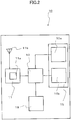
- Fig. 2 is a block diagram illustrating a structure of the sensor unit 10
- Fig. 3 is a block diagram illustrating a structure of the fixed station 20.
- the sensor unit 10 includes a sensor unit RF circuit 11, a sensor unit controller 13, an inertial sensor 15, and a sensor unit memory 19.
- the inertial sensor 15 includes an angular velocity sensor 15a and an acceleration sensor 15b.
- the sensor unit RF circuit 11, the angular sensor 15a, the acceleration sensor 15b and the sensor unit memory 19 are each connected to the sensor unit controller 13.
- the sensor unit RF circuit 11 includes a distance sensor 11a and a transmission-and-reception antenna 11b, communicates with a plurality of fixed stations 20 illustrated in Fig. 1 , and is enabled to detect a separation distance between the mobile body 51 and each of the fixed stations 20.
- the inertial sensor 15 is enabled to detect the position of the mobile body 51 according to the traveling angle and the moved distance that have been detected as described above. In other words, the inertial sensor 15 detects the position of the mobile body 51 based on the movement history of the mobile body 51.
- the sensor unit memory 19 of the sensor unit 10 stores an ID given to each sensor unit 10.
- each of the plurality of the fixed stations 20 includes a fixed station RF circuit 21, a fixed station controller 23, and a fixed station memory 29.
- the fixed station RF circuit 21 and the fixed station memory 29 are each connected to the fixed station controller 23.
- the fixed station RF circuit 21 is provided for detecting a separation distance between the mobile body 51 and each of the fixed stations 20.
- a transmission and reception antenna 21a is attached to the fixed station RF circuit 21.
- Individual IDs given to the fixed stations 20 are stored in the fixed station memories 29. Further, an ID given to the sensor unit 10 is also stored in the fixed station memories 29.
- a method of detecting and determining the position of the mobile body 51 will be described while making reference to Fig. 2 through Fig. 7 .
- a method is used in which the position is determined by comparing two arrival positions: a first arrival position P1 obtained based on the movement history of the mobile body 51 detected by the inertial sensor 15 (refer to Fig. 4 ); and a second arrival position P2 obtained based on the separation distances between the distance sensor 11a and the plurality of the fixed stations 20 (refer to Fig. 5 ).
- Fig. 4 is a schematic diagram illustrating a position detection method for the first arrival position P1.
- the initial position of the mobile body 51 i.e., the start position of the sensor unit 10
- the mobile body 51 including the sensor unit 10 starts from the reference position P0, moves towards the target object 55 in the warehouse 60, and arrives at the first arrival position P1.
- the angular velocity sensor 15a of the inertial sensor 15 in the sensor unit 10 illustrated in Fig. 2 detects angular velocities of the moving mobile body 51 on a movement trajectory 31 at predetermined time intervals, and detects traveling angles of the mobile body 51 at corresponding positions to which the mobile body 51 has moved from the starting point (the reference position P0), by calculating the integral of the detected angular velocities.
- the integral of the angular velocity is calculated by the sensor unit controller 13 of the sensor unit 10 illustrated in Fig. 1 . Further, the first arrival position P1 with respect to the reference position P0 is calculated by the sensor unit controller 13 by calculating the detected traveling angles and the moved distances of the mobile body 51. In this way, the first arrival position P1 is detected for the first time.
- the first arrival position P1 is stored in the sensor unit memory 19 of the sensor unit 10 illustrated in Fig. 2 .
- Fig. 5 is a schematic diagram illustrating a position detection method according to communications between the sensor unit 10 and the plurality of the fixed stations 20. It should be noted that the required (sufficient) number of the fixed stations 20 illustrated in Fig. 5 is three (3). Therefore, in an embodiment of the present invention, the first fixed station 20-1, the second fixed station 20-2, and the third fixed station 20-3 that are relatively closer to the sensor unit 10 are used.
- a transmission and reception unit capable of transmitting and receiving communication signals is included in each of the sensor unit RF circuit 11 of the sensor unit 10 illustrated in Fig. 2 and the fixed station RF circuit 21 of the fixed station 20 illustrated in Fig. 3 .
- the mobile body 51 including the sensor unit 10 moves towards the target object 55 in the warehouse 60, and arrives at the second arrival position P2.
- the sensor unit RF circuit 11 illustrated in Fig. 2 transmits a measurement signal via the transmission and reception antenna 11b at a timing indicated by the sensor unit controller 13.
- the measurement signal is used for measuring separation distances D1, D2, and D3, that are distances between the mobile body 51 and the fixed stations 20 (i.e., the first fixed station 20-1, the second fixed station 20-2, the third fixed station 20-3).
- an ID is given to the sensor unit 10 held by the mobile body 51, and the ID is stored in advance in the sensor unit memory 19.
- the measurement signal, in which the ID is included, is transmitted to each of the fixed stations 20. It is possible for each of the fixed stations 20 to identify the mobile body 51 by matching the ID included in the transmitted measurement signal with the ID given to the sensor unit 10 held by the mobile body 51, the ID being stored in the fixed station memory 29 of the fixed station 20.
- the fixed station controller 23 measures the signal strength of the received measurement signal and transmits the measurement result as a response signal via the fixed station RF circuit 21 and the transmission and reception antenna 21a.
- the sensor unit controller 13 calculates a separation distance D1 between the sensor unit 10 and the first fixed station 20-1 based on the signal strength detected by the fixed station RF circuit 21 of the first fixed station 20-1. (Refer to Fig. 5 ) Afterwards, the separation distance D1 is stored in the sensor unit memory 19. It should be noted that, as the calculation method of the separation distance D1, there are methods of calculation based on a phase difference, based on an optical method, based on an ultrasonic method, etc., other than the method of calculation based on the signal strength.
- the second fixed station 20-2 and the third fixed station 20-3 calculate the separation distance D2 between the sensor unit 10 and the second fixed station 20-2, and the separation distance D3 between the sensor unit 10 and the third fixed station 20-3, respectively, and store the calculated separation distances D2 and D3 in the respective sensor unit memories 19.
- the separation distance D1 between the sensor unit 10 and the first fixed station 20-1 can be indicated by a first arc 20-1a having the first fixed station 20-1 as the center point. Therefore, the sensor unit 10 is on the first arc 20-1a.
- the separation distance D2 between the sensor unit 10 and the second fixed station 20-2 can be indicated by a second arc 20-2a having the second fixed station 20-2 as the center point. Therefore, the sensor unit 10 is on the second arc 20-2a.
- the separation distance D3 between the sensor unit 10 and the third fixed station 20-3 can be indicated by a second arc 20-3a having the third fixed station 20-3 as the center point. Therefore, the sensor unit 10 is on the third arc 20-3a.
- the position of the sensor unit 10 in the warehouse 60 is an intersection point of the first arc 20-1a, the second arc 20-2a, and the third arc 20-3a, and it is possible to detect the second arrival position P2 of the sensor unit 10.
- the second arrival position P2 is obtained based on the separation distances D1, D2, and D3 between the sensor unit 10 and the fixed stations 20.
- the position P2' is not a correct position.
- the second arrival position P2 as a correct position of the sensor unit 10 can be obtained, not only by obtaining intersection points between the first arc 20-1a according to the first fixed station 20-1 and the third arc 20-3a according to the third fixed station 20-3, but also by obtaining intersection points related to the second arc 20-2a according to the second fixed station 20-2.
- the start position of the sensor unit 10 i.e., the reference position P0
- the reference position P0 is stored in the sensor unit memory 19 and in the fixed station memory 29 of each of the fixed stations 20.
- the warehouse 60 in which the position detection target object 55 is stored, is constructed with reinforced concrete. Therefore, the above-described measurement signal transmitted from the sensor unit RF circuit 11 and the above-described response signals transmitted from the fixed station RF circuits 21 are reflected by the ceiling, the floor, and the four side walls of the warehouse 60 made of concrete, and thus, multipathing tends to occur. Therefore, the second arrival position P2 detected by the distance sensor 11a as described above does not necessarily indicate an accurate position due to the multipathing effects.
- the movement history used for detecting the first arrival position P1 is obtained by detecting the angular velocities and the accelerations of the moving mobile body 51, by calculating the integral of the detected angular velocities, and by using the number of steps obtained by the detected accelerations and a predetermined stride length.
- the calculated integral value includes a non-insignificant error, and the error is accumulated every time the integral is calculated. Therefore, the first arrival position P1 detected by the inertial sensor 15 as described above does not necessarily indicate an accurate position.
- the determined position of the mobile body 51 is caused to be more accurate: by detecting a relative distance between the first arrival distance P1 and the second arrival distance P2; by determining the position of the mobile body 51 by comparing a range value obtained based on the movement history with the relative distance; and by changing the range value based on the movement history of the mobile body 51.
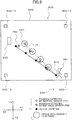
- Fig. 6 is a schematic diagram related to a detected position determination method.
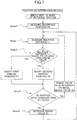
- Fig. 7 is a flowchart related to the detected position determination method.
- the first arrival position P1 of the mobile body 51, the second arrival position P2, and the actual position of the mobile body 51 are illustrated together.
- relative distances L1 between the first arrival position P1 and the second arrival position P2, and circles 32 having the first arrival position P1 as the center point and having the range value R1 as the radius are illustrated together.
- Fig. 6 is a schematic diagram related to a detected position determination method.
- L1 between the first arrival position P1 and the second arrival position P2
- circles 32 having the first arrival position P1 as the center point and having the range value R1 as the radius
- the target object 55 and the fixed stations 20 at the four corners of the warehouse 60 are also illustrated.
- the range value R1 can be indicated as the radius of the circle 32 having the first arrival position P1 as the center point. Further, the range value R1 as the radius of the circle 32 varies according to the position of the first arrival position P1.
- a method of detecting the position of the mobile body 51 using the inertial sensor 15 as described above is referred to as a first detection method
- a method of detecting the position of the mobile body 51 according to communications between the distance sensor 11a and the fixed stations 20 is referred to as a second detection method.
- the first arrival position P1 of the mobile body 51 according to the first detection method is not necessarily the same as the second arrival position P2 of the mobile body 51 according to the second detection method.
- the reason is because the first arrival position P1 is affected by an error related to calculating the integral of the angular velocities and using the number of steps obtained by the accelerations and the predetermined stride length, and because the second arrival position P2 is affected by the multipathing. Therefore, there is a relative distance L1 between the first arrival position P1 and the second arrival position P2.
- the measurement of the reference position P0 in Step 0 is performed according to the second detection method as described above, that is, according to a method using the distance sensor 11a and the fixed stations 20. According to the measurement described above, the reference position P0 as an initial position of the mobile body 51 is determined.
- the mobile body 51 including the sensor unit 10 starts from the reference position P0 and moves towards the target object 55 in the warehouse 60. Further, as illustrated in Fig. 6 , the mobile body 51 arrives at the first moved position P01 (actual position). At this time, the first arrival position P1 (first time) is obtained according to the first detection method, and the second arrival position P2 (first time) is obtained according to the second detection method. The relative distance L1 in Step 1 is obtained by calculating a difference between the first arrival position P1 and the second arrival position P2. It should be noted that the mobile body 51 does not yet arrive at the target object 55 when the mobile body 51 is at the first moved position P01.
- the range value R1 at the moved position P01 is the initial range value R0.
- the initial range value R0 is set as a smallest value of the variable range values R1 because the error, generated by the integral of the angular velocities, the number of steps, and the stride length, has not been accumulated.
- Step 2 for the moved position P01 it is determined whether or not the relative distance L1 is within the range value R1 (i.e., within the initial range value R0).
- the second arrival position P2 is adopted as position data when the relative distance L1 is within the initial range value R0
- the first arrival position P1 is adopted as the position data when the relative distance L1 exceeds the initial range value R0.
- the first arrival position P1 is adopted as the position data because the relative distance L1 exceeds the initial range value R0. It should be noted that there is no change in the adopted data because this is the first time arrival position detection. Therefore, in Step 3, it is determined that the adopted data is not changed from P1 to P2, and proceeds to Step 4.
- Step 4 the range value R1 is increased from the initial range value R0 to a predetermined range value R1. Then, return to Step 1.
- the mobile body 51 moves from the moved position P01 to, for example, a moved position P02 as illustrated in Fig. 6 .
- the first arrival position P1 is obtained according to the first detection method
- the second arrival position P2 is obtained according to the second detection method
- the relative distance L1 is calculated in Step 1.
- the first arrival position P1 or the second arrival position P2 is adopted according to the relative distance L1.
- the first arrival position P1 is adopted as the position data in the case where the relative distance L1 at the time of moved position P02 exceeds the corresponding range value R1. Further, in the determination in step 3, it is determined that the adopted data is not changed "from P1 to P2", and thus, proceed to Step 4, the range value R1 is increased and set as a predetermined range value R1. Then, return to Step 1 again.
- the mobile body 51 moves to, for example, a moved position POL, the first arrival position P1 and the second arrival position P2 are detected, and the relative distance L1 is calculated in Step 1. Further, there is a case in which the relative distance L1 at the time of the moved position P0L exceeds the range value R1 at that same time.
- the first arrival position P1 is adopted as the position data, but, in the determination in Step 3, it is determined that the adopted data is not changed "from P1 to P2". Therefore, also in this case, proceed to Step 4, the range value R1 is increased and set as a predetermined range value R1. Then, return to Step 1 again.
- the mobile body 51 moves to, for example, a moved position POM, the first arrival position P1 and the second arrival position P2 are detected, and the relative distance L1 is calculated. Further, there is a case in which the relative distance L1 at the time of the moved position P0M is within the range value R1 at the time of the moved position P0M. In this case, the second arrival position P2 is adopted as the position data. Therefore, in the determination in Step 3, it is determined that the adopted data is changed "from P1 to P2". Therefore, in this case, do not proceed to step 4, the range value R1 is not increased but is returned to the initial range value R0, and return to Step 1.
- the mobile body 51 moves to, for example, a moved position P0N, the first arrival position P1 and the second arrival position P2 are detected, the relative distance L1 is calculated, and the position is determined.
- the range value R1 is the initial range value R0.
- the position prior to the moved position PON i.e., the second arrival position P2 at the time of the moved position POM
- the position of the mobile body 51 is detected and determined again.
- the position detection and determination are performed repeatedly until the mobile body 51 arrives at the target object 55. As a result, the position of the position detection target object 55 is determined.
- the relative distance L1 between the first arrival position P1 based on the movement history detected by the inertial sensor 15 and the second arrival position P2 based on the separation distances (D1 to D3) detected by the distance sensor 11a is compared with the range value R1 obtained based on the movement history; and the range value R1 is changed according to the degree of an error related to the inertial sensor 15. Therefore, it is possible to detect the position of the mobile body 51 accurately.
- the position of the mobile body 51 is determined with reference to the range value R1. Therefore, it is possible to detect the position of the mobile body 51 more accurately.
- the position detection system 100 when the adopted position of the mobile body 51 is switched from the first arrival position P1 to the second arrival position P2, the range value R1 is returned to the initial range value R0. Therefore, it is possible to accurately determine the position of the mobile body 51 even when the moved distance of the mobile body 51 increases.
- the inertial sensor 15 includes the angular velocity sensor 15a and the acceleration sensor 15b. Therefore, it is possible to detect a position of the mobile body 51 easily.
- the relative distance between the first arrival position based on the movement history detected by the inertial sensor and the second arrival position based on the separation distances detected by the distance sensor is compared with the range value obtained based on the movement history; and the range value is changed according to the degree of an error related to the inertial sensor. Therefore, it is possible to detect the position of the mobile body accurately.
Landscapes
- Engineering & Computer Science (AREA)
- Radar, Positioning & Navigation (AREA)
- Remote Sensing (AREA)
- Physics & Mathematics (AREA)
- General Physics & Mathematics (AREA)
- Automation & Control Theory (AREA)
- Position Fixing By Use Of Radio Waves (AREA)
- Warehouses Or Storage Devices (AREA)
Abstract
Description
- The present invention relates to a position detection system for detecting a position of an object such as a car, or the like.
- Conventionally, a position detection system for a mobile body using GPS (Global Positioning System) is known. By using GPS, it is possible to detect a position of a mobile body accurately. A mobile
body monitoring system 900 as one of the position detection systems is disclosed inPatent Document 1. A mobilebody monitoring system 900 as a first conventional example is illustrated inFig. 8 . - The mobile
body monitoring system 900 monitors traveling conditions of a mobile body vehicle (test vehicle) that travels on atest course 902. InFig. 8 , a plurality of test vehicles 901 (901-1, 901-2, 901-3, 901-4) are motorcycles for which a performance test and an endurance test including various traveling tests are performed. Basestation radio apparatuses 903 are installed in an area outside thecourse 910. The basestation radio apparatuses 903 are installed along the circumference of the course at several positions (four positions in the figure) with a predetermined space next to each other, and perform communications with thetest vehicles 901. - The base
station radio apparatuses 903 are connected to a plurality of electronic reference stations 908 (908-1, 908-2, 908-3) via a network. GPS antennas and GPS receivers are included in theelectronic reference stations 908. In each of theelectronic reference stations 908, received data is calculated and processed by a computer, and an accurate installation location of theelectronic reference station 908 is identified. The GPS receivers included in theelectronic reference stations 908 obtain GPS observation data fromGPS satellites 911. - In the mobile
body monitoring system 900 as described above, it is possible to detect a fall accident of a motorcycle traveling on the test course or detect an abnormality of a vehicle such as a deviation from the test course, and it is possible to accurately determine a traveling position (location) of a motorcycle. In other words, it is possible to accurately detect a position of a mobile body traveling on the outdoor test course by using GPS. - However, in the case where this type of position detection system is adopted as a position detection system used for a mobile body moving in a warehouse, GPS cannot be used because radio waves from GPS are shut off by the structure of the warehouse. Therefore, a position detection system like a mobile
body monitoring system 900 cannot be adopted. - With respect to the above, as a position detection system used for a mobile body moving in a warehouse, a system is considered in which positions are detected by using an inertial sensor and a distance sensor (RF (Radio Frequency) sensor) without using GPS. As a second conventional example of this type of position detection system, a
position detection system 800 is illustrated inFig. 9 . - The
position detection system 800 includes a plurality of fixed stations 820 (820-1, 820-2, 820-3, 820-4) provided at four corners of awarehouse 860. In theposition detection system 800, a position detection worker as amobile body 851, carrying asensor unit 810 including an inertial sensor and a distance sensor, moves towards a positiondetection target object 855 in the warehouse. - In the
position detection system 800, a positioning result P81 and a positioning result P82 are obtained. The positioning result P81 is obtained by using the inertial sensor and the positioning result P82 is obtained by using the plurality of thefixed stations 820 and the distance sensor. - However, a non-insignificant error occurs in the positioning result according to the inertial sensor. Further, there is a possibility that the positioning result according to the distance sensor is affected by multipathing. Therefore, there is a case in which the positioning result P81 according to the inertial sensor and the positioning result P82 according to the distance sensor are both different from the actual position. With respect to the above, as a method of detecting a position of the
mobile body 851, a method is used in which the position P81 obtained by using the inertial sensor is compared with the position P82 obtained by using the distance sensor, and one of the position P81 and the position 82, which is deemed to be closer to the actual position, is adopted. - In the
position detection system 800, first, a circle with radius r1 and with center position P81 obtained by using the inertial sensor, is set, and then, it is determined whether the position P82 obtained by using the distance sensor is within the circle with radius r1. The radius r1 is determined by considering an error that occurs in the positioning result according to the inertial sensor. Further, in the case where the position P82 obtained by using the distance sensor is within the circle with radius r1, the position P82 obtained by using the distance sensor is adopted as a position of themobile body 851, and, in the case where the position P82 obtained by using the distance sensor is not within the circle with radius r1, the position P81 obtained by using the inertial sensor is adopted as the position of themobile body 851. - In the position detection system as described above, by determining the position by combining the inertial sensor and the distance sensor, it is possible to detect one of the positioning result according to the inertial sensor and the positioning result according to the distance sensor, that is more accurate than the other.
- [Patent Document 1] Japanese Unexamined Patent Application Publication No.
2006-101290 - In the
position detection system 800, the size of the radius r1, which is determined by considering the error that occurs in the positioning result according to the inertial sensor, is constant. However, in the positioning result according to the inertial sensor, in the case where the worker as a mobile body moves in the warehouse, errors are accumulated as the moved distance increases, and thus, there is a problem in that the error that occurs in the positioning result gradually increases. - Therefore, in the
position detection system 800, when the moved distance of the mobile body increases, the position obtained by the inertial sensor may be adopted as the position of the moving body even in the case where the positioning result obtained by the distance sensor is closer to the actual position than the position obtained by the inertial sensor is. As a result, there is a problem in that a significant error occurs in the positioning result. - In view of the above, the present invention has been made, and an object of the present invention is to provide a position detection system capable of detecting the position of a mobile body accurately even in the case where the mobile body moves in the warehouse.
- In order to solve the above problem, a position detection system according to an embodiment of the present invention includes a plurality of fixed stations; and a sensor unit including an inertial sensor that detects movement history of a mobile body and a distance sensor that detects separation distances between the mobile body and the fixed stations. A position of the mobile body is determined: by detecting a first arrival position obtained based on the movement history, a second arrival position obtained based on the separation distances, and a relative distance between the first arrival position and the second arrival position; and by comparing a range value, obtained based on the movement history, with the relative distance. The range value is changed based on the movement history.
- In the position detection system described above, the relative distance between the first arrival position based on the movement history detected by the inertial sensor and the second arrival position based on the separation distances detected by the distance sensor, is compared with the range value obtained based on the movement history, and the range value is changed according to the degree of an error related to the inertial sensor. Therefore, it is possible to detect the position of the mobile body accurately.
- Further, in the position detection system described above, the second arrival position is adopted as the position of the mobile body when the relative distance is within the range value, and the first arrival position is adopted as the position of the mobile body when the relative distance exceeds the range value.
- In the position detection system described above, the position of the mobile body is determined with reference to the range value. Therefore, it is possible to detect the position of the mobile body more accurately.
- Further, in the position detection system described above, the range value is increased according to the movement history, and, when the adopted position of the mobile body is switched from the first arrival position to the second arrival position, the range value is returned to an initial value of the range value.
- In the position detection system described above, when the adopted position of the mobile body is switched from the first arrival position to the second arrival position, the range value is returned to an initial value of the range value. Therefore, it is possible to accurately determine the position of the mobile body even when the moved distance of the mobile body increases.
- Further, in the position detection system described above, the inertial sensor includes an angular velocity sensor that detects a traveling angle by detecting an angular velocity of the moving mobile body, and includes an acceleration sensor that detects a moved distance by detecting the acceleration of the moving mobile body.
- In the position detection system described above, the inertial sensor includes the angular velocity sensor and the acceleration sensor. Therefore, it is possible to detect a position of the mobile body easily.
- In a position detection system according to an embodiment of the present invention, the relative distance between the first arrival position based on the movement history detected by the inertial sensor and the second arrival position based on the separation distances detected by the distance sensor, is compared with the range value obtained based on the movement history; and the range value is changed according to the degree of an error related to the inertial sensor. Therefore, it is possible to detect the position of the mobile body accurately.
-
-
Fig. 1 is a schematic diagram illustrating a position detection system according to an embodiment of the present invention. -
Fig. 2 is a block diagram illustrating a structure of a sensor unit. -
Fig. 3 is a block diagram illustrating a structure of a fixed station. -
Fig. 4 is a schematic diagram illustrating a position detection method according to an inertial sensor. -
Fig. 5 is a schematic diagram illustrating a position detection method according to a distance sensor. -
Fig. 6 is a schematic diagram related to a determination method of detected position. -
Fig. 7 is a flowchart related to a determination method of detected position. -
Fig. 8 is a schematic diagram illustrating a position detection system related to a first conventional example. -
Fig. 9 is a schematic diagram illustrating a position detection system related to a second conventional example. - In the following, a
position detection system 100 according to an embodiment of the present invention will be described while making reference to the drawings. Theposition detection system 100 is used for, for example, detecting a position of an object such as a car (vehicle) that is being brought in a warehouse. In particular, theposition detection system 100 relates to a system used in a case in which a position detection worker as a mobile body moves towards a target object in the warehouse. It should be noted that use of theposition detection system 100 is not limited to the above, and may be changed appropriately. Further, in the present specification, unless otherwise noted in particular, the X1 side in each drawing is referred to as a "right side", the X2 side is referred to as a "left side", the Y1 side is referred to as a "back side", the Y2 side is referred to as a "front side". - First, an overall structure of the
position detection system 100 will be described while making reference toFig. 1 . Further, a structure of asensor unit 10 and a structure of a fixedstation 20 will be described while making reference toFig. 2 andFig. 3 . -
Fig. 1 is a schematic diagram illustrating a structure of theposition detection system 100.Fig. 1 is a schematic diagram when awarehouse 60, in which a positiondetection target object 55 has been brought, is viewed from the top. It is assumed that thetarget object 55 is a vehicle such as a private car, a truck, etc. However, thetarget object 55 may be a motor cycle, or a commodity in a physical distribution base. - As illustrated in
Fig. 1 , theposition detection system 100 is included in thewarehouse 60 in which thetarget object 55 such as a vehicle has been brought. Thewarehouse 60 is constructed with reinforced concrete, and theparking space 63 is surrounded by concrete walls. As a result, radio waves from outside are shut off, and a position detection method using GPS cannot be adopted. - In the
parking space 63 of thewarehouse 60, one or more target objects, for which management of the parking positions is required, have been brought in. The parking positions are not necessarily determined in advance. As a result, the target objects 55 and other vehicles, for which management is required, are located at random. Therefore, it is necessary to detect which locations in theparking space 63 the management-required target objects 55 are parked. - As illustrated in
Fig. 1 , in order to detect the locations of the target objects 55 that have been brought in thewarehouse 60, a position detection worker as amobile body 51 moves towards thetarget object 55 in thewarehouse 60. Themobile body 51 has asensor unit 10 for position detection. When themobile body 51 arrives at a position at which thetarget object 55 is located, the position of themobile body 51 is determined as a position of thetarget object 55. - A plurality of fixed
stations 20 are provided on the upper part of the four corner walls of thewarehouse 60 illustrated inFig. 1 . The plurality of the fixedstations 20 include a first fixed station 20-1 that is provided on the front right side, a second fixed station 20-2 that is provided on the rear right side, a third fixed station 20-3 that is provided on the rear left side, and a fourth fixed station 20-4 that is provided on the front left side. The internal structures of the first fixed station 20-1, the second fixed station 20-2, the third fixed station 20-3, and the fourth fixed station 20-4 are the same as each other except for their IDs. It should be noted that four fixedstations 20 are provided in an embodiment of the present invention. However, the fixedstations 20 may be provided in at least three locations. Further, in the case where pillars are provided inside thewarehouse 60, in order to avoid a communication failure, additional fixedstations 20 may be provided. -
Fig. 2 is a block diagram illustrating a structure of thesensor unit 10, andFig. 3 is a block diagram illustrating a structure of the fixedstation 20. - As illustrated in
Fig. 2 , thesensor unit 10 includes a sensorunit RF circuit 11, asensor unit controller 13, aninertial sensor 15, and asensor unit memory 19. Theinertial sensor 15 includes anangular velocity sensor 15a and anacceleration sensor 15b. The sensorunit RF circuit 11, theangular sensor 15a, theacceleration sensor 15b and thesensor unit memory 19 are each connected to thesensor unit controller 13. - The sensor
unit RF circuit 11 includes adistance sensor 11a and a transmission-and-reception antenna 11b, communicates with a plurality of fixedstations 20 illustrated inFig. 1 , and is enabled to detect a separation distance between themobile body 51 and each of the fixedstations 20. - The
angular velocity sensor 15a of theinertial sensor 15 detects an angular velocity of the movingmobile body 51, and detects the traveling angle. Further, theacceleration sensor 15b counts the number of steps by detecting impacts in Z direction (direction orthogonal to X direction and Y direction), and detects a moved distance according to "the number of steps * stride length (predetermined value) = moved distance". It should be noted that, as a calculation method of the moved distance, there is another method in which theacceleration sensor 15b detects the velocity of the movingmobile body 51 by detecting the acceleration of the movingmobile body 51, and the moved distance is detected according to the detected velocity. - The
inertial sensor 15 is enabled to detect the position of themobile body 51 according to the traveling angle and the moved distance that have been detected as described above. In other words, theinertial sensor 15 detects the position of themobile body 51 based on the movement history of themobile body 51. Thesensor unit memory 19 of thesensor unit 10 stores an ID given to eachsensor unit 10. - As illustrated in
Fig. 3 , each of the plurality of the fixed stations 20 (i.e., the first fixed station 20-1, the second fixed station 20-2, the third fixed station 20-3, and the fourth fixed station 20-4) includes a fixedstation RF circuit 21, a fixedstation controller 23, and a fixedstation memory 29. The fixedstation RF circuit 21 and the fixedstation memory 29 are each connected to the fixedstation controller 23. The fixedstation RF circuit 21 is provided for detecting a separation distance between themobile body 51 and each of the fixedstations 20. A transmission andreception antenna 21a is attached to the fixedstation RF circuit 21. Individual IDs given to the fixedstations 20 are stored in the fixedstation memories 29. Further, an ID given to thesensor unit 10 is also stored in the fixedstation memories 29. - Next, a method of detecting and determining the position of the
mobile body 51 will be described while making reference toFig. 2 through Fig. 7 . According to an embodiment of the present invention, a method is used in which the position is determined by comparing two arrival positions: a first arrival position P1 obtained based on the movement history of themobile body 51 detected by the inertial sensor 15 (refer toFig. 4 ); and a second arrival position P2 obtained based on the separation distances between thedistance sensor 11a and the plurality of the fixed stations 20 (refer toFig. 5 ). - First, a method of detecting the first arrival position P1 will be described while making reference to
Fig. 2 andFig. 4. Fig. 4 is a schematic diagram illustrating a position detection method for the first arrival position P1. - As illustrated in
Fig. 4 , it is assumed that the initial position of the mobile body 51 (i.e., the start position of the sensor unit 10) is a reference position P0. Themobile body 51 including thesensor unit 10 starts from the reference position P0, moves towards thetarget object 55 in thewarehouse 60, and arrives at the first arrival position P1. - The
angular velocity sensor 15a of theinertial sensor 15 in thesensor unit 10 illustrated inFig. 2 detects angular velocities of the movingmobile body 51 on amovement trajectory 31 at predetermined time intervals, and detects traveling angles of themobile body 51 at corresponding positions to which themobile body 51 has moved from the starting point (the reference position P0), by calculating the integral of the detected angular velocities. - Further, as described above, the
acceleration sensor 15b counts the number of steps by detecting impacts in Z direction (direction orthogonal to X direction and Y direction), and detects a moved distance according to "the number of steps * stride length (predetermined value) = moved distance". It should be noted that the stride length is calculated in advance by multiplying the height of the position detection worker as themobile body 51 by a predetermined coefficient. - The integral of the angular velocity is calculated by the
sensor unit controller 13 of thesensor unit 10 illustrated inFig. 1 . Further, the first arrival position P1 with respect to the reference position P0 is calculated by thesensor unit controller 13 by calculating the detected traveling angles and the moved distances of themobile body 51. In this way, the first arrival position P1 is detected for the first time. The first arrival position P1 is stored in thesensor unit memory 19 of thesensor unit 10 illustrated inFig. 2 . By repeating the detection method as described above, it is possible to obtain the first arrival position P1 corresponding to the final position of the arrival position of themobile body 51. - Next, a method of detecting the second arrival position P2 will be described while making reference to
Fig. 2 ,Fig. 3 andFig. 5. Fig. 5 is a schematic diagram illustrating a position detection method according to communications between thesensor unit 10 and the plurality of the fixedstations 20. It should be noted that the required (sufficient) number of the fixedstations 20 illustrated inFig. 5 is three (3). Therefore, in an embodiment of the present invention, the first fixed station 20-1, the second fixed station 20-2, and the third fixed station 20-3 that are relatively closer to thesensor unit 10 are used. - A transmission and reception unit capable of transmitting and receiving communication signals (RF signals) is included in each of the sensor
unit RF circuit 11 of thesensor unit 10 illustrated inFig. 2 and the fixedstation RF circuit 21 of the fixedstation 20 illustrated inFig. 3 . - As illustrated in
Fig. 5 , themobile body 51 including thesensor unit 10 moves towards thetarget object 55 in thewarehouse 60, and arrives at the second arrival position P2. At this time, the sensorunit RF circuit 11 illustrated inFig. 2 transmits a measurement signal via the transmission andreception antenna 11b at a timing indicated by thesensor unit controller 13. The measurement signal is used for measuring separation distances D1, D2, and D3, that are distances between themobile body 51 and the fixed stations 20 (i.e., the first fixed station 20-1, the second fixed station 20-2, the third fixed station 20-3). - As described above, an ID is given to the
sensor unit 10 held by themobile body 51, and the ID is stored in advance in thesensor unit memory 19. The measurement signal, in which the ID is included, is transmitted to each of the fixedstations 20. It is possible for each of the fixedstations 20 to identify themobile body 51 by matching the ID included in the transmitted measurement signal with the ID given to thesensor unit 10 held by themobile body 51, the ID being stored in the fixedstation memory 29 of the fixedstation 20. - When the fixed
station RF circuit 21 of the first fixed station 20-1 illustrated inFig. 3 receives the measurement signal transmitted from the sensorunit RF circuit 11 of thesensor unit 10 illustrated inFig. 2 via the transmission andreception antenna 21a, the fixedstation controller 23 measures the signal strength of the received measurement signal and transmits the measurement result as a response signal via the fixedstation RF circuit 21 and the transmission andreception antenna 21a. - When the response signal is received by the sensor
unit RF circuit 11 of thesensor unit 10 illustrated inFig. 2 via the transmission andreception antenna 11b and thedistance sensor 11a, thesensor unit controller 13 calculates a separation distance D1 between thesensor unit 10 and the first fixed station 20-1 based on the signal strength detected by the fixedstation RF circuit 21 of the first fixed station 20-1. (Refer toFig. 5 ) Afterwards, the separation distance D1 is stored in thesensor unit memory 19. It should be noted that, as the calculation method of the separation distance D1, there are methods of calculation based on a phase difference, based on an optical method, based on an ultrasonic method, etc., other than the method of calculation based on the signal strength. - Similar to the case of the first fixed station 20-1, the second fixed station 20-2 and the third fixed station 20-3 calculate the separation distance D2 between the
sensor unit 10 and the second fixed station 20-2, and the separation distance D3 between thesensor unit 10 and the third fixed station 20-3, respectively, and store the calculated separation distances D2 and D3 in the respectivesensor unit memories 19. - As illustrated in
Fig. 5 , the separation distance D1 between thesensor unit 10 and the first fixed station 20-1 can be indicated by a first arc 20-1a having the first fixed station 20-1 as the center point. Therefore, thesensor unit 10 is on the first arc 20-1a. Further, the separation distance D2 between thesensor unit 10 and the second fixed station 20-2 can be indicated by a second arc 20-2a having the second fixed station 20-2 as the center point. Therefore, thesensor unit 10 is on the second arc 20-2a. Further, the separation distance D3 between thesensor unit 10 and the third fixed station 20-3 can be indicated by a second arc 20-3a having the third fixed station 20-3 as the center point. Therefore, thesensor unit 10 is on the third arc 20-3a. - As a result, the position of the
sensor unit 10 in thewarehouse 60 is an intersection point of the first arc 20-1a, the second arc 20-2a, and the third arc 20-3a, and it is possible to detect the second arrival position P2 of thesensor unit 10. In other words, the second arrival position P2 is obtained based on the separation distances D1, D2, and D3 between thesensor unit 10 and the fixedstations 20. - It should be noted that, for example, as the intersection point between the first arc 20-1a and the third arc 20-3a according to the two fixed stations 20 (the first fixed station 20-1 and the third fixed station 20-3), there is also a position P2'. However, in this case, the position P2' is not a correct position. The second arrival position P2 as a correct position of the
sensor unit 10 can be obtained, not only by obtaining intersection points between the first arc 20-1a according to the first fixed station 20-1 and the third arc 20-3a according to the third fixed station 20-3, but also by obtaining intersection points related to the second arc 20-2a according to the second fixed station 20-2. - It should be noted that it is possible to detect the start position of the sensor unit 10 (i.e., the reference position P0) in the method for detecting the first arrival position P1 as illustrated in
Fig. 4 , by using the same method used for detecting the second arrival position P2 using thedistance sensor 11a and the plurality of the fixedstations 20 as described above. The detected reference position P0 is stored in thesensor unit memory 19 and in the fixedstation memory 29 of each of the fixedstations 20. - As described above, the
warehouse 60, in which the positiondetection target object 55 is stored, is constructed with reinforced concrete. Therefore, the above-described measurement signal transmitted from the sensorunit RF circuit 11 and the above-described response signals transmitted from the fixedstation RF circuits 21 are reflected by the ceiling, the floor, and the four side walls of thewarehouse 60 made of concrete, and thus, multipathing tends to occur. Therefore, the second arrival position P2 detected by thedistance sensor 11a as described above does not necessarily indicate an accurate position due to the multipathing effects. - Further, as described above, the movement history used for detecting the first arrival position P1 is obtained by detecting the angular velocities and the accelerations of the moving
mobile body 51, by calculating the integral of the detected angular velocities, and by using the number of steps obtained by the detected accelerations and a predetermined stride length. In general, when the integral of the angular velocities or the accelerations is calculated, the calculated integral value includes a non-insignificant error, and the error is accumulated every time the integral is calculated. Therefore, the first arrival position P1 detected by theinertial sensor 15 as described above does not necessarily indicate an accurate position. - Therefore, in the
position detection system 100, the determined position of themobile body 51 is caused to be more accurate: by detecting a relative distance between the first arrival distance P1 and the second arrival distance P2; by determining the position of themobile body 51 by comparing a range value obtained based on the movement history with the relative distance; and by changing the range value based on the movement history of themobile body 51. - A specific method of determining the position of the
mobile body 51 will be described while making reference toFig. 6 andFig. 7 .Fig. 6 is a schematic diagram related to a detected position determination method.Fig. 7 is a flowchart related to the detected position determination method. InFig. 6 , the first arrival position P1 of themobile body 51, the second arrival position P2, and the actual position of the mobile body 51 (P0-P0N) are illustrated together. Further, inFig. 6 , relative distances L1 between the first arrival position P1 and the second arrival position P2, and circles 32 having the first arrival position P1 as the center point and having the range value R1 as the radius, are illustrated together. Further, inFig. 6 , thetarget object 55 and the fixedstations 20 at the four corners of thewarehouse 60 are also illustrated. It should be noted that the range value R1 can be indicated as the radius of thecircle 32 having the first arrival position P1 as the center point. Further, the range value R1 as the radius of thecircle 32 varies according to the position of the first arrival position P1. - Hereinafter, a method of detecting the position of the
mobile body 51 using theinertial sensor 15 as described above is referred to as a first detection method, and a method of detecting the position of themobile body 51 according to communications between thedistance sensor 11a and the fixedstations 20 is referred to as a second detection method. - The first arrival position P1 of the
mobile body 51 according to the first detection method is not necessarily the same as the second arrival position P2 of themobile body 51 according to the second detection method. The reason is because the first arrival position P1 is affected by an error related to calculating the integral of the angular velocities and using the number of steps obtained by the accelerations and the predetermined stride length, and because the second arrival position P2 is affected by the multipathing. Therefore, there is a relative distance L1 between the first arrival position P1 and the second arrival position P2. - In the
position detection system 100, processes are performed according to the following steps. It should be noted that, afterstep 0, processes ofSteps 1 to 4 are performed at every measurement time. - Step 0: the reference position P0 is measured, and the position of the reference position P0 is determined.
- Step 1: the relative distance L1 between the first arrival position P1 and the second arrival position P2 is measured.
- Step 2: the second arrival position P2 is adopted as an arrival position when the relative distance L1 is within the range value R1, and the first arrival position P1 is adopted as the arrival position when the relative distance L1 exceeds the range value R1.
- Step 3: when the adopted data position is changed from the first arrival position P1 to the second arrival position P2, the range value R1 is returned to an initial range value R0, and return to
Step 1, otherwise, proceed toStep 4. - Step 4: the range value R1 is increased, and return to
Step 1. - The measurement of the reference position P0 in
Step 0 is performed according to the second detection method as described above, that is, according to a method using thedistance sensor 11a and the fixedstations 20. According to the measurement described above, the reference position P0 as an initial position of themobile body 51 is determined. - The
mobile body 51 including thesensor unit 10 starts from the reference position P0 and moves towards thetarget object 55 in thewarehouse 60. Further, as illustrated inFig. 6 , themobile body 51 arrives at the first moved position P01 (actual position). At this time, the first arrival position P1 (first time) is obtained according to the first detection method, and the second arrival position P2 (first time) is obtained according to the second detection method. The relative distance L1 inStep 1 is obtained by calculating a difference between the first arrival position P1 and the second arrival position P2. It should be noted that themobile body 51 does not yet arrive at thetarget object 55 when themobile body 51 is at the first moved position P01. - It is assumed that the range value R1 at the moved position P01 is the initial range value R0. The initial range value R0 is set as a smallest value of the variable range values R1 because the error, generated by the integral of the angular velocities, the number of steps, and the stride length, has not been accumulated.
- In
Step 2 for the moved position P01, it is determined whether or not the relative distance L1 is within the range value R1 (i.e., within the initial range value R0). The second arrival position P2 is adopted as position data when the relative distance L1 is within the initial range value R0, and the first arrival position P1 is adopted as the position data when the relative distance L1 exceeds the initial range value R0. - In an example illustrated in
Fig. 6 , the first arrival position P1 is adopted as the position data because the relative distance L1 exceeds the initial range value R0. It should be noted that there is no change in the adopted data because this is the first time arrival position detection. Therefore, inStep 3, it is determined that the adopted data is not changed from P1 to P2, and proceeds toStep 4. - In
Step 4, the range value R1 is increased from the initial range value R0 to a predetermined range value R1. Then, return toStep 1. - Next, the
mobile body 51 moves from the moved position P01 to, for example, a moved position P02 as illustrated inFig. 6 . At this time, the first arrival position P1 is obtained according to the first detection method, the second arrival position P2 is obtained according to the second detection method, and, the relative distance L1 is calculated inStep 1. Further, the first arrival position P1 or the second arrival position P2 is adopted according to the relative distance L1. - For example, as illustrated in
Fig. 6 , the first arrival position P1 is adopted as the position data in the case where the relative distance L1 at the time of moved position P02 exceeds the corresponding range value R1. Further, in the determination instep 3, it is determined that the adopted data is not changed "from P1 to P2", and thus, proceed toStep 4, the range value R1 is increased and set as a predetermined range value R1. Then, return toStep 1 again. - In this way, after performing the above processing several times, as illustrated in
Fig. 6 , themobile body 51 moves to, for example, a moved position POL, the first arrival position P1 and the second arrival position P2 are detected, and the relative distance L1 is calculated inStep 1. Further, there is a case in which the relative distance L1 at the time of the moved position P0L exceeds the range value R1 at that same time. In this case, the first arrival position P1 is adopted as the position data, but, in the determination inStep 3, it is determined that the adopted data is not changed "from P1 to P2". Therefore, also in this case, proceed toStep 4, the range value R1 is increased and set as a predetermined range value R1. Then, return toStep 1 again. - Next, as illustrated in
Fig. 6 , themobile body 51 moves to, for example, a moved position POM, the first arrival position P1 and the second arrival position P2 are detected, and the relative distance L1 is calculated. Further, there is a case in which the relative distance L1 at the time of the moved position P0M is within the range value R1 at the time of the moved position P0M. In this case, the second arrival position P2 is adopted as the position data. Therefore, in the determination inStep 3, it is determined that the adopted data is changed "from P1 to P2". Therefore, in this case, do not proceed to step 4, the range value R1 is not increased but is returned to the initial range value R0, and return toStep 1. - Further, as illustrated in
Fig. 6 , themobile body 51 moves to, for example, a moved position P0N, the first arrival position P1 and the second arrival position P2 are detected, the relative distance L1 is calculated, and the position is determined. At the moved position PON, the range value R1 is the initial range value R0. Furthermore, the position prior to the moved position PON (i.e., the second arrival position P2 at the time of the moved position POM) is adopted as a new reference position P0. In the state as described above, the position of themobile body 51 is detected and determined again. - In this way, the position detection and determination are performed repeatedly until the
mobile body 51 arrives at thetarget object 55. As a result, the position of the positiondetection target object 55 is determined. - In the following, effects according to an embodiment of the present invention will be described.
- In the
position detection system 100, the relative distance L1 between the first arrival position P1 based on the movement history detected by theinertial sensor 15 and the second arrival position P2 based on the separation distances (D1 to D3) detected by thedistance sensor 11a, is compared with the range value R1 obtained based on the movement history; and the range value R1 is changed according to the degree of an error related to theinertial sensor 15. Therefore, it is possible to detect the position of themobile body 51 accurately. - Further, in the
position detection system 100, the position of themobile body 51 is determined with reference to the range value R1. Therefore, it is possible to detect the position of themobile body 51 more accurately. - Further, in the
position detection system 100, when the adopted position of themobile body 51 is switched from the first arrival position P1 to the second arrival position P2, the range value R1 is returned to the initial range value R0. Therefore, it is possible to accurately determine the position of themobile body 51 even when the moved distance of themobile body 51 increases. - Further, in the
position detection system 100, theinertial sensor 15 includes theangular velocity sensor 15a and theacceleration sensor 15b. Therefore, it is possible to detect a position of themobile body 51 easily. - As described above, in a position detection system according to an embodiment of the present invention, the relative distance between the first arrival position based on the movement history detected by the inertial sensor and the second arrival position based on the separation distances detected by the distance sensor, is compared with the range value obtained based on the movement history; and the range value is changed according to the degree of an error related to the inertial sensor. Therefore, it is possible to detect the position of the mobile body accurately.
- An embodiment of the present invention is not limited to the above-described embodiments. Various modifications may be possible without departing from the subject matter of the present invention.
-
- 10 sensor unit
- 11 sensor unit RF circuit
- 11a distance sensor
- 11b transmission and reception antenna
- 13 sensor unit controller
- 15 inertial sensor
- 15a angular velocity sensor
- 15b acceleration sensor
- 19 sensor unit memory
- 20 fixed station
- 20-1 first fixed station
- 20-1a first arc
- 20-2 second fixed station
- 20-2a second arc
- 20-3 third fixed station
- 20-3a third arc
- 20-4 fourth fixed station
- 21 fixed station RF circuit
- 21a transmission and reception antenna
- 23 fixed station controller
- 29 fixed station memory
- 31 movement trajectory
- 32 circle
- 51 mobile body
- 55 target object
- 60 warehouse
- 63 parking space
- 100 position detection system
- P0 reference position
- P1 first arrival position
- P2 second arrival position
- P01 actual position
- P02 actual position
- P0L actual position
- P0M actual position
- P0N actual position
- D1 separation distance
- D2 separation distance
- D3 separation distance
- L1 relative distance
- R0 range value
- R1 range value
Claims (4)
- A position detection system comprising:a plurality of fixed stations; anda sensor unit including an inertial sensor that detects a movement history of a mobile body and a distance sensor that detects a separation distance between the mobile body and the fixed station,wherein a position of the mobile body is determinedby detecting a first arrival position obtained based on the movement history, a second arrival position obtained based on the separation distance, and a relative distance between the first arrival position and the second arrival position, andby comparing a range value obtained based on the movement history with the relative distance, andwherein the range value is changed based on the movement history.
- The position detection system according to claim 1, wherein the second arrival position is adopted as the position of the mobile body when the relative distance is within the range value, and the first arrival position is adopted as the position of the mobile body when the relative distance exceeds the range value.
- The position detection system according to claim 1 or 2, wherein the range value is increased according to the movement history, and, when the adopted position of the mobile body is switched from the first arrival position to the second arrival position, the range value is returned to an initial value of the range value.
- The position detection system according to any one of claims 1 to 3, the inertial sensor includes an angular velocity sensor that detects a traveling angle by detecting an angular velocity of the moving mobile body, and includes an acceleration sensor that detects a moved distance by detecting the acceleration of the moving mobile body.
Applications Claiming Priority (2)
| Application Number | Priority Date | Filing Date | Title |
|---|---|---|---|
| JP2015236852 | 2015-12-03 | ||
| PCT/JP2016/079776 WO2017094350A1 (en) | 2015-12-03 | 2016-10-06 | Position detection system |
Publications (3)
| Publication Number | Publication Date |
|---|---|
| EP3385744A1 true EP3385744A1 (en) | 2018-10-10 |
| EP3385744A4 EP3385744A4 (en) | 2018-11-21 |
| EP3385744B1 EP3385744B1 (en) | 2020-02-12 |
Family
ID=58796830
Family Applications (1)
| Application Number | Title | Priority Date | Filing Date |
|---|---|---|---|
| EP16870290.0A Active EP3385744B1 (en) | 2015-12-03 | 2016-10-06 | Position detection system |
Country Status (4)
| Country | Link |
|---|---|
| US (1) | US10794706B2 (en) |
| EP (1) | EP3385744B1 (en) |
| JP (1) | JP6611376B2 (en) |
| WO (1) | WO2017094350A1 (en) |
Families Citing this family (4)
| Publication number | Priority date | Publication date | Assignee | Title |
|---|---|---|---|---|
| DE102016101552A1 (en) * | 2016-01-28 | 2017-08-03 | Vorwerk & Co. Interholding Gmbh | Method for creating an environment map for a self-moving processing device |
| JP7392963B2 (en) * | 2017-09-05 | 2023-12-06 | 日本電気株式会社 | Spatial recognition device, spatial recognition method, program |
| US10567905B2 (en) * | 2017-11-27 | 2020-02-18 | Qualcomm Incorporated | Systems and methods for locating a mobile device using angle of arrival and inertial sensor measurements |
| JPWO2020234912A1 (en) * | 2019-05-17 | 2021-10-28 | 三菱電機株式会社 | Portable device, position display method, and position display program |
Family Cites Families (15)
| Publication number | Priority date | Publication date | Assignee | Title |
|---|---|---|---|---|
| JPS646721A (en) * | 1987-06-26 | 1989-01-11 | Daihatsu Motor Co Ltd | Detection system for automobile current position |
| JPH0678910B2 (en) * | 1988-06-10 | 1994-10-05 | 松下電器産業株式会社 | Vehicle position detection device |
| JP3532748B2 (en) * | 1997-12-30 | 2004-05-31 | ジヤトコ株式会社 | Portable position detection device and position management system |
| JP4007899B2 (en) * | 2002-11-07 | 2007-11-14 | オリンパス株式会社 | Motion detection device |
| JP4380489B2 (en) | 2004-09-30 | 2009-12-09 | 三菱電機株式会社 | MOBILE MONITORING SYSTEM AND MOTORCYCLE MOUNTING TERMINAL DEVICE |
| US7321305B2 (en) * | 2005-07-05 | 2008-01-22 | Pinc Solutions | Systems and methods for determining a location of an object |
| JP4781096B2 (en) * | 2005-12-05 | 2011-09-28 | アルパイン株式会社 | Vehicle position estimation apparatus and vehicle position estimation method |
| JP4124249B2 (en) * | 2006-07-25 | 2008-07-23 | トヨタ自動車株式会社 | Positioning device, navigation system |
| US8957812B1 (en) * | 2010-11-12 | 2015-02-17 | Position Imaging, Inc. | Position tracking system and method using radio signals and inertial sensing |
| US8635023B2 (en) * | 2011-11-22 | 2014-01-21 | Google Inc. | Position indication controls for device locations |
| JP2014009964A (en) * | 2012-06-27 | 2014-01-20 | Ntt Docomo Inc | Mobile terminal, system, and method |
| JP2014190827A (en) * | 2013-03-27 | 2014-10-06 | Nec Casio Mobile Communications Ltd | Positioning device, positioning method, and positioning program |
| US20150119086A1 (en) * | 2013-10-25 | 2015-04-30 | Alcatel-Lucent Usa Inc. | Simultaneous localization and mapping systems and methods |
| JP6171944B2 (en) * | 2014-01-16 | 2017-08-02 | ソニー株式会社 | Information processing apparatus, information processing method, and program |
| KR102209523B1 (en) * | 2014-08-14 | 2021-02-01 | 삼성전자주식회사 | Electronic apparatus and positiong method thereof |
-
2016
- 2016-10-06 JP JP2017553681A patent/JP6611376B2/en active Active
- 2016-10-06 WO PCT/JP2016/079776 patent/WO2017094350A1/en not_active Ceased
- 2016-10-06 EP EP16870290.0A patent/EP3385744B1/en active Active
-
2018
- 2018-05-16 US US15/980,914 patent/US10794706B2/en active Active
Also Published As
| Publication number | Publication date |
|---|---|
| US10794706B2 (en) | 2020-10-06 |
| US20180259340A1 (en) | 2018-09-13 |
| EP3385744A4 (en) | 2018-11-21 |
| JP6611376B2 (en) | 2019-11-27 |
| EP3385744B1 (en) | 2020-02-12 |
| WO2017094350A1 (en) | 2017-06-08 |
| JPWO2017094350A1 (en) | 2018-07-12 |
Similar Documents
| Publication | Publication Date | Title |
|---|---|---|
| US10267907B2 (en) | Radar apparatus and radar state estimation method | |
| US10794706B2 (en) | Position detection system | |
| KR101915363B1 (en) | Apparatus and Method for determining car position in GPS signal-shaded area | |
| GB2536846A (en) | Position measurement method, own position measurement device, and in-vehicle device | |
| US9307369B2 (en) | Wireless position detection apparatus and storage medium | |
| US9372253B2 (en) | Wireless positioning apparatus | |
| WO2016113814A1 (en) | In-vehicle unit | |
| KR20150078881A (en) | Method for measureling position of vehicle using cloud computing | |
| KR20170022609A (en) | Calibration system and method for vehicular radar | |
| JP6402201B2 (en) | Position detection system | |
| EP3945335A1 (en) | Abnormality detection method of infrastructure sensor apparatus, infrastructure sensor apparatus, infrastructure sensor system, and abnormality detection program | |
| JP2014085219A (en) | Position detection device, position detection method and drive support device | |
| US20200025863A1 (en) | Position measurement apparatus | |
| US20170192081A1 (en) | Position detection system | |
| CN110945377B (en) | Apparatus and method for identifying the location of an object | |
| US7149624B2 (en) | Method for determining the position of one vehicle with respect to another vehicle, in particular for motor vehicles | |
| JP2016138847A (en) | Position detection system | |
| US12411204B2 (en) | System and method for determining the orientation in space of a linear array of radio receivers | |
| US9170316B2 (en) | Systems and methods for improving bearing availability and accuracy for a tracking filter | |
| KR102784690B1 (en) | Vehicle rear radar and calibration method thereof | |
| KR102679542B1 (en) | Method and device for evaluating the angular position of an object, and driver assistance system | |
| HK1227091A1 (en) | Position measurement method, own position measurement device, and on-board unit |
Legal Events
| Date | Code | Title | Description |
|---|---|---|---|
| STAA | Information on the status of an ep patent application or granted ep patent |
Free format text: STATUS: THE INTERNATIONAL PUBLICATION HAS BEEN MADE |
|
| PUAI | Public reference made under article 153(3) epc to a published international application that has entered the european phase |
Free format text: ORIGINAL CODE: 0009012 |
|
| STAA | Information on the status of an ep patent application or granted ep patent |
Free format text: STATUS: REQUEST FOR EXAMINATION WAS MADE |
|
| 17P | Request for examination filed |
Effective date: 20180525 |
|
| AK | Designated contracting states |
Kind code of ref document: A1 Designated state(s): AL AT BE BG CH CY CZ DE DK EE ES FI FR GB GR HR HU IE IS IT LI LT LU LV MC MK MT NL NO PL PT RO RS SE SI SK SM TR |
|
| AX | Request for extension of the european patent |
Extension state: BA ME |
|
| A4 | Supplementary search report drawn up and despatched |
Effective date: 20181024 |
|
| RIC1 | Information provided on ipc code assigned before grant |
Ipc: G01S 5/14 20060101ALI20181018BHEP Ipc: G01C 21/16 20060101ALI20181018BHEP Ipc: G01C 21/14 20060101ALI20181018BHEP Ipc: G01S 5/02 20100101AFI20181018BHEP Ipc: G01C 21/20 20060101ALI20181018BHEP |
|
| DAV | Request for validation of the european patent (deleted) | ||
| DAX | Request for extension of the european patent (deleted) | ||
| RAP1 | Party data changed (applicant data changed or rights of an application transferred) |
Owner name: ALPS ALPINE CO., LTD. |
|
| RIC1 | Information provided on ipc code assigned before grant |
Ipc: G01S 5/02 20100101AFI20190703BHEP Ipc: G01S 5/14 20060101ALI20190703BHEP Ipc: G01C 21/16 20060101ALI20190703BHEP Ipc: G01C 21/14 20060101ALI20190703BHEP Ipc: G01C 21/20 20060101ALI20190703BHEP |
|
| GRAP | Despatch of communication of intention to grant a patent |
Free format text: ORIGINAL CODE: EPIDOSNIGR1 |
|
| STAA | Information on the status of an ep patent application or granted ep patent |
Free format text: STATUS: GRANT OF PATENT IS INTENDED |
|
| INTG | Intention to grant announced |
Effective date: 20190906 |
|
| GRAS | Grant fee paid |
Free format text: ORIGINAL CODE: EPIDOSNIGR3 |
|
| GRAA | (expected) grant |
Free format text: ORIGINAL CODE: 0009210 |
|
| STAA | Information on the status of an ep patent application or granted ep patent |
Free format text: STATUS: THE PATENT HAS BEEN GRANTED |
|
| AK | Designated contracting states |
Kind code of ref document: B1 Designated state(s): AL AT BE BG CH CY CZ DE DK EE ES FI FR GB GR HR HU IE IS IT LI LT LU LV MC MK MT NL NO PL PT RO RS SE SI SK SM TR |
|
| REG | Reference to a national code |
Ref country code: GB Ref legal event code: FG4D |
|
| REG | Reference to a national code |
Ref country code: CH Ref legal event code: EP |
|
| REG | Reference to a national code |
Ref country code: AT Ref legal event code: REF Ref document number: 1232867 Country of ref document: AT Kind code of ref document: T Effective date: 20200215 |
|
| REG | Reference to a national code |
Ref country code: DE Ref legal event code: R096 Ref document number: 602016029837 Country of ref document: DE |
|
| REG | Reference to a national code |
Ref country code: IE Ref legal event code: FG4D |
|
| PG25 | Lapsed in a contracting state [announced via postgrant information from national office to epo] |
Ref country code: RS Free format text: LAPSE BECAUSE OF FAILURE TO SUBMIT A TRANSLATION OF THE DESCRIPTION OR TO PAY THE FEE WITHIN THE PRESCRIBED TIME-LIMIT Effective date: 20200212 Ref country code: FI Free format text: LAPSE BECAUSE OF FAILURE TO SUBMIT A TRANSLATION OF THE DESCRIPTION OR TO PAY THE FEE WITHIN THE PRESCRIBED TIME-LIMIT Effective date: 20200212 Ref country code: NO Free format text: LAPSE BECAUSE OF FAILURE TO SUBMIT A TRANSLATION OF THE DESCRIPTION OR TO PAY THE FEE WITHIN THE PRESCRIBED TIME-LIMIT Effective date: 20200512 |
|
| REG | Reference to a national code |
Ref country code: LT Ref legal event code: MG4D |
|
| REG | Reference to a national code |
Ref country code: NL Ref legal event code: MP Effective date: 20200212 |
|
| PG25 | Lapsed in a contracting state [announced via postgrant information from national office to epo] |
Ref country code: HR Free format text: LAPSE BECAUSE OF FAILURE TO SUBMIT A TRANSLATION OF THE DESCRIPTION OR TO PAY THE FEE WITHIN THE PRESCRIBED TIME-LIMIT Effective date: 20200212 Ref country code: BG Free format text: LAPSE BECAUSE OF FAILURE TO SUBMIT A TRANSLATION OF THE DESCRIPTION OR TO PAY THE FEE WITHIN THE PRESCRIBED TIME-LIMIT Effective date: 20200512 Ref country code: GR Free format text: LAPSE BECAUSE OF FAILURE TO SUBMIT A TRANSLATION OF THE DESCRIPTION OR TO PAY THE FEE WITHIN THE PRESCRIBED TIME-LIMIT Effective date: 20200513 Ref country code: IS Free format text: LAPSE BECAUSE OF FAILURE TO SUBMIT A TRANSLATION OF THE DESCRIPTION OR TO PAY THE FEE WITHIN THE PRESCRIBED TIME-LIMIT Effective date: 20200612 Ref country code: LV Free format text: LAPSE BECAUSE OF FAILURE TO SUBMIT A TRANSLATION OF THE DESCRIPTION OR TO PAY THE FEE WITHIN THE PRESCRIBED TIME-LIMIT Effective date: 20200212 Ref country code: SE Free format text: LAPSE BECAUSE OF FAILURE TO SUBMIT A TRANSLATION OF THE DESCRIPTION OR TO PAY THE FEE WITHIN THE PRESCRIBED TIME-LIMIT Effective date: 20200212 |
|
| PG25 | Lapsed in a contracting state [announced via postgrant information from national office to epo] |
Ref country code: NL Free format text: LAPSE BECAUSE OF FAILURE TO SUBMIT A TRANSLATION OF THE DESCRIPTION OR TO PAY THE FEE WITHIN THE PRESCRIBED TIME-LIMIT Effective date: 20200212 |
|
| PG25 | Lapsed in a contracting state [announced via postgrant information from national office to epo] |
Ref country code: RO Free format text: LAPSE BECAUSE OF FAILURE TO SUBMIT A TRANSLATION OF THE DESCRIPTION OR TO PAY THE FEE WITHIN THE PRESCRIBED TIME-LIMIT Effective date: 20200212 Ref country code: SK Free format text: LAPSE BECAUSE OF FAILURE TO SUBMIT A TRANSLATION OF THE DESCRIPTION OR TO PAY THE FEE WITHIN THE PRESCRIBED TIME-LIMIT Effective date: 20200212 Ref country code: CZ Free format text: LAPSE BECAUSE OF FAILURE TO SUBMIT A TRANSLATION OF THE DESCRIPTION OR TO PAY THE FEE WITHIN THE PRESCRIBED TIME-LIMIT Effective date: 20200212 Ref country code: ES Free format text: LAPSE BECAUSE OF FAILURE TO SUBMIT A TRANSLATION OF THE DESCRIPTION OR TO PAY THE FEE WITHIN THE PRESCRIBED TIME-LIMIT Effective date: 20200212 Ref country code: LT Free format text: LAPSE BECAUSE OF FAILURE TO SUBMIT A TRANSLATION OF THE DESCRIPTION OR TO PAY THE FEE WITHIN THE PRESCRIBED TIME-LIMIT Effective date: 20200212 Ref country code: DK Free format text: LAPSE BECAUSE OF FAILURE TO SUBMIT A TRANSLATION OF THE DESCRIPTION OR TO PAY THE FEE WITHIN THE PRESCRIBED TIME-LIMIT Effective date: 20200212 Ref country code: PT Free format text: LAPSE BECAUSE OF FAILURE TO SUBMIT A TRANSLATION OF THE DESCRIPTION OR TO PAY THE FEE WITHIN THE PRESCRIBED TIME-LIMIT Effective date: 20200705 Ref country code: EE Free format text: LAPSE BECAUSE OF FAILURE TO SUBMIT A TRANSLATION OF THE DESCRIPTION OR TO PAY THE FEE WITHIN THE PRESCRIBED TIME-LIMIT Effective date: 20200212 Ref country code: SM Free format text: LAPSE BECAUSE OF FAILURE TO SUBMIT A TRANSLATION OF THE DESCRIPTION OR TO PAY THE FEE WITHIN THE PRESCRIBED TIME-LIMIT Effective date: 20200212 |
|
| REG | Reference to a national code |
Ref country code: DE Ref legal event code: R097 Ref document number: 602016029837 Country of ref document: DE |
|
| REG | Reference to a national code |
Ref country code: AT Ref legal event code: MK05 Ref document number: 1232867 Country of ref document: AT Kind code of ref document: T Effective date: 20200212 |
|
| PLBE | No opposition filed within time limit |
Free format text: ORIGINAL CODE: 0009261 |
|
| STAA | Information on the status of an ep patent application or granted ep patent |
Free format text: STATUS: NO OPPOSITION FILED WITHIN TIME LIMIT |
|
| 26N | No opposition filed |
Effective date: 20201113 |
|
| PG25 | Lapsed in a contracting state [announced via postgrant information from national office to epo] |
Ref country code: IT Free format text: LAPSE BECAUSE OF FAILURE TO SUBMIT A TRANSLATION OF THE DESCRIPTION OR TO PAY THE FEE WITHIN THE PRESCRIBED TIME-LIMIT Effective date: 20200212 Ref country code: AT Free format text: LAPSE BECAUSE OF FAILURE TO SUBMIT A TRANSLATION OF THE DESCRIPTION OR TO PAY THE FEE WITHIN THE PRESCRIBED TIME-LIMIT Effective date: 20200212 |
|
| PG25 | Lapsed in a contracting state [announced via postgrant information from national office to epo] |
Ref country code: PL Free format text: LAPSE BECAUSE OF FAILURE TO SUBMIT A TRANSLATION OF THE DESCRIPTION OR TO PAY THE FEE WITHIN THE PRESCRIBED TIME-LIMIT Effective date: 20200212 Ref country code: SI Free format text: LAPSE BECAUSE OF FAILURE TO SUBMIT A TRANSLATION OF THE DESCRIPTION OR TO PAY THE FEE WITHIN THE PRESCRIBED TIME-LIMIT Effective date: 20200212 |
|
| REG | Reference to a national code |
Ref country code: CH Ref legal event code: PL |
|
| PG25 | Lapsed in a contracting state [announced via postgrant information from national office to epo] |
Ref country code: LU Free format text: LAPSE BECAUSE OF NON-PAYMENT OF DUE FEES Effective date: 20201006 Ref country code: MC Free format text: LAPSE BECAUSE OF FAILURE TO SUBMIT A TRANSLATION OF THE DESCRIPTION OR TO PAY THE FEE WITHIN THE PRESCRIBED TIME-LIMIT Effective date: 20200212 |
|
| REG | Reference to a national code |
Ref country code: BE Ref legal event code: MM Effective date: 20201031 |
|
| PG25 | Lapsed in a contracting state [announced via postgrant information from national office to epo] |
Ref country code: FR Free format text: LAPSE BECAUSE OF NON-PAYMENT OF DUE FEES Effective date: 20201031 |
|
| PG25 | Lapsed in a contracting state [announced via postgrant information from national office to epo] |
Ref country code: LI Free format text: LAPSE BECAUSE OF NON-PAYMENT OF DUE FEES Effective date: 20201031 Ref country code: BE Free format text: LAPSE BECAUSE OF NON-PAYMENT OF DUE FEES Effective date: 20201031 Ref country code: CH Free format text: LAPSE BECAUSE OF NON-PAYMENT OF DUE FEES Effective date: 20201031 |
|
| PG25 | Lapsed in a contracting state [announced via postgrant information from national office to epo] |
Ref country code: IE Free format text: LAPSE BECAUSE OF NON-PAYMENT OF DUE FEES Effective date: 20201006 |
|
| PG25 | Lapsed in a contracting state [announced via postgrant information from national office to epo] |
Ref country code: TR Free format text: LAPSE BECAUSE OF FAILURE TO SUBMIT A TRANSLATION OF THE DESCRIPTION OR TO PAY THE FEE WITHIN THE PRESCRIBED TIME-LIMIT Effective date: 20200212 Ref country code: MT Free format text: LAPSE BECAUSE OF FAILURE TO SUBMIT A TRANSLATION OF THE DESCRIPTION OR TO PAY THE FEE WITHIN THE PRESCRIBED TIME-LIMIT Effective date: 20200212 Ref country code: CY Free format text: LAPSE BECAUSE OF FAILURE TO SUBMIT A TRANSLATION OF THE DESCRIPTION OR TO PAY THE FEE WITHIN THE PRESCRIBED TIME-LIMIT Effective date: 20200212 |
|
| PG25 | Lapsed in a contracting state [announced via postgrant information from national office to epo] |
Ref country code: MK Free format text: LAPSE BECAUSE OF FAILURE TO SUBMIT A TRANSLATION OF THE DESCRIPTION OR TO PAY THE FEE WITHIN THE PRESCRIBED TIME-LIMIT Effective date: 20200212 Ref country code: AL Free format text: LAPSE BECAUSE OF FAILURE TO SUBMIT A TRANSLATION OF THE DESCRIPTION OR TO PAY THE FEE WITHIN THE PRESCRIBED TIME-LIMIT Effective date: 20200212 |
|
| PGFP | Annual fee paid to national office [announced via postgrant information from national office to epo] |
Ref country code: DE Payment date: 20251021 Year of fee payment: 10 |
|
| PGFP | Annual fee paid to national office [announced via postgrant information from national office to epo] |
Ref country code: GB Payment date: 20251022 Year of fee payment: 10 |