EP3382308A1 - Method for providing an air fraction to, and processing the air fraction in, a processing unit and corresponding system - Google Patents
Method for providing an air fraction to, and processing the air fraction in, a processing unit and corresponding system Download PDFInfo
- Publication number
- EP3382308A1 EP3382308A1 EP17020115.6A EP17020115A EP3382308A1 EP 3382308 A1 EP3382308 A1 EP 3382308A1 EP 17020115 A EP17020115 A EP 17020115A EP 3382308 A1 EP3382308 A1 EP 3382308A1
- Authority
- EP
- European Patent Office
- Prior art keywords
- steam
- air
- unit
- expanded
- processing unit
- Prior art date
- Legal status (The legal status is an assumption and is not a legal conclusion. Google has not performed a legal analysis and makes no representation as to the accuracy of the status listed.)
- Withdrawn
Links
Images

Classifications
-
- F—MECHANICAL ENGINEERING; LIGHTING; HEATING; WEAPONS; BLASTING
- F25—REFRIGERATION OR COOLING; COMBINED HEATING AND REFRIGERATION SYSTEMS; HEAT PUMP SYSTEMS; MANUFACTURE OR STORAGE OF ICE; LIQUEFACTION SOLIDIFICATION OF GASES
- F25J—LIQUEFACTION, SOLIDIFICATION OR SEPARATION OF GASES OR GASEOUS OR LIQUEFIED GASEOUS MIXTURES BY PRESSURE AND COLD TREATMENT OR BY BRINGING THEM INTO THE SUPERCRITICAL STATE
- F25J3/00—Processes or apparatus for separating the constituents of gaseous or liquefied gaseous mixtures involving the use of liquefaction or solidification
- F25J3/02—Processes or apparatus for separating the constituents of gaseous or liquefied gaseous mixtures involving the use of liquefaction or solidification by rectification, i.e. by continuous interchange of heat and material between a vapour stream and a liquid stream
- F25J3/04—Processes or apparatus for separating the constituents of gaseous or liquefied gaseous mixtures involving the use of liquefaction or solidification by rectification, i.e. by continuous interchange of heat and material between a vapour stream and a liquid stream for air
- F25J3/04521—Coupling of the air fractionation unit to an air gas-consuming unit, so-called integrated processes
- F25J3/04527—Integration with an oxygen consuming unit, e.g. glass facility, waste incineration or oxygen based processes in general
-
- F—MECHANICAL ENGINEERING; LIGHTING; HEATING; WEAPONS; BLASTING
- F25—REFRIGERATION OR COOLING; COMBINED HEATING AND REFRIGERATION SYSTEMS; HEAT PUMP SYSTEMS; MANUFACTURE OR STORAGE OF ICE; LIQUEFACTION SOLIDIFICATION OF GASES
- F25J—LIQUEFACTION, SOLIDIFICATION OR SEPARATION OF GASES OR GASEOUS OR LIQUEFIED GASEOUS MIXTURES BY PRESSURE AND COLD TREATMENT OR BY BRINGING THEM INTO THE SUPERCRITICAL STATE
- F25J3/00—Processes or apparatus for separating the constituents of gaseous or liquefied gaseous mixtures involving the use of liquefaction or solidification
- F25J3/02—Processes or apparatus for separating the constituents of gaseous or liquefied gaseous mixtures involving the use of liquefaction or solidification by rectification, i.e. by continuous interchange of heat and material between a vapour stream and a liquid stream
- F25J3/04—Processes or apparatus for separating the constituents of gaseous or liquefied gaseous mixtures involving the use of liquefaction or solidification by rectification, i.e. by continuous interchange of heat and material between a vapour stream and a liquid stream for air
- F25J3/04006—Providing pressurised feed air or process streams within or from the air fractionation unit
- F25J3/04012—Providing pressurised feed air or process streams within or from the air fractionation unit by compression of warm gaseous streams; details of intake or interstage cooling
- F25J3/04018—Providing pressurised feed air or process streams within or from the air fractionation unit by compression of warm gaseous streams; details of intake or interstage cooling of main feed air
-
- F—MECHANICAL ENGINEERING; LIGHTING; HEATING; WEAPONS; BLASTING
- F25—REFRIGERATION OR COOLING; COMBINED HEATING AND REFRIGERATION SYSTEMS; HEAT PUMP SYSTEMS; MANUFACTURE OR STORAGE OF ICE; LIQUEFACTION SOLIDIFICATION OF GASES
- F25J—LIQUEFACTION, SOLIDIFICATION OR SEPARATION OF GASES OR GASEOUS OR LIQUEFIED GASEOUS MIXTURES BY PRESSURE AND COLD TREATMENT OR BY BRINGING THEM INTO THE SUPERCRITICAL STATE
- F25J3/00—Processes or apparatus for separating the constituents of gaseous or liquefied gaseous mixtures involving the use of liquefaction or solidification
- F25J3/02—Processes or apparatus for separating the constituents of gaseous or liquefied gaseous mixtures involving the use of liquefaction or solidification by rectification, i.e. by continuous interchange of heat and material between a vapour stream and a liquid stream
- F25J3/04—Processes or apparatus for separating the constituents of gaseous or liquefied gaseous mixtures involving the use of liquefaction or solidification by rectification, i.e. by continuous interchange of heat and material between a vapour stream and a liquid stream for air
- F25J3/04006—Providing pressurised feed air or process streams within or from the air fractionation unit
- F25J3/04109—Arrangements of compressors and /or their drivers
- F25J3/04115—Arrangements of compressors and /or their drivers characterised by the type of prime driver, e.g. hot gas expander
- F25J3/04121—Steam turbine as the prime mechanical driver
-
- F—MECHANICAL ENGINEERING; LIGHTING; HEATING; WEAPONS; BLASTING
- F25—REFRIGERATION OR COOLING; COMBINED HEATING AND REFRIGERATION SYSTEMS; HEAT PUMP SYSTEMS; MANUFACTURE OR STORAGE OF ICE; LIQUEFACTION SOLIDIFICATION OF GASES
- F25J—LIQUEFACTION, SOLIDIFICATION OR SEPARATION OF GASES OR GASEOUS OR LIQUEFIED GASEOUS MIXTURES BY PRESSURE AND COLD TREATMENT OR BY BRINGING THEM INTO THE SUPERCRITICAL STATE
- F25J3/00—Processes or apparatus for separating the constituents of gaseous or liquefied gaseous mixtures involving the use of liquefaction or solidification
- F25J3/02—Processes or apparatus for separating the constituents of gaseous or liquefied gaseous mixtures involving the use of liquefaction or solidification by rectification, i.e. by continuous interchange of heat and material between a vapour stream and a liquid stream
- F25J3/04—Processes or apparatus for separating the constituents of gaseous or liquefied gaseous mixtures involving the use of liquefaction or solidification by rectification, i.e. by continuous interchange of heat and material between a vapour stream and a liquid stream for air
- F25J3/04006—Providing pressurised feed air or process streams within or from the air fractionation unit
- F25J3/04109—Arrangements of compressors and /or their drivers
- F25J3/04139—Combination of different types of drivers mechanically coupled to the same compressor, possibly split on multiple compressor casings
-
- F—MECHANICAL ENGINEERING; LIGHTING; HEATING; WEAPONS; BLASTING
- F25—REFRIGERATION OR COOLING; COMBINED HEATING AND REFRIGERATION SYSTEMS; HEAT PUMP SYSTEMS; MANUFACTURE OR STORAGE OF ICE; LIQUEFACTION SOLIDIFICATION OF GASES
- F25J—LIQUEFACTION, SOLIDIFICATION OR SEPARATION OF GASES OR GASEOUS OR LIQUEFIED GASEOUS MIXTURES BY PRESSURE AND COLD TREATMENT OR BY BRINGING THEM INTO THE SUPERCRITICAL STATE
- F25J3/00—Processes or apparatus for separating the constituents of gaseous or liquefied gaseous mixtures involving the use of liquefaction or solidification
- F25J3/02—Processes or apparatus for separating the constituents of gaseous or liquefied gaseous mixtures involving the use of liquefaction or solidification by rectification, i.e. by continuous interchange of heat and material between a vapour stream and a liquid stream
- F25J3/04—Processes or apparatus for separating the constituents of gaseous or liquefied gaseous mixtures involving the use of liquefaction or solidification by rectification, i.e. by continuous interchange of heat and material between a vapour stream and a liquid stream for air
- F25J3/04151—Purification and (pre-)cooling of the feed air; recuperative heat-exchange with product streams
- F25J3/04163—Hot end purification of the feed air
- F25J3/04169—Hot end purification of the feed air by adsorption of the impurities
- F25J3/04181—Regenerating the adsorbents
-
- F—MECHANICAL ENGINEERING; LIGHTING; HEATING; WEAPONS; BLASTING
- F25—REFRIGERATION OR COOLING; COMBINED HEATING AND REFRIGERATION SYSTEMS; HEAT PUMP SYSTEMS; MANUFACTURE OR STORAGE OF ICE; LIQUEFACTION SOLIDIFICATION OF GASES
- F25J—LIQUEFACTION, SOLIDIFICATION OR SEPARATION OF GASES OR GASEOUS OR LIQUEFIED GASEOUS MIXTURES BY PRESSURE AND COLD TREATMENT OR BY BRINGING THEM INTO THE SUPERCRITICAL STATE
- F25J3/00—Processes or apparatus for separating the constituents of gaseous or liquefied gaseous mixtures involving the use of liquefaction or solidification
- F25J3/02—Processes or apparatus for separating the constituents of gaseous or liquefied gaseous mixtures involving the use of liquefaction or solidification by rectification, i.e. by continuous interchange of heat and material between a vapour stream and a liquid stream
- F25J3/04—Processes or apparatus for separating the constituents of gaseous or liquefied gaseous mixtures involving the use of liquefaction or solidification by rectification, i.e. by continuous interchange of heat and material between a vapour stream and a liquid stream for air
- F25J3/04521—Coupling of the air fractionation unit to an air gas-consuming unit, so-called integrated processes
- F25J3/04527—Integration with an oxygen consuming unit, e.g. glass facility, waste incineration or oxygen based processes in general
- F25J3/04533—Integration with an oxygen consuming unit, e.g. glass facility, waste incineration or oxygen based processes in general for the direct combustion of fuels in a power plant, so-called "oxyfuel combustion"
-
- F—MECHANICAL ENGINEERING; LIGHTING; HEATING; WEAPONS; BLASTING
- F25—REFRIGERATION OR COOLING; COMBINED HEATING AND REFRIGERATION SYSTEMS; HEAT PUMP SYSTEMS; MANUFACTURE OR STORAGE OF ICE; LIQUEFACTION SOLIDIFICATION OF GASES
- F25J—LIQUEFACTION, SOLIDIFICATION OR SEPARATION OF GASES OR GASEOUS OR LIQUEFIED GASEOUS MIXTURES BY PRESSURE AND COLD TREATMENT OR BY BRINGING THEM INTO THE SUPERCRITICAL STATE
- F25J3/00—Processes or apparatus for separating the constituents of gaseous or liquefied gaseous mixtures involving the use of liquefaction or solidification
- F25J3/02—Processes or apparatus for separating the constituents of gaseous or liquefied gaseous mixtures involving the use of liquefaction or solidification by rectification, i.e. by continuous interchange of heat and material between a vapour stream and a liquid stream
- F25J3/04—Processes or apparatus for separating the constituents of gaseous or liquefied gaseous mixtures involving the use of liquefaction or solidification by rectification, i.e. by continuous interchange of heat and material between a vapour stream and a liquid stream for air
- F25J3/04521—Coupling of the air fractionation unit to an air gas-consuming unit, so-called integrated processes
- F25J3/04612—Heat exchange integration with process streams, e.g. from the air gas consuming unit
-
- F—MECHANICAL ENGINEERING; LIGHTING; HEATING; WEAPONS; BLASTING
- F25—REFRIGERATION OR COOLING; COMBINED HEATING AND REFRIGERATION SYSTEMS; HEAT PUMP SYSTEMS; MANUFACTURE OR STORAGE OF ICE; LIQUEFACTION SOLIDIFICATION OF GASES
- F25J—LIQUEFACTION, SOLIDIFICATION OR SEPARATION OF GASES OR GASEOUS OR LIQUEFIED GASEOUS MIXTURES BY PRESSURE AND COLD TREATMENT OR BY BRINGING THEM INTO THE SUPERCRITICAL STATE
- F25J2205/00—Processes or apparatus using other separation and/or other processing means
- F25J2205/60—Processes or apparatus using other separation and/or other processing means using adsorption on solid adsorbents, e.g. by temperature-swing adsorption [TSA] at the hot or cold end
- F25J2205/66—Regenerating the adsorption vessel, e.g. kind of reactivation gas
- F25J2205/70—Heating the adsorption vessel
-
- F—MECHANICAL ENGINEERING; LIGHTING; HEATING; WEAPONS; BLASTING
- F25—REFRIGERATION OR COOLING; COMBINED HEATING AND REFRIGERATION SYSTEMS; HEAT PUMP SYSTEMS; MANUFACTURE OR STORAGE OF ICE; LIQUEFACTION SOLIDIFICATION OF GASES
- F25J—LIQUEFACTION, SOLIDIFICATION OR SEPARATION OF GASES OR GASEOUS OR LIQUEFIED GASEOUS MIXTURES BY PRESSURE AND COLD TREATMENT OR BY BRINGING THEM INTO THE SUPERCRITICAL STATE
- F25J2240/00—Processes or apparatus involving steps for expanding of process streams
- F25J2240/70—Steam turbine, e.g. used in a Rankine cycle
-
- F—MECHANICAL ENGINEERING; LIGHTING; HEATING; WEAPONS; BLASTING
- F25—REFRIGERATION OR COOLING; COMBINED HEATING AND REFRIGERATION SYSTEMS; HEAT PUMP SYSTEMS; MANUFACTURE OR STORAGE OF ICE; LIQUEFACTION SOLIDIFICATION OF GASES
- F25J—LIQUEFACTION, SOLIDIFICATION OR SEPARATION OF GASES OR GASEOUS OR LIQUEFIED GASEOUS MIXTURES BY PRESSURE AND COLD TREATMENT OR BY BRINGING THEM INTO THE SUPERCRITICAL STATE
- F25J2260/00—Coupling of processes or apparatus to other units; Integrated schemes
- F25J2260/30—Integration in an installation using renewable energy
Definitions
- the present invention relates to a method for providing an air fraction to, and for processing the air fraction in, a processing unit and to a corresponding system according to the preambles of the independent claims.
- air fraction shall refer to any product which is produced from air by depleting or enriching the air in one or more components, especially in oxygen or nitrogen.
- air fraction shall refer to oxygen or nitrogen or a gas mixture enriched, in comparison to atmospheric air, in oxygen or nitrogen. If, in the following, reference is made to "oxygen” or “nitrogen”, this shall also include air fractions enriched in, but not entirely consisting of, oxygen or nitrogen. For example, in such fractions, the oxygen or nitrogen content may be above 30%, 60%, 80%, 90%, 95% or 99%. Obviously, a corresponding air fraction can also consist, except from inevitable impurities, entirely of oxygen or nitrogen. The same applies for other air components like the noble gases krypton, xenon and/or argon.
- Cryogenic air separation units comprise rectification columns which may be part of double column systems, e.g. of classical Linde double column systems, but also of triple or multiple column systems. Besides the rectification columns for producing nitrogen and/or oxygen or corresponding air fractions, i.e. the rectification columns for nitrogen/oxygen separation, rectification columns for producing other air fractions, especially of the noble gases krypton, xenon and/or argon, may be present.
- cryogenic air separation units purified air is compressed, cooled, and subsequently at least in part supplied to one or more of the rectification columns.
- large multistage compressors are generally provided which are, in air separation units of the prior art, normally driven by electric motors.
- main air compressor MAC
- the main air compressor is not necessarily the only compressor present in an air separation unit, as explained below.
- cryogenic air separation methods and units While the present invention will, in the following, mainly be described with reference to cryogenic air separation methods and units, the present invention may equally be useful in methods and devices wherein compressed air is separated by means other than cryogenic rectification, for example via pressure swing adsorption. Also such units are, in the language used herein, referred to as "air separation units”. Also such units are provided with one or more compressors which are operated as explained above.
- the compressors are the major consumers of energy in air separation methods and units. It is therefore desirable to enhance the efficiency of the air compression in such methods and units.
- Compressors used in air separation units are typically embodied as turbo or positive displacement machines, multiple stage turbo compressors being most widely used.
- the term "compressor” as used herein therefore especially relates to multiple stage turbo compressors, especially radial compressors.
- the stages of such compressors are arranged on one or more shafts which are driven, typically via a gear, by an electric motor or a steam turbine.
- a compressor for use in the present invention may also comprise one or more shafts which are driven by different means, such a machine also being referred to as a "hybrid" compressor.
- one shaft of a turbo compressor may be driven by an electric motor and another shaft may be driven by steam turbine.
- An electric motor and a steam turbine may also be coupled with the same shaft and operate in parallel or alternatingly.
- One compressor may also be used for different compression purposes, for example a group of stages of a compressor in cryogenic air separation unit may be used as the main air compressor mentioned above and one or more further compression stages in such a compressor may be used as a so-called booster air compressor (BAC).
- BAC booster air compressor
- Steam turbines are also generally known from the prior art. Also steam turbines may comprise multiple stages for steam expansion, providing for a close approach to an ideal reversible expansion process. Typically, steam turbines are used to drive electrical generators for electricity production. This is also possible in the context of the present invention wherein, however, a steam turbine is primarily used to drive a compressor directly, “directly” meaning that output shaft power of the steam turbine is, without conversion into another form of energy, particularly electrical energy, used as input shaft power of the compressor. It will be understood that if, in the following, reference is made to "a" steam turbine or "a” compressor in singular, the corresponding explanations may also refer to more than one device.
- a method for providing an air fraction to, and for processing the air fraction in, a processing unit is provided.
- the processing unit may particularly be adapted to process a hydrocarbon stream, for example a sour natural gas stream, as explained below, but may equally be adapted to process other process streams, provided that, in a corresponding processing unit, an air fraction providable by an air separation unit is used.
- an air fraction providable by an air separation unit is used.
- such a processing unit may be adapted to perform a process involving oxygen enriched combustion.
- the present invention is equally useful for different air separation methods, e.g. cryogenic air separation methods and methods based on pressure swing adsorption. For reasons of conciseness, however, the present invention is explained mainly with reference to cryogenic air separation.
- the air fraction is provided in the cryogenic or non-cryogenic air separation unit by a process involving the steps of submitting an amount of air to a compression step comprising the use of the compressor in a compression section of the air separation unit, wherein the compressor is at least in part driven by a steam turbine in which an amount of steam generated in a steam generation unit is expanded from a first pressure level to a second pressure level.
- the second pressure level may especially be in a range of 5 to 20 bar.
- the steam is preferably expanded at a superheated temperature level commonly known in the field of steam management.
- cryogenic air separation units comprise a so-called main air compressor which typically comprises several compressor stages.
- main air compressor typically comprises several compressor stages.
- compressor stages of such a main air compressor may be driven by one or more steam turbines or steam turbine stages.
- booster air compressor which may also be embodied together with the main air compressor in the form of one or more compression stages on the same shaft.
- different pressure levels can be obtained.
- at least the pressure level at which a high-pressure column of a rectification column system is operated is provided.
- a compression to a significantly higher pressure level may be performed.
- compressors of air separation units can be driven by steam turbines, which are however, as regards capital expenses (CAPEX) and operating and maintenance expenses (OPEX), considered disadvantageous when compared to other sources of shaft power like electric motors.
- CAPEX capital expenses
- OPEX operating and maintenance expenses
- the expanded steam of such steam turbines can be used in other facilities and/or other method steps that also use air fractions from the air separation unit and, correspondingly, an integrated system is created.
- the expanded steam can also advantageously be used to heat streams and/or to drive rotary equipment in the air separation unit. It is particularly of advantage if steam for driving the steam turbines is generated by using thermal solar energy, particularly from solar thermal units, in particular concentrated solar power/energy, as explained in more detail below.
- the amount of steam expanded in the steam turbine is at least in part supplied to the steam consumer of the processing unit which is separated from the steam generation unit, the term "separated" meaning that the processing unit represents a functional and optionally constructional entity different from the steam generation unit and that the processing unit is adapted to perform at least one further function except from steam production, this at least one further function comprising also the processing of the air fraction provided by the air separation unit.
- steam which is expanded in the steam turbine is not (or only partially), or at least not at first place, reintroduced into the steam generation system.
- the steam expanded in the steam turbine is used, in the context of the present invention, also for other purposes than for generating steam. This does, however, not exclude that the steam expanded in the steam turbine and subsequently used in the processing unit cannot be ultimately used, for example after condensation or cooling, to generate steam.
- the amount of steam expanded in the steam turbine is at least in part used, at a temperature level not exceeding a temperature level at which the steam is withdrawn from the steam turbine, to heat a regeneration gas used in a purification section of the air separation unit.
- the steam expanded in the steam turbine is at least in part used in the purification section of the air separation unit, it is not further heated before its use.
- a steam turbine can be operated with parameters such that it provides an expanded steam stream whose energy content is sufficiently high to be able to dispense of further heating and/or expansion in a steam turbine driver of auxiliary pumps such as oil pump or cooling water pumps in the air separation unit.
- the temperature of such a steam stream is, for the use according to this alternative of the invention, 200 °C to 300 °C. Avoiding further heating steps enables for significantly reducing installation costs.
- the utilized steam once utilized to benefit from the thermal/mechanical energy as described above, can further be used in other, "separated" (in the sense explained above) units, e.g. it can be injected into a furnace to moderate furnace temperature. As such the steam is further integrated to benefit from steam/water molecules physically, e.g. heat capacity, or chemically.
- the purification section of the separation unit may comprise one or more molsieve adsorbers as also known to the skilled person and described in the cited expert literature.
- Molsieve adsorbers are operated in cycles, one cycle including an adsorption phase which may last for up to several hours and which is performed at the pressure of the process air to be purified, and a regeneration period in which a dry gas stream, the "regeneration gas" mentioned before, is passed in a counter current direction through the adsorbers.
- This regeneration period comprises a heating phase in which hot regeneration gas is used to desorb adsorbed components from the adsorbers.
- the steam expanded in the steam turbine may be used according to the alternative of the present invention mentioned above.
- the overall efficiency of a combined process as mentioned before can be enhanced because the energy of low pressure steam which is withdrawn from the steam turbine driving the compressor can be extracted and advantageously used.
- This allows for a more efficient use of steam turbines which makes them more competitive with the use of electric motors.
- This is particularly advantageous when no or insufficient connectivity to the electrical grid is present, especially in remote areas where, however, a demand for industrial gases exists.
- Local production of electrical power may be an option in such scenarios but would require sufficient availability of fuel (natural gas, coal, diesel, etc.).
- New investments to establish or increase electrical power production come with a high capital investment, feedstock may become unavailable or prices may significantly increase.
- long-term availability and cost of electrical power is critical and not predictable.
- power production from fossil fuels has a significant carbon dioxide footprint, additional costs for carbon dioxide certificates have to be considered and thus the economics of projects may be negatively influenced.
- the amount of steam expanded in the steam turbine is at least in part generated using solar thermal energy in the steam generation unit.
- solar thermal energy is present in sufficient amounts in the scenarios mentioned, e.g. at natural gas treatment plants in the Middle East.
- the present invention provides for a very low carbon dioxide footprint and overcomes the problem of in availability or high costs of electricity generated from fossil fuels.
- thermal energy gathered in concentrated solar power systems is used.
- Concentrated solar power systems are classically used to produce steam that is converted into electrical energy by a steam turbine.
- a CSP system using a thermal oil is used, such a system being able to provide superheated steam with temperatures above 400 °C.
- Corresponding units are particularly cost competitive in areas with high electricity prices, like those mentioned before, and high solar capacity, e.g. in desert areas.
- Concentrated solar power units can provide electrical power and steam uninterruptedly.
- thermal energy may be stored in molten salt or concrete (ceramics) during the day. During the night, heat is extracted and used for electricity production.
- Standard boilers using natural gas to produce steam can be used for backup during lack of solar irradiation/heat (e.g. during sand storms, clouds, etc.). Electrical power produced by solar energy is considered as "green” and does not have any carbon dioxide footprint.
- concentrated solar power systems can generally provide electrical energy as well as steam, also hybrid systems for driving compressors, including electrical motors and steam turbines, are contemplated in the context of the present invention. Also contemplated are operating scenarios wherein at certain periods of time the compressors are driven by electric motors and during other periods time steam turbines are alternatively or additionally used.
- the processing unit is embodied as a gas processing unit, especially a natural gas processing unit, including a sour gas removal unit, especially as a sour natural gas purification unit, because in such a unit numerous possibilities of integration with an air separation unit and a corresponding steam system are present.
- the synergy of such units or method steps is significantly increased in the context of the present invention.
- the air fraction provided by the air separation unit to the processing unit is an oxygen enriched air fraction or pure oxygen and the sour gas removal unit comprises means for oxygen enriched desulfurisation which are adapted to operate using at least a part of the oxygen enriched fraction.
- Oxygen enriched desulfurisation is generally known from the prior art and comprises the injection of oxygen or an oxygen enriched air flow into the combustion/reaction chamber of a Claus unit to enable the reaction of hydrogen sulfide to elemental sulfur.
- the gas processing unit may advantageously comprise means for separating hydrogen sulfide and/or carbon dioxide from a produced natural gas stream or separating a blend of carbon dioxide and hydrogen sulfide via an amine wash and/or another physical or chemical washing process, to which heat is provided via at least the part of the steam expanded in the steam turbine.
- amine washing processes are known from the prior art and comprise washing out sour gases like carbon dioxide and/or hydrogen sulfide with a washing solution comprising one or more washing agents in the form of amines in a washing column or "absorber". The washing solution is regenerated in a separate column, wherein it is heated and the sour gas is driven out of the loaded washing solution. This is precisely the point where heat can be provided according to the presently explained embodiment of the invention.
- the gas processing unit may advantageously comprise tail gas treatment means to which heat can also be provided via at least a part of the steam expanded in the steam turbine.
- tail gas treatment means are particularly established to enhance the recovery rate of sulfur in a desulfurization process to reduce emissions of sulfur into the atmosphere. They involve the use of adsorbers which may, like the adsorbers in the purification section of the air separation unit, be regenerated with a corresponding regeneration gas stream.
- At least a part of the steam expanded in the steam turbine for heating at least one fluid, particularly vaporising at least one liquid, in the air separation unit.
- liquid air products may be evaporated and provided in gaseous form thereby.
- further process streams be it in the air separation unit or in the processing unit, can be treated, heated or formed using at least a part of the steam expanded in the steam turbine.
- At least part of the steam expanded in the steam turbine may also be used for driving at least one further rotary unit of the air separation unit, like e.g. auxiliary pumps for oils, condensates or cooling water.
- the steam fed into the steam turbine i.e. the steam expanded in the steam turbine
- the steam is not, or at least not at first, reintroduced into the steam generating unit.
- steam may be also be used in a series of different units or aggregates (each at lower thermal energy content) before at least partially being reintroduced into the steam generating unit.
- at least some of the steam may also be "lost", particularly when used in a combustion process as mentioned above. Therefore, corresponding makeup steam or water is preferably provided.
- the processing unit may comprise means for oxygen enriched combustion, in which an oxygen enriched air fraction from the air separation unit is used to enhance combustion of a fuel, wherein the steam expanded in the steam turbine optionally is at least in part used to moderate, i.e. adjust, a flame temperature in the means for oxygen enriched combustion.
- corresponding steam may be injected into a combustion chamber.
- a system comprising an air separation unit, a processing unit and steam generation unit is also part of the present invention.
- the air separation unit is adapted to provide an air fraction to the processing unit using a process involving the steps of submitting an amount of air to a compression step comprising the use of a compressor in a compression section of the air separation unit, and of separating at least a part of the compressed air in a separation section of the air separation unit, wherein the compressor is adapted to be at least in part driven by a steam turbine adapted to expand an amount of steam provided by the steam generation unit from a first pressure level to a second pressure level.
- the processing unit is separated from the steam generation unit and means are provided which are adapted to supply the amount of steam expanded in the steam turbine at least in part to a steam consumer of the processing unit and/or means are provided which are adapted to use the amount of steam expanded in the steam turbine to heat a regeneration gas used in the purification section of the separation unit at a temperature level not exceeding a temperature level at which the steam is withdrawn from the steam turbine.
- a system according to a particularly preferred embodiment of the present invention is schematically illustrated and designated 100.
- the system 100 comprises an air separation unit 1 and a processing unit 2.
- a steam generation unit 3 is provided.
- the illustration of the system 100 is radically simplified and a number of technical elements are omitted for reasons of clarity.
- the system 100 is especially not drawn to scale.
- an air stream 101 is aspirated, e.g. via a filter (not shown) by a compressor 111.
- a compressor 111 As repeatedly explained before, in typical air separation units, different compressors comprising one or more compression stages may be provided.
- the compressor 111 schematically illustrated in figure 1 may stand for one or more of such compressors or compressor stages. Any one of such compressors or one or more individual compressor stages of one or more of such compressors can be operated as explained in the following.
- a main air compressor and a booster air compressor may be provided, each of which or both of which optionally being operable as follows.
- One or more compression stages of the compressor 111 are coupled, e.g. via one or more shafts 113, to one or more steam turbines 112.
- figure 1 is strictly simplified and thus one or more steam turbines 112 or turbine stages of one more steam turbines 112 may be present and may be mechanically coupled, individually or in groups, with the compressor 111, one or more compressors, or one or more compression stages of one or more compressors. If, in the following, reference is made to "one" compressor 111 or "one" steam turbine 112, all these alternatives shall be encompassed thereby.
- an amount of steam is provided in form of a steam stream 102.
- the amount of steam is expanded in the steam turbine 112 from a first (higher) pressure level to a second (lower) pressure level.
- This steam is withdrawn from the steam turbine 112 at a temperature level which is the result of the initial temperature of the steam stream 102 and the expansion cooling in the steam turbine 112.
- a central aspect of the present invention is the use of the expanded steam stream 102, designated 103 for referencing purposes. Exemplary uses of the expanded steam stream 103 are explained below in detail.
- an amount of air supplied to the compressor 111 in form of the air stream 101 mentioned before is compressed to a suitable pressure level.
- This pressure level particularly depends on the air separation technique subsequently used.
- this pressure level may be at least the pressure level of a high pressure column of a known double column system.
- this pressure level may be at least the pressure level of a high pressure column of a known double column system.
- the compressed air is, in the example shown, provided in form of a compressed air stream 104, to a purification section 13 of the air separation unit 1.
- the compressed air stream is e.g. purified by guiding it through one of a pair of mole sieve adsorbers 131, 132, of which, in the example shown in figure 1 , the adsorber 132 is in operation mode and the adsorber 131 is in regeneration mode.
- a regeneration and gas stream 105 which is heated in a heater 133, is guided through the adsorbers 131, 132.
- the stream, now designated 106 is, in the example of the cryogenic air separation unit 1 shown, cooled in a heat exchanger 141 of a heat exchange section 14 of the air separation unit 1 to appropriate temperature level, e.g. to about -160 °C.
- appropriate temperature level e.g. to about -160 °C.
- partial streams of the air stream 106 may be boosted to a higher pressure level, expanded, throttled, combined and/or separated, as generally known in the art. Therefore, a cooled air stream designated 107 in figure 1 may stand for one air stream or several air streams at different temperature and/or pressure levels.
- the air stream 107 is provided to a separation section 12 of the air separation unit 1 which comprises, in the example shown in figure 1 , a double rectification column 121 as generally known from the prior art.
- a separation section 12 of the air separation unit 1 which comprises, in the example shown in figure 1 , a double rectification column 121 as generally known from the prior art.
- air streams can be provided to a corresponding double rectification column 121 at different heights, and in different physical conditions.
- a number of different streams may be withdrawn.
- a stream of "impure nitrogen” may be withdrawn from the top of the low pressure column of the rectification column 121 which can at least in part used as the regeneration gas stream 105.
- a product stream designated 108 may, e.g. after compression in the liquid state, be heated in the heat exchanger 141 of the heat exchange section 14.
- such a product stream 108 may be enriched in oxygen.
- a corresponding product stream 109 being the same as or different from the product stream 108 is also shown leaving the bottom right part of the air separation section 12 and the air separation unit 1.
- the product stream 109 is, in the example shown, provided to the processing section 2, details of which are, in an embodiment, shown in figure 2 .
- separation unit 1 shown in figure 1 represents a typical cryogenic air separation unit
- present invention may, as mentioned, equally be useful in non-cryogenic air separation units and methods.
- compressors 111 can be driven by steam turbines 112.
- At least a part of the expanded steam stream 103 can used in the heater 133 to heat the regeneration gas stream 105.
- the steam may e.g. be vented to the atmosphere, condensed or refed into the steam generation unit 3.
- at least a part of the expanded steam stream 103 may e.g. be used to evaporate liquid streams in the air separation unit 1 and/or to drive rotary machines like auxiliary pumps (not shown).
- at least a part of the expanded steam stream 103, designated 103b may also be provided to the processing unit 2 and used as explained hereinbelow. Further possible uses of the expanded steam stream 103 or parts thereof were mentioned before.
- the steam stream 102 is provided by the steam generation unit 3, which may especially be adapted to generate steam by using solar thermal energy.
- the steam unit 3 may comprise a, preferably concentrated, solar thermal unit as generally known in the art and described hereinbefore. It may be equipped with suitable thermal energy storage means as explained before.
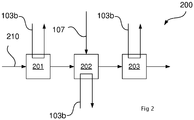
- FIG 2 partially illustrates a processing unit of a system according to an embodiment of the present invention which is embodied as a sour natural gas purification unit as an example for a gas processing unit and which is designated 200.
- the sour natural gas purification unit 200 may be part of the system 100 which is shown in figure 1 .
- the sour natural gas purification unit 200 is only partially illustrated. It is adapted to be supplied with a stream 210 of (optionally pretreated) sour natural gas and comprises means 201 for depleting the sour natural gas from e.g. carbon dioxide and other sour gases. Means 201 may particularly comprise an amine washing unit as generally known in the prior art. Furthermore, the sour natural gas purification unit 200 comprises desulfurisation means 202, particularly adapted to perform oxygen enriched desulfurisation. Furthermore, tail gas treatment means 203 are provided.
- the desulfurisation means 202 are adapted to be operated with an oxygen enriched air fraction designated 107 which is provided by the separation unit 1 (see figure 1 ).
- the expanded steam stream 103 which is here, like in figure 1 , designated 103b, is used to transfer heat to the means 201 and/or 203.
- heat may be used to drive out absorbed carbon dioxide, hydrogen sulfide and other sour gases from a loaded washing liquid.
- the expanded steam stream 103b can alternatively or additionally also be used in desulfurization means 202.
- desulfurization means 202 For details, reference is made to expert literature.
Landscapes
- Engineering & Computer Science (AREA)
- Physics & Mathematics (AREA)
- Mechanical Engineering (AREA)
- Thermal Sciences (AREA)
- General Engineering & Computer Science (AREA)
- Chemical & Material Sciences (AREA)
- Combustion & Propulsion (AREA)
- Separation By Low-Temperature Treatments (AREA)
Abstract
The invention relates to a method for providing an air fraction to, and processing the air fraction in, a processing unit (2), wherein the air fraction is provided by a process involving the steps of submitting an amount of air to a compression step comprising the use of a compressor (111) in a compression section (11) of an air separation unit (1), and of separating at least a part of the compressed air in a separation section (12) of the air separation unit (1), wherein the compressor (111) is at least in part driven by a steam turbine (112) in which steam generated by a steam generation unit (3) is expanded from a first pressure level to a second pressure level. The expanded steam is at least in part supplied to a steam consumer (21) of the processing unit (2) and/or is at least in part used at a temperature level not exceeding a temperature level at which the steam is withdrawn from the steam turbine (112) in order to heat a regeneration gas stream used in a purification section (13) of the air separation unit (1). A corresponding system (100) is also provided according to the present invention.
Description
- The present invention relates to a method for providing an air fraction to, and for processing the air fraction in, a processing unit and to a corresponding system according to the preambles of the independent claims.
- The production of air fractions in liquid, gaseous or supercritical form by cryogenic air separation in corresponding air separation units is generally known and for example described in H.-W. Haring (Ed.), Industrial Gases Processing, Wiley-VCH, 2006, especially section 2.2.5, "Cryogenic Rectification".
- In the following, the term "air fraction" shall refer to any product which is produced from air by depleting or enriching the air in one or more components, especially in oxygen or nitrogen. Especially, the term "air fraction" shall refer to oxygen or nitrogen or a gas mixture enriched, in comparison to atmospheric air, in oxygen or nitrogen. If, in the following, reference is made to "oxygen" or "nitrogen", this shall also include air fractions enriched in, but not entirely consisting of, oxygen or nitrogen. For example, in such fractions, the oxygen or nitrogen content may be above 30%, 60%, 80%, 90%, 95% or 99%. Obviously, a corresponding air fraction can also consist, except from inevitable impurities, entirely of oxygen or nitrogen. The same applies for other air components like the noble gases krypton, xenon and/or argon.
- Cryogenic air separation units comprise rectification columns which may be part of double column systems, e.g. of classical Linde double column systems, but also of triple or multiple column systems. Besides the rectification columns for producing nitrogen and/or oxygen or corresponding air fractions, i.e. the rectification columns for nitrogen/oxygen separation, rectification columns for producing other air fractions, especially of the noble gases krypton, xenon and/or argon, may be present.
- In cryogenic air separation units, purified air is compressed, cooled, and subsequently at least in part supplied to one or more of the rectification columns. To compress the air, large multistage compressors are generally provided which are, in air separation units of the prior art, normally driven by electric motors.
- Generally, in air separation units, at least a so-called main air compressor (MAC) is present which is adapted to compress all the air which is supplied to the rectification column(s). However, the main air compressor is not necessarily the only compressor present in an air separation unit, as explained below.
- While the present invention will, in the following, mainly be described with reference to cryogenic air separation methods and units, the present invention may equally be useful in methods and devices wherein compressed air is separated by means other than cryogenic rectification, for example via pressure swing adsorption. Also such units are, in the language used herein, referred to as "air separation units". Also such units are provided with one or more compressors which are operated as explained above.
- Generally, the compressors are the major consumers of energy in air separation methods and units. It is therefore desirable to enhance the efficiency of the air compression in such methods and units.
- According to the present invention, a method for providing an air fraction to, and processing the air fraction in, a processing unit and a corresponding system with the features of the independent claims are provided. Preferred embodiments of the present invention are the subject of the dependent claims and the description that follows.
- As to the terminology regarding technical apparatus used herein, reference is made to expert literature, e.g. Haring (op. cit.), section 2.2.5.6, "Apparatus".
- Compressors used in air separation units are typically embodied as turbo or positive displacement machines, multiple stage turbo compressors being most widely used. The term "compressor" as used herein therefore especially relates to multiple stage turbo compressors, especially radial compressors. The stages of such compressors are arranged on one or more shafts which are driven, typically via a gear, by an electric motor or a steam turbine. A compressor for use in the present invention may also comprise one or more shafts which are driven by different means, such a machine also being referred to as a "hybrid" compressor. For example, one shaft of a turbo compressor may be driven by an electric motor and another shaft may be driven by steam turbine. An electric motor and a steam turbine may also be coupled with the same shaft and operate in parallel or alternatingly. One compressor may also be used for different compression purposes, for example a group of stages of a compressor in cryogenic air separation unit may be used as the main air compressor mentioned above and one or more further compression stages in such a compressor may be used as a so-called booster air compressor (BAC).
- Steam turbines are also generally known from the prior art. Also steam turbines may comprise multiple stages for steam expansion, providing for a close approach to an ideal reversible expansion process. Typically, steam turbines are used to drive electrical generators for electricity production. This is also possible in the context of the present invention wherein, however, a steam turbine is primarily used to drive a compressor directly, "directly" meaning that output shaft power of the steam turbine is, without conversion into another form of energy, particularly electrical energy, used as input shaft power of the compressor. It will be understood that if, in the following, reference is made to "a" steam turbine or "a" compressor in singular, the corresponding explanations may also refer to more than one device.
- According to the present invention, a method for providing an air fraction to, and for processing the air fraction in, a processing unit is provided. The processing unit may particularly be adapted to process a hydrocarbon stream, for example a sour natural gas stream, as explained below, but may equally be adapted to process other process streams, provided that, in a corresponding processing unit, an air fraction providable by an air separation unit is used. As a particular example, such a processing unit may be adapted to perform a process involving oxygen enriched combustion. As mentioned before, the present invention is equally useful for different air separation methods, e.g. cryogenic air separation methods and methods based on pressure swing adsorption. For reasons of conciseness, however, the present invention is explained mainly with reference to cryogenic air separation.
- According to the present invention, the air fraction is provided in the cryogenic or non-cryogenic air separation unit by a process involving the steps of submitting an amount of air to a compression step comprising the use of the compressor in a compression section of the air separation unit, wherein the compressor is at least in part driven by a steam turbine in which an amount of steam generated in a steam generation unit is expanded from a first pressure level to a second pressure level. The second pressure level may especially be in a range of 5 to 20 bar. The steam is preferably expanded at a superheated temperature level commonly known in the field of steam management.
- As to the terms "compressor" and "steam turbine", reference is made to the definitions above. As known to the skilled person and as already mentioned before, in air separation units different compressors may be present which all may be driven by one or more steam turbines or steam turbine stages, individually or in unison, in the context of the present invention. For example, typical cryogenic air separation units comprise a so-called main air compressor which typically comprises several compressor stages. One or more compressor stages of such a main air compressor may be driven by one or more steam turbines or steam turbine stages. The same applies for a booster air compressor which may also be embodied together with the main air compressor in the form of one or more compression stages on the same shaft. In a corresponding compressor, different pressure levels can be obtained. Particularly, in the example of a cryogenic air separation unit, at least the pressure level at which a high-pressure column of a rectification column system is operated is provided. However, also a compression to a significantly higher pressure level may be performed.
- Generally, compressors of air separation units can be driven by steam turbines, which are however, as regards capital expenses (CAPEX) and operating and maintenance expenses (OPEX), considered disadvantageous when compared to other sources of shaft power like electric motors. However, according to the present invention, it was found that driving compressors with steam turbines may be particularly advantageous if the expanded steam of such steam turbines can be used in other facilities and/or other method steps that also use air fractions from the air separation unit and, correspondingly, an integrated system is created. However, the expanded steam can also advantageously be used to heat streams and/or to drive rotary equipment in the air separation unit. It is particularly of advantage if steam for driving the steam turbines is generated by using thermal solar energy, particularly from solar thermal units, in particular concentrated solar power/energy, as explained in more detail below.
- According to the present invention, the amount of steam expanded in the steam turbine is at least in part supplied to the steam consumer of the processing unit which is separated from the steam generation unit, the term "separated" meaning that the processing unit represents a functional and optionally constructional entity different from the steam generation unit and that the processing unit is adapted to perform at least one further function except from steam production, this at least one further function comprising also the processing of the air fraction provided by the air separation unit. Particularly, steam which is expanded in the steam turbine is not (or only partially), or at least not at first place, reintroduced into the steam generation system. In other words, the steam expanded in the steam turbine is used, in the context of the present invention, also for other purposes than for generating steam. This does, however, not exclude that the steam expanded in the steam turbine and subsequently used in the processing unit cannot be ultimately used, for example after condensation or cooling, to generate steam.
- Additionally or alternatively, the amount of steam expanded in the steam turbine is at least in part used, at a temperature level not exceeding a temperature level at which the steam is withdrawn from the steam turbine, to heat a regeneration gas used in a purification section of the air separation unit. In other words, if the steam expanded in the steam turbine is at least in part used in the purification section of the air separation unit, it is not further heated before its use. A steam turbine can be operated with parameters such that it provides an expanded steam stream whose energy content is sufficiently high to be able to dispense of further heating and/or expansion in a steam turbine driver of auxiliary pumps such as oil pump or cooling water pumps in the air separation unit. Particular, the temperature of such a steam stream is, for the use according to this alternative of the invention, 200 °C to 300 °C. Avoiding further heating steps enables for significantly reducing installation costs. The utilized steam, once utilized to benefit from the thermal/mechanical energy as described above, can further be used in other, "separated" (in the sense explained above) units, e.g. it can be injected into a furnace to moderate furnace temperature. As such the steam is further integrated to benefit from steam/water molecules physically, e.g. heat capacity, or chemically.
- Particularly, the purification section of the separation unit may comprise one or more molsieve adsorbers as also known to the skilled person and described in the cited expert literature. Molsieve adsorbers are operated in cycles, one cycle including an adsorption phase which may last for up to several hours and which is performed at the pressure of the process air to be purified, and a regeneration period in which a dry gas stream, the "regeneration gas" mentioned before, is passed in a counter current direction through the adsorbers. This regeneration period comprises a heating phase in which hot regeneration gas is used to desorb adsorbed components from the adsorbers. For heating the regeneration gas, the steam expanded in the steam turbine may be used according to the alternative of the present invention mentioned above.
- With the present invention, the overall efficiency of a combined process as mentioned before can be enhanced because the energy of low pressure steam which is withdrawn from the steam turbine driving the compressor can be extracted and advantageously used. This allows for a more efficient use of steam turbines which makes them more competitive with the use of electric motors. This is particularly advantageous when no or insufficient connectivity to the electrical grid is present, especially in remote areas where, however, a demand for industrial gases exists. Local production of electrical power may be an option in such scenarios but would require sufficient availability of fuel (natural gas, coal, diesel, etc.). New investments to establish or increase electrical power production come with a high capital investment, feedstock may become unavailable or prices may significantly increase. As such, long-term availability and cost of electrical power is critical and not predictable. Furthermore, as power production from fossil fuels has a significant carbon dioxide footprint, additional costs for carbon dioxide certificates have to be considered and thus the economics of projects may be negatively influenced. These problems are overcome in the context of the present invention.
- In this context, it is, as mentioned, particularly advantageous if the amount of steam expanded in the steam turbine is at least in part generated using solar thermal energy in the steam generation unit. Typically, solar thermal energy is present in sufficient amounts in the scenarios mentioned, e.g. at natural gas treatment plants in the Middle East. In consequence, the present invention provides for a very low carbon dioxide footprint and overcomes the problem of in availability or high costs of electricity generated from fossil fuels.
- As a particularly advantageous form or source of thermal energy, thermal energy gathered in concentrated solar power systems is used. Concentrated solar power systems (CSP) are classically used to produce steam that is converted into electrical energy by a steam turbine. In a particularly advantageous embodiment of the present invention, a CSP system using a thermal oil is used, such a system being able to provide superheated steam with temperatures above 400 °C. Corresponding units are particularly cost competitive in areas with high electricity prices, like those mentioned before, and high solar capacity, e.g. in desert areas. Concentrated solar power units can provide electrical power and steam uninterruptedly. In such systems, thermal energy may be stored in molten salt or concrete (ceramics) during the day. During the night, heat is extracted and used for electricity production. Standard boilers using natural gas to produce steam can be used for backup during lack of solar irradiation/heat (e.g. during sand storms, clouds, etc.). Electrical power produced by solar energy is considered as "green" and does not have any carbon dioxide footprint. As concentrated solar power systems can generally provide electrical energy as well as steam, also hybrid systems for driving compressors, including electrical motors and steam turbines, are contemplated in the context of the present invention. Also contemplated are operating scenarios wherein at certain periods of time the compressors are driven by electric motors and during other periods time steam turbines are alternatively or additionally used.
- It is particularly advantageous if the processing unit is embodied as a gas processing unit, especially a natural gas processing unit, including a sour gas removal unit, especially as a sour natural gas purification unit, because in such a unit numerous possibilities of integration with an air separation unit and a corresponding steam system are present. Correspondingly, the synergy of such units or method steps is significantly increased in the context of the present invention.
- Particularly, the air fraction provided by the air separation unit to the processing unit is an oxygen enriched air fraction or pure oxygen and the sour gas removal unit comprises means for oxygen enriched desulfurisation which are adapted to operate using at least a part of the oxygen enriched fraction. Oxygen enriched desulfurisation is generally known from the prior art and comprises the injection of oxygen or an oxygen enriched air flow into the combustion/reaction chamber of a Claus unit to enable the reaction of hydrogen sulfide to elemental sulfur.
- Furthermore, the gas processing unit may advantageously comprise means for separating hydrogen sulfide and/or carbon dioxide from a produced natural gas stream or separating a blend of carbon dioxide and hydrogen sulfide via an amine wash and/or another physical or chemical washing process, to which heat is provided via at least the part of the steam expanded in the steam turbine. Generally, amine washing processes are known from the prior art and comprise washing out sour gases like carbon dioxide and/or hydrogen sulfide with a washing solution comprising one or more washing agents in the form of amines in a washing column or "absorber". The washing solution is regenerated in a separate column, wherein it is heated and the sour gas is driven out of the loaded washing solution. This is precisely the point where heat can be provided according to the presently explained embodiment of the invention.
- Furthermore, the gas processing unit may advantageously comprise tail gas treatment means to which heat can also be provided via at least a part of the steam expanded in the steam turbine. Such tail gas treatment means are particularly established to enhance the recovery rate of sulfur in a desulfurization process to reduce emissions of sulfur into the atmosphere. They involve the use of adsorbers which may, like the adsorbers in the purification section of the air separation unit, be regenerated with a corresponding regeneration gas stream.
- It is also advantageously possible, according to a further embodiment of the present invention, to use a catalyst bed in the gas processing unit, especially its sour gas removal unit, which is regenerated from time to time. For a corresponding regeneration, also at least some of the steam expanded in the steam turbine may be used.
- Furthermore, it is possible to use at least a part of the steam expanded in the steam turbine for heating at least one fluid, particularly vaporising at least one liquid, in the air separation unit. For example, liquid air products may be evaporated and provided in gaseous form thereby. Generally, also further process streams, be it in the air separation unit or in the processing unit, can be treated, heated or formed using at least a part of the steam expanded in the steam turbine.
- However, at least part of the steam expanded in the steam turbine may also be used for driving at least one further rotary unit of the air separation unit, like e.g. auxiliary pumps for oils, condensates or cooling water.
- Furthermore, it is possible to use at least a part of the steam expanded in the steam turbine for heating at least one fluid, particularly vaporising water or producing steam with another composition in the processing unit which is used in the processing unit, e.g. injected into a combustion chamber as mentioned below.
- Generally, in contrast to previously known systems, the steam fed into the steam turbine, i.e. the steam expanded in the steam turbine, does not comprise steam previously expanded in the steam turbine. In other words, the steam is not, or at least not at first, reintroduced into the steam generating unit. However, in the context of the present invention, steam may be also be used in a series of different units or aggregates (each at lower thermal energy content) before at least partially being reintroduced into the steam generating unit. In this context, at least some of the steam may also be "lost", particularly when used in a combustion process as mentioned above. Therefore, corresponding makeup steam or water is preferably provided.
- According to the present invention, the processing unit may comprise means for oxygen enriched combustion, in which an oxygen enriched air fraction from the air separation unit is used to enhance combustion of a fuel, wherein the steam expanded in the steam turbine optionally is at least in part used to moderate, i.e. adjust, a flame temperature in the means for oxygen enriched combustion. For example, corresponding steam may be injected into a combustion chamber.
- A system comprising an air separation unit, a processing unit and steam generation unit is also part of the present invention. The air separation unit is adapted to provide an air fraction to the processing unit using a process involving the steps of submitting an amount of air to a compression step comprising the use of a compressor in a compression section of the air separation unit, and of separating at least a part of the compressed air in a separation section of the air separation unit, wherein the compressor is adapted to be at least in part driven by a steam turbine adapted to expand an amount of steam provided by the steam generation unit from a first pressure level to a second pressure level.
- According to the present invention, in such a system, the processing unit is separated from the steam generation unit and means are provided which are adapted to supply the amount of steam expanded in the steam turbine at least in part to a steam consumer of the processing unit and/or means are provided which are adapted to use the amount of steam expanded in the steam turbine to heat a regeneration gas used in the purification section of the separation unit at a temperature level not exceeding a temperature level at which the steam is withdrawn from the steam turbine.
- As to features and advantages of such a system, reference is made to the explanations regarding the inventive method and its embodiments above. The same applies for a particularly advantageous system which comprises means which are adapted to perform a method according to the invention and of any of the embodiments as explained above.
- Further details of the present invention are explained with reference to the appended drawings illustrating preferred embodiments of the present invention.
-
-
Figure 1 illustrates a system according to an embodiment of the present invention. -
Figure 2 partially illustrates a processing unit of a system according to an embodiment of the present invention. - In the drawings, like reference numerals indicate the same or technically equivalent elements which are not repeatedly explained for reasons of conciseness.
- In
figure 1 , a system according to a particularly preferred embodiment of the present invention is schematically illustrated and designated 100. As its main components, thesystem 100 comprises anair separation unit 1 and aprocessing unit 2. Furthermore, asteam generation unit 3 is provided. The illustration of thesystem 100 is radically simplified and a number of technical elements are omitted for reasons of clarity. Thesystem 100 is especially not drawn to scale. - In the
air separation unit 100, anair stream 101 is aspirated, e.g. via a filter (not shown) by acompressor 111. As repeatedly explained before, in typical air separation units, different compressors comprising one or more compression stages may be provided. Thecompressor 111 schematically illustrated infigure 1 may stand for one or more of such compressors or compressor stages. Any one of such compressors or one or more individual compressor stages of one or more of such compressors can be operated as explained in the following. Particularly, in cryogenicair separation unit 100, a main air compressor and a booster air compressor may be provided, each of which or both of which optionally being operable as follows. - One or more compression stages of the
compressor 111 are coupled, e.g. via one ormore shafts 113, to one ormore steam turbines 112. As explained for thecompressor 111,figure 1 is strictly simplified and thus one ormore steam turbines 112 or turbine stages of onemore steam turbines 112 may be present and may be mechanically coupled, individually or in groups, with thecompressor 111, one or more compressors, or one or more compression stages of one or more compressors. If, in the following, reference is made to "one"compressor 111 or "one"steam turbine 112, all these alternatives shall be encompassed thereby. - To the
steam turbine 112, an amount of steam is provided in form of asteam stream 102. The amount of steam is expanded in thesteam turbine 112 from a first (higher) pressure level to a second (lower) pressure level. This steam is withdrawn from thesteam turbine 112 at a temperature level which is the result of the initial temperature of thesteam stream 102 and the expansion cooling in thesteam turbine 112. A central aspect of the present invention is the use of the expandedsteam stream 102, designated 103 for referencing purposes. Exemplary uses of the expandedsteam stream 103 are explained below in detail. - In the
compressor 111, an amount of air supplied to thecompressor 111 in form of theair stream 101 mentioned before is compressed to a suitable pressure level. This pressure level particularly depends on the air separation technique subsequently used. - For a cryogenic air separation method, for example, this pressure level may be at least the pressure level of a high pressure column of a known double column system. For further details, reference is made to the expert literature cited in the outset.
- The compressed air is, in the example shown, provided in form of a
compressed air stream 104, to apurification section 13 of theair separation unit 1. In thepurification section 13, the compressed air stream is e.g. purified by guiding it through one of a pair ofmole sieve adsorbers 131, 132, of which, in the example shown infigure 1 , the adsorber 132 is in operation mode and theadsorber 131 is in regeneration mode. For regenerating theadsorbers 131, 132, a regeneration andgas stream 105, which is heated in aheater 133, is guided through theadsorbers 131, 132. For further details, as before, reference is made to the expert literature cited in the outset. - After the purification of the
compressed air stream 103 in thepurification section 13 of theair separation unit 1, the stream, now designated 106, is, in the example of the cryogenicair separation unit 1 shown, cooled in aheat exchanger 141 of aheat exchange section 14 of theair separation unit 1 to appropriate temperature level, e.g. to about -160 °C. Before and/or after cooling to the same or to different temperatures, partial streams of theair stream 106 may be boosted to a higher pressure level, expanded, throttled, combined and/or separated, as generally known in the art. Therefore, a cooled air stream designated 107 infigure 1 may stand for one air stream or several air streams at different temperature and/or pressure levels. - The
air stream 107 is provided to aseparation section 12 of theair separation unit 1 which comprises, in the example shown infigure 1 , a double rectification column 121 as generally known from the prior art. As known to the skilled person, air streams can be provided to a corresponding double rectification column 121 at different heights, and in different physical conditions. - From the
air separation section 12, a number of different streams (product streams and/or waste streams) may be withdrawn. For example, a stream of "impure nitrogen" may be withdrawn from the top of the low pressure column of the rectification column 121 which can at least in part used as theregeneration gas stream 105. A product stream designated 108 may, e.g. after compression in the liquid state, be heated in theheat exchanger 141 of theheat exchange section 14. For example, such aproduct stream 108 may be enriched in oxygen. For reasons of generality, a correspondingproduct stream 109 being the same as or different from theproduct stream 108 is also shown leaving the bottom right part of theair separation section 12 and theair separation unit 1. Theproduct stream 109 is, in the example shown, provided to theprocessing section 2, details of which are, in an embodiment, shown infigure 2 . - While the
separation unit 1 shown infigure 1 represents a typical cryogenic air separation unit, the present invention may, as mentioned, equally be useful in non-cryogenic air separation units and methods. Also in such non-cryogenic air separation units and methods,compressors 111 can be driven bysteam turbines 112. - According to the embodiment exemplified in
figure 1 , at least a part of the expandedsteam stream 103, designated 103a, can used in theheater 133 to heat theregeneration gas stream 105. After this use, the steam may e.g. be vented to the atmosphere, condensed or refed into thesteam generation unit 3. Additionally or alternatively, at least a part of the expandedsteam stream 103 may e.g. be used to evaporate liquid streams in theair separation unit 1 and/or to drive rotary machines like auxiliary pumps (not shown). Additionally or alternatively, at least a part of the expandedsteam stream 103, designated 103b, may also be provided to theprocessing unit 2 and used as explained hereinbelow. Further possible uses of the expandedsteam stream 103 or parts thereof were mentioned before. - The
steam stream 102 is provided by thesteam generation unit 3, which may especially be adapted to generate steam by using solar thermal energy. Particularly, thesteam unit 3 may comprise a, preferably concentrated, solar thermal unit as generally known in the art and described hereinbefore. It may be equipped with suitable thermal energy storage means as explained before. -
Figure 2 partially illustrates a processing unit of a system according to an embodiment of the present invention which is embodied as a sour natural gas purification unit as an example for a gas processing unit and which is designated 200. The sour naturalgas purification unit 200 may be part of thesystem 100 which is shown infigure 1 . - The sour natural
gas purification unit 200 is only partially illustrated. It is adapted to be supplied with astream 210 of (optionally pretreated) sour natural gas and comprisesmeans 201 for depleting the sour natural gas from e.g. carbon dioxide and other sour gases.Means 201 may particularly comprise an amine washing unit as generally known in the prior art. Furthermore, the sour naturalgas purification unit 200 comprises desulfurisation means 202, particularly adapted to perform oxygen enriched desulfurisation. Furthermore, tail gas treatment means 203 are provided. - In the particular embodiment shown in
figure 2 , the desulfurisation means 202 are adapted to be operated with an oxygen enriched air fraction designated 107 which is provided by the separation unit 1 (seefigure 1 ). - Furthermore, in the example shown in
figure 2 , at least a part of the expandedsteam stream 103 which is here, like infigure 1 , designated 103b, is used to transfer heat to themeans 201 and/or 203. For example, in an amine washing unit of themeans 201, heat may be used to drive out absorbed carbon dioxide, hydrogen sulfide and other sour gases from a loaded washing liquid. Furthermore, the expandedsteam stream 103b can alternatively or additionally also be used in desulfurization means 202. For details, reference is made to expert literature.
Claims (15)
- A method for providing an air fraction to, and processing the air fraction in, a processing unit (2), wherein the air fraction is provided by a process involving the steps of submitting an amount of air to a compression step comprising the use of a compressor (111) in a compression section (11) of an air separation unit (1), and of separating at least a part of the compressed air in a separation section (12) of the air separation unit (1), wherein the compressor (111) is at least in part driven by a steam turbine (112) in which an amount of steam provided by a steam generation unit (3) is expanded from a first pressure level to a second pressure level, characterised in that the steam expanded in the steam turbine (112) is at least in part supplied to a steam consumer (21) of the processing unit (2) separated from the steam generation unit (3) and/or is at least in part used at a temperature level not exceeding a temperature level at which the steam is withdrawn from the steam turbine (112) for heating a regeneration gas stream used in a purification section (13) of the air separation unit (1).
- The method according to claim 1, wherein the amount of steam expanded in the steam turbine (112) is at least in part generated in the steam generation unit (3) using solar thermal energy.
- The method according to claim 2, wherein the thermal energy is provided at least in part by a concentrated solar power unit.
- The method according to claim 3, wherein the concentrated solar power unit is adapted to store thermal energy in a thermal energy storage section.
- The method according to any one of the preceding claims, wherein the processing unit (2) is a gas processing unit (200) including a sour gas removal unit.
- The method according to claim 5, wherein the air fraction is an oxygen enriched air fraction and wherein the gas processing unit (200) comprises means (202) for oxygen enriched desulfurisation which are adapted to operate using at least a part of the oxygen enriched air fraction.
- The method according to claim 5 or 6, wherein the gas processing unit (200) comprises means (201) for depleting a gas mixture from at least hydrogen sulfide and/or carbon dioxide via a physical or chemical wash process to which heat is provided via at least a part of the steam expanded in the steam turbine (112).
- The method according to any one of claims 5 to 7, wherein the gas processing unit (200) comprises tail gas treatment means (203) to which heat is provided via at least a part of the steam expanded in the steam turbine (112).
- The method according to anyone of claims 5 to 8, wherein in the gas processing unit (200) at least one catalyst bed is used which is regenerated using at least a part of the steam expanded in the steam turbine (112).
- The method according to any one of claims 5 to 9, wherein at least one further process stream in the gas processing unit (200) is heated and/or formed using at least a part of the steam expanded in the steam turbine (112).
- The method according to any one of the preceding claims, wherein at least a part of the steam expanded in the steam turbine (112) is used for heating at least one fluid in the air separation unit (1).
- The method according to any one of the preceding claims, wherein at least a part of the steam expanded in the steam turbine (112) is used for driving at least one further rotary unit of the air separation unit (1).
- The method according to any one of the preceding claims, wherein the processing unit comprises means for oxygen enriched combustion and wherein the steam expanded in the steam turbine (112) is at least in part used to moderate a flame temperature in the means for oxygen enriched combustion.
- The method according to any one of the preceding claims, wherein the steam expanded in the steam turbine (112) does not comprise steam previously expanded the steam turbine (112).
- A system (100) comprising an air separation unit (1), a processing unit (2) and a steam generation unit (3), the air separation unit (1) being adapted to provide an air fraction to the processing unit (2) using a process involving the steps of submitting an amount of air to a compression step comprising the use of a compressor (111) in a compression section (11) of the air separation unit (1), and of separating at least part of the compressed air in a separation section (12) of the air separation unit (1), wherein the compressor (111) is adapted to be at least in part driven by a steam turbine (112) adapted to expand an amount of steam provided by the steam generation unit from a first pressure level to a second pressure level, characterised in that the processing unit (2) is separated from the steam generation unit (3) and in that means are provided adapted to supply the amount of steam expanded in the steam turbine (112) at least in part to a steam consumer (21) of the processing unit (2) and/or in that means are provided adapted to use the amount of steam expanded in the steam turbine (112) at a temperature level not exceeding a temperature level at which the steam is withdrawn from the steam turbine (112) for heating a regeneration gas used in a purification section (13) of the air separation unit (1).
Priority Applications (1)
| Application Number | Priority Date | Filing Date | Title |
|---|---|---|---|
| EP17020115.6A EP3382308A1 (en) | 2017-03-28 | 2017-03-28 | Method for providing an air fraction to, and processing the air fraction in, a processing unit and corresponding system |
Applications Claiming Priority (1)
| Application Number | Priority Date | Filing Date | Title |
|---|---|---|---|
| EP17020115.6A EP3382308A1 (en) | 2017-03-28 | 2017-03-28 | Method for providing an air fraction to, and processing the air fraction in, a processing unit and corresponding system |
Publications (1)
| Publication Number | Publication Date |
|---|---|
| EP3382308A1 true EP3382308A1 (en) | 2018-10-03 |
Family
ID=58464128
Family Applications (1)
| Application Number | Title | Priority Date | Filing Date |
|---|---|---|---|
| EP17020115.6A Withdrawn EP3382308A1 (en) | 2017-03-28 | 2017-03-28 | Method for providing an air fraction to, and processing the air fraction in, a processing unit and corresponding system |
Country Status (1)
| Country | Link |
|---|---|
| EP (1) | EP3382308A1 (en) |
Cited By (1)
| Publication number | Priority date | Publication date | Assignee | Title |
|---|---|---|---|---|
| WO2020160844A1 (en) | 2019-02-07 | 2020-08-13 | Linde Gmbh | Method and arrangement for providing a first method product and a second method product |
Citations (3)
| Publication number | Priority date | Publication date | Assignee | Title |
|---|---|---|---|---|
| EP1202012A1 (en) * | 2000-10-30 | 2002-05-02 | L'air Liquide Société Anonyme pour l'étude et l'exploitation des procédés Georges Claude | Process and installation for cryogenic air separation integrated with an associated process |
| DE102009032718A1 (en) * | 2009-07-14 | 2011-02-17 | Kirchner, Hans Walter, Dipl.-Ing. | Separating carbon dioxide in steam injected gas turbine process, involves using residual air for combustion, where temperature level of air is managed with water vapor and raw material in combustion chamber of gas turbine |
| EP2335813A1 (en) * | 2009-12-01 | 2011-06-22 | Shell Internationale Research Maatschappij B.V. | Method and apparatus for the removal of a sorbate component from a process stream with subsequent regeneration of the sorbent using solar energy |
-
2017
- 2017-03-28 EP EP17020115.6A patent/EP3382308A1/en not_active Withdrawn
Patent Citations (3)
| Publication number | Priority date | Publication date | Assignee | Title |
|---|---|---|---|---|
| EP1202012A1 (en) * | 2000-10-30 | 2002-05-02 | L'air Liquide Société Anonyme pour l'étude et l'exploitation des procédés Georges Claude | Process and installation for cryogenic air separation integrated with an associated process |
| DE102009032718A1 (en) * | 2009-07-14 | 2011-02-17 | Kirchner, Hans Walter, Dipl.-Ing. | Separating carbon dioxide in steam injected gas turbine process, involves using residual air for combustion, where temperature level of air is managed with water vapor and raw material in combustion chamber of gas turbine |
| EP2335813A1 (en) * | 2009-12-01 | 2011-06-22 | Shell Internationale Research Maatschappij B.V. | Method and apparatus for the removal of a sorbate component from a process stream with subsequent regeneration of the sorbent using solar energy |
Non-Patent Citations (2)
| Title |
|---|
| "Industrial Gases Processing", 2006, WILEY-VCH, article "Cryogenic Rectification" |
| NO AUTHOR NAME SUPPLIED IN SOURCE DATA: "Natural Gas Expansion and Integration with Air Separation Units", IP.COM JOURNAL, IP.COM INC., WEST HENRIETTA, NY, US, 23 September 2003 (2003-09-23), XP013012940, ISSN: 1533-0001 * |
Cited By (1)
| Publication number | Priority date | Publication date | Assignee | Title |
|---|---|---|---|---|
| WO2020160844A1 (en) | 2019-02-07 | 2020-08-13 | Linde Gmbh | Method and arrangement for providing a first method product and a second method product |
Similar Documents
| Publication | Publication Date | Title |
|---|---|---|
| US10746461B2 (en) | Cryogenic air separation method for producing oxygen at high pressures | |
| CN107008102B (en) | System and method for integrated separation of carbon dioxide gas from combustion gases | |
| CA1172158A (en) | Air separation process with single distillation column for combined gas turbine system | |
| EP1058074B1 (en) | Air separation process with a combustion engine for the production of atmospheric gas products and electric power | |
| US5268019A (en) | Air separation method and apparatus combined with a blast furnace | |
| US6141950A (en) | Integrated air separation and combustion turbine process with steam generation by indirect heat exchange with nitrogen | |
| DK3129613T3 (en) | Process and plant for energy storage and recovery | |
| EP2167892B1 (en) | Thermal integration of oxygen plants | |
| JP2011504136A5 (en) | ||
| US9914643B2 (en) | Incremental hydrogen production from an existing steam/natural gas reformer | |
| US20170175585A1 (en) | Method and installation for storing and recovering energy | |
| KR20150028332A (en) | Process and apparatus for generating electric energy | |
| WO2012040195A2 (en) | System and method for high efficiency power generation using a nitrogen gas working fluid | |
| AU2010291532A1 (en) | Method and device for treating a carbon dioxide-containing gas flow, wherein the energy of the vent gas (work and cold due to expansion) is used | |
| US20160190896A1 (en) | Method for generating electrical energy and energy generation plant | |
| US20230027743A1 (en) | Process and device for membrane separation of a mixture containing hydrogen and carbon dioxide as main components | |
| EP2741036A1 (en) | Process and apparatus for the separation of air by cryogenic distillation | |
| EP3727646B1 (en) | Gas treatment method including an oxidative process providing waste heat and corresponding apparatus | |
| EP3700857B1 (en) | Method and apparatus for treating a sour gas mixture | |
| JP2008525173A (en) | Integrated process and equipment for air compression, cooling and purification | |
| EP0211523B1 (en) | Inert gas generation | |
| JP2016142462A (en) | Air separation device | |
| WO2020160842A1 (en) | Gas treatment method and apparatus including an oxidative process for treating a sour gas mixture using gas from an air separation process | |
| US11913718B2 (en) | Argon and power production by integration with power plant | |
| AU2012301211A1 (en) | Method and system for removing carbon dioxide from flue gases |
Legal Events
| Date | Code | Title | Description |
|---|---|---|---|
| PUAI | Public reference made under article 153(3) epc to a published international application that has entered the european phase |
Free format text: ORIGINAL CODE: 0009012 |
|
| STAA | Information on the status of an ep patent application or granted ep patent |
Free format text: STATUS: THE APPLICATION HAS BEEN PUBLISHED |
|
| AK | Designated contracting states |
Kind code of ref document: A1 Designated state(s): AL AT BE BG CH CY CZ DE DK EE ES FI FR GB GR HR HU IE IS IT LI LT LU LV MC MK MT NL NO PL PT RO RS SE SI SK SM TR |
|
| AX | Request for extension of the european patent |
Extension state: BA ME |
|
| STAA | Information on the status of an ep patent application or granted ep patent |
Free format text: STATUS: THE APPLICATION IS DEEMED TO BE WITHDRAWN |
|
| 18D | Application deemed to be withdrawn |
Effective date: 20190404 |