EP3382078A1 - Water-disintegrable nonwoven fabric and process for producing same - Google Patents
Water-disintegrable nonwoven fabric and process for producing same Download PDFInfo
- Publication number
- EP3382078A1 EP3382078A1 EP16881568.6A EP16881568A EP3382078A1 EP 3382078 A1 EP3382078 A1 EP 3382078A1 EP 16881568 A EP16881568 A EP 16881568A EP 3382078 A1 EP3382078 A1 EP 3382078A1
- Authority
- EP
- European Patent Office
- Prior art keywords
- nonwoven fabric
- water
- web
- regenerated cellulose
- pulp
- Prior art date
- Legal status (The legal status is an assumption and is not a legal conclusion. Google has not performed a legal analysis and makes no representation as to the accuracy of the status listed.)
- Withdrawn
Links
- 239000004745 nonwoven fabric Substances 0.000 title claims abstract description 106
- 238000000034 method Methods 0.000 title claims description 12
- 239000000835 fiber Substances 0.000 claims abstract description 59
- 229920003043 Cellulose fiber Polymers 0.000 claims abstract description 44
- 239000004627 regenerated cellulose Substances 0.000 claims abstract description 43
- 239000002002 slurry Substances 0.000 claims description 11
- 238000001035 drying Methods 0.000 claims description 4
- XLYOFNOQVPJJNP-UHFFFAOYSA-N water Substances O XLYOFNOQVPJJNP-UHFFFAOYSA-N 0.000 abstract description 56
- 238000012360 testing method Methods 0.000 abstract description 27
- 229920000297 Rayon Polymers 0.000 description 12
- 230000000052 comparative effect Effects 0.000 description 12
- 238000004519 manufacturing process Methods 0.000 description 12
- 239000000123 paper Substances 0.000 description 10
- 239000002964 rayon Substances 0.000 description 10
- 239000004744 fabric Substances 0.000 description 8
- 238000012546 transfer Methods 0.000 description 7
- 238000004140 cleaning Methods 0.000 description 6
- 239000002994 raw material Substances 0.000 description 6
- 239000011122 softwood Substances 0.000 description 6
- 238000002347 injection Methods 0.000 description 5
- 239000007924 injection Substances 0.000 description 5
- 230000003247 decreasing effect Effects 0.000 description 4
- 239000002655 kraft paper Substances 0.000 description 4
- 238000005259 measurement Methods 0.000 description 4
- 239000000203 mixture Substances 0.000 description 4
- 238000010009 beating Methods 0.000 description 3
- 238000005520 cutting process Methods 0.000 description 3
- 238000006073 displacement reaction Methods 0.000 description 3
- 239000002689 soil Substances 0.000 description 3
- 238000010998 test method Methods 0.000 description 3
- 229920000742 Cotton Polymers 0.000 description 2
- 229920000433 Lyocell Polymers 0.000 description 2
- 229920001410 Microfiber Polymers 0.000 description 2
- 229920001131 Pulp (paper) Polymers 0.000 description 2
- 239000011230 binding agent Substances 0.000 description 2
- 239000003795 chemical substances by application Substances 0.000 description 2
- 239000012153 distilled water Substances 0.000 description 2
- BXKDSDJJOVIHMX-UHFFFAOYSA-N edrophonium chloride Chemical compound [Cl-].CC[N+](C)(C)C1=CC=CC(O)=C1 BXKDSDJJOVIHMX-UHFFFAOYSA-N 0.000 description 2
- 238000007429 general method Methods 0.000 description 2
- 238000012545 processing Methods 0.000 description 2
- 238000005728 strengthening Methods 0.000 description 2
- 241000609240 Ambelania acida Species 0.000 description 1
- 208000019901 Anxiety disease Diseases 0.000 description 1
- 235000017166 Bambusa arundinacea Nutrition 0.000 description 1
- 235000017491 Bambusa tulda Nutrition 0.000 description 1
- 244000025254 Cannabis sativa Species 0.000 description 1
- 235000012766 Cannabis sativa ssp. sativa var. sativa Nutrition 0.000 description 1
- 235000012765 Cannabis sativa ssp. sativa var. spontanea Nutrition 0.000 description 1
- 240000000797 Hibiscus cannabinus Species 0.000 description 1
- 240000000249 Morus alba Species 0.000 description 1
- 235000008708 Morus alba Nutrition 0.000 description 1
- 235000014676 Phragmites communis Nutrition 0.000 description 1
- 244000082204 Phyllostachys viridis Species 0.000 description 1
- 235000015334 Phyllostachys viridis Nutrition 0.000 description 1
- 230000036506 anxiety Effects 0.000 description 1
- 239000010905 bagasse Substances 0.000 description 1
- 239000011425 bamboo Substances 0.000 description 1
- 230000015572 biosynthetic process Effects 0.000 description 1
- 235000009120 camo Nutrition 0.000 description 1
- 235000005607 chanvre indien Nutrition 0.000 description 1
- 230000000694 effects Effects 0.000 description 1
- 239000011121 hardwood Substances 0.000 description 1
- 238000010438 heat treatment Methods 0.000 description 1
- 239000011487 hemp Substances 0.000 description 1
- 230000001771 impaired effect Effects 0.000 description 1
- 238000010348 incorporation Methods 0.000 description 1
- 239000007788 liquid Substances 0.000 description 1
- 239000000463 material Substances 0.000 description 1
- 239000003658 microfiber Substances 0.000 description 1
- 239000012466 permeate Substances 0.000 description 1
- 230000000717 retained effect Effects 0.000 description 1
- 238000005507 spraying Methods 0.000 description 1
- 239000010902 straw Substances 0.000 description 1
- 239000000126 substance Substances 0.000 description 1
- 230000008961 swelling Effects 0.000 description 1
- 238000009864 tensile test Methods 0.000 description 1
Images

Classifications
-
- D—TEXTILES; PAPER
- D04—BRAIDING; LACE-MAKING; KNITTING; TRIMMINGS; NON-WOVEN FABRICS
- D04H—MAKING TEXTILE FABRICS, e.g. FROM FIBRES OR FILAMENTARY MATERIAL; FABRICS MADE BY SUCH PROCESSES OR APPARATUS, e.g. FELTS, NON-WOVEN FABRICS; COTTON-WOOL; WADDING ; NON-WOVEN FABRICS FROM STAPLE FIBRES, FILAMENTS OR YARNS, BONDED WITH AT LEAST ONE WEB-LIKE MATERIAL DURING THEIR CONSOLIDATION
- D04H1/00—Non-woven fabrics formed wholly or mainly of staple fibres or like relatively short fibres
- D04H1/04—Non-woven fabrics formed wholly or mainly of staple fibres or like relatively short fibres from fleeces or layers composed of fibres having existing or potential cohesive properties, e.g. natural fibres, prestretched or fibrillated artificial fibres
- D04H1/26—Wood pulp
-
- D—TEXTILES; PAPER
- D04—BRAIDING; LACE-MAKING; KNITTING; TRIMMINGS; NON-WOVEN FABRICS
- D04H—MAKING TEXTILE FABRICS, e.g. FROM FIBRES OR FILAMENTARY MATERIAL; FABRICS MADE BY SUCH PROCESSES OR APPARATUS, e.g. FELTS, NON-WOVEN FABRICS; COTTON-WOOL; WADDING ; NON-WOVEN FABRICS FROM STAPLE FIBRES, FILAMENTS OR YARNS, BONDED WITH AT LEAST ONE WEB-LIKE MATERIAL DURING THEIR CONSOLIDATION
- D04H1/00—Non-woven fabrics formed wholly or mainly of staple fibres or like relatively short fibres
- D04H1/04—Non-woven fabrics formed wholly or mainly of staple fibres or like relatively short fibres from fleeces or layers composed of fibres having existing or potential cohesive properties, e.g. natural fibres, prestretched or fibrillated artificial fibres
- D04H1/28—Regenerated cellulose series
-
- D—TEXTILES; PAPER
- D04—BRAIDING; LACE-MAKING; KNITTING; TRIMMINGS; NON-WOVEN FABRICS
- D04H—MAKING TEXTILE FABRICS, e.g. FROM FIBRES OR FILAMENTARY MATERIAL; FABRICS MADE BY SUCH PROCESSES OR APPARATUS, e.g. FELTS, NON-WOVEN FABRICS; COTTON-WOOL; WADDING ; NON-WOVEN FABRICS FROM STAPLE FIBRES, FILAMENTS OR YARNS, BONDED WITH AT LEAST ONE WEB-LIKE MATERIAL DURING THEIR CONSOLIDATION
- D04H1/00—Non-woven fabrics formed wholly or mainly of staple fibres or like relatively short fibres
- D04H1/40—Non-woven fabrics formed wholly or mainly of staple fibres or like relatively short fibres from fleeces or layers composed of fibres without existing or potential cohesive properties
- D04H1/44—Non-woven fabrics formed wholly or mainly of staple fibres or like relatively short fibres from fleeces or layers composed of fibres without existing or potential cohesive properties the fleeces or layers being consolidated by mechanical means, e.g. by rolling
- D04H1/46—Non-woven fabrics formed wholly or mainly of staple fibres or like relatively short fibres from fleeces or layers composed of fibres without existing or potential cohesive properties the fleeces or layers being consolidated by mechanical means, e.g. by rolling by needling or like operations to cause entanglement of fibres
- D04H1/492—Non-woven fabrics formed wholly or mainly of staple fibres or like relatively short fibres from fleeces or layers composed of fibres without existing or potential cohesive properties the fleeces or layers being consolidated by mechanical means, e.g. by rolling by needling or like operations to cause entanglement of fibres by fluid jet
-
- D—TEXTILES; PAPER
- D21—PAPER-MAKING; PRODUCTION OF CELLULOSE
- D21H—PULP COMPOSITIONS; PREPARATION THEREOF NOT COVERED BY SUBCLASSES D21C OR D21D; IMPREGNATING OR COATING OF PAPER; TREATMENT OF FINISHED PAPER NOT COVERED BY CLASS B31 OR SUBCLASS D21G; PAPER NOT OTHERWISE PROVIDED FOR
- D21H13/00—Pulp or paper, comprising synthetic cellulose or non-cellulose fibres or web-forming material
- D21H13/02—Synthetic cellulose fibres
- D21H13/08—Synthetic cellulose fibres from regenerated cellulose
Definitions
- the present invention relates to a water-disintegrable nonwoven fabric and a process for producing the same.
- a water-disintegrable nonwoven fabric as a wiping article such as wet tissue, cleaning wipe, etc., as well as a top sheet for sanitary articles such as a disposable diaper, sanitary napkin, etc.
- Water disintegrable nonwoven fabrics used in such applications must have a predetermined wet strength to withstand use and a predetermined water disintegrability so that they are capable of being flushed in water after use.
- Patent Document 1 describes a water-disintegrable nonwoven fabric having a sufficient strength in a wet state and capable of being disintegrated upon contacting with a large amount of water.
- the water disintegrable nonwoven fabric described in Patent Document 1 is composed of regenerated cellulose fibers having a fiber length of 4 to 20 mm and pulp, wherein the fibers are entangled with each other by a high-pressure water jet stream treatment, and this nonwoven fabric has a wet tensile strength of 100 to 800 gf/25 mm, as measured in accordance with JIS P 8135:1998.
- the water-disintegrable nonwoven fabric described in Patent Document 1 is prepared by forming a web with a wet paper machine, and then spraying a high-pressure water jet stream to one side or both sides of the resulting web at an applied specific energy in a specific range, i.e., from 0.1 to 0.6 kWh/kg per one pass on one side, to strongly entangle the regenerated cellulose fibers with each other.
- the water-disintegrable nonwoven fabric described in Patent Document 1 may clog a piping, such as toilet piping, etc., depending on the size of the piping due to the strongly entangled cellulose fibers, and therefore does not have sufficient disintegrating properties.
- a sufficient wet tensile strength and good disintegrating properties in water flow as described above, as well as good uniformity and texture are desired.
- Patent Document 1 Japanese Unexamined Patent Publication No. H9-228214
- the present invention has been made to solve the above problems of the prior art, and an object of the present invention is to provide a water-disintegrable nonwoven fabric having a tensile strength sufficient to withstand the load applied during use, such as cleaning operation and wiping operation, in a wet state with a small amount of water, as well as good disintegrability when it is flushed in water in a flush toilet, etc., after use, and also having improved uniformity and texture (i.e., material texture and tactile feeling, such as skin touch feeling, softness, etc., perceived by a person who touches it), and a process for producing the same.
- uniformity and texture i.e., material texture and tactile feeling, such as skin touch feeling, softness, etc., perceived by a person who touches it
- the present inventor has found that the above problems can be solved by a nonwoven fabric comprising 15 to 30 wt% of regenerated cellulose fibers having a fiber length of 3 to 4 mm and a fineness of 0.3 dtex or less and 70 to 85 wt% of pulp, wherein the nonwoven fabric having a basis weight of 35 to 50 g/m 2 , and has consequently completed the present invention.
- the present invention is a nonwoven fabric comprising 15 to 30 wt% of regenerated cellulose fibers having a fiber length of 3 to 4 mm and a fineness of 0.3 dtex or less and 70 to 85 wt% of pulp, having a basis weight of 35 to 50 g/m 2 , having a disintegrability within 100 sec. as measured in accordance with the disintegrability test of JIS P 4501:1993, and having a wet tensile strength of 1.2 N/25 mm or greater.
- the water-disintegrable nonwoven fabric of the present invention exhibits a sufficient tensile strength at the time of use in a wet state with a small amount of water, as well as a sufficient disintegrability after use, without requiring a binder or paper strengthening agent, even though the regenerated cellulose fibers have a relatively short fiber length of 3 to 4 mm and a relatively low fineness of 0.3 dtex or less. Further, since the water-disintegrable nonwoven fabric of the present invention comprises superfine regenerated cellulose fibers having a short fiber length in the above-specified amount, as described above, it has a high denseness, and therefore has good uniformity and good texture.
- the water-disintegrable nonwoven fabric of the present invention has good uniformity, it is possible, for example, to relieve the user's psychological anxiety that the soil wiped off with the nonwoven fabric might permeate through the nonwoven fabric and adhere to the user's hand.
- the present invention provides a process for producing a water-disintegrable nonwoven fabric, comprising:
- the water-disintegrable nonwoven fabric of the present invention has a wet tensile strength sufficient to withstand the load applied during use in a wet state, as well as good disintegrability when it is flushed in water after use, and also has good uniformity and good texture.
- a nonwoven fabric comprising 15 to 30 wt% of regenerated cellulose fibers having a fiber length of 3 to 4 mm and a fineness of 0.3 dtex or less and 70 to 85 wt% of pulp, having a basis weight of 35 to 50 g/m 2 , having a disintegrability within 100 sec. as measured in accordance with JIS P 4501:1993, and having a wet tensile strength of 1.2 N/25 mm or greater.
- a water-disintegrable nonwoven fabric having a wet tensile strength sufficient to withstand the load applied during use in a wet state and good disintegrability when it is flushed in water after use.
- the water-disintegrable nonwoven fabric of the present invention has a basis weight of 35 to 50 g/m 2 , and comprises 15 to 30 wt%, and preferably 15 to 20 wt%, based on the total weight of the nonwoven fabric, of regenerated cellulose fibers having a fiber length of 3 to 4 mm and a fineness of 0.3 dtex or less and 70 to 85 wt%, and preferably 80 to 85 wt% of pulp.
- the water-disintegrable nonwoven fabric of the present invention is brought into contact with a large amount of water, the pulp is detached from the nonwoven fabric due to swelling of the pulp, enabling the entangled regenerated cellulose fibers to easily disintegrate.
- the nonwoven fabric contains regenerated cellulose fibers in an amount of more than 30 wt%, the regenerated cellulose fibers entangled with each other are hard to disintegrate due to an excessively large number of the entanglement points among the regenerated cellulose fibers and may clog a piping, such as toilet piping, etc., depending on the size of the piping, and therefore results in insufficient disintegrability. Also, if the number of entanglement points among regenerated cellulose fibers is too much, the skin touch feeling of the nonwoven fabric is impaired. Furthermore, if the basis weight of the nonwoven fabric is 35 g/m 2 , it is difficult to achieve a sufficient wet tensile strength.
- the regenerated cellulose fibers entangled with each other are hard to disintegrate due to an excessively large number of the entanglement points among the regenerated cellulose fibers and may clog a piping, such as toilet piping, etc., depending on the size of the piping, and therefore does not have sufficient disintegrability.
- the regenerated cellulose fiber has a fiber length of 3 to 4 mm.
- the regenerated cellulose fiber has a fiber length of less than 3 mm, it is difficult to sufficiently entangle the regenerated cellulose fibers with each other, and consequently it is difficult to achieve a wet tensile strength sufficient to withstand the load applied during use, such as during cleaning operation, wiping operation, etc.
- Regenerated cellulose fibers having a fiber length of more than 4 mm have a low dispersibility, and therefore result in a nonwoven fabric with unevenness in uniformity and wet tensile strength.
- the water-disintegrable nonwoven fabric of the present invention comprises ultrafine regenerated cellulose fibers having a fiber length of 3 to 4 mm, it can remove a soil from fine parts of the object to be wiped when it is used as a wiping article such as a wet tissue, a cleaning wiper, etc.
- the water-disintegrable nonwoven fabric of the present invention has excellent characteristic features that large soil can be easily scraped off by having a concave-convex structure with fine ridges and grooves on a surface thereof by a hydroentangling treatment as described later.
- the regenerated cellulose fibers have a fineness of 0.3 dtex or less, and preferably 0.1 to 0.3 dtex.
- Regenerated cellulose fibers having a fineness of less than 0.1 dtex are difficult to produce with good productivity.
- Regenerated cellulose fibers having a fineness of more than 0.3 dtex result in a nonwoven fabric having poor water disintegrability.
- the regenerated cellulose fibers result in a water-disintegrable nonwoven fabric having a smooth surface, since they are ultrafine fibers having a fineness of 0.3 dtex or less, and preferably 0.1 to 0.3 dtex.
- the lower the fineness the larger the number of fibers per unit area of the nonwoven fabric, and therefore the above fineness of the regenerated cellulose fibers leads to a water-disintegrable nonwoven fabric having good uniformity and texture.
- the higher the fineness the smaller the number of fibers per unit area of the nonwoven fabric, and therefore the number of entanglement points among the regenerated cellulose fibers is decreased.
- regenerated cellulose fibers having a fiber length of more than 4 mm and a fineness of more than 0.3 dtex are not able to produce a nonwoven fabric having a wet tensile strength of 1.2 N/25 mm or greater.
- the water-disintegrable nonwoven fabric of the present invention has a disintegrability within 100 seconds, preferably within 90 seconds, more preferably within 80 seconds, and even more preferably 70 seconds, as measured in accordance with the disintegrability test of JIS P 4501:1993.
- the disintegrability of more than 100 seconds may cause clogging of a piping, depending on the size of the toilet piping etc.
- the wet tensile strength is measured in accordance with "7.1 General method” of JIS P 8135:1998, "Paper and board - Wet tensile strength test method", except for the following differences.
- a test strip of 25 mm width ⁇ 150 mm length is cut out from a prepared nonwoven raw fabric.
- the test strip is immersed in distilled water at a weight ratio of 250 wt%, and then the test strip is allowed to stand on a wire netting for one minute. Subsequently, the test strip is set in a Tensilon type tensile tester at a chuck interval of 100 mm and is stretched at a tensile speed of 100 mm/min to measure the tensile strength (N) at break thereof, under conditions of a temperature of 20 °C and a relative humidity of 65%.
- the regenerated cellulose fibers which constitute the water-disintegrable nonwoven fabric of the present invention are not particularly limited as long as they have a fiber length and a fineness within the above ranges.
- Examples of regenerated cellulose fibers include viscose rayon, cuprammonium rayon, Lyocell®, Tencel®, etc.
- the water-disintegrable nonwoven fabric of the present invention may contain one or more types of regenerated cellulose fibers.
- the type of the pulp which constitutes the water-disintegrable nonwoven fabric is not particularly limited, and examples of the pulp include wood pulps such as softwood pulps, hardwood pulps, etc., non-wood pulps such as straw pulp, bagasse pulp, reed pulp, kenaf pulp, mulberry pulp, bamboo pulp, hemp pulp, cotton pulp (e.g., cotton linter), etc.
- the above pulps may be an unbeaten pulp, a beaten pulp, or a combination thereof.
- Softwood pulps are preferred, in view of disintegrability.
- Non-beaten pulp preferably has a Canadian Standard Freeness (CSF) of 700 mL or more.
- the Canadian standard freeness is measured in accordance with JIS P 8121-2:2012, "Pulp - Freeness Test Method - Part 2: Canadian Standard Freeness Method”.
- the average fiber length of the non-beaten pulp is not particularly limited, but is generally preferred to be 2 to 4 mm in view of economy and productivity.
- Beaten pulp is pulp obtained by beating non-beaten pulp by a method such as free beating, viscous beating, etc., and has a main body section and microfiber sections extending from the main body section. An incorporation of a beaten pulp in a wet tissue improves the wet strength and dry strength of the wet tissue.
- the beaten pulp preferably has a Canadian standard freeness of 500 to 680 mL, and more preferably has a Canadian standard freeness of 550 to 650 mL.
- a Canadian Standard Freeness of less than the above lower limit is not preferred, since such a Canadian Standard Freeness leads to a rigid nonwoven fabric having poor skin touch feeling and softness. If the Canadian Standard Freeness is greater than the above upper limit, a water-disintegrable nonwoven fabric having sufficient wet tensile strength cannot be obtained.
- the water-disintegrable nonwoven fabric of the present invention has a basis weight of 35 to 50 g/m 2 .
- a basis weight of the nonwoven fabric of less than 35 g/m 2 does not lead to a wet tensile strength sufficient to withstand the load applied during use.
- a basis weight of greater than 50 g/m 2 leads to a firm nonwoven fabric having inferior feel and softness is produced.
- the water-disintegrable nonwoven fabric of the present invention preferably has a basis weight of 35 to 45 g/m 2 in view of water disintegrability.
- the water-disintegrable nonwoven fabric of the present invention can be produced by a process comprising:
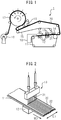
- FIG. 1 is a view schematically showing one embodiment of the nonwoven fabric manufacturing apparatus which can be used for manufacturing the water-disintegrable nonwoven fabric of the present invention, and the nonwoven fabric manufacturing apparatus is not limited to the embodiment shown in FIG. 1 .
- a slurry containing regenerated cellulose fibers having a fiber length and a fineness as described above and pulp at a weight ratio of 15:85 to 30:70 is prepared first.
- the resulting slurry is fed from raw material feeding head 10 of nonwoven fabric manufacturing apparatus 1 onto support 11 of a web-forming conveyor and is allowed to deposit on support 11.
- Support 11 may be composed of, for example, a wire mesh, a blanket, etc.
- the slurry deposited on support 11 is moderately dehydrated with two suction boxes 12 to form moisture-containing web 20.
- web 20 is passed between two nozzles 13 arranged above support 11 and two suction boxes 13 arranged at the opposite side of support 11 from nozzles 13 to subject the web to a hydroentangling treatment.
- the water streams injected from nozzles 13 have a specific energy as described above.
- FIG. 2 is a perspective view illustrating an example of injecting water from nozzle 13 onto web 20.
- Nozzle 13 injects a plurality of water streams 31 aligned in the width direction (CD) of web 20 toward web 20 on support 11.
- a plurality of grooves 22 aligned in the width direction of web 20 and extending in the longitudinal direction or machine direction (MD) is formed on the upper surface of web 20.
- grooves 22 are formed on web 22 as described above, and the fibers in web 20, especially regenerated cellulose fibers, are entangled with each other, and thereby improves the wet strength of web 20.
- FIG. 3 schematically illustrates an example of nozzle holes provided in nozzle 13.
- Nozzle holes 121 of nozzle 13 are arranged, for example, in a row in the width direction (CD) of web 20.
- Nozzle 13 preferably has a hole diameter of 90 to 150 ⁇ m. If the hole diameter of nozzle 13 is smaller than 90 ⁇ m, the nozzle is more likely to be clogged. Further, if the hole diameter of nozzle 13 is larger than 150 ⁇ m, the processing efficiency may be decreased.
- Nozzle 13 preferably has a hole pitch (distance between the centers of the adjacent holes) of 0.5 to 1.0 mm.
- a hole pitch of nozzle 13 which is narrower than 0.5 mm may lead to a decrease in pressure resistance of the nozzle, resulting in the breakage of the nozzle. Moreover, a hole pitch of nozzle 13 which is wider than 1.0 mm may lead to insufficient entanglement among fibers.
- the distance between the tip of nozzle 13 and the upper surface of web 20 is preferably 10 to 20 mm. If the distance between the tip of nozzle 13 and the upper surface of web 20 is smaller than 10 mm, bounced fibers are more likely to adhere to the nozzle tip, and thereby entanglement failure may be more likely to occur. If the distance between the tip of nozzle 13 and the upper surface of web 20 is greater than 20 mm, the water stream energy may be decreased, and consequently the water stream cannot penetrate into the fiber web, resulting in entanglement failure.
- Water streams 31 injected from the nozzle toward web 20 preferably has an energy of 0.05 to 0.1 kWh/kg. This energy is represented by a value converted into an amount per 1 kg of dry weight of the web treated by the water streams.
- a person with ordinary skill in the art can determine the energy of the water streams, based on the injection pressure at the nozzle tip, the injection rate of the nozzle, the processing speed of the web, the width and basis weight of the web, etc.
- the entanglement of the fibers in web 20 increases the strength of web 20, thus enabling an increase in wet strength thereof, without adding a binder or paper strengthening agent to the slurry.
- a concave-convex structure having fine ridges and grooves is formed on the upper surface of web 20 by the water streams. The concavo-convex structure having the fine ridges and grooves is retained even after web 20 is dried, and consequently a nonwoven fabric having a fine concave-convex structure on a surface thereof is obtained.
- the pitch of the ridges (or the grooves) can be optionally adjusted based on the pitch of nozzles 13 of the nonwoven fabric manufacturing apparatus.
- the pitch of the ridges (or grooves) is preferably 0.5 to 1.0 mm.
- the height of the tops of the ridges and the height of the bottoms of the grooves can be optionally adjusted by the pressure of water injected from the nozzle, etc., but the difference between the height of the tops of the ridges and the height of the bottoms of the grooves is preferably 0.10 mm or more, and more preferably 0.15 to 0.40 mm, in view of wiping properties.
- the height of the top of the ridges and the height of the bottoms of the grooves are measured with a laser displacement gauge. Examples of the laser displacement system include a high-precision two-dimensional laser displacement gauge LJ-G series (model: LJ-G 030) manufactured by Keyence Corporation.
- FIG. 5 shows a cross section of web 20 in the width direction at a position (position indicated by reference sign 21 in FIG. 1 ) after passing through between two nozzles 13 and two suction boxes 13.
- a concave-convex structure having fine ridges and grooves is formed on the upper surface of web 20 by the water streams.
- the web treated by the water streams is then transferred to the first transfer conveyor 15 by suction pickup 14, as shown in FIG. 1 .
- Web 20 is then transferred to the second transfer conveyor 16, and then transferred to the heated cylindrical surface of dryer 17.
- Dryer 17 can be, for example, a Yankee dryer.
- Web 20 is dried to a predetermined moisture content with dryer 17.
- the heating temperature may be, for example, from about 120°C to about 160°C.
- the dried web 20 is then wound up as a nonwoven fabric by winder 18.
- the fiber composition, basis weight, etc., of the nonwoven fabric can be adjusted in the manufacture thereof by adjusting the composition of the raw material and the feed rate of the raw material.
- the nonwoven fabric By cutting the nonwoven raw fabric produced as described above to a predetermined size depending on its application, the nonwoven fabric can be suitably used as a wiping article such as a wet tissue, a cleaning wipe, etc., or a top sheet of a sanitary article such as a disposable diaper, a sanitary napkin, etc.
- a wiping article such as a wet tissue, a cleaning wipe, etc.
- a top sheet of a sanitary article such as a disposable diaper, a sanitary napkin, etc.
- the water-disintegrable nonwoven fabric of the present invention is used as, for example, a wet tissue
- the nonwoven raw fabric is cut to a desired size, and the cut sheet is folded over itself and is impregnated with a chemical liquid to complete a wet tissue.
- the water-disintegrable nonwoven fabric of the present invention can be flushed in water in a flush toilet, etc., after use.
- the basis weight was determined by cutting out ten test strips having a size of 10 cm ⁇ 10 cm from the resulting nonwoven raw fabric, measuring the weight of each test strip, calculating a basis weight for each test strip by dividing its weight by its area, and determining an average value for ten measurements.
- the wet tensile strength was measured in accordance with "7.1 General method” of JIS P 8135:1998, "Paper and board - Wet tensile strength test method", except for the following differences.
- test strips of 25 mm width ⁇ 150 mm length, having a lengthwise direction which corresponds to the machine direction of the raw fabric and test strips of 25 mm width ⁇ 150 mm length, having a lengthwise direction which corresponds to the width direction of the raw fabric are cut out. These test strips are immersed in distilled water at a weight ratio of 250 wt%, and then the test strips are allowed to stand on a wire net for one minute.
- each test strip is set in a Tensilon type tensile tester at a chuck interval of 100 mm and is stretched at a tensile speed of 100 mm/min to measure the tensile strength (N) at break thereof, under conditions of a temperature of 20 °C and a relative humidity of 65%.
- N tensile strength
- an average value of tensile strengths was determined as the wet tensile strength in each of machine and width directions.
- the wet tensile strength was measured using Autograph, AGS-1kNG manufactured by Shimadzu Corporation, as the tensile testing machine.
- Water-disintegrability was evaluated in accordance with the disintegrability test of JIS P 4501:1993, "Toilet Paper". Specifically, test strips having a size of 114 mm ⁇ 114 mm were prepared by cutting them out from the resulting nonwoven raw fabric. The test conditions were at a temperature of 20°C and a relative humidity of 65%. A 300 mL beaker containing 300 mL of water (water temperature: 20°C) was placed on a magnetic stirrer (Stirrer TTP for paper disintegrability test manufactured by AS ONE Corporation), the rotational speed of rotor was adjusted to 600 rpm, a test strip described above was charged into water, and a stopwatch was activated.
- a nonwoven fabric of Example 1 was produced using nonwoven fabric manufacturing apparatus 1 according to one embodiment illustrated in FIG. 1 .
- OS 80 manufactured by Nippon Filcon Co., Ltd.
- each nozzle had a nozzle hole diameter of 92 ⁇ m and a nozzle hole pitch of 0.5 mm, the injection pressure at the nozzle tip was 30 kg/cm 2 , and the distance between the nozzle tip and the upper surface of the web was 20 mm.
- the transport speed (web speed) of the web was 80 m/min.
- the web was transferred to the first transfer conveyor 15 by suction pickup, and is then transferred to the second transfer conveyor from the first transfer conveyor, and subsequently the web was transferred to the cylindrical surface, which was heated to 120°C, of a Yankee dryer to dry the web. The dried web was then wound up as a nonwoven fabric by a winder.
- Example 1 For the nozzles used in Example 1 and Examples 2 to 9 and Comparative Examples 1 to 3 described later, the energy E (kWh/kg) of the water streams injected from one nozzle was calculated according to formula (1) shown below, and the calculated energies are listed as hydroentangling treatment energy per one pass in Table 1 below.
- the hydroentangling treatment energy was determined in the same manner as in Example 1 and shown in Table 1.
- E kWh kg 1.63 ⁇ I n j e c t i o n p r e s u r e kgf c m 2 ⁇ I n j e c t i o n r a t e m 3 min .
- a nonwoven fabric was prepared in the same manner as in Example 1, except that the fiber length of the rayon fiber was 4 mm.
- a nonwoven fabric was prepared in the same manner as in Example 1, except that the amount of the rayon fiber was 15 wt% based on the total amount of the pulp and the rayon fiber.
- a nonwoven fabric was prepared in the same manner as in Example 1, except that the amount of the rayon fiber was 30 wt% based on the total amount of the pulp and the rayon fiber.
- the nonwoven fabric of Example 5 was prepared in the same manner as in Example 1, except that it had a basis weight of 35 g/m 2 .
- the nonwoven fabric of Example 6 was prepared in the same manner as in Example 1, except that it had a basis weight of 50 g/m 2 .
- a nonwoven fabric was prepared in the same manner as in Example 1, except that a blend of a unbeaten softwood bleached kraft pulp (NBKP, CSF: 770 mL) and a beaten softwood bleached kraft pulp (NBKP, CSF: 600 mL) at a weight ratio of 50:50 was used as pulp.
- NKP unbeaten softwood bleached kraft pulp
- NNKP beaten softwood bleached kraft pulp
- a nonwoven fabric was prepared in the same manner as in Example 1, except that the hydroentangling treatment energy per one pass was 0.05254 kWh/kg.
- a nonwoven fabric was prepared in the same manner as in Example 1, except that the hydroentangling treatment energy per one pass was 0.09397 kWh/kg.
- a nonwoven fabric was prepared in accordance with Example 1 of Japanese Patent No. 3129192 . Specifically, a mixture of 70 wt% of a rayon fiber having a fiber length of 7 mm and a fineness of 1.5 denier and 30 wt% of a beaten softwood bleached kraft pulp fiber with a CSF of 200 mL was subjected to papermaking at a concentration of 0.2% with a laboratory hand-making machine to form a 25 cm ⁇ 25 cm web having a basis weight of 50 g/m 2 , and the web was dried to a moisture content of 4%.
- the resulting web was placed on a transport conveyor comprised of a 25 mesh plain weave wire netting , and a high-pressure water jet stream was injected to the web at a water pressure of 35 kg/cm 2 using three rows of high-pressure water jet stream injecting devices in which nozzle holes having a hole diameter of 0.1 mm were arranged in a zigzag manner at an interval of 0.64 mm so that the water jet streams penetrate through the web from the top surface to the rear surface, while conveying the web at a speed of 15 m/min. Subsequently, it was dried with a hot air dryer at a temperature of 150°C to obtain a water-disintegrable nonwoven fabric.
- a nonwoven fabric was prepared in the same manner as in Example 1, except that the fiber length and the fineness of the rayon fiber were 4 mm and 0.7 dtex, respectively.
- a nonwoven fabric was prepared in the same manner as in Comparative Example 2, except that the hydroentangling treatment energy per one pass was 0.18793 kWh/kg.
- Table 1 shows that, with regard to the nonwoven fabrics of Examples 1 to 9, a wet tissue had a tensile strength of 1.2 N/25 mm or greater in the machine direction and the cross-machine direction, and a disintegrability within 100 seconds, and therefore achieved superior wet tensile strength and water-disintegrability. Further, the nonwoven fabrics prepared in Examples 1 to 9 had a concave-convex structure with ridges and grooves on one side thereof, and exhibited excellent wiping properties. Comparative Example 1 according to Example 1 described in Japanese Patent No. 3129192 had a wet tensile strength greater than Example 1, but had a water-disintegrability of "300>", and therefore was hard to disintegrate.
- Comparative Example 2 had a water-disintegrability comparable to Example 7, but had an insufficient wet tensile strength.
- Comparative Example 3 had a wet tensile strength greater than Example 1, as in Comparative Example 1, but had a water-disintegrability of "300>", and therefore was hard to disintegrate.
- the water-disintegrable nonwoven fabric of the present invention has sufficient wet tensile strength at the time of use and is capable of being flushed in water after use, and therefore it can be suitably used as a wiping article such as a wet tissue, a cleaning wipe, etc., or a top sheet of a sanitary article such as a disposable diaper, a sanitary napkin, etc.
Landscapes
- Engineering & Computer Science (AREA)
- Textile Engineering (AREA)
- Life Sciences & Earth Sciences (AREA)
- Wood Science & Technology (AREA)
- Mechanical Engineering (AREA)
- Nonwoven Fabrics (AREA)
- Paper (AREA)
Abstract
Description
- The present invention relates to a water-disintegrable nonwoven fabric and a process for producing the same.
- It has been proposed to use a water-disintegrable nonwoven fabric as a wiping article such as wet tissue, cleaning wipe, etc., as well as a top sheet for sanitary articles such as a disposable diaper, sanitary napkin, etc. Water disintegrable nonwoven fabrics used in such applications must have a predetermined wet strength to withstand use and a predetermined water disintegrability so that they are capable of being flushed in water after use.
- For example, Patent Document 1 describes a water-disintegrable nonwoven fabric having a sufficient strength in a wet state and capable of being disintegrated upon contacting with a large amount of water. The water disintegrable nonwoven fabric described in Patent Document 1 is composed of regenerated cellulose fibers having a fiber length of 4 to 20 mm and pulp, wherein the fibers are entangled with each other by a high-pressure water jet stream treatment, and this nonwoven fabric has a wet tensile strength of 100 to 800 gf/25 mm, as measured in accordance with JIS P 8135:1998. In order to develop a high wet tensile strength, the water-disintegrable nonwoven fabric described in Patent Document 1 is prepared by forming a web with a wet paper machine, and then spraying a high-pressure water jet stream to one side or both sides of the resulting web at an applied specific energy in a specific range, i.e., from 0.1 to 0.6 kWh/kg per one pass on one side, to strongly entangle the regenerated cellulose fibers with each other. However, the water-disintegrable nonwoven fabric described in Patent Document 1 may clog a piping, such as toilet piping, etc., depending on the size of the piping due to the strongly entangled cellulose fibers, and therefore does not have sufficient disintegrating properties. Further, for water-disintegrable nonwoven fabrics for use in wiping articles and sanitary articles, a sufficient wet tensile strength and good disintegrating properties in water flow as described above, as well as good uniformity and texture are desired.
- [Patent Document 1] Japanese Unexamined Patent Publication No.
H9-228214 - The present invention has been made to solve the above problems of the prior art, and an object of the present invention is to provide a water-disintegrable nonwoven fabric having a tensile strength sufficient to withstand the load applied during use, such as cleaning operation and wiping operation, in a wet state with a small amount of water, as well as good disintegrability when it is flushed in water in a flush toilet, etc., after use, and also having improved uniformity and texture (i.e., material texture and tactile feeling, such as skin touch feeling, softness, etc., perceived by a person who touches it), and a process for producing the same.
- The present inventor has found that the above problems can be solved by a nonwoven fabric comprising 15 to 30 wt% of regenerated cellulose fibers having a fiber length of 3 to 4 mm and a fineness of 0.3 dtex or less and 70 to 85 wt% of pulp, wherein the nonwoven fabric having a basis weight of 35 to 50 g/m2, and has consequently completed the present invention.
- Specifically, in one embodiment, the present invention is a nonwoven fabric comprising 15 to 30 wt% of regenerated cellulose fibers having a fiber length of 3 to 4 mm and a fineness of 0.3 dtex or less and 70 to 85 wt% of pulp, having a basis weight of 35 to 50 g/m2, having a disintegrability within 100 sec. as measured in accordance with the disintegrability test of JIS P 4501:1993, and having a wet tensile strength of 1.2 N/25 mm or greater.
- The water-disintegrable nonwoven fabric of the present invention exhibits a sufficient tensile strength at the time of use in a wet state with a small amount of water, as well as a sufficient disintegrability after use, without requiring a binder or paper strengthening agent, even though the regenerated cellulose fibers have a relatively short fiber length of 3 to 4 mm and a relatively low fineness of 0.3 dtex or less. Further, since the water-disintegrable nonwoven fabric of the present invention comprises superfine regenerated cellulose fibers having a short fiber length in the above-specified amount, as described above, it has a high denseness, and therefore has good uniformity and good texture. Since the water-disintegrable nonwoven fabric of the present invention has good uniformity, it is possible, for example, to relieve the user's psychological anxiety that the soil wiped off with the nonwoven fabric might permeate through the nonwoven fabric and adhere to the user's hand.
- In another embodiment, the present invention provides a process for producing a water-disintegrable nonwoven fabric, comprising:
- (A) subjecting a slurry comprising regenerated cellulose fibers having a fiber length of 3 to 4 mm and a fineness of 0.3 dtex or less and pulp at a weight ratio of 15:85 to 30:70 to a wet paper-making operation at a fiber basis weight of 35 to 50 g/m2,
- (B) subjecting the web obtained in step (A) to a hydroentangling treatment with an energy of 0.05 kWh/kg to 0.1 kWh/kg to entangle fibers with each other, and
- (C) drying the web subjected to the hydroentangling treatment.
- The water-disintegrable nonwoven fabric of the present invention has a wet tensile strength sufficient to withstand the load applied during use in a wet state, as well as good disintegrability when it is flushed in water after use, and also has good uniformity and good texture.
-
-
FIG. 1 shows a schematic view of one embodiment of a nonwoven fabric manufacturing apparatus used in the process for producing the water-disintegrable nonwoven fabric of the present invention. -
FIG. 2 is a perspective view illustrating one example of injecting water frominjection nozzle 13 toweb 20. -
FIG. 3 is a view showing one example of the nozzle holes of the injection nozzle. -
FIG. 4 is a view for explaining the principle of entanglement of fibers in the web with a water stream injected from the nozzle. -
FIG. 5 is a schematic sectional view in the width direction of the web to which water streams were injected. - Some of the inventive aspects of the present invention are shown below.
- A nonwoven fabric comprising 15 to 30 wt% of regenerated cellulose fibers having a fiber length of 3 to 4 mm and a fineness of 0.3 dtex or less and 70 to 85 wt% of pulp, having a basis weight of 35 to 50 g/m2, having a disintegrability within 100 sec. as measured in accordance with JIS P 4501:1993, and having a wet tensile strength of 1.2 N/25 mm or greater.
- According to Aspect 1, it has a wet tensile strength sufficient to withstand the load applied during use in a wet state and exhibits good disintegrability when it is flushed in water after use.
- The water disintegrable nonwoven fabric according to Aspect 1, wherein the regenerated cellulose fibers has a fineness of 0.1 to 0.3 dtex.
- According to Aspect 2, it is difficult to produce regenerated cellulose fibers having a fineness of less than 0.1 dtex with good productivity, and regenerated cellulose fibers having a fineness of greater than 0.3 dtex may result in a nonwoven fabric having poor water-disintegrability.
- A process for producing the water-disintegrable nonwoven fabric according to Aspect 1, comprising:
- (A) subjecting a slurry comprising regenerated cellulose fibers having a fiber length of 3 to 4 mm and a fineness of 0.3 dtex or less and pulp at a weight ratio of 15:85 to 30:70 to wet papermaking at a fiber basis weight of 35 to 50 g/m2,
- (B) subjecting the web obtained in step (A) to a hydroentangling treatment with an energy of 0.05 kWh/kg to 0.1 kWh/kg to entangle fibers with each other, and
- (C) drying the web subjected to the hydroentangling treatment.
- According to Aspect 3, a water-disintegrable nonwoven fabric having a wet tensile strength sufficient to withstand the load applied during use in a wet state and good disintegrability when it is flushed in water after use.
- The water-disintegrable nonwoven fabric of the present invention has a basis weight of 35 to 50 g/m2, and comprises 15 to 30 wt%, and preferably 15 to 20 wt%, based on the total weight of the nonwoven fabric, of regenerated cellulose fibers having a fiber length of 3 to 4 mm and a fineness of 0.3 dtex or less and 70 to 85 wt%, and preferably 80 to 85 wt% of pulp. When the water-disintegrable nonwoven fabric of the present invention is brought into contact with a large amount of water, the pulp is detached from the nonwoven fabric due to swelling of the pulp, enabling the entangled regenerated cellulose fibers to easily disintegrate. If the nonwoven fabric contains regenerated cellulose fibers in an amount of more than 30 wt%, the regenerated cellulose fibers entangled with each other are hard to disintegrate due to an excessively large number of the entanglement points among the regenerated cellulose fibers and may clog a piping, such as toilet piping, etc., depending on the size of the piping, and therefore results in insufficient disintegrability. Also, if the number of entanglement points among regenerated cellulose fibers is too much, the skin touch feeling of the nonwoven fabric is impaired. Furthermore, if the basis weight of the nonwoven fabric is 35 g/m2, it is difficult to achieve a sufficient wet tensile strength. If the basis weight exceeds 50 g/m2, the regenerated cellulose fibers entangled with each other are hard to disintegrate due to an excessively large number of the entanglement points among the regenerated cellulose fibers and may clog a piping, such as toilet piping, etc., depending on the size of the piping, and therefore does not have sufficient disintegrability.
- In the water-disintegrable nonwoven fabric of the present invention, the regenerated cellulose fiber has a fiber length of 3 to 4 mm. When the regenerated cellulose fiber has a fiber length of less than 3 mm, it is difficult to sufficiently entangle the regenerated cellulose fibers with each other, and consequently it is difficult to achieve a wet tensile strength sufficient to withstand the load applied during use, such as during cleaning operation, wiping operation, etc. Regenerated cellulose fibers having a fiber length of more than 4 mm have a low dispersibility, and therefore result in a nonwoven fabric with unevenness in uniformity and wet tensile strength. Also, due to the low dispersibility of the regenerated cellulose fibers having a fiber length of more than 4 mm, it is difficult for the resulting nonwoven fabric to pass the disintegration test in accordance with JIS P 4501:1993. Since the water-disintegrable nonwoven fabric of the present invention comprises ultrafine regenerated cellulose fibers having a fiber length of 3 to 4 mm, it can remove a soil from fine parts of the object to be wiped when it is used as a wiping article such as a wet tissue, a cleaning wiper, etc. Moreover, the water-disintegrable nonwoven fabric of the present invention has excellent characteristic features that large soil can be easily scraped off by having a concave-convex structure with fine ridges and grooves on a surface thereof by a hydroentangling treatment as described later.
- In the water-disintegrable nonwoven fabric of the present invention, the regenerated cellulose fibers have a fineness of 0.3 dtex or less, and preferably 0.1 to 0.3 dtex. Regenerated cellulose fibers having a fineness of less than 0.1 dtex are difficult to produce with good productivity. Regenerated cellulose fibers having a fineness of more than 0.3 dtex result in a nonwoven fabric having poor water disintegrability. The regenerated cellulose fibers result in a water-disintegrable nonwoven fabric having a smooth surface, since they are ultrafine fibers having a fineness of 0.3 dtex or less, and preferably 0.1 to 0.3 dtex. Further, in general, at the same weight % and the same fiber length, the lower the fineness, the larger the number of fibers per unit area of the nonwoven fabric, and therefore the above fineness of the regenerated cellulose fibers leads to a water-disintegrable nonwoven fabric having good uniformity and texture. Conversely, with the same weight % and the same fiber length, the higher the fineness, the smaller the number of fibers per unit area of the nonwoven fabric, and therefore the number of entanglement points among the regenerated cellulose fibers is decreased. Accordingly, regenerated cellulose fibers having a fiber length of more than 4 mm and a fineness of more than 0.3 dtex are not able to produce a nonwoven fabric having a wet tensile strength of 1.2 N/25 mm or greater.
- The water-disintegrable nonwoven fabric of the present invention has a disintegrability within 100 seconds, preferably within 90 seconds, more preferably within 80 seconds, and even more preferably 70 seconds, as measured in accordance with the disintegrability test of JIS P 4501:1993. The disintegrability of more than 100 seconds may cause clogging of a piping, depending on the size of the toilet piping etc. There is no particular lower limit on the disintegrability. It is described in Table 1 in "2. Quality" of JIS P 4501:1993, "Toilet paper" that toilet paper should satisfy the standard of disintegrability within 100 seconds, and therefore the water-disintegrable nonwoven fabric of the present invention has a disintegrabilty equivalent to that of toilet paper.
- For the water-disintegrable nonwoven fabric of the present invention, the wet tensile strength is measured in accordance with "7.1 General method" of JIS P 8135:1998, "Paper and board - Wet tensile strength test method", except for the following differences.
- Difference: A test strip of 25 mm width × 150 mm length is cut out from a prepared nonwoven raw fabric. The test strip is immersed in distilled water at a weight ratio of 250 wt%, and then the test strip is allowed to stand on a wire netting for one minute. Subsequently, the test strip is set in a Tensilon type tensile tester at a chuck interval of 100 mm and is stretched at a tensile speed of 100 mm/min to measure the tensile strength (N) at break thereof, under conditions of a temperature of 20 °C and a relative humidity of 65%.
- The regenerated cellulose fibers which constitute the water-disintegrable nonwoven fabric of the present invention are not particularly limited as long as they have a fiber length and a fineness within the above ranges. Examples of regenerated cellulose fibers include viscose rayon, cuprammonium rayon, Lyocell®, Tencel®, etc. The water-disintegrable nonwoven fabric of the present invention may contain one or more types of regenerated cellulose fibers.
- The type of the pulp which constitutes the water-disintegrable nonwoven fabric is not particularly limited, and examples of the pulp include wood pulps such as softwood pulps, hardwood pulps, etc., non-wood pulps such as straw pulp, bagasse pulp, reed pulp, kenaf pulp, mulberry pulp, bamboo pulp, hemp pulp, cotton pulp (e.g., cotton linter), etc. The above pulps may be an unbeaten pulp, a beaten pulp, or a combination thereof. Softwood pulps are preferred, in view of disintegrability.
- Non-beaten pulp preferably has a Canadian Standard Freeness (CSF) of 700 mL or more. The Canadian standard freeness is measured in accordance with JIS P 8121-2:2012, "Pulp - Freeness Test Method - Part 2: Canadian Standard Freeness Method". The average fiber length of the non-beaten pulp is not particularly limited, but is generally preferred to be 2 to 4 mm in view of economy and productivity. Beaten pulp is pulp obtained by beating non-beaten pulp by a method such as free beating, viscous beating, etc., and has a main body section and microfiber sections extending from the main body section. An incorporation of a beaten pulp in a wet tissue improves the wet strength and dry strength of the wet tissue. The beaten pulp preferably has a Canadian standard freeness of 500 to 680 mL, and more preferably has a Canadian standard freeness of 550 to 650 mL. A Canadian Standard Freeness of less than the above lower limit is not preferred, since such a Canadian Standard Freeness leads to a rigid nonwoven fabric having poor skin touch feeling and softness. If the Canadian Standard Freeness is greater than the above upper limit, a water-disintegrable nonwoven fabric having sufficient wet tensile strength cannot be obtained.
- The water-disintegrable nonwoven fabric of the present invention has a basis weight of 35 to 50 g/m2. A basis weight of the nonwoven fabric of less than 35 g/m2 does not lead to a wet tensile strength sufficient to withstand the load applied during use. A basis weight of greater than 50 g/m2 leads to a firm nonwoven fabric having inferior feel and softness is produced. The water-disintegrable nonwoven fabric of the present invention preferably has a basis weight of 35 to 45 g/m2 in view of water disintegrability.
- The water-disintegrable nonwoven fabric of the present invention can be produced by a process comprising:
- (A) subjecting a slurry comprising regenerated cellulose fibers having a fiber length of 3 to 4 mm and a fineness of 0.3 dtex or less and pulp at a weight ratio of 15:85 to 30:70 to wet papermaking at a fiber basis weight of 35 to 50 g/m2,
- (B) subjecting the web obtained in step (A) to a hydroentangling treatment with an energy of 0.05 kWh/kg to 0.1 kWh/kg to entangle fibers with each other, and
- (C) drying the web subjected to the hydroentangling treatment.
- Hereinafter, the process for producing the water-disintegrable nonwoven fabric of the present invention will be described in more detail with reference to the drawings. The method for producing the water-disintegrable nonwoven fabric of the present invention can be carried out using the nonwoven fabric manufacturing apparatus 1 schematically shown in
FIG. 1. FIG. 1 is a view schematically showing one embodiment of the nonwoven fabric manufacturing apparatus which can be used for manufacturing the water-disintegrable nonwoven fabric of the present invention, and the nonwoven fabric manufacturing apparatus is not limited to the embodiment shown inFIG. 1 . - When producing the water-disintegrable nonwoven fabric of the present invention, a slurry containing regenerated cellulose fibers having a fiber length and a fineness as described above and pulp at a weight ratio of 15:85 to 30:70 is prepared first. The resulting slurry is fed from raw
material feeding head 10 of nonwoven fabric manufacturing apparatus 1 ontosupport 11 of a web-forming conveyor and is allowed to deposit onsupport 11.Support 11 may be composed of, for example, a wire mesh, a blanket, etc. The slurry deposited onsupport 11 is moderately dehydrated with twosuction boxes 12 to form moisture-containingweb 20. Next,web 20 is passed between twonozzles 13 arranged abovesupport 11 and twosuction boxes 13 arranged at the opposite side ofsupport 11 fromnozzles 13 to subject the web to a hydroentangling treatment. In the present invention, the water streams injected fromnozzles 13 have a specific energy as described above. -
FIG. 2 is a perspective view illustrating an example of injecting water fromnozzle 13 ontoweb 20.Nozzle 13 injects a plurality of water streams 31 aligned in the width direction (CD) ofweb 20 towardweb 20 onsupport 11. As a result, a plurality ofgrooves 22 aligned in the width direction ofweb 20 and extending in the longitudinal direction or machine direction (MD) is formed on the upper surface ofweb 20. Further, upon impingement of water streams onweb 20,grooves 22 are formed onweb 22 as described above, and the fibers inweb 20, especially regenerated cellulose fibers, are entangled with each other, and thereby improves the wet strength ofweb 20. -
FIG. 3 schematically illustrates an example of nozzle holes provided innozzle 13. Nozzle holes 121 ofnozzle 13 are arranged, for example, in a row in the width direction (CD) ofweb 20.Nozzle 13 preferably has a hole diameter of 90 to 150 µm. If the hole diameter ofnozzle 13 is smaller than 90 µm, the nozzle is more likely to be clogged. Further, if the hole diameter ofnozzle 13 is larger than 150 µm, the processing efficiency may be decreased.Nozzle 13 preferably has a hole pitch (distance between the centers of the adjacent holes) of 0.5 to 1.0 mm. A hole pitch ofnozzle 13 which is narrower than 0.5 mm may lead to a decrease in pressure resistance of the nozzle, resulting in the breakage of the nozzle. Moreover, a hole pitch ofnozzle 13 which is wider than 1.0 mm may lead to insufficient entanglement among fibers. The distance between the tip ofnozzle 13 and the upper surface ofweb 20 is preferably 10 to 20 mm. If the distance between the tip ofnozzle 13 and the upper surface ofweb 20 is smaller than 10 mm, bounced fibers are more likely to adhere to the nozzle tip, and thereby entanglement failure may be more likely to occur. If the distance between the tip ofnozzle 13 and the upper surface ofweb 20 is greater than 20 mm, the water stream energy may be decreased, and consequently the water stream cannot penetrate into the fiber web, resulting in entanglement failure. - Water streams 31 injected from the nozzle toward
web 20 preferably has an energy of 0.05 to 0.1 kWh/kg. This energy is represented by a value converted into an amount per 1 kg of dry weight of the web treated by the water streams. A person with ordinary skill in the art can determine the energy of the water streams, based on the injection pressure at the nozzle tip, the injection rate of the nozzle, the processing speed of the web, the width and basis weight of the web, etc. - When the energy of the water streams is lower than 0.05 kWh/kg, it is difficult to obtain a water-disintegrable nonwoven fabric having a sufficient wet tensile strength at the time of use. If the energy of the water streams is greater than 0.1 kWh/kg, the resulting nonwoven fabric is too rigid, and therefore it is difficult for the nonwoven fabric to pass the disintegrability test of JIS P 4501:1993, and such a nonwoven fabric also have poor skin touch feeling and softness.
- The principle of entanglement of the fibers in
web 21 and the principle of forming a concave-convex structure having fine ridges and grooves on the upper surface ofweb 20 will be described with referring toFIG. 4 , but should not be construed as limiting the present invention. As shown inFIG. 4 , whennozzle 13 injects awater stream 31,water stream 31 passes throughsupport 11. As a result, the fibers inweb 20 are drawn around portion 42 wherewater stream 31 passes through thesupport 11. Consequently, the fibers inweb 20 gather towardportion 32 wherewater stream 31 passes throughsupport 11, and the fibers are entangled with each other. The entanglement of the fibers inweb 20 increases the strength ofweb 20, thus enabling an increase in wet strength thereof, without adding a binder or paper strengthening agent to the slurry. Moreover, a concave-convex structure having fine ridges and grooves is formed on the upper surface ofweb 20 by the water streams. The concavo-convex structure having the fine ridges and grooves is retained even afterweb 20 is dried, and consequently a nonwoven fabric having a fine concave-convex structure on a surface thereof is obtained. - In the concave-convex structure described above, the pitch of the ridges (or the grooves) can be optionally adjusted based on the pitch of
nozzles 13 of the nonwoven fabric manufacturing apparatus. In view of ease of formation, wiping properties of wet tissues, etc., the pitch of the ridges (or grooves) is preferably 0.5 to 1.0 mm. In the concave-convex structure, the height of the tops of the ridges and the height of the bottoms of the grooves can be optionally adjusted by the pressure of water injected from the nozzle, etc., but the difference between the height of the tops of the ridges and the height of the bottoms of the grooves is preferably 0.10 mm or more, and more preferably 0.15 to 0.40 mm, in view of wiping properties. The height of the top of the ridges and the height of the bottoms of the grooves are measured with a laser displacement gauge. Examples of the laser displacement system include a high-precision two-dimensional laser displacement gauge LJ-G series (model: LJ-G 030) manufactured by Keyence Corporation. -
FIG. 5 shows a cross section ofweb 20 in the width direction at a position (position indicated byreference sign 21 inFIG. 1 ) after passing through between twonozzles 13 and twosuction boxes 13. A concave-convex structure having fine ridges and grooves is formed on the upper surface ofweb 20 by the water streams. - The web treated by the water streams is then transferred to the
first transfer conveyor 15 bysuction pickup 14, as shown inFIG. 1 .Web 20 is then transferred to thesecond transfer conveyor 16, and then transferred to the heated cylindrical surface ofdryer 17.Dryer 17 can be, for example, a Yankee dryer.Web 20 is dried to a predetermined moisture content withdryer 17. The heating temperature may be, for example, from about 120°C to about 160°C. The driedweb 20 is then wound up as a nonwoven fabric bywinder 18. The fiber composition, basis weight, etc., of the nonwoven fabric can be adjusted in the manufacture thereof by adjusting the composition of the raw material and the feed rate of the raw material. - By cutting the nonwoven raw fabric produced as described above to a predetermined size depending on its application, the nonwoven fabric can be suitably used as a wiping article such as a wet tissue, a cleaning wipe, etc., or a top sheet of a sanitary article such as a disposable diaper, a sanitary napkin, etc. When the water-disintegrable nonwoven fabric of the present invention is used as, for example, a wet tissue, the nonwoven raw fabric is cut to a desired size, and the cut sheet is folded over itself and is impregnated with a chemical liquid to complete a wet tissue. The water-disintegrable nonwoven fabric of the present invention can be flushed in water in a flush toilet, etc., after use.
- The above explanation is merely an example of the present invention, and the present invention is not limited to the above embodiments.
- Hereinafter, the present invention will be described in more detail based on examples, but it should be understood that the present invention is not construed as being limited thereto.
- In Examples and Comparative Examples, basis weight, wet tensile strength and water disintegrability were determined by the following methods.
- The basis weight was determined by cutting out ten test strips having a size of 10 cm × 10 cm from the resulting nonwoven raw fabric, measuring the weight of each test strip, calculating a basis weight for each test strip by dividing its weight by its area, and determining an average value for ten measurements.
- The wet tensile strength was measured in accordance with "7.1 General method" of JIS P 8135:1998, "Paper and board - Wet tensile strength test method", except for the following differences.
- Difference: From the resulting nonwoven raw fabric, test strips of 25 mm width × 150 mm length, having a lengthwise direction which corresponds to the machine direction of the raw fabric and test strips of 25 mm width × 150 mm length, having a lengthwise direction which corresponds to the width direction of the raw fabric are cut out. These test strips are immersed in distilled water at a weight ratio of 250 wt%, and then the test strips are allowed to stand on a wire net for one minute. Subsequently, each test strip is set in a Tensilon type tensile tester at a chuck interval of 100 mm and is stretched at a tensile speed of 100 mm/min to measure the tensile strength (N) at break thereof, under conditions of a temperature of 20 °C and a relative humidity of 65%. For three test strips in each of machine and width directions, an average value of tensile strengths was determined as the wet tensile strength in each of machine and width directions. The wet tensile strength was measured using Autograph, AGS-1kNG manufactured by Shimadzu Corporation, as the tensile testing machine.
- Water-disintegrability was evaluated in accordance with the disintegrability test of JIS P 4501:1993, "Toilet Paper". Specifically, test strips having a size of 114 mm × 114 mm were prepared by cutting them out from the resulting nonwoven raw fabric. The test conditions were at a temperature of 20°C and a relative humidity of 65%. A 300 mL beaker containing 300 mL of water (water temperature: 20°C) was placed on a magnetic stirrer (Stirrer TTP for paper disintegrability test manufactured by AS ONE Corporation), the rotational speed of rotor was adjusted to 600 rpm, a test strip described above was charged into water, and a stopwatch was activated. After the rotation speed of the rotor once decreased due to the resistance of the test strip, the rotation speed of the rotor increased as the progress of disintegration of the test strip, and the stopwatch was deactivated when the rotation speed was recovered to 540 rpm and that time was measured in seconds. The test was carried out five times, and the results of disintegrability was expressed by the average value for the five tests. The shorter the measurement time, the higher the disintegrability of the nonwoven fabric. When the rotation speed did not recover to 540 rpm even after the measurement time exceeded 300 seconds, the measurement was interrupted and the result was expressed as "300>".
- Hereinafter, a method for producing a nonwoven fabric of Examples and Comparative Examples will be described.
- A nonwoven fabric of Example 1 was produced using nonwoven fabric manufacturing apparatus 1 according to one embodiment illustrated in
FIG. 1 . A raw material slurry containing 80 wt% of a unbeaten softwood bleached kraft pulp (NBKP, CSF: 770 mL) and 20 wt% by of a rayon fiber (fiber length: 3 mm, fineness: 0.3 dtex, Corona manufactured by Daiwabo Rayon Co., Ltd.) was prepared. Then, the slurry was fed onto a web-forming belt (OS 80 manufactured by Nippon Filcon Co., Ltd.) using a raw material head, and the slurry deposited on the web-forming belt was dehydrated by suction boxes to form a web. The moisture content of the web at this time was 80%. Thereafter, water streams having an equal energy were injected from two nozzles toward the web. Each nozzle had a nozzle hole diameter of 92 µm and a nozzle hole pitch of 0.5 mm, the injection pressure at the nozzle tip was 30 kg/cm2, and the distance between the nozzle tip and the upper surface of the web was 20 mm. The transport speed (web speed) of the web was 80 m/min. Next, the web was transferred to thefirst transfer conveyor 15 by suction pickup, and is then transferred to the second transfer conveyor from the first transfer conveyor, and subsequently the web was transferred to the cylindrical surface, which was heated to 120°C, of a Yankee dryer to dry the web. The dried web was then wound up as a nonwoven fabric by a winder. - For the nozzles used in Example 1 and Examples 2 to 9 and Comparative Examples 1 to 3 described later, the energy E (kWh/kg) of the water streams injected from one nozzle was calculated according to formula (1) shown below, and the calculated energies are listed as hydroentangling treatment energy per one pass in Table 1 below. For the nonwoven fabrics of Examples 2 to 9 and Comparative Examples 1 to 3, the hydroentangling treatment energy was determined in the same manner as in Example 1 and shown in Table 1.


- A nonwoven fabric was prepared in the same manner as in Example 1, except that the fiber length of the rayon fiber was 4 mm.
- A nonwoven fabric was prepared in the same manner as in Example 1, except that the amount of the rayon fiber was 15 wt% based on the total amount of the pulp and the rayon fiber.
- A nonwoven fabric was prepared in the same manner as in Example 1, except that the amount of the rayon fiber was 30 wt% based on the total amount of the pulp and the rayon fiber.
- The nonwoven fabric of Example 5 was prepared in the same manner as in Example 1, except that it had a basis weight of 35 g/m2.
- The nonwoven fabric of Example 6 was prepared in the same manner as in Example 1, except that it had a basis weight of 50 g/m2.
- A nonwoven fabric was prepared in the same manner as in Example 1, except that a blend of a unbeaten softwood bleached kraft pulp (NBKP, CSF: 770 mL) and a beaten softwood bleached kraft pulp (NBKP, CSF: 600 mL) at a weight ratio of 50:50 was used as pulp.
- A nonwoven fabric was prepared in the same manner as in Example 1, except that the hydroentangling treatment energy per one pass was 0.05254 kWh/kg.
- A nonwoven fabric was prepared in the same manner as in Example 1, except that the hydroentangling treatment energy per one pass was 0.09397 kWh/kg.
- A nonwoven fabric was prepared in accordance with Example 1 of Japanese Patent No.
3129192
Subsequently, it was dried with a hot air dryer at a temperature of 150°C to obtain a water-disintegrable nonwoven fabric. - A nonwoven fabric was prepared in the same manner as in Example 1, except that the fiber length and the fineness of the rayon fiber were 4 mm and 0.7 dtex, respectively.
- A nonwoven fabric was prepared in the same manner as in Comparative Example 2, except that the hydroentangling treatment energy per one pass was 0.18793 kWh/kg.
Table 1 Ex. 1 Ex. 2 Ex. 3 Ex. 4 Ex. 5 Ex. 6 Ex. 7 Ex. 8 Ex. 9 Comp. Ex. 1 Comp. Ex. 2 Com. Ex. 3 Pulp NBKP (CSF 770 cc) 80% 80% 85% 70% 80% 80% 40% 80% 80% - 80% 80% NBKP (CSF 600 cc) - - - - - - 40% - - - - - NBKP (CSF 200 cc) - - - - - - - - - 30% - - Rayon 3 mm × 0.3 dtex - - - - - - - - - - - - 4mmx 0.3 dtex 20% - 15% 30% 20% 20% 20% 20% 20% - - - 4mmx 0.7 dtex - 20% - - - - - - - - 20% 20% 7 mm × 1.7 dtex - - - - - - - - - 70% - - Hydroentangling treatment energy per one pass (kWh/kg) 0.08757 0.08757 0.08757 0.08757 0.08757 0.08757 0.08757 0.05254 0.09397 0.3050 0.08757 0.18793 Basis weight (g/m2) 45.0 45.0 45.0 45.0 35.0 50.0 45.0 45.0 45.0 50.0 45.0 45.0 Wet tensile strength (N/25 mm) MD 1.45 1.60 1.27 1.59 1.23 1.63 1.65 1.31 1.48 4.55 0.83 1.34 CD 1.38 1.57 1.22 1.60 1.21 1.66 1.66 1.22 1.51 4.12 0.77 1.29 Water-disintegrability (s) 68 91 60 94 52 92 77 53 95 300> 77 300> - Table 1 shows that, with regard to the nonwoven fabrics of Examples 1 to 9, a wet tissue had a tensile strength of 1.2 N/25 mm or greater in the machine direction and the cross-machine direction, and a disintegrability within 100 seconds, and therefore achieved superior wet tensile strength and water-disintegrability. Further, the nonwoven fabrics prepared in Examples 1 to 9 had a concave-convex structure with ridges and grooves on one side thereof, and exhibited excellent wiping properties. Comparative Example 1 according to Example 1 described in Japanese Patent No.
3129192 - The water-disintegrable nonwoven fabric of the present invention has sufficient wet tensile strength at the time of use and is capable of being flushed in water after use, and therefore it can be suitably used as a wiping article such as a wet tissue, a cleaning wipe, etc., or a top sheet of a sanitary article such as a disposable diaper, a sanitary napkin, etc.
-
- 1
- Nonwoven fabric manufacturing apparatus
- 10
- Raw material feeding head
- 11
- Support
- 12
- Suction box
- 13
- Nozzle
- 14
- Suction pickup
- 15
- First transfer conveyor
- 16
- Second transfer conveyor
- 17
- Dryer
- 18
- Winder
- 20
- Web
Claims (3)
- A nonwoven fabric comprising 15 to 30 wt% of regenerated cellulose fibers having a fiber length of 3 to 4 mm and a fineness of 0.3 dtex or less and 70 to 85 wt% of pulp, having a basis weight of 35 to 50 g/m2, having a disintegrability within 100 sec. as measured in accordance with JIS P 4501:1993, and having a wet tensile strength of 1.2 N/25 mm or greater.
- The laminated nonwoven fabric according to claim 1, wherein the regenerated cellulose fibers has a fineness of 0.1 to 0.3 dtex.
- A process for producing the water-disintegrable nonwoven fabric according to claim 1, comprising:(A) subjecting a slurry comprising regenerated cellulose fibers having a fiber length of 3 to 4 mm and a fineness of 0.3 dtex or less and pulp at a weight ratio of 15:85 to 30:70 to wet papermaking at a fiber basis weight of 35 to 50 g/m2,(B) subjecting the web obtained in step (A) to a hydroentangling treatment with an energy of 0.05 kWh/kg to 0.1 kWh/kg to entangle fibers with each other, and(C) drying the web subjected to the hydroentangling treatment.
Applications Claiming Priority (2)
| Application Number | Priority Date | Filing Date | Title |
|---|---|---|---|
| JP2015256604A JP6399998B2 (en) | 2015-12-28 | 2015-12-28 | Water-decomposable nonwoven fabric and method for producing the same |
| PCT/JP2016/084667 WO2017115588A1 (en) | 2015-12-28 | 2016-11-22 | Water-disintegrable nonwoven fabric and process for producing same |
Publications (2)
| Publication Number | Publication Date |
|---|---|
| EP3382078A4 EP3382078A4 (en) | 2018-10-03 |
| EP3382078A1 true EP3382078A1 (en) | 2018-10-03 |
Family
ID=59224839
Family Applications (1)
| Application Number | Title | Priority Date | Filing Date |
|---|---|---|---|
| EP16881568.6A Withdrawn EP3382078A1 (en) | 2015-12-28 | 2016-11-22 | Water-disintegrable nonwoven fabric and process for producing same |
Country Status (5)
| Country | Link |
|---|---|
| US (1) | US20190276958A1 (en) |
| EP (1) | EP3382078A1 (en) |
| JP (1) | JP6399998B2 (en) |
| CN (1) | CN108474153A (en) |
| WO (1) | WO2017115588A1 (en) |
Cited By (5)
| Publication number | Priority date | Publication date | Assignee | Title |
|---|---|---|---|---|
| US11602466B2 (en) | 2019-12-20 | 2023-03-14 | Essity Hygiene And Health Aktiebolag | Absorbent hygienic article for absorbing body fluids |
| US11801173B2 (en) | 2019-12-20 | 2023-10-31 | Essity Hygiene And Health Aktiebolag | Absorbent hygienic article for absorbing body fluids |
| EP4426172A4 (en) * | 2021-11-01 | 2025-09-10 | Kimberly Clark Co | Multi-layer through-air dried tissue products with regenerated cellulose fiber |
| EP4426171A4 (en) * | 2021-11-01 | 2025-09-10 | Kimberly Clark Co | Through-air dried tissue products with regenerated cellulose fiber |
| US12521287B2 (en) | 2019-12-20 | 2026-01-13 | Essity Hygiene And Health Aktiebolag | Absorbent fibrous web |
Families Citing this family (9)
| Publication number | Priority date | Publication date | Assignee | Title |
|---|---|---|---|---|
| JP6470236B2 (en) * | 2016-08-26 | 2019-02-13 | 大王製紙株式会社 | Water-decomposable sheet and method for producing the water-decomposable sheet |
| JP6211160B1 (en) * | 2016-09-30 | 2017-10-11 | 大王製紙株式会社 | Water disintegratable sheet |
| JPWO2019150964A1 (en) * | 2018-01-31 | 2021-02-25 | 王子ホールディングス株式会社 | Method for manufacturing water-decomposable non-woven fabric, wet water-decomposable non-woven fabric and water-decomposable non-woven fabric |
| CN109252286A (en) * | 2018-11-13 | 2019-01-22 | 浙江宝仁无纺制品有限公司 | A kind of production technology for breaking up lavatory non-woven fabrics |
| JP6689944B1 (en) * | 2018-11-30 | 2020-04-28 | 大王製紙株式会社 | Toilet Paper |
| JP7315891B2 (en) * | 2019-07-30 | 2023-07-27 | 王子ホールディングス株式会社 | Water-disintegratable nonwoven fabric and wet water-disintegratable nonwoven fabric |
| JP7030895B2 (en) * | 2020-05-29 | 2022-03-07 | 大王製紙株式会社 | Manufacturing method of hydrolyzable sheet |
| CN113981598A (en) * | 2021-10-25 | 2022-01-28 | 宁波大千纺织品有限公司 | A kind of ice-smooth and high-elastic knitted fabric and its weaving method |
| CN118547429A (en) * | 2024-05-30 | 2024-08-27 | 大连瑞光非织造布集团有限公司 | Water-jet nonwoven fabric capable of being punched and scattered and manufacturing method thereof |
Family Cites Families (22)
| Publication number | Priority date | Publication date | Assignee | Title |
|---|---|---|---|---|
| US4891262A (en) * | 1987-12-16 | 1990-01-02 | Asahi Kasei Kogyo Kabushiki Kaisha | High strength wet-laid nonwoven fabric and process for producing same |
| US5298315A (en) * | 1991-05-02 | 1994-03-29 | Asahi Kasei Kogyo Kabushiki Kaisha | Composite nonwoven fabric |
| JP3129192B2 (en) | 1995-07-26 | 2001-01-29 | 王子製紙株式会社 | Water disintegrable nonwoven fabric and method for producing the same |
| JP3948071B2 (en) * | 1997-09-12 | 2007-07-25 | 王子製紙株式会社 | Water-decomposable nonwoven fabric and method for producing the same |
| SG83698A1 (en) * | 1998-01-16 | 2001-10-16 | Uni Charm Corp | Method of manufacturing a water disintegratable non-woven fabric and the water disintegratable non-woven fabric |
| JP2001098489A (en) * | 1999-09-30 | 2001-04-10 | Uni Charm Corp | Water-disintegrable fibrous sheet containing water- insoluble carboxymethyl cellulose |
| JP2001200459A (en) * | 1999-11-09 | 2001-07-27 | Mitsubishi Paper Mills Ltd | Nonwoven fabric for wiping having disintegration in flowing water and method for producing the same |
| EP1320458B2 (en) * | 2000-09-15 | 2016-03-02 | Suominen Corporation | Disposable nonwoven wiping fabric and method of production |
| JP3938290B2 (en) * | 2001-05-16 | 2007-06-27 | ユニ・チャーム株式会社 | Water-decomposable sheet and method for producing the same |
| US8211815B2 (en) * | 2003-06-13 | 2012-07-03 | Kimberly-Clark Worldwide, Inc. | Absorbent structure having three-dimensional topography on upper and lower surfaces |
| JP2006002277A (en) * | 2004-06-16 | 2006-01-05 | Kao Corp | Water dissolving paper |
| JP4755847B2 (en) * | 2005-05-13 | 2011-08-24 | ユニ・チャーム株式会社 | Water-disintegratable cleaning article and method for manufacturing the same |
| US8710172B2 (en) * | 2006-07-14 | 2014-04-29 | Kimberly-Clark Worldwide, Inc. | Biodegradable aliphatic-aromatic copolyester for use in nonwoven webs |
| RU2500844C2 (en) * | 2008-12-25 | 2013-12-10 | Као Корпорейшн | Non-woven fabric and method of its production |
| JP5346221B2 (en) * | 2009-02-06 | 2013-11-20 | ユニ・チャーム株式会社 | Water-degradable nonwoven fabric |
| JP5599166B2 (en) * | 2009-06-11 | 2014-10-01 | ユニ・チャーム株式会社 | Method for producing water-degradable fiber sheet |
| AU2010362254B2 (en) * | 2010-10-13 | 2016-07-21 | Sca Hygiene Products Ab | Flushable moist wipe or hygiene tissue |
| US20120238170A1 (en) * | 2011-03-15 | 2012-09-20 | Paul Thomas Weisman | Fluid Permeable Structured Fibrous Web |
| AT511638B1 (en) * | 2011-06-21 | 2016-06-15 | Glanzstoff Bohemia Sro | HIGHLY CELLULOSIC FILAMENT, ITS USE AND METHOD FOR THE PRODUCTION THEREOF |
| MX2014000960A (en) * | 2011-07-26 | 2014-02-27 | Sca Hygiene Prod Ab | Flushable moist wipe or hygiene tissue and a method for making it. |
| EP3177760B1 (en) * | 2014-08-07 | 2022-09-14 | GPCP IP Holdings LLC | Structured, dispersible nonwoven web comprised of hydroentangled individualized bast fibers |
| CN104762749B (en) * | 2015-03-19 | 2018-07-27 | 杭州诺邦无纺股份有限公司 | Broken off by water flush degradable regenerates non-woven fabrics |
-
2015
- 2015-12-28 JP JP2015256604A patent/JP6399998B2/en not_active Expired - Fee Related
-
2016
- 2016-11-22 EP EP16881568.6A patent/EP3382078A1/en not_active Withdrawn
- 2016-11-22 WO PCT/JP2016/084667 patent/WO2017115588A1/en not_active Ceased
- 2016-11-22 US US16/066,302 patent/US20190276958A1/en not_active Abandoned
- 2016-11-22 CN CN201680074315.8A patent/CN108474153A/en active Pending
Cited By (5)
| Publication number | Priority date | Publication date | Assignee | Title |
|---|---|---|---|---|
| US11602466B2 (en) | 2019-12-20 | 2023-03-14 | Essity Hygiene And Health Aktiebolag | Absorbent hygienic article for absorbing body fluids |
| US11801173B2 (en) | 2019-12-20 | 2023-10-31 | Essity Hygiene And Health Aktiebolag | Absorbent hygienic article for absorbing body fluids |
| US12521287B2 (en) | 2019-12-20 | 2026-01-13 | Essity Hygiene And Health Aktiebolag | Absorbent fibrous web |
| EP4426172A4 (en) * | 2021-11-01 | 2025-09-10 | Kimberly Clark Co | Multi-layer through-air dried tissue products with regenerated cellulose fiber |
| EP4426171A4 (en) * | 2021-11-01 | 2025-09-10 | Kimberly Clark Co | Through-air dried tissue products with regenerated cellulose fiber |
Also Published As
| Publication number | Publication date |
|---|---|
| WO2017115588A1 (en) | 2017-07-06 |
| JP2017119927A (en) | 2017-07-06 |
| JP6399998B2 (en) | 2018-10-03 |
| EP3382078A4 (en) | 2018-10-03 |
| CN108474153A (en) | 2018-08-31 |
| US20190276958A1 (en) | 2019-09-12 |
Similar Documents
| Publication | Publication Date | Title |
|---|---|---|
| US20190276958A1 (en) | Water-disintegrable nonwoven fabric and process for producing same | |
| TWI239363B (en) | Water-disintegratable sheet and manufacturing method thereof | |
| JP5346221B2 (en) | Water-degradable nonwoven fabric | |
| EP3123913B1 (en) | Wet wipe and method for manufacturing wet wipe | |
| KR100789794B1 (en) | Water-disintegratable sheet and manufacturing method thereof | |
| TWI534318B (en) | Hydrolytic fiber flakes | |
| EP2692921B1 (en) | Manufacturing method for nonwoven fabric | |
| EP3129537B1 (en) | Method for producing a flushable hydroentangled moist wipe or hygiene tissue | |
| JP3284960B2 (en) | Water-disintegratable nonwoven fabric and method for producing the same | |
| JP7342492B2 (en) | Water-disintegrable nonwoven fabric, wet water-disintegrable nonwoven fabric, and method for producing water-disintegrable nonwoven fabric | |
| JPH09228214A (en) | Water disintegrating nonwoven fabric and method for producing the same | |
| JP7259624B2 (en) | Water-disintegratable nonwoven fabric, wet water-disintegratable nonwoven fabric, and method for producing water-disintegratable nonwoven fabric | |
| TWI526589B (en) | Preparation method of hydrolyzable fiber sheet | |
| EP2760324B1 (en) | Wet wipe and method for manufacturing the same | |
| JP5836835B2 (en) | Nonwoven fabric and method for producing nonwoven fabric | |
| EP3123914B1 (en) | Wet wipe and method for manufacturing wet wipe | |
| TWI567259B (en) | Manufacture of nonwovens and nonwovens | |
| JPH1112909A (en) | Water-disintegrable nonwoven | |
| CN216404702U (en) | A non-woven fabric that can be quickly flushed | |
| JP5755173B2 (en) | Nonwoven fabric and method for producing nonwoven fabric | |
| JP7792031B1 (en) | Laminated nonwoven fabric and method for producing the same | |
| JP6128788B2 (en) | Method for producing non-woven fabric | |
| JP3081853B2 (en) | Hydro-entangled nonwoven fabric with good formation and method for producing the same |
Legal Events
| Date | Code | Title | Description |
|---|---|---|---|
| PUAI | Public reference made under article 153(3) epc to a published international application that has entered the european phase |
Free format text: ORIGINAL CODE: 0009012 |
|
| 17P | Request for examination filed |
Effective date: 20180625 |
|
| A4 | Supplementary search report drawn up and despatched |
Effective date: 20180820 |
|
| AK | Designated contracting states |
Kind code of ref document: A1 Designated state(s): AL AT BE BG CH CY CZ DE DK EE ES FI FR GB GR HR HU IE IS IT LI LT LU LV MC MK MT NL NO PL PT RO RS SE SI SK SM TR |
|
| AX | Request for extension of the european patent |
Extension state: BA ME |
|
| DAV | Request for validation of the european patent (deleted) | ||
| DAX | Request for extension of the european patent (deleted) | ||
| 17Q | First examination report despatched |
Effective date: 20190604 |
|
| STAA | Information on the status of an ep patent application or granted ep patent |
Free format text: STATUS: THE APPLICATION IS DEEMED TO BE WITHDRAWN |
|
| 18D | Application deemed to be withdrawn |
Effective date: 20191015 |