EP3381916A1 - Condensed pyrimidine compound or salt thereof - Google Patents
Condensed pyrimidine compound or salt thereof Download PDFInfo
- Publication number
- EP3381916A1 EP3381916A1 EP16868662.4A EP16868662A EP3381916A1 EP 3381916 A1 EP3381916 A1 EP 3381916A1 EP 16868662 A EP16868662 A EP 16868662A EP 3381916 A1 EP3381916 A1 EP 3381916A1
- Authority
- EP
- European Patent Office
- Prior art keywords
- group
- substituted
- pyrimidin
- amino
- tetrahydropyrido
- Prior art date
- Legal status (The legal status is an assumption and is not a legal conclusion. Google has not performed a legal analysis and makes no representation as to the accuracy of the status listed.)
- Granted
Links
- 0 C[C@](*)C(N=I)=CC=I Chemical compound C[C@](*)C(N=I)=CC=I 0.000 description 3
- XEZUHOPNAXUEBQ-UHFFFAOYSA-N C1=CN=N[I]=C1 Chemical compound C1=CN=N[I]=C1 XEZUHOPNAXUEBQ-UHFFFAOYSA-N 0.000 description 1
- YZYAIFGYGYBMKO-UHFFFAOYSA-N CC(C)(C)OC(N1CCN(CCCOc(c(Cl)c2)ccc2N)CC1)=O Chemical compound CC(C)(C)OC(N1CCN(CCCOc(c(Cl)c2)ccc2N)CC1)=O YZYAIFGYGYBMKO-UHFFFAOYSA-N 0.000 description 1
- CMSGBEZPXODFBT-UHFFFAOYSA-N CC(C)(C)OC(N1CCN(CCCOc(c(Cl)c2)ccc2[N+]([O-])=O)CC1)=O Chemical compound CC(C)(C)OC(N1CCN(CCCOc(c(Cl)c2)ccc2[N+]([O-])=O)CC1)=O CMSGBEZPXODFBT-UHFFFAOYSA-N 0.000 description 1
- XNFGHDLQXJLCSE-UHFFFAOYSA-N CCNC(c1ccc(Nc2ncnc(C3)c2CCN3c(cc2)cc(C(F)(F)F)c2[N+]([O-])=O)nc1F)=O Chemical compound CCNC(c1ccc(Nc2ncnc(C3)c2CCN3c(cc2)cc(C(F)(F)F)c2[N+]([O-])=O)nc1F)=O XNFGHDLQXJLCSE-UHFFFAOYSA-N 0.000 description 1
- MFWOHZBGIUMCMD-UHFFFAOYSA-N COC(c(cc1)nnc1Nc1ncnc(C2)c1CCN2c(cc1)cc(C(F)(F)F)c1C#N)=O Chemical compound COC(c(cc1)nnc1Nc1ncnc(C2)c1CCN2c(cc1)cc(C(F)(F)F)c1C#N)=O MFWOHZBGIUMCMD-UHFFFAOYSA-N 0.000 description 1
- SYYVIANQKRLRLY-UHFFFAOYSA-N COc(cc1)ccc1Nc1nc(SC)nc2c1CCNC2 Chemical compound COc(cc1)ccc1Nc1nc(SC)nc2c1CCNC2 SYYVIANQKRLRLY-UHFFFAOYSA-N 0.000 description 1
- YXFVVABEGXRONW-UHFFFAOYSA-N Cc1ccccc1 Chemical compound Cc1ccccc1 YXFVVABEGXRONW-UHFFFAOYSA-N 0.000 description 1
- PWXDAHKAFZTWBG-UHFFFAOYSA-N N#Cc(cc1)c(C(F)(F)F)cc1N(CC1)Cc2c1c(O)ncn2 Chemical compound N#Cc(cc1)c(C(F)(F)F)cc1N(CC1)Cc2c1c(O)ncn2 PWXDAHKAFZTWBG-UHFFFAOYSA-N 0.000 description 1
- WVCUSPUTLJUAQS-UHFFFAOYSA-N OC1(COC1)c(ccc(F)n1)c1F Chemical compound OC1(COC1)c(ccc(F)n1)c1F WVCUSPUTLJUAQS-UHFFFAOYSA-N 0.000 description 1
- WMQOSURXFLBTPC-UHFFFAOYSA-N [O-][N+](c(cc1)c(C(F)(F)F)cc1F)=O Chemical compound [O-][N+](c(cc1)c(C(F)(F)F)cc1F)=O WMQOSURXFLBTPC-UHFFFAOYSA-N 0.000 description 1
Classifications
-
- C—CHEMISTRY; METALLURGY
- C07—ORGANIC CHEMISTRY
- C07D—HETEROCYCLIC COMPOUNDS
- C07D471/00—Heterocyclic compounds containing nitrogen atoms as the only ring hetero atoms in the condensed system, at least one ring being a six-membered ring with one nitrogen atom, not provided for by groups C07D451/00 - C07D463/00
- C07D471/02—Heterocyclic compounds containing nitrogen atoms as the only ring hetero atoms in the condensed system, at least one ring being a six-membered ring with one nitrogen atom, not provided for by groups C07D451/00 - C07D463/00 in which the condensed system contains two hetero rings
- C07D471/04—Ortho-condensed systems
-
- A—HUMAN NECESSITIES
- A61—MEDICAL OR VETERINARY SCIENCE; HYGIENE
- A61K—PREPARATIONS FOR MEDICAL, DENTAL OR TOILETRY PURPOSES
- A61K31/00—Medicinal preparations containing organic active ingredients
- A61K31/33—Heterocyclic compounds
- A61K31/395—Heterocyclic compounds having nitrogen as a ring hetero atom, e.g. guanethidine or rifamycins
- A61K31/495—Heterocyclic compounds having nitrogen as a ring hetero atom, e.g. guanethidine or rifamycins having six-membered rings with two or more nitrogen atoms as the only ring heteroatoms, e.g. piperazine or tetrazines
- A61K31/505—Pyrimidines; Hydrogenated pyrimidines, e.g. trimethoprim
- A61K31/519—Pyrimidines; Hydrogenated pyrimidines, e.g. trimethoprim ortho- or peri-condensed with heterocyclic rings
-
- A—HUMAN NECESSITIES
- A61—MEDICAL OR VETERINARY SCIENCE; HYGIENE
- A61K—PREPARATIONS FOR MEDICAL, DENTAL OR TOILETRY PURPOSES
- A61K31/00—Medicinal preparations containing organic active ingredients
- A61K31/33—Heterocyclic compounds
- A61K31/395—Heterocyclic compounds having nitrogen as a ring hetero atom, e.g. guanethidine or rifamycins
- A61K31/55—Heterocyclic compounds having nitrogen as a ring hetero atom, e.g. guanethidine or rifamycins having seven-membered rings, e.g. azelastine, pentylenetetrazole
-
- A—HUMAN NECESSITIES
- A61—MEDICAL OR VETERINARY SCIENCE; HYGIENE
- A61P—SPECIFIC THERAPEUTIC ACTIVITY OF CHEMICAL COMPOUNDS OR MEDICINAL PREPARATIONS
- A61P35/00—Antineoplastic agents
-
- C—CHEMISTRY; METALLURGY
- C07—ORGANIC CHEMISTRY
- C07D—HETEROCYCLIC COMPOUNDS
- C07D519/00—Heterocyclic compounds containing more than one system of two or more relevant hetero rings condensed among themselves or condensed with a common carbocyclic ring system not provided for in groups C07D453/00 or C07D455/00
Definitions
- the present invention relates to a novel fused pyrimidine compound which is useful as a pharmaceutical agent, in particular, an anti-androgen agent, or a salt thereof, and a pharmaceutical composition containing them.
- Prostate cancer is the cancer with the highest incidence in men in western countries, and it is the second leading cause of cancer death.
- Japan according to westernization in food preferences and human population aging, the number of prostate cancer patients also increases over the years.
- proliferation of prostate cancer cells is stimulated by androgen.
- patients are treated with surgical or chemical castration, and/or administration of an anti-androgen agent so-called androgen deprivation therapy.
- level of androgen circulating in human body is lowered so that the activity of an androgen receptor (it may be referred to as AR hereinbelow) is lowered.
- CRPC castration resistant prostate cancer
- Non-Patent Literatures 1 and 2 As a cause of castration resistant prostate cancer, amplification and overexpression of the AR gene have been confirmed and reported (Non-Patent Literatures 1 and 2). As a result of overexpression of AR, castration resistant prostate cancer exhibits high sensitivity even for androgen at an ultra-low concentration, which is caused by castration treatment. Namely, according to overexpression of AR, AR is activated to cause cancer proliferation. AR mutation has been also confirmed and reported as a cause of castration resistant prostate cancer (Non-Patent Literatures 3 to 5). According to a mutation in AR, estrogen or an anti-androgen agent itself, which is currently used, can function as an AR agonist, in addition to androgen.
- Bicalutamide is the most generally used anti-androgen agent, and exhibits an inhibitory effect in hormone-sensitive prostate cancer as an antagonist for AR.
- the anti-androgen agent including bicalutamide which is used for androgen deprivation therapy, has no effectiveness against castration resistant prostate cancer.
- the main reason is that, as AR is overexpressed in castration resistant prostate cancer, the AR antagonist activity is not fully exhibited and the AR agonist activity is shown (Non-Patent Literatures 6 and 7).
- an anti-androgen agent having a more potent AR antagonist activity than a currently used anti-androgen agent and not having an AR agonist activity is needed.
- the anti-androgen agent also has an effect of reducing AR expression, it can be a more effective therapeutic agent for castration resistant prostate cancer (Non-Patent Literature 8).
- Patent Literatures 1 to 3 5,6,7,8-tetrahydropyrido[3,4-d]pyrimidine having a fused pyrimidine structure has been reported as an inhibitor for vanilloid receptor 1 (VR1) (Patent Literatures 1 to 3).
- VR1 vanilloid receptor 1
- Patent Literature 1 a bicycloheteroarylamine compound useful for treatment of pain, inflammatory hyperalgesia, overactive bladder, and urinary incontinence based on inhibition of VR1 receptor is disclosed.
- Patent Literatures 2 and 3 a bicycloheteroarylamine compound useful for treatment of inflammatory pain, for example, is disclosed, and an experimental data for thermal hyperalgeia is described.
- the present invention provides a novel fused pyrimidine compound, which has a stronger antagonist activity for AR overexpressed in castration resistant prostate cancer than a currently prescribed anti-androgen agent such as bicalutamide, does not exhibit an agonistic activity for AR, and has an activity of reducing AR expression amount, or a pharmaceutically acceptable salt thereof.
- the inventors of the present invention found a novel compound group having 5,6,7,8-tetrahydropyrido[3,4-d]pyrimidine, which is a fused pyrimidine compound, as a basic structure, a group represented by -NHR 1 at position 4, and cyanobenzene or nitrobenzene at position 7.
- the compound group has an antagonist activity but no agonist activity for AR, and in addition to effectiveness for cells in which AR is expressed, it has a potent effect of inhibiting cell proliferation for cells in which AR is overexpressed.
- the compound group has, in addition to the antagonist activity for AR, an activity of reducing AR expression, and it exhibits an anti-tumor effect in a cancer-bearing mouse model with castration resistant prostate cancer.
- the inventors of the present invention found that the compound group is effective as a pharmaceutical agent for treating cancer, and the present invention is completed accordingly.
- the present invention provides the following [1] to [14].
- the novel fused pyrimidine compound of the present invention or a salt thereof exhibits an antagonist activity against an androgen receptor (AR), and is effective for a disorder related with AR activation.
- a disorder related with AR activation include tumor, metastatic bone disease, prostatic hyperplasia, acne vulgaris, seborrhea, hypertrichosis, androgenetic alopecia, precocious puberty, and virillizing syndrome.
- the tumor include prostate cancer, breast cancer, ovarian cancer, bladder cancer, uterine cancer, pancreatic cancer, and hepatocellular cancer.
- halogen atom examples include a fluorine atom, a chlorine atom, a bromine atom, and an iodine atom, and it is preferably a fluorine atom, a chlorine atom, or a bromine atom.
- C 1-6 alkyl group indicates a linear or branched alkyl group having 1 to 6 carbon atoms, examples thereof include a methyl group, an ethyl group, an n-propyl group, an isopropyl group, an n-butyl group, a 2-methylpropyl group, a sec-butyl group, a tert-butyl group, an n-pentyl group, an isopentyl group, a tert-pentyl group, a neopentyl group, an n-hexyl group, and a thexyl group, and it is preferably a linear or branched alkyl group having 1 to 4 carbon atoms, more preferably a methyl group, an ethyl group, an n-propyl group, an isopropyl group, an n-butyl group, a 2-methylpropyl group, a sec-butyl group, or
- C 1-4 alkyl group and “C 1-3 alkyl group” each indicates an alkyl group having 1 to 4 carbon atoms and an alkyl group having 1 to 3 carbon atoms among the aforementioned "C 1-6 alkyl group”.
- C 2-6 alkynyl group indicates an alkynyl group having 2 to 6 carbon atoms, examples thereof include an ethynyl group and a propynyl group, and it is preferably an alkynyl group having 2 to 4 carbon atoms, more preferably a propynyl group.
- the "C 2-4 alkynyl group” as described herein indicates an alkynyl group having 2 to 4 carbon atoms among the aforementioned "C 1-6 alkynyl groups”.
- the "halogeno-C 1-3 alkyl group” indicates the aforementioned C 1-3 alkyl group which is substituted with 1 to 7 halogen atoms that are described above.
- Examples of the "halogeno-C 1-3 alkyl group” include a fluoro-C 1-3 alkyl group or a chloro-C 1-3 alkyl group, such as a fluoromethyl group, a difluoromethyl group, a trifluoromethyl group, a trichloromethyl group, a 2-fluoroethyl group, a 2,2-difluoroethyl group, a 2,2,2-trifluoroethyl group, a 2,2,2-trichloroethyl group, a monofluoro-n-propyl group, a perfluoro-n-propyl group, and a perfluoroisopropyl group, and it is preferably a C 1-3 alkyl group substituted with 1 to 3 halogen atom
- C 6-14 aryl group indicates an aryl group having 6 to 14 carbon atoms, examples thereof include a phenyl group, a naphthyl group, an anthracenyl group, a phenanthryl group, and a fluorenyl group, and it is preferably an aryl group having 6 to 10 carbon atoms and more preferably a phenyl group.
- the "heteroaryl group” indicates an aromatic monocyclic or polycyclic group having 1 to 4 hetero atoms independently selected from any one of oxygen, nitrogen, and sulfur.
- the heteroaryl group include a furyl group, a thienyl group, a pyrrolyl group, an imidazolyl group, a pyrazolyl group, a triazolyl group, a tetrazolyl group, an oxazolyl group, an oxadiazolyl group, a triazinyl group, a thiazolyl group, a thiadiazolyl group, an isoxazolyl group, an isothiazolyl group, a pyridinyl group, a pyrazinyl group, a pyrimidinyl group, a pyridazinyl group, an indolinyl group, a quinolinyl group, an isoquinolinyl group, a benzo[b]
- the heteroaryl group is preferably an aromatic monocyclic group having 1 to 4 hetero atoms independently selected from oxygen, nitrogen, and sulfur; more preferably an aromatic monocyclic group having 1 to 3 nitrogen atoms; and even more preferably a pyridinyl group, a pyridazinyl group, or a pyrimidinyl group.
- the "hydroxy-C 1-6 alkyl group” indicates the aforementioned C 1-6 alkyl group which is substituted with 1 to 3 hydroxyl groups.
- Examples of the "hydroxy-C 1-6 alkyl group” include a hydroxymethyl group, a 1-hydroxy-ethyl group, a 1,2-dihydroxy-ethyl group, a 1-hydroxypropyl group, a 1,2-dihydroxypropyl group, a 1,2,3-trihydroxypropyl group, a 1-hydroxybutyl group, a 2-hydroxypropan-2-yl group, and a 2-hydroxy-2-methylpropyl group.
- the hydroxy-C 1-6 alkyl group is preferably C 1-6 alkyl group substituted with one hydroxyl group.
- the "amino-C 1-6 alkyl group” is the aforementioned C 1-6 alkyl group substituted with 1 to 3 amino groups, preferably the aforementioned C 1-3 alkyl group substituted with 1 to 3 amino groups.
- Examples of the "amino-C 1-6 alkyl group” include an aminomethyl group, a 1-aminoethyl group, a 2-aminoethyl group, and a 1-aminopropyl group, and it is preferably a C 1-6 alkyl group substituted with one amino group, more preferably a C 1-3 alkyl group substituted with one amino group.
- C 3-7 cycloalkyl group indicates a cyclic alkyl group having 3 to 7 carbon atoms, examples thereof include a cyclopropyl group, a cyclobutyl group, a cyclopentyl group, a cyclohexyl group, and a cycloheptyl group, and it is preferably a cyclopropyl group.
- the "hydroxy-C 3-7 cycloalkyl group” indicates the aforementioned C 3-7 cycloalkyl group which is substituted with 1 to 3 hydroxyl groups.
- Examples of the "hydroxy-C 3-7 cycloalkyl group” include a 1-hydroxycyclopropyl group, a 2-hydroxycyclopropyl group, a 1,2-dihydroxycyclopropyl group, a 1,2,3-trihydroxycyclopropyl group, a 1-hydroxycyclobutyl group, a 1-hydroxycyclopentyl group, a 1-hydroxycyclohexyl group, or a 4-hydroxycyclohexyl group, and it is preferably a C 3-7 cycloalkyl group substituted with one hydroxyl group.
- heterocycloalkyl group indicates a 3- to 7-membered monocyclic or bicyclic alkyl group having, instead of carbon, 1 to 3 hetero atoms independently selected from oxygen, nitrogen, and sulfur, among the cyclic alkyl groups.
- heterocycloalkyl group examples include an aziridinyl group, an azetidinyl group, a pyrrolidinyl group, an oxazolidinyl group, a thiazolidinyl group, an oxetanyl group, a tetrahydrofuranyl group, a tetrahydrothiophenyl group, a piperidinyl group, a piperazinyl group, a morpholino group, a thiomorpholino group, an azepanyl group, a diazepanyl group, an oxazepanyl group, and a 2-oxa-6-azaspiro[3.3]heptyl group, and it is preferably a 3- to 7-membered monocyclic or bicyclic alkyl group having, instead of carbon, 1 to 3 hetero atoms independently selected from oxygen and nitrogen.
- the "hydroxy-heterocycloalkyl group” indicates the aforementioned heterocycloalkyl group substituted with 1 to 3 hydroxyl groups.
- Examples of the "hydroxy-heterocycloalkyl group” include an oxetanyl group substituted with 1 to 3 hydroxyl groups, a tetrahydrofuranyl group substituted with 1 to 3 hydroxyl groups, and a piperidinyl group substituted with 1 to 3 hydroxyl groups, and preferably an oxetanyl group substituted with 1 to 3 hydroxyl groups (hydroxy-oxetanyl group), such as a 3-hydroxyoxetan-3-yl group, and it is preferably a 3- to 7-membered monocyclic alkyl group having, instead of carbon, 1 to 3 hetero atoms independently selected from oxygen and nitrogen, which is substituted with one hydroxyl group.
- the "C 1-6 alkylcarbonyl group” indicates a carbonyl group substituted with a linear or branched alkyl group having 1 to 6 carbon atoms, such as a methylcarbonyl (acetyl) group, an ethylcarbonyl group, an n-propylcarbonyl group, an isopropylcarbonyl group, an n-butylcarbonyl group, and a tert-butylcarbonyl group, and preferably a methylcarbonyl (acetyl) group.
- the "C 1-3 alkylcarbonyl group” as described herein indicates a carbonyl group substituted with an alkyl group having 1 to 3 carbon atoms among the aforementioned "C 1-6 alkylcarbonyl groups”.
- the "C 1-6 alkylaminocarbonyl group” indicates a carbonyl group having an amino group substituted with a linear or branched alkyl group having 1 to 6 carbon atoms.
- Examples of the "C 1-6 alkylaminocarbonyl group” include a methylaminocarbonyl group, an ethylaminocarbonyl group, an n-propylaminocarbonyl group, an isopropylaminocarbonyl group, an n-butylaminocarbonyl group, and a tert-butylaminocarbonyl group, and it is preferably a carbonyl group having an amino group substituted with a linear or branched alkyl group having 1 to 3 carbon atoms.
- C 1-6 alkylsulfonyl group indicates a sulfonyl group substituted with a linear or branched alkyl group having 1 to 6 carbon atoms, examples thereof include a methylsulfonyl (mesyl) group, an ethylsulfonyl group, an n-propylsulfonyl group, an isopropylsulfonyl group, an n-butylsulfonyl group, and a tert-butylsulfonyl group, and it is preferably a methylsulfonyl (mesyl) group.
- C 1-3 alkylsulfonyl group indicates a sulfonyl group substituted with an alkyl group having 1 to 3 carbon atoms among the aforementioned "C 1-6 alkylsulfonyl groups”.
- the "C 3-7 cycloalkylaminosulfonyl group” indicates a sulfonyl group having an amino group substituted with one of the aforementioned C 3-7 cycloalkyl groups.
- Examples of the "C 3-7 cycloalkylaminosulfonyl group” include a cyclopropylaminosulfonyl group, a cyclobutylaminosulfonyl group, or a cyclopentylaminosulfonyl group, and it is preferably a cyclopropylaminosulfonyl group.
- the "heterocycloalkylsulfonyl group” is a sulfonyl group substituted with the aforementioned heterocycloalkyl group.
- the “heterocycloalkylsulfonyl group” include a piperidin-1-ylsulfonyl group, a morpholinosulfonyl group, a 1,4-thioazepan-4-ylsulfonyl group, and a 1,4-oxazepanylsulfonyl group, and it is preferably a sulfonyl group substituted with a 3- to 7-membered monocyclic alkyl group having, instead of carbon, 1 to 3 hetero atoms independently selected from oxygen, nitrogen, and sulfur.
- the "C 1-6 alkoxy group” indicates a linear or branched alkoxy group having 1 to 6 carbon atoms, examples thereof include a methoxy group, an ethoxy group, an n-propoxy group, an isopropoxy group, an n-butoxy group, a 2-methylpropoxy group (isobutoxy group), a sec-butoxy group, a tert-butoxy group, an n-pentyloxy group, an isopentyloxy group, a tert-pentyloxy group, a neopentyloxy group, an n-hexyloxy group, and a thexyloxy group, and it is preferably a linear or branched alkoxy group having 1 to 4 carbon atoms.
- C 1-4 alkoxy group and “C 1-3 alkoxy group” each indicates an alkoxy group having 1 to 4 carbon atoms and an alkoxy group having 1 to 3 carbon atoms among the aforementioned "C 1-6 alkoxy group”.
- the "C 1-6 alkoxycarbonyl group” indicates a carbonyl group substituted with a linear or branched alkoxy group having 1 to 6 carbon atoms, examples thereof include a methoxycarbonyl group, an ethoxycarbonyl group, an n-propoxycarbonyl group, an isopropoxycarbonyl group, an n-butoxycarbonyl group, and a tert-butoxycarbonyl group, and it is preferably a tert-butoxycarbonyl group.
- the "C 1-3 alkoxycarbonyl group” as described herein indicates a carbonyl group substituted with an alkoxy group having 1 to 3 carbon atoms among the aforementioned "C 1-6 alkoxycarbonyl groups”.
- the "halogeno-C 1-3 alkoxy group” indicates the aforementioned C 1-3 alkoxy group which is substituted with 1 to 7 halogen atoms that are described above.
- the "halogeno-C 1-3 alkoxy group” include a fluoro-C 1-3 alkoxy group or a chloro-C 1-3 alkoxy group, such as a fluoromethoxy group, a difluoromethoxy group, a trifluoromethoxy group, a trichloromethoxy group, a 2-fluoroethoxy group, a 2,2-difluoroethoxy group, a 2,2,2-trifluoroethoxy group, a 2,2,2-trichloroethoxy group, a monofluoro-n-propoxy group, a perfluoro-n-propoxy group, and a perfluoroisopropoxy group, and it is preferably a C 1-3 alkoxy group substituted with 1 to 3 of the aforementioned halogen
- C 1-3 alkylcarbonylamino group indicates an amino group substituted with one of the aforementioned C 1-3 alkylcarbonyl groups
- the "C 1-3 alkylcarbonyl group” indicates a carbonyl group substituted with the aforementioned C 1-3 alkyl group.
- Examples of the "C 1-3 alkylcarbonylamino group” include a methylcarbonylamino group and an ethylcarbonylamino group, and is preferably a methylcarbonylamino group.
- the "C 1-6 alkoxycarbonylamino group” indicates an amino group substituted with one of the aforementioned C 1-6 alkoxycarbonyl groups, examples thereof include a methoxycarbonylamino group, an ethoxycarbonylamino group, an n-propoxycarbonylamino group, an isopropoxycarbonylamino group, an n-butoxycarbonylamino group, and a tert-butoxycarbonylamino group, and it is preferably a tert-butoxycarbonylamino group.
- the "C 1-3 alkoxycarbonylamino group” indicates an amino group substituted with one of the aforementioned C 1-3 alkoxycarbonyl groups.
- halogeno-C 1-3 alkoxycarbonylamino group indicates an amino group which is substituted with one halogeno-C 1-3 alkoxycarbonyl group
- halogeno-C 1-3 alkoxycarbonyl group indicates a carbonyl group which is substituted with the aforementioned halogeno-C 1-3 alkoxy group.
- halogeno-C 1-3 alkoxycarbonylamino group examples include a trifluoromethoxycarbonylamino group, a trichloromethoxycarbonylamino group, a 2-fluoroethoxycarbonylamino group, a 2,2-difluoroethoxycarbonylamino group, or a 2,2,2-trifluoroethoxycarbonylamino group, and it is preferably a C 1-3 alkoxycarbonylamino group substituted with 1 to 3 halogen atoms, more preferably a C 1-3 alkoxycarbonylamino group substituted with 1 to 3 fluorine atoms.
- halogeno-C 1-3 alkylcarbonylamino group indicates an amino group which is substituted with one halogeno-C 1-3 alkylcarbonyl group
- halogeno-C 1-3 alkylcarbonyl group indicates a carbonyl group which is substituted with the aforementioned halogeno-C 1-3 alkyl group.
- halogeno-C 1-3 alkylcarbonylamino group examples include a trifluoromethylcarbonylamino group, a trichloromethylcarbonylamino group, a 2-fluoroethylcarbonylamino group, a 2,2-difluoroethylcarbonylamino group, or a 2,2,2-trifluoroethylcarbonylamino group, and it is preferably a C 1-3 alkylcarbonylamino group substituted with 1 to 3 halogen atoms, more preferably a C 1-3 alkylcarbonylamino group substituted with 1 to 3 fluorine atoms.
- the "heterocycloalkanecarbonyl group” indicates a carbonyl group which is substituted with the aforementioned heterocycloalkyl group.
- Examples of the “heterocycloalkanecarbonyl group” include a piperidine-1-carbonyl group, a piperazine-1-carbonyl group, an azetidine-1-carbonyl group, or a morpholine-4-carbonyl group, and it is preferably a carbonyl group substituted with a 3- to 7-membered monocyclic alkyl group having, instead of carbon, 1 to 3 hetero atoms independently selected from oxygen, nitrogen, and sulfur.
- the "C 1-6 alkylpyrazolyl group” indicates a pyrazolyl group which is substituted with one C 1-6 alkyl group described above.
- Examples of the "C 1-6 alkylpyrazolyl group” include a 1-methyl-1H-pyrazol-5-yl group, a 1-ethyl-1H-pyrazol-5-yl group, a 1-propyl-1H-pyrazol-5-yl group, a 1-methyl-1H-pyrazol-3-yl group, and a 1-methyl-1H-pyrazol-4-yl group, and it is preferably a pyrazolyl group substituted with one methyl group.
- the "hydroxy-C 3-7 cycloalkyl-C 1-6 alkyl group” indicates the aforementioned C 1-6 alkyl group which is substituted with one hydroxy-C 3-7 cycloalkyl group described above.
- Examples of the "hydroxy-C 3-7 cycloalkyl-C 1-6 alkyl group” include a (1-hydroxycyclopropyl)methyl group, a (1-hydroxycyclobutyl)methyl group, a 2-(1-hydroxycyclopropyl)ethyl group, a (1,2-dihydroxycyclopropyl)methyl group, and a (1,2,3-trihydroxycyclopropyl)methyl group, and it is preferably a (1-hydroxycyclopropyl)methyl group.
- the "halogeno-C 1-3 alkylthiazolyl group” indicates a thiazolyl group substituted with one of the aforementioned halogeno-C 1-3 alkyl groups, examples thereof include a 4-(trifluoromethyl)thiazol-2-yl group, a 5-(trifluoromethyl)thiazol-2-yl group, a 4-(trichloromethyl)thiazol-2-yl group, and a 4-(2,2,2-trifluoroethyl)thiazol-2-yl group, and it is preferably a thiazolyl group substituted with one C 1-3 alkyl group which is substituted with 1 to 3 halogen atoms, and is more preferably a thiazolyl group substituted with one C 1-3 alkyl group which is substituted with 1 to 3 fluorine atoms.
- the "halogeno-C 1-3 alkyloxadiazolyl group” indicates an oxadiazolyl group substituted with one of the aforementioned halogeno-C 1-3 alkyl groups, examples thereof include a 5-(trifluoromethyl)-1,3,4-oxadiazol-2-yl group, a 5-(2,2,2-trifluoroethyl)-1,3,4-oxadiazol-2-yl group, a 5-(2-fluoroethyl)-1,3,4-oxadiazol-2-yl group, and a 4-(trifluoromethyl)-1,2,3-oxazol-5-yl group, and it is preferably an oxadiazolyl group substituted with one C 1-3 alkyl group which is substituted with 1 to 3 halogen atoms, more preferably an oxadiazolyl group substituted with one C 1-3 alkyl group which is substituted with 1 to 3 fluorine atoms.
- its salt or “pharmaceutically acceptable salt” may be any salt in a pharmaceutically acceptable form, and examples thereof include mineral acid salts, such as a hydrochloric acid salt, a hydrobromic acid salt, a sulfuric acid salt, a nitric acid salt, and a phosphoric acid salt; and organic acid salts, such as an acetic acid salt, a propionic acid salt, a tartaric acid salt, a fumaric acid salt, a maleic acid salt, a succinic acid salt, a malic acid salt, a citric acid salt, a methanesulfonic acid salt, a p-toluenesulfonic acid salt, and a trifuloroacetic acid salt.
- mineral acid salts such as a hydrochloric acid salt, a hydrobromic acid salt, a sulfuric acid salt, a nitric acid salt, and a phosphoric acid salt
- organic acid salts such as an acetic acid salt, a propionic
- a group "may be substituted" with a substituent group means a state in which the group is substituted with the substituent group or the group is not substituted with the substituent group.
- the fused pyrimidine compound or its salt of the present invention is characterized in that it has a 5,6,7,8-tetrahydropyrido[3,4-d]pyrimidine skeleton and has a group represented by -NHR 1 (R 1 is as defined as below) on position 4 and benzene substituted with a specific substituent on position 7 of the skeleton, wherein the benzene has a cyano group or a nitro group on position 4 and a specific substituent Y (Y is as defined as below) on position 3.
- the fused pyrimidine compound of the present invention or a salt thereof has an antagonist activity for an androgen receptor (AR) and exhibits an anti-tumor effect.
- AR androgen receptor
- a compound having, instead of the 5,6,7,8-tetrahydropyrido[3,4-d]pyrimidine skeleton, 5,6,7,8-tetrahydropyrido[4,3-d]pyrimidine or 5,6,7,8-tetrahydro[1,2,4]triazolo[4,3-a]pyrazine skeleton does not exhibit either the AR antagonist activity or anti-tumor effect.
- a compound wherein the benzene having a cyano group or a nitro group on position 4 and a substituent Y on position 3 is replaced by another cyano- or nitro-benzene does not exhibit the aforementioned effects.
- Patent Literatures 1 to 3 a compound having 5,6,7,8-tetrahydropyrido[3,4-d]pyrimidine skeleton is disclosed.
- the compound having a group represented by -NHR 1 (R 1 is as defined below) on position 4 and cyanobenzene or nitrobenzene on position 7 of the 5,6,7,8-tetrahydropyrido[3,4-d]pyrimidine is disclosed.
- the fused pyrimidine compound of the present invention is represented by the following formula (I).
- X represents a cyano group or a nitro group.
- Y represents a halogen atom, a halogeno-C 1-3 alkyl group, a C 1-3 alkoxy group, or a C 1-3 alkyl group.
- halogen atom represented by Y include the aforementioned halogen atom, and it is preferably a chlorine atom or a bromine atom.
- halogeno-C 1-3 alkyl group represented by Y include the aforementioned halogeno-C 1-3 alkyl group, and it is preferably a trifluoromethyl group.
- the "C 1-3 alkoxy group” represented by Y is, for example, the aforementioned C 1-3 alkoxy group, and is preferably a methoxy group or an isopropoxy group.
- the "C 1-3 alkyl group” represented by Y is, for example, the aforementioned C 1-3 alkyl group, and is preferably a methyl group.
- Y is preferably a chlorine atom, a bromine atom, a trifluoromethyl group, a methoxy group, an isopropoxy group, or a methyl group.
- Z represents a hydrogen atom, a halogen atom, or a C 1-3 alkyl group.
- the "halogen atom” represented by Z is, for example, the aforementioned halogen atom, and is preferably a fluorine atom.
- the "C 1-3 alkyl group” represented by Z is, for example, the aforementioned C 1-3 alkyl group.
- Z is preferably a hydrogen atom or a fluorine atom.
- R 2 represents a hydrogen atom, a C 1-3 alkyl group, or a cyano group.
- the "C 1-3 alkyl group” represented by R 2 is, for example, the aforementioned C 1-3 alkyl group, and is preferably a methyl group.
- R 2 is preferably a hydrogen atom, a methyl group, or a cyano group.
- R 1 represents a C 6-14 aryl group which is substituted with Ra and may be substituted simultaneously with Rb, or a 5- or 6-membered heteroaryl group which is substituted with Ra and may be substituted simultaneously with Rb.
- the C 6-14 aryl group of "C 6-14 aryl group which is substituted with Ra and may be substituted simultaneously with Rb" regarding R 1 is the aforementioned C 6-14 aryl group, and it is preferably a phenyl group.
- the number of Ra substituted on the "C 6-14 aryl group" is 1, and the number of Rb is 0, 1 or 2.
- the "5- or 6-membered heteroaryl group" of the "5- or 6-membered heteroaryl group which is substituted with Ra and may be substituted simultaneously with Rb" is selected from 5- or 6-membered monocyclic heteroaryl groups among the aforementioned heteroaryl groups.
- the "5- or 6-membered heteroaryl group” is preferably a 5- or 6-membered monocyclic heteroaryl group having 1 to 3 hetero atoms independently selected from oxygen, nitrogen, and sulfur and is more preferably a pyridinyl group, a pyrazinyl group, a pyrimidinyl group, a pyridazinyl group, a triazinyl group, a thiazolyl group, a thiadiazolyl group, an oxazolyl group, or an oxadiazolyl group, more preferably a pyridinyl group, a pyrimidinyl group, a pyridazinyl group, a thiazolyl group, an oxazolyl group, or a thiadiazolyl group, and even more preferably a pyridinyl group or a pyridazinyl group.
- R 1 is preferably a group selected from the group consisting of the followings:
- R 1 is more preferably a phenyl group, pyridinyl group, or pyridazinyl group substituted with Ra and Rb, selected from the group consisting of the followings:
- R 1 is even more preferably a phenyl group, pyridinyl group, or pyridazinyl group substituted with Ra and Rb, selected from the group consisting of the followings:
- Ra substituted on R 1 in the formula (I) represents a phenyl group, a hydroxy-C 1-6 alkyl group, a hydroxy-C 3-7 cycloalkyl group, a hydroxy-heterocycloalkyl group, a C 1-6 alkoxy group which may be substituted with Rc, an amino-C 1-6 alkyl group which may be substituted with Rf, a halogeno-C 1-3 alkoxy group, a C 3-7 cycloalkylaminosulfonyl group, a C 1-3 alkylsulfonyl group, a 3- to 7-membered monocyclic heterocycloalkylsulfonyl group, a C 1-3 alkoxycarbonylamino group which may be substituted with a halogen, a C 1-3 alkylcarbonylamino group which may be substituted with a halogen, a 3- to 7-membered monocyclic heterocycloalkanecarbonyl group substitute
- the "hydroxy-C 1-6 alkyl group” represented by Ra is the aforementioned hydroxy-C 1-6 alkyl group, preferably a C 1-4 alkyl group substituted with 1 to 3 hydroxyl groups, and more preferably an ethyl group substituted with 1 to 3 hydroxyl groups (hydroxy-ethyl group) or an isopropyl group substituted with 1 to 3 hydroxyl groups (hydroxy-isopropyl group).
- the number of the hydroxyl group is preferably 1. More preferably, the "hydroxy-C 1-6 alkyl group” is a 2-hydroxypropan-2-yl group.
- hydroxy-C 3-7 cycloalkyl group represented by Ra is the aforementioned hydroxy-C 3-7 cycloalkyl group.
- the "hydroxy-heterocycloalkyl group” represented by Ra is the aforementioned hydroxy-heterocycloalkyl group and is preferably a heterocycloalkyl group substituted with 1 to 3 hydroxyl groups.
- the "hydroxy-heterocycloalkyl group” is more preferably a monocyclic heterocycloalkyl group substituted with 1 to 3 hydroxyl groups and even more preferably an oxetanyl group substituted with 1 to 3 hydroxyl groups (hydroxy-oxetanyl group) and even more preferably a 3-hydroxyoxetan-3-yl group.
- the "C 1-6 alkoxy group which may be substituted with Rc" represented by Ra is the aforementioned C 1-6 alkoxy group which is substituted with 0 to 3 Res, and it is preferably the aforementioned C 1-4 alkoxy group which is substituted with 0 to 3 Rcs.
- the number of Rc is preferably 0 or 1.
- Rc represents a pyrazolyl group, triazolyl group, or tetrazolyl group which may be substituted or a piperazinyl group which may be substituted with Rf.
- pyrazolyl group, triazolyl group, or tetrazolyl group which may be substituted represented by Rc is preferably a pyrazolyl group, triazolyl group, or tetrazolyl group substituted with a C 1-3 alkyl group or a halogeno-C 1-3 alkyl group or an unsubstituted pyrazolyl group, triazolyl group, or tetrazolyl group.
- the "piperazinyl group which may be substituted with Rf” represented by Rc is a piperazinyl group unsubstituted or substituted with one Rf.
- Rf in the "piperazinyl group which may be substituted with Rf” represented by Rc represents C 1-6 alkyl, C 1-6 alkylcarbonyl, C 1-6 alkylsulfonyl, C 1-6 alkoxycarbonyl, or C 1-6 alkylaminocarbonyl.
- the "C 1-6 alkyl” represents the aforementioned C 1-6 alkyl and is preferably a methyl group.
- the "C 1-6 alkylcarbonyl” represents the aforementioned C 1-6 alkylcarbonyl and is preferably methylcarbonyl (acetyl).
- the "C 1-6 alkylsulfonyl” represents the aforementioned C 1-6 alkylsulfonyl and is preferably methylsulfonyl (mesyl).
- the "C 1-6 alkoxycarbonyl” represents the aforementioned C 1-6 alkoxycarbonyl and is preferably tert-butoxycarbonyl.
- the “C 1-6 alkylaminocarbonyl” represents the aforementioned C 1-6 alkylaminocarbonyl.
- the number of Rf is 0 or 1.
- the "C 1-6 alkoxy group which may be substituted with Rc" is preferably a C 1-6 alkoxy group or a C 1-6 alkoxy group substituted with a piperazyl group which may be substituted with Rf and more preferably a C 1-6 alkoxy group, a C 1-6 alkoxy group substituted with an unsubstituted piperazinyl group, or a C 1-6 alkoxy group substituted with a piperazinyl group which is substituted with acetyl, mesyl, tert-butoxycarbonyl, or methyl, more preferably a methoxy group, an n-propoxy group substituted with an unsubstituted piperazinyl group, or an n-propoxy group substituted with a piperazinyl group which is substituted with acetyl, mesyl, tert-butoxycarbonyl, or methyl.
- the "amino-C 1-6 alkyl group which may be substituted with Rf" represented by Ra is the aforementioned amino-C 1-6 alkyl group substituted with 0 to 3 Rfs, and is preferably an amino-C 1-6 alkyl group unsubstituted or N-substituted with one Rf.
- the amino-C 1-6 alkyl group is preferably an amino-C 1-3 alkyl group.
- Rf in the "amino-C 1-6 alkyl group which may be substituted with Rf" is the same as Rf in the aforementioned "piperazinyl group which may be substituted with Rf", and is preferably a C 1-6 alkoxycarbonyl.
- the "amino-C 1-6 alkyl group which may be substituted with Rf” is preferably an amino-C 1-6 alkyl group unsubstituted or substituted with C 1-6 alkoxycarbonyl.
- halogeno-C 1-3 alkoxy group represented by Ra is the aforementioned halogeno-C 1-3 alkoxy group and is preferably a trifluoromethoxy group.
- the "C 3-7 cycloalkylaminosulfonyl group" represented by Ra is the aforementioned C 3-7 cycloalkylaminosulfonyl group.
- the "C 1-3 alkylsulfonyl group” represented by Ra is the aforementioned C 1-3 alkylsulfonyl group.
- the "3- to 7-membered monocyclic heterocycloalkylsulfonyl group" represented by Ra is a sulfonyl group substituted with the aforementioned 3- to 7-membered monocyclic heterocycloalkyl group.
- C 1-3 alkoxycarbonylamino group which may be substituted with a halogen represented by Ra is the aforementioned C 1-3 alkoxycarbonylamino group substituted with 0 to 7 halogen atoms and is preferably the aforementioned halogeno-C 1-3 alkoxycarbonylamino group.
- C 1-3 alkylcarbonylamino group which may be substituted with a halogen represented by Ra is the aforementioned C 1-3 alkylcarbonylamino group substituted with 0 to 7 halogen atoms and is preferably the aforementioned halogeno-C 1-3 alkylcarbonylamino group.
- the "3- to 7-membered monocyclic heterocycloalkanecarbonyl group substituted with a hydroxy-C 1-6 alkyl group" represented by Ra is a carbonyl group substituted with the aforementioned 3- to 7-membered monocyclic heterocycloalkyl group which is substituted with one of the aforementioned hydroxy-C 1-6 alkyl groups.
- the "bicyclic heterocycloalkyl group" represented by Ra indicates a bicyclic group among the aforementioned heterocycloalkyl groups and is preferably a 2-oxa-6-azaspiro[3.3]heptyl group.
- Rd and Re each independently represent a hydrogen atom, a C 1-3 alkyl group, a C 2-6 alkynyl group, a C 1-6 alkoxy group, a C 3-7 cycloalkyl group, a halogeno-C 1-3 alkyl group, a hydroxy-C 1-6 alkyl group, a hydroxy-C 3-7 cycloalkyl group, a hydroxy-C 3-7 cycloalkyl-C 1-6 alkyl group, a C 1-4 alkoxy group, or a C 1-6 alkyl group substituted with Rg.
- NRdRe may form a ring.
- n can be an integer of from 0 to 3 and is preferably 0 or 1, more preferably 0.
- C 1-3 alkyl group represented by Rd or Re is the aforementioned C 1-3 alkyl group and is preferably a methyl group or an ethyl group.
- C 2-6 alkynyl group represented by Rd or Re is the aforementioned C 2-6 alkynyl group and is preferably a propynyl group.
- C 1-6 alkoxy group represented by Rd or Re is the aforementioned C 1-4 alkoxy group and is preferably a tert-butoxy group.
- C 3-7 cycloalkyl group represented by Rd or Re is the aforementioned "C 3-7 cycloalkyl group” and is preferably a cyclopropyl group.
- halogeno-C 1-3 alkyl group represented by Rd or Re is the aforementioned halogeno-C 1-3 alkyl group and is preferably a trifluoroethyl group, more preferably a 2,2,2-trifluoroethyl group.
- hydroxy-C 1-6 alkyl group represented by Rd or Re is the aforementioned hydroxy-C 1-6 alkyl group.
- hydroxy-C 3-7 cycloalkyl group represented by Rd or Re is the aforementioned hydroxy-C 3-7 cycloalkyl group.
- hydroxy-C 3-7 cycloalkyl-C 1-6 alkyl group represented by Rd or Re is the aforementioned hydroxy-C 3-7 cycloalkyl-C 1-6 alkyl group.
- C 1-6 alkyl group substituted with Rg represented by Rd or Re is the aforementioned C 1-6 alkyl group substituted with 1 to 3 Rgs and is preferably the aforementioned C 1-4 alkyl group substituted with one Rg.
- Rg represents a C 1-6 alkylpyrazolyl group, a halogeno-C 1-3 alkylthiazolyl group, an oxadiazolyl group, a halogeno-C 1-3 alkyloxadiazolyl group, or a C 1-6 alkoxycarbonylamino group.
- the "C 1-6 alkylpyrazolyl group” represented by Rg is the aforementioned C 1-6 alkylpyrazolyl group.
- the "halogeno-C 1-3 alkylthiazolyl group” represented by Rg is the aforementioned halogeno-C 1-3 alkylthiazolyl group.
- the "halogeno-C 1-3 alkyloxazolyl group” represented by Rg is the aforementioned halogeno-C 1-3 alkyloxazolyl group.
- the "C 1-6 alkoxycarbonylamino group” represented by Rg is the aforementioned C 1-6 alkoxycarbonylamino group and is preferably a tert-butoxycarbonylamino group.
- C 1-6 alkyl group substituted with Rg is preferably a C 1-6 alkyl group substituted with a tert-butoxycarbonylamino group and more preferably an ethyl group substituted with a tert-butoxycarbonylamino group.
- NRdRe may form a ring. If NRdRe forms a ring, then a 3- to 7-membered nitrogen-containing heterocyclic ring is formed.
- the 3- to 7-membered nitrogen-containing heterocyclic ring includes aziridine, azetidine, pyrrolidine, piperidine, or azepane, and is preferably azepane.
- either one of Rd and Re is a C 1-3 alkyl group, a C 2-6 alkynyl group, a C 1-3 alkoxy group, a C 3-7 cycloalkyl group, a halogeno-C 1-3 alkyl group, or a C 1-6 alkyl group substituted with Rg, and the other is a hydrogen atom or a C 1-3 alkyl group; or NRdRe is a 3- to 7-membered nitrogen-containing heterocyclic ring containing one nitrogen atom.
- either one of Rd and Re is a methyl group, an ethyl group, a propynyl group, a tert-butoxy group, a trifluoroethyl group, or an ethyl group substituted with tert-butoxycarbonylamino, and the other is a hydrogen atom or a methyl group; or NRdRe is azepane.
- Rb represents a hydrogen atom, a halogen atom, a C 1-3 alkyl group which may be substituted with a halogen atom, or a C 1-4 alkoxy group which may be substituted with a halogen atom.
- the "halogen atom” is, for example, the aforementioned halogen atom, and is preferably a fluorine atom or a chlorine atom.
- the "C 1-3 alkyl group which may be substituted with a halogen atom” include the aforementioned C 1-3 alkyl group or a halogeno-C 1-3 alkyl group, and is preferably a methyl group or a trifluoromethyl group.
- C 1-4 alkoxy group which may be substituted with a halogen atom include the aforementioned C 1-4 alkoxy group or a halogeno-C 1-4 alkoxy group, and is preferably a trifluoromethoxy group or methoxy group.
- Rb is preferably a hydrogen atom, a fluorine atom, a chlorine atom, a methyl group, a trifluoromethyl group, a trifluoromethoxy group, or a methoxy group.
- Ra and Rb substituted on the C 6-14 aryl group or the 5- or 6-membered heteroaryl group may be bonded to each other to form a fused ring together with the C 6-14 aryl or heteroaryl group.
- Ra is an amino-C 1-6 alkyl group which may be substituted with Rf
- Rb is a C 1-3 alkyl group
- Ra is a methyl group or ethyl group which may be substituted with Rf
- Rb is a methyl group.
- the ring to which the Ra and Rb are bonded is preferably C 6-14 aryl.
- Examples of the thus-formed fused ring group represented by R 1 include a substituted or unsubstituted tetrahydroisoquinolinyl group and a substituted or unsubstituted isoindolinyl group.
- R 1 in the formula (I) is selected from the group consisting of the followings: (in the formula,
- R 1 in the formula (I) is selected from the group consisting of the followings: (in the formula,
- X is a cyano group
- Y is a halogen atom or a halogeno-C 1-3 alkyl group
- R 2 is a hydrogen atom
- Z is a hydrogen atom
- R 1 is a C 6-14 aryl group which is substituted with Ra and may be substituted simultaneously with Rb or a 5- or 6-membered heteroaryl group which is substituted with Ra and may be substituted simultaneously with Rb; and if Rb is a hydrogen atom, a halogen atom, or a C 1-3 alkyl group which may be substituted with a halogen atom, then Ra is selected from the following (a) to (g), preferably from the following (a), (b), (d), (f), and (g):
- X is a cyano group
- Y is a halogen atom or a halogeno-C 1-3 alkyl group
- R 2 is a hydrogen atom
- Z is a hydrogen atom
- Rb is a hydrogen atom, a halogen atom, or a C 1-3 alkyl group which may be substituted with a halogen atom
- R 1 is selected from the group consisting of the followings:
- X is a cyano group
- Y is a halogen atom or a halogeno-C 1-3 alkyl group
- R 2 is a hydrogen atom
- Z is a hydrogen atom
- Rb is a hydrogen atom, a halogen atom, or a C 1-3 alkyl group which may be substituted with a halogen atom
- R 1 is selected from the group consisting of the followings:
- the fused pyrimidine compound of the present invention is represented by the following formula (I): [in the formula,
- X represents a cyano group or a nitro group
- Y represents a halogen atom, a halogeno-C 1-3 alkyl group, a C 1-3 alkoxy group, or a C 1-3 alkyl group
- Z represents a hydrogen atom or a halogen atom
- R 1 is a substituent selected from the group consisting of the followings:
- R 2 represents a hydrogen atom, a C 1-3 alkyl group, or a cyano group;
- Ra represents a phenyl group, a hydroxy-C 1-6 alkyl group, a hydroxy-heterocycloalkyl group, a C 1-6 alkoxy group which may be substituted with Rc, an amino-C 1-6 alkyl group which may be substituted with Rf, a halogeno-C 1-3 alkoxy group, a bicyclic heterocycloalkyl group, or-
- X represents a cyano group or a nitro group
- Y represents a chlorine atom, a bromine atom, a trifluoromethyl group, a methoxy group, an isopropoxy group, or a methyl group
- Z represents a hydrogen atom or a fluorine atom
- R 1 is a substituent selected from the group consisting of the followings:
- R 2 represents a hydrogen atom, a methyl group, or a cyano group;
- the fused pyrimidine compound of the present invention or a salt thereof can be produced by various methods.
- the compound represented by the formula (I) can be produced according to a generally known method.
- the compound represented by the formula (I) can be produced by the following Reaction scheme 1.
- the Reaction scheme 1 is a reaction scheme for synthesizing a compound of the formula (Ia) from a compound of the formula (II).
- X, Y, Z, R 2 , Ra, and Rb are as defined above and can be each appropriately selected; and Ar represents a C 6-14 aryl group or a 5 to 6-membered heteroaryl group.
- This step is a reaction for deprotecting the protecting group P of the compound of the formula (II) shown in Reaction scheme 1 above.
- the method for deprotection it can be performed by a generally known method, for example, the method described in Protective Groups in Organic Synthesis, T. W. Greene, John Wiley & Sons (1981 ) or a method similar to it.
- the protecting group P include a Boc group, a benzyloxycarbonyl group, and a benzyl group.
- examples of the catalyst for hydrogenolysis include palladium hydroxide, palladium/carbon, platinum, Raney nickel, platinum oxide, and rhodium-aluminum oxide.
- the amount used of the reagent is, relative to 1 eqv. of the compound of the formula (II), 0.001 to 10 eqv., and preferably 0.05 to 2 eqv.
- Temperature for deprotecting reaction is 0 to 100°C, and preferably 40 to 80°C.
- the solvent used in this step may be any solvent that does not cause any problem in the reaction, and examples thereof include methanol, THF, ethyl acetate, DMF, pyridine, and a solvent mixture thereof.
- a preferred solvent is methanol.
- the compound of the formula (III) obtained by this step can be separated and purified by a known means for separation and purification, for example, concentration, concentration under reduced pressure, crystallization, re-precipitation, and chromatography, or it can be subjected to the next step without any separation and purification.
- a known means for separation and purification for example, concentration, concentration under reduced pressure, crystallization, re-precipitation, and chromatography, or it can be subjected to the next step without any separation and purification.
- a compound represented by the formula (V) is produced by a nucleophilic substitution reaction between an amine represented by the formula (III) and an aromatic ring having a leaving group L 1 represented by the formula (IV).
- the leaving group L 1 include, in addition to a halogen atom such as fluorine and chlorine, a methanesulfonyloxy group, a p-toluenesulfonyloxy group, and a trifluoromethanesulfonyloxy group.
- the solvent used for this step is not particularly limited as long as it does not cause any problem on the reaction.
- the solvent examples include toluene, acetonitrile, benzene, dioxane, THF, DMSO, DMF, pyridine, and a mixed solvent thereof. It is preferably DMSO.
- the equivalent of the aromatic ring represented by the formula (IV), which is used for this reaction, is 0.1 to excess mol and preferably 0.5 to 3 mol relative to 1 mol of the amine represented by the formula (III).
- a base may or may not be used.
- examples of the base include pyridine, DBU, potassium carbonate, cesium carbonate, and tertiary amine.
- the base is preferably triethylamine or potassium carbonate.
- the temperature for the nucleophilic substitution reaction is 0 to 200°C, and preferably 0 to 50°C.
- the compound of the formula (V) obtained by this step can be separated and purified by a known means for separation and purification, for example, concentration, concentration under reduced pressure, crystallization, re-precipitation, and chromatography, or it can be subjected to the next step without any separation and purification.
- the compound represented by the formula (V) can be produced using a metal catalyst and a phosphine ligand.
- a metal catalyst a metal complex having various ligands can be used, and examples thereof include tetrakistriphenylphosphine palladium (0), chlorobis(triphenylphosphine)palladium (II), tris (dibenzylideneacetone)dipalladium (0), and palladium acetate (II).
- the phosphine ligand include dppf, Xantphos, and XPhos.
- the base used for the reaction of this step include potassium carbonate, cesium carbonate, and sodium tert-butoxide.
- the solvent which can be used for this step is not particularly limited as long as it does not cause any problem on the reaction.
- the solvent include dioxane, ethyl acetate, toluene, and pyridine.
- the amount of the metal catalyst used for the reaction is, relative to 1 mol of the compound of the formula (III), 0.005 to 10 mol, and preferably 0.01 to 1 mol.
- the time of the reaction is 0.1 to 48 hours, and preferably 0.5 to 24 hours.
- the reaction temperature is 0 to 200°C, and preferably 50 to 150°C.
- the compound of the formula (V) obtained by this step can be separated and purified by a known means for separation and purification, for example, concentration, concentration under reduced pressure, crystallization, re-precipitation, and chromatography.
- This step is a step for converting the free hydroxyl group of the compound of the formula (V) to a leaving group L 2 .
- the leaving group L 2 include the same groups as L 1 , and it is preferably a halogen atom.
- the conversion reaction is carried out without a solvent or in the presence of a solvent.
- the solvent which can be used for this step is not particularly limited as long as it does not cause any problem on the reaction.
- Examples of the solvent include DMF, NMP, DMA, toluene, dichloroethane, and acetonitrile.
- the base used for the reaction include triethylamine, diisopropylethylamine, N,N-dimethylaniline, and sodium hydrogen carbonate.
- the amount of the halogenating agent used for the reaction is, relative to 1 mol of the compound of the formula (V), 0.5 to 20 mol, and preferably 5 to 15 mol.
- the time of the conversion reaction is 0.1 to 48 hours, and preferably 0.5 to 24 hours.
- the reaction temperature is 0 to 200°C, and preferably 50 to 120°C.
- the compound of the formula (VI) obtained by this step can be separated and purified by a known means for separation and purification, for example, concentration, concentration under reduced pressure, crystallization, re-precipitation, and chromatography, or it can be subjected to the next step without any separation and purification.
- a known means for separation and purification for example, concentration, concentration under reduced pressure, crystallization, re-precipitation, and chromatography, or it can be subjected to the next step without any separation and purification.
- This step is a step for obtaining a compound of the formula (Ia) by linking the compound of the formula (VI) to the compound of the formula (VII).
- the reaction of this step is performed by using a metal catalyst and a phosphine ligand in a suitable solvent, in the presence of various bases.
- the equivalent of the compound of the formula (VII) is, relative to 1 mol of the compound of the formula (VI), 0.1 to excess mol, and preferably 1 to 10 mol.
- a metal complex having various ligands can be used, and examples thereof include tetrakistriphenylphosphine palladium (0), chlorobis(triphenylphosphine)palladium (II), tris (dibenzylideneacetone)dipalladium (0), and palladium acetate (II).
- the phosphine ligand include dppf, Xantphos, and XPhos.
- the base used for the reaction of this step include potassium carbonate, cesium carbonate, and sodium tert-butoxide.
- the solvent which can be used for this step is not particularly limited as long as it does not cause any problem on the reaction.
- the solvent examples include dioxane, ethyl acetate, and toluene.
- the amount of the metal catalyst used for the reaction is, relative to 1 mol of the compound of the formula (VI), 0.005 to 10 mol, and preferably 0.01 to 1 mol.
- the amount of the base is, relative to 1 mol of the compound of the formula (VI), 0.1 to 20 mol and preferably 1.0 to 5.0 mol.
- the time of the reaction is 0.1 to 48 hours, and preferably 0.5 to 24 hours.
- the reaction temperature is 0 to 200°C, and preferably 50 to 120°C.
- the compound of the formula (Ia) obtained by this step can be separated and purified by a known means for separation and purification, for example, concentration, concentration under reduced pressure, crystallization, re-precipitation, and chromatography.
- the compound represented by the formula (Ia) can be obtained by using only a base without using the metal catalyst and phosphine ligand.
- the base include potassium carbonate.
- the amount of the base is, relative to 1 mol of the compound of the formula (VI), 0.005 to 10 mol, and preferably 1.0 to 5.0 mol.
- the solvent used for the reaction of this step is not particularly limited as long as it does not cause any problem on the reaction. Examples of the solvent include acetonitrile and dioxane.
- the time of the reaction is 0.1 to 48 hours, and preferably 0.5 to 24 hours.
- the reaction temperature is 0 to 200°C, and preferably 50 to 120°C.
- the compound of the formula (Ia) obtained by this step can be separated and purified by a known means for separation and purification, for example, concentration, concentration under reduced pressure, crystallization, re-precipitation, and chromatography.
- the linking between the compound of the formula (VI) and the compound of the formula (VII) can be performed by using an acid instead of using the metal catalyst and phosphine ligand.
- the equivalent of the compound of the formula (VII) is, relative to 1 mol of the compound of the formula (VI), 0.1 to excess mol, and preferably 1 to 10 mol.
- the acid which is used include paratoluenesulfonic acid, camphorsulfonic acid, and hydrochloric acid.
- the amount of the acid is, relative to 1 mol of the compound of the formula (VI), 0.005 to excess mol, and preferably 0.1 to 10 mol.
- the solvent used for the reaction of this step is not particularly limited as long as it does not cause any problem on the reaction.
- the solvent include tert-butanol, 2-propanol, THF, and dioxane.
- the time of the reaction is 0.1 to 48 hours, and preferably 0.1 to 24 hours.
- the reaction temperature is 0 to 200°C, and preferably 50 to 180°C.
- the compound of the formula (Ia) obtained by this step can be separated and purified by a known means for separation and purification, for example, concentration, concentration under reduced pressure, crystallization, re-precipitation, and chromatography.
- R 2 , Ra, Rb, and L 2 each can be subjected to introduction of a protecting group, deprotection, or conversion in an appropriate step according to a common method.
- the order of each step of Reaction scheme 1 can be changed.
- the following Reaction scheme 2 can be used.
- the fused pyrimidine compound represented by the formula (I) (hereinbelow, it may be also referred to as the "compound of the formula (I) of the present invention"), which is obtained by the process described above, may have an optical isomer or a geometric isomer depending on the type of a substituent group, and any of those is also included in the compound of the formula (I) of the present invention.
- the isomers may be subjected to resolution or used as a mixture of the isomers by themselves.
- tautomers shown below are present for the fused pyrimidine compound represented by the formula (I), and any of those tautomers is also included in the compound of the formula (I) of the present invention.
- a solvate represented by a hydrate, a non-crystalline (amorphous) or crystalline polymorph is also encompassed by the compound of the formula (I) of the present invention.
- the compound of the formula (I) of the present invention may form a salt according to a commonly known method.
- the type of the salt of the compound of the formula (I) of the present invention any of the aforementioned pharmaceutically acceptable salts is possible.
- the compound of the formula (I) of the present invention or a salt thereof can be separated and purified by a known means for separation and purification, for example, concentration, solvent extraction, filtration, recrystallization, or various chromatographies.
- administration forms can be adopted depending on purpose of prevention or treatment.
- the administration form include oral and parenteral administration forms, for example, an oral preparation, an injection, a suppository, an external preparation, and a patch.
- an oral preparation is used.
- Each of those administration forms can be produced by a formulation method that is generally known to a person skilled in the art.
- the pharmaceutical agent can be a pharmaceutical composition containing an effective amount of the compound of the formula (I) of the present invention or a pharmaceutically acceptable salt, and a pharmaceutically acceptable carrier.
- a pharmaceutically acceptable carrier various organic or inorganic carrier substances that are generally used as a material for formulation are used, and for a solid formulation, for example, there may be mentioned a vehicle, a lubricating agent, a binding agent, and a disintegrating agent, and for a liquid formulation, there may be mentioned a solvent, a dissolution aid, a suspending agent, an isotonic agent, a buffer agent, a stabilizing agent, a pH controlling agent, a surfactant, a wetting agent, a preservative, and a pain relieving agent.
- the pharmaceutical agent may contain formulation additives such as a preservative, an anti-oxidant, a coloring agent, a sweetening agent, and a flavoring agent, if necessary.
- the pharmaceutically acceptable carrier or formulation additives can be those that are generally used in the pertinent field.
- the vehicle include lactose, white sugar, sodium chloride, glucose, starch, calcium carbonate, kaolin, microcrystalline cellulose, and silicic acid
- the binding agent include water, ethanol, propanol, sweet syrup, glucose solution, starch solution, gelatin solution, carboxymethyl cellulose, hydroxypropyl cellulose, hydroxypropyl starch, methyl cellulose, ethyl cellulose, shellac, calcium phosphate, and polyvinylpyrrolidone
- examples of the disintegrating agent include dry starch, sodium alginate, agar powder, sodium hydrogen carbonate, calcium carbonate, sodium lauryl sulfate, stearic acid monoglyceride, and lactose
- examples of the lubricating agent include purified talc, stearic acid salt, borax, and polyethylene glycol
- examples of the coloring agent include titanium oxide and iron oxide
- the compound of the formula (I) of the present invention or a pharmaceutically acceptable salt thereof is added with a vehicle, and if necessary, with a binding agent, a disintegrating agent, a lubricating agent, a coloring agent, a flavoring agent, or the like, and prepared as a tablet, a coated tablet, a granule, a powder, or a capsule, for example, according to a commonly used method.
- the compound of the formula (I) of the present invention or a pharmaceutically acceptable salt thereof is added with a flavoring agent, a buffer agent, a stabilizing agent, or the like, and prepared as an internal liquid medicine, a syrup, or an elixir, for example.
- the flavoring agent may be the same as those described above;
- examples of the buffer agent include sodium citrate; and
- examples of the stabilizing agent include tragacanth, gum Arabic, and gelatin.
- the compound of the formula (I) of the present invention or a pharmaceutically acceptable salt thereof is added with a pH controlling agent, a buffer agent, a stabilizing agent, an isotonic agent, a local anesthetic, or the like, and prepared as a subcutaneous, intramuscular, or intravenous injection according to a commonly used method.
- examples of the pH controlling agent and buffer agent include sodium citrate, sodium acetate, and sodium phosphate; examples of the stabilizing agent include sodium pyrosulfite, EDTA, thioglycolic acid, and thiolactic acid; examples of the local anesthetic include procaine hydrochloride and lidocaine hydrochloride; and examples of the isotonic agent include sodium chloride and glucose.
- the compound of the formula (I) of the present invention or a pharmaceutically acceptable salt thereof is added with a known carrier for formulation, e.g., polyethylene glycol, lanolin, kakao fat, and a fatty acid triglyceride, and if necessary, a surfactant such as Tween (registered trademark), and production is performed according to a common method.
- a known carrier for formulation e.g., polyethylene glycol, lanolin, kakao fat, and a fatty acid triglyceride
- a surfactant such as Tween (registered trademark)
- the compound of the formula (I) of the present invention or a pharmaceutically acceptable salt thereof is added with, if necessary, a commonly used base, a stabilizing agent, a wetting agent, or a preservative, and mixing and formulating are performed according to a common method.
- a commonly used base include fluid paraffin, white vaseline, white beeswax, octyl dodecyl alcohol, and paraffin.
- the preservative include methyl paraoxybenzoate, ethyl paraoxybenzoate, and propyl paraoxybenzoate.
- the ointment, cream, gel, or paste for example, are coated on a common support according to a common method.
- the support include a woven or non-woven fabric consisting of cotton, staple fiber, or chemical fiber, or a film or a foamed sheet of soft vinyl chloride, polyethylene, and polyurethane.
- the amount of the compound of the formula (I) of the present invention or a pharmaceutically acceptable salt thereof which needs to be blended in each administration unit form described above varies depending on symptom, weight, age, or sex of a subject for application, or a formulation type, for example.
- it is preferably 0.05 to 1000 mg for an oral preparation, 0.01 to 500 mg for an injection, and 1 to 1000 mg for a suppository.
- the daily dose of above administration form varies depending on species, symptom, weight, age, or sex of a subject for application.
- the amount of the compound of the formula (I) of the present invention is preferably 0.05 to 5000 mg, and preferably 0.1 to 1000 mg per day for an adult, and it is preferably administered once or in about 2 to 4 divided doses per day.
- the compound of the formula (I) of the present invention or a pharmaceutically acceptable salt any one type of the compound or a salt may be used singly or a plurality of types may be used in combination.
- the anti-androgen activity means an activity of suppressing the androgen activity
- a compound, a composition, or a pharmaceutical agent having the anti-androgen activity is referred to as an anti-androgen agent.
- the compound of the formula (I) of the present invention or a pharmaceutically acceptable salt thereof acts as an antagonist for an androgen receptor (AR) and suppresses the response of AR to androgen, thus exhibiting the anti-androgen activity.
- AR androgen receptor
- the compound of the formula (I) of the present invention or a salt thereof also has an activity of reducing AR expression, it can exhibit an anti-androgen activity based on it.
- the compound of the formula (I) of the present invention or a pharmaceutically acceptable salt thereof exhibits the effect of suppressing an occurrence or progress of various disorders, an occurrence of tumor, or progress or recurrence of a progressive or recurrent tumor.
- an anti-androgen agent which contains, as an active ingredient, the compound of the formula (I) of the present invention or a pharmaceutically acceptable salt. Also provided by the present invention is use of the compound of the formula (I) of the present invention or a pharmaceutically acceptable salt thereof for producing an anti-androgen agent. Also provided by the present invention is use of the compound of the formula (I) of the present invention or a pharmaceutically acceptable salt thereof as an anti-androgen agent. Also provided by the present invention is the compound of the formula (I) of the present invention or a pharmaceutically acceptable salt thereof for use as an anti-androgen agent.
- a pharmaceutical agent which contains, as an active ingredient, the compound of the formula (I) of the present invention or a pharmaceutically acceptable salt. Also provided by the present invention is use of the compound of the formula (I) of the present invention or a pharmaceutically acceptable salt thereof for producing a pharmaceutical agent. Also provided by the present invention is use of the compound of the formula (I) of the present invention or a pharmaceutically acceptable salt thereof as a pharmaceutical agent. Also provided by the present invention is the compound of the formula (I) of the present invention or a pharmaceutically acceptable salt thereof for use as a pharmaceutical agent.
- a pharmaceutical composition which contains the compound of the formula (I) of the present invention or a pharmaceutically acceptable salt, and a pharmaceutically acceptable carrier.
- the pharmaceutical agent or pharmaceutical composition is used as an anti-androgen agent. Furthermore, according to a preferred embodiment, the pharmaceutical agent or pharmaceutical composition is a therapeutic agent for a disorder related with AR activation. Furthermore, according to a preferred embodiment, the pharmaceutical agent or pharmaceutical composition is an anti-tumor agent.
- provided by the present invention is a method of suppressing androgen activity including administering an effective amount of the compound of the formula (I) of the present invention or a pharmaceutically acceptable salt thereof to a subject. Also provided by the present invention is a method for treating a disorder related with AR activation including administering an effective amount of the compound of the formula (I) of the present invention or a pharmaceutically acceptable salt thereof to a subject. Also provided by the present invention is a method for treating tumor including administering an effective amount of the compound of the formula (I) of the present invention or a pharmaceutically acceptable salt thereof to a subject.
- examples of the subject include a human or a non-human animal in need of the method.
- examples of the non-human animal include primates such as a monkey and a chimpanzee, and mammals such as a mouse, a rat, a hamster, a guinea pig, a dog, a cat, a cow, a horse, a sheep, a goat, and a pig; however, it is not limited thereto.
- the effective amount or administration regimen of the compound of the formula (I) of the present invention or a pharmaceutically acceptable salt thereof administered to the above subject can be suitably determined by a person skilled in the art depending on, for example, species, symptom, weight, age, or sex, of the subject.
- the subject is usually administered at 0.05 to 5000 mg, and preferably 0.1 to 1000 mg per day in terms of the amount of the compound of the formula (I) of the present invention, and it is preferably administered once or in about 2 to 4 divided doses per day.
- Examples of the disorder related with AR activation include tumor, metastatic bone disease, prostatic hyperplasia, acne vulgaris, seborrhea, hypertrichosis, androgenetic alopecia, precocious puberty, and virillizing syndrome.
- Examples of the tumor include prostate cancer, breast cancer, ovarian cancer, bladder cancer, uterine cancer, pancreatic cancer, and hepatocellular cancer. It is preferably prostate cancer. Meanwhile, the tumor also includes resistant, recurrent, or metastatic tumor.
- specific examples of the prostate cancer include, in addition to common prostate cancer, castration resistant prostate cancer (CRPC), hormone resistant prostate cancer (HRPC), PSA recurrent prostate cancer, taxan resistant prostate cancer, and radiation resistant prostate cancer. It is preferably castration resistant prostate cancer.
- Examples of a conventional anti-androgen agent include bicalutamide.
- a conventional anti-androgen agent examples include bicalutamide.
- the effect is not maintained for a long period of time, and recurrent cancer is observed 2 to 5 years after the response.
- overexpression of AR is believed to be a cause of recurrence.
- the compound of the formula (I) of the present invention or a salt thereof has a potent antagonist activity for AR but no agonist activity therefor, and it exhibits a strong AR antagonist activity for cells in which AR is overexpressed.
- the compound of the formula (I) of the present invention or a salt thereof is effective for cancer having overexpressed AR such as CRPC.
- each reagent used was commercially available one, unless specifically described otherwise.
- Biotage (registered trademark) SNAP Ultra pre-packed column or Biotage (registered trademark) SNAP KP-NH pre-packed column both manufactured by Biotage AB was used.
- Me methyl
- Et ethyl
- tBu tert-butyl
- Ph phenyl
- Bn benzyl
- Ac acetyl
- Boc tert-butoxy carbonyl
- Ms methanesulfonyl.
- Step 2 4-(4-Chloro-5,6-dihydropyrido[3,4-d]pyrimidin-7(8H)-yl)-2-(trifluoromethyl)benzonitrile
- step 1 The solid (12.3 g) obtained in step 1 was suspended in dichloroethane (60 mL), and added with phosphorus oxychloride (36 mL) and triethylamine (12 mL), followed by stirring for 30 minutes at 90°C.
- the reaction mixture was added to water (300 mL), and the mixture was adjusted to pH 7 with sodium carbonate, followed by extraction with chloroform (300 mL ⁇ three times).
- the extract was dried over magnesium sulfate and was then concentrated, and the resulting solid was suspended and washed with ethyl acetate to obtain 9.4 g (72%) of the target compound.
- Phosphorus oxychloride 15 mL was added to the resulting solid (6.4 g), and the reaction mixture was heated to reflux for 10 minutes. The reaction mixture was concentrated under reduced pressure, water (400 mL) was added to the residue, and the aqueous layer was adjusted to pH 8 with sodium carbonate. The precipitated solid was collected by filtration, was dried, and was suspended and washed with toluene to obtain the target compound.
- the target compound was obtained by the same procedure as Reference Example 1 except that 4-fluoro-1-nitro-2-(trifluoromethyl)benzene was used instead of 4-fluoro-2-(trifluoromethyl)benzonitrile.
- Step 2 2-(6-((7-Benzyl-5,6,7,8-tetrahydropyrido[3,4-d]pyrimidin-4-yl)amino)pyridin-3-yl)propan-2-ol
- Methylmagnesium bromide (3 mol/L ether solution, 60 mL) was dropwise added under ice cooling to a THF (400 mL) solution of the compound (15 g) obtained in step 1.
- the ice bath was removed after completion of the dropwise addition.
- the reaction mixture was stirred at room temperature for 2 hours, and 2 mol/L hydrochloric acid was added to the reaction mixture, followed by extraction with ethyl acetate.
- the organic layer was washed with saturated brine, was dried over magnesium sulfate, and was then concentrated under reduced pressure.
- the resulting residue was purified by silica gel column chromatography (eluent: chloroform-methanol) to obtain the target compound as a white solid.
- step 2 The compound (25 g) obtained in step 2, palladium hydroxide (50% wet) (9.3 g), and ammonium formate (33.6 g) were suspended in methanol (620 mL), and the reaction mixture was stirred at 60°C for 1.5 hours. The reaction mixture was filtered through Celite to remove insolubles, and the filtrate was concentrated under reduced pressure to obtain the target compound as a white solid.
- Step 2 6-((7-(3-Chloro-4-cyanophenyl)-5,6,7,8-tetrahydropyrido[3,4-d]pyrimidin-4-yl)amino)-2-fluoronicotinic acid
- the target compound was obtained by the same procedure as Reference Example 5 except that Reference Example 1 was used instead of Reference Example 2.
- Step 1 6-((7-(4-Cyano-3-(trifluoromethyl)phenyl)-5,6,7,8-tetrahydropyrido[3,4-d]pyrimidin-4-yl)amino) nicotinic acid methyl ester
- Step 2 6-((7-(4-Cyano-3-(trifluoromethyl)phenyl)-5,6,7,8-tetrahydropyrido[3,4-d]pyrimidin-4-yl)amino)nicotinic acid
- Step 2 6-((7-(4-Cyano-3-(trifluoromethyl)phenyl)-5,6,7,8-tetrahydropyrido[3,4-d]pyrimidin-4-yl)amino)pyridazine-3-carboxylic acid
- the target compound was obtained by the same procedure as Reference Example 9 except that 1-fluoro-4-nitrobenzene was used instead of 2-chloro-1-fluoro-4-nitrobenzene.
- the target compound was obtained by the same procedure as Reference Example 9 except that 1-fluoro-4-nitro-2-(trifluoromethyl)benzene was used instead of 2-chloro-1-fluoro-4-nitrobenzene.
- the target compound was obtained by the same procedure as Reference Example 9 except that 1-fluoro-4-nitro-3-(trifluoromethyl)benzene was used instead of 2-chloro-1-fluoro-4-nitrobenzene.
- a crude product of the target compound was obtained by the same procedure as Reference Example 14 except that commercially available 7-benzyl-4-chloro-5,6,7,8-tetrahydropyrido[3,4-d]pyrimidine was used instead of 7-benzyl-4-chloro-2-methyl-5,6,7,8-tetrahydropyrido[3,4-d]pyrimidine and that 3-fluoro-4-methoxyaniline was used instead of 4-methoxyaniline.
- Example 1 A starting compound (Ia)" and amine (XI) were reacted according to the following reaction formula to produce a production compound (Ia)' (Examples 1 to 11).
- Example 1 the production procedure of Example 1 is shown below.
- the compounds of Examples 2 to 11 were each produced by the same procedure with the starting compound (Ia)” and the amine (XI) changed as shown in Tables 1 and 2.
- Example 13 A starting compound (X) and a compound (IV) were reacted according to the following reaction formula to produce a production compound (Ia) (Examples 13 to 22). As a typical procedure, the production procedure of Example 13 is shown below. The compounds of Examples 14 to 22 were each produced by the same procedure with the starting compound (X) and the compound (IV) changed as shown in Tables 3 and 4.
- Example 24 A starting compound (VI) and amine (VII) were reacted according to the following reaction formula to produce a production compound (Ia) (Examples 24 and 25). As a typical procedure, the production procedure of Example 24 is shown below. The compound of Example 25 was produced by the same procedure with the starting compound (VI) and the amine (VII) changed as shown in Table 5.
- Example 26 A starting compound (VI) and amine (VII) were reacted according to the following reaction formula to produce a production compound (Ia) (Examples 26 to 34). As a typical procedure, the production procedure of Example 26 is shown below. The compounds of Examples 27 to 34 were each produced by the same procedure with the starting compound (VI) and the amine (VII) changed as shown in Tables 6 and 7.
- step 2 The compound (2.8 mg) obtained in step 2, the compound obtained in Reference Example 2, tris(dibenzylideneacetone)dipalladium (2.7 mg), Xantphos (3.7 mg), and sodium tert-butoxide (10 mg) were suspended in DME (1 mL), followed by stirring under microwave irradiation at 100°C for 60 minutes. The solvent was distilled off with a nitrogen flow, and the residue was then purified by reversed-phase preparative HPLC column chromatography. The resulting fraction was concentrated under reduced pressure to obtain the target compound.
- Example 36 A starting compound (VI) and amine (VII) were reacted according to the following reaction formula to produce a production compound (Ia) (Examples 36 to 38).
- a production compound (Ia) Examples 36 to 38.
- the production procedure of Examples 36 and 37 is shown below.
- the compound of Example 38 was produced by the same procedure with the starting compound (VI) and the amine (VII) changed as shown in Table 8.
- Example 36 tert-Butyl 7-((7-(3-chloro-4-cyanophenyl)-5,6,7,8-tetrahydropyrido[3,4-d]pyrimidin-4-yl)amino)-3,4-dihydroisoquinoline-2(1H)-carboxylate, and Example 37 2-Chloro-4-(4-((1,2,3,4-tetrahydroisoquinolin-7-yl)amino)-5,6-dihydropyrido[3,4-d]pyrimidin-7(8H)-yl)benzonitrile
- step 1 The crude product obtained in step 1 was equally divided into 5 fractions, and one of the fractions was dissolved in pyridine (0.2 mL). Acetic anhydride (0.01 mL) was added to the solution at room temperature, and the reaction mixture was stirred at room temperature for 15 minutes. The reaction mixture was concentrated and dried with a nitrogen flow, and the residue was then purified by reversed-phase preparative HPLC column chromatography. The resulting fraction was concentrated under reduced pressure to obtain the target compound.
- step 2 One of the fractions prepared in step 2 was dissolved in pyridine (0.2 mL). Methanesulfonyl chloride (0.01 mL) was added to the solution at room temperature, and the reaction mixture was stirred at room temperature for 15 minutes. The reaction mixture was concentrated and dried with a nitrogen flow, and the residue was purified by reversed-phase preparative HPLC column chromatography. The resulting fraction was concentrated under reduced pressure to obtain the target compound.
- Example 42 A starting compound (VI) and amine (VII) were reacted according to the following reaction formula to produce a production compound (Ia) (Examples 42 to 46). As a typical procedure, the production procedure of Example 42 is shown below. The compounds of Examples 43 to 46 were each produced by the same procedure with the starting compound (VI) and the amine (VII) changed as shown in Table 9.
- Step 1 4-(4-((4-Methoxyphenyl)amino)-2-(methylthio)-5,6-dihydropyrido[3,4-d]pyrimidin-7(8H)-yl)-2-(trifluoromethyl)benzonitrile
- the target compound was obtained as a light brown solid by the same procedure as Example 13 except that the compound (656 mg) obtained in step 2 of Reference Example 13 was used instead of 2-(6-(5,6,7,8-tetrahydropyrido[3,4-d]pyrimidin-4-yl)amino)pyridin-3-yl)propan-2-ol and that 4-fluoro-1-cyano-(2-trifluoromethyl)benzene (403 mg) was used instead of 4-fluoro-1-nitro-2-chlorobenzene.
- Step 2 4-(4-((4-Methoxyphenyl)amino)-2-(methylsulfonyl)-5,6-dihydropyrido[3,4-d]pyrimidin-7(8H)-yl)-2-(trifluoromethyl)benzonitrile
- mCPBA 157 mg was added to a chloroform (4 mL) solution of the compound (157 mg) obtained in step 1 at room temperature, and the reaction mixture was stirred at room temperature for 30 minutes.
- a saturated sodium hydrogen sulfite aqueous solution and a saturated sodium hydrogen carbonate aqueous solution were added to the reaction mixture, followed by extraction with a chloroform/methanol solvent mixture.
- the collected organic layer was dried over sodium sulfate and was then concentrated under reduced pressure to obtain the target compound as a light yellow solid.
- the target compound was obtained by the same procedure as Example 47 except that the compound (117 mg) obtained in step 2 of Reference Example 14 was used instead of 2-(6-(5,6,7,8-tetrahydropyrido[3,4-d]pyrimidin-4-yl)amino)pyridin-3-yl)propan-2-ol and that 4-fluoro-1-cyano-(2-trifluoromethyl)benzene (90 mg) was used instead of 4-fluoro-1-nitro-2-chlorobenzene.
- Tables 10 to 22 show the structural formulae and physical property values obtained by LC/MS analysis of the compounds of Examples 1 to 48.
- Test example 1 Antagonist activity for AR
- Antagonist activity for AR was evaluated according to the following method.
- COS-7 cells (ATCC) were transfected with pMMTV-luc vector (reporter plasmid having, as an androgen response element, murine mouse mammary virus long terminal repeat) and pEX-hAR vector (human androgen receptor expression vector: which expresses human AR gene under control of CMV promoter) by using Nucleofector (registered trademark) Kit R (Lonza) as a transfection reagent and Amaxa (Lonza).
- pMMTV-luc vector reporter plasmid having, as an androgen response element, murine mouse mammary virus long terminal repeat
- pEX-hAR vector human androgen receptor expression vector: which expresses human AR gene under control of CMV promoter
- the COS-7 cells obtained after transfection were seeded in a clear bottom 96 well microplate (BD) at 1.5 ⁇ 10 4 /well with phenol red free RPMI1640 containing 10% charcoal-treated fetal bovine serum (hereinbelow, DCC-FBS) (hereinbelow, the medium is referred to as an evaluation medium), and then cultured overnight.
- BD clear bottom 96 well microplate
- DCC-FBS charcoal-treated fetal bovine serum
- the culture was added with the evaluation medium containing dihydrotestosterone (DHT) (final concentration of DHT: 1 nmol/L) or the evaluation medium containing the compound of Examples or the compound of Comparative Example (Bicalutamide) (final concentration of the compound of Examples or the compound of Comparative Example: 5, 14, 41, 123, 370, 1111, 3333, or 10000 nmol/L), followed by culture for 24 hours. Then, the transcription activity value of the reporter plasmid was measured. The transcription activity was measured by using Bright-GloTM Luciferase Assay System (Promega). From the measured transcription activity, 50% transcription activity inhibition concentration (IC50 value) was calculated by logistic regression when the transcription activity value obtained by using 1 nmol/L DHT was 100% and the transcription activity value obtained by using the evaluation medium only was 0%.
- DHT dihydrotestosterone
- Bicalutamide final concentration of the compound of Examples or the compound of Comparative Example: 5, 14, 41, 123, 370, 1111, 3333,
- Example AR antagonist IC50 ⁇ M Example AR antagonist IC50 ⁇ M 1 0.0026 19 1.3 2 0.033 20 0.48 3 0.031 23 0.019 4 0.045 24 0.18 5 0.10 26 1.1 6 0.13 27 1.0 7 0.38 28 0.68 8 0.059 29 0.22 9 0.030 35 0.12 10 0.0070 36 0.18 11 0.025 37 0.69 13 0.032 38 0.95 14 0.070 42 0.56 15 0.26 43 0.30 16 0.070 47 0.70 17 0.030 48 1.0 18 1.0 Bicalutamide 1.3
- Test example 2 Inhibitory activity on androgen-dependent proliferation of prostate cancer cells
- Non-Patent Literature 5 Human prostate cancer cells LNCaP (Non-Patent Literature 5) having amplified androgen receptor gene were seeded in a clear bottom 96 well microplate (BD) at 4.0 ⁇ 10 3 /well with phenol red free RPMI1640 containing 5% DCC-FBS (hereinbelow, the medium is referred to as an evaluation medium), and then cultured overnight.
- BD clear bottom 96 well microplate
- the culture was added with the evaluation medium containing DHT (final concentration of DHT: 1 nmol/L) or the evaluation medium containing the compound of Examples or the compound of Comparative Example (Bicalutamide) (final concentration of the compound of Examples or the compound of Comparative Example: 5, 14, 41, 123, 370, 1111, 3333, 10000 or 30000 nmol/L), followed by culture for 72 hours. Then, the number of viable cells was meausred. The number of viable cells was measured by using Cell Counting Kit-8 (DOJINDO LABORATORIES). From the measured number of viable cells, 50% proliferation inhibition concentration (GI50 value) was calculated by logistic regression when the cell proliferation activity obtained by using 1 nmol/L DHT was 100% and the cell proliferation activity obtained by using the evaluation medium only was 0%.
- GI50 value 50% proliferation inhibition concentration
- Example Proliferation inhibition concentration GI50 value ⁇ M
- Example Proliferation inhibition concentration GI50 value ⁇ M 1 0.083 19 0.22 2 0.29 23 2.6 3 0.36 24 0.79 4 1.1 26 1.2 5 0.12 27 1.0 6 0.055 28 0.68 7 0.18 29 0.83 8 1.1 36 0.15 9 0.51 37 0.99 10 0.40 38 0.12 11 0.95 42 1.3 13 0.30 43 0.38 14 1.2 47 0.45 15 3.0 48 0.61 16 0.23 Bicalutamide 2.3 17 1.2
- Test example 3 Agonist activity for AR
- AR positive human prostate cancer cells VCaP (In Vivo 15:163-168,2001) were seeded in a clear bottom 96 well microplate (BD) at 1.5 ⁇ 10 4 /well with phenol red free RPMI1640 containing 5% DCC-FBS (hereinbelow, the medium is referred to as an evaluation medium), and then cultured overnight.
- the culture was added with the evaluation medium containing the compound of Examples or the compound of Comparative Example (Bicalutamide) (final concentration of the compound of Examples or the compound of Comparative Example: 5, 14, 41, 123, 370, 1111, 3333, or 10000 nmol/L), followed by culture for 72 hours. Then, the number of viable cells was measured (test group).
- the cells were cultured after being added with the evaluation medium only, and the number of viable cells was measured (control group).
- the number of viable cells was measured by using CellTiter-GloTM Luminescent Cell Viability Assay (Promega). From the measured number of viable cells, cell proliferation rate with respect to the compound of Examples or the compound of Comparative Examples was calculated based on the number of viable cells measured in the case of using the evaluation medium only.
- Cell proliferation rate % ( Number of viable cells in test group ⁇ Number of viable cells in control group ) / ( Number of viable cells in control group ) ⁇ 100
- Table 25 shows the results. The compounds of Examples did not exhibit any agonist activity for AR.
- Example Cell proliferation rate (%)
- Example Cell proliferation rate (%) 1 9.7 20 -0.89 3 8.9 23 2.3 4 9.7 24 7.8 5 -1.9 26 4.5 6 -1.0 27 3.8 7 0.90 28 1.4 8 5.3 29 2.4 9 -3.0 35 9.4 11 4.9 36 4.9 13 7.3 37 4.6 14 1.4 38 -1.3 15 7.7 42 5.1 16 -1.8 43 8.4 17 9.7 47 -1.7 18 9.5 48 -1.6 19 7.8 Bicalutamide 36
- Test example 4 Evaluation of activity of reducing expression level of androgen receptor
- AR positive human prostate cancer cells LNCaP were seeded in a 6 well microplate (BD) at 3.5 ⁇ 10 5 /well with RPMI1640 containing 5% FBS (hereinbelow, the medium is referred to as an evaluation medium), and then cultured overnight.
- the culture was added with the evaluation medium containing the compound of Examples or the compound of Comparative Example (Bicalutamide) such that the final concentration of the compound of Examples or the compound of Comparative Example was 10000 nmol/L, followed by culture for 48 hours. After culture for 48 hours, the medium was removed and the cells were washed with PBS and added with 0.1 mL of Lysis buffer (M-PER added with Protease Inhibitor Cocktail), followed by keeping at 4°C for 20 minutes.
- M-PER Lysis buffer
- the cell solution was centrifuged to recover the supernatant as cell lysate.
- the cell lysates were adjusted to have the same protein concentration and subjected to SDS-PAGE and Western blotting using anti AR antibody (Santa Cruz Biotechnology, N-20).
- the antibody-reacting band (anti AR receptor) was quantified by LAS Imaging System (FUJIFILM) using Super Signal West Dura Substrate (Thermo Scientific) as a detection reagent. For the quantification, when the AR expression in LNCaP was reduced by 50% or more compared with the evaluation medium control, it was determined to have an AR expression reducing activity.
- Example AR expression reducing activity reduced 20 reduced 2 reduced 23 reduced 3 reduced 24 reduced 4 reduced 26 reduced 5 reduced 27 reduced 6 reduced 28 reduced 7 reduced 29 reduced 8 reduced 35 reduced 9 reduced 36 reduced 10 reduced 37 reduced 11 reduced 42 reduced 13 reduced 43 reduced 14 reduced 47 reduced 16 reduced 48 reduced 17 reduced Bicalutamide ⁇ 10% 19 reduced
- Test example 5 Evaluation of anti-tumor activity in in vivo model of castration resistant prostate cancer
- castration resistant prostate cancer LNCaP-Xeno-IL-6 cells (in the paper, reported as LNCaP-IL-6+ cells) are established from the AR positive human prostate cancer cells LNCaP, and the in vivo test is carried out with the cells.
- the LNCaP-Xeno-IL-6 cells are implanted subcutaneously in male nude mice, and the castration treatment is performed when the tumor volume reach about 200 mm 3 .
- the vehicle only (0.5% HPMC) or the compound of Examples suspended in the vehicle is orally administered to the mice every day for 2 weeks.
- the compound of Examples is administered such that there is no difference in an exposure amount between the compounds.
- T/C (%) (Average tumor volume of evaluation compound group)/(Average tumor volume of vehicle administration group)
Landscapes
- Chemical & Material Sciences (AREA)
- Health & Medical Sciences (AREA)
- Organic Chemistry (AREA)
- Veterinary Medicine (AREA)
- General Health & Medical Sciences (AREA)
- Medicinal Chemistry (AREA)
- Public Health (AREA)
- Pharmacology & Pharmacy (AREA)
- Life Sciences & Earth Sciences (AREA)
- Animal Behavior & Ethology (AREA)
- Epidemiology (AREA)
- General Chemical & Material Sciences (AREA)
- Nuclear Medicine, Radiotherapy & Molecular Imaging (AREA)
- Chemical Kinetics & Catalysis (AREA)
- Pharmaceuticals Containing Other Organic And Inorganic Compounds (AREA)
- Nitrogen Condensed Heterocyclic Rings (AREA)
- Nitrogen And Oxygen Or Sulfur-Condensed Heterocyclic Ring Systems (AREA)
Abstract
Description
- The present invention relates to a novel fused pyrimidine compound which is useful as a pharmaceutical agent, in particular, an anti-androgen agent, or a salt thereof, and a pharmaceutical composition containing them.
- Prostate cancer is the cancer with the highest incidence in men in western countries, and it is the second leading cause of cancer death. In Japan, according to westernization in food preferences and human population aging, the number of prostate cancer patients also increases over the years. In general, proliferation of prostate cancer cells is stimulated by androgen. As such, for treatment of unresectable progressive prostate cancer, patients are treated with surgical or chemical castration, and/or administration of an anti-androgen agent so-called androgen deprivation therapy. According to surgical or chemical castration, level of androgen circulating in human body is lowered so that the activity of an androgen receptor (it may be referred to as AR hereinbelow) is lowered. As the anti-androgen agent is administered, the binding of androgen to AR is inhibited, yielding lower AR activity. Those therapies are very effective for early stage treatment of most patients. However, cancer recurrence occurs within several years. Such recurrent prostate cancer is referred to as castration resistant prostate cancer (CRPC).
- As a cause of castration resistant prostate cancer, amplification and overexpression of the AR gene have been confirmed and reported (Non-Patent Literatures 1 and 2). As a result of overexpression of AR, castration resistant prostate cancer exhibits high sensitivity even for androgen at an ultra-low concentration, which is caused by castration treatment. Namely, according to overexpression of AR, AR is activated to cause cancer proliferation. AR mutation has been also confirmed and reported as a cause of castration resistant prostate cancer (Non-Patent Literatures 3 to 5). According to a mutation in AR, estrogen or an anti-androgen agent itself, which is currently used, can function as an AR agonist, in addition to androgen.
- Bicalutamide is the most generally used anti-androgen agent, and exhibits an inhibitory effect in hormone-sensitive prostate cancer as an antagonist for AR. However, the anti-androgen agent including bicalutamide, which is used for androgen deprivation therapy, has no effectiveness against castration resistant prostate cancer. The main reason is that, as AR is overexpressed in castration resistant prostate cancer, the AR antagonist activity is not fully exhibited and the AR agonist activity is shown (Non-Patent Literatures 6 and 7). As such, for inhibition of overexpressed AR in castration resistant prostate cancer, an anti-androgen agent having a more potent AR antagonist activity than a currently used anti-androgen agent and not having an AR agonist activity is needed. Furthermore, as the anti-androgen agent also has an effect of reducing AR expression, it can be a more effective therapeutic agent for castration resistant prostate cancer (Non-Patent Literature 8).
- In a related art, 5,6,7,8-tetrahydropyrido[3,4-d]pyrimidine having a fused pyrimidine structure has been reported as an inhibitor for vanilloid receptor 1 (VR1) (Patent Literatures 1 to 3). In Patent Literature 1, a bicycloheteroarylamine compound useful for treatment of pain, inflammatory hyperalgesia, overactive bladder, and urinary incontinence based on inhibition of VR1 receptor is disclosed. Furthermore, in Patent Literatures 2 and 3, a bicycloheteroarylamine compound useful for treatment of inflammatory pain, for example, is disclosed, and an experimental data for thermal hyperalgeia is described. However, a compound having cyano benzene at position 7 of the 5,6,7,8-tetrahydropyrido[3,4-d]pyrimidine has not been reported in any one of those Patent Literatures 1 to 3. In addition, there are no descriptions regarding the data relating to an anti-tumor effect, and the AR antagonist activity or the activity of reducing AR expression is not described at all.
-
- Patent Literature 1:
WO 2006/062981 - Patent Literature 2:
WO 2005/066171 - Patent Literature 3:
WO 2006/118598 -
- Non-Patent Literature 1: Koivisto P et al., "Androgen receptor gene amplification: a possible molecular mechanism for androgen deprivation therapy failure in prostate cancer", Cancer Res 57: 314-319, 1997
- Non-Patent Literature 2: Gregory CW et al., "Androgen receptor stabilization in recurrent prostate cancer is associated with hypersensitivity to low androgen", Cancer Res 61: 2892-2898, 2001
- Non-Patent Literature 3: Taplin ME et al., "Mutation of the androgen-receptor gene in metastatic androgen-independent prostate cancer", N Engl J Med 332: 1393-1398, 1995
- Non-Patent Literature 4: Zhao XY et al., "Glucocorticoids can promote androgen-independent growth of prostate cancer cells through a mutated androgen receptor", Nat Med 6: 703-706, 2000
- Non-Patent Literature 5: Tan J et al., "Dehydroepiandrosterone activates mutant androgen receptors expressed in the androgen-dependent human prostate cancer xenograft CWR22 and LNCaP cells", Mol Endocrinol 11: 450-459, 1997
- Non-Patent Literature 6: Charlie D Chen et al., "Molecular determinants of resistance to antiandrogen therapy", Nature Medicine 10:33-39, 2004
- Non-Patent Literature 7: Takahito Hara et al., "Novel Mutations of Androgen Receptor: A Possible Mechanism of Bicalutamide Withdrawal Syndrome", Cancer Res 63: 149-153, 2003
- Non-Patent Literature 8: H. Matsumoto et al., "An evaluation of clusterin antisense inhibitor OGX-011 in combination with the second-generation antiandrogen MDV3100 in a castrate-resistant prostate cancer model.", J Clin Oncol 29: 2011 (suppl; abstr 4502)
- The present invention provides a novel fused pyrimidine compound, which has a stronger antagonist activity for AR overexpressed in castration resistant prostate cancer than a currently prescribed anti-androgen agent such as bicalutamide, does not exhibit an agonistic activity for AR, and has an activity of reducing AR expression amount, or a pharmaceutically acceptable salt thereof.
- As a result of intensive studies, the inventors of the present invention found a novel compound group having 5,6,7,8-tetrahydropyrido[3,4-d]pyrimidine, which is a fused pyrimidine compound, as a basic structure, a group represented by -NHR1 at position 4, and cyanobenzene or nitrobenzene at position 7. The compound group has an antagonist activity but no agonist activity for AR, and in addition to effectiveness for cells in which AR is expressed, it has a potent effect of inhibiting cell proliferation for cells in which AR is overexpressed. Furthermore, the compound group has, in addition to the antagonist activity for AR, an activity of reducing AR expression, and it exhibits an anti-tumor effect in a cancer-bearing mouse model with castration resistant prostate cancer. As such, the inventors of the present invention found that the compound group is effective as a pharmaceutical agent for treating cancer, and the present invention is completed accordingly.
- Accordingly, in an embodiment, the present invention provides the following [1] to [14].
- [1] A fused pyrimidine compound represented by the following formula (I):

- X represents a cyano group or a nitro group;
- Y represents a halogen atom, a halogeno-C1-3 alkyl group, a C1-3 alkoxy group, or a C1-3 alkyl group;
- Z represents a hydrogen atom, a halogen atom, or a C1-3 alkyl group;
- R1 represents a C6-14 aryl group which is substituted with Ra and may be substituted simultaneously with Rb or a 5- or 6-membered heteroaryl group which is substituted with Ra and may be substituted simultaneously with Rb, wherein the Ra and Rb may be bonded to each other to form a fused ring together with the C6-14 aryl group or the heteroaryl group; and
- R2 represents a hydrogen atom, a C1-3 alkyl group, or a cyano group, wherein
- Ra represents a phenyl group, a hydroxy-C1-6 alkyl group, a hydroxy-C3-7 cycloalkyl group, a hydroxy-heterocycloalkyl group, a C1-6 alkoxy group which may be substituted with Rc, an amino-C1-6 alkyl group which may be substituted with Rf, a halogeno-C1-3 alkoxy group, a C3-7 cycloalkylaminosulfonyl group, a C1-3 alkylsulfonyl group, a 3- to 7-membered monocyclic heterocycloalkylsulfonyl group, a C1-3 alkoxycarbonylamino group which may be substituted with a halogen, a C1-3 alkylcarbonylamino group which may be substituted with a halogen, a 3- to 7-membered monocyclic heterocycloalkanecarbonyl group substituted with a hydroxy-C1-6 alkyl group, a bicyclic heterocycloalkyl group, or -(CH2)n-C(=O)-NRdRe;
- Rb represents a hydrogen atom, a halogen atom, a C1-3 alkyl group which may be substituted with a halogen atom, or a C1-4 alkoxy group which may be substituted with a halogen atom;
- Rc represents a pyrazolyl group, triazolyl group, or tetrazolyl group which may be substituted or a piperazinyl group which may be substituted with Rf;
- Rd and Re each independently represent a hydrogen atom, a C1-3 alkyl group, a C2-6 alkynyl group, a C1-6 alkoxy group, a C3-7 cycloalkyl group, a halogeno-C1-3 alkyl group, a hydroxy-C1-6 alkyl group, a hydroxy-C3-7 cycloalkyl group, a hydroxy-C3-7 cycloalkyl-C1-6 alkyl group, a C1-4 alkoxy group, or a C1-6 alkyl group substituted with Rg, or NRdRe of the -(CH2)n-C(=O)-NRdRe may form a ring;
- Rf represents a C1-6 alkyl group, a C1-6 alkylcarbonyl group, a C1-6 alkylsulfonyl group, a C1-6 alkoxycarbonyl group, or a C1-6 alkylaminocarbonyl group;
- Rg represents a C1-6 alkylpyrazolyl group, a halogeno-C1-3 alkylthiazolyl group, an oxadiazolyl group, a halogeno-C1-3 alkyloxadiazolyl group, or a C1-6 alkoxycarbonylamino group; and
- n represents an integer of from 0 to 3 (provided that if X is a cyano group, Y is a halogen atom or a halogeno-C1-3 alkyl group, R2 is a hydrogen atom, Z is a hydrogen atom,
- R1 is a C6-14 aryl group which is substituted with Ra and may be substituted simultaneously with Rb or a 5- or 6-membered heteroaryl group which is substituted with Ra and may be substituted simultaneously with Rb, and
- Rb is a hydrogen atom, a halogen atom, or a C1-3 alkyl group which may be substituted with a halogen atom,
- then Ra is
- a hydroxy-heterocycloalkyl group,
- a C1-6 alkoxy group which may be substituted with Rc (wherein, Rc represents a piperazinyl group which may be substituted with C1-6 alkyl, C1-6 alkylcarbonyl, C1-6 alkoxycarbonyl, or C1-6 alkylaminocarbonyl),
- an amino-C1-6 alkyl group which may be substituted with Rf (wherein, Rf is as described above),
- a halogeno-C1-3 alkoxy group,
- a C1-3 alkylsulfonyl group,
- a bicyclic cycloheteroalkyl group, or -(CH2)n-C(=O)-NRdRe (wherein, n, Rd, and Re are as described above, provided that if either one of Rd and Re is a halogeno-C1-3 alkyl group, a hydroxy-C1-6 alkyl group, a hydroxy-C3-7 cycloalkyl group, a hydroxy-C3-7 cycloalkyl-C1-6 alkyl group, or a C1-6 alkyl group substituted with C1-6 alkylpyrazolyl, halogeno-C1-3 alkylthiazolyl, oxadiazolyl, or halogeno-C1-3 alkyloxadiazolyl, then the other is not a hydrogen atom))] or a pharmaceutically acceptable salt thereof.
- [2] The compound according to [1] or a pharmaceutically acceptable salt thereof, wherein Z is a hydrogen atom or a fluorine atom.
- [3] The compound according to [1] or [2] or a pharmaceutically acceptable salt thereof, wherein R2 is a hydrogen atom, a methyl group, or a cyano group.
- [4] The compound according to any one of [1] to [3] or a pharmaceutically acceptable salt thereof, wherein Y is a chlorine atom, a bromine atom, a trifluoromethyl group, a methoxy group, an isopropoxy group, or a methyl group.
- [5] The compound according to any one of [1] to [4] or a pharmaceutically acceptable salt thereof, wherein n is 0.
- [6] The compound according to any one of [1] to [5] or a pharmaceutically acceptable salt thereof, wherein R1 is a phenyl group substituted with the Ra and the Rb, a pyridinyl group substituted with the Ra and the Rb, or a pyridazinyl group substituted with the Ra and the Rb.
- [7] The compound according to any one of [1] to [6] or a pharmaceutically acceptable salt thereof, wherein Ra represents a phenyl group, a hydroxy-ethyl group, a hydroxy-isopropyl group, a hydroxy-oxetanyl group, a methoxy group, a trifluoromethoxy group, a 2-oxa-6-azaspiro[3.3]heptyl group, -(CH2)n-C(=O)-NRdRe, or an n-propoxy group substituted with a piperazinyl group which may be substituted with acetyl, mesyl, tert-butoxycarbonyl, or methyl.
- [8] The compound according to any one of [1] to [7] or a pharmaceutically acceptable salt thereof, wherein R1 is selected from the group consisting of the following groups:

- (in the formula, Ra represents a phenyl group, a C1-6 alkoxy group which may be substituted with the Rc, an amino-C1-6 alkyl group which may be substituted with the Rf, a halogeno-C1-3 alkoxy group, or a bicyclic heterocycloalkyl group, and Rb represents a hydrogen atom, a halogen atom, a C1-3 alkyl group which may be substituted with a halogen atom, or a C1-4 alkoxy group which may be substituted with a halogen atom; or
- Ra is the amino-C1-6 alkyl group which may be substituted with Rf, and Rb is a C1-3 alkyl group, and the Ra and Rb are bonded to each other to form a fused ring together with the ring on which they are substituted);

- Ra represents a hydroxy-C1-6 alkyl group, a hydroxy-heterocycloalkyl group, or the -(CH2)n-C(=O)-NRdRe, and
- Rb represents a hydrogen atom or a halogen atom); and
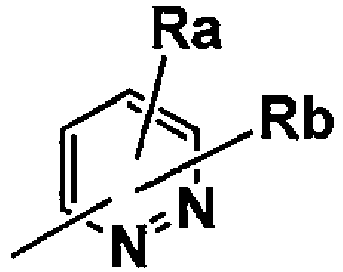
- Ra represents the -(CH2)n-C(=O)-NRdRe, and
- Rb represents a hydrogen atom).
- [9] The compound according to [1] or a pharmaceutically acceptable salt thereof, wherein
X represents a cyano group or a nitro group;
Y represents a halogen atom, a halogeno-C1-3 alkyl group, a C1-3 alkoxy group, or a C1-3 alkyl group;
Z represents a hydrogen atom or a halogen atom;
R1 is a substituent selected from the group consisting of the following groups:
- Ra represents a phenyl group, a hydroxy-C1-6 alkyl group, a hydroxy-heterocycloalkyl group, a C1-6 alkoxy group which may be substituted with Rc, an amino-C1-6 alkyl group which may be substituted with Rf, a halogeno-C1-3 alkoxy group, a bicyclic heterocycloalkyl group, or-(CH2)n-C(=O)-NRdRe;
- Rb represents a hydrogen atom, a halogen atom, a C1-3 alkyl group which may be substituted with a halogen atom, or a C1-4 alkoxy group which may be substituted with a halogen atom;
- or Ra and Rb are bonded to each other to form a fused ring together with the ring on which they are substituted;
- Rc represents a piperazinyl group which may be substituted with Rf;
- Rd and Re each independently represent a hydrogen atom, a C1-3 alkyl group, a C2-6 alkynyl group, a C1-6 alkoxy group, a C3-7 cycloalkyl group, a halogeno-C1-3 alkyl group, or a C1-6 alkyl group substituted with Rg;
- or NRdRe forms a 3- to 7-membered nitrogen-containing heterocyclic ring;
- Rf represents a C1-6 alkyl group, a C1-6 alkylcarbonyl group, a C1-6 alkylsulfonyl group, a C1-6 alkoxycarbonyl group, or a C1-6 alkylaminocarbonyl group;
- Rg represents a C1-6 alkoxycarbonylamino group; and n represents an integer of 0 or 1.
- [10] The compound according to [9] or a pharmaceutically acceptable salt thereof, wherein
X represents a cyano group or a nitro group;
Y represents a chlorine atom, a bromine atom, a trifluoromethyl group, a methoxy group, an isopropoxy group, or a methyl group;
Z represents a hydrogen atom or a fluorine atom;
R1 is a substituent selected from the group consisting of the following groups:
- R2 represents a hydrogen atom, a methyl group, or a cyano group;
- Ra represents a phenyl group, a hydroxy-ethyl group, a hydroxy-isopropyl group, a hydroxy-oxetanyl group, a methoxy group, a trifluoromethoxy group, a 2-oxa-6-azaspiro[3.3]heptyl group, -(CH2)n-C(=O)-NRdRe, or an n-propoxy group substituted with a piperazinyl group which may be substituted with acetyl, tert-butoxycarbonyl, mesyl, or methyl;
- Rb represents a hydrogen atom, a fluorine atom, a chlorine atom, a methyl group, a trifluoromethyl group, or a methoxy group;
- or Ra and Rb are bonded to each other to form a substituted or unsubstituted tetrahydroisoquinolinyl group or isoindolinyl group together with the ring on which they are substituted;
- either one of Rd and Re represents a methyl group, an ethyl group, a propynyl group, a cyclopropyl group, a trifluoroethyl group, a tert-butoxy group, or an ethyl group substituted with tert-butoxycarbonylamino, and the other represents a hydrogen atom or a methyl group;
- or NRdRe forms azepane; and
- n is 0.
- [11] The compound according to [1] or a pharmaceutically acceptable salt thereof, which is selected from the group consisting of the following compounds (1) to (48):
- (1) 6-((7-(3-chloro-4-cyanophenyl)-5,6,7,8-tetrahydropyrido[3,4-d]pyrimidin-4-yl)amino)-N-ethyl-2-fluoronicotinamide;
- (2) 6-((7-(3-chloro-4-cyanophenyl)-5,6,7,8-tetrahydropyrido[3,4-d]pyrimidin-4-yl)amino)-2-fluoro-N-methylnicotinamide;
- (3) 6-((7-(4-cyano-3-(trifluoromethyl)phenyl)-5,6,7,8-tetrahydropyrido[3,4-d]pyrimidin-4-yl)amino)-2-fluoro-N-methylnicotinamide;
- (4) 6-((7-(4-cyano-3-(trifluoromethyl)phenyl)-5,6,7,8-tetrahydropyrido[3,4-d]pyrimidin-4-yl)amino)-N-ethyl-2-fluoronicotinamide;
- (5) 6-((7-(4-cyano-3-(trifluoromethyl)phenyl)-5,6,7,8-tetrahydropyrido[3,4-d]pyrimidin-4-yl)amino)-N-ethylnicotinamide;
- (6) 4-(4-((5-(azepane-1-carbonyl)pyridin-2-yl)amino)-5,6-dihydropyrido[3,4-d]pyrimidin-7(8H)-yl)-2-(trifluoromethyl)benzonitrile;
- (7) N-(tert-butoxy)-6-((7-(4-cyano-3-(trifluoromethyl)phenyl)-5,6,7,8-tetrahydropyrido[3,4-d]pyrimidin-4-yl)amino)nicotinamide;
- (8) tert-butyl(2-(6-((7-(4-cyano-3-(trifluoromethyl)phenyl)-5,6,7,8-tetrahydropyrido[3,4-d]pyrimidin-4-yl)amino)pyridazine-3-carboxamido)ethyl)carbamate;
- (9) 6-((7-(4-cyano-3-(trifluoromethyl)phenyl)-5,6,7,8-tetrahydropyrido[3,4-d]pyrimidin-4-yl)amino)-N-cyclopropylpyridazine-3-carboxamide;
- (10) 6-((7-(4-cyano-3-(trifluoromethyl)phenyl)-5,6,7,8-tetrahydropyrido[3,4-d]pyrimidin-4-yl)amino)-N-ethylpyridazine-3-carboxamide;
- (11) 6-((7-(4-cyano-3-(trifluoromethyl)phenyl)-5,6,7,8-tetrahydropyrido[3,4-d]pyrimidin-4-yl)amino)-N-(prop-2-yn-1-yl)pyridazine-3-carboxamide;
- (12) N-ethyl-2-fluoro-6-((7-(4-nitro-3-(trifluoromethyl)phenyl)-5,6,7,8-tetrahydropyrido[3,4-d]pyrimidin-4-yl)amino)nicotinamide;
- (13) 2-(6-((7-(3-chloro-4-nitrophenyl)-5,6,7,8-tetrahydropyrido[3,4-d]pyrimidin-4-yl)amino)pyridin-3-yl)propan-2-ol;
- (14) 2-(6-((7-(4-nitro-3-(trifluoromethyl)phenyl)-5,6,7,8-tetrahydropyrido[3,4-d]pyrimidin-4-yl)amino)pyridin-3-yl)propan-2-ol;
- (15) 2-(6-((7-(3-methoxy-4-nitrophenyl)-5,6,7,8-tetrahydropyrido[3,4-d]pyrimidin-4-yl)amino)pyridin-3-yl)propan-2-ol;
- (16) 2-(6-((7-(3-methyl-4-nitrophenyl)-5,6,7,8-tetrahydropyrido[3,4-d]pyrimidin-4-yl)amino)pyridin-3-yl)propan-2-ol;
- (17) 2-(6-((7-(3-bromo-4-nitrophenyl)-5,6,7,8-tetrahydropyrido[3,4-d]pyrimidin-4-yl)amino)pyridin-3-yl)propan-2-ol;
- (18) 2-(6-((7-(3-chloro-2-fluoro-4-nitrophenyl)-5,6,7,8-tetrahydropyrido[3,4-d]pyrimidin-4-yl)amino)pyridin-3-yl)propan-2-ol;
- (19) 2-(6-((7-(3-isopropoxy-4-nitrophenyl)-5,6,7,8-tetrahydropyrido[3,4-d]pyrimidin-4-yl)amino)pyridin-3-yl)propan-2-ol;
- (20) 4-(4-((5-(2-hydroxypropan-2-yl)pyridin-2-yl)amino)-5,6-dihydropyrido[3,4-d]pyrimidin-7(8H)-yl)-2-methylbenzonitrile;
- (21) N-(3-fluoro-4-methoxyphenyl)-7-(4-nitro-3-(trifluoromethyl)phenyl)-5,6,7,8-tetrahydropyrido[3,4-d]pyrimidin-4-amine;
- (22) 7-(3-chloro-4-nitrophenyl)-N-(3-fluoro-4-methoxyphenyl)-5,6,7,8-tetrahydropyrido[3,4-d]pyrimidin-4-amine;
- (23) 4-(4-((5-(2-hydroxypropan-2-yl)pyridin-2-yl)amino)-5,6-dihydropyrido[3,4-d]pyrimidin-7(8H)-yl)-2-methoxybenzonitrile;
- (24) 6-((7-(4-nitro-3-(trifluoromethyl)phenyl)-5,6,7,8-tetrahydropyrido[3,4-d]pyrimidin-4-yl)amino)-N-(2,2,2-trifluoroethyl)pyridazine-3-carboxamide;
- (25) N-(6-methoxypyridin-3-yl)-7-(4-nitro-3-(trifluoromethyl)phenyl)-5,6,7,8-tetrahydropyrido[3,4-d]pyrimidin-4-amine;
- (26) 4-(4-((3,4-dimethoxyphenyl)amino)-5,6-dihydropyrido[3,4-d]pyrimidin-7(8H)-yl)-2-(trifluoromethyl)benzonitrile;
- (27) 4-(4-((4-(trifluoromethoxy)phenyl)amino)-5,6-dihydropyrido[3,4-d]pyrimidin-7(8H)-yl)-2-(trifluoromethyl)benzonitrile;
- (28) 4-(4-((4-(2-oxa-6-azaspiro[3.3]heptan-6-yl)phenyl)amino)-5,6-dihydropyrido[3,4-d]pyrimidin-7(8H)-yl)-2-chlorobenzonitrile;
- (29) tert-butyl 5-((7-(3-chloro-4-cyanophenyl)-5,6,7,8-tetrahydropyrido[3,4-d]pyrimidin-4-yl)amino)isoindoline-2-carboxylate;
- (30) tert-butyl 4-(3-(2-chloro-4-((7-(4-nitro-3-(trifluoromethyl)phenyl)-5,6,7,8-tetrahydropyrido[3,4-d]pyrimidin-4-yl)amino)phenoxy)propyl)piperazine-1-carboxylate;
- (31) N-(3,4-dimethoxyphenyl)-7-(4-nitro-3-(trifluoromethyl)phenyl)-5,6,7,8-tetrahydropyrido[3,4-d]pyrimidin-4-amine;
- (32) tert-butyl 7-((7-(4-nitro-3-(trifluoromethyl)phenyl)-5,6,7,8-tetrahydropyrido[3,4-d]pyrimidin-4-yl)amino)-3,4-dihydroisoquinoline-2(1H)-carboxylate;
- (33) N-(3-methyl-4-(2-oxa-6-azaspiro[3.3]heptan-6-yl)phenyl)-7-(4-nitro-3-(trifluoromethyl)phenyl)-5,6,7,8-tetrahydropyrido[3,4-d]pyrimidin-4-amine;
- (34) N-([1,1'-biphenyl]-3-yl)-7-(4-nitro-3-(trifluoromethyl)phenyl)-5,6,7,8-tetrahydropyrido[3,4-d]pyrimidin-4-amine;
- (35) 2-chloro-4-(4-((6-fluoro-5-(3-hydroxyoxetan-3-yl)pyridin-2-yl)amino)-5,6-dihydropyrido[3,4-d]pyrimidin-7(8H)-yl)benzonitrile;
- (36) tert-butyl 7-((7-(3-chloro-4-cyanophenyl)-5,6,7,8-tetrahydropyrido[3,4-d]pyrimidin-4-yl)amino)-3,4-dihydroisoquinolin-2(1H)-carboxylate;
- (37) 2-chloro-4-(4-((1,2,3,4-tetrahydroisoquinolin-7-yl)amino)-5,6-dihydropyrido[3,4-d]pyrimidin-7(8H)-yl)benzonitrile;
- (38) 2-chloro-4-(4-((4-(3-(piperazin-1-yl)propoxy)-3-(trifluoromethyl)phenyl)amino)-5,6-dihydropyrido[3,4-d]pyrimidin-7(8H)-yl)benzonitrile;
- (39) 1-(4-(3-(2-chloro-4-((7-(4-nitro-3-(trifluoromethyl)phenyl)-5,6,7,8-tetrahydropyrido[3,4-d]pyrimidin-4-yl)amino)phenoxy)propyl)piperazin-1-yl)ethanone;
- (40) N-(3-chloro-4-(3-(4-(methylsulfonyl)piperazin-1-yl)propoxy)phenyl)-7-(4-nitro-3-(trifluoromethyl)phenyl)-5,6,7,8-tetrahydropyrido[3,4-d]pyrimidin-4-amine;
- (41) N-(3-chloro-4-(3-(4-methylpiperazin-1-yl)propoxy)phenyl)-7-(4-nitro-3-(trifluoromethyl)phenyl)-5,6,7,8-tetrahydropyrido[3,4-d]pyrimidin-4-amine;
- (42) 4-(4-((4-(3-(4-acetylpiperazin-1-yl)propoxy)-3-chlorophenyl)amino)-5,6-dihydropyrido[3,4-d]pyrimidin-7(8H)-yl)-2-chlorobenzonitrile;
- (43) 4-(4-((4-(3-(4-acetylpiperazin-1-yl)propoxy)-3-(trifluoromethyl)phenyl)amino)-5,6-dihydropyrido[3,4-d]pyrimidin-7(8H)-yl)-2-chlorobenzonitrile;
- (44) 4-(4-((4-(3-(4-acetylpiperazin-1-yl)propoxy)-2-(trifluoromethyl)phenyl)amino)-5,6-dihydropyrido[3,4-d]pyrimidin-7(8H)-yl)-2-(trifluoromethyl)benzonitrile;
- (45) 1-(4-(3-(4-((7-(4-nitro-3-(trifluoromethyl)phenyl)-5,6,7,8-tetrahydropyrido[3,4-d]pyrimidin-4-yl)amino)-2-(trifluoromethyl)phenoxy)propyl)piperazin-1-yl)ethanone;
- (46) 1-(4-(3-(4-((7-(4-nitro-3-(trifluoromethyl)phenyl)-5,6,7,8-tetrahydropyrido[3,4-d]pyrimidin-4-yl)amino)phenoxy)propyl)piperazin-1-yl)ethanone;
- (47) 7-(4-cyano-3-(trifluoromethyl)phenyl)-4-((4-methoxyphenyl)amino)-5,6,7,8-tetrahydropyrido[3,4-d]pyrimidine-2-carbonitrile; and
- (48) 4-(4-((4-methoxyphenyl)amino)-2-methyl-5,6-dihydropyrido[3,4-d]pyrimidin-7(8H)-yl)-2-(trifluoromethyl)benzonitrile.
- [12] An anti-androgen agent comprising, as an active ingredient, the fused pyrimidine compound according to any one of [1] to [11] or a pharmaceutically acceptable salt thereof.
- [13] An anti-tumor agent comprising, as an active ingredient, the fused pyrimidine compound according to any one of [1] to [11] or a pharmaceutically acceptable salt thereof.
- [14] A pharmaceutical composition comprising the fused pyrimidine compound according to any one of [1] to [11] or a pharmaceutically acceptable salt thereof, and a pharmaceutically acceptable carrier.
- The novel fused pyrimidine compound of the present invention or a salt thereof exhibits an antagonist activity against an androgen receptor (AR), and is effective for a disorder related with AR activation. Examples of a disorder related with AR activation include tumor, metastatic bone disease, prostatic hyperplasia, acne vulgaris, seborrhea, hypertrichosis, androgenetic alopecia, precocious puberty, and virillizing syndrome. Examples of the tumor include prostate cancer, breast cancer, ovarian cancer, bladder cancer, uterine cancer, pancreatic cancer, and hepatocellular cancer.
- As described herein, examples of the "halogen atom" include a fluorine atom, a chlorine atom, a bromine atom, and an iodine atom, and it is preferably a fluorine atom, a chlorine atom, or a bromine atom.
- As described herein, the "C1-6 alkyl group" indicates a linear or branched alkyl group having 1 to 6 carbon atoms, examples thereof include a methyl group, an ethyl group, an n-propyl group, an isopropyl group, an n-butyl group, a 2-methylpropyl group, a sec-butyl group, a tert-butyl group, an n-pentyl group, an isopentyl group, a tert-pentyl group, a neopentyl group, an n-hexyl group, and a thexyl group, and it is preferably a linear or branched alkyl group having 1 to 4 carbon atoms, more preferably a methyl group, an ethyl group, an n-propyl group, an isopropyl group, an n-butyl group, a 2-methylpropyl group, a sec-butyl group, or a tert-butyl group. Furthermore, as described herein, the "C1-4 alkyl group" and "C1-3 alkyl group" each indicates an alkyl group having 1 to 4 carbon atoms and an alkyl group having 1 to 3 carbon atoms among the aforementioned "C1-6 alkyl group".
- As described herein, the "C2-6 alkynyl group" indicates an alkynyl group having 2 to 6 carbon atoms, examples thereof include an ethynyl group and a propynyl group, and it is preferably an alkynyl group having 2 to 4 carbon atoms, more preferably a propynyl group. The "C2-4 alkynyl group" as described herein indicates an alkynyl group having 2 to 4 carbon atoms among the aforementioned "C1-6 alkynyl groups".
- As described herein, the "halogeno-C1-3 alkyl group" indicates the aforementioned C1-3 alkyl group which is substituted with 1 to 7 halogen atoms that are described above. Examples of the "halogeno-C1-3 alkyl group" include a fluoro-C1-3 alkyl group or a chloro-C1-3 alkyl group, such as a fluoromethyl group, a difluoromethyl group, a trifluoromethyl group, a trichloromethyl group, a 2-fluoroethyl group, a 2,2-difluoroethyl group, a 2,2,2-trifluoroethyl group, a 2,2,2-trichloroethyl group, a monofluoro-n-propyl group, a perfluoro-n-propyl group, and a perfluoroisopropyl group, and it is preferably a C1-3 alkyl group substituted with 1 to 3 halogen atoms, more preferably C1-3 alkyl group substituted with 1 to 3 fluorine atoms.
- As described herein, the "C6-14 aryl group" indicates an aryl group having 6 to 14 carbon atoms, examples thereof include a phenyl group, a naphthyl group, an anthracenyl group, a phenanthryl group, and a fluorenyl group, and it is preferably an aryl group having 6 to 10 carbon atoms and more preferably a phenyl group.
- As described herein, the "heteroaryl group" indicates an aromatic monocyclic or polycyclic group having 1 to 4 hetero atoms independently selected from any one of oxygen, nitrogen, and sulfur. Examples of the heteroaryl group include a furyl group, a thienyl group, a pyrrolyl group, an imidazolyl group, a pyrazolyl group, a triazolyl group, a tetrazolyl group, an oxazolyl group, an oxadiazolyl group, a triazinyl group, a thiazolyl group, a thiadiazolyl group, an isoxazolyl group, an isothiazolyl group, a pyridinyl group, a pyrazinyl group, a pyrimidinyl group, a pyridazinyl group, an indolinyl group, a quinolinyl group, an isoquinolinyl group, a benzo[b]thienyl group, a benzimidazolyl group, a benzothiazolyl group, and a benzoxazolyl group. The heteroaryl group is preferably an aromatic monocyclic group having 1 to 4 hetero atoms independently selected from oxygen, nitrogen, and sulfur; more preferably an aromatic monocyclic group having 1 to 3 nitrogen atoms; and even more preferably a pyridinyl group, a pyridazinyl group, or a pyrimidinyl group.
- As described herein, the "hydroxy-C1-6 alkyl group" indicates the aforementioned C1-6 alkyl group which is substituted with 1 to 3 hydroxyl groups. Examples of the "hydroxy-C1-6 alkyl group" include a hydroxymethyl group, a 1-hydroxy-ethyl group, a 1,2-dihydroxy-ethyl group, a 1-hydroxypropyl group, a 1,2-dihydroxypropyl group, a 1,2,3-trihydroxypropyl group, a 1-hydroxybutyl group, a 2-hydroxypropan-2-yl group, and a 2-hydroxy-2-methylpropyl group. The hydroxy-C1-6 alkyl group is preferably C1-6 alkyl group substituted with one hydroxyl group.
- As described herein, the "amino-C1-6 alkyl group" is the aforementioned C1-6 alkyl group substituted with 1 to 3 amino groups, preferably the aforementioned C1-3 alkyl group substituted with 1 to 3 amino groups. Examples of the "amino-C1-6 alkyl group" include an aminomethyl group, a 1-aminoethyl group, a 2-aminoethyl group, and a 1-aminopropyl group, and it is preferably a C1-6 alkyl group substituted with one amino group, more preferably a C1-3 alkyl group substituted with one amino group.
- As described herein, the "C3-7 cycloalkyl group" indicates a cyclic alkyl group having 3 to 7 carbon atoms, examples thereof include a cyclopropyl group, a cyclobutyl group, a cyclopentyl group, a cyclohexyl group, and a cycloheptyl group, and it is preferably a cyclopropyl group.
- As described herein, the "hydroxy-C3-7 cycloalkyl group" indicates the aforementioned C3-7 cycloalkyl group which is substituted with 1 to 3 hydroxyl groups. Examples of the "hydroxy-C3-7 cycloalkyl group" include a 1-hydroxycyclopropyl group, a 2-hydroxycyclopropyl group, a 1,2-dihydroxycyclopropyl group, a 1,2,3-trihydroxycyclopropyl group, a 1-hydroxycyclobutyl group, a 1-hydroxycyclopentyl group, a 1-hydroxycyclohexyl group, or a 4-hydroxycyclohexyl group, and it is preferably a C3-7 cycloalkyl group substituted with one hydroxyl group.
- As described herein, the "heterocycloalkyl group" indicates a 3- to 7-membered monocyclic or bicyclic alkyl group having, instead of carbon, 1 to 3 hetero atoms independently selected from oxygen, nitrogen, and sulfur, among the cyclic alkyl groups. Examples of the "heterocycloalkyl group" include an aziridinyl group, an azetidinyl group, a pyrrolidinyl group, an oxazolidinyl group, a thiazolidinyl group, an oxetanyl group, a tetrahydrofuranyl group, a tetrahydrothiophenyl group, a piperidinyl group, a piperazinyl group, a morpholino group, a thiomorpholino group, an azepanyl group, a diazepanyl group, an oxazepanyl group, and a 2-oxa-6-azaspiro[3.3]heptyl group, and it is preferably a 3- to 7-membered monocyclic or bicyclic alkyl group having, instead of carbon, 1 to 3 hetero atoms independently selected from oxygen and nitrogen.
- As described herein, the "hydroxy-heterocycloalkyl group" indicates the aforementioned heterocycloalkyl group substituted with 1 to 3 hydroxyl groups. Examples of the "hydroxy-heterocycloalkyl group" include an oxetanyl group substituted with 1 to 3 hydroxyl groups, a tetrahydrofuranyl group substituted with 1 to 3 hydroxyl groups, and a piperidinyl group substituted with 1 to 3 hydroxyl groups, and preferably an oxetanyl group substituted with 1 to 3 hydroxyl groups (hydroxy-oxetanyl group), such as a 3-hydroxyoxetan-3-yl group, and it is preferably a 3- to 7-membered monocyclic alkyl group having, instead of carbon, 1 to 3 hetero atoms independently selected from oxygen and nitrogen, which is substituted with one hydroxyl group.
- As described herein, the "C1-6 alkylcarbonyl group" indicates a carbonyl group substituted with a linear or branched alkyl group having 1 to 6 carbon atoms, such as a methylcarbonyl (acetyl) group, an ethylcarbonyl group, an n-propylcarbonyl group, an isopropylcarbonyl group, an n-butylcarbonyl group, and a tert-butylcarbonyl group, and preferably a methylcarbonyl (acetyl) group. The "C1-3 alkylcarbonyl group" as described herein indicates a carbonyl group substituted with an alkyl group having 1 to 3 carbon atoms among the aforementioned "C1-6 alkylcarbonyl groups".
- As described herein, the "C1-6 alkylaminocarbonyl group" indicates a carbonyl group having an amino group substituted with a linear or branched alkyl group having 1 to 6 carbon atoms. Examples of the "C1-6 alkylaminocarbonyl group" include a methylaminocarbonyl group, an ethylaminocarbonyl group, an n-propylaminocarbonyl group, an isopropylaminocarbonyl group, an n-butylaminocarbonyl group, and a tert-butylaminocarbonyl group, and it is preferably a carbonyl group having an amino group substituted with a linear or branched alkyl group having 1 to 3 carbon atoms.
- As described herein, the "C1-6 alkylsulfonyl group" indicates a sulfonyl group substituted with a linear or branched alkyl group having 1 to 6 carbon atoms, examples thereof include a methylsulfonyl (mesyl) group, an ethylsulfonyl group, an n-propylsulfonyl group, an isopropylsulfonyl group, an n-butylsulfonyl group, and a tert-butylsulfonyl group, and it is preferably a methylsulfonyl (mesyl) group. The "C1-3 alkylsulfonyl group" as described herein indicates a sulfonyl group substituted with an alkyl group having 1 to 3 carbon atoms among the aforementioned "C1-6 alkylsulfonyl groups".
- As described herein, the "C3-7 cycloalkylaminosulfonyl group" indicates a sulfonyl group having an amino group substituted with one of the aforementioned C3-7 cycloalkyl groups. Examples of the "C3-7 cycloalkylaminosulfonyl group" include a cyclopropylaminosulfonyl group, a cyclobutylaminosulfonyl group, or a cyclopentylaminosulfonyl group, and it is preferably a cyclopropylaminosulfonyl group.
- As described herein, the "heterocycloalkylsulfonyl group" is a sulfonyl group substituted with the aforementioned heterocycloalkyl group. Examples of the "heterocycloalkylsulfonyl group" include a piperidin-1-ylsulfonyl group, a morpholinosulfonyl group, a 1,4-thioazepan-4-ylsulfonyl group, and a 1,4-oxazepanylsulfonyl group, and it is preferably a sulfonyl group substituted with a 3- to 7-membered monocyclic alkyl group having, instead of carbon, 1 to 3 hetero atoms independently selected from oxygen, nitrogen, and sulfur.
- As described herein, the "C1-6 alkoxy group" indicates a linear or branched alkoxy group having 1 to 6 carbon atoms, examples thereof include a methoxy group, an ethoxy group, an n-propoxy group, an isopropoxy group, an n-butoxy group, a 2-methylpropoxy group (isobutoxy group), a sec-butoxy group, a tert-butoxy group, an n-pentyloxy group, an isopentyloxy group, a tert-pentyloxy group, a neopentyloxy group, an n-hexyloxy group, and a thexyloxy group, and it is preferably a linear or branched alkoxy group having 1 to 4 carbon atoms. Furthermore, as described herein, the "C1-4 alkoxy group" and "C1-3 alkoxy group" each indicates an alkoxy group having 1 to 4 carbon atoms and an alkoxy group having 1 to 3 carbon atoms among the aforementioned "C1-6 alkoxy group".
- As described herein, the "C1-6 alkoxycarbonyl group" indicates a carbonyl group substituted with a linear or branched alkoxy group having 1 to 6 carbon atoms, examples thereof include a methoxycarbonyl group, an ethoxycarbonyl group, an n-propoxycarbonyl group, an isopropoxycarbonyl group, an n-butoxycarbonyl group, and a tert-butoxycarbonyl group, and it is preferably a tert-butoxycarbonyl group. The "C1-3 alkoxycarbonyl group" as described herein indicates a carbonyl group substituted with an alkoxy group having 1 to 3 carbon atoms among the aforementioned "C1-6 alkoxycarbonyl groups".
- As described herein, the "halogeno-C1-3 alkoxy group" indicates the aforementioned C1-3 alkoxy group which is substituted with 1 to 7 halogen atoms that are described above. Examples of the "halogeno-C1-3 alkoxy group" include a fluoro-C1-3 alkoxy group or a chloro-C1-3 alkoxy group, such as a fluoromethoxy group, a difluoromethoxy group, a trifluoromethoxy group, a trichloromethoxy group, a 2-fluoroethoxy group, a 2,2-difluoroethoxy group, a 2,2,2-trifluoroethoxy group, a 2,2,2-trichloroethoxy group, a monofluoro-n-propoxy group, a perfluoro-n-propoxy group, and a perfluoroisopropoxy group, and it is preferably a C1-3 alkoxy group substituted with 1 to 3 of the aforementioned halogen atoms, more preferably a C1-3 alkoxy group substituted with 1 to 3 fluorine atoms.
- As described herein, the "C1-3 alkylcarbonylamino group" indicates an amino group substituted with one of the aforementioned C1-3 alkylcarbonyl groups, and the "C1-3 alkylcarbonyl group" indicates a carbonyl group substituted with the aforementioned C1-3 alkyl group. Examples of the "C1-3 alkylcarbonylamino group" include a methylcarbonylamino group and an ethylcarbonylamino group, and is preferably a methylcarbonylamino group.
- As described herein, the "C1-6 alkoxycarbonylamino group" indicates an amino group substituted with one of the aforementioned C1-6 alkoxycarbonyl groups, examples thereof include a methoxycarbonylamino group, an ethoxycarbonylamino group, an n-propoxycarbonylamino group, an isopropoxycarbonylamino group, an n-butoxycarbonylamino group, and a tert-butoxycarbonylamino group, and it is preferably a tert-butoxycarbonylamino group. As described herein, the "C1-3 alkoxycarbonylamino group" indicates an amino group substituted with one of the aforementioned C1-3 alkoxycarbonyl groups.
- As described herein, the "halogeno-C1-3 alkoxycarbonylamino group" indicates an amino group which is substituted with one halogeno-C1-3 alkoxycarbonyl group, and the "halogeno-C1-3 alkoxycarbonyl group" indicates a carbonyl group which is substituted with the aforementioned halogeno-C1-3 alkoxy group. Examples of the "halogeno-C1-3 alkoxycarbonylamino group" include a trifluoromethoxycarbonylamino group, a trichloromethoxycarbonylamino group, a 2-fluoroethoxycarbonylamino group, a 2,2-difluoroethoxycarbonylamino group, or a 2,2,2-trifluoroethoxycarbonylamino group, and it is preferably a C1-3 alkoxycarbonylamino group substituted with 1 to 3 halogen atoms, more preferably a C1-3 alkoxycarbonylamino group substituted with 1 to 3 fluorine atoms.
- As described herein, the "halogeno-C1-3 alkylcarbonylamino group" indicates an amino group which is substituted with one halogeno-C1-3 alkylcarbonyl group, and the "halogeno-C1-3 alkylcarbonyl group" indicates a carbonyl group which is substituted with the aforementioned halogeno-C1-3 alkyl group. Examples of the "halogeno-C1-3 alkylcarbonylamino group" include a trifluoromethylcarbonylamino group, a trichloromethylcarbonylamino group, a 2-fluoroethylcarbonylamino group, a 2,2-difluoroethylcarbonylamino group, or a 2,2,2-trifluoroethylcarbonylamino group, and it is preferably a C1-3 alkylcarbonylamino group substituted with 1 to 3 halogen atoms, more preferably a C1-3 alkylcarbonylamino group substituted with 1 to 3 fluorine atoms.
- As described herein, the "heterocycloalkanecarbonyl group" indicates a carbonyl group which is substituted with the aforementioned heterocycloalkyl group. Examples of the "heterocycloalkanecarbonyl group" include a piperidine-1-carbonyl group, a piperazine-1-carbonyl group, an azetidine-1-carbonyl group, or a morpholine-4-carbonyl group, and it is preferably a carbonyl group substituted with a 3- to 7-membered monocyclic alkyl group having, instead of carbon, 1 to 3 hetero atoms independently selected from oxygen, nitrogen, and sulfur.
- As described herein, the "C1-6 alkylpyrazolyl group" indicates a pyrazolyl group which is substituted with one C1-6 alkyl group described above. Examples of the "C1-6 alkylpyrazolyl group" include a 1-methyl-1H-pyrazol-5-yl group, a 1-ethyl-1H-pyrazol-5-yl group, a 1-propyl-1H-pyrazol-5-yl group, a 1-methyl-1H-pyrazol-3-yl group, and a 1-methyl-1H-pyrazol-4-yl group, and it is preferably a pyrazolyl group substituted with one methyl group.
- As described herein, the "hydroxy-C3-7 cycloalkyl-C1-6 alkyl group" indicates the aforementioned C1-6 alkyl group which is substituted with one hydroxy-C3-7 cycloalkyl group described above. Examples of the "hydroxy-C3-7 cycloalkyl-C1-6 alkyl group" include a (1-hydroxycyclopropyl)methyl group, a (1-hydroxycyclobutyl)methyl group, a 2-(1-hydroxycyclopropyl)ethyl group, a (1,2-dihydroxycyclopropyl)methyl group, and a (1,2,3-trihydroxycyclopropyl)methyl group, and it is preferably a (1-hydroxycyclopropyl)methyl group.
- As described herein, the "halogeno-C1-3 alkylthiazolyl group" indicates a thiazolyl group substituted with one of the aforementioned halogeno-C1-3 alkyl groups, examples thereof include a 4-(trifluoromethyl)thiazol-2-yl group, a 5-(trifluoromethyl)thiazol-2-yl group, a 4-(trichloromethyl)thiazol-2-yl group, and a 4-(2,2,2-trifluoroethyl)thiazol-2-yl group, and it is preferably a thiazolyl group substituted with one C1-3 alkyl group which is substituted with 1 to 3 halogen atoms, and is more preferably a thiazolyl group substituted with one C1-3 alkyl group which is substituted with 1 to 3 fluorine atoms.
- As described herein, the "halogeno-C1-3 alkyloxadiazolyl group" indicates an oxadiazolyl group substituted with one of the aforementioned halogeno-C1-3 alkyl groups, examples thereof include a 5-(trifluoromethyl)-1,3,4-oxadiazol-2-yl group, a 5-(2,2,2-trifluoroethyl)-1,3,4-oxadiazol-2-yl group, a 5-(2-fluoroethyl)-1,3,4-oxadiazol-2-yl group, and a 4-(trifluoromethyl)-1,2,3-oxazol-5-yl group, and it is preferably an oxadiazolyl group substituted with one C1-3 alkyl group which is substituted with 1 to 3 halogen atoms, more preferably an oxadiazolyl group substituted with one C1-3 alkyl group which is substituted with 1 to 3 fluorine atoms.
- As described herein, "its salt" or "pharmaceutically acceptable salt" may be any salt in a pharmaceutically acceptable form, and examples thereof include mineral acid salts, such as a hydrochloric acid salt, a hydrobromic acid salt, a sulfuric acid salt, a nitric acid salt, and a phosphoric acid salt; and organic acid salts, such as an acetic acid salt, a propionic acid salt, a tartaric acid salt, a fumaric acid salt, a maleic acid salt, a succinic acid salt, a malic acid salt, a citric acid salt, a methanesulfonic acid salt, a p-toluenesulfonic acid salt, and a trifuloroacetic acid salt.
- As described herein, a group "may be substituted" with a substituent group means a state in which the group is substituted with the substituent group or the group is not substituted with the substituent group.
- The fused pyrimidine compound or its salt of the present invention is characterized in that it has a 5,6,7,8-tetrahydropyrido[3,4-d]pyrimidine skeleton and has a group represented by -NHR1 (R1 is as defined as below) on position 4 and benzene substituted with a specific substituent on position 7 of the skeleton, wherein the benzene has a cyano group or a nitro group on position 4 and a specific substituent Y (Y is as defined as below) on position 3. The fused pyrimidine compound of the present invention or a salt thereof has an antagonist activity for an androgen receptor (AR) and exhibits an anti-tumor effect. Meanwhile, a compound having, instead of the 5,6,7,8-tetrahydropyrido[3,4-d]pyrimidine skeleton, 5,6,7,8-tetrahydropyrido[4,3-d]pyrimidine or 5,6,7,8-tetrahydro[1,2,4]triazolo[4,3-a]pyrazine skeleton does not exhibit either the AR antagonist activity or anti-tumor effect. Incidentally, a compound wherein the benzene having a cyano group or a nitro group on position 4 and a substituent Y on position 3 is replaced by another cyano- or nitro-benzene does not exhibit the aforementioned effects.
- In the aforementioned Patent Literatures 1 to 3, a compound having 5,6,7,8-tetrahydropyrido[3,4-d]pyrimidine skeleton is disclosed. However, in none of the Patent Literatures 1 to 3, the compound having a group represented by -NHR1 (R1 is as defined below) on position 4 and cyanobenzene or nitrobenzene on position 7 of the 5,6,7,8-tetrahydropyrido[3,4-d]pyrimidine is disclosed. Furthermore, the usefulness of the 5,6,7,8-tetrahydropyrido[3,4-d]pyrimidine compound as an anti-tumor agent is not disclosed at all in Patent Literatures 1 to 3, and the effect of the compound against AR is not suggested.
- The fused pyrimidine compound of the present invention is represented by the following formula (I).

- In the formula (I), X represents a cyano group or a nitro group.
- In the formula (I), Y represents a halogen atom, a halogeno-C1-3 alkyl group, a C1-3 alkoxy group, or a C1-3 alkyl group. Examples of the "halogen atom" represented by Y include the aforementioned halogen atom, and it is preferably a chlorine atom or a bromine atom. Examples of the "halogeno-C1-3 alkyl group" represented by Y include the aforementioned halogeno-C1-3 alkyl group, and it is preferably a trifluoromethyl group. The "C1-3 alkoxy group" represented by Y is, for example, the aforementioned C1-3 alkoxy group, and is preferably a methoxy group or an isopropoxy group. The "C1-3 alkyl group" represented by Y is, for example, the aforementioned C1-3 alkyl group, and is preferably a methyl group. In the formula (I), Y is preferably a chlorine atom, a bromine atom, a trifluoromethyl group, a methoxy group, an isopropoxy group, or a methyl group.
- In the formula (I), Z represents a hydrogen atom, a halogen atom, or a C1-3 alkyl group. The "halogen atom" represented by Z is, for example, the aforementioned halogen atom, and is preferably a fluorine atom. The "C1-3 alkyl group" represented by Z is, for example, the aforementioned C1-3 alkyl group. In the formula (I), Z is preferably a hydrogen atom or a fluorine atom.
- In the formula (I), R2 represents a hydrogen atom, a C1-3 alkyl group, or a cyano group. The "C1-3 alkyl group" represented by R2 is, for example, the aforementioned C1-3 alkyl group, and is preferably a methyl group. In the formula (I), R2 is preferably a hydrogen atom, a methyl group, or a cyano group.
- In the formula (I), R1 represents a C6-14 aryl group which is substituted with Ra and may be substituted simultaneously with Rb, or a 5- or 6-membered heteroaryl group which is substituted with Ra and may be substituted simultaneously with Rb.
- The C6-14 aryl group of "C6-14 aryl group which is substituted with Ra and may be substituted simultaneously with Rb" regarding R1 is the aforementioned C6-14 aryl group, and it is preferably a phenyl group. The number of Ra substituted on the "C6-14 aryl group" is 1, and the number of Rb is 0, 1 or 2.
- Regarding R1, the "5- or 6-membered heteroaryl group" of the "5- or 6-membered heteroaryl group which is substituted with Ra and may be substituted simultaneously with Rb" is selected from 5- or 6-membered monocyclic heteroaryl groups among the aforementioned heteroaryl groups. The "5- or 6-membered heteroaryl group" is preferably a 5- or 6-membered monocyclic heteroaryl group having 1 to 3 hetero atoms independently selected from oxygen, nitrogen, and sulfur and is more preferably a pyridinyl group, a pyrazinyl group, a pyrimidinyl group, a pyridazinyl group, a triazinyl group, a thiazolyl group, a thiadiazolyl group, an oxazolyl group, or an oxadiazolyl group, more preferably a pyridinyl group, a pyrimidinyl group, a pyridazinyl group, a thiazolyl group, an oxazolyl group, or a thiadiazolyl group, and even more preferably a pyridinyl group or a pyridazinyl group. The number of Ra substituted on the "5- or 6-membered heteroaryl group" is one, and the number of Rb is 0, 1, or 2.
- In the formula (I), R1 is preferably a group selected from the group consisting of the followings:


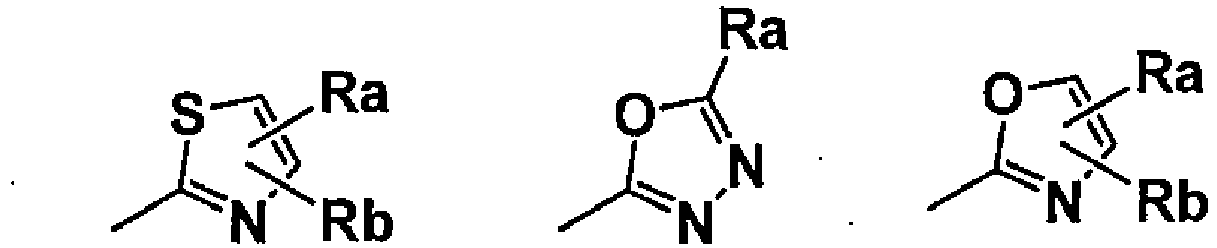
- R1 is more preferably a phenyl group, pyridinyl group, or pyridazinyl group substituted with Ra and Rb, selected from the group consisting of the followings:

- R1 is even more preferably a phenyl group, pyridinyl group, or pyridazinyl group substituted with Ra and Rb, selected from the group consisting of the followings:
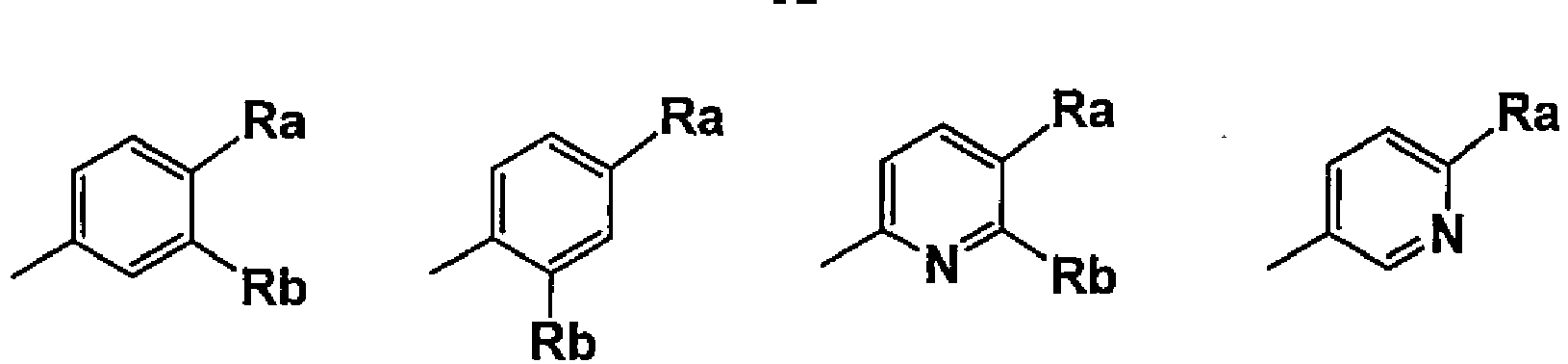

- Ra substituted on R1 in the formula (I) represents a phenyl group, a hydroxy-C1-6 alkyl group, a hydroxy-C3-7 cycloalkyl group, a hydroxy-heterocycloalkyl group, a C1-6 alkoxy group which may be substituted with Rc, an amino-C1-6 alkyl group which may be substituted with Rf, a halogeno-C1-3 alkoxy group, a C3-7 cycloalkylaminosulfonyl group, a C1-3 alkylsulfonyl group, a 3- to 7-membered monocyclic heterocycloalkylsulfonyl group, a C1-3 alkoxycarbonylamino group which may be substituted with a halogen, a C1-3 alkylcarbonylamino group which may be substituted with a halogen, a 3- to 7-membered monocyclic heterocycloalkanecarbonyl group substituted with a hydroxy-C1-6 alkyl group, a bicyclic heterocycloalkyl group, or -(CH2)n-C(=O)-NRdRe.
- The "hydroxy-C1-6 alkyl group" represented by Ra is the aforementioned hydroxy-C1-6 alkyl group, preferably a C1-4 alkyl group substituted with 1 to 3 hydroxyl groups, and more preferably an ethyl group substituted with 1 to 3 hydroxyl groups (hydroxy-ethyl group) or an isopropyl group substituted with 1 to 3 hydroxyl groups (hydroxy-isopropyl group). The number of the hydroxyl group is preferably 1. More preferably, the "hydroxy-C1-6 alkyl group" is a 2-hydroxypropan-2-yl group.
- The "hydroxy-C3-7 cycloalkyl group" represented by Ra is the aforementioned hydroxy-C3-7 cycloalkyl group.
- The "hydroxy-heterocycloalkyl group" represented by Ra is the aforementioned hydroxy-heterocycloalkyl group and is preferably a heterocycloalkyl group substituted with 1 to 3 hydroxyl groups. The "hydroxy-heterocycloalkyl group" is more preferably a monocyclic heterocycloalkyl group substituted with 1 to 3 hydroxyl groups and even more preferably an oxetanyl group substituted with 1 to 3 hydroxyl groups (hydroxy-oxetanyl group) and even more preferably a 3-hydroxyoxetan-3-yl group.
- The "C1-6 alkoxy group which may be substituted with Rc" represented by Ra is the aforementioned C1-6 alkoxy group which is substituted with 0 to 3 Res, and it is preferably the aforementioned C1-4 alkoxy group which is substituted with 0 to 3 Rcs. The number of Rc is preferably 0 or 1.
- Rc represents a pyrazolyl group, triazolyl group, or tetrazolyl group which may be substituted or a piperazinyl group which may be substituted with Rf.
- The "pyrazolyl group, triazolyl group, or tetrazolyl group which may be substituted" represented by Rc is preferably a pyrazolyl group, triazolyl group, or tetrazolyl group substituted with a C1-3 alkyl group or a halogeno-C1-3 alkyl group or an unsubstituted pyrazolyl group, triazolyl group, or tetrazolyl group.
- The "piperazinyl group which may be substituted with Rf" represented by Rc is a piperazinyl group unsubstituted or substituted with one Rf. Rf in the "piperazinyl group which may be substituted with Rf" represented by Rc represents C1-6 alkyl, C1-6 alkylcarbonyl, C1-6 alkylsulfonyl, C1-6 alkoxycarbonyl, or C1-6 alkylaminocarbonyl. The "C1-6 alkyl" represents the aforementioned C1-6 alkyl and is preferably a methyl group. The "C1-6 alkylcarbonyl" represents the aforementioned C1-6 alkylcarbonyl and is preferably methylcarbonyl (acetyl). The "C1-6 alkylsulfonyl" represents the aforementioned C1-6 alkylsulfonyl and is preferably methylsulfonyl (mesyl). The "C1-6 alkoxycarbonyl" represents the aforementioned C1-6 alkoxycarbonyl and is preferably tert-butoxycarbonyl. The "C1-6 alkylaminocarbonyl" represents the aforementioned C1-6 alkylaminocarbonyl. The number of Rf is 0 or 1.
- The "C1-6 alkoxy group which may be substituted with Rc" is preferably a C1-6 alkoxy group or a C1-6 alkoxy group substituted with a piperazyl group which may be substituted with Rf and more preferably a C1-6 alkoxy group, a C1-6 alkoxy group substituted with an unsubstituted piperazinyl group, or a C1-6 alkoxy group substituted with a piperazinyl group which is substituted with acetyl, mesyl, tert-butoxycarbonyl, or methyl, more preferably a methoxy group, an n-propoxy group substituted with an unsubstituted piperazinyl group, or an n-propoxy group substituted with a piperazinyl group which is substituted with acetyl, mesyl, tert-butoxycarbonyl, or methyl.
- The "amino-C1-6 alkyl group which may be substituted with Rf" represented by Ra is the aforementioned amino-C1-6 alkyl group substituted with 0 to 3 Rfs, and is preferably an amino-C1-6 alkyl group unsubstituted or N-substituted with one Rf. The amino-C1-6 alkyl group is preferably an amino-C1-3 alkyl group. Rf in the "amino-C1-6 alkyl group which may be substituted with Rf" is the same as Rf in the aforementioned "piperazinyl group which may be substituted with Rf", and is preferably a C1-6 alkoxycarbonyl. The "amino-C1-6 alkyl group which may be substituted with Rf" is preferably an amino-C1-6 alkyl group unsubstituted or substituted with C1-6 alkoxycarbonyl.
- The "halogeno-C1-3 alkoxy group" represented by Ra is the aforementioned halogeno-C1-3 alkoxy group and is preferably a trifluoromethoxy group.
- The "C3-7 cycloalkylaminosulfonyl group" represented by Ra is the aforementioned C3-7 cycloalkylaminosulfonyl group.
- The "C1-3 alkylsulfonyl group" represented by Ra is the aforementioned C1-3 alkylsulfonyl group.
- The "3- to 7-membered monocyclic heterocycloalkylsulfonyl group" represented by Ra is a sulfonyl group substituted with the aforementioned 3- to 7-membered monocyclic heterocycloalkyl group.
- The "C1-3 alkoxycarbonylamino group which may be substituted with a halogen" represented by Ra is the aforementioned C1-3 alkoxycarbonylamino group substituted with 0 to 7 halogen atoms and is preferably the aforementioned halogeno-C1-3 alkoxycarbonylamino group.
- The "C1-3 alkylcarbonylamino group which may be substituted with a halogen" represented by Ra is the aforementioned C1-3 alkylcarbonylamino group substituted with 0 to 7 halogen atoms and is preferably the aforementioned halogeno-C1-3 alkylcarbonylamino group.
- The "3- to 7-membered monocyclic heterocycloalkanecarbonyl group substituted with a hydroxy-C1-6 alkyl group" represented by Ra is a carbonyl group substituted with the aforementioned 3- to 7-membered monocyclic heterocycloalkyl group which is substituted with one of the aforementioned hydroxy-C1-6 alkyl groups.
- The "bicyclic heterocycloalkyl group" represented by Ra indicates a bicyclic group among the aforementioned heterocycloalkyl groups and is preferably a 2-oxa-6-azaspiro[3.3]heptyl group.
- In the group represented by "-(CH2)n-C(=O)-NRdRe" regarding Ra, Rd and Re each independently represent a hydrogen atom, a C1-3 alkyl group, a C2-6 alkynyl group, a C1-6 alkoxy group, a C3-7 cycloalkyl group, a halogeno-C1-3 alkyl group, a hydroxy-C1-6 alkyl group, a hydroxy-C3-7 cycloalkyl group, a hydroxy-C3-7 cycloalkyl-C1-6 alkyl group, a C1-4 alkoxy group, or a C1-6 alkyl group substituted with Rg. Alternatively, NRdRe may form a ring.
- In the group represented by "-(CH2)n-C(=O)-NRdRe" regarding Ra, n can be an integer of from 0 to 3 and is preferably 0 or 1, more preferably 0.
- The "C1-3 alkyl group" represented by Rd or Re is the aforementioned C1-3 alkyl group and is preferably a methyl group or an ethyl group.
- The "C2-6 alkynyl group" represented by Rd or Re is the aforementioned C2-6 alkynyl group and is preferably a propynyl group.
- The "C1-6 alkoxy group" represented by Rd or Re is the aforementioned C1-4 alkoxy group and is preferably a tert-butoxy group.
- The "C3-7 cycloalkyl group" represented by Rd or Re is the aforementioned "C3-7 cycloalkyl group" and is preferably a cyclopropyl group.
- The "halogeno-C1-3 alkyl group" represented by Rd or Re is the aforementioned halogeno-C1-3 alkyl group and is preferably a trifluoroethyl group, more preferably a 2,2,2-trifluoroethyl group.
- The "hydroxy-C1-6 alkyl group" represented by Rd or Re is the aforementioned hydroxy-C1-6 alkyl group.
- The "hydroxy-C3-7 cycloalkyl group" represented by Rd or Re is the aforementioned hydroxy-C3-7 cycloalkyl group.
- The "hydroxy-C3-7 cycloalkyl-C1-6 alkyl group" represented by Rd or Re is the aforementioned hydroxy-C3-7 cycloalkyl-C1-6 alkyl group.
- The "C1-6 alkyl group substituted with Rg" represented by Rd or Re is the aforementioned C1-6 alkyl group substituted with 1 to 3 Rgs and is preferably the aforementioned C1-4 alkyl group substituted with one Rg.
- Rg represents a C1-6 alkylpyrazolyl group, a halogeno-C1-3 alkylthiazolyl group, an oxadiazolyl group, a halogeno-C1-3 alkyloxadiazolyl group, or a C1-6 alkoxycarbonylamino group. The "C1-6 alkylpyrazolyl group" represented by Rg is the aforementioned C1-6 alkylpyrazolyl group. The "halogeno-C1-3 alkylthiazolyl group" represented by Rg is the aforementioned halogeno-C1-3 alkylthiazolyl group. The "halogeno-C1-3 alkyloxazolyl group" represented by Rg is the aforementioned halogeno-C1-3 alkyloxazolyl group. The "C1-6 alkoxycarbonylamino group" represented by Rg is the aforementioned C1-6 alkoxycarbonylamino group and is preferably a tert-butoxycarbonylamino group.
- The "C1-6 alkyl group substituted with Rg" is preferably a C1-6 alkyl group substituted with a tert-butoxycarbonylamino group and more preferably an ethyl group substituted with a tert-butoxycarbonylamino group.
- Alternatively, NRdRe may form a ring. If NRdRe forms a ring, then a 3- to 7-membered nitrogen-containing heterocyclic ring is formed. The 3- to 7-membered nitrogen-containing heterocyclic ring includes aziridine, azetidine, pyrrolidine, piperidine, or azepane, and is preferably azepane.
- In Rd and Re represented in "-(CH2)n-C(=O)-NRdRe" regarding Ra, preferably, either one of Rd and Re is a C1-3 alkyl group, a C2-6 alkynyl group, a C1-3 alkoxy group, a C3-7 cycloalkyl group, a halogeno-C1-3 alkyl group, or a C1-6 alkyl group substituted with Rg, and the other is a hydrogen atom or a C1-3 alkyl group; or NRdRe is a 3- to 7-membered nitrogen-containing heterocyclic ring containing one nitrogen atom. More preferably, either one of Rd and Re is a methyl group, an ethyl group, a propynyl group, a tert-butoxy group, a trifluoroethyl group, or an ethyl group substituted with tert-butoxycarbonylamino, and the other is a hydrogen atom or a methyl group; or NRdRe is azepane.
- Preferably, in the formula (I):
Ra represents a phenyl group, a hydroxy-C1-6 alkyl group, a hydroxy-heterocycloalkyl group, a C1-6 alkoxy group which may be substituted with Rc, an amino-C1-6 alkyl group which may be substituted with Rf, a halogeno-C1-3 alkoxy group, a bicyclic heterocycloalkyl group, or-(CH2)n-C(=O)-NRdRe. - More preferably, in the formula (I):
Ra represents a phenyl group, a hydroxy-ethyl group, a hydroxy-isopropyl group, a hydroxy-oxetanyl group, a methoxy group, a trifluoromethoxy group, a 2-oxa-6-azaspiro[3.3]heptyl group, -(CH2)n-C(=O)-NRdRe, or an n-propoxy group substituted with a piperazinyl group which may be substituted with acetyl, tert-butoxycarbonyl, mesyl, or methyl. - In the formula (I), Rb represents a hydrogen atom, a halogen atom, a C1-3 alkyl group which may be substituted with a halogen atom, or a C1-4 alkoxy group which may be substituted with a halogen atom. The "halogen atom" is, for example, the aforementioned halogen atom, and is preferably a fluorine atom or a chlorine atom. The "C1-3 alkyl group which may be substituted with a halogen atom" include the aforementioned C1-3 alkyl group or a halogeno-C1-3 alkyl group, and is preferably a methyl group or a trifluoromethyl group. The "C1-4 alkoxy group which may be substituted with a halogen atom" include the aforementioned C1-4 alkoxy group or a halogeno-C1-4 alkoxy group, and is preferably a trifluoromethoxy group or methoxy group. Rb is preferably a hydrogen atom, a fluorine atom, a chlorine atom, a methyl group, a trifluoromethyl group, a trifluoromethoxy group, or a methoxy group.
- Regarding R1 in the formula (I), Ra and Rb substituted on the C6-14 aryl group or the 5- or 6-membered heteroaryl group may be bonded to each other to form a fused ring together with the C6-14 aryl or heteroaryl group. If the fused ring is formed, then preferably, Ra is an amino-C1-6 alkyl group which may be substituted with Rf, and Rb is a C1-3 alkyl group; and more preferably, Ra is a methyl group or ethyl group which may be substituted with Rf, and Rb is a methyl group. In addition, the ring to which the Ra and Rb are bonded is preferably C6-14 aryl. Examples of the thus-formed fused ring group represented by R1 include a substituted or unsubstituted tetrahydroisoquinolinyl group and a substituted or unsubstituted isoindolinyl group.
- In a preferred embodiment, R1 in the formula (I) is selected from the group consisting of the followings:

- Ra represents a phenyl group, a C1-6 alkoxy group which may be substituted with Rc, an amino-C1-6 alkyl group which may be substituted with Rf, a halogeno-C1-3 alkoxy group, or a bicyclic heterocycloalkyl group; and Rb represents a hydrogen atom, a halogen atom, a C1-3 alkyl group which may be substituted with a halogen atom, or a C1-4 alkoxy group which may be substituted with a halogen atom,
or - Ra is an amino-C1-6 alkyl group which may be substituted with Rf, Rb is a C1-3 alkyl group, and the Ra and Rb are bonded to each other to form a fused ring together with the ring on which they are substituted);

- Ra represents a hydroxy-C1-6 alkyl group, a hydroxy-heterocycloalkyl group, or -(CH2)n-C(=O)-NRdRe; and
- Rb represents a hydrogen atom or a halogen atom); and

- Ra represents -(CH2)n-C(=O)-NRdRe; and
- Rb represents a hydrogen atom).
- In more preferred embodiment, R1 in the formula (I) is selected from the group consisting of the followings:

- Ra represents a methoxy group, a trifluoromethoxy group, an n-propoxy group substituted with an unsubstituted piperazinyl group, an n-propoxy group substituted with a piperazinyl group which is substituted with acetyl, mesyl, or methyl, or a 2-oxa-6-azaspiro[3.3]heptyl group; and Rb represents a hydrogen atom, a fluorine atom, a chlorine atom, a methyl group which may be substituted with a fluorine atom, or a methoxy group,
or - Ra is an amino-ethyl group which may be substituted with a tert-butoxycarbonyl group, Rb is a methyl group, and the Ra and Rb are bonded to each other to form a substituted or unsubstituted isoquinoline ring or isoindoline ring together with the benzene ring);
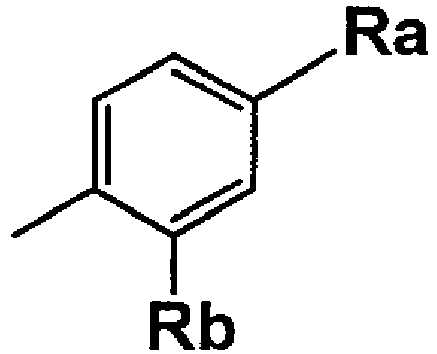
Ra represents an n-propoxy group substituted with a piperazinyl group which is substituted with an acetyl group, and Rb represents a methyl group which may be substituted with a fluorine atom);
Ra represents a phenyl group);
- Ra represents a hydroxy-isopropyl group, a hydroxy-oxetanyl group, or -(CH2)n-C(=O)-NRdRe;
- Rb represents a hydrogen atom or a fluorine atom; and
- Rd represents a methyl group, an ethyl group, a propynyl group, or a tert-butoxy group, and Re represents a hydrogen atom; or NRdRe forms azepane);

Ra represents a methoxy group); and
- Ra represents -(CH2)n-C(=O)-NRdRe; and
- Rd represents an ethyl group, a cyclopropyl group, a propynyl group, a trifluoroethyl group, or an ethyl group substituted with a tert-butoxycarbonylamino group, and Re represents a hydrogen atom).
- In another embodiment, in the formula (I),
X is a cyano group, Y is a halogen atom or a halogeno-C1-3 alkyl group, R2 is a hydrogen atom, and Z is a hydrogen atom;
R1 is a C6-14 aryl group which is substituted with Ra and may be substituted simultaneously with Rb or a 5- or 6-membered heteroaryl group which is substituted with Ra and may be substituted simultaneously with Rb; and
if Rb is a hydrogen atom, a halogen atom, or a C1-3 alkyl group which may be substituted with a halogen atom,
then Ra is selected from the following (a) to (g), preferably from the following (a), (b), (d), (f), and (g): - (a) a hydroxy-heterocycloalkyl group,
preferably a heterocycloalkyl group substituted with 1 to 3 hydroxyl groups,
more preferably an oxetanyl group substituted with 1 to 3 hydroxyl groups, and
even more preferably a 3-hydroxyoxetan-3-yl group; - (b) a C1-6 alkoxy group which may be substituted with Rc (wherein, Rc represents a piperazinyl group which may be substituted with C1-6 alkyl, C1-6 alkylcarbonyl, C1-6 alkoxycarbonyl, or C1-6 alkylaminocarbonyl),
preferably a C1-6 alkoxy group or a C1-6 alkoxy group substituted with a piperazinyl group which may be substituted with acetyl, and
more preferably a methoxy group or an n-propoxy group substituted with a piperazinyl group which may be substituted with an acetyl group; - (c) an amino-C1-6 alkyl group which may be substituted with Rf,
preferably the group and Rb are bonded to each other to form a fused ring together with the C6-14 aryl or the heteroaryl group; - (d) a halogeno-C1-3 alkoxy group, preferably a trifluoromethoxy group;
- (e) a C1-3 alkylsulfonyl group;
- (f) a bicyclic cycloheteroalkyl group, preferably a 2-oxa-6-azaspiro[3.3]heptyl group; and
- (g) -(CH2)n-C(=O)-NRdRe
- In another preferred embodiment, in the formula (I),
X is a cyano group, Y is a halogen atom or a halogeno-C1-3 alkyl group, R2 is a hydrogen atom, and Z is a hydrogen atom; and
if Rb is a hydrogen atom, a halogen atom, or a C1-3 alkyl group which may be substituted with a halogen atom,
then R1 is selected from the group consisting of the followings:
- Ra represents an amino-C1-6 alkyl group which may be substituted with Rf, a halogeno-C1-3 alkoxy group, a bicyclic heterocycloalkyl group, or a C1-6 alkoxy group which may be substituted with Rc (wherein, Rc represents a piperazinyl group which may be substituted with C1-6 alkyl, C1-6 alkylcarbonyl, C1-6 alkoxycarbonyl group, or C1-6 alkylaminocarbonyl), and Rb represents a hydrogen atom, a halogen atom, a C1-3 alkyl group which may be substituted with a halogen atom, or a C1-4 alkoxy group which may be substituted with a halogen atom; or
- Ra is an amino-C1-6 alkyl group which may be substituted with Rf, Rb is a C1-3 alkyl group, and the Ra and Rb are bonded to each other to form a fused ring together with the ring on which they are substituted);

Rb represents a hydrogen atom or a halogen atom); and
- Ra represents -(CH2)n-C(=O)-NRdRe (wherein, the - (CH2)n-C(=O)-NRdRe is as shown in the (g) above);
- Rb represents a hydrogen atom).
- In more preferred embodiment, in the formula (I),
X is a cyano group, Y is a halogen atom or a halogeno-C1-3 alkyl group, R2 is a hydrogen atom, and Z is a hydrogen atom, and
if Rb is a hydrogen atom, a halogen atom, or a C1-3 alkyl group which may be substituted with a halogen atom,
then R1 is selected from the group consisting of the followings:
- Ra represents a methoxy group, an n-propoxy group substituted with a piperazinyl group which may be substituted with an acetyl group, a trifluoromethoxy group, or a 2-oxa-6-azaspiro[3.3]heptyl group, and Rb represents a hydrogen atom, a fluorine atom, a chlorine atom, or a methyl group which may be substituted with a fluorine atom,
or - Ra is an amino-ethyl group which may be substituted with a tert-butoxycarbonyl group, Rb is a methyl group, and the Ra and Rb are bonded to each other to form a fused ring with the benzene ring);

- Ra is a hydroxy-oxetanyl group or -(CH2)n-C(=O)-NRdRe (wherein, the -(CH2)n-C(=O)-NRdRe is as shown in the (g) above) ;
- Rb represents a hydrogen atom or a fluorine atom); and

- Ra represents -(CH2)n-C(=O)-NRdRe (wherein, the-(CH2)n-C(=O)-NRdRe is as shown in the (g) above); and
- Rb represents a hydrogen atom).
- Accordingly, in a preferred embodiment, the fused pyrimidine compound of the present invention is represented by the following formula (I):

- X represents a cyano group or a nitro group;
- Y represents a halogen atom, a halogeno-C1-3 alkyl group, a C1-3 alkoxy group, or a C1-3 alkyl group;
- Z represents a hydrogen atom, a halogen atom, or a C1-3 alkyl group;
- R1 represents a C6-14 aryl group which is substituted with Ra and may be substituted simultaneously with Rb or a 5- or 6-membered heteroaryl group which is substituted with Ra and may be substituted simultaneously with Rb, wherein the Ra and Rb may be bonded to each other to form a fused ring together with the C6-14 aryl or heteroaryl group; and
- R2 represents a hydrogen atom, a C1-3 alkyl group, or a cyano group, wherein
- Ra represents a phenyl group, a hydroxy-C1-6 alkyl group, a hydroxy-C3-7 cycloalkyl group, a hydroxy-heterocycloalkyl group, a C1-6 alkoxy group which may be substituted with Rc, an amino-C1-6 alkyl group which may be substituted with Rf, a halogeno-C1-3 alkoxy group, a C3-7 cycloalkylaminosulfonyl group, a C1-3 alkylsulfonyl group, a 3- to 7-membered monocyclic heterocycloalkylsulfonyl group, a C1-3 alkoxycarbonylamino group which may be substituted with a halogen, a C1-3 alkylcarbonylamino group which may be substituted with a halogen, a 3- to 7-membered monocyclic heterocycloalkanecarbonyl group substituted with a hydroxy-C1-6 alkyl group, a bicyclic heterocycloalkyl group, or -(CH2)n-C(=O)-NRdRe;
- Rb represents a hydrogen atom, a halogen atom, a C1-3 alkyl group which may be substituted with a halogen atom, or a C1-4 alkoxy group which may be substituted with a halogen atom;
- Rc represents a pyrazolyl group, triazolyl group, or tetrazolyl group which each may be substituted or a piperazinyl group which may be substituted with Rf;
- Rd and Re each independently represent a hydrogen atom, a C1-3 alkyl group, a C2-6 alkynyl group, a C1-6 alkoxy group, a C3-7 cycloalkyl group, a halogeno-C1-3 alkyl group, a hydroxy-C1-6 alkyl group, a hydroxy-C3-7 cycloalkyl group, a hydroxy-C3-7 cycloalkyl-C1-6 alkyl group, a C1-4 alkoxy group, or a C1-6 alkyl group substituted with Rg, or NRdRe may form a ring;
- Rf represents C1-6 alkyl, C1-6 alkylcarbonyl, C1-6 alkylsulfonyl, a C1-6 alkoxycarbonyl group, or C1-6 alkylaminocarbonyl;
- Rg represents a C1-6 alkylpyrazolyl group, a halogeno-C1-3 alkylthiazolyl group, an oxadiazolyl group, a halogeno-C1-3 alkyloxadiazolyl group, or a C1-6 alkoxycarbonylamino group; and
- n represents an integer of from 0 to 3 (provided that if X is a cyano group, Y is a halogen atom or a halogeno-C1-3 alkyl group, R2 is a hydrogen atom, Z is a hydrogen atom,
- R1 is a C6-14 aryl group which is substituted with Ra and may be substituted simultaneously with Rb or a 5- or 6-membered heteroaryl group which is substituted with Ra and may be substituted simultaneously with Rb, and
- Rb is a hydrogen atom, a halogen atom, or a C1-3 alkyl group which may be substituted with a halogen atom;
- then Ra is
- a hydroxy-heterocycloalkyl group,
- a C1-6 alkoxy group which may be substituted with Rc (wherein, Rc represents a piperazinyl group which may be substituted with C1-6 alkyl, C1-6 alkylcarbonyl, C1-6 alkoxycarbonyl, or C1-6 alkylaminocarbonyl),
- an amino-C1-6 alkyl group which may be substituted with Rf (wherein, Rf is as described above),
- a halogeno-C1-3 alkoxy group,
- a C1-3 alkylsulfonyl group,
- a bicyclic cycloheteroalkyl group, or
- -(CH2)n-C(=O)-NRdRe (wherein, n, Rd, and Re are as described above, provided that if either one of Rd and Re is a halogeno-C1-3 alkyl group, a hydroxy-C1-6 alkyl group, a hydroxy-C3-7 cycloalkyl group, a hydroxy-C3-7 cycloalkyl-C1-6 alkyl group, or a C1-6 alkyl group substituted with C1-6 alkylpyrazolyl, halogeno-C1-3 alkylthiazolyl, oxadiazolyl, or halogeno-C1-3 alkyloxadiazolyl, then the other is not a hydrogen atom))].
- In a more preferred embodiment of the fused pyrimidine compound of the present invention, in the formula (I),
X represents a cyano group or a nitro group;
Y represents a halogen atom, a halogeno-C1-3 alkyl group, a C1-3 alkoxy group, or a C1-3 alkyl group;
Z represents a hydrogen atom or a halogen atom;
R1 is a substituent selected from the group consisting of the followings:
Ra represents a phenyl group, a hydroxy-C1-6 alkyl group, a hydroxy-heterocycloalkyl group, a C1-6 alkoxy group which may be substituted with Rc, an amino-C1-6 alkyl group which may be substituted with Rf, a halogeno-C1-3 alkoxy group, a bicyclic heterocycloalkyl group, or-(CH2)n-C(=O)-NRdRe;
Rb represents a hydrogen atom, a halogen atom, a C1-3 alkyl group which may be substituted with a halogen atom, or a C1-4 alkoxy group which may be substituted with a halogen atom;
or Ra and Rb are bonded to each other to form a fused ring together with the ring on which they are substituted;
Rc represents a piperazinyl group which may be substituted with Rf;
Rd and Re each independently represent a hydrogen atom, a C1-3 alkyl group, a C2-6 alkynyl group, a C1-6 alkoxy group, a C3-7 cycloalkyl group, a halogeno-C1-3 alkyl group, or a C1-6 alkyl group substituted with Rg;
or NRdRe forms a 3- to 7-membered nitrogen-containing heterocyclic ring;
Rf represents a C1-6 alkyl group, a C1-6 alkylcarbonyl group, a C1-6 alkylsulfonyl group, a C1-6 alkoxycarbonyl group, or a C1-6 alkylaminocarbonyl group;
Rg represents a C1-6 alkoxycarbonylamino group; and
n represents an integer of 0 or 1
(provided that if X is a cyano group, Y is a halogen atom or a halogeno-C1-3 alkyl group, R2 is a hydrogen atom, Z is a hydrogen atom,
R1 is as described above in this paragraph, and
Rb is a hydrogen atom, a halogen atom, or a C1-3 alkyl group which may be substituted with a halogen atom;
then Ra is
a hydroxy-heterocycloalkyl group,
a C1-6 alkoxy group which may be substituted with Rc (wherein, Rc represents a piperazinyl group which may be substituted with C1-6 alkyl, C1-6 alkylcarbonyl, C1-6 alkoxycarbonyl, or C1-6 alkylaminocarbonyl),
an amino-C1-6 alkyl group which may be substituted with Rf (wherein, Rf is as defined above in this paragraph),
a halogeno-C1-3 alkoxy group,
a bicyclic cycloheteroalkyl group, or -(CH2)n-C(=O)-NRdRe (wherein, n, Rd, and Re are as defined above in this paragraph, provided that if Rd is a halogeno-C1-3 alkyl group, then Re is not a hydrogen atom)). - In even more preferred embodiment of the fused pyrimidine compound of the present invention, in the formula (I),
X represents a cyano group or a nitro group,
Y represents a chlorine atom, a bromine atom, a trifluoromethyl group, a methoxy group, an isopropoxy group, or a methyl group;
Z represents a hydrogen atom or a fluorine atom;
R1 is a substituent selected from the group consisting of the followings:
Ra represents a phenyl group, a hydroxy-ethyl group, a hydroxy-isopropyl group, a hydroxy-oxetanyl group, a methoxy group, a trifluoromethoxy group, a 2-oxa-6-azaspiro[3.3]heptyl group, -(CH2)n-C(=O)-NRdRe, or an n-propoxy group substituted with a piperazinyl group which may be substituted with acetyl, tert-butoxycarbonyl, mesyl, or methyl;
Rb represents a hydrogen atom, a fluorine atom, a chlorine atom, a methyl group, a trifluoromethyl group, or a methoxy group;
or Ra and Rb are bonded to each other to form a substituted or unsubstituted tetrahydroisoquinolinyl group or isoindolinyl group together with the ring on which they are substituted;
either one of Rd and Re represents a methyl group, an ethyl group, a propynyl group, a cyclopropyl group, a trifluoroethyl group, a tert-butoxy group, or an ethyl group substituted with a tert-butoxycarbonylamino, and the other represents a hydrogen atom or a methyl group;
or NRdRe forms azepane; and
n is 0
(provided that if X is a cyano group, Y is a chlorine atom, a bromine atom, or a trifluoromethyl group, R2 is a hydrogen atom, Z is a hydrogen atom,
R1 is as described in this paragraph, and
Rb is a hydrogen atom, a fluorine atom, or a trifluoromethyl group;
then Ra is
a hydroxy-oxetanyl group,
a trifluoromethoxy group,
a 2-oxa-6-azaspiro[3.3]heptyl group,
an n-propoxy group substituted with a piperazinyl group which may be substituted with acetyl, tert-butoxycarbonyl, mesyl, or methyl, or
-(CH2)n-C(=O)-NRdRe (wherein, n, Rd, and Re are as defined above in this paragraph, provided that if either one of Rd and Re is a trifluoroethyl group, then the other is not a hydrogen atom)). - Specific examples of the preferred fused pyrimidine compound in the present invention include the compounds shown in the following (1) to (48):
- (1) 6-((7-(3-chloro-4-cyanophenyl)-5,6,7,8-tetrahydropyrido[3,4-d]pyrimidin-4-yl)amino)-N-ethyl-2-fluoronicotinamide
- (2) 6-((7-(3-chloro-4-cyanophenyl)-5,6,7,8-tetrahydropyrido[3,4-d]pyrimidin-4-yl)amino)-2-fluoro-N-methylnicotinamide
- (3) 6-((7-(4-cyano-3-(trifluoromethyl)phenyl)-5,6,7,8-tetrahydropyrido[3,4-d]pyrimidin-4-yl)amino)-2-fluoro-N-methylnicotinamide
- (4) 6-((7-(4-cyano-3-(trifluoromethyl)phenyl)-5,6,7,8-tetrahydropyrido[3,4-d]pyrimidin-4-yl)amino)-N-ethyl-2-fluoronicotinamide
- (5) 6-((7-(4-cyano-3-(trifluoromethyl)phenyl)-5,6,7,8-tetrahydropyrido[3,4-d]pyrimidin-4-yl)amino)-N-ethylnicotinamide
- (6) 4-(4-((5-(azepane-1-carbonyl)pyridin-2-yl)amino)-5,6-dihydropyrido[3,4-d]pyrimidin-7(8H)-yl)-2-(trifluoromethyl)benzonitrile
- (7) N-(tert-butoxy)-6-((7-(4-cyano-3-(trifluoromethyl)phenyl)-5,6,7,8-tetrahydropyrido[3,4-d]pyrimidin-4-yl)amino)nicotinamide
- (8) tert-butyl (2-(6-((7-(4-cyano-3-(trifluoromethyl)phenyl)-5,6,7,8-tetrahydropyrido[3,4-d]pyrimidin-4-yl)amino)pyridazine-3-carboxamido)ethyl)carbamate
- (9) 6-((7-(4-cyano-3-(trifluoromethyl)phenyl)-5,6,7,8-tetrahydropyrido[3,4-d]pyrimidin-4-yl)amino)-N-cyclopropylpyridazine-3-carboxamide
- (10) 6-((7-(4-cyano-3-(trifluoromethyl)phenyl)-5,6,7,8-tetrahydropyrido[3,4-d]pyrimidin-4-yl)amino)-N-ethylpyridazine-3-carboxamide
- (11) 6-((7-(4-cyano-3-(trifluoromethyl)phenyl)-5,6,7,8-tetrahydropyrido[3,4-d]pyrimidin-4-yl)amino)-N-(prop-2-yn-1-yl)pyridazine-3-carboxamide
- (12) N-ethyl-2-fluoro-6-((7-(4-nitro-3-(trifluoromethyl)phenyl)-5,6,7,8-tetrahydropyrido[3,4-d]pyrimidin-4-yl)amino)nicotinamide
- (13) 2-(6-((7-(3-chloro-4-nitrophenyl)-5,6,7,8-tetrahydropyrido[3,4-d]pyrimidin-4-yl)amino)pyridin-3-yl)propan-2-ol
- (14) 2-(6-((7-(4-nitro-3-(trifluoromethyl)phenyl)-5,6,7,8-tetrahydropyrido[3,4-d]pyrimidin-4-yl)amino)pyridin-3-yl)propan-2-ol
- (15) 2-(6-((7-(3-methoxy-4-nitrophenyl)-5,6,7,8-tetrahydropyrido[3,4-d]pyrimidin-4-yl)amino)pyridin-3-yl)propan-2-ol
- (16) 2-(6-((7-(3-methyl-4-nitrophenyl)-5,6,7,8-tetrahydropyrido[3,4-d]pyrimidin-4-yl)amino)pyridin-3-yl)propan-2-ol
- (17) 2-(6-((7-(3-bromo-4-nitrophenyl)-5,6,7,8-tetrahydropyrido[3,4-d]pyrimidin-4-yl)amino)pyridin-3-yl)propan-2-ol
- (18) 2-(6-((7-(3-chloro-2-fluoro-4-nitrophenyl)-5,6,7,8-tetrahydropyrido[3,4-d]pyrimidin-4-yl)amino)pyridin-3-yl)propan-2-ol
- (19) 2-(6-((7-(3-isopropoxy-4-nitrophenyl)-5,6,7,8-tetrahydropyrido[3,4-d]pyrimidin-4-yl)amino)pyridin-3-yl)propan-2-ol
- (20) 4-(4-((5-(2-hydroxypropan-2-yl)pyridin-2-yl)amino)-5,6-dihydropyrido[3,4-d]pyrimidin-7(8H)-yl)-2-methylbenzonitrile
- (21) N-(3-fluoro-4-methoxyphenyl)-7-(4-nitro-3-(trifluoromethyl)phenyl)-5,6,7,8-tetrahydropyrido[3,4-d]pyrimidin-4-amine
- (22) 7-(3-chloro-4-nitrophenyl)-N-(3-fluoro-4-methoxyphenyl)-5,6,7,8-tetrahydropyrido[3,4-d]pyrimidin-4-amine
- (23) 4-(4-((5-(2-hydroxypropan-2-yl)pyridin-2-yl)amino)-5,6-dihydropyrido[3,4-d]pyrimidin-7(8H)-yl)-2-methoxybenzonitrile
- (24) 6-((7-(4-nitro-3-(trifluoromethyl)phenyl)-5,6,7,8-tetrahydropyrido[3,4-d]pyrimidin-4-yl)amino)-N-(2,2,2-trifluoroethyl)pyridazine-3-carboxamide
- (25) N-(6-methoxypyridin-3-yl)-7-(4-nitro-3-(trifluoromethyl)phenyl)-5,6,7,8-tetrahydropyrido[3,4-d]pyrimidin-4-amine
- (26) 4-(4-((3,4-dimethoxyphenyl)amino)-5,6-dihydropyrido[3,4-d]pyrimidin-7(8H)-yl)-2-(trifluoromethyl)benzonitrile
- (27) 4-(4-((4-(trifluoromethoxy)phenyl)amino)-5,6-dihydropyrido[3,4-d]pyrimidin-7(8H)-yl)-2-(trifluoromethyl)benzonitrile
- (28) 4-(4-((4-(2-oxa-6-azaspiro[3.3]heptan-6-yl)phenyl)amino)-5,6-dihydropyrido[3,4-d]pyrimidin-7(8H)-yl)-2-chlorobenzonitrile
- (29) tert-butyl 5-((7-(3-chloro-4-cyanophenyl)-5,6,7,8-tetrahydropyrido[3,4-d]pyrimidin-4-yl)amino)isoindoline-2-carboxylate
- (30) tert-butyl 4-(3-(2-chloro-4-((7-(4-nitro-3-(trifluoromethyl)phenyl)-5,6,7,8-tetrahydropyrido[3,4-d]pyrimidin-4-yl)amino)phenoxy)propyl)piperazine-1-carboxylate
- (31) N-(3,4-dimethoxyphenyl)-7-(4-nitro-3-(trifluoromethyl)phenyl)-5,6,7,8-tetrahydropyrido[3,4-d]pyrimidin-4-amine
- (32) tert-butyl 7-((7-(4-nitro-3-(trifluoromethyl)phenyl)-5,6,7,8-tetrahydropyrido[3,4-d]pyrimidin-4-yl)amino)-3,4-dihydroisoquinoline-2(1H)-carboxylate
- (33) N-(3-methyl-4-(2-oxa-6-azaspiro[3.3]heptan-6-yl)phenyl)-7-(4-nitro-3-(trifluoromethyl)phenyl)-5,6,7,8-tetrahydropyrido[3,4-d]pyrimidin-4-amine
- (34) N-([1,1'-biphenyl]-3-yl)-7-(4-nitro-3-(trifluoromethyl)phenyl)-5,6,7,8-tetrahydropyrido[3,4-d]pyrimidin-4-amine
- (35) 2-chloro-4-(4-((6-fluoro-5-(3-hydroxyoxetan-3-yl)pyridin-2-yl)amino)-5,6-dihydropyrido[3,4-d]pyrimidin-7(8H)-yl)benzonitrile
- (36) tert-butyl 7-((7-(3-chloro-4-cyanophenyl)-5,6,7,8-tetrahydropyrido[3,4-d]pyrimidin-4-yl)amino)-3,4-dihydroisoquinolin-2(lH)-carboxylate
- (37) 2-chloro-4-(4-((1,2,3,4-tetrahydroisoquinolin-7-yl)amino)-5,6-dihydropyrido[3,4-d]pyrimidin-7(8H)-yl)benzonitrile
- (38) 2-chloro-4-(4-((4-(3-(piperazin-1-yl)propoxy)-3-(trifluoromethyl)phenyl)amino)-5,6-dihydropyrido[3,4-d]pyrimidin-7(8H)-yl)benzonitrile
- (39) 1-(4-(3-(2-chloro-4-((7-(4-nitro-3-(trifluoromethyl)phenyl)-5,6,7,8-tetrahydropyrido[3,4-d]pyrimidin-4-yl)amino)phenoxy)propyl)piperazin-1-yl)ethanone
- (40) N-(3-chloro-4-(3-(4-(methylsulfonyl)piperazin-1-yl)propoxy)phenyl)-7-(4-nitro-3-(trifluoromethyl)phenyl)-5,6,7,8-tetrahydropyrido[3,4-d]pyrimidin-4-amine
- (41) N-(3-chloro-4-(3-(4-methylpiperazin-1-yl)propoxy)phenyl)-7-(4-nitro-3-(trifluoromethyl)phenyl)-5,6,7,8-tetrahydropyrido[3,4-d]pyrimidin-4-amine
- (42) 4-(4-((4-(3-(4-acetylpiperazin-1-yl)propoxy)-3-chlorophenyl)amino)-5,6-dihydropyrido[3,4-d]pyrimidin-7(8H)-yl)-2-chlorobenzonitrile
- (43) 4-(4-((4-(3-(4-acetylpiperazin-1-yl)propoxy)-3-(trifluoromethyl)phenyl)amino)-5,6-dihydropyrido[3,4-d]pyrimidin-7(8H)-yl)-2-chlorobenzonitrile
- (44) 4-(4-((4-(3-(4-acetylpiperazin-1-yl)propoxy)-2-(trifluoromethyl)phenyl)amino)-5,6-dihydropyrido[3,4-d]pyrimidin-7(8H)-yl)-2-(trifluoromethyl)benzonitrile
- (45) 1-(4-(3-(4-((7-(4-nitro-3-(trifluoromethyl)phenyl)-5,6,7,8-tetrahydropyrido[3,4-d]pyrimidin-4-yl)amino)-2-(trifluoromethyl)phenoxy)propyl)piperazin-1-yl)ethanone
- (46) 1-(4-(3-(4-((7-(4-nitro-3-(trifluoromethyl)phenyl)-5,6,7,8-tetrahydropyrido[3,4-d]pyrimidin-4-yl)amino)phenoxy)propyl)piperazin-1-yl)ethanone
- (47) 7-(4-cyano-3-(trifluoromethyl)phenyl)-4-((4-methoxyphenyl)amino)-5,6,7,8-tetrahydropyrido[3,4-d]pyrimidine-2-carbonitrile
- (48) 4-(4-((4-methoxyphenyl)amino)-2-methyl-5,6-dihydropyrido[3,4-d]pyrimidin-7(8H)-yl)-2-(trifluoromethyl)benzonitrile
- The fused pyrimidine compound of the present invention or a salt thereof can be produced by various methods. The compound represented by the formula (I) can be produced according to a generally known method. For example, the compound represented by the formula (I) can be produced by the following Reaction scheme 1.


- The Reaction scheme 1 is a reaction scheme for synthesizing a compound of the formula (Ia) from a compound of the formula (II). In Reaction scheme 1, X, Y, Z, R2, Ra, and Rb are as defined above and can be each appropriately selected; and Ar represents a C6-14 aryl group or a 5 to 6-membered heteroaryl group.
- This step is a reaction for deprotecting the protecting group P of the compound of the formula (II) shown in Reaction scheme 1 above. As for the method for deprotection, it can be performed by a generally known method, for example, the method described in Protective Groups in Organic Synthesis, T. W. Greene, John Wiley & Sons (1981) or a method similar to it. Examples of the protecting group P include a Boc group, a benzyloxycarbonyl group, and a benzyl group. When a benzyl group is used as a protecting group P, examples of the catalyst for hydrogenolysis include palladium hydroxide, palladium/carbon, platinum, Raney nickel, platinum oxide, and rhodium-aluminum oxide. Preferably, it is palladium/carbon. The amount used of the reagent is, relative to 1 eqv. of the compound of the formula (II), 0.001 to 10 eqv., and preferably 0.05 to 2 eqv. Temperature for deprotecting reaction is 0 to 100°C, and preferably 40 to 80°C. The solvent used in this step may be any solvent that does not cause any problem in the reaction, and examples thereof include methanol, THF, ethyl acetate, DMF, pyridine, and a solvent mixture thereof. A preferred solvent is methanol. The compound of the formula (III) obtained by this step can be separated and purified by a known means for separation and purification, for example, concentration, concentration under reduced pressure, crystallization, re-precipitation, and chromatography, or it can be subjected to the next step without any separation and purification.
- In this step, a compound represented by the formula (V) is produced by a nucleophilic substitution reaction between an amine represented by the formula (III) and an aromatic ring having a leaving group L1 represented by the formula (IV). Examples of the leaving group L1 include, in addition to a halogen atom such as fluorine and chlorine, a methanesulfonyloxy group, a p-toluenesulfonyloxy group, and a trifluoromethanesulfonyloxy group. The solvent used for this step is not particularly limited as long as it does not cause any problem on the reaction. Examples of the solvent include toluene, acetonitrile, benzene, dioxane, THF, DMSO, DMF, pyridine, and a mixed solvent thereof. It is preferably DMSO. The equivalent of the aromatic ring represented by the formula (IV), which is used for this reaction, is 0.1 to excess mol and preferably 0.5 to 3 mol relative to 1 mol of the amine represented by the formula (III). In the reaction, a base may or may not be used. When a base is used, examples of the base include pyridine, DBU, potassium carbonate, cesium carbonate, and tertiary amine. The base is preferably triethylamine or potassium carbonate. The temperature for the nucleophilic substitution reaction is 0 to 200°C, and preferably 0 to 50°C. The compound of the formula (V) obtained by this step can be separated and purified by a known means for separation and purification, for example, concentration, concentration under reduced pressure, crystallization, re-precipitation, and chromatography, or it can be subjected to the next step without any separation and purification.
- In another method of this step, the compound represented by the formula (V) can be produced using a metal catalyst and a phosphine ligand. As the metal catalyst, a metal complex having various ligands can be used, and examples thereof include tetrakistriphenylphosphine palladium (0), chlorobis(triphenylphosphine)palladium (II), tris (dibenzylideneacetone)dipalladium (0), and palladium acetate (II). Examples of the phosphine ligand include dppf, Xantphos, and XPhos. Examples of the base used for the reaction of this step include potassium carbonate, cesium carbonate, and sodium tert-butoxide. The solvent which can be used for this step is not particularly limited as long as it does not cause any problem on the reaction. Examples of the solvent include dioxane, ethyl acetate, toluene, and pyridine. The amount of the metal catalyst used for the reaction is, relative to 1 mol of the compound of the formula (III), 0.005 to 10 mol, and preferably 0.01 to 1 mol. The time of the reaction is 0.1 to 48 hours, and preferably 0.5 to 24 hours. The reaction temperature is 0 to 200°C, and preferably 50 to 150°C. The compound of the formula (V) obtained by this step can be separated and purified by a known means for separation and purification, for example, concentration, concentration under reduced pressure, crystallization, re-precipitation, and chromatography.
- This step is a step for converting the free hydroxyl group of the compound of the formula (V) to a leaving group L2. Examples of the leaving group L2 include the same groups as L1, and it is preferably a halogen atom. The conversion reaction is carried out without a solvent or in the presence of a solvent. Examples of the solvent which can be used for this step is not particularly limited as long as it does not cause any problem on the reaction. Examples of the solvent include DMF, NMP, DMA, toluene, dichloroethane, and acetonitrile. Examples of the base used for the reaction include triethylamine, diisopropylethylamine, N,N-dimethylaniline, and sodium hydrogen carbonate. The amount of the halogenating agent used for the reaction (e.g., phosphorus oxychloride, phosphorus pentachloride, and phosphorus tribromide) is, relative to 1 mol of the compound of the formula (V), 0.5 to 20 mol, and preferably 5 to 15 mol. The time of the conversion reaction is 0.1 to 48 hours, and preferably 0.5 to 24 hours. The reaction temperature is 0 to 200°C, and preferably 50 to 120°C. The compound of the formula (VI) obtained by this step can be separated and purified by a known means for separation and purification, for example, concentration, concentration under reduced pressure, crystallization, re-precipitation, and chromatography, or it can be subjected to the next step without any separation and purification.
- This step is a step for obtaining a compound of the formula (Ia) by linking the compound of the formula (VI) to the compound of the formula (VII). The reaction of this step is performed by using a metal catalyst and a phosphine ligand in a suitable solvent, in the presence of various bases. The equivalent of the compound of the formula (VII) is, relative to 1 mol of the compound of the formula (VI), 0.1 to excess mol, and preferably 1 to 10 mol. As the metal catalyst, a metal complex having various ligands can be used, and examples thereof include tetrakistriphenylphosphine palladium (0), chlorobis(triphenylphosphine)palladium (II), tris (dibenzylideneacetone)dipalladium (0), and palladium acetate (II). Examples of the phosphine ligand include dppf, Xantphos, and XPhos. Examples of the base used for the reaction of this step include potassium carbonate, cesium carbonate, and sodium tert-butoxide. The solvent which can be used for this step is not particularly limited as long as it does not cause any problem on the reaction. Examples of the solvent include dioxane, ethyl acetate, and toluene. The amount of the metal catalyst used for the reaction is, relative to 1 mol of the compound of the formula (VI), 0.005 to 10 mol, and preferably 0.01 to 1 mol. The amount of the base is, relative to 1 mol of the compound of the formula (VI), 0.1 to 20 mol and preferably 1.0 to 5.0 mol. The time of the reaction is 0.1 to 48 hours, and preferably 0.5 to 24 hours. The reaction temperature is 0 to 200°C, and preferably 50 to 120°C. The compound of the formula (Ia) obtained by this step can be separated and purified by a known means for separation and purification, for example, concentration, concentration under reduced pressure, crystallization, re-precipitation, and chromatography.
- According to another method for this step, the compound represented by the formula (Ia) can be obtained by using only a base without using the metal catalyst and phosphine ligand. Examples of the base include potassium carbonate. The amount of the base is, relative to 1 mol of the compound of the formula (VI), 0.005 to 10 mol, and preferably 1.0 to 5.0 mol. The solvent used for the reaction of this step is not particularly limited as long as it does not cause any problem on the reaction. Examples of the solvent include acetonitrile and dioxane. The time of the reaction is 0.1 to 48 hours, and preferably 0.5 to 24 hours. The reaction temperature is 0 to 200°C, and preferably 50 to 120°C. The compound of the formula (Ia) obtained by this step can be separated and purified by a known means for separation and purification, for example, concentration, concentration under reduced pressure, crystallization, re-precipitation, and chromatography.
- As another method for this step, the linking between the compound of the formula (VI) and the compound of the formula (VII) can be performed by using an acid instead of using the metal catalyst and phosphine ligand. The equivalent of the compound of the formula (VII) is, relative to 1 mol of the compound of the formula (VI), 0.1 to excess mol, and preferably 1 to 10 mol. Examples of the acid which is used include paratoluenesulfonic acid, camphorsulfonic acid, and hydrochloric acid. The amount of the acid is, relative to 1 mol of the compound of the formula (VI), 0.005 to excess mol, and preferably 0.1 to 10 mol. The solvent used for the reaction of this step is not particularly limited as long as it does not cause any problem on the reaction. Examples of the solvent include tert-butanol, 2-propanol, THF, and dioxane. The time of the reaction is 0.1 to 48 hours, and preferably 0.1 to 24 hours. The reaction temperature is 0 to 200°C, and preferably 50 to 180°C. The compound of the formula (Ia) obtained by this step can be separated and purified by a known means for separation and purification, for example, concentration, concentration under reduced pressure, crystallization, re-precipitation, and chromatography.
- In the production method described above, R2, Ra, Rb, and L2 each can be subjected to introduction of a protecting group, deprotection, or conversion in an appropriate step according to a common method.
- The order of each step of Reaction scheme 1 can be changed. As an alternative method by changing the order of the steps of Reaction scheme 1, the following Reaction scheme 2 can be used.

- The fused pyrimidine compound represented by the formula (I) (hereinbelow, it may be also referred to as the "compound of the formula (I) of the present invention"), which is obtained by the process described above, may have an optical isomer or a geometric isomer depending on the type of a substituent group, and any of those is also included in the compound of the formula (I) of the present invention. The isomers may be subjected to resolution or used as a mixture of the isomers by themselves. Furthermore, tautomers shown below are present for the fused pyrimidine compound represented by the formula (I), and any of those tautomers is also included in the compound of the formula (I) of the present invention.

- Furthermore, a solvate represented by a hydrate, a non-crystalline (amorphous) or crystalline polymorph is also encompassed by the compound of the formula (I) of the present invention.
- The compound of the formula (I) of the present invention may form a salt according to a commonly known method. As for the type of the salt of the compound of the formula (I) of the present invention, any of the aforementioned pharmaceutically acceptable salts is possible.
- The compound of the formula (I) of the present invention or a salt thereof can be separated and purified by a known means for separation and purification, for example, concentration, solvent extraction, filtration, recrystallization, or various chromatographies.
- When the compound of the formula (I) of the present invention or a pharmaceutically acceptable salt thereof is used as a pharmaceutical agent, various administration forms can be adopted depending on purpose of prevention or treatment. Examples of the administration form include oral and parenteral administration forms, for example, an oral preparation, an injection, a suppository, an external preparation, and a patch. Preferably, an oral preparation is used. Each of those administration forms can be produced by a formulation method that is generally known to a person skilled in the art.
- The pharmaceutical agent can be a pharmaceutical composition containing an effective amount of the compound of the formula (I) of the present invention or a pharmaceutically acceptable salt, and a pharmaceutically acceptable carrier. As for the pharmaceutically acceptable carrier, various organic or inorganic carrier substances that are generally used as a material for formulation are used, and for a solid formulation, for example, there may be mentioned a vehicle, a lubricating agent, a binding agent, and a disintegrating agent, and for a liquid formulation, there may be mentioned a solvent, a dissolution aid, a suspending agent, an isotonic agent, a buffer agent, a stabilizing agent, a pH controlling agent, a surfactant, a wetting agent, a preservative, and a pain relieving agent. Furthermore, the pharmaceutical agent may contain formulation additives such as a preservative, an anti-oxidant, a coloring agent, a sweetening agent, and a flavoring agent, if necessary.
- The pharmaceutically acceptable carrier or formulation additives can be those that are generally used in the pertinent field. Examples of the vehicle include lactose, white sugar, sodium chloride, glucose, starch, calcium carbonate, kaolin, microcrystalline cellulose, and silicic acid; examples of the binding agent include water, ethanol, propanol, sweet syrup, glucose solution, starch solution, gelatin solution, carboxymethyl cellulose, hydroxypropyl cellulose, hydroxypropyl starch, methyl cellulose, ethyl cellulose, shellac, calcium phosphate, and polyvinylpyrrolidone; examples of the disintegrating agent include dry starch, sodium alginate, agar powder, sodium hydrogen carbonate, calcium carbonate, sodium lauryl sulfate, stearic acid monoglyceride, and lactose; examples of the lubricating agent include purified talc, stearic acid salt, borax, and polyethylene glycol; examples of the coloring agent include titanium oxide and iron oxide; and examples of the flavoring agent include white sugar, orange peel, citric acid, and tartaric acid.
- For producing a solid formulation for oral administration, the compound of the formula (I) of the present invention or a pharmaceutically acceptable salt thereof is added with a vehicle, and if necessary, with a binding agent, a disintegrating agent, a lubricating agent, a coloring agent, a flavoring agent, or the like, and prepared as a tablet, a coated tablet, a granule, a powder, or a capsule, for example, according to a commonly used method.
- For producing a liquid formulation for oral administration, the compound of the formula (I) of the present invention or a pharmaceutically acceptable salt thereof is added with a flavoring agent, a buffer agent, a stabilizing agent, or the like, and prepared as an internal liquid medicine, a syrup, or an elixir, for example. In that case, the flavoring agent may be the same as those described above; examples of the buffer agent include sodium citrate; and examples of the stabilizing agent include tragacanth, gum Arabic, and gelatin.
- For producing an injection, the compound of the formula (I) of the present invention or a pharmaceutically acceptable salt thereof is added with a pH controlling agent, a buffer agent, a stabilizing agent, an isotonic agent, a local anesthetic, or the like, and prepared as a subcutaneous, intramuscular, or intravenous injection according to a commonly used method. In that case, examples of the pH controlling agent and buffer agent include sodium citrate, sodium acetate, and sodium phosphate; examples of the stabilizing agent include sodium pyrosulfite, EDTA, thioglycolic acid, and thiolactic acid; examples of the local anesthetic include procaine hydrochloride and lidocaine hydrochloride; and examples of the isotonic agent include sodium chloride and glucose.
- For producing a suppository, the compound of the formula (I) of the present invention or a pharmaceutically acceptable salt thereof is added with a known carrier for formulation, e.g., polyethylene glycol, lanolin, kakao fat, and a fatty acid triglyceride, and if necessary, a surfactant such as Tween (registered trademark), and production is performed according to a common method.
- For producing an external preparation such as an ointment, a cream, a gel, or a paste, the compound of the formula (I) of the present invention or a pharmaceutically acceptable salt thereof is added with, if necessary, a commonly used base, a stabilizing agent, a wetting agent, or a preservative, and mixing and formulating are performed according to a common method. Examples of the base include fluid paraffin, white vaseline, white beeswax, octyl dodecyl alcohol, and paraffin. Examples of the preservative include methyl paraoxybenzoate, ethyl paraoxybenzoate, and propyl paraoxybenzoate.
- For producing a patch, the ointment, cream, gel, or paste, for example, are coated on a common support according to a common method. Examples of the support include a woven or non-woven fabric consisting of cotton, staple fiber, or chemical fiber, or a film or a foamed sheet of soft vinyl chloride, polyethylene, and polyurethane.
- The amount of the compound of the formula (I) of the present invention or a pharmaceutically acceptable salt thereof which needs to be blended in each administration unit form described above varies depending on symptom, weight, age, or sex of a subject for application, or a formulation type, for example. However, in terms of the amount of the compound of the formula (I) of the present invention, it is preferably 0.05 to 1000 mg for an oral preparation, 0.01 to 500 mg for an injection, and 1 to 1000 mg for a suppository. Furthermore, the daily dose of above administration form varies depending on species, symptom, weight, age, or sex of a subject for application. However, in terms of the amount of the compound of the formula (I) of the present invention, it is preferably 0.05 to 5000 mg, and preferably 0.1 to 1000 mg per day for an adult, and it is preferably administered once or in about 2 to 4 divided doses per day. With regard to the compound of the formula (I) of the present invention or a pharmaceutically acceptable salt, any one type of the compound or a salt may be used singly or a plurality of types may be used in combination.
- As described herein, the anti-androgen activity means an activity of suppressing the androgen activity, and a compound, a composition, or a pharmaceutical agent having the anti-androgen activity is referred to as an anti-androgen agent. The compound of the formula (I) of the present invention or a pharmaceutically acceptable salt thereof acts as an antagonist for an androgen receptor (AR) and suppresses the response of AR to androgen, thus exhibiting the anti-androgen activity. Furthermore, as the compound of the formula (I) of the present invention or a salt thereof also has an activity of reducing AR expression, it can exhibit an anti-androgen activity based on it. By having the anti-androgen activity, the compound of the formula (I) of the present invention or a pharmaceutically acceptable salt thereof exhibits the effect of suppressing an occurrence or progress of various disorders, an occurrence of tumor, or progress or recurrence of a progressive or recurrent tumor.
- Thus, according to another embodiment, provided by the present invention is an anti-androgen agent which contains, as an active ingredient, the compound of the formula (I) of the present invention or a pharmaceutically acceptable salt. Also provided by the present invention is use of the compound of the formula (I) of the present invention or a pharmaceutically acceptable salt thereof for producing an anti-androgen agent. Also provided by the present invention is use of the compound of the formula (I) of the present invention or a pharmaceutically acceptable salt thereof as an anti-androgen agent. Also provided by the present invention is the compound of the formula (I) of the present invention or a pharmaceutically acceptable salt thereof for use as an anti-androgen agent.
- According to another embodiment, provided by the present invention is a pharmaceutical agent which contains, as an active ingredient, the compound of the formula (I) of the present invention or a pharmaceutically acceptable salt. Also provided by the present invention is use of the compound of the formula (I) of the present invention or a pharmaceutically acceptable salt thereof for producing a pharmaceutical agent. Also provided by the present invention is use of the compound of the formula (I) of the present invention or a pharmaceutically acceptable salt thereof as a pharmaceutical agent. Also provided by the present invention is the compound of the formula (I) of the present invention or a pharmaceutically acceptable salt thereof for use as a pharmaceutical agent.
- According to another embodiment, provided by the present invention is a pharmaceutical composition which contains the compound of the formula (I) of the present invention or a pharmaceutically acceptable salt, and a pharmaceutically acceptable carrier.
- According to a preferred embodiment, the pharmaceutical agent or pharmaceutical composition is used as an anti-androgen agent. Furthermore, according to a preferred embodiment, the pharmaceutical agent or pharmaceutical composition is a therapeutic agent for a disorder related with AR activation. Furthermore, according to a preferred embodiment, the pharmaceutical agent or pharmaceutical composition is an anti-tumor agent.
- Meanwhile, according to another embodiment, provided by the present invention is a method of suppressing androgen activity including administering an effective amount of the compound of the formula (I) of the present invention or a pharmaceutically acceptable salt thereof to a subject. Also provided by the present invention is a method for treating a disorder related with AR activation including administering an effective amount of the compound of the formula (I) of the present invention or a pharmaceutically acceptable salt thereof to a subject. Also provided by the present invention is a method for treating tumor including administering an effective amount of the compound of the formula (I) of the present invention or a pharmaceutically acceptable salt thereof to a subject.
- With regard to a method for suppressing androgen activity, a method for treating a disorder related with AR activation, and a method for treating tumor according to the present invention, examples of the subject include a human or a non-human animal in need of the method. Examples of the non-human animal include primates such as a monkey and a chimpanzee, and mammals such as a mouse, a rat, a hamster, a guinea pig, a dog, a cat, a cow, a horse, a sheep, a goat, and a pig; however, it is not limited thereto.
- The effective amount or administration regimen of the compound of the formula (I) of the present invention or a pharmaceutically acceptable salt thereof administered to the above subject can be suitably determined by a person skilled in the art depending on, for example, species, symptom, weight, age, or sex, of the subject. For example, when the subject is an adult human, it is usually administered at 0.05 to 5000 mg, and preferably 0.1 to 1000 mg per day in terms of the amount of the compound of the formula (I) of the present invention, and it is preferably administered once or in about 2 to 4 divided doses per day.
- Examples of the disorder related with AR activation include tumor, metastatic bone disease, prostatic hyperplasia, acne vulgaris, seborrhea, hypertrichosis, androgenetic alopecia, precocious puberty, and virillizing syndrome. Examples of the tumor include prostate cancer, breast cancer, ovarian cancer, bladder cancer, uterine cancer, pancreatic cancer, and hepatocellular cancer. It is preferably prostate cancer. Meanwhile, the tumor also includes resistant, recurrent, or metastatic tumor. Thus, specific examples of the prostate cancer include, in addition to common prostate cancer, castration resistant prostate cancer (CRPC), hormone resistant prostate cancer (HRPC), PSA recurrent prostate cancer, taxan resistant prostate cancer, and radiation resistant prostate cancer. It is preferably castration resistant prostate cancer.
- Examples of a conventional anti-androgen agent include bicalutamide. However, as they have an agonist activity for AR, the effect is not maintained for a long period of time, and recurrent cancer is observed 2 to 5 years after the response. Furthermore, in CRPC, overexpression of AR is believed to be a cause of recurrence. The compound of the formula (I) of the present invention or a salt thereof has a potent antagonist activity for AR but no agonist activity therefor, and it exhibits a strong AR antagonist activity for cells in which AR is overexpressed. Furthermore, by having the activity of reducing AR expression in addition to the antagonist activity for AR, the compound of the formula (I) of the present invention or a salt thereof is effective for cancer having overexpressed AR such as CRPC.
- Hereinbelow, the present invention is described specifically by way of Examples and Test Examples. However, they are described solely for exemplification, and the scope of the present invention is not limited to them.
- In the following examples, each reagent used was commercially available one, unless specifically described otherwise. For silica gel column chromatography, Biotage (registered trademark) SNAP Ultra pre-packed column or Biotage (registered trademark) SNAP KP-NH pre-packed column (both manufactured by Biotage AB) was used.
- Reverse phase preparative HPLC column chromatography was performed at the following conditions.
- Column: YMC-Actus Triart C18 manufactured by YMC, 30×50 mm, 5 µm
- UV detection: 254 nm
- Column flow rate: 40 mL/min
- Mobile phase: water/acetonitrile (0.1% formic acid) Injection volume: 1.0 mL
- Gradient: water/acetonitrile 10% → 90% (8 minutes)
- For 1H-NMR spectrum measurement, AL400 (400 MHz; JEOL Ltd. (JEOL)), or Mercury400 (400 MHz; Agilent Technologies, Inc.) type spectrometer was used. For obtaining 1H-NMR spectrum, measurement was made using TMS (tetramethylsilane) as an internal standard, and chemical shift was represented in terms of δ value (ppm) . With regard to the chemical shift, number of protons, absorption pattern, and coupling constant (J value) were described in parentheses. With regard to the absorption pattern, the following symbols were used: s = singlet, d = doublet, t = triplet, q = quartet, sept = septet, dd = double doublet, dt = double triplet, dq = double quartet, m = multiplet, br-s = broad singlet, br-d = broad doublet, br-t = broad triplet, br-dd = broad double doublet.
- LCMS spectra were measured with an SQD manufactured by Waters Corporation under the following two conditions, and the retention time (RT) (min) and [M+H]+ value were shown.
- MS detection: ESI positive
- UV detection: 254 nm
- Column flow rate: 0.5 mL/min
- Mobile phase: water/acetonitrile (0.1% formic acid)
- Injection volume: 1 µL
- Column: Acguity BEH, 2.1×50 mm, 1.7 µm
-
Time (min) water/acetonitrile (0.1% formic acid) 0 95/5 0.1 95/5 2.1 5/95 3.0 STOP - Column: Acguity BEH, 2.1×50 mm, 1.7 µm
-
Time (min) water/acetonitrile (0.1% formic acid) 0 95/5 0.1 95/5 1.1 5/95 2.0 STOP - With regard to the structural formula of compounds, the following symbols may be used: Me = methyl, Et = ethyl, tBu = tert-butyl, Ph = phenyl, Bn = benzyl, Ac = acetyl, Boc = tert-butoxy carbonyl, Ms = methanesulfonyl.
- With regard to the solvent and reagent, the following abbreviations may be used:
- DMSO = dimethyl sulfoxide;
- DMF = N,N-dimethylformamide;
- THF = tetrahydrofuran;
- dba = dibenzylideneacetone;
- dppf = 1,1-bis(diphenylphosphino)ferrocene;
- XantPhos = 4,5-bis(diphenylphosphino)-9,9-dimethylxanthene;
- Boc2O = di-tert-butyl dicarbonate;
- DMAP = 4-dimethylaminopyridine;
- TFA = trifluoroacetic acid;
- DIPEA = diisopropylethylamine;
- DMT-MM = 4-(4,6-dimethoxy-1,3,5-triazin-2-yl)-4-methylmorpholinum chloride;
- HATU = O-(7-azabenzotriazol-1-yl)-N,N,N',N'-tetramethyluroniumhexafluorophosphate;
- HOBt = 1-hydroxybenzotriazole;
- mCPBA = 3-chloroperbenzoic acid
- WSC = EDCI = 1-ethyl-3-(3-dimethylaminopropyl)carbodiimide;
- DBU = 1,8-diazabicyclo[5,4,0]undecene;
- NMP = N-methyl-2-pyrrolidone;
- DMA = dimethylacetamide;
- DCC = N,N'-dicyclohexylcarbodiimide;
- DPPA = diphenylphosphoryl azide;
- LDA = lithium diisopropylamide.
-

-

1H-NMR (DMSO-d6) δ12.35 (1H, br-s), 8.09 (1H, S), 7.85 (1H, d, J=8.0Hz), 7.39 (1H, s), 7.32 (1H, d, J=8.0Hz), 4.34 (2H, s), 3.71 (2H, t, J=4.0), 2.56 (2H, t, J=4.0Hz). LCMS(A)RT 1.37, m/z[M+H]+321. -

- The solid (12.3 g) obtained in step 1 was suspended in dichloroethane (60 mL), and added with phosphorus oxychloride (36 mL) and triethylamine (12 mL), followed by stirring for 30 minutes at 90°C. The reaction mixture was added to water (300 mL), and the mixture was adjusted to pH 7 with sodium carbonate, followed by extraction with chloroform (300 mL × three times). The extract was dried over magnesium sulfate and was then concentrated, and the resulting solid was suspended and washed with ethyl acetate to obtain 9.4 g (72%) of the target compound.
1H-NMR (DMSO-d6) δ8.89 (1H, s), 7.89 (1H, d, J=8.0Hz), 7.47 (1H, s), 7.40 (1H, d, J=8.0Hz), 4.73 (2H, s), 3.90 (2H, t, J=4.0), 2.94 (2H, t, J=4.0Hz).
LCMS(A)RT 1.81, m/z [M+H]+339/341. -

- Commercially available 5,6,7,8-tetrahydropyrido[3,4-d]pyrimidin-4-ol hydrochloride (10.0 g), 2-chloro-4-fluorobenzonitrile (8.1 g), and triethylamine (22 mL) were added to DMSO (183 mL) and stirred for 2 days at room temperature. After adding water (400 mL), the reaction mixture was adjusted to pH 4 to 6 using conc. hydrochloric acid, and the precipitated solid was collected by filtration. The obtained solid was suspended and washed with ethyl acetate, followed by drying. Phosphorus oxychloride (15 mL) was added to the resulting solid (6.4 g), and the reaction mixture was heated to reflux for 10 minutes. The reaction mixture was concentrated under reduced pressure, water (400 mL) was added to the residue, and the aqueous layer was adjusted to pH 8 with sodium carbonate. The precipitated solid was collected by filtration, was dried, and was suspended and washed with toluene to obtain the target compound.
1H-NMR (DMSO-d6) δ8.87 (1H, s), 7.70 (1H, d, J=8.9Hz), 7.32 (1H, d, J=2.3Hz), 7.12 (1H, dd, J=8.9, 2.3Hz), 4.66 (2H, s), 3.83 (2H, t, J=5.8Hz), 2.90 (2H, t, J=5.8Hz). LCMS(A)RT 1.75, m/z[M+H]+ 305/307. -

- The target compound was obtained by the same procedure as Reference Example 1 except that 4-fluoro-1-nitro-2-(trifluoromethyl)benzene was used instead of 4-fluoro-2-(trifluoromethyl)benzonitrile.
1H-NMR (CDCl3) δ: 8.86 (1H, s), 8.08 (1H, d, J = 9.2 Hz), 7.27-7.24 (1H, m), 7.06 (1H, dd, J = 9.3, 2.7 Hz), 4.64 (2H, s), 3.86 (2H, t, J = 5.9 Hz), 3.09 (2H, t, J = 5.7 Hz) .
LCMS (A) RT 1.87, m/z [M+H]+ 359/361. -

-

- Commercially available 7-benzyl-4-chloro-5,6,7,8-tetrahydropyrido[3,4-d]pyrimidine (48 g), methyl 6-aminonicotinate (31 g), Pd(dba)2 (10.6 g), dppf (10.2 g), and cesium carbonate (133 g) were suspended in dioxane (1000 mL), and the reaction mixture was stirred under an argon atmosphere at 105°C for 3 hours. The reaction mixture was cooled, and the precipitated solid was then collected by filtration and was suspended and washed with toluene to obtain the target compound as a light yellow solid.
1H-NMR (DMSO-d6) δ: 9.39 (1H, s), 8.84 (1H, d, J = 2.6 Hz), 8.57 (1H, s), 8.32 (1H, d, J = 9.2 Hz), 8.26 (1H, d, J = 2.6 Hz), 7.36-7.36 (5H, m), 3.85 (3H, s), 3.68 (2H, s), 2.77 (2H, d, J = 4.8 Hz), 2.74 (2H, d, J = 4.4 Hz). LCMS (A) RT 1.09, m/z [M+H]+ 376. -

- Methylmagnesium bromide (3 mol/L ether solution, 60 mL) was dropwise added under ice cooling to a THF (400 mL) solution of the compound (15 g) obtained in step 1. The ice bath was removed after completion of the dropwise addition. The reaction mixture was stirred at room temperature for 2 hours, and 2 mol/L hydrochloric acid was added to the reaction mixture, followed by extraction with ethyl acetate. The organic layer was washed with saturated brine, was dried over magnesium sulfate, and was then concentrated under reduced pressure. The resulting residue was purified by silica gel column chromatography (eluent: chloroform-methanol) to obtain the target compound as a white solid.
1H-NMR (DMSO-d6) δ: 8.78 (1H, s), 8.43 (1H, s), 8.40 (1H, d, J = 2.2 Hz), 8.07 (1H, d, J = 8.4 Hz), 7.82 (1H, dd, J = 8.6, 2.4 Hz), 7.38-7.25 (5H, m), 5.16 (1H, s), 3.67 (2H, s), 2.72 (4H, s), 1.45 (6H, s) .
LCMS (A) RT 0.81, m/z [M+H] +376. -

- The compound (25 g) obtained in step 2, palladium hydroxide (50% wet) (9.3 g), and ammonium formate (33.6 g) were suspended in methanol (620 mL), and the reaction mixture was stirred at 60°C for 1.5 hours. The reaction mixture was filtered through Celite to remove insolubles, and the filtrate was concentrated under reduced pressure to obtain the target compound as a white solid.
1H-NMR (DMSO-d6) δ: 8.71 (1H, s), 8.44 (1H, s), 8.40 (1H, d, J = 2.2 Hz), 8.06 (1H, d, J = 8.8 Hz), 7.82 (1H, dd, J = 8.6, 2.4 Hz), 5.16 (1H, s), 3.72 (2H, s), 3.16 (1H, s), 2.99 (2H, t, J = 5.9 Hz), 2.59 (2H, t, J = 5.7 Hz), 1.45 (6H, s).
LCMS (A) RT 0.43, m/z [M+H] +286. -

-

1H-NMR (CDCl3) δ: 8.76 (1H, s), 8.56 (1H, dd, J = 8.4, 1.5 Hz), 8.43 (1H, t, J = 8.8 Hz), 7.53 (1H, d, J = 8.8 Hz), 7.38 (1H, s), 7.00 (1H, d, J = 2.6 Hz), 6.85 (1H, dd, J = 8.8, 2.6 Hz), 4.49 (2H, s), 3.95 (3H, s), 3.82 (2H, t, J = 5.7 Hz), 2.84 (2H, t, J = 5.7 Hz).
LCMS (A) RT 1.83, m/z [M+H] +439/441. -

- An aqueous solution (0.5 mL) of 5.0 mol/L sodium hydroxide was added to an ethanol (0.5 mL) solution of the compound (10 mg) obtained in step 1 at room temperature, and the reaction mixture was then stirred at 40°C for 1 hour. The reaction mixture was cooled, and 5.0 mol/L hydrochloric acid (0.55 mL) was added thereto. The precipitated solid was collected by filtration to obtain the target compound.
1H-NMR (DMSO-d6) δ: 9.23 (1H, s), 8.60 (1H, s), 8.12 (1H, t, J = 9.2 Hz), 7.98 (1H, d, J = 8.1 Hz), 7.68 (1H, d, J = 9.2 Hz), 7.31 (1H, d, J = 1.8 Hz), 7.11 (1H, dd, J = 9.2, 1.8 Hz), 4.50 (2H, s), 3.79 (2H, t, J = 5.3 Hz), 2.87 (2H, t, J = 4.8 Hz).
LCMS (A) RT 1.51, m/z [M+H] +425/427. -

- The target compound was obtained by the same procedure as Reference Example 5 except that Reference Example 1 was used instead of Reference Example 2.
1H-NMR (DMSO-d6) δ: 13.17 (1H, br-s), 9.86 (1H, s), 8.71 (1H, s), 8.35 (1H, dd, J = 9.9, 8.8 Hz), 8.14 (1H, dd, J = 8.4, 1.8 Hz), 7.87 (1H, d, J = 8.8 Hz), 7.45 (1H, d, J = 2.6 Hz), 7.38 (1H, dd, J = 8.8, 2.6 Hz), 4.61 (2H, s), 3.85 (2H, t, J = 5.7 Hz), 2.93 (2H, t, J = 5.1 Hz).
LCMS (A) RT 1.62, m/z [M+H] +459. -

-

1H-NMR (DMSO-d6) δ9.63 (1H, s), 8.82 (1H, s), 8.65 (1H, s), 8.27-8.21 (2H, m), 7.85 (1H, d, J=8.8Hz), 7.42 (1H, d, J=2.0Hz), 7.35 (1H, dd, J=8.8, 2.0Hz), 4.57 (2H, s), 3.85-3.80 (5H, m), 2.91 (2H, t, 5.2Hz).
LCMS(A)RT 1.77, m/z[M+H]+455. -

- An aqueous solution (11 mL) of 5.0 mol/L sodium hydroxide was added to a methanol (100 mL) suspension of the compound (9.21 g) obtained in step 1, and the reaction mixture was then stirred at 40°C overnight. The reaction mixture was cooled and was adjusted to pH about 3 with 5.0 mol/L hydrochloric acid. The precipitated solid was collected by filtration, was washed with water, and was dried under reduced pressure to obtain 8.24 g (92%) of the target compound as a crude product.
1H-NMR (DMSO-d6) δ9.59 (1H, s), 8.83 (1H, d, J=2.0Hz), 8.67 (1H, s), 8.27-8.23 (2H, m), 7.87 (1H, d, J=8.8Hz), 7.45 (1H, d, J=2.0Hz), 7.38 (1H, dd, J=2.4, 8.8Hz), 4.60 (2H, s), 3.86 (2H, t, J=5.6Hz), 2.93 (2H, t, J=5.6Hz). LCMS(A)RT 1.48, m/z[M+H]+441. -

-

1H-NMR (DMSO-d6) δ10.39 (1H, s), 8.65 (1H, s), 8.48 (1H, d, J=9.6Hz), 8.16 (1H, d, J=9.6Hz), 7.86 (1H, d, J=8.8Hz), 7.44 (1H, d, J=2.8Hz), 7.37 (1H, dd, J=8.8, 2.0Hz), 4.60 (2H, s), 3.91 (3H, s), 3.85 (2H, t, J=6.0Hz), 2.97 (2H, t, 5.6Hz). -

- By performing the same operation as Reference Example 7 (Step 2) and using the compound (2.30 g) obtained in this step 1 instead of the compound obtained in Reference Example 7 (Step 1), 2.04 g of the target compound was obtained.
1H-NMR (DMSO-d6) δ10.32 (1H, s), 8.64 (1H, s), 8.45 (1H, d, J=9.6Hz), 8.13 (1H, d, J=9.2Hz), 7.86 (1H, d, J=8.8Hz), 7.44 (1H, d, J=2.4Hz), 7.37 (1H, dd, J=8.8, 2.4Hz), 4.60 (2H, s), 3.85 (2H, t, J=5.6Hz), 2.97 (2H, t, 6.0Hz). LCMS(A)RT 1.42, m/z[M+H]+442. -
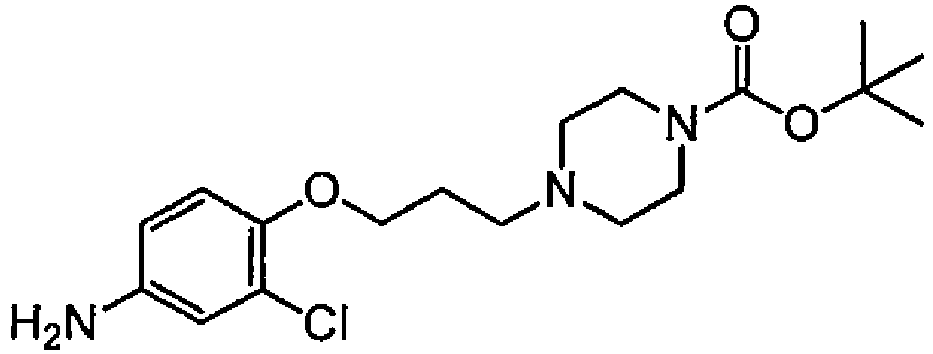
-

1H-NMR (CDCl3) δ 1.46 (9H, s), 1.94-2.04 (2H, m), 2.36-2.44 (4H, m), 2.51 (2H, t, J = 7.1 Hz), 3.44 (4H, br-s), 4.11 (2H, t, J = 6.2 Hz), 6.87 (1H, dd, J = 9.2, 2.6 Hz), 7.03 (1H, d, J = 2.6 Hz), 8.00 (1H, d, J = 9.2 Hz).
LCMS (B) RT 1.01, m/z [M+H] +400/402. -

- Hydrazine monohydrate (1 mL) and developed Raney nickel (0.3 mL) were added to a methanol (10 mL) solution of the compound (180 mg) obtained in step 1 at room temperature, and the reaction mixture was stirred at room temperature overnight. The precipitate was removed by filtration through Celite, and the solvent was then concentrated under reduced pressure to obtain the target compound as a yellow amorphous.
1H-NMR (CDCl3) δ 1.46 (9H, s), 1.89-2.04 (2H, m), 2.35-2.46 (4H, m), 2.55 (2H, br-t, J = 7.3 Hz), 3.43 (4H, br-s), 3.99 (2H, brt, J = 6.2 Hz), 6.52 (1H, dd, J = 8.4, 2.6 Hz), 6.73 (1H, d, J = 2.6 Hz), 6.78 (1H, br-d, J = 8.4 Hz).
LCMS (B) RT 0.80, m/z [M+H] +370/372. -

- The target compound was obtained by the same procedure as Reference Example 9 except that 1-fluoro-4-nitrobenzene was used instead of 2-chloro-1-fluoro-4-nitrobenzene.
1H-NMR (CDCl3) δ 1.46 (9H, s), 1.86-1.98 (1H, m), 2.40 (2H, br-t, J = 4.6 Hz), 2.51 (1H, t, J = 7.5 Hz), 3.43 (2H, br-t, J = 4.6 Hz), 3.94 (1H, t, J = 6.2 Hz), 6.63 (1H, d, J = 8.8 Hz), 6.74 (1H, d, J = 8.8 Hz).
LCMS (B) RT 0.70, m/z [M+H] +336. -

- The target compound was obtained by the same procedure as Reference Example 9 except that 1-fluoro-4-nitro-2-(trifluoromethyl)benzene was used instead of 2-chloro-1-fluoro-4-nitrobenzene.
1H-NMR (CDCl3) δ 1.46 (9H, s), 1.90-2.01 (2H, m), 2.40 (4H, br-t, J = 4.4 Hz), 2.54 (2H, t, J = 7.3 Hz), 3.43 (4H, br-t, J = 4.4 Hz), 4.01 (2H, t, J = 6.0 Hz), 6.78 (1H, dd, J = 8.8, 2.6 Hz), 6.83 (1H, d, J = 8.8 Hz), 6.90 (1H, d, J = 2.6 Hz) .
LCMS (B) RT 0.85, m/z [M+H] +404. -

- The target compound was obtained by the same procedure as Reference Example 9 except that 1-fluoro-4-nitro-3-(trifluoromethyl)benzene was used instead of 2-chloro-1-fluoro-4-nitrobenzene.
1H-NMR (CDCl3) δ 1.46 (9H, s), 2.40 (4H, br-t, J = 4.8 Hz), 2.51 (2H, d, J = 6.2 Hz), 3.44 (4H, br-t, J = 4.8 Hz), 3.86 (2H, br-s), 3.95 (2H, t, J = 6.2 Hz), 6.69 (1H, d, J = 8.8 Hz), 6.90 (1H, dd, J = 8.8, 2.9 Hz), 6.97 (1H, d, J = 2.9 Hz).
LCMS (B) RT 0.98, m/z [M+H] +404. -

-

1H-NMR (DMSO-d6) δ 8.81 (1H, s), 7.62-7.71 (2H, m), 7.49-7.52 (5H, m), 6.86-7.01 (2H, m), 3.81-4.67 (1H, m), 3.87-4.03 (6H, m), 3.75 (3H, s), 2.82-3.03 (2H, m), 2.35 (3H, s) .
LCMS (B) RT 1.14, m/z [M+H] +393. -

- 1-chloroethyl chloroformate (0.279 mL) was dropwise added to a 1,2-dichloroethane (10 mL) solution of the compound (507 mg) obtained in step 1 and diisopropylethylamine (0.89 mL) in an ice bath. The ice bath was removed, and the reaction mixture was then stirred at room temperature for 2 hours. The solvent was distilled off under reduced pressure, and methanol (5 mL) was then added thereto. The reaction mixture was stirred at room temperature overnight. The solvent was distilled off under reduced pressure, and chloroform was then added to the residue. The precipitated residue was collected by filtration to obtain the target compound as a white solid.
1H-NMR (CDCl3) δ 7.41-7.50 (2H, m), 6.83-6.94 (2H, m), 6.26 (1H, br-s), 4.49 (2H, br-s), 3.80-3.84 (3H, m), 3.74 (3H, s), 2.52 (2H, br-t, J = 5.4 Hz), 2.46 (3H, s).
LCMS (B) RT 0.97, m/z [M+H] +303. -

-

1H-NMR (CDCl3) δ 7.26-7.56 (8H, m), 6.83-7.08 (2H, m), 3.87-3.96 (2H, m), 3.81 (3H, s), 2.45-3.12 (6H, m), 2.05 (3H, s).
LCMS (B) RT 0.93, m/z [M+H] +361. -

- The compound (210 mg) obtained in step 1, 10% palladium/carbon (40 mg), and ammonium formate (184 mg) were suspended in methanol (6 mL), followed by stirring at 60°C for 3 hours. The insolubles were removed by filtration through Celite, and the filtrate was concentrated under reduced pressure. Water was added to the residue, followed by extraction with a solvent mixture of chloroform and methanol three times. The collected organic layer was dried over sodium sulfate. The solvent was then distilled off under reduced pressure to obtain the target compound as a crude product of a light brown solid.
LCMS(B)RT 0.51, m/z[M+H]+271. -

- A crude product of the target compound was obtained by the same procedure as Reference Example 14 except that commercially available 7-benzyl-4-chloro-5,6,7,8-tetrahydropyrido[3,4-d]pyrimidine was used instead of 7-benzyl-4-chloro-2-methyl-5,6,7,8-tetrahydropyrido[3,4-d]pyrimidine and that 3-fluoro-4-methoxyaniline was used instead of 4-methoxyaniline.
LCMS(A)RT 0.82, m/z[M+H]+275. - A starting compound (Ia)" and amine (XI) were reacted according to the following reaction formula to produce a production compound (Ia)' (Examples 1 to 11). As a typical procedure, the production procedure of Example 1 is shown below. The compounds of Examples 2 to 11 were each produced by the same procedure with the starting compound (Ia)" and the amine (XI) changed as shown in Tables 1 and 2.

-

- WSC.HCl (5.8 mg), HOBt (4.7 mg), and an ethylamine-THF solution (2 mol/L, 0.012 mL) were sequentially added to a DMA (0.5 mL) solution of 6-((7-(3-chloro-4-cyanophenyl)-5,6,7,8-tetrahydropyrido[3,4-d]pyrimidin-4-yl)amino)-2-fluoronicotinic acid (8.6 mg) obtained in Reference Example 5, and the reaction mixture was stirred at room temperature for 1.5 hours. The reaction mixture was purified by reversed-phase preparative HPLC column chromatography. The resulting fraction was concentrated under reduced pressure to obtain the target compound.
[Table 1] Example (Ia)" (XI) Production Compound (Ia)' 1 Reference Example 5 ethylamine 6-((7-(3-chloro-4-cyanophenyl)-5,6,7,8-tetrahydropyrido[3,4-d]pyrimidin-4-yl)amino)-N-ethyl-2-fluoronicotinamide 2 Reference Example 5 methylamine 6-((7-(3-chloro-4-cyanophenyl)-5,6,7,8-tetrahydropyrido[3,4-d]pyrimidin-4-yl)amino)-2-fluoro-N-methylnicotinamide 3 Reference Example 6 methylamine 6-((7-(4-cyano-3-(trifluoromethyl)phenyl)-5,6,7,8-tetrahydropyrido[3,4-d]pyrimidin-4-yl)amino)-2-fluoro-N-methylnicotinamide 4 Reference Example 6 ethylamine 6-((7-(4-cyano-3-(trifluoromethyl)phenyl)-5,6,7,8-tetrahydropyrido[3,4-d]pyrimidin-4-yl)amino)-N-ethyl-2-fluoronicotinamide 5 Reference Example 7 ethylamine 6-((7-(4-cyano-3-(trifluoromethyl)phenyl)-5,6,7,8-tetrahydropyrido[3,4-d]pyrimidin-4-yl)amino)-N-ethylnicotinamide 6 Reference Example 7 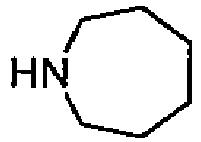
4-(4-((5-(azepane-1-carbonyl)pyridin-2-yl)amino)-5,6-dihydropyrido[3,4-d]pyrimidin-7(8H)-yl)-2-(trifluoromethyl)benzonitrile [Table 2] Example (Ia)" (VII) Production Compound (Ia)' 7 Reference Example 7 
N-(tert-butoxy)-6-((7-(4-cyano-3-(trifluoromethyl)phenyl)-5,6,7,8-tetrahydropyrido[3,4-d]pyrimidin-4-yl)amino)nicotinamide 8 Reference Example 7 
tert-butyl(2-(6-((7-(4-cyano-3-(trifluoromethyl)phenyl)-5,6,7,8-tetrahydropyrido[3,4-d]pyrimidin-4-yl)amino)pyridazine-3-carboxamido)ethyl)carbamate 9 Reference Example 8 
6-((7-(4-cyano-3-(trifluoromethyl)phenyl)-5,6,7,8-tetrahydropyrido[3,4-d]pyrimidin-4-yl)amino)-N-cyclopropylpyridazine-3-carboxamide 10 Reference Example 8 ethylamine 6-((7-(4-cyano-3-(trifluoromethyl)phenyl)-5,6,7,8-tetrahydropyrido[3,4-d]pyrimidin-4-yl)amino)-N-ethylpyridazine-3-carboxamide 11 Reference Example 8 
6-((7-(4-cyano-3-(trifluoromethyl)phenyl)-5,6,7,8-tetrahydropyrido[3,4-d]pyrimidin-4-yl)amino)-N-(prop-2-yn-1-yl)pyridazine-3-carboxamide -

- 2-Fluoro-6-((7-(4-nitro-3-(trifluoromethyl)phenyl)-5,6,7,8-tetrahydropyrido[3,4-d]pyrimidin-4-yl)amino)nicotinic acid was obtained by the same procedure as Reference Example 5 except that the compound obtained in Reference Example 3 was used instead of the compound obtained in Reference Example 1 and that ethyl 6-amino-2-fluoronicotinate was used instead of methyl 6-aminonicotinate. The procedure as in Example 1 was further performed using the resulting product to obtain the target compound.
- A starting compound (X) and a compound (IV) were reacted according to the following reaction formula to produce a production compound (Ia) (Examples 13 to 22). As a typical procedure, the production procedure of Example 13 is shown below. The compounds of Examples 14 to 22 were each produced by the same procedure with the starting compound (X) and the compound (IV) changed as shown in Tables 3 and 4.

-

- The compound (50 mg) obtained in Reference Example 4, 4-fluoro-1-nitro-2-chlorobenzene (37 mg), and potassium carbonate (97 mg) were suspended in DMSO (1.0 mL), and the reaction mixture was stirred at room temperature for 2 hours. Insolubles were removed from the reaction mixture by filtration, and the filtrate was then purified by reversed-phase preparative HPLC column chromatography. The resulting fraction was concentrated under reduced pressure to obtain the target compound.
[Table 3] Example (X) (IV) Production Compound (Ia) 13 Reference Example 4 
2-(6-((7-(3-chloro-4-nitrophenyl)-5,6,7,8-tetrahydropyrido[3,4-d]pyrimidin-4-yl)amino)pyridin-3-yl)propan-2-ol 14 Reference Example 4 
2-(6-((7-(4-nitro-3-(trifluoromethyl)phenyl)-5,6,7,8-tetrahydropyrido[3,4-d]pyrimidin-4-yl)amino)pyridin-3-yl)propan-2-ol 15 Reference Example 4 
2-(6-((7-(3-methoxy-4-nitrophenyl)-5,6,7,8-tetrahydropyrido[3,4-d]pyrimidin-4-yl)amino)pyridin-3-yl)propan-2-ol 16 Reference Example 4 
2-(6-((7-(3-methyl-4-nitrophenyl)-5,6,7,8-tetrahydropyrido[3,4-d]pyrimidin-4-yl)amino)pyridin-3-yl)propan-2-ol 17 Reference Example 4 
2-(6-((7-(3-bromo-4-nitrophenyl)-5,6,7,8-tetrahydropyrido[3,4-d]pyrimidin-4-yl)amino)pyridin-3-yl)propan-2-ol 18 Reference Example 4 
2-(6-((7-(3-chloro-2-fluoro-4-nitrophenyl)-5,6,7,8-tetrahydropyrido[3,4-d]pyrimidin-4-yl)amino)pyridin-3-yl)propan-2-ol [Table 4] Example (X) (IV) Production Compound (Ia) 19 Reference Example 4 
2-(6-((7-(3-isopropoxy-4-nitrophenyl)-5,6,7,8-tetrahydropyrido[3,4-d]pyrimidin-4-yl)amino)pyridin-3-yl)propan-2-ol 20 Reference Example 4 
4-(4-((5-(2-hydroxypropan-2-yl)pyridin-2-yl)amino)-5,6-dihydropyrido[3,4-d]pyrimidin-7(8H)-yl)-2-methylbenzonitrile 21 Reference Example 15 
N-(3-fluoro-4-methoxyphenyl)-7-(4-nitro-3-(trifluoromethyl)phenyl)-5,6,7,8-tetrahydropyrido[3,4-d]pyrimidin-4-amine 22 Reference Example 15 
7-(3-chloro-4-nitrophenyl)-N-(3-fluoro-4-methoxyphenyl)-5,6,7,8-tetrahydropyrido[3,4-d]pyrimidin-4-amine -

- 2-(6-(5,6,7,8-Tetrahydropyrido[3,4-d]pyrimidin-4-yl)amino)pyridin-3-yl)propan-2-ol (20 mg) obtained in Reference Example 4, 4-bromo-2-methoxybenzonitrile (22 mg), tris(dibenzylideneacetone)dipalladium (6.4 mg), Xantphos (8.1 mg), and sodium tert-butoxide (10 mg) were suspended in dioxane (0.4 mL), followed by stirring under microwave irradiation at 130°C for 40 minutes. Insolubles were removed from the reaction mixture by filtration, and the resulting solution was purified by reversed-phase preparative HPLC column chromatography. The resulting fraction was concentrated under reduced pressure to obtain the target compound.
- A starting compound (VI) and amine (VII) were reacted according to the following reaction formula to produce a production compound (Ia) (Examples 24 and 25). As a typical procedure, the production procedure of Example 24 is shown below. The compound of Example 25 was produced by the same procedure with the starting compound (VI) and the amine (VII) changed as shown in Table 5.

-

- The compound (20 mg) obtained in Reference Example 3, commercially available 6-amino-N-(2,2,2-trifluoroethyl)pyrazine-3-carboxamide (15 mg), tris(dibenzylideneacetone)dipalladium (5.1 mg), dppf (6.2 mg), and cesium carbonate (55 mg) were suspended in dioxane (0.4 mL) and NMP (0.02 mL), followed by stirring under microwave irradiation at 140°C for 45 minutes. Insolubles were removed from the reaction mixture by filtration, and the resulting solution was purified by reversed-phase preparative HPLC column chromatography. The resulting fraction was concentrated under reduced pressure to obtain the target compound.
[Table 5] Example (VI) (VII) Production Compound (Ia) 24 Reference Example 3 6-amino-N-trifluoroethyl)p yrazine-3-carboxamide 6-((7-(4-nitro-3-(trifluoromethyl)phenyl)-5,6,7,8-tetrahydropyrido[3,4-d]pyrimidin-4-yl)amino)-N-(2,2,2-trifluoroethyl)pyridazine-3-carboxamide 25 Reference Example 3 
N-(6-methoxypyridin-3-yl)-7-(4-nitro-3-(trifluoromethyl)phenyl)-5,6,7,8-tetrahydropyrido[3,4-d]pyrimidin-4-amine - A starting compound (VI) and amine (VII) were reacted according to the following reaction formula to produce a production compound (Ia) (Examples 26 to 34). As a typical procedure, the production procedure of Example 26 is shown below. The compounds of Examples 27 to 34 were each produced by the same procedure with the starting compound (VI) and the amine (VII) changed as shown in Tables 6 and 7.

-

- The solid (5.7 mg) obtained in Reference Example 1, 3,4-dimethoxyaniline (11.5 mg), and (+)-10-camphorsulfonic acid (5.6 mg) were suspended in tert-butanol (1 mL), followed by stirring under microwave irradiation at 140°C for 45 minutes. The reaction mixture was concentrated and dried with a nitrogen flow, and the residue was then purified by reversed-phase preparative HPLC column chromatography. The resulting fraction was concentrated under reduced pressure to obtain the target compound.
[Table 6] Example (VI) (VII) Production Compound (Ia) 26 Reference Example 1 
4-(4-((3,4-dimethoxyphenyl)amino)-5,6-dihydropyrido[3,4-d]pyrimidin-7(8H)-yl)-2-(trifluoromethyl)benzonitrile 27 Reference Example 1 
4-(4-((4-(trifluoromethoxy)phenyl)amino)-5,6-dihydropyrido[3,4-d]pyrimidin-7(8H)-yl)-2-(trifluoromethyl)benzonitrile 28 Reference Example 2 
4-(4-((4-(2-oxa-6-azaspiro[3.3]heptan-6-yl)phenyl)amino)-5,6-dihydropyrido[3,4-d]pyrimidin-7(8H)-yl)-2-chlorobenzonitrile 29 Reference Example 2 
tert-butyl 5-((7-(3-chloro-4-cyanophenyl)-5,6,7,8-tetrahydropyrido[3,4-d]pyrimidin-4-yl)amino)isoindoline-2-carboxylate 30 Reference Example 3 Reference Example 9 tert-butyl 4-(3-(2-chloro-4-((7-(4-nitro-3-(trifluoromethyl)phenyl)-5,6,7,8-tetrahydropyrido[3,4-d]pyrimidin-4-yl)amino)phenoxy)propyl)piperazine-1-carboxylate [Table 7] Example (VI) (VII) Production Compound (Ia) 31 Reference Example 3 
N-(3,4-dimethoxyphenyl)-7-(4-nitro-3-(trifluoromethyl)phenyl)-5,6,7,8-tetrahydropyrido[3,4-d]pyrimidin-4-amine 32 Reference Example 3 
tert-butyl 7-((7-(4-nitro-3-(trifluoromethyl)phenyl)-5,6,7,8-tetrahydropyrido[3,4-d]pyrimidin-4-yl)amino)-3,4-dihydroisoquinoline-2(1 H)-carboxylate 33 Reference Example 3 
N-(3-methyl-4-(2-oxa-6-azaspiro[3.3]heptan-6-yl)phenyl)-7-(4-nitro-3-(trifluoromethyl)phenyl)-5,6,7,8-tetrahydropyrido[3,4-d]pyrimidin-4-amine 34 Reference Example 3 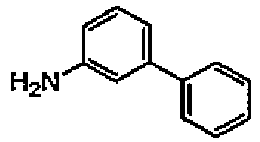
N-([1,1'-biphenyl]-3-yl)-7-(4-nitro-3-(trifluoromethyl)phenyl)-5,6,7,8-tetrahydropyrido[3,4-d]pyrimidin-4-amine -

-

- A THF (15 mL) solution of 2,6-difluoropyridine (825 mg) was cooled to -78°C, and LDA (2.0 mol/L, 5.2 mL) was dropwise added thereto. The reaction mixture was stirred for 45 minutes, and oxetan-3-one (580 mg) was then added thereto, followed by stirring at -78°C for 90 minutes. The reaction mixture was diluted with ethyl acetate and was washed with a saturated ammonium chloride aqueous solution and saturated brine, then dried over sodium sulfate, and then concentrated to obtain the target compound as a brown oily material.
-

- A 28% ammonia aqueous solution was added to an NMP (0.5 mL) solution of the compound (17 mg) obtained in step 1 at room temperature, and the reaction mixture was stirred at 90°C overnight. The solvent was distilled off with a nitrogen flow, and the residue was then purified by silica gel chromatography (eluent: hexane-ethyl acetate) to obtain the target compound.
-

- The compound (2.8 mg) obtained in step 2, the compound obtained in Reference Example 2, tris(dibenzylideneacetone)dipalladium (2.7 mg), Xantphos (3.7 mg), and sodium tert-butoxide (10 mg) were suspended in DME (1 mL), followed by stirring under microwave irradiation at 100°C for 60 minutes. The solvent was distilled off with a nitrogen flow, and the residue was then purified by reversed-phase preparative HPLC column chromatography. The resulting fraction was concentrated under reduced pressure to obtain the target compound.
- A starting compound (VI) and amine (VII) were reacted according to the following reaction formula to produce a production compound (Ia) (Examples 36 to 38). As a typical procedure, the production procedure of Examples 36 and 37 is shown below. The compound of Example 38 was produced by the same procedure with the starting compound (VI) and the amine (VII) changed as shown in Table 8.

-

- The compound (7.4 mg) obtained in Reference Example 2, 7-amino-3,4-dihydro-1H-isoquinoline-2-carboxylic acid tert-butyl ester (9.3 mg), and (+)-10-camphorsulfonic acid (2.5 mg) were suspended in tert-butanol (1 mL), followed by stirring under microwave irradiation at 140°C for 15 minutes. The reaction mixture was concentrated and dried with a nitrogen flow, and the residue was then purified by reversed-phase preparative HPLC column chromatography. The resulting fraction was concentrated under reduced pressure to obtain the target compound.
[Table 8] Example (VI) (VII) Production Compound (Ia) 36 Reference Example 2 7-amino-3,4-dihydro-1 H-isoquinoline-2-carboxylic acid tert-butyl ester tert-butyl 7-((7-(3-chloro-4-cyanophenyl)-5,6,7,8-tetrahydropyrido[3,4-d]pyrimidin-4-yl)amino)-3,4-dihydroisoquinoline-2(1 H)-carboxylate 37 Reference Example 2 7-amino-3,4-dihydro-1 H-isoquinoline-2-carboxylic acid tert-butyl ester 2-chloro-4-(4-((1,2,3,4-tetrahydroisoquinolin-7-yl)amino)-5,6-dihydropyrido[3,4-d]pyrimidin-7(8H)-yl)benzonitrile 38 Reference Example 2 Reference Example 11 2-chloro-4-(4-((4-(3-(piperazin-1-yl)propoxy)-3-(trifluoromethyl)phenyl)amino)-5,6-dihydropyrido[3,4-d]pyrimidin-7(8H)-yl)benzonitrile -

- The compound (24 mg) obtained in Reference Example 9, the compound obtained in Reference Example 3, and (+)-10-camphorsulfonic acid (26 mg) were suspended in tert-butanol (2 mL), followed by stirring under microwave irradiation at 135°C for 1 hour. The solvent was distilled off with a nitrogen flow, and the residue was used in the subsequent reaction as a crude product.
[M+H] +5.91/594. -

- The crude product obtained in step 1 was equally divided into 5 fractions, and one of the fractions was dissolved in pyridine (0.2 mL). Acetic anhydride (0.01 mL) was added to the solution at room temperature, and the reaction mixture was stirred at room temperature for 15 minutes. The reaction mixture was concentrated and dried with a nitrogen flow, and the residue was then purified by reversed-phase preparative HPLC column chromatography. The resulting fraction was concentrated under reduced pressure to obtain the target compound.
-

- One of the fractions prepared in step 2 was dissolved in pyridine (0.2 mL). Methanesulfonyl chloride (0.01 mL) was added to the solution at room temperature, and the reaction mixture was stirred at room temperature for 15 minutes. The reaction mixture was concentrated and dried with a nitrogen flow, and the residue was purified by reversed-phase preparative HPLC column chromatography. The resulting fraction was concentrated under reduced pressure to obtain the target compound.
-

- Zn(BH3CN)2 (0.3 mol/L methanol solution, 0.3 mL) separately prepared and a 50% formaldehyde aqueous solution (0.05 mL) were added to one of the fractions prepared in step 2, and the reaction mixture was stirred at room temperature for 15 minutes. The reaction mixture was concentrated and dried with a nitrogen flow, and the residue was then purified by reversed-phase preparative HPLC column chromatography. The resulting fraction was concentrated under reduced pressure to obtain the target compound.
- A starting compound (VI) and amine (VII) were reacted according to the following reaction formula to produce a production compound (Ia) (Examples 42 to 46). As a typical procedure, the production procedure of Example 42 is shown below. The compounds of Examples 43 to 46 were each produced by the same procedure with the starting compound (VI) and the amine (VII) changed as shown in Table 9.

-

- The compound (2.9 mg) obtained in Reference Example 2, the compound (4.4 mg) obtained in Reference Example 9, and (+)-10-camphorsulfonic acid (4.2 mg) were suspended in tert-butanol (1 mL), and the reaction mixture was stirred at 135°C for 2 hours. The reaction mixture was concentrated and dried with a nitrogen flow. Pyridine (0.2 mL) and acetic anhydride (0.1 mL) were added to the residue at room temperature, and the reaction mixture was stirred at room temperature for 15 minutes. The reaction mixture was concentrated and dried with a nitrogen flow, and the residue was purified by reversed-phase preparative HPLC column chromatography. The resulting fraction was concentrated under reduced pressure to obtain the target compound as a yellow amorphous product.
[Table 9] Example (VI) (VII) Production Compound (Ia) 42 Reference Example 2 Reference Example 9 4-(4-((4-(3-(4-acetylpiperazin-1-yl)propoxy)-3-chlorophenyl)amino)-5,6-dihydropyrido[3,4-d]pyrimidin-7(8H)-yl)-2-chlorobenzonitrile 43 Reference Example 2 Reference Example 11 4-(4-((4-(3-(4-acetylpiperazin-1-yl)propoxy)-3-(trifluoromethyl)phenyl)amino)-5,6-dihydropyrido[3,4-d]pyrimidin-7(8H)-yl)-2-chlorobenzonitrile 44 Reference Example 1 Reference Example 12 4-(4-((4-(3-(4-acetylpiperazin-1-yl)propoxy)-2-(trifluoromethyl)phenyl)amino)-5,6-dihydropyrido[3,4-d]pyrimidin-7(8H)-yl)-2-(trifluoromethyl)benzonitrile 45 Reference Example 3 Reference Example 11 1-(4-(3-(4-((7-(4-nitro-3-(trifluoromethyl)phenyl)-5,6,7,8-tetrahydropyrido[3,4-d]pyrimidin-4-yl)amino)-2-(trifluoromethyl)phenoxy)propyl)piperazi n-1-yl)ethanone 46 Reference Example 3 Reference Example 10 1-(4-(3-(4-((7-(4-nitro-3-(trifluoromethyl)phenyl)-5,6,7,8-tetrahydropyrido[3,4-d]pyrimidin-4-yl)amino)phenoxy)propyl)piperazin-1-yl)ethanone -

-

-
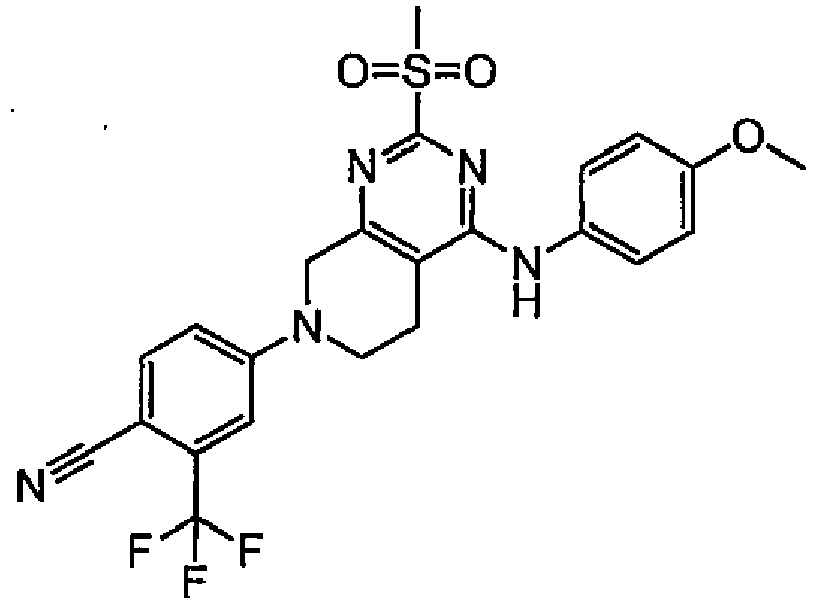
- mCPBA (157 mg) was added to a chloroform (4 mL) solution of the compound (157 mg) obtained in step 1 at room temperature, and the reaction mixture was stirred at room temperature for 30 minutes. A saturated sodium hydrogen sulfite aqueous solution and a saturated sodium hydrogen carbonate aqueous solution were added to the reaction mixture, followed by extraction with a chloroform/methanol solvent mixture. The collected organic layer was dried over sodium sulfate and was then concentrated under reduced pressure to obtain the target compound as a light yellow solid.
-

- Sodium cyanide (9 mg) was added to a DMSO (1.5 mL) solution of the compound (44 mg) obtained in step 2 at room temperature, and the reaction mixture was stirred at 150°C for 15 minutes. The reaction mixture was diluted with ethyl acetate, washed with water and saturated brine, then dried over sodium sulfate, and then concentrated. The resulting residue was purified by silica gel column chromatography to obtain the target compound.
-

- The target compound was obtained by the same procedure as Example 47 except that the compound (117 mg) obtained in step 2 of Reference Example 14 was used instead of 2-(6-(5,6,7,8-tetrahydropyrido[3,4-d]pyrimidin-4-yl)amino)pyridin-3-yl)propan-2-ol and that 4-fluoro-1-cyano-(2-trifluoromethyl)benzene (90 mg) was used instead of 4-fluoro-1-nitro-2-chlorobenzene.
- Tables 10 to 22 show the structural formulae and physical property values obtained by LC/MS analysis of the compounds of Examples 1 to 48.
[Table 10] Example Structural formula Physical property value 1 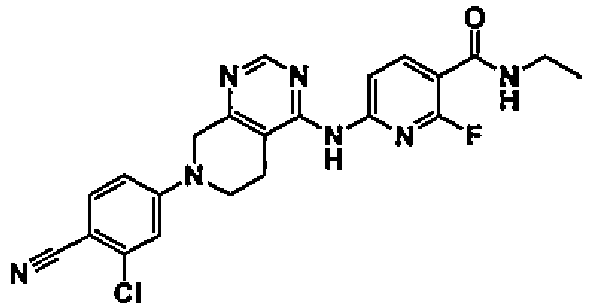
1H-NMR (CDCl3) δ: 8.76 (1H, s), 8.61 (1 H, d, J = 2.6 Hz), 8.60 (1H, s), 7.53 (1 H, d, J = 8.8 Hz), 7.00 (1H, d, J = 2.6 Hz), 6.85 (1H, dd, J = 8.8, 2.6 Hz), 6.69 (1H, br-s), 4.49 (2H, s), 3.82 (2H, t, J = 5.7 Hz), 3.56-3.50 (2H, m), 2.84 (2H, t, J = 5.7 Hz), 1.28 (3H, t, J = 7.1 Hz). LC/MS (A) RT 1.7min; m/z [M+H]+ 452/454. 2 
1H-NMR (CDCl3) δ: 8.76 (1H, s), 8.62 (1H, d, J = 4.0 Hz), 8.61 (1H, s), 7.53 (1H, d, J = 8.8 Hz), 7.00 (1H, d, J = 2.2 Hz), 6.85 (1H, dd, J = 9.0, 2.4 Hz), 6.71 (1H, br-s), 4.49 (2H, s), 3.82 (2H, t, J = 5.7 Hz), 3.05 (3H, d, J = 4.4 Hz), 2.83 (2H, t, J = 5.9 Hz). LC/MS (A) RT 1.59min; m/z [M+H]+ 438/440. 3 
1H-NMR (CDCl3) δ: 8.77 (1H, s), 8.63 (1 H, d, J = 5.1 Hz), 8.61 (1H, s), 7.71 (1H, d, J = 8.8 Hz), 7.25 (1H, d, J = 2.6 Hz), 7.08 (1H, dd, J = 8.8, 2.6 Hz), 6.71 (1H, br-s), 4.55 (2H, s), 3.88 (2H, t, J = 5.7 Hz), 3.05 (3H, d, J = 4.4 Hz), 2.86 (2H, t, J = 5.7 Hz). LC/MS (A) RT 1.68min; m/z [M+H]+ 472. 4 
1H-NMR (CDCl3) δ: 8.77 (1H, s), 8.62 (1H, d, J = 3.7 Hz), 8.61 (1H, s), 7.70 (1H, d, J = 8.4 Hz), 7.24 (1H, d, J = 2.2 Hz), 7.08 (1H, dd, J = 8.6, 2.7 Hz), 6.68 (1H, br-s), 4.55 (2H, s), 3.88 (2H, t, J = 5.7 Hz), 3.55-3.51 (2H, m), 2.88-2.85 (2H, m), 1.28 (3H, t, J = 7.3 Hz). LC/MS (A) RT 1.77min; m/z [M+H]+ 486. [Table 11] Example Structural formula Physical property value 5 
1H-NMR (DMSO-d6) δ: 1.10 (3H, br-t, J = 7.3 Hz), 2.84 - 2.94 (2H, m), 3.18 - 3.40 (2H, m), 3.77 - 3.89 (2H, m), 4.55 (2H, s), 7.35 (1H, br-d, J = 8.9 Hz), 7.41 (1H, br-s), 7.84 (1H, br-d, J = 8.9 Hz), 8.15 (1H, d, J = 8.9 Hz), 8.19 (1H, d, J = 8.9 Hz), 8.48 (1H, br-t, J=5.1 Hz), 8.60 (1H, s), 8.75 (1H, br-s), 9.40 (1H, br-s). LC/MS (A) RT 1.47min; m/z [M+H]+ 468. 6 
1H-NMR (DMSO-d6) δ: 1.42 - 1.76 (8 H, m), 2.83 - 2.94 (2H, m), 3.34 - 3.44 (2H, m), 3.48 - 3.58 (2H, m), 3.79 - 3.89 (2H, m), 4.54 (2H, s), 7.35 (1H, br-d, J = 8.9 Hz), 7.41 (1H, s), 7.79 (1H, br-d, J = 8.9 Hz), 7.84 (1H, br-d, J=8.9 Hz), 8.16 (1H, br-d, J = 8.9 Hz), 8.33 (1H, s), 8.58 (1H, s), 9.30 (1H, s). LC/MS (A) RT 1.7min; m/z [M+H]+ 522. 7 
1H-NMR (DMSO-d6) δ: 1.21 (6 H, s), 2.84 - 2.93 (2H, m), 3.78 - 3.89 (2H, m), 4.55 (2H, s), 7.35 (1H, br-d, J = 8.9 Hz), 7.41 (1H, br-s), 7.84 (1H, br-d, J = 8.9 Hz), 8.09 (1H, br-d, J = 8.2 Hz), 8.17 (1H, br-d, J = 8.9 Hz), 8.60 (1H, s), 8.67 (1H, br-s), 9.44 (1H, br-s), 10.97 (2H, br-s). LC/MS (A) RT 1.6min; m/z [M+H]+ 512. 8 
1H-NMR (CDCl3) δ: 9.00 (1H, d, J = 8.8 Hz), 8.75 (1H, s), 8.32 (1H, d, J = 9.2 Hz), 8.27 (1H, s), 7.95 (1H, s), 7.71 (1H, d, J = 8.8 Hz), 7.09 (1H, d, J = 8.4 Hz), 4.93 (1H, br-s), 4.57 (2H, s), 3.91 (2H, t, J = 5.3 Hz), 3.65 (2H, q, J = 5.7 Hz), 3.42 (2H, q, J = 5.9 Hz), 2.99-2.96 (2H, m), 1.58 (9H, s). LC/MS (A) RT 1.83min; m/z [M+H]+ 584. [Table 12] Example Structural formula Physical property value 9 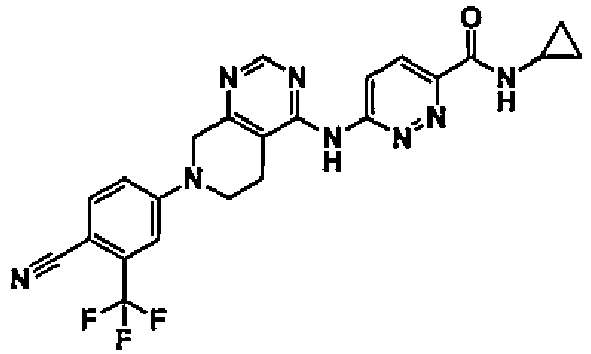
1H-NMR (DMSO-d6) δ: 0.62 - 0.72 (2H, m), 1.56 - 3.56 (5 H, m), 3.79 - 3.92 (2H, m), 4.58 (2H, br-s), 7.35 (1H, br-d, J = 8.9 Hz), 7.40 - 7.45 (1H, m), 7.84 (1H, br-d, J = 8.9 Hz), 8.09 (1H, br-d, J = 8.9 Hz), 8.38 (1H, br-d, J = 8.9 Hz), 8.60 (1H, br-s), 8.92 (1H, br-d, J = 4.4 Hz), 10.02 - 10.15 (1H, br-s). LC/MS (A) RT 1.61min; m/z [M+H]+ 481. 10 
1H-NMR (DMSO-d6) δ: 1.12 (2H, br-t, J=7.0 Hz), 2.90 - 3.01 (2H, m), 3.31 (s H, m), 3.79 - 3.88 (2H, m), 4.59 (2H, s), 7.36 (1H, br-d, J = 8.9 Hz), 7.42 (1H, br-s), 7.84 (1H, br-d, J = 8.9 Hz), 8.10 (1H, br-d, J = 9.5 Hz), 8.41 (1H, br-d, J = 9.5 Hz), 8.61 (1H, s), 8.93 - 9.03 (1H, m), 10.15 (2H, br-s). LC/MS (A) RT 1.6min; m/z [M+H]+ 469. 11 
1H-NMR (CDCl3) δ: 9.02 (1H, d, J = 9.2 Hz), 8.75 (1H, s), 8.33 (1H, d, J = 9.2 Hz), 8.13 (1 H, t, J = 5.5 Hz), 8.07 (1H, br-s), 7.71 (1H, d, J = 8.8 Hz), 7.25 (1H, s), 7.10 (1H, dd, J = 8.8, 2.6 Hz), 4.57 (2H, s), 4.33 (2H, dd, J = 5.5, 2.6 Hz), 3.91 (2H, t, J = 5.7 Hz), 2.98 (2H, t, J = 5.5 Hz), 2.31 (1 H, t, J = 2.6 Hz). LC/MS (A) RT 1.73min; m/z [M+H]+ 479. 12 
1H-NMR (CDCl3) δ: 8.78 (1H, s), 8.62 (1H, d, J = 3.7 Hz), 8.61 (1H, s), 8.09 (1H, d, J = 9.2 Hz), 7.32 (1H, s), 7.27 (1H, d, J = 3.3 Hz), 7.07 (1H, dd, J = 9.2, 2.9 Hz), 6.70-6.68 (1H, m), 4.58 (2H, s), 3.91 (2H, t, J = 5.7 Hz), 3.57-3.50 (2H, m), 2.88 (2H, t, J = 5.7 Hz), 1.28 (3H, t, J = 7.3 Hz). LC/MS (A) RT 1.71min; m/z [M+H]+ 506. [Table 13] Example Structural formula Physical property value 13 
1H-NMR (CDCl3) δ: 8.68 (1H, s), 8.48 (1H, d, J = 8.8 Hz), 8.35 (1H, d, J = 2.2 Hz), 8.20 (1H, s), 8.08 (1H, d, J = 9.2 Hz), 7.93 (1H, dd, J = 8.8, 2.2 Hz), 6.98 (1H, d, J = 2.6 Hz), 6.84 (1H, dd, J = 9.5, 2.6 Hz), 4.52 (2H, s), 3.85 (2H, t, J = 5.9 Hz), 2.94 (2H, t, J = 5.7 Hz), 1.63 (6H, s). LC/MS (A) RT 1.41min; m/z [M+H]+ 441 / 443. 14 
1H-NMR (CDCl3) δ: 8.68 (1H, s), 8.48 (1H, d, J = 8.8 Hz), 8.33 (1H, d, J = 2.6 Hz), 8.21 (1H, s), 8.09 (1H, d, J = 9.2 Hz), 7.96 (1H, dd, J = 9.0, 2.4 Hz), 7.27 (1H, d, J = 2.6 Hz), 7.06 (1H, dd, J = 9.2, 2.9 Hz), 4.57 (2H, s), 3.89 (2H, t, J = 5.7 Hz), 2.99 (2H, t, J = 5.7 Hz), 1.63 (6H, s). LC/MS (A) RT 1.5min; m/z [M+H]+ 475. 15 
1H-NMR (CDCl3) δ: 8.68 (1H, s), 8.48 (1H, d, J = 9.2 Hz), 8.43 (1H, d, J = 2.6 Hz), 8.06 (1H, d, J = 9.2 Hz), 7.87 (1H, dd, J = 8.8, 2.6 Hz), 6.55 (1H, dd, J = 9.5, 2.6 Hz), 6.42 (1H, d, J = 2.6 Hz), 4.53 (2H, s), 3.99 (3H, s), 3.86 (2H, t, J = 5.7 Hz), 2.85 (2H, t, J = 5.7 Hz), 1.25 (6H, s). LC/MS (A) RT 1.24min; m/z [M+H]+ 437. 16 
1H-NMR (DMSO-d6) δ: 9.05 (1H, s), 8.54 (1H, s), 8.42 (1H, d, J = 2.2 Hz), 8.04 (1H, d, J = 2.6 Hz), 8.02 (1H, d, J = 2.9 Hz), 7.83 (1H, dd, J = 8.8, 2.6 Hz), 7.05-7.02 (2H, m), 5.15 (1H, br-s), 4.52 (2H, s), 3.84 (2H, t, J = 5.7 Hz), 2.87 (2H, t, J = 5.5 Hz), 2.59 (3H, s), 1.46 (6H, s). LC/MS (A) RT 1.32min; m/z [M+H]+ 421. [Table 14] Example Structural formula Physical property value 17 
1H-NMR (CDCl3) δ: 1.60 (6 H, s), 2.88 (2H, m), 3.86 (2H, d, J = 5.5 Hz), 4.50 (2H, s), 6.92 (1H, dd, J = 9.2, 2.9 Hz), 7.23 (1H, d, J = 2.9 Hz), 7.89 (1H, dd, J = 8.8, 2.4 Hz), 8.07 (1H, d, J = 9.2 Hz), 8.11 (1H, br-s), 8.40 (1H, d, J = 2.4 Hz), 8.46 (1H, d, J = 8.8 Hz), 8.64 (1H, s). LC/MS (A) RT 1.44min; m/z [M+H]+ 485 / 487. 18 
1H-NMR (CDCl3) δ: 1.63 (6 H, s), 2.93 (2H, t, J = 5.5 Hz), 3.76 (2H, t, J = 5.5 Hz), 4.44 (2H, s), 6.92 (1H, t, J = 9.2 Hz), 7.88 (1H, dd, J = 9.2, 1.8 Hz), 7.92 (1H, dd, J = 8.8, 2.6 Hz), 8.18 (1H, s), 8.36 (1H, d, J = 2.6 Hz), 8.48 (1H, d, J = 8.8 Hz), 8.67 (1 H, s). LC/MS (A) RT 1.38min; m/z [M+H]+ 459 / 461. 19 
1H-NMR (CDCl3) δ: 1.43 (6 H, d, J = 5.9 Hz), 1.61 (7 H, s), 2.86 (2H, t, J = 5.9 Hz), 3.83 (2H, t, J = 5.9 Hz), 4.48 (2H, s), 4.61 - 4.73 (1H, m), 6.46 (1H, d, J = 2.6 Hz), 6.55 (1H, dd, J = 9.2, 2.6 Hz), 7.88 (1H, dd, J = 8.8, 2.6 Hz), 8.00 (1H, d, J = 9.2 Hz), 8.41 (1H, d, J = 2.6 Hz), 8.49 (1H, d, J = 8.8 Hz), 8.66 (1H, s). LC/MS (A) RT 1.45min; m/z [M+H]+ 465. 20 
1H-NMR (CDCl3) δ: 8.66 (1H, s), 8.48 (1H, d, J = 8.8 Hz), 8.33 (1H, d, J = 1.8 Hz), 8.20 (1H, s), 7.94 (1H, dd, J = 8.8, 2.6 Hz), 7.49 (1H, d, J = 8.4 Hz), 6.82-6.80 (2H, m), 4.47 (2H, s), 3.79 (2H, t, J = 5.9 Hz), 2.91 (2H, t, J = 5.7 Hz), 2.50 (3H, s). LC/MS (A) RT 1.21min; m/z [M+H]+ 401. [Table 15] Example Structural formula Physical property value 21 
1H-NMR (CDCl3) δ: 8.58 (1H, s), 8.09 (1H, d, J = 9.2 Hz), 7.50 (1H, dd, J = 12.5, 2.6 Hz), 7.18-7.15 (1H, m), 7.05 (1H, dd, J = 9.3, 2.7 Hz), 6.97 (1H, t, J = 9.0 Hz), 6.29 (1H, s), 4.53 (2H, s), 3.91-3.90 (5H, m), 2.78 (2H, t, J = 5.7 Hz). LC/MS (A) RT 1.68min; m/z [M+H]+ 464. 22 
1H-NMR (CDCl3) δ: 8.58 (1H, s), 8.08 (1H, d, J = 9.5 Hz), 7.49 (1H, dd, J = 12.8, 2.6 Hz), 7.16 (1H, dd, J = 8.6, 2.4 Hz), 6.97 (1H, t, J = 9.0 Hz), 6.83 (1H, dd, J = 9.3, 2.7 Hz), 6.27 (1H, s), 4.49 (2H, s), 3.90 (3H, s), 3.86 (2H, t, J = 5.7 Hz), 2.75 (2H, t, J = 5.7 Hz). LC/MS (A) RT 1.59min; m/z [M+H]+ 430/432. 23 
1H-NMR (CDCl3) δ: 8.66 (1H, s), 8.48 (1H, d, J = 9.2 Hz), 8.35 (1H, d, J = 2.6 Hz), 8.23 (1H, s), 7.93 (1H, dd, J = 8.8, 2.6 Hz), 7.42 (1H, d, J = 8.4 Hz), 6.55 (1H, dd, J = 8.8, 2.2 Hz), 6.42 (1H, d, J = 2.2 Hz), 4.48 (2H, s), 3.93 (3H, s), 3.80 (2H, t, J = 5.7 Hz), 2.91 (2H, t, J = 5.7 Hz). LC/MS (A) RT 1.27min; m/z [M+H]+ 417. 24 
1H-NMR (CDCl3) δ: 9.05 (1H, d, J = 9.2 Hz), 8.77 (1H, s), 8.34 (1H, d, J = 9.5 Hz), 8.28 (1H, t, J = 6.0 Hz), 8.08 (1H, d, J = 9.2 Hz), 8.05 (1H, s), 7.28 (1 H, d, J = 2.6 Hz), 7.08 (1H, dd, J = 9.3, 2.7 Hz), 4.61 (2H, s), 4.18 (2H, dt, J = 17.1, 8.0 Hz), 3.95 (2H, t, J = 5.7 Hz), 3.01 (2H, t, J = 5.5 Hz). LC/MS (A) RT 1.93min; m/z [M+H]+ 543. [Table 16] Example Structural formula Physical property value 25 
1H-NMR (CDCl3) δ: 8.53 (1H, s), 8.23 (1H, s), 8.08 (1H, d, J = 8.8 Hz), 7.86 (1H, dd, J = 7.0, 3.3 Hz), 7.05 (1H, d, J = 9.2 Hz), 6.80 (1H, d, J = 9.2 Hz), 6.36 (1H, s), 4.53 (2H, s), 3.95-3.91 (5H, m), 2.83-2.81 (2H, m). LC/MS (A) RT 1.54min; m/z [M+H]+ 447. 26 
1H-NMR (CDCl3) δ: 8.56 (1H, s), 7.68 (1 H,d,J=8.4Hz), 7.23 (1H, d, J = 1.8Hz), 7.18 (1H, d, J = 2.2Hz), 7.06 (1H, dd, J = 2.2, 8.8 Hz), 6.99 (1H, dd, J = 1.8, 8.4 Hz), 6.88 (1H, d, J = 8.4 Hz), 6.41 (1H, br-s), 4.50 (2H, s), 3.89 (6H, s), 3.85 - 3.92 (2H, m), 2.76 (2H, t, J = 5.7 Hz). LC/MS (A) RT 1.52min; m/z [M+H]+ 456. 27 
1H-NMR (CDCl3)δ: 8.62 (1H, s), 7.70 (1H, d, J = 8.8 Hz), 7.61 - 7.67 (2H, m), 7.23 - 7.27 (4H, m), 7.08 (1H, dd, J = 8.8, 2.6 Hz), 6.43 (1H, br-s), 4.52 (2H, s), 3.89 (2H, t, J = 5.8 Hz), 2.81 (2H, t, J = 5.8 Hz). LC/MS (B) RT 1.62min; m/z [M+H]+ 480. 28 
1H-NMR (CDCl3) δ: 2.69 (2H, t, J = 5.7 Hz), 3.79 (2H, t, J = 5.7 Hz), 4.04 (4 H, s), 4.45 (2H, s), 4.85 (4 H, s), 6.48 (2H, d, J = 8.8 Hz), 6.84 (1 H, dd, J = 8.8, 2.6 Hz), 6.99 (1 H, d, J = 2.6 Hz), 7.29 (2H, d, J = 8.8 Hz), 7.52 (1 H, d, J = 8.8 Hz), 8.04 (1 H, br-s), 8.50 (1H, s). LC/MS (A) RT 1.34min; m/z [M+H]+ 459 / 461. [Table 17] Example Structural formula Physical property value 29 
1H-NMR (CDCl3) δ: 1.52 (9H, s), 2.69 - 2.82 (2H, m), 3.75 - 3.90 (2H, m), 4.45 (2H, s), 4.58 - 4.75 (4H, m), 6.45 (1H, s), 6.84 (1H, dd, J = 8.8, 2.2 Hz), 6.99 (1H, d, J = 2.2 Hz), 7.20 - 7.33 (3H, m), 7.52 (1H, d, J = 8.8 Hz), 8.57 (1H, d, J = 5.9 Hz). LC/MS (A) RT 1.88min; m/z [M+H]+ 503/505. 30 
1H-NMR (CDCl3) δ: 1.47 (9 H, s), 2.06 - 2.09 (2H, m), 2.76 - 2.83 (3H, m), 3.00 - 3.14 (4 H, m), 3.18 - 3.25 (2H, m), 3.69 - 3.85 (4 H, m), 3.86 - 3.93 (2H, m), 4.10 - 4.18 (2H, m), 4.53 (2H, s), 6.93 (1H, d, J = 8.8 Hz), 7.05 (1H, dd, J = 8.8, 2.6 Hz), 7.38 (1H, dd, J = 8.8, 2.6 Hz), 7.70 (1H, d, J = 2.6 Hz), 8.05 - 8.12 (2H, m), 8.56 (1H, s). LC/MS (A) RT 1.72min; m/z [M+H]+ 692/694. 31 
1H-NMR (CDCl3) δ: 2.78 (2H, t, J = 5.7 Hz), 3.88 - 3.92 (2H, m), 3.89 (3H, s), 3.90 (3H, s), 4.53 (2H, s), 6.37 (1H, br-s), 6.88 (1H, d, J = 8.4 Hz), 6.99 (1 H, dd, J = 8.4, 2.6 Hz), 7.04 (1 H, dd, J = 9.2, 2.9 Hz), 7.18 (1H, d, J = 2.9 Hz), 8.08 (1H, d, J = 9.2 Hz), 8.56 (1H, s). LC/MS (B) RT 1.13min; m/z [M+H]+ 476. 32 
1H-NMR (CDCl3) δ: 1.50 (9 H, s), 2.75 - 2.87 (4 H, m), 3.65 (2H, br-s), 3.91 (2H, t, J = 5.7 Hz), 4.50 - 4.56 (2H, m), 4.57 - 4.62 (2H, m), 6.36 (1H, s), 7.05 (1H, dd, J = 9.2, 2.9 Hz), 7.15 (1H, d, J = 8.4 Hz), 7.26 - 7.29 (2H, m), 8.08 (1H, d, J = 9.2 Hz), 8.58 (1H, s). LC/MS (B) RT 1.36min; m/z [M+H]+ 571 . [Table 18] Example Structural formula Physical property value 33 
1H-NMR (CDCl3) δ: 2.23 (2H, s), 2.73 (2H, br-t, J = 5.7 Hz), 3.88 (2H, br-t, J = 5.7 Hz), 4.06 - 4.08 (3H, m), 4.54 - 4.60 (2H, m), 4.86 (3H, s), 6.43 (1H, br-s), 6.50 (1H, d, J = 8.4 Hz), 7.05 (1H, dd, J = 9.2, 2.6 Hz), 7.13 (1H, d, J = 2.6 Hz), 7.21 (1H, dd, J = 8.4, 2.6 Hz), 8.06 (1H, s), 8.08 (1H, d, J = 9.2 Hz), 8.52 (1H, s). LC/MS (B) RT 1.14min; m/z [M+H]+ 527. 34 
1H-NMR (CDCl3) δ: 2.82 (2H, t, J = 5.7 Hz), 3.91 (2H, t, J = 5.7 Hz), 4.56 (2H, s), 6.53 (1H, s), 7.05 (1H, dd, J = 9.3, 2.7 Hz), 7.27 (1H, d, J = 2.6 Hz), 7.34 - 7.42 (2H, m), 7.43 - 7.50 (3H, m), 7.60 (3H, br-d, J = 1.1Hz), 7.79 (1H, t, J = 1.8 Hz), 8.08 (1H, d, J = 9.2 Hz), 8.62 (1H, s). LC/MS (B) RT 1.4min; m/z [M+H]+ 492. 35 
1H-NMR (CDCl3) δ: 2.82 (2H, d, J = 5.5 Hz), 3.82 (2H, t, J = 5.5 Hz), 4.48 (2H, s), 4.89 (2H, d, J = 7.3 Hz), 5.12 (2H, d, J = 7.0 Hz), 6.85 (1H, dd, J = 9.2, 1.8 Hz), 7.00 (1H, d, J = 1.8 Hz), 7.20 (1H, s), 7.53 (1H, d, J = 9.2 Hz), 7.86 (1H, t, J = 9.2 Hz), 8.51 (1H, d, J = 9.2 Hz), 8.72 (1H, s). LC/MS (A) RT 1.56min; m/z [M+H]+ 453/455. 36 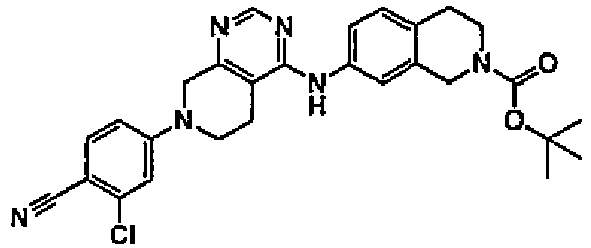
1H-NMR (CDCl3) δ: 1.49 (9 H, s), 2.74 (2H, t, J = 5.7 Hz), 2.82 (2H, br-t, J = 5.5 Hz), 3.59 - 3.70 (2H, m), 3.81 (2H, t, J = 5.7 Hz), 4.45 (2H, s), 4.59 (2H, s), 6.38 (1H, s), 6.84 (1H, dd, J = 8.8, 2.6 Hz), 6.99 (1 H, d, J = 2.6 Hz), 7.15 (1H, d, J = 8.1 Hz), 7.26 (1H, s), 7.52 (1H, d, J = 8.8 Hz), 8.57 (1 H, s). LC/MS (A) RT 1.94min; m/z [M+H]+ 517 / 519. [Table 19] Example Structural formula Physical property value 37 
1H-NMR (METHANOL-d4) δ: 2.82 (2H, br-t, J = 5.9 Hz), 3.11 (2H, t, J = 6.4 Hz), 3.51 (1H, t, J = 6.4 Hz), 3.85 (2H, t, J = 5.9 Hz), 4.36 (2H, s), 4.44 (2H, s), 7.05 (1H, dd, J = 8.8, 2.6 Hz), 7.20 (1H, d, J = 2.2 Hz), 7.25 (1H, d, J = 8.4 Hz), 7.49 (1H, dd, J = 8.4, 2.2 Hz), 7.58 - 7.63 (2H, m), 8.39 (1H, s). LC/MS (A) RT 1.11min; m/z [M+H]+ 417 / 419. 38 
1H-NMR (CDCl3) δ: 1.96 - 2.06 (2H, m), 2.47 (4 H, br-s), 2.55 (2H, br-t, J = 7.3 Hz), 2.75 (2H, br-t, J = 5.7 Hz), 2.92 (4 H, t, J = 4.8 Hz), 3.82 (2H, t, J = 5.5 Hz), 4.12 (2H, t, J = 6.2 Hz), 4.44 (2H, s), 6.31 (1H, s), 6.84 (1H, dd, J = 8.8, 2.2 Hz), 6.99 (1H, d, J = 2.2 Hz), 7.03 (1H, d, J = 8.8 Hz), 7.52 (1H, d, J = 8.8 Hz), 7.65 (1H, d, J = 2.2 Hz), 7.72 (1H, dd, J = 8.8, 2.2 Hz), 8.55 (1H, s). LC/MS (A) RT 1.31 min; m/z [M+H]+ 572 /574. 39 
1H-NMR (CDCl3) δ: 2.12 (3H, s), 2.21 - 2.27 (2H, m), 2.80 (3H, br-d, J = 4.4 Hz), 2.87 - 3.11 (6 H, m), 3.75 (2H, br-s), 3.89 (4 H, s), 4.09 - 4.17 (2H, m), 4.52 (2H, s), 6.94 (1H, d, J = 8.8 Hz), 7.06 (1H, dd, J = 9.2, 2.2 Hz), 7.27 (1H, d, J = 2.6 Hz), 7.39 (1H, dd, J = 8.8, 2.6 Hz), 7.66 (1H, d, J = 2.2 Hz), 8.05 - 8.11 (1H, m), 8.52 (1 H, s). LC/MS (A) RT 1.47min; m/z [M+H]+ 634 / 636. [Table 20] Example Structural formula Physical property value 40 
1H-NMR (CDCl3) δ: 2.77 - 2.84 (2H, m), 2.89 (3H, s), 3.12 - 3.21 (6 H, m), 3.60 (4 H, br-d, J = 4.4 Hz), 3.89 (3H, br-t, J = 5.9 Hz), 4.12 (3H, br-t, J = 5.5 Hz), 4.56 (2H, s), 6.92 (1H, d, J = 9.2 Hz), 7.06 (1H, dd, J = 9.2, 2.9 Hz), 7.39 (1H, dd, J = 8.8, 2.6 Hz), 7.65 (1H, d, J = 2.6 Hz), 8.07 (1H, d, J = 8.8 Hz), 8.55 (1H, s). LC/MS (A) RT 1.54min; m/z [M+H]+ 670 / 672. 41 
1H-NMR (CDCl3) δ:2.08 - 2.16 (2H, m), 2.76 (3H, s), 2.81 - 2.85 (2H, m), 2.90 - 2.99 (2H, m), 3.08 - 3.25 (8 H, m), 3.87 - 3.94 (2H, m), 4.04 - 4.13 (2H, m), 4.54 (2H, s), 6.83 - 6.96 (1H, m), 6.91 (1H, d, J = 8.8 Hz), 7.06 (1H, dd, J = 8.8, 2.2 Hz), 7.41 (1H, dd, J = 9.2, 2.2 Hz), 7.65 (1H, d, J = 2.2 Hz), 8.07 (1H, d, J = 9.2 Hz), 8.54 (1H, s). LC/MS (A) RT 1.45min; m/z [M+H]+ 606 / 608. 42 
1H-NMR (CDCl3) δ:2.13 (3H, s), 2.18 - 2.31 (2H, m), 2.70 - 2.81 (2H, m), 2.91 - 3.16 (6 H, m), 3.72 - 3.83 (4 H, m), 3.87 (2H, br-s), 4.05 - 4.16 (2H, m), 4.46 (2H, s), 6.84 (1H, dd, J = 8.8, 2.2 Hz), 6.90 (1H, d, J = 8.8 Hz), 6.99 (1H, d, J = 2.2 Hz), 7.39 (1H, dd, J = 8.8, 2.2 Hz), 7.50 (1H, d, J = 8.8 Hz), 7.65 (1H, d, J = 2.2 Hz), 8.53 (1H, s). LC/MS (A) RT 1.24min; m/z [M+H]+ 580 / 582. [Table 21] Example Structural formula Physical property value 43 
1H-NMR (CDCl3) δ:2.13 (3H, s), 2.20 - 2.31 (2H, m), 2.73 - 2.83 (2H, m), 2.89 - 3.12 (6 H, m), 3.72 - 3.92 (6 H, m), 4.14 (2H, t, J = 5.5 Hz), 4.47 (2H, s), 6.85 (2H, dd, J = 8.8, 2.2 Hz), 6.99 (1H, br-dd, J = 4.8, 2.6 Hz), 7.51 (1H, d, J = 8.8 Hz), 7.73 (2H, s), 8.16 (1H, s), 8.54 (1H, s). LC/MS (A) RT 1.32min; m/z [M+H]+ 614 / 616. 44 
1H-NMR (CDCl3) δ:2.04 - 2.15 (2H, m), 2.20 (3H, s), 2.71 - 2.88 (8 H, m), 3.65 (6 H, br-s), 4.06 (2H, br-d, J = 5.1 Hz), 4.51 (2H, s), 7.01 (1H, dd, J = 8.8, 2.2 Hz), 7.06 (1H, dd, J = 8.8, 1.8 Hz), 7.11 (1H, d, J = 2.2 Hz), 7.19 (1H, br-d, J = 1.8 Hz), 7.69 (1H, d, J = 8.8 Hz), 7.87 (1H, d, J = 8.8 Hz), 8.15 (1H, br-s), 8.60 (1H, s). LC/MS (A) RT 1.4min; m/z [M+H]+ 648. 45 
1H-NMR (CDCl3) δ:2.12 (3H, s), 2.18 - 2.27 (2H, m), 2.80 - 2.89 (6 H, m), 2.98 - 3.00 (2H, m), 3.70 - 3.77 (2H, m), 3.80 - 3.88 (2H, m), 3.88 - 3.93 (2H, m), 4.11 - 4.17 (2H, m), 4.55 (2H, s), 6.71 - 6.82 (1H, m), 7.01 (1H, d, J = 8.4 Hz), 7.05 (1H, dd, J = 9.3, 2.7 Hz), 7.71 - 7.78 (2H, m), 8.07 (1H, d, J = 9.2 Hz), 8.55 (1H, s). LC/MS (A) RT 1.54min; m/z [M+H]+ 668. 46 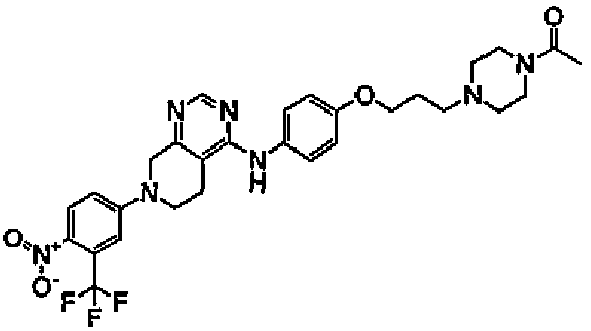
1H-NMR (CDCl3) δ:2.11 (3H, s), 2.12 - 2.37 (2H, m), 2.70 - 2.94 (6 H, m), 2.77 - 2.80 (2H, m), 3.56 - 3.79 (4 H, m), 3.90 (2H, t, J = 5.9 Hz), 4.06 (2H, t, J = 6.0 Hz), 4.52 (2H, s), 6.35 (1H, br-s), 6.91 (2H, d, J = 8.8 Hz), 7.02 - 7.08 (1H, m), 7.41 (2H, d, J = 8.8 Hz), 8.04 - 8.12 (2H, m), 8.54 (1H, s). LC/MS (A) RT 1.38min; m/z [M+H]+ 600. [Table 22] Example Structural formula Physical property value 47 
1H-NMR (CDCl3) δ: 7.62(1 H, d, J = 8.8 Hz), 7.40-7.47 (2H, m), 7.23 (1H, d, J = 2.4 Hz), 7.06 (1H, dd, J = 8.8, 2.4 Hz), 6.88 - 6.97 (2H, m), 6.58 (1H, br-s), 4.48 (2H, s), 3.87 (2H, br-t, J = 5.6Hz), 3.83 (3H, s), 2.79 (2H, br-t, J = 5.6 Hz). LC/MS (B) RT 1.66min; m/z [M+H]+ 451. 48 
1H-NMR (DMSO-d6) δ: 8.40 (1H, s), 7.86 (1H, d, J = 8.8Hz), 7.50 - 7.63 (2H, m), 7.43 (1H, d, J = 2.3 Hz), 7.37 (1H, dd, J = 8.8, 2.3 Hz), 6.87 - 6.94 (2H, m), 4.45 (2H, s), 3.86 (2H, br-t, J = 5.5Hz), 3.74 (3H, d, J = 1.0Hz), 2.73 (2H, br-t, J = 5.5Hz), 2.34 (3H, s). LC/MS (A) RT 1.57min; m/z [M+H]+ 440. - Antagonist activity for AR was evaluated according to the following method. COS-7 cells (ATCC) were transfected with pMMTV-luc vector (reporter plasmid having, as an androgen response element, murine mouse mammary virus long terminal repeat) and pEX-hAR vector (human androgen receptor expression vector: which expresses human AR gene under control of CMV promoter) by using Nucleofector (registered trademark) Kit R (Lonza) as a transfection reagent and Amaxa (Lonza). The COS-7 cells obtained after transfection were seeded in a clear bottom 96 well microplate (BD) at 1.5×10⁴/well with phenol red free RPMI1640 containing 10% charcoal-treated fetal bovine serum (hereinbelow, DCC-FBS) (hereinbelow, the medium is referred to as an evaluation medium), and then cultured overnight. The culture was added with the evaluation medium containing dihydrotestosterone (DHT) (final concentration of DHT: 1 nmol/L) or the evaluation medium containing the compound of Examples or the compound of Comparative Example (Bicalutamide) (final concentration of the compound of Examples or the compound of Comparative Example: 5, 14, 41, 123, 370, 1111, 3333, or 10000 nmol/L), followed by culture for 24 hours. Then, the transcription activity value of the reporter plasmid was measured. The transcription activity was measured by using Bright-Glo™ Luciferase Assay System (Promega). From the measured transcription activity, 50% transcription activity inhibition concentration (IC50 value) was calculated by logistic regression when the transcription activity value obtained by using 1 nmol/L DHT was 100% and the transcription activity value obtained by using the evaluation medium only was 0%.
- The results are shown in Table 23. When compared with Bicalutamide (Comparative Example), the compounds of Examples exhibited an antagonist activity for AR equal to or higher than that of Bicalutamide.
[Table 23] Example AR antagonist IC50 µM Example AR antagonist IC50 µM 1 0.0026 19 1.3 2 0.033 20 0.48 3 0.031 23 0.019 4 0.045 24 0.18 5 0.10 26 1.1 6 0.13 27 1.0 7 0.38 28 0.68 8 0.059 29 0.22 9 0.030 35 0.12 10 0.0070 36 0.18 11 0.025 37 0.69 13 0.032 38 0.95 14 0.070 42 0.56 15 0.26 43 0.30 16 0.070 47 0.70 17 0.030 48 1.0 18 1.0 Bicalutamide 1.3 - Human prostate cancer cells LNCaP (Non-Patent Literature 5) having amplified androgen receptor gene were seeded in a clear bottom 96 well microplate (BD) at 4.0×10³/well with phenol red free RPMI1640 containing 5% DCC-FBS (hereinbelow, the medium is referred to as an evaluation medium), and then cultured overnight. The culture was added with the evaluation medium containing DHT (final concentration of DHT: 1 nmol/L) or the evaluation medium containing the compound of Examples or the compound of Comparative Example (Bicalutamide) (final concentration of the compound of Examples or the compound of Comparative Example: 5, 14, 41, 123, 370, 1111, 3333, 10000 or 30000 nmol/L), followed by culture for 72 hours. Then, the number of viable cells was meausred. The number of viable cells was measured by using Cell Counting Kit-8 (DOJINDO LABORATORIES). From the measured number of viable cells, 50% proliferation inhibition concentration (GI50 value) was calculated by logistic regression when the cell proliferation activity obtained by using 1 nmol/L DHT was 100% and the cell proliferation activity obtained by using the evaluation medium only was 0%.
- The results are shown in Table 24. The compounds of Examples exhibited an inhibitory activity on androgen-dependent proliferation of prostate cancer cells.
[Table 24] Example Proliferation inhibition concentration GI50 value µM Example Proliferation inhibition concentration GI50 value µM 1 0.083 19 0.22 2 0.29 23 2.6 3 0.36 24 0.79 4 1.1 26 1.2 5 0.12 27 1.0 6 0.055 28 0.68 7 0.18 29 0.83 8 1.1 36 0.15 9 0.51 37 0.99 10 0.40 38 0.12 11 0.95 42 1.3 13 0.30 43 0.38 14 1.2 47 0.45 15 3.0 48 0.61 16 0.23 Bicalutamide 2.3 17 1.2 - AR positive human prostate cancer cells VCaP (In Vivo 15:163-168,2001) were seeded in a clear bottom 96 well microplate (BD) at 1.5×10⁴/well with phenol red free RPMI1640 containing 5% DCC-FBS (hereinbelow, the medium is referred to as an evaluation medium), and then cultured overnight. The culture was added with the evaluation medium containing the compound of Examples or the compound of Comparative Example (Bicalutamide) (final concentration of the compound of Examples or the compound of Comparative Example: 5, 14, 41, 123, 370, 1111, 3333, or 10000 nmol/L), followed by culture for 72 hours. Then, the number of viable cells was measured (test group). As a control, the cells were cultured after being added with the evaluation medium only, and the number of viable cells was measured (control group). The number of viable cells was measured by using CellTiter-Glo™ Luminescent Cell Viability Assay (Promega). From the measured number of viable cells, cell proliferation rate with respect to the compound of Examples or the compound of Comparative Examples was calculated based on the number of viable cells measured in the case of using the evaluation medium only.

- By considering an error in the number of viable cells measured in the case of using the evaluation medium only, when the cell proliferation rate was more than 10% at any concentration of the 8 concentrations which had been evaluated, it was determined to have an agonist activity for AR.
- Table 25 shows the results. The compounds of Examples did not exhibit any agonist activity for AR.
[Table 25] Example Cell proliferation rate (%) Example Cell proliferation rate (%) 1 9.7 20 -0.89 3 8.9 23 2.3 4 9.7 24 7.8 5 -1.9 26 4.5 6 -1.0 27 3.8 7 0.90 28 1.4 8 5.3 29 2.4 9 -3.0 35 9.4 11 4.9 36 4.9 13 7.3 37 4.6 14 1.4 38 -1.3 15 7.7 42 5.1 16 -1.8 43 8.4 17 9.7 47 -1.7 18 9.5 48 -1.6 19 7.8 Bicalutamide 36 - AR positive human prostate cancer cells LNCaP were seeded in a 6 well microplate (BD) at 3.5×10⁵/well with RPMI1640 containing 5% FBS (hereinbelow, the medium is referred to as an evaluation medium), and then cultured overnight. The culture was added with the evaluation medium containing the compound of Examples or the compound of Comparative Example (Bicalutamide) such that the final concentration of the compound of Examples or the compound of Comparative Example was 10000 nmol/L, followed by culture for 48 hours. After culture for 48 hours, the medium was removed and the cells were washed with PBS and added with 0.1 mL of Lysis buffer (M-PER added with Protease Inhibitor Cocktail), followed by keeping at 4°C for 20 minutes. After cell lysis, the cell solution was centrifuged to recover the supernatant as cell lysate. The cell lysates were adjusted to have the same protein concentration and subjected to SDS-PAGE and Western blotting using anti AR antibody (Santa Cruz Biotechnology, N-20). The antibody-reacting band (anti AR receptor) was quantified by LAS Imaging System (FUJIFILM) using Super Signal West Dura Substrate (Thermo Scientific) as a detection reagent. For the quantification, when the AR expression in LNCaP was reduced by 50% or more compared with the evaluation medium control, it was determined to have an AR expression reducing activity.
- The results are shown in Table 26. When the AR expression reducing activity is 50% or more, it is described as "reduced". The compounds of the present invention were confirmed to have AR expression reducing activity of 50% or more at 10 µM.
[Table 26] Example AR expression reducing activity Example AR expression reducing activity 1 reduced 20 reduced 2 reduced 23 reduced 3 reduced 24 reduced 4 reduced 26 reduced 5 reduced 27 reduced 6 reduced 28 reduced 7 reduced 29 reduced 8 reduced 35 reduced 9 reduced 36 reduced 10 reduced 37 reduced 11 reduced 42 reduced 13 reduced 43 reduced 14 reduced 47 reduced 16 reduced 48 reduced 17 reduced Bicalutamide <10% 19 reduced - Based on the scientific paper (Clin Cancer Res., 2001, 7: 2941-8), castration resistant prostate cancer LNCaP-Xeno-IL-6 cells (in the paper, reported as LNCaP-IL-6+ cells) are established from the AR positive human prostate cancer cells LNCaP, and the in vivo test is carried out with the cells. The LNCaP-Xeno-IL-6 cells are implanted subcutaneously in male nude mice, and the castration treatment is performed when the tumor volume reach about 200 mm3. After the castration, the vehicle only (0.5% HPMC) or the compound of Examples suspended in the vehicle is orally administered to the mice every day for 2 weeks. The compound of Examples is administered such that there is no difference in an exposure amount between the compounds. After the administration for 2 weeks, the tumor volume of each mouse is recorded and the average tumor volume of the group administered with the evaluation compound relative to the average tumor volume of the group administered only with the vehicle, that is, T/C (%), is calculated based on the following formula. T/C (%) = (Average tumor volume of evaluation compound group)/(Average tumor volume of vehicle administration group)
Rd and Re are as described above,
preferably Rd and Re are each independently a hydrogen atom, a C1-6 alkyl group, a C2-6 alkynyl group, a C1-6 alkoxy group, a C3-6 cycloalkyl group, a halogeno-C1-3 alkyl group, or a C1-6 alkyl substituted with Rg, or NRdRe forms a ring,
more preferably either one of Rd and Re is a C1-3 alkyl group, a C2-6 alkynyl group, a C1-3 alkoxy, a C3-7 cycloalkyl group, or a C1-6 alkyl group substituted with Rg, and the other is a hydrogen atom or a C1-3 alkyl group, and Rg is as described above; or Rd and Re form a 3- to 7-membered nitrogen-containing heterocyclic ring containing one nitrogen atom,
even more preferably either one of Rd and Re is a methyl group, an ethyl group, a propynyl group, a tert-butoxy group, or an ethyl group substituted with a tert-butoxycarbonylamino group, and the other is a hydrogen atom or a methyl group; or NRdRe is azepane,
provided that if either one of Rd and Re is a halogeno-C1-3 alkyl group, a hydroxy-C1-6 alkyl group, a hydroxy-C3-7 cycloalkyl group, a hydroxy-C3-7 cycloalkyl-C1-6 alkyl group, or a C1-6 alkyl group substituted with C1-6 alkylpyrazolyl, halogeno-C1-3 alkylthiazolyl, oxadiazolyl, or halogeno-C1-3 alkyloxadiazolyl, then the other is not a hydrogen atom).
Claims (28)
- A fused pyrimidine compound represented by the following formula (I):
 X represents a cyano group or a nitro group;Y represents a halogen atom, a halogeno-C1-3 alkyl group, a C1-3 alkoxy group, or a C1-3 alkyl group;Z represents a hydrogen atom, a halogen atom, or a C1-3 alkyl group;R1 represents a C6-14 aryl group which is substituted with Ra and may be substituted simultaneously with Rb or a 5- or 6-membered heteroaryl group which is substituted with Ra and may be substituted simultaneously with Rb, wherein the Ra and Rb may be bonded to each other to form a fused ring together with the C6-14 aryl group or the heteroaryl group; andR2 represents a hydrogen atom, a C1-3 alkyl group, or a cyano group, whereinRa represents a phenyl group, a hydroxy-C1-6 alkyl group, a hydroxy-C3-7 cycloalkyl group, a hydroxy-heterocycloalkyl group, a C1-6 alkoxy group which may be substituted with Rc, an amino-C1-6 alkyl group which may be substituted with Rf, a halogeno-C1-3 alkoxy group, a C3-7 cycloalkylaminosulfonyl group, a C1-3 alkylsulfonyl group, a 3- to 7-membered monocyclic heterocycloalkylsulfonyl group, a C1-3 alkoxycarbonylamino group which may be substituted with a halogen, a C1-3 alkylcarbonylamino group which may be substituted with a halogen, a 3- to 7-membered monocyclic heterocycloalkanecarbonyl group substituted with a hydroxy-C1-6 alkyl group, a bicyclic heterocycloalkyl group, or -(CH2)n-C(=O)-NRdRe;Rb represents a hydrogen atom, a halogen atom, a C1-3 alkyl group which may be substituted with a halogen atom, or a C1-4 alkoxy group which may be y substituted with a halogen atom;Rc represents a pyrazolyl group, triazolyl group, or tetrazolyl group which may be substituted or a piperazinyl group which may be substituted with Rf;Rd and Re each independently represent a hydrogen atom, a C1-3 alkyl group, a C2-6 alkynyl group, a C1-6 alkoxy group, a C3-7 cycloalkyl group, a halogeno-C1-3 alkyl group, a hydroxy-C1-6 alkyl group, a hydroxy-C3-7 cycloalkyl group, a hydroxy-C3-7 cycloalkyl-C1-6 alkyl group, a C1-4 alkoxy group, or a C1-6 alkyl group substituted with Rg, or NRdRe of the -(CH2)n-C(=O)-NRdRe may form a ring;Rf represents a C1-6 alkyl group, a C1-6 alkylcarbonyl group, a C1-6 alkylsulfonyl group, a C1-6 alkoxycarbonyl group, or a C1-6 alkylaminocarbonyl group;Rg represents a C1-6 alkylpyrazolyl group, a halogeno-C1-3 alkylthiazolyl group, an oxadiazolyl group, a halogeno-C1-3 alkyloxadiazolyl group, or a C1-6 alkoxycarbonylamino group; andn represents an integer of from 0 to 3 (provided that if X is a cyano group, Y is a halogen atom or a halogeno-C1-3 alkyl group, R2 is a hydrogen atom, Z is a hydrogen atom,R1 is a C6-14 aryl group which is substituted with Ra and may be substituted simultaneously with Rb or a 5- or 6-membered heteroaryl group which is substituted with Ra and may be substituted simultaneously with Rb, andRb is a hydrogen atom, a halogen atom, or a C1-3 alkyl group which may be substituted with a halogen atom,then Ra isa hydroxy-heterocycloalkyl group,a C1-6 alkoxy group which may be substituted with Rc (wherein, Rc represents a piperazinyl group which may be substituted with C1-6 alkyl, C1-6 alkylcarbonyl, C1-6 alkoxycarbonyl, or C1-6 alkylaminocarbonyl),an amino-C1-6 alkyl group which may be substituted with Rf (wherein, Rf is as described above),a halogeno-C1-3 alkoxy group,a C1-3 alkylsulfonyl group,a bicyclic cycloheteroalkyl group, or-(CH2)n-C(=O)-NRdRe (wherein, n, Rd, and Re are as described above, provided that if either one of Rd and Re is a halogeno-C1-3 alkyl group, a hydroxy-C1-6 alkyl group, a hydroxy-C3-7 cycloalkyl group, a hydroxy-C3-7 cycloalkyl-C1-6 alkyl group, or a C1-6 alkyl group substituted with C1-6 alkylpyrazolyl, halogeno-C1-3 alkylthiazolyl, oxadiazolyl, or halogeno-C1-3 alkyloxadiazolyl, then the other is not a hydrogen atom)) or a pharmaceutically acceptable salt thereof.
 - The compound according to claim 1 or a pharmaceutically acceptable salt thereof, wherein Z is a hydrogen atom or a fluorine atom.
- The compound according to claim 1 or 2 or a pharmaceutically acceptable salt thereof, wherein R2 is a hydrogen atom, a methyl group, or a cyano group.
- The compound according to any one of claims 1 to 3 or a pharmaceutically acceptable salt thereof, wherein Y is a chlorine atom, a bromine atom, a trifluoromethyl group, a methoxy group, an isopropoxy group, or a methyl group.
- The compound according to any one of claims 1 to 4 or a pharmaceutically acceptable salt thereof, wherein n is 0.
- The compound according to any one of claims 1 to 5 or a pharmaceutically acceptable salt thereof, wherein R1 is a phenyl group substituted with the Ra and the Rb, a pyridinyl group substituted with the Ra and the Rb, or a pyridazinyl group substituted with the Ra and the Rb.
- The compound according to any one of claims 1 to 6 or a pharmaceutically acceptable salt thereof, wherein Ra represents a phenyl group, a hydroxy-ethyl group, a hydroxy-isopropyl group, a hydroxy-oxetanyl group, a methoxy group, a trifluoromethoxy group, a 2-oxa-6-azaspiro[3.3]heptyl group, -(CH2)n-C(=O)-NRdRe, or an n-propoxy group substituted with a piperazinyl group which may be substituted with acetyl, mesyl, tert-butoxycarbonyl, or methyl.
- The compound according to any one of claims 1 to 7 or a pharmaceutically acceptable salt thereof, wherein R1 is selected from the group consisting of the following groups:
 wherein, in the formula, Ra represents a phenyl group, a C1-6 alkoxy group which may be substituted with the Rc, an amino-C1-6 alkyl group which may be substituted with the Rf, a halogeno-C1-3 alkoxy group, or a bicyclic heterocycloalkyl group, and Rb represents a hydrogen atom, a halogen atom, a C1-3 alkyl group which may be substituted with a halogen atom, or a C1-4 alkoxy group which may be substituted with a halogen atom; orRa is an amino-C1-6 alkyl group which may be substituted with the Rf, and Rb is a C1-3 alkyl group, and the Ra and Rb are bonded to each other to form a fused ring together with the ring on which they are substituted;wherein, in the formula,
 Ra represents a hydroxy-C1-6 alkyl group, a hydroxy-heterocycloalkyl group, or the -(CH2)n-C(=O)-NRdRe, andRb represents a hydrogen atom or a halogen atom; andwherein, in the formula,
 Ra represents the -(CH2)n-C(=O)-NRdRe, andRb represents a hydrogen atom.
 - The compound according to claim 1 or a pharmaceutically acceptable salt thereof, wherein
X represents a cyano group or a nitro group;
Y represents a halogen atom, a halogeno-C1-3 alkyl group, a C1-3 alkoxy group, or a C1-3 alkyl group;
Z represents a hydrogen atom or a halogen atom;
R1 is a substituent selected from the group consisting of the following groups: R2 represents a hydrogen atom, a C1-3 alkyl group, or a cyano group;Ra represents a phenyl group, a hydroxy-C1-6 alkyl group, a hydroxy-heterocycloalkyl group, a C1-6 alkoxy group which may be substituted with Rc, an amino-C1-6 alkyl group which may be substituted with Rf, a halogeno-C1-3 alkoxy group, a bicyclic heterocycloalkyl group, or-(CH2)n-C(=O)-NRdRe;Rb represents a hydrogen atom, a halogen atom, a C1-3 alkyl group which may be substituted with a halogen atom, or a C1-4 alkoxy group which may be substituted with a halogen atom;or Ra and Rb are bonded to each other to form a fused ring together with the ring on which they are substituted;Rc represents a piperazinyl group which may be substituted with Rf;Rd and Re each independently represent a hydrogen atom, a C1-3 alkyl group, a C2-6 alkynyl group, a C1-6 alkoxy group, a C3-7 cycloalkyl group, a halogeno-C1-3 alkyl group, or a C1-6 alkyl group substituted with Rg;or NRdRe forms a 3- to 7-membered nitrogen-containing heterocyclic ring;Rf represents a C1-6 alkyl group, a C1-6 alkylcarbonyl group, a C1-6 alkylsulfonyl group, a C1-6 alkoxycarbonyl group, or a C1-6 alkylaminocarbonyl group;Rg represents a C1-6 alkoxycarbonylamino group; andn represents an integer of 0 or 1.
 - The compound according to claim 9 or a pharmaceutically acceptable salt thereof, wherein
X represents a cyano group or a nitro group;
Y represents a chlorine atom, a bromine atom, a trifluoromethyl group, a methoxy group, an isopropoxy group, or a methyl group;
Z represents a hydrogen atom or a fluorine atom;
R1 is a substituent selected from the group consisting of the followings: R2 represents a hydrogen atom, a methyl group, or a cyano group;Ra represents a phenyl group, a hydroxy-ethyl group, a hydroxy-isopropyl group, a hydroxy-oxetanyl group, a methoxy group, a trifluoromethoxy group, a 2-oxa-6-azaspiro[3.3]heptyl group, -(CH2)n-C(=O)-NRdRe, or an n-propoxy group substituted with a piperazinyl group which may be substituted with acetyl, tert-butoxycarbonyl, mesyl, or methyl;Rb represents a hydrogen atom, a fluorine atom, a chlorine atom, a methyl group, a trifluoromethyl group, or a methoxy group;or Ra and Rb are bonded to each other to form a substituted or unsubstituted tetrahydroisoquinolinyl group or isoindolinyl group together with the ring on which they are substituted;either one of Rd and Re represents a methyl group, an ethyl group, a propynyl group, a cyclopropyl group, a trifluoroethyl group, a tert-butoxy group, or an ethyl group substituted with tert-butoxycarbonylamino, and the other represents a hydrogen atom or a methyl group;or NRdRe forms azepane; andn is 0.
 - The compound according to claim 1 or a pharmaceutically acceptable salt thereof, which is selected from the group consisting of the following compounds (1) to (48):(1) 6-((7-(3-chloro-4-cyanophenyl)-5,6,7,8-tetrahydropyrido[3,4-d]pyrimidin-4-yl)amino)-N-ethyl-2-fluoronicotinamide;(2) 6-((7-(3-chloro-4-cyanophenyl)-5,6,7,8-tetrahydropyrido[3,4-d]pyrimidin-4-yl)amino)-2-fluoro-N-methylnicotinamide;(3) 6-((7-(4-cyano-3-(trifluoromethyl)phenyl)-5,6,7,8-tetrahydropyrido[3,4-d]pyrimidin-4-yl)amino)-2-fluoro-N-methylnicotinamide;(4) 6-((7-(4-cyano-3-(trifluoromethyl)phenyl)-5,6,7,8-tetrahydropyrido[3,4-d]pyrimidin-4-yl)amino)-N-ethyl-2-fluoronicotinamide;(5) 6-((7-(4-cyano-3-(trifluoromethyl)phenyl)-5,6,7,8-tetrahydropyrido[3,4-d]pyrimidin-4-yl)amino)-N-ethylnicotinamide;(6) 4-(4-((5-(azepane-1-carbonyl)pyridin-2-yl)amino)-5,6-dihydropyrido[3,4-d]pyrimidin-7(8H)-yl)-2-(trifluoromethyl)benzonitrile;(7) N-(tert-butoxy)-6-((7-(4-cyano-3-(trifluoromethyl)phenyl)-5,6,7,8-tetrahydropyrido[3,4-d]pyrimidin-4-yl)amino)nicotinamide;(8) tert-butyl (2-(6-((7-(4-cyano-3-(trifluoromethyl)phenyl)-5,6,7,8-tetrahydropyrido[3,4-d]pyrimidin-4-yl)amino)pyridazine-3-carboxamido)ethyl)carbamate;(9) 6-((7-(4-cyano-3-(trifluoromethyl)phenyl)-5,6,7,8-tetrahydropyrido[3,4-d]pyrimidin-4-yl)amino)-N-cyclopropylpyridazine-3-carboxamide;(10) 6-((7-(4-cyano-3-(trifluoromethyl)phenyl)-5,6,7,8-tetrahydropyrido[3,4-d]pyrimidin-4-yl)amino)-N-ethylpyridazine-3-carboxamide;(11) 6-((7-(4-cyano-3-(trifluoromethyl)phenyl)-5,6,7,8-tetrahydropyrido[3,4-d]pyrimidin-4-yl)amino)-N-(prop-2-yn-1-yl)pyridazine-3-carboxamide;(12) N-ethyl-2-fluoro-6-((7-(4-nitro-3-(trifluoromethyl)phenyl)-5,6,7,8-tetrahydropyrido[3,4-d]pyrimidin-4-yl)amino) nicotinamide;(13) 2-(6-((7-(3-chloro-4-nitrophenyl)-5,6,7,8-tetrahydropyrido[3,4-d]pyrimidin-4-yl)amino)pyridin-3-yl)propan-2-ol;(14) 2-(6-((7-(4-nitro-3-(trifluoromethyl)phenyl)-5,6,7,8-tetrahydropyrido[3,4-d]pyrimidin-4-yl)amino)pyridin-3-yl)propan-2-ol;(15) 2-(6-((7-(3-methoxy-4-nitrophenyl)-5,6,7,8-tetrahydropyrido[3,4-d]pyrimidin-4-yl)amino)pyridin-3-yl)propan-2-ol;(16) 2-(6-((7-(3-methyl-4-nitrophenyl)-5,6,7,8-tetrahydropyrido[3,4-d]pyrimidin-4-yl)amino)pyridin-3-yl)propan-2-ol;(17) 2-(6-((7-(3-bromo-4-nitrophenyl)-5,6,7,8-tetrahydropyrido[3,4-d]pyrimidin-4-yl)amino)pyridin-3-yl)propan-2-ol;(18) 2-(6-((7-(3-chloro-2-fluoro-4-nitrophenyl)-5,6,7,8-tetrahydropyrido[3,4-d]pyrimidin-4-yl)amino)pyridin-3-yl)propan-2-ol;(19) 2-(6-((7-(3-isopropoxy-4-nitrophenyl)-5,6,7,8-tetrahydropyrido[3,4-d]pyrimidin-4-yl)amino)pyridin-3-yl)propan-2-ol;(20) 4-(4-((5-(2-hydroxypropan-2-yl)pyridin-2-yl)amino)-5,6-dihydropyrido[3,4-d]pyrimidin-7(8H)-yl)-2-methylbenzonitrile;(21) N-(3-fluoro-4-methoxyphenyl)-7-(4-nitro-3-(trifluoromethyl)phenyl)-5,6,7,8-tetrahydropyrido[3,4-d]pyrimidin-4-amine;(22) 7-(3-chloro-4-nitrophenyl)-N-(3-fluoro-4-methoxyphenyl)-5,6,7,8-tetrahydropyrido[3,4-d]pyrimidin-4-amine;(23) 4-(4-((5-(2-hydroxypropan-2-yl)pyridin-2-yl)amino)-5,6-dihydropyrido[3,4-d]pyrimidin-7(8H)-yl)-2-methoxybenzonitrile;(24) 6-((7-(4-nitro-3-(trifluoromethyl)phenyl)-5,6,7,8-tetrahydropyrido[3,4-d]pyrimidin-4-yl)amino)-N-(2,2,2-trifluoroethyl)pyridazine-3-carboxamide;(25) N-(6-methoxypyridin-3-yl)-7-(4-nitro-3-(trifluoromethyl)phenyl)-5,6,7,8-tetrahydropyrido[3,4-d]pyrimidin-4-amine;(26) 4-(4-((3,4-dimethoxyphenyl)amino)-5,6-dihydropyrido[3,4-d]pyrimidin-7(8H)-yl)-2-(trifluoromethyl)benzonitrile;(27) 4-(4-((4-(trifluoromethoxy)phenyl)amino)-5,6-dihydropyrido[3,4-d]pyrimidin-7(8H)-yl)-2-(trifluoromethyl)benzonitrile;(28) 4-(4-((4-(2-oxa-6-azaspiro[3.3]heptan-6-yl)phenyl)amino)-5,6-dihydropyrido[3,4-d]pyrimidin-7(8H)-yl)-2-chlorobenzonitrile;(29) tert-butyl 5-((7-(3-chloro-4-cyanophenyl)-5,6,7,8-tetrahydropyrido[3,4-d]pyrimidin-4-yl)amino)isoindoline-2-carboxylate;(30) tert-butyl 4-(3-(2-chloro-4-((7-(4-nitro-3-(trifluoromethyl)phenyl)-5,6,7,8-tetrahydropyrido[3,4-d]pyrimidin-4-yl)amino)phenoxy)propyl)piperazine-1-carboxylate;(31) N-(3,4-dimethoxyphenyl)-7-(4-nitro-3-(trifluoromethyl)phenyl)-5,6,7,8-tetrahydropyrido[3,4-d]pyrimidin-4-amine;(32) tert-butyl 7-((7-(4-nitro-3-(trifluoromethyl)phenyl)-5,6,7,8-tetrahydropyrido[3,4-d]pyrimidin-4-yl)amino)-3,4-dihydroisoquinoline-2(1H)-carboxylate;(33) N-(3-methyl-4-(2-oxa-6-azaspiro[3.3]heptan-6-yl)phenyl)-7-(4-nitro-3-(trifluoromethyl)phenyl)-5,6,7,8-tetrahydropyrido[3,4-d]pyrimidin-4-amine;(34) N-([1,1'-biphenyl]-3-yl)-7-(4-nitro-3-(trifluoromethyl)phenyl)-5,6,7,8-tetrahydropyrido[3,4-d]pyrimidin-4-amine;(35) 2-chloro-4-(4-((6-fluoro-5-(3-hydroxyoxetan-3-yl)pyridin-2-yl)amino)-5,6-dihydropyrido[3,4-d]pyrimidin-7(8H)-yl)benzonitrile;(36) tert-butyl 7-((7-(3-chloro-4-cyanophenyl)-5,6,7,8-tetrahydropyrido[3,4-d]pyrimidin-4-yl)amino)-3,4-dihydroisoquinolin-2(1H)-carboxylate;(37) 2-chloro-4-(4-((1,2,3,4-tetrahydroisoquinolin-7-yl)amino)-5,6-dihydropyrido[3,4-d]pyrimidin-7(8H)-yl)benzonitrile;(38) 2-chloro-4-(4-((4-(3-(piperazin-1-yl)propoxy)-3-(trifluoromethyl)phenyl)amino)-5,6-dihydropyrido[3,4-d]pyrimidin-7(8H)-yl)benzonitrile;(39) 1-(4-(3-(2-chloro-4-((7-(4-nitro-3-(trifluoromethyl)phenyl)-5,6,7,8-tetrahydropyrido[3,4-d]pyrimidin-4-yl)amino)phenoxy)propyl)piperazin-1-yl)ethanone;(40) N-(3-chloro-4-(3-(4-(methylsulfonyl)piperazin-1-yl)propoxy)phenyl)-7-(4-nitro-3-(trifluoromethyl)phenyl)-5,6,7,8-tetrahydropyrido[3,4-d]pyrimidin-4-amine;(41) N-(3-chloro-4-(3-(4-methylpiperazin-1-yl)propoxy)phenyl)-7-(4-nitro-3-(trifluoromethyl)phenyl)-5,6,7,8-tetrahydropyrido[3,4-d]pyrimidin-4-amine;(42) 4-(4-((4-(3-(4-acetylpiperazin-1-yl)propoxy)-3-chlorophenyl)amino)-5,6-dihydropyrido[3,4-d]pyrimidin-7(8H)-yl)-2-chlorobenzonitrile;(43) 4-(4-((4-(3-(4-acetylpiperazin-1-yl)propoxy)-3-(trifluoromethyl)phenyl)amino)-5,6-dihydropyrido[3,4-d]pyrimidin-7(8H)-yl)-2-chlorobenzonitrile;(44) 4-(4-((4-(3-(4-acetylpiperazin-1-yl)propoxy)-2-(trifluoromethyl)phenyl)amino)-5,6-dihydropyrido[3,4-d]pyrimidin-7(8H)-yl)-2-(trifluoromethyl)benzonitrile;(45) 1-(4-(3-(4-((7-(4-nitro-3-(trifluoromethyl)phenyl)-5,6,7,8-tetrahydropyrido[3,4-d]pyrimidin-4-yl)amino)-2-(trifluoromethyl)phenoxy)propyl)piperazin-1-yl)ethanone;(46) 1-(4-(3-(4-((7-(4-nitro-3-(trifluoromethyl)phenyl)-5,6,7,8-tetrahydropyrido[3,4-d]pyrimidin-4-yl)amino)phenoxy)propyl)piperazin-1-yl)ethanone;(47) 7-(4-cyano-3-(trifluoromethyl)phenyl)-4-((4-methoxyphenyl)amino)-5,6,7,8-tetrahydropyrido[3,4-d]pyrimidine-2-carbonitrile; and(48) 4-(4-((4-methoxyphenyl)amino)-2-methyl-5,6-dihydropyrido[3,4-d]pyrimidin-7(8H)-yl)-2-(trifluoromethyl)benzonitrile.
- A pharmaceutical composition comprising the fused pyrimidine compound according to any one of claims 1 to 11 or a pharmaceutically acceptable salt thereof, and a pharmaceutically acceptable carrier.
- An anti-androgen agent comprising, as an active ingredient, the fused pyrimidine compound according to any one of claims 1 to 11 or a pharmaceutically acceptable salt thereof.
- The anti-androgen agent according to claim 13, wherein the anti-androgen agent is a therapeutic agent for tumor, metastatic bone disease, prostatic hyperplasia, acne vulgaris, seborrhea, hypertrichosis, androgenetic alopecia, precocious puberty, or virilizing syndrome.
- An anti-tumor agent comprising, as an active ingredient, the fused pyrimidine compound according to any one of claims 1 to 11 or a pharmaceutically acceptable salt thereof.
- The anti-tumor agent according to claim 15, wherein the tumor is prostate cancer, breast cancer, ovarian cancer, bladder cancer, uterine cancer, pancreatic cancer, or hepatocellular cancer.
- Use of the fused pyrimidine compound according to any one of claims 1 to 11 or a pharmaceutically acceptable salt thereof for producing an anti-androgen agent.
- The use according to claim 17, wherein the anti-androgen agent is a therapeutic agent for tumor, metastatic bone disease, prostatic hyperplasia, acne vulgaris, seborrhea, hypertrichosis, androgenetic alopecia, precocious puberty, or virilizing syndrome.
- Use of the fused pyrimidine compound according to any one of claims 1 to 11 or a pharmaceutically acceptable salt thereof for producing an anti-tumor agent.
- The use according to claim 19, wherein the tumor is prostate cancer, breast cancer, ovarian cancer, bladder cancer, uterine cancer, pancreatic cancer, or hepatocellular cancer.
- The fused pyrimidine compound according to any one of claims 1 to 11 or a pharmaceutically acceptable salt thereof for use as an anti-androgen agent.
- The fused pyrimidine compound according to claim 21 or a pharmaceutically acceptable salt thereof, wherein the anti-androgen agent is a therapeutic agent for tumor, metastatic bone disease, prostatic hyperplasia, acne vulgaris, seborrhea, hypertrichosis, androgenetic alopecia, precocious puberty, or virilizing syndrome.
- The fused pyrimidine compound according to any one of claims 1 to 11 or a pharmaceutically acceptable salt thereof for use an anti-tumor agent.
- The fused pyrimidine compound according to claim 23 or a pharmaceutically acceptable salt thereof, wherein the tumor is prostate cancer, breast cancer, ovarian cancer, bladder cancer, uterine cancer, pancreatic cancer, or hepatocellular cancer.
- A method for inhibiting androgen activity, comprising administering an effective amount of the fused pyrimidine compound according to any one of claims 1 to 11 or a pharmaceutically acceptable salt thereof to a subject in need thereof.
- The method according to claim 25, wherein the subject is a subject in need of treatment for tumor, metastatic bone disease, prostatic hyperplasia, acne vulgaris, seborrhea, hypertrichosis, androgenetic alopecia, precocious puberty, or virilizing syndrome.
- A method for treating tumor, comprising administering an effective amount of the fused pyrimidine compound according to any one of claims 1 to 11 or a pharmaceutically acceptable salt thereof to a subject in need thereof.
- The method according to claim 27, wherein the tumor is prostate cancer, breast cancer, ovarian cancer, bladder cancer, uterine cancer, pancreatic cancer, or hepatocellular cancer.
Applications Claiming Priority (2)
| Application Number | Priority Date | Filing Date | Title |
|---|---|---|---|
| JP2015232273 | 2015-11-27 | ||
| PCT/JP2016/084944 WO2017090719A1 (en) | 2015-11-27 | 2016-11-25 | Condensed pyrimidine compound or salt thereof |
Publications (3)
| Publication Number | Publication Date |
|---|---|
| EP3381916A1 true EP3381916A1 (en) | 2018-10-03 |
| EP3381916A4 EP3381916A4 (en) | 2019-04-24 |
| EP3381916B1 EP3381916B1 (en) | 2020-04-15 |
Family
ID=58763489
Family Applications (1)
| Application Number | Title | Priority Date | Filing Date |
|---|---|---|---|
| EP16868662.4A Active EP3381916B1 (en) | 2015-11-27 | 2016-11-25 | Condensed pyrimidine compound or salt thereof |
Country Status (6)
| Country | Link |
|---|---|
| US (1) | US10370372B2 (en) |
| EP (1) | EP3381916B1 (en) |
| JP (1) | JP6475866B2 (en) |
| CN (1) | CN108431001B (en) |
| ES (1) | ES2796175T3 (en) |
| WO (1) | WO2017090719A1 (en) |
Cited By (3)
| Publication number | Priority date | Publication date | Assignee | Title |
|---|---|---|---|---|
| EP3600318A4 (en) * | 2017-03-31 | 2021-06-09 | Epizyme, Inc. | METHODS FOR USING EHMT2 INHIBITORS |
| US11672800B2 (en) | 2017-04-21 | 2023-06-13 | Epizyme, Inc. | Combination therapies with EHMT2 inhibitors |
| EP4081509A4 (en) * | 2019-12-24 | 2024-01-03 | Zydus Lifesciences Limited | NOVEL COMPOUNDS SUITABLE FOR TREATING DYSLIPIDEMIA |
Families Citing this family (3)
| Publication number | Priority date | Publication date | Assignee | Title |
|---|---|---|---|---|
| CN110256420B (en) * | 2019-05-07 | 2020-04-28 | 江西中医药大学 | Tetrahydropyridopyrimidine derivatives and preparation methods and uses thereof |
| WO2021058017A1 (en) * | 2019-09-29 | 2021-04-01 | Beigene, Ltd. | Degradation of androgen receptor (ar) by conjugation of ar antagonists with e3 ligase ligand and methods of use |
| PE20242348A1 (en) * | 2020-02-19 | 2024-12-16 | Pharmasyntez | Antiviral agents for the treatment and prevention of HIV infection |
Family Cites Families (8)
| Publication number | Priority date | Publication date | Assignee | Title |
|---|---|---|---|---|
| JP2002088073A (en) * | 2000-09-08 | 2002-03-27 | Yamanouchi Pharmaceut Co Ltd | Anti-androgenic agent |
| US7312330B2 (en) | 2003-12-24 | 2007-12-25 | Renovis, Inc. | Bicycloheteroarylamine compounds as ion channel ligands and uses thereof |
| TW200530235A (en) * | 2003-12-24 | 2005-09-16 | Renovis Inc | Bicycloheteroarylamine compounds as ion channel ligands and uses thereof |
| US20060128710A1 (en) | 2004-12-09 | 2006-06-15 | Chih-Hung Lee | Antagonists to the vanilloid receptor subtype 1 (VR1) and uses thereof |
| US20060173037A1 (en) | 2005-01-10 | 2006-08-03 | Nathalie Schlienger | Aminophenyl derivatives as selective androgen receptor modulators |
| CN101119993B (en) | 2005-01-10 | 2015-03-04 | 阿卡蒂亚药品公司 | Aminophenyl derivatives as selective androgen receptor modulators |
| JP5555236B2 (en) * | 2008-08-25 | 2014-07-23 | アイアールエム・リミテッド・ライアビリティ・カンパニー | Hedgehog pathway modulator |
| CN106103434B (en) * | 2014-05-29 | 2019-05-10 | 大鹏药品工业株式会社 | Tetrahydropyridopyrimidine compound or salt thereof |
-
2016
- 2016-11-25 WO PCT/JP2016/084944 patent/WO2017090719A1/en not_active Ceased
- 2016-11-25 US US15/771,487 patent/US10370372B2/en active Active
- 2016-11-25 CN CN201680069524.3A patent/CN108431001B/en not_active Expired - Fee Related
- 2016-11-25 JP JP2017552719A patent/JP6475866B2/en not_active Expired - Fee Related
- 2016-11-25 EP EP16868662.4A patent/EP3381916B1/en active Active
- 2016-11-25 ES ES16868662T patent/ES2796175T3/en active Active
Cited By (3)
| Publication number | Priority date | Publication date | Assignee | Title |
|---|---|---|---|---|
| EP3600318A4 (en) * | 2017-03-31 | 2021-06-09 | Epizyme, Inc. | METHODS FOR USING EHMT2 INHIBITORS |
| US11672800B2 (en) | 2017-04-21 | 2023-06-13 | Epizyme, Inc. | Combination therapies with EHMT2 inhibitors |
| EP4081509A4 (en) * | 2019-12-24 | 2024-01-03 | Zydus Lifesciences Limited | NOVEL COMPOUNDS SUITABLE FOR TREATING DYSLIPIDEMIA |
Also Published As
| Publication number | Publication date |
|---|---|
| JP6475866B2 (en) | 2019-02-27 |
| US20180312505A1 (en) | 2018-11-01 |
| ES2796175T3 (en) | 2020-11-26 |
| US10370372B2 (en) | 2019-08-06 |
| CN108431001B (en) | 2021-09-17 |
| EP3381916A4 (en) | 2019-04-24 |
| CN108431001A (en) | 2018-08-21 |
| EP3381916B1 (en) | 2020-04-15 |
| JPWO2017090719A1 (en) | 2018-03-29 |
| WO2017090719A1 (en) | 2017-06-01 |
Similar Documents
| Publication | Publication Date | Title |
|---|---|---|
| EP3381916B1 (en) | Condensed pyrimidine compound or salt thereof | |
| CN115803325B (en) | EGFR inhibitor and preparation method and application thereof | |
| KR102075886B1 (en) | Novel pyrazolo [3,4-d] pyrimidine compounds or salts thereof | |
| AU2015268494B2 (en) | Novel tetrahydropyridopyrimidine compound or salt thereof | |
| CN115536656A (en) | Heterocyclic compounds as HPK1 inhibitors | |
| US11407760B2 (en) | Dioxinoquinoline compounds, preparation method and uses thereof | |
| HK1257145B (en) | Condensed pyrimidine compound or salt thereof | |
| HK1257145A1 (en) | Condensed pyrimidine compound or salt thereof | |
| WO2026033475A1 (en) | Substituted aryl or heteroaryl compound derivatives and pharmaceutical use thereof | |
| HK1229803B (en) | Tetrahydropyridopyrimidine compound or salt thereof | |
| HK1229803A1 (en) | Tetrahydropyridopyrimidine compound or salt thereof |
Legal Events
| Date | Code | Title | Description |
|---|---|---|---|
| STAA | Information on the status of an ep patent application or granted ep patent |
Free format text: STATUS: THE INTERNATIONAL PUBLICATION HAS BEEN MADE |
|
| PUAI | Public reference made under article 153(3) epc to a published international application that has entered the european phase |
Free format text: ORIGINAL CODE: 0009012 |
|
| STAA | Information on the status of an ep patent application or granted ep patent |
Free format text: STATUS: REQUEST FOR EXAMINATION WAS MADE |
|
| 17P | Request for examination filed |
Effective date: 20180426 |
|
| AK | Designated contracting states |
Kind code of ref document: A1 Designated state(s): AL AT BE BG CH CY CZ DE DK EE ES FI FR GB GR HR HU IE IS IT LI LT LU LV MC MK MT NL NO PL PT RO RS SE SI SK SM TR |
|
| AX | Request for extension of the european patent |
Extension state: BA ME |
|
| A4 | Supplementary search report drawn up and despatched |
Effective date: 20190325 |
|
| RIC1 | Information provided on ipc code assigned before grant |
Ipc: A61K 31/519 20060101ALI20190319BHEP Ipc: C07D 519/00 20060101ALI20190319BHEP Ipc: C07D 471/04 20060101AFI20190319BHEP Ipc: A61P 43/00 20060101ALI20190319BHEP Ipc: A61P 35/00 20060101ALI20190319BHEP Ipc: A61K 31/55 20060101ALI20190319BHEP |
|
| GRAP | Despatch of communication of intention to grant a patent |
Free format text: ORIGINAL CODE: EPIDOSNIGR1 |
|
| STAA | Information on the status of an ep patent application or granted ep patent |
Free format text: STATUS: GRANT OF PATENT IS INTENDED |
|
| INTG | Intention to grant announced |
Effective date: 20190930 |
|
| GRAS | Grant fee paid |
Free format text: ORIGINAL CODE: EPIDOSNIGR3 |
|
| RAP1 | Party data changed (applicant data changed or rights of an application transferred) |
Owner name: TAIHO PHARMACEUTICAL CO., LTD. |
|
| RIN1 | Information on inventor provided before grant (corrected) |
Inventor name: ASAI, MASANORI Inventor name: ASAI, TAKAHIRO Inventor name: MINAMIGUCHI, KAZUHISA Inventor name: OKAJIMA, SHIGEO Inventor name: OGINO, YOSHIO |
|
| GRAA | (expected) grant |
Free format text: ORIGINAL CODE: 0009210 |
|
| STAA | Information on the status of an ep patent application or granted ep patent |
Free format text: STATUS: THE PATENT HAS BEEN GRANTED |
|
| AK | Designated contracting states |
Kind code of ref document: B1 Designated state(s): AL AT BE BG CH CY CZ DE DK EE ES FI FR GB GR HR HU IE IS IT LI LT LU LV MC MK MT NL NO PL PT RO RS SE SI SK SM TR |
|
| AX | Request for extension of the european patent |
Extension state: BA ME |
|
| REG | Reference to a national code |
Ref country code: CH Ref legal event code: EP |
|
| REG | Reference to a national code |
Ref country code: DE Ref legal event code: R096 Ref document number: 602016034289 Country of ref document: DE |
|
| REG | Reference to a national code |
Ref country code: IE Ref legal event code: FG4D |
|
| REG | Reference to a national code |
Ref country code: AT Ref legal event code: REF Ref document number: 1257151 Country of ref document: AT Kind code of ref document: T Effective date: 20200515 |
|
| REG | Reference to a national code |
Ref country code: NL Ref legal event code: MP Effective date: 20200415 |
|
| REG | Reference to a national code |
Ref country code: LT Ref legal event code: MG4D |
|
| PG25 | Lapsed in a contracting state [announced via postgrant information from national office to epo] |
Ref country code: IS Free format text: LAPSE BECAUSE OF FAILURE TO SUBMIT A TRANSLATION OF THE DESCRIPTION OR TO PAY THE FEE WITHIN THE PRESCRIBED TIME-LIMIT Effective date: 20200815 Ref country code: NO Free format text: LAPSE BECAUSE OF FAILURE TO SUBMIT A TRANSLATION OF THE DESCRIPTION OR TO PAY THE FEE WITHIN THE PRESCRIBED TIME-LIMIT Effective date: 20200715 Ref country code: SE Free format text: LAPSE BECAUSE OF FAILURE TO SUBMIT A TRANSLATION OF THE DESCRIPTION OR TO PAY THE FEE WITHIN THE PRESCRIBED TIME-LIMIT Effective date: 20200415 Ref country code: FI Free format text: LAPSE BECAUSE OF FAILURE TO SUBMIT A TRANSLATION OF THE DESCRIPTION OR TO PAY THE FEE WITHIN THE PRESCRIBED TIME-LIMIT Effective date: 20200415 Ref country code: PT Free format text: LAPSE BECAUSE OF FAILURE TO SUBMIT A TRANSLATION OF THE DESCRIPTION OR TO PAY THE FEE WITHIN THE PRESCRIBED TIME-LIMIT Effective date: 20200817 Ref country code: GR Free format text: LAPSE BECAUSE OF FAILURE TO SUBMIT A TRANSLATION OF THE DESCRIPTION OR TO PAY THE FEE WITHIN THE PRESCRIBED TIME-LIMIT Effective date: 20200716 Ref country code: NL Free format text: LAPSE BECAUSE OF FAILURE TO SUBMIT A TRANSLATION OF THE DESCRIPTION OR TO PAY THE FEE WITHIN THE PRESCRIBED TIME-LIMIT Effective date: 20200415 Ref country code: LT Free format text: LAPSE BECAUSE OF FAILURE TO SUBMIT A TRANSLATION OF THE DESCRIPTION OR TO PAY THE FEE WITHIN THE PRESCRIBED TIME-LIMIT Effective date: 20200415 |
|
| REG | Reference to a national code |
Ref country code: AT Ref legal event code: MK05 Ref document number: 1257151 Country of ref document: AT Kind code of ref document: T Effective date: 20200415 |
|
| REG | Reference to a national code |
Ref country code: ES Ref legal event code: FG2A Ref document number: 2796175 Country of ref document: ES Kind code of ref document: T3 Effective date: 20201126 |
|
| PG25 | Lapsed in a contracting state [announced via postgrant information from national office to epo] |
Ref country code: BG Free format text: LAPSE BECAUSE OF FAILURE TO SUBMIT A TRANSLATION OF THE DESCRIPTION OR TO PAY THE FEE WITHIN THE PRESCRIBED TIME-LIMIT Effective date: 20200715 Ref country code: RS Free format text: LAPSE BECAUSE OF FAILURE TO SUBMIT A TRANSLATION OF THE DESCRIPTION OR TO PAY THE FEE WITHIN THE PRESCRIBED TIME-LIMIT Effective date: 20200415 Ref country code: LV Free format text: LAPSE BECAUSE OF FAILURE TO SUBMIT A TRANSLATION OF THE DESCRIPTION OR TO PAY THE FEE WITHIN THE PRESCRIBED TIME-LIMIT Effective date: 20200415 Ref country code: HR Free format text: LAPSE BECAUSE OF FAILURE TO SUBMIT A TRANSLATION OF THE DESCRIPTION OR TO PAY THE FEE WITHIN THE PRESCRIBED TIME-LIMIT Effective date: 20200415 |
|
| PG25 | Lapsed in a contracting state [announced via postgrant information from national office to epo] |
Ref country code: AL Free format text: LAPSE BECAUSE OF FAILURE TO SUBMIT A TRANSLATION OF THE DESCRIPTION OR TO PAY THE FEE WITHIN THE PRESCRIBED TIME-LIMIT Effective date: 20200415 |
|
| REG | Reference to a national code |
Ref country code: DE Ref legal event code: R097 Ref document number: 602016034289 Country of ref document: DE |
|
| PG25 | Lapsed in a contracting state [announced via postgrant information from national office to epo] |
Ref country code: EE Free format text: LAPSE BECAUSE OF FAILURE TO SUBMIT A TRANSLATION OF THE DESCRIPTION OR TO PAY THE FEE WITHIN THE PRESCRIBED TIME-LIMIT Effective date: 20200415 Ref country code: SM Free format text: LAPSE BECAUSE OF FAILURE TO SUBMIT A TRANSLATION OF THE DESCRIPTION OR TO PAY THE FEE WITHIN THE PRESCRIBED TIME-LIMIT Effective date: 20200415 Ref country code: AT Free format text: LAPSE BECAUSE OF FAILURE TO SUBMIT A TRANSLATION OF THE DESCRIPTION OR TO PAY THE FEE WITHIN THE PRESCRIBED TIME-LIMIT Effective date: 20200415 Ref country code: DK Free format text: LAPSE BECAUSE OF FAILURE TO SUBMIT A TRANSLATION OF THE DESCRIPTION OR TO PAY THE FEE WITHIN THE PRESCRIBED TIME-LIMIT Effective date: 20200415 Ref country code: CZ Free format text: LAPSE BECAUSE OF FAILURE TO SUBMIT A TRANSLATION OF THE DESCRIPTION OR TO PAY THE FEE WITHIN THE PRESCRIBED TIME-LIMIT Effective date: 20200415 Ref country code: RO Free format text: LAPSE BECAUSE OF FAILURE TO SUBMIT A TRANSLATION OF THE DESCRIPTION OR TO PAY THE FEE WITHIN THE PRESCRIBED TIME-LIMIT Effective date: 20200415 |
|
| PLBE | No opposition filed within time limit |
Free format text: ORIGINAL CODE: 0009261 |
|
| STAA | Information on the status of an ep patent application or granted ep patent |
Free format text: STATUS: NO OPPOSITION FILED WITHIN TIME LIMIT |
|
| PG25 | Lapsed in a contracting state [announced via postgrant information from national office to epo] |
Ref country code: PL Free format text: LAPSE BECAUSE OF FAILURE TO SUBMIT A TRANSLATION OF THE DESCRIPTION OR TO PAY THE FEE WITHIN THE PRESCRIBED TIME-LIMIT Effective date: 20200415 Ref country code: SK Free format text: LAPSE BECAUSE OF FAILURE TO SUBMIT A TRANSLATION OF THE DESCRIPTION OR TO PAY THE FEE WITHIN THE PRESCRIBED TIME-LIMIT Effective date: 20200415 |
|
| VS25 | Lapsed in a validation state [announced via postgrant information from nat. office to epo] |
Ref country code: MD Free format text: LAPSE BECAUSE OF FAILURE TO SUBMIT A TRANSLATION OF THE DESCRIPTION OR TO PAY THE FEE WITHIN THE PRESCRIBED TIME-LIMIT Effective date: 20200415 |
|
| 26N | No opposition filed |
Effective date: 20210118 |
|
| PG25 | Lapsed in a contracting state [announced via postgrant information from national office to epo] |
Ref country code: SI Free format text: LAPSE BECAUSE OF FAILURE TO SUBMIT A TRANSLATION OF THE DESCRIPTION OR TO PAY THE FEE WITHIN THE PRESCRIBED TIME-LIMIT Effective date: 20200415 |
|
| VS25 | Lapsed in a validation state [announced via postgrant information from nat. office to epo] |
Ref country code: MA Free format text: LAPSE BECAUSE OF FAILURE TO SUBMIT A TRANSLATION OF THE DESCRIPTION OR TO PAY THE FEE WITHIN THE PRESCRIBED TIME-LIMIT Effective date: 20200415 |
|
| PG25 | Lapsed in a contracting state [announced via postgrant information from national office to epo] |
Ref country code: MC Free format text: LAPSE BECAUSE OF FAILURE TO SUBMIT A TRANSLATION OF THE DESCRIPTION OR TO PAY THE FEE WITHIN THE PRESCRIBED TIME-LIMIT Effective date: 20200415 |
|
| REG | Reference to a national code |
Ref country code: CH Ref legal event code: PL |
|
| PG25 | Lapsed in a contracting state [announced via postgrant information from national office to epo] |
Ref country code: LU Free format text: LAPSE BECAUSE OF NON-PAYMENT OF DUE FEES Effective date: 20201125 |
|
| REG | Reference to a national code |
Ref country code: BE Ref legal event code: MM Effective date: 20201130 |
|
| PG25 | Lapsed in a contracting state [announced via postgrant information from national office to epo] |
Ref country code: LI Free format text: LAPSE BECAUSE OF NON-PAYMENT OF DUE FEES Effective date: 20201130 Ref country code: CH Free format text: LAPSE BECAUSE OF NON-PAYMENT OF DUE FEES Effective date: 20201130 |
|
| PG25 | Lapsed in a contracting state [announced via postgrant information from national office to epo] |
Ref country code: IE Free format text: LAPSE BECAUSE OF NON-PAYMENT OF DUE FEES Effective date: 20201125 |
|
| PG25 | Lapsed in a contracting state [announced via postgrant information from national office to epo] |
Ref country code: TR Free format text: LAPSE BECAUSE OF FAILURE TO SUBMIT A TRANSLATION OF THE DESCRIPTION OR TO PAY THE FEE WITHIN THE PRESCRIBED TIME-LIMIT Effective date: 20200415 Ref country code: MT Free format text: LAPSE BECAUSE OF FAILURE TO SUBMIT A TRANSLATION OF THE DESCRIPTION OR TO PAY THE FEE WITHIN THE PRESCRIBED TIME-LIMIT Effective date: 20200415 Ref country code: CY Free format text: LAPSE BECAUSE OF FAILURE TO SUBMIT A TRANSLATION OF THE DESCRIPTION OR TO PAY THE FEE WITHIN THE PRESCRIBED TIME-LIMIT Effective date: 20200415 |
|
| PG25 | Lapsed in a contracting state [announced via postgrant information from national office to epo] |
Ref country code: MK Free format text: LAPSE BECAUSE OF FAILURE TO SUBMIT A TRANSLATION OF THE DESCRIPTION OR TO PAY THE FEE WITHIN THE PRESCRIBED TIME-LIMIT Effective date: 20200415 |
|
| PG25 | Lapsed in a contracting state [announced via postgrant information from national office to epo] |
Ref country code: BE Free format text: LAPSE BECAUSE OF NON-PAYMENT OF DUE FEES Effective date: 20201130 |
|
| PGFP | Annual fee paid to national office [announced via postgrant information from national office to epo] |
Ref country code: FR Payment date: 20221010 Year of fee payment: 7 |
|
| PGFP | Annual fee paid to national office [announced via postgrant information from national office to epo] |
Ref country code: IT Payment date: 20221011 Year of fee payment: 7 Ref country code: GB Payment date: 20221006 Year of fee payment: 7 Ref country code: ES Payment date: 20221206 Year of fee payment: 7 Ref country code: DE Payment date: 20220621 Year of fee payment: 7 |
|
| REG | Reference to a national code |
Ref country code: DE Ref legal event code: R119 Ref document number: 602016034289 Country of ref document: DE |
|
| GBPC | Gb: european patent ceased through non-payment of renewal fee |
Effective date: 20231125 |
|
| PG25 | Lapsed in a contracting state [announced via postgrant information from national office to epo] |
Ref country code: DE Free format text: LAPSE BECAUSE OF NON-PAYMENT OF DUE FEES Effective date: 20240601 |
|
| PG25 | Lapsed in a contracting state [announced via postgrant information from national office to epo] |
Ref country code: GB Free format text: LAPSE BECAUSE OF NON-PAYMENT OF DUE FEES Effective date: 20231125 |
|
| PG25 | Lapsed in a contracting state [announced via postgrant information from national office to epo] |
Ref country code: FR Free format text: LAPSE BECAUSE OF NON-PAYMENT OF DUE FEES Effective date: 20231130 |
|
| PG25 | Lapsed in a contracting state [announced via postgrant information from national office to epo] |
Ref country code: GB Free format text: LAPSE BECAUSE OF NON-PAYMENT OF DUE FEES Effective date: 20231125 Ref country code: FR Free format text: LAPSE BECAUSE OF NON-PAYMENT OF DUE FEES Effective date: 20231130 Ref country code: DE Free format text: LAPSE BECAUSE OF NON-PAYMENT OF DUE FEES Effective date: 20240601 |
|
| PG25 | Lapsed in a contracting state [announced via postgrant information from national office to epo] |
Ref country code: IT Free format text: LAPSE BECAUSE OF NON-PAYMENT OF DUE FEES Effective date: 20231125 |
|
| PG25 | Lapsed in a contracting state [announced via postgrant information from national office to epo] |
Ref country code: IT Free format text: LAPSE BECAUSE OF NON-PAYMENT OF DUE FEES Effective date: 20231125 |
|
| REG | Reference to a national code |
Ref country code: ES Ref legal event code: FD2A Effective date: 20250108 |
|
| PG25 | Lapsed in a contracting state [announced via postgrant information from national office to epo] |
Ref country code: ES Free format text: LAPSE BECAUSE OF NON-PAYMENT OF DUE FEES Effective date: 20231126 |
|
| PG25 | Lapsed in a contracting state [announced via postgrant information from national office to epo] |
Ref country code: ES Free format text: LAPSE BECAUSE OF NON-PAYMENT OF DUE FEES Effective date: 20231126 |