EP3381915B1 - Lactam compound derivative and application thereof - Google Patents
Lactam compound derivative and application thereof Download PDFInfo
- Publication number
- EP3381915B1 EP3381915B1 EP16865804.5A EP16865804A EP3381915B1 EP 3381915 B1 EP3381915 B1 EP 3381915B1 EP 16865804 A EP16865804 A EP 16865804A EP 3381915 B1 EP3381915 B1 EP 3381915B1
- Authority
- EP
- European Patent Office
- Prior art keywords
- compound
- group
- pharmaceutically acceptable
- alkyl
- methyl
- Prior art date
- Legal status (The legal status is an assumption and is not a legal conclusion. Google has not performed a legal analysis and makes no representation as to the accuracy of the status listed.)
- Active
Links
Classifications
-
- C—CHEMISTRY; METALLURGY
- C07—ORGANIC CHEMISTRY
- C07D—HETEROCYCLIC COMPOUNDS
- C07D413/00—Heterocyclic compounds containing two or more hetero rings, at least one ring having nitrogen and oxygen atoms as the only ring hetero atoms
- C07D413/14—Heterocyclic compounds containing two or more hetero rings, at least one ring having nitrogen and oxygen atoms as the only ring hetero atoms containing three or more hetero rings
-
- A—HUMAN NECESSITIES
- A61—MEDICAL OR VETERINARY SCIENCE; HYGIENE
- A61K—PREPARATIONS FOR MEDICAL, DENTAL OR TOILETRY PURPOSES
- A61K31/00—Medicinal preparations containing organic active ingredients
- A61K31/33—Heterocyclic compounds
- A61K31/395—Heterocyclic compounds having nitrogen as a ring hetero atom, e.g. guanethidine or rifamycins
- A61K31/435—Heterocyclic compounds having nitrogen as a ring hetero atom, e.g. guanethidine or rifamycins having six-membered rings with one nitrogen as the only ring hetero atom
- A61K31/47—Quinolines; Isoquinolines
- A61K31/472—Non-condensed isoquinolines, e.g. papaverine
- A61K31/4725—Non-condensed isoquinolines, e.g. papaverine containing further heterocyclic rings
-
- A—HUMAN NECESSITIES
- A61—MEDICAL OR VETERINARY SCIENCE; HYGIENE
- A61K—PREPARATIONS FOR MEDICAL, DENTAL OR TOILETRY PURPOSES
- A61K31/00—Medicinal preparations containing organic active ingredients
- A61K31/33—Heterocyclic compounds
- A61K31/395—Heterocyclic compounds having nitrogen as a ring hetero atom, e.g. guanethidine or rifamycins
- A61K31/495—Heterocyclic compounds having nitrogen as a ring hetero atom, e.g. guanethidine or rifamycins having six-membered rings with two or more nitrogen atoms as the only ring heteroatoms, e.g. piperazine or tetrazines
- A61K31/496—Non-condensed piperazines containing further heterocyclic rings, e.g. rifampin, thiothixene or sparfloxacin
-
- A—HUMAN NECESSITIES
- A61—MEDICAL OR VETERINARY SCIENCE; HYGIENE
- A61K—PREPARATIONS FOR MEDICAL, DENTAL OR TOILETRY PURPOSES
- A61K31/00—Medicinal preparations containing organic active ingredients
- A61K31/33—Heterocyclic compounds
- A61K31/395—Heterocyclic compounds having nitrogen as a ring hetero atom, e.g. guanethidine or rifamycins
- A61K31/495—Heterocyclic compounds having nitrogen as a ring hetero atom, e.g. guanethidine or rifamycins having six-membered rings with two or more nitrogen atoms as the only ring heteroatoms, e.g. piperazine or tetrazines
- A61K31/505—Pyrimidines; Hydrogenated pyrimidines, e.g. trimethoprim
- A61K31/506—Pyrimidines; Hydrogenated pyrimidines, e.g. trimethoprim not condensed and containing further heterocyclic rings
-
- A—HUMAN NECESSITIES
- A61—MEDICAL OR VETERINARY SCIENCE; HYGIENE
- A61K—PREPARATIONS FOR MEDICAL, DENTAL OR TOILETRY PURPOSES
- A61K31/00—Medicinal preparations containing organic active ingredients
- A61K31/33—Heterocyclic compounds
- A61K31/395—Heterocyclic compounds having nitrogen as a ring hetero atom, e.g. guanethidine or rifamycins
- A61K31/495—Heterocyclic compounds having nitrogen as a ring hetero atom, e.g. guanethidine or rifamycins having six-membered rings with two or more nitrogen atoms as the only ring heteroatoms, e.g. piperazine or tetrazines
- A61K31/505—Pyrimidines; Hydrogenated pyrimidines, e.g. trimethoprim
- A61K31/517—Pyrimidines; Hydrogenated pyrimidines, e.g. trimethoprim ortho- or peri-condensed with carbocyclic ring systems, e.g. quinazoline, perimidine
-
- A—HUMAN NECESSITIES
- A61—MEDICAL OR VETERINARY SCIENCE; HYGIENE
- A61P—SPECIFIC THERAPEUTIC ACTIVITY OF CHEMICAL COMPOUNDS OR MEDICINAL PREPARATIONS
- A61P25/00—Drugs for disorders of the nervous system
-
- A—HUMAN NECESSITIES
- A61—MEDICAL OR VETERINARY SCIENCE; HYGIENE
- A61P—SPECIFIC THERAPEUTIC ACTIVITY OF CHEMICAL COMPOUNDS OR MEDICINAL PREPARATIONS
- A61P25/00—Drugs for disorders of the nervous system
- A61P25/18—Antipsychotics, i.e. neuroleptics; Drugs for mania or schizophrenia
-
- A—HUMAN NECESSITIES
- A61—MEDICAL OR VETERINARY SCIENCE; HYGIENE
- A61P—SPECIFIC THERAPEUTIC ACTIVITY OF CHEMICAL COMPOUNDS OR MEDICINAL PREPARATIONS
- A61P25/00—Drugs for disorders of the nervous system
- A61P25/24—Antidepressants
-
- C—CHEMISTRY; METALLURGY
- C07—ORGANIC CHEMISTRY
- C07D—HETEROCYCLIC COMPOUNDS
- C07D217/00—Heterocyclic compounds containing isoquinoline or hydrogenated isoquinoline ring systems
- C07D217/22—Heterocyclic compounds containing isoquinoline or hydrogenated isoquinoline ring systems with hetero atoms or with carbon atoms having three bonds to hetero atoms with at the most one bond to halogen, e.g. ester or nitrile radicals, directly attached to carbon atoms of the nitrogen-containing ring
- C07D217/24—Oxygen atoms
-
- C—CHEMISTRY; METALLURGY
- C07—ORGANIC CHEMISTRY
- C07D—HETEROCYCLIC COMPOUNDS
- C07D221/00—Heterocyclic compounds containing six-membered rings having one nitrogen atom as the only ring hetero atom, not provided for by groups C07D211/00 - C07D219/00
- C07D221/02—Heterocyclic compounds containing six-membered rings having one nitrogen atom as the only ring hetero atom, not provided for by groups C07D211/00 - C07D219/00 condensed with carbocyclic rings or ring systems
- C07D221/04—Ortho- or peri-condensed ring systems
-
- C—CHEMISTRY; METALLURGY
- C07—ORGANIC CHEMISTRY
- C07D—HETEROCYCLIC COMPOUNDS
- C07D239/00—Heterocyclic compounds containing 1,3-diazine or hydrogenated 1,3-diazine rings
- C07D239/70—Heterocyclic compounds containing 1,3-diazine or hydrogenated 1,3-diazine rings condensed with carbocyclic rings or ring systems
- C07D239/72—Quinazolines; Hydrogenated quinazolines
- C07D239/86—Quinazolines; Hydrogenated quinazolines with hetero atoms directly attached in position 4
- C07D239/88—Oxygen atoms
-
- C—CHEMISTRY; METALLURGY
- C07—ORGANIC CHEMISTRY
- C07D—HETEROCYCLIC COMPOUNDS
- C07D239/00—Heterocyclic compounds containing 1,3-diazine or hydrogenated 1,3-diazine rings
- C07D239/70—Heterocyclic compounds containing 1,3-diazine or hydrogenated 1,3-diazine rings condensed with carbocyclic rings or ring systems
- C07D239/72—Quinazolines; Hydrogenated quinazolines
- C07D239/86—Quinazolines; Hydrogenated quinazolines with hetero atoms directly attached in position 4
- C07D239/88—Oxygen atoms
- C07D239/90—Oxygen atoms with acyclic radicals attached in position 2 or 3
-
- C—CHEMISTRY; METALLURGY
- C07—ORGANIC CHEMISTRY
- C07D—HETEROCYCLIC COMPOUNDS
- C07D401/00—Heterocyclic compounds containing two or more hetero rings, having nitrogen atoms as the only ring hetero atoms, at least one ring being a six-membered ring with only one nitrogen atom
- C07D401/02—Heterocyclic compounds containing two or more hetero rings, having nitrogen atoms as the only ring hetero atoms, at least one ring being a six-membered ring with only one nitrogen atom containing two hetero rings
- C07D401/12—Heterocyclic compounds containing two or more hetero rings, having nitrogen atoms as the only ring hetero atoms, at least one ring being a six-membered ring with only one nitrogen atom containing two hetero rings linked by a chain containing hetero atoms as chain links
-
- C—CHEMISTRY; METALLURGY
- C07—ORGANIC CHEMISTRY
- C07D—HETEROCYCLIC COMPOUNDS
- C07D405/00—Heterocyclic compounds containing both one or more hetero rings having oxygen atoms as the only ring hetero atoms, and one or more rings having nitrogen as the only ring hetero atom
- C07D405/02—Heterocyclic compounds containing both one or more hetero rings having oxygen atoms as the only ring hetero atoms, and one or more rings having nitrogen as the only ring hetero atom containing two hetero rings
- C07D405/12—Heterocyclic compounds containing both one or more hetero rings having oxygen atoms as the only ring hetero atoms, and one or more rings having nitrogen as the only ring hetero atom containing two hetero rings linked by a chain containing hetero atoms as chain links
-
- C—CHEMISTRY; METALLURGY
- C07—ORGANIC CHEMISTRY
- C07D—HETEROCYCLIC COMPOUNDS
- C07D409/00—Heterocyclic compounds containing two or more hetero rings, at least one ring having sulfur atoms as the only ring hetero atoms
- C07D409/02—Heterocyclic compounds containing two or more hetero rings, at least one ring having sulfur atoms as the only ring hetero atoms containing two hetero rings
- C07D409/12—Heterocyclic compounds containing two or more hetero rings, at least one ring having sulfur atoms as the only ring hetero atoms containing two hetero rings linked by a chain containing hetero atoms as chain links
-
- C—CHEMISTRY; METALLURGY
- C07—ORGANIC CHEMISTRY
- C07D—HETEROCYCLIC COMPOUNDS
- C07D417/00—Heterocyclic compounds containing two or more hetero rings, at least one ring having nitrogen and sulfur atoms as the only ring hetero atoms, not provided for by group C07D415/00
- C07D417/02—Heterocyclic compounds containing two or more hetero rings, at least one ring having nitrogen and sulfur atoms as the only ring hetero atoms, not provided for by group C07D415/00 containing two hetero rings
- C07D417/12—Heterocyclic compounds containing two or more hetero rings, at least one ring having nitrogen and sulfur atoms as the only ring hetero atoms, not provided for by group C07D415/00 containing two hetero rings linked by a chain containing hetero atoms as chain links
Definitions
- the invention relates to the field of medicine and particularly relates to a lactam compound derivative, a pharmaceutical composition comprising the same, and use of the pharmaceutical composition and the lactam compound derivative in the manufacture of a medicament for the prevention or treatment of schizophrenia.
- Schizophrenia is the most serious and most harmful disease among all mental illnesses.
- the global morbidity is about 1-2%.
- the lifetime prevalence of schizophrenia patients is 0.7-0.8%, which is not significantly relevant to gender, race, or social boundaries. Meanwhile, the mortality of schizophrenia patients is 2-3 times higher than that of the general population.
- Recent studies have shown that the social burden of mental illness ranks first among diseases in China, exceeding diseases such as cardiovascular, respiratory diseases and malignant tumors.
- Typical anti-schizophrenia drug e.g. chloropromazine and haloperidol
- EPS extrapyramidal system
- Non-typical anti-schizophrenia drug represented by clozapine and risperidone has strong effect on not only dopamine (D 2 ) receptor, but also 5-hydroxytryptamine (5-HT 2A ) receptor.
- D 2 dopamine
- 5-hydroxytryptamine 5-hydroxytryptamine
- These drugs provide significant advantages over typical anti-schizophrenia drug: good therapeutic effect against schizophrenia positive symptoms, significantly reduced side effects of extrapyramidal system reaction and tardive dyskinesia or the like, and some non-typical anti-schizophrenia drugs can improve the negative symptoms and cognitive disorders in some degree.
- all the non-typical anti-schizophrenia drugs in current clinical application have side effects of extended QT interval, hyper-prolactine or the like in varying degrees. Therefore, it is important to find a new drug which can effectively cure schizophrenia, and has less side effects.
- 5-HT 1A is associated with the effect of non-typical anti-psychosis drug therapy, which can improve negative symptoms and cognitive disorders.
- 5-HT 2A receptor relates to various aspects, including cognition, emotion regulation and motion control.
- 5-HT 2A receptor The blocking of 5-HT 2A receptor can normalize the release of dopamine, exerting the effect of anti-psychosis.
- mRNA of 5-HT 7 receptor is expressed in peripheral tissue as well as the central nervous system, wherein it is mainly located in thalamus, hypothalamus, cerebral cortex, hippocampus and amygdala. This receptor can modulate body temperature, biological rhythm, sleeping, emotion, learning and memory.
- 5-HT 7 receptor is important for the modulation of central nervous system activities in normal and pathologic conditions, and can be utilized as an important target for mental disease treatment. Meanwhile, during long-term medication for schizophrenia treatment, some drugs are liable to bring about the side effect of bodyweight gain. Studies have shown that these side effects are closely related with histamine H 1 receptor.
- Caldas et al. (Application of 4D-QSAR studies a series of benzothiophene, J. Mol. Model, 2014, 20, 2420 ) disclose a series of 52 benzothiophene analogs. These compounds were applied to four-dimensional quantitative structure-activity relationship analysis and evaluated as dopamine D2 receptor inhibitors.
- WO 2012/003418 A2 relates to novel functionally selective ligands of dopamine D 2 receptors, including agonists, antagonists, and inverse agonists. WO 2012/003418 A2 further relates to the use of these compounds for treating central nervous system disorders related to D 2 receptors.
- WO 2006/112464 A1 provides a heterocyclic compound represented by the general formula (1).
- the compound of WO 2006/112464 A1 has a wide treatment of nervous system disorders, no side effects and high safety.
- WO 2007/026959 A2 discloses a heterocyclic compound or a salt thereof represented by the formula (1): where R 2 represents a hydrogen atom or a lower alkyl group; A represents a lower alkylene group or lower alkeylene group; and R 1 represents an aromatic group or a heterocyclic group.
- novel anti-schizophrenia drug it is desirable for novel anti-schizophrenia drug to have multiple receptors binding, broad range of activity, and reduced side effects of EPS and bodyweight gain.
- composition which comprises a compound or a pharmaceutically acceptable salt thereof according to the invention, and pharmaceutically acceptable excipient, carrier, adjuvant, solvent or the combination thereof.
- a compound or a pharmaceutically acceptable salt thereof according to the invention or a pharmaceutical composition according to the invention for use in the prevention or treatment of neuropsychiatric disease, in particular schizophrenia.
- a compound according to the invention or a pharmaceutically acceptable salt thereof, or a pharmaceutical composition according to the invention, in the manufacture of a medicament for the treatment or prevention of neuropsychiatric disease, in particular schizophrenia.
- patient or “subject” used in the invention refers to human (including adult and child) or other animal (including mammal). According to some examples of the invention, “patient” or “subject” refers to human.
- optionally substituted can be exchangeablly used with the term "substituted or unsubstituted” in the invention.
- substituted means that one or more hydrogen atoms in the given structure are substituted by a specific substituent.
- an optionally substituted group can be substituted at each substitutable site on it. When more than one site in the given structure can be substituted by one or more substituents selected from the group consisting of specific groups, each site can be substituted by the same or different substituents.
- each independently used herein should be understood in a broad sense. It may mean that the specific options denoted by the same symbol in different groups have no influence upon each other, or may also mean that the specific options denoted by the same symbol in the same group have no influence upon each other.
- C 1-5 alkyl particularly means independently disclosed methyl, ethyl, C 3 alkyl, C 4 alkyl and C 5 alkyl.
- ranges described herein may include every value within the range, and every subrange constituted by each value.
- n is an integer of 2 ⁇ 7
- the dashed line-containing portion may represent a single bond or a double bond.
- the atom or radical denoted by X may be correspondingly and optionally attached with one or more hydrogen atoms.
- the dashed line-containing portion represents a single bond, when X is selected as C, it should be understood that it may correspondingly represent CH 2 .
- the dashed line-containing portion represents a double bond, when X is selected as C, it should be understood that it may correspondingly represent CH.
- the choice of X as NH may correspondingly represent N.
- the aforementioned atomic group eg. CH, CH 2 , NH
- alkyl or “alkyl group” represent saturated linear or branched monovalent hydrocarbyl group containing 1 to 20 carbon atoms, wherein the alkyl group may be optionally substituted by one or more the substituents according to the invention.
- alkyl group contains 1 to 20 carbon atoms.
- the alkyl group contains 1 to 12 carbon atoms.
- the alkyl group contains 1 to 6 carbon atoms.
- the alkyl group contains 1 to 5 or 1 to 4 carbon atoms.
- the alkyl group contains 1 to 3 carbon atoms.
- alkyl groups examples include methyl (Me,-CH 3 ), ethyl (Et,-CH 2 CH 3 ), n-propyl (n-Pr,-CH 2 CH 2 CH 3 ), iso-propyl (i-Pr,-CH(CH 3 ) 2 ), n-butyl (n-Bu,-CH 2 CH 2 CH 2 CH 3 ), iso-butyl (i-Bu,-CH 2 CH(CH 3 ) 2 ), secondary butyl (s-Bu,-CH(CH 3 )CH 2 CH 3 ), tertiary butyl (t-Bu,-C(CH 3 ) 3 ), n-pentyl (-CH 2 CH 2 CH 2 CH 2 CH 3 ), 2-pentyl (-CH(CH 3 )CH 2 CH 2 CH 3 ), 3-pentyl (-CH(CH 2 CH 3 ) 2 ), 2-methyl-2-butyl (-C(CH 3 ) 2 CH 2 CH 3 ), 3-methyl-2-buty
- halogen refers to fluorine (F), chlorine (Cl), bromine (Br) or iodine (I).
- alkoxyl containing 1 ⁇ 5 carbon atoms refers to an alkyl group attached to the rest of the molecule through oxygen atom, wherein the alkyl group has the meaning defined hereinabove. Unless specifically indicated otherwise, the alkoxyl group may contain 1 to 5 carbon atoms.
- alkoxyl group examples include methoxyl (MeO,-OCH 3 ), ethoxyl (EtO,-OCH 2 CH 3 ), 1-propoxy (n-PrO, n-propoxy,-OCH 2 CH 2 CH 3 ), 2-propoxy (i-PrO, i-propoxy,-OCH(CH 3 ) 2 ), 1-butoxy (n-BuO, n-butoxy,-OCH 2 CH 2 CH 2 CH 3 ), 2-methyl-1-propoxy (i-BuO, i-butoxy,-OCH 2 CH(CH 3 ) 2 ), 2-butoxy (s-BuO, s-butoxy,-OCH(CH 3 )CH 2 CH 3 ), 2-methyl-2-propoxy (t-BuO, t-butoxy,-OC(CH 3 ) 3 ), 1-pentyloxy (n-pentyloxy,-OCH 2 CH 2 CH 2 CH 2 CH 3 ), 2-pentyloxy (-OCH(CH 3 )CH 2
- pharmaceutically acceptable salt refers to an organic salt and an inorganic salt of the compound according to the invention.
- the pharmaceutically acceptable salt is known to us, like those recited in the literature: S.M. Berge et al., J. Pharmaceutical Sciences, 66: 1-19, 1977 .
- Pharmaceutically acceptable salts formed by non-toxic acids include a salt formed by reaction with an inorganic acid, e.g. hydrochloride, hydrobromate, phosphate, sulfate, perchlorate; and a salt formed by reaction with an organic acid, e.g.
- salts include adipate, alginate, ascorbate, aspartate, benzenesulphonate, benzoate, bisulphate, borate, butyrate, camphorate, camphorsulfonate, cyclic pentyl propionate, digluconate, dodecyl sulfates, ethanesulfonate, formate, fumarate, glucoheptonate, glycerin phosphate, glyconate, hemisulphate, heptylate, hexanoate, hydriodate, 2-hydroxy-ethanesulfonate, lactobionate, lactate, laurate, lauryl sulfate, malate, malonate, methanesulfonate, 2-naphthalen
- treatment can refer to ameliorating a disease or disorder (ie, slowing or preventing or reducing the disease or the development of at least one clinical symptom thereof).
- treatment refers to alleviating or ameliorating at least one physical parameter, including physical parameters that may not be perceived by the patient.
- treatment refers to modulating a disease or disorder physically (eg, stabilizing a visible symptom) or physiologically (eg., stabilizing a parameter of the body), or both.
- treatment refers to preventing or delaying the onset, occurrence or exacerbation of a disease or disorder.
- prevention refers to a decrease in the risk of developing a disease or disorder (ie, ceases the development of at least one clinical symptom of a disease in a subject that may face or tend to face this disease, but has not yet experienced or manifested the symptoms of the disease).
- the pharmaceutically acceptable salts of the invention may be prepared from the parent compound, basic or acidic moiety through conventional chemical procedures.
- such salts may be prepared through the reaction of the compounds in the form of free acid with stoichiometric appropriate base (e.g. carbonate, bicarbonate, hydroxide of Na, Ca, Mg or K,) or through the reaction of the compounds in the form of free base with stoichiometric appropriate acid.
- stoichiometric appropriate base e.g. carbonate, bicarbonate, hydroxide of Na, Ca, Mg or K
- Such reactions are often performed in water, organic solvent or the mixture thereof.
- nonaqueous medium like ether, ethyl acetate, ethanol, isopropanol and/or acetonitrile are required.
- metabolite refers to the product obtained in vivo by metabolism of a specific compound or the salt thereof.
- a metabolite of a compound can be identified using technologies in the common knowledge of the art, the activity thereof can be characterized using experimental methods described in the invention.
- Such product may be obtained from the administrated compound by methods like oxidation, reduction, hydrolysis, amidation, de-amidation, esterification, de-esterification, enzyme cleavage.
- the metabolite of the compound of the invention is encompassed by the invention, for example the metabolite produced by sufficiently contacting the compound of the invention with a mammal for a period of time.
- the stereisomer, tautomer, nitrogen oxide, solvate (e.g. hydrate), metabolite, of the compound of the invention or the salt thereof is also encompassed by the invention. These forms are preferably pharmaceutically acceptable.
- prodrug used in the invention refers to a compound that can be transformed in vivo into the compound of Formula I. Such transformation is affected by hydrolysis of the drug precursor in blood or the enzymic transformation of the drug precursor in blood or tissue to the parent molecule.
- the following literature may be the reference for a detailed discussion of the drug precursor: Higuchi et al., Pro-drugs as Novel Delivery Systems, Vol. 14, A.C.S.
- R 1 and R 2 in formula I are each independently hydrogen, methyl, ethyl, propyl, n-butyl, iso-butyl, trifluoromethyl, trifluoroethyl or trifluoropropyl.
- R 3 in formula I is hydrogen, fluorine, chlorine, bromine, iodine, methyl, ethyl, propyl, n-butyl or iso-butyl.
- the halogen is fluorine, chlorine, bromine or iodine.
- composition which comprises a compound of formula I or a pharmaceutically acceptable salt, and a pharmaceutically acceptable excipient, carrier, adjuvant, solvent or the combination thereof.
- composition according to the invention can be administered through any suitable route, for example, oral administration in capsule form, parenteral administration in the form of injection, topical application in the form of ointment or lotion, rectal application in the form of suppository, and transdermal administration in the form of patch delivery system.
- suitable route for example, oral administration in capsule form, parenteral administration in the form of injection, topical application in the form of ointment or lotion, rectal application in the form of suppository, and transdermal administration in the form of patch delivery system.
- an effective amount of a compound of the invention or a pharmaceutically acceptable salt thereof may be orally administered together with carriers such as inert diluent.
- suitable pharmaceutically acceptable carriers include inert solid fillers or diluents and sterile aqueous or organic solutions.
- the compound of the invention or a pharmaceutically acceptable salt thereof may be enclosed in a gelatin capsule or compressed into a tablet.
- the compound of the invention or the pharmaceutically acceptable salt thereof may be used with excipients, and in the form of for example tablets, lozenges, capsules, suspensions, syrups.
- the compounds of the invention can be combined with suitable solid or liquid carriers or diluents to form capsules, tablets, pills, powders, syrups, solutions.
- suitable solid or liquid carriers or diluents to form capsules, tablets, pills, powders, syrups, solutions.
- Such forms like tablets, pills, capsules may contain from about 0.01 to about 99 wt% of the active ingredient (e.g., the compound of the invention or a pharmaceutically acceptable salt thereof) and binders such as gelatin, corn starch, acacia; excipients such as calcium hydrogen phosphate; disintegrants such as corn starch, potato starch or alginic acid; lubricants such as magnesium stearate; and sweeteners such as sucrose, lactose.
- liquid carriers may also be contained, for example, fats and oils.
- the compound of the invention or a pharmaceutically acceptable salt thereof may be combined with sterile aqueous or organic medium to form an injectable solution or suspension.
- the formulation may contain at least 0.5 wt% of a compound of the invention or a pharmaceutically acceptable salt thereof, but according to the particular variation of the dosage form, a range from about 4 wt% to about 70 wt% may also be advantageous.
- a preferable oral unit dose of the invention may contain 1.0 to 300 milligrams of a compound of the invention or a pharmaceutically acceptable salt thereof.
- the pharmaceutical composition of the invention can provide about 0.01 to 1000 mg of active ingredient in each unit dose.
- the amount of the compound of the invention depends on the type and severity of the disease or disorder and also on the characteristics of the subject, such as general health, age, gender, weight, and drug resistance. A person skilled in the art can determine the appropriate dosage based on these or other factors.
- the effective dose of a central nervous system drug commonly used is well known to a person skilled in the art.
- the total daily dose is usually about 0.05 to 2000 mg.
- In vitro receptor binding assay indicates that the compound of the invention has high affinities for D 2 , 5HT 1A and 5HT 2A , thereby has anti-neuropsychiatric disease activity, i.e. has effect on the treatment or prevention of neuropsychiatric disease, in particular schizophrenia.
- the compound of the invention has low affinities for H 1 (lowers the risk of obesity, and can increase the efficacy of the drug (e.g. improving the negative symptoms), reduce side effects (e.g. EPS, increase of prolactine, bodyweight gain and prolonged QI interval).
- the compound of the invention has high affinity for 5HT 7 receptor and may be beneficial for improving the cognitive disorders.
- Animal assays show that the compound of the invention can not only significantly improve the MK-801 induced high activity, but also effectively improve the apomorphine induced clambering symptoms without causing EPS at effective dosage, indicating that they have notable anti-schizophrenia effects. Since these in vitro targets and in vivo pharmacological models are closely relevant to nervous system diseases caused by dopamine dysfunction, in particular schizophrenia, it is suggested that the compound of the invention has effect on the treatment or prevention of neuropsychiatric disease, in particular schizophrenia.
- the general synthetic method may include reacting 4-methoxyphenylethylamine with ethyl chloroformate, which is self-cyclized in the presence of methanesulfonic acid and diphosphorus pentoxide, subjecting N at amide to methylation with iodomethane, demethylating the methyl of methoxyl using hydrobromic acid aquous solution, then reacting with 1,3-dibromopropane or 1,4-dibromobutane respectively, and finally reacting with corresponding piperazine or piperidine to give the target product.
- the specific reaction route is as follows: (a) Et 3 N, CH 2 Cl 2 , 0°C-rt; (b) P 2 O 5 , MSA (methanesulfonic acid), 10 h; (c) CH 3 I, NaH, DMF; (d) HBr/H 2 O; (e) K 2 CO 3 , acetone; (f) K 2 CO 3 , CH 3 CN.
- the generic synthetic method may include reacting 2-amino-5-hydroxybenzoic acid with acetic anhydride and N-methyl formamide respectively to give a product, then reacting with 1,3-dibromopropane or 1,4-dibromobutane respectively, and finally reacting with corresponding piperazine or piperidine to obtain the target product.
- the specific reaction route is as follows: (a) pyrrolidine, CH 3 CN; (b) K 2 CO 3 , acetone; (c) K 2 CO 3 , CH 3 CN.
- the target compound was prepared according to the method of Example 1, using 1-(2-methoxyphenyl)piperazine instead of 6-fluoro-3-(piperidin-4-yl)benzo[d]isoxazole as raw material.
- the structural formula is shown as No. (2) in Table 1.
- the target compound was prepared according to the method of Example 1, using 1-(3-(trifluoromethyl)phenyl) instead of 6-fluoro-3-(piperidin-4-yl)benzo[d]isoxazole as raw material.
- the structural formula is shown as No. (3) in Table 1.
- the target compound was prepared according to the method of Example 1, using 2-(chloromethyl)oxirane instead of 1,4-dibromobutane.
- the structural formula is shown as No. (4) in Table 1.
- the target compound was prepared according to the method of Example 1, using 1,3-dibromopropane instead of 1,4-dibromobutane.
- the structural formula is shown as No. (5) in Table 1.
- the target compound was prepared according to the method of Example 1, using 1,3-dibromopropane instead of 1,4-dibromobutane, and 1-(naphthalen-1-yl)piperazine instead of 6-fluoro-3-(piperidin-4-yl)benzo[d]isoxazole as raw material.
- the structural formula is shown as No. (6) in Table 1.
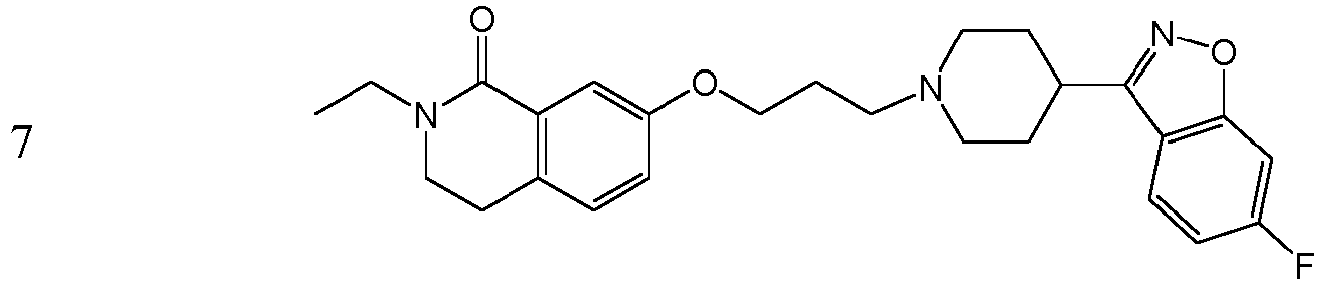
- the target compound was prepared according to the method of Example 1, using iodoethane instead of iodomethane, and 1,3-dibromopropane instead of 1,4-dibromobutane.
- the structural formula is shown as No. (7) in Table 1.
- the target compound was prepared according to the method of Example 1, using 2-methyl-4-methoxyphenylethylamine instead of 4-methoxyphenylethylamine, and 1,3-dibromopropane instead of 1,4-dibromobutane.
- the structural formula is shown as No. (8) in Table 1.
- the target compound was prepared according to the method of Example 1, using 2-fluoro-4-methoxyphenylethylamine, and using 1,3-dibromopropane instead of 1,4-dibromobutane.
- the structural formula is shown as No. (9) in Table 1
- the target compound was prepared according to the method of Example 1, using 2-(4-methoxyphenyl)propan-1-amine instead of 4-methoxyphenylethylamine, and 1,3-dibromopropane instead of 1,4-dibromobutane.
- the structural formula is shown as No. (10) in Table 1.
- the target compound was prepared according to the method of Example 1, using (4-methoxyphenoxy)methanamine instead of 4-methoxyphenylethylamine, and 1,3-dibromopropane instead of 1,4-dibromobutane.
- the structural formula is shown as No. (11) in Table 1.
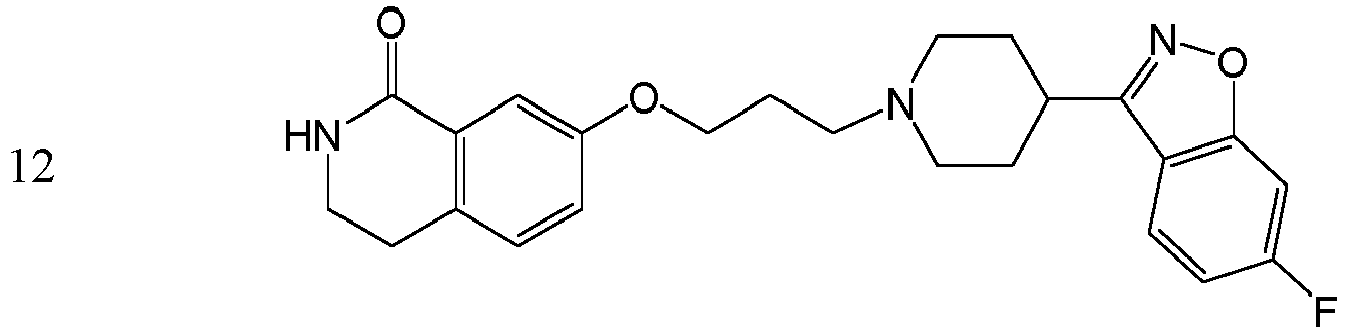
- the target compound was prepared according to the method of Example 1 without iodomethane, and using 1,3-dibromopropane instead of 1,4-dibromobutane.
- the structural formula is shown as No. (12) in Table 1.
- the target compound was prepared according to the method of Example 1, using 1,3-dibromopropane instead of 1,4-dibromobutane, and 1-(benzo[d][1,3]dioxol-5-yl)piperazine instead of 6-fluoro-3-(piperidin-4-yl)benzo[d]isoxazole as raw material.
- the structural formula is shown as No. (13) in Table 1.
- the target compound was prepared according to the method of Example 1, using 1,3-dibromopropane instead of 1,4-dibromobutane, and 3-(piperazin-1-yl)benzo[d]isothiazole instead of 6-fluoro-3-(piperidin-4-yl)benzo[d]isoxazole as raw material.
- the structural formula is shown as No. (14) in Table 1.
- the target compound was prepared according to the method of Example 1, using 1,3-dibromopropane instead of 1,4-dibromobutane, and 3-(piperazin-1-yl)benzo[d]isothiazole instead of 6-fluoro-3-(piperidin-4-yl)benzo[d]isoxazole as raw material.
- the structural formula is shown as No. (14) in Table 1.
- the target compound was prepared according to the method of Example 1, using 1,3-dibromopropane instead of 1,4-dibromobutane, and 1-phenylpiperazine instead of 6-fluoro-3-(piperidin-4-yl)benzo[d]isoxazole as raw material.
- the structural formula is shown as No. (16) in Table 1.
- the target compound was prepared according to the method of Example 1, using 1,3-dibromopropane instead of 1,4-dibromobutane, and 1-(4-chlorophenyl)piperazine instead of 6-fluoro-3-(piperidin-4-yl)benzo[d]isoxazole as raw material.
- the structural formula is shown as No. (17) in Table 1.
- the target compound was prepared according to the method of Example 1, using 1,3-dibromopropane instead of 1,4-dibromobutane, and 1-(2-chlorophenyl)piperazine instead of 6-fluoro-3-(piperidin-4-yl)benzo[d]isoxazole as raw material.
- the structural formula is shown as No. (18) in Table 1.
- the target compound was prepared according to the method of Example 1, using 1,3-dibromopropane instead of 1,4-dibromobutane, and 1-(4-fluorophenyl)piperazine instead of 6-fluoro-3-(piperidin-4-yl)benzo[d]isoxazole as raw material.
- the structural formula is shown as No. (19) in Table 1.
- the target compound was prepared according to the method of Example 1, using 1,3-dibromopropane instead of 1,4-dibromobutane, and 1-(2-fluorophenyl)piperazine instead of 6-fluoro-3-(piperidin-4-yl)benzo[d]isoxazole as raw material.
- the structural formula is shown as No. (20) in Table 1.
- the target compound was prepared according to the method of Example 1, using 1,3-dibromopropane instead of 1,4-dibromobutane, and 1-(4-methoxyphenyl)piperazine instead of 6-fluoro-3-(piperidin-4-yl)benzo[d]isoxazole as raw material.
- the structural formula is shown as No. (21) in Table 1.
- the target compound was prepared according to the method of Example 1, using 1,3-dibromopropane instead of 1,4-dibromobutane, and 1-(4-methoxyphenyl)piperazine instead of 6-fluoro-3-(piperidin-4-yl)benzo[d]isoxazole as raw material.
- the structural formula is shown as No. (22) in Table 1.
- the target compound was prepared according to the method of Example 1, using 1,3-dibromopropane instead of 1,4-dibromobutane, and 1-(pyridin-2-yl)piperazine instead of 6-fluoro-3-(piperidin-4-yl)benzo[d]isoxazole as raw material.
- the structural formula is shown as No. (23) in Table 1.
- the target compound was prepared according to the method of Example 1, using 1,3-dibromopropane instead of 1,4-dibromobutane, and 2-(piperazin-1-yl)pyrimidine instead of 6-fluoro-3-(piperidin-4-yl)benzo[d]isoxazole as raw material.
- the structural formula is shown as No. (24) in Table 1.
- the target compound was prepared according to the method of Example 1, using 1,3-dibromopropane instead of 1,4-dibromobutane, and (4-fluorophenyl)(piperidin-4-yl)methanone instead of 6-fluoro-3-(piperidin-4-yl)benzo[d]isoxazole as raw material.
- the structural formula is shown as No. (25) in Table 1.
- the target compound was prepared according to the method of Example 26, using 1,2,3,4-tetrahydroisoquinoline instead of 1-benzylpiperazine as raw material.
- the structural formula is shown as No. (27) in Table 1.
- the target compound was prepared according to the method of Example 26, using 1-(3-(trifluoromethyl)phenyl)piperazine instead of 1-benzylpiperazine as raw material.
- the structural formula is shown as No. (28) in Table 1.
- the target compound was prepared according to the method of Example 26, using 1-(4-fluorophenyl)piperazine instead of 1-benzylpiperazine as raw material.
- the structural formula is shown as No. (29) in Table 1.
- the target compound was prepared according to the method of Example 26, using 1-(pyridin-2-yl)piperazine instead of 1-benzylpiperazine as raw material.
- the structural formula is shown as No. (30) in Table 1.
- the target compound was prepared according to the method of Example 26, using 1,3-dibromopropane instead of 1,4-dibromobutane, and 1-(3-(trifluoromethyl)phenyl)piperazine instead of 1-benzylpiperazine as raw material.
- the structural formula is shown as No. (31) in Table 1.
- Rats were decapitated. Cortex of brain was rapidly taken on ice, to which 3 ml of buffer (0.05 M Tris-HCl buffer, containing 0.1% ascorbic acid, 10 ⁇ M pargyline and 4 mM CaCl 2 ) was added, homogenization was conducted, and then 5 ml of buffer (0.05 M Tris-HCl buffer, containing 0.1% ascorbic acid, 10 ⁇ M pargyline and 4 mM CaCl 2 ) was added. Incubation at 37°C was conducted for 10 min. The weight of the tubes were adjusted using a balance after incubation. Centrifugation was conducted at 12000 rpm, 4°C for 20 min.
- buffer 0.05 M Tris-HCl buffer, containing 0.1% ascorbic acid, 10 ⁇ M pargyline and 4 mM CaCl 2
- the supernatant was discarded, and 3 ml of buffer was added, vortex mixer was used for blending, and then 5 ml of buffer was added. Centrifugation was conducted and repeated 3 times. After the centrifugation, the supernatant was discarded, and the pellets were stored at-80°C for future use.
- Isotope ligand 3 H-8-OH-DPAT (67.0 Ci/mmol) was purchased from PerkinElmer Company; 5-HT was purchased from RBI Company; GF/C glass fiber filter paper was purchased from Whatman Company; Tris was imported and divided into aliquots; PPO, POPOP were purchased from Shanghai No. 1 Reagent Factory; liposoluble scintillation cocktail was purchased from Shanghai Reagent Factory; Beckman LS-6500 Multi-function Liquid Scintillation Counter was used.
- Rats were decapitated. Cortex of brain was rapidly taken on ice, and 3 ml of buffer (0.05 M Tris-HCl buffer: 6.05 g of Tris was dissolved in 1000 ml of double-distilled water, and concentrated HCl was used to adjust to pH 7.5) was added, homogenization was conducted, and then 5 ml of buffer was added. Incubation was conducted at 37°C for 10 min, the weight of the tubes were adjusted using a balance after incubation. Centrifugation was conducted at 12000 rpm, 4°C for 20 min, the supernatant was discarded, and 3 ml of buffer was added. Vortex mixer was used for blending, and then 5 ml of buffer was added. Centrifugation was conducted (repeated 3 times). After the centrifugation, the supernatant was discarded, and the pellets were stored at-80°C for future use.
- buffer 0.05 M Tris-HCl buffer: 6.05 g of Tris was dissolved in 1000 ml of double-
- Isotope ligand [ 3 H]-Ketanserin (67.0 Ci/mmol) was purchased from PerkinElmer Company; Methysergide was purchased from RBI Company; GF/C glass fiber filter paper was purchased from Whatman Company; Tris was imported and divided into aliquots; PPO and POPOP were purchased from Shanghai No. 1 Reagent Factory; liposoluble scintillation cocktail was purchased from Shanghai Reagent Factory; Beckman LS-6500 Multi-function Liquid Scintillation Counter was used.
- Rats were decapitated. Striatum of brain was rapidly taken on ice, 3 ml of buffer (0.05 M Tris-HCl buffer, containing NaCl 120 mM, KCl 5 mM, MgCl 2 1 mM, CaCl 2 1 mM) was added, homogenization was conducted, and then 5 ml of buffer was then added. The weight of the homogenized tubes were adjusted using a balance, and centrifugation was conducted. The supernatant was discarded, and 3 ml of buffer was added. Vortex mixer was used for blending, and then 5 ml of buffer was added. Centrifugation was conducted and repeated 3 times. The supernatant was discarded after centrifugation was completed, and the pellets were stored at-80°C for future use.
- buffer 0.05 M Tris-HCl buffer, containing NaCl 120 mM, KCl 5 mM, MgCl 2 1 mM, CaCl 2 1 mM
- Isotope ligand 3 H-Spiperone (67.0 Ci/mmol) was purchased from PerkinElmer Company; Butaclamol was purchased from RBI Company; GF/C glass fiber filter paper was purchased from Whatman Company; Tris was imported and divided into aliquots; PPO and POPOP were purchased from Shanghai No. 1 Reagent Factory; liposoluble scintillation cocktail was purchased from Shanghai Reagent Factory. Beckman LS-6500 Multi-function Liquid Scintillation Counter was used.
- Isotope ligand [ 3 H]-5-CT 85.4 Ci/mmol was purchased from PerkinElmer Company; ( ⁇ )-pindolol was purchased from RBI Company; GF/C glass fiber filter paper was purchased from Whatman Company; Tris was imported and divided into aliquots; PPO and POPOP were purchased from Shanghai No. 1 Reagent Factory; liposoluble scintillation cocktail was purchased from Shanghai Reagent Factory. Beckman LS-6500 Multi-function Liquid Scintillation Counter was used.
- Guinea pigs were decapitated. Cerebellum of the guinea pig was rapidly taken on ice and 3 mL of buffer (potassium dihydrogen phosphate 1.36 g, 0.1 mol/L sodium hydroxide 79 ml, metered to 200 ml with double-distilled water) was added. Vortex mixer was used for blending. Centrifugation was conducted at 48000g, 4°C for 10 min. The supernatant was discarded to give pellets, and buffer was added again for washing. Centrifugation was conducted and repeated 3 times. After the centrifugations, the supernatant was discarded, and the pellets were stored at-80°C for future use.
- buffer potassium dihydrogen phosphate 1.36 g, 0.1 mol/L sodium hydroxide 79 ml, metered to 200 ml with double-distilled water
- Isotope ligand 3 H-pyrilamine (67.0 Ci/mmol) was purchased from PerkinElmer Company; promethazine was purchased from RBI Company; GF/C glass fiber filter paper was purchased from Whatman Company; Tris was imported and divided into aliquots; PPO, POPOP were purchased from Shanghai No. 1 Reagent Factory; liposoluble scintillation cocktail was purchased from Shanghai Reagent Factory; Beckman LS-6500 Multi-function Liquid Scintillation Counter was used.
- the compound of the invention in particular compound 5 has strong affinities for three receptors (D 2 , 5-HT 1A and 5-HT 2A ), low affinity for H 1 , and high affinity for 5HT 7 .
- the risk of the side effect of bodyweight gain is low, as compared with risperidone.
- 5HT 7 receptor can modulate emotion, learning, as well as memory and action with such receptor may contribute to function of improvement of cognitive disorders.
- Example 37 MK-801 induced high activity- in vivo anti-schizophrenia activity of the compounds
- mice of Kunming breed with half male and half female, body weight of (20 ⁇ 2) g, were provided by Qinglongshan Animal Cultivation Center, Nanjing.
- Ascorbic acid was provided by Sinopharm Chemical Reagent Co. Ltd.
- MK-801 was produced by Sigma Company, USA; the formulation method: 0.1% vitamin C was used to formulate a 1mg/ml solution.
- mice with qualified body weight were selected, and randomly divided into blank group, model group, positive control group (risperidone group) and drug group.
- 10% Tween was administered intragastrically to the blank group and the model group at 0.1 ml/10 g; risperidone was administered intragastrically to the positive control group at 0.1 mg/kg; and corresponding amounts of drugs were administered intragastrically to the drug groups, respectively.
- 0.1% concentration of ascorbic acid was intraperitoneally injected to the blank group at 0.1 ml/10g; and the model group, the positive control group (30 min) and the drug group were intraperitoneally injected the MK-801 solution at 0.1mg/kg.
- the spontaneous activities of the mice of each group in 90 min were measured. The results are listed in Table 3.
- Test positive drugs haloperidol, clozapine, risperidone, olanzapine, aripiprazole, ziprasidone, quetiapine.
- Apomorphine provided by Sigma Company was dissolved in 0.9 % NaCl (containing 0.1% vitamin C) before use, and was freshly formulated before use.
- mice male, with body weight of 18-22 g
- positive drug groups of each dosage risperidone, aripiprazole, ziprasidone, quetiapine, olanzapine, haloperidol, clozapine
- compound groups of each dosage the specific dosages are listed in the following Table
- Corresponding solvent double-distilled water was administered intragastrically to the negative control group and the model group, corresponding positive drugs were administered intragastrically to the positive drug groups (a small amount of acetic acid was first added and then double-distilled water was added when dissolving), and corresponding dosages of compounds were administered intragastrically to the compound groups of each dosage, with the volume for intragastric administration as 0.1 ml/10g. 1 hour after the intragastric administration, apomorphine was subcutaneously injected (1 mg/kg), with the volume as 0.1 ml/10g. After the injection of apomorphine, the animals were immediately put into the clambering cages.
- mice at 10-11, 20-21, and 30-31 min after the injection of apomorphine were observed and scored. Scoring criteria: the behavior of 4 paws on the floor was scored as 0; the behavior of 2 forepaws on the cage was scored as 1; and the behavior of 4 paws on the cage was scored as 2. The results are listed in Table 3.
- Grouping of the qualified rats the qualified rats were divided into negative control group, positive drug groups of each dosage, and compound groups of each dosage according to the principle of randomization, 8 in each group.
- CAR Assay A CAR assay was performed 1 hour after intragastric administration. The method was the same as the CAR training. The observation indicators were the number of avoidances, the number of escapes, and the number of escape failures.
- mice of Kunming breed with half male and half female, body weight of (22 ⁇ 2) g, were provided by Qinglongshan Animal Cultivation Center, Nanjing.
- Main reagents the test drugs, haloperidol, clozapine, risperidone, olanzapine, aripiprazole, ziprasidone.
- mice half male and half female, with body weight of 20-24 g were randomly divided into negative control group, model group, positive drug groups of each dosage (risperidone, aripiprazole, ziprasidone, quetiapine, olanzapine, haloperidol, clozapine), compound groups of each dosage, with 10 mice in each group.
- Corresponding solvent double-distilled water was administered intragastrically to the negative control group and the model group, corresponding positive drugs were administered intragastrically to the positive drug groups (a small amount of acetic acid was first added and then double-distilled water was added when dissolving), corresponding dosages of compounds were administered intragastrically to the compound groups for each dosage, with the volume for intragastric administration as 0.1 ml/10 g.
- the two forepaws of the mice were gently placed on the bars (which were 20 cm in length, 0.3 cm in diameter, and 5.5 cm above the bench), and the hindpaws of the animals were placed on the bottom of the box.
- mice The durations of the mice to maintain the posture with the two forepaws on the bars were recorded, and 30 s of spasticity without moving was considered as the positive response. In the case the forepaws of the mice were not put down persistently, the observation was terminated at 60s. The numbers of animals with positive response in each of the compound dosage groups were counted. The results are listed in Table 3.
- mice half male and half female were randomly divided into several groups (with 4 mice in each group), which were respectively the 500 mg/kg, 200 mg/kg, 50 mg/kg groups for each compound, and the solvent group. 0.2 ml/10 g were administered intragastrically, and the deaths of the animals in 1-3 days were observed.
- the compound of the invention has relatively low acute toxicity.
- the LD 50 of intragastric administration of the compound 5 in mice is 257.5 mg/kg
- the LD 50 of intragastric administration of the same in rats is 167.5 mg/kg.
- the therapuetic index is significantly greater than the positive drug risperidone, indicating a relatively low acute toxicity.
- the results are listed in Table 3 and Table 4.
- LD 50 (po,mg/kg) MK-801 induced high activity (ED 50 ,po,mg/kg) Apomorphine induced clambering (ED 50 ,po,mg/kg) Catalepsy (ED 50 ,po,mg/kg) Catalepsy / MK-801 induced high activity Catalepsy / Apomorphine induced clambering 5 257 0.04 0.05 35 875 700 14 202 0.07 0.06 32 457 533 22 311 0.12 0.19 52 433 273 24 190 0.18 0.22 47 261 214 haloperidol 20 0.10 0.08 0.44 4.40 4.89 clozapine 150 2.28 17.92 >50 >21.93 >5.58 risperidone 82.1 0.01 0.046 0.92 92.00 61.33 Table 4.
- Rat CAR ED 50 (mg/kg)
- Rat LD 50 (mg/kg)
- Therapeutic index 5 0.32 167.5 523 14 0.65 155 238 22 0.49 198 404 24 1.02 146 143 risperidone 0.66 113 171
- the raw excipients were sieved with 80 mesh for use.
- the prescription doses of active ingredient, microcrystalline cellulose, lactose, Povidone K30 were weighed and introduced into a high speed mixing granulator, whereby they were mixed uniformly at low speed. An appropriate amount of purified water was added, the stirring was performed at low speed, and high speed shear granulation was carried out.
- the wet granules were dried at 60°C for 3 hours, and sieved with 24 mesh.
- the prescription doses of carboxymethyl starch sodium, silica and magnesium stearate were added for mixing totally. The compression was performed in a rotary tablet press.
Landscapes
- Chemical & Material Sciences (AREA)
- Organic Chemistry (AREA)
- Health & Medical Sciences (AREA)
- Medicinal Chemistry (AREA)
- Pharmacology & Pharmacy (AREA)
- Life Sciences & Earth Sciences (AREA)
- Animal Behavior & Ethology (AREA)
- General Health & Medical Sciences (AREA)
- Public Health (AREA)
- Veterinary Medicine (AREA)
- Epidemiology (AREA)
- Bioinformatics & Cheminformatics (AREA)
- Engineering & Computer Science (AREA)
- Biomedical Technology (AREA)
- Neurology (AREA)
- Neurosurgery (AREA)
- Chemical Kinetics & Catalysis (AREA)
- General Chemical & Material Sciences (AREA)
- Nuclear Medicine, Radiotherapy & Molecular Imaging (AREA)
- Psychiatry (AREA)
- Pain & Pain Management (AREA)
- Pharmaceuticals Containing Other Organic And Inorganic Compounds (AREA)
- Plural Heterocyclic Compounds (AREA)
- Other In-Based Heterocyclic Compounds (AREA)
Description
- The invention relates to the field of medicine and particularly relates to a lactam compound derivative, a pharmaceutical composition comprising the same, and use of the pharmaceutical composition and the lactam compound derivative in the manufacture of a medicament for the prevention or treatment of schizophrenia.
- Schizophrenia is the most serious and most harmful disease among all mental illnesses. The global morbidity is about 1-2%. The lifetime prevalence of schizophrenia patients is 0.7-0.8%, which is not significantly relevant to gender, race, or social boundaries. Meanwhile, the mortality of schizophrenia patients is 2-3 times higher than that of the general population. Recent studies have shown that the social burden of mental illness ranks first among diseases in China, exceeding diseases such as cardiovascular, respiratory diseases and malignant tumors.
- There are two major types of drug for schizophrenia, i.e. "typical" anti-schizophrenia drug and "non-typical" anti-schizophrenia drug. Typical anti-schizophrenia drug (e.g. chloropromazine and haloperidol) which blocks dopamine D2 receptor has good therapeutic effect on positive symptoms of schizophrenia. But due to the strong blocking on dopamine D2 receptor, it will lead to side effects like extrapyramidal system (EPS) reaction, tardive dyskinesia and increase of prolactin. Furthermore, it is not effective for negative symptoms of schizophrenia.
- Non-typical anti-schizophrenia drug represented by clozapine and risperidone has strong effect on not only dopamine (D2) receptor, but also 5-hydroxytryptamine (5-HT2A) receptor. These drugs provide significant advantages over typical anti-schizophrenia drug: good therapeutic effect against schizophrenia positive symptoms, significantly reduced side effects of extrapyramidal system reaction and tardive dyskinesia or the like, and some non-typical anti-schizophrenia drugs can improve the negative symptoms and cognitive disorders in some degree. However, all the non-typical anti-schizophrenia drugs in current clinical application have side effects of extended QT interval, hyper-prolactine or the like in varying degrees. Therefore, it is important to find a new drug which can effectively cure schizophrenia, and has less side effects.
- Studies have shown that receptors like D2, 5-HT1A, 5-HT2A and H1 play a very important role in schizophrenia. Action with D2 receptor may be effective for the treatment of schizophrenia positive symptoms. The pyramidal neurons and GABA interneurons of prefrontal cortex comprise 5-hydroxytryptamine receptor 5-HT1A and 5-HT2A. 5-hydroxytryptamine system plays an important role in modulating the function of prefrontal cortex, including emotion control, cognitive behavior and working memory. 5-HT1A is associated with the effect of non-typical anti-psychosis drug therapy, which can improve negative symptoms and cognitive disorders. 5-HT2A receptor relates to various aspects, including cognition, emotion regulation and motion control. The blocking of 5-HT2A receptor can normalize the release of dopamine, exerting the effect of anti-psychosis. mRNA of 5-HT7 receptor is expressed in peripheral tissue as well as the central nervous system, wherein it is mainly located in thalamus, hypothalamus, cerebral cortex, hippocampus and amygdala. This receptor can modulate body temperature, biological rhythm, sleeping, emotion, learning and memory. 5-HT7 receptor is important for the modulation of central nervous system activities in normal and pathologic conditions, and can be utilized as an important target for mental disease treatment. Meanwhile, during long-term medication for schizophrenia treatment, some drugs are liable to bring about the side effect of bodyweight gain. Studies have shown that these side effects are closely related with histamine H1 receptor.
- Caldas et al. (Application of 4D-QSAR studies a series of benzothiophene, J. Mol. Model, 2014, 20, 2420) disclose a series of 52 benzothiophene analogs. These compounds were applied to four-dimensional quantitative structure-activity relationship analysis and evaluated as dopamine D2 receptor inhibitors.
-
WO 2012/003418 A2 relates to novel functionally selective ligands of dopamine D2 receptors, including agonists, antagonists, and inverse agonists.WO 2012/003418 A2 further relates to the use of these compounds for treating central nervous system disorders related to D2 receptors. -
WO 2006/112464 A1 provides a heterocyclic compound represented by the general formula (1). The compound ofWO 2006/112464 A1 has a wide treatment of nervous system disorders, no side effects and high safety.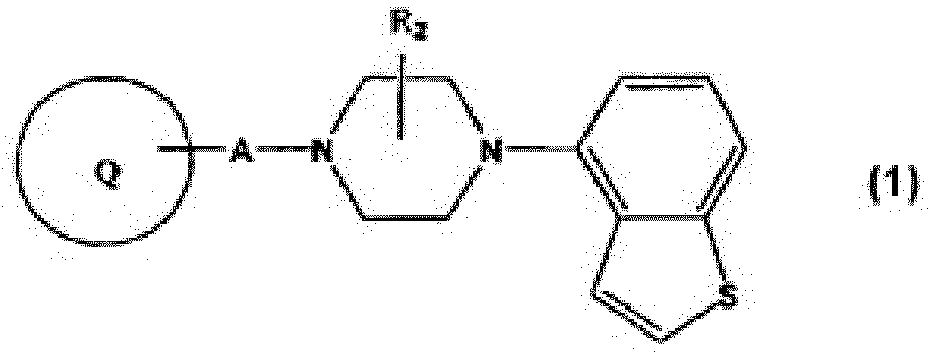
-
WO 2007/026959 A2 discloses a heterocyclic compound or a salt thereof represented by the formula (1): where R2 represents a hydrogen atom or a lower alkyl group; A represents a lower alkylene group or lower alkeylene group; and R1 represents an aromatic group or a heterocyclic group.
- Therefore, it is desirable for novel anti-schizophrenia drug to have multiple receptors binding, broad range of activity, and reduced side effects of EPS and bodyweight gain.
- In an aspect, provided is a compound of Formula I or a pharmaceutically acceptable salt thereof,

- X is C, O, N or NH;
- Z is-(CH2)n-, which is unsubstituted or substituted by one or more substituents selected from the group consisting of alkyl, cyano, hydroxy and halogen, n is an integer of 2~7;
- R1 and R2 are each independently hydrogen, or linear or branched alkyl containing 1~5 carbon atoms, wherein the alkyl is optionally substituted by one or more substituents selected from the group consisting of alkyl, cyano, hydroxy and halogen;
- R3 is hydrogen, halogen or linear or branched alkyl containing 1~5 carbon atoms, wherein the alkyl is optionally substituted by one or more substituents selected from the group consisting of alkyl, cyano, hydroxy and halogen;
- P is CH or N;
- Ar is a group selected from the group consisting of formula III:

- Q is O or S;
- R7 is hydrogen, halogen, linear or branched alkyl containing 1~5 carbon atoms, or alkoxyl containing 1~5 carbon atoms, wherein the alkyl and alkoxyl are optionally substituted by one or more substituents selected from the group consisting of alkyl, cyano, hydroxy and halogen.
- In another aspect, provided is further a pharmaceutical composition, which comprises a compound or a pharmaceutically acceptable salt thereof according to the invention, and pharmaceutically acceptable excipient, carrier, adjuvant, solvent or the combination thereof.
- In another aspect, provided is a compound or a pharmaceutically acceptable salt thereof according to the invention or a pharmaceutical composition according to the invention for use in the prevention or treatment of neuropsychiatric disease, in particular schizophrenia.
- Provided is also use of a compound according to the invention, or a pharmaceutically acceptable salt thereof, or a pharmaceutical composition according to the invention, in the manufacture of a medicament for the treatment or prevention of neuropsychiatric disease, in particular schizophrenia.
- Unless indicated otherwise, definitions used herein should be adopted as follows. For the purpose of the invention, chemical elements should be consistent with the CAS version of Periodic Table of Elements and Handbook of Chemistry and Physics (the 75th edition, 1994). In addtion, general principles of organic chemistry may refer to " Organic Chemistry", Thomas Sorrell, University Science Books, Sausalito: 1999 and " March's Advanced Organic Chemistry", Michael B. Smith and Jerry March, John Wiley & Sons, New York: 2007 .
- The term "patient" or "subject" used in the invention refers to human (including adult and child) or other animal (including mammal). According to some examples of the invention, "patient" or "subject" refers to human.
- The term "optional" or "optionally" or "optionally exist" means the event described subsequent thereto may, but not necessarily happen, and the description includes the cases wherein the said event or circumstance happens or does not happen. For example, "a bond optionally exists" refers to a bond which may exist or not exist, and the description includes single bond, double bond or triple bond.
- The term "optionally substituted" can be exchangeablly used with the term "substituted or unsubstituted" in the invention. Generally, the term "substituted" means that one or more hydrogen atoms in the given structure are substituted by a specific substituent. Unless stated in other aspects, an optionally substituted group can be substituted at each substitutable site on it. When more than one site in the given structure can be substituted by one or more substituents selected from the group consisting of specific groups, each site can be substituted by the same or different substituents.
- Unless otherwise indicated clearly, the description "(each) independently" used herein should be understood in a broad sense. It may mean that the specific options denoted by the same symbol in different groups have no influence upon each other, or may also mean that the specific options denoted by the same symbol in the same group have no influence upon each other.
- In the sections of the description, substituents of the compound of the invention are disclosed according to the types and scopes of the groups. It should be particularly indicated that, every independent subordinated combination of the types and scopes of these groups are encompassed by invention. For example, the term "C1-5 alkyl" particularly means independently disclosed methyl, ethyl, C3 alkyl, C4 alkyl and C5 alkyl.
- The ranges described herein (like numerical ranges) may include every value within the range, and every subrange constituted by each value. For example, "n is an integer of 2~7" includes 2, 3, 4, 5, 6 or 7, and every subrange constituted by these value, including2~6, 2~5, 2~4, 3~6, 3~5, 4~6.
- The description "one or more" used herein can mean 1, 2, 3, 4, 5, 6, 7 or more.
- In Formula I, the dashed line-containing portion may represent a single bond or a double bond. A person of skill in the art should readily understand that for consideration of rational selection of chemical bonds and obtaining stable compounds, in the cases of a single bond or a double bond, the atom or radical denoted by X may be correspondingly and optionally attached with one or more hydrogen atoms. For example, if the dashed line-containing portion represents a single bond, when X is selected as C, it should be understood that it may correspondingly represent CH2. If the dashed line-containing portion represents a double bond, when X is selected as C, it should be understood that it may correspondingly represent CH. Likewise, if the dashed line-containing portion represents a double bond, a person of skill in the art would understand that for the purposes of reasonable selection of chemical bonds and obtaining stable compounds, the choice of X as NH may correspondingly represent N. In one embodiment, the aforementioned atomic group (eg. CH, CH2, NH) may be optionally substituted, for example by one or more substituents selected from alkyl, cyano, hydroxyl and halogen.
- Unless specifically indicated, the term "alkyl" or "alkyl group", represent saturated linear or branched monovalent hydrocarbyl group containing 1 to 20 carbon atoms, wherein the alkyl group may be optionally substituted by one or more the substituents according to the invention. Unless specifically indicated otherwise, alkyl group contains 1 to 20 carbon atoms. According to an embodiment of the invention, the alkyl group contains 1 to 12 carbon atoms. According to another embodiment of the invention, the alkyl group contains 1 to 6 carbon atoms. According to an embodiment of the invention, the alkyl group contains 1 to 5 or 1 to 4 carbon atoms. According to another embodiment of the invention, the alkyl group contains 1 to 3 carbon atoms. Examples of the alkyl groups include methyl (Me,-CH3), ethyl (Et,-CH2CH3), n-propyl (n-Pr,-CH2CH2CH3), iso-propyl (i-Pr,-CH(CH3)2), n-butyl (n-Bu,-CH2CH2CH2CH3), iso-butyl (i-Bu,-CH2CH(CH3)2), secondary butyl (s-Bu,-CH(CH3)CH2CH3), tertiary butyl (t-Bu,-C(CH3)3), n-pentyl (-CH2CH2CH2CH2CH3), 2-pentyl (-CH(CH3)CH2CH2CH3), 3-pentyl (-CH(CH2CH3)2), 2-methyl-2-butyl (-C(CH3)2CH2CH3), 3-methyl-2-butyl (-CH(CH3)CH(CH3)2), 3-methyl-1-butyl (-CH2CH2CH(CH3)2), 2-methyl-1-butyl (-CH2CH(CH3)CH2CH3), n-hexyl (-CH2CH2CH2CH2CH2CH3), 2-hexyl (-CH(CH3)CH2CH2CH2CH3), 3-hexyl (-CH(CH2CH3)(CH2CH2CH3)), 2-methyl-2-pentyl (-C(CH3)2CH2CH2CH3), 3-methyl-2-pentyl (-CH(CH3)CH(CH3)CH2CH3), 4-methyl-2-pentyl (-CH(CH3)CH2CH(CH3)2), 3-methyl-3-pentyl (-C(CH3)(CH2CH3)2), 2-methyl-3-pentyl (-CH(CH2CH3)CH(CH3)2), 2,3-dimethyl-2-butyl (-C(CH3)2CH(CH3)2), 3,3-dimethyl-2-butyl (-CH(CH3)C(CH3)3), n-heptyl, n-octyl.
- The term "halogen" refers to fluorine (F), chlorine (Cl), bromine (Br) or iodine (I).
- The term "alkoxyl containing 1~5 carbon atoms" refers to an alkyl group attached to the rest of the molecule through oxygen atom, wherein the alkyl group has the meaning defined hereinabove. Unless specifically indicated otherwise, the alkoxyl group may contain 1 to 5 carbon atoms.
- Examples of alkoxyl group include methoxyl (MeO,-OCH3), ethoxyl (EtO,-OCH2CH3), 1-propoxy (n-PrO, n-propoxy,-OCH2CH2CH3), 2-propoxy (i-PrO, i-propoxy,-OCH(CH3)2), 1-butoxy (n-BuO, n-butoxy,-OCH2CH2CH2CH3), 2-methyl-1-propoxy (i-BuO, i-butoxy,-OCH2CH(CH3)2), 2-butoxy (s-BuO, s-butoxy,-OCH(CH3)CH2CH3), 2-methyl-2-propoxy (t-BuO, t-butoxy,-OC(CH3)3), 1-pentyloxy (n-pentyloxy,-OCH2CH2CH2CH2CH3), 2-pentyloxy (-OCH(CH3)CH2CH2CH3), 3-pentyloxy (-OCH(CH2CH3)2).
- The term "pharmaceutically acceptable salt" refers to an organic salt and an inorganic salt of the compound according to the invention. The pharmaceutically acceptable salt is known to us, like those recited in the literature: S.M. Berge et al., J. Pharmaceutical Sciences, 66: 1-19, 1977. Pharmaceutically acceptable salts formed by non-toxic acids include a salt formed by reaction with an inorganic acid, e.g. hydrochloride, hydrobromate, phosphate, sulfate, perchlorate; and a salt formed by reaction with an organic acid, e.g. acetate, oxalate, maleate, tartrate, citrate, succinate, malonate; or these salts can be obtained through other methods recited in the literatures, like ion exchange. Other pharmaceutically acceptable salts include adipate, alginate, ascorbate, aspartate, benzenesulphonate, benzoate, bisulphate, borate, butyrate, camphorate, camphorsulfonate, cyclic pentyl propionate, digluconate, dodecyl sulfates, ethanesulfonate, formate, fumarate, glucoheptonate, glycerin phosphate, glyconate, hemisulphate, heptylate, hexanoate, hydriodate, 2-hydroxy-ethanesulfonate, lactobionate, lactate, laurate, lauryl sulfate, malate, malonate, methanesulfonate, 2-naphthalenesulfonate, nicotinate, nitrate, oleate, palmitate, pamoate, pectate, persulphate, 3-phenylpropionate, picrate, pivalate, propionate, stearate, thiocyanate, p-methylbenzenesulphonate, undecylate, valerate. Salts obtained from suitable bases include salts of alkali metal, alkali-earth metal, ammonium and N+(C1-4 alkyl)4.
- The term "treatment" can refer to ameliorating a disease or disorder (ie, slowing or preventing or reducing the disease or the development of at least one clinical symptom thereof). In other embodiments, " treatment" refers to alleviating or ameliorating at least one physical parameter, including physical parameters that may not be perceived by the patient. In other embodiments, "treatment" refers to modulating a disease or disorder physically (eg, stabilizing a visible symptom) or physiologically (eg., stabilizing a parameter of the body), or both. In other embodiments, "treatment" refers to preventing or delaying the onset, occurrence or exacerbation of a disease or disorder.
- The term "prevention" refers to a decrease in the risk of developing a disease or disorder (ie, ceases the development of at least one clinical symptom of a disease in a subject that may face or tend to face this disease, but has not yet experienced or manifested the symptoms of the disease).
- The pharmaceutically acceptable salts of the invention may be prepared from the parent compound, basic or acidic moiety through conventional chemical procedures. Generally, such salts may be prepared through the reaction of the compounds in the form of free acid with stoichiometric appropriate base (e.g. carbonate, bicarbonate, hydroxide of Na, Ca, Mg or K,) or through the reaction of the compounds in the form of free base with stoichiometric appropriate acid. Such reactions are often performed in water, organic solvent or the mixture thereof. Typically, in suitable cases, nonaqueous medium like ether, ethyl acetate, ethanol, isopropanol and/or acetonitrile are required. A list of other suitable salts may be found in for example " Remington' s Pharmaceutical Sciences", 20th Ed. , Mack Publishing Company, Easton, Pa., (1985); and " Handbook of Pharmaceutical Salts:Properties, Selection, and Use", Stahl and Wermuth (Wiley-VCH, Weinheim, Germany, 2002).
- The term "metabolite" used herein refers to the product obtained in vivo by metabolism of a specific compound or the salt thereof. A metabolite of a compound can be identified using technologies in the common knowledge of the art, the activity thereof can be characterized using experimental methods described in the invention. Such product may be obtained from the administrated compound by methods like oxidation, reduction, hydrolysis, amidation, de-amidation, esterification, de-esterification, enzyme cleavage. Accordingly, the metabolite of the compound of the invention is encompassed by the invention, for example the metabolite produced by sufficiently contacting the compound of the invention with a mammal for a period of time. It is understood that, the stereisomer, tautomer, nitrogen oxide, solvate (e.g. hydrate), metabolite, of the compound of the invention or the salt thereof, is also encompassed by the invention. These forms are preferably pharmaceutically acceptable.
- The term "prodrug" used in the invention refers to a compound that can be transformed in vivo into the compound of Formula I. Such transformation is affected by hydrolysis of the drug precursor in blood or the enzymic transformation of the drug precursor in blood or tissue to the parent molecule. The following literature may be the reference for a detailed discussion of the drug precursor: Higuchi et al., Pro-drugs as Novel Delivery Systems, Vol. 14, A.C.S. Symposium Series; Roche et al., ed., Bioreversible Carriers in Drug Design, American Pharmaceutical Association and Pergamon Press, 1987; Rautio et al., Prodrugs: Design and Clinical Applications, Nature Reviews Drug Discovery, 2008, 7, 255-270, and Hecker et al, Prodrugs of Phosphates and Phosphonates, J. Med. Chem., 2008, 51, 2328-2345.
- Provided is a compound of Formula I or a pharmaceutically acceptable salt thereof,

- X is C, O, N or NH;
- Z is-(CH2)n-, which is unsubstituted or substituted by one or more substituents selected from the group consisting of alkyl, cyano, hydroxy and halogen, n is an integer of 2~7;
- R1 or R2 are each independently hydrogen, linear or branched alkyl containing 1~5 carbon atoms, wherein the alkyl is optionally substituted by one or more substituents selected from the group consisting of alkyl, cyano, hydroxy and halogen;
- R3 is hydrogen, halogen or linear or branched alkyl containing 1~5 carbon atoms, wherein the alkyl is optionally substituted by one or more substituents selected from the group consisting of alkyl, cyano, hydroxy and halogen;
- P is CH or N;
- Ar is a group selected from the group consisting of formula III:

- Q is O or S;
- R7 is hydrogen, halogen, linear or branched alkyl containing 1~5 carbon atoms, or alkoxyl containing 1~5 carbon atoms, wherein the alkyl and alkoxyl are optionally substituted by one or more substituents selected from the group consisting of alkyl, cyano, hydroxy and halogen.
- In an embodiment, R1 and R2 in formula I are each independently hydrogen, methyl, ethyl, propyl, n-butyl, iso-butyl, trifluoromethyl, trifluoroethyl or trifluoropropyl.
- In another embodiment, R3 in formula I is hydrogen, fluorine, chlorine, bromine, iodine, methyl, ethyl, propyl, n-butyl or iso-butyl.
- In an embodiment, the halogen is fluorine, chlorine, bromine or iodine.
- In an preferable embodiment of the invention,
- X is C, O, N or NH;
- Z is-(CH2)n-, which is unsubstituted or substituted by one or more hydroxy, n is an integer of 2~5;
- R1 is hydrogen, methyl or ethyl;
- R2 is hydrogen, methyl or ethyl;
- R3 is hydrogen, methyl or fluorine.
- In particular, provided is at least one of the following compounds or a pharmaceutically acceptable thereof:





- Provided is a pharmaceutical composition, which comprises a compound of formula I or a pharmaceutically acceptable salt, and a pharmaceutically acceptable excipient, carrier, adjuvant, solvent or the combination thereof.
- The pharmaceutical composition according to the invention can be administered through any suitable route, for example, oral administration in capsule form, parenteral administration in the form of injection, topical application in the form of ointment or lotion, rectal application in the form of suppository, and transdermal administration in the form of patch delivery system.
- According to an embodiment of the invention, an effective amount of a compound of the invention or a pharmaceutically acceptable salt thereof may be orally administered together with carriers such as inert diluent. Examples of suitable pharmaceutically acceptable carriers include inert solid fillers or diluents and sterile aqueous or organic solutions. According to some embodiments of the invention, the compound of the invention or a pharmaceutically acceptable salt thereof may be enclosed in a gelatin capsule or compressed into a tablet. For the purpose of oral treatment, the compound of the invention or the pharmaceutically acceptable salt thereof may be used with excipients, and in the form of for example tablets, lozenges, capsules, suspensions, syrups.
- The compounds of the invention can be combined with suitable solid or liquid carriers or diluents to form capsules, tablets, pills, powders, syrups, solutions. Such forms like tablets, pills, capsules, may contain from about 0.01 to about 99 wt% of the active ingredient (e.g., the compound of the invention or a pharmaceutically acceptable salt thereof) and binders such as gelatin, corn starch, acacia; excipients such as calcium hydrogen phosphate; disintegrants such as corn starch, potato starch or alginic acid; lubricants such as magnesium stearate; and sweeteners such as sucrose, lactose. When capsules are used, liquid carriers may also be contained, for example, fats and oils. When used for parenteral administration, the compound of the invention or a pharmaceutically acceptable salt thereof may be combined with sterile aqueous or organic medium to form an injectable solution or suspension.
- According to an embodiment of the invention, the formulation may contain at least 0.5 wt% of a compound of the invention or a pharmaceutically acceptable salt thereof, but according to the particular variation of the dosage form, a range from about 4 wt% to about 70 wt% may also be advantageous. A preferable oral unit dose of the invention may contain 1.0 to 300 milligrams of a compound of the invention or a pharmaceutically acceptable salt thereof.
- The pharmaceutical composition of the invention can provide about 0.01 to 1000 mg of active ingredient in each unit dose. The amount of the compound of the invention depends on the type and severity of the disease or disorder and also on the characteristics of the subject, such as general health, age, gender, weight, and drug resistance. A person skilled in the art can determine the appropriate dosage based on these or other factors. The effective dose of a central nervous system drug commonly used is well known to a person skilled in the art. The total daily dose is usually about 0.05 to 2000 mg.
- In vitro receptor binding assay indicates that the compound of the invention has high affinities for D2, 5HT1A and 5HT2A, thereby has anti-neuropsychiatric disease activity, i.e. has effect on the treatment or prevention of neuropsychiatric disease, in particular schizophrenia. Meanwhile, the compound of the invention has low affinities for H1 (lowers the risk of obesity, and can increase the efficacy of the drug (e.g. improving the negative symptoms), reduce side effects (e.g. EPS, increase of prolactine, bodyweight gain and prolonged QI interval). Preferably, the compound of the invention has high affinity for 5HT7 receptor and may be beneficial for improving the cognitive disorders.
- Animal assays show that the compound of the invention can not only significantly improve the MK-801 induced high activity, but also effectively improve the apomorphine induced clambering symptoms without causing EPS at effective dosage, indicating that they have notable anti-schizophrenia effects. Since these in vitro targets and in vivo pharmacological models are closely relevant to nervous system diseases caused by dopamine dysfunction, in particular schizophrenia, it is suggested that the compound of the invention has effect on the treatment or prevention of neuropsychiatric disease, in particular schizophrenia.
- When X is C in the compound of the invention, the general synthetic method may include reacting 4-methoxyphenylethylamine with ethyl chloroformate, which is self-cyclized in the presence of methanesulfonic acid and diphosphorus pentoxide, subjecting N at amide to methylation with iodomethane, demethylating the methyl of methoxyl using hydrobromic acid aquous solution, then reacting with 1,3-dibromopropane or 1,4-dibromobutane respectively, and finally reacting with corresponding piperazine or piperidine to give the target product. The specific reaction route is as follows:

- When X is N (Y can be N in the scheme) in the compound of the invention, the generic synthetic method may include reacting 2-amino-5-hydroxybenzoic acid with acetic anhydride and N-methyl formamide respectively to give a product, then reacting with 1,3-dibromopropane or 1,4-dibromobutane respectively, and finally reacting with corresponding piperazine or piperidine to obtain the target product. The specific reaction route is as follows:

- The specific examples of the invention are described below. The examples described below are exemplary, provided for the purpose of illustration to the invention only. Unless defined otherwise, proportion and percentage are calculated based on weight herein. The following synthetic Examples 1-31 are all conducted based on the general method as above. The compounds prepared in each Example are listed in Table 1.
-
- (1) 4-methoxyphenylethylamine (0.1 mol) was dissolved in dichloromethane (300ml), the mixture was cooled to 0°C in ice bath, then triethylamine (20ml) was added, and then ethyl chloroformate (0.15 mmol) was added slowly dropwise. After addition, the reaction was conducted at room temperature for 12 hours. After the reaction was completed, the reaction solution was washed with water and 10% diluted hydrochloric acid solution. The organic layer was dried over anhydrous magnesium sulfate. The solvent was removed by evaporation under reduced pressure. The residue was washed with petroleum ether and dried to give 20.3g of yellow oil. Yield: 91%.
MS (ESI) m/z 223.3 ([M+H]+) - (2) Diphosphorus pentoxide (0.2 mol) was dissolved in methanesulfonic acid (200 ml), then the yellow oil (0.1 mol) prepared in step (1) was added in batches. The reaction was conducted at 140°C. After the reaction was completed, the reaction solution was poured into ice water (500ml) for termination. The mixture was extracted with dichloromethane. The organic layer was washed with saturated sodium carbonate, dried over anhydrous magnesium sulfate. The solvent was removed by evaporation under reduced pressure. The residue was applied to column chromatography (eluent: petroleum ether : ethyl acetate =10:1) to give 12.9 g of brownish oil. Yield: 73%.
MS (ESI) m/z 177.1 ([M+H]+) - (3) 0.2 mol sodium hydroxide was dissolved in 200ml N,N-dimethyl formamide, then the oil (0.1 mol) prepared in step (2) was added, The reaction was stirred in ice bath for 0.5 hour, and then iodomethane (0.15 mol) was slowly added dropwise. After the addition was completed, the reaction was conducted at room temperature for 10 hours. After the reaction was completed, the reaction solution was poured into 1 L ice water to terminate the reaction. Extraction with ethyl acetate was conducted. The organic layer was washed with saturated saline solution, dried over anhydrous magnesium sulfate. The solvent was removed by rotary evaporateion to give 17.8 g of brown solid. Yield: 93%.
MS (ESI) m/z 191.1 ([M+H]+) - (4) The brown solid (0.1 mmol) prepared in step (3) was reacted in 48% hydrobromic acid aqueous solution (100 ml) at 100°C for 10 hours. After the reaction was completed, water was added to terminate the reaction. The mixture was extracted with ethyl acetate and washed with saturated sodium bicarbonate solution. The organic layer was dried over anhydrous magnesium sulfate. The solvent was removed by rotary evaporateion. The residue was applied to column chromatography (eluent: petroleum ether : ethyl acetate =1:1) to give 8.1 g of brownish solid. Yield: 46%.
MS (ESI) m/z 177.2 ([M+H]+) - (5) To acetone (200 ml) was added the brownish solid (0.1 mmol) prepared in step (4), 1, 3-dibromopropane (0.12 mmol) and potassium carbonate (0.3 mmol). The reaction was refluxed for 12 hours. After the reaction was completed, suction filtration was conducted to give organic solution which was then evaporated to dryness under reduced pressure. The residue was applied to column chromatography (eluent: petroleum ether : ethyl acetate =10:1 to give 26.4 g of light yellow oil. Yield: 89%.
MS (ESI) m/z 297.0([M+H]+) - (6) To acetonitrile (50 ml) was added the light yellow oil (2 mmol) prepared in step (5), 6-fluoro-3-(piperidin-4-yl)benzo[d]isoxazole (2 mmol) and potassium carbonate (6 mmol). The reaction was refluxed for 10 hours. After the reaction was completed, suction filtration was conducted to give organic solution. Acetonitrile was evaporated to dryness, The residue was applied to column chromatography (eluent: CH2Cl2 : methanol =10:1 to give 0.38 g of yellow oil. Yield: 87%.
- MS (ESI) m/z 437.2([M+H]+). The structural formula is shown as No. (1) in Table 1.
- 1H-NMR (600MHz, CDCl3) δ 1.74-1.87 (m, 8H), 2.05-2.19 (m, 6H), 2.48 (t, 2H, J = 12 Hz), 2.93 (t, 2H, J = 12 Hz), 3.07-3.11 (m, 2H), 3.16 (s, 3H), 3.55 (t, 2H, J = 12 Hz), 4.06 (t, 2H, J = 6 Hz), 6.96-6.98 (m, 1H), 7.04-7.09 (m, 2H),7.24-7.26 (m, 1H), 7.61 (d, 1H, J = 6 Hz),7.73-7.74 (m, 1H). MS (ESI) m/z 452.2 ([M+H]+).
- 1H-NMR (600MHz, CDCl3) δ 1.74-1.86 (m, 8H), 2.55-2.56 (m, 2H), 2.71-2.73 (m, 2H), 2.93 (t, 2H, J = 12 Hz), 3.10 (t, 2H, J = 12 Hz), 3.14 (s, 3H), 3.53 (t, 2H, J = 12 Hz), 4.03 (t, 2H, J = 6 Hz), 6.94-6.97 (m, 2H), 7.05-7. 16 (m, 3H), 7.58 (d, 1H, J = 6 Hz). MS (ESI) m/z 462.1 ([M+H]+).
- The target compound was prepared according to the method of Example 1, using 1-(2-methoxyphenyl)piperazine instead of 6-fluoro-3-(piperidin-4-yl)benzo[d]isoxazole as raw material. The structural formula is shown as No. (2) in Table 1.
- 1H-NMR (600MHz, CDCl3) δ 1.72-1.86 (m, 4H), 2.50 (t, 2H, J = 12 Hz), 2.69-2.70 (m, 3H), 2.94 (t, 2H, J = 12 Hz), 3.12-3.16 (m, 2H), 3.18 (s, 3H), 3.54 (t, 2H, J = 12 Hz), 3.87 (s, 3H), 4.05 (t, 2H, J= 6 Hz), 6.86-6.88 (m, 1H), 6.91-7.07(m, 5H), 7.61 (d, 1H, J= 6 Hz). MS (ESI) m/z 424.3 ([M+H]+).
- The target compound was prepared according to the method of Example 1, using 1-(3-(trifluoromethyl)phenyl) instead of 6-fluoro-3-(piperidin-4-yl)benzo[d]isoxazole as raw material. The structural formula is shown as No. (3) in Table 1.
- 1H-NMR (600MHz, CDCl3) δ 1.73-1.88 (m, 4H), 2.21-2.22 (m, 2H), 2.50 (t, 2H, J = 12 Hz), 2.64-2.66 (m, 3H), 2.94 (t, 2H, J = 12 Hz), 3.18 (s, 3H), 3.26-3.28 (m, 3H), 3.55 (t, 2H, J = 12 Hz), 4.06 (t, 2H, J= 6 Hz), 6.96-6.98 (m, 1H), 7.06-7. 10 (m, 3H), 7.12-7.14 (m, 1H), 7.34-7.36 (m, 1H), 7.61 (d, 1H, J= 6 Hz). MS (ESI) m/z 462.2 ([M+H]+).
- The target compound was prepared according to the method of Example 1, using 2-(chloromethyl)oxirane instead of 1,4-dibromobutane. The structural formula is shown as No. (4) in Table 1.
- 1H-NMR (600MHz, CDCl3) δ 1.22-1.25 (m, 2H), 2.09-2.13 (m, 4H), 2.24-2.26 (m, 1H), 2.53-2.65 (m, 3H), 2.94 (t, 2H, J = 12 Hz), 3.13-3.17 (m, 4H), 3.19 (s, 3H), 3.21-3.23 (m, 2H), 3.53 (t, 2H, J = 12 Hz), 4.05-34.17 (m, 2H), 7.03-7.11 (m, 3H), 7.21-7.26 (m, 1H), 7.64 (d, 1H, J = 6 Hz), 7.70-7.72 (m, 1H). MS (ESI) m/z 453.3 ([M+H]+).
- The target compound was prepared according to the method of Example 1, using 1,3-dibromopropane instead of 1,4-dibromobutane. The structural formula is shown as No. (5) in Table 1.
- 1H-NMR (600MHz, CDCl3) δ 2.02-2.19 (m, 8H), 2.60 (t, 2H, J = 12 Hz), 2.96 (t, 2H, J = 12 Hz), 3.09-3.11 (m, 3H), 3.18 (s, 3H), 3.56 (t, 2H, J = 12 Hz), 4.11 (t, 2H, J = 6 Hz), 6.98-7.00 (m, 1H), 7.06-7.10 (m, 2H),7.24-7.26 (m, 1H), 7.64 (d, 1H, J = 6 Hz),7.74-7.76 (m, 1H). MS (ESI) m/z 438.2 ([M+H]+).
- The target compound was prepared according to the method of Example 1, using 1,3-dibromopropane instead of 1,4-dibromobutane, and 1-(naphthalen-1-yl)piperazine instead of 6-fluoro-3-(piperidin-4-yl)benzo[d]isoxazole as raw material. The structural formula is shown as No. (6) in Table 1.
- 1H-NMR (600MHz, CDCl3) δ 1.83-2.07 (m, 4H), 2.58-2.67 (m, 4H), 2.94 (t, 2H, J = 12 Hz), 3.16 (s, 3H), 3.21-3.25 (m, 4H), 3.56 (t, 2H, J = 12 Hz), 4.10 (t, 2H, J = 6 Hz), 6.89-7.10 (m, 6H), 7.27-7.29 (m, 2H), 7.62 (d, 1H, J = 6 Hz), 7.74-7.76 (m, 2H).MS (ESI) m/z 430.2 ([M+H]+).
- The target compound was prepared according to the method of Example 1, using iodoethane instead of iodomethane, and 1,3-dibromopropane instead of 1,4-dibromobutane. The structural formula is shown as No. (7) in Table 1.
- 1H-NMR (600MHz, CDCl3) δ 1.78 (t, 3H, J = 12 Hz), 2.01-2.18 (m, 8H), 2.61 (t, 2H, J = 12 Hz), 2.95 (t, 2H, J = 12 Hz), 3.09-3.14 (m, 5H), 3.56 (t, 2H, J = 12 Hz), 4.10 (t, 2H, J = 6 Hz), 6.97-7.00 (m, 1H), 7.07-7.10 (m, 2H),7.24-7.26 (m, 1H), 7.65 (d, 1H, J = 6 Hz),7.75-7.77 (m, 1H). MS (ESI) m/z 453.2 ([M+H]+).
- The target compound was prepared according to the method of Example 1, using 2-methyl-4-methoxyphenylethylamine instead of 4-methoxyphenylethylamine, and 1,3-dibromopropane instead of 1,4-dibromobutane. The structural formula is shown as No. (8) in Table 1.
- 1H-NMR (600MHz, CDCl3) δ 2.01-2.18 (m, 8H), 2.60(t, 2H, J = 12 Hz),2.71 (s, 3H), 2.95 (t, 2H, J= 12 Hz), 3.09-3.12 (m, 3H), 3.18 (s, 3H), 3.57 (t, 2H, J = 12 Hz), 4.10 (t, 2H, J= 6 Hz), 6.96-7.00 (m, 1H), 7.07-7.11 (m, 1H),7.24-7.25 (m, 1H), 7.66 (d, 1H, J= 6 Hz),7.75-7.78 (m, 1H). MS (ESI) m/z 453.1 ([M+H]+).
- The target compound was prepared according to the method of Example 1, using 2-fluoro-4-methoxyphenylethylamine, and using 1,3-dibromopropane instead of 1,4-dibromobutane. The structural formula is shown as No. (9) in Table 1
- 1H-NMR (600MHz, CDCl3) δ 2.03-2.20 (m, 10H), 2.62 (t, 2H, J = 12 Hz), 2.97 (t, 2H, J = 12 Hz), 3.09-3.12 (m, 3H), 3.19 (s, 3H), 3.56 (t, 2H, J = 12 Hz), 4.12 (t, 2H, J = 6 Hz), 7.02-7.11 (m, 2H),7.24-7.27 (m, 1H), 7.66 (d, 1H, J = 6 Hz),7.75-7.78 (m, 1H). MS (ESI) m/z 453.3 ([M+H]+).
- The target compound was prepared according to the method of Example 1, using 2-(4-methoxyphenyl)propan-1-amine instead of 4-methoxyphenylethylamine, and 1,3-dibromopropane instead of 1,4-dibromobutane. The structural formula is shown as No. (10) in Table 1.
- 1H-NMR (600MHz, CDCl3) δ 1.75 (d, 3H, J = 8 Hz), 2.01-2.19 (m, 8H), 2.61 (t, 2H, J = 12 Hz), 2.95 (t, 2H, J = 12 Hz), 3.08-3.10 (m, 3H), 3.17 (s, 3H), 3.55 (t, 2H, J = 12 Hz), 4.10 (t, 2H, J = 6 Hz), 6.97-7.00 (m, 1H), 7.05-7.10 (m, 2H),7.24-7.25 (m, 1H), 7.63 (d, 1H, J = 6 Hz),7.74-7.76 (m, 1H). MS (ESI) m/z 438.2 ([M+H]+).
- The target compound was prepared according to the method of Example 1, using (4-methoxyphenoxy)methanamine instead of 4-methoxyphenylethylamine, and 1,3-dibromopropane instead of 1,4-dibromobutane. The structural formula is shown as No. (11) in Table 1.
- 1H-NMR (600MHz, CDCl3) δ 2.01-2.19 (m, 4H), 2.62 (t, 2H, J = 12 Hz), 2.96 (t, 2H, J = 12 Hz), 3.10-3.12 (m, 3H), 3.19 (s, 3H), 3.57 (t, 2H, J = 12 Hz), 4.12 (t, 2H, J = 6 Hz), 4.18 (s, 2H),7.00-7.09 (m, 3H), 7.24-7.27 (m, 1H), 7.66 (d, 1H, J = 6 Hz),7.74-7.77 (m, 1H). MS (ESI) m/z 440.2 ([M+H]+).
- The target compound was prepared according to the method of Example 1 without iodomethane, and using 1,3-dibromopropane instead of 1,4-dibromobutane. The structural formula is shown as No. (12) in Table 1.
- 1H-NMR (600MHz, CDCl3) δ 2.03-2.20 (m, 8H), 2.61 (t, 2H, J = 12 Hz), 2.96 (t, 2H, J = 12 Hz), 3.08-3.11 (m, 3H), 3.57 (t, 2H, J = 12 Hz), 4.10 (t, 2H, J = 6 Hz), 6.97-7.00 (m, 1H), 7.07-7.10 (m, 2H),7.25-7.27 (m, 1H), 7.64 (d, 1H, J = 6 Hz),7.74-7.76 (m, 1H). MS (ESI) m/z 424.3 ([M+H]+).
- The target compound was prepared according to the method of Example 1, using 1,3-dibromopropane instead of 1,4-dibromobutane, and 1-(benzo[d][1,3]dioxol-5-yl)piperazine instead of 6-fluoro-3-(piperidin-4-yl)benzo[d]isoxazole as raw material. The structural formula is shown as No. (13) in Table 1.
- 1H-NMR (600MHz, CDCl3) δ 1.80-2.02 (m, 8H), 2.57 (t, 2H, J = 12 Hz), 2.96 (t, 2H, J = 12 Hz), 3.09-3.15 (m, 2H), 3.19 (s, 3H), 3.58 (t, 2H, J = 12 Hz), 4.12 (t, 2H, J = 6 Hz),4.20 (s, 2H), 6.98-7.00 (m, 1H), 7.06-7.15 (m, 3H), 7.63 (d, 1H, J = 6 Hz), 7.98-8.02 (m, 2H).MS (ESI) m/z 424.3 ([M+H]+).
- The target compound was prepared according to the method of Example 1, using 1,3-dibromopropane instead of 1,4-dibromobutane, and 3-(piperazin-1-yl)benzo[d]isothiazole instead of 6-fluoro-3-(piperidin-4-yl)benzo[d]isoxazole as raw material. The structural formula is shown as No. (14) in Table 1.
- 1H-NMR (600MHz, CDCl3) δ 2.01-2.18 (m, 6H), 2.61 (t, 2H, J = 12 Hz), 2.97 (t, 2H, J = 12 Hz), 3.09-3.13 (m, 4H), 3.18 (s, 3H), 3.57 (t, 2H, J= 12 Hz), 4.11 (t, 2H, J= 6 Hz), 6.97-7.00 (m, 2H), 7.07-7.10 (m, 2H),7.23-7.26 (m, 1H), 7.63 (d, 1H, J = 6 Hz),7.75-7.77 (m, 1H). MS (ESI) m/z 438.2 ([M+H]+).
- The target compound was prepared according to the method of Example 1, using 1,3-dibromopropane instead of 1,4-dibromobutane, and 3-(piperazin-1-yl)benzo[d]isothiazole instead of 6-fluoro-3-(piperidin-4-yl)benzo[d]isoxazole as raw material. The structural formula is shown as No. (14) in Table 1.
- 1H-NMR (600MHz, CDCl3) δ 1.81-2.06 (m, 4H), 2.59-2.65 (m, 4H), 2.94 (t, 2H, J = 12 Hz), 3.18 (s, 3H), 3.21-3.25 (m, 4H), 3.57 (t, 2H, J = 12 Hz), 4.11 (t, 2H, J = 6 Hz), 6.56-6.58 (m, 1H), 6.85-7.10 (m, 5H), 7.26-7.27 (m, 1H), 7.63 (d, 1H, J = 6 Hz), 7.74-7.76 (m, 2H).MS (ESI) m/z 431.2 ([M+H]+).
- The target compound was prepared according to the method of Example 1, using 1,3-dibromopropane instead of 1,4-dibromobutane, and 1-phenylpiperazine instead of 6-fluoro-3-(piperidin-4-yl)benzo[d]isoxazole as raw material. The structural formula is shown as No. (16) in Table 1.
- 1H-NMR (600MHz, CDCl3) δ 1.81-2.07 (m, 4H), 2.59-2.67 (m, 4H), 2.95 (t, 2H, J = 12 Hz), 3.17 (s, 3H), 3.22-3.25 (m, 4H), 3.56 (t, 2H, J= 12 Hz), 4.11 (t, 2H, J= 6 Hz), 6.85-7.10 (m, 4H), 7.26-7.27 (m, 1H), 7.63 (d, 1H, J = 6 Hz), 7.74-7.76 (m, 2H).MS (ESI) m/z 380.2 ([M+H]+).
- The target compound was prepared according to the method of Example 1, using 1,3-dibromopropane instead of 1,4-dibromobutane, and 1-(4-chlorophenyl)piperazine instead of 6-fluoro-3-(piperidin-4-yl)benzo[d]isoxazole as raw material. The structural formula is shown as No. (17) in Table 1.
- 1H-NMR (600MHz, CDCl3) δ 2.03-2.08 (m, 2H), 2.61-2.69 (m, 6H), 2.96 (t, 2H, J = 12 Hz), 3.09-3.12 (m, 4H), 3.19 (s, 3H), 3.56 (t, 2H, J= 12 Hz), 4.10 (t, 2H, J= 6 Hz), 6.97-7.00 (m, 1H), 7.06-7.10 (m, 4H), 7.39-7.42 (m, 2H), 7.65 (d, 1H, J = 6 Hz). MS (ESI) m/z 414.2 ([M+H]+).
- The target compound was prepared according to the method of Example 1, using 1,3-dibromopropane instead of 1,4-dibromobutane, and 1-(2-chlorophenyl)piperazine instead of 6-fluoro-3-(piperidin-4-yl)benzo[d]isoxazole as raw material. The structural formula is shown as No. (18) in Table 1.
- 1H-NMR (600MHz, CDCl3) δ 2.02-2.07 (m, 2H), 2.60-2.69 (m, 6H), 2.95 (t, 2H, J = 12 Hz), 3.09-3.11 (m, 4H), 3.18 (s, 3H), 3.55 (t, 2H, J= 12 Hz), 4.11 (t, 2H, J= 6 Hz), 6.96-7.00 (m, 1H), 7.06-7.10 (m, 2H),7.22-7.26 (m, 1H), 7.35-7.38 (m, 1H), 7.63 (d, 1H, J = 6 Hz). MS (ESI) m/z 414.3 ([M+H]+).
- The target compound was prepared according to the method of Example 1, using 1,3-dibromopropane instead of 1,4-dibromobutane, and 1-(4-fluorophenyl)piperazine instead of 6-fluoro-3-(piperidin-4-yl)benzo[d]isoxazole as raw material. The structural formula is shown as No. (19) in Table 1.
- 1H-NMR (600MHz, CDCl3) δ 2.04-2.08 (m, 2H), 2.61-2.69 (m, 6H), 2.97 (t, 2H, J = 12 Hz), 3.10-3.12 (m, 4H), 3.19 (s, 3H), 3.57 (t, 2H, J= 12 Hz), 4.12 (t, 2H, J= 6 Hz), 6.99-7.02 (m, 1H), 7.07-7.10 (m, 3H), 7.40-7.44 (m, 2H), 7.66 (d, 1H, J = 6 Hz). MS (ESI) m/z 398.2 ([M+H]+).
- The target compound was prepared according to the method of Example 1, using 1,3-dibromopropane instead of 1,4-dibromobutane, and 1-(2-fluorophenyl)piperazine instead of 6-fluoro-3-(piperidin-4-yl)benzo[d]isoxazole as raw material. The structural formula is shown as No. (20) in Table 1.
- 1H-NMR (600MHz, CDCl3) δ 1.73-2.07 (m, 4H), 2.60-2.69 (m, 6H), 2.96 (t, 2H, J = 12 Hz), 3.13-3.15 (m, 4H), 3.17 (s, 3H), 3.57 (t, 2H, J= 12 Hz), 4.11 (t, 2H, J= 6 Hz), 6.947.10 (m, 6H), 7.63 (d, 1H, J = 6 Hz). MS (ESI) m/z 398.2 ([M+H]+).
- The target compound was prepared according to the method of Example 1, using 1,3-dibromopropane instead of 1,4-dibromobutane, and 1-(4-methoxyphenyl)piperazine instead of 6-fluoro-3-(piperidin-4-yl)benzo[d]isoxazole as raw material. The structural formula is shown as No. (21) in Table 1.
- 1H-NMR (600MHz, CDCl3) δ 1.75-2.05 (m, 4H), 2.61-2.69 (m, 6H), 2.95 (t, 2H, J = 12 Hz), 3.11-3.14 (m, 4H), 3.17 (s, 3H), 3.56 (t, 2H, J = 12 Hz), 3.79 (s, 3H), 4.11 (t, 2H, J = 6 Hz), 6.85-7.00 (m, 5H), 7.08-7.10 (m, 1H), 7.63 (d, 1H, J = 6 Hz). MS (ESI) m/z 410.2 ([M+H]+).
- The target compound was prepared according to the method of Example 1, using 1,3-dibromopropane instead of 1,4-dibromobutane, and 1-(4-methoxyphenyl)piperazine instead of 6-fluoro-3-(piperidin-4-yl)benzo[d]isoxazole as raw material. The structural formula is shown as No. (22) in Table 1.
- 1H-NMR (600MHz, CDCl3) δ 1.07-2.05 (m, 4H), 2.61-2.68 (m, 6H), 2.96 (t, 2H, J = 12 Hz), 3.13-3.15 (m, 4H), 3.18 (s, 3H), 3.57 (t, 2H, J= 12 Hz), 3.78 (s, 3H), 4.11 (t, 2H, J= 6 Hz), 6.88-7.10 (m, 6H), 7.64 (d, 1H, J = 6 Hz). MS (ESI) m/z 410.3 ([M+H]+).
- The target compound was prepared according to the method of Example 1, using 1,3-dibromopropane instead of 1,4-dibromobutane, and 1-(pyridin-2-yl)piperazine instead of 6-fluoro-3-(piperidin-4-yl)benzo[d]isoxazole as raw material. The structural formula is shown as No. (23) in Table 1.
- 1H-NMR (600MHz, CDCl3) δ 1.98-2.03 (m, 2H), 2.54-2.67 (m, 6H), 2.91 (t, 2H, J = 12 Hz), 3.13 (s, 3H), 3.50-3.55 (m, 6H), 4.08 (t, 2H, J= 6 Hz), 6.58-6.84 (m, 2H), 6.94-7.06 (m, 2H), 7.44-7.46 (m, 1H), 7.60 (d, 1H, J= 6 Hz), 8.16-8.18 (m, 1H).MS (ESI) m/z 381.2 ([M+H]+).
- The target compound was prepared according to the method of Example 1, using 1,3-dibromopropane instead of 1,4-dibromobutane, and 2-(piperazin-1-yl)pyrimidine instead of 6-fluoro-3-(piperidin-4-yl)benzo[d]isoxazole as raw material. The structural formula is shown as No. (24) in Table 1.
- 1H-NMR (600MHz, CDCl3) δ 1.81-2.05 (m, 4H), 2.59-2.67 (m, 4H), 2.96 (t, 2H, J = 12 Hz), 3.17 (s, 3H), 3.54 (t, 2H, J = 12 Hz), 3.84-3.88 (m, 4H), 4.11 (t, 2H, J= 6 Hz), 6.48-6.51 (m, 1H), 6.97-7.10 (m, 2H), 7.63 (d, 1H, J = 6 Hz), 8.32 (d, 2H, J = 6 Hz).MS (ESI) m/z 382.3 ([M+H]+).
- The target compound was prepared according to the method of Example 1, using 1,3-dibromopropane instead of 1,4-dibromobutane, and (4-fluorophenyl)(piperidin-4-yl)methanone instead of 6-fluoro-3-(piperidin-4-yl)benzo[d]isoxazole as raw material. The structural formula is shown as No. (25) in Table 1.
- 1H-NMR (600MHz, CDCl3)δ 1.82-2.02 (m, 6H), 2.10-2.17 (m, 2H), 2.55 (t, 2H, J = 12 Hz), 2.92 (t, 2H, J = 12 Hz), 3.00-3.05 (m, 2H), 3.17 (s, 3H), 3.53 (t, 2H, J = 12 Hz), 4.06 (t, 2H, J = 6 Hz), 6.94-6.97 (m, 1H), 7.05-7.15 (m, 3H), 7.60 (d, 1H, J = 6 Hz), 7.95-7.98 (m, 2H).MS (ESI) m/z 425.3 ([M+H]+).
-
- (1) 2-amino-5-hydroxybenzoic acid (0.1 mol) and N-methylformamide were reacted at 160°C for 10 hours. After the reaction was completed, ice water was used to terminate the reaction. Extraction with ethyl acetate was conducted. The organic layer was dried over anhydrous magnesium sulfate. The solvent was removed by evaporation under reduced pressure. The residue was applied to column chromatography (eluent: petroleum ether : ethyl acetate =1:1) to give 13g of brown solid. Yield: 74%.
MS (ESI) m/z 176.1([M+H]+). - (2) The brown solid (0.1 mmol) prepared in step (1), 1, 4-dibromobutane (0.12 mmol) and potassium carbonate (0.3 mmol) were added to acetone (200 ml). The reaction was refluxed for 12 hours. After the reaction was completed, suction filtration was conducted to give organic solution, which was evaporated to dryness under reduced pressure. The residue was applied to column chromatography (eluent: petroleum ether : ethyl acetate =10:1) to give 25.8g of light yellow oil. Yield: 87%.
MS (ESI) m/z 296.0([M+H]+). - (3) The light yellow oil (2 mmol) prepared in step (2), benzylpiperazine (2 mmol) and potassium carbonate (6 mmol) were added to acetonitrile (50ml). The reaction was refluxed for 10 hours. After the reaction was completed, suction filtration was conducted to give organic solution. Acetonitrile was evaporated to dryness. The residue was applied to column chromatography (eluent: CH2Cl2: methanol =10:1) to give 0.78g of yellow oil. Yield: 90%.
- 1H-NMR (600MHz, CDCl3) δ 1.72-1.88 (m, 4H), 2.49-2.57 (m, 8H), 2.97 (t, 2H, J = 12 Hz), 3.59 (s, 3H), 3.61 (s, 2H), 4.09 (t, 2H, J = 6 Hz),7.22-7.35 (m, 4H), 7.63 (d, 2H, J = 6 Hz), 7.95 (d, 2H, J = 6 Hz). MS (ESI) m/z 407.5 ([M+H]+).
- The target compound was prepared according to the method of Example 26, using 1,2,3,4-tetrahydroisoquinoline instead of 1-benzylpiperazine as raw material. The structural formula is shown as No. (27) in Table 1.
- 1H-NMR (600MHz, CDCl3) δ 1.81-1.95 (m, 4H), 2.60-2.77 (m, 4H), 2.93 (t, 2H, J = 12 Hz), 3.59 (s, 3H), 3.61 (s, 2H), 4.12 (t, 2H, J = 6 Hz), 7.02-7.14 (m, 4H), 7.63 (d, 2H, J = 6 Hz), 7.95 (d, 1H, J = 6 Hz).. MS (ESI) m/z 364.3 ([M+H]+).
- The target compound was prepared according to the method of Example 26, using 1-(3-(trifluoromethyl)phenyl)piperazine instead of 1-benzylpiperazine as raw material. The structural formula is shown as No. (28) in Table 1.
- 1H-NMR (600MHz, CDCl3) δ 1.75-1.95 (m, 4H), 2.51 (t, 2H, J = 12 Hz), 2.64 (t, 4H, J = 12 Hz), 3.27 (t, 4H, J = 12 Hz), 3.61 (s, 3H), 4.14 (t, 2H, J = 6 Hz), 7.06-7.14 (m, 2H), 7.34-7.37 (m, 2H), 7.65 (d, 2H, J = 6 Hz), 7.97 (s, 1H). MS (ESI) m/z 461.3 ([M+H]+).
- The target compound was prepared according to the method of Example 26, using 1-(4-fluorophenyl)piperazine instead of 1-benzylpiperazine as raw material. The structural formula is shown as No. (29) in Table 1.
- 1H-NMR (600MHz, CDCl3) δ 1.72-1.93 (m, 4H), 2.48 (t, 2H, J = 12 Hz), 2.63 (t, 4H, J = 12 Hz), 3.12 (t, 4H, J = 12 Hz), 3.58 (s, 3H), 4.11 (t, 2H, J = 6 Hz), 6.86-6.96 (m, 4H), 7.32-7.37 (m, 2H), 7.65 (d, 1H, J = 6 Hz), 7.94 (s, 1H). MS (ESI) m/z 411.2 ([M+H]+).
- The target compound was prepared according to the method of Example 26, using 1-(pyridin-2-yl)piperazine instead of 1-benzylpiperazine as raw material. The structural formula is shown as No. (30) in Table 1.
- 1H-NMR (600MHz, CDCl3) δ 1.75-1.93 (m, 4H), 2.49 (t, 2H, J = 12 Hz), 2.60 (t, 4H, J = 12 Hz), 3.57 (t, 4H, J = 12 Hz), 3.61 (s, 3H), 4.13 (t, 2H, J = 6 Hz), 6.61-6.66 (m, 2H), 7.32-7.36 (m, 1H), 7.46-7.50 (m, 1H), 7.65 (d, 2H, J = 6 Hz), 7.96 (s, 1H), 8.19 (d, 1H, J = 6 Hz). MS (ESI) m/z 394.3 ([M+H]+).
- The target compound was prepared according to the method of Example 26, using 1,3-dibromopropane instead of 1,4-dibromobutane, and 1-(3-(trifluoromethyl)phenyl)piperazine instead of 1-benzylpiperazine as raw material. The structural formula is shown as No. (31) in Table 1.
- 1H-NMR (600MHz, CDCl3) δ 1.26-1.31 (m, 6H), 2.51 (t, 2H, J = 12 Hz), 2.64 (t, 4H, J = 12 Hz), 2.82 (s, 3H), 3.27 (t, 4H, J = 12 Hz), 3.35-3.50 (m, 3H) 3.65 (s, 3H), 4.17 (t, 2H, J = 6 Hz), 7.09-7.21 (m, 3H), 7.34-7.37 (m, 2H), 7.57 (d, 1H, J = 6 Hz), 7.63 (d, 1H, J = 6 Hz),. MS (ESI) m/z 461.3 ([M+H]+).
Table 1 Numbers and structural formulae of the compounds prepared in Examples 1~31 No. Structure 1 
2 
3 
4 
5 
6 
7 
8 
9 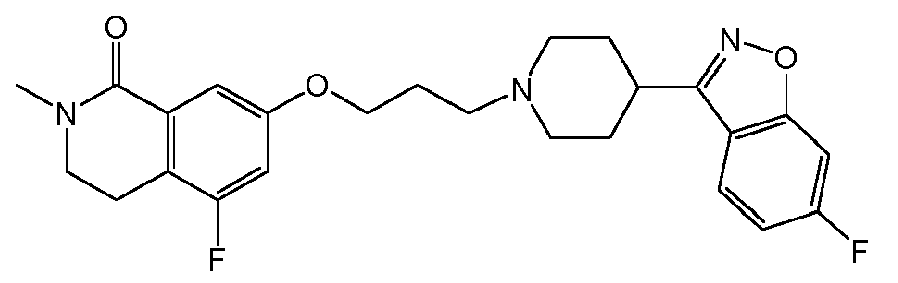
10 
11 
12 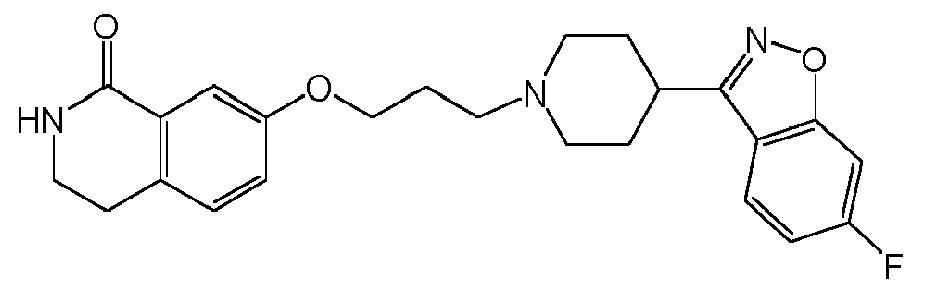
13 
14 
15 
16 
17 
18 
19 
20 
21 
22 
23 
24 
25 
26 
27 
28 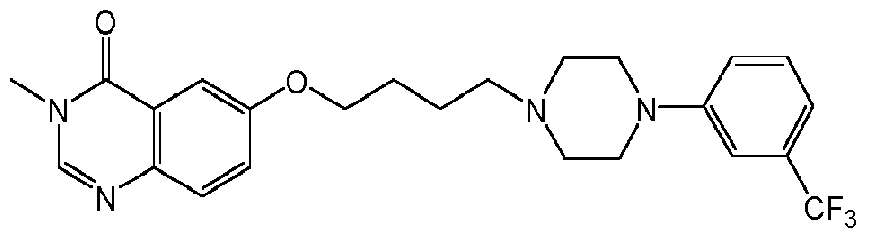
29 
30 
31 
- Rats were decapitated. Cortex of brain was rapidly taken on ice, to which 3 ml of buffer (0.05 M Tris-HCl buffer, containing 0.1% ascorbic acid, 10 µM pargyline and 4 mM CaCl2) was added, homogenization was conducted, and then 5 ml of buffer (0.05 M Tris-HCl buffer, containing 0.1% ascorbic acid, 10 µM pargyline and 4 mM CaCl2) was added. Incubation at 37°C was conducted for 10 min. The weight of the tubes were adjusted using a balance after incubation. Centrifugation was conducted at 12000 rpm, 4°C for 20 min. The supernatant was discarded, and 3 ml of buffer was added, vortex mixer was used for blending, and then 5 ml of buffer was added. Centrifugation was conducted and repeated 3 times. After the centrifugation, the supernatant was discarded, and the pellets were stored at-80°C for future use.
- Isotope ligand 3H-8-OH-DPAT (67.0 Ci/mmol) was purchased from PerkinElmer Company; 5-HT was purchased from RBI Company; GF/C glass fiber filter paper was purchased from Whatman Company; Tris was imported and divided into aliquots; PPO, POPOP were purchased from Shanghai No. 1 Reagent Factory; liposoluble scintillation cocktail was purchased from Shanghai Reagent Factory; Beckman LS-6500 Multi-function Liquid Scintillation Counter was used.
-
- (1) The prepared membrane was applied with appropriate amount of buffer, and homogenizer was used for evenly dispersing. 15 tubes were mixed into a 100 ml container, and appropriate amount of buffer was added to give 50 ml of membrane suspension, which was reserved for future use.
- (2) 100 µL of membrane preparation and 100 µL of buffer were added into each reaction tube.
- (3) 100 µL of buffer was added into the total binding tube (TB), 100 µL of 5-HT (final concentration 10-5 M) was added into the nonspecific binding tube (NB), 100 µL of the test compound (final concentration 10-5 M) was added into the specific binding tube (SB) of each test compound.
- (4) 10 µL of radioactive ligand 3H-8-OH-DPAT was respectively added into each reaction tube (2 parallel tubes were used for each reaction tube, and each of them was placed on ice when adding sample).
- (5) Each reaction tube was incubated at 37°C for 10 min; after the reaction was completed, the bound ligands were rapidly filtered under reduced pressure, and sufficiently washed with ice-chilled assay buffer. The filter was taken out and put into a 3 ml scintillation vial, and 2 ml of toluene scintillation cocktail was added and blended.
- (6) The scintillation vials were put into Liquid Scintillation Counter for counting.

- Each assay for the compounds was conducted in duplicate for two individual tests.The results are listed in Table 2.
- Rats were decapitated. Cortex of brain was rapidly taken on ice, and 3 ml of buffer (0.05 M Tris-HCl buffer: 6.05 g of Tris was dissolved in 1000 ml of double-distilled water, and concentrated HCl was used to adjust to pH 7.5) was added, homogenization was conducted, and then 5 ml of buffer was added. Incubation was conducted at 37°C for 10 min, the weight of the tubes were adjusted using a balance after incubation. Centrifugation was conducted at 12000 rpm, 4°C for 20 min, the supernatant was discarded, and 3 ml of buffer was added. Vortex mixer was used for blending, and then 5 ml of buffer was added. Centrifugation was conducted (repeated 3 times). After the centrifugation, the supernatant was discarded, and the pellets were stored at-80°C for future use.
- Isotope ligand [3H]-Ketanserin (67.0 Ci/mmol) was purchased from PerkinElmer Company; Methysergide was purchased from RBI Company; GF/C glass fiber filter paper was purchased from Whatman Company; Tris was imported and divided into aliquots; PPO and POPOP were purchased from Shanghai No. 1 Reagent Factory; liposoluble scintillation cocktail was purchased from Shanghai Reagent Factory; Beckman LS-6500 Multi-function Liquid Scintillation Counter was used.
-
- (1) The prepared membrane was applied with buffer, and homogenizer was used for evenly dispersing. 15 tubes were mixed into a 100 ml container, and appropriate amount of buffer was added to give 50 ml of membrane suspension, which was reserved for future use.
- (2) 100 µL of membrane preparation and 100 µL of buffer were added into each reaction tube.
- (3) 100 µL of buffer was added into the total binding tube (TB), 100µL of Methysergide (final concentration 10-5 M) was added into the nonspecific binding tube (NB), 100 µL of the test compound (final concentration 10-5 M) was added into the specific binding tube (SB) of each test compound.
- (4) 10 µL of radioactive ligand 3H-Ketanserin was respectively added into each reaction tube (2 parallel tubes were used for each reaction tube, and each of them was placed on ice when adding sample).
- (5) Each of the reaction tubes was incubated at 37°C for 15 min. After the reaction was completed, the bound ligands were rapidly filtered under reduced pressure, and suffciently washed with ice-chilled assay buffer. The filter was taken out and put into a 3 ml scintillation vial, and 2 ml of toluene scintillation cocktail was added and blended.
- (6) The scintillation vial were put into Liquid Scintillation Counter for counting.

- Each assay for the compounds was conducted in duplicate for two individual tests.The results are listed in Table 2.
- Rats were decapitated. Striatum of brain was rapidly taken on ice, 3 ml of buffer (0.05 M Tris-HCl buffer, containing NaCl 120 mM, KCl 5 mM, MgCl2 1 mM, CaCl2 1 mM) was added, homogenization was conducted, and then 5 ml of buffer was then added. The weight of the homogenized tubes were adjusted using a balance, and centrifugation was conducted. The supernatant was discarded, and 3 ml of buffer was added. Vortex mixer was used for blending, and then 5 ml of buffer was added. Centrifugation was conducted and repeated 3 times. The supernatant was discarded after centrifugation was completed, and the pellets were stored at-80°C for future use.
- Isotope ligand 3H-Spiperone (67.0 Ci/mmol) was purchased from PerkinElmer Company; Butaclamol was purchased from RBI Company; GF/C glass fiber filter paper was purchased from Whatman Company; Tris was imported and divided into aliquots; PPO and POPOP were purchased from Shanghai No. 1 Reagent Factory; liposoluble scintillation cocktail was purchased from Shanghai Reagent Factory. Beckman LS-6500 Multi-function Liquid Scintillation Counter was used.
-
- (1) The prepared membrane was applied with appropriate amount of buffer, and homogenizer was used for evenly dispersing. 15 tubes were mixed into a 100 ml container, and appropriate amount of buffer was added to give 50 ml of membrane suspension, which was reserved for future use.
- (2) 100 µL of membrane preparation and 100 µL of buffer were added into each reaction tube.
- (3) 100 µL of buffer was added into the total binding tube (TB), 100 µL of Butaclamol (final concentration 10-5 M) was added into the nonspecific binding tube (NB), 100 µL of the test compound (final concentration 10-5 M) was added into the specific binding tube (SB) of each test compound.
- (4) 10 µL of radioactive ligand 3H-Spiperone was respectively added into each reaction tube (2 parallel tubes were used for each reaction tube, and each of them was placed on ice when adding sample).
- (5) Each of the reaction tubes was incubated at 37°C for 20 min. After the reaction was completed, the bound ligands were rapidly filtered under reduced pressure, and suffciently washed with ice-chilled assay buffer. The filter was taken out and put into a 3 ml scintillation vial, and 2 ml of toluene scintillation cocktail was added and blended.
- (6) The scintillation vials were put into Liquid Scintillation Counter for counting.

- Each assay for the compounds was conducted in duplicate for two individual tests.The results are listed in Table 2.
- Adult SD rats were decapitated. Hypothalamus was rapidly taken on ice, and 3 ml of buffer (0.05 M Tris-HCl buffer: 6.05 g of Tris was dissolved in 1000 ml of double-distilled water, and concentrated HCl was used to adjust to pH 7.5) was added, homogenization was conducted for 3-4 s at level 4 for four times, and then 5 ml of buffer was added. Incubation was conducted at 37°C for 10 min, the weight of the tubes were adjusted using a balance after incubation. Centrifugation was conducted at 4°C, the supernatant was discarded, and 3 ml of buffer was added. Vortex mixer was used for blending, and then 5 ml of buffer was added. Centrifugation was conducted (repeated 3 times). After the centrifugation, the supernatant was discarded, and the pellets were stored at-80°C for future use.
- Isotope ligand [3H]-5-CT (85.4 Ci/mmol) was purchased from PerkinElmer Company; (±)-pindolol was purchased from RBI Company; GF/C glass fiber filter paper was purchased from Whatman Company; Tris was imported and divided into aliquots; PPO and POPOP were purchased from Shanghai No. 1 Reagent Factory; liposoluble scintillation cocktail was purchased from Shanghai Reagent Factory. Beckman LS-6500 Multi-function Liquid Scintillation Counter was used.
-
- (1) The prepared membrane was applied with buffer, and homogenizer was used for evenly dispersing. 15 tubes were mixed into a 100 ml container, and appropriate amount of buffer was added to give 50 ml of membrane suspension, which was reserved for future use.
- (2) 100 µL of membrane preparation and 100 µL of buffer were added into each reaction tube.
- (3) 100 µL of buffer was added into the total binding tube (TB), 100µL of (±)-pindolol (final concentration 10-5 M) was added into the nonspecific binding tube (NB), 100 µL of the test compound (final concentration 10-5 M) was added into the specific binding tube (SB) of each test compound.
- (4) 10 µL of radioactive ligand 3H-5-CT was respectively added into each reaction tube (2 parallel tubes were used for each reaction tube, and each of them was placed on ice when adding sample).
- (5) Each of the reaction tubes was incubated at 25°C for 120 min. After the reaction was completed, the bound ligands were rapidly filtered under reduced pressure, and suffciently washed with ice-chilled assay buffer. The filter was taken out and put into a 3 ml scintillation vial, and 2 ml of toluene scintillation cocktail was added and blended.
- (6) The scintillation vials were put into Liquid Scintillation Counter for counting.

- Each assay for the compounds was conducted in duplicate for two individual tests.The results are listed in Table 2.
- Guinea pigs were decapitated. Cerebellum of the guinea pig was rapidly taken on ice and 3 mL of buffer (potassium dihydrogen phosphate 1.36 g, 0.1 mol/L sodium hydroxide 79 ml, metered to 200 ml with double-distilled water) was added. Vortex mixer was used for blending. Centrifugation was conducted at 48000g, 4°C for 10 min. The supernatant was discarded to give pellets, and buffer was added again for washing. Centrifugation was conducted and repeated 3 times. After the centrifugations, the supernatant was discarded, and the pellets were stored at-80°C for future use.
- Isotope ligand 3H-pyrilamine (67.0 Ci/mmol) was purchased from PerkinElmer Company; promethazine was purchased from RBI Company; GF/C glass fiber filter paper was purchased from Whatman Company; Tris was imported and divided into aliquots; PPO, POPOP were purchased from Shanghai No. 1 Reagent Factory; liposoluble scintillation cocktail was purchased from Shanghai Reagent Factory; Beckman LS-6500 Multi-function Liquid Scintillation Counter was used.
-
- (1) The prepared membrane was applied with appropriate amount of buffer, and homogenizer was used for evenly dispersing. 15 tubes were mixed into a 100 ml container, and appropriate amount of buffer (potassium dihydrogen phosphate 1.36 g, 0.1 mol/L sodium hydroxide 79 ml, metered to 200 ml with double-distilled water) was added to give 50 ml of membrane suspension, which was reserved for future use.
- (2) 100 µL of membrane preparation was added into each reaction tube.
- (3) 100 µL of buffer was added into the total binding tube (TB), 100 µL of promethazine (final concentration 10-5 M) was added into the nonspecific binding tube (NB), 100 µL of the test compound (final concentration 10-5 M) was added into the specific binding tube (SB) of each test compound.
- (4) 10 µL of radioactive ligand 3H-pyrilamine was respectively added into each reaction tube (2 parallel tubes were used for each reaction tube, and each of them was placed on ice when adding sample).
- (5) Each of the reaction tubes was incubated at 30°C for 60 min. After the reaction was completed, the bound ligands were rapidly filtered under reduced pressure, and the ice-chilled assay buffer was used for adequate washing. The filter was taken out and put into a 3 ml scintillation vial, and 2 ml of toluene scintillation solution was added and blended.
- (6) The scintillation vials were put into Liquid Scintillation Counter for counting.

- Each assay for the compounds was conducted in duplicate for two individual tests.The results are listed in Table 2.
Table 2. The Ki (nM) of the compounds to the receptors Compound No. D2 5-HT1A Ki (nM) 5-HT2A 5-HT7 H1 1 12.5 15.8 18.9 12.5 - 2 120 11.3 36.8 - - 3 17.2 11.8 9.9 23.6 - 4 15.1 3.9 15.9 10.2 >2000 5 1.0 2.4 0.1 5.9 >2000 6 134.2 46.6 57.0 - - 7 13.1 1.9 0.9 12.7 >2000 8 8.7 2.8 2.4 6.7 >2000 9 3.1 3.9 3.7 7.9 >2000 10 5.8 4.6 12.9 8.4 >2000 11 13.9 24.6 3.6 11.2 >2000 12 10.4 19.3 5.5 8.9 >2000 13 234.7 12.8 3.6 - - 14 6.9 8.8 7.2 16.8 1357.9 15 1987.3 156.8 467.9 - - 16 >2000 568.9 372.1 - - 17 >2000 >2000 >2000 - - 18 >2000 >2000 >2000 - - 19 1654.1 746.2 688.3 - - 20 54.8 24.5 32.1 29.9 >2000 21 >2000 >2000 >2000 - - 22 9.6 6.5 3.2 28.1 >2000 23 >2000 >2000 368.9 - - 24 11.9 8.8 7.5 9.9 >2000 25 32.8 17.6 21.7 10.8 >2000 26 >2000 56.9 >2000 - - 27 499.8 57.9 66.2 - - 28 24.8 12.2 5.8 7.4 >2000 29 >2000 258.7 347.2 - - 30 >2000 >2000 >2000 - - 31 21.8 19.0 9.8 8.3 >2000 A 21.2 14.3 29.2 254.2 89.6 B 15.1 579.3 139.2 C 35.2 499.2 137.8 D 25.5 606.4 154.3 E 5.6 23.2 12.7 35.6 178.3 risperidone 11.63 170.85 3.55 12.8 168.8 

- The results indicate that the compound of the invention (in particular compound 5) has strong affinities for three receptors (D2, 5-HT1A and 5-HT2A), low affinity for H1, and high affinity for 5HT7. The risk of the side effect of bodyweight gain is low, as compared with risperidone. 5HT7 receptor can modulate emotion, learning, as well as memory and action with such receptor may contribute to function of improvement of cognitive disorders.
- Healthy mice of Kunming breed, with half male and half female, body weight of (20±2) g, were provided by Qinglongshan Animal Cultivation Center, Nanjing.
- Ascorbic acid was provided by Sinopharm Chemical Reagent Co. Ltd.
- MK-801 was produced by Sigma Company, USA; the formulation method: 0.1% vitamin C was used to formulate a 1mg/ml solution.
- Test positive drugs: haloperidol, clozapine, risperidone, olanzapine, aripiprazole, ziprasidone, quetiapine.
- Tween 80: with the concentration of 10%.
- Mice with qualified body weight were selected, and randomly divided into blank group, model group, positive control group (risperidone group) and drug group. 10% Tween was administered intragastrically to the blank group and the model group at 0.1 ml/10 g; risperidone was administered intragastrically to the positive control group at 0.1 mg/kg; and corresponding amounts of drugs were administered intragastrically to the drug groups, respectively. 1 h after the administration, 0.1% concentration of ascorbic acid was intraperitoneally injected to the blank group at 0.1 ml/10g; and the model group, the positive control group (30 min) and the drug group were intraperitoneally injected the MK-801 solution at 0.1mg/kg. Subsequently, the spontaneous activities of the mice of each group in 90 min were measured. The results are listed in Table 3.
- Healthy KM mice, male, with body weight of 18-22 g, were provided by Qinglongshan Animal Cultivation Center, Nanjing.
- Test positive drugs: haloperidol, clozapine, risperidone, olanzapine, aripiprazole, ziprasidone, quetiapine.
- Apomorphine provided by Sigma Company was dissolved in 0.9 % NaCl (containing 0.1% vitamin C) before use, and was freshly formulated before use.
- Vitamin C, F20061113, was provided by Sinopharm Chemical Reagent Co. Ltd.
- Sodium chloride injection, H32026305, was provided by Xuzhou No. 5 Pharmaceutical Factory Co. Ltd.
- Instruments: self-made clambering cage, chronograph.
- Procedures: apomorphine induced clambering assay of mice
- KM mice (male, with body weight of 18-22 g) were randomly divided into negative control group, model group, positive drug groups of each dosage (risperidone, aripiprazole, ziprasidone, quetiapine, olanzapine, haloperidol, clozapine), and compound groups of each dosage (the specific dosages are listed in the following Table), with 10 mice of each group. Corresponding solvent double-distilled water was administered intragastrically to the negative control group and the model group, corresponding positive drugs were administered intragastrically to the positive drug groups (a small amount of acetic acid was first added and then double-distilled water was added when dissolving), and corresponding dosages of compounds were administered intragastrically to the compound groups of each dosage, with the volume for intragastric administration as 0.1 ml/10g. 1 hour after the intragastric administration, apomorphine was subcutaneously injected (1 mg/kg), with the volume as 0.1 ml/10g. After the injection of apomorphine, the animals were immediately put into the clambering cages. After 5 min of adaptation, the behavior of the mice at 10-11, 20-21, and 30-31 min after the injection of apomorphine were observed and scored. Scoring criteria: the behavior of 4 paws on the floor was scored as 0; the behavior of 2 forepaws on the cage was scored as 1; and the behavior of 4 paws on the cage was scored as 2.The results are listed in Table 3.
- About 1700 of SD rats, male.
- Firstly, training the rats with shuttle box:
- ① The rats were allowed for adaption for five minitues;
- ② Conditioned stimulus (CS, light and noise) were started and lasted for 20s, and at the tenth second, unconditioned stimulus (US, 1.5 mA electric shock) was performed and lasted for 10s;
- ③ Training was conducted 30 times per day for 9 days. The interval between two trainings was set randomly ranged from 20 to 30s;
- ④ Observation indicators:
- The animal ran to another compartment during the conditioning stimulus was recorded as "avoidance";
- Animals ran to another compartment during the electric shock was recorded as "escape"; Animals did not run to another compartment during the electric shock was recorded as an "escape failure";
- ⑤ Criteria for qualified training: The avoidance rate is greater than 80% for 3 consecutive days (the 7th, 8th, and 9th days).
- Grouping of the qualified rats: the qualified rats were divided into negative control group, positive drug groups of each dosage, and compound groups of each dosage according to the principle of randomization, 8 in each group.
- Administration Method: Corresponding solvent was administered intragastrically to the negative control group; corresponding dosages of positive drugs were administered intragastrically to the positive drug groups of each dosage; and corresponding dosages of compounds were administered intragastrically to the compound groups of each dosage.
- CAR Assay: A CAR assay was performed 1 hour after intragastric administration. The method was the same as the CAR training. The observation indicators were the number of avoidances, the number of escapes, and the number of escape failures.
- Statistical Data Processing: Assay data are presented as mean ± standard deviation (Mean ± SD), the comparison was performed by a combination of one-way ANOVA with post-hoc LSD. The ED50 was calculated using the probit method. The results are listed in Table 4.
- Healthy mice of Kunming breed, with half male and half female, body weight of (22±2) g, were provided by Qinglongshan Animal Cultivation Center, Nanjing.
- Main reagents: the test drugs, haloperidol, clozapine, risperidone, olanzapine, aripiprazole, ziprasidone.
- Instruments: self-made bar-grabbing apparatus, stainless steel bar in mice box, which was 0.3 cm in diameter and 5 cm above the bench.
- KM mice (half male and half female, with body weight of 20-24 g) were randomly divided into negative control group, model group, positive drug groups of each dosage (risperidone, aripiprazole, ziprasidone, quetiapine, olanzapine, haloperidol, clozapine), compound groups of each dosage, with 10 mice in each group. Corresponding solvent double-distilled water was administered intragastrically to the negative control group and the model group, corresponding positive drugs were administered intragastrically to the positive drug groups (a small amount of acetic acid was first added and then double-distilled water was added when dissolving), corresponding dosages of compounds were administered intragastrically to the compound groups for each dosage, with the volume for intragastric administration as 0.1 ml/10 g. At 30 min, 60 min, 90 min after the intragastric administration, the two forepaws of the mice were gently placed on the bars (which were 20 cm in length, 0.3 cm in diameter, and 5.5 cm above the bench), and the hindpaws of the animals were placed on the bottom of the box. The durations of the mice to maintain the posture with the two forepaws on the bars were recorded, and 30 s of spasticity without moving was considered as the positive response. In the case the forepaws of the mice were not put down persistently, the observation was terminated at 60s. The numbers of animals with positive response in each of the compound dosage groups were counted. The results are listed in Table 3.
- Limit test of sequential assay: KM rats or mice (half male and half female) were randomly divided into several groups (with 2-5 mice in each group), which were respectively the 2000 mg/kg groups for each compound, and the solvent group. 0.2 ml/10 g were administered intragastrically. The deaths of the animals in 3 days were observed. In the case 3 or more animals survived in 3 days without notable abnormity in their life states, the observation was continued until the assay was completed in 7 days. In the case 3 or more animals died in 3 days, the method of median lethal dose was used to determine the LD50.
- Pre-assay for the method of the median lethal dose: KM mice (half male and half female) were randomly divided into several groups (with 4 mice in each group), which were respectively the 500 mg/kg, 200 mg/kg, 50 mg/kg groups for each compound, and the solvent group. 0.2 ml/10 g were administered intragastrically, and the deaths of the animals in 1-3 days were observed.
- Results: The compound of the invention has relatively low acute toxicity. For example, the LD50 of intragastric administration of the compound 5 in mice is 257.5 mg/kg, and the LD50 of intragastric administration of the same in rats is 167.5 mg/kg. The therapuetic index is significantly greater than the positive drug risperidone, indicating a relatively low acute toxicity.The results are listed in Table 3 and Table 4.
Table 3. Results of the in vivo animal model assay of the compounds (mice) Compound No. LD50 (po,mg/kg) MK-801 induced high activity (ED50,po,mg/kg) Apomorphine induced clambering (ED50,po,mg/kg) Catalepsy (ED50,po,mg/kg) Catalepsy / MK-801 induced high activity Catalepsy / Apomorphine induced clambering 5 257 0.04 0.05 35 875 700 14 202 0.07 0.06 32 457 533 22 311 0.12 0.19 52 433 273 24 190 0.18 0.22 47 261 214 haloperidol 20 0.10 0.08 0.44 4.40 4.89 clozapine 150 2.28 17.92 >50 >21.93 >5.58 risperidone 82.1 0.01 0.046 0.92 92.00 61.33 Table 4. Results of the rats CAR assay Compound No. Rat CAR ED50 (mg/kg) Rat LD50 (mg/kg) Therapeutic index 5 0.32 167.5 523 14 0.65 155 238 22 0.49 198 404 24 1.02 146 143 risperidone 0.66 113 171 - The above results of animal assays indicate that, when compared with the positive drug (risperidone), the compound of the invention (in particular compounds 5, 14, 22) can not only significantly improve the MK-801 induced high activity, but also effectively improve the apomorphine induced clambering symptoms. Meanwhile, they performed markedly better than risperidone in the rat CAR model, and they do not cause EPS in effective dosage, indicating notable anti-schizophrenia effects, as well as superior effects over the prior drugs.
-
(any one of the compounds 1~31 of the invention) 100mg microcrystalline cellulose 50mg lactose 100mg Povidone K30 9 mg carboxymethyl starch sodium 12 mg silica 2.5mg magnesium stearate 1.5mg - The raw excipients were sieved with 80 mesh for use. The prescription doses of active ingredient, microcrystalline cellulose, lactose, Povidone K30 were weighed and introduced into a high speed mixing granulator, whereby they were mixed uniformly at low speed. An appropriate amount of purified water was added, the stirring was performed at low speed, and high speed shear granulation was carried out. The wet granules were dried at 60°C for 3 hours, and sieved with 24 mesh. The prescription doses of carboxymethyl starch sodium, silica and magnesium stearate were added for mixing totally. The compression was performed in a rotary tablet press.
Claims (9)
- A compound of Formula I or a pharmaceutically acceptable salt thereof:
 X is C, O, N or NH;Z is-(CH2)n-, which is unsubstituted or substituted by one or more substituents selected from the group consisting of alkyl, cyano, hydroxy and halogen, n is an integer of 2~7;R1 and R2 are each independently hydrogen, linear or branched alkyl containing 1~5 carbon atoms, wherein the alkyl is optionally substituted by one or more substituents selected from the group consisting of alkyl, cyano, hydroxy and halogen;R3 is hydrogen, halogen or linear or branched alkyl containing 1~5 carbon atoms, wherein the alkyl is optionally substituted by one or more substituents selected from the group consisting of alkyl, cyano, hydroxy and halogen;P is CH or N;Ar is a group selected from the group consisting of formula III:
 Q is O or S;R7 is hydrogen, halogen, linear or branched alkyl containing 1~5 carbon atoms, or alkoxyl containing 1~5 carbon atoms, wherein the alkyl is optionally substituted by one or more substituents selected from the group consisting of alkyl, cyano, hydroxy and halogen, and wherein the alkoxyl is optionally substituted by one or more substituents selected from the group consisting of alkyl, cyano, hydroxy and halogen.
 - The compound according to claim 1 or the pharmaceutically acceptable salt thereof, characterized in that,
R1 and R2 are each independently hydrogen, methyl, ethyl, propyl, n-butyl, iso-butyl, trifluoromethyl, trifluoroethyl or trifluoropropyl. - The compound according to claim 1 or the pharmaceutically acceptable salt thereof, characterized in that,
R3 is hydrogen, fluorine, chlorine, bromine, iodine, methyl, ethyl, propyl, n-butyl or iso-butyl. - The compound according to claim 1 or the pharmaceutically acceptable salt thereof, characterized in that,
the halogen is fluorine, chlorine, bromine or iodine. - The compound according to claim 1 or the pharmaceutically acceptable salt thereof, characterized in that,X is C, O, N or NH;Z is-(CH2)n-, which is unsubstituted or substituted by one or more hydroxy, n is an integer of 2~5;R1 is hydrogen, methyl or ethyl;R2 is hydrogen, methyl or ethyl;R3 is hydrogen, methyl or fluorine.
- The compound according to claim 1 or the pharmaceutically acceptable salt thereof, characterized in that,
the compound is selected from


- A pharmaceutical composition, comprising the compound according to any one of claims 1~6 or the pharmaceutically acceptable salt thereof, and a pharmaceutically acceptable excipient, carrier, adjuvant, solvent or the combination thereof.
- The compound according to any one of claims 1~6, or the pharmaceutically acceptable salt thereof, or the pharmaceutical composition according to claim 7 for use in the treatment or prevention of neuropsychiatric disease.
- The compound for use according to claim 8 or the pharmaceutically acceptable salt thereof or the pharmaceutical composition for use according to claim 8, characterized in that, the neuropsychiatric disease is schizophrenia.
Applications Claiming Priority (2)
| Application Number | Priority Date | Filing Date | Title |
|---|---|---|---|
| CN201510811995.4A CN106749219A (en) | 2015-11-20 | 2015-11-20 | A kind of lactam derivative and its application |
| PCT/CN2016/106591 WO2017084627A1 (en) | 2015-11-20 | 2016-11-21 | Lactam compound derivative and application thereof |
Publications (3)
| Publication Number | Publication Date |
|---|---|
| EP3381915A1 EP3381915A1 (en) | 2018-10-03 |
| EP3381915A4 EP3381915A4 (en) | 2019-07-17 |
| EP3381915B1 true EP3381915B1 (en) | 2023-01-18 |
Family
ID=58717382
Family Applications (1)
| Application Number | Title | Priority Date | Filing Date |
|---|---|---|---|
| EP16865804.5A Active EP3381915B1 (en) | 2015-11-20 | 2016-11-21 | Lactam compound derivative and application thereof |
Country Status (5)
| Country | Link |
|---|---|
| US (1) | US10501452B2 (en) |
| EP (1) | EP3381915B1 (en) |
| JP (2) | JP6755950B2 (en) |
| CN (3) | CN106749219A (en) |
| WO (1) | WO2017084627A1 (en) |
Families Citing this family (5)
| Publication number | Priority date | Publication date | Assignee | Title |
|---|---|---|---|---|
| CN106749219A (en) * | 2015-11-20 | 2017-05-31 | 江苏恩华药业股份有限公司 | A kind of lactam derivative and its application |
| CN111285862A (en) * | 2018-12-07 | 2020-06-16 | 江苏恩华药业股份有限公司 | Crystal form of propionamide derivative and preparation method thereof |
| CN111320619A (en) * | 2018-12-17 | 2020-06-23 | 江苏恩华药业股份有限公司 | Impurities of amide-like derivatives and application |
| CN111320582A (en) * | 2018-12-17 | 2020-06-23 | 江苏恩华药业股份有限公司 | Preparation method of amide-like derivative and intermediate thereof |
| CN112480102B (en) * | 2020-12-02 | 2022-04-22 | 江苏恩华药业股份有限公司 | Propionamide derivative and application thereof in schizophrenia |
Family Cites Families (22)
| Publication number | Priority date | Publication date | Assignee | Title |
|---|---|---|---|---|
| JP2608788B2 (en) | 1988-10-31 | 1997-05-14 | 大塚製薬 株式会社 | Schizophrenia remedy |
| AU2003263413A1 (en) | 2002-09-17 | 2004-04-08 | Warner-Lambert Company Llc | Heterocyclic substituted piperazines for the treatment of schizophrenia |
| WO2006017614A1 (en) * | 2004-08-05 | 2006-02-16 | Acadia Pharmaceuticals Inc. | Use of n-desmethylclozapine to treat human neuropsychiatric disease |
| JP4315393B2 (en) * | 2005-04-14 | 2009-08-19 | 大塚製薬株式会社 | Heterocyclic compounds |
| TWI320783B (en) * | 2005-04-14 | 2010-02-21 | Otsuka Pharma Co Ltd | Heterocyclic compound |
| AR055203A1 (en) | 2005-08-31 | 2007-08-08 | Otsuka Pharma Co Ltd | BENZOTIOPHENE DERIVATIVES WITH ANTIPSYTICAL PROPERTIES |
| WO2008020306A2 (en) * | 2006-08-18 | 2008-02-21 | Pfizer Products Inc. | Isoindole derivatives |
| BRPI0808828A8 (en) * | 2007-03-15 | 2017-11-28 | Aryx Therapeutics Inc | DIBENZO COMPOUNDS[B,F][1,4]OXAZAPINE |
| EP1972628A1 (en) * | 2007-03-21 | 2008-09-24 | Schwarz Pharma Ag | Indolizines and aza-analog derivatives thereof as CNS active compounds |
| JP5466147B2 (en) * | 2007-05-21 | 2014-04-09 | レビバ ファーマシューティカルズ,インコーポレーテッド | Composition, synthesis and method of use of quinolinone atypical antipsychotic drugs |
| JP2011507835A (en) * | 2007-12-21 | 2011-03-10 | アンドレイ・アレクサンドロビッチ・イワシェンコ | Alpha-adrenergic receptor, dopamine, histamine, imidazoline and serotonin receptor ligands and uses thereof |
| WO2010012121A1 (en) | 2008-07-28 | 2010-02-04 | 江苏国华投资有限公司 | Aralkyl substituted piperidine or piperazine derivatives and their use for treating schizophrenia |
| WO2012003418A2 (en) | 2010-07-02 | 2012-01-05 | The University Of North Carolina At Chapel Hill | Functionally selective ligands of dopamine d2 receptors |
| US8899539B2 (en) * | 2010-07-05 | 2014-12-02 | Edward Antony Oliver | Guard assembly and method |
| PL392436A1 (en) * | 2010-09-17 | 2012-03-26 | Adamed Spółka Z Ograniczoną Odpowiedzialnością | Arylsulphonamide derivatives for treating the diseases of the central nervous system |
| CN102206214B (en) * | 2011-04-07 | 2014-03-12 | 华中科技大学 | Benzopyrone derivative and application thereof |
| PL395470A1 (en) * | 2011-06-29 | 2013-01-07 | Adamed Spólka Z Ograniczona Odpowiedzialnoscia | Alicyclic amines sulfonamide derivatives for the treatment of diseases of the central nervous system |
| PL395469A1 (en) * | 2011-06-29 | 2013-01-07 | Adamed Spólka Z Ograniczona Odpowiedzialnoscia | Indolamines derivatives for the treatment of diseases of the central nervous system |
| CN102267966B (en) * | 2011-08-01 | 2013-02-27 | 华中科技大学 | Substituted benzopyrone derivatives and application thereof |
| CN104059046B (en) * | 2013-03-18 | 2017-02-08 | 江苏恩华药业股份有限公司 | flavonoid derivative and application thereof |
| CN104292226B (en) * | 2013-07-16 | 2016-12-28 | 江苏恩华药业股份有限公司 | 9-hydroxy-risperidone amino acid derivatives and application thereof |
| CN106749219A (en) | 2015-11-20 | 2017-05-31 | 江苏恩华药业股份有限公司 | A kind of lactam derivative and its application |
-
2015
- 2015-11-20 CN CN201510811995.4A patent/CN106749219A/en not_active Withdrawn
-
2016
- 2016-11-21 WO PCT/CN2016/106591 patent/WO2017084627A1/en not_active Ceased
- 2016-11-21 CN CN201680067130.4A patent/CN108290880B/en active Active
- 2016-11-21 US US15/776,645 patent/US10501452B2/en active Active
- 2016-11-21 JP JP2018526201A patent/JP6755950B2/en active Active
- 2016-11-21 CN CN202110181460.9A patent/CN112851656B/en active Active
- 2016-11-21 EP EP16865804.5A patent/EP3381915B1/en active Active
-
2020
- 2020-06-15 JP JP2020102914A patent/JP7035118B2/en active Active
Also Published As
| Publication number | Publication date |
|---|---|
| JP6755950B2 (en) | 2020-09-16 |
| JP2020158520A (en) | 2020-10-01 |
| WO2017084627A1 (en) | 2017-05-26 |
| US20180327397A1 (en) | 2018-11-15 |
| CN112851656A (en) | 2021-05-28 |
| EP3381915A4 (en) | 2019-07-17 |
| CN108290880B (en) | 2021-03-09 |
| JP7035118B2 (en) | 2022-03-14 |
| EP3381915A1 (en) | 2018-10-03 |
| US10501452B2 (en) | 2019-12-10 |
| CN112851656B (en) | 2022-07-12 |
| JP2019500329A (en) | 2019-01-10 |
| CN108290880A (en) | 2018-07-17 |
| CN106749219A (en) | 2017-05-31 |
Similar Documents
| Publication | Publication Date | Title |
|---|---|---|
| EP2698369B1 (en) | Benzopyrone derivative and use thereof | |
| WO2021190467A1 (en) | Spiro ring-containing quinazoline compound | |
| JP7035118B2 (en) | Lactam compound derivatives and their applications | |
| EP4192454B1 (en) | Azabicyclo-amino-triazine compounds for modulating splicing for the treatment of neurological diseases | |
| KR101766194B1 (en) | Novel 3-(isoxazol-3-yl)-pyrazolo[3,4-d]pyrimidin-4-amine compounds as RET kinase inhibitor | |
| EP3287463A1 (en) | Condensed-ring pyrimidylamino derivative, preparation method therefor, and intermediate, pharmaceutical composition and applications thereof | |
| CN101302214A (en) | Aralkyl piperidine (azine) derivatives and their application in the treatment of mental and nervous diseases | |
| EP2746269B1 (en) | Alicyclic [c]benzopyrone derivatives and uses thereof | |
| EP3372600B1 (en) | Fused heterocyclic compound derivative and application thereof | |
| CN101712675A (en) | Nitrogenous benzheterocycle derivate and application thereof to treating nervous and mental diseases | |
| CN106831799A (en) | Hydroxy styrenes pyridine Mannich alkaloid compound, Preparation Method And The Use | |
| JP2018087173A (en) | Malignant brain tumor drug | |
| CN102267966B (en) | Substituted benzopyrone derivatives and application thereof | |
| EP3941472B1 (en) | Crystalline and amorphous forms of-(5-((4-ethylpiperazin-1-yl)methyl)pyridine-2-yl)-5-fluoro-4-(3-isopropyl-2-methyl-2 <ns1:i>h</ns1:i>?-indazol-5-yl)pyrimidin-2-amine and its salts, and preparation methods and therapeutic uses thereof | |
| CN110172058B (en) | 7-azaspiro [5.6] dodecane-10-one compound and preparation method and application thereof | |
| CN102060875B (en) | Quinazoline derivative, and preparation method and application thereof | |
| US20080167319A1 (en) | 7-(4-(4-[3-chloro-2-(trifluoromethyl)phenyl]piperazin-1-yl)butoxy)-[1,8]-naphthyridin-2(1h)-one | |
| CN112939864B (en) | Spiro[benzo[c]azepin-1,1'-cyclohexyl]-3-ones | |
| CN107501283A (en) | Substitute preparation and anti-tumor medicine application of the miscellaneous base substituted anilinic condensed ethandiol ether ring of fragrant first for quinazoline | |
| WO2025240834A1 (en) | Nsd2-targeted chemical degraders and compositions and methods of use thereof | |
| WO2026068852A1 (en) | N-substituted 9-aminoacridines and their use in the treatment of cancer | |
| EA050369B1 (en) | CRYSTALLINE FORM OF A TRICYCLIC DERIVATIVE, A METHOD FOR ITS PRODUCTION AND A PHARMACEUTICAL COMPOSITION CONTAINING IT | |
| CN120136783A (en) | Pyridine nitrogen oxide derivatives and pharmaceutical compositions, preparation methods and uses thereof | |
| CN102718758A (en) | Quinolinone derivative and application thereof as anti-schizophrenic drug |
Legal Events
| Date | Code | Title | Description |
|---|---|---|---|
| STAA | Information on the status of an ep patent application or granted ep patent |
Free format text: STATUS: THE INTERNATIONAL PUBLICATION HAS BEEN MADE |
|
| PUAI | Public reference made under article 153(3) epc to a published international application that has entered the european phase |
Free format text: ORIGINAL CODE: 0009012 |
|
| STAA | Information on the status of an ep patent application or granted ep patent |
Free format text: STATUS: REQUEST FOR EXAMINATION WAS MADE |
|
| 17P | Request for examination filed |
Effective date: 20180618 |
|
| AK | Designated contracting states |
Kind code of ref document: A1 Designated state(s): AL AT BE BG CH CY CZ DE DK EE ES FI FR GB GR HR HU IE IS IT LI LT LU LV MC MK MT NL NO PL PT RO RS SE SI SK SM TR |
|
| AX | Request for extension of the european patent |
Extension state: BA ME |
|
| DAV | Request for validation of the european patent (deleted) | ||
| DAX | Request for extension of the european patent (deleted) | ||
| A4 | Supplementary search report drawn up and despatched |
Effective date: 20190619 |
|
| RIC1 | Information provided on ipc code assigned before grant |
Ipc: A61K 31/506 20060101ALI20190613BHEP Ipc: C07D 217/24 20060101ALI20190613BHEP Ipc: C07D 239/88 20060101ALI20190613BHEP Ipc: C07D 417/12 20060101ALI20190613BHEP Ipc: C07D 405/12 20060101ALI20190613BHEP Ipc: C07D 401/12 20060101ALI20190613BHEP Ipc: C07D 413/14 20060101AFI20190613BHEP Ipc: A61K 31/496 20060101ALI20190613BHEP Ipc: A61K 31/517 20060101ALI20190613BHEP Ipc: A61K 31/4725 20060101ALI20190613BHEP Ipc: C07D 239/90 20060101ALI20190613BHEP |
|
| STAA | Information on the status of an ep patent application or granted ep patent |
Free format text: STATUS: EXAMINATION IS IN PROGRESS |
|
| 17Q | First examination report despatched |
Effective date: 20210809 |
|
| GRAP | Despatch of communication of intention to grant a patent |
Free format text: ORIGINAL CODE: EPIDOSNIGR1 |
|
| STAA | Information on the status of an ep patent application or granted ep patent |
Free format text: STATUS: GRANT OF PATENT IS INTENDED |
|
| INTG | Intention to grant announced |
Effective date: 20220919 |
|
| GRAS | Grant fee paid |
Free format text: ORIGINAL CODE: EPIDOSNIGR3 |
|
| GRAA | (expected) grant |
Free format text: ORIGINAL CODE: 0009210 |
|
| STAA | Information on the status of an ep patent application or granted ep patent |
Free format text: STATUS: THE PATENT HAS BEEN GRANTED |
|
| AK | Designated contracting states |
Kind code of ref document: B1 Designated state(s): AL AT BE BG CH CY CZ DE DK EE ES FI FR GB GR HR HU IE IS IT LI LT LU LV MC MK MT NL NO PL PT RO RS SE SI SK SM TR |
|
| REG | Reference to a national code |
Ref country code: GB Ref legal event code: FG4D |
|
| REG | Reference to a national code |
Ref country code: DE Ref legal event code: R096 Ref document number: 602016077555 Country of ref document: DE |
|
| REG | Reference to a national code |
Ref country code: CH Ref legal event code: EP |
|
| REG | Reference to a national code |
Ref country code: AT Ref legal event code: REF Ref document number: 1544639 Country of ref document: AT Kind code of ref document: T Effective date: 20230215 Ref country code: IE Ref legal event code: FG4D |
|
| REG | Reference to a national code |
Ref country code: LT Ref legal event code: MG9D |
|
| REG | Reference to a national code |
Ref country code: NL Ref legal event code: MP Effective date: 20230118 |
|
| REG | Reference to a national code |
Ref country code: AT Ref legal event code: MK05 Ref document number: 1544639 Country of ref document: AT Kind code of ref document: T Effective date: 20230118 |
|
| PG25 | Lapsed in a contracting state [announced via postgrant information from national office to epo] |
Ref country code: NL Free format text: LAPSE BECAUSE OF FAILURE TO SUBMIT A TRANSLATION OF THE DESCRIPTION OR TO PAY THE FEE WITHIN THE PRESCRIBED TIME-LIMIT Effective date: 20230118 |
|
| PG25 | Lapsed in a contracting state [announced via postgrant information from national office to epo] |
Ref country code: RS Free format text: LAPSE BECAUSE OF FAILURE TO SUBMIT A TRANSLATION OF THE DESCRIPTION OR TO PAY THE FEE WITHIN THE PRESCRIBED TIME-LIMIT Effective date: 20230118 Ref country code: PT Free format text: LAPSE BECAUSE OF FAILURE TO SUBMIT A TRANSLATION OF THE DESCRIPTION OR TO PAY THE FEE WITHIN THE PRESCRIBED TIME-LIMIT Effective date: 20230518 Ref country code: NO Free format text: LAPSE BECAUSE OF FAILURE TO SUBMIT A TRANSLATION OF THE DESCRIPTION OR TO PAY THE FEE WITHIN THE PRESCRIBED TIME-LIMIT Effective date: 20230418 Ref country code: LV Free format text: LAPSE BECAUSE OF FAILURE TO SUBMIT A TRANSLATION OF THE DESCRIPTION OR TO PAY THE FEE WITHIN THE PRESCRIBED TIME-LIMIT Effective date: 20230118 Ref country code: LT Free format text: LAPSE BECAUSE OF FAILURE TO SUBMIT A TRANSLATION OF THE DESCRIPTION OR TO PAY THE FEE WITHIN THE PRESCRIBED TIME-LIMIT Effective date: 20230118 Ref country code: HR Free format text: LAPSE BECAUSE OF FAILURE TO SUBMIT A TRANSLATION OF THE DESCRIPTION OR TO PAY THE FEE WITHIN THE PRESCRIBED TIME-LIMIT Effective date: 20230118 Ref country code: ES Free format text: LAPSE BECAUSE OF FAILURE TO SUBMIT A TRANSLATION OF THE DESCRIPTION OR TO PAY THE FEE WITHIN THE PRESCRIBED TIME-LIMIT Effective date: 20230118 Ref country code: AT Free format text: LAPSE BECAUSE OF FAILURE TO SUBMIT A TRANSLATION OF THE DESCRIPTION OR TO PAY THE FEE WITHIN THE PRESCRIBED TIME-LIMIT Effective date: 20230118 |
|
| PG25 | Lapsed in a contracting state [announced via postgrant information from national office to epo] |
Ref country code: SE Free format text: LAPSE BECAUSE OF FAILURE TO SUBMIT A TRANSLATION OF THE DESCRIPTION OR TO PAY THE FEE WITHIN THE PRESCRIBED TIME-LIMIT Effective date: 20230118 Ref country code: PL Free format text: LAPSE BECAUSE OF FAILURE TO SUBMIT A TRANSLATION OF THE DESCRIPTION OR TO PAY THE FEE WITHIN THE PRESCRIBED TIME-LIMIT Effective date: 20230118 Ref country code: IS Free format text: LAPSE BECAUSE OF FAILURE TO SUBMIT A TRANSLATION OF THE DESCRIPTION OR TO PAY THE FEE WITHIN THE PRESCRIBED TIME-LIMIT Effective date: 20230518 Ref country code: GR Free format text: LAPSE BECAUSE OF FAILURE TO SUBMIT A TRANSLATION OF THE DESCRIPTION OR TO PAY THE FEE WITHIN THE PRESCRIBED TIME-LIMIT Effective date: 20230419 Ref country code: FI Free format text: LAPSE BECAUSE OF FAILURE TO SUBMIT A TRANSLATION OF THE DESCRIPTION OR TO PAY THE FEE WITHIN THE PRESCRIBED TIME-LIMIT Effective date: 20230118 |
|
| REG | Reference to a national code |
Ref country code: DE Ref legal event code: R097 Ref document number: 602016077555 Country of ref document: DE |
|
| PG25 | Lapsed in a contracting state [announced via postgrant information from national office to epo] |
Ref country code: SM Free format text: LAPSE BECAUSE OF FAILURE TO SUBMIT A TRANSLATION OF THE DESCRIPTION OR TO PAY THE FEE WITHIN THE PRESCRIBED TIME-LIMIT Effective date: 20230118 Ref country code: RO Free format text: LAPSE BECAUSE OF FAILURE TO SUBMIT A TRANSLATION OF THE DESCRIPTION OR TO PAY THE FEE WITHIN THE PRESCRIBED TIME-LIMIT Effective date: 20230118 Ref country code: EE Free format text: LAPSE BECAUSE OF FAILURE TO SUBMIT A TRANSLATION OF THE DESCRIPTION OR TO PAY THE FEE WITHIN THE PRESCRIBED TIME-LIMIT Effective date: 20230118 Ref country code: DK Free format text: LAPSE BECAUSE OF FAILURE TO SUBMIT A TRANSLATION OF THE DESCRIPTION OR TO PAY THE FEE WITHIN THE PRESCRIBED TIME-LIMIT Effective date: 20230118 Ref country code: CZ Free format text: LAPSE BECAUSE OF FAILURE TO SUBMIT A TRANSLATION OF THE DESCRIPTION OR TO PAY THE FEE WITHIN THE PRESCRIBED TIME-LIMIT Effective date: 20230118 |
|
| PLBE | No opposition filed within time limit |
Free format text: ORIGINAL CODE: 0009261 |
|
| STAA | Information on the status of an ep patent application or granted ep patent |
Free format text: STATUS: NO OPPOSITION FILED WITHIN TIME LIMIT |
|
| PG25 | Lapsed in a contracting state [announced via postgrant information from national office to epo] |
Ref country code: SK Free format text: LAPSE BECAUSE OF FAILURE TO SUBMIT A TRANSLATION OF THE DESCRIPTION OR TO PAY THE FEE WITHIN THE PRESCRIBED TIME-LIMIT Effective date: 20230118 |
|
| 26N | No opposition filed |
Effective date: 20231019 |
|
| PG25 | Lapsed in a contracting state [announced via postgrant information from national office to epo] |
Ref country code: SI Free format text: LAPSE BECAUSE OF FAILURE TO SUBMIT A TRANSLATION OF THE DESCRIPTION OR TO PAY THE FEE WITHIN THE PRESCRIBED TIME-LIMIT Effective date: 20230118 |
|
| PG25 | Lapsed in a contracting state [announced via postgrant information from national office to epo] |
Ref country code: IT Free format text: LAPSE BECAUSE OF FAILURE TO SUBMIT A TRANSLATION OF THE DESCRIPTION OR TO PAY THE FEE WITHIN THE PRESCRIBED TIME-LIMIT Effective date: 20230118 |
|
| REG | Reference to a national code |
Ref country code: CH Ref legal event code: PL |
|
| PG25 | Lapsed in a contracting state [announced via postgrant information from national office to epo] |
Ref country code: MC Free format text: LAPSE BECAUSE OF FAILURE TO SUBMIT A TRANSLATION OF THE DESCRIPTION OR TO PAY THE FEE WITHIN THE PRESCRIBED TIME-LIMIT Effective date: 20230118 |
|
| PG25 | Lapsed in a contracting state [announced via postgrant information from national office to epo] |
Ref country code: LU Free format text: LAPSE BECAUSE OF NON-PAYMENT OF DUE FEES Effective date: 20231121 |
|
| PG25 | Lapsed in a contracting state [announced via postgrant information from national office to epo] |
Ref country code: CH Free format text: LAPSE BECAUSE OF NON-PAYMENT OF DUE FEES Effective date: 20231130 |
|
| GBPC | Gb: european patent ceased through non-payment of renewal fee |
Effective date: 20231121 |
|
| PG25 | Lapsed in a contracting state [announced via postgrant information from national office to epo] |
Ref country code: MC Free format text: LAPSE BECAUSE OF FAILURE TO SUBMIT A TRANSLATION OF THE DESCRIPTION OR TO PAY THE FEE WITHIN THE PRESCRIBED TIME-LIMIT Effective date: 20230118 Ref country code: LU Free format text: LAPSE BECAUSE OF NON-PAYMENT OF DUE FEES Effective date: 20231121 Ref country code: CH Free format text: LAPSE BECAUSE OF NON-PAYMENT OF DUE FEES Effective date: 20231130 |
|
| REG | Reference to a national code |
Ref country code: BE Ref legal event code: MM Effective date: 20231130 |
|
| REG | Reference to a national code |
Ref country code: IE Ref legal event code: MM4A |
|
| PG25 | Lapsed in a contracting state [announced via postgrant information from national office to epo] |
Ref country code: IE Free format text: LAPSE BECAUSE OF NON-PAYMENT OF DUE FEES Effective date: 20231121 |
|
| PG25 | Lapsed in a contracting state [announced via postgrant information from national office to epo] |
Ref country code: GB Free format text: LAPSE BECAUSE OF NON-PAYMENT OF DUE FEES Effective date: 20231121 |
|
| PG25 | Lapsed in a contracting state [announced via postgrant information from national office to epo] |
Ref country code: BE Free format text: LAPSE BECAUSE OF NON-PAYMENT OF DUE FEES Effective date: 20231130 |
|
| PG25 | Lapsed in a contracting state [announced via postgrant information from national office to epo] |
Ref country code: FR Free format text: LAPSE BECAUSE OF NON-PAYMENT OF DUE FEES Effective date: 20231130 |
|
| PG25 | Lapsed in a contracting state [announced via postgrant information from national office to epo] |
Ref country code: IE Free format text: LAPSE BECAUSE OF NON-PAYMENT OF DUE FEES Effective date: 20231121 Ref country code: GB Free format text: LAPSE BECAUSE OF NON-PAYMENT OF DUE FEES Effective date: 20231121 Ref country code: FR Free format text: LAPSE BECAUSE OF NON-PAYMENT OF DUE FEES Effective date: 20231130 Ref country code: BE Free format text: LAPSE BECAUSE OF NON-PAYMENT OF DUE FEES Effective date: 20231130 |
|
| PG25 | Lapsed in a contracting state [announced via postgrant information from national office to epo] |
Ref country code: BG Free format text: LAPSE BECAUSE OF FAILURE TO SUBMIT A TRANSLATION OF THE DESCRIPTION OR TO PAY THE FEE WITHIN THE PRESCRIBED TIME-LIMIT Effective date: 20230118 |
|
| PG25 | Lapsed in a contracting state [announced via postgrant information from national office to epo] |
Ref country code: BG Free format text: LAPSE BECAUSE OF FAILURE TO SUBMIT A TRANSLATION OF THE DESCRIPTION OR TO PAY THE FEE WITHIN THE PRESCRIBED TIME-LIMIT Effective date: 20230118 |
|
| PG25 | Lapsed in a contracting state [announced via postgrant information from national office to epo] |
Ref country code: CY Free format text: LAPSE BECAUSE OF FAILURE TO SUBMIT A TRANSLATION OF THE DESCRIPTION OR TO PAY THE FEE WITHIN THE PRESCRIBED TIME-LIMIT; INVALID AB INITIO Effective date: 20161121 |
|
| PG25 | Lapsed in a contracting state [announced via postgrant information from national office to epo] |
Ref country code: HU Free format text: LAPSE BECAUSE OF FAILURE TO SUBMIT A TRANSLATION OF THE DESCRIPTION OR TO PAY THE FEE WITHIN THE PRESCRIBED TIME-LIMIT; INVALID AB INITIO Effective date: 20161121 |
|
| PG25 | Lapsed in a contracting state [announced via postgrant information from national office to epo] |
Ref country code: TR Free format text: LAPSE BECAUSE OF FAILURE TO SUBMIT A TRANSLATION OF THE DESCRIPTION OR TO PAY THE FEE WITHIN THE PRESCRIBED TIME-LIMIT Effective date: 20230118 |
|
| PGFP | Annual fee paid to national office [announced via postgrant information from national office to epo] |
Ref country code: DE Payment date: 20251118 Year of fee payment: 10 |