EP3381837A2 - Device for preserving foodstuffs - Google Patents
Device for preserving foodstuffs Download PDFInfo
- Publication number
- EP3381837A2 EP3381837A2 EP18165036.7A EP18165036A EP3381837A2 EP 3381837 A2 EP3381837 A2 EP 3381837A2 EP 18165036 A EP18165036 A EP 18165036A EP 3381837 A2 EP3381837 A2 EP 3381837A2
- Authority
- EP
- European Patent Office
- Prior art keywords
- wireless communication
- communication module
- prod
- container
- bag
- Prior art date
- Legal status (The legal status is an assumption and is not a legal conclusion. Google has not performed a legal analysis and makes no representation as to the accuracy of the status listed.)
- Granted
Links
Images




Classifications
-
- B—PERFORMING OPERATIONS; TRANSPORTING
- B65—CONVEYING; PACKING; STORING; HANDLING THIN OR FILAMENTARY MATERIAL
- B65D—CONTAINERS FOR STORAGE OR TRANSPORT OF ARTICLES OR MATERIALS, e.g. BAGS, BARRELS, BOTTLES, BOXES, CANS, CARTONS, CRATES, DRUMS, JARS, TANKS, HOPPERS, FORWARDING CONTAINERS; ACCESSORIES, CLOSURES, OR FITTINGS THEREFOR; PACKAGING ELEMENTS; PACKAGES
- B65D81/00—Containers, packaging elements, or packages, for contents presenting particular transport or storage problems, or adapted to be used for non-packaging purposes after removal of contents
-
- A—HUMAN NECESSITIES
- A47—FURNITURE; DOMESTIC ARTICLES OR APPLIANCES; COFFEE MILLS; SPICE MILLS; SUCTION CLEANERS IN GENERAL
- A47J—KITCHEN EQUIPMENT; COFFEE MILLS; SPICE MILLS; APPARATUS FOR MAKING BEVERAGES
- A47J47/00—Kitchen containers, stands or the like, not provided for in other groups of this subclass; Cutting-boards, e.g. for bread
- A47J47/02—Closed containers for foodstuffs
-
- B—PERFORMING OPERATIONS; TRANSPORTING
- B65—CONVEYING; PACKING; STORING; HANDLING THIN OR FILAMENTARY MATERIAL
- B65D—CONTAINERS FOR STORAGE OR TRANSPORT OF ARTICLES OR MATERIALS, e.g. BAGS, BARRELS, BOTTLES, BOXES, CANS, CARTONS, CRATES, DRUMS, JARS, TANKS, HOPPERS, FORWARDING CONTAINERS; ACCESSORIES, CLOSURES, OR FITTINGS THEREFOR; PACKAGING ELEMENTS; PACKAGES
- B65D43/00—Lids or covers for rigid or semi-rigid containers
Definitions
- the present invention relates, in general, to a device for preserving foodstuffs and, more particularly, to a device for preserving foodstuffs configured to inform the user about the expiry date of said foodstuffs.
- Foodstuffs are organic substances which deteriorate more or less rapidly under the effect of external factors such as light, air and water. These external factors in fact result in the multiplication of microorganisms present inside the foodstuffs.
- the nature of the deterioration depends principally on the microbial community, composed of one or more different species, which becomes active at the time of deterioration, and the chemical or physical changes which it is able to produce, altering one or more components of the foodstuff.
- a foodstuff Following deterioration, the original organoleptic characteristics of a foodstuff, such as smell, taste, colour and consistency, are modified. A foodstuff is considered to have deteriorated when it becomes unacceptable from a sensorial point of view and therefore can no longer be used by the consumer.
- the food products in particular those which perish rapidly, such as fresh milk products, fresh cheeses, fresh meat, fresh fish products, packaged salads and similar foodstuffs, are provided with an expiry date.
- the expiry date is typically displayed on the packaging of the food product and indicates the date until when the foodstuff is hygienically suitable for consumption, if kept in the correct storage conditions.
- the expiry date consists of the indication - in order - of the day, month and, if appropriate, year. Once the expiry date has passed by, the foodstuff may constitute a danger for health owing to the bacterial proliferation, and therefore may no longer be eaten.
- bag closing clips which are able to indicate to the consumer the expiry date of a foodstuff contained in the bag are known.
- These known bag closing clips comprise, in particular, a keypad, a display, a processor, a piezoelectric acoustic signalling device and a solar energy battery for powering these components.
- the user enters on the display of the clip the expiry date shown on the packaging of the product contained in the bag and then closes, using the clip, the packaging of the product to be stored.
- the display on the clip shows the days left before expiry of the product and, close to the expiry date, the processor activates the piezoelectric acoustic signalling device so that it emits a sound to warn the consumer that the product is about to expire and that the product must therefore be consumed as soon as possible.
- the clip according to the prior art might not function if used to close packages which are subsequently stored inside a dark environment, for example a kitchen cabinet.
- the main object of the present invention is therefore to provide a device for preserving foodstuffs which is able to overcome, or at least limit, the drawbacks mentioned with respect to the known devices described above.
- the main object of the present invention is to provide a device for preserving foodstuffs which has the function of indicating to the consumer the imminent expiry of a foodstuff and is such as to be able to operate in any food storage environment, namely both in low temperature environments, for example inside a refrigerator, and in environments where there is no light, for example inside a kitchen cabinet.
- Another object of the present invention is to provide a device for preserving foodstuffs with the function of indicating to the consumer the imminent expiry of a foodstuff, which has a simplified structure and low production cost.
- an object of the present invention is to provide a device for preserving foodstuffs with the function of indicating to the consumer the imminent expiry of a foodstuff, which may be used in a simple and immediate manner.
- the invention therefore relates to a device for preserving foodstuffs comprising at least one wireless communication module configured to communicate with a corresponding wireless communication module of an intelligent portable device.
- intelligent portable device is understood as referring to any type of portable electronic device able to be connected to other devices or to a network by means of a communication protocol, such as Bluetooth®, NFC, Wi-Fi, 3G, etc., able to operate in an interactive and autonomous manner.
- a communication protocol such as Bluetooth®, NFC, Wi-Fi, 3G, etc.
- intelligent portable devices include a smartphone, a palmtop computer or PDA (Personal Digital Assistant), a tablet, a laptop and similar devices.
- bag closing clip associated with a food product and “bag closing clip associated with a bag” are understood as meaning a clip used to close a bag containing a food product.
- the expression "food product associated with the bag closing clip” is understood as referring to a food product contained inside a bag closed by the clip.
- FIGS. 1 to 5 show a first embodiment of a device for preserving foodstuffs according to the present invention.
- the device consists of a bag closing clip, indicated in general by the reference number 100, which is used to close a bag S containing a food product or foodstuff, once opened, so as to safeguard the freshness and the integrity of the food product or foodstuff contained inside the bag.
- a bag closing clip indicated in general by the reference number 100, which is used to close a bag S containing a food product or foodstuff, once opened, so as to safeguard the freshness and the integrity of the food product or foodstuff contained inside the bag.
- the bag closing clip 100 comprises a first element 10 and a second element 20 hinged together at a respective end by a hinge 30.
- the first element 10, the second element 20 and the hinge 30 are made of plastic material.
- the first element 10 has an elongated plate-like body, a box-shaped body 12, extending below from the oblong plate-like body 11, and rigid means 13 for connecting together the elongated plate-like body 11 and the box-shaped body 12.
- the elongated plate-like body 11 comprises a top side 111 and a bottom side 112.
- the box-shaped body 12 has a top surface 121 facing the bottom side 112 of the elongated plate-like body 11 and suitably spaced therefrom by the rigid connection means 13, and an edge 122, extending perimetrally from the top surface 111, in the opposite direction to that of the elongated plate-like body 11.
- the top surface 121 of the box-shaped body 12 has a length substantially corresponding to that of the elongated plate-like body 11.
- the means for rigidly connecting together the elongated plate-like body 11 and the box-shaped body 12 consist of a pair of pegs 13 (only one of which is shown in Figure 4 ), suitably spaced from each other.
- the pegs 13 are provided at respective ends of the elongated plate-like body 11 and the box-shaped body 12 opposite to the ends for hinging together the first element 10 and the second element 20 of the bag closing clip 100.
- the pegs 13 extend between the bottom side 112 of the elongated plate-like body 11 and the top surface 121 of the box-shaped body 12.
- the second element 20 of the bag closing clip 100 has a form substantially similar to that of the elongated plate-like body 11 of the first element 10 and has a bottom side 21 and a top side 22 which faces the box-shaped body 12 of the first element 10.
- the longitudinal projections 23 are formed as one piece with the second element 20.
- the longitudinal projections 23 are joined - for example glued, interlocked or connected in a similar way - to the top surface 22 of the second element 20 of the bag closing clip 100.
- the first element 10 and the second element 20 of the bag closing clip 100 have, at their respective free end 16, 26, opposite to the hinging end, releasable locking means.
- the releasable locking means comprise, in particular, a tongue 24, extending from the free end 26 of the second element 20, and a tooth 14, associated with the free end 16 of the first element 10.
- a tongue 24 extending from the free end 26 of the second element 20, and a tooth 14, associated with the free end 16 of the first element 10.
- the tongue 24 comprises a curved section 244, projecting outwards from the second element 20, and a lug 245, extending from a free end of the curved section 245.
- the user presses the lug 245 of the tongue 24 so as to cause the tooth 14 to be disengaged from the curved section 244 of the tongue 24.
- the first element 10 and the second element 20 of the bag closing clip 100 are disengaged at their respective free ends 16 and 26 and the bag S is open. The user may therefore use the food product contained inside the bag S.
- the user positions the open top part of the bag S between the first element 10 and the second element 20 of the bag closing clip 100 and then moves the first element 10 and the second element 20 towards each other until the tooth 14 of the first element 10 engages in an interlocking manner inside the curved section 244 of the tongue 24 of the second element 20.
- the top side 111 of the oblong plate-like body 11 has, formed therein, a recess 15, preferably circular in shape, which has a colour different from that of the other components of the bag closing clip 100, which preferably have a neutral colour, for example grey or white.
- a neutral colour for example grey or white.
- the second element 20 of the bag closing clip 100 has, on its top side 22, a recess 25 similar to the recess 15 and coaxial therewith.
- the recess 25 has a colour the same as that of the recess 15 and therefore different from that of the bag closing clip 100.
- the bag closing clip 100 has moreover a wireless communication module 40 which is joined together with the first element 10 or the second element 20.
- the wireless communication module 40 is a short-range wireless communication module, for example a Bluetooth® wireless communication module or an NFC (Near Field Communication) wireless communication module.
- a short-range wireless communication module for example a Bluetooth® wireless communication module or an NFC (Near Field Communication) wireless communication module.
- the wireless communication module 40 of the clip 100 is configured to communicate with an intelligent portable device 50 of the user (see Figures 11 and 12 ).
- the wireless communication module 40 comprises a memory unit 41 configured to store information relating to the food product contained inside the bag S closed by the bag closing clip 100, in particular the name of the product and the associated expiry date, transmitted to the bag closing clip 100 from the intelligent portable device 50.
- the intelligent portable device 50 comprises a wireless communication module 51, which is similar to the wireless communication module 40 of the bag closing clip 100, and an application 52.
- a code identifying the bag closing clip 100 is also stored inside the memory unit 41 of the wireless communication module 40.
- the bag closing clip 100 also comprises visual signalling means 70 which are configured to indicate to the user how many days are left before expiry of the food product associated with the bag closing clip 100.
- the visual signalling means 70 are provided on the first element 10 of the bag closing clip 100, more specifically on the top side 111 of the elongated plate-like body 11, so as to be easily and immediately visible by the user.
- the visual signalling means may be positioned at any other point on the bag closing clip, for example on the second element 20, provided that they satisfy the condition of being visible to the user.
- the visual signalling means 70 comprise a LED (Light Emitting Diode) array 71, for example ten LEDs, one for each day left before the expiry date.
- a LED Light Emitting Diode
- the wireless communication module 40 of the bag closing clip 100 is a wireless communication module of the active type, preferably an active NFC module, which comprises a timer 42.
- the timer 42 is configured to perform a countdown between a current date date curr and the expiry date exp prod of the product associated with the bag closing clip 100 and, as this expiry date exp prod approaches, to activate lighting-up of a number of LEDs 71 equal to the number of days left before expiry of the product.
- the bag closing clip 100 also has at least one organoleptic sensor 80, which is configured to detect the organoleptic properties, such as appearance, colour, form, smell and taste, of the foodstuff contained inside the bag S and to be activated so as to inform the user when at least one of these organoleptic properties is no longer present.
- organoleptic sensor 80 is configured to detect the organoleptic properties, such as appearance, colour, form, smell and taste, of the foodstuff contained inside the bag S and to be activated so as to inform the user when at least one of these organoleptic properties is no longer present.
- the bag closing clip 100 also comprises battery power supply means of the known type (not shown) for the LEDs 71, the timer 42 and the organoleptic sensor 80.
- the bag closing clip 100 comprises a fastener 60, which is preferably made of plastic and is housed extractably inside the interspace 17 formed between the elongated plate-like body 11 and the box-shaped body 12 of the first element 10.
- the fastener 60 is preferably a bag closing fastener for food products. However it could also be used as a fastener for documents or sheets of paper.
- the fastener 60 has a thickness such as to allow insertion/extraction thereof into/from the interspace 17 formed in the bag closing clip 100. Moreover, the fastener 60 has a surface area such that, when it is in position inside the interspace, a peripheral portion 61 thereof projects from the first element 11 of the bag closing clip 100. This is clearly shown in Figures 1 to 3 .
- the fastener 60 has the same colour as the recess 15 present in the top element 11 of the bag closing clip 100.
- the fastener 60 also has, formed therein, a pair of channels 62 between which a substantially flexible fin 63 is formed.
- the fastener 60 In the vicinity of a free end 64 of the fin 63, the fastener 60 has a pair of recesses 65 arranged on opposite sides of the fin 63.
- each recess 65 is designed to receive a respective peg 13 for joining together the elongated plate-like element 11 and the box-shaped body 12 of the first element 11 of the bag closing clip 100. Moreover, in the fully inserted position of the fastener 60 inside the interspace 17, the free end 64 of the fin 63 projects from the bag closing clip 100, after passing between the pair of pegs 13.
- the fastener 60 also has a wireless communication module 66 which is entirely similar to that provided in the bag closing clip 100.
- the wireless communication module 66 which is preferably of the Bluetooth®, more preferably of the NFC type, is configured to communicate with the corresponding wireless communication module 51 of the intelligent portable device 50 of the user.
- the wireless communication module 66 of the fastener 60 comprises a memory unit 67 ( Figure 11 ) and preferably a timer 69 ( Figure 12 ). An identification code for the fastener 60 is stored in the memory unit 67.
- the fastener 60 has visual signalling means 68.
- These visual signalling means 68 are entirely similar and have the same function as the visual signalling means 70 of the bag closing clip 100 and, for this reason, they will not be described further.
- the visual signalling means 68 comprise an array of LEDs 68a.
- the fastener 60 in the case where the fastener 60 is used to close a bag containing food products or foodstuffs, it has an organoleptic sensor (not shown).
- FIGS. 6 to 8 show a bag closing clip according to an alternative embodiment of the device for preserving foodstuffs according to the present invention.
- the bag closing clip which is indicated in general by the reference number 1100, comprises a first elongated element 1001 and a second elongated element 101 which are rigidly connected together at a respective end.
- An interspace 103 inside which the open top part of the bag S is forcibly inserted, so as to close the bag, is therefore defined between the first elongated element 101 and the second elongated element 102.
- the first elongated element 101 and the second elongated element 102 have undulating oppositely arranged surfaces 104, 105, which allow better clamping of the top part of the bag S which is closed between them.
- the first elongated element 101 and the second elongated element 102 have preferably the same form and are preferably made of plastic material.
- the clip 1100 also has a wireless communication module 140 which is entirely similar to that provided in the bag closing clip 100.
- the wireless communication module 140 which is preferably of the Bluetooth®, more preferably of the NFC type, is configured to communicate with the corresponding wireless communication module 51 of the intelligent portable device 50 of the user.
- the wireless communication module 140 of the clip 1100 comprises a memory unit 141 ( Figure 11 ) and preferably a timer 142 ( Figure 12 ).
- An identification code for the clip 1100 is stored in the memory unit 141.
- the clip 1100 has visual signalling means 170.
- These visual signalling means 170 are entirely similar and have the same function as the visual signalling means 70 of the bag closing clip 100 and, for this reason, they will not be described further.
- the visual signalling means 170 comprise an array of LEDs 171.
- the clip 1110 also has an organoleptic sensor 180 and/or battery power supply means of the known type (not shown).
- FIGS 9a to 9c show further alternative embodiments of the device for preserving foodstuffs according to the present invention.
- the device consists of a lid 200 designed to close a storage space of a container suitable for storing the foodstuffs.
- the lid 200 in the figures is shown in different embodiments, but each embodiment has gripping means 210 for allowing the user to grip the lid 200.
- the lid 200 consists of a flat element 212 onto which a knob for gripping the lid 200 is fixed.
- the lid 200 has a wireless communication module 240 which is entirely similar to the wireless communication module 40 described above with reference to the bag closing clip 100.
- the wireless communication module 240 may be provided on or fixed to the top surface or the bottom surface of the flat element 212 or inserted inside a special receiving seat formed in the thickness of the flat element 212.
- the wireless communication module 240 is inserted inside a space formed within the knob 210.
- the wireless communication module 240 which is preferably of the Bluetooth®, more preferably of the NFC type, is configured to communicate with the corresponding wireless communication module 51 of the intelligent portable device 50 of the user.
- the wireless communication module 240 of the lid 200 comprises a memory unit 241 ( Figure 13 ) and preferably a timer 242 ( Figure 14 ). An identification code for the lid 200 is stored in the memory 242.
- the lid 200 has visual signalling means 270.
- These visual signalling means 270 are entirely similar and have the same function as the visual signalling means 70 of the bag closing clip 100 and, for this reason, will not be described further.
- the visual signalling means 270 comprise an array of LEDs 271.
- the visual signalling means 270 may be provided on the outer surface of the lid 200 so as to be visible to a user.
- the lid 200 also has at least one organoleptic sensor 280 and/or battery power supply means of the known type (not shown).
- the lid 200 has a peripheral edge 213 which allows the lid 200 to be fixed to a container.
- the peripheral edge 213 may, for example, be threaded so as to cooperate with a corresponding thread provided on the container or may be made of an elastically deformable material so as to surround and grip the top part of a container if present.
- FIG 9c shows a further possible embodiment of the lid 200, in which the lid is made of an elastically deformable material, such as silicone, rubber, polymers and the like.
- an elastically deformable material such as silicone, rubber, polymers and the like.
- Figures 10a and 10b show another embodiment, in which the device according to the present invention consists of a container 300 for foodstuffs, in which a wireless communication module 340 of the type entirely similar to the wireless communication module 40 described above and shown with reference to the bag closing clip 100 is provided.
- the container 300 may be used for any type of food, be it solid or liquid, or may even be used to contain different types of foods, which preferably should have the same expiry date.
- An example in this connection may be the containers which are commonly used in refrigerators to contain cheeses, fruit or vegetables: the expiry date of such foods may be easily monitored owing to the presence of the wireless communication module 340.
- the wireless communication module 340 of the container 300 may be fixed on the inside or the outside of the side walls or bottom walls of the container 300, or a space may be formed inside the thickness of the said walls to allow seating of the wireless communication module 340.
- the wireless communication module 340 which is preferably of the Bluetooth®, more preferably of the NFC type, is configured to communicate with the corresponding wireless communication module 51 of the intelligent portable device 50 of the user.
- the wireless communication module 340 of the container 300 comprises a memory unit 341 ( Figure 13 ) and preferably a timer 342 ( Figure 14 ).
- An identification code for the container 300 is stored in the memory unit 342.
- the container 300 has visual signalling means 370.
- These visual signalling means 370 are entirely similar and have the same function as the visual signalling means 70 of the bag closing clip 100 and, for this reason, will not be described further.
- the visual signalling means 370 comprise an array of LEDs 371.
- the visual signalling means 370 may be provided on the side walls of the container 300 so as to be visible to a user.
- the container 300 also has at least one organoleptic sensor 380 and/or battery power supply means of the known type (not shown).
- the container 300 in combination with the lid 200 described above with reference to Figures 9a to 9c .
- the wireless communication module 240 of the lid 200 and the wireless communication module 340 of the container 300 these communicating with the same intelligent portable device 50 and operating in synergism, for example so as to check the expiry dates of two different types of food present inside the container 300 or to monitor two different parameters of the same food, for example two different dates, such as the expiry date and the date by which the food must be preferably eaten.
- an identification code may be associated with the lid 200 and/or the container 300.
- a single lid 200 or a single container 300 may have more than one wireless communication module 240, 340.
- the identification code will be associated with the wireless communication module 240, 340 and not with the lid 200 or the container 300.
- the user by means of the application 52 present inside the smartphone 50, enters the name name prod and expiry date exp prod of a food product contained inside a bag S.
- a bag S For example ⁇ mozzarella; 1_april_2017>.
- the smartphone 50 moves the smartphone 50 towards the bag closing clip 100, typically to a distance of not more than 10 cm, where the smartphone 50 is able to detect the presence of the bag closing clip 100 or the fastener 60, more particularly of the respective wireless communication modules 40, 66.
- the wireless communication module 40 of the bag closing clip 100 and the wireless communication module 51 of the smartphone 50 are able to communicate with each other.
- This data is stored, together with the identification code Id c , in the memory 41 of the wireless communication module 40.
- the wireless communication module 66 of the fastener 60 and the wireless communication module 51 of the smartphone 50 are able to communicate with each other.
- This data is stored, together with the identification code Id f , in the memory 67 of the wireless communication module 66.
- the food product contained in the bag S, the expiry date of the food product and the clip 100 or fastener 60 used to close the bag S containing the product are associated with each other.
- This association for example ⁇ mozzarella; 1_april_2017_Id c > or ⁇ salad-29_march_2017_Id f > is present both on the bag closing clip 100 or fastener 60, in particular in the memory 41 or 67 of its wireless communication module 40, 66, and in the application 52 of the smartphone 50.
- a colour is preferably associated with the bag closing clip 100 and the fastener 60.
- the user may associate with the product, expiry date and identification code Id m or Id g of the bag closing clip 100 or fastener 60 also the associated colour col c or col f , for example, in the case of the bag closing clip 100: ⁇ mozzarella; 1_april_2017_Id c _red>.
- the user is thus made aware of the fact that, for example, the mozzarella contained in the bag S closed by the red-coloured bag closing clip 100 is about to expire and must therefore be eaten.
- the user is made aware of the fact that the salad contained inside the bag S closed by the red coloured fastener 60 is about to expire and must be eaten.
- the user moves the smartphone 50 towards the bag closing clips 100 and/or fasteners 60 associated with the food products concerned.
- the wireless communication module 40, 66 of each bag closing clip 100 and/or fastener 60 then transmits the name nam prod and expiry date exp prod of the product contained inside the respective bag S to the wireless communication module 51 of the smartphone 50 and this information is displayed, by means of the application 52, on the screen 55 of the intelligent portable device 50 in the form of an expiry warning message.
- the bag closing clip 100 or fastener 60 may be used to close another bag S.
- the memory 41, 67, respectively, of the wireless communication module 40 of the bag closing clip 100 and the wireless communication module 66 of the fastener 60 may be erased and the name and expiry date of a new food product may be stored in them in the manner described above.
- the application 52 of the smartphone 50 may suggest to the user recipes which use these products as ingredients. This allows, advantageously, a further reduction in possible waste.
- the smartphone 50 moves the smartphone 50 towards the bag closing clip 100, typically to a distance of not more than 10 cm, where the smartphone 50 is able to detect the presence of the bag closing clip 100, more particularly of the respective wireless communication module 40.
- the wireless communication module 40 of the bag closing clip 100 and the wireless communication module 51 of the smartphone 50 are able to communicate with each other.
- the expiry date of the food product and the clip 100 used to close the bag S containing the product are associated with each other.
- a colour is preferably associated with the bag closing clip 100.
- the user may associate also the colour col c with the product, the expiry date and identification code Id c of the bag closing clip 100.
- the user moves the smartphone 50 towards the bag closing clip 100 so as to active the wireless communication module 40, in particular the timer 42.
- the timer performs a countdown between the current date date curr and the expiry date of the product exp prod and activates lighting-up of a number of LEDs, for example five LEDs, equal to the number of days left before expiry. The user is therefore made aware of the fact that the product will expire in five days.
- Operation is such that, firstly, the user, by means of the application 52 present inside the smartphone 50, enters the name nam prod and expiry date exp prod of a food product contained inside the container 300.
- a food product contained inside the container 300 For example ⁇ mozzarella; 1_april_2017>.
- the user moves the smartphone 50 towards the container 300, typically to a distance of not more than 10 cm, where the smartphone 50 is able to detect the presence of the container 300, more particularly of the wireless communication module 340.
- the wireless communication module 340 of the container 300 and the wireless communication module 51 of the smartphone 50 are able to communicate with each other.
- This data is stored, together with the identification code Id con , in the memory 341 of the wireless communication module 340.
- the food product contained inside the container 300, the expiry date of the food product and the container 300 containing the product are associated with each other.
- This association for example ⁇ mozzarella; 1_april_2017_Id c > or ⁇ salad-29_march_2017_Id f > is present both in the memory 341 of the wireless communication module 340 and in the application 52 of the smartphone 50.
- part of the container 300 as well as part of the lid 200 may have a specific colour.
- the use may associate with the product, expiry date, and identification code Id con of the container 300 also the associated code col con , for example ⁇ mozzarella; 1_april_2017_Id con_ red>.
- the colour may be used as a label for more rapid identification of the foodstuff contained inside the container 300.
- the user is thus made aware of the fact that, for example, the mozzarella contained inside the red-coloured container is about to expire and must therefore be eaten.
- the user moves the smartphone 50 towards the various possible containers 300 and/or lids 200 associated with the food products concerned.
- the wireless communication module 340, 240 of each container and/or lid then sends the name nam prod and expiry date exp prod of the food product to the wireless communication module 51 of the smartphone 50 and this information is displayed, by means of the application 52, on the screen 55 of the intelligent portable device 50 in the form of an expiry warning message.
- the container 300 may be used again for another foodstuff.
- the memory 341 of the wireless communication module 340 may be erased and the name and expiry date of a new food product may be stored in it in the manner described above.
- the user moves the smartphone 50 towards the container 300, typically to a distance of not more than 10 cm, where the smartphone 50 is able to detect the presence of the container 300, more particularly of the respective wireless communication module 340.
- the wireless communication module 340 of the container 300 and the wireless communication module 51 of the smartphone 50 are able to communicate with each other.
- the food product contained inside the container 300, the expiry date of the food product and the container 300 containing the product are associated with each other.
- a colour is preferably associated with the container 300.
- the user may also associate the corresponding colour col con with the product, expiry date, and identification code Id con of the container 300.
- the user moves the smartphone 50 towards the container 300 so as to active the wireless communication module 340, in particular the timer 342.
- the timer performs a countdown between the current date date curr and the expiry date of the product exp prod and activates lighting-up of a number of LEDs, for example five LEDs, equal to the number of days left before expiry. The user is therefore made aware of the fact that the product will expire in five days.
- a spring type clip may be provided.
- the device according to the invention may be configured so as to be able to communicate with intelligent refrigerators or shelves.
Landscapes
- Engineering & Computer Science (AREA)
- Mechanical Engineering (AREA)
- Food Science & Technology (AREA)
- Packages (AREA)
- Devices That Are Associated With Refrigeration Equipment (AREA)
- Food Preservation Except Freezing, Refrigeration, And Drying (AREA)
Abstract
Description
- The present invention relates, in general, to a device for preserving foodstuffs and, more particularly, to a device for preserving foodstuffs configured to inform the user about the expiry date of said foodstuffs.
- Foodstuffs are organic substances which deteriorate more or less rapidly under the effect of external factors such as light, air and water. These external factors in fact result in the multiplication of microorganisms present inside the foodstuffs.
- The nature of the deterioration depends principally on the microbial community, composed of one or more different species, which becomes active at the time of deterioration, and the chemical or physical changes which it is able to produce, altering one or more components of the foodstuff.
- Following deterioration, the original organoleptic characteristics of a foodstuff, such as smell, taste, colour and consistency, are modified. A foodstuff is considered to have deteriorated when it becomes unacceptable from a sensorial point of view and therefore can no longer be used by the consumer.
- It is estimated that nowadays about 25% of foodstuffs are wasted as a result of deterioration, with huge losses from an economic point of view.
- In order to avoid such wastage and ensure that the foodstuffs are consumed before they deteriorate, the food products, in particular those which perish rapidly, such as fresh milk products, fresh cheeses, fresh meat, fresh fish products, packaged salads and similar foodstuffs, are provided with an expiry date.
- The expiry date is typically displayed on the packaging of the food product and indicates the date until when the foodstuff is hygienically suitable for consumption, if kept in the correct storage conditions.
- Typically the expiry date consists of the indication - in order - of the day, month and, if appropriate, year. Once the expiry date has passed by, the foodstuff may constitute a danger for health owing to the bacterial proliferation, and therefore may no longer be eaten.
- In modern-day society the pace of life is becoming increasingly more hectic and often consumers, after acquiring one or more food products, despite the expiry date shown on the packaging, forget to consume the foodstuffs before the date shown. It thus happens that, once acquired, many foodstuffs deteriorate and must be thrown away, with a consequent wastage of food.
- According to the present state of the art, numerous devices, the purpose of which is to safeguard the freshness and the integrity of the foodstuffs, are known. For example, bag closing clips and hermetically sealed containers made of a large variety of materials are known and widespread.
- In particular bag closing clips which are able to indicate to the consumer the expiry date of a foodstuff contained in the bag are known. These known bag closing clips comprise, in particular, a keypad, a display, a processor, a piezoelectric acoustic signalling device and a solar energy battery for powering these components.
- The user, by means of the keypad, enters on the display of the clip the expiry date shown on the packaging of the product contained in the bag and then closes, using the clip, the packaging of the product to be stored. The display on the clip shows the days left before expiry of the product and, close to the expiry date, the processor activates the piezoelectric acoustic signalling device so that it emits a sound to warn the consumer that the product is about to expire and that the product must therefore be consumed as soon as possible.
- Such a solution, although it achieves the object of signalling to a consumer the imminent expiry of a food product, nevertheless has a number of drawbacks.
- Firstly, it comprises a certain number of electronic components, which may be subject to damage and therefore may not work properly, or not work at all, in the presence of low temperatures, typically when the food product packaging closed by the clip is stored in a refrigerator.
- Moreover, since it is provided with a solar energy battery, the clip according to the prior art might not function if used to close packages which are subsequently stored inside a dark environment, for example a kitchen cabinet.
- Finally, the numerous electronic components present in the clip increase significantly the production costs and complicate the ease of use thereof.
- The main object of the present invention is therefore to provide a device for preserving foodstuffs which is able to overcome, or at least limit, the drawbacks mentioned with respect to the known devices described above.
- In particular, the main object of the present invention is to provide a device for preserving foodstuffs which has the function of indicating to the consumer the imminent expiry of a foodstuff and is such as to be able to operate in any food storage environment, namely both in low temperature environments, for example inside a refrigerator, and in environments where there is no light, for example inside a kitchen cabinet.
- Another object of the present invention is to provide a device for preserving foodstuffs with the function of indicating to the consumer the imminent expiry of a foodstuff, which has a simplified structure and low production cost.
- Last but not least, an object of the present invention is to provide a device for preserving foodstuffs with the function of indicating to the consumer the imminent expiry of a foodstuff, which may be used in a simple and immediate manner.
- The invention therefore relates to a device for preserving foodstuffs comprising at least one wireless communication module configured to communicate with a corresponding wireless communication module of an intelligent portable device.
- It is clear how the presence of the wireless communication module allows a user to be informed about the expiry of the food to be stored.
- Further preferred aspects of the invention are described in the dependent claims.
- In the description below and in the accompanying claims, the expression "intelligent portable device" is understood as referring to any type of portable electronic device able to be connected to other devices or to a network by means of a communication protocol, such as Bluetooth®, NFC, Wi-Fi, 3G, etc., able to operate in an interactive and autonomous manner. Examples of such intelligent portable devices include a smartphone, a palmtop computer or PDA (Personal Digital Assistant), a tablet, a laptop and similar devices.
- In the description below and in the accompanying claims, the expressions "bag closing clip associated with a food product" and "bag closing clip associated with a bag" are understood as meaning a clip used to close a bag containing a food product.
- In the description below and in the accompanying claims, the expression "food product associated with the bag closing clip" is understood as referring to a food product contained inside a bag closed by the clip.
- Further features and advantages of the present invention will emerge more clearly from the following detailed description of preferred embodiments of a device for preserving foodstuffs provided hereinbelow by way of a non-limiting example with reference to the accompanying drawings. In the drawings:
-
Figure 1 shows a perspective view of a first embodiment, in which the device according to the present invention consists of a bag closing clip, the clip being shown in the position for use or closing a bag containing a food product; -
Figure 2 is a perspective view of the bag closing clip according toFigure 1 in the position where it is not used and closed; -
Figure 3 is a perspective view of the bag closing clip according toFigure 1 in the open position before being used to close the bag; -
Figure 4 is a perspective view, similar to that ofFigure 3 , which shows the bag closing clip ofFigure 3 and a fastener partially extracted therefrom; -
Figure 5 is a perspective view of the fastener according toFigure 4 ; -
Figure 6 is a perspective view of a bag closing clip according to an alternative embodiment; -
Figure 7 is a plan view of the bag closing clip according toFigure 6 ; -
Figure 8 is a side view of the bag closing clip according toFigure 6 ; -
Figures 9a to 9c show three views of three possible embodiments, in which the device according to the present invention consists of a lid; -
Figures 10a and 10b show two views of two further embodiments, in which the device according to the present invention consists of a container; -
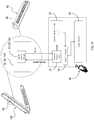
Figures 11 and12 are diagrams which show in schematic form alternative modes of operation of the device according to the present invention in its configuration as a bag closing clip; and -
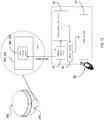
Figures 13 and14 are diagrams which show in schematic form alternative modes of operation of the device according to the present invention in its configuration as a foodstuff container. - With reference to
Figures 1 to 5 , these show a first embodiment of a device for preserving foodstuffs according to the present invention. - In particular, the device consists of a bag closing clip, indicated in general by the
reference number 100, which is used to close a bag S containing a food product or foodstuff, once opened, so as to safeguard the freshness and the integrity of the food product or foodstuff contained inside the bag. - The
bag closing clip 100 comprises afirst element 10 and asecond element 20 hinged together at a respective end by ahinge 30. Preferably, thefirst element 10, thesecond element 20 and thehinge 30 are made of plastic material. - As shown in detail in
Figures 3 and4 , thefirst element 10 has an elongated plate-like body, a box-shaped body 12, extending below from the oblong plate-like body 11, and rigid means 13 for connecting together the elongated plate-like body 11 and the box-shaped body 12. - The elongated plate-
like body 11 comprises atop side 111 and abottom side 112. The box-shaped body 12 has atop surface 121 facing thebottom side 112 of the elongated plate-like body 11 and suitably spaced therefrom by the rigid connection means 13, and anedge 122, extending perimetrally from thetop surface 111, in the opposite direction to that of the elongated plate-like body 11. - The
top surface 121 of the box-shaped body 12 has a length substantially corresponding to that of the elongated plate-like body 11. - The means for rigidly connecting together the elongated plate-
like body 11 and the box-shaped body 12 consist of a pair of pegs 13 (only one of which is shown inFigure 4 ), suitably spaced from each other. - The
pegs 13 are provided at respective ends of the elongated plate-like body 11 and the box-shaped body 12 opposite to the ends for hinging together thefirst element 10 and thesecond element 20 of thebag closing clip 100. In particular, thepegs 13 extend between thebottom side 112 of the elongated plate-like body 11 and thetop surface 121 of the box-shaped body 12. - An
interspace 17, the function of which will become clearer in the following of the presence description, is therefore defined between the elongated plate-like body 11 and the box-shaped body 12. - The
second element 20 of thebag closing clip 100 has a form substantially similar to that of the elongated plate-like body 11 of thefirst element 10 and has abottom side 21 and atop side 22 which faces the box-shapedbody 12 of thefirst element 10. - A pair of
longitudinal projections 23, preferably parallel to each other, extend upwards from thetop side 22 of thesecond element 20. During use of thebag closing clip 100, theselongitudinal projections 23 act as elements for clamping the bag S so as to ensure positioning thereof between thefirst element 10 and thesecond element 20. - Preferably, the
longitudinal projections 23 are formed as one piece with thesecond element 20. Alternatively, thelongitudinal projections 23 are joined - for example glued, interlocked or connected in a similar way - to thetop surface 22 of thesecond element 20 of thebag closing clip 100. - The
first element 10 and thesecond element 20 of thebag closing clip 100 have, at their respectivefree end - In the preferred embodiment shown in
Figures 1 to 5 , the releasable locking means comprise, in particular, atongue 24, extending from thefree end 26 of thesecond element 20, and a tooth 14, associated with thefree end 16 of thefirst element 10. Alternatively, it is possible to provide the tooth on the second element and the tongue on the first end of the bag closing clip. - As shown in detail in
Figure 3 , thetongue 24 comprises acurved section 244, projecting outwards from thesecond element 20, and alug 245, extending from a free end of thecurved section 245. - In the closed position of the
bag closing clip 100, shown inFigures 1 and2 , the tooth 14 is engaged in an interlocking manner inside thecurved section 244 of thetongue 24 and, in the open position of thebag closing clip 100, the tooth 14 is released from thecurved section 244 of thetongue 24. - Let us assume, for example, that a user wishes to open the
bag closing clip 10 in order to access the food product contained inside the bag S. - In this case, the user presses the
lug 245 of thetongue 24 so as to cause the tooth 14 to be disengaged from thecurved section 244 of thetongue 24. At this point, thefirst element 10 and thesecond element 20 of thebag closing clip 100 are disengaged at their respective free ends 16 and 26 and the bag S is open. The user may therefore use the food product contained inside the bag S. - Once the desired amount of food product has been extracted from the bag S, in order to close the bag S again, the user positions the open top part of the bag S between the
first element 10 and thesecond element 20 of thebag closing clip 100 and then moves thefirst element 10 and thesecond element 20 towards each other until the tooth 14 of thefirst element 10 engages in an interlocking manner inside thecurved section 244 of thetongue 24 of thesecond element 20. - The
top side 111 of the oblong plate-like body 11 has, formed therein, arecess 15, preferably circular in shape, which has a colour different from that of the other components of thebag closing clip 100, which preferably have a neutral colour, for example grey or white. This allows advantageously the user to recognise easily thebag closing clip 100, and therefore the food product contained inside the bag S associated with it, on a kitchen shelf or inside a refrigerator. - Preferably, the
second element 20 of thebag closing clip 100 has, on itstop side 22, arecess 25 similar to therecess 15 and coaxial therewith. Therecess 25 has a colour the same as that of therecess 15 and therefore different from that of thebag closing clip 100. - The
bag closing clip 100 has moreover awireless communication module 40 which is joined together with thefirst element 10 or thesecond element 20. - Preferably, the
wireless communication module 40 is a short-range wireless communication module, for example a Bluetooth® wireless communication module or an NFC (Near Field Communication) wireless communication module. - The
wireless communication module 40 of theclip 100 is configured to communicate with an intelligentportable device 50 of the user (seeFigures 11 and12 ). - Preferably, and as shown schematically in
Figures 11 and12 , thewireless communication module 40 comprises amemory unit 41 configured to store information relating to the food product contained inside the bag S closed by thebag closing clip 100, in particular the name of the product and the associated expiry date, transmitted to thebag closing clip 100 from the intelligentportable device 50. - For this purpose, and as shown in detail in
Figures 11 and12 , the intelligentportable device 50 comprises awireless communication module 51, which is similar to thewireless communication module 40 of thebag closing clip 100, and anapplication 52. A code identifying thebag closing clip 100 is also stored inside thememory unit 41 of thewireless communication module 40. - In an alternative embodiment, shown in
Figure 12 , thebag closing clip 100 also comprises visual signalling means 70 which are configured to indicate to the user how many days are left before expiry of the food product associated with thebag closing clip 100. - In particular, the visual signalling means 70 are provided on the
first element 10 of thebag closing clip 100, more specifically on thetop side 111 of the elongated plate-like body 11, so as to be easily and immediately visible by the user. Obviously, the visual signalling means may be positioned at any other point on the bag closing clip, for example on thesecond element 20, provided that they satisfy the condition of being visible to the user. - In the embodiment shown in
Figure 12 , the visual signalling means 70 comprise a LED (Light Emitting Diode)array 71, for example ten LEDs, one for each day left before the expiry date. - In this embodiment, the
wireless communication module 40 of thebag closing clip 100 is a wireless communication module of the active type, preferably an active NFC module, which comprises atimer 42. - The
timer 42 is configured to perform a countdown between a current date datecurr and the expiry date expprod of the product associated with thebag closing clip 100 and, as this expiry date expprod approaches, to activate lighting-up of a number ofLEDs 71 equal to the number of days left before expiry of the product. - Preferably, and as shown for example in
Figure 1 , thebag closing clip 100 also has at least oneorganoleptic sensor 80, which is configured to detect the organoleptic properties, such as appearance, colour, form, smell and taste, of the foodstuff contained inside the bag S and to be activated so as to inform the user when at least one of these organoleptic properties is no longer present. - The
bag closing clip 100 also comprises battery power supply means of the known type (not shown) for theLEDs 71, thetimer 42 and theorganoleptic sensor 80. - Preferably, the
bag closing clip 100 comprises afastener 60, which is preferably made of plastic and is housed extractably inside theinterspace 17 formed between the elongated plate-like body 11 and the box-shapedbody 12 of thefirst element 10. - The
fastener 60 is preferably a bag closing fastener for food products. However it could also be used as a fastener for documents or sheets of paper. - As shown in detail in
Figure 5 , thefastener 60 has a thickness such as to allow insertion/extraction thereof into/from theinterspace 17 formed in thebag closing clip 100. Moreover, thefastener 60 has a surface area such that, when it is in position inside the interspace, aperipheral portion 61 thereof projects from thefirst element 11 of thebag closing clip 100. This is clearly shown inFigures 1 to 3 . - Preferably, the
fastener 60 has the same colour as therecess 15 present in thetop element 11 of thebag closing clip 100. - The
fastener 60 also has, formed therein, a pair ofchannels 62 between which a substantiallyflexible fin 63 is formed. - In the vicinity of a
free end 64 of thefin 63, thefastener 60 has a pair ofrecesses 65 arranged on opposite sides of thefin 63. - As shown in
Figures 1 to 3 , when thefastener 60 is in its position fully inserted inside theinterspace 17, eachrecess 65 is designed to receive arespective peg 13 for joining together the elongated plate-like element 11 and the box-shapedbody 12 of thefirst element 11 of thebag closing clip 100. Moreover, in the fully inserted position of thefastener 60 inside theinterspace 17, thefree end 64 of thefin 63 projects from thebag closing clip 100, after passing between the pair ofpegs 13. - The
fastener 60 also has awireless communication module 66 which is entirely similar to that provided in thebag closing clip 100. Preferably, thewireless communication module 66, which is preferably of the Bluetooth®, more preferably of the NFC type, is configured to communicate with the correspondingwireless communication module 51 of the intelligentportable device 50 of the user. - In a way entirely similar to that of the
wireless communication module 40 of thebag closing clip 100, thewireless communication module 66 of thefastener 60 comprises a memory unit 67 (Figure 11 ) and preferably a timer 69 (Figure 12 ). An identification code for thefastener 60 is stored in thememory unit 67. - Preferably, the
fastener 60 has visual signalling means 68. These visual signalling means 68 are entirely similar and have the same function as the visual signalling means 70 of thebag closing clip 100 and, for this reason, they will not be described further. Preferably, the visual signalling means 68 comprise an array ofLEDs 68a. Moreover, in the case where thefastener 60 is used to close a bag containing food products or foodstuffs, it has an organoleptic sensor (not shown). - With reference to
Figures 6 to 8 , these show a bag closing clip according to an alternative embodiment of the device for preserving foodstuffs according to the present invention. - The bag closing clip, which is indicated in general by the
reference number 1100, comprises a first elongated element 1001 and a secondelongated element 101 which are rigidly connected together at a respective end. Aninterspace 103, inside which the open top part of the bag S is forcibly inserted, so as to close the bag, is therefore defined between the firstelongated element 101 and the secondelongated element 102. - Preferably, the first
elongated element 101 and the secondelongated element 102 have undulating oppositely arrangedsurfaces - The first
elongated element 101 and the secondelongated element 102 have preferably the same form and are preferably made of plastic material. - The
clip 1100 also has awireless communication module 140 which is entirely similar to that provided in thebag closing clip 100. Preferably, thewireless communication module 140, which is preferably of the Bluetooth®, more preferably of the NFC type, is configured to communicate with the correspondingwireless communication module 51 of the intelligentportable device 50 of the user. - In a way entirely similar to that of the
wireless communication module 40 of thebag closing clip 100, thewireless communication module 140 of theclip 1100 comprises a memory unit 141 (Figure 11 ) and preferably a timer 142 (Figure 12 ). An identification code for theclip 1100 is stored in thememory unit 141. - Preferably, the
clip 1100 has visual signalling means 170. These visual signalling means 170 are entirely similar and have the same function as the visual signalling means 70 of thebag closing clip 100 and, for this reason, they will not be described further. Preferably, the visual signalling means 170 comprise an array ofLEDs 171. - Preferably, the clip 1110 also has an
organoleptic sensor 180 and/or battery power supply means of the known type (not shown). - With reference to
Figures 9a to 9c , they show further alternative embodiments of the device for preserving foodstuffs according to the present invention. - According to the embodiments shown in
Figures 9a to 9c , the device consists of alid 200 designed to close a storage space of a container suitable for storing the foodstuffs. - The
lid 200 in the figures is shown in different embodiments, but each embodiment has grippingmeans 210 for allowing the user to grip thelid 200. - In the embodiment shown in
Figure 9a , thelid 200 consists of aflat element 212 onto which a knob for gripping thelid 200 is fixed. - The
lid 200 has awireless communication module 240 which is entirely similar to thewireless communication module 40 described above with reference to thebag closing clip 100. - The
wireless communication module 240 may be provided on or fixed to the top surface or the bottom surface of theflat element 212 or inserted inside a special receiving seat formed in the thickness of theflat element 212. - As shown in
Figure 9a , it is envisaged that thewireless communication module 240 is inserted inside a space formed within theknob 210. - Preferably, the
wireless communication module 240, which is preferably of the Bluetooth®, more preferably of the NFC type, is configured to communicate with the correspondingwireless communication module 51 of the intelligentportable device 50 of the user. - In a way entirely similar to that of the
wireless communication module 40 of thebag closing clip 100, thewireless communication module 240 of thelid 200 comprises a memory unit 241 (Figure 13 ) and preferably a timer 242 (Figure 14 ). An identification code for thelid 200 is stored in thememory 242. - Preferably, the
lid 200 has visual signalling means 270. These visual signalling means 270 are entirely similar and have the same function as the visual signalling means 70 of thebag closing clip 100 and, for this reason, will not be described further. Preferably, the visual signalling means 270 comprise an array ofLEDs 271. - In particular, the visual signalling means 270 may be provided on the outer surface of the
lid 200 so as to be visible to a user. - Preferably, the
lid 200 also has at least oneorganoleptic sensor 280 and/or battery power supply means of the known type (not shown). - In the embodiment thereof shown in
Figure 9b , thelid 200 has aperipheral edge 213 which allows thelid 200 to be fixed to a container. - The
peripheral edge 213 may, for example, be threaded so as to cooperate with a corresponding thread provided on the container or may be made of an elastically deformable material so as to surround and grip the top part of a container if present. -
Figure 9c shows a further possible embodiment of thelid 200, in which the lid is made of an elastically deformable material, such as silicone, rubber, polymers and the like. Such a lid is advantageously adaptable to any known container used for preserving foodstuffs. -
Figures 10a and 10b show another embodiment, in which the device according to the present invention consists of acontainer 300 for foodstuffs, in which awireless communication module 340 of the type entirely similar to thewireless communication module 40 described above and shown with reference to thebag closing clip 100 is provided. - Such an embodiment is particularly advantageous since the
container 300 may be used for any type of food, be it solid or liquid, or may even be used to contain different types of foods, which preferably should have the same expiry date. An example in this connection may be the containers which are commonly used in refrigerators to contain cheeses, fruit or vegetables: the expiry date of such foods may be easily monitored owing to the presence of thewireless communication module 340. - As for the
lid 200, it is envisaged that thewireless communication module 340 of thecontainer 300 may be fixed on the inside or the outside of the side walls or bottom walls of thecontainer 300, or a space may be formed inside the thickness of the said walls to allow seating of thewireless communication module 340. - Preferably, the
wireless communication module 340, which is preferably of the Bluetooth®, more preferably of the NFC type, is configured to communicate with the correspondingwireless communication module 51 of the intelligentportable device 50 of the user. - In a way entirely similar to that of the
wireless communication module 40 of thebag closing clip 100, thewireless communication module 340 of thecontainer 300 comprises a memory unit 341 (Figure 13 ) and preferably a timer 342 (Figure 14 ). An identification code for thecontainer 300 is stored in thememory unit 342. - Preferably, the
container 300 has visual signalling means 370. These visual signalling means 370 are entirely similar and have the same function as the visual signalling means 70 of thebag closing clip 100 and, for this reason, will not be described further. Preferably, the visual signalling means 370 comprise an array ofLEDs 371. - In particular, the visual signalling means 370 may be provided on the side walls of the
container 300 so as to be visible to a user. - Preferably, the
container 300 also has at least oneorganoleptic sensor 380 and/or battery power supply means of the known type (not shown). - As shown in
Figure 10b , it is possible to provide thecontainer 300 in combination with thelid 200 described above with reference toFigures 9a to 9c . In this way there are two wireless communication modules available, i.e. thewireless communication module 240 of thelid 200 and thewireless communication module 340 of thecontainer 300, these communicating with the same intelligentportable device 50 and operating in synergism, for example so as to check the expiry dates of two different types of food present inside thecontainer 300 or to monitor two different parameters of the same food, for example two different dates, such as the expiry date and the date by which the food must be preferably eaten. - As described above, an identification code may be associated with the
lid 200 and/or thecontainer 300. - It is possible to envisage that a
single lid 200 or asingle container 300 may have more than onewireless communication module wireless communication module lid 200 or thecontainer 300. - With reference to
Figure 11 , the operation of a device for preserving foodstuffs according to the present invention having the form of a bag closing clip is now described. - The operation will be described with reference to the
bag closing clip 100 and thefastener 60, once extracted from the receivinginterspace 17 present in thebag closing clip 100, although the same comments are entirely applicable to the bag closing clip 110 described above and illustrated inFigures 6 to 8 . - In the following of the present description reference will be made to a
smartphone 50 by way of intelligent portable device, but it is understood that the comments are also applicable to any intelligent portable device available to the user and suitable for the purpose. - Firstly, the user, by means of the
application 52 present inside thesmartphone 50, enters the name nameprod and expiry date expprod of a food product contained inside a bag S. For example <mozzarella; 1_april_2017>. - Then the user moves the
smartphone 50 towards thebag closing clip 100, typically to a distance of not more than 10 cm, where thesmartphone 50 is able to detect the presence of thebag closing clip 100 or thefastener 60, more particularly of the respectivewireless communication modules - At this point, the
wireless communication module 40 of thebag closing clip 100 and thewireless communication module 51 of thesmartphone 50 are able to communicate with each other. - In particular:
- the
wireless communication module 40 of thebag closing clip 100 transmits the identification code Idc of thebag closing clip 100, which is stored in thememory 41, to thewireless communication module 51 of thesmartphone 50; and - the
wireless communication module 51 of thesmartphone 50 transmits the name namprod and expiry date expprod of the food product previously entered by the user via theapplication 52 of thesmartphone 50, for example <mozzarella; 1_april_2017>, to thewireless communication module 40 of thebag closing clip 100. - This data is stored, together with the identification code Idc, in the
memory 41 of thewireless communication module 40. - In an entirely similar manner, the
wireless communication module 66 of thefastener 60 and thewireless communication module 51 of thesmartphone 50 are able to communicate with each other. - In particular:
- the
wireless communication module 66 of thefastener 60 transmits an identification code Idf for thefastener 60 to thewireless communication module 51 of thesmartphone 50; and - the
wireless communication module 51 of thesmartphone 50 transmits the name namprod and expiry date expprod of the food product previously entered by the user, for example <salad; 29_march_2017>, to thewireless communication module 66 of thefastener 60. - This data is stored, together with the identification code Idf, in the
memory 67 of thewireless communication module 66. - Following this exchange of information, the food product contained in the bag S, the expiry date of the food product and the
clip 100 orfastener 60 used to close the bag S containing the product are associated with each other. This association, for example <mozzarella; 1_april_2017_Idc> or <salad-29_march_2017_Idf> is present both on thebag closing clip 100 orfastener 60, in particular in thememory wireless communication module application 52 of thesmartphone 50. - As described above, a colour is preferably associated with the
bag closing clip 100 and thefastener 60. As a result, by means of theapplication 52, the user may associate with the product, expiry date and identification code Idm or Idg of thebag closing clip 100 orfastener 60 also the associated colour colc or colf, for example, in the case of the bag closing clip 100: <mozzarella; 1_april_2017_Idc_red>. - An entirely similar process may be adopted for any other
bag closing clip 100 and/orfastener 60 available to the user and may be used by the latter to close any product provided with an expiry date. - The
smartphone 50 includes atimer 54 by means of which theapplication 52 may perform a countdown between the current date datecurr and the expiry date expprod of each product and, close to this expiry date expprod, for example when there are two days to go before expiry of the product, namely expprod - datecurr = 2, may display on thescreen 55 of thesmartphone 50, for each product, an expiry warning message. - The user is thus made aware of the fact that, for example, the mozzarella contained in the bag S closed by the red-coloured
bag closing clip 100 is about to expire and must therefore be eaten. - Similarly, the user is made aware of the fact that the salad contained inside the bag S closed by the red
coloured fastener 60 is about to expire and must be eaten. - Let us assume instead that the user wishes to know the expiry date of one or more products contained, for example, inside a refrigerator.
- To do so, the user moves the
smartphone 50 towards the bag closing clips 100 and/orfasteners 60 associated with the food products concerned. Thewireless communication module bag closing clip 100 and/orfastener 60 then transmits the name namprod and expiry date expprod of the product contained inside the respective bag S to thewireless communication module 51 of thesmartphone 50 and this information is displayed, by means of theapplication 52, on thescreen 55 of the intelligentportable device 50 in the form of an expiry warning message. - Once the food product contained inside the bag S has been eaten, the
bag closing clip 100 orfastener 60 may be used to close another bag S. - For this purpose, the
memory wireless communication module 40 of thebag closing clip 100 and thewireless communication module 66 of thefastener 60 may be erased and the name and expiry date of a new food product may be stored in them in the manner described above. - Preferably, the
application 52 of thesmartphone 50, depending on the type of products about to expire, may suggest to the user recipes which use these products as ingredients. This allows, advantageously, a further reduction in possible waste. - With reference to
Figure 7 , operation of thebag closing clip 100 in its embodiment comprising awireless communication module 40 of the active type, atimer 42 and visual signalling means 70 is now described. Obviously entirely the same comments are applicable to thefastener 60 in its embodiment comprising the visual signalling means 68. - In this case also, as described above with reference to
Figure 11 , firstly the user, by means of theapplication 52 present inside thesmartphone 50, enters the name namprod and expiry date expprod of a food product associated with thebag closing clip 100. - Then the user moves the
smartphone 50 towards thebag closing clip 100, typically to a distance of not more than 10 cm, where thesmartphone 50 is able to detect the presence of thebag closing clip 100, more particularly of the respectivewireless communication module 40. - At this point, the
wireless communication module 40 of thebag closing clip 100 and thewireless communication module 51 of thesmartphone 50 are able to communicate with each other. - In particular:
- the
wireless communication module 40 of thebag closing clip 100 transmits an identification code Idc of thebag closing clip 100 to thewireless communication module 51 of thesmartphone 50; and - the
wireless communication module 51 of thesmartphone 50 transmits the name namprod and expiry date expprod of the food product previously entered by the user to thewireless communication module 40 of thebag closing clip 100. This data is stored, together with the identification code Idc, in thememory 41 of thewireless communication module 40. - Following this exchange of information the food product contained in the bag S, the expiry date of the food product and the
clip 100 used to close the bag S containing the product are associated with each other. - As described above, a colour is preferably associated with the
bag closing clip 100. As a result, by means of theapplication 52, the user may associate also the colour colc with the product, the expiry date and identification code Idc of thebag closing clip 100. - Let us assume, now, that the user wishes to know whether the product associated with the
bag closing clip 100 is about to expire. - To do this, the user moves the
smartphone 50 towards thebag closing clip 100 so as to active thewireless communication module 40, in particular thetimer 42. Once activated, the timer performs a countdown between the current date datecurr and the expiry date of the product expprod and activates lighting-up of a number of LEDs, for example five LEDs, equal to the number of days left before expiry. The user is therefore made aware of the fact that the product will expire in five days. - With reference to
Figures 13 and14 , the operation of a device for preserving foodstuffs according to the present invention having the form of a container is now described. - Operation will be described with reference to the
container 300, although entirely the same comments are applicable to thelid 200 or to a combination oflid 200 andcontainer 300, described above and illustrated inFigures 9a to 9c andFigure 10b . - Operation is such that, firstly, the user, by means of the
application 52 present inside thesmartphone 50, enters the name namprod and expiry date expprod of a food product contained inside thecontainer 300. For example <mozzarella; 1_april_2017>. - Then the user moves the
smartphone 50 towards thecontainer 300, typically to a distance of not more than 10 cm, where thesmartphone 50 is able to detect the presence of thecontainer 300, more particularly of thewireless communication module 340. - At this point, the
wireless communication module 340 of thecontainer 300 and thewireless communication module 51 of thesmartphone 50 are able to communicate with each other. - In particular:
- the
wireless communication module 340 of thecontainer 300 transmits the identification code Idcon of thecontainer 100, which is stored in thememory 341, to thewireless communication module 51 of thesmartphone 50; and - the
wireless communication module 51 of thesmartphone 50 sends the name namprod and expiry date expprod of the food product previously entered by the user via theapplication 52 of thesmartphone 50, for example <mozzarella; 1_april_2017>, to thewireless communication module 340 of thecontainer 300. - This data is stored, together with the identification code Idcon, in the
memory 341 of thewireless communication module 340. - Following this exchange of information, the food product contained inside the
container 300, the expiry date of the food product and thecontainer 300 containing the product are associated with each other. This association, for example <mozzarella; 1_april_2017_Idc> or <salad-29_march_2017_Idf> is present both in thememory 341 of thewireless communication module 340 and in theapplication 52 of thesmartphone 50. - It is possible to envisage that part of the
container 300 as well as part of thelid 200 may have a specific colour. As a result, by means of theapplication 52, the use may associate with the product, expiry date, and identification code Idcon of thecontainer 300 also the associated code colcon, for example <mozzarella; 1_april_2017_Idcon_red>. - The colour may be used as a label for more rapid identification of the foodstuff contained inside the
container 300. - The
smartphone 50 includes atimer 54 by means of which theapplication 52 may perform a countdown between the current date datecurr and the expiry date expprod of each product and, close to this expiry date expprod, for example when there are two days to go before expiry of the product, namely expprod - datecurr = 2, may display on thescreen 55 of thesmartphone 50, for each product, an expiry warning message. - The user is thus made aware of the fact that, for example, the mozzarella contained inside the red-coloured container is about to expire and must therefore be eaten.
- Let us assume instead that the user wishes to know the expiry date of one or more products contained, for example, inside a refrigerator.
- To do so, the user moves the
smartphone 50 towards the variouspossible containers 300 and/orlids 200 associated with the food products concerned. Thewireless communication module wireless communication module 51 of thesmartphone 50 and this information is displayed, by means of theapplication 52, on thescreen 55 of the intelligentportable device 50 in the form of an expiry warning message. - Obviously, once the food product has been eaten, the
container 300 may be used again for another foodstuff. - For this purpose, the
memory 341 of thewireless communication module 340 may be erased and the name and expiry date of a new food product may be stored in it in the manner described above. - With reference to
Figure 14 , operation of thecontainer 300 in its embodiment comprising awireless communication module 340 of the active type, atimer 342 and visual signalling means 370 is now described. - In this case also, as described above with reference to
Figure 13 , firstly the user, by means of theapplication 52 present inside thesmartphone 50, enters the name namprod and expiry date expprod of a food product associated with or contained inside thecontainer 300. - Then the user moves the
smartphone 50 towards thecontainer 300, typically to a distance of not more than 10 cm, where thesmartphone 50 is able to detect the presence of thecontainer 300, more particularly of the respectivewireless communication module 340. - At this point, the
wireless communication module 340 of thecontainer 300 and thewireless communication module 51 of thesmartphone 50 are able to communicate with each other. - In particular:
- the
wireless communication module 340 of thecontainer 300 transmits an identification code Idcon of thecontainer 300 to thewireless communication module 51 of thesmartphone 50; and - the
wireless communication module 51 of thesmartphone 50 transmits the name namprod and expiry date expprod of the food product previously entered by the user to thewireless communication module 340 of thecontainer 300. This data is stored, together with the identification code Idcon, in thememory 341 of thewireless communication module 340. - Following this exchange of information, the food product contained inside the
container 300, the expiry date of the food product and thecontainer 300 containing the product are associated with each other. - As described above, a colour is preferably associated with the
container 300. As a result, by means of theapplication 52, the user may also associate the corresponding colour colcon with the product, expiry date, and identification code Idcon of thecontainer 300. - Let us assume, now, that the user wishes to know whether the product associated with the
container 300 is about to expire. - To do so, the user moves the
smartphone 50 towards thecontainer 300 so as to active thewireless communication module 340, in particular thetimer 342. Once activated, the timer performs a countdown between the current date datecurr and the expiry date of the product expprod and activates lighting-up of a number of LEDs, for example five LEDs, equal to the number of days left before expiry. The user is therefore made aware of the fact that the product will expire in five days. - From the above description the features of the device for preserving foodstuffs according to the present invention, as well as the associated advantages, are evident.
- Further variants of the embodiment described above are possible, without departing from the teaching of the invention. For example, a spring type clip may be provided. Moreover, the device according to the invention may be configured so as to be able to communicate with intelligent refrigerators or shelves.
- Finally, it is clear that the device for preserving foodstuffs thus designed may be subject to numerous modifications and variations; moreover all the details may be replaced by technically equivalent elements. Basically the materials used, as well as the dimensions, may be of any nature depending on the technical requirements.
Claims (15)
- Device (100; 1100; 200; 300) for preserving foodstuffs, characterized in that it comprises at least one wireless communication module (40; 140; 240; 340) configured to communicate with a corresponding wireless communication module (51) of an intelligent portable device (50).
- Device (100; 1100; 200; 300) according to Claim 1, wherein said device consists of a clip (100; 1100) for closing a bag (S) for food products.
- Device (100; 1100; 200; 300) according to Claim 2, wherein the clip (100) comprises a first element (10), a second element (20), hinging means (30) for hinging together said first element (10) and second element (20), provided at a respective end of said first element (10) and second element (20), and means (14, 24) for releasably locking together said first element (10) and second element (20), provided at a free end (16, 26) of said first element (10) and second element (20), opposite to the hinging end.
- Device (100; 1100; 200; 300) according to Claim 3, wherein said first element (10) has, formed therein, an interspace (13) designed to extractably receive a fastener (60) comprising a respective wireless communication module (66).
- Device (100; 1100; 200; 300) according to Claim 2, wherein the clip (1100) comprises a first elongated element (101) and a second elongated element (102) which are rigidly connected together at a respective end and between which an interspace (103) for forcibly inserting an open top part of the bag (S) is defined, said first elongated element (101) and second elongated element (102) having undulating opposite surfaces (104, 105).
- Device (100; 1100; 200; 300) according to Claim 1, wherein the device consists of a lid (200), which lid (200) is designed to close a storage space of a container designed to store said foodstuffs.
- Device (100; 1100; 200; 300) according to Claim 6, wherein said lid (200) consists at least partly of elastically deformable material.
- Device (100; 1100; 200; 300) according to Claim 1, wherein said device consists of a container (300), which container (300) comprises a space for storing said foodstuffs.
- Device (100; 1100; 200; 300) according to any one of Claims 6 to 8, wherein said lid (200) and/or said container (300) have at least one receiving seat formed in the thickness of the walls, which receiving seat is designed to receive said at least one module of a respective wireless communication module (240; 340).
- Device (100; 1100; 200; 300) according to any one of the preceding claims, wherein said device comprises an identification code (Idc; Idcon), said wireless communication module (40; 66; 140; 240; 340) being configured to send said identification code (Idc; Idcon) to the intelligent portable device (50).
- Device (100; 1100; 200; 300) according to any one of the preceding claims, wherein the wireless communication module (40; 66; 140; 240; 340) of the device comprises a memory unit (41; 67; 141; 241; 341), said wireless communication module (50) of the intelligent portable device (50) being configured to transmit to the device (100; 1100; 200; 300) the name (namprod) and expiry date (expprod) of a given foodstuff associated with the device, the name (namprod) and expiry date (expprod) being stored in said memory unit (41; 141; 241; 341).
- Device (100; 1100; 200; 300) according to any one of the preceding claims, wherein said wireless communication module (40; 66; 140; 240; 340) of the device (100; 1100; 200; 300) is also configured to transmit to the intelligent portable device (50) said name (namprod) and expiry date (expprod) previously stored therein.
- Device (100; 1100; 200; 300) according to any one of the preceding claims, further comprising visual signalling means (70; 68; 170; 270; 370) and a timer (42; 69; 142; 242; 342) in electrical communication with said visual signalling means (70; 68; 170; 270; 370), said timer (42; 69; 142; 242; 342) being configured to perform a countdown between a current date (datecurr) and the expiry date of the product (expprod) and activate lighting-up of the visual signalling means (70; 68; 170; 270; 370).
- Device (100; 1100; 200; 300) according to Claim 13, wherein said visual signalling means (70; 170; 270; 370) comprise an array of LEDs (71; 68a; 171; 271; 371) and wherein said timer (42; 69; 142; 242; 342) is configured to activate lighting-up of a number of LEDs (71; 68a; 171; 271; 371) corresponding to the difference between the expiry date of the product (expprod) and the current date (datecurr).
- Device (100; 1100; 200; 300) according to any one of the preceding claims, further comprising at least one organoleptic sensor (80; 180; 280; 380).
Applications Claiming Priority (2)
| Application Number | Priority Date | Filing Date | Title |
|---|---|---|---|
| IT102017000035801A IT201700035801A1 (en) | 2017-03-31 | 2017-03-31 | MOLLETTA CLOSE BAG |
| IT102017000093251A IT201700093251A1 (en) | 2017-08-11 | 2017-08-11 | Food storage device |
Publications (3)
| Publication Number | Publication Date |
|---|---|
| EP3381837A2 true EP3381837A2 (en) | 2018-10-03 |
| EP3381837A3 EP3381837A3 (en) | 2019-01-23 |
| EP3381837B1 EP3381837B1 (en) | 2021-12-15 |
Family
ID=61768197
Family Applications (1)
| Application Number | Title | Priority Date | Filing Date |
|---|---|---|---|
| EP18165036.7A Active EP3381837B1 (en) | 2017-03-31 | 2018-03-29 | System for preserving foodstuffs |
Country Status (1)
| Country | Link |
|---|---|
| EP (1) | EP3381837B1 (en) |
Cited By (2)
| Publication number | Priority date | Publication date | Assignee | Title |
|---|---|---|---|---|
| IT202000025303A1 (en) * | 2020-10-26 | 2022-04-26 | H24Invent S R L | SYSTEM FOR MONITORING THE EXPIRY DATE OF FOOD PRODUCTS IN BOTTLE OR JAR |
| EP4180755A4 (en) * | 2020-08-24 | 2023-12-06 | Qingdao Haier Refrigerator Co., Ltd. | REFRIGERATION AND FREEZING DEVICE |
Families Citing this family (1)
| Publication number | Priority date | Publication date | Assignee | Title |
|---|---|---|---|---|
| LU103506B1 (en) * | 2025-01-07 | 2026-07-07 | Miele & Cie | Method and control device for operating a storage container for storing food, method and control unit for operating a mobile device and storage container for storing food |
Family Cites Families (5)
| Publication number | Priority date | Publication date | Assignee | Title |
|---|---|---|---|---|
| PL353516A1 (en) * | 2002-04-18 | 2003-10-20 | Remigiusz Świerczek | Foodstuff freshness indicator and packaging particularly designed for foodstuffs |
| US6982640B2 (en) * | 2002-11-21 | 2006-01-03 | Kimberly-Clark Worldwide, Inc. | RFID system and method for tracking food freshness |
| US7969304B2 (en) * | 2008-04-29 | 2011-06-28 | Berland Kerry S | Secured bag locking and tracking device |
| US20110109453A1 (en) * | 2009-11-10 | 2011-05-12 | Chia-Wen Chen | Apparatus for Warning of an Expiration Date |
| KR101821818B1 (en) * | 2011-09-22 | 2018-01-24 | 엘지전자 주식회사 | A control method of electric device |
-
2018
- 2018-03-29 EP EP18165036.7A patent/EP3381837B1/en active Active
Cited By (4)
| Publication number | Priority date | Publication date | Assignee | Title |
|---|---|---|---|---|
| EP4180755A4 (en) * | 2020-08-24 | 2023-12-06 | Qingdao Haier Refrigerator Co., Ltd. | REFRIGERATION AND FREEZING DEVICE |
| US11906237B2 (en) | 2020-08-24 | 2024-02-20 | Qingdao Haier Refrigerator Co., Ltd. | Refrigerating and freezing device |
| IT202000025303A1 (en) * | 2020-10-26 | 2022-04-26 | H24Invent S R L | SYSTEM FOR MONITORING THE EXPIRY DATE OF FOOD PRODUCTS IN BOTTLE OR JAR |
| EP3989146A1 (en) * | 2020-10-26 | 2022-04-27 | H24Invent Srl | System for monitoring the expiry date of bottled or canned food products |
Also Published As
| Publication number | Publication date |
|---|---|
| EP3381837A3 (en) | 2019-01-23 |
| EP3381837B1 (en) | 2021-12-15 |
Similar Documents
| Publication | Publication Date | Title |
|---|---|---|
| US20180297742A1 (en) | Disposable container for commercializing individual frozen food portions and method of using the same | |
| EP3381837B1 (en) | System for preserving foodstuffs | |
| US5798694A (en) | Food storage apparatus and methods and systems for monitoring a food item | |
| US20200397194A1 (en) | Configurable meal kit preparation and storage vehicle | |
| EP1980807A3 (en) | Refrigerator including food product management system | |
| DK2731879T3 (en) | Wraps FOR SUPPLIES AND METHODS OF USE THEREOF | |
| US20220194680A1 (en) | Systems and apparatus for hydration and supplementation | |
| US20160137364A1 (en) | Food container | |
| US20140069917A1 (en) | Stackable Container System | |
| US11974702B2 (en) | Food container with timer | |
| WO2006028789A3 (en) | Consumables container with nested insert | |
| RU2011141115A (en) | ADAPTABLE NUTRITION SYSTEM FOR CHILDREN AND WAYS OF ITS USE | |
| US20130140314A1 (en) | Introduced in a sealed recipient to accommodate food products with one or more compartments | |
| JP6589003B2 (en) | Food ripening equipment | |
| GB2469100A (en) | Expiry indicator | |
| EP3269662B1 (en) | A food container | |
| EP3989146A1 (en) | System for monitoring the expiry date of bottled or canned food products | |
| JP3156201U (en) | Small packaged food and combination food using the same | |
| BE1017800A6 (en) | Cool lunchbox for storing e.g. meat and vegetables, has receiver receiving food, another receiver receiving cooling element, where cooling element is placed in bottom of lunchbox that is made of plastic | |
| Harrison et al. | Preparing an emergency food supply, short term food storage | |
| ES2304827A1 (en) | Method for obtaining packed food goods, ready for consuming, kept stable at room temperature | |
| US10045660B2 (en) | Kit for the heat treatment of foods | |
| JP3161671U (en) | Matsumae pickles set | |
| KR20130004740U (en) | Functional airtight container | |
| Francis et al. | Save Food Packaging Design Criteria Checklist |
Legal Events
| Date | Code | Title | Description |
|---|---|---|---|
| PUAI | Public reference made under article 153(3) epc to a published international application that has entered the european phase |
Free format text: ORIGINAL CODE: 0009012 |
|
| STAA | Information on the status of an ep patent application or granted ep patent |
Free format text: STATUS: THE APPLICATION HAS BEEN PUBLISHED |
|
| AK | Designated contracting states |
Kind code of ref document: A2 Designated state(s): AL AT BE BG CH CY CZ DE DK EE ES FI FR GB GR HR HU IE IS IT LI LT LU LV MC MK MT NL NO PL PT RO RS SE SI SK SM TR |
|
| AX | Request for extension of the european patent |
Extension state: BA ME |
|
| PUAL | Search report despatched |
Free format text: ORIGINAL CODE: 0009013 |
|
| AK | Designated contracting states |
Kind code of ref document: A3 Designated state(s): AL AT BE BG CH CY CZ DE DK EE ES FI FR GB GR HR HU IE IS IT LI LT LU LV MC MK MT NL NO PL PT RO RS SE SI SK SM TR |
|
| AX | Request for extension of the european patent |
Extension state: BA ME |
|
| RIC1 | Information provided on ipc code assigned before grant |
Ipc: A47J 47/02 20060101ALI20181214BHEP Ipc: B65D 81/00 20060101AFI20181214BHEP Ipc: B65D 43/00 20060101ALI20181214BHEP Ipc: H04B 5/00 20060101ALI20181214BHEP |
|
| STAA | Information on the status of an ep patent application or granted ep patent |
Free format text: STATUS: REQUEST FOR EXAMINATION WAS MADE |
|
| 17P | Request for examination filed |
Effective date: 20190722 |
|
| RBV | Designated contracting states (corrected) |
Designated state(s): AL AT BE BG CH CY CZ DE DK EE ES FI FR GB GR HR HU IE IS IT LI LT LU LV MC MK MT NL NO PL PT RO RS SE SI SK SM TR |
|
| STAA | Information on the status of an ep patent application or granted ep patent |
Free format text: STATUS: EXAMINATION IS IN PROGRESS |
|
| 17Q | First examination report despatched |
Effective date: 20200107 |
|
| GRAP | Despatch of communication of intention to grant a patent |
Free format text: ORIGINAL CODE: EPIDOSNIGR1 |
|
| STAA | Information on the status of an ep patent application or granted ep patent |
Free format text: STATUS: GRANT OF PATENT IS INTENDED |
|
| INTG | Intention to grant announced |
Effective date: 20210705 |
|
| GRAS | Grant fee paid |
Free format text: ORIGINAL CODE: EPIDOSNIGR3 |
|
| GRAA | (expected) grant |
Free format text: ORIGINAL CODE: 0009210 |
|
| STAA | Information on the status of an ep patent application or granted ep patent |
Free format text: STATUS: THE PATENT HAS BEEN GRANTED |
|
| AK | Designated contracting states |
Kind code of ref document: B1 Designated state(s): AL AT BE BG CH CY CZ DE DK EE ES FI FR GB GR HR HU IE IS IT LI LT LU LV MC MK MT NL NO PL PT RO RS SE SI SK SM TR |
|
| REG | Reference to a national code |
Ref country code: GB Ref legal event code: FG4D Ref country code: CH Ref legal event code: EP |
|
| REG | Reference to a national code |
Ref country code: DE Ref legal event code: R096 Ref document number: 602018028080 Country of ref document: DE |
|
| REG | Reference to a national code |
Ref country code: IE Ref legal event code: FG4D |
|
| REG | Reference to a national code |
Ref country code: AT Ref legal event code: REF Ref document number: 1455344 Country of ref document: AT Kind code of ref document: T Effective date: 20220115 |
|
| REG | Reference to a national code |
Ref country code: LT Ref legal event code: MG9D |
|
| REG | Reference to a national code |
Ref country code: NL Ref legal event code: MP Effective date: 20211215 |
|
| PG25 | Lapsed in a contracting state [announced via postgrant information from national office to epo] |
Ref country code: RS Free format text: LAPSE BECAUSE OF FAILURE TO SUBMIT A TRANSLATION OF THE DESCRIPTION OR TO PAY THE FEE WITHIN THE PRESCRIBED TIME-LIMIT Effective date: 20211215 Ref country code: LT Free format text: LAPSE BECAUSE OF FAILURE TO SUBMIT A TRANSLATION OF THE DESCRIPTION OR TO PAY THE FEE WITHIN THE PRESCRIBED TIME-LIMIT Effective date: 20211215 Ref country code: FI Free format text: LAPSE BECAUSE OF FAILURE TO SUBMIT A TRANSLATION OF THE DESCRIPTION OR TO PAY THE FEE WITHIN THE PRESCRIBED TIME-LIMIT Effective date: 20211215 Ref country code: BG Free format text: LAPSE BECAUSE OF FAILURE TO SUBMIT A TRANSLATION OF THE DESCRIPTION OR TO PAY THE FEE WITHIN THE PRESCRIBED TIME-LIMIT Effective date: 20220315 |
|
| REG | Reference to a national code |
Ref country code: AT Ref legal event code: MK05 Ref document number: 1455344 Country of ref document: AT Kind code of ref document: T Effective date: 20211215 |
|
| PG25 | Lapsed in a contracting state [announced via postgrant information from national office to epo] |
Ref country code: SE Free format text: LAPSE BECAUSE OF FAILURE TO SUBMIT A TRANSLATION OF THE DESCRIPTION OR TO PAY THE FEE WITHIN THE PRESCRIBED TIME-LIMIT Effective date: 20211215 Ref country code: NO Free format text: LAPSE BECAUSE OF FAILURE TO SUBMIT A TRANSLATION OF THE DESCRIPTION OR TO PAY THE FEE WITHIN THE PRESCRIBED TIME-LIMIT Effective date: 20220315 Ref country code: LV Free format text: LAPSE BECAUSE OF FAILURE TO SUBMIT A TRANSLATION OF THE DESCRIPTION OR TO PAY THE FEE WITHIN THE PRESCRIBED TIME-LIMIT Effective date: 20211215 Ref country code: HR Free format text: LAPSE BECAUSE OF FAILURE TO SUBMIT A TRANSLATION OF THE DESCRIPTION OR TO PAY THE FEE WITHIN THE PRESCRIBED TIME-LIMIT Effective date: 20211215 Ref country code: GR Free format text: LAPSE BECAUSE OF FAILURE TO SUBMIT A TRANSLATION OF THE DESCRIPTION OR TO PAY THE FEE WITHIN THE PRESCRIBED TIME-LIMIT Effective date: 20220316 |
|
| PG25 | Lapsed in a contracting state [announced via postgrant information from national office to epo] |
Ref country code: NL Free format text: LAPSE BECAUSE OF FAILURE TO SUBMIT A TRANSLATION OF THE DESCRIPTION OR TO PAY THE FEE WITHIN THE PRESCRIBED TIME-LIMIT Effective date: 20211215 |
|
| PG25 | Lapsed in a contracting state [announced via postgrant information from national office to epo] |
Ref country code: SM Free format text: LAPSE BECAUSE OF FAILURE TO SUBMIT A TRANSLATION OF THE DESCRIPTION OR TO PAY THE FEE WITHIN THE PRESCRIBED TIME-LIMIT Effective date: 20211215 Ref country code: SK Free format text: LAPSE BECAUSE OF FAILURE TO SUBMIT A TRANSLATION OF THE DESCRIPTION OR TO PAY THE FEE WITHIN THE PRESCRIBED TIME-LIMIT Effective date: 20211215 Ref country code: RO Free format text: LAPSE BECAUSE OF FAILURE TO SUBMIT A TRANSLATION OF THE DESCRIPTION OR TO PAY THE FEE WITHIN THE PRESCRIBED TIME-LIMIT Effective date: 20211215 Ref country code: PT Free format text: LAPSE BECAUSE OF FAILURE TO SUBMIT A TRANSLATION OF THE DESCRIPTION OR TO PAY THE FEE WITHIN THE PRESCRIBED TIME-LIMIT Effective date: 20220418 Ref country code: ES Free format text: LAPSE BECAUSE OF FAILURE TO SUBMIT A TRANSLATION OF THE DESCRIPTION OR TO PAY THE FEE WITHIN THE PRESCRIBED TIME-LIMIT Effective date: 20211215 Ref country code: EE Free format text: LAPSE BECAUSE OF FAILURE TO SUBMIT A TRANSLATION OF THE DESCRIPTION OR TO PAY THE FEE WITHIN THE PRESCRIBED TIME-LIMIT Effective date: 20211215 Ref country code: CZ Free format text: LAPSE BECAUSE OF FAILURE TO SUBMIT A TRANSLATION OF THE DESCRIPTION OR TO PAY THE FEE WITHIN THE PRESCRIBED TIME-LIMIT Effective date: 20211215 |
|
| PG25 | Lapsed in a contracting state [announced via postgrant information from national office to epo] |
Ref country code: PL Free format text: LAPSE BECAUSE OF FAILURE TO SUBMIT A TRANSLATION OF THE DESCRIPTION OR TO PAY THE FEE WITHIN THE PRESCRIBED TIME-LIMIT Effective date: 20211215 Ref country code: AT Free format text: LAPSE BECAUSE OF FAILURE TO SUBMIT A TRANSLATION OF THE DESCRIPTION OR TO PAY THE FEE WITHIN THE PRESCRIBED TIME-LIMIT Effective date: 20211215 |
|
| REG | Reference to a national code |
Ref country code: DE Ref legal event code: R097 Ref document number: 602018028080 Country of ref document: DE |
|
| PG25 | Lapsed in a contracting state [announced via postgrant information from national office to epo] |
Ref country code: IS Free format text: LAPSE BECAUSE OF FAILURE TO SUBMIT A TRANSLATION OF THE DESCRIPTION OR TO PAY THE FEE WITHIN THE PRESCRIBED TIME-LIMIT Effective date: 20220415 |
|
| PLBE | No opposition filed within time limit |
Free format text: ORIGINAL CODE: 0009261 |
|
| STAA | Information on the status of an ep patent application or granted ep patent |
Free format text: STATUS: NO OPPOSITION FILED WITHIN TIME LIMIT |
|
| PG25 | Lapsed in a contracting state [announced via postgrant information from national office to epo] |
Ref country code: MC Free format text: LAPSE BECAUSE OF FAILURE TO SUBMIT A TRANSLATION OF THE DESCRIPTION OR TO PAY THE FEE WITHIN THE PRESCRIBED TIME-LIMIT Effective date: 20211215 Ref country code: DK Free format text: LAPSE BECAUSE OF FAILURE TO SUBMIT A TRANSLATION OF THE DESCRIPTION OR TO PAY THE FEE WITHIN THE PRESCRIBED TIME-LIMIT Effective date: 20211215 Ref country code: AL Free format text: LAPSE BECAUSE OF FAILURE TO SUBMIT A TRANSLATION OF THE DESCRIPTION OR TO PAY THE FEE WITHIN THE PRESCRIBED TIME-LIMIT Effective date: 20211215 |
|
| 26N | No opposition filed |
Effective date: 20220916 |
|
| PG25 | Lapsed in a contracting state [announced via postgrant information from national office to epo] |
Ref country code: SI Free format text: LAPSE BECAUSE OF FAILURE TO SUBMIT A TRANSLATION OF THE DESCRIPTION OR TO PAY THE FEE WITHIN THE PRESCRIBED TIME-LIMIT Effective date: 20211215 |
|
| REG | Reference to a national code |
Ref country code: BE Ref legal event code: MM Effective date: 20220331 |
|
| PG25 | Lapsed in a contracting state [announced via postgrant information from national office to epo] |
Ref country code: LU Free format text: LAPSE BECAUSE OF NON-PAYMENT OF DUE FEES Effective date: 20220329 Ref country code: IE Free format text: LAPSE BECAUSE OF NON-PAYMENT OF DUE FEES Effective date: 20220329 |
|
| PG25 | Lapsed in a contracting state [announced via postgrant information from national office to epo] |
Ref country code: BE Free format text: LAPSE BECAUSE OF NON-PAYMENT OF DUE FEES Effective date: 20220331 |
|
| PG25 | Lapsed in a contracting state [announced via postgrant information from national office to epo] |
Ref country code: HU Free format text: LAPSE BECAUSE OF FAILURE TO SUBMIT A TRANSLATION OF THE DESCRIPTION OR TO PAY THE FEE WITHIN THE PRESCRIBED TIME-LIMIT; INVALID AB INITIO Effective date: 20180329 |
|
| PG25 | Lapsed in a contracting state [announced via postgrant information from national office to epo] |
Ref country code: MK Free format text: LAPSE BECAUSE OF FAILURE TO SUBMIT A TRANSLATION OF THE DESCRIPTION OR TO PAY THE FEE WITHIN THE PRESCRIBED TIME-LIMIT Effective date: 20211215 Ref country code: CY Free format text: LAPSE BECAUSE OF FAILURE TO SUBMIT A TRANSLATION OF THE DESCRIPTION OR TO PAY THE FEE WITHIN THE PRESCRIBED TIME-LIMIT Effective date: 20211215 |
|
| PG25 | Lapsed in a contracting state [announced via postgrant information from national office to epo] |
Ref country code: TR Free format text: LAPSE BECAUSE OF FAILURE TO SUBMIT A TRANSLATION OF THE DESCRIPTION OR TO PAY THE FEE WITHIN THE PRESCRIBED TIME-LIMIT Effective date: 20211215 |
|
| PG25 | Lapsed in a contracting state [announced via postgrant information from national office to epo] |
Ref country code: MT Free format text: LAPSE BECAUSE OF FAILURE TO SUBMIT A TRANSLATION OF THE DESCRIPTION OR TO PAY THE FEE WITHIN THE PRESCRIBED TIME-LIMIT Effective date: 20211215 |
|
| REG | Reference to a national code |
Ref country code: CH Ref legal event code: U11 Free format text: ST27 STATUS EVENT CODE: U-0-0-U10-U11 (AS PROVIDED BY THE NATIONAL OFFICE) Effective date: 20260401 |
|
| PGFP | Annual fee paid to national office [announced via postgrant information from national office to epo] |
Ref country code: GB Payment date: 20260324 Year of fee payment: 9 |
|
| PGFP | Annual fee paid to national office [announced via postgrant information from national office to epo] |
Ref country code: DE Payment date: 20260320 Year of fee payment: 9 |
|
| PGFP | Annual fee paid to national office [announced via postgrant information from national office to epo] |
Ref country code: FR Payment date: 20260324 Year of fee payment: 9 |
|
| PGFP | Annual fee paid to national office [announced via postgrant information from national office to epo] |
Ref country code: IT Payment date: 20260331 Year of fee payment: 9 |
|
| PGFP | Annual fee paid to national office [announced via postgrant information from national office to epo] |
Ref country code: CH Payment date: 20260401 Year of fee payment: 9 |