EP3376408A1 - Verfahren und systeme zum rendering von multimediainhalt auf einen benutzervorrichtung - Google Patents
Verfahren und systeme zum rendering von multimediainhalt auf einen benutzervorrichtung Download PDFInfo
- Publication number
- EP3376408A1 EP3376408A1 EP17186979.5A EP17186979A EP3376408A1 EP 3376408 A1 EP3376408 A1 EP 3376408A1 EP 17186979 A EP17186979 A EP 17186979A EP 3376408 A1 EP3376408 A1 EP 3376408A1
- Authority
- EP
- European Patent Office
- Prior art keywords
- multimedia content
- content
- user
- chunk
- time duration
- Prior art date
- Legal status (The legal status is an assumption and is not a legal conclusion. Google has not performed a legal analysis and makes no representation as to the accuracy of the status listed.)
- Withdrawn
Links
Images


Classifications
-
- H—ELECTRICITY
- H04—ELECTRIC COMMUNICATION TECHNIQUE
- H04N—PICTORIAL COMMUNICATION, e.g. TELEVISION
- H04N21/00—Selective content distribution, e.g. interactive television or video on demand [VOD]
- H04N21/40—Client devices specifically adapted for the reception of or interaction with content, e.g. set-top-box [STB]; Operations thereof
- H04N21/43—Processing of content or additional data, e.g. demultiplexing additional data from a digital video stream; Elementary client operations, e.g. monitoring of home network or synchronising decoder's clock; Client middleware
- H04N21/431—Generation of visual interfaces for content selection or interaction; Content or additional data rendering
- H04N21/4318—Generation of visual interfaces for content selection or interaction; Content or additional data rendering by altering the content in the rendering process, e.g. blanking, blurring or masking an image region
-
- G—PHYSICS
- G06—COMPUTING OR CALCULATING; COUNTING
- G06F—ELECTRIC DIGITAL DATA PROCESSING
- G06F16/00—Information retrieval; Database structures therefor; File system structures therefor
- G06F16/70—Information retrieval; Database structures therefor; File system structures therefor of video data
- G06F16/73—Querying
- G06F16/735—Filtering based on additional data, e.g. user or group profiles
-
- H—ELECTRICITY
- H04—ELECTRIC COMMUNICATION TECHNIQUE
- H04N—PICTORIAL COMMUNICATION, e.g. TELEVISION
- H04N21/00—Selective content distribution, e.g. interactive television or video on demand [VOD]
- H04N21/40—Client devices specifically adapted for the reception of or interaction with content, e.g. set-top-box [STB]; Operations thereof
- H04N21/45—Management operations performed by the client for facilitating the reception of or the interaction with the content or administrating data related to the end-user or to the client device itself, e.g. learning user preferences for recommending movies, resolving scheduling conflicts
- H04N21/4508—Management of client data or end-user data
- H04N21/4532—Management of client data or end-user data involving end-user characteristics, e.g. viewer profile, preferences
-
- H—ELECTRICITY
- H04—ELECTRIC COMMUNICATION TECHNIQUE
- H04N—PICTORIAL COMMUNICATION, e.g. TELEVISION
- H04N21/00—Selective content distribution, e.g. interactive television or video on demand [VOD]
- H04N21/40—Client devices specifically adapted for the reception of or interaction with content, e.g. set-top-box [STB]; Operations thereof
- H04N21/47—End-user applications
- H04N21/472—End-user interface for requesting content, additional data or services; End-user interface for interacting with content, e.g. for content reservation or setting reminders, for requesting event notification, for manipulating displayed content
- H04N21/47217—End-user interface for requesting content, additional data or services; End-user interface for interacting with content, e.g. for content reservation or setting reminders, for requesting event notification, for manipulating displayed content for controlling playback functions for recorded or on-demand content, e.g. using progress bars, mode or play-point indicators or bookmarks
-
- H—ELECTRICITY
- H04—ELECTRIC COMMUNICATION TECHNIQUE
- H04N—PICTORIAL COMMUNICATION, e.g. TELEVISION
- H04N21/00—Selective content distribution, e.g. interactive television or video on demand [VOD]
- H04N21/40—Client devices specifically adapted for the reception of or interaction with content, e.g. set-top-box [STB]; Operations thereof
- H04N21/47—End-user applications
- H04N21/482—End-user interface for programme selection
- H04N21/4828—End-user interface for programme selection for searching programme descriptors
Definitions
- This disclosure relates generally to multimedia content, and more particularly to methods and systems for rendering multimedia content on a user device.
- a user consuming an interactive multimedia content such as a movie, a video, or text may have varied interest in different portions of multimedia content being rendered. This variation in interest may be attributed to personality of the user. While consuming the multimedia content, the user may be more interested in a particular portion of the multimedia content and may request for more information about the particular portion. In existing methods of rendering multimedia content, the user may have to browse internet and fetch the information manually.
- the multimedia content being rendered may lack continuity or flow.
- the existing methods fail to maintain continuity in the multimedia content upon customization in the multimedia content based on the user preferences.
- the existing methods of rendering multimedia content fail to modify time duration of the multimedia content.
- the existing methods do not provide a mechanism to blend multimedia content from multiple sources and render the multimedia content as one entity for a user-defined time duration in real time.
- a method for rendering multimedia content on a user device includes receiving, by a content rendering device, multimedia content from a multimedia server.
- the multimedia content is stored in the multimedia server in the form of chunks.
- the method includes transforming, by the content rendering device, at least one chunk of the multimedia content based on user preferences.
- the transforming comprises adjusting time duration of the multimedia content based on a user-defined time duration.
- the method includes rendering, by the content rendering device, the transformed multimedia content on the user device.
- a content rendering device for rendering multimedia content on a user device.
- the content rendering device includes a processor and a memory communicatively coupled to the processor, wherein the memory stores processor instructions, which, on execution, cause the processor to receive multimedia content from a multimedia server.
- the multimedia content is stored in the multimedia server in the form of chunks.
- the processor instructions cause the processor to transform at least one chunk of the multimedia content based on user preferences.
- the at least one chunk of the multimedia content is transformed by adjusting time duration of the multimedia content based on a user-defined time duration.
- the processor instructions further cause the processor to render the transformed multimedia content on the user device.
- a non-transitory computer-readable storage medium has stored thereon, a set of computer-executable instructions for causing a computer including one or more processors to perform steps comprising receiving multimedia content from a multimedia server, wherein the multimedia content is stored in the multimedia server in the form of chunks.
- the steps further include transforming at least one chunk of the multimedia content based on user preferences, wherein transforming includes adjusting time duration of the multimedia content based on a user-defined time duration.
- the steps further include rendering the transformed multimedia content on the user device.
- the present subject matter discloses systems and methods for rendering multimedia content on a user device.
- the systems and methods may be implemented in a variety of computing systems.
- the computing systems that can implement the described method(s) include, but are not limited to a server, a desktop personal computer, a notebook or a portable computer, hand-held devices, and a mainframe computer.
- a server a desktop personal computer
- a notebook or a portable computer hand-held devices
- mainframe computer mainframe computer
- FIGS. 1-4 Working of the systems and methods for rendering multimedia content on a user device is described in conjunction with FIGS. 1-4 . It should be noted that the description and drawings merely illustrate the principles of the present subject matter. It will thus be appreciated that those skilled in the art will be able to devise various arrangements that, although not explicitly described or shown herein, embody the principles of the present subject matter and are included within its scope. Furthermore, all examples recited herein are principally intended expressly to be only for pedagogical purposes to aid the reader in understanding the principles of the present subject matter and are to be construed as being without limitation to such specifically recited examples and conditions. Moreover, all statements herein reciting principles, aspects, and embodiments of the present subject matter, as well as specific examples thereof, are intended to encompass equivalents thereof. While aspects of the systems and methods can be implemented in any number of different computing systems environments, and/or configurations, the embodiments are described in the context of the following exemplary system architecture(s).
- FIG. 1 illustrates an exemplary network implementation 100 comprising a content rendering device 102 for rendering multimedia content on a user device 104, according to some embodiments of the present disclosure.
- the content rendering device 102 is communicatively coupled to the user device 104 and a multimedia server 106.
- the user device 104 may be, but is not limited to, a Personal Digital Assistant (PDA), any wireless user device, a desktop, a laptop, a tablet, or a phablet.
- PDA Personal Digital Assistant
- the content rendering device 102 may transform multimedia content received from the multimedia server 106.
- the multimedia content may be transformed based on user preferences.
- the user preferences may be provided as an input by a user on a user interface of the user device 104.
- the user preferences may be stored in memory 110 of the content rendering device 102.
- the transformed multimedia content may be rendered on the user interface of the user device 104.
- the content rendering device 102 may be communicatively coupled to the user device 104 and the multimedia server 106 through a network.
- the network may be a wireless network, wired network or a combination thereof.
- the network can be implemented as one of the different types of networks, such as intranet, local area network (LAN), wide area network (WAN), the internet, and such.
- the network may either be a dedicated network or a shared network, which represents an association of the different types of networks that use a variety of protocols, for example, Hypertext Transfer Protocol (HTTP), Transmission Control Protocol/Internet Protocol (TCP/IP), Wireless Application Protocol (WAP), etc., to communicate with each other.
- the network may include a variety of network devices, including routers, bridges, servers, computing devices, storage devices, etc.
- the content rendering device 102 comprises a processor 108, the memory 110 coupled to the processor 108, and input/output (I/O) interface(s) 112.
- the processor 108 may be implemented as one or more microprocessors, microcomputers, microcontrollers, digital signal processors, central processing units, state machines, logic circuitries, and/or any devices that manipulate signals based on operational instructions.
- the processor 108 is configured to fetch and execute computer-readable instructions stored in the memory 110.
- the memory 110 can include any non-transitory computer-readable medium known in the art including, for example, volatile memory (e.g., RAM), and/or non-volatile memory (e.g., EPROM, flash memory, etc.).
- the I/O interface(s) 112 may include a variety of software and hardware interfaces, for example, a web interface, a graphical user interface, etc., allowing the content rendering device 102 to interact with the user device 104. Further, the I/O interface(s) 112 may enable the content rendering device 102 to communicate with other computing devices.
- the I/O interface(s) 112 can facilitate multiple communications within a wide variety of networks and protocol types, including wired networks, for example LAN, cable, etc., and wireless networks such as WLAN, cellular, or satellite.
- the I/O interface(s) 112 may include one or more ports for connecting a number of devices to each other or to another server.
- the memory 110 includes modules 114 and data 116.
- the modules 114 include routines, programs, objects, components, and data structures, which perform particular tasks or implement particular abstract data types.
- the modules 114 may also be implemented as, signal processor(s), state machine(s), logic circuitries, and/or any other device or component that manipulate signals based on operational instructions. Further, the modules 114 can be implemented by one or more hardware components, by computer-readable instructions executed by a processing unit, or by a combination thereof.
- the data 116 serves, amongst other things, as a repository for storing data fetched, processed, received and generated by one or more of the modules 114.
- the data 116 may include user preferences 124 provided by the user through the I/O interface 112.
- the user preferences 124 may be referred as user preferences.
- the user preferences may include, but are not limited to, a user-defined time duration of the multimedia content to be rendered, a user selected portion of the multimedia content, or a request for additional content.
- the user selected portion of the multimedia content may be selected by the user by marking a start point and an end point on the multimedia content through the user interface of the user device 104.
- the user may provide the start point and the end point of the multimedia content as an input to the content rendering device 102 through the I/O interface 112.
- the data 116 may be stored in the memory 110 in the form of various data structures. Additionally, the aforementioned data can be organized using data models, such as relational or hierarchical data models. In an example, the data 116 may also comprise other data used to store data, including temporary data and temporary files, generated by the modules 114 for performing the various functions of the content rendering device 102.
- the modules 114 further include a receiving module 118, a content transformation module 120, and a content rendering module 122.
- the modules 114 may also comprise other modules.
- the other modules may perform various miscellaneous functionalities of the content rendering device 102. It will be appreciated that such aforementioned modules may be represented as a single module or a combination of different modules.
- the receiving module 118 may receive multimedia content from the multimedia server 106.
- the multimedia content may include, but is not limited to, a video, an audio, text, images, or interactive content.
- the multimedia content may be stored in the multimedia server 106 in the form of chunks. Each chunk in the multimedia content may be associated with metadata.
- the metadata includes time duration of a chunk and a subsequent chunk to be rendered. The representation of metadata associated with the chunks of the multimedia content is explained in detail in conjunction with the FIG. 2 .
- Each chunk of the multimedia content is independent and may represent a scene, an episode, or a topic.
- a chunk may include multiple frames.
- the chunk cannot have a single frame meaningfully as persistence of vision requires a minimum number of frames to be rendered per second to be comprehensible by a viewer.
- the chunks in the multimedia content are related to at least one of a scene change and a context change.
- a boundary of a chunk may be the scene change or the context change.
- the scene change in the multimedia content may be identified using a scene change detection algorithm.
- a scene change in the multimedia content relates to a change in an object shown in a scene of the multimedia content.
- a context change in the multimedia content relates to a change in scene description.
- the point in the multimedia content when the object no longer referred in the scene, is identified as context change.
- the scene in a video is related to Indian historical monuments and the object being referred to in the scene is Taj Mahal. If Taj Mahal is not referred in a subsequent chunk of the video, then the point in the video at which Tin Mahal is stopped being referred to may be identified as context change.
- the content transformation module 120 may transform at least one chunk of the multimedia content based on the user preferences.
- the user preferences may include, but are not limited to, a user-defined time duration of the multimedia content to be rendered, a user selected portion of the multimedia content, or a request for additional content.
- the user selected portion of the multimedia content may be selected by the user by marking a start point and an end point on the multimedia content through a user interface of the user device 104.
- the user may request for the additional content related to the multimedia content through a text message or an audio message through the user interface of the user device 104.
- the user preferences provided as an input by the user through the user interface of the user device 104 in real time may be stored in the memory 110 of the content rendering device 102 for further processing.
- the content transformation module 120 may adjust time duration of the multimedia content.
- the content transformation module 120 may compute time duration of chunks from start of the multimedia content to end of the multimedia content along different paths in the multimedia content followed in accordance with relations between the chunks as, for example, defined by respective metadata. Examples of paths in the multimedia content are discussed below with reference to FIG. 2 .
- a path including chunks of the total time duration equivalent to the user defined time duration may be chosen to be rendered on the user device 104. If more than one path of the different paths includes chunks of total time duration equivalent to the user defined time duration, a path may be chosen based on historical selections, user preferences, or randomly.
- the adjusting of the time duration of the multimedia content may include removing one or more frames in at least one chunk of the multimedia content if the user-defined time duration is less than the time duration of the multimedia content.
- the frames from a longest chunk or a least important chunk may be removed.
- a ranking for chunks of the multimedia content based on relevance of the chunk in the multimedia content may be pre-defined. If the ranking of the chunk is below a pre-defined threshold ranking, then the chunk may be determined as the least important chunk.
- the least important chunk may be dynamically determined based on relevance of a chunk in the multimedia content. The relevance of the chunk of the multimedia content may be determined based on different parameters.
- the parameters may include but are not limited to, lack of variations in audio sound levels when the chunk is being rendered, lack of change in objects shown in the chunk of the multimedia content, lack of reference to the objects shown in the multimedia content in subsequent chunks, or presence of repetitive actions in the chunk of the multimedia content.
- the removing of the frames may include removing redundant actions from a scene of the multimedia content.
- the scene may include one or more chunks of the multimedia content.
- the redundant actions may include actions that repeat over many frames.
- the redundant actions may be identified through a Long Short Time Memory (LSTM) neural network.
- LSTM Long Short Time Memory
- an action that is not referred in subsequent frames may be removed by the content transformation module 120.
- the content transformation module 120 may remove the frames from a chunk of the multimedia content.
- the frames may include redundant actions or the actions that are not referred in subsequent frames.
- the redundant actions may include a conductor instructing the person travelling in the bus to purchase a bus ticket more than once.
- the action that is not referred in subsequent frames may be an action of paying money to the conductor for the bus ticket.
- the content transformation module 120 may remove such actions to condense the length of the video to 10 seconds without altering the meaning of the original video.
- adjusting the time duration of the multimedia content may include expanding one or more chunks in the multimedia content based on a user preference if the user defined time duration is more than the time duration of the multimedia content.
- the chunks may be expanded by inserting additional content into the chunks.
- the additional content may be dynamically fetched by browsing internet using keywords.
- the keywords may be extracted from at least one of a user input and text description of the multimedia content.
- the user input may include a text description of the scene being rendered or a text description of the additional content to be inserted. If the text description of the multimedia content is not provided by the user, the content transformation module 120 may implement a scene description algorithm for generating a descriptive text of a scene in the multimedia content.
- the scene description algorithm may use a convolution neural network to generate a text description for the scene or actions depicted in the scene.
- keywords may be extracted from the text description.
- the keywords may be extracted from the text description using a natural language processing algorithm.
- a search query may be generated from the keywords to browse content available on the internet.
- the content matching with the text description of the multimedia content may be dynamically fetched as additional content. Further, the content transformation module 120 may insert the additional content into the chunks of the multimedia content to expand the time duration of the multimedia content.
- content transformation module 120 may expand one or more chunks to expand the time duration of the video to 2 hours.
- the content transformation module 120 may dynamically fetch additional content to be inserted from user comments on social media sites related to Julius Caesar, or other videos, audio messages, or text content related to Julius Caesar available on the internet.
- the content rendering module 120 may render the transformed multimedia content on the user interface of the user device 104.
- the user preference may be the request for additional content.
- the additional content may be dynamically fetched from the internet.
- the additional content may be available in upcoming chunks of the multimedia content being rendered. If the additional content is available in an upcoming chunk, the content transformation module 120 may modify sequence of one or more chunks of the multimedia content. The content transformation module 120 may insert the upcoming chunk after current chunk of the multimedia content. Upon inserting the upcoming chunk, the sequence of the chunks may be modified by deleting the upcoming chunk from its original location in the multimedia content.
- the content transformation module 120 may insert chunk 48 after chunk 8 as the additional content is available in upcoming chunk, chunk 48.
- sequence of the multimedia content is as shown below. Sequence 2 1 2 3 .. 8 48 9 ... 47 48 49 ... 80 81
- the content transformation module 120 may delete the chunk 48 from its original location as shown below in Sequence 3. Sequence 3 1 2 3 .. 8 48 9 ... 47 49 50 ... 80 81
- the transformed multimedia content may be rendered on the user device 104.
- the content transformation module 120 may generate a summary of chunk 48.
- the summarized chunk of chunk 48 may be inserted at original location of the chunk 48 i.e. after chunk 47 for ensuring a smooth transition of the multimedia content from chunk 47 to chunk 49.
- continuity or flow of the multimedia content being rendered is maintained even after transformation or customization of the chunks of the multimedia content based on the user preferences.
- the content transformation module 120 may remove one or more frames of a chunk of the multimedia content if the time duration of the multimedia content is more than the user defined time duration. Upon removing the one or more frames, the transformed multimedia content may be rendered by the content rendering module 120 on the user device 104.
- the user preference may be a request to generate a summary of the content being rendered on the user device 104.
- the user may request to generate a summary of a portion of the multimedia content or the entire multimedia content.
- the portion of the multimedia content may be selected by the user by marking start point and end point on the multimedia content through the user interface of the user device 104.
- the content transformation module 120 may transform the multimedia content by generating a summary for one or more chunks in the multimedia content based on the portion of the multimedia content selected by the user.
- the summary of the chunks in the portion of the multimedia content may be generated by any content summarization algorithms.
- the transformed multimedia content i.e. the summary may be rendered on the user interface of the user device 102.
- the multimedia content to be rendered is a Human Resource (HR) policy video of a company.
- the time duration of the HR policy video is 6 hours.
- the HR policy is required to be transformed based on user preferences of three employees, John, Tom, and Jerry. John may specify the user defined time duration as 3 hours, Tom may specify the user defined time duration as 2 hours, and Jerry may specify the user defined time duration as 4 hours.
- the content transformation module 120 may generate a summary of the HR policy video of 3 hours, 2 hours, and 4 hours for Tom, John, and Jerry respectively.
- the content transformation module 120 may insert the upcoming chunks related to time sheet filling after the current chunk in the HR policy video. Upon inserting the upcoming chunks after the current chunk, the upcoming chunks may be deleted from its original location in the HR policy video. Upon modifying the sequence of the chunks, the content transformation module 120 may generate summarized chunks for content related to timesheet filling. The summarized chunks may be inserted at the original location of the chunks related to timesheet filling for ensuring continuity in the HR policy video.
- the content transformation module 120 may remove one or more frames from chunks in the video if the time duration of the HR policy video is more than 4 hours.
- transformed video may be generated based on user preference of Jerry.
- the transformed video may be rendered on the user interface of the user device 104.
- the content transformation module 120 may dynamically browse the internet (company website) to fetch additional content related to the holiday calendar of current year.
- the additional content may be inserted in the HR policy video after the current chunk.
- the HR policy video may be customized or transformed based on user preferences dynamically.
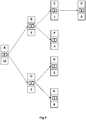
- FIG. 2 is a representation of metadata associated with a chunk of the multimedia content, in accordance with some embodiments of the present disclosure.
- the metadata associated with the chunk A is time duration of chunk A, i.e., 10 units, and subsequent chunks to be rendered, i.e., chunk B or chunk D.
- the metadata associated with the chunk B is the time duration of the chunk B, i.e., 5 units, and the subsequent chunks to be rendered, i.e., chunk C or chunk F.
- the metadata associated with the chunk C is time duration of the chunk C, i.e., 1 unit, and subsequent chunk to be rendered, i.e., chunk D.
- the metadata associated with the chunk D is time duration of the chunk D, i.e. 2 units, and the subsequent chunk to be rendered, i.e., chunk H or chunk K.
- the metadata associated with the chunk H is time duration of the chunk H, i.e. 3 units.
- the metadata associated with the chunk K is 8 units.
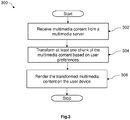
- FIG. 3 is a flow diagram illustrating a method 300 for rendering multimedia content on a user device, in accordance with some embodiments of the present disclosure.
- the method 300 may be described in the general context of computer executable instructions.
- computer executable instructions can include routines, programs, objects, components, data structures, procedures, modules, and functions, which perform particular functions or implement particular abstract data types.
- the method 300 may also be practiced in a distributed computing environment where functions are performed by remote processing devices that are linked through a communication network.
- computer executable instructions may be located in both local and remote computer storage media, including memory storage devices.
- the order in which the method 300 is described is not intended to be construed as a limitation, and any number of the described method blocks can be combined in any order to implement the method 300 or alternative methods. Additionally, individual blocks may be deleted from the method 300 without departing from the scope of the subject matter described herein. Furthermore, the method 300 can be implemented in any suitable hardware, software, firmware, or combination thereof.
- multimedia content may be received from the multimedia server 106.
- the multimedia content may include, but is not limited to, a video, an audio, text, images, or interactive content.
- the multimedia content may be stored in the multimedia server 106 in the form of chunks. Each chunk in the multimedia content may be associated with metadata.
- the metadata includes time duration of a chunk and a subsequent chunk to be rendered.
- At block 304, at least one chunk of the multimedia content may be transformed based on user preferences.
- the user preferences may include, but are not limited to, a user-defined time duration of the multimedia content to be rendered, a user selected portion of the multimedia content, or request for additional content.
- the user selected portion of the multimedia content may be selected by the user by marking a start point and an end point on the multimedia content through a user interface of the user device 104.
- the user may request for the additional content related to the multimedia content through text or audio.
- the chunk of the multimedia content may be transformed by the content transformation module 120.
- the content transformation module 120 may adjust time duration of the multimedia content.
- the content transformation module 120 may compute time duration of chunks from start of the multimedia content to end of the multimedia content along different paths in the multimedia content.
- a path including chunks of total time duration equivalent to the user defined time duration may be chosen to be rendered on the user device 104. If more than one path of the different paths includes chunks of total time duration equivalent to the user defined time duration, a path may be chosen based on historical selections, user preferences, or randomly.
- the adjusting of the time duration of the multimedia content may include removing one or more frames in at least one chunk of the multimedia content if the user-defined time duration is less than the time duration of the multimedia content.
- adjusting the time duration of the multimedia content comprises expanding one or more chunks in the multimedia content based on a user preference if the user defined time duration is more than the time duration of the multimedia content.
- the chunks may be expanded by inserting additional content to the chunks.
- the additional content is dynamically fetched by browsing internet using keywords. The keywords are extracted from at least one of a user input and text description of the multimedia content.
- the user preference may be the request for additional content.
- the additional content may be dynamically fetched from the internet.
- the additional content may be available in upcoming chunks of the multimedia content being rendered. If the additional content is available in an upcoming chunk, the content transformation module 120 may modify sequence of one or more chunks of the multimedia content.
- the content transformation module 120 may insert the upcoming chunk after current chunk of the multimedia content. Upon inserting the upcoming chunk, the sequence of the chunks is modified by deleting the upcoming chunk from its original location in the multimedia content to generate the transformed multimedia content.
- the transforming of the chunk of the multimedia content is explained in detail in conjunction with the FIG. 1
- the transformed multimedia content may be rendered on the user device 104.
- FIG. 4 is a block diagram of an exemplary computer system for implementing embodiments consistent with the present disclosure.
- Computer system 401 may be used for implementing the receiving module 118, the content transformation module 120, and the content rendering module 122.
- Computer system 401 may comprise a central processing unit (“CPU” or "processor") 402.
- Processor 402 may comprise at least one data processor for executing program components for executing user- or system-generated requests.
- a user may include a person, a person using a device such as such as those included in this disclosure, or such a device itself.
- the processor may include specialized processing units such as integrated system (bus) controllers, memory management control units, floating point units, graphics processing units, digital signal processing units, etc.
- the processor may include a microprocessor, such as AMD Athlon, Duron or Opteron, ARM's application, embedded or secure processors, IBM PowerPC, Intel's Core, Itanium, Xeon, Celeron or other line of processors, etc.
- the processor 402 may be implemented using mainframe, distributed processor, multi-core, parallel, grid, or other architectures. Some embodiments may utilize embedded technologies like application-specific integrated circuits (ASICs), digital signal processors (DSPs), Field Programmable Gate Arrays (FPGAs), etc.
- ASICs application-specific integrated circuits
- DSPs digital signal processors
- FPGAs Field Programmable Gate Arrays
- I/O Processor 402 may be disposed in communication with one or more input/output (I/O) devices via I/O interface 403.
- the I/O interface 403 may employ communication protocols/methods such as, without limitation, audio, analog, digital, monoaural, RCA, stereo, IEEE-1394, serial bus, universal serial bus (USB), infrared, PS/2, BNC, coaxial, component, composite, digital visual interface (DVI), high-definition multimedia interface (HDMI), RF antennas, S-Video, VGA, IEEE 802.n /b/g/n/x, Bluetooth, cellular (e.g., code-division multiple access (CDMA), high-speed packet access (HSPA+), global system for mobile communications (GSM), long-term evolution (LTE), WiMax, or the like), etc.
- CDMA code-division multiple access
- HSPA+ high-speed packet access
- GSM global system for mobile communications
- LTE long-term evolution
- WiMax wireless wide area network
- the computer system 401 may communicate with one or more I/O devices.
- the input device 404 may be an antenna, keyboard, mouse, joystick, (infrared) remote control, camera, card reader, fax machine, dongle, biometric reader, microphone, touch screen, touchpad, trackball, sensor (e.g., accelerometer, light sensor, GPS, gyroscope, proximity sensor, or the like), stylus, scanner, storage device, transceiver, video device/source, visors, etc.
- Output device 405 may be a printer, fax machine, video display (e.g., cathode ray tube (CRT), liquid crystal display (LCD), light-emitting diode (LED), plasma, or the like), audio speaker, etc.
- video display e.g., cathode ray tube (CRT), liquid crystal display (LCD), light-emitting diode (LED), plasma, or the like
- audio speaker etc.
- a transceiver 406 may be disposed in connection with the processor 402. The transceiver may facilitate various types of wireless transmission or reception.
- the transceiver may include an antenna operatively connected to a transceiver chip (e.g., Texas Instruments WiLink WL1283, Broadcom BCM4750IUB8, Infineon Technologies X-Gold 618-PMB9800, or the like), providing IEEE 802.11a/b/g/n, Bluetooth, FM, global positioning system (GPS), 2G/3G HSDPA/HSUPA communications, etc.
- a transceiver chip e.g., Texas Instruments WiLink WL1283, Broadcom BCM4750IUB8, Infineon Technologies X-Gold 618-PMB9800, or the like
- IEEE 802.11a/b/g/n e.g., Texas Instruments WiLink WL1283, Broadcom BCM4750IUB8, Infineon Technologies X-Gold 618-PMB9800, or the like
- IEEE 802.11a/b/g/n e.g., Bluetooth, FM, global positioning system (GPS), 2G/3G HSDPA/HS
- the processor 402 may be disposed in communication with a communication network 408 via a network interface 407.
- the network interface 407 may communicate with the communication network 408.
- the network interface may employ connection protocols including, without limitation, direct connect, Ethernet (e.g., twisted pair 10/100/1000 Base T), transmission control protocol/internet protocol (TCP/IP), token ring, IEEE 802.11 a/b/g/n/x, etc.
- the communication network 408 may include, without limitation, a direct interconnection, local area network (LAN), wide area network (WAN), wireless network (e.g., using Wireless Application Protocol), the Internet, etc.
- the computer system 401 may communicate with devices 410,411, and 412.
- These devices may include, without limitation, personal computer(s), server(s), fax machines, printers, scanners, various mobile devices such as cellular telephones, smartphones (e.g., Apple iPhone, Blackberry, Android-based phones, etc.), tablet computers, eBook readers (Amazon Kindle, Nook, etc.), laptop computers, notebooks, gaming consoles (Microsoft Xbox, Nintendo DS, Sony PlayStation, etc.), or the like.
- the computer system 401 may itself embody one or more of these devices.
- the processor 402 may be disposed in communication with one or more memory devices (e.g., RAM 413, ROM 414, etc.) via a storage interface 412.
- the storage interface may connect to memory devices including, without limitation, memory drives, removable disc drives, etc., employing connection protocols such as serial advanced technology attachment (SATA), integrated drive electronics (IDE), IEEE-1394, universal serial bus (USB), fiber channel, small computer systems interface (SCSI), etc.
- the memory drives may further include a drum, magnetic disc drive, magneto-optical drive, optical drive, redundant array of independent discs (RAID), solid-state memory devices, solid-state drives, etc.
- the memory devices may store a collection of program or database components, including, without limitation, an operating system 416, user interface application 417, web browser 418, mail server 419, mail client 420, user/application data 421 (e.g., any data variables or data records discussed in this disclosure), etc.
- the operating system 416 may facilitate resource management and operation of the computer system 401.
- Operating systems include, without limitation, Apple Macintosh OS X, Unix, Unix-like system distributions (e.g., Berkeley Software Distribution (BSD), FreeBSD, NetBSD, OpenBSD, etc.), Linux distributions (e.g., Red Hat, Ubuntu, Kubuntu, etc.), IBM OS/2, Microsoft Windows (XP, Vista/7/8, etc.), Apple iOS, Google Android, Blackberry OS, or the like.
- User interface 417 may facilitate display, execution, interaction, manipulation, or operation of program components through textual or graphical facilities.
- user interfaces may provide computer interaction interface elements on a display system operatively connected to the computer system 401, such as cursors, icons, check boxes, menus, scrollers, windows, widgets, etc.
- GUIs Graphical user interfaces
- GUIs may be employed, including, without limitation, Apple Macintosh operating systems' Aqua, IBM OS/2, Microsoft Windows (e.g., Aero, Metro, etc.), Unix X-Windows, web interface libraries (e.g., ActiveX, Java, Javascript, AJAX, HTML, Adobe Flash, etc.), or the like.
- the computer system 401 may implement a web browser 418 stored program component.
- the web browser may be a hypertext viewing application, such as Microsoft Internet Explorer, Google Chrome, Mozilla Firefox, Apple Safari, etc. Secure web browsing may be provided using HTTPS (secure hypertext transport protocol), secure sockets layer (SSL), Transport Layer Security (TLS), etc. Web browsers may utilize facilities such as AJAX, DHTML, Adobe Flash, JavaScript, Java, application programming interfaces (APIs), etc.
- the computer system 401 may implement a mail server 419 stored program component.
- the mail server may be an Internet mail server such as Microsoft Exchange, or the like.
- the mail server may utilize facilities such as ASP, ActiveX, ANSI C++/C#, Microsoft .NET, CGI scripts, Java, JavaScript, PERL, PHP, Python, WebObjects, etc.
- the mail server may utilize communication protocols such as internet message access protocol (IMAP), messaging application programming interface (MAPI), Microsoft Exchange, post office protocol (POP), simple mail transfer protocol (SMTP), or the like.
- IMAP internet message access protocol
- MAPI messaging application programming interface
- POP post office protocol
- SMTP simple mail transfer protocol
- the computer system 401 may implement a mail client 420 stored program component.
- the mail client may be a mail viewing application, such as Apple Mail, Microsoft Entourage, Microsoft Outlook, Mozilla Thunderbird, etc.
- computer system 401 may store user/application data 421, such as the data, variables, records, etc. as described in this disclosure.
- databases may be implemented as fault-tolerant, relational, scalable, secure databases such as Oracle or Sybase.
- databases may be implemented using standardized data structures, such as an array, hash, linked list, struct, structured text file (e.g., XML), table, or as object-oriented databases (e.g., using ObjectStore, Poet, Zope, etc.).
- object-oriented databases e.g., using ObjectStore, Poet, Zope, etc.
- Such databases may be consolidated or distributed, sometimes among the various computer systems discussed above in this disclosure. It is to be understood that the structure and operation of the any computer or database component may be combined, consolidated, or distributed in any working combination.
- a computer-readable storage medium refers to any type of physical memory on which information or data readable by a processor may be stored.
- a computer-readable storage medium may store instructions for execution by one or more processors, including instructions for causing the processor(s) to perform steps or stages consistent with the embodiments described herein.
- the term "computer-readable medium” should be understood to include tangible items and exclude carrier waves and transient signals, i.e., be non-transitory. Examples include random access memory (RAM), read-only memory (ROM), volatile memory, nonvolatile memory, hard drives, CD ROMs, DVDs, flash drives, disks, and any other known physical storage media.
Landscapes
- Engineering & Computer Science (AREA)
- Multimedia (AREA)
- Databases & Information Systems (AREA)
- Signal Processing (AREA)
- Theoretical Computer Science (AREA)
- Human Computer Interaction (AREA)
- Data Mining & Analysis (AREA)
- Physics & Mathematics (AREA)
- General Engineering & Computer Science (AREA)
- General Physics & Mathematics (AREA)
- Computational Linguistics (AREA)
- Information Transfer Between Computers (AREA)
- Two-Way Televisions, Distribution Of Moving Picture Or The Like (AREA)
Applications Claiming Priority (1)
| Application Number | Priority Date | Filing Date | Title |
|---|---|---|---|
| IN201741008650 | 2017-03-13 |
Publications (1)
| Publication Number | Publication Date |
|---|---|
| EP3376408A1 true EP3376408A1 (de) | 2018-09-19 |
Family
ID=59738147
Family Applications (1)
| Application Number | Title | Priority Date | Filing Date |
|---|---|---|---|
| EP17186979.5A Withdrawn EP3376408A1 (de) | 2017-03-13 | 2017-08-18 | Verfahren und systeme zum rendering von multimediainhalt auf einen benutzervorrichtung |
Country Status (2)
| Country | Link |
|---|---|
| US (1) | US10225603B2 (de) |
| EP (1) | EP3376408A1 (de) |
Families Citing this family (31)
| Publication number | Priority date | Publication date | Assignee | Title |
|---|---|---|---|---|
| US9190110B2 (en) | 2009-05-12 | 2015-11-17 | JBF Interlude 2009 LTD | System and method for assembling a recorded composition |
| US11232458B2 (en) | 2010-02-17 | 2022-01-25 | JBF Interlude 2009 LTD | System and method for data mining within interactive multimedia |
| US9653115B2 (en) | 2014-04-10 | 2017-05-16 | JBF Interlude 2009 LTD | Systems and methods for creating linear video from branched video |
| US9792957B2 (en) | 2014-10-08 | 2017-10-17 | JBF Interlude 2009 LTD | Systems and methods for dynamic video bookmarking |
| US11412276B2 (en) | 2014-10-10 | 2022-08-09 | JBF Interlude 2009 LTD | Systems and methods for parallel track transitions |
| US10582265B2 (en) | 2015-04-30 | 2020-03-03 | JBF Interlude 2009 LTD | Systems and methods for nonlinear video playback using linear real-time video players |
| US10460765B2 (en) | 2015-08-26 | 2019-10-29 | JBF Interlude 2009 LTD | Systems and methods for adaptive and responsive video |
| US11128853B2 (en) | 2015-12-22 | 2021-09-21 | JBF Interlude 2009 LTD | Seamless transitions in large-scale video |
| US11164548B2 (en) | 2015-12-22 | 2021-11-02 | JBF Interlude 2009 LTD | Intelligent buffering of large-scale video |
| US11856271B2 (en) | 2016-04-12 | 2023-12-26 | JBF Interlude 2009 LTD | Symbiotic interactive video |
| US10140259B2 (en) * | 2016-04-28 | 2018-11-27 | Wipro Limited | Method and system for dynamically generating multimedia content file |
| US11050809B2 (en) | 2016-12-30 | 2021-06-29 | JBF Interlude 2009 LTD | Systems and methods for dynamic weighting of branched video paths |
| US10257578B1 (en) | 2018-01-05 | 2019-04-09 | JBF Interlude 2009 LTD | Dynamic library display for interactive videos |
| US10419790B2 (en) * | 2018-01-19 | 2019-09-17 | Infinite Designs, LLC | System and method for video curation |
| US10956529B1 (en) | 2018-03-20 | 2021-03-23 | Pinterest, Inc. | Content presentation |
| US11601721B2 (en) * | 2018-06-04 | 2023-03-07 | JBF Interlude 2009 LTD | Interactive video dynamic adaptation and user profiling |
| JP2020005038A (ja) * | 2018-06-25 | 2020-01-09 | キヤノン株式会社 | 送信装置、送信方法、受信装置、受信方法、及び、プログラム |
| US11546647B2 (en) * | 2019-06-07 | 2023-01-03 | Roku, Inc. | Content-modification system with probability-based selection feature |
| WO2020263671A1 (en) * | 2019-06-27 | 2020-12-30 | Raitonsa Dynamics Llc | Modifying existing content based on target audience |
| US11509949B2 (en) * | 2019-09-13 | 2022-11-22 | Disney Enterprises, Inc. | Packager for segmenter fluidity |
| US11490047B2 (en) | 2019-10-02 | 2022-11-01 | JBF Interlude 2009 LTD | Systems and methods for dynamically adjusting video aspect ratios |
| US12096081B2 (en) | 2020-02-18 | 2024-09-17 | JBF Interlude 2009 LTD | Dynamic adaptation of interactive video players using behavioral analytics |
| US11245961B2 (en) | 2020-02-18 | 2022-02-08 | JBF Interlude 2009 LTD | System and methods for detecting anomalous activities for interactive videos |
| US12047637B2 (en) | 2020-07-07 | 2024-07-23 | JBF Interlude 2009 LTD | Systems and methods for seamless audio and video endpoint transitions |
| CN112507163B (zh) * | 2020-12-02 | 2023-07-21 | 北京奇艺世纪科技有限公司 | 时长预测模型训练方法、推荐方法、装置、设备及介质 |
| US20220321972A1 (en) * | 2021-03-31 | 2022-10-06 | Rovi Guides, Inc. | Transmitting content based on genre information |
| US11882337B2 (en) | 2021-05-28 | 2024-01-23 | JBF Interlude 2009 LTD | Automated platform for generating interactive videos |
| US12549818B2 (en) | 2021-08-31 | 2026-02-10 | JBF Interlude 2009 LTD | Shader-based dynamic video manipulation |
| US12155897B2 (en) | 2021-08-31 | 2024-11-26 | JBF Interlude 2009 LTD | Shader-based dynamic video manipulation |
| US11934477B2 (en) | 2021-09-24 | 2024-03-19 | JBF Interlude 2009 LTD | Video player integration within websites |
| US20230217086A1 (en) * | 2021-12-30 | 2023-07-06 | Interwise Ltd. | Providing and Using a Branching Narrative Content Service |
Citations (3)
| Publication number | Priority date | Publication date | Assignee | Title |
|---|---|---|---|---|
| US20140219630A1 (en) * | 2012-03-26 | 2014-08-07 | Customplay Llc | Video Map Responsive To A Video Release |
| US20150293928A1 (en) * | 2014-04-14 | 2015-10-15 | David Mo Chen | Systems and Methods for Generating Personalized Video Playlists |
| US20160133296A1 (en) * | 2014-11-06 | 2016-05-12 | Adobe Systems Incorporated | Multimedia content duration manipulation |
Family Cites Families (47)
| Publication number | Priority date | Publication date | Assignee | Title |
|---|---|---|---|---|
| US5434678A (en) * | 1993-01-11 | 1995-07-18 | Abecassis; Max | Seamless transmission of non-sequential video segments |
| US6408128B1 (en) * | 1998-11-12 | 2002-06-18 | Max Abecassis | Replaying with supplementary information a segment of a video |
| US8290351B2 (en) * | 2001-04-03 | 2012-10-16 | Prime Research Alliance E., Inc. | Alternative advertising in prerecorded media |
| US6870573B2 (en) | 1999-01-22 | 2005-03-22 | Intel Corporation | Method and apparatus for dynamically generating a visual program summary from a multi-source video feed |
| US6971119B1 (en) * | 1999-03-29 | 2005-11-29 | The Directv Group, Inc. | Method and apparatus for transmission, receipt, caching and display of one-way broadcast programming and data |
| US7509580B2 (en) * | 1999-09-16 | 2009-03-24 | Sharp Laboratories Of America, Inc. | Audiovisual information management system with preferences descriptions |
| US6829781B1 (en) * | 2000-05-24 | 2004-12-07 | At&T Corp. | Network-based service to provide on-demand video summaries of television programs |
| US6889383B1 (en) * | 2000-10-23 | 2005-05-03 | Clearplay, Inc. | Delivery of navigation data for playback of audio and video content |
| US8615652B2 (en) * | 2001-01-02 | 2013-12-24 | Scott D. Redmond | System and method for providing load balanced secure media content and data delivery in a distributed computing environment |
| EP1364533A1 (de) * | 2001-02-20 | 2003-11-26 | Intellocity USA, Inc. | Inhaltsabhängige video-auswahl |
| US20020170068A1 (en) * | 2001-03-19 | 2002-11-14 | Rafey Richter A. | Virtual and condensed television programs |
| US20020184047A1 (en) * | 2001-04-03 | 2002-12-05 | Plotnick Michael A. | Universal ad queue |
| US8702504B1 (en) * | 2001-11-05 | 2014-04-22 | Rovi Technologies Corporation | Fantasy sports contest highlight segments systems and methods |
| US7483488B1 (en) * | 2002-05-30 | 2009-01-27 | Intervideo, Inc. | Systems and methods for improving bit rate control of video encoding by correcting for the effects of scene changes and bit stuffing in a video buffer verifier (VBV) buffer model |
| US7657836B2 (en) * | 2002-07-25 | 2010-02-02 | Sharp Laboratories Of America, Inc. | Summarization of soccer video content |
| US7694318B2 (en) * | 2003-03-07 | 2010-04-06 | Technology, Patents & Licensing, Inc. | Video detection and insertion |
| US7245819B1 (en) * | 2003-03-24 | 2007-07-17 | Microsoft Corporation | Cross-file DVR record padding playback |
| US20040197088A1 (en) * | 2003-03-31 | 2004-10-07 | Ferman Ahmet Mufit | System for presenting audio-video content |
| US8196168B1 (en) * | 2003-12-10 | 2012-06-05 | Time Warner, Inc. | Method and apparatus for exchanging preferences for replaying a program on a personal video recorder |
| US20050132401A1 (en) * | 2003-12-10 | 2005-06-16 | Gilles Boccon-Gibod | Method and apparatus for exchanging preferences for replaying a program on a personal video recorder |
| GB2409737A (en) * | 2003-12-31 | 2005-07-06 | Nokia Corp | Bookmarking digital content |
| US7594177B2 (en) * | 2004-12-08 | 2009-09-22 | Microsoft Corporation | System and method for video browsing using a cluster index |
| JP4349277B2 (ja) * | 2004-12-24 | 2009-10-21 | 株式会社日立製作所 | 動画再生装置 |
| US8132203B2 (en) * | 2005-09-30 | 2012-03-06 | Microsoft Corporation | In-program content targeting |
| US7620651B2 (en) | 2005-11-15 | 2009-11-17 | Powerreviews, Inc. | System for dynamic product summary based on consumer-contributed keywords |
| US9015736B2 (en) * | 2005-12-29 | 2015-04-21 | Rovi Guides, Inc. | Systems and methods for episode tracking in an interactive media environment |
| US20070157260A1 (en) * | 2005-12-29 | 2007-07-05 | United Video Properties, Inc. | Interactive media guidance system having multiple devices |
| US20070154169A1 (en) * | 2005-12-29 | 2007-07-05 | United Video Properties, Inc. | Systems and methods for accessing media program options based on program segment interest |
| US9209934B2 (en) * | 2006-06-09 | 2015-12-08 | Qualcomm Incorporated | Enhanced block-request streaming using cooperative parallel HTTP and forward error correction |
| US20080004074A1 (en) * | 2006-06-28 | 2008-01-03 | Ming-Wei Wang | Complex audio detection apparatus |
| US20090094159A1 (en) * | 2007-10-05 | 2009-04-09 | Yahoo! Inc. | Stock video purchase |
| US10091460B2 (en) * | 2008-03-31 | 2018-10-02 | Disney Enterprises, Inc. | Asynchronous online viewing party |
| DE102008036284B4 (de) * | 2008-08-04 | 2013-09-12 | Dr. Ing. H.C. F. Porsche Aktiengesellschaft | Antriebsstrang für ein Kraftfahrzeug |
| US20100086277A1 (en) * | 2008-10-03 | 2010-04-08 | Guideworks, Llc | Systems and methods for deleting viewed portions of recorded programs |
| US8769589B2 (en) * | 2009-03-31 | 2014-07-01 | At&T Intellectual Property I, L.P. | System and method to create a media content summary based on viewer annotations |
| US8176195B2 (en) * | 2009-11-13 | 2012-05-08 | Futurewei Technologies, Inc. | Media distribution with service continuity |
| US8364009B2 (en) * | 2010-10-13 | 2013-01-29 | Eldon Technology Limited | Apparatus, systems and methods for a thumbnail-sized scene index of media content |
| WO2012153284A1 (en) * | 2011-05-10 | 2012-11-15 | Nds Limited | Customized zapping |
| US9253233B2 (en) * | 2011-08-31 | 2016-02-02 | Qualcomm Incorporated | Switch signaling methods providing improved switching between representations for adaptive HTTP streaming |
| US8774596B2 (en) * | 2012-12-10 | 2014-07-08 | Futurewei Technologies, Inc. | Context driven video prioritization and bookmarking |
| US9319724B2 (en) * | 2013-02-28 | 2016-04-19 | Verizon and Redbox Digital Entertainment Services, LLC | Favorite media program scenes systems and methods |
| US9749710B2 (en) * | 2013-03-01 | 2017-08-29 | Excalibur Ip, Llc | Video analysis system |
| JP6205765B2 (ja) * | 2013-03-12 | 2017-10-04 | 沖電気工業株式会社 | 映像配信装置、映像配信プログラム、映像配信方法及び映像配信システム |
| US9538232B2 (en) * | 2013-03-14 | 2017-01-03 | Verizon Patent And Licensing Inc. | Chapterized streaming of video content |
| FR3004054A1 (fr) * | 2013-03-26 | 2014-10-03 | France Telecom | Generation et restitution d'un flux representatif d'un contenu audiovisuel |
| US9496000B2 (en) * | 2014-05-16 | 2016-11-15 | Comcast Cable Communications, Llc | Audio modification for adjustable playback rate |
| US9736503B1 (en) * | 2014-09-12 | 2017-08-15 | Google Inc. | Optimizing timing of display of a mid-roll video advertisement based on viewer retention data |
-
2017
- 2017-03-20 US US15/463,573 patent/US10225603B2/en active Active
- 2017-08-18 EP EP17186979.5A patent/EP3376408A1/de not_active Withdrawn
Patent Citations (3)
| Publication number | Priority date | Publication date | Assignee | Title |
|---|---|---|---|---|
| US20140219630A1 (en) * | 2012-03-26 | 2014-08-07 | Customplay Llc | Video Map Responsive To A Video Release |
| US20150293928A1 (en) * | 2014-04-14 | 2015-10-15 | David Mo Chen | Systems and Methods for Generating Personalized Video Playlists |
| US20160133296A1 (en) * | 2014-11-06 | 2016-05-12 | Adobe Systems Incorporated | Multimedia content duration manipulation |
Also Published As
| Publication number | Publication date |
|---|---|
| US10225603B2 (en) | 2019-03-05 |
| US20180262798A1 (en) | 2018-09-13 |
Similar Documents
| Publication | Publication Date | Title |
|---|---|---|
| US10225603B2 (en) | Methods and systems for rendering multimedia content on a user device | |
| US10204092B2 (en) | Method and system for automatically updating automation sequences | |
| US9881209B2 (en) | Methods and systems for detecting tampering in a document image | |
| US11416532B2 (en) | Method and device for identifying relevant keywords from documents | |
| US11501073B2 (en) | Method, system, and device for creating patent document summaries | |
| US10140444B2 (en) | Methods and systems for dynamically managing access to devices for resolution of an incident ticket | |
| US20180253736A1 (en) | System and method for determining resolution for an incident ticket | |
| US20160162522A1 (en) | Systems and methods for detecting data leakage in an enterprise | |
| US11087183B2 (en) | Method and system of multi-modality classification using augmented data | |
| US20170032025A1 (en) | System and method for performing verifiable query on semantic data | |
| US9910880B2 (en) | System and method for managing enterprise user group | |
| US11593973B2 (en) | Method and system for augmented reality (AR) content creation | |
| US10380372B2 (en) | Methods and systems for providing secured access to big data | |
| US20140109070A1 (en) | System and method for configurable entry points generation and aiding validation in a software application | |
| US11003915B2 (en) | Method and system for summarizing multimedia content | |
| US9531957B1 (en) | Systems and methods for performing real-time image vectorization | |
| US11755182B2 (en) | Electronic devices and methods for selecting and displaying audio content for real estate properties | |
| EP3206168A1 (de) | Verfahren und system zur ermöglichung überprüfbarer semantischer regelbildung für semantische daten | |
| US10739989B2 (en) | System and method for customizing a presentation | |
| US10761971B2 (en) | Method and device for automating testing based on context parsing across multiple technology layers | |
| CA3188771C (en) | Electronic devices and methods for selecting and displaying multimodal content | |
| EP3125133A1 (de) | System und verfahren zur erzeugung einer überprüfbaren abfrage von semantischen daten | |
| EP3382585B1 (de) | Verfahren und systeme zur bereitstellung des gesicherten selektiven zugriffs auf grosse daten | |
| US20190191227A1 (en) | Method and system for enabling interactive infomercials |
Legal Events
| Date | Code | Title | Description |
|---|---|---|---|
| PUAI | Public reference made under article 153(3) epc to a published international application that has entered the european phase |
Free format text: ORIGINAL CODE: 0009012 |
|
| STAA | Information on the status of an ep patent application or granted ep patent |
Free format text: STATUS: THE APPLICATION HAS BEEN PUBLISHED |
|
| AK | Designated contracting states |
Kind code of ref document: A1 Designated state(s): AL AT BE BG CH CY CZ DE DK EE ES FI FR GB GR HR HU IE IS IT LI LT LU LV MC MK MT NL NO PL PT RO RS SE SI SK SM TR |
|
| AX | Request for extension of the european patent |
Extension state: BA ME |
|
| STAA | Information on the status of an ep patent application or granted ep patent |
Free format text: STATUS: REQUEST FOR EXAMINATION WAS MADE |
|
| 17P | Request for examination filed |
Effective date: 20190319 |
|
| RBV | Designated contracting states (corrected) |
Designated state(s): AL AT BE BG CH CY CZ DE DK EE ES FI FR GB GR HR HU IE IS IT LI LT LU LV MC MK MT NL NO PL PT RO RS SE SI SK SM TR |
|
| STAA | Information on the status of an ep patent application or granted ep patent |
Free format text: STATUS: EXAMINATION IS IN PROGRESS |
|
| 17Q | First examination report despatched |
Effective date: 20190515 |
|
| STAA | Information on the status of an ep patent application or granted ep patent |
Free format text: STATUS: THE APPLICATION HAS BEEN WITHDRAWN |
|
| 18W | Application withdrawn |
Effective date: 20190812 |