EP3374967B1 - Verfahren und systeme für binokulares stereosehen - Google Patents
Verfahren und systeme für binokulares stereosehen Download PDFInfo
- Publication number
- EP3374967B1 EP3374967B1 EP16863627.2A EP16863627A EP3374967B1 EP 3374967 B1 EP3374967 B1 EP 3374967B1 EP 16863627 A EP16863627 A EP 16863627A EP 3374967 B1 EP3374967 B1 EP 3374967B1
- Authority
- EP
- European Patent Office
- Prior art keywords
- camera
- image
- images
- area
- pair
- Prior art date
- Legal status (The legal status is an assumption and is not a legal conclusion. Google has not performed a legal analysis and makes no representation as to the accuracy of the status listed.)
- Active
Links
Images




Classifications
-
- G—PHYSICS
- G06—COMPUTING OR CALCULATING; COUNTING
- G06T—IMAGE DATA PROCESSING OR GENERATION, IN GENERAL
- G06T7/00—Image analysis
- G06T7/50—Depth or shape recovery
- G06T7/55—Depth or shape recovery from multiple images
- G06T7/593—Depth or shape recovery from multiple images from stereo images
-
- G—PHYSICS
- G06—COMPUTING OR CALCULATING; COUNTING
- G06F—ELECTRIC DIGITAL DATA PROCESSING
- G06F18/00—Pattern recognition
- G06F18/20—Analysing
- G06F18/24—Classification techniques
- G06F18/241—Classification techniques relating to the classification model, e.g. parametric or non-parametric approaches
- G06F18/2411—Classification techniques relating to the classification model, e.g. parametric or non-parametric approaches based on the proximity to a decision surface, e.g. support vector machines
-
- G—PHYSICS
- G06—COMPUTING OR CALCULATING; COUNTING
- G06T—IMAGE DATA PROCESSING OR GENERATION, IN GENERAL
- G06T7/00—Image analysis
- G06T7/80—Analysis of captured images to determine intrinsic or extrinsic camera parameters, i.e. camera calibration
- G06T7/85—Stereo camera calibration
-
- G—PHYSICS
- G06—COMPUTING OR CALCULATING; COUNTING
- G06T—IMAGE DATA PROCESSING OR GENERATION, IN GENERAL
- G06T2207/00—Indexing scheme for image analysis or image enhancement
- G06T2207/10—Image acquisition modality
- G06T2207/10016—Video; Image sequence
- G06T2207/10021—Stereoscopic video; Stereoscopic image sequence
-
- G—PHYSICS
- G06—COMPUTING OR CALCULATING; COUNTING
- G06T—IMAGE DATA PROCESSING OR GENERATION, IN GENERAL
- G06T2207/00—Indexing scheme for image analysis or image enhancement
- G06T2207/20—Special algorithmic details
- G06T2207/20081—Training; Learning
Definitions
- the present disclosure generally relates to vision system, and more particularly, to methods and systems for binocular stereo vision.
- a traditional method of object detection may be based on one image captured by one camera.
- the image may be processed and analyzed to obtain position information of the object in the image.
- contour information of the object is used to detect the object in the traditional method of object detection.
- the detection result of the traditional method of object detection may be inaccurate when there is an overlap of a plurality of objects in the image or there are a plurality of objects with a similar color. Therefore, it is desirable to provide a system and method of object detection to improve the accuracy of object detection.
- US 2013/190089 discloses a 3-D imaging system for recognition and interpretation of gestures to control a computer.
- a method for binocular stereo vision according to claim 1 is provided.
- the training model may be obtained by one or more of the following operations.
- a plurality image samples may be obtained.
- An initial root filter may be generated according to the samples.
- An updating root filter may be generated according to the initial root filter.
- a part filter may be generated according to the updating root filter.
- the training model may be generated according to the samples and the part filter.
- the depth information of the determined first area may be obtained based on the first and second images by one or more of the following operations.
- the pair of images may be processed to generate a pair of processed images, wherein vertical coordinates in an image coordinate system of two corresponding pixels in the pair of processed images are equal.
- a pair of processed images may be generated according to the pair of images.
- a target pixel in the first area in a first processed image may be determined.
- a matching pixel of the target pixel in a second processed image may be determined.
- Depth information of the target pixel in a camera coordinate system may be determined according to the matching pixel.
- a height and a pitch angle of at least one of the one or more cameras may be determined.
- the depth information in the camera coordinate system may be transformed into depth information in a world coordinate system according to the height and the pitch angle.
- an origin of the image coordinate system may be a pixel in a highest position in a top left corner of the first image.
- an origin of the camera coordinate system may be an optical center of the camera capturing the first image.
- an origin of the world coordinate system may be a point in the real world.
- lenses of the one or more cameras may be fixed lenses, wherein the fixed lenses are non-rotatable along a first axis, a second axis, or a third axis, and the first axis, the second axis, and the third axis are perpendicular to each other.
- the height and the pitch angle of the at least one of the one or more cameras may be determined by one or more of the following operations.
- a third area in the first processed image may be identified.
- a parallax between a first pixel in the third area and a second pixel corresponding to the first pixel in the second processed image may be determined.
- a relationship between a vertical coordinate of the first pixel in the image coordinate system and the parallax may be determined.
- a projection equation may be determined according to the relationship.
- the height and the pitch angle of the at least one of the one or more cameras may be determined according to the projection equation.
- the depth information of the determined first area may be obtained based on the first and second images by one or more of the following operations.
- a calibration parameter of the first camera and the second camera may be obtained, wherein the calibration parameter includes a yaw angle, a pitch angle, a focal length or a three dimensional coordinate of an origin of a camera coordinate system in a world coordinate system of the first camera and the second camera in an initial state.
- a pair of pixels in the pair of images may be determined.
- An adjustment parameter of at least one of the first camera and the second camera may be obtained when the object appears in view of both the first and second cameras, wherein the adjustment parameter includes a yaw angle, a pitch angle, or a focal length of the first camera and the second camera.
- Depth information of the pair of pixels in the world coordinate system may be determined according to the calibration parameter and the adjustment parameter.
- the first camera and the second camera may have at least one rotatable lens, wherein the rotatable lens is a lens rotatable along a first axis, a second axis or a third axis, and the first axis, the second axis, and the third axis are perpendicular to each other.
- the initial state may be a state that rotation angles along the first axis, the second axis, and the third axis of the at least one rotatable lens of the first camera and the second camera are 0.
- a system for binocular stereo vision according to claim 10 is provided.
- a non-transitory computer readable medium embodying a computer program product according to claim 13 is provided.
- the present disclosure provided herein relates to a vision system. Specifically, the present disclosure relates to systems and methods for binocular stereo vision as defined by the appended claims.
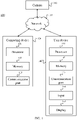
- FIG. 1 is a block diagram of computer vision system 100 according to some embodiments of the present disclosure.
- Computer vision system 100 may be a system that uses one or more cameras and computers to simulate a biological vision and to identify, track, locate, and measure an object in the real world through acquiring, processing, and analyzing images.
- computer vision system 100 may include a camera 110, a computing device 120, a network 130 and a user device 140.
- Camera 110 may be a device configured to capture one or more images.
- an image may be a still image, a video, a stream video, or a video frame obtained from a video.
- camera 110 may be a digital camera, a web camera, a smartphone, a tablet, a laptop, a video gaming console equipped with a web camera, a camera with multiple lenses, etc.
- camera 110 may include more than one camera configured to capture images.
- camera 110 may be configured to capture two-dimensional (2D) images and/or three-dimensional (3D) images.
- camera 110 may be a static camera, a pan-tilt-zoom camera, a moving camera, a stereoscopic camera, a structured light camera, a time-of-flight camera, etc.
- camera 110 may also be a camera equipped with time-of-flight device, a Kinect sensor, a 3D laser scanner, a photographic scanner, etc.
- the type of camera 110 may vary, depending on the installation location and/or the type of objects to be monitored.
- camera 110 may include two more cameras, each of which may be configured to capture one or more images.
- camera 110 may be placed at different positions and configured to capture one or more images at each of the positions.
- camera 110 may also be configured to transmit the images captured to computing device 120 and/or user device 140 via network 130. Alternatively or additionally, camera 110 may be configured to transmit an image to computing device 120 and/or user device 140 in real time.
- camera 110 and computing device 120 may be packaged in a single device configured to perform functions of camera 110 and computing device 120 described in this disclosure.
- camera 110 may also include one or more processors and memories configured to perform one or more processes and/or methods described in this disclosure.
- camera 110 may be configured to capture images and transmit the images to computing device 120 and/or user device 140 via network 130 as described elsewhere in this disclosure.
- Computing device 120 may be a web camera, a digital camera, a computer server, a desktop computer, a notebook computer, a tablet computer, a mobile phone, a personal digital assistant (PDA), or the like.
- Computing device 120 may include, among other things, a processor 121, a memory 122 and a communication port 123.
- processor 121 may execute computer instructions (program code) and perform functions in accordance with techniques described herein.
- Computer instructions may include routines, programs, objects, components, data structures, procedures, modules and functions, which perform particular functions described herein.
- processor 121 may receive and analyze a pair of images captured by camera 110.
- Processor 121 also analyzes one of the pair of images and determines first detection information.
- Processor 121 also determines depth information of the pair of images. Processor 121 further determines second detected information according to the first detection information and the depth information. Processor 121 may also calibrate parameters of camera 110 according to the pair of images.
- processor 121 may include or be part of one or more known processing devices such as, for example, a microprocessor. In some embodiments, processor 121 may include any type of single or multi-core processor, mobile device microcontroller, central processing unit, etc.
- Memory 122 may be configured to store one or more computer programs to be executed by processor 121 to perform exemplary methods disclosed herein.
- memory 122 may be configured to store a training model that is used by processor 121 to generate first detection information according to a pair of images captured by camera 110.
- Memory 122 may also be configured to store data and/or parameters used by processor 121 in methods described in this disclosure.
- memory 112 may be configured to store calibration parameters of camera 110 for transmitting depth information in a camera coordinate system into depth information in a world coordinate system.
- Processor 121 may access the calibration parameters of camera 110 stored in memory 122.
- Processor 121 may also convert the depth information in the camera coordinate system into the depth information in the world coordinate system based on the accessed calibration parameters.
- memory 122 may store adjustment parameters for determining depth information of a pair of images captured by camera 110.
- Processor 121 may access the adjustment parameters stored in memory 122 and determine depth information of the pair of images captured by camera 110 based on the adjustment parameters.
- Memory 122 may include a volatile or non-volatile, magnetic, semiconductor, tape, optical, removable, non-removable, or other type of storage device or tangible (i.e., non-transitory) computer-readable medium including, but not limited to, a ROM, a flash memory, a dynamic RAM and a static RAM.
- Network 130 may be any type of wired or wireless network configured to facilitate communications between the components of computer vision system.
- network 130 may be a wired network, a local wireless network, (e.g., Bluetooth TM , WiFi, near field communications (NFC), etc.), a cellular network, the Internet, or the like, or a combination thereof.
- Bluetooth TM Bluetooth TM
- WiFi Wireless Fidelity
- NFC near field communications
- Other known communication methods which provide a medium for transmitting data between separate devices are also contemplated.
- User device 140 may be configured to receive data (e.g., image data) from camera 110 and/or computing device 120 via network 130.
- user device 140 may be configured to receive a pair of images captured by camera 110 or receive one or more processed images from computing device 120.
- user device 140 may be configured to receive second detection information determined by computing device 120.
- User device 140 may be any type of computing device.
- user device 140 may be a smart phone, a tablet, a personal computer, a wearable device (e.g., Google Glass TM or smart watches, and/or affiliated components), or the like, or a combination thereof.
- user device 140 and computing device 120 may together be included in a computing device configured to perform exemplary functions of user device 140 and computing device 120 disclosed in this application.
- User device 140 may include, among other things, a processor 141, a memory 142, a communication port 143, an input 144 and a display 145.
- Processor 141 may execute computer instructions (program code) and perform functions of user device 140 in accordance with techniques described herein.
- processor 141 may be configured to receive image data from computing device 120 and/or camera 110 via network 130.
- Memory 142 may be configured to store data transmitted from camera 110 and/or computing device 120 via network 130.
- memory 142 may be configured to store image data from camera 110.
- memory 142 may be configured to store second detection information from computing device 120.
- Memory 142 may include a volatile or non-volatile, magnetic, semiconductor, tape, optical, removable, non-removable, or other type of storage device or tangible (i.e., non-transitory) computer-readable medium including, but not limited to, a ROM, a flash memory, a dynamic RAM and a static RAM.
- Communication port 142 may be configured to transmit to and receive data from, among other devices, camera 110 and/or computing device 120 over network 130.
- Input 144 may be configured to receive inputs from the user and transmit the data/signal relating to the received inputs to processor 141 for further processing.
- Display 145 may be any device configured to display, among other things, images in the UI (User Interface) based on the display data fed by processor 141.
- computing device 120 and user device 130 may share one memory.
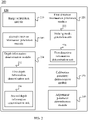
- FIG. 2 is a block diagram illustrating an exemplary architecture 200 of a computing device 120 according to some embodiments of the present disclosure.
- computing device 120 includes an image acquisition module 210, a first detection information generation module 220, a depth information determination module 230 and a second detection information generation module 240 and may include a calibration parameter determination module 250 and an adjustment parameter determination module 260.
- module refers to logic embodied in hardware or firmware, or to a collection of software instructions.
- the modules described herein may be implemented as software and/or hardware modules and may be stored in any type of non-transitory computer-readable medium or other storage device.
- a software module may be compiled and linked into an executable program. It will be appreciated that software modules can be callable from other modules or from themselves, and/or can be invoked in response to detected events or interrupts.
- Software modules configured for execution on computing devices can be provided on a computer readable medium, such as a compact disc, a digital video disc, a flash drive, a magnetic disc, or any other tangible medium, or as a digital download (and can be originally stored in a compressed or installable format that requires installation, decompression, or decryption prior to execution).
- a computer readable medium such as a compact disc, a digital video disc, a flash drive, a magnetic disc, or any other tangible medium, or as a digital download (and can be originally stored in a compressed or installable format that requires installation, decompression, or decryption prior to execution).
- Such software code can be stored, partially or fully, on a memory device of the executing computing device, for execution by the computing device.
- Software instructions can be embedded in a firmware, such as an EPROM.
- hardware modules can be included of connected logic units, such as gates and flipflops, and/or can be included of programmable units, such as programmable gate arrays or processors.
- image acquisition module 210 may be configured to acquire one or more images captured by one or more cameras of camera 110 via network 130. In some embodiments, image acquisition module 210 may also be configured to control the one or more cameras of camera 110 so that an object may appear in view of at least two of the one or more cameras of camera 110. In some embodiments, image acquisition module 210 may transmit the one or more images to other module(s) of computing device 120 for further processing. For example, image acquisition module 210 may transmit the one or more images to first detection information generation module 220 for generating first detection information. Image acquisition module 210 may also transmit the one or more images to depth information determination module 230 for determining depth information. Image acquisition module 210 may further transmit the one or more images to calibration parameter determination module 250 for determining one or more calibration parameters.
- first detection information generation module 220 may be configured to generate a first detection information according to at least one of images acquired by image acquisition module 210.
- the first detection information may include information relating to a color of, a shape of, a position of, and a size of an object (or a portion thereof), or the like, or any combination thereof.
- the object may be any target of interest, such as a vehicle, a face, a person, etc.
- first detection information generation module 220 may transmit a first detection information to other module(s) in computing device 120 for further processing. For example, first detection information generation module 220 may transmit the first detection information to second detection information generation module 240 for generating second detection information.
- first detection information generation module 220 may further include a training model generation unit 222 and a first detection information determination unit 226.
- Training model generation unit 222 may be configured to generate one or more training models that are used to generate a first detection information.
- the training model may include a part-base model, a Gaussian model, and a Hidden Markov model (HMM), or the like, or any combination thereof.
- HMM Hidden Markov model
- a training model may be generated based on one or more samples, a root filter and a part filter.
- First detection information determination unit 226 may be configured to determine a first detection information according to the training model and at least one of the images acquired by image acquisition module 210.
- depth information determination module 230 may be configured to determine depth information of the at least one of the images acquired by image acquisition module 210.
- the depth information of an image may include a distance between each pixel in the image and a camera capturing the image.
- the depth information may be represented by a depth map or a 3D point cloud.
- a value of a pixel in the depth map may represent a distance between the pixel in the image and the camera capturing the image.
- the 3D point cloud may be a set of 3D coordinates of pixels in the image.
- depth information determination module 230 may transmit the depth information to other modules in computing device 120 for further processing. For example, depth information determination module 230 may transmit the depth information to second detection information generation module 240 to generate second detection information.
- depth information determination module 230 may further include a first depth information determination unit 232 and a second depth information determination unit 236.
- First depth information determination unit 232 may be configured to determine a depth information of at least one of images captured by one or more cameras of camera 110 of which all lenses are fixed lenses.
- Second depth information determination unit 236 may be configured to determine the depth information of at least one of images captured by one or more cameras of camera 110 of which at least one of lenses is a rotatable lens.
- a fixed lens refers to a lens non-rotatable along a first axis, a second axis or a third axis. The first axis, the second axis, and the third axis may be perpendicular to each other.
- the one or more cameras of camera 110 may include a gun camera, and the gun camera may include a fixed lens.
- the rotatable lens may refer to a lens rotatable along a first axis, a second axis, or a third axis.
- the one or more cameras of camera 110 may include a dome camera, and the dome camera may include a rotatable lens.
- second detection information generation module 240 may be configured to generate second detection information according to the first detection information and the depth information.
- the second detection information may be modified first detection information.
- a process of generating the second detection information may be a process to modify the first detection information. For example, if the first detection information is the information relating to the position of an object, the second detection information may be the information relating to the position of an object, but having higher accuracy than the first detection information.
- calibration parameter determination module 250 may be configured to determine a calibration parameter of camera 110.
- the calibration parameter may include the parameter of the one or more cameras of camera 110 in an initial state.
- the initial state is a state that the one or more cameras of camera 110 may be not in a process of capturing an image or transmitting an image.
- the calibration parameter may be determined and used to construct a perspective projection model. For example, in a process of determining depth information of an image, the calibration parameter may be used to transform a 3D coordinate of a pixel in the image in a camera coordinate system into a 3D coordinate in a world coordinate system.
- the world coordinate system is a coordinate system constructed according to the real world, and the origin of the world coordinate system is a point in the real world.
- the first coordinate axis and the second coordinate axis of the world coordinate system are parallel to a horizontal plane and perpendicular to each other.
- the third coordinate axis of the world coordinate system is perpendicular to the horizontal plane.
- the origin of the camera coordinate system of a camera is an optical center of the camera.
- the first coordinate axis of the camera coordinate system is an optical axis of the camera.
- the second coordinate axis of the camera coordinate system is an axis parallel to a horizontal plane and perpendicular to the first coordinate.
- the third coordinate axis of the camera coordinate system is an axis perpendicular to the horizontal plane.
- a calibration parameters may include an intrinsic parameter and/or an extrinsic parameter.
- the intrinsic parameter may be a parameter of the one or more cameras of camera 110 including, for example, a focal length, a central point and/or a lens distortion parameter, or a combination thereof.
- the central point refers to a point of intersection of the optical axis and an imaging plane of the camera.
- the extrinsic parameter may be a pose and/or a position parameter of the one or more cameras of camera 110 including, for example, a pitch angle, a roll angle, a yaw angle, a height and/or a 3D coordinate of the origin of the camera coordinate system in the world coordinate system of the one or more cameras of camera 110, or a combination thereof.
- the pitch angle refers to a rotation angle along the horizontal axis
- the yaw angle refers to a rotation angle along the vertical axis
- the roll angle refers to a rotation angle along an axis perpendicular to a plane of the vertical axis and the horizontal axis.
- calibration parameter determination module 250 may transmit a determined calibration parameter to other component(s) in computing device 120 for further processing. For example, calibration parameter determination module 250 may transmit the calibration parameter to depth information determination module 230 for determining depth information. As another example, calibration parameter determination module 250 may transmit the calibration parameter to first detection information generation module 220 for determining a first detection information.
- adjustment parameter determination module 260 may be configured to determine one or more adjustment parameters of at least one of the one or more cameras of camera 110.
- the adjustment parameter may be determined and used to determine depth information of the image captured by the one or more cameras of camera 110 of which at least one of lenses are rotatable lenses.
- the adjustment parameter may include a focal length, a pitch angle, or a yaw angle of at least one camera with a rotatable lens of the one or more cameras of camera 110 when an object appears in view of at least two of the one or more cameras of camera 110.
- image acquisition module 210 determines an adjustment parameter with which the object appears in the view of a second camera of the one or more cameras of camera 110.
- the second camera is controlled according to the adjustment parameter such that the object appears in the view of the second camera.
- adjustment parameter determination module 260 may transmit the adjustment parameter to other component(s) in computing device 120 for further processing.
- adjustment parameter determination module 260 may transmit the adjustment parameter to depth information determination module 230 for determining depth information.
- computing device 120 may further include a storage module (not shown in FIG. 2 ).
- the storage may be configured to store data generated during any process performed by any component of in computing device 120.
- each of components of computing device 120 may include a storage. Additionally or alternatively, the components of computing device 120 may share a common storage device.
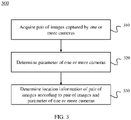
- FIG. 3 is a flowchart illustrating an exemplary process of determining location information according to some embodiments of the present disclosure.
- a pair of images captured by one or more cameras of camera 110 is acquired. Step 310 is performed by image acquisition module 210.
- the pair of images may be captured by two cameras of camera 110, by a camera with two lenses of camera 110, or by placing a camera at two different positions.
- one image or more than one image may be acquired in 310.
- all lenses of the one or more cameras may be fixed lenses.
- the one or more cameras of camera 110 may include at least one rotatable lens.
- the pair of images captured by the one or more cameras of camera 110 may be stored in memory 122.
- a parameter of the one or more cameras of camera 110 may be determined. Step 320 may be performed by calibration parameter determination module 250, or adjustment parameter determination module 260, or a combination thereof.
- the parameter may include a calibration parameter (e.g., an intrinsic parameter, and/or an extrinsic parameter), or an adjustment parameter (e.g., a focal length, a pitch angle, and/or a yaw angle).
- a method of determining the one or more calibration parameters may include a method of using a calibration tool (e.g., a calibration board), a method of using a vanishing line and a vanishing point, or a method of using a relationship between a vertical coordinate and a parallax (as described in FIG. 11 ).
- a calibration tool e.g., a calibration board
- a method of using a vanishing line and a vanishing point e.g., a method of using a relationship between a vertical coordinate and a parallax (as described in FIG. 11 ).
- location information of the pair of images may be determined according to the pair of images and the parameter of the one or more cameras of camera 110. Step 330 may be performed by depth information determination module 230 or second detection information generation module 240. In some embodiments, the location information of the pair of images may include depth information or second detection information of the pair of images.
- step 330 of process 300 may be performed based on process 400 illustrated in FIG. 4 for generating second detection information.
- the pair of images including a first image and a second image captured by one or more cameras of camera 110 is acquired.
- Step 410 is performed by image acquisition module 210.
- the first image and the second image may be captured by two cameras, by a camera with two lenses, or by placing a camera at two different positions.
- all lenses of the one or more cameras of camera 110 may be fixed lenses.
- the one or more cameras of camera 110 may include at least one rotatable lens.
- an exemplary pair of images including the first image and the second image is illustrated in FIG. 12-A and 12-B .
- first detection information is generated according to the first image. Step 420 is performed by first detection information generation module 220.
- a method of generating the first detection information includes a method based on a training model and may include a method based on color information, a method based on marginal information, a method based on frame difference, a method based on background difference, or the like, or any combination thereof.
- the training model may include a part-base model, a Gaussian model, a Hidden Markov model (HMM), or the like, or any combination thereof.
- depth information of at least one of the pair of images is determined according to the first image, the second image, and the first detection information.
- Step 430 is performed by depth information determination module 230.
- depth information of part of the image rather than the whole image is determined.
- an area in the first image is determined as the first detection information representing position of an object in the first image.
- depth information of the area rather than the whole first image is determined.
- second detection information is generated according to the first detection information and the depth information. Step 440 is performed by second detection information generation module 240.
- the second detection information may be the modified first detection information.
- a process of generating the second detection information may be a process to modify the first detection information. For example, if the first detection information is the location information of an object, the second detection information may be more accurate location information compared to the first detection information.
- the first detection information is an area representing the position of an object in the first image.
- the 3D coordinates of pixels in the area may be determined in 430.
- the purpose of generating the second detection information may be to remove pixels that are not belong to the object from the area.
- the process for removing pixels that do not belong to the object from the area may include one or more of the following operations.
- a removing operation pixels belonging to the ground may be removed.
- the pixels with an absolute value of a coordinate of Y axis less than a first threshold may be removed.
- the Y axis is an axis perpendicular to a horizontal plane.
- noise pixels may be removed.
- pixels may be divided into a plurality of groups of pixels of which the length is equal.
- the X axis and the Z axis are perpendicular to the Y axis.
- a group of pixels may be a bin, which is denoted by B k , the number of the groups is denoted by M, and the length is denoted by ⁇ S.
- B k the number of the groups
- M the number of the groups
- ⁇ S the length
- the group may be considered as having no noise pixels.
- second detection information may be determined based on a threshold method.
- the second detection information may be denoted by ⁇ B ⁇ k ⁇ .
- a default group may be definition as a group of a part-base training model.
- a minimum distance between a group in the set of groups having no noise pixels and the default group of pixels may be determined.
- the minimum distance refers to a minimum value of the distance along the X axis or the Z axis between each pixel in the group in the set of groups without noise pixels and each pixel in the default group. If the minimum distance is less than a fourth threshold, the group may be regarded as the group belong to ⁇ B ⁇ k ⁇ .
- step 420 of process 400 may be performed based on process 500 illustrated in FIG. 5 for generating first detection information
- Process 500 of generating the first detection information may be performed by first detection information generation module 220.
- one or more training models may be obtained.
- Step 510 may be performed by training model generation unit 222.
- the training model may include a part-base model, a Gaussian model, a Hidden Markov model (HMM), or the like, or any combination thereof.
- the training model may be obtained from a memory (e.g., memory 122, or a storage unit in first detection information generation module 220).
- the training model may be obtained through a training process in real time.
- the first detection information may be determined according to the one or more training models. Step 520 may be performed by first detection information determination unit 226.
- step 510 of process 500 may be performed based on process 500 illustrated in FIG. 4 for obtaining a part-base training model.
- the process of obtaining the part-base training model may be performed by the training model obtaining unit 222.
- a plurality of samples including positive samples and negative samples may be obtained.
- the positive samples may be images including a target object (e.g., a car, a person, or a building).
- the negative samples may be images not including a target object (e.g., a car, a person, or a building).
- the positive samples may be a plurality of images containing one or more cars.
- the negative samples may be a plurality of images that do not contain any car.
- a number of the positive samples may be larger than that of the negative samples.
- the number of the positive samples may be 2000.
- the number of the negative samples may be 1000.
- an initial root filter may be generated according to the plurality of samples.
- the initial root filter may be trained by using an SVM (Support Vector Machines) with no latent variables.
- SVM Small Vector Machines
- SVM may be supervised learning models with associated learning algorithms that analyze data used for classification and regression analysis.
- the latent variables refer to a part location and an exact location of a root filter for a positive example.
- the positive example may be constructed from the positive samples.
- the negative example may be constructed from the negative samples.
- an updating root filter may be generated according to the initial root filter. Given the initial root filter generated in 620, for each bounding box, a best-scoring placement for the filter that significantly overlaps with the bounding box may be determined by using original, un-scaled images. As used herein, the bounding box refers to a rectangular area that represents position information of an object.
- the initial root filter may be retrained with a new positive example and an original random negative example, iterating twice, then the updating root filter may be generated
- a part filter may be generated according to the updating root filter.
- a process of generating the part filter may be a process of initializing one or more parts from the updating root filter generated in 630.
- six parts of the updating filter may be initialized.
- the process for initializing the six parts may include one or more operations. In a selection operation, an area such that six areas equals 80% of the area of the updating root filter may be selected.
- the area selected from the updating root filter may be a rectangular region and may have the most positive energy.
- weights in the area may be zeroed out. The selection operation and the zero out operation may be repeated until six parts are selected.
- a training model may be generated according to the samples and the part filter.
- a process for generating the training model may include one or more operations.
- a cache may be determined.
- a highest scoring placement may be selected in the cache as the positive example corresponding to the bounding box.
- a highest scoring placement may be selected in the negative samples as the negative example.
- negative examples may be added to the cache.
- a new model may be trained by running the SVM on the positive and negative examples, each labeled with part placements. The new model may be updated 10 times using the above operations.
- hard instances from the previous cache may be kept and new hard instances may be added.
- the hard instance refers to a bounding box in the negative example during the process of detecting an object. Toward the final iterations, all hard instances may be included in the cache.
- step 520 of process 500 is performed based on process 700 illustrated in FIG. 7 for generating first detection information.
- Process 700 of generating the first detection information may be performed by first detection information determination unit 226.
- first detection information determination unit 226 For further understanding the disclosure, an example of generating the first detection information according to a part-base model may be described. The example, however, is merely provided for the purposes of illustration and not intended to limit the scope of the present disclosure. The scope of the invention and its embodiments is defined by the appended claims.
- a method of cascaded detecting may be performed to generate the first detection information.
- a training model may be acquired.
- the training model may be obtained from a memory (e.g., memory 122, or a storage unit in first detection information generation module 220).
- the training model may be obtained through a training process (e.g., the process described in FIG. 6 ) in real time.
- a feature image is generated.
- the feature image may be a Histogram of Oriented Gradient (HOG) feature image.
- HOG Histogram of Oriented Gradient
- each pixel may include a 32-dimensional vector that may be referred to as a HOG feature.
- the HOG feature may be represented at two different scales. Coarse features may be captured by a rigid template covering an entire detection window. Finer scale features may be captured by part templates that may be moved with respect to the detection window.
- processing information is generated according to the feature image and the training model.
- processing information refers to an area that is related to position of an object may be determined in an image.
- the feature image may be a HOG feature image.
- a method of dynamic programing may be performed to generate the processing information.
- the process of generating the processing information may include the following operations. A response value of each part of the object in the feature image (e.g., the HOG feature image) may be determined. A part of the object that the response value may be larger than a fifth threshold may be determined and area that is related to the position of the object in the image may be determined.
- first detection information is generated according to the processing information.
- an area determined in 730 may including some duplicate information.
- a method may be performed to remove the duplicate information so that the first detection information may be generated.
- the method may be a method of non-maximum compress.
- the first detection information generated in 740 is an area referring to the position of the object in the image.
- step 430 of process 400 may be performed based on process 800 illustrated in FIG. 8 for generating depth information.
- a pair of processed images including a first processed image and a second processed image in which vertical coordinates of two corresponding pixels in an image coordinate system are equal may be generated according to the pair of images.
- the pair of images is captured by the one or more cameras of camera 110.
- the origin may be a pixel in one of the pair of images (e.g., a pixel in the highest position in the top left corner of one of the pair of images).
- the horizontal coordinate axis of the image coordinate system may be a horizontal direction of the one of the pair of images.
- the vertical coordinate axis may be a vertical direction of the one of the pair of images.
- the two corresponding pixels in the pair of images may correspond to a same point in the real world.
- the process of step 810 may be realized by rectification.
- the purpose of rectification may be to make optical axes of the one or more cameras parallel and to make the vertical coordinates of the two corresponding points equal in the image coordinate system.
- a target pixel may be determined in the first processed image.
- a coordinate of the target pixel may be referred to as p ( u , v ).
- a matching pixel of the target pixel may be determined in the second processed image.
- the method of determining the matching pixel may be a stereo matching method. For example, a difference between abscissas of the two corresponding pixels in the image coordinate system may be referred to as a parallax d. So the corresponding pixel of the target pixel in the second processed image of the target pixel may be referred to as p'(u + d, v ).
- a secondary matching pixel may be determined in the same way as the superior matching pixel.
- the secondary matching pixel may be represented as p m 2 u + d 2 * , v . If c u v d 1 * / c u v d 2 * ⁇ th 6 , the superior matching pixel may be accepted as the matching pixel.
- th 6 refers to a sixth threshold. In some embodiments, the value of th 6 may be 0.5-1. In some embodiments, the value of th 6 may be 0.9.
- depth information of the target point in a camera coordinate system may be determined according to the matching pixel.
- the origin of the camera coordinate system may be an optical center of one of the one or more cameras.
- the first coordinate axis of the camera coordinate system may be an optical axis of the one of the one or more cameras.
- the second coordinate axis of the camera coordinate system may be an axis parallel to a horizontal plane.
- the third coordinate axis of the camera coordinate system may be an axis perpendicular to the horizontal plane.
- a parallax of sub pixel may be represented as ds.
- the central point may be represented as c ( u 0 , v 0 ).
- the central point refers to a point of intersection of the optical axis and an imaging plane of the camera capturing the first image.
- a calibration parameter of the one or more cameras may be determined.
- the calibration parameter may be determined to construct a perspective projection model.
- the calibration parameter may be used to transform a 3D coordinate of a pixel in the image in a camera coordinate system into a 3D coordinate in a world coordinate system.
- the calibration parameter may include an intrinsic parameter and/or an extrinsic parameter.
- the intrinsic parameter may be a parameter of the one or more cameras of camera 110 including, for example, a focal length, a central point and/or a lens distortion parameter, or a combination thereof.
- the extrinsic parameter may be a pose and a position parameter of the one or more cameras of camera 110 including, for example, a pitch angle, a roll angle, a yaw angle, a height, and/or a three dimensional coordinate of the origin of the camera coordinate system in the world coordinate system of the one or more cameras of camera 110, or a combination thereof.
- a method of determining the calibration parameter may include a method of using a calibration tool (e.g., a calibration board), a method of using a vanishing line and a vanishing point, or a method of using a relationship between a vertical coordinate and a parallax (as describe in FIG. 11 ).
- step 850 may be performed before step 810.
- the depth information of the target pixel in the camera coordinate system may be transmitted into depth information of the target pixel in a world coordinate system according to the calibration parameter.
- step 850 may be performed by calibration parameter determination module 250. Other steps in FIG. 8 may be performed by first depth information determination unit 232.
- the one or more cameras capturing the pair of images used in the process in FIG. 8 may be cameras of which all lenses are fixed lenses.
- process 800 of determining depth information in FIG. 8 may be used in step 430 of process 400.
- the purpose of step 430 in FIG. 4 may be to determine depth information of the first detection information. So when the process of determining depth information in FIG. 8 is used in step 430 of process 400, the target point may be selected according to the first detection information. For example, if the first detection information is location information of an object and the location information is represented by an area in the first image of the pair of images, the purpose of step 430 of process 400 may be to determine depth information of the area and the target point may be selected in the area.
- FIG. 9 is a flowchart illustrating an exemplary process 900 of generating depth information according to some embodiments of the present disclosure.
- process 900 may be used for generating location information in 330 of process 300.
- process 900 may be used for generating depth information in 430 of process 400.
- a calibration parameter of a first camera and a second camera of the one or more cameras of camera 110 may include one fixed lens and one rotatable lens.
- the one or more cameras of camera 110 may include one fixed lens and two or more rotatable lenses.
- the one or more cameras of camera 110 may include two or more fixed lenses and one rotatable lens.
- the one or more cameras of camera 110 may include two or more fixed lenses and two or more rotatable lenses.
- the first camera may be a camera of which lenses are all fixed lenses.
- the first camera may be a camera with at least one rotatable lens.
- the first camera may be the camera of which lenses are all fixed lenses.
- the first camera may be the camera with at least one rotatable lens, or the camera of which lenses are all fixed lenses.
- the second camera may have at least one rotatable lens.
- the optical point of the camera and the point of intersection of the three rotatable axes along which the rotatable lens rotates may be coincident.
- some influence factors such as a mechanical error, or a position error
- the optical point of the camera and the point of intersection of the three rotatable axes along which the rotatable lens rotates are in practice not coincident.
- the difference in this condition may be compensated by using one or more matrixes. For example, if the optical axis of the camera is not perpendicular to the two of the rotatable axes, a rotatable matrix may be applied.
- a translation matrix may be applied.
- the optical point of the camera and the point of intersection of the three rotatable axes along which the rotatable lens rotates may be considered as coincident.
- a method of determining the calibration parameter may include one or more operations.
- the first camera and the second camera may first be set to be in an initial state.
- the initial state is a state that the pitch angle, the roll angle and the yaw angle of the rotatable lens(es) in camera 110 are 0.
- a camera coordinate system of any one of the first camera and the second camera may further be set as a world coordinate system.
- the calibration parameter of the first camera and the second camera may then be determined according to the world coordinate system.
- a camera coordinate system of any one of the first camera and the second camera may be set as a world coordinate system.
- the calibration parameter may include an intrinsic parameter and/or an extrinsic parameter.
- the intrinsic parameter may be a parameter of the camera including, for example, a focal length, a central point, and/or a lens distortion parameter, or a combination thereof.
- the extrinsic parameter may be a pose and a position parameter of the camera including, for example, a pitch angle, a roll angle, a yaw angle, a height, and/or a 3D coordinate of the origin of a camera coordinate system in a world coordinate system of the one or more cameras of camera 110, or a combination thereof.
- the first camera and the second camera are cameras with at least one rotatable lens
- the first camera and the second camera may be set to be in the initial state.
- the pitch angle, the yaw angle and the roll angle of the two cameras may be set to zero so that the two cameras may be in the initial state.
- the camera coordinate system of one of the two cameras may be regarded as the world coordinate system.
- the origin of the camera coordinate system of the first camera may be referred to as Ci
- the origin of the world coordinate system may be referred to as O w .
- C l and O w may be identical.
- the origin of the camera coordinate system of the second camera may be C r according to the camera coordinate system of the first camera.
- the method of determining the calibration parameter may include a method of using a calibration tool (e.g., a calibration board), a method of using a vanishing line and a vanishing point, or a method of using a relationship between a vertical coordinate and a parallax (which will be explained in connection with FIG. 11 below).
- a calibration tool e.g., a calibration board
- a method of using a vanishing line and a vanishing point e.g., a method of using a relationship between a vertical coordinate and a parallax
- an object is identified in view of a first camera of the one or more cameras of camera 110.
- the object may be any target of interest, such as a vehicle, a face, a person, etc.
- a parameter of a second camera is adjusted so that the object is in view of the second camera.
- the parameter of the second camera may be adjusted so that the object is in a central position in the view of the second camera.
- the parameter of the second camera may include a pitch angle, a yaw angle, or a focal length of the second camera.
- the second camera may be the camera with at least one rotatable lens.
- the pitch angle and the yaw angle of the second camera may be adjusted so that the object is in the view of the second camera.
- the focal length of the second camera may be adjusted so that a resolution ratio of the object in the second camera is higher than a first default resolution ratio.
- a focal length of the first camera may be adjusted so that a resolution ratio of the object in the first camera is higher than a second default resolution ratio.
- the process of adjusting the focal length of the first camera may be performed in 920, or in 930 while the focal length of the second camera is adjusted.
- the first default resolution ratio and the second default resolution ratio may be different in different conditions. The first default resolution ratio and the second default resolution ratio may be affected by many factors, such as the object, the environment in which the object is, algorithm for adjusting the focal length, or a combination thereof.
- a pair of images captured by the first camera and the second camera is acquired.
- a process may be performed to determine whether the object that the first camera and the second camera captured are identical according to the pair of images. For example, an area of the object in the pair of images and one or more feature points in the area of the object may be determined.
- the feature point may be a point according to an algorithm (e.g., SIFT (Scale-Invariant Feature Transform), SURF (Speeded Up Robust Features), Harris), or a specific point (e.g., a license plate, an eye).
- SIFT Scale-Invariant Feature Transform
- SURF Speeded Up Robust Features
- Harris a specific point
- a first similarity of the area of the object in the pair of images may be determined and a second similarity of the one or more feature points in the area of the object may be determined. If the similarity of any area in the pair of images is equal to or larger than a seventh threshold, and the similarity of any feature point is equal to or larger than an eighth threshold, the first camera and the second camera may capture the identical object. If not, step 930 may be performed again.
- a pair of pixels may be determined in the pair of images captured by the first camera and the second camera.
- the pair of pixels may include a first pixel and a second pixel.
- the first pixel may be in the image captured by the first camera
- the second pixel may be a corresponding pixel of the first pixel in the image captured by the second camera.
- the two corresponding pixel may correspond to a same point in the real world.
- an adjustment parameter of the first camera or the second camera may be determined.
- the parameter after adjusting may be referred to as the adjustment parameter of the camera.
- the adjustment parameter may include an adjustment pitch angle, an adjustment yaw angle, and/or an adjustment focal length.
- depth information of the pair of pixels in a world coordinate system may be determined according to the calibration parameter and the adjustment parameter.
- a point in the real world may be referred as to P.
- the coordinate of P in the world coordinate system may be referred to as P ( x , y , z ).
- the pixel of P in the image captured by the camera may be referred to as p.
- the coordinates of p in the image coordinate system may be referred to as p ( u , v ).
- the origin of the camera coordinate system may be referred to as C.
- the central point of the image may be referred to as c, and its coordinate in the image coordinate system may be referred to as c ( u 0 , v 0 ).
- the central point refers to a point of intersection of the optical axis CZ of the camera and the imaging plane.
- the direction vector from the origin of the camera coordinate system to P may be referred to as d.
- the pair of pixel in the pair of images may be referred to as p l and p r
- the coordinates of p l and p r in the image coordinate system may be referred to as p l ( u l , v l ) and p r ( u r , v r ).
- the coordinates in the image coordinate system of central points of the image captured by the first camera and the image captured by the second camera may be referred to as c 0 l ( u 0 l , v 0 l ) and c 0 r ( u 0 r , v 0 r ), respectively.
- the adjustment focal length of the first camera and the second camera may be referred to as f ⁇ l and f ⁇ r , respectively.
- the direction vectors from the origin of the camera coordinate system to the pixel may be referred to as d ⁇ l and d ⁇ r , respectively.
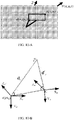
- the 3D coordinate of P may be determined according to a triangular relationship illustrated in FIG. 10-B .
- the origins of the camera coordinate system of the first camera and the second camera may be C l and C r , respectively.
- C l , C r , d l ′ , d r ′ and P may form a triangle.
- the 3D coordinate of P may be determined according to the triangle.
- d l ′ and d r ′ may not be in a plane. So a method may be performed so that d l ′ and d r ′ are in a plane.
- one method may be to define P as a point that the sum of the first Euclidean distance between P and d l ′ , and the second Euclidean distance between P and d r ′ are minimum.
- Another method may include the following operations. In an operation, d l ′ or d r ′ may be selected as a direction without an error.
- a plane ⁇ may be determined according to C l , C r and d l ′ .
- d r ′ may be projected to the plane ⁇ along a normal direction of the plane ⁇ .
- the projection vector may be referred to as d r " .
- P may be the point of intersection of d l ′ and d r " .
- the first camera and the second camera may be a same camera with two lenses.
- step 910 may be performed by calibration parameter determination module 250.
- Step 960 may be performed by adjustment parameter determination module 260.
- Other steps in FIG. 9 may be performed by second depth information determination unit 236.
- the process of determining depth information in FIG. 9 may be used in step 430 of process 400.
- the purpose of step 430 in FIG. 4 is to determine depth information of the first detection information. So when the process of determining depth information in FIG. 9 is used step 430 of process 400, the pair of pixels may be selected according to the first detection information. If the first detection information is location information of an object and the location information is represented by an area in the first image of the pair of images, the purpose of step 430 of process 400 is to determine depth information of the area and the pair of pixels may be selected in the area in the first image and the corresponding location in the second image.
- the one or more cameras in the process described in FIG. 9 may include a first camera and a second camera both of which have at least one rotatable lens.
- the first camera and the second camera may be both ball cameras, and camera 110 may be a double ball camera system.
- the rotate angle of both the ball camera may be set to a particular value (e.g., zero) to monitor a different area or a small overlap area.
- a calibration process may be performed as described in 910 to determine calibration parameters (e.g., intrinsic parameters and/or extrinsic parameters) of the first camera and the second camera of the double ball camera system.
- steps 930-970 may be performed to capture a pair of images of the object and determined depth information (e.g., a 3D coordinate P 0 ) of the object.
- the object may be described by using the 3D coordinate data, a color information and any other information related to the object.
- the 3D coordinate and average speed data of an object may be used to analyze abnormal behavior of an object. For example, a suspect may run after committing a wrongdoing. A sequence of images of a moving man may be useful in recording features of the suspect.
- the process described in FIG. 9 may be applied to detect illegal parking by determining the 3D location of a vehicle.
- a tag may be set according to a vehicle license plate, classification of a vehicle (e.g., sport utility vehicle, truck, etc.), color information of a vehicle, and any other information related to the vehicle.
- a duration of illegal parking may be determined by determining a parking time and when the illegal parking vehicle leaves the location.
- the process described in FIG. 9 may be applied to track an object.
- 3D coordinate and average speed data of an object may be determined.
- the 3D coordinate and average speed data may be used to determine whether the object has been screened.
- the 3D coordinate may not be effected by changing angle of view. Movement of portion (e.g., whirling, wearing a hat, putting on/peeling off clothes) may not lead to a sudden change of the 3D coordinate.
- a moving trajectory of an object may be forecasted basing on the 3D coordinate data of a fast moving object.
- FIG. 10-A is a schematic diagram of a direction vector of a point in the camera coordinate system according to some embodiments of the present disclosure. More detailed descriptions regarding the direction vector may be found in FIG.9 (e.g., step 970).
- FIG. 10-B is a schematic diagram of a triangular relationship among origins of the camera coordinate system of the first camera and the second camera and a point in the real world according to some embodiments of the present disclosure. More detailed descriptions regarding the direction vector may be found in FIG.9 (e.g., step 980).
- FIG. 11 is a flowchart of an exemplary process of determining a height and an angle of one or more cameras according to some embodiments of the present disclosure.
- process 1100 may be used for determining a calibration parameter in 850 of process 800, in 910 of process 900, and/or in 320 of process 300.
- process 1100 may acquire a pair of images including a first image and a second image captured by one or more cameras of camera 110.
- Step 1110 may be performed by image acquisition module 210.
- the pair of images may be shown in FIGs. 12-A and 12-B .
- a pair of images is captured by a stereoscopic camera with parallel optical axes.
- a baseline of the stereoscopic camera may be parallel with a reference plane.
- the reference plane is in the view of the stereoscopic camera.
- the reference plane may be a fixed plane in environment, such as a ground plane, a desktop plane, etc.
- process 1100 may generate a pair of processed images including a first processed image and a second processed image in which a vertical coordinates of two corresponding pixels (e.g., a first pixel and a second pixel) are equal according to pair of images.
- a relationship of the vertical coordinates of the first pixel and the second pixel in the pair of processed images may satisfy Equation (2) as described above in connection with FIG. 8 .
- Step 1120 may be performed by calibration parameter determination module 250.
- process 1100 may identify an area in a first processed image.
- the area of the first processed image may be corresponding to at least part of a reference plane.
- the area of the first processed image may be determined by a user or determined by computer device 120 (shown in FIG. 1 ).
- the user may input an instruction through user device 140 (shown in FIG. 1 ) and select an area of the first processed image.
- the user can select a rectangular zone for determining an area.
- Computer device 120 may receive the instruction from user device 140 and identify an area in the first processed image. For example, if the user select a rectangular zone in the first processed image through user device 140, computer device 120 may receive the instruction from user device 140 and identify the rectangular zone as the area in the first processed image.
- the area of the first processed image may be determined by a computer with a pattern recognition algorithm, such as classification algorithms, clustering algorithms, ensemble learning algorithms, general algorithms for predicting arbitrarily-structured (sets of) labels, multilinear subspace learning algorithms, real-valued sequence labeling algorithms, regression algorithms, and sequence labeling algorithms.
- a pattern recognition algorithm such as classification algorithms, clustering algorithms, ensemble learning algorithms, general algorithms for predicting arbitrarily-structured (sets of) labels, multilinear subspace learning algorithms, real-valued sequence labeling algorithms, regression algorithms, and sequence labeling algorithms.
- the area of the first processed image may be determined as first detection information as described elsewhere in this disclosure in connection with FIGs. 5-7 .
- process 1100 may determine a parallax between a first pixel in the area in the first processed image and second pixel corresponding to the first pixel in a second processed image.
- the first pixel in the area in the first processed image and second pixel corresponding to the first pixel in a second processed image may correspond to a same point in the real world.
- the parallax may be denoted by a difference of the abscissas of the first pixel in the area in the first processed image and second pixel corresponding to the first pixel in a second processed image.
- process 1100 may determine a relationship between a vertical coordinate of the first pixel in image coordinate and determined parallax.
- the relationship may be a linear relationship or a nonlinear relationship.
- step 1150 may be performed by a space compression method.
- the space compression method may include the following operations.
- a matching cost G UVD of a pixel in a reference area may be determined.
- the value of G UVD denotes a matching cost of a pixel in the reference area in a second processed image with a parallax d, wherein d is an integer not less than zero.
- G UVD may be replace with G VD .
- the value of G VD stands for an average matching cost of the pixels of which the parallax is d in a u direction in the second processed image.
- the parallax of pixels of the reference area in a u direction in the second processed image may be consider to be equal.
- G VD may modify computational speed. More detailed descriptions regarding G VD may be found elsewhere in this disclosure in connection with FIG. 13-A .
- a minimum value of matching cost in a row in the d direction of G VD may be determined.
- a straight-line fitting of the minimum values determined above may then be performed.
- a relationship between the vertical coordinate of the first processed image and second pixel corresponding to the first pixel in a second processed image, and determined parallax may be determined.
- the relationship of the vertical coordinate and parallax may be determined by a point-by-point stereo matching method of pixels corresponding to points in the reference area.
- the relationship of the vertical coordinate and parallax may be determined by a stereo matching method of pixels corresponding to characteristic points in the reference area.
- the characteristic points may be based on geometrical characteristic, such as edge elements, corners, line segments, curve segments, circles, ellipses and regions.
- process 1100 may determine a projection equation according to the determined relationship.
- a trigonometry of three dimensional reconstruction may be used to determine the projection equation.
- a linear relationship may be found in the z axis of a camera coordinate, parallax d, a focal length and baseline B of the stereoscopic camera.
- process 1100 may determine height and angle of the one or more cameras according to the projection equation.
- the projection equation and the optical axis may satisfy a relationship as described below in connection with FIG. 14-B .
- a height of the one or more cameras above the ground may be denoted by h c as described in Equation (27), and an angle of the one or more cameras may be denoted by ⁇ as described in Equation (28):
- process 1100 for determining a height and angle of one or more cameras may be used in steps 850 and 860 of process 800.
- the purpose of step 850 of process 800 may be to determine the calibration parameter of one or more cameras, such as a height and an angle of one or more cameras.
- the height and the angle of the one or more cameras can be determined.
- depth information in world coordinate system may be determined.
- process 1100 for determining a height and angle of one or more cameras may be used in step 910 of process 900.
- the purpose of step 910 in FIG. 9 may be determine the calibration parameter of the one or more cameras, such as a height and an angle of the one or more cameras.
- the height and the angle of the one or more cameras can be determined.
- process 1100 for determining a height and an angle of one or more cameras may be used in step 910 of process 900.
- Process 900 for generating depth information may be used in step 430 of process 400.
- FIG. 12-A and FIG. 12-B is an exemplary pair of images with a selected reference area captured by one or more cameras according to some embodiments of the present disclosure.
- the pair of images may be captured by two cameras including a left camera and a right camera.
- a reference plane may be the ground.
- a baseline of the left camera and the right camera may be parallel with the reference plane.
- the reference plane is in the view of the left camera and the right camera.
- a left processed image of the left camera and a right processed image of the right camera can be generate by using a calibration method with pre-calibration parameters.
- the process of determine the calibration parameter may be performed by calibration parameter determination module 250 illustrated in in FIG. 2 .
- G l may be a reference area.
- a plurality of methods may be used to determine the matching cost, such as SAD (Sum of Absolute Differences) algorithm, MAD (Mean Absolute Differences) algorithm, SSD (Sum of Squared Differences) algorithm, MSD (Mean Square Differences) algorithm, NCC (Normalized Cross Correlation) algorithm, SSDA (Sequential Similarity Detection Algorithm) algorithm, and SATD (Sum of Absolute Transformed Difference) algorithm.
- I l ( u, v ) refers to a pixel in the reference area.
- FIG. 13-A is a schematic diagram of G VD according to some embodiments of the present disclosure.
- the value of G VD stands for an average matching cost of the pixels of which the parallax is d in a u direction in the second processed image.
- FIG. 13-B is a schematic of d ⁇ ( v ) determined in G VD according to some embodiments of the present disclosure.
- d ⁇ ( v ) corresponding to the reference area G l may be a line in some situation.
- the number of interior points may then be sampled or recorded according to the determination result of step one. Repeat the above two operations. In one embodiment the number of repetition may be m times of the height of G l . For example, m may be 10 or 20.
- the determined line model ( k ⁇ , b ⁇ ) may be determine by selecting a line model which include a maximum number of interior points.
- FIG. 14-A is a schematic diagram of a relationship of a camera coordinate and a world coordinate according to some embodiments of the present disclosure.
- z axis of a camera coordinate may be parallel with optical axis of a camera, and y axis may be on a vertical direction.
- the projection equation of the optical axis of the camera in the ground plane may be expressed as Equation (22).
- FIG. 14-B is a schematic diagram of geometrical relations between a height and an angle of the one or more cameras according to some embodiments of the present disclosure.
- FIG. 15-A and FIG. 15-B illustrate two exemplary images produced by rectification according to some embodiments of the present disclosure. As illustrated in FIG. 15-A and FIG. 15-B , the vertical coordinates of corresponding pixels in the image coordinate system in the two images are equal.
- FIG. 16-A illustrates an exemplary image produced by a process of first detection information generation according to some embodiments of the present disclosure.
- the process of first detection information generation detected the location information of vehicles in the image, but the location information is not accurate.
- FIG. 16-B illustrates an exemplary image produced by a process of depth information determination according to some embodiments of the present disclosure.
- FIG. 16-C illustrates an exemplary image produced by a process of second detection information generation based on the first detection information and the depth information according to some embodiments of the present disclosure.
- the process of second detection information generation detected the location information of vehicles in the image, and the second detection information is more accurate than the first detection information.
Landscapes
- Engineering & Computer Science (AREA)
- Theoretical Computer Science (AREA)
- Physics & Mathematics (AREA)
- Computer Vision & Pattern Recognition (AREA)
- General Physics & Mathematics (AREA)
- Data Mining & Analysis (AREA)
- Artificial Intelligence (AREA)
- Bioinformatics & Cheminformatics (AREA)
- Bioinformatics & Computational Biology (AREA)
- Evolutionary Biology (AREA)
- Evolutionary Computation (AREA)
- Life Sciences & Earth Sciences (AREA)
- General Engineering & Computer Science (AREA)
- Length Measuring Devices By Optical Means (AREA)
Claims (13)
- Computerimplementiertes Verfahren für binokulares Stereosehen, umfassend:Aufnehmen eines Paars von Bildern, umfassend ein erstes Bild und ein zweites Bild, wobei das Paar von Bildern durch eine oder mehrere Kameras (110) erfasst wird;Bestimmen einer Mehrzahl von Feature-Bildern gemäß dem ersten Bild;Bestimmen eines oder mehrerer Features eines Objekts in dem ersten Bild gemäß einem Trainingsmodell und der Mehrzahl von Feature-Bildern;Bestimmen eines ersten Bereichs in dem Bild, wobei der erste Bereich wenigstens eines des bestimmten einen oder der bestimmten mehreren Features umfasst;Erhalten einer Tiefeninformation des bestimmten ersten Bereichs auf Grundlage des ersten und des zweiten Bilds; undBestimmen eines zweiten Bereichs in dem ersten Bild auf Grundlage des bestimmten ersten Bereichs und der Tiefeninformation, wobei der zweite Bereich wenigstens eines des bestimmten ersten Bereichs umfasst,wobei das Verfahren dadurch gekennzeichnet ist, dass das Aufnehmen des Paars von Bildern, umfassend das erste Bild und das zweite Bild, umfasst:Identifizieren des Objekts in einem Blickfeld einer ersten Kamera;Einstellen eines Parameters einer zweiten Kamera, so dass das Objekt in einem Blickfeld der zweiten Kamera erscheint; undAufnehmen des durch die erste Kamera und die zweite Kamera erfassten Paars von Bildern, wenn das Objekt in einem Blickfeld sowohl der ersten als auch der zweiten Kamera erscheint.
- Verfahren nach Anspruch 1, ferner umfassend Erhalten des Trainingsmodells, wobei das Erhalten des Trainingsmodells umfasst:Erhalten einer Mehrzahl von Bildproben;Erzeugen eines Anfangs-Root-Filters gemäß den Proben;Erzeugen eines Aktualisierungs-Root-Filters gemäß dem Anfangs-Root-Filter;Erzeugen eines Teilfilters gemäß dem Aktualisierungs-Root-Filter; undErzeugen des Trainingsmodells gemäß den Proben und dem Teilfilter.
- Verfahren nach Anspruch 1 oder 2, wobei das Erhalten der Tiefeninformation des bestimmten ersten Bereichs auf Grundlage des ersten und des zweiten Bilds umfasst:Verarbeiten des Paars von Bildern, um ein Paar verarbeiteter Bilder zu erzeugen, wobei vertikale Koordinaten in einem Bildkoordinatensystem zweier entsprechender Pixel in dem Paar verarbeiteter Bilder gleich sind;Erzeugen eines Paars verarbeiteter Bilder gemäß dem Paar von Bildern;Bestimmen eines Zielpixels in dem ersten Bereich in einem ersten verarbeiteten Bild;Bestimmen eines passenden Pixels des Zielpixels in einem zweiten verarbeiteten Bild;Bestimmen einer Tiefeninformation des Zielpixels in einem Kamerakoordinatensystem gemäß dem passenden Pixel;Bestimmen einer Höhe und eines Neigungswinkels wenigstens einer der einen oder der mehreren Kameras; undUmwandeln der Tiefeninformation in dem Kamerakoordinatensystem in eine Tiefeninformation in einem Weltkoordinatensystem gemäß der Höhe und dem Neigungswinkel.
- Verfahren nach Anspruch 3, wobeiein Ursprung des Bildkoordinatensystems ein Pixel in einer höchsten Position in einer oberen linken Ecke des ersten Bilds ist;ein Ursprung des Kamerakoordinatensystems ein optisches Zentrum der Kamera ist, welche das erste Bild erfasst; undein Ursprung des Weltkoordinatensystems ein Punkt in der realen Welt ist.
- Verfahren nach einem der Ansprüche 1 bis 4, wobei Linsen der einen oder der mehreren Kameras (110) fixierte Linsen sind, wobei die fixierten Linsen entlang einer ersten Achse, einer zweiten Achse oder einer dritten Achse nicht drehbar sind, wobei die erste Achse, die zweite Achse und die dritte Achse senkrecht zueinander sind.
- Verfahren nach Anspruch 3, wobei das Bestimmen der Höhe und des Neigungswinkels der wenigstens einen der einen oder der mehreren Kameras umfasst:Identifizieren eines dritten Bereichs in dem ersten verarbeiteten Bild;Bestimmen einer Parallaxe zwischen einem ersten Pixel in dem dritten Bereich und einem dem ersten Pixel entsprechenden zweiten Pixel in dem zweiten verarbeiteten Bild;Bestimmen einer Beziehung zwischen einer vertikalen Koordinate des ersten Pixels in dem Bildkoordinatensystem und der Parallaxe;Bestimmen einer Projektionsgleichung gemäß der Beziehung; undBestimmen der Höhe und des Neigungswinkels der wenigstens einen der einen oder der mehreren Kameras gemäß der Projektionsgleichung.
- Verfahren nach Anspruch 1, wobei das Erhalten der Tiefeninformation des bestimmten ersten Bereichs auf Grundlage des ersten und des zweiten Bilds umfasst:Erhalten eines Kalibrierungsparameters der ersten Kamera und der zweiten Kamera, wobei der Kalibrierungsparameter einen Gierwinkel, einen Neigungswinkel, eine Brennweite oder eine dreidimensionale Koordinate eines Ursprungs eines Kamerakoordinatensystems in einem Weltkoordinatensystem der ersten Kamera und der zweiten Kamera in einem Anfangszustand umfasst;Bestimmen eines Paars von Pixeln in dem Paar von Bildern;Erhalten, wenn das Objekt in einem Blickfeld sowohl der ersten als auch der zweiten Kamera erscheint, eines Einstellungsparameters wenigstens einer der ersten Kamera und der zweiten Kamera, wobei der Einstellungsparameter einen Gierwinkel, einen Neigungswinkel oder eine Brennweite der ersten Kamera und der zweiten Kamera umfasst; undBestimmen einer Tiefeninformation des Paars von Pixeln in dem Weltkoordinatensystem gemäß dem Kalibrierungsparameter und dem Einstellungsparameter.
- Verfahren nach einem der Ansprüche 1 bis 7, wobei die erste Kamera und die zweite Kamera wenigstens eine drehbare Linse aufweisen, wobei die drehbare Linse eine Linse ist, welche entlang einer ersten Achse, einer zweiten Achse oder einer dritten Achse drehbar ist, wobei die erste Achse, die zweite Achse und die dritte Achse senkrecht zueinander sind.
- Verfahren nach Anspruch 1, wobei das Bestimmen des zweiten Bereichs in dem ersten Bild auf Grundlage des bestimmten ersten Bereichs und der Tiefeninformation umfasst:
Bestimmen des zweiten Bereichs durch Entfernen von Pixeln, welche nicht zu dem Objekt gehören, aus dem ersten Bereich. - System für binokulares Stereosehen, umfassend:ein Bildaufnahmemodul (210), welches dazu eingerichtet ist, ein Paar von Bildern, umfassend ein erstes Bild und ein zweites Bild, aufzunehmen, wobei das Paar von Bildern durch eine oder mehrere Kameras (110) erfasst wird;ein erstes Detektionsinformationserzeugungsmodul (220), welches eingerichtet ist zum:Bestimmen einer Mehrzahl von Feature-Bildern gemäß dem ersten Bild;Bestimmen eines oder mehrerer Features eines Objekts in dem ersten Bild gemäß einem Trainingsmodell und der Mehrzahl von Feature-Bildern; undBestimmen eines ersten Bereichs in dem ersten Bild, wobei der erste Bereich wenigstens eines des bestimmten einen oder der bestimmten mehreren Features umfasst;ein Tiefeninformationsbestimmungsmodul (230), welches dazu eingerichtet ist, auf Grundlage des ersten und des zweiten Bilds eine Tiefeninformation des bestimmten ersten Bereichs zu erhalten; undein zweites Detektionsinformationserzeugungsmodul (240), welches dazu eingerichtet ist, auf Grundlage des bestimmten ersten Bereichs und der Tiefeninformation einen zweiten Bereich in dem ersten Bild zu bestimmen, wobei der zweite Bereich wenigstens eines des bestimmten ersten Bereichs umfasst,wobei das System dadurch gekennzeichnet ist, dass das Aufnehmen, durch das Bildaufnahmemodul (210), des Paars von Bildern, umfassend das erste Bild und das zweite Bild, umfasst:Identifizieren des Objekts in einem Blickfeld einer ersten Kamera;Einstellen eines Parameters einer zweiten Kamera, so dass das Objekt in einem Blickfeld der zweiten Kamera erscheint; undAufnehmen des durch die erste Kamera und die zweite Kamera erfassten Paars von Bildern, wenn das Objekt in einem Blickfeld sowohl der ersten als auch der zweiten Kamera erscheint.
- System nach Anspruch 10, wobei das Erhalten, durch das Tiefeninformationsbestimmungsmodul (230), der Tiefeninformation des bestimmten ersten Bereichs auf Grundlage des ersten und des zweiten Bilds umfasst:Verarbeiten des Paars von Bildern, um ein Paar verarbeiteter Bilder zu erzeugen, wobei vertikale Koordinaten in einem Bildkoordinatensystem zweier entsprechender Pixel in dem Paar verarbeiteter Bilder gleich sind;Erzeugen eines Paars verarbeiteter Bilder gemäß dem Paar von Bildern;Bestimmen eines Zielpixels in dem ersten Bereich in einem ersten verarbeiteten Bild;Bestimmen eines passenden Pixels des Zielpixels in einem zweiten verarbeiteten Bild;Bestimmen einer Tiefeninformation des Zielpixels in einem Kamerakoordinatensystem gemäß dem passenden Pixel;Bestimmen einer Höhe und eines Neigungswinkels wenigstens einer der einen oder der mehreren Kameras; undUmwandeln der Tiefeninformation in dem Kamerakoordinatensystem in eine Tiefeninformation in einem Weltkoordinatensystem gemäß der Höhe und dem Neigungswinkel,wobei optionaldas Bestimmen, durch das Tiefeninformationsbestimmungsmodul (230), der Höhe und des Neigungswinkels der wenigstens einen der einen oder der mehreren Kameras umfasst:Identifizieren eines dritten Bereichs in dem ersten verarbeiteten Bild;Bestimmen einer Parallaxe zwischen einem ersten Pixel in dem dritten Bereich und einem dem ersten Pixel entsprechenden zweiten Pixel in dem zweiten verarbeiteten Bild;Bestimmen einer Beziehung zwischen einer vertikalen Koordinate des ersten Pixels in dem Bildkoordinatensystem und der Parallaxe;Bestimmen einer Projektionsgleichung gemäß der Beziehung; undBestimmen der Höhe und des Neigungswinkels der wenigstens einen der einen oder der mehreren Kameras gemäß der Projektionsgleichung.
- System nach Anspruch 10, wobei das Erhalten, durch das Tiefeninformationsbestimmungsmodul (230), der Tiefeninformation des bestimmten ersten Bereichs auf Grundlage des ersten und des zweiten Bilds umfasst:Erhalten eines Kalibrierungsparameters der ersten Kamera und der zweiten Kamera, wobei der Kalibrierungsparameter einen Gierwinkel, einen Neigungswinkel, eine Brennweite oder eine dreidimensionale Koordinate eines Ursprungs eines Kamerakoordinatensystems in einem Weltkoordinatensystem der ersten Kamera und der zweiten Kamera in einem Anfangszustand umfasst;Bestimmen eines Paars von Pixeln in dem Paar von Bildern;Erhalten, wenn das Objekt in einem Blickfeld sowohl der ersten als auch der zweiten Kamera erscheint, eines Einstellungsparameters wenigstens einer der ersten Kamera und der zweiten Kamera, wobei der Einstellungsparameter einen Gierwinkel, einen Neigungswinkel oder eine Brennweite der ersten Kamera und der zweiten Kamera umfasst; undBestimmen einer Tiefeninformation des Paars von Pixeln in dem Weltkoordinatensystem gemäß dem Kalibrierungsparameter und dem Einstellungsparameter.
- Nicht-transitorisches computerlesbares Medium, welches ein Computerprogrammprodukt verkörpert, wobei das Computerprogrammprodukt Anweisungen umfasst, welche, wenn das Programm durch eine Rechenvorrichtung (120) ausgeführt wird, die Rechenvorrichtung (120) veranlassen zum:Aufnehmen eines Paars von Bildern, umfassend ein erstes Bild und ein zweites Bild, wobei das Paar von Bildern durch eine oder mehrere Kameras (110) erfasst wird;Bestimmen einer Mehrzahl von Feature-Bildern gemäß dem ersten Bild;Bestimmen eines oder mehrerer Features eines Objekts in dem ersten Bild gemäß einem Trainingsmodell und der Mehrzahl von Feature-Bildern;Bestimmen eines ersten Bereichs in dem Bild, wobei der erste Bereich wenigstens eines des bestimmten einen oder der bestimmten mehreren Features umfasst;Erhalten einer Tiefeninformation des bestimmten ersten Bereichs auf Grundlage des ersten und des zweiten Bilds; undBestimmen eines zweiten Bereichs in dem ersten Bild auf Grundlage des bestimmten ersten Bereichs und der Tiefeninformation, wobei der zweite Bereich wenigstens eines des bestimmten ersten Bereichs umfasst,wobei das computerlesbare Medium dadurch gekennzeichnet ist, dass das Aufnehmen des Paars von Bildern, umfassend das erste Bild und das zweite Bild, umfasst:Identifizieren des Objekts in einem Blickfeld einer ersten Kamera;Einstellen eines Parameters einer zweiten Kamera, so dass das Objekt in einem Blickfeld der zweiten Kamera erscheint; undAufnehmen des durch die erste Kamera und die zweite Kamera erfassten Paars von Bildern, wenn das Objekt in einem Blickfeld sowohl der ersten als auch der zweiten Kamera erscheint.
Applications Claiming Priority (4)
| Application Number | Priority Date | Filing Date | Title |
|---|---|---|---|
| CN201510775971.8A CN105469386B (zh) | 2015-11-11 | 2015-11-11 | 一种确定立体相机高度与俯仰角的方法及装置 |
| CN201610971609.2A CN108020158A (zh) | 2016-11-04 | 2016-11-04 | 一种基于球机的三维位置测量方法及装置 |
| CN201610971878.9A CN108022429B (zh) | 2016-11-04 | 2016-11-04 | 一种车辆检测的方法及装置 |
| PCT/CN2016/105174 WO2017080451A1 (en) | 2015-11-11 | 2016-11-09 | Methods and systems for binocular stereo vision |
Publications (3)
| Publication Number | Publication Date |
|---|---|
| EP3374967A1 EP3374967A1 (de) | 2018-09-19 |
| EP3374967A4 EP3374967A4 (de) | 2018-10-03 |
| EP3374967B1 true EP3374967B1 (de) | 2023-01-04 |
Family
ID=58694515
Family Applications (1)
| Application Number | Title | Priority Date | Filing Date |
|---|---|---|---|
| EP16863627.2A Active EP3374967B1 (de) | 2015-11-11 | 2016-11-09 | Verfahren und systeme für binokulares stereosehen |
Country Status (3)
| Country | Link |
|---|---|
| US (1) | US10861177B2 (de) |
| EP (1) | EP3374967B1 (de) |
| WO (1) | WO2017080451A1 (de) |
Families Citing this family (38)
| Publication number | Priority date | Publication date | Assignee | Title |
|---|---|---|---|---|
| CN105740802A (zh) * | 2016-01-28 | 2016-07-06 | 北京中科慧眼科技有限公司 | 基于视差图的障碍物检测方法和装置及汽车驾驶辅助系统 |
| EP4235618A3 (de) * | 2017-09-27 | 2023-09-06 | Zhejiang Dahua Technology Co., Ltd. | Überwachungsvorrichtung |
| JP2019078582A (ja) * | 2017-10-23 | 2019-05-23 | ソニー株式会社 | 情報処理装置、情報処理方法、及びプログラム |
| CN108304000B (zh) * | 2017-10-25 | 2024-01-23 | 河北工业大学 | 云台实时vr系统 |
| CN108470323B (zh) * | 2018-03-13 | 2020-07-31 | 京东方科技集团股份有限公司 | 一种图像拼接方法、计算机设备及显示装置 |
| WO2019180666A1 (en) * | 2018-03-21 | 2019-09-26 | Seesure | Computer vision training using paired image data |
| US10769793B2 (en) * | 2018-04-17 | 2020-09-08 | Baidu Usa Llc | Method for pitch angle calibration based on 2D bounding box and its 3D distance for autonomous driving vehicles (ADVs) |
| WO2020014683A1 (en) * | 2018-07-13 | 2020-01-16 | Kache.AI | Systems and methods for autonomous object detection and vehicle following |
| US11282225B2 (en) * | 2018-09-10 | 2022-03-22 | Mapbox, Inc. | Calibration for vision in navigation systems |
| CN109360243B (zh) * | 2018-09-28 | 2022-08-19 | 安徽爱观视觉科技有限公司 | 一种多自由度可动视觉系统的标定方法 |
| CN109242914B (zh) * | 2018-09-28 | 2021-01-01 | 上海爱观视觉科技有限公司 | 一种可动视觉系统的立体标定方法 |
| CN109389650B (zh) * | 2018-09-30 | 2021-01-12 | 京东方科技集团股份有限公司 | 一种车载相机的标定方法、装置、车辆和存储介质 |
| CN109754434B (zh) * | 2018-12-27 | 2023-08-29 | 歌尔科技有限公司 | 相机标定方法、装置、用户设备及存储介质 |
| WO2020133468A1 (en) * | 2018-12-29 | 2020-07-02 | Zhejiang Dahua Technology Co., Ltd. | Methods and systems for camera calibration |
| CN111460854B (zh) * | 2019-01-18 | 2023-04-28 | 杭州海康威视数字技术股份有限公司 | 一种远距离目标检测方法、装置及系统 |
| CN109887087B (zh) * | 2019-02-22 | 2021-02-19 | 广州小鹏汽车科技有限公司 | 一种车辆的slam建图方法及系统 |
| CN111698455B (zh) * | 2019-03-13 | 2022-03-11 | 华为技术有限公司 | 控制球机与枪机联动的方法、装置及介质 |
| US11010641B2 (en) | 2019-03-14 | 2021-05-18 | Mapbox, Inc. | Low power consumption deep neural network for simultaneous object detection and semantic segmentation in images on a mobile computing device |
| CN110232711B (zh) * | 2019-06-05 | 2021-08-13 | 中国科学院自动化研究所 | 面向海产品抓取的双目视觉实时感知定位方法、系统、装置 |
| CN110763140B (zh) * | 2019-07-08 | 2021-04-16 | 北京宇航时代科技发展有限公司 | 一种非平行光轴高精度双目测距方法 |
| CN112288821B (zh) * | 2019-07-25 | 2024-04-23 | 上海高德威智能交通系统有限公司 | 一种相机外参标定的方法及装置 |
| CN110514114A (zh) * | 2019-07-30 | 2019-11-29 | 江苏海事职业技术学院 | 一种基于双目视觉的微小目标空间位置标定方法 |
| CN110992431B (zh) * | 2019-12-16 | 2023-04-18 | 电子科技大学 | 一种双目内窥镜软组织图像的联合三维重建方法 |
| CN111246172A (zh) * | 2020-01-20 | 2020-06-05 | 深圳英飞拓科技股份有限公司 | 一种联动图像采集装置及图像采集方法 |
| CN111340737B (zh) * | 2020-03-23 | 2023-08-18 | 北京迈格威科技有限公司 | 图像矫正方法、装置和电子系统 |
| CN111753712A (zh) * | 2020-06-22 | 2020-10-09 | 中国电力科学研究院有限公司 | 电力生产人员安全监测方法、系统以及设备 |
| CN112365526B (zh) * | 2020-11-30 | 2023-08-25 | 湖南傲英创视信息科技有限公司 | 弱小目标的双目检测方法及系统 |
| CN112767536B (zh) * | 2021-01-05 | 2024-07-26 | 中国科学院上海微系统与信息技术研究所 | 一种对象的三维重建方法、装置、设备及存储介质 |
| CN112734863B (zh) * | 2021-03-31 | 2021-07-02 | 武汉理工大学 | 一种基于自动定位的交叉式双目相机标定方法 |
| CN113628278B (zh) * | 2021-07-27 | 2024-12-31 | 南京汽车集团有限公司 | 一种相机俯仰角及安装高度的自动标定方法 |
| CN113763346B (zh) * | 2021-08-31 | 2023-12-01 | 哈尔滨工业大学(威海) | 基于双目视觉的立面作业效果与表面缺陷检测方法 |
| US12444148B2 (en) * | 2021-09-08 | 2025-10-14 | Magic Leap, Inc. | Camera calibration using depth sensor data |
| CN113888617B (zh) * | 2021-09-30 | 2024-08-02 | 北京工业大学 | 一种关联区域多相机物体匹配方法与系统 |
| CN114404084B (zh) * | 2022-01-21 | 2024-08-02 | 北京大学口腔医学院 | 一种扫描装置及扫描方法 |
| CN114792345B (zh) * | 2022-06-27 | 2022-09-27 | 杭州蓝芯科技有限公司 | 一种基于单目结构光系统的标定方法 |
| SE546939C2 (en) * | 2023-08-18 | 2025-03-11 | Topgolf Sweden Ab | System, calibration apparatus and method for determining a coordinate transformation for two cameras |
| CN117455881B (zh) * | 2023-11-10 | 2024-06-28 | 西安科技大学 | 基于双目视觉的井下抛矸固体充填充实率动态测量方法 |
| CN118616909B (zh) * | 2024-07-01 | 2024-12-17 | 苏州物睿科技有限公司 | 一种用于镭雕机的视觉定位方法和系统 |
Family Cites Families (25)
| Publication number | Priority date | Publication date | Assignee | Title |
|---|---|---|---|---|
| US6111582A (en) * | 1996-12-20 | 2000-08-29 | Jenkins; Barry L. | System and method of image generation and encoding using primitive reprojection |
| US8745541B2 (en) * | 2003-03-25 | 2014-06-03 | Microsoft Corporation | Architecture for controlling a computer using hand gestures |
| US7636105B2 (en) | 2006-04-05 | 2009-12-22 | Etreppid Technologies Llc | Method and apparatus for providing motion control signals between a fixed camera and a PTZ camera |
| WO2008103929A2 (en) * | 2007-02-23 | 2008-08-28 | Johnson Controls Technology Company | Video processing systems and methods |
| CN101251373A (zh) | 2008-03-28 | 2008-08-27 | 北京工业大学 | 微结构三维尺寸立体图像快速检测方法 |
| CN101504287B (zh) | 2009-01-22 | 2011-01-05 | 浙江大学 | 基于视觉信息的无人飞行器自主着陆的姿态参数估算方法 |
| JP5245938B2 (ja) | 2009-03-12 | 2013-07-24 | オムロン株式会社 | 3次元認識結果の表示方法および3次元視覚センサ |
| CN101894366B (zh) | 2009-05-21 | 2014-01-29 | 北京中星微电子有限公司 | 一种获取标定参数的方法、装置及一种视频监控系统 |
| KR101733131B1 (ko) | 2010-12-14 | 2017-05-10 | 한국전자통신연구원 | 3차원 제스처 처리 방법 및 장치 |
| CN103390164B (zh) * | 2012-05-10 | 2017-03-29 | 南京理工大学 | 基于深度图像的对象检测方法及其实现装置 |
| CN103231708B (zh) | 2013-04-12 | 2015-08-05 | 安徽工业大学 | 一种基于双目视觉的智能车辆避障方法 |
| CN104239882B (zh) * | 2013-06-14 | 2017-05-03 | 富士通株式会社 | 图像相似度确定装置和方法以及图像特征获取装置和方法 |
| KR101476799B1 (ko) * | 2013-07-10 | 2014-12-26 | 숭실대학교산학협력단 | 깊이 정보를 이용한 객체 검출 시스템 및 방법 |
| CN103763047A (zh) | 2014-01-14 | 2014-04-30 | 西安电子科技大学 | 一种基于单视图几何原理的室内环境重构方法 |
| CN104915965A (zh) | 2014-03-14 | 2015-09-16 | 华为技术有限公司 | 一种摄像机跟踪方法及装置 |
| CN103955920B (zh) | 2014-04-14 | 2017-04-12 | 桂林电子科技大学 | 基于三维点云分割的双目视觉障碍物检测方法 |
| CN103983186B (zh) | 2014-04-17 | 2016-08-24 | 内蒙古大学 | 双目视觉系统校正方法及校正设备 |
| CN104167109B (zh) | 2014-07-17 | 2016-08-24 | 浙江宇视科技有限公司 | 车辆位置的检测方法和检测装置 |
| CN104236478B (zh) | 2014-09-19 | 2017-01-18 | 山东交通学院 | 一种基于视觉的车辆外廓尺寸自动测量系统及方法 |
| CN104318561B (zh) | 2014-10-22 | 2017-05-03 | 上海理工大学 | 基于双目立体视觉与光流融合的车辆运动信息检测方法 |
| JP6425990B2 (ja) | 2014-12-18 | 2018-11-21 | 東日本旅客鉄道株式会社 | 道床形状計測方法 |
| CN104574425B (zh) | 2015-02-03 | 2016-05-11 | 中国人民解放军国防科学技术大学 | 一种基于旋转模型的主从摄像机系统的标定以及联动方法 |
| CN104700414B (zh) | 2015-03-23 | 2017-10-03 | 华中科技大学 | 一种基于车载双目相机的前方道路行人快速测距方法 |
| CN105023010B (zh) | 2015-08-17 | 2018-11-06 | 中国科学院半导体研究所 | 一种人脸活体检测方法及系统 |
| CN106650708B (zh) | 2017-01-19 | 2023-08-11 | 南京航空航天大学 | 一种自动驾驶障碍物视觉检测方法与系统 |
-
2016
- 2016-11-09 EP EP16863627.2A patent/EP3374967B1/de active Active
- 2016-11-09 WO PCT/CN2016/105174 patent/WO2017080451A1/en not_active Ceased
- 2016-11-09 US US15/775,800 patent/US10861177B2/en active Active
Also Published As
| Publication number | Publication date |
|---|---|
| WO2017080451A1 (en) | 2017-05-18 |
| EP3374967A4 (de) | 2018-10-03 |
| US20180322648A1 (en) | 2018-11-08 |
| US10861177B2 (en) | 2020-12-08 |
| EP3374967A1 (de) | 2018-09-19 |
Similar Documents
| Publication | Publication Date | Title |
|---|---|---|
| EP3374967B1 (de) | Verfahren und systeme für binokulares stereosehen | |
| US9305240B2 (en) | Motion aligned distance calculations for image comparisons | |
| EP3338248B1 (de) | Systeme und verfahren zur objektverfolgung | |
| Ahn et al. | Real-time head orientation from a monocular camera using deep neural network | |
| JP5715833B2 (ja) | 姿勢状態推定装置および姿勢状態推定方法 | |
| US20220301277A1 (en) | Target detection method, terminal device, and medium | |
| US9152847B2 (en) | Facial landmark localization by exemplar-based graph matching | |
| US9690988B2 (en) | Image processing apparatus and image processing method for blink detection in an image | |
| EP4024270A1 (de) | Gebärdenerkennungsverfahren, elektronische vorrichtung, computerlesbares speichermedium, und chip | |
| CN103514432A (zh) | 人脸特征提取方法、设备和计算机程序产品 | |
| EP3168810A1 (de) | Bilderzeugungsverfahren und -vorrichtung | |
| CN103914676A (zh) | 一种在人脸识别中使用的方法和装置 | |
| WO2012117687A1 (ja) | 姿勢推定装置、姿勢推定システム、および姿勢推定方法 | |
| Hernández-Vela et al. | BoVDW: Bag-of-Visual-and-Depth-Words for gesture recognition | |
| KR20110064117A (ko) | 얼굴 정면포즈 판단 방법 | |
| US8718362B2 (en) | Appearance and context based object classification in images | |
| Wang et al. | Hand posture recognition from disparity cost map | |
| Huang et al. | Multi‐class obstacle detection and classification using stereovision and improved active contour models | |
| Hua et al. | Onboard monocular pedestrian detection by combining spatio-temporal hog with structure from motion algorithm | |
| Kalutskiy et al. | Method of moving object detection from mobile vision system | |
| Prun et al. | Forward rectification: spatial image normalization for a video from a forward facing vehicle camera | |
| Le Cras et al. | Improving robustness of vision based localization under dynamic illumination | |
| Heredia et al. | Edge vs. cloud computing: where to do image processing for surveillance? | |
| Wu et al. | Vehicle classification in pan-tilt-zoom videos via sparse learning | |
| Chen et al. | Adaptive semantic–geometric fusion algorithm for real-time visual SLAM in dynamic environments |
Legal Events
| Date | Code | Title | Description |
|---|---|---|---|
| STAA | Information on the status of an ep patent application or granted ep patent |
Free format text: STATUS: THE INTERNATIONAL PUBLICATION HAS BEEN MADE |
|
| PUAI | Public reference made under article 153(3) epc to a published international application that has entered the european phase |
Free format text: ORIGINAL CODE: 0009012 |
|
| STAA | Information on the status of an ep patent application or granted ep patent |
Free format text: STATUS: REQUEST FOR EXAMINATION WAS MADE |
|
| 17P | Request for examination filed |
Effective date: 20180518 |
|
| AK | Designated contracting states |
Kind code of ref document: A1 Designated state(s): AL AT BE BG CH CY CZ DE DK EE ES FI FR GB GR HR HU IE IS IT LI LT LU LV MC MK MT NL NO PL PT RO RS SE SI SK SM TR |
|
| AX | Request for extension of the european patent |
Extension state: BA ME |
|
| A4 | Supplementary search report drawn up and despatched |
Effective date: 20180831 |
|
| RIC1 | Information provided on ipc code assigned before grant |
Ipc: G06T 7/00 20170101AFI20180827BHEP Ipc: G06T 7/593 20170101ALI20180827BHEP Ipc: G06K 9/00 20060101ALI20180827BHEP |
|
| DAV | Request for validation of the european patent (deleted) | ||
| DAX | Request for extension of the european patent (deleted) | ||
| STAA | Information on the status of an ep patent application or granted ep patent |
Free format text: STATUS: EXAMINATION IS IN PROGRESS |
|
| 17Q | First examination report despatched |
Effective date: 20201029 |
|
| GRAP | Despatch of communication of intention to grant a patent |
Free format text: ORIGINAL CODE: EPIDOSNIGR1 |
|
| STAA | Information on the status of an ep patent application or granted ep patent |
Free format text: STATUS: GRANT OF PATENT IS INTENDED |
|
| INTG | Intention to grant announced |
Effective date: 20220802 |
|
| GRAS | Grant fee paid |
Free format text: ORIGINAL CODE: EPIDOSNIGR3 |
|
| GRAA | (expected) grant |
Free format text: ORIGINAL CODE: 0009210 |
|
| STAA | Information on the status of an ep patent application or granted ep patent |
Free format text: STATUS: THE PATENT HAS BEEN GRANTED |
|
| AK | Designated contracting states |
Kind code of ref document: B1 Designated state(s): AL AT BE BG CH CY CZ DE DK EE ES FI FR GB GR HR HU IE IS IT LI LT LU LV MC MK MT NL NO PL PT RO RS SE SI SK SM TR |
|
| REG | Reference to a national code |
Ref country code: GB Ref legal event code: FG4D |
|
| REG | Reference to a national code |
Ref country code: DE Ref legal event code: R096 Ref document number: 602016077329 Country of ref document: DE |
|
| REG | Reference to a national code |
Ref country code: CH Ref legal event code: EP |
|
| REG | Reference to a national code |
Ref country code: AT Ref legal event code: REF Ref document number: 1542490 Country of ref document: AT Kind code of ref document: T Effective date: 20230115 |
|
| REG | Reference to a national code |
Ref country code: IE Ref legal event code: FG4D |
|
| REG | Reference to a national code |
Ref country code: LT Ref legal event code: MG9D |
|
| REG | Reference to a national code |
Ref country code: NL Ref legal event code: MP Effective date: 20230104 |
|
| REG | Reference to a national code |
Ref country code: AT Ref legal event code: MK05 Ref document number: 1542490 Country of ref document: AT Kind code of ref document: T Effective date: 20230104 |
|
| PG25 | Lapsed in a contracting state [announced via postgrant information from national office to epo] |
Ref country code: NL Free format text: LAPSE BECAUSE OF FAILURE TO SUBMIT A TRANSLATION OF THE DESCRIPTION OR TO PAY THE FEE WITHIN THE PRESCRIBED TIME-LIMIT Effective date: 20230104 |
|
| PG25 | Lapsed in a contracting state [announced via postgrant information from national office to epo] |
Ref country code: RS Free format text: LAPSE BECAUSE OF FAILURE TO SUBMIT A TRANSLATION OF THE DESCRIPTION OR TO PAY THE FEE WITHIN THE PRESCRIBED TIME-LIMIT Effective date: 20230104 Ref country code: PT Free format text: LAPSE BECAUSE OF FAILURE TO SUBMIT A TRANSLATION OF THE DESCRIPTION OR TO PAY THE FEE WITHIN THE PRESCRIBED TIME-LIMIT Effective date: 20230504 Ref country code: NO Free format text: LAPSE BECAUSE OF FAILURE TO SUBMIT A TRANSLATION OF THE DESCRIPTION OR TO PAY THE FEE WITHIN THE PRESCRIBED TIME-LIMIT Effective date: 20230404 Ref country code: LV Free format text: LAPSE BECAUSE OF FAILURE TO SUBMIT A TRANSLATION OF THE DESCRIPTION OR TO PAY THE FEE WITHIN THE PRESCRIBED TIME-LIMIT Effective date: 20230104 Ref country code: LT Free format text: LAPSE BECAUSE OF FAILURE TO SUBMIT A TRANSLATION OF THE DESCRIPTION OR TO PAY THE FEE WITHIN THE PRESCRIBED TIME-LIMIT Effective date: 20230104 Ref country code: HR Free format text: LAPSE BECAUSE OF FAILURE TO SUBMIT A TRANSLATION OF THE DESCRIPTION OR TO PAY THE FEE WITHIN THE PRESCRIBED TIME-LIMIT Effective date: 20230104 Ref country code: ES Free format text: LAPSE BECAUSE OF FAILURE TO SUBMIT A TRANSLATION OF THE DESCRIPTION OR TO PAY THE FEE WITHIN THE PRESCRIBED TIME-LIMIT Effective date: 20230104 Ref country code: AT Free format text: LAPSE BECAUSE OF FAILURE TO SUBMIT A TRANSLATION OF THE DESCRIPTION OR TO PAY THE FEE WITHIN THE PRESCRIBED TIME-LIMIT Effective date: 20230104 |
|
| PG25 | Lapsed in a contracting state [announced via postgrant information from national office to epo] |
Ref country code: SE Free format text: LAPSE BECAUSE OF FAILURE TO SUBMIT A TRANSLATION OF THE DESCRIPTION OR TO PAY THE FEE WITHIN THE PRESCRIBED TIME-LIMIT Effective date: 20230104 Ref country code: PL Free format text: LAPSE BECAUSE OF FAILURE TO SUBMIT A TRANSLATION OF THE DESCRIPTION OR TO PAY THE FEE WITHIN THE PRESCRIBED TIME-LIMIT Effective date: 20230104 Ref country code: IS Free format text: LAPSE BECAUSE OF FAILURE TO SUBMIT A TRANSLATION OF THE DESCRIPTION OR TO PAY THE FEE WITHIN THE PRESCRIBED TIME-LIMIT Effective date: 20230504 Ref country code: GR Free format text: LAPSE BECAUSE OF FAILURE TO SUBMIT A TRANSLATION OF THE DESCRIPTION OR TO PAY THE FEE WITHIN THE PRESCRIBED TIME-LIMIT Effective date: 20230405 Ref country code: FI Free format text: LAPSE BECAUSE OF FAILURE TO SUBMIT A TRANSLATION OF THE DESCRIPTION OR TO PAY THE FEE WITHIN THE PRESCRIBED TIME-LIMIT Effective date: 20230104 |
|
| REG | Reference to a national code |
Ref country code: DE Ref legal event code: R097 Ref document number: 602016077329 Country of ref document: DE |
|
| PG25 | Lapsed in a contracting state [announced via postgrant information from national office to epo] |
Ref country code: SM Free format text: LAPSE BECAUSE OF FAILURE TO SUBMIT A TRANSLATION OF THE DESCRIPTION OR TO PAY THE FEE WITHIN THE PRESCRIBED TIME-LIMIT Effective date: 20230104 Ref country code: RO Free format text: LAPSE BECAUSE OF FAILURE TO SUBMIT A TRANSLATION OF THE DESCRIPTION OR TO PAY THE FEE WITHIN THE PRESCRIBED TIME-LIMIT Effective date: 20230104 Ref country code: EE Free format text: LAPSE BECAUSE OF FAILURE TO SUBMIT A TRANSLATION OF THE DESCRIPTION OR TO PAY THE FEE WITHIN THE PRESCRIBED TIME-LIMIT Effective date: 20230104 Ref country code: DK Free format text: LAPSE BECAUSE OF FAILURE TO SUBMIT A TRANSLATION OF THE DESCRIPTION OR TO PAY THE FEE WITHIN THE PRESCRIBED TIME-LIMIT Effective date: 20230104 Ref country code: CZ Free format text: LAPSE BECAUSE OF FAILURE TO SUBMIT A TRANSLATION OF THE DESCRIPTION OR TO PAY THE FEE WITHIN THE PRESCRIBED TIME-LIMIT Effective date: 20230104 |
|
| PLBE | No opposition filed within time limit |
Free format text: ORIGINAL CODE: 0009261 |
|
| STAA | Information on the status of an ep patent application or granted ep patent |
Free format text: STATUS: NO OPPOSITION FILED WITHIN TIME LIMIT |
|
| PG25 | Lapsed in a contracting state [announced via postgrant information from national office to epo] |
Ref country code: SK Free format text: LAPSE BECAUSE OF FAILURE TO SUBMIT A TRANSLATION OF THE DESCRIPTION OR TO PAY THE FEE WITHIN THE PRESCRIBED TIME-LIMIT Effective date: 20230104 Ref country code: AL Free format text: LAPSE BECAUSE OF FAILURE TO SUBMIT A TRANSLATION OF THE DESCRIPTION OR TO PAY THE FEE WITHIN THE PRESCRIBED TIME-LIMIT Effective date: 20230104 |
|
| 26N | No opposition filed |
Effective date: 20231005 |
|
| PG25 | Lapsed in a contracting state [announced via postgrant information from national office to epo] |
Ref country code: SI Free format text: LAPSE BECAUSE OF FAILURE TO SUBMIT A TRANSLATION OF THE DESCRIPTION OR TO PAY THE FEE WITHIN THE PRESCRIBED TIME-LIMIT Effective date: 20230104 |
|
| PG25 | Lapsed in a contracting state [announced via postgrant information from national office to epo] |
Ref country code: IT Free format text: LAPSE BECAUSE OF FAILURE TO SUBMIT A TRANSLATION OF THE DESCRIPTION OR TO PAY THE FEE WITHIN THE PRESCRIBED TIME-LIMIT Effective date: 20230104 |
|
| REG | Reference to a national code |
Ref country code: CH Ref legal event code: PL |
|
| PG25 | Lapsed in a contracting state [announced via postgrant information from national office to epo] |
Ref country code: MC Free format text: LAPSE BECAUSE OF FAILURE TO SUBMIT A TRANSLATION OF THE DESCRIPTION OR TO PAY THE FEE WITHIN THE PRESCRIBED TIME-LIMIT Effective date: 20230104 |
|
| PG25 | Lapsed in a contracting state [announced via postgrant information from national office to epo] |
Ref country code: LU Free format text: LAPSE BECAUSE OF NON-PAYMENT OF DUE FEES Effective date: 20231109 |
|
| PG25 | Lapsed in a contracting state [announced via postgrant information from national office to epo] |
Ref country code: CH Free format text: LAPSE BECAUSE OF NON-PAYMENT OF DUE FEES Effective date: 20231130 |
|
| PG25 | Lapsed in a contracting state [announced via postgrant information from national office to epo] |
Ref country code: MC Free format text: LAPSE BECAUSE OF FAILURE TO SUBMIT A TRANSLATION OF THE DESCRIPTION OR TO PAY THE FEE WITHIN THE PRESCRIBED TIME-LIMIT Effective date: 20230104 Ref country code: LU Free format text: LAPSE BECAUSE OF NON-PAYMENT OF DUE FEES Effective date: 20231109 Ref country code: CH Free format text: LAPSE BECAUSE OF NON-PAYMENT OF DUE FEES Effective date: 20231130 |
|
| REG | Reference to a national code |
Ref country code: BE Ref legal event code: MM Effective date: 20231130 |
|
| REG | Reference to a national code |
Ref country code: IE Ref legal event code: MM4A |
|
| PG25 | Lapsed in a contracting state [announced via postgrant information from national office to epo] |
Ref country code: IE Free format text: LAPSE BECAUSE OF NON-PAYMENT OF DUE FEES Effective date: 20231109 |
|
| PG25 | Lapsed in a contracting state [announced via postgrant information from national office to epo] |
Ref country code: BE Free format text: LAPSE BECAUSE OF NON-PAYMENT OF DUE FEES Effective date: 20231130 |
|
| PG25 | Lapsed in a contracting state [announced via postgrant information from national office to epo] |
Ref country code: IE Free format text: LAPSE BECAUSE OF NON-PAYMENT OF DUE FEES Effective date: 20231109 Ref country code: BE Free format text: LAPSE BECAUSE OF NON-PAYMENT OF DUE FEES Effective date: 20231130 |
|
| PG25 | Lapsed in a contracting state [announced via postgrant information from national office to epo] |
Ref country code: BG Free format text: LAPSE BECAUSE OF FAILURE TO SUBMIT A TRANSLATION OF THE DESCRIPTION OR TO PAY THE FEE WITHIN THE PRESCRIBED TIME-LIMIT Effective date: 20230104 |
|
| PG25 | Lapsed in a contracting state [announced via postgrant information from national office to epo] |
Ref country code: BG Free format text: LAPSE BECAUSE OF FAILURE TO SUBMIT A TRANSLATION OF THE DESCRIPTION OR TO PAY THE FEE WITHIN THE PRESCRIBED TIME-LIMIT Effective date: 20230104 |
|
| PG25 | Lapsed in a contracting state [announced via postgrant information from national office to epo] |
Ref country code: CY Free format text: LAPSE BECAUSE OF FAILURE TO SUBMIT A TRANSLATION OF THE DESCRIPTION OR TO PAY THE FEE WITHIN THE PRESCRIBED TIME-LIMIT; INVALID AB INITIO Effective date: 20161109 |
|
| PG25 | Lapsed in a contracting state [announced via postgrant information from national office to epo] |
Ref country code: HU Free format text: LAPSE BECAUSE OF FAILURE TO SUBMIT A TRANSLATION OF THE DESCRIPTION OR TO PAY THE FEE WITHIN THE PRESCRIBED TIME-LIMIT; INVALID AB INITIO Effective date: 20161109 |
|
| PG25 | Lapsed in a contracting state [announced via postgrant information from national office to epo] |
Ref country code: TR Free format text: LAPSE BECAUSE OF FAILURE TO SUBMIT A TRANSLATION OF THE DESCRIPTION OR TO PAY THE FEE WITHIN THE PRESCRIBED TIME-LIMIT Effective date: 20230104 |
|
| PGFP | Annual fee paid to national office [announced via postgrant information from national office to epo] |
Ref country code: DE Payment date: 20251117 Year of fee payment: 10 |
|
| PGFP | Annual fee paid to national office [announced via postgrant information from national office to epo] |
Ref country code: GB Payment date: 20251126 Year of fee payment: 10 |
|
| PGFP | Annual fee paid to national office [announced via postgrant information from national office to epo] |
Ref country code: FR Payment date: 20251127 Year of fee payment: 10 |