EP3372689A1 - Insecticidal protein combinations for controlling fall armyworm and european corn borer, and methods for insect resistance managements - Google Patents
Insecticidal protein combinations for controlling fall armyworm and european corn borer, and methods for insect resistance managements Download PDFInfo
- Publication number
- EP3372689A1 EP3372689A1 EP18169060.3A EP18169060A EP3372689A1 EP 3372689 A1 EP3372689 A1 EP 3372689A1 EP 18169060 A EP18169060 A EP 18169060A EP 3372689 A1 EP3372689 A1 EP 3372689A1
- Authority
- EP
- European Patent Office
- Prior art keywords
- plants
- insecticidal protein
- refuge
- field
- cry1fa
- Prior art date
- Legal status (The legal status is an assumption and is not a legal conclusion. Google has not performed a legal analysis and makes no representation as to the accuracy of the status listed.)
- Withdrawn
Links
- 108090000623 proteins and genes Proteins 0.000 title claims abstract description 105
- 241000238631 Hexapoda Species 0.000 title claims abstract description 34
- 102000004169 proteins and genes Human genes 0.000 title claims description 92
- 230000000749 insecticidal effect Effects 0.000 title claims description 49
- 238000000034 method Methods 0.000 title claims description 13
- 241000256251 Spodoptera frugiperda Species 0.000 title claims description 9
- 241001147398 Ostrinia nubilalis Species 0.000 title description 8
- 238000007726 management method Methods 0.000 title description 5
- 230000009261 transgenic effect Effects 0.000 claims description 23
- 239000000203 mixture Substances 0.000 claims description 13
- 244000038559 crop plants Species 0.000 claims description 10
- 108091033319 polynucleotide Proteins 0.000 claims description 5
- 102000040430 polynucleotide Human genes 0.000 claims description 5
- 239000002157 polynucleotide Substances 0.000 claims description 5
- 108700012359 toxins Proteins 0.000 abstract description 42
- 239000003053 toxin Substances 0.000 abstract description 41
- 231100000765 toxin Toxicity 0.000 abstract description 40
- 230000000694 effects Effects 0.000 abstract description 12
- 241000196324 Embryophyta Species 0.000 description 48
- 240000008042 Zea mays Species 0.000 description 17
- 235000002017 Zea mays subsp mays Nutrition 0.000 description 16
- 235000005824 Zea mays ssp. parviglumis Nutrition 0.000 description 15
- 235000005822 corn Nutrition 0.000 description 15
- 241000607479 Yersinia pestis Species 0.000 description 13
- 108020004414 DNA Proteins 0.000 description 10
- 150000001413 amino acids Chemical class 0.000 description 10
- 108020003175 receptors Proteins 0.000 description 10
- 102000005962 receptors Human genes 0.000 description 10
- 108091028043 Nucleic acid sequence Proteins 0.000 description 8
- 239000000523 sample Substances 0.000 description 8
- 238000006467 substitution reaction Methods 0.000 description 8
- 230000000361 pesticidal effect Effects 0.000 description 7
- 230000009471 action Effects 0.000 description 6
- 230000027455 binding Effects 0.000 description 6
- ZHVOBYWXERUHMN-KVJKMEBSSA-N 3-[(3s,5r,8r,9s,10s,13s,14s,17s)-10,13-dimethyl-3-[(2r,3r,4s,5s,6r)-3,4,5-trihydroxy-6-(hydroxymethyl)oxan-2-yl]oxy-2,3,4,5,6,7,8,9,11,12,14,15,16,17-tetradecahydro-1h-cyclopenta[a]phenanthren-17-yl]-2h-furan-5-one Chemical compound O([C@@H]1C[C@H]2CC[C@@H]3[C@@H]([C@]2(CC1)C)CC[C@]1([C@H]3CC[C@@H]1C=1COC(=O)C=1)C)[C@@H]1O[C@H](CO)[C@@H](O)[C@H](O)[C@H]1O ZHVOBYWXERUHMN-KVJKMEBSSA-N 0.000 description 5
- 108700003918 Bacillus Thuringiensis insecticidal crystal Proteins 0.000 description 5
- 230000004071 biological effect Effects 0.000 description 5
- 239000012528 membrane Substances 0.000 description 5
- 231100000419 toxicity Toxicity 0.000 description 5
- 230000001988 toxicity Effects 0.000 description 5
- 241000193388 Bacillus thuringiensis Species 0.000 description 4
- 206010034133 Pathogen resistance Diseases 0.000 description 4
- 208000037065 Subacute sclerosing leukoencephalitis Diseases 0.000 description 4
- 206010042297 Subacute sclerosing panencephalitis Diseases 0.000 description 4
- 125000003275 alpha amino acid group Chemical group 0.000 description 4
- 229940097012 bacillus thuringiensis Drugs 0.000 description 4
- 210000004027 cell Anatomy 0.000 description 4
- 230000001276 controlling effect Effects 0.000 description 4
- 230000008685 targeting Effects 0.000 description 4
- 229920000742 Cotton Polymers 0.000 description 3
- 230000004075 alteration Effects 0.000 description 3
- 239000012634 fragment Substances 0.000 description 3
- 230000004077 genetic alteration Effects 0.000 description 3
- 231100000118 genetic alteration Toxicity 0.000 description 3
- 231100000654 protein toxin Toxicity 0.000 description 3
- 230000009467 reduction Effects 0.000 description 3
- 101710132601 Capsid protein Proteins 0.000 description 2
- 244000068988 Glycine max Species 0.000 description 2
- 235000010469 Glycine max Nutrition 0.000 description 2
- 241000721703 Lymantria dispar Species 0.000 description 2
- 230000002378 acidificating effect Effects 0.000 description 2
- 239000013078 crystal Substances 0.000 description 2
- 230000006378 damage Effects 0.000 description 2
- 238000011161 development Methods 0.000 description 2
- 230000007613 environmental effect Effects 0.000 description 2
- 230000002068 genetic effect Effects 0.000 description 2
- 238000009396 hybridization Methods 0.000 description 2
- 230000001418 larval effect Effects 0.000 description 2
- 238000004519 manufacturing process Methods 0.000 description 2
- 230000007246 mechanism Effects 0.000 description 2
- 239000011148 porous material Substances 0.000 description 2
- 238000002360 preparation method Methods 0.000 description 2
- 230000002829 reductive effect Effects 0.000 description 2
- FJQZXCPWAGYPSD-UHFFFAOYSA-N 1,3,4,6-tetrachloro-3a,6a-diphenylimidazo[4,5-d]imidazole-2,5-dione Chemical compound ClN1C(=O)N(Cl)C2(C=3C=CC=CC=3)N(Cl)C(=O)N(Cl)C12C1=CC=CC=C1 FJQZXCPWAGYPSD-UHFFFAOYSA-N 0.000 description 1
- 108700010070 Codon Usage Proteins 0.000 description 1
- 101150102464 Cry1 gene Proteins 0.000 description 1
- 239000003298 DNA probe Substances 0.000 description 1
- 241001057636 Dracaena deremensis Species 0.000 description 1
- 241000219146 Gossypium Species 0.000 description 1
- 108020005187 Oligonucleotide Probes Proteins 0.000 description 1
- 241000346285 Ostrinia furnacalis Species 0.000 description 1
- 102000004142 Trypsin Human genes 0.000 description 1
- 108090000631 Trypsin Proteins 0.000 description 1
- 235000016383 Zea mays subsp huehuetenangensis Nutrition 0.000 description 1
- 239000004480 active ingredient Substances 0.000 description 1
- 238000007792 addition Methods 0.000 description 1
- 238000004458 analytical method Methods 0.000 description 1
- 239000011324 bead Substances 0.000 description 1
- 238000004166 bioassay Methods 0.000 description 1
- 230000000853 biopesticidal effect Effects 0.000 description 1
- 230000015572 biosynthetic process Effects 0.000 description 1
- 238000012512 characterization method Methods 0.000 description 1
- 150000001875 compounds Chemical class 0.000 description 1
- 230000002596 correlated effect Effects 0.000 description 1
- 230000003247 decreasing effect Effects 0.000 description 1
- 238000012217 deletion Methods 0.000 description 1
- 230000037430 deletion Effects 0.000 description 1
- 238000001514 detection method Methods 0.000 description 1
- 239000002158 endotoxin Substances 0.000 description 1
- 235000013305 food Nutrition 0.000 description 1
- 108020001507 fusion proteins Proteins 0.000 description 1
- 102000037865 fusion proteins Human genes 0.000 description 1
- 239000002917 insecticide Substances 0.000 description 1
- 238000003780 insertion Methods 0.000 description 1
- 230000037431 insertion Effects 0.000 description 1
- 230000003993 interaction Effects 0.000 description 1
- 230000026045 iodination Effects 0.000 description 1
- 238000006192 iodination reaction Methods 0.000 description 1
- 125000002346 iodo group Chemical group I* 0.000 description 1
- 230000002427 irreversible effect Effects 0.000 description 1
- 230000000670 limiting effect Effects 0.000 description 1
- 235000009973 maize Nutrition 0.000 description 1
- 230000013011 mating Effects 0.000 description 1
- 210000000110 microvilli Anatomy 0.000 description 1
- 108020004707 nucleic acids Proteins 0.000 description 1
- 102000039446 nucleic acids Human genes 0.000 description 1
- 150000007523 nucleic acids Chemical class 0.000 description 1
- 239000002773 nucleotide Substances 0.000 description 1
- 125000003729 nucleotide group Chemical group 0.000 description 1
- 239000002751 oligonucleotide probe Substances 0.000 description 1
- 230000003204 osmotic effect Effects 0.000 description 1
- 230000036961 partial effect Effects 0.000 description 1
- 239000000575 pesticide Substances 0.000 description 1
- 238000000159 protein binding assay Methods 0.000 description 1
- 230000001105 regulatory effect Effects 0.000 description 1
- 238000012552 review Methods 0.000 description 1
- 150000003839 salts Chemical class 0.000 description 1
- 239000011877 solvent mixture Substances 0.000 description 1
- 238000010561 standard procedure Methods 0.000 description 1
- 239000000126 substance Substances 0.000 description 1
- 231100000331 toxic Toxicity 0.000 description 1
- 230000002588 toxic effect Effects 0.000 description 1
- 230000024033 toxin binding Effects 0.000 description 1
- 239000012588 trypsin Substances 0.000 description 1
Classifications
-
- C—CHEMISTRY; METALLURGY
- C12—BIOCHEMISTRY; BEER; SPIRITS; WINE; VINEGAR; MICROBIOLOGY; ENZYMOLOGY; MUTATION OR GENETIC ENGINEERING
- C12N—MICROORGANISMS OR ENZYMES; COMPOSITIONS THEREOF; PROPAGATING, PRESERVING, OR MAINTAINING MICROORGANISMS; MUTATION OR GENETIC ENGINEERING; CULTURE MEDIA
- C12N15/00—Mutation or genetic engineering; DNA or RNA concerning genetic engineering, vectors, e.g. plasmids, or their isolation, preparation or purification; Use of hosts therefor
- C12N15/09—Recombinant DNA-technology
- C12N15/63—Introduction of foreign genetic material using vectors; Vectors; Use of hosts therefor; Regulation of expression
- C12N15/79—Vectors or expression systems specially adapted for eukaryotic hosts
- C12N15/82—Vectors or expression systems specially adapted for eukaryotic hosts for plant cells, e.g. plant artificial chromosomes (PACs)
- C12N15/8241—Phenotypically and genetically modified plants via recombinant DNA technology
- C12N15/8261—Phenotypically and genetically modified plants via recombinant DNA technology with agronomic (input) traits, e.g. crop yield
- C12N15/8271—Phenotypically and genetically modified plants via recombinant DNA technology with agronomic (input) traits, e.g. crop yield for stress resistance, e.g. heavy metal resistance
- C12N15/8279—Phenotypically and genetically modified plants via recombinant DNA technology with agronomic (input) traits, e.g. crop yield for stress resistance, e.g. heavy metal resistance for biotic stress resistance, pathogen resistance, disease resistance
- C12N15/8286—Phenotypically and genetically modified plants via recombinant DNA technology with agronomic (input) traits, e.g. crop yield for stress resistance, e.g. heavy metal resistance for biotic stress resistance, pathogen resistance, disease resistance for insect resistance
-
- A—HUMAN NECESSITIES
- A01—AGRICULTURE; FORESTRY; ANIMAL HUSBANDRY; HUNTING; TRAPPING; FISHING
- A01N—PRESERVATION OF BODIES OF HUMANS OR ANIMALS OR PLANTS OR PARTS THEREOF; BIOCIDES, e.g. AS DISINFECTANTS, AS PESTICIDES OR AS HERBICIDES; PEST REPELLANTS OR ATTRACTANTS; PLANT GROWTH REGULATORS
- A01N63/00—Biocides, pest repellants or attractants, or plant growth regulators containing microorganisms, viruses, microbial fungi, animals or substances produced by, or obtained from, microorganisms, viruses, microbial fungi or animals, e.g. enzymes or fermentates
- A01N63/50—Isolated enzymes; Isolated proteins
-
- Y—GENERAL TAGGING OF NEW TECHNOLOGICAL DEVELOPMENTS; GENERAL TAGGING OF CROSS-SECTIONAL TECHNOLOGIES SPANNING OVER SEVERAL SECTIONS OF THE IPC; TECHNICAL SUBJECTS COVERED BY FORMER USPC CROSS-REFERENCE ART COLLECTIONS [XRACs] AND DIGESTS
- Y02—TECHNOLOGIES OR APPLICATIONS FOR MITIGATION OR ADAPTATION AGAINST CLIMATE CHANGE
- Y02A—TECHNOLOGIES FOR ADAPTATION TO CLIMATE CHANGE
- Y02A40/00—Adaptation technologies in agriculture, forestry, livestock or agroalimentary production
- Y02A40/10—Adaptation technologies in agriculture, forestry, livestock or agroalimentary production in agriculture
- Y02A40/146—Genetically Modified [GMO] plants, e.g. transgenic plants
Definitions
- Cry1Fa crystal
- Cry1Fa crystal
- HerculexTM brand of Dow AgroSciences transgenic corn seeds Herculex, Herculex-Extra, and Herculex-RW
- This protein works by binding to specific receptor(s) located in the midgut of insects, and forms pores within the gut cells. The formation of these pores prevents insects from regulating osmotic balance which results in their death.
- insects might be able to develop resistance to the action of CrylFa through genetic alterations of the receptors within their gut that bind CrylFa. Insects that produce receptors with a reduced ability to bind CrylFa can be resistant to the activity of CrylFa, and thus survive on plants that express this protein.
- the subject invention relates in part to stacking certain Cry genes along with Cry1Fa to result in products that are more durable and less prone towards insects developing resistance towards the activity of any of the toxins (such as Cry1Fa) by itself.
- Embodiments of the Cry1F stacking partners include Cry2Aa and/or Cry1I - for targeting fall armyworm (FAW; Spodoptera frugiperda ), and Cry1E - for targeting European cornborer (ECB; Ostrinia nubilalis ).
- the subject invention includes the use of at least one of the stacking partner toxins with CrylFa toxins as a pair.
- Some preferred pairs for targeting FAW fall armyworm; Spodoptera frugiperda
- Some preferred pairs for targeting ECB European cornborer; Ostrinia nubilalis
- the subject invention also relates in part to triple stacks or "pyramids" of three (or more) toxins, with Cry1Fa and a stacking partner toxin being the base pair.
- One preferred pyramid provides two modes of action against two pests - the FAW and the ECB.
- This type of "2 MOA" pyramid includes: Cry1Fa plus Cry2Aa plus Cry1Ab (a preferred embodiment for controlling ECB), and Cry1Fa plus Cry1Ea (a preferred embodiment for controlling FAW).
- synthetic modes of action it is meant that the proteins do not cause cross-resistance with each other.
- the selected toxins provide three separate modes of action (active ingredients that do not result in cross-resistance) against ECB.
- Preferred pyramid combinations are Cry1Fa plus a second IRM toxin plus a third IRM toxin. Examples of such are as follows.
- ECB pyramids of the subject invention include a Cry1Fa toxin plus a Cry2Aa toxin as the second IRM toxin and a third IRM toxin selected from the group consisting of Cry1Be, Cry1Ab, DIG-3, and Cry1I toxins.
- ECB pyramids of the subject invention include a Cry1Fa toxin plus a Cry1I toxin as the second IRM toxin and a third IRM toxin selected from the group consisting of Cry1Ab, Cry1Be, DIG-3, and Cry2Aa toxins.
- Patents can also be used to obtain relevant sequences.
- U.S. Patent No. 5,188,960 and U.S. Patent No. 5,827,514 describe Cry1Fa core toxin containing proteins suitable for use in carrying out the present invention.
- U.S. Patent No. 6,218,188 describes plant-optimized DNA sequences encoding CrylFa core toxin-containing proteins that are suitable for use in the present invention.
- US 2010-00269223 relates to DIG-3 proteins.
- the subject invention also relates generally to the use of three insecticidal proteins ( Cry proteins in some preferred embodiments) that do not compete with each other / do not result in cross-resistance yet are active against a single target pest.
- Plants (and acreage planted with such plants) that produce any of the the subject pairs, or three (or more), toxins are included within the scope of the subject invention. Additional toxins/genes can also be added, but these particular triple stacks would, according to the subject invention, advantageously and surprisingly provide three modes of action (non-cross-resistant activity) against FAW and/or ECB. This can help to reduce or eliminate the requirement for refuge acreage (e.g., less than 40%, less than 20%, less than 10%, less than 5%, or even 0% refuge). A field thus planted of over 10 acres is thus included within the subject invention.
- refuge acreage e.g., less than 40%, less than 20%, less than 10%, less than 5%, or even 0% refuge.
- the subject polynucleotide(s) are preferably in a genetic construct under control of (operably linked to / comprising) a non- Bacillus-thuringiensis promoter.
- the subject polynucleotides can comprise plant codon usage for enhanced expression in a plant.
- Cry toxins that non-competitively (with Cry1Fa) bind to FAW and/or ECB gut cell preparations.
- Cry1Fa does not to displace binding of Cry proteins identified herein in the insect gut of FAW and ECB larvae - Cry proteins such as Cry2Aa.
- the ability of these Cry toxins to be toxic to FAW and/or ECB larvae, yet not fully interact with the same sites as Cry1Fa shows that their toxicity will not be affected by insects having developed genetic alterations of their Cry1Fa receptor as a mechanism to become resistant to the toxicity of Cry1Fa.
- insects having developed resistance to Cry1Fa through a reduction in the ability of its gut receptors to bind Cry1Fa would still be susceptible to the toxicity of Cry2Aa proteins, for example, which bind alternative sites.
- Cry2Aa proteins for example, which bind alternative sites.
- Other Cry proteins have been studied for their activity against other major insect pests, both sensitive, and those resistant to Cry1Fa (rFAW and rECB). As shown in Table 1, Cry1I and Cry2Aa are active against both resistant and susceptible ECB larvae.
- Cry1Ea is active against both resistant and susceptible FAW. Binding data for these Cry toxins against these insect pests can be obtained. In any case, the data herein described below shows the toxins interacting at separate target site(s) within the insect gut compared to Cry1Fa and thus would make excellent stacking partners.
- Stacking Cry1Fa expressing crops with one or more additional Cry genes result in an effective management strategy to prevent the ability of insects to develop tolerance to the activity of transgenic plants expressing these protein toxins. Since we show that these Cry proteins interact at different and/or overlapping sites compared to Cry1Fa, if resistance were to occur through alterations in the affinity of the insect gut receptors that bind to the Cry toxins, the alteration would have to occur in at least two different receptors simultaneously to allow the insects to survive on plants expressing the multiple proteins. The probability of this occurring is extremely remote, thus increasing the durability of the transgenic product to ward of insects being able to develop tolerance to the proteins.
- the subject invention can be used with a variety of plants. Examples include corn (maize), soybeans, and cotton.
- Genes and toxins useful according to the subject invention include not only the full length sequences disclosed but also fragments of these sequences, variants, mutants, and fusion proteins which retain the characteristic pesticidal activity of the toxins specifically exemplified herein.
- the terms “variants” or “variations” of genes refer to nucleotide sequences which encode the same toxins or which encode equivalent toxins having pesticidal activity.
- the term “equivalent toxins” refers to toxins having the same or essentially the same biological activity against the target pests as the claimed toxins.
- the boundaries represent approximately 95% (e.g. Cry1Fa's), 78% (e.g. Cry1F's), and 45% (Cry1's) sequence identity, per " Revision of the Nomenclature for the Bacillus thuringiensis Pesticidal Crystal Proteins," N. Crickmore, D.R. Zeigler, J. Feitelson, E. Schnepf, J. Van Rie, D. Lereclus, J. Baum, and D.H. Dean. Microbiology and Molecular Biology Reviews (1998) Vol 62: 807-813 . These cut offs can also be applied to the core proteins only (for Cry1F and Cry1Fa core proteins, for example). See related Crickmore et al. website at lifesci.sussex.ac.uk/home/Neil_Crickmore/Bt/.
- Fragments and equivalents which retain the pesticidal activity of the exemplified toxins would be within the scope of the subject invention. Also, because of the redundancy of the genetic code, a variety of different DNA sequences can encode the amino acid sequences disclosed herein. It is well within the skill of a person trained in the art to create these alternative DNA sequences encoding the same, or essentially the same, toxins. These variant DNA sequences are within the scope of the subject invention. As used herein, reference to "essentially the same" sequence refers to sequences which have amino acid substitutions, deletions, additions, or insertions which do not materially affect pesticidal activity. Fragments of genes encoding proteins that retain pesticidal activity are also included in this definition.
- a further method for identifying the genes encoding the toxins and gene portions useful according to the subject invention is through the use of oligonucleotide probes. These probes are detectable nucleotide sequences. These sequences may be detectable by virtue of an appropriate label or may be made inherently fluorescent as described in International Application No. WO93/16094 . As is well known in the art, if the probe molecule and nucleic acid sample hybridize by forming a strong bond between the two molecules, it can be reasonably assumed that the probe and sample have substantial homology. Preferably, hybridization is conducted under stringent conditions by techniques well-known in the art, as described, for example, in Keller, G. H., M. M.
- DNA Probes Stockton Press, New York, N.Y., pp. 169-170 .
- salt concentrations and temperature combinations are as follows (in order of increasing stringency): 2X SSPE or SSC at room temperature; IX SSPE or SSC at 42° C; 0.1X SSPE or SSC at 42° C; 0.1X SSPE or SSC at 65° C.
- Detection of the probe provides a means for determining in a known manner whether hybridization has occurred.
- Such a probe analysis provides a rapid method for identifying toxin-encoding genes of the subject invention.
- the nucleotide segments which are used as probes according to the invention can be synthesized using a DNA synthesizer and standard procedures. These nucleotide sequences can also be used as PCR primers to amplify genes of the subject invention.
- proteins of the subject invention have been specifically exemplified herein. Since these proteins are merely exemplary of the proteins of the subject invention, it should be readily apparent that the subject invention comprises variant or equivalent proteins (and nucleotide sequences coding for equivalent proteins) having the same or similar pesticidal activity of the exemplified protein.
- Equivalent proteins will have amino acid homology with an exemplified protein. This amino acid homology will typically be greater than 75%, preferably be greater than 90%, and most preferably be greater than 95%. The amino acid homology will be highest in critical regions of the protein which account for biological activity or are involved in the determination of three-dimensional configuration which ultimately is responsible for the biological activity.
- amino acids may be placed in the following classes: non-polar, uncharged polar, basic, and acidic.
- Conservative substitutions whereby an amino acid of one class is replaced with another amino acid of the same type fall within the scope of the subject invention so long as the substitution does not materially alter the biological activity of the compound.
- amino acids belonging to each class In some instances, non-conservative substitutions can also be made. The critical factor is that these substitutions must not significantly detract from the biological activity of the protein.
- IRM Insect Resistance Management
- non-transgenic i.e ., non-B.t .
- refuges a section of non-Bt crops / corn
- the above percentages, or similar refuge ratios, can be used for the subject double or triple stacks or pyramids.
- a goal would be zero refuge (or less than 5% refuge, for example). This is particularly true for commercial acreage - of over 10 acres for example.
- Cry proteins were studied for their activity against other major insect pests, both sensitive, and those resistant to CrylFa (rFAW and rECB). As shown in Table 1, Cry1I and Cry2Aa are active against both resistant and susceptible ECB larvae. CrylEa is active against both resistant and susceptible FAW. (For a general discussion of this pest, see e.g. Tabashnik, PNAS (2008), vol. 105 no. 49, 19029-19030 .)
- the invention also pertains to the following:
Landscapes
- Life Sciences & Earth Sciences (AREA)
- Health & Medical Sciences (AREA)
- Genetics & Genomics (AREA)
- Engineering & Computer Science (AREA)
- Zoology (AREA)
- Wood Science & Technology (AREA)
- Biotechnology (AREA)
- Chemical & Material Sciences (AREA)
- Molecular Biology (AREA)
- Biomedical Technology (AREA)
- General Health & Medical Sciences (AREA)
- Organic Chemistry (AREA)
- General Engineering & Computer Science (AREA)
- Bioinformatics & Cheminformatics (AREA)
- Plant Pathology (AREA)
- Microbiology (AREA)
- Pest Control & Pesticides (AREA)
- Physics & Mathematics (AREA)
- Cell Biology (AREA)
- Insects & Arthropods (AREA)
- Biophysics (AREA)
- Biochemistry (AREA)
- Environmental Sciences (AREA)
- Agronomy & Crop Science (AREA)
- Virology (AREA)
- Proteomics, Peptides & Aminoacids (AREA)
- Dentistry (AREA)
- Agricultural Chemicals And Associated Chemicals (AREA)
- Breeding Of Plants And Reproduction By Means Of Culturing (AREA)
- Peptides Or Proteins (AREA)
- Catching Or Destruction (AREA)
- Pretreatment Of Seeds And Plants (AREA)
- Micro-Organisms Or Cultivation Processes Thereof (AREA)
Abstract
Description
- Humans grow corn for food and energy applications. Insects eat and damage corn plants and thereby undermine these human efforts. Agricultural insect pests causing major destruction of corn are the fall armyworm (FAW, Spodoptera frugiperda) and European corn borer (ECB, Ostrinia nubilalis).
- Current in-plant transgenic control of these pests is achieved through plant expression of a crystal (Cry) delta endotoxin gene coding for the Cry1Fa protein from Bacillus thuringiensis. CrylFa is the protein toxin currently in the Herculex™ brand of Dow AgroSciences transgenic corn seeds (Herculex, Herculex-Extra, and Herculex-RW) that are resistant to FAW and ECB insect pests. This protein works by binding to specific receptor(s) located in the midgut of insects, and forms pores within the gut cells. The formation of these pores prevents insects from regulating osmotic balance which results in their death.
- However, some are concerned that insects might be able to develop resistance to the action of CrylFa through genetic alterations of the receptors within their gut that bind CrylFa. Insects that produce receptors with a reduced ability to bind CrylFa can be resistant to the activity of CrylFa, and thus survive on plants that express this protein.
- With a single Cry toxin continuously present in the plant during growth conditions, there is concern that insects could develop resistance to the activity of this protein through genetic alterations of the receptor that binds CrylFa toxin in the insect gut. Reductions in toxin binding due to these alterations in the receptor would lead to reduced toxicity of the CrylFa possibly leading to eventual decreased effectiveness of the protein when expressed in a crop.
- The subject invention relates in part to stacking certain Cry genes along with Cry1Fa to result in products that are more durable and less prone towards insects developing resistance towards the activity of any of the toxins (such as Cry1Fa) by itself. Embodiments of the Cry1F stacking partners include Cry2Aa and/or Cry1I - for targeting fall armyworm (FAW; Spodoptera frugiperda), and Cry1E - for targeting European cornborer (ECB; Ostrinia nubilalis).
- The subject invention includes the use of at least one of the stacking partner toxins with CrylFa toxins as a pair. Some preferred pairs for targeting FAW (fall armyworm; Spodoptera frugiperda) are a Cry1Fa protein plus a Cry1Ea protein. Some preferred pairs for targeting ECB (European cornborer; Ostrinia nubilalis) comprise a Cry1Fa protein plus a Cry1I and/or a Cry2Aa protein.
- The subject invention also relates in part to triple stacks or "pyramids" of three (or more) toxins, with Cry1Fa and a stacking partner toxin being the base pair. One preferred pyramid provides two modes of action against two pests - the FAW and the ECB. This type of "2 MOA" pyramid includes: Cry1Fa plus Cry2Aa plus Cry1Ab (a preferred embodiment for controlling ECB), and Cry1Fa plus Cry1Ea (a preferred embodiment for controlling FAW). By "separate modes of action" it is meant that the proteins do not cause cross-resistance with each other.
- In some preferred pyramid embodiments, the selected toxins provide three separate modes of action (active ingredients that do not result in cross-resistance) against ECB. Preferred pyramid combinations are Cry1Fa plus a second IRM toxin plus a third IRM toxin. Examples of such are as follows.
- ECB pyramids of the subject invention include a Cry1Fa toxin plus a Cry2Aa toxin as the second IRM toxin and a third IRM toxin selected from the group consisting of Cry1Be, Cry1Ab, DIG-3, and Cry1I toxins.
- ECB pyramids of the subject invention include a Cry1Fa toxin plus a Cry1I toxin as the second IRM toxin and a third IRM toxin selected from the group consisting of Cry1Ab, Cry1Be, DIG-3, and Cry2Aa toxins.
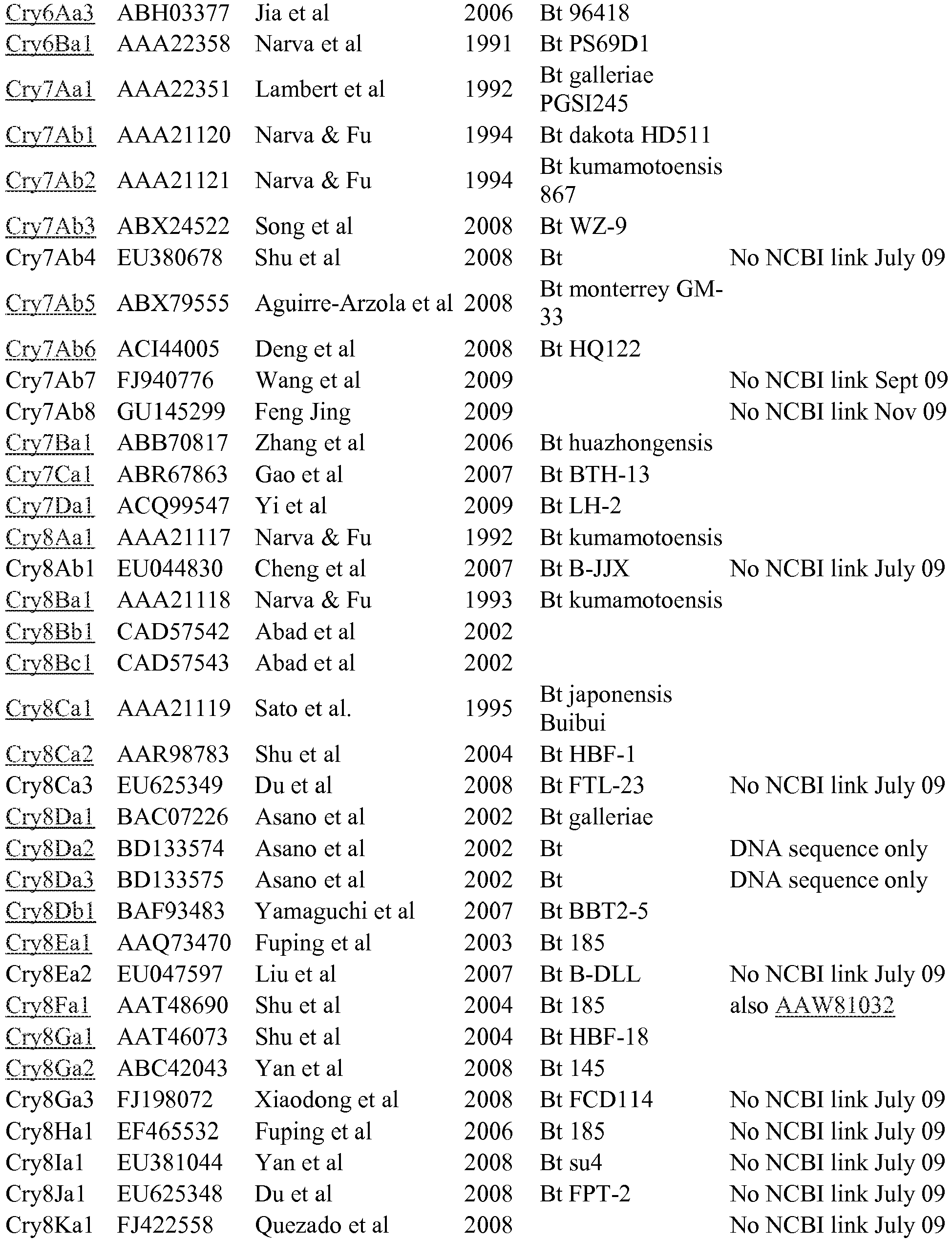
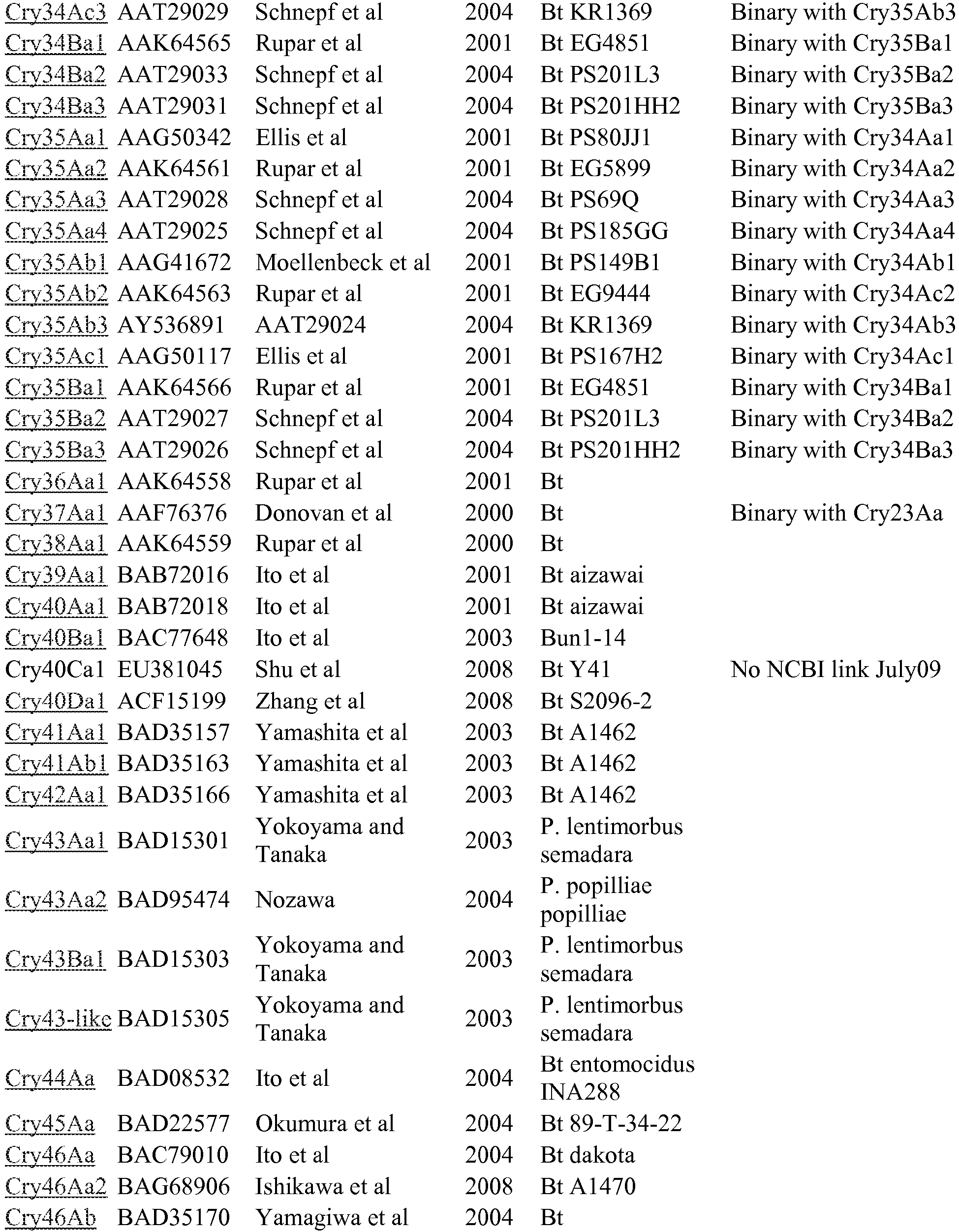
- These various toxins (and others) are listed in the attached Appendix A. Those GENBANK numbers can also be used to obtain the sequences for any of the genes and proteins disclosed or mentioned herein.
- Patents can also be used to obtain relevant sequences. For example,
U.S. Patent No. 5,188,960 andU.S. Patent No. 5,827,514 describe Cry1Fa core toxin containing proteins suitable for use in carrying out the present invention.U.S. Patent No. 6,218,188 describes plant-optimized DNA sequences encoding CrylFa core toxin-containing proteins that are suitable for use in the present invention.US 2010-00269223 - The subject invention also relates generally to the use of three insecticidal proteins (Cry proteins in some preferred embodiments) that do not compete with each other / do not result in cross-resistance yet are active against a single target pest.
- Plants (and acreage planted with such plants) that produce any of the the subject pairs, or three (or more), toxins are included within the scope of the subject invention. Additional toxins/genes can also be added, but these particular triple stacks would, according to the subject invention, advantageously and surprisingly provide three modes of action (non-cross-resistant activity) against FAW and/or ECB. This can help to reduce or eliminate the requirement for refuge acreage (e.g., less than 40%, less than 20%, less than 10%, less than 5%, or even 0% refuge). A field thus planted of over 10 acres is thus included within the subject invention.
- The subject polynucleotide(s) are preferably in a genetic construct under control of (operably linked to / comprising) a non-Bacillus-thuringiensis promoter. The subject polynucleotides can comprise plant codon usage for enhanced expression in a plant.
- To counter act the ability of insects to develop resistance to Cry1Fa, we identified Cry toxins that non-competitively (with Cry1Fa) bind to FAW and/or ECB gut cell preparations. Cry1Fa does not to displace binding of Cry proteins identified herein in the insect gut of FAW and ECB larvae - Cry proteins such as Cry2Aa. The ability of these Cry toxins to be toxic to FAW and/or ECB larvae, yet not fully interact with the same sites as Cry1Fa, shows that their toxicity will not be affected by insects having developed genetic alterations of their Cry1Fa receptor as a mechanism to become resistant to the toxicity of Cry1Fa.
- Thus insects having developed resistance to Cry1Fa through a reduction in the ability of its gut receptors to bind Cry1Fa would still be susceptible to the toxicity of Cry2Aa proteins, for example, which bind alternative sites. We have obtained biochemical data that supports this. Having combinations of these proteins expressed in transgenic plants thus provides a useful and valuable mechanism to reduce the probability for the development of insect resistance in the field and thus lead towards a reduction in the requirement for refugia. Other Cry proteins have been studied for their activity against other major insect pests, both sensitive, and those resistant to Cry1Fa (rFAW and rECB). As shown in Table 1, Cry1I and Cry2Aa are active against both resistant and susceptible ECB larvae. Cry1Ea is active against both resistant and susceptible FAW. Binding data for these Cry toxins against these insect pests can be obtained. In any case, the data herein described below shows the toxins interacting at separate target site(s) within the insect gut compared to Cry1Fa and thus would make excellent stacking partners.
- Stacking Cry1Fa expressing crops with one or more additional Cry genes, such as those described herein result in an effective management strategy to prevent the ability of insects to develop tolerance to the activity of transgenic plants expressing these protein toxins. Since we show that these Cry proteins interact at different and/or overlapping sites compared to Cry1Fa, if resistance were to occur through alterations in the affinity of the insect gut receptors that bind to the Cry toxins, the alteration would have to occur in at least two different receptors simultaneously to allow the insects to survive on plants expressing the multiple proteins. The probability of this occurring is extremely remote, thus increasing the durability of the transgenic product to ward of insects being able to develop tolerance to the proteins.
- We radio-iodinated trypsin truncated forms of the Cry protein toxins and used radioreceptor binding assay techniques to measure their binding interaction with putative receptor proteins located within the insect gut membranes. The gut membranes were prepared as brush border membrane vesicles (BBMV) by the method of Wolfersberger. Iodination of the toxins were conducted using either iodo beads or iodogen treated tubes from Pierce Chemicals. Specific activity of the radiolabeled toxin was approximately 1-4 µCi/µg protein. Binding studies were carried out essentially by the procedures of Liang.
- The data presented herein shows the toxins interacting at separate target site within the insect gut compared to Cry1Fa and thus would make excellent stacking partners.
- The subject invention can be used with a variety of plants. Examples include corn (maize), soybeans, and cotton.
- Genes and toxins useful according to the subject invention include not only the full length sequences disclosed but also fragments of these sequences, variants, mutants, and fusion proteins which retain the characteristic pesticidal activity of the toxins specifically exemplified herein. As used herein, the terms "variants" or "variations" of genes refer to nucleotide sequences which encode the same toxins or which encode equivalent toxins having pesticidal activity. As used herein, the term "equivalent toxins" refers to toxins having the same or essentially the same biological activity against the target pests as the claimed toxins.
- As used therein, the boundaries represent approximately 95% (e.g. Cry1Fa's), 78% (e.g. Cry1F's), and 45% (Cry1's) sequence identity, per "Revision of the Nomenclature for the Bacillus thuringiensis Pesticidal Crystal Proteins," N. Crickmore, D.R. Zeigler, J. Feitelson, E. Schnepf, J. Van Rie, D. Lereclus, J. Baum, and D.H. Dean. Microbiology and Molecular Biology Reviews (1998) Vol 62: 807-813. These cut offs can also be applied to the core proteins only (for Cry1F and Cry1Fa core proteins, for example). See related Crickmore et al. website at lifesci.sussex.ac.uk/home/Neil_Crickmore/Bt/.
- Fragments and equivalents which retain the pesticidal activity of the exemplified toxins would be within the scope of the subject invention. Also, because of the redundancy of the genetic code, a variety of different DNA sequences can encode the amino acid sequences disclosed herein. It is well within the skill of a person trained in the art to create these alternative DNA sequences encoding the same, or essentially the same, toxins. These variant DNA sequences are within the scope of the subject invention. As used herein, reference to "essentially the same" sequence refers to sequences which have amino acid substitutions, deletions, additions, or insertions which do not materially affect pesticidal activity. Fragments of genes encoding proteins that retain pesticidal activity are also included in this definition.
- A further method for identifying the genes encoding the toxins and gene portions useful according to the subject invention is through the use of oligonucleotide probes. These probes are detectable nucleotide sequences. These sequences may be detectable by virtue of an appropriate label or may be made inherently fluorescent as described in International Application No.
WO93/16094 - Certain proteins of the subject invention have been specifically exemplified herein. Since these proteins are merely exemplary of the proteins of the subject invention, it should be readily apparent that the subject invention comprises variant or equivalent proteins (and nucleotide sequences coding for equivalent proteins) having the same or similar pesticidal activity of the exemplified protein. Equivalent proteins will have amino acid homology with an exemplified protein. This amino acid homology will typically be greater than 75%, preferably be greater than 90%, and most preferably be greater than 95%. The amino acid homology will be highest in critical regions of the protein which account for biological activity or are involved in the determination of three-dimensional configuration which ultimately is responsible for the biological activity. In this regard, certain amino acid substitutions are acceptable and can be expected if these substitutions are in regions which are not critical to activity or are conservative amino acid substitutions which do not affect the three-dimensional configuration of the molecule. For example, amino acids may be placed in the following classes: non-polar, uncharged polar, basic, and acidic. Conservative substitutions whereby an amino acid of one class is replaced with another amino acid of the same type fall within the scope of the subject invention so long as the substitution does not materially alter the biological activity of the compound. Following is a listing of examples of amino acids belonging to each class. In some instances, non-conservative substitutions can also be made. The critical factor is that these substitutions must not significantly detract from the biological activity of the protein.
Class of Amino Acid Examples of Amino Acids Nonpolar Ala, Val, Leu, Ile, Pro, Met, Phe, Trp Uncharged Polar Gly, Ser, Thr, Cys, Tyr, Asn, Gln Acidic Asp, Glu Basic Lys, Arg, His - Insect Resistance Management (IRM) Strategies. Roush et al., for example, outlines two-toxin strategies, also called "pyramiding" or "stacking," for management of insecticidal transgenic crops. (The Royal Society. Phil. Trans. R. Soc. Lond. B. (1998) 353, 1777-1786).
- On their website, the United States Environmental Protection Agency (epa.gov/oppbppd1/biopesticides/pips/bt_corn_refuge_2006.htm) publishes the following requirements for providing non-transgenic (i.e., non-B.t.) refuges (a section of non-Bt crops / corn) for use with transgenic crops producing a single Bt protein active against target pests.
- "The specific structured requirements for corn borer-protected Bt (Cry1Ab
or Cry IF) corn products are as follows: - Structured refuges: 20% non-Lepidopteran Bt corn refuge in Corn Belt;
50% non-Lepidopteran Bt refuge in Cotton Belt - Blocks
- Internal (i.e., within the Bt field)
- External (i.e., separate fields within ½ mile (¼ mile if possible) of the Bt field to maximize random mating)
- In-field Strips
Strips must be at least 4 rows wide (preferably 6 rows) to reduce the effects of larval movement" - In addition, the National Corn Growers Association, on their website (ncga.com/insect-resistance-management-fact-sheet-bt-corn) also provides similar guidance regarding the refuge requirements. For example:
"Requirements of the Corn Borer IRM: - Plant at least 20% of your corn acres to refuge hybrids
- In cotton producing regions, refuge must be 50%
- Must be planted within 1/2 mile of the refuge hybrids
- Refuge can be planted as strips within the Bt field; the refuge strips must be at least 4 rows wide
- Refuge may be treated with conventional pesticides only if economic thresholds are reached for target insect
- Bt-based sprayable insecticides cannot be used on the refuge corn
- Appropriate refuge must be planted on every farm with Bt corn"
- As stated by Roush et al. (on pages 1780 and 1784 right column, for example), stacking or pyramiding of two different proteins each effective against the target pests and with little or no cross-resistance can allow for use of a smaller refuge. Roush suggests that for a successful stack, a refuge size of less than 10% refuge, can provide comparable resistance management to about 50% refuge for a single (non-pyramided) trait. For currently available pyramided Bt corn products, the U.S. Environmental Protection Agency requires significantly less (generally 5%) structured refuge of non-Bt corn be planted than for single trait products (generally 20%).
- There are various ways of providing the IRM effects of a refuge, including various geometric planting patterns in the fields (as mentioned above) and in-bag seed mixtures, as discussed further by Roush et al. (supra), and
U.S. Patent No. 6,551,962 . - The above percentages, or similar refuge ratios, can be used for the subject double or triple stacks or pyramids. For triple stacks with three sites of action against a single target pest, a goal would be zero refuge (or less than 5% refuge, for example). This is particularly true for commercial acreage - of over 10 acres for example.
- All patents, patent applications, provisional applications, and publications referred to or cited herein are incorporated by reference in their entirety to the extent they are not inconsistent with the explicit teachings of this specification.
- Unless specifically indicated or implied, the terms "a", "an", and "the" signify "at least one" as used herein.
- Following are examples that illustrate procedures for practicing the invention. These examples should not be construed as limiting. All percentages are by weight and all solvent mixture proportions are by volume unless otherwise noted. All temperatures are in degrees Celsius.
-
- Wolfersberger, M.G., (1993), Preparation and Partial Characterization of Amino Acid Transporting Brush Border Membrane Vesicles from the Larval Midgut of the Gypsy Moth (Lymantria Dispar). Arch. Insect Biochem. Physiol. 24: 139-147.
- Liang, Y., Patel, S.S., and Dean, D.H., (1995), Irreversible Binding Kinetics of Bacillus thuringiensis CrylA Delta-Endotoxins to Gypsy Moth Brush Border Membrane Vesicles is Directly Correlated to Toxicity. J. Biol. Chem., 270, 24719-24724.
- The subject Cry proteins were studied for their activity against other major insect pests, both sensitive, and those resistant to CrylFa (rFAW and rECB). As shown in Table 1, Cry1I and Cry2Aa are active against both resistant and susceptible ECB larvae. CrylEa is active against both resistant and susceptible FAW. (For a general discussion of this pest, see e.g. Tabashnik, PNAS (2008), vol. 105 no. 49, 19029-19030.)






- The invention also pertains to the following:
- 1. A transgenic plant comprising DNA encoding a Cry1Fa insecticidal protein and DNA encoding a second insecticidal protein selected from the group consisting of a Cry2Aa insecticidal protein and a Cry1I insecticidal protein.
- 2. A transgenic plant comprising DNA encoding a Cry1Fa insecticidal protein and DNA encoding a Cry1E insecticidal protein.
- 3. The transgenic plant of item 1 , said plant further comprising DNA encoding a third insecticidal protein, said third protein being selected from the group consisting of Cry1Be, Cry1Ab, and DIG-3.
- 4. The transgenic plant of item 3 , wherein said third protein is selected from the group consisting of Cry1Be, said plant further comprising DNA encoding fourth insecticidal protein selected from the group consisting of Cry1Ca, Cry1Da, and Vip3Ab.
- 5. The transgenic plant of item 2, said plant further comprising DNA encoding a third insecticidal protein, said third protein being selected from the group consisting of Cry1Be, Cry1Ca, Cry1Da, and Vip3Ab.
- 6. The transgenic plant of item 5 , wherein said third protein is selected from the group consisting of Cry1Be, said plant further comprising DNA encoding fourth insecticidal protein selected from the group consisting of Cry1Ab, Cry1I, Cry2A, and DIG-3.
- 7. Seed of a plant according to any of items 1-6, wherein said seed comprises said DNA.
- 8. A field of plants comprising non-Bt refuge plants and a plurality of plants according to any of items 1-6, wherein said refuge plants comprise less than 40% of all crop plants in said field.
- 9. The field of plants of item 8 , wherein said refuge plants comprise less than 30% of all the crop plants in said field.
- 10. The field of plants of item 8 , wherein said refuge plants comprise less than 20% of all the crop plants in said field.
- 11. The field of plants of item 8 , wherein said refuge plants comprise less than 10% of all the crop plants in said field.
- 12. The field of plants of item 8 , wherein said refuge plants comprise less than 5% of all the crop plants in said field.
- 13. The field of plants of item 8 , wherein said refuge plants are in blocks or strips.
- 14. A mixture of seeds comprising refuge seeds from non-Bt refuge plants, and a plurality of seeds of item 7 , wherein said refuge seeds comprise less than 40% of all the seeds in the mixture.
- 15. The mixture of seeds of item 14 , wherein said refuge seeds comprise less than 30% of all the seeds in the mixture.
- 16. The mixture of seeds of item 14 , wherein said refuge seeds comprise less than 20% of all the seeds in the mixture.
- 17. The mixture of seeds of item 14 , wherein said refuge seeds comprise less than 10% of all the seeds in the mixture.
- 18. The mixture of seeds of item 14, wherein said refuge seeds comprise less than 5% of all the seeds in the mixture.
- 19. A method of managing development of resistance to a Cry protein by an insect, said method comprising planting seeds to produce a field of plants of item 8 .
- 20. A field of any of item 8-13 , wherein said plants occupy more than 10 acres.
- 21. A plant of any of item 1-6, wherein said plant is selected from the group consisting of corn, soybeans, and cotton.
- 22. The plant of item 21 , wherein said plant is a maize plant.
- 23. A method of controlling a European cornborer insect by contacting said insect with a Cry1F insecticidal protein and a second insecticidal protein selected from the group consisting of a Cry2Aa insecticidal protein and a Cry1I insecticidal protein.
- 24. An isolated polynucleotide that encodes a Cry1F insecticidal protein in combination with a second insecticidal protein selected from the group consisting of a Cry2Aa insecticidal protein and a Cry1I insecticidal protein.
- 25. A method of making a Cry1F insecticidal protein in combination with a second insecticidal protein selected from the group consisting of a Cry2Aa insecticidal protein and a Cry1I insecticidal protein.
- 26. A method of controlling a fall armyworm insect by contacting said insect with a Cry1F insecticidal protein and a Cry1E insecticidal protein.
- 27. An isolated polynucleotide that encodes a Cry1F insecticidal protein in combination with a Cry1E insecticidal protein.
- 28. A method of making a Cry1F insecticidal protein in combination with a Cry1E insecticidal protein.
- 29. A plant cell of a plant of item 1 , wherein said Cry1Fa insecticidal protein is at least 99% identical with SEQ ID NO:1, said Cry2Aa insecticidal protein is at least 99% identical with SEQ ID NO:2, and said Cry1I insecticidal protein is at least 99% identical with SEQ ID NO:3.
- 30. A plant cell of a plant of item 2, wherein said Cry1Fa insecticidal protein is at least 99% identical with SEQ ID NO:1, and said Cry1E insecticidal protein is at least 99% identical with SEQ ID NO:4.


Claims (16)
- A transgenic plant comprising DNA encoding and expressing a Cry1Fa insecticidal protein and DNA encoding and expressing a Cry1Ea insecticidal protein.
- The transgenic plant of claim 1, further comprising DNA encoding and expressing a third insecticidal protein selected from the group consisting of Cry1Be, Cry1Ca, Cry1Da, and Vip3Ab
- The transgenic plant of claim 1, wherein the Cry1Fa insecticidal protein is at least 99% identical with SEQ ID NO:1, and wherein the Cry1Ea insecticidal protein is at least 99% identical with SEQ ID NO:4.
- A seed of the transgenic plant of claim 1, wherein the seed comprises the DNA encoding and expressing the Cry1Fa insecticidal protein, and the DNA encoding and expressing the Cry1Ea insecticidal protein.
- A mixture of seeds comprising a plurality of refuge seeds from non-Bt refuge plants, and a plurality of the seeds of the transgenic plant according to claim 4, wherein the seeds of the transgenic plant comprise the DNA encoding and expressing the Cry1Fa insecticidal protein and the DNA encoding and expressing the Cry1Ea insecticidal protein, and wherein the non-Bt refuge seeds comprise less than 40% of all seeds in the mixture.
- A field of plants comprising a plurality of the transgenic plants according to any one of claims 1-3.
- The field of plants of claim 6, further comprising a plurality of non-Bt refuge plants.
- The field of plants of claim 7, wherein the non-Bt refuge plants comprise less than 40% of all crop plants in the field.
- The field of plants of claim 7, wherein the non-Bt refuge plants comprise less than 30% of all crop plants in the field.
- The field of plants of claim 7, wherein the non-Bt refuge plants comprise less than 20% of all crop plants in the field.
- The field of plants of claim 7, wherein the non-Bt refuge plants comprise less than 10% of all crop plants in the field.
- The field of plants of claim 7, wherein the non-Bt refuge plants comprise less than 5% of all crop plants in the field.
- The field of plants of claim 7, wherein the non-Bt refuge plants are in blocks or strips.
- A method of controlling a fall armyworm insect by contacting the insect with a CrylFa insecticidal protein and a CrylEa insecticidal protein.
- An isolated polynucleotide of the transgenic plant of claim 1 that encodes the CrylFa insecticidal protein in combination with the CrylEa insecticidal protein.
- A plant cell of the transgenic plant of claim 1.
Applications Claiming Priority (3)
| Application Number | Priority Date | Filing Date | Title |
|---|---|---|---|
| US28427809P | 2009-12-16 | 2009-12-16 | |
| PCT/US2010/060812 WO2011075586A1 (en) | 2009-12-16 | 2010-12-16 | Insecticidal protein combinations for controlling fall armyworm and european corn borer, and methods for insect resistance managements |
| EP10838258.1A EP2512220B1 (en) | 2009-12-16 | 2010-12-16 | Insecticidal protein combinations for controlling fall armyworm and european corn borer, and methods for insect resistance managements |
Related Parent Applications (1)
| Application Number | Title | Priority Date | Filing Date |
|---|---|---|---|
| EP10838258.1A Division EP2512220B1 (en) | 2009-12-16 | 2010-12-16 | Insecticidal protein combinations for controlling fall armyworm and european corn borer, and methods for insect resistance managements |
Publications (1)
| Publication Number | Publication Date |
|---|---|
| EP3372689A1 true EP3372689A1 (en) | 2018-09-12 |
Family
ID=44167702
Family Applications (3)
| Application Number | Title | Priority Date | Filing Date |
|---|---|---|---|
| EP10838258.1A Active EP2512220B1 (en) | 2009-12-16 | 2010-12-16 | Insecticidal protein combinations for controlling fall armyworm and european corn borer, and methods for insect resistance managements |
| EP10838262.3A Active EP2512223B1 (en) | 2009-12-16 | 2010-12-16 | Insecticidal protein combination comprising cry1ab and cry2aa for controlling european corn borer, and methods for insect resistance management |
| EP18169060.3A Withdrawn EP3372689A1 (en) | 2009-12-16 | 2010-12-16 | Insecticidal protein combinations for controlling fall armyworm and european corn borer, and methods for insect resistance managements |
Family Applications Before (2)
| Application Number | Title | Priority Date | Filing Date |
|---|---|---|---|
| EP10838258.1A Active EP2512220B1 (en) | 2009-12-16 | 2010-12-16 | Insecticidal protein combinations for controlling fall armyworm and european corn borer, and methods for insect resistance managements |
| EP10838262.3A Active EP2512223B1 (en) | 2009-12-16 | 2010-12-16 | Insecticidal protein combination comprising cry1ab and cry2aa for controlling european corn borer, and methods for insect resistance management |
Country Status (19)
| Country | Link |
|---|---|
| US (2) | US20130007924A1 (en) |
| EP (3) | EP2512220B1 (en) |
| JP (2) | JP2013514776A (en) |
| KR (2) | KR101841299B1 (en) |
| CN (3) | CN102762095A (en) |
| AR (2) | AR079622A1 (en) |
| AU (2) | AU2010330919B2 (en) |
| BR (2) | BR112012014702A2 (en) |
| CA (2) | CA2782572A1 (en) |
| CL (3) | CL2012001633A1 (en) |
| CO (2) | CO6602145A2 (en) |
| IL (2) | IL220336A (en) |
| MX (2) | MX348991B (en) |
| NZ (4) | NZ630801A (en) |
| PH (2) | PH12012501427A1 (en) |
| RU (2) | RU2569460C2 (en) |
| UA (2) | UA116433C2 (en) |
| WO (2) | WO2011075586A1 (en) |
| ZA (2) | ZA201204920B (en) |
Families Citing this family (79)
| Publication number | Priority date | Publication date | Assignee | Title |
|---|---|---|---|---|
| BR112013015261A2 (en) * | 2010-12-16 | 2017-03-21 | Dow Agrosciences Llc | combined use of vip3ab and cry1ab for resistant insect management |
| EP2721153B1 (en) | 2011-06-16 | 2019-08-28 | The Regents of The University of California | Synthetic gene clusters |
| BR102012019434B1 (en) * | 2011-07-26 | 2021-11-09 | Dow Agrosciences Llc | PEST, INSECT, MOLECULE AND DIAGNOSTIC DNA SEQUENCE CONTROL METHODS FOR THE SOYBEAN EVENT 9582.814.19.1 |
| WO2013022743A1 (en) * | 2011-08-05 | 2013-02-14 | Dow Agrosciences Llc | Use of dig3 insecticidal crystal protein in combination with cry1ab |
| US10119149B2 (en) | 2011-08-05 | 2018-11-06 | Dow Agrosciences Llc | Use of DIG3 insecticidal crystal protein in combination with cry1Ab for management of resistance in european cornborer |
| AR092905A1 (en) * | 2012-10-05 | 2015-05-06 | Dow Agrosciences Llc | USE OF CRY1EA IN COMBINATIONS FOR THE CONTROL OF THE WORM RESISTANT INSECT OF THE AUTUMN ARMY |
| WO2014071182A1 (en) | 2012-11-01 | 2014-05-08 | Massachusetts Institute Of Technology | Directed evolution of synthetic gene cluster |
| CN102972428B (en) * | 2012-12-11 | 2014-07-09 | 北京大北农科技集团股份有限公司 | Method for controlling pests |
| CA2901316A1 (en) | 2013-03-15 | 2014-09-25 | Pioneer Hi-Bred International, Inc. | Phi-4 polypeptides and methods for their use |
| MX359026B (en) | 2013-08-16 | 2018-09-12 | Pioneer Hi Bred Int | Insecticidal proteins and methods for their use. |
| US10667524B2 (en) | 2013-09-13 | 2020-06-02 | Pioneer Hi-Bred International, Inc. | Insecticidal proteins and methods for their use |
| CN103688974B (en) * | 2013-11-11 | 2015-07-15 | 北京大北农科技集团股份有限公司 | Methods of Controlling Pests |
| CN103757049B (en) * | 2013-12-24 | 2016-06-08 | 北京大北农科技集团股份有限公司 | Control structure body and the method thereof of insect |
| CN103725704B (en) * | 2014-01-17 | 2015-11-18 | 北京大北农科技集团股份有限公司 | The construct of Control pests and method thereof |
| WO2015120270A1 (en) | 2014-02-07 | 2015-08-13 | Pioneer Hi Bred International, Inc. | Insecticidal proteins and methods for their use |
| UA120608C2 (en) | 2014-02-07 | 2020-01-10 | Піонір Хай-Бред Інтернешнл, Інк. | PURIFIED PTIP-83 POLYPEPTIDE AND METHOD OF APPLICATION |
| WO2016000237A1 (en) | 2014-07-03 | 2016-01-07 | Pioneer Overseas Corporation | Plants having enhanced tolerance to insect pests and related constructs and methods involving insect tolerance genes |
| CN107108705B (en) | 2014-10-16 | 2021-05-25 | 先锋国际良种公司 | Insecticidal protein and method of use |
| EP3244727B1 (en) | 2015-01-15 | 2025-10-22 | Pioneer Hi-Bred International, Inc. | Insecticidal proteins and methods for their use |
| CA2977026A1 (en) | 2015-03-11 | 2016-09-15 | E.I. Du Pont De Nemours And Company | Insecticidal combinations of pip-72 and methods of use |
| RU2017144238A (en) | 2015-05-19 | 2019-06-19 | Пайонир Хай-Бред Интернэшнл, Инк. | INSECTICIDAL PROTEINS AND METHODS OF THEIR APPLICATION |
| WO2016205445A1 (en) | 2015-06-16 | 2016-12-22 | Pioneer Hi-Bred International, Inc. | Compositions and methods to control insect pests |
| RU2742467C2 (en) | 2015-06-22 | 2021-02-08 | Агбайоми, Инк. | Pesticidal genes and methods of use |
| AR104833A1 (en) * | 2015-07-01 | 2017-08-16 | Syngenta Participations Ag | COMPOSITIONS AND METHODS TO CONTROL PLANT PESTS |
| AR105155A1 (en) * | 2015-07-07 | 2017-09-13 | Syngenta Participations Ag | COMPOSITIONS AND METHODS TO CONTROL PLANT PESTS |
| KR102197507B1 (en) | 2015-07-13 | 2020-12-31 | 피벗 바이오, 인크. | Methods and compositions for improving plant traits |
| UA126894C2 (en) | 2015-08-03 | 2023-02-22 | Монсанто Текнолоджі Ллс | METHOD AND COMPOSITION FOR PLANT RESISTANCE TO HERBICIDES |
| CN109475096B (en) | 2015-08-06 | 2022-08-23 | 先锋国际良种公司 | Plant-derived insecticidal proteins and methods of use thereof |
| DK3341483T3 (en) | 2015-08-28 | 2020-03-16 | Pioneer Hi Bred Int | OCHROBACTRUM-MEDIATED TRANSFORMATION OF PLANTS |
| WO2017062412A1 (en) | 2015-10-05 | 2017-04-13 | Massachusetts Institute Of Technology | Nitrogen fixation using refactored nif clusters |
| CN108575091A (en) | 2015-12-18 | 2018-09-25 | 先锋国际良种公司 | Insecticidal proteins and methods of use thereof |
| CA3012362A1 (en) | 2016-04-14 | 2017-10-19 | Pioneer Hi-Bred International, Inc. | Insecticidal polypeptides having improved activity spectrum and uses thereof |
| AR108284A1 (en) | 2016-04-19 | 2018-08-08 | Pioneer Hi Bred Int | INSECTICIDE COMBINATIONS OF POLYPEPTIDES THAT HAVE ENHANCED SPECTRUM OF ACTIVITY AND USES OF THESE |
| CN109152347A (en) * | 2016-04-19 | 2019-01-04 | 美国陶氏益农公司 | For managing the combination of four kinds of VIP and CRY proteotoxins of the insect pest in plant |
| EA201892293A1 (en) | 2016-05-04 | 2019-04-30 | Пайонир Хай-Бред Интернэшнл, Инк. | INSECTICIDAL PROTEINS AND METHODS OF THEIR APPLICATION |
| BR112018076047A2 (en) | 2016-06-16 | 2019-03-26 | Pioneer Hi Bred Int | silencing element, dna construct, expression cassette, host cell, composition, plant cell, plant or plant part, transgenic seed, method for controlling a plant insect pest and kit |
| RU2019101793A (en) | 2016-06-24 | 2020-07-24 | Пайонир Хай-Бред Интернэшнл, Инк. | PLANT REGULATORY ELEMENTS AND METHODS OF THEIR APPLICATION |
| CA3026113A1 (en) | 2016-07-01 | 2018-01-04 | Pioneer Hi-Bred International, Inc. | Insecticidal proteins from plants and methods for their use |
| WO2018013333A1 (en) | 2016-07-12 | 2018-01-18 | Pioneer Hi-Bred International, Inc. | Compositions and methods to control insect pests |
| KR102587506B1 (en) | 2016-07-29 | 2023-10-11 | 몬산토 테크놀로지 엘엘씨 | Methods and compositions for gene expression in plants |
| EP3535285B1 (en) | 2016-11-01 | 2022-04-06 | Pioneer Hi-Bred International, Inc. | Insecticidal proteins and methods for their use |
| CN106749566B (en) * | 2016-11-21 | 2020-05-05 | 北京大北农科技集团股份有限公司 | Insecticidal protein combinations and methods of managing insect resistance |
| CA3044404A1 (en) | 2016-12-14 | 2018-06-21 | Pioneer Hi-Bred International, Inc. | Insecticidal proteins and methods for their use |
| EP3558004A1 (en) | 2016-12-22 | 2019-10-30 | Pioneer Hi-Bred International, Inc. | Insecticidal proteins and methods for their use |
| UA129256C2 (en) | 2017-01-12 | 2025-03-05 | Півот Байо, Інк. | Methods and compositions for improving plant traits |
| CN110267976B (en) | 2017-01-12 | 2024-01-26 | 孟山都技术公司 | Insecticidal toxin protein active against lepidopteran insects |
| UA125632C2 (en) * | 2017-01-12 | 2022-05-04 | Сінгента Партісіпейшнс Аг | Insecticidal protein |
| WO2018140214A1 (en) | 2017-01-24 | 2018-08-02 | Pioneer Hi-Bred International, Inc. | Nematicidal protein from pseudomonas |
| WO2018148001A1 (en) | 2017-02-08 | 2018-08-16 | Pioneer Hi-Bred International Inc | Insecticidal combinations of plant derived insecticidal proteins and methods for their use |
| CN110621780B (en) | 2017-05-11 | 2024-03-19 | 先锋国际良种公司 | Insecticidal proteins and methods of use |
| WO2018217333A1 (en) | 2017-05-26 | 2018-11-29 | Pioneer Hi-Bred International, Inc. | Insecticidal polypeptides having improved activity spectrum and uses thereof |
| CN107474120B (en) * | 2017-08-16 | 2020-08-18 | 中国农业大学 | Artificially synthesized Bt insecticidal gene mcry1F for transgenic insect-resistant plants |
| US20200165626A1 (en) | 2017-10-13 | 2020-05-28 | Pioneer Hi-Bred International, Inc. | Virus-induced gene silencing technology for insect control in maize |
| US12151988B2 (en) | 2017-10-25 | 2024-11-26 | Pivot Bio, Inc. | Gene targets for nitrogen fixation targeting for improving plant traits |
| JP7420712B2 (en) | 2017-10-25 | 2024-01-23 | ピボット バイオ, インコーポレイテッド | Methods and compositions for improving engineered microorganisms that fix nitrogen |
| EP3755797A1 (en) | 2018-02-22 | 2020-12-30 | Zymergen, Inc. | Method for creating a genomic library enriched for bacillus and identification of novel cry toxins |
| EP3759489A1 (en) | 2018-03-02 | 2021-01-06 | Pioneer Hi-Bred International, Inc. | Plant health assay |
| EP3759122A1 (en) | 2018-03-02 | 2021-01-06 | Zymergen Inc. | Insecticidal protein discovery platform and insecticidal proteins discovered therefrom |
| EP3764798B1 (en) | 2018-03-14 | 2025-12-17 | Pioneer Hi-Bred International, Inc. | Insecticidal proteins from plants and methods for their use |
| EP3764796B1 (en) | 2018-03-14 | 2025-12-03 | Pioneer Hi-Bred International, Inc. | Insecticidal proteins from plants and methods for their use |
| CA3096516A1 (en) | 2018-05-22 | 2019-11-28 | Pioneer Hi-Bred International, Inc. | Plant regulatory elements and methods of use thereof |
| EP3813511A4 (en) | 2018-06-27 | 2022-08-03 | Pivot Bio, Inc. | GUIDED MICROBIAL REMODELING, PLATFORM FOR THE RATIONAL IMPROVEMENT OF MICROBIAL SPECIES FOR AGRICULTURE |
| EP3814302A4 (en) | 2018-06-27 | 2022-06-29 | Pivot Bio, Inc. | Agricultural compositions comprising remodeled nitrogen fixing microbes |
| US12391624B2 (en) | 2018-07-11 | 2025-08-19 | Pivot Bio, Inc. | Temporally and spatially targeted dynamic nitrogen delivery by remodeled microbes |
| EP3844283A1 (en) | 2018-08-29 | 2021-07-07 | Pioneer Hi-Bred International, Inc. | Insecticidal proteins and methods for their use |
| WO2020190363A1 (en) | 2019-03-19 | 2020-09-24 | Massachusetts Institute Of Technology | Control of nitrogen fixation in rhizobia that associate with cereals |
| CN114008221A (en) | 2019-04-25 | 2022-02-01 | 皮沃特生物股份有限公司 | High throughput method for isolating and characterizing pools of ammonium secreting mutants generated by chemical mutagenesis |
| WO2021076346A1 (en) | 2019-10-18 | 2021-04-22 | Pioneer Hi-Bred International, Inc. | Maize event dp-202216-6 and dp-023211-2 stack |
| WO2021221690A1 (en) | 2020-05-01 | 2021-11-04 | Pivot Bio, Inc. | Modified bacterial strains for improved fixation of nitrogen |
| US11580389B2 (en) | 2020-01-14 | 2023-02-14 | International Business Machines Corporation | System and method for predicting fall armyworm using weather and spatial dynamics |
| CN115426875A (en) | 2020-04-24 | 2022-12-02 | 孟山都技术公司 | Transgenic corn event MON95275 and methods of detection and use thereof |
| CA3172322A1 (en) | 2020-05-01 | 2021-11-04 | Karsten TEMME | Modified bacterial strains for improved fixation of nitrogen |
| AU2020445067A1 (en) | 2020-05-01 | 2022-12-01 | Pivot Bio, Inc. | Measurement of nitrogen fixation and incorporation |
| CA3186978A1 (en) | 2020-07-14 | 2022-01-20 | Pioneer Hi-Bred International, Inc. | Insecticidal proteins and methods for their use |
| EP4192848A1 (en) | 2020-08-10 | 2023-06-14 | Pioneer Hi-Bred International, Inc. | Plant regulatory elements and methods of use thereof |
| AU2022301301A1 (en) | 2021-07-02 | 2023-12-14 | Pivot Bio, Inc. | Genetically-engineered bacterial strains for improved fixation of nitrogen |
| CN114128728B (en) * | 2021-12-17 | 2023-03-21 | 湖北省农业科学院植保土肥研究所 | Biological activity of dehydrocostuslactone on spodoptera frugiperda and application of dehydrocostuslactone in agricultural control |
| EP4479541A1 (en) * | 2022-02-15 | 2024-12-25 | Futuragene Israel Ltd. | A bacillus thuringiensis pesticidal protein (bt pp) combination useful for plant protection |
| WO2024140065A1 (en) * | 2022-12-29 | 2024-07-04 | 青岛清原化合物有限公司 | Cry51aa1 protein and use thereof in controlling pests |
Citations (8)
| Publication number | Priority date | Publication date | Assignee | Title |
|---|---|---|---|---|
| US5188960A (en) | 1989-06-27 | 1993-02-23 | Mycogen Corporation | Bacillus thuringiensis isolate active against lepidopteran pests, and genes encoding novel lepidopteran-active toxins |
| WO1993016094A2 (en) | 1992-02-12 | 1993-08-19 | Chromagen, Inc. | Applications of fluorescent n-nucleosides and fluorescent structural analogs of n-nucleosides |
| US5827514A (en) | 1994-12-06 | 1998-10-27 | Mycogen Corporation | Pesticidal compositions |
| US6218188B1 (en) | 1997-11-12 | 2001-04-17 | Mycogen Corporation | Plant-optimized genes encoding pesticidal toxins |
| US6551962B1 (en) | 2000-10-06 | 2003-04-22 | Monsanto Technology Llc | Method for deploying a transgenic refuge |
| WO2003082910A1 (en) * | 2002-03-27 | 2003-10-09 | Council Of Scientific And Industrial Research | Chimeric delta endotoxin protein of cry1ea and cry1ca |
| WO2009132850A1 (en) * | 2008-05-01 | 2009-11-05 | Bayer Bioscience N.V. | Armyworm insect resistance management in transgenic plants |
| US20100269223A1 (en) | 2009-04-17 | 2010-10-21 | Dow Agrosciences Llc | Dig-3 insecticidal cry toxins |
Family Cites Families (27)
| Publication number | Priority date | Publication date | Assignee | Title |
|---|---|---|---|---|
| US5338544A (en) * | 1987-04-16 | 1994-08-16 | Ecogen Inc. | CryIIB protein, insecticidal compositions and methods of use thereof |
| US5045469A (en) * | 1988-10-27 | 1991-09-03 | Mycogen Corporation | Novel bacillus thuringiensis isolate denoted B. T. PS81F, active against lepidopteran pests, and a gene encoding a lepidopteran-active toxin |
| US6329574B1 (en) * | 1990-01-22 | 2001-12-11 | Dekalb Genetics Corporation | High lysine fertile transgenic corn plants |
| US5273746A (en) * | 1992-01-29 | 1993-12-28 | Mycogen Corporation | Bacillus thuringiensis isolates active against phthiraptera pests |
| GB9318207D0 (en) * | 1993-09-02 | 1993-10-20 | Sandoz Ltd | Improvements in or relating to organic compounds |
| US5527883A (en) * | 1994-05-06 | 1996-06-18 | Mycogen Corporation | Delta-endotoxin expression in pseudomonas fluorescens |
| EP0942985B1 (en) * | 1996-11-20 | 2004-09-15 | Monsanto Technology LLC | Broad-spectrum delta-endotoxins |
| IL139093A0 (en) * | 1998-05-01 | 2001-11-25 | Maxygen Inc | Optimization of pest resistance genes using dna shuffling |
| US6489542B1 (en) * | 1998-11-04 | 2002-12-03 | Monsanto Technology Llc | Methods for transforming plants to express Cry2Ab δ-endotoxins targeted to the plastids |
| AR024430A1 (en) * | 1999-06-29 | 2002-10-02 | Syngenta Ltd | INSECTICIDED PROTEINS AND SYNERGIC COMBINATIONS OF THE SAME |
| CA2384967A1 (en) * | 1999-09-15 | 2001-03-22 | Monsanto Technology Llc | Lepidopteran-active bacillus thuringiensis .delta.-endotoxin compositions and methods of use |
| US6750379B2 (en) * | 2000-03-09 | 2004-06-15 | Dekalb Genetics Corporation | Homologous recombination-mediated transgene alterations in plants |
| MXPA03006130A (en) * | 2001-01-09 | 2005-02-14 | Bayer Bioscience Nv | Novel bacillus thuringiensis insecticidal proteins. |
| WO2004074462A2 (en) * | 2003-02-20 | 2004-09-02 | Athenix Corporation | Delta-endotoxin genes and methods for their use |
| US7351881B2 (en) * | 2003-02-20 | 2008-04-01 | Athenix Corporation | AXMI-008, a delta-endotoxin gene and methods for its use |
| US7355099B2 (en) * | 2003-02-20 | 2008-04-08 | Athenix Corporation | AXMI-004, a delta-endotoxin gene and methods for its use |
| US7253343B2 (en) * | 2003-08-28 | 2007-08-07 | Athenix Corporation | AXMI-003, a delta-endotoxin gene and methods for its use |
| AR048747A1 (en) * | 2004-03-05 | 2006-05-24 | Agrigenetics Inc | COMBINATIONS OF CRY1AB AND CRY1FA AS A TOOL FOR CONTROL OF INSECT RESISTANCE |
| ES2531980T3 (en) * | 2004-03-26 | 2015-03-23 | Dow Agrosciences Llc | Cry1F and Cry1Ac transgenic cotton lines and their specific event identification |
| US20080226753A1 (en) * | 2004-03-29 | 2008-09-18 | Pioneer Hi-Bred International, Inc. | Method of Reducing Insect Resistant Pests in Transgenic Crops |
| WO2008085729A2 (en) * | 2006-12-22 | 2008-07-17 | Pioneer Hi-Bred International, Inc. | Resistance management strategies for transgenic crops |
| WO2008130985A2 (en) * | 2007-04-16 | 2008-10-30 | Monsanto Technology, Llc | Plants with multiple transgenes on a chromosome |
| WO2008145406A1 (en) * | 2007-06-01 | 2008-12-04 | Bayer Bioscience N.V. | Novel genes encoding insecticidal proteins |
| US20090313717A1 (en) * | 2008-06-16 | 2009-12-17 | Carmen Sara Hernandez | Bollworm insect resistance management in transgenic plants |
| WO2009149787A1 (en) * | 2008-06-13 | 2009-12-17 | Bayer Bioscience N.V. | Bollworm insect resistance management in transgenic plants |
| US20110088129A1 (en) * | 2008-06-13 | 2011-04-14 | Carmen Sara Hernandez | Bollworm Insect Resistance Management in Transgenic Plants |
| WO2011050271A1 (en) * | 2009-10-23 | 2011-04-28 | Monsanto Technology Llc | Methods and compositions for expression of transgenes in plants |
-
2010
- 2010-12-16 UA UAA201208656A patent/UA116433C2/en unknown
- 2010-12-16 CN CN2010800640084A patent/CN102762095A/en active Pending
- 2010-12-16 WO PCT/US2010/060812 patent/WO2011075586A1/en not_active Ceased
- 2010-12-16 NZ NZ630801A patent/NZ630801A/en not_active IP Right Cessation
- 2010-12-16 US US13/516,673 patent/US20130007924A1/en not_active Abandoned
- 2010-12-16 AR ARP100104682A patent/AR079622A1/en unknown
- 2010-12-16 CA CA2782572A patent/CA2782572A1/en not_active Abandoned
- 2010-12-16 PH PH1/2012/501427A patent/PH12012501427A1/en unknown
- 2010-12-16 CA CA2782627A patent/CA2782627A1/en not_active Abandoned
- 2010-12-16 NZ NZ601105A patent/NZ601105A/en not_active IP Right Cessation
- 2010-12-16 KR KR1020127018425A patent/KR101841299B1/en not_active Expired - Fee Related
- 2010-12-16 JP JP2012544847A patent/JP2013514776A/en active Pending
- 2010-12-16 KR KR1020127018423A patent/KR20120115316A/en not_active Ceased
- 2010-12-16 RU RU2012129899/10A patent/RU2569460C2/en not_active IP Right Cessation
- 2010-12-16 AR ARP100104681A patent/AR079621A1/en unknown
- 2010-12-16 AU AU2010330919A patent/AU2010330919B2/en not_active Ceased
- 2010-12-16 NZ NZ601098A patent/NZ601098A/en not_active IP Right Cessation
- 2010-12-16 EP EP10838258.1A patent/EP2512220B1/en active Active
- 2010-12-16 NZ NZ630817A patent/NZ630817A/en not_active IP Right Cessation
- 2010-12-16 JP JP2012544837A patent/JP5907891B2/en not_active Expired - Fee Related
- 2010-12-16 MX MX2012007133A patent/MX348991B/en active IP Right Grant
- 2010-12-16 MX MX2012007130A patent/MX348249B/en active IP Right Grant
- 2010-12-16 AU AU2010330915A patent/AU2010330915B2/en not_active Ceased
- 2010-12-16 US US13/516,638 patent/US20120324605A1/en not_active Abandoned
- 2010-12-16 EP EP10838262.3A patent/EP2512223B1/en active Active
- 2010-12-16 EP EP18169060.3A patent/EP3372689A1/en not_active Withdrawn
- 2010-12-16 BR BRBR112012014702-1A patent/BR112012014702A2/en not_active IP Right Cessation
- 2010-12-16 UA UAA201208659A patent/UA111814C2/en unknown
- 2010-12-16 CN CN201710607190.7A patent/CN107177627A/en active Pending
- 2010-12-16 CN CN201080063822.4A patent/CN102753012B/en not_active Expired - Fee Related
- 2010-12-16 RU RU2012130017/10A patent/RU2577141C2/en not_active IP Right Cessation
- 2010-12-16 WO PCT/US2010/060831 patent/WO2011075590A1/en not_active Ceased
- 2010-12-16 PH PH1/2012/501425A patent/PH12012501425A1/en unknown
- 2010-12-16 BR BRBR112012014700-5A patent/BR112012014700A2/en not_active Application Discontinuation
-
2012
- 2012-06-12 IL IL220336A patent/IL220336A/en not_active IP Right Cessation
- 2012-06-12 IL IL220339A patent/IL220339A/en not_active IP Right Cessation
- 2012-06-15 CL CL2012001633A patent/CL2012001633A1/en unknown
- 2012-06-15 CL CL2012001634A patent/CL2012001634A1/en unknown
- 2012-07-02 ZA ZA2012/04920A patent/ZA201204920B/en unknown
- 2012-07-02 ZA ZA2012/04923A patent/ZA201204923B/en unknown
- 2012-07-16 CO CO12119362A patent/CO6602145A2/en unknown
- 2012-07-16 CO CO12119387A patent/CO6561808A2/en not_active Application Discontinuation
-
2014
- 2014-12-12 CL CL2014003381A patent/CL2014003381A1/en unknown
Patent Citations (8)
| Publication number | Priority date | Publication date | Assignee | Title |
|---|---|---|---|---|
| US5188960A (en) | 1989-06-27 | 1993-02-23 | Mycogen Corporation | Bacillus thuringiensis isolate active against lepidopteran pests, and genes encoding novel lepidopteran-active toxins |
| WO1993016094A2 (en) | 1992-02-12 | 1993-08-19 | Chromagen, Inc. | Applications of fluorescent n-nucleosides and fluorescent structural analogs of n-nucleosides |
| US5827514A (en) | 1994-12-06 | 1998-10-27 | Mycogen Corporation | Pesticidal compositions |
| US6218188B1 (en) | 1997-11-12 | 2001-04-17 | Mycogen Corporation | Plant-optimized genes encoding pesticidal toxins |
| US6551962B1 (en) | 2000-10-06 | 2003-04-22 | Monsanto Technology Llc | Method for deploying a transgenic refuge |
| WO2003082910A1 (en) * | 2002-03-27 | 2003-10-09 | Council Of Scientific And Industrial Research | Chimeric delta endotoxin protein of cry1ea and cry1ca |
| WO2009132850A1 (en) * | 2008-05-01 | 2009-11-05 | Bayer Bioscience N.V. | Armyworm insect resistance management in transgenic plants |
| US20100269223A1 (en) | 2009-04-17 | 2010-10-21 | Dow Agrosciences Llc | Dig-3 insecticidal cry toxins |
Non-Patent Citations (8)
| Title |
|---|
| "The Royal Society", PHIL. TRANS. R. SOC. LOND. B., vol. 353, 1998, pages 1777 - 1786 |
| BRAVO A ET AL: "How to cope with insect resistance to Bt toxins?", TRENDS IN BIOTECHNOLOGY, ELSEVIER PUBLICATIONS, CAMBRIDGE, GB, vol. 26, no. 10, 2 October 2008 (2008-10-02), pages 573 - 579, XP025406825, ISSN: 0167-7799, [retrieved on 20080814], DOI: 10.1016/J.TIBTECH.2008.06.005 * |
| GATEHOUSE JOHN A: "Biotechnological prospects for engineering insect-resistant plants", PLANT PHYSIOLOGY, AMERICAN SOCIETY OF PLANT PHYSIOLOGISTS, ROCKVILLE, MD, USA, vol. 146, no. 3, 1 March 2008 (2008-03-01), pages 881 - 887, XP002532323, ISSN: 0032-0889, DOI: 10.1104/PP.107.111096 * |
| KELLER, G. H.; M. M. MANAK: "DNA Probes", 1987, STOCKTON PRESS, pages: 169 - 170 |
| LIANG, Y.; PATEL, S.S.; DEAN, D.H.: "Irreversible Binding Kinetics of Bacillus thuringiensis CrylA Delta-Endotoxins to Gypsy Moth Brush Border Membrane Vesicles is Directly Correlated to Toxicity", J. BIOL. CHEM., vol. 270, 1995, pages 24719 - 24724 |
| N. CRICKMORE; D.R. ZEIGLER; J. FEITELSON; E. SCHNEPF; J. VAN RIE; D. LERECLUS; J. BAUM; D.H. DEAN: "Revision of the Nomenclature for the Bacillus thuringiensis Pesticidal Crystal Proteins", MICROBIOLOGY AND MOLECULAR BIOLOGY REVIEWS, vol. 62, 1998, pages 807 - 813 |
| TABASHNIK, PNAS, vol. 105, no. 49, 2008, pages 19029 - 19030 |
| WOLFERSBERGER, M.G.: "Preparation and Partial Characterization of Amino Acid Transporting Brush Border Membrane Vesicles from the Larval Midgut of the Gypsy Moth (Lymantria Dispar", ARCH. INSECT BIOCHEM. PHYSIOL., vol. 24, 1993, pages 139 - 147 |
Also Published As
Similar Documents
| Publication | Publication Date | Title |
|---|---|---|
| CN102753012B (en) | Combinations of insecticidal proteins for the control of Fall Armyworm and European corn borer and methods for insect resistance management | |
| RU2603257C2 (en) | COMBINED APPLICATION OF PROTEINS Cry1Da AND Cry1Fa TO GENERATE INSECT RESISTANCE | |
| RU2593961C2 (en) | COMBINED APPLICATION OF PROTEINS CRY1Ca AND CRY1Fa TO CONTROL RESISTANCE OF INSECTS | |
| JP5908407B2 (en) | Insect resistance management using a combination of Cry1Be and Cry1F proteins | |
| JP5908408B2 (en) | Combination of Vip3Ab and Cry1Fa for resistant insects | |
| RU2590592C2 (en) | USE OF Cry1Da COMBINED WITH Cry1Be FOR CONTROLLING INSECT RESISTANCE | |
| RU2596406C2 (en) | COMBINED USE OF CRY1Ca AND CRY1Ab PROTEINS TO CONTROL INSECT RESISTANCE | |
| RU2608500C2 (en) | COMBINED USE OF Vip3Ab AND Cry1Ab FOR MANAGEMENT OF RESISTANT INSECTS | |
| CN112626087B (en) | New insect inhibitory protein | |
| RU2569108C2 (en) | APPLICATION OF Cry1Da IN COMBINATION WITH Cry1Ca FOR CONTROL OF RESISTANT INSECTS | |
| CN102066566A (en) | Bollworm insect resistance management in transgenic plants | |
| US20170298381A1 (en) | Combination of four vip and cry protein toxins for management of insect pests in plants | |
| AU2010339915B2 (en) | Combined use of Cry1Fa and Cry1Ab proteins for control of cry-resistant sugarcane borer and for insect resistance management in sugarcane | |
| RU2575084C2 (en) | APPLICATION OF Vip3Ab IN COMBINATION WITH Cry1Ca TO CONTROL RESISTANT INSECTS |
Legal Events
| Date | Code | Title | Description |
|---|---|---|---|
| PUAI | Public reference made under article 153(3) epc to a published international application that has entered the european phase |
Free format text: ORIGINAL CODE: 0009012 |
|
| STAA | Information on the status of an ep patent application or granted ep patent |
Free format text: STATUS: THE APPLICATION HAS BEEN PUBLISHED |
|
| AC | Divisional application: reference to earlier application |
Ref document number: 2512220 Country of ref document: EP Kind code of ref document: P |
|
| AK | Designated contracting states |
Kind code of ref document: A1 Designated state(s): AL AT BE BG CH CY CZ DE DK EE ES FI FR GB GR HR HU IE IS IT LI LT LU LV MC MK MT NL NO PL PT RO RS SE SI SK SM TR |
|
| AX | Request for extension of the european patent |
Extension state: ME |
|
| RIN1 | Information on inventor provided before grant (corrected) |
Inventor name: MEADE, THOMAS Inventor name: BURTON, STEPHANIE L. Inventor name: NARVA, KENNETH E. Inventor name: SHEETS, JOEL J. Inventor name: STORER, NICHOLAS P. |
|
| STAA | Information on the status of an ep patent application or granted ep patent |
Free format text: STATUS: REQUEST FOR EXAMINATION WAS MADE |
|
| 17P | Request for examination filed |
Effective date: 20190312 |
|
| RBV | Designated contracting states (corrected) |
Designated state(s): AL AT BE BG CH CY CZ DE DK EE ES FI FR GB GR HR HU IE IS IT LI LT LU LV MC MK MT NL NO PL PT RO RS SE SI SK SM TR |
|
| GRAJ | Information related to disapproval of communication of intention to grant by the applicant or resumption of examination proceedings by the epo deleted |
Free format text: ORIGINAL CODE: EPIDOSDIGR1 |
|
| STAA | Information on the status of an ep patent application or granted ep patent |
Free format text: STATUS: GRANT OF PATENT IS INTENDED |
|
| GRAP | Despatch of communication of intention to grant a patent |
Free format text: ORIGINAL CODE: EPIDOSNIGR1 |
|
| INTG | Intention to grant announced |
Effective date: 20191217 |
|
| STAA | Information on the status of an ep patent application or granted ep patent |
Free format text: STATUS: THE APPLICATION IS DEEMED TO BE WITHDRAWN |
|
| 18D | Application deemed to be withdrawn |
Effective date: 20200603 |