EP3370661B1 - Ophthalmic relaxing incisions and associated devices and systems - Google Patents
Ophthalmic relaxing incisions and associated devices and systems Download PDFInfo
- Publication number
- EP3370661B1 EP3370661B1 EP16819183.1A EP16819183A EP3370661B1 EP 3370661 B1 EP3370661 B1 EP 3370661B1 EP 16819183 A EP16819183 A EP 16819183A EP 3370661 B1 EP3370661 B1 EP 3370661B1
- Authority
- EP
- European Patent Office
- Prior art keywords
- cuts
- pattern
- incisions
- ophthalmic tissue
- ophthalmic
- Prior art date
- Legal status (The legal status is an assumption and is not a legal conclusion. Google has not performed a legal analysis and makes no representation as to the accuracy of the status listed.)
- Active
Links
- 230000002040 relaxant effect Effects 0.000 title claims description 8
- 210000004087 cornea Anatomy 0.000 claims description 36
- 238000004891 communication Methods 0.000 claims description 2
- 230000002093 peripheral effect Effects 0.000 claims description 2
- 210000001519 tissue Anatomy 0.000 description 106
- 238000000034 method Methods 0.000 description 21
- 230000004075 alteration Effects 0.000 description 6
- 238000001356 surgical procedure Methods 0.000 description 6
- 201000009310 astigmatism Diseases 0.000 description 5
- 210000003786 sclera Anatomy 0.000 description 4
- 238000005259 measurement Methods 0.000 description 3
- 238000005452 bending Methods 0.000 description 2
- 230000008859 change Effects 0.000 description 2
- 230000006378 damage Effects 0.000 description 2
- 230000006870 function Effects 0.000 description 2
- 238000007493 shaping process Methods 0.000 description 2
- 208000027418 Wounds and injury Diseases 0.000 description 1
- 230000005856 abnormality Effects 0.000 description 1
- 210000003484 anatomy Anatomy 0.000 description 1
- 230000001010 compromised effect Effects 0.000 description 1
- 210000002808 connective tissue Anatomy 0.000 description 1
- 230000023753 dehiscence Effects 0.000 description 1
- 230000001419 dependent effect Effects 0.000 description 1
- 238000010586 diagram Methods 0.000 description 1
- 230000000694 effects Effects 0.000 description 1
- 230000036541 health Effects 0.000 description 1
- 208000015181 infectious disease Diseases 0.000 description 1
- 208000014674 injury Diseases 0.000 description 1
- 230000014759 maintenance of location Effects 0.000 description 1
- 230000003287 optical effect Effects 0.000 description 1
Images



Classifications
-
- A—HUMAN NECESSITIES
- A61—MEDICAL OR VETERINARY SCIENCE; HYGIENE
- A61F—FILTERS IMPLANTABLE INTO BLOOD VESSELS; PROSTHESES; DEVICES PROVIDING PATENCY TO, OR PREVENTING COLLAPSING OF, TUBULAR STRUCTURES OF THE BODY, e.g. STENTS; ORTHOPAEDIC, NURSING OR CONTRACEPTIVE DEVICES; FOMENTATION; TREATMENT OR PROTECTION OF EYES OR EARS; BANDAGES, DRESSINGS OR ABSORBENT PADS; FIRST-AID KITS
- A61F9/00—Methods or devices for treatment of the eyes; Devices for putting in contact-lenses; Devices to correct squinting; Apparatus to guide the blind; Protective devices for the eyes, carried on the body or in the hand
- A61F9/007—Methods or devices for eye surgery
- A61F9/008—Methods or devices for eye surgery using laser
- A61F9/00802—Methods or devices for eye surgery using laser for photoablation
- A61F9/00804—Refractive treatments
-
- A—HUMAN NECESSITIES
- A61—MEDICAL OR VETERINARY SCIENCE; HYGIENE
- A61F—FILTERS IMPLANTABLE INTO BLOOD VESSELS; PROSTHESES; DEVICES PROVIDING PATENCY TO, OR PREVENTING COLLAPSING OF, TUBULAR STRUCTURES OF THE BODY, e.g. STENTS; ORTHOPAEDIC, NURSING OR CONTRACEPTIVE DEVICES; FOMENTATION; TREATMENT OR PROTECTION OF EYES OR EARS; BANDAGES, DRESSINGS OR ABSORBENT PADS; FIRST-AID KITS
- A61F9/00—Methods or devices for treatment of the eyes; Devices for putting in contact-lenses; Devices to correct squinting; Apparatus to guide the blind; Protective devices for the eyes, carried on the body or in the hand
- A61F9/007—Methods or devices for eye surgery
- A61F9/008—Methods or devices for eye surgery using laser
- A61F9/00825—Methods or devices for eye surgery using laser for photodisruption
- A61F9/00827—Refractive correction, e.g. lenticle
-
- A—HUMAN NECESSITIES
- A61—MEDICAL OR VETERINARY SCIENCE; HYGIENE
- A61F—FILTERS IMPLANTABLE INTO BLOOD VESSELS; PROSTHESES; DEVICES PROVIDING PATENCY TO, OR PREVENTING COLLAPSING OF, TUBULAR STRUCTURES OF THE BODY, e.g. STENTS; ORTHOPAEDIC, NURSING OR CONTRACEPTIVE DEVICES; FOMENTATION; TREATMENT OR PROTECTION OF EYES OR EARS; BANDAGES, DRESSINGS OR ABSORBENT PADS; FIRST-AID KITS
- A61F9/00—Methods or devices for treatment of the eyes; Devices for putting in contact-lenses; Devices to correct squinting; Apparatus to guide the blind; Protective devices for the eyes, carried on the body or in the hand
- A61F9/007—Methods or devices for eye surgery
- A61F9/008—Methods or devices for eye surgery using laser
- A61F2009/00861—Methods or devices for eye surgery using laser adapted for treatment at a particular location
- A61F2009/00872—Cornea
-
- A—HUMAN NECESSITIES
- A61—MEDICAL OR VETERINARY SCIENCE; HYGIENE
- A61F—FILTERS IMPLANTABLE INTO BLOOD VESSELS; PROSTHESES; DEVICES PROVIDING PATENCY TO, OR PREVENTING COLLAPSING OF, TUBULAR STRUCTURES OF THE BODY, e.g. STENTS; ORTHOPAEDIC, NURSING OR CONTRACEPTIVE DEVICES; FOMENTATION; TREATMENT OR PROTECTION OF EYES OR EARS; BANDAGES, DRESSINGS OR ABSORBENT PADS; FIRST-AID KITS
- A61F9/00—Methods or devices for treatment of the eyes; Devices for putting in contact-lenses; Devices to correct squinting; Apparatus to guide the blind; Protective devices for the eyes, carried on the body or in the hand
- A61F9/007—Methods or devices for eye surgery
- A61F9/008—Methods or devices for eye surgery using laser
- A61F2009/00897—Scanning mechanisms or algorithms
Definitions
- Embodiments disclosed herein can relate to systems for performing eye surgery. More specifically, embodiments described herein can relate to making incisions in a patient's eye to correct vision problems.
- Ophthalmic microsurgical procedures can require precision cutting and/or removing of various tissues of the patient's eye. Some of these procedures can be undertaken to correct corneal astigmatisms, defined as cylindrical abnormalities of the curvature of the cornea. These procedures typically include making incisions, known as Limbal Relaxing Incisions (LRI) and Astigmatic Keratotomy (AK), in the limbus and cornea of the eye, collectively called arcuate incisions. When placed correctly, these cuts can relax tissue in the limbus and cornea thereby helping to correct corneal curvature. LRI procedures typically use long, arcuate incisions that penetrate through 80% to 90% of the depth of the ophthalmic tissue in the limbus and cornea region of the eye. These procedures can require a high level of precision in the placement of incisions and may only correct a small range of astigmatic aberrations.
- LRI Limbal Relaxing Incisions
- AK Astigmatic Keratotomy
- the presented solution fills an unmet medical need with a unique solution of making patterns of incisions in ophthalmic tissue that extend only partially through tissue layers.
- the patterns can include incisions spaced apart and aligned along line segments and arcs. Additionally, the patterns can originate on both the anterior and posterior sides of the ophthalmic tissue. These incision patterns can provide greater elasticity of the ophthalmic tissue, as well as more precise shaping, while maintaining the overall strength and integrity of the ophthalmic tissue.
- an ophthalmic surgical laser system can be provided.
- the ophthalmic surgical laser system can include a laser source.
- the laser source can be configured to generate a laser beam.
- the ophthalmic surgical laser system can also include a scanning delivery system.
- the scanning deliver system can be configured to direct the laser beam to an ocular target region and scan the laser beam along a scan pattern in the ocular target region of an eye.
- the ophthalmic surgical laser system can also include a system controller in communication with the scanning delivery system.
- the system controller can be configured to control the scanning delivery system to scan the laser beam along the scan pattern to create a pattern of cuts for relaxing ophthalmic tissue in the ocular target region. Each cut of the pattern of cuts can extend only partially through the ophthalmic tissue.
- the present disclosure describes devices, systems, and methods of making incisions into ophthalmic tissue in order to mechanically deform the tissue or to change its elastic properties thereby changing the shape of the eye and its refractive properties.
- incisions in the sclera, cornea, or limbus of a patient's eye can allow the ophthalmic tissue to stretch to facilitate changes in the curvature of the cornea.
- incisions of different shapes or depths can shape ophthalmic tissue in numerous ways. Some types of incisions can increase the range of stretching of ophthalmic tissue without compromising its strength. Aberrations in the shape of the eye, such as astigmatisms, can be corrected using the incision or set of incisions.
- FIG. 1 illustrates an ophthalmic surgical laser system 100.
- the ophthalmic surgical laser system 100 can include a surgical laser source 130 configured to generate a laser beam 140.
- the ophthalmic surgical laser system 100 can also include a scanning delivery system 150 configured to direct the laser beam 140 to an ocular target region on an eye 110 of a patient 120.
- the scanning delivery system 150 can be configured to scan the laser beam 140 along a scan pattern in the ocular target region of the eye 110.
- the ophthalmic surgical laser system 100 can also include a system controller 160.
- the system controller 160 can be configured to control the scanning delivery system 150 to scan the laser beam 140 along a scan pattern to create a pattern of cuts or incisions 250 for relaxing ophthalmic tissue 300 in the ocular target region. Some of the patterns include incisions 250 that extend partially through the ophthalmic tissue 300.
- the incisions 250 can have many different depths, angles, and orientations. FIGs. 4-19 can illustrate exemplary incisions 250.
- the system controller 160 can comprise a memory 180 and a control signal generator 170.
- the memory 180 can be configured to store an instruction set for controlling the scanning delivery system 150.
- the control signal generator 170 can be configured to output control signals to the scanning delivery system 150 corresponding to the stored instruction set.
- the control signals can instruct the scanning delivery system 150 to scan the laser beam 140 along the scan pattern.
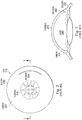
- FIG. 2 illustrates a front view of the eye 110 of the patient 120 according to prior art optical procedures.
- Regions of the eye 110 relevant for purposes of the present disclosure can include a cornea 210, limbus 220, sclera 230, lens 240, and/or other suitable anatomy of the eye 110.
- existing limbal relaxing and astigmatic keratotomy procedures can involve a single arcuate incision 200 in the limbus 220 of the eye 110 or a pair of laterally opposing incisions.
- the incision 200 in existing procedures can pass nearly entirely through the layer of ophthalmic tissue 300.
- such an incision 200 can require highly precise measurements to correctly place the incision 200 in the ophthalmic tissue 300, correctly ascertain the thickness of the tissue 300 at the site of the incision 200, and predict the refractive outcome of the incision 200.
- the amount of refractive correction possible can be very limited by use of a single incision 200.
- the integrity of the ophthalmic tissue 300 can be compromised due to the incision 200 passing so deeply into the ophthalmic tissue 300, which can lead to undesirable results.
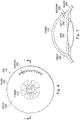
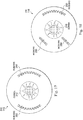
- FIG. 4 illustrates an example of the present disclosure as seen on a front view of the eye 110.
- a set of incisions 250 forming one or more line segments or arcs can be made on ophthalmic tissue 300 on the cornea 210 or limbus 220.
- the present disclosure contemplates making incisions 250 in the sclera 230 and the cornea 210 of the eye, as well as in other layers of ophthalmic tissue 300 including the lens 240 and connective tissue.
- This set of incisions 250 can take the form of a set of parallel lines, a cut mesh, a cut grating, or a pattern of staggered cuts 250.
- the set of incisions 250 can include one, two, three, four, or more individual incisions.
- the incisions 250 can form arcs that extend concentrically around the cornea 210, as seen in FIG. 4 .
- each of the one or more arcs can be defined by multiple incisions 250 spaced apart from one another with uncut ophthalmic tissue remaining around each incision 250.
- the arcs can be staggered or inter-digitated relative to one another.
- incisions 250 of one arc can be at least partially aligned with incisions 250 of another arc.
- a ray originating from a center of the cornea 210 can pass through incisions 250 of both arcs. Sufficient space can be placed between incisions 250 so that a line segment can be traced over uncut ophthalmic tissue lying between the outer boundaries of the pattern of incisions 250.
- One or more of the incisions 250 can extend at a different radius, angle, depth, length, spacing, etc., relative the cornea 210 than other incisions 250.
- the incisions 250 can also extend into the ophthalmic tissue 300 at various angles besides vertically.
- the incisions 250 can extend perpendicular to the anterior side 460 of ophthalmic tissue 300.
- Incisions 250 can also be made at various angular measurements from normal.
- the incisions 250 can be made at between approximately 10 degrees and approximately 20 degrees from normal, between approximately 20 degrees and approximately 45 degrees from normal, between approximately 45 degrees and approximately 80 degrees from normal, and/or other suitable values both larger and smaller.
- a pattern of incisions can include individual incisions 250 that enter the ophthalmic tissue 300 at different angles. In any case, the particular parameters of the incisions 250 can be selected based on the desired astigmatism correction.
- FIG. 5 illustrates a cross-sectional side view of the eye 110 of the patient 120, showing the incisions 250 that can be made in the cornea 210, limbus 220, or sclera 230 of the eye 110.
- the incisions 250 can extend partially through the ophthalmic tissue 300.
- the thickness of the ophthalmic tissue 300 in or near the cornea 210 can be about 600 ⁇ m.
- the depth 260 of the incisions 250 can measure between 10% and 80% of the tissue thickness, between 20% and 75% of the thickness, between 30% and 70% of the thickness, between 40% and 60% of the thickness, and/or other suitable values both larger and smaller.
- these percentages can correspond to approximately 60 ⁇ m to 480 ⁇ m, 120 ⁇ m to 450 ⁇ m, 180 ⁇ m to 420 ⁇ m, and 240 ⁇ m to 360 ⁇ m, respectively, and/or other suitable values both larger and smaller.
- the depth 260 of the incisions 250 can be less than in prior art methods.
- the depth 260 chosen for the incisions 250 can impact both the change in shape to the cornea 210 as well as the strength of the ocular target region of ophthalmic tissue 300.
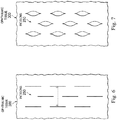
- FIGs. 6 and 7 illustrate a region of ophthalmic tissue 300.
- FIG. 6 shows a region of relaxed ophthalmic tissue 300 with several incisions 250.
- the incisions 250 themselves can have any suitable cross-sectional shape, including a straight line segment as shown, arcuate line segment, polygon, ellipse, other suitable shape(s), and/or combination(s) thereof.
- an incision 250 can be disposed parallel to one or more other incisions 250.
- two incisions 250 are disposed parallel to each other in FIG. 6 . As shown, the two incisions 250 can both be perpendicular to a transverse line between them, which indicates that they are parallel to one another.
- Different subsets of the incisions 250 can be disposed along axes parallel to one another. For example, the three incisions 250 on the left in FIG. 6 can be parallel to the three incisions 250 in the middle and the three incisions on the right.
- the incisions 250 can form one or more line segments or arcs that contain multiple incisions 250.
- the line segments or arcs can be equally spaced from one another or separated by differing distances.
- the line segments or arcs can be parallel relative to one another in some instances.
- the incisions 250 forming the line segments or arcs can be bounded by uncut ophthalmic tissue 300.
- the incisions 250 can create a mesh structure of uncut ophthalmic tissue. Such a mesh structure can lend strength to the ophthalmic tissue 300 in the target area while allowing for large variations in the shape of the cornea 210.
- the boundaries of the mesh structure can be the central portion of the ocular target region and a peripheral portion of the ocular target region (e.g., defined as the side boundaries of FIG. 6 ) , as well as the two outer boundaries of the incision pattern (e.g., defined by the upper and lower boundaries of FIG. 6 ) .
- the incisions 250 can be staggered and/or deep enough such that a horizontal line passing through the ophthalmic tissue 300 would pass through more than one incision 250.
- FIG. 7 shows a region of ophthalmic tissue 300 with incisions 250 under strain.
- This strain can be caused by the internal pressure of the eye 110 and can be compounded by external sources of pressure.
- the mesh structure of uncut ophthalmic tissue can be seen in this example as the connecting tissue around incisions 250.
- the incisions 250 can modify an elastic property of the ophthalmic tissue 300.
- vertical incisions 250 can be placed in a tangential configuration with respect to the cornea 210.
- the elastic property of the ophthalmic tissue 300 in the tangential direction can be modified to a different degree than the elastic property of the ophthalmic tissue 300 in the radial direction (horizontal in this case).
- the elasticity of the ophthalmic tissue 300 can be made greater by the incisions 250 in the radial direction than in the tangential direction.
- the elasticity in the radial direction can be increased more than the elasticity in the tangential direction by a factor of 1.5:1 or greater, 2:1 or greater, 3:1 or greater, and/or other suitable values both larger and smaller.
- placing the incisions 250 in a radial configuration with respect to the cornea 210 can allow more elasticity of ophthalmic tissue 300 in the tangential direction as compared to elasticity in the radial direction.
- FIGs. 8 and 9 illustrate incisions 250 made on both an anterior side 460 and a posterior side 470 of the eye 110.
- the anterior side 460 and the posterior side 470 can be seen in more detail in connection with FIG. 12 .
- the laser system 100 of the present disclosure can be configured to cut ophthalmic tissue 300 at various depths 260, 270.
- one or more incisions 250 can have an origin at the posterior side 470 of ophthalmic tissue 300. These incisions 250 can be configured to extend out from the posterior side 470 to the depth 270.
- incisions 250 can originate from both the anterior side 460 and posterior side 470 of ophthalmic tissue 300 in the same incision pattern. Moreover, incisions 250 can originate from the anterior side 460 and the posterior side 470 of the ophthalmic tissue 300 in an alternating manner. Additionally, incisions 250 can originate in the internal structure of a region of ophthalmic tissue 300 (e.g., between the anterior side 460 and posterior side 470) and extend through ophthalmic tissue 300 without breaking through either side 460, 470.
- FIG. 10 shows a center line of incisions 250 originating from the posterior side 470 of the ophthalmic tissue 300 while outer lines of incisions 250 originate from the anterior side 460 of the ophthalmic tissue 300.
- FIG. 10 can illustrate the anterior side 460.
- the center line of incisions 250 originating from the posterior side 470 can be illustrated in phantom lines to indicate that the incisions 250 do not extend completely through the ophthalmic tissue 300.
- FIG. 11 shows the same configuration of incisions 250 in the ophthalmic tissue 300 under strain.
- FIG. 12 illustrates a cross-sectional view of a set of alternating incisions 250 in ophthalmic tissue 300 under strain.
- incisions 250 alternate between origination from the anterior side 460 and the posterior side 470 of a region of ophthalmic tissue 300.
- the depth 260, 270 of the incisions 250 can have a direct impact on the elastic properties of the ophthalmic tissue 300.
- the alternating pattern of incisions 250 in ophthalmic tissue 300 can allow the tissue 300 to bend out in a transverse direction under strain, whereas other incision patterns can cause the tissue 300 to stretch along a single side 460, 470. This bending feature can allow more elongation of the ophthalmic tissue 300 under strain without compromising tissue strength by cutting too deeply into the tissue 300.
- the bending feature can be illustrated by axes 430, 440, 450.
- the axes 430, 440, 450 can be normal to the layer of ophthalmic tissue 300. Referring to the example of FIG. 12 , axes 430, 440, 450 can be traced on ophthalmic tissue 300 under strain where incisions 250 have been made. The axes 430, 440, 450 can be parallel when the ophthalmic tissue 300 contains no incisions 250. The axes 430, 440, 450 can extend obliquely or in a nonparallel manner with respect to one another when the ophthalmic tissue 300 is under strain and includes incisions 250.
- angles ⁇ , ⁇ between the axes 430, 440, 450 can increase as incision depth 260, 270 or strain increases.
- angle ⁇ can become larger as the depth 260 of the incision 250 directly below it increases.
- Angle ⁇ can also increase as a result of adjacent incisions 250 being made with greater depths 270 or greater strain being placed on the tissue 300.
- angle ⁇ can become larger as the depth 270 of the incision 250 directly above it increases and as a function of the depth 260 of adjacent incisions 250.
- the measure of the angles ⁇ , ⁇ can be related to the elasticity of the ophthalmic tissue 300 in the transverse direction.
- the angles ⁇ , ⁇ can measure between approximately 0 degrees and approximately 25 degrees, between approximately 5 degrees and approximately 15 degrees, or between approximately 10 and approximately 20 degrees, and/or other suitable values both larger and smaller.
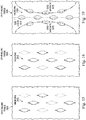
- FIGs. 13-16 show several examples of incision patterns.
- a central line of incisions 250 can be made on the anterior side 460 of a layer of ophthalmic tissue 300 while outer lines of incisions 250 can be made on the posterior side 470.
- FIG. 14 illustrates a pattern of incisions 250 including three line segments.
- Each line segment can include incisions 250 originating in an alternating manner from the anterior side 460 and the posterior side 470 along the length of the ophthalmic tissue 300.
- the incisions 250 on the posterior side 470 can be grouped together, and the incisions 250 on the anterior side 460 can be grouped together.
- FIG. 15 illustrates another alternating pattern of incisions 250 in which diagonal lines of incisions 250 share a common origin on either the anterior side 460 or posterior side 470.
- FIG. 16 illustrates a pattern of incisions 250 in which incisions 250 on the anterior side 460 can form a z-shaped pattern.
- the incisions 250 on the anterior side 460 can be bounded by the incisions 250 on the posterior side 470.
- FIGs. 17 and 18 show other exemplary incision patterns.
- FIG. 17 illustrates an incision pattern containing one or more arcs of incisions 250 disposed on one side of the cornea 210.
- a similar pattern can be disposed on the opposite side of the cornea 210.
- a third set or a fourth set of incisions 250 can be placed between the two sets shown in FIG. 17 around the circumference of the cornea 210.
- FIG. 18 illustrates other incision patterns.
- the incisions 250 can form one or more arcs. The one or more arcs can be concentrically positioned around the cornea 210.
- the incisions 250 can be made in line segments disposed tangentially with respect to the cornea 210.
- the incisions 250 can be disposed in line segments that extend radially from the cornea 210. All of the exemplary patterns shown in FIGs. 17 and 18 can include incisions 250 that originate on the anterior side 460 or posterior side 470 of the ophthalmic tissue 300, as discussed previously.
- the present disclosure can contemplate other orientations and shapes of line segments, including parallel lines, elliptical line segments, and polygonal patterns.
- the number of incisions 250 forming a line segment as well as the number of separate line segments in a given incision pattern can vary.
- the number of incisions 250 that can form a line segment or arc within the incision pattern can include between 2 incisions and 20 incisions, between 2 incisions and 10 incisions, between 2 incisions and 6 incisions, and/or other suitable values both larger and smaller.
- a single line segment or arc can form an incision pattern, while in other cases, two, three, four, or five line segments or arcs can form an incision pattern. Combinations of the above lines and shapes can also be possible in a single incision pattern.
- FIG. 19 shows another exemplary incision pattern.
- a central line of incisions 250 centered on linear axis 320 can be bounded by two arcuate lines with arcuate axes 310, 330.
- One of the arcuate lines can be disposed in a convex placement with respect to the cornea 210 while the other can be concentric or nearly concentric with respect to the cornea 210.
- the axes 310, 330 of one or more of the outer lines can cross over the axis 320 of the inner line. The introduction of various arcuate lines can allow for more precise shaping of the cornea 210.
- a laser beam 140 can be generated by means of a laser source 130. This beam 140 can be directed to an ocular target region. The laser beam 140 can be scanned along a scan pattern within the ocular target region to create a pattern of incisions for relaxing the ophthalmic tissue 300 in the ocular target region.
- incisions 250 extend only partially through the ophthalmic tissue 300.
- the pattern of incisions can include one or more sets of parallel lines, a cut mesh, a cut grating, or a pattern of staggered incisions, or a combination of these.
- the incisions 250 can originate from either the anterior side 460 or posterior side 470 of the ophthalmic tissue 300.
- Embodiments and examples as described herein can provide devices, systems, and methods of making incisions in ophthalmic tissue.
- the examples provided above can be exemplary in nature and not limiting.
- One skilled in the art may readily devise other systems consistent with the disclosed embodiments intended to be within the scope of this disclosure. As such, the application can be limited only by the following claims.
Landscapes
- Health & Medical Sciences (AREA)
- Ophthalmology & Optometry (AREA)
- Heart & Thoracic Surgery (AREA)
- Vascular Medicine (AREA)
- Optics & Photonics (AREA)
- Surgery (AREA)
- Engineering & Computer Science (AREA)
- Biomedical Technology (AREA)
- Physics & Mathematics (AREA)
- Nuclear Medicine, Radiotherapy & Molecular Imaging (AREA)
- Life Sciences & Earth Sciences (AREA)
- Animal Behavior & Ethology (AREA)
- General Health & Medical Sciences (AREA)
- Public Health (AREA)
- Veterinary Medicine (AREA)
- Laser Surgery Devices (AREA)
- Prostheses (AREA)
Applications Claiming Priority (2)
| Application Number | Priority Date | Filing Date | Title |
|---|---|---|---|
| US14/973,117 US10383767B2 (en) | 2015-12-17 | 2015-12-17 | Ophthalmic relaxing incisions and associated devices, systems, and methods |
| PCT/IB2016/057563 WO2017103774A1 (en) | 2015-12-17 | 2016-12-13 | Ophthalmic relaxing incisions and associated devices and systems |
Publications (2)
| Publication Number | Publication Date |
|---|---|
| EP3370661A1 EP3370661A1 (en) | 2018-09-12 |
| EP3370661B1 true EP3370661B1 (en) | 2021-02-17 |
Family
ID=57614413
Family Applications (1)
| Application Number | Title | Priority Date | Filing Date |
|---|---|---|---|
| EP16819183.1A Active EP3370661B1 (en) | 2015-12-17 | 2016-12-13 | Ophthalmic relaxing incisions and associated devices and systems |
Country Status (8)
| Country | Link |
|---|---|
| US (1) | US10383767B2 (enExample) |
| EP (1) | EP3370661B1 (enExample) |
| JP (1) | JP6820339B2 (enExample) |
| CN (1) | CN108366877B (enExample) |
| AU (1) | AU2016372821B2 (enExample) |
| CA (1) | CA3006548C (enExample) |
| ES (1) | ES2859123T3 (enExample) |
| WO (1) | WO2017103774A1 (enExample) |
Families Citing this family (3)
| Publication number | Priority date | Publication date | Assignee | Title |
|---|---|---|---|---|
| SG11201901714QA (en) * | 2016-09-08 | 2019-03-28 | Aleyegn Tech Llc | Glaucoma treatment methods and apparatus |
| EP3903165A4 (en) * | 2018-12-28 | 2023-01-25 | Activ Surgical, Inc. | SYSTEMS AND METHODS TO OPTIMIZE AVAILABILITY, WORKPLACE AND SKILL IN MINIMALLY INVASIVE SURGERY |
| US12005001B2 (en) | 2020-08-19 | 2024-06-11 | Amo Development, Llc | Corneal lenticular incisions with transition zones in laser-assisted ophthalmic procedures |
Family Cites Families (15)
| Publication number | Priority date | Publication date | Assignee | Title |
|---|---|---|---|---|
| US6325792B1 (en) | 1991-11-06 | 2001-12-04 | Casimir A. Swinger | Ophthalmic surgical laser and method |
| US5549632A (en) * | 1992-10-26 | 1996-08-27 | Novatec Laser Systems, Inc. | Method and apparatus for ophthalmic surgery |
| US20080312675A1 (en) | 2007-06-18 | 2008-12-18 | Advanced Medical Optics, Inc. | System and method for calculating limbal relaxing incisions |
| US20100324542A1 (en) | 2007-11-02 | 2010-12-23 | Kurtz Ronald M | Method to Guide a Cataract Procedure by Corneal Imaging |
| US20090137988A1 (en) | 2007-11-02 | 2009-05-28 | Lensx Lasers, Inc | Methods And Apparatus For Improved Post-Operative Ocular Optical Performance |
| US20110022037A1 (en) | 2009-01-06 | 2011-01-27 | Bille Josef F | System and Method for Minimizing the Side Effects of Refractive Corrections Using Line or Dot Cuts for Incisions |
| EP3335679B1 (en) | 2009-02-09 | 2020-09-30 | AMO Development, LLC | System for intrastromal refractive correction |
| US8758332B2 (en) * | 2009-07-24 | 2014-06-24 | Lensar, Inc. | Laser system and method for performing and sealing corneal incisions in the eye |
| US20110028948A1 (en) | 2009-07-29 | 2011-02-03 | Lensx Lasers, Inc. | Optical System for Ophthalmic Surgical Laser |
| US8506559B2 (en) | 2009-11-16 | 2013-08-13 | Alcon Lensx, Inc. | Variable stage optical system for ophthalmic surgical laser |
| ES2606941T3 (es) * | 2010-12-10 | 2017-03-28 | Wavelight Gmbh | Aparato y procedimiento para el tratamiento incisivo de la córnea de un ojo humano con radiación lasérica pulsada enfocada |
| US10143589B2 (en) | 2011-02-22 | 2018-12-04 | Anita Nevyas-Wallace | Method and apparatus for making improved surgical incisions in corrective eye surgery |
| EP4223264A1 (en) * | 2011-03-25 | 2023-08-09 | Lensar, Inc. | A laser system configured to eliminate systematic error in perform a cataract produced |
| US10463541B2 (en) * | 2011-03-25 | 2019-11-05 | Lensar, Inc. | System and method for correcting astigmatism using multiple paired arcuate laser generated corneal incisions |
| US9044304B2 (en) | 2011-12-23 | 2015-06-02 | Alcon Lensx, Inc. | Patient interface with variable applanation |
-
2015
- 2015-12-17 US US14/973,117 patent/US10383767B2/en active Active
-
2016
- 2016-12-13 CA CA3006548A patent/CA3006548C/en active Active
- 2016-12-13 EP EP16819183.1A patent/EP3370661B1/en active Active
- 2016-12-13 CN CN201680073716.1A patent/CN108366877B/zh active Active
- 2016-12-13 AU AU2016372821A patent/AU2016372821B2/en active Active
- 2016-12-13 JP JP2018529282A patent/JP6820339B2/ja active Active
- 2016-12-13 WO PCT/IB2016/057563 patent/WO2017103774A1/en not_active Ceased
- 2016-12-13 ES ES16819183T patent/ES2859123T3/es active Active
Non-Patent Citations (1)
| Title |
|---|
| None * |
Also Published As
| Publication number | Publication date |
|---|---|
| JP2018537202A (ja) | 2018-12-20 |
| CN108366877A (zh) | 2018-08-03 |
| CA3006548C (en) | 2024-01-02 |
| JP6820339B2 (ja) | 2021-01-27 |
| US10383767B2 (en) | 2019-08-20 |
| AU2016372821B2 (en) | 2021-04-01 |
| CA3006548A1 (en) | 2017-06-22 |
| WO2017103774A1 (en) | 2017-06-22 |
| US20170172801A1 (en) | 2017-06-22 |
| AU2016372821A1 (en) | 2018-06-07 |
| EP3370661A1 (en) | 2018-09-12 |
| ES2859123T3 (es) | 2021-10-01 |
| CN108366877B (zh) | 2021-05-04 |
Similar Documents
| Publication | Publication Date | Title |
|---|---|---|
| US7717908B2 (en) | Method patterns for intrastromal refractive surgery | |
| CA2709426C (en) | Method for intrastromal refractive surgery | |
| US20140058365A1 (en) | System and Method for Using Compensating Incisions in Intrastromal Refractive Surgery | |
| US20210298893A1 (en) | High definition and extended depth of field intraocular lens | |
| EP3370661B1 (en) | Ophthalmic relaxing incisions and associated devices and systems | |
| US20100249761A1 (en) | System and method for altering the optical properties of a material | |
| CN101431965A (zh) | 用于角膜异常或缺陷的预成型角膜基质插入物 | |
| US8409179B2 (en) | System for performing intrastromal refractive surgery | |
| US8366701B2 (en) | System and method for correcting higher order aberrations with changes in intrastromal biomechanical stress distributions | |
| US20070055220A1 (en) | Methods and systems for treating presbyopia via laser ablation | |
| US20160143783A1 (en) | Apparatus and Corneal Remodeling Methods to Improve Vision in Macular Disease | |
| RU2528649C1 (ru) | Роговичный сегмент для лечения кератэктазий различного генеза | |
| RU2299049C2 (ru) | Способ хирургического лечения сходящегося косоглазия у детей | |
| WO2014025336A1 (en) | Method and apparatus for making improved surgical incisions in corrective eye surgery |
Legal Events
| Date | Code | Title | Description |
|---|---|---|---|
| STAA | Information on the status of an ep patent application or granted ep patent |
Free format text: STATUS: UNKNOWN |
|
| STAA | Information on the status of an ep patent application or granted ep patent |
Free format text: STATUS: THE INTERNATIONAL PUBLICATION HAS BEEN MADE |
|
| PUAI | Public reference made under article 153(3) epc to a published international application that has entered the european phase |
Free format text: ORIGINAL CODE: 0009012 |
|
| STAA | Information on the status of an ep patent application or granted ep patent |
Free format text: STATUS: REQUEST FOR EXAMINATION WAS MADE |
|
| 17P | Request for examination filed |
Effective date: 20180606 |
|
| AK | Designated contracting states |
Kind code of ref document: A1 Designated state(s): AL AT BE BG CH CY CZ DE DK EE ES FI FR GB GR HR HU IE IS IT LI LT LU LV MC MK MT NL NO PL PT RO RS SE SI SK SM TR |
|
| AX | Request for extension of the european patent |
Extension state: BA ME |
|
| DAV | Request for validation of the european patent (deleted) | ||
| DAX | Request for extension of the european patent (deleted) | ||
| RAP1 | Party data changed (applicant data changed or rights of an application transferred) |
Owner name: ALCON INC. |
|
| GRAP | Despatch of communication of intention to grant a patent |
Free format text: ORIGINAL CODE: EPIDOSNIGR1 |
|
| STAA | Information on the status of an ep patent application or granted ep patent |
Free format text: STATUS: GRANT OF PATENT IS INTENDED |
|
| INTG | Intention to grant announced |
Effective date: 20201001 |
|
| GRAS | Grant fee paid |
Free format text: ORIGINAL CODE: EPIDOSNIGR3 |
|
| GRAA | (expected) grant |
Free format text: ORIGINAL CODE: 0009210 |
|
| STAA | Information on the status of an ep patent application or granted ep patent |
Free format text: STATUS: THE PATENT HAS BEEN GRANTED |
|
| AK | Designated contracting states |
Kind code of ref document: B1 Designated state(s): AL AT BE BG CH CY CZ DE DK EE ES FI FR GB GR HR HU IE IS IT LI LT LU LV MC MK MT NL NO PL PT RO RS SE SI SK SM TR |
|
| REG | Reference to a national code |
Ref country code: GB Ref legal event code: FG4D |
|
| REG | Reference to a national code |
Ref country code: CH Ref legal event code: EP |
|
| REG | Reference to a national code |
Ref country code: DE Ref legal event code: R096 Ref document number: 602016052731 Country of ref document: DE |
|
| REG | Reference to a national code |
Ref country code: AT Ref legal event code: REF Ref document number: 1360491 Country of ref document: AT Kind code of ref document: T Effective date: 20210315 |
|
| REG | Reference to a national code |
Ref country code: IE Ref legal event code: FG4D |
|
| REG | Reference to a national code |
Ref country code: LT Ref legal event code: MG9D |
|
| REG | Reference to a national code |
Ref country code: NL Ref legal event code: MP Effective date: 20210217 |
|
| PG25 | Lapsed in a contracting state [announced via postgrant information from national office to epo] |
Ref country code: GR Free format text: LAPSE BECAUSE OF FAILURE TO SUBMIT A TRANSLATION OF THE DESCRIPTION OR TO PAY THE FEE WITHIN THE PRESCRIBED TIME-LIMIT Effective date: 20210518 Ref country code: HR Free format text: LAPSE BECAUSE OF FAILURE TO SUBMIT A TRANSLATION OF THE DESCRIPTION OR TO PAY THE FEE WITHIN THE PRESCRIBED TIME-LIMIT Effective date: 20210217 Ref country code: FI Free format text: LAPSE BECAUSE OF FAILURE TO SUBMIT A TRANSLATION OF THE DESCRIPTION OR TO PAY THE FEE WITHIN THE PRESCRIBED TIME-LIMIT Effective date: 20210217 Ref country code: PT Free format text: LAPSE BECAUSE OF FAILURE TO SUBMIT A TRANSLATION OF THE DESCRIPTION OR TO PAY THE FEE WITHIN THE PRESCRIBED TIME-LIMIT Effective date: 20210617 Ref country code: NO Free format text: LAPSE BECAUSE OF FAILURE TO SUBMIT A TRANSLATION OF THE DESCRIPTION OR TO PAY THE FEE WITHIN THE PRESCRIBED TIME-LIMIT Effective date: 20210517 Ref country code: BG Free format text: LAPSE BECAUSE OF FAILURE TO SUBMIT A TRANSLATION OF THE DESCRIPTION OR TO PAY THE FEE WITHIN THE PRESCRIBED TIME-LIMIT Effective date: 20210517 Ref country code: LT Free format text: LAPSE BECAUSE OF FAILURE TO SUBMIT A TRANSLATION OF THE DESCRIPTION OR TO PAY THE FEE WITHIN THE PRESCRIBED TIME-LIMIT Effective date: 20210217 |
|
| REG | Reference to a national code |
Ref country code: AT Ref legal event code: MK05 Ref document number: 1360491 Country of ref document: AT Kind code of ref document: T Effective date: 20210217 |
|
| PG25 | Lapsed in a contracting state [announced via postgrant information from national office to epo] |
Ref country code: RS Free format text: LAPSE BECAUSE OF FAILURE TO SUBMIT A TRANSLATION OF THE DESCRIPTION OR TO PAY THE FEE WITHIN THE PRESCRIBED TIME-LIMIT Effective date: 20210217 Ref country code: PL Free format text: LAPSE BECAUSE OF FAILURE TO SUBMIT A TRANSLATION OF THE DESCRIPTION OR TO PAY THE FEE WITHIN THE PRESCRIBED TIME-LIMIT Effective date: 20210217 Ref country code: LV Free format text: LAPSE BECAUSE OF FAILURE TO SUBMIT A TRANSLATION OF THE DESCRIPTION OR TO PAY THE FEE WITHIN THE PRESCRIBED TIME-LIMIT Effective date: 20210217 Ref country code: NL Free format text: LAPSE BECAUSE OF FAILURE TO SUBMIT A TRANSLATION OF THE DESCRIPTION OR TO PAY THE FEE WITHIN THE PRESCRIBED TIME-LIMIT Effective date: 20210217 Ref country code: SE Free format text: LAPSE BECAUSE OF FAILURE TO SUBMIT A TRANSLATION OF THE DESCRIPTION OR TO PAY THE FEE WITHIN THE PRESCRIBED TIME-LIMIT Effective date: 20210217 |
|
| PG25 | Lapsed in a contracting state [announced via postgrant information from national office to epo] |
Ref country code: IS Free format text: LAPSE BECAUSE OF FAILURE TO SUBMIT A TRANSLATION OF THE DESCRIPTION OR TO PAY THE FEE WITHIN THE PRESCRIBED TIME-LIMIT Effective date: 20210617 |
|
| REG | Reference to a national code |
Ref country code: ES Ref legal event code: FG2A Ref document number: 2859123 Country of ref document: ES Kind code of ref document: T3 Effective date: 20211001 |
|
| PG25 | Lapsed in a contracting state [announced via postgrant information from national office to epo] |
Ref country code: EE Free format text: LAPSE BECAUSE OF FAILURE TO SUBMIT A TRANSLATION OF THE DESCRIPTION OR TO PAY THE FEE WITHIN THE PRESCRIBED TIME-LIMIT Effective date: 20210217 Ref country code: CZ Free format text: LAPSE BECAUSE OF FAILURE TO SUBMIT A TRANSLATION OF THE DESCRIPTION OR TO PAY THE FEE WITHIN THE PRESCRIBED TIME-LIMIT Effective date: 20210217 Ref country code: SM Free format text: LAPSE BECAUSE OF FAILURE TO SUBMIT A TRANSLATION OF THE DESCRIPTION OR TO PAY THE FEE WITHIN THE PRESCRIBED TIME-LIMIT Effective date: 20210217 Ref country code: AT Free format text: LAPSE BECAUSE OF FAILURE TO SUBMIT A TRANSLATION OF THE DESCRIPTION OR TO PAY THE FEE WITHIN THE PRESCRIBED TIME-LIMIT Effective date: 20210217 |
|
| REG | Reference to a national code |
Ref country code: DE Ref legal event code: R097 Ref document number: 602016052731 Country of ref document: DE |
|
| PG25 | Lapsed in a contracting state [announced via postgrant information from national office to epo] |
Ref country code: SK Free format text: LAPSE BECAUSE OF FAILURE TO SUBMIT A TRANSLATION OF THE DESCRIPTION OR TO PAY THE FEE WITHIN THE PRESCRIBED TIME-LIMIT Effective date: 20210217 Ref country code: RO Free format text: LAPSE BECAUSE OF FAILURE TO SUBMIT A TRANSLATION OF THE DESCRIPTION OR TO PAY THE FEE WITHIN THE PRESCRIBED TIME-LIMIT Effective date: 20210217 Ref country code: DK Free format text: LAPSE BECAUSE OF FAILURE TO SUBMIT A TRANSLATION OF THE DESCRIPTION OR TO PAY THE FEE WITHIN THE PRESCRIBED TIME-LIMIT Effective date: 20210217 |
|
| PLBE | No opposition filed within time limit |
Free format text: ORIGINAL CODE: 0009261 |
|
| STAA | Information on the status of an ep patent application or granted ep patent |
Free format text: STATUS: NO OPPOSITION FILED WITHIN TIME LIMIT |
|
| 26N | No opposition filed |
Effective date: 20211118 |
|
| PG25 | Lapsed in a contracting state [announced via postgrant information from national office to epo] |
Ref country code: AL Free format text: LAPSE BECAUSE OF FAILURE TO SUBMIT A TRANSLATION OF THE DESCRIPTION OR TO PAY THE FEE WITHIN THE PRESCRIBED TIME-LIMIT Effective date: 20210217 |
|
| PG25 | Lapsed in a contracting state [announced via postgrant information from national office to epo] |
Ref country code: SI Free format text: LAPSE BECAUSE OF FAILURE TO SUBMIT A TRANSLATION OF THE DESCRIPTION OR TO PAY THE FEE WITHIN THE PRESCRIBED TIME-LIMIT Effective date: 20210217 |
|
| PG25 | Lapsed in a contracting state [announced via postgrant information from national office to epo] |
Ref country code: IS Free format text: LAPSE BECAUSE OF FAILURE TO SUBMIT A TRANSLATION OF THE DESCRIPTION OR TO PAY THE FEE WITHIN THE PRESCRIBED TIME-LIMIT Effective date: 20210617 |
|
| PG25 | Lapsed in a contracting state [announced via postgrant information from national office to epo] |
Ref country code: MC Free format text: LAPSE BECAUSE OF FAILURE TO SUBMIT A TRANSLATION OF THE DESCRIPTION OR TO PAY THE FEE WITHIN THE PRESCRIBED TIME-LIMIT Effective date: 20210217 |
|
| REG | Reference to a national code |
Ref country code: BE Ref legal event code: MM Effective date: 20211231 |
|
| PG25 | Lapsed in a contracting state [announced via postgrant information from national office to epo] |
Ref country code: LU Free format text: LAPSE BECAUSE OF NON-PAYMENT OF DUE FEES Effective date: 20211213 Ref country code: IE Free format text: LAPSE BECAUSE OF NON-PAYMENT OF DUE FEES Effective date: 20211213 |
|
| PG25 | Lapsed in a contracting state [announced via postgrant information from national office to epo] |
Ref country code: BE Free format text: LAPSE BECAUSE OF NON-PAYMENT OF DUE FEES Effective date: 20211231 |
|
| PG25 | Lapsed in a contracting state [announced via postgrant information from national office to epo] |
Ref country code: HU Free format text: LAPSE BECAUSE OF FAILURE TO SUBMIT A TRANSLATION OF THE DESCRIPTION OR TO PAY THE FEE WITHIN THE PRESCRIBED TIME-LIMIT; INVALID AB INITIO Effective date: 20161213 |
|
| P01 | Opt-out of the competence of the unified patent court (upc) registered |
Effective date: 20230504 |
|
| PG25 | Lapsed in a contracting state [announced via postgrant information from national office to epo] |
Ref country code: CY Free format text: LAPSE BECAUSE OF FAILURE TO SUBMIT A TRANSLATION OF THE DESCRIPTION OR TO PAY THE FEE WITHIN THE PRESCRIBED TIME-LIMIT Effective date: 20210217 |
|
| PG25 | Lapsed in a contracting state [announced via postgrant information from national office to epo] |
Ref country code: MK Free format text: LAPSE BECAUSE OF FAILURE TO SUBMIT A TRANSLATION OF THE DESCRIPTION OR TO PAY THE FEE WITHIN THE PRESCRIBED TIME-LIMIT Effective date: 20210217 |
|
| PG25 | Lapsed in a contracting state [announced via postgrant information from national office to epo] |
Ref country code: MT Free format text: LAPSE BECAUSE OF FAILURE TO SUBMIT A TRANSLATION OF THE DESCRIPTION OR TO PAY THE FEE WITHIN THE PRESCRIBED TIME-LIMIT Effective date: 20210217 |
|
| PGFP | Annual fee paid to national office [announced via postgrant information from national office to epo] |
Ref country code: DE Payment date: 20241120 Year of fee payment: 9 |
|
| PGFP | Annual fee paid to national office [announced via postgrant information from national office to epo] |
Ref country code: GB Payment date: 20241121 Year of fee payment: 9 |
|
| PGFP | Annual fee paid to national office [announced via postgrant information from national office to epo] |
Ref country code: FR Payment date: 20241121 Year of fee payment: 9 |
|
| PGFP | Annual fee paid to national office [announced via postgrant information from national office to epo] |
Ref country code: IT Payment date: 20241128 Year of fee payment: 9 |
|
| PGFP | Annual fee paid to national office [announced via postgrant information from national office to epo] |
Ref country code: ES Payment date: 20250121 Year of fee payment: 9 |
|
| PGFP | Annual fee paid to national office [announced via postgrant information from national office to epo] |
Ref country code: CH Payment date: 20250101 Year of fee payment: 9 |