EP3370168A1 - Method and apparatus for recovering page in browser - Google Patents
Method and apparatus for recovering page in browser Download PDFInfo
- Publication number
- EP3370168A1 EP3370168A1 EP16920904.6A EP16920904A EP3370168A1 EP 3370168 A1 EP3370168 A1 EP 3370168A1 EP 16920904 A EP16920904 A EP 16920904A EP 3370168 A1 EP3370168 A1 EP 3370168A1
- Authority
- EP
- European Patent Office
- Prior art keywords
- page
- browser
- data
- scriptstate
- restoring
- Prior art date
- Legal status (The legal status is an assumption and is not a legal conclusion. Google has not performed a legal analysis and makes no representation as to the accuracy of the status listed.)
- Withdrawn
Links
Images

Classifications
-
- G—PHYSICS
- G06—COMPUTING OR CALCULATING; COUNTING
- G06F—ELECTRIC DIGITAL DATA PROCESSING
- G06F16/00—Information retrieval; Database structures therefor; File system structures therefor
- G06F16/90—Details of database functions independent of the retrieved data types
- G06F16/95—Retrieval from the web
- G06F16/957—Browsing optimisation, e.g. caching or content distillation
- G06F16/9574—Browsing optimisation, e.g. caching or content distillation of access to content, e.g. by caching
-
- G—PHYSICS
- G06—COMPUTING OR CALCULATING; COUNTING
- G06F—ELECTRIC DIGITAL DATA PROCESSING
- G06F16/00—Information retrieval; Database structures therefor; File system structures therefor
- G06F16/90—Details of database functions independent of the retrieved data types
- G06F16/901—Indexing; Data structures therefor; Storage structures
- G06F16/9024—Graphs; Linked lists
-
- G—PHYSICS
- G06—COMPUTING OR CALCULATING; COUNTING
- G06F—ELECTRIC DIGITAL DATA PROCESSING
- G06F16/00—Information retrieval; Database structures therefor; File system structures therefor
- G06F16/90—Details of database functions independent of the retrieved data types
- G06F16/95—Retrieval from the web
- G06F16/955—Retrieval from the web using information identifiers, e.g. uniform resource locators [URL]
-
- G—PHYSICS
- G06—COMPUTING OR CALCULATING; COUNTING
- G06F—ELECTRIC DIGITAL DATA PROCESSING
- G06F16/00—Information retrieval; Database structures therefor; File system structures therefor
- G06F16/90—Details of database functions independent of the retrieved data types
- G06F16/95—Retrieval from the web
- G06F16/958—Organisation or management of web site content, e.g. publishing, maintaining pages or automatic linking
-
- H—ELECTRICITY
- H04—ELECTRIC COMMUNICATION TECHNIQUE
- H04L—TRANSMISSION OF DIGITAL INFORMATION, e.g. TELEGRAPHIC COMMUNICATION
- H04L67/00—Network arrangements or protocols for supporting network services or applications
- H04L67/01—Protocols
- H04L67/02—Protocols based on web technology, e.g. hypertext transfer protocol [HTTP]
-
- H—ELECTRICITY
- H04—ELECTRIC COMMUNICATION TECHNIQUE
- H04L—TRANSMISSION OF DIGITAL INFORMATION, e.g. TELEGRAPHIC COMMUNICATION
- H04L67/00—Network arrangements or protocols for supporting network services or applications
- H04L67/14—Session management
Definitions
- the present disclosure relates to the field of computers and, more particularly, relates to a method and a device for restoring pages of a browser.
- the caching mechanism of the browser based on the CrossWalk kernel is merely to cache the image resources of webpage but not to cache the main resources and the javascript scripts.
- the main resources of the webpage need to be re-loaded and parsed, and the javascript scripts also need to be re-loaded and parsed, which affects the displaying speed of the webpage.
- the issue of jumping back to the beginning of the webpage instead of displaying the location that the user previously browses may even occur, which largely affect the user experience.
- the main resources are cached but the javascript scripts are not correspondingly cached, for certain webpages including the javascript scripts, issues such as missing of certain webpage events may occur.
- embodiments of the present disclosure provides a method and a device for restoring pages of a browser.
- the technical solutions are as follows.
- a method for restoring pages of a browser including the following steps:
- a step of receiving, by the browser, the command to store the ScriptState data of the page One, leave the page One, and open page Two specifically includes:
- a step of receiving, by the browser, the command to store the ScriptState data of the page Two, leave the page Two, re-open the page One, and restore running of the script of the page One specifically includes:
- the method for restoring a page of a browser further includes: when the number of pages opened by the browser exceeds a preset length of the linked list or the browser is exited, removing, by the linked list, a sign indicating that data has been cached, calling a released interface, and releasing the cached data.
- a device for restoring pages of a browser including:
- the page data restoring module includes:
- the device for restoring pages of a browser further includes a page data releasing module connected to the page data storing module, configured to release data stored in the page data storing module.
- a browser including the aforementioned device for restoring pages of a browser.
- an apparatus including the aforementioned browser.
- the apparatus includes: a cellphone, a tablet, a notebook, a desktop, an electronic reader, a game console, and a network set-top box.
- the beneficial effects brought about by technical solutions provided by embodiments of the present disclosure are as follows. Directed primarily towards the issues such as the occurrence of missing of certain webpage events because most existing browsers only cache the webpage main resources but don't cache the javascript scripts correspondingly, the present disclosure provides a method to cache the content and state of javascript in a V8 engine of the browsers based on the CrossWalk kernel and to restore state. The disclosed method may effectively improve the restoring speed of the pages, prevent the missing of the webpage events, and improve the browsing experience of the user.
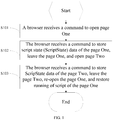
- step S101 is performed, where a browser receives a command to open page One; then, step S102 is performed, where the browser receives a command to store script state (ScriptState) data of the page One, leave the page One, and open a page Two; and further, step S103 is performed, where the browser receives a command to store ScripState data of the page Two, leave the page Two, re-open the page One, and restore running of script of the page One.
- step S102 is performed, where the browser receives a command to store script state (ScriptState) data of the page One, leave the page One, and open a page Two
- step S103 is performed, where the browser receives a command to store ScripState data of the page Two, leave the page Two, re-open the page One, and restore running of script of the page One.
- the browser opens the page Two, and loads page content such as the image, link, and music of the page Two.
- the browser receives a command to store the URL and ScriptState data of the page Two in the linked list that has already stored the URL and ScriptState data of the page One. If the browser continues to open page Three or more pages, the URL(s) and ScriptState data of such pages also need to be stored in the aforementioned linked list.
- re-opening the page One includes the following two situations: (1) after the browser enters the page Two from the page One, a back command is received; (2) after the browser closes the page One, a command to re-open the page One is received.
- the browser reads information in the linked list, and searches whether the URL of the page One is included.
- the browser re-opens the page One, whether the URL of the page One is included is searched in the aforementioned linked list. If the URL of the page One is included, it indicates that the linked list includes the ScriptState data of the page One, and step S209 is executed; if the URL of the page One is not included, the linked list includes no ScriptState data of the page One, and step S210 is executed.
- the ScriptState data of the page One is obtained, and the ScriptState data of the page One is configured into the browser through a related interface, thereby restoring the running of the script.
- the corresponding ScriptState data of the page One is found in the linked list, and such data is configured into the browser through an "setSaveScriptState" interface, thereby restoring the running of the script of the page One.
- the ScriptState data of the page Two may be similarly obtained by searching for the URL of the page Two in the linked list, and the ScriptState data of the page Two is configured into the browser through the "setSaveScriptState" interface, thereby restoring the running of the script of the page Two.
- the browser re-loads the ScriptState data of the page One, parses and runs the script of the page One.
- the disclosed method may further include step S211, at which, when the number of pages opened by the browser exceeds a preset length of the linked list or when the browser exits, the linked list removes a sign which indicates data has been cached, calls a released interface, and releases the cached data.
- the present disclosure provides a method to cache the content and state of javascript in a V8 engine of browsers based on the CrossWalk kernel, and to restore state.
- the disclosed method may effectively improve the restoring speed of the pages, prevent the missing of the webpage events, and improve the browsing experience of the user, when the user restores a previously viewed webpage.
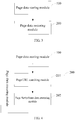
- the present disclosure further provides a device for restoring pages of a browser, as shown in FIG. 3 , the device includes a page data storing module 100 and a page data restoring module 200.
- the page data storing module 100 is configured to store a URL and ScriptState data of pages of a browser.
- the page data restoring module 200 is connected to the page data storing module 100, and is configured to restore the ScriptState data of the pages of the browser.
- the page data storing module 100 may usually be a linked list, and when the browser opens a new page, the URL and the ScriptState data of the newly opened page may be saved in the linked list in a one-to-one correspondence.
- the page data restoring module 200 includes: a page URL searching module 201 and a page ScriptState data restoring module 202.
- the page URL searching module 201 is connected to the page data storing module 100, and is configured to search whether the page data storing module 100 includes a URL of a page to be restored.
- the page URL searching module 201 searches whether the URL of the previously opened page is included in the page data storing module 100. If the page data storing module 100 includes the URL of the previously opened page, it means the page data storing module 100 includes the ScriptState data of the previously opened page. If the page data storing module 100 does not include the URL of the previously opened page, it means the page data storing module 100 does not include the ScriptState data of the previously opened page.
- the page ScriptState data restoring module 202 is connected to the page URL searching module 201, and is configured to restore the ScriptState data of a page and restore running of the script.
- the page data storing module 100 includes the ScriptState data of the page to be re-opened, the ScriptState data of the page to be re-opened may be called from the page data storing module 100. Further, through a related interface, the ScriptState data is configured into the browser, and the running of the script is restored. If the page data storing module 100 includes no ScriptState data of page to be re-opened, the browser re-establishes the ScriptState data of the page to be re-opened, and the running of the script is restored.
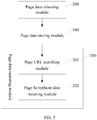
- the device for restoring pages of the browser may further include a page data releasing module 300.
- the page data releasing module 300 is connected to the page data storing module 100, and is configured to release data stored in the page data storing module 100.
- the linked list releases stored data, removes a sign that data has been cached, calls a released interface, and releases the cached data.
- the present disclosure further provides a browser, and the browser includes a device illustrated in FIG. 3 .
- the disclosed browser may be a V8 engine based on CrossWalk kernel, or other browsers using the V8 engine, and the present disclosure is not limited thereto.
- the browser may cache the content and state of the javascript of the webpage when the webpage is closed, and restore the content and state of the javascript of the webpage when the webpage is re-opened. Accordingly, when the user restores a previously browsed page, the restoring speed of the pages may be effectively improved, the missing of the webpage events may be prevented, and the browsing experience of the user may be improved.
- the present disclosure further provides an apparatus, and the apparatus may include a browser, where the browser includes a device shown in FIG. 3 .
- the apparatus may be any one of a cellphone, a tablet, a notebook, a desktop, an electronic reader, a game console, or a network set-top box, etc.
- the present disclosure is not limited thereto.
- the device embodiments described above are only for illustrative purposes. Units described as separated components may or may not be physically separated, and the components serving as display units may or may not be physical units. That is, the components may be located at one position or may be distributed over various network units. Some or all of the units may be selected to realize the purpose of solutions of embodiments herein according to practical needs. Without contributing any creative labor, those ordinarily skilled in the relevant art may understand and implement the aforementioned embodiments.
- the present disclosure may be implemented by software plus a necessary universal hardware platform, and certainly may also be implemented by hardware, but in many cases, the software implementation is preferred.
- the technical solutions of the present disclosure or the part that makes contributions to the existing technology may be substantially embodied in the form of a software product, and such computer software product may be stored in a computer-readable storage medium, such as a ROM/RAM, a magnetic disk, or an optical disc.
- the computer software product may include plural instructions configured to enable a computer apparatus (which may be a personal computer, a server, or a network device) to perform the method described in each embodiment or certain portions of the embodiments.
Landscapes
- Engineering & Computer Science (AREA)
- Databases & Information Systems (AREA)
- Theoretical Computer Science (AREA)
- Data Mining & Analysis (AREA)
- Physics & Mathematics (AREA)
- General Engineering & Computer Science (AREA)
- General Physics & Mathematics (AREA)
- Computer Networks & Wireless Communication (AREA)
- Signal Processing (AREA)
- Software Systems (AREA)
- Information Transfer Between Computers (AREA)
Abstract
Description
- The present disclosure relates to the field of computers and, more particularly, relates to a method and a device for restoring pages of a browser.
- Currently, as the people using smart phones keep increasing, the wifi coverage range is being expanded and the mobile network is continuously accelerated. Browsing webpages through a mobile browser to acquire information has become a part of people's daily life. With the popularization of HTML5, the experience of mobile browsers has been continuously improved, and the usage frequency of the mobile browsers is becoming higher and higher.
- However, existing browsers based on the CrossWalk kernel show the following drawbacks: the caching mechanism of the browser based on the CrossWalk kernel is merely to cache the image resources of webpage but not to cache the main resources and the javascript scripts. Thus, when the user clicks the back or forward button during the browsing process, the main resources of the webpage need to be re-loaded and parsed, and the javascript scripts also need to be re-loaded and parsed, which affects the displaying speed of the webpage. Further, the issue of jumping back to the beginning of the webpage instead of displaying the location that the user previously browses may even occur, which largely affect the user experience. However, if the main resources are cached but the javascript scripts are not correspondingly cached, for certain webpages including the javascript scripts, issues such as missing of certain webpage events may occur.
- To solve issues in existing technologies, embodiments of the present disclosure provides a method and a device for restoring pages of a browser. The technical solutions are as follows.
- On one hand, a method for restoring pages of a browser is provided, including the following steps:
- receiving, by a browser, a command to open page One;
- receiving, by the browser, a command to store script state (ScriptState) data of the page One, leave the page One, and open page Two; and
- receiving, by the browser, a command to store ScriptState data of the page Two, leave the page Two, re-open the page One, and restore running of script of the page One.
- Further, a step of receiving, by the browser, the command to store the ScriptState data of the page One, leave the page One, and open page Two specifically includes:
- receiving, by the browser, a command to establish a linked list;
- storing a Uniform Resource Locator (URL) and the ScriptState data of the page One in the linked list;
- leaving, by the browser, the page One; and opening the page Two.
- Further, a step of receiving, by the browser, the command to store the ScriptState data of the page Two, leave the page Two, re-open the page One, and restore running of the script of the page One specifically includes:
- receiving, by the browser, a command to store a URL and ScriptState data of the page Two in the linked list that has already stored the URL and ScriptState data of the page One;
- leaving, by the browser, the page Two, and re-opening, by the browser, the page One;
- reading, by the browser, information in the linked list to search whether the URL of the page One is included;
- if the URL of the page One is included, obtaining the ScriptState data of the page One, configuring the ScriptState data of the page One into the browser through a related interface; and restoring running of the script of the page One;
- if the URL of the page One is not included, the linked list is known to include no ScriptState data of the page One, reloading, by the browser, the ScriptState data of the page One, parsing and running the script of the page One.
- Optionally, the method for restoring a page of a browser further includes: when the number of pages opened by the browser exceeds a preset length of the linked list or the browser is exited, removing, by the linked list, a sign indicating that data has been cached, calling a released interface, and releasing the cached data.
- On the other hand, a device for restoring pages of a browser is provided, including:
- a page data storing module, configured to store a URL and ScriptState data of pages of a browser; and
- a page data restoring module connected to the page data storing module, configured to restore the ScriptState data of the pages of the browser.
- Further, the page data restoring module includes:
- a page URL searching module connected to the page data storing module, configured to search whether the page data storing module includes a URL of a page to be restored;
- a page ScriptState data restoring module connected to the page URL searching module, configured to restore ScriptState data of the page and restore running of the script.
- Optionally, the device for restoring pages of a browser further includes a page data releasing module connected to the page data storing module, configured to release data stored in the page data storing module.
- In another aspect, a browser is provided, including the aforementioned device for restoring pages of a browser.
- In another aspect, an apparatus is provided, including the aforementioned browser.
- Further, the apparatus includes: a cellphone, a tablet, a notebook, a desktop, an electronic reader, a game console, and a network set-top box.
- The beneficial effects brought about by technical solutions provided by embodiments of the present disclosure are as follows. Directed primarily towards the issues such as the occurrence of missing of certain webpage events because most existing browsers only cache the webpage main resources but don't cache the javascript scripts correspondingly, the present disclosure provides a method to cache the content and state of javascript in a V8 engine of the browsers based on the CrossWalk kernel and to restore state. The disclosed method may effectively improve the restoring speed of the pages, prevent the missing of the webpage events, and improve the browsing experience of the user.
- To more clearly illustrate technical solutions in embodiments of the present disclosure, accompanying drawings to be used in the following embodiments will be introduced briefly. Obviously, the accompanying drawings described hereinafter are merely some embodiments of the present disclosure, and for those ordinarily skilled in the relevant art, other drawings may be derived from such drawings without contributing creative labor.
-
FIG. 1 illustrates a flow chart of a method for restoring pages of a browser according to Embodiment 1 of the present disclosure; -
FIG. 2 illustrates another flow chart of a method for restoring pages of a browser according to Embodiment 1 of the present disclosure; -
FIG. 3 illustrates a structural schematic view of a device for restoring pages of a browser according to Embodiment 2 of the present disclosure; -
FIG. 4 illustrates a structural schematic view of a device for restoring pages of a browser according to Embodiment 2 of the present disclosure; and -
FIG. 5 illustrates a structural schematic view of a device for restoring pages of a browser according to Embodiment 2 of the present disclosure. - To more clearly describe the objectives, technical solutions and advantages of the present disclosure, implementations of the present disclosure is further illustrated in details with reference to the accompanying drawings in conjunction with embodiments.
- The present disclosure provides a method for restoring pages of a browser. As shown in
FIG. 1 , the following steps are included: first, step S101 is performed, where a browser receives a command to open page One; then, step S102 is performed, where the browser receives a command to store script state (ScriptState) data of the page One, leave the page One, and open a page Two; and further, step S103 is performed, where the browser receives a command to store ScripState data of the page Two, leave the page Two, re-open the page One, and restore running of script of the page One. - More specifically, as shown in
FIG. 2 : - At step S201, the browser receives a command to open the page One, and load page content such as image, link, and music;
- At step S202, the browser receives a command to establish a linked list. The linked list is a non-continuous and non-sequential storage structure belonging to a physical storage unit, in which, the logic sequence of data elements is realized by the linked order of the pointers in the linked list. The linked list includes a series of nodes (each element in the linked list is called a "node"), and the nodes may be generated dynamically during running. Each node may include two parts: a data domain for storing a data element, and a pointer domain for storing an address of the next node. The linked list in the disclosed embodiments is established in the page cache (PageCache), and is configured to store the universal resource locator (URL) and ScriptState data of the page opened in the browser. The structure of the linked list includes a history item (Historyltem) and a cached page (CachedPage);
- At step S203, the URL and ScriptState data of the page One are stored in the linked list;
- At step S204, the browser leaves the page One. In one embodiment, leaving the page One include the following two situations: (1) page Two opened from the page One, and the page Two is entered directed from the page One; (2) Close the page One
- At step S205, the browser opens the page Two, and loads page content such as the image, link, and music of the page Two.
- At step S206, the browser receives a command to store the URL and ScriptState data of the page Two in the linked list that has already stored the URL and ScriptState data of the page One. If the browser continues to open page Three or more pages, the URL(s) and ScriptState data of such pages also need to be stored in the aforementioned linked list.
- At step S207, the browser leaves the page Two, and re-opens the page One. In one embodiment, re-opening the page One includes the following two situations: (1) after the browser enters the page Two from the page One, a back command is received; (2) after the browser closes the page One, a command to re-open the page One is received.
- At step S208, the browser reads information in the linked list, and searches whether the URL of the page One is included. When the browser re-opens the page One, whether the URL of the page One is included is searched in the aforementioned linked list. If the URL of the page One is included, it indicates that the linked list includes the ScriptState data of the page One, and step S209 is executed; if the URL of the page One is not included, the linked list includes no ScriptState data of the page One, and step S210 is executed.
- At step S209, the ScriptState data of the page One is obtained, and the ScriptState data of the page One is configured into the browser through a related interface, thereby restoring the running of the script. Based on the URL of the page One, the corresponding ScriptState data of the page One is found in the linked list, and such data is configured into the browser through an "setSaveScriptState" interface, thereby restoring the running of the script of the page One. When the browser once again enters the page Two from the page One, the ScriptState data of the page Two may be similarly obtained by searching for the URL of the page Two in the linked list, and the ScriptState data of the page Two is configured into the browser through the "setSaveScriptState" interface, thereby restoring the running of the script of the page Two.
- At step S210, the browser re-loads the ScriptState data of the page One, parses and runs the script of the page One.
- The disclosed method may further include step S211, at which, when the number of pages opened by the browser exceeds a preset length of the linked list or when the browser exits, the linked list removes a sign which indicates data has been cached, calls a released interface, and releases the cached data.
- The present disclosure provides a method to cache the content and state of javascript in a V8 engine of browsers based on the CrossWalk kernel, and to restore state. The disclosed method may effectively improve the restoring speed of the pages, prevent the missing of the webpage events, and improve the browsing experience of the user, when the user restores a previously viewed webpage.
- The present disclosure further provides a device for restoring pages of a browser, as shown in
FIG. 3 , the device includes a pagedata storing module 100 and a pagedata restoring module 200. The pagedata storing module 100 is configured to store a URL and ScriptState data of pages of a browser. The pagedata restoring module 200 is connected to the pagedata storing module 100, and is configured to restore the ScriptState data of the pages of the browser. - More specifically, as shown in
FIG. 4 , the pagedata storing module 100 may usually be a linked list, and when the browser opens a new page, the URL and the ScriptState data of the newly opened page may be saved in the linked list in a one-to-one correspondence. - The page
data restoring module 200 includes: a pageURL searching module 201 and a page ScriptStatedata restoring module 202. - The page
URL searching module 201 is connected to the pagedata storing module 100, and is configured to search whether the pagedata storing module 100 includes a URL of a page to be restored. When the browser receives a forward, backward, or page-restoring command to re-open a previously opened page, the pageURL searching module 201 searches whether the URL of the previously opened page is included in the pagedata storing module 100. If the pagedata storing module 100 includes the URL of the previously opened page, it means the pagedata storing module 100 includes the ScriptState data of the previously opened page. If the pagedata storing module 100 does not include the URL of the previously opened page, it means the pagedata storing module 100 does not include the ScriptState data of the previously opened page. - The page ScriptState
data restoring module 202 is connected to the pageURL searching module 201, and is configured to restore the ScriptState data of a page and restore running of the script. Through the results obtained by using the pageURL searching module 201 to search the pagedata storing module 100, if the pagedata storing module 100 includes the ScriptState data of the page to be re-opened, the ScriptState data of the page to be re-opened may be called from the pagedata storing module 100. Further, through a related interface, the ScriptState data is configured into the browser, and the running of the script is restored. If the pagedata storing module 100 includes no ScriptState data of page to be re-opened, the browser re-establishes the ScriptState data of the page to be re-opened, and the running of the script is restored. - As shown in
FIG. 5 , optionally, the device for restoring pages of the browser may further include a pagedata releasing module 300. The pagedata releasing module 300 is connected to the pagedata storing module 100, and is configured to release data stored in the pagedata storing module 100. When the number of pages opened by the browser exceeds a preset length of the linked list or the browser is exited, the linked list releases stored data, removes a sign that data has been cached, calls a released interface, and releases the cached data. - The present disclosure further provides a browser, and the browser includes a device illustrated in
FIG. 3 . The disclosed browser may be a V8 engine based on CrossWalk kernel, or other browsers using the V8 engine, and the present disclosure is not limited thereto. The browser may cache the content and state of the javascript of the webpage when the webpage is closed, and restore the content and state of the javascript of the webpage when the webpage is re-opened. Accordingly, when the user restores a previously browsed page, the restoring speed of the pages may be effectively improved, the missing of the webpage events may be prevented, and the browsing experience of the user may be improved. - The present disclosure further provides an apparatus, and the apparatus may include a browser, where the browser includes a device shown in
FIG. 3 . In the present disclosure, the apparatus may be any one of a cellphone, a tablet, a notebook, a desktop, an electronic reader, a game console, or a network set-top box, etc. The present disclosure is not limited thereto. - The sequential numbers of the embodiments of the present disclosure are merely for descriptive purposes, which does not represent preferences of any embodiment.
- The device embodiments described above are only for illustrative purposes. Units described as separated components may or may not be physically separated, and the components serving as display units may or may not be physical units. That is, the components may be located at one position or may be distributed over various network units. Some or all of the units may be selected to realize the purpose of solutions of embodiments herein according to practical needs. Without contributing any creative labor, those ordinarily skilled in the relevant art may understand and implement the aforementioned embodiments.
- Through the foregoing description of the implementation manners, it is clear to those skilled in the relevant art that the present disclosure may be implemented by software plus a necessary universal hardware platform, and certainly may also be implemented by hardware, but in many cases, the software implementation is preferred. Based on such an understanding, the technical solutions of the present disclosure or the part that makes contributions to the existing technology may be substantially embodied in the form of a software product, and such computer software product may be stored in a computer-readable storage medium, such as a ROM/RAM, a magnetic disk, or an optical disc. The computer software product may include plural instructions configured to enable a computer apparatus (which may be a personal computer, a server, or a network device) to perform the method described in each embodiment or certain portions of the embodiments.
- The foregoing is only preferred embodiment of the present disclosure, and is not intended to limit the present disclosure. Without departing from the spirit and principles of the present disclosure, any modifications, equivalent replacements and improvements shall all fall within the protection scope of the present disclosure.
Claims (10)
- A method for restoring pages of a browser, characterized in that, comprising following steps:receiving, by the browser, a command to open page One;receiving, by the browser, a command to store script state (ScriptState) data of the page One, leave the page One, and open page Two; andreceiving, by the browser, a command to store ScriptState data of the page Two, leave the page Two, re-open the page One, and restore running of script of the page One.
- The method for restoring pages of a browser according to claim 1, characterized in that, a step of receiving, by the browser, the command to store the ScriptState data of the page One, leave the page One, and open page Two specifically comprises:receiving, by the browser, a command to establish a linked list;storing a Uniform Resource Locator (URL) and the ScriptState data of the page One in the linked list; andleaving, by the browser, the page One; and opening the page Two.
- The method for restoring pages of a browser according to claim 1, characterized in that, a step of receiving, by the browser, the command to store the ScriptState data of the page Two, leave the page Two, re-open the page One, and restore running of the script of the page One specifically comprises:receiving, by the browser, a command to store a URL and ScriptState data of the page Two in the linked list that has already stored the URL and ScriptState data of the page One;leaving, by the browser, the page Two, and re-opening, by the browser, the page One;reading, by the browser, information in the linked list to search whether the URL of the page One is included;if the URL of the page One is included, obtaining the ScriptState data of the page One, configuring the ScriptState data of the page One into the browser through a related interface; and restoring running of the script of the page One; andif the URL of the page One is not included, the linked list is known to include no ScriptState data of the page One, reloading, by the browser, the ScriptState data of the page One, parsing and running the script of the page One.
- The method for restoring pages of a browser according to claim 1, characterized in that, the method for restoring pages of a browser further comprises: when the number of pages opened by the browser exceeds a preset length of the linked list or the browser is exited, removing, by the linked list, a sign indicating that data has been cached, calling a released interface, and releasing the cached data.
- A device for restoring pages of a browser, characterized in that, comprising:a page data storing module, configured to store a URL and ScriptState data of pages of the browser; anda page data restoring module connected to the page data storing module, configured to restore the ScriptState data of the pages of the browser.
- The device for restoring pages of a browser according to claim 5, characterized in that, the page data storing module comprises:a page URL searching module connected to the page data storing module, configured to search whether the page data storing module includes a URL of a page to be restored; anda page ScriptState data restoring module connected to the page URL searching module, configured to restore ScriptState data of the page and restore running of script.
- The device for restoring pages of a browser according to claim 6, characterized in that, the device for restoring pages of a browser further includes a page data releasing module connected to the page data storing module, configured to release data stored in the page data storing module.
- A browser, characterized in that, comprising a device for restoring pages of a browser according to claim 5.
- An apparatus, characterized in that, comprising a browser according to claim 8.
- The apparatus according to claim 9, characterized in that, the apparatus comprising: a cellphone, a tablet, a notebook, a desktop, an electronic reader, a game console, and a network set-top box.
Applications Claiming Priority (2)
| Application Number | Priority Date | Filing Date | Title |
|---|---|---|---|
| CN201610943736.1A CN106503193A (en) | 2016-11-02 | 2016-11-02 | Recover the method for the page and its device in browser |
| PCT/CN2016/106050 WO2018082119A1 (en) | 2016-11-02 | 2016-11-16 | Method and apparatus for recovering page in browser |
Publications (2)
| Publication Number | Publication Date |
|---|---|
| EP3370168A1 true EP3370168A1 (en) | 2018-09-05 |
| EP3370168A4 EP3370168A4 (en) | 2018-10-03 |
Family
ID=58321900
Family Applications (1)
| Application Number | Title | Priority Date | Filing Date |
|---|---|---|---|
| EP16920904.6A Withdrawn EP3370168A4 (en) | 2016-11-02 | 2016-11-16 | Method and apparatus for recovering page in browser |
Country Status (4)
| Country | Link |
|---|---|
| US (1) | US10621260B2 (en) |
| EP (1) | EP3370168A4 (en) |
| CN (1) | CN106503193A (en) |
| WO (1) | WO2018082119A1 (en) |
Families Citing this family (3)
| Publication number | Priority date | Publication date | Assignee | Title |
|---|---|---|---|---|
| CN106886570B (en) * | 2017-01-16 | 2020-11-13 | 网宿科技股份有限公司 | Page processing method and device |
| CN113885867B (en) * | 2021-10-09 | 2024-08-23 | 明亚保险经纪股份有限公司 | Electronic ledger entry interface retrieving method and device and electronic equipment |
| CN118503298B (en) * | 2024-07-18 | 2024-09-24 | 杭州新中大科技股份有限公司 | Data processing method, device, equipment and storage medium based on double buffer |
Family Cites Families (14)
| Publication number | Priority date | Publication date | Assignee | Title |
|---|---|---|---|---|
| US20050257400A1 (en) * | 1998-11-06 | 2005-11-24 | Microsoft Corporation | Navigating a resource browser session |
| US20030195963A1 (en) * | 2002-04-10 | 2003-10-16 | Yu Song | Session preservation and migration among different browsers on different devices |
| US20040003351A1 (en) * | 2002-06-28 | 2004-01-01 | Microsoft Corporation | Navigating a resource browser session |
| US8635254B2 (en) * | 2002-08-08 | 2014-01-21 | Axeda Corporation | Maintaining independent states for multiple web browser instances |
| JP4571509B2 (en) * | 2002-12-02 | 2010-10-27 | エスアーペー アーゲー | Web application that understands the processing status that can be returned to the session |
| US20060064482A1 (en) * | 2004-09-21 | 2006-03-23 | Nybo Chad A | System and method for caching data and filtering data requests in a client application |
| JP4140916B2 (en) * | 2005-12-22 | 2008-08-27 | インターナショナル・ビジネス・マシーンズ・コーポレーション | Method for analyzing state transition in web page |
| CN102591963A (en) * | 2011-12-30 | 2012-07-18 | 奇智软件(北京)有限公司 | Method and device for controlling webpage content loading |
| CN102902805B (en) * | 2012-10-15 | 2017-06-27 | 东软集团股份有限公司 | A kind of page access method and apparatus |
| CN103699595A (en) | 2013-12-11 | 2014-04-02 | 小米科技有限责任公司 | Method and device for webpage caching of terminal browser and terminal |
| CN104050253B (en) | 2014-06-12 | 2018-09-25 | 北京猎豹网络科技有限公司 | A kind of web page display method and browser |
| JP5604016B1 (en) * | 2014-07-04 | 2014-10-08 | 株式会社 ディー・エヌ・エー | Script caching method and information processing apparatus using the same |
| CN105320687A (en) * | 2014-07-29 | 2016-02-10 | 腾讯科技(北京)有限公司 | Webpage display method and device |
| CN105528439B (en) * | 2015-12-21 | 2019-03-05 | 北京奇虎科技有限公司 | Page switching method and device in browser label |
-
2016
- 2016-11-02 CN CN201610943736.1A patent/CN106503193A/en active Pending
- 2016-11-16 WO PCT/CN2016/106050 patent/WO2018082119A1/en not_active Ceased
- 2016-11-16 US US15/748,044 patent/US10621260B2/en not_active Expired - Fee Related
- 2016-11-16 EP EP16920904.6A patent/EP3370168A4/en not_active Withdrawn
Also Published As
| Publication number | Publication date |
|---|---|
| CN106503193A (en) | 2017-03-15 |
| EP3370168A4 (en) | 2018-10-03 |
| US20190018902A1 (en) | 2019-01-17 |
| US10621260B2 (en) | 2020-04-14 |
| WO2018082119A1 (en) | 2018-05-11 |
Similar Documents
| Publication | Publication Date | Title |
|---|---|---|
| US10015226B2 (en) | Methods for making AJAX web applications bookmarkable and crawlable and devices thereof | |
| RU2608668C2 (en) | System and method for control and organisation of web-browser cache for offline browsing | |
| CN106294648B (en) | A processing method and device for a page access path | |
| US10515142B2 (en) | Method and apparatus for extracting webpage information | |
| KR20210040449A (en) | Page processing methods, devices, electronic devices, and computer-readable media | |
| CN107402938B (en) | Page display method, device and client device | |
| WO2014186489A2 (en) | Enhanced links in curation and collaboration applications | |
| CN104182429B (en) | Web page processing method and terminal | |
| CN106886570A (en) | page processing method and device | |
| US9582480B1 (en) | Intelligent rendering of webpages | |
| US20140082484A1 (en) | Method and apparatus for obtaining information | |
| CN106528587B (en) | Method and device for displaying pages in composite web page system | |
| CN113656737A (en) | Webpage content display method and device, electronic equipment and storage medium | |
| CN102023998B (en) | Method and device for processing webpage so as to display on handheld equipment | |
| US10621260B2 (en) | Method and device for restoring pages of browser | |
| CN110750244B (en) | Code synchronization method, device, electronic equipment and storage medium | |
| US11477158B2 (en) | Method and apparatus for advertisement anti-blocking | |
| CN111353296B (en) | Article processing method, apparatus, electronic device and computer readable storage medium | |
| CN102955852A (en) | Method, device and equipment for webpage resource processing | |
| CN108319622A (en) | A kind of media content recommendations method and device | |
| CN119441650A (en) | Web page loading method, device, electronic device and storage medium | |
| US20170199634A1 (en) | Methods and systems for managing media content of a webpage | |
| CN109086304B (en) | Electronic bookmark updating method, device and storage medium | |
| CN106202104A (en) | The correlation technique of the opening speed of the optimization aim page and device | |
| CN104866115B (en) | A kind of characters input method and browser |
Legal Events
| Date | Code | Title | Description |
|---|---|---|---|
| PUAI | Public reference made under article 153(3) epc to a published international application that has entered the european phase |
Free format text: ORIGINAL CODE: 0009012 |
|
| 17P | Request for examination filed |
Effective date: 20180530 |
|
| AK | Designated contracting states |
Kind code of ref document: A1 Designated state(s): AL AT BE BG CH CY CZ DE DK EE ES FI FR GB GR HR HU IE IS IT LI LT LU LV MC MK MT NL NO PL PT RO RS SE SI SK SM TR |
|
| AX | Request for extension of the european patent |
Extension state: BA ME |
|
| A4 | Supplementary search report drawn up and despatched |
Effective date: 20180905 |
|
| RIC1 | Information provided on ipc code assigned before grant |
Ipc: G06F 17/30 20060101AFI20180830BHEP |
|
| STAA | Information on the status of an ep patent application or granted ep patent |
Free format text: STATUS: THE APPLICATION HAS BEEN WITHDRAWN |
|
| 18W | Application withdrawn |
Effective date: 20191022 |