EP3367453A1 - Piezoelectric composition and piezoelectric device - Google Patents
Piezoelectric composition and piezoelectric device Download PDFInfo
- Publication number
- EP3367453A1 EP3367453A1 EP18158975.5A EP18158975A EP3367453A1 EP 3367453 A1 EP3367453 A1 EP 3367453A1 EP 18158975 A EP18158975 A EP 18158975A EP 3367453 A1 EP3367453 A1 EP 3367453A1
- Authority
- EP
- European Patent Office
- Prior art keywords
- piezoelectric
- piezoelectric composition
- composition
- chemical formula
- specific resistance
- Prior art date
- Legal status (The legal status is an assumption and is not a legal conclusion. Google has not performed a legal analysis and makes no representation as to the accuracy of the status listed.)
- Granted
Links
Images

Classifications
-
- C—CHEMISTRY; METALLURGY
- C04—CEMENTS; CONCRETE; ARTIFICIAL STONE; CERAMICS; REFRACTORIES
- C04B—LIME, MAGNESIA; SLAG; CEMENTS; COMPOSITIONS THEREOF, e.g. MORTARS, CONCRETE OR LIKE BUILDING MATERIALS; ARTIFICIAL STONE; CERAMICS; REFRACTORIES; TREATMENT OF NATURAL STONE
- C04B35/00—Shaped ceramic products characterised by their composition; Ceramics compositions; Processing powders of inorganic compounds preparatory to the manufacturing of ceramic products
- C04B35/01—Shaped ceramic products characterised by their composition; Ceramics compositions; Processing powders of inorganic compounds preparatory to the manufacturing of ceramic products based on oxide ceramics
- C04B35/26—Shaped ceramic products characterised by their composition; Ceramics compositions; Processing powders of inorganic compounds preparatory to the manufacturing of ceramic products based on oxide ceramics based on ferrites
- C04B35/2683—Other ferrites containing alkaline earth metals or lead
-
- C—CHEMISTRY; METALLURGY
- C01—INORGANIC CHEMISTRY
- C01G—COMPOUNDS CONTAINING METALS NOT COVERED BY SUBCLASSES C01D OR C01F
- C01G23/00—Compounds of titanium
- C01G23/003—Titanates
- C01G23/006—Alkaline earth titanates
-
- C—CHEMISTRY; METALLURGY
- C01—INORGANIC CHEMISTRY
- C01G—COMPOUNDS CONTAINING METALS NOT COVERED BY SUBCLASSES C01D OR C01F
- C01G49/00—Compounds of iron
- C01G49/0018—Mixed oxides or hydroxides
-
- C—CHEMISTRY; METALLURGY
- C04—CEMENTS; CONCRETE; ARTIFICIAL STONE; CERAMICS; REFRACTORIES
- C04B—LIME, MAGNESIA; SLAG; CEMENTS; COMPOSITIONS THEREOF, e.g. MORTARS, CONCRETE OR LIKE BUILDING MATERIALS; ARTIFICIAL STONE; CERAMICS; REFRACTORIES; TREATMENT OF NATURAL STONE
- C04B35/00—Shaped ceramic products characterised by their composition; Ceramics compositions; Processing powders of inorganic compounds preparatory to the manufacturing of ceramic products
- C04B35/01—Shaped ceramic products characterised by their composition; Ceramics compositions; Processing powders of inorganic compounds preparatory to the manufacturing of ceramic products based on oxide ceramics
- C04B35/26—Shaped ceramic products characterised by their composition; Ceramics compositions; Processing powders of inorganic compounds preparatory to the manufacturing of ceramic products based on oxide ceramics based on ferrites
-
- C—CHEMISTRY; METALLURGY
- C04—CEMENTS; CONCRETE; ARTIFICIAL STONE; CERAMICS; REFRACTORIES
- C04B—LIME, MAGNESIA; SLAG; CEMENTS; COMPOSITIONS THEREOF, e.g. MORTARS, CONCRETE OR LIKE BUILDING MATERIALS; ARTIFICIAL STONE; CERAMICS; REFRACTORIES; TREATMENT OF NATURAL STONE
- C04B35/00—Shaped ceramic products characterised by their composition; Ceramics compositions; Processing powders of inorganic compounds preparatory to the manufacturing of ceramic products
- C04B35/01—Shaped ceramic products characterised by their composition; Ceramics compositions; Processing powders of inorganic compounds preparatory to the manufacturing of ceramic products based on oxide ceramics
- C04B35/453—Shaped ceramic products characterised by their composition; Ceramics compositions; Processing powders of inorganic compounds preparatory to the manufacturing of ceramic products based on oxide ceramics based on zinc, tin, or bismuth oxides or solid solutions thereof with other oxides, e.g. zincates, stannates or bismuthates
-
- C—CHEMISTRY; METALLURGY
- C04—CEMENTS; CONCRETE; ARTIFICIAL STONE; CERAMICS; REFRACTORIES
- C04B—LIME, MAGNESIA; SLAG; CEMENTS; COMPOSITIONS THEREOF, e.g. MORTARS, CONCRETE OR LIKE BUILDING MATERIALS; ARTIFICIAL STONE; CERAMICS; REFRACTORIES; TREATMENT OF NATURAL STONE
- C04B35/00—Shaped ceramic products characterised by their composition; Ceramics compositions; Processing powders of inorganic compounds preparatory to the manufacturing of ceramic products
- C04B35/622—Forming processes; Processing powders of inorganic compounds preparatory to the manufacturing of ceramic products
-
- C—CHEMISTRY; METALLURGY
- C04—CEMENTS; CONCRETE; ARTIFICIAL STONE; CERAMICS; REFRACTORIES
- C04B—LIME, MAGNESIA; SLAG; CEMENTS; COMPOSITIONS THEREOF, e.g. MORTARS, CONCRETE OR LIKE BUILDING MATERIALS; ARTIFICIAL STONE; CERAMICS; REFRACTORIES; TREATMENT OF NATURAL STONE
- C04B35/00—Shaped ceramic products characterised by their composition; Ceramics compositions; Processing powders of inorganic compounds preparatory to the manufacturing of ceramic products
- C04B35/622—Forming processes; Processing powders of inorganic compounds preparatory to the manufacturing of ceramic products
- C04B35/626—Preparing or treating the powders individually or as batches ; preparing or treating macroscopic reinforcing agents for ceramic products, e.g. fibres; mechanical aspects section B
- C04B35/62605—Treating the starting powders individually or as mixtures
- C04B35/6261—Milling
-
- C—CHEMISTRY; METALLURGY
- C04—CEMENTS; CONCRETE; ARTIFICIAL STONE; CERAMICS; REFRACTORIES
- C04B—LIME, MAGNESIA; SLAG; CEMENTS; COMPOSITIONS THEREOF, e.g. MORTARS, CONCRETE OR LIKE BUILDING MATERIALS; ARTIFICIAL STONE; CERAMICS; REFRACTORIES; TREATMENT OF NATURAL STONE
- C04B35/00—Shaped ceramic products characterised by their composition; Ceramics compositions; Processing powders of inorganic compounds preparatory to the manufacturing of ceramic products
- C04B35/622—Forming processes; Processing powders of inorganic compounds preparatory to the manufacturing of ceramic products
- C04B35/626—Preparing or treating the powders individually or as batches ; preparing or treating macroscopic reinforcing agents for ceramic products, e.g. fibres; mechanical aspects section B
- C04B35/62605—Treating the starting powders individually or as mixtures
- C04B35/62695—Granulation or pelletising
-
- C—CHEMISTRY; METALLURGY
- C04—CEMENTS; CONCRETE; ARTIFICIAL STONE; CERAMICS; REFRACTORIES
- C04B—LIME, MAGNESIA; SLAG; CEMENTS; COMPOSITIONS THEREOF, e.g. MORTARS, CONCRETE OR LIKE BUILDING MATERIALS; ARTIFICIAL STONE; CERAMICS; REFRACTORIES; TREATMENT OF NATURAL STONE
- C04B35/00—Shaped ceramic products characterised by their composition; Ceramics compositions; Processing powders of inorganic compounds preparatory to the manufacturing of ceramic products
- C04B35/622—Forming processes; Processing powders of inorganic compounds preparatory to the manufacturing of ceramic products
- C04B35/626—Preparing or treating the powders individually or as batches ; preparing or treating macroscopic reinforcing agents for ceramic products, e.g. fibres; mechanical aspects section B
- C04B35/63—Preparing or treating the powders individually or as batches ; preparing or treating macroscopic reinforcing agents for ceramic products, e.g. fibres; mechanical aspects section B using additives specially adapted for forming the products, e.g.. binder binders
- C04B35/632—Organic additives
- C04B35/634—Polymers
- C04B35/63404—Polymers obtained by reactions only involving carbon-to-carbon unsaturated bonds
- C04B35/63416—Polyvinylalcohols [PVA]; Polyvinylacetates
-
- C—CHEMISTRY; METALLURGY
- C04—CEMENTS; CONCRETE; ARTIFICIAL STONE; CERAMICS; REFRACTORIES
- C04B—LIME, MAGNESIA; SLAG; CEMENTS; COMPOSITIONS THEREOF, e.g. MORTARS, CONCRETE OR LIKE BUILDING MATERIALS; ARTIFICIAL STONE; CERAMICS; REFRACTORIES; TREATMENT OF NATURAL STONE
- C04B35/00—Shaped ceramic products characterised by their composition; Ceramics compositions; Processing powders of inorganic compounds preparatory to the manufacturing of ceramic products
- C04B35/622—Forming processes; Processing powders of inorganic compounds preparatory to the manufacturing of ceramic products
- C04B35/626—Preparing or treating the powders individually or as batches ; preparing or treating macroscopic reinforcing agents for ceramic products, e.g. fibres; mechanical aspects section B
- C04B35/63—Preparing or treating the powders individually or as batches ; preparing or treating macroscopic reinforcing agents for ceramic products, e.g. fibres; mechanical aspects section B using additives specially adapted for forming the products, e.g.. binder binders
- C04B35/638—Removal thereof
-
- C—CHEMISTRY; METALLURGY
- C04—CEMENTS; CONCRETE; ARTIFICIAL STONE; CERAMICS; REFRACTORIES
- C04B—LIME, MAGNESIA; SLAG; CEMENTS; COMPOSITIONS THEREOF, e.g. MORTARS, CONCRETE OR LIKE BUILDING MATERIALS; ARTIFICIAL STONE; CERAMICS; REFRACTORIES; TREATMENT OF NATURAL STONE
- C04B35/00—Shaped ceramic products characterised by their composition; Ceramics compositions; Processing powders of inorganic compounds preparatory to the manufacturing of ceramic products
- C04B35/622—Forming processes; Processing powders of inorganic compounds preparatory to the manufacturing of ceramic products
- C04B35/64—Burning or sintering processes
-
- H—ELECTRICITY
- H10—SEMICONDUCTOR DEVICES; ELECTRIC SOLID-STATE DEVICES NOT OTHERWISE PROVIDED FOR
- H10N—ELECTRIC SOLID-STATE DEVICES NOT OTHERWISE PROVIDED FOR
- H10N30/00—Piezoelectric or electrostrictive devices
- H10N30/01—Manufacture or treatment
- H10N30/09—Forming piezoelectric or electrostrictive materials
- H10N30/093—Forming inorganic materials
- H10N30/097—Forming inorganic materials by sintering
-
- H—ELECTRICITY
- H10—SEMICONDUCTOR DEVICES; ELECTRIC SOLID-STATE DEVICES NOT OTHERWISE PROVIDED FOR
- H10N—ELECTRIC SOLID-STATE DEVICES NOT OTHERWISE PROVIDED FOR
- H10N30/00—Piezoelectric or electrostrictive devices
- H10N30/80—Constructional details
- H10N30/85—Piezoelectric or electrostrictive active materials
- H10N30/853—Ceramic compositions
- H10N30/8536—Alkaline earth metal based oxides, e.g. barium titanates
-
- H—ELECTRICITY
- H10—SEMICONDUCTOR DEVICES; ELECTRIC SOLID-STATE DEVICES NOT OTHERWISE PROVIDED FOR
- H10N—ELECTRIC SOLID-STATE DEVICES NOT OTHERWISE PROVIDED FOR
- H10N30/00—Piezoelectric or electrostrictive devices
- H10N30/80—Constructional details
- H10N30/85—Piezoelectric or electrostrictive active materials
- H10N30/853—Ceramic compositions
- H10N30/8561—Bismuth-based oxides
-
- C—CHEMISTRY; METALLURGY
- C01—INORGANIC CHEMISTRY
- C01P—INDEXING SCHEME RELATING TO STRUCTURAL AND PHYSICAL ASPECTS OF SOLID INORGANIC COMPOUNDS
- C01P2002/00—Crystal-structural characteristics
- C01P2002/30—Three-dimensional structures
- C01P2002/34—Three-dimensional structures perovskite-type (ABO3)
-
- C—CHEMISTRY; METALLURGY
- C04—CEMENTS; CONCRETE; ARTIFICIAL STONE; CERAMICS; REFRACTORIES
- C04B—LIME, MAGNESIA; SLAG; CEMENTS; COMPOSITIONS THEREOF, e.g. MORTARS, CONCRETE OR LIKE BUILDING MATERIALS; ARTIFICIAL STONE; CERAMICS; REFRACTORIES; TREATMENT OF NATURAL STONE
- C04B2235/00—Aspects relating to ceramic starting mixtures or sintered ceramic products
- C04B2235/02—Composition of constituents of the starting material or of secondary phases of the final product
- C04B2235/30—Constituents and secondary phases not being of a fibrous nature
- C04B2235/32—Metal oxides, mixed metal oxides, or oxide-forming salts thereof, e.g. carbonates, nitrates, (oxy)hydroxides, chlorides
- C04B2235/3205—Alkaline earth oxides or oxide forming salts thereof, e.g. beryllium oxide
- C04B2235/3213—Strontium oxides or oxide-forming salts thereof
-
- C—CHEMISTRY; METALLURGY
- C04—CEMENTS; CONCRETE; ARTIFICIAL STONE; CERAMICS; REFRACTORIES
- C04B—LIME, MAGNESIA; SLAG; CEMENTS; COMPOSITIONS THEREOF, e.g. MORTARS, CONCRETE OR LIKE BUILDING MATERIALS; ARTIFICIAL STONE; CERAMICS; REFRACTORIES; TREATMENT OF NATURAL STONE
- C04B2235/00—Aspects relating to ceramic starting mixtures or sintered ceramic products
- C04B2235/02—Composition of constituents of the starting material or of secondary phases of the final product
- C04B2235/30—Constituents and secondary phases not being of a fibrous nature
- C04B2235/32—Metal oxides, mixed metal oxides, or oxide-forming salts thereof, e.g. carbonates, nitrates, (oxy)hydroxides, chlorides
- C04B2235/3205—Alkaline earth oxides or oxide forming salts thereof, e.g. beryllium oxide
- C04B2235/3215—Barium oxides or oxide-forming salts thereof
-
- C—CHEMISTRY; METALLURGY
- C04—CEMENTS; CONCRETE; ARTIFICIAL STONE; CERAMICS; REFRACTORIES
- C04B—LIME, MAGNESIA; SLAG; CEMENTS; COMPOSITIONS THEREOF, e.g. MORTARS, CONCRETE OR LIKE BUILDING MATERIALS; ARTIFICIAL STONE; CERAMICS; REFRACTORIES; TREATMENT OF NATURAL STONE
- C04B2235/00—Aspects relating to ceramic starting mixtures or sintered ceramic products
- C04B2235/02—Composition of constituents of the starting material or of secondary phases of the final product
- C04B2235/30—Constituents and secondary phases not being of a fibrous nature
- C04B2235/32—Metal oxides, mixed metal oxides, or oxide-forming salts thereof, e.g. carbonates, nitrates, (oxy)hydroxides, chlorides
- C04B2235/3231—Refractory metal oxides, their mixed metal oxides, or oxide-forming salts thereof
- C04B2235/3232—Titanium oxides or titanates, e.g. rutile or anatase
-
- C—CHEMISTRY; METALLURGY
- C04—CEMENTS; CONCRETE; ARTIFICIAL STONE; CERAMICS; REFRACTORIES
- C04B—LIME, MAGNESIA; SLAG; CEMENTS; COMPOSITIONS THEREOF, e.g. MORTARS, CONCRETE OR LIKE BUILDING MATERIALS; ARTIFICIAL STONE; CERAMICS; REFRACTORIES; TREATMENT OF NATURAL STONE
- C04B2235/00—Aspects relating to ceramic starting mixtures or sintered ceramic products
- C04B2235/02—Composition of constituents of the starting material or of secondary phases of the final product
- C04B2235/30—Constituents and secondary phases not being of a fibrous nature
- C04B2235/32—Metal oxides, mixed metal oxides, or oxide-forming salts thereof, e.g. carbonates, nitrates, (oxy)hydroxides, chlorides
- C04B2235/3231—Refractory metal oxides, their mixed metal oxides, or oxide-forming salts thereof
- C04B2235/3232—Titanium oxides or titanates, e.g. rutile or anatase
- C04B2235/3234—Titanates, not containing zirconia
- C04B2235/3236—Alkaline earth titanates
-
- C—CHEMISTRY; METALLURGY
- C04—CEMENTS; CONCRETE; ARTIFICIAL STONE; CERAMICS; REFRACTORIES
- C04B—LIME, MAGNESIA; SLAG; CEMENTS; COMPOSITIONS THEREOF, e.g. MORTARS, CONCRETE OR LIKE BUILDING MATERIALS; ARTIFICIAL STONE; CERAMICS; REFRACTORIES; TREATMENT OF NATURAL STONE
- C04B2235/00—Aspects relating to ceramic starting mixtures or sintered ceramic products
- C04B2235/02—Composition of constituents of the starting material or of secondary phases of the final product
- C04B2235/30—Constituents and secondary phases not being of a fibrous nature
- C04B2235/32—Metal oxides, mixed metal oxides, or oxide-forming salts thereof, e.g. carbonates, nitrates, (oxy)hydroxides, chlorides
- C04B2235/327—Iron group oxides, their mixed metal oxides, or oxide-forming salts thereof
-
- C—CHEMISTRY; METALLURGY
- C04—CEMENTS; CONCRETE; ARTIFICIAL STONE; CERAMICS; REFRACTORIES
- C04B—LIME, MAGNESIA; SLAG; CEMENTS; COMPOSITIONS THEREOF, e.g. MORTARS, CONCRETE OR LIKE BUILDING MATERIALS; ARTIFICIAL STONE; CERAMICS; REFRACTORIES; TREATMENT OF NATURAL STONE
- C04B2235/00—Aspects relating to ceramic starting mixtures or sintered ceramic products
- C04B2235/02—Composition of constituents of the starting material or of secondary phases of the final product
- C04B2235/30—Constituents and secondary phases not being of a fibrous nature
- C04B2235/32—Metal oxides, mixed metal oxides, or oxide-forming salts thereof, e.g. carbonates, nitrates, (oxy)hydroxides, chlorides
- C04B2235/327—Iron group oxides, their mixed metal oxides, or oxide-forming salts thereof
- C04B2235/3272—Iron oxides or oxide forming salts thereof, e.g. hematite, magnetite
- C04B2235/3274—Ferrites
-
- C—CHEMISTRY; METALLURGY
- C04—CEMENTS; CONCRETE; ARTIFICIAL STONE; CERAMICS; REFRACTORIES
- C04B—LIME, MAGNESIA; SLAG; CEMENTS; COMPOSITIONS THEREOF, e.g. MORTARS, CONCRETE OR LIKE BUILDING MATERIALS; ARTIFICIAL STONE; CERAMICS; REFRACTORIES; TREATMENT OF NATURAL STONE
- C04B2235/00—Aspects relating to ceramic starting mixtures or sintered ceramic products
- C04B2235/02—Composition of constituents of the starting material or of secondary phases of the final product
- C04B2235/30—Constituents and secondary phases not being of a fibrous nature
- C04B2235/32—Metal oxides, mixed metal oxides, or oxide-forming salts thereof, e.g. carbonates, nitrates, (oxy)hydroxides, chlorides
- C04B2235/3298—Bismuth oxides, bismuthates or oxide forming salts thereof, e.g. zinc bismuthate
-
- C—CHEMISTRY; METALLURGY
- C04—CEMENTS; CONCRETE; ARTIFICIAL STONE; CERAMICS; REFRACTORIES
- C04B—LIME, MAGNESIA; SLAG; CEMENTS; COMPOSITIONS THEREOF, e.g. MORTARS, CONCRETE OR LIKE BUILDING MATERIALS; ARTIFICIAL STONE; CERAMICS; REFRACTORIES; TREATMENT OF NATURAL STONE
- C04B2235/00—Aspects relating to ceramic starting mixtures or sintered ceramic products
- C04B2235/60—Aspects relating to the preparation, properties or mechanical treatment of green bodies or pre-forms
- C04B2235/604—Pressing at temperatures other than sintering temperatures
-
- C—CHEMISTRY; METALLURGY
- C04—CEMENTS; CONCRETE; ARTIFICIAL STONE; CERAMICS; REFRACTORIES
- C04B—LIME, MAGNESIA; SLAG; CEMENTS; COMPOSITIONS THEREOF, e.g. MORTARS, CONCRETE OR LIKE BUILDING MATERIALS; ARTIFICIAL STONE; CERAMICS; REFRACTORIES; TREATMENT OF NATURAL STONE
- C04B2235/00—Aspects relating to ceramic starting mixtures or sintered ceramic products
- C04B2235/65—Aspects relating to heat treatments of ceramic bodies such as green ceramics or pre-sintered ceramics, e.g. burning, sintering or melting processes
- C04B2235/656—Aspects relating to heat treatments of ceramic bodies such as green ceramics or pre-sintered ceramics, e.g. burning, sintering or melting processes characterised by specific heating conditions during heat treatment
- C04B2235/6567—Treatment time
Definitions
- a portion of the piezoelectric composition may be a phase consisting of Bi m FeO 3 .
- a portion of the piezoelectric composition may be a phase consisting of Ba m TiO 3 .
- a portion of the piezoelectric composition may be a phase consisting of Sr m TiO 3 .
- a portion of the piezoelectric composition may be a solid solution of at least two oxides selected from the group consisting of Bi m FeO 3 , Ba m TiO 3 and Sr m TiO 3 .
- the d 33 of the piezoelectric composition according to this embodiment is larger than the d 33 of conventional BiFeO 3 .
- the reason the d 33 and the specific resistance of the piezoelectric composition according to this embodiment are large is not limited to the above reason.
- the method for manufacturing the piezoelectric device 10 comprises: a mixing step of granulating a raw material powder of the piezoelectric body 2 containing the above piezoelectric composition; a sintering step of press-forming this raw material powder to form a formed body and sintering the formed body to produce a sintered body; and a polarization step of performing a poling process on the sintered body to obtain the piezoelectric device 10. Steps will be described specifically hereinafter.
- binder removal treatment is provided to the obtained formed body. It is preferable that the binder removal treatment be performed at a temperature of 400 to 800°C for around 2 to 4 hours.
- the binder removal treatment may be performed in the air atmosphere, or may be performed in an atmosphere in which the partial pressure of oxygen is higher than that in the air, or a pure oxygen atmosphere.
- the obtained sintered body was flattened to a thickness of 0.5 mm with a double-side lapping machine and thereafter cut to a size of 16mm in length by 16mm in width with a dicing saw. Subsequently, electrodes 4a and 4b were formed on both surfaces of the sintered body by using a vacuum evaporator.
- the electrodes 4a and 4b were composed of 1.5- ⁇ m Ag layers. The sizes of the electrodes were 15 mm by 15 mm.
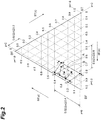
- FIG. 2 is a schematic view illustrating the constitutions of the piezoelectric compositions in Examples and Comparative Examples.
- BF means BiFeO3 in FIG. 2 .
- BT means BaTiO 3 .
- ST means SrTiO 3 .
- the constitutions of the piezoelectric compositions are illustrated by coordinates (x, y, z) in FIG. 2 .
- a number appended to a round mark is the number of Example, and a number appended to a triangle mark is the number of Comparative Example. That is, the coordinates of a round mark indicate the constitution of a piezoelectric composition in Example, and the coordinates of a triangle mark indicate the constitution of a piezoelectric composition in Comparative Example.
Landscapes
- Chemical & Material Sciences (AREA)
- Engineering & Computer Science (AREA)
- Ceramic Engineering (AREA)
- Manufacturing & Machinery (AREA)
- Organic Chemistry (AREA)
- Inorganic Chemistry (AREA)
- Structural Engineering (AREA)
- Materials Engineering (AREA)
- Life Sciences & Earth Sciences (AREA)
- Environmental & Geological Engineering (AREA)
- General Life Sciences & Earth Sciences (AREA)
- Geology (AREA)
- Chemical Kinetics & Catalysis (AREA)
- Compositions Of Oxide Ceramics (AREA)
- Compounds Of Iron (AREA)
Abstract
Description
- The present invention relates to a piezoelectric composition and a piezoelectric device.
- A perovskite-type metal oxide is known as a common piezoelectric composition. The constitution of a perovskite-type metal oxide is represented by ABO3. A perovskite-type piezoelectric composition is, for example, lead zirconate titanate (Pb(Zr, Ti)O3). The curie temperature (Tc) of lead zirconate titanate (PZT) is high, and the piezoelectric constant (d33) of PZT is large. However, PZT does harm to the environment or the human body due to containing lead as an element at A sites. The piezoelectric composition not containing lead is required in view of influence on the environment or the human body.
- An example of the piezoelectric composition not containing lead is bismuth ferrite (BiFeO3) described in the following Non Patent Literature 1. The Tc of bismuth ferrite (BFO) is high, and BFO exhibits large spontaneous polarization. However, in the case of BFO alone, enough piezoelectric performance (for example, d33) is not obtained due to the anisotropy being high, the leakage current being large and the like.
- Therefore, a piezoelectric composition the Tc of which is high and the d33 of which is large is required. A binary compound composed of barium titanate and bismuth ferrite is disclosed in the following
Non Patent Literature 2. A ternary compound composed of barium titanate, bismuth ferrite and a composite oxide such as bismuth magnesate titanate is disclosed in Japanese Unexamined Patent Publication2013-191751 - [Non Patent literature 1] Tadej Rojac et al., "Strong ferroelectric domain-wall pinning in BiFeO3 ceramics", JOURNAL OF APPLIED PHYSICS, 108, 074107, 2010.
- [Non Patent literature 2] Zhenyong Cen et al., "Effect of sintering temperature on microstructure and piezoelectric properties of Pb-free BiFeO3-BaTiO3 ceramics in the composition range of large BiFeO3 concentrations", J Electroceram, 31, p.15-20, 2013.
- A piezoelectric composition described in Japanese Unexamined Patent Publication
2013-191751 2013-191751 Non Patent Literature 2, the d33 of the piezoelectric composition after the poling process is around 130 pC/N, and is small. - Therefore, the present invention has been completed in view of the above circumstances, and an object of the present invention is to provide a piezoelectric composition the d33 of which is large and the specific resistance of which is large and a piezoelectric device using the piezoelectric composition.
- A piezoelectric composition according to one aspect of the present invention is represented by the following Chemical Formula (1):
x[BimFeO3]-y[BamTiO3]-z [SrmTiO3] (1)
wherein 0. 5 ≤ x ≤ 0.8, 0.02 ≤ y ≤ 0.4, 0.02 ≤ z ≤ 0.2, x + y + z = 1, and 0.96 ≤ m ≤ 1.04. - A piezoelectric device according to one aspect of the present invention comprises the above piezoelectric composition.
- According to the present invention, a piezoelectric composition the d33 of which is large and the specific resistance of which is large and a piezoelectric device using the piezoelectric composition are provided.
-
-
FIG. 1 is a sectional view of a piezoelectric device according to one embodiment of the present invention. -
FIG. 2 is a schematic view illustrating the constitutions of piezoelectric compositions in Examples and Comparative Examples. - Preferred embodiments of the present invention will be described in detail hereinafter with proper reference to the drawings. In the drawings, the identical or equivalent components are indicated with the identical reference sign. When a description overlaps, the description is omitted. The present invention is not limited to the following embodiments.
- As shown in
FIG. 1 , apiezoelectric device 10 according to this embodiment comprises a pair ofelectrodes piezoelectric body 2 between the pair ofelectrodes electrode 4a overlaps one surface of thepiezoelectric body 2, and adifferent electrode 4b overlaps the other surface of thepiezoelectric body 2. - A piezoelectric composition contained in the
piezoelectric body 2 is represented by the following Chemical Formula (1). Thepiezoelectric body 2 may consist of only the piezoelectric composition represented by the following Chemical Formula (1). Thepiezoelectric body 2 may contain other ingredients in addition to the piezoelectric composition represented by the following Chemical Formula (1). The piezoelectric composition represented by the following Chemical Formula (1) may be a powder, or may be a sintered body.
x[BimFeO3]-y[BamTiO3]-z[SrmTiO3] (1)
[In Formula (1), 0.5 ≤ x ≤ 0.8, 0.02 ≤ y ≤ 0.4, 0.02 ≤ z ≤ 0.2, x + y + z = 1, 0.96 ≤ m ≤ 1.04]. - The piezoelectric composition represented by the above Chemical Formula (1) may have a perovskite-type crystal structure. The piezoelectric composition represented by the above Chemical Formula (1) may be a composite oxide represented by the following Chemical Formula (2). The
piezoelectric body 2 may consist of only the piezoelectric composition represented by the following Chemical Formula (2). Thepiezoelectric body 2 may contain other ingredients in addition to the piezoelectric composition represented by the following Chemical Formula (2).
(BixBaySrz)m(FexTi(y+z))O3 (2)
[In Formula (2), 0.5 ≤ x ≤ 0.8, 0.02 ≤ y ≤ 0.4, 0.02 ≤ z ≤ 0.2, x + y + z = 1, and 0.96 ≤ m ≤ 1.04]. - A portion of the piezoelectric composition may be a phase consisting of BimFeO3. A portion of the piezoelectric composition may be a phase consisting of BamTiO3. A portion of the piezoelectric composition may be a phase consisting of SrmTiO3. A portion of the piezoelectric composition may be a solid solution of at least two oxides selected from the group consisting of BimFeO3, BamTiO3 and SrmTiO3.
- The present inventors consider that a reason the d33 and the specific resistance of the above piezoelectric composition are large is as follows. In a process of sintering perovskite-type BiFeO3 to form the
piezoelectric body 2, Bi is likely to volatilize. Also in a process of forming a thin film containing BiFeO3, Bi is likely to volatilize. For example, when a thin film is formed by a sputtering method, Bi is unlikely to be incorporated into the thin film in a growth process. Therefore, in conventional BiFeO3, which does not contain Sr, Bi is likely to be deficient and vacancies are likely to occur at A sites of BiFeO3. That is, in conventional BiFeO3, defects at A sites are likely to occur. Meanwhile, a piezoelectric composition according to this embodiment contains Sr, which is unlikely to volatilize. Therefore, vacancies at A sites caused by the volatilization of Bi are replaced with Sr, and the defects at A sites are unlikely to occur. Consequently, the specific resistance of the piezoelectric composition according to this embodiment is larger than the specific resistance of conventional BiFeO3. Furthermore, the piezoelectric composition according to this embodiment is formed from rhombohedral BimFeO3, tetragonal BamTiO3 and cubic SrmTiO3. Therefore, polarization rotation becomes likely to occur near the boundaries of the three phases of BimFeO3, BamTiO3 and SrmTiO3. Consequently, the d33 of the piezoelectric composition according to this embodiment is larger than the d33 of conventional BiFeO3. In addition, the reason the d33 and the specific resistance of the piezoelectric composition according to this embodiment are large is not limited to the above reason. - In the above Chemical Formula (1), the x satisfies 0.5 ≤ x ≤ 0.8. When the x is less than 0.5, the crystal structure of the piezoelectric composition shifts to a cubic crystal, and the d33 of the piezoelectric composition is likely to become small. When the x is more than 0.8, the crystal structure of the piezoelectric composition shifts to a rhombohedral crystal, polarization reversal is unlikely to occur, the d33 of the piezoelectric composition becomes small, many defects at A sites are caused by the volatilization of Bi, and the specific resistance is likely to decrease. It is preferable that the x satisfy 0.55 ≤ x ≤ 0.75. Since the x is in the above numerical value range, the d33 and the specific resistance of the piezoelectric composition are likely to become large.
- In the above Chemical Formula (1), y satisfies 0.02 ≤ y ≤ 0.4. When the y is less than 0.02, the crystal structure of a piezoelectric composition shifts to a rhombohedral crystal, the polarization reversal is unlikely to occur, and the d33 of a piezoelectric composition becomes small, many defects at A sites are caused by the volatilization of Bi, and the specific resistance is likely to decrease. When the y is more than 0.4, the crystal structure of the piezoelectric composition shifts to a cubic crystal, and the d33 of the piezoelectric composition is likely to become small. It is preferable that the y satisfy 0.15 ≤ y ≤ 0.33. Since the y is in the above numerical value range, the d33 and the specific resistance of the piezoelectric composition are likely to become large.
- In the above Chemical Formula (1), z satisfies 0.02 ≤ z ≤ 0.2. When the z is less than 0.02, the defects at A sites caused by the volatilization of Bi are not fully replaced with Sr. Consequently, the specific resistance is likely to decrease. When the z is more than 0.2, the crystal structure of the piezoelectric composition shifts to a cubic crystal, and the d33 of the piezoelectric composition is likely to become small. It is preferable that the z satisfy 0.02 ≤ z ≤ 0.1. Since the z is in the above numerical value range, the d33 and the specific resistance of the piezoelectric composition are likely to become large.
- In the above Chemical Formula (1), the m satisfies 0.96 ≤ m ≤ 1.04. When the m is less than 0.96, Bi, Ba and Sr, which are at A sites, decrease, defects at A sites increase, and the specific resistance is likely to decrease. When the m is more than 1.04, heterogeneous phases containing any of Bi, Ba and Sr are formed in grain boundaries, and the d33 of the piezoelectric composition is likely to become small. It is preferable that the m satisfy 0.98 ≤ m ≤ 1.02. Since the m is in the above numerical value range, the d33 and the specific resistance of the piezoelectric composition are likely to become large.
- The above Chemical Formula (2) is represented as AmBO3. The m is the ratio [A]/[B] of the number [A] of all atoms occupying A sites to the number [B] of all atoms occupying B sites. When the m is out of the above numerical value range, the m, namely the [A]/[B], greatly deviates from a stoichiometric ratio of 1, and therefore defects in the piezoelectric composition are likely to increase and heterogeneous phases are likely to increase in grain boundaries, thereby the d33 and the specific resistance of the piezoelectric composition are likely to become small.
- The piezoelectric composition may contain other elements than the elements contained in the above Chemical Formula (1) as impurities or minute amounts of additives in the form of compounds or simple substances. Examples of such a compound include oxides of Na, Al, Si, P, K, Fe, Cu, Zn, Hf, Ta, or W. When the piezoelectric composition contains these oxides and the like, it is preferable that the total content of oxides in the piezoelectric composition be 0.3 % by mass or less of the whole piezoelectric composition in terms of oxides of the elements. That is, it is preferable that the main ingredient, specifically 99.7% by mass or more of the whole piezoelectric composition, have the constitution represented by Chemical Formula (1). In this case, the piezoelectric composition substantially has the constitution represented by Chemical Formula (1).
- The constitution of the piezoelectric composition can be measured, for example, by an X-ray fluorescence analysis (XRF method).
- Since the
piezoelectric device 10 comprises thepiezoelectric body 2 containing the piezoelectric composition represented by the above Chemical Formula (1), it is excellent in piezoelectric characteristics. Thepiezoelectric body 2 may be a sintered body containing the above piezoelectric composition, or may be a thin film containing the above piezoelectric composition. - The potential difference between a pair of
electrodes piezoelectric device 10 according to this embodiment, even if the potential difference between theelectrodes - Then, an example of a method for manufacturing the
piezoelectric device 10 according to this embodiment will be described. The method for manufacturing thepiezoelectric device 10 comprises: a mixing step of granulating a raw material powder of thepiezoelectric body 2 containing the above piezoelectric composition; a sintering step of press-forming this raw material powder to form a formed body and sintering the formed body to produce a sintered body; and a polarization step of performing a poling process on the sintered body to obtain thepiezoelectric device 10. Steps will be described specifically hereinafter. - In a mixing step, starting raw materials for preparing the piezoelectric composition are first provided. As the starting raw materials, oxides of elements that constitute the piezoelectric composition represented by the above Chemical Formula (1) or compounds that become these oxides after sintering (carbonates, hydroxides, oxalates, nitrates and the like) can be used. As specific starting raw materials, a Bi (bismuth) compound, a Fe (iron) compound, a Ba (barium) compound, a Ti (titanium) compound, a Sr (strontium) compound and the like may be used. These starting raw materials are blended at a molar ratio or a mass ratio such that the piezoelectric composition represented by the above Chemical Formula (1) is formed after sintering, and wet mixing is conducted by a ball mill or the like.
- The Bi compound may be bismuth oxide (Bi2O3), bismuth nitrate (Bi(NO3)3) or the like. The Fe compound may be iron oxide (Fe2O3), iron chloride (FeCl3), iron nitrate (Fe(NO3)3) or the like. The Ba compound may be barium oxide (BaO), barium carbonate (BaCO3), barium oxalate (C2BaO4) barium acetate ((CH3COO)2Ba), barium nitrate (Ba(NO3)2), barium sulfate (BaSO4) barium titanate (BaTiO3) or the like. The Ti compound may be titanium oxide (TiO2) or the like. The Sr compound may be strontium carbonate (SrCO3) or the like.
- Then, the mixed raw material obtained by wet mixing is temporarily formed into a temporarily formed body, which is then calcined. A calcined body containing the above piezoelectric composition is obtained by this calcination. It is preferable that the calcination temperature be 600 to 900°C, and it is preferable that the calcination time be around 1 to 16 hours. When the calcination temperature is too low, a chemical reaction tends not to proceed fully in the temporarily formed body. When the calcination temperature is too high, a temporarily formed body begins to sinter, and subsequent pulverization therefore tends to become difficult. Calcination may be performed in the air atmosphere, and may be performed in an atmosphere in which the partial pressure of oxygen is higher than that in the air, or a pure oxygen atmosphere. Furthermore, the wet-mixed starting raw material may be calcined without being temporarily formed.
- Then, the obtained calcined body is slurried and pulverized (wet ground) by a ball mill or the like, and thereafter a fine powder is obtained by drying the slurry. A binder is added to the obtained fine powder if needed, and the raw material powder is granulated. It is preferable to use water, an alcohol such as ethanol, a mixed solvent of water and ethanol, or the like as a solvent for slurrying a calcined body. Binders added to the fine powder include commonly used organic binders such as polyvinyl alcohol, polyvinyl alcohol to which a dispersing agent is added, ethyl cellulose, and the like.
- In a sintering step, a formed body is formed by press-forming the granulated raw material powder. A load at the time of press-forming may be adjusted, for example, to 1.0 to 3.5 MPa.
- Then, binder removal treatment is provided to the obtained formed body. It is preferable that the binder removal treatment be performed at a temperature of 400 to 800°C for around 2 to 4 hours. The binder removal treatment may be performed in the air atmosphere, or may be performed in an atmosphere in which the partial pressure of oxygen is higher than that in the air, or a pure oxygen atmosphere.
- A sintered body containing the piezoelectric composition represented by the above Chemical Formula (1) is obtained by sintering the formed body after the binder removal treatment. The sintering temperature may be about 900 to 1100°C, and the sintering time may be adjusted to around 2 to 20 hours. The binder removal treatment and the sintering of the formed body may be performed successively, or may be performed separately.
- The surface of the obtained sintered body is polished if needed, and the sintered body is processed such that the sintered body is cut to form the desired shape of a
piezoelectric body 2. A pair ofelectrodes electrodes - A
piezoelectric device 10 according to this embodiment can be obtained by impressing a polarization electric field on the sintered body on which the electrodes are formed and performing a poling process. The conditions of the poling process may be properly determined depending on the constitution of the piezoelectric composition that the sintered body contains. The conditions of the poling process may be, for example, as follows. The sintered body may be immersed into silicone oil at 25 to 200°C. The time to impress a polarization electric field may be 5 to 60 minutes. The magnitude of a polarization electric field may be 1.2 or more times greater than that of the coercive electric field of the sintered body. - The uses of a piezoelectric composition according to this embodiment are various. The piezoelectric composition may be applied, for example, to a radiator, a resonator, an actuator, a motor or a sensor. The specific use of the piezoelectric composition may be, for example, a SAW filter, a BAW filter, a piezoelectric microphone, a head assembly, a hard disk drive, a printer head, an ink jet printer device, an ultrasonic washing machine, an ultrasonic motor, an atomizer oscillator, a fish finder, a shocking sensor, an ultrasonic diagnostic device, a waste toner sensor, a gyro sensor, a buzzer, a transformer, or a lighter.
- As mentioned above, preferable embodiments of the present invention were described, but the present invention is not necessarily limited to the embodiments mentioned above. Various modifications of the present invention are possible as long as the modifications do not deviate from aims of the present invention, and these modification examples are included in the present invention.
- The present invention will be described in detail by using Examples and Comparative Example hereinafter. However, the present invention is not limited to the following Examples at all.
- A piezoelectric device was manufactured by a method illustrated below. As raw materials of the piezoelectric composition, raw material powders of bismuth oxide (Bi2O3), iron oxide (Fe2O3), barium carbonate (BaCO3), strontium carbonate (SrCO3), and titanium oxide (TiO2) were provided. These raw material powders were weighed and blended, and the mixed raw material was prepared such that a sintered body after the final sintering became a piezoelectric composition represented by the following Chemical Formula (3).
x[BimFeO3]-y[BamTiO3]-z [SrmTiO3] (3)
In the above Chemical Formula (3), x = 0.58, y = 0.4, z = 0.02, and m = 1.00. - Then, the prepared mixed raw material and pure water were mixed with Zr balls by a ball mill for 10 hours to obtain slurry. This slurry was fully dried, thereafter press-formed and calcined at 800°C to obtain a calcined body. Next, the calcined body was pulverized by the ball mill and thereafter dried, a proper amount of PVA (polyvinyl alcohol) was added thereto as a binder, and the mixture was granulated. Around 3 g of the obtained granulated powder was placed into a metal mold of 20mm in length by 20mm in width and formed under a load of 3.2 MPa by using a uniaxial press molding machine.
- The molded sample was heat-treated to remove the binder therefrom and thereafter finally sintered at 950 to 1100°C for 4 hours to obtain a sintered body.
- The obtained sintered body was flattened to a thickness of 0.5 mm with a double-side lapping machine and thereafter cut to a size of 16mm in length by 16mm in width with a dicing saw. Subsequently,
electrodes electrodes - Thereafter, a poling process in which 1.5 to 2 times as strong an electric field as the coercive electric field was impressed on the sintered body on which the electrodes were formed in a silicone oil bath at a temperature of 120°C for 15 minutes was performed to obtain a
piezoelectric device 10 having the same configuration asFIG. 1 . - The constitution of the sintered body in Example 1 was analyzed by an X-ray fluorescence analysis (XRF method). Consequently, it has been confirmed that the constitution of the sintered body in Example 1 is represented by the above Chemical Formula (3).
- The d33 (unit: pC/N) of the sintered body (piezoelectric composition) in Example 1 before the forming of temporary electrodes was measured by using a d33 meter. The above d33 meter measures d33 by the Berlincourt method based on JIS R 1696. In the Berlincourt method, the d33 is measured by utilizing a piezoelectric positive effect at the time when vibration is given to a piezoelectric composition. Therefore, in the Berlincourt method, there is no influence of electrostriction differently from a measuring method in which a piezoelectric reverse effect at the time when an electric field is impressed on a piezoelectric composition is utilized, and the original d33 of a piezoelectric composition is obtained. The d33 in Example 1 is illustrated in Table 1. The d33 is good when it is 150 pC/N or more.
- Direct-current voltage was impressed between the
electrode 4a and theelectrode 4b in the piezoelectric device in Example 1, and the specific resistance (unit: Ω·cm) between theelectrode 4a and theelectrode 4b was measured. The direct-current voltage was 40 V. The specific resistance in Example 1 is illustrated in Table 1. The specific resistance is good when it is 1.0 × 10⁹ Ω·cm or more. - Respective piezoelectric devices in Examples 2 to 11 and Comparative Examples 1 to 6 were individually manufactured by the same method as in Example 1 except that the ratios of powder raw materials blended were altered such that x, y, z, and m in the above Chemical Formula (3) became values illustrated in the following Table 1 or 2 when mixed raw materials were prepared. The respective constitutions of the sintered bodies in Examples 2 to 11 and Comparative Examples 1 to 6 were analyzed by the same method as in Example 1. Consequently, it has been confirmed that the respective constitutions of the sintered bodies in Examples 2 to 11 and Comparative Examples 1 to 6 are the constitutions illustrated in Table 1 or 2. The d33s of Examples 2 to 11 and Comparative Examples 1 to 6 were measured individually by the same method as in Example 1. The d33s of Examples 2 to 11 and Comparative Examples 1 to 6 are illustrated in Table 1 or 2. The specific resistances in Examples 2 to 11 and the Comparative Examples 1 to 6 were measured individually by the same method as in Example 1. The specific resistances in Examples 2 to 11 and Comparative Examples 1 to 6 are illustrated in Table 1 or 2. In Comparative Example 5, since the sintered body had broken when a poling process was performed, the d33 and the specific resistance were not measured.
[Table 1] Table 1 BiFeO3 BaTiO3 SrTiO3 A/B d33 (pC/N) Specific resistance (Ω·cm) x y z m - - Example 1 0.58 0.4 0.02 1.00 201 2.5×10¹² Example 2 0.8 0.18 0.02 1.00 211 8.9×10¹¹ Example 3 0.78 0.02 0.2 1.00 168 7.6×10¹¹ Example 4 0.5 0.3 0.2 1.00 152 3.1×10¹² Example 5 0.65 0.33 0.02 1.00 232 3.1×10¹² Example 6 0.75 0.23 0.02 1.00 222 1.0×10¹² Example 7 0.7 0.15 0.15 1.00 190 7.6×10¹¹ Example 8 0.55 0.3 0.15 1.00 216 5.5×10¹¹ Example 9 0.65 0.25 0.1 1.00 219 2.2×10¹² Comparative Example 1 0.6 0.4 0 1.00 195 2.1×10⁸ Comparative Example 2 0.8 0.2 0 1.00 210 1.2×10⁸ Comparative Example 3 0.8 0 0.2 1.00 135 9.3×10¹⁰ Comparative Example 4 0.48 0.32 0.2 1.00 121 1.2×10¹² [Table 2] Table 2 BiFeO3 BaTiO3 SrTiO3 A/B d33 (pC/N) Specific resistance (Ω·cm) x y z m - - Example 9 0.65 0.25 0.1 1.00 219 2.2×10¹² Example 10 0.69 0.4 0.1 0.96 175 9.8×10⁹ Example 11 0.69 0.4 0.1 1.04 170 4.4×10¹¹ Comparative Example 5 0.5 0.3 0.2 0.94 - - Comparative Example 6 0.65 0.33 0.02 1.06 145 6.8×10¹¹ -
FIG. 2 is a schematic view illustrating the constitutions of the piezoelectric compositions in Examples and Comparative Examples. BF means BiFeO3 inFIG. 2 . BT means BaTiO3. ST means SrTiO3. The constitutions of the piezoelectric compositions are illustrated by coordinates (x, y, z) inFIG. 2 . A number appended to a round mark is the number of Example, and a number appended to a triangle mark is the number of Comparative Example. That is, the coordinates of a round mark indicate the constitution of a piezoelectric composition in Example, and the coordinates of a triangle mark indicate the constitution of a piezoelectric composition in Comparative Example. The coordinates (x, y, z) of Example 1 are (0.58, 0.4, 0.02). The coordinates (x, y, z) of Example 2 are (0.8, 0.18, 0.02). The coordinates (x, y, z) of Example 3 are (0.78, 0.02, 0.2). The coordinates (x, y, z) of Example 4 are (0.5, 0.3, 0.2). A range surrounded by dotted lines connecting the coordinates of Examples 1 to 4 is defined as a range A. The range A is in the range of the constitutions of the piezoelectric compositions according to the present invention. The coordinates (x, y, z) of Example 5 are (0.65, 0.33, 0.02). The coordinates (x, y, z) of Example 6 are (0.75, 0.23, 0.02). The coordinates (x, y, z) of Example 7 are (0.7, 0.15, 0.15). The coordinates (x, y, z) of Example 8 are (0.55, 0.3, 0.15). A range surrounded by dashed lines connecting the coordinates of Examples 5 to 8 is defined as a range B. The piezoelectric compositions belonging to the range B are superior to the piezoelectric compositions belonging to the above range A in the point that at least either of the d33 and the specific resistance is likely to become large. - From the above experimental results, it has been confirmed that all the Examples are in the range of the piezoelectric composition represented by the above Chemical Formula (1). Meanwhile, it has been confirmed that all the Comparative Examples are out of the range of the piezoelectric composition represented by the above Chemical Formula (1).
- As illustrated in Tables 1 and 2, the d33s of all the Examples were 150 pC/N or more, and the specific resistances of all the Examples were 1.0 x 10⁹ Ω·cm or more. Meanwhile, there was no Comparative Examples the d33s of which were 150 pC/N or more and the specific resistances of which were 1.0 × 10⁹ Ω·cm or more. It has been confirmed that a piezoelectric composition the d33 of which is large and the specific resistance of which is large and a piezoelectric device using the piezoelectric composition are provided according to the present invention.
- 2: piezoelectric body; 4a, 4 b: electrode; 10: piezoelectric device.
Claims (2)
- A piezoelectric composition represented by a following Chemical Formula (1):
x[BimFeO3]-y[BamTiO3]-z[SrmTiO3] (1)
wherein 0.5 ≤ x ≤ 0.8, 0.02 ≤ y ≤ 0.4, 0.02 ≤ z ≤ 0.2, x + y + z = 1, and 0.96 ≤ m ≤ 1.04. - A piezoelectric device comprising:the piezoelectric composition according to claim 1.
Applications Claiming Priority (1)
| Application Number | Priority Date | Filing Date | Title |
|---|---|---|---|
| JP2017035353A JP6801513B2 (en) | 2017-02-27 | 2017-02-27 | Piezoelectric compositions and piezoelectric elements |
Publications (2)
| Publication Number | Publication Date |
|---|---|
| EP3367453A1 true EP3367453A1 (en) | 2018-08-29 |
| EP3367453B1 EP3367453B1 (en) | 2021-06-23 |
Family
ID=61557043
Family Applications (1)
| Application Number | Title | Priority Date | Filing Date |
|---|---|---|---|
| EP18158975.5A Active EP3367453B1 (en) | 2017-02-27 | 2018-02-27 | Piezoelectric composition and piezoelectric device |
Country Status (4)
| Country | Link |
|---|---|
| US (1) | US10833247B2 (en) |
| EP (1) | EP3367453B1 (en) |
| JP (1) | JP6801513B2 (en) |
| CN (1) | CN108503348B (en) |
Cited By (2)
| Publication number | Priority date | Publication date | Assignee | Title |
|---|---|---|---|---|
| CN110511018A (en) * | 2019-08-13 | 2019-11-29 | 华南师范大学 | A kind of high energy storage density ceramic capacitor dielectric and preparation method thereof |
| CN114259086A (en) * | 2020-09-16 | 2022-04-01 | 贵州中烟工业有限责任公司 | Atomizer, electronic cigarette using same and atomization method |
Families Citing this family (4)
| Publication number | Priority date | Publication date | Assignee | Title |
|---|---|---|---|---|
| JP6683029B2 (en) * | 2016-06-20 | 2020-04-15 | コニカミノルタ株式会社 | Piezoelectric element, ultrasonic probe, and ultrasonic imaging device |
| JP6919237B2 (en) * | 2017-03-09 | 2021-08-18 | Tdk株式会社 | Piezoelectric composition and piezoelectric element |
| JP6919236B2 (en) | 2017-03-09 | 2021-08-18 | Tdk株式会社 | Piezoelectric composition and piezoelectric element |
| CN111205076B (en) * | 2020-03-03 | 2021-08-31 | 北京科技大学 | A kind of preparation method of bismuth ferrite-barium titanate (BiFeO3-BaTiO3) piezoelectric ceramics |
Citations (2)
| Publication number | Priority date | Publication date | Assignee | Title |
|---|---|---|---|---|
| US20090230211A1 (en) * | 2008-03-12 | 2009-09-17 | Fujifilm Corporation | Perovskite oxide, process for producing the perovskite oxide, and piezoelectric device |
| JP2013191751A (en) | 2012-03-14 | 2013-09-26 | Canon Inc | Piezoelectric material, piezoelectric device, liquid discharging head, ultrasonic motor and dust removal apparatus |
Family Cites Families (4)
| Publication number | Priority date | Publication date | Assignee | Title |
|---|---|---|---|---|
| US8405285B2 (en) * | 2009-06-08 | 2013-03-26 | Fujifilm Corporation | Piezoelectric device, piezoelectric actuator having the same, liquid discharge apparatus, and power generating apparatus |
| JP5616171B2 (en) * | 2009-09-28 | 2014-10-29 | 富士フイルム株式会社 | Polymer composite piezoelectric body and piezoelectric element using the same |
| JP6060485B2 (en) * | 2012-01-19 | 2017-01-18 | セイコーエプソン株式会社 | Piezoelectric element, liquid ejecting head, liquid ejecting apparatus, ferroelectric device, pyroelectric device, and piezoelectric device |
| JP6268468B2 (en) * | 2013-11-18 | 2018-01-31 | セイコーエプソン株式会社 | Piezoelectric element, liquid ejecting head, liquid ejecting apparatus, ultrasonic sensor, piezoelectric motor, and power generation apparatus |
-
2017
- 2017-02-27 JP JP2017035353A patent/JP6801513B2/en active Active
-
2018
- 2018-02-26 CN CN201810159399.6A patent/CN108503348B/en active Active
- 2018-02-27 EP EP18158975.5A patent/EP3367453B1/en active Active
- 2018-02-27 US US15/906,460 patent/US10833247B2/en active Active
Patent Citations (3)
| Publication number | Priority date | Publication date | Assignee | Title |
|---|---|---|---|---|
| US20090230211A1 (en) * | 2008-03-12 | 2009-09-17 | Fujifilm Corporation | Perovskite oxide, process for producing the perovskite oxide, and piezoelectric device |
| JP2013191751A (en) | 2012-03-14 | 2013-09-26 | Canon Inc | Piezoelectric material, piezoelectric device, liquid discharging head, ultrasonic motor and dust removal apparatus |
| EP2789023A2 (en) * | 2012-03-14 | 2014-10-15 | Canon Kabushiki Kaisha | Piezoelectric material, piezoelectric element, liquid discharge head, ultrasonic motor, and dust removing device |
Non-Patent Citations (4)
| Title |
|---|
| TADEJ ROJAC ET AL.: "Strong ferroelectric domain-wall pinning in BiFe03 ceramics", JOURNAL OF APPLIED PHYSICS, vol. 108, 2010, pages 074107 |
| TSUTOMU SASAKI ET AL: "Effect of Dopant on Piezoelectric Properties of Lead-Free BiFeO3-BaTiO3 Film", JAPANESE JOURNAL OF APPLIED PHYSICS, vol. 50, no. 9, 1 September 2011 (2011-09-01), JP, pages 09NA08, XP055492257, ISSN: 0021-4922, DOI: 10.1143/JJAP.50.09NA08 * |
| ZHENG WEILIN ET AL: "Ferroic phase transitions and switching properties of modified BiFeO3-SrTiO3multiferroic perovskites", JOURNAL OF MATERIALS SCIENCE. MATERIALS IN ELECTRONICS, CHAPMAN AND HALL, LONDON, GB, vol. 27, no. 11, 14 July 2016 (2016-07-14), pages 12067 - 12073, XP036075820, ISSN: 0957-4522, [retrieved on 20160714], DOI: 10.1007/S10854-016-5355-Y * |
| ZHENYONG CEN ET AL.: "Effect of sintering temperature on microstructure and piezoelectric properties of Pb-free BiFe03-BaTi03 ceramics in the composition range of large BiFe03 concentrations", J ELECTROCERAM, vol. 31, 2013, pages 15 - 20 |
Cited By (3)
| Publication number | Priority date | Publication date | Assignee | Title |
|---|---|---|---|---|
| CN110511018A (en) * | 2019-08-13 | 2019-11-29 | 华南师范大学 | A kind of high energy storage density ceramic capacitor dielectric and preparation method thereof |
| CN110511018B (en) * | 2019-08-13 | 2022-02-01 | 华南师范大学 | High-energy-storage-density ceramic capacitor dielectric and preparation method thereof |
| CN114259086A (en) * | 2020-09-16 | 2022-04-01 | 贵州中烟工业有限责任公司 | Atomizer, electronic cigarette using same and atomization method |
Also Published As
| Publication number | Publication date |
|---|---|
| US20180248107A1 (en) | 2018-08-30 |
| US10833247B2 (en) | 2020-11-10 |
| EP3367453B1 (en) | 2021-06-23 |
| JP6801513B2 (en) | 2020-12-16 |
| CN108503348B (en) | 2021-05-18 |
| CN108503348A (en) | 2018-09-07 |
| JP2018142599A (en) | 2018-09-13 |
Similar Documents
| Publication | Publication Date | Title |
|---|---|---|
| EP3367453B1 (en) | Piezoelectric composition and piezoelectric device | |
| EP3370271B1 (en) | Piezoelectric composition and piezoelectric device | |
| US8273675B2 (en) | Ferroelectric ceramic material | |
| EP3372571B1 (en) | Bismuth-containing piezoelectric composition and piezoelectric device | |
| JP2002173369A (en) | Piezoelectric ceramic | |
| EP3372572B1 (en) | Bismuth-containing piezoelectric composition and piezoelectric device | |
| JP2001220226A (en) | Piezoelectric ceramic | |
| JP4423872B2 (en) | Piezoelectric ceramics and manufacturing method thereof | |
| JP3830315B2 (en) | Piezoelectric ceramic composition | |
| JP2000264733A (en) | Piezoelectric ceramics | |
| JP2002284574A (en) | Manufacturing method of piezoelectric ceramic | |
| JP2004182532A (en) | Piezoelectric ceramic composition | |
| JP2000281443A (en) | Piezoelectric ceramic composition | |
| JP4108349B2 (en) | Piezoelectric ceramics | |
| JP2001294486A (en) | Piezoelectric ceramic | |
| JP2005162556A (en) | Piezoelectric ceramic and piezoelectric element | |
| JP2001278658A (en) | Piezoelectric ceramics | |
| JP2001302343A (en) | Piezoelectric ceramic composition | |
| JP3382200B2 (en) | Piezoelectric ceramics | |
| JP2002284573A (en) | Manufacturing method of piezoelectric ceramic | |
| JPH10273362A (en) | Piezoelectric ceramic | |
| JP2004189507A (en) | Piezoelectric ceramic and its manufacturing method | |
| JP2004292241A (en) | Piezoelectric ceramic |
Legal Events
| Date | Code | Title | Description |
|---|---|---|---|
| PUAI | Public reference made under article 153(3) epc to a published international application that has entered the european phase |
Free format text: ORIGINAL CODE: 0009012 |
|
| STAA | Information on the status of an ep patent application or granted ep patent |
Free format text: STATUS: THE APPLICATION HAS BEEN PUBLISHED |
|
| AK | Designated contracting states |
Kind code of ref document: A1 Designated state(s): AL AT BE BG CH CY CZ DE DK EE ES FI FR GB GR HR HU IE IS IT LI LT LU LV MC MK MT NL NO PL PT RO RS SE SI SK SM TR |
|
| AX | Request for extension of the european patent |
Extension state: BA ME |
|
| STAA | Information on the status of an ep patent application or granted ep patent |
Free format text: STATUS: REQUEST FOR EXAMINATION WAS MADE |
|
| 17P | Request for examination filed |
Effective date: 20190211 |
|
| RBV | Designated contracting states (corrected) |
Designated state(s): AL AT BE BG CH CY CZ DE DK EE ES FI FR GB GR HR HU IE IS IT LI LT LU LV MC MK MT NL NO PL PT RO RS SE SI SK SM TR |
|
| RIC1 | Information provided on ipc code assigned before grant |
Ipc: C04B 35/26 20060101ALI20201127BHEP Ipc: C01G 23/00 20060101ALI20201127BHEP Ipc: H01L 41/43 20130101ALN20201127BHEP Ipc: C01G 49/00 20060101ALI20201127BHEP Ipc: H01L 41/187 20060101AFI20201127BHEP |
|
| GRAP | Despatch of communication of intention to grant a patent |
Free format text: ORIGINAL CODE: EPIDOSNIGR1 |
|
| STAA | Information on the status of an ep patent application or granted ep patent |
Free format text: STATUS: GRANT OF PATENT IS INTENDED |
|
| INTG | Intention to grant announced |
Effective date: 20210104 |
|
| INTG | Intention to grant announced |
Effective date: 20210113 |
|
| GRAS | Grant fee paid |
Free format text: ORIGINAL CODE: EPIDOSNIGR3 |
|
| GRAA | (expected) grant |
Free format text: ORIGINAL CODE: 0009210 |
|
| STAA | Information on the status of an ep patent application or granted ep patent |
Free format text: STATUS: THE PATENT HAS BEEN GRANTED |
|
| AK | Designated contracting states |
Kind code of ref document: B1 Designated state(s): AL AT BE BG CH CY CZ DE DK EE ES FI FR GB GR HR HU IE IS IT LI LT LU LV MC MK MT NL NO PL PT RO RS SE SI SK SM TR |
|
| REG | Reference to a national code |
Ref country code: GB Ref legal event code: FG4D |
|
| REG | Reference to a national code |
Ref country code: CH Ref legal event code: EP |
|
| REG | Reference to a national code |
Ref country code: DE Ref legal event code: R096 Ref document number: 602018018852 Country of ref document: DE Ref country code: AT Ref legal event code: REF Ref document number: 1405078 Country of ref document: AT Kind code of ref document: T Effective date: 20210715 |
|
| REG | Reference to a national code |
Ref country code: IE Ref legal event code: FG4D |
|
| REG | Reference to a national code |
Ref country code: LT Ref legal event code: MG9D |
|
| PG25 | Lapsed in a contracting state [announced via postgrant information from national office to epo] |
Ref country code: HR Free format text: LAPSE BECAUSE OF FAILURE TO SUBMIT A TRANSLATION OF THE DESCRIPTION OR TO PAY THE FEE WITHIN THE PRESCRIBED TIME-LIMIT Effective date: 20210623 Ref country code: BG Free format text: LAPSE BECAUSE OF FAILURE TO SUBMIT A TRANSLATION OF THE DESCRIPTION OR TO PAY THE FEE WITHIN THE PRESCRIBED TIME-LIMIT Effective date: 20210923 Ref country code: FI Free format text: LAPSE BECAUSE OF FAILURE TO SUBMIT A TRANSLATION OF THE DESCRIPTION OR TO PAY THE FEE WITHIN THE PRESCRIBED TIME-LIMIT Effective date: 20210623 Ref country code: LT Free format text: LAPSE BECAUSE OF FAILURE TO SUBMIT A TRANSLATION OF THE DESCRIPTION OR TO PAY THE FEE WITHIN THE PRESCRIBED TIME-LIMIT Effective date: 20210623 |
|
| REG | Reference to a national code |
Ref country code: AT Ref legal event code: MK05 Ref document number: 1405078 Country of ref document: AT Kind code of ref document: T Effective date: 20210623 |
|
| PG25 | Lapsed in a contracting state [announced via postgrant information from national office to epo] |
Ref country code: GR Free format text: LAPSE BECAUSE OF FAILURE TO SUBMIT A TRANSLATION OF THE DESCRIPTION OR TO PAY THE FEE WITHIN THE PRESCRIBED TIME-LIMIT Effective date: 20210924 Ref country code: SE Free format text: LAPSE BECAUSE OF FAILURE TO SUBMIT A TRANSLATION OF THE DESCRIPTION OR TO PAY THE FEE WITHIN THE PRESCRIBED TIME-LIMIT Effective date: 20210623 Ref country code: RS Free format text: LAPSE BECAUSE OF FAILURE TO SUBMIT A TRANSLATION OF THE DESCRIPTION OR TO PAY THE FEE WITHIN THE PRESCRIBED TIME-LIMIT Effective date: 20210623 Ref country code: LV Free format text: LAPSE BECAUSE OF FAILURE TO SUBMIT A TRANSLATION OF THE DESCRIPTION OR TO PAY THE FEE WITHIN THE PRESCRIBED TIME-LIMIT Effective date: 20210623 Ref country code: NO Free format text: LAPSE BECAUSE OF FAILURE TO SUBMIT A TRANSLATION OF THE DESCRIPTION OR TO PAY THE FEE WITHIN THE PRESCRIBED TIME-LIMIT Effective date: 20210923 |
|
| REG | Reference to a national code |
Ref country code: NL Ref legal event code: MP Effective date: 20210623 |
|
| PG25 | Lapsed in a contracting state [announced via postgrant information from national office to epo] |
Ref country code: SM Free format text: LAPSE BECAUSE OF FAILURE TO SUBMIT A TRANSLATION OF THE DESCRIPTION OR TO PAY THE FEE WITHIN THE PRESCRIBED TIME-LIMIT Effective date: 20210623 Ref country code: SK Free format text: LAPSE BECAUSE OF FAILURE TO SUBMIT A TRANSLATION OF THE DESCRIPTION OR TO PAY THE FEE WITHIN THE PRESCRIBED TIME-LIMIT Effective date: 20210623 Ref country code: EE Free format text: LAPSE BECAUSE OF FAILURE TO SUBMIT A TRANSLATION OF THE DESCRIPTION OR TO PAY THE FEE WITHIN THE PRESCRIBED TIME-LIMIT Effective date: 20210623 Ref country code: ES Free format text: LAPSE BECAUSE OF FAILURE TO SUBMIT A TRANSLATION OF THE DESCRIPTION OR TO PAY THE FEE WITHIN THE PRESCRIBED TIME-LIMIT Effective date: 20210623 Ref country code: AT Free format text: LAPSE BECAUSE OF FAILURE TO SUBMIT A TRANSLATION OF THE DESCRIPTION OR TO PAY THE FEE WITHIN THE PRESCRIBED TIME-LIMIT Effective date: 20210623 Ref country code: CZ Free format text: LAPSE BECAUSE OF FAILURE TO SUBMIT A TRANSLATION OF THE DESCRIPTION OR TO PAY THE FEE WITHIN THE PRESCRIBED TIME-LIMIT Effective date: 20210623 Ref country code: RO Free format text: LAPSE BECAUSE OF FAILURE TO SUBMIT A TRANSLATION OF THE DESCRIPTION OR TO PAY THE FEE WITHIN THE PRESCRIBED TIME-LIMIT Effective date: 20210623 Ref country code: PT Free format text: LAPSE BECAUSE OF FAILURE TO SUBMIT A TRANSLATION OF THE DESCRIPTION OR TO PAY THE FEE WITHIN THE PRESCRIBED TIME-LIMIT Effective date: 20211025 Ref country code: NL Free format text: LAPSE BECAUSE OF FAILURE TO SUBMIT A TRANSLATION OF THE DESCRIPTION OR TO PAY THE FEE WITHIN THE PRESCRIBED TIME-LIMIT Effective date: 20210623 |
|
| PG25 | Lapsed in a contracting state [announced via postgrant information from national office to epo] |
Ref country code: PL Free format text: LAPSE BECAUSE OF FAILURE TO SUBMIT A TRANSLATION OF THE DESCRIPTION OR TO PAY THE FEE WITHIN THE PRESCRIBED TIME-LIMIT Effective date: 20210623 |
|
| REG | Reference to a national code |
Ref country code: DE Ref legal event code: R097 Ref document number: 602018018852 Country of ref document: DE |
|
| PG25 | Lapsed in a contracting state [announced via postgrant information from national office to epo] |
Ref country code: DK Free format text: LAPSE BECAUSE OF FAILURE TO SUBMIT A TRANSLATION OF THE DESCRIPTION OR TO PAY THE FEE WITHIN THE PRESCRIBED TIME-LIMIT Effective date: 20210623 |
|
| PLBE | No opposition filed within time limit |
Free format text: ORIGINAL CODE: 0009261 |
|
| STAA | Information on the status of an ep patent application or granted ep patent |
Free format text: STATUS: NO OPPOSITION FILED WITHIN TIME LIMIT |
|
| 26N | No opposition filed |
Effective date: 20220324 |
|
| PG25 | Lapsed in a contracting state [announced via postgrant information from national office to epo] |
Ref country code: AL Free format text: LAPSE BECAUSE OF FAILURE TO SUBMIT A TRANSLATION OF THE DESCRIPTION OR TO PAY THE FEE WITHIN THE PRESCRIBED TIME-LIMIT Effective date: 20210623 |
|
| PG25 | Lapsed in a contracting state [announced via postgrant information from national office to epo] |
Ref country code: IT Free format text: LAPSE BECAUSE OF FAILURE TO SUBMIT A TRANSLATION OF THE DESCRIPTION OR TO PAY THE FEE WITHIN THE PRESCRIBED TIME-LIMIT Effective date: 20210623 |
|
| PG25 | Lapsed in a contracting state [announced via postgrant information from national office to epo] |
Ref country code: MC Free format text: LAPSE BECAUSE OF FAILURE TO SUBMIT A TRANSLATION OF THE DESCRIPTION OR TO PAY THE FEE WITHIN THE PRESCRIBED TIME-LIMIT Effective date: 20210623 |
|
| REG | Reference to a national code |
Ref country code: CH Ref legal event code: PL |
|
| REG | Reference to a national code |
Ref country code: BE Ref legal event code: MM Effective date: 20220228 |
|
| GBPC | Gb: european patent ceased through non-payment of renewal fee |
Effective date: 20220227 |
|
| PG25 | Lapsed in a contracting state [announced via postgrant information from national office to epo] |
Ref country code: LU Free format text: LAPSE BECAUSE OF NON-PAYMENT OF DUE FEES Effective date: 20220227 |
|
| REG | Reference to a national code |
Ref country code: DE Ref legal event code: R079 Ref document number: 602018018852 Country of ref document: DE Free format text: PREVIOUS MAIN CLASS: H01L0041187000 Ipc: H10N0030853000 |
|
| PG25 | Lapsed in a contracting state [announced via postgrant information from national office to epo] |
Ref country code: FR Free format text: LAPSE BECAUSE OF NON-PAYMENT OF DUE FEES Effective date: 20220228 |
|
| PG25 | Lapsed in a contracting state [announced via postgrant information from national office to epo] |
Ref country code: LI Free format text: LAPSE BECAUSE OF NON-PAYMENT OF DUE FEES Effective date: 20220228 Ref country code: IE Free format text: LAPSE BECAUSE OF NON-PAYMENT OF DUE FEES Effective date: 20220227 Ref country code: GB Free format text: LAPSE BECAUSE OF NON-PAYMENT OF DUE FEES Effective date: 20220227 Ref country code: CH Free format text: LAPSE BECAUSE OF NON-PAYMENT OF DUE FEES Effective date: 20220228 |
|
| PG25 | Lapsed in a contracting state [announced via postgrant information from national office to epo] |
Ref country code: BE Free format text: LAPSE BECAUSE OF NON-PAYMENT OF DUE FEES Effective date: 20220228 |
|
| PG25 | Lapsed in a contracting state [announced via postgrant information from national office to epo] |
Ref country code: HU Free format text: LAPSE BECAUSE OF FAILURE TO SUBMIT A TRANSLATION OF THE DESCRIPTION OR TO PAY THE FEE WITHIN THE PRESCRIBED TIME-LIMIT; INVALID AB INITIO Effective date: 20180227 |
|
| PG25 | Lapsed in a contracting state [announced via postgrant information from national office to epo] |
Ref country code: MK Free format text: LAPSE BECAUSE OF FAILURE TO SUBMIT A TRANSLATION OF THE DESCRIPTION OR TO PAY THE FEE WITHIN THE PRESCRIBED TIME-LIMIT Effective date: 20210623 Ref country code: CY Free format text: LAPSE BECAUSE OF FAILURE TO SUBMIT A TRANSLATION OF THE DESCRIPTION OR TO PAY THE FEE WITHIN THE PRESCRIBED TIME-LIMIT Effective date: 20210623 |
|
| PG25 | Lapsed in a contracting state [announced via postgrant information from national office to epo] |
Ref country code: MT Free format text: LAPSE BECAUSE OF FAILURE TO SUBMIT A TRANSLATION OF THE DESCRIPTION OR TO PAY THE FEE WITHIN THE PRESCRIBED TIME-LIMIT Effective date: 20210623 |
|
| PG25 | Lapsed in a contracting state [announced via postgrant information from national office to epo] |
Ref country code: TR Free format text: LAPSE BECAUSE OF FAILURE TO SUBMIT A TRANSLATION OF THE DESCRIPTION OR TO PAY THE FEE WITHIN THE PRESCRIBED TIME-LIMIT Effective date: 20210623 |
|
| PGFP | Annual fee paid to national office [announced via postgrant information from national office to epo] |
Ref country code: DE Payment date: 20260102 Year of fee payment: 9 |