EP3366688A1 - Substituted pyrazolopyrimidines as glucocerebrosidase activators - Google Patents
Substituted pyrazolopyrimidines as glucocerebrosidase activators Download PDFInfo
- Publication number
- EP3366688A1 EP3366688A1 EP18165005.2A EP18165005A EP3366688A1 EP 3366688 A1 EP3366688 A1 EP 3366688A1 EP 18165005 A EP18165005 A EP 18165005A EP 3366688 A1 EP3366688 A1 EP 3366688A1
- Authority
- EP
- European Patent Office
- Prior art keywords
- carboxamide
- pyrimidine
- alkyl
- compound
- methyl
- Prior art date
- Legal status (The legal status is an assumption and is not a legal conclusion. Google has not performed a legal analysis and makes no representation as to the accuracy of the status listed.)
- Granted
Links
- 0 CC1C(*)=C(*)[n]2nc(*)c(C(N)=O)c2*1 Chemical compound CC1C(*)=C(*)[n]2nc(*)c(C(N)=O)c2*1 0.000 description 3
- FZMDQTDZGTULQW-UHFFFAOYSA-N C=C(C=C(C(F)F)[n]1nc2)Nc1c2C(NCCc(cc1)ccc1Cl)=O Chemical compound C=C(C=C(C(F)F)[n]1nc2)Nc1c2C(NCCc(cc1)ccc1Cl)=O FZMDQTDZGTULQW-UHFFFAOYSA-N 0.000 description 1
- XLUAAOIBRIUDQP-UHFFFAOYSA-N C=C(C=C(C(F)F)[n]1nc2)Nc1c2C(NCc(cccc1)c1Cl)=O Chemical compound C=C(C=C(C(F)F)[n]1nc2)Nc1c2C(NCc(cccc1)c1Cl)=O XLUAAOIBRIUDQP-UHFFFAOYSA-N 0.000 description 1
- NKYACANBOFUWTA-UHFFFAOYSA-N CC(C)(C)C(CC1)CCC1NC(c1c2nc(C(F)F)cc(C)[n]2nc1)O Chemical compound CC(C)(C)C(CC1)CCC1NC(c1c2nc(C(F)F)cc(C)[n]2nc1)O NKYACANBOFUWTA-UHFFFAOYSA-N 0.000 description 1
- RBUDOQULBYXKGS-ZXROEJQISA-N CC(C)NC(/C(/C=N)=C1\N=C(C)C=C(C)N1)=O Chemical compound CC(C)NC(/C(/C=N)=C1\N=C(C)C=C(C)N1)=O RBUDOQULBYXKGS-ZXROEJQISA-N 0.000 description 1
- PZJMZCBRBHDFGR-UHFFFAOYSA-N CC(C1=C2CCC1)N=C1[N+]2(C)[N-]CC1C(Nc1ccc(C(F)(F)F)cc1)=O Chemical compound CC(C1=C2CCC1)N=C1[N+]2(C)[N-]CC1C(Nc1ccc(C(F)(F)F)cc1)=O PZJMZCBRBHDFGR-UHFFFAOYSA-N 0.000 description 1
- JTTFACMXHGCLPL-PEKBWCNCSA-N CC(C=C(C)N1)=N/C1=C(/C=N)\C(Nc(c(OC)c1)ccc1OC)=O Chemical compound CC(C=C(C)N1)=N/C1=C(/C=N)\C(Nc(c(OC)c1)ccc1OC)=O JTTFACMXHGCLPL-PEKBWCNCSA-N 0.000 description 1
- WZSWHYNXMRUTGN-UHFFFAOYSA-N CC(CN=C1)C=C1NC(c1c(NC(C=C2C(F)F)=C3CC3)[n]2nc1)=O Chemical compound CC(CN=C1)C=C1NC(c1c(NC(C=C2C(F)F)=C3CC3)[n]2nc1)=O WZSWHYNXMRUTGN-UHFFFAOYSA-N 0.000 description 1
- KDLSKWINXNDXIE-UHFFFAOYSA-N CC1(N(C(C)=C2)N=CC1C(Nc(cc1Cl)ccc1Cl)O)N=C2c1ccccc1 Chemical compound CC1(N(C(C)=C2)N=CC1C(Nc(cc1Cl)ccc1Cl)O)N=C2c1ccccc1 KDLSKWINXNDXIE-UHFFFAOYSA-N 0.000 description 1
- LMTJFVMSNTYUSQ-UHFFFAOYSA-N COc1c(CNC(c2c(NC(C=C3C(F)F)=C)[n]3nc2)=O)cccc1 Chemical compound COc1c(CNC(c2c(NC(C=C3C(F)F)=C)[n]3nc2)=O)cccc1 LMTJFVMSNTYUSQ-UHFFFAOYSA-N 0.000 description 1
- WAJFVWHQNNSYSE-UHFFFAOYSA-N Cc([n]1nc2)cc(C)nc1c2C(Nc(cc1)cc2c1OCO2)=O Chemical compound Cc([n]1nc2)cc(C)nc1c2C(Nc(cc1)cc2c1OCO2)=O WAJFVWHQNNSYSE-UHFFFAOYSA-N 0.000 description 1
- UCBWFHZNACICJG-UHFFFAOYSA-N Cc([n]1nc2)cc(C)nc1c2C(Nc1cc(C#N)ccc1)=O Chemical compound Cc([n]1nc2)cc(C)nc1c2C(Nc1cc(C#N)ccc1)=O UCBWFHZNACICJG-UHFFFAOYSA-N 0.000 description 1
- XCIDHWANBYVQSB-UHFFFAOYSA-N Cc([n]1nc2)cc(C)nc1c2C(Nc1ccccc1)=O Chemical compound Cc([n]1nc2)cc(C)nc1c2C(Nc1ccccc1)=O XCIDHWANBYVQSB-UHFFFAOYSA-N 0.000 description 1
- YHAVWNXZFBVYOJ-UHFFFAOYSA-N O=C(c1c(NC(C=C2C(F)F)=C3CC3)[n]2nc1)Nc(cccc1)c1Sc1ccccc1 Chemical compound O=C(c1c(NC(C=C2C(F)F)=C3CC3)[n]2nc1)Nc(cccc1)c1Sc1ccccc1 YHAVWNXZFBVYOJ-UHFFFAOYSA-N 0.000 description 1
- BLWPNCPHSRWMOK-UHFFFAOYSA-N O=C(c1c(NC(C=C2C(F)F)=C3CC3)[n]2nc1)Nc1ccc(CCC2)c2c1 Chemical compound O=C(c1c(NC(C=C2C(F)F)=C3CC3)[n]2nc1)Nc1ccc(CCC2)c2c1 BLWPNCPHSRWMOK-UHFFFAOYSA-N 0.000 description 1
Classifications
-
- A—HUMAN NECESSITIES
- A61—MEDICAL OR VETERINARY SCIENCE; HYGIENE
- A61K—PREPARATIONS FOR MEDICAL, DENTAL OR TOILETRY PURPOSES
- A61K31/00—Medicinal preparations containing organic active ingredients
- A61K31/33—Heterocyclic compounds
- A61K31/395—Heterocyclic compounds having nitrogen as a ring hetero atom, e.g. guanethidine or rifamycins
- A61K31/495—Heterocyclic compounds having nitrogen as a ring hetero atom, e.g. guanethidine or rifamycins having six-membered rings with two or more nitrogen atoms as the only ring heteroatoms, e.g. piperazine or tetrazines
- A61K31/505—Pyrimidines; Hydrogenated pyrimidines, e.g. trimethoprim
- A61K31/519—Pyrimidines; Hydrogenated pyrimidines, e.g. trimethoprim ortho- or peri-condensed with heterocyclic rings
-
- A—HUMAN NECESSITIES
- A61—MEDICAL OR VETERINARY SCIENCE; HYGIENE
- A61K—PREPARATIONS FOR MEDICAL, DENTAL OR TOILETRY PURPOSES
- A61K31/00—Medicinal preparations containing organic active ingredients
- A61K31/33—Heterocyclic compounds
- A61K31/395—Heterocyclic compounds having nitrogen as a ring hetero atom, e.g. guanethidine or rifamycins
- A61K31/535—Heterocyclic compounds having nitrogen as a ring hetero atom, e.g. guanethidine or rifamycins having six-membered rings with at least one nitrogen and one oxygen as the ring hetero atoms, e.g. 1,2-oxazines
- A61K31/5375—1,4-Oxazines, e.g. morpholine
- A61K31/5377—1,4-Oxazines, e.g. morpholine not condensed and containing further heterocyclic rings, e.g. timolol
-
- A—HUMAN NECESSITIES
- A61—MEDICAL OR VETERINARY SCIENCE; HYGIENE
- A61P—SPECIFIC THERAPEUTIC ACTIVITY OF CHEMICAL COMPOUNDS OR MEDICINAL PREPARATIONS
- A61P43/00—Drugs for specific purposes, not provided for in groups A61P1/00-A61P41/00
-
- C—CHEMISTRY; METALLURGY
- C07—ORGANIC CHEMISTRY
- C07D—HETEROCYCLIC COMPOUNDS
- C07D487/00—Heterocyclic compounds containing nitrogen atoms as the only ring hetero atoms in the condensed system, not provided for by groups C07D451/00 - C07D477/00
- C07D487/02—Heterocyclic compounds containing nitrogen atoms as the only ring hetero atoms in the condensed system, not provided for by groups C07D451/00 - C07D477/00 in which the condensed system contains two hetero rings
- C07D487/04—Ortho-condensed systems
Definitions
- Gaucher disease is a rare disease affecting 1 in 40,000 babies born with a particular high frequency in the Ashkenazi Jews of eastern European descent (about 1 in 800 live births). It is caused by inherited genetic mutations in the GBA (glucosidase, beta acid) gene, which result in reduced activity of glucocerebrosidease (GCase or acid beta-glucocerebrosidase), an enzyme present in cellular organelles called lysosomes, responsible for the breakdown of a fatty material called glucocerebroside (or glucosyl ceramide). The accumulation of this lipid inside cells causes them to swell abnormally creating problems throughout the body.
- GBA glycosidase, beta acid
- the disease has been categorized into three types: Neuronopathic (types 2, 3) and non-neuronopathic (type 1) with mild to severe symptoms that can appear at anytime from infancy to adulthood.
- Clinical manifestations include enlarged spleen/liver, anemia, lack of platelets, neurodegeneration, and bone disease with varying severity depending on the type of disease and time of diagnosis.
- the reduction in GCase activity has been attributed to the lack of protein in the lysosome. After production in the endoplasmic reticulum (ER) proteins that do not fold properly are degraded in the ER and not transported to the lysosome where they can hydrolyze glucocerebroside.
- ER endoplasmic reticulum
- a compound of Formula (I) and the pharmaceutically acceptable salts of a compound of Formula (I) is provided wherein the ring is a ring system of the formula
- R 1 is C 1 -C 6 alkyl, C 2 -C 6 alkenyl, C 2 -C 6 alkynyl, (mono- or bicyclic carbocycle)Co-C 4 alkyl or (mono- or bicyclic heterocycle)C 0 -C 4 alkyl, each of which R 1 is unsubstituted or substituted with one or more substituents independently chosen from halogen, hydroxyl, cyano, nitro, amino, -CHO, -COOH, C 1 -C 6 alkyl, C 2 -C 6 alkenyl, C 2 -C 6 alkynyl, C 1 -C 6 alkoxy, C 2 -C 6 alkanoyl, (mono- or di- C 1 -C 6 alkylamino)C 0 -C 4 alkyl, mono- or di-C 1 -C 6 alkylcarboxamide, C 1 -C 6 alkylester, C 1 -C 6 alkylthio
- R 1 and R 2 are joined to form a 5- to 7-membered heterocycloalkyl ring having 0 or 1 additional heteroatoms chosen from N, O, and S, which 5- to 7-membered heterocycloalkyl ring is optionally fused to a phenyl or pyridyl; which 5- to 7-membered heterocycloalkyl ring is unsubstituted or substituted with one or more substituents independently chosen from halogen, hydroxyl, C 1 -C 2 alkyl, and C 1 -C 2 alkoxy.
- R 3 is hydrogen or C 1 -C 2 alkyl.
- R 5 is halogen, hydroxyl, amino, cyano, C 1 -C 4 alkyl, vinyl, cyclopropyl, cyclopropylidenyl, C 1 -C 4 alkoxy, difluoromethyl, trifluoromethyl, or phenyl.
- R 6 is halogen, hydroxyl, C 1 -C 4 alkyl, or C 1 -C 4 alkoxy.
- R 7 is halogen, hydroxyl, amino, cyano, C 1 -C 4 alkyl, C 1 -C 4 alkoxy, difluoromethyl, or trifluoromethyl, or R 7 is phenyl or a 5- to 7-membered heterocycloalkyl ring having 1 or 2 heteroatoms chosen from N, O, and S, each of which R 7 is directly attached via a covalent bond or attached via a C 1 -C 4 alkyl, C 1 -C 4 alkoxy, or C 1 -C 4 alkylamino group, and each of which R 7 is unsubstituted or substituted with 1 to 3 substituents independently chosen from halogen, hydroxyl, C 1 -C 4 alkyl, C 1 -C 4 alkxoy, (mono- and di-C 1 -C 2 alkylamino)C 0 -C 4 alkyl, C 1 -C 2 haloalkyl, and C 1 -C 2 halo
- R 1 is not unsubstituted phenyl, dihydroindenyl, benzy[b][1,4]dioxolyl, benzo[d][1,3]dioxol-5-yl, cyclohexyl, pyridyl, or phenyl substituted with 1 or 2 substituents independently chosen from chloro, fluoro, C 1 -C 4 alkyl, C 1 -C 2 alkoxy, acetyl, and trifluoromethyl, when R 6 is hydrogen, R 5 and R 7 are both methyl, or when R 6 is hydrogen and one R 5 and R 7 is methyl and the other is phenyl. Also R 1 is not 1-(4-fluorobenzyl)-1H-pyrazol-4-yl when R 6 is hydrogen and one R 5 and R 7 is methyl and the other is phenyl.
- composition comprising a compound of Formula I, or salt thereof, together with a pharmaceutically acceptable carrier, is provided.
- Also provided herein is a method of treating Gaucher disease in a patient or preventing or reducing the severity of the symptoms of Gaucher disease in a patient having a GBA gene mutation comprising providing an effective amount of a compound of Formula (I) or pharmaceutically acceptable salt thereof to the patient.
- Yet another aspect provides a method of increasing the amount of beta glucocerebrosidase in the white blood cells of patient having a GBA gene mutation, comprising providing an effective amount of a compound of Formula (I) to the patient.
- substituted pyrazolopyrimidines and dihydropyrazolopyrimidines and related compounds useful as chaperones of glucocerebrosidase.
- Certain substituted pyrazolopyrimidines and dihydropyrazolopyrimidines and related compounds disclosed in this application are potent and selective activators of glucocerebrosidase. These compounds are useful in treating Gaucher disease and preventing the symptoms of Gaucher disease in persons who have a mutated GBA gene.
- isotopes include those atoms having the same atomic number but different mass numbers.
- isotopes of hydrogen include tritium and deuterium and isotopes of carbon include 11 C, 13 C, and 14 C.
- substituted means that any one or more hydrogens on the designated atom or group is replaced with a selection from the indicated group, provided that the designated atom's normal valence is not exceeded.
- 2 hydrogens on the atom are replaced.
- aromatic moieties are substituted by an oxo group
- the aromatic ring is replaced by the corresponding partially unsaturated ring.
- a pyridyl group substituted by oxo is a pyridone.
- Combinations of substituents and/or variables are permissible only if such combinations result in stable compounds or useful synthetic intermediates.
- a stable compound or stable structure is meant to imply a compound that is sufficiently robust to survive isolation from a reaction mixture, and subsequent formulation into an effective therapeutic agent.
- Suitable groups that may be present on an "optionally substituted" position include, but are not limited to, e.g., halogen, cyano, hydroxyl, amino, nitro, oxo, azido, alkanoyl (such as a C 2 -C 6 alkanoyl group such as acyl or the like); carboxamido; alkylcarboxamide; alkyl groups, alkoxy groups, alkylthio groups including those having one or more thioether linkages, alkylsulfinyl groups including those having one or more sulfinyl linkages, alkylsulfonyl groups including those having one or more sulfonyl linkages, mono- and di-aminoalkyl groups including groups having one or more N atoms, all of the foregoing optional alkyl substituents may have one or more methylene groups replaced by an oxygen or -NH-, and have from about 1 to about 8, from about 1 to about 6, or from 1 to
- a dash (“-") that is not between two letters or symbols is used to indicate a point of attachment for a substituent.
- Alkyl includes both branched and straight chain saturated aliphatic hydrocarbon groups, having the specified number of carbon atoms.
- C 1 -C 2 alkyl means an alkyl group having from 1 to about 2 carbon atoms, e.g., methyl and ethyl, respectively
- alkenyl is a branched or straight chain unsaturated hydrocarbon group having the specified number of carbon atoms and at least one carbon-carbon double bond
- alkynyl is a branched or straight chain unsaturated hydrocarbon group having the specified number of carbon atoms and at least one carbon-carbon triple bond.
- Alkylene is a straight or branched saturated bivalent carbon chain having the indicated number of carbon atoms.
- Alkylester is an alkyl group as defined above attached through an ester linkage.
- Alkylester is an alkyl group as defined above attached through an ester linkage.
- Alkylester is an alkyl group as defined above attached through an ester linkage.
- Alkylsulfonyl is a group of the formula alkyl-(SO 2 )-, where the alkyl group is an alkyl group as defined above having the defined number of carbon atoms.
- An exemplary alkylsulfonyl group is methylsulfonyl.
- Alkylthio indicates an alkyl group as defined above attached through a sulfur linkage, i.e. a group of the formula alkyl-S-. Examples include ethylthio and pentylthio.
- Alkoxy means an alkyl group, as defined above, with the indicated number of carbon atoms attached via an oxygen bridge.
- Cycloalkyl is a saturated hydrocarbon ring group, having the specified number of carbon atoms, usually from 3 to about 7 carbon atoms.
- Examples of cycloalkyl groups include cyclopropyl, cyclobutyl, cyclopentyl, or cyclohexyl as well as bridged or caged saturated ring groups such as norborane or adamantane.
- a "mono- or bicyclic carbocycle” is a 3- to 8-membered saturated, partially unsaturated, or aromatic ring containing only carbon ring atoms or a 6 to 11 membered saturated, partially unsaturated, or aromatic bicyclic carbocyclic ring system containing only carbon ring atoms. Unless otherwise indicated, the carbocyclic group may be attached to its pendant group at any carbon atom that results in a stable structure. When indicated the carbocyclic rings described herein may be substituted on any available ring carbon if the resulting compound is stable.
- Carbocyclic groups include cycloalkyl groups, such as cyclopropyl and cyclohexyl; cycloalkenyl groups, such as cyclohexenyl, bridged cycloalkyl groups; and aryl groups, such as phenyl.
- Halo or "halogen” means fluoro, chloro, bromo, or iodo.
- Heterocycloalkyl is a saturated cyclic group having the indicated number of ring atoms containing from 1 to about 3 heteroatoms chosen from N, O, and S, with remaining ring atoms being carbon.
- heterocycloalkyl groups include tetrahydrofuranyl and pyrrolidinyl groups.
- “Mono- or bicyclic-heterocycle” is a 5- to 8-membered saturated, partially unsaturated, or aromatic ring containing from 1 to about 4 heteroatoms chosen from N, O, and S, with remaining ring atoms being carbon, or a 7 to 11 membered bicyclic saturated, partially unsaturated, or aromatic heterocylic ring system, each containing at least 1 heteroatom in the multiple ring system chosen from N, O, and S and containing up to about 4 heteroatoms independently chosen from N, O, and S in each ring of the multiple ring system.
- the heterocyclic ring may be attached to the group it substitutes at any heteroatom or carbon atom that results in a stable structure.
- heterocyclic rings described herein may be substituted on carbon or on a nitrogen atom if the resulting compound is stable.
- a nitrogen atom in the heterocycle may optionally be quaternized. It is preferred that the total number of heteroatoms in a heterocyclic groups is not more than 4 and that the total number of S and O atoms in a heterocyclic group is not more than 2, more preferably not more than 1.
- heterocyclic groups include, pyridyl, indolyl, pyrimidinyl, pyridizinyl, pyrazinyl, imidazolyl, oxazolyl, furanyl, thiophenyl, thiazolyl, triazolyl, tetrazolyl, isoxazolyl, quinolinyl, pyrrolyl, pyrazolyl, benz[ b ]thiophenyl, isoquinolinyl, quinazolinyl, quinoxalinyl, thienyl, isoindolyl, dihydroisoindolyl, 5,6,7,8-tetrahydroisoquinoline, pyridinyl, pyrimidinyl, furanyl, thienyl, pyrrolyl, pyrazolyl, pyrrolidinyl, morpholinyl, piperazinyl, piperidinyl, and pyrrol
- “Mono- and/ or di-alkylamino” means secondary or tertiary alkyl amino groups, wherein the alkyl groups are as defined above and have the indicated number of carbon atoms. The point of attachment of the alkylamino group is on the nitrogen.
- the alkyl groups are independently chosen. Examples of mono- and di-alkylamino groups include ethylamino, dimethylamino, and methyl-propyl-amino.
- Haloalkyl means both branched and straight-chain alkyl groups having the specified number of carbon atoms, substituted with 1 or more halogen atoms, generally up to the maximum allowable number of halogen atoms.
- haloalkyl include, but are not limited to, trifluoromethyl, difluoromethyl, 2-fluoroethyl, and penta-fluoroethyl.
- Haloalkoxy indicates a haloalkyl group as defined above attached through an oxygen bridge (oxygen of an alcohol radical).
- compositions means compositions comprising at least one active agent, such as a compound or salt of Formula I, and at least one other substance, such as a carrier.
- Pharmaceutical compositions meet the U.S. FDA's GMP (good manufacturing practice) standards for human or non-human drugs.
- Carrier means a diluent, excipient, or vehicle with which an active compound is administered.
- a “pharmaceutically acceptable carrier” means a substance, e.g., excipient, diluent, or vehicle, that is useful in preparing a pharmaceutical composition that is generally safe, non-toxic and neither biologically nor otherwise undesirable, and includes a carrier that is acceptable for veterinary use as well as human pharmaceutical use.
- a “pharmaceutically acceptable carrier” includes both one and more than one such carrier.
- a "patient” means a human or non-human animal in need of medical treatment.
- Medical treatment can include treatment of an existing condition, such as a disease or disorder, prophylactic or preventative treatment, or diagnostic treatment.
- the patient is a human patient.
- Providing means giving, administering, selling, distributing, transferring (for profit or not), manufacturing, compounding, or dispensing.
- Treatment means providing an active compound to a patient in an amount sufficient to measurably reduce any symptom of a beta-glucocerebrosidase mediated disorder, e.g., cause regression of the disorder, liver function, reduce anemia, increase platelet count, or decrease the rate of neurodegeneration or bone degeneration.
- treatment of Gaucher disease may be commenced before the patient presents symptoms of the disease.
- a “therapeutically effective amount” of a pharmaceutical composition means an amount effective, when administered to a patient, to provide a therapeutic benefit such as an amelioration of symptoms, e.g., an amount effective to decrease the symptoms of Gaucher disease.
- a significant change is any detectable change that is statistically significant in a standard parametric test of statistical significance such as Student's T-test, where p ⁇ 0.05.
- Compounds of formula I may contain one or more asymmetric elements such as stereogenic centers, stereogenic axes and the like, e.g., asymmetric carbon atoms, so that the compounds can exist in different stereoisomeric forms.
- asymmetric elements such as stereogenic centers, stereogenic axes and the like, e.g., asymmetric carbon atoms, so that the compounds can exist in different stereoisomeric forms.
- These compounds can be, for example, racemates or optically active forms.
- these compounds with two or more asymmetric elements these compounds can additionally be mixtures of diastereomers.
- all optical isomers in pure form and mixtures thereof are encompassed.
- the single enantiomers, i.e., optically active forms can be obtained by asymmetric synthesis, synthesis from optically pure precursors, or by resolution of the racemates.
- Racemates can also be accomplished, for example, by conventional methods such as crystallization in the presence of a resolving agent, or chromatography, using, for example a chiral HPLC column. All forms are contemplated herein regardless of the methods used to obtain them.
- chiral refers to molecules, which have the property of non-superimposability of the mirror image partner.
- Steps are compounds, which have identical chemical constitution, but differ with regard to the arrangement of the atoms or groups in space.
- a “diastereomer” is a stereoisomer with two or more centers of chirality and whose molecules are not mirror images of one another. Diastereomers have different physical properties, e.g., melting points, boiling points, spectral properties, and reactivities. Mixtures of diastereomers may separate under high resolution analytical procedures such as electrophoresis, crystallization in the presence of a resolving agent, or chromatography, using, for example a chiral HPLC column.
- Enantiomers refer to two stereoisomers of a compound, which are non-superimposable mirror images of one another.
- a 50:50 mixture of enantiomers is referred to as a racemic mixture or a racemate, which may occur where there has been no stereoselection or stereospecificity in a chemical reaction or process.
- racemic mixture or “racemate” is an equimolar (or 50:50) mixture of two enantiomeric species, devoid of optical activity.
- a racemic mixture may occur where there has been no stereoselection or stereospecificity in a chemical reaction or process.
- “Pharmaceutically acceptable salts” include derivatives of the disclosed compounds in which the parent compound is modified by making inorganic and organic, non-toxic, acid or base addition salts thereof.
- the salts of the present compounds can be synthesized from a parent compound that contains a basic or acidic moiety by conventional chemical methods. Generally, such salts can be prepared by reacting free acid forms of these compounds with a stoichiometric amount of the appropriate base (such as Na, Ca, Mg, or K hydroxide, carbonate, bicarbonate, or the like), or by reacting free base forms of these compounds with a stoichiometric amount of the appropriate acid. Such reactions are typically carried out in water or in an organic solvent, or in a mixture of the two.
- salts of the present compounds further include solvates of the compounds and of the compound salts.
- Examples of pharmaceutically acceptable salts include, but are not limited to, mineral or organic acid salts of basic residues such as amines; alkali or organic salts of acidic residues such as carboxylic acids; and the like.
- the pharmaceutically acceptable salts include the conventional non-toxic salts and the quaternary ammonium salts of the parent compound formed, for example, from non-toxic inorganic or organic acids.
- conventional non-toxic acid salts include those derived from inorganic acids such as hydrochloric, hydrobromic, sulfuric, sulfamic, phosphoric, nitric and the like; and the salts prepared from organic acids such as acetic, propionic, succinic, glycolic, stearic, lactic, malic, tartaric, citric, ascorbic, pamoic, maleic, hydroxymaleic, phenylacetic, glutamic, benzoic, salicylic, mesylic, esylic, besylic, sulfanilic, 2-acetoxybenzoic, fumaric, toluenesulfonic, methanesulfonic, ethane disulfonic, oxalic, isethionic, HOOC-(CH 2 ) n -COOH where n is 0-4, and the like. Lists of additional suitable salts may be found, e.g., in Remington's Pharmaceutical Sciences, 17th
- Small molecules which activate the GCase enzyme are disclosed herein.
- Most small molecule chaperones described in literature are inhibitors of GCase and thus can potentially inhibit enzyme activity in the lysosome.
- the present chemical series is advantageous as the compounds do not inhibit, but rather activate GCase.
- the chemical class of pyrazolo[1, 5-a] pyrimidine-3carboxamides is also structurally distinct from iminosugars, often described as chaperones in literature, and holds promise towards selectivity against other glycosidases.
- R 5a is hydrogen, C 1 -C 4 alkyl, C 3 -C 7 cycloalkyl, or 4- to 7-membered carbon attached heterocycloalkyl, having 1 or 2 heteroatoms independently chosen from N, S, and O.
- R 5a is hydrogen or cyclopropyl.
- R 1 and R 2 are joined to form a 5- to 7-membered heterocycloalkyl ring having 0 or additional heteroatoms chosen from N, O, and S, which 5- to 7-membered heterocycloalkyl ring is optionally fused to a phenyl or pyridyl; which 5- to 7-membered heterocycloalkyl ring is unsubstituted or substituted with one or more substituents independently chosen from halogen, hydroxyl, C 1 -C 2 alkyl, and C 1 -C 2 alkoxy.
- R 1 is (phenyl)C 0 -C 2 alkyl, substituted with at least one substituent chosen from cyano, trifluoromethyl, CH 3 C(O)NH-, ornR 1 is cyclohexyl, substituted with at least one trifluoromethyl, C 3 -C 6 alkyl; or R 1 is dihydroindenyl, quinolinyl, or isoquinolinyl; each of which R 1 may be substituted with one or more substituents independently chosen from halogen, hydroxyl, cyano, nitro, amino, -CHO, -COOH, C 1 -C 4 alkyl, C 1 -C 4 alkoxy, C 2 -C 4 alkanoyl, mono- or di- C 1 -C 4 alkylamino, C 1 -C 2 haloalkyl, and C 1 -C 2 haloalkoxy.
- R 2 is hydrogen or methyl
- R 7 is C 1 -C 4 alkyl, difluoromethyl, or phenyl. In some embodiments it is preferred that R 7 is difluoromethyl.
- R 2 is hydrogen or methyl
- R 7 is methyl or difluoromethyl
- R 1 is (phenyl)C 0 -C 2 alkyl, (pyridyl)C 0 -C 2 alkyl, (cyclohexyl)C 0 -C 2 alkyl, pyrazolyl, furanylnaphthyl, quinolinyl, isoquinolinyl, tetrahydronaphthyl, tetrahydroquinolinyl, tetrahydroisoquinolinyl tetrahydrofuranyl, morpholinyl, piperidinyl, piperazinyl, thiomorpholinyl, dihydroindenyl, benzo[b][1,4]dioxinyl, or benzo[d][1,3]dioxolyl, each of which is unsubstituted or substituted with one or more substituents independently chosen from halogen, hydroxyl, cyano, nitro, amino, -CHO, -COOH, C 1
- the substituted pyrazolopyrimidines and dihydropyrazolopyrimidines disclosed herein can be administered as the neat chemical, but are specifically administered as a pharmaceutical composition, for example a pharmaceutical formulation comprising a substituted pyrazolopyrimidines or dihydropyrazolopyrimidine compound of Formula I or pharmaceutically acceptable salt thereof, together with at least one pharmaceutically acceptable carrier.
- the pharmaceutical composition can be is formulated as an injectable fluid, an aerosol, a cream, a gel, a tablet, a pill, a capsule, a syrup, or a transdermal patch.
- the substituted pyrazolopyrimidines and dihydropyrazolopyrimidines may be administered orally, topically, parenterally, by inhalation or spray, sublingually, transdermally, via buccal administration, rectally, as an ophthalmic solution, or by other means, in dosage unit formulations containing conventional pharmaceutically acceptable carriers.
- the pharmaceutical composition may be formulated as any pharmaceutically useful form, e.g., as an aerosol, a cream, a gel, a pill, a capsule, a tablet, a syrup, a transdermal patch, or an ophthalmic solution.
- Some dosage forms, such as tablets and capsules are subdivided into suitably sized unit doses containing appropriate quantities of the active components, e.g., an effective amount to achieve the desired purpose.
- Carriers include excipients and diluents and must be of sufficiently high purity and sufficiently low toxicity to render them suitable for administration to the patient being treated.
- the carrier can be inert or it can possess pharmaceutical benefits of its own.
- the amount of carrier employed in conjunction with the compound is sufficient to provide a practical quantity of material for administration per unit dose of the compound.
- Classes of carriers include, but are not limited to binders, buffering agents, coloring agents, diluents, disintegrants, emulsifiers, flavorings, glidants, lubricants, preservatives, stabilizers, surfactants, tableting agents, and wetting agents.
- Some carriers may be listed in more than one class, for example vegetable oil may be used as a lubricant in some formulations and a diluent in others.
- Exemplary pharmaceutically acceptable carriers include sugars, starches, celluloses, powdered tragacanth, malt, gelatin, talc, and vegetable oils.
- Optional active and/or inactive agents may be included in the pharmaceutical compositions, provided that such agents do not substantially interfere with the activity of the hydrazone and diacyl hydrazine compounds used in the pharmaceutical compositions.
- the optional active is an additional active agent that is not a compound or salt of Formula I.
- compositions can be formulated for oral administration. These compositions contain between 0.1 and 99 weight % (wt.%) of a hydrazone or a diacyl hydrazine compound and usually at least about 5 wt.% of a hydrazone or a diacyl hydrazine compound. Some embodiments contain from about 25 wt.% to about 50 wt. % or from about 5 wt.% to about 75 wt.% of the hydrazone or diacyl hydrazine compound.
- the compounds of Formula I or a salt thereof, as well as pharmaceutical compositions comprising the compounds are useful for treating lysosomal storage diseases, including Gaucher disease.
- the compounds of Formula I or a salt thereof, as well as pharmaceutical compositions comprising the compounds are also useful for preventing the occurrence of symptoms of a lysosomal storage disorder, such as Gaucher disease, in a patient having GBA gene mutation.
- the method of treating a lysosomal storage disease in a patient comprises providing to the patient an effective amount of a compound or salt of Formula I:
- the patient is a mammal, specifically a primate, more specifically a human.
- An effective amount of a pharmaceutical composition may be an amount sufficient to inhibit the progression of a disease or disorder; or cause a regression of a disease or disorder.
- An effective amount of a compound or pharmaceutical composition described herein will also provide a sufficient concentration of a substituted pyrazolopyrimidines or dihydropyrazolopyrimidines compound when administered to a patient.
- a sufficient concentration is a concentration of the compound or salt of Formula I in the patient's body necessary to prevent or combat the disorder. Such an amount may be ascertained experimentally, for example by assaying blood concentration of the compound, or theoretically, by calculating bioavailability.
- Methods of treatment include providing certain dosage amounts of a substituted pyrazolopyrimidine or dihydropyrazolopyrimidine compound or salt to a patient.
- Dosage levels of each compound of from about 0.1 mg to about 140 mg per kilogram of body weight per day are useful in the treatment of the above-indicated conditions (about 0.5 mg to about 7 g per patient per day).
- the amount of compound that may be combined with the carrier materials to produce a single dosage form will vary depending upon the patient treated and the particular mode of administration.
- Dosage unit forms will generally contain between from about 1 mg to about 500 mg of each active compound. In certain embodiments 25 mg to 500 mg, or 25 mg to 200 mg of a compound of Formula I are provided daily to a patient. Frequency of dosage may also vary depending on the compound used and the particular disease treated. However, for treatment of most diseases and disorders, a dosage regimen of 4 times daily or less can be used and in certain embodiments a dosage regimen of 1 or 2 times daily is used.
- the specific dose level for any particular patient will depend upon a variety of factors including the activity of the specific compound employed, the age, body weight, general health, sex, diet, time of administration, route of administration, and rate of excretion, drug combination and the severity of the particular disease undergoing therapy.
- the invention provides a method of treating a lysosomal storage disorder in a patient identified as in need of such treatment, the method comprising providing to the patient an effective amount of a compound of Formula I.
- the compounds and salts of Formula I provided herein may be administered alone, or in combination with one or more other active agent.
- Methods of treatment provided herein are also useful for treatment of mammals other than humans, including for veterinary applications such as to treat horses and livestock e.g. cattle, sheep, cows, goats, swine and the like, and pets (companion animals) such as dogs and cats.
- livestock e.g. cattle, sheep, cows, goats, swine and the like
- pets compact animals
- a wide variety of mammals will be suitable subjects including rodents (e.g. mice, rats, hamsters), rabbits, primates, and swine such as inbred pigs and the like.
- rodents e.g. mice, rats, hamsters
- rabbits e.g. rabbits
- primates e.g., monkey, rats, hamsters
- swine such as inbred pigs and the like.
- body fluids e.g., blood, plasma, serum, cellular interstitial fluid, saliva, feces and urine
- cell and tissue samples e.g., cell and tissue samples of the above subjects will be suitable for use.
- the synthetic sequence (Scheme 1) used to generate the substituted pyrazolopyrimidines and dihydropyrazolopyrimidines provided herein starts with the condensation of a 1,3-diketone 6 with ethyl 3-amino-1H-pyrazole-4-carboxylate 7 in acetic acid. Such reactions have been reported previously. See for example WO 2008/134035 and Huppatz, J. L. Aust. J. Chem. 1985, 38, 221-230 .
- the resulting product 4-methyllumbelliferone
- Data were normalized to the controls for basal activity (without enzyme) and 100% activity (with enzyme).
- the AC50 values were determined from concentration-response data modeled with the standard Hill equation.
- Human spleen homogenate is prepared as follows by homogenizing spleen with assay buffer containing 50 mM citric acid (titrated with potassium phosphate to pH 5.0), 100 mM potassium chloride, 10 mM sodium chloride, 1 mM magnesium chloride, 0.01% Tween-20. The protein concentration of the human spleen homogenate is approximated 1.35 ug/ ul.
- the assay is performed in 1536 well plates according to the following protocol.
- 2 ul spleen homogenate 27 ug final
- 23 nL test compound in DMSO solution is added to each well.
- the final concentration of compound in the test well is 0.5 nM to 58 uM.
- 3 ul of substrate (1 mM final) are added to each well.
- (6) Detect the assay plate in a ViewLux plate reader (PerkinElmer) using 365 nm excitation with emission at 440nm.
- Alpha-glucosidase is responsible for hydrolysis of terminal, non-reducing 1,4-linked alpha-D-glucose residues with release of alpha-D-glucose.
- the resulting product 1.4-methyllumbelliferone, can be excited at 365 nm and emits at 440 nm. Emission is detected by a standard fluorescence plate reader. Data were normalized to the controls for basal activity (without enzyme) and 100% activity (with enzyme).
- the AC50 values were determined from concentration-response data modeled with the standard Hill equation.
- the assay is performed in 1536 well plates according to the following protocol.
- (1) Add 2 ul/well of human alpha-glucosidase enzyme (4 nM final) in assay buffer (50 mM citric acid (titrated with potassium phosphate to pH 5.0), 0.005% Tween-20, pH 5.0) to each well.
- (2) Add 23 nL compounds in DMSO solution. The final compound titration is 0.7 nM to 77 uM.
- (3) Add 1 ul of substrate (400 uM final).
- (4) Incubate at room temperature for 20 min.
- This assay quantitates translocated glucocerebrosidase protein in patient-derived fibroblasts following extended compound incubation.
- the fibroblasts tested in this experiment were homozygous for N370S glucocerebrosidase.
Landscapes
- Health & Medical Sciences (AREA)
- Chemical & Material Sciences (AREA)
- Organic Chemistry (AREA)
- General Health & Medical Sciences (AREA)
- Life Sciences & Earth Sciences (AREA)
- Veterinary Medicine (AREA)
- Public Health (AREA)
- Medicinal Chemistry (AREA)
- Animal Behavior & Ethology (AREA)
- Pharmacology & Pharmacy (AREA)
- Epidemiology (AREA)
- Bioinformatics & Cheminformatics (AREA)
- Nuclear Medicine, Radiotherapy & Molecular Imaging (AREA)
- Engineering & Computer Science (AREA)
- General Chemical & Material Sciences (AREA)
- Chemical Kinetics & Catalysis (AREA)
- Pharmaceuticals Containing Other Organic And Inorganic Compounds (AREA)
- Nitrogen Condensed Heterocyclic Rings (AREA)
Abstract

Description
- This invention was made in part with government support from the National Institutes of Health. The government has certain rights in this invention.
- Gaucher disease is a rare disease affecting 1 in 40,000 babies born with a particular high frequency in the Ashkenazi Jews of eastern European descent (about 1 in 800 live births). It is caused by inherited genetic mutations in the GBA (glucosidase, beta acid) gene, which result in reduced activity of glucocerebrosidease (GCase or acid beta-glucocerebrosidase), an enzyme present in cellular organelles called lysosomes, responsible for the breakdown of a fatty material called glucocerebroside (or glucosyl ceramide). The accumulation of this lipid inside cells causes them to swell abnormally creating problems throughout the body. The disease has been categorized into three types: Neuronopathic (types 2, 3) and non-neuronopathic (type 1) with mild to severe symptoms that can appear at anytime from infancy to adulthood. Clinical manifestations include enlarged spleen/liver, anemia, lack of platelets, neurodegeneration, and bone disease with varying severity depending on the type of disease and time of diagnosis. The reduction in GCase activity has been attributed to the lack of protein in the lysosome. After production in the endoplasmic reticulum (ER) proteins that do not fold properly are degraded in the ER and not transported to the lysosome where they can hydrolyze glucocerebroside.
- Existing treatment options for Gaucher disease include enzyme replacement (CEREZYME) or substrate reduction therapy (ZAVESCA) which cost between $100,000 to >$200,000 per year. The development of the iminosugar isofagomine (PLICERA) as a molecular chaperone was halted after Phase 2 clinical trials showed an increase in the amount of GCase in white blood cells but a lack in the reduction of visceral symptoms. Thus there is an unmet need for the development of novel chaperone therapy for Gaucher disease. The present disclosure fulfills this need and provides additional advantages set forth in the following disclosure.
- Described herein are substituted pyrazolopyrimidines and dihydropyrazolopyrimidines and related compounds, their methods of manufacture, compositions containing the described compounds, and methods of use of the described compounds. Thus in a first aspect, a compound of Formula (I) and the pharmaceutically acceptable salts of a compound of Formula (I) is provided


- (i)

- (ii)

- R1 is C1-C6alkyl, C2-C6alkenyl, C2-C6alkynyl, (mono- or bicyclic carbocycle)Co-C4alkyl or (mono- or bicyclic heterocycle)C0-C4alkyl, each of which R1 is unsubstituted or substituted with one or more substituents independently chosen from halogen, hydroxyl, cyano, nitro, amino, -CHO, -COOH, C1-C6alkyl, C2-C6alkenyl, C2-C6alkynyl, C1-C6alkoxy, C2-C6alkanoyl, (mono- or di- C1-C6alkylamino)C0-C4alkyl, mono- or di-C1-C6alkylcarboxamide, C1-C6alkylester, C1-C6alkylthio, C1-C6alkylsulfonyl, C1-C2haloalkyl, and C1-C2haloalkoxy, and with 0 or 1 substituents chosen from Y-Z- where Z is a covalent bond, C1-C4alkylene, -S-, -O-, -NR-, -C(O)-, -NHC(O)-, or -C(O)NH-, where R is hydrogen or C1-C4alkyl, and Y is phenyl or pyridyl, each of which is unsubstituted or substituted with 1 to 3 substituents independently chosen from halogen, hydroxyl, cyano, nitro, amino, C1-C4alkyl, C1-C4alkoxy, trifluoromethyl, difluoromethyl, and trifluoromethoxy; and R2 is hydrogen, C1-C6alkyl, C3-C7cycloalkyl, and (phenyl)C0-C2alkyl.
- Or, R1 and R2 are joined to form a 5- to 7-membered heterocycloalkyl ring having 0 or 1 additional heteroatoms chosen from N, O, and S, which 5- to 7-membered heterocycloalkyl ring is optionally fused to a phenyl or pyridyl; which 5- to 7-membered heterocycloalkyl ring is unsubstituted or substituted with one or more substituents independently chosen from halogen, hydroxyl, C1-C2alkyl, and C1-C2alkoxy.
- R3 is hydrogen or C1-C2alkyl.
- R5 is halogen, hydroxyl, amino, cyano, C1-C4alkyl, vinyl, cyclopropyl, cyclopropylidenyl, C1-C4alkoxy, difluoromethyl, trifluoromethyl, or phenyl.
- R6 is halogen, hydroxyl, C1-C4alkyl, or C1-C4alkoxy.
- R7 is halogen, hydroxyl, amino, cyano, C1-C4alkyl, C1-C4alkoxy, difluoromethyl, or trifluoromethyl, or
R7 is phenyl or a 5- to 7-membered heterocycloalkyl ring having 1 or 2 heteroatoms chosen from N, O, and S, each of which R7 is directly attached via a covalent bond or attached via a C1-C4 alkyl, C1-C4alkoxy, or C1-C4alkylamino group, and each of which R7 is unsubstituted or substituted with 1 to 3 substituents independently chosen from halogen, hydroxyl, C1-C4alkyl, C1-C4alkxoy, (mono- and di-C1-C2alkylamino)C0-C4alkyl, C1-C2haloalkyl, and C1-C2haloalkoxy; or
R6 and R7 are taken together to form a 5- or 6-membered carbocyclic ring with no additional points of unsaturation, which ring is unsubstituted or substituted with 1 to 3 substituents independently chosen from C1-C2alkyl and C1-C2alkoxy. - In certain embodiments R1 is not unsubstituted phenyl, dihydroindenyl, benzy[b][1,4]dioxolyl, benzo[d][1,3]dioxol-5-yl, cyclohexyl, pyridyl, or phenyl substituted with 1 or 2 substituents independently chosen from chloro, fluoro, C1-C4alkyl, C1-C2alkoxy, acetyl, and trifluoromethyl, when R6 is hydrogen, R5 and R7 are both methyl, or when R6 is hydrogen and one R5 and R7 is methyl and the other is phenyl. Also R1 is not 1-(4-fluorobenzyl)-1H-pyrazol-4-yl when R6 is hydrogen and one R5 and R7 is methyl and the other is phenyl.
- In another aspect a pharmaceutical composition comprising a compound of Formula I, or salt thereof, together with a pharmaceutically acceptable carrier, is provided.
- Also provided herein is a method of treating Gaucher disease in a patient or preventing or reducing the severity of the symptoms of Gaucher disease in a patient having a GBA gene mutation comprising providing an effective amount of a compound of Formula (I) or pharmaceutically acceptable salt thereof to the patient.
- Yet another aspect provides a method of increasing the amount of beta glucocerebrosidase in the white blood cells of patient having a GBA gene mutation, comprising providing an effective amount of a compound of Formula (I) to the patient.
- Described herein are substituted pyrazolopyrimidines and dihydropyrazolopyrimidines and related compounds useful as chaperones of glucocerebrosidase. Certain substituted pyrazolopyrimidines and dihydropyrazolopyrimidines and related compounds disclosed in this application are potent and selective activators of glucocerebrosidase. These compounds are useful in treating Gaucher disease and preventing the symptoms of Gaucher disease in persons who have a mutated GBA gene.
- Compounds are described using standard nomenclature. Unless defined otherwise, all technical and scientific terms used herein have the same meaning as is commonly understood by one of skill in the art to which this invention belongs.
- The terms "a" and "an" do not denote a limitation of quantity, but rather denote the presence of at least one of the referenced items. The term "or" means "and/or". The terms "comprising", "having", "including", and "containing" are to be construed as open-ended terms (i.e., meaning "including, but not limited to"). Recitation of ranges of values are merely intended to serve as a shorthand method of referring individually to each separate value falling within the range, unless otherwise indicated herein, and each separate value is incorporated into the specification as if it were individually recited herein. The endpoints of all ranges are included within the range and independently combinable. All methods described herein can be performed in a suitable order unless otherwise indicated herein or otherwise clearly contradicted by context. The use of any and all examples, or exemplary language (e.g., "such as"), is intended merely to better illustrate the invention and does not pose a limitation on the scope of the invention unless otherwise claimed. No language in the specification should be construed as indicating any non-claimed element as essential to the practice of the invention as used herein. Unless defined otherwise, technical and scientific terms used herein have the same meaning as is commonly understood by one of skill in the art to which this invention belongs.
- All compounds are understood to include all possible isotopes of atoms occurring in the compounds. Isotopes include those atoms having the same atomic number but different mass numbers. By way of general example, and without limitation, isotopes of hydrogen include tritium and deuterium and isotopes of carbon include 11C, 13C, and 14C.
- The term "substituted" means that any one or more hydrogens on the designated atom or group is replaced with a selection from the indicated group, provided that the designated atom's normal valence is not exceeded. When the substituent is oxo (i.e., =O), then 2 hydrogens on the atom are replaced. When aromatic moieties are substituted by an oxo group, the aromatic ring is replaced by the corresponding partially unsaturated ring. For example a pyridyl group substituted by oxo is a pyridone. Combinations of substituents and/or variables are permissible only if such combinations result in stable compounds or useful synthetic intermediates. A stable compound or stable structure is meant to imply a compound that is sufficiently robust to survive isolation from a reaction mixture, and subsequent formulation into an effective therapeutic agent.
- Suitable groups that may be present on an "optionally substituted" position include, but are not limited to, e.g., halogen, cyano, hydroxyl, amino, nitro, oxo, azido, alkanoyl (such as a C2-C6 alkanoyl group such as acyl or the like); carboxamido; alkylcarboxamide; alkyl groups, alkoxy groups, alkylthio groups including those having one or more thioether linkages, alkylsulfinyl groups including those having one or more sulfinyl linkages, alkylsulfonyl groups including those having one or more sulfonyl linkages, mono- and di-aminoalkyl groups including groups having one or more N atoms, all of the foregoing optional alkyl substituents may have one or more methylene groups replaced by an oxygen or -NH-, and have from about 1 to about 8, from about 1 to about 6, or from 1 to about 4 carbon atoms, cycloalkyl; phenyl; phenylalkyl with benzyl being an exemplary phenylalkyl group, phenylalkoxy with benzyloxy being an exemplary phenylalkoxy group.
- A dash ("-") that is not between two letters or symbols is used to indicate a point of attachment for a substituent.
- "Alkyl" includes both branched and straight chain saturated aliphatic hydrocarbon groups, having the specified number of carbon atoms. The term C1-C2alkyl means an alkyl group having from 1 to about 2 carbon atoms, e.g., methyl and ethyl, respectively Likewise "alkenyl" is a branched or straight chain unsaturated hydrocarbon group having the specified number of carbon atoms and at least one carbon-carbon double bond and alkynyl is a branched or straight chain unsaturated hydrocarbon group having the specified number of carbon atoms and at least one carbon-carbon triple bond.
- "Alkylene" is a straight or branched saturated bivalent carbon chain having the indicated number of carbon atoms.
- "Alkylester" is an alkyl group as defined above attached through an ester linkage. The ester linkage may be in either orientation, e.g., a group of the formula -O(C=O)alkyl or a group of the formula -(C=O)Oalkyl.
- "Alkylester" is an alkyl group as defined above attached through an ester linkage. The ester linkage may be in either orientation, e.g., a group of the formula -O(C=O)alkyl or a group of the formula -(C=O)Oalkyl.
- "Alkylester" is an alkyl group as defined above attached through an ester linkage. The ester linkage may be in either orientation, e.g., a group of the formula -O(C=O)alkyl or a group of the formula -(C=O)Oalkyl.
- "Alkanoyl" is an alkyl group as defined above, attached through a keto (-(C=O)-) bridge. Alkanoyl groups have the indicated number of carbon atoms, with the carbon of the keto group being included in the numbered carbon atoms. For example a C2alkanoyl group is an acetyl group having the formula CH3(C=O)-.
- "Alkylsulfonyl" is a group of the formula alkyl-(SO2)-, where the alkyl group is an alkyl group as defined above having the defined number of carbon atoms. An exemplary alkylsulfonyl group is methylsulfonyl.
- "Alkylthio" indicates an alkyl group as defined above attached through a sulfur linkage, i.e. a group of the formula alkyl-S-. Examples include ethylthio and pentylthio.
- "Alkoxy" means an alkyl group, as defined above, with the indicated number of carbon atoms attached via an oxygen bridge.
- "Cycloalkyl" is a saturated hydrocarbon ring group, having the specified number of carbon atoms, usually from 3 to about 7 carbon atoms. Examples of cycloalkyl groups include cyclopropyl, cyclobutyl, cyclopentyl, or cyclohexyl as well as bridged or caged saturated ring groups such as norborane or adamantane.
- A "mono- or bicyclic carbocycle" is a 3- to 8-membered saturated, partially unsaturated, or aromatic ring containing only carbon ring atoms or a 6 to 11 membered saturated, partially unsaturated, or aromatic bicyclic carbocyclic ring system containing only carbon ring atoms. Unless otherwise indicated, the carbocyclic group may be attached to its pendant group at any carbon atom that results in a stable structure. When indicated the carbocyclic rings described herein may be substituted on any available ring carbon if the resulting compound is stable. Carbocyclic groups include cycloalkyl groups, such as cyclopropyl and cyclohexyl; cycloalkenyl groups, such as cyclohexenyl, bridged cycloalkyl groups; and aryl groups, such as phenyl.
- "Halo" or "halogen" means fluoro, chloro, bromo, or iodo.
- "Heterocycloalkyl" is a saturated cyclic group having the indicated number of ring atoms containing from 1 to about 3 heteroatoms chosen from N, O, and S, with remaining ring atoms being carbon. Examples of heterocycloalkyl groups include tetrahydrofuranyl and pyrrolidinyl groups.
- "Mono- or bicyclic-heterocycle" is a 5- to 8-membered saturated, partially unsaturated, or aromatic ring containing from 1 to about 4 heteroatoms chosen from N, O, and S, with remaining ring atoms being carbon, or a 7 to 11 membered bicyclic saturated, partially unsaturated, or aromatic heterocylic ring system, each containing at least 1 heteroatom in the multiple ring system chosen from N, O, and S and containing up to about 4 heteroatoms independently chosen from N, O, and S in each ring of the multiple ring system. Unless otherwise indicated, the heterocyclic ring may be attached to the group it substitutes at any heteroatom or carbon atom that results in a stable structure. When indicated the heterocyclic rings described herein may be substituted on carbon or on a nitrogen atom if the resulting compound is stable. A nitrogen atom in the heterocycle may optionally be quaternized. It is preferred that the total number of heteroatoms in a heterocyclic groups is not more than 4 and that the total number of S and O atoms in a heterocyclic group is not more than 2, more preferably not more than 1. Examples of heterocyclic groups include, pyridyl, indolyl, pyrimidinyl, pyridizinyl, pyrazinyl, imidazolyl, oxazolyl, furanyl, thiophenyl, thiazolyl, triazolyl, tetrazolyl, isoxazolyl, quinolinyl, pyrrolyl, pyrazolyl, benz[b]thiophenyl, isoquinolinyl, quinazolinyl, quinoxalinyl, thienyl, isoindolyl, dihydroisoindolyl, 5,6,7,8-tetrahydroisoquinoline, pyridinyl, pyrimidinyl, furanyl, thienyl, pyrrolyl, pyrazolyl, pyrrolidinyl, morpholinyl, piperazinyl, piperidinyl, and pyrrolidinyl.
- "Mono- and/ or di-alkylamino" means secondary or tertiary alkyl amino groups, wherein the alkyl groups are as defined above and have the indicated number of carbon atoms. The point of attachment of the alkylamino group is on the nitrogen. The alkyl groups are independently chosen. Examples of mono- and di-alkylamino groups include ethylamino, dimethylamino, and methyl-propyl-amino.
- "Mono- or di-alkylcarboxamide" is a group of the formula -(C=O)Nalkyl1alkyl2, where the alkyl1 and alkyl2 groups are independently chosen alkyl groups as defined herein, attached through a carboxamide linkage. The carboxamide linkage may be in either orientation, e.g., -NH(C=O)- or -(C=O)NH-.
- "Haloalkyl" means both branched and straight-chain alkyl groups having the specified number of carbon atoms, substituted with 1 or more halogen atoms, generally up to the maximum allowable number of halogen atoms. Examples of haloalkyl include, but are not limited to, trifluoromethyl, difluoromethyl, 2-fluoroethyl, and penta-fluoroethyl.
- "Haloalkoxy" indicates a haloalkyl group as defined above attached through an oxygen bridge (oxygen of an alcohol radical).
- "Pharmaceutical compositions" means compositions comprising at least one active agent, such as a compound or salt of Formula I, and at least one other substance, such as a carrier. Pharmaceutical compositions meet the U.S. FDA's GMP (good manufacturing practice) standards for human or non-human drugs.
- "Carrier" means a diluent, excipient, or vehicle with which an active compound is administered. A "pharmaceutically acceptable carrier" means a substance, e.g., excipient, diluent, or vehicle, that is useful in preparing a pharmaceutical composition that is generally safe, non-toxic and neither biologically nor otherwise undesirable, and includes a carrier that is acceptable for veterinary use as well as human pharmaceutical use. A "pharmaceutically acceptable carrier" includes both one and more than one such carrier.
- A "patient" means a human or non-human animal in need of medical treatment. Medical treatment can include treatment of an existing condition, such as a disease or disorder, prophylactic or preventative treatment, or diagnostic treatment. In some embodiments the patient is a human patient.
- "Providing" means giving, administering, selling, distributing, transferring (for profit or not), manufacturing, compounding, or dispensing.
- "Treatment" or "treating" means providing an active compound to a patient in an amount sufficient to measurably reduce any symptom of a beta-glucocerebrosidase mediated disorder, e.g., cause regression of the disorder, liver function, reduce anemia, increase platelet count, or decrease the rate of neurodegeneration or bone degeneration. In certain embodiments treatment of Gaucher disease may be commenced before the patient presents symptoms of the disease.
- A "therapeutically effective amount" of a pharmaceutical composition means an amount effective, when administered to a patient, to provide a therapeutic benefit such as an amelioration of symptoms, e.g., an amount effective to decrease the symptoms of Gaucher disease.
- A significant change is any detectable change that is statistically significant in a standard parametric test of statistical significance such as Student's T-test, where p < 0.05.
- Compounds of formula I may contain one or more asymmetric elements such as stereogenic centers, stereogenic axes and the like, e.g., asymmetric carbon atoms, so that the compounds can exist in different stereoisomeric forms. These compounds can be, for example, racemates or optically active forms. For compounds with two or more asymmetric elements, these compounds can additionally be mixtures of diastereomers. For compounds having asymmetric centers, all optical isomers in pure form and mixtures thereof are encompassed. In these situations, the single enantiomers, i.e., optically active forms can be obtained by asymmetric synthesis, synthesis from optically pure precursors, or by resolution of the racemates. Resolution of the racemates can also be accomplished, for example, by conventional methods such as crystallization in the presence of a resolving agent, or chromatography, using, for example a chiral HPLC column. All forms are contemplated herein regardless of the methods used to obtain them.
- All forms (for example solvates, optical isomers, enantiomeric forms, polymorphs, free compound and salts) of an active agent may be employed either alone or in combination.
- The term "chiral" refers to molecules, which have the property of non-superimposability of the mirror image partner.
- "Stereoisomers" are compounds, which have identical chemical constitution, but differ with regard to the arrangement of the atoms or groups in space.
- A "diastereomer" is a stereoisomer with two or more centers of chirality and whose molecules are not mirror images of one another. Diastereomers have different physical properties, e.g., melting points, boiling points, spectral properties, and reactivities. Mixtures of diastereomers may separate under high resolution analytical procedures such as electrophoresis, crystallization in the presence of a resolving agent, or chromatography, using, for example a chiral HPLC column.
- "Enantiomers" refer to two stereoisomers of a compound, which are non-superimposable mirror images of one another. A 50:50 mixture of enantiomers is referred to as a racemic mixture or a racemate, which may occur where there has been no stereoselection or stereospecificity in a chemical reaction or process.
- Stereochemical definitions and conventions used herein generally follow S. P. Parker, Ed., McGraw-Hill Dictionary of Chemical Terms (1984) McGraw-Hill Book Company, New York; and Eliel, E. and Wilen, S., Stereochemistry of Organic Compounds (1994) John Wiley & Sons, Inc., New York. Many organic compounds exist in optically active forms, i.e., they have the ability to rotate the plane of plane-polarized light. In describing an optically active compound, the prefixes D and L or R and S are used to denote the absolute configuration of the molecule about its chiral center(s). The prefixes d and 1 or (+) and (-) are employed to designate the sign of rotation of plane-polarized light by the compound, with (-) or 1 meaning that the compound is levorotatory. A compound prefixed with (+) or d is dextrorotatory.
- A "racemic mixture" or "racemate" is an equimolar (or 50:50) mixture of two enantiomeric species, devoid of optical activity. A racemic mixture may occur where there has been no stereoselection or stereospecificity in a chemical reaction or process.
- "Pharmaceutically acceptable salts" include derivatives of the disclosed compounds in which the parent compound is modified by making inorganic and organic, non-toxic, acid or base addition salts thereof. The salts of the present compounds can be synthesized from a parent compound that contains a basic or acidic moiety by conventional chemical methods. Generally, such salts can be prepared by reacting free acid forms of these compounds with a stoichiometric amount of the appropriate base (such as Na, Ca, Mg, or K hydroxide, carbonate, bicarbonate, or the like), or by reacting free base forms of these compounds with a stoichiometric amount of the appropriate acid. Such reactions are typically carried out in water or in an organic solvent, or in a mixture of the two. Generally, non-aqueous media such as ether, ethyl acetate, ethanol, isopropanol, or acetonitrile are used, where practicable. Salts of the present compounds further include solvates of the compounds and of the compound salts.
- Examples of pharmaceutically acceptable salts include, but are not limited to, mineral or organic acid salts of basic residues such as amines; alkali or organic salts of acidic residues such as carboxylic acids; and the like. The pharmaceutically acceptable salts include the conventional non-toxic salts and the quaternary ammonium salts of the parent compound formed, for example, from non-toxic inorganic or organic acids. For example, conventional non-toxic acid salts include those derived from inorganic acids such as hydrochloric, hydrobromic, sulfuric, sulfamic, phosphoric, nitric and the like; and the salts prepared from organic acids such as acetic, propionic, succinic, glycolic, stearic, lactic, malic, tartaric, citric, ascorbic, pamoic, maleic, hydroxymaleic, phenylacetic, glutamic, benzoic, salicylic, mesylic, esylic, besylic, sulfanilic, 2-acetoxybenzoic, fumaric, toluenesulfonic, methanesulfonic, ethane disulfonic, oxalic, isethionic, HOOC-(CH2)n-COOH where n is 0-4, and the like. Lists of additional suitable salts may be found, e.g., in Remington's Pharmaceutical Sciences, 17th ed., Mack Publishing Company, Easton, Pa., p. 1418 (1985).
- Small molecules which activate the GCase enzyme are disclosed herein. The data suggests these small molecules may be acting as chaperones which help the misfolded enzyme to fold properly and be trafficked from the endoplasmic reticulum to the lysosome. Most small molecule chaperones described in literature are inhibitors of GCase and thus can potentially inhibit enzyme activity in the lysosome. The present chemical series is advantageous as the compounds do not inhibit, but rather activate GCase. The chemical class of pyrazolo[1, 5-a] pyrimidine-3carboxamides is also structurally distinct from iminosugars, often described as chaperones in literature, and holds promise towards selectivity against other glycosidases.
- In addition to compounds of Formula (I) shown above in the SUMMARY section, Compounds of II and III, which are subformulae of Formula I, and compounds in which the variables, e.g., R1-R7 carry the following definitions are also disclosed.

- In Formula III, R5a is hydrogen, C1-C4alkyl, C3-C7cycloalkyl, or 4- to 7-membered carbon attached heterocycloalkyl, having 1 or 2 heteroatoms independently chosen from N, S, and O.
- In certain embodiments of Formula III, R5a is hydrogen or cyclopropyl.
- Included herein are compounds and salts for Formula I and II in which:
- R2 is hydrogen or methyl; and
- R5 is C1-C4alkyl, difluoromethyl, or phenyl;
- R7 is C1-C4alkyl, difluoromethyl, or phenyl; and
- R5 and R7 are not both phenyl.
- Further included herein are compounds and salts for Formula I and II in which:
- R5 and R7 are both methyl; or
- one of R5 and R7 is methyl and the other is phenyl; or
- one of R5 and R7 is methyl and the other is difluoromethyl.
- Included herein are compounds and salts of Formula I, II, and III in which:
- R1 is (phenyl)C0-C4alkyl, (pyridyl)C0-C4alkyl, (pyrimidinyl) C0-C4alkyl, (C3-C7cycloalkyl)C0-C4alkyl, (pyrazolyl)C0-C2alkyl, (pyrrolyl)C0-C2alkyl, (imidazolyl)Co-C2alkyl, (thienyl)C0-C2alkyl, (furanyl)C0-C2alkyl, (oxazolyl)C0-C2alkyl, (thiazolyl)Co-C2alkyl, pyrolidinyl, naphthyl, quinolinyl, isoquinolinyl, tetrahydronaphthyl, tetrahydroquinolinyl, tetrahydroisoquinolinyl, tetrahydrofuranyl, piperazinyl, morpholinyl, piperidinyl, thiomorpholinyl, dihydroindenyl, benzo[b][1,4]dioxinyl, or
- benzo[d][1,3]dioxolyl, each of which is unsubstituted or substituted with one or more substituents independently chosen from halogen, hydroxyl, cyano, nitro, amino, -CHO, -COOH, C1-C6alkyl, C1-C6alkoxy, C2-C6alkanoyl, mono- or di- C1-C6alkylamino, mono- or di-C1-C6alkylcarboxamide, C1-C6alkylester, C1-C6alkylthio, C1-C6alkylsulfonyl, C1-C2haloalkyl, and C1-C2haloalkoxy, and with 0 or 1 substituents chosen from Y-Z- where Z is a covalent bond, C1-C4alkylene, -S-, -O-, -NR-, -C(O)-, -NHC(O)-, or -C(O)NH-, where R is hydrogen or C1-C4alkyl, and Y is phenyl or pyridyl, each of which is unsubstituted or substituted with 1 to 3 substituents independently chosen from halogen, hydroxyl, cyano, nitro, amino, C1-C4alkyl, and C1-C4alkoxy.
- Also included herein are compounds and salts of Formula I, II, and III in which:
R1 and R2 are joined to form a 5- to 7-membered heterocycloalkyl ring having 0 or additional heteroatoms chosen from N, O, and S, which 5- to 7-membered heterocycloalkyl ring is optionally fused to a phenyl or pyridyl; which 5- to 7-membered heterocycloalkyl ring is unsubstituted or substituted with one or more substituents independently chosen from halogen, hydroxyl, C1-C2alkyl, and C1-C2alkoxy. - Further included herein are compounds and salts of Formula I, II, and III in which R1 is (phenyl)C0-C2alkyl, substituted with at least one substituent chosen from cyano, trifluoromethyl, CH3C(O)NH-, ornR1 is cyclohexyl, substituted with at least one trifluoromethyl, C3-C6alkyl; or R1 is dihydroindenyl, quinolinyl, or isoquinolinyl;
each of which R1 may be substituted with one or more substituents independently chosen from halogen, hydroxyl, cyano, nitro, amino, -CHO, -COOH, C1-C4alkyl, C1-C4alkoxy, C2-C4alkanoyl, mono- or di- C1-C4alkylamino, C1-C2haloalkyl, and C1-C2haloalkoxy. - Included herein are compounds and salts of Formula I, II, and III in which:
R2 is hydrogen or methyl; and R7 is C1-C4alkyl, difluoromethyl, or phenyl. In some embodiments it is preferred that R7 is difluoromethyl. - Included herein are compounds and salts of Formula I, II, and III in which:
R2 is hydrogen or methyl; and R7 is methyl or difluoromethyl; and - R1 is (phenyl)C0-C2alkyl, (pyridyl)C0-C2alkyl, (cyclohexyl)C0-C2alkyl, pyrazolyl, furanylnaphthyl, quinolinyl, isoquinolinyl, tetrahydronaphthyl, tetrahydroquinolinyl, tetrahydroisoquinolinyl tetrahydrofuranyl, morpholinyl, piperidinyl, piperazinyl, thiomorpholinyl, dihydroindenyl, benzo[b][1,4]dioxinyl, or benzo[d][1,3]dioxolyl,
each of which is unsubstituted or substituted with one or more substituents independently chosen from halogen, hydroxyl, cyano, nitro, amino, -CHO, -COOH, C1-C4alkyl, C1-C4alkoxy, C2-C4alkanoyl, mono- or di- C1-C4alkylamino, mono- or di-C1-C4alkylcarboxamide, C1-C4alkylester, C1-C2alkylsulfonyl, trifluoromethyl, trifluoromethoxy, and difluoromethyl, and with 0 or 1 substituents chosen from Y-Z- where Z is a covalent bond, C1-C4alkylene, -S-, -O-, -NR-, -C(O)-, -NHC(O)-, or -C(O)NH-, where R is hydrogen or C1-C4alkyl, and Y is phenyl or pyridyl, each of which is unsubstituted or substituted with 1 to 3 substituents independently chosen from halogen, hydroxyl, C1-C2alkyl, and C1-C2alkoxy. - Compounds of Formula I have the following tautomeric formulas:

- The substituted pyrazolopyrimidines and dihydropyrazolopyrimidines disclosed herein can be administered as the neat chemical, but are specifically administered as a pharmaceutical composition, for example a pharmaceutical formulation comprising a substituted pyrazolopyrimidines or dihydropyrazolopyrimidine compound of Formula I or pharmaceutically acceptable salt thereof, together with at least one pharmaceutically acceptable carrier. The pharmaceutical composition can be is formulated as an injectable fluid, an aerosol, a cream, a gel, a tablet, a pill, a capsule, a syrup, or a transdermal patch.
- The substituted pyrazolopyrimidines and dihydropyrazolopyrimidines may be administered orally, topically, parenterally, by inhalation or spray, sublingually, transdermally, via buccal administration, rectally, as an ophthalmic solution, or by other means, in dosage unit formulations containing conventional pharmaceutically acceptable carriers. The pharmaceutical composition may be formulated as any pharmaceutically useful form, e.g., as an aerosol, a cream, a gel, a pill, a capsule, a tablet, a syrup, a transdermal patch, or an ophthalmic solution. Some dosage forms, such as tablets and capsules, are subdivided into suitably sized unit doses containing appropriate quantities of the active components, e.g., an effective amount to achieve the desired purpose.
- Carriers include excipients and diluents and must be of sufficiently high purity and sufficiently low toxicity to render them suitable for administration to the patient being treated. The carrier can be inert or it can possess pharmaceutical benefits of its own. The amount of carrier employed in conjunction with the compound is sufficient to provide a practical quantity of material for administration per unit dose of the compound.
- Classes of carriers include, but are not limited to binders, buffering agents, coloring agents, diluents, disintegrants, emulsifiers, flavorings, glidants, lubricants, preservatives, stabilizers, surfactants, tableting agents, and wetting agents. Some carriers may be listed in more than one class, for example vegetable oil may be used as a lubricant in some formulations and a diluent in others. Exemplary pharmaceutically acceptable carriers include sugars, starches, celluloses, powdered tragacanth, malt, gelatin, talc, and vegetable oils. Optional active and/or inactive agents may be included in the pharmaceutical compositions, provided that such agents do not substantially interfere with the activity of the hydrazone and diacyl hydrazine compounds used in the pharmaceutical compositions. The optional active is an additional active agent that is not a compound or salt of Formula I.
- The pharmaceutical compositions can be formulated for oral administration. These compositions contain between 0.1 and 99 weight % (wt.%) of a hydrazone or a diacyl hydrazine compound and usually at least about 5 wt.% of a hydrazone or a diacyl hydrazine compound. Some embodiments contain from about 25 wt.% to about 50 wt. % or from about 5 wt.% to about 75 wt.% of the hydrazone or diacyl hydrazine compound.
- The compounds of Formula I or a salt thereof, as well as pharmaceutical compositions comprising the compounds, are useful for treating lysosomal storage diseases, including Gaucher disease. The compounds of Formula I or a salt thereof, as well as pharmaceutical compositions comprising the compounds, are also useful for preventing the occurrence of symptoms of a lysosomal storage disorder, such as Gaucher disease, in a patient having GBA gene mutation. The method of treating a lysosomal storage disease in a patient comprises providing to the patient an effective amount of a compound or salt of Formula I: In an embodiment the patient is a mammal, specifically a primate, more specifically a human. An effective amount of a pharmaceutical composition may be an amount sufficient to inhibit the progression of a disease or disorder; or cause a regression of a disease or disorder.
- An effective amount of a compound or pharmaceutical composition described herein will also provide a sufficient concentration of a substituted pyrazolopyrimidines or dihydropyrazolopyrimidines compound when administered to a patient. A sufficient concentration is a concentration of the compound or salt of Formula I in the patient's body necessary to prevent or combat the disorder. Such an amount may be ascertained experimentally, for example by assaying blood concentration of the compound, or theoretically, by calculating bioavailability.
- Methods of treatment include providing certain dosage amounts of a substituted pyrazolopyrimidine or dihydropyrazolopyrimidine compound or salt to a patient. Dosage levels of each compound of from about 0.1 mg to about 140 mg per kilogram of body weight per day are useful in the treatment of the above-indicated conditions (about 0.5 mg to about 7 g per patient per day). The amount of compound that may be combined with the carrier materials to produce a single dosage form will vary depending upon the patient treated and the particular mode of administration. Dosage unit forms will generally contain between from about 1 mg to about 500 mg of each active compound. In certain embodiments 25 mg to 500 mg, or 25 mg to 200 mg of a compound of Formula I are provided daily to a patient. Frequency of dosage may also vary depending on the compound used and the particular disease treated. However, for treatment of most diseases and disorders, a dosage regimen of 4 times daily or less can be used and in certain embodiments a dosage regimen of 1 or 2 times daily is used.
- It will be understood, however, that the specific dose level for any particular patient will depend upon a variety of factors including the activity of the specific compound employed, the age, body weight, general health, sex, diet, time of administration, route of administration, and rate of excretion, drug combination and the severity of the particular disease undergoing therapy.
- In an embodiment, the invention provides a method of treating a lysosomal storage disorder in a patient identified as in need of such treatment, the method comprising providing to the patient an effective amount of a compound of Formula I. The compounds and salts of Formula I provided herein may be administered alone, or in combination with one or more other active agent.
- Methods of treatment provided herein are also useful for treatment of mammals other than humans, including for veterinary applications such as to treat horses and livestock e.g. cattle, sheep, cows, goats, swine and the like, and pets (companion animals) such as dogs and cats.
- For diagnostic or research applications, a wide variety of mammals will be suitable subjects including rodents (e.g. mice, rats, hamsters), rabbits, primates, and swine such as inbred pigs and the like. Additionally, for in vitro applications, such as in vitro diagnostic and research applications, body fluids (e.g., blood, plasma, serum, cellular interstitial fluid, saliva, feces and urine) and cell and tissue samples of the above subjects will be suitable for use.
- The following Examples are offered by way of illustration and not by way of limitation. Unless otherwise specified, all reagents and solvent are of standard commercial grade and are used without further purification. Starting materials are available from commercial suppliers, such as Sigma-Aldrich (St. Louis, MO), or are synthesized using procedures that are known in the art.
- The synthetic sequence (Scheme 1) used to generate the substituted pyrazolopyrimidines and dihydropyrazolopyrimidines provided herein starts with the condensation of a 1,3-diketone 6 with ethyl 3-amino-1H-pyrazole-4-carboxylate 7 in acetic acid. Such reactions have been reported previously. See for example
WO 2008/134035 and Huppatz, J. L. Aust. J. Chem. 1985, 38, 221-230. Initial efforts to simplify the evaluation of the amide SAR centered on the use of acetylacetone as the diketone to eliminate the formation of regioisomers (R1=R2=CH3). With unsymmetrical ketones a mixture of regioisomers (8, 9) forms which is typically separated by chromatography. Ester hydrolysis then provides an acid, which is coupled with amines or anilines to generate compounds (10, 11) for biological analysis.
-

- Pentane-2,4-dione (1.46 ml, 14.2 mmol), ethyl 3-amino-1H-pyrazole-4-carboxylate (2.00 g, 12.9 mmol) were heated in a sealed tube with acetic acid (10 ml) at 110 °C overnight. The reaction reached completion by LCMS (LC-MS: rt (min) = 3.08). The acetic acid was removed by blowing air with the flask being heated to 75 °C. The crude residue of ethyl 5,7-dimethylpyrazolo[1,5-a]pyrimidine-3-carboxylate (assumed to be 12.89 mmol) was suspended in MeOH (15 ml) and treated with 7.2 M sodium hydroxide (5.37 ml, 38.7 mmol). The mixture was heated to 80 °C (at this temperature the solid dissolved) and then stirred for 3 h. The reaction was cooled and the neutralized to pH 6-7. The slurry was filtered via a Büchner funnel under house vacuum, the solid residue was washed with water and then diethyl ether to obtain 5,7-dimethylpyrazolo [1,5-a]pyrimidine-3-carboxylic acid (1.4 g, 7.3 mmol, 57 % yield). LC-MS: rt (min) = 2.61. 1H NMR (400 MHz, DMSO-d6 ) δ ppm 2.57 (s, 3 H), 2.71 (s, 3 H), 7.10 (s, 1 H), 8.50 (s, 1 H).
-

- 5,7-Dimethylpyrazolo[1,5-a]pyrimidine-3-carboxylic acid (722 mg, 3.78 mmol), 4-ethynylaniline (442 mg, 3.78 mmol), and HATU (1436 mg, 3.78 mmol) were taken up in DMF (10 ml) and then treated with diisopropylethylamine (1.979 ml, 11.33 mmol). The contents stirred at room temperature overnight. The product had precipitated from reaction mixture. The reaction was diluted with water, filtered through a Büchner funnel under house vacuum. The residue was washed with water (X2), then CH2Cl2, diethyl ether, and air dried to obtain N-(4-ethynylphenyl)-5,7-dimethylpyrazolo[1,5-a]pyrimidine-3-carboxamide (500 mg, 1.72 mmol, 46 % yield). LC-MS: rt (min) = 3.65. 1H NMR (400 MHz, DMSO-d6 ) δ ppm 2.71 (s, 3 H), 2.77 (s, 3 H), 4.11 (s, 1 H), 7.21 (s, 1 H), 7.49 (d, J=8.6 Hz, 2 H), 7.77 (d, J=8.6 Hz, 2 H), 8.65 (s, 1 H), 10.31 (s, 1 H).
- qHTS Assay for Inhibitors and Activators of N370S glucocerebrosidase as a Potential Chaperone Treatment of Gaucher Disease: Primary Screen Confirmation
- This is a fluorogenic enzyme assay with 4-methylumbelliferyl-beta-D-glucopyranoside as the substrate and N370S glucocerebrosidase from human spleen homogenate as the enzyme preparation. Upon the hydrolysis of this fluorogenic substrate, the resulting product, 4-methyllumbelliferone, can be excited at 365 nm and emits at 440 nm which can be detected by a standard fluorescence plate reader. Data were normalized to the controls for basal activity (without enzyme) and 100% activity (with enzyme). The AC50 values were determined from concentration-response data modeled with the standard Hill equation.
- Human spleen homogenate is prepared as follows by homogenizing spleen with assay buffer containing 50 mM citric acid (titrated with potassium phosphate to pH 5.0), 100 mM potassium chloride, 10 mM sodium chloride, 1 mM magnesium chloride, 0.01% Tween-20. The protein concentration of the human spleen homogenate is approximated 1.35 ug/ ul.
- The assay is performed in 1536 well plates according to the following protocol. (1) 2 ul spleen homogenate (27 ug final) is added to each well. (2) 23 nL test compound in DMSO solution is added to each well. The final concentration of compound in the test well is 0.5 nM to 58 uM. (3) 2 ul of substrate (1 mM final) are added to each well. (4) Incubate assay plates at 37 °C for 40 min. (5) Add 2 ul stop solution (1M NaOH and 1M Glycine mixture, pH 10) to each well. (6) Detect the assay plate in a ViewLux plate reader (PerkinElmer) using 365 nm excitation with emission at 440nm.
- Chaperone activity of NGC00188758-1 (1 µM and 5 µM), isofagomine (1 µM), and a vehicle control were evaluated in a N370S patient derived fibroblast for chaperone activity. GCase was visualized with red stain (anti GCase R386 antibody), lysosome with green (LAMP), and nucleus with blue (DAPI). An overlay of all stains shows bright yellow color (due to overlap of red and green color) color indicating the presence of GCase in the lysosome. All laser settings were held constant across all of the fields imaged. Both isofagomine and NGC00188758-1 showed significantly increased GCase activity in the lysosome relative to vehicle control.
- To characterize compound selectivity, selected hits from the primary screen were screened against purified alpha-glucosidase, a related sugar hydrolase. Alpha-glucosidase is responsible for hydrolysis of terminal, non-reducing 1,4-linked alpha-D-glucose residues with release of alpha-D-glucose. This is a fluorogenic enzyme assay using 4-methylumbelliferyl-alpha-D-pyranoside as the substrate and human alpha-glucosidase as the enzyme preparation. Upon the hydrolysis of this fluorogenic substrate, the resulting product, 1.4-methyllumbelliferone, can be excited at 365 nm and emits at 440 nm. Emission is detected by a standard fluorescence plate reader. Data were normalized to the controls for basal activity (without enzyme) and 100% activity (with enzyme). The AC50 values were determined from concentration-response data modeled with the standard Hill equation.
- The assay is performed in 1536 well plates according to the following protocol. (1) Add 2 ul/well of human alpha-glucosidase enzyme (4 nM final) in assay buffer (50 mM citric acid (titrated with potassium phosphate to pH 5.0), 0.005% Tween-20, pH 5.0) to each well. (2) Add 23 nL compounds in DMSO solution. The final compound titration is 0.7 nM to 77 uM. (3) Add 1 ul of substrate (400 uM final). (4) Incubate at room temperature for 20 min. (5) Add 2 ul stop solution (1M NaOH and 1M Glycine mixture, pH 10) (6) Detect the assay plate in a ViewLux plate reader (PerkinElmer) with Ex=365 nm and Em=440nm.
- This assay quantitates translocated glucocerebrosidase protein in patient-derived fibroblasts following extended compound incubation. The fibroblasts tested in this experiment were homozygous for N370S glucocerebrosidase.
- Primary dermal fibroblasts derived from skin biopsies from two previously described N370S/N370S Gaucher patients (Goker-Alpan et al, 2008) and a control were seeded in Lab-Tek 4 chamber slides (Fisher Scientific, Pittsburgh, PA). After compound treatment fibroblasts were fixed in 3% paraformaldehyde. The cells were permeabelized with 0.1 % Triton-X for 10 min. and blocked in PBS containing 0.1% saponin, 100 µM glycine, 0.1% BSA and 2% donkey serum followed by incubation with mouse monoclonal anti-LAMP1 or LAMP-2 (1:100, Developmental Studies Hybridoma bank, University of Iowa, Iowa City, IA) and the rabbit polyclonal anti-GCase R386 antibody (1:500). The cells were washed and incubated with secondary donkey anti-mouse or anti-rabbit antibodies conjugated to ALEXA-488 or ALEXA-555, respectively (Invitrogen, Carlsbad, CA), washed again, and mounted in VectaShield with DAPI (Vector Laboratories, Burlingame, CA).
- Cells were imaged with a Zeiss 510 META confocal laser-scanning microscope (Carl Zeiss, Microimaging Inc., Germany) using an Argon (458, 477, 488, 514 nm) 30 mW laser, a HeNe (543 nm) 1 mW laser, and a laser diode (405 nm). Low and high magnification images were acquired using a Plan-Apochromat 20X/0.75 objective and a Plan-Apochromat 100x/1.4 oil DIC objective, respectively. Images were taken with the same laser settings and all the images are collapsed z-stacks. Images suggested significant translocation of glucocerebrosidase protein to lysosomes in compound treated fibroblasts relative to untreated fibroblasts.
- The following compounds are prepared according to the procedures provided in Examples 1 and 2. Those of skill in the art will recognize that reagents and reaction conditions will need to be varied to achieve the listed compounds. Such variations will be readily apparent to those of skill in the art of organic chemical synthesis.
- LCMS retention time data was obtained as follows:
- Method 1. Column: Phenomenex Luna C18 (3 micron, 3 x 75 mm). Run time: 8 min. Gradient: 4% to 100% Acetonitrile in water over 7 min. Mobile phase: Acetonitrile (0.025 % TFA), water (0.05 % TFA). Flow rate: 1 mL/min. Temperature: 50 oC. UV wavelength: 220 nm, 254 nm
- 2. Method 2: detection UV214, Gemini column, Solvent A is water, Solvent B is 90%acetonitrile,10% water; 0.1% AcOH modifier. Gradient initial condition is 100%A with hold time 0.5 min; gradient time is 3 min. Gradient final conc. is 100%B. gradient final hold is 0.5 min. Run time 5 min. Flow ate 1.5 ml/min.
- Method 3. detection UV220, Phenomenex Luna 2.5 micron C18 100X2.00 mm column, Solvent A is water (0.05% TFA), Solvent B is acetonitrile (0.025% TFA). Gradient initial condition is 95%A, 5%B with hold time 0.1 min; gradient time is 2.1 min. Gradient final conc. is 100%B, 5%A. gradient final hold is 0.5 min. Then another hold for further 0.3 min with 98%A, 2%B. Run time 3 min. Flow ate 0.30 to 0.5 ml/min.
| Cmpd. # | Structure | Name | AC50 | LCMS ret. time (min.) |
| NCGC00188758-01 | 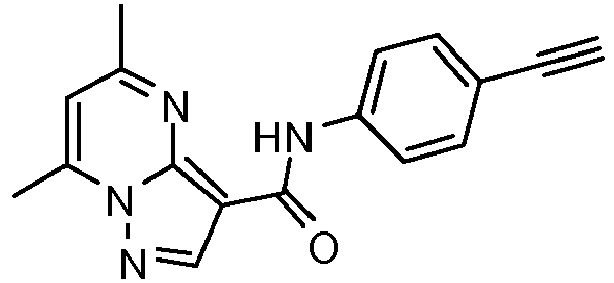 | N-(4-ethynylphenyl)-5,7-dimethylpyrazolo[1,5-a]pyrimidine-3-carboxamide | 0.3659 | 5.784 |
| NCGC00188783-01 |  | N-(3,4-dimethylphenyl)-5,7-dimethylpyrazolo[1,5-a]pyrimidine-3-carboxamide | 1.4566 | 6.094 |
| NCGC00188787-01 |  | 5,7-dimethyl-N-(4-(trifluoromethyl)phenyl)pyrazol o[1,5-a]pyrimidme-3-carboxamide | 1.4566 | 6.434 |
| NCGC00188776-01 |  | N-(3-fluoro-4-methoxyphenyl)-5,7-dimethylpyrazolo[1,5-a]pyrimidine-3-carboxamide | 1.4566 | 5.519 |
| NCGC00188772-01 |  | 5,7-dimethyl-N-p-tolylpyrazolo[1,5-a]pyrimidine-3-carboxamide | 1.6343 | 5.823 |
| NCGC00188782-01 |  | N-(3-chloro-4-methylphenyl)-5,7-dimethylpyrazolo[1,5-a]pyrimidine-3-carboxamide | 1.8338 | 6.437 |
| NCGC00188756-01 |  | N-(4-bromophenyl)-5,7-dimethylpyrazolo[1,5-a]pyrimidine-3-carboxamide | 2.0575 | 6.208 |
| NCGC00188780-01 |  | N-(3-chloro-4-methoxyphenyl)-5,7-dimethylpyrazolo[1,5-a]pyrimidine-3-carboxamide | 2.0575 | 5.793 |
| NCGC00229708-01 |  | N-(4-tert-butylcyclohexyl)-7-methyl-5-phenylpyrazolo[1,5-a]pyrimidine-3-carboxamide | 2.0575 | 7.439 |
| MLS000708974-01 | 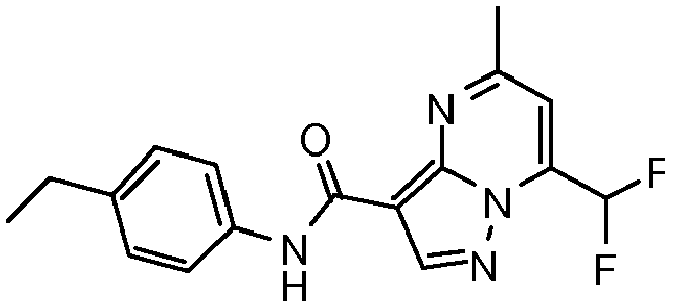 | 7-(difluoromethyl)-N-(4-ethylphenyl)-5-methylpyrazolo[1,5-a]pyrimidine-3-carboxamide | 2.2387 | 2.47 Method 2 |
| NCGC00188764-01 |  | N-(4-tert-butylphenyl)-5,7-dimethylpyrazolo[1,5-a]pyrimidine-3-carboxamide | 2.3086 | 6.745 |
| NCGC00182141-01 |  | N-(4-sec-butylphenyl)-7-(difluoromethyl)-5-methylene-4,5-dihydropyrazolo[1,5-a]pyrimidine-3-carboxamide | 2.5119 | 2.67 Method3 |
| NCGC00182160-01 |  | 7-(difluoromethyl)-N-(2-ethoxyphenyl)-5-methylene-4,5-dihydropyrazolo[1,5-a]pyrimidine-3-carboxamide | 2.5119 | 2.44 Method3 |
| NCGC00182179-01 |  | N-(4-bromo-2-fluorophenyl)-5-cyclopropylidene-7-(difluoromethyl)-4,5-dihydropyrazolo[1,5-a]pyrimidine-3-carboxamide | 2.5119 | 2.71 Method3 |
| NCGC00187969-01 |  | N-(2,3-dihydro-1H-inden-5-yl)-5,7-dimethylpyrazolo[1,5-a]pyrimidine-3-carboxamide | 2.5902 | 6.328 |
| NCGC00182133-01 |  | 5-cyclopropylidene-7-(difluoromethyl)-N-(3,4-dimethylphenyl)-4,5-dihydropyrazolo[1,5-a]pyrimidine-3-carboxamide | 3.1623 | 2.59 Method3 |
| NCGC00182171-01 |  | N-(5-chloropyridin-2-yl)-5-cyclopropylidene-7-(difluoromethyl)-4,5-dihydropyrazolo[1,5-a]pyrimidine-3-carboxamide | 3.1623 | 2.58 Method3 |
| NCGC00182172-01 |  | 5-cyclopropylidene-7-(difluoromethyl)-N-(2,5-difluorophenyl)-4,5-dihydropyrazolo[1,5-a]pyrimidine-3-carboxamide | 3.1623 | 2.57 Method3 |
| NCGC00187970-01 |  | N-(4-ethylphenyl)-5,7-dimethylpyrazolo[1,5-a]pyrimidine-3-carboxamide | 3.2609 | 6.231 |
| MLS000662187-01 |  | 7-(difluoromethyl)-N-(1-(4-fluorobenzyl)-1H-pyrazol-4-yl)-5-phenylpyrazolo[1,5-a]pyrimidine-3-carboxamide | 3.2609 | 2.34 Method 2 |
| NCGC00229713-01 |  | N-(3,4-dichlorophenyl)-5,7-dimethylpyrazolo[1,5-a]pyrimidine-3-carboxamide | 3.6588 | 6.462 |
| NCGC00182174-01 |  | 5-cyclopropylidene-7-(difluoromethyl)-N-(2,3-dihydro-1H-inden-5-yl)-4,5-dihydropyrazolo[1,5-a]pyrimidine-3-carboxamide | 3.9811 | 2.64 Method3 |
| NCGC00182166-01 |  | N-(2,4-difluorophenyl)- 7-methyl-5-methylene-4,5-dihydropyrazolo[1,5-a]pyrimidine-3-carboxamide | 3.9811 | |
| NCGC00188755-01 |  | N-(4-tert-butylcyclohexyl)-5,7-dimethylpyrazolo[1,5-a]pyrimidine-3-carboxamide | 4.1053 | 6.939 |
| MLS000662237-01 |  | N-(4-sec-butylphenyl)-7-(difluoromethyl)-5-methylpyrazolo[1,5-a]pyrimidine-3-carboxamide | 5.0119 | 2.76 Method 2 |
| NCGC00188766-01 |  | N-(4-fluorophenyl)-5,7-dimethylpyrazolo[1,5-a]pyrimidine-3-carboxamide | 5.7988 | 5.581 |
| NCGC00229707-01 |  | N-(4-tert-butylcyclohexyl)-7-methyl-5-phenylpyrazolo[1,5-a]pyrimidine-3-carboxamide | 5.7988 | 7.298 |
| NCGC00187967-01 |  | N-(3,5-difluorophenyl)-5,7-dimethylpyrazolo[1,5-a]pyrimidine-3-carboxamide | 6.1783 | 6.129 |
| NCGC00054856-02 |  | N-(benzo[d][1,3]dioxol-5-yl)-5,7-dimethylpyrazolo[1,5-a]pyrimidine-3-carboxamide | 6.5064 | 5.329 |
| NCGC00188771-01 |  | 5,7-dimethyl-N-m-tolylpyrazolo[1,5-a]pyrimidine-3 -carboxamide | 6.5064 | 5.841 |
| NCGC00229715-01 |  | N-(3,4-dichlorophenyl)-7-methyl-5-phenylpyrazolo[1,5-a]pyrimidine-3-carboxamide | 6.5064 | 7.257 |
| MLS000765493-01 |  | N-(3,4-dichlorophenyl)-5,7-dimethylpyrazolo[1,5-a]pyrimidine-3-carboxamide | 7.0795 | 2.66 Method 2 |
| NCGC00182186-01 |  | 5-cyclopropylidene-7-(difluoromethyl)-N-(2-(phenylthio)phenyl)-4,5-dihydropyrazolo[1,5-a]pyrimidine-3-carboxamide | 7.0795 | 2.72 Method3 |
| NCGC00229719-01 |  | N-(2,3-dihydro-1H-mden-5-yl)-7-methyl-5-phenylpyrazolo[1,5-a]pyrimidine-3-carboxamide | 8.1911 | 7.025 |
| NCGC00187975-01 | 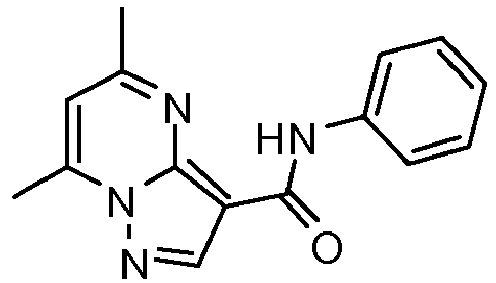 | 5,7-dimethyl-N-phenylpyrazolo[1,5-a]pyrimidine-3-carboxamide | 8.1911 | 5.522 |
| NCGC00188768-01 |  | N-(4-methoxyphenyl)-5,7-dimethylpyrazolo[1,5-a]pyrimidine-3-carboxamide | 8.1911 | 5.328 |
| NCGC00182167-01 | 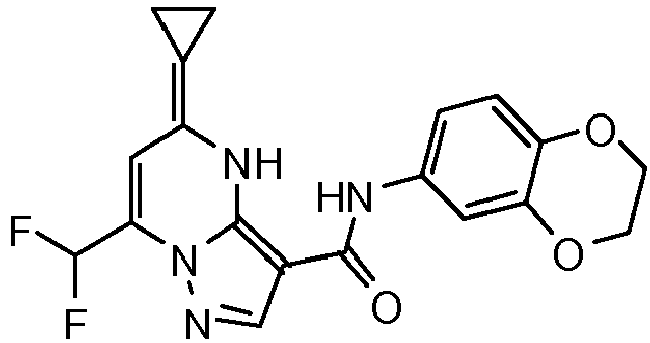 | 5-cyclopropylidene-7-(difluoromethyl)-N-(2,3-dihydrobenzo[b][1,4]dioxin-6-yl)-4,5-dihydropyrazolo[1,5-a]pyrimidine-3-carboxamide | 8.9125 | 2.37 Method3 |
| NCGC00229717 - 01 |  | N-(4-ethylphenyl)-5-methyl-7-phenylpyrazolo[1,5-a]pyrimidine-3-carboxamide | 9.1905 | 6.884 |
| NCGC00182142-01 |  | 7-(difluoromethyl)-N-(3-ethylphenyl)-5-methylene-4,5-dihydropyrazolo[1,5-a]pyrimidine-3-carboxamide | 10 | 2.50 Method3 |
| NCGC00182146-01 |  | N-(2,4-dichlorobenzyl)-7-(difluoromethyl)-5-methylene-4,5-dihydropyrazolo[1,5-a]pyrimidine-3-carboxamide | 10 | 2.48 Method3 |
| NCGC00182165-01 |  | methyl 2-(7-methyl-5-methylene-4,5-dihydropyrazolo[1,5-a]pyrimidine-3-carboxamido)benzoate | 10 | 2.36 Method3 |
| NCGC00188773-01 |  | N-(2,3-dihydrobenzo[b][1,4]dioxin-6-yl)-5,7-dimethylpyrazolo[1,5-a]pyrimidine-3-carboxamide | 10.3119 | 5.301 |
| NCGC00187971-01 |  | N-cyclohexyl-5,7-dimethylpyrazolo[1,5-a]pyrimidine-3-carboxamide | 10.3119 | 5.551 |
| NCGC00182182-01 |  | N-(4-tert-butylcyclohexyl)-5-cyclopropylidene-7-(difluoromethyl)-4,5-dihydropyrazolo[1,5-a]pyrimidine-3-carboxamide | 11.2202 | 2.83 Method3 |
| NCGC00182154-01 |  | N-(4-(diethylamino)phenyl)-7-(difluoromethyl)-5-methylene-4,5-dihydropyrazolo[1,5-a]pyrimidine-3-carboxamide | 11.2202 | 1.75 Method3 |
| NCGC00188779-01 |  | N-(2-fluoro-4-methylphenyl)-5,7-dimethylpyrazolo[1,5-a]pyrimidine-3-carboxamide | 11.5702 | 6.112 |
| NCGC00182170-01 |  | N-cyclopentyl-5-cyclopropylidene-7-(difluoromethyl)-4,5-dihydropyrazolo[1,5-a]pyrimidine-3-carboxamide | 12.5893 | 2.39 Method3 |
| NCGC00182175-01 |  | N-cyclohexyl-5-cyclopropylidene-7-(difluoromethyl)-4,5-dihydropyrazolo[1,5-a]pyrimidine-3-carboxamide | 12.5893 | 2.48 Method3 |
| NCGC00182139-01 |  | 5-cyclopropylidene-7-(difluoromethyl)-N-(6-methylpyridin-2-yl)-4,5-dihydropyrazolo[1,5-a]pyrimidine-3-carboxamide | 12.5893 | 2.15 Method3 |
| NCGC00182185-01 |  | 5-cyclopropylidene-7-(difluoromethyl)-N-(3-(phenylamino)phenyl)-4,5-dihydropyrazolo[1,5-a]pyrimidine-3-carboxamide | 12.5893 | 2.55 Method3 |
| NCGC00182188-01 |  | N-(2-bromophenyl)-5-cyclopropylidene-7-(difluoromethyl)-4,5-dihydropyrazolo[1,5-a]pyrimidine-3-carboxamide | 12.5893 | 2.60 Method3 |
| NCGC00182186-01 |  | 5-cyclopropylidene-7-(difluoromethyl)-N-(2-(phenylthio)phenyl)-4,5-dihydropyrazolo [1,5-a]pyrimidine-3-carboxamide | 12.982 | 2.72 Method3 |
| NCGC00188778-01 | 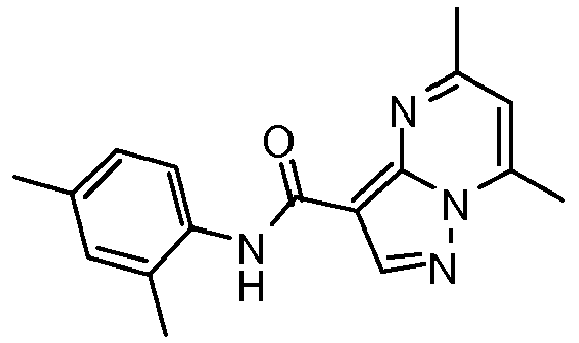 | N-(2,4-dimethylphenyl)-5,7-dimethylpyrazolo[1,5-a]pyrimidine-3-carboxamide | 12.982 | 6.112 |
| NCGC00229714-01 |  | N-(4-ethylphenyl)-7-methyl-5-phenylpyrazolo[1,5-a]pyrimidine-3-carboxamide | 12.982 | 6.914 |
| NCGC00182162-01 |  | 7-(difluoromethyl)-N-(2-methoxybenzyl)-5-methylene-4,5-dihydropyrazolo[1,5-a]pyrimidine-3-carboxamide | 14.1254 | 2.26 Method3 |
| NCGC00182190-01 |  | 5-cyclopropylidene-N-(2-(phenylthio)phenyl)-7-(trifluoromethyl)-4,5-dihydropyrazolo[1,5-a]pyrimidine-3-carboxamide | 14.1254 | 2.76 Method3 |
| NCGC00182176-01 |  | 5-cyclopropylidene-7-(difluoromethyl)-N-(1,2,3,4-tetrahydronaphthalen-1-yl)-4,5-dihydropyrazolo[1,5-a]pyrimidine-3-carboxamide | 14.1254 | |
| NCGC00182148-01 |  | N-(2-chlorobenzyl)-7-(difluoromethyl)-5-methylene-4,5-dihydropyrazolo[1,5-a]pyrimidine-3-carboxamide | 14.1254 | 2.35 Method3 |
| NCGC00182132-01 |  | methyl 2-(5-cyclopropylidene-7-(difluoromethyl)-4,5-dihydropyrazolo[1,5-a]pyrimidine-3-carboxamido)benzoate | 15.8489 | 2.54 Method3 |
| NCGC00182159-01 |  | N-(4-chlorophenethyl)-7-(difluoromethyl)-5-methylene-4,5-dihydropyrazolo[1,5-a]pyrimidine-3-carboxamide | 15.8489 | 2.40 Method3 |
| NCGC00182161-01 |  | 7-(difluoromethyl)-5-methylene-N-(2-(trifluoromethyl)benzyl)-4,5-dihydropyrazolo[1,5-a]pyrimidine-3-carboxamide | 15.8489 | 2.39 Method3 |
| NCGC00182197-01 |  | N-hexyl-7-methyl-5-methylene-4,5-dihydropyrazolo[1,5-a]pyrimidine-3-carboxamide | 15.8489 | 2.47 Method3 |
| NCGC00182198-01 | 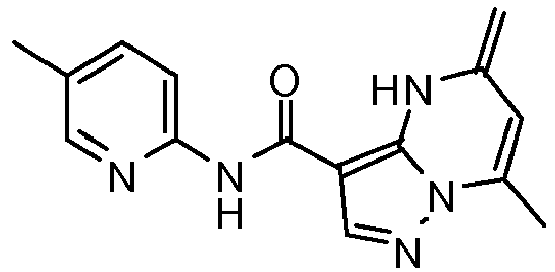 | 7-methyl-5-methylene-N-(5-methylpyridin-2-yl)-4,5-dihydropyrazolo[1,5-a]pyrimidine-3-carboxamide | 15.8489 | 1.78 Method3 |
| NCGC00188770-01 |  | 5,7-dimethyl-N-o-tolylpyrazolo[1,5-a]pyrimidine-3-carboxamide | 16.3433 | 5.730 |
| NCGC00188762-01 | 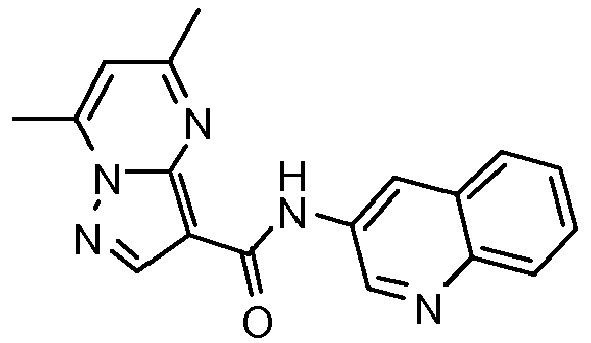 | 5,7-dimethyl-N-(quinolin-3-yl)pyrazolo[1,5-a]pyrimidine-3-carboxamide | 16.3433 | 4.266 |
| NCGC00187965-01 |  | N-(3-chlorobenzyl)-5,7-dimethylpyrazolo[1,5-a]pyrimidine-3-carboxamide | 18.3375 | 5.639 |
| NCGC00229712-01 | 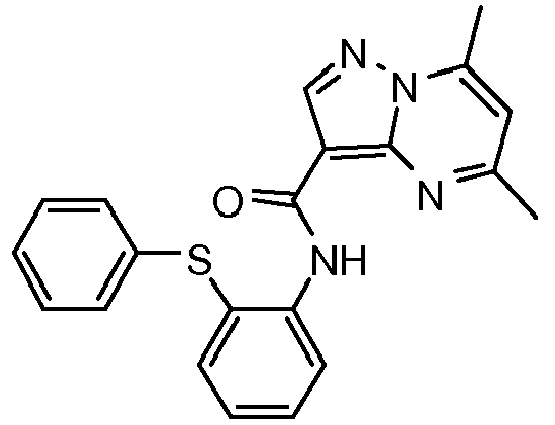 | 5,7-dimethyl-N-(2-(phenylthio)phenyl)pyrazolo[1, 5-a]pyrimidine-3-carboxamide | 18.3375 | 6.590 |
| NCGC00188763-01 |  | 5,7-dimethyl-N-(quinolin-2-yl)pyrazolo[1,5-a]pyrimidine-3-carboxamide | 20.575 | 4.637 |
| NCGC00188769-01 |  | N-(4-cyanophenyl)-5,7-dimethylpyrazolo[1,5-a]pyrimidine-3-carboxamide | 20.575 | 5.441 |
| NCGC00182147-01 |  | 7-(difluoromethyl)-N-(2-methoxyphenethyl)-5-methylene-4,5-dihydropyrazolo[1,5-a]pyrimidine-3-carboxamide | 25.1189 | 2.31 Method3 |
| NCGC00188754-01 |  | N-(4-tert-butylcyclohexyl)-5,7-dimethylpyrazolo [1,5-a]pyrimidine-3-carboxamide | 25.9024 | 6.816 |
| NCGC00188781-01 |  | N-(2,4-dimethoxyphenyl)-5,7-dimethylpyrazolo[1,5-a]pyrimidine-3-carboxamide | 25.9024 | 5.483 |
| NCGC00229716-01 |  | N-(3,5-dichlorophenyl)-5,7-dimethylpyrazolo[1,5-a]pyrimidine-3-carboxamide | 25.9024 | 6.715 |
| NCGC00182145-01 | 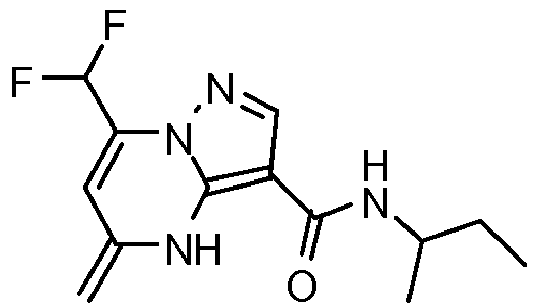 | N-sec-butyl-7-(difluoromethyl)-5-methylene-4,5-dihydropyrazolo[1,5-a]pyrimidine-3-carboxamide | 31.6228 | 2.22 Method3 |
| NCGC00182151-01 |  | N-(2-chlorophenethyl)-7-(difluoromethyl)-5-methylene-4,5-dihydropyrazolo[1,5-a]pyrimidine-3-carboxamide | 31.6228 | 2.38 Method3 |
| NCGC00182152-01 |  | (7-(difluoromethyl)-5-methylene-4,5-dihydropyrazolo[1,5-a]pyrimidin-3-yl)(4-phenylpiperazin-1-yl)methanone | 31.6228 | 2.08 Method3 |
| NCGC00187978-01 | 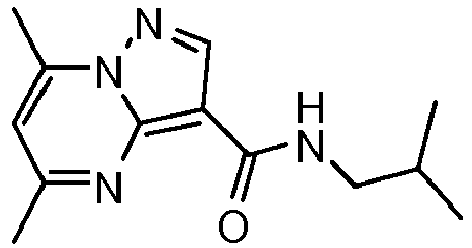 | N-isobutyl-5,7-dimethylpyrazolo[1,5-a]pyrimidine-3-carboxamide | 32.6092 | 5.075 |
| NCGC00188785-01 |  | N-(3-acetylphenyl)-5,7-dimethylpyrazolo[1,5-a]pyrimidine-3-carboxamide | 32.6092 | 5.266 |
| NCGC00229711-01 |  | N-(4-tert-butylcyclohexyl)-5-methyl-7-phenylpyrazolo [1,5-a]pyrimidine-3-carboxamide | 32.6092 | 7.407 |
| NCGC00182144-01 |  | (7-(difluoromethyl)-5-methylene-4,5-dihydropyrazolo[1,5-a]pyrimidin-3-yl)(4-(pyridin-2-yl)piperazin-1-yl)methanone | 35.4813 | 1.59 |
| NCGC00188786-01 |  | 5,7-dimethyl-N-(3-(trifluoromethyl)phenyl)pyrazo o[1,5-a]pyrimidine-3-carboxamide | 41.0526 | 6.364 |
| NCGC00187976-01 |  | N-benzyl-5,7-dimethylpyrazolo[1,5-a]pyrimidine-3-carboxamide | 51.6821 | 5.189 |
| NCGC00188759-01 |  | N-(furan-2-ylmethyl)-5,7-dimethylpyrazolo[1,5-a]pyrimidine-3-carboxamide | 51.6821 | 4.723 |
| NCGC00188774-01 |  | N-(4-methoxy-2-methylphenyl)-5,7-dimethylpyrazolo[1,5-a]pyrimidine-3-carboxamide | 51.6821 | 5.530 |
| NCGC00188784-01 |  | N-(4-acetylphenyl)-5,7-dimethylpyrazolo[1,5-a]pyrimidine-3-carboxamide | 163.433 2 | 5.250 |
| NCGC00229718-01 |  | 5-methyl-7-phenyl-N-p-tolylpyrazolo[1,5-a]pyrimidine-3-carboxamide | 205.750 2 | 6.585 |
| MLS000663265-01 |  | N-(5-bromo-2-hydroxyphenyl)-5-cyclopropyl-7-(difluoromethyl)pyrazolo[1,5-a]pyrimidine-3-carboxamide | 2.36 Method 2 | |
| MLS000716072-01 |  | N-(3-hydroxyphenyl)-5,7-dimethylpyrazolo[1,5-a]pyrimidine-3-carboxamide | 1.86 Method 2 | |
| NCGC00182126-01 |  | N,N-dicyclohexyl-5-cyclopropylidene-7-(difluoromethyl)-4,5-dihydropyrazolo[1,5-a]pyrimidine-3-carboxamide | 2.84 Method3 | |
| NCGC00182127-01 |  | N-(4-bromophenyl)-5-cyclopropylidene-7-(difluoromethyl)-4,5-dihydropyrazolo[1,5-a]pyrimidine-3-carboxamide | 2.60 Method3 | |
| NCGC00182128-01 |  | 5-cyclopropylidene-N-(2,4-dichlorophenyl)-7-(difluoromethyl)-4,5-dihydropyrazolo[1,5-a]pyrimidine-3-carboxamide | 2.78 Method3 | |
| NCGC00182129-01 |  | N-(4-acetylphenyl)-5-cyclopropylidene-7-(difluoromethyl)-4,5-dihydropyrazolo[1,5-a]pyrimidine-3-carboxamide | 2.35 Method3 | |
| NCGC00182130-01 |  | 5-cyclopropylidene-7-(difluoromethyl)-N-(3,4-dimethoxyphenethyl)-4,5-dihydropyrazolo[1,5-a]pyrimidine-3-carboxamide | 2.25 Method3 | |
| NCGC00182131-01 |  | (5-cyclopropylidene-7-(difluoromethyl)-4,5-dihydropyrazolo[1,5-a]pyrimidin-3-yl)(3,4-dihydroisoquinolin-2(1H)-yl)methanone | 2.37 Method3 | |
| NCGC00182134-01 |  | N-(4-chlorophenyl)-5-cyclopropylidene-7-(difluoromethyl)-4,5-dihydropyrazolo[1,5-a]pyrimidine-3-carboxamide | 2.57 Method3 | |
| NCGC00182135-01 |  | 5-cyclopropylidene-7-(difluoromethyl)-N-(pyridin-4-yl)-4,5-dihydropyrazolo[1,5-a]pyrimidine-3-carboxamide | 1.71 Method3 | |
| NCGC00182136-01 |  | 5-cyclopropylidene-7-(difluoromethyl)-N-(pyridin-3-yl)-4,5-dihydropyrazolo[1,5-a]pyrimidine-3-carboxamide | 1.73 Method3 | |
| NCGC00182137-01 |  | 5-cyclopropylidene-7-(difluoromethyl)-N-(1-methylpiperidin-4-yl)-4,5-dihydropyrazolo[1,5-a]pyrimidine-3-carboxamide | 1.65 Method3 | |
| NCGC00182138-01 |  | 5-cyclopropylidene-7-(difluoromethyl)-N-((1-methyl-1H-pyrazol-4-yl)methyl)-4,5-dihydropyrazolo[1,5-a]pyrimidine-3-carboxamide | 1.99 Method3 | |
| NCGC00182140-01 |  | N-(4-fluorobenzyl)-5-methylene-7-(trifluoromethyl)-4,5-dihydropyrazolo[1,5-a]pyrimidine-3-carboxamide | 2.29 Method3 | |
| NCGC00182143-01 |  | 7-(difluoromethyl)-N-(4-methoxybenzyl)-5-methylene-4,5-dihydropyrazolo[1,5-a]pyrimidine-3-carboxamide | 2.21 Method3 | |
| NCGC00182149--01 |  | 7-(difluoromethyl)-N-(3,4-dimethoxyphenethyl)-5-methylene-4,5-dihydropyrazolo[1,5-a]pyrimidine-3-carboxamide | 2.16 Method3 | |
| NCGC00182150-01 |  | N-benzyl-7-(difluoromethyl)-5-methylene-4,5-dihydropyrazolo[1,5-a]pyrimidine-3-carboxamide | 2.23 Method3 | |
| NCGC00182153-01 |  | N-(4-bromo-2-(trifluoromethyl)phenyl)-7-(difluoromethyl)-5-methylene-4,5-dihydropyrazolo[1,5-a]pyrimidine-3-carboxamide | ||
| NCGC00182155- 01 |  | (7-(difluoromethyl)-5-methylene-4,5-dihydropyrazolo[1,5-a]pyrimidin-3-yl)(piperidin-1-yl)methanone | 2.09 Method3 | |
| NCGC00182156-01 |  | 7-(difluoromethyl)- N-(4-fluorobenzyl)-5-methylene-4,5-dihydropyrazolo[1,5-a]pyrimidine-3-carboxamide | 2.24 Method3 | |
| NCGC00182157-01 |  | N-(4-chlorobenzyl)-7-(difluoromethyl)-5-methylene-4,5-dihydropyrazolo[1,5-a]pyrimidine-3-carboxamide | 2.34 Method3 | |
| NCGC00182158-01 |  | 7-(difluoromethyl)-N-(3,4-dimethoxybenzyl)-5-methylene-4,5-dihydropyrazolo[1,5-a]pyrimidine-3-carboxamide | ||
| NCGC00182163-01 |  | (7-(difluoromethyl)-5-methylene-4,5-dihydropyrazolo[1,5-a]pyrimidin-3-yl)(3,4-dihydroisoquinolin-2(1H)-yl)methanone | 2.23 Method3 | |
| NCGC00182164-01 |  | N-allyl-7-methyl-5-methylene 4,5-dihydropyrazolo[1,5-a] pyrimidine-3-carboxamide | 2.00 Method3 | |
| NCGC00182168-01 |  | (5-cyclopropylidene-7-(difluoromethyl)-4,5-dihydropyrazolo[1,5-a]pyrimidin-3-yl)(indolin-1-yl)methanone | 2.39 Method3 | |
| NCGC00182169-01 |  | N-(5-bromopyridin-2-yl)-5-cyclopropylidene-7-(difluoromethyl)-4,5-dihydropyrazolo[1,5-a]pyrimidine-3-carboxamide | 2.62 Method3 | |
| NCGC00182173-01 |  | N-(2-chloropyridin-3-yl)-5-cyclopropylidene-7-(difluoromethyl)-4,5-dihydropyrazolo[1,5-a]pyrimidine-3-carboxamide | 2.43 Method3 | |
| NCGC00182177- 01 |  | (5-cyclopropylidene-7-(difluoromethyl)-4,5-dihydropyrazolo[1,5-a]pyrimidin-3-yl)(2-methylpiperidin-1-yl)methanone | 2.35 Method3 | |
| NCGC00 182178-01 |  | 5-cyclopropylidene-7-(difluoromethyl)-N-(3,4-difluorophenyl)-4,5-dihydropyrazolo[1,5-a]pyrimidine-3-carboxamide | 2.51 Method3 | |
| NCGC00182180-01 |  | 5-cyclopropylidene-7-(difluoromethyl)-N-(naphthalen-1-yl)-4,5-dihydropyrazolo[1,5-a]pyrimidine-3-carboxamide | 2.58 Method3 | |
| NCGC00182181-01 |  | 5-cyclopropylidene-N-(3,4-difluorophenyl)-7-(trifluoromethyl)-4,5-dihydropyrazolo[1,5-a]pyrimidine-3-carboxamide | 2.56 Method3 | |
| NCGC00182183-01 |  | 5-cyclopropylidene- N-(3,5-dichlorophenyl)-7-(difluoromethyl)-4,5-dihydropyrazolo[1,5-a]pyrimidine-3-carboxamide | 2.77 Method3 | |
| NCGCO0182184-01 |  | 5-cyclopropylidene-7-(difluoromethyl)-N-(4-nitrophenyl)-4,5-dihydropyrazolo[1,5-a]pyrimidine-3-carboxamide | 2.46 Method3 | |
| NCGC00182187-01 |  | 5-cyclopropylidene- 7-(difluoromethyl)-N-(4-sulfamoylphenyl)-4,5-dihydropyrazolo[1,5-a]pyrimidine-3-carboxamide | 2.07 Method3 | |
| NCGC00182189-01 | 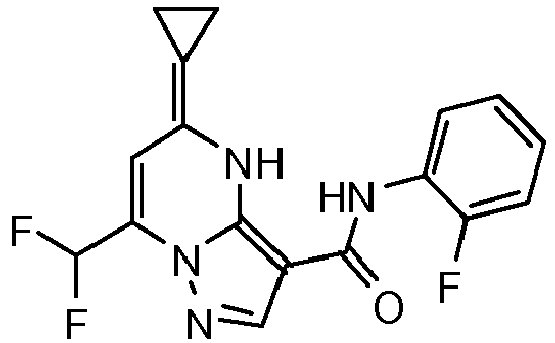 | 5-cyclopropylidene- 7-(difluoromethyl)-N-(2-( (fluorophenyl)-4,5-dihydropyrazolo[1,5-a]pyrimidine-3-carboxamide | 2.52 Method3 | |
| NCGC00182191-01 |  | N-(4-bromo-2-chlorophenyl)-5-cyclopropylidene-7-(difluoromethyl)-4,5-dihydropyrazolo[1,5-a]pyrimidine-3-carboxamide | ||
| NCGC00182192-01 |  | (5-cyclopropylidene-7-(difluoromethyl)-4,5-dihydropyrazolo[1,5-a]pyrimidin-3-yl)(6-methyl-3,4-dihydroquinolin-1 (2H)-yl)methanone | 2.49 Method3 | |
| NCGC00182193-01 |  | 5-cyclopropylidene- 7-(difluoromethyl)-N-(1-(pyridin-4-yl)ethyl)-4,5-dihydropyrazolo[1,5-a]pyrimidine-3-carboxamide | 1.71 Method3 | |
| NCGC00182194-01 |  | 7-methyl-5-methylene-N-(3-(3-(trifluoromethyl)phenylcarbam oyl)phenyl)-4,5-dihydropyrazolo[1,5-a]pyrimidine-3-carboxamide | 2.5 Method3 | |
| NCGC00182195-01 |  | N-benzyl-7-methyl-5-methylene-N-phenethyl-4,5-dihydropyrazolo[1,5-a]pyrimidine-3-carboxamide | 2.47 Method3 | |
| NCGC00182196-01 |  | N-(4-acetamido-3-chlorophenyl)-7-methyl-5-methylene-4,5-dihydropyrazolo[1,5-a]pyrimidine-3-carboxamide | 2.07 Method3 | |
| NCGC00182199-01 |  | N-(2-hydroxyphenyl)-7-methyl-5-methylene-4,5-dihydropyrazolo[1,5-a]pyrimidine-3-carboxamide | 2.07 Method3 | |
| NCGCO0182200-01 |  | N-(isoquinolin-5-yl)-7-methyl-5-methylene-4,5-dihydropyrazolo[1,5-a]pyrimidine-3-carboxamide | 1.68 Method3 | |
| NCGC00182241-01 |  | 7-(difluoromethyl)-N-(2-fluorobenzyl)-5-methylene-4,5-dihydropyrazolo[1,5-a]pyrimidine-3-carboxamide | ||
| NCGC00182242-01 |  | 5-cyclopropylidene-7-(difluoromethyl)-N-p-tolyl-4,5-dihydropyrazolo[1,5-a]pyrimidine-3-carboxamide | ||
| NCGC00 187966-01 |  | N-(4-hydroxybutyl)-5,7-dimethylpyrazolo[1,5-a]pyrimidine-3-carboxamide | 3.717 | |
| NCGC00187968-01 |  | (5,7-dimethylpyrazolo[1,5-a]pyrimidin-3-yl)(4-(4-nitrophenyl)piperazin-1-yl)methanone | 5.079 | |
| NCGC00 187972-01 |  | N-isopropyl-5,7-dimethylpyrazolo[1,5-a]pyrimidine-3-carboxamide | 4.655 | |
| NCGC00187973-01 |  | (5,7-dimethylpyrazolo[1,5-a]pyrimidin-3-yl)(pyrrolidin-1-yl)methanone | 3.843 | |
| NCGC00187974-01 |  | N-(3-cyanophenyl)-5,7-dimethylpyrazolo[1,5-a]pyrimidine-3-carboxamide | 5.472 | |
| NCGC00187977-01 |  | N,5,7-trimethylpyrazolo[1,5-a]pyrimidine-3-carboxamide | 3.709 | |
| NCGC00187979- 01 |  | N-(2,2-difluoroethyl)-5,7-dimethylpyrazolo[1,5-a]pyrimidine-3-carboxamide | 4.386 | |
| NCGC00188757-01 |  | (5,7-dimethylpyrazolo[1,5-a]pyrimidin-3-yl)(4-methylpiperazin-1-yl)methanone | 2.543 | |
| NCGC00188760-01 |  | 5, 7-dimethyl-N-(4-(methylsulfonyl)phenyl)pyrazol 0[1,5-a]pyrimidine-3-carboxamide | 4.759 | |
| NCGC00188761-01 |  | 5,7-dimethyl-N-(pyridin-4-yl)pyrazolo[1,5-a]pyrimidine-3-carboxamide | 3.326 | |
| NCGC00188765-01 | 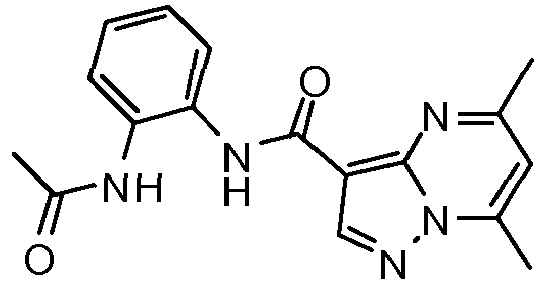 | N-(2-acetamidophenyl)-5,7-dimethylpyrazolo[1,5-a]pyrimidine-3-carboxamide | 4.169 | |
| NCGC00188767-01 |  | N-(4-acetamidophenyl)-5, 7-dimethylpyrazolo[1,5-a]pyrimidine-3-carboxamide | 4.385 | |
| NCGC00188775-01 |  | 5,7-dimethyl-N-(3,4,5-trimethoxyphenyl)pyrazolo[1,5-a]pyrimidine-3-carboxamide | 5.239 | |
| NCGC00188777-01 |  | N-(3,4-dimethoxyphenyl)-5, 7-dimethylpyrazolo[1,5-a]pyrimidine-3-carboxamide | 5.026 | |
| NCGC00229709-01 |  | N-(4-methoxyphenyl)-5-methyl-7-phenylpyrazolo[1,5-a]pyrimidine-3-carboxamide | 6.165 | |
| NCGC00229710-01 |  | N-(3,4-dichlorophenyl)-5-methyl-7-phenylpyrazolo[1,5-a]pyrimidine-3-carboxamide | 7.215 | |
| NCGC00229720-01 |  | 5-methyl-7-phenyl-N-(2-(phenylthio)phenyl)pyrazolo [1,5-a]pyrimidine-3-carboxamide | 7.281 | |
| CCB2-5-1 |  | N-((2E,4E)-hexa-2,4-dien-2-yl)-5-methyl-7,8-dihydro-6H-cyclopenta[e]pyrazolo[1,5-a]pyrimidine-3-carboxamide | ||
| CCB2-6-1 | 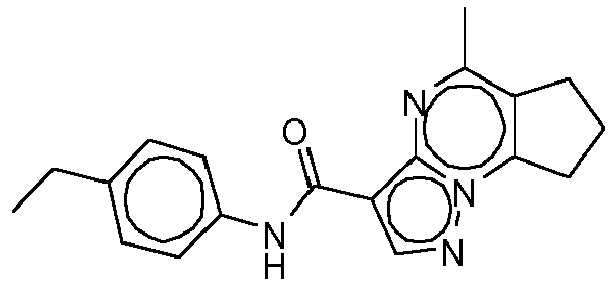 | N-(4-ethylphenyl)-5-methyl-7,8-dihydro-6H-cyclopenta[e]pyrazolo[1,5-a]pyrimidine-3-carboxamide | ||
| CCB2-7-1 |  | 5-methyl-N-4-(trifluoromethyl)phenyl)-7,8-dihydro-6H-cyclopenta[e]pyrazolo[1,5-a]pyrimidine-3-carboxamide | ||
| CGB2-8-1 |  | N-(3,4-dichlorophenyl)- 5-methyl-7,8-dihydro-6H-cyclopenta[e]pyrazolo[1,5-a]pyrimidine-3-carboxamide | ||
| CGB2-9-1 |  | N-(4-ethynylphenyl)-5-methyl-7,8-dihydro-6H-cyclopenta[e]pyrazolo[1,5-a]pyrimidine-3-carboxamide | ||
| CGB2-10-1 |  | N-(4-tert-butylcyclohexyl)-5-methyl-7,8-dihydro-6H-cyclopenta[e]pyrazolo[1,5-a]pyrimidine-3-carboxamide | ||
| CGB2-12-1 |  | 5-methyl-N-p-tolyl-6,7,8,9-tetrahydropyrazolo[1,5-a]quinazoline-3-carboxamide | ||
| CGB2-13-1 |  | N-(4-ethylphenyl)-5-methyl-6,7,8,9-tetrahydropyrazolo[1,5-a]quinazoline-3-carboxamide | ||
| CGB2-14-1 |  | 5-methyl-N-(4-(trifluoromethyl)phenyl)-6,7,8,9-tetrahydropyrazolo[1,5-a] quinazoline-3 -carboxamide | ||
| CGB2-16-1 |  | N-(4-ethynylphenyl)-5-methyl-6,7,8,9-tetrahydropyrazolo[1,5-a]quinazoline-3-carboxamide | ||
| CGB2-17 -1 |  | N-(4-tert-butylcyclohexyl)-5-methyl-6,7,8,9-tetrahydropyrazolo[1,5-a]quinazoline-3-carboxamide | ||
| CGB2-18-1 |  | 7-(difluoromethyl)-5-methyl-N-p-tolylpyrazolo[1,5-a]pyrimidine-3-carboxamide | ||
| CGB2-19-1 |  | 7-(difluoromethyl)-N-(4-ethylphenyl)-5-methylpyrazolo[1,5-a]pyrimidine-3-carboxamide | ||
| CGB2-20-1 |  | 7-(difluoromethyl)-5-methyl-N-(4-(trifluoromethyl)phenyl) pyrazolo[1-5-a]pyrimidine-3-carboxamide | ||
| CGB2-21-1 |  | N-(3,4-dichlorophenyl)-7-(difluoromethyl)-5-methylpyrazolo[1,5-a]pyrimidine- 3-carboxamide | ||
| CGB2-22-1 |  | 7-(difluoromethyl)-N-(4-ethynylphenyl)-5-methylpyrazolo[1,5-a]pyrimidine-3-carboxamide | ||
| CGB2-23-1 |  | N-(4-tert-butylcyclohexyl)-5-(difluoromethyl)-7-methylpyrazolo[1,5-a]pyrimidine-3-carboxamide | ||
| CGB2-32-1 |  | 5,7-dimethyl-N-(4-norpholinophenyl)pyrazolo[1,5 -a]pyrimidine-3-carboxamide | ||
| CGB2-33-1 |  | 5,7-dimethyl-N-(4-(piperidin-1-yl)phenyl)pyrazolo[1,5-a]pyrimidine-3-carboxamide | ||
| CGB2-34-1 |  | N-(3-(dimethylamino)phenyl)-5,7-dimethylpyrazolo[1,5-a]pyrimidine-3-carboxamide | ||
| CGB2-35-1 |  | N-(4-(dimethylamino)phenyl)-5,7-dimethylpyrazolo[1,5-a]pyrimidine-3-carboxamide | ||
| CGB2-36-1 |  | N-(4-bromophenyl)-5,7-dimethylpyrazolo[1,5-a]pyrimidine-3-carboxamide | ||
| CGB2-39-1 |  | N-(4'-cyanobiphenyl-4-yl)-5, 7-dimethylpyrazolo[1,5-a]pyrimidine-3-carboxamide | ||
| CGB2-41-1 |  | N-(3'-methoxybiphenyl-4-yl)-5,7-dimethylpyrazolo[1,5-a]pyrimidine-3-carboxamide | ||
| CGB2-42-1 |  | N-(3'-cyanobiphenyl-4-yl)-5,7-dimethylpyrazolo[1,5-a]pyrimidine-3-carboxamide | ||
| CGB2-43-1 |  | N-(4'-(dimethylamino)biphenyl-4-yl)-5,7-dimethylpyrazolo[1,5-a]pyrimidine-3-carboxamide | ||
| CGB2-62-1 |  | N-(4'-methoxybiphenyl-4-yl)-5,7-dimethylpyrazolo[1,5-a]pyrimidine-3-carboxamide | ||
| CGB2-63-1 |  | N-(3'-(dimethylamino)biphenyl-4-yl)-5,7-dimethylpyrazolo[1,5-a]pyrimidine-3-carboxamide | ||
| CGB2-68-1 |  | N-(4-iodophenyl)-5,7-dimethylpyrazolo[1,5-a]pyrimidine-3-carboxamide | ||
| CGB2-55-1 |  | N-(3-bromophenyl)-5,7-dimethylpyrazolo [1,5-a]pyrimidine-3-carboxamide | ||
| CGB2-56-1 |  | N-(4'-methoxybiphenyl-3-yl)-5,7-dimethylpyrazolo[1,5-a]pyrimidine-3-carboxamide | ||
| CGB2-57-1 |  | N-(4'-cyanobiphenyl-3-yl)-5,7-dimethylpyrazolo[1,5-a]pyrimidine-3-carboxamide | ||
| CGB2-58-1 |  | N-(3'-methoxybiphenyl-3-yl)-5,7-dimethylpyrazolo[1,5-a]pyrimidine-3-carboxamide | ||
| CGB2-59-1 |  | N-(4'-(dimethylamino)biphenyl-3-yl)-5,7-dimethylpyrazolo[1,5-a]pyrimidine-3-carboxamide | ||
| CGB2-60-1 |  | N-(3'-(dimethylamino)biphenyl-3-yl)-5,7-dimethylpyrazolo[1,5-a]pyrimidine-3-carboxamide | ||
| CGB2-61-1 |  | 5,7-dimethyl-N-(3-(pyrimidin-5-yl)phenyl)pyrazolo[1,5-a]pyrimidine-3-carboxamide | ||
| CGB2-67-1 |  | N-(3'-cyanobiphenyl-3-yl)-5,7-dimethylpyrazolo[1,5-a]pyrimidine-3-carboxamide | ||
| CGB2-64-1 |  | N-(4-ethylphenyl)-5-methyl-7-(4-methylpiperazin-1-yl)pyrazolo[1,5-a]pyrimidine-3-carboxamide | ||
| CGB2-65-1 |  | N-(4-ethylphenyl)-5-methyl-7-(2-morpholinoethylamino)pyrazol o[1,5-a]pyrimidine-3-carboxamide | ||
| CGB2-75-1 |  | N-(4-ethylphenyl)-5-methyl-7-(piperidin-1-yl)pyrazolo[1,5-a]pyrimidine-3-carboxamide | ||
| CGB2-77-1 |  | N-(4-ethylphenyl)-5-methyl-7-morpholinopyrazolo[1,5-a]pyrimidine-3-carboxamide | ||
| CGB2-79-1 |  | N-(4-ethylphenyl)-7-(4-isopropylpiperazin-1-yl)-5-methylpyrazolo[1,5-a]pyrimidine-3-carboxamide | ||
| CGB2-80-1 |  | N-(4-ethylphenyl)-7-(4-isobutylpiperazin-1-yl)-5-methylpyrazolo[1,5-a]pyrimidine-3-carboxamide | ||
| CGB2-81-1 |  | 7-(4-(2-(dimethylamino)ethyl)piperazin -1-yl)-N-(4-ethylphenyl)-5-methylpyrazolo[1,5-a]pyrimidine-3-carboxamide | ||
| CGB2-82-1 |  | 7-(3,5-dimethylmorpholino)-N-(4-ethylphenyl)-5-methylpyrazolo[1,5-a]pyrimidine-3-carboxamide | ||
| CGB2-83-1 |  | 7-(3,5-dimethylpiperazin-1-yl)-N-(4-ethylphenyl)-5-methylpyrazolo[1,5-a]pyrimidine-3-carboxamide | ||
| CGB2-70-1 |  | N-(4-(3-(dimethylamino)prop-1-ynyl)phenyl)-5,7-dimethylpyrazolo[1,5-a]pyrimidine-3-carboxamide |
Claims (8)
- A compound of the formula

R1 is (pyrimidinyl) C0-C4alkyl, (C3-C7cycloalkyl)C0-C4alkyl, (pyrazolyl)C0-C2alkyl, (pyrrolyl)C0-C2alkyl, (imidazolyl)C0-C2alkyl, (thienyl)C0-C2alkyl, (furanyl)C0-C2alkyl, (thiazolyl)C0-C2alkyl, pyrolidinyl, naphthyl, quinolinyl, isoquinolinyl, tetrahydronaphthyl, tetrahydroquinolinyl, tetrahydroisoquinolinyl tetrahydrofuranyl, morpholinyl, piperidinyl or thiomorpholinyl,
each of which is unsubstituted or substituted with one or more substituents independently chosen from halogen, hydroxyl, cyano, nitro, amino, -CHO, -COOH, C1-C6alkyl, C1-C6alkoxy, C2-C6alkanoyl, mono- or di- C1-C6alkylamino, mono- or di-C1-C6alkylcarboxamide, C1-C6alkylester, C1-C6alkylthio, C1-C6alkylsulfonyl, C1-C2haloalkyl, and C1-C2haloalkoxy, and with 0 or 1 substituents chosen from Y-Z- where Z is a covalent bond, C1-C4alkylene, -S-, -O-, -NR-, -C(O)-, -NHC(O)-, or -C(O)NH-, where R is hydrogen or C1-C4alkyl, and Y is phenyl or pyridyl, each of which is unsubstituted or substituted with 1 to 3 substituents independently chosen from halogen, hydroxyl, cyano, nitro, amino, C1-C4alkyl, and C1-C4alkoxy;
R2 is hydrogen or methyl;
R3 and R6 are both hydrogen; and
R5 and R7 are both methyl; or one of R5 and R7 is methyl and the other is phenyl; or one of R5 and R7 is methyl and the other is difluoromethyl;
with the proviso that:R1 is not unsubstituted cyclohexyl when R5 and R7 are both methyl or one of R5 and R7 is methyl and the other is phenyl;R1 is not 1-(4-fluorobenzyl)-1H-pyrazol-4-yl when one of R5 and R7 is methyl and the other is phenyl. - A compound or pharmaceutically acceptable salt thereof of claim 1, wherein R5 and R7 are both methyl.
- A compound or pharmaceutically acceptable salt thereof of claim 1 or 2, wherein the compound is selected from:N-(4-tert-butylcyclohexyl)-5,7-dimethylpyrazolo[1,5-a]pyrimidine-3-carboxamide;5,7-dimethyl-N-(quino lin-3 -yl)pyrazo lo [1,5 -a]pyrimidine-3 -carboxamide;5,7-dimethyl-N-(quinolin-2-yl)pyrazolo[1,5-a]pyrimidine-3-carboxamide; andN-(isoquinolin-5-yl)-7-methyl-5-methylene-4,5-dihydropyrazolo[1,5-a]pyrimidine-3-carboxamide.
- A pharmaceutical composition comprising a compound of any one of claims 1 to 3 together with a pharmaceutically acceptable carrier.
- The pharmaceutical composition of Claim 4, wherein the composition is in the form of an oral dosage form.
- A compound of any one of claims 1 to 3 for use as a medicament.
- A compound of any one of claims 1 to 3 for use in treating Gaucher disease in a patient or preventing the symptoms of Gaucher disease in a patient having a GBA gene mutation by administering an effective amount of the compound to the patient.
- A compound of any one of claims 1 to 3 for use in increasing the amount of beta glucocerebrosidase in the white blood cells of patient having a GBA gene mutation by administering an effective amount of the compound to the patient.
Priority Applications (4)
| Application Number | Priority Date | Filing Date | Title |
|---|---|---|---|
| HRP20220512TT HRP20220512T1 (en) | 2010-12-08 | 2011-12-08 | Substituted pyrazolopyrimidines as glucocerebrosidase activators |
| RS20220422A RS63320B1 (en) | 2010-12-08 | 2011-12-08 | SUBSTITUTED PYRAZOLOPYRIMIDINES AS GLUCOCEREBROSIDASE ACTIVATORS |
| PL18165005T PL3366688T3 (en) | 2010-12-08 | 2011-12-08 | Substituted pyrazolopyrimidines as glucocerebrosidase activators |
| SI201132052T SI3366688T1 (en) | 2010-12-08 | 2011-12-08 | Substituted pyrazolopyrimidines as glucocerebrosidase activators |
Applications Claiming Priority (3)
| Application Number | Priority Date | Filing Date | Title |
|---|---|---|---|
| US42094610P | 2010-12-08 | 2010-12-08 | |
| PCT/US2011/063928 WO2012078855A1 (en) | 2010-12-08 | 2011-12-08 | Substituted pyrazolopyrimidines as glucocerebrosidase activators |
| EP11810714.3A EP2649075B1 (en) | 2010-12-08 | 2011-12-08 | Substituted pyrazolopyrimidines as glucocerebrosidase activators |
Related Parent Applications (1)
| Application Number | Title | Priority Date | Filing Date |
|---|---|---|---|
| EP11810714.3A Division EP2649075B1 (en) | 2010-12-08 | 2011-12-08 | Substituted pyrazolopyrimidines as glucocerebrosidase activators |
Publications (2)
| Publication Number | Publication Date |
|---|---|
| EP3366688A1 true EP3366688A1 (en) | 2018-08-29 |
| EP3366688B1 EP3366688B1 (en) | 2022-02-09 |
Family
ID=45498099
Family Applications (2)
| Application Number | Title | Priority Date | Filing Date |
|---|---|---|---|
| EP11810714.3A Active EP2649075B1 (en) | 2010-12-08 | 2011-12-08 | Substituted pyrazolopyrimidines as glucocerebrosidase activators |
| EP18165005.2A Active EP3366688B1 (en) | 2010-12-08 | 2011-12-08 | Substituted pyrazolopyrimidines as glucocerebrosidase activators |
Family Applications Before (1)
| Application Number | Title | Priority Date | Filing Date |
|---|---|---|---|
| EP11810714.3A Active EP2649075B1 (en) | 2010-12-08 | 2011-12-08 | Substituted pyrazolopyrimidines as glucocerebrosidase activators |
Country Status (24)
| Country | Link |
|---|---|
| US (3) | US9353117B2 (en) |
| EP (2) | EP2649075B1 (en) |
| JP (1) | JP6154746B2 (en) |
| KR (1) | KR101931224B1 (en) |
| CN (1) | CN103534255B (en) |
| AU (1) | AU2011338377B2 (en) |
| BR (1) | BR112013014242B1 (en) |
| CA (1) | CA2820362C (en) |
| CY (1) | CY1125186T1 (en) |
| DK (2) | DK2649075T3 (en) |
| ES (2) | ES2912284T3 (en) |
| HR (1) | HRP20220512T1 (en) |
| HU (1) | HUE038635T2 (en) |
| IL (2) | IL226767B (en) |
| LT (1) | LT3366688T (en) |
| MX (2) | MX385600B (en) |
| PL (2) | PL3366688T3 (en) |
| PT (2) | PT2649075T (en) |
| RS (1) | RS63320B1 (en) |
| RU (1) | RU2603637C2 (en) |
| SI (2) | SI2649075T1 (en) |
| TR (1) | TR201810523T4 (en) |
| WO (1) | WO2012078855A1 (en) |
| ZA (1) | ZA201304215B (en) |
Families Citing this family (55)
| Publication number | Priority date | Publication date | Assignee | Title |
|---|---|---|---|---|
| CA2820362C (en) * | 2010-12-08 | 2020-03-24 | The United States Of America, As Represented By The Secretary, Departmt Of Health And Human Services | Substituted pyrazolopyrimidines as glucocerebrosidase activators |
| US9845327B2 (en) | 2011-06-22 | 2017-12-19 | The General Hospital Corporation | Treatment of proteinopathies |
| JP2014517079A (en) | 2011-06-22 | 2014-07-17 | バーテックス ファーマシューティカルズ インコーポレイテッド | Compounds useful as ATR kinase inhibitors |
| MY157429A (en) | 2011-06-24 | 2016-06-15 | Amgen Inc | Trpm8 antagonists and their use in treatments |
| JP2014517074A (en) | 2011-06-24 | 2014-07-17 | アムジエン・インコーポレーテツド | TRPM8 antagonists and their use in therapy |
| RU2014120166A (en) * | 2011-10-20 | 2015-11-27 | ГЛЭКСОСМИТКЛАЙН ЭлЭлСи | SUBSTITUTED Bicyclic AZA-HETEROCYCLES AND THEIR ANALOGUES AS SIRTUIN MODULATORS |
| US8940742B2 (en) | 2012-04-10 | 2015-01-27 | Infinity Pharmaceuticals, Inc. | Heterocyclic compounds and uses thereof |
| US8952009B2 (en) | 2012-08-06 | 2015-02-10 | Amgen Inc. | Chroman derivatives as TRPM8 inhibitors |
| SMT202000713T1 (en) | 2012-12-07 | 2021-03-15 | Vertex Pharma | Pyrazolo[1,5-a]pyrimidines useful as inhibitors of atr kinase for the treatment of cancer diseases |
| JP2016512815A (en) | 2013-03-15 | 2016-05-09 | バーテックス ファーマシューティカルズ インコーポレイテッドVertex Pharmaceuticals Incorporated | Condensed pyrazolopyrimidine derivatives useful as inhibitors of ATR kinase |
| EP2970288A1 (en) | 2013-03-15 | 2016-01-20 | Vertex Pharmaceuticals Incorporated | Compounds useful as inhibitors of atr kinase |
| WO2014143241A1 (en) | 2013-03-15 | 2014-09-18 | Vertex Pharmaceuticals Incorporated | Compounds useful as inhibitors of atr kinase |
| PE20160685A1 (en) | 2013-10-04 | 2016-07-23 | Infinity Pharmaceuticals Inc | HETEROCYCLIC COMPOUNDS AND USES OF THEM |
| US9751888B2 (en) | 2013-10-04 | 2017-09-05 | Infinity Pharmaceuticals, Inc. | Heterocyclic compounds and uses thereof |
| HUE046727T2 (en) | 2013-12-06 | 2020-03-30 | Vertex Pharma | 2-amino-6-fluoro-n-[5-fluoro-pyridin-3-yl]pyrazolo[1,5-a]pyrimidin-3-carboxamide compound useful as atr kinase inhibitor, its preparation, different solid forms and radiolabelled derivatives thereof |
| SG10201808053XA (en) | 2014-03-19 | 2018-10-30 | Infinity Pharmaceuticals Inc | Heterocyclic compounds for use in the treatment of pi3k-gamma mediated disorders |
| CN107074863B (en) | 2014-06-05 | 2019-12-03 | 沃泰克斯药物股份有限公司 | Methods of making ATR kinase inhibitors and their different solid forms |
| PL3157566T3 (en) | 2014-06-17 | 2019-10-31 | Vertex Pharma | Method for treating cancer using a combination of chk1 and atr inhibitors |
| US9708348B2 (en) | 2014-10-03 | 2017-07-18 | Infinity Pharmaceuticals, Inc. | Trisubstituted bicyclic heterocyclic compounds with kinase activities and uses thereof |
| WO2016071216A1 (en) | 2014-11-03 | 2016-05-12 | Bayer Pharma Aktiengesellschaft | Piperidinylpyrazolopyrimidinones and their use |
| CN107001379B (en) * | 2014-11-06 | 2022-11-01 | Bial研发投资股份有限公司 | Substituted pyrazolo [1,5-a ] pyrimidines and their use in the treatment of medical disorders |
| AU2015342883B2 (en) * | 2014-11-06 | 2020-07-02 | Bial - R&D Investments, S.A. | Substituted pyrrolo(1,2-a)pyrimidines and their use in the treatment of medical disorders |
| WO2016073889A1 (en) | 2014-11-06 | 2016-05-12 | Lysosomal Therapeutics Inc. | Substituted imidazo[1,5-a]pyrimidines and their use in the treatment of medical disorders |
| CN108290894A (en) * | 2015-07-01 | 2018-07-17 | 西北大学 | Substituted 4- methyl-pyrrols simultaneously [1,2-A] pyrimidine -8- Carbox amides and its adjust glucocerebrosidase activity purposes |
| EP3344625A4 (en) * | 2015-09-04 | 2019-03-27 | Lysosomal Therapeutics Inc. | Thiazolo(3,2-a) pyrimidinone and other heterobicyclic pyrimidinone compounds for use in medical therapy |
| EP3344632A4 (en) * | 2015-09-04 | 2019-03-20 | Lysosomal Therapeutics Inc. | Heterobicyclic pyrimidinone compounds and their use in the treatment of medical disorders |
| US10160761B2 (en) | 2015-09-14 | 2018-12-25 | Infinity Pharmaceuticals, Inc. | Solid forms of isoquinolinones, and process of making, composition comprising, and methods of using the same |
| KR102678021B1 (en) | 2015-09-30 | 2024-06-26 | 버텍스 파마슈티칼스 인코포레이티드 | Pharmaceutical composition for cancer treatment comprising an ATR inhibitor, used in combination with a DNA damaging agent |
| EP3429590A4 (en) * | 2016-03-16 | 2020-02-19 | Lysosomal Therapeutics Inc. | Methods and compositions for treating a neurodegenerative disorder in a sphingotyped subject |
| WO2017161116A1 (en) | 2016-03-17 | 2017-09-21 | Infinity Pharmaceuticals, Inc. | Isotopologues of isoquinolinone and quinazolinone compounds and uses thereof as pi3k kinase inhibitors |
| US10787454B2 (en) | 2016-04-06 | 2020-09-29 | BIAL—BioTech Investments, Inc. | Imidazo[1,5-a]pyrimidinyl carboxamide compounds and their use in the treatment of medical disorders |
| WO2017176960A1 (en) * | 2016-04-06 | 2017-10-12 | Lysosomal Therapeutics Inc. | Pyrazolo[1,5-a]pyrimidinyl carboxamide compounds and their use in the treatment of medical disorders |
| WO2017176962A1 (en) * | 2016-04-06 | 2017-10-12 | Lysosomal Therapeutics, Inc. | Pyrrolo[1,2-a]pyrimidinyl carboxamide compounds and their use in the treatment of medical disorders |
| WO2017192929A1 (en) * | 2016-05-05 | 2017-11-09 | Lysosomal Therapeutics Inc. | SUBSTITUTED PYRROLO[1,2-α]TRIAZINES AND RELATED COMPOUNDS AND THEIR USE IN THE TREATMENT OF MEDICAL DISORDERS |
| WO2017192931A1 (en) * | 2016-05-05 | 2017-11-09 | Lysosomal Therapeutics Inc. | SUBSTITUTED IMDAZO[1,2-α]PYRIDINES, SUBSTITUTED IMIDAZO[1,2-α]PYRAZINES, RELATED COMPOUNDS, AND THEIR USE IN THE TREATMENT OF MEDICAL DISORDERS |
| MX389579B (en) | 2016-05-05 | 2025-03-20 | Bial R&D Invest S A | SUBSTITUTED IMIDAZO[1,2-b]PYRIDAZINES, SUBSTITUTED IMIDAZO[1,5-b]PYRIDAZINES, RELATED COMPOUNDS AND THEIR USE IN THE TREATMENT OF MEDICAL DISORDERS |
| US10919914B2 (en) | 2016-06-08 | 2021-02-16 | Infinity Pharmaceuticals, Inc. | Heterocyclic compounds and uses thereof |
| WO2018083085A1 (en) * | 2016-11-02 | 2018-05-11 | F. Hoffmann-La Roche Ag | PYRAZOLO[1,5a]PYRIMIDINE DERIVATIVES AS IRAK4 MODULATORS |
| WO2019023468A1 (en) * | 2017-07-28 | 2019-01-31 | Nimbus Lakshmi, Inc. | Tyk2 inhibitors and uses thereof |
| US12291533B2 (en) | 2017-08-02 | 2025-05-06 | Northwestern University | Substituted fused pyrimidine compounds and uses thereof |
| SG11202001684PA (en) | 2017-10-06 | 2020-03-30 | Forma Therapeutics Inc | Inhibiting ubiquitin specific peptidase 30 |
| JP7317721B2 (en) | 2018-01-31 | 2023-07-31 | 武田薬品工業株式会社 | heterocyclic compound |
| ES2988920T3 (en) | 2018-05-17 | 2024-11-22 | Forma Therapeutics Inc | Fused bicyclic compounds useful as inhibitors of ubiquitin-specific peptidase 30 |
| US10882865B2 (en) | 2018-08-31 | 2021-01-05 | Northwestern University | Pyrrolopyrimidine compounds and uses thereof for modulating glucocerebrosidase activity |
| ES2938751T3 (en) | 2018-09-10 | 2023-04-14 | Lilly Co Eli | Pyrazole[1,5-a]pyrimidine-3-carboxamide derivatives useful in the treatment of psoriasis and systemic lupus erythematosus |
| PL3860989T3 (en) | 2018-10-05 | 2023-07-10 | Forma Therapeutics, Inc. | Fused pyrrolines which act as ubiquitin-specific protease 30 (usp30) inhibitors |
| CA3115088A1 (en) * | 2018-10-15 | 2020-04-23 | Nimbus Lakshmi, Inc. | Tyk2 inhibitors and uses thereof |
| AR117177A1 (en) | 2018-12-10 | 2021-07-14 | Lilly Co Eli | DERIVATIVES OF 7- (METHYLAMINE) PYRAZOLO [1,5-A] PYRIMIDIN-3-CARBOXAMIDE AS INHIBITORS OF IL-23 AND INFa |
| ES3055173T3 (en) * | 2019-08-21 | 2026-02-10 | Scripps Research Inst | Bicyclic agonists of stimulator of interferon genes sting |
| EP4031540A1 (en) | 2019-09-17 | 2022-07-27 | Bial-R&D Investments, S.A. | Substituted, saturated and unsaturated n-heterocyclic carboxamides and related compounds for their use in the treatment of medical disorders |
| KR20220100858A (en) | 2019-09-17 | 2022-07-18 | 비알 - 알&디 인베스트먼츠, 에스.에이. | Substituted imidazole carboxamides and their use in the treatment of diseases |
| KR20220100859A (en) | 2019-09-17 | 2022-07-18 | 비알 - 알&디 인베스트먼츠, 에스.에이. | Substituted N-heterocyclic carboxamides as acid ceramidase inhibitors, and their use as medicaments |
| BR112022010127A2 (en) * | 2019-11-25 | 2022-09-06 | Gain Therapeutics Sa | ARYL AND HETEROARYL COMPOUNDS AND THERAPEUTIC USES OF THEM IN CONDITIONS ASSOCIATED WITH ALTERATION IN GALATTOCEREBROSIDASE ACTIVITY |
| AR121251A1 (en) | 2020-02-12 | 2022-05-04 | Lilly Co Eli | 7-(METHYLAMINO)PYRAZOLE[1,5-A]PYRIMIDINE-3-CARBOXAMIDE COMPOUNDS |
| US12516063B2 (en) | 2020-02-12 | 2026-01-06 | Eli Lilly And Company | Substituted 7-(methylamino)pyrazolo[1,5-a]pyrimidine-3-carboxamide derivatives for treating autoimmune diseases |
Citations (4)
| Publication number | Priority date | Publication date | Assignee | Title |
|---|---|---|---|---|
| WO2004089471A2 (en) * | 2003-04-11 | 2004-10-21 | Novo Nordisk A/S | NEW PYRAZOLO[1,5-a] PYRIMIDINES DERIVATIVES AND PHARMACEUTICAL USE THEREOF |
| WO2008134035A1 (en) | 2007-04-27 | 2008-11-06 | Panacos Pharmaceuticals, Inc. | Alpha-unsubstituted arylmethyl piperazine pyrazolo[1,5-a] pyrimidine amide derivatives |
| US20090163545A1 (en) * | 2007-12-21 | 2009-06-25 | University Of Rochester | Method For Altering The Lifespan Of Eukaryotic Organisms |
| WO2009152083A1 (en) * | 2008-06-10 | 2009-12-17 | Plexxikon, Inc. | 5h-pyrr0l0 [2,3-b] pyrazine derivatives for kinase modulation, and indications therefor |
Family Cites Families (25)
| Publication number | Priority date | Publication date | Assignee | Title |
|---|---|---|---|---|
| AU2003284886A1 (en) | 2002-10-21 | 2004-05-13 | William E. Balch | CHEMICAL CHAPERONES AND THEIR EFFECT UPON THE CELLULAR ACTIVITY OF Beta-GLUCOSIDASE |
| JP2004277337A (en) | 2003-03-14 | 2004-10-07 | Sumitomo Pharmaceut Co Ltd | Pyrazolo [1,5-a] pyrimidine derivatives |
| BRPI0416216A (en) | 2003-11-12 | 2006-12-26 | Amicus Therapeutics Inc | glycoimidazole and polyhydroxycyclohexenyl compound and method for synthesizing glycoimidazole and polyhydroxycyclohexenyl compound, methods for inhibiting glucocerebrosidase, for enhancing glucocerebrosidase activity, pharmaceutical composition, methods for inhibiting a -glycosity, and for treating gaucher disease, glycoimidazole and polyhydroxycyclohexylamine derivatives |
| US7488721B2 (en) | 2004-05-13 | 2009-02-10 | Mcmaster University | Real time methylumbelliferone-based assay |
| AU2005244872B2 (en) * | 2004-05-14 | 2008-09-11 | Children's Cancer Institute Australia for Medical Research | Small molecule inhibitors for MRP1 and other multidrug transporters |
| WO2005123738A1 (en) * | 2004-06-21 | 2005-12-29 | F.Hoffmann-La Roche Ag | Pyrrazolo-pyrimidine derivatives |
| DE102005007534A1 (en) * | 2005-02-17 | 2006-08-31 | Bayer Cropscience Ag | pyrazolopyrimidine |
| US20070155737A1 (en) | 2005-05-20 | 2007-07-05 | Alantos Pharmaceuticals, Inc. | Heterobicyclic metalloprotease inhibitors |
| US20060293345A1 (en) | 2005-05-20 | 2006-12-28 | Christoph Steeneck | Heterobicyclic metalloprotease inhibitors |
| WO2007008541A2 (en) | 2005-07-08 | 2007-01-18 | Kalypsys, Inc. | Cellular cholesterol absorption modifiers |
| ATE537169T1 (en) * | 2005-08-15 | 2011-12-15 | Hoffmann La Roche | PIPERIDINE AND PIPERAZINE DERIVATIVES AS P2X3 ANTAGONISTS |
| KR101071438B1 (en) * | 2005-10-21 | 2011-10-10 | 미쓰비시 타나베 파마 코퍼레이션 | PYRAZOLO[1,5-a]PYRIMIDINE COMPOUNDS AS CANNABINOID RECEPTOR ANTAGONISTS |
| WO2007048064A2 (en) * | 2005-10-21 | 2007-04-26 | Exelixis, Inc. | Amino-pyrimidines as casein kinase ii (ck2) modulators |
| WO2008054947A2 (en) | 2006-10-02 | 2008-05-08 | The Brigham And Women's Hospital, Inc. | Structure of acid beta-glucosidase and methods for identifying therapeutic agents |
| WO2008045664A2 (en) | 2006-10-06 | 2008-04-17 | Kalypsys, Inc. | Heterocyclic pde4 inhibitors as antiinflammatory agents |
| CA2670083A1 (en) | 2006-11-20 | 2008-05-29 | Alantos Pharmaceuticals Holding, Inc. | Heterobicyclic metalloprotease inhibitors |
| AU2008240138B2 (en) | 2007-04-13 | 2013-03-07 | Amicus Therapeutics, Inc. | Treatment of Gaucher disease with specific pharmacological chaperones and monitoring treatment using surrogate markers |
| US8454954B2 (en) | 2007-05-16 | 2013-06-04 | The Brigham And Women's Hospital, Inc. | Treatment of synucleinopathies |
| US20090118135A1 (en) | 2007-06-08 | 2009-05-07 | The Burnham Institute | Methods and compounds for regulating apoptosis |
| JP5337405B2 (en) | 2007-09-17 | 2013-11-06 | ザ・ホスピタル・フォー・シック・チルドレン | How to treat Gaucher disease |
| WO2009049421A1 (en) | 2007-10-18 | 2009-04-23 | The Hospital For Sick Children | Compositions and methods for enhancing enzyme activity in gaucher, gm1-gangliosidosis/morquio b disease, and parkinson's disease |
| US20100048638A1 (en) * | 2008-07-01 | 2010-02-25 | Zacharon Pharmaceuticals, Inc. | Heparan sulfate inhibitors |
| WO2010086040A1 (en) * | 2009-01-29 | 2010-08-05 | Biomarin Iga, Ltd. | Pyrazolo-pyrimidines for treatment of duchenne muscular dystrophy |
| CA2820362C (en) | 2010-12-08 | 2020-03-24 | The United States Of America, As Represented By The Secretary, Departmt Of Health And Human Services | Substituted pyrazolopyrimidines as glucocerebrosidase activators |
| CN107001379B (en) * | 2014-11-06 | 2022-11-01 | Bial研发投资股份有限公司 | Substituted pyrazolo [1,5-a ] pyrimidines and their use in the treatment of medical disorders |
-
2011
- 2011-12-08 CA CA2820362A patent/CA2820362C/en active Active
- 2011-12-08 SI SI201131532T patent/SI2649075T1/en unknown
- 2011-12-08 LT LTEP18165005.2T patent/LT3366688T/en unknown
- 2011-12-08 PL PL18165005T patent/PL3366688T3/en unknown
- 2011-12-08 MX MX2018000385A patent/MX385600B/en unknown
- 2011-12-08 MX MX2013006462A patent/MX354506B/en active IP Right Grant
- 2011-12-08 DK DK11810714.3T patent/DK2649075T3/en active
- 2011-12-08 PL PL11810714T patent/PL2649075T3/en unknown
- 2011-12-08 HR HRP20220512TT patent/HRP20220512T1/en unknown
- 2011-12-08 CN CN201180066859.7A patent/CN103534255B/en active Active
- 2011-12-08 BR BR112013014242-1A patent/BR112013014242B1/en active IP Right Grant
- 2011-12-08 HU HUE11810714A patent/HUE038635T2/en unknown
- 2011-12-08 SI SI201132052T patent/SI3366688T1/en unknown
- 2011-12-08 ES ES18165005T patent/ES2912284T3/en active Active
- 2011-12-08 RU RU2013126094/04A patent/RU2603637C2/en active
- 2011-12-08 AU AU2011338377A patent/AU2011338377B2/en active Active
- 2011-12-08 JP JP2013543335A patent/JP6154746B2/en active Active
- 2011-12-08 DK DK18165005.2T patent/DK3366688T3/en active
- 2011-12-08 KR KR1020137017520A patent/KR101931224B1/en active Active
- 2011-12-08 US US13/991,816 patent/US9353117B2/en active Active
- 2011-12-08 ES ES11810714.3T patent/ES2681218T3/en active Active
- 2011-12-08 EP EP11810714.3A patent/EP2649075B1/en active Active
- 2011-12-08 RS RS20220422A patent/RS63320B1/en unknown
- 2011-12-08 PT PT118107143T patent/PT2649075T/en unknown
- 2011-12-08 TR TR2018/10523T patent/TR201810523T4/en unknown
- 2011-12-08 EP EP18165005.2A patent/EP3366688B1/en active Active
- 2011-12-08 WO PCT/US2011/063928 patent/WO2012078855A1/en not_active Ceased
- 2011-12-08 PT PT181650052T patent/PT3366688T/en unknown
-
2013
- 2013-06-06 IL IL226767A patent/IL226767B/en active IP Right Grant
- 2013-06-07 ZA ZA2013/04215A patent/ZA201304215B/en unknown
-
2016
- 2016-04-28 US US15/141,275 patent/US9974789B2/en active Active
-
2018
- 2018-05-18 US US15/983,844 patent/US10925874B2/en active Active
- 2018-05-28 IL IL259648A patent/IL259648B/en active IP Right Grant
-
2022
- 2022-05-04 CY CY20221100316T patent/CY1125186T1/en unknown
Patent Citations (4)
| Publication number | Priority date | Publication date | Assignee | Title |
|---|---|---|---|---|
| WO2004089471A2 (en) * | 2003-04-11 | 2004-10-21 | Novo Nordisk A/S | NEW PYRAZOLO[1,5-a] PYRIMIDINES DERIVATIVES AND PHARMACEUTICAL USE THEREOF |
| WO2008134035A1 (en) | 2007-04-27 | 2008-11-06 | Panacos Pharmaceuticals, Inc. | Alpha-unsubstituted arylmethyl piperazine pyrazolo[1,5-a] pyrimidine amide derivatives |
| US20090163545A1 (en) * | 2007-12-21 | 2009-06-25 | University Of Rochester | Method For Altering The Lifespan Of Eukaryotic Organisms |
| WO2009152083A1 (en) * | 2008-06-10 | 2009-12-17 | Plexxikon, Inc. | 5h-pyrr0l0 [2,3-b] pyrazine derivatives for kinase modulation, and indications therefor |
Non-Patent Citations (5)
| Title |
|---|
| "McGraw-Hill Dictionary of Chemical Terms", 1984, MCGRAW-HILL BOOK COMPANY |
| "Remington's Pharmaceutical Sciences", 1985, MACK PUBLISHING COMPANY, pages: 1418 |
| DATABASE CA [online] CHEMICAL ABSTRACTS SERVICE, COLUMBUS, OHIO, US; 2009, GOLDFARB, DAVID SCOTT: "Method using lifespan-altering compounds for altering the lifespan of eukaryotic organisms, and screening for such compounds", XP002670259, retrieved from STN Database accession no. 2009:846108 * |
| ELIEL, E.; WILEN, S.: "Stereochemistry of Organic Compounds", 1994, JOHN WILEY & SONS, INC. |
| HUPPATZ, J. L., AUST. J. CHEM., vol. 38, 1985, pages 221 - 230 |
Also Published As
Similar Documents
| Publication | Publication Date | Title |
|---|---|---|
| EP3366688B1 (en) | Substituted pyrazolopyrimidines as glucocerebrosidase activators | |
| JP5658664B2 (en) | 1,2-disubstituted heterocyclic compounds | |
| AU2007345526A1 (en) | Compounds for the prevention and treatment of cardiovascular diseases | |
| TW202128698A (en) | Tyk2 pseudokinase ligands | |
| US20190389865A1 (en) | SUBSTITUTED PYRROLO[1,2-a]TRIAZINES AND RELATED COMPOUNDS AND THEIR USE IN THE TREATMENT OF MEDICAL DISORDERS | |
| RU2727194C2 (en) | Heterocyclic compounds for treating disease | |
| CN116348468A (en) | CFTR modulator compounds, compositions and uses thereof | |
| TW202416989A (en) | Benzopyrimidin-4(3h)-ones as pi3k inhibitors | |
| EP2185561B1 (en) | 1,2,3,4-tetrahydropyrrolo(1,2-a)pyrazine-6-carboxamide and 2,3,4,5-tetrahydropyrrolo(1,2-a)-diazepine-7-carboxamide derivatives, preparation and therapeutic use thereof | |
| US20210139492A1 (en) | Furoquinolinediones as inhibitors of tdp2 | |
| JP2004512364A (en) | Sulfonamides for the treatment of central nervous system disorders | |
| EP3562821B1 (en) | Isoquinoline compounds, methods for their preparation, and therapeutic uses thereof in conditions associated with the alteration of the activity of beta galactosidase | |
| KR20180020119A (en) | New 5-type phosphodiesterase inhibitors and uses thereof | |
| CN109280028B (en) | Quinoline compounds and their application in DPP-4 enzyme inhibitors | |
| CN121941676A (en) | PDE7 modifier compounds | |
| WO2024092255A9 (en) | 4-aminoquinolines for treatment of multidrug resistant malaria | |
| HK40014193A (en) | Isoquinoline compounds, methods for their preparation, and therapeutic uses thereof in conditions associated with the alteration of the activity of beta galactosidase | |
| HK40014193B (en) | Isoquinoline compounds, methods for their preparation, and therapeutic uses thereof in conditions associated with the alteration of the activity of beta galactosidase | |
| NZ615720A (en) | 3,4-dihydro-pyrrolo[1,2-a]pyrazin-1-ylamine derivatives useful as inhibitors of beta-secretase (bace) |
Legal Events
| Date | Code | Title | Description |
|---|---|---|---|
| REG | Reference to a national code |
Ref country code: HR Ref legal event code: TUEP Ref document number: P20220512 Country of ref document: HR |
|
| PUAI | Public reference made under article 153(3) epc to a published international application that has entered the european phase |
Free format text: ORIGINAL CODE: 0009012 |
|
| STAA | Information on the status of an ep patent application or granted ep patent |
Free format text: STATUS: THE APPLICATION HAS BEEN PUBLISHED |
|
| AC | Divisional application: reference to earlier application |
Ref document number: 2649075 Country of ref document: EP Kind code of ref document: P |
|
| AK | Designated contracting states |
Kind code of ref document: A1 Designated state(s): AL AT BE BG CH CY CZ DE DK EE ES FI FR GB GR HR HU IE IS IT LI LT LU LV MC MK MT NL NO PL PT RO RS SE SI SK SM TR |
|
| STAA | Information on the status of an ep patent application or granted ep patent |
Free format text: STATUS: REQUEST FOR EXAMINATION WAS MADE |
|
| 17P | Request for examination filed |
Effective date: 20190226 |
|
| RBV | Designated contracting states (corrected) |
Designated state(s): AL AT BE BG CH CY CZ DE DK EE ES FI FR GB GR HR HU IE IS IT LI LT LU LV MC MK MT NL NO PL PT RO RS SE SI SK SM TR |
|
| STAA | Information on the status of an ep patent application or granted ep patent |
Free format text: STATUS: EXAMINATION IS IN PROGRESS |
|
| 17Q | First examination report despatched |
Effective date: 20201005 |
|
| GRAP | Despatch of communication of intention to grant a patent |
Free format text: ORIGINAL CODE: EPIDOSNIGR1 |
|
| STAA | Information on the status of an ep patent application or granted ep patent |
Free format text: STATUS: GRANT OF PATENT IS INTENDED |
|
| INTG | Intention to grant announced |
Effective date: 20210322 |
|
| RIN1 | Information on inventor provided before grant (corrected) |
Inventor name: ZHENG, WEI Inventor name: WESTBROOK, WENDY Inventor name: MOTABAR, OMID Inventor name: SIDRANSKY, ELLEN Inventor name: PATNAIK, SAMARJIT Inventor name: GOLDIN, M. EHUD Inventor name: SOUTHALL, NOEL Inventor name: MARUGAN, JUAN JOSE |
|
| GRAJ | Information related to disapproval of communication of intention to grant by the applicant or resumption of examination proceedings by the epo deleted |
Free format text: ORIGINAL CODE: EPIDOSDIGR1 |
|
| STAA | Information on the status of an ep patent application or granted ep patent |
Free format text: STATUS: EXAMINATION IS IN PROGRESS |
|
| INTC | Intention to grant announced (deleted) | ||
| GRAP | Despatch of communication of intention to grant a patent |
Free format text: ORIGINAL CODE: EPIDOSNIGR1 |
|
| STAA | Information on the status of an ep patent application or granted ep patent |
Free format text: STATUS: GRANT OF PATENT IS INTENDED |
|
| INTG | Intention to grant announced |
Effective date: 20210903 |
|
| GRAS | Grant fee paid |
Free format text: ORIGINAL CODE: EPIDOSNIGR3 |
|
| GRAA | (expected) grant |
Free format text: ORIGINAL CODE: 0009210 |
|
| STAA | Information on the status of an ep patent application or granted ep patent |
Free format text: STATUS: THE PATENT HAS BEEN GRANTED |
|
| AC | Divisional application: reference to earlier application |
Ref document number: 2649075 Country of ref document: EP Kind code of ref document: P |
|
| AK | Designated contracting states |
Kind code of ref document: B1 Designated state(s): AL AT BE BG CH CY CZ DE DK EE ES FI FR GB GR HR HU IE IS IT LI LT LU LV MC MK MT NL NO PL PT RO RS SE SI SK SM TR |
|
| REG | Reference to a national code |
Ref country code: GB Ref legal event code: FG4D |
|
| REG | Reference to a national code |
Ref country code: CH Ref legal event code: EP Ref country code: AT Ref legal event code: REF Ref document number: 1467463 Country of ref document: AT Kind code of ref document: T Effective date: 20220215 |
|
| REG | Reference to a national code |
Ref country code: IE Ref legal event code: FG4D |
|
| REG | Reference to a national code |
Ref country code: DE Ref legal event code: R096 Ref document number: 602011072496 Country of ref document: DE |
|
| REG | Reference to a national code |
Ref country code: RO Ref legal event code: EPE |
|
| REG | Reference to a national code |
Ref country code: NL Ref legal event code: FP |
|
| REG | Reference to a national code |
Ref country code: DK Ref legal event code: T3 Effective date: 20220427 |
|
| REG | Reference to a national code |
Ref country code: FI Ref legal event code: FGE |
|
| REG | Reference to a national code |
Ref country code: PT Ref legal event code: SC4A Ref document number: 3366688 Country of ref document: PT Date of ref document: 20220511 Kind code of ref document: T Free format text: AVAILABILITY OF NATIONAL TRANSLATION Effective date: 20220504 |
|
| REG | Reference to a national code |
Ref country code: ES Ref legal event code: FG2A Ref document number: 2912284 Country of ref document: ES Kind code of ref document: T3 Effective date: 20220525 |
|
| REG | Reference to a national code |
Ref country code: HR Ref legal event code: T1PR Ref document number: P20220512 Country of ref document: HR |
|
| REG | Reference to a national code |
Ref country code: SE Ref legal event code: TRGR |
|
| REG | Reference to a national code |
Ref country code: EE Ref legal event code: FG4A Ref document number: E022227 Country of ref document: EE Effective date: 20220425 |
|
| REG | Reference to a national code |
Ref country code: GR Ref legal event code: EP Ref document number: 20220400947 Country of ref document: GR Effective date: 20220608 |
|
| REG | Reference to a national code |
Ref country code: NO Ref legal event code: T2 Effective date: 20220209 |
|
| REG | Reference to a national code |
Ref country code: HU Ref legal event code: AG4A Ref document number: E058595 Country of ref document: HU |
|
| PG25 | Lapsed in a contracting state [announced via postgrant information from national office to epo] |
Ref country code: SM Free format text: LAPSE BECAUSE OF FAILURE TO SUBMIT A TRANSLATION OF THE DESCRIPTION OR TO PAY THE FEE WITHIN THE PRESCRIBED TIME-LIMIT Effective date: 20220209 |
|
| REG | Reference to a national code |
Ref country code: DE Ref legal event code: R097 Ref document number: 602011072496 Country of ref document: DE |
|
| PG25 | Lapsed in a contracting state [announced via postgrant information from national office to epo] |
Ref country code: AL Free format text: LAPSE BECAUSE OF FAILURE TO SUBMIT A TRANSLATION OF THE DESCRIPTION OR TO PAY THE FEE WITHIN THE PRESCRIBED TIME-LIMIT Effective date: 20220209 |
|
| PLBE | No opposition filed within time limit |
Free format text: ORIGINAL CODE: 0009261 |
|
| STAA | Information on the status of an ep patent application or granted ep patent |
Free format text: STATUS: NO OPPOSITION FILED WITHIN TIME LIMIT |
|
| REG | Reference to a national code |
Ref country code: HR Ref legal event code: ODRP Ref document number: P20220512 Country of ref document: HR Payment date: 20221122 Year of fee payment: 12 |
|
| 26N | No opposition filed |
Effective date: 20221110 |
|
| P01 | Opt-out of the competence of the unified patent court (upc) registered |
Effective date: 20230601 |
|
| REG | Reference to a national code |
Ref country code: HR Ref legal event code: ODRP Ref document number: P20220512 Country of ref document: HR Payment date: 20231121 Year of fee payment: 13 |
|
| PG25 | Lapsed in a contracting state [announced via postgrant information from national office to epo] |
Ref country code: MK Free format text: LAPSE BECAUSE OF FAILURE TO SUBMIT A TRANSLATION OF THE DESCRIPTION OR TO PAY THE FEE WITHIN THE PRESCRIBED TIME-LIMIT Effective date: 20220209 |
|
| PG25 | Lapsed in a contracting state [announced via postgrant information from national office to epo] |
Ref country code: MC Free format text: LAPSE BECAUSE OF FAILURE TO SUBMIT A TRANSLATION OF THE DESCRIPTION OR TO PAY THE FEE WITHIN THE PRESCRIBED TIME-LIMIT Effective date: 20220209 |
|
| PG25 | Lapsed in a contracting state [announced via postgrant information from national office to epo] |
Ref country code: MC Free format text: LAPSE BECAUSE OF FAILURE TO SUBMIT A TRANSLATION OF THE DESCRIPTION OR TO PAY THE FEE WITHIN THE PRESCRIBED TIME-LIMIT Effective date: 20220209 |
|
| REG | Reference to a national code |
Ref country code: HR Ref legal event code: ODRP Ref document number: P20220512 Country of ref document: HR Payment date: 20241120 Year of fee payment: 14 |
|
| PGFP | Annual fee paid to national office [announced via postgrant information from national office to epo] |
Ref country code: PT Payment date: 20251118 Year of fee payment: 15 |
|
| REG | Reference to a national code |
Ref country code: HR Ref legal event code: ODRP Ref document number: P20220512 Country of ref document: HR Payment date: 20251120 Year of fee payment: 15 |
|
| REG | Reference to a national code |
Ref country code: CH Ref legal event code: U11 Free format text: ST27 STATUS EVENT CODE: U-0-0-U10-U11 (AS PROVIDED BY THE NATIONAL OFFICE) Effective date: 20260101 |
|
| PGFP | Annual fee paid to national office [announced via postgrant information from national office to epo] |
Ref country code: IS Payment date: 20251209 Year of fee payment: 15 |
|
| PGFP | Annual fee paid to national office [announced via postgrant information from national office to epo] |
Ref country code: LT Payment date: 20251118 Year of fee payment: 15 Ref country code: GB Payment date: 20251229 Year of fee payment: 15 |
|
| PGFP | Annual fee paid to national office [announced via postgrant information from national office to epo] |
Ref country code: NO Payment date: 20251231 Year of fee payment: 15 |
|
| PGFP | Annual fee paid to national office [announced via postgrant information from national office to epo] |
Ref country code: AT Payment date: 20251230 Year of fee payment: 15 |
|
| PGFP | Annual fee paid to national office [announced via postgrant information from national office to epo] |
Ref country code: IT Payment date: 20251219 Year of fee payment: 15 Ref country code: FI Payment date: 20251226 Year of fee payment: 15 Ref country code: DK Payment date: 20251226 Year of fee payment: 15 |
|
| PGFP | Annual fee paid to national office [announced via postgrant information from national office to epo] |
Ref country code: LU Payment date: 20251229 Year of fee payment: 15 Ref country code: HR Payment date: 20251120 Year of fee payment: 15 Ref country code: HU Payment date: 20251124 Year of fee payment: 15 Ref country code: NL Payment date: 20251226 Year of fee payment: 15 Ref country code: FR Payment date: 20251226 Year of fee payment: 15 |
|
| PGFP | Annual fee paid to national office [announced via postgrant information from national office to epo] |
Ref country code: TR Payment date: 20251121 Year of fee payment: 15 Ref country code: BE Payment date: 20251229 Year of fee payment: 15 Ref country code: GR Payment date: 20251230 Year of fee payment: 15 |
|
| PGFP | Annual fee paid to national office [announced via postgrant information from national office to epo] |
Ref country code: SE Payment date: 20251227 Year of fee payment: 15 |
|
| PGFP | Annual fee paid to national office [announced via postgrant information from national office to epo] |
Ref country code: IE Payment date: 20251229 Year of fee payment: 15 Ref country code: CZ Payment date: 20251121 Year of fee payment: 15 Ref country code: CY Payment date: 20251120 Year of fee payment: 15 |
|
| PGFP | Annual fee paid to national office [announced via postgrant information from national office to epo] |
Ref country code: MT Payment date: 20251121 Year of fee payment: 15 Ref country code: LV Payment date: 20251119 Year of fee payment: 15 |
|
| PGFP | Annual fee paid to national office [announced via postgrant information from national office to epo] |
Ref country code: BG Payment date: 20251210 Year of fee payment: 15 Ref country code: PL Payment date: 20251119 Year of fee payment: 15 |
|
| PGFP | Annual fee paid to national office [announced via postgrant information from national office to epo] |
Ref country code: EE Payment date: 20251121 Year of fee payment: 15 |
|
| PGFP | Annual fee paid to national office [announced via postgrant information from national office to epo] |
Ref country code: SK Payment date: 20251119 Year of fee payment: 15 Ref country code: RO Payment date: 20251125 Year of fee payment: 15 |
|
| PGFP | Annual fee paid to national office [announced via postgrant information from national office to epo] |
Ref country code: RS Payment date: 20251119 Year of fee payment: 15 |
|
| PGFP | Annual fee paid to national office [announced via postgrant information from national office to epo] |
Ref country code: SI Payment date: 20251117 Year of fee payment: 15 |
|
| PGFP | Annual fee paid to national office [announced via postgrant information from national office to epo] |
Ref country code: ES Payment date: 20260102 Year of fee payment: 15 |
|
| PGFP | Annual fee paid to national office [announced via postgrant information from national office to epo] |
Ref country code: DE Payment date: 20251229 Year of fee payment: 15 |
|
| PGFP | Annual fee paid to national office [announced via postgrant information from national office to epo] |
Ref country code: CH Payment date: 20260101 Year of fee payment: 15 |