EP3363859A2 - Method for preparing asa-based graft copolymer, method for preparing thermoplastic asa-based resin composition comprising same, and method for manufacturing asa-based molded product - Google Patents
Method for preparing asa-based graft copolymer, method for preparing thermoplastic asa-based resin composition comprising same, and method for manufacturing asa-based molded product Download PDFInfo
- Publication number
- EP3363859A2 EP3363859A2 EP17867846.2A EP17867846A EP3363859A2 EP 3363859 A2 EP3363859 A2 EP 3363859A2 EP 17867846 A EP17867846 A EP 17867846A EP 3363859 A2 EP3363859 A2 EP 3363859A2
- Authority
- EP
- European Patent Office
- Prior art keywords
- weight
- asa
- parts
- monomer
- preparing
- Prior art date
- Legal status (The legal status is an assumption and is not a legal conclusion. Google has not performed a legal analysis and makes no representation as to the accuracy of the status listed.)
- Granted
Links
Classifications
-
- C—CHEMISTRY; METALLURGY
- C08—ORGANIC MACROMOLECULAR COMPOUNDS; THEIR PREPARATION OR CHEMICAL WORKING-UP; COMPOSITIONS BASED THEREON
- C08L—COMPOSITIONS OF MACROMOLECULAR COMPOUNDS
- C08L25/00—Compositions of, homopolymers or copolymers of compounds having one or more unsaturated aliphatic radicals, each having only one carbon-to-carbon double bond, and at least one being terminated by an aromatic carbocyclic ring; Compositions of derivatives of such polymers
- C08L25/02—Homopolymers or copolymers of hydrocarbons
- C08L25/04—Homopolymers or copolymers of styrene
- C08L25/08—Copolymers of styrene
- C08L25/12—Copolymers of styrene with unsaturated nitriles
-
- C—CHEMISTRY; METALLURGY
- C08—ORGANIC MACROMOLECULAR COMPOUNDS; THEIR PREPARATION OR CHEMICAL WORKING-UP; COMPOSITIONS BASED THEREON
- C08F—MACROMOLECULAR COMPOUNDS OBTAINED BY REACTIONS ONLY INVOLVING CARBON-TO-CARBON UNSATURATED BONDS
- C08F2/00—Processes of polymerisation
- C08F2/12—Polymerisation in non-solvents
- C08F2/16—Aqueous medium
- C08F2/22—Emulsion polymerisation
- C08F2/24—Emulsion polymerisation with the aid of emulsifying agents
-
- C—CHEMISTRY; METALLURGY
- C08—ORGANIC MACROMOLECULAR COMPOUNDS; THEIR PREPARATION OR CHEMICAL WORKING-UP; COMPOSITIONS BASED THEREON
- C08F—MACROMOLECULAR COMPOUNDS OBTAINED BY REACTIONS ONLY INVOLVING CARBON-TO-CARBON UNSATURATED BONDS
- C08F265/00—Macromolecular compounds obtained by polymerising monomers on to polymers of unsaturated monocarboxylic acids or derivatives thereof as defined in group C08F20/00
- C08F265/04—Macromolecular compounds obtained by polymerising monomers on to polymers of unsaturated monocarboxylic acids or derivatives thereof as defined in group C08F20/00 on to polymers of esters
- C08F265/06—Polymerisation of acrylate or methacrylate esters on to polymers thereof
-
- C—CHEMISTRY; METALLURGY
- C08—ORGANIC MACROMOLECULAR COMPOUNDS; THEIR PREPARATION OR CHEMICAL WORKING-UP; COMPOSITIONS BASED THEREON
- C08F—MACROMOLECULAR COMPOUNDS OBTAINED BY REACTIONS ONLY INVOLVING CARBON-TO-CARBON UNSATURATED BONDS
- C08F285/00—Macromolecular compounds obtained by polymerising monomers on to preformed graft polymers
-
- C—CHEMISTRY; METALLURGY
- C08—ORGANIC MACROMOLECULAR COMPOUNDS; THEIR PREPARATION OR CHEMICAL WORKING-UP; COMPOSITIONS BASED THEREON
- C08J—WORKING-UP; GENERAL PROCESSES OF COMPOUNDING; AFTER-TREATMENT NOT COVERED BY SUBCLASSES C08B, C08C, C08F, C08G or C08H
- C08J3/00—Processes of treating or compounding macromolecular substances
- C08J3/12—Powdering or granulating
- C08J3/126—Polymer particles coated by polymer, e.g. core shell structures
-
- C—CHEMISTRY; METALLURGY
- C08—ORGANIC MACROMOLECULAR COMPOUNDS; THEIR PREPARATION OR CHEMICAL WORKING-UP; COMPOSITIONS BASED THEREON
- C08J—WORKING-UP; GENERAL PROCESSES OF COMPOUNDING; AFTER-TREATMENT NOT COVERED BY SUBCLASSES C08B, C08C, C08F, C08G or C08H
- C08J3/00—Processes of treating or compounding macromolecular substances
- C08J3/24—Crosslinking, e.g. vulcanising, of macromolecules
-
- C—CHEMISTRY; METALLURGY
- C08—ORGANIC MACROMOLECULAR COMPOUNDS; THEIR PREPARATION OR CHEMICAL WORKING-UP; COMPOSITIONS BASED THEREON
- C08K—Use of inorganic or non-macromolecular organic substances as compounding ingredients
- C08K3/00—Use of inorganic substances as compounding ingredients
- C08K3/16—Halogen-containing compounds
-
- C—CHEMISTRY; METALLURGY
- C08—ORGANIC MACROMOLECULAR COMPOUNDS; THEIR PREPARATION OR CHEMICAL WORKING-UP; COMPOSITIONS BASED THEREON
- C08L—COMPOSITIONS OF MACROMOLECULAR COMPOUNDS
- C08L51/00—Compositions of graft polymers in which the grafted component is obtained by reactions only involving carbon-to-carbon unsaturated bonds; Compositions of derivatives of such polymers
- C08L51/003—Compositions of graft polymers in which the grafted component is obtained by reactions only involving carbon-to-carbon unsaturated bonds; Compositions of derivatives of such polymers grafted on to macromolecular compounds obtained by reactions only involving unsaturated carbon-to-carbon bonds
-
- B—PERFORMING OPERATIONS; TRANSPORTING
- B29—WORKING OF PLASTICS; WORKING OF SUBSTANCES IN A PLASTIC STATE IN GENERAL
- B29C—SHAPING OR JOINING OF PLASTICS; SHAPING OF MATERIAL IN A PLASTIC STATE, NOT OTHERWISE PROVIDED FOR; AFTER-TREATMENT OF THE SHAPED PRODUCTS, e.g. REPAIRING
- B29C45/00—Injection moulding, i.e. forcing the required volume of moulding material through a nozzle into a closed mould; Apparatus therefor
- B29C45/0001—Injection moulding, i.e. forcing the required volume of moulding material through a nozzle into a closed mould; Apparatus therefor characterised by the choice of material
-
- C—CHEMISTRY; METALLURGY
- C08—ORGANIC MACROMOLECULAR COMPOUNDS; THEIR PREPARATION OR CHEMICAL WORKING-UP; COMPOSITIONS BASED THEREON
- C08F—MACROMOLECULAR COMPOUNDS OBTAINED BY REACTIONS ONLY INVOLVING CARBON-TO-CARBON UNSATURATED BONDS
- C08F212/00—Copolymers of compounds having one or more unsaturated aliphatic radicals, each having only one carbon-to-carbon double bond, and at least one being terminated by an aromatic carbocyclic ring
- C08F212/02—Monomers containing only one unsaturated aliphatic radical
- C08F212/04—Monomers containing only one unsaturated aliphatic radical containing one ring
- C08F212/06—Hydrocarbons
- C08F212/08—Styrene
-
- C—CHEMISTRY; METALLURGY
- C08—ORGANIC MACROMOLECULAR COMPOUNDS; THEIR PREPARATION OR CHEMICAL WORKING-UP; COMPOSITIONS BASED THEREON
- C08F—MACROMOLECULAR COMPOUNDS OBTAINED BY REACTIONS ONLY INVOLVING CARBON-TO-CARBON UNSATURATED BONDS
- C08F220/00—Copolymers of compounds having one or more unsaturated aliphatic radicals, each having only one carbon-to-carbon double bond, and only one being terminated by only one carboxyl radical or a salt, anhydride ester, amide, imide or nitrile thereof
- C08F220/62—Monocarboxylic acids having ten or more carbon atoms; Derivatives thereof
- C08F220/70—Nitriles; Amides; Imides
-
- C—CHEMISTRY; METALLURGY
- C08—ORGANIC MACROMOLECULAR COMPOUNDS; THEIR PREPARATION OR CHEMICAL WORKING-UP; COMPOSITIONS BASED THEREON
- C08F—MACROMOLECULAR COMPOUNDS OBTAINED BY REACTIONS ONLY INVOLVING CARBON-TO-CARBON UNSATURATED BONDS
- C08F2800/00—Copolymer characterised by the proportions of the comonomers expressed
- C08F2800/20—Copolymer characterised by the proportions of the comonomers expressed as weight or mass percentages
-
- C—CHEMISTRY; METALLURGY
- C08—ORGANIC MACROMOLECULAR COMPOUNDS; THEIR PREPARATION OR CHEMICAL WORKING-UP; COMPOSITIONS BASED THEREON
- C08F—MACROMOLECULAR COMPOUNDS OBTAINED BY REACTIONS ONLY INVOLVING CARBON-TO-CARBON UNSATURATED BONDS
- C08F2810/00—Chemical modification of a polymer
- C08F2810/20—Chemical modification of a polymer leading to a crosslinking, either explicitly or inherently
-
- C—CHEMISTRY; METALLURGY
- C08—ORGANIC MACROMOLECULAR COMPOUNDS; THEIR PREPARATION OR CHEMICAL WORKING-UP; COMPOSITIONS BASED THEREON
- C08K—Use of inorganic or non-macromolecular organic substances as compounding ingredients
- C08K3/00—Use of inorganic substances as compounding ingredients
- C08K3/16—Halogen-containing compounds
- C08K2003/162—Calcium, strontium or barium halides, e.g. calcium, strontium or barium chloride
-
- C—CHEMISTRY; METALLURGY
- C08—ORGANIC MACROMOLECULAR COMPOUNDS; THEIR PREPARATION OR CHEMICAL WORKING-UP; COMPOSITIONS BASED THEREON
- C08L—COMPOSITIONS OF MACROMOLECULAR COMPOUNDS
- C08L2207/00—Properties characterising the ingredient of the composition
- C08L2207/53—Core-shell polymer
-
- C—CHEMISTRY; METALLURGY
- C08—ORGANIC MACROMOLECULAR COMPOUNDS; THEIR PREPARATION OR CHEMICAL WORKING-UP; COMPOSITIONS BASED THEREON
- C08L—COMPOSITIONS OF MACROMOLECULAR COMPOUNDS
- C08L2312/00—Crosslinking
Definitions
- the present invention relates to a method of preparing an ASA graft copolymer, a method of preparing a thermoplastic ASA resin composition including the same, and a method of preparing an ASA molded part, and more particularly, to a method of preparing an ASA graft copolymer, a method of preparing a thermoplastic ASA resin composition including the same, and a method of preparing an ASA molded part, wherein, in the process of preparing a multilayered ASA graft copolymer including a step of preparing seeds, cores,andshells, a multifunctional carboxylic acid having 20 to 60 carbon atoms or a salt thereof is introduced as an emulsifier to secure the stability of a polymerization reaction and a latex, whereby a final product having excellent thermal stability, weather resistance, colorability, mechanical strength, and appearance may be prepared.
- ABS resins which are obtained by graft copolymerizing an aromatic vinyl monomer and a vinyl cyan monomer to a diene rubber polymer prepared by polymerizing conjugated diene monomers, have excellent impact resistance and processability, and are excellent in mechanical strength, heat deflection temperature, and colorability.
- ABS resins have been widely used in electric and electronic products, automobile parts, and office equipment.
- rubber polymers used in preparation of ABS resins contain chemically unstable unsaturated bonds, there is a problem that rubber polymers are easily aged by ultraviolet light and thus the weather resistance of ABS resins is very weak.
- ASA acrylate-styrene-acrylonitrile
- low molecular weight carboxylates including potassium rosinate, sodium rosinate, sodium laurate, sodium oleate, potassium oleate, and potassium stearate
- sulfur-containing emulsifiers including alkyl sulfosuccinic acid metal salt derivatives having 12 to 18 carbon atoms, alkyl sulfuric esters having 12 to 20 carbon atoms, and sulfonic acid metal salts, have been used.
- the amount of the emulsifier to be added is relatively increased to sufficiently secure the stability of a latex.
- the emulsifier remains in the latex and a resin after polymerization, and thus gas is significantly generated on the surface of the resin during a high-temperature thermoforming process. This may reduce the thermal stability and surface properties of the resin.
- ASA resins have been applied to thin film products such as sidings, sheets, and co-extrusion films. Accordingly, there is growing demand for a technique of reducing the amount of gas generated in a molding process by reducing residues in a resin to improve thermal stability and appearance characteristics.
- Patent Document 1 KR 10-0815995 B1
- the present invention has been made in view of the above problems, and it is one object of the present invention to provide a method of preparing an ASA graft copolymer. According to the method, the amount of unnecessary residues remaining in a latex is reduced, so that thermal stability during a molding process is secured and gas generation is reduced, thereby improving the appearance characteristics of a resin while maintaining the inherent physical properties of an ASA resin such as weather resistance, chemical resistance, and mechanical strength.
- thermoplastic ASA resin composition includes the ASA graft copolymer prepared by the method of preparing an ASA graft copolymer and satisfies weather resistance, chemical resistance, mechanical strength, surface gloss, thermal stability, and appearance characteristics.
- a method of preparing an ASA graft copolymer including a seed preparation step, in which one or more monomers selected from an aromatic vinyl monomer, a vinyl cyan monomer, and an alkyl acrylate monomer are polymerized to prepare seeds; a core preparation step, in which an alkyl acrylate monomer is added in the presence of the prepared seeds, and polymerization is performed to prepare cores; and a shell preparation step, in which one or more monomers selected from an aromatic vinyl monomer and a vinyl cyan monomer and an emulsifier are added in the presence of the prepared cores, and graft polymerization is performed to prepare shells, wherein the emulsifier contains a multifunctional carboxylic acid having 20 to 60 carbon atoms or a salt thereof, and the average size of the prepared shells is 80 to 150 nm (larger than the average size of the cores).
- thermoplastic ASA resin composition including a step of mixing and extruding 20 to 60 % by weight of the ASA graft copolymer according to the method and 40 to 80 % by weight of a vinyl cyan monomer-aromatic vinyl monomer copolymer.
- thermoplastic ASA resin composition in accordance with yet another aspect of the present invention, provided is a method of preparing an ASA molded part, including a step of injecting the thermoplastic ASA resin composition.
- the present invention advantageously provides a method of preparing an ASA graft copolymer including a step of preparing seeds, cores, and shells.
- a multifunctional carboxylic acid having 20 or more carbon atoms or a salt thereof is introduced as an emulsifier, the content of the emulsifier remaining in an ASA graft copolymer latex and an ASA graft copolymer resin can be reduced, thereby providing an ASA resin having excellent thermal stability and appearance characteristics while maintaining the inherent physical properties thereof.
- the ASA molded part prepared, as a final product, by injecting a resin composition containing the ASA graft copolymer according to the present invention has excellent thermal stability, and the surface thereof has excellent appearance characteristics. That is, the number of projections on the surface of the ASA molded part is small, and surface gloss is high.
- the present inventors confirmed that, in preparation of an ASA graft copolymer, when a multifunctional carboxylic acid having 20 or more carbon atoms or a salt thereof was added as an emulsifier, the amount of the emulsifier remaining in a latex was reduced, so that the thermal stability of a resin during a molding process was improved, and the amount of generated gas was reduced, thereby improving the appearance characteristics of the resin. Based on this finding, the present invention was completed.
- the multifunctional carboxylic acid includes a derivative or an anhydride thereof.
- a derivative refers to a compound in which one or two or more of the hydrogen atoms of an original compound are substituted with an alkyl group, a halogen group, or a hydroxyl group.
- the method of preparing an ASA graft copolymer according to the present invention includes a) a seed preparation step, in which one or more monomers selected from an aromatic vinyl monomer, a vinyl cyan monomer, and an alkyl acrylate monomer are polymerized to prepare seeds; b) a core preparation step, in which an alkyl acrylate monomer is added in the presence of the prepared seeds, and polymerization is performed to prepare cores; and c) a shell preparation step, in which one or more monomers selected from an aromatic vinyl monomer and a vinyl cyan monomer and an emulsifier are added in the presence of the prepared cores, and graft polymerization is performed to prepare shells, wherein the emulsifier contains a multifunctional carboxylic acid having 20 to 60 carbon atoms or a salt thereof, and the average size of the prepared shells is 80 to 150 nm (larger than the average size of the cores).
- the emulsifier may include a multifunctional carboxylic acid having 20 to 60 carbon atoms, 20 to 55 carbon atoms, or 30 to 55 carbon atoms or a salt thereof.
- the thermal stability of a resin is improved, and the amount of gas generated during a high-temperature molding process is reduced, thereby improving appearance.
- the emulsifier may include a multifunctional carboxylic acid or a salt thereof, wherein the multifunctional carboxylic acid has 20 to 60 carbon atoms, and two or more, preferably two or three carboxyl groups are included in the structure of the multifunctional carboxylic acid.
- the emulsifier is introduced, the thermal stability of a resin is improved, and the amount of gas generated during a high-temperature molding process is reduced, thereby improving appearance.
- the salt may be a metal salt, for example, an alkali metal salt of sodium, potassium, or the like, as another example, an alkaline earth metal salt of magnesium, calcium, or the like, without being limited thereto.
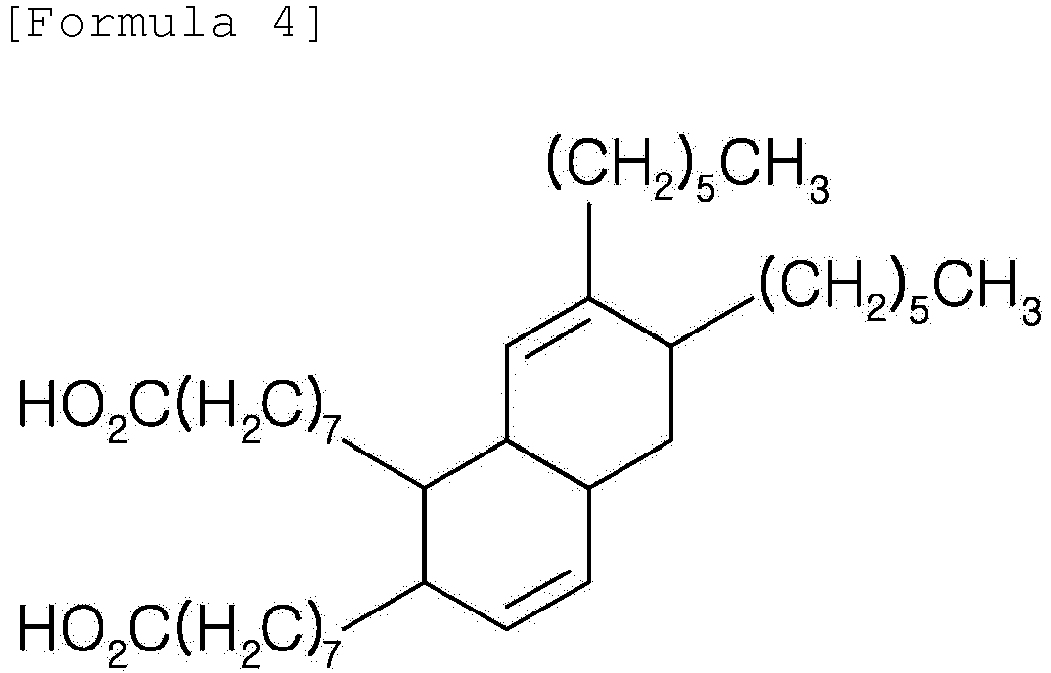
- a multifunctional carboxylic acid having 20 to 60 carbon atoms may be one or more of compounds represented by Formulas 1 to 7 below, without being limited thereto.
- the emulsifier may include a multifunctional carboxylic acid having 20 to 60 carbon atoms or a salt thereof alone, or may be used in combination with an emulsifier for preparing a conventional ASA graft copolymer.
- the multifunctional carboxylic acid having 20 to 60 carbon atoms or a salt thereof when used in combination with a conventional emulsifier, the multifunctional carboxylic acid having 20 to 60 carbon atoms or the salt thereof may be contained in an amount of 30 to 100 % by weight, preferably 40 to 100 % by weight, 50 to 100 % by weight, 60 to 100 % by weight, or 70 to 100 % by weight, with respect to the total weight of the emulsifier.
- emulsifier known emulsifiers used to prepare ASA graft copolymers and similar resins may be used.
- the conventional emulsifier may be a low molecular weight carboxylate having 20 or less carbon atoms or 10 to 20 carbon atoms including rosin acid salts, lauric acid salts, oleic acid salts, stearic acid salts, and the like.
- the conventional emulsifier may be an alkyl sulfosuccinic acid salt having 20 or less carbon atoms or 10 to 20 carbon atoms or a salt thereof.
- the conventional emulsifier may be an alkyl sulfate or a sulfonate having 20 or less carbon atoms or 10 to 20 carbon atoms.
- a multifunctional carboxylic acid having 20 to 60 carbon atoms or a salt thereof and a low molecular weight carboxylate having 20 or less carbon atoms or 10 to 20 carbon atoms may be mixed and used as the emulsifier of the present invention. Since the low molecular weight carboxylate is used, an ASA resin having excellent weather resistance, impact resistance, and surface properties may be prepared.
- the emulsifier may contain a multifunctional carboxylic acid having 20 to 60 carbon atoms or a salt thereof and a carboxylate having 20 or less carbon atoms or 10 to 20 carbon atoms in a weight ratio of 1:0.1 to 1:10, preferably 1:0.1 to 1:5, more preferably 1:0.1 to 1:2.
- a multifunctional carboxylic acid having 20 to 60 carbon atoms or a salt thereof
- a carboxylate having 20 or less carbon atoms or 10 to 20 carbon atoms in a weight ratio of 1:0.1 to 1:10, preferably 1:0.1 to 1:5, more preferably 1:0.1 to 1:2.
- weather resistance, impact resistance, appearance characteristics, and physical property balance may be excellent.
- graft copolymer For example, with respect to 100 parts by weight of total monomers used to prepare the graft copolymer, 4 to 20 parts by weight, 4 to 15 parts by weight, or 4 to 10 parts by weight of one or more monomers selected from an aromatic vinyl monomer, a vinyl cyan monomer, and an alkyl acrylate monomer may be polymerized to prepare seeds.
- an ASA graft copolymer having excellent impact resistance, weather resistance, physical property balance, and the like may be prepared.
- an alkyl acrylate monomer may be used alone or in combination with an aromatic vinyl monomer or a vinyl cyan monomer to improve the weather resistance and mechanical strength of the ASA resin.
- the seed preparation step 4 to 20 parts by weight of one or more monomers selected from an aromatic vinyl monomer, a vinyl cyan monomer, and an alkyl acrylate monomer, 0.01 to 1 part by weight of a crosslinking agent, 0.01 to 3 parts by weight of an initiator, and 0.01 to 5 parts by weight of an emulsifier may be polymerized to prepare seeds.
- one or more monomers selected from an aromatic vinyl monomer, a vinyl cyan monomer, and an alkyl acrylate monomer 0.01 to 1 part by weight of a crosslinking agent, 0.01 to 3 parts by weight of an initiator, and 0.01 to 5 parts by weight of an emulsifier may be polymerized to prepare seeds.
- a polymer having a uniform size may be prepared within a short time, and physical properties such as weather resistance and impact resistance may be further improved.
- the seed preparation step 4 to 15 parts by weight of one or more monomers selected from an aromatic vinyl monomer, a vinyl cyan monomer, and an alkyl acrylate monomer, 0.01 to 0.5 parts by weight of a crosslinking agent, 0.01 to 1 part by weight of an initiator, and 0.01 to 2 parts by weight of an emulsifier may be polymerized to prepare seeds.
- one or more monomers selected from an aromatic vinyl monomer, a vinyl cyan monomer, and an alkyl acrylate monomer 0.01 to 0.5 parts by weight of a crosslinking agent, 0.01 to 1 part by weight of an initiator, and 0.01 to 2 parts by weight of an emulsifier may be polymerized to prepare seeds.
- a polymer having a uniform size may be prepared within a short time, and physical properties such as weather resistance and impact resistance may be further improved.
- one or more of an electrolyte and a grafting agent may be further included.
- the electrolyte may be used in an amount of 0.0001 to 1 part by weight, 0.001 to 1 part by weight, or 0.05 to 1 part by weight. Within this range, the stability of polymerization and a latex may be improved.
- the grafting agent may be used in an amount of 0.01 to 3 parts by weight, 0.01 to 1 part by weight, or 0.01 to 0.1 parts by weight. Within this range, the graft ratio of an ASA graft polymer may be increased, and physical properties may be improved.
- An average size of seeds obtained in the seed preparation step is 30 to 80 nm, preferably 35 to 70 nm, more preferably 40 to 70 nm. Within the above range, the appearance characteristics and impact resistance of the ASA molded part may be excellent.
- 30 to 60 parts by weight, 40 to 60 parts by weight, or 40 to 50 parts by weight of an alkyl acrylate monomer and 0.01 to 1 part by weight, 0.05 to 1 part by weight, or 0.1 to 0.5 parts by weight of a crosslinking agent may be added in the presence of the seeds, and polymerization may be performed to prepare cores.
- a crosslinking agent such as impact resistance and weather resistance
- an alkyl acrylate monomer in the core preparation step, 30 to 60 parts by weight of an alkyl acrylate monomer, 0.01 to 1 part by weight of a crosslinking agent, 0.01 to 3 parts by weight of an initiator, and 0.01 to 5 parts by weight of an emulsifier may be added in the presence of the seeds, and polymerization may be performed to prepare cores .
- an alkyl acrylate monomer 0.01 to 1 part by weight of a crosslinking agent, 0.01 to 3 parts by weight of an initiator, and 0.01 to 5 parts by weight of an emulsifier may be added in the presence of the seeds, and polymerization may be performed to prepare cores .
- impact resistance and physical property balance may be excellent.
- an alkyl acrylate monomer 0.05 to 1 part by weight of a crosslinking agent, 0.01 to 1 part by weight of an initiator, and 0.01 to 2 parts by weight of an emulsifier may be added in the presence of the seeds, and polymerization may be performed to prepare cores.
- a crosslinking agent 0.01 to 1 part by weight of an initiator
- an emulsifier 0.01 to 2 parts by weight of an emulsifier
- An average size of cores obtained in the core preparation step is 70 to 110 nm, preferably 70 to 100 nm, more preferably 75 to 95nm. Within the above range, the stability of a latex may be excellent, and the mechanical strength and surface properties of a polymer may be excellent (in the present disclosure, the average size of cores is larger than the average size of seeds) .
- the emulsifier may include a multifunctional carboxylic acid having 20 or more carbon atoms or a salt thereof.
- 20 to 40 parts by weight or 25 to 40 parts by weight of an aromatic vinyl monomer and 5 to 20 parts by weight or 10 to 20 parts by weight of a vinyl cyan monomer are preferably added.
- the mechanical strength and appearance of an ASA resin may be improved.
- the shell preparation step 30 to 60 parts by weight of an aromatic vinyl monomer or a vinyl cyan monomer, 0.1 to 2 parts by weight of an emulsifier, 0.01 to 3 parts by weight of a crosslinking agent, and 0.01 to 3 parts by weight of an initiator may be added in the presence of the cores, and graft polymerization may be performed to prepare shells .
- a polymer having a desired size may be prepared, and the physical properties of an ASA resin may be improved.
- an aromatic vinyl monomer or a vinyl cyan monomer in the shell preparation step, 30 to 60 parts by weight of an aromatic vinyl monomer or a vinyl cyan monomer, 0.1 to 1 part by weight of an emulsifier, 0.01 to 1 part by weight of a crosslinking agent, and 0.01 to 1 part by weight of an initiator may be added in the presence of the cores, and graft polymerization may be performed to prepare shells.
- an ASA resin may be excellent.
- a molecular weight regulator may be further included, and the molecular weight regulator may be used in an amount of 0.01 to 2 parts by weight, 0.05 to 2 parts by weight, or 0.05 to 1 part by weight. Within this range, a polymer having a desired size may be easily prepared.
- mercaptans such as tert-dodecyl mercaptan may be used as the molecular weight regulator, without being limited thereto.
- An average size of shells (ASA graft copolymer particles) obtained in the shell preparation step is 80 to 150 nm, preferably 85 to 140 nm, more preferably 90 to 135 nm. Within the above range, the stability of a latex may be excellent, and an ASA resin having desired physical properties may be prepared (in the present disclosure, the average size of shells is larger than the average size of cores).
- the aromatic vinyl monomer may be, for example, one or more selected from styrene, ⁇ -methylstyrene, p-methylstyrene, and vinyl toluene and is preferably styrene, without being limited thereto.
- the vinyl cyan monomer may be one or more selected from acrylonitrile, methacrylonitrile, and ethacrylonitrile and is preferably acrylonitrile, without being limited thereto.
- the alkyl acrylate may be, for example, an acrylate including a chain or branched alkyl group having 1 to 10 carbon atoms.
- an acrylate including a chain alkyl group having 1 to 4 carbon atoms is preferably used as the alkyl acrylate, without being limited thereto.
- the crosslinking agent may include an unsaturated vinyl group, and an acrylic compound capable of acting as a crosslinking agent may be used as the crosslinking agent.
- an acrylic compound capable of acting as a crosslinking agent may be used as the crosslinking agent.
- a compound including an unsaturated vinyl group having two or more different reactivity may be used as the grafting agent.
- the grafting agent may be one or more selected from allyl methacrylate, triallyl isocyanurate, triallyl amine, and diallyl amine, without being limited thereto.
- the initiator may be a water-soluble initiator, a fat-soluble initiator, or a mixture of these initiators.
- the water-soluble initiator may be sodium persulfurate, potassium persulfurate, ammonium persulfurate, potassium perphosphate, hydrogen peroxide, and the like, without being limited thereto.
- the fat-soluble initiator may be one selected from the group consisting of t-butyl peroxide, cumene hydroperoxide, p-methane hydroperoxide, di-t-butyl peroxide, t-butylcumyl peroxide, acetyl peroxide, isobutyl peroxide, octanoyl peroxide, dibenzoyl peroxide, diisopropylbenzene hydroperoxide, 3, 5,5-trimethylhexanol peroxide, t-butyl peroxy isobutylate, azobisisobutyronitrile, azobis-2,4-dimethylvaleronitrile, azobiscyclohexanecarbonitrile, and azobisisobutyric acid (butyl acid) methyl, without being limited thereto.
- the water-soluble initiator is preferably used in the seed preparation step or the core preparation step.
- a reaction rate may be controlled to easily prepare a polymer having a desired size, thereby improving the physical properties of the final product ASA resin.
- the fat-soluble initiator is preferably used in the shell preparation step.
- the fat-soluble initiator is used in the step, a high degree of polymerization may be achieved, whereby the productivity of a resin may be improved.
- the electrolyte may be, for example, one or more selected from the group consisting of KCl, NaCl, KHCO 3 , NaHCO 3 , K 2 CO 3 , Na 2 CO 3 , KHSO 3 , NaHSO 3 , K 4 P 2 O 7 , Na 4 P 2 O 7 , K 3 PO 4 , Na 3 PO 4 , K 2 HPO 4 , Na 2 HPO 4 , KOH, NaOH, and Na 2 S 2 O 7 , without being limited thereto.
- an oxidation-reduction catalyst may be further included to further promote an initiation reaction with the initiator.
- the oxidation-reduction catalyst may be one or more selected from the group consisting of sodium pyrophosphate, dextrose, ferrous sulfide, sodium sulfite, sodium formaldehyde sulfoxylate, and sodium ethylenediamine tetraacetate, without being limited thereto.
- the content of coagulated material is 1 % or less, preferably 0.5% or less, more preferably 0.1% or less.
- productivity of the resin may be excellent, and the mechanical strength and appearance characteristics of the resin may be improved.
- the ASA graft copolymer latex obtained through the seed, core, and shell preparation steps may be prepared in a powder form through conventional processes such as coagulation, washing, and drying.
- the ASA graft copolymer latex may be coagulated at a temperature of 60 to 100 °C after addition of a metal salt or an acid, and may be prepared in a powder form through aging, dehydration, washing, and drying processes, without being limited thereto.
- the ASA graft copolymer according to the preparation method may be mixed with a matrix resin and extruded to prepare a thermoplastic ASA resin composition.
- a matrix resin and extruded to prepare a thermoplastic ASA resin composition.
- thermoplastic ASA resin composition of the present invention may be prepared by a method including a step of mixing and extruding 20 to 60 % by weight of the ASA graft copolymer and 40 to 80 % by weight of a vinyl cyan monomer-aromatic vinyl monomer copolymer.
- a method including a step of mixing and extruding 20 to 60 % by weight of the ASA graft copolymer and 40 to 80 % by weight of a vinyl cyan monomer-aromatic vinyl monomer copolymer.
- thermoplastic ASA resin composition of the present invention may be prepared by a method including a step of mixing and extruding 30 to 60 % by weight of the ASA graft copolymer and 40 to 70 % by weight of a vinyl cyan monomer-aromatic vinyl monomer copolymer. Within the above range, mechanical strength, appearance and processability may be excellent.
- thermoplastic ASA resin composition of the present invention may be prepared by a method including a step of mixing and extruding 40 to 50 % by weight of the ASA graft copolymer and 50 to 60 % by weight of a vinyl cyan monomer-aromatic vinyl monomer copolymer. Within the above range, mechanical strength, appearance and processability may be excellent.
- the extrusion may be performed at 200 to 300 °C and 30 to 100 rpm or at 200 to 280 °C and 30 to 70 rpm. Within this range, processability may be excellent, and an ASA resin composition having the desired physical properties may be prepared.
- the vinyl cyan monomer-aromatic vinyl monomer copolymer may be a copolymer composed of a vinyl aromatic monomer, such as styrene and ⁇ -methylstyrene, and a vinyl cyan monomer, such as acrylonitrile, methacrylonitrile and ethacrylonitrile, without being limited thereto.
- a vinyl aromatic monomer such as styrene and ⁇ -methylstyrene
- a vinyl cyan monomer such as acrylonitrile, methacrylonitrile and ethacrylonitrile
- the vinyl cyan monomer-aromatic vinyl monomer copolymer may include 15 to 40 % by weight of a vinyl cyan monomer and 60 to 85 % by weight of an aromatic vinyl monomer with respect to the total weight of the copolymer. Within this range, the mechanical strength, weather resistance, and appearance of an ASA resin may be excellent.
- the vinyl cyan monomer-aromatic vinyl monomer copolymer may include 20 to 35 % by weight of a vinyl cyan monomer and 65 to 80 % by weight of an aromatic vinyl monomer with respect to the total weight of the copolymer. Within this range, the mechanical strength, weather resistance, and appearance of an ASA resin may be excellent.
- thermoplastic ASA resin composition when the mixing is performed, one or more additives selected from the group consisting of a flame retardant, a lubricant, an antibacterial agent, a release agent, a nucleating agent, a plasticizer, a heat stabilizer, an antioxidant, a light stabilizer, a pigment, a dye, and a compatibilizer may be further mixed.
- the additive is preferably contained in an amount of 0.1 to 10 parts by weight, more preferably 1 to 7 parts by weight, still more preferably 1 to 5 parts by weight, with respect to the total weight of the composition containing the ASA graft copolymer and thematrix resin. Within the above range, the effect of the additive may be expressed without deteriorating the inherent physical properties of the resin.
- thermoplastic ASA resin composition of the present invention may be prepared as an ASA molded part through a heat molding process such as injection molding.
- the injection molding may be performed at 190 to 300 °C and 30 to 80 bar or at 200 to 250 °C and 30 to 70 bar. Within this range, processability may be excellent, and desired mechanical properties and appearance characteristics may be obtained.
- the ASA molded part according to the present invention contains the ASA graft copolymer prepared by introducing the novel emulsifier, and thus the ASA molded part has excellent thermal stability. Specifically, the ASA molded part is allowed to stand at 260 °C for 10 minutes and then injected, and, when chromaticity of the ASA molded part is measured using a spectrocolorimeter, a chromaticity change value ( ⁇ E) between chromaticity values measured before and after standing at 260 °C is more than 0 and 4 or less, 0.1 or more and 3.5 or less, or 0.1 or more and 3.3 or less. Within the above range, surface properties such as glossiness and whiteness may be excellent.
- the amount of generated gas when the ASA molded part is injected, the amount of generated gas may be 1,000 ppm or less, 300 to 1,000 ppm, 300 to 800 ppm, or 300 to 700 ppm, more preferably 600 ppm or less, or 300 to 600 ppm.
- the surface roughness of a resin may be excellent, whereby appearance such as glossiness and whiteness may be improved.
- thermoplastic ASA resin composition and the ASA molded part other conditions not specified are not particularly limited so long as the conditions are within the range usually used in the technical field of the present invention, and the conditions may be appropriately selected and used as needed.
- the average size of the obtained rubber polymer particles after completion of the reaction was 40 nm.
- the average size of the obtained rubber polymer particles after completion of the reaction was 80 nm.
- a monomer mixture including 23 parts by weight of distilled water, 38 parts by weight of styrene, and 12 parts by weight of acrylonitrile; an emulsion including 0.8 parts by weight of a mixed emulsifier FS200 (LG Household & Health Care) including 80 % by weight of a monocyclic difunctional carboxylic acid having 36 carbon atoms, 15 % by weight of a bicyclic difunctional carboxylic acid having 54 carbon atoms, and 5 % by weight of an acyclic difunctional carboxylic acid having 18 carbon atoms or less, 0.1 parts by weight of tert-dodecyl mercaptan (TDDM), and 0.05 parts by weight of cumene hydroperoxide; and a mixed liquid including 0.09 parts by weight of sodium pyrophosphate, 0.12 parts by weight of dextrose, and 0.002 parts by weight of ferrous sulfide were continuously added at 75 °C for 3 hours, and
- the mixture was further reacted at 75 °C for 1 hour to increase a polymerization conversion rate, and then cooled to 60 °C to complete the polymerization and obtain a graft copolymer latex.
- the polymerization conversion rate of the prepared graft copolymer latex was 99 %, and the average size of the final particles was 100 nm.
- acrylate-styrene-acrylonitrile copolymer powder 0.8 parts by weight of an aqueous solution of calcium chloride was added to the prepared acrylate-styrene-acrylonitrile graft copolymer latex. Then, coagulation was performed at 70 °C under atmospheric pressure, aging was performed at 93 °C, dehydration and washing was performed, and drying was performed at 90 °C for 30 minutes using hot blast.
- graft copolymer powder 44 parts by weight of the graft copolymer powder, 56 parts by weight of rigid matrix styrene-acrylonitrile copolymer 90HR (including 27 % by weight of acrylonitrile and 73 % by weight of styrene, manufactured by LG Chem.), 1.5 parts by weight of a lubricant, 1.0 parts by weight of an antioxidant, and 1.0 parts by weight of an ultraviolet light stabilizer was added and mixed.
- the mixture was prepared in the form of a pellet at a cylinder temperature of 220 °C using a 36 pie extrusion type kneader, and the pellet-shaped resin was subjected to injection molding (injection molding temperature of 200 to 230 °C, injection molding pressure of 40 to 60 bar) to prepare a specimen for measuring physical properties.
- a graft copolymer latex was prepared in the same manner as in Example 1, except that an emulsion including 0.4 parts by weight of mixed emulsifier FS200 (LG Household & Health Care), 0.7 parts by weight of sodium rosinate, 0.1 parts by weight of TDDM, and 0.05 parts by weight of cumene hydroperoxide was used in pace of the emulsion in the polymeric graft shell preparation step of Example 1.
- an emulsion including 0.4 parts by weight of mixed emulsifier FS200 (LG Household & Health Care), 0.7 parts by weight of sodium rosinate, 0.1 parts by weight of TDDM, and 0.05 parts by weight of cumene hydroperoxide was used in pace of the emulsion in the polymeric graft shell preparation step of Example 1.
- the polymerization conversion rate of the prepared graft copolymer latex was 98.5 %, and the average size of the final particles was 105 nm.
- Polymeric seeds were prepared in the same manner as in Example 1, except that sodium dodecyl sulfate was used in an amount of 1.8 parts by weight instead of 1.5 parts by weight in the polymeric seed preparation step of Example 1, and an acrylic thermoplastic resin was prepared using the polymeric seeds in the same manner as in Example 1.
- the average size of the prepared polymeric seeds was 38 nm, the average size of cores was 75 nm, and the final size was 90 nm.
- Polymeric seeds were prepared in the same manner as in Example 1, except that sodium dodecyl sulfate was used in an amount of 1.0 parts by weight instead of 1.5 parts by weight in the polymeric seed preparation step of Example 1, and an acrylic thermoplastic resin was prepared using the polymeric seeds in the same manner as in Example 1.
- the average size of the prepared polymeric seeds was 55 nm, the average size of cores was 105 nm, and the final size was 135 nm.
- a graft copolymer latex was prepared in the same manner as in Example 1, except that an emulsion including 0.5 parts by weight of emulsifier AS200 (LG Household & Health Care) including 29 % by weight of acyclic difunctional potassium carboxylate having 18 to 20 carbon atoms represented by Formula 8 below, 0.6 parts by weight of sodium rosinate, 0.1 parts by weight of TDDM, and 0.05 parts by weight of cumene hydroperoxide was used instead of the emulsion in the polymeric graft shell preparation step of Example 1.
- emulsifier AS200 LG Household & Health Care
- Formula 8 acyclic difunctional potassium carboxylate having 18 to 20 carbon atoms represented by Formula 8 below
- the polymerization conversion rate of the prepared graft copolymer latex was 98.5 %, and the average size of the final particles was 105 nm. (in the Formula 8, R is an alkyl group having 9 to 11 carbon atoms)
- a graft copolymer latex was prepared in the same manner as in Example 1, except that an emulsion including 1.8 parts by weight of potassium rosinate, 0.1 parts by weight of TDDM, and 0.05 parts by weight of cumene hydroperoxide was used in pace of the emulsion in the polymeric graft shell preparation step of Example 1.
- the polymerization conversion rate of the prepared graft copolymer latex was 98 %, and the average size of the final particles was 110 nm.
- Example 2 An experiment was performed in the same manner as in Example 1, except that sodium dodecyl sulfate was used in an amount of 0.8 parts by weight instead of 1.5 parts by weight in the polymeric seed preparation step of Example 1.
- the average size of seeds was 70 nm, the average size of cores was 115 nm, and the final size was 155 nm.
- TSC total solid content
- Polymerization conversion rate (%) total solid content (TSC) ⁇ (weight of added monomer and supplementary material) / 100 - (weight of added supplementary material excluding monomer)
- a latex was filtered using a 100 mesh wire filter, and the coagulated material filtered on the wire mesh was dried in a hot blast drier at 100 °C for 1 hour.
- the weight of the dried coagulated material was measured and expressed as a ratio (%) to the total amount of the used monomer and supplementary material.
- the thickness of a specimen was set to 1/4", and Izod impact strength was measured using a method of standard measurement ASTM 256.
- MI melt flow index
- Flow index was measured at 220 °C under a load of 10 kg for 10 minutes using the ASTM D1238 method.
- the tensile strength of a specimen was measured using a method of standard measurement ASTM D638.
- graft copolymer powder 0.1 g was heated from 30 °C to 250 °C at a rate of 20 °C/min under a nitrogen atmosphere, and weight loss was measured while keeping the powder at 250 °C for 1 hour. The measured weight loss was expressed by resin residue amount (%).
- the ASA molded parts containing the ASA graft copolymers of Examples 1 to 5 exhibited physical properties, including impact strength, tensile strength, and liquidity, similar to those of Comparative Examples 1 and 2.
- the ASA molded parts of Examples 1 to 5 were superior to those of Comparative Examples 1 and 2.
- Examples 1 to 5 a salt of a multifunctional carboxylic acid having 20 or more carbon atoms is used as an emulsifier in the shell preparation step. Therefore, a small amount of the emulsifier may be used in contrast to conventional emulsifiers. Further, since the thermal stability of the emulsifier is improved, the amount of gas generated when performing injection molding is reduced, so that surface gloss, dwelling thermal stability, and roughness may be improved.
- the ASA graft copolymer latexes of Examples 1 to 5 prepared by introducing a novel emulsifier have a desired average size and a small amount of coagulated material.
- the novel emulsifier according to the present invention was introduced in the shell preparation step, but in the seed preparation step, an emulsifier was used in an amount two times that of Example 1.
- an emulsifier was used in an amount two times that of Example 1.
Landscapes
- Chemical & Material Sciences (AREA)
- Health & Medical Sciences (AREA)
- Chemical Kinetics & Catalysis (AREA)
- Medicinal Chemistry (AREA)
- Polymers & Plastics (AREA)
- Organic Chemistry (AREA)
- Crystallography & Structural Chemistry (AREA)
- Graft Or Block Polymers (AREA)
- Processes Of Treating Macromolecular Substances (AREA)
Abstract
Description
- This application claims priority to Korean Patent Application No.
10-2016-0144880, filed on November 2, 2016 - The present invention relates to a method of preparing an ASA graft copolymer, a method of preparing a thermoplastic ASA resin composition including the same, and a method of preparing an ASA molded part, and more particularly, to a method of preparing an ASA graft copolymer, a method of preparing a thermoplastic ASA resin composition including the same, and a method of preparing an ASA molded part, wherein, in the process of preparing a multilayered ASA graft copolymer including a step of preparing seeds, cores,andshells, a multifunctional carboxylic acid having 20 to 60 carbon atoms or a salt thereof is introduced as an emulsifier to secure the stability of a polymerization reaction and a latex, whereby a final product having excellent thermal stability, weather resistance, colorability, mechanical strength, and appearance may be prepared.
- In general, ABS resins, which are obtained by graft copolymerizing an aromatic vinyl monomer and a vinyl cyan monomer to a diene rubber polymer prepared by polymerizing conjugated diene monomers, have excellent impact resistance and processability, and are excellent in mechanical strength, heat deflection temperature, and colorability. Thus, ABS resins have been widely used in electric and electronic products, automobile parts, and office equipment. However, since rubber polymers used in preparation of ABS resins contain chemically unstable unsaturated bonds, there is a problem that rubber polymers are easily aged by ultraviolet light and thus the weather resistance of ABS resins is very weak.
- To overcome such disadvantages, there has been proposed a method of adding a stabilizer capable of improving weather resistance when a resin composition is prepared by extruding an ABS resin, but the effect thereof was insufficient and the problem of being vulnerable to ultraviolet light was still not solved. Thus, a method, in which a polymer obtained by mixing and polymerizing a diene monomer and an acrylic monomer is used or a chemically more stable acrylic rubber polymer is used instead of a diene rubber polymer containing double bonds, has been proposed.
- A representative example of a weather-resistant thermoplastic resin using an acrylic rubber polymer containing no unstable double bond is acrylate-styrene-acrylonitrile (ASA) . Since ASA does not contain unstable double bonds in the polymer, it has excellent weather resistance, chemical resistance, and thermal stability, and thus ASA has been widely used in fields requiring such properties, for example, outdoor electric and electronic parts, building materials, farm equipment, ASA/ABS double layer sheets, profile extrusion, road signs, outdoor products, PVC for construction materials, leisure goods, sporting goods, and automobile parts.
- In addition, as an emulsifier in preparation of the ASA copolymer and similar ASA resins, low molecular weight carboxylates, including potassium rosinate, sodium rosinate, sodium laurate, sodium oleate, potassium oleate, and potassium stearate, or sulfur-containing emulsifiers, including alkyl sulfosuccinic acid metal salt derivatives having 12 to 18 carbon atoms, alkyl sulfuric esters having 12 to 20 carbon atoms, and sulfonic acid metal salts, have been used.
- However, in the case of such a low molecular weight emulsifier, the amount of the emulsifier to be added is relatively increased to sufficiently secure the stability of a latex. As a result, the emulsifier remains in the latex and a resin after polymerization, and thus gas is significantly generated on the surface of the resin during a high-temperature thermoforming process. This may reduce the thermal stability and surface properties of the resin. Recently, ASA resins have been applied to thin film products such as sidings, sheets, and co-extrusion films. Accordingly, there is growing demand for a technique of reducing the amount of gas generated in a molding process by reducing residues in a resin to improve thermal stability and appearance characteristics.
- [Patent Document] (Patent Document 1)
KR 10-0815995 B1 - Therefore, the present invention has been made in view of the above problems, and it is one object of the present invention to provide a method of preparing an ASA graft copolymer. According to the method, the amount of unnecessary residues remaining in a latex is reduced, so that thermal stability during a molding process is secured and gas generation is reduced, thereby improving the appearance characteristics of a resin while maintaining the inherent physical properties of an ASA resin such as weather resistance, chemical resistance, and mechanical strength.
- It is another object of the present invention to provide a method of preparing a thermoplastic ASA resin composition, and a method of preparing an ASA molded part, wherein the thermoplastic ASA resin composition includes the ASA graft copolymer prepared by the method of preparing an ASA graft copolymer and satisfies weather resistance, chemical resistance, mechanical strength, surface gloss, thermal stability, and appearance characteristics.
- The above and other objects of the present invention can be achieved by the present invention described below.
- In accordance with one aspect of the present invention, provided is a method of preparing an ASA graft copolymer including a seed preparation step, in which one or more monomers selected from an aromatic vinyl monomer, a vinyl cyan monomer, and an alkyl acrylate monomer are polymerized to prepare seeds; a core preparation step, in which an alkyl acrylate monomer is added in the presence of the prepared seeds, and polymerization is performed to prepare cores; and a shell preparation step, in which one or more monomers selected from an aromatic vinyl monomer and a vinyl cyan monomer and an emulsifier are added in the presence of the prepared cores, and graft polymerization is performed to prepare shells, wherein the emulsifier contains a multifunctional carboxylic acid having 20 to 60 carbon atoms or a salt thereof, and the average size of the prepared shells is 80 to 150 nm (larger than the average size of the cores).
- In accordance with another aspect of the present invention, provided is a method of preparing a thermoplastic ASA resin composition, including a step of mixing and extruding 20 to 60 % by weight of the ASA graft copolymer according to the method and 40 to 80 % by weight of a vinyl cyan monomer-aromatic vinyl monomer copolymer.
- In accordance with yet another aspect of the present invention, provided is a method of preparing an ASA molded part, including a step of injecting the thermoplastic ASA resin composition.
- As apparent from the foregoing, the present invention advantageously provides a method of preparing an ASA graft copolymer including a step of preparing seeds, cores, and shells. According to the method, since a multifunctional carboxylic acid having 20 or more carbon atoms or a salt thereof is introduced as an emulsifier, the content of the emulsifier remaining in an ASA graft copolymer latex and an ASA graft copolymer resin can be reduced, thereby providing an ASA resin having excellent thermal stability and appearance characteristics while maintaining the inherent physical properties thereof.
- Specifically, the ASA molded part prepared, as a final product, by injecting a resin composition containing the ASA graft copolymer according to the present invention has excellent thermal stability, and the surface thereof has excellent appearance characteristics. That is, the number of projections on the surface of the ASA molded part is small, and surface gloss is high.
- The present inventors confirmed that, in preparation of an ASA graft copolymer, when a multifunctional carboxylic acid having 20 or more carbon atoms or a salt thereof was added as an emulsifier, the amount of the emulsifier remaining in a latex was reduced, so that the thermal stability of a resin during a molding process was improved, and the amount of generated gas was reduced, thereby improving the appearance characteristics of the resin. Based on this finding, the present invention was completed.
- In the present disclosure, the multifunctional carboxylic acid includes a derivative or an anhydride thereof.
- In the present disclosure, a derivative refers to a compound in which one or two or more of the hydrogen atoms of an original compound are substituted with an alkyl group, a halogen group, or a hydroxyl group.
- Hereinafter, a method of preparing the ASA graft copolymer of the present invention will be described in detail.
- The method of preparing an ASA graft copolymer according to the present invention includes a) a seed preparation step, in which one or more monomers selected from an aromatic vinyl monomer, a vinyl cyan monomer, and an alkyl acrylate monomer are polymerized to prepare seeds; b) a core preparation step, in which an alkyl acrylate monomer is added in the presence of the prepared seeds, and polymerization is performed to prepare cores; and c) a shell preparation step, in which one or more monomers selected from an aromatic vinyl monomer and a vinyl cyan monomer and an emulsifier are added in the presence of the prepared cores, and graft polymerization is performed to prepare shells, wherein the emulsifier contains a multifunctional carboxylic acid having 20 to 60 carbon atoms or a salt thereof, and the average size of the prepared shells is 80 to 150 nm (larger than the average size of the cores).
- For example, the emulsifier may include a multifunctional carboxylic acid having 20 to 60 carbon atoms, 20 to 55 carbon atoms, or 30 to 55 carbon atoms or a salt thereof. When the emulsifier is introduced, the thermal stability of a resin is improved, and the amount of gas generated during a high-temperature molding process is reduced, thereby improving appearance.
- As another example, the emulsifier may include a multifunctional carboxylic acid or a salt thereof, wherein the multifunctional carboxylic acid has 20 to 60 carbon atoms, and two or more, preferably two or three carboxyl groups are included in the structure of the multifunctional carboxylic acid. When the emulsifier is introduced, the thermal stability of a resin is improved, and the amount of gas generated during a high-temperature molding process is reduced, thereby improving appearance.
- The salt may be a metal salt, for example, an alkali metal salt of sodium, potassium, or the like, as another example, an alkaline earth metal salt of magnesium, calcium, or the like, without being limited thereto.
- As a more specific example, a multifunctional carboxylic acid having 20 to 60 carbon atoms may be one or more of compounds represented by Formulas 1 to 7 below, without being limited thereto.




- The emulsifier may include a multifunctional carboxylic acid having 20 to 60 carbon atoms or a salt thereof alone, or may be used in combination with an emulsifier for preparing a conventional ASA graft copolymer.
- In the present invention, when a multifunctional carboxylic acid having 20 to 60 carbon atoms or a salt thereof is used in combination with a conventional emulsifier, the multifunctional carboxylic acid having 20 to 60 carbon atoms or the salt thereof may be contained in an amount of 30 to 100 % by weight, preferably 40 to 100 % by weight, 50 to 100 % by weight, 60 to 100 % by weight, or 70 to 100 % by weight, with respect to the total weight of the emulsifier.
- As the conventional emulsifier, known emulsifiers used to prepare ASA graft copolymers and similar resins may be used.
- For example, the conventional emulsifier may be a low molecular weight carboxylate having 20 or less carbon atoms or 10 to 20 carbon atoms including rosin acid salts, lauric acid salts, oleic acid salts, stearic acid salts, and the like.
- As another example, the conventional emulsifier may be an alkyl sulfosuccinic acid salt having 20 or less carbon atoms or 10 to 20 carbon atoms or a salt thereof. As another example, the conventional emulsifier may be an alkyl sulfate or a sulfonate having 20 or less carbon atoms or 10 to 20 carbon atoms.
- Preferably, a multifunctional carboxylic acid having 20 to 60 carbon atoms or a salt thereof and a low molecular weight carboxylate having 20 or less carbon atoms or 10 to 20 carbon atoms may be mixed and used as the emulsifier of the present invention. Since the low molecular weight carboxylate is used, an ASA resin having excellent weather resistance, impact resistance, and surface properties may be prepared.
- For example, the emulsifier may contain a multifunctional carboxylic acid having 20 to 60 carbon atoms or a salt thereof and a carboxylate having 20 or less carbon atoms or 10 to 20 carbon atoms in a weight ratio of 1:0.1 to 1:10, preferably 1:0.1 to 1:5, more preferably 1:0.1 to 1:2. Within the above range, weather resistance, impact resistance, appearance characteristics, and physical property balance may be excellent.
- Hereinafter, a method of preparing the ASA graft copolymer of the present invention, in which the novel emulsifier is used, will be described in detail for each step.
- For example, with respect to 100 parts by weight of total monomers used to prepare the graft copolymer, 4 to 20 parts by weight, 4 to 15 parts by weight, or 4 to 10 parts by weight of one or more monomers selected from an aromatic vinyl monomer, a vinyl cyan monomer, and an alkyl acrylate monomer may be polymerized to prepare seeds. When the monomer is used in an amount within the above range, an ASA graft copolymer having excellent impact resistance, weather resistance, physical property balance, and the like may be prepared.
- In the seed preparation step, an alkyl acrylate monomer may be used alone or in combination with an aromatic vinyl monomer or a vinyl cyan monomer to improve the weather resistance and mechanical strength of the ASA resin.
- As a specific example, in the seed preparation step, 4 to 20 parts by weight of one or more monomers selected from an aromatic vinyl monomer, a vinyl cyan monomer, and an alkyl acrylate monomer, 0.01 to 1 part by weight of a crosslinking agent, 0.01 to 3 parts by weight of an initiator, and 0.01 to 5 parts by weight of an emulsifier may be polymerized to prepare seeds. Within this range, a polymer having a uniform size may be prepared within a short time, and physical properties such as weather resistance and impact resistance may be further improved.
- As another specific example, in the seed preparation step, 4 to 15 parts by weight of one or more monomers selected from an aromatic vinyl monomer, a vinyl cyan monomer, and an alkyl acrylate monomer, 0.01 to 0.5 parts by weight of a crosslinking agent, 0.01 to 1 part by weight of an initiator, and 0.01 to 2 parts by weight of an emulsifier may be polymerized to prepare seeds. Within this range, a polymer having a uniform size may be prepared within a short time, and physical properties such as weather resistance and impact resistance may be further improved.
- When the seed preparation step is performed, one or more of an electrolyte and a grafting agent may be further included.
- For example, the electrolyte may be used in an amount of 0.0001 to 1 part by weight, 0.001 to 1 part by weight, or 0.05 to 1 part by weight. Within this range, the stability of polymerization and a latex may be improved.
- For example, the grafting agent may be used in an amount of 0.01 to 3 parts by weight, 0.01 to 1 part by weight, or 0.01 to 0.1 parts by weight. Within this range, the graft ratio of an ASA graft polymer may be increased, and physical properties may be improved.
- An average size of seeds obtained in the seed preparation step is 30 to 80 nm, preferably 35 to 70 nm, more preferably 40 to 70 nm. Within the above range, the appearance characteristics and impact resistance of the ASA molded part may be excellent.
- For example, 30 to 60 parts by weight, 40 to 60 parts by weight, or 40 to 50 parts by weight of an alkyl acrylate monomer and 0.01 to 1 part by weight, 0.05 to 1 part by weight, or 0.1 to 0.5 parts by weight of a crosslinking agent may be added in the presence of the seeds, and polymerization may be performed to prepare cores. Within the above-mentioned range, the physical properties of a resin, such as impact resistance and weather resistance, may be improved.
- As a specific example, in the core preparation step, 30 to 60 parts by weight of an alkyl acrylate monomer, 0.01 to 1 part by weight of a crosslinking agent, 0.01 to 3 parts by weight of an initiator, and 0.01 to 5 parts by weight of an emulsifier may be added in the presence of the seeds, and polymerization may be performed to prepare cores . Within the above range, impact resistance and physical property balance may be excellent.
- As another specific example, in the core preparation step, 30 to 60 parts by weight of an alkyl acrylate monomer, 0.05 to 1 part by weight of a crosslinking agent, 0.01 to 1 part by weight of an initiator, and 0.01 to 2 parts by weight of an emulsifier may be added in the presence of the seeds, and polymerization may be performed to prepare cores. Within the above range, the mechanical strength and appearance characteristics of an ASA resin may be excellent.
- An average size of cores obtained in the core preparation step is 70 to 110 nm, preferably 70 to 100 nm, more preferably 75 to 95nm. Within the above range, the stability of a latex may be excellent, and the mechanical strength and surface properties of a polymer may be excellent (in the present disclosure, the average size of cores is larger than the average size of seeds) .
- For example, 30 to 60 parts by weight, 40 to 60 parts by weight, or 45 to 55 parts by weight of an aromatic vinyl monomer or a vinyl cyan monomer and 0.1 to 3 parts by weight, 0.5 to 1.5 parts by weight, or 0.1 to 1 part by weight of an emulsifier may be added in the presence of the cores, and graft polymerization may be performed to prepare shells . In this case, the emulsifier may include a multifunctional carboxylic acid having 20 or more carbon atoms or a salt thereof.
- For example, in the shell preparation step, 20 to 40 parts by weight or 25 to 40 parts by weight of an aromatic vinyl monomer and 5 to 20 parts by weight or 10 to 20 parts by weight of a vinyl cyan monomer are preferably added. Within this range, the mechanical strength and appearance of an ASA resin may be improved.
- As a specific example, in the shell preparation step, 30 to 60 parts by weight of an aromatic vinyl monomer or a vinyl cyan monomer, 0.1 to 2 parts by weight of an emulsifier, 0.01 to 3 parts by weight of a crosslinking agent, and 0.01 to 3 parts by weight of an initiator may be added in the presence of the cores, and graft polymerization may be performed to prepare shells . Within the above range, a polymer having a desired size may be prepared, and the physical properties of an ASA resin may be improved.
- As another specific example, in the shell preparation step, 30 to 60 parts by weight of an aromatic vinyl monomer or a vinyl cyan monomer, 0.1 to 1 part by weight of an emulsifier, 0.01 to 1 part by weight of a crosslinking agent, and 0.01 to 1 part by weight of an initiator may be added in the presence of the cores, and graft polymerization may be performed to prepare shells. Within the above range, the physical properties and physical property balance of an ASA resin may be excellent.
- When the shell preparation step is performed, a molecular weight regulator may be further included, and the molecular weight regulator may be used in an amount of 0.01 to 2 parts by weight, 0.05 to 2 parts by weight, or 0.05 to 1 part by weight. Within this range, a polymer having a desired size may be easily prepared.
- For example, mercaptans such as tert-dodecyl mercaptan may be used as the molecular weight regulator, without being limited thereto.
- An average size of shells (ASA graft copolymer particles) obtained in the shell preparation step is 80 to 150 nm, preferably 85 to 140 nm, more preferably 90 to 135 nm. Within the above range, the stability of a latex may be excellent, and an ASA resin having desired physical properties may be prepared (in the present disclosure, the average size of shells is larger than the average size of cores).
- In the present invention, the aromatic vinyl monomer may be, for example, one or more selected from styrene, α-methylstyrene, p-methylstyrene, and vinyl toluene and is preferably styrene, without being limited thereto.
- In the present invention, the vinyl cyan monomer may be one or more selected from acrylonitrile, methacrylonitrile, and ethacrylonitrile and is preferably acrylonitrile, without being limited thereto.
- In the present invention, the alkyl acrylate may be, for example, an acrylate including a chain or branched alkyl group having 1 to 10 carbon atoms. As a specific example, one or more selected from methyl acrylate, ethyl acrylate, propyl acrylate, butyl acrylate, hexyl acrylate, octyl acrylate, and 2-ethylhexyl acrylate may be used as the alkyl acrylate, and an acrylate including a chain alkyl group having 1 to 4 carbon atoms is preferably used as the alkyl acrylate, without being limited thereto.
- In the present invention, the crosslinking agent may include an unsaturated vinyl group, and an acrylic compound capable of acting as a crosslinking agent may be used as the crosslinking agent. For example, one or more selected from the group consisting of polyethylene glycol diacrylate, polyethylene glycol dimethacrylate, polypropylene glycol diacrylate, polypropylene glycol dimethacrylate, ethylene glycol diacrylate, ethylene glycol dimethacrylate, divinylbenzene, diethylene glycol dimethacrylate, triethylene glycol dimethacrylate, 1,3-butanediol dimethacrylate, hexanediol propoxylate diacrylate, neopentyl glycol dimethacrylate, neopentyl glycol ethoxylate diacrylate, neopentyl glycol propoxylate diacrylate, trimethylolpropane trimethacrylate, trimethylolmethane triacrylate, trimethylpropane ethoxylate triacrylate, trimethylpropane propoxylate triacrylate, pentaerythritol ethoxylatetriacrylate, pentaerythritolpropoxylatetriacrylate, and vinyltrimethoxysilane may be used as the crosslinking agent, without being limited thereto.
- In the present invention, a compound including an unsaturated vinyl group having two or more different reactivity may be used as the grafting agent. For example, the grafting agent may be one or more selected from allyl methacrylate, triallyl isocyanurate, triallyl amine, and diallyl amine, without being limited thereto.
- In the present invention, the initiator may be a water-soluble initiator, a fat-soluble initiator, or a mixture of these initiators.
- For example, the water-soluble initiator may be sodium persulfurate, potassium persulfurate, ammonium persulfurate, potassium perphosphate, hydrogen peroxide, and the like, without being limited thereto.
- For example, the fat-soluble initiator may be one selected from the group consisting of t-butyl peroxide, cumene hydroperoxide, p-methane hydroperoxide, di-t-butyl peroxide, t-butylcumyl peroxide, acetyl peroxide, isobutyl peroxide, octanoyl peroxide, dibenzoyl peroxide, diisopropylbenzene hydroperoxide, 3, 5,5-trimethylhexanol peroxide, t-butyl peroxy isobutylate, azobisisobutyronitrile, azobis-2,4-dimethylvaleronitrile, azobiscyclohexanecarbonitrile, and azobisisobutyric acid (butyl acid) methyl, without being limited thereto.
- For example, the water-soluble initiator is preferably used in the seed preparation step or the core preparation step. When the water-soluble initiator is used in the steps, a reaction rate may be controlled to easily prepare a polymer having a desired size, thereby improving the physical properties of the final product ASA resin.
- As another example, the fat-soluble initiator is preferably used in the shell preparation step. When the fat-soluble initiator is used in the step, a high degree of polymerization may be achieved, whereby the productivity of a resin may be improved.
- In the present invention, the electrolyte may be, for example, one or more selected from the group consisting of KCl, NaCl, KHCO3, NaHCO3, K2CO3, Na2CO3, KHSO3, NaHSO3, K4P2O7, Na4P2O7, K3PO4, Na3PO4, K2HPO4, Na2HPO4, KOH, NaOH, and Na2S2O7, without being limited thereto.
- According to the present invention, in the seed preparation step, the core preparation step, or the shell preparation step, an oxidation-reduction catalyst may be further included to further promote an initiation reaction with the initiator. For example, the oxidation-reduction catalyst may be one or more selected from the group consisting of sodium pyrophosphate, dextrose, ferrous sulfide, sodium sulfite, sodium formaldehyde sulfoxylate, and sodium ethylenediamine tetraacetate, without being limited thereto.
- In the ASA graft copolymer latex obtained through the seed, core, and shell preparation steps, the content of coagulated material is 1 % or less, preferably 0.5% or less, more preferably 0.1% or less. Within the above-mentioned range, the productivity of the resin may be excellent, and the mechanical strength and appearance characteristics of the resin may be improved.
- The ASA graft copolymer latex obtained through the seed, core, and shell preparation steps may be prepared in a powder form through conventional processes such as coagulation, washing, and drying. For example, the ASA graft copolymer latex may be coagulated at a temperature of 60 to 100 °C after addition of a metal salt or an acid, and may be prepared in a powder form through aging, dehydration, washing, and drying processes, without being limited thereto.
- In the above-described method of preparing an ASA graft copolymer, other conditions (polymerization conversion rate, reaction pressure, reaction time, gel content, etc.) not specified are not particularly limited so long as the conditions are within the range usually used in the technical field of the present invention, and the conditions may be appropriately selected and used as needed.
- The ASA graft copolymer according to the preparation method may be mixed with a matrix resin and extruded to prepare a thermoplastic ASA resin composition. Hereinafter, the method of the thermoplastic ASA resin composition of the present invention will be described.
- For example, the thermoplastic ASA resin composition of the present invention may be prepared by a method including a step of mixing and extruding 20 to 60 % by weight of the ASA graft copolymer and 40 to 80 % by weight of a vinyl cyan monomer-aromatic vinyl monomer copolymer. Within the above range, mechanical properties, appearance, and processability may be excellent.
- As another example, the thermoplastic ASA resin composition of the present invention may be prepared by a method including a step of mixing and extruding 30 to 60 % by weight of the ASA graft copolymer and 40 to 70 % by weight of a vinyl cyan monomer-aromatic vinyl monomer copolymer. Within the above range, mechanical strength, appearance and processability may be excellent.
- As another example, the thermoplastic ASA resin composition of the present invention may be prepared by a method including a step of mixing and extruding 40 to 50 % by weight of the ASA graft copolymer and 50 to 60 % by weight of a vinyl cyan monomer-aromatic vinyl monomer copolymer. Within the above range, mechanical strength, appearance and processability may be excellent.
- For example, the extrusion may be performed at 200 to 300 °C and 30 to 100 rpm or at 200 to 280 °C and 30 to 70 rpm. Within this range, processability may be excellent, and an ASA resin composition having the desired physical properties may be prepared.
- For example, the vinyl cyan monomer-aromatic vinyl monomer copolymer may be a copolymer composed of a vinyl aromatic monomer, such as styrene and α-methylstyrene, and a vinyl cyan monomer, such as acrylonitrile, methacrylonitrile and ethacrylonitrile, without being limited thereto.
- For example, the vinyl cyan monomer-aromatic vinyl monomer copolymer may include 15 to 40 % by weight of a vinyl cyan monomer and 60 to 85 % by weight of an aromatic vinyl monomer with respect to the total weight of the copolymer. Within this range, the mechanical strength, weather resistance, and appearance of an ASA resin may be excellent.
- As another example, the vinyl cyan monomer-aromatic vinyl monomer copolymer may include 20 to 35 % by weight of a vinyl cyan monomer and 65 to 80 % by weight of an aromatic vinyl monomer with respect to the total weight of the copolymer. Within this range, the mechanical strength, weather resistance, and appearance of an ASA resin may be excellent.
- According to the method of a thermoplastic ASA resin composition, when the mixing is performed, one or more additives selected from the group consisting of a flame retardant, a lubricant, an antibacterial agent, a release agent, a nucleating agent, a plasticizer, a heat stabilizer, an antioxidant, a light stabilizer, a pigment, a dye, and a compatibilizer may be further mixed. The additive is preferably contained in an amount of 0.1 to 10 parts by weight, more preferably 1 to 7 parts by weight, still more preferably 1 to 5 parts by weight, with respect to the total weight of the composition containing the ASA graft copolymer and thematrix resin. Within the above range, the effect of the additive may be expressed without deteriorating the inherent physical properties of the resin.
- In addition, the thermoplastic ASA resin composition of the present invention may be prepared as an ASA molded part through a heat molding process such as injection molding.
- For example, the injection molding may be performed at 190 to 300 °C and 30 to 80 bar or at 200 to 250 °C and 30 to 70 bar. Within this range, processability may be excellent, and desired mechanical properties and appearance characteristics may be obtained.
- The ASA molded part according to the present invention contains the ASA graft copolymer prepared by introducing the novel emulsifier, and thus the ASA molded part has excellent thermal stability. Specifically, the ASA molded part is allowed to stand at 260 °C for 10 minutes and then injected, and, when chromaticity of the ASA molded part is measured using a spectrocolorimeter, a chromaticity change value (ΔE) between chromaticity values measured before and after standing at 260 °C is more than 0 and 4 or less, 0.1 or more and 3.5 or less, or 0.1 or more and 3.3 or less. Within the above range, surface properties such as glossiness and whiteness may be excellent.
- According to the method of preparing an ASA molded part, when the ASA molded part is injected, the amount of generated gas may be 1,000 ppm or less, 300 to 1,000 ppm, 300 to 800 ppm, or 300 to 700 ppm, more preferably 600 ppm or less, or 300 to 600 ppm. Within the above range, the surface roughness of a resin may be excellent, whereby appearance such as glossiness and whiteness may be improved.
- In the methods of preparing the thermoplastic ASA resin composition and the ASA molded part, other conditions not specified are not particularly limited so long as the conditions are within the range usually used in the technical field of the present invention, and the conditions may be appropriately selected and used as needed.
- Hereinafter, the present invention will be described in more detail with reference to the following preferred examples. However, these examples are provided for illustrative purposes only and should not be construed as limiting the scope and spirit of the present invention. In addition, it will be apparent to those skilled in the art that various changes and modifications may be made without departing from the spirit and scope of the present invention, and such changes and modifications are also within the scope of the appended claims.
- 6 parts by weight of butyl acrylate, 1.5 parts by weight of sodium dodecyl sulfate, 0.04 parts by weight of ethylene glycol dimethacrylate, 0.02 parts by weight of allyl methacrylate, 0.1 parts by weight of potassium hydroxide, and 45 parts by weight of distilled water were added into a nitrogen-substituted reactor at once, and temperature was raised to 70 °C, and 0.04 parts by weight of potassium persulfate was added into the reactor to initiate polymerization. The polymerization was then continued for 1 hour.
- The average size of the obtained rubber polymer particles after completion of the reaction was 40 nm.
- 44 parts by weight of butyl acrylate, 0.5 parts by weight of sodium dodecyl sulfate, 0.2 parts by weight of ethylene glycol dimethacrylate, 0.2 parts by weight of allyl methacrylate, 30 parts by weight of distilled water, and 0.05 parts by weight of potassium persulfate were mixed with the polymeric seeds. Then, the mixture was continuously added into a reactor at 70 °C for 2.5 hours. After completion of the addition, polymerization was further performed for 1 hour.
- The average size of the obtained rubber polymer particles after completion of the reaction was 80 nm.
- In the presence of the polymeric cores, a monomer mixture including 23 parts by weight of distilled water, 38 parts by weight of styrene, and 12 parts by weight of acrylonitrile; an emulsion including 0.8 parts by weight of a mixed emulsifier FS200 (LG Household & Health Care) including 80 % by weight of a monocyclic difunctional carboxylic acid having 36 carbon atoms, 15 % by weight of a bicyclic difunctional carboxylic acid having 54 carbon atoms, and 5 % by weight of an acyclic difunctional carboxylic acid having 18 carbon atoms or less, 0.1 parts by weight of tert-dodecyl mercaptan (TDDM), and 0.05 parts by weight of cumene hydroperoxide; and a mixed liquid including 0.09 parts by weight of sodium pyrophosphate, 0.12 parts by weight of dextrose, and 0.002 parts by weight of ferrous sulfide were continuously added at 75 °C for 3 hours, and at the same time, polymerization was performed. After addition of the emulsion and the mixed liquid was completed, the mixture was further reacted at 75 °C for 1 hour to increase a polymerization conversion rate, and then cooled to 60 °C to complete the polymerization and obtain a graft copolymer latex.
- The polymerization conversion rate of the prepared graft copolymer latex was 99 %, and the average size of the final particles was 100 nm.
- To prepare acrylate-styrene-acrylonitrile copolymer powder, 0.8 parts by weight of an aqueous solution of calcium chloride was added to the prepared acrylate-styrene-acrylonitrile graft copolymer latex. Then, coagulation was performed at 70 °C under atmospheric pressure, aging was performed at 93 °C, dehydration and washing was performed, and drying was performed at 90 °C for 30 minutes using hot blast.
- 44 parts by weight of the graft copolymer powder, 56 parts by weight of rigid matrix styrene-acrylonitrile copolymer 90HR (including 27 % by weight of acrylonitrile and 73 % by weight of styrene, manufactured by LG Chem.), 1.5 parts by weight of a lubricant, 1.0 parts by weight of an antioxidant, and 1.0 parts by weight of an ultraviolet light stabilizer was added and mixed. The mixture was prepared in the form of a pellet at a cylinder temperature of 220 °C using a 36 pie extrusion type kneader, and the pellet-shaped resin was subjected to injection molding (injection molding temperature of 200 to 230 °C, injection molding pressure of 40 to 60 bar) to prepare a specimen for measuring physical properties.
- A graft copolymer latex was prepared in the same manner as in Example 1, except that an emulsion including 0.4 parts by weight of mixed emulsifier FS200 (LG Household & Health Care), 0.7 parts by weight of sodium rosinate, 0.1 parts by weight of TDDM, and 0.05 parts by weight of cumene hydroperoxide was used in pace of the emulsion in the polymeric graft shell preparation step of Example 1.
- The polymerization conversion rate of the prepared graft copolymer latex was 98.5 %, and the average size of the final particles was 105 nm.
- Polymeric seeds were prepared in the same manner as in Example 1, except that sodium dodecyl sulfate was used in an amount of 1.8 parts by weight instead of 1.5 parts by weight in the polymeric seed preparation step of Example 1, and an acrylic thermoplastic resin was prepared using the polymeric seeds in the same manner as in Example 1.
- The average size of the prepared polymeric seeds was 38 nm, the average size of cores was 75 nm, and the final size was 90 nm.
- Polymeric seeds were prepared in the same manner as in Example 1, except that sodium dodecyl sulfate was used in an amount of 1.0 parts by weight instead of 1.5 parts by weight in the polymeric seed preparation step of Example 1, and an acrylic thermoplastic resin was prepared using the polymeric seeds in the same manner as in Example 1.
- The average size of the prepared polymeric seeds was 55 nm, the average size of cores was 105 nm, and the final size was 135 nm.
- A graft copolymer latex was prepared in the same manner as in Example 1, except that an emulsion including 0.5 parts by weight of emulsifier AS200 (LG Household & Health Care) including 29 % by weight of acyclic difunctional potassium carboxylate having 18 to 20 carbon atoms represented by Formula 8 below, 0.6 parts by weight of sodium rosinate, 0.1 parts by weight of TDDM, and 0.05 parts by weight of cumene hydroperoxide was used instead of the emulsion in the polymeric graft shell preparation step of Example 1.
- The polymerization conversion rate of the prepared graft copolymer latex was 98.5 %, and the average size of the final particles was 105 nm.

- A graft copolymer latex was prepared in the same manner as in Example 1, except that an emulsion including 1.8 parts by weight of potassium rosinate, 0.1 parts by weight of TDDM, and 0.05 parts by weight of cumene hydroperoxide was used in pace of the emulsion in the polymeric graft shell preparation step of Example 1.
- The polymerization conversion rate of the prepared graft copolymer latex was 98 %, and the average size of the final particles was 110 nm.
- An experiment was performed in the same manner as in Example 1, except that sodium dodecyl sulfate was used in an amount of 0.8 parts by weight instead of 1.5 parts by weight in the polymeric seed preparation step of Example 1.
- The average size of seeds was 70 nm, the average size of cores was 115 nm, and the final size was 155 nm.
- The physical properties of the ASA graft copolymers and the acrylic thermoplastic resins prepared according to Examples 1 to 5 and Comparative Examples 1 and 2 were measured in the following manner, and the results are shown in Table 1.
- 1.5 g of the prepared latex was dried in a hot blast dryer at 150 °C for 15 minutes, and weight was measured to determine total solid content (TSC). The polymerization conversion was calculated using Equation 1 below.
- Polymerization conversion rate (%) = total solid content (TSC) × (weight of added monomer and supplementary material) / 100 - (weight of added supplementary material excluding monomer)
- 1 g of a latex was mixed with 100 g of distilled water, and the average size of particles was measured in Gaussian mode using dynamic laser light scattering in Nicomp 380HPL (PSS -Nicomp Co., USA).
- A latex was filtered using a 100 mesh wire filter, and the coagulated material filtered on the wire mesh was dried in a hot blast drier at 100 °C for 1 hour. The weight of the dried coagulated material was measured and expressed as a ratio (%) to the total amount of the used monomer and supplementary material.
- The thickness of a specimen was set to 1/4", and Izod impact strength was measured using a method of standard measurement ASTM 256.
- Flow index was measured at 220 °C under a load of 10 kg for 10 minutes using the ASTM D1238 method.
- The tensile strength of a specimen was measured using a method of standard measurement ASTM D638.
- Surface gloss was measured at an angle of 45° to a specimen using a method of standard measurement ASTM D528.
- Whiteness was measured according to the method of CIE Lab.
- 0.1 g of graft copolymer powder was heated from 30 °C to 250 °C at a rate of 20 °C/min under a nitrogen atmosphere, and weight loss was measured while keeping the powder at 250 °C for 1 hour. The measured weight loss was expressed by resin residue amount (%).
- The prepared pellet using an extrusion type kneader was allowed to stand in an injection molding machine at a molding temperature of 260 °C for 5 minutes. Then, to determine the degree of discoloration of the molded specimen, L, a, and b values were measured using a spectrocolorimeter, and the degree of discoloration (ΔE) was calculated using Equation 2 below. Here, ΔE is the arithmetic mean value of a value by CIE Lab before and after performing an experiment of dwelling thermal stability. ΔE lose to 0 indicates that thermal stability is good.

- An acrylic thermoplastic resin was extruded into a film having a thickness of 0.01 mm at 220 °C, and then the appearance characteristics were evaluated based on the number of unmelted projections (size of 50 to 500 pm). Low values indicate good appearance properties when processing thin films.
- The total amount of volatile organic compounds generated in 1g of ASA copolymer powder at 250 °C for 1 hour was measured using HS-GC/MSD.
[Table 1] Example 1 Example 2 Example 3 Example 4 Example 5 Comparative Example 1 Comparative Example 2 Polymerization conversion rate (%) 99 98.5 99.5 98 98.5 98 97 Final partic e size (nm) 100 105 90 135 105 110 155 Content of coagulated material (%) 0.01 0.02 0.02 0.02 0.2 0.1 0.03 Impact strength (kgf/cm2 ) 7.5 8.0 7.0 8.2 7.7 7.6 8.5 Liquidity (g/10 min) 15.3 15.5 14.5 14.3 15.2 15.0 12.0 Tensile strength (kg/cm2) 505 507 508 500 498 515 500 Surface gloss 101.2 101.3 102.5 100.8 101.1 100.2 99.0 whiteness 63.5 63.0 63.4 63.4 63.4 60.0 63.0 TGA (%) 99.4 99.5 99.2 99.5 99.3 98.0 99.0 ΔE 3.4 3.3 3.5 3.2 3.3 5.3 4.2 Number of projections 350 400 300 500 420 900 1500 Gas generation amount (ppm) 550 570 565 580 600 1100 1050 - As shown in Table 1, the ASA molded parts containing the ASA graft copolymers of Examples 1 to 5 exhibited physical properties, including impact strength, tensile strength, and liquidity, similar to those of Comparative Examples 1 and 2. In the case of surface gloss, dwelling thermal stability, surface roughness, and gas generation amount, the ASA molded parts of Examples 1 to 5 were superior to those of Comparative Examples 1 and 2.
- These results may be explained for the following reasons . In Examples 1 to 5, a salt of a multifunctional carboxylic acid having 20 or more carbon atoms is used as an emulsifier in the shell preparation step. Therefore, a small amount of the emulsifier may be used in contrast to conventional emulsifiers. Further, since the thermal stability of the emulsifier is improved, the amount of gas generated when performing injection molding is reduced, so that surface gloss, dwelling thermal stability, and roughness may be improved.
- In addition, referring to Table 1, the ASA graft copolymer latexes of Examples 1 to 5 prepared by introducing a novel emulsifier have a desired average size and a small amount of coagulated material. These results show that the emulsifier of the present invention may also contribute to secure the stability of polymerization and a latex.
- In addition, in the case of the molded part of Comparative Example 2, the novel emulsifier according to the present invention was introduced in the shell preparation step, but in the seed preparation step, an emulsifier was used in an amount two times that of Example 1. Thus, compared to Examples 1 to 5, a polymer having a large diameter was prepared, and on the surface of the molded part, the number of unmelted projections was the greatest. Based on these results, it can be confirmed that the appearance characteristics of the ASA molded part are significantly influenced by the type of an emulsifier and the particle size of a polymer.
Claims (16)
- A method of preparing an ASA graft copolymer, comprising:a) a seed preparation step, in which one or more monomers selected from an aromatic vinyl monomer, a vinyl cyan monomer, and an alkyl acrylate monomer are polymerized to prepare seeds;b) a core preparation step, in which an alkyl acrylate monomer is added in the presence of the prepared seeds, and polymerization is performed to prepare cores; andc) a shell preparation step, in which one or more monomers selected from an aromatic vinyl monomer and a vinyl cyan monomer and an emulsifier are added in the presence of the prepared cores, and graft polymerization is performed to prepare shells,wherein the emulsifier contains a multifunctional carboxylic acid having 20 to 60 carbon atoms or a salt thereof, and an average size of the prepared shells is 80 to 150 nm (larger than an average size of the cores).
- The method according to claim 1, wherein two or three carboxyl groups are comprised in a structure of the multifunctional carboxylic acid.
- The method according to claim 1, wherein the multifunctional carboxylic acid having 20 to 60 carbon atoms or the salt thereof is contained in an amount of 30 to 100 % by weight with respect to a total weight of the emulsifier.
- The method according to claim 1, wherein the emulsifier contains the multifunctional carboxylic acid having 20 to 60 carbon atoms or the salt thereof and a carboxylate having 10 to 20 carbon atoms.
- The method according to claim 4, wherein the emulsifier contains the multifunctional carboxylic acid having 20 to 60 carbon atoms or the salt thereof and the carboxylate having 10 to 20 carbon atoms in a weight ratio of 1:0.1 to 1:10.
- The method according to claim 1, wherein, in the seed preparation step, with respect to 100 parts by weight of total monomers used to prepare the copolymer, 4 to 20 parts by weight of one or more monomers selected from an aromatic vinyl monomer, a vinyl cyan monomer, and an alkyl acrylate are polymerized to prepare seeds.
- The method according to claim 6, wherein an average size of the seeds is 30 to 80 nm.
- The method according to claim 1, wherein, in the core preparation step, 30 to 60 parts by weight of an acrylate monomer and 0.01 to 1 part by weight of a crosslinking agent are added in the presence of the seeds, and polymerization is performed to prepare cores.
- The method according to claim 8, wherein the crosslinking agent comprises an acrylic crosslinking agent.
- The method according to claim 8, wherein an average size of the cores is 70 to 110 nm (larger than an average size of the seeds).
- The method according to claim 1, wherein, in the shell preparation step, 30 to 60 parts by weight of an aromatic vinyl monomer or a vinyl cyan monomer and 0.1 to 3 parts by weight of an emulsifier are added in the presence of the cores, and graft polymerization is performed to prepare shells.
- A method of preparing a thermoplastic ASA resin composition, comprising a step of mixing and extruding 20 to 60 % by weight of the ASA graft copolymer according to the method of any one of claims 1 to 11 and 40 to 80 % by weight of a vinyl cyan monomer-aromatic vinyl monomer copolymer.
- The method according to claim 12, wherein, when the mixing is performed, one or more additives selected from the group consisting of a flame retardant, a lubricant, an antibacterial agent, a release agent, a nucleating agent, a plasticizer, a heat stabilizer, an antioxidant, a light stabilizer, a pigment, a dye, and a compatibilizer are further mixed.
- A method of preparing an ASA molded part, comprising a step of injecting the thermoplastic ASA resin composition prepared according to claim 12.
- The method according to claim 14, wherein the ASA molded part is allowed to stand at 260 °C for 10 minutes and then injected, and, when chromaticity of the ASA molded part is measured using a spectrocolorimeter, a chromaticity change value (ΔE) between chromaticity values measured before and after standing at 260 °C is more than 0 and 4 or less.
- The method according to claim 14, wherein, in the step of injecting, an amount of generated gas is 1,000 ppm or less.
Applications Claiming Priority (2)
| Application Number | Priority Date | Filing Date | Title |
|---|---|---|---|
| KR1020160144880A KR102005364B1 (en) | 2016-11-02 | 2016-11-02 | Method for preparing acrylate- styrene-acrylonitrile graft copolymer, method for preparing thermoplastic asa resine composition and method for preparing asa molding product |
| PCT/KR2017/011860 WO2018084486A2 (en) | 2016-11-02 | 2017-10-25 | Method for preparing asa-based graft copolymer, method for preparing thermoplastic asa-based resin composition comprising same, and method for manufacturing asa-based molded product |
Publications (3)
| Publication Number | Publication Date |
|---|---|
| EP3363859A2 true EP3363859A2 (en) | 2018-08-22 |
| EP3363859A4 EP3363859A4 (en) | 2019-01-30 |
| EP3363859B1 EP3363859B1 (en) | 2022-06-15 |
Family
ID=62076875
Family Applications (1)
| Application Number | Title | Priority Date | Filing Date |
|---|---|---|---|
| EP17867846.2A Active EP3363859B1 (en) | 2016-11-02 | 2017-10-25 | Method for preparing asa-based graft copolymer, method for preparing thermoplastic asa-based resin composition comprising same, and method for manufacturing asa-based molded product |
Country Status (5)
| Country | Link |
|---|---|
| US (1) | US10487204B2 (en) |
| EP (1) | EP3363859B1 (en) |
| KR (1) | KR102005364B1 (en) |
| CN (1) | CN108495891B (en) |
| WO (1) | WO2018084486A2 (en) |
Cited By (1)
| Publication number | Priority date | Publication date | Assignee | Title |
|---|---|---|---|---|
| CN112041359A (en) * | 2018-10-19 | 2020-12-04 | 株式会社Lg化学 | Process for preparing graft copolymer powder |
Families Citing this family (14)
| Publication number | Priority date | Publication date | Assignee | Title |
|---|---|---|---|---|
| KR102075613B1 (en) * | 2017-03-20 | 2020-02-11 | 주식회사 엘지화학 | Method for preparing acrylate-styrene-acrylonitrile graft copolymer, method for preparing thermoplastic resine composition and method for preparing molding product |
| WO2020013605A1 (en) * | 2018-07-13 | 2020-01-16 | 주식회사 엘지화학 | Method for preparing core-shell copolymer, core-shell copolymer prepared thereby, and resin composition comprising same |
| KR102248039B1 (en) | 2018-07-13 | 2021-05-04 | 주식회사 엘지화학 | Method for preparing core-shell copolymer, core-shell copolymer prepared by the method, and resin composition comprising the copolymer |
| KR102207173B1 (en) | 2018-08-08 | 2021-01-25 | 주식회사 엘지화학 | Method for preparing graft copolymer, graft copolymer and thermoplastic resin products |
| KR102278034B1 (en) | 2018-09-05 | 2021-07-15 | 주식회사 엘지화학 | Method for preparing graft copolymer and graft copolymer |
| KR102489251B1 (en) | 2019-01-16 | 2023-01-17 | 주식회사 엘지화학 | Thermoplastic resin composition, method for preparing the thermoplastic resin composition and molding products thereof |
| KR102652167B1 (en) * | 2019-09-11 | 2024-03-27 | 주식회사 엘지화학 | Method for preparing acrylic processing aid, acrylic processing aid produced by the method and vinyl chloride resin composition comprising the acrylic processig aid |
| KR102721861B1 (en) * | 2019-09-25 | 2024-10-23 | 주식회사 엘지화학 | Method for preparing core-shell copolymer, core-shell copolymer produced by the method and resin composition comprising the copolymer |
| KR102489253B1 (en) | 2019-09-30 | 2023-01-17 | 주식회사 엘지화학 | Acrylic graft copolymer, method for preparing the same and thermoplastic resin composition comprising the same |
| KR102774437B1 (en) | 2019-12-10 | 2025-02-27 | 주식회사 엘지화학 | Alkyl acrylate-vinyl compound-vinylcyan compound copolyemr, method for preparing thereof and thermoplastic resin composition |
| CN111087554B (en) * | 2019-12-24 | 2022-11-01 | 广州熵能创新材料股份有限公司 | High-impact-resistance acrylate-styrene-acrylonitrile graft polymer and preparation method and application thereof |
| CN114085338B (en) * | 2020-08-24 | 2024-01-30 | 中国石油天然气股份有限公司 | Polymer latex coagulated particles and process for producing the same |
| CN113278116B (en) * | 2021-05-25 | 2023-03-17 | 四川兴彩高新材料有限公司 | ASA non-breaking white high-rubber powder, ASA non-breaking white film and preparation method thereof |
| KR102675940B1 (en) * | 2021-12-01 | 2024-06-17 | 금호석유화학 주식회사 | Low odor acrylate-styrene-acrylonitrile based resin composition with excellent antibacterial property |
Family Cites Families (15)
| Publication number | Priority date | Publication date | Assignee | Title |
|---|---|---|---|---|
| SG34284A1 (en) * | 1994-12-02 | 1996-12-06 | Gen Electric | Impact modified vinyl chloride resin composition and graft copolymer compositions |
| EP0714949A2 (en) * | 1994-12-02 | 1996-06-05 | General Electric Company | Processes, thermoplastic compositions and emulsion graft copolymer utilizing a polyacid |
| DE4446896A1 (en) * | 1994-12-27 | 1996-07-04 | Basf Ag | Impact teeth, thermoplastically processable mixture of elastomers and thermoplastics |
| DE19536892A1 (en) * | 1995-10-04 | 1997-04-10 | Basf Ag | Molded parts made of thermoplastic molding compounds |
| KR960034249A (en) * | 1996-03-29 | 1996-10-22 | 슈타인호프. 비베르바흐 | Particulate graft polymers and thermoplastic molding materials having improved low temperature toughness containing them |
| CN1189503A (en) * | 1996-12-27 | 1998-08-05 | 花王株式会社 | Reactive emulsifiers and process for producing aqueous polymers |
| KR100815995B1 (en) | 2006-06-08 | 2008-03-21 | 제일모직주식회사 | Asa graft copolymer having excellent low temperature and room temperature impact resistance, colorability and weather resistance and thermoplastic resin composition containing the same |
| KR20090038507A (en) * | 2007-10-16 | 2009-04-21 | 주식회사 엘지화학 | Acrylate-styrene-acrylonitrile polymer and preparation method thereof |
| CN101397353A (en) * | 2008-11-17 | 2009-04-01 | 陕西科技大学 | Method for preparing high molecule emulsifying agent for ASA |
| CN104066757B (en) * | 2011-12-30 | 2017-02-22 | 第一毛织株式会社 | ASA graft copolymer having superior shock resistance, weather resistance, coloring properties, and method for manufacturing same |
| KR101425754B1 (en) * | 2012-08-27 | 2014-08-05 | 주식회사 엘지화학 | Graft copolymer and thermoplastic resin composition comprising thereof |
| CN103570882B (en) * | 2013-11-01 | 2016-01-20 | 杭州华创实业有限公司 | A kind of ASA graft copolymer resin rubber powder and preparation method thereof |
| KR101640678B1 (en) * | 2013-12-10 | 2016-07-18 | 주식회사 엘지화학 | A method for preparing large size rubber reinforced theremoplastic resin, and theremoplastic resin composition |
| KR101785768B1 (en) * | 2014-12-24 | 2017-10-16 | 주식회사 엘지화학 | Preparation method of diene rubber latex and acrylonitrile-butadiene-styrene graft copolymer comprising the same |
| KR102013184B1 (en) * | 2016-11-01 | 2019-08-22 | 주식회사 엘지화학 | Method for preparing diene rubber latex, method for preparing abs graft copolymer and method for preparing abs molding product |
-
2016
- 2016-11-02 KR KR1020160144880A patent/KR102005364B1/en active Active
-
2017
- 2017-10-25 EP EP17867846.2A patent/EP3363859B1/en active Active
- 2017-10-25 WO PCT/KR2017/011860 patent/WO2018084486A2/en not_active Ceased
- 2017-10-25 CN CN201780004684.4A patent/CN108495891B/en active Active
- 2017-10-25 US US15/781,073 patent/US10487204B2/en active Active
Cited By (4)
| Publication number | Priority date | Publication date | Assignee | Title |
|---|---|---|---|---|
| CN112041359A (en) * | 2018-10-19 | 2020-12-04 | 株式会社Lg化学 | Process for preparing graft copolymer powder |
| EP3770193A4 (en) * | 2018-10-19 | 2021-08-04 | Lg Chem, Ltd. | PROCESS FOR PREPARING A GRAFT COPOLYMER POWDER |
| CN112041359B (en) * | 2018-10-19 | 2023-04-11 | 株式会社Lg化学 | Process for preparing graft copolymer powder |
| US11820851B2 (en) | 2018-10-19 | 2023-11-21 | Lg Chem, Ltd. | Method of preparing graft copolymer powder |
Also Published As
| Publication number | Publication date |
|---|---|
| WO2018084486A3 (en) | 2018-07-26 |
| KR20180047949A (en) | 2018-05-10 |
| WO2018084486A2 (en) | 2018-05-11 |
| CN108495891A (en) | 2018-09-04 |
| CN108495891B (en) | 2021-04-06 |
| US10487204B2 (en) | 2019-11-26 |
| US20180355161A1 (en) | 2018-12-13 |
| EP3363859A4 (en) | 2019-01-30 |
| KR102005364B1 (en) | 2019-07-30 |
| EP3363859B1 (en) | 2022-06-15 |
Similar Documents
| Publication | Publication Date | Title |
|---|---|---|
| EP3363859B1 (en) | Method for preparing asa-based graft copolymer, method for preparing thermoplastic asa-based resin composition comprising same, and method for manufacturing asa-based molded product | |
| EP3584264B1 (en) | Method for preparing asa-based graft copolymer, method for preparing thermoplastic resin composition comprising same, and method for manufacturing molded product | |
| CN112074568B (en) | Thermoplastic resin composition | |
| KR102074489B1 (en) | Graft Copolymer, Thermoplastic Resin Composition And Thermoplastic Resin Molded Article Comprising Thereof | |
| EP3708599B1 (en) | Method of preparing graft copolymer, graft copolymer, and thermoplastic resin molded article including graft copolymer | |
| EP3882285B1 (en) | Acrylic graft copolymer, method for producing same, and thermoplastic resin composition containing same | |
| KR102680998B1 (en) | Transparent thermoplastic resin composition and method for preparing the same | |
| KR20120009860A (en) | Asa resin composition for PPC co-extrusion, film, extruded sheet and architectural exterior material manufactured therefrom | |
| JP2004536935A (en) | Acrylonitrile-butadiene-styrene (ABS) thermoplastic transparent resin | |
| KR20200044570A (en) | Method for preparing graft copolymer powder | |
| KR20040110322A (en) | Thermoplastic resin composition | |
| KR102683556B1 (en) | Transparent thermoplastic resin and method for preparing the same | |
| JP7455961B2 (en) | Transparent thermoplastic resin and its manufacturing method | |
| EP3517557B1 (en) | Graft copolymer, and thermoplastic resin composition and thermoplastic resin molded product which comprise same | |
| KR102244956B1 (en) | Method for preparing graft copolymer | |
| EP3875535B1 (en) | Thermoplastic resin composition | |
| KR102642821B1 (en) | Thermoplastic resin composition and method for preparing the same | |
| EP3205689B1 (en) | Weather resistant thermoplastic resin, thermoplastic resin composition containing same, and method for preparing composition |
Legal Events
| Date | Code | Title | Description |
|---|---|---|---|
| STAA | Information on the status of an ep patent application or granted ep patent |
Free format text: STATUS: THE INTERNATIONAL PUBLICATION HAS BEEN MADE |
|
| PUAI | Public reference made under article 153(3) epc to a published international application that has entered the european phase |
Free format text: ORIGINAL CODE: 0009012 |
|
| STAA | Information on the status of an ep patent application or granted ep patent |
Free format text: STATUS: REQUEST FOR EXAMINATION WAS MADE |
|
| 17P | Request for examination filed |
Effective date: 20180514 |
|
| AK | Designated contracting states |
Kind code of ref document: A2 Designated state(s): AL AT BE BG CH CY CZ DE DK EE ES FI FR GB GR HR HU IE IS IT LI LT LU LV MC MK MT NL NO PL PT RO RS SE SI SK SM TR |
|
| AX | Request for extension of the european patent |
Extension state: BA ME |
|
| R17D | Deferred search report published (corrected) |
Effective date: 20180726 |
|
| A4 | Supplementary search report drawn up and despatched |
Effective date: 20190107 |
|
| RIC1 | Information provided on ipc code assigned before grant |
Ipc: C08F 285/00 20060101ALI20181221BHEP Ipc: C08L 25/12 20060101AFI20181221BHEP Ipc: C08F 265/06 20060101ALI20181221BHEP Ipc: C08J 3/24 20060101ALI20181221BHEP Ipc: C08F 2/24 20060101ALI20181221BHEP Ipc: C08L 51/00 20060101ALI20181221BHEP Ipc: C08J 3/12 20060101ALI20181221BHEP |
|
| DAV | Request for validation of the european patent (deleted) | ||
| DAX | Request for extension of the european patent (deleted) | ||
| STAA | Information on the status of an ep patent application or granted ep patent |
Free format text: STATUS: EXAMINATION IS IN PROGRESS |
|
| 17Q | First examination report despatched |
Effective date: 20200727 |
|
| REG | Reference to a national code |
Ref country code: DE Ref legal event code: R079 Ref document number: 602017058633 Country of ref document: DE Free format text: PREVIOUS MAIN CLASS: C08L0025120000 Ipc: C08F0285000000 |
|
| GRAP | Despatch of communication of intention to grant a patent |
Free format text: ORIGINAL CODE: EPIDOSNIGR1 |
|
| STAA | Information on the status of an ep patent application or granted ep patent |
Free format text: STATUS: GRANT OF PATENT IS INTENDED |
|
| RIC1 | Information provided on ipc code assigned before grant |
Ipc: C08F 212/08 20060101ALN20220323BHEP Ipc: C08F 2/24 20060101ALI20220323BHEP Ipc: C08K 3/16 20060101ALI20220323BHEP Ipc: C08L 25/12 20060101ALI20220323BHEP Ipc: C08L 51/00 20060101ALI20220323BHEP Ipc: C08F 265/06 20060101ALI20220323BHEP Ipc: C08F 285/00 20060101AFI20220323BHEP |
|
| RIC1 | Information provided on ipc code assigned before grant |
Ipc: C08F 212/08 20060101ALN20220328BHEP Ipc: C08F 2/24 20060101ALI20220328BHEP Ipc: C08K 3/16 20060101ALI20220328BHEP Ipc: C08L 25/12 20060101ALI20220328BHEP Ipc: C08L 51/00 20060101ALI20220328BHEP Ipc: C08F 265/06 20060101ALI20220328BHEP Ipc: C08F 285/00 20060101AFI20220328BHEP |
|
| GRAS | Grant fee paid |
Free format text: ORIGINAL CODE: EPIDOSNIGR3 |
|
| GRAA | (expected) grant |
Free format text: ORIGINAL CODE: 0009210 |
|
| STAA | Information on the status of an ep patent application or granted ep patent |
Free format text: STATUS: THE PATENT HAS BEEN GRANTED |
|
| INTG | Intention to grant announced |
Effective date: 20220425 |
|
| AK | Designated contracting states |
Kind code of ref document: B1 Designated state(s): AL AT BE BG CH CY CZ DE DK EE ES FI FR GB GR HR HU IE IS IT LI LT LU LV MC MK MT NL NO PL PT RO RS SE SI SK SM TR |
|
| REG | Reference to a national code |
Ref country code: CH Ref legal event code: EP Ref country code: GB Ref legal event code: FG4D |
|
| REG | Reference to a national code |
Ref country code: IE Ref legal event code: FG4D |
|
| REG | Reference to a national code |
Ref country code: DE Ref legal event code: R096 Ref document number: 602017058633 Country of ref document: DE |
|
| REG | Reference to a national code |
Ref country code: AT Ref legal event code: REF Ref document number: 1498370 Country of ref document: AT Kind code of ref document: T Effective date: 20220715 |
|
| REG | Reference to a national code |
Ref country code: LT Ref legal event code: MG9D |
|
| REG | Reference to a national code |
Ref country code: NL Ref legal event code: MP Effective date: 20220615 |
|
| PG25 | Lapsed in a contracting state [announced via postgrant information from national office to epo] |
Ref country code: SE Free format text: LAPSE BECAUSE OF FAILURE TO SUBMIT A TRANSLATION OF THE DESCRIPTION OR TO PAY THE FEE WITHIN THE PRESCRIBED TIME-LIMIT Effective date: 20220615 Ref country code: NO Free format text: LAPSE BECAUSE OF FAILURE TO SUBMIT A TRANSLATION OF THE DESCRIPTION OR TO PAY THE FEE WITHIN THE PRESCRIBED TIME-LIMIT Effective date: 20220915 Ref country code: LT Free format text: LAPSE BECAUSE OF FAILURE TO SUBMIT A TRANSLATION OF THE DESCRIPTION OR TO PAY THE FEE WITHIN THE PRESCRIBED TIME-LIMIT Effective date: 20220615 Ref country code: HR Free format text: LAPSE BECAUSE OF FAILURE TO SUBMIT A TRANSLATION OF THE DESCRIPTION OR TO PAY THE FEE WITHIN THE PRESCRIBED TIME-LIMIT Effective date: 20220615 Ref country code: GR Free format text: LAPSE BECAUSE OF FAILURE TO SUBMIT A TRANSLATION OF THE DESCRIPTION OR TO PAY THE FEE WITHIN THE PRESCRIBED TIME-LIMIT Effective date: 20220916 Ref country code: FI Free format text: LAPSE BECAUSE OF FAILURE TO SUBMIT A TRANSLATION OF THE DESCRIPTION OR TO PAY THE FEE WITHIN THE PRESCRIBED TIME-LIMIT Effective date: 20220615 Ref country code: BG Free format text: LAPSE BECAUSE OF FAILURE TO SUBMIT A TRANSLATION OF THE DESCRIPTION OR TO PAY THE FEE WITHIN THE PRESCRIBED TIME-LIMIT Effective date: 20220915 |
|
| REG | Reference to a national code |
Ref country code: AT Ref legal event code: MK05 Ref document number: 1498370 Country of ref document: AT Kind code of ref document: T Effective date: 20220615 |
|
| PG25 | Lapsed in a contracting state [announced via postgrant information from national office to epo] |
Ref country code: RS Free format text: LAPSE BECAUSE OF FAILURE TO SUBMIT A TRANSLATION OF THE DESCRIPTION OR TO PAY THE FEE WITHIN THE PRESCRIBED TIME-LIMIT Effective date: 20220615 Ref country code: LV Free format text: LAPSE BECAUSE OF FAILURE TO SUBMIT A TRANSLATION OF THE DESCRIPTION OR TO PAY THE FEE WITHIN THE PRESCRIBED TIME-LIMIT Effective date: 20220615 |
|
| PG25 | Lapsed in a contracting state [announced via postgrant information from national office to epo] |
Ref country code: NL Free format text: LAPSE BECAUSE OF FAILURE TO SUBMIT A TRANSLATION OF THE DESCRIPTION OR TO PAY THE FEE WITHIN THE PRESCRIBED TIME-LIMIT Effective date: 20220615 |
|
| PG25 | Lapsed in a contracting state [announced via postgrant information from national office to epo] |
Ref country code: SM Free format text: LAPSE BECAUSE OF FAILURE TO SUBMIT A TRANSLATION OF THE DESCRIPTION OR TO PAY THE FEE WITHIN THE PRESCRIBED TIME-LIMIT Effective date: 20220615 Ref country code: SK Free format text: LAPSE BECAUSE OF FAILURE TO SUBMIT A TRANSLATION OF THE DESCRIPTION OR TO PAY THE FEE WITHIN THE PRESCRIBED TIME-LIMIT Effective date: 20220615 Ref country code: RO Free format text: LAPSE BECAUSE OF FAILURE TO SUBMIT A TRANSLATION OF THE DESCRIPTION OR TO PAY THE FEE WITHIN THE PRESCRIBED TIME-LIMIT Effective date: 20220615 Ref country code: PT Free format text: LAPSE BECAUSE OF FAILURE TO SUBMIT A TRANSLATION OF THE DESCRIPTION OR TO PAY THE FEE WITHIN THE PRESCRIBED TIME-LIMIT Effective date: 20221017 Ref country code: ES Free format text: LAPSE BECAUSE OF FAILURE TO SUBMIT A TRANSLATION OF THE DESCRIPTION OR TO PAY THE FEE WITHIN THE PRESCRIBED TIME-LIMIT Effective date: 20220615 Ref country code: EE Free format text: LAPSE BECAUSE OF FAILURE TO SUBMIT A TRANSLATION OF THE DESCRIPTION OR TO PAY THE FEE WITHIN THE PRESCRIBED TIME-LIMIT Effective date: 20220615 Ref country code: CZ Free format text: LAPSE BECAUSE OF FAILURE TO SUBMIT A TRANSLATION OF THE DESCRIPTION OR TO PAY THE FEE WITHIN THE PRESCRIBED TIME-LIMIT Effective date: 20220615 Ref country code: AT Free format text: LAPSE BECAUSE OF FAILURE TO SUBMIT A TRANSLATION OF THE DESCRIPTION OR TO PAY THE FEE WITHIN THE PRESCRIBED TIME-LIMIT Effective date: 20220615 |
|
| PG25 | Lapsed in a contracting state [announced via postgrant information from national office to epo] |
Ref country code: PL Free format text: LAPSE BECAUSE OF FAILURE TO SUBMIT A TRANSLATION OF THE DESCRIPTION OR TO PAY THE FEE WITHIN THE PRESCRIBED TIME-LIMIT Effective date: 20220615 Ref country code: IS Free format text: LAPSE BECAUSE OF FAILURE TO SUBMIT A TRANSLATION OF THE DESCRIPTION OR TO PAY THE FEE WITHIN THE PRESCRIBED TIME-LIMIT Effective date: 20221015 |
|
| REG | Reference to a national code |
Ref country code: DE Ref legal event code: R097 Ref document number: 602017058633 Country of ref document: DE |
|
| PG25 | Lapsed in a contracting state [announced via postgrant information from national office to epo] |
Ref country code: AL Free format text: LAPSE BECAUSE OF FAILURE TO SUBMIT A TRANSLATION OF THE DESCRIPTION OR TO PAY THE FEE WITHIN THE PRESCRIBED TIME-LIMIT Effective date: 20220615 |
|
| PLBE | No opposition filed within time limit |
Free format text: ORIGINAL CODE: 0009261 |
|
| STAA | Information on the status of an ep patent application or granted ep patent |
Free format text: STATUS: NO OPPOSITION FILED WITHIN TIME LIMIT |
|
| PG25 | Lapsed in a contracting state [announced via postgrant information from national office to epo] |
Ref country code: DK Free format text: LAPSE BECAUSE OF FAILURE TO SUBMIT A TRANSLATION OF THE DESCRIPTION OR TO PAY THE FEE WITHIN THE PRESCRIBED TIME-LIMIT Effective date: 20220615 |
|
| 26N | No opposition filed |
Effective date: 20230316 |
|
| PG25 | Lapsed in a contracting state [announced via postgrant information from national office to epo] |
Ref country code: SI Free format text: LAPSE BECAUSE OF FAILURE TO SUBMIT A TRANSLATION OF THE DESCRIPTION OR TO PAY THE FEE WITHIN THE PRESCRIBED TIME-LIMIT Effective date: 20220615 Ref country code: MC Free format text: LAPSE BECAUSE OF FAILURE TO SUBMIT A TRANSLATION OF THE DESCRIPTION OR TO PAY THE FEE WITHIN THE PRESCRIBED TIME-LIMIT Effective date: 20220615 |
|
| REG | Reference to a national code |
Ref country code: CH Ref legal event code: PL |
|
| REG | Reference to a national code |
Ref country code: BE Ref legal event code: MM Effective date: 20221031 |
|
| PG25 | Lapsed in a contracting state [announced via postgrant information from national office to epo] |
Ref country code: LU Free format text: LAPSE BECAUSE OF NON-PAYMENT OF DUE FEES Effective date: 20221025 |
|
| PG25 | Lapsed in a contracting state [announced via postgrant information from national office to epo] |
Ref country code: LI Free format text: LAPSE BECAUSE OF NON-PAYMENT OF DUE FEES Effective date: 20221031 Ref country code: CH Free format text: LAPSE BECAUSE OF NON-PAYMENT OF DUE FEES Effective date: 20221031 |
|
| PG25 | Lapsed in a contracting state [announced via postgrant information from national office to epo] |
Ref country code: BE Free format text: LAPSE BECAUSE OF NON-PAYMENT OF DUE FEES Effective date: 20221031 |
|
| PG25 | Lapsed in a contracting state [announced via postgrant information from national office to epo] |
Ref country code: IE Free format text: LAPSE BECAUSE OF NON-PAYMENT OF DUE FEES Effective date: 20221025 |
|
| PG25 | Lapsed in a contracting state [announced via postgrant information from national office to epo] |
Ref country code: IT Free format text: LAPSE BECAUSE OF FAILURE TO SUBMIT A TRANSLATION OF THE DESCRIPTION OR TO PAY THE FEE WITHIN THE PRESCRIBED TIME-LIMIT Effective date: 20220615 |
|
| PG25 | Lapsed in a contracting state [announced via postgrant information from national office to epo] |
Ref country code: HU Free format text: LAPSE BECAUSE OF FAILURE TO SUBMIT A TRANSLATION OF THE DESCRIPTION OR TO PAY THE FEE WITHIN THE PRESCRIBED TIME-LIMIT; INVALID AB INITIO Effective date: 20171025 |
|
| PG25 | Lapsed in a contracting state [announced via postgrant information from national office to epo] |
Ref country code: CY Free format text: LAPSE BECAUSE OF FAILURE TO SUBMIT A TRANSLATION OF THE DESCRIPTION OR TO PAY THE FEE WITHIN THE PRESCRIBED TIME-LIMIT Effective date: 20220615 |
|
| PG25 | Lapsed in a contracting state [announced via postgrant information from national office to epo] |
Ref country code: MK Free format text: LAPSE BECAUSE OF FAILURE TO SUBMIT A TRANSLATION OF THE DESCRIPTION OR TO PAY THE FEE WITHIN THE PRESCRIBED TIME-LIMIT Effective date: 20220615 |
|
| PG25 | Lapsed in a contracting state [announced via postgrant information from national office to epo] |
Ref country code: TR Free format text: LAPSE BECAUSE OF FAILURE TO SUBMIT A TRANSLATION OF THE DESCRIPTION OR TO PAY THE FEE WITHIN THE PRESCRIBED TIME-LIMIT Effective date: 20220615 |
|
| PG25 | Lapsed in a contracting state [announced via postgrant information from national office to epo] |
Ref country code: MT Free format text: LAPSE BECAUSE OF FAILURE TO SUBMIT A TRANSLATION OF THE DESCRIPTION OR TO PAY THE FEE WITHIN THE PRESCRIBED TIME-LIMIT Effective date: 20220615 |
|
| PG25 | Lapsed in a contracting state [announced via postgrant information from national office to epo] |
Ref country code: BG Free format text: LAPSE BECAUSE OF FAILURE TO SUBMIT A TRANSLATION OF THE DESCRIPTION OR TO PAY THE FEE WITHIN THE PRESCRIBED TIME-LIMIT Effective date: 20220615 |
|
| PG25 | Lapsed in a contracting state [announced via postgrant information from national office to epo] |
Ref country code: BG Free format text: LAPSE BECAUSE OF FAILURE TO SUBMIT A TRANSLATION OF THE DESCRIPTION OR TO PAY THE FEE WITHIN THE PRESCRIBED TIME-LIMIT Effective date: 20220615 |
|
| PGFP | Annual fee paid to national office [announced via postgrant information from national office to epo] |
Ref country code: GB Payment date: 20250922 Year of fee payment: 9 |
|
| PGFP | Annual fee paid to national office [announced via postgrant information from national office to epo] |
Ref country code: FR Payment date: 20250925 Year of fee payment: 9 |
|
| PGFP | Annual fee paid to national office [announced via postgrant information from national office to epo] |
Ref country code: DE Payment date: 20250922 Year of fee payment: 9 |